
There is an increasingly a realization that no norms exist for the Trump Presidency, or legal obstacles to declaring a re-bordering of the United States. Indeed, by indefinitely suspending the admissions of refugees into the United States and revoking parole for all who have entered into the country, the administration has worked to criminalize undocumented immigration more than ever before, declaring sovereignty over the border and attempting to expand coercive control over migrants, from ending Temporary Protected Status to assessing daily fines for failing to self-remove and threatening imprisonment and fines of $100,000 for those who do not comply with leaving the country to attempt to migrate with legal documents, or to self-deport. By expanding the military’s involvement in border protection, and describing unauthorized immigration as an invasion, the administration seeks to criminalize undocumented immigration, if the presence of undocumented immigrants in the United States has not been a crime, unless it involves return after having been deported or ignoring a deportation order. The criminalization of immigration is a re-bordering of the nation, recasting domestic immigration as a truly geopolitical problem. And the criminalization of immigrants was one of the resounding campaign issues of both 2016 and 2024 for Donald Trump, by which a durable politics of resentment might be forged in swing states and border states that helped propel him to the White House, generating a sense of hopelessness from Arizona to Florida to North Carolina to New Jersey, by which our electoral maps lurched red across over three elections in rather profound ways. The politics of resentment are powerful, so strong to risk a readiness to swap out a legal system for the recognition of deep resentment.
The concept of “rebordering” have been tied to geopolitical shifts in the “international environment” after the Cold War–both in the “de-bordering” of the European Union, and the re-bordering of Europe’s relation to former Russian (Soviet) satellites and the reordering of Mediterranean states; the new fluidity of external and internal re-bordering responded to increased cross-border transactions of a globalized world, even as increased anxieties of border penetration and the demand for border governance responded to migration trends that placed pressures on national security issues that were increasingly cast .as questions of liminal securitization, as if the boundaries were drawn hard and fast as set lines. And while Elon Musk’s cheerful visage and beaming smile may be less common in cabinet meetings, as his less formal attire, the imprint of his zombie ideas championing expanding sovereign borders will continue as a way to remap the nation in the overly complexly intertwined world.
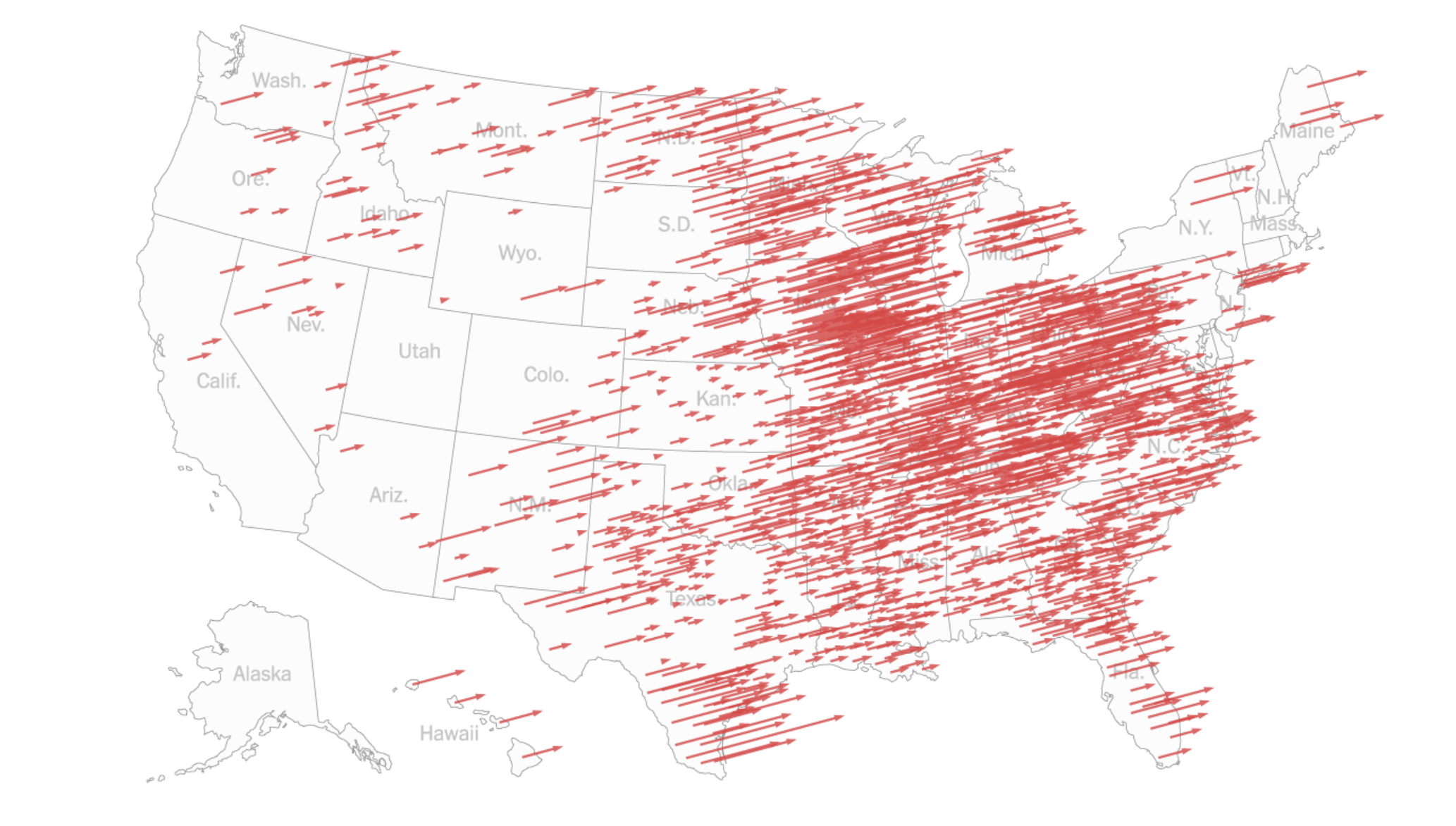
And the demand hammered in on daily broadcasts for the undocumented to return to “their own countries” and reenter the nation, lest they be expelled as illegals, causes huge psychic and emotional stress on 5% of American households to be affected by deportations–5.8 million households, including six million children under the age of eighteen–the war on American families seems only beginning with the 4.7 million that include an immigrant parent, their lives disrupted by being asked to leave their families and homes to try their luck by filing immigration papers from their home countries.
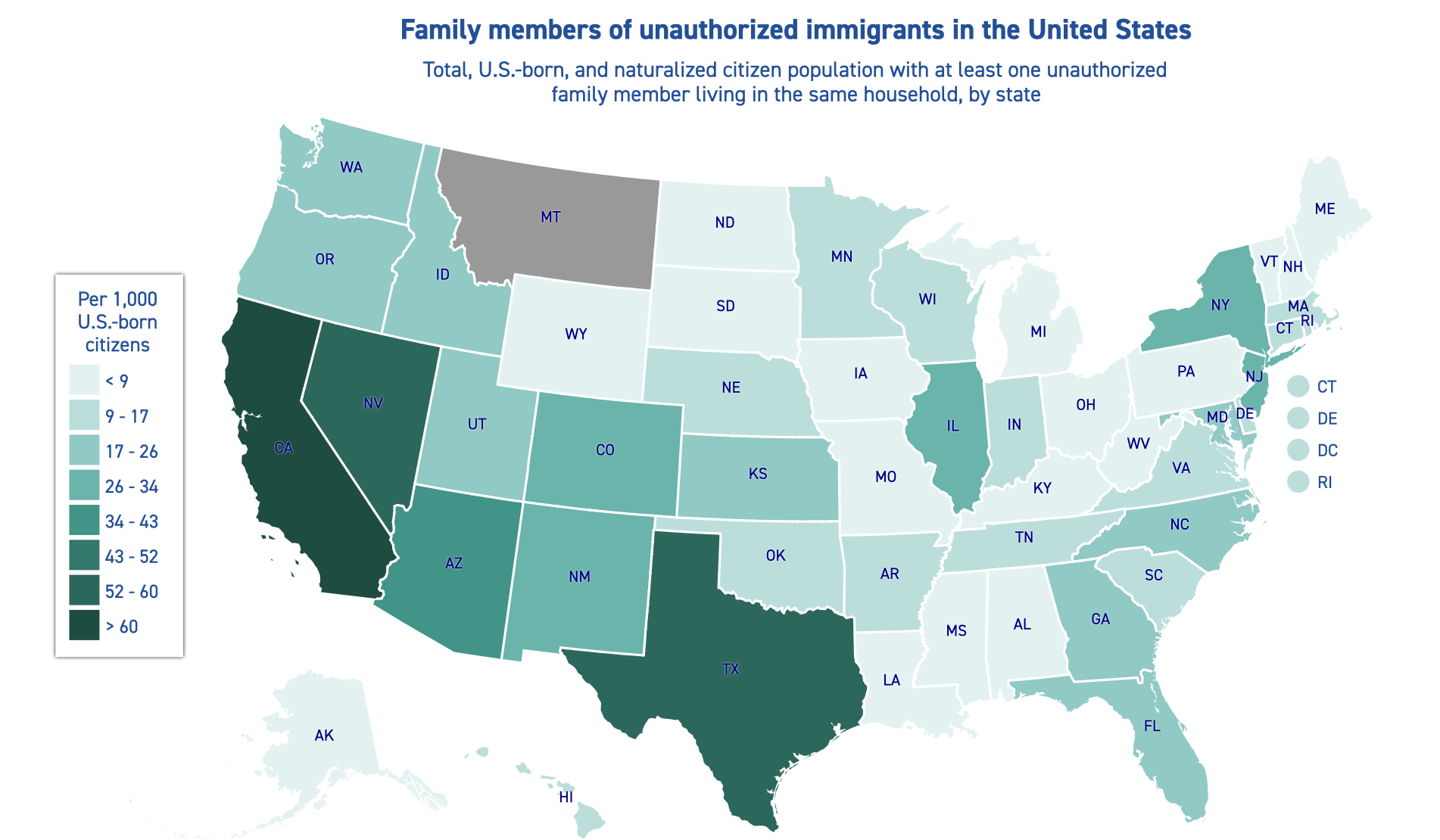
American-Born Family Members of Unauthorized Immigrants per Thousand/CAP, 2016
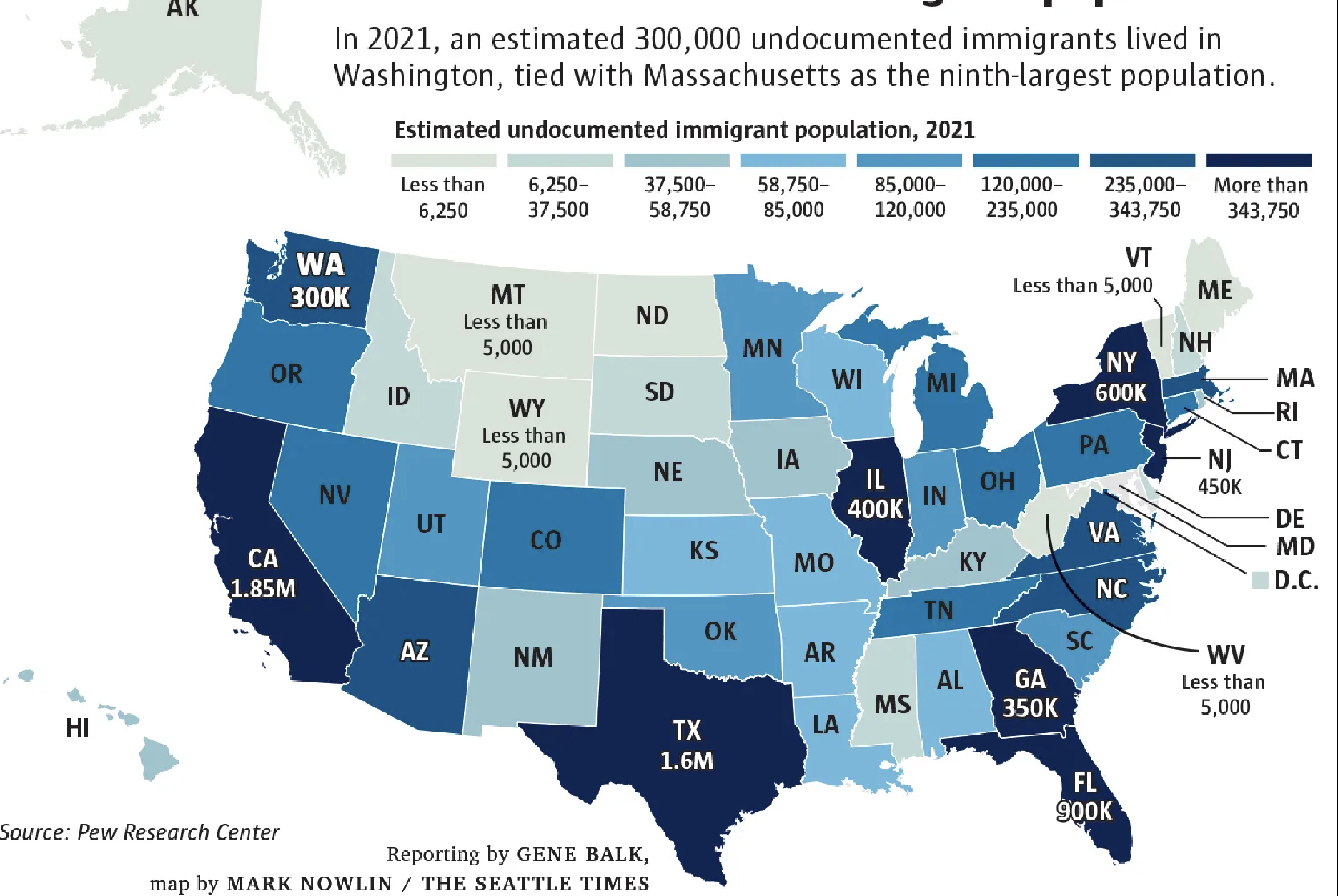
States with Greatest Numbers of Immigrants Targeted for Deportation, 2021/Pew Research Center
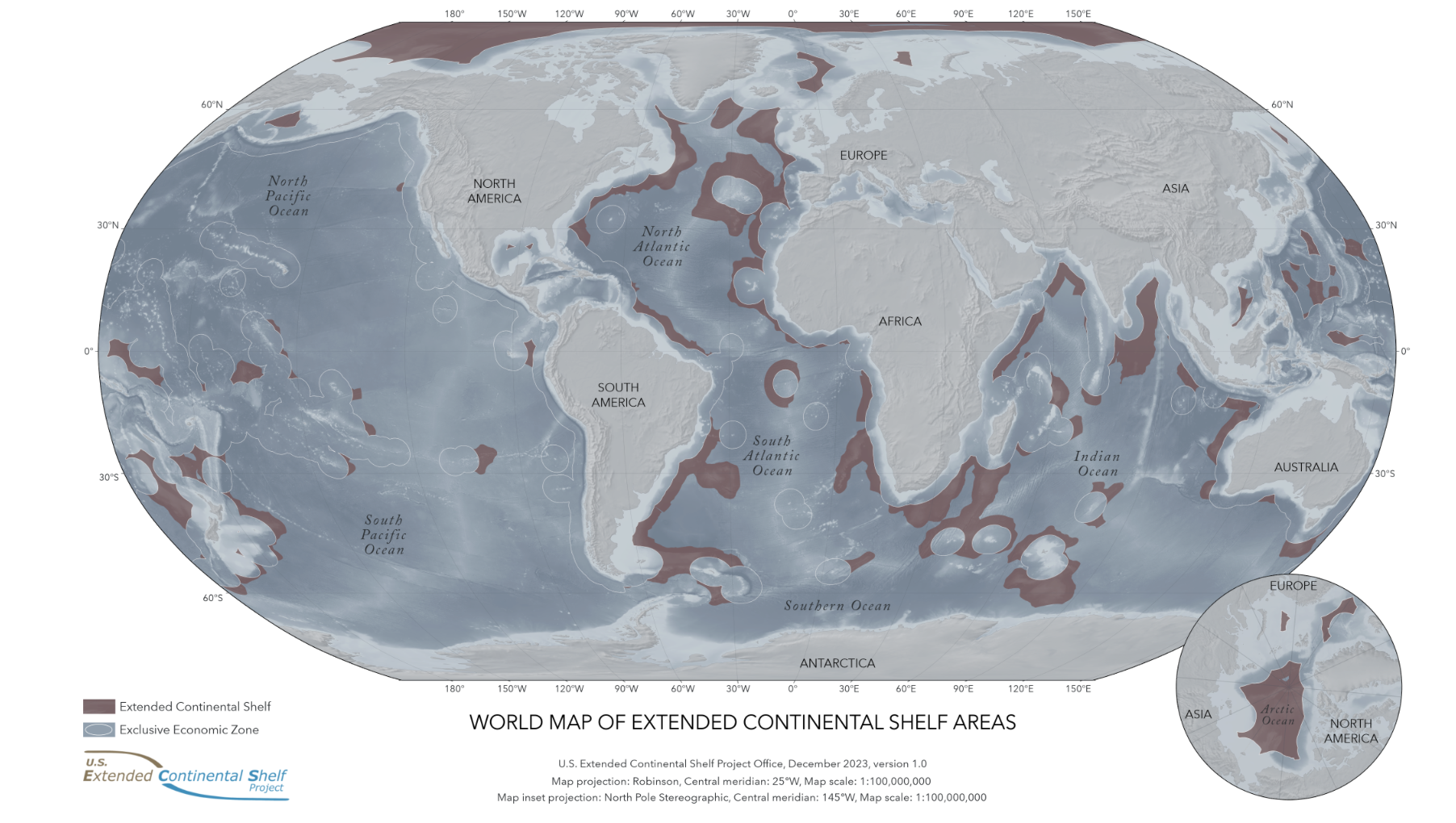
And as I live in the state that seems to have the largest number of undocumented immigrants, some of whom I’ve known for years, the fraying of social bonds seem particularly performative and cruel. As if to direct our frayed attention to the logic of bordering, rather than the function of the state, Trump vanquished specters of globalism or fears of Democrats framing a foreign policy putting less credibility in interventions abroad. American exceptionalism is now happening on the map, or on the screen, but with a speedy retreat from global interventions. The determined closing of embassies, radical slimming intelligence gathering efforts, and government slimming to a diet of executive actions and unilateral decisions proceed, as Trump imagined Israel is a pencil on the expansive Resolute Desk of the Oval Office. The unheard expansion of Executive Orders overturning the status quo and reversing earlier orders of his predecessor enacts the demonization of political that the highly partisan logic of Trump’s campaign, and explodes not only local consensus in government, but rests on a unilateral ecstasy of executive orders more rooted in performative and rooted in appearance than engaging other nations, or geopolitics–it is a geopolitical sublime there for media, not for the law-driven world of nation-states. In contrast to the political islands of past elections, the fragmentation of politics gained its coherence in the demonization of an array of groups–trans; gays; universities; migrants; unhoused–are lumped as enemies of the nation who must be expelled from it–perhaps compensating by expanding the nation’s symbolic map of an “expanded continental shelf” to enrich the nation by underseas extraction discussed in other posts whose totem maywell be the renaming of the Gulf of America..

We have of course seen this before, if the elevation of obscure laws from the Alien Enemies Act of 1798 to the International Emergency Economic Powers Act of 1977 (but with origins in 1917) to civil rights rollbacks to erase bodies of legislation to ensure diversity and inclusion transport us to earlier eras, in a creative time-traveling exercise by which zombies in the nations’s political memory are rehabilitated as a living part of our body of laws. This is the vengeance of imposing a regime without laws, but with advantages for receiving dispensation from the President who cast his redemption of the nation in a performative onslaught of executive orders on a scale never seen.
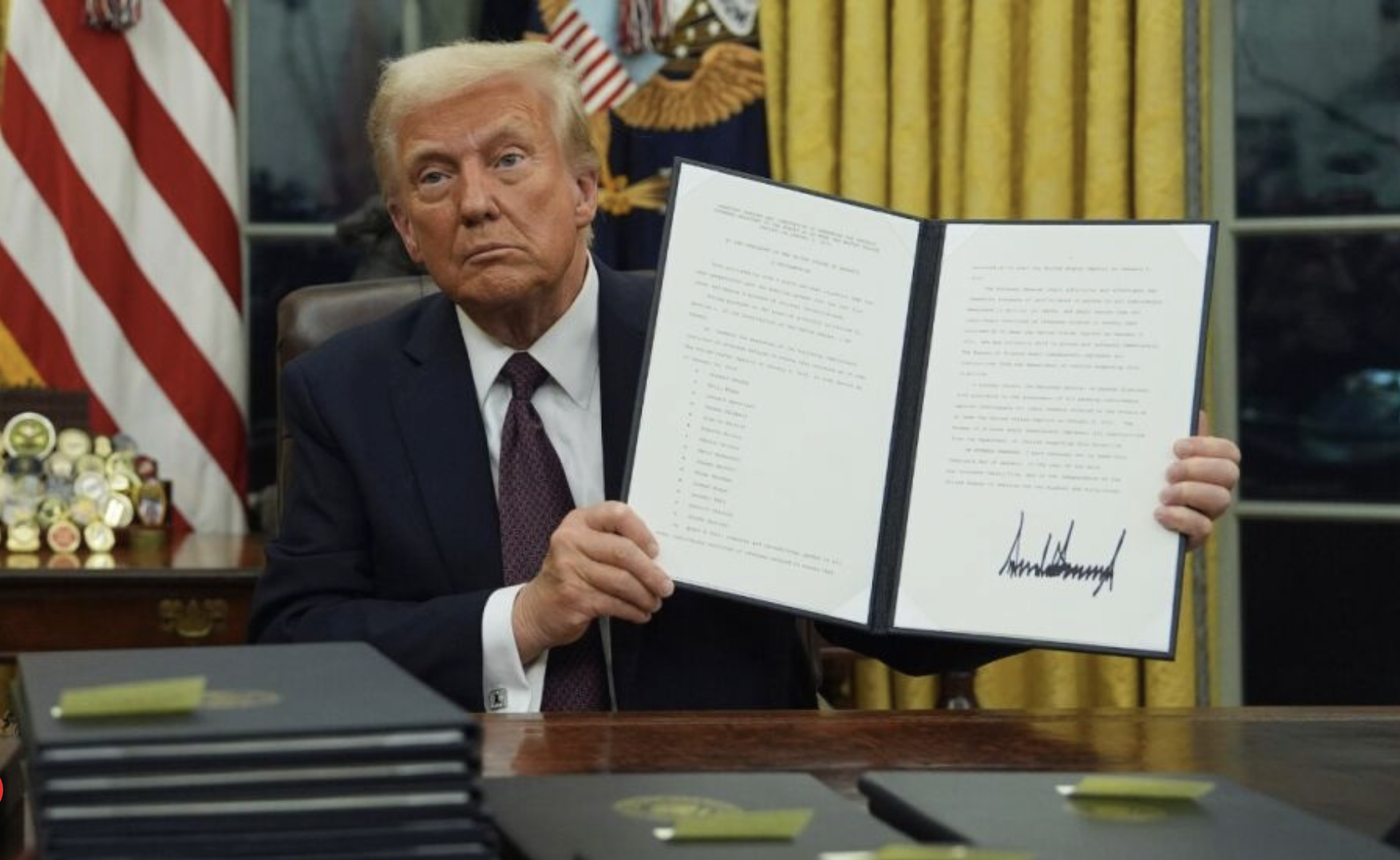
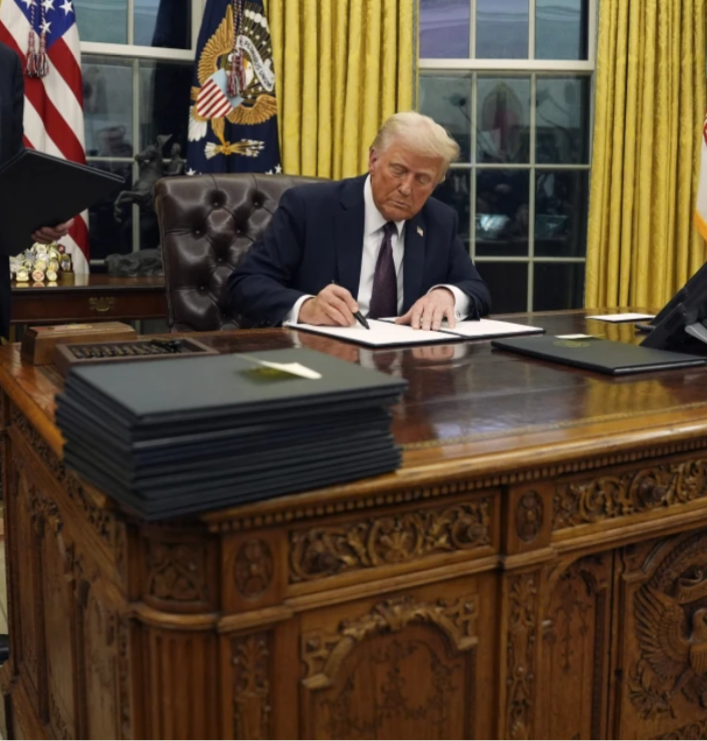
Even as Elon Musk’s team has invoked administrative privileges across multiple government branches by a single login to rule them all that allegedly aims to trim waste of an ostensibly bloated government that values ties to the nations, and global intelligence, using a data-driven mastery is less rewrite the Constitution than return a leaner, meaner government of Trump’s childhood and Musk’s parents, under the banner of stopping “decline” as a way to jump start a new epoch of a “Golden Age of America” that claims to “reclaim our Republic”–with a significant narrowing of that first-person collective–a new era that will be marked by a rebalancing of the scales of justice, starting from the commutation of all involved with “events that occurred on January 6, 2021.” This rebalancing allows massive deportation of immigrants at the same time as protecting freedoms, an embrace of isolationism with the end of international organizations and bodies deemed obsolete.” Trump forsakes pens, as Joe Biden, to sign his executive orders, rather relying on indelible sharpies in a sea of posits and executive orders that are hard to keep track of or pay attention to.
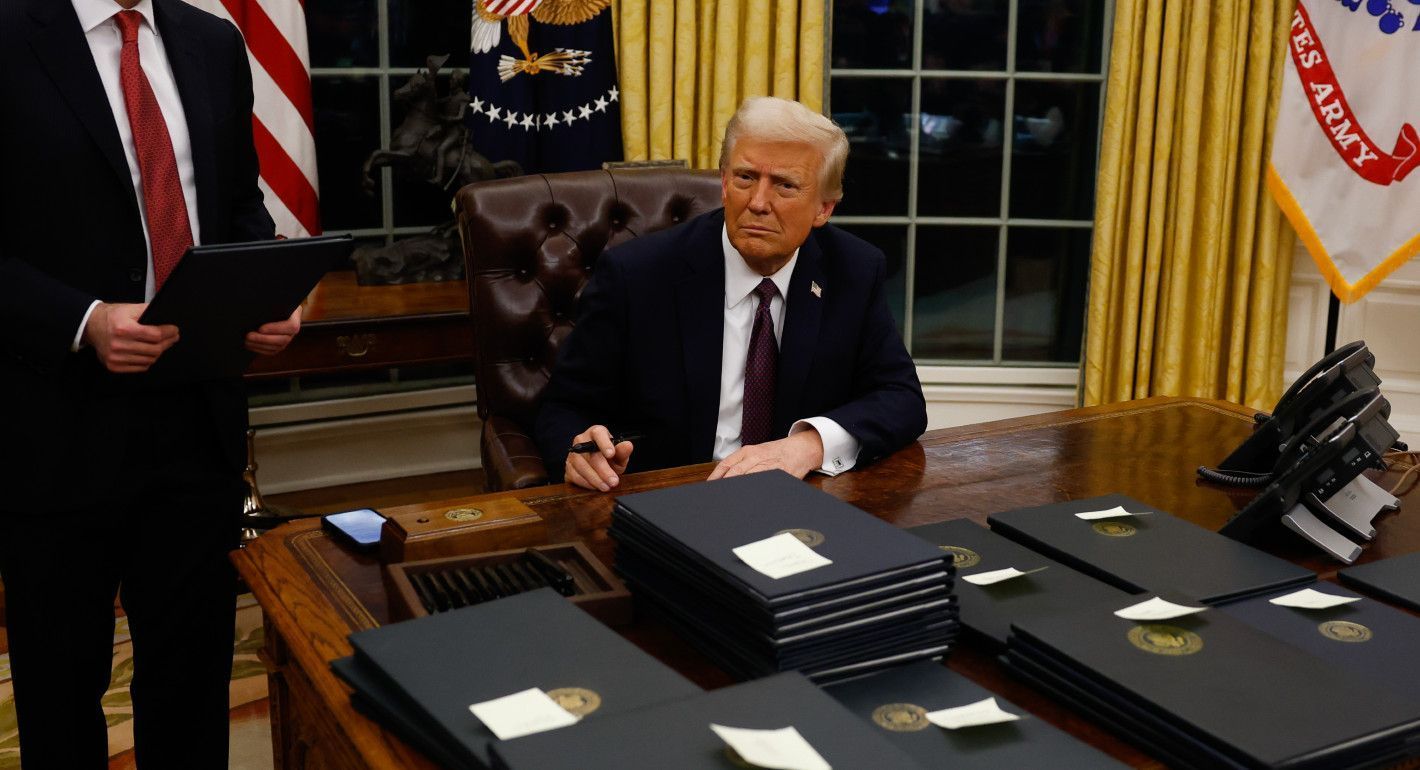
Trump Signing the Over Two Dozen Executive Orders in his First Week in Oval Office
Amidst a slew of executive orders prioritizing American security, Trump has demonized treaties, accords, multilateral ties, or international bodies as infringing on the autonomy and sovereignty of the United States and compromising the nation’s ability to govern itself. The steady drumbeat of demonization of the migrant argued to upset American peace and safety led to Trump’s impending declaration of a State of Emergency on the southwestern border. The Southern border has been recast in military terms, from the start of Trump’s new Presidency, as a frontier demanding militarization to contain such dangers to the body politic soldiers stand to be granted authority to arrest migrants to three states–California, Arizona, and New Mexico–backed up with the patrol of offshore waters near the border by Law Enforcement Detachments–the hyper-focus on the southern border seems to blur federal authority in the world, posing as a defender of American interests. The border was a central issue and theme of the over hundred and fifty seven Executive Orders he signed in the first months of 2025, affirming his powers by EO 14147 through EO 14303, as if he would reach the magic number of 15000 before the year’s close, in an unprecedented expansion of Presidential authority that might tempt him to reach for an autopen.
If Europe once saw American robber-barons as cutting up the nation’s real estate in ways that placed the fabric of society at risk, and seemed to cut across the land with railroads for personal profit, the absence of restraints from enrichment this time round seem to both be far more virtual–and hard to map–as they are extensive–often bent on cutting ties to leaving accords with other governments, cutting obligations, building borders, by shamelessly allowing oligarchs to enrich themselves on a global stage–including his own family. In contrasting to the expansive nature of claiming the Gulf of America, theorizing about annexing Canada or claiming Greenland from our European ally Denmark, of the first months of the Trump Presidency, that seemed to ride out like a raft of Executive Orders, unprecedented in scale and echoing Trump’s late October promise to be “a dictator on Day One,”–remarks that fleshed out the creed “I want to close the border, I want to drill, drill, drill.”
If these remarks tipped his status in the pocket of Big Oil–the map is not sliced, but reordered by revitalizing old stereotypes. The slicing up of an open continent by Robber Barons of the Gilded Age had seemed to undermine the Great Frontier, showing a group of man-boys playing atop a map that had been once claimed by Manifest Destiny of gigantic size as isolated in an oceanic expanse reaching the horizon. Frederick Burr Opper’s cartoon map of 1882 shows industrialists as larger than life, but only sporting black top hats of respectability–Henry Vanderbilt; Jay Gould; Russel Sage; Cyrus West Field are man boys, wielding carving knives for personal gain. If Vanderbilt brandishes the most conspicuous blade, as Field and Gould play dice in the north east, distractedly but intently, the cartoon printed as “Monopoly Millionaires Dividing the Country” queries the unity of a nation which is able to sanction placing such premiums on purely private gain based on wealth, and the current reprise of wealth inequalities now features men carving up the borders of a democracy by digital tools rather than the curved blades of hunting knives. But the same “captains of industry” ften caricatured as parasites of the nation who had sucked their millions of dollars of wealth on the backs of increasing numbers of impoverished American workers were unmasked as so siezed by so many follies of placing schemes of enrichment as if on a fantasy island of their own.
If the dice are loaded, as much as cast in

“Let Them All Have it, and Be Done with It!” Puck Magazine, February 8, 1882/P.J. Mode Collection
But the gaming nature of Trump’s Presidency is only increasingly revealed with time, suggesting the New Gilded Age of inbred oligarchs we seem to have subjected the continent and nation, and the folly of imagining the vanity gaming was only limited to an isolated continent or body of land. If the dice are loaded, they are cast not over arcs of railroad track that are criss-crossing the nation, but the virtual webs of increasingly virtual tokens and currencies, mapped only in a digital realm, existing often in closed networks in the loyalty programs in which select players participate.

Frederick Burr Opper/detail courtesy P.J. Mode Collections, Cornell University Libraries
The exclusion of most players from the game also suggest the unique rules of the game, bound not by nations, or familiar frontiers, but in need of creating false frontiers of persuasive dichotomies, even making fun. of the pathways of crypto speculation that boosted alternative currencies among exclusively online followings, transforming Dogecoin to a speculative asset that has gained value as a speculative asset–promoted from the decision made by Tesla to accept Dogecoin as a currency for merchandise, and promote it as his “favorite cryptocurrency” and “the people’s crypto” that boosted its value in crypto markets, a promotion that while often parodic exploited platforms to boost its value and poke fun at the vagaries of artificially boosting its valuation, that culminated in the venture of being appointed leader of the Department of Government Efficiency in ways that boosted its valuation from a surge of its valuation within fifteen minutes of the Executive Order, even if Doge’s millionaire addresses have since taken a bit of a dive–the addresses holding a million dropping over forty percent from January to March 2025, as the plunging trust in Elon Musk over Q1 2025 in ways that have tied his own role to the value of the cryptocurrency meme coin in the volatile marketplace of virtual currencies.
Were Musk’s “public” tweets about the value of the coin not a way to shift Dogecoin’s price, issued in canny ways that exploit legal gray areas of the lack of regulation of meme coins in order to manipulate market value for personal and collective advantage? Even without openly defrauding investors, the coin loan outside regulatory rules intended for securities, allowing the artificial manipulation of its price in social media posts to remain technically legal in the eyes of the SE –the culmination of longstanding cryptocurrency manipulation of Dogecoin already dating from 2022. Was the involvement in a “new” government office named DOGE, ostensibly for new payment, a way to boost the payoff of crypto value of the meme coin for investors by signaling to investors on an even larger public platform than social media, even as he faced a $258 billion collective lawsuit dating from 2022 for manipulating Dogecoin by artificially creating hype for its value among his own social media followers, only to leave many investors with losses as its value declined? The growth of a cult-like following for Dogecoin was perhaps destined to merge with MAGA, investing the ‘OG meme coin’ with a new bullish narrative, driven by the value of its meme-driven branding, even as the long-term valuation of the cryptocurrency is currently up for grabs, and the manner in which Musk effectively misled investors in the meme coin a grey area of ethics as well as oversight.

Rising and Falling Price of Dogecoin from Trump’s Inauguration
Musk, who has taken to live-stream his gaming on cross-country flights, imagining he was defending the universe from invaders, has long embraced gaming as a way of exploiting his identity as an influencer and fashion icon, seeking to create an individual brand that was able, as in the redesign of the Tesla logo, to create demand through amplifying hype. Was the Tesla design not in itself a surrogate for Technocracy, an engineered vehicle of suprematist origins without any tracing of the familiar engineering concepts–pedals; screws; hinges; steering wheels–that defined the industrially produced cars of an earlier age? Claiming itself a new era of car engineering, seemingly stripped of all evidence of screws, sockets, gauges, or even tanks designed to interact with hands or feet, it was engineered as a made environment that supplied all of ones wants wirelessly.
The suprematist image of North America as a focal point for the world is deeply distorting; it has also become a useful political imaginary. The increased focus on the military protection of the border to protect the public and the collective interests of the nation and the personal interests of all Americans isundermining of our community by privileging private economic interests–from the private prison companies making a fortune out of public investment o the American companies wanting an upper hand over Mexican trading partners. If the border’s defense is cast as a way to protect American wealth–preventing “illegal” migrants from gaining “benefits” as Americans, ranging from health to social security to education that are entitled only to citizens, the real gain will be for oil companies granted access to a renamed Gulf of America, and the naturalization of wealth disparities on each side of the border as evidence of American greatness. The border has become a permanent advertisement of American wealth, and of the fears that others are poised to rip us off–and that Democrats will allow the rip-off to continue. The lack of guardrails for the National Defense Area by which the border is redefined is a new bulwark to an old idea of the nation, not based on opportunity but protecting privilege, even if the privilege is illusory at best.
Trump 2.0 is based on serving of wealthy Americans by separating the United States economy as starkly as possible from the world, privileging only the protection of American interests over international norms. The purity test of citizenship that Trump seeks to impose–ending birthright citizenship–is a hallmark of the end of the collective, hoping to end citizenship retroactively that invests in encouraging “voluntary self-deportation” before a punitive system of deportation begins. If at great cost to the nation, deportation will offer both tremendous opportunities of enrichment to security companies and private police, but more seriously rewrite national belonging in indelible ways by subtracting many Americans of civil and legal rights–and opportunities.
But the huge profit to be made by the digital apparatus by which big tech will provide from expanded use of the computing infrastructure to integrate military operations and border policing on a single platform–the contract for the modernizing the computing infrastructure amounts to up to $10 billion if not more–undergirded by the expansion since Trump first entered the White House of tech platforms used by ICE to expand apprehension abilities and police not only the border, but stage escalated attacks on farmworker leaders, immigrants accused of being gang members, and foreign international students alike, by integrating databases that will allow for increased mistaken detentions. The use of facial recognition platforms like Recognition software offer tools to target migrants, by high tech surveillance technologies of expansive data mining tools, that extend back to the Investigative Case Management systems designed by Palantir, used by ICE to track down migrants for deportation from online public and private databases, which will be the backbone for the expanded deportation networks of the new Trump Era. The growing role of technology and technology systems in ICE’s annual budgets jumped in 2017 during Trump’s first term. DHS long used Amazon cloud services for its immigration-related databases are a growing IT portfolio, as AWS hosts the Homeland Advanced Recognition Technology Systems (HART) in order to aggregate biometric data of all citizens to eventually replace the older and antiquated Automated Biometric Identification System (IDENT), storing data on foreign nationals and U.S. citizens in a single $6 billion database for enhanced surveillance, merging data from foreign governments, local law enforcement, surveillance camera, and the FBI–what could possibly go wrong?–-all gathered, from fingerprints to iris to immigration applications to DNA samples, without consent. The often invasively gathered information are being funded as enhanced policing tools. including on juveniles, by untested biometrics on over 290 million identities.
If in the works since 2016, the multi-billion program of biometric identity management has expanded with minimal oversight or compliance with privacy laws or any privacy compliance. The awarding of government contracts for new platforms like Palantir’s $30 million dedicated ImmigrationOS, as an end-to-end digital platform dedicated to deportation, dramatically expanded the technological infrastructure powering mass deportation Trump boastingly promoted would constitute “the largest domestic deportation operation in American history” of between thirteen and twenty million. It promises to track in real-time “self-deportation,” and compile an “immigration lifecycle” for each immigrant, and have an interface with the digital apprehension systems ATrac “Alien Tracker Service” using data from AFT, Health and Human Services, Dept. of Labor, and Housing and Urban Development. While the mention of such robust services seems designed to raise the blood pressures of many as they trigger a fight or flight response across much of the nation, as we wait see how how tratically the digital dragnets will shred our social fabric.
Palantir insists it is purely a contractor, independent of immigration policies, but the absence of any privacy or oversight from ICE working with such contractors–let alone by the involvement of DOGE in an “inter-agency database” to enhance apprehension abilities by data-analyzing tools of predictive policing that Palantire, cofounded by Peter Theil, having been awarded contracts to manage the interagency databases assembled by Elon Musk at DOGE. Already, the prominence in digital monitoring and surveilling of the undocumented immigrants who are branded as invaders and opportunists will create a two-tiered system of justice, contracting the law to protect only the status of true Americans–not all residents–that cuts at the legal and social fabric of the country. This erosion of human and civil rights is a way of returning to a two-tiered system of justice of the old America as a way to Make America Great Again, extending the franchise to a white middle class and subtracting the investment in America’s multicultural future or its diversity, celebrating a vision of the nation deeply reactionary and retrograde, pushing by time warp of an earlier age of Jim Crow which American jurisprudence seemed to consign to the past and allowing “us” to leave.

For al its boasts of securitization, we must of course remember just how arbitrary is this border line. The securitization of border is now actuated in broad data-driven dragnets Trump promises of undocumented–“illegal” is the term he and his team now prefer–to expel those not yet citizens beyond our borders seems compensated by the enlarged map by which Trump claimed to “restore American sovereignty in a raft of executive orders when he returns to the Resolute Desk, a tray of fresh black sharpies at easy reach, as if able to make America “more exceptional than before.” Yet the prominence of the securitization of the border notwithstanding, the declaration of authority of the Department of Interior or Roosevelt Reservation must be examined as a new geography of emergency and international order that is designed to trump the law and legal codes. The old mantra, “Border security is national security,” is called a defense of “the sovereignty of our southwestern border” in a new global map–an anti-globalist political map, as if placing a premium on a retreat from global affairs–by curtailing concentration on the security of the nation’s edge.
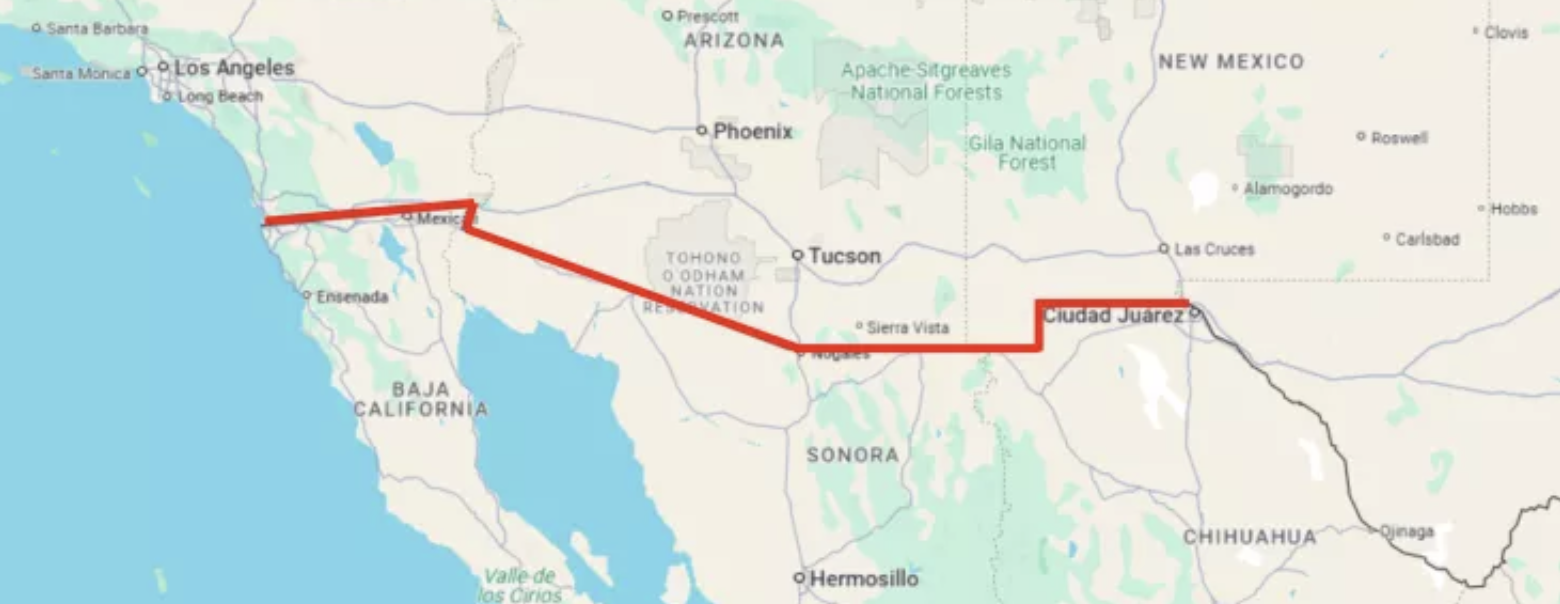
Newsweek
The dramatic and unprecedented expansion of the militarized former border goes beyond the notion of a wall, to the new regime of the border by its militarization, subjecting it to another law. The sense of the border as an altar on which refugees are sacrificed will only grow as the army is given the charge to police the border as an expansive military camp–and to hand over apprehended migrants to Customs and Border Patrol. The notion of “border security” is expanded in ways it was never understood to apply–and change the nature of the patrol of a “border,” as it is reconfigured to avoid any presence of monitoring for human rights abuses or civil rights.

Roosevelt Reservation and Border Wall
At the same time, the President’s social media feed has set new standards for election interference in the current Canadian Prime Minister’s race, as President Trump used Truth Social megaphone to issue what appears an invitation to become “the cherished 51st State of the United States of America” as if this were on the ballot, as if votes might trigger the end of an antiquated border by executive action–“no more artificially drawn line from many years ago!” The redrawn map argued about the nation from a sovereigntist perspective, effectively erasing the question of border security and the project of the border wall by making it into a military base in order. At the same time, talk of annexing Canada for a short time seemed to promise to free up more troops and border security agents for securitization of the Roosevelt Reservation, the slim strip abutting First Nations, national parks, and fragile ecosystems and protected habitats.

All were sacrificed to the nation, as much as the civil liberties of all migrants trying to cross the line, whose presence was criminalized as a threat to sovereignty. The expansion of a second “National Defense Area” in Texas expanding of Fort Bliss in West Texas, places an expanded border under military supervision of “operational reach . . . in denying illegal activity along the southern border” that will be a new hub of border enforcement, also suspends all national laws and removes the border from a path of immigration, to b manned by 1,600 active-duty Marines and soldiers joining 2,500 reservists already mobilized. The spectacle of an expanded zone filled with detention camps stripping migrants of all civil rights.

Surveiling of Santa Teresa Sector of Border, Santa Teresa, New Mexico April 12, 2025/Pfc. Sean Hoch
The bare desert expanse has been notoriously difficult to surveil. It is one of the most surveilled zones in the world and in the country. But in the blurred border of heightened sovereignty maned by active duty troops, unilateral declaration undermines all civilian laws or rights. The border is issued by diktat, and scarily by the executive branch. This is a declaration of the border that is a demand for sacrifice of any identity outside of America, and belief that the bully pulpit of the White House can mandate borders without laws. While his social media intervention helped erode the chances of his Conservative allies across the northern border, a cluelessness of the effects of his social media megaphone was easy to confuse with his pleasure of a platform for virtual thundering, to create a greater media sensation, perhaps, and more inhumane system than the border wall of the past, avoiding needing to ask Congress to appropriate further funds at all for its construction.
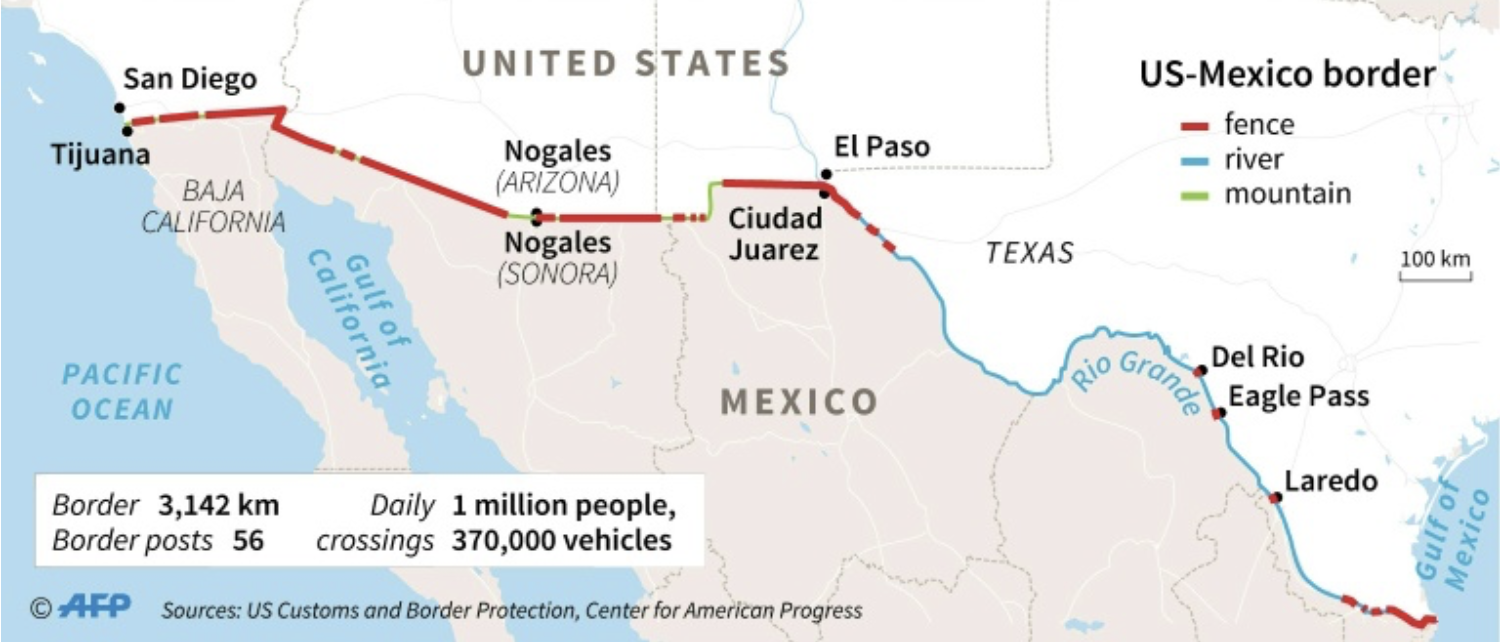
US-Mexico Border and Border Fencing on Southern Border, 2019
The declaration of strength at our borders trumps all sense of context, in the name of efficiency. The incredible miscommunication, replicated in Austria, haunts the presence on the global stage. Trump announced an offer to Canada to “have your Car, Steel, Aluminum, Lumber, Energy., and all other businesses, QUADRUPLE in size” channels his identity as a snake oil salesman an carnival barker, of course, because “your” wouldn’t really exist any more but become “ours.”
If the 2004 Terrorism Prevention Act and the 2009 border policy asking all citizens to present valid passports at the US-Canada border, Trump’s quasi-demand to erase a border he calls “artificial” seek to annex Canada’s ten provinces and three territories of Canada “as a state” might prevent the costs of stabilizing that border–and might change the political composition of government if it added thirteen new states to the union, amalgamating all Canada to a single state.

The absurdity of the ultimatum may be one of the more strikingly fantastic and imaginary events of the first hundred days, for it reveals a lack of respect for national space and sovereignty–if the demand Canada either pony up funds for the Golden Dome that might prevent missile attacks or join the United States as “our fifty-first state” seemed to get newsplay. (Trump’s friend the New York billionaire John Catsimiditis was quick to “stick his neck out” for the ostriches he claimed are “endangered” by the decision to control the spread of the avian flu, rather than given them a chance to see if they “may have herd immunity,” if the probability is small indeed. No fewer than three high-ranking officials in the Trump administration have called the ostriches “endangered” due to the cull of a bird flu epidemic, as the United States ended its contract with drug developers to prepare the United States from the danger of a potential bird flu pandemic,–calling it not ethically or scientifically justifiable, and foreclosing of the natural benefits of “herd immunity,” that Holy Grail of ending all scientific research or need for a vaccination–as if herd immunity not only is achieved by vaccination, and the failure of a virus to mutate, unlike rapidly mutating viruses as the avian bird bird flu, which has infected human populations, real fears of transmission after the nearly 140,000,000 birds having been infected by early 2025 in our nation alone. Yet the grocery store billionaire, raising fears about the precious antiviral powers credulously cites, without basis, “credible evidence that these ostriches may hold life-saving antibodies,” an “extraordinary potential in ostrich eggs to combat major diseases, including avian flu,” at risk of being wiped out in the bird cull–rather than foreground the risk of the mutating virus to food supplies nationwide.
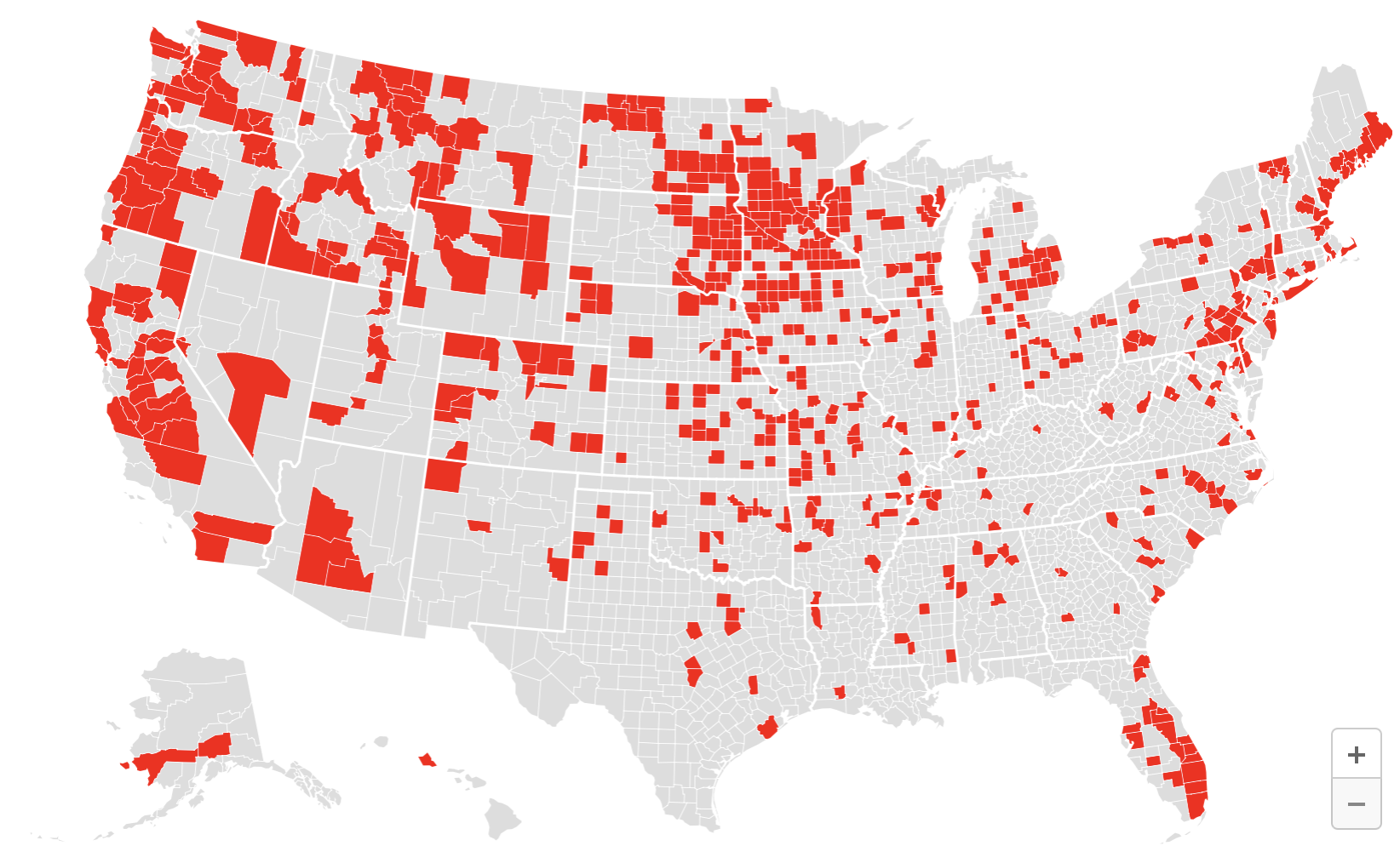
Birds Infected by Avian Flue, 2022-25/Tom Howarth, United States Dept. of Agriculture
The idea of running government off a logic of herd immunity are familiar from Trump I.0, and the idea of confronting the coronavirus COVID-19. They recall the logics of the ethics of re-bordering, securing the nation from real dangers by a level of virtue signaling, rather than actual science or levels of epidemiological risk, even as no strategy to deal with the vastly mutating virus exists. Who cares if the science exists that show it otherwise–they are the merchants of agnatology, a denial of actual research, a promotion of a new logic of science that is a massive effort discrediting of the scientific enterprise as following an “agenda” that is in fact not for our benefit, or not virtuous at all, allowing “river rats” to smuggle cigarette, liquor, and drugs–even if the first two are more expensive north of the border!–into the nation, taking advantage in cunning ways over those frozen motion detectors at the northern border, where backcountry agents to ride on horseback.
As US Border Patrol agents won national headlines by nabbing border-crossers in possession of ketamine–or over thirty pounds of ketamine in the checked airline baggage en route to Washington DC, the four million dollars worth of ketamine that was found being smuggled into Canada in Mississauga suggests how much ketamine is moving out of the United States, as well as across the southern border from Tijuana and Monterrey, transported in sandwich bags strapped by duct tape under border-crossing vehicles. As worries have grown about the cross-border flow of ketamine have grown as the market for the cheaply synthesized drug skyrocketed since 2000, the dangers of ketamine indulgence was overlooked as Elon Musk added needed support to the Trump entourage and traveling road show, even as Musk started to choke up, dissociating himself from his environment and clear speech, revealing increased tics, and crazed euphoria typical of an addict of Special K. He might have reminded us that yes, there is a drug problem in America–rooted, in a nation of increased economic inequality and large numbers living in poverty, in inabilities to manage pain.
We focus not he border, as if this might lend clarity to the process of governance, even as we send any precedent for their existence in international accords out of the window. The eventuality of mass deportations seem to increase daily along the nation and the militarization of the southern border grows, as we ready to expel many of our most vulnerable across the southern border, in a perverse quest for purity with clearly evident racial undertones. As the Pentagon consults lawyers to ascertain what complications might result form the continued military occupation of this thin stretch of land by the U.S. Army, instructed to hold for arrest migrants they encounter for entering a military base, the militarization of the entire region by twenty ton armored vehicles as a “National Defense Zone” by annexing the border-zone to existing military installations, transforming the strip to a state of exception the military will control with long-range sensors and without any direct legal oversight. The border is flattened as a purely American problem, as all those crossing it are cast as violating laws, and without any rights that demand respect and mandate privacy or human rights; civil rights are sacrificed at the border once it has been recast as a military regime, in which all who enter are argued to have set foot in a military based rather than tried to cross into another sovereign country, and are in a negative space where no human rights or legal redress can exist.
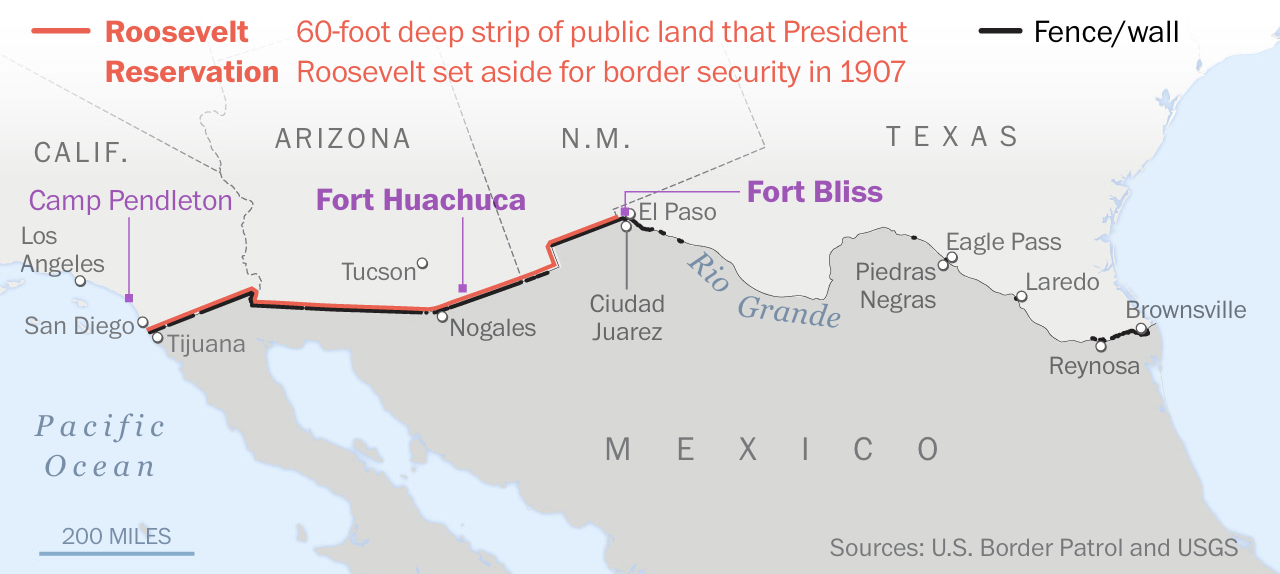
Washington Post, March 19 2025
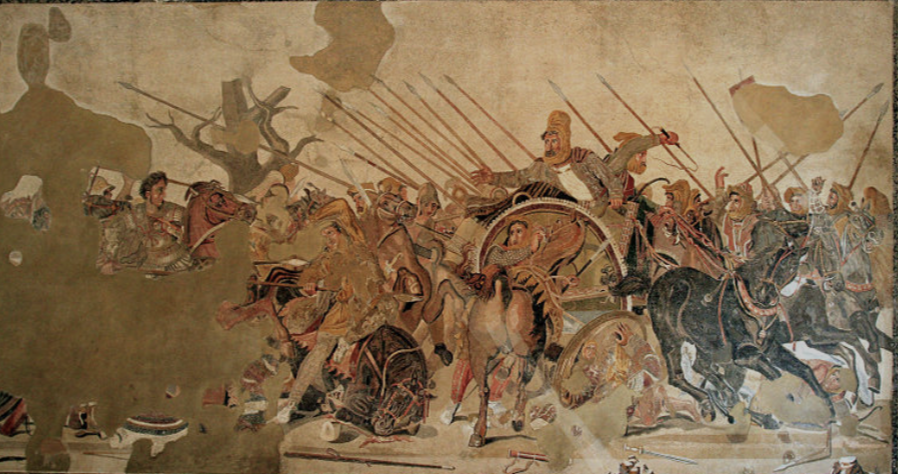
The border would not be part of the sovereign territory of the United States, but an edge of legality and rights. President Trump’s attitude toward border sovereignty and security has been called “sovereigntist” by historian Jennifer Mittelstadt, noting the retreat from any notion of international law in the premium it places on claiming the Panama Canal or annexing Canada to the nation, the exemption from law seems haunted by the evils of global government, the weakened borders by Free Trade agreements or immigration treaties, undermined and demonize all international norms of human rights, democracy, refugee resettlement, or criminal justice, elevating the primacy of the sovereign unit above all global accords. Pete Hegseth’s energetic endorsement of “defend[ing] this line” mirrors the focus on the border as a sovereign perimeter in need of defense, mirrored in the expanding use of military facilities, from Guantánamo Bay, Cuba, to extraterritorial prisons in the first hundred days of Trump’s second presidency, a ramping up of a deportation strategy to move undocumented immigrants beyond the border to purify the state. Hegseth is a bit of a dim bulb, but emerged as Donald Trump’s mirror and right hand man with his offered new horizons in triumphalism with the expansive pronouncement that in sending bunker buster bombs costing billions to Iran, without loss of American lives, “President Trump directed the most secret and most complex military operation in history,” as if the great white man vied with Alexander the Great’s for apparently liberating Greek cities in Asia Minor from Achaemenid yoke!
The broad historical scope of Hegseth’s training at the Princeton Tory may have afforded the pomposity of a trans-historical gesture, as much as his military career, as it was at the Tory he took a vow to “defend the pillars of Wester Civilization against the distractions of diversity,” if he was distracted to include uncredited material, sham paraphrasing, as well as verbatim copying within a senior thesis, “Modern Presidential Rhetoric in the Cold War Context,” that emphasized the global threats that informed President George W. Bush’s reaction to Al Quaeda after 9/11–and of the Iraq War that many worry has been a precedent for the military reengagement with Iran–if improper citations of historians Richard Reve, James Caesar, George Kennan, David Hidester, and articles by Geoffrey Number and John R. Anderson were deemed a grey area of dishonesty rooted in sloppy note-taking more than wholesale borrowing or cut-and-paste writing that they do appear to be.
Global history was central to the precedent that Trump’s administration sought to strike of inaugurating not only a Presidency but a new age of America. In declaring tariffs tantamount to a trade war with all other nations, Trump seems to seek economic control over the hemisphere that retract State Department ties outside of the “alignment of the President’s foreign policy vision.”
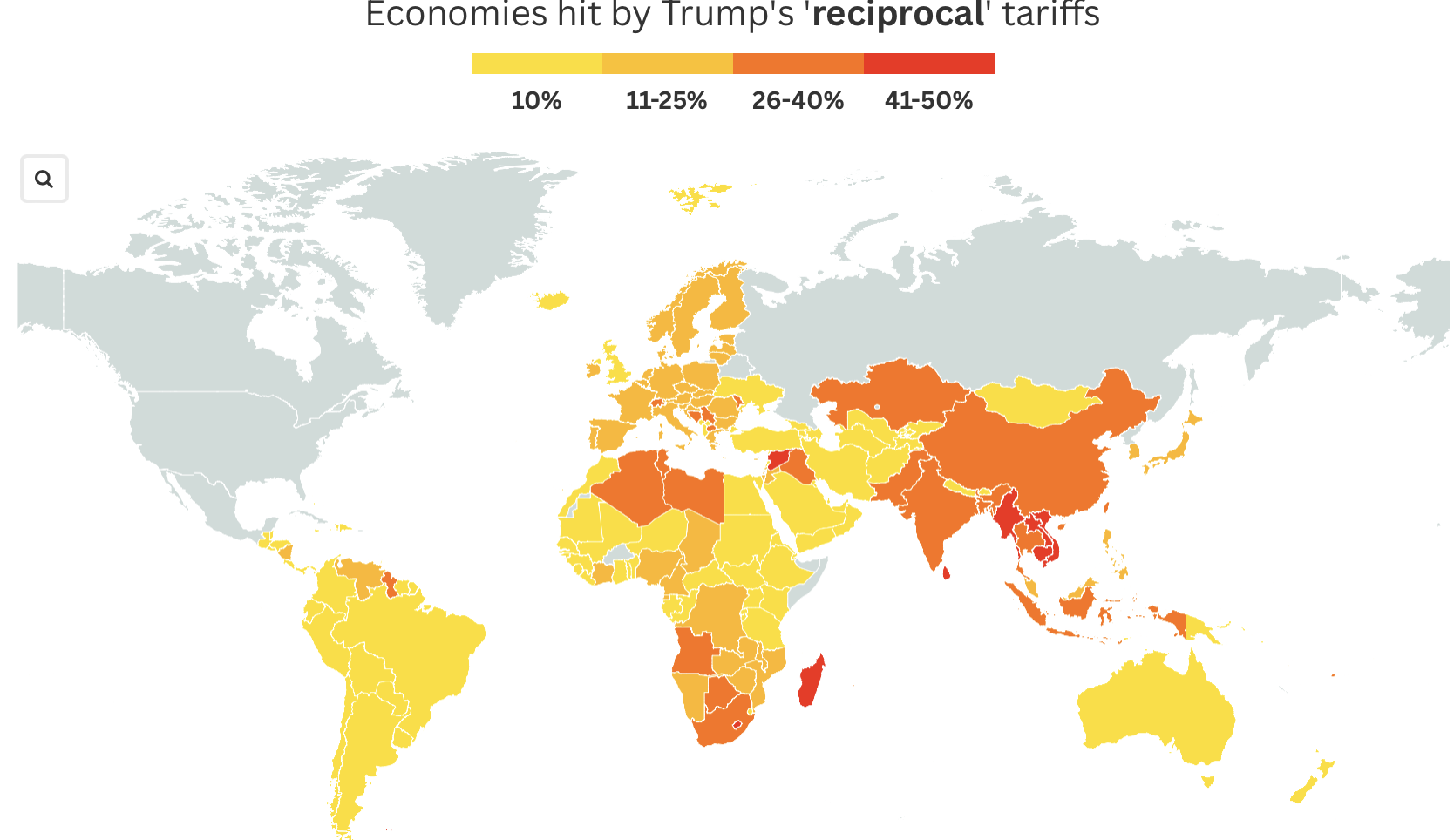
A Flourish Map of Proposed “Reciprocal” Tariffs, Calculated on April 5, 2025
–in ways that break with a history of transnational cooperation claimed to disadvantage the nation. The tariff map seeks to re-dimension the global economy by regulations to reshape economic playing fields by national interests on a global scale. In open rejection of a global economy, broad swaths crossing national borders remain a national map, prioritizing “mission-driven deployments” over global or international relations. This is a new nation: suppressing international efforts (forget the Peace Corps!) as if they challenged the faith of Americans in stability of a fair economy.
The magical substitution or confusion of foreign enemies with unwanted domestic invaders seeks to undo the notion of citizenship by denying it to those deemed outsiders and enemies of the state. The ratcheting up to near paranoid heights of the domestic intruder as enemy of the state suggests a clear distinction of friend and enemy, and insider and outsider, that seeks to reprise an America of clear good guys and bad guys, a Ronald Reagan red republicanism of targets and unwanted people, that substitutes the unhoused, the leftist students, the unemployed, the welfare queen, and the drug addicts with the image of the unwanted immigrant.

The emergency of borders was escalated by Trump’s invitation to view the global map not in terms of American strategy or security ties, but in terms of how other nations have been long ripping us off, as if they were responsible for the national debt. And the desire to create an anti-immigrating fencing of the nation to repulse migrants and economic liberalization across borders, a retrenching of the nation in sovereigntist terms as a defense of territory and retrenching of territoriality in the face of blurred borders. We have rather retracted behind the border wall, as if treating the sixty foot wide strip as the only barrier to national security. The fracturing almost renders nations obsolete. The imposition of a vision of self-sustaining wealth is a sectoring off of the world and ending of international norms. It has less need for justice than for retaining and shoring up national wealth, as a satisfactory vision of national contentment, isolating us from the inequalities or suffering of global migration–or indeed from migrants. And although the sixty foot wide strip on the southern border of the Roosevelt Reserve is s impossible to map to scale, it evokes a vision of sovereign autonomy. It becomes a mandate to defend a dramatically expanded notion of sovereign exclusivity beyond the nation–and instead of it–as it is without basis in law, or legal norms–of military jurisdiction. Perhaps the transformation of the Roosevelt Reservation to a military base will at least allow the funding of a border wall to be able to be bracketed, by subsuming the border to military jurisdiction to include the military, as Trump has long wanted, in the patrol of the southern border, transforming the very area Trump had wanted the military to engage in building a Border Wall to a quasi-permanent militarized zone.
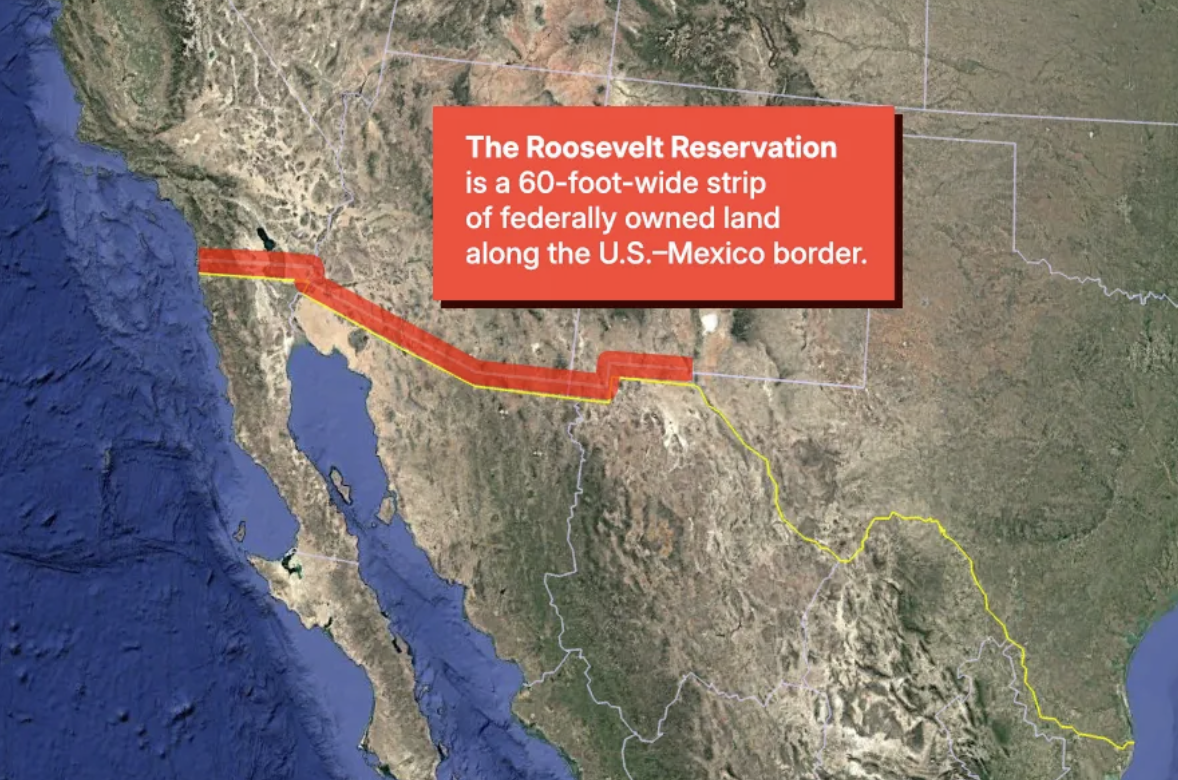
Pablo de Rosa/Border Chronicle
Cartographic magnification of the Roosevelt Reservation’s into military enforced eye of sovereignty created a cordon against migrants–replacing not only fear of cross-border transit or any sense of the permeable habitats of real environmental porosity, and any obligation of habitat protection. The declaration of military authority across the Roosevelt Reserve was premised on the military authority of guarding frontiers, miscasting the border as a site of military aggression against “an invasion” increasingly imagined in globalist terms. While the “Roosevelt Reserve” is hardly able to be mapped, at some sixty feet of federal land, Hegseth describes defending a “line” erasing complex ecological and environmental calculus of recreational spaces and indigenous land a hundred miles north of the border, but bolstered a “strip” connecting two regions of defense on the border in Arizona and New Mexico as a continuous military field of operations to “secure” the nation.

Multiple Federal Agencies Administer the Border Zone
This conforms to a purely “national” vision of space cast less as management of national parks, forest service areas, and US Fish & Wildlife, but as a critical margin of sovereign space over which the Trump administration is determined to exert its control in order to deny all legal rights to migrants who might try to traverse it or drug trafficking. By expanding military presence and treating Ft. Bliss as the deployment center, it places the entire border perimeter under a military with the directive to prevent migrants from crossing. A huge escalation of military presence of 10,000 heavily armed men to patrol the Reservation will expand what is already the largest immigrant detention system in the world as a model to develop and expand detention sites across the nation. No longer circumscribed by the Immigration and naturalization system of the border, or Immigration and Customs Enforcement, the southern border that became a refrain in Trump’s first run in his political career is now expanded to a zone of unclear dimensions, run by soldiers without a brief save a system of military and not civil laws, broadly present to prioritize sovereign interests.
Where did this logic come from? How did it gain such increased validity as a way that the border or indeed army within a frame of reference that prioritizes constitutional law? How did military rule become the option of choice? We might find its precedents not in law at all, but in the sacred cows of Old Man Trump, Fred Trump, to apply a pressure by whatever means necessary, of almost extortionist power, shifting the legal resources and power at his disposal that borrows amply from non-national traditions, far outside the laws, to create a new imagined geography of power of no bounds. The sense of a recycling of old iconography in Make America Great Again is not new by any means. But the recycling of a tired iconography of border protection urging a heightened border vigilance suggested a new playbook of rule, as border crossing was understood in terms of data surveillance in Trump 2.0, a data surveillance that was far greater and fine-toothed than earlier administrations, pushing the envelope at DOGE in specific by the cross-referencing of local and federal data, and pointedly employing sweeps of databases for a technocratically charged sweep of immigrants to the nation. This expanded sovereignty not only over Americans but over the privacy of Americans and foreign immigrants suggested the border assumed the status of a vigilance over the nation’s edges that had woefully gone unprotected in previous years. The border became a totem of governance, as the border that was distinguished by lawful transit was revealed as an Achilles heel of sorts in the nation, the origins of the ills that beset the nation’s vitality and sapped it of its strength. As much as ideas of crusades and medieval oppositions between the barbaric heirs of Islamic civilization became avatars of Trump 1.0, it is not surprising that the data tools of bolstering the border was provided by Palantir–an odd coinage of a new data corporation of Peter Theil, evoking the “paladin” figure of a medieval knight who not only embodies Christian virtue but fights as the true defender of a cause, and trusted leader of military defense.
What sort of new global map does it portend? The military’s involvement in controlling the section of the Reservation by the Insurrection Act echoed Theodore Roosevelt’s 1907 proclamation to keep peace along the border in a strip of public lands across California, Arizona, and New Mexico “free from obstruction as a protection against the smuggling of goods between the United States and Mexico,” but amplify the intent of the past President by arguing a commanding need as the “complexity of the current situation requires that our military take a more direct role in securing our southern border than in the recent past,” amplifying military authority to redesign the border not for the deployment of force but as a quasi-permanent military installation to designate them as “National Defense Areas”–in place of a legal border. The region under military control won autonomous sovereignty to punish any migrant more severely than civil law allows. By rehabilitating laws of the late eighteenth or early nineteenth century ss the Alien Enemies Act (1798) or Insurrection Act (1807), Trump expanded executive authority to redefine the nation. Both suggest the need for expanded powers as the result of a national emergency that Trump has long declared too long ignored, creating a State of Emergency of enhanced executive powers of rather terrifying legal pedigree. We might do well to examine the imaginaries of such an expansion of sovereign authority they are based or may be animated, as we try to better examine the terrifying maps that haunt their deeply troubling history.
The expansion of what is already the largest immigrant detention system in the world takes Ft Bliss as a deployment center and a model for developing and expanding map of detention sites across the nation. The increased streamlining of military supervision promises far greater efficiency than ICE and border authorities lacked in Trump’s previous administration, and is coupled with an attempt to deny citizenship to many migrant families in the United States–a program revoking citizenship for those born in America “to go back to their home countries” and preventing children of undocumented immigrants of a road to citizenship. By administering the legal regime of the border to military authority, Trump 2.0 transforms border from a site of entry to the demonization if not monstrification of the immigrant, now seen as a danger to the nation. The new identity of the immigrant fundamentally foreign to the social body is apparent in the metaphorical dominance of the “invasion” of immigrants as sanctioned by NGO’s and non profits, and invoking the Insurrection Act (1807) to defend the nation. Declaring “the law is the law and if you are here illegally, that is a crime in and of itself,” the largest government agency with the largest discretionary budget–the Department of Defense–will supervise two million military personnel on the border–overseen by man who has endorsed military force without Congressional authorization argued the military has no role to protect civil liberties.
All this hardly bodes well for his eagerness to “partner with DHS to defend the sovereignty of our southern border and advance that mission.” Among the increasingly insular approaches to politics seem to be a hallmark of the Trump 2.0 administration, pulling back from European ties, erecting tariffs, occupying a a position “on the margins” of Ukraine, to a position of ‘national’ safety. This is the picture which Secretary of State Hegseth repeatedly channels by regular reminders, declaring “is not our war,” the new isolationism isn’t new at all–but reclaims a mythic moral authority of the border from the age of Teddy Roosevelt, allowed to wither and die under the neglect of incompetent politicians and demanding new administration. Such a reserve of national defense of the margins of the border will inflate federal ownership of the land, to extend a military base in New Mexico, as a means to expand border authority. The retraction from the global surface to a preserve of pseudo-peace will not be sustainable, and is not a political logic of global relevance, but is a retrenchment of a new isolationism in an already globalized world.
President Trump unerringly finds passionate intensity from ideas encountered recently and by chance, but may have been kicking around for some time. And in curtailing global involvement only to return our collective attention to the border, he seems to be not only hogging media space for his obsessive attention to the border, and inviting his Homeland Security Director and Defense Secretary to report on whether border conditions will warrant the declaration of martial law along the border, to suspend liberties and civil rights by making the region subject to military control. Military disengagement in global affairs, in the broader picture, offers the basis to turn attention to a domestic front, curtailing liberties by remapping national interests. The apparent license of military jurisdiction over an national defense area would allow a massive building of border barriers, surveillance systems, and military presence by the Department of Defense, ramping up the investment in border protection to compensate from the withdrawal of America’s global presence. The declaration of an “invasion” from south of the border taps a longstanding paranoid streak of American politics, instituting wartime powers on a strip of land during a time of ostensible “global peace” by amassing 10.000 soldiers to a strip of land that seems as if it might be redesigned a military base for border enforcement both within the border strip and within national parks that are increasingly understaffed. The as yet undefined mission of active duty troops ranging from six months to four years–the Trump 2.0 term?–to patrol the border in coordination with Mexican forces is under restricted media coverage, but will involve active forces from Camp Pendleton, CA; Fort Cavazos, TX; Fort Carson, CO; and Fort Drum, NY, many of whom whom have already arrived.
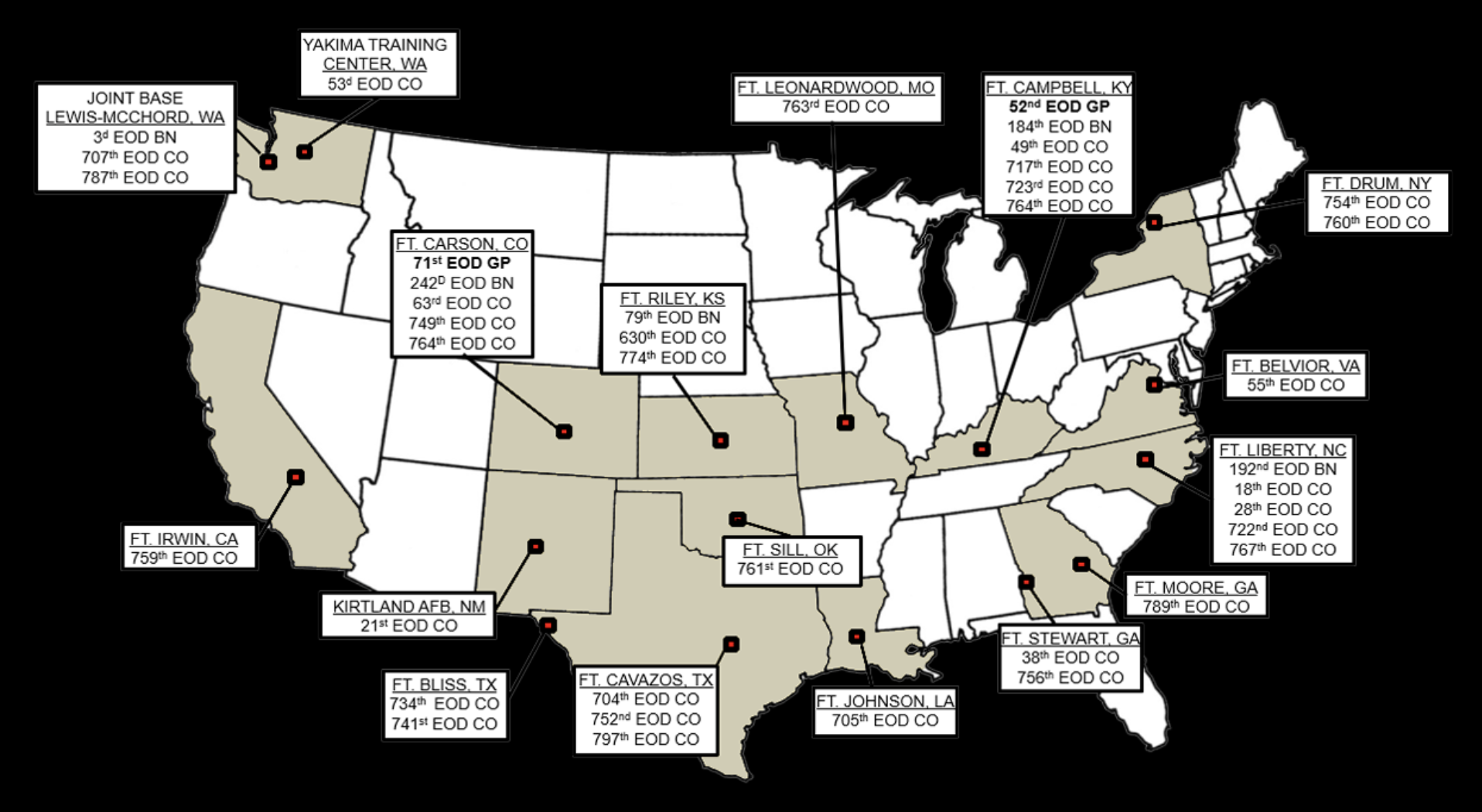
Active Duty Troops in United States, 2025
With the U.S. Army slated to take control over Customs and Border Protection and Immigration and Customs Enforcement, in a major shift of how we manage the border, operating in increasingly deplorable and bare-bones manner with little respect for individual rights, reclassifying and viewing all unarmed migrants as effective enemies to be confronted as such. By dramatically expanding the military footprint over detention sites in ways that seek to reorient the nation to the world in ways that transcend a purely border issue, however, or migration problems, with prospective flights of from Anson, TX temporarily stopped, and orders stopping deportation flights of migrants leaving Texas from Abilene, having obtaining injunctions in New York, Denver, and Brownsville, TX. The expanded military presence in a border mission that will technically extend Ft. Huachuca to the Roosevelt Reservation will bolster authority to apprehend migrants, using military law to enforce the entire perimeter to stop “unlawful entry.” Soldiers already celebrate the presence of “#DoD boots on the ground alongside #USBP #BigBend Sector agents” whose “support in this rugged terrain is a game-changer for border security & operations!”
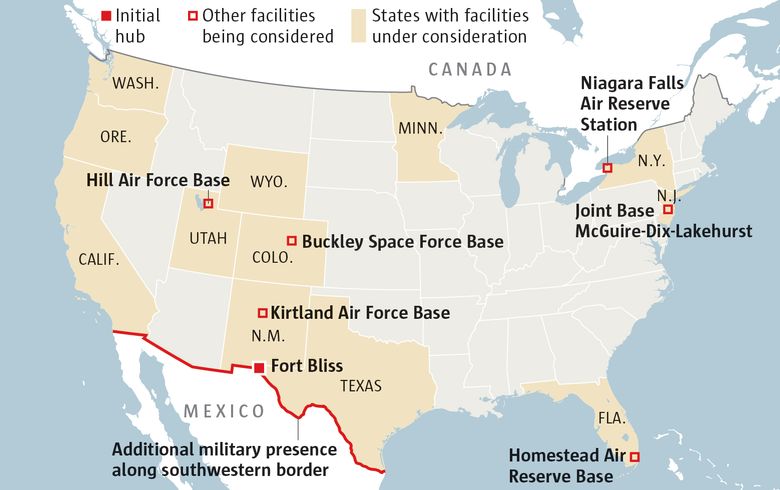
Lazaro Gamio/New York Times
Expanding the “Roosevelt Reservation” to a military training ground will shift its function as a border, allowing and unprecedented expanded presence of military assets and investing them with powers of stopping migrants in what the military views as a war; invested with power to make arrests and enforce drug trafficking laws evade laws preventing the military from law enforcement duties. Flooding the frontier with active duty forces and materiel will change the border mission to one of applying Standard Rules of Force of military engagement, rather than simply migrant detention, by men and women not trained in apprehensions or detention, or providing medical attention and treatment to migrants of different ages they encounter or harm. demanding the expansion of an archipelago of holding stations or detention facilities to curtail immigration as if we were in a state of war by the Insurrection Act that is hardly a normal development of the sovereign state. It will focus on “sovereignty” as an abstraction that trumps people, individual migrants, and the law however maps well onto the very narratives of an invasion Pete Hegseth had already long pedaled at his previous job at FOX News, as a former member of the National Guard.
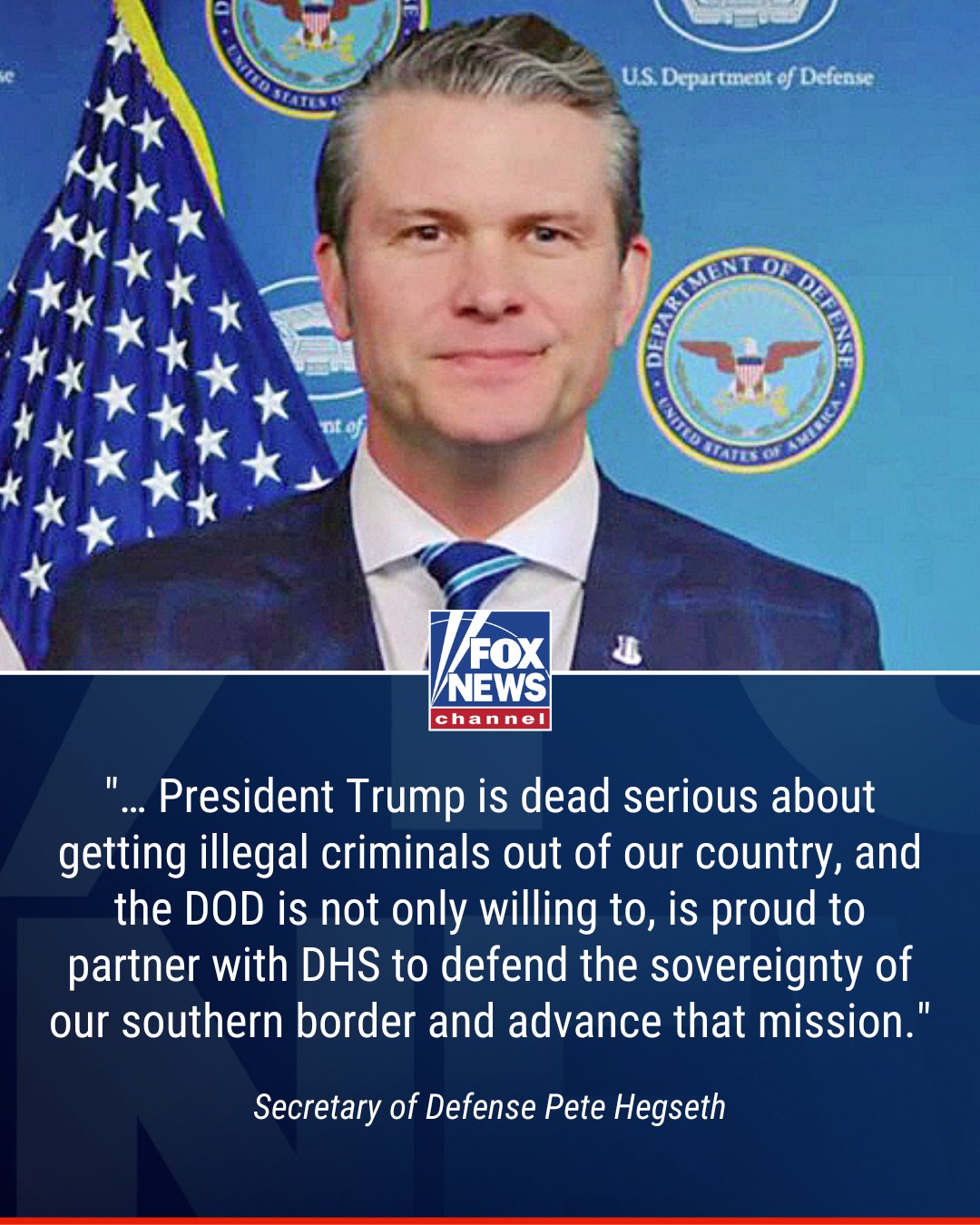
U.S. Secretary of Defense Pete Hegseth as a Talking Head on FOX
Did not Trump’s team entrust Hegseth to be the talking head, even if he was without any experience in government? For Hegseth helps Trump stay on message as “dead serious” in an inflated defense of American sovereignty; in his new official capacity, Hegseth announced a “new era at the southern border, heralding an era of determination and of cooperation” in the securing the border quite continuous with his old role as a talking head: “we will get control of the border,” a smiling Pete Hegseth promised as he visited the US-Mexico Border, showing of his patriotic tattoos of the first words of the U.S. Constitution on his forearm, also sported by white supremacist groups, as if Trump secured a mandate for a new era of deportation to protect American sovereignty.
The militarization of the border as a hermetically sealed frontier, guarded by an expansive military complex, transcends the huge transport of military materiel to the southwestern border in Trump’s first presidency–a first attempt to remap the border as a danger zone. Increased military presence along the Roosevelt Reservation is more than a massive surplus of military arms able to remap global space–it fits within a paradigm of global mapping that privileges the military guarding of frontiers, in a massively costly manner, even as the numbers of migrants illegally crossing the border are at some of the lowest level in decades due to existing policies of border management. Trump’s brand, however, rests on the need to guard the border–the political performance that he seems hell-bent on continuing to appease and please his constituents. Hegseth is the man to promote this work, if his suitability for any position of military leadership is in doubt. As much as the yes-man for Trump’s purging of the military of DEI initiatives, Hegseth is the public face to praise amplifying the militarization of a secure border, and of the imperative of sovereign security, who will play well to television audiences, and normalize the increased lawlessness of violence along the southern border in the coming regime of martial law–before it is challenged in court.

The expansive rejiggering of military obligations requires a new mapping of what global peace is a new bill of goods–and a new contract of government with society–that we have yet to map. Somewhere on the road to an unprecedented expansion of executive power at the sweet spot of the intersection of a Venn diagram between foreign policy and national security, “special government employee” Elon Musk may have helped open a window to abrogate international treaties on trade, the recognition of sovereign bounds, acknowledging the integrity of sovereign status and has magnified the power of the sharpie to place the executive more firmly at the head of executive agencies to engineer a sense of government run by a cartographer-in-chief able to unwrap the imbalances and inequities of globalization for his base, abandoning norms with a convictions born of apparent impulse, issuing a raft of executive orders prepared in anticipation of the possible victory of regaining the American Presidency.
Perhaps the assurance that Trump is so desperate to project to rally his supporters “Everything is going to be bigger and better than before!” Trump crowed on April 8, as the expansion of national tariffs were announced in the early morning of April 9, 2025, as the global markets seem to quake–as if bigger were better, and size was more important than progress, laws, or human rights. The expansion of America’s boundaries that Trump seems determined to herald is not only a hemispheric argument of hegemony, but removes the United States from a network of alliances, replacing cooperation between nations and national laws with a monolithic notion of triumphal governance, and governing, free from legal traditions.
The expansion of a new cartography of the border may not seem of a piece with Trump’s promises in his inauguration to expand the frontier of America to the stars and his penchant for colonizing planet Mars. If moonshots were a thing for past presidents, Musk secured some twenty launches from his Texas site of the Starship that he hopes to transport humans to Mars by 2028, as NASA employs SpaceX to travel to the moon’s surface and build a special lunar landing system–to “plant the Stars and Stripes on Mars” as a fulfillment of “our manifest destiny.” Musk’s long-term pet project is no media diversion–but a key to rethink the border in expansive terms as a broader assemblage of sovereign space and outer space, as well as a spectacle able to illusorily magnify the image and wealth of America–as it expands to as a greater North America. By flying unwanted migrants and all who seek status as refugees to sites outside of our borders, America is focussing on a long-term venture to settle Mars, as if a new all-white colony might be founded there to start again, in terms that seem directly from the science fiction literature of which young Elon Musk was so enamored, imagining the engineering of a better place far from South Africa, orbiting around other worlds to find greener pastures, greener than grandfather Haldeman had ever imagined. The escapist literature of the American Cold War were the staples of Musk’s reading, a techno utopian set of images that might be boosted by doses of Ayn Rand, Werner Sombart, and of course the more aspirational if fairly unsung entrepreneur who founded Technocracy, Inc., Howard Scott.
We can see the redefinition of sovereign space by “lead[ing] the world into space,” even if earth is bit messed up; the engineering by SpaceX of a lunar mission seems but a prototype for engineering unmanned and manned trips to Mars. Trump attended as President-elect a launch of the Starship into suborbital flight, gaining a special seat in the control room, to promote the spectacle as a basis for extraterrestrial colonization Musk seeks to fast track; Musk is aiming for five unmanned flights to Mars by 2026 that would expand the society of the spectacle to outer space.
Tesla Starship
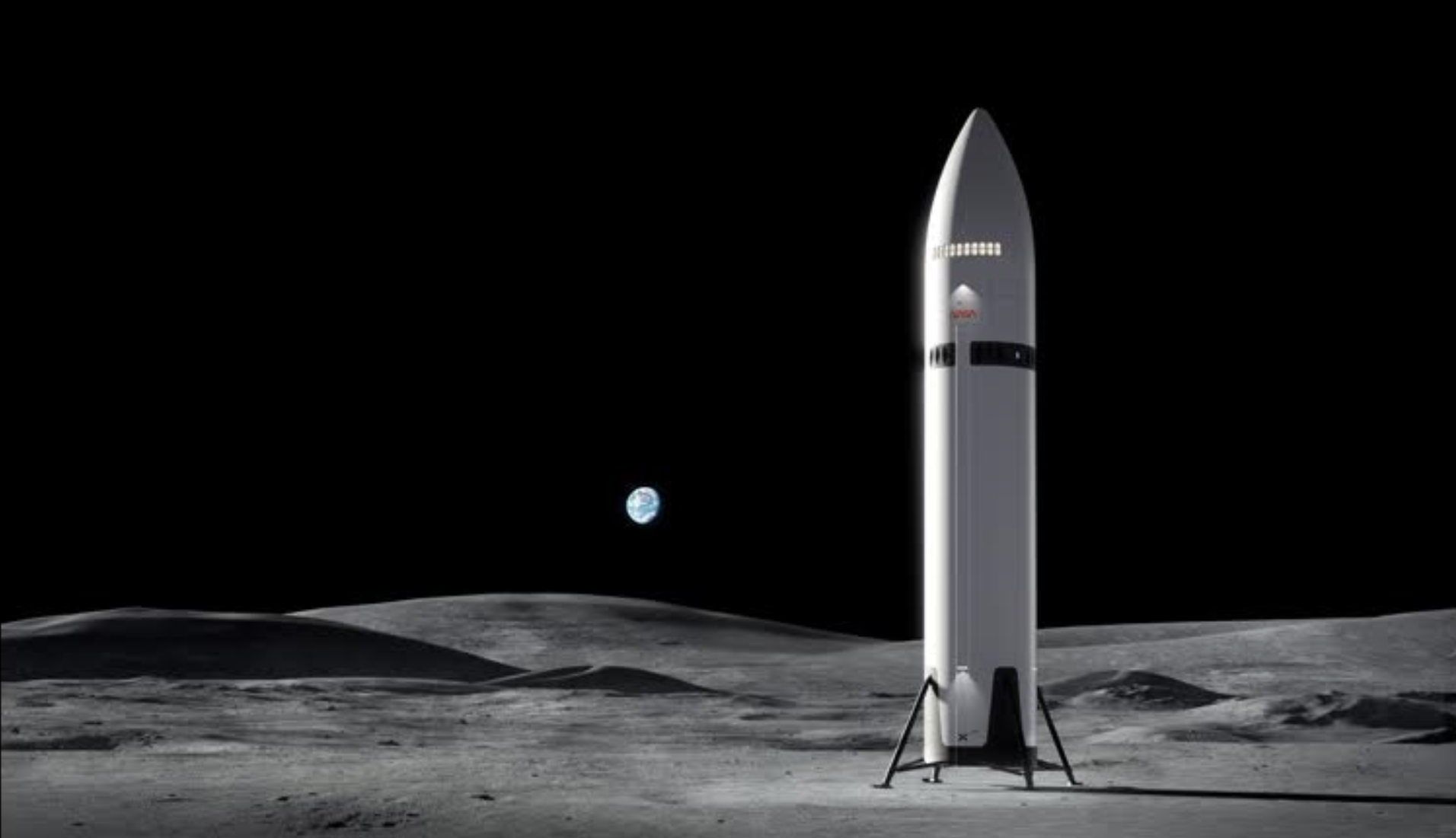
Space X/Visualization of Starship and Lunar Landing
The rendition of the lunar landing gear as a way to showcase the starship’s potential path that might seem to make the Mars trip more plausible, if the very problems of fuel conservation and generation, oxygen supply, and use of carbon dioxide extraction as propulsion are questionable, especially due to the widening distance between the planets in the coming years–and the overly optimistic notion of “refilling” the ship with “local resources” on a planet whose possibilities of carbon capture isn’t fully known–even if the simple formula of CO2 recapture to make methane fuel seems masterful, but hard to test and the possibilities for difficulties hard to calibrate.
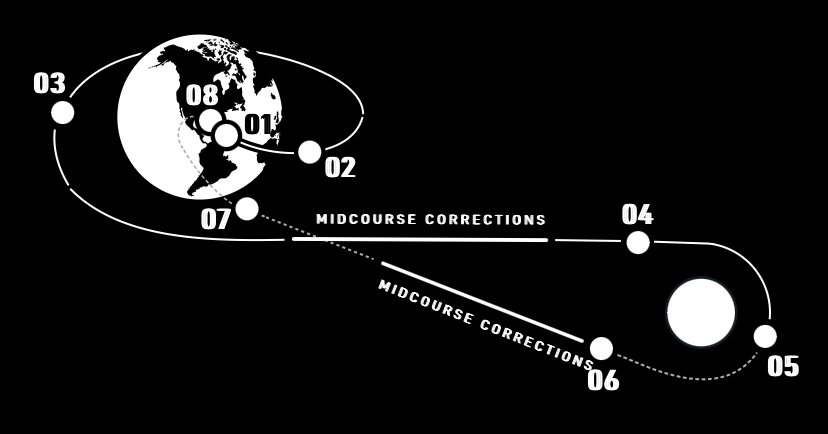
The road path that seems so smooth–a sort of circuit or figure eight to arrive at the lunar surface, and a path that is engineered, more than plotted, in a round trip to and from Mars by super-heavy rockets to propel a payload of 100-150 tons by refilling while orbiting the planets–
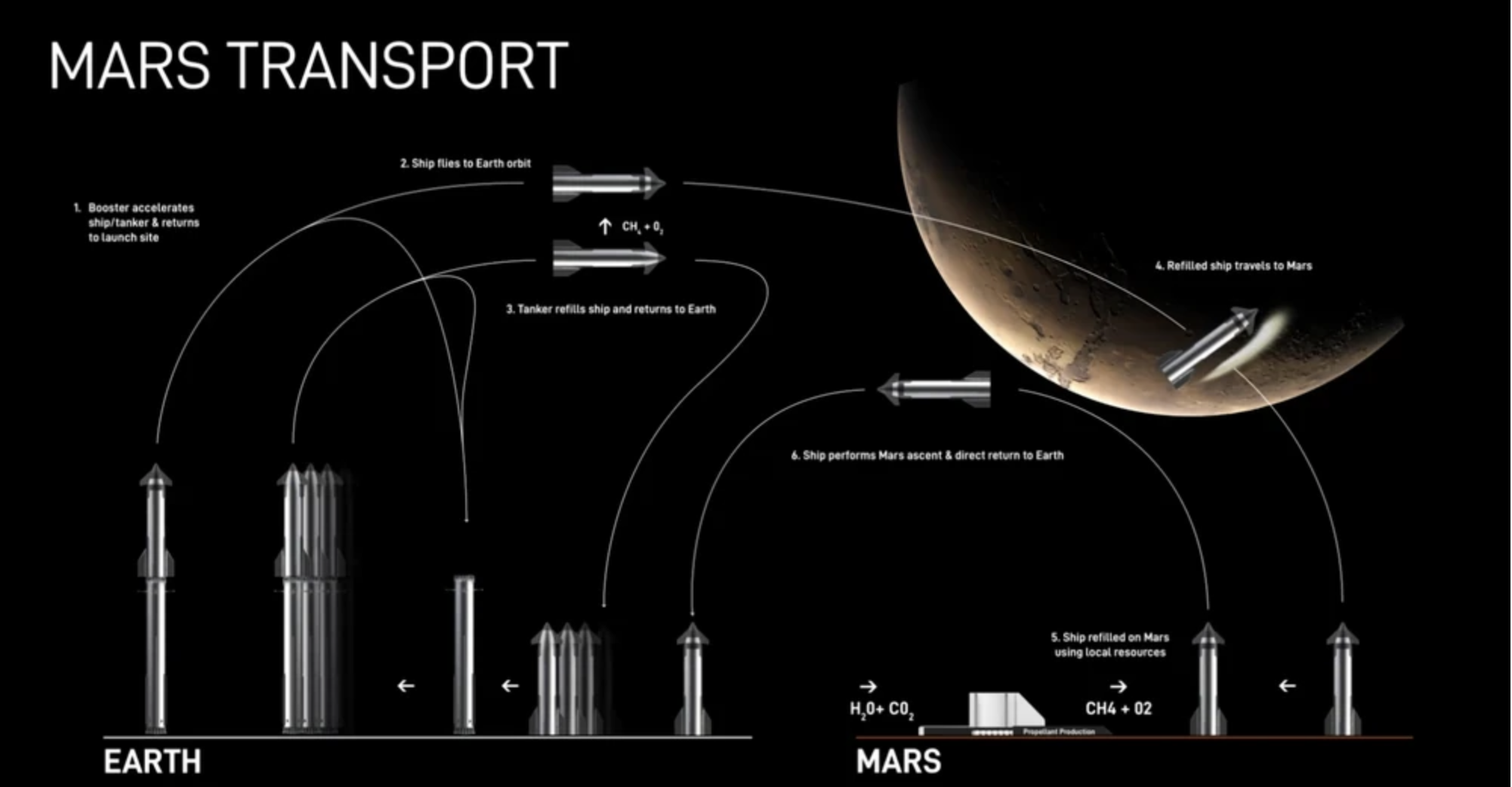
–offers a sleek, finned starship for interplanetary flight imagines distance only through energy offered by propellants, by five million pounds of thrust, seem molded after the fantasies Alex Schomburg depicted in Startling Stories in the early 1950s, presented as “tomorrow’s fact”–of starships that land in planets from which the surface of earth can be seen, far away, focused on the very area of the Cape Canaveral launch site used from July 24, 1950, with the Bumper 8 rocket, filled with liquid nitrogen as the German V-2 that was its model.
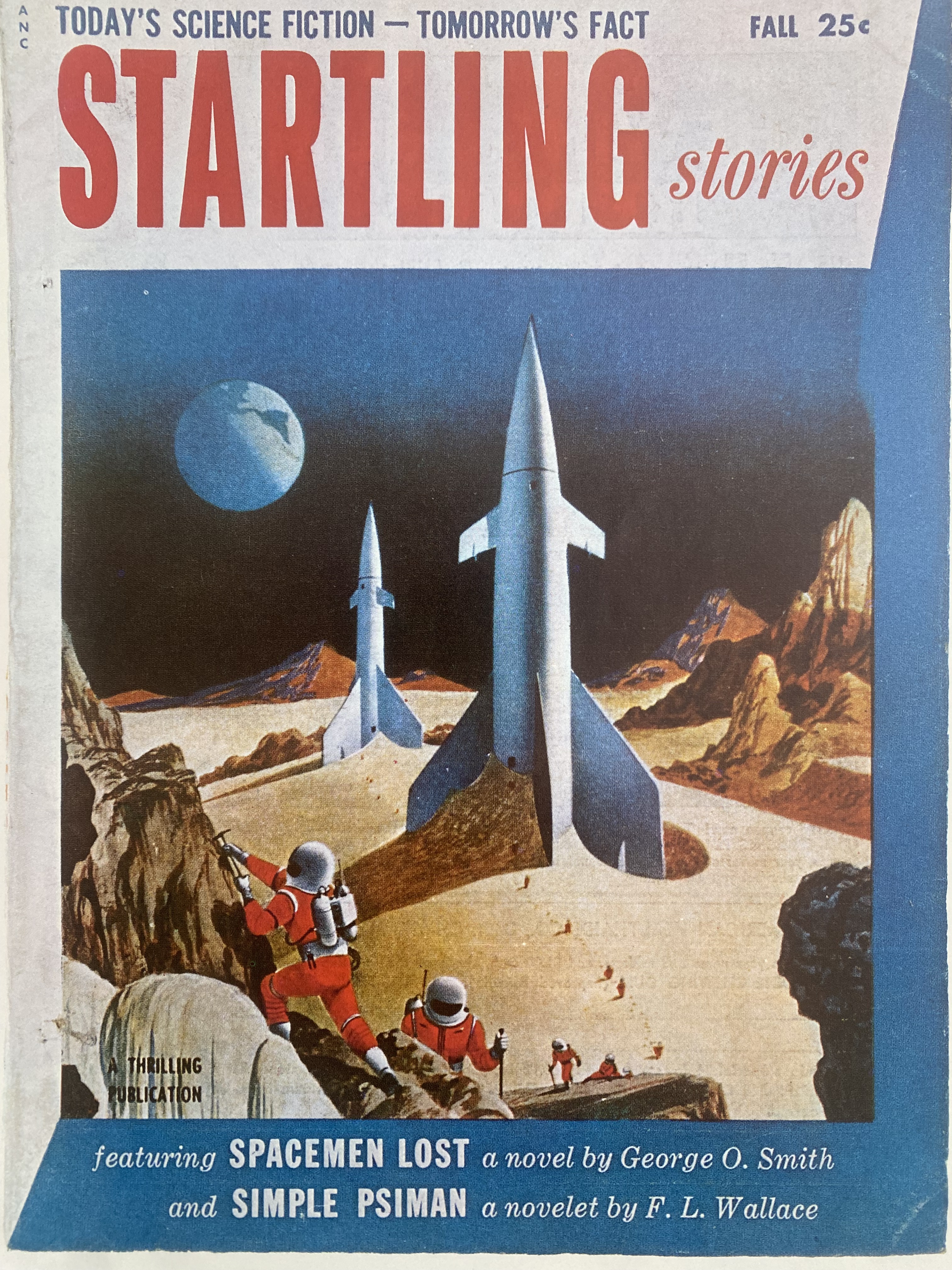
Alex Schomburg, 1954
Elon Musk’s promotion of his plans combine bravado and ingratiation. The sole member of cabinet meetings sporting a special cap, not dark MAGA but sycophantic, vaunting “TRUMP WAS RIGHT ABOUT EVERYTHING” as a social media finger-wag, Musk presents as hoping to use his skills to do right for the American taxpayer and the American people, not seeking government financing. “They come here to earn peanuts and get death threats,” Trump claims, demeaning national service–if many espouse white supremacist ideologies –to make good on his Madison Square Garden boast to cut trillions of dollars from government spending. The subsequent cuts Musk and his musketeers made to the National Endowment of the Humanities, and the redirection of its “mission” and suspending of all awarded grants, seems to impose a technocratic set of priorities on national need and the elimination of all humanistic endeavors as foreign to the nation’s priorities. Who better than a technocrat who had studied physics and economics to take an axe (or woodcutter) to the budget of the NEH, and give it a new insignia of an American eagle grasping arrows and shield of Stars and Stripes to bring it in one with governmental priorities as celebrating the nation’s two hundred and fiftieth anniversary and showcase its study of the papers of George Washington–and the ethical, legal, and societal implications the humanities have to offer on Artificial Intelligence that might be outsourced to universities for what might be peanuts–$250,000 in matching funds?

AI is a priority that is dear to Musk’s heart, to which the Humanities might be sacrificed or simply reformed. And it might solve the legal niceties of the Robotaxi fleet are a big plus to TSLA, or any compromises on privacy that creates for drivers. The image of the sacrifice of Elon’s team of engineers omits how much is one the line for Musk languishes behind a promised deadline for low-cost self-driving cars, first promised a decade ago–and whose deadline seems to recede monthly, if not yearly, as its aspirations are far from what the critical issues of approving Tesla’s fleets of “fully self-driving cars”–a long-delayed project whose promise to allow drivers to go to sleep as cars steer, brake, and navigate is no stranger to this blog–have been promised by 2027, but face regulatory hurdles as much as logistical issues and technical weaknesses before realize Musk’s boast of autonomous cars ‘allowing drivers to fall asleep and wake up at your destination” as federal safety agencies have expressed deep reservations as to whether they have adequate safeguards or can indeed register their environments–or traffic lights!–even in the Bay Area where they have been rolled out. Musk’s comfort with high levels of risk–risk no driver would want to experience or buy into–are truly terrifying, accepting loss of life in the name of science foreign to most science in the “iterative design process” that is able to provide entertainment if not results.
Far from earning peanuts, the possibility of gaining approval from regulators of a promised the fleet of self-driving cars equipped with computer vision could make good on the big promise that Musk has not yet delivered; he is keen to advance with as little regulation from the national Highway Traffic Safety Administration as possible, given their past recalls of mapping systems that were not as reliable as promised based on data from Models S and X!
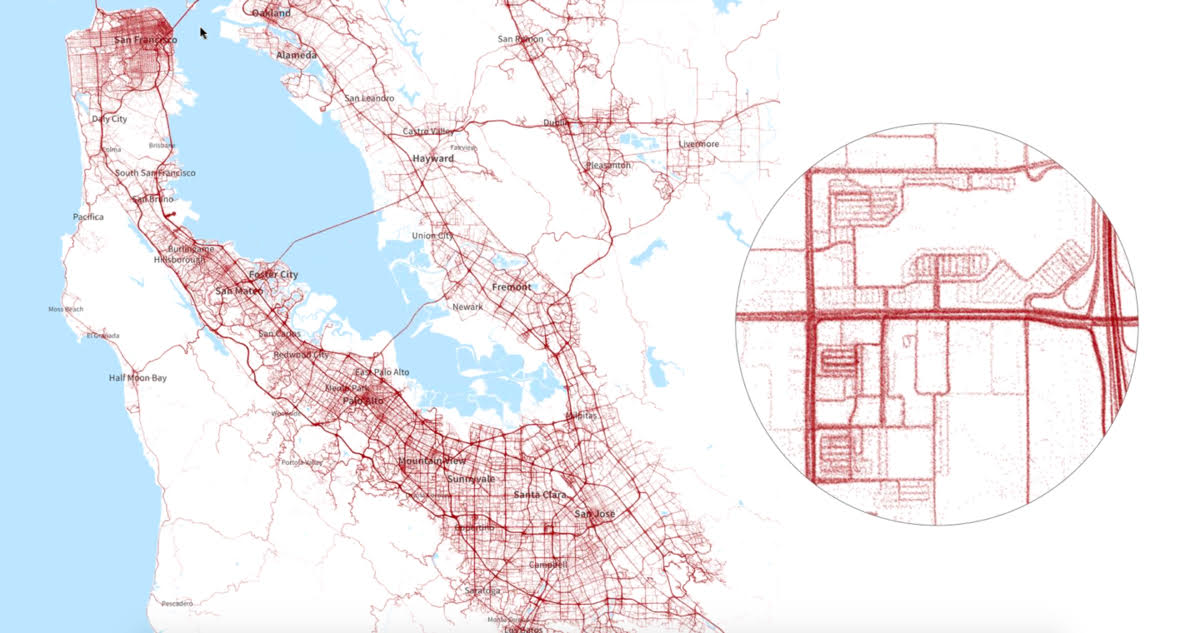
Tesla’s AI Autopilot Mapping of Interstate 405 in the Bay Area, 2015
The Tesla cloud boasts an ability to store information among all Tesla drivers in real time entranced Elon as a “fleet learning network” that would run on proprietary data, rather than other mapping systems–“When one car learns something, all learn!” Musk boasted of his AI sideline–that a decade ago seemed to define the Bay Area as a pad to launch autonomous vehicles to a wealthy market–twitting Google Maps–just a decade after the Web 2.0 interface transformed World Wide Wait to a rapid interface–despite the stubborn problem that “the whole road system is made for biological neural nets and eyes,” not computer vision: but the problems of commute times to Silicon Valley, a commute that feels a bit like an orbit in itself, across the peninsula, has promised a huge market of monied entitled passengers hope to minimize their commute times, expanding productivity, or sleep soundly during their commutes. But would the sound sleeping be likely to be interrupted?
Musk may have imagined a rich online geospatial information that could spread from the dense thoroughfares off of I-405 that could be scaled from commuters to Silicon Valley to the world–that fit Tesla’s brand when it was based in California, with Silicon Valley strong candidate to increase the pleasure of the commute in robotaxis as a personalized bus–as well, of course, as a continued hub of many of Musk’s companies, from X to OpenAi and Neuralink, and Tesla’s old hub. One dataset manages the place of cars on a roadmap, trying to monitor locations along freeways more than at traffic lights, the technical design of the problem might not include people–driving by sensors that scoop p information in ways that led Musk to be identified with the spatial databases of self-driving cars.

But the bravado of driverless cars suggest a demand for doing without maps. Musk announced the arrival of “Autonomy Day” heralding fleet of autonomous cars since acting as company CEO, setting a deadline seven years ago to the day–April 22, 2019–of vehicles safer than with a human driver. The Fully Self-Driving (SFD) Teslas introduced have not only faced a government recall in February, 2023, from the Highway Safety Board; the navigational devices have trouble stopping for red lights. Despite improving abilities by 400% in 2024 and predictions to launching a fully unsupervised mode in June, 2025–beyond Autopilot and Enhanced Autopilot, hopes aiming to train a neural network for the future fleet fed hopes to train the fleet’s AI sourced from six million Tesla drivers and 2D maps, hoping to equip the cars with spatial intelligence autonomous from Google Maps.
The expansion of the network of AI mapping may take some time, but the expansion on which any roll out of Robotaxis depends–if the idea might well have been confined to the 405!–would be an expansion that is contingent on the global dominance of the Tesla cars. A promise of “autonomy” was the goal of the neural network–a scary prospect perhaps, if not for Elon Musk. Slated to achieve “complete autonomy” for 2017, then slated full-implementation in 2018, and then shifting it to 2019–and problems of responding to traffic lights and stop signs remain, even. as vision-based monitoring systems have been multiplied. Soon after the California DMV learned Tesla autopilot software “did not reflect engineering reality,” and workplace violations mounted, Musk relocated production to Texas–a telling sign, perhaps setting back the deadline further on his fast-growing fleet. The bravado of the Tesla logo of bull-headed stubbornness may well plough through space, rather than a nimble planning of on-road experience, or readiness, much as he predicts that the danger of the first colonists he hopes to fly to Mars will face “a risk of fatality [that] will be high–there’s just no way around it,” and should not include children. The readiness to sacrifice lives for progress of engineering a trip to Mars may sacrifice the entire lunar Space Launch System.

But the parallel expansion of Tesla as a form of military engineering, shifting the idea of investing in Space X, to create a sustainable means to found a colony on Mars that might provoke NASA to expand its budget, in two decades a space industry that subcontracted to the government, as much as launching its own vehicles or expanding the presence of satellites orbiting the earth to win NASA contracts and the European Space Agency–if its seven launches of flight tests of the Starship raised eyebrows from regulators. If Space X send the first astronauts into earth’s orbit since the Space Shuttle was cancelled, the rocket only entered orbit successfully once, Its expansion of its role as a government contractor may well crash and burn, as did attempted launches of the unmanned Starship, whose second test launch had a fiery return to the earth’s surface as it disintegrated into the Carribbean, whose debris prompted global flights to shift course in 2023–
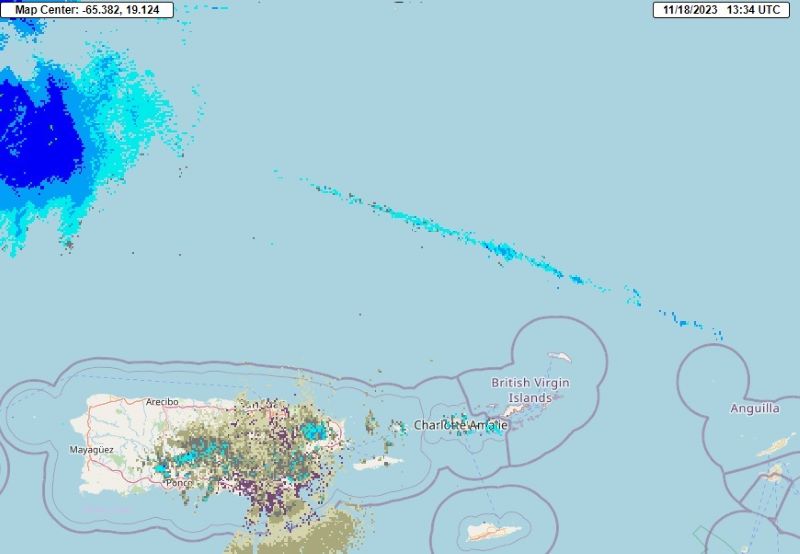
NOAA Radar of SpaceX Starship’s Disintegration on its 2nd Starship test flight, November 18, 2023

and whose mid-flight explosion in 2025 caused property damage outside its Hazard Area in Turks and Caicos in ways that led the FAA to ground the Starship–pushing plans for manned travel to the Moon to 2027–and pushing off the goal of a manned flight to Mars to an uncertain future.
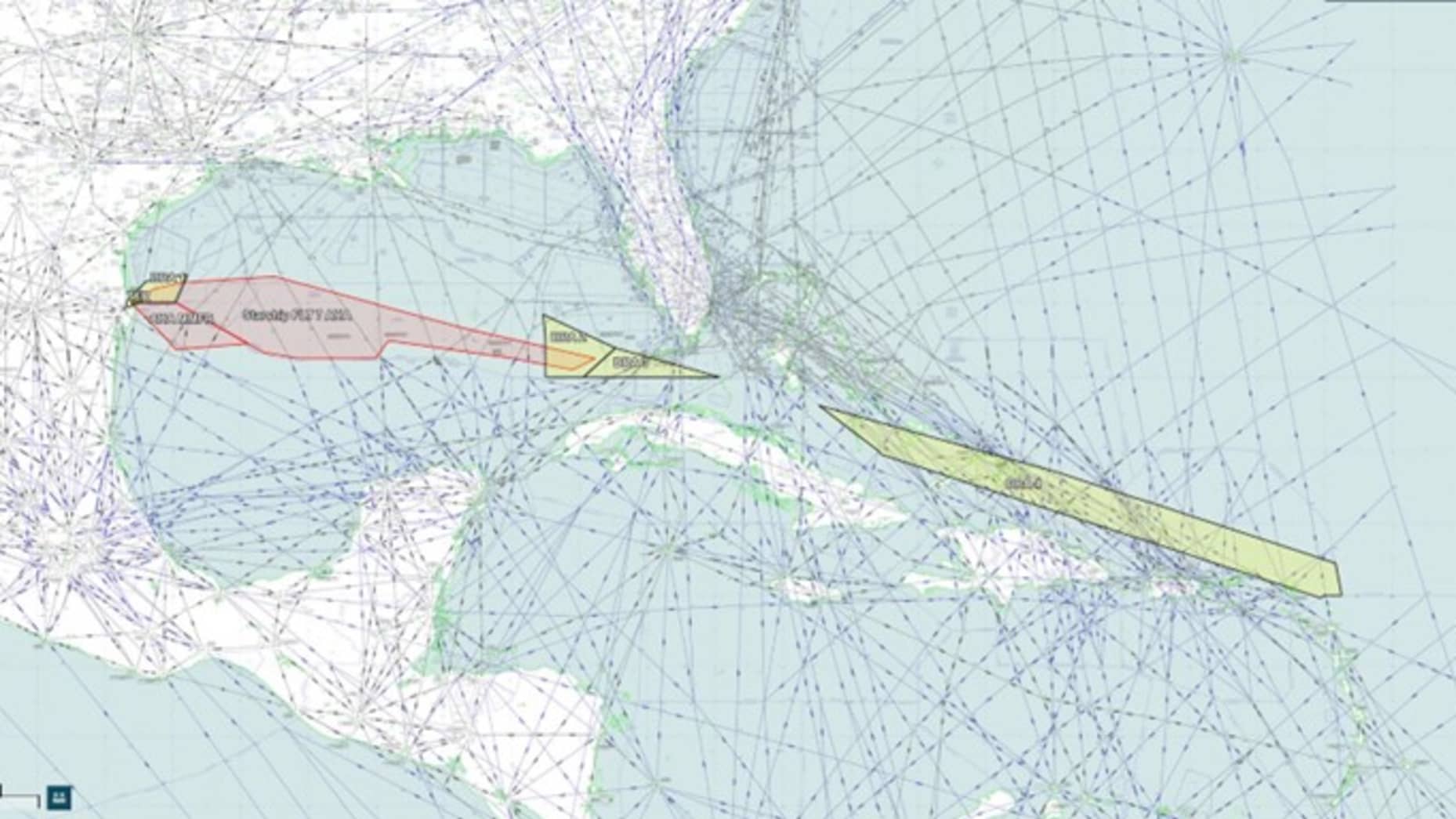
FAA, Aircraft Hazard Areas of Space X Starship’s Seventh Flight, 2025
But the genealogy of Musk’s supremacist ideology does not derive from 2D maps, or Apollonian plans for orbital viability and orbital-class launch pads to be employed in extraterrestrial missions. And a considerable nature of the mystique of a protection of borders can be traced to the border-hopping purist of his Canadian grandfather, an eccentric chiropractor and rodeo man turned stunt airplane pilot and adventurer, Joshua Haldeman, who aimed to replicate the technological heroism of Charles Lindbergh, that famous ghost of America’s own fascist past, whose ghost seems resurrected in the Trump White House’s foreign policy to promote an increasingly isolated view of global politics behind the illusory protection of fixed borders.







 Musings on Maps
Pingback: Appeals Court Blocks Trump's Wartime Law on Venezuelan Immigrants - Writ of Mandamus Lawyer in New York, New Jersey, Connecticut & Washington D.C.
Pingback: Judicial Review and Mandamus in California’s Fight Against Federal Immigration Overreach - Criminal Immigration Law Firm in New York, New Jersey
I think it speaks volumes that as Trump seeks to leave a global imprint he was denied in his first term, that he turned to a man like Musk, whose sense of global politics is so limited and skewed. This is a case of the inexpert leading the inexperienced, clamoring for authority with little priorities than their own self-aggrandizement.