Dystopian Diptychs: Virtual and Economic Realities of the Palisades Fires

The problem of mapping fires and fires spread in Los Angeles is demanding, challenging, and increasingly frustrating. Exacerbated by the new weather systems of climate change–high, dry winds; dried trees; low groundwater–and the increased combustibility of the landscapes that area among the most treasured in the world, we face so many multi-factorial problems of the origins of any fire that there is no clear smoking gun to place blame. To be sure, before the engines of climate change, we lack the need for assistance to a sprawling urban infrasctructure to provide the water or fire mitigation needed to deal with them.

But if the amazingly destructive fury of the fires that began in the Pacific Palisades this past year reminded no one so much as a dystopian image of Hell of Dantesque proportions–of raging fires consuming buildings, sending firefighters desperately running to staunch the conflagration’s spread against all odds in flaming settings that raged with an intensity one can only call infernal,–

Pacific Palisades Fire/National Geographic/Ethan Swope AP

–provoking collective questioning and at least a temporary interrogation of what went wrong. Suddenly, in ways that intersected so eerily with Donald Trump’s inauguration, the built world around Los Angeles, and indeed some architectural treasures of the early twentieth century, were revealed as ephemeral and at risk–not hhugely valuable properties were flattened, but as fires spread across the arid landscape of the Palisades, carried by the embers and sparks that moved in paths we have not clearly traced, the dormant embers of an earlier fire, unextinguished, suddenly rekindled in the forested lands, and rapidly spread in the Santa Monica mountains in the Santa Ana winds to Topanga and Malibu, over 23,000 acres, fanning one of the largest fires in California’s history and largest losses of property and residences the state experienced. Eight months without rainfall created a landscape primed for the destruction of property and forested lands. What followed numerous red flag warnings by the National Weather Service in the Santa Monica mountains and Malibu coast of critical fire risk, amidst what CAL FIRE called “the perfect conditions for a large wildfire,” amidst record dryness and an unprecedented “fuel load” of dry vegetation.

We are rarely ready to think of property and buildings as so contingent, as residents were forced to flee property valued at hugely astronomical sums and nearby towns, suddenly flattened in the flames’ wake, as toxic smooth poured over the region and blanketed the blue skies.

In a dreaded constellation of factors that set new standards for multifactorial explanations–as climate change will–but might be confused by being tied to divine whim, or ill fate, the Los Angeles fires of early 2025 were fanned by otherworldly hurricane-force winds that created fireballs that firefighters struggled to extinguish against all odds. The hurricane-strength winds that fanned the spread of the fire consumed mansions of the Pacific Palisades, a coastal enclave of the wealthy, suddenly more vulnerable to flames. Those less fortunate residents of Altadena, CA were not leaving cars, but fleeing on foot amidst emergency services, masks on mouths in hopes to prevent inhaling toxic smoke, desperately navigating safety beneath skies glowing an eery red seemed an image of hell in the poorer community–where flames reduced homes to skeletal structures–trying to flee to safety from the Eaton fires in nearby communities, where many residences were destroyed and traffic jams created on the interstate that led many to abandon their cars–not the easiest habit for Southern California residents–
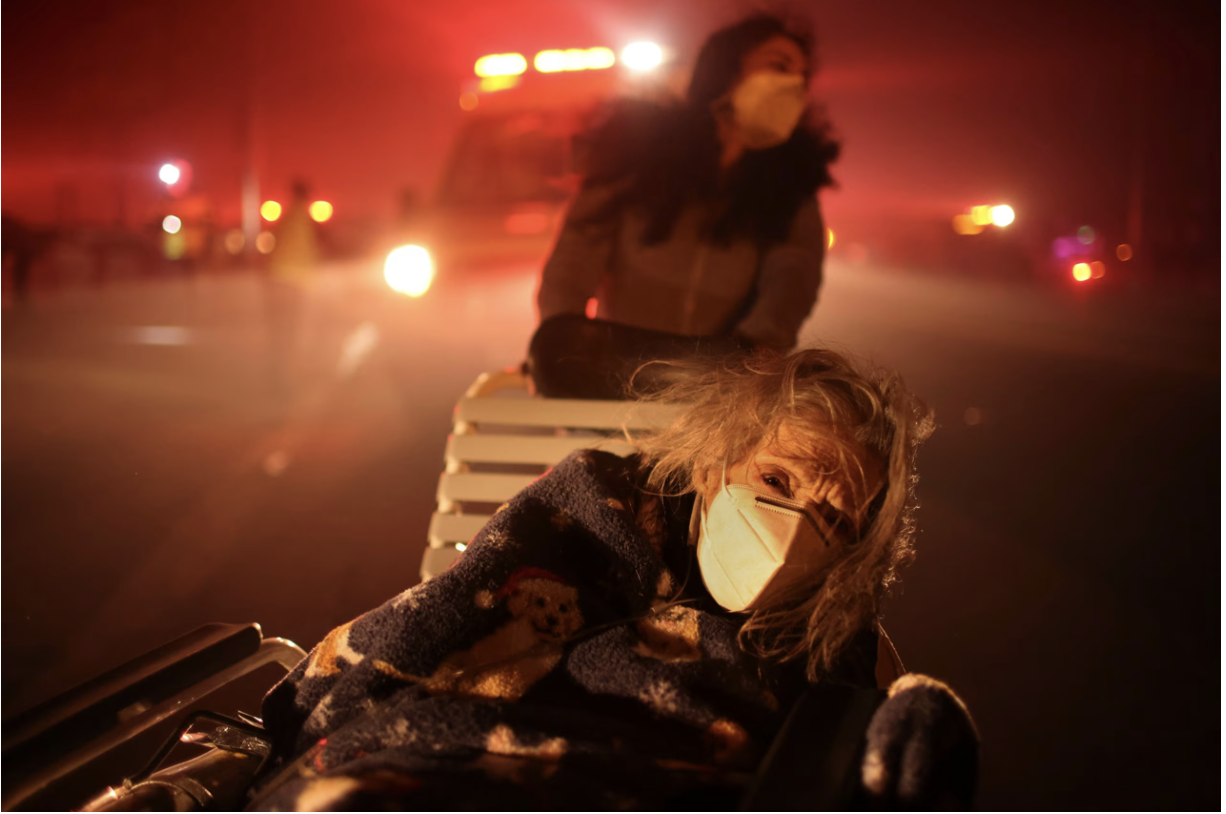
Ethan Swope/AP

The burn area on the edges of the city became impossible for firefighters to extinguish as it consumed the load of dried vegetation under hurricane-force winds, exceeding local reservoirs of water and providing a searing image of the inability of humans to control natural forces in their immediate surroundings–spreading faster and across a burn area far greater than previous fires.
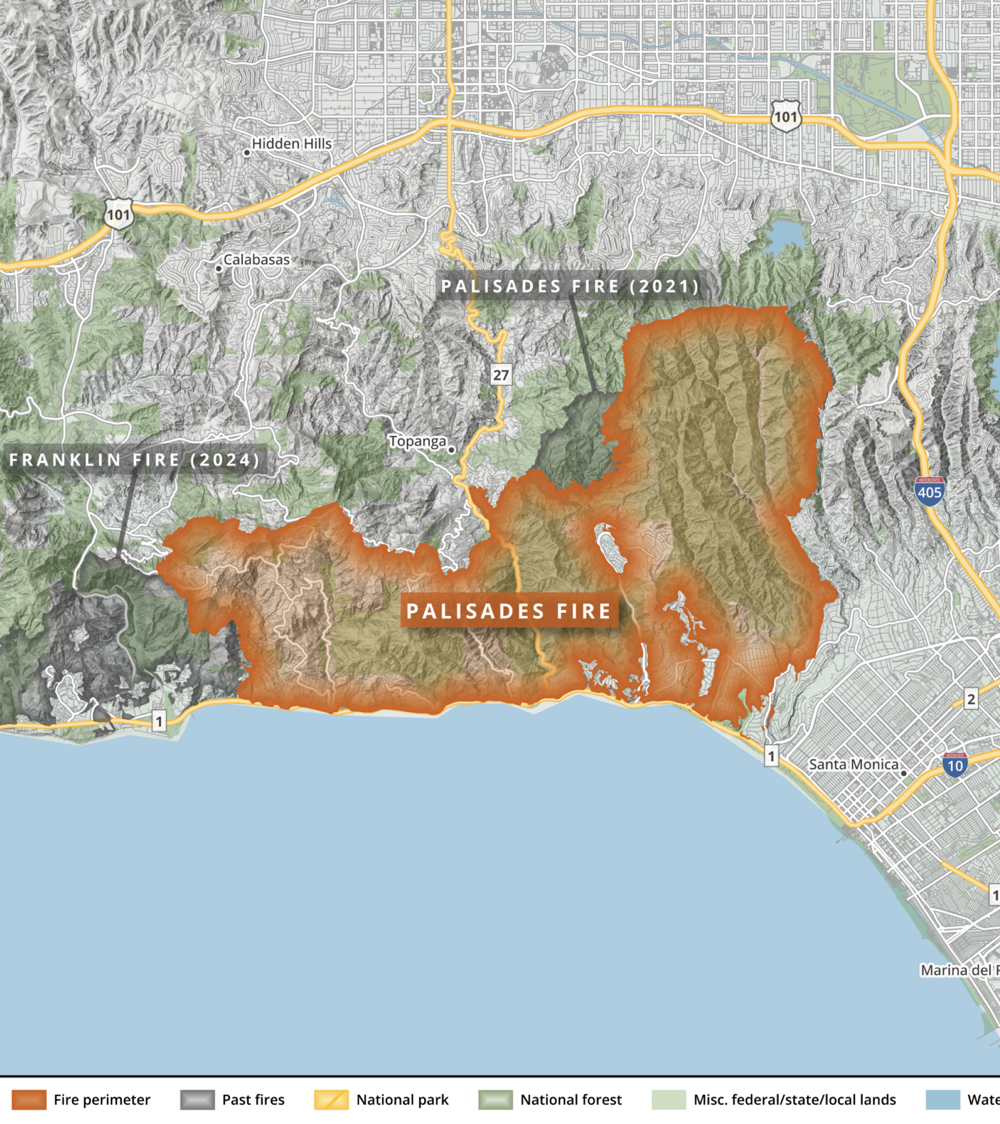
Penitentes/from Wikipedia, using data from CalFire, USGS, USFS, NPS, US Census and OpenStreetMap

With the knowledge of such suffering and the huge scale of severn fires that had rekindled from an earlier Palisades Fire, the recent discovery that a disgruntled twenty something Uber driver set the earlier fire in the Pacific Palisades intentionally. That he did so on New Years Eve, after having dropped off a fare in the exclusive enclave, and taken a walk in the woods listening to French rapper before flaming garbage pails in Parisian streets, maps the origin of the fires of such incomprehensible scale to a malicious act seems not only tied to a mind more shaped by social media than we ever imagined, but alienated from those exclusive enclaves that he brooked such seeming hatred. The Uber driver who his fares described as angry changed all the talk of the vulnerable nature of the urban periphery and the extra urban woodland-urban interface. The origins of the fire were not mapped by a dangerous geography of increased fire risk, but was as imaginary as real, and somehow not so clearly linked to dryness and full force winds, as the apocalyptical proportions of the fire on the Los Angeles periphery had in fact been already imagined–with the help of ChatGPT–which had on request generated some dystopian images on demand of the divides between panicked residents fleeing raging flames in eery juxtaposition with the image of a bucolic city.

We are prompted to associate ChatGPT with withdrawal from reality, and indeed see it as severing its users (or clients?) from the skills of spatial orientation that we see as fundamental to orient ourselves in a sense of place. Jonathan Rinderknecht’s request to generate images of the burning city seems to have arrived already distanced from reality, perhaps even an addict seeking to delude himself further in the most irresponsible ways to envision the unthinkable destruction of a part of Los Angeles even as red flag warnings abounded in the region’s hills. The ignition of the fires at the very intersection of forested lands and extra urban growth–the intersecting areas where wood is exposed to electric charges and anthropogenic wires known as the Wildland-Urban Interface, for short WUI, seems as if it was predetermined. The blaming of this disaffected man–akin to the blame distribute to communities of the unhoused for setting fires intentionally that are prosecuted as arson–cannot be separated from the anthropogenic landscape of proximity to woodlands, without defensible space, or even clear resources for emergency vehicles, to contain and interact with fires of ever greater intensity, which firefighters may, in even an increasingly vulnerable time when the city is prone to fire risk, create a landscape we lack familiarity to fight and contain, and caused the rapid spread of a brush fire from the aptly named Skull Rock toward the coast to Malibu and down Topanga Canyon, destroying 1,000 houses in hours, hitting the coast in twenty-four, and going on to destroy nearly 16,000 structures in the Woodlands-Urban Interface, where not only roads but houses, communications antennae, gas tanks, and: an astounding 98.25% of the homes destroyed in the Palisades Fire lay in the WUI,

The high risk of building out in the region was perhaps repressed or silenced, in ways that seek to haunt the huge attention that Rinderknecht’s prosecution has advanced, as the fire season begins again, seems almost a smokescreen, sent by the Department of Justice, eager to link the fires to the disaffected young man who was using ChatGPT in order to generate disastrous images, obscuring the real risks of building in the mountains adjacent to forested lands. The rapid spread of that destructive fire calls for mitigation efforts to prevent losses adjacent to wildland fire, and a better mapping of the heightened risk in areas of WUI, rather than incriminating isolated individuals.

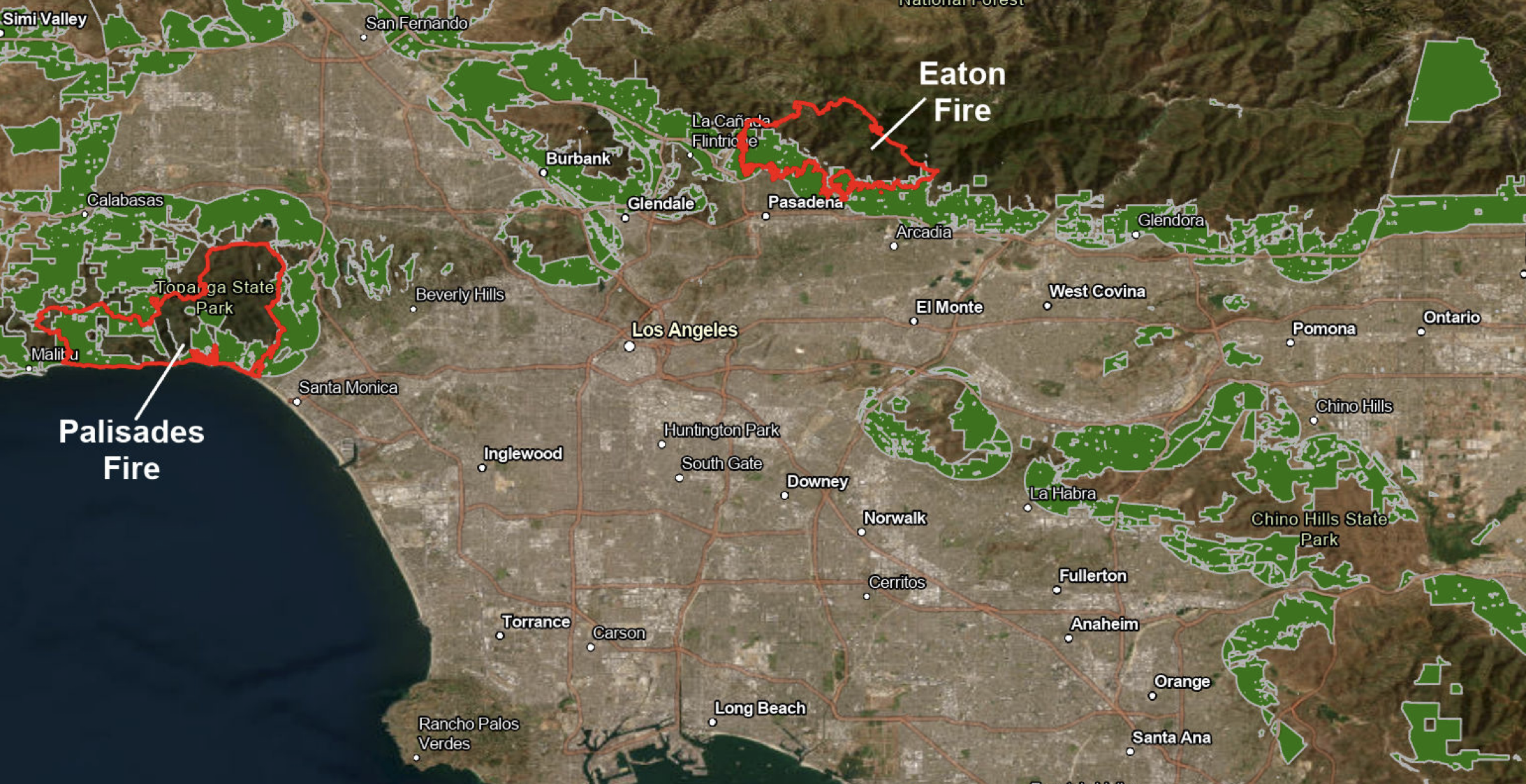
Los Angeles Wildland-Urban Interface & Fire Perimeters, Finley Bell/Western Washington University

The request the chatbot was given was to depict a city split into two–broken by a grievous class divide–in which the propertied literally partied and chilled as the thick black clouds billowed from the fires that began in forested lands–not much like the areas of Malibu that Mike Davis long ago and so provocatively suggested by let burn. The class divide that animated these scenes were more like a medieval morality play with no clear moral in sight. While the rest of the city was “chilling,” in the request Jonathan Rindernecht asked OpenAI to render on his device. In the image, it seems thousands are fleeing the burning city–long before the actual fires sent residents fleeing after actual Evacuation Alerts. In the images, which almost look like cautionary messages or hateful conjurings, dark smoke blankets the sky. A week after the government shutdown began after Republicans failed to agree upon the appropriations legislation for the coming fiscal year, and emergency response services to disaster response across the nation, with widespread furloughs and cuts in major mitigation and prevention products funded by the Disaster Relief Fund, placing California’s state-wide disaster response abilities in severe jeopardy as they prepare for new threats at the start of fire season, furloughing a full quarter of federal forest service staff in the state, the prosecution of Rinderknecht as the poster boy for criminal negligence fits a pattern of reducing multifactorial problems of fire mitigation to one bad actor, a deviant whose plans were confirmed by the eery nature of the computer generated images of fires he asked to be produce.

The actual fires have a virtual smoking gun, at last, pinned, for all the unimaginability of their scale of destruction, on a discontented Uber driver int he service economy, who used his sick mind to hamper the ability of rescue services to protect property against wildfire and destitution of some of the nation’s most ecologically delicate coastal landscapes of untold splendor, a bad apple whose lighter sparked seven fires and the greatest destruction of property. And even if CalFIRE has hired   thousands of additional firefighters, natural resource professionals, and the state’s governor slotted millions in investments in hopes to protect sensitive communities from wildfire risk, introducing $135 million available in prevention projects and wildfire resistance while spending  $72 million across the state since 2019, calling for a new standards of emergency readiness in the March 2025 state of emergency proclamation, the protection against wildfire spread remains pressing, and will be deeply impacted by the shutdown in ways terrible to contemplate by trimming wildfire response statewide before a hotter and drier climate. The federal prosecution of Rincherknecht, who was apprehended in Florida a week into the shutdown, and indicted on three charges of starting the Lachman fire for arson, destruction of property used in interstate commerce, and setting timber on fire, accused an individual of starting the destructive fires whose resignation flattened 17.000 homes and buildings across LA County, dominating the news cycle for a few days. After narrowing the possible proximate causes for the fires’ sudden ignitions under high winds from New Years Eve fireworks to lightning strikes to domestic fires, unhoused, or out of doors camping, the revelation of vandalism of the bucolic landscape of the super-rich revealed Rinderknecht’s location New Years’ Eve at the end of his Uber ride to the exclusive enclave where older fires had rekindled.

Are the revealed charges filed a week after the government shutdown truly in the public interest? The “paintings” a disaffected twenty-nine year old, Jonathan Rinderknecht, generated appeared on his own screen months before the fire. Is this the smoking gun–pardon the expression–that helps us understand the fire so catastrophic in proportions, not due to the failed infrastructure of a fire department not ready to deal with the sudden needs for water and inflammable agents needed to blanket houses built in forested areas, but the mental health of an unstable individual, who ideated the disaster in a diptych he asked be rendered in two panels of people fleeing a burning city whose ostensible neighbors, tied to wealthy conglomerates, “chill” in ways oblivious to the advancing of apocalyptic flames?

The AI bot spelled out, in wayst rarely mapped so starkly, the divide between “haves” and “have-nots” in Los Angeles natural disasters– although the “have-nots” were being visited with a punishment no one should ever face, that resemble not the LA Fires, perhaps, because they look a bit like an AI version of the destruction of Rome. Or are they not possibly a plausible smokescreen? By pinning responsibility on one man with psychological issues who was overcome with intense loneliness, his rage against the city where he lived off what might be called marginal work pushed the question of fire risk to the margins as the arrival of an ever earlier fire season intersected with a sudden decline in emergency preparedness that the shutdown had perhaps coincidentally precipitated–increasing the area of wildfire risk in the state by ending plans for controlled burns in Lassen, Trinity Alps, and San Bernardino County, even as Cal Fire will go ahead with planned burns in Mendocino and Butte. As the state is increasing its wildfire readiness and emergency preparedness, the dystopia of fires again raging across the state that is triggered by Rinderknecht’s AI images is encouraged by Forest Service cuts and voluntary resignations across the state.
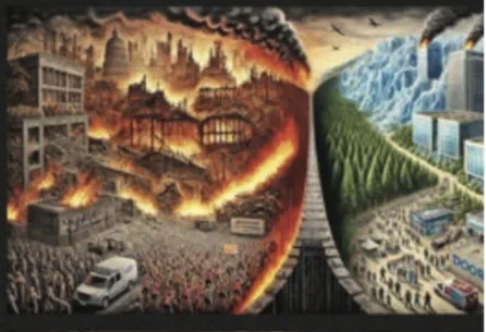
Credit: Department of Justice

Rinderknecht was indeed spending New Year’s Eve alone, we learn, and was doing so against his desire, when as if in an act of rebellion and assertion, took out his lighter. He lit the fire shortly before midnight as if to ring in the New Year with real fireworks, without the relative safety of the French rap video of a man lighting trash in a can aflame, but with a similar deliberacy and cool as he seems to have danced in the forest, lighting flames with his lighter at several spots, maybe under the influence as well, and probably feeling deeply alienated and alone that would eventually flatten almost 37,000 acres and kill at least eleven as a result of its spread–and sending plumes of toxic smoke over the region. The plumes of smoke seem to be conjured in the images generated by Chat GPT at the twenty-nine year old’s request almost as chillingly than the spread of flames.

Bucolic may be an overstatement–but the skies are blue and the trees are green in the public parks or verdant space amidst steel and glass skyscrapers reflecting the snow-peaked mountains that seem to pass for nature. The generation of the images of countless fleeing their homes in the mountains on one side of the city as other went about their business behind stiff walls was a projection, of course, of the steep class divides and socioeconomic realities in Los Angeles, seen from the perspective of the Uber driver who ferried folks between neighborhoods of radically different wealth, social opportunity, and environmental access as well as comfort, but was also an image of the panic that fires might cause in the flammable areas of dense habitation, which ChatGPT was happy to provide to the Uber driver, as well as to assure him, after he set the fires in forested areas of the Palisades, that if he dropped a lit cigarette in the forest he would be fully legally responsible–or to see if there was a basis to escape responsibility, even as he returned to watch the flames spread in the Palisades, undoubtedly imagining the damage he would inflict on homes by lighting his own small fires.
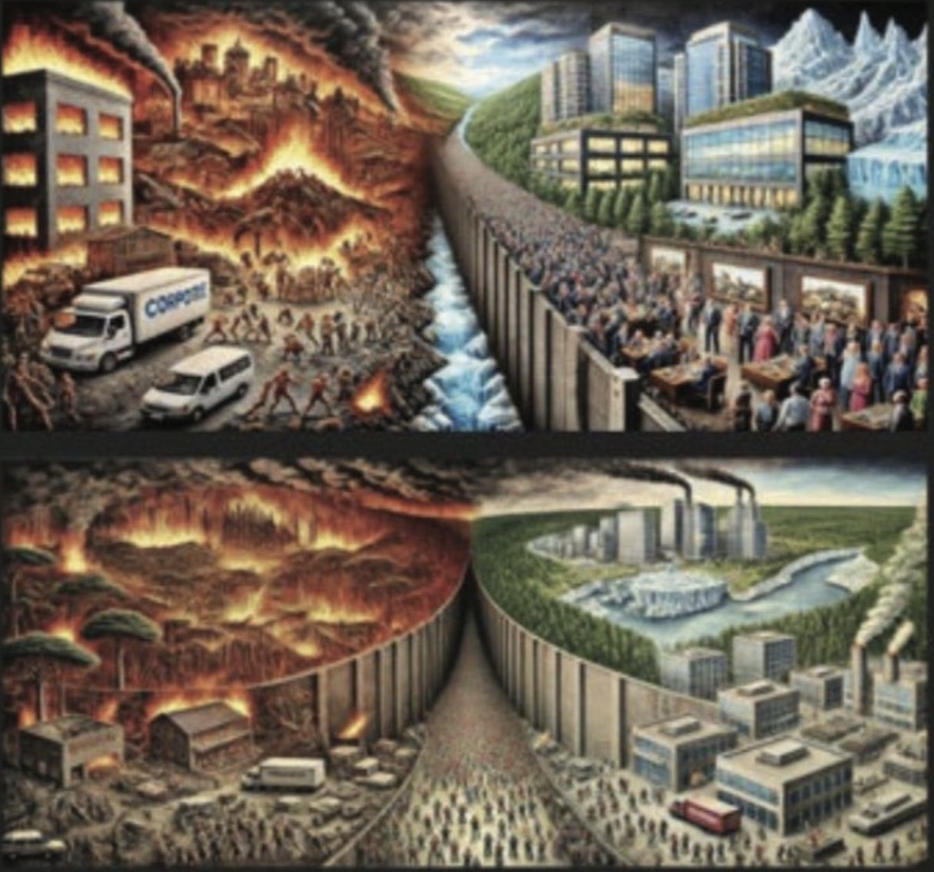
Credit: Department of Justice

The rings of flames in those AI-generated images, if they draw on the image repository of the internet, courtesy Open AI, might well suggest the cruel fates imagined in the circles of hell, or bolge, by the canonic Florentine Renaissance painter Sandro Botticelli, who rendered the poet Dante and his purple-robed guide, the Roman poet Virgil, overlooking naked poor souls suspended amidst devils in eternal suffering in the rings of hell for all eternity, outside real time,–if the vibe is far more video game than medieval manuscript illumination.

The poet Dante wrote equally informed by theology and astrology, but the painters who illuminated deluxe codices in of Dante’s epic poem of a voyage to the afterlife increasingly employed geography and landscape to transport readers into the afterlife in credible ways, supplying increasingly detailed maps of the visionary poem at the same time as cartographic images combined maps and landscapes, raising questions about the relation of maps to landscapes from an earlier date–

Sandro Botticelli, Dante and Virgil Viewing the Souls of the Damned in Hell’s Eighth Circle, 1480s Canto XVIII

–that stand only to expand like rabbits in the age of Sora, when increased virtual reality may stand to replace the painting as a unit of visual communication. While we’ve seen mostly the faking of known figures, the remaking of alternative landscapes suggests an eery emergent genre of alternative landscape art.

The notion of landscape as map were revisited in the generic if terrifying nature of computer-generated images of burning cities that Jonathan Rinderknecht asked of a bot with which he must have shared some seriously intense encounters, that fashioned an inferno-like experience long before the fires in the Palisades were ever set. We may well find the images hen conjured on his laptop so terribly hard to look at since e it is so difficult to see them save in relation to the maps still in our minds of the LA fires’ terrifyingly fast and destructive spread to the urban periphery whose progress forced 30,000 to flee their homes in fear during the Palisades Fire, which as they spread in January tragically displaced over 200,000 from the Los Angeles area–

Even if one disaffected man with a lighter did not create all the fires that spread with rapidity on the edge of the urban infrastructure–and the rekindled embers of the flames lit by a deranged man with a lighter are hardly responsible all the fires that erupted that month outside of San Diego–

NASA Scientific Visualization of Los Angeles Fires in Southern California Fires in January 2025

–the spate of Southern California fires that were primed by such dry weather and intense winds have remained pressing problems of collective and individual responsibility that led so many to stand dumbfounded before their expanding peripheries, as the fire zones only grew and grew.

But the diptych is a storied genre, due respect on its own as a moralizing genre, first named after a writing tablet in the ancient world and Roman Empire, pairing religious panels for a narrative with visual punch, often for travel and portability, as a deeply powerful image of faith, packing a punch for moralistic ends that had some powerful conjuring of a judgement and apocalypse–often terrifyingly vividly detailed in fantastically spectral ways to conjure a material record of apocalyptic power for moralized ends. While Rinderknecht is cast as a deadbeat Uber driver, and Doordash deliver man, dealing with the emotional fallout of a messy breakup, he came from a family of devout Baptist missionaries, whose evangelism has been viewed at a remove from Rinderknecht’s arson. The director of the Association of Baptists for World Evangelism has worked to keep it that way, in statements reminding all of the very heaviness of the arts of “everyone affected by the Palisades fires—those who were injured, lost loved ones, or suffered the loss of homes and livelihoods,” for whom they “grieve with them and pray for their recovery, comfort, and restoration.” The adult son of one of our missionary families was, he reminded us, unrelated his parents’ ministry works but the very power of the diptych that their son created suggested not only a sense o mental disturbance and destructive impulses, but a moralizing take on the nature of fires in the Los Angeles’ divided economy, able to be imagined as s diptych by all who live there, and demand9ing some compartmentalization as a mental strategy for most. If the Baptist evangelicals insisted publicly on clinging in such moment sot “hope while trusting in the justice and mercy of God, who alone can bring good even out of brokenness,” the diptychs commissioned by the Catholic medieval church where diptychs provided a basis for compelling sermons and devotional messages, as Jan van Eycke helped create in the pairing of a scene of the spectators who watched Christ’s crucifixion with apparent disinterest outside of Jerusalem, as the Virgin and Mary weep, with several patrons, of the work, paired with the Last Judgment and detailed hells cape of the torments that are inflicted upon the sinners and damned.

Jan van Eyck, Crucificioin and Last Judgement (1430-40)/Metropolitan Museum of Art
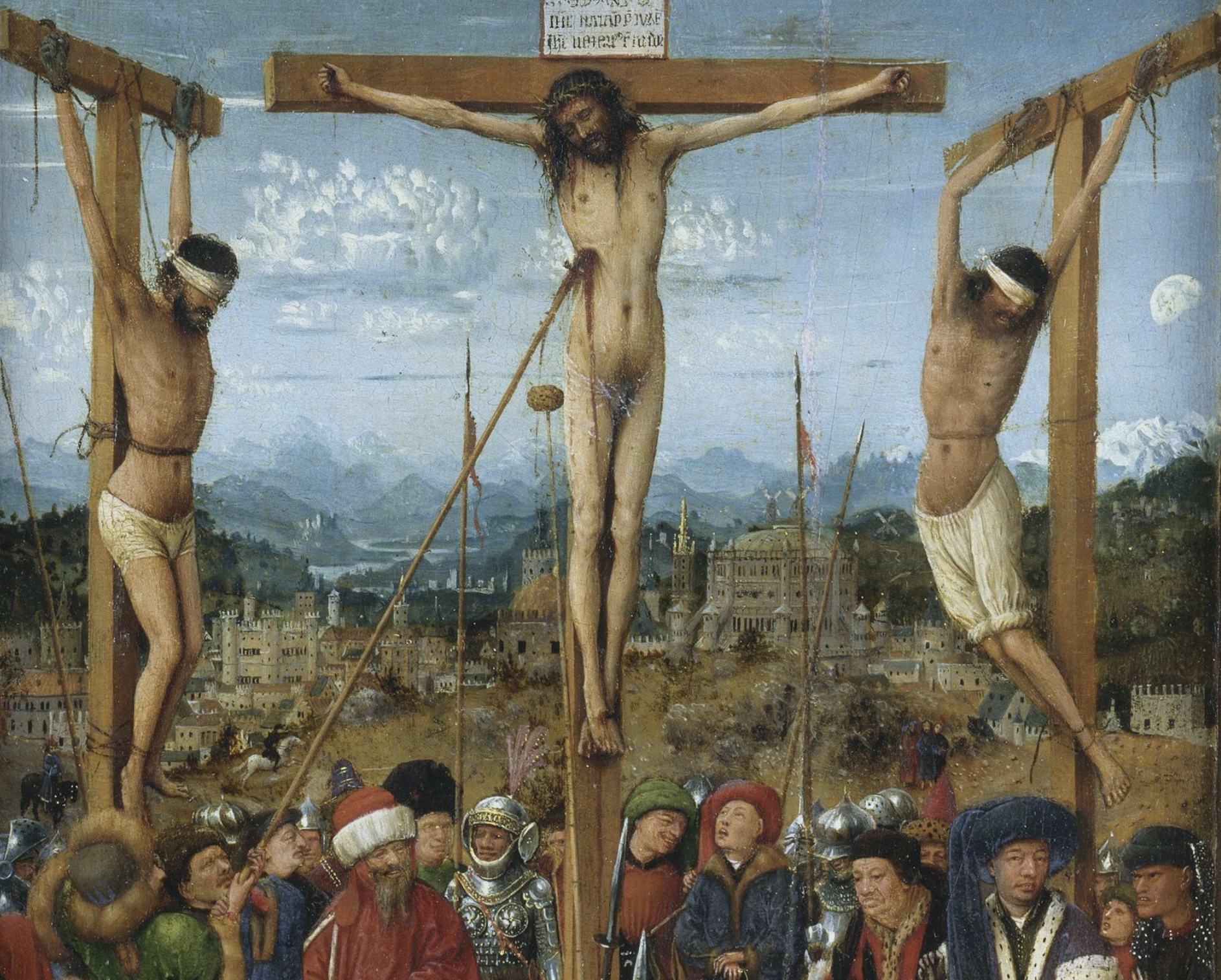
Detail of Hells cape

Jan van Eycke was a landscape artist of consummate perfectionism and details, who had also painted or created a world map for the Flemish court, if not part of his surviving oeuvre, and the mapping of the contrasts of painful suffering, put in the futurity of the terrifying Last Judgement in the Renaissance diptych, seems collapsed to the present of the burning of Los Angeles, a cautionary statement as much as the product of a deviant imagination, offering a moralized vision of the Los Angeles fires to which spectators in the downtown area seem entirely oblivious as they “chill.”

The charge or commission that Rinderknecht gave to ChatGPT was not of a disaster, but a divided canvas, understood in quite pictorial terms, of moral impact. Imagining fires in an urban landscape “divided into distinct parts that blend together seamlessly” is hardly a criminal act. Rinderknecht sought to map the fires to show a featured socioeconomic divide as if the result would be a clearheaded depiction of a socioeconomic divide. He desired a clear contrast between “on the far left, a burning forest” next to which “a crowd of people is running away from the fire” as “hundreds of people in poverty are trying to get past a gigantic gate with a bit dollar sign on it” that symbolized the city’s stark socioeconomic divides: while a “conglomerate of the richest people” relax while “watching the world burn down, and the people struggle” without registering the disaster, “laughing, enjoying themselves, and dancing” per Rinderknecht’s descriptions, asking the chatbot render a nightmarish dream as if for an artistic commission, stipulating that the painting be “detailed and impactful, highlighting the stark contrast and the direct connection between the different parts of the world.” Rinderknecht seems to have sought to make an image that might mend the fences between the glaring economic differences he had trouble living with.

Jonathan Rinderknecht no longer works for Uber, but he must have danced around the Palisades in a dream state of some sort on New Year’s Eve, when he had to drive fares, after watching the kinetic video. He didn’t know that he was setting what would be, after it rekindled from the ashes that had been smoldering after the initial fires were extinguished on New Years Day, no doubt with some annoyance from fire protection folks, but would be on e of the most destructive and deadliest known fires in California history, far beyond the proportions and scale of what Rinderknecht asked ChatGPT to predict, leaving smoldering coastal properties in disrepair, and destroying many homes of the less well-off located further inland, creating the modern version of the inferno of the Palisades Fire that caused so much loss. (The alt right news machine took the story as a way to move swiftly into action, noting Rinderknecht’s anti-Trump social media posts and his readiness to link the disaster of the fires that dominated national news to climate change to the conflagrations, as if all climate change activists are closet arsonists, looking for ways of getting away with it and shifting blame to the skies.)

Few morals can be drawn from the fires, if we are still hoping that lessons might be learned. The scale of the fires that raged across 23,000 densely forested and inhabited acres raged with a destruction that Rinderknecht must have followed on social media and television with nagging fears, having asked that least expensive of therapists and attorneys if one is “at fault if a fire is lift [sic] because of your cigarettes?” in hopes to deflect responsibility or agency for the conflagration that spun out of his intentional acts of arson, moving to Malibu, where all those seaside houses were destroyed, Topanga Canyon, and Altadena, where communities were flattened.

Rinderknecht wasn’t wrong when he blamed climate change, but the peripatetic troubled man who had broken up a few years back with a romantic partner and was on medications had been working for a while in the vast service economy of the sprawling city, navigating its economic differences that seemed as if he wanted to peel apart the gaping Lyellian strata in the city that evident to a delivery man for Door Dash and an Uber driver. As he walked on the trail with a lighter in hand after dropping off fares who reported their driver to be angry, he maybe made a bad judgement call in selecting a song on his iPhone–but probably rather intentionally selected an anthemic song that glorified the pyromaniac’s abandon lighting fires in an urban setting that seemed an image of cool. Johanthan Rinderknecht was, of course, listening to ominous soundtrack of the depths of urban alienation on his iPhone of a sleepless, haunted man walking on another urban periphery, probably Paris, wallowing in his sadness and fantasizing lighting fires as he lights up a joint–or lighting fires in trashcans–as he is walking in a poorer boulevard, or what seems one, captivated and entranced by paper fires set in trash cans at which he stares, hoping to get himself thorough a sleepless night or just numb his pain, turned to the image of rage and destruction on another urban periphery.
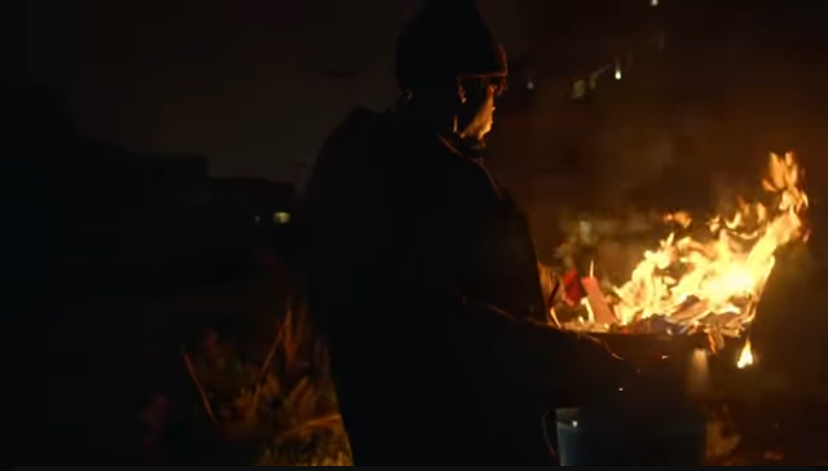
Un Zder, Un Thé

Un Zder, Un Thé

On the trailhead on which Rinderknecht walked from his car, above the tony sprawling mansions of the Pacific Palisades, Rinderknecht seems to have been lighting things with his own lighter. The spot was later identified as a crime scene on the rocky bluffs overlooking the ocean off the Temescal Ridge Trail, feared begun by revelers, to judge by multiple glass shards of abandoned broken beer bottles where the embers of the fire reignited on January 7,–a week after Rinderknecht lit his own earlier fires with a cigarette lighter, as the “holdover fire” rekindled from its embers.
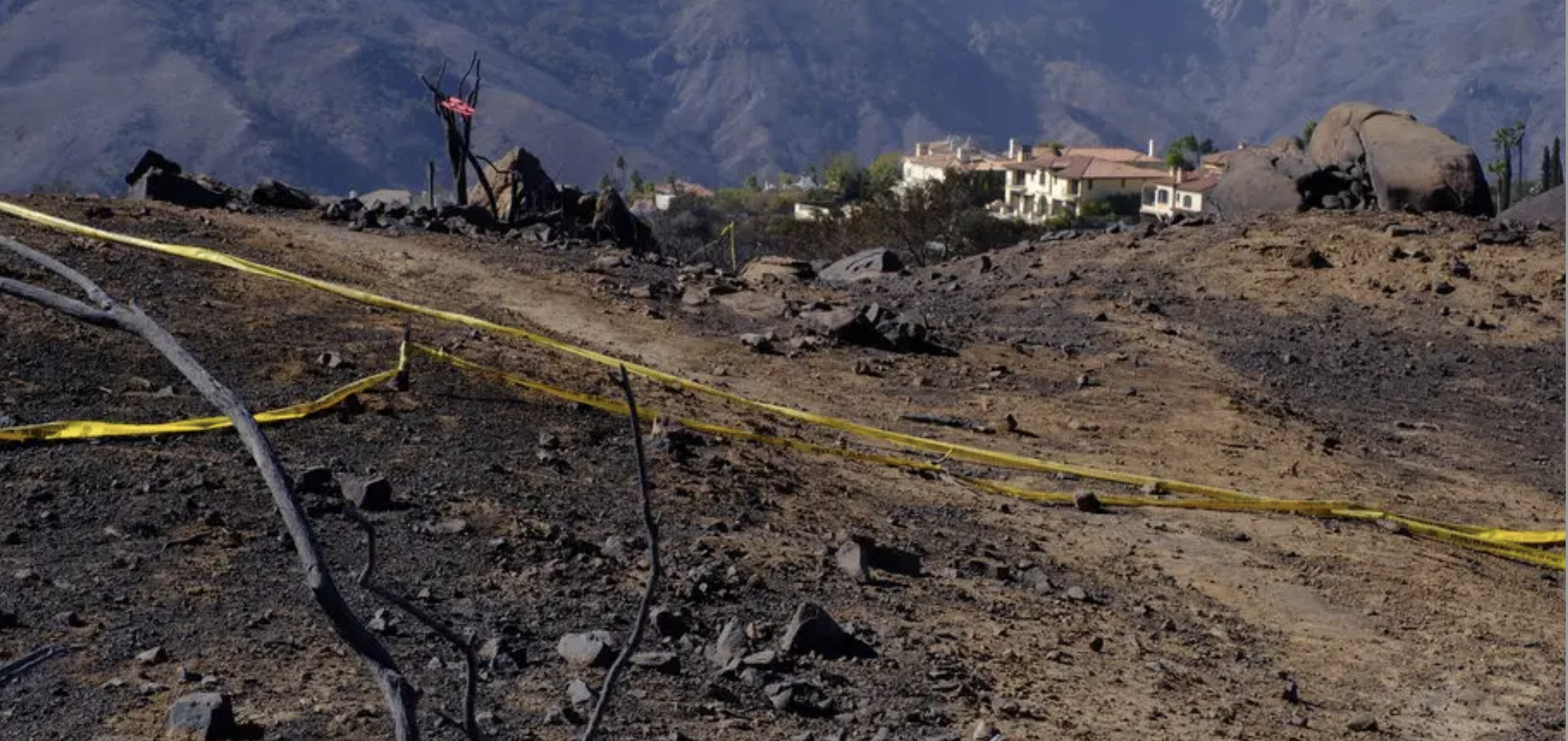
Black Migliori/New York Times

To be sure, the setting of fires on the urban periphery is not the breaking of Jacquard Looms–and carries far greater consequences in an age when the intentionally setting fires in Southern California forests should face stiff penalties. Rinderknecht may have been a pyromaniac who willfully set fires to either paper or vegetation in a combustible area of the forest trail he let the car for a walk, but he was responsible enough to come to his senses and try to call 911 after starting fires with his lighter in local vegetation, though cell service forced him to retry multiple times.

Will OpenAI include an automated outreach to 911 for certain suspicious queries to ChatGPT in the near future?

The shift in the valuation of homes in the region that seems targeted by Rinderknecht may have an absurd overvaluation, with prices of homes unthinkably unattainable for most Angelenos but also map onto extreme divides of wealth can make it hard to traverse such economic extreme shifts, of almost seismic divides, stressful in the boundaries of inclusion and exclusion they draw of wealth inequality and “haves” and “have nots” that are increasingly common in many American cities, but are in Los Angeles even more hypertrophic at the luxury residences at the edges of forested lands.
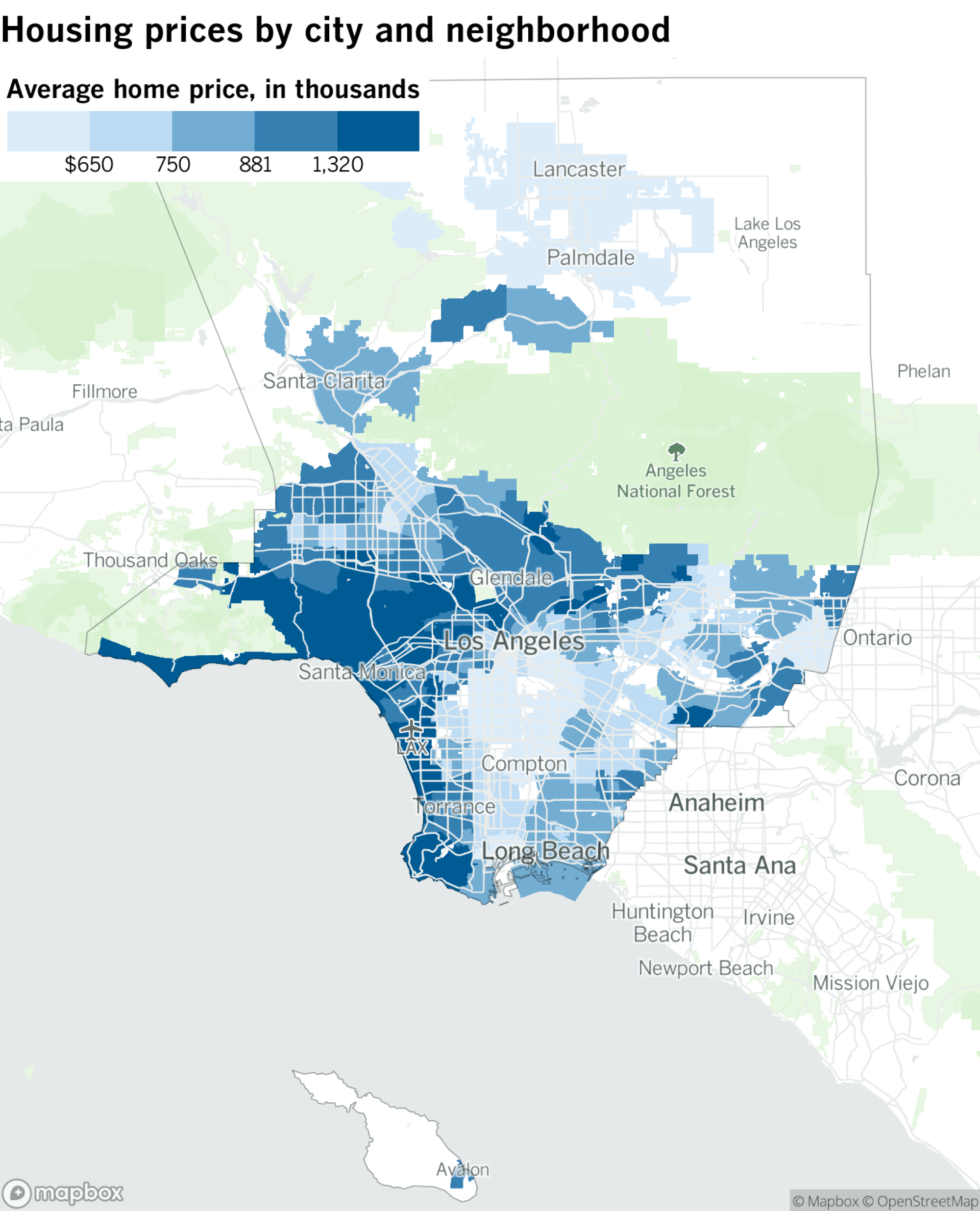
Housing tracker: Southern California home prices and rent - Los Angeles  Times

This would be, probably, the least desirable outcome of the pressure that may grow on OpenAI to take responsibility for the fires, as it shifts attention from modes to resolve the underlying reality of the desiccated landscape that global warming and climate change have produced in California–and the fact that fires are almost desired to recur with increased violence in coming years, and the need to expand protective measures in the face of record levels of dryness during the late autumn and winter months.

The need to attribute a sense of human responsibility to one marginalized individual is an odd way to confront the questions we’d been asking about the role of climate change in provoking the fires–but has to be recognized as a perverse attempt to point the finger at a disturbed individual, without whose malicious acts the fires might not have occurred. As we were beginning to turn attention to the many malfunctions and limitations that allowed the fire to spread to rapidly–from problems with water supply, warning systems, and indeed escape routes, some dealt with in an earlier post–gridlock was so intense as a result of the fires’ rapid spread that the Los Angeles Police Department was forced to devote increased attention to clearing roads for the entry of needed emergency vehicles. But the infrastructural problems of the warning systems that should be in place and the firefighting tools we should have are displaced and the weight of responsibility is focussed on the shoulders of a bad actor–perhaps obscuring and hardly helping how we remember the devastating consequences of the fires’ destructive spread or questions of future fires’ prevention.

Deeply alone, per reports, and probably feeling as dark as the nation after Trump’s victory, perhaps the request for a diptych of a scene of a fire of “two parts”–“on one side of the gate and the entire wall is a conglomerate of the richest people, . . . [who are] chilling, watching the world burn down, and watching the people struggle” was almost a projection of his sense of torment in a city whose neighborhoods are so starkly divided by wealth. The notion of “watching the world burn down” was what much of the nation was feeling it was doing, as the greatest fire in California burned, leveling 23,00 acres, as he was listening to an anthem of urban alienation, filled with the idea of how the residents of LA existing in split reality,–perhaps the most successful aspect of the painting ChatGPT generated for him.

Credit: Department of Justice

The prosecutors who released the generated images of a destroyed city seemed convinced that they presented a tight case against him, if they didn’t need to add much to fact that he was watching images of a stoned rapper lighting fires with abandon in urban streets in the glare of streetlamps, iPhones, and headlights of oncoming cars in a late-night urban landscape of increased disorientation and quick cuts of a modern flâneur in its combination of alienation and curiosity of distanced bemusement at the nocturnal street life around him, in which the iPhone is in a sense his only weapon of defense. Jonathan Rinderknecht had, in fact, become. While the moral valence of the flâneur who is a disinterested observer of urban life, who wanders the streets in search of interest, was taking advantage of the keen awareness of the new spaces of modernity for Benjamin or for Charles Baudelaire, albeit expeeriencing a deep for alienation to which the city seems to give rise, Rinderknecht clearly took advantage of his car as he returned to the scene of the crime to contemplate his act: he drove the car back, without passengers, no longer working for Uber, following the fires engines back to the approach the site where the flames were already spreading, hoping that they’d extinguish them after being alerted by his emergency call, if not sensors. Was he not only anticipating the spectacle of spreading conflagrations as consuming property with abandon as he took video on his iPhone from near the spreading fire, coming within thirty feet of its flames to judge by his GPS, as if a moth drawn back to a flame? While we consider the pyromaniac unhinged from reality, the return must have been rather compulsive for one who set the fire, as if to be flooded with some weird rush of emotions as he watched the results of his own handiwork, engaging in the urban environment in distinctly new unexperienced ways.

His very spectatorship of the fiery destruction of this exclusive area of Los Angeles made him a flâneur of urban disaster,–not a new type of flaneur, if one that anticipated the spectatorship of the Palisades fires LA residents watched with newfound disempowerment,–stunned ifpassive before the real-life urban spectacle beyond anything they saw on their television screens, rekindled by hurricane-force winds as it spread beyond the Palisades across 23,000 acres to Topanga Canyon and Malibu–pricey locales to live indeed–as well as Altadena, leveling 6,000 structures and actually clearing multiple communities without much distinction of class, even if it seemed to be targeting the superrich living in Pacific Palisades–the name by which the fire became known. The sense of a watching the actualities of such apocalyptic realities unfold in real time was of course different than the scale of spectatorship of the fires that would rekindle form the fire he set, but he was consuming the information he perhaps might have heard on the radio in all its visual intensity, viewing not the effects of the fire’s spread or its map but the flames he had imagined at first hand, as one hears a pyromaniac is vertiginous before, as if it was a sight of the city, even as he tried rather desperately to distance himself from it, by trying to claim he was hardly at fault legally for having created anything like an actual loss of property:

For when heavy winds whipped up the flames believed to be extinguished on January 7, just in time for Trump’s inauguration, the embers of the Lachman Fire he lit bounced back to create the apocalyptic scenes he had asked GPT to imagine, if the truly dark clouds from which all those imagined people flee, running past what seems an emergency vehicle, seem walled off in a dystopia land of Rinderknecht’s earlier creation, walled off from the utopic image of the city whose residents seem to go about their business at a safe remove from the growing conflagration. The billowing smoke that blanketed forested lands’ skies in the generated image below were perhaps so triggering to compel OpenAI to issue a public statement, disclaiming any culpability for providing these “pictures” of apocalyptic reality that seemed to envision the disaster of the Palisades Fires in almost biblical terms as the end of an empire. The OpenAI team was making sure everyone knew it was absolved of responsibility, for providing that image months before the fire began in a “dystopian painting showing in part a burning forest” as residents flee the specter of spreading flames, desperately doing their best to escape death and destruction by “running away from the fire.”

The images OpenAI allegedly generated for the wayward Uber drive certainly seemed a smoking gun of sorts, to use the completely wrong metaphor that might make one’s hair stand on end: the public release of search histories, web searches, text messages and the like have become the norm for looking for clues to solve a crime, and if the identification of the Palisades fires with arson made it a crime, the dystopia images Rinderknecht asked the virtual chatbot Rinderknecht seems to have regarded as a privileged interlocutor in a dark personal time can’t be reasonably treated as privileged within the penumbra of privacy, if the examination of one’s history of generating obscene images of global disaster–more serious than online pornography?–are certainly admissible in court. The search of search histories may be undisputed as a way to gather information about criminal sources, and is not breaking into the office of a psychiatrist, but Rindeknecht seems, as many, to have regarded ChatGPT as a psychiatrist or therapist of sorts.

The accusation of premeditation seems evident from the apocalyptic images of the black plumes blanketed Los Angeles the region’s once blue skies with smoke of dangerously high levels of fine particulate matter (PPM 2.5) from several wildfires that were spreading into the surrounding hills,–prompting warnings from health agencies as the AQI index rose to 400 or 500 near the fires and “hazardous” within five miles of the fires, and “unhealthy” for the entire city–until those high winds blew the dangerously high levels of smoke away within the week, ending school shutdowns and public health warnings that seemed like COVID all over again.

Smoke from a wildfire blankets the sky above Venice Beach in Los Angeles. Air quality in the region is unhealthy because of several wildfires burning.

Venice, CA, covered by smoke from Palisades fire, January 8 2025/Jae C. Hong (AP)

Environ. Sci. Technol. Lett. 2025, 12, 8, 911-917

The static nature of the computer generated image that seemed to forecast all this apocalypse used eerily similar colors. The canvasses that it generated in multiple possible options–did he make his request multiple times?—was so epic in scope it hardly revealed active running of individuals; those standing to the right, with hindsight, can hardly be looked at without imagining them as spectators of the very sort Rinderknecht would turn out to be as he drove back to visit the fire as it spread along the trail he had taken a short walk after dropping off his ride, positions known by his GPS.

The rather generic images that may offer a window to his intentions are in fact strikingly dispassionate, as might be expected for a computer generated image, with little sense of a viewer, so much as recycling imagery from other sources by an algorithm that suggests meeting a set of rather complex specifications to translate quickly into visual form. The virtual “paintings” don’t suggest any emotions, if they are oblivious to the surroundings, hardly seem to be “chilling” in a state of relaxation, if the search engine did add copious waterfalls that suggest the opportunity to “chill” was close at hand. (One wonders how many paintings ChaptGPT is asked to generate for its users, and the remove of the act of “painting” from a backlit screen. Such are among the multiple hazards of commissioning paintings from ChatGPT.)
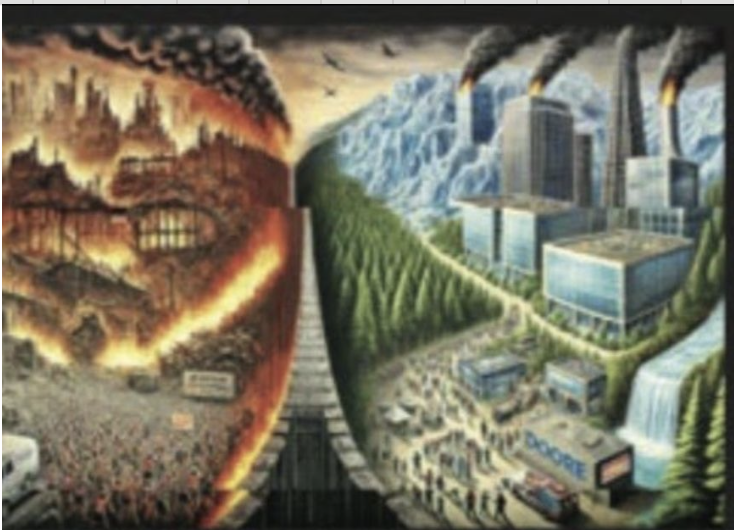
Credit: Department of Justice

The artificially generated flames to gain such eery resonance even in an image that that OpenAI to remind folks that they fully cooperate with law enforcement following the discovery and that the imagery their app generated did not include any content that went against the company’s policies and best practices. The idea that the generation imagery of a city being destroyed–or even the obliviousness of half a society to the burning of what might be the “whole world”–would place it at fault may seem perverse, but the generation of fictive landscape that somehow have a purchase on the realities we later experience may seem like the virtual images had given him a plan. The fire seemed as if it was somehow something cleansing and redemptive to him, to judge by recent reports, and the generation of an apocalyptic scene of the world’s destruction was not only “dystopian” but seemed about a deep disconnect, if the laughing wealthy of the anonymous conglomerate on the right of the diptych are not clearly “chilling” and enjoying the world burn, but the GPT engine has a hard time with portraying pleasure, if it quickly generates fictional images of cities being destroyed by flames.

Credit: Department of Justice

The generated images of course remind us of the very contrast between fragility and permanence, deep contingencies of built environments, even if fire seems weirdly walled off rom the city to the right, its wealthy residents almost oblivious to the truly Dantesque images of all those small beings in a tortured landscape on the left, that was made at the request of the twenty-nine year old arsonist, who will have a hard time arguing that he didn’t ideate and have any intent to set a fire this large, or to do so in ways that would reflect on the deep social divides of the modern American city that are so strikingly clear in Los Angeles–incarnated by that weird virtually generated wall that Rinderknecht seems to have requested figure so prominently in the images of destruction that he very much wanted to see, and then seems to have sought to start.

The progression of the fire almost seems to taunt the infrastructure of that ideal city that stands to the right, as if to show the underlying pain that exists at the same time at great proximity–and the fragility of an actual dividing line between them, that seems a divide not only of property but an insurmountable wall between emotional states. The ChatGPT search engine is good at making the conglomerate from architectural models, and the pleasure of “chilling” seems to have been captured by snow-capped mountains or what seems a landlocked iceberg that floats beside the skyscrapers of the city that looks only a bit like downtown LA–but those black clouds and fleeing humans look downright medieval, as if the global destruction Rinderknecht asked be generated was apocalyptic indeed.

Credit: Department of Justice

The contrast between those dark skies and the blue skies above the skyscrapers and factories that belch out computer generated columns of smoke can hardly compete with the intensity of the black skies over the left half of the “painting” that seem malbolgeian, and may well be about the future of a catastrophe enabled by the failure to take adequate protective measures in the face of climate change. We do seem to be facing some very hight walls indeed, by which we are pressed from both sides, as the people in the final image, who seem to find no pleasant situation between the incandescent blazes and the chilly box structures, where the appearance of the fires seems to have no clear origin, but is rather an existential condition, as they engulf the city with flames as much as fireballs, in a condition that seems no one will leave, even if this one seems to be set.

The phenomenon of the fire on the margins of woodlands that are increasingly flammable seem terrifyingly somewhat endemic to the expansion of California cities into what is called the “woodlands-urban interface,” as a region of greater dangers to incendiary disaster. But the spread of panorama of urban ties that suggested the dangers of densely populated regions made them an extremely popular conceit of the panoramas that traveled round the country in mid-nineteenth century America, as if in an antebellum sort of internet, providing pictures of far away pleasures and terrors. Such panorama regularly featured the heightened vulnerability of cities’ lower classes to such “urban disasters”, including the firemen made up by members of lower classes, and recent immigrants, as well as those perennial thrill-seekers who approached too close to watch fires spread.

The occurrence of a conflagration amidst the panorama being unscrolled became a stock object due to techniques of lighting and stock tools of dramatic staging as they punctuated touristic itinerary and narratives to reveal sudden urban dangers, offering thrills with warnings to audiences in Buffalo or Lowell, Massachusetts of the dangerous lives of city-dwellers: despite the reassurance that when “a fire occurs in any part of the city, the men at the bells readily know the district in which it is situated and they make the number of the district known to the fireman, by the number of strokes on each bell,” in a reliable system of communication than what existed for the Palisades Fires, panoramas apologized “we see here some of the bustle and confusion and fleeing that is attendant upon a fire, . . . we don’t hear any of the noise. This is not represented on the Painting.” Few paintings can even communicate the sense of individual travail and desperation, if the paintings of Rome burning in 64 AD seems to have come closest to trying to convey as much in the gestures–

Nocturnal Capriccio of Rome Burning, Pierre-Jacques Volaire (1767)

—if the disproportionate nature of Neronic obliviousness to the suffering of the may seemed the basis of Renderknecht’s request–and the rumors that Nero had the fire set himself seems oddly echoed in the sense that the AI generated images prove Rinderknecht’s guilt, evidence of the Uber driver’s confusion of virtual reality with actual fire risk in the Palisades. Mid-nineteenth-century theatrical display of diorama vicariously conveyed the sense of urban spectatorship, however, in vivid ways, that made them a traveling business of sorts for canny entrepreneurs, predating disaster flics, unspooling six-feet high scrolled canvasses before paying audiences in a virtual itinerary of urban space that allowed them to be flâneurs of their own, even if located in the safety of a theater in Massachusetts for several hours, exploring the new social topography of the city and its contrasts of wealth and urban poverty in “moving” images that noted the degraded nature of urban environments with abundant theatrical effects–a display of the contrasts of immense urban wealth beside immigrants’ poverty, from opulent buildings of the wealthy residents conspicuous display balanced by theatrically staged sensational conflagrations that spread among wooden houses of densely built cities.

At the same time as the scale of actual conflagrations were widely reported and experienced as terrifying disasters, their apocalyptic nature of fires of untold scale became a feature audiences promised. The adverts for panorama in published advertisements enticed audiences to attend “the grand and sublime spectacle of the BURNING OF THE PARK THEATER!” The suspected arson of tragic events as New York City’ s Tenement Fire of March 1860 and Great Chicago Fire of 1871 provoked panorama to try to capture their devastation in ways vicariously observed across the country, to process the spectacles of such sudden loss of life in urban landscapes; that fires that left uninhabitable burnt areas, destroying the homes and property of many as they were covered by smoke-filled air and ash (of course absent from panorama) seemed as if they were a precipice of modernity that paying audiences entertained.

The hope to raise money for Relief Funds for the fires circulated nation-wide, for many of the same audiences who might have seen the traveling panorama, inviting they comprehend the scale of loss of the massive “Burnt District” of the Great Fire–almost a city within a city–that had spread through six miles of densely packed urban housing and transformed the shores of Lake Michigan to a salvage region of which stunned inhabitants arrived to snap photographs as they contemplated the scale of loss, the problem of responsibility, and the question of how to move forward in 1871. If the ruins of the fire were compared to a form of disaster tourism, leading many to try to experience the fires by going to the city that agencies would offer customers by dedicated trips “with ample time in Chicago for viewing the ruins” as if they might be transformed or reimagined as the ruins of a Grand Tour in Europe, available at cut rate with even greater effect, the new scale of the fire’s destruction that would rival if not displace historic fires in the scale of its tragedy–flames moving faster even that the Great Fire of London that had started on its wharves in 1666, that over three days destroyed the oldest built up area of some of densely packed wooden structures, in a firestorm fanned by winds that challenged current fire-fighting techniques of firebreaks–

–had created huge numbers of homeless in its wake, only later being rebuilt as dominated by broad streets to reduce the hazards of narrow winding paths, and allow firefighters to better fill their tanks in the future.

The problem of confronting the limits of representation also existed for images generated by ChatGPT. The terror, the huge cost of life, and the massive destruction was not something able to be generated, nor the panicked bustle of the fire. Rinderknecht was a pyromaniac who enjoyed watching conflagrations–though generating fictional burning landscapes is hardly a crime in itself, so much as the condition of urban spectatorship. Would he have paused before parking his car after ferrying folks to their New Years celebrations, hoping to close the year with a bang, and not walking up that trail and listening to the song he had probably selected to set fires on what would be his own final Uber ride? In what set a threshold for new levels of paranoia, the official complaint of neighborhood groups representing Palisades victims at a dozen companies, including major utilities as Southern California Edison and phone networks such as Charter Communications and AT&T, related to the delayed response to the fires that rekindled in the Palisades, were filed just after the public announcement of Rinderknecht’s arrest, when federal prosecutors released the ChatGPT diptychs of urban infernos, seemingly designed to push the question of “fault” in relation to the devastating fires into the past.

Nero Watching Rome Burn, Unknown Artist
Leave a comment

Filed under California, climate emergency, Los Angeles Fires, Palisades Fire, wildfire risk

“A Mighty Redwood of a Man Has Fallen”

Malcolm Margolin was among the coolest and most curious people I’ve known. And while terribly saddened by his recent death, and mourning his dynamic presence, he was long a model for struggle we will need to remember in a dark age. I first met Malcolm as we walked the Bayshore Trail in opposite directions, Malcolm appropriately seeming to patrol the newly reclaimed bayshore pathway a tradition of the Ohlone people. As if a modern Henry David Thoreau who found a new Walden in the East Bay, Malcolm seemed, walking along well-worn trails, self-appointed clearer-of-paths of the East Bay wilds. While from Massachusetts, this Harvard-educated hippie won a grant to write a book about working the land without transforming led him to appreciate the native ways of another tribe, what Gary Snyder called “old ways,” that were rooted in place as much as they channel American transcendentalists that was purely Thoreauvian in its spin.

As Thoreau, Malcolm saw the ethical traditions of the local as a deep purpose of “rules, customs and practices outside the dominant way of life,” evident in the local Indian community, as if he recognized it–and adopted the vision of straddling outsider cultures and communities on projects of refusing to tame wild lands, allowing them to exist for our benefit against all odds. Malcolm grasped–as have others –the value symbolic anthropologist Clifford Geertz ascribed “Deep Hanging Out,” as a basis for ethnographers’ sense of purpose was immediately recognizable to Malcolm. And it was a way of describing his longtime Berkeley residency on the margins of academia, and at the center of a large industry of small presses as as deeply purposeful as the noted generations of anthropologists who had studied–and indeed mapped–indigenous cultures in the state, more often reifying their presence as an “extinct” peoples. Malcolm’s work, if often based on oral accounts of life before westernization, provided a model of Geertz’s concept of “thick description” less tied to the symbolic webs of culture, than the immersion in a sense of place and vital relation to place. The purpose he gained in the rich local setting of Berkeley, CA, from its parks to its shell mounds to its coasts and islands left a bookish world for close study of the ethics of place, before he brought this attentive wonder to a home in the bookish world. And the deep knowledge of place–a sort of expanded “local knowledge” of the Bay, to cop another phrase from Geertz–offered an alternative anthropology of the local, rooted firmly on the West coast.
As a former parks ranger who had, indeed, cut his teeth rebuilding the trails in what was Oakland’s Redwood Regional Park–a jewel of native forested lands of old growth trees in the East Bay, one of the large redwood forests in the East Bay, and third East Bay park open to the public–the largest natural grove of coast redwoods in the East Bay. While Redwood Regional Park, where he first worked and developed a sense of the preservation of the wild, was renamed after Aurelia Reinhardt, Malcolm must have been nourished by its old growth redwoods; I’d like to imagine, their age, if actually not that deep, gave him a new sense of spatial orientation to place to Ohlone residents, and a sensitivity to the suffering it had undergone and he might save. His love of place may have begun earlier building trails, but in immersing himself in the practicalities of lost woodland trails as a redemptive process led him to become a proselytizer of many regional off-road trails, to treasure them as a site of contact to other worlds and pasts in danger of being lost. If AI algorithms somehow generate a tie from a search about Thoreau’s writing at Walden between “the site associated with Henry David Thoreau’s experiment in self-sufficient living and a more recent effort to return land in Berkeley” to the Ohlone people, a missing link may be Malcolm’s attention to the uncovering of indigenous practices and histories of place.

The understandings of Indian Country that he gained, and enjoyed, led him to move between many worlds to establish his footing, and gaining a sense of potential redirection of past injustices that he dedicated a great part of his life. If few cartographers are so resistant to following rules, Malcolm’s interest in the quirky and the overlooked led him to blaze new trails across much of the Bay Area. Whether the serendipity of Malcolm’s work in an old growth forest in the 1960s, as newly planted redwoods of the region first provided a hope of restoring forested lands that had ben cut down.

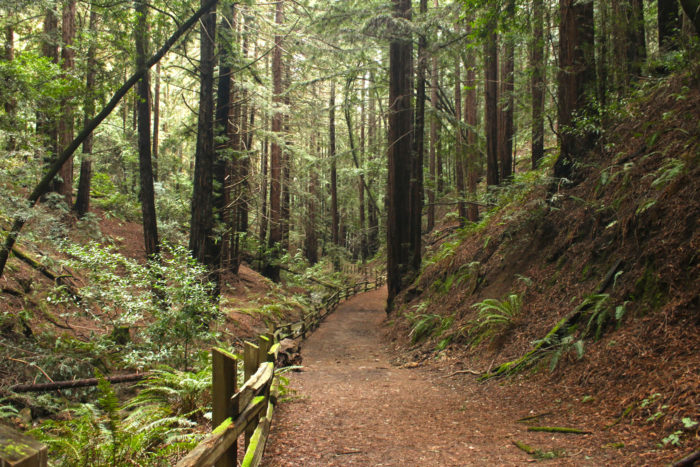
Redwood forest trail

 Forested Trail in the Dr. Aurelia Reinhardt Redwood Regional Park. Photo credit: H Grimes 

While Malcolm told me a few times he would never have been able to research Ohlone Way (1978) or other works without the University of California’s library at the ready, praising the gift of the open stacks at the public university, this East Coast transplant who lightly tossed his Harvard credentials cast himself as an outsider intellectual who could serve to orient a new generation to the region’s native lands. Malcolm had, in Ohlone Way, animated a sense of preserving native ways. If in part this followed Alfred Kroeber and Henry David Thoreau in describing Indians as “extinct,” at first, at least in California, he spent much time and effort revising the remark with a celebration of native presence and the vital nature of traditional tribal arts–few did as much to stress their current relevance and continued presence in these lands. While Malcolm’s project of “cultivating the wild without taming it” became a sort of ethos of the outdoors, popular in the era, his guides to the practicalities of the wilder areas to enter just outside the East Bay and San Francisco presented a vital document of a world before urban sprawl, promising to rehabilitating one’s relation to the wild–and rehabilitate one’s soul–of deeply Thoreauvian ends of transcendental thought.

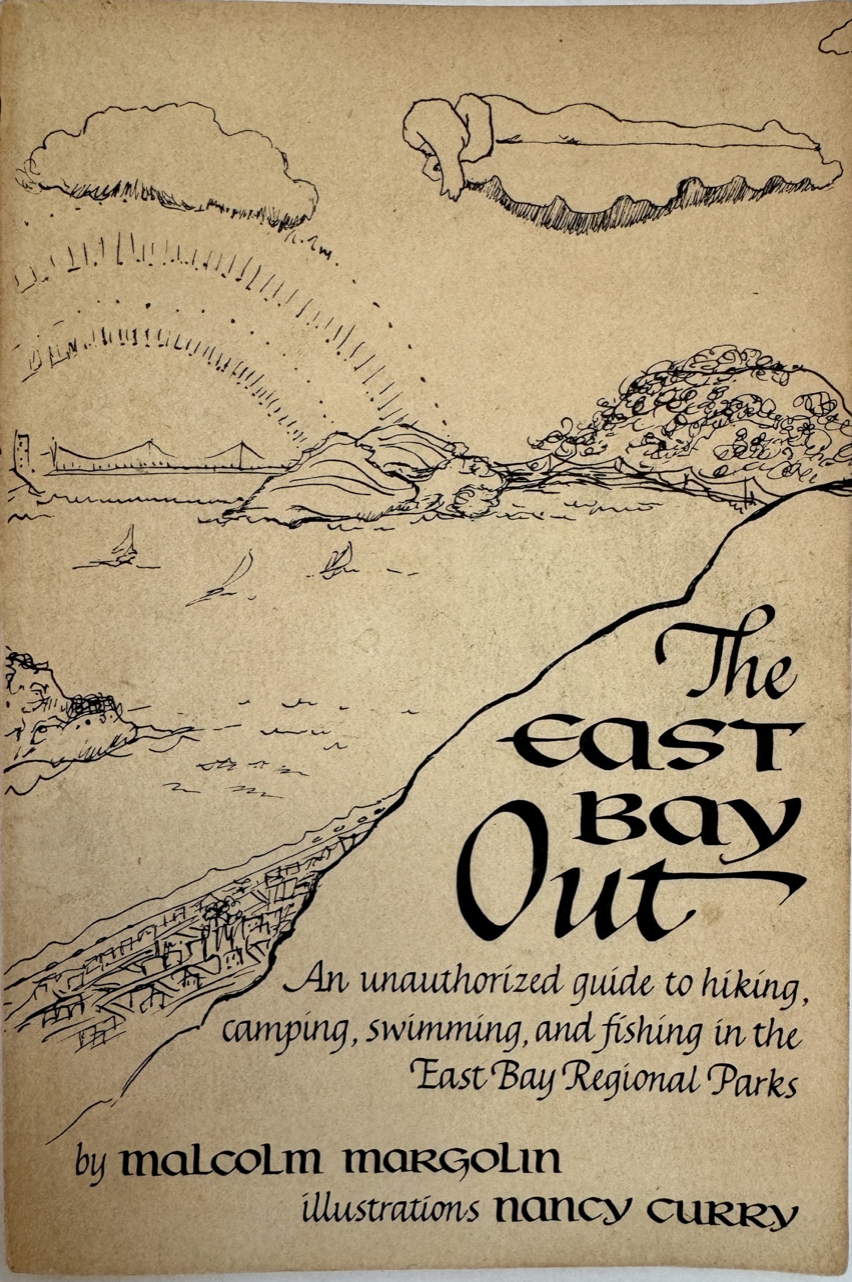
East Bay Out (1974)

For ever since idiosyncratic explorations of the region some fifty years ago, and the pioneering communication about the land he learned to know so well, East Bay Out (1985), the very deeply personal guide that allowed audiences to embrace to orient themselves to the Bay he loved, as if it were a world outside and beyond the familiar, to explore out of the paved regions of Berkeley, in what has been an increasingly compelling mode of deeply meditative work on the edges of settled world we collectively failed to pay sufficient attention as built infrastructure expanded. If an idiosyncratic sort of cartographer who bucked at the idea of having to follow rules, Malcolm developed a sense of wonder in the East Bay, as much as he simply moved there; as he immersed himself in its forested wilds, the parks became a keystone to the admiration of nature–as he grew to be the elder statesman of wonderment, never tired at pointing to the overlooked we needed to notice, and most at home when he engaged as deeply as possible in his surroundings, including, of course, its rich indigenous pasts to which he dedicated so much attention and wonder. As if the making of trails in Redwood Park were a weak fit with his ambitions and skill, trail-making lead him to blaze trails of inquiry across the East Bay, in part because of his resistance to following rules. If Thoreau had famously described himself as all mapping, for Thoreau, was indeed a form of reclaiming an ethical relation to space, from the recuperation of a mapping of an ethical relation to the Concord River that spanned its indigenous past and the present, through the French-Indian wars, but also, at Walden Pond, a universal history of heroic aspect and the present.  As Thoreau described himself to readers of his book–Malcolm knew it well–as the self-appointed “surveyor, if not of highways, then of forest paths and all across-lot routes, keeping them open, and ravines bridged and passable at all seasons, where the public heel had testified to their utility” Malcolm had a deep sense and deep meanings of new forms of mapping as a public utility.

As access to the wild shrinks and is constricted, Malcolm’s work stands as a theological practice of the outdoors, perhaps as rigorous as the ethical practices of his Yiddish-speaking grandparents, if more light-hearted and wondering, with an ample dose of John Muir’s sense of wonderment at the Cathedral of the wilderness. The sense of straddling worlds was perhaps a deeply Jewish angle to the past: if Malcolm was born in Boston in 1940, to a prosperous merchant family, less than a generation after Geertz had been born in San Francisco in 1926, the position that he had in Berkeley was one that left him little to be envy for his academic anthropological colleagues, more embedded than they were in local cultures in many way, but with the distance on academic preoccupations and terminology, or indeed on his scholarship: the sense that Jospeh Epstein expressed of both being “part of a great nation, and, having been born Jewish, simultaneously just a bit outside it, too” as being quite a position of advantage for a writer was, I think, an advantage Malcolm also felt–an ability to write as an insider and outsider that was magnified or redoubled in his relation to academic writing, and the establishment of a new press to publish his work on the Bay Area’s landscape–maybe in emulation of Thoreau’s self-publication of his first book, A Week on the Concord and Merrimack?–certainly gave him a sense of shared perspective on the massive extermination of indigenous California culture, and the ethical importance of preserving its vital life.

For if his sense of deep ethics were entirely secular, and resolutely so, the intensity of wonder and interest in the living landscape from which an indigenous past had been dangerously distanced was fundamental in his straddling of worlds. That book had helped re-interpret the regional landscape of the East Bay landscape that Malcolm, a transplant from the East Coast, to be sure, made his own to an ever=-growing audience of readers. He had self-published the book a few years before I arrived in Berkeley, CA myself, as it happens, after Malcolm had become a force in the attraction of renewed fascination to the rich ecology of the diversity of the Bay Area’s natural history and the scale of their loss–The Natural World of San Francisco (1967) had just appeared in print, and former rock climber David Brower had already started to agitate tirelessly to preserve the natural landscapes of the Bay Area, fighting for the conservation of areas of seashore and wilderness in nine national parks from the Point Reyes National Seashore led to the adoption of the pioneering Wilderness Act (1964), promoting the notion of coastal preservation was energized across the country, in ways that created a legacy for conservation only being recently turned back after a generation has taken it for granted. Soon after land acknowledgements became the norm in much of the United States, and were played regularly on the PA system of Berkeley Libraries, to remind all reading that they were so doing on “unceded” Ohlone lands that the tribe possessed from time immemorial, the ground has shifted under our feet. The position of wonderment that Malcolm long held, from tromping around different East Bay parks to exploring the region that he convinced all who would listen was a wonderland, provided a source of resistance to the development of the Bay Area, a deep environmentalism of historical consequence. And uncovering trails of wonderment was what Malcolm was all about.

It may make sense to take stock of the major shift of the Great Society and 1970s of land conservation as part of a massive shift in collective memory of which Malcolm was part. If the Regional Parks provided a crucial space to hold the state in abeyance, and indeed to keep the state out of one’s life, the shorelines preserved in seashore parks–including much of the coastal region of California, that would lead to the California Coastal Commission–afforded an early notion of a remove from the state, by the early 1970s, to preserve the entire coastal waters of 1,100 miles of coastline from uncontrolled development of coastal property that would prevent the loss of access to coastal waters and the shore by 1972—best understood in the somewhat longue durée of the foundation and preservation of a ten national seashores across the nation from the early 1960s, a distinction that defined the nation’s drive to coastal preservation during my own childhood.

David Brower and the Foundation of Ten national Seashore Parks, 1961-1972

The memory of conservation may have faded more quickly, if Malcolm’s work did not help keep it alive. The local new energy of treasuring wilderness by books on open spaces, environmental awareness, and nature photography, calling for an ethos of conservationists of leaving absolutely no mark in the landscape “save the scars upon the Earth that could have been prevented had they stood their ground.” The pioneering work was never so clearly seen as in the creation of national seashores–an effort that might have begun on McClure’s Beach in Marin County, just outside San Francisco, and Tomales Bay Park, but created energy that led to the creation of “national seashores” across much of America–from Cape Cod (August, 1961) to Pt Reyes (1962) to Fire Island (September, 1964), to Cape Lookout (1966) to the Gulf Islands (January 1971)–and Malcolm saw the regional parks where he worked as a groundsman 1970-72 as something like an alternate text to the map of the current Bay Area, developing as an East Coast transplant a distinct sense of wonder at the biodiversity of the parks that survived, even if the rich range of grasslands, nourishing streams, and herds of elk and bears that once roamed the land that was cared for by indigenous survived only in the testimony of the first settlers. And if many are annoyed but he land acknowledgements that have appeared on university stationary, movie theaters, and play houses and arts centers as if pious obligatory statements, offering but lip service, the importance of preserving and observing the forgotten history of the land was a movement at which much of Malcolm’s work set the ground.

As much as a new Henry Thoreau, Malcolm remained at the helm of the press of most of his life–only leaving with reluctance, continuing even after his retirement to be an advocate of offering a path for all to find their own Waldens, and by a plurality of Thoreaus, not only in the Bay Area but far beyond. And if the parks provided a way of thinking outside the state, and subtracting oneself from the state that was increasingly entering one’s head, it is more tragic than ironic that as we stand at the prospect of a government shutdown after his passing, the President defined by a moral void and absence of any moral center seeks to furlough parks workers in response to the eventuality of such a shutdown, and indeed to mandate leaving the parks open to all Americans, supervised only by a with a rump staff, flying in the face of expert advice, not deeming the workers who run them to be essential workers who must remain on their jobs for its duration–if some in the National Parks would be required to stay on the job, but have to wait for back pay. Parks Service was already reduced by a quarter since Trump took office at the year’s start, cutting backcountry visits, the presence of rangers, and relying on volunteers at parks as historic as Yosemite, but the reduction on critical maintenance of open lands and disaster preparedness may damage the very preserves for which a generation fought. If Malcolm would have hoped the compromise would spur a range of public protest and indignation at an end to wilderness protections, we’ve been so battered by an onslaught of public absence of oversight to make the prioritization of open park lands as a preserve to subtract ourselves from the state may be a challenge, even if it shouldn’t be.

A clear-sighted of environmental visionary, Malcolm was able to corral multiple folk behind his vision to crusade for promoting a sense of happiness in envisioning a future and better world. For much of what Malcolm agitated for was a better way of settling in the world–and indeed being settled in the Bay Area–than was evident in the landscape of development that was emerging in the years he arrived in the Bay Area, in ways that allowed him to make it home. The energy by which he teased out meanings from alternative geographies of his adopted home of the East Bay, of plants, animals, and past inhabitants opened eyes to new geography of place and space in the region, against an increasing automotive space defined by the straight lines of property, highways and trip-tiks–those ancestor of GPS, ordering spatial travel on fold-out paper map, highlighting stops only for hotels or scenic views, of clear edges, privilging boundaries and confines of attention in place of marginalizing the off-road parks. For rather than encouraging investigating the off-road regions at small-scale, maps offered a purblind image of place. (It may well have helped Malcolm didn’t drive, but made the lack of a license into a virtu:e: late in life, he smiled regaling me the distinct advantages of not driving, reminding me how he benefitted form never driving: both to getting driven home from parties and always meeting people in the rear seat or be given rides that had led him to meet the most interesting people who drove him home in the rear seat of their cars.). The handbook he wrote for exploring the Bay Area’s parks on foot, and to lead other groups to marvel at their wealth, was a large part of Malcolm’s source of energetic vitality.

Berkeley was a perfect place to find interesting people to talk to, no doubt remembering his life as a bon vivant. When we had met on the Bay Trail, Malcolm’s Old Testament beard wafting in the wind as he turned the Bayshore Trail that day seemed a sort of synecdoche for the testimony he offered and channeled of collective memory of the bay, and of the land, deeper than any map, that might be captured by deep time, or deep hanging out, to use the phrase of Clifford Geertz he was fond enough to use as a title for his final book, to claim the anthropological mantel he had been accorded even in the aftermath of some resistance to his appropriation of indigenous testimony as a record of a timeless past. And ever energetic, even in the assisted living quarters in Piedmont, he swept his hands in the air as he optimistically envisioned the ways that “people will take to the streets” against the Trump Presidency, which he asserted would bring the greatest revolution in political self-awareness since the sixties, convinced of the huge benefits on the horizon, if no doubt at this point also reliving his own love of the protest culture of the late 1960s, and perhaps taking a far more positive view on American politics than I had the heart to contest.

The belief in the value of a deeper knowledge of the Bay, deeper than the aims of developers or the maps of property, animated Malcolm as it had animated, in a sense, his entire energetic career. The promise and premise of East Bay Out, a work long in making, was that we’d all do better to cultivate the off-road and unpaved.) Was not the fixed itinerary one against which Malcolm rebelled in expanding attention in East Bay Out on a broader concept of space and place, worthy of attention, directing increased attention to the parks he knew so well? The elegant if austere line drawings of Nancy Curry helped to offer an assist to visualize the parks he knew so well as an off-road region worth exploring, to not allow to be reduced to rectangular regions of green–

–providing personalized itineraries treated travel as a process with no detours or uncertainties, as an experience mimicked by the streamlined paths of AAA versions of Bay Area Rapid Transit map-

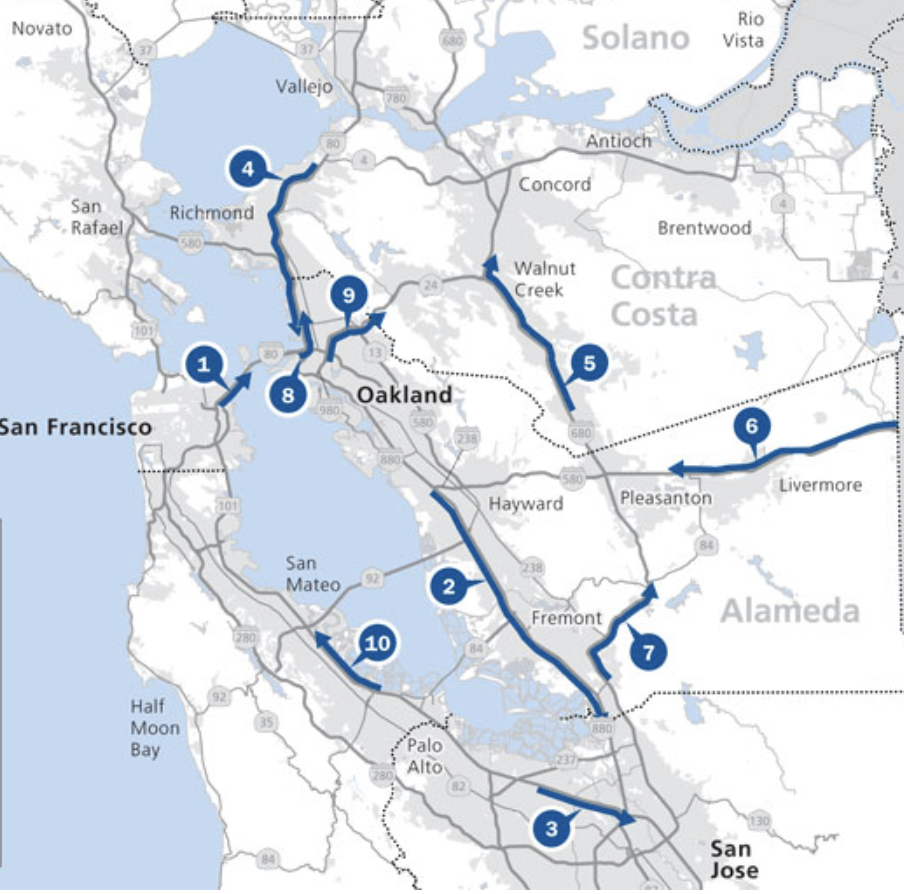
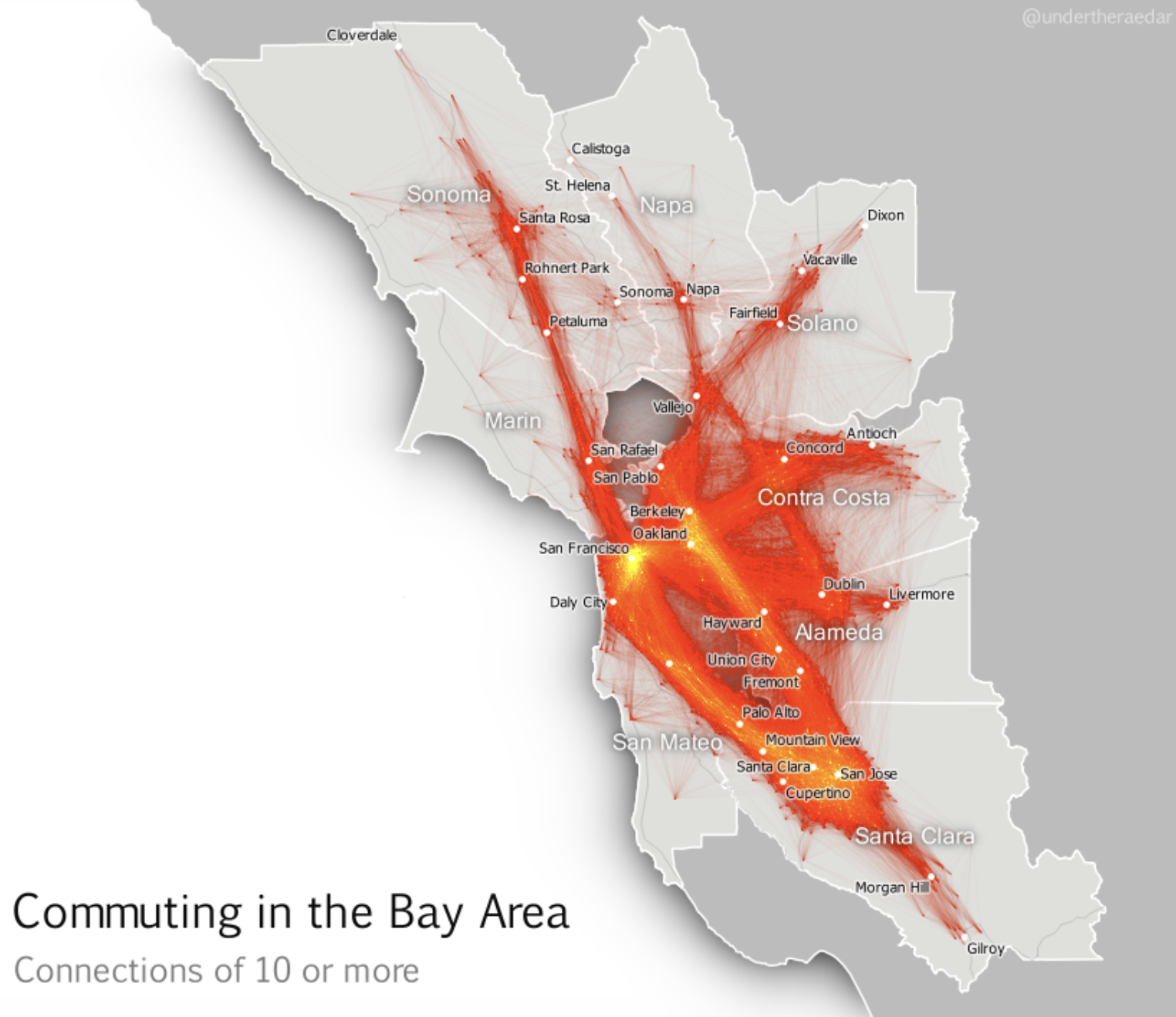
-a region where the transit map and commute intensity has grown rapidly, if not astronomically, in recent years–so that the average distance commuters have lived at an ever-expanding distance from work, and the already considerable ten mile commute of 2019 has nearly tripled by 2025, and commutes across Malcolm’s treasured Bay Area have put folks working in downtown Oakland from ever larger distances at which they rarely have time to experience the green areas in the map, or the riches of the Bay–a distance of commute that have dramatically expanded since the commute has grown to almost thirty miles, creating a hellish commute that compromises time outdoors.
Commute Distance at which Workers in Downtown Oakland Live, 2010

At the time as this distribution of the daily commute across the freeways of the East Bay, Oakland Mayor Mayor Libby Shaff promoted the tree the symbol of the city–affixing it to all street signs in the city as a new proud logo of the greening city–promoting a tree-planting project across the city that would reclaim the city’s live oaks celebrated as a the basis for plentiful Oholone harvest of acorns, a mission to  “re-oak” Oakland beginning with the planting of an inaugural stand of 72 saplings of coast live oaks in plastic buckets in a West Oakland park, realizing the deep belief, endorsed by landscape architect Walter Hood of UC Berkeley, how“Names are a powerful way to think about a place,” and first proposed the Mayor’s recent resurrection of the city’s forgotten groves, first celebrated by men like Malcolm Margolin as an indigenous inheritance. If the impact of the Ohlone Indians on the landscape they distinguished led Spanish and Mexican residents of the mid 19th century to name the place “encinal”–or oak grove–the protection of the trees already fast disappearing from the region in the 1850s as it grew led its first mayor, Horace Carpentier, to try to protect the trees, even as oaks were felled for development and the expansion of its gridded streets.

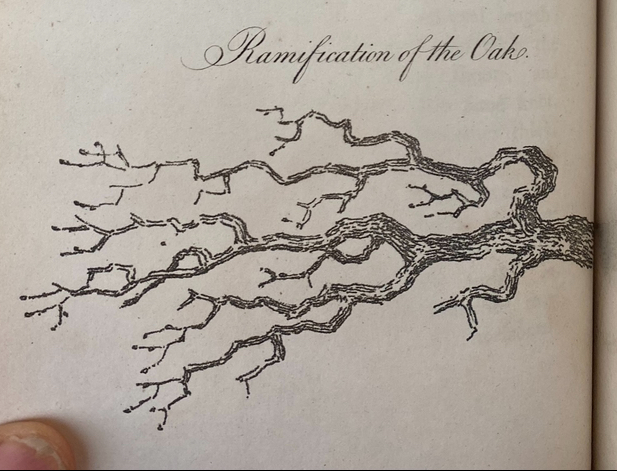
Today, few oaks survive save landmarks that stand as sentinels, as the Oak in front of City Hall, whose canopy of tributaries of branches was only planted in 1917, but was adopted as an icon of the hope to remake the city in the sign of the sheltering canopy of the expansive green tree once more.

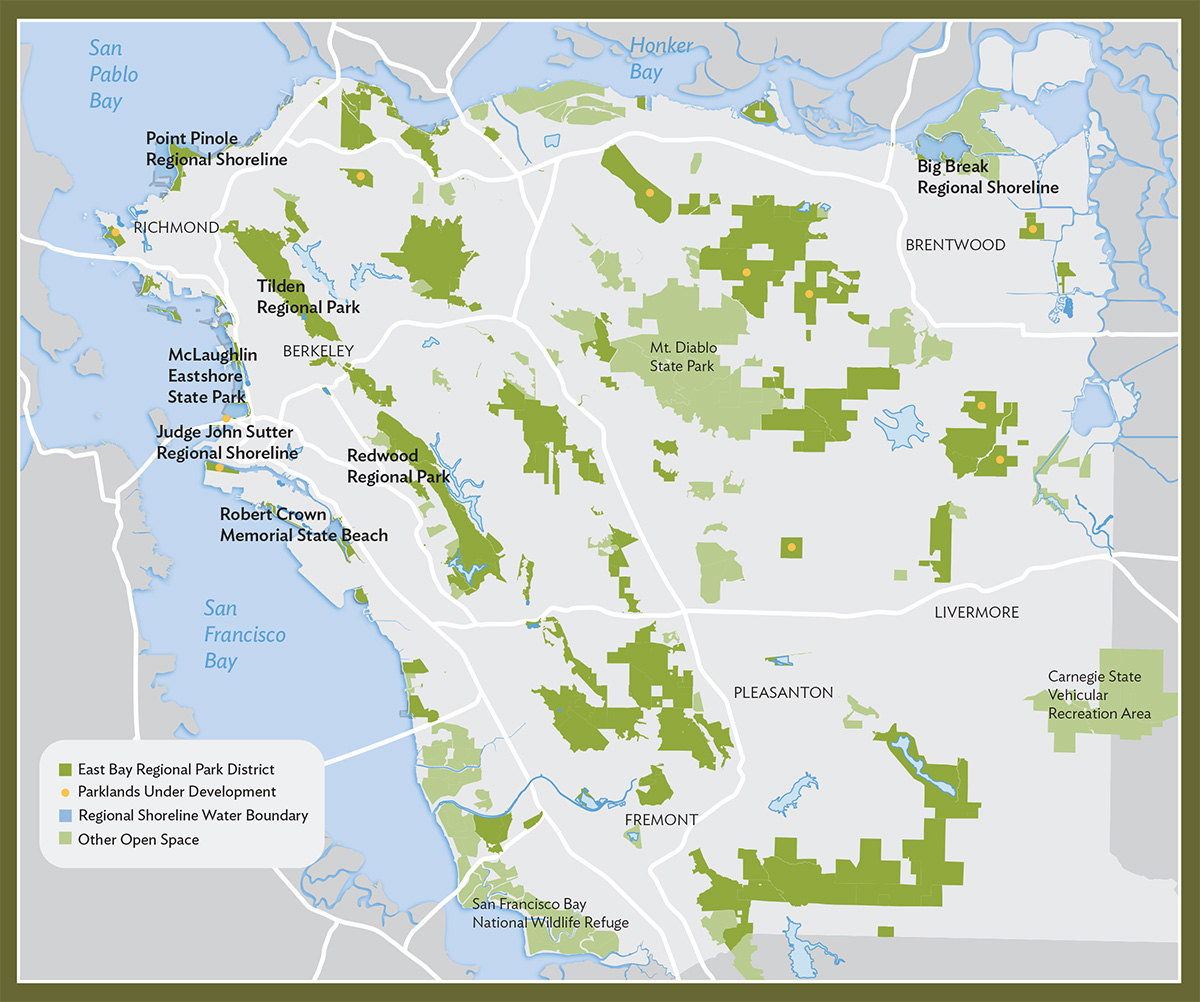
Malcolm’s heroic task was to remind us all of the green areas that are on the map, before they are mapped out of existence or public consciousness, and remind us how easy they are to . Indeed, vast areas like the 5,924 acres of Sunol Regional Wilderness, the over 5,000 acres of Briones, the nearly 5,000 acres of Anthony Chabot, 2,000 acres of Redwood Park and Tilden Park, and the slightly less large but brilliantly illuminating grand 1,500 acres of the Morgan Territory were something like negative lands, too often unexplored, not to mention the reduced rump of what has the grandiose name of the Ohlone Regional Wilderness, situated between Sunol and Del Valle, that suggested a new topography of space in which Bay Area residents were urgently asked to reorient themselves in Malcolm’s pioneering work.

The dreamy cover of that “unauthorized” paperback guide to the region–East Bay Out (1985)–certainly offered a decidedly off-road record of outback experience of the region, neither a God’s eye or bird’s-eye view, its old cover featured a blissed out Malcolm or reader floating above the bay from atop a cloud, looking down on a built but intriguing bayshore, as if in harmony with nature, ready to descend explore the open areas for camping and swimming the book described. (It is hard not see the cover, as I never did before, as an image of Malcolm Margolin floating as a benevolent spirit presiding above the coast of a region he celebrate with enthusiasm and came to know well.). If perhaps the figure on the cloud was an iconic persona of the Aquarian Age, Malcolm adopted the calligraphic skill of Bay Area penmanship to invite all readers to tap their inner Thoreaus in the guide to living outdoors–hiking, camping, swimming, and fishing–in their own Waldens able to be discovered not far from the edges of urban life in the East Bay Regional Parks. An evangelist and a guru, as much as a historical anthropologist, Malcolm led the way from his own cloud to the future.

The East Bay Out (1989)

I first saw Malcolm one afternoon pacing leisurely on a recently restored shoreline in the Berkeley Marina, he seems rooted in the Bay Area he loved so much, moving along the path quite rapidly and deliberately on paths restored in by 2009. The remade wetlands home to many more birds than a decades previous had been a major victory of the restoration of the shoreline he had very much promoted and must have relished. Perhaps ever since Malcom came to Berkeley, he was seeking actively to front the wild, as Thoreau would put it, with joy–rediscovering the parklands as if facing a frontier–Thoreau’s sense of the word–but not the frontier of lands held by settlers, that deserved to be seen again by the wilds that it still contained.

1. Instead, it belonged to the bayshore people he had made his own alternative present. There was a sense of the urgency that he did so squinting in to the horizon, as if he were looking for signs of the past occupants of these native lands that he knew so well, seeming as he walked an Old Testament prophet on a New World coast, beard buffeted by a bayshore breeze. He caught my eye before we had ever met, and I already wanted to know what he was so clearly thinking about. But, if Thoreau was walking the paths alone, Malcolm seemed eager to invite others to walk the same old paths with him. When Malcolm confided somewhat conspiratorially either at the outdoor tables of Saul’s Delicatessen or Piedmont Pines how much Berkeley was a perfect place for “folks like us.” No doubt the had long honed the pitch of overly generous flattery to make one feel part of a club, and promote the rather miraculous trajectory by which he had founded a productive press and nourished a new community of readers long before Indian activism.

But he praised the city and its active readers, sense of responsibility, and accessible libraries as a treasure: access to the libraries of UC Berkeley that he so often used from when he first arrived in 1969. There was a vision of rediscovering the old landscape by a poetics removed from the present day. In ways, he echoed the sentiment of recovery that was voiced by Thoreau, when he imagined the poetic practice of exploring, as if “I walk out into a Nature such as the old prophets and poets, Menu, Moses, Homer, Chaucer, walked in,” a landscape he offered “you may name it America, but it is not America: neither Americius Vespucius, nor Columbus, nor the rest were discoverers of it [sic],” but was arbitrarily named on maps, in which but a “few old roads that may be trodden with profit.” Somewhere, Malcolm still walks wider trails. The sense of a pre-Columbian contact with a lost land was dear to Malcolm, who never got rid of describing the encounter–more accurately than one of conquest–as the arrival of a starved and tattered group of Spaniards disembarking from ships on the edge of a peaceful, settled, and economically established nation, hardly in need of mapping and having already persisted as the engaged custodians of its plentiful ecosystem whose rivers fed fields and forests regularly harvested and maintained for a range of coastal peoples.

When we met, I had no credentials or a university affiliation, but couldn’t help being flattered by the attention. I now realize how much the East Bay was a living library for Malcolm–a library without walls, and an interconnected one that couldn’t be segregated on shelves by call numbers or single volumes. I don’t think it is a library that won’t be so deeply appreciated without him here. But the energy and encouragement to interrogate and appreciate its hidden maps, and hidden pathways, will be wanting an active a set of prompts and stimuli. Malcolm Margolin had found a home in the East Bay, but also made it one of the more interesting places for discussing books and ideas outside of university libraries’ bookshelves. And Malcolm of course worked to open eyes to alternative geographies long before the multiple alternative hand-drawn atlases of urban nature and bayshore habitat evident in the restored wetlands,–or the new cartographies of Obi Kaufman or Rebecca Solnit of California–he did much to encourage, to open eyes far beyond the rich bay. But if John Muir saw the wilderness of Yosemite as a cathedral, to pursue my analogy, the more bookish Malcolm saw it as a living text, pulling out threads of narrative with endless curiosity that have altered our picture of it and encouraged the stability of a built geography to be questioned.

Malcolm was walking that afternoon with energy, around the bayshore trail, alone, as if in the footsteps of the shore-dwelling Ohlone, enjoying the restored shoreline rather recently completed, and of which he was so much apart. Eager to catch or notice something new, the man seemed a long-haired bearded prophet, to watch, even if I didn’t know who he was, with something like awe, as if he were looking for a new frontier of natural observation, retreading long untrodden shoreline paths able to be imagined of the indigenous community of a once highly populated East Bay.

Bay Area Indigenous Language Groups and Coastal Settlements/Levy (1970), amending Kroeber, 1925

Malcolm may well have been in that moment envisioning the lost past of the coastal bayshore as he moved deliberately across the shoreline trail, as if searching for evidence while scanning the shoreline as if squinting for traces of Ohlone shell-mounds long since lost to the landscape. He had done so much to preserve the memory of the shell mounds, many of which were leveled in their entirety the 1920s, at the same time A. L. Kroeber had begun to teach anthropology courses about California’s indigenous in lecture halls at U.C. Berkeley. Kroeber, who was attracted the artifacts and symbols of the indigenous, seized on the project of “salvage ethnography,” in the footsteps of the mission that his teacher Franz Boas, linking archaeology and ethnology in artifacts, proclaimed the Yahi Ishi in 1911 to be the last surviving “wild man,” cornered by dogs in the hills near Lassen, of a tribe he believed exterminated by white settlers of the state, who he proclaimed “the last wild Indian in America,” who died from tuberculosis five years later in captivity. Seeking to preserve the final remaining traces of the indigenous cultures Kroeber believed vanishing or gone, he imagined a map torecover the expansive linguistic repertoire of a lost indigenous world across the state of California, mapping the linguistic groups of California’s former residents as a living world in a cartographic symbology of set boundary lines and distinct colors of discrete linguistic groups.

Linguistic Groups of California and their Families (1925)

While Kroeber did encourage skeletons from indigenous graves, including the massive shell mounds that had formed burial sites of ceremonial veneration over time, the massive structures of over thirty feet tall and longer than a football field in length to assemble knowledge stretching back thousands of years he believed confirmed “the permanence of Californian culture is of far more than local interest,” as he wrote in 1925, but “a fact of significance in the history of civilization.” The elevation of the moment of contact to an inverted picture of starving if not ravenous Spaniards, alienated from the land, meeting a stable society of flourishing tribelets living without money and not needing intentionally offered a new perspective on civilization itself.

Malcolm did much to affirm the importance of indigenous California in global history,–if for different reasons and an opposed logic by insisting on the necessary importance of indigenous anthropology for the present day: the veneration of these ancestral burial grounds had functioned as a permanent ceremonial site for the itinerant coastal peoples, and of orientation for a modern world that was far more out of joint and less attuned or aware of historical change. In keeping with the razing of many historical structures in the East Bay, the mounds Kroeber urged pillaging for evidence of native habitation were unceremoniously cleared for railroad tracks, paint factories, and parking lots of the malls now located on the level ground of “Shellmound Road,” a small stretch without hint of the massive structures over thirty feet tall that existed for each of the villages that dotted the bayshore before the arrival of the Spaniards, serving as navigational markers in the bay, as well as sites rich with ancestral meanings that often had their own names. Alfred Kroeber’s obsession with the pre-contact civilizations led him–much as Thoreau adopted the same word for indigenous at Walden–to call Amerindian tribelets “extinct as far as all practical purposes are concerned.” Insistently inverting that demeaning word–extinct–by revealing proof of the continued vitality of Ohlone culture and cultural practices was very much what Malcolm was about, as was asking us to re-see the Shellmound as a heap of rock to be excavated, cleared, or plundered. These were also lost worlds of a past that must have seemed fantastic, not only to his daughter, Ursula K. LeGuin, but to Kroeber himself, who, fresh from the east coast and armed with the toolbox of Frans Boas, saw a new world being able to be unearthed directly before his eyes with fascination.

Excavation of the Emeryville Shell Mound, 1924/Phoebe Appleton Hearst Museum

Many of the once abundant superficial traces of the shell mounds were long ago leveled, but they persist not only in local memory. Underground mounds are often intact, below the urban plant; when I saw Malcolm prowling the shore; he was smiling in satisfaction at encouraging negotiated agreements between the city of Berkeley and the Muwekama Ohlone, for the fate of mounds seen as sacred for over some 4,500 years, erased to the short-termism of the present, in which over four hundred and twenty-five shell mounds were constructed, often outlasting the villages that they once accompanied as sites of burial and focal points of community life of the sort Malcolm celebrated and waxed eloquent, as the oldest mound in West Berkeley, nearly 5,000 years old, only landmarked in 2000, long fought over by developers, more than anthropologists or historians.

Map of the San Francisco Bay Region, Showing the Distribution of Shell Heaps along the Bay Area, noting mounds on the coast as Present, Partial and Destroyed/N.C. Nelson, 1909

Map of San Francisco Bay Region, Showing Distribution of Shell Heaps (1909), Native History Project

As much as saddened by his death, Malcolm’s sense of the patrolling of the wild, or the edge of the frontier of wilderness, or just the shoreline, is a model for the persistent reminding of wilderness’ continued survival, and importance, to the world. Malcolm began as an East Bay Parks man, immersing himself in the 60,000 acres of east bay parks, far beyond the shore, For the relatively quite recent transformation of the parklands from open space bears historical traces not so far from living memory of the historical habitation of its open space, and the preservation of of the old shell-mounds in the recent historical record, and indeed present in local tangible artifacts that offered a new means and a pressing one to understand the history of many of the forty parks .

East Bay Regional Park District Today (2024)

The areas that were only just being explored, camped in, and lived in were something that he recognized as a valued historical repository, and indeed one to celebrate as part of the Bay Area. If Malcolm gained a new sense of himself in the East Bay as a ranger in Tilden Park, his unique brand of celebrating the region beginning from the orientation of the community to its parks, Malcolm was always looking for the survival of the wild. The light green overlaps of this map of the regional parks, or this modern expansion of the Regional Park District that exists today, omits much–the rich and enormous stately live oak trees, whose rich and nutritious acorns made the region a veritable storehouse of a plentiful supply food gathered, hulled, dried and stored as a nutritious staple later boiled as mush; or the seagrass of the Bay Area shores, that made the shore such an important meeting place and trading post for different tribes; or the willow stems and reeds in coastal marshes and rivers that are woven into baskets. These are of course among the layers of East Coast history, not evident in most data visualizations, if any, by which Malcolm taught many to re-see or see again the region of the East Bay–or offer, to cite John Berger, several ways of seeing.

Perhaps it was during his stay as a ranger living in the park, touring visitors, and walking its paths, the arms of towering native live oaks of up to two hundred and fifty years old stand as witnesses of another age seemed to welcome him. Is it a coincidence that the cover illustration of Carl Dennis Buell of The East Bay Out, Malcolm’s “Personal Guide to the East Bay Regional Parks” written after leaving the Parks Service, featured in silhouette the capacious canopy of the elegant towering tree? The Enlightenment image of the Oak Tree on the cover of Malcolm’s book might have belonged to the engravings of the great English naturalist Thomas Bewick, who admired the brachiation of the oak as a source of divine marvel–a marvel that Malcolm seemed so eager to recuperate and transmit as a form of resistance during the shifting settlement of the East Bay. If Bewick became an engraver–and indeed raised the status of engravings–to communicate trees and avian riches of his native Northumbria, in boxwood woodblocks, that elevated wood engraving to a register of natural description, Malcolm became a printer to promote the Bay Area as a rich habitat, and increasingly as ancestral lands worthy of veneration and of better preservation, to encourage a sense of wonder and amazement by communicating the depth of his feelings about the East Bay.

Bewick was an early naturalist of the modern world, an author who brought attention to the rendering varied leaves and branches, birds, wildlife, and rustic places to the eye by borrowing the engraving burins to capture the gnarly branches of oaks laden with leaves in wood plate with a density of fine lines–opening to the world a warm generosity of wooded life–

Engraving of Live Oak after Thomas Bewick’s Engraving of Oak Tree

–it is hardly surprising that the great naturalist’s rendition of the generous canopy of the oak became something of an icon for Margolin’s own guide to the Bay Area, East Bay Out, the unknown “outback” beyond the built up area of the Bay, a sort of forager’s guide to the riches of wilderness akin to Bewick’s own investigations of Northumbria–

Thomas Bewick, Engraving of Oak Tree Dwarfing the Nearby Town

The oak trees that Bewick became famous for engraving–as birds; inhabitants of wooded lands–intentionally shift our focus of attention as readers of his books from the towns they lived in to the surrounding natural world. The images of the woodsmen who were more engaged in nature were Romantic icons, but, as a modern-day Thoreau, focussed on the natural world in place of the built world, less concerned with human engineering or artifice than the importance of attending to the surrounding natural world in Northumberland countryside that he most often drew, calling attention to its oaks, birds, and outdoors to offer a unique angle on the industrializing landscape.

If lying off of the beaten road, and outside built environments, showing other forms of life far from the city, foregrounding on details of the landscape the cleric William Gilpin had focussed attention, akin to moments of rural repast, drinking waters of fountains and waterfalls from a traveler’s leather hat.

Thomas Bewick, Tail-Piece of History of British Birds (1821)

There was a Thoreauvian sense of transcendence of the local that animated Margolin’s attention to the environment, of which the oak might stand as a transcendent icon. Although oak moths have recently arrived in the richly brachiated canopy of the large coast live oaks in UC Berkeley, as they regularly do, feasting o foliage of the Quercus agrifolia for multiple recent years–2019, 2020, before again 2025–and prematurely cause grey and brown litter of leaves to fall in heaps, live oaks endure the regular pillaging of leaves, returning to their familiar evergreen in a manner of weeks, as they regenerate buds, leafing out once again in a matter of months. suggesting the huge vitality of trees that seem sick. The rapid recovery that the coastal live oak makes regularly from the onslaught of voracious caterpillars as the e California oak moth strip the trees of their expansive verdant canopies without impact on the trees’ long-term health, as within three months they leaf out, regaining health almost suggestive of a rebirth by deep reserves of energy–making it unsurprising Malcolm adopted the distinctive tree as an emblem for much of his work. The brachiation of that oak branch recalled the eighteenth century aesthetic renderings of Reverend William Gilpin, one of the earliest coiners of picturesque “landscape,” with a scientific attention to detail, attening to natural forms as if revealed truths–admiring that “peculiar kind of beauty, which is agreeable in a picture” as able to provoke a discerning interest in the wilderness as providing esthetic forms–

The branches of the oak were an aesthetic opening of attention to the country–and provided Gilpin with a basis to ask his viewers, similarly, to adopt a new attitude to expanding cities, guiding their eye past those branches to the human space in the backgrounds of his paintings, cannily situated far behind those gnarly oak branches that frame historic ruins, far more worthy of attention.

The live oaks around Berkeley were part of the animate landscape that endured across time in the regional parks today whose green leaves regularly return even after their branches are stripped bare, taking part in an ecosystem they almost miraculously seem to refuse to leave. The brachiation of the oaks had been something of a pillar of natural history from the late eighteenth century, as naturalists as Thomas Bewick called attention to the brachiation of oaks within the complexity of natures worthy of marvel–an ancillary art to Romantic poetry, and William Wordsworth even vowed “that [if] the genius of Bewick were mine / And the skill which he learn’d on the banks of the Tyne / Then the Muses might deal with me just as they chose / For I’d take my last leave both of verse and prose.

Thomas Bewick

Malcolm was perhaps less willing to wear only one hat as a guide to the beauties of the unbuilt regions of the Bay Area, but more eager to play the Pied Piper to a generation in the outdoors.

2. The towering coastal live oaks in Berkeley inspire awe in their brachiated canopies,–maybe an awe Malcolm picked up, of going native in the arranged marriage between himself and Berkeley. The arranged marriage to the Bay Area may have arisen out of convenience and necessity but developed into one of mutual admiration and respect was deeply nourishing and profitable to many, born out of deep sensitivity to place and to forest grounds he encountered in the East Bay. The rich guide that he provided to the “outer” East Bay became almost an ecological resource of its own right, a prompt to preserve its wetlands and restore its parks, to act as a custodian of open space and forested hills, even in the fear of fires that has come to grip the region in later years.

It led to a readiness to question the authority of the modern map–to see the “East Bay Out” in other words–and relish the absence of all anthropogenic presence in the first maps of a seemingly pristine Plane de Puerto de Sn. Francisco” (1776) of a fortuitous date indeed by José de Cañizares–stored by the Bancroft Library, the very year that Americans declared independence from England,–that offer a caring attention to the estuary and tidal marshals of the region, and its bay waters:

José de Cañizares, “Plano de Puerto de Sn. Francisco,” 1776

–long before, Malcolm would be the first to tell you with a large knowing smile of taking real satisfaction in an incontestable fact, Americans had arrived in San Francisco. Those drought dedicuous live oaks were indeed among the plants that native Bay Miwok and Oholone people had increased in their biodiversity in the canyon woodlands, offering year-round specialties as acorn soup, leaving a lasting imprint in the range of oaks, each tree able to provide up to 10,000 acorns and offering rich habitat for animals who would bury many of the acorns stored underground.

The trees offer a rich and often drought resistant canopy for birds across much of the state, that allowed the Coastal Live Oak a corner species for coastal ecosystems up to eighty feet tall, their dense green foliage often improving the health of nearby plants year-round, in a more recent map. I think of Malcolm as able to toggle between both maps, but as realizing the need to allow multiple ties between art and cartography, and recognize the poverty of relying on data-driven maps–an implicit point to which this section of this post will return in hopes to make his case. For indeed Malcolm, as much as anyone, was crucial in redefining how “we” see the East Bay, and the identity of the East Bay as a region over time–from the time of first contact, when a group of starving white European colonizers in rags arrived on the coast of what would be Alta California, and gave it its name as a region by 1804. Malcolm was interested in peeling back that map from local informants who might help tell the tale of how it existed earlier, a real “historian” of historical anthropologists.

Population of Coastal Oaks in coastal California/National Institute of Statistics and Geography

Perhaps from when Malcolm made a decisive stand of resisting wearing the uniform of a parks ranger–a moment I have long imagined was a deep-seated conviction based on the deep sense of kinship he felt to the stewardship and identification with the land–Malcom was listening to local signs of evidence of the Bay Area lands he loved so well, and his attentiveness to the bonds of local inhabitants to the lands, as much as the shores, in no small part led to a new awareness of the local indigenous settlement of the region, and the poverty of failing to appreciate indigenous inhabitants of the region as custodians of the lands he knew so well, whose lives are impossible to separate from it. The sacred nature of relation to the land that was fed by some thirty creeks, filled with freshwater fish, animals, and many thousand species of birds, who Malcolm imaged might fill the sky so densely to block out the sun, suggested a powerful narrative of the loss of colonization and the absence of stewardship he felt today, before which a better map of the region provided a deeply therapeutic and indeed restorative function, inseparable from attention to those lands.

Indigenous Tribes and Native Peoples of the East Bay/image courtesy Sogorea Te’ Land Trust

The traditional names of the lands he was so committed to exploring and orienting others was inseparable from the map, but had been forgotten and left off of it–and one of the last final efforts of Malcolm sought to mobilize, where I got to know him better, was the ambitious project of remapping the entire state of California in ways to make the forgotten indigenous presence more centrally legible. Malcolm’s urgent message is of course increasingly pressing today, and continues, and the importance of the deep relation to the fragile topography that of a web of rivers that the Seogorea Te’ map above so lovingly details by light shades of blue and green, in place of cities, urban settlements, or property lines.

Encouraged by the fertile grounds of increased awareness of the needs for ecological stewardship of the land of an early environmental movement, from the Save the Bay campaign already founded in January, 1961, and in the Bay Area fertilized by Wendell Berry, and Gary Snyder, and nourished by the small non-profit presses–whose rights to the work of Berry and Snyder sustained them by digital sales alone. Snyder, who had studied anthropology and folklore by the transcribed oral tradition of Haida storytellers at Reed University, glossed glossed the oral literature as the creation of healthy art of mythic narrative vibrant with keys to the forgotten sustainable cultures of North America. Already possessing a poetic ear, Snyder read the transcription and careful translation of what ethnographers presented as a local Haida informant as a vital resource of a vision quest in an era we had lost a sense of orientation to animal spirits or birds, examining the “dimensions” of the myth as a needed resource, perceiving the animism of its telling as a living artifact and meaningful performance of culture. Did his reading of Haida myth provide a direction in which Malcolm would work? The early works of what are now environmental classics would certainly pay dividends for the independent presses. (When Margolin retired after Heyday press’s fortieth anniversary, it was robust enough to expand to Los Angeles, and be a fixture in the region’s as well as the nation’s literary landscape; renewed interest in new editions of Snyder and Berry’s works helped expand it expand catalogues to popular works, updating the classic corpus of independent Bay Area presses.)

Did the regional parks offer an alternative text by which Malcolm was eager to map the open areas that still existed, not yet encroached by development, as sites of continued wonderment? They certainly stood as evidence of a former wilderness, encroached by the boom of expansion of so many of the cities that make up the Bay Area, a boom that began in the 1950s, evident in this map that imagines the tree rings of local population centers around the Bay, many of which emerged only in 1960, that provide one of the most unique forms of growth of an urban agglomeration in an area where wilderness was precious: if the metaphor o f the tree ring offers a nice cartographic symbology to imagine the Bay Area as a site of uneven, but rapid growth, 1960-2010, in ways that overlap with Margolin’s heyday in the region he provided so much of an alternative counter-cartography, the expansion of cities like Concord, Fremont, Antioch, and San Jose that now form a dense inner core of the Bay Area that might be called the inner ring of commuting, was an incursion into open lands greenspace, where the parks provided evidence of the rich biodiversity and offered more than a refuge–but an alternative way of imagining its future.

Growth of Population in Urban Cities and Towns in the Periphery of the Bay Area, 1960-2010

One might grasp the force of promoting the regional parks as a critically important heritage of surviving biodiversity of a region that was compromised already by farming, wood harvesting, and the damming of some of the most nourishing rivers of the coastal ocean, including the San Pablo to create a large reservoir for drinking water by 1919, that compromised the rich ecosystem where early settlers describe catching salmon with pitchforks in its waters, and Malcolm would have sought the local informants for evidence of the rich topography he felt still survived, but had been preserved by a relative miracle of land conservation and preservation as conservation and preservation efforts were blooming in their own metaphor ecosystem around the East Bay.

This was the destination of the readers of the books Malcolm was beginning to set out producing, at the same time as conservationists were promoting illustrated books, often with photographs, of the natural treasures of the region, as the Sierra Club  Brower and founded and directed, 1952 – 1969), became a leading environmental membership organization whose aggressive publishing programs offered wilderness testimony in large format books foregrounding high-quality nature photographs, setting a model for bearing witness of the changing landscape and ecological risks that we faced, as he promoted a range of new parklands as repositories of memory,–from public organizing of opposition to the damming Grand Canyon and Dinosaur National Monument, to national parks not only on the seashores, as Point Reyes, but including the North Cascades, and the Redwoods, and protecting millions of acres of public lands. The media advocacy Brower pioneered in newspapers and magazines so deftly dramatically communicated conservation to new audiences, and crated a market for practices of conservation that Malcolm added his unique sense wonder.

Before the Bay Bridge was imagined, Brower got behind the project proposed by civic engineer John Reber to dam not only the San Pablo River but to built a San Pablo Bay at the dammed San Pablo Reservoir, a project already so devastating to the ecosystem of regional grasslands. For Reber had in the late 1940s proposed a way to meet the postwar population growth in the region by adding a huge amount of landfill to the bay, ending its wetlands, and engineering two freshwater lakes that would divide the “Bay” into four zones, preserving but a newly dredged deepwater port in Berkeley. The almost forgotten plansto foreclose Bay waters and tidal shores showed little familiarity with the region–it might easily have been fully liquified by seismic activity!–but provided a model of the distance of local engineers of urban development and State Water Projects Authority from the custodial role indigenous had long played in maintaining the bay as a region of vital habitat, both of freshwater fish, sea grasses, and shorebirds–and the proposal for a massive construction project that projected the San Pablo Dam as a basis for the bay was only narrowly defeated due to the local activism–only after the over-eager U.S. Corps of Engineers builds a 1.5 acre hydraulic model of the Bay to test it, although the vision of barriers to bay waters stretching from Richmond to Treasure Island, essential to shipping channels, never survived the modeling of a bay comprised of landfill–a massive engineering project of terraforming before that world was used, luckily never realized.

Detail of Reber Plan (1949) to filled in for a deepwater port, airports, and military bases (1949)

The ground for objecting to such plans for the threat of transforming the bay’s wetlands and natural habitat for economic markets and shipping lanes was rife–even if the liquefaction of the proposed landfill additions showed the accredited engineer’s almost basic unfamiliarity with the dangerous level of seismic activity that would be so prohibitive in any massive project of contracting the bay’s open waters.

The evidence of the inhabitation of the bay waters, increasingly threatened by development schemes, seemed to curtail any of the collective wonderment Malcolm dedicated so much of his life to cultivate and preserve. This included the expansive Bay Trail itself, replacing the old landfill to restore the shoreline to a space of vital habitat and healthy salt marshes, that might erase some of the imprint of rapid anthropogenic change, returning wildlife to the East Bay, and perhaps allowing the mists of the shoreline to be seen once again, if you squinted your eyes at the right time.

Louis Choris, Bateau de Port de San Francisco, c. 1815

The color lithograph of a ship paddled by indigenous residents of the Bay Area included in Voyage Picturesque Autour de Monde (1822) eroticized the west, as well as California, to be sure. The sense of reintroducing residents of the East Bay to the natural areas around them was more decidedly local for Malcolm Margolin. But as parks come under assault, and the sense of stewardship he celebrated by native inhabitants is being so openly and flagrantly disrespected by government, it seems important to remember how even in the face of an onslaught we have rarely seen in memory, Malcolm refused to be pessimistic, and saw himself as having had no reason to be so.

The awe before nature that inspired Malcolm, and that he always seemed to seek to inspire, urged we consider the enrichment of place that the Bay seemed to offer–its habitat must have provided a sense of encouragement and a sense of commitment he channeled from the descendants of native inhabitants. For Malcolm unearthed collective memories that he sensed in their stories and descriptions of the engagement with elements rathe than automobiles and automotive transit, offering a therapeutic alternative geography of the bay–and finding a real pharmakon of a new idea of space that needn’t be dominated by local real estate or what I’ve called the confines of automotive space amidst the increasingly congested stretches of commute that defines the Bay.

He actively explored and expanded the narrowing contours of a Bay Area increasingly defined and denaturalized as an expansive area of commenting, whose interconnections of traffic and highways. The automotive landscape of daily commutes have indeed offered a world of less and less connectedness–in contrast to the indigenous he reminded took themselves quite seriously as custodians of the land, without needing to see themselves as property owners. And as the construction of more and more paved space in the zbay Area fail to promise any sense of greater custody or responsibility for the land, our sense of the Bay has decidedly shrunk, as a recent exhibit in the Exploratorium’s Bay Observatory that asked visitors to map the San Francisco Bay has shown

.

–or the pathways derived from the locations of over 10,000 geotagged social media posts that suggest the well-worn routes of automotive travel, compiled by Erica Fisher, that neglect large areas of the the East Bay, on roads that seem to fade into a white mapped unknown space.

Malcolm was energized from compelling others to explore and learn to re-recognize the riches of the region, and the state. Attendees of hisfinal projects were invigorated by his vision–or were encouraged and somehow empowered to feel the same way. His hopes for continuing celebrating an annual Festival of the Birds in Berkeley during the Trump era, ideated as engaging the public by a two-day extravaganza cum party featuring films, live performance, music, and art, in Malcolm’s style, as well as poetry readings and art-making sessions, and craft fairs, pointed to birds as signs of hope, and witnesses of the region. The festival celebrated the new habitat that the bayshore had indeed become, against all odds, a site of friendly avian habitat and attracted increased pelican, herons, egrets, geese, ducks, owls, and shorebirds to live in restored wetlands, as a continued sign of hope, if non-human signs, that Bay Area residents would do well to attend to. if birds provided a common language, outside of legal claims to ownership, to reorient ourselves to the land that can be seen as something like a living resource, the early decision to draft an “un-authoritative guide” to camping, hiking, and exploring that led to the new sense of authorship that Malcolm embodied, and the intense attention to local nature that midwifed the magazine Bay Nature, that continues to offer a new sense of orientation to better understand the natural landscapesf the Bay.

At the Festival of the Birds, I bought and picked up several hand-made bird key-rings made from colored beads. They were tokens of the needed uplift of hope that those small festivals provided, entirely animated by Malcolm’s rolodex and his animated presence, as a bobblehead in their midst, as if in a victory lap in the David Brower Center, but were also a remembrance of the power of birds to redefine our sense of place. If talking to animals was an indigenous trait Malcolm so celebrated, and were long tied to indigenous belief in animals’ souls, and the ability of speaking to animals long attributed indigenous by settlers not as possessing special talents to communicate with native animals, but to from whom they were seen as but a small step removed. The rolodex that was invented by Arnold Neustadter and Dutch designer Hildaur Nelson of Brooklyn NY in 1958 was initially marketed as a way to organize one’s professional and private life by a rotating card file became mastered as a medium by Malcolm as an active way he participated in public life, but joined private and public. The rolodex was far more than an archive, wielding it as a matchmaker moving in hyperspace, linking people, events, places and museums to animate ideas for a larger cause: it was almost able to keep up with the rapidity with which wheels moved in his mind. Malcolm arrived in Berkeley a decade after the Rolodex, in 1967, the Summer of Love, but used the invention that was Neustadter’s platform to vault out his father’s box-making business as a platform to enter the vibrant environmental and ecological community of a region associated with tech and Silicon Valley, that left a deep imprint on the Bay Area–as the Rolodex was able to survive the advent of computers, iPhones, and virtual planners. (It also offered an orientational tool for wandering Jews.)

This is important in the danger of affirming the parks and parklands, perhaps the first area that Malcolm got to know and worked in the East Bay, even if he acknowledged far more awe in, say, Yosemite than Tilden Regional Parks, which he knew so well. Despite growing visitors to national parks, and also the local parks where Malcolm Margolin got his start in the East Bay, their funding is for the first time increasingly at risk. The over eighty-five million acres that the Park Services manage attracted a record 331 million visitors last year, and park visitors provided benefitted local communities a $55.6 billion as well as supporting over 400,000 jobs, but the Trump administration has early cut a thousand park service workers–while predictably charging foreign visitors, as if a tariff on tourism, extra surcharges “to keep the parks beautiful”–but more national monuments and parklands stand to be sacrificed, as the President seeks to diminish national monuments far beyond the already striking diminution in size during his first term as U.S. President. And these include, famously, many monuments of indigenous native history, in danger of development for economic development and mineral extraction.

Trump distinguished his first Presidency by reducing the number of national monuments for the first time since Dwight Eisenhower, and reducing Bears Ears by 80% of its total designated size, the shrinking of national monuments and opening of forested lands to logging, mining, and extraction to increase America’s economic productivity or increase fire safety stands to be decreed without public input or review, and his Dept. of Justice Dept. has unprecedentedly acknowledged the President’s power to decertify or shrink national monuments judged “no longer are deserving . . . protections.” The shift in mapping protected national monuments and national parklands would open up the most sensitive lands to mineral prospecting, mining, and drilling; Doug Burghum tasked the Dept. of Interior to “review and, as appropriate, revise all withdrawn public lands” that might be opened them to potentially auctioning lands for oil and gas drilling and mining.

National Monuments at Risk of Opening to Corporations’ Gas and Oil Drilling or Mineral Extraction

Coming at the same time as cuts to park stewardship and preservation, the depressing dangers of a loss of access to park lands made me feel better by visiting the paths of the Claremont Canyon after hearing of Malcolm’s passing, and, in a visit to Yosemite, remember his vigorous faith in open land.

Continue reading

Leave a comment

Filed under Bay Area, Berkeley CA, California, East Bay Regional Parks, environmentalism, Malcolm Margolin

DOGE as an Active Verb: Expansionist Energies & Political Synergies in an Imperial Presidency

Donald Trump, in eyeing a new term as President, sought to make the global impact that he felt long denied–or robbed–in his first term. His frustration, if in part theatrical and hyperbolic, of the “Russia Hoax” was a deep discontent of being denied legitimacy, and a fear of being condemned to a Presidency with an asterisk beside it, either for having not gained the majority of votes for President, after all, or not winning the “landslide” that he felt a winner deserved. And as the first year of his second Presidency seemed to be gunning for an elusive Nobel Prize by bringing peace to Gaza and Ukraine as if to win legitimacy on a global stage, the image of global dominance–and hemispheric expansion of American power–had deep ties to his interest in the political lineage that was embodied by his one-time backer, and promoter, Elon Musk–who at a critical time was the needed P.T. Barnum to stage the comeback of Trump’s ungainly ride on a Republican Elephant. If Trump helped design the new logo of the GOP as a new circus animal–

–even personalizing it, by 2020, beneath a toupee echoing Donald Trump’s signature hairstyle, as an expression of fealty, the party of politics has become unprecedentedly politicized, all but obviating the need for a convention, as modifications that hairspray imbue the weave with vitality, despite its truly unearthly hue that even hairspray cannot create.

Trump has a dexterity with marketing and branding honed in the real estate business he made his name, and the remaking of the party is in his image is acknowledged in the button. But as much as a rebranding that nods to a fascist legacy in identifying the part with a personal brand, subsuming politics in a lexicon marketing in Trump’s America, the logic of rebranding did not emerge from Trump’s head, like Minerva from the head of Zeus, so much it was a product of the onslaught of rebranding and marketing across America, deeply shaped and inflected by the internet, and online communication, and deeply influenced to synergy with other brands–and possibilities of branding offered by such truly political constructions as a border wall. But the border wall became a subject of the political brand of Trump, the branding of Trump 2 is far more tied to Silicon Valley and Musk if it continues to expand the practice of national politics in ways not rooted in political traditions or the Constitution, and removed form civil law.

Without following legal precedent or legal formulations, the victory of branding the nation has a logic that is almost–and perhaps intentionally–removed from legal remedies or redress. For the logic of the building of a border wall that proceeded only by declaring a ‘border emergency’ and a national emergency became a ‘brand’ far outside of the legal framework of civil rights, and, indeed, flies in the face of civil rights. The brand of the wall by which Trump defined his first term and his candidacy may have had less power by the end of his first term, but the second term must be seen as a terrifying rebranding, and rebranding of America, by the logic of America First, rather than by laws or constitutionality, insisting on values of transparency and economy and an end to abuse–even if the reduction of government costs may mean that seventeen million Americans lose health insurance from Medicaid and the ACA, and reducing the $100 billion the government spent on food stamps and SNAP over ten years will affect the 5.5 million who depend on their food from federal funding in California alone, and leave two million without food. The simulacra of civility that the reductions of federal expenditures are a forced slimming not only of government, but of Americans.

The new branding of America is no longer limited to its borders, or territoriality, but depend on a remapping of an expansive mapping of American authority to use its military in what might be called the vaguest penumbra of actual legitimacy. For the first year of a Presidency has seen apparent expansion of the territorial waters of the nation as borders of military jurisdiction, and a definition not only of the ability to refuse visas to all deemed a potential threat to “Americans,” but to using the military–now understood as a Department of War, and not “of Defense,” in what is hardly only a semantic change or shift. Simultaneous to the unilateral rewriting of the global tariff system, as if arm-wrestling the global encamp, the lifting of protections for offshore drilling, and not only continental water but the nation’s Exclusive Economic Zone, the rebranding of the nation in maps have become unprecedentedly expansive in hopes to maximize the nation’s global impact, that not only flaunt the law, but expand the global footprint, as it were, of America on a global map.

The unprecedented expansion of the War on Drugs to an actual targeting of ships in international waters is not only a metaphor. The new “war,” this time, really is a declaration of military conditions that justify the discarding of international law in the basis of affirming national safety–as made evident in the recent reactivation of a slew of military bases across the Caribbean, to allow expanded bombing of shipping craft deemed a threat to the nation and a national emergency. The notion of a wartime powers that the Presidency has in the past assumed have become a way, at the same time, and with no coincidence, the Department of Defense is renamed the Department of War, to announce a war has been begun that will suspend civil rights and legal accords with nations, or any international body, to affirm the expansive legal domain of the United States over anything it deems a threat to the nation, whether or not such a threat exists. While the expansion of the “War on Drugs” as a metaphor of governance marked a decisive expansion of law-enforcement tactics, prosecution, and incarceration, evoking an “enemy” to be targeted among drug users and sellers, whose only alternative was decriminalization, the metaphor of a strategy of criminal justice has morphed to military policing of the nation’s vulnerable boundaries as if it was a real war understood by national boundaries. What has been treated as a shift of the metaphor to reality as if it were a confusion of categories, however, is in fact a redrawn theater of actual war.

Having renamed the Gulf of Mexico as the Gulf of America with little global pushback, if plenty of raised eyebrows, the recent expansion of targeted bombings on craft accused of ferrying drugs destined for markets of American customers–and cast as the pending incursions by foreign gangs of the nation–have occurred with the reactivation of American bases in the hemisphere, far outside of territorial waters, to a new level of alertness not seen since the Cold War–an amassing of 10,000 troops and expansion of military staging grounds that are intended only to facilitate extrajudicial executions far beyond the line of the border wall on pause since being built in Trump’s first term.

Reactivated American Military Bases in Puerto Rico, Panama, and US Virgin Islands/2025

Tense US Marines in Action Off Venezuela – Bomb Drops, Deck Shooting, Small  Boat Ops

It is as maddening as it is beguiling to map objectively Donald Trump’s relation to the world, so deeply is it performative. It does not objectively exist in ways that could be mapped, trafficking as he does so facilely with fears, existential threats and danger, that conceal a barely credible sense of purchase on reality. Trump’s inflated claims seized willfully and impulsively on maps in his political career, to validate his relatively unclear claims to a sovereign role, eager to try on ideas of sovereignty able to reoccupy the image of his early adoption of the military uniform he wore at the young age, leading a march with pomp and circumstance down Fifth Avenue, fresh from what passed as military training at the New York Military Academy,–anxious to inhabit newfound authority in the Fifth Avenue canyon of New York City–“prime property”–he had never set foot before, as he was trying on a uniform for size in ways that we cannot but associate with the imperial presidency he would later help to design.

Donald J. Trump Leads Military Academy on Columbus Day Parade at Fifth Avenue and 44th October 12, 1963

Fred Trump, no doubt drawing on his own fascist sympathies, had sent the unfortunate future president at age thirteen to learn the needed lessons of domination to reach a level of proficiency to be a capable future head of a real estate firm. But the lesson also gave him a keen sense of entitlement–not having to actually serve in the U.S. Army, increasingly the fear of the men subject to military draft from which Donald sought up to five deferments–and a sense of empowerment not previously encountered in life. The sense that the removed world of wealth was suddenly in reach, and not distant, led him to develop a sense of the synonymity of the Trump name with wealth inequality that helped Donald Trump get in bed with a variety of political forces, gravitating to a dark side of American politics of small government, low taxes, and paleo-conservatism to normalize and perpetuate wealth inequalities in America, at the cost of replacing or eroding government, or what we have come to know as government–and accept as government–without considering the withering away or puncturing of anything that is left of the welfare state or Great Society.

But before he headed to Fordham, and as he tried uneasily to imagine the status a uniform might bring to a child of wealth, the enhancement of his personal authority was but a glimmer to his young eye.

Donald J. Trump in full regalia in New York Military Academy Yearbook (1963)

If the frontiers of America have are a consistent theme of Trump’s Presidency–from the bombing of ships in international waters off of Venezuela’s or Colombia’s coasts, ascribed to “narcoterrorists” or “narcotics traffickers” in a “Trump Doctrine” of targeting what “came out of Venezuela” as if it was subject to attack as criminal. The new envelope of legality that Trump has advanced, insisting it not be covered by the War Powers Act and rebuffing international objections from the United Nations, occur under the pretenses that a nation is not being attacked, but criminal organization run by a “designated narcoterrorist organization,” as if this sanctions bombing ships and killing passengers in waters waters lying far outside of American territorial claims. If Rankin and others have suggested that the cartographic artifact of International Waters or an Exclusive Economic Zone can be seen in terms of an optic of globalization, the rejection of globalization or global orders of legal authority are likewise artifacts of globalization–but of the Trumping of globalization that is an assertion of the rejection of legal oversight on attacks of international criminal organizations. The blurring of the nation’s southern border drew condemnation of Caribbean states, claiming wartime powers in a far more open violation of international law than the US-Mexico border wall.

The border wall indeed receded into the baground, fast forgotten in comparison to the extent to which bombing offshore ships blurred the boundaries of territoriality in a misguided attempt to staunch the flow of drugs–a flow Trump and his henchmen too often argued is accomplished by smuggling routes able to be stopped by immigrants, as if this prevented the flow of cocaine, fentanyl and methamphetamines across the border–the blurring of territoriality now goes far beyond the “big stick” of the Monroe Doctrine that the nomenclature of the “Trump Doctrine” echoes, and sets a new standard for a “gunboat diplomacy” now waged from the skies, and from seven warships and aircraft carriers stationed in Caribbean waters by September 1–carrying over 4,500 sailors and marines beyond the nation’s frontiers, in a quite sudden and unexpected military buildup designed to “combat and dismantle drug trafficking organizations, criminal cartels and these foreign terrorist organizations in our hemisphere.” Is the sending warships a new expanse of borders to patrol international waters an act of aggression, or a war against non-state actors?

August 28, 2025

September 8, 2025

The nation seems to be expanding its frontiers, even as our government shrinks. The wanton summary firing of government employees during the shutdown over which he would preside in 2025, letting go of over 4,100 employees from “Democrat agencies” of government as Housing and Urban Development, Center for Contagious Diseases (shutting its entire Washington office), Education, Treasury (1,400), Interior (1,100), Environmental Protection Agency, and Commerce, and elections security and cyber in an unprecedented unilateral”Reductions in Force” as the shutdown was in its tenth day was a supreme act of plenipotentiary powers, as his Budget Director released “RIFs” in place of pink-slips, purging the note of government by massive layoffs (firings) in classic Trump style for big corporations and budget hawks. What might reduce our emergency preparedness on multiple fronts was conducted in the name of emergency cost-cutting. “March on, Dombrowski, lead the way! Our Poland has not yet perished, nor shall she ever die!” The expanding frontiers of the nation, as government sent guided-missile cruiser, an amphibious assault group, nuclear-powered fast-attack nuclear submarines with 5,000 sailors and Marines to the region–as ten Stealth Fighter F35’s have been shipped to Puerto Rico, supersonic jets of a lethality that has no clear tie to a narcotics war, save as a massive show of force, with eight destroyers.

September 2, 2025

Trump seems determined to send a new sign of his triumphal presence in the region, as if to declare a new relation to the Caribbean as an imperial space he is willing to defend by military roles and military engagement of nations. The metropolitan splendor of the broad streets of the modernist urban grid may have overwhelmed Donald as he stared downthe chasm of an urban canyon whose buildings’ art nouveau facades must have impressed him as a new social geography of which he had not been so keenly aware and a New World. It may have so impressed him as tying the historical figure of Columbus to a conquest of Fifth Avenue,–as a modern Christian soldier–stepping in his patent leather shoes into the future he would argue to have equipped him with “more training militarily than a lot of the guys that go into the military”–a distortion of magical proportions, perhaps born out of guilt for the five deferments obtained to defer service in the Vietnam War, determined to boast of a disciplined leadership without showing much true actual discipline military men are instilled. The determination with which Trump led his New York Military Academy class forward amidst along the glittering concrete neoclassical towers lining Fifth Avenue, as if they constituted a new world he had never personally seen, was a conquest of sorts, a conquest that was Columban in scale and grandeur, as if the commemoration was of his own new role in life.

Is this early image not at the heart of his deep ties to the defense of Columbus Day as a national holiday and collective celebration, in the face of reality and claims to the contrary? It is as if predating any sense of global politics, he naturalized the heightened socioeconomic divides of the impressive city. Indeed, the opening up of the landscape would long fascinated him as a developer that he set his sights on conquering this new land of wealth. Those looming towers would be a beacon of sorts for the real estate company he inherited, and provide a soundstage on which his public persona as a realtor could be orchestrated as if existed apart from his father or the rest of his family, and indeed a migration story of sorts from the outer boroughs across the bridge that spans from Brooklyn and Queens to the glittering tower of Manhattan that he traced compulsively on paper napkins as new maps to his identity and brand, even before he took to affixing his name indelibly with their glittering facades.

The new branding of the United States on the global stage is akin to a throwback mapping of a nation’s expansive authority, eerily evident in a favored map that Elon Musk may well have taken out of deep storage in his family memory as he developed plans to help resuscitate Trump’s candidacy in 2024, at a critical time, selling a new vision of the powers of the presidency that seems to have loomed large in Trump’s own struggle for power. Long before applying gold-painted polyurethane appliqué from Home Depot to the Oval Office for a mere $58 to create what he called, a real estate developer at heart, “some of the highest quality 24 Karat Gold ever used in the Oval Office or Cabinet Room of the White House” for “the best Oval Office ever, in terms of success and look” (his string of capitals), perpetuating the image of wealth inequality whose quality would impress “Foreign Leaders” who would “freak out” at its quality.

For Trump ran for President the second time almost under the promise to naturalizewealth divides in a landscape that dazzled him with its display of opulence, as a New World he seemed to have first confronted and remains, for the moment, to be vertiginously in complete command. The deep ties of Trump to a naturalization of wealth divides would lead not only to the demonization of migrants, blacks, and other undesirables, expressing a sense of grievance against them as a real estate developer preoccupied with fears of declining values of their properties,–but to find an eery kinship, at great costs to the nation, with the naturalized wealth divides of apartheid that were a formative part of the worldview of Elon Musk–similarly attracted to the promotion of fool’s gold.

Musk was an icon of the entrepreneurial abilities that seemed to be tied to genius, but was hardly American, and tapped, as has been shown, an eery brand of libertarian politics, not foreign to America, but a dark current that was accessible to the young man who grew up in a white enclave of Pretoria amidst a sense of the deep dangers of those without wealth, amidst the jacarandas and elite schooling, and his heroic grandfather, the dashing adventurer Joshua Haldeman, a refugee of sorts from Canada, who had played an uncelebrated but rather profound part in the social movement Technocracy, whose political imaginary is preserved in the map that is at the header to this post, and received attention as a political imaginary that has informed the apparent contradictions of the expansive isolationism of Trump’s second presidency. The expansion Trump has directed of Homeland Security to apprehend “illegal” migrants is not only an attack on the legal status of refugees–promised safe harbor in the United States and other countries by international accord since 1951 providing that no refugee be expelled or returned to the frontiers of a territory their life or freedom was compromised or in danger. As fears of political persecution have multiplied and the flow of refugees grown globally, the United Nations Convention has been not only questioned–but the safeguarding acquired rights were called into question by declaring the border a ‘state of emergency’ not demanding the following of agreed laws. Indeed, the digital dragnets that are targeting alleged “illegal” migrants compels many to present themselves before court without any right to a lawyer or legal defense, as they have no ability or right to hire one.

Donald Trump had been sent to military academy to dissuade him from a passion for films. Donald was wowed by leading a spectacle that of which he was the center–leading a Columbus Day march!–whose theatrics led him to remember the event. He boasted of being instilled with obedience and rules at the New York Military Academy, endorsing the creation of an online “American Academy” as he ran for U.S. President in 2024 to undermine the place of “radical left accreditors” in American educational institutions and the “left-wing indoctrination” so endemic to schools he argued were “turning our students into communists and terrorists and sympathizers of many, many different dimensions.” Trump was vexed by the protests at universities after his first election, channeling attacks of alt right online journalism as Breitbart News against the universities they argued had become opponents to free speech. Trump adopted a Manichaean grievance of disconcerting alliterative bounce, vowing to “fire the radical left accreditors that have allowed our colleges to become dominated by Marxist maniacs and raving lunatics” as if they had perpetrated a crime against the nation only he, the graduate of a Military Academy, was properly able to solve.

Trump Leading New York Academy on 1963 Columbus Day Parade, to immediate right of Flag Bearer

Trump as he marched down Fifth Avenue must had no sense of a defined a relation to the world–he was seeing New York luxury properties for the first time, but was opening his eyes to the scale of what seemed a global stage as he led the march with utter pride in his uniform and bearing. But President Trump’s conviction he is leading a white nation to an age of plenty, as he led the Columbus Day parade months after I was born, is tragically curtailed in its vision.

In glorying in a nation of closed borders, Trump has clung to a. geographic fantasy and a myth. The scale of global leadership may have long been a problem for Trump to comprehend. But the eagerness with which he entertained and promoted the mythic geographies Trump long trafficked in real estate have sought to promote the nation in a new global context, whose toxic spin is reflected in insistently casting Columbus as a basis for the Christian white foundation of America, embodied in his deep commitment to restoring prominence to a holiday named after the Italian Christopher Columbus. Even as we have documented and uncovered the scale violence Columbus and his sailors perpetrated in taking possession of Santo Domingo, the whitewashed elevation of Columbus as a, a founder of the nation if not of Christian Empire, with deep roots in the nineteenth century at great cost tot a nation. Even as Trump vouches opposing the “woke” change of critiquing Columbus as a figure of veneration, one who “all of the Italians love him so much,” Trump courted white supremacy by Columbus; he embraced a vision of imperial supremacy that animated a proposed monument to Columbus for New York Harbor of bronze kitsch designed by Georgian monumental sculptor Zurab Tsereteli,–in an effort to promote and re-imagine Columbus as a father to the Country, akin to Peter the Great in 1997, whose statuary Tsereteli had previously designed on the banks of the Moskva River to celebrate three hundredth anniversary of the Russian Navy in the very same year.

Zurab Tsereteli, Columbus Monument first proposed offshore Trump Properties on the Hudson River

Tsereteli specialized in designing monuments, and the patriotic monument of grandiose statuary was underwritten by Russian funds as a free “gift” in 1997, in a stunning three hundred feet of kitsch to rival the Statue of Liberty in a foray into American politics. The monstrous kitsch statue of an apparently impassive navigator may have been in the back of his head as he appropriated government funds to reconstruct Columbus statues as his final act as President in 2020, seeking to leave his imprint on a society that had refused to commemorate Columbus as a savior to the nation.

Trump has perpetuated the grotesque myth of living in a prosperous nation within closed borders, as if the arrival of Columbus was triumphant and peaceful–not acknowledging indigenous peoples, slavery, or even non-white history, even in the face of historical evidence of the enslavement and violence that followed the disembarking of European settlers to the contrary. The massive whitewashing of the historical record pandering to visions of white supremacy redefined America in a globalized world as provincial and out of his league as that young costumed military school brat, marching in pants too short and outsized cap shortly before the American troops would be sent in escalating numbers to Vietnam. To be sure, Trump feigned his “military experience” as a doge for five successive draft deferments from military service. Elevating the Christian heritage of America Columbus has come to incarnate romanticized America in a global map of the powerful that Donald Trump could get behind. Yet the uneven distributions of global wealth–far greater than were defined by New York in the 1980s–offered by 2024 a vision Trump’s candidacy seemed ready to naturalize–offering Trump a means to orient his sense of politics to the world. claiming as President to bring “back from the ashes” the celebration of the Genoese navigator’s voyage, and end celebration of Indigenous People’s Day, by renaming the Federal Holiday. The new vision of global prominence for the nation that Trump promised was not dependent on or tied to Columbus, but to a vision of global economic dominance not only rooted but trafficked in myth.

Trump did so, this post imagines, side by side the other spokesperson of wealth inequality who offered a critical endorsement of the candidate in 2024–the South-African born Elon Musk–with world-changing consequences. Musk, like Trump, while super wealthy, also saw himself as an outsider, but claimed a persuasive way to orient Trump 2024 to the world, if not to orient the second Trump Presidency to a map that preserved the wealth inequality incarnated in the buildings and skyscrapers of Fifth Avenue within an increasingly globalized world, perpetuating the illusion of the wealth of the United States by whatever legal fiction possible to provide a vision of American pre-eminence that has some surprisingly scary echoes to the cartographic fiction Elon treasured from his father-in-law, and perhaps the largest paternal figure of his childhood, Joshua Haldeman, a chiropractor from Saskatchewan who accumulated wealth from ruby mines in Tanzania during Apartheid but ended his life piloting airplanes convinced of the hidden riches of the sandy savannah of the Kalahari Desert–not its actual resources of diamonds or uranium, even if it possesses one of the largest diamond mines in the world, but the ancient wonders of the Zambezi Basin of the Lost City of the Kalahari–an obsession of late nineteenth century geography that has survived in board games–of a lost pre-Ice Age civilization only officially given up on in 1964, but incarnated a vision of wealth inequality the likes of which rarely existed before globalization.

Advanced Pre Ice Age Civilization Discovered in the Kalahari Desert –  African Explorer Magazine

Lost City of Kalahari (Late Nineteenth Century and Modern Reconstructions)

The visions of wealth inequality by which both Trump and Musk were so attracted and obsessed made them a far less likely pair to endorse the divides of income inequality that have increasingly defined the United States and the world by the twenty-first century, but which we have been almost unable to glimpse. The manner in which Trump has shifted attention from income inequality to spectacles of state, indeed, is a critical means by which we have allowed our attention to be distracted by the policing of a southern border, but to turn the other eye to urban poverty and the social fissures exposed temporarily in the pandemic, but that exist in both health care, educational attainment, and life expectancies across America, in ways we have hardly seemed able to process.

1 Comment

Filed under DOGE, Donald Trump, Elon Musk, global refugees, imperial presidency, national borders

Victory!

Sensing a deep need for administering a national shot of dopamine without much to accomplish for ending war in Ukraine–despite promises of one being imminent–or beachfront properties in Gaza’s rubble, and realizing our short attention spans, the declaration of victory in the Brady Press Room was not only for the cameras. The banner-like display of victory on twinned maps met a need for national endorphins to project a sense of victory in the global race to the top. For the Gulf of America seems the first terrain of the series of victory marches that Donald Trump has almost got mapped out and planned for his new administration, and the adoption of the terminology in news industries that went off so smoothly–indeed, without a hitch!–left him exultant at quick adoption of the new designation among news media, transformed to a spokesperson and portavoce of his truly dark geopolitical designs.

While we didn’t yet imagine that the Gulf of America would be a brand tod be taken on the road to the beaches of Florida–promoted as if it were a “another Trump Development” in its dedicated red, billed cap–the renaming led a rewriting of human rights in international waters, and a new chapter in American unfreedoms rolled out in the Trump regime. But the renaming was a way to push the project to Make American Great Again into international waters, a military patrolling of the expanded waters of America that might be patrolled by drones and bombed at will, if the U.S. military saw something untoward or criminal like a boat that was advancing in international waters suspected of possibly carrying drugs–a criminal but non-capital offense–toward American shores. For the predesignation of a Gulf of America as a part of the map needed to be made Great Again had expanded, as a side-benefit, the area of the nation or ‘national waters’ we needed to defend, because they were suspected of an intent to smuggle drugs across the border–“Every boat that we knock out we save 25,000 American lives”–so that killing three or five or fifteen people wouldn’t be that bad in the calculus where “you lose three people and save 25,000 people,” as Trump clarified, explaining how the elimination of the ships was ‘actually an act of kindness.’

While “Make America Great Again” was mostly understood as a metaphor for the interior, embracing economic issues and global stature, the Gulf of America skirts the boundaries of hemispheric dominance. For the new designation of the largest body of water in the hemisphere literalized the remade greatness of America as a question of magnitudes, embracing a new map of the Expanded Continental Shelf, to be sure planed and mapped by his first administration, from 2017 at the behest of the American Petroleum Institute. The expanded continent served as a way to promote the development of offshore resources of energy extraction, as a cartographic boondoggle that would coincide with the Trump Presidency–and conveniently erase the cartographic history of the negotiation of borders with Mexico, trumping them all by declaring the largest body of water in North America to be a natural extension of American sovereign space. And the new designation of the body of water got rid of a term that, it had to be admitted, predated the birth of the United States, as if this might allow its consignment to the dustbin of history, a relic of the world of a past era that fails to reflect how the United States has remade the world in its image.

While the earliest authoritative treatise on the New World, compiled by the erudite Johannes de Laet based on the clearing house of the Dutch West Indies Company, described the separation of north from South America, or dividing the Terra Nuova to the north from Brasil to the south, by a gulf shaped like a half moon and filled with islands, like the Mediterranean, as the “Gulf of New Spain or of Mexico,” four hundred years of time seem to be compressed and elided by the renaming of the body of water as a Gulf of America. While the question of sovereignty was a bit up for grabs in De Laet’s day–there was the issue of Spanish sovereignty over the islands and ports, as well as the gold and sugarcane–the Gulf of America is in truth far less as a body of water for maritime travel: the blatant ploy focuses attention on underwater mineral reserves as the new mercantilistic logic of Donald Trump’s MAGA policy. If Spain claimed the gulf in the old mercantilism as a shipping route for precious metals mined in the New World, the new mineral wealth lies off the shore of petrochemical America, in the deep sea, rather than on the shipping routes of the past. If Spain wanted to ensure that the crown profited from mining mineral resource in the colonies, and the extracting of silver by mercury amalgamation and benefitting from the labor of large enslaved populations, allowing the metal of a new coin to be minted from New World silver, the extracting of gas and oil from underseas will demand an even more intensive extraction of oil reserves, by which the United States is increasingly ready to believe might keep its own economy afloat in increasingly unpredictable global energy markets of signifiant cash flow, the environment or biodiversity of the waters of the Gulf be damned–

–not to mention the precarious nature of its long settled shores and benthic coastal habitat.

The Trump Presidency dispenses with legal norms or precedent, seeing what it identifies as “worth it,” and trying to grab it in a desperate race to Make America Great Again by a new mercantilism of expanding the borders of maps, making obsolete the indexical frames as a way to read marine routes that the maps transcribe and organize oceanic space by itineraries in favor of the geolocation of deep sea wells that can be mapped to increase the national wealth by a region whose “bountiful geology” contains “one of the most prodigious oil and gas regions in the world,” already providing a sixty of America’s crude-oil production and whose seafloor contains abundant natural gas, whose opening to unregulated business would drive “new and innovative technologies able “to tap into some of the deepest and richest oil reservoirs in the world.” Renaming of the region was claimed to be merely restoring a body of water to its rightful place in the national map, but the very idea of “restoring” the name to “honor American greatness” was rooted in expanding the underwater reserves beneath it to a reserve of national wealth. And Trump was pleasantly surrrised that the gambit worked, in the sense that even if that name never existed on a map, it was adopted by collective assent on map servers in the first month of 2024. This was mercantilism by putting the cart before the horse, or expanding the map of minimal regulation before the economic business even had begun, outside of any adherence to the complex evolution of ocean regulations, flying into the face of international governance of the oceans by removing the old name from maps as if it were an obsolete inheritance of an old geography–fit for the history of cartography–

Jacques Nicolas Bellin, Carte Du Golphe Du Mexique et des Isles de L’Amerique (Paris, 1754)

to recognize a new economic reality. To be sure, Louisiana, Florida, Mississippi and Texas were states now, not just areas of land, entitled to sovereign wealth funds in the Gulf that America whose oil deposits United States companies had mined more than any other nation, the states bordering the Gulf, as much as the oil companies that have released the buried wealth.

To be sure if one went a bit father back through the centuries, the neo-imperial act of renaming was consonant and of a piece with how the same body of water had been a bit different seen in 1640, when it was mapped as a part of New Spain–when Florida was far more sketchily mapped, indeed, if the rivers that fed what was then simply the “Gulf of New Spain” fed a body of water whose naming reflected the global dynamics of colonization, removed from any sense of local nationhood, as if the mapping of a new body of water were indeed only fit for the projection of national dominion.

Johannes de Laet, Histoire du Nouveau Monde ou Description des Indes Occidentales (1640)

The rationale for renaming was of course then to define the control over routes for the silver trade, and ensure a monopoly on traffic through this bay that became a focus of economic traffic to the New World. Centuries later, the historical nature of this shift of names laid a claim American oil companies had staked to extract the region’s submerged wealth. The Gulf of America was a Sovereign Wealth Fund waiting to be extracted, there for the taking by multinationals with the Trump White House’s happy imprimatur. To be sure, the idea of a Sovereign Wealth Fund was never part of American government, but it fit the lines of Donald Trump and Don, Jr.’s friends in Saudi Arabia and Abu Dhabi–some states, as Texas, already had one, and the other bayshore states from Louisiana (then under French sovereignty) and Florida (then under Spanish dominion) had long changed to states in the union. Yet it is hard to cast the Executive Order simply as an updating of claims to sovereign in an area long known as the Gulf of Mexico–as if the name change reflected a pressing need to be bought into line with the Adams-Otis Treaty that freed Florida from Spanish sovereignty or Louisiana Purchase–rather than rely on antiquated mid-eighteenth century maps that identified “America” only with the surrounding islands, long out of date-and not a land grab of underseas wealth of hidden treasure that the United States felt itself empowered to annex.

Golphe du Mexique et des Isles de l’Amérique (Paris, 1754)/Library of Congress

Although promoting offshore development had roots in the commission to remap the Outer Continental Shelf (OCS) to oil and natural gas exploration to redress the status quo in which 94 percent of federal offshore waters remained inaccessible to plans for expanded energy extraction, a huge multiplier of state revenue streams of potentially untold dimensions, free from regulatory oversight. Indeed, the renaming of the “Gulf of America” is an annexation of mineral wealth, in case you hadn’t noticed, in what is far more than a media stunt.

The problem of mapping the inlet of ocean water known for centuries as the “Gulf of Mexico” is illustrated by the MapBox imagery that locates the new name preciselyat its deepest waters, the contested areas body of water Mexican and American petroleum and gas seek to claim possession, adding a substantial amount of wealth to corporate ledgers, and boosting one national economy or another in ways that maps have suddenly put on the front burner of the Trump Presidency.

Gulf of America (The Gulf of Mexico) Map - Guide of the World

The problem of remapping is located in deep waters in either alternative name for the region, as the deepest areas of its waters–the “deepwater” sites of drilling and extraction–that were long held off the table during administrations with more concerns about environmental consequences, has long been targeted as a goal that the oil industry put on the front burner of the Presidential election, and Trump was, this time, more ready than ever to coopt as a platform as if it would Make America Great Again–or be an issue of domestic policy for the Secretary of the Interior to plan.

As much as the renaming of the Gulf of Mexico undercuts history and cartographic custom with a vengeance, the neo-imperial renaming seem to herald victory in an intense fight for underseas minerals waged by oil companies for leasing more offshore lands around the nation. For the un-naming the Gulf of Mexico is not only Newspeak of a dangerous sort, a spin on the rebordering of America that is a core MAGA principle, but is a craven advancement of oil companies’ interests. The renaming was presented free from any fingerprints, as if it was a right of the nation that would be at last rectified by the Trump Presidency, more than a priority of energy industries and petroleum extraction: the declaration on Inauguration Day that “[t]he area formerly known as the Gulf of Mexico has long been an integral asset to our once burgeoning Nation and has remained an indelible part of America” conjured the cartographic indelibility of a map of clear borders. The new name of this “integral asset” was a claim of ownership and property, as if the real estate agent in chief was able to annex what was already “indelible” just to remind us of what one has long known. The new name was a way of restoring to America what was hers, lest we be ripped off, as much as asserting the demand for expanding offshore oil production.

The un-naming of the Gulf of Mexico may mirror the un-naming Confederate monuments to Civil War Confederate generals, of slave-owners, or indeed of Columbus. For as an act of restoration and memory, renaming of the largest body of water in North America was a restoration of “American pride in the history of American greatness,” a rectified history more than asserting hemispheric eminent domain. (The name was to be reinforced as indelible by commemorating the February 9 edict as Gulf of America Day.) And as much as the parsing of other phrases suggested a snipping concepts was a Newspeak undermined cognitive abilities and mental tools, the severing of “Gulf” from “Gulf of Mexico” was an annexing of watery expanse in hopes to stake claims to energy reserves deep beneath the ocean floor, a search for wealth that, in the minds of the government and new Secretary of Interior, might be integrated into the nation’s economy and indeed be a promoted as a new foundation for national wealth, gained by cartographic fiat. As much as we abandoned terms as the results of the zealousness of complaint MAGA mixions wielding scissors gleefully to cut red tape and bureaucracy allegedly to keep down costs, sheering the language of governance by severing of “Gulf” from its less patriotic modifier to shift the hemispheric balance of wealth. The renaming planted a flag in an expanded underseas mineral and seabed–severing it from Mexico, in a voluntary act of Dada it was hoped public memory might mindlessly comply.

G. B Trudeau, Doonesbury 2025

This was nothing less than the perpetuation of a new religion of American grandiosity, an expansion of the boundaries of America to claim those areas of the Expanded Continental Shelf as if they were included in the Book of Mormon, and a recognition of American grandiosity recent maps had omitted and elided that placed the nation at a disadvantage, if one needed reminding, in a global marketplace. Yet this patriotic rhetoric of promoting a new religion, a truly revolutionary rhetoric worthy of the Festival of the Supreme Being, was a manufacturing of a new nation out of whole cloth, urging the nation to rally to “take all appropriate actions to rename as the ‘Gulf of America’ the U.S. Continental Shelf area bounded on the northeast, north, and northwest by the State of Texas, Louisiana, Mississippi, Alabama and Florida and extending to the seaward boundary with Mexico and Cuba” that would kill the spectral monster of “the area formerly named as the Gulf of Mexico,” an entity forthwith recognized as against the interests of state, and as thwarting American greatness. If global resistance mounted against the unilateral name change, that provoked perplexity and seemed an appropriation of a global map for national ends, the undoing of the maps recognized by the United Nations seemed as chrome-headed and obstinate as America itself, a vision of going it alone that seemed both bull-headed and deeply provincial, but was perhaps best understood as a crass claiming of power and hemispheric domination, aimed at ending global consensus.

How, Trump seemed to be asking the nation, did we ever allow this body of water in which so much offshore oil lay underseas, to be called the Gulf of Mexico, if much of our national wealth lay there? Trump seemed to relish calling for the collective brainwashing of the nation by beseeching “public officials and all the people of the United States to observe this day with appropriate programs, ceremonies, and activities,” as if the presence of the word “Mexico” in America’ offshore waters might be finally expunged, and we no longer need to ask why its presence was so long tolerated.

r/mapporncirclejerk

The rewriting of revenue streams from the Gulf Stream states by drilling outside the Western and Central Gulf of Mexico lead to the renaming of the region as a Gulf of America, as Trump seemed ready to see it–and remap it–as the new basis for a Sovereign Wealth Fund, What better place for staging such a performative statement than on the twin monitors of the Brady Press Briefing Room, demonstrating the usage newspaper reporters and the real guys on television would be compelled to adopt in order to be able to attend? This new expansion of American sovereignty that was being proclaimed in the Briefing Room was in a sense evidence of the generative nature of maps of the offshore regions in the erstwhile Gulf of Mexico, and Exclusive Economic Zone, as the Gulf of America was only the prime and currently privileged seat of extraction that was located in the expanded continental shelf to which the United State was ready to claim full jurisdiction. As much as being a reflection of Make America Great Again, the Gulf’s surprise renaming can be traced to the decision of oilman George W.Bush to end to the decades-long ban on offshore drilling in the summer of 2008, opening 500 million additional acres for new energy production that contain an estimated 14 billion barrels of oil and 55 trillion cubic feet of natural gas.

The map of “energy opportunity” dated back ages ago, rather than being a creation of the Trump Era, or even Trump 2.0. But the Bureau of Ocean and Energy Management had been eager to assess “undiscovered oil and gas reserves of the nation’s Outer Continental Shelf” as a new bonanza of a new Wild West, having claimed the discovery of a new reserve of a “technically recoverable” 90.2 billion barrels of oil and 404.6 trillion cubic feet of gas waiting to be unlocked, in ways that would make the debates about fracking in Pennsylvania that played such a prominent role in the 2024 election as mere window dressing and just a fig leaf of the emissions risks and costs of offshore pollution of the new map of energy resources that were central to the underseas research of the Bush administration, and an inheritance of the Reagan years.

Bush envisioned a Wild West of the OCS–Offshore Continental Shelf–long floating around in maps, but which then-Senator Barack Obama vowed he would, if elected, stand firmly against. Yet the only “open” area seemed the Gulf of America, and it might as well be called what it was, and embraced into our national waters and territorial jurisdiction, even if submerged. To understand this map, despite the dominance of the flat, two-dimensional visualizations of the API and the Trump Presidency, only by looking at the maps of geolocation of offshore energy reserves that led to the mapping of the “OCS” as a geographic concept can the remapping of the region of the Gulf of Mexico as the Gulf of America be fully fathomed.

Bureau of Ocean Energy Management, 2011

While a nominal victory over reporters who bucked the Executive Order to retain usage of that quite storied nomenclature,”Gulf of Mexico,” in the face of guidances from the Trump White House.

Donald Trump 2.0 seems particularly eager to retire the qualification of Mexican territoriality as a geographic reference points of the twenty-first century. To be sure, the hopes for expunging “Gulf of Mexico” from all maps is less easily accomplished than by issuing guidances on geographic names. But the guidances demand to be understood not only a shift of names, but a demand for compliance, and a needed boost to map a new relation of the United States to the world order, akin to a wall on the southwestern border. If building is what Donald Trump has long described himself as qualified for the United States Presidency, the basis for a promise to Make America Great Again, the new mapping staked out the hydrocarbon reserves in the expansive basin once known by the nation of Mexico as a totem of the growth of American gas and oil, offshore areas that were opened by President Bush on an “Outer Continental Shelf” but taken off the table in 2010 by a former President who Trump has long antagonized to a degree that demands to be acknowledged as the prompt for his entrance to the American political scene–Barack Obama–whose every political act has been seen as a basis for Trump’s triangulation of his own political positions, in ways that go far beyond partisan divides–from the American Cares Act, DEI initiatives, immigration, climate change, coastal preservation, and the very celebration of America’s diversity–so much that he acknowledged bitterly the existence of a “through line for all of the challenges we face right now.”

The deep anxieties that Trump’s 2016 victory and nomination of Exxon CEO Rex Tillerson as Secretary of State in 2017 led Obama to ban all future offshore oil and gas drilling from nearly 120 million acres of land in the Atlantic and Arctic oceans, from underwater canyons along the Atlantic stretching from Massachusetts to Virginia, virtually all of the U.S. Arctic, the entire Chukchi Sea and all but a slice of the U.S. Beaufort Sea, trusting that the permanent withdrawal of leases of underwater lands would sent a precedent that Trump would be an unlikely violation of decorum to revisit, would be difficult to rescind and violate all according of decorum to predecessors. But after her had opened some areas of the Gulf of Mexico to exploration, and even asked Congress to lift a ban on drilling in the oil-rich waters of the Gulf of Mexico, the areas withdrawn from drilling until 2022 were open for being revisited by the Trump White House–

American Petroleum Institute

–creating the perfect storm to retake the offshore areas once “open for drilling” that were withdrawn by 2010 to be open for energy extraction. For all the banning of offshore drilling in Trump 1.0 back in 2020, that withdrew areas of the Outer Continental Shelf from drilling, after being poised to open the offshore areas to oil and gas drilling–retricting OCS development in the face of open resistance from East and West Coast states–even as it also halted the development of coastal wind farms he has long opposed.

OCS/2019

The new Gulf of America was a slap against the notion of international development of what was once the Gulf of Mexico, as if building a virtual wall across the Outer Continental Shelf in a hazy patriotic bluster. While President Trump did not suggest he was undermining precedent, by actively excising a long cartographic history that placed the Gulf of Mexico in American maps–from teaching aids to atlases to cartographic reference points–works of reference were beside the point to a focus on offshore oil and gas. One might cite, to little effect, the accord of the Disturnell Map that was appended to the Treaty of Guadulpe Hidalgo in 1847, and marked the first survey of the 2,000 mile US-Mexico border, the boundary survey that led to the placement of a line of obelisks set in the arid plains “with due precision, upon authoritative maps, . . . to establish upon the ground landmarks which shall show the limits of both republics” from an age when few had actual paper maps who lived in the region–and would rely for property lines, farming, and territorial policing by marking the border with obelisks twenty feet in height visible from a “great distance” completed in 1857, to render the map visible on the ground by fifty-two monuments of mortar and dressed stone situated in barren and uncultivated lands.

Disturnell Map (1847) appended to the Treaty of Guadalupe Hidalgo. (General Records of the U.S. Government)

That map of a “true line” to “end uncertainty” of the “Estados Unidos de Méjico” took at a reference point the “G. de México” and the rump to which Trump would reduce the Gulf of Mexico, by Executive Order, of “Bahia de Veracruz.” By opening all United States waters for offshore drilling, the President was boosting an illusory image of “wealth” of America–promoting rights of renaming that smelled of the nineteenth century more than the twenty-first–by declaring a windfall national economic reserve and wealth as if none of his predecessors were ever assured to stake. By magnifying the seigneurial right over the Gulf–renaming the largest basin in North America by its deserved name–the right of the nation to the underseas reserves of energy that were possessed by Norway, Canada, Argentina, New Zealand, Australia, and Mexico–in ways that would suddenly amplify, as if by a needed magic trick, the offshore reserves of the United States by discovering the newly named Gulf of America.

Grassroots Opposition to Offshore Drilling and Exploration in the Atlantic  Ocean and off Florida's Gulf Coast - Oceana USA

Early mapping of the “offshore” region of the OCS suggested an area of planer that Trump didn’t have his eyes on, but had a rather spectacular way of unveiling for open leasing on national television, performing as the pitch-man for the offshore drilling companies that had so generously bankrolled and funded his campaign, and which the opening of leases was the final quid pro quo, in the transactional presidency that so deeply relies on an essentially premodern notion of “patrimonialism,” in which the President empowers oil companies to exploit the hidden resources that lie underseas off the continental shelf, and augments its own power by declaring the ability to symbolically open the area to drilling by renaming it–and indeed revealing in how the offshore Outer Continental Shelf Areas of the United States are open to federal control–and the sites for some of the greatest public-private cooperations of all time. What more profitable way to reveal a President’s personal control than dispensing of rights to lease expanded areas for offshore Petroleum and Gas Production that augment areas currently operating in the Gulf of Mexico?

Offshore Production of Gas and Petroleum in Gulf of Mexico, Refineries (R), and Chemical Plants/Whistleblowers.org

While the initial decision to rename the Gulf date from the raft of executive orders that include withdrawing form the Paris Climate Accords signed a decade ago to reign in global climate emissions, as part of the “Restoring Names that Honor American Greatness” to rename waters of the “US Continental Shelf area bounded on the northeast, north, and northwest by the States of Texas, Louisiana, Mississippi, Alabama, and Florida and extending to the seaward boundary with Mexico and Cuba.” White House guidances discourage federal agencies form publicly referencing clean energy, Gulf of Mexico, Paris Accords or environmental quality on public-facing websites–

–that run the gamut to shift the relation of governance to cognitive equipment that seem designed to compel renaming the Gulf of Mexico to remap Americas’s relation to the globe. For as much as the attention to the region as a repository of offshore wealth removed from sovereign jurisdiction and taxation, the real riches seem to have been mapped in the BOEM’s assessment based on a “comprehensive appraisal that considered relevant data and information available as of January 1, 2009”–or just before Barack Obama took office as U.S. President–of the new “potentially large quantities of hydrocarbon resources that could be recovered from known and future fields by enhanced recovery techniques” which were never on the map–or visible–to energy multi-nationals of the past, but which Trump is now ready to claim as the seedbed for a Sovereign Wealth Fund.

Federal Outer Continental Shelf of the United States/Bureau for Ocean and Energy Management

So long, that is, as it is not being restricted in any way by the Environmental Protection Agency, and areas of drilling for gas and oil are taken off of the map for the seemingly petty reasons of preserving our coastlines and national shores. The triumph of a governance over these reserves, technically recoverable but taken off the table by the priorities a few Democratic Presidents set, meant that energy industries were ready to fund Donald Trump’s campaign, to have a person in the White House who as First Among Equals, Primus inter pares, was able to understand the priorities of the energy multinationals to evade regulations and restrictions, and indeed, as a poster boy of the type of evasion of regulation that had hindered energy exploration in the past, would be just what the doctor ordered after the restrictions on offshore drilling boded by the Biden and Obama years. For the areas “withdrawn” from drilling that Trump put back on the table as soon as he returned to office suggested a virtual orgy of offshore drilling with full abandon, of which the Gulf of America could be the poster child for recovering underseas reserves for a new Sovereign Wealth Fund.

Areas of Offshore Drilling in Offshore Continental Shelf Biden Removed from Leasing Restored by Pres. Trump

If the areas that President Biden removed from future leasing for oil and gas are now indeed unavailable online, having been purged from the newly unveiled Department of Interior website, as if the Gulf Waters were internal to the nation. Amidst discussion of the attempts of the government to preserve coastal economies, protect marine ecosystems, and protect local economies from the environmental impact of drilling for gas and oil were taken off the table by the Trump administration, to end the “war on offshore drilling” that Democratic presidents had long been waging at huge economic costs to the nation.

The suggesting of eliminating the Climate Crisis, Gulf of Mexico, and climate science at one blow from the national lexicon of governance suggests an inauspicious triad. The shuttering of office of environmental justice by the Environmental Protection Agency to assess environmental damages is a nation-wide blitzkrieg of unprecedented scale, transforming the environmental monitoring of the hundred and fifty factories packed into an eighty-five mile stretch of the Mississippi River recently mapped as a Cancer Corridor–suggest the new mandate of the agency as preserving business more than a healthy environment. Indeed, the map of the Gulf of America watershed below shifts focus from that river’s watershed to a coast that “is ready to protect” to “power our Great American Comeback”–placing a premium on a vision of government as a business-model of enabling metro-chemical industries by tapping the rich reserves of hydrocarbons that are so abundant on its floor.

If the “Gulf of America” is seen as an extension of the United States even beyond Central America in the public-facing map of the region the Environmental Protection Agency sports as its splash page-

EPA/Supranational Gulf of America Watershed

–the map is odd in its erasure of the United States-Mexico national border that was so foregrounded in Trump’s first Presidential campaign, and suggests the new view of autocratic government from Washington Big Oil wants to promote, of a blue watershed from rivers that flow to a bay rich in reserves of hydrocarbons in its depths, where 97% of offshore energy gas and oil are extracted, without environmental oversight.

The largest body of water in North America is now firmly part of American territoriality–and the area producing a fifth of crude production in the United States was gonna get bigger, boosting the onshore oil refineries already refining 45% of the nation’s oil and processing 51% of its natural gas. The boondoggle gift to energy companies would be quite the bonanza for the petrochemical hub. Indeed, if the United States ranks relatively low on the list of nations with proven reserves of oil, the sudden amplification of offshore oil production would not only reverse the ban Jospeh R. Biden issued on his way out of office–

–but boosted the low-ranking of the United States, one of the largest consumers of oil, among global nations with proven reserves of crude of their own.

The map illustrates the seriousness of seeing government as a business, not a duty of governance. The five million acres of the watershed suggest the of which only 2.4–less than half–are currently used for offshore oil and gas development, of which 1.7 million acres were but recently auctioned off by the Bureau of Ocean Energy Management (BOEM) the previous year, but more deepwater sights are to come. And even if the Supreme Court has deferred the recent demand of Gulf States to obstruct environmental lawsuits from being brought, a further curtailing of EPA authority, the prospect of an “EPA [that] is ready to protect” a region that combined the drainage basins of the Mississippi River and the Drainage of Basin of the Gulf from other waters, is a virtual land grab, not by any war but as a fait accompli. But the new nomenclature seems a bit like herding sheep; Google is sort of ready to play along with the name purge, and the sovereignty claimed over the deepwater regions of the Gulf in the newly mapped “territorial waters” of an Expanded Continental Shelf (ECS), surveyed over the past twenty years as if in preparation for a Trump Presidency, augmenting grounds to extract hydrocarbons and mineral wealth–expanding the national offshore perimeter to the continent’s “submerged edges” expanded, for ten million, the nation with the “right” to remap waters proximate to its national territory–and considerably expanded its wealth. (And these are the folks who call Social Security a Ponzi scheme! They know from where they speak.)

Google Maps

Google Maps rather lightly adopted the new terminology in a modestly sized low-visibility font, perhaps as if hoping that the name of aqua font seep into the waters that it colors baby blue that almost masked the real territory on the deepsea floor over which Trump sought to assume leverage by disassociating it from Mexico entirely, and promoting the deepsea regions believed rich with gas and oil alike of the Extended Continental Shelf as American territory.

Offshore Gas and Oil Production in the former Gulf of Mexico/National Whistleblowers’ Center

Compliance was shockingly swift in the weeks before the map was rolled out–on Trump’s flight to the Gulf States to attend the Super Bowl in New Orleans, where he must have shared high fives with Louisiana big wigs. The Coast Guard proudly adopted the change form January 21 to describe the maritime border between Mexico and the United States, as weather alerts across the Gulf States, but the remapping of the Gulf faced some pushback as a new way to envision the nation won. Despite the resistance of the AP, the apparent victory of a legal decision that the White House could ban news offices who failed to adopt the name from the White House and AirForce One if they retained Gulf of Mexico seemed a victory of sorts. Trump’s Press Secretary claimed befuddlement and a false outrage that befit the Trump administration, while deflecting where the decision to adopt the new name originated in government. News outlets who disseminated “lies” as they “don’t want to call it that” disguised “it is a fact that the body of water off the coast of Louisiana is called the Gulf of American” Apple and Google do, she noted.   (The New York Times and Washington Post considerately don’t to not confuse global news markets; FOX embraced the new nomenclature.)

The new map was presented on twin monitors at a news conference after the judge supported the new policy of disinviting the Associated Press to the Briefing Room, Oval Office, and Air Force One, as if it to spoke for itself, revealing an objective reality following the guidances for “Gulf of Mexico” among the growing list of name to disappear from public facing website, federal communications, and instruction–the list from “clean energy crisis” to embraced “Native American,” “hispanic American,” and even “orientation,” that might make one think the purge was cartographic, as well

For in excluding words from governmental language, we are impoverishing our own relation to the world. And the apparent victory came that the White House was not being punitive to restrict access to the President to those adopting the change in name of the largest body of the water in North America surely recast that body’s relation to sovereign space in ways that curtailed our understanding of global warming, and global relations, as well as concluding all transnational projects that were hoped to attract investment in the prospecting of energy from the Gulf.

The renaming is the latest foray of a decisive turn to running government like a business, rather than a government. The purging of the Gulf of Mexico from the Geographic Names Information Systems served “to reflect the renaming of the Gulf and remove all references to the Gulf of Mexico” was mapped on the two monitors placed on either side of the podium, emblazoned with VICTORY in telltale all caps, feeding news agencies with their basic talking points as a way of remapping America’s orientation toward the world. By visualizing a body of water on which American oil companies have long had their eyes, the Trump administration seeks to leverage as a vital resource for sovereign wealth–and the seedbed of a Sovereign Wealth Fund for the United States.

The maps foregrounded the gulf states’ new ties to the body of water had premiered on Air Force One, quite eerily as it flew above the waters, as if a mobile White House, as the President, flanked by the Interior Secretary Doug Burgum and his telegenic wife, symbolically claimed the region as a part of the interior. This was a declaration of enforcing compliance with the new mapping of the United States in the world in an era committed to make America Great Again.

The Executive Order to “honor American Greatness” was already a lot to unpack–partly because it assumed, MAGA style, that American Greatness exists and was able to be restored. The rebranding of a body of water uncannily transposed the language of conservation and coastal restoration to monetize the region as a hidden and untapped reserve. “Names that Honor American Greatness” mapped the basin’s “bountiful geology” not as a site of migrating wildlife or coastal habitat, but as “one of the most prodigious oil and gas regions in the world,” offering untapped reserves of crude and “an abundance of natural gas,” for big oil industries to “tap into some of the deepest and richest oil reservoirs in the world.” Beside being “home to vibrant American fisheries, teeming with snapper, shrimp, grouper, stone crab, and other species,” the environmental map dismissed risks to its delicate habitat before “the multi-billion dollar U.S. maritime industry.”

The excuse of adopting patriotic language sought to access untold bounty and plenty. The renaming mapped the waters to hint at the potential benefit of extractions–not yet mapped for public audiences–optimistically estimated by Trumpian exaggeration of “truthful hyperbole” at a hundred trillion dollars in “assets” of untapped oils and minerals. The hyperbole set the stage to create an expansive Sovereign Wealth Fund for United States overnight by clever mapping tools, of the largest sovereign wealth fund in the world. Despite recent hopes to combine a “US GoM” and “Mexican GoM” into a single commercial unit in an international investment community, renaming part of the Gulf so bluntly diminished any potential hopes for regional synergy, expanding access to the West Florida shelf and Louisiana slope, as well as the Mississippi fan, for Big Oil: extant offshore maps had constrained the expansion of offshore drilling in a basin where proliferating technologies of extraction were poised to exploit its resources far beyond the million oil wells already drilled in offshore shelves. The hope of expanding the number of deepwater rigs, without attracting any investment in the fifty-five deepwater rigs in Mexico’s national waters, was designed to promote America’s wealth, rather than to maximize resources of extraction.

The removal of the deepwater reserves ‘from’ the Gulf of Mexico seek to move the deepwater regions into the Expanded Continental Shelf of the United States, making it a source for sovereign wealth for future generations, in ways that move deepwater reserves into sovereign territory–

Of the Fifty Thousand Wells Drilled in the Gulf of Mexico, only Fifty-Five Existed in Mexican Waters

–as if moving the boundaries of marine territorial to include licenses to lease deepwater lands after the congestion of existing drilled wells, the name change conceals the hope to sell rights for drilling new wells into a region that was quite recently named the Gulf of Mexico. The body of water was defined mostly by American wells–but fifty-five were drilled in Mexican waters when Trump was elected–expanding offshore abilities to drill shelf and fans would end a moratorium on offshore drilling suggested a huge cash windfall to boost Trump’s ideas of a Sovereign Wealth Fund.

Continue reading

Leave a comment

Filed under energy extraction, gulf of america, Gulf of Mexico, national borders, New World, US-Mexico Border

Counterfeit Puppets: Hustler’s University, Red Pills and the Manosphere

HU–“Huster’s University”–is an “educational platform that teaches you skills and strategies and encourages you to achieve financial freedom and live your dream.” Moving between reality and dream in the fuzzy space of the internet, it allows you to assume the identity that you always wanted, if you are a man: it has taken to promote itself in its recent incarnation as “The Real World” as the only real access to a world of Money Makers where they can lead a fulfilling life. It promises to lead all who enter to an alternative reality, mentoring users who are able to click on a button to reach “the portal to escape the matrix.” Billing itself as an online portal for those who are making six figures every month, it is a creation of the internet that offers no certificate, but a fast-track entrance into the gateways of an alternative world that escapes one of increasing wealth imbalances in a world where one only needs to learn the skill of “making money,” in a modern updating of Trump University–a sort of precedent for these new influencer’s successful outfit, if the life skills that Trump University offered were never specifically explicitly tied to the sex trade.

The toxic masculinity that the Tates long purveyed–what might be called “hegemonic masculinity”–was the core of their charlatanry, encouraging exploitation of the most vulnerable underage women, often displaced refugees, even as prominent figures of the American alt right news, from Ben Shapiro to Megan Kelly to David Portnoy have tried to distance themselves from the dropping the criminal charges the Tates faced in Romania of trafficking and money laundering. Cigar-smoking Andrew Tate, his feet perched in luxurious leather loafers atop a veneered desk, puffing on a cigar and looking out from this alternate world that he has mastered and you can too. The promise of being fast-tracked by having access to real-world entrepreneurs, to celebrate their achievements, rather than going through life as a wage-slave prole. And as he cultivated the persona he gained on social media in ranting about women and feminism on the dark internet, a gleeful misogyny, singing the praises of “alpha men” suppressed by a society they are failed to be understood. The online avatar styled himself as “Top G[entleman]” or “$Daddy$” has continued to curry attention from Donald Trump, in a search for attention danced with The Donald, for whom he claimed he joined Twitter in 2017, and met with his son, Donald, Jr., in True Tower, soon after. Tweet suggest the chemistry of their online egos: “Do you understand that trump is the last hope of the western world? A literal hero against our destruction?”; “@realDonaldTrump Great job mr president! #maga”; “When I’m on a date if the girl says she doesn’t like trump I ask ‘why?’ She never has a reason. I correct her. She apologizes. We Fu**.” Soon attending CPAC in 2019, as a commodity on the Right Wing internet.

This was indeed an actual bromance, rooted in the kinship of scamming customers and casting oneself as a defender of hypermasculine values from the other end of the age spectrum. Tates’ relentless objectification and demeaning of women as a practice of self-fashioning became tools of trade, benefitting from real-life resentments via AI algorithms directing droves of young men to internalize from their misogynist websites abusive language and techniques of physical coercion as tools of the trade to turn their bad luck into skills to monetize. For Tate, the looking glass of a nexus of economic and actual porn that made up a Hustler’s life– Romania is not the hub of porn it was in 2015 or the start of the century, when high def webcams compromised the capital of porn by allowing a new adult entertainment landscape of streaming, the reservoir of desperate camgirls had offered a pool for the Tates to exploit in their new site of residence, fed by the growth of human trafficking on the border of Ukraine on a new scale difficult to monitor. If the porn industry is a global purview nourished by online services, providing a wide range of services for clients that are increasingly able to be mapped by anonymized data, the recent growth of the 18-24 year old users has been striking–even as the over thirty five group continues to drop.

Tate became an online puppet or avatar for making millions, as pumped up as the suntanned face of Donald Trump became an icon of patriotism. Lifestyles of the Rich and Famous was on steroids at Hustler’s University. For the Tates both embraced the endemic wealth inequalities of the present-day world, and promised a ticket to the gold-plated world that lay beneath a heightened map of wealth inequalities, a ticket to a world in plane sight, only waiting to be hustled by those ready to swallow its red pill. The algorithms that have directed more and more young boys aged eleven to fourteen that promote misogyny have only grown with the rise of AI platforms–some 69% of English teens being exposed, per Vodafone, to misogynist website from unrelated searches, exposing over half to misogynistic online platforms of the “manosphere” that the Tates occupy the marquee, who have absorbed sexist language that schoolteachers and parents have both noticed. Almost 40% of boys between sixteen and thirty believe that feminism has done more harm to society than good, and 21% of the same cohort have a favorable opinion of Andrew Tate–a third of men arguing that he raised important points about the threats that feminism has created to male identity. The result is that they benefit from nothing less than a polarization of attitudes to young men and women to gender equality that maps onto the split in political beliefs–in which the isolation of the online life of surfing the web terrifyingly mapped onto a political divide in the UK and Unites States alike. This was the world of the Tate Brothers, targeted to lonely males and determined to protect the world from gender ideology.

Young Men and the Populist Right in the United Kingdom and United States/John Burn-Murdoch 2024

Untethered from the economic world of payment processors like credit cards, it offers alternative banking systems as a pathway to personal responsibility, a “way out” of depression,–promoting easy entrance to a lifestyle of tech millionaires, a dumbing down, one might say, of the real university, for those who disdain them. The smooth entrance to a world of wealth in a frictionless world of the web is born of globalization, granting the Tate brothers–38 and 36 years old– the mobility of online life that made them seem robust digital nomads The influencers who champion their unrooted status are a creation of a rootlessness the internet allows, the holders not really of credible opinions, but constituencies that have allowed them to enter the circuit of the Alt Right as useful tools to corral followers, moving across boundaries in possession of seven passports.

When Andrew Tate returned back to Romania, head hardly between his tail, he appeared for cameras outside the Bucharest Tribunal, a Miami Beach version of Steve Jobs, back to Romania again, boasting he was “happy” to be back, as Romania lost its status of visa-free travel to the US–and as Andrew faced a civil case threatening to reveal how she had been coerced into sex work that the Tates didn’t want to go public. Despite their large following in the alt right circles in the United States, the Tates walked back to Romania, allegedly to “prove our innocence” as victims of a “coordinated attack” that had led to their house arrest over two years in Romania, where they fled an investigations of abuse in the UK–claiming they were “never going to leave” the new home they had successfully redefined themselves as self-made millionaires from a social media empire, and posed as useful icons of masculinity for an online empire that fed political divides in the US and UK.

Andrew Tate Confronts Media after Leaving Police Station in Romania, 24 March 2025/Vadim Ghirdă/AP

We have trouble connecting the role that broadcasts to his 10.7 million social media followers and the fragmentation of politics with the victims of sexual violence he advocates, but the it rests on the geography of resentment that social media fuels, in which Tate can pose as a hero of the alt right’s ideals of masculinity, evading national laws but benefitting from human trafficking to trump up hyper-masculine images of resistance that so verges on cosplay to challenge mapping.

Is this not the image of a self-made man, or is Tate’s enactment of resistance so slickly staged for a manosphere as a response to political vendettas staged by USAID organizations, DEI initiatives, and men so sadly weakened by feminist orthodoxy to be mindless tools fostered by an internet that recasts allows human trafficking crimes as a Galahad-like quest for virtue? Tate evaded the law in an eery miniature counterpart to Donald Trump’s evasion of the law, a sort of cameo that confirms the need for hyper-masculine vigilance social media helps internalize among a growing section of young men in our society. Having won fame from the emergence of a beating of a contestant on a social media show that he claimed entirely consensual, the Tates use truly pornographic references to discard all legal notions of consent, offering an app “Real World” to purvey instruction to teenage boys seeking to become “real men” as a question of claiming their own rights to resist gender roles of “socially induced incarceration” they promise to free their paying clients, casting himself at the center of an international web of enrichment outside legal authority or social norms.

The victims of Andrew and Tristan Tate were terrified at the prospect of the brothers’ release from house arrest in Romania. Even if they had been banned from social media platforms, the platforms allowed their work to flourish, and they continued to purview their hard core misogyny online. Andrew Tate returned to a location where he was had successfully run an empire of global streaming as a lifestyle guru and social influencer–a pernicious position to the rest of the world but from a position as removed as the unregulated economy of the offshore. While Romania offers a high speed internet, the expansive “cam girl” industry in Romania emerged from the ashes of the porn industry of recent years, mutated out of the exploitative services that were a casualty of streaming, but has provided a new niche from which Tate can claim status in purvey8ing a Returning to the area where he claimed to have employed 75 women at his cam girl business, in a country that claims to have a corner on “40% of the market in the world” for cam girl studios, per Anastasia, a 33-year-old manager of another studio, Models4Models; Tate holds but one of the 500 studios in the nation that benefits from the speed of the Internet connection, a site where more and more victims of human trafficking “are being recruited around the world to work behind a screen,” in studios featuring intimate décor, large beds covered with silk sheets and pillows, and a camera.

Andrei Pungovschi/AFP

Cam Girl in Video Chat Studio, January 2023/Andrei Pungovschi, AFP

The platform that has provided Tate with his bread and butter are a stream of willing girls, entrepreneurs of their own, perhaps, who help provide a basis for his platform to flourish in an unregulated way that would not be so available in Ft. Lauderdale or even Miami. The platform pushes the limits of “Free Speech” but offers Tate a rich online persona that he has been able to cultivate and perpetuate online, indeed boosting his position even in a country where sexually explicit activity is a teeny share–but 5%–of the range of work women are able to earn when keeping their clothes on: the visages of the chat girl have offered a way to boost Tate’s reputation for his uniquely misogynist brand that has gained broad credibility online, providing a rich resource to which algorithms are able to steer his economic base of male clients of “Hustlers.”

But no one had exploited the internet like Tate from Romania, or gained the global following that won wide support on right-wing social media after he had thrown support bend Trump during the US election campaign. The fame that Tate one as an influencer had made him that strangest of animals of the internet, a hero of CPAC boys whose alienated isolated users saw him as giving voice to a resentment in his misogynistic rhetoric too over-the-top to be voiced by a right wing Republican Party, but whose followers were able to be brought into the fold of the Trump tent, and become a constitutive support for the team, fed by a close friendship with Donald Trump, Jr., whose condemnation of Tate’s detention as the “insanity” of politics echoed his father’s condemnation of a “witch hunt” paralleled his discussions with Tucker Carlson in 2023, endorsement by Elon Musk as a future candidate for the British politics, and support form J.D. Vance–a follower of both Tates on X–on pro-Tate podcasts. Tate has long condemned the compliance of conformity to DEI as a loss of soul and spirit; shortly after Trump’s electoral victory, Tate was poised for transactional gain, hinging at the coming dismissal of all charges against him. He had long been a social media imitator of Trump in attacking the politically motivated “witch hunt” against him, plotted by USAID programs weaponized against targets who were not woke, and verged from an influencer to a priest against the degeneracy that threatened straight, white males in a society where “if you’re a weak man . . . and you don’t have the strength and resilience to resist the trials and tribulations of being a man, and you’re constantly hurt by everything,” depression and isolation is a norm that needs to find refuge in the ethos of masculinity that Tate embodies but the radical left has marginalized.

The margins of the law–and of protection of individual women against predators–were pushed as Tate was offered entrance into the United States, before the admission was reversed on the technical suspension of Romania from the Visa Waiver Program granting admission without a visa for ninety days. But Tate had already become a poster boy for the very sexual predator that Trump has increasingly championed, and allowed to evade the law, whose hypermasculinity seems tied to his prominence on the manosphere, more than any credible rights of free speech. The Tates returned to the trappings of their international prominence–their multimillion-dollar supercar – no longer leaking oil on the streets of Bucharest, ostensibly to meet legal obligations to face trial without having to remain under house arrest, as the annulment of Romanian elections that were discredited after the revelation of Russian interference online campaign for the far-right candidate won–even. if J.D. Vance, fresh off experience with bankrolling right-wing candidates in allegedly open elections, crowed, “If your democracy can be destroyed with a few hundred thousand dollars of digital advertising from a foreign country, then it wasn’t very strong to begin with.”

Tate’s uncanny ability to monetize his omnipresence in the media manosphere may seem an eery reflection of that of Donald Trump, he has become a puppet of the alt right and Right Wing CPAC crew–Tucker Carlson; Elon Musk; Donald Trump, Jr.; Paul Ingrassia–that may well mirror the brew of False Populism espoused by each and the attack on the autonomy of a judicial system, or society of laws, that led UltraViolet Action to demand that Trump’s Attorney General, Florida native Pam Bondi, to extradite Andrew Tate to the United Kingdom from the Miami Beach mansion he rented to face charges against him, compiling testimonies of survivors of Tate’s violent abuse as a rapist able to exploit violence against women, as much as a poster child for free speech who was framed.

Despite Trump’s rhetoric of seeking to “protect women” in maintaining a clear division of sex roles, Donald Trump, Jr., J.D. Vance, and Tucker Carlson promoted Tate on social media, and appeared on pro-Tate podcasts that made social media circuits, during the election, leading Don, Jr. to attack Tate’s confinement as “absolutely insanity” and a politically motivated “witch hunt” from September 2023, aping Trump’s oft-repeated defense of his ties to Russia in the 2016 Presidential Campaign. Even as the Romanian court seized $3.9 million in cash and goods–fifteen luxury cars, fourteen designer watches, and cash in multiple currencies–he long insisted “there’s not a single video of an abused girl or one single statement against us,” promoting himself “one of the most important people on the planet,” the charges and accusations from multiple ex-girlfriends of sexual violence, coercion, and battery aside. Tate has remained a poster-child for absence of guilt, distracting from his unhesitating peddling pornography for self-enrichment on a global scale, with ties to trafficking, reveling outside of social norms or sanctioned codes of conduct in a social contract–his cultivation of misogynistic hate-speech in online forums have provided balm to the socially isolated men of the twenty-first century, the influencer in a hoodie who is professionally angry and aggrieved. This is increasingly a “real world” that young men increasingly live, and Tate sees himself as a totem of the aggrieved victim who is nonethlesss successful at making it.

BBC Andrew Tate with Tristan in background speaking outside a police station in Bucharest on 24/03/25

But he is particularly distrusting as an emblem of a false populism, cultivated in the currency of the online where he continues to emerge unscathed from legal charges. The changes aside, the Tates seem free to cross borders, as denizens of a shady internet. If the two Tates possess three citizenship, British, American, and as naturalized Romanians, Andrew Tate was a global creation and seems a global trendsetter–storing profits from business ventures offshore in Dubai, an in Bitcoin, and other cryptocurrencies, given far fewer financial regulations in Romania than in the UK or United States, and to invest in a large portfolio of Central European real estate, vastly boosting his net worth, and evade regulatory oversight. The features made him the product of the slippery frictionless world of the internet, able to appeal to lonely disgruntled men across boundaries who turn to social media in an attempt to get ahead, and seek affirmation in worlds that are removed from actual human interaction, are overwhelmingly attracted to the targeting of women as at fault for their own sense grievances at an imagined loss of status, eager to turn to the internet into the platform of new identity as Andrew Tate so proudly has, flaunting his own sense of fame before cameras proudly, in violation of all social norms, an incarnation of pure testosterone.

Was his decampment to Florida a way to gain ready access to the “offshore” Caribbean countries whose passports he also held? They are also the new entrepreneurs, not real people, per se, but icons of hatred and resentment, promising new worlds outside the social reality of the many, an exclusive utopia of hatred and free from gatekeepers, where the non-person who cultivates online followings may promise an escape demanding little attention or reflection, but a reflexive thinking and action alternate worlds, existing entirely online, and far removed from he world of education.

Burn-Murdoch/2024

Is Tate’s career something of a reflection of the scissors of an educated public, in which men have increasingly removed themselves from critical thought or education, rather terrifyingly dropping in their attainment of college degrees? The hunting comfort with which the Tates perpetrate attacks on women and champion toxic masculinity cater to the AI algorithms of the internet that offer a self-righteous claims that demand attention, attracting male audiences from the growing margins of wealth inequality and a society that cannot care for itself where more fall through the cracks, offering the worst convictions of unremitting passionate intensity among the lonely online, appearing as an answer to the bankrupt nature of an academic world dominated by women.

Declining Numbers of Men Attaining College Degrees in United States, 1970-2016/Dept. of Education

Indeed, the Tates have ably navigated the slippery sovereignty of a globalized world, evading any jurisdictions that set up laws that potentially restricted his trade. Tate modeled the personal freedom of holders of multiple passports–“passport bros”–among those disillusioned with the limited prospects in domestic market, to court economic investment opportunities or relationships outside legal oversight, cultivating “global citizenship” by purchasing citizenship in such offshore sites as St Kitts and Nevis ($250,000), St. Lucia ($100,000), or Antigua and Barbuda ($100,000), all for sale to attract real estate investment–and is a model for a future notion of post-citizenship, freed from national legal or economic regimes by a program of “Citizenship by Investment.”

Andrew and Tristan Tate on Release from Bucharest Jail on January 9, 2025/Vadim Girda, AP

The release of the Tates from house arrest in Bucharest arrived as they faced charges with the support of their followers. But the support of Don Trump, Jr., Alex Jones, and Elon Musk had improbably made them darlings of the alt right, even at the recent CPAC meeting. The celebrity of these notorious internet “gurus” or celebrity influencers extended beyond frequent media posts featuring sexist slurs and misogynist homophobic slurs to demean Trump’s political opponent–or the supporters of Kamala Harris, as if her political career was due to sexual favors.

These slurs were broadcast to his over fourteen million online (most likely entirely male) followers that had given him prominence in the MAGA universe. By promising to promote techniques of self-discipline, confidence and motivation common to talented and powerful men. Hustler’s University is a modern Machiavellian ticket to power, in a world where most all feel disenfranchised, promoting professionalism rather than credentials and confidence of self-determination in place of the slippery alternative of self-examination–promising confronting issues of “personal responsibility and accountability,” that promises as its very own “PhD”–the “Pimpin’ Hoes Degree” reflecting skills of grooming women for sexual work. The unfunny equation of wealth with skills of isolating and manipulatively persuading women to perform sex acts before webcams–transforming people into puppets–constituted the highest life skills the Tates promised at Hustler’s University. And if an investigation in Florida has begun into the Tates, who “publicly admitted to participating in what very much appears to be soliciting, trafficking, preying upon women around the world,” the question of whether they will continue to evade legal prosecution may be on the front burner of local and world news.

Tate’s debasing of education (even online education) in this alternative reality degree melds worlds of porno, bitcoin, and a smooth global surface of financial transactions that easily intersected with one of emotional neediness. It promised to smooth out your future by the psychological warfare tactics of ‘gradual steps to remove her entire support structure from her life” to create one for yourself. Proclaiming himself “one of the most dangerous men on this planet” in his own cultivated online persona, in eerily Elon Muskian ways, the Tates’ recent move to Florida may have been boosted by the lack of regulation in the state its governor, Ron de Santis, celebrated as a “freedom state” in the pandemic, but was easier something of a hub for alt right influencers who took up the Tates’ perverse cause. (Musk himself had long urged the Romanian government to drop the legal charges Tate faced.). Is it a surprise to hear Musk vouch to Joe Rogan that A.I. technology will bring “sex robots” to the market in “less than five years,” sex puppets if far more “realistic” than an inflatable dolls, allowing customers to “have whatever you want” from “a furry lady”to an alien Aurora out of the movie Avatar? The Avatar sex doll with blue skin on the market in 2025 is promoted as the “most realistic love doll” money can buy, with the “furry sex doll” made of “superior silicone and TPE materials” promising to “satisfy your fantasy” in harmony with nature. (These sex dolls, beside anime sex dolls of rather grotesque features, make up a market in alien sex dolls, a crude skimming of the internet reveals, are a rather rich niche market, featuring “unique non-human physical features, from green or red skin, large eyes, antennae and tails; the Pandora doll promising to be in harmony with nature features stylized beautiful blue skin, golden eyes, and pointed ears, with a truly “authentic feel” that boggles the mind about standards of authenticity as much as new horizons of pleasure–and simulated rape?–that Artificial Intelligence is promising.)

Andrew Tate promised his followers unfettered entry to a global community with access to tapping abundant wealth, a sort of Land of Cockaigne of untold abundance via sex videos flourishing on a virtual platform, promising a long-dreamed pathway to upward social mobility. Promising a way to beat the system, it is the ultimate red-pill entry to a “Real World” where “you’re part of an elite circle, receiving first-class training directly from seasoned millionaires,” allowing you to “elevate your game to levels you never imagined,” for those without much imagination of how to better their lives. You can be part of a globe-trotting world of men wearing sunglasses on airplanes, no longer “chained to mediocrity, laziness, and arrogance” that will take you to “true prosperity” in a pathway that has weird echoes of personal enlightenment and a financial scam, so blatant that it doesn’t might calling itself Hustlers University, that teaches you how to be a hustler on a global chessboard only superficially opaque, without any actual location, but converts the continents into a smooth gold surface of a gold-paved world that promises a generation of income through sexual subjection. If the Rook was a token of a global chessboard, the globe, for all its vaguely illuminated ghost-like grid, was a gateway to prosperity, or toolset for deception that would allow you to get ahead as they navigated the gold-plated manosphere that lay present in any map, so long as you could detect it.

The Real World AI by Andrew Tate Official ©️

The world glimmers beneath a rook that conveys domination, as if one merely need to learn rules of a game long concealed from you, but provides you with a sense of a deep game outside the deep state in exchange for a rapid payment of $8,000 that is a cheap ticket to life-long prosperity. The all-male club rests on the subjection of women to demanding tasks, often including physical violence, rooted in communicating a sense of total control over the vulnerable for personal gain. While rooted in cult-like brainwashing, the chatroom that incubates this access to a new world of wealth by the “life-changing positive force” of social media influencer Andrew Tate, a self-identified misogynist who rose to fame on the television show Big Brother in 2016 he had sought to model his violent lifestyle to 7.6 million Twitter followers–he now boasts 10 million on X–and recalls Don DeLillo’s prophecy that the future in crowds as much as Donald Trump himself.

The globe that Tate uses to describe his “university” is an eery reflection of global sex-trafficking, but it only highlights the money to be made in all places for the Knight–a horse-like figure that is arbitrary, and not clearly assigned a gender or sex, and defined by its motion on the chessboard more than gender, but which the Tates imagine a figure of martial conquest and an emblem of they role in the world. Tate has emerged from the world of kickboxing to cultivate an image and role as a global citizen, not confined by nationality, and espousing his creed and credo online–the very medium for his game. He boasts he is not subject to jurisdiction or national laws. In quite eery similarity to President Trump, Tate has openly boasted “I’m living in a society where my money, my influence, and my power mean that I’m not below or beholden” to the law–if women, he famously argued, should “bear responsibility” for sexual assault. His reality television gig on “Big Brother” in 2016 led to cultivation on social media of an alluring online presence, whose hateful charges that women who are raped are not victim, but should be considered responsible for the attacks, gained broad appeal. The “king of toxic masculinity” doesn’t really live in any society or legal regime–he claims nineteen passports, as if this gives him full legal immunity and extraterritoriality, as he has built his empire entirely online. What he most enjoyed, however, was “living in countries where corruption is accessible to everybody,” and where everybody is able to bribe their way out of petty offenses as speeding tickets–and probably set his eyes on escaping warrants issued against him in England, finding Romania highly ranking on Transparency International’s Corruption Perceptions Index, if not much more than the global average, and Europe’s primary source for sex trafficking.

Tate established the country of Romania as his base from 2016, cunningly selecting a known hub of human trafficking; Bucharest proved a site to locate fantasy portal of male domination able to be broadcast globally with relative impunity, and was in the EU. But with historically chronically low levels of oversight, Romania was a hotspot of trafficking from the start of the millennia between Eastern Europe, and the center for a new level of human trafficking in vulnerable refugees, the greatest site of women trafficked to Europe for sexual exploitation–

Corruption Perceptions Index, 2024/Transparency International

Increased human trafficking globally was a trade involving 140,000 persons a year, generating an astronomical $3bn annually, estimates UNODC, whose hub in Romania was well-established by 2010, many of whom were recruited to be sent by gangs to the UK against their will–at the forefront of pan-European statistics in recent years–

Romania has remained a primary “source country” for sex trafficking and labor trafficking victims in Europe, attracting the Tates to the country where they felt beyond the reach of the law by 2024, and a center for organized crime groups tied to human trafficking–whose victims, from forced begging, sexual exploitation, and labor exploitation, can be traced across Europe, and, despite the difficulties of counting or tabulating what is still tragically a largely hidden phenomena.

Geographic Range of Individual Victims of Trafficking from Romania/2024

–many girls who were tragically recruited, as public signage in Romania warns, by acquaintances–the poster in a Bucharest public transit station features a lipsticked girl denying she might ever be a victim (“Me? It cannot happen to me!”)–to raise public awareness about trafficking dangers–

“Me?! . . . It Can’t Happen to Me!”/ Caritas Bucharest

–and several organizations have increasingly tried to raise consciousness about and help the victims of sex-trafficking, in ways that provide a needed context for the case against the Tate Bros–and feature the haunted look at the victims of sex trafficking mostly recruited by seeming friends.

Stop Human Tafficking!–Over 60% of Victims of Traffickers are Recruited by Personal Acquaintances/2021

Even if buying and selling sex is illegal. As single women and girls flee Ukraine, 6,000,000 refugees crossing to Romania since 2002, vulnerability to sexual trafficking increased by the thousands in Romania: about three quarters of Romanian girls 14-19, per World Vision, describe human trafficking as including prostitution (72%); a third forced labor (34%); a third forced begging (30%).

Was Tate a war profiteer? He certainly profited from and preyed on erasing women’s experience in a site where there were increasingly vulnerable refugees, extremely vulnerable to be controlled and without many defenses; he championed his ability to strip them of defenses. But since the expansion of sexual trafficking in Romania from the start of the millennium, the state government has tried to control trafficking to change its recent reputation for lawlessness–despite the high vulnerability of displaced women to human trafficking, increasing punishment for human traffickers since joining the European Union in 2007 in ways that would lead the state to charge Tate with arrest. And Tate was apprehended by a dedicated anti-trafficking unit create to prosecute trafficking crimes and provide training and support to prosecutors, gaining a financial investigations unite from 2023 that helped expand the number of sex trafficking cases they might investigate by mapping financial transactions, in ways that helped locate Tate within their sights.

The power of such “influencers” as Andrew and Tristan Tate dramatically escalated for the Alt Right media as Tate’s “imprisonment in Romania” became a rallying cry of Free Speech. Members of his cultish tribe of G’s vowed in open proclamations of fealty to “prepare for the time when our commander comes back” in ways that aped rich-wing militia like the Proud Boys, using the micro-culture of the online community to promote not only a self-help group that had the appearances of a get-rich-quick scheme as if it were an underground of warriors, whose “soldiers need to strengthen one another for the time when our commander comes back” after his time in a Central European prison on what seemed dubious charges, but were in fact the same charges he had faced in the UK. Dedicated converts glorified Tate as a martyr of global tyranny, swearing “we are all grateful for the ability you are giving us” to prove ourselves by “risking your life to fight the good fight against tyranny” by extolling his work in helping them see through the false scrim that was the “Matrix,” providing a Real World in Hustlers’ University that clarified the danger posed by “all the puppets involved” in it. His arrest in Bucharest on December 30, 2022 led to a brisk online trade of t-shirts and swag using what seemed his mug shot tp promote the cause of a man charged with rape, human trafficking, and forming an organized criminal group were a political prisoner–

For his many devoted online followers, Tate was accepted a savior who alone could help them to navigate though dark times of loneliness, rent payments, and medical bills, where they must have had problems in distinguishing the real world form that of psychosis for those who “live paycheck to paycheck” in hopes of help in increasingly urgent desperate tenor, vexing to read because they seem almost verging on a psychotic break. “Free Tate” became a collective cry, while Tate was imprisoned in Romania, where he had fled to avoid the law; he was safe, but the location he was held must have conjured a Central European prison, and transformed Tate into a victim of plutocracy, awaiting for his champion in Donald J. Trump. By September, 2024, Tate went so far as to offer free membership in his online community, boosting his online persona to raise funds for legal defense–#andrewtatelifstyle#wealth#andrewtatemotivation#motivationmafia#talismantate–to all as a FIAL SHOT–as if he were a political prisoner able to model a wealthy lifestyle.

Describing in his life biography being raised by a single mother in Luton, England, living only on the frozen leftovers of uneaten KFC take-out that they froze for future meals, he rose to fame in the world of kickboxing to model the ultra-luxury lifestyle that features a fleet of thirty-three cars whose emissions he has boasted to Greta Thunberg release “enormous emissions.” Tate’s unprecedented frankness goes beyond Free Speech, but opens a door to clarification of power dynamics that He opens an alternative world of reality, or an alternate reality, appealing to young men, where “when you’re a realist, you’re sexist,” and there is actually “no way you can be rooted in reality and not her sexist.” While claiming with fervor he is a “force for good . . . actually acting under the instruction of God to do good things,” banned from YouTube, Facebook, TikTok and Instagram, platforms on which he once flourished as X as “cobratate.”

The sole platform on which the Tates have survived was X. The Tates’ bread-and-butter currency was owned by Elon Musk, a virtual protector in the manosphere modeling the “self-made millionaire.” Using nothing but a “little webcam business in my apartment” outside Bucharest, Tate profited from using seventy-five women in four geographically dispersed locations to rake in “$600,000 a month from webcam” in what he innocuously called the “adult entertainment industry.” (Musk’s latest start-up ensuring vitality almost seems a license for future sexual predation.). The discussion that emerged on Discord led many to dedicate themselves to his freedom, as Tate nurtured the sense of a deep, hidden war, he Discord where he thanked them for their dedication–“Thanks guys, we’re all going to make it.” He was worried about the possibility of his eclipse as a social media star to solicit their continued sympathy: “I remember yesterday thinking I will never be like those guys that get views” as he continued to post videos that circulated globally, promising to pierce though the veil of lies by teaching courses in crypto, e-commerce, and drop-shipping, as a pirate of the internet with the machismo of the high seas. And the arrival of the Tates in Florida–the region he had somehow negotiated the dropping of all charges and his arrival by a Gulfstream G550 private jet was widely celebrated by some as the release of a political prisoner.

That the Tates landed in northern Florida while Prime Minister Sir Keir Starmer was visiting Trump in Washington was not on the radar of Starmer’s team, although Andrew Tate was fleeing charges he faced in the UK for money laundering, sex trafficking of underage minors, sex with minors, but felt like a triumph of the dark lower-feeders of the internet over the rule of international law. Tate was almost sounding victorious as he gloated, with deceptive half-truths, “We live in a democratic society where it’s innocent until proven guilty and I think my brother and I are largely misunderstood.” Long strong supporters of Trump’s candidacy for President, the online endorsements Tate provided, often using sexual slurs of deeply misogynistic nature, exploited how the “millions of men” following him on social media offered a snub of international law that had a special edge as Andrew insisted “we have yet to be convicted of any crime” and their lawyer told news his clients “feel secure in America for several reasons, the primary one being that Donald Trump is President”–as if their return was entirely contingent upon Trump’s electoral victory.

Andrew Tate after Arriving in Ft. Lauderdale/Vadim Ghirda/AP

The airplane landed in Ft. Lauderdale, but is it any surprise that one of the most notorious sites in America for sex offenders is in fact Orlando–a hub highly ranked among cities in America for sex offenders, next to Wilmington–a site whose numbers may be inflated due to the tax-free laws of a technically “offshore” site for credit cards. Neither Andrew or his brothers will be wearing electronic bracelets, as their charges have been dropped, unlike the many sex offenders who are sentenced to do so, some so indelibly described by Russell Banks’ Lost Memory of Skin (2011), a novel that invites readers to enter a community of unhoused sex offenders on the margins of residential Miami, finding shelter under a causeway near his house, that Banks read about in newspaper articles in the Miami New Times from 2007, describing the shanty town under the Julia Tuttle Causeway linksing Miami to the shore, a causeway that offered shelter in a world saturated with internet pornography, which the lost memory of skin haunts despite the psychic toll of residents: the inhabitants of an encampment populated by sex offenders was cleared by 2010, but the over two hundred and sixty sex-offenders clustered in some fifty tents who listed their only residence as the intersection of Hialeah and Miami, among squat warehouses, were bound by electric bracelets restricting their movement and beeped when they went out of range between 10 p.m. and 6 a.m. Banks mapped the community as a distortion of space, located in empty non-spaces in his 2011 novel, an intersection of the market and legal surveillance lying “in the misty zone between reality and imagery, no longer able to tell the difference,” a negative space created by the internet as an absence of embodied intimacy. The book’s twenty year old male antihero solicited a minor online as he felt “real” only when downloading porn–“watching pornography and masturbating were the only times he felt real,” Banks writes, when he was not moving as a “dust bunny shaped like a person” or a soulless puppet of accumulated dead skin.

The refuge in the encampment beneath a causeway that Banks entered by chance encounter with the article explored the placelessness of online screens, a negative space of refuge from electronic tracking of sex offenders, doubly marginalized as they live in a part of the city without emergency preparation or emergency response. The state of Florida has indeed long occupied the nation as a site of homelessness, it ranked sixth among states with large numbers of confirmed victims sex-trafficking, only behind Georgia, Mississippi, Arkansas, and Louisiana, and the number one ranked per residents, Nevada. No doubt the Tates will be welcome, if free from inclusion in registered lists of sex offenders police monitors maintain available online–

Florida Sixth Densest site of Human Trafficking Victims in United States, after Nevada, Georgia, rkansas,, Georgia, Louisiana, and Nevada

We are hardly immune, as a nation, from a global spread of human trafficking, if absent protection of victims keeps it off the front page of newspapers, and outside the public eye. Yet the growth of human trafficking in recent years has created clear hotspots in Nevada, strongly weighted by Las Vegas and Reno, and southern states of Georgia, Mississippi, Louisiana, and Arkansas, promised the very luxury lifetstyles that the Tates also knew was so crucial to the cultivation of their brand. In Florida, where the Tates arrived to well-wishers, the density of sex offenders is mapped by per 10,000 inhabitants, a rgzzly continuum for Tate takes his seat with less oversight, perhaps, than in Bucharest, if there seems to be little likelihood but that he is not about to start up his trade soon.

American Cities Ranked by Sex Offenders/Security.org

While Trump voters did not, perhaps, openly agree to welcome these sleazy smiling young men to fill the internet with male hegemony or misogyny, the new empire of the Tates in a state where there are more likelihood of a normalization of rape–based on adjustment for age and poverty–as Florida, as the second infographic map below shows or seems to reveal–mapping statistically significant geographic clusters of reports of rape in the United States from the years 2001-2011. The map hints at the possibility or alternate reality of normalizing rape as a community, as Florida alone among states approach the continuity and density of secessionist counties as Jefferson in northern California, a seat of the Alt Right, urban areas of Texas, or Reno and Las Vegas, Nevada-seedy sites, to be sure, but which in Florida seem a disquietingly dark shade of red–denoting clusters both age- and poverty-adusted, in ways that make their uniformity stand out in the lower forty eight.

Sexual Assault Cluster Map: Reported Rapes, 2001-2011/Studer Community Institute

This is the negative world not only on the margins of the law, or education, but not only of low-education counties, or low literacy but of low income, not only of low literacy–if there are some correspondences of note–but of deep inequalities. It is in some of these same spaces that the Tates are particularly successful at luring people with promises of wealth.

1. The offer to enter a world of untold wealth is promised and promoted, if you haven’t guessed, at Hustler’s University by the language of The Matrix. For it is in the real world, but at an angle to it, and provides a respite from the unfairness of society. For those ready and willing to take the red pill, to enter the reality of untold riches, as if a fantasy portal were ready by this seducer. It demands only recognition that you’ve been duped by a false map and a world of mediocrity that some folks are content to live. Are you ready to join? As if appropriating the language of a Calvinist elect, ready to offer illumination from a website of no real certification save that of bluster, as members of the church of the internet,–where you don’t even need a license to preach.

The pardon of King Trump awaits for the master hustler who is able to blame all of society’s issues on threats to the patriarchy in a world where most are being controlled and manipulated save those who take the “pill” of liberation by a portal of his own device, that borrows heavily from the film, operated by a bald man in Bucharest, recently retired from he world of kickboxing, itself based on staged illusion of Mixed Martial Arts, who appears with shades and a nicely groomed beard and sport shirts.


This is the mediated world in which Trump and his black-hatted buddy Musk dwell; it’s not unexpected that the head of Hustler’s University would gain the aid of Marco Rubio, who highlighted the injustice of jailing Andrew Tate, a military brat, in Bucharest, as the American was imprisoned under charges of rape and sex-trafficking in Romania for crimes that recent posturing of the American President suggested were in fact trumped up: but we might listen to Tate’s online boasting of the less than onerous nature of the trade in sexual domination and manipulation as a cushy job not demanding, but quite rewardingly remunerative as he converted his persuasive skills of domination and snake oil salesmanship through his webcam to reach a global paying audience.

This was not ever really about Free Speech as we know it, but about becoming the digerati who are able to make money on a new platform at an angle to the world, using only a cel phone to make money from drop shipping or e-commerce that required no actual labor, but entrepreneurship that smelled of a scam. Tate boasted in a notorious video aboutthe demands of the “job” he had fashioned for himself, that served as an example of his entrance to this world of untold wealth. “My job was to meet a girl, go on a few dates, sleep with her, test if she’s quality” and ensure she would be broken down psychologically to a point ‘where she’d do anything I say and then get her to go on webcam so we could get rich together” streaming porno to paying customers in the wider world–apparently the central conceit and get-rich-quick strategy of “wealth creation” promised by Hustler’s University, with its disturbing channeling of free-speech advocate Larry Flynt.

After facing jail terms for tax evasion for online businesses in the UK in late 2024, Tate had fled England to escape the threats of British courts to seize $2.4 million from his bank accounts. By then, Hustler’s University had morphed and expanded in the manner of online software, to new generations–Hustler’s University 2.0, then 3.0 before it was reborn as “The Real World,” as if in a bid to gain credibility as an alternate world without women, a virtual but deeply real version of a manosphere, offering men the ability to “escape slavery” for a mere £40 a month–which seemed a good deal.

The schemes began with sadistic exercises of psychological domination the Tates honed online but the tools of the trade were in fact hardly so new or particularly cutting edge at all, but a confidence game of sorts about staging empowerment before a live stream of paying customers: as if staging a puppet show of the internet, a drama denying subjectivity of sexual partners by gaining “consent” from women who were stripped of support structures or autonomy, while promising a respite from the “puppet show” of the other real life. The online version of a puppet show updated the oldest exercise of suspending belief, uncannily stripping subjectivity from the animated show of puppets that both entranced romantic figures as a theater of childhood and makes one, or made romantics as Goethe realize that they had to destroy the theater itself. This was not a theater to be destroyed, however, or grown out of, but available on one’s phone: the animated figures of female puppets of Tate’s theater of sex were trading in a currency of misogynistic domination doubling as get-rich strategies as well, the secrets of sexual domination presented as the ticket to wealth-generation by online schemes, only waiting for those who were ready to realize their visions of themselves as sexual dominators that they could use to win followers from the global audiences of online viewers.

Why is the United States government and the Trump administration paying such attention to release the restrictions that Tate faces in Bucharest? Does the social media influencer’s territory on X provide an answer? Human trafficking has long existed as a modern form of forced slavery based on a combination of coercion, deception and exploitation, an under-the-radar geographic mobility escaping attention, often, in modern times, coinciding with forced migration or refugee traffic, taking advantage of and preying vulnerable populations as streams of isolated women or children are seeking to move without defenses in unfamiliar circumstances and need.

But the internet makes this into an ever more monetized revenue scheme, animating often broken-down individual subjects for paying audiences of mostly paying men, expanding the routes of human trafficking and sex slavery on a new frictionless surface, moving often lower middle income persons on already existing patterns of exploitation by a slick visual medium on steroids–based on corruption and the lowered risk of criminal prosecution, and driven by economic need and necessity. Romania is a cutting edge country foe sex exploitation and trafficking as it is an edge or transit country, between two economic regimes with low legal oversight or protection, and lower income and higher income countries, encouraging rampant trafficking with impunity.

Institute for Trafficked and Exploited Persons/2020 World Bank Country Classifications

2. The territory is notional, but Trump and Musk are currently making it a national priority to block Romania from investigating the Tates for charges of money laundering, sex trafficking and rape. For Trump and Musk, he seems a sympathetic figure, wrongly jailed in a nation that is holding an American against wishes, even if he is not prevented from using his webcam in his apartment. When President Trump has his envoy bring up the case with Romania’s Prime Minister and government as if it were indeed a state issue, demanding Romania return the two brothers’ passports to them so that they might travel,–possibly to return to the United States, where he might be pardoned as the Proud Boys and Rod R. Blagojevich, aka Blago, to enter the legal marionette theater of Trump’s America, a true tauerspiel where the President acts as King and Puppet Master of a broad theater of unsavory characters with whom the Tates would presumably be right at home, welcomed into the manosphere that the United States was determined to become.

The thumbs-up Tate flashed as he had left house arrest that Tate delivered to the cameras as he was released from house arrest to await trial for human trafficking and rape on July 6, 2023, didn’t allow him or his brother Tristan to move from Bucharest, where they faced trial, but he insisted “We’ve been completely innocent since the beginning of this,” as if he were a victim of a political conspiracy, rather than an intimidator who was at the apex of a scheme of human trafficking conspiracy, rape, and sexual violence, his bother Tristan calmly assuring his waiting fans that “I’m always okay–I was okay in jail, I’m okay now” as supporters tribally cheered him on, chanting “Top-G1. Top-G!” as if to dignify him as the first among gentlemen, as the social media tribe prides thinking themselves.

Influencer Andrew Tate released from house arrest while he awaits human  trafficking and rape trial | AP News

Since then, Andrew and Tristan Tate have of course reemerged among the top demands of the new administration in Washington, as the envoys of Donal Trump work hard to secure his release, as if pandering to the fame that the Tates have won on social media as influencers, and particularly on X, as the eyes of the hurricane of a global manosphere.

But Trump’s envoy Richard Grenell saw fit to raise the fate of Tate in discussions with the Romanian Foreign Minister Emil Hurezeanu, who observed (until he thought it wiser to check himself) Grenell had pressed in his state visit he was “interested in the fate of the Tate brothers,” as if the issue of “the fate of the Tate brothers” were matters of national interest, and perhaps might provide a basis to rebuild diplomatic ties, before backpedalling to deny any appearance of legal impropriety, lest Bucharest appear a puppet state, confirming “no demands either during the Romanian Ministry of Foreign Affairs-Richard Grenell discussion or after it” during their talks: “Romanian courts are independent and operate based on the law,” rather than petty favors of quid pro quo–and only hold “the same values regarding the fundamental rights and freedoms of citizens” as America. Is that even a reassurance? The Prime Minister Marcel Ciolacu weighed in on X to clarify he never ever received “any requests to us upon the legal situation of well-known foreign influencers investigated by the Romanian authorities,” preserving a pretense of dignity and legal autonomy even if the whole thing was quickly degenerating into a global puppet theater, so that one almost lost sight that it–ans Tate’s wealth–was generated in part by global sex trade in the media frenzy.

Of course, those “fundamental rights and freedoms” are online speech, Trump has made clear early in his Presidency, and Is Trump being manipulated by Musk? The defense of Free Speech as a victory of the 2025 inauguration was nowhere more clearly evident than on the stage of the Inauguration, when an elated Elon Musk raised his fists in triumph, as Jeff Bezos smiled, and Sundar Pichai clapped somewhat sullenly, as Zuck looked on with his new bedfellows from a more marginal position than he’d have liked, and Trump’s visage was almost intentionally blurred.

Billionaire’s Row at 2025 Inauguration of Donald J. Trump

The protection of Free Speech on the internet, and the end of any filters on hate speech or fact-checks for a weird adoption of “community policing” seemed to open a new theater of fake news, hate speech and rumors, encouraging beliefs that the LA wildfires had indeed destroyed the homes of Ukrainian generals who had been enriched by American taxpayers, or USAID officers acting as fronts for corruption, even if Ukraine offered firefighters to combat the recent fires. The puppet theater is one of intolerance, in other words, and of protecting the rights of men like Tates who had millions of followers, proved good for the X platform, and attracted more users to their sites.

3. Or is Trump indeed not fascinated by the puppet? It is hard to forget the memorable accusations or counter-charges Hillary Clinton made in a Presidential Debate that merits rewatching today, as we try to understand where the United States is in global alliances. But it was the figure of female puppet–“No puppet! No puppet! . . . You’re the puppet! No!–You’re the puppet!”–with inarticulate bluster that became a comedic set-piece theater in the third Presidential debate with Hillary Clinton. What began as a debate on foreign policy, back in 2016, as Clinton charged that Putin “would rather have a puppet as president of the United States” shifted to borscht belt comedy on the status of puppets on a global stage that seemed a bit of a puppet show, after Clinton accused Trump of his willingness “to spout the Putin line” and “break up NATO, do whatever he wants you to do.”

Trump’s aggressive retort that seemed eerily to tap a deep-seated anger at being insulted onstage in such a manner was, of course, almost immediately eclipsed by the flood of internet memes it provoked—memes of puppets clamoring “No, you’re the puppet!” that, in an election turning on fears of America was rigged–had become rigged–and in which we were all, to some extent, puppets, left us wondering who was the puppeteer more than why Trump was so deeply wounded and ticked off. The exchange seemed evidence of “how childish our election system has become” as much as scowls of inarticulateness in contrast to Clinton’s poise. The theatrical staged exchange seemed evidence of the demeaning of politics of true virtues, or even interests, to a puppet show–

–or a “puppet madness” with its own seemingly vital online life in the post-debate world, as we looked to visual humor for some relief as Trump continued muttering, “No, you’re the puppet, . . . you’re the puppet” to gain some ground in ways that concealed how deeply wounded he was.

The puppet shows we now watch in our defense of two Anglo-Americans who made their fortunes teaching men the secrets of how to dominate and manipulate women as tools to escape the matrix, as if Fortune was a woman, and the platform they call Real World was “the portal to escape the matrix,” or the secret figures that, as a puppet theater, pull the strings and animate the individuals by controlling government and society, with only the freedom of online sex slavery the solution to make money, and unleash your inner millionaire, lest we continue to be distracted by those shadowy interests that “distract us for long enough so our bodies can be used for the machines”–as if it were a form of redemption. The unveiling of the “learning platform” that will dispense with all the necessary skills to become super-rich was long dismissed as another “get rich quick scheme,” with strong similarities, after all, to Trump University, although this is hardly the only superficial similarity between. the two men who have cast themselves as entrepreneurs.

4. Even if one shouldn’t say this, the demographic of one special sector the Trump voter may align more closely that we should ever admit. The stereotyping of the Trump voter should be resisted, as well as the attribution of the voter with a right-wing ideology. But the pool of pro-Trump voters overlap with the followers of the Tate brothers in disturbing ways, and indeed with the Tates –serial sex offenders who had gained fame as influencers on the manosphere district of the internet.

The release from jail of the two t-shirted Tates had fanboys who displayed their love for them in the manner many proclaimed devotion to Donal Trump at his rallies as Presidential candidate; as the ripped brothers emerged from holding cells in Bucharest, the Tates were swarmed by affection from fellow G’s who steadfastly and firmly supported Tristan and Andrew through their ordeal. The outsized support that the Trump administration took mirrors this outpouring of online sympathy at false accusation and imprisonment on house arrest. The support for the Tates in a country whose membership in the European Union is undecided given its widespread corruption has led to the restoration of their passports, confiscated financial assets, and dropping of criminal charges as they were provided with a private Gulfstream jet out of the country. Supporters of the Tates and long sought to protest and discredit the decision of courts in Bucharest, where the Tates fled to escape legal prosecution in England–seeking protection in the shadowy Central European country–the fear of a deal between the Romanian government and Trump White House seemed to reveal the preferential treatment to wealthy foreigners in a corrupt system, as Moscow was hoping to undermine the credibility of Romania’s elected government by trumping up its corruption. The release of the two Tates from house arrest in January, 2025, allowed them to continue to promote their brand of toxic masculinity online, possibly having bought their newfound liberty with unfrozen fortunes gained from their website, Hustlers’ University, their toxic online personas are poised to return to the internet as Romania faces more pressing problems of constitutional order.

The two bearded bros were in fact the very perpetrators of their own theater of cruelty of enticing women to acts of sexual submission. Yet, in the eyes of their defenders, it was they who at the end demanded their own freedom,–and what was the roll of the United States if not defend them? Who the constituencies were that attracted the Trump administration to the fate of the Tates was uncertain, but it might have begun in the Trump Dept. of justice, where lawyers who had defended the Tates was gainfully employed, and had fled to greener pastures, or maybe some of the fanboys of the Tates who had ties to the GOP, or even the folks at Turning Point, who had welcomed Trump’s election as “Daddy”–a term that Andrew Tate had reserved for his personalized T, “$Daddy.” Whatever the reason, if speculation is rife, the convicted Tates as they languished in jail in Romania quickly became a priority of the American government in place of America’s support for Ukraine, but championing the innocence of these poseurs is almost as much of a national embarrassment. Even if the Trump’s administration’s interference was criticized as a violation of their victims’ rights to due process, the muscular bros raised their fist seemed eager to cast themselves as vigilantes, warriors of the church on the internet far less violent than their online personas, even if they did seem hungry to return to the immersive world of online engagement.

Tates Leaving Criminal Court with Fist Raised in a Gesture of Defiance to Legal System

The fist-pump that Andrew Tate’s brother defiantly delivered as the two left Criminal Court in Bucharest telegraphed defiance in ways readily recognized online by the alt Right for whom Andrew became a prominent cause, even if he looked a bit more worn and peaked than he did on the muscleman portrait that broadcast his internet identity as $DADDY emblazoned defiantly on his shirt when he was taken into custody in August 2024. This moniker, and its sense of infantilization of the G[entlemen] of Real World, was a welcome submission to the power of the kickboxer who imposed his will on all women, holding himself up as a model for the male hegemony that would be their platform to a future better life. The Tates’ use of this rhetoric of conversion–a conversion expressed by the “red pill”–was an invitation to a real life of being without the false constraints imposed by society’s matrix, and the conspiracies that were preventing one from realizing wealth. Of course, Tate had only flow to Bucharest to escape the warrant that British officials had issue for his arrest, and the Romanian court granted the extradition request after the social media influencer would be tried, but that Tate was trying to escape the law for forming a criminal gang to sexually exploit women was of little import to his followers, who understood him as a martyr for their cause.

But there was also no doubt inescapable delight to the President in protecting the “rights” of the Tates as sex offenders for a President who describes himself elected as a sex offender, or to clear the charges that he was one–a first in American history. To be sure, Trump had a history of sexual misconduct, and the number of women who have charged him of sexual aggression has grown from two dozen women to forty so far. Trump has eagerly sought to deflect his conviction for sexual abuse in a civil trial as the outcome of a “legal circus”perhaps only a puppet show–puppet shows being parts of traveling circuses; Trump supporters accept his portrayal of the guilty verdict as “a continuation of the greatest witch hunt of all time”–despite the disservice to witches, and even the inquisitorial accusations of witchcraft that is meant to target the legitimacy of a modern court of justice or rule of law. The presiding judge had argued that the conviction of liability had amounted to a conviction of rape, but President Trump has resisted the accusation he compulsively denied, even seeking remuneration in the millions for being called “liable for rape,” nominating multiple accused serial sexual predators–Pete Hegseth; Matt Gaetz; Robert F. Kennedy, Jr.; Elon Musk–to be in his Cabinet. (Trump even energetically pursued several defamation suits against a network liable for a news anchor who identified him as “liable for rape,” questioning the semantics of statements he had “raped” a woman a jury deemed sexually abused as “false, mendacious, and designed to cause harm,” maybe still smarting from being called “the most mendacious President in American history”–if the presiding judge affirmed the charge of rape to be “substantially true.”).

The dismissal of charges for sexual trafficking fit Donald Trump’s increased inclination to open endorsements of hegemonic masculinity. Indeed, it seems to push the legal envelope in what was almost a personal vendetta, not only minimizing rape but condemning such accusations as malicious, if not “unlawful acts of election and voter interference.” The rejection of weakness and embrace of toughness seems central to Elon Musk, but was long cultivated in the torturous candidacy that led him to the White House, perhaps embraced as the key to victory over Kamala Harris, cobbling together a new Republican electorate by images of toughness and strength. While the Georgia jailhouse mugshot became one front on which Trump rallied against prosecutors with the charge “Never Surrender!,” the New York charges of sexual abuse was emblematic of a demand to prove his innocence, after the fact of legal judgment, casting the election as if a way to expunge the legal record in the court of public opinion, and reject the law. While social media influencer Andrew Tate was awaiting trial for accusations of human trafficking, rape, exploiting women, sex with a minor and money laundering, he contended he was being wrongly portrayed as a victim. Did Trump feel kinship with the man promising he hardly merited investigation by Romania’s anti-organized crime agency, DIICOT? The glamorously tattooed kickboxer complained that all evidence against him was trumped up, venting to the peoples’ court of the internet, as if he were on the cusp of innocence, despite a long history of cases of sexual aggression dating back over ten years.

But the absolute contempt for the law is very much on the surface of the stare conjures not the jaunty cover of the entrepreneur atop Trump Tower of The Art of the Deal, but an anguished pain that served, mutatis mutandi, as a model for the power pose of his 2025 Inaugural Scowl, a portrait that seems to be skirting legality and legal norms in time for a new Presidency. If a photograph is worth a thousand words, this mug shot was the photograph that changed Trump’s fortunes in the Presidential race, a fundraising opportunity of sorts that electrified his supporters and prepared them for the vigilante of Trump 2.0 as a man who was defiant, and confidently outside the law. While Trump was only visiting the jail–where he spent but twenty minutes before flying to his New Jersey golf club in a personal jet, his visit and mug shot offered an amazingly remunerative stage to repeat his claim that this prosecution was corrup–as the others he faced–and politically motivated.

He was resisting being a puppet of this corrupt legal regime, standing up for the freedoms of those who felt only anger, rage, and amazement at the inequities of th real world. The booking shot taken in Georgia serendipitously captured a sense of anger, resentment, and sense of grievance that may have thrown a life preserver to Donald Trump’s candidacy, generating after an outpouring of support that raise a record-breaking 4.18 million on the day it was taken, and raised $7.1 million since he was booked at an Atlanta jail. The single-day record for his entire campaign was a point of inflection, even more than the failed assassination in Pennsylvania when he dodged the bullet by jerking forward, the scowling mugshot reprinted on a range of merchandise–shirts, posters, bumper stickers and beverage coolers–with the telling tagline “NEVER SURRENDER!” 

Is it any surprise that it became the template for is Inaugural Photo, breaking from tradition in using lighting from below and a grim scowl that glared at his public and the American people, a President who was fully prepared to show nothing but contempt for the law? The mugshot was posted on social media with the plea, as if felon to felon, to  “make a contribution to evict Crooked Joe Biden from the White House . . . during this dark chapter in our nation’s history.”

Trump 2.0 was outside the law, maybe a puppet or maybe not, without any intention of complying with any court of law. He was content with the inevitable triumph in the court of public opinion, convinced of his place, even as the oldest President ever entering office, but in fact an outlaw President, fully confident of holding a secure place in the firmament of the manosphere. Trump realized that the resistance that the mugshot perfectly captured had an appeal and power over his followers that was the identity of Trump 2.0 as an outlaw President he was determined to embrace.

Daniel Torok

Was it a surprise that the first response to the image Trump posted of the 2025 portrait on Truth Social aped Tate, and led Charlie Kirk to crow “Dad is home” in response to the glowering portrait, as Byron Daniels, thanking Trump for the return of stability at the southern border, declared merely “Daddy’s back” and Lauren Bobert exulted on social media, “Daddy’s home!” The male figure of authority and discipline was adopted as a means of bringing discipline into the budget, even if many of the cuts of spending were alternatively exaggerated, obscene, and illusory, but talked a game of grandeur and a return of an actual figure of authoritarian power.

Trump is of course quite a master of delaying legal proceedings, blurring grounds of legal jurisdiction and appealing cases to defer the pronouncement of guilt. His bizarre exercise of visualization led him to imagine a grim fate and “very nasty life” had he lost the 2025 election–“it was dangerous, actually very dangerous“–as if the election might be understood in purely personal terms, even as he had framed it as a battle for “the fate of the country” in a nation divided between good and evil. Before guests from the Middle East, and Kingdom of Saudi Arabia, including its Princess, he suggested some introspection of surviving a deep personal crisis, public persecution, and vicious attacks more than assassin’s bullets, after riffing happily on economic progress of his future administration.–briefly entertaining the prison time he would have faced had not “all fifty states shifted in a Republican direction” as if this was a divine intervention delivering true justice, superseding any criminal trial. And a nod to the broad online community became part of a lineage of American entrepreneurship and innovation in the inaugural address, which praised the iPhone as condensing all knowledge to the palm of one’s hand: one wouldn’t ever need to leave the virtual world due to the triumphs of American skill

For tee election was a means of surpassing the travails of his worldly trial s in court. And his victory helped him win “great respect,”but demanded personal “courage” as if it were a trial to campaign on his own freedom, and overturn the judicial circus. As the ultimate confidence man, elected to terminate scams perpetuated on the American people, as he told the eager press gaggle, Trump seems drawn to the Tates, charlatans and online performers, as heroes of his own constituency, as much as purveyors of fraud strikingly akin to his own deceit, but also as purveyors of misogyny skilled at converting sexual abuses to personal fortunes. Most voters view sexual assault as disqualifying one from national office, but the embrace of the pleasure of demeaning women–often by sexual coercion–comes full bloom in the defense of the Tates within the performance of white masculinity. Rather than only a ‘brand,’ it is a dark ideology revering dominance, an extension of narcissism, that trumps the male hegemony reflected in cabinet picks.

6. Trump’s Presidency was never imagined to include champions of women. But as Trump embraces the Tates as props of hi sown theater of masculine, he acted to silence the accusers the Tates faced in the UK in an outrageous ways, and isolate them from legal accountability in their schemes of sex trafficking. Those championing themselves as the defenders of wrongly accused Americans held against their will in a foreign land, victims of a grievance, is an open perversion of the injustices that Trump seems eager to cast himself as able to rectify. The affirmation of the right of sexual harassment is far more explicit than in Trump 1.0, and is now a very unstable and risky propositions. The stubborn presence of four women alleging sexual abuse by Tate are distraught at Trump’s involvement in Romania’s court of justice. (Romania remained in the targets of Vice President J.D. Vance, who accuse the Constitutional Court as acting on “flimsy” evidence to charge Russians of any interference in Romania’s national elections, to undermine concerns the Constitutional Court expressed.) As a civil case against the Tates is pursued by English courts, many worry that Trump’s team is going out of their way to dismiss–“what’s a civil case?”–to allow the pair of brothers to escape, welcome them home to the fold to protect Tates. One of the brothers’ former lawyer has indeed found employment at the United States Justice Dept., praising Tate for “offering the dying West some hope for [historical] renewal” not a conman purveying evil.

Of course the women who are accusing the Tates must be trusted in recognizing a vile puppeteer–“Fie, fie, you counterfeit, you puppet you!” stammers Helena full of rage, in Midsummer Night’s Dream, Shakespeare’s drama about love, illusions, enchanted forest, and magical enchantment; amidst the tricks that hath such strong imagination, Hermia aims to turn the tables on her onetime friend by questioning the advantages by which she attracted her beloved by her stature: “she hath urged her height” to prevail “with her personage, her tall personage,/Her height forsooth” as but a counterfeit of love. Counterfeits of government and governing are central to all puppet shows.

Musk, for his part, has insisted that AI images of Musk as the puppeteer of Donald Trump that have become widely popular on the internet are mere malicious attempts to drive their bromance apart–“They’re trying to drive us apart!” But the disturbing visual of the President of the United States slumped at the Centennial Desk, his mouth closed, “like a puppet while his master does the talking,” raises questions. The man Trump named to run DOGE as a shadow-governmental organization explained to the nation what we voted for, and Trump didn’t smile, making much of the world wonder when they ever voted for Musk, and how much Trump is entranced at his dazzle and ready to consign all authority over state records into Musks’s ever-growing domain. The puppet show is here an unbalancing of the ship of state, a crisis of authority, yes, but even more gravely a sense of deep instability where the rule of law and all legal norms are up for grabs, with the promises of a paradigm shift lying in a theatrical exposing of the wrongs of government, while the Emperor wears no clothes, but because he is actually only made of the most malleable cloth.

Puppet theaters are, of course, what we have grown accustomed to expect from the Oval Office, where the props are on hand to turn the theater of state into a grand macabre, or a parody of state. Donald is there with his folly of renaming the Gulf of Mexico as the Gulf of America, as it’s only a map, and he’s a king, as if ready to stake claim to national waters that are far from his own territory, and expand the underseas seabed where the nation can stake claims for drilling oil, even pumping at underwater sites in Mexico’s national water, closer to Mexico’s shores.

The theater of domination is close to the theater of the nation, it seems, and maybe the real one that matters, before it is destroyed. Or will it ever be destroyed? For as our minds are being pummeled by the latest Punch & Judy show, with firings and dismissals proliferate in the name of streamlining and cost-cutting and undue excess, but the excess seems to be the point. And putting our national reputation on the line for the Tates, two truly despicable creatures not meriting defense who promise untold riches but have a habit of being so lax with their own databases to expose eight gigabytes of data of 968,447 user accounts to public scrutiny since 8 April 2024, suggesting they had little interest in the interests of their clients save their getting rich themselves.

Leave a comment

Filed under Andrew Tate, Donald Trump, online extremism, Romania, US foreign policy