
19. The underground network of tunnels of resistance are targeted by bombs, as the vestiges and symbols of Hamas’ pure evil and true targets. But it is, of course, impossible to separate the tunnels from the population of the Gaza Strip, creating a paradox demanding scholastic parsing. The three-hundred mile long network of concrete lined steel-reenforced tunnels that run across national borders in Gaza are seen only in relation to the boundary that has been drawn about the Gaza Strip: in the eyes of the IDF, they may be a counterpart to the engineered border walls. The “hidden targets” known to the IDF inside of Gaza that expanded since 2005, and even more after the blockade of 2007, at first for moving fuel, goods, food, as well as weapons by both Hamas and other groups, became the geography constructed over thirty meters underground, beneath sacred structures at times. The expanded structures built since 2021 to evade the tunnel-detection systems built to ensure that “no tunnels enter the State of Israel” in 2021, upon the completion of the massive industrial project of a huge forty-mile barrier of two million cubic meters of concrete and rebar, topped with concertina razor wire.
The barrier stands, but was breached several years after its completion, as its encircling of Gaza departing from an Iron Wall to provide a strangle hold that commander generals held over the heads of Palestinians as an unbreakable red line preventing cross-border transit or transnational ties that only developed, festering in the toxic atmosphere even as the tunnel system infrastructures were partly destroyed by dynamite.

If those vulnerable to attack are approximately located, the breach between two patrol towers on the border seemed carefully designed to allow boundary-crossers to evade troops and kill IDF and civilians alike with terrify8ing precision as they fanned out to nearby villages. It w as planned to strike out at a rave audience who arrived for the collective ecstatic liberation of psytrance electronic music, Supernova Sukkot, in an open air-festival in the Negev, far removed from urban space, as if seeking rebirth and renewal in sync with the Jewish calendar’s collective commemoration of freedom after a historic period of enslavement. (The ill-fated concert-goers who became victims were ecstatically promised transport to a “natural location . . . stunning in its beauty and organized for your convenience,”prohibited from bringing weapons including guns and sharp objects. Those who attended the concert were sitting targets for invaders equipped with stunningly specific maps.). This is not a relgious war, if it has been wrongly cast as such by many.
But the evoked historical memory was interrupted, perhaps under a pretense to erase celebrating on Palestinian land, by reclaiming contested territory by the unspeakable shock of the brute violence of entering settlers’ homes or ravers’s ecstasies by indiscriminate murder during what was billed as a “sukkoth gathering” in “our small but vibrant land.” That geographic imaginary was rapidly, tragically and so painfully overturned. Although the war is not religious, it is centered more than clear lines of battle, around Jerusalem. The extreme violence Hamas visited on Israelis seemed biblical–severing limbs, decapitating children, as if reflecting the violence inflicted in Gaza, mirroring what was felt to be inflicted with far greater vivid intensity. This level of violence was not only intended to interrupt Saudi Arabia’s or Jordan’s normalization of relations with Israel, and the Israeli state. It was planned to be intended to escalate psychological warfare.in a truly biblical scenario unable to be forgotten, triggering memories and unspoken fears never imagined to be articulated or to return let alone to be enacted in the Holy Land as it was defended and supervised by an Israeli government and army. Far beyond a puncturing a religious calendar, the breaching of the border may topple the government that had placed trust in its guarantees of security.
The violence they perpetrated have ratcheted border conflicts of the past years to territorial retribution has triggered collective trauma in the extremity of its violence. The violence shattered illusions of safety by the brutality of entering civilians’ homes and festive space, denying any differences between military and civilians. The forensic center where those remains were carried after October 7 created a spectacle unable to be contemplated, and unimaginable tragedy unable to be forgotten, unable to have been entertained in imagining unknown fortunes of the coming year, “who shall live and who shall die, who shall complete their years and who shall not complete their years.” The grotesque violence said to be visited on the 1,300 bodies in acts of inhumane vengeance–, beheading, rape, torture, or systematic murder that trigger atrocities of dehumanization and humiliation in an orgy of violence–may shatter the possibility of normal human relations, by outfitting combat groups with carefully detailed maps of kibbutzim that instructed groups of soldiers to direct violence to youth centers, targeting children in elementary schools, and other vulnerable sites they had noted on maps, in hopes to capture the most hostages based on intelligence of local villages as well as IDF sites. Moloch, moloch, moloch.

New York Times
20. New Year’s prayers for the IDF have long been part of the ritual service, and the regularity of the hopes for future safety were, in light of the echo of the fears of the fiftieth anniversary of a war I remember being whispered about in hushed tones in services among my then-elders in wooden pews of a conservative congregation in New York’s Upper West Side seemed pretty reflexive, as much as reflective. It prepared me in no way for the violence of the bombardment of “Gaza Strip,” leaving first upwards of 1,800 dead in the first week, with that number rising above 8,000 dead in the coming weeks. As well as seriously injuring many more thousands more, the reprisal strikes launched after Hamas broke through and incredibly pierced boundary registered shock that the region apparently isolated for some twenty years had returned to launched such gruesome violence, as grizzly images of its vulnerability shocked the nation. The rockets and drone-fired explosive revealed an expanded range of abilities for firing rockets across the border wall Hamas had developed, so destabilizing normalcy to prompt a reprisal of the technologies of destruction Israel had been preparing to shatter the underground tunnel networks in Gaza’s loose subsoil. But the normalcy falsely preserved by the “Iron Wall” shattered in an assault whose coordination and improvisation revealed the transnational nature of this border conflict thought to be contained.
The heightened fears of insecurity drove the scale of new reprisals on a level that seems intentionally provoked, transforming Gaza into a hell of suffering, to be sure, and all but removing it from any hope of international resolution, as the battle map was haunted by deepest memories in ways that news maps could be hardly expected to map adequately. Gaza’s underground tunnel network was so feared to long dissuade the IDF entering Gaza, even as the world hoped foolishly for peaceful resolution. It is the invisible structure of territorial defense, in other words, whose danger has ensured apparent respecting of the boundary of Gaza or the IDF entering Gaza Strip, the alleged targets, more than anything else, of the bombs, and essentially the claims to territory that underlie the territory, an elusive if resilient structure that lying beneath the territory, mapped as a disruptive complex whose survival is disruptive of any civil law to demand to be destroyed, and that the IDF forces plan to “sponge bomb” by a unique weapon able to use underground vision to bomb not by explosives, but foam that is able to seal off gaps or tunnel entrances in the underground labyrinth Hamas has created is called the “Gaza Metro”–an infrastructure allowing mobility for residents. As it is targeted, Israel’s army is using newly developed, arrays of aerial and ground sensors and specialized drilling systems to destroy the underground infrastructure by special communication tools, vision goggles relying on thermal technology and not light, and navigational tools to what is a new battle terrain of underground tunnels not fully mapped within the loose subsoil which has long allowed the region to be a redoubt for hidden attacks.
In late antiquity, Alexander the Great spent over a hundred days tunneling in Gaza’s soil as he impatiently waited for the region to fall, the fixation on a new technology of warfare able to conquer the Gaza tunnels that served to transport goods and fuel to circumvent Israel control of its borders. The network of tunnels would funnel terrorists the very weapons for their attack on Israel had also made its position on the Mediterranean a strategic site for the Egyptian army; the Islamic Brotherhood may have renewed such ties, leadingIsrael to forbid the movement of cement for construction into Gaza Strip from 2020, lest they be used to expand the hidden network of underground movement that enabled past terrorist attacks.
The destructive martial rage that Alexander the Great famously visited on Gaza after the end of his siege, executing all its male inhabitants and selling all women into slavery, was hardly a precedent to respect for the bombardment that was visited on Gaza for successive weeks. But they did reflect the frustration and rage at local resistance before he destroyed the Egyptian empire: Gaza had stumped Alexander’s military engineers, not only because it was built on a mound, by raising Macedonian siege engines round the city on an earthen ring his army built, but even after the city had sustained three barrages, entering it by battering rams, entering the city he had flattened but believed would provide him with control over all Asia Minor, Syria and Egypt.

The expansive air campaign targeting one hundred and fifty sites in northern Gaza, believed tied to terrorist activities and arms, mostly entirely focussed on Beit Lahiya. Four hundred and fifty issiles dropped on targets in the network of tunnels sent eighty tons of explosives to northern Gaza, focussed particularly Beit Lahiya, in 2021. The spectacle of such retributive destruction was perhaps a historic echo of the destruction wrecked on Gaza in late antiquity: but the extent of targeting not only the tunnel network, but apartment buildings, hospitals, primary care centers, and health facilities emphasized an all-out war far beyond earlier strikes on Gaza City that tried to disable the underground network of tunnels with precision bombs. Indeed, the new ‘smart’ mortar bombs suggest a distinct array of tactical weapons.
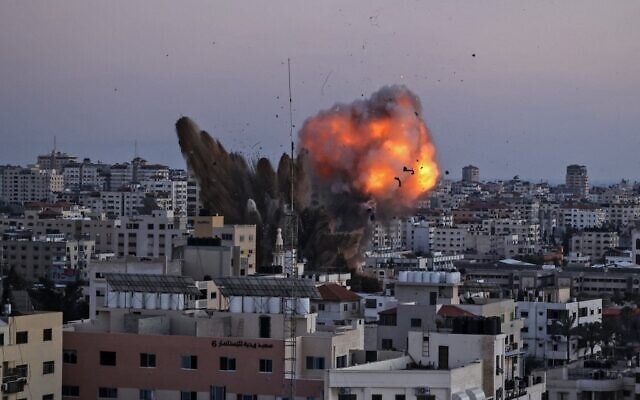
Bombs Targeting Exploding in Gaza City beside Mosque on May 14, 2021/Mahmud Hams/AFP
Bombing the underground network of tunnels has brought a unique calibration of hostilities. New technologies have been long developed to fight Hamas in the network of tunnels. And even as we hope that the local conflict will not, as is feared, spin out of control on a global level, the range of military tools to measure, explode, fill, and destroy the feared network of tunnels provides not only a key to victory but will be a basis for intense resistance to the attack, and indeed resistance to the illustrations of Israel’s enhanced destructive abilities. The targeting of Hamas networks by aerial strikes has escalated far beyond previous air strikes. The targeted and well-planned breaching of the walled off of the strip is far different from the earlier wars staging invasions, if the echoes of a war where Soviet armaments entered Syria and Egypt, allowing a coordinated strike on Israel form two fronts, taking them by surprise to inflict as many casualties as possible to force Israel to redraw their boundaries, if not destroy it as a state, the anger at such a scale of attacks is the beginning to a conflict that will resist international mediation.
If the Yom Kippur War would mark heightened weaponizing of Israel and her neighbors that made most all future Middle Eastern wars transnational, the breaking of the barrier toppled all sense of governmentality, and all confidence in the false promises of security that Israeli governments had placed in building the costly border barrier, if not the government itself. While the horror stories of the attacks on Israeli settlements and a nearby music festival in the wrong place at the wrong time has been cast as essentially the viscious explosion of a local conflict, the several fronts to which fears of war have spread suggests an insufficiency to map its dimensions of a conflict not based in territory, but a mythology of denying nationhood. Gaza Strip has clear confines across which the invasion of Israel was launched, but the boundaries are imposed by Israel. The highly policed boundary barrier around the Gaza Strip less define a national territory than a pseudo-territory, not a policed boundary than a frontier behind which Israeli government believed Hamas and a Palestinian threat could be contained, rather than recognized. The pseudo-territoriality of the Gaza Strip mean less that it only exists as a region as a mental imaginary, than that the territory only has meaning as it is mapped in relation to Israel.
21. So much is evident in the shifting role of the Israeli Defense Forces to supervise the built frontiers about the state of Israel and preserve the fenced-in nation as a way of ensuring “normalcy.” There is little normal in how the Israeli Defense Forces is requesting residents of the Gaza Strip to follow the “evacuation corridors” to flee to safety before an onslaught of attacks from the sky that have killed almost 2,000 and injured far more than 10,000 over the week they flattened the Palestinian region as if to remove it from the map. If bombs only targeted the warren of tunnels that lie underground–not the totality of Gaza City or North Gaza–and the Israeli Defense Forces are, in fact, acting in a defensive role. At the same time as the war is poised to multiply across several fronts on borders had led to a hunkering down behind the wall, in ways that have been argued to reflect a shift in the Israeli Defense Force’s strategic mindset if not maps of protecting itself from existential security threats. The pseudo-territory frames the limited choices of residents who seem to exist only in relation to the boundaries imposed unilaterally by the Israeli state. The artillery and rocket strikes cannot capture the scale of destruction in the most densely inhabited area–the site of most of the health facilities and fifteen hospitals that were among the intentional targets–as residents of Gaza were told and commanded to take one of two “evacuation routes” of forced migration amidst an ongoing exchange of bombs as Israeli forces sealed the perimeter. Rather than offering safe passages to anyone, the routes of evacuation seemed designed to press inhabitants into Egypt, across the Rafah Crossing that only in early November allowed crossings into Egypt.

Graphic News
The bombardment of Gaza became proof of purchase of the latest precision-guided military hardware fired off tanks, as Israeli forces entered. Increased precision and homing heads allowed even greater precision strikes of a battlefield than aerial bombardment. The tools of remote striking with dual homing precision of GPS guidance across a twelve kilometer range seemed to ensure coverage from any point of a nation six to twelve km wide, allowing the invading forces to pinpoint targets in the invaded territory with an aim to “destroy the enemy above and below ground,” as the elusive targets of terrorist warrens provided the obsessive targets in a new stage of grind-fired missiles that extended the attack on what were mapped as “Palestinian enclaves” from the air. The paradoxes of a war that was conducted to “bring the hostages home”–faces that the press and government kept before the public eye–led Prime Minister Netanyahu to repeat “we are only at the start” of a “long and hard military campaign” October 28, inaugurating a new stage of ground combat that dwarfed the aggressiveness of the walls by which Gaza was contained asking Palestinians to continue to evacuate the northern region, and remove themselves from harm’s way.








 Musings on Maps
Dan,
Trying to read your latest piece today I clicked on the link but ended up on a “not found” page on your site. If you get a chance, could you send me the link as I would like to read this one in particular, as from Berlin to Belfast (and on) I feel I have grown up in an era of walls all around us, and current circumstances make them something we deeply need to understand.
Hope all’s well, despite the challenges of the times,
Paul, thanks for your response. I have posted it, as the circumstances so rapidly changed.