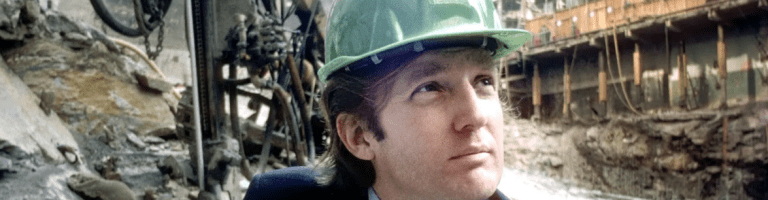
“I am looking at the whole Gaza Strip right now,” President Trump announced, “and it’s a mess. It’s a real mess.” Trump seemed not to consider the scale of American arms’ involvement in its destruction, but to steamroller over any hopes for reconstruction or rebuilding of Gaza for its former residents,–considering that they would be better served by resettlement in other Palestinian nations, like Jordan and Egypt, perhaps pliable to the anticipated demand of the American President. The words Trump spoke to King Abdullah II of Jordan in semi-confidence on Airforce 1 were quickly broadcast throughout the world,–as if wishfully recasting an old Port City that had been under siege from November 2, 2023 between Israeli Defense Forces and Hamas as a demolished lot whose rubble stretched under the feet of the Angle of History, replacing a place of memory with a blank slate,–rather than one 500,000 Palestinians might be trapped. As we face problems of mapping the Gaza Strip after the negotiated Ceasefire, and the transformation of a war zone into a civil space, we are must confront how calls to “Save Gaza” are increasingly being warped to calls for its development by a new American commander-in-chief seeking to insert himself in the war zone as its developer.
Gaza was an empty lot, it seemed to Trump, wanting to be rebuilt better and transformed by a mental imaginary of his own past, bearing no correspondence to the Gaza Strip or any sign of the role of American arms in reshaping the boundaries or escalating loss of life in Middle Eastern politics. What was Gaza? An demolished lot that might be, as any property. It might indeed be a valuable property, a trick to be turned and a deal to be made. The bizarre AI video that Trump would post on social media a few weeks later, imagining the rebuilt Gaza Strip with a soundtrack proclaiming “Donald’s going to set you free,” allowing refugees to escape ruins to frolic on the beach of a resort, seemed to claim to transform the humanitarian disaster to a luxury site for the super-rich, dispelling all concerns for health, devastation, and a shattered infrastructure with an AI image of untold wealth at the end of the tunnel. “I don’t think people should be going back to Gaza,” Trump offered about what was “a phenomenal location on the sea,” contradicting himself by adding “Palestinians will live there. Many people will live there,” as if imagining a Phoenix-like resurrecting a community from the rubble created over a year and half by American-made bombs.

The project of forced displacement of two million was melded with a vision of how the United States would assume its role as a military backer of Israeli’s army, to assume the “long-term ownership” over the Gaza Strip by which it might transform the rubble to an enticing view. On Inauguration Day, as Palestinian refugees were returning to their homes under a newly brokered ceasefire, Trump had proclaimed his vision for a rebuilding in this “phenomenal location on the sea,” a remapping that seemed rooted in his gut, more than , but seemed a reprise of the demolition of the classy emporium Bonwit Teller–but this time less as a tragedy of the loss of an icon of art deco architecture–that he replaced by a kitschy bronzed monument of Trump Tower, as if it were an extension of his own bronzed visage, unconscious that this time tragedy was reprised as comedy.
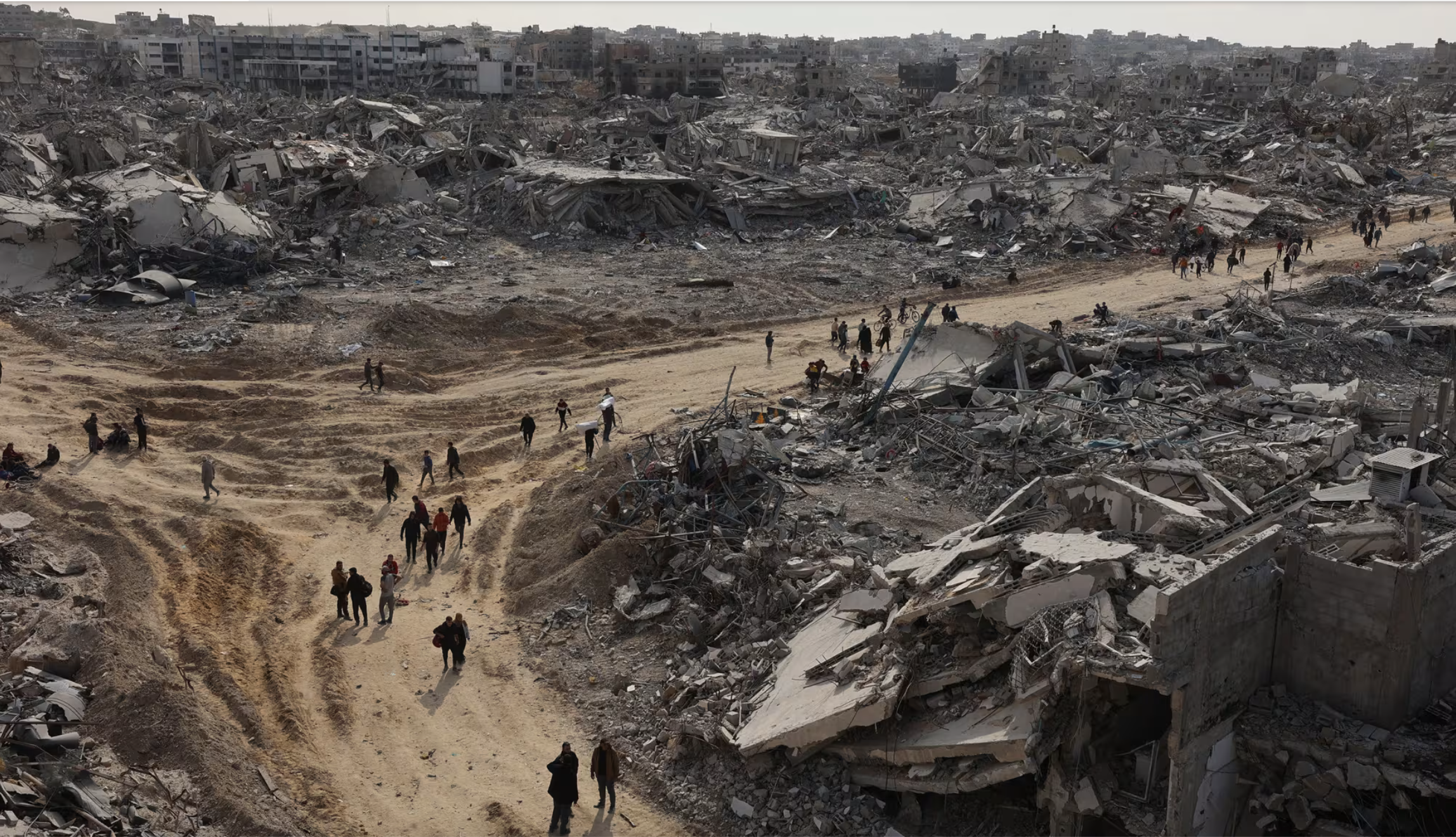
Palestinians Returning to jabalia Refugee Camp the Day in North Gaza, the Day Before Donald J. Trump’s Inauguration/January 19, 2025
Hopes for Palestinian statehood were implicitly “over,” Trump seemed to imply, as if the ruins of the Gaza Strip presented a fait accompli that the world should now listen, as it turned attention to the problem of who would rebuilt the contested area long occupied by Palestinians, and see it not as a contested grounds of war, but transformed to a lot of rubble he must have understood reflexively as waiting to be rebuild, not demanding humanitarian aid. Foreclosing any right of return to Gaza, the city flattened by bombs seemed transformed by eminent domain trumping international law, removing hopes for Palestinian territoriality from the table for bread and circuses, an image of two paunchy white suits making a deal over the situation on the ground that provoked global outrage.

Protesting President Trump’s Gaza proposal in Seoul outside U.S. Embassy, February 5 2025/Chung Sung-Jun
That major transaction that had helped catapult Donald Trump into prime time, as he entered prime real estate in New York City that distanced him from his family’s own Queens-based origins, was a major coup in rezoning laws, which allowed Trump to leverage his ownership over the old shopping emporium with its art deco facade, to create the gleaming gold tower now at home in a sea of midtown skyscrapers that defined Manhattan–and offered the stage, of course, by which descending from a golden escalator, he seemed to define himself as a presidential candidate for an era of steepened wealth inequalities, by refashioning and rearticulating an American Dream that had little to do with education, expertise, and competency, but with leverage of a sort Archimedes never had known by which he, Donald J. Trump, was somehow able to move the world.

President Trump, entering his second term, perhaps overly eager to claim credit for a ceasefire in Gaza, and ready to declare the war that plagued his predecessor at an end. But Trump was purblind to registering the greatest humanitarian disaster of the modern Middle East. And the odd elision of loss of life with rubble, and the prominence of a lot of rubble at the first White House press conference with a foreign leader –“Why would they want to return? The place has been hell!”–reminds one that hell is different for different people, if one often carries one one’s hell with one head.
Despite the return of some over 500,000 Palestinians to Gaza since the fragile ceasefire, precarious conditions across the Strip have been intensified with increased cruelty. The prospect to cease the flow electricity that Israel has long provided 120 megawatts to Gaza’s inhabitants on ten power lines on the tails of ending the flow of billions of approved USAID supplies to Gaza. The absence of the flow of the most basic humanitarian aid will hurt displaced mothers, babies, and young children facing needed medical attention–3,000 children facing malnutrition and thousands of pregnant or breast-feeding women, with only ten of twenty-seven health centers in Gaza operational, staffed by stretched and exahusted medical teams by February 2025, after the “ceasefire” was long negotiated: twelve million women and girls will lose access to contraceptive aid in coming months.
The curtailment of 2,300 trucks of needed aid stopped at border crossings since March 1 was followed by ending the flow of electricity to Gaza’s residents on March 9, leaving displaced increasingly vulnerable, living in tents adjacent to homes that are now destroyed buildings, as we approach the holy month of Ramadan, two months after the fragile ceasefire had begun and residents have begun returning to Gaza. Is this coordinated strangulation of the residents of the region not inhumane? Pregnant women and children long bore the brunt of starvation: with 50,000 pregnant women living in such conditions, many displaced at risk of giving birth in unsterile conditions, in rubble and on the streets, at risk of dying from complications, some 400,000 displaced people living under tarpaulins–more than a quarter of its population, per UNRWA, overwhelming postnatal and family planning services in a region where 1.9 million were displaced.
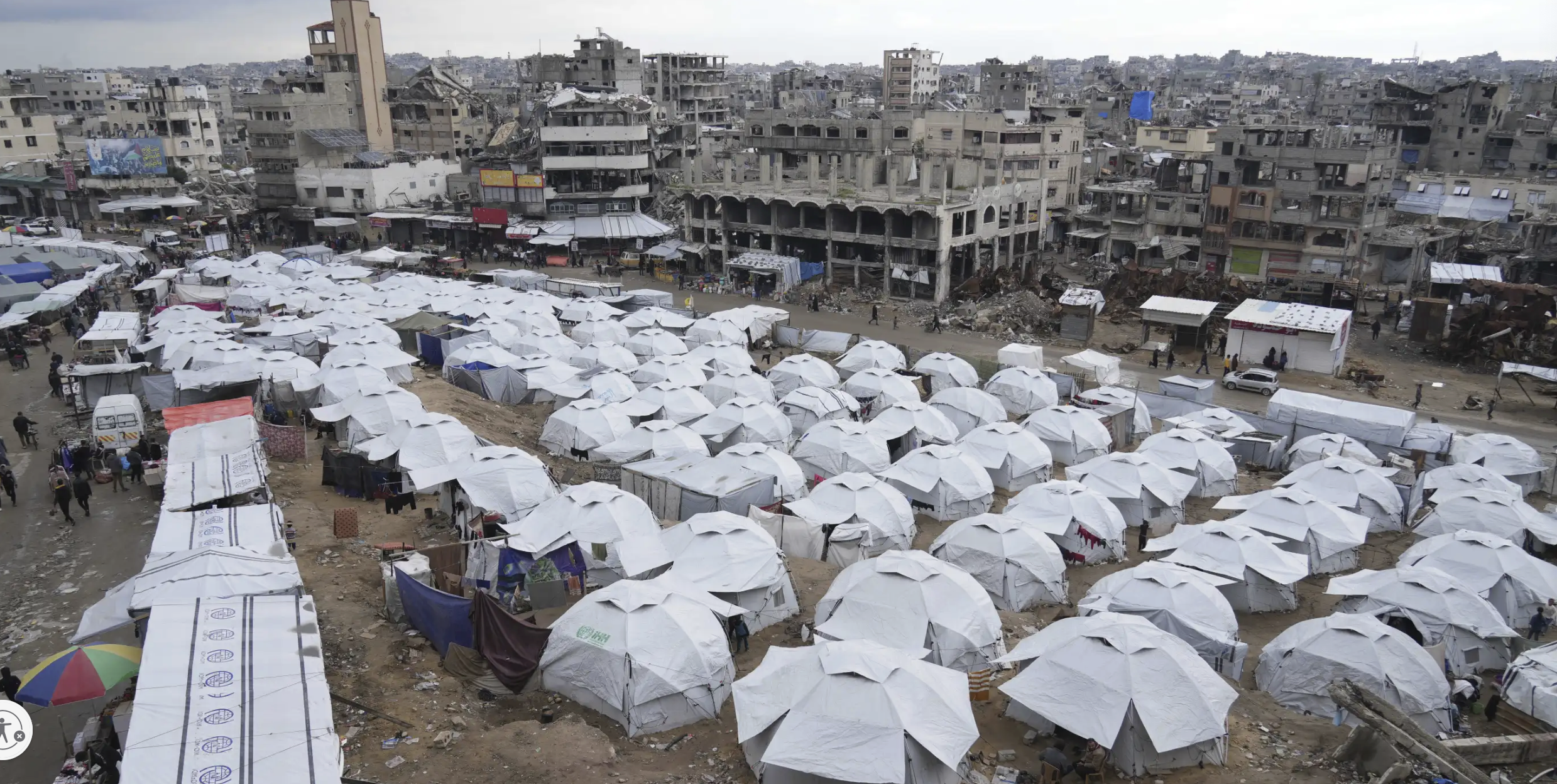
Displaced Residents of Gaza City in Ramadan/March 1, 20205/Gaza City, Gaza Strip/Abdel Kareem Hana
We mask these losses–and challenges–by re-mapping suffering in the region to a lot of rubble, and not including people in our maps, distancing the scale of the humanitarian disaster by a vision of abundance as if to wipe the slate clean with a vision of neoliberal opulence in itself offensive to distance suffering. For the characteristic of the region as rubble mask the contradiction of a return of peace that provides no return to stability. But is a disaster area, lacking water, electricity, water, or sewage lines, in which the most vulnerable women and children have long born the brunt, some sixty thousands of pregnant women are now suffering from malnutrition and ninety percent of children under two years of age face severe food poverty day-to-day. Are these bodies not being treated as rubble, allowed to weaken, wither, and lie without any permanent structures or warmth?

Jabalya February 2025/Olga Cherevko/UNCHA Humanitarian Report
Trump’s words suggest a cognitive refusal to grasp the scale of a disaster that did not involve himself, and readiness to insert himself in the drama of lost lives as a real estate developer, used to rubble, and ready to rebuild “something that could be phenomenal” in its place, “something that could be amazing, the Riviera of the Middle East,” how Trump offered a brutal deal in improvised diplomatic channels immediately taken as an open offense. The refusal that his words provoked of Palestinians living ion the Gaza Strip to exchange that rubble for an “entire city” or “a castle in Egypt or Jordan” among rebuffed Trump’s words so keenly because the proposal not only adopted a right-wing Israeli belief that Gaza is not a Palestinian homeland, but erased a historic site of residence in calling it a lot of rubble, as if to foreground the fungible nature of Gaza City.
Trump’s boast recalled to this New Yorker the very fungibility of the landmark building in New York, once occupied by Bonwit Teller, more than having a historical significance for its inhabitants. As much as it reflected a tactical plan to render life in Gaza City so unlivable to force Gaza’s residents to leave the region, the topos of “rubble” immediately disenfranchised Palestinian inhabitants from the region. In offering them a “deal” of other unbuilt residences and promising to rebuilt a “new” and better development in its place, a promise that seemed more of a con man or realtor than a national leader or a President. For the boast that Trump made to rebuild an area he would “own” suggested the site that he purchased on 721 Fifth Avenue, far from the Middle East, that he proceeded to convince the City Council to rezone for residences, before demolishing the art deco building that he had pressured the company to sell for $15 million by January, 1979, persuading that Council that he would cease to rent the art deco skyscraper to the sophisticated luxury store for upper-class customers if it were not rezoned–and proceeded to reduce to rubble, including the stylized art deco relief sculptures and art deco artifacts he denied to preservationists, in what became the grounds for retail and commercial areas, offices, and thirty-nine floors of exclusive luxury residences, before its penthouse suite served in 2016 as the White House North.

The transformation of the building’s bronze-colored glass facade skyscraper he commanded his architect create was an intentionally showy, luxury footprint that sought to change the skyline of New York, with “flash,” at a far remove from Gaza’s inhabitants or arid sands. The conflation of the two places–the future of a built towers destined for the 1% and the rubble on the ground today in the bombed out site of Gaza City–was thematized in the AI video Trump promoted on TruthSocial–as broken down towers morph into a rebuilt exclusive beachfront paradise of soaring luxury towers, lined with palms, and without fear, was at a remove from the historical origins of the Arab presence in Gaza, as its minarets are seen behind luxury shopping spaces replace the residents’ suffering, as if the tenants who live in and occupy the building Central Park South building that became Trump Tower could be evicted and displaced. The spectacle of the magnificent building would arrive to obliterate all needless suffering that would erase the all too squalid past.
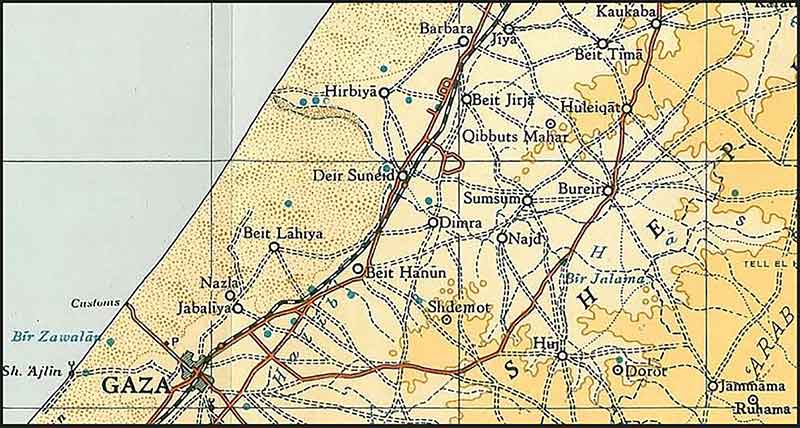
Gaza City and North Gaza in the British Mandate Government (1945)
Ready to flip the region to real estate lots, was Trump actually replacing international diplomacy and law to the hard bargain of Manhattan real estate markets of the 1980s, seeking to strong-arm a sovereign by the logic of real estate? He seemed to ask the world to imagine the Gaza Strip as a real estate parcel, and stop thinking about the people who lived there–indeed to realize that this rubble was destined for the site of rebuilding so that a phoenix might arise from it, akin to the rebuilding of the Bonwit Teller building that he purchased and had rezoned from a commercial development to a residential tower of luxury condominiums might effectively transform the contested land by fiat, as he had forced the construction of Trump Tower through the City Planning Commission, who he told “if I don’t get a zone change, I don’t rent to Bonwit Teller,” already imagining the luxury duplex he might build at the top floors of the monstrous building he had rendered before destroying the Art Deco landmarked building that had long occupied it for a new monumental project that would mark the start of “the monumental projects” he decided to dedicate himself by 1980–“not like the junk I destroyed at Bonwit Teller” that had so flipped aesthetic values of public architecture, its concrete superstructure clothed 3,800 tons of steelwork by a concrete superstructure more solid than the steel-framed architecture of skyscrapers. The erasure of the suffering and human rights crisis that Trump is unable to see or even detect suggests an extreme pathology, but an unhinged relation to the global map, building on a Presidency that promises to allow us not to see suffering, not to see displacement or refugees, and to detach America from a prominent position in the world.
The rubble that he saw in Gaza as an uninhabitable site of misery was a site of misery for many who had died there, or were still buried under its concrete rubble, but the concrete would be cleared, and replaced by steel structures he might build in their place. As the concrete of Bonwit Teller were cleared and soon forgotten, despite their iconic value, the flattening of history seemed sanctioned to Trump, as if the ruins of Gaza had crashed at the feet of the Angel of History who was born forward on winds, toward the future of the new Riviera of the Middle East.
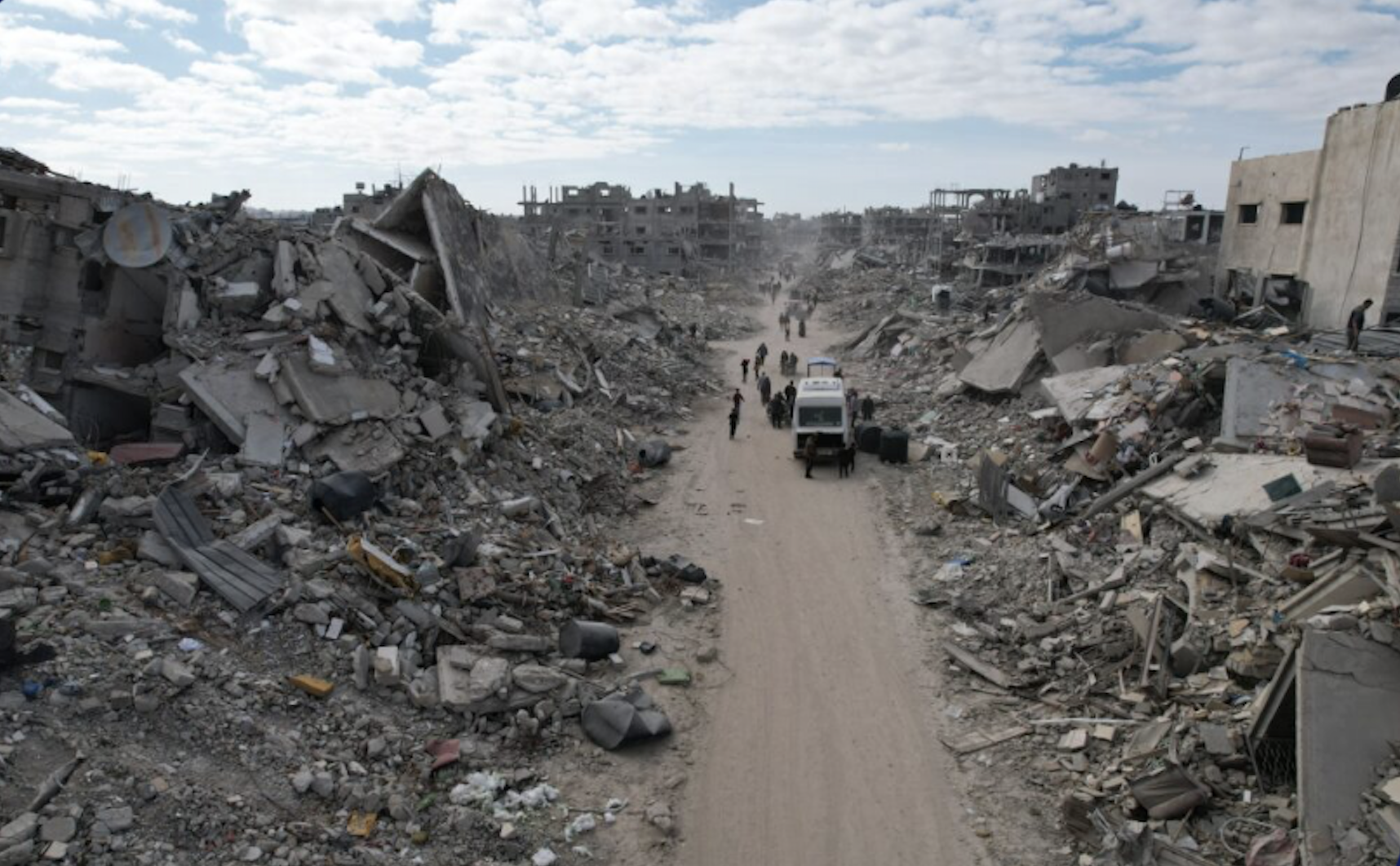
Rafah Immediately after Hamas-Israeli Ceasefire Agreement/Ashraf Amra/Andalou
The header for this post was not only a pronouncement that the Hamas’ authority on the Gaza Strip is over, but the hope of Palestinian sovereignty is over, that the Two-State Solution is at its end, but that the refugees you heard about were no more. So declared Donald Trump and Benjamin Netanyahu at a joint press conference that opened the possible eviction of Palestinian refugees who had begun to return to there home after the recent Ceasefire for which Trump had, weeks ago, eagerly taken credit. Israel and Hamas had proposed multiple humanitarian ceasefires in the past, and the United Nations had called for decades, ineffectively at best, demanding the “immediate and unconditional ceasefire” in hopes to work toward “a durable and fully respected ceasefire” on humanitarian grounds. The hopes of the ceasefire became a building opportunity for investment, a question less of borders, or refugees, or humanitarian interest, as the building Trump Tower by topping fifty-eight floors of concrete–45,000 cubic yards!–to encasing four thousand tons of steel.
The ruins might be consigned to the past, and replaced by a worthy monument to fun in the alchemy of construction. The heightened level of destruction of so many IDF bombs–and prospect of a delivery of more powerful bunker-buster bombs to Israel in coming months–hoped to strong-arm the Middle East to finally map an absence of sovereign claims neither Trump or Netanyahu had never hinted might ever map in the so-called Peace Plan of 2020. As if it were long-established consensus, Tump’s spokewoman asked if “people should live in such dire conditions” that seemed a truly “uninhabitable place for human beings,” suggesting that this region in the Middle East had been rendered uninhabitable, a non-place of modernity, as Trump painted the possibility of a future plans for Palestinian resettlement, “if we can get a beautiful area to resettle people, permanently, in nice homes,” in the language less of a statesman than real estate developer. The Gaza Strip, so long celebrated and fought over as a site for a Palestinian homeland, was “an uninhabitable place for humid beings,” as if it were a torrid zone from medieval maps, in a band that was parallels the equator and lay beyond the human ecumene. This was not about human rights anymore; this was about the transformation of the most densely-inhabited area of the earth to a wasteland removed from governance..
The United States elected Trump to make sure we didn’t have to think about people. Trump was promising that we don’t really have to care about others, or even think about people: much as he promised to deport immigrants or refugees in the United States, and suspended refugee admission on the first day of his presidency. The declaration of January 20 he was “Realigning the United States Refugee Program,” by suspending the US Refugee admissions policy and refusing to accept refugees in America as they were “detrimental to the interests of the United States.” The rejection of a policy on refugees paved the way for the fluidity of the Gaza Strip, and the fluidity that the boundaries of Ukraine had at the end of another war he claimed to end,–leaving a tenth of the Ukrainian population, including 1.5 million Ukrainian children, under Russian rule. In a single news conference and on television, his preferred medium, President Trump had closed the door on the future of a Palestinian state with particular cruelty–there was just no place for it on the map, but we should stop even thinking about it. That was not the spectacle he wanted to focus on, and neither was the spectacle of the Palestinians in Gaza–or the Ukrainian refugees who would stream into Europe, fearful of future prosecution, or the unhoused in America, or human rights refugees.

What Trump was looking at as he was watching the “whole Gaza Strip” wasn’t ever clear, and it didn’t need to be. There was literally nothing to be seen there–just devastation, an a mess that was not worth thinking about. Trump’s declaration about the Gaza Strip seemed a prelude to the dissolution of a hoped for armistice shortly before he took office, as if that long process of negotiation that tried to offer a careful path forward to sovereign coexistence and military withdrawal were a ridiculous proposition to imagine. Despite traded accusations of violations of the Israel-Hamas Ceasefire, Trump escalated a rhetoric of bullying, as if he might force Hamas and all Palestinians from Gaza and dismiss claims of Palestinian sovereignty out of hand, claiming the Palesitinians at this point just didn’t have any place on any map: Netanyahu, who had allowed only enclaves of Palestinians without a state to exist in proposals of the previous six years, seemed to be delighted at the result of Trump, nudged by his financial backer, Miriam Adelson and the American right. It was about “protecting the meaning and value of citizenship.” It was not only bluster, if it left the world open-mouthed.
The map hadn’t changed much in Ukraine for years, but Ukraine as we know it seems to soon maybe not exist on the map, after a future press conference with Vladimir Putin will likely announce its newly drawn borders, after a war of attrition seemed to be shifting the other way.
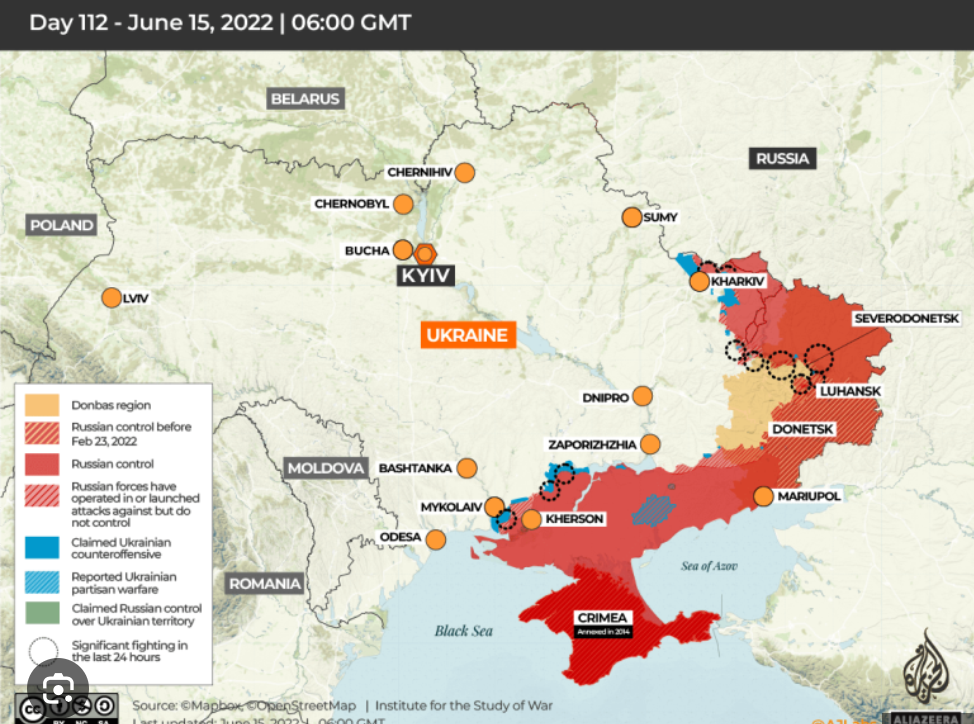
Sovereignty may seem to be up for grabs in the regional map and in the global map, in a not that new spin on globalization. Trump may threaten to invade–or occupy–but to take any pathway to statehood off the map. The future of a Palestinian state indeed seems to be far more up for grabs than during the war. Then again, so does the Gulf of Mexico: that body of water’s renaming may be but a prelude to America’s assertion of its rights for underwater prospecting in the region,–and allowing American petroleum industries not to imagine the notion of Mexican territorial waters. If ten percent of Ukrainians who will be living under Russian sovereignty for the near future suggest the fluidity of borders and the U.S. Secretary of Defense calls the borders of 2014 “unrealistic,” we don’t have to care about the people who live in those borders. They are non-nationals, stateless who are as far from American interests as can be.
The fate of Palestinians seems more abruptly decided indeed: why don’t they go somewhere else? The stateless do that, and 700,000 Palestinians did in 1948, when Israel was founded. Rather than propose control of a zone by peace-keepers, the prospect of displacement of two million seems easier after destruction of over 90% of residences during fifteen months of bombardment or armed invasion has destroyed local infrastructure in ways that offer little point of orientation to a landscape that defies mapping.
Trump’s claims in semi-private confidence were of course broadcast to the world, and occupied the spectacle of Gaza’s ruins. The shift in spectacle–that of imagining the invasion and occupation of the region by America–was eery. Because it adopted or used the terrifying language of spectacle that he had adopted when promoting Trump Tower, forty years prior, using the destruction of lots of real estate to describe the Gaza Strip as if its rubble might be valuable beachfront property. The confusion of categories—not loss of life, humanitarian need, hunger, medical emergencies, bodies buried under rubble–raised the basic question of what map or drone footage of Gaza he was looking at exactly–even as footage of destroyed homes and buildings were intercut with a news conference Middle East, forcing Egypt and Jordan and Bahrain to accept refugees that would compromise any opportunity for Palestinian statehood, at the very time that displaced refugees try to return to their destroyed homes and neighborhoods utterly unrecognizable after near-complete aerial devastation.
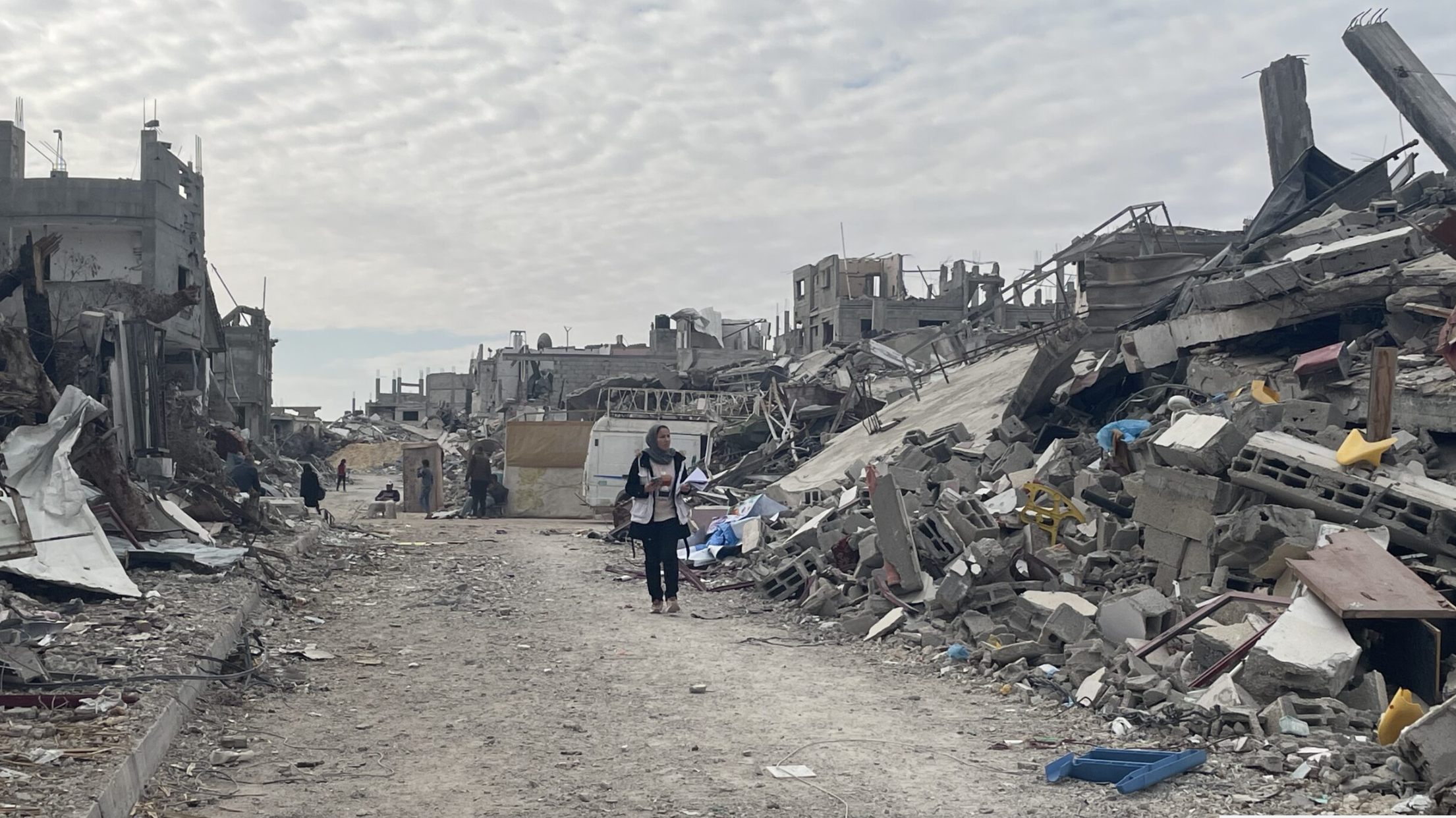
Nadia Abu Malloh in the Ruins of Rafah City in Southern Gaza City/Medicines sans frontières, 2025
The announcement that came quick on the shuttering of USAID suggested that rather than help any refugees with reconstruction, the United States’ intent to ensure there was no presence on the map of Palestinian sovereignty, and Hamas would be expelled from the region. What had been sovereign bounds were transformed into a war zone where past ideas of sovereignty did not exist, erasing the boundaries of Gaza that Israel had staged its ground invasion, as if the Palestinian refugees that entered Jordan, and Egypt, which was suddenly responsible for the Palestinians living in the Gaza Strip that they seized in 1948 in the first Arab-Israeli war.
Those displaced by the Gaza War would be resolved by sending more stateless able to gain Jordanian citizenship and be welcomed into Egyptian universities, despite destabilizing of forcing stateless to enter either nation from Gaza or the West Bank, and the utter disinterest it reveals of the Miiddle East’s instability, and dismissal of a future two-state solution as “a reward for terrorism.” With all funding for reconstruction in the Gaza Strip suddenly placed in jeopardy, and taken off the table, the war continues a year after the majority of building in the region had been destroyed–and all monuments, landmarks, and many orienting signs have been destroyed, creating a true sense of immediate local disorientation, with neighborhoods flattened beyond recognition.
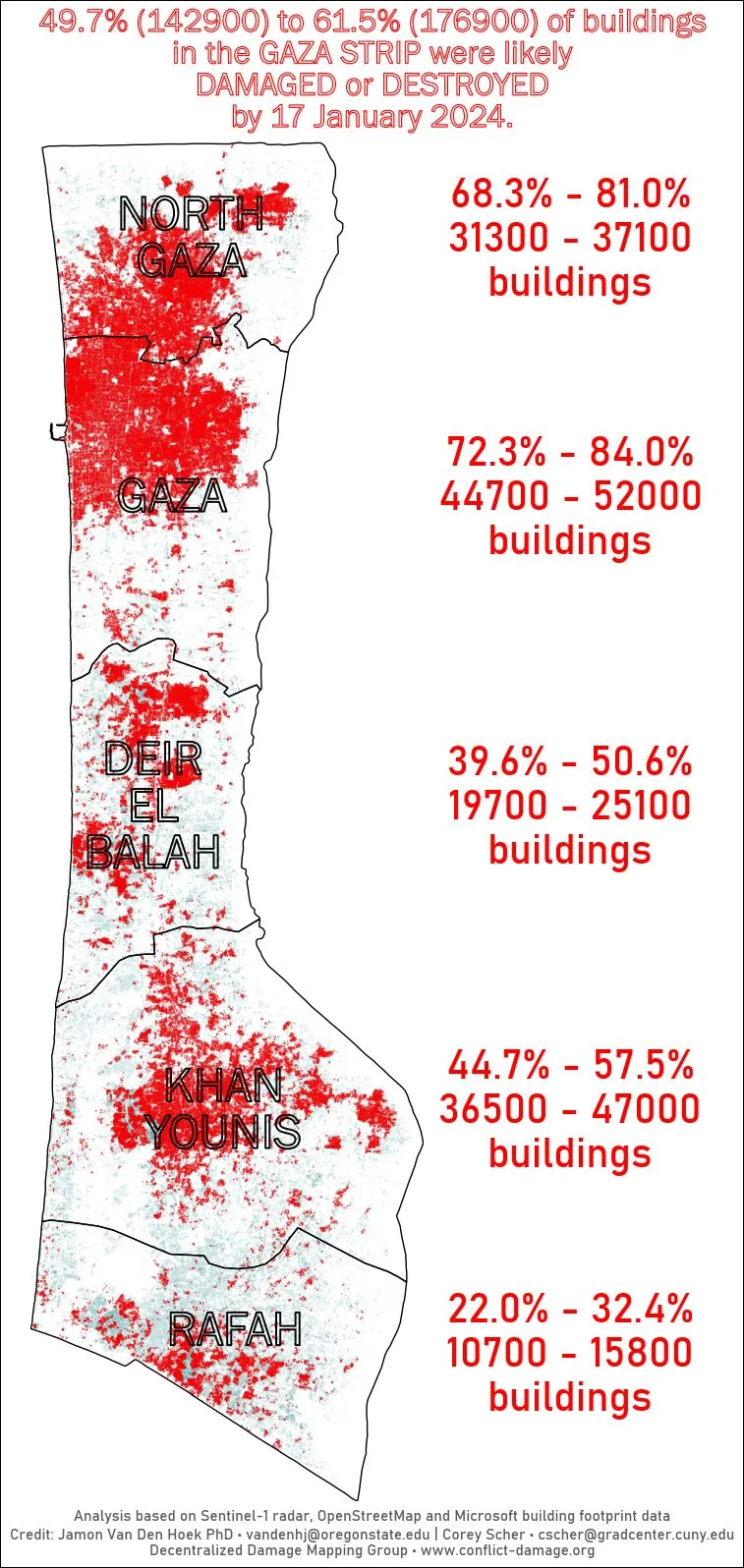
Decentralized Damage Mapping Group/analysis based on Saentinel-! radar data, OSM, building footprints/ James Van Den Hoek and Robert Scher
The sick travesty that what remained was only rubble–and merited no attention for local claims of habitation to its residents–deflated any talk there had been of enacting a Marshall Plan for Gaza. The question of political control of the Gaza strip was placed into un certianty in the announcement at a press coherence with Netanyahu that America was ready to bully “Arab” states to accept the absence of any Palestinian sovereign bounds in occupied territories–and the erasure of the sovereignty demands to be mapped. In erasing the boundaries of sovereignty in the Gaza Strip, Trump tried to bully the global stage by evoking Gaza as mere rubble. Israel, a year later, for its part had refused to allow displaced Palestinians even to enter the “strip” that had been decimated, waiting until further Israeli hostages taken by Hamas were released–as if the clearing operations that the Israeli army had undertaken in the blue dotted lines below had relegated past inhabitants’ right to the place they lived by converting them to archeological sites to relegate them to the past.

Israel-Hamas Ceasefire Lines/January 25, 2025/Institute for the Study of War
The President announced he had spoken to the Jordanian King Abdullah II as monarch to monarch, rather than as a leader of the Free World. It was clear suddenly that during Trump’s second term, , he was more than ever apt to empty the land of people, and to treat space as fungible real estate to which no other nations or peoples had claimed–and that they might as well be stateless, as the Palestinians. For it just might be time to “just clean out” Gaza, forcing its inhabitants, whose suffering under American munitions and arms showed they had little “luck” in the region, to decamp for brighter pastures, and leave the beachfront Riviera to the map with the plan, which would not allow any space for the reconstruction of what used to be there at one time, or the hopes for sovereignty that were long rooted in residents’ minds that they had refused to leave until the local infrastructure had collapsed. This was a sense of unreality as the Palestinians who had fought for statehood–a Right of Return–appeared as if they might be displaced from their homeland. That hope seemed over–and the very idea of a two-state solution as well.
Trump’s assertion to the assembled press corps does beg the question of just what maps of Gaza or aerial photography he was just “looking at,” and what sort of spectacle he wanted to suggest exist in place of the destroyed landscape he dismissed as an empty lot of rubble. It was evident to all that there was no actual plan that he had revealed or disclosed–an American entry into Gaza, displacing refugees who had recently crowded its beaches, in search of assistance and shelter, with 80% of the residences dietroyed by bombs and materiel that America had sold to Israel. This was described as a deal he had worked out in advance, and sought to impose on the complicated map of the Middle East, but was reminds us more of the very transactional politics by which he approached diplomacy in the Middle East in Trump I, now on steroids as a purely transactional exercise of deal-making.

Displaced Refugees Crowded along Gaza Beach
“You’re talking about probably a million and a half people,” Trump said, referring with skepticism to what he saw as a relatively small number of residents to occasion a global outrage. “And we just want to clean out that whole thing, and say–you know, it’s over,” seeking to turn the corner on the Middle Eastern tragedy and to strong-arm Israel’s neighbors to just put up or shut up, and accept more refugees within their borders, as if the clean-up mess was just overdue, and it was time to “clean out” the Palestinian residents, historical shadows of forced migration and ethnic cleansing aside for the moment, and eager to release his predecessor’s hold on the sale of 2,000 pound bombs to Israel. The sense of treating the land as a real estate lot, suggesting the Gaza Strip had become a territory “nobody could live.” It was clear he wasn’t really looking at a map,–but there was a sense that he had finally considered it time to look at the spectacle of the destroyed Gaza Strip broadcast worldwide. The spectacle of the destroyed houses and bombed-out buildings was perhaps the point. “Gaza is not a place for people to be living,” Trump ominously declared, on the eve of hosting his first official state visit in his second Presidency–at least,-until it was suitably developed. And remember those bombs? Israel’s already bought them from the United States under his predecessor, and “They’ve been waiting for them a long time.” Netanyahu bore his White House smile, after the state visit had ended, grinning far more broadly even than after earlier meetings with Donald Trump.

The broad smile on the Prime Minister’s face at the press conference betrayed full satisfaction,–not only as a satisfied customer, or a client with his confidence man, but as one of two confidence men, far deeper than the smile with candidate Trump in Trump Tower’s gilded chambers, back in 2016–

Candidate Trump Meets Benjamin Netanyahu in Trump Tower, September 25, 2016/Kobe Gideon (GPO)
As they posed for photographers before the White House, after Trump had promised to find some enticements to attract Palestinians to leave Gaza, a long dream of the Israeli Prime Minister, as if it was an unexpected outcome of his visit, Netanyahu smiled like a Cheshire Cat, so that the smile seemed to be left hanging even after the photo session end, a smile that was a bit of a smirk, at the edge of his chair as if he couldn’t believe his luck, either during the talks in the White House–
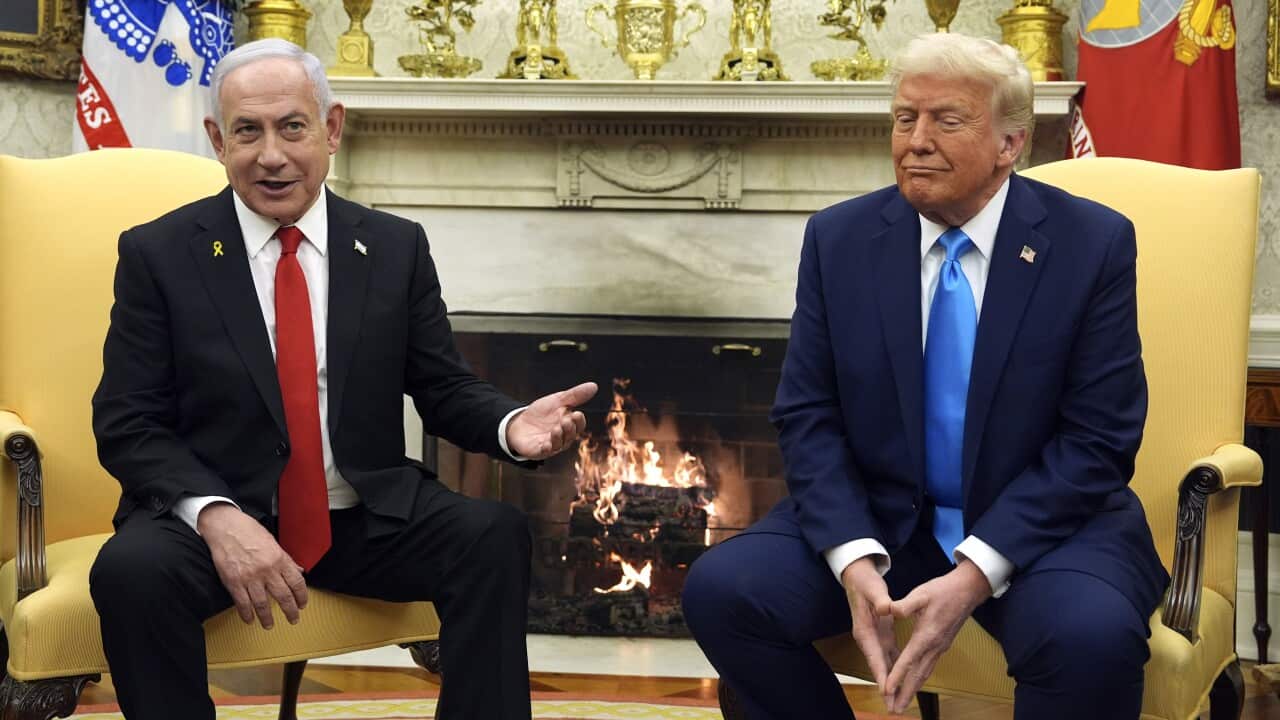
February 4, 2025/Evan Vucci/AP
or by the time he left the White House, as if with a gift that he had hardly imagined barely within grasp, even if it was at an absurd distance from the displacement of refugees they had imagined, a reality far from the White House, whose implementation was yet to be defined. “It’s right now a demolition site, this is a demolition site, virtually every building is down, they are living under fallen concrete that is very dangerous and very precarious,” Trump told an audience of reporters, in which the “only reason” the displaced refugees even wanted to return to the bombed out region was because they had no “other alternative“–and he was going to be able to provide them one. And whatever the borders of the Gaza Strip and the rights of residence guaranteed its residents, only a “long-term ownership position [by the United States] would bring “great stability to the Middle East.”
Netanyahu was smiling ecstatically. His army having reduced Gazato rubble, destroying a fifth of its permanent buildings and 85% of its homes, bunker-buster bombs would be soon on their way, as the smoke was rising. The verdict of the International Criminal Court had charged Netanyahu a war criminal be damned. (President Trump was happy to thumb his nose at the International Criminal Court than Gaza’s refugees, when he decided to invite Netanyahu as his first state visitor to announce a deal on Gaza, also no doubt allowing Netanyahu to miss a court date–and jointly endorsing the war crimes a forced migration of Palestinians from the long-time homelands of the Gaza Strip, where they had lived since Israel’s independence. The spectacle of the sanctioning of war crime flouting the norms of international law, and the international Criminal Court was cast as a victory of national interests over international ones, and against the global interests perhaps incarnated at this point only by the United Nations and ICC. (Was Trump reminding that court that released its warrant November 21, 2024, of its continued lack of jurisdiction in the United States, and perhaps reminding the world how little he considered laws as valid, international or national?)
What was a bedrock of international law was cast as irrelevant before the brute reality of the post-invasion devastation of the Gaza Strip, where the absence of any ability to map the ruins of residences let Trump to question the interests of the Palestinian people–“I would think that they would be thrilled” to move!–as if the end of Palestinian sovereignty in Gaxa and the West Bank was a foregone conclusion, and the real estate value was degraded, beyond the possibility of rebuilding, unless the region were flipped, by the practices of good real estate managers, to a Riviera of the Middle East–a place where only the UAE is seeking to open up longstanding gambling laws–as if the casinos of Israel or Lebanon, and the options for gambling to tourists available in Jordan and Egypt, and the future casinos of the UAE, might be extended to Gaza to develop the current ruins.
The idea of replacing the ruins of Gaza as a true “Riviera of the Middle East” with a range of options of resorts and casinos was lampooned by the current Secretary of State Marco Rubio back in the 2016 Presidential primary–“The Palestinians are not a real estate deal, Donald!“–but now seemed to backtrack on this issue, insisting that the President of the United States was a pragmatist, whose position “was not meant as a hostile move.” Behind the scenes, perhaps Trump saw the loss of Hamas’ gamble to stage the October 7 attack on Israel to retake the Al-Aqsa mosque and East Jerusalem met its conclusion, in the pragmatic opinion of a past owner of several casinos in Atlantic City long-time associate of casino-moguls Sheldon and Miriam Adelson, to cast Hamas’ “gamble” of sovereignty in the Middle East as merely a badly placed bet–

Grok AI
–that might be best understood as a way to rebuild Gaza not, as President Biden imagined, by tools of governance and reconstruction, but rather by undermining international law or institutional support, seeing it as a “pile of rubble” as a demolition site to develop and rebuild.
The ruins of Gaza had no future for its former residents, who had no right to imagine let alone claim sovereignty over the land where they once lived, as their habitation of its was misguided and came to no good. The footage of the demolished regions of Rafah, the southernmost city of the Gaza Strip, of Gaza City, or of destroyed refugee camps that were targeted as site where Hamas was sequestered, were so thoroughly destroyed by US-made bombs over the past decade, even as journalists were denied entry, that the images of bombed out landscapes that seem uninhabited and uninhabitable seemed to have been replaced with rubble, an utter demolition site to which former residents had no rights to occupation or rebuilding.

Destroyed Buildings in Jabalia Camp in Gaza City/October 23, 2023/Yahya Hassouna, AFP
“You know, it’s all rubble,” Donald Trump mused as a confidence man from the Oval Office, reminding Palestinians that they really at this point had no choice but to look elsewhere for a homeland, and would be happy if they did–even after enduring aerial bombardment in the houses that were once a flourishing, if crowded, community–as they just hadn’t been that lucky after all in Gaza, a place they had no real future. Trumped seemed ready to unbalance the precarious nature of the Ceasefire Agreement that Israel and Hamas had recently brokered, with considerable United States help, which he once claimed credit fro: “all hell would break loose,” he predicted in two days, if the Palestinians did not accede to demands to release all prisoners, and leave the region whose map and ground plan seemed left without guideposts or remaining infrastructure to rebuild, as if it might be understood as a clean slate and a resolution to a grim future its residents must accept.

Rafah After Hamas-Israel Ceasefire Agreement, Ashraf Amra/Andalou
Sitting comfortably behind the Resolute Desk to met with Netanyahu, Trump used the first state visit since the election to show the world that the visit was not only an excuse for Israel’s Prime Minister to skip a date in court, but to flout it. “They have no alternative right now. I mean, they’re there because they have no alternative. What do they have? It’s a big pile of rubble . . .”

Khan Yunis, July 31, 2024/Hassan Jedi
Rather than seeing Gaza as a site of needed humanitarian aid after the Ceasefire Agreement that he claimed credit for having brokered was signed, going into effect the day before his inauguration, on January 19, 2025, he ended expectations of allowing the entry of humanitarian assistance to the Gaza Strip. Even as movement into and out of Gaza was allowed at opened border crossing, allowing plans for the region’s reconstruction and an eye acted rise in humanitarian relief, as well as the ceremonious exchange of mortal remains, before rebuilding homes, with a promised 600 trucks arriving per day and fifty trucks of fuel, with three hundred trucks heading to North Gaza to encourage the return of displaced Palestinians, Trump was telling the world that rebuilding might not even occur on his watch. If a bulk of the support for the people of Gaza had been arriving since 2021 via USAID, and the organization had promised $230 million for the West Bank and Gaza in November, 2024, as Joe Biden was leaving office, the substantial aid that had arrived for water sanitation, infrastructure, and governance, as well as cash flow, had been put on hold as the agency was in the process of being drastically reduced and all awards and support were cancelled, and over 5,000 foreign aid officers reduced to a rump of 290, and all foreign support contractors furloughed.
And so, although he acknowledged that he, Donald Trump, was quite a busy person, he would be talking to “various and sundry other countries“–his way to reference Jordan and Egypt, playing a tad better than “shit-hole countries” on the air–to make sure they would take in the Palestinians who could be bribed to leave Gaza, and maybe given an enclave elsewhere, “a lot better than going back to Gaza.” The hope may well be that these nations, which depend on US Foreign Aid, can be used by the latest form of global bullying at Trump’s disposal to be strong-armed to accept refugees who lack a home. Indeed, as Israeli Defence Minister Israel Katz ordered the army to develop a comprehensive plan to facilitate Palestinians’ permanent “voluntary departure” from the Gaza Strip, in quite open violation of forcing the movement of people living under military occupation by the 1949 Geneva Conventions, Netanyahu, who has already been judged a war criminal by the International Criminal Court, has endorsed the prospect of a mass emigration of Palestinians from Gaza praised Trump’s plan of developing the region as quite a “remarkable” idea.

Displaced Palestinian Children Look at Destroyed Buildings, February 6, 2025/Bashar Taleb AFP
The density of aerial bombings created far, far more deaths than Arab-Israeli conflicts of the previous fifteen years, and an astronomical measure of deaths per sq. feet if that metric existed, and “excess deaths” of starvation, and deteriorating psychological, infrastructure, and health services–by conservative estimates surpassing 67,000.–normalizing a level of violence rarely seen concentrated so intensely into a compact war zone able resembling an actual demolition site.

Rafah, Gaza Strip, Tuesday, Jan. 21, 2025
Rubble ran through his mind far more than a homeland, as he juggled the two. But it was rubble that led him to property, and lots of future development, trying to set them up somewhere. “If we could just find the right piece of land, or numerous pieces of land,” he rambled, thinking of lots, deals, or of the isolated regions he had proposed in place of a viable state in the Abraham Accords, as the Trump Plan,–maybe resuscitating the dead plan, declaring it un-dead, and imagining that he could get more nations to sign onto it in the past, in hopes to rejigger the green areas as Palestinian territory, maybe in another region, farther from Israel than the previous five year old “conceptual map” that provided a “future State of Palestine version that made a virtue of an archipelago of sovereignty, probably throwing in a “high-tech manufacturing industrial zone” in the desert, but taking Gaza and a West Bank tunnel off the map, but probably retaining the small-print qualifier from the 2020 Peace Plan–‘boundary representation nation is not necessarily authoritative,’ even if it seems to have primarily expanded and focussed on securing boundaries of Israeli sovereignty.
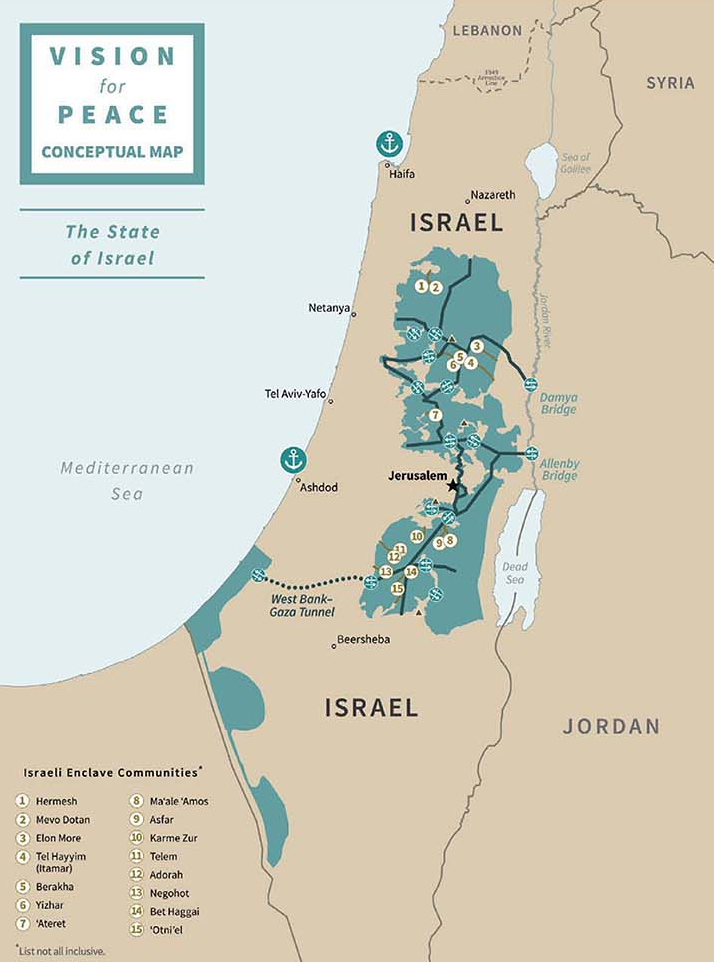
The map that was devised by Trump and championed in the Abraham Plans as his own proposal–and won accolades for proposing an actual map, if an unlivable one for Palestinians–was of course a reflection of the longstanding Israeli demand that residents of the “Occupied Territories” on the West Bank move to a homeland across the Jordan River–allowing Israel to annex all land from the “river to the sea,” a slogan of hard-line Zionists, who coined the aspirational phrase to rally support for a homeland, long before the verbal amp was adopted or co-opted by Palestinians as a cry for Palestinians and question that map, lamenting the loss of the villages lost in the Nakba, since in large part developed and renamed as part of the sovereign state of Israel. The map Netanyahu presented to the General Assembly as an objective possibility did not displace the Palestinians from the West Bank, but echoed the map proposed in the so-called Trump Peace Plan–and went further. If Trump mapped an enclosed landlocked island, removed from the Dead Sea, and offers them the port of Ashbod, and a “high-tech manufacturing” region that might be imagined to generate sovereign wealth, Netanyahu dispensed with the Palestinian presence in Israel altogether. But the map was never a serious proposal, but a vanity for Trump to look like a World Leader–and enter a global stage where he might entertain foolhardy hopes of being a contestant for a Nobel Prize.
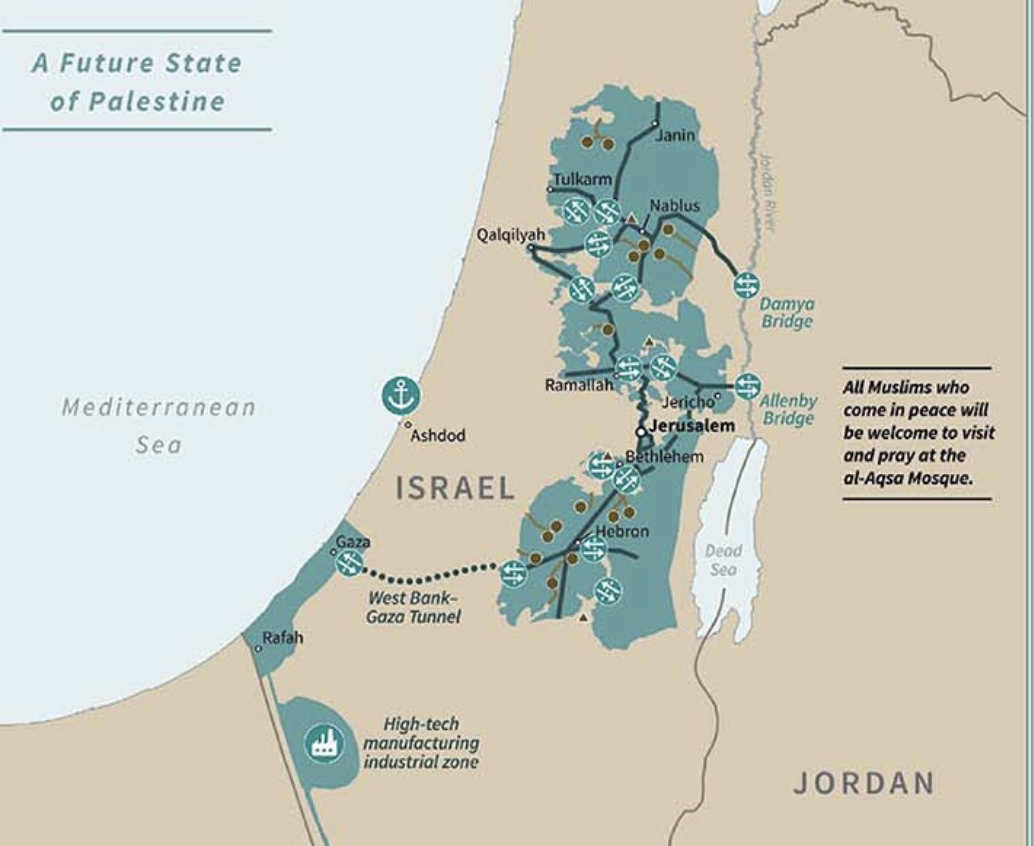
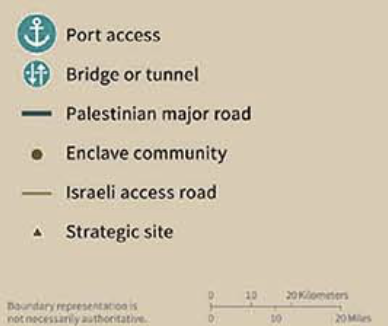
“Future State of Palestine” in Trump’s Middle East Plan, Beside Delineated Borders of Israeli Wtate
The territorial blocs that highways and tunnels link in the Trump Plan offer a Palestinian “state” without borders, unlike the map of Israel’s proposed annexation of Jewish settlements not eh West Bank and Jordan Valley, adding plots south of the Gaza Strip, as a consolation prize, that must have seemed quite the affront. The basic promise was to offer “A realistic solution would give the Palestinians all the power to govern themselves but not the powers to threaten Israel,” in the words that read like a magic blessing home in the 2020 “Peace Plan.”
The current affront would have been, of course, utterly unimaginable. Yet Trump hopes to displace upwards of two million residents of the Gaza Strip–not forcibly, but because the rubble of Gaza “is not a place for people to be living.” This proposal reveals the short-sightedness of Trump’s limited notions of sovereignty and the limits of his conceptions of sovereign power. It is an act of sheer bullying, from a bully pulpit of holding the strings to USAID, but using the funds for real rebuilding of an alliance that would make his backers proud, a claim made with the voice of the fascist in a hardhat he always aimed to be. “I don’t think people should be going back to Gaza,” he stated vacantly as if voicing a sentiment widely shared that he wanted to bring about; “I think Gaza has been unlucky for them,” as if the misfortune of its destruction was a matter of luck, not agency. For his part Trump went further, of course, than Netanyahu, delivering a second blow to the idea of a Palestinian homeland, promising to transform the tragedy of 47,552 lives ended on the Gaza Strip to a future real estate development–“something that could be phenomenal,”–
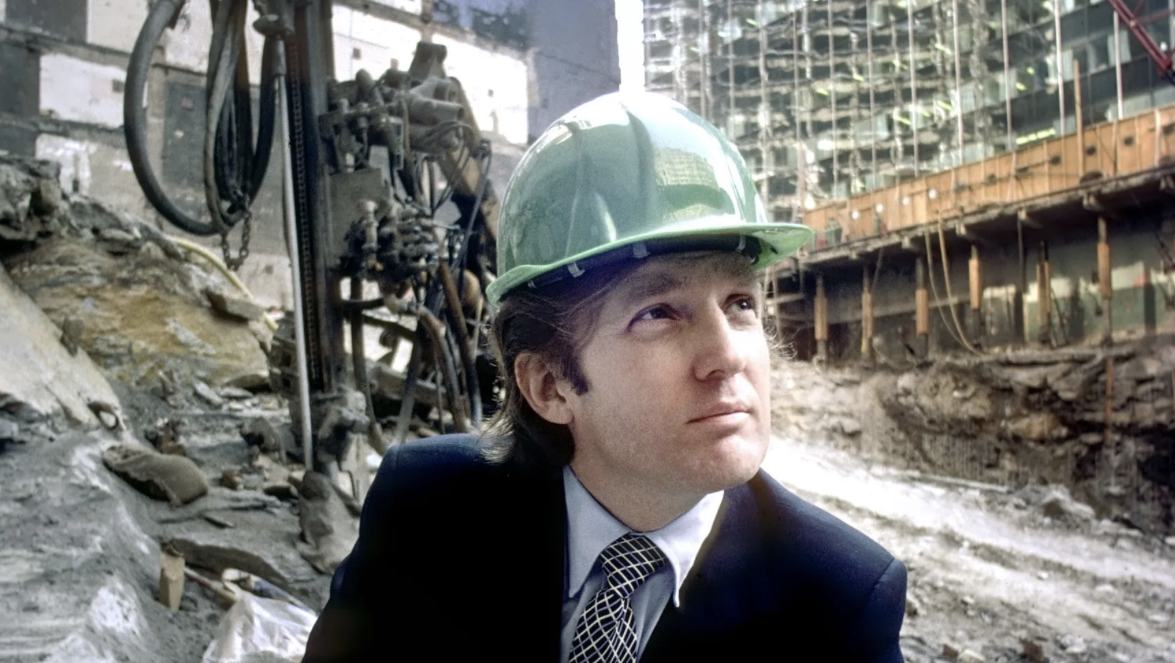
Donald J. Trump at Site for Future Trump Tower on Fifth Avenue and Fifty-Seventh in Manhattan, 1980
–a massive conditional, a disconnect of Grand Guignol, recasting a war zone as a site for “something that could be magnificent,” the trick a real estate developer was practiced–leveling the tragedy to a guarantee of rebuilding “the Riviera of the Middle East.” One might imagine the developer in a hardhat and suit on the demolished lot of the future Trump Tower, forty-five years ago, now setting his eyes on a far bigger property, not thinking of sovereignty or people, but developing a truly large-scale property. He feels that he holds the purse strings and has every right to take these means to shuffle around populations, not recognizing this would be a”forced migration” or “military occupation.” With a ceasefire signed, people could be moved around, or shuffled around boundaries, as migrants from other countries flown on military jets to homes on other continents, without any means of livelihood, insurance, or even ties to other families. This was not only Atlantic City or even Fifth Avenue. This was big. But the cold eyes with little regard for precedent, history, or anything but himself was clear, if the state was now really global.
Promising to “do what is necessary” in vague assurances of a big event, he proposed the U.S. Army arrive in the war-torn region of tragedy to help, clearing it of weapons, building something new, offering workers jobs, having allowed American weapons to destroy the unhealthy buildings of the Gaza that the troops might arrive to topple and clear the rubble for whatever nice future might materialize. Trump didn’t have the plans, but seemed to be ready to hire architects on a new scale, and seemed to think that the funds were on hand without limit. Was Trump using a map that existed in his head, imagining that he was able to achieve the massive forced migration, moving populations of Palestinians whose homeland was destroyed–maybe a good thing, maybe not? At since by this point, what was done was done and they had to be put somewhere else?
This was not a world leader describing a change in sovereignty, but Mephistopheles, insisting the historical view revealed the Gaza Strip would never be “a location that’s going to make people happy,” as “over the decades, it’s all death in Gaza . . . this has been happening for years”–removing agency for the 62, 614 Palestinians who have died in the region. With the evacuation of USAID personnel worldwide, recalling all officials and unrooting American families who had worked for the government abroad, as if this would Make America Great Again. If Trump had already called for Israel to “clean” of Arab inhabitants, he declared “we’ll own it” as if this were a resolution–and, without missing a beat, that “do something that could be phenomenal . . . the Riviera of the Middle East,” in a mismapping of history, war, and economics that will go down as more than a footnote of a tangled time of history.
The snake-oil salesman was creating a new level of confidence game on a global stage, suggesting that Palestinians really didn’t want to return to Gaza anyway–that the Right of Return they had insisted was not really in their best interests, and that Gaza had really, if you looked at it all squarely, only misfortunes–and only “bad luck.” If Trump was Mephistopheles in the cratered lot that was once Bonwit Teller, having blasted the Goddess of Manhattan on its facade, raging its facade be obliterated for the needed future of Trump Tower, to make way for a $100 million dollar sixty-two story tower that would be covered by bronze-colored glass and a gilt gold facade, Mephistopheles was now eyeing the whole USAID budget, recently liberated from healthcare, education, economic development or supporting democracy, as well as humanitarian needs. What wasn’t more of a truly humanitarian effort than getting out the Palestinians from that mess of rubble on the ground? In each case, the roll of the dice had simply led to a bad situation, and he would offer a helping hand to “just clean out” what was not a humanitarian disaster but actually a terrific business an opportunity
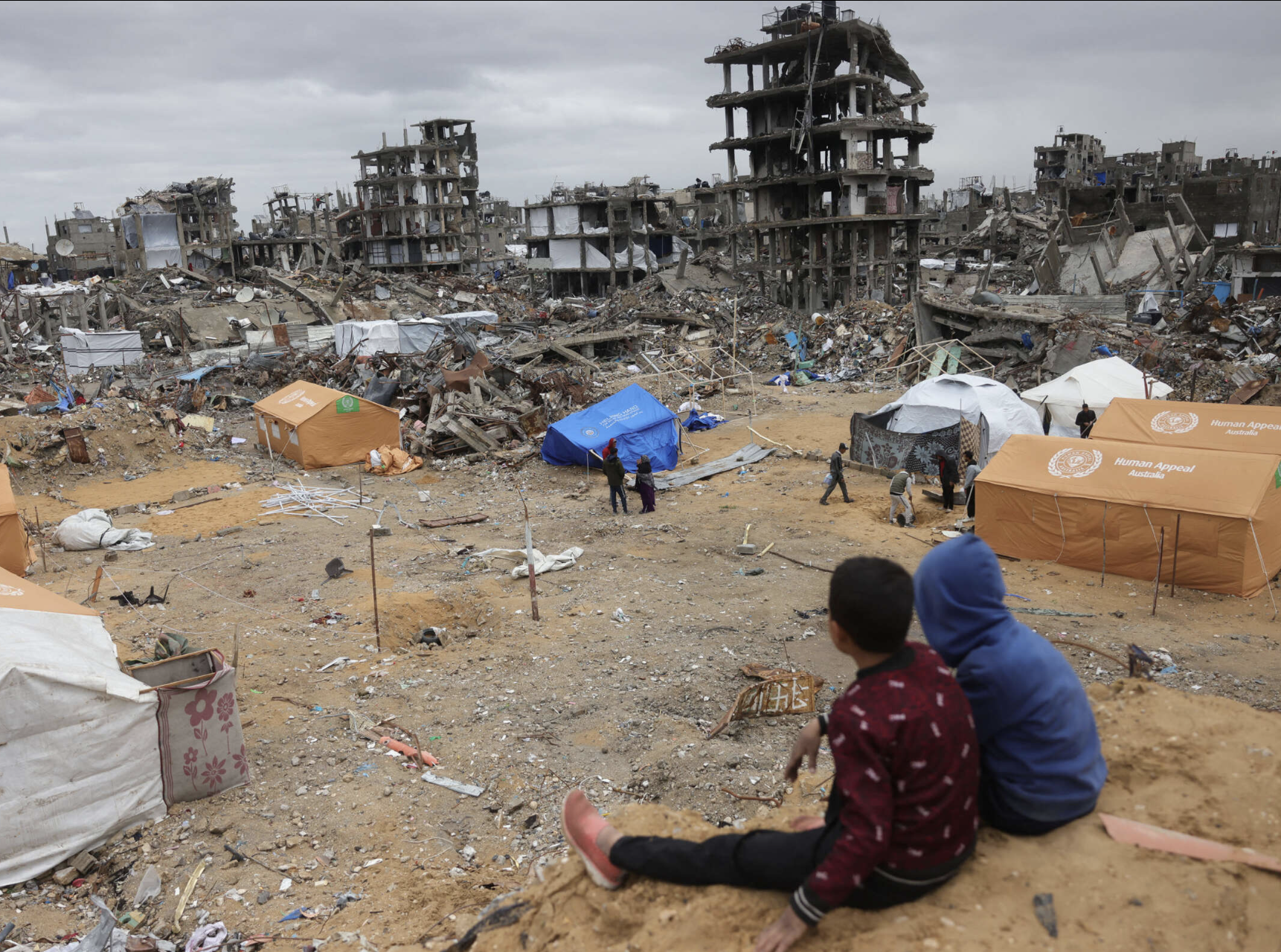
Bashar Taleb/Displaced Palestinian Children Look at City of Jaballah in North Gaza and UN Tents/Feb. 6, 2025
At least it looked like rubble on TV. After residents if the Gaza Strip had endured fifteen months of bombardment, without much place to go to escape an onslaught of missiles and arial attacks, the invasion was treated as a basis to clean the slate and start anew, grounds to erase a right of return so central a demand and of the Peace Process. This is an act of outright bullying, a denial of the Right of Return to Palestinian lands, and perhaps a denial of any rights to statehood by some. As the first leader Trump first officially invited to the White House, Netanyahu pledged before his arrival to “redraw” the map of the Middle East, boasting that “the decisions we made in war have already changed the face of the Middle East.” The problem of Gaza had been festering, the destruction of all of its houses since 2023 created an opening. The decision to wipe Palestinians from Gaza, erased wartime fatalities and casualties that were almost erased with triumphal rhetoric in a weird sleight of hand. He arrived in Washington, DC, ready to reshape a “new Middle East” in the same fashion, to be sure, that Benjamin Netanyahu had already famously made bold to display at the United Nations Nations General Assembly–in a provocation on the global stage made only weeks before soldiers entered Israel from the Gaza Strip in the attacks of October 7, 2023.
1. For his part, the Prime Minister who would be arrested by the International Criminal Court after arriving in any countries recognizing it, insisted “our decisions and our solders have redrawn the map”–a tired metaphor, but a claim that he meant quite literally, and promised to “redraw it even further” with President Trump, his war criminal in arms. Netanyahu had of course takien huge satisfaction in demonstrated the map, very clearly delineated for the General Assembly’s benefit, with Sharpie in hand, on the eve of the Invasion of October 7, 2023–

“New Middle East” Benjamin Netanyahu Presented to United Nations, September 22, 2023
–only a few weeks before te Al-Aqsa Flood might have reacted as if going nuts below the pressure of that red pen–a crazed armed charge from the confines of the Gaza Strip, beneath air cover, whose name mapped a route to the Al-Aqsa mosque in Jerusalem, a site of struggle against colonialism and occupation, that had cast the nationalist aspiration of right-wing Zionists as an admission of guilt of occupation and the voice of the occupier, a position Netanyahu seems to have almost relished. The aggressiveness of the Prime Minister in his bright blue tie and ironed cuffed shirt using his pen to describe a “New Middle East” might have been a form of Pay Ops warfare from the rostrum of the General Assembly, running against any awareness of its origins as a modern cathedral to values of peace, justice, truth and fraternity by displaying an actual land grab of Gaza and the West Bank.
When Israel responded to that bloody and barbaric invasion of October 7 by military aggression of unforeseen proportions, it was hell-bent on destroying the aggressors. They undid any prospect of redrawing a New Middle East, which seemed to have fallen by the wayside as a casualty from the military invasion of untold human casualties. They created a broad consensus among Arab states. This map without people, a bit of a map as a shell game, and a gambit to shift reality from the presence of settlers on the ground–a longstanding problem for Netanyahu, was the starting point, or incarnated the starting point, of the invasion, and a resistance to the cartographic violence that seemed infuriatingly encapsulated in that impermeable deep-blue island between river and sea .
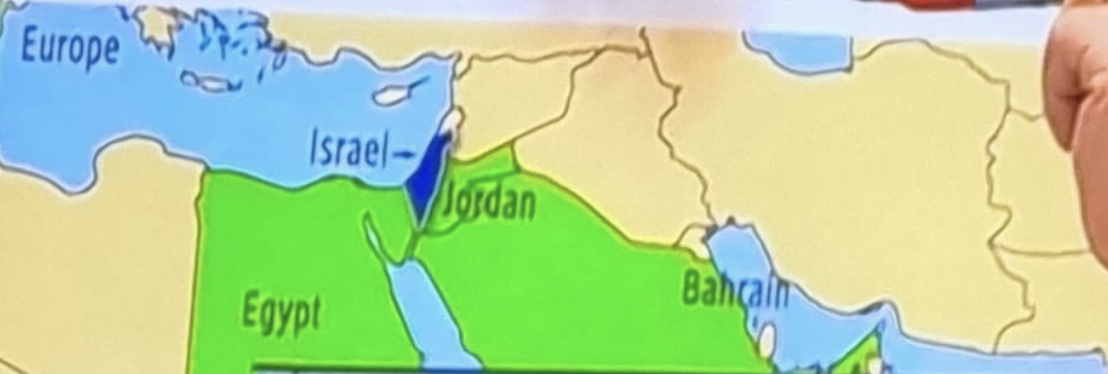
“New Middle East” Map Netanyahu Displayed at United Nations General Assembly/September 22, 2023
The map Netanyahu displayed aggressively before October 7, 2023, colored nations bordering Israel the green of Palestine, revealing open spaces to which Palestinians could be massively deported. Would the Palestinians not be better off, he seemed to be saying, living in Arab states such as Egypt, Jordan, and Bahrain, all colored a monolithic if vibrant green of the Palestinian flag. The huge expanse of green seemed to contrast with the modest seashore slice of Israel, as if to report to world leaders that Netanyahu was ready to put a new future on the map, a future that should want on the table, taking a Gaza Strip or West Bank off the table, since it should never have been there?
The map Netanyahu presented to the United Nations’ General Assembly as a solution removed Gaza off the map of the Middle East. And it had American backing. Long before Trump decreed renaming of the Gulf of Mexico, ending Greenland’s territoriality, or opted to start a war on tariffs to annex Canada as a non-represented fifty-first state, Republicans took glee in redrawing the map of Israel as if foreign policy statements in ways that confirmed the provincial global status of the United States. By early December, Sen. Tom Cotton (R-Arkansas), introduced legislation Congress to “Retire the Egregious Confusion Over the Genuine Name of Israel’s Zone of Influence by Necessitating the Government-use of Judea and Samaria (RECOGNIZING Judea and Samaria) Act,” a promise whose Christian Zionist bullying bore all the fingerprints of Donald Trump’s trademark all caps, holding a sharpie above the Holy Land like a scalpel to redesign it unilaterally: “all official U.S. documents and materials to use the historically accurate term ‘Judea and Samaria’ instead of the ‘West Bank'” in order to “align U.S. policy language with the geographical and cultural significance of the region.” The proposed law of renaming was at essence a right of return, but reveals logical leaps in its syllogistic reasoning: Israel was a Jewish State; the Bible was the Jewish scripture; “a Jewish people’s legal and historic rights to Judea and Samaria goes back thousands of years;” this rights historically trumped the United States adopting a “politically charged term [like] ‘West Bank’ to refer to the biblical heartland of Israel.
This was a map lacking people or residents, cast in matte primary colors and divides as crisp as the costume Netanyahu wore. The display of this map, and the renaming of the West Bank, share an innate disconnect between the map and the world, or the region mapped and its inhabitants. There is a bizarre lack of understanding that the map may not and need not reflect real life. The map he displayed before the General Assembly as a visual aid depicts the blue state of Israel surrounded by a green sea of Arab states–the new homeland of Palestinians? Netanyahu returned to the United Nations, resurrecting the very map one might imagine consigned to history, in the face of Gaza’s bombardment and destruction, standing beside “the map I displayed here last year,” he pledged “with American support and leadership, . . . can materialize much sooner than people think.”
Trump 2.0 had a way to put the funds on the table–his eyes must have bugged out–of billions of dollars that could be redirected to make the plan work. If the “vision” maps and those that Netanyahu displayed seem underwritten and sanctioned by President Trump, they amplified claims to territoriality that derived from Jerusalem; as if the sharpie was lent to Benjamin Netanyahu and the Right Wing Likud. He arrived in New York to predict a “New Middle East” just before October 7 with the hopes of taking a commanding presence in the United Nations lobby and to American backers of Israel. Yet the barbaric invasion in which civilians were killed with indiscriminate rage would bring a greater unity of purpose and support in the Arab World as the Gaza Strip was bombed with massive force, sending Netanyahu’s “New Middle East” to seemingly oblivion. And what was the use of sending the foreign aid, when America needed to tighten its belt, reduce the deficit, and stop thinking of its global obligation as a wealthy nation to imagine that it could save global problems that were truly beyond the scope of anyone. “Every party involved except Israel is against it,” but the image of the Gaza Strip as just an empty lot of rubble, hardly worth fighting for, were fighting words.
Netanyahu was beaming after he met with Trump at the White House, in a celebratory joint appearance at a press conference announcing shared goals and aims. But if we are liable to cast Trump as an evil mastermind for the ending of aid to the Gaza Strip, it might be worthwhile to note the recently leaked Policy Paper, dated October 13, 2023, posing the alternative outcomes to the attack, singled out as the best outcome to be desired as “evacuation of the population outside of the combat zone for th benefit of the citizens of the Gaza Strip,” and that allowing the Palestinian Authority to in the Gaza Strip was the outcome of Israeli military occupation of the Strip, it would be both “a historical failure and an existential threat to the future of the state” that would, indeed, forever compromise “Israel’s ability to recruit fighters;” if the “evacuation of the civilian population from Gaza to Sinai” would indeed “present challenges in terms of international legitimacy” given the optics of such “significant population displacement” “at first glance,” the operational goal of evacuating non-combatant population from the combat zone,” citing the existence of “significant demand for emigration from Gaza among the local population” that war “is only expected to increase,” citing the recent recurrence of “large-scale migration from war zones (Syria, Afghanistan, Ukraine””–as if this were any normal war, noting the possible contributions of Egypt to engage in ‘mediate absorption of the population of Gaza hat will leave and gather in designated areas of Sinai’ to face problems of “allocating land for settlement” [italics added for emphasis], and exercising pressure on Turkey, Saudi Arabia, and other Arab countries (Morocco; Libya; Tunisia) and European nations (Spain; Greece) as well as Canada to prioritize resettlement by “permissive immigration policy,” possibly by applying “pressure from the United States.”
The policy paper suggested a need for significant campaigns from “large advertising agencies” in the western world to promote the resettlement plant “resolve the crisis in a way that does not incite or vilify Israel,” by a message of “assisting the Palestinian brothers . . . even at the price of a tone that rebukes or even harms Israel, intended for populations that won’t be receptive to any other message.”
Was Trump being played by Netanyahu, and urged to endorse the expansion of the Israeli state into Gaza–an issue he really didn’t care much about, but that Netanyahu appealed to his instincts, by suggesting that the Gaza Strip was only a field of so much rubble? The project of rebuilding, and rebuilding with a sudden cut-off of USAID, must have appealed to the sovereignist isolationist, who was ready to cut the United States off from the world–the very idea of commitment ran so deep in what he called that “Deep State”–and to end the norms that seemed to be ingrained in movement to oppose his sense of steering the ship of state, navigating the United States while drowning in a sea of executive orders, hoping to stop it from running up against shoals of international obligation.
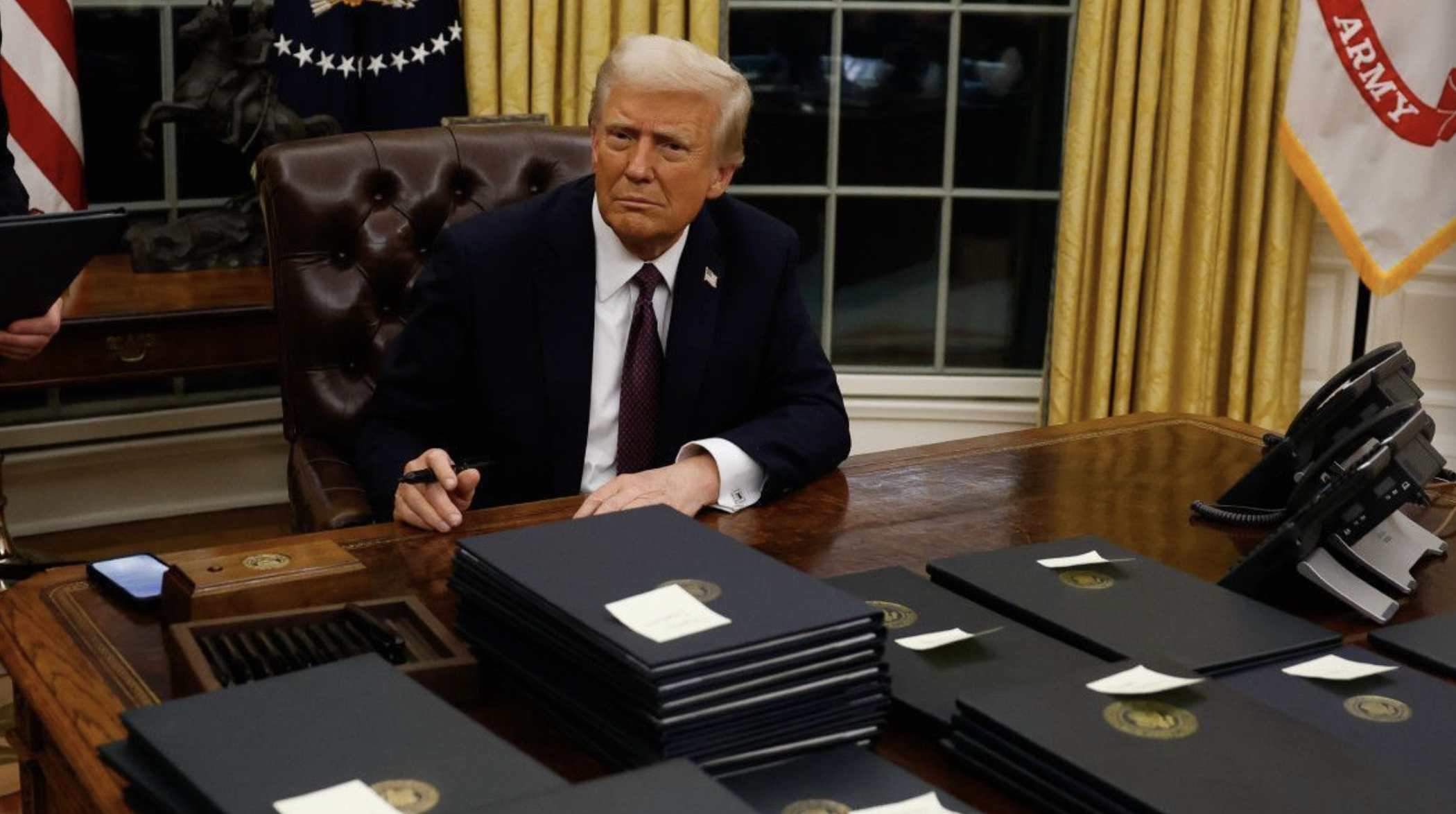
President Trump Signing a Slew of Executive Orders, January 20 2025/Anna Moneymaker
But we might look for some of the fingerprints, but the puppet strings by which he was being pulled, and indeed the deep interests of dark money that had funneled into his campaign from Sands, Inc. and other sources. Trump’s approach was, after all, deeply transactional, as much as we are tempted to dignify it as ideological in scope. The October 2023 policy paper anticipated as the offensive began “dedicated campaigns for Gaza residents themselves to motivate them to accept this plan” of resettlement–and “should revolve around the loss of land, making it clear that there is no hope of returning to the territories Israel will soon occupy, whether or not this is true.” The Policy Paper warned that for Palestinians in Gaza, “the image needs to be: ‘Allah made sure you lost this land because of Hamas’ leadership–there is no choice but to move to another place with the assistance of your Muslim brothers.’” It imagined that a sustained international advertising campaigns presenting potential homelands of “absorption and settlement” ranging from Greece, Spain, Morocco, Libya, Tunisia, Canada and Egypt, Turkey, Quatar to Saudi Arabia, hoping the later would respond to “pressure from he United States in addition to a commitment to use the defense umbrella of the combat groups hosted in the region against Iran as a security guarantee.” A range of nations, loosely imagined as a modern al-Andalus, placed Palestinians far beyond Israel’s borders.
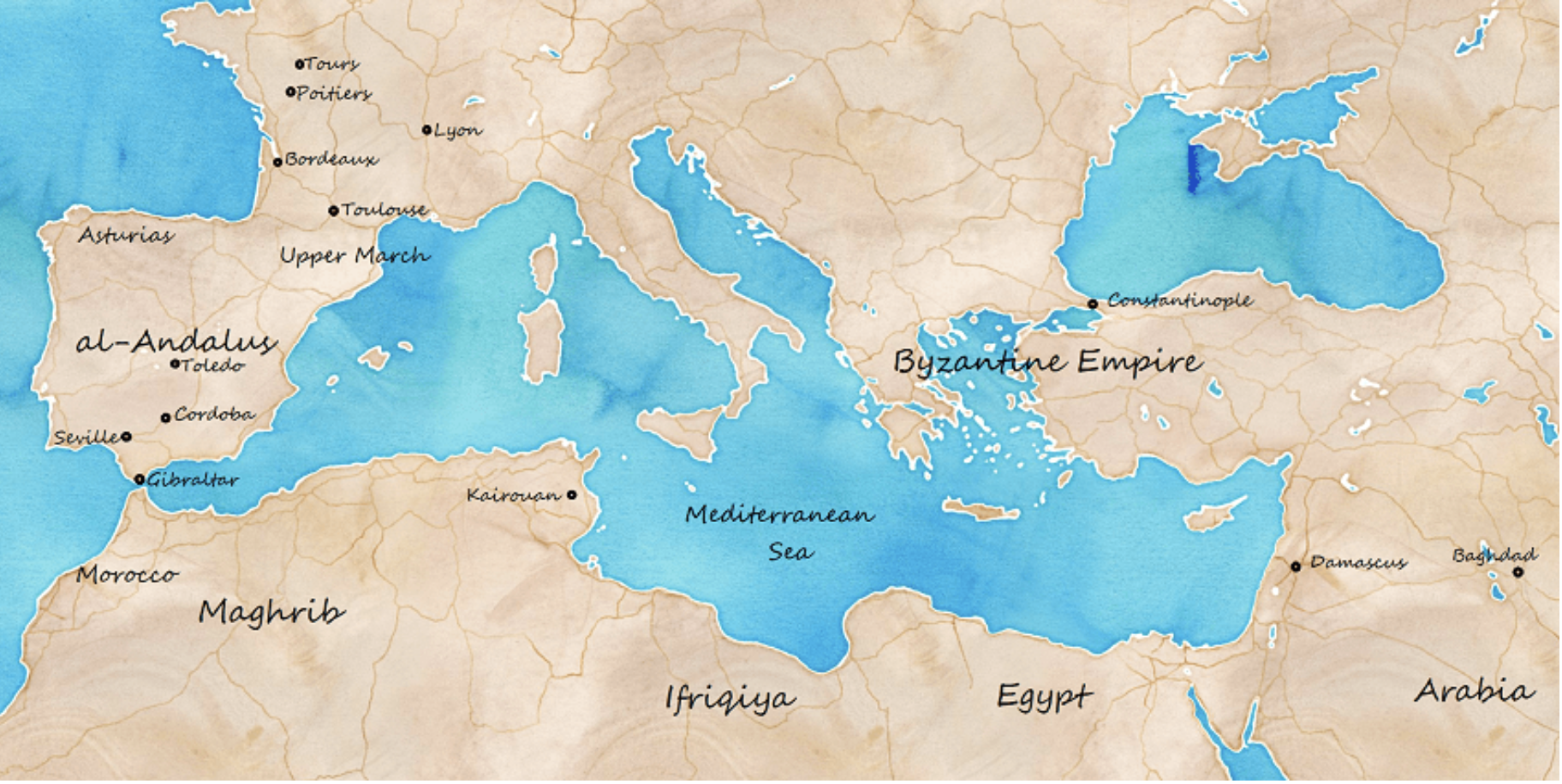
Regions and Capitals of Caliphate of al-Andalus, in the Rasters of Stamen Watercolor
2. The sanctioning Trump gave to redrawing Israel’s expanded boundaries seemed implicit, a tacit reminder of the global context of future territorial disputes of the Gaza Strip and West Bank, removed from the desires or will of its actual residents–the bright green of the Palestinian people was placed outside the boundaries of Israel. The new focus that Trump 2.0 brings to Israel reflects the imagined dream of rejiggering funds from the massive outlay that the United States was long making to the world–but shifting the congressional mandates to USAID through the Secretary State of his own appointment, making sure that the Was it any coincidence that Marco Rubio, Trump’s former political opponent in the primaries of years passed, was targeted by Donald as a tool of the Adelson family, who had him in their pocket? The Secretary of State quickly coopted the MAGA mantra to a promise the “United States stands ready to lead and Make Gaza Beautiful Again,” for the MAGA crowed, declaring he would take charge of a rump of a global institution in a stunning inversion of the ties that USAID had long had to the Middle East. Rather than offering “a process of rebuilding and occupation by the same people that have stood there and fought for it and lived there,” he promised to replace the “miserable existence [they experienced] there,” and move the displaced to a new land of “peace and harmony” outside of Israel’s critically expanded borders.
The folks in Miriam Adelson’s camp were surely trilled the new United States Secretary of State knew the Adelson agenda quite well in the sense that he had almost been groomed for the task. And if he was now in charge of the purse strings, and less corporately conscious than those who held the office in Trump 1.0–Rex Tillerson?–the new Secretary was ready to shift the funds earmarked seemingly without restraint to a new means of scaling down United States presence in the world, and resetting priorities. If USAID was less than 1% of the American budget, even if it disbursed billions, the gutting of USAID was a dismantling of foreign aid destined to international development that Elon Musk quite hyberbolically denounced USAID as a “criminal organization” that had reached not a fork in the road, but simply its “time to die.” Musk–and the Musk family–demonized USAID since its aid played a role in peacefully ending South Africa’s apartheid regime, providing critical economic support for political reform facilitating peaceful regime change that had made it an object of hate; USAID was a target among the entire right wing in America, of course, and the aid it offers to develop Palestine political infrastructure lay in the bull’s eye, as it was cast as an operation of futility, if USAID amounted to less than 1% of the entire US Budget.
All maps of assistance to Gaza were scrubbed from government websites on February 6 with a zeal of terrifying vengeance, erasing traces of aid from 23,000 tons of tents and shelters, 11.000 trucks, 140,000 tons of food, 1,000 water trucks, 17,000 tons of medical supplies, as Israel had committed “to facilitate the transfer of life-saving humanitarian aid to Gaza,” promoted under the hashtag #FreeGazaFromHamas, the organization that perpetrated the cross-border raid, affirming “Our war is with Hamas, not with the people of Gaza” just a year ago. Although some incorrectly described videos were posted of models of aid distribution, as one that reused footage of Ukrainian refugees in Moldavia identified as aid Gaza, this only reveals the breadth of aid’s disbursement, mapped below. Any hope to have ships carrying aid across the Atlantic vanished as “hard core” tech bros scrapped the program and darkening its website that let unmistakable DOGE fingerprints of Elon Musk’s teenage apparatchiks in delivering announcements of collective dismissal by spright emails. If presented as due to a demand for cost-cutting, or determination to bring into line overspending on abused programs, it undermined a laboriously constructed world view, setting off the latest shock to what remains of global stability. If USAID began providing the West Bank with aid in 1975, as a stunningly bipartisan deal overwhelmingly voted in a Democratic Congress to dedicate $1M, the puncturing of the entire project arrived in ways that sent shock waves throughout government, and provoked a deep change in long-established values with disruptive uncertainty of a startup; the $2.5M that arrived the next year made Israel the largest recipient of global aid, the West Bank won assistance that grew tenfold by 1989, and offices in both Gaza and the West Bank opened by 1994– ten years after the Arab Spring, the growing presence of USAID offices was celebrated on a fully interactive webmap, until it was recently darkened offering a detailed view of their global imprint.
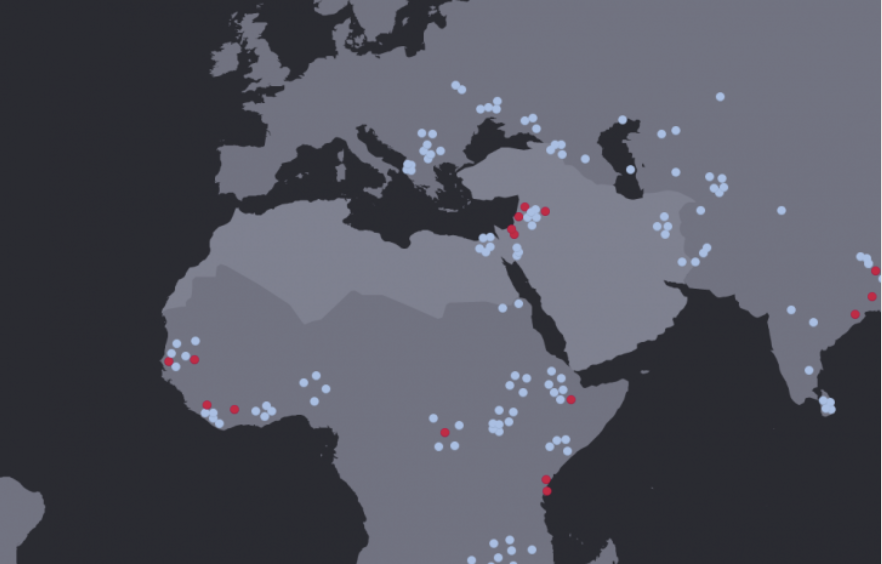
USAID: Where We Work, 2017-2020
Even during the first administration of Donald Trump, what came in for budge trimming stood at the apex of the military and nonmilitary aid the United States had provided a postwar world. In this context, it was an accepted that the aid provided in Gaza was a no-brainer to many government officials and members of the U.S. Congress. If the administration of such projects of assistance were involved in cultural promotion in the Cold War, needed aid bolstered a global order Trump and Musk had vowed to bring to an end–cutting funds to Ukraine, Israel, Jordan, Egypt, and subsaharan Africa. The aid for political and civic reform that arrived in the West Bank and Gaza Strip of over $3.4B from 1994-2010 were time to bring to an close, subtracting support for 3.8 million Palestinians in both regions that were kept on life support by American taxpayers who didn’t want to waste their funds. Miriam Adelson long questioned the reasons why Israel should just not annex Gaza. Or might the threat of the suspension of funds, and the hard-line shutting up of offices, even if a theater of the absurd, be a way to finally compel nations like Egypt and Jordan to take in the Palestinians who had no place on the new map of Israel Adelson had so vigorously agitated?
The United Nations made its initial damage assessment to clear rubble in the Gaza Strip as over $1.2 B across two decades, the US government might fund clearing rubble and debris or removal munitions, but to facilitate reconstruction, not send US aid to reconstruct the Gaza Strip for its former residents, as the organization condemned the Gaza Strip and Gaza as “a high-risk area for potential diversion and misuse of U.S.-funded assistance”–even if USAID funding to print IUD’s on demand is hardly a reason to block stopping an urgent humanitarian crisis, and disputed assistance amounts to 0.01 percent of USAID’s budget. Having ramped up humanitarian assistance to Gaza since 2021 and the outbreak of the war, building a pier to help aid delivery of food supplies to residents under attack, the sudden shift wiped Gaza off of the foreign aid map, kicking financial support out from under its feet necessary to allow resettlement, and define it as so much “rubble.”
If the outreached clasped hands were the icon of Benjamin Franklin’s Philadelphia Contributionship, an early fire insurance corporation founded to preserve neighborhoods from fire risk, still seen leaving visible signs in the medallions seen in old Philadelphia neighborhoods of four clasped hands or handshake, promising security in a a chaotic time of urban fires, the metal marks provided policy-holders amidst dangerous turf wars when competing fire companies intentionally ignited fires to compete for clients in the city, rendering a heightened topography of risk–

Philadelphia Contributionship/Philadelphia, PA
–USAID had repurposed Franklin’s spirit of insurance to fight global fires in hotspots of humanity, before offering assistance was rebranded as waste. The United States faced a fork in the road to end misuse of global assistance by redefining what “international development” really meant. While the Contributionship for the Insurance of Houses Lost by Fire still exists in Philadelphia, the industrial artifacts indicated the policy numbers on each cast mark as a sign of mutual community support. If the Shield of US AID, akin to health insurance, was offered in an American tradition of providing proud insurance against global risk, in the “Hand-in-Hand” fire marks featured in museums, Trump and Musk seem dedicated to cost-cutting by Make America Great Again off the mark of a storied tradition in part founded by a founding father, as American as a Liberty Tree.

The Foreign Aid that USAID has distributed globally ended on January 20, 2025, opening the world to the rocky road of threats to do without $70 billion foreign aid budget approved by Congress–going cold turkey and hard core by ending programs the Trump administration seems determined to shutter. After all, he might claim he had run on abandoning and been elected to withdraw the United States from the world. Never mind that the distribution of assistance has structured the postwar world from 1946, almost immediately after World War II–closing that chapter of assistance for a developer who proposed far brighter ideas for global futures.
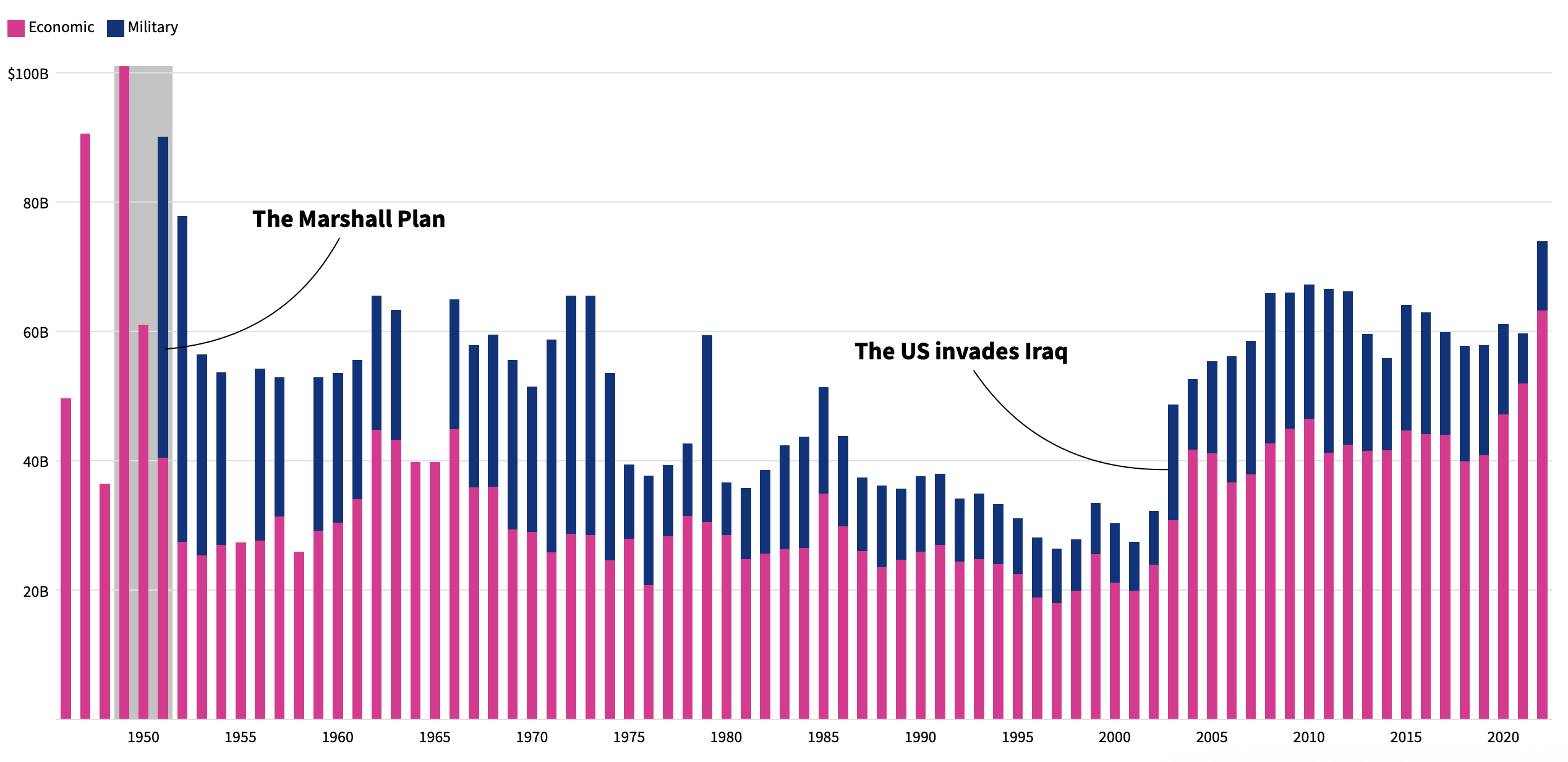
Economic and Foreign Aid–Economic (Pink) and Military (Blue), from 1945 to 2024, in 2022 US Dollars
In recasting hundred billion of assistance as corrupt ways of taking advantage of Americans, the opportunity was opened to rebuilding infrastructure on beachfront properties with Israeli hotel owners and even, why not, maybe a few casinos. (In addition to being the publisher of Israel Hayom, where Miriam Adelson wrote columns that urged annexation, as sole owner of Las Vegas Sands, Inc., the world’s third-largest casino, building casinos in the desert with proper taxation laws was her bread and butter. Might Mirian even rip a page from how casino builder Benjamin “Bugsy” Siegel sought global renown sought as a Galicianer gangster and Jewish American mobster who first promoted Las Vegas hotels as casinos by selling explosives to Hitler and Mussolini, before he found the Nazis uncouth. (“Bugsy” famously had trouble getting fellow mobsters to part with fortunes made in Prohibition to his casino project, who weren’t as far-sighted for Americans’ taste for gambling their earnings on a jackpot, and blanched at financing the escalating costs of a Flamingo hotel rising over $72 million, but mapped the surreal terrain for Sheldon Adelson’s fortune. Why not expand Sands, Inc., to Gaza, if not the Negev, if it wasn’t beachfront, recasting the sinkhole of USAID humanitarian aid to a ritzy outpost of gambling that might attract a real economy?)
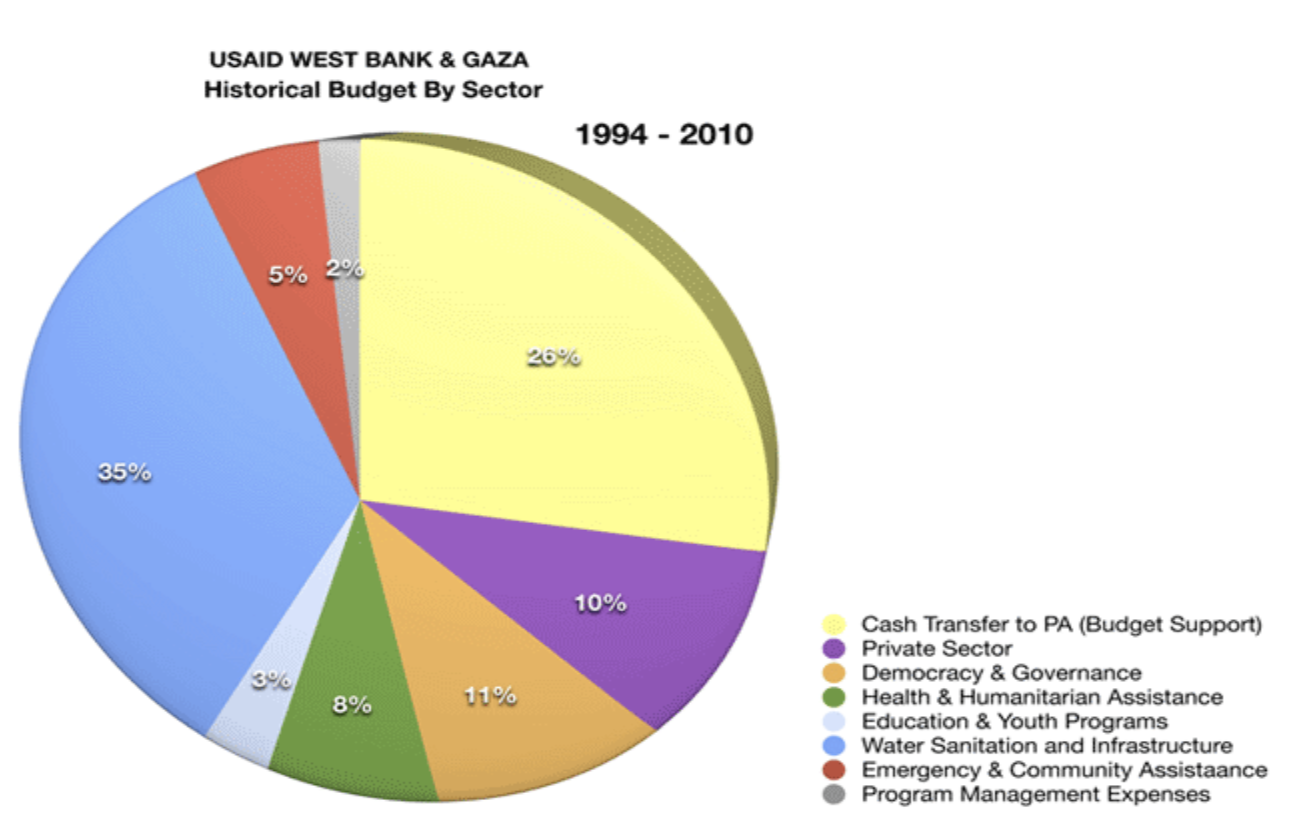
USAID Funding to Gaza and West Bank, 1994-2010
Moving on from shades of antisemitism that may dwell underneath in the previous paragraph, Donald must have been bug-eyed himself at the billions on the table in USAID projects that might be repurposed for building even better luxury projects on Holy Land. Where else could you get a lot of Americans with cash to burn looking while tourists for a place to take in ocean air? Why hadn’t anyone mapped the Gaza Strip as the prime real estate it truly was, Jared Kushner long wondered.
Wasn’t it absurd the history of disbursed funds disbursed globally with abandoned would be funneled to a pet project on the Gaza Strip, giving American taxpayers long taxed by watching maps of local devastation and destruction on the news relief about that small if contested Middle East keystone where so much money had flowed on such massive scale with little clear benefit. Why not, asked President Trump, give people what they really wanted? In imagining the funds able to be redirected to the Middle East during the period after the invasion of Iraq that had made the region of military importance, why not use the rebuilding of Gaza to make a huge profit for all?
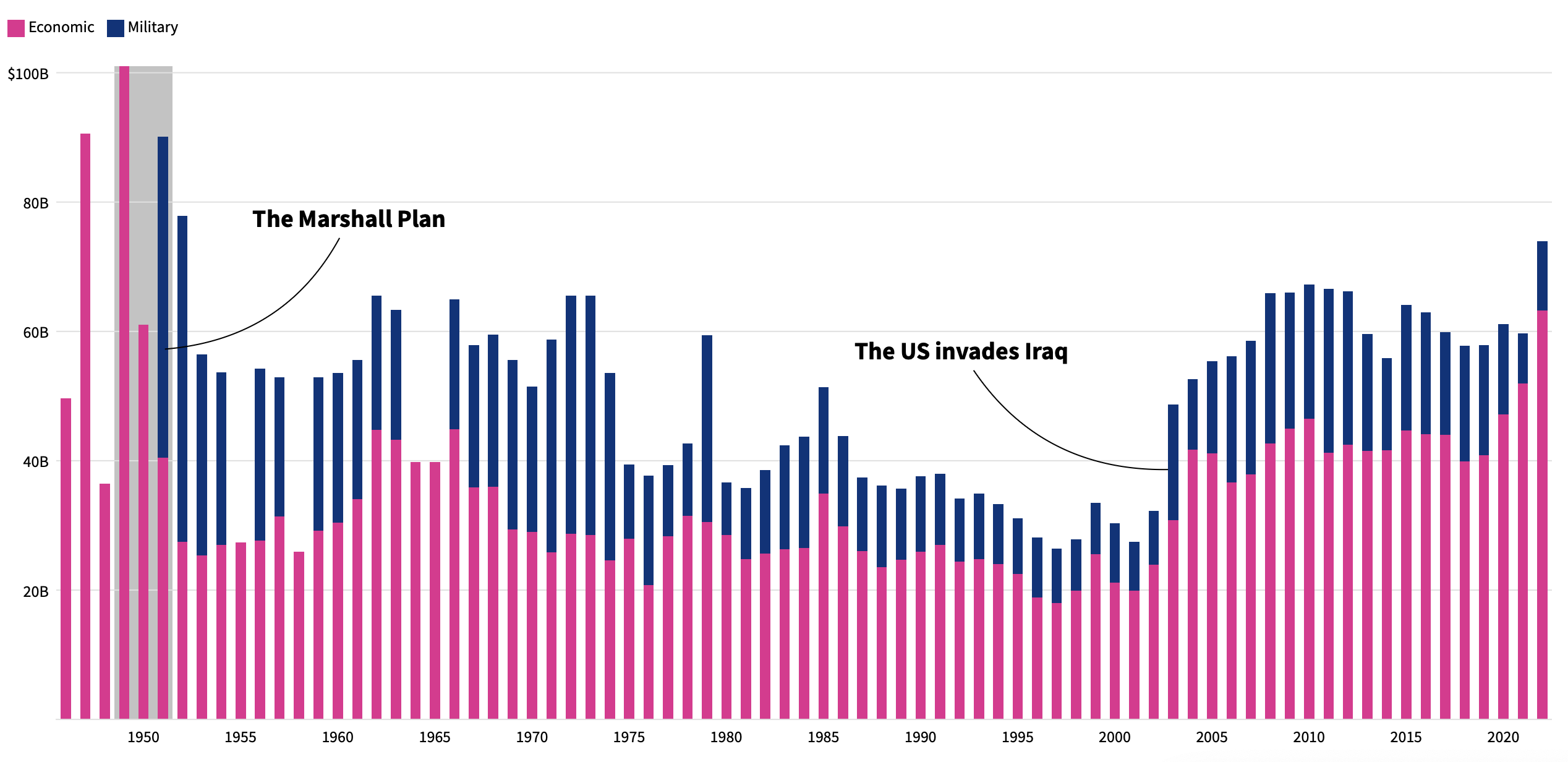
USAID Assistance Rose After Invasion of Iraq and Investment in Middle Eastern Stability
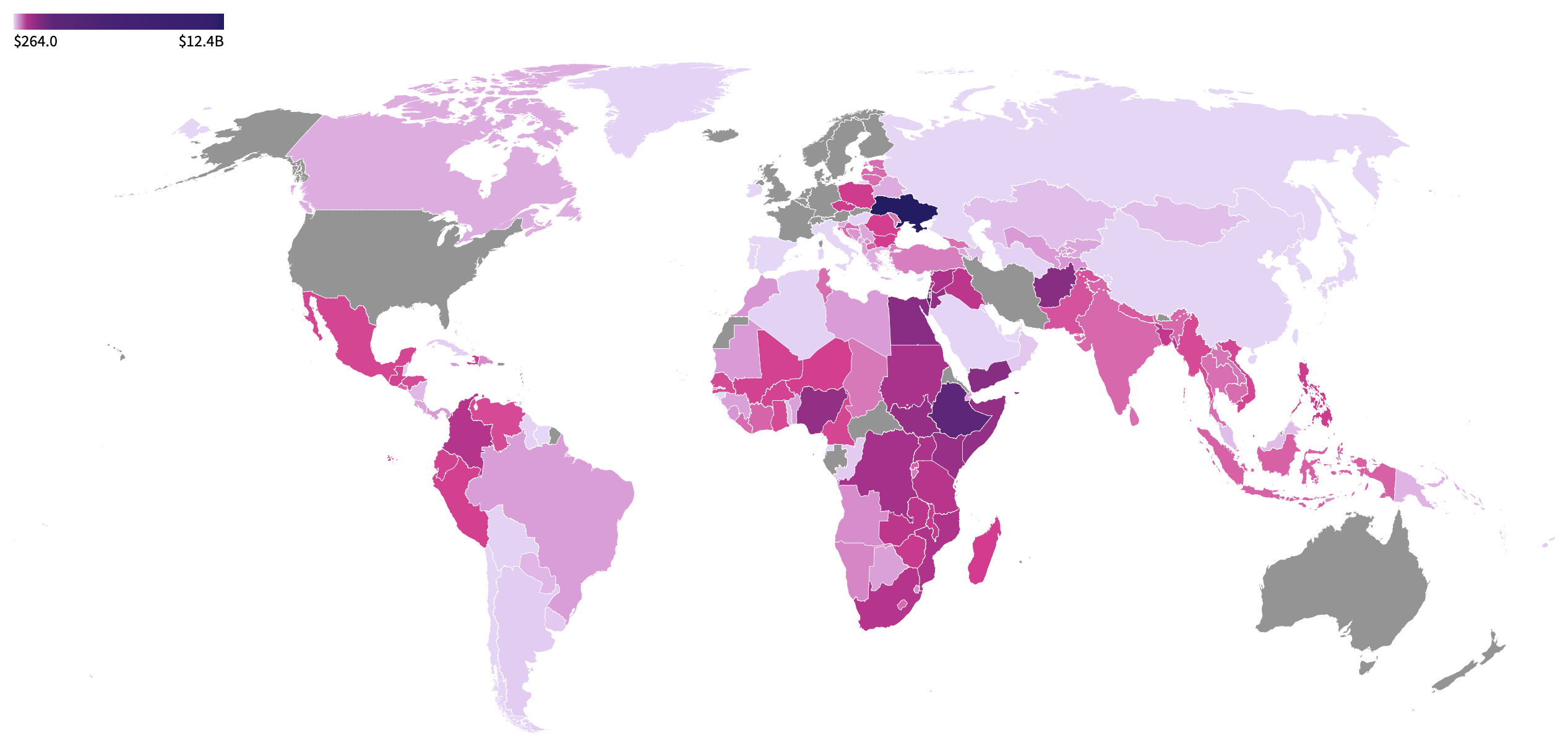
The only problem is where to put the Palestinians, if the hope to move them to Egypt, Jordan, and maybe even Bahrain. The map that had flowed to the Middle East after the Iraq War had included a substantial rise in military support, that had made many of the states in the region virtual clients of the United States, and now was the time to call in the chips, diplomacy be dammed–$3.3 billion to Israel in specific, but $1.2 to Jordan, $1.4 B to Egypt, and $3.3 to Saudi Arabia, and $1.4 to Yemen, of which Egypt and Israel were the two largest recipients of aid by a huge margin, adjusted for inflation, from 1946-2024 of some $535 B. The growth in aid as percentage of GDP had hugely grown since 2020, as a way to enhance American global influence and prestige, prevent conflicts, and foster diplomatic relations as well as democratic institutions worldwide, and all this was, in essence, on the cutting block in 2025. As Biden-era funding earmarked more funds for Gaza assistance from USAID, the projects were eagerly blown up, if not jackhammered, by a President unable not to recast the Middle East map in his own mode, by using not the old map that he had floated–featuring the “not all-inclusive” list of Israeli settlements he envisioned back in 2020–
Trump Plan, Vision for Peace–Conceptual Map of Israel’s Future Boundaries (2020)
-beyond the enumerated fifteen Israeli enclaves in the vision of a future Israel, in the fine-print footnote that seems its most important legend. The new map would dispense not only with the tunnel between. Gaza and the West Bank, but eliminate both, as areas annexed to Israel, and start from the tabula rasa reflecting the persistent “bad luck” of Palestinian residents, as if the better luck of Israelis might make it opportune site for the beachfront casinos actually more geographically appropriate–“location, location, location!”–to dignify the identity of the Riviera of the Middle East, in place of the humanitarian aid corruptly provided to the down on their luck Palestinian refugees.
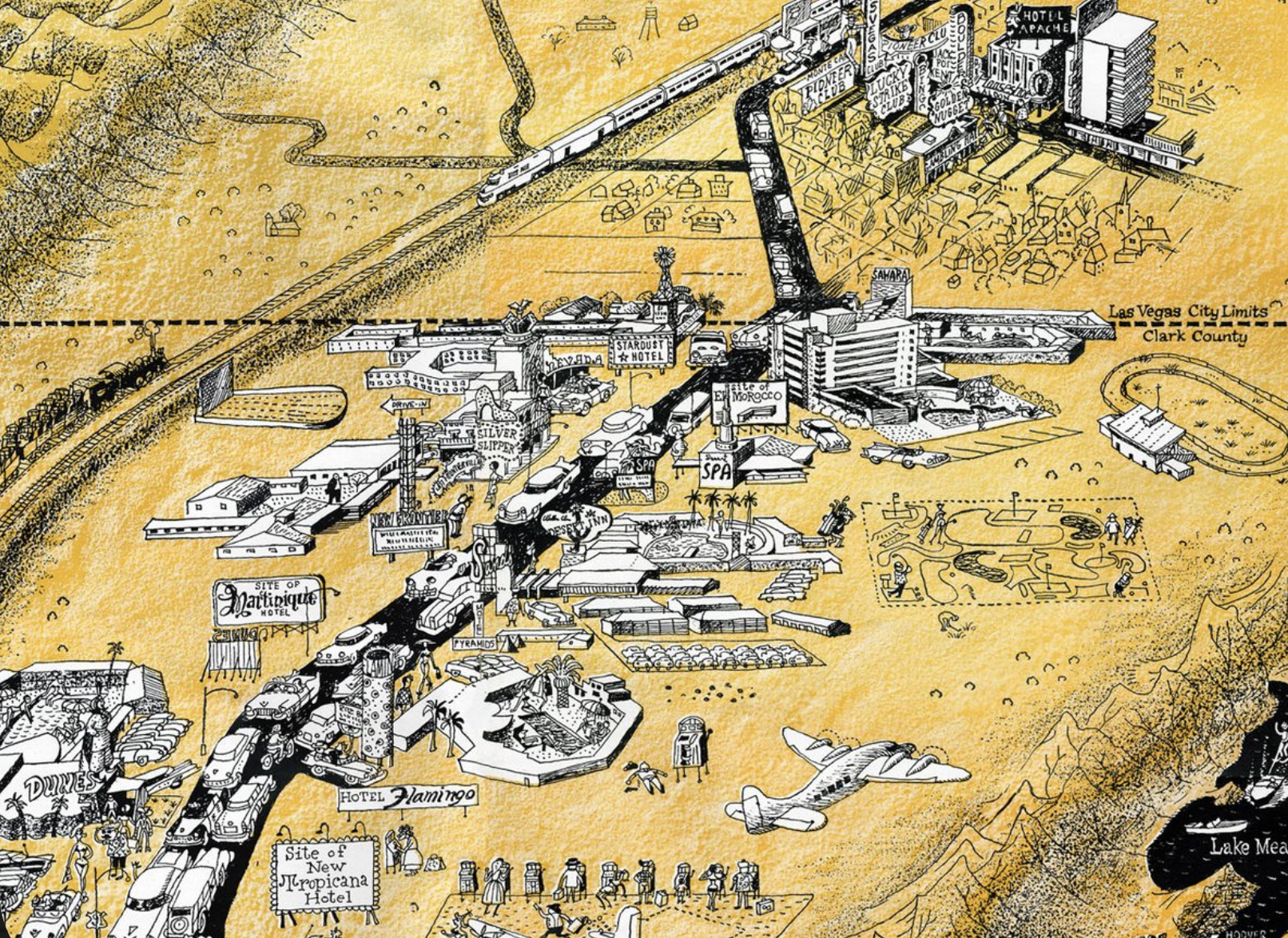
Las Vegas, NV Site of the Flamingo, Silver Slipper and Stardust Hotel, and Future Tropicana and Martinique Hotels (1955)
3. This proposal is based on a map that is not real life. It is a map, and people cannot be moved indiscriminately around without resistance, or without the erosion of social norms. There was no norms in Vegas back in 1955. But if the Sands community existed as a funhouse outside of state taxation on casino earnings, Trump seemed able to un-see Gaza as a state–end its sovereignty that was, in his eyes, only a vacant lot that made no sense to fund save to build a development he desired. Netanyahu has, of course, recast the Israeli state as an extremist settler-state bent on ending the two-state solution, and indeed done so by rendering Gaza uninhabitable, by converting it to rubble, as a precedent for making it a part of Israel again–Rubio’s vow, “Make Gaza Beautiful Again“–to map a future without Gaza as an independent land. The Gaza Strip was so intensively bombed by American-made munitions to flatten most buildings to a scarcely habitable expanse. Bracketing the incommensurability of a 1980 Manhattan lot on Fifth Avenue and the poverty of a densely populated Gaza Strip, they almost seemed exchangeable, interchangeable and fungible in a world of real estate, leaving the world digesting a real estate developer using the strong-arm tactics he had honed in Manhattan to envision the Gaza Strip as an opportunity for future development–quite a flip from the map of food insecurity that USAID had warned was a global danger needing to be resolved.
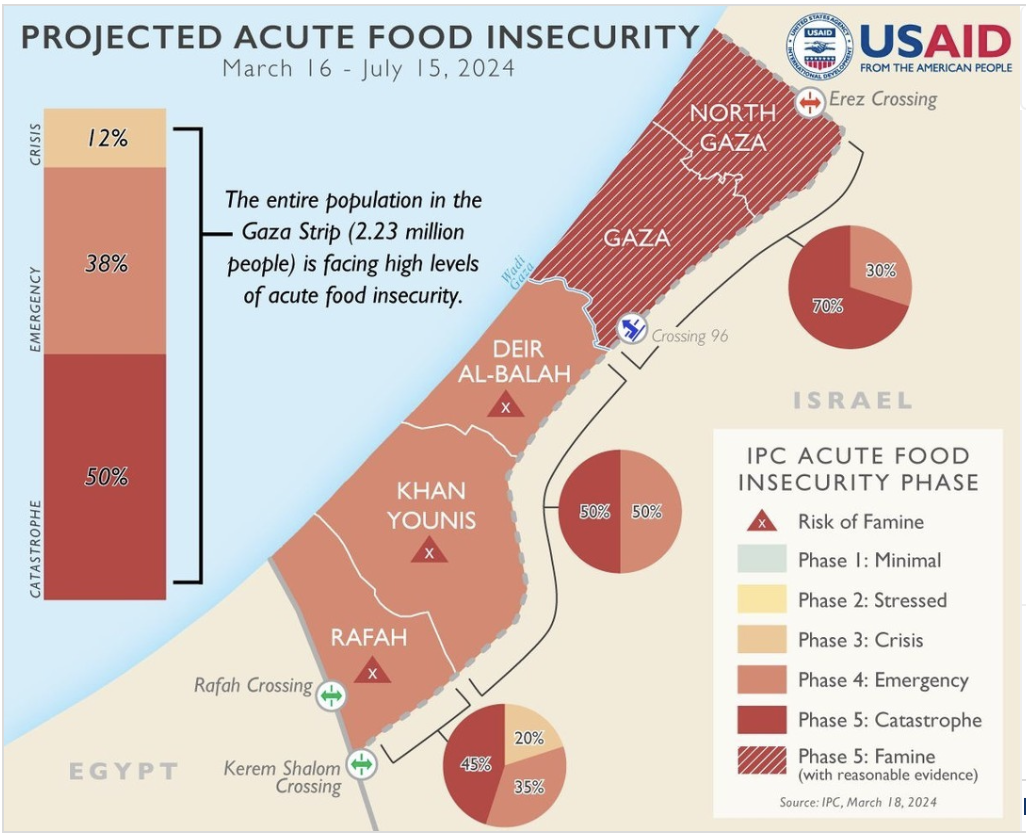
USAID Infographic of July, 2024/USAID from the American People (since inaccessibly scrubbed)
The absurdity of the comparison begs the question of how dropping hundreds of 2,000 pound bombs on Gaza wounding people at a distance of a thousand feet in densely populated areas justified a level of military violence not seen since the Vietnam War, multiple craters over twelve feet wide the result of the indiscriminate bombing of residential areas to redraw the map. (And the Vietnam War offered a poor precedent for redrawing a map.) Israeli bombardment of sustained intensity was argued necessary to dismantle the network of underground tunnel-structures dug beneath Gaza’s bounds to train Hamas militants, leading to the mission of destroying the “warren” or “spider’s nest” of a hidden enemy reaching for metaphors of barbaric animality in response to the wonton violence of the invaders’ attacks, as if projecting the metaphors of bestial opposition.
The tunnel network never seemed to be able to be erased so much as the morale of the Palestinians was hoped to be targeted–the indiscriminate use by Hamas of refugee centers as training grounds led to the erasure of refugee camps and almost indiscriminate deaths of women and children, as if a final act of dispossession of the weak that erased the design of Gaza as a landscape of resistance. The bombing destroyed above-ground houses that inflicted casualties on women and children at a toll that is unable to be comprehended–as challenging, perhaps, as global threats bracketed buy the Trump Regime of global warming or climate change. The memories of the onslaught on Gaza is not easily erased, of course, and the idea created worries of sewing chaos in the region, that makes it hard to be seen by most with any shred of empathy as simply a lot of rubble and a clean slate–but the bombed out landscape of rubble suggest the roughness accentuated in data projections of the damaged buildings left by bombing raids that left over a hundred thousand killed, injured, or below the rubble itself–where an estimated 15,000 living or dismembered bodies lie–over five hundred removed since the ceasefire took effect as actual searches continue for more buried needing rescue.
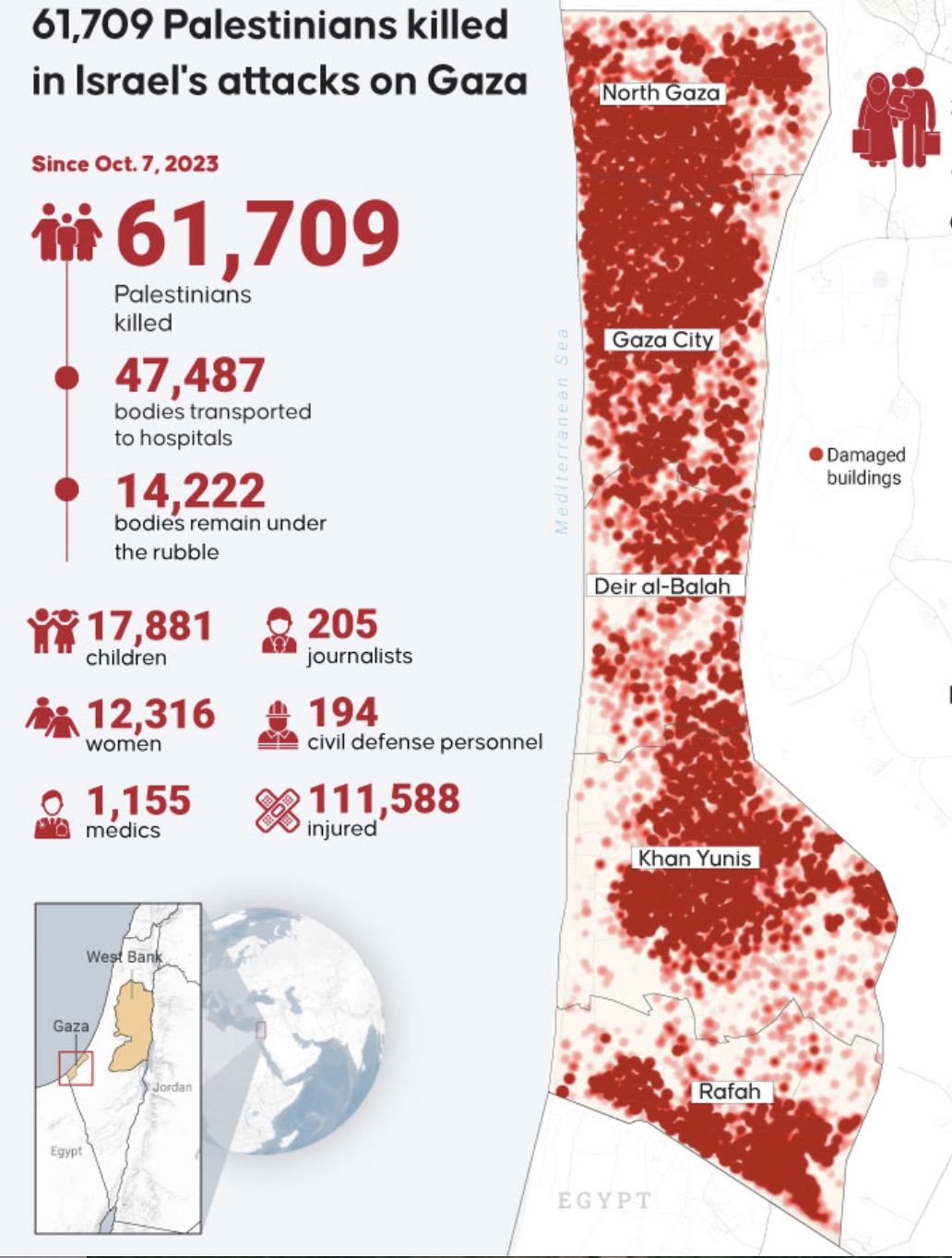
February 3, 2025/Local Government Media in Gaza

Trump was probably not inherently tied to Israel for political reasons–if his largest backers, Sheldon Adelson and now his Israeli widow Miriam have emerged as kingmakers of the Republican Party, since her husband died in 2021, after Trump left the White House, in ways that have shifted his promises to end the wars in Lebanon and Israel to expanding them, and Adelson has influenced or many of his political aids and appointees, and she herself served a medic in the Israeli army. If she was so “charmed” by Trump at a 2015 courtship meeting to donate $20M to his campaign, and help his legal defense fund, she may have won his quid pro quo moving of the US embassy to Jerusalem, and even based her support on the promotion of Israeli occupation of the West Bank. Was Netanyahu not showing the “Future State of Palestine” to the Adelsons, and to Americans like Trump, as much as to the General Assembly, when he arrived in New York in 2023, determined to keep the Biden administration on track to hold up Trump’s inclinations?
Did the longstanding demand the Adelsons had to recognize Israeli sovereignty over the West Bank become a bargaining chip non which their support was contingent–making it a promise he was committed to follow, international politics or not? The language of destruction, and indeed the rubble of Gaza, became a bit of a figure for the conquest from which a new Palestinian state should arise–perhaps-akin to the ability of Trump Tower to rise from the ashes of Bonwit Teller? The promise that Trump made for a better future of “something that could be magnificent,” “something that could be phenomenal” was hucksterism of a confidence map who had already mapped the elimination of a Palestinian state in his “Peace Plan” or “Vision for Peace” of 2020.
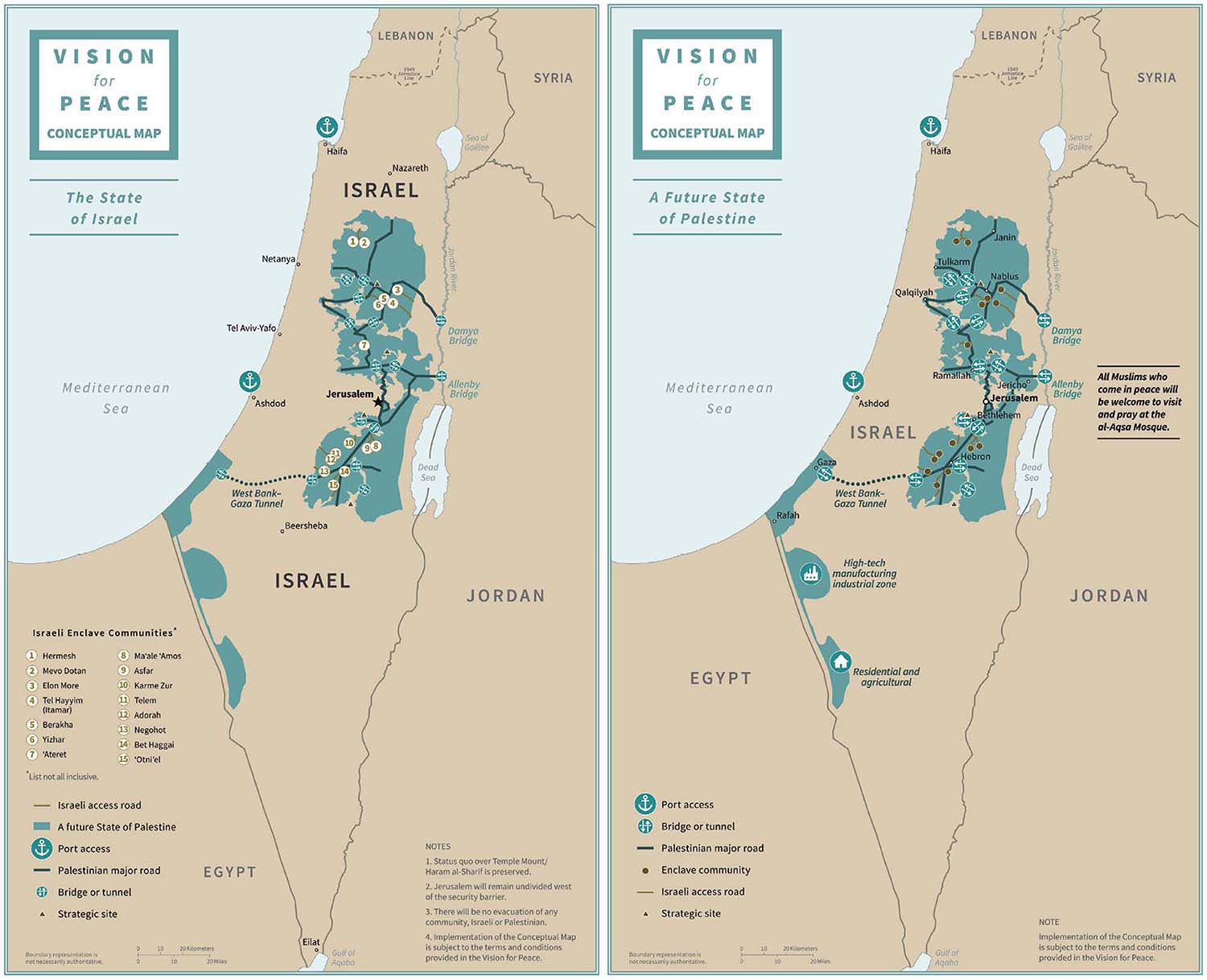
Trump’s Vision for Peace–A Conceptual Map, in Middle East Peace Plan (2020), “Future State of Palestine”
Trump had pushed for the annexation of the West Bank in State Dept. maps, and radio’d approval to Benjamin Netanyahu in March, 2024 that Israel should, even as Biden was pushing for negotiations, act quick to “finish up your war” in Gaza and “get it done” as he thundered in his sole Presidential debate that Kamala “Harris hates Israel,” while affirming his defense of the occupied territories and continuation of its “counter-offensive” into the year.
Trump reached to the notion of a diasporic presence of Palestine outside Israel’s boundaries in his evocation of a beautiful “future state of Palestine”–to be worth a lot more than the “pure demolition site,” since if you looked at the state of those buildings, reconstruction was not gonna happen: someplace somewhere else where someone could “build them some really nice places with plenty of money in the area, that’s for sure . . . would be a lot better than going back to Gaza”–even if the historical claims of Palestinian refugees who settled the area from the Al-Omari Mosque in Gaza City, the Great Mosque of Gaza, that continued to attract the faithful even as it was damaged by air raids, to the burial fields and past homes, as if their memories might be wiped off the map.
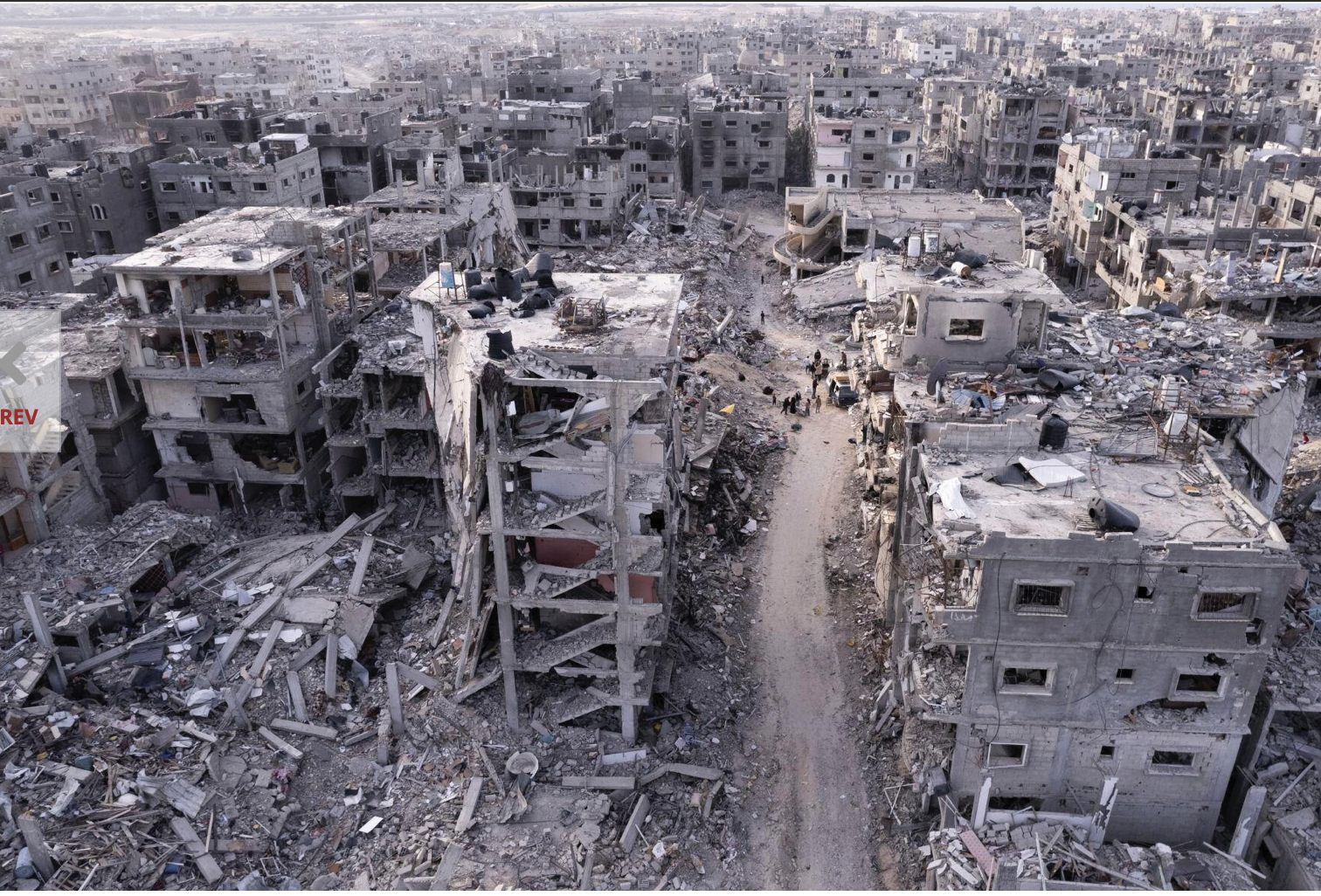
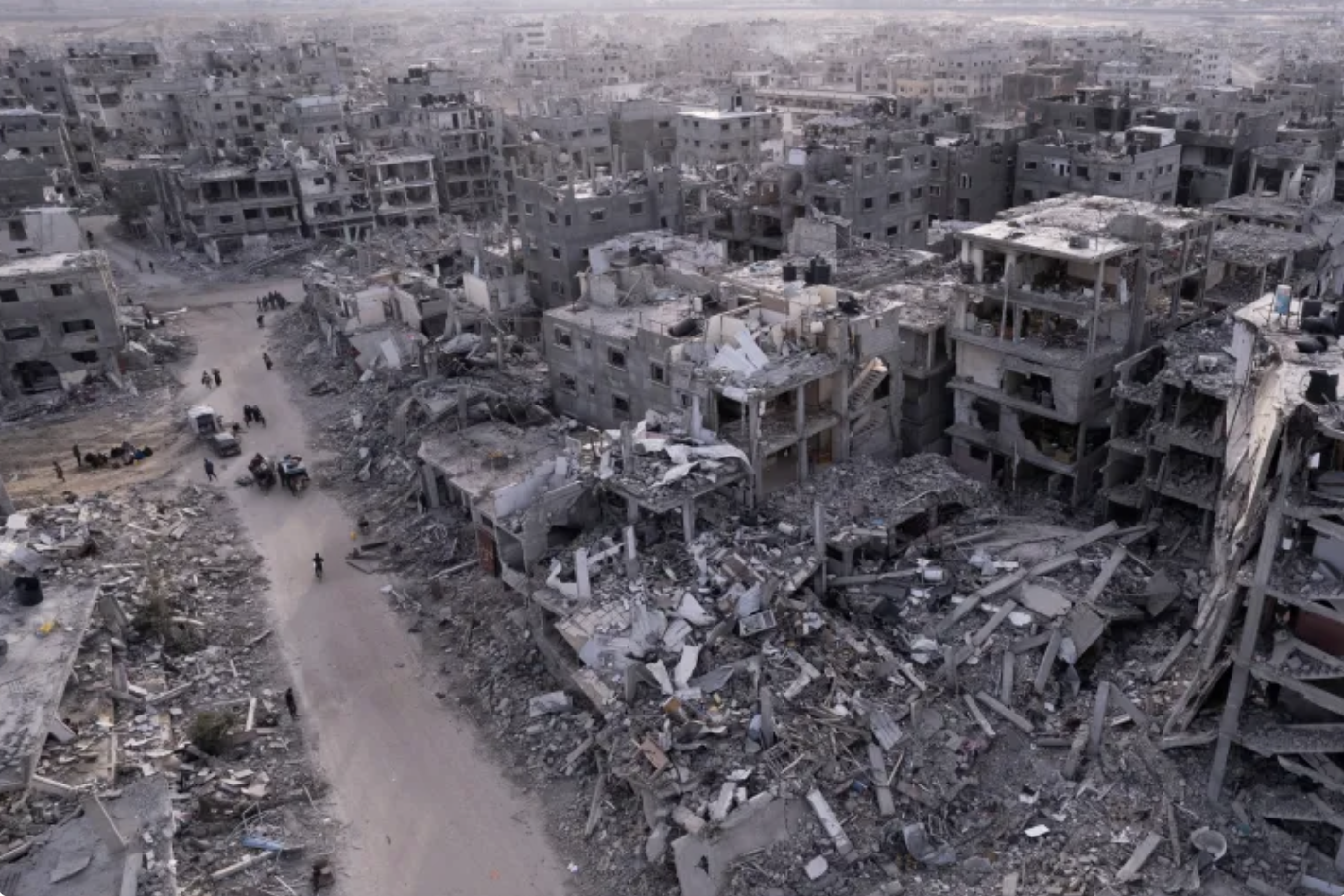
Palestinian Pedestrians Wandering in Gaza’s Street, January 21, 2025 /Mohamad Abu Samra/AP
There was, perhaps, a legacy of demolition, rubble, and wiping away cultural legacies in Trump’s mind. Much of Gaza did look like a construction site–one thinks, despite the incommensurability of the comparison, to the rubble of the grandiose limestone and granite Art Deco clothing emporium Bonwit Teller at the intersection of Fifth Avenue and Fifty Sixth Donald Trump demolished by undocumented workers to create Trump Tower,–famously judging “the merits of the stones not great enough to justify any effort to save them” by spokesperson in 1979 with ugly swagger.
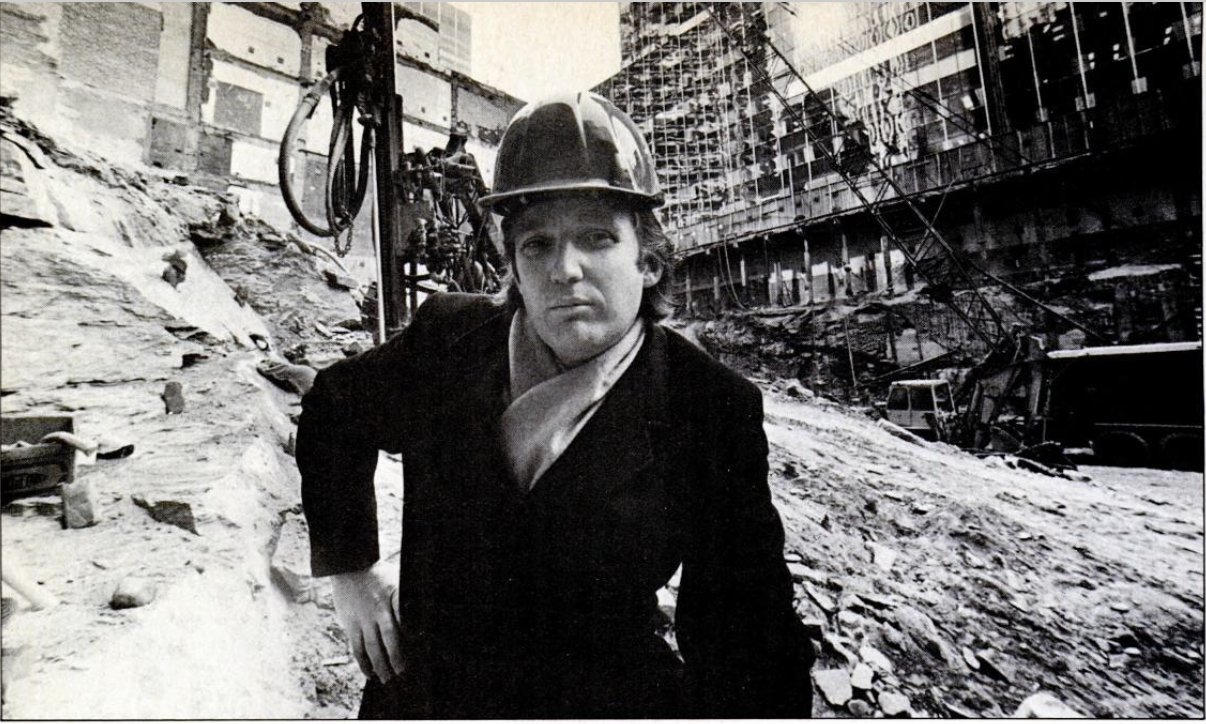
Donald Trump Posing for Photograph at Site of Future Trump Tower on Fifth Avenue and Fifty-Seventh Street
The public demolition of the the flagship of the woman’s clothing store for New Yorkers’ eyes became a theater for staking Trump’s claims to Manhattan–and became the stage he gained global attention by later descending its gold-plated elevator, pledging to Make America Great Again by ridding the Homeland of “illegal immigrants” and criminals that evoked Fascist rhetoric of extermination. The tower that became the means for Trump to make his mark in Manhattan, the soundstage for his future television shows, and the setting for the Donald Trump Show, was built on the shocking removal of a landmark facade and statues of considerable monumental value. Trump wildly inflated the cost of their removal over tenfold, leading architectural critics to urge “New York needs to make the salvation of this kind of landmark mandatory and stop expecting that its developers will be good citizens.” The scandal of the jackhammering of the statutes==”fuck it, blow them up!“— became a sign of the bravura: he described the “junk I destroyed at Bonwit Teller” to boast of the efficiency with which he would get things done and make them happen in public speeches. It is less noted how much the facade featured the monumental image of Manhattan Goddess,–a Bonwit Teller signature and an icon of its elegance, when they were installed–their destruction was frot page news on June 6, 1980 in the New York Times. Perhaps Trump thought would be press attention that would only add attention to the future Trump Tower–hardly a favorite of architectural critics–

Manhattan Goddess Dancing in the Winds, 1929/Rene Paul Chambellan ( 1893-1955)

June 6, 1980
–long so inseparable from him that a noted cultural historian pondered after the shock of the election of 2016 while I walked him to his car if it might ever be the case that the glass-fronted monstrosity of a tower might one day gain the affection and appeal with which we regard the kitsch we are know able to see concrete towers of everyday Soviet architecture, that once broached a menacing future, or the aesthetics we are know ready to detect even in soviet modernism of mass housing projects. The possibility in all actuality seemed thin.
If the blot of Trump properties in Manhattan became a shame of many New Yorkers, Trump faces stakes now far, far higher. There was little comparable to the destruction of structures in Gaza to the storied Department Store, but the readiness with which the enclave isolated from the world, paradoxically once one of the densest sites of human residence. The cordoned off area of the Gaza Strip was perhaps the most closed to relations to the rest of the world in an age of globalization, whose isolation from 2012 was a salient symptom of globalization, as an attempt to close and isolate the densely inhabited region from any site in the world, preventing entry and exist at checkpoints, forbidding presence within three hundred meters from the perimeter fence separating Gaza and Israel, and curtailing access to the Mediterranean Sea on its coastline–isolating its inhabitants and preventing access to a third of the potential agriculture in Gaza, that seemed to bode poorly for its future–and expanding the no-go zones declared along the perimeter of the wall after thirty-two underground tunnels under the border were discovered in 2014, shrinking the region of settlement by an enlarged “buffer zone.”
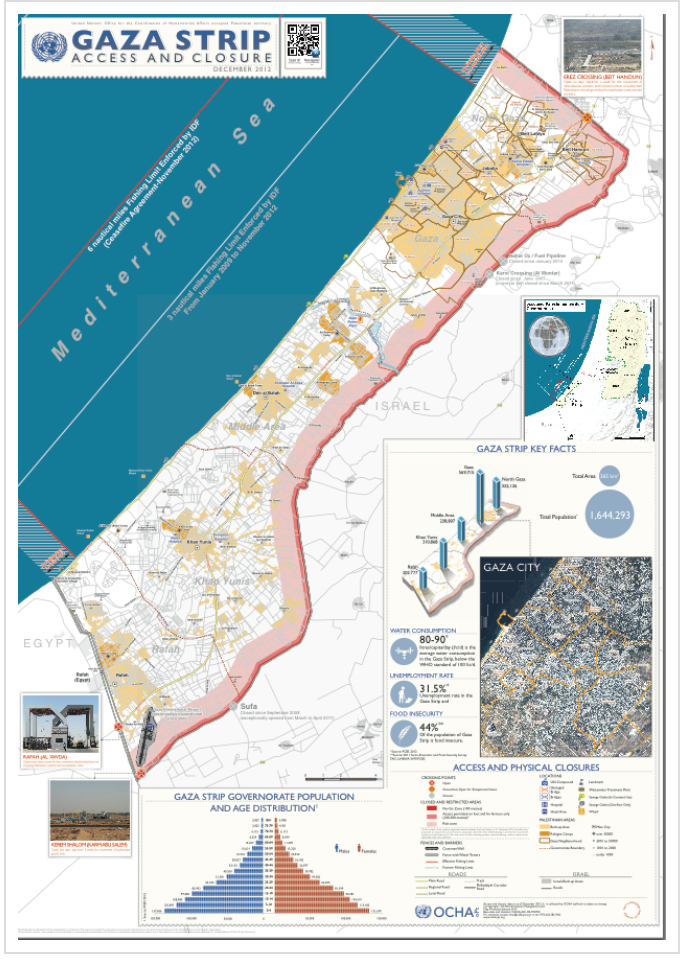
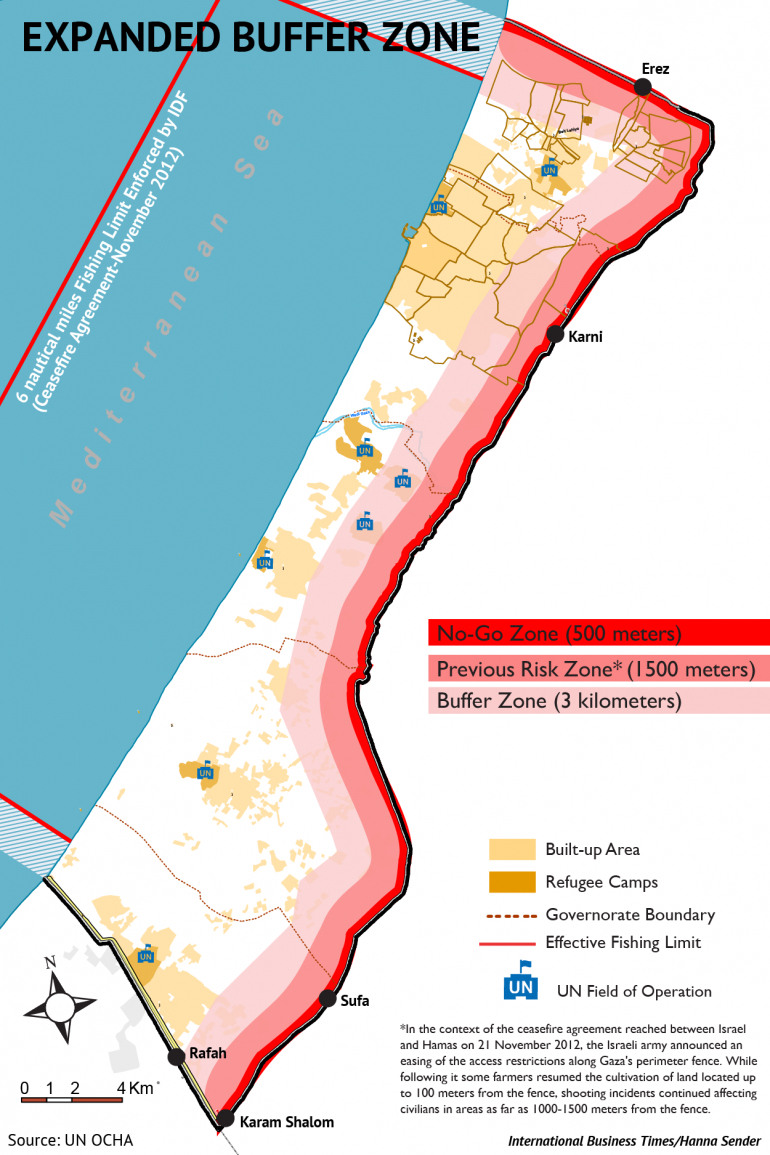
Gaza was symbolically important as the sole land where Palestinians expelled from Israel could settle since 1948, had been flattened to become a demolition site that was ripe for rebuilding. To be sure, Israeli Defense Forces have, over the past year, been confining residents of Gaza to smaller regions of relocation over the past year, as troops have confined residents to smaller enclaves, even as they rebuilt the steel border fence that had been destroyed in the October 7 invasion. The expanded “No-Go Zone” beside the security fence of the Border Wall was entered peacefully to affirm rights to residence on each Great March of Return, both performing the displacement from former towns and nourishing a spatial imaginary of lost land on Land Day, May 15, 2024.
The march across Gaza, while short, commemorated the expulsion of Palestinians from Israel’s sovereign bounds, starting from the tents in East Gaza which are named after villages from which Palestinians were forced to flee in 1948, while promising to “pass on the importance of our right of return to young generations, who have never been able to touch the ground where they are originally from,” a commemoration of the displaced that had, of course, fed the militant attack of October 7, 2023 deep into Israeli territory.
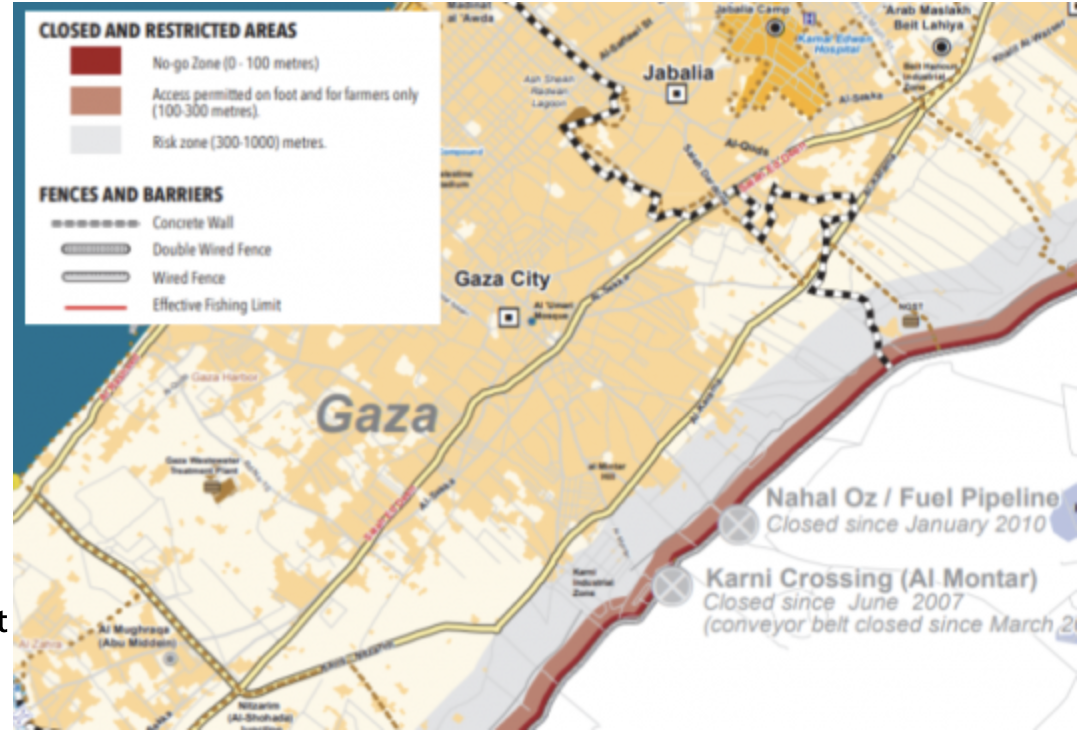
The displacement of residents of Gaza from their former houses, clearing residents out of the land that they had defended and long and quite tenaciously inhabited on the margins of the Israeli state, cordoned off from the rest of the world, with a stranglehold that reduced or cropped access to water, food, electricity and gas–in the evacuations zones where militants were painfully claimed to be winnowed from residents by soldiers–
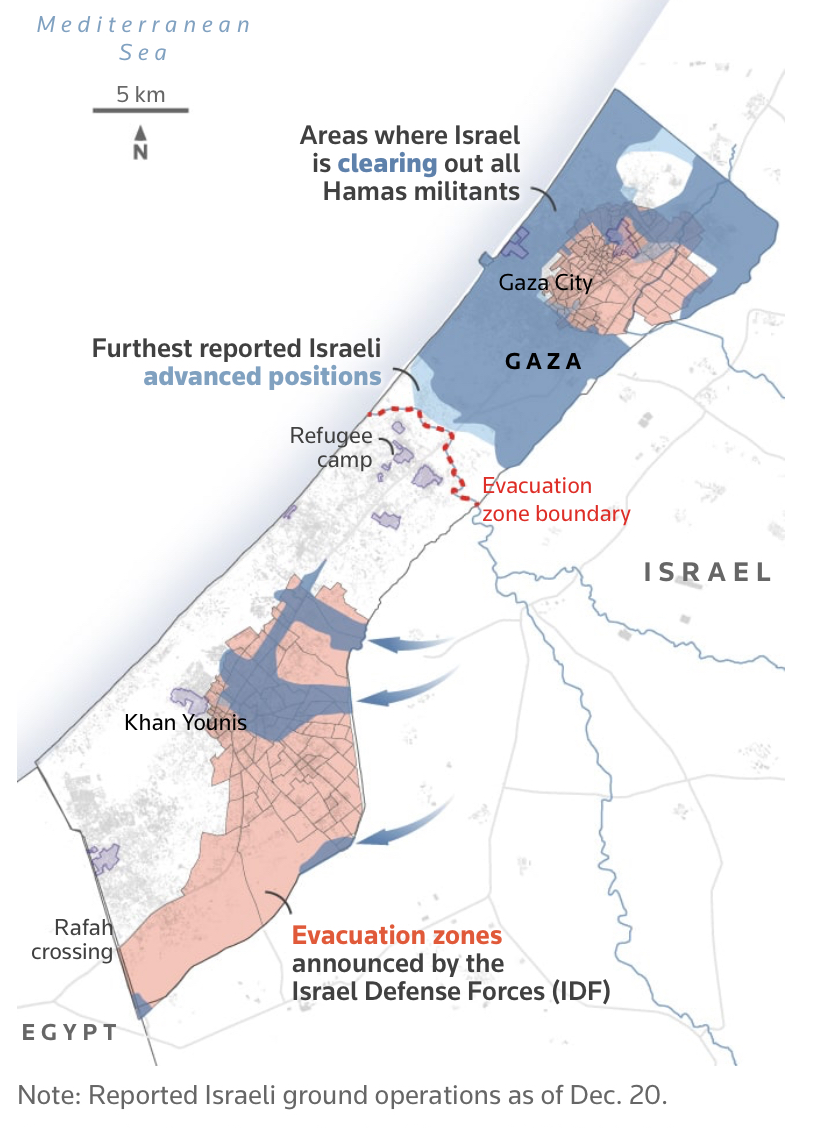
Institute for the Study of War, United Nations Office for Coordination of Humanitarian Affairs (OCHA); OSM
–and ordered to move to new provisional evacuation zones as the search and destruction of Hamas structures and for armed terrorists continued in an attempt to purge the regions of national threats.
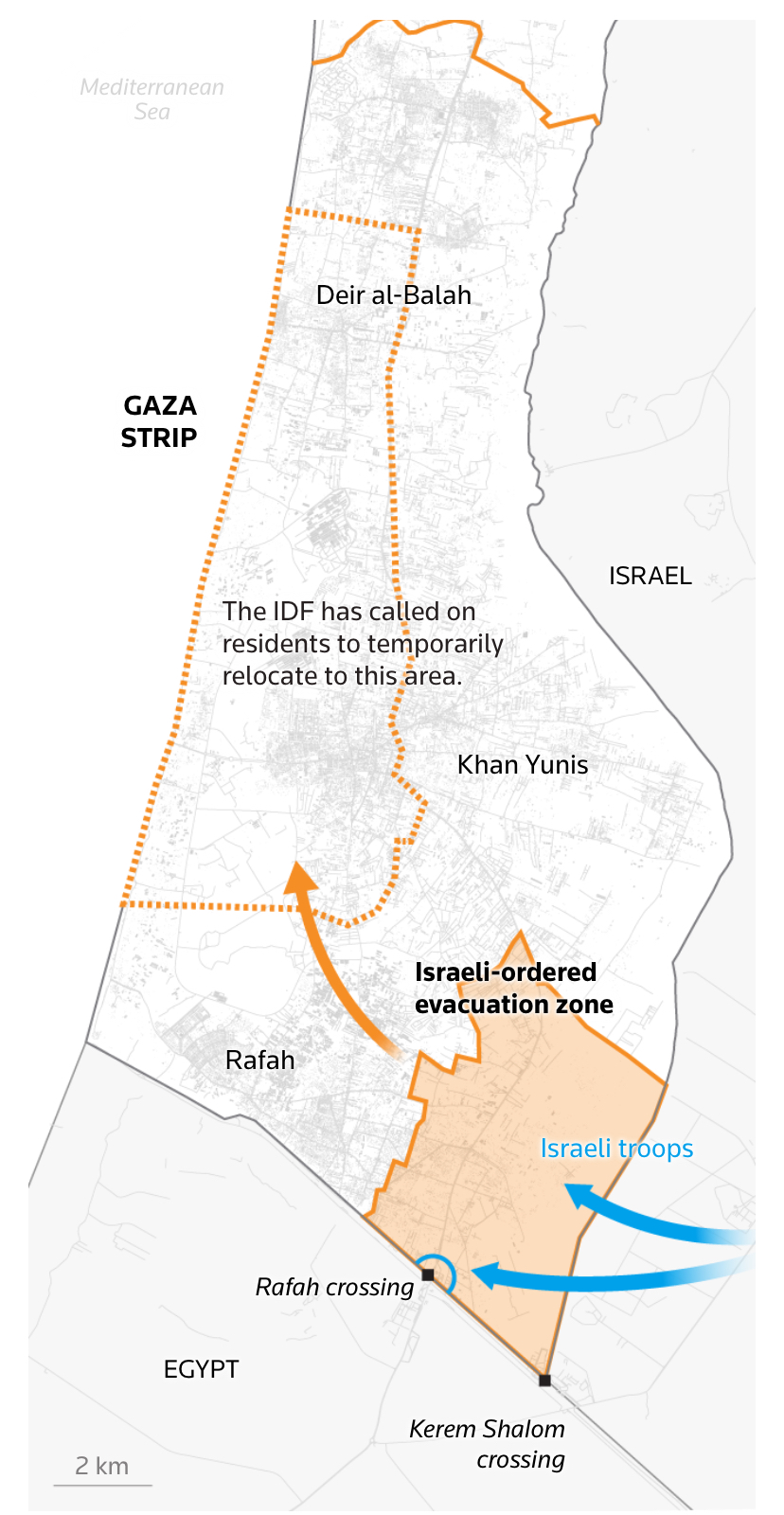
The logic of real estate seems, however, to have displaced that of statehood, or even of monuments of culture, or religion, as the lot that Trump saw as one of rubble, led to the demand to “clean out the whole thing” on his preferred conduit of social media, rather than relations of state, or dialogue. For in consigning the past seventy years to the past, Trump suggested that we were only really “talking about a million and a half people, and we just clean out that whole thing,” start from a tabula rasa to be able to build again, since “it’s literally a demolition site right now–everything’s demolished–and people are dying there, so I’d rather get involved with . . . build[ing] housing in a different location, where I think they could maybe live in peace for a change,” removed from the borders of Israel, and in a different nation that “could be long term.” Egypt promptly translated, in rejecting “the displacement of Palestinians from their land through forced eviction,” as did Jordan’s Foreign Minister articulated his commitment to “ensuring that Palestinians remain on their land.”
If the “Right of Return” of the Jewish People is not a right that had been conceived in international law, but was the basis for the foundation of Israel. The resolution that “Every Jew has the right to come to this country as an oleh,” the Law of Return unanimously passed by the Israeli Knesset, affirming an inherent right to settle to every Jew that preceded the formal foundation of the state of Israel, as a “never broken connection between the Jewish people and the homeland,” in the founder David Ben Gurion’s words, was hard if not impossible to reconcile with a Palestinian right of return. This was because the law invested citizenship in the spouse of a grandchild of any Jew, so long as the Jew did not voluntarily convert, as the over three million jews that have settled in Israel not only displaced Palestinians, but the return of the five million Palestinian refugees, many of whom settled in Gaza in 1950, as an existential threat to the nation, even if Israel’s constitution urged Arabs in Israel to remain active citizens. far more became refugees in Jordan, Lebanon, and Egypt–including Gaza–if many fear the return over five million Palestinians, including one million in Gaza and two million in Jordan, might demographically dilute and effectively destroy its status as a Jewish state. But the Palestinian Right of Return, and Right of Return of the Refugee, was affirmed since 1948–if Israel has insisted these refugees are to be included and resettled in other Arab states, and rejected the initial acceptance in 1949 of extending citizenship to Palestinians refugees in Gaza, and even the Palestinian right of return to Gaza increasingly commands global attention.
The right of return of Palestinians increasingly is tied to the foundation of Palestine as a state. Put in slightly different terms, the Right of Return mapped Israel as a “homeland,” as it sanctioned as fundamental the guarantee of a right displaced peoples have to return to their homes and homeland, as guaranteed by 1948–a right of return to a “homeland” that was denied to the millions of Palestinians who claimed a right to return to Gaza or the West Bank as “a right to return after having left one’s own country,” as the United Nations Human Rights Committee framed the questionb in 1999, although the International Court of Justice already raised questions in the postwar period of the demonstration of “genuine and effective” links of individual and the country as needing to include “a close and enduring connection”, “tradition”, “establishment”, “interests” and “family ties” that have broadened since 1955 to be replaced by having lost one’s nationality.
A homeland is, in a sense, an Israeli construction, deeply historical and religious. Since Vico was the philosopher who focussed most intently on walls, boundaries, and wall-building as acts of civilization, it may make sense to consider the homeland as a corollary to what the Enlightenment jurist’s belief the defining affective bonds basic to human social existence lay in institutions–religion; burial; marriage–that included the homeland, embodied in ploughing the land. The right of Return was codified in the 1950 Israeli Law of Return that sanctioned return as a foundational right. This justified the right to annex territories Israel had settled in the Jordan Vally and West Bank, reducing Palestinian claims to sovereignty to an “enclave” [כמובלעות פלשתיניות] in place of sovereignty, and indeed only allowed the enclave to exist as subject to Israeli military control–not conceding a status of rights of return to subjects without sovereignty and without homeland–the enclave was limited to Jericho lay in a sea of blue Israel had entirely annexed, and was the protype for the Trump Plan, a proposal to annex 477 sq. mi. in the Jordan Valley, in place of the 372 sq. mi. to which Netanyahu signed on in 2020. (Al Jazeera expected Netanyahu to annex the Jordan Valley and northern Dead Sea by the summer of 2020, expanding Israeli sovereignty by 1,236 sq km to include Jewish settlements, affirming an implicit guarantee of a Right of Return to the West Bank.)
Enclaves replaced nations in Prime Minister Netanyahu’s proposed map: the enclave denied the longstanding demand for sovereignty, and rebuffed the idea of the two-state solution. The proposal placing the territorial limits of Jericho, a city that was famously walled but whose walls were dismantled by Joshua under the authority of a Hebrew God, Jericho, allowing only direct and narrow guarded routes of access in a sea of blue of 477 sq km that Israel would annex by fiat. This proposal became the basis or prototype for the Trump Plan, בקעת הירדן וצפון המלח.
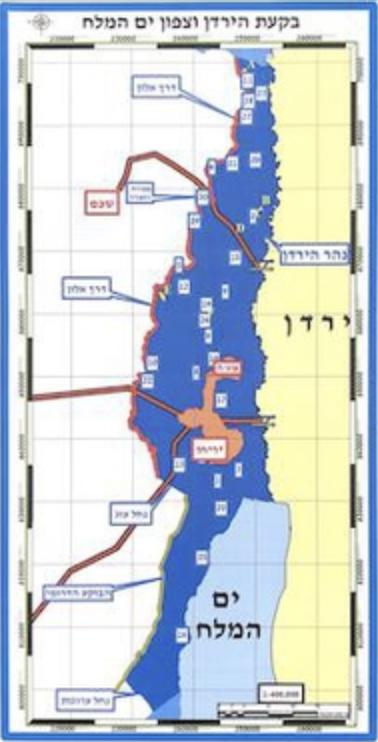
Netanyahu’s 1999 Proposed Annexation of 1,236 sq km of Jordan Valley/ בקעת הירדן וצפון המלח
The fungibility of other enclaves in Nablus, Janin, Ramallah, Qualquilyah and Tulkarm, tied to Bethlehem and Hebron, as a constellation of villages removed from the Dead Sea, a constellation that would be tied to Jericho and Gaza in the plan that Netanyahu and Trump presented, or that Netanyahu offered as a concession in talks with Trump 1.0, as if it were a proposal that might offer grounds for future negotiations. It removed any notion of a Palestinian homeland from the table, offering only restricted lines of movement that would be monitored by the Israeli army to prevent any illegal assembly or movement of arms and military materiel between the individual enclaves.
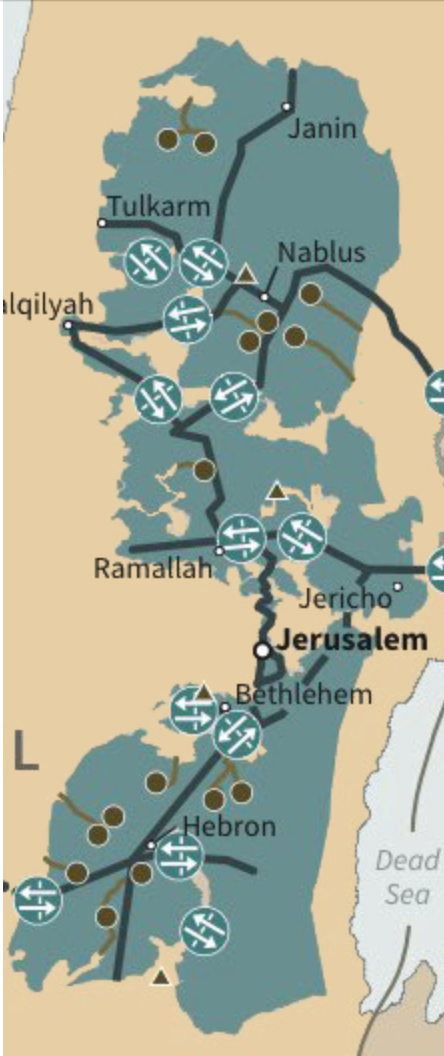
“Enclaves” in “Middle East Future” in 2020 Trump Pease Proposal, Omitting Tunnels to Gaza and Negev
But land seems fungible and interchangeable, borders drawn by America first, rather than nations, and, if Israel has done the job of using bunker busters and munitions to destroy an estimated 92% of actual residences in the Gaza Strip, the notion of forced migration to other nations Trump made seemed, as many have noted, to echo Jared Kushner’s remarks recognizing the “very valuable” nature of Gaza as waterfront property, that erase claims of its residents to the region: Kushner had supported the idea that Israel should move Palestinians out of and “clean it up,” in consonance with the Policy Proposal cited above of 2023, only recently leaked to the public. Trump’s son-in-law had streamed remarks from Miami Beach steeped in the logic of real estate, if they took their spin from the Policy Plan, segueing from the lamenting how despite an “unfortunate situation there, from Israel’s perspective, I would do my best to move people out and then clean it up,” speaking as a developer to Harvard’s Kennedy School of Government in February 2024, allowing “I am not sure if there is very much left of Gaza at this point,” but the question of its future”was not really a historical precedent” at all; on an open market, it might be “very valuable . . . waterfront property” from his Miami Beach perch, imagining bulldozing the Negev as a project of future development.
A war zone is nothing like a construction lot in New York. But perhaps globalization allows one to make more ties between places in the world, confounding categories of place and familiarity, in the language of the global spectacle. Despite profound incommensurability of Gaza and Bonwit Teller’s flagship store ‘s ruins on Fifth Avenue and 57th Street in Manhattan–the utter incommensurability of the two is perhaps the basic point of this post and an absurdity, and perhaps the point. Gaza’s “rubble” fit a category in Trump’s mind akin to the demolished rubble of the Fifth Avenue flagship cleared for Trump Tower that would rise from it like a phoenix above the city. The clearing of the building marked Trump’s arrival in Manhattan, by nonunion irregularly payed undocumented Polish workers so poorly payed the workers untrained in demolition and lacking hardhats, and unequipped to work with asbestos removal, sued for unpaid wages of $100,000 and damages,–receiving a one million dollar resolution settlement twenty years later. but flattening all memory in the site of the landmark Art Deco building, an architectural monument of sorts whose paired friezes Eli Jacques Kahn added with a modernized 20×30 foot bronze grill. (Both were sought by New York’s Metropolitan Museum, that would be the site of the vulgarian’s bronze plate-glass tower; he famously declared that in his own appraisal, “the merit of the stones was not great enough to justify the effort to save them,” concealing he instructed workers to carry out the task untrained in demolition for pay barely above minimum wage.) He rejected saving the panels of dancing nudes or the bone nickel-plated grillwork as to do so pushed the job two weeks beyond timeline, obligating him to pay taxes on a building purchased for $15 million in 1979. Perhaps Trump Tower might be imagined as a gleaming totem replacing the Goddess of Manhattan dancing at its facade unceremoniously destroyed in 1980 to avoid paying property taxes.
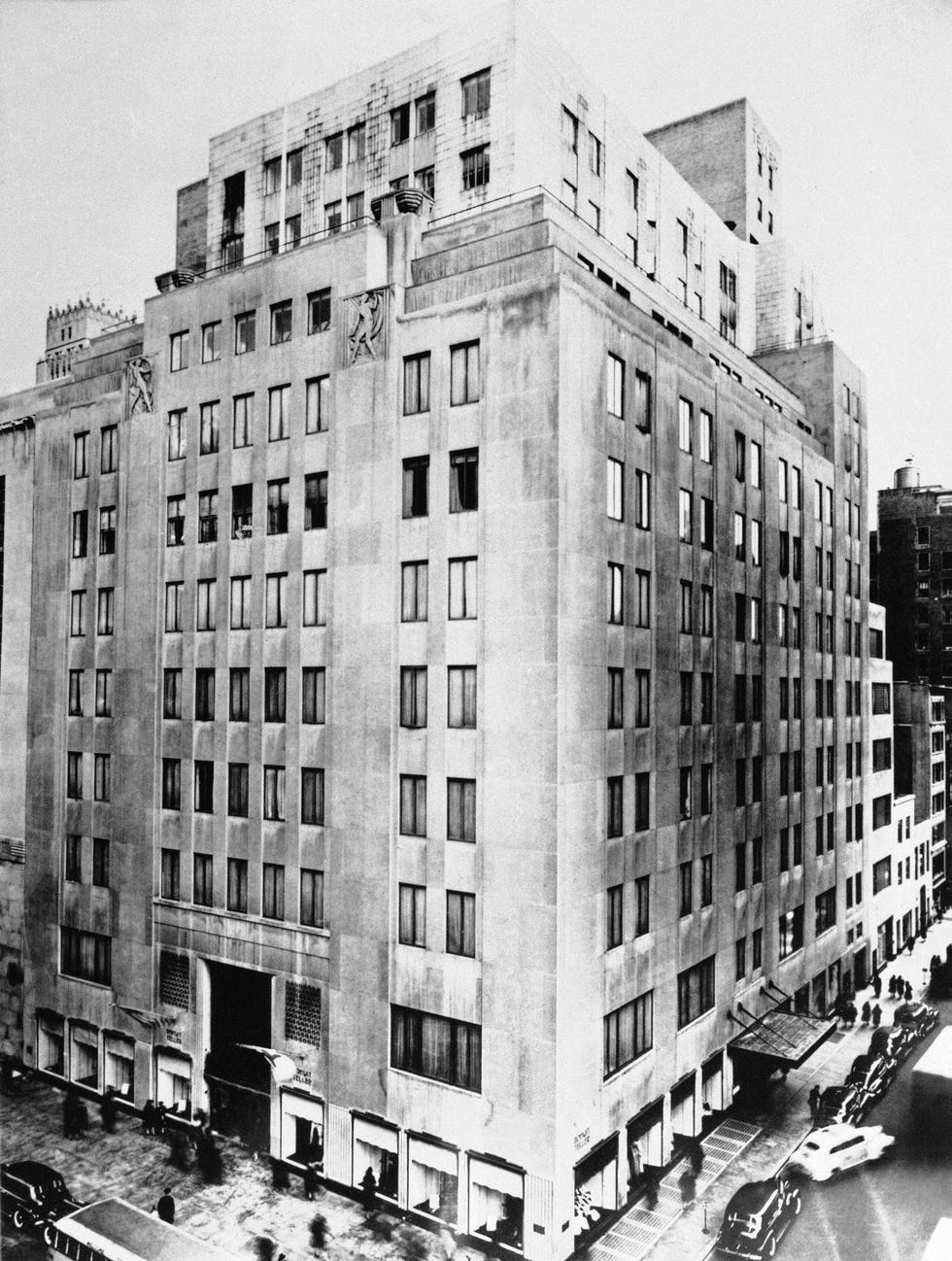
Bonwit Teller Emporium, Warren and Wetmore (1929), with facade Bonwit Teller employed Eli Jacques Kahn to modernized with grill, and 15-foot tall figural Art Deco relief sculptures
Looking at the old emporium, it is tempting to imagine a fork in the road not taken. In the other alternative future, Trump Tower was never built;Donald never declared his candidacy for President; President Trump did not sanction and support annexation of West Bank territories and Gaza by an Israeli state. Trump had hurried to building site rubble regularly, inviting himself to be photographed there to stir up exception of the future Tower. After hiring the crew from a nearby building site at cut rate, even if they were not trained in demolition at such scale, the destruction of the storied 15-foot tall relief sculptures of the Goddess Manhattan were jackhammered in a site of multiple labor violations. The dancing nudes had been promised the Metropolitan Museum of Art, may still exist as a sort of primal rubble in Trump’s mind. He regularly visited the construction site to envision his marquis Manhattan tower and survey the progress to ensure it was on time, and the tower was a personal victory that he took pleasure in being photographed atop; he would announce his candidacy for President from its gilded escalator. He regularly visited the construction site, to ensure continuous work and threaten the workers with deportation and would refuse to raise their pay–and, notoriously, provided neither health insurance nor safety gear for asbestos removal.
The site was a maze of violations and variances. Trump knowingly employed illegal immigrants to work back-to-back twelve-hour shifts from 6:00 a.m. to 6:00 p.m., and strenuous shifts of twenty-four hour shifts, promising a bonus if they met an early deadline to take the building down that never materialized, and hardly would make up their low pay. Trump did eventually pay the workers he hired, but only after threatening to report them to the Immigration and Naturalization Services for deportation, after hiring them from a nearby site aware of their legal status. The violation of labor laws were revisited only as he pushed them to continue their work around the clock to avoid a tax on the storied Bonwit-Teller building, and some contacted legal help. (None of the Polish workers were legal immigrants or unionized; payed just above minimum wage, several joined the union; his employment of nonunion illegal workers on Fifth Avenue had inescapably raised the interest of the Labor Department who raised questions of blatant violations of labor laws by illegal employment.)
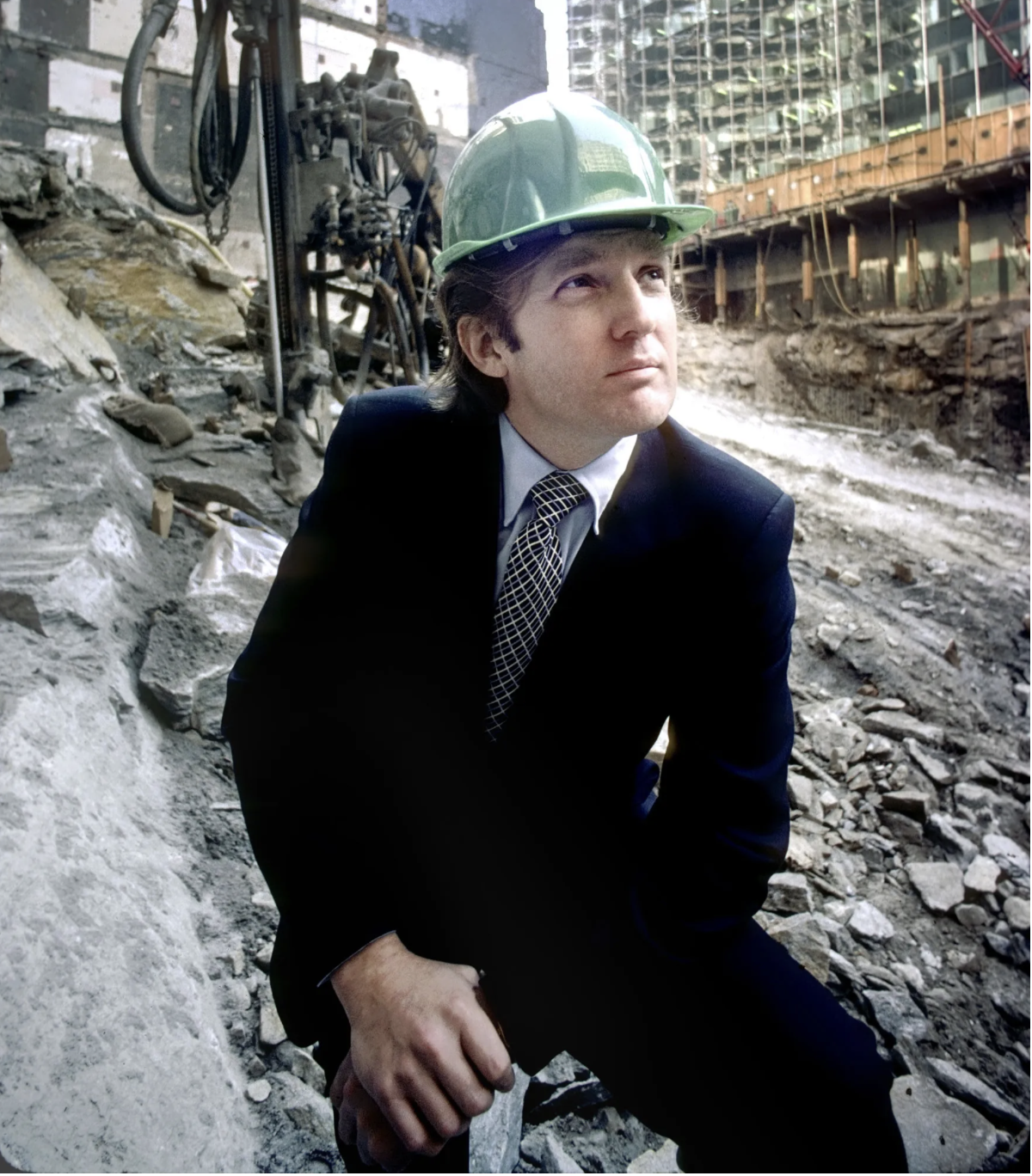
Donald Trump Posing. for Photographers with Hardhat and Business Suit at Fifth Avenue and 57th St, 1980
The demolition site seems to have been Donald Trump’s site to set his eyes on the stars. Trump took pleasures in regularly touring the site, wearing the hardhat he had denied demolition workers. Did he ever imagine that the destruction of the Art Deco emporium Bonnet Teller acquired after the 1929 Crash could be a site to launch his political future? The destruction of the landmark facade occurred in plain view. The statues tried to be saved by the owner of a gallery across the street who watched their removal with a sense of foreboding rustled up all the cash he had on hand, running to the Polish workmen poised to jackhammer them, to be rebuffed by the foreman, given direct orders to destroy them rather than entertain offers from anyone. Trump had of course rebuffed the Met’s curator of twentieth century decorative arts to preserve them: “Donald told him personally that the reliefs must be destroyed because some crazy lady from a museum up town wanted them,” remembered a Trump associate, lamenting the large statues of the Goddess of Manhattan that were condemned to dust, as holy sites of Gaza as St. Porphyria only recently seem poised to be destroyed.
The flattening of history in Gaza, the area that Jared Kushner saw as “beachfront property,”is in the eyes of the beholder. Gaza City’s shore has become one of the more isolated sites of the world, as well as the Middle East, suggests the ; Kushner, when working for the first Trump administration, had firstdeveloped a proposal to revitalize Gaza’s beachfront proprieties in June 2019, hopeful peace negotiations might reconfigure a new Middle East. The developer opted to not take a formal role in Trump’s team, having expanded financial ties to Arab sovereign wealth funds, especially with Saudi Arabia’s Crown Prince Mohammed bin Salman, financially benefitting from his role in the first Trump Administration, save as an informal advisor to his father-in-law. He had promoted the elusive image that a “new Middle East being formed,” after helping to broker peace deals between Israel, the United Arab Emirates, and Bahrain. The lynchpin to this “map” was the image of the Palestinian Future that Donald Trump was ready to put on the table–making sure to allow Israel to have its territoriality over the West Bank of the Dead Sea, and River Jordan, but establishing a set of oddly dismembered enclaves technically interconnected but not continuous.
“A Future State of Palestine,” in Trump Peace Plan (2019)
The bright prognosis Jared Kushner offered several years before the Hamas invasion of October 7 that “the people in the region are tired of war” was as Trump left the White House, but he was left trying to resuscitate what credibility he might have gained as a foreign policy analyst after he had spearheaded the Trump effort of forging a New Middle East in left- and right-wing think tanks. Kushner may have believed in late 2020 there was s common agreement on all sides “they want to move forward, and they see . . . getting a better understanding between countries as a way to move forward,” in quite generic terms, adding “people are getting a little tired with the tactics played by the Palestinian leaders.” After leaving the White House, President Trump echoed Kushner’s sentiment by announcing how he foresaw “a future in which people of all faiths and backgrounds live together in peace and prosperity,” as if that beachfront were in the back of his mind.
The “foundation for a comprehensive peace across the entire region” was staggeringly unprescient. Even as Kushner made the rounds on television talk shows, claiming he was at “the beginning of the end of the Arab-Israeli conflict” as if ready to take a seat in a beach chair on beachfront property, things did not seem less tense on the ground. “The issues simply aren’t as complicated as people have made them out to be,” he confidently proclaimed, certain from on-the-job learning of a future tolerating an occupied the West Bank and apartheid conditions of Israel in exchange for prosperity, essentially bracketing the Israeli-Palestinian conflict that had dogged the region for years. (Kushner sought help from Qatar, the Emirati, and Saudi Arabia’s Public Investment Fund in future private sphere endeavors, having left government after Trump’s political defeat in 2020.). Was there a sense in which he retreated to the map he had proposed, imagining the future of an early retirement on Gaza, or hoping that his legacy might be remembered, before the October 7 invasion that left him rather silent for a few years, living at home with Ivanka and kids down in Miami.
This was the Gaza beachfront, after all, in the days of the Trump Presidency, or in Trump 1.0 (2019), when the beaches offered brilliant ocean prospects, dotted with umbrellas, and suggested an enviable open expanse to clear the mind–even if tourists were not able to arrive. It wasn’t unlike Miami, at all, in some ways; if its beaches weren’t as white, white sands might be made to arrive–after all, the sand and gravel business, so central to the whitened sands of Miami Beach’s shores, has become a global business, leading to multiple beach nourishment projects to replace sands that wash away on open oceans–unlike the Mediterranean–that has led to a global shortage of beach sands that any Miami resident, aware of the problems of beach nourishment by sand mining, see as a liability to Miami’s shores as so much sand is washed away: sGaza Beach is plentiful low rake.
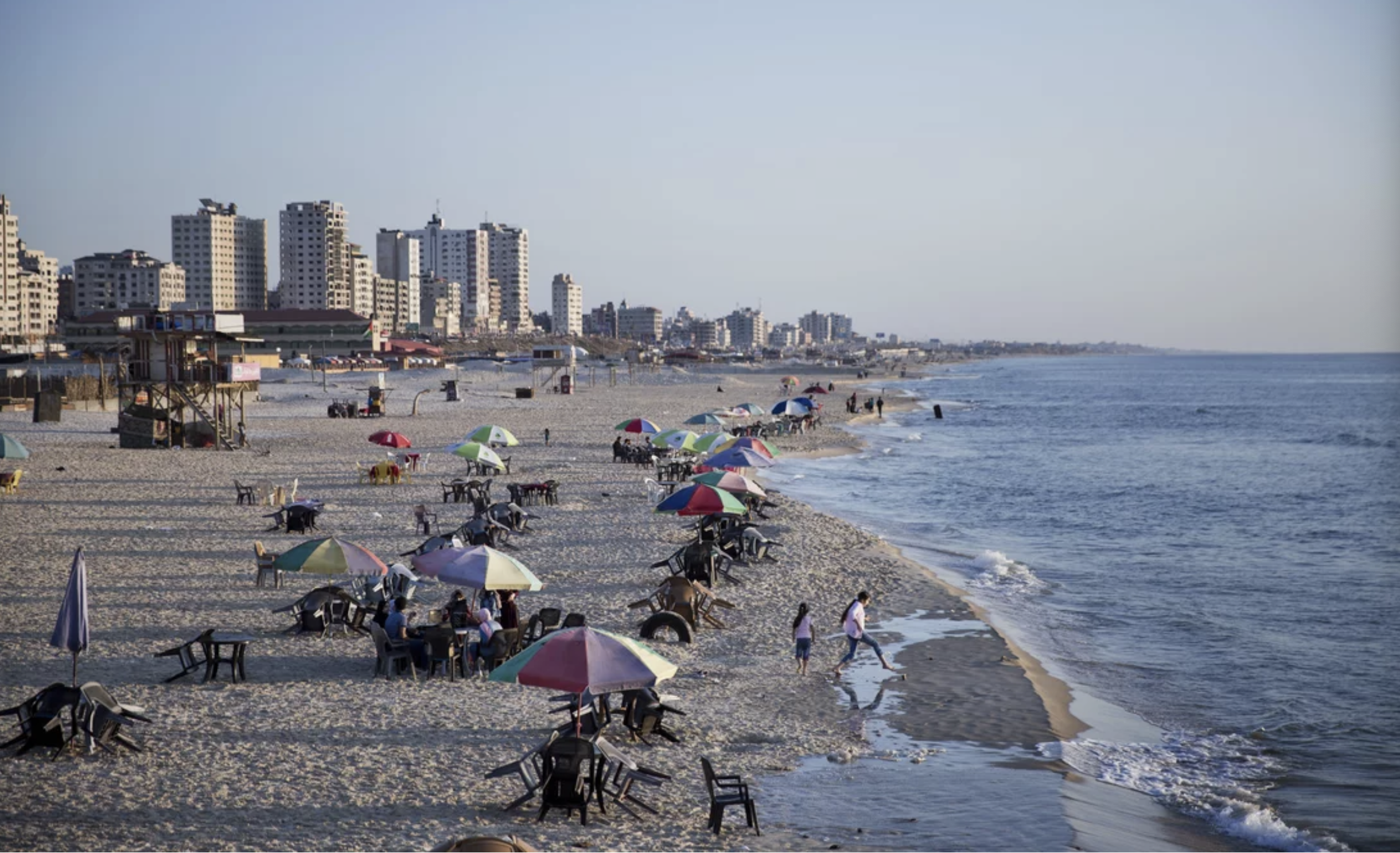
And, after the ceasefire was signed, residents quickly returned to the beaches of Gaza City, suddenly flooded with families under almost identical multi-colored umbrellas, revealing the huge release that the open shores could offer Gaza’s residents, even emerging from a war zone. The calm of the beach, the repose we seek form the pressures of climate change, global warming, and even war, suggested the rebirth of the beach not as the land of fishermen who sought their trade, but, in the enclosed beaches of the Gaza Strip, where fishermen’s trawling is increasingly restricted by the Israeli Navy by decree, an improbable release from the boundaries by which Gaza’s residents were constrained, relaxing for a change before fluctuating boundaries at the Mediterranean’s edge, a place where human movement seems to stop, not by military decree, but by a sense of a future that is open, and not closed–not haunted by death as the rest of Gaza City must now be.
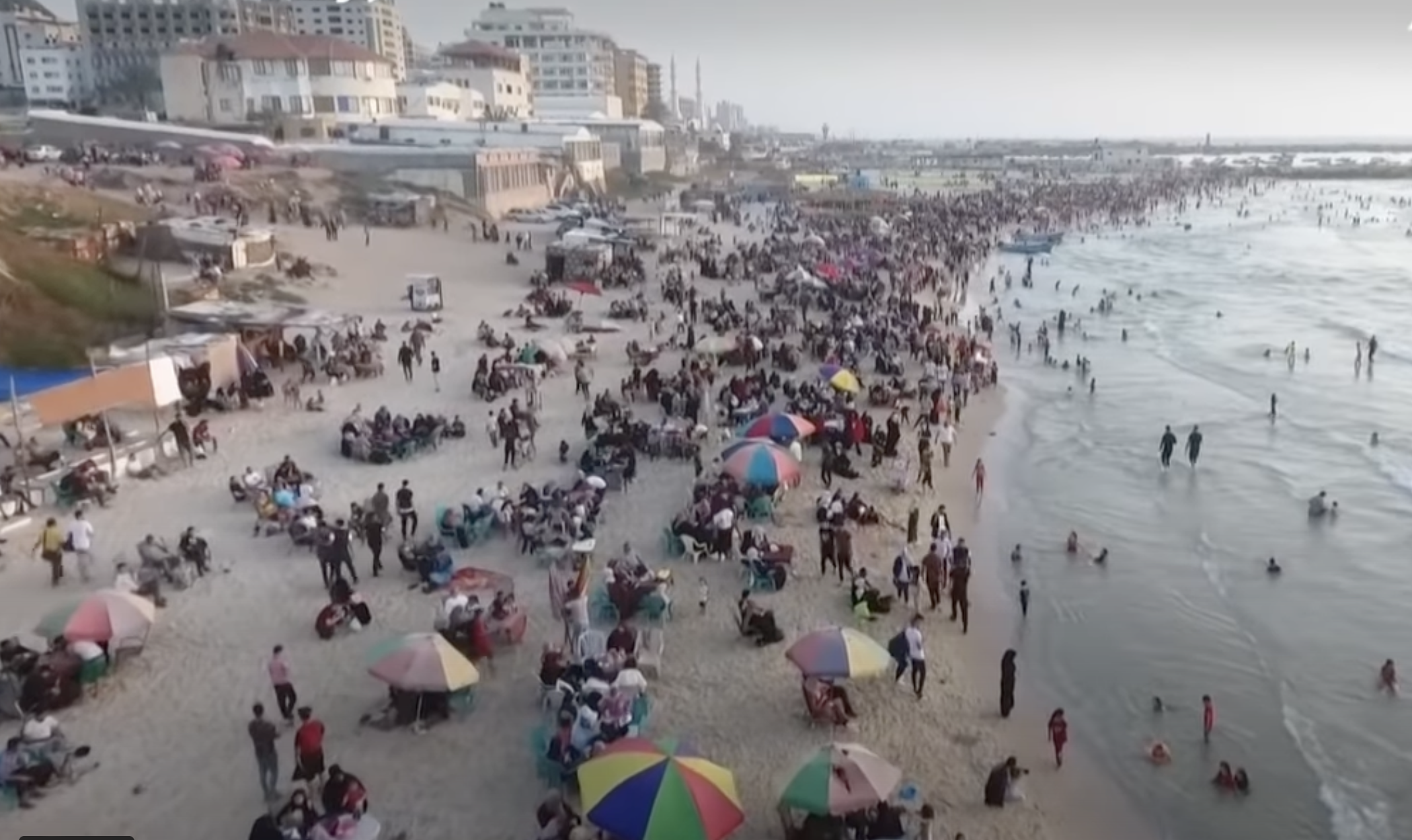
Gaza Beachfront the Day after the Ceasefire/2025
Already toIsraeli settler organizations and long had eyes on the “beautiful golden sand” of Gaza recall the Palestinian land once captured by Israel in the 1967 war with an air of deep longing, since settlers were pulled unilaterally from the region in 2005, evacuated by the Israeli army, and right-wing groups have mapped out plans for resettlement of the region–with the slogan “Go Back to Gaza!”–that have perhaps informed the recent “joke” projecting the construction of new homes in the current Gaza War, echoing ultranationalists’ deep belief that only “Settlement Brings Security.”
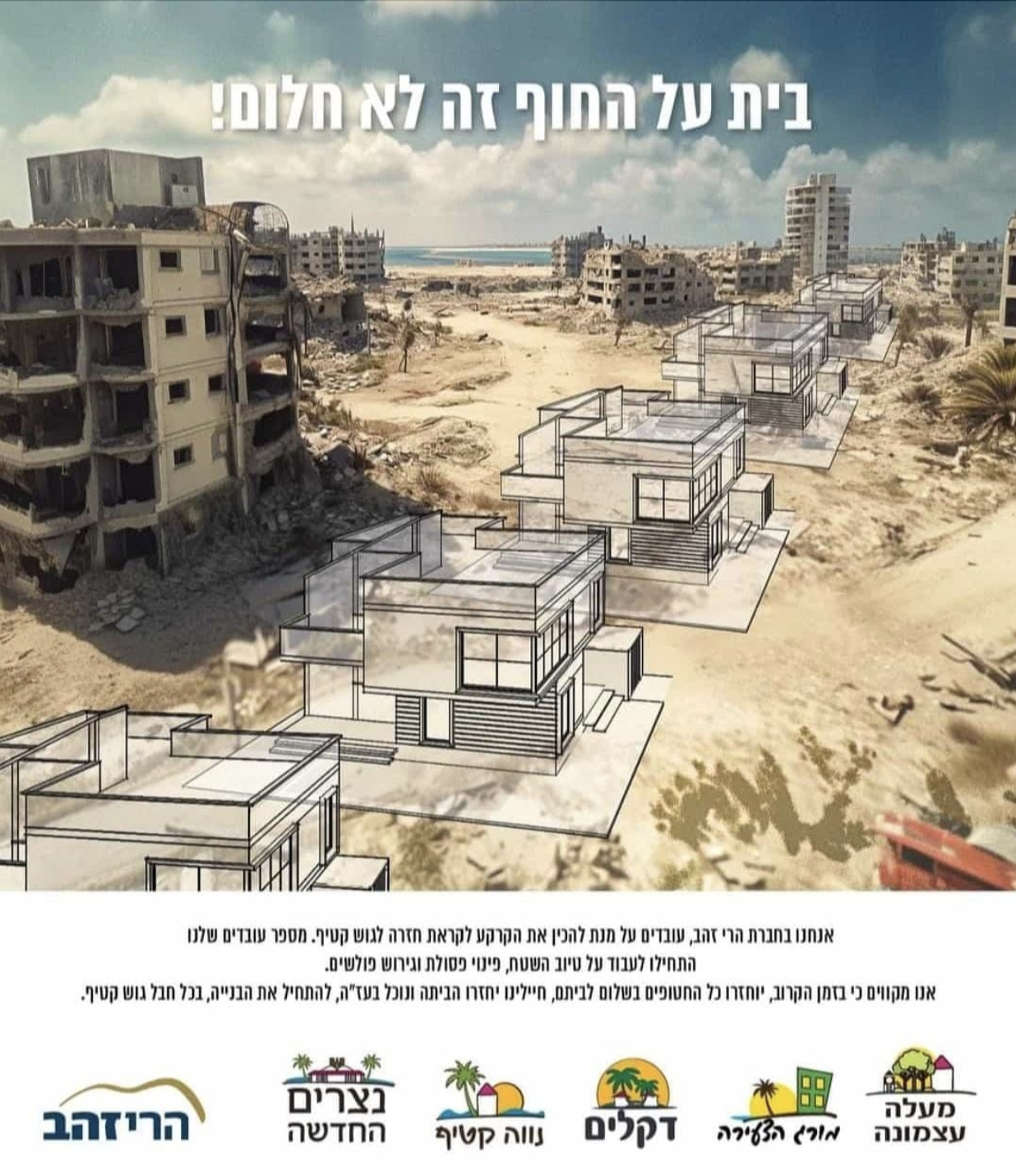
Can one force oneself to look directly at the destruction of Gaza Strip once again? The construction of these future condominiums seem an offensive contrast to the shattered buildings that once stood on the sandy shores of Gaza City or Rafah–places whose sandy ground suggests little structural possibility to build the tunnel networks that depend on the compact sandstone or loamy silted soil that make tunneling easiest in the region, rather than dunes. But the density of the craters in North Gaza photographed in late October, 2023 by satellites of PlanetLabs reveal a bombardment that included multiple craters larger than forty feet in diameter, and numerous smaller craters, pushing back any chance of future habitation near the Mediterranean Coast during initial attacks.

Renée Ridden, CNN/from Planet Labs satellite imagery from Oct. 15, Oct. 22, Nov. 3 and Nov. 6, 2023
As Trump 2.0 roars back with a vengeance, as many note, and ha commandeered the USAID budget this time, and shifting around people across the world in what seems like some truly hallucinated dreams of power and collective bullying, flexing the powers of the state as muscularly as they might be imagined. Or is Trump 2.0 just Netanyahu 2.0, having found the 1999 Annexation Proposal pushed back and rebuffed by Palestinians, is boosted on steroids of his far right partners. The recent government has promised to win back the land of settlers within Israel’s sovereignty, expose the expansive boundaries of the sovereign state–the original sovereign bounds of the Jewish people, where they might be granted the Right of Return?–to restore Gaza’s historic significance for the Jewish people, and, indeed, to envision a state extending from “the” river to “the” sea.
This is all a return of the repressed we did not ever foresee. We didn’t expect Trump 2.0–or few did–and we didn’t expect the barrage of assaults on legality and mean-hearted nastiness that the President seems to think fit to mandate by decree. We didn’t expect the USAID would be targeted for one of its signature accomplishments–the aid it provided the ANC in South Africa, a target of choice of the Musks–and tarred and feathered as a poster child of corruption, rather than an image of possibility. The return of annexation and the shunting of the refugee–beyond borders, and border walls–is a signature policy of Trump 2.0, however, mean-hearted, nasty, and evil, if not sick, more than weird.







 Musings on Maps