Can we sustain an argument that the freedom to own guns truly makes us safe? Mapping the question of ownership–and indeed even trying to visualize the terrible frequency of mass shootings in the last forty years–makes any consideration of their violent punctuation of public life question the value of construing gun ownership as a freedom.
The frequency with which mass shootings that clot a timeline of the last four decades is hard to comprehend, save for the very difficulty of how such truly terrible episodes have come punctuate our sense of time. The diminished intervals marking time between mass shootings make the above timeline hard to process or digest–and it frustrates comprehension, but maps an apparent onslaught of apparently unpredictable succession which have so troublingly occurred with increased rapidity in the United States: each mass shooting named once seemed to violently punctuate public space, and set a thresholds for public violence, but in retrospect have almost seemed to collapse as their occurrence and repetition has come to know few bounds in public space–occurring in schools, military bases, public service buildings, or movie theaters–even as few believe that the next mass-shooting would ever occur in the area in which they live. It suggests that the troubling succession of mass-shootings is in itself a crime of human right sand public consequence, far more than they have ever been portrayed.
The timeline is not spatial in orientation, but arranges place names in a disturbing map of America difficult to come to terms with or recognize–it cannot help but raise questions about how we reconcile increased individual access to firearms and individual rights. It’s hard to process raises pressing questions of the ways in which our national landscape is increasingly defined by gun violence, dotted by once-memorable place-names of Columbine, Virginia Tech, Ft. Hood, Aurora, Newtown, or, more recently, San Bernardino–each of which has come to destabilize the way that previous mass-killings once loomed so large in the present, and in our thoughts about gun control. Although it makes one want to bore more deeply into the data, it registers a national landscape marked by gun violence with new urgency. Even as contentious debates are staked about how individual access to guns defines the nation, the simple timeline poses complicated questions about a public arena mapped that seems increasingly mapped by mass shootings. It describes the prominence of gun violence across a national landscape–even though it only lists but thirteen places by name. If chronologies were once used to supplement to maps in the middle ages, to sort the settlement of the inhabited world, the shrinking distances between multiple mass shootings on the over-crowded chronology indeed seem to map a growing public arena of gun use that appear increasingly difficult to physically or mentally inhabit. Yet it is a question all too often marginalized from public debate, and allowed to continue as a truly sick status quo.
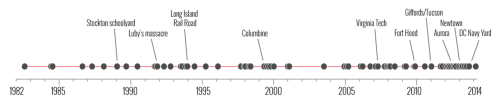
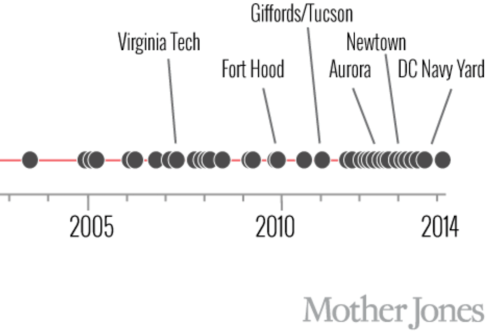 Mother Jones/Analysis by Harvard School of Public Health
The punctuation of time by mass shootings turns to a terrible continuum in recent years overpowers the viewer in ways that make that landscape difficult to process. Rather than offer a way to mark time, the frequency of what were once treated as discreet events is overwhelmed, as shootings in public spaces that left four dead have ceased to meaningfully mark time, and suggest a geography of shooting guns in public space. From occurrences at clearly marked intervals, the pace of mass shootings suggest a surreal information overload in their bunched crowding that challenges legibility, and even remembrance. For even when distributed on a map, it’s hard to find any coherence in how the clustering of such senseless premeditated tragedies have relentless occurred. Can one even map their social impact or human cost?
Few maps can register their deep costs than the oddly disembodied timeline. As one tries to consider shooting, the pace of shootings across the United States is cognitively difficult to process. The timeline challenges one to comprehend both the toll of the rash of deadly assaults on public space. There is little consensus about “mass shootings”; the timeline charts shootings in public space that left four or more dead. But it suggests how, at a time when gun-related violence has recently declined, the recurrence of mass shootings suggests a landscape we need to collectively confront–and to map against the pernicious diffusion of beliefs that gun ownership are a form of freedom guaranteed by Second Amendment rights–although the frantic pace of mass shootings, illustrating the tortured narratives of shooters, to be sure, but also the problems of examining distinct differences between mass shootings, mass murder, and mass killings in relation to the increased access to firearms.
While some would portray the awful repetition of these tragedies as the cost of liberties, the timeline tracks the truly terrible ease of widespread recourse rapid-fire firearms. Indeed, the horror at the occurrence of mass shootings seems due not only to their horror, but their deep confusion of a militarized and civil space. The dramatically unique scale of gun violence in the United States has led it to be increasingly accepted as a natural fact, to be sure, as many, including City Lab, have noted, leading Zara Matheson to create a brilliant visualization comparing urban gun violence in America to that of other countries:
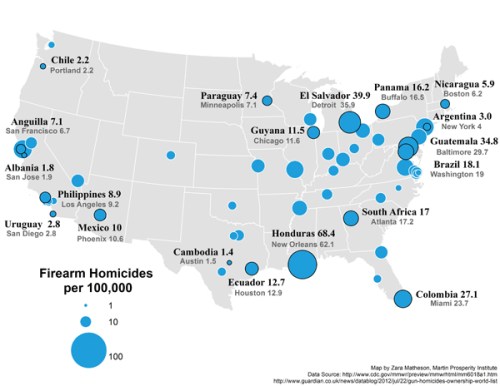
Zara Matheson/City Lab/Martin Prosperity Institute
The amazing scale of gun violence itself has encouraged the expansion of open carry laws and gun rights protests in America, that have resulted in a similar deep confusion between civil and militarized space. But nothing evidences such a profound and deeply dangerous confusion as specifically or dramatically as mass shootings. And as the profusion of arms in public space grows at a rapid pace, doesn’t the assertion of gun ownership as a right suggest a deep and problematic confusion of civil and militarized space in the deeply disquieting and increasingly public assertion of Second Amendment rights?
 Gun Activists Marching with AR-15s at UT-Austin/Getty Images
<!––nextpage––>
1. It’s not possible to fully comprehend the density of shootings in public places or their especially increased frequency during the past decade–and especially difficult to process their relentlessness across the timeline, which suggests we are in danger of losing count. They suggest a dangerous landscape of public violence that doesn’t seem likely to change. Traumatic shootings which once seemed watersheds of public violence, once viewed in aggregation, reveal a relentlessness impossible to process save as a changed state of events. And while the government has not tracked the rise of mass shootings, or mapped the prevalence of guns in relation to deadly shootings, on-line aggregations of mass shootings and tallying victims confirm a change in public space–closely tied to the ongoing advocacy of gun sales by gun manufacturers who fund the NRA: indeed, the laissez-faire attitude to gun sales are increasingly masqueraded in the United States as a form of liberty in ways that pose an increased danger to public health–that might be more aptly likened to a contagious disease. Mappings of the rash of mass shootings by active shooters in the past three years embody violence in ways that resemble nothing so much as disease maps.
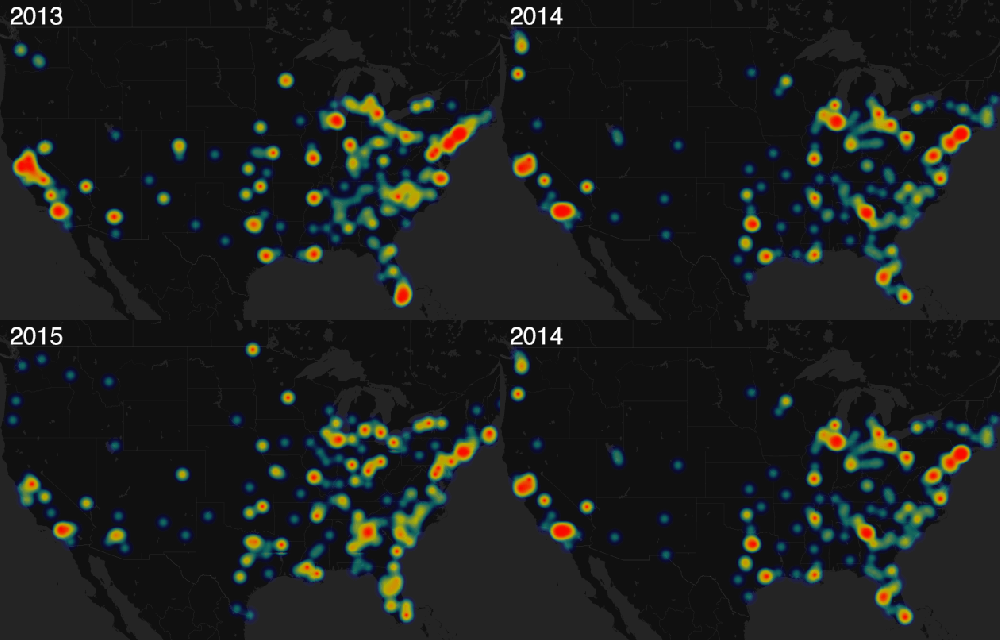 data from Shooting Tracker
But the aggregation of mass shootings in the United States seems tragically tied to the flooding of markets with firearms and guns, not only causally, but in terms of the vociferous defense of individual rights to bear and carry arms in public space–as the recent exaggerated expansion of the Second Amendment defense of individual rights–long agitated for by the NRA–suggests.
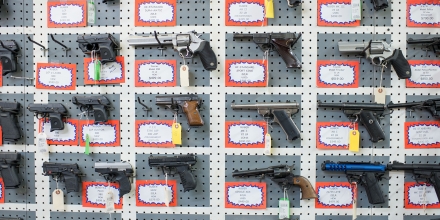
Getty Images
In ways raw data speaks more than cartographical forms can embody. But only by parsing the rise of such mass shootings from gun homicides and firearm use can we begin to understand the deep confusion and distortion mass shootings have made between militarized and public space, and address or process them by more than shock–or start examine reasons for the considerably greater fear of terrorism, despite the 10,000-fold magnitude between the number of gun deaths and deaths from terrorist attacks, and the wildly disproportionate fatalities from mass shootings since 9/111 than home-grown terrorism. Treating the San Bernardino mass shootings as terrorism is only not recognizing the prevalence of mass shootings in the American landscape, and makes it increasingly important to clarify the presuppositions of mapping mass shootings.
If the extreme gun violence of mass shootings are parsed since Sandy Hook, or since 9/11, or since the threat of terrorist violence on U.S. soil, the collective growth is striking. Gun violence is perhaps not possible to measure abstractly, let alone to aggregate. But the crowding of individual events in a chronology is difficult to process in a timeline that rather than keeping time almost undermine its legibility as a distribution–the very frequency with which mass shootings have come to occur offers pause for reflection. In aggregation, the timeline is hard to get one’s mind around, as if it challenges the viewer. In ways that almost undermines its value as a timeline, the clustering of dates when mass shootings occurred suggests the difficulty to process or clearly map their frequency: public shootings or four victims or more increased in the aftermath of the terrible shooting of kindergarten children in Newtown, PA–guns killed 90,000 since, some 555 children. Rather than constituting watersheds of public violence or tipping points, the Newton massacre and the shootings of Columbine, Aurora, and Virginia Tech suggest way stations of increased violence in an embodiment of collective violence.
The aggregated timeline poses questions as to whether we are watching a pattern of collective behavior in schools, a geography of anger, or an epidemic of public health, and charts a widespread and growing confusion between civilian and military arenas in an era of globalized battlefields–in which the range of “perceived enemies” has expanded off of the map. Aggregates of shootings of four or more dead or injured by guns suggest a similar cognitive overload of data of the dead or injured that we are similarly unable to process in any meaningful way:
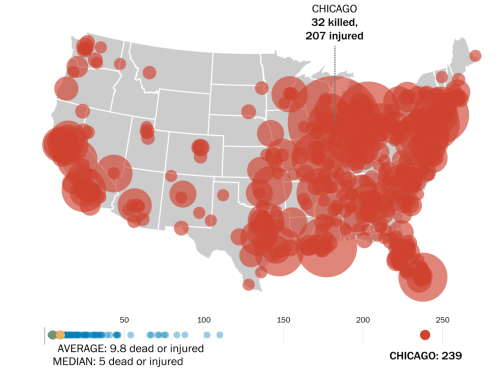
Total Gun Deaths of Four or More, based on data of ShootingTracker.com
Sized in relation to local population, a somewhat more legible distribution appears:
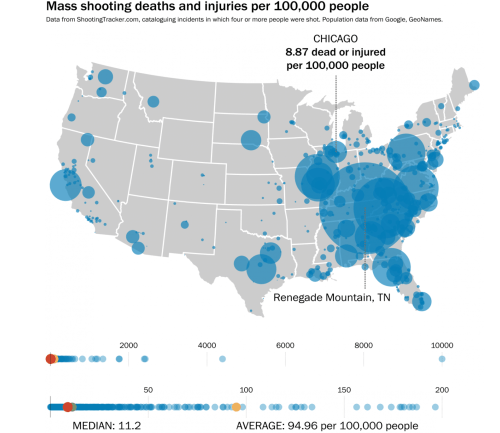
But distinguishing gang-related violence from other records on mass shootings a broad national problem of guns:
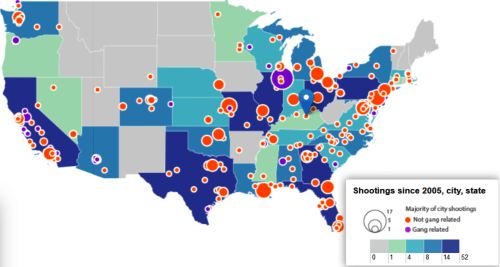
If we turn to maps to create coherence from the successive mass shootings that increasingly afflict the country, the timeline reminds us most disturbingly of the remove of such events from our own personal responsibility–their relation as traumas remains difficult to start to comprehend, let alone map meaningfully, since they seem so likely to recur and not removed in time. The distribution of mass shootings suggest an undeniable underside, indeed, to the increased insistence on individual rights to carry guns in public space, despite the deep dangers that they continue to pose. For the approximation of continuity in the multiplication of mass shootings approximate a sense of helplessness parallel to the terrifying 350 counted shootings of multiple victims over the past year–even if they are not all mass shootings by any definition.
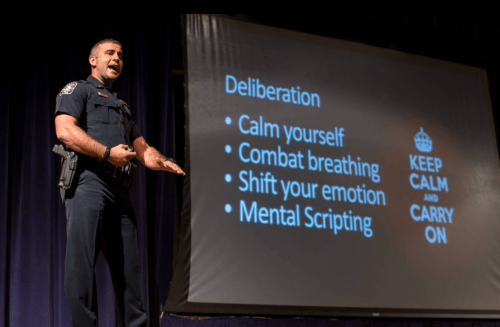
The intense anger and helplessness behind shooting of multiple unknown victims suggests a striking recourse to guns, however, which currently seems bound to increase with the continued easy availability of firearms. Despite the danger of over-aggregation in light of San Bernardino and Columbia shooting and their mourning, which has almost become its own internet meme, parallel to the sudden rise of training exercises to respond to them, suggest a dangerous desperation to comprehend the scope of gun violence in America by affirming the personal possession of guns–sessions that include the very same sinister design of a public poster devised for a wide morale-boosting campaign by Britain’s Ministry of Information, the government agency charged to design morale-boosting posters during World War II. The emblem, adopted to suggest the difficulty sustaining attacks and civil space in mass shootings, almost mirror the confusion of civil and militarized space in such shootings. Its inclusion recalls a tendency to discourses on mass shootings to migrate to terrains of preparation, as much as prevention: if the original posters were printed in 2.5 million copies, they were largely “held in reserve, intended for use only in times of crisis, or invasion”–and only later rediscovered by a Northumberland used bookstore.
No matter how much we seek to map their incidence, to create some sort of clarity in danger or fear we might better grasp, the bunching of mass shootings–killings where a single shooter open fires ammunition to leave four dead–suggests a shattering of public peace, and civil space. While the rise of mass shootings are called a creation of the news cycle, although their incidence have overwhelmed the airwaves– “And now we turn to this. Here we go. Again.”, the frequency with which incidence of public mass shootings in America have multiplied with the relentlessness of streaming banner news headlines on cable television suggests a violation of human rights. The increasing pace with which shootings of unknown victims occurred in public space seems impossible to clearly compartmentalize, or continue to report, as their frequency over the past two years enters a terrifying continuity particularly difficult to objectify since they assault humanity. Although these shootings constitute but a small share of gun violence, the deeply troubling landscape of mass shootings troublingly parallels increasingly strident assertions defense of firearm possession as a right not able to be legally regulated.
2. Even removed from a coherent geographical form, the sequence of isolated place-names of shooting sites challenge one to confront the landscape of mass shootings in the United States in disquieting ways. The expansion of such shootings illuminate a shifting landscape of guns in public life–even as fewer than a twentieth of Americans regard gun control laws as a problem confronting Americans, and Congress only recently recognized “mass killings” in 2013 as demanding attention from the Attorney General. Even in the light of rejecting restrictions on gun laws or an assault weapons ban, the late identification of such premeditated if unpredicted shootings of unknown victims reveal an increasing accumulation of fatalities, not suggested in the timeline, that . The picture of mass shootings since 1982 indeed suggest a terrifyingly broad distribution across the United States and suggests a failure to responsibly manage firearms in public space.
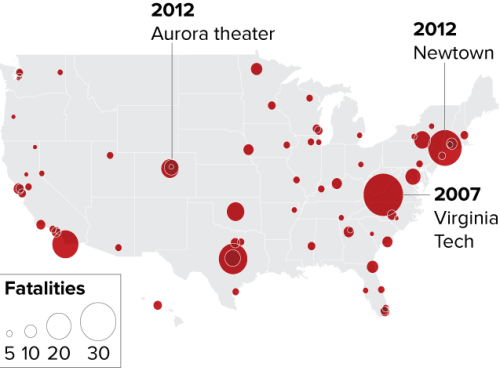
ABC News/Mother Jones
The increasing occurrence of mass shootings challenges viewers to join several apparently incidents whose totality difficult to cognitively process, moving events seared in our personal memories as if they watersheds in a quick succession whose near-continuum strains understanding as a status quo, and raises questions about how to find meaning in their rapid onslaught.
The crowding of the chronology of mass shootings links dramas that unfolded in different parts of the country in a metaphor of the difficulty to grasp the rate of mass shootings in public spaces: dots designating individual events are difficult to process or parse. Rather than seem individual aberrations, the unpredictable arrival of such mass shootings, grouped collectively, ask us to find coherence in the repetition of mass shootings across America, and to ask why the growing frequency of such shootings is still doubted as specific to our political culture, and relentlessly called into question, rather than addressed, even as tallies of gun deaths have broadly dropped by 30 percent from the early 1990s: the recent surge of mass shootings are not only due to increased media attention to their senseless randomness, but as a threat to human rights.
The reopening of debates about how gun control laws could stop or hinder the geography of gun deaths or scrutiny of shifting gun laws and their effectiveness suggest the lack of clear voice about guns. The variation among regulations about carrying guns in public–and transporting firearms–are even cast by advocates of the individual rights to firearm possession as a jumble of intrusive edicts on transporting loaded guns, ammunition, and storing such weapons by local attorney generals, aircraft carriers, TSA officials, and, yes, national parks and wildlife refuges, as so many “regulatory schemes” curtailing the allegedly protected freedom to own and carry guns.
 NRA-Institute for Legislative Action
Rather than consider mass shootings in terms of criminality or individual deviance, the prevalence of mass shootings across America demand to be recognized as a register of the unregulated liberties to carry guns in public space. The timeline in the header to this post is disorienting in how it aggregates such shootings, and poses multiple much-debated questions about understanding their rapid pace over time. Yet the picture of giving coherence to the range of mass shootings across the land is in a sense the reflection of the paranoia of gun protection. Ordering the relative frequency of mass shootings by lone gunmen is itself a challenge to map–and get one’s mind around–because it lacks without any apparent clarity in its growing spread. We often turn to maps to try to find some coherence, but find ourselves similarly frustrated by attempts to find coherence in the growing landscape of mass shootings and not offense. For the pace of mass shootings, once so terrifying in their individuality, has accelerated both since Columbine and since Sandy Hook to make it difficult to not view within a broad change in the use of guns in public settings, conflating militaristic violence and public life, in ways that demand mapping if not to the increased availability of guns, to the ways mass murders might be measured.
The timeline renders it impossible to regard what were once seen as possible turning or tipping points in public violence outside of a context of their collective increase. However much some pundits repeat the conclusions of criminologists about the constant levels of gun violence in America–distorting the distribution of their frequency by including family violence and gang-related fights that constitute a large share of firearm homicides–the increased occurrence of mass shootings on unknown victims reveal disturbing conflations of guns and public space. Even to measure gun violence alone deeply distorts the unique problem of mass shootings, as they are premised on lumping such public shootings with a broad epidemic of gun violence, rather than confronting and visualizing the growing conviction of the legitimacy of firing firearms randomly into crowds without restraint.

Although mass shootings in public spaces are by nature unpredictable, the aggregation of mass shootings offers a way to analyze and recognize the problems of But although the violent level of gun shootings in America have grown, as violence cannot be universally quantified, mass shootings prove difficult to classify or define with uniformity. For mass shootings reveal a unique sort of violence in public. Even when not counting the shootings of family members–the majority of group homicides from firearms, with one in four victims being close family members and over half family members or intimate partner–the increase of public “mass” shootings aimed at unknown victims suggest a confusion of militarized and civil space–and an irresponsible intrusion of firearms into public life, all too eerily mirrored in the attempted seizure of public lands.
The increased anonymity of mass society finds an eery underside in the relentless expansion of mass shootings at unknown human targets in civic space, as if they suggest the fragility of civil society. The numbers shot or killed by high-capacity magazines have defined and will define the country by their very frequency of mass shootings occur in the United States–however vociferously contested is the claim President Obama’s claim that “this just doesn’t happen elsewhere”, the expansion of such shootings reflects an increased absence of regulation of firearms. While it’s not entirely true that only “high capacity magazines put the ‘mass’ in mass shootings”, given the range of gun violence, the peculiarity of gun violence in America lies in the frequency of adopting firearms to wound or murder unknown victims, and the need to better chart the level of violence on For the anonymity of gun violence in America reflects the far greater access to guns in the country, and a broader presence of guns in public spaces of assembly. The expansion of mass shootings illuminate the shifting landscape of gun violence–even as fewer than a twentieth of Americans regard gun control laws as a problem confronting Americans, and Congress took until 2013 to recognize the “mass killings” as demanding attention from the Attorney General, after it rejected to enact restrictions on gun laws or extend an assault weapons ban.
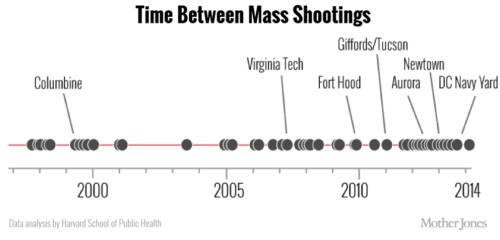
Mother Jones/Analysis by Harvard School of Public Health
The recent proliferation of such mass shootings, rather than raise thresholds for processing public violence, raise questions about reasons for increased recourse to guns, as well as about the perpetrators of crimes. For the striking relentlessness of the multiplication of premeditated crime in public space is truly difficult to comprehend as they approach a deeply disquieting continuity. The term “mass shootings”–only slightly removed form “mass-killings” or “mass murder” that evoke wartime–have no place in liberal society as bizarre conflations of military-style violence, so disturbingly are they removed from a society of laws. Even if exceedingly rare in comparison to gun-related deaths, mass killings by guns have however multiplied in three-fold fashion over the past three years to almost cease to be able to be seen as discrete events as they were once considered to be, as shootings in public spaces by “active shooters” have skyrocketed, as the times between their occurrence declined sharply.
The rise of such shootings has no clear precedent. Although such killings have a clear history and precedent, at times dated as far back as 1891 or even to 1984, the term “mass shooting” first gained currency around 2012, in reaction to the expansion of public shootings, and the classification introduced by the FBI was soon adopted by CNN, who expanded the bar for fatalities in a mass shooting to four, but also excluded events where the victims were related. Only after that did the U.S. Congress in 2013 officially qualify “mass shootings” as single incidents leaving three dead in the Investigative Assistance for Violent Crimes Act, taking responsibility to define the term as part of America–even while refusing to maintain a public registry of such shootings, or adopt this as the sole definition. The relative frequency of their occurrence suggests a deep confusion between civilian and military space that demands to be unraveled, even if the lack of a public registry of such public shootings may soon change, as well as the introduction of greater checks on the purchase of guns. But there is an abdication of responsibility has led to an unchecked expansion of the defense of individual rights of gun ownership–and a dislodging of attention from shootings to the danger of compromising gun rights.
The sense of virtual continuity that approaches in the above timelines are so disordered that it is tempting to find coherence for these unpredictable events in a map. But the collective mapping of such extreme violence is truly difficult to comprehend as they approach a deeply disquieting continuity. Individual stories of mass shootings such as the terrible tragedy at Sandy Hook Elementary School in Newtown, PA cannot help but bring tears to one’s eyes, as to President Obama’s, as they will continue to do. But the intense the pace of shooting multiple victims–evident in the shrinking intervals between black circles that mark mass shootings–represents a terrible sort of information overload. For it sketches a landscape of mass shootings we’ve been slow to confront, and evokes a sense of powerlessness to interrupt the staccato of their onslaught. Although shootings has, incredibly, relentlessly accelerated since the Newtown, PA attacks, the same event provoked increased attention to mapping and quantifying mass shootings, in an attempt to understand that increased frequency. In spite of the absence of national databases on mass shootings, the rise of crowd-sourced or open-sourced maps since then provide a better dataset of their occurrence–forcing us to confront the increased numbers of people shot or killed by high-capacity magazines, the older demographic of their perpetrators, almost exclusively male, and the greater share children such mass shootings killed, to force us to better examine their occurrence outside the landscape of mourning which has also recurred with increased frequency.
We mine data in hopes to try to impose coherence on the terrifying frequency with which public “mass shootings” doubled after 2007, and tripled by 2011. But such documentation fails to process the landscape of increased recourse to automatic guns. The succession of individual mass shootings fail tell a satisfying narrative about their increasing occurrence. For the collective aggregation of such apparently random acts of violence, the timeline of mass shootings grouped with apparent objectivity, embodies a story that lacks apparent spatial coherence. Although we use maps to process their relation to one another, and to gain a better picture of the proliferation of public violence, the expansion of mass shootings maps a story that eerily parallels the increased availability of guns and assertion of an individual “right” to firearms irrespective of individual rights or public safety.
Similarly, the government has focussed on mass shootings though an optic of criminal investigation, rather than through their victims. Although the government, in an abdication of public responsibility, has resisted tabulating the occurrence of such crimes, and only defined “mass killings”in 2013 as a subject worthy of investigation by the Attorney General, collective tabulation often rested in amassing local police records of ‘active shooter incidents’ as problems of law enforcement, rather than within a landscape of gun violence lasting two to five minutes. The problems of mapping where such premeditated crimes continue to inflict violent injury or death reflects increased access to firearms, parallel to the decrease in urban gun violence. But their senselessness remains difficult to commemorate or get one’s mind around or even to individually mourn.
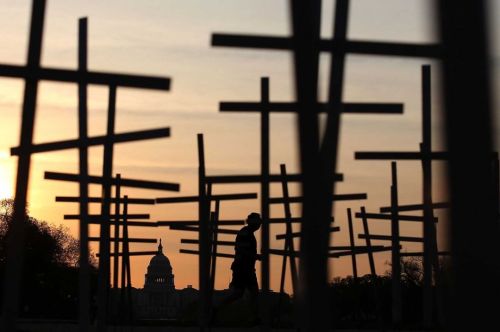 Mark Wilson/Getty Images
The spread of new venues for shooting, however, and the greater availability of guns promotes a particularly dangerous confusion between public space and shooting space, embodied perhaps in the Right to Carry movement, are troublingly apparent in the growth of gun ranges as sanctioned spaces for using deadly weapons, attracting those who want to use firearms–People come in and say, “Oh, I never knew this [sort of] place existed!”–which rent visitors firearms from a Ruger to a and provide practice venues, so popular that websites exist dedicated to where the nearest ranges are to your address. Several perpetrators of mass shootings have not only practiced at such ranges, but they allow targets with images of Obama–as a worker at one range remembered patrons had once used targets showing President Clinton.
<!––nextpage––>
3. The tabulation of such terrible incidents of gun violence where a single shooter left four or more dead from a single shooter–a standard defined in FBI data but not adopted universally–have consistently occurred with increased frequency over the past twenty-five years. The definition introduced by the FBI and taken up by CNN may however, it is widely noted, minimize the scale of these shootings and mask the lack of clear consensus of what constitutes mass shootings–from whether the category reflects fatalities, wounded, or indeed the weapon used. The refusal to tally mass killings, even if they comprise only 1% of all murders, is inadequate to visualize events that shouldn’t even be happening. The gun violence enabled by high-capacity magazines that create a potential of shooting multiple victims have led to a spate of mass shootings perpetrated almost entirely (94% of suspects are male) by white men, mostly between 20 and 45 years old, have alarmingly accelerated since 2005. The difficulty in parsing the changing landscape rests in defining “mass shooting,” quantifying gun violence by its victims, and of understanding the rapid sequence of such truly terrible premeditated crimes.
The multiplication of mass shootings have a fairly uniform spatial distribution, but a geography of anger that invites increasingly military-style assaults on public space. For if they are not clearly tied to globalism, or economic change, the rise of mass shootings in America are all too tellingly linked to a persistent confusion of militarized actions and public space, aptly characterized by Arjun Appadurai as a geography of anger in an age of globalization. Interrogating what invites such a confusion of public and militarized space might generate a clearer geography of mass shootings, lest they seem only random or chaotic scatterplot.
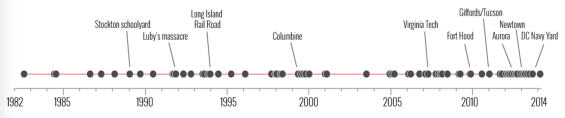 Mother Jones; data analysis by Harvard School of Public Health
In part, the overcrowded timeline remains difficult to process adequately because of the very density with which marks that note individual events of gun violence overlap with one another, effacing their own legibility, and the difficulty of giving meaning to violent outbursts in a clear context. The difficulty to discern the individuality among “mass shootings” makes it hard to process the meaning of their frequent repetition. In part, the abdication of definitional categories by the government, and failure of Congress to define “mass shootings” until after the 2012 Newtown, Connecticut shooting opened debate about the proliferation of such violent events, suggest an abdication of responsibility–the government has not only left the media without a clear definition to track their occurrence; we have failed to control the rash of shootings in public space. Although the Newtown shootings led to a number of attempts to aggregate mass shootings–from the Stanford Mass Shootings of America to Shooting Tracker–that placed renewed responsibility and focus on gun violence, and its victims, the absence of focussing on the specific gun violence of mass shootings and how to tabulate its violence outside of a language of criminality has provided an unclear image of its proliferation or its expanse. President Obama, not only acting as Consoler-in-Chief, increasingly adopted the term “mass shootings” in public statements during 2015. We cannot afford to let the disarming pattern of their recurrence remain so very difficult to wrap one’s head around.
And so we turn to maps to try to impose some purchase or coherence on the rage of gun violence, which seems to stand between individual actions and some macabre sort of collective agency. Only ten public shootings in the timeline are identified by place in the timeline above. But the landscape of shootings reveals a violent interruption of public space, difficult to explain or comprehend–both in terms of the increased frequency of mass shootings since events like the Columbine shootings, or the Newtown Shootings at Sandy Hook Elementary, just three years ago, or the subsequent multiplication of mass shootings whose frequency almost seems not to permit time for processing the memory of the dead. Even in an age of growing global violence, because it is so hard to get one’s mind around a landscape where public mass shootings have continued to multiply across the land, and their danger goes unaddressed. The renewed popularity of trainings to survive mass shootings continues to affirm the individual right to possessing firearms as a solution to contain violence–rather than recognize the pathology of gun violence that confuses military-style shootings and public space.
Yet the frequency of the recurrence of mass shootings is difficult to process in part because of the lack of a clear database for either the crimes and weapons with which they were perpetrated–resulting in a deeply troubling longstanding blind spot in processing the landscape of recourse to guns. The troubling reluctance to tally mass shootings–or to associate them with guns–has been clouded by a reluctance to identify the violence particular to gun crimes. Yet increased numbers of crowd-sourced or vetted counts of mass shootings illustrate a landscape of a terrifying proliferation of violence difficult to get one’s head around, in which the late 1990s constituted something like a watershed, but by the last ten years proliferated in increasingly troubling ways, in a geography of anger that a time-lapse visualization reveals, compressing monthly tallies over fifty years that increasingly stained the nation by blotches of bright red.
https://tbridges.cartodb.com/viz/bce76468-21ae-11e5-89f4-0e4fddd5de28/public_map
This count is an underestimation that does not include mass-shootings involving family members, which amount to a quarter of the victims of mass-shootings, and the majority of such shootings are family-related. Interrogating what invites such a confusion of public and militarized space might generate a clearer geography of mass shootings, in Appadurai’s terms, might however gain better purchase on their occurrence and indeed the fear of further mass shootings in America.
The proliferation of such premeditated public gun violence across the nation was enacted with complete lack of empathy and arrogant privilege. Although the recurrence of mass murders in America may have created changing thresholds of public gun violence in the country, particularly since the Columbine massacre in 1999. When the sociologist Ralph Larkin suggested the emergence of a “cultural script”–a model for shootings inspired by the violence of earlier killers–the suggestion paralleled vigorous public debates as to the ethics of continued identification of perpetrators on television news and the coverage of their manifestos. But the ethics of tallying the geography of this spate of mass shootings and the landscape it presents is not only as important for the image of the nation that it presents, but for the difficulty of finding any coherence in episodes of public gun violence, at one time rare, but now extending from sites of public congregation from movie theaters to schools to public clinics to on-air news shows.
The problem of tallying mass shootings, after all, is a problem of confronting the extent of gun violence in the country by visualizing the ways that mass shootings, if a small percentage of gun-related deaths, compromise public safety in unacceptable ways with increasing frequency. So much is revealed in the increased prominence of the number of mass shootings staged in schools since Newtown alone–

School Shootings in the United States since 2013/Every town Research
or the predominance of children among victims of mass shootings–
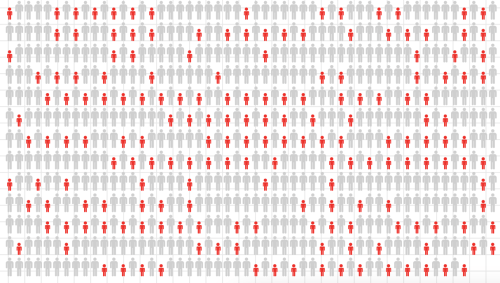
Mass shootings are increasingly publicly staged as a perverse taking of justice into one’s own hands, not only as increasing guns have entered circulation, but as the diffusion of firearms equipped with high-capacity magazines has changed the landscape of gun violence. Despite a partial slowing of their occurrence after passage of the Assault Weapons Ban, in place until 2004, most public shootings occurred with legally purchased guns–80%. If many perpetrators betrayed signs of mental health problems,this did not obstruct the legal purchase of guns with high-capacity magazines whose rapid-fire capacities that the black dots marking shrinking intervals almost emulates in its chronology of violent crime, whose staccato approached near continuity at several times ov re the past ten years. If such violence parallels a growing global violence, the painful punctuation of time with public mass shootings, tabulated as a single gunman leaving at least four dead, suggest more than a cultural script, but a geography of extreme rage it is important to try to confront.
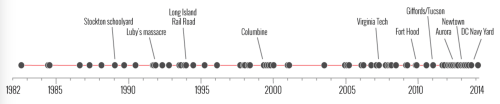 Mother Jones; data analysis by Harvard School of Public Health
The increasingly crowded chronology reveal an increase in episodes of public gun violence with multiple victims, whose occurrences become difficult to individuate form one another their repetition is so dense. Yet a clear consequence of such mass shootings is in the geography of fear: on the heals of individual mass–shootings, surges in the sales of firearms have arose–recent sales have increased across Southern California in the aftermath of the San Bernardino shootings, in the manner that gun-dealers were quick to report increased requests for weapons after earlier mass shootings as Sandy Hook to two million guns a month. And once more, firearm purchases have surged.
<!––nextpage––>
4. If we are apt to interpret the increased spate of shootings as a sort of crowd psychology of negative role models, the tacit dialectic between mass–shootings and gun sales demands mapping as an intersection of a spatial imaginary rooted in the defense of rights to possess firearms and the expansion of further firearm sales–a landscape not of increased gun ownership, but of an expansion of the misunderstood “right” to bear arms. We are more ready to accept workshops for training in behavior during mass shootings, as if to accept them as a new normal, than to enact laws designed to staunch the sales and circulation of firearms.
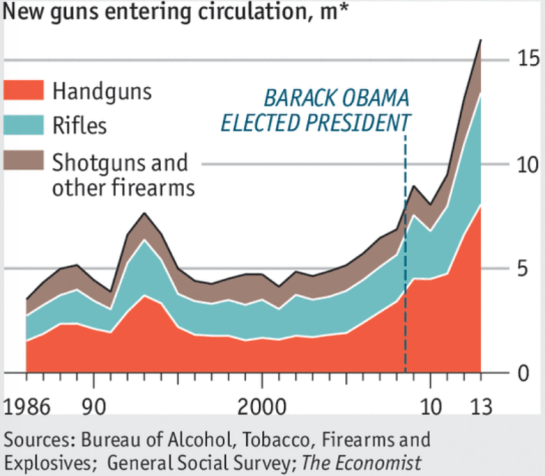
For the expansion of mass shootings in America has grown in the face of a lack of official government counting of their occurrence, and a blind spot and self-imposed reluctance to monitor or disturb the alleged “right” to bear arms. Although there is unclear evidence that the ban on assault weapons limited the growth of gun violence or murders before it expired in 2004, despite reported reduction of guns in circulation at shows and gun sales, the promise and hope to reinstate the plan led to a defense of gun rights consolidated in 2008 by the Roberts court. The Court’s somewhat surprising defense of gun possession as a personal right paved to an increase in circulation of guns in America that mushroomed first to one per citizen, and approximately 310,000,000 million firearms as of 2012–114 million handguns, 110 million rifles, and 86 million shotguns–or more than the number of Americans. At the same time, the expansion of AR-15’s in American hands beyond 3,750,000 by late 2012–with sixteen million new guns circulating in America by 2013, as detailed in the tenth (and almost self-standing) section of this post. Industry analysts of gun and ammunition manufacturers–who donate part of their profits to the NRA, mean that the panic-buying after each mass shooting regularly accelerated and “went vertical,” driving new monies to the NRA.
The full-throated defense of gun-ownership as a right, long asserted by many pro-gun groups, was endorsed that parallel the expansion of a landscape of illegal gun shootings and the multiplication of mass-shootings over 2015–in what President Obama recognized as “a pattern . . . of mass shooting in this country that has no parallel anywhere else in the world.” Rather than the chronology of mass shootings only reflect an inexorable rise of anger or a disembodied landscape of emulation of bad role models, this post suggests the need to embody that landscape in the dramatically increased right to protect individual ownership of guns. that provide a background for the four-fold expansion, by one count, of mass shootings in America from 2008 to 2014: the expansion of gun sales triggered by Obama’s 2008 election encouraged shops to restock firearms anticipating Obama’s re-election, which indeed spiked sharply after Newtown, when a surge in the circulation of firearms occurred which demands to be mapped.
Have the costs of such a resurgence of guns in America already born costs?
The extraordinary expansion of such newly identified events as “mass shootings” suggest a failure to map a landscape of gun violence. The increasing frequency of such murders renders it almost impossible individuate these terrifyingly militaristic event as discrete; their aggregation overwhelms its own very symbology, as if echoing the deep difficulty to interpret their troubled narratives with any coherence. The frequency of public mass shootings in America offers a mirror particularly difficult to confront. We search of more coherent answers in maps–but are frustrated at the meaning of the apparent proliferation of mass shootings since Sandy Hook attacks directed public attention to attempts to contain future gun violence while respecting Second Amendment rights–
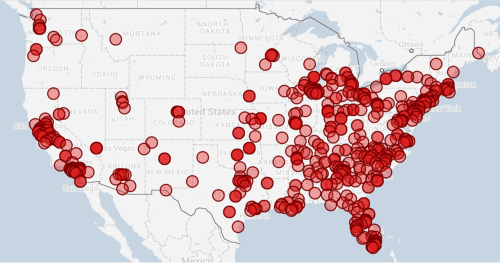
–and inspired the public record-keeping that had long lacked to provide a clearer image of the expanse of gun violence across the country that has led President Obama to act with a “sense of urgency” to enact gun control measures in ways consistent with Second Amendment rights–even as his opponents return to possible impeding of Second Amendment liberties as a nefarious design needing to be met by their active protection.
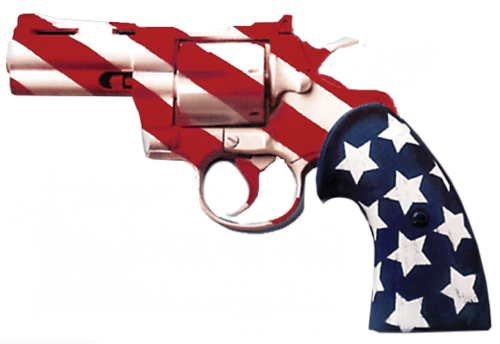
4. Have we have allowed a clear popular distortion of individual rights to possess guns that obscure the multiplication of mass shootings, and landscape of gun violence, distorting the rights of gun ownership as a constitutional liberty, leading to a refusal to monitor or control access to assault rifles or handguns? By failing to register the relation of rapid-fire guns to crimes, curtailing background checks, and invalidating any bans on the restriction or ownership of handguns, the founders’ call for a “well-regulated [state] Militia” was re-interpreted as an individual prerogative to have unrestricted access to firearms, irrespective of the growing threat to public safety.
Brady Campaign to Prevent Gun Violence
The timeline at the header to this post challenges us to map memories of individual shootings in schools, movie theaters, public buildings, or auditoriums in an abstract form–and process the reasons for their collective acceleration over time. Each episode of violence suggests less a fixed ‘place’, of course, than the extent to which extreme gun-violence intersects with the nation; the collective list challenges viewers to process the collective impact of a new landscape of gun violence in public space, almost 80% of which involved legally purchased guns with high-capacity magazines, and to explain the reasons for the distribution of an undeniable epidemic of public shootings in civic space. Much as the extension of railroad lines earlier placed locations “on the map” which were earlier unknown, the occurrence of mass shootings–by no means consistently defined in the United States, and based on an old FBI classification since abandoned–puts a town at the intersection between a near-epidemic of violence and civil space.
The sites where mass shootings occurred have entered public memory, even if no clear consensus has emerged on the notion of mass shootings. Although its value for registering gun violence in America has been questioned, the terrifying prominence of the increase in such public performances of violence has led to increased interrogations of what has allowed (or facilitated) such explosive violence that have been relentless over the last few years. While we have watched a procession of deer-in-the-headlights photos of perpetrators or examined the eyes of Facebook portraits for clues, the aggregate acts of such violent aggression can’t be seen as an aberration. The overlap between public instances of gun violence that left four dead is difficult to process both as a loss of individual lives, and epidemic of violence for which no clear end seems in sight: the telling contraction between shootings in which four or more were killed have come to overlap with one another to make them illegible and impossible to process as a whole–the crowded timeline of violent outbursts overwhelms in ways difficult to process or understand, in part because it removes the increase of mass shootings from a broader context of refuting local restrictions on the possession of guns in 2008 and 2010, as the widespread reluctance to revisit the lax regulation of gun ownership encouraged a belief in the “right” to own guns.
 Mother Jones; data analysis by Harvard School of Public Health
Tabulated by mass shootings/month, a terrifyingly clustered repetition–if less clearly as a visual metaphor for the difficulty to grasp the frequency of public shootings’ occurrence–returns. There has never been a break for more than three months in a public shooting that left four dead over six years–breaks that only occurred two times. Although the shootings cluster, and little coherent pattern exists among the rampages,
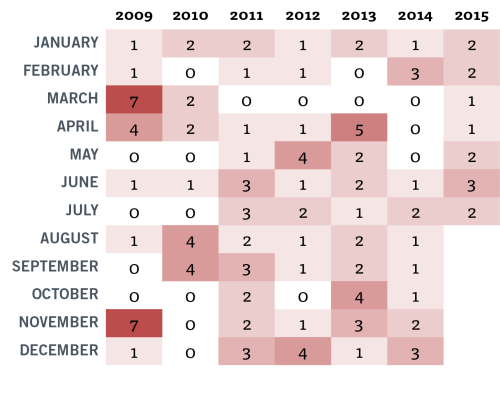
their occurrence raises questions about the increasing intersection of gun violence and public life. Even though “mass shootings” comprise quite a slim percentage of gun violence, to be sure–

–the persistence of mass shootings with terrifying regularity raise inevitable questions about their future role in the country’s public space, and hint at a future of violence in places where violence previously had little place. Is there something like a tipping point about the diffusion of mass shootings in America, or are we powerless before their spread?
Although mass media has returned to the dramatic setting of public mass shootings as tragic losses of life, we fail to process them as fragments of a national storyline, since their narrative coherence is poorly understood–what coherence can be imposed or read in their distribution remains unclear. The unpredictable sequence of such heinous crimes staged by individual shooters have only come to be collectively defined, and given coherence by being mapped in ways other than numbers of killed. Though the mass shooting was not included in the FBI’s Crime Records Reports, the mass shooting has come to resonate with a topography of fear in an age of the perceived rise of terror; if questions have been raised about whether mass media reporting may have increased copycat crimes, the crowded landscape of sites of public gun violence paints a frightening image of America, at the nexus of law enforcement and legal rights of gun ownership, but creates a landscape of its own.
The resonance with which each place-name appears on the crowded timeline suggests the growing difficulty to process the seventy-three of such identified events over the past thirty years, and rapidity with which have arrived in sharply decreasing intervals; as much as a landscape of increased violence across the nation, the mass shooting has become a way of marking time of increased fear–whose crowding as a collective chronology above, reprinted from Mother Jones, based on three decades of data and research from the Harvard School of Public Health on shootings in public space, suggests a random reputation of lives lost. We turn to maps to try to process them. But the increased frequency of mass shootings intersects with public space in these data visualizations, made and remade in attempts to understand whatever coherence they might have or invest coherence in their occurrence fails to reveal clear meanings–even against our intensely fractured political climate. And after each shooting since Sandy Hook, gun retailers celebrated a “real surge” in sales that was widely championed by gun manufacturers.
The distribution of mass shootings blankets America whether measured by their occurrence or the number killed by such public violence, in ways that define the country in curious ways but they hold a mirror to the country we do not like to recognize.
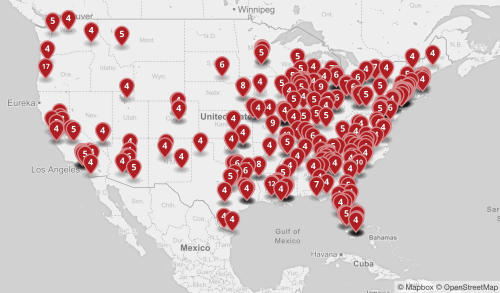
Stanford Mass Shooting Archive/Open Street Map/CartoDB
5. Even the recognition of the phenomenon has been deemed too contentious to adopt, we use crowd-sourced web-based tabulations and open-source aggregations from non-profits like Shooting Tracker or Gun Violence Archive to track their occurrence and geographic distribution in the country. Both websites have tabulated their incidence less with reference to an “active shooter” who is “actively engaged in killing or attempting to kill people” in public space determined by the FBI to describe “mass murders,” as if to hesitated to link them to a weapon of choice. The tally of mass shootings has been only recently construed less in terms of the incidence of deaths–as tabulated by news agencies as CNN or the FBI–but includes those injured, rather than only those killed. The timeline however exclusively marks public shootings that left four or more dead, excluding the gunman. But multiple different definitions about what constitutes a mass killing can however lead any tally to vary and arrive at radically different results; the ongoing lack of consensus in the term as an analytic tool makes it difficult to agree on how this data, and make us depend on non-profits for accurate counts beyond that of news agencies. (Does a ‘mass shooting’ reflect the number shot in quick sequence (as it does for Shooting Tracker), four or more killed, or only multiple shootings? Should the category exclude robberies, gang-related violence or domestic violence?)
The results can be so radically different to suggest radically different landscapes of public violence, and rely on different triangulations between perpetrator, victims, and gun, which reflect contentious debates about relations of gun control and such shootings. But all try to visualize the undeniably growing intersection between such apparently random outbreaks of gun violence and public space, to try to create meaning from such tragic and not-so-sporadic outbreaks of public violence. The significant difficulty of cognitively processing the growing frequency of public mass shootings occurring at one time and site–let’s say only killings of four or more unrelated individuals at one site–so overwhelms as an information overload alone, to demand careful consideration. In part, the events seem too traumatic, most still seared in our personal memories, to be able to be distanced with clarity. Even when stripped of geographic location, each place-name invites us to place our personal recollections of what seemed altering shootings in a collective context that lacks clear coherence.
Although the timeline in the header is not at all an actual map, per se, each place-name triggers indelible if temporary ruptures of civil society, asking us to try to abstract them as a coherent whole; rather than seem discreet moments, they assume a collective resonance that’s terribly challenging to process–the relation between the distribution of mass shootings to our sense of the space civil society is pressing, but quite difficult to define, even as mass shootings have undeniably multiplied to 375 over the last year, including four or more killed or wounded, in a combination of imitation and increasing violence over a year which at its close was dubbed “year of the mass shootings.” And only a small number of such events had there been concern about the mental health of their perpetrators expressed to medical practitioners, school officials, or legal authorities–and if concerns were expressed about just over one tenth of perpetrators, fewer than 1% were actually legally barred from buying guns.
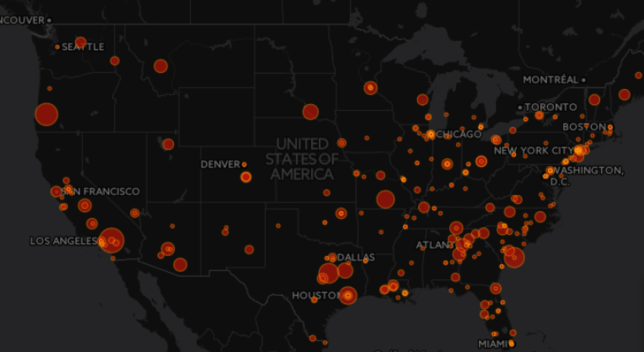
The quick succession of mass shootings in the timeline of course forces us to ask their relation to one another, and expresses the cognitive challenges of getting one’s mind around them–and questions whether a map is even the best medium to track the spate of violence of mass shootings, even as it makes us turn to a map to locate them in space. The difficulties of visualizing mass shootings lies only in part in the limits of reporting or classifying outbreaks of gun violence occurring at a single site as “mass shootings” by fatalities versus the number of wounded or shot–as if to count as an event that is newsworthy, an individual must die–but in making sense or coherence of the rash of these explosions of violent gunfire across the land. The chronology lists mass shootings that left four dead but also evokes the very extent to which this past year’s onslaught of mass shootings in ways cognitively challenging to grasp, as their ever shrinking temporal separation approach near-continuity. If each dot indicates a shooting without reference to space, their accumulated density maps a geography of anger. For much as the place-names clustered with such density on the timeline, they are cumulatively less and less easy to grasp as singular events: mass shootings punctuated the last two decades with an intensity difficult to process such occurrences better–making one turn to a map to endow coherence to the unpredictable outbreaks of indiscriminate shootings across the country with little end in sight.
The aggregation of public gun violence suggest not only a geography of fear–and an undeniable overlooking of anger–but reveal a particularly insidious misinterpretation of gun ownership as a right in legal discourse, as much as the tally of mass shootings is filtered through debates on gun control. The disembodied dots that dizzyingly crowd the timeline mimic the rapid-fire of bullets delivered by assault weapons’ replaceable magazines. Despite continued unresolved debates in political discourse about how to gloss the spread of mass shootings in a country where it is so easy to procure guns, the contested interpretation of the map may betray a deep reluctance to confront their pervasive occurrence, and ask what sort of story their increased incidence, perpetrated almost entirely by young, white men–94% of suspects are male–suggests.
For the spread of mass shootings as a category eerily parallels a crisis, suggested by Dorothy Samuels, in American legal discourse as to the right of individuals to “bear arms” as a right without government oversight. While many perpetrators, to be sure, displayed signs of significant mental health problems, the multiplication of mass shootings has been facilitated by legal sanctioning of individual “rights” to own guns since 2008. The defense of such “rights” not only actually encouraged the proliferation of millions of guns in the United States, but generated a political discourse, long-planned by the NRA, about gun ownership that made reinstatement of either research on gun violence or curtailing of gun sales anathema.
Even without focusing on perpetrators and their weapons, the landscape of gun violence poses questions as to what the aggregation of “mass shootings” reveals. For even when excluding shootings that result from domestic violence in the home–perhaps unconscionably, given that a quarter of victims of multiple murders are family members and the majority of group-killings stem from family violence– the distribution of the data is terrifying as a rewriting of the use of guns in public space. We are used to watching zones of war in television films, video games, and movies, but such mass shootings of four or more are difficult to process because they have occurred in spaces of public life: health centers, schools, auditoria, film theaters, medical clinics, public buildings, or even the television news–as if to openly attack sites of public assembly.
News stories about mass shootings have remained prominent since 2011, ranking in the top five stories in repeated years, lending familiarity to the term before it was defined by Congress in January, 2013 lowered the threshold for identifying “mass shootings” to three victims. Data visualizations that “map” the accumulation and relative density of mass shootings present a landscape that we are just starting to learn to measure. Although”mass killings” were first defined by the FBI, the adoption of “mass shootings” by news agencies as CNN or ABC left unclear consensus in how they are counted or conceived. Indeed, while deeply disturbing, the ethics of a CartoDB heat map, which blur shootings to obscure individuality, are unclear, if terrifying; their distribution here approximates a disease map, but one particularly challenging to process–as if a miasma removed from the nation.
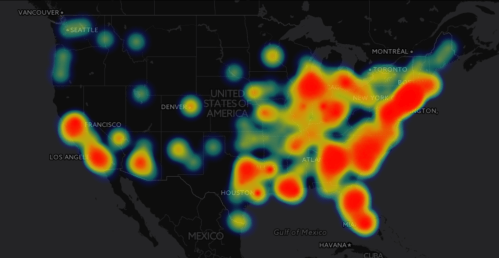
–and aggregates data to suggest their wide distribution in populated areas, without any meaningful clarity. The rise of such public displays of mass violence, if constituting only less than 1% of all gun violence, can’t help but suggest a deep instability within the nation–irrespective of place. The aggregation of mass killings raises questions about attributing mass killings to a failure of mental health providers or shifting thresholds of violence of mass behavior–and, indeed, the thresholds that the country is able to process. But the distributions with which mass shootings have occurred in America increasingly seem to define questions of the possible intersections between the site of the mass shooting and public life that are barely touching, but always in danger of overlapping.
6. The national timeline presents an image of the nation hard to ignore, as if a creepy causal network of mass behavior. The difficulty in mapping such violent outbreaks seems due to the reminder that they offer of how difficult mass shootings are to prevent, and how ubiquitous they have become, as revealed in this map tallying victims of mass shootings over the past year alone, but whose legibility is also obscured by the failure to count wounded and fatalities of four or more to tally the multiplication of mass-shootings over the past year of 2015–“a pattern . . . of mass shooting in this country that has no parallel anywhere else in the world.”
or sized by shootings with three or more fatalities–
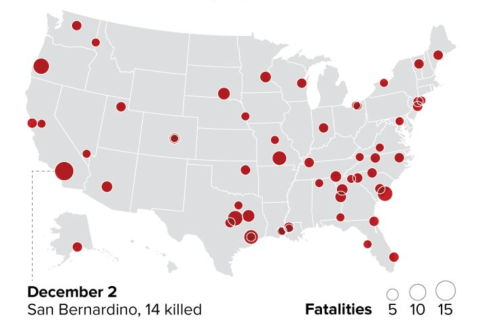
The year was so grim, and so tragic, in the series of shootings that we are still trying to get our minds around and to process, as shootings occurred almost daily over 2015, that we may be near a tipping point in processing their immensity.
A chronologically collapsed aggregation of the wounded and dead in mass shootings that occurred since the Newtown shootings of 2012 make it impossible not to acknowledge their prevalence across America–in ways not limited to a tally of four dead, but that includes all dead or wounded:

The profusion of such violent events with guns contrasts to the twenty-eight states which had not seen a mass shooting incidents from 1984 to 2012–a number that in 2015 shrank to but five, making this earlier landscape look far removed from the nation’s current state:
 Citizens Crime Commission, “Mass Shooting Incidents 1984-2012”
The pronounced expansion of mass shootings across both space and time suggests a boiling over of rage across America that such aggregations only force us to start to process. While such killing sprees were initially termed “rampages” or “mass murders”, the increased currency of the very term “mass shootings”–only slightly removed form “mass-killings” (preferred by USA TODAY, who include killings of family members) or “mass murder” (which cannot help but evoke wartime settings)–suggests a disquieting difficulty to place such conflation of military-style violence and public space in a liberal society– and the troubling sense that this is approaching a new normal. Even though the polarized nature of political discourse about gun control make it increasingly difficult to resolve.
7. There at first seems little coherence offered in such maps, and a powerlessness that any action might soon slow their future occurrence–the maps overwhelm one with a feeling of impotence, as if “this was a terrible tragedy but somethings these things just happen and there’s nothing anyone can do to stop them”. Rather than only create an image of a blood-splattered segment of a continental mass, or a record of psychic disturbances or mass behavior, the images might suggest the spaces that have been opened for mass shootings across the United States which increasingly pose undeniable challenges to human rights. The shootings are deeply misunderstood as individual cases of psychic disturbance, even if they demand to be understood more clearly as a crisis of public health.
Individual attachment to guns may, insidiously, enable this rash of violent subtractions of self from a social compact. For the challenge to visualize such violent shootings in public space collectively–and the deep threat and instabilities mass shootings continue to pose–resonate not because they are a large proportion of homicides (fewer than 1%) or gun violence (fewer than 5%), but because of the deep shock they pose to civil society. Even if the attention to the number of mass killings may distract attention from the real danger of guns, including “slightly modified combat rifles” enough to be “red herrings” in the debate on gun control. USA Today stokes fears by reporting that mass killings in fact “happen far more often [my italics] than the government reports,” even if shootings in public spaces account for about one-sixth of mass shootings, the events are so disturbing because they blur the boundaries between military action and public space too common in today’s world.
The relation between the space of mass shootings and the inhabited world is in a sense the subject of all maps of mass shootings. There has been a dizzying crescendo of shooting sprees in the over the twenty years since the concerted defunding of the CDC’s study of gun violence in America in 1996, believed to “advocate or promote gun control” or defamed of doing so, and the silencing of research on gun violence. Since the decision to direct the 2.6 million that the CDC invested in studying gun violence to the less-contentious research in traumatic brain injury, the rise of open-source mapping of the mass shootings in America reveal widespread proliferation of military-style gun violence across the national landscape, as if to direct increased attention to the problems of processing a problem from which government funding disappeared. This is a victory of crowd-sourced mapping.
The onslaught of gun rampages that cause multiple murders and injuries overwhelm, and the clustering of mass shootings in the past ten years to make it impossible to see them as only discrete events: the virtual continuity that they assumed, as space shrunk between shootings, raises questions of the future and they can be meaningfully processed in a map. Even as we turn to map their occurrence to find some explanation and meaning from such senseless and only apparently unrelated events. For although unclear commonalities emerge in their place, their targets, or their scope, they suggest an increased ability to view the level and site of collective instability in the nation. The distribution of mass shootings over time hence provides a disquieting image of increasing instability of civil society, and demand to be mapped against not only against gun ownership, but against the defense of rights to own guns. For even although the legality of gun ownership is recognized by courts, nothing is more disturbingly removed from a society of laws than mass shootings.
The term “mass shootings” was only recognized by Congress as they qualified “public mass shootings” as leaving four dead, the FBI had recognized the rapid pace at which public mass shootings in America doubled after 2007, and tripled by 2011. While a small proportion of gunshot deaths, or the 51,ooo incidents of gun violence over the past year, mass shootings assume particular prominence within the national consciousness from such events–if they undeniably follow the same general distribution with other geographically weighted concentrations of gun violence.

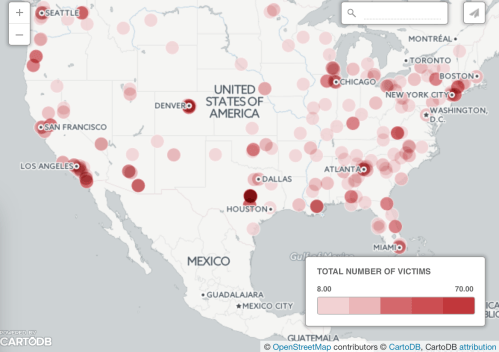
Stanford Mass Shootings in America (SMA), courtesy Stanford Geospatial Center and Stanford Libraries, as of October, 2015
Even as gun violence has overall declined, the spread of mass shootings suggests a changing picture of America that is still being more clearly processed. In part, this is because the term “mass shooting” has been defined by the media–both CNN and other television networks–although it was first developed by the FBI to tally criminal acts of murder. In recent years, it has been diffused and developed via the mass media, and specifically the ever-multiplying banner headlines of cable news, whose counts are directed to define them by the number of those killed–four or more dead defines the “mass shooting.” The attention to those dead, omitting those victims who were injured or escaped violence, both reduces their appearance on a data map, rather than, say, numbers of those killed or injured or the number of bullets that were shot, diluting the aggregations that such shootings map and making them mortality counts , rather than gaining perspective on them episodes of gun violence. And it distorts how the geography of mass violence and that of civil society overlap.
Reference to “mass shootings” as term of news reporting by CNN (who excluded events where the victims were related to each other) quickly followed, but the time to required for the term to gain currency raises questions about the difficulty to process the new thresholds of such extremely disturbing public acts of violence–USA Today prefers to use “mass killings” instead. As mass shootings recur with a rapidity to mimic the banner cable news headlines on CNN, where they were frequently announced, one is challenged to process their totality and staccato occurrence alike, given their actual broad geographic distribution. Because of the prominent suggestion of serious mental health problems of many perpetrators, we often fall back on diagnoses of individual instability to explain each tragedy that registers in the national consciousness, the huge spike in aggregate mass shootings after 2000 which jumped again from 2013 can’t be diagnosed by individual disturbances or the categories of the mental health profession–so long as gun ownership remains recognized as an individual right. And yet the mass shooting suggests a deep assault on human rights.
A recent study of the thirty most violent mass shootings since 1945 found more than half occurred in the last decade, and their proliferation seems to have alarmingly grown in recent years We turn to maps to struggle with the difficulty of comprehending events of terrible particularity in the aggregate. Despite the terrifying nature of each place-name, which evokes a specific time and tragedy, as if a series of battles, aggregation offers the possibility of drilling down into their occurrence underneath the accumulation of horrific individual stories. Yet we struggle, since even a map of mass shootings including four or more killed or wounded during the past year poses similar cognitive difficulty to process:
Is this an accurate reflection of the country, and what does it tell us about its laws and legal discourse on gun ownership and possession? Although the mass shooting is still an anomaly, it is also part of a difficult to confront part of our nation. For the right of personal possession of guns is so difficult to remove or qualify in the United States, and so difficult to prevent rights to gun ownership to be so tragically misconstrued; if most of the guns purchased for these public shootings were done so legally, the lawlessness of the events is not able to be correlated only with guns, even if the changing landscape of the broad availability of guns seems to have created a space where individuals are all to ready to conflate civil space with a space of violence. Part of the difficulty to process these ‘events’ surely is that we focus attention on their perpetrators, as much as their victims, reducing the dead to a statistic, and not comprehending their violence:
<!––nextpage––>
The prominence of mass shootings illustrates a confusion of public spaces with military-style gun violence in disturbing ways. For the spread of individuals who have not only subtracted themselves from civil society, but turned to gun violence as a public performance, suggests not only aberrations; the aggregation of such shootings reveals the increased prominence of military-style violence staged within public space, and forces us to view their dizzying repetition within the national landscape. The geography of mass shootings still remain poorly understood by most: although about a third of the victims were near their homes when the shootings occurred, fewer than a quarter of Americans believe that there is reason to fear a mass shooting in their neighborhoods, and a fewer than a twentieth see gun control laws as a problem confronting Americans. Indeed, if Congress only recently recognized the mass shootings in 2012, as increasing numbers of lawmakers forced to confront their occurrence in their home districts, but many affirm the rights to own guns. And in 2015, only five states were spared mass shooting sprees–“the bloody, perpetual series of mass shootings in the country this year,” as ABC News put it, no doubt reflecting mass-opinion, and the sense that this steady accumulation may have reached something of a tipping point.
8. Even disembodied from a geographical form, the sequence of haunting place-names captures the degree to which mass shootings are cognitively difficult to process in their totality, and the complex shifting landscape of mass shootings they create. For the spectacular violence of each event is encouraged by the deep and abiding sense that the exceptionalism of America that is increasingly rooted, for a small if vocal minority, in its ownership of guns. The timeline forces us to confront the increased crowding of mass murders over twenty years not as aberrations, but through the inability to continue to segregate them as inexplicable tragedies apart from a larger picture of the nation. If we turn to maps in attempts to create a more coherent image of their coherence, since the frequency of mass shootings seem without any clearly recognizable patterns in such unimaginable violent aggression against four or more, as if civil society seems no longer able to contain its members.
For the aggregation of mass shootings presents an image of the United States we have difficulty recognizing as holding a mirror to the present, when amassed in their collectivity, and to search for answers for acts that so sharply run against the very fabric of civil society. We have repeatedly turned to terms like “disturbed“, “delusional“, “psychotic“, “sociopath“, or “undiagnosed schizophrenic” that continue to be bandied about in the wake of successive shootings–as if a diagnosis could prevent such events. But in offering clinical explanations for the violent tendencies so dramatically exhibited by their perpetrators, rather than explain the sequence of mass shootings which dramatically grew after 2000, and after 2013 rose so dramatically that over a thousand mass shootings occurred in the two years since Sandy Hook, with little change in background checks, to demand a collective mapping that a focus on mental illness denies. The array of weapons used in such killings raises pressing questions about their perpetrators’ access to assault rifles, but similarly fails to map reasons for this anguished performance of public violence against lives–
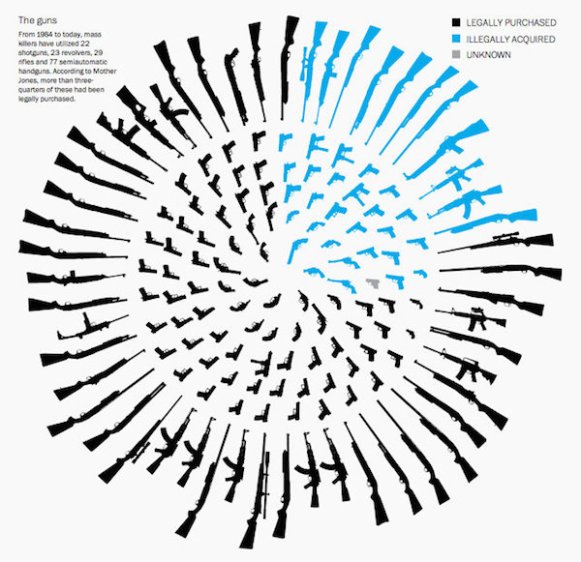
If poignant stories of the mental instability of those who committed rampages since 1984 force us to revisit possible counterfactuals, mass shootings may be less easily collectively diagnosed than mapped against legal discourse of gun ownership and freedom to own guns. For recent and widely reposted data from Mother Jones suggests that most of the guns used in mass shootings over the past thirty years were legally purchased, raising questions about their contingency. The rights of gun ownership on which our laws insist are embodied in conceal-and-carry permits, the rhetoric of gun ownership, and growing defense of rights to gun ownership as individual rights protected by the Bill of Rights and US Constitution–which have discouraged a public recognition and accounting of gun deaths. Although many of mass shootings occur in places not known for violence, the continued championing of assault rifles behind the empty slogan that “the only way to stop a bad guy is a good guy with a gun” valorize the weapon in ways that exculpate public entities or gun salesmen–protected by the Protection of Lawful Commerce in Arms Act--from responsibility of mass shootings’ occurrence: the shifting of responsibility too easily comes to fall into the domain of mental health, without looking at the dangerous opening created by an immobile legal discourse on gun ownership and firearm use.
Can the rise of mass killings be mapped within the access to guns that current laws permit, and the rhetoric of gun ownership that they unknowingly promote? It truly is unconscionable to see “firearms” as identical, despite the quite different uses to which they can be put?
Although the sequence of mass shootings tallied in the header to this post follows no predictable pattern (save to rapidly increase) and geographical distribution seems happenstance, the growth and unpredictable nature of mass killings demands to be mapped other than psychiatric labeling and armchair diagnosis. For black-boxing the spread of mass killings in questions of individual mental illness neglects to map against a changing discourse on the ownership and personal possession of guns and abnegates collective responsibility for the density of the clustering of these violent episodes increasingly part of day-to-day life.
Mother Jones/Data Analysis by Harvard School of Public Health
For “mass shootings” have so rapidly and dramatically accelerated during the past decade to overwhelm understanding. Indeed, the turn to map their occurrence provides a basis to distance oneself from the terrible occurrence and find some purchase on what seems less a Hobbesian state of nature without government, but a conscious remove of shooters from civil society. The rise of mass shootings in public places, although but a small fraction of all gun-killings, makes us want to map them to make sense of their inexplicable violence, to give some coherence to the sites of such deeply shocking events, as well as gain perspective on them. For although fewer than a quarter of Americans fear that they live in a neighborhood where a mass shooting might occur, the landscape of mass shooting has become an image of America. And if ShootingTracker.com and Gun Violence Archive have crowd-sourced statistics on all gun violence since 2012, to create a picture of the country, the image of mass shootings are both more complex and difficult to assess, partly because of their removal from and far deeper shock to civil society.
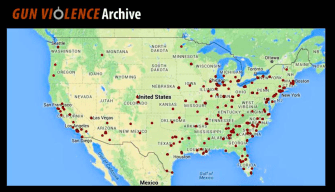
The more apt coloration of such data from KQED may better suggest the haunting by the dark spectre of mass shootings overwhelming the land:

Rather than being chaotic disruptions, the increasing chronological clustering of individual mass shootings suddenly appear as a connected group of events, whose quick succession both challenges the integrity of their remembrance, but seem cognitively challenging to grasp or gain clear bearings on. Even as the pace of gun-violence has decreased, the prominence in national news and consciousness of the mass shootings, and the prominent display of murderous violence that parallels their prominence in the national consciousness has created a new landscape of American violence and fear. Such apparent singularities have grown in the shadows of a country overly preoccupied with attacks of foreign terrorists or extremists, despite the greater than thousand-fold likelihood that between being killed by guns than a jihadist attack on American soil.
Is it possible we have decided not to look for the best ways to map and understand such violence as it has spread? Or is the confusion of civic and military categories part of the difficulty of comprehending the logic or pattern of mass killings in the United States? For the landscape of mass-shootings suggests another way of looking at America that may illuminate the gap between the rhetoric of gun ownership and civil society. The very density with which mass shootings appear on the timeline, blending with one another, reflects the deep difficulties of processing their occurrence, but also the manner in which mass shootings have come to represent the nation to an uncomfortable degree. Despite the specificity and unique nature of each occurence, the public violence of mass shootings demands to be mapped in relation not only to guns, but a rejection of civil society.
In its totality, the timeline raises questions about the aggregation of such deeply terrifying tragic events and the limits of comprehension save as an irregular quickening of public violence. While they surely offer a picture of the nation whose exceptionalism is evident in its rights to own guns and growing frequency of mass shootings–and they just don’t happened elsewhere–the script of such deeply tragic mass shootings recently has become recognizable event. The translation of the compilation of data, which first appeared at Stanford University’s Geospatial Center as an interactive map of Mass Shootings in America, has been translated into a range of new visualizations to grasp the increased frequency of their daily occurrence, if not, rather terrifyingly, a way in itself of experiencing time.
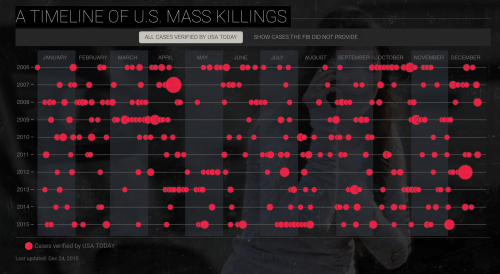 USA Today/Gannett–Mass Shootings in America until Dec 24, 2015
Although such killings have a clear history and precedent, at times dated as far back as 1891 or even to 1984, the term “mass shooting” first gained currency around 2012, in reaction to the expansion of public shootings, and the classification introduced by the FBI was soon adopted by CNN, who expanded the bar for fatalities in a mass shooting to four, but also excluded events where the victims were related. After the U.S. Congress in 2013 officially had qualified “mass shootings” as a single incident leaving three dead in the Investigative Assistance for Violent Crimes Act, as if taking responsibility to define the term as part of America–even while refusing to maintain a public registry of such shootings. The relative frequency of their occurrence suggests a deep confusion between civilian and military space that demands to be unraveled, even if the refusal to maintain a public registry of such public shootings may soon change.
The terrible growth of such tragedies from 2008 can be aggregated in compelling ways broader time-scale for greater dramatic impact, as it was by Tristan Bridges and Tara Leigh Tober, using criteria of shooting three or more people adopt by the Stanford Geospatial adopted–

–and then comparing relations between fatalities and injuries over time:
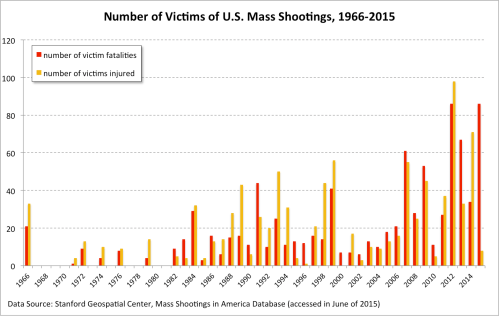
The chronology that most painfully punctures the daily news, in a time of terrorist attacks and refugee crises, tracks an increasingly undeniable anomaly and a violence against civil order, and a willingness to separate oneself from it. Whereas early chronologies were often closely tied to maps from the late middle ages, as ways to process information, the onslaught of the mass-shooting suggests a rapid-fire occurrence difficult to track. Their rapid progression sadly seems to mimic banner cable news headlines, their most common medium of announcement, whose timeline of recent history hardly permits processing their memory–save fears as to where and when mass shootings might occur.
<!––nextpage––>
7. Indeed the growing geography of fear–and what Appadurai characterized as a geography of anger linked to a prevailing sense of the deeply chaotic state of the present, animates such mass shootings, as much as a fear of globalization or economic change. But they target the nation as a whole in a tragically desperate sense: the nature of mass-shootings have indeed become an image of the defining character and deep insularity of America, as well as a registration of the anger of individuals who feel increasingly challenged, dislocated, and removed from changes that they cannot control. Indeed, however tempting it is to see mass-shootings as a consequence of terrorism, as the tragic Paris shootings, the scripts for these events are all too similar to the confusion of civil and military spaces, rather than terrorist activities–it is remains more likely to die in a mass-shooting than terrorist attack in the United States. For such tragic events blur public spaces of civil society and a militarized space of combat in increasingly terrifying ways; the rise of mass-shootings in public life are exclusively initiated by deeply marginalized men–94% of suspects are male–who decide to undertake a striking unprecedented degree of military-style violence.
The geography of such killings seems enabled by their subtraction from civil society. Interrogating what invites such a confusion of public and militarized space might generate a clearer geography of mass shootings, lest they seem as random or chaotic as one might seem: if offering a map provides such order to such psychically disruptive events, they also challenge clear containment within the order of a map. The dramatically increasing sales and supply of firearms–until recently most widely sold at Walmart and no doubt soon to be delivered to your home on Amazon drone–have generated an increased legal access to guns and heightened rhetoric to gun ownership that mirrors the culture of mass shootings. The chronology of mass shootings resist any semblance of coherence of a map, so deeply grievous and inexplicable is the loss of life, but illustrates the terrifying frequency with which they tragically punctuate time in ways that increasingly press against civil society. The rather grotesque rationalization of shootings as the “cost” of the liberties we accord gun possession dismisses their unacceptable risks as violations of human rights, independent of the considerable national cost–if only a small fraction of the total costs of gun violence–currently total over $200 billion in health costs,–more than Apple’s annual revenue.
But the spread of mass-shootings seems to stand at the intersection of the relations to guns that our legal culture has encouraged, and the cultivation of human-object relation in the murderous impact of rifles and other guns. Although over three-quarters of the guns that were used by those who orchestrated mass-shootings since 1964 were legally purchased in stores, the geography of gun-ownership alone does not correlate to the apparently inexplicable proliferation of angry mass-shootings. Indeed, we are frustrated however much we repeatedly return to their geographic distribution in attempts to grasp the rapidly spiraling increase in their terrifying violence and frequency, for the mass shooting is undertaken by those who separate themselves from civil society, or willingly conflate the civil space with spaces of combat. The dramatic rise in the legal availability of firearms and the increased identification with guns gun permits have encouraged radically changed the landscape of gun violence.
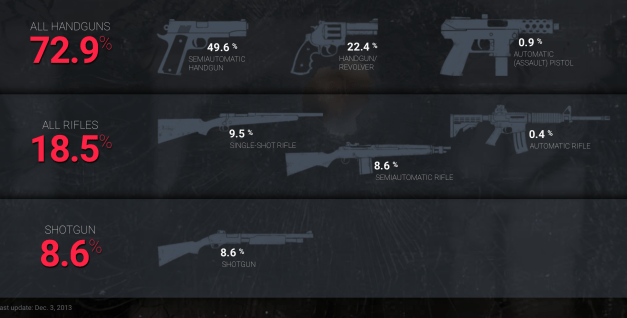
Perhaps the difficulty that the number of guns in public circulation in the United States outnumber the population are less a basis that might explain mass-shootings than the close ties that individuals have construed to their guns. Even though they themselves constitute but a small portion of all violent crimes committed with firearms, public mass shootings have resulted in the murder of 547 people, with 476 other persons injured, these manifestations of violence first doubled and then tripled, as if breaking what prior watersheds of the violence in public life. For mass shootings’ recurrence is all too easily recognized when they occur, and far too often accepted as an inevitable consequence of freedom to own guns. Although there is no clear “map-sense” in the spread of events of gun violence that have injured or killed multiple victims, and no clear pattern among these rampages, the timeline provides us with a sense of distance on the spread of such shootings–rare in 1990, slightly slowing before 2005–by which to gauge the current spread of mass-shootings, and the steep challenge of any data visualization. The failure of coherence in the tragically crowded chronology of mass-shootings reflects, more powerfully than any map, the difficulty given their radical remove from a society of laws of processing the chronology of shootings that have increasingly occurred across the most populated areas of the country. These terribly violent crimes, rarely tied to self-interest or revenge, suggest a deeply distorted world-view, whose distortion of gun-use occasions needed reflection as pushing to an extreme the notion of individual liberty even if few would recognize it as such.
<!––nextpage––>
8. Where such introspection will come from seems difficult to say, so problematic is it to map as a mirror of the country–and so easy is it to use a data visualization to do so. The timeline creates something of a mirror of the country, but mapping the blurring the unprecedented intensity of mass-shootings in public spaces suggests a way to understand their spread. While the latest of which almost always seems to constitute a new watershed in public violence, the aggregation of events simply overwhelms ordering–the totality of such troubled shootings erases any agency, and fails to establish the sorts of clarity or reveal the sort of connections that one would expect from a map. How would a map of the spread of such mass-shootings across the United States be best rendered?
Whereas maps process a coherent relation to expanse, by ordering place for viewers that they can process, the failure of ordering the tragically crowded chronology of mass-shooting frustrates even the most detailed data visualizations, which give limited meaning to the possible motivations and circumstances for such a huge change. The crowded timeline reflects how shootings have perversely come to punctuate public memory, but at the same time to follow on one another without space for rituals of remembrance of their individuality–or reflect on the national nightmare of the lawlessness of mass-killings as somehow being permitted under the actual rule of law. If attempts to trace the geography of mass-shootings disorients, it reveals a new image of America. Even if few see risks of a mass-shooting near where they reside, that gives rise to a new geography of fears that arise from the sense that no one knows where the next mass-shooting–and there will be a next–will occur: fears of their occurrence in nearby areas has grown, as the multiplication of mass-shootings expanded far beyond familiar urban regions to become a part of America: the geography of the 355 mass-shootings reported over the past year–wounding 1,314 and killing 462 in one year, and occurring almost one a day–is vast, but the steady stream of such shootings have occurred most anywhere in the United States, although 5% of Americans stubbornly believe that guns make public places safer persists, and most think the chance such events occur in their own neighborhoods remote.
The landscape of victims of mass-shootings however suggests a new image of the nation.
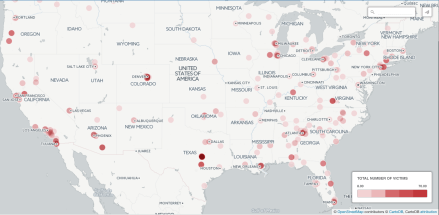 Stanford Mass Shootings in America (SMA), courtesy Stanford Geospatial Center and Stanford Libraries (map compiled with data of October 27, 2015)
Such is the deeply disturbing disconnect between the actual geography of mass-shootings and the spatial imaginary of Americans: even if the same proportion (35%) believe that “mass shootings are just a fact of life in America today,” far more Americans are concerned about the risk of future shootings than think that the risk is considerable where they reside–though over half expressed concerns of the such a mass-shooting near where they lived. Yet how does the distribution actually look? The geography of “mass shootings,” documented since Sandy Hook by the Stanford Geospatial Center, for lack of a national database, which accepts three or more injured by guns as a mass shooting, if it has grown quite considerably from late October to the late December, 2015, already suggested the difficult density of understanding patterns in how such mass-shootings had already spread across much of the country by October–and constituted what is almost a dangerous republic within a republic.
 Stanford Mass Shootings in America (SMA), courtesy Stanford Geospatial Center and Stanford Libraries (map compiled with data of October 27, 2015)
The timeline used in the header to this post serves to map this increased violence, even if the litany of place-names in the timeline is removed from the nation’s geography. What can account for this crowding of violent killings with guns? The frequency may encourage both a reassessment of thresholds of violence–Ruby’s Massacre and the Columbine Massacre have morphed to the Aurora, Charleston, and San Bernardino Shootings–as the number of mass shootings in public space with semiautomatic rifles has grown. As well as reflecting increased access to guns, however, it may be that the rise of shootings has reflected the reception of a particularly perverse and wrong-headed defense of rights to the access to guns as if this entitled their use as a form of public expression–if not a public statement, however pathological or hateful this form of individual expression.
The increase in the vociferous assertion that gun ownership is a right–protected within the Bill of Rights, as if it were an individual right–may have encouraged a quite idiosyncratic misconstruing of individual liberties, and at least encouraged a misguided belief that individual access to automatic weapons is protected by constitutional law as an individual “right.” The chronology that marks the rapid acceleration of mass-shootings in public reveals the deep difficulty of cognitively processing their individual occurrence–both in the degree to which mass-shootings remain profoundly difficult to process, and even to express. For the timeline marks a density of mass shootings’ occurrence tragically seems a national map: although the series of evocative place-names where shootings occurred are not mapped in geographical terms, their chronological crowding mark a nation that, if increasingly difficult to come to terms with, aptly express the difficulty to accept or even address. If the crowding of place in the above timeline expresses its a failure to lend order to their recurrence, it raises questions as to whether a geographic distribution could adequately capture their steep cost, both as a loss of human life or trauma–since 2007, the chronology of shootings is so tightly clustered to show them as a part of life in the United States. If firearms are permitted by law, it suggests a deep misunderstanding of gun use as a form of expression.
For mass-shootings have so tragically recurred with historically unprecedented rapidity–each compelling attention but difficult to synthesize in a coherent image, echoing the singular position gun ownership continues to occupy in political discourse. What, if anything, can be done to direct more attention to the growing fatalities from mass-shootings in an era when the demand for purchasing guns only continues to grow, with no sense of the steep risks such high sales pose for civil society? The profound, if deeply misguided conclusion that protections of free access to guns addresses their possession and civilian use–rather than being limited to guaranteeing well-regulated local militia–has helped turn a blind eye to the 30,000 plus civil deaths that result from gun violence, including increasingly common rampages of mass-shootings. The difficulty to address gun-safety reforms has encouraged a blossoming of gun purchases and the advocacy of the protection of gun rights by Americans, and bodes dangerously for the future, even if such killings constitute a fraction of gun deaths in the United States. Visualizations of mass-shootings provides an interesting–if challenging-way to understand the United States, which reveal something of a hidden republic within the country–one nourished by the insistence on Second Amendment rights to own guns, and fed by a deep conviction of the inviolability of removing firearms from an individual’s possession.
If the increasingly rapid growth of gun ownership has been fed by fear, the difficulty of describing the expansion of mass-shootings on America’s sense of public space remains deeply difficult to assess with certainty.
 Stanford Mass Shootings in America (SMA), courtesy Stanford Geospatial Center and Stanford Libraries (map compiled with data as of October 27, 2015)
Steep fear of future mass shootings provide an interestingly new picture of the country, and a new geography of fear. The ways that this epidemic of mass-shootings might be adequately processed–through a visualization or in geographic terms–is the subject of this post. For the depressing density of such clustering of mass-shootings in America has grown since 2012 to a degree that has lent an unhealthy aura of familiarity to the term alone, defined by the FBI as a shootings killing or wounding four or more, but which have multiplied to refer to shootings of many more–the comprehensive tally of deaths from mass-shootings in 2015 alone devised using data from shootingtracker.com have stained North America a bright red to try to give concreteness to the all too familiar term used for shootings in crowded settings or public spaces difficult to comprehend, but necessary to grasp–the interactive visualization tallies actual numbers of killed by Google-like teardrop shaped pointers, casting appropriate shadows over the place where they occurred, as if in a partial gesture of mourning to the many killed in each, but it is impossible that the pointers and their shadows will not at times overlap:
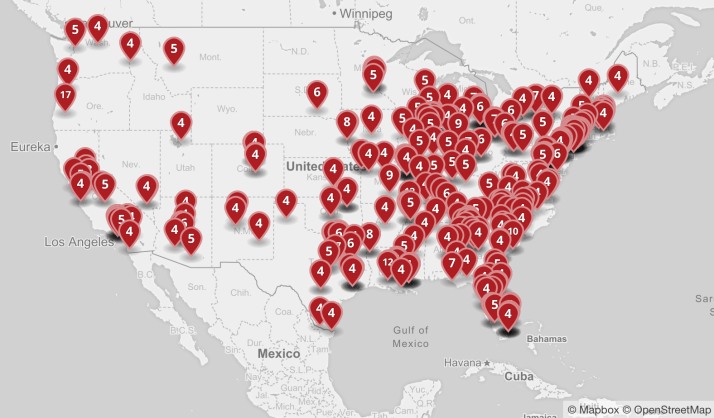
While such aggregations of mass-shootings are profoundly affecting, they create little sense of new thresholds for such wanton displays of violence that the rise of mass-shootings seem to have created across America.
The shadows that mass-shootings have come to cast over the country, which seem to get longer and darker with the expansion of collective grieving and dead bodies after each tragically inexplicable event, have gone beyond raising the threshold for violence in the country, but have increasingly demanded attempts to give meaning and concretize their proliferation lest we lose a sense of who we are: for if the map above is a mirror, of which San Bernardino was the 355th shooting this year, it demands reflection as we approach the year’s end. The successive occurrence of such heinous and collectively inexplicable crimes–so deeply challenging in their occurrence to lead President Obama to ponder, “as I said just a few months ago, and I said a few months before that, and I said each time we see one of these mass shootings, our thoughts and prayers are not enough.”
Staring at a map, without even knowing what is being mapped in this continent whose place-names are blanketed by sites of mass-shootings’ occurrence. Yet in the light of shootings this month in San Bernardino, Calif., the disproportionate role of access to semi-automatic weapons in America raises questions about their place in civil society, and place in a society that values individual life. If the tragic proliferation of mass shootings in America seems a set of disembodied toponyms that resist clear relations to spatial position, they constitute a litany in which it is hard to find coherent meaning in most data visualizations that have been devised. For rather than map the occurrences of such shootings by population density, gun laws, race, or affluence–despite the value of such data–it seems both far more important and relevant to map the intersection of guns and political discourse. Yet we quite regularly turn to maps to explain the epidemic, frustrated by the difficulty in adequately aggregating events so deeply disturbing, and have difficulty to register how such shootings have come to punctuate national news with a degree of shock and incredulity that proves difficult to sustain. Perhaps it is ethically unsound to remove from the grotesque tragedy of these newly classified events, in light of the lack of meaning that each and every event occasions.
9. Would we do better to re-map the rise of mass shootings in relation to the relentless promotion of viewing gun ownership as a right and individual freedom protected by constitutional law, than to aggregate the prevalence of death by firearms in recent years? Such a map offers a disquieting mirror, to be sure, but only partly captures the assertiveness that mass-shootings have recently come to occupy in public life.
The same statistics from Stanford’s Geospatial Analysis, envisioned in a bar graph of escalating injuries and fatalities by the Economist spanning a longue durée from the 1960s, force offer a deeply depressing recognition of shootings in public spaces–universities, army bases, immigration service centers, movie theaters, elementary schools–that assault civil society.
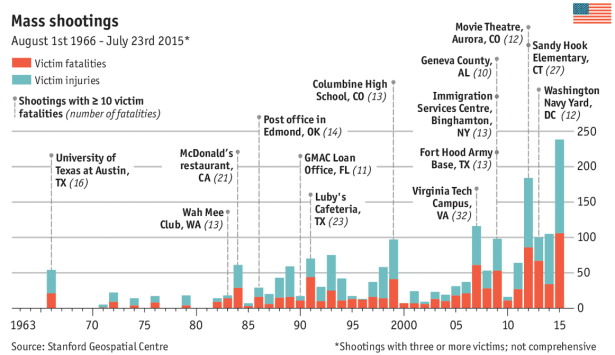 Economist
Although every mass-killing seems to reset thresholds for public violence, the collective image presented in the timeline first featured in Mother Jones but based on data designed to supplement the shocking absence of a national database of gun-ownership, shootings across the country raises questions stubbornly independent from their geographic distribution, but demand interrogation as part of a national political discourse we would rather not recognize. The absence of locations in the above visualization of place-names that became widely known for suggests a rational distribution of mass-killings seems less relevant than how such killings are increasingly a part of who we are–despite attempts to link their spread to terrorists, terrorism, or foreign wars. Only 43 of the 641 killed in mass-shootings over the past ten years are credibly related to Islamic extremists, it seems important to overcome difficulties of mis-mapping the relations between their violence and embrace of guns in America rather than as coming from afar rather than rooted in the potential distortions of our own legal culture.
It may be time to examine the extent to which it is home-grown. The estimates of the increased circulation of guns in the entire United States since the election of a President who made gun control a priority has been dramatic–and whose election in 20008 led gun sales to crest above 1 million per month. Almost 16 million guns entering the US markets in 2013 alone–and the call for future gun safety regulation has led to a new surge in gun sales, in an increasingly strident (if deeply mistaken) assertion of gun ownership as if it were an individual right that was guaranteed and unqualifiedly protected by law.
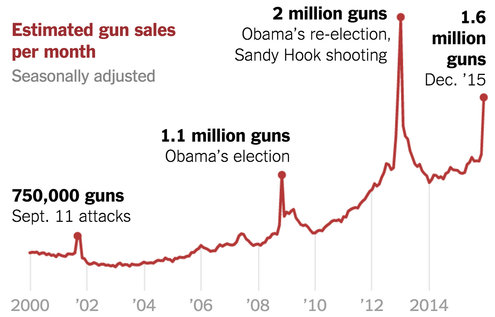
The gun manufacturers who share profits with the lobbying group of the NRA manipulate the value of stoking fears of gun control measures–in the guise of an attack on gun liberties–to increase their own sales. The increase of handguns, rifles, and semi-automatic weapons that can be registered such an uptick around President Obama’s election, with fears of the eventual confiscation of weapons, may even serve to catalyze the outpouring of mass shootings since, as the full-throated defense by gun-owners associations such as the National Rifle Association that gun ownership was a legally protected and guaranteed right “to keep and bear arms,” despite the quite different sense of the personal ownership of weapons. The imagery by which Ted Cruz championed his defense of Second Amendment rights–echoing the explicitly racist Tea Party imagery–by cruelly photoshopping President Obama, in military garb, bent on violating rights of gun possession, eliding civilian and military space and conflating voting rights with a defense of rights to possess firearms in ways designed to circulate widely as a rallying call and fundraising pitch on social media:
The terribly offensive masquerade of the President as if he were less than the Commander in Chief, but festooned only with a button with the insignia of “change” suggest he hardly has American’s’ actual interests at stake.
 Ted Cruz Campaign Flyer/www.tedcruz.org
Indeed, the image of Obama is tame compared to with images of Obama that are sold as targets and used at many shooting ranges in America–sites that, like gun shows, encourage sites of like-minded individuals to use the ranges as underground sites of sociability that promote the normalization of gun-ownership and use, which have grown in number and have acquired increased prominence as sites of access to a world that normalizes gun use. Such ranges, easy to locate in a nationwide online directory, provide access to an underworld of shooting ranges that sanctions and promotes the use of guns, as well as offer a place to practice firing at targets of your choice, including images of political figures, with faces cartoonishly photoshopped to be dehumanized targets of rage.
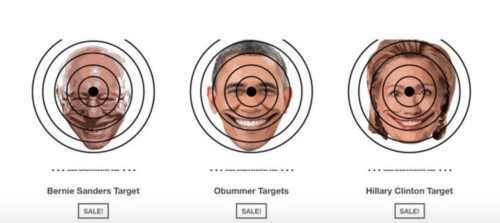
The deep confusion of civil and military space is hardly new in a nation that has been repeatedly grieving from mass shootings, but suggests a newly militarized landscape of fear that to rally support for Ted Cruz, down to the more than distasteful depiction of President Obama as endangering the Constitution, rather than a Commander in Chief–as if he were a foreign agent in fact bent on the violation of constitutional liberties.
As it stands, the sense of an information overload of public grieving outweighs any meaning able to be gleaned from any collective representation of such violent and devastating occurrences that continue to boggle the mind. Perhaps this is partly provoked by the increasing occurrence of what is defined as “mass shooting”–defined as a shooting killing four or more–is graphically suggested in the crowded chronology of individual mass shootings, in ways that oddly supplants geographic visualization with a chronology whose density overpowers viewers: the intolerably crowded chronology of mass-shootings in public spaces over the past ten years were once unthinkable,– as were the now-common rituals of public grieving that try to process and come to terms with the terrible tragedy of such an event, and the deep psychological impact it has on a community and society. Even if only a quarter of Americans are concerned about a mass shooting in their neighborhood, almost all are vicarious spectators to the grieving in their aftermath.
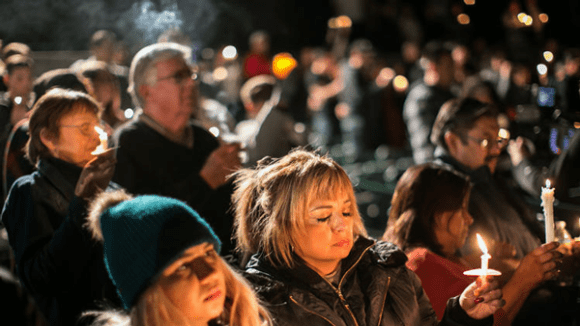 Honoring Victims of Inland Regional Center in San Bernardino Marcus Yam/Los Angeles Times
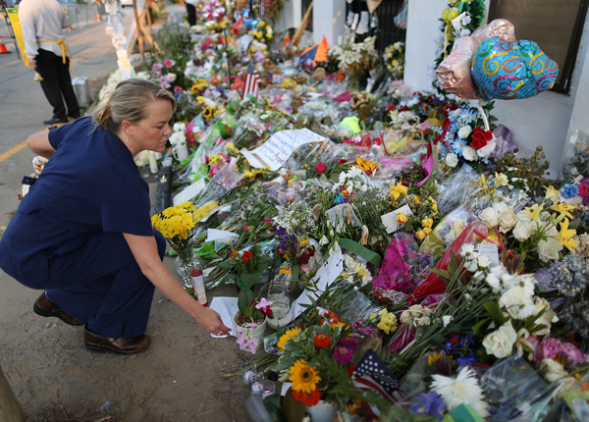 After Charleston Getty Images
 Monroe Township, NJ/Daily News
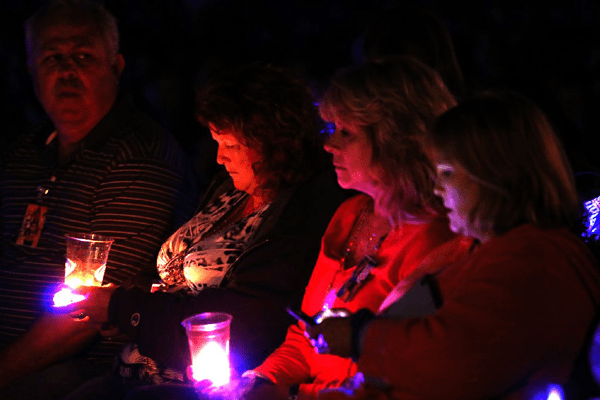 After San Bernardino Genaro Molina/LA Times
 (after San Bernardino) Jim Wilson/The New York Times
 San Manuel Stadium in San Bernardino, CA December 3, 2015 (AP/Mark J. Terrill)
The increased frequency of mourning for mass shootings reveals a search for restoration of their occurrence, which almost incredibly becomes ever more tragic.
Despite the valorization of every details of the attacks in the collective obituaries that have painfully become ritualized aftermath of each event, in an attempt to find closure in their very disruptiveness, the tragedy defies mapping in ways that make it difficult to come to terms with its recurrence, or to consider any logical connections between the range of admittedly often psychopathic shootings of innocent victims, and obscure their relation to the increasingly wide championing of access to guns–and the eery current of adamant insistence that gun-ownership is a right, despite the violation of human rights that the availability of rapid fire firearms like the AR-15–championed among its owners as “America’s Guns” to insist on their rights of possession–stands to risk. The difficulty of confiscating guns reveals the disconnect between their deadly power and the responsibility of ownership in the United States of America.
<!––nextpage––>
The epidemic remains to be effectively mapped, if it ever can. Indeed, at three years distance from the Sandy Hook mass-shooting, which left twenty children and six educators dead with the gunman, and suggested new heights of insensitivity in murdering the unprotected and defenseless. The landscape of mass-shootings seems hardly to have changed, save by mass-shootings becoming more unpredictable and frequent. We regularly turn to maps to explain the epidemic of gun deaths in the nation, frustrated by the difficulty in summing up or aggregating events so deeply affecting and disturbing, and so stubbornly attached to individual particularities, that they are so particularly difficult to refer or materialize in a map–or reduce to a single cartographical form of sufficient explanatory power–so horrific is each individual event as a drama, and so stunning has their actual frequency been in recent years. Even if such crimes constitute but a small share of overall gun violence, the public planned staging of apparently indiscriminate events is difficult to get one’s mind around. For even three years and a thousand shootings after Sandy Hook, twenty mass shootings of 2015 occurred in the face of a continued absence of gun laws–laws that could potentially have prevented the perpetrators from ‘legally’ obtaining guns.
Such stalemate is difficult to understand or rationalize, as is the refusal to research the origins of gun violence, or restrict firearm sales of firearms with magazines that are so readily able to be “legally” procured without any examination or scrutiny of their purchasers’ past criminal history. Yet what, one might ask, is a “legally” procured semi-automatic rifle? What constitutes or stands to be recognized as a legal firearm? The multiple asterisks in the Smith & Wesson advertisement for the M&P 15 “Sport” suggest the active engagement of many of its features–a collapsible stock; thirty round magazine; suppressor compensator–with the local legal requirements so prominent in the minds of their clientage.
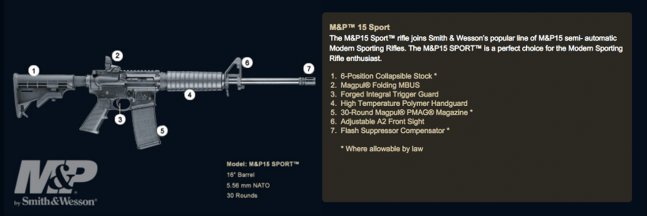
Beside the inexplicable spread of mass shootings in America, there’s a deep inability to articulate an adequate response to the assertion that the ownership of guns is a right–evident in the stark contrast of the deep conviction of 35% of Americans that guns make public places safer and a geography where four people or more were shot by guns–even if they were not killed–since 2012. Despite some serious questioning by criminologists about the apparent increase in mass-killings in the United States that grew scattershot across the nation since 2010, the terms of debate indicate deeply definitional problems of even describing what mapping mass-shootings in America are–do victims have to die? how must die for the occurrence?–and what the fairly new term means. Such questions may indeed only reflect the great difficulties we still have in getting our minds around and coming to terms with any visualization of the actual or imagined distribution of such unpredictable and indiscriminate events, here mapped from late 2010 in an apparent lack of any clear pattern as to where or when they might occur that is consonant with the sense that there is no rhyme or reason to their occurrence, which must remain the bitter “price” for our continued constitutional liberties.
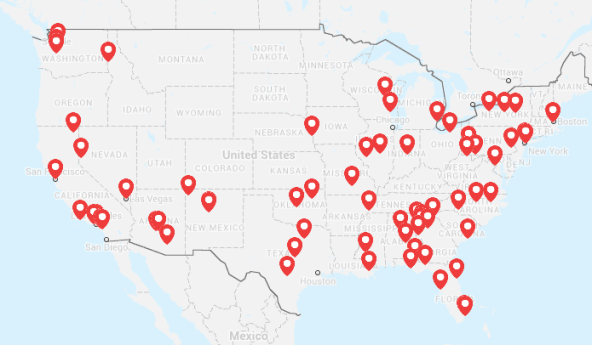 Mass-shootings since Sandy Hook, by Soo Oh using data from Mass Shooting Tracker, via Stanford Geospatial Center–do check out the interactive web map
Although the prominence such mass shootings occupy in national news surely amplifies the truly traumatic sense, the above timeline used in the header to this post equally suggest the deep difficulties of making sense of their spread–as do and the now common collective biographies of their victims, or harrowing news profiles of the killers who acquired the guns, which almost replace the simple coherence of a data visualization. But does a “mass-shooting” even require fatalities to be counted? What can explain the government’s refusal to keep a database of gun deaths, despite the increasing violation of human rights they pose?
The difficulty of achieving closure on such mass-killings challenges the cognitive abilities, much as the crowded timeline of the heading to this post.
<!––nextpage––>
10. The most deeply striking characteristic of this terrifying epidemic of mass-shootings may not lie in the intensity of their occurrence, but their overwhelming occurrence within public spaces. If mass-shootings might multiply due to imitation or emulation, as public displays of gun violence gain a clear cultural script, shifting the threshold for planning and executing unthinkable mass-murders in public space, the decision to execute the innocent in public has its own terrifying geography: the spate of mass-killing with rifles staged in public life–in movie theaters; schools; workplaces; clinics; churches–indiscriminately claimed lives in rampages not easily explained only by psychologic disturbance or by psychopathic traits. Such crimes are staged as if to take justice into one’s hands, in a geography without coherence in a map, reflecting a conviction of individual “rights” to “keep and bear arms” that intentionally distorts what the Bill of Rights never intended as a right of personal possession.
Is the icon of the armed Minuteman–the ever-ready marksman with cocked gun in hand, an eery underside of this proliferation in civil space? The mistaken acceptance and promotion of such a pseudo-“right”–and its defense has dramatically grown with the belief that rights to the ownership of guns will be rolled back and individual firearms confiscated–that has quickly gained fairly terrifying increased traction in public political discourse. Indeed, they not only occur as the per capita presence of firearms in America has mushroomed to one per citizens and approximately 310,000,000 million firearms as of 2012–114 million handguns, 110 million rifles, and 86 million shotguns–or more than the number of Americans. At the same time, the expansion of AR-15’s in American hands have crested beyond 3,750,000 by late 2012, as sales of such guns ballooned with astounding rapidity: background checks that precede the legal possession of semiautomatics multiplied at the alarming rate of 50% in five years before Newtown.
The wildly increasing circulation of rifles and handguns in America have been paralleled in public discourse by a deeply distorted and fraught notion of the liberties of “bearing” a gun–as if this means being equipped with a semi-automatic weapon, rather than holding a musket within a state militia–or as if the reloading and cocking of muskets has some historically essential equality with the expressive abilities of the magazines of rapid-fire assault rifles. The expansion of an eery political current that treats the rights to gun ownership as a right of political expression deeply distorts the notion of constitutional liberties and freedoms. Does the representation of gun-ownership and -use as a right correlate to the geography of mass-shootings in America? Surely the conviction of most Americans that guns “makes public places safer stands in contrast to the rise of mass-shootings in America. One of the most surprising mapping of reactions to mass-killings may be not only in the expansion of a geography of fear, and the a growing demand for the purchase and owning of more firearms and guns, in reaction to perceived fears of gun control. For on the heals of individual mass-shootings, we see surges in the sales of firearms–recent sales have especially increased in Southern California, after the San Bernardino shootings, in reaction to pronounced fears of gun control, in the same manner that gun-dealers were overwhelming by requests for weapons after previous mass-shootings–and the increased risk of gun killings in those areas where guns are more clearly concentrated.
If the presence of firearms alone in specific regions of the country constitutes a clear measure of increased risks a clear index of risk, that distribution cannot explain the rise of the mass-shooting phenomenon. The difficulty of even defining the “mass-shooting” as an event that can be mapped–what, indeed constitutes a mass-shooting? four fatalities by firearms? or should three deaths suffice? or are gun-wounds sufficient to identify the danger of mass-shootings?–reveal a difficulty of processing or coming to terms with the rising risk of premeditated killing sprees in public space that seem quite distinct in pressing the limits of public violence and in the tragic consequences of such deranged actions. The failure of the United States government to keep or retain records or data on gun deaths suggests the odd disconnect between the ability to process such events in ways that would allow a meaningful mapping of mass-shootings.
For the relations between mass-shootings and gun sales demands mapping as an intersection of a spatial imaginary that is rooted in the defense of rights to possess firearms and the proliferation of sales of firearms–and the implicit sanctioning of guns in public use that distinguishes the United States from other countries, and that has become prevalent in recent decades, suggesting a true national nightmare from which we are not likely to soon awake.
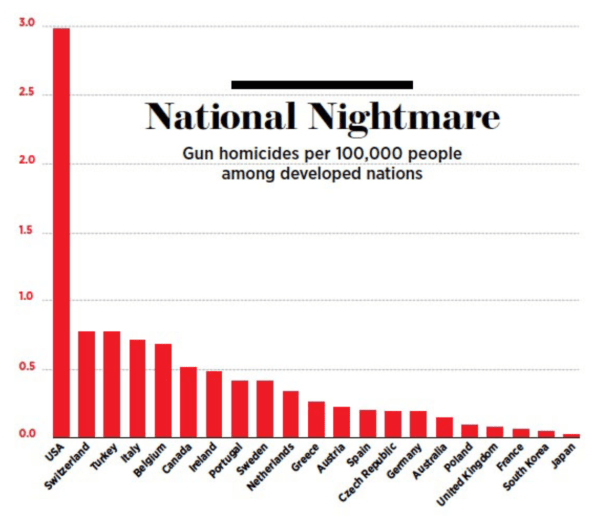
Despite frequent defenses of gun ownership repeatedly rehearsed with increasing force in political discourse, can the possession of firearms be legitimately based on claims to a preexisting right? The frequency of mass-shootings in America cannot be reconciled with beliefs that their occurrence is to be seen only as the price of the “freedoms we enjoy,” as if these deaths were a sort of collateral for the freedoms that are naturalized within one country. For their terrifying frequency seems almost to sanction a form of violent expression is difficult to defend by the Second Amendment or an individual liberty, and whose costs are deeper than their benefits–despite the rhetorical championing of the ownership of automatic rifles was a right protected by law, and the AR-15 or AK-47 akin to a muskets of revolutionary militias that similarly served to protect the public safety. Does the defense of gun ownership create a space for separating oneself from civil society in increasingly violent ways, and combining the militarized behavior within a civil society from which many falsely feel themselves disenfranchised?
As the costs on our perception of public space augment, and the basic human rights of occupying public space or sanctioned clinics grow, so does the preposterously contorted argument that gun-ownership–“bearing arms”–is constitutionally protected. Increasingly spread over radio and the internet as if gun-ownership were naturalized to the land, using a deeply and perversely misguided notion that “bearing arms” justifies individual possession of firearms, the Constitution is explicitly misunderstood: for what was framed by the framers as a right to militias is taken as a right to personal possession, although it sought only to pertain to “bearing” guns in the context of state militia. But the notion of such a shadow “state”–or unseen republic–is regularly reified within the symbols of a terrifying current in political discourse, as if to imagine themselves as a group whose ownership of guns demands to be defended and whose fetishization of the AR-15 demands further examination. So does the open and explicit elision of an iconography of military aggression with the emblems of gun ownership, which seek to advocate and advertise possession assault rifles as an unqualified individual right–as if to turn all America into a shooting range.
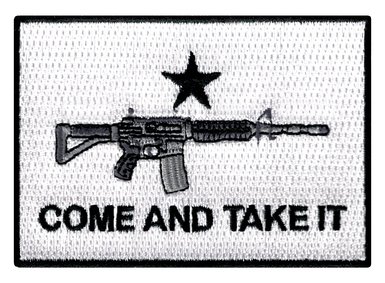

Is the right to load a musket in any way similar to the rounds of ammunition able to fired with rapidly form a rifle’s reloadable magazine? Such taunting slogans and symbolic badges bizarrely conflate rights and assault weapons in ways that tie use and possessions of assault weapons to a rhetoric of vigilance–imagining the owner of an automatic rifle as finding historical precedent in the Minuteman’s musket, and imagining gun-ownership as a right to be asserted against fear of the encroachment of an overly invasive national government.
As perpetuated by underground radio stations and internet sales points, the pseudo-right to “bear arms” is taken as itself in need of protection by firearms, even in the face of our marking of time with mass-shootings at a density difficult to comprehend. The rhetoric of continued vigilance that these items promote create an imagined geography of defending liberties that were able to be secured by guns, as if the right to possess arms was itself in need of vigilant protection and preservation–and reflects a revolutionary underground that can be imagined as a space of concealed gun permits, based on “exercising the Second Amendment right guaranteed to them” in a true land of liberty, as evoked in the images of minute-men and the date of the Constitution or Bill of Rights that so anachronistically celebrate gun-ownership as a right.
 Gun Owners of America
Such willful acts of creative anachronism go to the heart of redefining the Constitution–the basis of the civil society and the nation–as the basis for the Republic of Gun Holders’ defense of their pseudo-rights to possess and “bear” arms in the manner historically guaranteed to state militias were sanctioned in the country’s founding document–and to imagine a nation within the nation where rights to carry and conceal firearms are guaranteed. How “bearing” arms became anachronistically permutated to the carrying of concealed weapons is a long story of tortured logic, but it was most successful in those states that have historically rejected federal oversight.
<!––nextpage––>
 Give Me Liberty: Where 8% of Population Own Concealed Weapons Permits
The increased confusion of gun laws that prevent police officers from challenging individuals bearing arms to show their open-carry permits in Texas challenges such a map–and raises pressing questions on the extent to which we are tending to a society that tolerates carrying guns in public space–or diminishes police authority to supervise the presence of AR-15s in public settings in America, as such authority would diminish the rights of individual gun possession.
 Bill Pugliano/Getty Images
In this spatial imaginary, the United States is seen as the last bastion of individual liberties of owning guns, a category quite largely construed:
This imagined republic champions its vigilant defense of “bearing” firearms including “assault weapons” as a deep form of liberty, placing a deeply anachronistic construction on their belief in “bearing” arms. Indeed, the neo-revolutionary symbology of individual resistance openly casts possession of firearms with urgency within a vocabulary and syntax akin to the defense of individual rights, suggesting the apprehension of a new state of emergency where rights are in need of defense.
The spread of paranoia of gun control is perhaps evident in the expansion of “California compliant” AR-15’s with detachable magazines. For the expansion of an imaginary space of vigilance and readiness, though absent from most quantitative data visualizations of mass-killings, firearm assaults, or gun ownership, choreographed as if in an underground nation, replete with news outlets that purport to purvey the actual truth of increasing need for protecting individual gun-possession, given the restriction of such “rights” since the 1988 reclassification of “assault weapons” and the 1993 Assault Weapons Ban. The symbolic potency of the assault weapon–the icon of the AR-15–within such “gun rights” discourse seems to taunt viewers with its open celebration of a refusal to respect such limits as gun control.

<!––nextpage––>
11. The depressingly dense crowding of the chronology of mass-shootings, which melds into a terrifying virtual continuity from 2013, marking how the almost daily recurrence of mass-killings overwhelm time for their remembrance, return us to the problem of processing their continued occurrence over time. As such mass-killings so tragically come in seemingly swift succession, from Ft. Hood through Newtown to Roseberg, OR, to San Bernardino, CA, linked by common use of the AR-15’s gun enthusiasts champion “America’s guns,” register not only a landscape of increased mass-shootings, but a spatial geography of the defense of gun-possession and -use. Such claims to the rights to own guns ineluctably moves us further away from discussion of gun control, and paradoxically push public debate away from guns–leaving Republican candidates to affirm their support for gun ownership as an individual liberty.
The new geography of mass-shootings has increased our fears of the near-inevitability of their recurrence, but leave us with a deadened sense that goes beyond individual guilt or criminality–and raise questions of the costs of contorted classification gun ownership as a form of liberty. The very unpredictability of their sequence elicited an ever-present geography of fear across the nation that is impossible to map: we return to the stories of the individual lives that were lost, but not the semi-automatic rifles that enabled them. Because many see restrictions on gun ownership as violating rights, we increasingly seem both defenseless against the geography of mass-killings that increasingly endanger individual safety, despite the increased sense of security gun control would create in civil society. If the laws of the Constitution have defined the collectivity of the nation, the vehement fixation on championing “rights to keep and bear arms” as the principle freedom of the country
The stunning sequence of mass-killings over the past three decades makes us turn to maps, in hopes to gain some purchase on what can seem unrelated events and to organize the pace of their occurrence in recent decades in a meaningful way. The empty recitation of place-names–Columbine; Ft. Hood; Newtown; Aurora; San Bernardino–seems to attempt to come to terms with the tortured geography of mass-shootings in the United States, intoned as if the sites of Civil War battles, followed by a shudder of recollection far more of numbness than understanding: although each dot marks a place in time, as much as in space, whose relationships fail to add up. The relation of this swift succession of killings to gun “rights” is not clear. But the deep-set reluctance to tackle the issue of assault weapons whose magazines permit such rapid fire–and strength of wide resistance far beyond the 1.5 Americans who already own them to their banning–hints in terrifyingly ways at the introduction of a new landscape of mass-shootings in America.
Any regulation of “assault weapons” is counted by increasing stockpiled by gun owners within a debate about “rights”–and the constitutional protections on gun-ownership–even as mass killings pose clear threats to and violations of human rights. The openly taunting slogan “Come and Get It,” reproduced in an array of quotidian objects to be coded identifying signs, blends the internet initials that tag the Right to Keep and Bear Arms from US Revolution with the weapons of choice of many killers today. The array of objects code a sort of revolutionary brotherhood, collapsing and conflating understandings of the law in the black of right-wing militia–

–in a disguise that seems a rallying cry designed to mask the fears of gun confiscation through the very firearms mass-killers most widely used, placing them totemically above the date of the Constitution’s passage, beneath a cryptically coded insignia–“RKBA,” a.k.a. Right to Keep and Bear Arms.
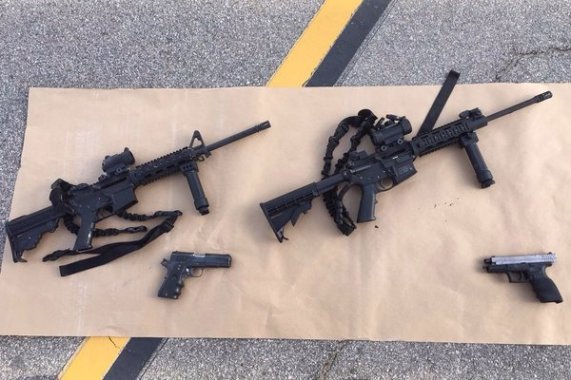 San Bernardino Police Department
12. The terrifyingly crowed chronology of recent mass-shootings is both disorienting and disarming because it affords so little clarity or meaning as a sequence save as an onslaught of taking liberty with guns pose such a clear human rights offense: the rapid-fire pace in the graphic introducing this post suggests the near-impossibility of ordering time in such an intense onslaught of the occurrence of mass-killings, or to impose meaning on them. Indeed, the recurrence of mass-killings is deeply troubling because it lack any easy or clear coherence, and reminds us of the far remove of firearms’ use from any sense of personal responsibility.
The frequency of mass-shootings across America appear less to punctuate time or space than they mimic the rapid-fire sequence of banner headlines of cable news which draw attention to their occurrence; the traumas remains difficult to comprehend, or map meaningfully, save as something like a nightmare from which we cannot awake. Despite the overall national preponderance of firearm fatalities resulting from hand-guns, it is striking that something of a caesura occurred in the sequence of mass-shooting during the ten-year ban on such rifles, from 1994 to 2004. Does the tempo of mass-killings suggest a deep misunderstanding of liberty? Whether one parses time passed since Sandy Hook, Columbine, or since 9/11, or the threat of terrorist violence on U.S. soil, the growth of gun-related violence is difficult to process save as a nightmare we are trying to awake, so deeply depressing because it’s an information overload so very challenging even to process. And at the same time as we are confronted with an apparent rise in deaths, just as tragically, we are at odds as a nation in coming to terms with what the “National Nightmare” of gun homicides means.
The suitability of the term, forty long years after President Gerald Ford hopefully declared “our long national nightmare is over” at his inauguration–a famously wishful declaration of a desired break with the past, trying to be auspicious and omitting any mention of Watergate–the wishful declaration of a turning point, as we were recently reminded, rings hollow some forty years later before the current nightmare from which we seem unable to awake. For as we parse the rise of gun-use and firearm homicides, a subject we almost lack the means to address, turning points or chronologies seem sadly as useless as geographies, but confirm an undeniable progress to an ever expansive escalation of gun deaths on U.S. soil, that seem to stand in some relation to the increased terrorist attacks, but whose scale unprecedentedly grew since 2010 in ways that are not entirely easy to map onto global events–even despite the claims that the objectives and ambitions of ISIS terrorist groups have increasingly begun to stretch beyond territorial borders. Despite the decrease of mass-shootings during the ten-year ban on such rifles from 1994 to 2004, non-Islamic and Islamic extremists alike seem to have benefitted from access to guns:
 New York Times
It is understandable that we also turn to maps in hopes to process meaning in the face of an almost unexplainable epidemic of mass-killings. But as we do so–tracking sites of deadly assault, tracking the provenance of the weapons and guns the killers used, or crowd-sourced online compilations of the truly staggering human toll in list form, we are apt to find that the raw data often speaks far more than cartographical forms can embody:
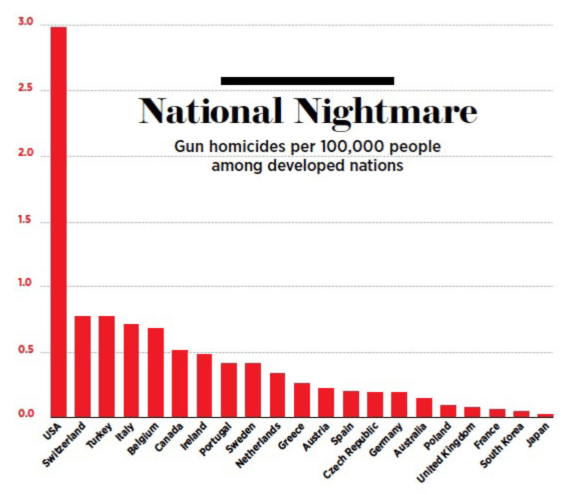
Why does this stuff continue to happen so relentlessly ? A global comparison of firearm homicides within developed nations may not be exact or be a map. But it suggests a staggering need to reduce the rates of gun homicides in both public and private spaces, and the specific challenges of disentangling access to guns to the language of rights with which it has been deeply if deceptively conflated.
The bar graph positioning the United States as far off the charts raises questions not only about the access to guns in the US, but raises questions about the value of continuing to map the distribution of gun homicides in the country–although their remapping provides something of a mirror that can only compel further reflection on the apparently increasing stubborn persistence of such an outlier status that seems daily to grow. The bar graph raises questions about the increased occurrence attacks we have seen recently of heavily armed individual attackers or groups of individuals, which create a crowded litany of place-names immediately identified with premeditated mass-killings staged in schools, churches, centers of social services, or government agencies across the nation, even as little action seems able to be taken to stop the steady expansion of this list of memorials or access to guns–and worries have turned to the provision of expanded services of social and emotional health to process the proliferation of violence, as much as to better serve potential perpetrators of homicidal rampages–without ever addressing the problems of the all too easily obtained firearms, and the perverse notion deadly gunshot provide any statement save ending someone’s life.
<!––nextpage––>
13. In an age when mass-killings have almost come to occur daily, even in the face of calls for better mental health services for all, it’s hard to know how these levels of violence can actually be processed–not only by children, teenagers, and even adults, but most of society. The recurrence of public mass-shootings almost suggest a new normal, where the majority of the victims were completely unarmed–even if it is a normal President Obama implores we collectively refuse to accept.
Although gun attacks on Planned Parenthood office remain relatively rare, despite the daily threats under which clinics across America live, the acknowledgment of the occurrence of firearm assault as a forms of expression strains credibility–as if the public use of guns suggests a right worthy of defense. And the terrifying entanglement between far right-wing rhetoric and gun use cannot be continued to be dismissed out of hand since “speech does not breed violence;” because to do so conceals a more terrifying acceptance of gun violence as if it were a form of public speech–rather than an assault on human rights–and continued imprecations, even after mass-shootings, that “Now is not the time to call for law-abiding citizens to put down their guns,” as if more guns would secure greater safety and well-being. There is nary a mention of the dangers of gun violence in the tweets by leading Republicans, beholden to NRA ratings, to suggest any restrictions on access to guns, lest they no longer secure “A-” grades from the overly powerful and deeply protective advocacy and lobbying body–the tweets couched a language in terms of comforting those “impacted” by the shooting (not killed) and offer prayers, thoughts, and condolences, but suggest the inability of framing any other response.
The stunning wall of evasive silence that is maddeningly maintained in these quite vacuous tweets reflects the immobility in political discourse to identify the problem as one of ready access to guns, lest they be seen as infringing on the Holly Grail of the Second Amendment, which seems for some more sacred than the United States Constitution. The reflexive if actually inexplicable refusal to consider to fund research to be done on mass shootings, and the absence of even a budget for gun prevention in the CDC–who have nonetheless continued to tabulate gun fatalities–suggests the perils of the Manichean opposition created in political discourse between any questioning the motives for gun ownership and firearm use and the struggle to preserve gun “rights”–as if they were in fact in need of being legally protected and state-sanctioned. Governor Chris Christie, currently seeking the White House, can only tweet about those “victimized” by shootings, rather than admit they were killed.
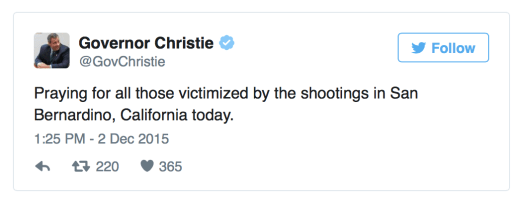
What are these rights to “bear arms? The conflation of rights to possess firearms with individual rights have been perilously distorted in public opinion, perhaps as dangerously as they have been rewritten by the courts. For the tendency to assume such rights all too often goes unquestioned and is increasingly misunderstood. With any analysis of gun violence presented as ac actual attempt to infringe inalienable rights of gun possession that are posited to be enshrined in the law, there is a reluctance even to examine its origins: the recalcitrance against even supporting studies even into risk/benefit analysis of domestic ownership of guns is taken to smack of poor governance and nefarious plots by the National Rifle Association, who discourage any research on the subject of gun use as an infringement on what seem sacrosanct rights to gun-ownership. The fostering of deep fears of such infringement have gained legal cover, moreover, in a particularly willful misreading of the Second Amendment. For the obstruction of legal response to the spread of gun-killings has deep roots in the perpetuation of the illusion of the legal exceptionalism of the United States.
Increasingly, a bizarre conflation of the right to possess guns and the acceptance of the firearm as a rightful means of expression seems to have crept into American political discourse in eery ways, and may underscore the clear illustration of such an outlier status, as much as any mapping of gun ownership or facilities in our country: while Freedom of Speech is of course a right sanctioned by the framers of the nation’s Constitution, and indeed given a prominent position within the Bill of Rights. Whether the Constitution so openly sanctions such a “right” is of course open to interpretation if not in doubt: the conviction that it does so rests on the almost intentionally misguided perverse notion that the Second Amendment affirmed “bearing of arms” more than a “well-regulated militia” not only distorted the clear focus of the framers on the necessary possession of such a militia to “the security of a free State.” Yet the apparent if unconscious absorption of possessing firearms into the Bill of Rights is not only an open distortion of constitutional law, but a justification of gun-owning in America, even in the face of mass-murders. The perverse insistence on the ethics and safety of firearm possession guarantees open access to firearms in almost unfettered manner within the United States that seems to be increasingly exploited in tragic ways.
For the blatant and brazen misconstrual of the principal of individual gun-ownership as if it were a right has helped to sediment a misrepresentation of meaning in state-protected rights, and a dangerous distortion in how rights are perceived and indeed defended that endanger human rights to safety and security–quite confoundingly, the very term that is so often cited in the defense of the “right” to bear arms. Although dating from a very different era when militias were understood as local entities–rather than nationalized–little interpretive leeway or allowance was accorded its interpretation, so strong was the conviction that the right to arms remained a personal prerogative. Rather, the reflexive conviction to affirm the right to possess firearms–“bear arms“–has become a disembodied imperative, removed from the discipline or order that a militia would provide, as Dorothy Samuels acutely observed, and taken as an individual prerogative never intended by the framers, and severed from the notion of anything “well-regulated” at all–even morphing into a form of protection against an untrusted state.
The slippery grounds connecting unfettered access to guns as a primordial “right” the state must be prevented from interfering or regulating has created increased contortions of logic that strain credulity in political discourse. The near-impossibility to invoke “security” as a reason for the widespread owning and general access to firearms–witness the mental gymnastics both Ben Carson and Ted Cruz have performed around the old but untired argument that greater gun-possession would increase safety against “lone wolf attackers” and better those besieged by such rogue actors, warranting gun safety education in public schools, if not gun training–may conceal a hideous deeper conflation between the Second and First Amendment in the minds of some. The misconstrual of liberties sometimes seems to underlie the tortured discourse about the need for protection of rights to gun ownership–and perhaps an initial mental block to framing coherent arguments about access to guns in an uncontrolled market, or even dialogue about preventive measures of gun use–and derives from mistaken acceptance that gun ownership belongs in the Bill of Rights that makes it so difficult to historicize the meaning of the Second Amendment.
12. Perhaps we don’t even gain much by mapping the increase of gun violence that we’ve seen, which roughly corresponds, it at first seems, to population concentration. For the terrifying transformation of the map of the country into something that might be more familiar on a firing range than infographic:

Despite value and clear ethical import of counting each and every life lost and individual wounded by the surplus of guns across the country, the additive summary of individual events has limited coherence save as a tragedy.
There is indeed a clear cognitive rebuff of such a visualization of multiple wounding and killing by firearms that challenges the logic of mapping; the limited clarity or coherence can be gained by trying to locate the expansion of gun use through so much of the country on a map, save to illustrate the expansive nature of its threat to public safety: what all too often seems at stake in the demand to have unfettered access to guns that are able to be readily loaded and not dismantled without restraint seems to rest not on legal precedent or logic but the national imaginary of the gunslinger, and indeed the place of the lone avenger, as much as the concerns for safety that the Framers somewhat cautiously voiced. Perhaps the blood-splatter symbology used by the Gun Violence Archive, who’ve daily tracked 48,348 incidents of gun violence, and promise new and comprehensive pictures of gun-related violence, is most apt in inviting us to comprehend the jaw-dropping totality of lost lives:
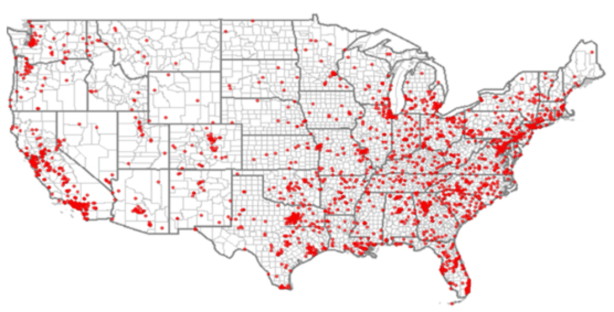
Such maps however don’t make much sense, because they offer such little access for viewers to their motives, into the circumstances where and when and among whom they occur, or purchase on the ways folks found their guns and the ease of their acquisition of firearms. Where they long possessed, or acquired for a premeditated event? Perhaps this doesn’t make a difference to its scope.
The difficulty and deep frustration of successfully processing any clear sense of the frequency of occurrence of gun killings across the country is intensified by the blurring of concentric circles and oblique markers of at least ten homicides color the map by a confusion of different hues of blue, crowding the national map with spate of a density we cannot even unpack, even if its bluntness raises clear questions about frequent arguments about the safety that owning guns provides. The inability to drill down in the map allows only limited cognitive access.
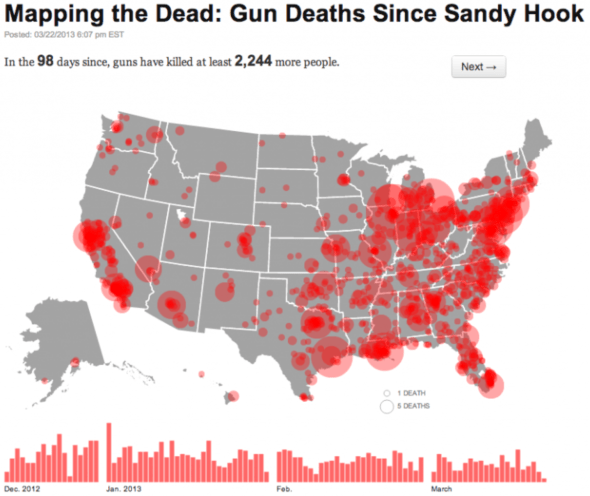
The admirably ethical project to provide an actual record of the recent devastating progress of gun-deaths across the country–as the comprehensive Gun Violence Archive project–overwhelm viewers in their deadening additive accumulation of shootings, if desensitization lies farthest from their planners’ intent. In tracking deaths by fire-arms since the Sandy Hook tragedy occurred in Newtown, CT the non-profit created a sort of watchdog online archive in 2012 that was soon so cluttered to be taken down at the end of the following year, after clocking 12,042 without a sign of deceleration in sight. The map still strains credibility: limited to the top 1,000 locations of gun-related homicides to retain legibility, it rendered opaque many of the twelve larger urban centers of gun deaths. The mapping became a meme of sorts, however, in attempts to understand what was going on, although the map lacks much coherence. And while the darkening of most of the country reveals a spate of deaths to be standard across 46 states and Washington, D.C. it is troubling that Florida, Illinois and California compete for the most gun killings.

14. There are some serious problems with the above maps, however, both as a visualization whose very symbology is so overwhelmed with the current the level of violence that it conceals, as if to create increased distance between the viewer and a disturbing landscape of lethal homicides that so frustratingly seems a data overload almost impossible to process or embody in a map.
For in toting up statistics of those felled by guns as if challenge viewers to comprehend what seems to track an actual epidemic or the spread of a miasmatic force that swallows centers of habitation–although the point of the onslaught is effectively made–it is a pity we don’t map the actual demographics of those with guns, what sort of past history or licenses they have to own guns, how they acquired them, or the role of hate crimes and emotional states of the perpetrator of such acts of violence, if only to help better comprehend and represent what is actually going on. And the recent increase of intensity in the frequency of mass-shootings, which are now so uneasily discussed to be referred to simply by the sites of their locations–

–have so crowded news headlines so that we hardly have time to mourn the victims of one event before we are presented with another set of images of bloodied shirts, vacant faces, and memorials once again.
We are all fearful and uncomfortably present at the image of lives lost and families ruined, or fatherless children, that the devastating progress of untimely if largely unintentional deaths have led us to despair: our public imaginary is tethered to the image of a quite different sense of freedom of gun ownership as one of security that is terrifyingly difficult to dimension on a moral canvas, however, even though the sneaking suspicion that the mythology of gunslinging has helped confuse the Second Amendment with the First, as “keep and bear arms” seemed an expressive act, as much as a phrase whose actual meaning can be more properly historicized, as Justice John Paul Stevens has aptly noted, to describe taking part in the military, rather than acting as a vigilante. Yet the possession of the gun is a particularly haunting presence that now seems to have come to define individual liberty by the fantasia regularly disseminated in film–
–where the geography of guns, marksmanship, and ammunition suggests an almost primordial relation to space, as well as to taking justice into one’s own hands in a landscape already crowded by dangerous guns.
 Marvel Comics
The image of the slayer in video games is but an updating of this primordial image of the individual avenger who takes justice into his own hands.
 Call of Duty
This imaginary landscape that includes an avenger who has separated themselves from civil society has so solidified that the terrible option of taking violence and justice–even if this also means taking death–into one’s own hands, has paralleled the proliferation of mass shootings: if some 30,000 lives are ended due to gunshot each year in the United States of America, and we continue to refuse to curtail access to guns or short-term bans of firearms sales or even something so sensible as individual background checks. But do we misunderstand the debate on gun ownership by removing it from the human rights affront it is?
Although it is impossible to chart motivations for gun ownership, of course, or the emotional states in which guns arrive in the hands of the perpetrators of crimes and assaults by firearms, the increased attachment of ownership to liberty in public discourse is particularly troubling. For the defense for gun ownership and sales far less reinforces the safety of a militia, but echoes a disturbing notion of self-expression, all too eerily illustrated by Robert L. Dear Jr.’s so very, very, very misguided utterance to police of those four words in the public record, which may provide the clearest insight we will probably ever have into his actual intent, if it can ever be comprehended.
And while such mass-killings are perhaps quite different forms of assault and gun use, the access to guns and their presence in civil life is credibly tied to the defense of gun ownership as a right–although the proponents of rights to gun possession of course clearly don’t see their own stance in relation to the recent expansion of such mass-attacks they also wish to contain. Yet the relation between gun-use is difficult to see as only arriving from outside the country, and unable to be contained by our laws. We can see where Colorado indeed clearly lies–like Newtown–far outside the zone where the greatest number of firearms in circulation or possession lie, as is the contiguity of regions where the greatest share of the population possesses guns–or is known to possess firearms–might seem to paradoxically lie outside of those places where by far the greatest fatalities from firearms, as if this would mean that the open possession of firearms indeed could provide a reliable measure of collective security.
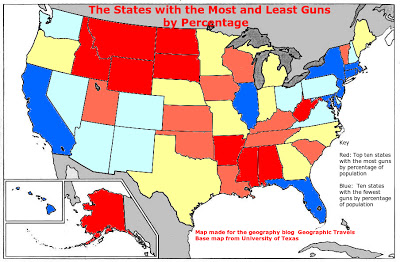
But a map cannot really ever explain the conflation of a gun and a tool of public expression, and only reflects the accuracy of licensing or reporting, or indeed readiness to self-report registered firearms. The problem of access to guns undoubtedly lies partly also in those unreported firearms.
<!––nextpage––>
15. The deep tragedy of the association of firearms and freedom–and this persistently seems to include, in a bizarrely never-intended way, if one impossible to banish from the collective imaginary, to a freedom of personal expression–seems to map onto an expansive notion of freedom that it was never actually meant to carry or enjoy, but which attempts to restrict or curtail gun-ownership, since constitutionally enshrined by the Roberts court, in what can only be described as “faux originalism” of Justices, as it was by Richard Posner, is far more than a judicial distortion or cynical half-truth, but feeds a slew of related half-truths that are all too tacitly consented to be disseminated in public life. For the distortion of removing the right of individual ownership from regulation of a militia in defense of local liberties, the question of individual ownership has both groundlessly but all that inexplicably become a Holy Grail, ready to be wildly misconstrued as a deeply uncivil sort of right among libertarians.
The divide of sites where one feels justified in owning firearms is stark. It is somewhat surprisingly far removed from urban populations, where the densest number of gun-related homicides occur; the landscape of gun-caused deaths seems surprisingly distinct, with the exception of southern states, but such maps speak more to the openness of a culture of owning guns. They raise questions about what leads gun ownership to be identified with something like a liberty–or what it would look like to remove guns from their current conflation of anything like a liberty. The investment in guns in poorer states is astounding if one looks at the extremes, as do low rates of gun ownership in more populated areas.

The culture of gun violence is in many ways quiet distinct from such measures of ownership, if one maps rates of death by firearm across the lower forty-eight or fifty states, though the prevalence of gun ownership in the deep south–Missouri, Mississippi, Alabama–raises questions; the entire country seems heated up with high levels of homicides, in the parsing that Richard Florida offer almost a decade ago in an attempt to measure, grosso modo, the contribution of stricter gun control laws to death by gunfire soon before the Supreme Court issued a ruling in District of Columbia v. Heller that effectively enshrined the right to “bear arms” across the land as something that should occur without federal oversight:
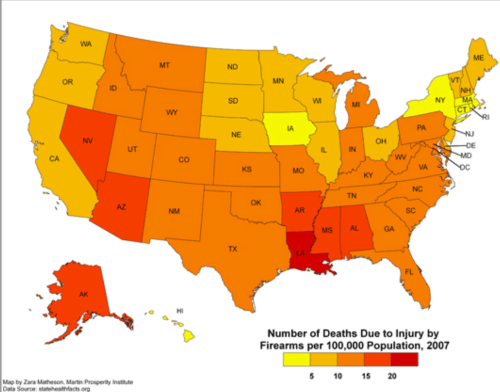
Although Florida seemed only too pleased to find a correlation between lower gun violence in those states where one sees a greater presence of his fabled “creative class,” this seems almost a red herring in comparison to the presence of even a single law on the books that was related to restrictions on carrying firearms, trigger locks, or safe storage practices–Florida found some negative correlations in those states that enacted bans on assault weapons (-.45) or mandated safe storage requirements (-.48).
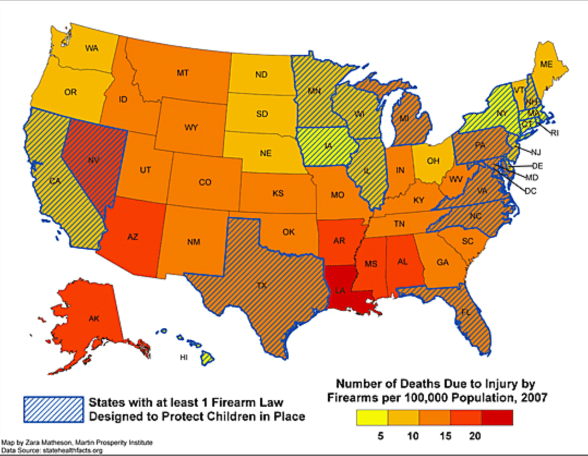
But the notion of a “Geography of Gun Deaths” can hardly be explained by looking for correlations to other statistics. It just doesn’t make sense, in part, since the circumstances that permit these trips into firearm homicides is sanctioned by a permissiveness of the market, and the broad access to a fantasy that gun access has benefits, which is difficult to geographically locate after all, so much as it is to find across the country. And a lining up of numbers of death just plain ignores questions of population density-as if presence of deaths per 100,000 can be uniformly colored by state, rather than reflecting the breakdown at the level of county residents, where a similar, but far more disconcerting record of the lack of clear variations that might be explained by local laws, and provides a far more accurate break-down of collective rates of gun mortality in the nation, 2004-2010, whose variations demand to be viewed as a web-map, designed by CartoDB, individuating death rate, homicide rate, and suicide rate across the lower forty-eight and drilling far more deeply into CDC’s actual data, rather than trying to impose our notions of coherence on it:
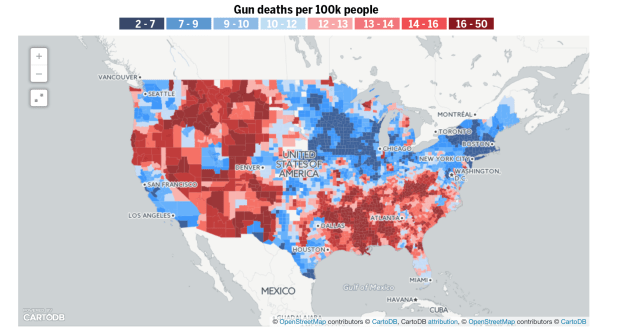
The distribution of collective deaths by firearms per 100,000 in county level across six years provides a startlingly shaper different distribution:


Drilling down a bit to the southern and western states, we can see some huge cultural divergences, less present by cutting across state lines, and which many urban centers seem relative outposts of tranquility, lying far below the median-level of gun deaths:
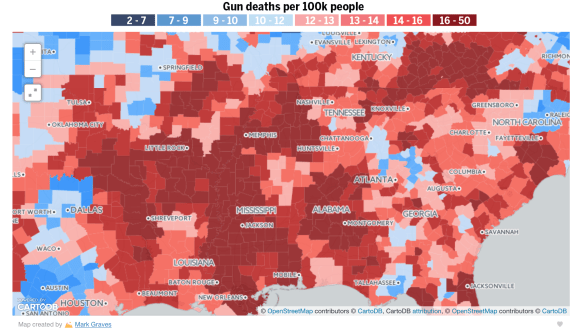
Or the western states, where wide open regions removed from cities are unpredictably dense in deaths by firearms:

The more elegant data visualization importantly disabused viewers of a habitual focus on urban cities as sites studded with gun homicides–and calls attention to the deeper question of where folks think of themselves as being safer with guns in their possession, by highlighting the more rural areas, often of lower density population, where firearms may be more seen as forms of safety and security, and apparently are more readily used. Rather than see urban violence in cities as the source or center of firearm fatalities, if they ever indeed were, areas as Wyoming, Idaho, parts of Nevada, non-urban Louisiana, Mississippi, South Carolina, Arkansas, and southern Utah, as much as Chicago, are centers of gun deaths, and firearm homicides in Chicago have declined.
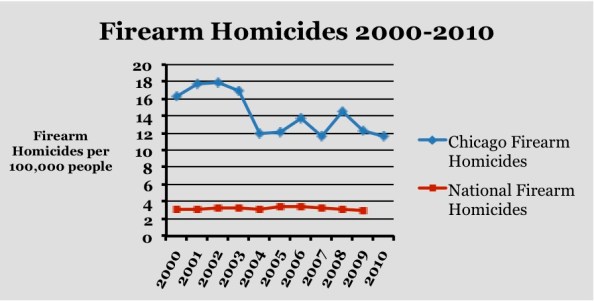
What does that mean?
The category of “states,” as Florida should be the first to admit, are less meaningful guidelines to gun-deaths, or the grim landscape of fatalities, even if they provide the jurisdictional filter to try to control the availability and circulation of arms. It may be helpful to see the extent to which overlays line up with firearm deaths less as a cause, of a marked decrease of deaths due to firearms, than a shifting cultural topography in relation to the possession of the gun: the refusal to pass any such restrictions, one could as plausibly argue, seems most prevalent in those very regions and areas where the recourse to firearms seems accepted as if it were a right. For even though the laws are most often designed to protect children from gunfire–rather than curtail gun use–this seems to suggest an acceptance of the need in a specific case for gun laws to preserve fundamental human rights, rather than the civil protection of public security that we increasingly seem to need.
Indeed, rather than seeking spatial coherence in a culture of firearms that seems less spatially coherent than conceptually powerful, it might make sense to abandon the use of a geographical map to seek spatial correlations in a dilemma that is more national than local or regional, even if plagued by some deep regional differences ad divides:

The correlation, not so surprisingly, is pretty clear. Parsed only slightly differently than Graves, and also viewed over a ten-year period, a grim vision of the firearm deaths per 100,000 emerges, which suggests the deeper extent of a readiness for individual recourse to guns in the greater part of the nation, including terrifying persistently increasing suicide rates by firearms that one can only attribute to increased access to guns–an increased danger if you have a gun that few gun owners confront.
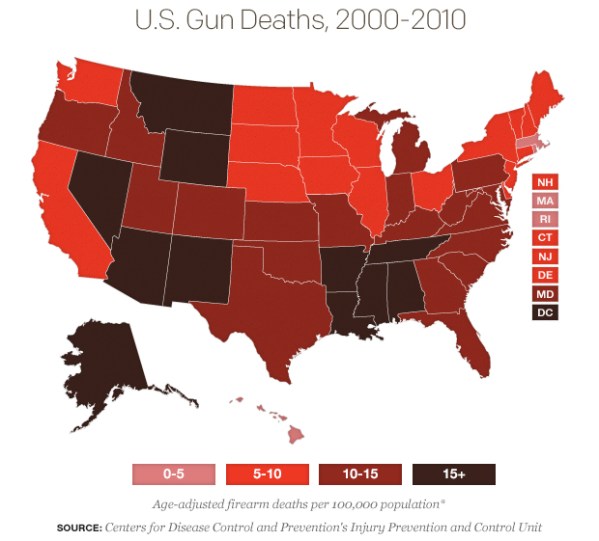
Hawaii remains the clear outlier with the lowest rates of firearm injuries–suggesting that if we might look for a model of well-being, it would be furthest away from the country–though New York, Massachusetts, and New Jersey appear relatively low in national context. The large numbers of gun fatalities, which in 2007 killed over 10 per 100,000 residents, rose to 21.7 in Washington, D.C., perhaps justifying a new notion of how guns would relate to public safety after all. Poverty levels have the clearest correlation with deadly assault with firearms. And the majority of victims of violence were women, often in domestic rather than public settings. But what does the geographic distribution of murders tell us, given that the density of homicides–or mass-murders–is less the point than their occurrence?
16. The more such killings and mass-killings appear to multiply, perhaps intensified by the barrage of media images and banner headlines that consume our diminished attention and place new demands upon whatever comprehension we might be able to gain, the weaker seems the validity of letting American legal exceptionalism perpetuate the conflation of individual rights with gun ownership in our collective imaginary. Indeed, the very claims of exceptionalism of the defense of gun ownership within a “Bill of Rights” creates a distortion of the very reasons for owning a gun, and indeed the associations that one should attach to gun-ownership–as much as safety: gun owners remain far more likely to kill themselves intentionally, and increases the chances of gun-related accidents.
But the global graphic of homicide rates, more broadly construed world-wide, may provide something of a useful touchstone in resetting the place of America in the world. It interestingly expands homicides to different weapon types, parsing the globe by assailants’ weapon of choice. To be sure, the US is embarrassingly first, suggesting its greater normalization of recourse to weapons to perform aggression, and surpasses any other country in the world in assault by a sharp object (dark green) or other means (green), even though gun-related deaths in specific inflate U.S. homicide rates to so tragically numbing a state of extreme exceptionalism.
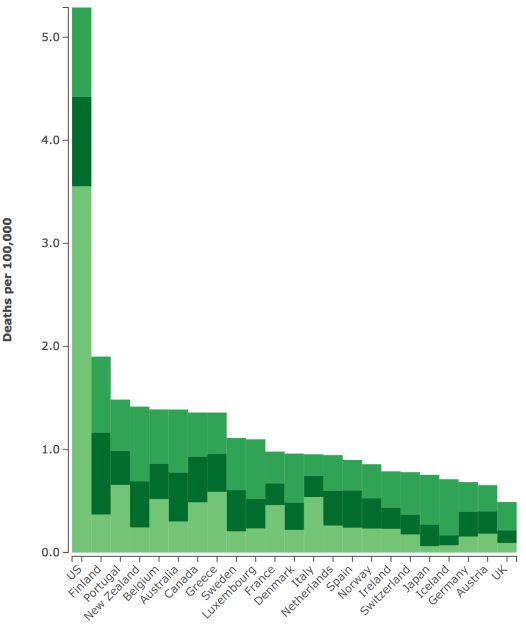


 Marion Ruszniewski/Agence France Presse






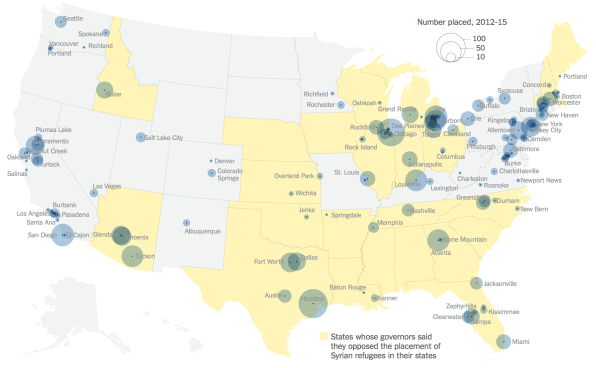


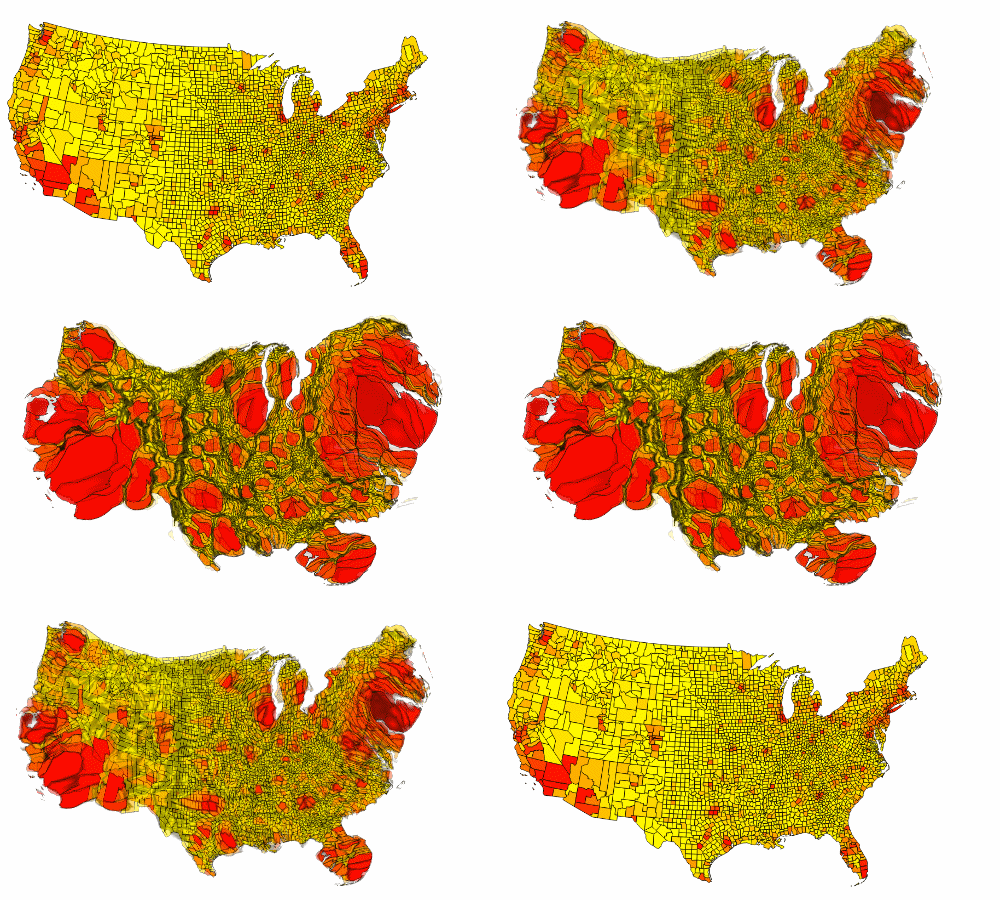
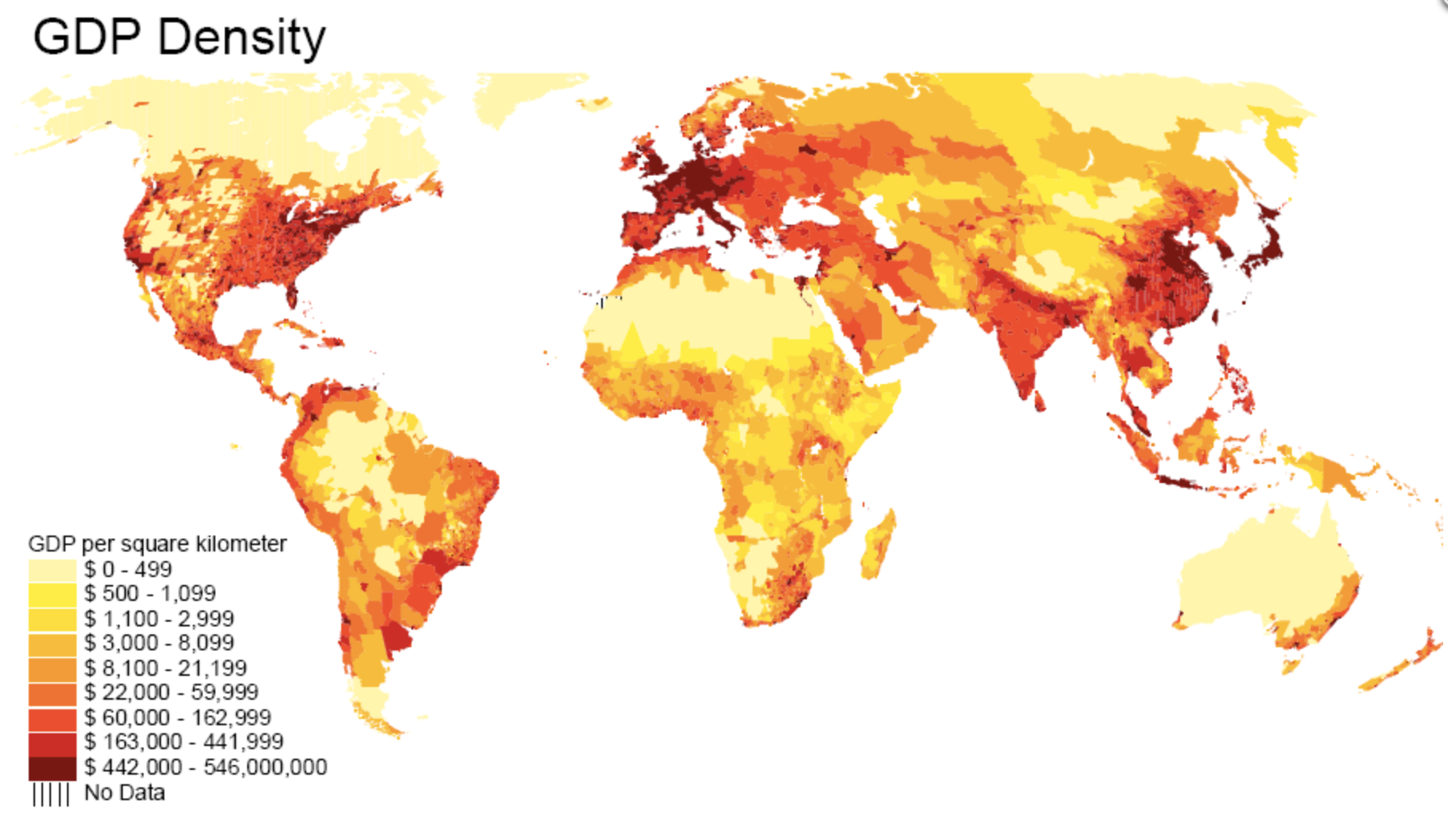



 New York Times
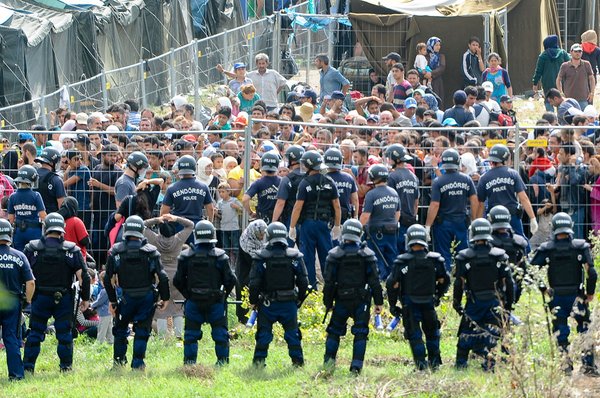
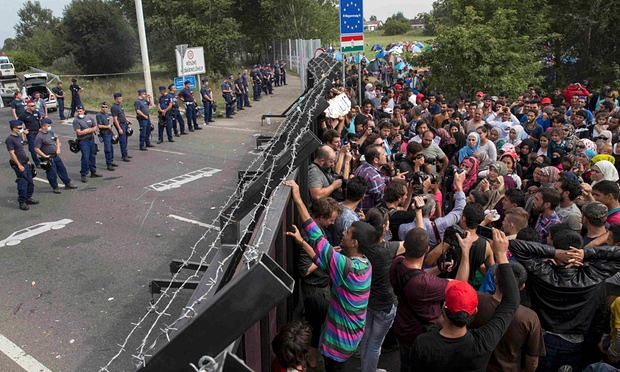
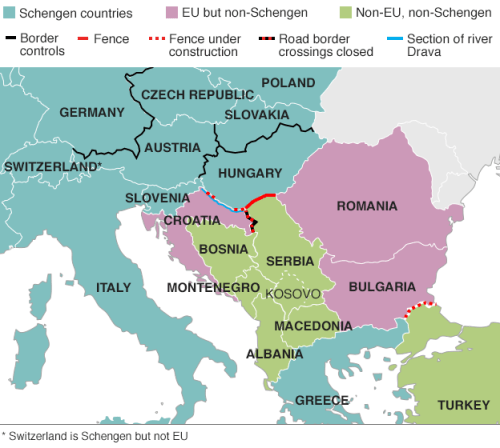


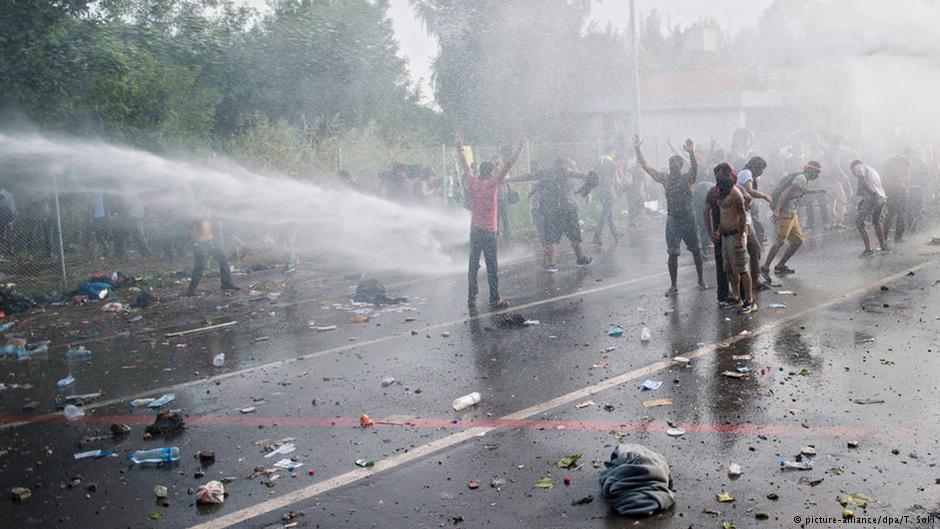
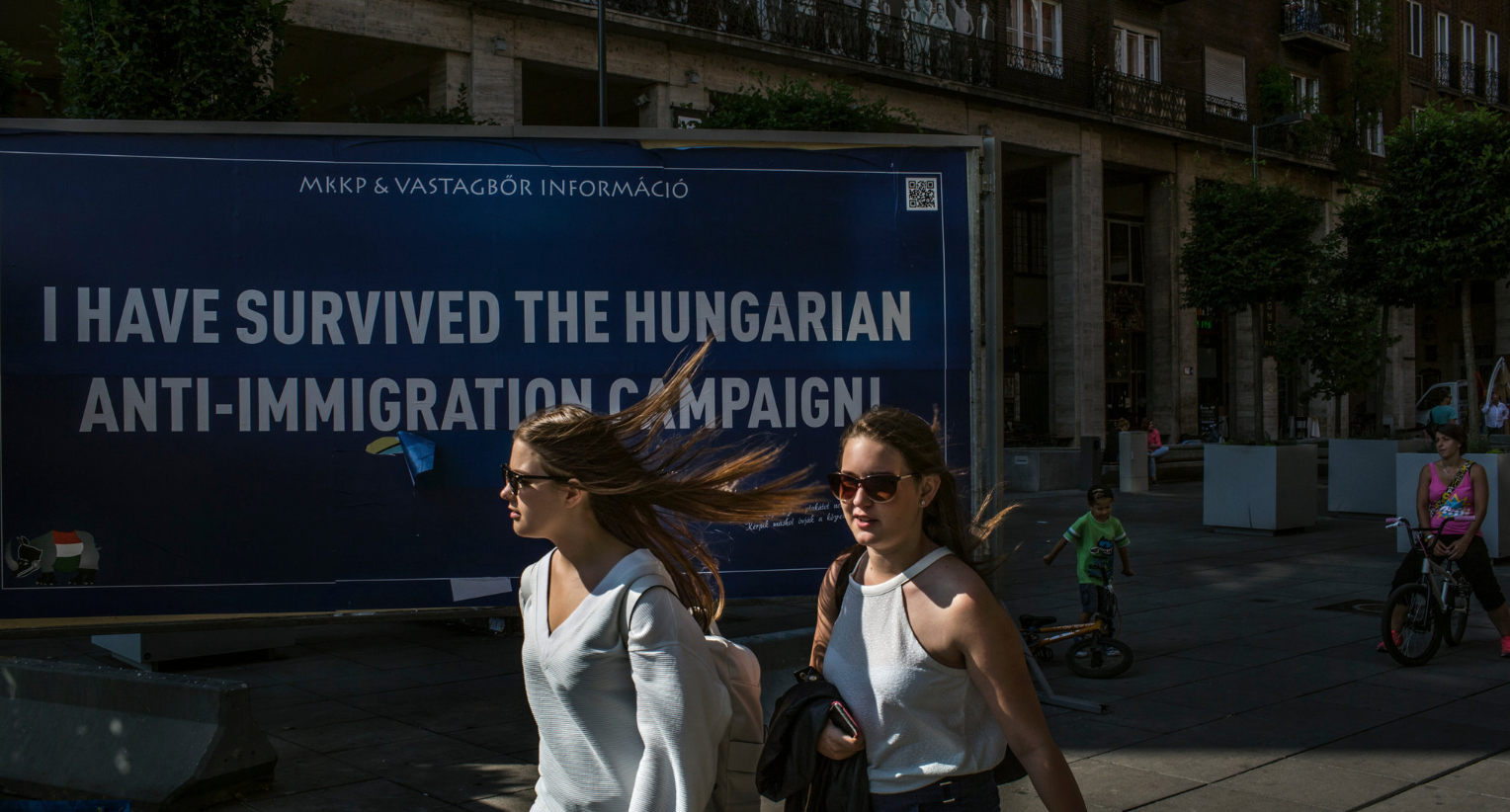
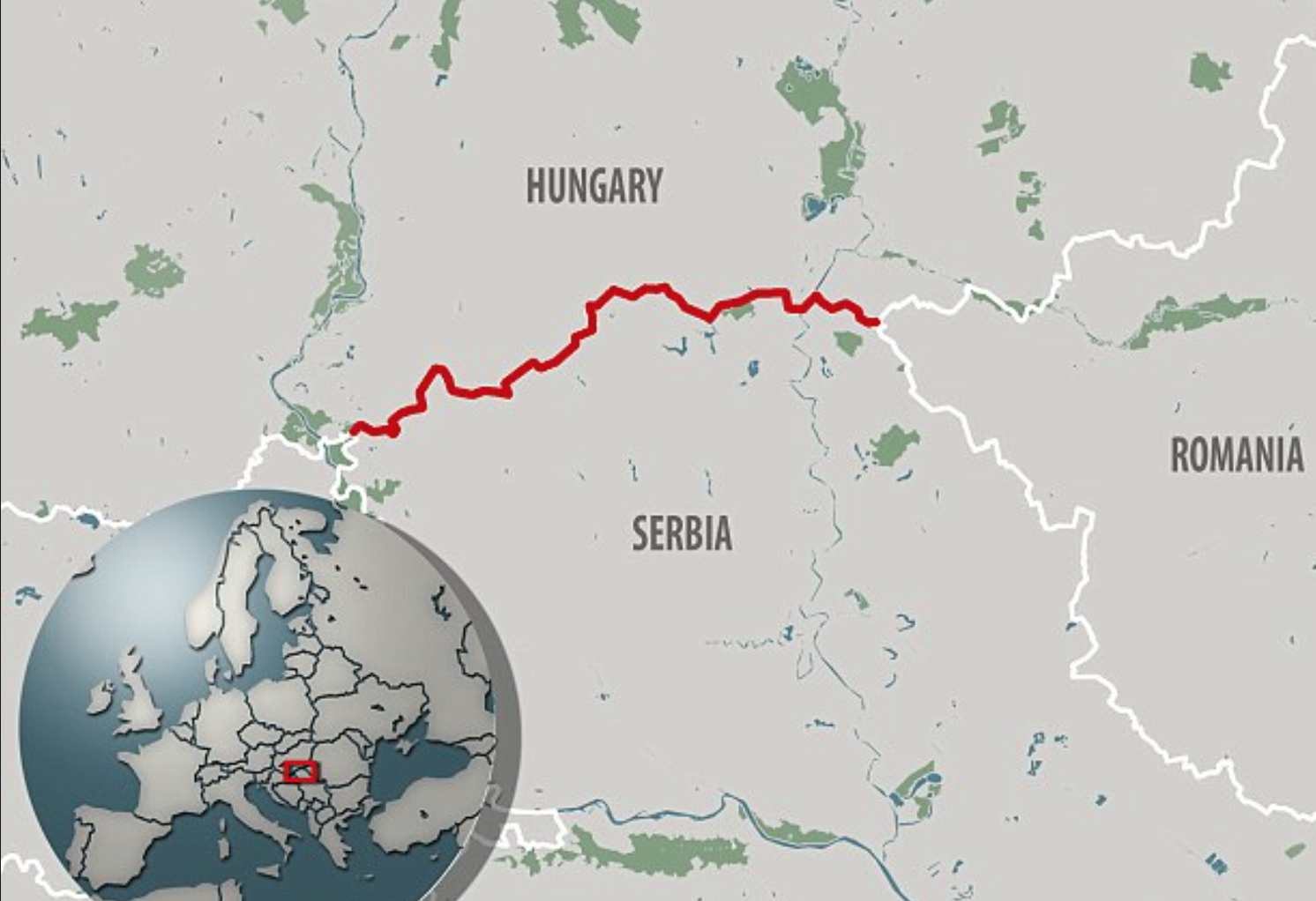











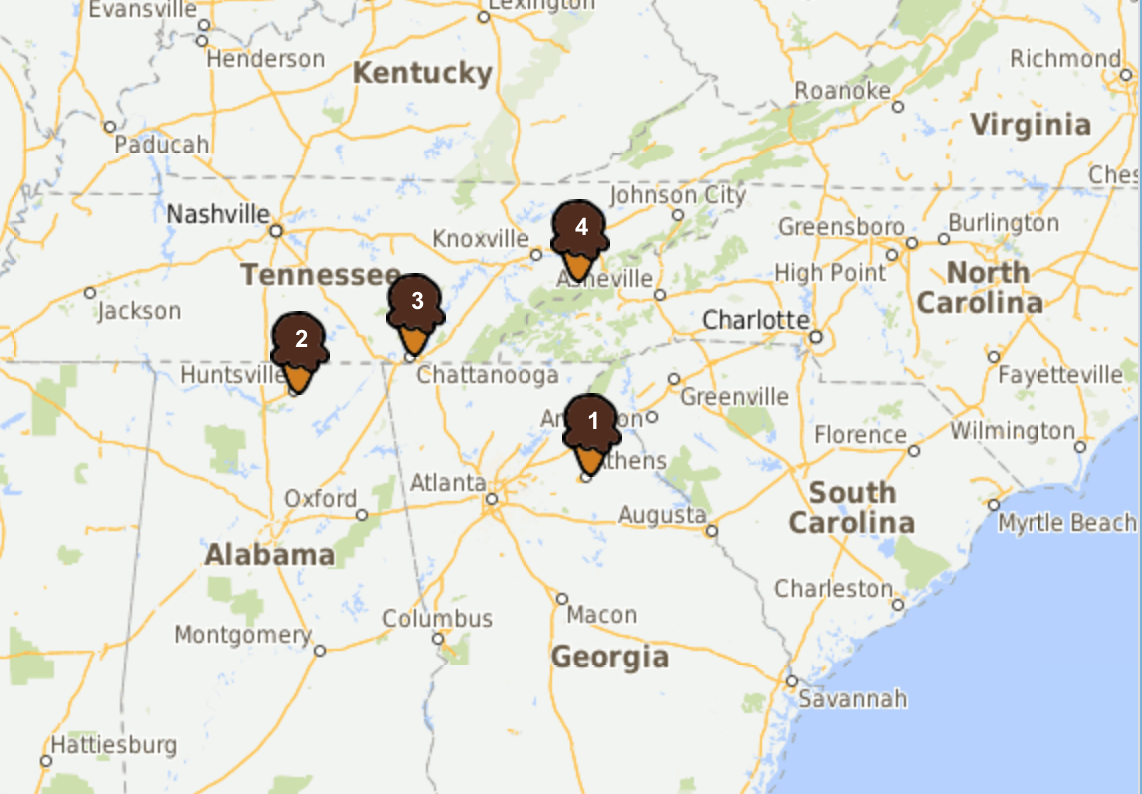





 Musings on Maps
web.jpg)