
7. The conscious burning of forested areas near the border by Israeli troops and burning of northern Israeli forests created more forest fires that expanded as an incendiary war. In what first began as an attempt to prevent the hiding of Hezbollah munitions in residential communities, reprisals and counter-reprisals across the armistice line have led to over 52,000 acres of Israel and Lebanon burned, 37,000 in Israel and 15000 in Lebanon. The emergence of this incendiary war using white phosphorous is in danger of creating a vast demilitarized zone, far greater in size than the wars of 1982, which forced the PLO to withdraw from Lebanon, in ways that have responded to a deep drive to redraw the map of the frontier, and indeed to redraw the map of the Middle East by leaving no space or land for non-state actors in Lebanon, and wearing down the resolve of Palestinian groups who have been forced to live in the country.

Fires from Incendiaries or Exploded Missiles inNorthern Israel, August 17 2024/Israel Nature & Parks
The border was already destroyed, or rendered uninhabitable, by the fleeing of almost a million from the once fertile borderlands. The destruction of all of this once fertile land–and especially so much of the Golan Heights which Israeli farmers and “cowboys” raising livestock. Over 30,000 acres to be burned in Lebanon and Israel by early July, up from 4,000 acres burned in northern Israel by June. The hot “fire season” across the region has led fires sparked perhaps by incendiaries to be more fierce and worrisome n ways that has only raised the temperatures of all involved. While these border tensions had been simmering for months after the October 7 attack, they were manifested in open blazes and scorched earth whose on the ground consequences not yet assessed.
Although the IDF claims not to have used white phosphorus in cross-border attacks–a prohibited substance given its public health risks–rocket seem as if they may have profited form the high fire risk levels in Lebanon during summer months. The rising risk of wildfire dangers grew to red-alert status in the early summer months, per the University of Balamand’s fire risk map, and fears of triggering an environmental massacre across Lebanon, based not only on the accusations of using white phosphorous in incendiary bombs, burning fields and forests since the first exchange of fire across the border on October 8, when the start of the fire season earlier than usual led to urgent calls to put out fires that include not only olives, but centuries-old oaks, and pine, increasingly combustible during summer and fall months, that echo with the increased intensity of fire seasons in California. Over a hundred and thirty-three forest fires that burned, several tied to the firing of white phosphorous whose firing technically legal when used as smoke screens, are prohibited by the Geneva Conventions near to civilian areas, although the increased use of white phosphorous that is provided by the American military to illuminate night-time landscapes and attack military targets–a slippery definition or restriction as Hezbollah is often based in civilian neighborhoods.
8. The slippery language of war, in which civilians are combined and elided with military targets, and Hezbollah militants argued to overlap with residential areas, and the majority of towns on the Israel-Lebanon border were quickly targets of military attack by midsummer. The fears of land to be set ablaze in a scorched earth policy leaving charred earth suggests a burnt-earth policy of sorts never seen before,–hardly a “buffer one” or even the dead zone analogous to the Cold War military concept of a De-Militarized Zone (DMZ) guarded on both sides, but a unilaterally imposed “dead zone” or Wasteland in the Golan Heights and Southern Lebanon, where animals are unfit to live, created by the missiles and drones raining metaphorically down on the Golan Heights from north of the border, and incendiaries–even, yes, being catapulted by trebuchet, from behind border walls, into southern Lebanon to provoke fast-spreading fires, themselves increasingly difficult to contain.

Golan Heights in August, 2024/Gil Eliyahu
The growing Fire Danger Index across Lebanon by May 2024 increased chances that indiscriminate use of white phosphorus–Israel is not a signatory to the Geneva Conventions, of course–has ignited some of the fires that devastated eight hundred hectares of forest by the start of 2024, and killed some 40,000 olive trees, the land destroyed by May had nearly doubled to over 1570 hectares, holding 50,000 olive trees, half over five hundred years old–some two thousand years old, and still producing oil, not far from Galilee. The number of destroyed olive trees that is beyond 60,000 are still harvested under continuous bombardment–the two million trees contribute to the economy of southern Lebanon’s olive sector, are a third of Lebanon’s, by Syrian refugees, under the surveillance reconnoissance flights and near exploding missiles and raging fires hardly “wild” in nature, but visit an extension of war in increasingly apocalyptic terms. The launching of fireballs across the border and phosphorous-dipped incendiaries threaten to wreck a new level of environmental damage in a region long threatened by the increased heat and fire risk in an era of climate change.
But this was not the main border at which the world was looking in 2023; harvesting the thousands of plots of olive growing is a casualty of war is literally consuming olive branches–that talisman of peace–as the harvesting of four million olive trees by the southern border continues under continuous bombardment, overhead air reconnaissance, and explosions of projectiles, as the harvest that continued with trembling hands threatens to conclude, at the end of the olive harvest, with near-apocalyptic incineration of the landscape. The threat of lasting topsoil contamination of topsoil from white phosphorus stands to compromise the ecosystem of local wildlife; with growing fire risk from April and through the summer of 2024, into the dry fall, record-high global temperatures meant increased wildfire awareness and threat of widespread environmental damage: use of white phosphorous incendiaries used from the very first attacks and cross-border incursions–nominally as smokescreens–are charged only to escalate in Lebanon from October 2023, and in increasingly indiscriminate fashion.

Fire Risk Map of Southern Lebanon, May 30 2024/University of Balamand
Indeed, the concern for the risk of dense vegetation along the border has made deforestation of Israel military, who have catapulted incendiaries across the border since June,–using white phosphorous fireballs to create forest fires in truly irresponsible ways, seeding toxic chemicals on the outskirts of towns and in proximity to farmlands to create brush fires in border villages. The harvesting of this environmental damage compel us to expand our sene of the casualties of war, and the escalating costs of the missile exchanges that threaten raging fires, displacing Lebanese and already displaced Syrian refugees alike. The United Nations had resolved that the withdrawal of Hezbollah to the River Litani, thirty kilometers from the Israeli border, targeting this fire-prone region with incendiaries created a level of a state of war risk and casualties difficult to map.
The gradual and undefined transformation of the border to a zone of war from October 8, when Hezbollah began daily shelling of Israeli occupied lands and Israeli territory south of the Lebanon-Israel border may already have transformed the border, or crossed a line, that invited war. The displacement of over a million from their homes near the border in the current cross-border aggression has lead to a massive displacement of residents, even if the armies of the nations at war have not confronted one another directly: the increasing effort to depopulate the border region suggests not only a dismantling of an infrastructure of cross-border attack, but “dismantling the attack infrastructure along the border” stands to be a devastation of the landscape, displacing populations and destroying homes. The logic of dismantling “Iran-backed terror organizations” by crossing the border and circumscribing a terror network backed by Iran mirrors less the map of populations on the ground than the terrifying optic of a network of Iran-funded terror of the map displayed to the United Nations, showing a large black mass of Iranian-funded terror networks as existed in Gaza’s underground tunnels. For the image of the extension of a terror infrastructure with tunnels from the Blue Line of 2020–the line born as a line of withdrawal of Israeli troops from Lebanon, not resolved an actual border, if Lebanon was granted authority to it–where Israel built a concrete wall to prevent the feared advance of militants up to the limits the UN asked Hezbollah to retreat of the Litani River.

9. The border boundary has been dramatically redefined, en lieu of an actual border–the current line from which Israel has launched its invasion of Lebanon–a border last attempted to be resolved and still not yet adjudicated by mid-September, 2023. The end of negotiation about the line drawn in 2018, with a sticking point of losing about 500,000 sq meters of what was fertile agrarian land, blurring the inhabitable land on each side of the border with ecological devastation and polluted and compromised terrain. The “blue line” that cut across a densely populated area is the line from which Israel has staged its current attacks that will transform the southern third of the nation to an active theater of military operations. Despite the far greater scale of cross-border attacks from Israel, however, the arrival of tanks have been met with rockets, explosive devices, and artillery, destroying three tanks with guided missiles, suggesting that the infrastructure Israel claims to dismantle is still able to defend the “robust, even after 1.2 million were displaced by the Israeli troops’ recent armed incursion across the border of over 10,000 cross-border attacks, increasingly threatening regional instability, rekindling a state of war with a non-state actor over the past year.

October 7, 2023-September 20, 2024/Al Jazeera
Few countries have firmly fixed borders in an age of globalization, save Israel. But the firm line to which the army has advanced to evacuate the densely populated area of southern Lebanon, whose many towns lie quite close to the “blue line,” drawn by the UN Interim Force in Lebanon that attempted to resolve the contentious border that has been fortified as a concrete barrier, with some Lebanese villages now lying in Israeli territory.

The combustible nature of this provisional “border” has become the basis for a new border zone that increasingly risks being defined as a burn zone. A map of fire risk risks offering the best tools to map the border zone, a border once understood as a sanctified, defined by the withdrawal of Israeli troops, is cast as a border zone in truly apocalyptic terms. The symbology and tools of burn maps, as much as maps of borders, may defined the increased anthropogenic risk of a border zone in need remapping as a “dead” zone not metaphorically, a “dead zone” being intentionally created in truly terrifying ways that raise issues not only of human rights but the unprecedented intensity of a burnt earth policy of ecocide. It is incumbent to come to terms with the costs of the far more than semantic transformation of borders from boundary lines to border zones to dead zones, that is being remade and designed for the security of the residents of the Israeli state.
The devastation indeed demands the use of the symbology of burn maps and fire maps, to register the actually apocalyptic proportions of cross-border attacks, as much as of border lines. For more than evacuation zones–if some 40% of Lebanon had now been asked to be evacuated by the middle of October–the devastation visited on the southern half of Lebanon stands to leave once fertile land uninhabitable, as if to deny the work of famers and farm-hands–many, increasingly, as noted, Syrian refugees, from the region. The war is generating a refugee crisis, at the same time as it has grown in response to a refugee crisis, often being waged in a site that increasingly has sheltered, by UN help, Syrian refugees, many of whom live in majority Shiite Muslim sectors of Lebanon that were long acknowledged to lie within the influence of Hezbollah, but whose settlements are now the targets of war, and the one million refugees who have settled the south being forced to leave their temporary residences. The human rights crisis of these Syrian Sunni refugees left vulnerable by competition for local jobs, limited resources, and a lack of relief charities–leaving most refugees living in poverty (nearly 80%) and 90% in debt. Lebanon is not only the nation with the highest number of refugees of any nation in the world, according to the UNHCR, although their number has been ceased to be tracked at the Lebanese government’s request; with the number of displaced Syrians estimated in Lebanon at over 2 million, the destruction of all infrastructure in the war zone to which many refugees have been effectively forced to return is exacerbated with current military incursions, leaving some 90% of whom unable to meet their daily needs. The destruction of the lands many worked is not only a territorial grab; it is an apocalyptic scenario that robs many of their only livelihood.
The emergence of these literal “dead zones” is of increased global importance, and raises pressing questions of the ethics of aerial bombardment in an era of rapid climate change. To eliminate not only an infrastructure of terrorism, but homes, farms, groves of olives, avocados, by nearly continuous aerial bombardment, shelling, and white phosphorous has transformed the region into a true “dead zone.” It is one now uninhabitable by civilians, one made uninhabitable for the future, destroying nearly 7,500 sq miles of farmland, in a systematic destruction that will leave 95,000 displaced and evacuated, and has created $1.7 billion of damages. It has created untold costs we are not yet nearly even in a position to appreciate. Indeed, the non existent policy toward refugees in Lebanon with the growing Syrian refugee crisis has created an unprecedented return flow of refugees from Lebanon, at a time when one in four residents of Lebanon is a Syrian refugee, an unpredictable and unforeseen result of the invasion, as many refugees are being squeezed from Lebanon back to Syria, but are not registered by a focus on the border and cross-border fire.
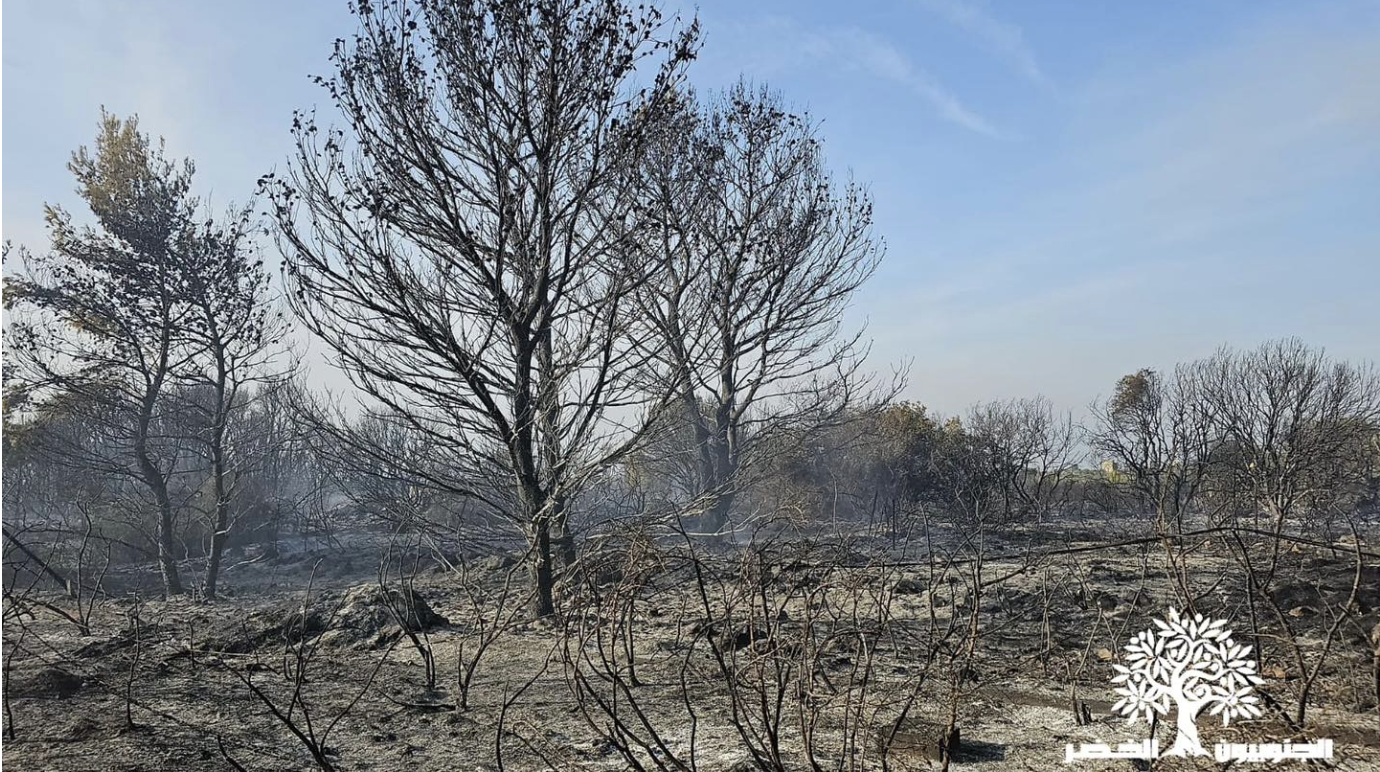
Burnt Forest Landscape Burnt by Israeli Bombardment on Southern Border/Green Southerners, July 2024
This is akin to taking one’s rhetoric of apocalypticism and throwing it back in your face. Nasrallah had, of course, insisted in his fiery orations that Palestine would not only return to the map of the Middle East, but offer a new axis of power, urging his Shia followers to embrace an autocratic style of governance, outside of the language of compromised conservative states or regimes, asserting the nobility of an Arab world that would arise, phoenix-like, from the ashes of the destruction of Israel. Responding to the fear of any alliance or detente between Israel and Syria, as a risk to the total destruction of Zionism, and the arrival at a two-state solution that seemed increasingly evanescent.
The utter charisma of his oratory led Israelis to conclude he must be eliminated if any of the hostages were ever to be rescued, and the obstacle to any advance on that front. As Nusrallah escalated his oratory in predicting the end of oppression of people of Palestine, celebrated beneath Hezbollah’s yellow flags and banners, he announced Israel to be “weak as spider’s web,” inverting the metaphors of vermin that Israeli Defense Forces had applied to the network of tunnels in Gaza, and foretelling the demise of the Israeli state, equipped with more drones, missiles, and rockets than he had possessed in the past. Nusrallah’s repetitive speeches prophesied the coming end of an all-out conflict that would lead to the redrawing, yes, of Lebanon’s border would allow the nation to include more fertile farming lands, and a vibrant economy, rewarding a patient struggle against occupying forces not involving the United Nations, or Arab League states, but of non-state actors far more credible defenders of the land. The current war has brought, however, a back-projection of apocalyptic imagery and symbolism to southern Lebanon by Israeli forces hard to process, grasp or contain, and perhaps as hard to grasp on its scale as the violence of October 7; burn scars across the landscape will be long visible, long after the current conflict fades. The future possibilities of peace, as vanishing perhaps as the charred remains of the olive branches themselves, not only risk ending a historical harvesting of olives in the region, a large part o the local economy, but creating a dead landscape in place of once forested land. The world should pay better attention, and we may actually need better, and more adequate, maps to do so, not foregrounding the boundaries of nations or even national divides.






 Musings on Maps
Concluding the account of horrible destruction, the incineration of ancient olive trees at harvest time….
Glad you read that far!