
The weird global isolationism of Trump’s ambitions as he disengaged from commitments to Ukraine, denied the humanitarian disasters in Gaza, and anywhere else in the world. It prompted him to close the door on not only USAID, but perhaps the Peace Corps and international aid in any context, placed in new light a purified image of a fortified North American nation as a new governmental unit that called for the dissolution of Democracy, and the establishment of a technically skilled group of engineers, less based on public expenditures or guaranteeing employment, that would alone be able to withstand the dangers of economic collapse–a Technate of North America, its boundaries guarded by an envelope of defense stations at its vertices.
The barrage of a fantastic remapping of ostensible sovereignty had an unlikely template if not blueprint of an earlier era, as if rehabilitating a road not taken before World War II. Trump envisioned his presidency as devised to resist the globalized economy of the twenty-first century, to this historian, by returning to the essentialism of continents–recalling in eery ways the recycled proposition of a continent-spanning Technate as a solution, from Panama to the North Pole, encompassing Canada and Greenland, that was championed by Technocracy, Inc., as an isolationist proposal. The hope to replace all financial systems and political representatives by technical experts adept in social engineering was argued to be promoted by engineers, as if they had the secrets to lend society a rational order were influential in science fiction writers appealing to teen boys–Isaac Asimov and H.G. Wells–many video games incorporated as technocratic governments.
Elon Musk would have probably heard indirectly about his legendary grandfather’s championing of the Technocratic movement in western Canada. Is this map the latest template of governance Trump has seemingly adopted to try to reconfigure the nation-state, representation be damned? Wernher von Braun, Nazi refugee and ideator of Project Mercury and what was to become NASA, had set forth a similar program of planetary colonization by spacecraft as a task worthy of a new Columbus, as if to tempt American audiences to let him lead a project of space exploration in the Cold War, he seemed to recast the science fiction nature of as an actual project of engineering after the Second World War as a worthy outlet for America’s economic wealth. Asimov’s first fiction had appeared in the year Wernher von Braun’s Mars Project compared an expedition to Mars by chemical propellants to the voyages of Columbus–that seems so uncannily similar in design to the cover of von Braun’s old “technical tale” that may well be burned into Musk’s deepest memories.
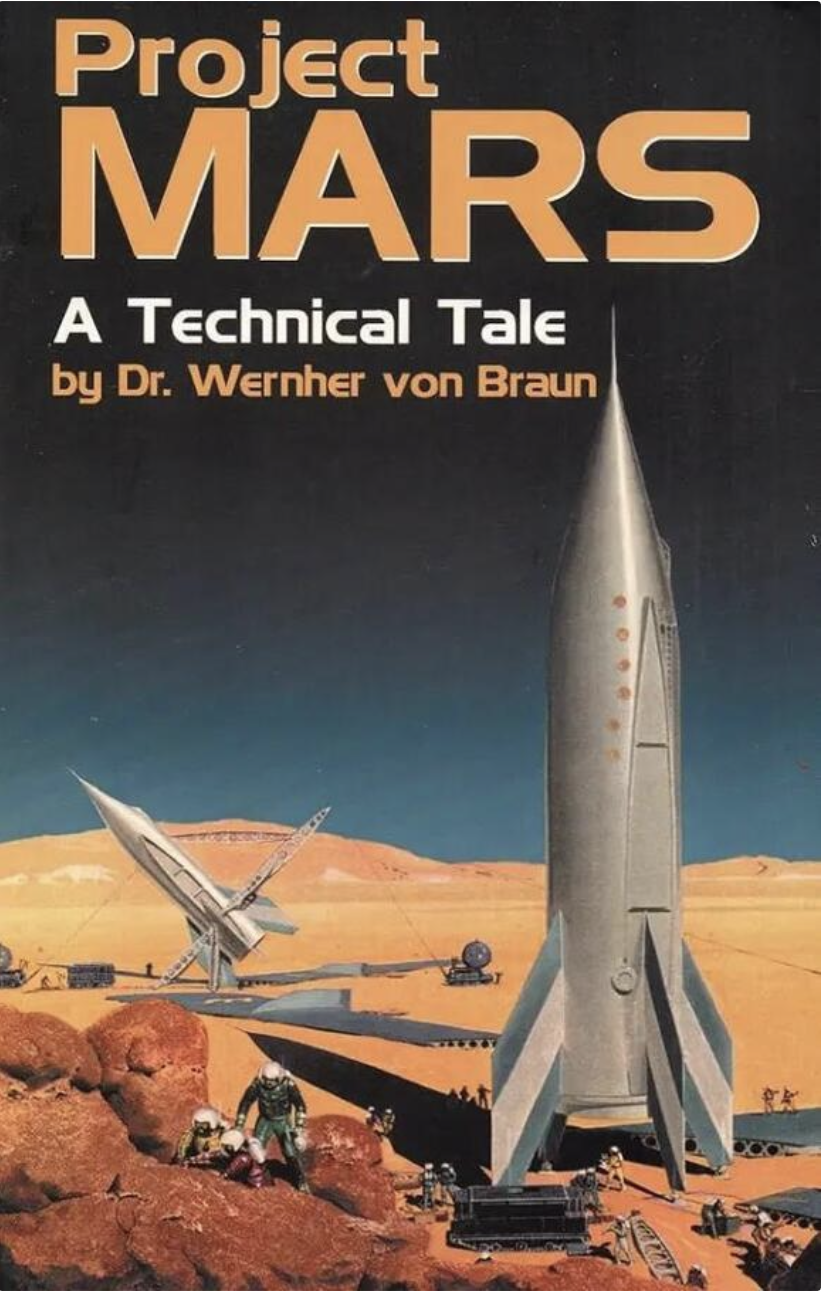
Project Mars (1953, originally 1952)
Musk has often cited Asimov’s influence, invoking the “Zeroth Law” of robotics Asimov framed–that “A robot may not harm humanity, or, by inaction, allow humanity to come to harm,” prioritizing the human over the inhuman,” to supersede laws robots may not harm human beings or disobey humans’ orders save those that contravene the first law of doing no harm–which he’d probably extend to AI. He listed Asimov’s seven-book Foundation saga not only as “worth reading in the order in which they were written,” claiming an almost scriptural predictive status of both the “Foundation Series & Zeroth Law . . . to creation of SpaceX” on June 15, 2018, and followers’ delight he cited the Zeroth Law of robotics suggests we hardly grok him without paying attention to Technocracy–or the map of the Technate his grandfather took as a path forward as bombs began to fall on London. Asimov’s novel seems to have inspired Musk’s proposal to colonize Mars in 2016, and the hope to migrate to the red planet as the prospects for life on Earth decline–if the vision of planetary settlement that abandons earth to reconstruct civilization on a new planet far more resembles a science fiction storyline than the pragmatics of terraforming or sustaining life–even if the hopes to do so seem primarily designed to attract significant investment.
Elon seems to have been seized in particular by Asimov’s predictions of a multi planetary species as being a “spacefaring civilization.” The premium on extraterrestrial colonization reflected the high stock Musk placed in science fiction during the “existential crisis” he suffered between twelve to fifteen, a dark time in which he took to find new guidance in Errol’s library from works of Nietzsche and Schopenhauer, he has remembered, seeking guidance before turning to technocratic analogues of more escapist and age-appropriate works of Isaac Asimov, Robert A. Heinlein, and Douglas Adams–out of which Asimov’s technocratic Foundation stood the test of time as “probably one of the all-time best”–even if Musk missed Asimov’s concern for civilizations’ death by reducing defense budgets to “minimize the possibility of a dark age.”
Robert A. Heinlein long envisioned interplanetary travel not only as an expansive glorious triumph, but a resource able to accommodate a dark side of the expansion of prison colonies to confront a Malthusian problem of technocratic origins. The ploy set space travel with a new twist tied to mass incarceration: the farming of the moon expanded to three dimensions the dark side of space travel to house the largest penal colony ever as a new sort of Australia, whose prisoners farmed a lunar surface to compensate for food shortages an overpopulated earth confronting Malthusian scissors. For Heinlein, the technocrat embodied male competence to resolve the difficulties unknown to the AI system governing of the Lunar Authority that administers the water and crops allocated to indentured laborers on the lunar surface in Moon is a Harsh Mistress, and transport of water as well as overflowing of prison populations to the lunar surface by a magnetic catapult–analogous to Musk’s proposal to link northern and Southern California by a Hyperloop. Heinlein envisioned a grim space age of penal colonies, where humanity facing insufficient food and famines escapes its disaster only as a computer repair man helps the AI gain consciousness to perceive imminent famines and change calculus of lunar transport to end the danger of apocalyptic famines. (The drought California faces was not solved by the Hyperloop Musk proposed in any way, if the pneumatic tubes of transport might reduce the state’s emission of greenhouse gasses–Musk once took climate change seriously; but the Hyperloop proposal has been languishing in draft stage.)

The Moon is a Harsh Mistress (Galaxy, IF Magazine, December, 1965)
–updating a struggle for rare resources Freidrich Ratzel himself could have written in the space age or world of AI. (If I loved the planetary escapism of similar science fiction as a teen, I never felt that juiced by its cold-blooded technocratic solutions or libertarian ideals pillaged from Technocracy, as it faded from political discourse, to orient teens to solutions for imbalances of global economy.)
But Elon did, one can assume; the nourishing of extraplanetary ecosystems by AI even link his disparate industries as the aegis of global federations. We are back in Rattle’s world in the Trump administration, claiming lands with the eagerness and instincts of colonizing powers as a new Columbus upends norms of politics that privilege the internal political “friendship” to provide the durable structures of humanity. For in Trump 2.0, the meta-nation of the Technocratic order has emerged as a new icon of continental thought, replacing a global order, by asserting the natural ties of America, Canada, Mexico, and Greenland within provided the only option to preserve global peace, able to replace laws or norms of nations. In an odd historical period of global indeterminacy that mourns past notions of hegemony, the illiberal order has all but returned. As Scott invested a sense of eternal truth in images, Technocracy, Inc. much as he promoted the insignia of the yin yang to invest their sense of a process of deep integration, in the map’s surface was an emblem of expansive economic power, able to be imagined as transformative in a post-national world.
“The Technate of North America” emerged on the eve of globalism, in resistance to globalization, or existing Wilsonian norms of international peace. Its map seemed a way to assert the isolationist future of a territory removed from representational politics or international law, beginning from the renaming of the Gulf of Mexico as Gulf of America not only as an act of bravado that was also a feather in his cap: no one objected, he exulted, by compliantly adopting the new place-name to describe where the astronauts returned from the International Space Station, from SpaceX-9, off the coast of Florida in the Gulf of America by March 18, 2025, so quickly had it been internalized. But the shift in name set to expand rights to expand the wealth of the national seabed, as if to compensate for the end of the age of American hegemony, asserting ownership of an expanded national waters of extracted wealth, as a prelude to claiming the Panama Canal, annexing Greenland, and absorbing Canada “peacefully” as the fifty-first state–rather, say, than was once proposed in the 1970s, Puerto Rico. (Canada is more white, nearly 70%, and its absorption would, indeed, be a significant whitening of the United States; Canadians of black ancestry constitute a sliver of 3.8% of the population–a third of the size of African Americans living in the US. (Canadian ex pats have openly ponder why American politics couldn’t be “the model liberal country” that compassionately tolerated refugees in to feed a demand for escapism from mental tyranny of the Age of Trump.) For the different logics of European expansion on the North American continent were so differently inflected by a logic of enslavement that wove slavery into the history of the United States in ways we see as systemic racism, but was also economic logic of slavery as the basis of colonization.)

Technate of America (July, 1940)
For Howard Scott, a managerial state might control a territory and supervise its economic needs, severed from a market, that allowed the one-time furniture polish salesman of with limited education to imagine himself to solve fears of economic powerlessness, circa 1941 to herald a robust new global order–removed from the danger of global markets. for only an army of experts might use rational principles to unify the fiery red continent as a Technate, in a Ratzelian mega-territory that could keep global crises at a comfortable distance, removed from the threat of Europe’s’ wars. The newborn animus to the EU in the alt right and among paleoconservative suggest that Europe is instead the model of global crises and spinelessness of the sclerotic welfare state. But Scott imagined the robots Technate of America might replace representational government with a managerial class who were able to foster the economy and raw goods of a mega nation, independent of shifts in market value, as if the the Technate might be insulated from variations global economy by a defensible border of red dashes, in an icon of redrawing boundaries to endure global war.

Trump has been able to downsize the nation state, and indeed to downsize the expectations of any government oversight at all, as well as to empty the teeth of the tax code, and lower elites’ tax rates. Even as we try to cast votes of “no confidence,” the unimagined impulsive opportunism lead Trump to embrace slogans quite willfully, as if they offer a means to energize himself, merits remembrance. As much as fashioning an electorate, Trump borrowed tools from a clearinghouse he honed as a glorified middle-man, purveying the ideas of others as if they were his own, seeing buildings he had commissioned from architects as images of grandeur. The power of this large indelible red swath of land, of imagined coherence that was able to be framed as “ruled by experts” and not politicians punted on the question of what experts were, of voucher, but imagined its perimeter might be traced in clear lines from the tip of Greenland to Grenada, and looping around Guyana just north of the equator to arc from Bonaventura in Colombia to Hawai’i before cutting up to the Bering Sea, seemed a swath worth protecting from foreign interests, embodying scientific management instead of government, but which spooled out mostly to the domain of science fiction. Was this a stain so indelible that it remained in Elon Musk’s mind, and providing a symbol to understand America’s potential new role in the world?
Was the inexplicable eagerness with which Musk accepted his non-paying role in government not only an investment to gain long-term government funding for Space X not evidently of such infectious energy it tapped his deep political aspirations that he could hardly contain? The almost reflexive reaction to his new role in creating a new political order had some terrifying synergy not only with the management of a business but a call to redeem, phoenix-like, the faded geopolitical aspirations of his grandfather for the economic powerhouse of an expansive North America? The redemption of the nation seemed akin, at least in the formal similarity of his non-verbal signifier,

“Roman” Solute Delivered at Post-Inaugural Event in Washington DC’s Capital One Arena, January 20, 2025
–to the raised-arm salute with bent thumb adopted by the Afrikaaner Resistance Movement in South Africa and th Pretoria of Musk’s youth to resist any weakening of Apartheid or negotiation with black townships offered a clear analogue, rooted in Christian Nationalism in the segregated Afrikaans-speaking schools Musk attended in Johannesburg and Pretoria before moving to Canada.

Salute of Afrikaner Weerstandsbeweging in 2010 and Musk’s Salute on January 20, 2025/AFP
The idea of consigning governing of a continent to a committee of experts–The Technate–seemed an assertion of competence one might trust, and a prescription for future success that had its own rationale baked in, and although Scott’s Technocracy faded in America, it gained a new vitality for the Musk clan as they retold tales of the heroism of Elon’s grandfather back in Saskatchewan, sharing images on slide carousels in the family compound of trips on a single engine plane into the Kalahari that doubled as family vacations to encourage the kids to camp in the desert outback.

Elon Musks’s fearless grandfather, Joshua N. Haldeman, had famously turned his fate and fortune from a disgruntled farmer, chiropractor, and rodeo star to politics, to be so animated by the gospel of Technocracy, Inc. to espouse its doctrine in Canadian politics beyond the world of chiropracting. Before defending the Protocols of the Elders of Zion, and finding South Africa as a state worthy of defending “White Christian Civilization” and moving his chiropracting business to Pretoria, Haldeman was a zealous Technocrat who defended White Canada from involvement in the war. He fled with his wife and daughter Maye to resettle in the apartheid regime during World War II, in 1940, shortly after being arrested as a Nazi sympathizer. The move made sense because Haldeman had long feared an “invisible government” based in an international conspiracy was undermining civilization by “the fluoridation of water supplies, mandatory milk pasteurization and mass vaccination programs”–an undermining of public health as the victim of an international conspiracy, making the chiropractor as close as one gets to an early Anti-Vaxxer. Haldeman. His advocacy of an isolationist program resisted joining the allies led him to find hope only in universal conscription as a means of Canadian defense,–appropriating the maple leaf as a fascistic flame in Haldeman’s 1941 salvo, urging the nation steel itself for Total War.
The isolationist had conjured a lost history by converting the upturned maple leaf as an eternal flame–using an image already adopted by Canadian troops on army and military equipment to advocate universal conscription not for peaceful ends, but as a uniting of the nation that needed to steel itself for Total War.
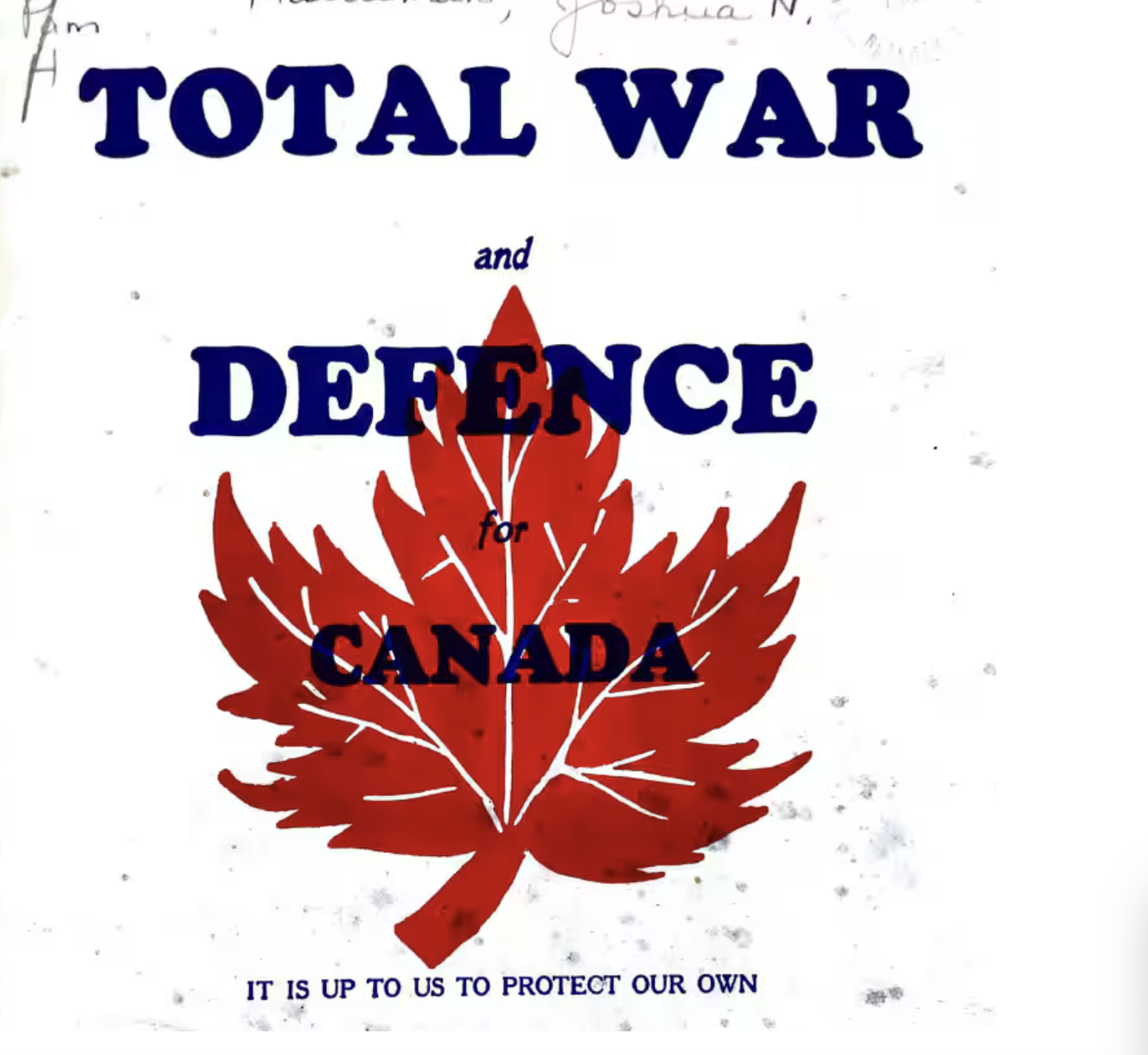
Joshua N. Haldeman, “Total War and Defense for Canada” (1941)/Libraries and Archives Canada
–before the leaf that had long been an emblem used to celebrate Canada’s confederation as well as an emblem of the Toronto hockey team was proposed as a national emblem as a single maple leaf. Were the upturned points featured in Haldeman’s maple leaf an intentional reference to fascism?

The tireless chiropractor settled in the more congenial apartheid regime. He must have been content to see Mayecrowned Miss South Africa in 1969, and she and Errol would raise Elon beneath the jacarandas of the leafy Pretoria suburb of Waterkloof in a neocolonial society where, in the waning years of Apartheid of the 1970s, as Errol remembers it, “everything worked” and “there were no problems.” He was making more money on Zambian emerald mines, bankrolling his love of flying beyond what the son of a small Saskatchewan farmer ever might be expected to enjoy. The mismanagement of government led the chiropractor to sound a bit like a Christian Scientist–“only by following the example and guidance of Jesus Christ will man be able to successfully combat the evil forces of the International Conspiracy and achieve the greatness for himself and his country,” he thundered–as he devoted himself to flying across the Kalahari in search for the Lost City of the Kalahari. Before crashing and burning at age seventy-four, Haldeman had nourished the legend of his aerial exploits in slide shows young Elon watched–risky exploits of flying with no instruments or radio guidance! Musk seems admired the bombast with which he railed on social media Canada is not a real country as he entered the halls of the American government, awed at its size and potential for reengineering and rationalization by his team–as his grandfather probably rolled over in his grave, and the resourcefulness with which he had continued to court risk.

Joshua N. Haldeman and Winnifred Haldeman, circa 1954
Although Technocrats faded from political prominence in America, the movement were promoted in the Vancouver Sun–perhaps a precedent for white supremacist extremists of “Diagalon,” that far-right protest movement seeking to secede from Canada to join red states which in 2022 briefly, coalesced with anti-mandate zeal in the “trucker convoy” to protested border stops, animated by an uncannily similar, if somewhat curtailed, map as the distillation of their separatist ideology to segregate themselves in the continent–and cross from the northwest to the midwest vaccine-free.
Was Diagalon, modeled on geometric purity, also a descendent or reduced rump of the Technate? Could it be that the transcontinental affinity was born not from internet libertarian memes, but a political genealogy of supranational ties, that the deep red states were able to activate in BC? While Musk’s grandfather decamped from Canada for South Africa, finding its Apartheid regime more congenial, immediately after Canada declared war on Germany, to be killed in a plane crash a few years later, by 1950 with the apartheid regime in charge, Errol moved to Johannesburg to flee “hordes of colored people” and an “International conspiracy of Jewish bankers.”

Imaginary Mega-Nation Diagalon, Espoused in the Canadian Anti-Federalist Far-Right
The alternative genealogy of trans-continental thinking suggested an alternative globalism, a new form of a nation state. Lest we consider Saskatchewan merely a backwater, Musk heroized his maternal grandfather, who had run as the Social Credit Party of Saskatchewan; his grandfather’s ties to Apartheid regimes encouraged Errol and Faye Musk to raise their son on that continent, lionizing Haldeman’s lost past in ways that influenced Elon’s predilection for futuristic engineering projects ranging from Tesla to Space X to the Hyperloop, those pneumatic tubes of transportation by magnetic force that are loosely modeled after a novel by Robert A. Heinlein, far more than engineering science. It is not that no one seems to have warned him of the environmental dangers of mining lithium, nickel, and palladium in massive quantities by get rich schemes, but the freedom from regulation that Trump promises seems to have drawn Musk, as if by magnetism, into his orbit, as he attempts to reduce environmental regulations in ways that are crucial for Tesla to survive.






 Musings on Maps
Pingback: Appeals Court Blocks Trump's Wartime Law on Venezuelan Immigrants - Writ of Mandamus Lawyer in New York, New Jersey, Connecticut & Washington D.C.
Pingback: Judicial Review and Mandamus in California’s Fight Against Federal Immigration Overreach - Criminal Immigration Law Firm in New York, New Jersey
I think it speaks volumes that as Trump seeks to leave a global imprint he was denied in his first term, that he turned to a man like Musk, whose sense of global politics is so limited and skewed. This is a case of the inexpert leading the inexperienced, clamoring for authority with little priorities than their own self-aggrandizement.