
The result will add over three billion to the deficit in ten years. And the replacement of the former headquarters of U.S.A.I.D.–an alternative vision of globalization that Trump seeks to depose–by the Customs and Border Protection staff suggests not only a thank you for the role that CBP endorsing Trump made to launch his candidacy in 2015, but a revisioning of government, ending the very organization that John F. Kennedy founded in 1961 to centralize American soft power in the world. Was the ending of U.S.A.I..D. just a way to accomplish the desired end of the United States’ role in maintaining the health system in Ukraine functioning with drugs, vaccines, and medicine during the current war, and indeed supporting the country’s energy infrastructure as Russia attacked it by bombs, as well as investing in Africa, Latin America, and Asia to prevent outbreaks of disease? This image of globalism is increasingly being or been dismantled, and receding into historical memory, of an optimistic time circa 1966, in the midst of the Vietnam War, as the good face of the American Empire was mapped as if outside continental divides on the edges of Africa, Turkey, Afghanistan, Iraq, India, Malaysia, and Central and South America as a new geography of future global alliances.
This was, to be sure, a conversion poster, and a mission statement, a vision of the opportunities for global advancement in redolently optimistic terms, funded by the big pockets of American government that was increasingly able to redefine itself as able to do good throughout he world.


United States Peace Corps, 1965/Library of Congress
If DoGE is a noun as a government agency tasked to solve problems of increasing efficiency, it is a verb that will use data to mask the increasingly accentuated wealth inequality, reduce rights of redress, and combine databases to distill government to its bare bones. It shows its face, if in extreme fashion, when withdrawing the assistance by which developmental and medical aid long provided to many underdeveloped and developing regions of the globe. We need to get familiar with DoGE as a verb–not only of dismissal of workers who are seen as inessential, but by creating new tools to create barriers to immigration and transborder transit in a hemispheric scale. Musk’s credentials for governing may primarily lie in the smoothness of drive that the engineering of Tesla’s suspension systems afforded, and he comfort of their air conditioning systems,–as if each provided a discreet system for living that might be understood as akin to a home, or residence, much as most Americans live in the comfort of pods of isolation of a bounty of commodities in isolated shopping malls, without any sense of the lack of wealth outside their walls.
We’ve been so badly DoGE’d. Per Washington Post’s vigilant data journalists Meryl Kornfield, Hannah Natanson and Laura Meckler, Trump’s White House is paying 154,000 federal employees to not show up to work any more through DOGE’s deferred resignation program in a gambit to trim the federal payroll without any smooth transition The abrupt downsizing that was marked by DoDGE’s declaration of diverging paths in the wood–an acronym that has elevated its preposition in ways earlier limited to prime government nodes of power, like POTUS, FLOTUS, and SCOTUS, suggests an inflation of its own role to disguise its malign presence. The comfort of the Tesla and the satisfaction of the security it offered, akin to a home with a smooth drive and brilliant air conditioning system, as if government was fundamentally a choice about offering the citizen better comfort, even if the nature and choices of comfort are increasingly scarce in a globalized world.

The quasi-governmental agency led to the restructuring, mass firings, mass emails, and forced resignations suggested a Silicon Valley style of breaking and shaking up government, whose mission of “modernizing Federal technology and software to maximize government efficiency” morphed from streamlining government to curbing of “waste, fraud, and abuse” to unprecedented downsizing of the role of the government,–to end the very notion of the civil service. All officers of civil service are now able to be easily fired and sent home at the pleasure of the chief executive–a short step from making government into a cult of personality, and tying the actual deep state to one man at the apex of power without oversight or control. The agency purposively remapped government’s relation of government to the executive without meaningful oversight.

The new map must not be ignored–in large part for how it deeply changes the relation of individual to state, and of state to a globalized world. Indeed, the shift from nation to hemisphere, rooted in a paranoiac confusion of of national borders with domestic politics, has made one turn back to the maps, foregrounded as a sort of alarm when Musk entered government by many historians in online forums, alerting us to the precedents of a Technocrats remapping of the world on the cusp of World War II and during the Great Depression, as an alternative map privileging a super-nation’s defensible boundaries over the northern hemisphere, as a model for rationally mapping the future of the nation state that perversely appeared quite compelling to many as a choice for the future of the nation-state during the 1930s and 1940s in both western Canada and across the United States. The ability to gain control over the uncertainty of financial flows in the midst of the Depression may seem to have little to do with an age of relative affluence, but easily provoked panic of modern America, by the principle organ of the party of Technocracy, a response to fears of the automation of work, but also to the increasing financial panic that had led so many jobs to be lost in the 1930s–
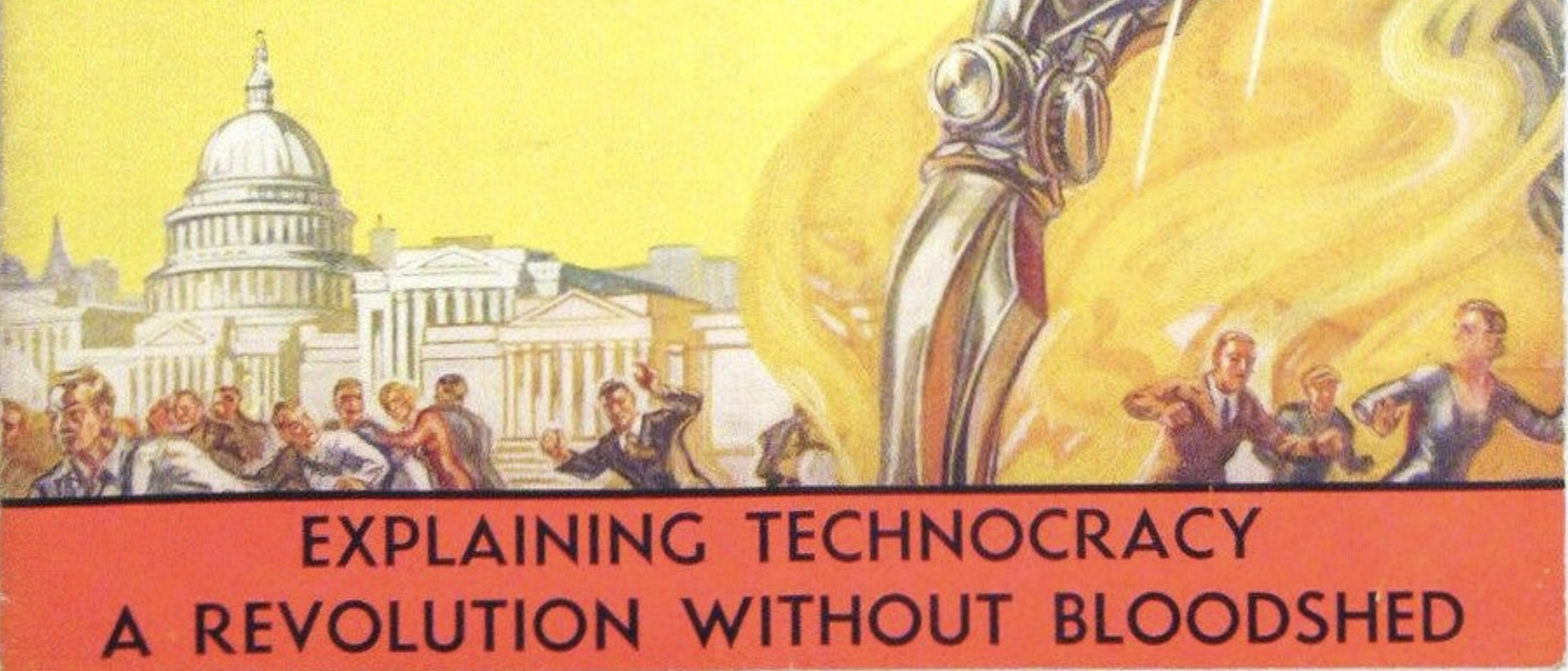

–in an eery image of the disgruntled white male workers that is a seventy six year old image of January 6 riots in the rear window of a panic at a feared change in American economic security, used as the cover of a 1933 issue of a magazine of the political party that adopted the map that is the header to this post.
The map offered a new image of the post-nation-state they wanted to inspire trust as a more rational order than the United States to promote the increased economic security of Americans and Canadians in a time of fluctuating global financial markets, where economic integrity of expanded frontiers offered for many a far more trusted stable solution than the nation-state–including Elon Musk’s grandfather and father-figure, the Canadian chiropractor turned political entrepreneur, Joshua Haldeman, father of Maye Musk, Elon’s mother, and leader of a small separatist Canadian political land reform party animated by rational ideas of scientific management in Saskatchewan, before that party of land reform was officially banned and proscribed, as a new image of global power and security that would be designed on purely rational grounds with clear borders.

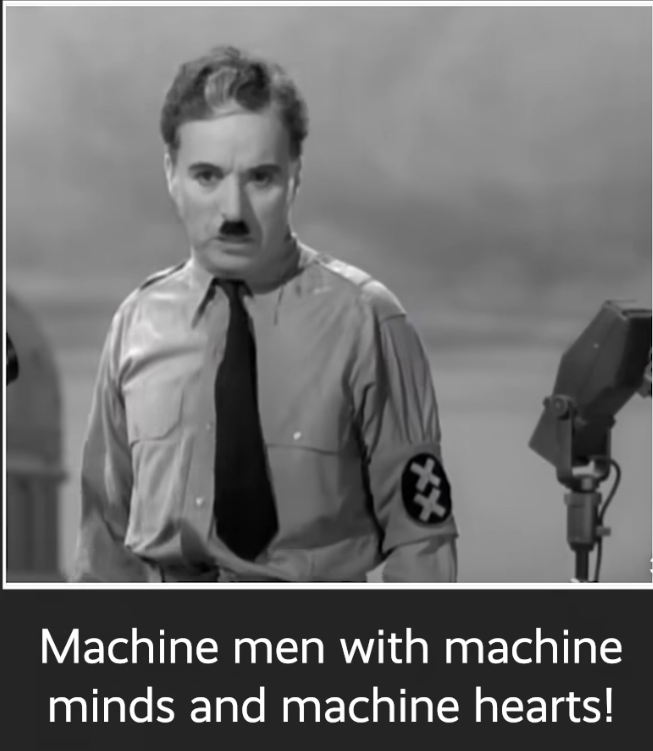
Rather than the insular notion of the nation, the Technate promised a new mapping of nation-state as an economic entity by rational lines of energy production and consumption, fit for globalization, a sturdy island in the currents of global financial markets, an anti-map of a globalized world. The image of a rationally designed state was decried, of course, famously, in the United States, when the first speaking film of Charlie Chaplin, born but within four days of Adolf Hitler, in 1940 decried the paradox that for all its promises, “machinery which has promised us abundance has left us with want,” casting the costs of government of machine-men for humanity as huge, eerily contemporary to the Technate of America. For in decrying the danger of rule by “machine-men with machine minds and machine hearts” who create and benefit from national borders and fixed frontiers, the character Chaplin played took his own voice, held in technological check in earlier films, to pose before a microphone to broadcast his indignation at the division of national boundaries as barriers.


If the rationalized map of the Technate was seen as a possible precedent for Elon Musk’s outsized curtailing of the global ties of obligation to the less developed world after Trump hired Musk as a “special government employee” and a witness of his signing of Executive Orders, able to terminate the U.S. Agency for International Development, Consumer Financial Protection Bureau, and many other governmental agencies, granting him full access to data to usually cordoned areas as the Treasury Dept., Housing and Urban Development, Social Security, promising full transparency. The Technate cannot be understood as analogous to the Cold War or the intense economic fears of the Depression era it was born; the Technate is now understood as mapping a logic of confrontation, creating a zero-tolerance policy to migration–or what the Trump team calls “amnesty” in pseudo-legal language of the past, but has no intention to–“There will never be amnesty under my watch or President Trump’s watch,” flatly declares Attorney General Pam Biondi,–echoing a simulacrum of the language of the law, prioritizing economic interests over civil rights or human rights law.
The boundaries that America asserts seem to claim control over a status quo of the economic well-being of the nation that can exist outside of and apart from international law or economic divides. The divides of nations are rationalized in a language of confrontation, a hard-line business style negotiation based on the cold reality of financial interest and “rational” expectations, as if all foreign aid in the past was corrupt, exploitative, and taking advantage of America’s tax payers.
The elimination of the $50BN of funding dispersed to 150 other countries renders obsolescent a role model for a massive restructuring public financing in the United States,–as much as providing a stimulus to private investment to make up the global shortfall, about to hit countries receiving aid to combat maternal health, mortality, and walls to mitigate viral spread. The massive rise of aid from the United States to decrease disease levels and mortality rates in Africa, Asia, the Middle East and Columbia offers a recent image of globalism that Trump 2.0 actively seeks to erode, ending the practices of providing assistance at a cost to tax payers that no longer privileges national interests as undue and outside the vision of governmental efficiency Trump will seek to promote. Rather than projects of earth observation, we are increasingly dedicated to looking out for ourselves.

Countries Receiving Greatest Foreign Assistance from United States, 2023/Visual Capitalist
This is the map to which the long-forgotten map of The Technate, an economic powerhouse isolated from the rest of the world’s finances, might be compared. The arrival of international aid, as much as to soothe a guilty conscious lost that the economic imbalances of globalization had once provoked, was a response to the immense imbalances in access to health care, food supplies, and a healthy environment, and environmental crisis responses endemic to global imbalances of wealth.
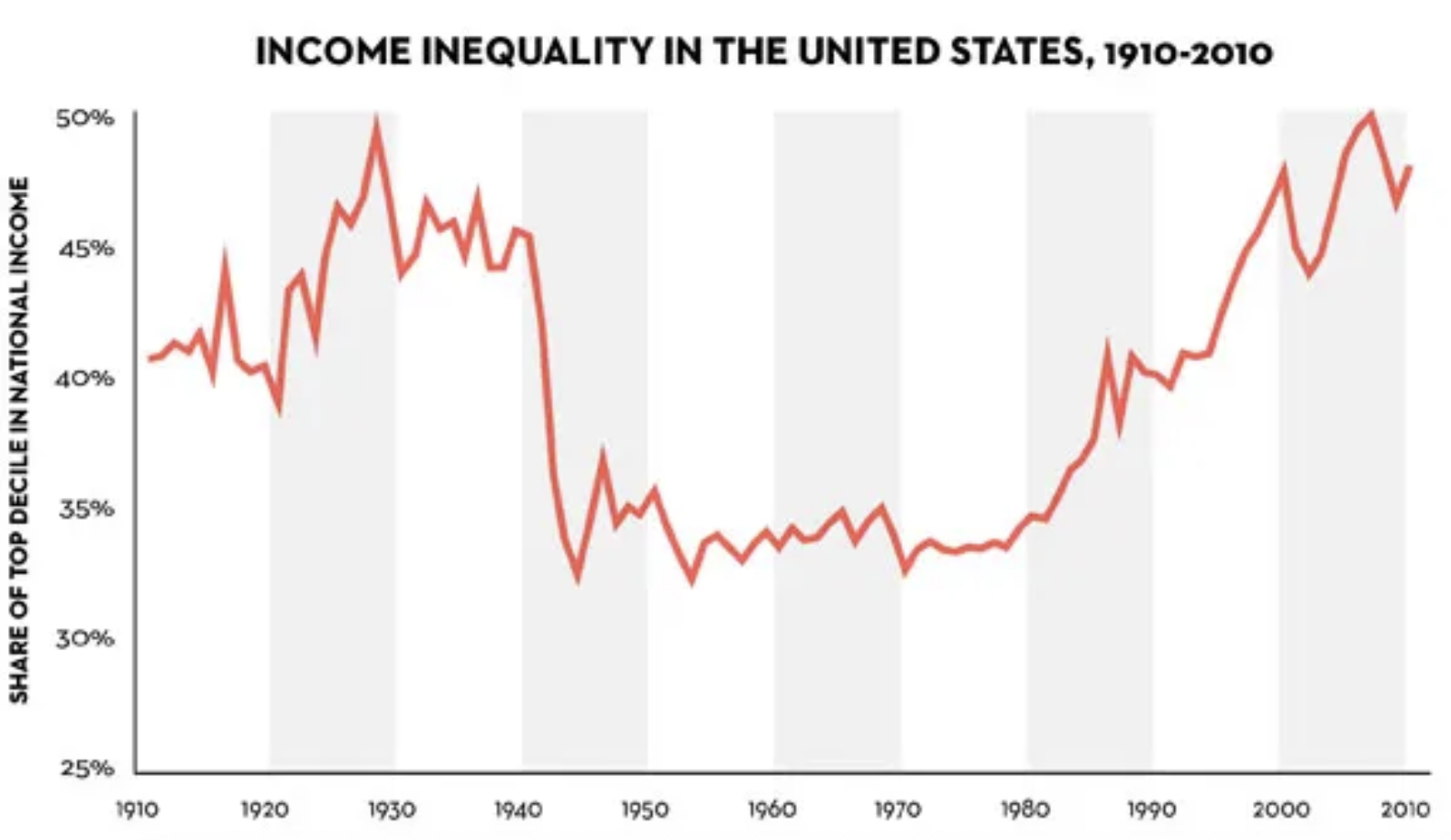
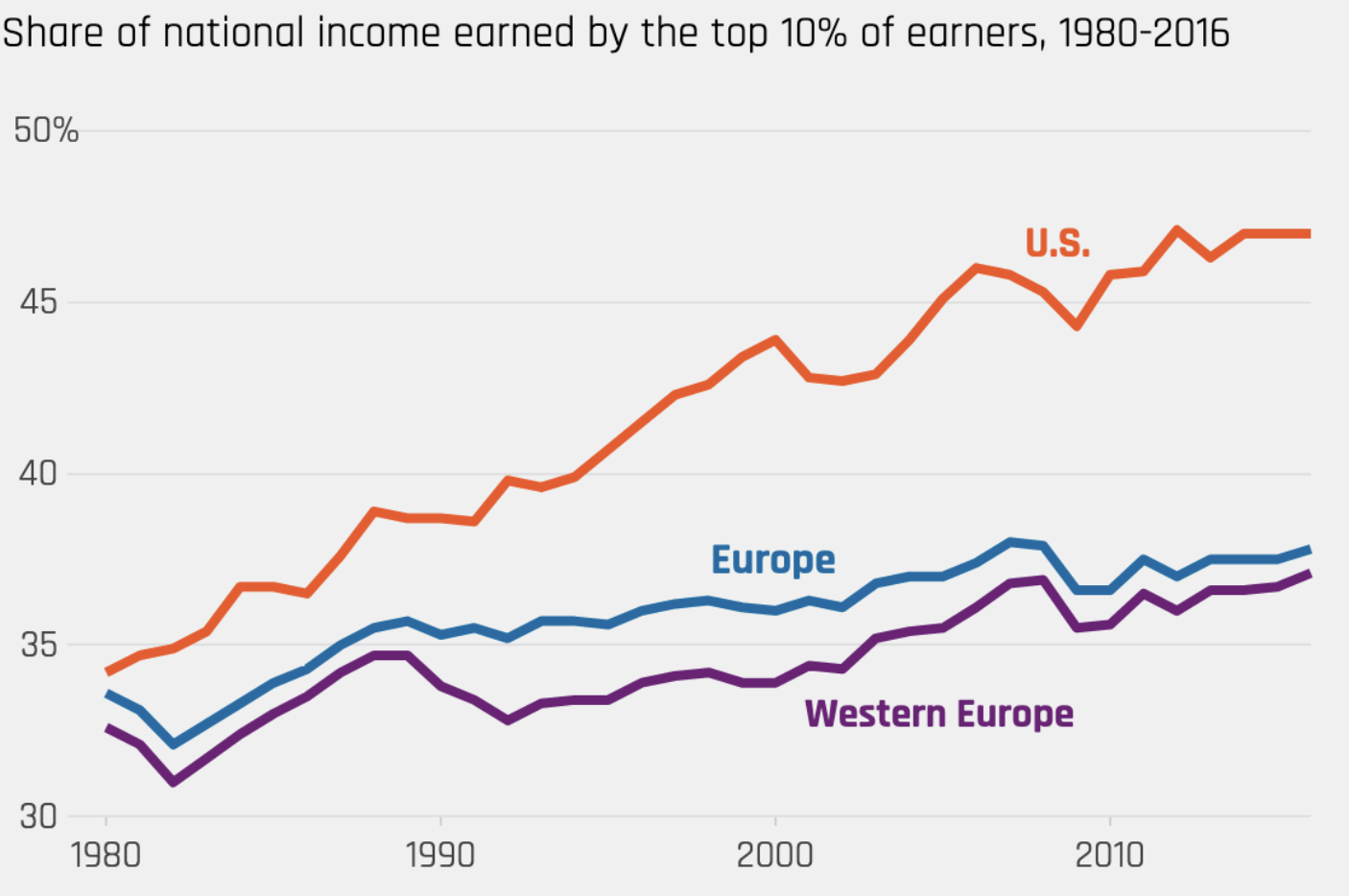
The ever-increasing concentration of wealth in the United States by 2010 alone had reached heights of the Great Depression, creating a desire both for distancing of the poorer nations of the world, in a not so surprising twist on globalization, where the poorer nations would not only take the greater brunt of climate change and ecological disasters, temperature swings, and food shortages, but the United States voted to subtract itself from offering foreign aid, distancing itself from less developed nations and drawing up its borders–or refusing to share its greater wealth. If American food like corn was once produced to be sold to countries in threat of food shortages, and without markets for abundant supplies of corn, the American government has long subsidized famers to feed the world. No longer. If the purchases of corn and other grains has allowed a redistribution of American wealth to fit within projects of global aid, such a redistribution is deemed excessive and not obeying the market values that we seem destined to return.
The implosion of a delicate balance of the globalization of the economy bore fruit few foresaw in the nationwide crackdown on immigrants, cast as unwanted invaders, demanding to cut global ties and offers or opportunities of asylum in America, that has increasingly retreated to an expanded homeland, a geographic imaginary rooted not in the Enlightenment,–a geographic imaginary with perhaps unsurprising roots in the global isolationism born amidst heightening wealth inequalities between the World Wars in North Americas. It promised concentrating and retaining wealth in an expanded North America of defensible natural bounds, as shown in the header to this post, that proposed the expanded greater North America as a Technate–not a nation, but a rationally ordered economic space–as a necessity for economic and political survival in a newly globalized world, as the Universal Mercator Projection was organized. The Technate was compelling as a competing alternative vision for globalization, and its symbolic form mirrors fits the paradoxically competing alternative images of globalization of Trump 2.0.
The implosion of a delicate balance of globalization of economy have led to an increased tacit competition between alternative ideas of globalization. It was an alternative map, privileging a super-nation’s defensible boundaries over the northern hemisphere, as a model for rationally mapping the future of the nation state that perversely appeared quite compelling to many as a choice for the future of the nation-state during the 1930s and 1940s in both western Canada and across the United States, which Musk’s grandfather had so strenuously advocated to poor farmers in Saskatchewan who were no longer able to get good prices for their grain on global markets, before Canada had joined the war effort, in a movement of social reform. Inability to gain control over the uncertainty of financial flows in the Depression may seem to have little to do with an age of relative affluence, but provoked panic of modern America–an. alternative utopia provoked out-of-the-box thinking to staunch the global spread of communism, then an alternative global specter.
Interestingly, the chromograph of stark red recalls in formal terms nothing so much as the similarly propagandistic map of the spread of Communist power created by the English Army’s Bureau of Current Affairs, set up in 1940 to provide a public education materials of current events for a postwar public, whose monochrome overlay used a global map at the height of the Cold War to capitalize on global fears by recoloring a stylized Mercator projection not in the four-color style of Rand McNally, but in a fear of the growing number of countries where the Communist Party forms part of government–denoting as it does in immediately recognizable manner the new stakes of global power by revealing the “real” boundaries of power at the height of the McCarthy era, in 1951, in arresting if synoptic fashion, mapping global power in ways easily able to he feared at a glance:

Communism: Its Status Throughout the World, 1951
The same year, the battle lines were drawn very firmly on the ground in Singapore, appealing to staunch a red tide was “everybody’s job” using the sword of Democracy in a comic-book propaganda maps that only anticipates the future involvement in conflicts of the Vietnam War.

Newsweek famously suggested with greater sophistication to parse “World Communism Today,” charting variations in the “principle varieties of communism” in shades of red, as United States troops returned, suggesting North Vietnam, after the death of Ho Chi Minh, and a decreasing intensity of combat, was less of a clearly Russian or Chinese variety of communism–but a “neutral” communism, as if to clarify it wasn’t destined to undermine the global balance of geopolitical power in an instructive world map of red overlays, in its up-to-date “map-of-the-month”!

Varieties of World Communism, September 1969
In inhabiting a modern Technate, we ignore immense global inequalities–now far off Gini’s original index. The crisp defensible borders imagined of The Technate were of course never to be had. But the image of such a clear bordering of the world appears to have been very much on the table in the early months of Trump 2.0, as the energy of a new administration that imagined itself able to redraw the world map as a projection of Presidential narcissism saw that red overlay not as about politics at all, but as about claiming the new global role of the United States that was imagined to be able to be built at the southern border, and redefine America’s relation to the world in quite unsubtle ways. Encouraged by the maps of suprematist global imaginary that Donald Trump has conjured out of thin air, in claiming extraterritorial waters, threatening to drop fourteen bunker-busters on any nuclear enrichment centers in Iran as a way to show American power to strike any place in the earth with extreme precision–targeting the now closed tunnels to Fordo that have been closed in previous years from old earth satellite footage, as they cut programs of foreign assistance in a parallel dramatic illustration of global power as well as global detachment. (While Washington insists the bombs inflicted lasting damage on their nuclear program, they suppress questions about the claim makes his bombast laughable if it weren’t so obtuse.)
DOGE projected claims of global supremacy that are illusory, but offer an opacity able to obscure maps of need or wealth imbalance. Rooted in a strand of isolationist thought formative to MAGA as a project, the hypertrophic concentration and distorted expansion of the homeland, a unit that has substituted for the nation rooted in a body of laws, is dangerously able to warp both domestic politics and disables focus on a tightly interconnected and increasingly interdependent world. The conflation of the foreign and domestic that is central to the distorting lenses that animate “Homeland Security” and “Immigration and Customs Enforcement” are rooted in a purblind expansion of the homeland in our political consciousness, leaving us purblind to the costs of living in a globalized world.
Are we not living amidst a willful massive remapping of international relations, global currency flows, and military balances of power, as European nations are succumbing to the demand to spend on military budgets even if this may undermine the social safety nets and security at at time of relative political instability and anti-immigrant far right movements. At a time of increased global migration often under pressures of economic and political instability, despite a perception of wealth, the notion of American exceptionalism is preserved in cultivating an idea of wealth as a choice–as if it were a choice Americans were entitled–that were presented in the twin figures of amassing personal financial wealth in response to anxieties of undocumented migration, and increased ICE raids on the presence of immigrants in a nation where 75% of the county agencies cooperate fully with ICE demands–while many refused to cooperate with the agency in Trump 1.0.
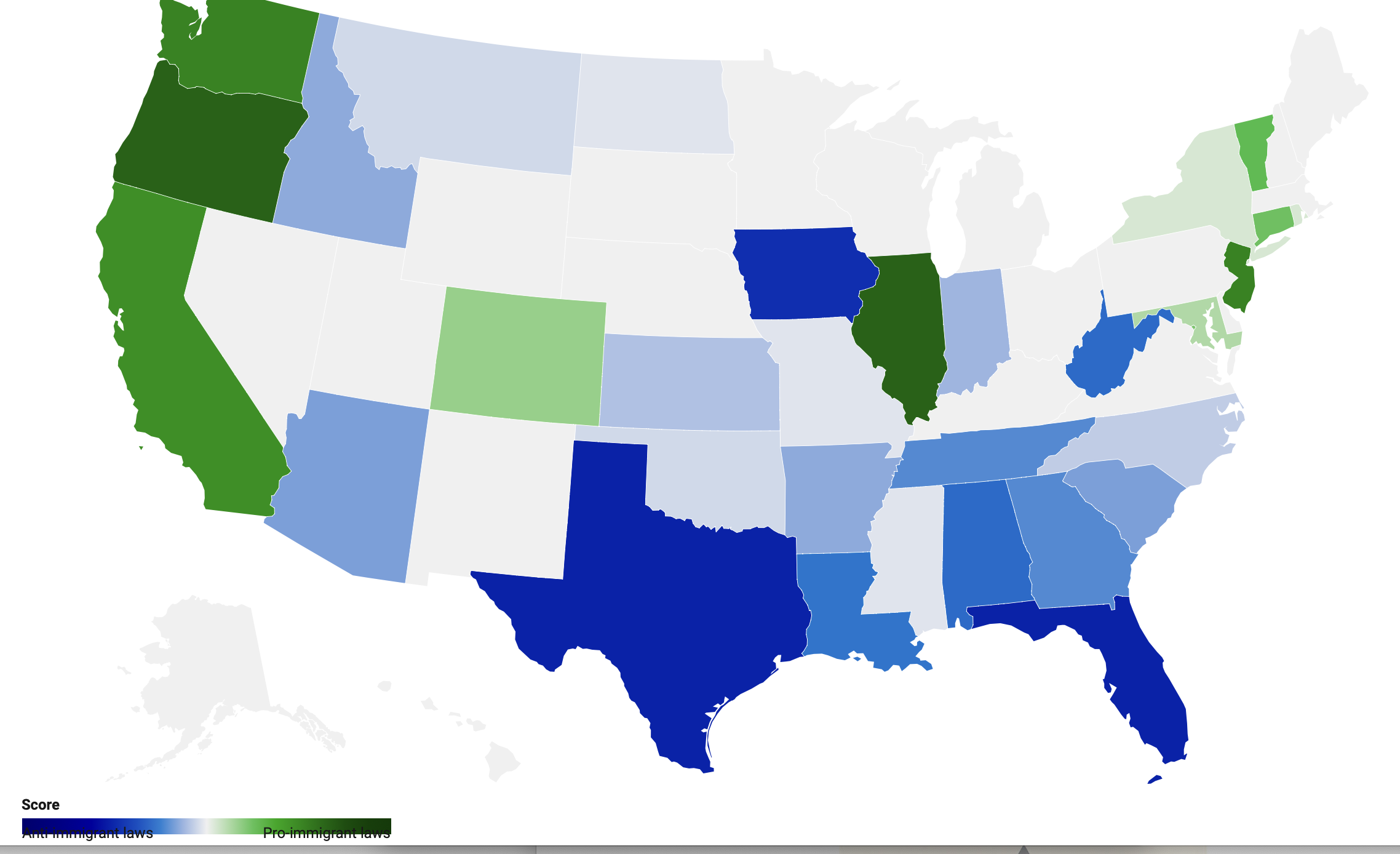
Can one better map the rise of DOGE as a verb, examining the policies of the agency less as an institution, but as a verb that worked to actively reshape the nation, as much as the lives of federal workers? To do so, we might look beyond the practices of Washington into how they map onto. global imaginary, or are rooted in one, removed from the nation, that promises to remap America’s relation to the world. The destruction of norms of governance that DOGE came to connote inspired urgency in appeals to “Stop DOGE now!”–of responding to politically motivated mass-dismissals. DOGE was less about streamlining or clarifying in the name of efficiency when seen as a verb–but, embarrassingly if decisively, of worsening everything. If the upbeat acronym of the dependability of the new governmental agency of 2025 had first presented itself as a noun, the mystique of its para-governmental presence in the hidden architecture of Trump’s White House is a verb over which we must strain to keep a close eye. Doge once had signified an elected office of a chief magistrate, entrusted to run a republic, and a republic (Venice) long seen as a basis for the constitution of the United States; the coinage masked the non elected nature of DOGE as able to be entrusted to a technical visionary, but claimed the trust of Americans, embodied in the greater efficiency the agency was hoped to delivery by curtailing money in a bloated national budget, equipped with new powers to trim trillions after but weeks of intense focussed work, to unmask the incompetent mismanagement previous administrations tolerated.
Yet the verb reveals the scale of the deception. Musk is no longer in government, but we have yet to stop seeing Tesla as a punching bag for all that is wrong with Trump, and indeed evidence of his oligarchic tendencies. For the shift in continental thinking and expansionist ideology was promoted by the absorption of DOGE as a new vision of governmentality. With roots in Elon’s engineering smarts and perennial cultivation of the modern myth of the engineer, which, as a model of data management and surveillance, Musk’s engineering skills are sold as counterpart to the myth of Trump as a builder, key to the vision to secure the US-Mexico border by a wall, a mote, or a military firing squad back in 2016 and during his first presidency. The dream of re-engineering the nation began at the border wall, a delayed response to the destruction of the World Trade Center, that old symbol of American engineering, that seems to be replaced by the surveilling of the border, and construction of a border wall. But the verb that DOGE offers as well as still being a synecdoche for government downsizing is a remapping of America, integral to MAGA, engineering the border by new technologies to claw back economic wealth the nation–and, at least ostensibly, all Americans, as tools and technologies of distilling governance to data liquidates institutions of education, curricula, history, and humanities programs, with a premium placed on efficient design.
The eager Muskrats who made up the DOGE team adopted an exultant tone dismissal to echo the meme Donald J. Trump adopted as an angrily dismissive retort–“You’re fired!”–is echoed in the rebuke, ‘you’ve been DOGEd!’ The exclamation point allegedly celebrates a curtailing of wasteful spending, but as language ahifts with increased rapidity, has mutated to reflect the desperation of the nation, capturing the absence of managerial incompetence from vetting–verbal uses Max Mckeown offers as if an alternate OED, from “to ruin, cheapen, or vandalize through theft, cutbacks or neglect.” Variants capture the role of this new-founded agency of unclear mission into common parlance. In toeholds of sanity lest we inevitably sink deeper into an epistemic muck of the new government, the language of what we call governance gone astray spans a gamut that suggest our current desperation: “1. ‘Doge it up’ – Mess it up, make it tacky. ‘Doge Chainsawed’ – Cut corners so much that it’s ruined. E.g., ‘This renovation was doge chainsawed down until it collapsed.; 3. ‘Doge out’ – Strip away too much, leaving it bare and lifeless. E.g., ‘They doged out all the good parts of the old building.’ 4. ‘Doge over’ – Cover something in a sloppy, illegal or makeshift way. E.g., ‘They just doged over the cracks with a quick coat of paint.‘ 5. ‘Doge through’– Rush through something, making it worse in the process. E.g., ‘The repairs were doged through—nothing actually got fixed properly.‘”
The extra-governmental penumbra that efficiency has cast reveal not incompetent management, but an emptying of government, a destruction of public funds and organizations that have cascaded into daily life: from being unjustly fired from the federal government to advance a political agenda, the effects that send shudders of neoliberalism ripple through society. Their distance of “efficiency” offer cold comfort as we wrestle discomfort at the memes with which we have been linguistically saddled by the second Trump administration. For DOGE may seem less a verb than a virus as pernicious as we may be soon forced to recall the coronavirus or measles remain,–especially when one is without vaccines to either. The inevitable cascading of “DOGE” as a verb outside government seems terrifyingly modeled by the agency as we in the Bay Area anticipate with terror the cuts not only to universities and public health, but to non-profits that are forced to let go of their missions and teams, and the dismantling of foundations from Bill Gates as it downsizes in preparation to close shop in twenty-five years to George Soros’ humanitarian Open Society Institute–closing dozens of offices in Africa, and laying off staff immediately from its a $25 Bn empire. We are forced to contemplate a world where neither will exist, and the reduction of all to cost-benefit reduced governing to a performance, which reminds us how well Donald Trump defined himself as a performer on a global stage, as a workup into politics. The expansion of such “efficiency” is echoed in the cascading pressures and commitments that fall on non-profits, now pressed to do more and more to make up for a lack of public governance, but to do so with far fewer funds, creating a great scissors whose effects will be strongly felt in the Bay Area and world.
Neither institution could compensate for the shock of the sudden and cruel draining of funding from humanitarian and cultural projects trimmed by the Muskrats of DOGE under the broad banner of efficiency. DOGE is not only providing a model for eliminating programs that were assumed allied with the mission statement of government: in modeling the the scale of imprudent cuts of government, we judge cuts to public health, housing, and transit–FOX news explains–by tallying their financial failure, or leeching of tax-payer monies, as if they were profit-making ventures, and not fill social needs. The demonization of any hope of redistributing taxes in public monies was first marked up to fraud and crookedness, as if a failure of accountability demanded social and cultural programs to be dismantled so that they might be restructured without DEI initiatives. But they are unlikely to return. Much as a few memes have almost miasmatically been able to paralyze the nation into fear and incomprehensions, we hav lost abilities to understand the erosion of legal norms or macroeconomics, purblind by a management styles encouraging blindness, that lack guts and are rooted in acceptance of willful dogma that are increasingly inescapably cruel. Our society has been DOGEd, as we reduce people to numbers, public agencies to costs, imagine nonprofits as businesses and acquiesce to the impending elimination of publicly funded projects.
The seismic scale of the downstream effects of such purposive excision of public monies and end of funds is hard to contemplate, as the verb DOGE has compromised our daily lives, not to mention the health care system, educational opportunities, and climate science initiatives. Absent funding bodes a terrifying deterioration of public life, a libertarian vision emptying of all connective tissue–and jobs–from the public sphere. As billionaires seem to be abandoning humanity, embracing artificial intelligence and demolishing the government not only as a vision of Silicon Valley, but from within government itself, neoliberalism recedes into the distance as the old normal, and innovation, growth and discovery are prioritized above what we eve new as a nation state. But we have been badly Dodged indeed–dogged by DoGE, as it were, and dog-dead tired, contemplating the end of civil service or public life in an increasingly profit-driven vision of the nation, increasingly removed from laws.
The final initial of Efficiency might be better understood as a new age of empire, rooted in corporate prioritization of tech tools over the legal tools, rewiring government to prioritize digital surveillance by the melding of large databanks to modernize how government functions, augmenting Trump’s promise to run government like a business–perhaps driving the nation into bankruptcy, as Trump drove his businesses into bankruptcy–by remapping global ties for pure profit, in an imperial unspooling of governance by law, and the replacing of government with digital tools of enhanced security, and the imminent end of the Republic–that we might map as if it sprung from the surveillance tools amassed on the southern border, the most persistently surveilled area of the world, amassing commercial surveillance technologies from ground sensors to video feeds to thermal imaging to range finders to aerostats to drones, promising protection of the homeland “effectively and efficiently”–a formative vision of what efficiency in government is.

The partially obscured view of the world that the disembodied digital numbers of DOGE focus on is premised on a promise of rationality–one that replaces the concepts of law, rights, and good governance for promises of enhanced rationality. For the focus on numbers that DOGE focuses on is a partial picture of data that obscures the globe. As we elevate its governmental role, we remain at risk to no longer be able to see, in part because it reduces and distort the globe removed form a map, and privileges metrics of data alone. If we understand the full extent to which DOGE has gained traction as a verb, we must begin from his models of data driven democracy obscure the very heightened inequalities of wealth that its mission may be to help normalize. For we’ve all been very badly Dodged up, we are only coming fully to realize or apprehen its consequences.
We may be so blinded by the fools’ gold Donald Trump and Elon Musk embody to obscure their roles as a tag team promoting a new governmental paradigm or historical age to not see the startling wealth inequality it inaugurates and seems to normalize and preserve, by emptying out graduated income tax, and placing a premium on the tariffs imposed on other countries. Pronounced cuts in taxes and absence of government oversight of the economy seem inevitably to portend a rising wealth inequality across the nation, as the nation’s laws and social services are hollowed out, and oversight over public lands dramatically shrink. Global income inequality did shrink after World War II; but far more of those benefitting from rising incomes lie outside the United States in past decades. The rise of tariffs that will mean higher prices for consumers offers a regressive taxation policy of which they will bear the brunt, the costs were erased by the overly optimistic promise of security and efficiency of a government that would be run “like a business”–whatever that means, given that government and business are in fact two rather separate, if not always exclusive, realms: government doesn’t control the market, but modulates it and provides it with rules to exist. The semantic trickle-down of how DOGE empties regulatory bodies, as well as regulators, devaluing their expertise and indices of pollution, asserts oversight over the Environmental Protection Agency (EPA), Federal Energy Regulatory Commission, Bureau of Safety and Environmental Enforcement, Bureau of Land Management, and Bureau of Ocean Energy Management, and Army Corps of Engineers–ending the role of expert oversight that is cast as obstructions to government.
The traction of Donald Trump’s specious claim to keep wealth in the nation’s boundaries has gained traction in an age of globalization as a border wall became a cogent metaphor to preserve stark income inequalities between the United States and Mexico, whether its physical construction might be worth the money or obstruct border crossing–create a way to concentrating capital again in America in the MAGA platform. Indeed, if Trump is a name that has long connoted the promise of wealth, the “Again” suggests wealth, as if the promise of personal enrichment is the basis–or substitute–for a meaningful political platform. As if to normalize growing wealth inequalities on a global scale, “Trump”–the brand he has made from his family name, not only the individual–is a designator offers blinders to the heightened wealth inequalities of not only America but the world. We convert the wealth inequality at the southwestern border by a wall or military installation, even as income inequality declines in Mexico and grows in the United States. The border becomes essentialized in ethnonationalist terms as a line of difference, casting irregular migration as a national “invasion” — to shift a war on criminality and the war on drugs to the southern border and project fears of socio-economic decline to the need to guard the border to protect national security.
This narrative deepens obscures even as it foregrounds what was a historic contrast in indexes of human development in the localities of the southwestern border, and the specter of migrant crime brought across the borderline by “bad hombres,” may keep wealth north of the border or hold at bay demographic shifts in a nation that long lost its historically Puritan Protestant identity where all of claiming European descent are destined to be a minority in a generation, the meme “MAGA” can omit a concluding tacit “or else.” With almost 80% of Americans are convinced the state of the US- Mexican border of major national consequence (77%), Donald Trump’s advocacy of technocratic tools at new agencies as the Dept. of Homeland Security, Immigration and Customs Enforcement, and Border Security to “combat transnational crime” erases all broader geopolitical context, even as websites provide links “how to self-deport’–“Leaving the United States when you are legally present“–as if it is a personal problem they are happy to offer some helpful tips in the guise of advice.
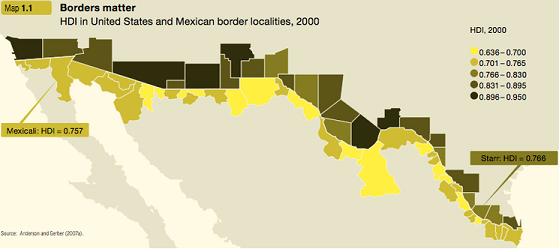
Human Development Index along US-Mexico Border, 2020
Yet we can hardly neglect the hemispheric context in which the United States has worked to staunch migration, and which the acceleration of deportation flights south of the border seek to expedite. For Trump’s Washington, and indeed other American Presidencies, have provided legal, economic and political pressure to military a “third border” of the United States, lying over 1800 miles from the actual southern border, in Mexico, as Thomas Cattin has helpfully mapped, showing the presence of a “border” against pressures of globalization far from the southern border, where forces other than American soldiers and national guard are policing the passage of undocumented migrants from South America, other regions of Central America, South America, who we prefer not to map in viewing the “southern border” as if its were a problem domestic to the United States. This is not a border we see in the contracted globe of the Trump Regime, that imagines the United States as deserving to isolate itself from the pressure of a globalized world, which many imagine to be the real viable political choice for the American politics. The apparatus of detaining and detecting migrants that implemented far to the south as if a first line of defense had remained concealed, by creating the illusory bulwark of a National Defense Area located along the borderland.
The expansion of the enforcement of a fourth border has created steep human costs, only able to be imagined in impoverished symbology, as increasing numbers of migrants are confined, confronted with legal and police roadblocks, and obstacles, and indeed forced to prolong their northward migration away from economic or political dangers, that allows us to bracket their existence–and indeed bracket lives dependent on USAID against diseases, for food, for maternal health, and childcare–and allow us to focus on the domestic economics to blind us to ethical questions of the imbalances of wealth globalization created. Offering a map of the thousands of the Mexican National Guardsmen deployed to prevent illegal migration and drug trafficking from Guatemala, as applications for refugee status rise to flee political persecution, violence, and fears of economic collapse, that remain imminent economic pressures, confronting a third border, far from he border, that can be mapped by roadblocks marked below by crescents along routes traveling north, migrant detention centers at by red circles with capacity from three hundred to a thousand, to handle rising applications for refugee status, facing a problem that we obstinately and intently mismap in purely domestic national terms. Although we have pushed the security perimeter from the US-Mexico border far from the actual border–often by bilateral agreements and negotiations, in hopes to staunch migration flows–

–we have blackboxes the nature of cross-border migration as if it were a domestic problem we have not adequately governed, and has been ignored as we were played for suckers in ways that Donald Trump can resolve in providing a new architecture of the state. But the “new” architecture is hardly new, we might note, and has not only been around for a long time, but it was preserved in mythologies of a nation that is terrorized by inhuman enemies, or, in science fiction traditions, by aliens from outer space, who we must use our smarts and rational techniques to come to terms with, offering the new tools of digital computing and economic expertise to manage lest they get out of control, and harm wealthier white men.
In an outsized promise to staunch a shift of wealth outside America’s borders, Donald Trump memorably entered American politics descending a golden escalator promising to remap American greatness–and used the reification of mapped boundaries as an eternal nation not the product of provident design, but rooted in rational planning and social design as a builder. From the perspective of intense wealth inequality, Trump pronounced on the need to rebuild the boundaries and border of America–in a figure that almost inexorably led to the recent militarization of our southern border, and created the illusion of utmost power based on the illusion of impending scarcity and disempowerment that were incarnated in fears of unruliness of the widespread economic panic that Technocracy movement had exploited during the Great Depression did not lessen fears of massive unemployment of 1931,–that appealed not only to many Americans, but to Elon Musk’s grandfather, the engineer Joshua Haldeman whose aviation daring Musk heroized from childhood–where he was long entertained by his grandfather’s relocation of his family to South Africa and his heroism in having been a proponent of a solution to alarmist fears of national collapse and economic ruin that seemed almost inevitable in the Great Depression,–especially to the farming communities in Saskatchewan where Haldeman established a successful practice as a chiropractor. The image of Technocracy offered a solution to the fears of powers overwhelming the very projects of national governance–and indeed insisted that the state was an outmoded form of association in an era that demanded new tools of rational management to confront. To be sure, the border was hardly in existence as a built structure when Trump descended the escalator–only a third obstructed by fencing, and of those three hundred and fifty four miles of pedestrian fencing, 18% of legacy design, and 82% with modern design, and a quarter of the three hundred miles of vehicle fencing of legacy design–


–in ways that helped the builder describe his best avenue into politics, after he had failed to gain the Reform Party nomination back in 2000, and seemed destined to be a footnote in political history who was compared, as it happens, to the founder of Technocracy, Howard Scott, whose alternative utopia of an unordered won success as a similar outside-the-box mode of political thinking distinct to America, Kevin Baker so creatively and suggestively observed back in April, 2000, as we awaited what seemed the results of a weird Presidential election, before we fully came to accept the notion of politicians as engineers. The border wall project seemed to elevate the problem of engineering to a viable political platform in 2016, as the engineering of the border was elevated into a panacea for domestic ills, and an emblem of international relations, promoting border security as if it were a question of domestic politics.
The desperate calls for a new engineering of the economy were present in the Great Depression, as fears of economic scarcity drew a large number of supporters to Technocracy, as if offered a new solution to problems of economic mismanagement at a time when most wondered how government had allowed the sudden drop of prices, loss of monies, and absence of work or ability to buy food for many in the world. The Technocrats did not offer actual solutions, but did a good job responding to the fears of industrial development: the specter of a steampunk version of the Tin Woodman of the 1939 musical fantasy film, Wizard of Oz, seemed in 1933 to embody the danger of industrial mechanization, as Technocrats advocated the urgency of remapping a future order of continental units and mega states. They claimed The Technate organized a superior economic unit on rational distribution of energy, not money,–offering a concept of “super-territoriality” that echoed German National Socialist ideas of Lebensraum, but offered a new notion of a nation to rebut engaging in global war. The mapping of benefits of offshore energy extraction in the Expanded Continental Shelf, a topic of an earlier post that would magnify the nation’s economic wealth by remaking what are considered international waters by the rest of the world, but have been declared, as the Gulf of America, part of the sovereign territory of the United States, provided a similar panacea able to solve the perceptions of the unfairness of declining economic prosperity–as if to ensure economic prosperity by “opening” or actually remapping new reserves of “national wealth,” or “unleash American energy” by suspending regulations to “foster liberty and innovation” in a laissez-faire oth unregulated market of energy extraction. (Both projects are included in the new senses of DOGE as a verb.)
The eager comic book art that helped Technocrats respond to the perils international finance and banking held in the desperate confusion of the Great Depression suggested a threat to government, and indeed to national prosperity. Rather than point to problems of the lack of government economic oversight, the robot-like threat of machines removing work from Americans anticipated the discursive place of border-crossing migrants Donald Trump imagined able to seize American jobs, increase criminality, sell illegal drugs, undermine social services that dehumanize their actual reasons of fleeing other counties and erased their biographies,–reducing migrants to data points or bar graphs whose collective outsized threat of increasing numbers is metaphorically evoked in the imagery of massive caravans, floods, or military invasion that was able to overwhelm the status quo.
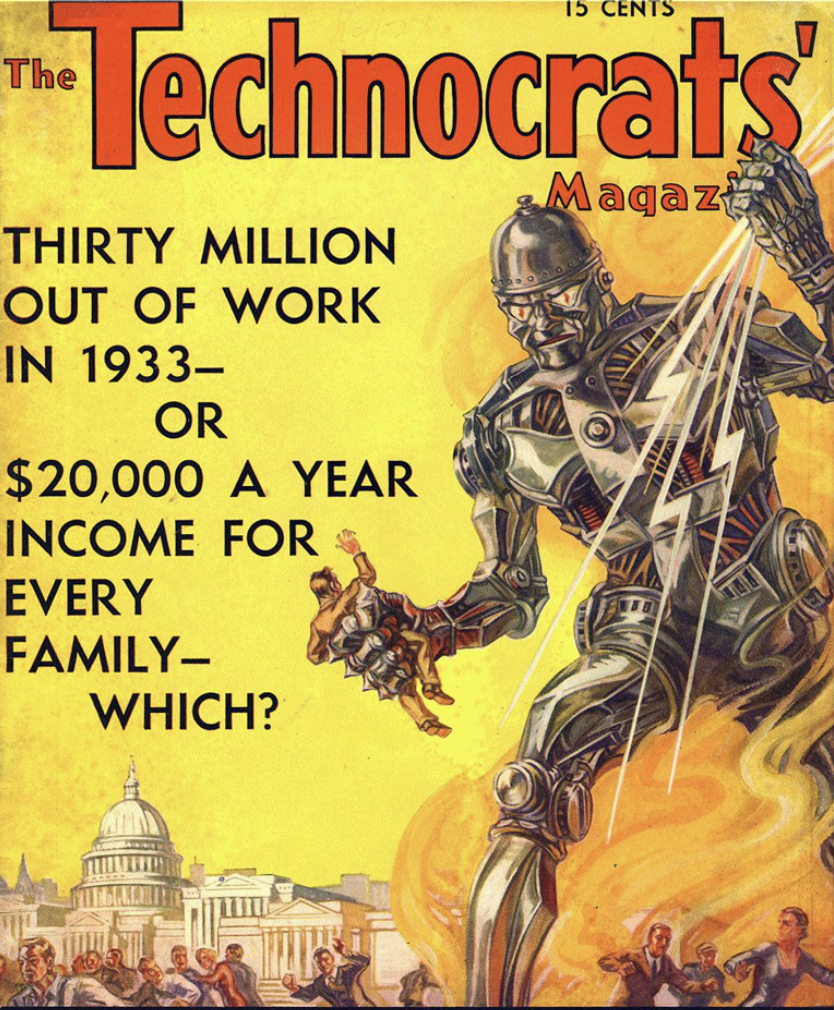
Technocracy, Inc. (1933), Norman Sanders/Minnesota Graphic Arts
–but detailed near-existential threats to good government–as global wealth inequalities allow Americans continue to cling to a sense of economic entitlement in a world of increasing inequality.
The resurgence of this myth in an age of increasing economic inequality for which the government demonizes migrants evoke a similar fear of ruin, but is promoted by the forces of a free market that lends a premium to Artificial Intelligence (AI) that places a premium on digital tools of geolocation. The Technocracy movement of rational management exploited increased fears of economic panic in 1933, resonating across the North American continent, building on a feared a loss of economic status, rebuilding of American identity was the banner of MAGA promoted in 20205, as Donald Trump incarnated a new image of America in the world by promising, in the pablum of tariffs, a new expansion of economic wealth and vitality. Trump was reaching to the stars to promote Brave New World with such people in it. (The flight of terrorized white men cowering before the dome of the U.S. Capitol building is hard not to see save in the rear view mirror of January 6 mobs who stormed the U.S. Capitol, in hopes to protect their fears of endangering nation from the onslaught of migration and false rumor that they believed about to be permitted by fraudulent tabulation of votes in the 2020 U.S. Presidential election, that removed Trump from the Presidency in 2020.)
The figure of rebuilding American identity was no more apparent in the foundational status of the wall–the border wall–in Trump’s political rhetoric. The cartographic redesign of the nation and its boundaries was a response to globalization, but also was a theme that underlay the hypertrophic focus of Donald Trump’s run for President on the border. In riffing on the border as an attribute of the nation, rather than its laws–and indeed in contrast to a society that was governed by laws. If tax evasion, legal delays, and nativism have long been pillars in Trump’s shifting politics, as well as a toxic masculinity, the fascism of the iconic infographic provided a way to distill the nation to a simple bar graph or distorting map of a tidal flood of invasion that he boasted the ability to control.
The metaphors that Trump had long invested illegal migration and the “open” nature of borders made these infographics even more appealing and essentialized, even if they were separated from any actual map, easilyinvested with near providential reality as visions of impending apocalypse. And when Donald Trump jokingly thanked a chart that was a constant centerpiece of his campaign of what he called illegal immigration for saving his life in Butler, PA,–an image that obscures the different or identity of migrants or cross-border transit into a problem of “illegal immigration” who very illegality the previous administration either just incompetently or complicitly ignored as a threat to our sovereign territoriality and our security and safety.

Trump was so deeply entranced by a persuasive infographic that he riffed on during rallies that his look up at the bar graph seems to have enabled him to have dodged what would most probably be a fatal bullet in a rally at Butler. The bar chart he animatedly admired was not much of a reflection of individuals, but aggregate data of which “Obama,” “Trump,” “Biden,” and “TRUMP” provide the points of inflection to read, as if they were the real protagonists of change. The inflections reflect the cherry picked data about “illegal immigrants” that were the core of Trump’s candidacy, as he expanded fantastic unbased claims record levels of deportation of migrants were entered America from the “humanitarian crisis” that invited more migrants to cross the southern border–after successfully demonizing immigrants for almost all of the election, he took to share a joke with Elon Musk that not only had the chart below had saved his life, but “illegal immigration saved my life”–as well as his political career, and the fortune he has continued to amass for his family.
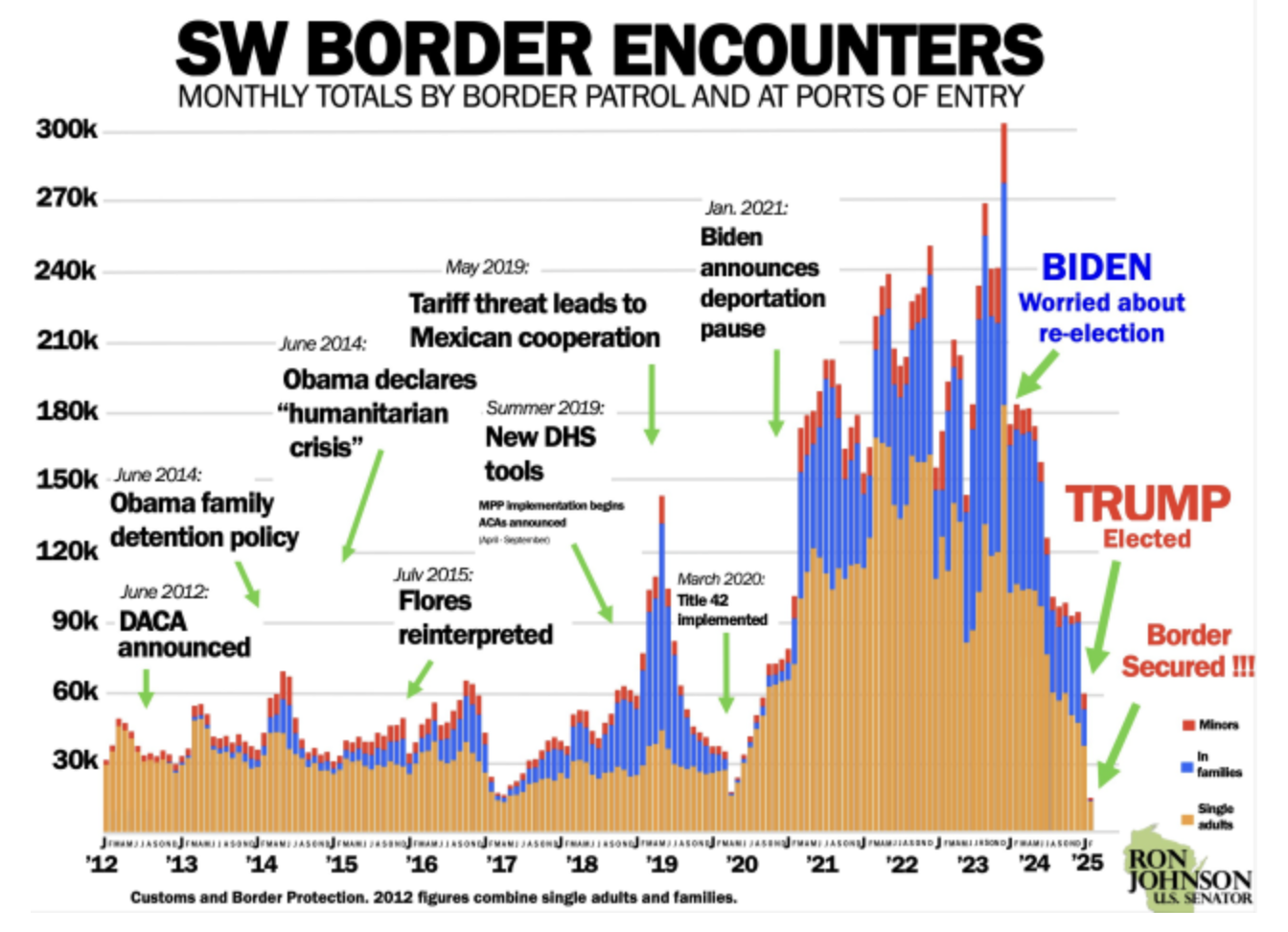
The bar graph suggested a stream of illegal migration that the fools in Washington, DC had so irresponsible tolerated and allowed, independent from a map. It is a distortion of government in the geostrategic hemispheric problem of monitoring mass migration, demanding to be placed beside by the more informative bar chart of Border Patrol Apprehensions at the US-Mexico Border, from 2019 to May, 2025, parsed by the actual origins of transnational migrants, mapping the problem of one border in a more hemispheric context that Trump rather willfully ignored.

It no doubt helped that the dogmatic persistence of the demonization of transformer migration at the US-Mexico border found continue to serve as a fearful haunting specter that became a mantra akin to the centerpiece of his claims to defend the nation if elected to a second term–and indeed led to his election.
The bars of migration were independent of a map, but can basically be understood not only in a map of global wealth inequality, but the power with which Trump terrorized the electorate by the conjuring a source of threats to the United States, using the bar chart to riff with evident pleasure in increasingly florid ways, lacking basis, to distract form an era of pronounced global instability and conflictfar outside the America’s much-transited border with Mexico, which remained a border of the greatest legal transit of wealth and humans. The specter of an annotated bar graph bolstered an idea of a “border crisis” that Trump promised he might resolve–as if it would save the United States from increased global instability that sent global refugees through the US-Mexico border–

–the apparent objectivity of the chart reduced complex questions toy arrows marking points of inflection, able to magnify his executive authority of a President in defining the nation’s borders in neon day-glow colors. The chart, which was not even a visualization, but acted as one, amplified the message of an escalation of doom–if the crisis was a conjuring trick. The colored chart justified the militarization of the border that Trump planned to be the hallmark of his defense of his nation in the second Presidency–a militarization of monumental proportions that has become if not the most militarized border in the world (the DMZ, border between Israel and Syria, or border of 1,800 mile border between India and Pakistan–the border were some 20,000 border agents are stationed has the highest number of legal border crossings in the world. The deceptive visualization of a “border crisis” might be better understood above the mounting expenditure on border patrol Trump called incompetently mismanaged by Joe Biden and Kamala Harris and in Washington, DC.

US Border Patrol Budget, FY 1990-2021/American Immigration Council
The devotion of billions of dollars to border enforcement is a soaring budget deficit of itself since the start of the concentrated border enforcement in 1994 called Operation Gatekeeper that offered a metaphor that Donald Trump has expanded as a major project of national investment, grew from what seemed the hypertrophic amount of $400,000,000 to a request to almost $26 billion by FY 2025 for Border Security and ICE. The ballooning budget is its own threat, of course, suppressed by the White House hby the fear of undocumented immigrants being terrorists or national security threats.
As much as Donald Trump transformed his candidacy as a politician by the project of building a wall, he would praise the bar chart that ostensibly detailed the shifting rates of crossing the southern border in his presidency and that of his successor, Joe Biden, for having saved his life. A deeper reason for Trump’s slippery use of the budget for ani-immigrant mega projects from wall-building to the military occupation of the border demands creative accounting indeed, and who better than Donald Trump to fudge the books, and bankrupt government by promises that will outweigh massively the financial resources demanded to be invested in them?







 Musings on Maps
Pingback: Appeals Court Blocks Trump's Wartime Law on Venezuelan Immigrants - Writ of Mandamus Lawyer in New York, New Jersey, Connecticut & Washington D.C.
Pingback: Judicial Review and Mandamus in California’s Fight Against Federal Immigration Overreach - Criminal Immigration Law Firm in New York, New Jersey
I think it speaks volumes that as Trump seeks to leave a global imprint he was denied in his first term, that he turned to a man like Musk, whose sense of global politics is so limited and skewed. This is a case of the inexpert leading the inexperienced, clamoring for authority with little priorities than their own self-aggrandizement.