
The Venetian Doge was indeed elected for life from the patrician class, but in the Republic of Venice her a non-elected office that was more symbolic in relation to the Senate, rather than ancillary to it. The absence of the definition of responsibilities of the Doge seems chosen by Musk with a wink and nod to history, despite the increasingly ceremonial figurehead position of the “leader”whose official ceremonial robes, peaked linen cap, and embroidered bonnet was hardly echoed by Musk’s T-shirt and jeans. Yet the targeting of the records of some forty branches of government by Musk, et al., including protection against cutting the congressionally mandated government budgets to reach his promised $2 trillion dollars in savings by immediate mandated budgetary cuts–a sixth to a quarter of the the $6.75 trillion spent in 2024–not touching Veteran Services, Social Security, National Defense, or Science–but putting Medicare and International Affairs on a chopping block, and cutting $54 billion from the former in 2026, and $500 billion from 2027 through 2034.
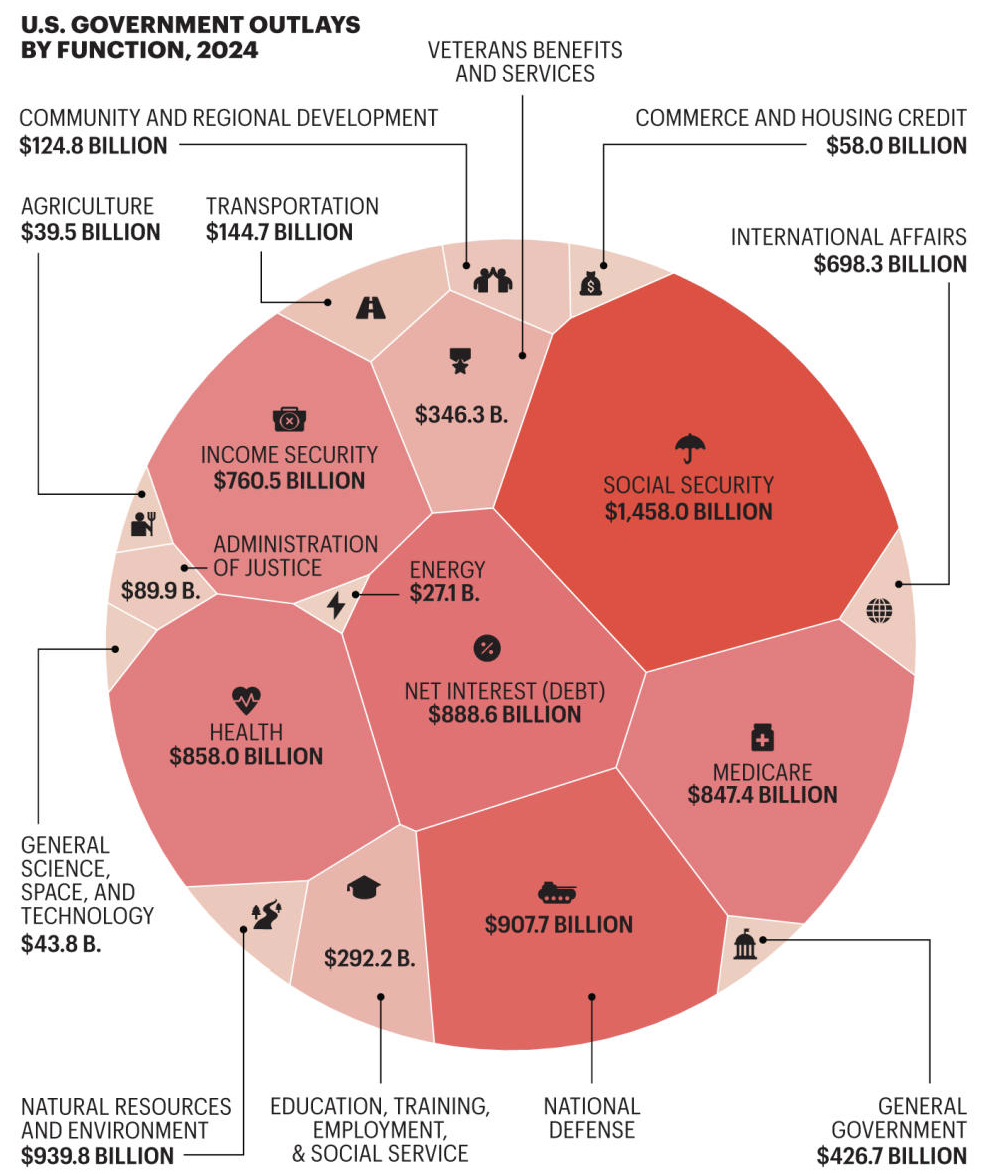
Global economic primacy may well be soon recognized as a mirage, but blowing up trust seems the number one goal of moving fast and breathing things. This hardly prevents economic primacy from being championed or alleged,–perhaps America may still be said to occupy a central place on a global stage. But it is increasingly stage-managed more than experienced as more than a Reality TV show. To prop up that illusion, and to make people accept its credible, we have to traffic in a wide range of myths, illusionistic feints, and braggadocio, as well as insistent grievances, or a very personal Trumpian perspective of the world that might be called a patriotic pornography or gore.
The distancing of government from laws or legal precedents traffics in a logic of nationalism that is freed from any sense of self-consciousness in global norms. The arrogance of Trump’s demeanor was perhaps reborn after Trump survived his impeachment, but the alliances he built to claw back at political power attached him to a corporate agenda of which Trump seems more the mouthpiece, fueled as it may be by a laundry list of grievances rooted factions of the abolishment of “our borders,” the “decimated” economy most Americans face. The result is however a diminishment of our profile on a global stage where we are only taken advantage of: we overcame the lies you have heard about us in the past, but you should know we “were right about everything” and demand your utter trust in the future, predicting in 2024 the end of Medicare social security, health care, public education, and the economy–should his Democratic opponent win the American Presidency. The almost obscene gesture of caressing the flag suggested only he could to do the nation right by being able to “straighten out our country” not only from immigrants, but those trying “to take away your speech, take away your guns, take away your religion, take away your history, take away your future and ultimately take away your freedom,” promising to get rid of all in government who are “not people who love our country,” whose “scams, schemes, slanders, they’ve all been discredited, totally discredited.”
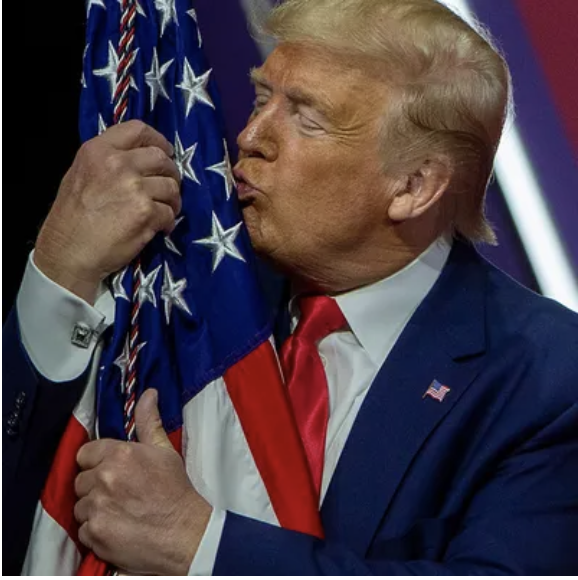
Trump Hugs American Flag at 47th Conservative Political Action Conference, 2020/Erik S. Lesser/EPA
The scarily sexualized theatricality of Trump cradling the flag of which he wears a pin prompted his patriotic declaration of intent to “straighten out our country” in coming years, to put his recent impeachment which he denied had legal status, but only discredited “scams, schemes, slanders” as if they had been “all discredited” in a court of public opinion, if not in a court of law. The most recent dismissal of legal criteria paved the way for Making America Great Again as a homeland, not a nation.
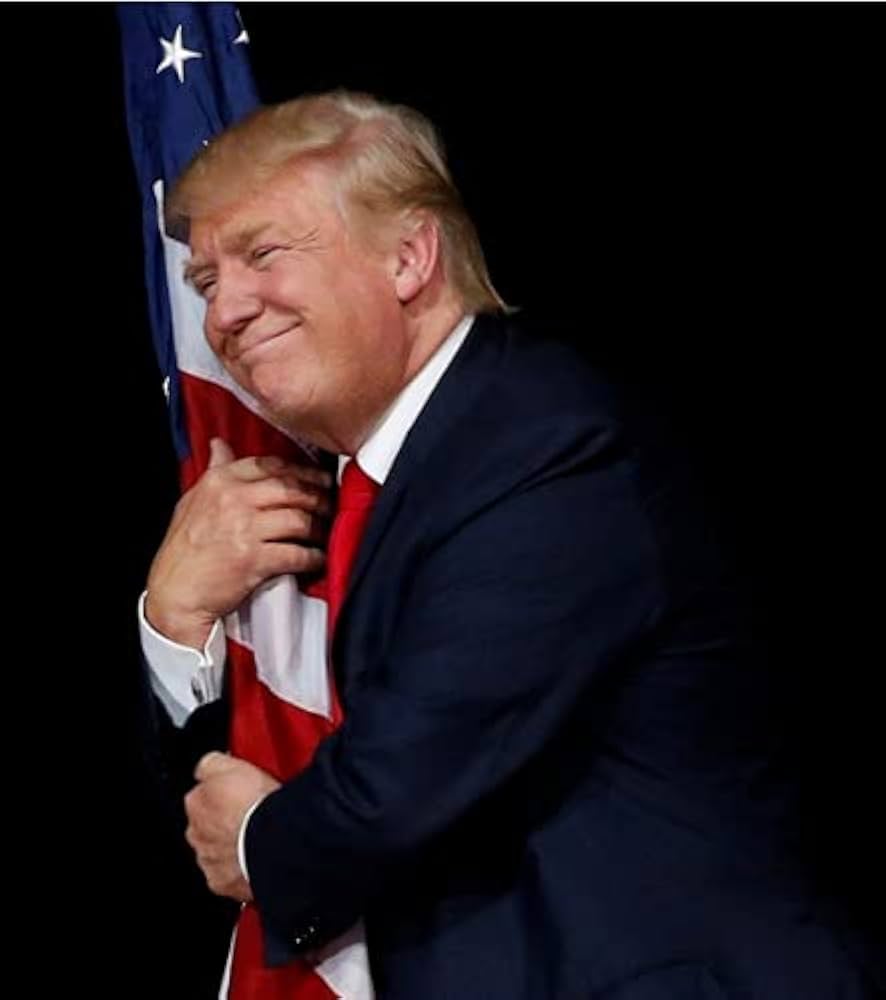
The Etch-A-Sketch Presidency gained traction within a partisan divide at the largest conservative gathering of the year, where he celebrated his sense of redemption by thanking God, in ways the later near-miss with the bullet of a lone assassin seemed to confirm as a new making of his political career, that led to the video on the eve of Iowa caucususes investing him with power to put America on a path to greater economic prosperity ordained by God, who named him caretaker–“God Gave us Trump,” that anointed him as ready to “fight the Marxists,” strong enough to wrestle the Deep State, and descend Trump Tower’s golden escalator. In a political map redefined by gerrymandering. and few mixed political preferences in electoral districts, the homogenizing of American voting habits served partisan ends. Algorithms have displaced voting preferences in a dark landscape looking for quick solutions, using surveillance technology that engineered partisan dominance in many states. This electoral map was, indeed, an Etch-A-Sketch, where large regions might be colored reliably red, and the “republican block” be counted on to deliver its votes–and mapped to ensure a political party’s grasp on representational power. This map was a new politics of purity, rooting what passed as politics in virtue signaling and purity tests, and the Etch-A-Sketch became a test of purity, the magic frame providing the right number of votes to ensure reliable election by and reinforced a narrowing of political debate, and the map that Donald Trump hugged as he grasped the flag at CPAC in 2024 as he had in 2020 to display of emotion and at the Republican Convention, that had itself reprised the embraces of 2018 and 2019 as if it was a pure and genuine impulse, in turn. a more stage-managed version of the less impulsive embrace of the flag after a robust defense of the border security in 2018 attacking the Democratic border policies as overly lax at the Federation of Independent Businesses Gala, having perfected the art of hugging of American flags as a trademark on the 2016 campaign trail that were a trademark of his town halls.
The performative embrace of kissing the flag compensates for familiarity with the Constitution save as an Etch-a-Sketch that can be rewritten, erased, contingent on continual legal reinterpretation to his own advantage. (If Etch-a-Sketch folks tried over a decade ago to position themselves in political debate at the same time as “maintain the classic drawing toy’s political neutrality” but stimulate our increased political exhaustion by launching “Shake It Up, America” that vaunted the Magic Screen as a basis to to exercise freedom of expression, promoting a new, rebranded blue Etch-A-Sketch® for registered Democrats and reserving the bright red ones for registered Republicans. The revision of demonstrators against ICE deportations as “foreign terrorist organizations” by the Dept. of Homeland Security seeks to deputize the military to police law and order, suppressing dissent by arresting protestors who have chafed under such sustained anti-immigrant attacks.

The shaking up of the Etch-A-Sketch of politics as usual promised a start-over that ended the terrible policies of the Democratic Party by shaking up the grey lines of politics as usual in what is acknowledging to the among the most memorable of toys of the twentieth century, but is rarely taken as an ontological statement. The drawing tool rehabilitated the purity of a line as a unit in an overly messy postwar world, where the Cold War that reinforced the belief one might divide the world by lines. The promise migrated in terms easily naturalized in rendering the world not by a free-line drawing, but a stylus able to move in vertical or horizontal directions by knobs at its base. Trump has used the classic toy to shake up political debate and American politics, but perhaps with less emphasis on the simplicity of drawing lines in but two directions. As if by grasping the nation by its grey areas of legal interpretation, lines have been drawn as if they were naturalized, in ways that took the control of those white knobs at the base of the Magic Frame as a sign of who was in charge, and of proficiency of shaping political realities in a needlessly overly complex world, reducing the grey areas of give and take or the porousness of boundaries to the fixe lineographic images, flattening space and reality promising a reassuring sense of autonomy and being in vertiginous control of the scenes one might chose to engineer by the crudest of graphic tools.

Etcha
For the image that was the toy of choice for baby boomers, the World of Toys offered a window that was magic, where there was no tomorrow, by remapping our politics as cleanly and crisply as seen in that sturdy plastic frame, as much as in our computer screens, for which it might be seen as a prototype of design as much as a television screen. The power of the Etch-A-Sketch is rooted in the dissociation of the reality from the figures drawn on the Magic Frame, that constitutes a reality apart, able to be an endless window of creativity to redraw our map, outside the law or legal norms for cross-border travel and migration. The new frame suggests the new rules of the border, removed from any human fate, and designed as “big and beautiful” without a view of the situation on the ground or human consequences of mapping an invasion of the “homeland” against an almost indefensible strip of terrain, which might be filled in, this time, with active-duty troops where it was too troublesome and perhaps just less practical to build the border wall he had promised as a form of national defense of “our” way of life.
As much as rooted in new technologies, the Magic Screen was duly able to determine global relations seems. new paradigm of mapping, tied not only to the growth of geographic position by tracking positions in ways that led to GPS tracking to be repurposed to “invigorate homeland defense” but the mastery of the Magic Screen of the toy that emerged in the late 1950s in Cold War Europe, as the Frankfurt Toy Fair saw the debut of the drawing toy that is the odd mirror of GPS tracking systems, For the border threats were able to be rendered on the drawing toy as if the border were not sensitive environment, protected lands, but only a straight line, which might be expanded to a military deployment zone in Trump 2.0 as the President Trump had for so long desire,–to map a Guardian of the Border akin to Grace Albee’s rather terrifyingly stark woodcut engraving of a border ‘guarded’ by a bastion of stone wall atop mountain peaks’ rugged terrain, but able to be domesticated by being rendered by round white knobs that fit within one’s hands–whose logo so improbably placed the very southern border of the United States front and center.

–suggesting an unduly exaggerated global dominance of North America akin to that suggested in the logo of the Toledo-based company Ohio Art first designed during the Cuban Missile Crisis, where a Universal Mercator Grid took second seat to the squares of electrostatic aluminum dust and tiny plastic beads to create detailed linework beneath its sturdy plastic screen, moving a stylus controlled by horizontal and vertical rods in something like a burin that, shaken up, suddenly dissolves, suggesting the provisional nature of any border at all. If Ohio Art, the makers of the classic toy, seemed to have designed their own logo on a plastic band that spanned the world as if it might extend across the world, years after virtuosic Cleveland Etch-A-Sketch master George Vlosich III created his America Etch a Sketch by his dextrous use of the dials of his own magic screen–

George Vlosich III, America Etch-a-Sketch Screen
–vertical and horizontal dials are hard to present an image of America that even imagines the results of the current budget, which is seeking to remove 20 million people from their health care, and allow 10 million babies go hungry, or 5 million babies should be hungry, and make us all glad that, as The Simpsons told us, we live in the land “where any man can make quick money with no questions asked.” The great images that the great Etch-a-Sketch artist who has done so much to elevate the linework of the gray screen into memorable images of sports figures of his native Cleveland like the Cavs, honing skills he developed on a trip to Washington, DC, on his mother’s old Etch-a-Sketch, covering U.S. Presidents, devoting eighty hours to a portrait of Barack Obama, tried his hands rendering at Trump at the Cleveland Republican Convention by the classic linework–
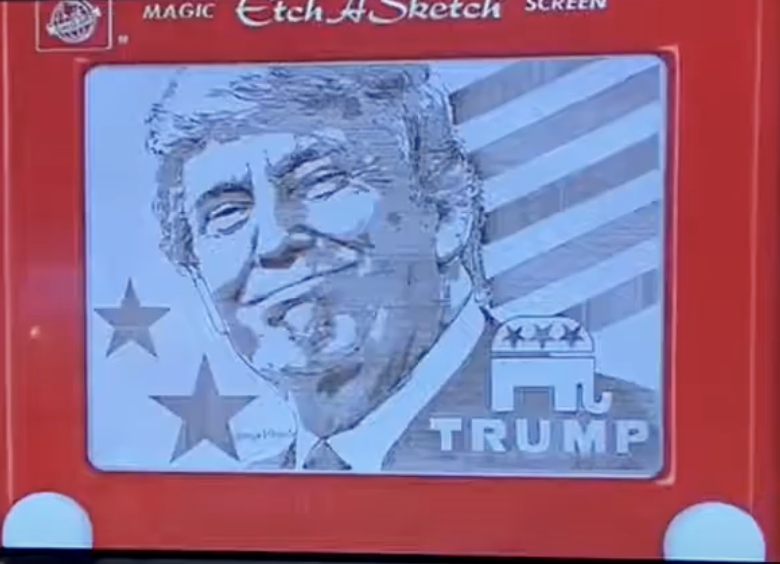
–before realizing that the future President would do much to promote an America First agenda taht seeks to realize something as scary as the image of a world realized after the actual logo of Ohio Art. If border cannot be rendered with much accuracy in an Etch-a-Sketch, the fluid boundaries that are conjured as an illustration of the fluidity of a globe subject to the expansion of American power that one hawkish politican reflects our new life, the President who seemed likely to shake up the Etch-a-Sketch seems to map power as if “in a borderless world in which our new mission is defending the border not of our countries but civility and human rights,” by “sealing the southern border of the United States and repelling invasions” in ways that expand the military presence in domestic areas for what is cast as a national security need, but seem a truly terrifying way to use the Etch-a-Sketch to deploy active-duty forces and combat vehicles to public lands along our borders.
If the global purview that was imagined for the Magic Screen pioneered by Ohio Art as a mechanical drawing tool after spotting the gadget enabling drawing by an electrostatic charge at a Nuremberg Game Fair during the Cold War in 1959, shortly after Nikita Khrushchev issued the demand America and its allies leave Berlin, the game of drawing lines Ohio Art bought to rename the Etch-a-Sketch may have reached its apotheosis, as the Etch-a-Sketch engineering of borders twenty-five years after color television advertisements promoted the magic screen a must-have Christmas gift, having been revealed as a popular tool of distraction whose magic screen was always new, a novelty of distraction “little folks love” that so uncannily echoed the very color television screens which its s advertising campaign seemed all but designed, returning to a blank screen every so often, and then shaking it up to trace new images by rotating two sturdy white plastic knobs for small hands.

Was the handheld screen able to be gripped and guided by large white dials something of a paradigm changer and an unconscious predecessor of the personal computer, with the hardware and software let out? Trump was, of course, probably too old as a teenager to have been gifted an Etch A Sketch in 1960, but he was no doubt captivated by the aggressive advertising campaign that was rolled out as if it had been designed for the magic of color television screens. While the entrance of the “Etch a Sketch” as a simile for American politics was a creation of an aide of Mitt Romney, as if the candidate were a shiny plastic case of sturdy knobs, the imagination of shaking up politics was a Donald Trump not as a creative thinker so much as thinking outside the box that politics had become.
The designing of the southern border by Etch-a-Sketch is perhaps not so dissimilar to the uncanny twinning that the drawing tool has had with Donald Trump’s political career, born as a promise to “shake up” politics as usual by an “unpredictable candidate” who “plays by his own rules,” a “different kind of candidate” who seemed to be Etch-a Sketch once in a positive way, even s he sought to shake up results of the 2020 election,or “Etch-a Sketch” trade policies made markets skittish. Trump is unlikely to outlive or escape the “Etch-a-Sketch” metaphors born back in 2016, as he fits them so well, redrawing the world and place of the United States in it with the glee of compulsively shaking it up to starting manipulating those white plastic knobs in his fists all over again, pushing the parts of the world we dislike outside sovereign lines.

The question of what “doing the nation right” was was left unclear, but it seemed to begin at the border as if the rest would follow and the economy improve. Many of the feared futures he conjured are fast approaching, without any irony at all. Even after waving a panoply of urgent and inventive signs of resistance, the desperate urgency of signage seem so many band-aids to conceal a truly terrifying reality. We pause before the lawlessness of a growing open defiance of court orders, and rewriting of legal norms, the law and legality before the growth of executive authority. And we can hardly map the extent of the growing retraction from engagement in the world, not only in Europe–as the government stations more and more forces along the United States-Mexico border.
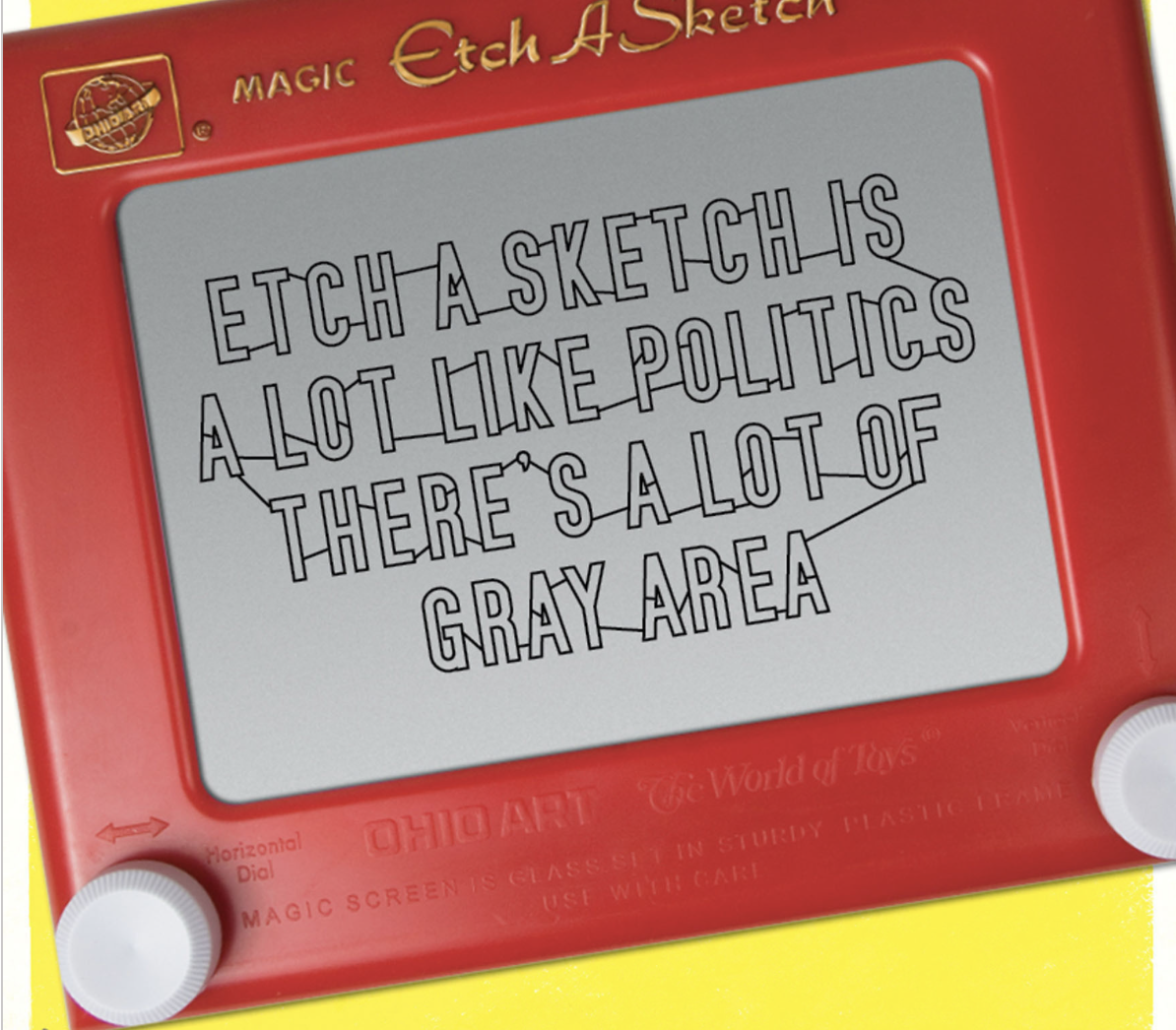
The image of executive leadership that Trump quickly posted on social media as if it were an image of true leadership designed to militarize the southern border by Executive Order to halt an invasion across the border he alleged in an abstracted cartography as if it were an exercise of sovereignty–by authorizing the military occupation of a border strip that would impose federal law on the area to preserve to national security as “our southern border is under attack from a variety of threats,” a statement with a lot of grey areas indeed. Trump is notoriously ready to adopt different political positions, and to shift chameleon-like amidst those hues of grey, denying positions he’s held and even not admitting actions, statements, or slurs, from denying he ever heard of Project 2025, a main set of political positions brokered in the preparation of his return to power in Trump 2, and flipping his positions or even his partisan affiliation over time. And the Etch a Sketch seems a perfect medium to describe the rebordering he wants to achieve, shaking up alliances to pilot his own course on round white dials to draw new lines to map grey border-lines between Enemy and Friend.
But the coercive nature of those grey areas of politics seem all but destined to grow and grow, even as Trump 2.0 accuses China and other nations of having created new grey areas of politics to exercise coercive power over the region, without respecting sovereign bounds: the grey area of politics seems to have begun at the US-Mexico border, and to have grown as a new blurred grey area where the sovereign authority the United States can exercise is almost destined to expand in “magic” ways, in ways that will put the framers of the “Etch-A-Sketch,” Ohio Art, to shame.
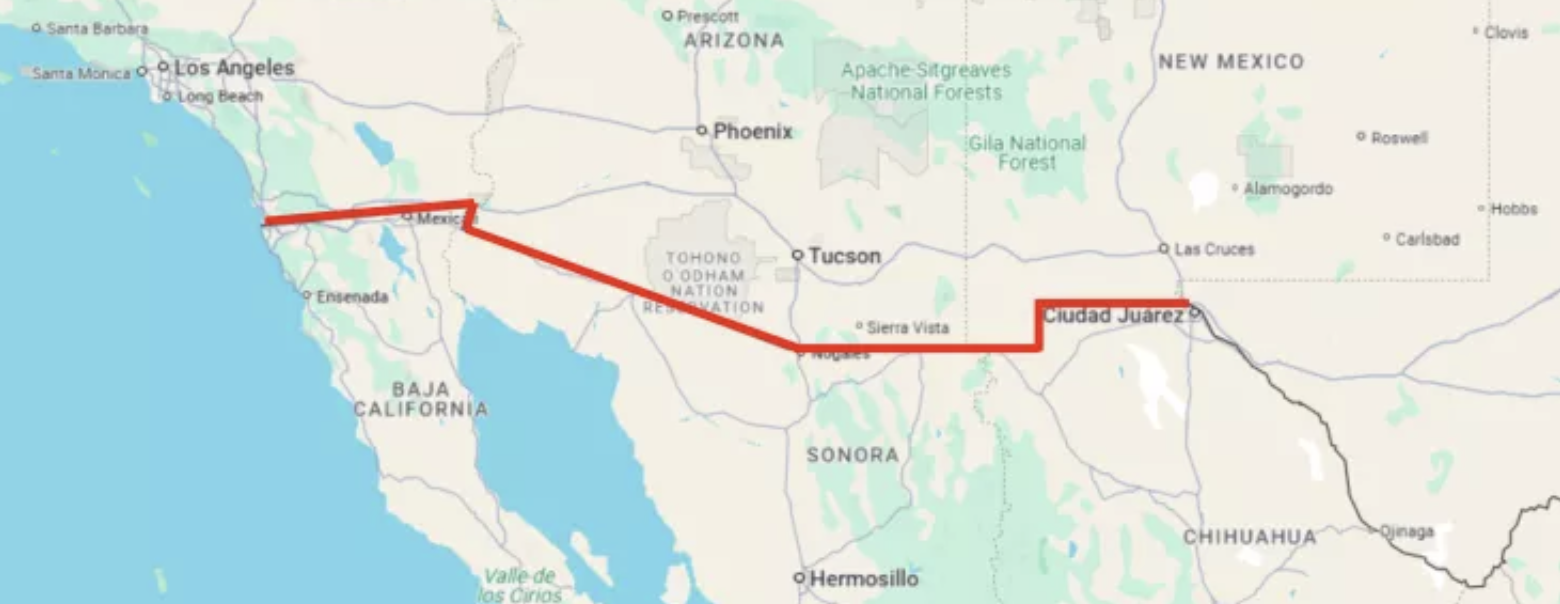
This acts of “re-bordering” seems to be drawn on an Etch-a-Sketch indeed, as the thickening of the border line by sixty meters is mapped as belonging to a National Defense Area, across the southern boundary of three increasingly red states, in what seems a publicity stunt of real consequences. By transferring jurisdiction over the narrow Federal lands it would become a military installation under jurisdiction of the Department of Defense, and subject to military law, remapped as a National Defense Area with broader if undefined charges for law enforcement.
The border we map in multiple ways as a jagged red line across three states subject to military control is now, effectively, a military camp whose entry is subject to criminal prosecution. The apparently sudden change was not that immediate: hours before an Executive Order was signed, the CB One App was deactivated, and denied any possibility for presenting cases for asylum, which had only recently become the primary means to enter immigration information for to cross-border transit, now able to be imbued with a name that echoes its Presidential history, if it has been invested with a completely different function of a militarized zone than Theodore Roosevelt would ever endorse. Asylum was once about crossing a border, but is now further out of reach fro those lacking claims to citizenship, and especially if they are not white or identified as such, suitably Etch-A-Sketch in its diagonal linework on a muted grey background if you construct it just right.
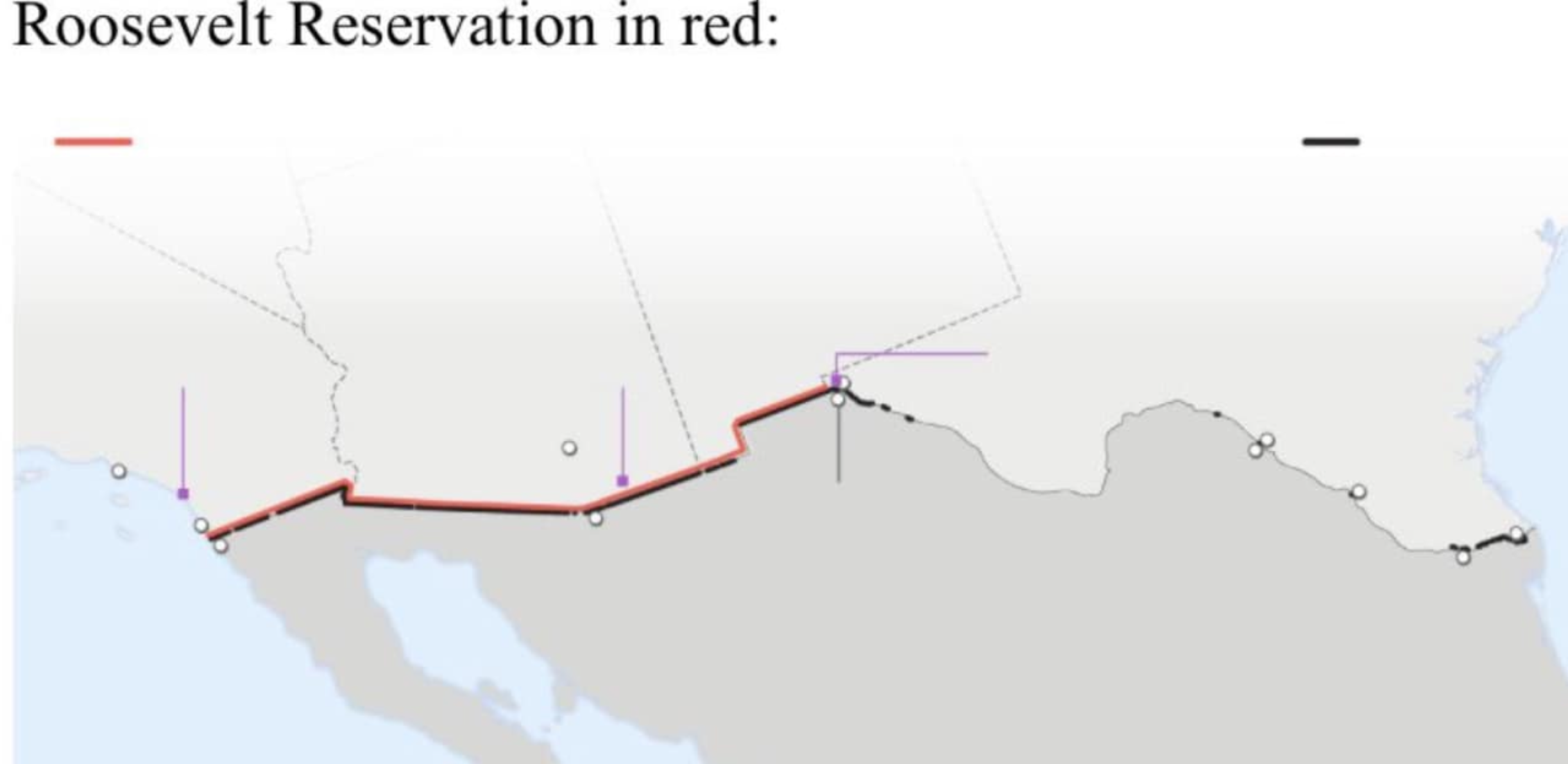
Roosevelt Reservation in Executive Order and in GIS Overlay
If the building of the 458 miles of the Border Wall was unsatisfactory–it includes but eight miles of totally new structure over two years of construction from December 2018 and January 2021–the cost of continuing more building of wall, most of which was done over two years, from January 2019 to January 2021, seemed less able to make an impact and too costly than to remap the entire area under Dept. of Defense control. The pretense of an “invasion” led to emergency designation of the border a National Defense Area but is in no ways a neutral act as a remapping of national space, as it places and will change the place of the United States’ defense of its borders in a global context. For the expansionist nature of massing active duty soldiers on the southern border is inconceivable or imaginable in Trump’s first term: it also constitutes an open affront to Mexican sovereignty. If John Evelyn assured the English monarch Charles II “as no Jewel in your Majesty’s resplendent crown can render you so much luster and glory as your regards to Navigation; so can anything impeach your Navigation and the reputation of That, whiles you continue thus careful of your Woods and Forests,” Trump’s advisors seem to have assured his fortunes are tied to his borders.
The unprecedented act of amassing military force at the edge of a separate sovereign nation is an international action–but one that is mapped as a form of insulation against an invasion already underway–as if it were an entirely local and domestic issue, replacing a border alleged to be policed and guarded sloppily even though the mandate for military supervision is far less clearly defined. Even if the border is the densest area of surveillance in the nation, the goal of remaking the border was a platform of Donald Trump’s Presidencies, as if its remaking would be able to resolve an overly familiar litany of grievances all too well known to the nation, whose recitation has long under-written and enabled Trump’s political career, as if it were a credit card on which there was never a way to max out on political credibility or popularity.
The place of this remapping of the border is, however, also undeniably a rampaging of the nation’s relation to the world, replacing longstanding treaties of international and national relations with a militarized zone, whose footprint is expected to be minimal or manageable on many national parks and protected habitat areas–regions we are all to ready to ignore, so palpable is the faceless threat of internal dangers from outside that we are ready and prepared to entertain the suspending of civil rights–and birthright citizenship–making it all conditional for the MAGA era, which seems determined to draw borders through the nation.
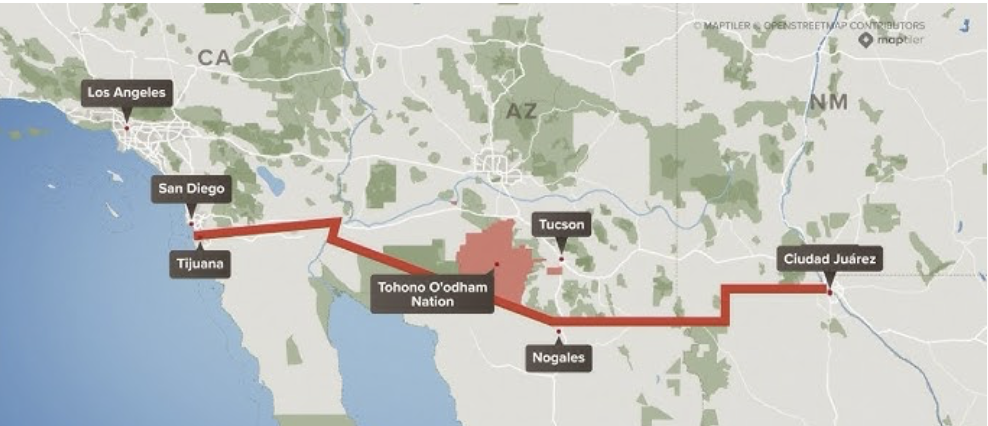
This historical acceleration is moving fast enough to break many things–and even seems designed to break them. The militarization of the corridor, a territorially insignificant “strip” of land, enlarged military camps, often omitted from the above news maps and public tweets, and introduced a new regime of law. The number of military on the border have ballooned astronomically, overwhelming the 2,500 active-duty troops near the border at the end of the Biden era, reconfiguring th border as a military encampment of over 8,600, enacting a new regime of military law, not civil law, breaking with longstanding practices of limited military deployment in the nation’s territory. The unprecedented expansion of the footprint of military presence in multiple “border states” have expanded possibilities of continuous on-the-ground surveillance is an odd reflection of the retraction of global diplomatic presence–and the focus on federal lands near the border that have some to serve as distorting blinders able to render our nation increasingly purblind, curtailing our attention to the guarding of a sixty-foot wide strip of land as if it were a litmus test of national security, now mapped in apparently Presidential terms–if for a different purpose that it ever had or was intended to have–the “Roosevelt Reservation” as if we did not recognize it expand the forgotten Border Wall that it so replaces, as if in recognition that consigned that boondoggle to a Presidency of the past.
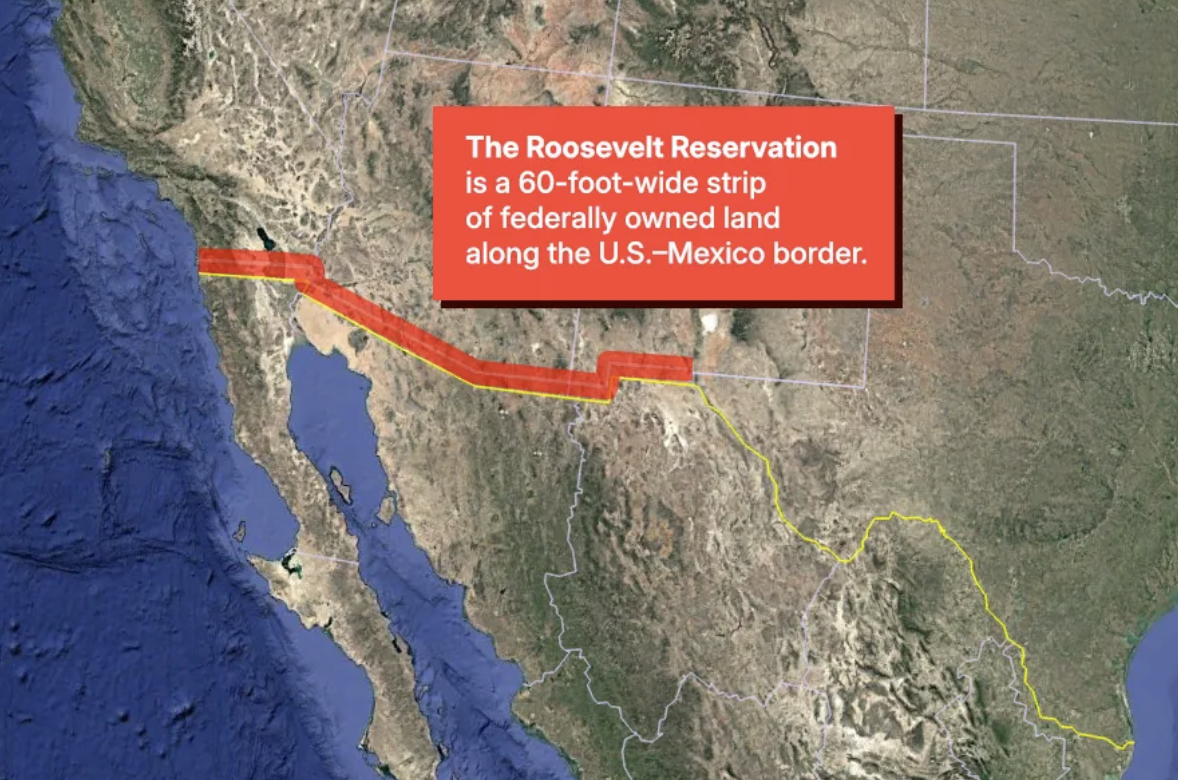

Washington Post
The foregrounding of this border, or blurring of the border, whose policies he faulted in the previous administration, by drawing a militarized border at the southwestern border.
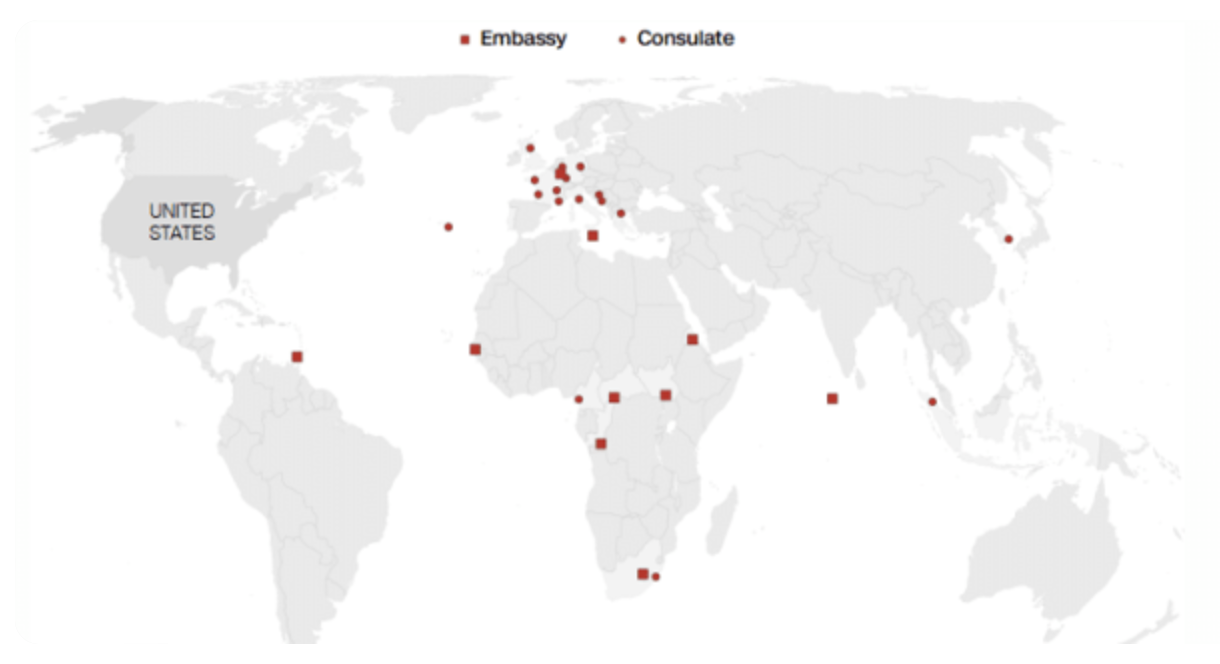
The concentration of the military presence on the border has accompanied hand-in-glove a simultaneous retraction of federal agencies across the country, in an attempt to balance the books–and a retraction of the global presence of America as a global power that has secured some degree of global trust. Trump reduced the size and function of global alliances and range of listening spots, as well as access of news organizations to press briefings. The United States has narrowed its scope and attention to maintaining security in one continent alone. The hollowed out footprint of government agencies and public health system grows as civil rights stand to be curtailed, and the state is present only in hollow promises of a future prominence of America on a global stage, placing the nation in a new patriotic narrative not about equality or enfranchisement, but mercantile power.
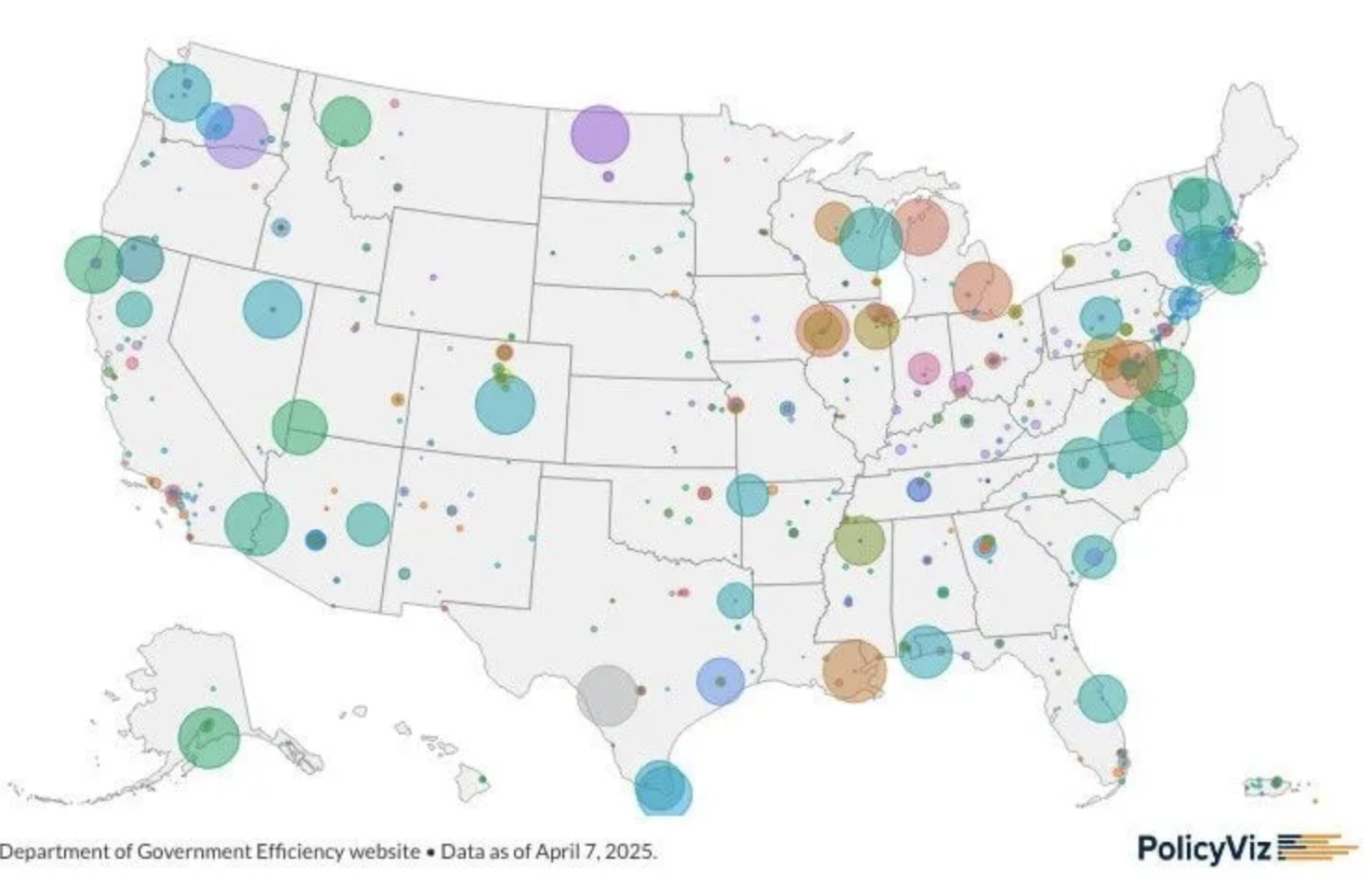
Doge-Mandated Government Office Closures across the Nation/April 7, 2025
From the proposed closure of a swath of embassies across sub-Saharan Africa, increasingly threatened by famine and huge food insecurity, as well as political instability, as political violence trends across the sub-Saharan continent decided to lie outside our national interests, as we cease granting admittance to refugees from he war-torn regions of famine, and indeed rescind all welcome to refugees. As we turn away refugees from the Sudan or the Democratic Republic of Congo, we have begun to offer charter flights to the Afrikaners eager to resettle in America, discouraging them from speaking to the press, in expedited manner, that set a new standard for understanding the refugee as potential citizen, at the same time as rights to citizenship are curtailed. The recently initiated Afrikaner refugee program welcomes as ostensible victims of government farmers whose property is argued to be unjustly seized, not because they are persecuted or face violence, but icons of whites facing “unjust racial discrimination;” their “pathway to citizenship” in America is prioritized above all other global refugees, perversely.
Is it possible we have forgotten that the shift that originated in the far right was in fact pushed by the pro bono advice of his South African-born adviser Elon Musk, who has added to its heft and thrown his weight behind it on social media, as if it were a premium platform to elaborate on X?
The year of the greatest global currency of the old term “genocide” was the year that Donald Trump sprang upon the the political scene. Rather than-backing on Stop the Genocide slogans whose traction grew in Biden’s Presidency to cast a shadow that led Trump to win a crucial slim majority of Arab American, Musk has boosted the “white genocide” claims Trump was quick to embrace. While Musk has been. a vocal supporter of encouraging clams that white South Africans lost land because of land redistribution and resettlement policies to ease the land ownership disparities, the fast-circulation cry off “genocide” allowed Trump to juggle the deck of refugee status by granting it to purportedly persecuted middle class whites–from a country whose refugee resettlement policy has only very recently developed in the post-Apartheid era. Already in the midsummer of 2018, Trump directed his Secretary of State to “closely study the South Africa land and far seizures and . . . the large scale killing of famers” as the longstanding fascination about the plight of white farmers in the country after it emerged on alt right podcasts in late 2017 hit Tucker Carlson Tonight and the racist meme went mainstream, as Ann Coulter promoted the idea white farmers were “the only real refugees” that was eagerly floated by ethno-nationalist Tara McCarthy with white supremacist audiences. Newly elevated to “genocide” by influential American talk radio shows over the airwaves, ‘genocide’ spiked in 2016, per Google Ngram, eight years before Israel’s iinvasion of Gaza, for the Islamic State’s targeting of Yazidi and Shia’ minorities in Syria and Iraq, and Myanmar was accused of genocide against the Rohingya people, as Ethiopia, the Congo, and Philippines saw unprecedented spikes in state-led mass killings that were cast as crimes against humanity.

And so “genocide” arrived at the door of the Afrikaaners in short order. To be sure, Elon Musk’s contribution may have left few real fingerprints. But Trump seemed eager to use Musk’s presence during the recent ill-fated state visit of Cyril Ramaphosa, when he called him out by name as an informant. Musk returned to the Oval Office once again to be present at the meeting of the heads of state–Trump sought to back up the unsubstantiated claims for “white genocide” in the country to its President by a local informant he had with his ear to ground, even if American intelligence was trumped by the foreign newspapers he had in printouts.
While it is hard to trace the rise of Amerikaners–an autonomous group that has now billed itself as “South Africa’s Resource for Resettlement in America” to Musk, the organization has adopted the mantle of the sewn American flag to drape itself in a new national identity that seems to swap the alleged loss of equal rights in South Africa long championed by White Supremacist groups as a cry to patriotism with a direct tie to the United States Refugee Admissions Program (USRAP) to resettle all Afrikaners fleeing discrimination to resettle in the United States and be granted citizenship–as a “vulnerable group facing unjust racial discrimination in South Africa” that makes a mockery of the practices of refugee resettlement based not on any policies of human rights violations or political persecution–or actual discriminatory practices of any kind–save “fear [of] having their property seized without compensation or becoming the victim of violent attacks because of their ethnicity,” not needing any evidence of persecution of any kind. The government of Donald Trump has not only promised to “stand with these refugees as they build a better future for themselves and their children in the United States,” but to revoke the longstanding practice of granting asylum and refugee resettlement to places from which refugees were forced to flee–often in Africa, but not exclusively so by any means, despite the origin of America’s resettled refugees from the Democratic Republic of Congo, Eritrea, Ethiopia, Sudan, and the distorting lens that the policy places on the legal situations of global refugees–that is tantamount to offering to retabulate refugee resettlement from the figures reported by UNHCR, as if to close the office of climate reporting to substitute a new reality where we have nothing to fear from a climate change hoax. The warped relation of America to the world–and of actually documented discriminatory practices to refugees’ plight–not only turns a cold shoulder and a shut eye to the global flow of refugees to America–
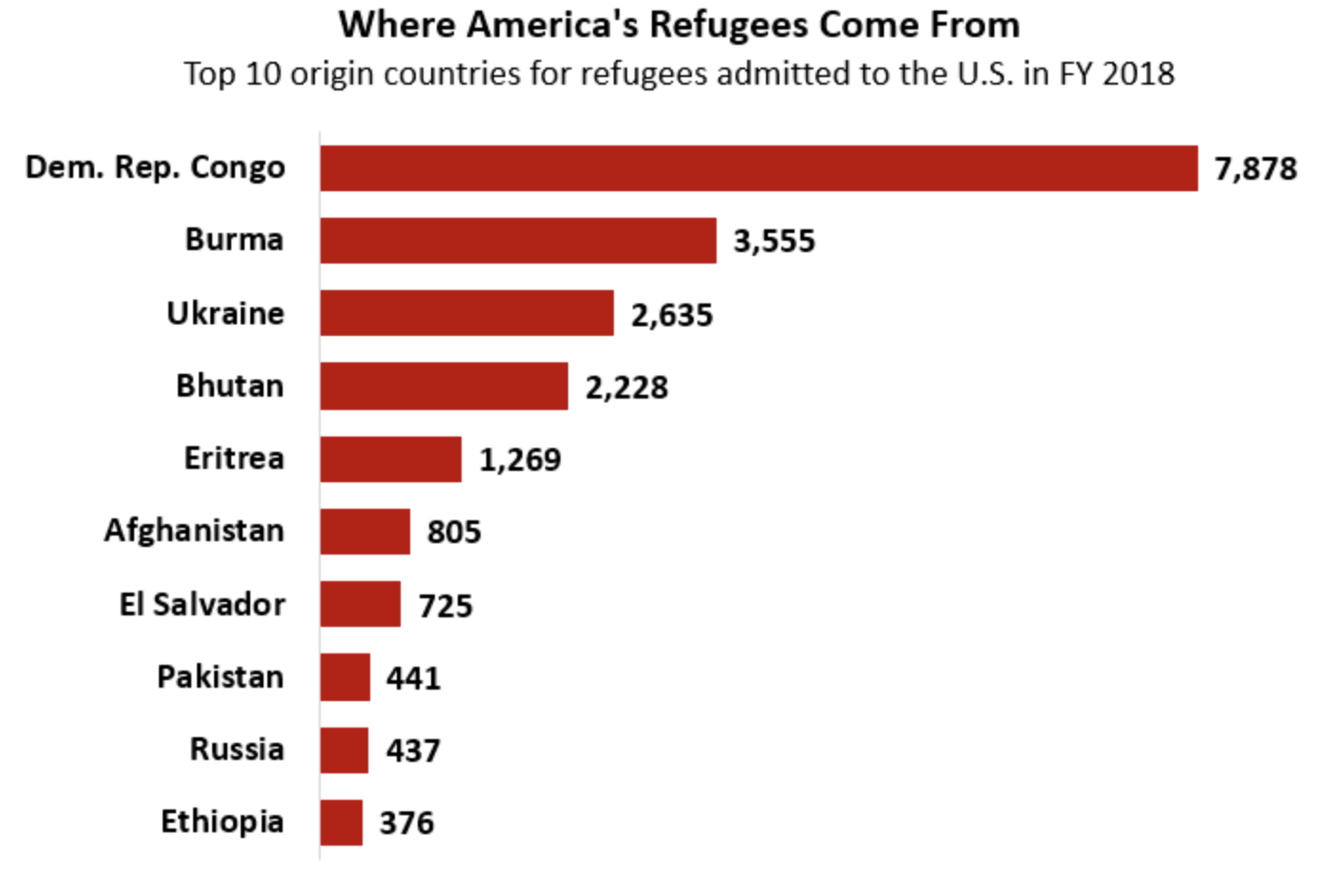

–but repulses the reality of actual refugees, in ways that South Africa’s President Cyril Ramaphosa (a former businessman himself) has been having difficulty stomaching, or accepting the new label for white South Africans, but feels compelled to in visits to Trump’s White House. “Elon is from South Africa,” Trump opined as he pointed to Musk, announcing as if it were a trump card, “Elon happens to be from South Africa,” vouching “This is what Elon wanted” all along in the testy Oval Office meeting. Musk had long echoed claims white South Afrikaners face “massive human rights violations” by “racist ownership laws” the nation adopted, demanding America stand against this “genocide,” and stared at Tump with icy eyes as if acknowledging he was actually pulling all the strings. Musk is, after all, the embodiment of smirking self-entitlement, who embodies a promise to American customers a “choice” in cars, if not entitlement–promoting a “choice” of technologies of comfort that are options to be bought, as if a similar “choice” of resettlement of refugees is something Americans are entitled, and this might indeed be transferred to national immigration policy.

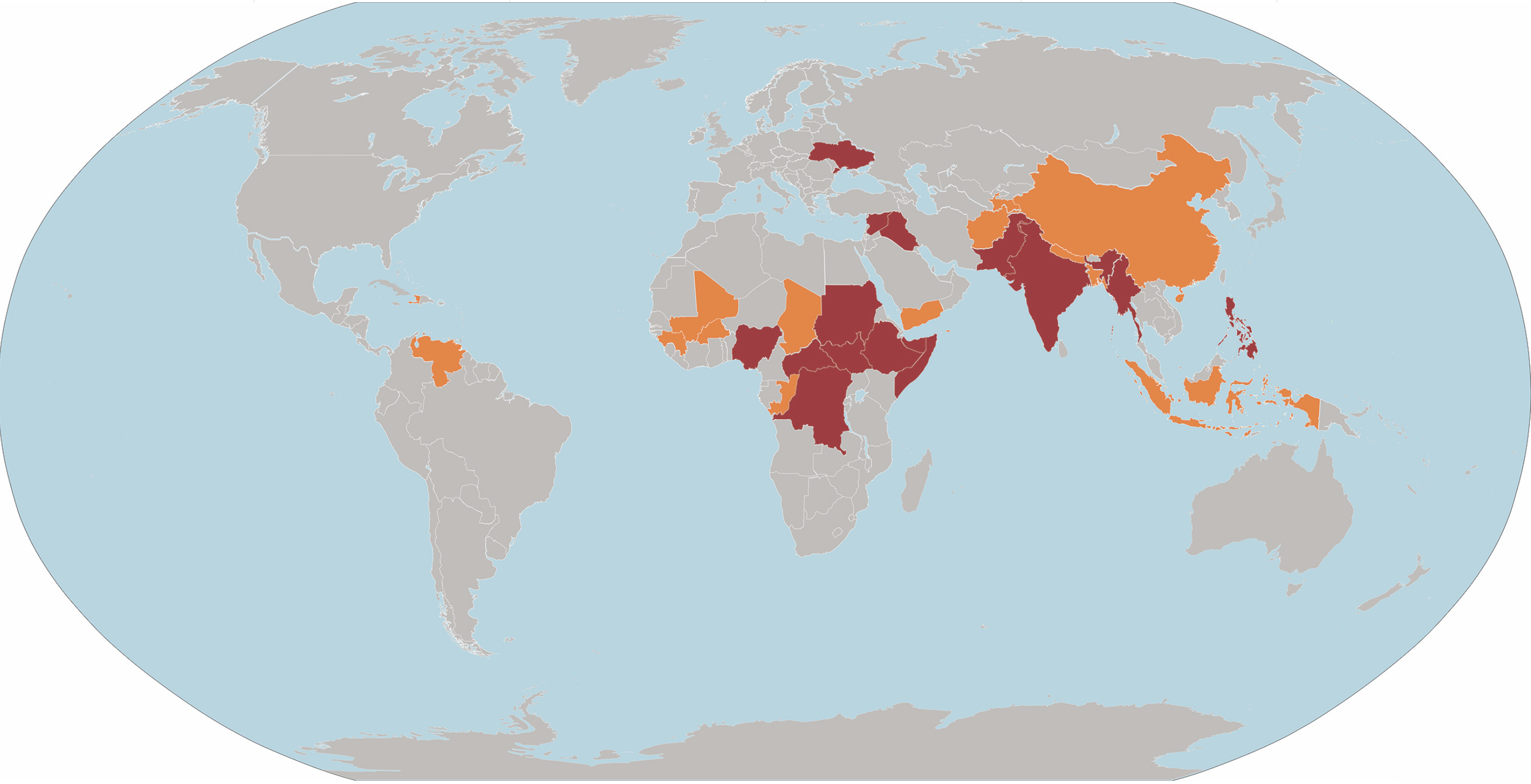
Is it a surprise key talking points of South Africa’s white supremacist party were recycled wholesale in Trump’s Executive Action prioritizing the acceptance of South African white farmers as refugees–and welcoming Afrikaners “fleeing discrimination” in South Africa, even as he has shut doors to legal immigration? Trump’s actions have indeed made South African whites the largest group allowed American refugee resettlement in 2025, as over 122M persons have been forced to flee their nations in 2024, per the UN High Commission on Refugees. The absence of empathy is astounding, as if we can choose our own refugees–irrespective of the tragic global situation we have elected to dissociate ourselves and our consciences from ethically and morally, as if isolating ourselves as a technate, removed from the national refugees we no longer “desire” to admit legally or to grant citizenship. The banners that Afrikaner protesters hold in South Africa–“President Trump and Elon Musk Please Help the Farmers Chase Away the ANC Takeover of South Africa Please Help Us” have been used to redefine what refugee immigration means. Trump’s offer to resettle white South Africans and recast Afrikaner refugees as victims of “unjust racial discrimination” have pivoted the protests asking for domestic intervention that might have been associated with Musk or Musk Père to accept the victims of a “genocide” that the world had never heard of amidst several other genocidal movements on the global map–Gaza; Rohingya in Myanmar; south Sudan; Burkina Faso; Mali; Syria; Lebanon; ethnic conflict in India–many following warnings from UNHCR–that redirect the need or desire to address human rights in a global context, and done so by redefining the globe–and indeed redefining Genocide unlike the US Holocaust Museum’s map of current threats–
–or Genocide Watch’s 2020 map of countries of special concern for genocidal movements–
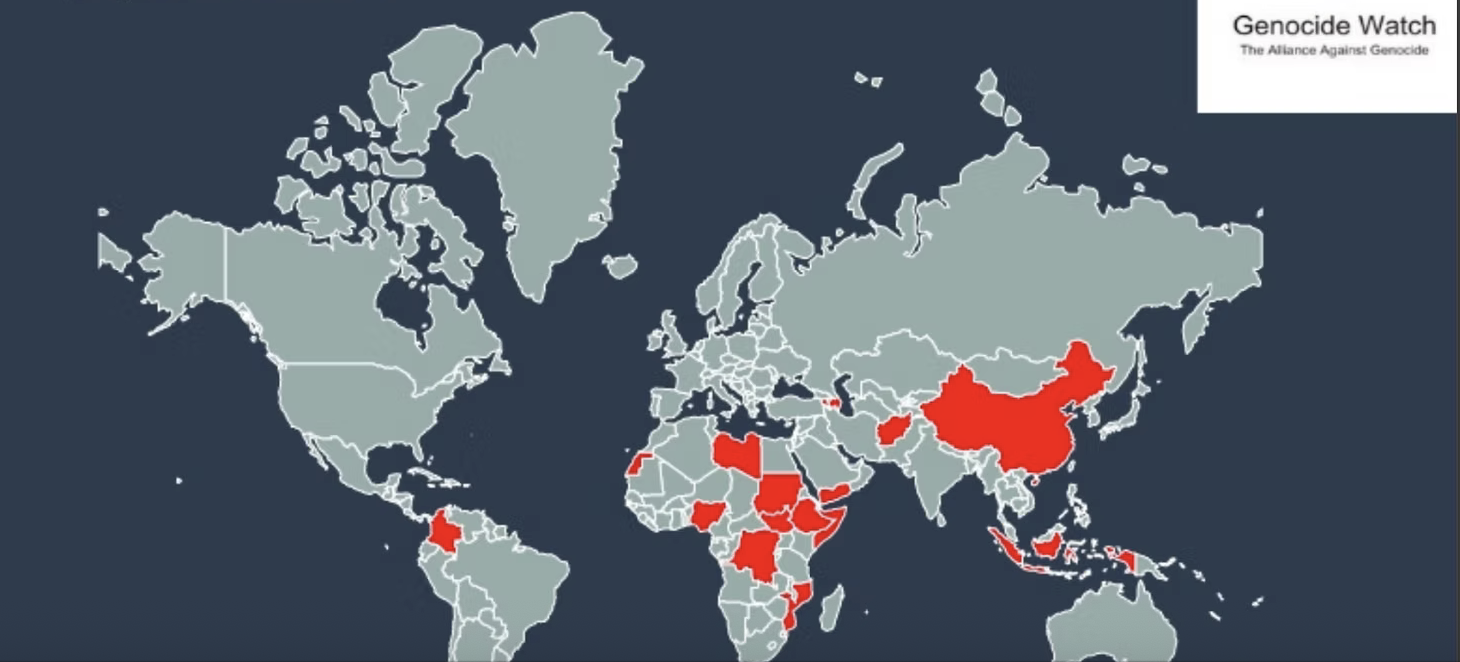
Genocide Watch: Countries of Special Concern (2020)
–or other maps that attempt to track an ever-growing number of global refugees–
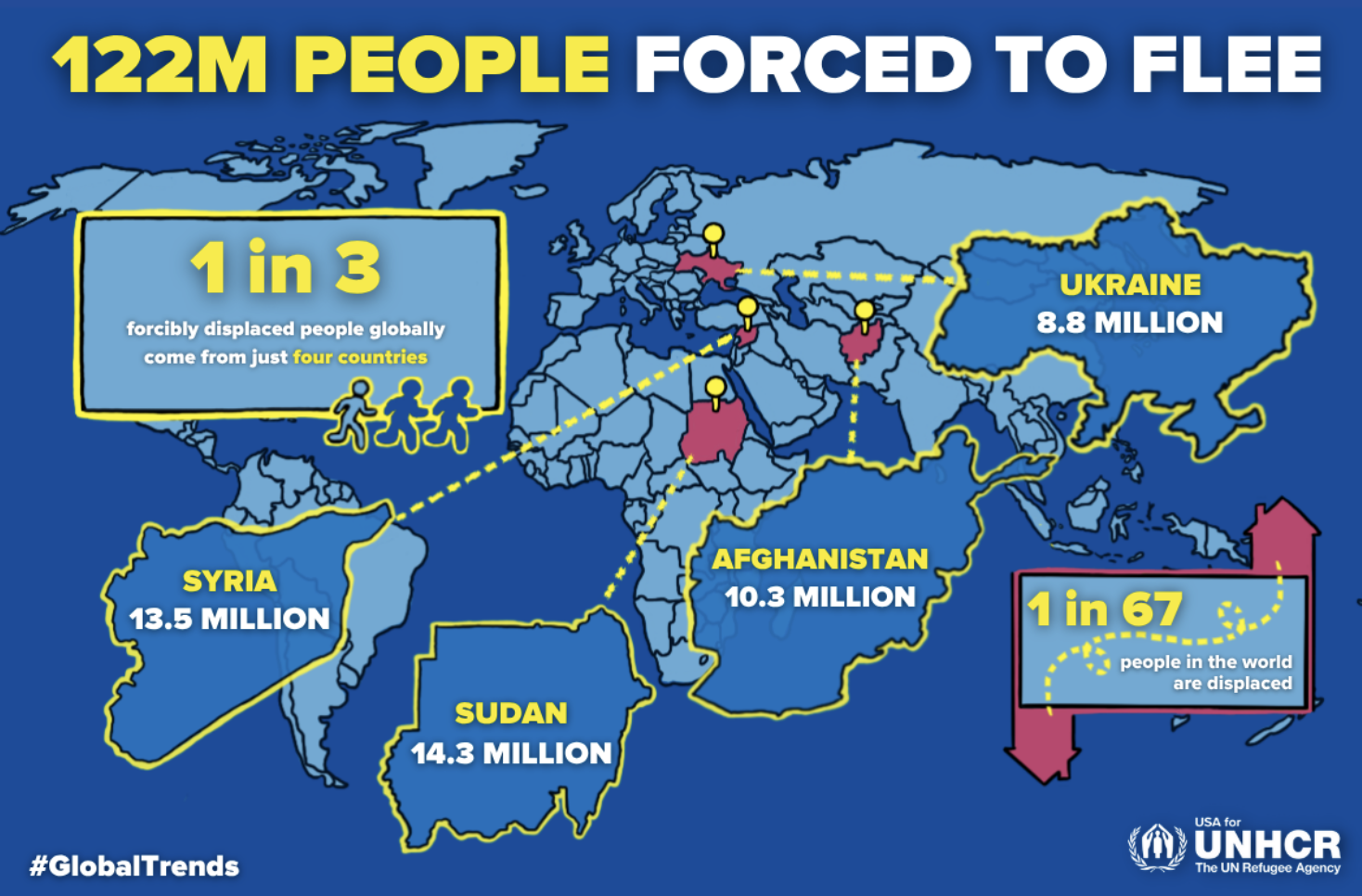
A budding toxic relationship of mutual support is however scarcely a surprise: in Trump’s puzzling Presidential campaign, Musk emerged as an energizing secret weapon in the final months, late in the game. Musk had long boosted a false discourse on the hardships of whites in South Africa that add special sauce to a new vision of the nation on the global stage. By telling the befuddled South Africans and the world that America was basically behind whites Africans and its sort of refugees, under Stephen Miller’s watchful eyes, despite no evidence that land reform intended to redress the forcible isolation of blacks in homelands a century ago has led to murders of white Afrikaners that demanded refugee status. While the redistribution of land in Reform Laws of the 1950s had given some 80% of the land to the possession of the white minority, and confining blacks to rural areas that gave rise to the first civil disobedience actions in the following years–two decades before the United Nations would finally come to denounce Apartheid as an intolerably human rights atrocity.
These charges provided a rhetorical appropriation of laws of actual discrimination or injustice, emptying the place of justice or political persecution that have long been a bedrock foundation for immigration laws in the United States, rewriting longstanding policies of refugee resettlement that were central to parts of Trump’s campaign–remember those Haitians resettled in Springfield–that echo a white America fear of a Great Replacement of being flooded by people of color that has also animated the fiction that Democratic politicians have sponsored immigrants not for legal reasons, but to gain their votes in swing states by craven ways, illustrating the deeply corrupt reasons that have long animated American refugee policies in order to undermine America’s interests, as if the closely contested votes of “battleground” states like Arizona (blue) and North Carolina, as well as Pennsylvania and Michigan, were contested by underhanded policies of refugee resettlement.
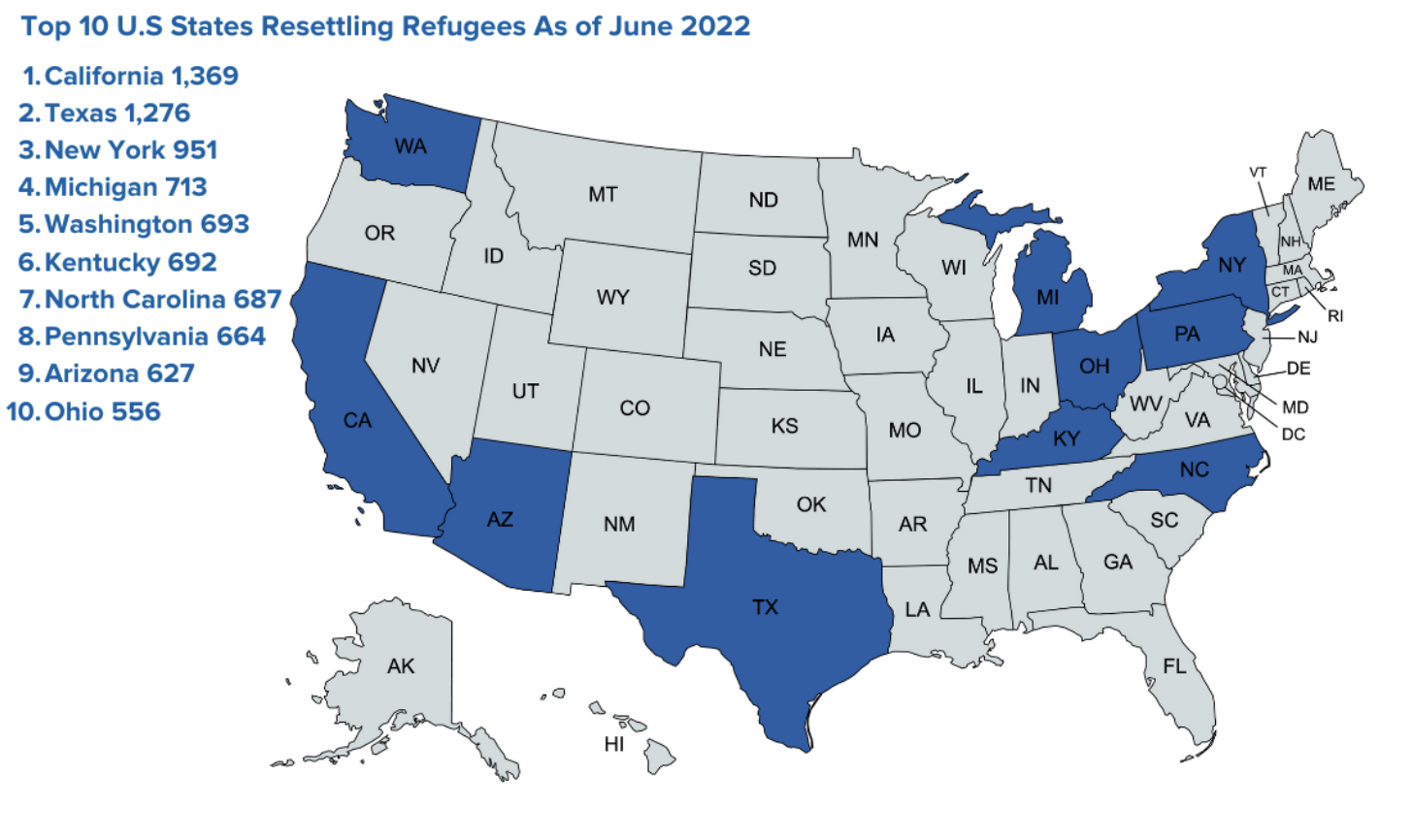
Ten States Accepting Largest Numbers of Refugees in United States as of 2022/UNHCR
The deep disgruntlement with increased numbers of resettlement in many states has created a groundswell of support for Trump in 2024 that played an outsized influence in the defeat of Kamala Harris, and the perversion of resettlement programs is in a sense a priority of payback to the states that went red in that election–despite having gone narrowly Democratic in previous Presidential races. The payback is almost transactional in nature, and hardly tied to Musk alone. But they delate the longstanding logical basis for any resettlement as well in underhanded ways more devious than the cravenly self-serving practices attributed to Democrats eager for votes. Despite their roots in attempts to redress the disproportionate inequities of land-ownership of cultivatable farms predominantly tilted to whites’ advantage, the state-sanctioned policies were cast as embodying a racist ideology by analogy to Affirmative Action.
The historical revisionism of the insulting image of middle-class whites as disadvantaged played to the base at the same time as it rejects longstanding basis of asylum as granted to all deserving status as refugees to the nation. The notion descendants of colonizers facing “genocide” who almost exclusively inhabit regions arable land was a defense of white privilege that played well to American audiences and echoed many of the policies Musk and his family are tied; the carve-out to exceptions of denying asylum for white famers as they will be “assimilated easily” into the United States–implicitly unlike those Haitians who were so maliciously charged of eating pets in an ugly episode from recent Presidential debates, wrongfully accused of “eating the pets” of Americans in Ohio, echoing slanderous internet meme to revive long discredited dehumanizing tropes dating from the first contact with indigenous Americans: Trump seemed to pander to voters in the debate as he lamented, disingenuously, that “this is what ‘s happening in our country, and it’s a shame . . .”
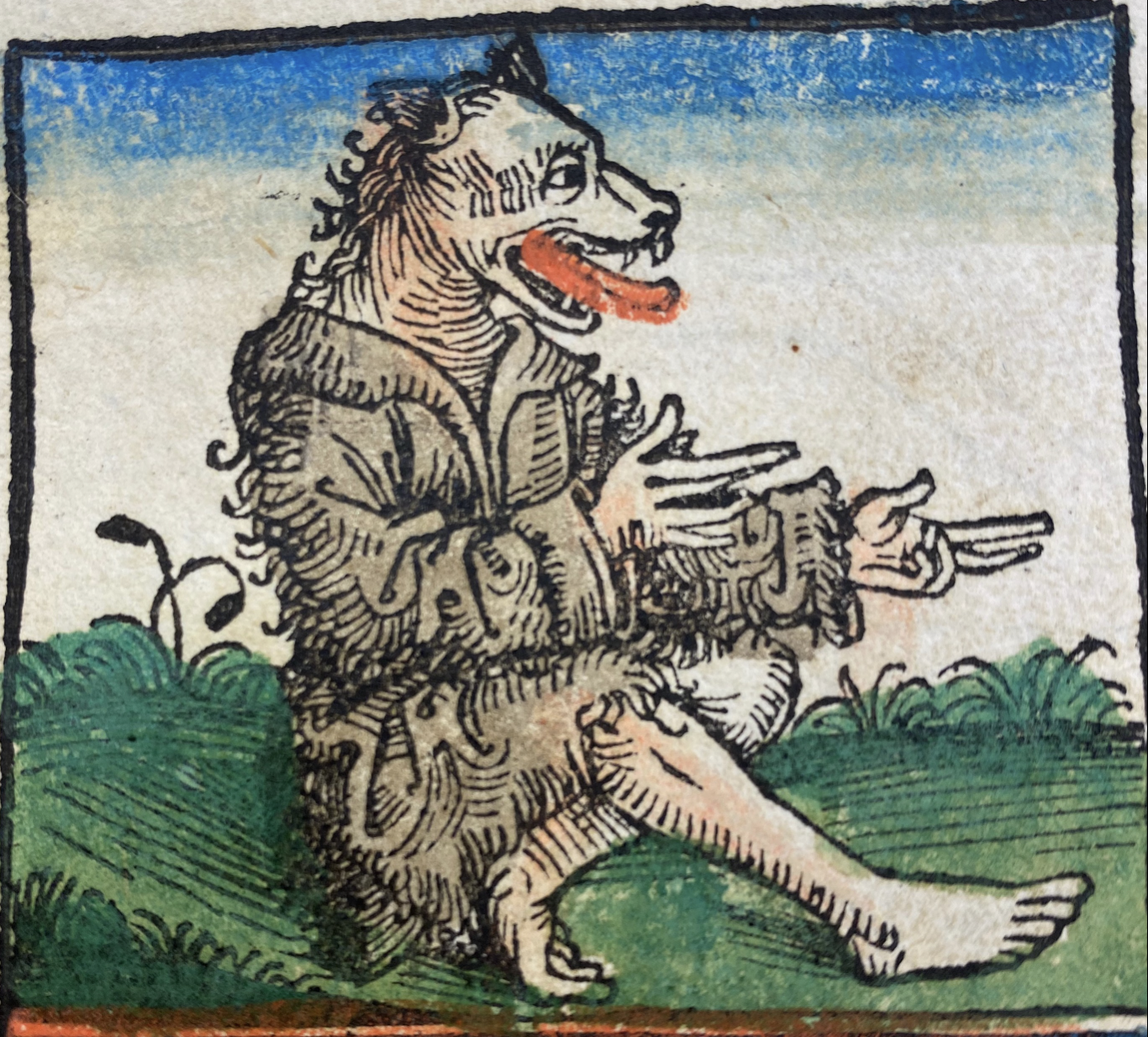
Dog-Headed Residents Living in the Islands of the New World/Nuremberg Chronicle (1493)
Trump’s attack on the dog-eating immigrants who were processed by the CB One App was reprised in eery ways in his executive act of turning a cold shoulder to the rest of the world. The embrace of the Afrikaaners was not hard to reconcile with the closures of USAID offices. To the contrary, embracing of the Afrikaaner farmers save as the latest episode of currying to white supremacist fears of a great replacement, as the flag-waving Afrikaaners were greeted at the airport by officials from he Dept. of State. After closing USAID offices across the African continent, Trump long singled South Africa’s government for “treating certain classes of people VERY BADLY,” slyly distorting the nation’s relation to a continent afflicted by political violence, poverty, famine, and civil unrest. Perhaps the meeting was staged as a way to throw a bone to Musk, who was on his way to exit from the government, or to use him–not an actual Afrikaaner, but awfully close to one!–to make his point of priorities in ways that would be a plus with his uneducated base–few of whom realized, not to compare apples and oranges, the African continent dwarfed India, China, and the United States.

Perhaps Trump wanted to offer a departing present to Musk, or just to wanted to throw a bone to white supremacists. They were, if afer all, the fine people he realized were a useful part of his coalition that he could always count on. They might remember that the openly racist term “Senegambians” denoting generations of enslaved Africans in North America imposed a geographic generic blurring, denying sovereignty or nationhood to those blacks enslaved in America. The survival of the ugly portmanteau referencing the regions from which Spanish slavers had enslaved humans sold as chattel to the West Indies and Caribbean who influenced food, music, and other aspects of American cultures, the blurred lines of forced migration of the North Atlantic Slave Trade from between the Senegal and Zambia rivers was a cruel shorthand for a blurred continent, less understood or appreciated in its diversity but only seen as a waste of taxpayer dollars for a nation that prioritized securing frontiers against a globalized unrest outside its borders.
In this distorted geography, the white landowners in South Africa proved likely symbols of sympathy. The black Africans were less in need of need–or even merited it!–than the suffering white families being persecuted by a majority black government that connoted the evil image of “black supremacy” that was so deeply feared in the Deconstructionist south as a possible consequence of expanding the democratic franchise that led to the restriction of voting, citizens’ councils, and voting rights, most often under the ridicule of even imagining black’s political voice.
As USAID cuts have curtailed needed medical assistance, addressing the grievances of white landowners is a reprioritization of ethical value–distorting possession of the vast majority of arable land by white farmers, as blacks owned lands only in the most challenged areas, that suggest an interest in refugees with property. By ignoring the map of political unrest and violence in the continent, we let all Africans know such unrest is no longer America’s concern, and we can wash our hands of such “shithole countries” who insolently act as if they’re entitled to taxpayer funds.
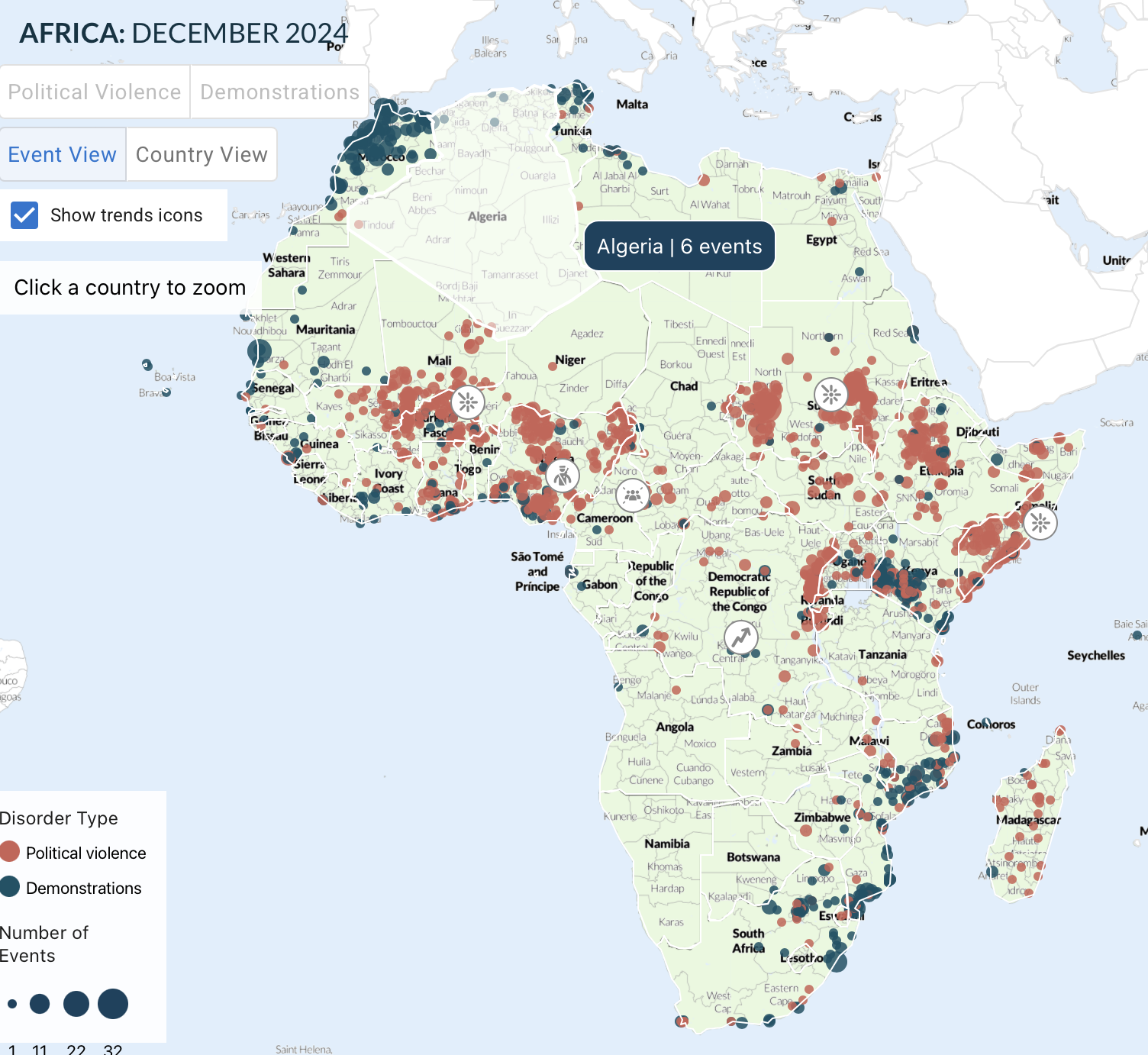
Political Violence and Demonstrations across Africa, December, 2024
This is not even to approach the massive shifts in population and migration that are projected in coming years as a result of climate change–a process underway that this administration denies–and whose massive effects will impact South Africa far less than other African nations.
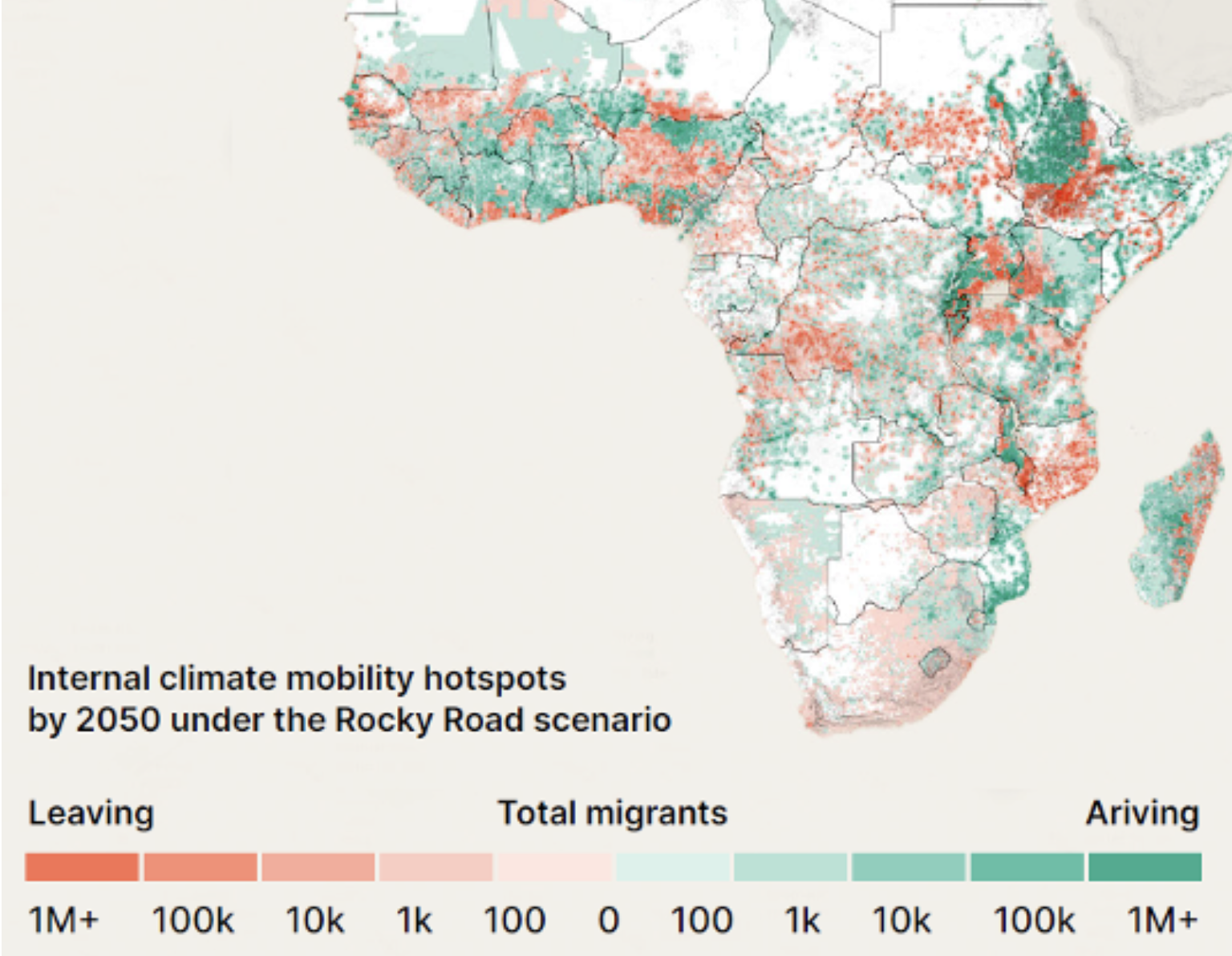
Climate Hotspots in African Continent by 2050 Based on Global Warming Projected Scenario
At the same time, ending funds for foreign disinformation are featured in the push to shrink government by Elon Musk’s crew, given a mandate o shrink federal government office, federal contracts, and workforce that has allowed Musk to enact many of his most dangerously libertarian ideas first circulated on social media in ways few thought remotely possible months earlier. This follows through on a promise to “modernize federal technology and software” to remake a slimmer, agile, and far more efficient federal government, by whittling down the federal presence in the nation to “maximize governmental efficiency and productivity”–most probably by getting rid of the very institutions and metrics by which they are measured, and restricting the government’s workflow by redesigning budgets across the board without congressional oversight.
The broad terminations of grants and leases that DOGE has brought will empty the United States of many grants for scientific research funding, public health initiatives and investments, improved access to medical care, safety programs, and educational programs, a blackout in funding that immediately terminate programs once they are idenfied as actual “waste,” cutting off longstanding public programs that cut needed services. Musk’s promise that the elimination of “waste” is so easy “you’re going to close your eyes and go shoot in any direction . . . . because you can’t miss, you know!” Now tracked by a live scorecard shown as “tax dollars saved,” ensuring the “savings” produced by DOGE are a cash flow that is abstracted from the nation, a flow that can be tracked live to offer a counterbalance to those terrifying tabulations mounting debt of American government. DOGE is, indeed, based on and oriented toward resolving the “catastrophic” national debt, not to the performance of government, as if ‘cost’ could be severed from governance, and addressed head-on in ways that no previous governments have lacked the moral resolve to do, by allowing the U.S. national debt to mount astronomically, as revealed on the USdebtclock.org, with a transparency that is there for all to see, the federal budget deficit growing all the time as an unruly child, of which Medicare and Medicaid, unsurprisingly, are in fact the greatest culprits, with social security a close second. Who would be able to cut these, if not the purported vigilance of Elon Musk?

This is, in other words, cost-cutting by phony expertise, not anything but a flow of data and numbers, helpfully dividing the alleged savings of $170 billion by the $1055.99 in individual savings for taxpayers, as if the savings were uniformly distributed across America, as if this were an even exchange. Would a few thousand dollars each be worth it for reducing the future life expectancies of Americans and pushing ten million of Medicaid by 2034?
The budget bill and DOGE downsizing would press blood from the nation, aptly shown here in the spots where DOGE-inspired cuts would be hardest, hitting communities and real estate. The “clock” of the mourning deficit the is offered as a running tally of “savings” shows a government at work for you cutting government, paring down a mere fraction of the budget deficit or the national debt–all personalized by simple division to calculate a “per capita debt”that seems to offer proof that government is not working for you after all as the “public debt” has steadily grown. If we are clearly in the red by the rapidly growing figures of the DebtClock, as if filling up tanks with gas that are bottomless, the we are draining life blood from the nation in the same time, reducing the federal footprint from districts where the federal government has seen fit to pack up and leave, shuttering offices for the future to create needed savings for the taxpayer who has for too long been unethically hoodwinked by Washington–and is shown, like modern atlas, struggling to balance the weight of the Capital dome on his back.
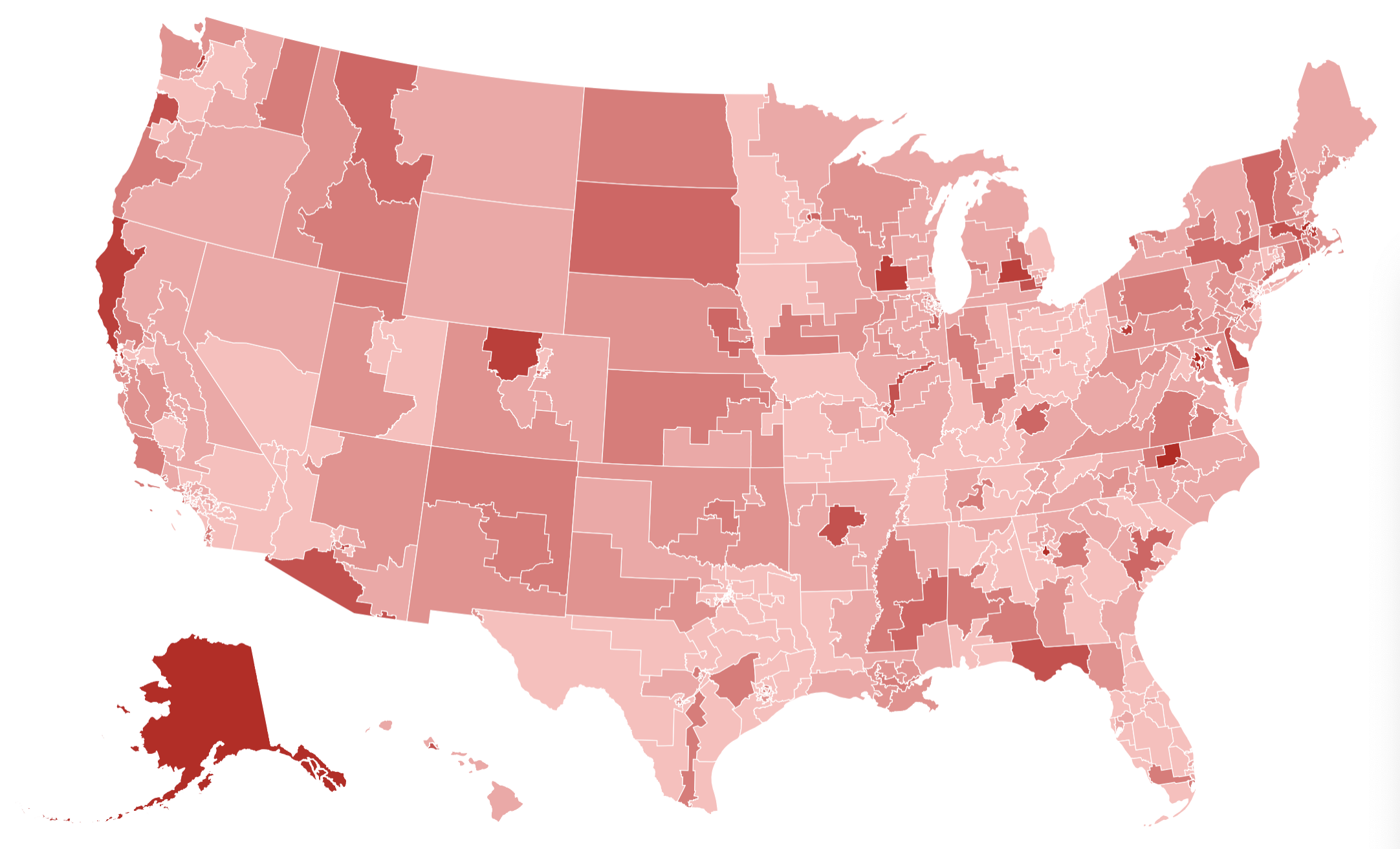

DOZGE Cuts of Grant and Lease Terminations by Congressional Districts/American Progress
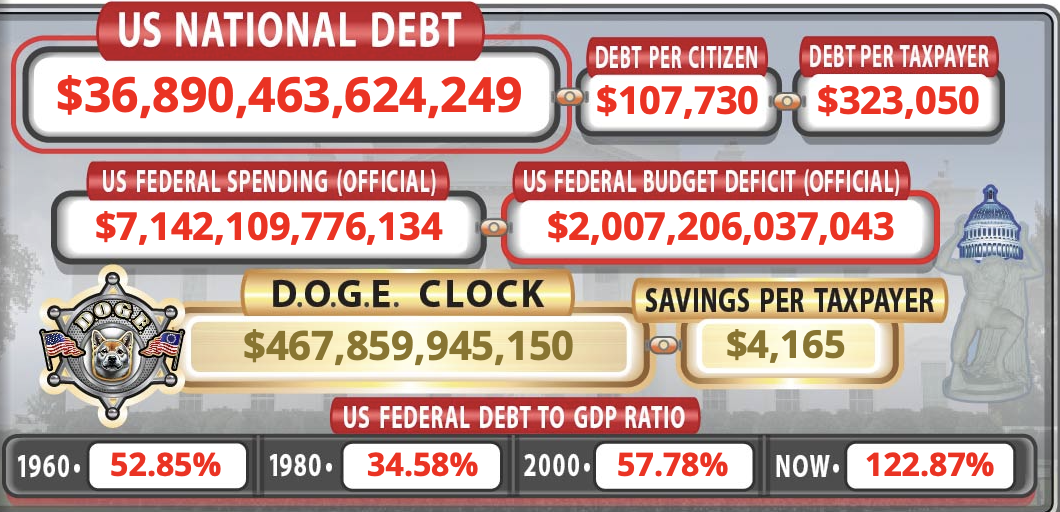
DOGE act as the sheriff, in the new imagePublic Debt Clock website, a cascade of numbers and calculations that appear to lend credence to the fact that “we owe thirty-six trillion now” because “we let all these nations take advantage of us,” that Sheriff DOGE will solve, against the foreign countries who bought stakes in the U.S. National Debt–Japan, China, and England–“taking advantage of the United States” even by straining international relations and ties.

The surgical exiting of debt will produce real savings, whether in the “bankless future” that DOGE promotes as the future of “decentralized banking” that will liberate our financial networks or place the economy in freefall by a raft of “smart” contracts, permission less protocols, and getting rid of any central banking entity by operating exclusively on blockchain, and offering new forms of governance that vacate any centralized authority or rules-driven system. The new paradigm of digital currency promises to be a way to enrich markets, not people, but offering new possibilities of speculative investing that will make many rich quick, as they bask in the perpetual sunshine of defiance to global markets that DeFi (decentralized finance) promises the libertarian investor, even as it offers no recourse or redress if a transaction that fails, and boasts a lack of any consumer protection even as it promises a full “democratization” of the marketplace in a digital world where access to funds and finance is replaced by a single digital key in an entirely digital shopping world. The substitution of the “democratization of the marketplace” for an actual democracy is painted as the future of market, without externally imposed rules or regulations, is as dizzying as the dashboard of the US Federal Debt!

Even as the bottleneck of lawsuits grows, and the man who enabled it seems to have retired from attending cabinet meetings.. But his officials and chief lieutenants are helping to run DOGE, as Musk sits back to watch its robust data-sharing initiatives and budget cuts take effect, that enact Musk’s argument that the process of . If argued to be “unprecedented” that “upended American Life” by a man so “intent on demolishing the old order” that “there have never been a hundred days like this,” as Peter Baker’s spine-tingling prose opines, the retraction from global ties is in fact quite similar to an earlier time, when America imagined not engaging in World War II that would set it on a track to become a global power. But the deep conviction by DOGE officials who have large roles in Social Security that false entitlements helped Democrats “attract and retain vast numbers of illegal migrants” in the nation suggest the deep animus to Musk’s vision, and loyalty to Musk, more than the President, will cast a long shadow over Trump’s government, replacing government civil servants by Musk’s lieutenants and his curtailed vision of governing. For an agency focussed on defunding programs and massive government layoffs and buyouts in record time has resculpted the vision and mission of government in line with the pared down notion of governance, assigning an increasing share of the function of human judgment to AI.
The language of expertise that Musk has deployed at DOGE is not only of budget cuts and claims to be “restoring the will of the people,” the Department of Government Efficiency proceeds on a rampage of paring civilian employees, veterans’ benefits, and health care under the banner that government has for too long been inefficient, even if the majority of actual cuts made are predominantly located in VA Health Care, National Institute of Health, Medicare, Medicaid, educational grants, and biomedical research–precisely those programs that are designed to benefit the country, not to be efficient by metrics that can be mapped by businessmen.
The reversal of that enduring model of geopolitics has replaced a map prioritizing interconnected surfaces, that can seamlessly and smoothly unite mapping systems, by a vision of strategic defense that elevates alleged “American interests” alone. The plot line and narrative was first born, as it turns out, at the time of the birth of a new global map that led to American dominance in the world at the end of World War II, that mapped the continuity of land, air, and sea military presence on a global surface. For by erasing earlier maps that were rooted in international consensus, rather place a premium only on American power, the new imaginary is less of an interconnected world of reliance and balance, but of a vision that places a premium on strategic self-interest alone to be understood.
The illusory power of this alternative map, which is based on a demand to relegate as “obsolete” a globalist map, is in fact far less grounded either in the accuracy or national needs. The cartographic distortion of putting America First, a nice slogan of regional empowerment, if of tribal tenor and hue, erases a map of human rights, international understanding, or treaties as scams that have cost the nation and that have to be rejected in the future, creating a Brave New World of America dictating global borders that is the utmost cartographic fantasy of increased global danger, and relinquishes the very mapping technologies or competencies that have created scientific consensus in a global order. The top-down budget slashing and reshaping of governmental priorities for business suggests a systematic breaking of longstanding priorities to leave dust in its wake.

While by no means recent, Trump’s increasingly obsessive attention to denying birthright citizenship to the children of undocumented migrants cuts at the notion of the American family. His obsessive return takes spin from curtailing voting rights and public health care to those who he is committed to remove from the nation, as if the nation were not based on establishing the birthright citizenship of all who live here–but tying migration status to citizenship of children born in the United States, a logic that is suspiciously nurtured in the very same think-tank–the “Claremont Institute”–that gained fame and funding after it developed digital tools to determine district maps by voter profile to boost the presence of Republican majorities in California’s state senate, playing on the anti-immigrant paranoia to craft legislative majorities on the very issues which Governor Pete Wilson ran for governor. in ways that defeated his Democratic opponent by carving out a new electorate, even as the infamous highway signage cautioning I-5 motorists who sped from San Diego to avoid hitting immigrants crossing highways near border crossings were thankfully removed by 2018, obsolete only as highway authorities built fences on medians–and allowing many signs to find homes to be preserved in public spaces as the Oakland Museum.

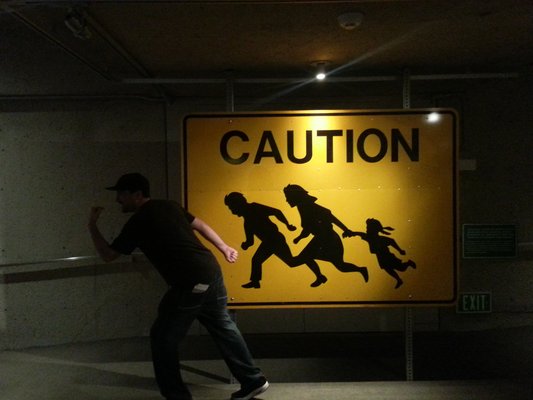
The very same anti-immigrant platform Wilson ran back in 1994 in a different era were based on denying public services to immigrants and using anti-immigrant sentiment to boost turnout in gerrymandered voting districts have returned from the dead in Caliornia state politics. The recent resuscitation of Wilson’s hateful language from the graveyard of state politics has been waged by Republican candidates in mis Tate of California–Carl DeMaio promises “to force the federal government to control the border,”–in an eery echo that has extended beyond calling the feds to ending local public spending on the health care or legal defense of undocumented immigrants ends, and ending sanctuary city policies across the state–as if to suspend the “goodies” Democrats self-servingly offered as lures to attract undesired migrants, lest “they keep ripping us off.” (Veteran ventriloquist Mel Blanc gained a dark mark in a career voicing of characters by peddling the vulgar stereotype of the “Frito Bandito,” the two-pistoled bandit who robbed American kids of chips is magnified as an alleged risk of an entire American lifestyle– jobs, safety, health care and votes.
This is the data-driven technology of re-bordering that the tools of Palantir promise to engineer with real teeth of datamining that it had never had before, itself trafficking in the worst stereotypes to forge a newly re-bordered world by profiling that assembles digital breadcrumbs through robust data integration platforms, as if they were trading in new tools than retired stereotypes of the past. The logic of the rip-offs that we will be fine so long as we collectively find the energy to end has now broadened from Trump to become a basis to curtail or end immigration in 2025, as if migration depleted the nation’s wealth and undercuts well-being–even if we have seen this playbook before.
If the US-Mexico border was long seen as a site of danger and criminality, indeed a thorn to America’s Manifest Destiny in the nineteenth century that needed to be contained and controlled, the southern border has become a site for the broad dangers of “ripping us off” that Trump 2.0 has promised to ward off by a battery of unprecedented economic tariffs, wishfully viewed as so many TACOs–bombastic threats from which Trump Always Chickens Out!–evoking those 1970s south of the border treats, hard-shelled and topped with orange cheese-
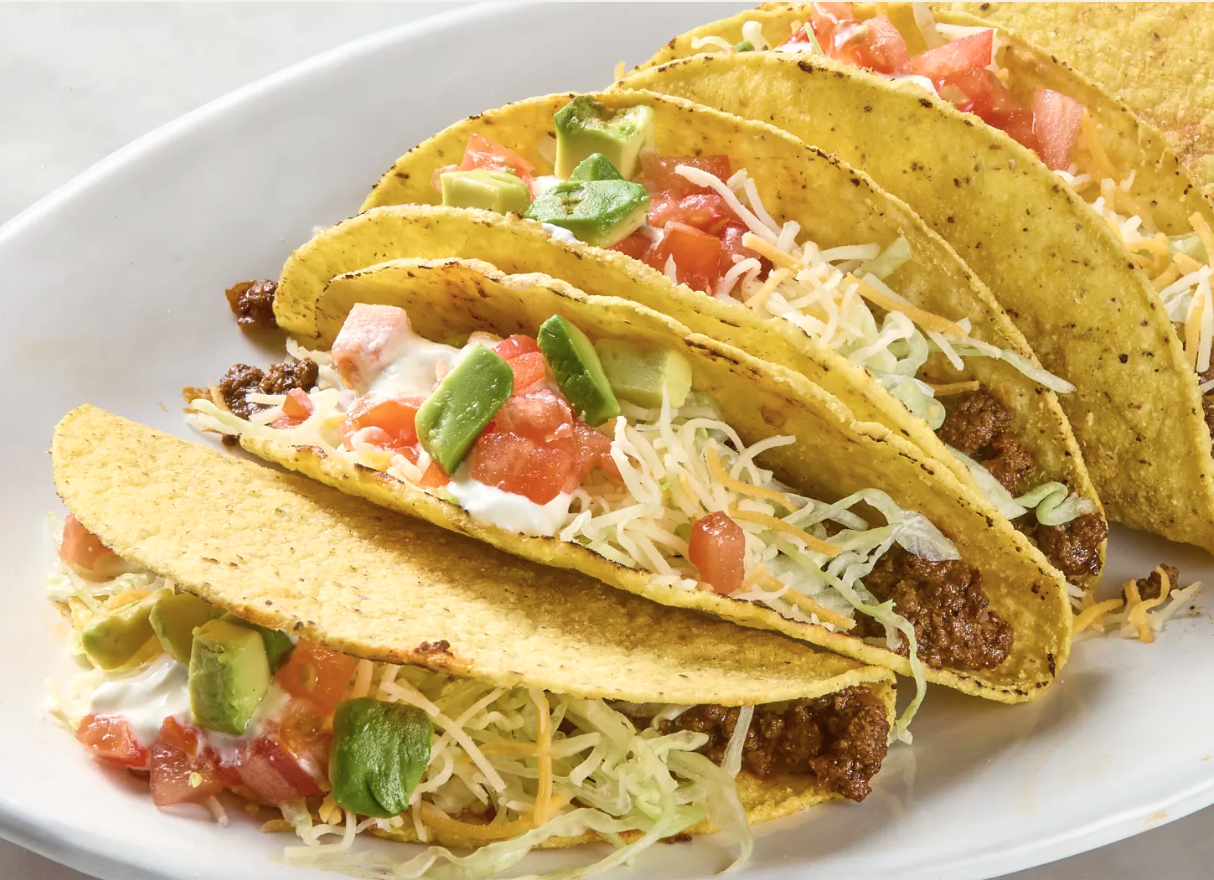
–but that are rooted, as the hard-shelled taco with shredded lettuce, supermarket jalapeños, and diced tomato–in the racist stereotypes of the past, as the gunslinging “Mexican bandit” toting two pistols who robbed unsuspecting Americans of corn chips speaking broken English beneath a large outsized sombrero, a suspect character worthy of racial profiling of Salvador Dali style whiskers retired only in 1971 under pressure from the National Mexican-American Anti-Defamation League. If Frito-Lays had perhaps intended a sense of illicitness in those crispy treats of deep-fried cornmeal to entice by their racy crunch, the dangers seemed vaguely south of the border, modeled on snacks at a San Antonio café, sold an Anglofied chip bya racist mascot for national audiences on television as it was unveiled in 1966. Voice actor Mel Blanc, on the tail of voicing a blackface Bugs Bunny, ventriloquized a Mexican revolutionary stealing chips with the presence of fallse friendship–“Give me Fritos corn chips/and I’ll be your friend./The Frito Bandito/ you must not offend!”–long imitated on school playgrounds, just in time for the Civil Rights movement. The ear worm of a jingle neutered any sense of the politics of the Mexican revolutionary, replaced by the threat of losing universal access to salty snacks of questionable health or authenticity, in a promotion to the loss of health care that was now being rolled out. For if the snack from the border-town of the eighteenth century mission town, near the border towns of Laredo and Eagle Pass, was a site of importing the corn chip, appropriating centuries-old food technologies of Mesoamerican culture for processing boiled cornmeal with lime to fry them up for plastic sacks, the chip had the allure of the danger of a border crossing snack, domesticated to ascend easily to universal idiom of the Esperanto of emoji.

Trump may well chicken out. But the conversion of a revolutionary ideology of feudal farming to a comforting snack of corn belies the subsidized nature of corn farming in America, a legacy of the New Deal, to threatened by the Frito bandit was a fiction as powerful as William F. Buckley’s Firing Line broadcasts that Trump seems to traffic with undue aggression. As much as Firing Line, Fritos offered fuel for a generation of openly racist stereotypes of migrant dangers of banditos who are thieves, rather acting with political complaints or substantive agendas that might rather figure prominently in an American election, to portray migrants as stools whose votes should not count, feasting on taco bowls for a Cinco de Mayo photo op in Trump Tower, indulging in that suitably Americanized “faux” Mexican feast too often mistaken as a celebration of Mexican independence.
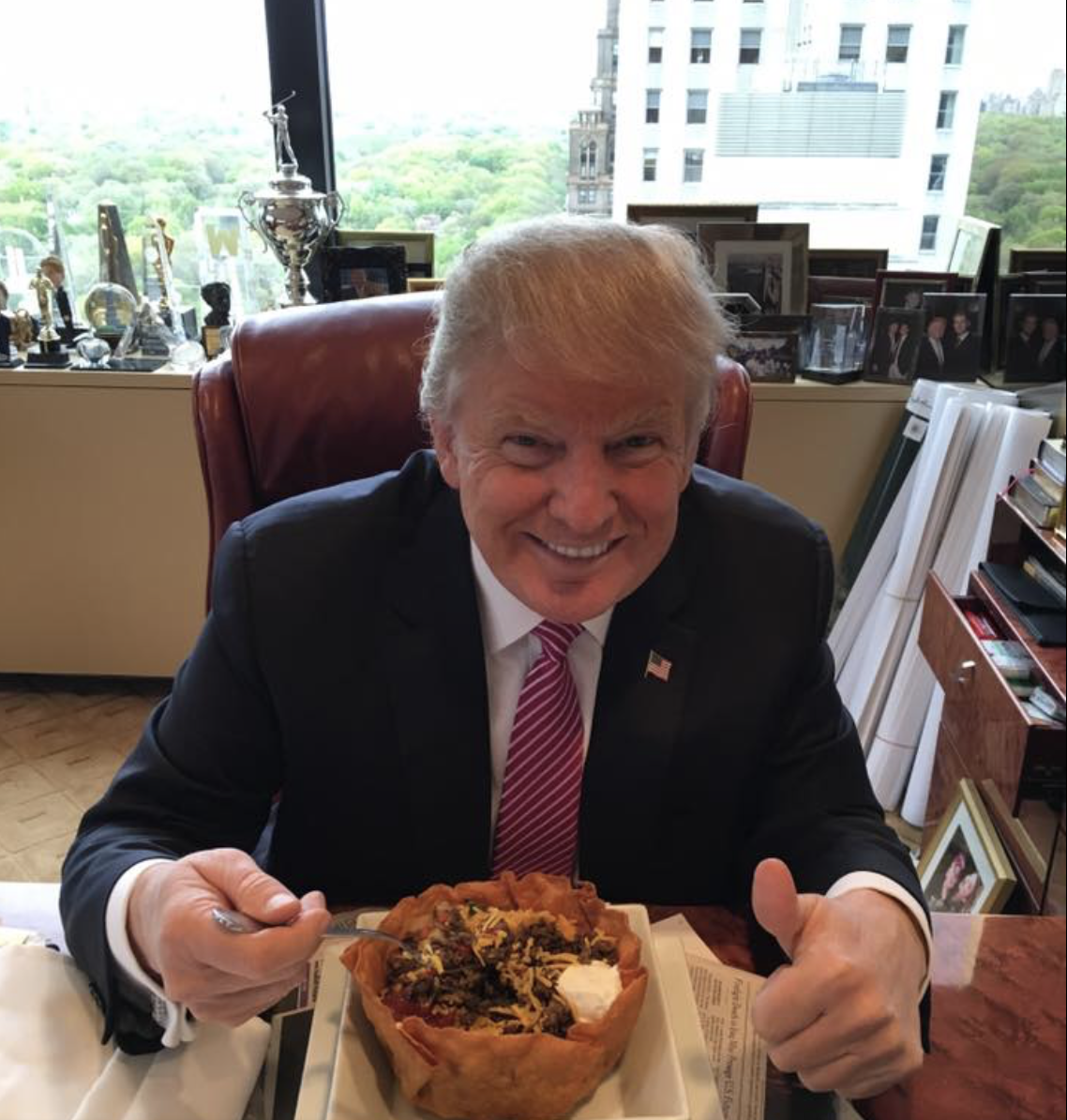
The eager appropriation of the cross-border treat paralleled the drawing of a hard border to protect American prosperity from Mexican bandits. From cheetos and corn crisps, taco bowls stood for the ways Trump “loved” Mexican working in food industries in his hotels, a site where many undocumented immigrants were indeed gainfully employed. Trump cast immigrants south of the border as an undue danger immigration officials must be empowered to contain,–promoting his endorsement from border authorities who readily aligned with candidate Trump as if they were trusted informants sharing expertise about the border that they guarded whose endorsement was key–“if we do not secure our borders, American communities will continue to suffer at the hands of gangs, cartels, and violent criminals preying on the innocent!”–by false statistics suggesting a lack of safety in border cities, portraying immigrants as hardened criminals demanding expulsion, and indulgently trading in the most tired of xenophobic tropes to fire up voters by baseless public safety threats that his election would stop–a promise that became a repeated platform of his 2016 election–

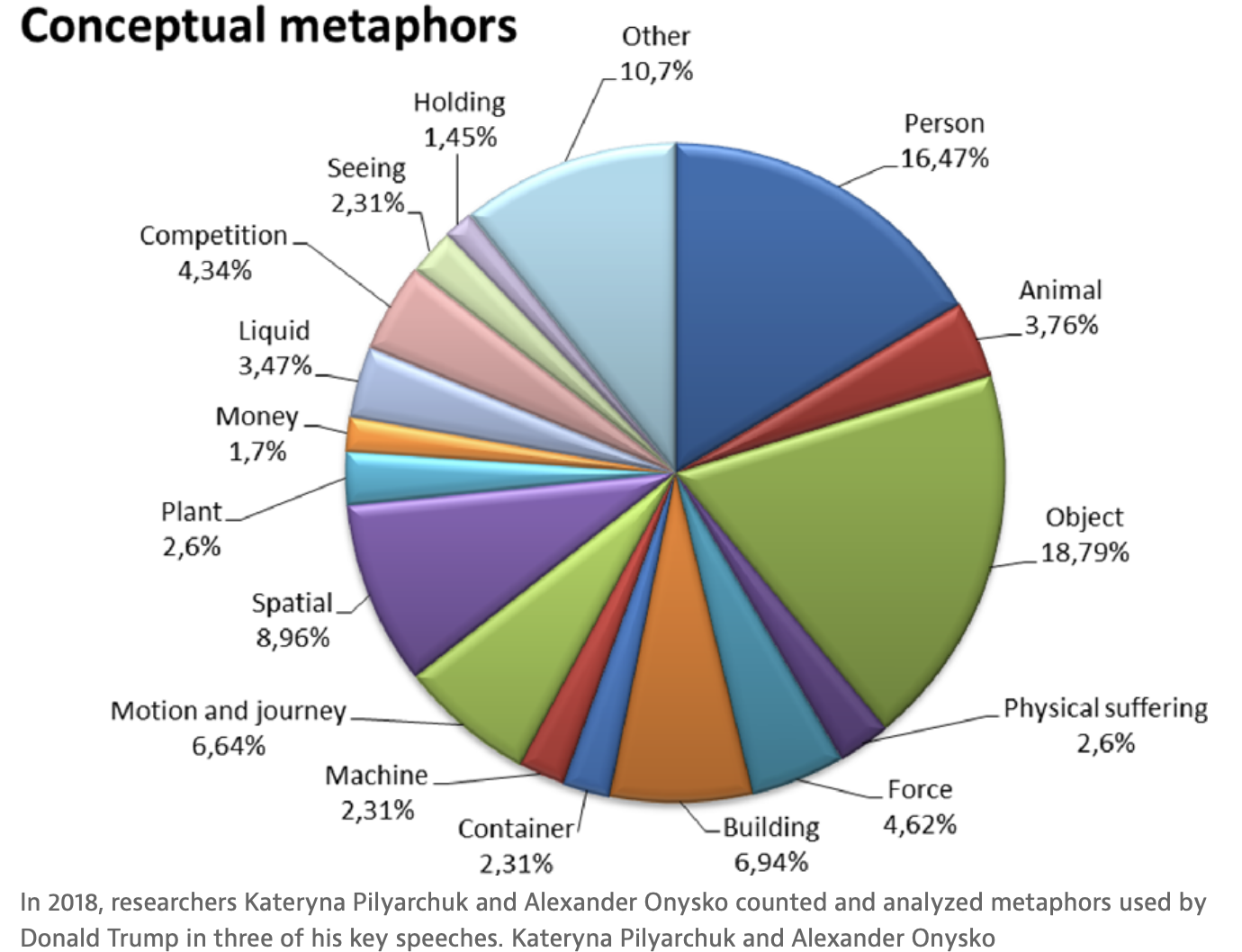
–and was celebrated as the arrests of “illegals” celebrated Trump’s enhanced authority to remove migrants. Executive Order 13767 on January 25, 2017, a year after his inauguration, authorizing the allocation of funds in the U.S. Budget to construct the physical wall he had long promised to have built along the U.S.-Mexico border as an insurmountable obstacle, whose white tiles almost did double duty in suggesting a bathroom needing to be rid of. The buildng of the wall was not only a material metaphor of protecting the border, fulfilling the collective chants to “Build the Wall!” that animated his rallies, both before and after the election, as he long cited the absence of adequate funding, to provoke rage of his supporters, and elevating its need by arguing for budgeting of its construction needed even it meant shuttering government to obtain it, reciting the poem “The Snake” to conjure the dangers of trusting the needy migrant–“‘I saved you, I saved you, I saved you,’ cried that woman./’And you’ve bit me, heavens why?/ . . . ‘Oh shut up, silly woman,’ said the reptile with a grin./‘You knew damn well I was a snake before you took me in.'”–to illustrate the foolhardiness of a country that would accept a poisonous population, appropriating the figure of animals as metaphors of danger to provoke a fight-or-flight response..

Secured Borders/Trump 2020 Campaign Advertisement
The rhetorical transformation of the figure of the migrant to an insect, held by a rejuvenated suited president as a hotel manager you would trust with keeping your tiled bathroom floor clean and tidy, has expanded to attempts to bring an end birthright citizenship–beyond metaphors–to purge the nation of citizenship privileges extended by Democrat predecessors, in a self-serving act of distorting the electorate. He promised to continue his early platform by cleaning the national home, ignoring that birthright citizenship is a non-partisan promise. Trump claims the concession was only intended as consequence of reparations after the end of slavery, as if the change in legal status was a transformative act in itself, not to be assumed or taken for granted, but exceptionally extended to formerly enslaved to award them voting rights. IN this logic, citizenship is a reward–not a right–as if the prize of a reality television show. (The US State Dept. has expressed interest in developing a show that removes any awareness of citizenship as a civic right and promise.)
The truly facile argument citizenship is “not to be granted” to “any resident” of the nation remaps the concept of citizenship to a special concession, reduced from a right. If birthright citizenship is seen only in relation to the geography of a parent’s birthplace, rather than the nation, Trump vaunts “voluntary deportation” with increased threats of deporting and detaining and expelling the undocumented, raising tensions among immigrant communities and increased fear across much of the land. By reinstating borders in the mental imaginary about living, learning, and working, Trump relied on a specious notion of “legality” interpreting not legal precedents, or rights, but rewrites the law based on a story the Trump wants to tell about our nation–one that is perhaps more entertaining, more pleasurable, more exclusive, even if it is “banal propaganda”–rather than about following laws or addressing the income inequalities that have been allowed to grow. It ignores and seeks to paper over the rising number of American children in “immigrant families” by denying citizenship to children in a nation that has the largest immigrant population of any in the world–but perhaps omits the concentration of immigrants in three states in the union–
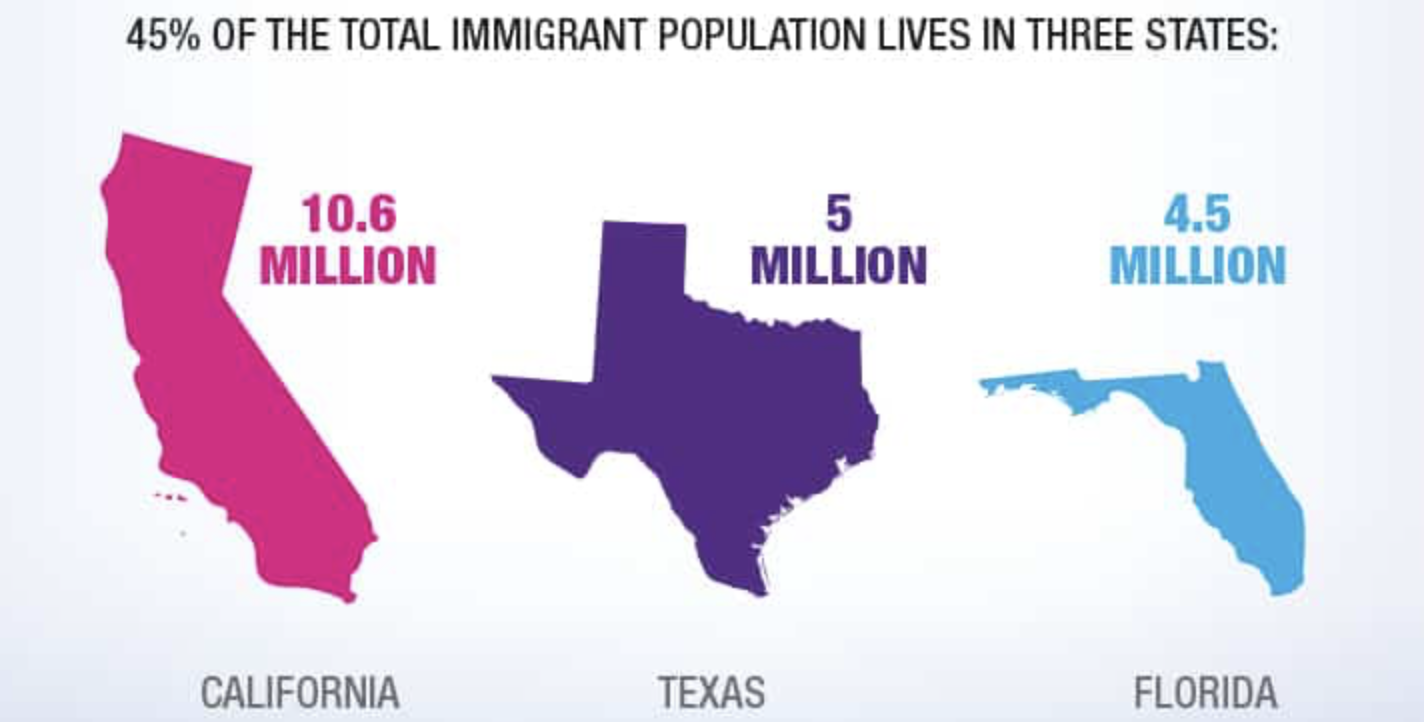
–as if it was a national issue, and erasing the significant increase of immigrants living below the poverty line in all three states and the nation at large. The war on migrants is a war on the lower classes, the underemployment of immigrant women and men, and disparities of income among Mexican immigrants, and the increased number of migrants from areas of considerably higher levels of poverty–in North Africa, Central America, or Mexico–many of whom often migrate to the cities of greatest income inequality, or the states with huge income inequalities, as New Mexico, Nevada, and California–and often to states where U.S. citizens hugely out-earn migrants, creating a two-class system of massive wealth inequality–if the anti-immigrant isolationist platform is designed to appeal to an increasingly effectively gerrymandered republic masked as being afflicted by “partisan divides” rather than by economic grievances.
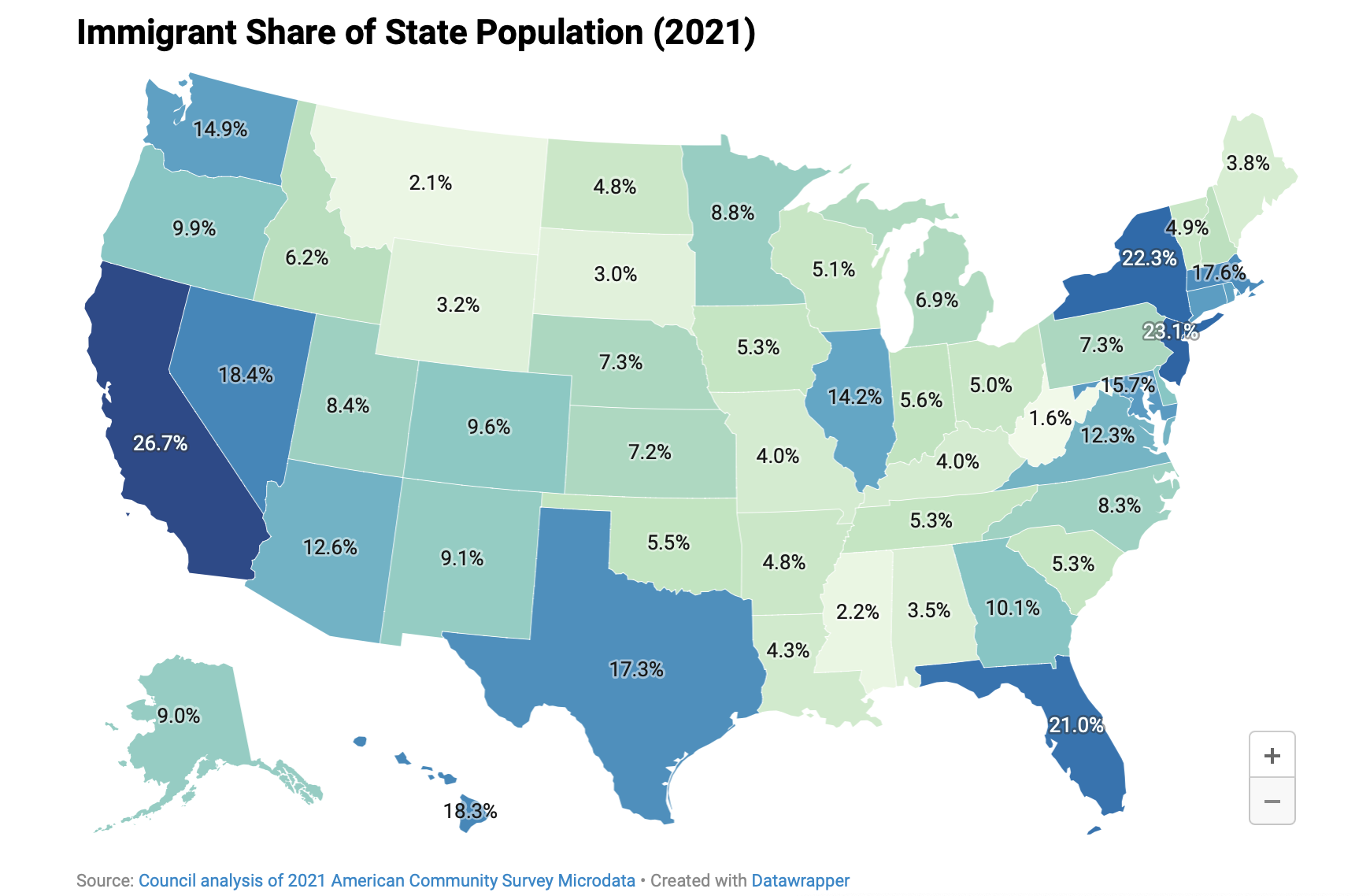
But the undocumented immigrant is demonized as the basic grievance for all our wrongs, so that we don’g have to develop a sense of what wrongs need to be righted to move ahead. The old adage ofH.L. Mencken that “our national ideas, indeed, are mainly third-rate, and some of them are almost idiotic, but taking one year with another we probably produce more lively and diverting people than all the rest of the world taken together”–habits that he argued in 1925 have produced more “sharply outlined racy characters” who never fail to offer diversion as President even as they take their alleged political positions only further their own interests and wealth alone, rather than the social good or follow laws, seems curiously more fitting for 2025 than 1925 after all. When Mencken observed he worried ‘Ideas count for nothing in Washington, whether they be political, economic or moral,” his assessment sadly stands the test of time by more than he ever expected–if many worry why our nation has become third-rate, few see the inequitable distribution of income as a cause. And as New Deal ideas in are rolled back in ways destined to devalue the dollar and American citizenship as much as the social welfare, perhaps the hardening of borders as areas of sovereignty that trump human rights will be the hallmark of how the Trump Presidency seeks to patrol people, arranging opaque deals that are sold to the American people rather than follow precedent. Reducing citizenship as a right of birth to a conditional make the boundaries more important than the civil rights extended to all citizens.







 Musings on Maps
Pingback: Appeals Court Blocks Trump's Wartime Law on Venezuelan Immigrants - Writ of Mandamus Lawyer in New York, New Jersey, Connecticut & Washington D.C.
Pingback: Judicial Review and Mandamus in California’s Fight Against Federal Immigration Overreach - Criminal Immigration Law Firm in New York, New Jersey
I think it speaks volumes that as Trump seeks to leave a global imprint he was denied in his first term, that he turned to a man like Musk, whose sense of global politics is so limited and skewed. This is a case of the inexpert leading the inexperienced, clamoring for authority with little priorities than their own self-aggrandizement.