
Metrics had defined the race that seemed to make it a game of cunning and tactics,–even as Trump drowned the airwaves with caricatures designed to fill viewers’ minds with fight of flight responses and promising personally that “I will fight for you and I will never you down” as others might–offering an implicit promise to increase energy production and oil fracking across the state by firing the current administration in aggressive terms as a duty by putting his life on the line at Butler PA rally, “because he loves this country” and “he is what this country needs right now” to make sure that “our cities will be safe, our streets will be clean, and our border will be secure”–

Trump Advertisement Airing in Eagles Weekend Game before Election Day Featured Footage from Butler Rally
-lest the safety of the nation be in the hands of “politicians who will put their own power ahead of the interests of the American people,” who could hardly be trusted to show the same strength and resolve to mend the nation that had suffered so much under the current administration. The image of Trump surrounded by the Philadelphia policemen he shares high fives on a well-policed city street suggests a strong contrast with the far more truly weird maniacally laughing Democratic candidates–breifly shown yukking it up in a relatively stark black and white claiming the Great Seal of the United States to stage rallies of abandon, ignoring the dire situation in America as they continue to party obliviously, whooping it up in ways that a voter could hardly be expected to trust.

Kamala Harris and Tim Walz Laugh in Advertisement Aired at Sunday Football Game before Election Day
How could these two be trusted before the massaged statistics that seemed to be returning voters’ attention, as if merited, to the threat of porous southern border, tied inseparably to low wages, a housing crisis, and meth–as well as everything else one didn’t like? That immigration at the border indeed declined was not mentioned–the red-alert nature of border-crossing seemed something these two were the last likely able to resolve, and indeed demanded a strong man.
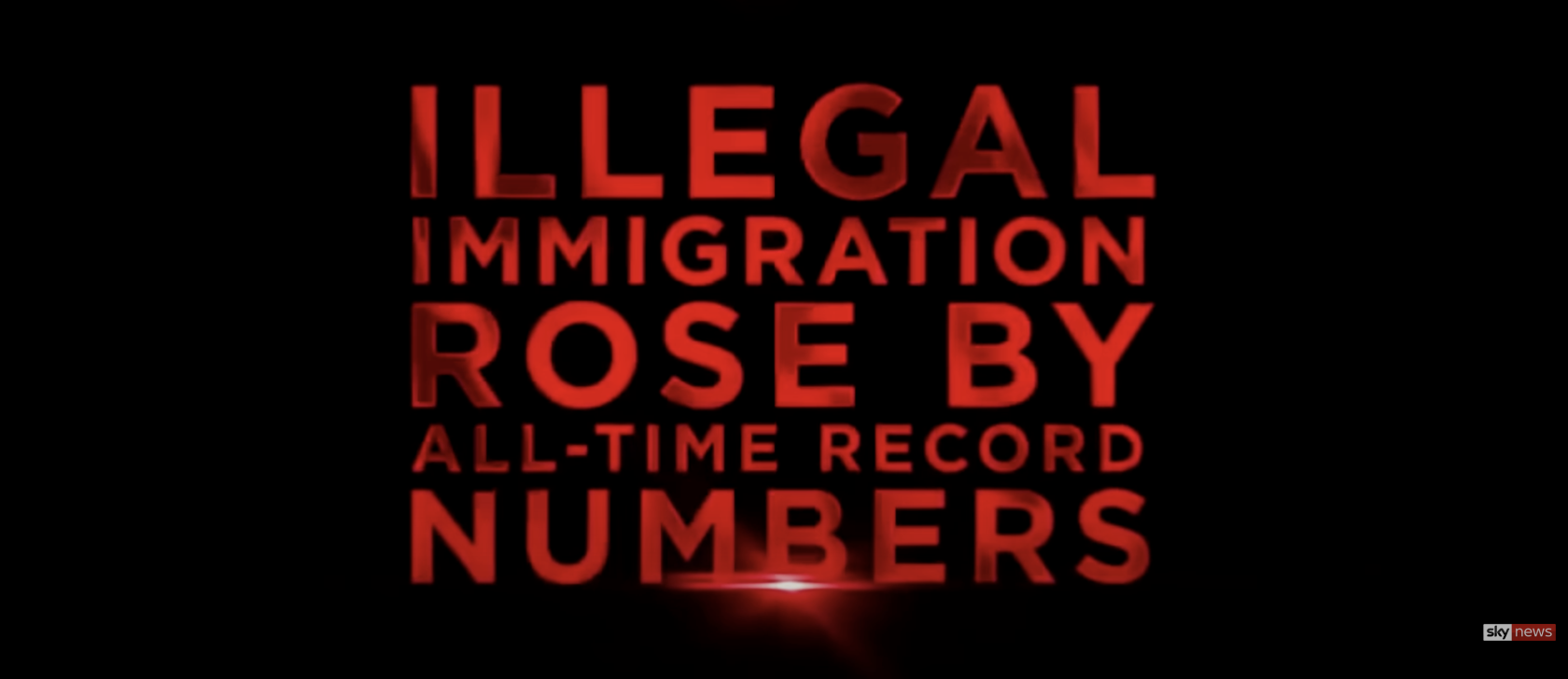
Deceptive Tactics of Magnifying Cross-Border Immigration and Tagging as “Illegal”
The other guys, in other words, were the joke. The inundation of the airwaves took the place of campaign offices, dismissing the opponents who think themselves credible candidates but are hardly serious at all. Was there a way that they could be trusted to be the public face of a nation as it is besieged by a millions of “illegal” migrants, in record numbers, many of them hardened criminals and drug sellers, in a rising tied of illegal migration that his political spots magnified.
Can the other people even be claiming to defend the country? Where was their sense of an image of the country that they even wanted to defend, and wouldn’t we feel that the highly popular 1980s action of two fun-loving cousins–Bo and Luke Duke were photoshopped with the heads of this year’s Republican ticket–who love life by selling liquor in Prohibition as they outwit the greed of “city slickers” amped a “real” America that Trump must have watched himself. (It is part of a Trump-Vance advertisement that I only watched on X.) The heroism of these convicted if cousins who plea-bargained their way to working on the margins of the law, in which the shifting terms of probation were almost part of the plot, cast the candidates as wily outsiders. Evading the law in their custom Dodge Charger, the “Duke boys” live outside the law, with a confederate flag proudly affixed to the car they call The General Lee; we cheer them on anyway, partisans of a Lost Cause, finding true grit and honesty in their moonshine business as they cleverly evade and outwit the crooked local sheriffs in the red car, “General Lee,” whose horn plays Dixie, as an icon of southern separatism, defying laws designed to prevent them from either selling moonshine or owning guns, as if the television show could be cast as a model to Americanize libertarian pursuit of liberties.


“Dukes of MAGA“
The smiling happy-go-lucky Dukes of MAGA were out to unravel the republic, and rewrite the bonds of government to individual, suggesting the deeper bonds of family loyalty, and freedom, in ways that sold the notion of southern identity to America, much as the popular television drama had repackaged southern nationalism and indeed created a new iconic sense of the recognizable natur4e of the “good” political in place of the venal and corrupt administrators of the law, elevating the fun-loving career criminals as folk heroes of a lost south. The clip “Dukes of MAGA” cast Joe Biden as the corrupt sheriff–no longer black–whose “boss” was Hillary Clinton,–a viral political advertisement widely shared by Donald Trump, Jr. (among others) as “Hahahahahaha Amazing!!!!”
The ham-handed hierarchy of gender of that the television series made mainstream a nostalgia for a southern past in the early eighties, served to ridicule the idea that women would ever play a role in the political system rooted on the rural roadways–no woman ever sits behind the wheel in the incredibly popular television show; guiding of a stock car emblazoned by a proud Confederate flag on its roof, The General Lee, tooting “Dixie” on its horn, not only acknowledged the Confederate general who adopted the “stainless banner” as an emblem, but championed the Lost Cause in popular culture. The presence of the television show as politics wasn’t too far off and racial divisions conspicuously present–the sidekick mechanic of the Dukes of Hazzard County, Cooter Davenport, who repairs stock car after it jumps ravines, played by an actor who had won election to the House of Representatives for two terms–in 1988 and 1990–as a yellow dog Democrat, defeated by Newt Gingrich in 1994 before retiring to found Dukes of Hazzard museum outside of Shenandoah National Park–selling the “Stars and Bars” Confederate battle flag he strongly defended, in the years before it was coopted by the Lost Cause and white supremacy among the American alt right.

Dukes of MAGA
This was, in a sense, a reprising of the big themes of American history–stuck in the permanent present of the 1980s’ television show premiered in 1979. The mythical Hazzard County became a site of the battle law enforcement and corruption–as central themes of Donald Trump’s campaign of rethinking government, and eliminating what were eagerly cast as extraneous government agencies. The “meme” recast Presidential candidates as evaders of corrupt law enforcement offers who look out for themselves was an emblem of the candidacy of the a southern past antithetical to civil rights or antiracism. The clip modeled on the show’s opening credits asked us to cheer the Dukes’ rollicking escapades of evading county laws with a smiling moll, speaking little and wearing less, cheering them on in the evading a crooked black sheriff who was allied with the real criminals.
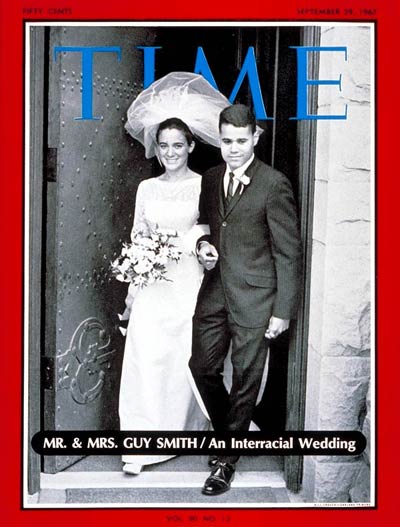
How could feeling good be offered by the other side, when feeling good was found on the road in the fictional Hazzard County? Who is to say that the deep fears of miscegenation that animated so may southern states that it was lead to bans on interracial marriage that survived the Civil Rights Act of 1964, but it was even more striking that the decision to protect interracial marriage had indeed reared its head as recently as in 2022, when the U.S. Senate reasoned that, with the overturning of the affirmation of the constitutionality of abortion based upon rights to privacy in Roe v. Wade grounds potentially for the jurists to reconsider the evacuation of laws prohibiting interracial marriage only two generations ago? (Some openly asked the justice who had rejected Roe v. Wade based on his objections to due process if they planned to revisit the very subject the Court’s legalization of mixed race marriages in Loving v. Virginia.) The evacuation of laws against what was seen as a taboo in 1967 in southern states, including Georgia; it arrived less than a decade before the 1975 biographical film the television drama was based on, dramatizing the memories of a bootlegger family in Kentucky, the bootlegger Jerry Elijah Rushing. The actual car General Lee was bought on the spot from a southerner when it was spied, complete with Confederate flag on its roof, during shooting, offering an iconic rehabilitation of a cozy whitewashing of the Lost Cause, as part of a Southern past that should have receded far from public memory. In a boom market for country music that the television market was cornered, peroetuating a mythic past of white supremacy that was ingested by viewers nationwide. Could it be that the premise of electing mixed race wife for Uncle Sam was too much for many in the South to imagine endorsing, or even to conceive? The lifting of the ban that made it to the cover of Time hardly seemed to feature a groom of African American ancestry, was proclaimed as national news, “social history rather than society-page fare.”
The nourishing of the Lost Cause and Southern Past became the basis for the popular live action series that normalized ample doses of sexism and racism within its storyline. The greatest taboo of southern culture–beyond integration at schools or in public space–were codified not as taboos but laws against interracial marriage or “miscegenation” that echoed scientific racism. Was the issue of interracial marriage, if Kamal Harris’ 2000 election as Vice-President was seen as a victory over surprisingly recent racial taboos? The taboo subject was not mentioned in 2024, even if Harris’ own mixed race identity was more prominently in the news, as her race was clearly targeted by J.D. Vance, who advanced the racially charged slur that Harris had been “collecting a government paycheck for the last twenty years,” presumably to highlight his own work in the private sector, but in ways that inescapably insultingly likened her actual experience by making it akin to welfare. Was it possible Vance was hinting at the mixed marriage taboos she had violated, as well as comparing her to a welfare queen, as southern legislators labeled her as a candidate who was undeserving of the office–and “100% a DEI hire” rather than a Vice President–in a toxic political climate? Again, the notion that the job was reserved for an ably employed white man seemed to disqualify her for the office, and indeed to make a mockery of her pretending that she was a capable public servant.

Anti-Miscegenation Laws in the United States as of 1967 (red); repealed between 1948-1967 (yellow); before 1888 (green)
The amiable if rambunctious Duke cousins were celebrated evaded convictions and cast law enforcement bent on stealing the family farm. The ad produced for the 2024 election cycle channeled irrational dislike corrupt law officers feel to the Democratic Party out to get Trump and his family, recycling outsider heroism of these plea-bargaining outsiders fit multiple grievances, keeping guns secure, and living life on the road evading the law. It celebrated Trump’s convictions a heroism of intense living which we wanted to cheer on as they drove on to Washington, DC, as if the show was an American legend Trump and Vance could inhabit, as the true spirited saviors was widely and ecstatically shared, were truly weird. The flag Robert E. Lee adopted became a touchstone of Confederate nationalism–a defense of the heart of the Southern economy, slavery, was a celebration of separatism, a battle for sustaining white supremacy of the “destiny of the Southern master and his African slave” that confirmed southern independence.

Insurrectionist in White House January 6, 2021/Mike Theiler/Reuters from The Atlantic
The Dukes of MAGA would fight for the same cause, as insurrectionist carried the same banner into the White House on January 6, 2021, before a portrait of the abolitionist Charles Sumner, before the portrait was among those works of art that were defaced by protestors who illegally entered the building. If the first time was tragedy, the second was truly a farce. The advertisement, taken as the campaign, reduced the issues of the election to a good ol’ boys game in which the gender hierarchy could never be bridged. Indeed, the meme of the Trump-Vance campaign represents a radical contraction of an America without ties overseas to a shrunken vision of the rural imaginary of the open road, gas so cheap that the stock car was able to run down rural roads far from an electrical vehicle or even speed limits, and probably seat belts as well, going full throttle on the Dukes of Hazzard defiance disorder as long as the ride is fun. The embrace of an absence of rules, or their recognition, found the insurrectionist entering the White House with a Stars and Bars banner before the portrait of an ardent abolitionist, demanding that a separatist candidate occupy the Oval Office. Is the reference to the Dukes of Hazzard not a dog whistle to the same constituency, if not a hidden message about the faded glory of January 6, 2021?n (Will Trump himself take the time to offer a personally guided tour of the White House to these patriots after Inauguration Day, 2025?)
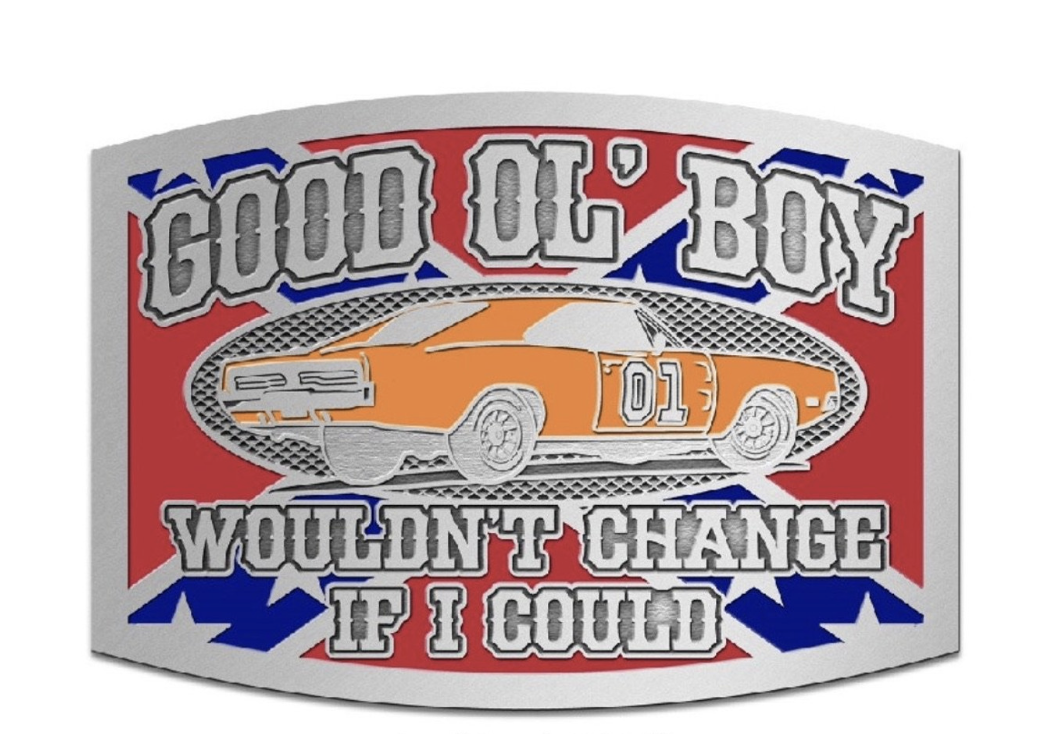
The safety of seat belts is handily exchanged, in this rural idyll, for a belt buckle, proclaiming true safety of a Rebel General Lee Belt Buckle in online shops still modeled after this American myth, a utopia of merchandise, perhaps, but one that is also the safety of a vision of risk, outside the norms of a community, or perhaps in a community apart and outside the law. If the racist catcalls of Trump-Vance veered wildly on the roads of the campaign trail from memes questioning Harris’ black identity, with a tone of fear, to courting them by identifying Harris with illegal immigrants–black Haitians–as if they were not national citizens.
Dukes of Hazzard Belt Buckle
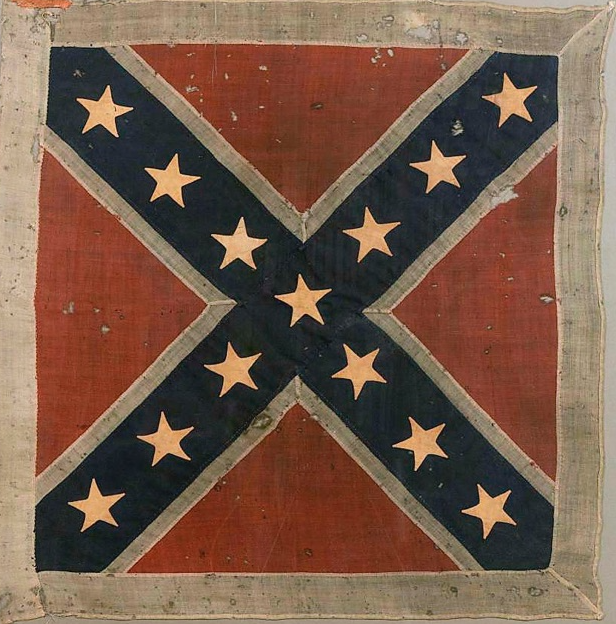
Southern Cross Flag or St. Andrew’s Cross Flag Ordered by P. T. Beauregard in 1863 in Charleston SC
The 1980s television show is resurrected as a metaphor for the Trump-Vance campaign, a crossover from a taboo subject to mainstream television mirrors the transformation of the Trump-onomics of impressing the boss to climb a corporate ladder on Reality TV to preserving job security in America. The crossover migration of southern culture to a mass audience was mirrored in the mass appeal of Trump as a candidate for President, perhaps the ribald individualism of the 1980s television show was a blueprint for how to Make America Great Again, imagining the prospect of a mythic land of evading the law that Trump and Pence promise, free of international obligations, under a banner recognized even if it is one that many might consider as lying outside the law: the banner of the Good Ol’ Boys was easily identified as the treasured confederate flag, the sign under which they ran roads evading the Sheriff Little of Chickasaw County, the mocked character who was the sole black character on the show, in a town without nary a black resident–a figure of ridicule not respect. The game-like pleasure of evading the laws in this rural past was a popular model validating the crossover candidacy of two men with little political experience–or trust in the political system.
The notion of rebels evading the laws of the land might seem something of a stretch, but it is hardly hidden deep in the American grain. It is actually lying on its surface. The colorful videos and memes were uncannily able to substitute for the real issues of the election, in a cool magic trick akin to photoshopping the political issues of America, rejecting a globalized world by returning inward, and returning to personal honor and admiration. If the two Dukes use arrows tipped with dynamite and compound bows as new heroes of the frontier against law enforcement villains, the free-riding team of Trump, Vance, and an ever-admiring Melania in the back seat are a new Holy family of sorts, who oppose another side that only seem to feel anger, forever framing the Dukes for their truly clever plots. The haunting image of Melania as gangster’s moll was a bit of Americana, in a clip that was, as the Dukes of Hazzard credits, set to Waylon Jennings’ anthemic “Good Ol’ Boys,” of folks “never meaning’ no harm” if “been in trouble with the law,” “making their way, any way they know how . . . just a little bit more than the law will allow,” driving down roads in reckless abandon.

1969 Dodge Charger “General Lee” Speeding on Backroads of Hazzard County in “Dukes of Hazzard”
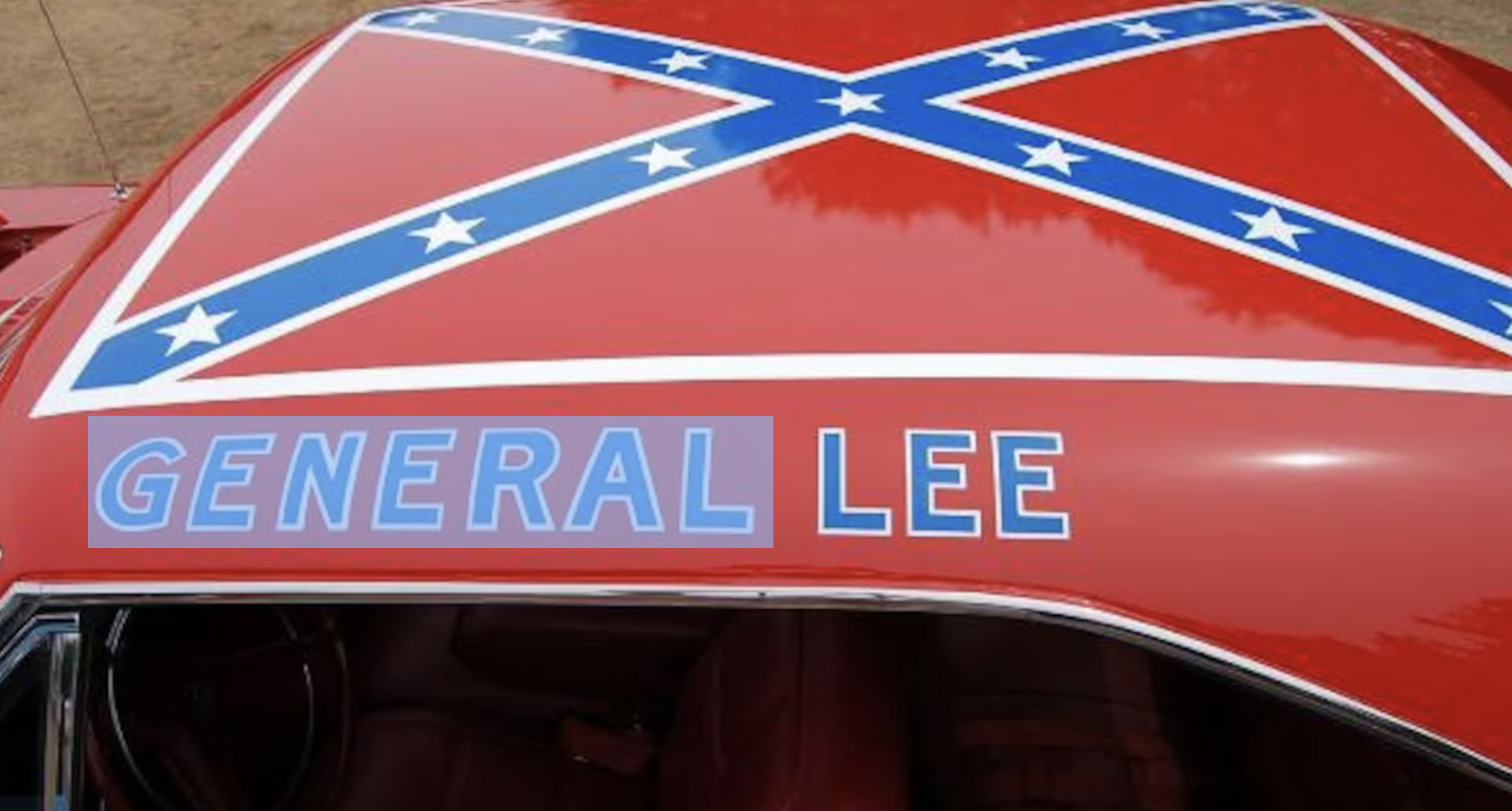
The television serial had openly promoted mths Southern identity and sent them mainstream from the margins as harmless fun. The reprisal or resurrection of the Lost Cause asked we trust Trump and J.D. as men on he run and on the lam, having fun, and evading the law–Good Ol’ Boys. They demanded to be recognized as heroes of a lost past, freeing up the world from regulations and deserving their try behind the wheel. The Good Ol’ Boys were traveling the entire country in their campaign, as much as Hazzard County’s backroads, but also speeding on back roads in a red Dodge stock car the was made in America, named “The General Lee” meant to evoke a good old South, if not to echo the Lost Cause of the Confederacy.
They showed and reveled in a form of electric independence in evading the many judges who populate Hazzard County out to frame the cousins, flouting taboos, and unmasking the devious tactics of judges who only want their farm: racing on the highways of a vaguely mapped rural past to Washington, DC, while we cheer them on. Perhaps a hand-drawn map of old times we hope will help us to navigate the present by evading the authority of density of judges–Judge Jefferson Davis Hogg, Judge Druten, Judge Simpson, Judge Peabody, Judge Buford Potts–someplace outside of Atlanta. (It lacks public transportation or a hospital, but has three airports, a Little League team, a USO and a Grange–sort of an America without health care, social security, or Medicare, or hospitals, but plenty of booze.). The ability to eviscerate Social Security, Medicare, and public health plans known as Obamacare, the America Cares Act, since most had forgotten by the end of the race what positive role the government had ever played in their lives.







 Musings on Maps
Thank you for your efforts to “map” what just happened to America. I have avoided the news since Tuesday evening when I realized what was about to occur. I hope once the dust settles a bit more you have an opportunity to have a followup that portrays the landscape in your unique and compelling fashion.
(‘Acaqun ehicine’) ‘Go in a good way’ as say the Cahuilla Indians.