
While Hazzard County is not a place–it was filmed near Burbank Studios in Southern California, the television show was mapped as areal place, a lost America, of sorts. If notorious speed traps were running jokes of the show, a metaphor for the loose application of the law, whose white populace lived in the minds of many ardent fans eager to escape modernity on windy back roads, steel bridges, and minimal law enforcement–“Hazzard County reminds us of home, no matter where we’re from.” (That it was filmed in Southern California, near Burbank and Disneyland, only made it closer to the “happiest place on earth,” even if the town’s mayor was so famously corrupt.)

The fictional Hazzard County was not on any electoral map, but was alive in the minds of its fans’ wiki, and is one key to the election not likely to emerge in electoral maps. It lies in the nation but in an imaginary electorate. The Good Ol’ Boys race with a reckless abandon in Hazzard County, indeed, riding without speed limits, free from government’s restraints, racing moonshine in a notional Georgia down rural roads in a free market, reveling in bucking norms as two outlaws “fighting’ the system like modern-day Robin Hoods”–free from the restraints of tax codes that a free enterprise promises. IN this world, they race in the General Lee, entering the NASCAR circuit, their mythic status revered, an old south reenacted with reverence in the Dukefests Waylon Jennings regularly sings. This mythic landscape became a landscape Trump won, of a generic extra-urban America, as the vote-rich cities were less able to steer the campaign to victory in swing states where all those red arrows rose.

The promises are not of a new America, but are keyed to Making America Great Again, drawing on a range of mythical stories spun by influencers, to whom the Russian FSB and RT network were maybe only the icing on the cake–or in fact critical. For both inundated the internet with disinformation the Justice Department estimated cost both agencies at least $10 million to produce on Election Day alone. The motley assortment of much retweeted images of a tragic America recycled a vision of an old, free America–many produced by American crews, including right-wing podcaster Tim Pool, who had early predicted “Trump’s Revenge” on Timcast and Libertarian Dave Rubin, a one time intern on John Stewart’s Daily Show whose Rubin Report endorsed Trump since 2020, disgusted with identity politics, and YouTuber Benny Johnson, creative officer of TurningPointUSA. They include images of streams of Haitian immigrants illegally arriving at polls to cast ballots multiple counties–as rural conservative counties shattered records for early voting. The local production teams have not been charged or attacked, but were quite involved with a web of disinformation akin to the “vast, right-wing conspiracy” Hilary Clinton described, if coming from overseas actors, eager to feed an old mythology to American viewers in search of new leaders.
The proliferation online of fake news disinformation from YouTubers and from foreign governments is hard to parse, and doesn’t need to be. Indeed, Trump may have confessed the lack of importance of their origin in debating Hilary Clinton in 2016, questioned Clinton for accusing Russia for interfering with the election by hacking DNC servers: “She’s saying Russia, Russia, Russia. Maybe it was. I mean, it could be Russia, but it could also be China, but it could also be lots of other people, it also could be someone sitting on their bed that weighs 400 pounds, OK?” Trump argued in the third debate that Clinton charged Russia with cyber attacks but that “she has no idea whether it is China or Russia!” while quickly adding “Of course I condemn, of course I condemn” election interference. The tactic of insinuating such interference quickly reared its head as groundwork for a third run for President, Trump issued a news release bombshell in August 2023, “I believe we have a compromised President [who] was bribed, and now he’s being blackmailed,” stirring rumors about “Crooked Joe Biden” and a “Biden Crime Family” before the election; “He’s a Manchurian Candidate,” Trump’s news release, crowed receiving over $20 million from foreign countries “and probably a lot more than that.”

Chinese National and Money Launderer Tao Liu Surfaced to Meet with Trump at Bedminster, 2018
The Harris campaign quite played a different game. Metric breakdowns organized targets and performance that organizers may be interrogating themselves about their effectiveness of working to put ideas clearly before voters. The Democratic candidate had carefully made abortion so central to her platform to cite it repeatedly in the campaign’s final days–more than an end to wars or a higher minimum wage–sadly won far smaller margins than Hillary Clinton or even Joe Biden–in Biden’s case, a third less!–and the demographic of white women she had so eagerly courted with Liz Cheney broke for Trump in the end, and her support among Latina women was even a far cry from the commanding margin that Hillary Clinton had won, even as a quite sizable majority of Latino men, as the press often noted, went for Trump this time round. Why Latina women went more strongly for Clinton than Kamala Harris remains a chestnut of 2024 rooted in religion and claims for a glittering economic future–far from issues of women’s health that the party had thought a defining issue, making it a football of sorts that prevented other messages from getting out, even as door-knocking volunteers and attempts at ball curing seemed to offer tools for an energized on -the-ground campaign–including plans for post-election ballot curing phone banks.
That never happened, however, due to the wash of that big red wave that left so many stunned. Harris had failed to win over women in general as much as her Democratic predecessors, even as Trump painted the fears among his supporters of a country where women supported his opponent and Republicans worried for their own fortunes in what appeared a commanding a gender gap–and his advocate Charlie Kirk riled up voters with a real specter haunting America in millenarianist terms: “if men stay at home, Kamala is President.” (His Vice President advocated a national ban on abortion, and he delivered sexist openly misogynist rhetoric in the campaign’s final stretch, but folks saw his evocation of “hardworking patriots” as the picture the electorate wanted to see themselves to be.). As much of the electorate felt themselves “ignored” by the Democratic candidate, Teflon Don was a comfort vote “on track for Season 2.” As The Sun put it, more wisely and perhaps more meaningfully than most of the commentariat, “ex-Apprentice Star is Prez Again.”

“Shot, sued, tired, insulted and written-off,” he was bouncing back, as if the star of a rapid fire hip hop, a survivor who transcended onslaughts, seeking redemption with renewed defiance. The 2024 election was seen as only able to be won only on the slimmest margins, per the polls. But was it? Biden’s run amidst a pandemic was very much the outlier that had prompted the highest turnout in a Presidential election since 1900; in “battleground states” of North Carolina, Georgia, Wisconsin, and Pennsylvania turnout hasn’t been counted, but was probably less than in 2020,–although it is far too early to accurately tabulate. Was there some remorse?
There seems to have been, rather strikingly, in those allegedly “red” states in particular, in the immediate aftermath of the election, in a sort of buyer’s remorse that reveals much about the fickle nature of the American electorate. Google Trends, that new barometer of public opinion, tells us that Election Day saw not only a drop in turnout–but a spike in the searches on Election Dayton its highest level on the hopeful topic “How to change my vote,” as if the possibility was possible before Donald Trump was declared the winner of the popular and electoral votes. The spike to the highest value possible saw a real spike in a state that went “red” and has recently tended in that end of the spectrum–Iowa–as if voters not only there, but, with some incredulousness, searched the internet to alter their cast ballots in Idaho, Kansas, Nebraska, and Alabama, as well as Arizona and Wisconsin–“swing” states!–as they revisited the prospects of Trump returning to the White House. (The baseless belief in such a chance was curiously encouraged by Trump, if one looks at his tweets from 2020, when he used then-Twitter to argue “Strongly Trending (Google) since immediately after the second debate is CAN I CHANGE MY VOTE? This refers changing it to me,” adding “In most states, the answer is yes!” Whether taken up in the new election cycle or not, the sudden spike November 5 saw in the question hit the highest level possible–100–as areas of red states seemed to seek to alter their vote.
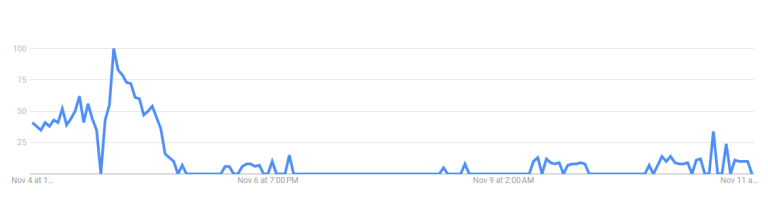
As much as we like to parse elections by maps, to understand the formal process of the tally of state electors as an arcane means in selecting a President, the electoral map can hardly acknowledge the near-religious nature of election as a drama. For the Presidential election, if based on an electoral maps, was in fact not due to the existence voting blocks, if it has been parsed by divides of gender, of race, and class, to mention the major demographic fault-lines we imagine in the electorate by which to grasp the fault-lines along which the nation broke.
We might do worse to rather look to, the quasi-religious nature of the possibility of national redemption in Donald Trump–a redemption that would lead us to see the election not only as a fascist movement, but a religious drama, based on the emotions of the electorate and the passion of politics, not its actual issues. Do demographic categories make sense as helpful ways to parse the votes, or even to parse turn-out? The religious nature of Trump’s acceptance as a healer, a uniter, and a policer was at bottom of a savior. And the weird agglomeration or elision of God and social by the egocentric if not monomaniacal social media owner who has rebranded Twitter–in November, 2022, misconstrued Alcuin of York’s sage advice to Emperor Charlemagne to not heed those who suggest that “the voice of the people is the voice of God, since the cacophonous confusion of crowds is always far closer to madness when he bought the social media company he would rebrand–

Musk’s boast to flip the control of the new media into the hands of “the people”–a suspiciously fascist notion of a public national voice–led to an explosion of attacks on mainstream media, perpetuation of falsehoods about COVID and indeed public health, and election falsehoods and misinformation that proliferated far more rapidly and aggressively than the government agencies could check or control, often about the threats to democracy by massive voter fraud and ballot harvesting across swing states. But the stream of falsehoods on the platform that he purchased may have only been a smokescreen for the alterations of the platform that promoted the most right wing voices on a medium he has engineered to promote his own personal stream of falsehoods even among those who didn’t sign up to receive his “alerts” or “posts”–a shift in the platform since he acquired it that may have led him to promote the likes, retweets, and view count of Republican voters, probably because of their content, from July 2024, in a major engineering of public opinion. While the accounts identified as “Republican” were dedicated to more frequent posting–Republican identified accounts, as of Jack Prososiec, “x”-ing over 25,000 times from January to October, 2024, as if his life depended on stirring up the manosphere, and Elon himself not far behind at over 17,000 blasts, Donald Trump, Jr. at a relatively lazy 1,624 posts but beating Kamala Harris’ 1515 posts, the spike of engagement after a single day in mid-July correlated with a strikingly significant boost in social media engagement and content engagement in one day in mid-July–July 13, 2024–


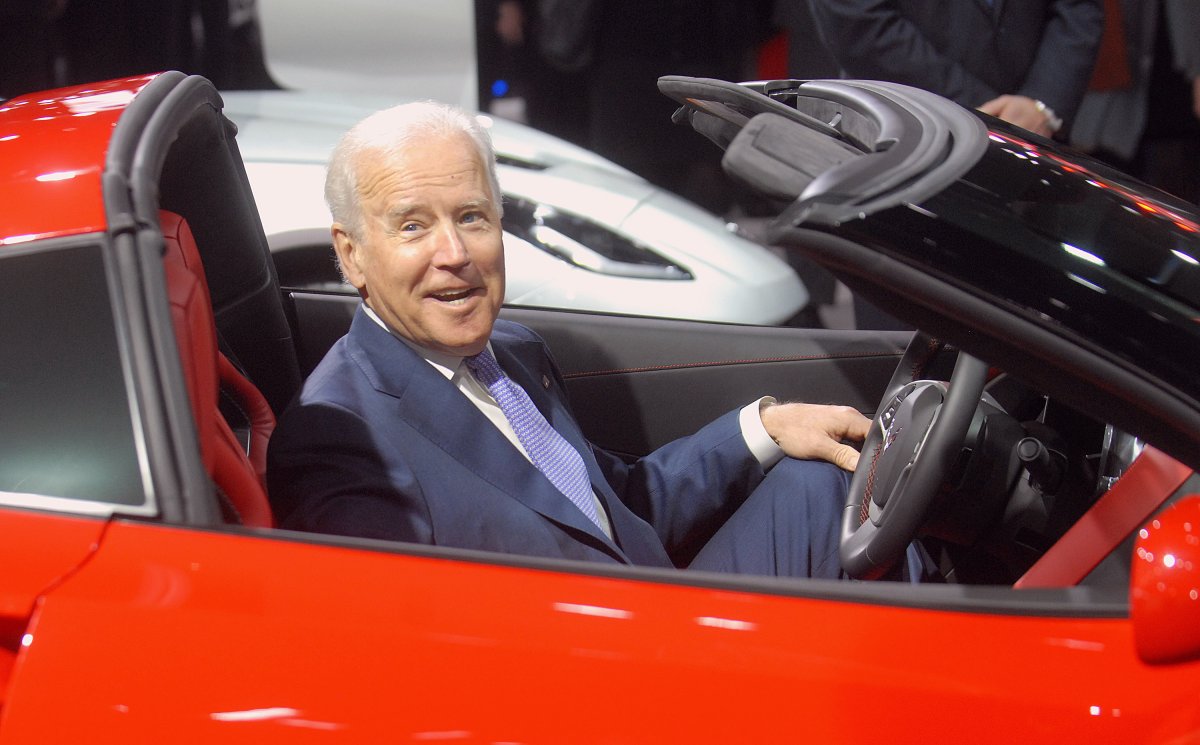
–that mapped onto Musk’s own endorsement of the Presidential candidate to the manosphere, announcing to his followers “”the last time America had a Presidential candidate this tough was Theodore Roosevelt.” The South African-born industrial parvenue had long felt he had been given the cold shoulder by Joe Biden, who wasn’t the huge fan of Tesla or SpaceX–maybe as the octogenarian President so prized his electric Ford and his own red Corvette he drove them to the American Auto Show in Detroit, MI, in 2014. He romanced his own old 1951 full-size Studebaker Champion, with overdrive, a car whose 2.8-liter engine and 85 horsepower was the first car Biden owned,–and he added a Mercedes Benz 190SL to his collection of cars, a 1967 Stingray he rued the Secret Service wouldn’t let him drive (“I’m not allowed to drive anything–that’s the one think I hate about this job!“) but never expressed interest in the Tesla, and was annoyed to inherit a limousine specially built for Trump, feeling far better behind the wheel of a Corvette or a Ford GT.
Trump had successfully intensified the passions of the electorate in a manner few–filled a void for the passion of political action that evades issues Democrats defined as “political”–abortion; health-care; social security; tax policy; Medicare–but that voice was magnified on a bullhorn as a battle cry. A range of fears are increasingly removed or difficult to speak about articulately or even address by a larger share of the American electorate today. But Trump offered levels of passionate involvement–perhaps better understood in terms of a passionate register of reality that was lacking in politics, but is present at Trump rallies and even in Trump’s talking points–a level of political investment that defies demographics, as much as reflects it, but seems to make us search for demographic explanations in order to ground it in reality, or at least in metrics.
Even registered Democrats were not very confident Harris could unify the country–a tough task!–decide foreign policy, or control immigration or appoint justices to the Supreme Court compared to convicted felon –but were these the real issues we face, compared to keeping Social Security and Medicare, health care, or modifying energy use or creating energy markets in America, or defending human rights and individual liberties? what of the possibilities of public housing, that went almost entirely under the radar, save for Vance’s off-the-wall comment about building homes or inviting the building of houses on federal lands? What about the convictions Trump faced, even as he was boasting of his plans as President to deport criminals who sneaked across the border?
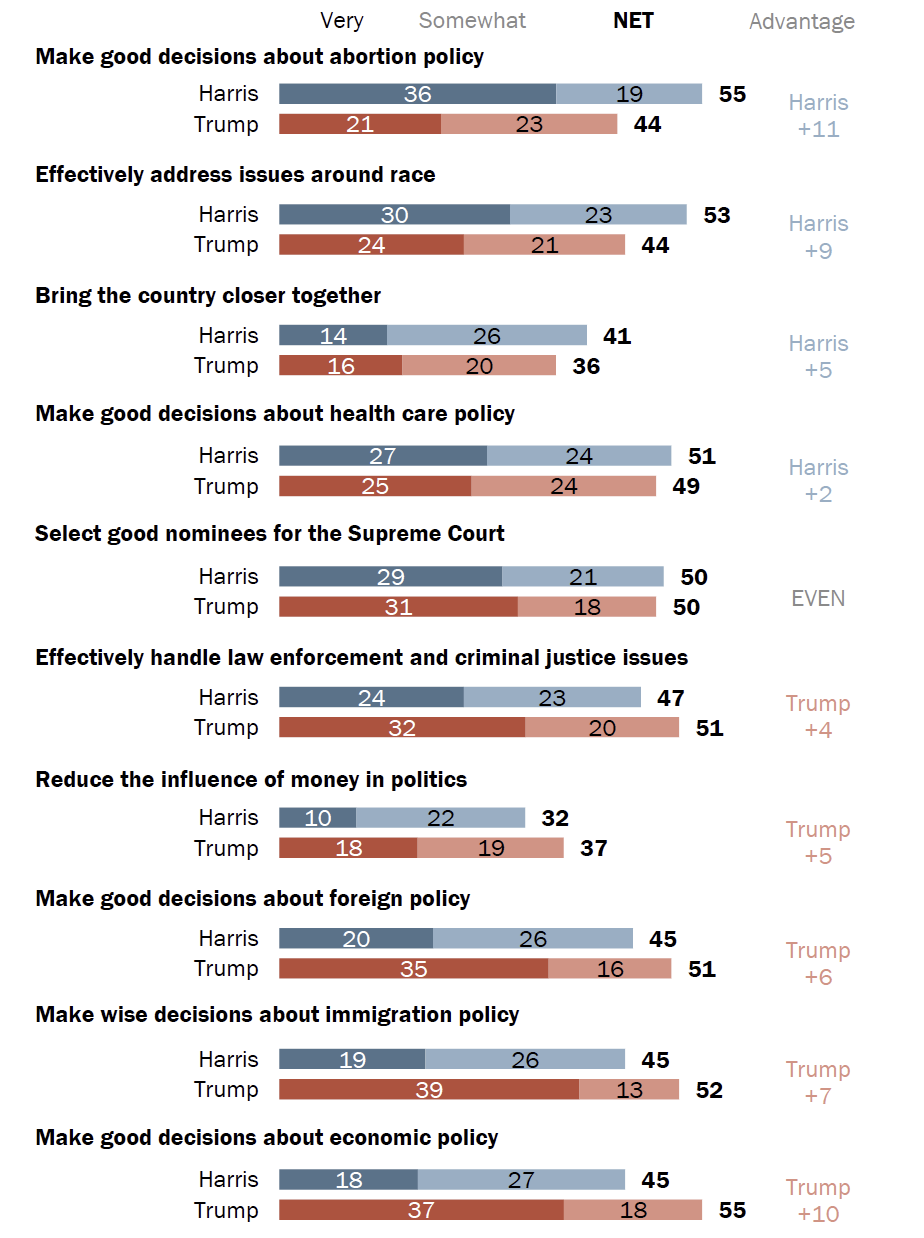
Percentages of Registered Voters Confident that the Candidates They Support Can . . . /Pew Research
There was far less explaining about issues that matter this campaign season, but much more focus on tested talking points that might rally voters–which sort of left voters to educate themselves on issues from news feeds and highly partisan media as sources of news. The sustained focus on swing states seems an uneasily undemocratic concept, born of the metrics that determine Presidential candidacy but at the same time souring most Americans on the election process? Somewhere in the middle of this confusion of agency roiled a deep dissatisfaction with the absence of individual representation in a system which worked to involve the electorate. The deep divide between educated electorate and a less educated one suggested a lack of political literacy of rather terrifying scale, but less interest in informing. The question as to whether metrics offer a basis to understand populations of “swing states” is fraught, because it is not clear how to address the constituencies in “swing states” if they are not political, or rooted in a recognizable politics, but are rooted in the need to escape a daily grind and anomie, and hope for the energy of another, better world.
The sense of voters living in different media worlds was clear. It may be that in this other world, not that clear to readers of print journalism or national network news, the fears of looming fiscal deficits, rising unemployment, trade deficits, and a need to “take back eery single square inch of [American] territory that has been invaded by these migrant gangs”–the very folks, perhaps, who have taken public housing, warped housing markets and drained jobs from the economy to recover an era when we were all better off. The vision that Trump sold and conjured for audiences across the nation of an upbeat economy just four years in the rear view mirror was cultivated on different universes of public information form which Trump voters drew, if the Democratic voters were far more likely to be those who read newspapers or dependent on national network news, many Trump voters didn’t follow political news or, more likely, depended on the cultivated newsfeeds of YouTube and social media:
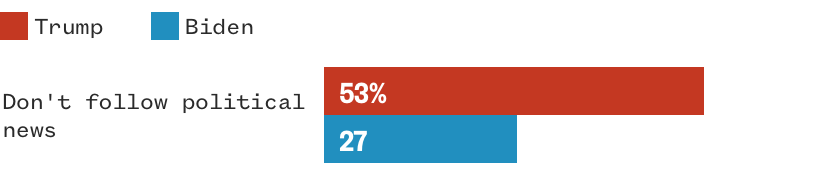

The split that sent more Trump supporters likely to not follow political news meant that a good share–55%–would be relying for information on politics from Google or cable news (55%), or in other words likely to be following the social media megaphones that mimicked what Trump himself said, and the narratives he told of rampant decline. This not only gave a new sense to battleground states of truly martial quality and tenor, but transformed partisan divides that were cast as polarized or indeed gridlocked as grounds to break up government and question government’s benefit in public life, banking on figures of disruption as Donald or his libertarian buddy Elon Musk. If the extent of government gridlock left a very meager 4% of the electorate of the opinion that government was working well on the eve of the election, with six in ten expressing no confidence at all in the political system, or the future of the United States government (63%), the hopes of convincing folks that government might be capable of helping them was all but erased, as the stakes of the Presidential race turned to what were once ethical issues–access to abortion–or pocket book issues like high costs of medical care, Medicare, and social security. With less than a sixth trusting the federal government in 2023, it seemed that it might as well be a good idea to tear it all down. A third of the electorate expressed distaste with both parties, and the absence of excitement able to be generated for a candidate seems a true political malaise, as “exhausted” (65%) and “angry” (55%) became descriptors of feelings about politics, rather than “hopeful” (10%) or “excited” (4%).
Trump may be a very unlikely messenger for redemption, but the religious fervor of his movement is less rooted in issues than redemption, or the vicious pursuit of a better world, located in promised quick-fixes that will transform the economic status and lives by dramatically simple conclusive gestures (tariffs; walls; deportation) promised to lower crime, open low-cost housing, and demonize a wide range of actors–immigrants; unhoused; gang members; drug cartels and oh yes mules–who also help us see the hidden mechanics of global processes by which America is unfairly and unprecedentedly challenged–and against which its borders might be sealed to resolve. Indeed, the perception of economic challenges in swing states was perceived as acute–and Trump’s naive questions about a comparison seemed to touch reality for all his antics and overblown rhetoric that actually bordered on incoherence.

For all their chromatically divided landscape of electoral tallies, the nation seemed in the end, divided by qualitatively different news sources. For social media platforms seem a new way to parse the electorate. But news sources of the most traditional sort have also recently promised a key to divide the nation less in constellations or blocks, however, far more granular than swing states who were in fact destined to determine or “decide” the election. If the “swing states” that could move an America from partisan deadlock had already fragmented America, the micro-communities were hotspots, points of electoral leverage mapped in the pockets of that would swing swing states, as if pivots of power hidden across the country, that will decide the fate of the nation. These hidden districts lying in plain sight lay in Saginaw (MI), Eerie (PA), Mecklenburg (NC), Miami-Dade (FL), Maricopa (AZ) and Clark (NV)–as well as the big bundle of votes in Atlanta.

The Micro-Communities of the 2024 Presidential Election
The idea that these small “micro”-communities–the true deciders–drill into the distorted map of the electoral college, looking at its tipping points, which might be seen as the points of inflection aof republican representation: these single counties were tipping points of the swing states, the map revealed. It charted the tipping points of the swing states, a weird sense that small communities, far from metropoles, were the fulcrums of a significant amount of electoral votes and would be responsible for the outcome of the election.
This map purported to reveleal the inner workings of the metrics of the election seemed the latest sign of a flawed system of representation. Elections were argued to depend on a handful of micro-communities, the hotspots of swing states, per the metrics of national politics. Rather than “states” or voting groups able to swing the vote, they lie beneath the surface of the electoral map, but determine the trends in swing states. They would be well to targeted by the metrics that drive campaigns as true bellwethers, the decisive points of any election, a hidden key to the electoral maps that polls had focussed with bated breath.
But the races were not even close in them–these communities were not only in the swing states, and were a theme of a number of races that weren’t even supposed to be close, but ranked “solid Democrat” in 2020, where the regions were flipped, and, when located in “Swing States,” with them the state. In CA-21, a reliably “blue” district, or CA-47, which Joe Biden had won by over 10% in 2020; the shift was sudden, a lightning strike, and often among the very same candidates were battling again, two years later, improving their margins against incumbent Democrats, in what might be seen as a referendum on 2020, as they rode anti-government feeling seems to have swung communities that seemed blue by large margins: the “blue” and the “red” were no longer accurate aggregations.
These dense “micro-communities” of Democratic voting residents, voters almost packed into districts they so heavily trend to the Democratic rathe than the Republican Party, are not truly “communities” but districts, and perhaps not even cartographic creations. The voters in these townships outside of South Philadelphia, like communities in Wisconsin, Michigan, North Carolina and also Georgia, are closely tied to universities and colleges–Drexel University, St. Joseph’s, Thomas Jefferson University; Temple–and the student demographic was not as motivated or indeed electrified or cultivated perhaps, even as Republicans had since 2016 targeted colleges as left wing. It could well be, though, that the alienation from Middle East policies and horrors of Gaza have left Democrats more scared of reaching out to campus groups, deeply alienated from pro-Israel positions, that created a lack in a similar surge of energetic support of deep blue density as 2020.
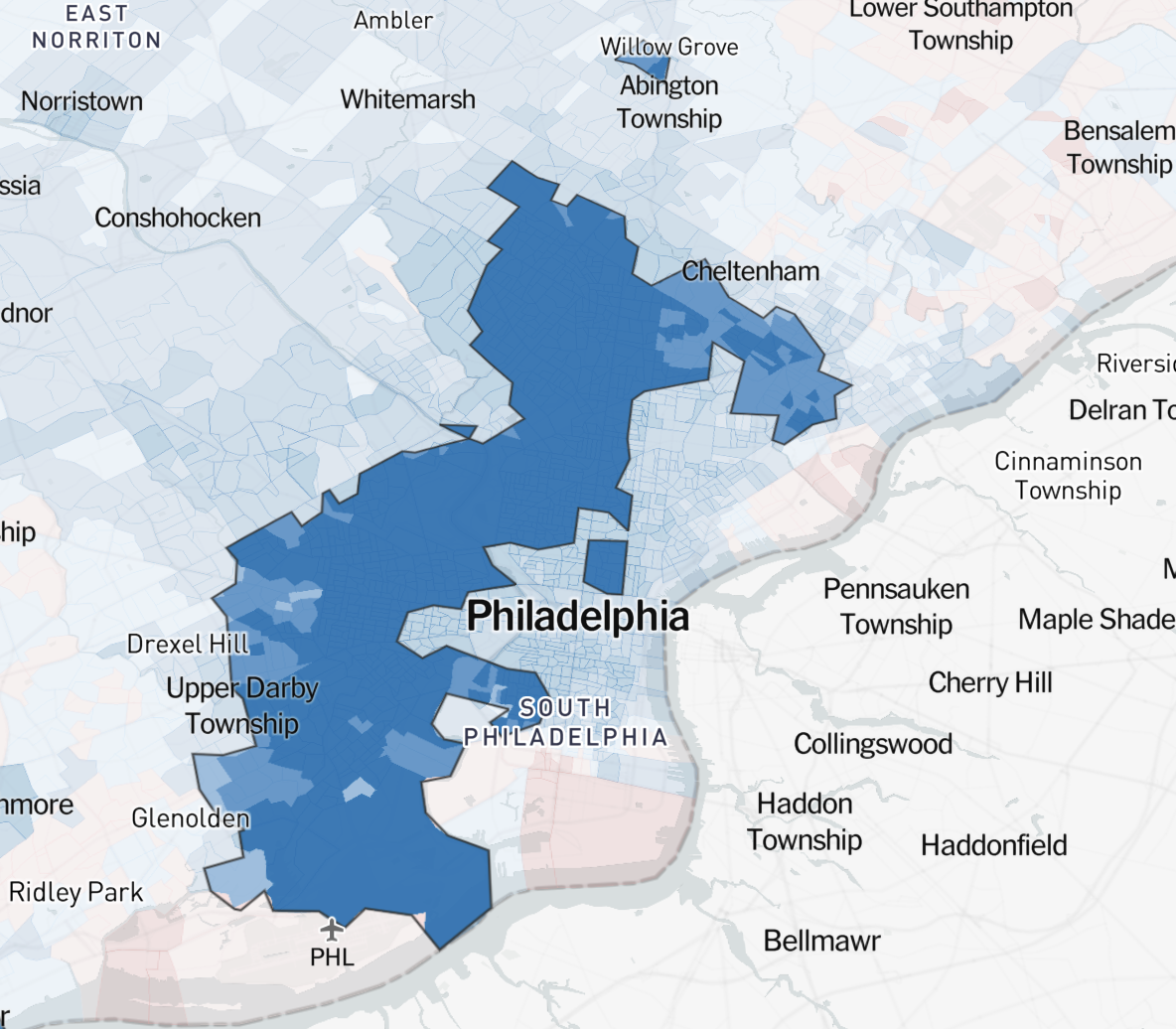
Democratic Votes Joe Biden and Kamala Harris Won in 2020 outside of Philadelphia
The alienation from deep protests against involvement of the United States and of private and public universities in Israel had led to a major politicization of campuses from April, 2024 that led to over three thousand arrests or detainments that had dimmed political excitement over a ticket that had been too cautious to take strong steps to distance the administration from Palestinians, even as major marches in Philadelphia called attention to the continued occupation of Gaza at private and universities in mid-October–Penn Students against the Occupation, and students from Drexel and Temple, in the Philadelphia suburbs, supporting Palestinian resistance as a reaction to “violent British and Zionist military occupation,” as Democratic candidates sought desperately to distance themselves form college campuses for fear of being targeted as against Israel. The absence of a clear statement from the Democratic candidates depressed turnout, in ways difficult to accept–even in swing states like Pennsylvania, where the protests happened rather close to the election, as well as Michigan, Wisconsin, and Georgia, despite the urgency of mobilizing against Trump.

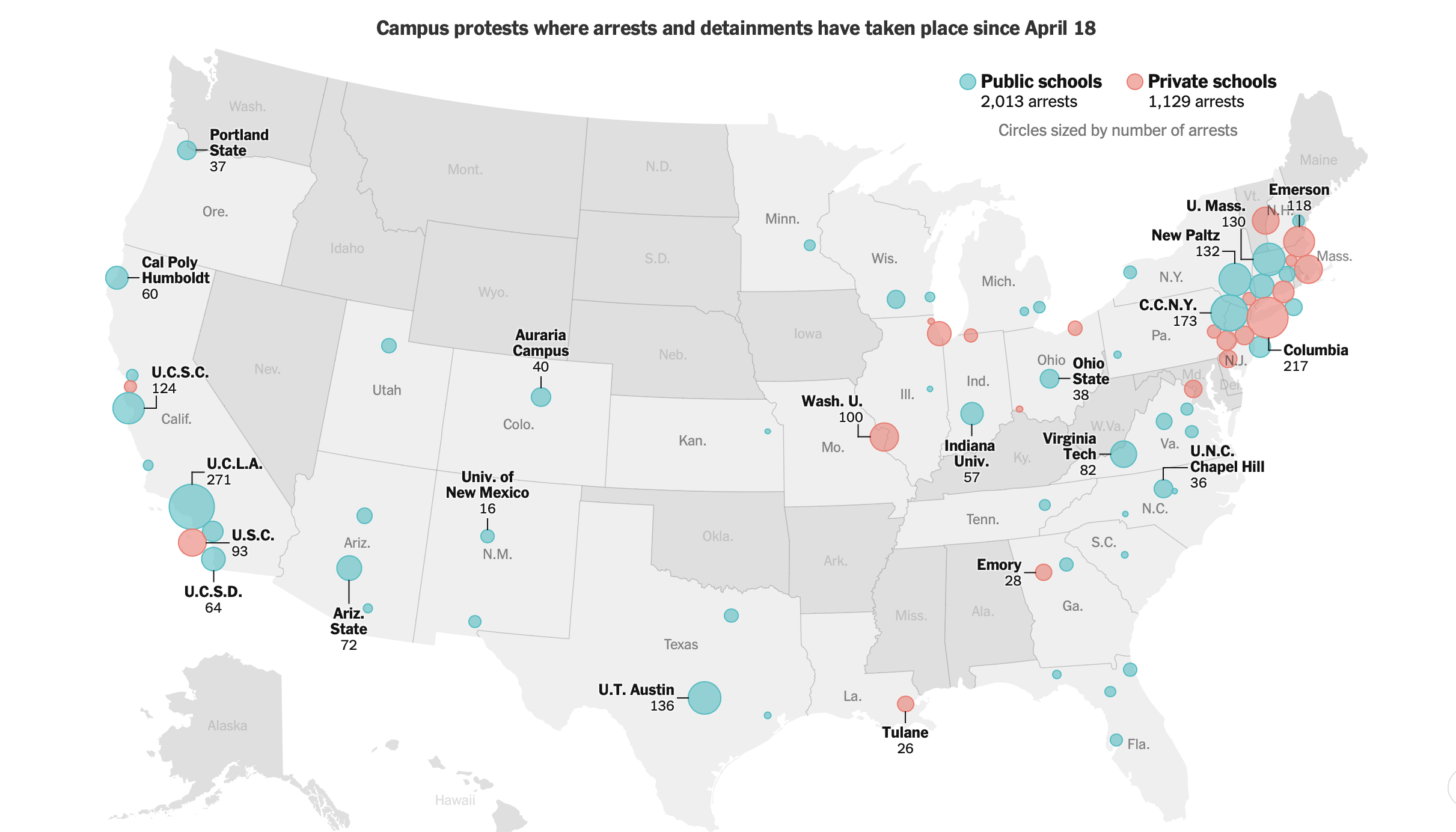
Campus Politicization across America since April 18, 2024 (New York Times, July, 2024)
If seemed that America wasn’t deciding, we were resigned to it–we had long processed that illusion, after a summer tracking swing states.

But the micro-communities hidden in each “gold” swing state would be the nodes or pockets where folks cast the ballots to decide the Presidential election. The micro communities–a new spatial jargon proving that all politics was local–were perhaps a correlate of the failure of national politics, and the absence of coherence in the nation, by looking at the world from the precinct up–as Patrick Ruffini had it, using a new set of metrics in graphics of Quoctrung Bus and Aileen Clarke, to parse the true twenty-one places where groups of voters were decisive, able to tip the “dead heat” that Kamala Harris and Donald Trump seemed to facing.
The sense of the suburbs of Philadelphia were a case in point of a density of Democratic votes that might flip the state, and determine its fate of being “blue” or “red”: but it may be added that the value of these “micro-communities” were tied to inner cities and to sites of large populations around universities, a “youth” vote that Harris had rather notoriously performed far worse than Biden. The very areas that were decided by 10-20,000 votes in 2020 were not newly discovered as critical area of the 20204 campaign, but were, more than “communities,” perhaps, dense clusters of age groups that would make or break the campaigns, and no micro-analytics were really needed to measure.
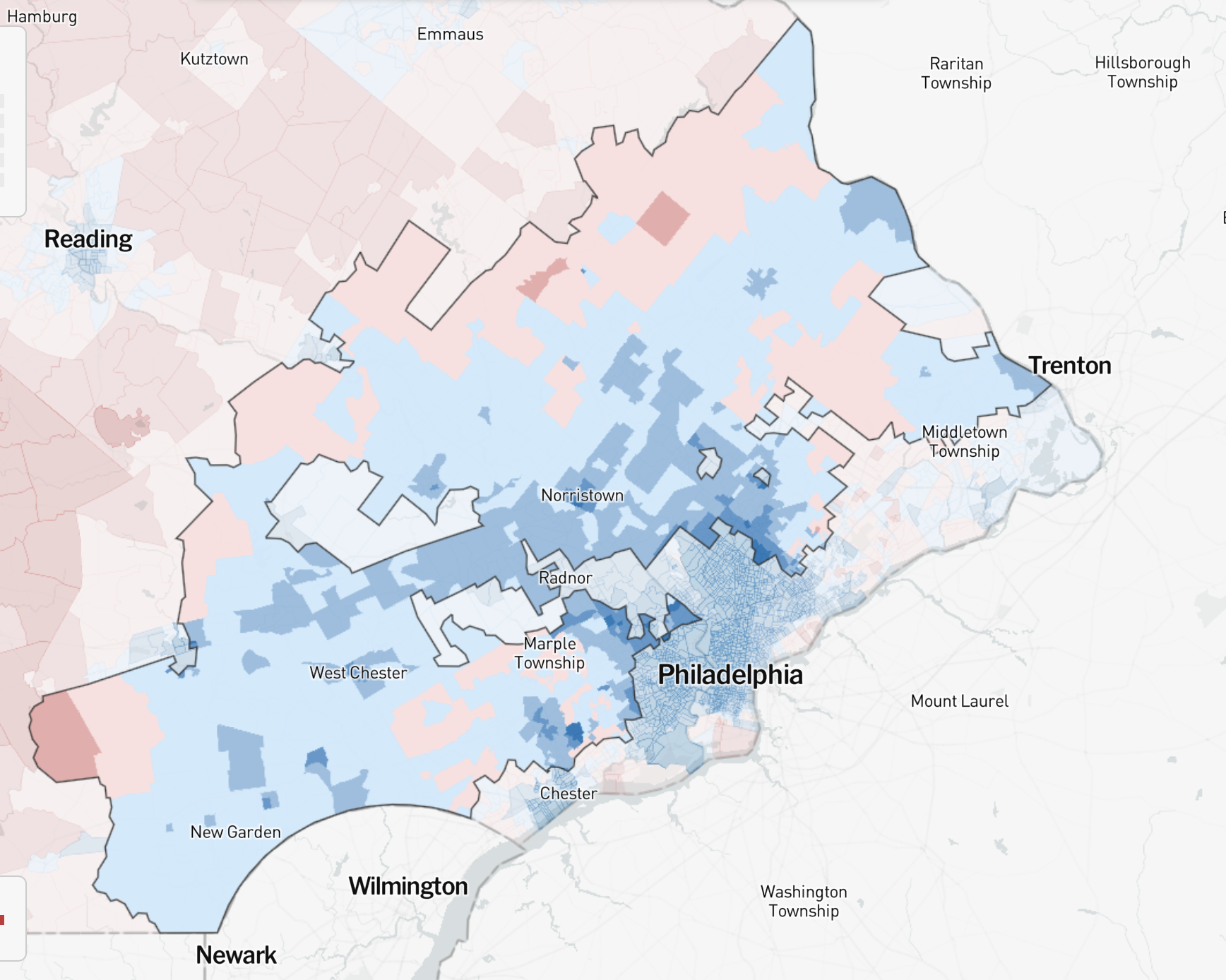
Micro-Communites of Philadelphia Suburbs in 2020 Election/New York Times
For the micro communities that we map–or that pollsters map, whose cue we take up and follow–ignore the fervor that feeds the zealous agenda of the Trump followers, not rooted in ideology but the preservation of something that seems basic individual values, and that led many almost to chase me away from the houses that I canvassed in Reno NV: the divide isn’t particularly political, it is partisan but more akin to a religious experience, a sort of rapture at coming into contact with the fervor of Donald Trump, to be sure reaching into old voting blocks that were long seen as constituencies. This is an alternative reality, perhaps, than liberals are used to recognize, but is a powerful immersive reality. As much as we identify cohesive blocks of voters as demographics, from black voters (over a quarter of whom polled as Trump voters ) to Latinos (45%, a gap greater than garnered by George W. Bush in 2004) in an age of heightened disputes about immigration. (Immigration bounced back as an issue in 2024, when it was suddenly eight times as important as climate change, twice as important as access to abortion, and half as important as racism–and even more important among voters than health care.)
The economy may appear to be “the issue” described, but the fervor is religious, and the roots that it has are of redemption, dovetailing neatly with the biggest big red block of the Deep South evident in the electoral map. But is a bigger questions, perhaps lying underneath or beyond questions of poll access, errors of tabulation of the vote? We had to be relieved by low violence in a Presidential as the votes came in, in what seemed destined to be a protracted tabulation of votes by small margins, before claims of victory could be made. It is acknowledged that it is necessary to decide who the victor is far before December, for the state to work properly.
Right-wing groups were boasting, however, of the need to intervene in suspect voting practices online, and their commitment to make sure only citizens voted and elections were “fair. ” If it may seem overly skeptical, we have lost appreciation of how terrifyingly few paper trails for ballots still survive in America, “swing states” apart, across another “red” America, that map an electorate increasingly far more vulnerable to hacks.
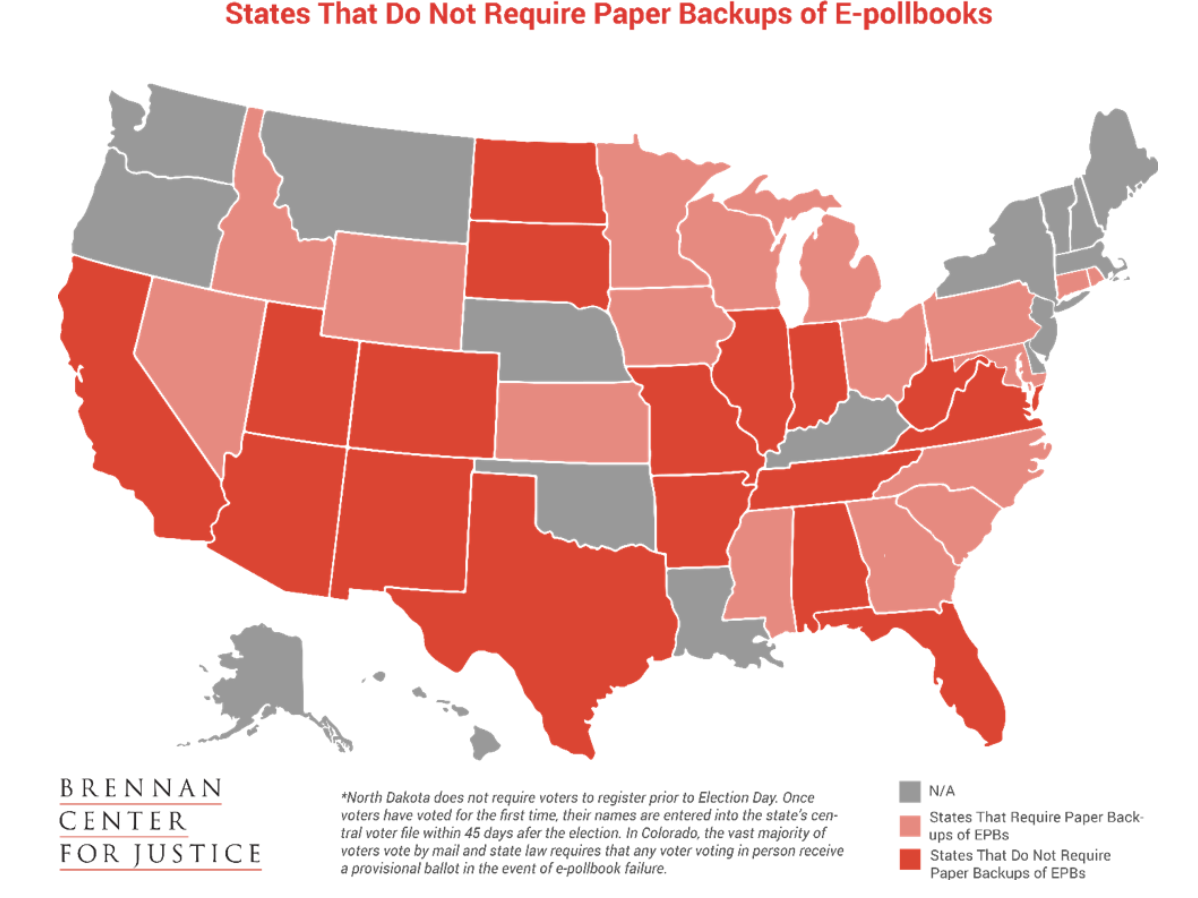
The real red states, perhaps, are those that dispense with all evidence of actual ballots cast–Arizona, New Mexico, Texas, Arkansas, Tennessee, Alabama, and Florida, as well as Delaware, as if room to store ballots is overly hard to come by in them and the Dakotas. But a Democratic stronghold like Illinois?
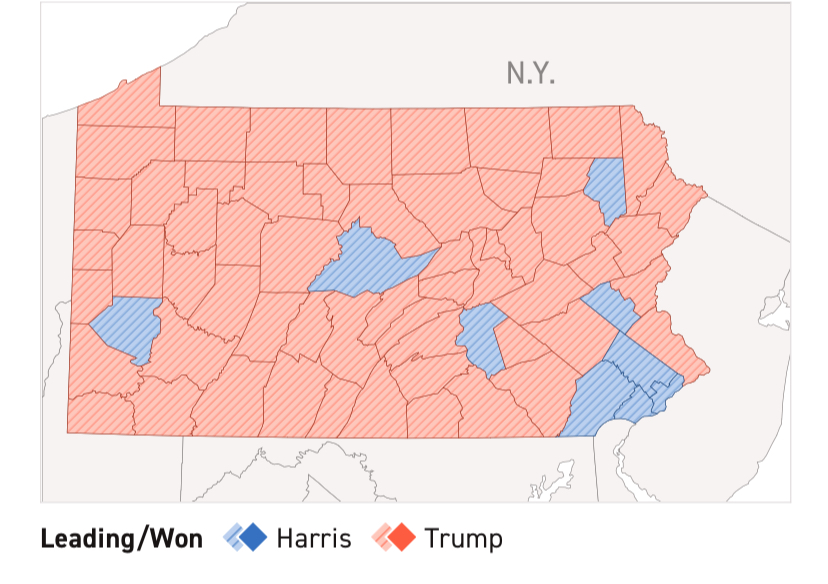
But the map of electoral votes, for what it is worth, the bottom line of democracy, showed a map of red, an icon stretching nearly from coast to coast, with California as a bulwark against the ocean–and a hefty number of electoral votes, that might be seen as an inland sea of red, Pennsylvania, Ohio, Michigan and Wisconsin as red as could be–even as voters seemed in Michigan, Wisconsin, Pennsylvania, Nevada, Arizona and Georgia exceeded past turnout for over 44 years. But if the Get Out the Vote missions proved a success, the Democratic Party didn’t benefit visibly. Abortion rights seemed able to mobilize many, but as local efforts succeeded to gather momentum in many states–even those that were red!–from Missouri to Nevada to Arizona to Montana, the centrality of abortion rights as a platform that Kamala Harris promised to enshrine in law lost its luster and combative edge, paradoxically, as an issue able to give heft or traction to her Presidential campaign.

The religious die-hards of a deep secessionist world lay in those states, and were part of the largest Get Out the Vote movement ever, promised a new ideological influence that they had not enjoyed in a world that was slipping past their values, and they were the cogs in the Trump vote. These were the believers, who would trust in Trump as a source of redemption, a demographic rich with plentiful spokesmen and advocates, Christian conservatives with pulpits of varied sorts, from actual churches to chatrooms to pastoral care, questioning if a Christian can in good faith vote for “the Democrat Party who supports things that are absolutely against what the Bible says, faring the “Antichrist revival that has been spread by the evangelists [of a Democratic Party removed from faith]: Barack Hussein Obama, Hillary Clinton, Nancy Pelosi, and Kamala Harris.” The creation of a lineage of running against the Bible in supporting abortion as health care, expanding voting rights, and in articulating and supporting LGBTQ rights–this is the political lineage Harris’ support for access to abortion as health care were placed, or was cast as only confirmation of. The issues were made less important part of the message, as they were only the sum of godless issues of a corrupt party from whom the nation had to save itself as much as from the danger of “illegal” migrants.
Trump was the man to do so, and to preserve the integrity of national religious character–immigration policy and the border was the single one issue Trump supporters felt most confident in their candidate, and that he had made them most secure, just ahead of economic policy decisions. Even in an election that was openly cast as a threat to a separation between church and state by invoking fears of the godlessness that might corrupt our national character–in a country where a sizable group have come to question the separation of church and state is good for national policy, and even more see it as a moral threat. The apparent inability of the Democratic Party to distance itself from the attack lines of Christian conservatives only grew in the election, under the radar of many: the exhortation to vote to expand Christians’ influence in the Republic is cast as a call to Christian Nationalism, hit Kamala Harris from behind, as she found she was increasing the very fears of many faithful that the evangelicals in “swing states” advocating the preservation of access to abortion for all, traumas of pregnancy, and even of spousal abuse, may have backfired in sending a message that Christian nationalists as the specter of steep threats to Christian morality.
The bottom line seems to be that this isn’t only a “numbers game” or about understanding the math. If anything the metrics were misleading, and not only the pollsters, but the assurances of message-driven advertising promising women voters, monitories, and immigrant communities to be on board. The stakes of the election for issues like health care, social security, and Medicare were never fully explained–even if the question of the place of the United States on a global stage was never raised, and may have gone out the window with the huge unpopularity of the Gaza War. The diminished role of the United States in a global world seemed on the horizon, not only in the skyrocketing of per capita CO₂ emissions but the diminished role of global prestige to keep peace: the irony, if it can be called that, of voting against Harris because one was against the continued wars in the Middle East and Ukraine–wars hardly started by the United States, but misleadingly seen as perpetuated by the bad actors who began the wars, and the bad actors in Israel who believed they could play their hands without consequences, will lead to a reduction in global prestige. Already, the appointment of light weigh isolationist Elise Stefaniak to the United Nations, replacing a career foreign service diplomat with someone committed to “America First Peace” and is an unwavering supporter of Israel, who sees the United States with little other role in the world, and backed Trump’s attempt to overturn the 2020 election, which she blamed on Nancy Pelosi, and gained her fame for attacking campus protests as anti-semitic, and an attacker of the UN, we see a retreat from a global stage.

Peter Schrank/November 12, 2016







 Musings on Maps
Thank you for your efforts to “map” what just happened to America. I have avoided the news since Tuesday evening when I realized what was about to occur. I hope once the dust settles a bit more you have an opportunity to have a followup that portrays the landscape in your unique and compelling fashion.
(‘Acaqun ehicine’) ‘Go in a good way’ as say the Cahuilla Indians.