Category Archives: data visualizations

Mapping Gun Violence versus Gun Ownership

When State Senator Audrey Gibson introduced a Bill 1678 in Florida’s Duval County to mandate completion of a two-hour anger management course before their purchase of a firearm–and for that course to be retaken every ten years–a flurry of consternation and protest broke loose.  Never mind that you can take the course online, and that it only lasts two hours–it was seen as an infringement on the sacrosanct individual rights, independently form the traditions of government designed to protect the common good–yet, by a dogmatism of faith, asserting the protection of individual rights in ways that seem particularly corrosive to the ideal of a representative democracy.

How did this come about, and is there a distinct geography in which liberties for gun ownership are more fiercely protected and agitated for in place of equal protection for citizens?  Such a demand feeds both into the elevation of “rights” as an extension of the absence of constraints on individuals, and the expression of a politics of true sincerity and purity, based on the protection of the individual both against government oversight in any form, and a conviction that government policies need to be scrutinized for their infringement on a purely individual concept of liberty.  The misconstrual of gun ownership as an individual right within the Bill of Rights and that is not able to be over-run or revised by state or local government is based on an interpretation of the Second Amendment long advocated by the NRA in District of Columbia v. Heller (2008), affirming an individual right to own guns within one’s home and on one’s person–as if it was implicit in the framers’ assertion that “well regulated Militia, being necessary to the [collective] security of a free State, the right of people to keep and bear Arms, shall not be infringed.”   The opinion that this assertion constitutes grounds for the legal protection of individual gun ownership rested on the majority opinion that the thirteen words that began the Second Amendment constituted “prefatory” matter,” rather than qualify the terms of and reasons for the defense of gun ownership, has enshrined a perversely popular interpretation, long sought by the National Rifle Association, protects individual possession of guns, even in the face of a near-epidemic of mass shootings in the United States.

It is not a coincidence that the geography of such claims match with the melding of a dogma of liberty in a fear of the usurpation of rights, and need to protect such rights from below–by bringing politics directly to “the people,” their true source of expression–in ways rooted in faith, rather than a model of inclusive citizenship, and a dogmatism rooted in faith, rather than a body of open debate.  It is in specific geographic corridors that gun culture is not only greater, but a “healthy” relation to guns asserted to exist–despite some significant evidence to the contrary.

In Florida, Gibson’s bill was quickly labeled not only an infringement of (“God”-given) inalienable rights, but labeled as “the stupidest thing I  have ever heard” by the owner of Jacksonville’s St. Nicholas Gun and Sporting Goods Store, who might be worried it would hamper sales more than lead to a black-market in firearms (which would further undercut his business, I suppose).  The serious abuse of the Second Amendment across the country rests in part in how the right to a piece is believed natural.  Indeed, the attempt to align it with populist claims, hostile to pluralism, dissent, or liberal traditions, is not only parasitical on a tradition of representative democracy, but against the dispersion of power in a state based on representational democracy:  based on an intentionally polarizing discourse, the interpretation of democracy on which it turns–the trumpeting of individual rights over those of the collective–may indeed be mapped more clearly than one would imagine by normalizing it as opinion, and merely placing it at one end of a political spectrum.

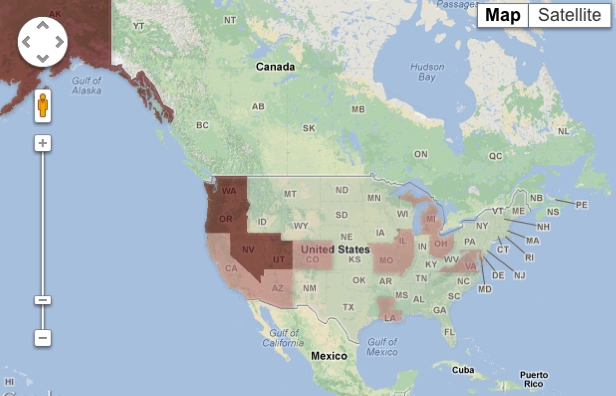
Recalling the sort of strained logic by which the firearms of abusive spouses are being legally protected after threats to employ them as instruments of attack or violent murder, despite the issuance of restraining orders, civil protection orders and affidavits attesting to substantial  fears of abuse.  “Rights” to bear arms are meanwhile championed as if they were inalienable, and in fact even in need of protection from the “insult” of a requisite two-hour anger management course.  If the intent was to encourage introspection, they’ve been seen as fighting words.  While we can both learn about the bill and track it here, we can see a broader set of trends across the country by creating a Google map served up by Mother Jones that starkly maps the state of our nation, using light brown to designate states in which  gun-related deaths already exceeded traffic-related fatalities, and a dismal darker brown to designate states where the number of gun-related suicides exceed the number deaths caused by automobile accidents:


Car Fatalities v. Deaths by Guns


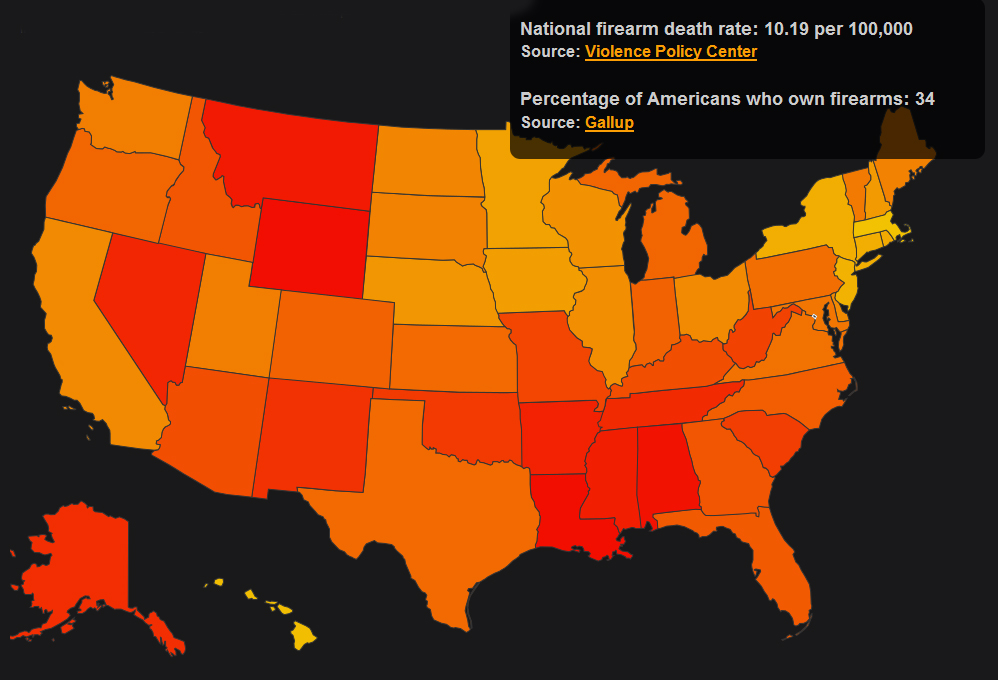
It’s not a secret that the United States leads the world in gun-ownership, and that a Gallup poll puts the percentage of Americans owning guns at a massive 34%.  Al Jazeera compiled this map, of less clear correlation, between gun-ownership and gun-deaths, which I suppose reveals the results of local densities of firearms:


gun-deaths-gun-ownership-us


Tempting as it is to map this onto a red state/blue state divide and a familiar choropleth map, such an supposition would depend on universal voter registration–which is far from the case.  A more provocative map might use the same statistics to construct a set of maps of the relative deadliness of individual states’ “gun cultures.”  The notion that each state has its own culture of violence is clearly itself a fiction that is perpetuated in large part by pollsters, choroplethic mappers or demographic ingenuity, and oddly erases regional difference or urban specificity–and discards economic variations in favor of a viewable poll that clearly consciously recalls electoral data.  But the variations could tell us a lot about the universality of gun violence in regional terms, beyond a  simple mapping on to zip codes, which predictably intensify in urban areas, like the recent map that was published as an interactive map by the White Plains Journal News in Westchester and Rockland counties, but which created a mini-controversy as an invasion of personal privacy by internet vigilantes who decried tactics of intimidation, rather news–as if someone would chase these poor firearm owners.


la-lohudcom-gun-permit-map-20121226


That site was quickly pulled, of course, though the interactive properties of such a dense map of gun ownership is hardly such a gross invasion of privacy, since the guns are registered in legal databases.  Yet law-abiding gun owners like Keisha Sutton felt that the public map exposed “me, my family, my friends, and others at risk,” presumably from the violent gun-control crowd, and was argued by others to increase underground black-market gun sales:  look at the huge number of on-line responses that the article generated.  It is of course not a problem to post multiple locator maps of your local gun retailers, should you want to purchase one.  (It would be interesting to map these sites’ internet use, of course.)

But let’s return to the question of regional variations that these folks have mapped.  Questions of national variation are considerably complex.  If we start by mapping the most guns owned by percentage of the state’s population,


mostleastgunsbypercentage


to get a little more statistically refined as mappers, distinguishing rates in the ownership of guns and firearms in relation to individual states’ populations:


mostleastgunsbypercentageinbwt-1


We can hypothesize an index of the oxymoron of a local “healthy gun culture health,” that, argues one website, might be a better index of personal or individual safety from guns–and which exists in something like a direct inverse to sites of the greatest levels gun-ownership or numbers of gun in circulation:
Color Map of State Gun Cultures


But if we apply what might be called critical thinking, or just comparison, although the deadly gun culture in Nevada is revealed in the above comparison of the balance between gun-related deaths to traffic-accidents, some of the states with “healthy” gun cultures, to use that tragically oxymoronic term, like Oregon, Colorado, or Utah, turn out to not be the very places where an anger-management course might have been just the thing that would have saved some lives.  (Let’s table for now the related question of why Colorado is plagued by such a high number of gun-related suicides–or the fact that 75% of gun-related deaths are due to suicide in the state–or the impact that announcing restrictions on firearm ownership might create.)  That at least offers convincing cases of where it might actually have been a very good idea to keep guns out of some people’s hands.

The defeat of any of the proposed limitations on the purchase or ownership of guns in this country–either though screening purchases by background checks, checking for mental illness, or for restrictions on on-line gun shows–turns a blind eye to these maps, and to the notion that the prevalence of guns in our schools and culture is not a problem:  and even to believe that one can cast owning firearms as a protection of a liberty.  Not only is the Senate in “the gun lobby’s grip,” as Gabrielle Giffords put it, but country and media seem to have turned a blind eye to their responsibilities to regulate access to guns.  Indeed, the notion that the government could even release any information to map gun-ownership was wholeheartedly rejected by Senators, in response to a request from the Republican senator from Wyoming, penalizing local governments for releasing any public registry of ownership of guns.  Indeed, the rush to get gun licenses and sharp increase in weapon sales  in response to consideration of tighter gun control laws–“not just because President Obama and his administration are hell-bent on introducing some form of worse-than-useless gun control in the aftermath of the terrorist attack in San Bernardino CA,” Breitbart.com put it, but because the government “cannot keep you safe.”  The notion that free access to semiautomatic rifles increased safety is so reflexive after major mass shootings in the United States that the demand for purchasing guns at stores like Walmart–currently the nation’s largest gun retailer–suggests the appeal of gun-ownership as an assertion of responsibility.


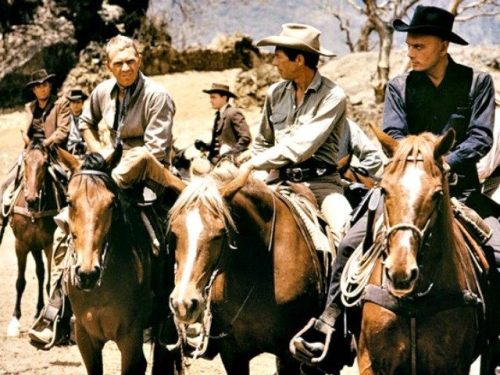
Magnificient_Seven-640x480

United Artists

It is considerably scary, and incredible, that while convicted felons are prohibited by law from purchasing rounds of ammunition by law, no identity is required for purchasing gun ammunition.  Although the industry generated a $3 billion revenue that grew 8.9% from 2010-15, the United States government’s Bureau of Alcohol, Tobacco and Firearms sees no easy corelation between the sale of ammunition alone and the growing gun problems that increasingly plague the nation.

In an age of increased data-accumulation, data-selling, and data-compilations, this type of data–the clearest data to prevent the public circulation and availability of firearms and guns–seems off-limits.  Looking at the lay of the land, could this really be safe?


Gun Owners' Map


The image is truly daunting. A recent study from the Chicago Crime Lab suggests that rather than curtailing access to guns or their possession, preventing the public carrying of guns is a more critical deterrence to violence.  The study may have a valid point, but the question of where folks will gain their access to guns–or exposure to a culture of guns–forces us to go back to that question of all those red dots in the map above.  If many gangs may change their gun-carrying behavior in response to police pressure against illegal gun carrying, is the enforcement against carrying guns able to be sustained while respecting civil rights?  A study of illegal gun carrying indicates support for the potential effectiveness of this approach, but the ability to procure guns is at the same time a surer restraint against the ability to carry them.

Along these lines, Senator Mark Leno has introduced several bills in California to confiscate those guns that are illegally owned,  estimated at 40,000, using licensing fees for firearms, as well as of introducing mandatory background checks.  While the legal owners of guns are not necessarily tied to those not in legal possession, the widespread possession and acquisition of firearms in the country increases the risk of their illegal circulation, and to monitor whose hands they can enter.  This is a stab at offering a better mapping of the circulation, commerce, and traffic of firearms, if not to map their personal possession–and to map such possession onto the essentially populist claims of the protection of individual rights of gun ownership.


Leave a comment

Filed under data visualizations, datamaps, firearms in USA, Gun Control, gun-ownership, Gun-Related Deaths and Traffic-Related Deaths, Right to Bear Arms

Maps, Mapping, Globalism: Imaging the Ecumene’s Expanse

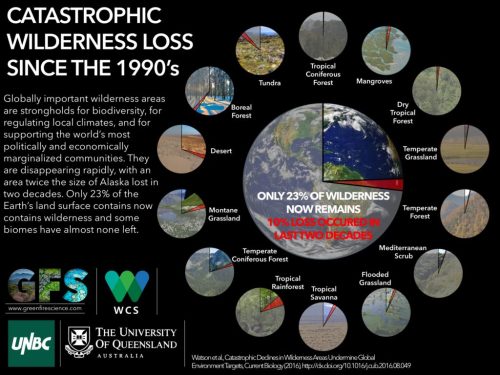
That most ancient of words, Oikumene, expanded from the Greek “oikos” to designate a dwelling or residence, or ecumene denoted less the technical abilities of mapping or tools for describing of the world than the demarcation of inhabited lands in which civilized people or members of the church existed:  but the divulgation and expansion of the notion of mapping abilities have in recent years, since the explosion of information databases and during intense globalization since the 1980s, extended the notion of the ecumene that has grown to extend beyond the map.  It increasingly is invested as a terms with ethical connotations to understand or foreground humanity’s relation to its environment–or retake the human from the map–at a time when virtually no part of the world is not inhabited.  Indeed, the possibility of drawing frontiers between an uninhabited and inhabited world–or of defining limits of the inhabitable world–is so diminished that the concept of bounding areas are not clear; the areas of the earth that are no longer inhabited, its “open spaces” or unsettled areas have catastrophically declined in the past twenty years.

But the continued interest we have in describing how we occupy the world, if not demarcating the boundaries of the world, is at the center of the data flows and databases we process in GIS and that increasingly lie at our finger tips.  The instant generation of maps of the inhabited areas of the world have paralleled the catastrophic decline since the 1990s, when a tenth of existing wildlife declined and the catastrophic losses of wildlife confirmed at the  IUCN World Conservation Congress:  the shocking fact that only 23 percent of wilderness remains doesn’t even include the future effects of global warming, the current crisis in history’s tragedies mankind is currently in the process of having created or on its way to create.  Indeed, the destruction of wilderness–what are deemed intact landscapes that are mostly free of human disturbance–has perhaps most radically changed the nature of the inhabited world.  Since the “Last of the Wild” map was first published in 2002, the loss of almost a tenth of formerly uninhabited lands in the last decade is the most rapid expansion of human settlement of the planet, with some 3.3 million sq km of once-uninhabited lands lost, of which 2.7 million sq km2 are considered globally significant–a loss of some carbon biomass in forests destroys a resource that offsets atmospheric CO2.
wild_infographic2-1-1-1024x768

But let’s return to maps, such realities being to painful for me to contemplate.  Even as the entire earth is now inhabited, much is to be gained in the concept of actively mapping expanse both by preserving an analytic relation to that image of expanse, too often rendered abstractly in computer-generated cartographical media, and encouraging an analytic relation to how the material contents of maps embody space.  Crafting an image of the inhabited world as a bound expanse enjoyed a somewhat neglected historical lineage as a form of knowing the nature of an inhabited world and of orienting viewers or readers to the expanding unknown from the Roman empire:  the considerable intellectual heft of the term inherited from ancients–Eratosthenes, Ptolemy, and Strabo–and its signification of the inhabited and inhabitable earth informed most Renaissance maps and atlases, in which practices of mapping gained new epistemic ends as mediating comprehensive knowledge.

The comprehensive genre of the atlas, an illustrated set of maps promising true global coverage of lands linked by seas, developed in concert with the knowledge that the inhabited world extended beyond earlier imagined confined, and borrowed an expansiveness previously limited to nautical cartography or mapping.  The description of the distance to the edges of the world, if inherited from antiquity, provided a model for understanding the nature of the discoveries for the educated audiences among whom the first maps of the terrestrial ecumene first circulated both in manuscript and print–from the illuminated codices produced in Florence to the massive twelve-sheet wall-map announcing the Columban discoveries that the erudite Martin Waldseemüller compiled in the early sixteenth century Strasbourg from the school at nearby Saint-Dié-des-Vosges.

.

Waldseemuller-Map-631

The visual qualities of mapping, symbolized as an expansive landscape, cast the embrace of the inhabited world with qualities of perceptual transcendence over its variations and divisions.  Ancient geographic treatises included few maps; but mapping the ecumene created a relation of expanse and an observer’s eye in the late fifteenth century by organizing and ordering the globe’s inhabitation.  And although it’s odd to think of the ecumene as an inheritance of ancient geography that’s still employed, the inheritance mapping the inhabited earth resonates with Geographic Information Systems–although fashioning an image of the world’s geography has little of the ethical intent it seems to have enjoyed in both the ancient and early modern worlds.  When we daily orient ourselves to how space is inhabited on our computer screens, iPhones, or androids, we frame an image that bounds a record of how space is inhabited either to orient us to where we are going or how the presence of cars, people, bacilli, or weather defines the inhabit world.  Paradoxically, the growth of GIS technology has increased the manner of ways we can chart the inhabitation and presence of man in space, if it has not increased how we define its continuity, it has also provoked both a Renaissance of mapping and a crisis in the authority of the map as a representational record of the ecumene and its bound, as well as its bounded nature.

While the rest of this post isn’t exactly heavy lifting, but is stuff I’m still processing and finding my way around.

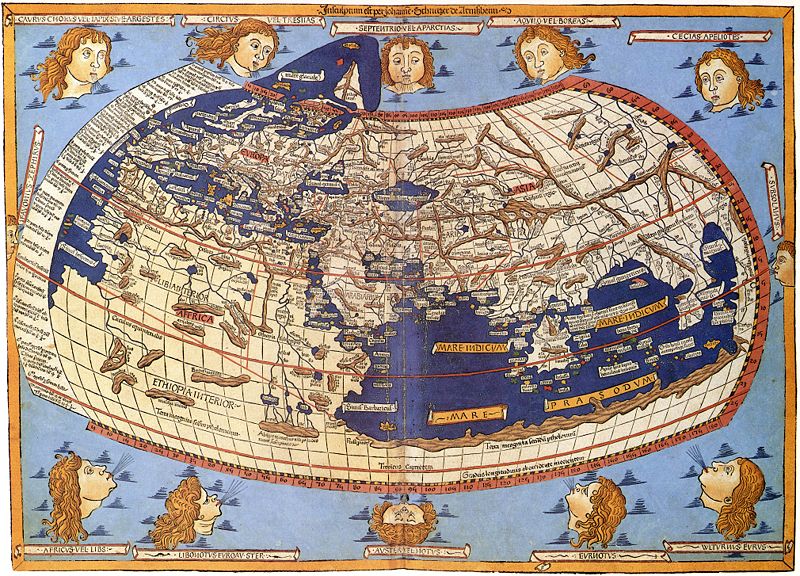
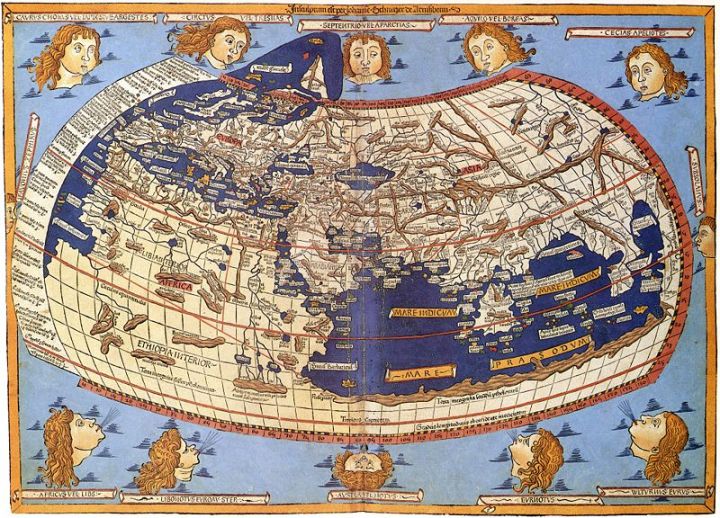
1.  The assemblage of maps in a sequence of global coverage was identified with the cultural distinction Ptolemy gave to the project of world-mapping on a graticule of meridians and parallels, to be sure, both compressing a growing sense of the world’s navigable expanse and indexing its toponymy along climactic zones.  The term ecumene challenged the mental imagination by encompassing local variety in a capacious global category, ordering a global map in a neatly bounded surface beyond the Indian Sea, and up to the limits of known land, in a feat of mental dexterity as much as precise or accurate map of exactly determined scale.  The lower boundary of the map copiously noted “terra incognita,” as later projections–and left it at that, as an expansive white space that exists beyond the sea and lakes of the moons, as this Florentine map includes, adopting the notion of an extensive northern ocean to frame the inhabited world–even while seeing the Indian Ocean as closed.
800px-Claudius_Ptolemy-_The_World

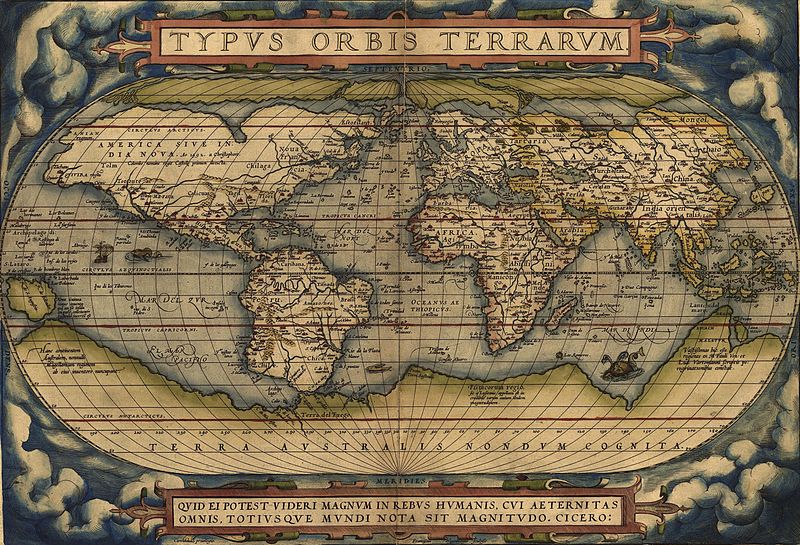
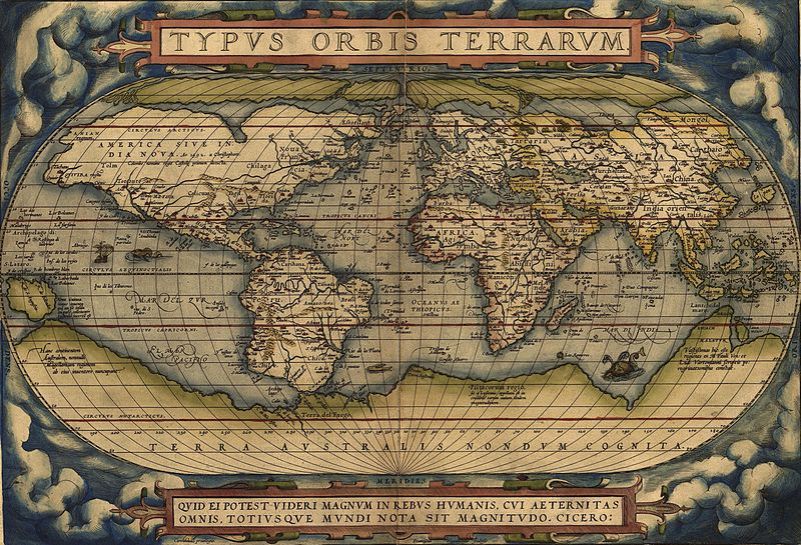
Indeed, even as the world grew more detailed and other continents were registered as inhabited, as in the Ortelian planisphere, the growth of regions of terra incognito expanded, as if to parallel the known regions which were designated by naturalistic landscapes:  the unknown regions of “America dive India Nova” were paralleled with the imagined “Terra Australis,” a later configuration of the mythical Java la Grande.
800px-orteliusworldmap1570

The ancient Greek astronomer and scientist Claudius Ptolemy proposed using terrestrial maps on geometrically derived parallels and meridians as tools of portmanteau-like capacity to comprehend terrestrial spaciousness, by segmenting the world’s inhabited surface by degrees of longitude.  The notion of mapping totality was particularly fertile for early map-readers a decade before 1492.  The tools for mapping the ecumene or inhabited world provided an ambitious compendium of global knowledge, although the geographic knowledge of the world was limited–and still was by the time of this world map, illuminated circa 1482:  although restricting the ecumene for modern eyes, its capacious reach extends south to inner Ethiopia and northward, beyond its broken frame, to embrace northernmost isles beyond Thule.  Rings of uninhabited islands indeed constituted, John Gillis has recently noted, part of the mental furniture on the boundaries of the inhabited world for most fifteenth-century men, and suggested a comforting bounding of the world that seemed to illustrate its protection and insulation, lying as it did between uninhabitable climactic zones and far-off seas.

The ethno-centered ancient term maintained a sense of charting the world’s recognizable inhabitants or those that mattered to the readers of maps:  so, in the Augustan age, Roman’s referred to the expanse of the empire as the ecumene, beyond which lived barbarians.  But even as it retained a bounded sense for Renaissance readers, the totalizing image of an ecumene provided a way to imagine the population of an expanse greater than lay in the ken of most–and to understand coherence within a world that included information from far-off lands, even if many fifteenth-century people lacked clear geographic categories of spatial division of an inhabited terrestrial expanse.  The edges of the earth were oddly clear for a period that suggests limited familiarity with expanse: the monsters and extraordinary riches found there were included in fifteenth-century editions of Ptolemy’s handbook of world geography, including elephants in the island of Taprobane, beyond India, trees that had leaves year-round, multitudes of serpents, and cannibals.  These were the signs of the world beyond what humans knew, and included the bare-footed gymnosophists of India.

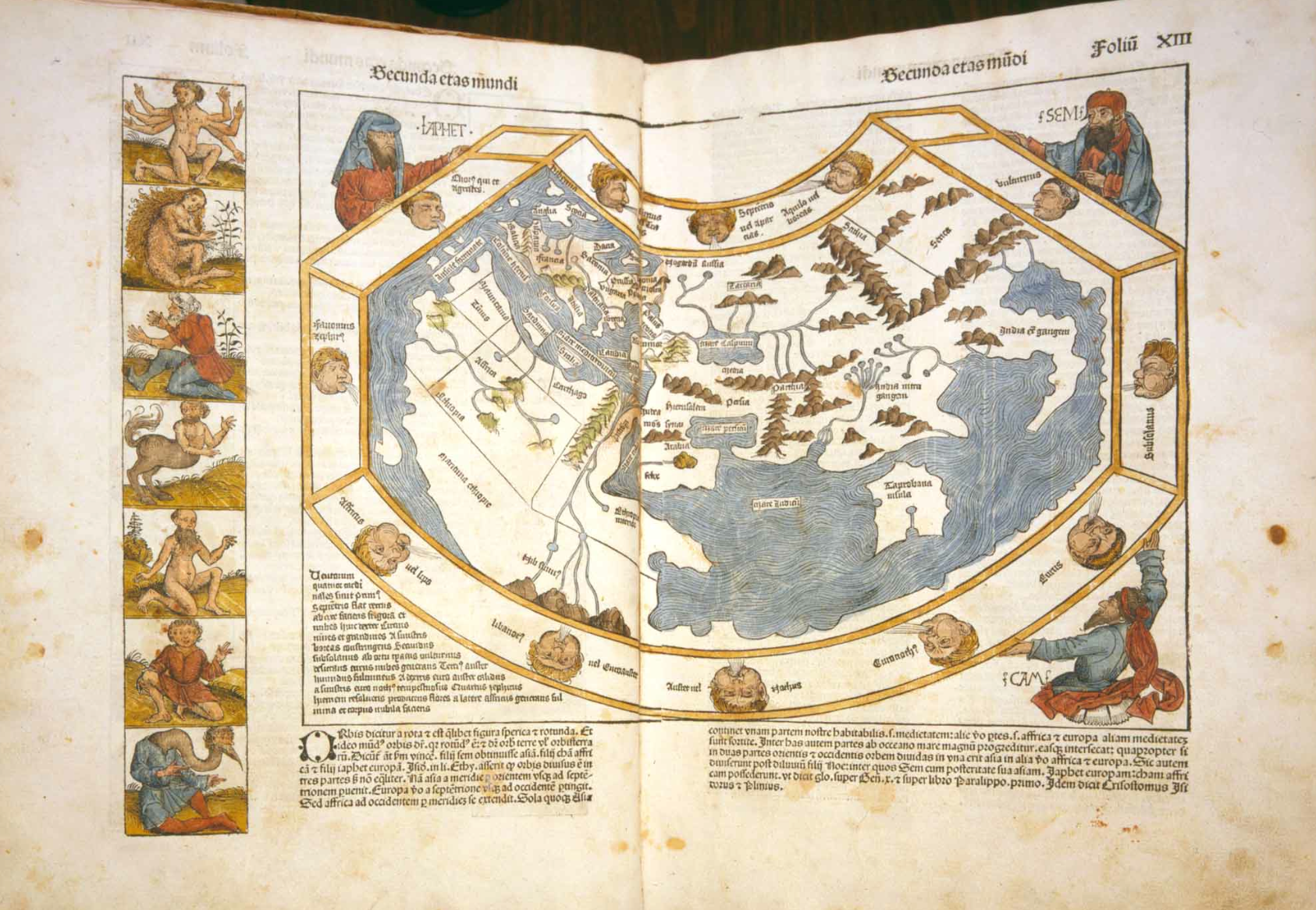
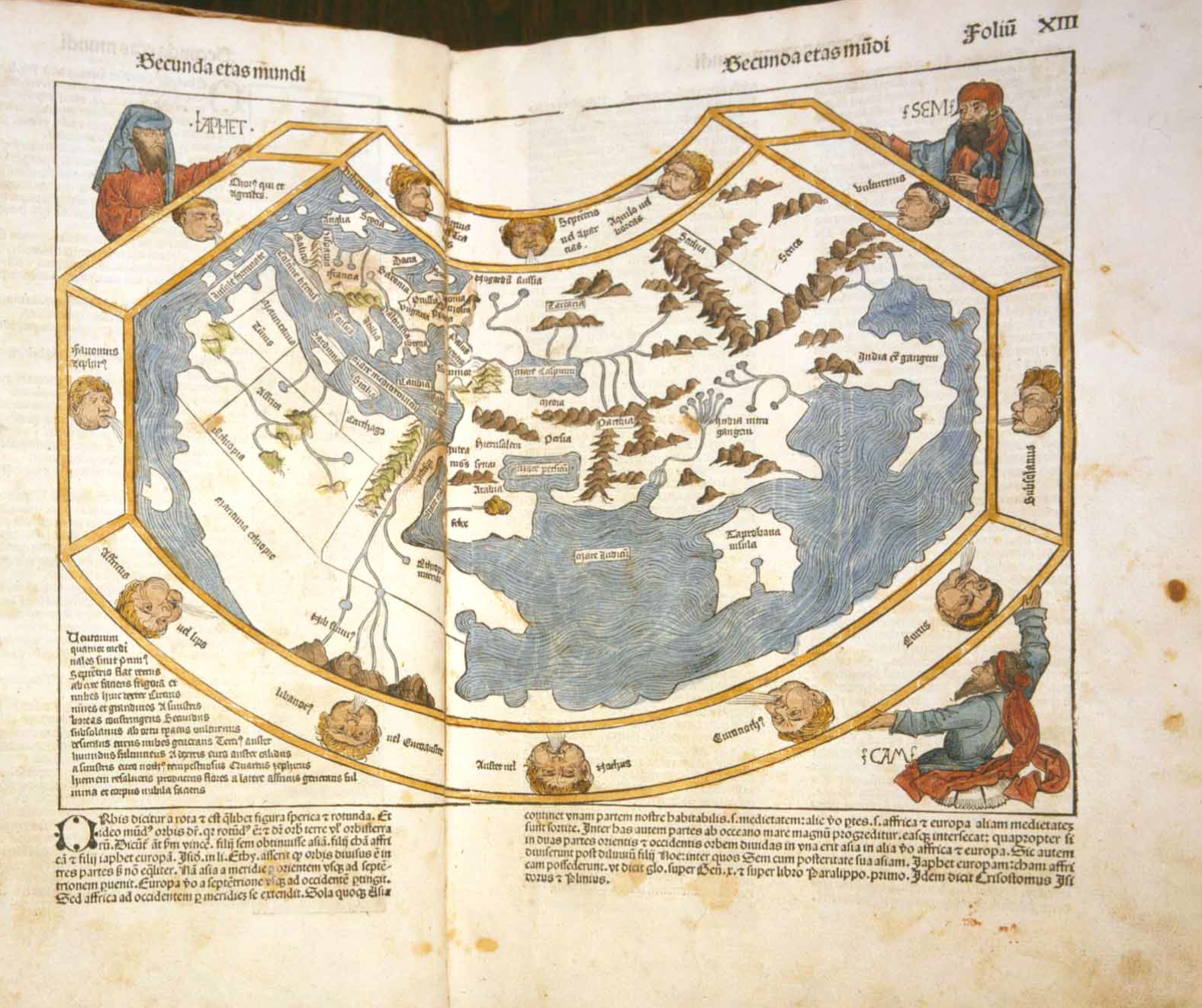
The compendious divisions of this mental map in a sense informed an engraved world map printed as the sixth page of the 1493 Nuremberg Chronicle, or “Book of Chronicles,” a “universal” history that promised a temporal compendium of world history, embracing historical ages in order to be able depict the division of continents from its creation through after the recession of waters in the Noahic flood through the succession of worldly empires that Augustine and Orosius had famously described–a work that captured the early taste for engravings as mediating information in Renaissance Nuremberg.   Romans discussed their empire as the ecumene, imitating how Greek geographers discussed an ecumene at whose fringes lived fundamentally other foreign Peoples, outside the scope of human concern and beyond the limits of human inhabitability; the world-map in the Chronicle placed outside its borders the excluded races of  Cynocephali, one-footed Sciopods, reverse-footed Antipods, bearded women, and one-eyed cyclopean monsters.  These lay outside the three regions divided among Noah’s three sons Shem, Japhet and Ham, or ecumene, and outside its image of the inhabitable world where humans dwelled, but also reflected the new world that the recession of waters in the Noahic flood had revealed to human sight, and the projection of the world that its editor included registered the shock of the prospectus terrarum that the lessening of global waters worldwide revealed–and the ecumene it unveiled:

SECUNDA ETAS MUNDI


Hand-illuminated versions suggests significant curiosity in these creatures placed outside of the map’s ruled boundary who dwelled in a different space from the river-nourished environment of what one supposed to lie on the edges the habited world:
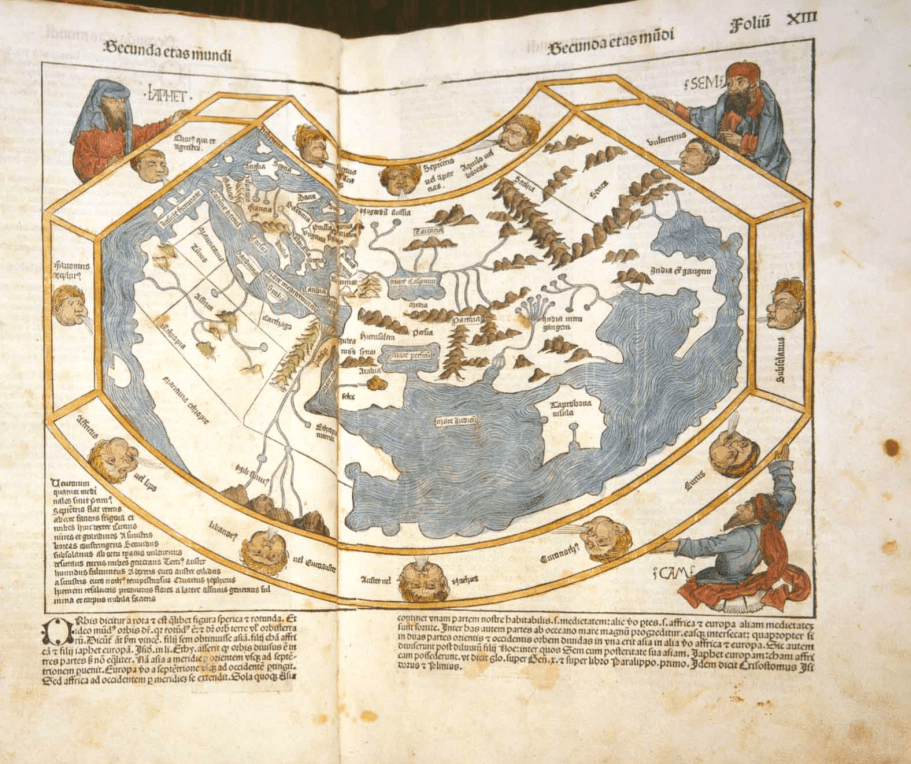
 

Secunda Aetas Mundi


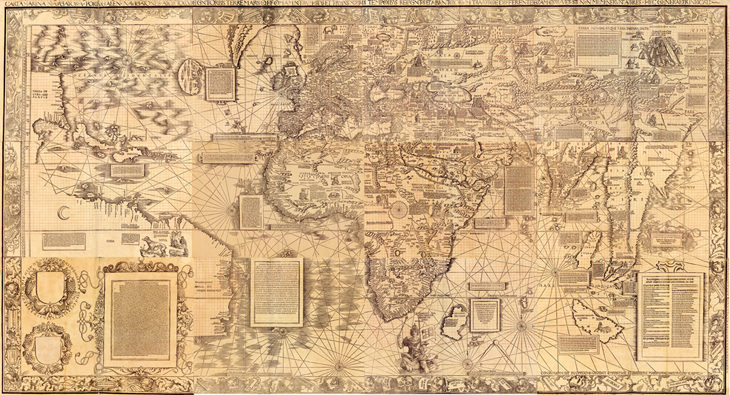
The ecumene had of course already expanded dramatically by 1490 or 1493 that challenged thought about its both its boundedness and uniformity and cartographical forms to represent spatial expanse.  It continued to expand dramatically in the following years for readers of maps.  Similar monstrous races were included on its peripheries:  in the northern limits of Asia, a boundary of the inhabited world, even in Martin Waldseemüller’s learned Carta marina of 1516–both in response to literary sources and travelogues as well as the mental furniture of the bounded region of human habitability.  Many of these races were left off of the map as “an empirically known space,” for the very reason that they challenged and threatened a human space, and the boundaries of the world revealed by maritime exploration were unknown–even if sea monsters were increasingly banished from the more the edges and unknown areas of the more refined world maps, as the Carta marina.


Waldseemuller 1516 carta nautica


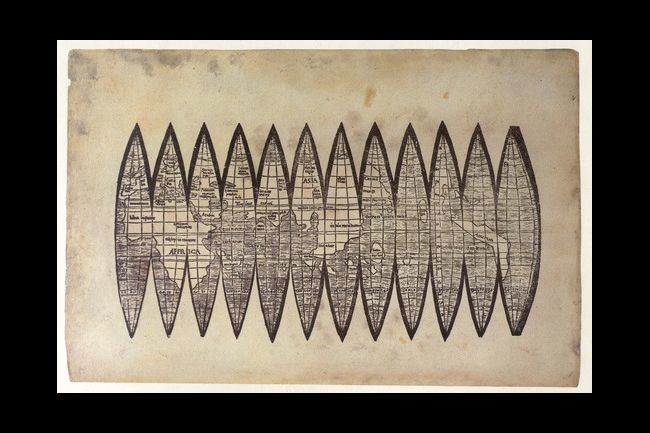
The consciousness of limits of habitability or human settlement was a graphic expression of Strabo’s mandate that geographers show the world’s inhabited part, as much as its inhabitants or populations to readers to satisfy curiosity and to respond to a need to describe its limits, as much as its totality:  “the geographer must describe the inhabited world in its known parts, neglect its unknown regions, as well as what is out of reach” (II, 5,5), placing a primacy on describing those parts of the world or communities in which humans live.  Although most fifteenth-century people did not easily domesticate the idea of an extensive space, let alone an undifferentiated expanse, picturing the unity and comprehensiveness of the ecumene became a basis for thinking about expanse, and comprehending difference:  the image of the ecumene in the Nuremberg Chronicle became a basis for continuing a rambling shapeless narrative grounded in a series of embedded or potted histories of place, each defined around an individual city and city view:  the ecumene was the landscape, if you will, in which each was situated.  There is often limited notation of a matrix of parallels and meridians in what might be called a readable fashion in early Ptolemaic maps:  it helped make space legible and material–or a sense that they are conventions of understanding the dramatic contraction of global space, but not indices of way-finding or marking place, as in these gores, identified with Waldseemüller’s school of cartography, ostensibly made for a small globe.


waldseemuller_map_found_4_7_2012


What has happened to the notion of the ecumene?  Even as the Ptolemaic ecumene was expanded, the community embraced in the map grew, rather than being abandoned, if New Worlds were processed into a map that reduced the prominence of Europe at the center of the inhabited world.  But the expanse of the ecumene held together, as it were, a sequence of regional maps, partly because the concept contained the promise that the whole world could be divided and known in synoptic form in a series of synoptic images that reconciled spatiality and territoriality.  Although mapping the continuity of expanse undergirded Renaissance cartographical images, the precision offered considerable wiggle-room, as it was limited only to the known.  But the division of space into bounded records of expanse were influential; the “chorographical” map of community became a counterpart of the totalizing coverage of a geographic projection.  To be sure, such maps responded to the diversity of ecumene that were discovered.  And maps provided models to mediate culturally fragmented collectivities, and fashion coherence across confessionally-divided communities– as the national map Oronce Fine designed of France to the French national atlases of the late sixteenth century to the English maps of Christopher Saxton, or Philip and Peter Apian’s maps of Central Europe, or a cycle of maps of the Italian peninsula that Egnazio Danti organized for a corridor leading to the apartments of Catholic Pope, discussed in an earlier post.  The coherence of each of these regions provided a sort of microcosm to the ancient geographic ecumene as it gestured to the wold that Romans civilized.


2.  The second half of this blogpost shifts focus.  In ways that less linked to cartographical models, it uses the notion of an ecumene to interrogate the survival of a  mapped global space in more modern mapping techniques.  We now lack similar boundary lines, of course, and measure contact among its regions rather than being awed by the immensity of the world’s expanse.  But the same term gained an ethical heft  in Enlightened thought to express a mandate for cosmopolitans to inhabit the world to become citizens of its entire expanse and cultures.  This shift in meaning, often thought of as a rupture, suggests continuities with the contemplative uses of globes for ancients as signs of learning or stoic remove.  The modern recuperation of the ecumene, distinct from its sense of the community of Christians (inherited from the Enlightenment) or the community of mankind is more striking as a relation to a lived environment, in ways that recuperates the ontological category of ecumene in order to describe and refer to the “humanized” world in which we now live–whose surface is more fully inhabited than ever before, but its nature shaped and informed by humanity both in regional environments and as a whole.

Augustin Berque has emphasized the benefits of attending to a relation, described by Tissier, between man and the planet in his 1993 article in the journal Persée, striking for how they dispense with the very category of a map if provocative for how they recuperate the ancient term in an ethical sense.  The term “ecumenical” oriented the term to the continuity in a community of believers.  But the ethos recuperated by Berque refers to what is human in the world, and a way of being, stripped of a fixed ethnocentric perspective.  By locating the “oikumenal” in terms of human geography stripped of a cartographical foundation, his sense eerily prefigures the images of the inhabited world that are both the benefits and costs of GIS as a basis for judging one’s own relation to the global world.  Berque has removed this ancient term of encyclopedic or positivistic coverage as a material register of geographic toponomy and the ancient craft of map making that embodied a fixed relation to the world.  His construction of an ecumene encompassing human society and its relation to the environment melds nature and culture in ways similar to the ancient term in its ethical connotations.  But his usage oddly dispenses with its graphic construction in favor of a global consciousness:  for in calling attention to the “ecumene,” has removed mankind’s relation with the earth’s surface is removed from a simple demonstrative function of the map:  much as the medium of GIS  defines the inhabitation of the world from one slant or subject, Berque asks us to embrace the multiple effects of mankind on the planet.

Berque believed that with the humanization of the planet complete, and the physical planet dominated by the effects of human life, more emphasis should be placed on a phenomenological analysis of the relation of subject an ambient by this Greek term, now removed from mapping practices to embrace human geography as a tool to consider the relation of man and his [made] environments. Putting aside the value of Berque’s point, the disposition of this philosophical standpoint  reflects the deconstruction of the privileged place of the terrestrial map and of geographic knowledge in GIS, and the image it perpetuates of the inscription of a human geography.  The relation of man and his planet–or the effects of man on the planet–are now the scope of a wide range of GIS maps of human habitation and Google Earth, or maps of influenza, infections and disease in data visualizations or geographic metadata catalogues, whose aim shift from physical geography to the place of mankind in it.  Increasingly, we are prepped to see the world nightly with a false immediacy of the nightly news, less focussed on territorial boundaries than a token of comprehensive coverage, prepped for consumption much as the newscasters who present an account of the “daily novelties” are prepped and outfitted in the apparatus of a news room.
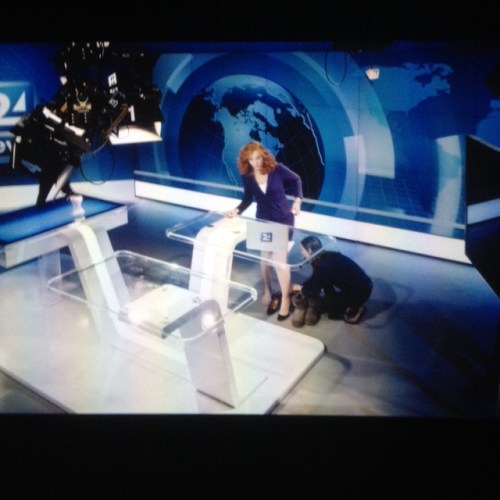
 

Newscaster prepping.png.JPG


As put it eloquently (and cleverly) by Bruno Latour and friends, our ideas of territory so clearly derive from maps that the digital ubiquity of mapping places us into a new relation to territory:   we now navigate not based on “some resemblance between the map and the territory but on the detection of relevant cues . . .  to go through a heterogeneous set of datapoints” by which to move from different posts to gain new bearings.  We are always navigating a new relation to territory, or understand territorial models, not assuming defined and predetermined boundaries.  This notion of the environment is based on an ability to read signs of its inhabitation and peopling, rather than with reference to previously mapped territories, and is rooted on the ability to navigate by using maps on a screen, rather than on paper–in which the lack of resemblance indeed has further purchase (and persuasive power) as a gain in both certainty and objectivity.


3.  The analytic nature of the reader’s relation to GIS maps is less based on embodying place or expanse in a cartographical manner, because it is not rooted in mimetic qualities.  For the map, in much GIS, is used essentially as the primary field to encrypt variations in data, and removed from any pictorially descriptive function.  Put better, the map is something of a found object, a template, an objective construction in which we sort out the real information that is displayed upon it in an appealingly objective fashion, but one that lacks an orientational power rooted in mimetic claims and indeed turns away from making any actual mimetic claims:


usmap9

Indeed, the underlying positivism of the objectivity of the map is recycled in most visualizations that are rooted in GIS.  If modernity, as Doreen Massey put it, involved “a particular hegemonic understanding of the nature of space itself, and of the relation between space and society,” drawing expanse on multiple computational platforms in GIS has decoupled space from a precise location:  we now know from a true “view from nowhere.”  The differentiation of terrain or local constructions of space are of less interest than the projection of meaning on a map that is treated as a screen, and several significant local markers may be absent or not noted.  Shifting scale by moving a cursor does not create a more readable space, but provides a very odd reframing of space as a unit that is not comprehended by the reader, but able viewed simultaneously at multiple scales of changing parameters, zoomed into and out of, and adjusted on a digitized scale bar. Our current National Research Council argues in its spatial literacy report on spatial thinking that “the important thing is that they allow for the spatialization of data and use a range of types and amounts of data,” lending primacy to the readability of data over the analytic or representational basis of map-making.

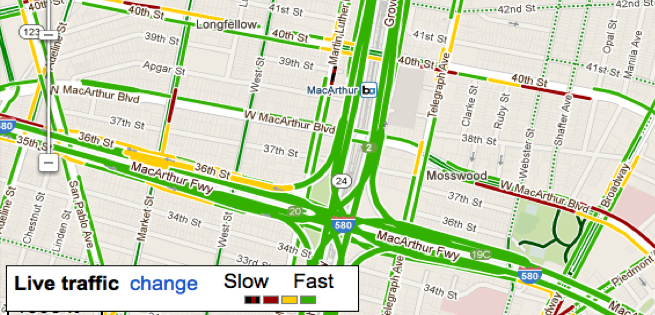
What is physical geography, after all, in many of these maps?  The prime mandate is to map one’s relation to the environment in a readable fashion, rather than to encode layers of local topography or meaning, and to streamline the map to allow its reconfiguration in different datasets that prepare for readability, rather than granularity or density of meaning.  Again, this is based not in mimesis, and no longer based on the notion or mimetic projection of territory:


MacArthur Freeway 11-00

Children's Hospital 11-51

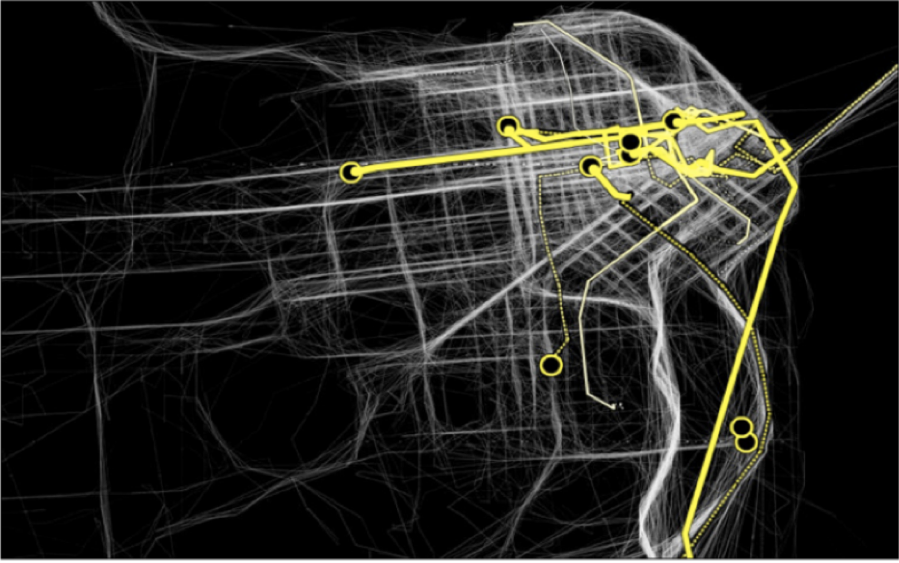
If we speed this up, to look at a sort of time-stop photography of cabs in San Francisco’s downtown area, as did Stamen design in a pioneering map that combined aesthetics and the abundant database of the surveillance operations of Google Maps, and is based on readings taken from the GPS data of the Yellow Cab Company of San Francisco, available also as a film:

Stamen Cabs

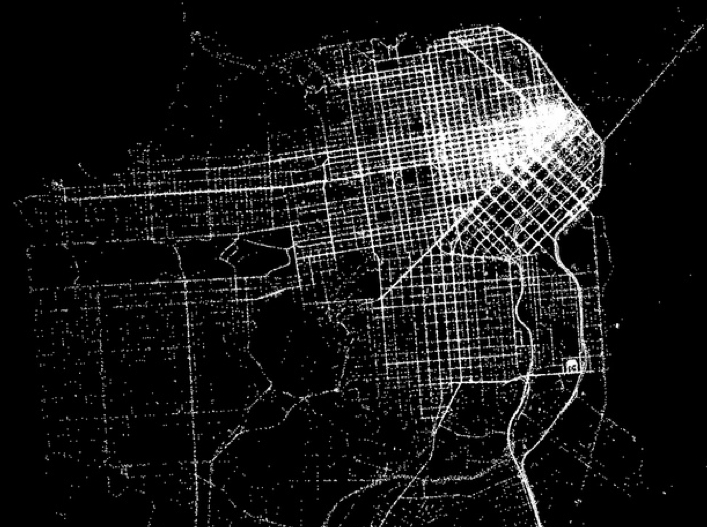
Or, in Shawn Allen’s map/photo, which resembles a direct transcription of the taxicab scene in downtown San Francisco on June 15, 2012:

Shawn Allen's map:photo

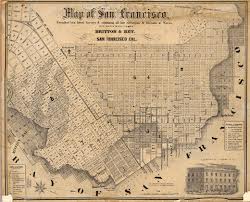
Does an impoverishment of spatial literacy or toponymy result from such containers of datasets that use maps as formats?  The omniscience and transcendence of the map viewer is immeasurably increased, but the viewer is the receptacle of data, as much as the perceiver of the scene:  new currents are configured and new flows revealed, as data from a variety of sources are richly encrypted into the surface of any given image, compressing the sort of media to which we might have access to a single screen.  One has a different sort of relation to a screen than to a variegated surface, reading a way of configuring information in different ways:  but the difficulty with the screen in particular is its lack of a sense of spatial embodiment. Compare it to an earlier map of the same region, not at all sparing with information but bending backwards to compress legible content within a description of the city’s environment:

sfharbor

These are, perhaps, essentially different modes of data compression, based not only on distinct tacit presumptions, with one angled toward data flows, rather than to the ostensible objectivity of a perceptual model.   But the difficulty to embody data flows can generate an oddly 2-D superficiality that forsakes the very quality transcendence to which earlier ecumene aspired.  Data-streams provide a selective mapping that illuminates one angle of analysis, as it were, rather than aspiring to process an image of the entire city’s or world’s actual inhabitation.

Let’s however insist on being more concrete.  When used to display shifts in a census, the map below displays data removed from topography or centers of population density, and is a data visualization without refined conventions to process its content or meaning for viewers, even if its meaning is quite serious and subject quite human, because it displays information on a static template with little interpretive key–since this map is less of an autonomous and self-standing unit of meaning than a map that demands to be read in reference to familiarity with a map of the distribution of the state’s population:
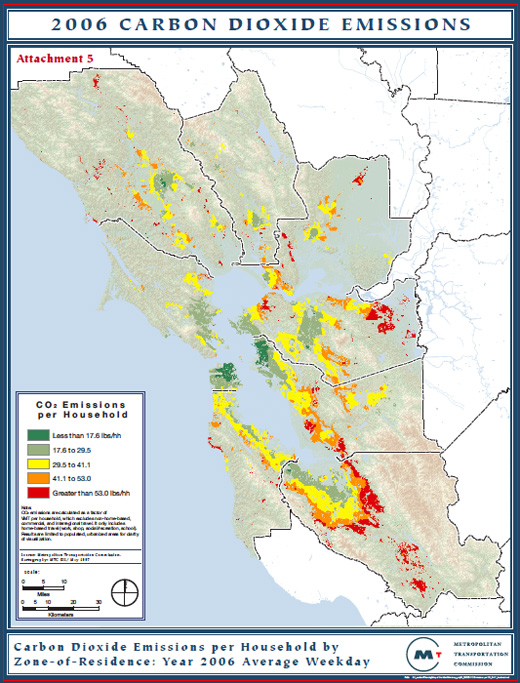
CO2 emissions


The above map of CO2 emissions of Northern California households elegantly foregrounds one specific reading of the relation of man to the environment. The challenge raised by such an elegant map is to retain communicative flexibility of the conventions of terrestrial mapping, however.  In any GIS map, there is the anger of emptying the format of project from content such as topographic variations, specific local detail, or the dynamic relations of space and habitation within a map:  the conventions of the format gains an iconic or symbolic register alone, in short, and is considerably impoverished as a description of terrestrial habitation when it serves as a field to display data flows or project a database.  One issue is to combine the data with how the analytic framework of the map integrates word and image or creates a structural distribution–something like the poetics of mapping–rather than employ maps as a passive container for spatial information instead of actively creating a way of thinking about space. The mapping of the results of a census regularly lack a sense of topographic variation or differentiation of urban and rural population which would render it more meaningful, and give a plasticity to its already remarkable contents as readable content.  This partly lies in the lack of a dynamic relation between the visual field of the map and its reading, as in this map of the regional variations in the India’s regional population per square kilometer:
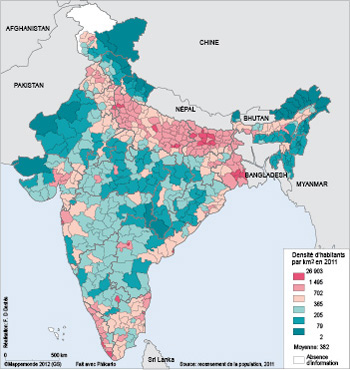
 

dastes_F2


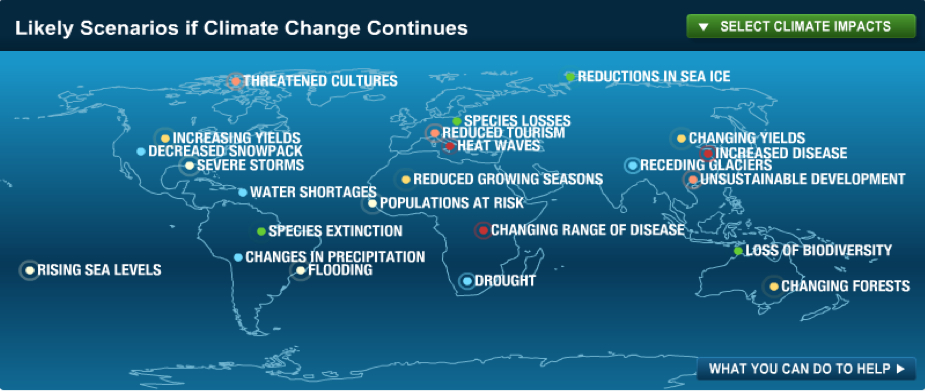
The map does not exploit its own conventions of orienting readers to space or expanse.  But GIS mapping offers a significant range of angles by which to read and explain its content.  The relevance of clarifying readers’ relations to the environment are in fact pressing, as revealed on this interactive map–which even includes an option for the reader to learn in detail what s/he can do to help:
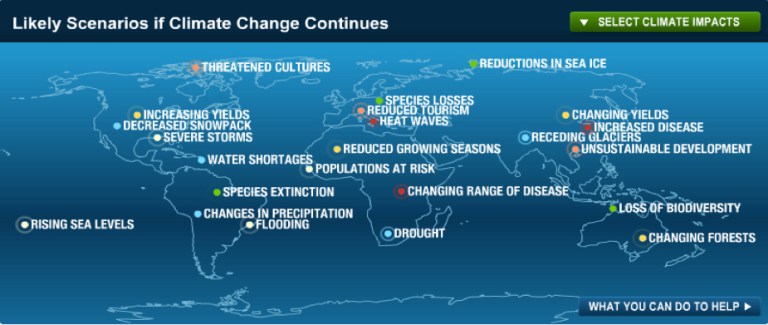
 

Scenarios of Global Warming


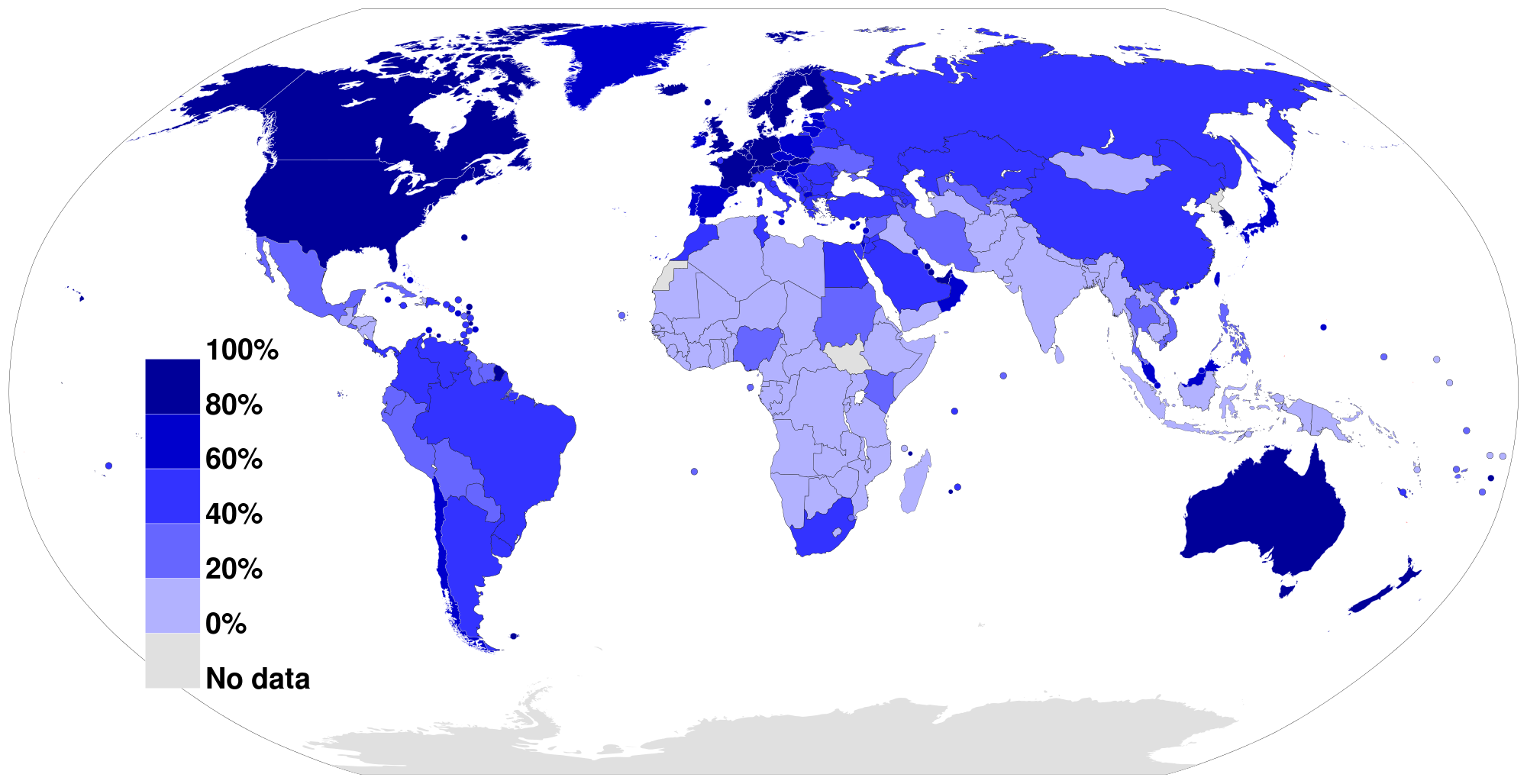
At the same time as this pessimistic picture of the actual eventualities of climate change in the age of the anthropocene, the radically shifting nature of a world which is no longer shaped by proximity, or challenged by distance.  The map of internet penetration suggests, rather than a new map of inequalities alone, the new obstacles to the penetration and responses to messages worldwide, and, no doubt, contributed to the difficulty of the transport of needed goods and medical supplies to western Africa during the current epidemic of Ebola, which seems to have left populations scarred by the difficulty in transatlantic communication, as much as the lack of adequate maps, as OSM-H has shown, of adequate mapping on the ground.


2000px-InternetPenetrationWorldMap.svg


Indeed, the map of internet penetration, for all its unpleasant echoes of a colonializing perspective, where first-world countries receive greatest coverage, reveals the extreme difficulties of penetration of all of the coastal countries of West Africa–unlike Nigeria–where the highly contagious virus has proved most difficult to be contained, and information about  the virus less able to be widely disseminated.

Are the edges of the penetration of the internet the most vulnerable edges of the inhabited world, and as the edges of the accessibility and sharing of human information the most vulnerable to cataclysm?


4.  To some extent, this takes us back to Berque’s notion of the ecumene.  But the relative thin-ness of encrypting data projection on the map is so less fine-grained to impoverish the relation between reader and map or registers of engaging readers:  the granularity of the map is particularly great perhaps because the map’s visual qualities are less closely joined with its textual ones, or the hypertext only uses the map as a static schema. There seems the danger of how maps direct our attention to spatial variations and complexity with the proliferation of maps as visual media across different venues and platforms, and a dissipation of the authority of demarcating expanse or of compacting data in a uniform surface.  Perhaps this recalls Berque’s notion of the ecumene as a set of relations to the environment, which can be read in different ways rather than in one way.

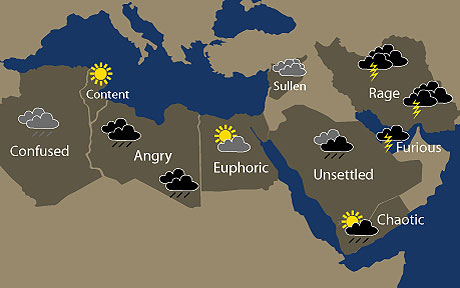
The question of habitation has become turned, like a prism, to illuminate new points of view and angles of perception, a topography of habitation indeed seems beside the point.  After all, there are no real areas of the globe that are not inhabited, and the questions of orienting individuals to space seem more pressing than ever on ethical, ecological, and moral grounds alike–if not of just making sense of the effects with which man inhabits space. In a somewhat ponderous post, let’s offer a comic conclusion, however, rather than carping about media for mapping in an age of digital reproduction and increasing vectors of data flow.  The GIS map has become a versatile demographic tool to reframe questions and reveal spatial links, possible vectors of influence or pathways of causation, and indeed maps of emotions or violence.  The question is at root what sort of remove it places the map reader to interpret those vectors on its surface.  There is a temptation to deflate the authority of the descriptive value of such a matrix for its lack of fine grain.  Amidst the attempt to map the Arab Spring there was the inevitable  GIS irony of naturalizing political movements with the ephemerality of a weather map–more a mental map of what the media presented, to be sure, rather than a map designed to orient its content to a reader practiced in interpreting a map’s construction or its conventions.  The map has the value for its viewers of an illusion of transparency and a medium of omniscience:


middleeast_map21_1829864a


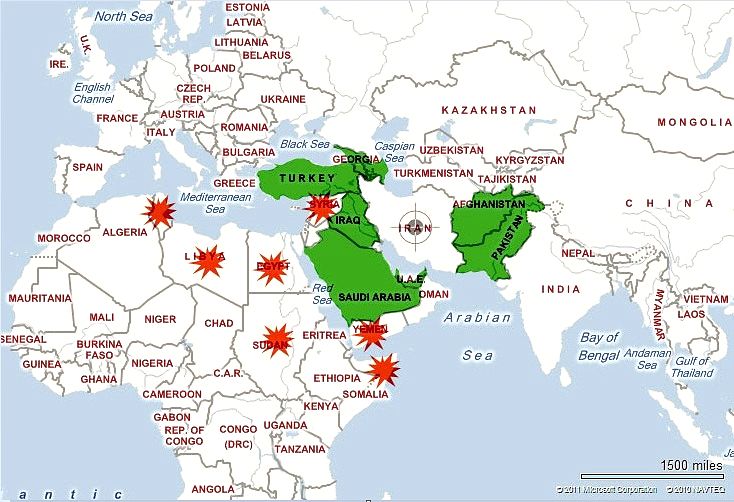
Or GIS-inspired variations on sabre-rattling from the American right, which was openly alarmist (if not antic) in tone, against a backdrop from Wikipedia commons:


ZIO_middle_east_map_jpg_big_1


These pseudo-news maps come from the GIS family of signs, even if they are not based on actual data.  They orient viewers with a wiki-like remove. It makes sense that at this point ecumene denotes more of an ethical stance to describe man’s relation to the environment, shifting from to what that process of inhabitation might mean; there is no demand for graphically rendering the inhabited world, but rather the ways mankind inhabits the earth and has filled and marked its space.  But there is a loss of mapping habitations. And so map making in the flexible media of GoogleMaps is no longer an expandable portmanteaux of fine grain, but rather a matrix of data streams where one charts multiple consequences of inhabitation rather the local terrain.  If we no longer have Sciopods outside of our human realm, we lose a sense of an ethics of mapping or even of relating to maps when we dispense altogether with practices of map-making.
Leave a comment

Filed under anthropocene, data visualizations, globalism, Google Maps, metageography, Ptolemaic geography

Mapping Fault-Lines in Earthquake Maps

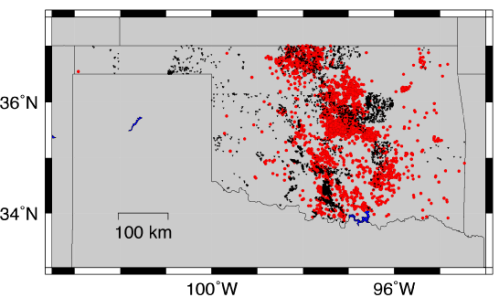
Fracking–it is increasingly feared–invites irreparably contaminating our largest aquifers, and by extension drinking supplies–in Brooklyn, someone formed a group to protect the water of locally sourced beers–as well as devastate prairies and old agricultural lands, where land is cheap, by horizontal drilling.  Recent arguments compellingly link the drilling multiple “injection wells” of wastewater that seem to have activated previously non-active faults in regions that rarely experienced tremors in the past, and where the USGS did not find evidence of registered earthquakes.

As massive amounts of wastewater generated to access for natural gasses are forcefully re-injected into the earth, as if swept under a carpet, opening fissures in underlying beds of Shale or Sandstone.  Horizontal drilling operations have dated to 2008, mining areas by pumping vast amounts of sand into ancient shale formations in prairies and regions of declining agriculture to release methane and natural gasses.  Hydraulic fracking has used tons of water to force trapped gasses out of old rock formations.  Before 2009, in fact, earthquakes were rarely registered in the USGS surveys of lands where seismic activity has accompanied the injection of water into “injection wells”:  in these the shifting weight that the injected water that presses against rocks open old fissures, causing a buckling of underground rock formations, the fear is, as massive amounts of soupy, contaminated wastewater is injected back into the earth.  The “earthquake swarms” monitored nearby injection wells in Arkansas, Montana, Texas, Ohio or Oklahoma that barely registered seismic activity  from 1972 – 2008, has given new significance to–and created new fear around–a set of fault lines unknown to inhabitants, blamed as if active by an industry that rejects the accusations that they created sources for tremors inhabitants fear.   Indeed, the proliferation of earthquakes registered in the state of Oklahoma alone from 2001-15 reveals, according to the data from the Leonard Geophysical Observatory, a persistent increase in the tremor-like disturbances with the rise of underground wastewater dispersal, and a strikingly sharp increase in quakes of magnitude of three or higher in hears after 2010.


QUakes in OK, 2001-15.png


The increase seems closely tied to the absorption of wastewater back into rock layers whose weight is so altered by the injection of fluids, causing quakes that have rocked up to a fifth of the state, but have also increased land values for speculative fracking, in ways that may have concealed some interest in exploring the correlation–especially in a state where, due to geomorphological accident, water injected to reach deep-lying shale deposits send increasing amounts of wastewater underground, often to be absorbed by highly porous limestone that expands, but lies deep underground beside highly stressed layers of rock.  The result seems to create something like a combustive effect akin to the popping of kernels of corn, and has led many state officials to preemptively adopt prohibitions on local bans on regulating oil or gas wells in their jurisdictions, and insistence that the resurgence of quakes in fault zones is more able to be explained as an “act of nature that is nobody’s fault” not effected by human agency; the rejection of a relation to human activity comes from state legislatures fearful of the employment rises brought by gas and oil corporations from being scared away from the state.    But the geological record of apparently induced quakes in Oklahoma and their close proximity to existing injection wells.


ok.png

The fear of such tremors has a recent prehistory of three or so years.  An early tremor whose epicenter lay near Richmond, Virginia, of 5.8 magnitude, just below 6, but that sent shocks to North Carolina and Canada.  The event raised questions about the role of fracking in 2011 for Tim McDonnell and Aaron Ross, described in an earlier article in Mother Jones that directed attention to fracking’s consequences.  But the persuasive nature of recent USGS time-lapse maps of the same state–

The dangers of fracking echoes Jonathan Franzen’s early if compelling 1992 novel Strong Motion, in which mysteriously recurring earthquakes are pinpointed at the unlikely site of Boston, Massachusetts, a rare location of seismic activity.  But whereas Franzen’s protagonist, Renée Seitcheck, believed “that these earthquakes are the byproduct of industrial drilling” by a  petrochemical firm whose agents attempt to assassinate a beautiful rebel seismologist, for her mining of top-secret data from computers, the causes of the “swarms” seem to lie less in drilling than in injecting waste-water.  Was the novel remarkably prescient in unveiling a concealed impact of post-industrial geocaching?  It surely doesn’t seem so paranoid in its view of an industrial conspiracy to conceal geological findings, or to imagine the role of the rogue geographer in the seismically sensitive landscape that the search for underground sources of oil and gas can create.

But now it’s no longer isolated individuals who research the papers of top-secret labs.  There are upwards of 40,000 disposal wells actually active in the United States, some tunneling 13,000 feet under the earth, and “injection induced seismicity” is now a field, as the pressure exerted by the displacement of water able to move rock layers has provoked widespread academic interest and industrial concern:  “There are faults most everywhere,” noted Cliff Frohlich of the Institute for Geophysics at the University of Texas-Austin, suggesting how fracking can ‘reactivate’ fault lines which were never known; “Most of them are stuck, because rock on rock is pretty sticky.  But if you pump a fluid in there to reduce the friction, they can slip.”  “Water does not like to be squeezed,” Scott Ausbrooks of the Arkansas Geological Survey put it with some empathy.   And while Franzen’s character pored over reams of secret data to understand the relations of seismic activity to big oil’s search for underground pools of oil, such relations are now the focus of conferences and are amply documented in data maps.

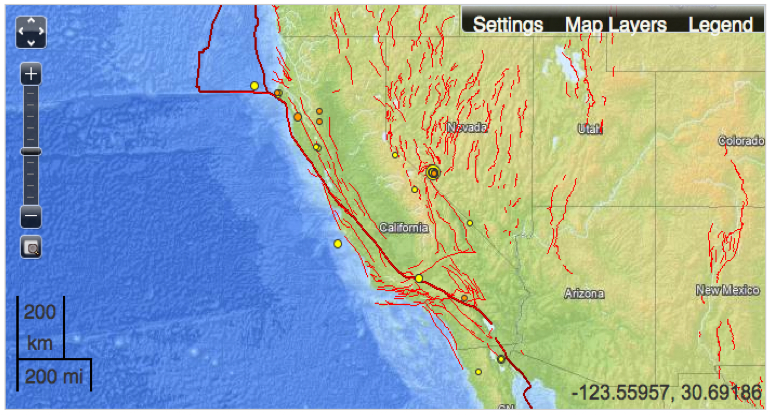
The best known faults the USGS has mapped are well-known.  But, as Mark Zoback, a professor of geophysics at Stanford explained in a recent article by Michael Behar in Mother Jones, echoing Frohlich, “there are faults everywhere, and some are too small to be seen.”  Faults are widely known if often forgotten by those living in California, where fracking may begin, despite growing opposition.  Indeed the range of fault-lines throughout the California-Nevada region are so multiple that the possibility of hydraulic fracking in the region of southern California threatens to  imbalance a rather threatening constellation of seismic activity that already exists in much of the region, and is more widely mapped than the most familiar lines of the San Andreas, Calaveras, or Hayward faults.  The visibility of these fault-lines is available on an up-to-the-minute-map of regional seismic activity, part of a set of maps that record seismic activity by irregular bright red computer-generated lines, often proximate to cities:

California in USGS map of Faultlines

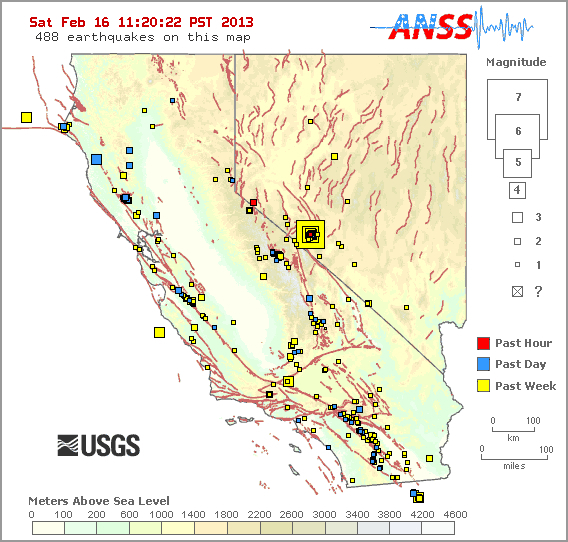
The nervously drawn red lines of seismic activity furrowing the green plains in these maps are ‘underground views’ mapping the range of pressure below the earth’s surface.  A more striking map of seismic activity of the past few weeks and days pieces together a narrative of fault-lines and tectonic plates that accentuate the daily deep divisions that course under the earth of our westernmost states:

California_Nevada-1

The stark legend suggests the huge growth in a magnitude the scale of “6.”  The prominent indexing of fault-lines in another USGS map of seismic activity, with less attention to topographic or climactic variation, shows the volatility of the region’s multiple faults in a similar if starker image of seismic frequency:

indexfault_map


More locally, and limited to faults active in the past week of a magnitude above 2.5,
California in USGS map of Faultlines


For more focus on recent seismic occurrence, link your browser to: http://earthquake.usgs.gov/earthquakes/map/

Despite the evidence of terrifyingly active fault lines, the active movement ‘Stop Fracking in California‘ has its back against the wall, even if they are growing in local Southern California chapters.

Yet the volatility of the region cannot be ignored–take this map of the Simi Valley and Los Angeles area, posted on Saturday, February 16, where fault-lines course unseen beneath the landscape, moving from inland to the coast at multiple points and through metropolitan Los Angeles:

Los Angeles earthquake faults

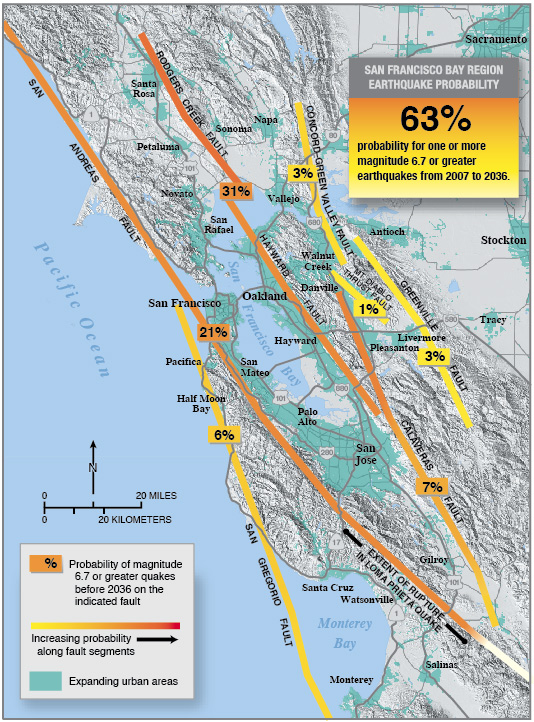
This interest to frack in California–an oddly post-modern verb–is scariest given maps approximating the future likelihood, as calculated by the USGS, that the regional fault-lines in the Bay Area will experience seismic activity at a magnitude greater than 6.7 before 2036.

2008probabilities-lrg

By how much would active injection wells multiply increase these already quite sizable odds?  Given the proximity of these lines to expanding urban areas, often growing between the Hayward and San Andreas fault, can fracking in California be a safe investment for the future?

This is not a map that is in the heads of most native Californians or residents.  The readability of these maps offers a base-line for future seismic activity, and grounds for concern about hydraulic fracking in seismically active regions.

It is good news that the USGS has expanded its clickable interactive image of global fault lines, in which the record of seismic activity is updated every minute, and on which viewers can scale in to investigate on their own:

USGS Global Earthquake Map

While the occurrence of faults and tremors will always shock, its legibility not only offers a lesson in continental drift.  Many of these jerky lines reminiscent of an etch-a-sketch lie underwater, but the points of greatest activity–in California, Indonesia, and Central America–cannot be ignored or lost sight of for underground engineers.

2 Comments

Filed under data visualizations, Earthquake Probability, Earthquake swarms, earthquakes, Fracking

Mapping Knowledge and Mapping Food

Image

What relevance do maps have in a world often organized by database systems that are in themselves often impossible to visualize?  One answer is that the map is not only a visual register of data, but prepares an active correlation of information patterns and raises questions about human relations.  Rather than arranging data, maps show or highlight selective relations between data in graphic form.  Maps do so in ways that generate questions about our relations to space, if not the variety of relations each of us occupy to an otherwise uniform expanse, in order to make space our own; they are as a result particularly useful tools to ask us to consider our sense of place in ways that we might not otherwise find a way to puzzle over and consider, or find a way to concretize.  Although the size of massive database systems escape the kind of an individual, the maps that guerilla cartographer Darin Jensen has solicited and assembled in FOOD: An Atlas raise chart the spaces we organize around through food, and understand place through the intersection of place with how food is produced, exchanged and consumed.

In an age of the unwarranted expansion globalization of food consumption patterns and trade, where the importation and circulation of foods to their consumers often seem shaped by processes irrational in nature, the rationality of the map provides a way to raise questions about how to understand the ways that food sources and substances travel across space both in commercial ways and in raising questions about the efficiency of these systems.   In identifying and rendering a joint database of food production and consumption, we can grasp in an entertaining visual form multiple questions about how we value the place of our food and how food is now valued and exchanged over spaces far beyond the places where it is grown.  We may not know what bacillus of yeast helped the fermentation of the glass of beer we are drinking, even if we prize the origin of our coffee; we can’t visualize or often even know what field of tomatoes provided the basis for our pasta sauce, or the huge range of regions united in the foodstuffs in a plate of school lunch, or where the almonds of northern and central California travel in order to reach consumers from the Central Valley.  The maps in FOOD:  An Atlas provides a range of provocative maps of how food interacts with space that provide a compelling set of questions about our relation to place, and indeed the relation of food to space.  Maps of the global distribution of grains, or of the costs of the same foodstuffs, remind us of how food exists in relation to place, even if food travels globally—as well as the places where food grows.

The compilation is a true atlas of modern life—or of modern tastes for foodstuffs.  The Dutch engraver and cartogapher Abraham Ortelius compiled the first global atlas by sourcing maps from different areas in Europe from his multiple correspondents in the 1560s, obtaining a range of extant cartographical forms of nautical and terrestrial form that he collated in a synthesis of terrestrial coverage that canonically redefined the image of the inhabited world.  Refined and expanded in his own lifetime and after his death, the Theatrum Orbis Terrarum bound these multiple maps obtained from different parts of Europe and vetted in Amsterdam in a single commodity that was immensely popular and, though dedicated to Philip II of Spain, was disseminated over a huge geographic expanse.

The crowd-sourced maps collected in FOOD were sourced in a considerably shorter period of time over the global internet, solicited from cartography listserves and Berkeley classrooms alike, starting from the North American Cartographic Information Society (NACIS) and coordinated through a GIS lab where proposals for mapping were often linked to potential owners of databases, and submitted maps refined for their persuasive visual organization, the transparency of their cartographical iconography and the appeal of their format.  The variety of graphic skills that are applied to map food and food’s distribution are themselves inventive exercises, and suggest the degree of invention that

The crowd-sourcing of the atlas is not only a question of pragmatics, but itself an instance of informational exchange.  On the one hand, Jensen describes how he arrived at “a project of guerrilla cartography and publishing” as the result of a natural desire to make the sort of compilation of maps that “take too long to make,” which led him to “an experiment in doing it faster,” both by relying on crowd-sourcing and local publishing. “It doesn’t have to take two or three years to put out a book or an atlas.”  The anonymity of the crowd sourcing generated a far more imaginatively diverse use of mapping conventions—unlike Ortelius’ interest in universalized norms, they celebrate local diversity of mapping abilities in keeping with the polycentrism of a post-modern age.  Rather than conforming to a single style or aesthetic, each crystallizes specific issues in an individual fashion.  The maps provoke us to consider the relations of place and food, and alter or tweak our relations to the world in mapping the circulation of food wastes, the sites for importing tomatoes for that pasta sauce, or the “food swamps” where junk food constitutes a dominant share of the foods for sale.  Each is brilliant in its own way.  Whereas we know the many authors of the maps that Ortelius collected primarily from his extensive correspondence, as well as the “elencum auctorum” that provided a comprehensive list of the different authors of maps in his atlas and sources that were consulted in its creation, Jensen lists the individual or joint authors of each map–and even invites us to construct our own!
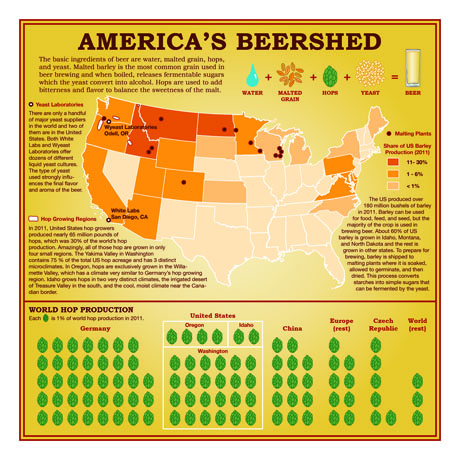
Why create a set of maps of the relations between food and space?  This volume is a way to rehabilitate the use of the map as a way to consider and contemplate relations we construct between place, as well as the product of a local culture of food.  All food is local, even if the world we live in has globalized food as a resource.  The open arguments of maps Darin Jensen and his team assembled in FOOD:  An Atlas provide a collective tool to understand what might be called the irrationality of the globalization of food sources in the transparent and supremely rational language of cartographical forms.  Much as the previous MISSION:  POSSIBLE led us to view one neighborhood in San Francisco in new terms of the distribution of coffee-shops, trees, ethnicities, restaurants, underground gas reserves, parking spaces or sounds, each map in FOOD:  An Atlas provides a distinct corner of the exchange of food as commodities and elegant goods we value for their local origins, as well as celebrating the recent growth in the valuation of the locally produced good.  As Jensen’s map of the Mission noted the rise of artisans in the neighborhood, the mapping of Farmers’ Markets—both in Berkeley and in the United States—offers a view of the rising value of the locally farmed (and even the changing definition of what local farming means) as well as the access and audiences of these markets.  As MISSION:  POSSIBLE provides both a map of a region of San Francisco and a sort of surrogate for orienting oneself in any modern city, FOOD:  An Atlas provides a tool to orient oneself within the global exchange and local production of foods.  The map of areas of urban agriculture in San Francisco that is included in FOOD is a great model of a collective interest in the local production of food in that city, and a sort of template for resisting a growing divorce of food and a local landscape.

To order a copy, visit http://www.guerillacartography.net/home.html

How better to understand the pathways by which select regions of almond-growing enter the chocolate bars sold across our nation, or consider the inequalities of food that dominate the urban and rural landscapes in an era that celebrates famers’ markets?

http://missionpossiblesf.org/

https://www.facebook.com/food.atlas

http://cafarmersmkts.com/

2 Comments

Filed under Abraham Ortelius, crowd-sourcing, Darin Jensen, data visualization, data visualizations, datamaps, Food, Food Maps, Geographical Information Systems, Guerilla Cartography, NACIS, The American Beershed, Uncategorized