Category Archives: Gaza Strip

Maps and Metaphors: Nests, Spiders’ Webs, Lairs, Warrens and Labyrinths

The Gaza War is not for territory, but is explicitly about erasing sovereignty. And much of the war, if fought above ground, is aiming at what lies underground, hidden from sight, and not on maps–even if we imagine that we might be able to map the damage, disaster, refugee flows and loss of life as well as destruction of structures across the Gaza Strip in ways that are truly impossible to process. This data overload, or information overload, responds to a proliferated media coverage of the disastrous war, but is also difficult to relate to the terror of the unmapped underground network of tunnels in Gaza, and the ways that the tunnel networks have been a reason for the terrible escalation of aerial attacks that have created such humanitarian catastrophe across Gaza and the Gaza Strip. As much as a war for territory, in a traditional sense, the Gaza War is almost one of purification–not purification in a religious familiar from the Middle East of the Middle Ages, but of the possibility of purifying the region to ensure Israeli national security.  And as a war of purification, it is almost fitting that the metaphors of vermin or unwanted animals dehumanize the enemy, as if a negative of actual residences or humans with rights. We are in a pre-Enlightenment discourse that denies all concepts of rights, or

The tunnel network that evolved from an infrastructure of smuggling to a means of tactical defense has become a target that is quite elusive: if the tunnel network beneath he Gaza Strip was underestimated quite dramatically at but about 400 kilometers after October 7–reflecting boasts of an Iranian general “Hamas has built more than four hundred kilometers of tunnels in the northern section of the Gaza Strip,” the estimated underground passages became a basis to underestimate the scale or intensity of its destruction. Indeed, the shock at the scale and technical quality of the underground network has been slowly grasped as far more difficult to target, as its size has since February greatly expanded to seven hundred or even eight hundred kilometers across the entire Gaza Strip. The tunnel network provides both a significant military and tactical challenge,–but one unable to be easily targeted or eliminated, even by existing mapping tools, flooding with seawater, the engagement of robots with facial recognition, or the location of hidden networks and their destruction. The tunnels under Rafah that are feared a network for smuggling arms from Egypt to replenish the arsenal of Hamas–underground tunnels dug under civilian neighborhoods that served as “terror nests” where Hamas commanders retreated–allowed the infrastructure of civilian neighborhoods to be destroyed, while the military infrastructure of Hamas remained intact.

Destroyed Buildings in Gaza Strip, November 5, 2023/Atia Mohamed/Flash 90

The hidden, unmapped expanse of underground tunnels, which Israeli intelligence for all its capacities seems to have misjudged, has become a target that has evaded mapping or location, turning the destruction of tunnel networks into a game of whack-a-mole, even with the prioritization of tunnel detection and warfare tools. Meanwhile, hostages held underground are unallocated, leaving the Israeli army far more “blind” in its engagement with Hamas. The intelligence of the network has been repeatedly minimized by metaphors as it is animalized as a warren, a lair, a spiderweb, or a labyrinth, as if to suggest its animal like nature, promised to be dissmantled as a structure of evil–an inhumane warren, more than a site of human resistance. The engineering of the network that has been able to be reduced in metaphors has expanded as an achievement of engineering–“beyond anything a modern military has ever faced,” per the chair of Urban Warfare Studies, at West Point’s Modern War Institute, making the conflict far more than academic–and a focus of global tactical attention of the shifting terrain of future combat.

Meanwhile, it has only grown, as we have understood the existence of longer tunnels, fifty meters underground, as if underestimating the tools of engineering the warren, and the evolution of underground engineering that has allowed Hamas to dig in for the long war, making any lightning strikes impossible and only endlessly destructive. The destruction has been, as a game of Rope-a-Dope, infuriating Israeli Defense Forces, who seek to target an evanescent enemy; the Israeli Army tries to materialize its existence as a set of targets–even as the Israeli Army has issued repeated maps, in hopes to rationalize their expanding ground operations across an increasingly bombarded and devastated Gaza Strip, locating tunnel complexes where the hostages were once held. Is the war not really on two fronts, one, the human civilian casualties, who have been erased as “shields” manipulated by Hamas, and the true, hidden front, which is fought with a group dehumanized to the level of animals, not deserving of anything like a decent residence or shelter in the Gaza Strip?
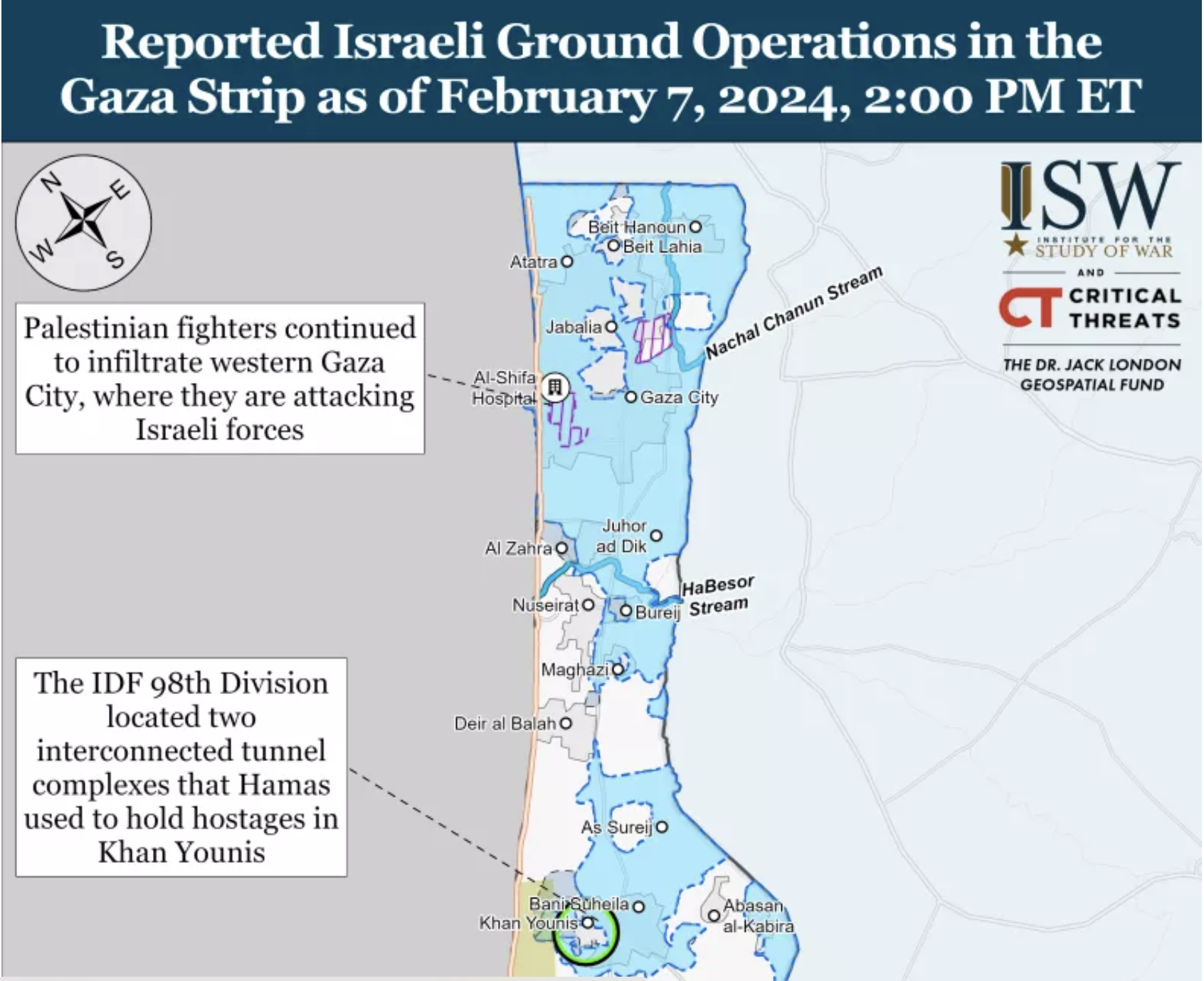
The Gaza War was explained in no uncertain terms as the destruction of this hidden network in which the terrorists who planned the attacks of October 7 could be extirpated from the region of the Gaza Strip, as if independent from the humanitarian needs of inhabitants of the Gaza Strip, in a sort inexorable logic that leads to no apologies, but exists as an imperative that is the only narrative frame for bringing the war to its conclusion. “Dismantling Hamas’s underground strongholds in the north, center, and south is a significant step in dismantling Hamas, and it takes time,” we were clearly warned by Israeli spokesman Rear Admiral Daniel Hagari, in late December, 2023–aware of the intensity of bombing of hidden “nerve centers” of Hamas, but unaware of the visible brutality wreaked by the tremendous–and perhaps truly incommensurate–destruction above the ground. If Israel has destroyed many “cross-border” attack tunnels that extended some two hundred meters into Israeli territory both in 2008, 2012, and in 2018, the extent of tunnels that were celebrated in Al Jazeera back in 2014 for their ability to store weapons and shield Hamas leaders from air attacks as well as link the Gaza Strip to Egypt–and long designed a site of resistance to Israeli sovereignty.
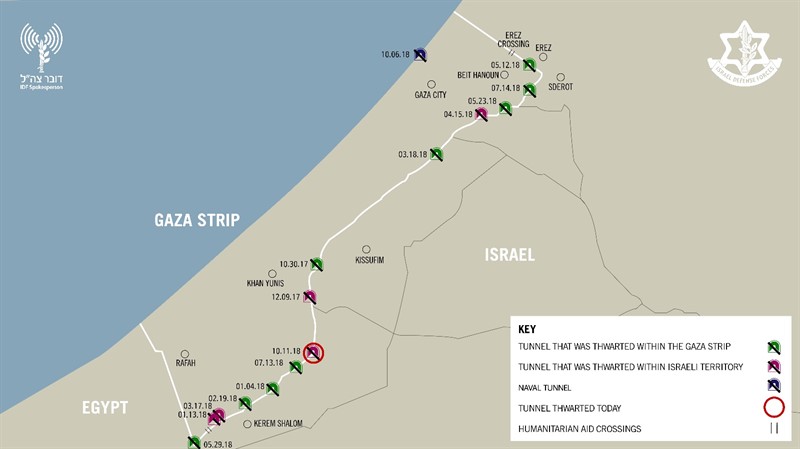
IDF demolishes Gaza attack tunnel that penetrated 200 meters into Israel |  The Times of Israel

Destruction of Tunnel Network Dug into Israeli Territory/October, 2018

For as the network has grown as the governance of the Gaza Strip has shifted, expanding as a form of hidden sovereignty able to endure attacks and escape Israeli vigilance and guarding of borders of the enclave. Although “mapping tunnels in Gaza right now is not going to happen,” the tunnels have become the elusive map of power in the Gaza Strip, a “big reveal” that has become the focus of the war, revealing the terror of porous borders that were echoed by the discovery of five Hezbollah tunnels on the Lebanon-Israeli border in 2018, in a military operation, that seems to seek to frustrate the Israeli Defense Forces’ charge to “defend Israel’s borders, since the formation of the Israeli Border Police in 1948, immediately after the foundation of the state of Israel–a Border Police who have long worn the Green Beret, signifying their status and crucial military role, symbolizing the “Green Line” drawn on the early maps of the Armistice of the first Arab-Israeli Wars of 1949, the pre-1967 border that have been taken as contravened by illegal sites of construction. If the Border Police have long imagined “peaceful borders,” the nearly 20,000 structures built along the border of the Green Line were viewed as a “ticking bomb” in the West Bank after October 7 invasion.

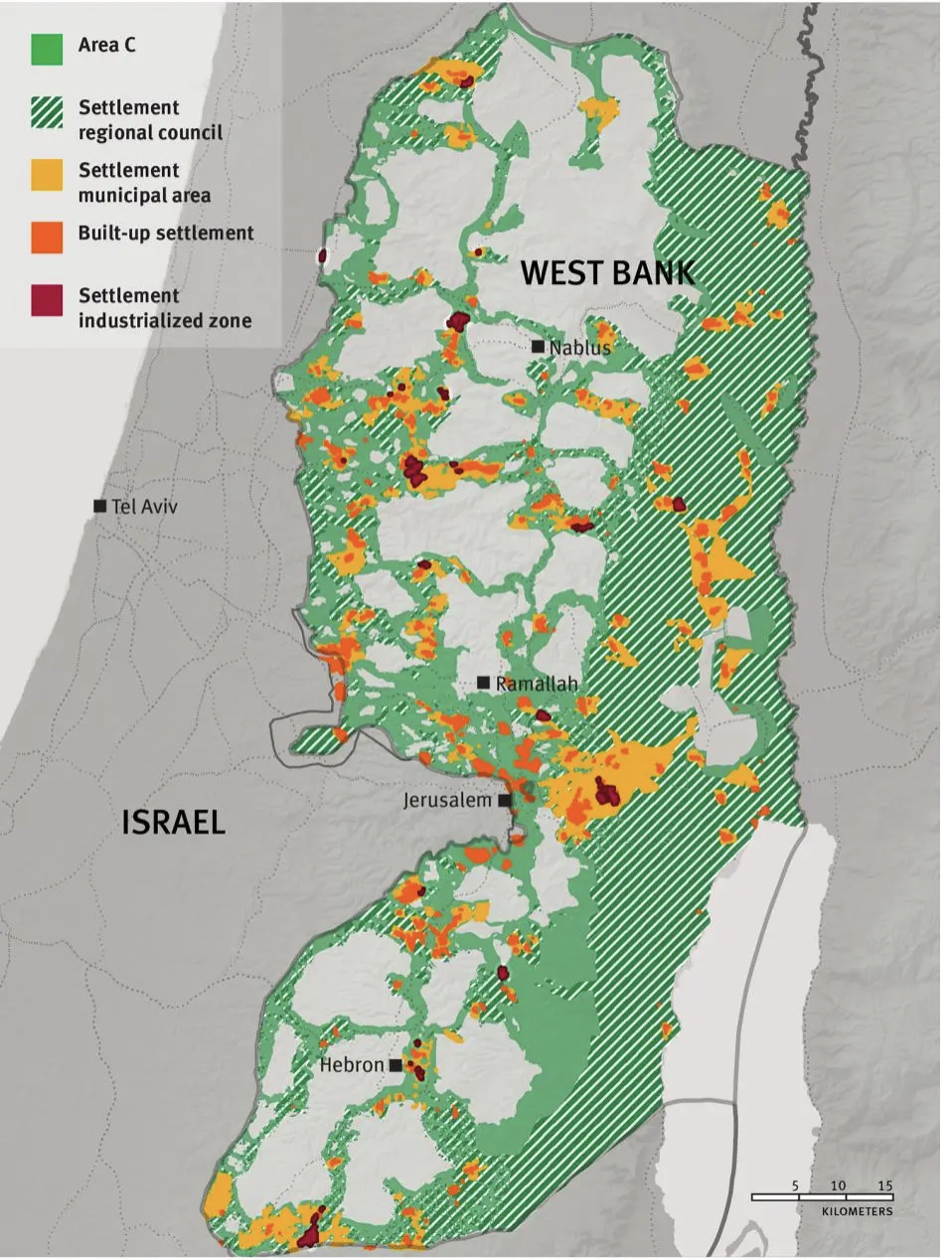
Years before the invasion, fears were raised by the scale of apparent bloom of illegal projects of Palestinian construction in Judea and Samaria, assembled by a combination of GIS mapping and aerial photography, as well as field work, that tracks the huge increase in “illegal” construction in 2022 in areas of Israeli jurisdiction by 80%–some 5535 new structures being built in 2022, an 80% increase over the construction in the same area in 2021, that are far from makeshift shacks.

Construction of “Illegal” Palestinian Housing in 2022/Regavim

The construction of what has been deemed strategically placed projects–and can be shown as such in maps of the region above–seem designed to hem in the settlements of Israelis around the so-called “Area C” of the Oslo Accords, if they might also be seen as overflowing the narrow areas allotted to Palestinians. But the huge construction project suggests an influx of cash, that might be seen as analogous to the creation of a costly network of tunnels by Hezbollah on the Lebanon border and in the Gaza Strip, as ways of challenging the stability of borders, and indeed the security of borders that has long been central to Israeli identity, and has become an accentuated topic of public concern in recent yeas–and least because off increased rocket attacks in Israeli territory.

In recent years, the ramping up of cross-border vulnerability of unforeseen proportions has placed the nation on tenterhooks that rendered most major Israeli cities vulnerable from the Gaza Strip with the rockets of Islamic Jihad capable to reach targets in Israel one hundred and fifty miles away, and escalated fears of the increasing proximity of the Gaza Strip to Israeli cities–long before the raid into Israeli territory concretized the fears of cross-border vulnerability in nightmarish ways.

Rocket Ranges of Hamas from Gaza Strip, 2022/Jewish Virtual Library

The same alarmist catalogue of the weapons that were posed at Israel’s cities by a range of rockets from the international market–Qassam, Katyusha, GRAD, and Iranian M-302, M-75, and Fajr-5–were suddenly aimed by surrogates at ranges to reach m-and Israeli populations in Tel Aviv or Jerusalem–were mapped, of course, by the IDF itself, who are tasked to guard Israel’s borders. as an armory poised at most all of Israel’s cities, far from the Gaza Strip, a decade ago. But we had the illusion, or geographic imaginary, for a decade, that those dwelling near the Gaza Strip were as protected as anyone else in the nation, and did not suffer any special degree of vulnerability.

The Deadly Arsenal of Hamas,Israel Defense Force, 2014

map returned to tabloids and newspapers in Israel after October 7, questioning the ability to allow such intensive proximity was haunting the Middle East. The increasing density of the projects of technically “illegal” housing was not a proxy or basis for cross-border attacks, or for firing rockets. But the worry of destabilizing borders by occupying such “seam zones” on borders grew, as they seemed to reveal a long-term strategy after the invasion of October 7, not even twenty-five kilometers from Gaza, and was worried in the days after October 7. The fears Israelis would be hemmed in would be potentially explosive if Israeli military presence in Area C was withdrawn, as in Gaza Strip from 2005; any Peace Talks, it was feared, that would sanction a Palestinian State would have to lead to recognition of their legality and potentially set the stage for a similarly catastrophic invasion of borders, as the rhetoric of an imperative of securitization grew.

Construction of “Illegal” Palestinian Housing in 2022/Regavim

They deep fears that the invasion of October into Israeli territory triggered and made palpable fears of a violation of Israeli boundaries in ways not previously imagined–and could only imagine after October 7. The fears that such an invasion could be facilitated by an existent tunnel network in the Gaza Strip the have defined the “goals” and prerogatives of the Israeli army to destroy, even if their danger is contested and not readily seen. And if we project such tunnels as a “satellite map,” we are preserving the false illusion that we even know their scale, or can “map” the network as part of the landscape–even if they are indeed part of the geopolitical landscape of the Middle East.

For the underground Islamic Jihad tunnels, lying far beneath the ground, and not able to be “seen” or mapped in any actual manner, the tunnel network remains largely figurative, spectral, and assembled in partially from old surveys from previous invasions of the Israeli Defense Forces, offering a poor proxy for targeting, but providing a terrible image of a hidden enemy, unseen and impossible to measure. As the earth that as extracted to construct the tunnels was dumped offshore into the Mediterranean, making it difficult to quantify the scale of earth excavated by tunnel-makers, or the scale of a network that has offered a basis for the Palestinian terrorists in the Strip to survive aerial attack, and indeed to keep the civilian “hostages” taken from Israeli territory under concealment–even as the “tunnel network” is also widely mapped in international news.

The web of Gaza tunnels complicating Israel's possible ground invasion

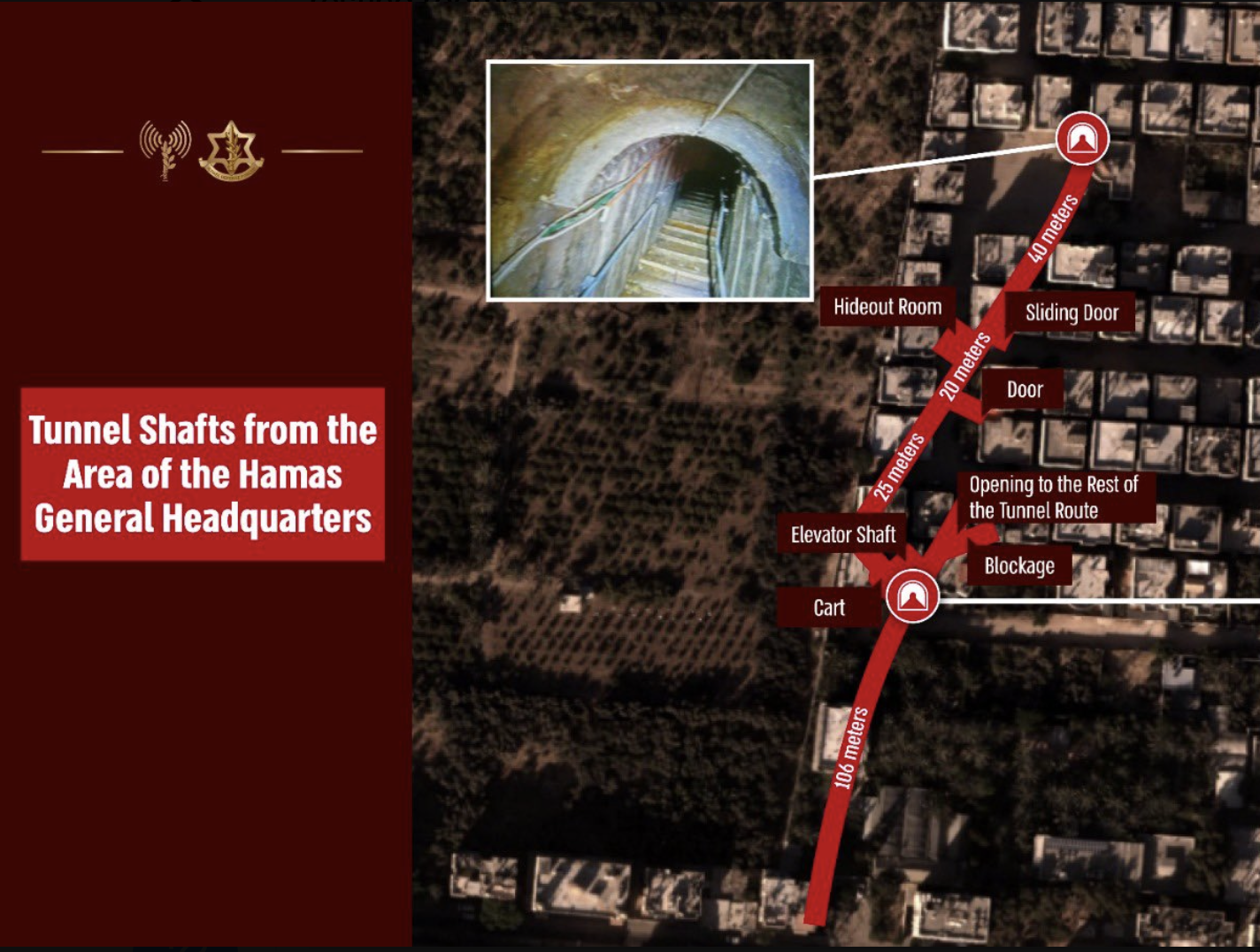
If we are shown “Hamas’ Secret Tunnel Network,” “Hamas’ Tunnel System,” or “Gaza’s Underground Labyrinth” in respectable news sources, and “Hamas’ Huge Underground Network” in somewhat salacious terms of more popular news sources, the secret spaces of these underground caverns have a truly Alice in Wonderland-like quality of an underground storehouses, or hidden hideouts, worthy of evil comic book characters, and apartments, tied to shafts, elevators, and other concealed openings, existing under the street plans of the city, as a “city beneath a city,” and even imagined as a future terrain for military combat, hand-to-hand wars, or the future zone of conflict.
1. The tunnel network is a remapping of the boundaries that are formally imposed around Gaza Strip. Although it is odd to see them as a form of counter-mapping against the claims to sovereignty in Israel’s boundaries, they are just that. For the tunnel network, if begun as an economic necessity, has been expanded and exploited to as a basis to deny the limits formally imposed by the 1950 Armistice Line, which has perhaps provided the basis for the energetic chants heard in public spaces across the Western world, to Free, Fee Palestine, that invest a coherence in the currently occupied territories as an enslaved region that has been left at the mercy of a “terrorist state.”

The Armistice Line concluded after 1948 Arab-Israeli Wars did not invest territoriality in a region–

–but recorded a status quo of sorts later preserved in the Peace Accords and 1955 Armistice Agreements at the height of the Cold War, a stalemate of sorts between global powers, to be sure, understood and enshrined in maps along the original reference points of a historic Palestine Grid–

1950 Armistice Line and 1955 situation of Gaza, Mapped within Palestine Grid

–whose construction was, to be sure, the legacy of a colonial or quasi-colonial movement, drafted by the English on the model of their own OS maps as a way of preserving the spatial organization of archeological ruins, but that have created a framework to what is misconstrued as a religious war.

The provisional line that was drafted at the foundation of the State of Israel, and provided the orignary boundaries of the state that was guarded by the IDF, as the persevered the territory that was newly mapped in terms of a UTM projection that extended, as the timeless liturgy of the Prayer for the Israeli Defense Forces suggests, and increasingly patrolled by IDF forces in order to contain threats to the security of Israelis living near the region, as well as the increasing number of settlers near the border. The mapping of the expanded boundaries of the Gaza Strip to deny access to the outside world or to Egyptian neighbors is nothing less than a classic micro-macro point of tension in global geopolitics–“over our land and the cities of our God, from the border of the Lebanon to the desert of Egypt, and from the Great Sea unto the approach of the Aravah, on the land, in the air, and on the ground” in existential terms–even if the 1994 construction of a barrier between Gaza Strip and Israel was stated to be provisional, unlike the current claim to have created an “Iron Wall” that offers no clear basis for future discussion–and indeed seeks to force future negotiations from a position of power.

United Nations Palestine Map Showing Armistice Agreements between Israel& Lebanon, Syria, Jordan & Egypt, 1949-50

The current construction of a heavily fortified “Iron Wall” has provided the current crisis in which the framing of Israel as an occupying power has morphed into charging it as a terrorist state–a reflection of the very terms that Israel’s government charges Hamas, and given the events of October 7, seems to offer ample justification for doing so. The effective boundaries, however, provide the clearest basis for containing terrorist incursions has however not served the state.

The “Green” Line has been an internationally recognized boundary of the Gaza Strip, defended by the Israeli Defenses Forces as such, never intended to be designed or rendered as a border of sovereignty, but has been construed as a political or territorial boundary in local and global geopolitics. If drawn independently from claims to rights of Palestinians, a question kicked down the road to an unspecified date for future resolution by the global consensus, increased fortification defense of a militarized barrier that maps the Green Line as an actual border–

–that hinges on the perimeter fence. If it is design to limit global traffic it is unavoidably now treated as a border that demands protection to protect “our land and the cities of Our God,” as the prayer written in 1967 has it, that have perhaps enshrined the dating of the time-stamped “1967 borders” or “pre-1967 borders” as the basis for a “demilitarized” future, a fact that might be datable in terms of history of globalization–hearkening back to a time when the United States was an engine for almost half the global GDP, before the United States abandoned the gold standard, and before the waning of American global economic dominance of the postwar–the era in which the Universal Transverse Mercator was adopted as a model of a smooth global surface.

The network of tunnels that were dug under imagined border revealed its first porousness in 2005, with withdrawal of Israelis and Israeli troops from the Gaza enclave, and the expansion of a tunnel system that Israel had tried to contain. Increasingly seen as a threat to Israel’s sovereignty, the network has become a way of testing the borders that have emerged in an enclave once in 1955 tied to Israel by roads; the, contesting the so-called “Green Line” that divided Arab from Israeli sovereignty since 1950. If it is a sticking point in Palestinian peace accords, it is the stubborn site of the only survival of the old “Green Line,” the last line standing, that was set out in the 1949 Peace Accords, as a new “underground reality” emerged, not on most national maps, proved a way to erode–quite literally–a map seen as engraved in stone, contesting the original “demarcation line” seen and equated as an “original sin” of the “Palestinian Question.” While territories beyond the Green Line were not incorporated into Israeli sovereignty, the growth of robust tunnels along the contested “Philadelphi Route” running from the Gaza Strip to Egypt, was perhaps the original robust tunnel to smuggle weapons to evade Israeli surveillance, underneath the “security belt” Israel claims as a defensible border, as the tunnels appear to confirm an actual terrorist threat.

Hamas built tunnels to smuggle weapons under the Philadelphi Route from Egypt to the Gaza Strip. In recent years it has also dug attack tunnels from Gaza into Israel.

Robust Underground Tunnel of the Philadelphi Route from Egypt to the Gaza Strip

The “belt” is not a national border, or an international border, but has become defined as a “security border” analogous to the status of the Jordan Valley, by tactical terms first defined by the General who oversaw the victory in the 1967 War, critical to Israeli security–if not for its territorial identity. The bifurcation of the security border and national boundary at Gaza has grown as the boundary of the Gaza Strip become guarded as a border of Israeli territoriality, I argue in an earlier blog post, shifting understanding of Israel’s boundaries and their guarding. Guarding the Gaza “perimeter” is prioritized to securitize the borders of Israel for Jewish settlers who moved from the region beyond its walls, as new communities expanded beyond that perimeter, the tunnel systems have grown as an increasingly robust form of hidden governance, hidden from surveillance.

 If the network of tunnels first built to smuggle weapons in from Egypt in the 1990s before Israeli troops left, it expanded in depth and sophistication as Hamas gained control over the enclave and as it grew economically isolated, both as a network for importing goods and cross-border attack, extending five times below the depth of tunnels dug at the start of the new millennium, across a network claimed to extend over 500 km by 2021, according to propaganda videos of Yahya Sinwar, the length of the New York Subway, able to reach to Gaza City.  If the tunnels dug four to ten meters below ground seemed unstable beneath fifteen feet, the deeper tunnels are harder to sense by radar or to hurt by explosive force, as well as to detect from above ground–some over ten times as deep, if reports of 200 feet deep tunnel structures is true.  While the earlier smuggling tunnels of c. 2010 were closer to the surface and far more rudimentary in their framework and structural support–
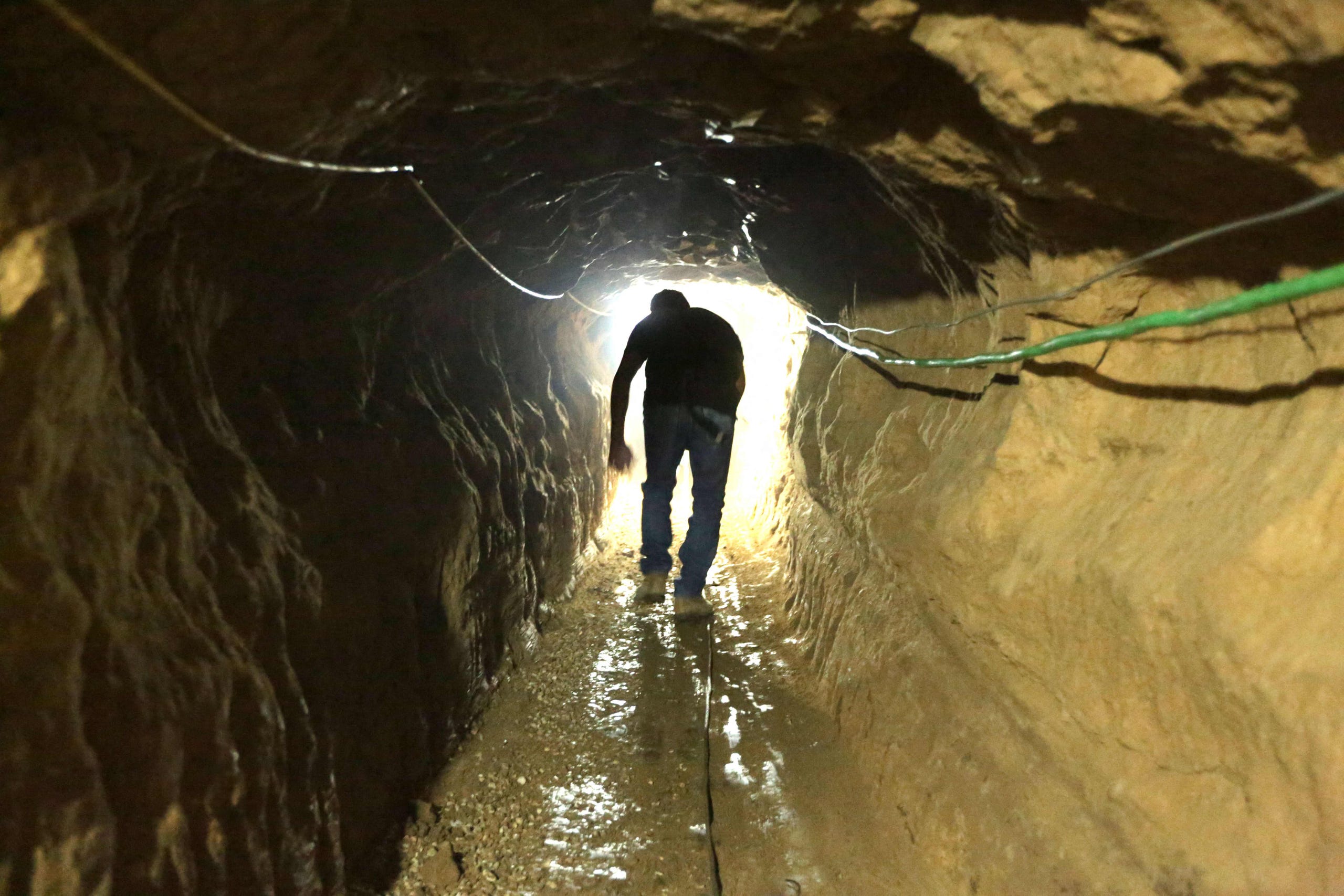
Palestinian Entering Reconstructed Bombed Smuggling Tunnel from Egypt, near Raffa, 2012/Patrick Bay, AFP

–the robust defensive and offensive functions that evolved of tunnel networks demand more careful discrimination in our maps, and are too often suggested as primitive networks imagined as able to be removed from the Gaza Strip–rather than forms of its current governance. The expertise in tunnel engineering by lego-like concrete blocks, ventilation shafts and soil compacters helped expand the engineering of an underground network tied to Hamas, and increasingly hoped by Israel to be able to be removed form the region, the offensive and defensive network has gained increased resilience. And as Israel’s right-wing government linked itself to the defense of adjacent communities near the wall, and tunnels targeting of Israeli forces or settlements near the border grew in response to a vision of sovereignty that exclusively defined the state for Jewish citizens-settlements mostly made for those Israelis who left the Gaza Strip in 2005, now lived in by a new generation of settlers, familiar with demanding protections for living outside a region composed of refugees before the current refugee crisis created by Israel’s invasion.

Israeli Settlements in the Coastal Regions of the “Gaza Strip” before 2005

Unlike the territory of Gaza or the Gaza Strip that is shown in surface maps of houses, buildings, roads and communities, the underground network of tunnels that extend across the Gaza Strip were long both the de facto network of Hamas sovereignty and the targets of Israeli invasion and air raids. The mapping of the tunnel network has shifted from a target of attack to its re-mapping embodying identification of the tunnel network as the underground nefarious form of negative-sovereignty by which Hamas has defined its presence in the Gaza Strip.  The metaphorical mapping of the tunnel network has served to embody an image of the “negative governance” of Gaza, and metaphorically mapped to delegitimize the authority of Hamas as a responsible governing entity.

2. The networks of underground tunnels that grew up to support Gaza’s literally “underground” economy as its borders were closed by Israeli Defense Forces in 2005 became, in 2012 and 2014, the targets of invasion and destruction–as airplanes targeted five hundred tunnels, some of hundred kilometers, as one that running from the South to Gaza City, by bombardment and ground operations–destroying 140 smuggling tunnels that evaded the Gaza blockade, including 66 tunnels used to target Israeli forces. The engineering of tunnels expanded to deeper and broader underground corridors to ferry cars of militants and reinforced by iron, with ventilation for larger mobilization, the network emerged in global consciousness as a new terrain of combat, and a new battleground lying far beneath the ground. Even if North Gaza has, as Israel insists, ceased to be under the sovereignty of Hamas from January 2024, the tunnel network dug beneath the territory has provided the firmest illustration of the survival and resilience of Hamas governance in Gaza.

Israeli Soliders Patrolling Newly Discovered Tunnel at Erez Crossing, December 15 2023/Amir Cohen

Tunnel networks in the Gaza Strip have been long targeted as threats to Israeli sovereignty. From their beginning as cross-border passages designed to import weapons from Egypt into the Gaza Strip, the commercial network that Hamas encouraged since taking charge of the enclave in 2007 for incursion. The networks of underground tunnels that grew up to support Gaza’s literally “underground” economy as its borders were closed by Israeli Defense Forces in 2005 became, in 2012 and 2014, the targets of invasion and destruction–as airplanes targeted five hundred tunnels, some of hundred kilometers, by bombardment and ground operations–to cut the enclave off from external contact, destroying the excavation of 140 smuggling tunnels that evaded the Gaza blockade, including 66 tunnels used to target Israeli forces.

Yet if the underground network that has however grown as a dense network of resistance to Israel’s denial of the sovereign presence Hamas has created deep in the underground tunnels of the Gaza Strip, a difference not shown in many maps of tunnel routes–which show tunnels collectively, akin to surface roads of OSM maps, without distinguishing either the origins, depth, or status as a hidden infrastructure, equipped with electricity, internet access, and communications, that long served as a regional tax franchise. The elision of the different tunnels, and their different quality, flattens the history of the network, and indeeds elide its central importance in Gaza’s governance, by portraying it solely as a target of attack.

Gaza Strip in Maps/BBC/NPR

While these maps are entirely the product of Israeli Defense Forces, they flatten the emergence of the tunnel network, and flatten the entire process of constructing, funding, and using the network of underground tunnels demonized as a target of military attack. Since the rise of cross-border tunnels that have been sanctioned as targeting Israeli forces, contesting the sovereignty of Israeli forces beyond the Green Line, the tunnel network was targeted of a vision of sovereignty that was tied to the invasion of Israel, and increasingly responded to by defined the state of Israel as exclusively for Jewish citizens.

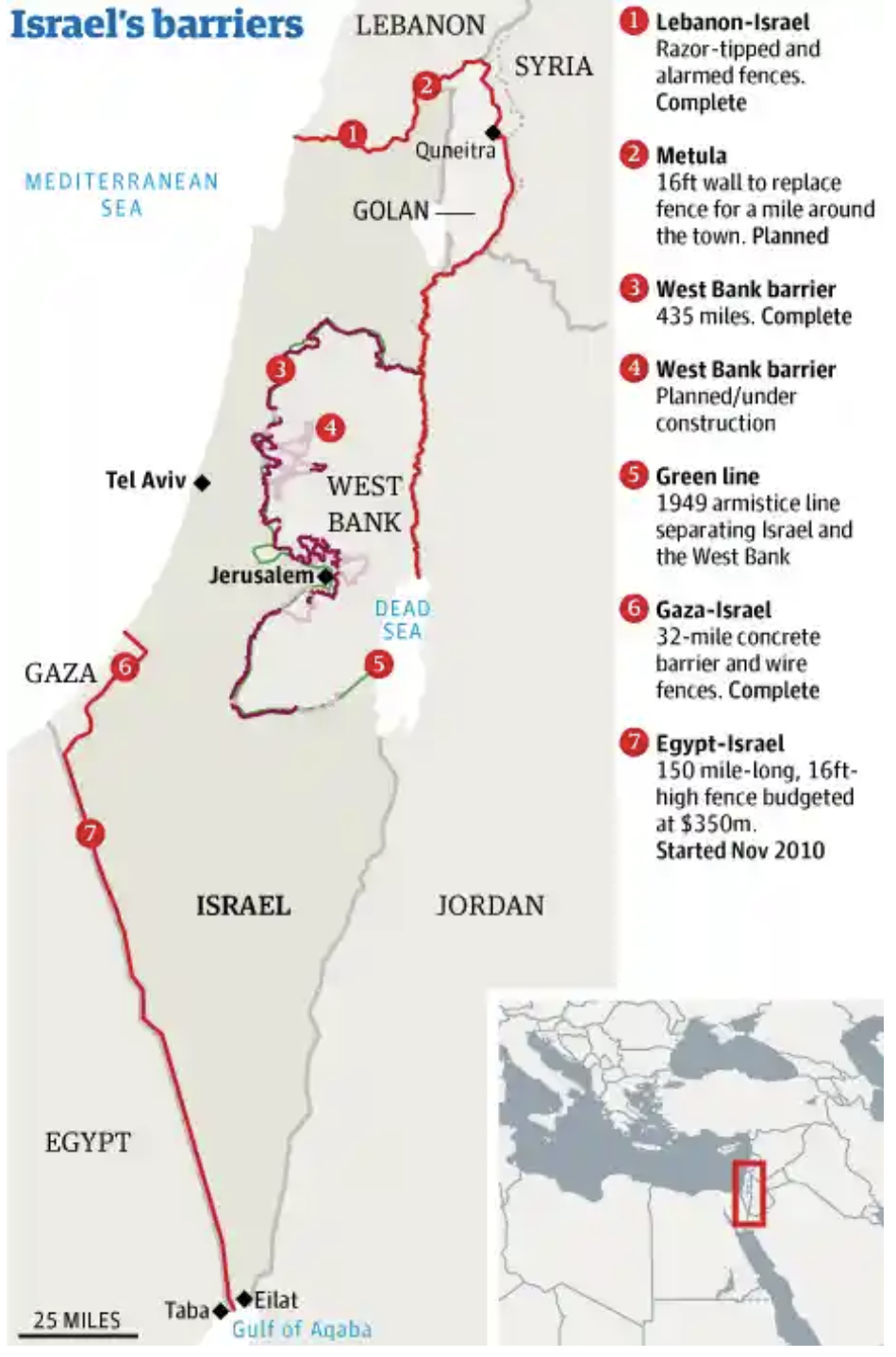
But as the tunnel network has become a target of Israeli attack, it has assumed figural status by cartographic logic both to undermine the symbolic identity of Gaza Strip. It has served to demonize the sovereign claims of Palestinians in the region, and an image of the negative sovereignty by which Hamas has defined its place in the Gaza Strip. To flush that presence from the enclave, or to attempt to remake the enclave separately from the enclave that was attempted to be isolated by the Israeli army as a threat–by a 60 km fence, Egyptian built fence, and patrolled harbor–

–whose destruction has been suffered by the Palestinians increasingly trapped between a map and a hard place indeed, as the specter of tunnel networks has come in a grotesque macabre of Grand Guignol to take precedence over their lives, a spectacle of destruction of homes, intent to define attacks on the neighborhoods of Gaza City by targeting attacks on an elusive underground network of tunnels independent of their habitation or of the cost to civilian lives.

Continue reading
1 Comment

Filed under Gaza Strip, Israel, national security, satellite surveillance, tunnel networks

Eternal Borders and the Territory of the Gaza Strip

When I attended Hight Holiday services this past year in Oxford’s Orthodox synagogue, it was for the first time in some years. But the spatial imaginary that unfolded in the services days before the invasion of Israel’s “border barrier” on October 7, 2024 suggested how difficult the geography of the Middle East would be. Although it was familiar, I stopped at an old prayer in the Makhzor, or holiday liturgy, praying for the safety of the Israeli Defense Forces as they guard Israel’s boundaries over the coming New Year, 5785.  The creation of these boundaries was noted not in a moment, but have, changed over time. But the notion of fixed boundaries of Israel that Benjamin Netanyahu has long proposed in stated policies that have openly vowed rejecting any attempt to create Palestinian state between the River Jordan to the Mediterranean in a “Great Israel” had demanded Israeli control from the river to the sea–even if the area includes, according to Israeli demographer Arnon Soffer, of 7.53 million Palestinians and Arab Israelis and 7.45 million Jews of fifteen million residents.

The prayer was familiar, but stood out for me as I returned to religious service in a foreign country: the collective imprecation to preserve the IDF currently defending the borders of the Holy Land suddenly seemed an aggressive act. While the Jews living between the Jordan and Mediterranean are in a far more continuous space, in comparison to which the geographic space of Palestinians is of course a far more fragmented mosaic who are without comparable rights as citizens, the borders have been reified by boundary walls in an era when borders are not only far more heavily fortified than ever in the past. For the border barriers around Israel hold mental space before the cry to free the region “from the river [Jordan] to the [Mediterranean] Sea“–a slogan with deep roots in decolonization struggess of the 1960s, if to some ears maddeningly intentionally geographically vague slogan, as if it presumed annihilating the boundaries of a Jewish state–rather than one that denies Palestinians citizenship or rights of movement, a nation bordered by fixed boundary walls.

The militarized borders of the nation-state made the prayer disturbing days before the invasion, or the response to the shock of an armed incursion of sovereign bounds of vicious civilian and military deaths. For if the fears of any assault of Israel’s territorial claims have been met by the increasingly intense fortification of its borders, a ramping up of its claims to “security” and “securitization” that has eroded the ethical values of the state, the defenses of these boundaries were both more militarized and less sustainable in the future, and to begin the New Year by hoping for the security with which they were guarded–as if they were granted by divine right but embodied by militarized defense–was unintentionally quite off-key, and made me grind my teeth during the High Holiday I had arrived to celebrate with some trepidation in a foreign country,–not seeking friendship or continuity but orienting myself to a city I had only recently moved in mid-September. I was not concerned about Israeli borders, but fund the invocation of their guarding to carry a deep weight for the members of the congregation, reminding me that the prayer–an addition after the 1967 War– had long assumed deep significance.

If the New Year’s holiday had some spiritual resonance as a way of marking time, the sense of bonds among Jews grew with the coming invasion, making me negotiate my relation to the service I had just her. Indeed, the explosiveness of the invasion that left me and my fellow-expats reeling and hard to observe at a distance made me interrogate where that prayer had origins, and reflect how the literalization of a project of boundary-guarding had become so dangerous project of courting risks of raised the stakes, intentionally turning a blind eye. If the war was an invasion of Israel territory, the border zone between Gaza and Israel has, perhaps rightly, long been the subject of attention of Israel’s Prime Minister, who has repeatedly emphasized “stoppage points” and “closure” of the Gaza Strip and control of the border zone between Egypt and the Gaza Strip. T he military securitization of these borders were hard to reconcile with the benedictions of the kindly rabbi. He led his congregation a final time in high valedictory form at the cusp of retirement, and stylishly negotiated the benediction to George V in our Mitkhor, to my ears, in an Anglican version asking for the safety of the royal family. In a sermon voicing dismay at the strain of lamentation strains of Judaism that he felt had infected or reconfigured Jewish identity at some loss of its original liberal optimism and pride, he wished us to engage the year ahead.

For a strain of lamentation, derived from the poetics of the laments of the Psalmists, but expanded to the elegiac account of suffering and commemoration that expand the liturgical elegies to accounts of forced conversion, expulsions, crusades, pogroms, and even assimilation short-changed pride of a “chosen” people, the rabbi felt, undermining a sense of pride. The ancient strain of lament in Jewish poetics and poetry certainly decisively expanded in twentieth century before inexpressibility of the Holocaust, and a need to express inexpressible pain in the face of fears of annihilation. But the logic of lament of would come to the surface with quite a vengeance after the unprecedented invasion of Israeli territory on October 7, only weeks after the rabbi’s sermon, as the unspeakable trauma of the crossing of the fortified border of Israeli territory opened existential fears that set in play a logic of retribution. If lament pressed the borders of linguistic expression and actual comprehension, the escalated response metthe anguish of lamentation demands, but no response can ever fully satisfy. The call to pride, and even content with being Jews, was somewhat tempered by the calls to save the warriors defending those highly militarized geographic boundaries, as much as boundaries of expression.

The boundaries of Israel as a “state” had become not only embattled, but less defended lines than firm fences, rigid, and asserting a statehood removed from negotiation, and perhaps from Zionism, as they were understood as bulwark against Palestinian expansion that so tragically ended with the battery of hundreds of ground-to-air rockets forms the long-barricaded Gaza Strip, serving as cover for a bloody invasion of Israel planned for a decade, approved by Hamas leaders in 2021–even known by some of Israel’s intelligence forces as code-named “Jericho Wall,” an attack of unmanned drones to disable the surveillance towers along Gaza border wall, to attack military bases, but dismissed–if it was also feared to constitute “the gravest threat that IDF forces are facing in defending [ Israel].”

The week of intense bombardment accompanied the resolution with which Israeli Prime Minister Benjamin Netanyahu called a press statement to be televised on a holy Sabbath, an emergency exception to the religious calendar that emphasized its urgency, in which the Prime Minister apt to view Jewish identity in an optic of perennial political persecution menacingly told the nation “our enemies have just begun to pay the price” on national television, announcing air, drone, and artillery strikes on the Gaza Strip were “just the beginning” of retribution for the bloody attacks on civilians and civilian abductions from Israeli territory. The claim of a position of power of remotely targeting Gaza was reprised, eerily, when the renewed airstrikes broke the ceasefire of 2025, and Netanyahu declared that the renewed offensive attacks on Gaza would continue, threatening Hamas that the arial bombardment would continue without restraint until the remaining hostages–half of whom were believed dead–would again “feel the strength of our hand” in North Gaza by artillery fire and bombs, again attacking a 90% destroyed region with the approval of Washington, DC.

Strikes across Gaza hit Khan Younis, Deir al-Balah or Gaza City, including refugee camps and a few Hamas officials. The reprise of the ominous neo-scriptural warning–this is only the beginning“–emphasized the divine-like nature of the strike. They heralded attacks killing over four hundred Palestinians, and meant that negotiations would only continue under fire. Warning that remaining in settled boundary regions in “combat zones” unsafe during a “strong offensive against terror organizations,” social media warning used a QR code to caution against putting “your lives and the lives of your family members in danger,” urging residents find “shelters in western Gaza City and in Khan Younis” before the onslaught began, in a new psychology of war during a nominal ceasefire.

IDF Warning Map of Combat Zones, March 2025

This was never a war about defending borders, if the IDF prayer beseeches the divine for help inb defending boundaries: the first a reprisal against the trans-border strike was funded by transnational groups in Iran and elsewhere, but attacking the transformation of the Gaza Strip to a launching pad for strikes into Israel’s territory, as much as securing the borders of the state.

Military Incursions in Gaza by Drone, Air, and Artillery/Armed Conflict Location & Event Data/October 7-27

The horrible and terrible scale of attacks on the heavily populated region affirmed a mental imaginary we have a hard time grasping, but seemed designed to illustrate Israeli control over the region–and over a region from the River Jordan to the Mediterranean Sea–that tried to impose itself on Palestinian cries for a vision of “from the river to the sea,” an ominously vague geography. The bombardment immediately raised questions of Gaza’s sovereignty and affirmed the territorial right of the state to defend its boundaries, even if the boundary barrier between Gaza and Israel was of Israeli military’s own creation, and lay within, technically, the territoriality of the Israeli state.  

The demand to reveal air dominance proceeded in unrelenting ways, as the bloody invasion of Israeli territory had pierced the ability to articulate a response, triggering traumatic memories that have produced an endless outpouring of maps in hopes to remedy how difficult it is to discuss, as if to try to ascertain some objectivity in the actual occurrences, triggering thousands of outpouring of settler violence against Palestinians easy to be predicted, but must be lamented, and an immediate escalation of retributive air strikes across Gaza Strip, as if to destroy its future, airstrikes returning to new heights but concentrated for the first time in one small region: Gaza.

Fears of a cross-border attack had circulated before the summer, and there was concern, with military drills of increasing intensity within the Gaza Strip, of crossing this border. But the barrier seemed to have fostered inexcusable ignorance that may be investigated as if blinders to national intelligence. The invasion’s shock created a vortex of mapping and remapping the Middle East to express its reality on the map, but that reality also seems inadequately expressed by any map: for it was an open denial of a political right to exist, revealing in questioning sovereign claims.

The map of the planned attack routes dismissed as impossible across a monitored border barrier reflects a locked-in mindset that saw the barrier as fixed . The IDF saw the maps of future invasion as an impossibility, unable to see the intense aspirations for the dismantling of the border as an event for which Palestinian groups as Hamas had long planned or might accomplish. Yet the fears embodied as a charge, under the cry “from the river to the sea” of such exasperating geographical vagueness, that seems an incursion of the national space of sovereignty that were hard to imagine, even if it was clearly mapped out as a multi-pronged strike invading Israeli territory, perhaps along new versions of the offensive tunnels that Israel had worked so hard in 2008, 2012, and 2014 to destroy, long realized was a threat to Israeli sovereignty, but had yet not developed tools to destroy. The maps were not by tunnels, so much as overground paths: but in the current Gaza War, the engineers of the IDF would continue to map and reveal and destroy through March, 2024, as combat engineers closed a four kilometer tunnel fifty meters below ground, destroying transnational abilities to attack Israel and prevent the possibility of incursions across its borders, in ways that tested the reconfigured borders and expanded concept of the defense of borders in a globalized world..

Plans for Proposed “Mass Invasion” of Hamas across Gaza Boundary/IDF, July 2022

Yet the nightmare of course returned. While what that consists of became unclear, as the terrible attack on Gaza unrolled in reaction to the bloody October 7 incursion of armed militants into Israel, a stunning cross-border surprise attack across twenty two points of the perimeter that killed and wounded settlers and members of the Israeli army, following a barrage of rockets fired from the barricaded Gaza Strip, entering towns to attack civilians. Can these attacks be seen as part of a movement of liberation, or self-determination, or were they an exasperated crisis of containment by a machinery of war whose gears were already ratcheted up around the dotted border walls.

The invasion of towns sent shock waves through the very notion of Zionism. The rhetoric of liberation of the motivational cry “from the river to the sea” is itself a bid to remap territoriality and territory, of course, and feared as a coded call-to-arms of the Hamas network or the Popular Front for the Liberation of Palestine, seen as a bloody cry to undermine the call for commitment of the Likud Party to defend sovereignty over all land up to the Sea, or Mediterranean. 

Indeed, if the rhetoric of liberation has helped to lead to an unthinkable set of military conflicts on Israeli territory of multiple points of conflict in Israel between Palestinians and IDF, redrawing the very contested barrier built around the Gaza Strip as a barricade of one of the most densely populated regions in the globe, the invasion was a planned refusal of such constraints–

Sites where Terrorist Militants Engaged Israeli Army on October 7, 2023/Visegrád

–to push the border of the Gaza Strip far beyond the massive walls Israel had constructed at significant expense. For if Israeli military had sought to cordon off what has been seen as an existential threat to Israel’s future. If the memorialization of the Holocaust has become central to the demonization of Palestinian terrorists, the border walls that seemed to staunch off a future of death found a terrifyingly brutal invasion by crossing the border barrier, triggering collective fears across the nation of an attack on Israel’s very future.

Indeed, the origins of the arming of Palestinian groups in the Gaza Strip have advanced, from a range of multinational sources, including Iran, to help redraw the boundaries that Israel has long defended, as a way to breach the impregnable defenses that had increasingly been built around the nation to protect it, to try to prevent against increased threats of incursion of a state that refused to negotiate for the future.

Fortified Boundary Fencing and Barriers around Israel/2020

The walling off of the Israeli border by physical barriers in recent years has speed to seek to create a bulwark against such an invasion–as if in response to the cartographic logic of the motivational cry Palestinians have popularized as a form of national liberation. The razor-tipped fencing, concrete barriers, and impassible fences have promised a sense of security in the Promised Land, which may have undermined global consensus the land is promised–and has led to much global anger at the unilateral fortification of the state as a confirmation of the most nationalist hard-line form of Zionism, refusing dialogue and directing military resources and funds to the suppression of any future for a Palestinian state, beyond parts of the West Bank, between the River Jordan and the Mediterranean. Was not the invasion a bitter reminder of the site of the refugee camps established in the Gaza Strip, years ago, at the very origins of the Israeli state, as if the haunting of the region had its own memories, which refused to be silent?

I could not wish for more misfortune to a kindly Rabbi than inaugurating a New Year marked by the invasion of October 7. But the horror that unfolded in coming weeks made those days seem almost halcyon. I confess ambivalence to the faith of Judaism, but the turn of the liturgy to the safety of the soldiers guarding the Israel’s boundaries from its “enemies” made me a bit queasy, and hesitate to follow the prayer, but made me reconsider how the huge investment in those walls–and in their guarding was not also a large part of the problem, that had set in play a dynamic of contesting Israeli sovereignty–and the Zionist promise for an Israeli state–that has reconfigured the Zionist proposal in ways that have since brought unforeseen inflections to the saying Schwer tau sein a Yid, an existential statement to be sure steeped in the memories of the Holocaust, and remembrance, as if passed down through generations, poised to fall into the abyss of memory, before gaining a new spin with the assigning of redemptive strength not to “Israel” but to the barriers to contain threats.

Could it be that the cry, From the Border to the Sea, had not become a conceptual map about the way that the ruling parties had now conceived of Israel and Israeli boundaries? Indeed, Netanyahu had made clearly cartographic campaign promises, in 2019, to reduce the Palestinian Territories if re-elected, promoting 2019 as a unique “opportunity” to “kill all chances for peace” of the sort that rarely arrived, and had not existed since the Six Day War of 1967, an opportunity for redrawing the map from a position of absolute authority by whittling away at a third of Palestinian claims to the West Bank, sufficiently to stymie any hope of Palestinian statehood. The new West Bank on which Netanyahu campaigned for a second term surrounded Palestinian lands around Jericho by making it an island, extending Israel to the River Jordan “in maximum coordination with [President] Trump.” The “West Bank” would, Netanyahu argued, become an island surrounded by Israeli territoriality and control, in an attack on Palestinian statehood that sent the Arab League into full Panic Mode and seemed designed to curry and bolster the violent animosity of settlers to Palestinians in the West Bank–who now saw their rights to the areas around Jericho as sanctioned and legitimated.

Netanyahu Vows to Seize Two-Thirds of West Bank before September, 2019 Elections/Amir Cohen/Reuters

The role of the IDF in containing these boundaries–and indeed constructing them and guarding them–made it hard to participate, or to feel as if I belonged in the service, even before October 7. As the service shifted to prayers for the safety of those who “guard” the boundaries of Israel from enemies, I had a deep uneasinesss before the notion of inscribing eternal boundaries in a verbal map, as Israel’s national defense–even long before the October 7 invasion–was reliant on securitized barriers, that had long replaced fencing.

The nation had invested in this concept of a dividing wall as a way to preserve the premium placed on national security, described as an “Iron Wall” but more accurately if less euphemistically as a “multi-layered composite obstacle” that had remapped the nation-state by “security barriers” since the Oslo Accords, with a promise to “make terrorism more difficult.” The growth of such securitized boundaries contrast to how settlement within the Green Line was celebrated by the Maariv newspaper with a special insert map in 1958 after ten years of Israel’s independence–

Maariv Newspaper insert Map, The Achievements Of Israel’s Tenth Anniversary of Independence (1958)

–by the new geopolitical boundaries the Israeli state has built around its territories. The prayer to protect the Israeli Defense Forces entrusted to protect the boundaries of Israel from its enemies sent me across a history lesson of sorts, which I ruefully noted anticipated a rash of history lessons dispensed line after the invasion of October 7, 2023. For as we tried to make sense and process the violence of the invasion and of the Gaza war–fought around the Green Line, to be sure, to prevent violation of that boundary dramatically and traumatically crossed on October 7–

the celebratory tones of the early map seem less of an achievement than an unresolved problem.

While the invasion was removed, and I was in Oxford, England, one not only felt it as an immediate violation because of the news, or the global news media, but the shock of the invasion of boundaries as a gruesome violation, indeed as a bodily violation in the manner that led accusations of rape to be assimilated to and intertwined with its acting out of an almost ritualized spectacle of violence, but the violation was cast against not only “eternal” boundaries but the fortified boundaries of Israeli territory today, boundaries that have led to the perhaps false security of borders, and the ignoring of the situation of suffering and economic inequality sharply present on their other side. What exactly were the pundits at Big Think thinking when they heralded the “Palestine Map” of the Trump administration had helped birth as of historical significance as a map “Israel can live with”?

The map seeming to offer Palestinians “open transit” by corridors designated by bidirectional arrows was indeed the first time “a U.S. administration officially proposed borders for a Palestinian state,” the quick rebuff that a map that designated Jerusalem as Israel’s national capital met–“Jerusalem is not for sale,” an aging Mahmoud Abbas fulminated as he directed utter disdain at the realtor-turned-President who sought with his real estate cronies to bring a new map to the table. The proposal of borders was, indeed, a proposal that reduced the Green Line, if it promised high tech zones in a “Vision of Peace” that offered 70% of the West Bank to Palestine, and offered–oddly, in retrospect–a “tunnel” that would link the Gaza Strip under Israeli territory tied to desert islands on the Egyptian border–a “Gaza archipelago” of “desert islands” in the Negev–

–a plan that proposed an actual “tunnel,” but this connecting the West Bank and Gaza, to be constructed with Israel’s funding, one supposes, that would have a check point at each of its respective ends, and only slightly more preposterously be linked by land to hubs of manufacturing and the high-tech sector in the Negev.

A Vision for Peace/White House Twitter, 2020/Donald J. Trump

–that seemed to be most conscious of enshrining Israeli jurisdiction over its borders, one feels was dreamed up by Netanyahu and Trump as they imagined the future Trump’s election might bring. The map did little to alter the barriers, built in place of negotiable boundaries, that the prayer in the liturgy intimated were of timeless origin. Yet the prayer over which I had stumbled was not timeless at all: it had been only written in 1967, by a rather avid Zionist, Rabbi Shlomo Goren, who was the first Head Military Rabbinate of the Israeli Defense Forces, veteran of several Arab-Israeli wars, penning a prayer tat was eager to sacralize the boundaries that were in fact temporal.

The built barriers sat uneasily with the notion of sacred boundaries that Rev Goren, a founder of the state of Israel who affirmed the sacred identity of Israeli territory, sought to affirm and celebrate in 1967. If the boundaries were cast as “eternal” in the collective memory of the liturgy, praying for the safety of soldiers defending seemingly eternal boundaries “from the border with Lebanon to the Egyptian desert and from the Mediterranean Sea to the approach to the Arava, be they on land, air or sea“–raised questions even before the October 7 invasion. The return to this collective memory, invested with the status of the internal, left me uneasy on a holiday inviting one examine one’s conscience. As an American Jew and the son of a man who may have in some way aspired to be a sabra, whose contradictions may have taken their spun from that impossible hope, the boundaries of Israel long stood as traced outlines of some sacrality. They had increasingly seemed a sense of personal boundaries, or intuited as lines of personal office, as it their violation was no less than a violation of identity, as much as territorial ones.

The premium on national security that the Gaza-Israeli border barrier was built to serve disrupted the boundaries that Goren inscribed has shifted by the construction of border walls. The walls were a promise to ward off globalist dangers, tied far more to Donald Trump and the Likud Party than Zionist tradition.  The budding of concrete barriers to the nation have changed “boundaries” of Israel by geodetic maps since the 1980s, increasingly promising to securitize boundaries in a unilateral fashion, making them less seen as shared by tow nations, than absolute edges to be not only defended but imposed.  The defense of a border boundary made the prayer penned by Goren out of date, but the ostensible timelessness of its boundaries left a bitter taste in my mount.   Yet somehow it was comforting to see the old walls of Oxford, walking around New College, and view the concept of the “wall” with less permeance as a structure, and less imposing in character–more akin, say to Lion, the Witch and the Wardrobe with their small electric lights.

I stumbled as I was being asked to recite a verbal map of the borders that seemed eternal, if not set by scriptural precedent. The familiar prayer gained poignancy in a foreign setting, and not only because the Oxford synagogue was monitored by a security team.  The boundaries traced in the prayer stuck in my mind, as the idea of beseeching the divine to safeguard their defense, as boundaries that were long contested and seemingly contingent seemed sanctified from on high, long after the service ended.  Although the administration of the Gaza Strip had long lain outside of Israel’s bounds, or even the remit of Israeli Defense Forces, when the benediction to IDF forces was composed for the liturgy in 1956, after the partition of Israeli and Palestinian lands by a Green Line, then years before the Israeli army occupied Gaza after 1967, almost ten years later. 

But the fortification of these boundaries in recent years has so drastically shifted the state of play, and the sense of Israel’s place in global geopolitics, in deeply profound ways, that the prayers for those guarding these walls weren’t so easily endorsed. And it the events of October 7 left us all far more psychically dislocated in ways I hadn’t anticipated in the Yom Kippur service from the aspirational timelessness of boundaries of an idealized homeland. One longed to see the building of walls as something more of an anachronism, removed in time, as, as it happened, they were in Oxford–and in so many other English medieval towns, if they were far more part of the scene in Oxford as living anachronisms–

–gave some sort of weird historical context and deep anachronism to the building of walls with deep underground concrete barriers, in ways that seemed terribly and terrifyingly removed from the rather bucolic nature that these old stone walls in Oxford have increasingly assumed.

In recent years, the Gaza Strip boundary that had gained the misleading if rhetorically effective name of an “Iron Wall” –a misnomer for a wall not built of iron, but steel and concrete, that might promise protection of Israeli territory. Such security fences have grown part of the national infrastructure around the state, all but necessary investments and sites of protection that attempted to provide an imager of security–and securitized boundaries–for the economic development of Israel as a state, forms of permanent protection that had departed from the boundaries of belonging. These security fences had been argued to be temporary adjustments to restrain cross-border terror, that “could be moved or dismantled if a peace agreement was signed with the Palestinians.” But if the security fences have reduced cross-border attacks and Israeli mortality, the huge cost of both engineering and building a massive set of security fencing in the past two decades have come at a cost of privileging the barrier, and reorienting attention to the barrier in place of state boundaries,

and promoted a new pattern of settlement, and the prioritization of the security of settlements, that have dramatically shifted the territory, and redrawn the map of the Middle East, in ways that can hardly be called eternal–or even seen as following a vision one might claim to call Zionist.

The prayer created, of course, a sense of the eternal boundaries that was potent for many in the Israeli government–from Benjamin Netanyahu, who would have ben a child, not yet a Bar Mitzvah, when it was included in the liturgy after 1956. The repeating of this prayer gained resonance in the coming days, as it made me realize the complex overlapping sorts of spatialities or mapping regimes in the current war. It suggests the tangled nature of mapping the conflict in Gaza, where intense cruelty of a military conflict has led to the latest spate of visualization claiming to be cartographic clarifications,–running up against incomprehension of the unfolding scale of violence that is so hard to map.

Indeed, the vulnerability of Israel was long seen as a basis for the strategic right to defend Israel’s borders–a question of the essence from the foundation of the state whose strategic vulnerability of its borders has haunted the nation, as it will no doubt continue to do.

Israel’s Strategic Vulnerability from the West Bank

Yet the right to protect borders is qualitatively changed if those borders are edges of security, determined without any desire to negotiate or ability to negotiate with a presence of Palestinians who are effectively dehumanized on its other side. The vigilance of guarding borders seems a right. But I self-consciously stumbled as the congregation endorsed the future safety of the Israeli Defense Service in guarding Israel’s borders, the Gaza-Israel border barrier in my mind, before October 7.  Palestinians were killed in an accidental explosion during protests along Gaza’s eastern boundary, receiving fire as they confronted Israeli forces, in a fence that was monitored, but imposed an edge of territoriality, rather than a boundary. Was this a territorial boundary, or just a physical fence? Did it define sovereignty, or was it drawn to protect a contested military line?  Was this a line that the Prime Minister would have felt desperate to defend, especially a man who was born in 1948?

The promise that fencing built over three years for 3.5 billion NIS might”put a wall of iron, sensors, and concrete between [Hamas] and the residents of the south” was no boundary of the state, but it was presented as one. As a militarized barrier, it was a super-border, an isolation wall of sorts to prevent infection from the Palestinian groups who inhabited cities and refugee camps on the other side. If promoted as a defensible territorial divide that might be inserted into the Middle East as a measure of national security, the border was seen as having one side as a securitized barrier, a line that was drawn to stop thinking about those on its other side or its impact on global geopolitics. The liturgical invocation of the defense of quasi-timeless boundaries to defend cities seemed at odds with this highly militarized border, normalizing the firing of rockets form the Gaza Strip and protests at its other side as a stable boundary able to be controlled and monitored at a distance.

Gaza Strip (-), 22/09/2023.- Palestinians carry a wounded protester near the border wall during clashes on the eastern border of the Gaza Strip, 22 September 2023. (Protestas, Disturbios) EFE/EPA/MOHAMMED SABER

Palestinians Protest beside the Gaza-Isreali Border Wall on Eastern Border of Gaza Strip, 22 September 2023/ EFE/EPA/Mohammed Saber

It of course was not, and demands to be seen not as an immutable boundary line. Mapping the region with such firmness offers little plan forward, to be sure, but only a retrenchment of past borders. Two weeks before the invasion of Israel’s securitized boundary around the Gaza Strip, the role of defending bounds, and beseeching God for their defense, was pretty hard to articulate. The trust placed in a fortified boundary as part of a quite recent commitment to “surround all of Israel with fences and obstacles” mis-mapped walls as if they were defensible as timeless bounds, in ways that brought me back to the liturgy of Day of Atonement.  Praying for defending built boundaries, with few prospects of future safety “over our land and the cities of our God,” made it hard to repeat the storied prayer written only in 1956. Guarding boundaries was never without its risks, to her sure, but the verbal map that mirrored military maps of the Universal Transverse Mercator, uniting land, air and sea in ways adopted after World War II, were cast as eternal, without geopolitical contingency or human intuition and origin, or diplomatic concordats with its neighbors.  Was this made boundary only imagined as a line of security, rather than a mapping of friend and enemy?

The standard Mizhor prayer has since been revised among Jewish Reform congregations to include “the Innocent Among the Palestinian People,” asking that they remain “free from death and injury” as “Israeli soldiers as they defend our people against missiles and hate.” The alteration may help many examine their conscience, a deep imperative, but the power of mapping a mission of territorial redemption by timeless boundaries seems, at the same time, to be so powerfully disquieting as it transcended individual reflection, obstinately creating a “map”far more aggressive than with any negotiated historical grounds.

The verbal map I had stumbled upon resonated across a deeper history, tied mostly to scriptural markers, but nested into the military maps using a geodetic grid to unite air, land and sea forces, the Universal Transverse Mercator, that to me seems uncomfortably meshed with spatial markers of biblical tradition.  Biblical tradition tugged at the military map, composed in 1956, for me, that belonged to many prayers the learned Talmudist wrote; the verbal map the congregation recited was integrated in the service seamlessly, but my voice broke at imprecating God to protect the knitting of a military and biblical map presented as transmitting sacred boundaries to the present. 

As much as I tried to compartmentalize my reaction to the prayer, it seemed especially difficult to recite–and to transmit in an immutable liturgy–long before October 7, as illegal settlements in the occupied territory have so dramatically risen, from the West Bank to the southern Negev, and to the outposts of near the Gaza-Israel border barrier.  When the barrier was invaded by exultant Palestinians armed to the hilt, puncturing through the menacing border boundary with vengeance and glee, the safety of its defenders imperiled by men who drove through it in bulldozers, cycles and jeeps punched holes in the notion this was an offensive edge or guarded territorial boundary.

Terrorists Crossing the Fence of Southern Gaza Border Boundary, October 7, 2023/Said Khatibn/AFP

There is a sense that this layering of cartographic spatialities can be traced to the early roots of Zionism–if not the conflation of an conceit of the harmonious living between Jews and Arabs in a Altneuland that Theodore Herzl, the founder of Zionist thought, audaciously foresaw in his novel. When Rabbi Weiss, a Moravian, broached in used tones the powerful word “Palestine” as if it was a forbidden secret, or a powerful word indeed to uncork, in an early twentieth-century attempt to conjure a land free from anti-semitism in a new place rooted in old ideas in the seacoast inhabited by Philistines for Greek geographers, the fictional Rabbi paused at mentioning a land preserved in mythic terms in exile, introducing the toponym to shift conversation on the “Jewish problem” to a new level, buy broaching how  “A new movement has arisen within the last few years, . . . called Zionism [whose] aim is to solve the Jewish problem through colonization on a large scale,” by allowing “all who can no longer bear their present lot will return to our old home, to Palestine.” He ws dumbfounded at provoking laugher at a dinner party in a cosmopolitan city: yet “The laughter ran every gamut. The ladies giggled, the gentlemen roared and neighed.” Yet the overlapping of old and new in a map of the region continued to provoke strong feelings of territoriality as it has been translated into firm boundaries of defense.

The notion of “Palestine” was erased from the map that Benjamin Netanyahu dsplayed to the United Nations’ 78th General Assembly, entitled “The New Middle East,” just weeks before the invasion of Israel, but its absence was a far more provocative overlapping of different and incongruous spatialities of the region than many have noted. The cartographic prop that was presented the United Nations General Assembly echoed the verbal map I stumbled upon. It was terrifying given the recent promoting of new boundaries for Israel, that terrifyingly echoed the prayers, theMiddle East that Israel’s hawkish Prime Minister promoted to the United Nations General Assembly as “new,” and as able to “bring down barriers between Israel and its neighbors” by removing boundary walls of the sort that the current Israeli government has promoted at such huge expense.  Despite investing a huge amount of the military budget in barrier wall between Israel and the Gaza Strip, the barrier is hard to see as defensible–even if we only later wondered by what logic Israel imagined itself secure behind a border wall.  

Benjamin Netanyahu Presenting Maps of Middle East at United Nations’ 78th Assembly/ September 22, 2023

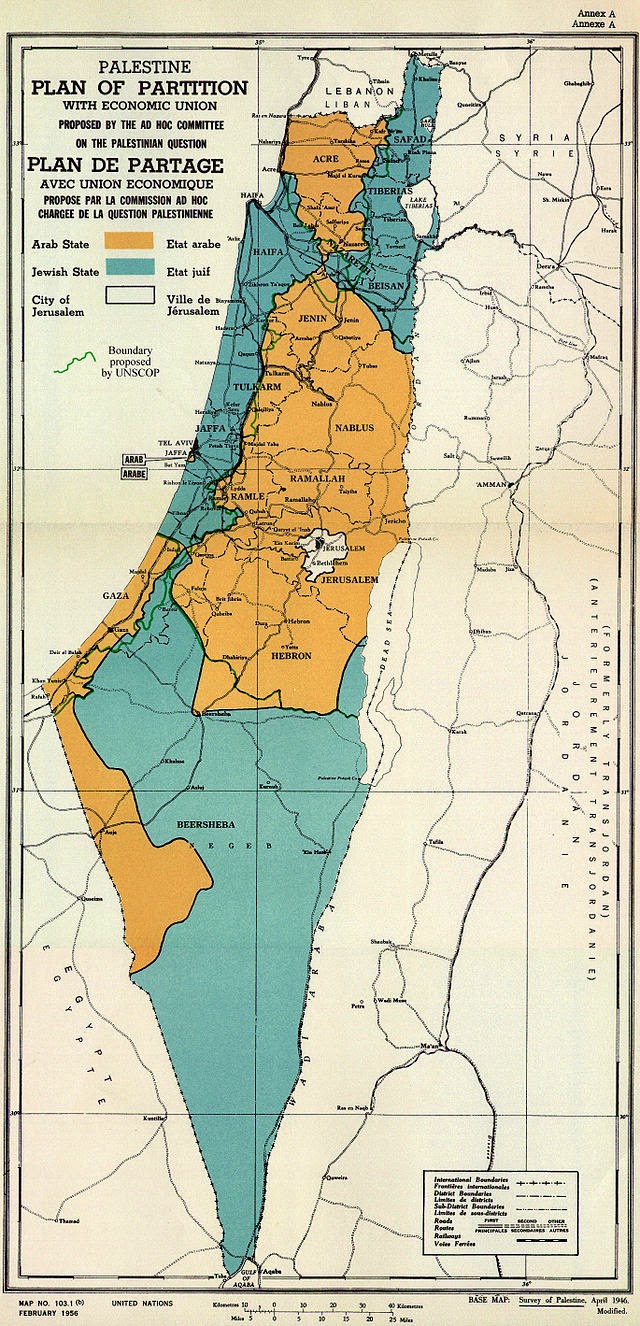
As we looked to maps and data visualizations for compressed history lessons in future weeks, I looked to the past, from this old verbal maps that stuck stubbornly in my head–even as I was able to date its inclusion in the liturgy to the U.N. Plan of partition of February, 1956. 

Did Netanyahu remember this plan–or his father’s reaction to it when he was six years of age?–when he asked the international body that had partitioned the Middle East to “change the attitude of the organizations institutions toward the State of Israel,” a request that echoed Ben-Zion’s fears creating “an Arab state in the land of Israel” would only prepare for the destruction of Israel?

February 1956 Map of UN Partition Plan for Palestine ...

United Nations Partition Plan for Israel and Arab Lands/February, 1956

1. The Israel-Gaza Barrier was built to monitor movement between the Gaza strip and Israel a border didn’t allow. The fence and concrete constructed after a spate of Palestinian suicide bombers was not “Iron” but after Palestinians infiltrated Israeli territory, from the West Bank and Gaza Strip, and by firing rockets from the Gaza enclave, it was a state of the art security barrier, perhaps even a promotion of Israeli technologies of “border building” on show for the newly elected American President, Donald Trump, and an eery imposition on Middle Eastern geopolitics.  The trust in this defensive mechanism lacked any means of active protection, but as a securitized wall of tactical advantage, securing an illusion of protecting Israeli cities without any offensive action.

The new pseudo-borders of security barriers erase the partitioning of Palestinian lands by the false promise of securitized walls, as if in place of cross-border dialogue. While we map the Gaza conflict as if it were a local one, in our hyper-connected age, ostensibly without borders, the conflict on the Gaza Strip demands to be seen partly as an eternal one, but even more deeply as one of mapping sovereignty in a globalized world.   The notion of “guarding boundaries” has become tantamount to the guarding of settlements in the Netanyahu regime, which had proposed a new map of Israel, not bound by a “Green Line” of past settlements drawn up in earlier treaties of the Israeli state, but advancing a new logic of accelerating settlements from the River Jordan up to the Mediterranean. Netanyahu pedantically used a red magic marker to present what he called a new prophetic vision and blessing before the United Nations General Assembly, including pained representatives from Lebanon, Palestine, and Saudi Arabia, that began from shockingly ahistorical claims Israel was founded without a Green Line dividing Israeli and Palestinian presence on the West Bank–

Benjamin Netanyahu Presenting Maps of Middle East at United Nations’ 78th Assembly/ September 22, 2023

–and continued to imagine a “New Middle East” cleansed of Palestinians.

Prime Minister Benjamin Netanyahu Presenting Maps of Middle East at United Nations’ 78th Assembly/ September 22, 2023

In perhaps purposefully low-tech cartographic static maps, he heavy-lidded PM heavy handedly presented a choice between a horrific war of terrorism and “a historic peace of boundless prosperity and hope” fifteen days before the bloody territorial incursions of October 7.  While the maps were not suggested to be a form of cartographic violence, they made the circuits on social media, with considerable shock at an Israeli “showing” a map entitled “New Middle East” without the presence of Palestinians as a call for “eliminating Palestine and Palestinians from the region”–and legitimizing a “Greater Israel,” commentators feared, in a weird cartographic purification.

Benjamin Netanyahu holds a map of the Middle East without Palestine

Netanyahu assumed a vaguely professorial air, as he heralded the historical emergence of “many common interests” between Israel and Arab states after three millennia, in the emergence of a “visionary corridor” that revealed an Arab world “reconciled” to Israel. Yet weeks before the military invasion, he lifted mock-up maps of both the creation of the Israel as a state in 1948 and of “The New Middle East” in patronizing manner that persisted in incredibly eliding Palestinian Territories with Israel–and placed Israeli territory at the center of the “New” Middle East–

Prime Minister Benjamin Netanyahu Presenting Maps of Middle East at United Nations’ 78th Assembly/ September 22, 2023

–as a prophetic vision for the region that would be able to “bring down barriers between Israel and our neighbors” as we “build a new corridor of peace” omitted a Palestinian presence. 

His condescendingly professorial style of addressing the UN General Assembly may have well recalled the intonations adopted by his father, Ben-Zion Netanyahu, a professor of Early Modern European History who had funneled his militant revisionary Zionist vision refusing to accommodate Arabs’ pretense to sovereignty in the Middle East save from a position of absolute strength to a world picture that insisted Jews were long persecuted as racially different, as if reifying twentieth-century theories of racial purity as an optic of Jewish persecution. Netanyahu seemed to see himself as forcing the resolution of this historical dynamic, as a new historical age “will not only bring down barriers between Israel and our neighbors,” but “build a new corridor of peace and prosperity” by a “visionary corridor” negotiated at G-7 as if to win assent from General Assembly member-states to a “New Middle East” tying Israel to the UAE, Saudi Arabia, and Jordan,–

Prime Minister Benjamin Netanyahu Presenting Maps of Middle East at United Nations’ 78th Assembly/ September 22, 2023

–as a chance to “tear down the walls of enmity” to proclaim peace “between Judaism and Islam” on account of a a “visionary corridor” of energy pipelines, fiber optic cables, maritime trade and transport of goods, uniting the Arabian Peninsula and Israel to the world.  In place of the thick red magic marker he Sharpie illustrated epochal shift in Israel’s ties to new Arab partners of Saudi Arabia and Jordan,–imitating his use of a red magic marker to lecture the General Assembly e the Iranian nuclear threat. By heralding normalization of ties between Israel and Saudi Arabia as a “New Middle East,” he seemed to dismiss any need for future work from the United Nations, no doubt with the Gaza Strip in mind, if he had placed it off the table of the United Nations’ concerns.

That very vision of globalization was terrifying to some, promoting as consensus the recognition of Israeli independence in the Arab world.  The rather foolish cartographic prop sought cartographic normalization of a myth, seeking endorsement of a “Greater Israel” that squirreled a heritage of rather radical Zionist strain into a vision of global modernization. And while in our hyper-connected age, ostensibly without borders, the conflict on the Gaza Strip can be mapped as a local one–or an eternal one.  Netanyahu presented a choice that echoed the verbal map in the liturgy read in the far fuller Oxford synagogue, assuming quite professorial airs as if to channel a commanding relation before the United Nations and to the Arab world that his father, Ben-Zion Netanyahu, had not only endorsed but seemed to summon an ability to conjure a means of defending Israel against its enemies by creating a new highway of information, technology, and jobs that ran from India to Israel, to guarantee the death of a two-state solution. 

“Europe” and “Asia” were linked in this new globalist vision through Israel, skirting Africa and suggesting a new “First World” view that seemed to elide a Palestinian presence in the Middle East.

AP/Richard Drew

Netanyahu Demonstrates “New Middle East” and 78th General Assembly/Sept 22, 2023

Much as Netanyahu’s Middle East map of Israel’s 1948 foundation included no Palestinian presence, ten minutes into his speech, he consciously used the crudest of cartographic props to announce a prophetic vision of an Israel free from Palestinians as an imagined consensus for the future, while speaking animatedly to the half-empty arena of the Seventy-Eighth General Assembly.

The map sought to shoehorn the Gaza Strip and West Bank into a cartographic reality negating existence of the Palestinian Territories, making good on his campaign promise. This was a map of robust security rather than actual boundary lines.  Was it not an endorsement of a vision of old boundaries to the Mediterranean Sea, from the River Jordan, that the ardent Zionist Goren had penned?

Continue reading

2 Comments

Filed under boundary walls, Gaza Strip, Greater Israel, Israel, Middle East, Palestine