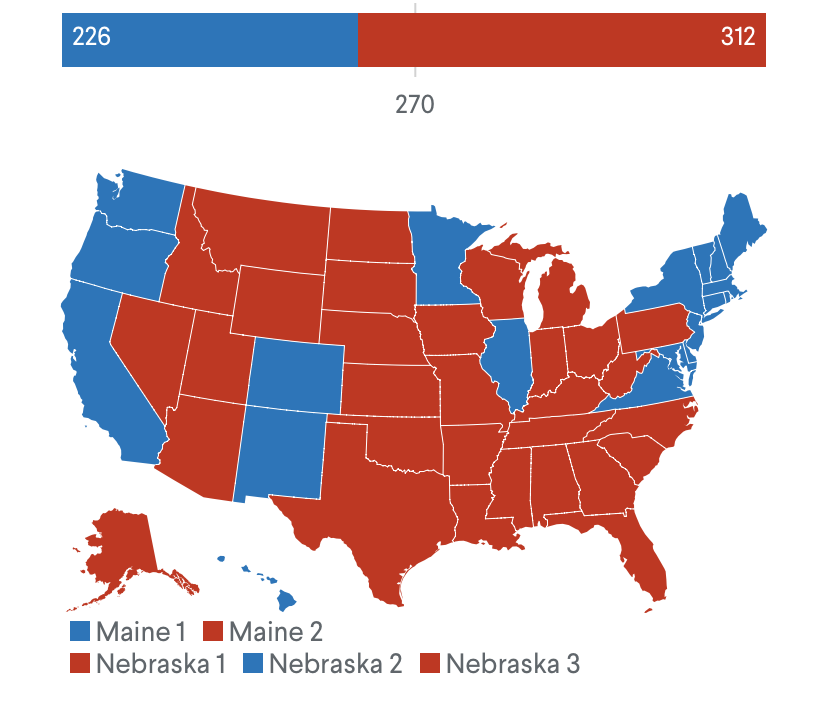
While we’ve been driving ourselves to distraction with the distortion of the electoral maps, projecting the failure of our system of government in the specter of “tied” electoral contests in which the vote is thrown to the House of Representatives, rather than anyone having a vote, we as if realizing the real fears of disenfranchisement that are all too palpable in the current status quo. The possibilities of choosing a President in a polarized nation have led, not only to consecutive weeks of polling so closely within the margin of error to be set many to rip out their hair, but also inevitably ratcheting up the fears of violence–and violent confrontation–at the polls.
As if a concrete version of swinging, the fears of fists swinging at the polls seemed all too real, perhaps in the memory of January 6 still fresh in some minds, and the major actors, decentralized and all-male actors seeming to respond to Trump’s rhetoric, claiming that they would “show up” at the polls, as Ohio-based groups posted “the task is simply too important to trust to regular normies,” legal norms, or boards of election. All ratcheted up fears that the election would be stolen, amplifying anxieties about the authority or legitimacy of the election. by taunts that “FREE MEN DO NOT OBEY PUBLIC SERVANTS” on alt right social messaging platforms before Election Day. The Proud Boys, famous for having been told by Donald Trump in past Presidential debates to “stand down and stand by,” now stood “locked, loaded, and ready for treasonous voter fraud.” The demonization of public servants and the civil service, only to be amplified by the Trump White House in later months, was indeed launched within the election.
The feared violence did not happen, but a violent shock seemed present as votes were counted in a new electoral map, as the battleground states that had long been contested seem to have folded, and shifted red. But Trump’s ties to the Proud Boys–or the ties that were not only seen on January 6, but even back to the “stand down and stand by” remarks in the Clinton-Trump debate that curried so much favor with the radical alt right group. Indeed, they raise the question of whether, even if violence at the polls or voter intimidation did not occur, it still makes sense to map the electors in purely partisan terms, in this most polarized of ages, and how much that polarization rests on the personal power that Donald Trump has gained. But we have retained the map of “red” and “blue” states as a visual shorthand, dating twenty years ago on the television news, that has dominated our understanding of partisan divisions, and indeed been naturalized as a shorthand of political brand, able to take the metaphorical temperature of the nation and “decide” its leadership–even if the cartographic shorthand may be outdated in the era of the strongman. And we have forgotten how narrow the election was, as Trump has claimed a “mandate” while in fact loosing the popular vote, on the basis of winning six swing states–as if those close margins of victory, and a failure to gain a majority of the votes in what was for all practical purposes a two-candidate race, led to an electoral map that was rather divided–and offered little consensus–despite an illusion of a continuity of red states, rooted in the less educated and more economically disadvantaged ones, who bought Trump’s deceptive assurances of the arrival of lower prices on food and gas.
Have we allowed our minds–and our journalists’ minds–to become too filtered by the distorting principles of electoral maps? William Galston, an observer of elections and insider who worked for four presidential campaigns, ran with this cartographic metaphor, noting that if political parties had gained and lost ground in states and regions in earlier eras, we “live in an era of closely contested presidential elections without precedent in the past century.” As one candidate promises to divide us like we have never been divided, we are divided by the smallest of shifts in voting patterns, the electoral map of “the contemporary era resembles World War One, with a single, mostly immobile line of battle and endless trench warfare”–that reflect the increasingly and unprecedentedly sharp partisan tenor of our politics. Galston argued this was increasingly true in 2020, the election when states’ partisan opposition seemed to harden over forty years–if not sixty?–despite the interruptions of the Clinton and Obama years, the rare excerptions. But this divided landscape gained a terrifying sharpness that crystallized in how seven “battlegrounds” decided the election in 2024, justifying outsized attention from Presidential campaigns in the 2024 election.
Even as the United States Justice Dept. monitored twenty-seven states–and some eighty-six jurisdictions!–to ensure compliance with federal voting rights laws, prevent voter intimidation, and law enforcement agencies were braced for violence, no cases occurred–despite tangible fears of violence or intimidation. But the shock of the red map lead to existential worries of a story that ended in the wrong way. If 77,000 votes from Wisconsin, Michigan, and Pennsylvania put Trump in the White House the first time, in 2016, a big push from all three states did the trick by promises to a Christian Right. Even if Harris cut Trump’s lead in the battleground states, Trump continued his advantage in battlegrounds of the light blue Democratic victories of 2020. And so the first returns in the Election Day scenario of the 2024 suggested a shift in the landscape rightwards, a mass shift Trumpwards, in fact, that had not been seen before, a shift in collective action and identity voters adopted en masse–as if rejecting partisan allegiances to run against the polarization of the past–
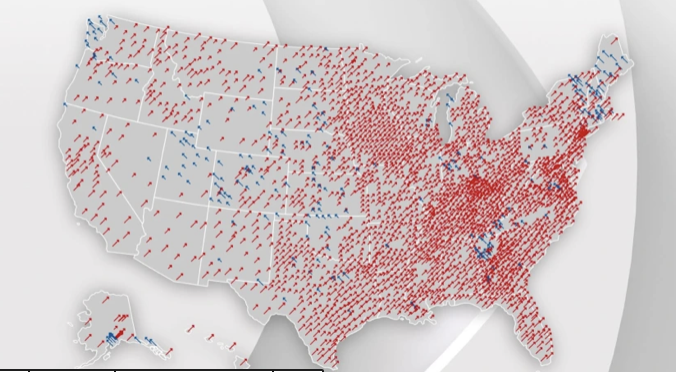
CBS News/November 7, 2024
–that provided a new landscape by the evening of November 7 of increased margins of victory from 5% to as much as 20% among for the party that had undeniably become, as many fretted, the Party of Trump, in ways that tested the carving up of the electorate into demographic groups or genders.
The array of arrows lurching red seemed to blanket the nation appeared nothing less than a major electoral paradigms. And the victory of Trump was not a victory of the GOP, but a confirmation, in some sense, of the full takeover of the Republican Party by Trump’s promises of making things right again, promises that seemed more concrete in its details–even if they were largely vague assurances, moral victories of slim benefit like the restoration of values and end of access to abortion–promises at well in exurbs, far from cities and urban disturbances, from private equity to prisons to gaming to casinos to gun advocates, finding a gospel of mall government and low taxes, a salve to anger at pandemic restrictions, an exurbia on the edges of cities, fleeing all disturbances to an elusive status quo, believing hopes of bracketing costs of global warming and near gaining a critique of Trump’s abundant lack of any actual economic plans.
CNN, November 7, 2024
The sudden parsing of the flow of margins erased the red state-blue state electoral map, with a precinct- or county-based tally of margins from the previous election, seeking to size up candidates by socioeconomic or other groups, but confronting an apparent large-scale shift of the electorate. Trump’s victory was not overwhelming in its margins, but re-mapped most large stretches of the country red left the notion of “red” states in the past, to augur a new landscape for the United States–not only in domestic policies, but, of course, its relations to the wider world. But it was more than decisive, and the “break” in many districts once dependably mapped as Democratic voters to Republican suggested a wake-up call, even if the election was by no means a landslide: it felt like one, and that nagged one’s mind and would in days to come. And, perhaps more importantly, the perception of a landslide–even if it was by small margins–was exultantly viewed as a license to remake the government, remake the presidency, and redefine the role of government.
The bitter truth Trump did well among, non white voters, lower-income Americans, and women cannot be explained easily, and surely not by class-based disaffection from Democratic candidates.
Red Shift across American Landscape Showed a Decrease in but 240 Political Counties/New York Times
Despite fears of violence, the eery absence of any disturbances paralleled the rightward swing of the American electorate, evident in the rightward swing of voters not only in those seven “swing states” but the great majority of counties across the nation evident as the first votes were tabulated on election night. This was a punch to the right, a lurch right save spots in Georgia, South Carolina and Michigan–once considered swing states, to be sure, but now trending red. How did all the so-called “swing states,” uncertain in their voting practices but which we had been reminded from the summer, would, in fact, be selecting the President as much as the country, swing red in ways that seemed more overdetermined than seeming news?
The map hit viewers like a slap in the face, a rude awakening of heart-breaking disconnect with America, but was also cause for a recognition of deep-lying and relatively dark undercurrents that found grounds to turn away from a convincing female candidate, even in favor of a convicted felon. The bomb threats on election across swing states provoked fears of a conspiracy of Russian origins, but the lurch seemed terrifyingly home-grown and domestic, and seemed profound. It was only as more votes came in, early results revealed a shift of over 90% toward Donald Trump, a terrifying landscape indeed, but as the votes continued to be tabulated nationwide, the electoral map and the tally of votes suggested a narrow victory, in many senses, as more votes came in from California–but revealed the stubborn draw of this year’s Republican candidate, former President Donald Trump, who attracted voters across many of the states once thought in play. Candidate Trump currently only leads the vote count by 2.5 million votes nationwide, but the large turnout paradoxically benefitted him, suggested the special draw that he had as a candidate among many voters, from a far more “diverse” background than Republicans had indeed ever assembled.
The light pink areas that were not so dominated by Republican voters presented a fractured landscape that broke the wrong way, and did so by small margins and very much perhaps for not the right reasons. But the break in votes was striking, as if able to be mapped as continuous regions. We are still haunted and traumatized by the mapping of the way the national population had split in 2016,–of siloed blue towers, removed from he rest of the land, a hived off vision of politics that we faced with frustration as Trump entered the White House for the first time–winning the backing of the interior forty-eight with an intensity not reflected in any earlier polls.
We had pored over those maps that haunted our minds with endless precision as data arrived on county and district level, to search for signs of the anatomy of the loss, hoping to grasp the gaping division of the national vote. Did Trump’s continued appeal redraw the political landscape, or was there something wrong baked into aggregating the general will? Did tailored talking points about access to abortion and an attack on price-gouging fail to motivate voters, or provide a convincing narrative of steering a more vital economy, or at least a convincing trust in the law?
Or, the voting map almost seems to beg the question, were we relying on the wrong maps as we focus on electoral maps, and ceaselessly made new maps for electoral prediction, seeking to craft multiple scenarios for how electoral votes would fall out this time, scenarios whose endless proliferation seemed a suspension of agency? The real maps of the election lie far outside demographic metrics not mapped by demographics or class or race or gender divides, but a space of a lost community, where the battle cry to Make America Great Again exercised undeniable appeal.
The massive scale of the red shift evident by the morning after Election Day was a wake-up call that suggested a changed landscape. The red arrows lurching right seemed evidence of a disconnect of Democratic campaigns and candidates that provoked an immediate introspection and conveyed the shock many felt in he nation. Amazingly, rather than the election being close in any way, it seemed, the election that was long said to come down to thin margins of voters, per the polls, were upended. Trump’s margins built on 2020 and significantly grew in 2,367 counties nationwide. The red arrows overwhelmed any of the fears of heightened violence in Trump’s political rhetoric elected, with the demonization of opponents, or indeed just suggested they were meaningful rallying cries far more successful than polls had showed or political junkies had expected.
When running for President of the United States, Donald J. Trump already betrayed a shaky knowledge of the territory. He didn’t want you to think that a wall had already been built along the southwestern boundary of the United States. Now occupying the Oval Office, he seeks to convince the nation that it is in fact being built, and that the need for a permanent, impassible “wall” exist, despite Congress’s refusal to allocate new funds for a “border wall.”
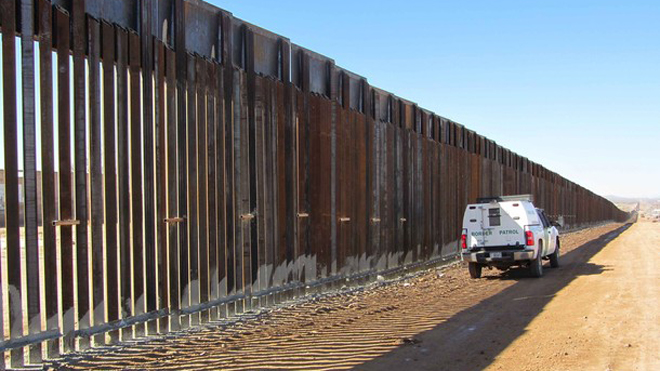
But the massive show of force of cyclone fencing, regular patrols, and bullet-proof barriers set a precedent of border fencing since the 1990s, and something like a precedent for redrawing the nation in ways that are designed to resist changes in a globalized world. In ways that Trump has put on steroids as a racist divide between outsiders and “Americans,” and used as a vehicle for an “America First” agenda, as filling a need to remap strong divide between nations that would replace an “open border,” able to protect the nation, the “border wall” has become fetishized as a paradigm of the unilateral mapping of global space–in terms of actual sovereign bounds, and as a way to remap the nation’s involvement in the world and shuns international responsibilities. If the rhetorical role of the “border wall” has replaced its actuality, and mapped the proximity of the nation to the border in both duplicitous and quite dangerously simplified ways, only by returning to the border, and viewing the existing scars on its lived landscape and the traces of the migrants who have crossed it, can we unmapped the mental mapping of the border.
The effectiveness of the current complex of bollard fencing, barbed wire, steel fencing, cyclone fence, prison-wall like bars, and other obstacles has become one of the largest collections of military surplus in the United States, an accumulation of military materiel that appears designed to remind those who see it of their absence of rights. As much as a defense against globalization or immigration, the border wall stands as a fiction. Although some Americans lend credence to the idea that a barrier along the border could prevent “unlawful” entry of the country, whether such entry is in face unlawful–and what sort of balance of justice would be reinstated–is unclear. The frontier is constructed as site for denying justice, and a denial of human rights, both embodied in the a massive build-up of military material and show of force in its regime.
The construction of the border as a region that denies civil and legal rights–a “negative space” of sovereignty and liberty–has redefined its relation to the state. While the project of a wall seems to mirror the lines of a map that would separate two countries, the simple division of national zones and spatial division more of a fiction in the transborder region. The compulsion to create a map that was present on the earth–a sort of scar between two regimes–depends on defining a space outside of either state, overseen by someone who has no interest in securing rights of its inhabitants.
In this sense, Donald Trump is the perfect messenger of a circumscription of personal rights. When Trump urges the nation that no choice exists save a wall– “We really have no choice but to build a powerful wall or steel barrier”–citing that any agreement with Congress for “a fair deal” to be far off, he invokes a notion of fairness and justice that he argues it would create a sense of security–and promote a sense of national security as well as personal security–but relies on evoking the sense of fear and vulnerability that “open borders” conjure. Without any clear statistics or evidence for its value, save the magnification of border security, the need for a border wall is only a fantasy, based on an imagined. As someone who defines himself outside the political classes, and apart from an interest in preserving civil rights–or a sense of the role of government in the preservation of the nation’s liberties–Trump is perfectly suited to define himself in terms of the border wall, which he seems to be set on developing as a property.
1. The sense of justice or security is altogether absent from the landscape of the wall, and from its already heavily militarized region. The absence of place along the border is particularly striking as the accumulation of increasing obstacles to cross-border transit seem designed to preserve a sense of the integrity of the nation–and the safety of our own sense of place–in a world increasingly defined outside of the nation-state as a category, where “states” have decreasing presence or meaning for many American citizens, and most inhabitants of the globe.
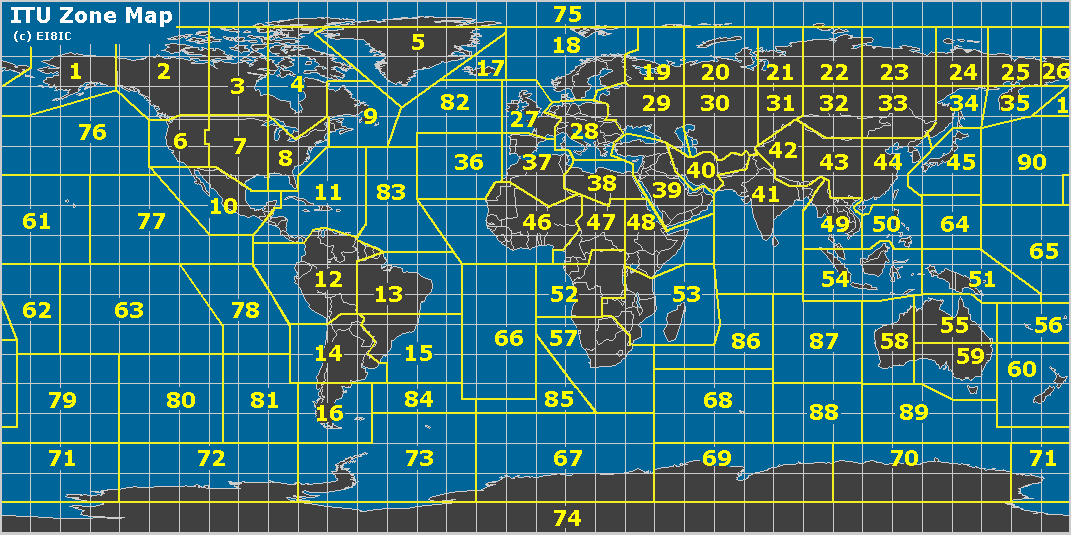
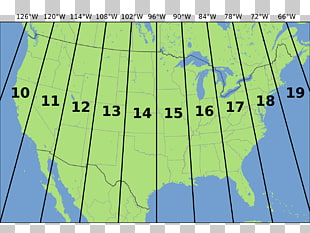
In an era of the continuous extent of global space, where borders of nations are to a large extent rendered arbitrary in the virtual space of the meridians of the widely adopted Universal Transverse Mercator coordinate system–
–there seems an urgency that is more easily created of the need to define a boundary line, and to believe that the ideal border line of a national map can conjure the antiquated entity of the “nation”and defend it against the danger of migrating threats. Invoking the fear of the dangers of cross-border movements are so often epeated by the America First movement–“bad hombres,” rapists, murderers, or criminal networks, drug cartels, and multi-nationals that go beyond the current systems of state-based law enforcement, that seem designed to suggest threats that only a clear partition of territories can stop,
Migratory Routes of White Pelicans in the United States Originating from the Gulf of Mexico
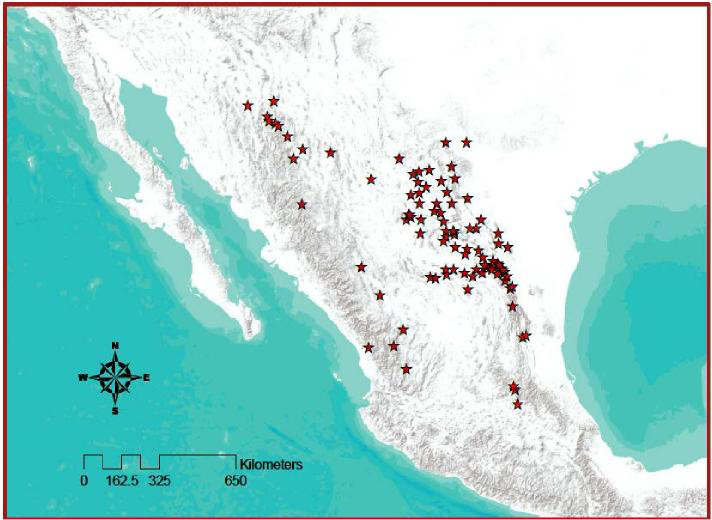
Historical and Current Sites of American Black Bear in Mexico
In ways that echo the growth of border walls world-wide–only fifteen existed in 1990; there are beyond seventy–the US-Mexican border barriers already constitute one of the most massive investments in wall-building–and the most massive project of wall-building that exists. Rather than offer a spatial division that can serve to protect the nation, or reassure us of the possibility of law enforcement, the complex created around the militarized complex serves only to suspend individual rights, as much as to guarantee the law. Ie exists in an atmosphere of compromised legality, if not lawlessness, in the name of security.
Rather than see to create a secure spatial division, the border has been transformed into a deeply hostile landscape, a site seeking to erase or obliterate any sense of individuality, however much the wall is identified with justice or national protection against the threat of criminal elements. The rhetoric of wall-building that invokes justice indeed obscures the utter injustice of its construction. The 2,500 mile barbed wire fence that India is building to separates itself from Bangladesh, the US-Mexico border wall would be by far the longest such wall in the globe, as if a bald rebuttal to globalization and a declaration of American self-interest: if intended to illustrate American strength against the specter of the threat of the cross-border movement of workers, criminals, or lawlessness, it claims the ability to remove surgically the territorial United States from the dangers globalization has wrought.
In this sense, the project of wall-building is a promise to protect the sense of “place” of the nation. At the same time as our sense of the nation and our sense of place has dramatically altered for reasons beyond any individual nation, the wall reified the nation as an entity, even as the distinct nature of the nation is unclear. John Berger observed grimly, but surprisingly presciently, toward the end of his life, after touring the Occupied Territories in the Middle East, that “The present period of history is one of the Wall,” shortly after 9/11, he foretold the policing of border-crossings and humanity, ” . . . concrete, bureaucratic surveillance, security, racist walls.” The new definition of walls that are defined to separate hoary categories of race or ethnicity are increasingly evident in all too frequent attempts to create barriers of regional protection. They are based on the sense that national survival depends urgently on such massive projects of enclosure, as if such projects could be isolated from their huge effects and psychological consequences for those who might confront them on the ground.
The current emptying of words–emergency; invasion; criminality; violence; human-trafficking–make them tags to activate the border within the political imaginary, but conceal the actuality of the borderlands where the military is already present, and the lands are already quite secure–and quite vacant of habitation.
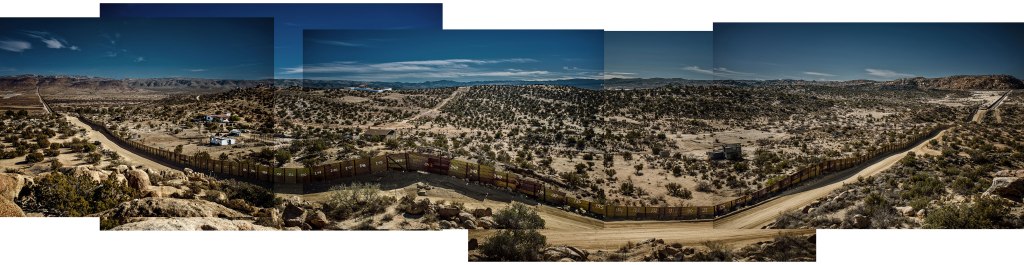
2. The place of the amassing of materials and military materiel along the US-Mexico border seems designed to create a new experience of the border, and to make it scarily real for those who might seek to move across it or to regard it as part of a zone of permeability. The exquisite photographs portraits of the wall by west coast photographer Richard Misrach has worked to document the extent to which border barriers have changed experience of the border crossing.
The barriers progressively built on the southern border of the United States reveals a new heights of the costs of bureaucratic surveillance in the name of border security. As if in a second episode of his classic Desert Cantos, begun in the 1970s, which, Geoff Dyer noted, “record the residue of human activity inscribed in these apparently uninhabited lands,” in an attempt to explore “the multiplicity of meanings in the idea of desertness.” The residue of the human is even more haunting in Misrach’s new project, and the photographs that result of human traces on the border, because they are emblems of the disenfranchisement of the borderlands that hauntingly parallel their military build-up. One might even say Misrach interrogates the landscape in his work–if the word didn’t tragically resonate so closely with the state-security apparatus on the US-Mexico border. Misrach dwells on human traces that lie around the militarization of the borer regions–from the cultural detritus left by cross-border travelers, left on migrations, the security apparatus encountered at border, and the hollow loneliness of the massive redesign of its landscape capture the expanded military-defensive complex at the border.
This evacuated land is the region that Donald Trump has come to champion as a basis for defense from national emergencies. The argument that the border is understaffed erases the rewriting of the transborder landscape that has already occurred. Misrach’s contemplation of magnificent vistas, broad traces of the inscription of authority at the border, and the reduction of the human, are truly Kafkaesque in their nightmarish reduction of the individual before the inscription of authority in its landscape.
3. For since the definition of the US-Mexico borderline as a line of passage monitored by the border patrol back in 1924, the expansion and militarization of increasing sections of border wall is in part a spectacle of state. Their growth reflects increasing concern not only with the border, but the militarization of a border zone. But increasingly, such a zone seems sealed off form much of the country, and is rarely fully comprehended or seen, but rather invoked as a specter that needs to be expanded to establish national safety and economic security, even if its expansion has already occurred in a hypertrophic fashion, long before Donald proposed to build a “beautiful wall” to prevent crossing the US-Mexican border. If the expression reveals a lack of compassion, its problematic nature is even deeper: it reveals Trump’s peculiar identification with an apparatus of border protection, and of human containment, and the removal in his eyes of that apparatus from a discourse of rights.
Trump has celebrated the wall as if it were a new hotel and building project–asserting that he has the needed expertise to build and design it. Trump presented himself to the American press that he was perfectly suited to such a task, since building is what “I do best in life.” “I’m a great builder,” he assured his audiences, with considerable self-satisfaction, to suggest his suitability to the position as chief executive, despite his lack of political experience; defining himself apart from other political candidates in the vision of the nation that he supported, Trump added with evident satisfaction, “Isn’t it nice to have a builder?”
Precisely because he came from outside the political sphere, and outside the government that preserves and respects individual rights, he has been presented as a perfect fit for a region that lies and has developed as outside the securing of individual rights. By having a “builder” of the nation and the nation’s identity, he suggested, rather than a politician, he could guarantee the increased presence of the military along the nation’s southwestern border, and indeed promised to dedicate an increased amount of the national budget to the defense of this borderland. Precisely because Trump lacks interest in guaranteeing or preserving the rights of migrants, or rights of asylum to the nation, he is a perfect custodian and symbol of this over-militarized zone without rights. As a man without military experience, but cowed by military authority, he has become, as President, the perfect surrogate for the stripping of rights for people who try to cross the border.
Trump’s promise is that the continuous wall, to be payed for only upon completion, would remove deep worries about border security. Widespread national concern about cross-border movement since the 1990s have led to the investment to making the border more physically and symbolically present to potential migrants than it ever was–no doubt reflecting an inflated fear of illegal immigration and the dangers of their immigration by fortifying what was once an open area of transit and rendering it a no-man’s land. The number of US Agents stationed along the border has almost tripled from 1992 to 2004, according to The Atlantic, and doubled yet again by 2011, even as the number of US federal employees shrunk. Investing in the border by allocating over $4 billion each year created a concept in our spatial imaginaries we have not fully digested or mapped, or assessed in terms of its human impact, despite increasing appeal of calls for its expansion and further consolidation–even as the further consolidation of the border zone has made migrants depend on drug smugglers and other illicit trade in hopes for guarantees of cross-border passage. And in an era when a large portion of Americans seem to interact with government through the TSA—Transportation Security Administration–or NTSB–National Transportation Safety Board–the fear of external threats to the public safety seem incredibly real.
The inspired gesture of a monumental wall to be built across our Southern Border with Mexico, if a sign of weakness far more than one of strength, obliterating hope for the promise of a future, as Berger noted, intended to overwhelm and oppress as a monument to decadence and American insularity. Outfitted with not only walls, fences, and obstacles but checkpoints and surveillance cameras, the US-Mexican border has become a pure hypostatization of state power. And although Trump’s promises to build a “beautiful, impenetrable wall”–“He’s going to make America great, build a wall and create jobs,” folks repeated on the campaign, as if these were causally linked to one another–the massive construction project has been revised, as the “great, great wall” promised at rallies was scaled back to a fence and confined to “certain areas”–with the odd reassurance that “I’m very good at this, it’s called construction,” while acknowledging that the wall was “more appropriate” only in “certain areas.”
Does Trump have any sense of the massive investment of capital that already exists on the border. The promise of dedicating as much as $26 billion–even $30 billion–to such a soaring, precast concrete monument along the border, standing as high as fifty feet, was a mental fantasy, and election promise, but filled a need for ending perceptions of its permeability grew so great that his advisers see the need to warn folks “it’s gonna take a while,” but promising the ability to do so by fiat and executive order and reallocating funds for immigration services; others demur, “it was a great campaign device.”
At the same time as deporting hundreds of thousands of immigrants now deemed “illegal,” the Department of Homeland Security has effectively rendered the border a militarized zone, interrupting what had been as late as the 1980s was a relatively porous transit zone on which both countries’ economies had depended: the accumulation of capital on the border has expanded what was once a simple line to create obstacles to human movement challenging for viewers to process from a distance, or to map as a lived experience. Of course, the existence of the wall has created a blossoming of illegal trafficking, as migrants are forced to depend on smugglers to help them in their quest to cross the imposing border, augmenting the illegal activity that occurs along its path, under the eyes of the many employees that guard the expanded border zone, in a far cry from the border patrol of years past.
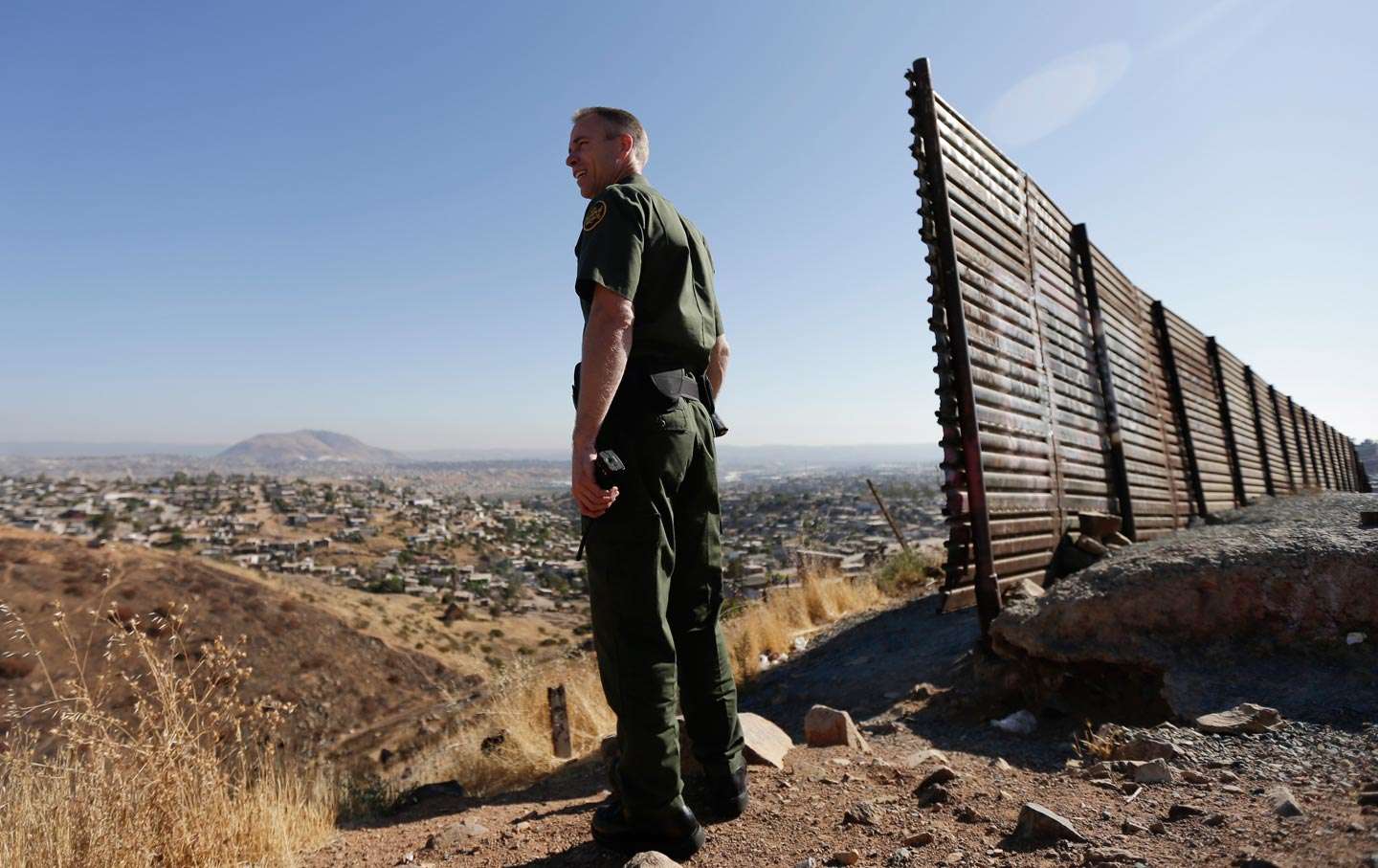
The accumulation of obstacles for human transit contrast sharply to the old border fences that they have long rendered obsolete. The growth of the border zone dates from 1986, when granting of “legal” status to Mexican immigrants in the 1986 Immigration Reform and Control Act (IRCA) had the consequence of redefining Mexican migrants as “illegal.” The investment in increased construction of the border over thirty years to the “illegal” immigrants who were surveilled by the U.S. Border Patrol at the highly monitored militarized border, designed to thwart unregistered immigration. The argument that the old border fence is now outdated, and contiains gaps–
AP/Gregory Bull: Border Agent Jerry Conlin looks out over Tijuana beside old border fence
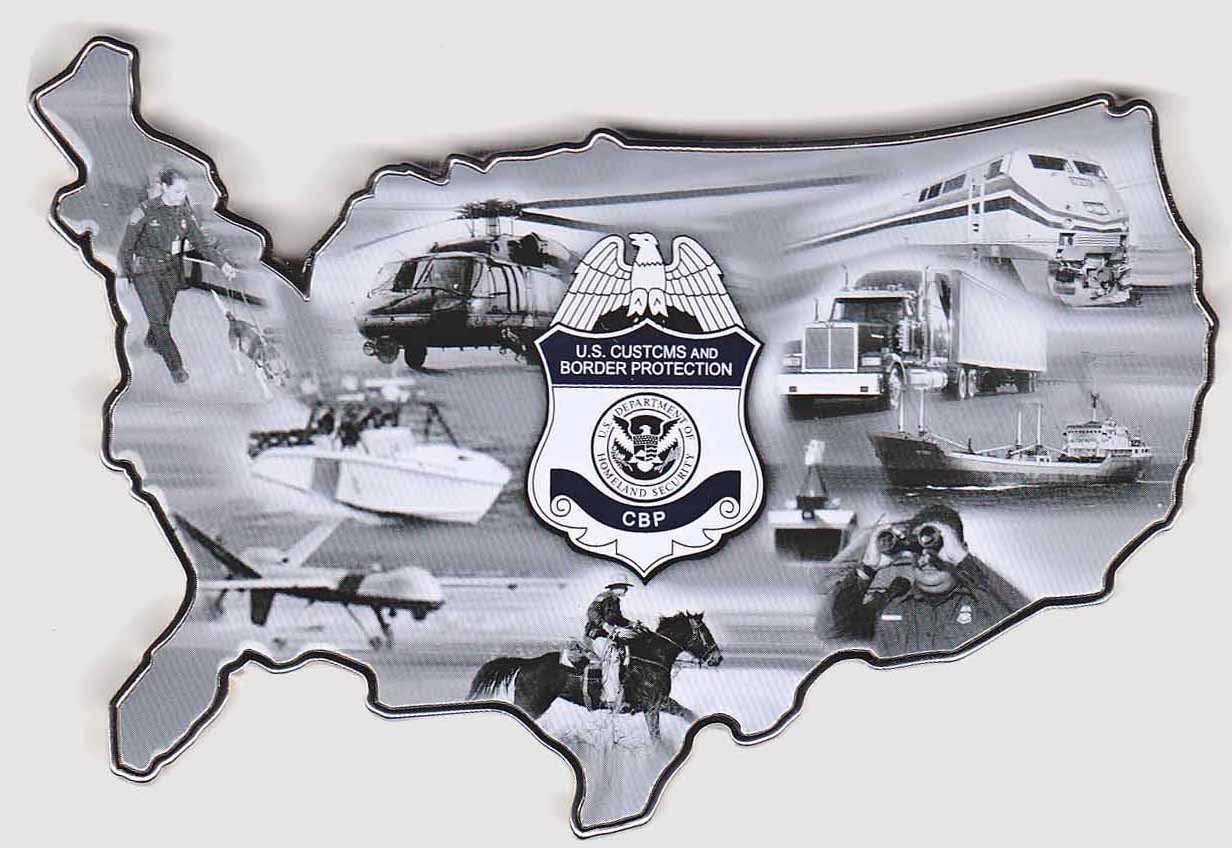
–has been demonstrated repeatedly in maps. And since the Customs and Border Protection agency dedicated to “securing the nation’s borders” has come to expand the border between the United States and Mexico to prevent any possibility of human transit, reifying frontiers in ways that are nicely stated in one side of the pin worn by the very officials tasked to secure the border by regulating cross-border movement. The mandate for U.S. Customs and Border Protection–“Securing America’s Border and the Global Flow of People and Goods”–is fulfilled by a range of devices of detection, surveillance and apprehension–attack dogs; choppers; drones; visual surveillance; horseback; speedboats; binoculars–that seem to expand an impression of total mastery over space in ways that are oddly ignore the human targets of the Agency.
The division of Border Services that is dedicated to secure the US-Mexico border has attracted a level of investment that multiplied the increasingly inhumane terrifying ways, as “securing the border” has encouraged a material surplus and hypertrophic expansion of the border as militarized region that exists to obstruct human transit that is undocumented. The border-zone assumes an increasingly prominent place within the spatial imaginary of Mexican migrants, as it has become increasingly accepted as a militarized–and naturalized as such–within the United States at considerable costs. What are the consequences of such acceptance of the frontier as uninhabited lands? How can one confront the consequences of its built-up construction from the perspective of the border-crosser? How can one measure the human consequences of the expansion of this outright militarization of a space between two countries who are not officially at war?
The separation of customs enforcement from border protection led an increased amount of resources to securing the material border, independent of the enforcement of customs, with effects that can be witnessed in the broad expansion of the border’s expansion as an uninhabited policed area needing to be secured in the abstract–independently from the human traffic that passes through it.
It is difficult to process the expanse or scope of the expansion of the border or the imposing barriers to border transit that is intended to prevent unmonitored migration and indeed terrify migrants from crossing the border . The experience of the surplus on the border is especially difficult to capture from an on the ground perspective, distinct from the abstract definition of the border on a map as a simple line. For the investment in the border obstacles and barriers that have themselves created the terrifying idea of sealing a border to human transit, and protecting the entry of those newly classified as “illegal”–a category that was the consequence of the IRCA, and legislation that criminalized the presence of “undocumented” Mexicans in the United States, and the growth of apprehensions of migrants after the increase in the monitoring of the border after IRCA– and the later increase of border patrols from 1994, in response to the inhumane balancing of needs for Mexican workers with fears of an increased number of Mexican immigrants, as the number of “undocumented” migrants multiplied nation-wide to new levels. The increased militarization of the border to monitor all and any cross-border transit has created a massive expansion of border fortification under the Homeland Security Dept.
The result has been to create a shocking dehumanization of border crossing as attempts to cross the border in search of a better life have grown. And the response of Richard Misrach and Guillermo Galindo to recuperate the human experience of border crossing that is erased by most maps. Recent explorations by Misrach has called renewed attention to the expansive construction of the border as a human experience migrants face and encounter, and the new landscape of border-crossing that has been created across a new no man’s land. His attention to the remains humans have left along the wall–abandoned detritus and intentional markers of cross-border transit–remap the construction of the border zone so challenging to capture in a territorial map, and capture a new sense of urgency to confront the human rights abuses that have grown with the border’s senseless expansion, and the overbuilding of border barriers and borderlands as a militarized space.
For the accumulated military surplus along border boundary is less a clear divide, than a means of creating a territory of its own within the growing border area: Misrach’s recent photographs map intensive fieldwork of the region of the border that try to comprehend the scale of its presence for those on its other side or who traverse the border zone–an experience entirely omitted from even the most comprehensive maps of its daunting scale and expansion, which reveal the growing presence that “the border,” border area and the growing expanse of trans-border regions have already gained–a scale that can in part capture the heightened symbolic role that the debates about a border fence or barrier have gained in the 2016 United States presidential election. The notion only a wall could fill the defensive needs of the United States must be protected from those Donald J. Trump labeled “bad hombres”–we stop the drugs, shore up the border, and get out the “bad hombres”–is laughable, but was a lynchpin to fashion himself as a strong male leader.
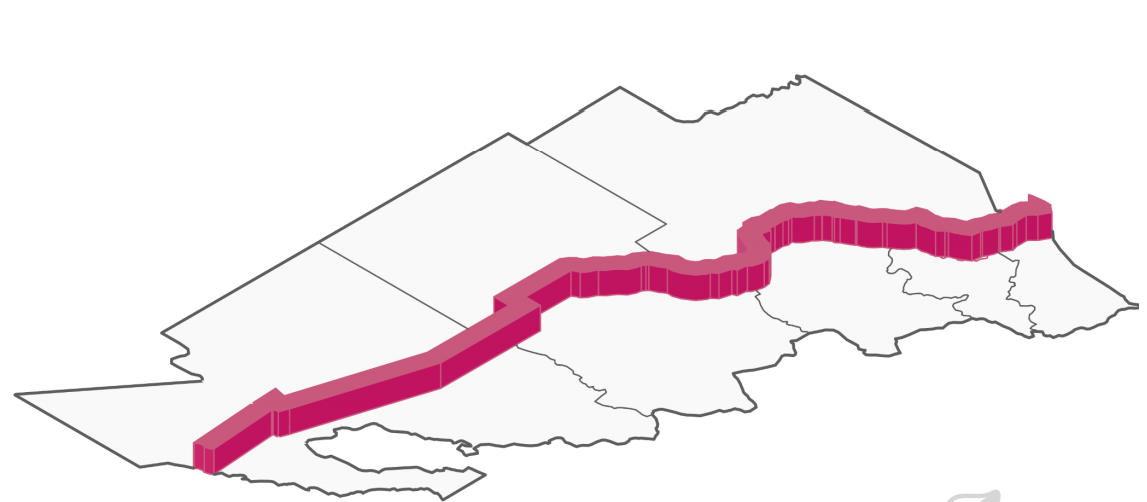
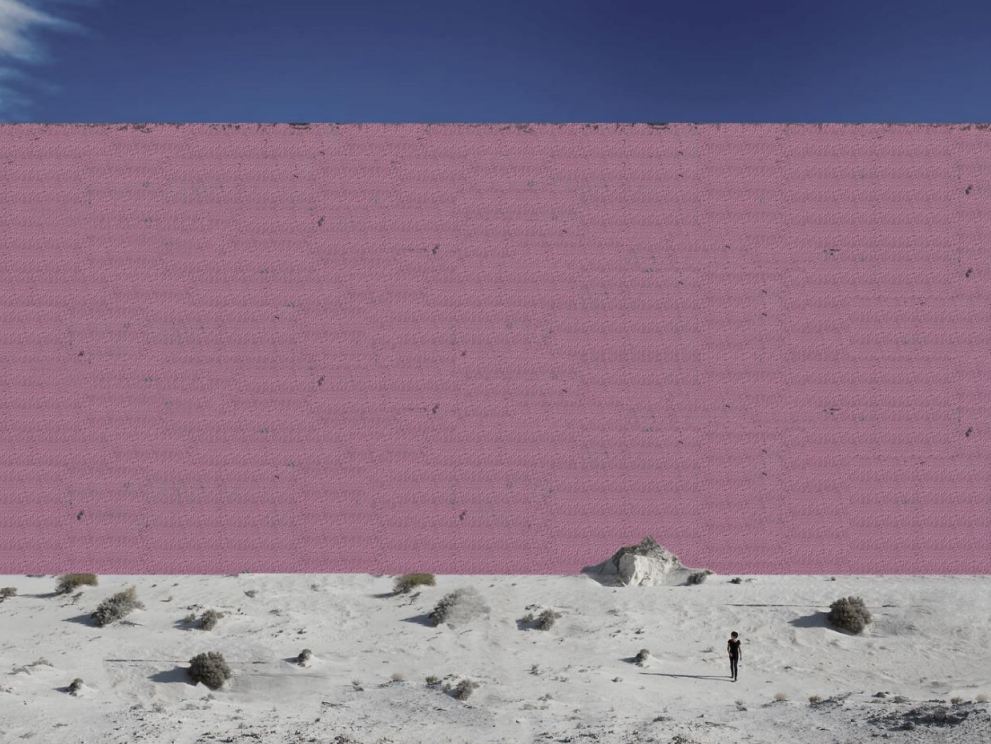
The grandiosity of the wall as a project of Trump’s megalomania led the architects at the Guadalara-based Estudio 3.14 to propose a version in hot pink, stretching along the 1,954 miles of the border, based on the work of Mexican architect Luis Barragán. The wall, including a prison to house the 11,000,000 deported, a plant to maintain its upkeep and a shopping wall, seems specially designed both to daunt migrants and offer eye-candy for Americans.
Indeed, such a “Prison Wall” reflects the deeply carceral function of the space of the border, whose systems of surveillance systems and technological apparatus make it less a space of transition than a site of expansive investment going far beyond the notion of border protection, both as a spectacle and expansion of territorial control. The hot pink wall offers a good substitute surpassing the expansion of border security in recent decades.
4. Indeed, as the transborder region has dramatically expanded with the expansion of cross-border trade since NAFTA in 2004, the expansion of the trans-border region has been widely neglected, and rarely mapped. The attention the photographic mapping of the human experience of border crossing–evident in the abandoned detritus and remains of cross-border transit–present a ghostly counter-map to the expanded border region.
This human map is all too often unfortunately overlooked, even with increased attention Republican presidential candidates have paid to remapping a closed border and constructing a border wall, a project that seems to erase or remove the broad area of cross-border traffic that occurs within the immense region that surrounds the physical border–whose sociological expansion is so oddly conveniently erased by any project of wall building along a region demanding to be recognized as being part of the United States.
Most boundaries between states are regularly rendered in maps by dotted lines, as if to recall milestones–miliaria–placed at regular intervals on perimeters of lands or counties in earlier times. But the borer strip that is embedded in an expanded border area is a site of increasing surveillance that seems to engrave itself on the land. To map the proposed building of a fence along the 2, 428 mile border between Mexico and the United States reveals a the expansion of the policing of the national borderspace, erasing its past status as a transit zone across which people and goods easily moved.
In an age of globalization, borders are increasingly not only policed, but managed at a distance from their crossing lines–and increasingly invoked in Presidential elections as if they have become the primary charges of governmental management. Constructed to symbolize and symbolically represent sovereign authority, the overbuilt border seems staged a spectacle to impede human movement and to monitor and erase, individual experience, and to bolster the appropriately faceless authority of the state. Borders once the creation of shared conventions, are colonized by an apparatus designed to impose state authority on helpless people, and constructed at massive cost as artifacts that seem to exist to violently intersect with actual lived experience, confronting the cross-border motion or migration of populations, and concretizing the need for a fixed frontier as a need of the nation.
Getty Images
5. The huge popularity of advocating construction on a continuous border wall within Donald Trump’s Presidential campaign to seal the frontier along Mexico’s sovereign territory reveals the degree to which borders become a means to assert failing claims to sovereignty–even as it is an attempt to reassert the authority of an individual nation-state by unilaterally asserting its own abilities to police its bounds. How the border gained such broad purchase on the national imaginary is unclear, and may require another post–but the incommensurability of the alleged solution and the situation on the ground demands empirical evaluation. Revisiting the spectacle of the border and the suffering it creates engages broad advocacy to the continuous wall advocated alike by such presidential candidates like Trump and Ted Cruz–and the explicit violence they serve by of subjecting social life of border-crossing to surveillance in the name of national security.
And so it is apt that, in Border Cantos, a recent collaboration between photographer Misrach and Mexican-born composer Guillermo Galindo, the amassing of capital on the US-Mexico border is so eloquently documented and revealed as the brutalizing landscape that it is. More than any map is able, their collaboration bears witness to the expansion of the border’s imprint on the lives of migrants in incredibly moving ways, by asking viewers to evaluate the costs of the overbuilt structure of the fence, and assembling the artifacts and unintended traces that were found and collected about the border–traces accidentally left by actual migrants from backpacks to sneakers to books to children’s clothing and dolls to the spent shotgun shells that targeted migrants or the bicycles used to overcome border barriers–to reflect their social experience. These remains are human traces that do not appear on any actual map, of course, but are the remains of the violence that is enacted on how national boundaries are mapped–and the continued violence of the experience of border crossing that intersects with the broad security apparatus on either side of the border fence. As if to accompany Misrach’s photographs of the human geography of the borderlands–a largely empty space with few humans and only scattered human markers and material possessions–Galindo fashioned musical instruments whose playing is able to generate sounds in his own scores, specific to the surreal fraught space of the overbuilt borderlands, an eery score to accompany Misrach’s haunted landscapes, and remind us of the human presence that is so often necessarily absent from the images.
Such ephemera pale in contrast to the experience of migrants, to be sure, but offer both avenues of empathy and proofs of the brutality with which sovereign authority intersects with the mundane everyday at the border walls, in the built space that runs across the emptiness of the desert borderlands.
We read more maps than ever before, and rely on maps to process and embody information that seems increasingly intangible by nature. But we define coherence in maps all too readily, without the skepticism that might be offered by an ethics of reading maps that we all to readily consult and devour. Paradoxically, the map, which long established a centering means to understand geographical information, has become regarded uncritically. As we rely on maps to organize our changing relation to space, do we need to be more conscious of how they preset information? While it is meant to be entertaining, this blog examines the construction of map as an argument, and proposition, to explore what the ethics of mapping might be. It's a labor of love; any support readers can offer is appreciated!















 Musings on Maps