Tag Archives: news maps

“He Could Easily Destroy Us”

“Amazingly, as of tonight,” new host Tucker Carlson declared in hopes to build anticipation for a Twitter broadcast, “there aren’t many platforms left that allow free speech.” While Fox News took Carlson’s show off the airwaves, he promised to return quickly on the social media platform owned by Elon Musk. Having worked for networks across the political spectrum, from CNN to MSNBC to FOX, Tucker Carlson seems to know what he was talking about. Musk seems to have promised the very sort of guarantees of free speech–a lifting of all monitors or warnings about misinformation or the content of posts that were adopted in the 2016 election–by deciding to remake Twitter a site of “free speech” without any restraints–indeed the very safe haven for “free speech” that right wing pundits and partisans had long demanded. In rescinding any bans on political ads on social media sites, by which social media sites sought to dissociate themselves from political messaging, Musk set the basis for rolling back misinformation set a new standard that opened the gateways to racist, antisemitic, and homophobic tweets. The new notion of normative “free speech” led to the “unbanning” of accounts of high-profile polarizers with a limited relation to truth-claims–as “free speech” become more woolly and capacious as a form of entitlement.

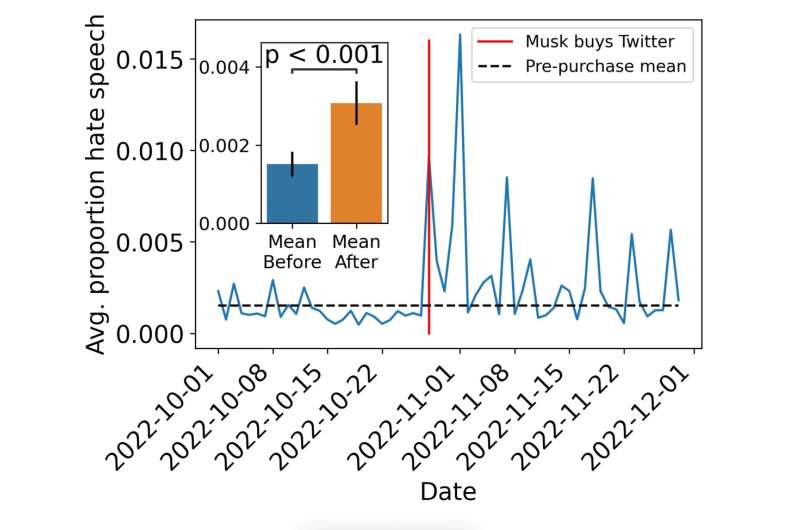
But when he called his own de-platforming as a suppression of his right to speak his thoughts he claimed a constitutional liberty, invoking his freedom of speech, he raised the stakes to a boiling point to appeal to his viewers, inviting them to feel that they had an ability to preserve their one sense of “free speech” by moving, with him, from mainstream media and network news to the social network formerly known as Twitter. In parallel to the truly terrifying and unprecedented loosening of all restraints or gatekeepers on increasing hate speech and an efflourescence of antisemitic content on the social media platform per the University of Southern California’s Information Sciences Institute dating from Musk’s aggressive takeover,
New Twitter, now with more hate

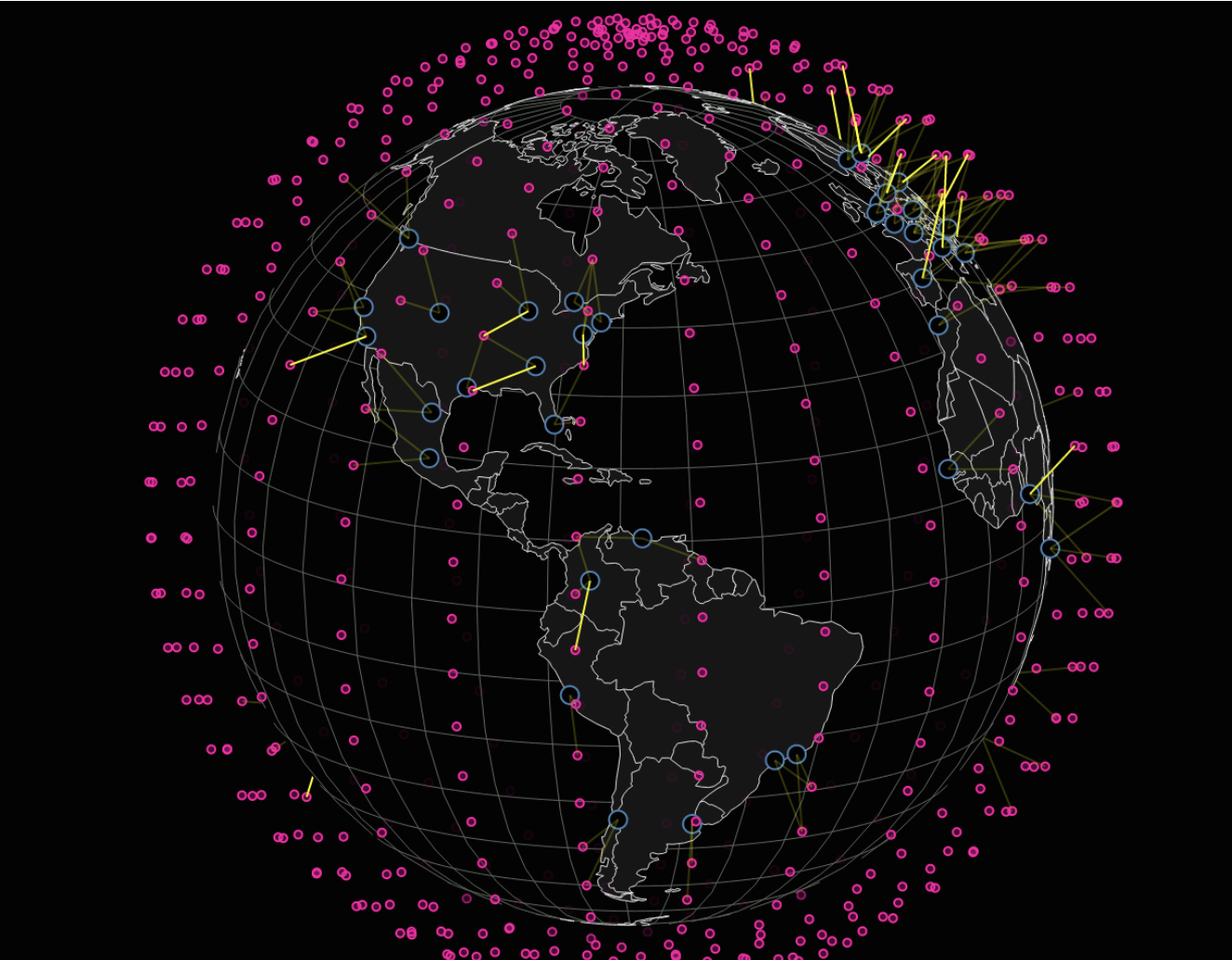
the same man who holds a disturbing dominance of global satellites via Starlink, Musk seems to have invited Carlson–and Trump–to help him enter a new space of media dominance. Already, state sovereign governments accused the owner of the network once known as Twitter of steering public discourse into a sovereign-free space by a Global Internet Satellite Network in dangerous ways. The network is perhaps designed to enable and feed off of, a new model for unrestrained public discourse, the likes of which we have never known, but will be augmented by 7, 518 low-earth orbit (VLEO) beyond 4,425 existing satellites, functioning as a cross-linked satellite system. If the social critic Roland Barthes prophecied with something akin to ecstasy that when labor-saving devices of the very sort that Musk’s self-driving cars promote would replace any need for work and “when progress will have rid men of every manual task, they will then to do nothing but discourse and kiss!” perhaps all they will actually do is follow. social media with bated breath.

Musk’s stated goals to make the social media platform X into the central staging ground and media feeding ground for the 2024 United States Presidential Election would be making use of Carlson–and of Trump, if in a quite mutually beneficial ways, suggests something like an alternate reality, surrounding earth with so much space junk to cause many astronomers to complain it is poised to compromise observation of far-off galaxies and nearby asteroids alike, weaving a web cocooning the earth’s atmosphere with the new litter of space junk: if geographer-artist Trevor Paglen warned geographers in 2016 to retool the focus of their disciplinary lenses on the immediate extraterrestrial pathways of satellite space, Musk forces Paglen’s cautionary argument.
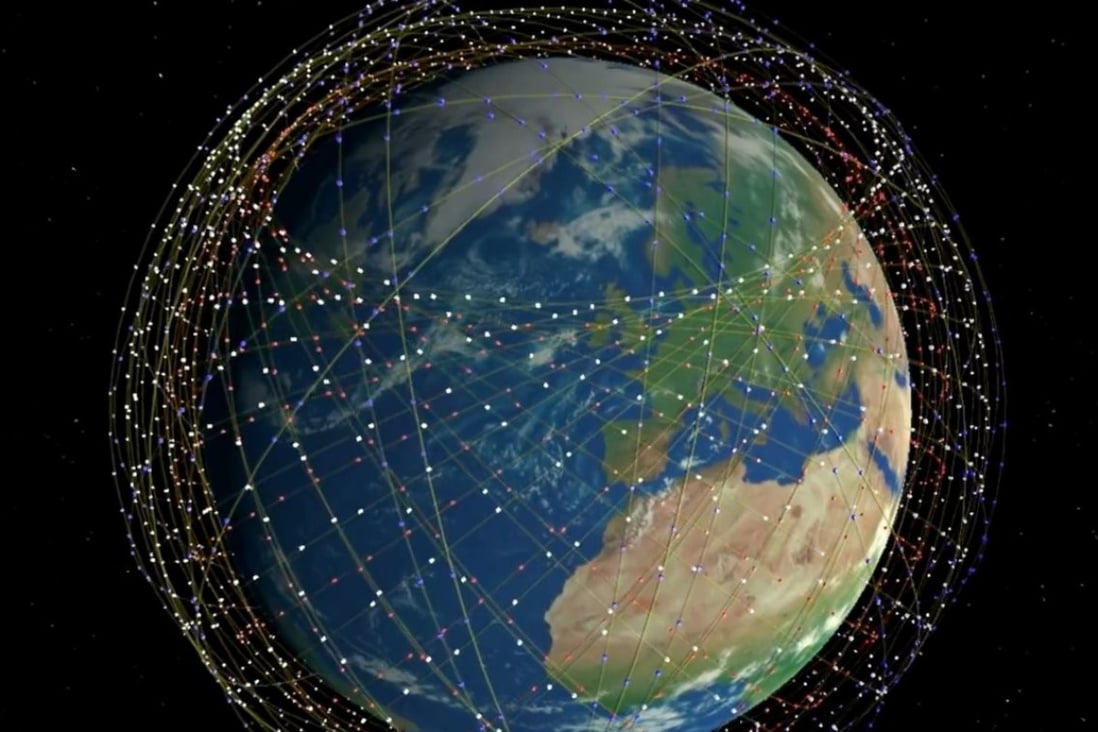
This illustration of Starlink, a fleet or constellation of internet-providing satellites designed by SpaceX, shows roughly 4,400 satellites of the project’s first phase deployed in three different orbital “shells”. Photo: University College London

Yet this business plan is far more than a conceptual art. It seems to strike at the heart of the news media system, and approach the predictive algorithms of psychographic profiling that Cambridge Analytica allegedly launched back in 2016, by opening up a free-for-all of communicative pathways.

Is this planned chaos? If Tucker Carlson’s decision may break his contract, it was a way of sticking it to his former employer. Many were surprised Carlson has continued to act as a center of gravity on “X,” posting interviews not affiliated with any broadcaster as if they offered uncompromising and unclouded evidence of “free speech” on the sole platform where it existed–X, as in SpaceX, a floating signifier able to carry any informational content. While the notion of a global lock on the news by a media elite is hopelessly outdated in an era of the fragmentation of monopolies by corporate news behemoths of a previous generation, the new libertarian owner of X has studiously tried to lead rapt listeners by a drip drip drip of insider news and heightened expectations for unvarnished honesty unavailable outside respected news channels–“More interesting than you think,” promoting the platform as “humanity’s collective consciousness,” deleting the ability to block other users, and hijacking other platforms. In rejecting formats of debate sanctioned by political parties or authoritative streaming service, Carlson was almost perfecting a cult of personality, more than the respect for the U.S. Constitution, that would of course appeal to the indicted former President, seeking to convince the nation he did not violate the U.S. Constitution, Donald Trump. (Trump pre-recorded an interview with Tucker Carlson to broadcast the first debate of Republican candidates for President on X, thumbing his nose at FOX executives by announcing he will miss the debate of a race for which he is front-runner, in a clever bit of strategic counter-programming designed to depress FOX revenues after they had let him go.) Although Carlson claimed to hate Trump “passionately” and “couldn’t wait” until the television network was able to ignore him, after a last-minute deal led Fox to cease broadcasting Tucker Carlson Tonight, Musk’s network fed the former President into Carlson’s new platform.

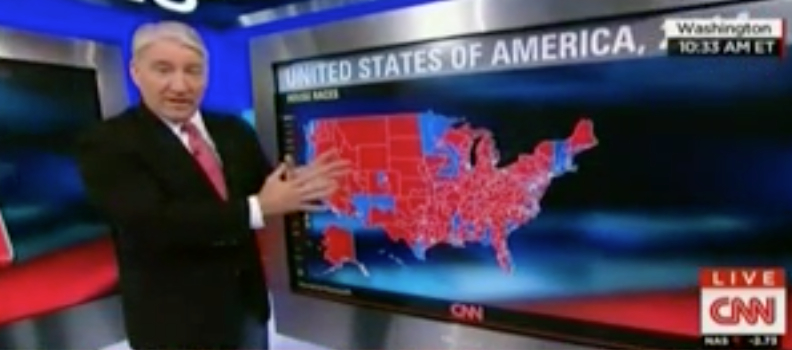
But if Carlson believes that he is entitled to continue to broadcast in Tucker on Twitter, claiming his continued “rights” to speak his mind to his base, having lost his broadcast platform, the lack of understanding individual liberty–and indeed rights–tell us more about his misunderstanding of rights–and the individual’s relation to the state in a democracy, even if he was talking about broadcasting more than “speech.” Carlson claimed that he had been ‘cancelled’ as if it were an honor and his destiny. “Tucker will not by silenced by anyone,” boasted Carlson’s lawyer assertively, as if going on the offense to guard the rights of a man whose “singularly important voice on matters of public interest” should be acknowledged to play a major role in the past as well as coming elections. Carlson’s lawyer claimed his client was in danger of being forced “be silent until after the 2024 election,” insisting that the broadcaster had every right to bond with the nation as effectively as that 2020 election map that froze ed and blue states into the logo of his NewsHour. The blurred luminous map that was the televised subconscious of the Republican Party was suddenly no more.

From decrying of “cancel culture” nightly, is it possible that Carlson “won the cancel culture lottery” by being able to port audiences to Twitter and outfox Fox? For Tucker Carlson, the dismissal from Fox was a slight that led the often over-confident anchor to be utterly confused: “I was first confused, and then shocked,” he claimed. “It was just, ‘We’re taking you off the air.’ No explanation why, and they’ve let me guess ever since. That’s literally all I know. I asked if I violated my contract. They said, no, I’m not fired, I’m still under contract.” The cancelling of Tucker’s airtime, he would argue in his defense, would cause damage to the nation, against the very constitutional freedoms that have defined the republic, might not be that absurd. While he suspected the “cancellation” was due to his strong opinions about the Ukraine War, rather bombastically linking himself to geopolitics with characteristic sense of disproportionate self- importance, noting that even if Rupert and Lachlan Murdoch “definitely didn’t like my views,” Lachlan, News Corp’s co-chair, was fine they disagreed. “The Murdochs were fine about Ukraine,” even if Tucker had mapped the conflict in curious ways that denied Ukraine’s sovereignty so blatantly they were rebroadcast on Russian state-owned news.
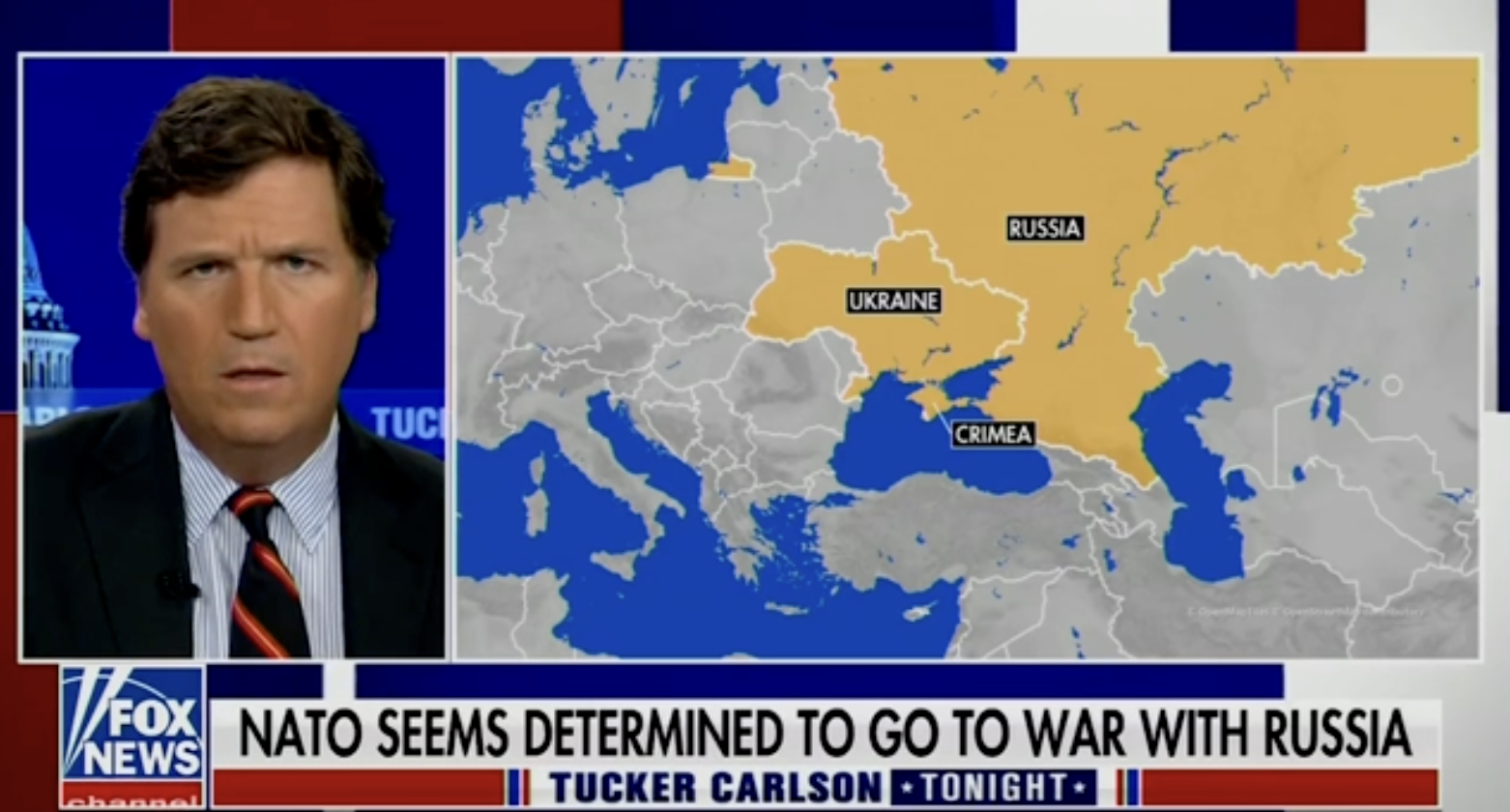
Intentionally sewing a cunning cartographic deception in coloring “Ukraine” and Russia by the same color–and not only Crimea–as if to dupe listeners into thinking the war a mater of secession, confusing the question of Ukraine’s pre-2014 and pre-February,2022 borders by arguing that Ukraine was unreasonably demanding “taking Russian Crimea from Russia” as a hostile act. In asking if NATO was “determined to go to war with Russia,” Carlson may have been exercising free speech, but was rather deviously and dangerously questioning Ukraine’s sovereign status. (Yes, Carlson had insisted, invading Ukraine would lead, as Russia said “many times, . . . would lead to nuclear war” and likened its Prime Minister to the “manager of a strip club” but was entitled to his free speech by his constitutional rights.)

In Carlson’s Fox Newshour, he had long decried how “fear of being ‘canceled’ due to unpopular political and cultural opinions or unsubstantiated allegations, often amplified with viral Facebook, Twitter, or Instagram posts, has become a serious issue in America.” Against the spectre of cancellation haunting North America, Carlson promised to tell audiences the stories of the victims most affected by it, presenting himself as the defender of a toxic cancel culture, found himself the most recently wronged star of the epidemic afflicting America, mutatis mutandi, rather than admitting past lies or apologizing. Rather than being a fractured shifting the newsmedia landscape in America, Carlson’s departure from FOX after six years was recast as typical of what was wrong with America, not the systemic lies about election fraud helped keep Trump’s cause alive.

This was now about his personal survival. Tucker Carlson long championed his role at Fox News as mediating the relation of individual to the state in a new electoral map. But his rhetoric reflected a disproportionate sense of self that seemed inflated by the podium Fox News had offered to address the entire nation, and to do so with the aim to magnify partisan divides. So much was suggested by retaining as an electoral map as the logo for the news show, which saw its survival as beyond any one person, and tied to nourishing and maintaining the new sense of national identity that 2016 had created with Carlson’s own help. With Carlson leaving the network, FOX seemed to have lost faith in the election map as an icon of the future, or the foundation of broadcasting, even if they had long promoted the Big Lie he had won the 2020 election. In getting rid of Carlson, they were cashing out of that long-iconi 2016 electoral map.

Carlson had become a global figure, far beyond the nation. He had relished this role as an icon of a movement beyond national borders, wishing “Godspeed” to all the Americans in Hungary as he bonded with the Conservative Political Action Conference that met overseas as promoting a fight that had begun at home as if he were a bystander in a conference that served as a platform for containing the “virus” of recognizing civil rights of migrants, LGBTQ, or the content of educational curriculum and, indeed, the press. The CPAC meeting of May, 2023 for which Carlson broadcast a prerecorded segment from his old FOX studios seemed a lovefest of sorts, as the Hungarian Prime Minister exlaimed “programs like his should be broadcasted day and night” in ways that only suggested Viktor Órban’s own tight control over broadcast journalism, as much as it recalled Soviet-style Cold War press beneath the blustery banner of questionable humor, “This Is No Country for Woke Men.” Cormack McCarthy, RIP.

Tucker Carlson Addresses Budapest CPAC Remotely in Pre-Recorded Statement, May 2023

The future conditional Carlson used to imagine his future firing in the segment he pre-recorded in the Fox Studios eerily anticipated his own actual dismissal from Fox News–Dominion Voting Systems already had filed its case by March, 2023, two months before Carlson spoke via video link at CPAC; it had perhaps already hinted–if this was never recognized as a demand of the legal settlement–that Carlson be released from the network. Tucker Carlson had already entered some legal hot water after parroting false claims of “massive electoral fraud” that seemed filtered straight from QANON screeds, in ways that had raised questions of how much Free Speech a broadcast journalist, if Carlson can be called that, enjoyed, even for Rupert Murdoch.

The global reach that Carlson’s news show had attained–despite its focus on American politics–suggested a pivot from the fomenting of electoral divisions that were made manifest in 2016 to a crusade of sorts that might continue unmoored from his old employer and old studio. The “pivot” was from a map of red versus blue states to anti-globalism, an agenda that’s been central to Carlson’s Twitter monologues on Ukraine, the truth of 9/11, and questioning the legitimacy of mainstream media. Tucker on Twitter became rebranded as a sort of Lone Ranger against globalism, as he had always been, to be sure, but was now holed up in his Maine house without the accoutrements that FOX had refitted in an old Grange Hall near his Bryant, Maine country house, as an improvised if convenient studio, but continued to tilt, a Sancho Panza for the new millennium, against globalist windmills–immigration; NATO; LGBTQ+ rights–snug in his own house in Maine seemingly from his own iPhone, where the Bill of Rights was pinned behind him on a rustic pine wall. There was something of a new mantra he seemed to have prepared for the new “show,” as much as the electoral map before which he had pontificated as he delivered the newshour in past weeks: “Free speech is the main right that you have. Without it, you have no others.” But this was not really a broadcast, or a news show, as much as the invectives of infotainment of another era.

Twitter was in a sense “outside the law”–or it least, this is what made it so welcoming in Carlson’s mind, as a terrain in which he might reasonably claim First Amendment rights–and Tucker indeed concluded his first monologue with a rousing pitch for Twitter as a platform to which all were entitled to spew lies.  “Twitter has long served as the place where our national conversation incubates and develops. Twitter is not a partisan site. Everybody’s allowed here, and we think that’s a good thing,” Carlson wound up his monologue as the all-new Tucker on Twitter, reminding viewers that even as he remained under contract to FOX News, that Tucker on Twitter was a guarantee of their own rights: “Free speech is the main right that you have. Without it, you have no others.” Twitter isn’t mentioned in Carlson’s FOX News contract–as Brian Stelter, the latest chronicler of the struggle between Fox News Network and American democracy, has suggested might inform Carlson’s own legal strategy. Carlson may imagine that his Twitter monologues are a form of Free Speech, tied to his public persona beyond any network, rather than an expansion of the invective-spewing persona of the character he cultivated on Fox News for alt right constituents. The fiction is that Twitter exists beyond the nation-state, as would please Elon Musk, and beyond legal enforcement of his contract.

For his part, Carlson groused on Twitter few platforms allowed free speech anymore, in quite strikingly globalizing terms,–Twitter was “the last big one remaining in the world,” he seemed to seek to embarrass his old employers, and maintain his bond to viewers by portraying the news network as yet another curtailment of American rights. Carlson celebrated his presence on Twitter–whose owner Elon Musk had already hoped would be center stage in all future elections–to play defense on his de-platforming, but boast that his appearance on social media would be a defense of his personal rights, as well as a protection of the nation. It is as if Musk had advised Carlson’s grousing as a way to invalidate a contract by which he was “prohibited from rendering services of any type whatsoever, whether ‘over the internet via streaming or similar distribution, or other digital distribution whether now known or hereafter devised.'” He felt he had a deeper bond with his audience, or to American voters, to be silenced in the political arena til 2025.

While Fox was forced to let go of Carlson’s highly rated show as an agreement in the recent Dominion case, in which his sustained denial of the 2020 election results and defamation of their voting machines was so central, leaving a $20 million salary was only part of the network’s $787.5 million settlement with the voting systems company–Musk must have been more than happy to scoop up the highly ranked news show was appealing to one of the few billionaire with a powerful hold on news information that reaches what is left of the public sphere. While Carlson accepted a severance package from Fox News, he seemed to continue to speak from an old place on the map–as a defender of specious rights, inexistent privileges, and imagined protections, more akin to the notion that January 6’ers were exercising their freedoms by entering the U.S. Capitol, or that former President Trump had a privileged relation to the law. While Carlson believes his Twitter account is protected Free Speech, he confuses his media presence and his right to public speech.

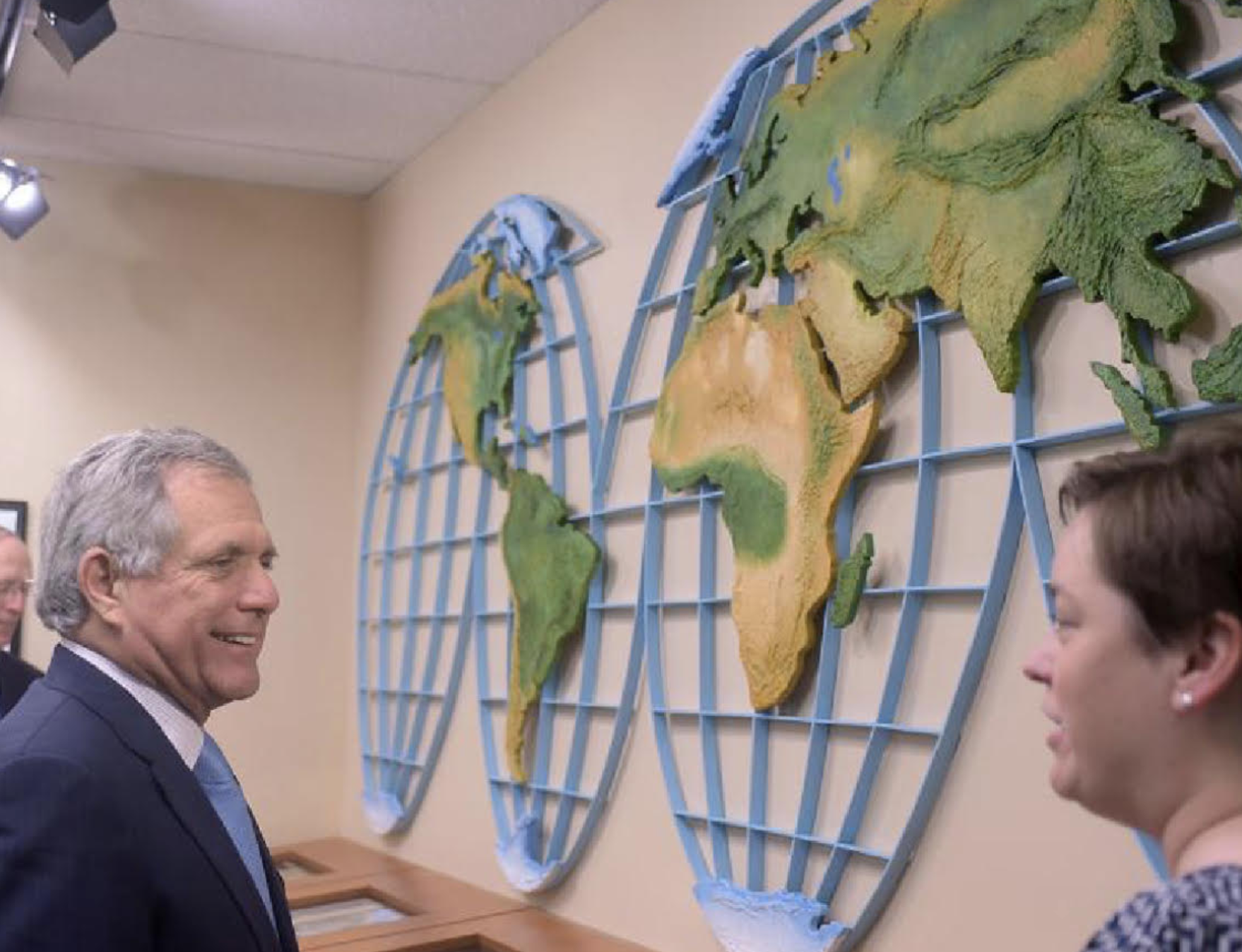
Fox News and Dominion Voting Systems deny they demanded the removal of Carlson from the cable network in their legal settlement. But Carlson is portraying his dismissal as a denial of his rights to free speech in ways Musk must deeply enjoy. After being kicked off of Fox News’ platform. The map before which his divisive news hour had long aired as the highest rated on air suggest the dedication of his show to the sharpening of the nation’s political divide, however, as much as Carlson grandiosely claimed his rights to Free Speech as a reaction to his sudden and surprising de-platforming. The logo of the 2016 electoral map might be seen as a sign of the relative provincialism of his successful news hour: far more significantly, it was a sign of his opposition. to “mainstream” news media. If the CBS evening news had refurbished the Mercator projection of the world before which Walter Cronkite had presented the news from 1962-81 as an image of moral probity, which the station would refurbish in 2018, after having in 2016 swapped it out for video panels, the world map that had long been an emblem of trustworthiness and impartiality–

–was quite quickly recast as informed by bias, in an American political landscape defined by division, rather retreated from claims of objectivity. By 2015, CBS News featured not the flat wall map before which Walter Cronkite had delivered the nightly news with some probity, modernizing it as an extruded map colored bright gold, to keep in line with the times of HDTV, the post-election package designed for the news was thrown out by Carlson’s Newshour, which flattened the world to red and blue states. The smirk with which Carlson was ready to gloss the map, often blurred as it receded into the background, became glossed every night for 2.7 prime time television viewers in 2017, in what might indeed be called a nation within a nation, and a significant voting bloc.

Never mind that CBS had started to use the revolving globe as its new icon of global news by 2009; Carlson’s map was a rebuttal of globalism, and global elites, cast against mainstream media and committed to revel the insidious interests by which the actual news in America was now defined. Tucker used an idea of Free Speech to deliver the unvarnished news, political beliefs born proudly on his sleeve, as Les Moonves of CBS celebrated a refurbished replica of the dimensional world map in a model TV studio in the Cronkite Memorial of Missouri Western State University in 2015.
This was not, of course, anything like what Free Speech meant, for the Founders. But Carlson cast his “deplatforming” as a violation of a foundation liberty. Carlson had of course recently re-aligned himself with “free speech absolutist” Elon Musk’s proclamation that Twitter was the new public town square of democracy. Tucker Carlson Tonight was dedicated to championing the freedoms Carlson championed on his long-lived show, whose life tracks neatly against the Trump Presidency, prolonged a bit by election denial into 2023, promoting freedoms that were portrayed as “under attack” from the left, while he assured his audiences that all other media “have succumbed to Trump hatred so obsessively . . . so much that they’ve begun to dislike the country that’s elected him,” rather than his open attacks on immigrants, civil liberties, racism and religious “freedoms,” and courting of the alt right. (The popular election of 2016 had of course tilted to Hillary Clinton: but, as seen in the header to this post, Carlson obscured that nightly, commenting on ‘news’ before a 2016 electoral map as if it revealed an actual national status quo.) The text messages admitting he “absolutely can’t stand” a former President who “could easily destroy us” may have seemed to destroy his longtime brand and public trust, declaring he long “hate[d] him passionately.” But Tucker Carlson flamed out in the light of the Dominion lawsuit.

Yet Carlson has continued to promote and his election denialism, calling 2020 a “grave betrayal of American democracy.” But he had undermined trust and credibility for the right, and as the attack dog on civil liberties that Fox News had birthed. Fox News sought to restrain his appearances on Twitter, Carlson announced he would never “be silenced by anyone,” as a lawyer leading the Center for American Liberty sought to defend his continued broadcasting on social media platform as protected by his First Amendment rights, and promoting it as a venue for his “response to the indictment of Donald Trump. The complicated story of how the Dominion suit involved the departure of Carlson from Fox News platforms led him to claim higher legal precedent, bizarrely claiming the infringement of his own personal constitutional rights of free expression, going it alone on Twitter as a confidence man of his own, even building a news room of his own in a work vest, plaid shirt, and axe, as if he were defining a new media frontier.

Carlson in his wood shop attached to his studio. (Gillian Laub for TIME)

Gillian Laub, Time

The ‘freedoms’ with which Carlson long aligned his News show did not only reflect his own opinions: Fox News promoted many of the causes promoted by non-profits of the right, as the Center for American Liberty, that promotes religious freedom, targets protests of Black Lives Matter, Covid restrictions, or gender-affirming healthcare, as a sort of ACLU in reverse, founded in 2019, in response to “anti-free speech” and “anti-civil liberties” trends, dedicated to “holding those who destroy our civil liberties accountable through the courts” and promoting “traditional Judeo-Christian values,” by pursuing suits against school boards, Kaiser Permanent, parental rights, alleged victims of Antifa violence, the vaccine mandate by suits intended to keep schools open, and indeed “Big Tech Censorship” that included both Twitter and PayPal as “oligarchs who threaten American values.” Carlson now elevated Twitter as a bastion of Free Speech in its new owner’s vision. (Tucker Carlson has incidentally elevated Twitter from ephemeral media to a repository of apparently considerable historical significance: his alma mater Trinity College features in Fall, 2023 a co-taught course in Writing, Rhetoric, and Media Studies departments, for which Carlson and Jesse Waters assign reading all of Trump’s tweets as a corpus, beside the post-Civil War inaugural of Andrew Jackson and Adolf Hitler’s Mein Kampf.)

While it was hardly new that Carlson acted aggrieved, as if his own rights to free speech had been denied, by recasting his own abusive behavior as a preservation of rights he seemed to tailor a new sense of free speech familiar to his demographic. The “denial” of free speech rights was a relatively recent bête-noire of the alt right. From calls to speak out “against the numerous attempts by college administrators to limit and attack students’ free-speech right” as “free speech zones” that were argued to restrict “a culture of free expression and develop in students a robust ability to reason” began a narrative of repressive left Carlson seemed to parrot. The multiplication of “free speech zones” at political conventions, areas of protest, or during the war on terror made the mapping of areas guaranteeing freedom of expression protected by the first amendment a contested concept of civil rights–isn’t the entire country a free speech zone?–and the emergence of “free speech zones” on universities have created real limitation of public protest and had restricted freedom of speech at over three-quarters of universities–even as judges have questioned the limitation of “free of speech zones” on campus, and legislatures in multiple states passed prohibitions that outlawed the establishment at campuses of “free speech zones” in conservative states suggesting the different natures of “free speech” in a starkly divided partisan map: Kentucky, Missouri, and Virginia became sites championing “free expression” and “individual rights in education” from 2014-17, as claims to “free speech” preventing restrictions on political or hate speech grew in the aftermath college protests of the election of President Trump. Legislatures restrictions on the curtailing of free speech zone polices, as a ballast to academic freedom,–

–in ways that alt right media like Breitbart embraced as a the rewriting of claims to free speech, claiming censorship by universities, as if to protect free political expression–even if such expression embraced incendiary anti-immigrant rhetoric–that challenged boundaries of “free speech” in unexpected and unprecedented ways that Carlson seemed to invoke more than the Bill of Rights had ever intended. While he cast his intentions as an echoe of the First Ammendment, Carlson’s own pursuit of polemics pleasing the alt right white supremacists was long known–it seemed he had targeted the demographic in attacking mainstream news–to provide alternative news able to unite an increasingly intolerant partisan political constituency that was as rooted in anti-intellectualism as it fetishized the freedom to hold hateful positions. Free speech was expanded as a megaphone of public address on social media, as the logo of “Campus Reform,” a news organization backed by the funders of Breitbart, dedicated to exposing liberal “bias and abuse” in American universities and colleges to delegitimize higher education around issues of free speech.

As the new terrain of “free speech” expanded from civil liberties to anti-immigrant rhetoric to Black Lives Matter to anti-vaxxers to mask-wearing, it embraced shelter-in-place policies in the COVID-19 pandemic, school closures, and public health responses before election denialism. Ever broader and broadened concepts of “free speech” became a surrogate for perpetuating persistently deep fissures in the body politic, boosted in no small part by Tucker Carlson’s news show on FOX. Tucker Carlson Tonight embraced an algorithm oriented to the distortion of free speech, and created a demographic that distorted free speech from the freedom of parents to protest school curriculum, as learning institutions were attacked as restricting abilities of open inquiry and “debate” by mandating reading lists. “Restore Free Speech Acts” had earlier emerged in local state legislatures to push back against such perceived restrictions. Carlson reached back in his recent relaunch on Twitter–his first appearance on airwaves after leaving or being let go from Fox News–to echo the image of a restrictive environment of free speech by those who sought to push the envelope of foundational freedoms and the Bill of Rights as protecting the open circulation of ideas online, and the end of “free speech zones” at universities that legislators had introduced back in 2017–more than the Bill of Rights that was framed in 1789. The partisan legislatures tied to red states, from Texas to Louisiana to Kentucky, vacated the “free speech zones” on university campuses, long before Donald Trump.

States Where Bills Preventing Campus Restrictions on Free Speech Were Introduced, 2017/Campus Reform

Maps of free speech seem to have broadened to free speech zones in the media, often adopting notions of free speech not based on expression but social media platforms and the fears of a restriction of political speech in a specter of de-platforming. Broadened claims for the protection of free speech was condensed to an electoral map every night on Tucker Carlson’s popular news hour. As Free Speech was rooted in the algorithm that brought his messages to millions and reached the right audiences, invoked against deplatforming, as if his sprinkling of volatile statements designed to open a greater cleave in the electoral divide was rooted in a freedom to collapse complicated and considered political debate into an ongoing strategic battle between two parties and ways of life. To be sure, this was “free speech” as understood in terms of a search for ever-higher ratings, a “free speech” that was in a sense modeled after alt right journalism, coopted by @realDonaldTrump, “liberties” easily seen as shaping a battleground for electoral votes.

What Painted Us So Indelibly Red and Blue?

The understanding of “fundamental freedoms” that expanded the electoral footprint for partisan ends was a great feature of his Fox Newshour that was embraced by Lachlan Murdoch and Rupert Murdoch, until the Dominion case. As much as due to unethical improprieties, the settlement with Dominion seems to have stipulated that Carlson cease to appear on Fox News, who curtly if promptly decided to “thank him for his service to the network as a host and prior to that as a contributor.”

Tucker Carlson sought to stake out somewhat familiar higher ground. Carlson’s post may have channeled Musk, who cast his social media network at the center of a “battle of civilization” in promoting Twitter-without-monitors as a vanguard of free speech, tweeting out, “if free speech is lost even in America, tyranny is all that lies ahead”! As Musk tried to represent or rebrand social media without constraints on hate speech or disinformation as American, issuing the latest iteration of his Messiah complex on his private social media platform, gaslighting the nation has long been Tucker Carlson’s principle trade. Branding of the social media platform as a venue for free speech may have been suggested by Musk in an invitation of Carlson–the most offensive of pundits–to the social media platform. Carlson waxed elegaic on free speech as the rarest commodity, affirming dedication to protecting speech though he lost the platform of Tucker Carlson Tonight, the highest-rated show on Fox, as if his departure his new venue was his free choice, or a changing media landscape, not how his own alienating comments and actions left him damaged goods.

The global scale of Carlson’s claim about Twitter was absolutely self-serving, to be sure, as much as an illustration of Musk’s uniquely deceitful brand of “free speech absolutism.” He sought to flatter Musk, his new platform’s host and sole proprietor, and to offer a powerful dig at Fox News, by upsetting the algorithm in his own favor, as if he were able to wrest it back from the Murdochs by becoming his own media figure, so much as Twitter offered him the chance. He claimed to have thrown his lot the last remaining safe space in media, and turning his back on television in disgust. Carlson was long habituated to rail against the media, and offer the alternative story of the disaffected and aggrieved. But this time, aligning himself with a “free speech absolutist” eager to attack Twitter for “failing to adhere to free speech principles” as a platform before purchasing it, and doing so only to make it a “public town square” of democratic value. Yet he fired all objecting to his corporate policies and politics, if he felt censorship of a social media platform was unethical. The two-faced nature of Musk firing employees he disagreed modeled ‘free speech’ as a fundamental freedom born of a social media ecosystem.

Long before Carlson’s revisionism of the January 6 Capitol riots, calling “mostly peaceful” the violence begun as President Trump dramatically enjoined crowds assembled before the Capitol building to “fight like hell” to contest 2020 election results then being tabulated by Congress, Carlson forged the combative nature of “free speech” as a pragmatics of perpetuating hyper-partisan social divisions of a sharply polarized nation in alt right media as the Daily Stormer. He perpetuated divides displayed in a dated electoral map of 2016 as a battlefield map on the new show premiering after Trump’s inauguration in 2017, as a realpolitik of broadcasting. When Kevin McCarthy gave Carlson secret footage of the Capitol Riots to allow viewers “to see the truth” of “exactly what transpired that day” in a “media exclusive,” he perpetuated claims of election fraud he claimed protected by a freedom of speech. And if the riots were dedicated to the resetting of a historical narrative and apparent shift of legitimacy–a shift of the historical understanding of the nation, oriented not to 1619 but to 1776 or 1492, the historical recreationism of January 6 was not cosplay but a rectification of revolutionary time,–a restoration of white men in Washington, and a right to bear arms, and to restore racial supremacy, all of that was embodied by Tucker Carlson.

Although he had hosted a news show for six and a half years since Trump’s election, before a map of the fragmented nation polarized by partisan divides; free speech, he suggested, no longer existed on mainstream media. However, he was without the tell-tale map that was a longtime logo for his news show–a news graphic of 2016 that had become the permanent illustration of the status quo he sought to address, and to filter all “current” events, as if in a time warp from the 2016 Presidential election, that showed the country divided, or nation split, into two sharply divided nations, hued red and blue, that formed the perspective to which his commentary was addressed. Immediately after Trump’s inauguration, Carlson was broadcasting live from Washington DC, promising to guide the nation on “a live hour of spirited debate and powerful reporting each night, as America gets set for the administration of President Donald Trump,” while only addressing half the nation. While preparing perspectives on news able to “bring you to every corner of America to hear from you and tackle the issues you care about” engagning “what the other outlets are missing and what the media isn’t telling you,” Carlson’s brand was to supplement the mainstream media by dedicating himself to “calling out the status quo in his signature style,” using his status as founder of The Daily Caller to reach a large 2.8 million since starting to air, and gaining viewers across demographics by speaking to a divided United States electorate by presenting issues through the fierce urgency of now.

Or was this an image, a counter map of the traditional newsman that showed the planet since the studio of Walter Cronkite, a representation of the new limits of the expansiveness of free speech? The visualization of the continental United States–the lower 48, and the continuous heartland at its center–offered an image of belonging that was talismanic for the TV audience, and a powerful image of belonging in an increasingly atomized United States, bowling alone and with few ties in its neighborhoods. Carlson was its prophet and its oracle, and effectively ventriloquized the divides with such success that he had become a channel for Donald Trump himself. Despite his affirmation of the stolen election, and the credence he gave to January 6 protestors, without that map Carlson was suddenly weaker, suddenly punctured by the actual news.

Carlson’s celebration of his relation to the partisan position of the former occupant of the Oval Office and to the Trumpian talisman of his news show was far less powerful, even after January 6.
Tucker Carlson strongly criticized for Jan. 6 comments after airing footage  from Capitol attack - CBS News

The map of the Lower 48 was a nice means to deny global warming, to ignore weather maps, or international politics, and even the real pressure migrants face. It was an image of the New Isolationism, America First for the twenty-first century, an image without rising temperatures, sea-level rise, or global economic forces beyond Americans’ or America’s control. Yet in a few weeks, Carlson was deemed a social liability by Rupert Murdoch, after winning unprecedented ratings as Lachlan Murdoch’s darling, as the Dominion lawsuit unwound and his own indefensible offensiveness was revealed. In a departing dig at Fox News, as well as an encomium to the social media platform he was about to join. Yet without the map of a permanently divided landscape of politics, promoting a polarized landscape split by partisan hues as a different reality, the values that Carlson was suddenly so desperate to fall back on–the Bill of Rights–as a language of the aggrieved was all too inappropriate and far less credible or effective. A trademark of he tried to remind his most loyal viewers that “Speech is the fundamental prerequisite for democracy”–as if speech were the same for the Founding Fathers as in an age of de-platforming, claiming a right of redress as an aggrieved media pundit, hailing Twitter as a unique preserve of republican liberty. (This much must have come as music to Elon Musk’s ears, who convinced Ron De Santis to declare his own candidacy on the medium–even if that didn’t go so well. But it didn’t break Twitter.)

Tucker Carlson may have had few grounds to claim free speech was violated, but there was of course a clear precedent for claiming such rights of free speech. For this formed the grounds by which Fox News lawyers had quite successfully defended him in a recent defamation case brought by Karen McDougal, who Calrson had treated as a punching bag while at Fox News with something like barely concealed glee. Fox News lawyers had successfully argued Carlson was in his rights to speak derivatively of McDougal, the 2020 verdict of a federal judge agreed, as no “reasonable viewer” could be expected take his show literally–he was, it ruled, “not ‘stating actual facts’ about the topics he discusses and instead only engaging in ‘exaggeration’ and ‘non-literal commentary.'” The successful dismissal of claims of slander was made on the grounds that “Mr. Carlson’s statements were not statements of fact,” and could not be interpreted as defamatory as such. The indefensible on-air statement that McDougal had “approached Donald Trump and threatened to ruin his career and humiliate his family if he doesn’t give them money,” as if she were an extortionist. (The court ruled Carlson’s words could not be interpreted as slander, or containing “malice” as but, as FOX lawyers argued, “delivering opinion using hyperbole for effect,” in an odd echo of how Donald Trump advocated “truthful hyperbole” to negotiate good deals in his 1987 Art of the Deal.)

Carlson seems to have accepted the verdict as a sort of license of his defensible rights to issue slanderous broadsides by converting political debates or even personal actions into the crisp colors of a partisan divide, a divide that was embodied as it had never before been by the very electoral map he used as a backdrop if not leitmotif for his show since its 2017 premier on Fox. He had staged a nightly news show to gloss the partisan divisions of a polarized landscape as the new status quo, harping on cultural resentments that divided the nation by district and county, as they existed as his show began, as an electoral landscape he would perpetuate and perhaps expand, and reinstate beyond the divisions of 2017 as a permanent map by which to understand the news–and the place of the nation in the world. Keeping open the sharp divides of a seemingly “continuous” red block and fractured blue in place was the grounds for his daily show, and the work of perpetuating the map had become glossed as a form of free speech.
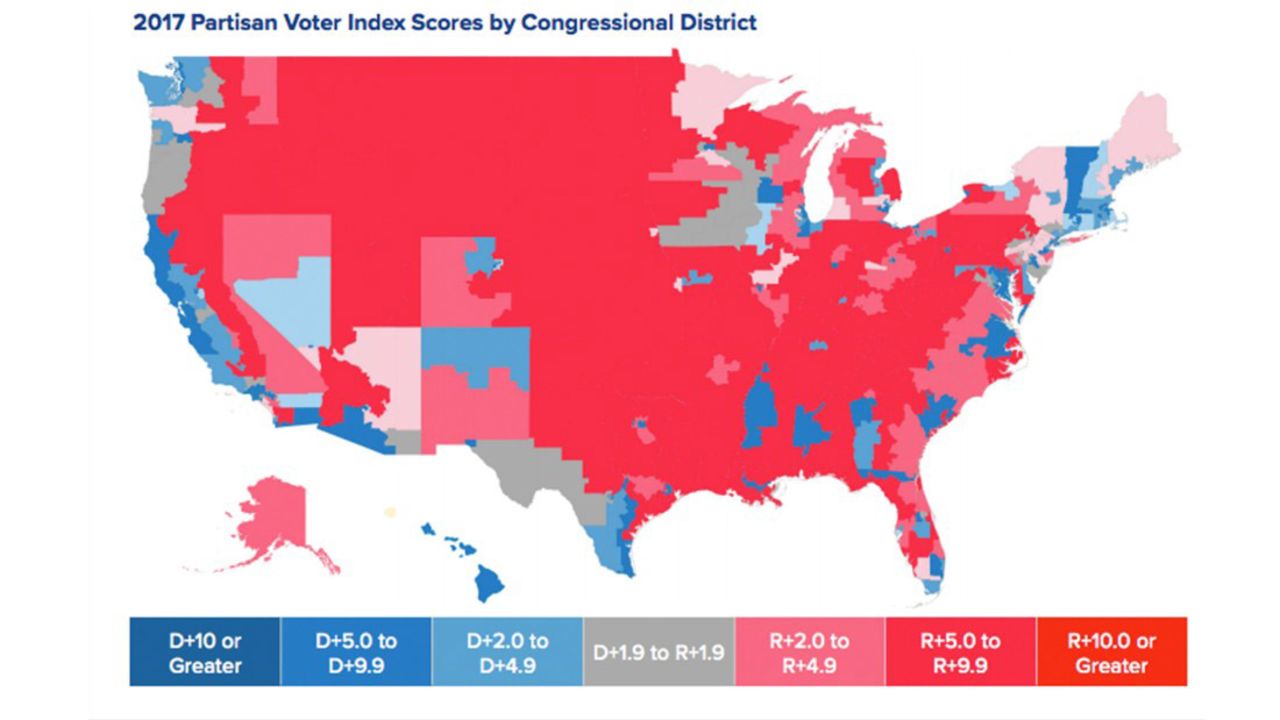
cook report map 1

 Cook Political Report, 2017 

Having left the highest rated show on cable news for huffing it on his own, he invoked his rights to free speech again, as he attacked mainstream television itself. This time, his status as an outspoken commentator was infringed by his former employer, it appeared. He sought to invite his audience to follow him onto the new Twitter platform, as if it was a preserve of free speech. He had discussed the infringement of rights–from the rioters of January 6, whose peaceful invasion of the Capitol he culled from exclusive footage of the thousands of hours Kevin McCarthy granted of “secret” footage that day, to Donald Trump himself–in recent shows, using free speech as a sacred cow. The protection of freedom of speech that Carlson had conspicuously denied Black Lives Matters protesters–who he disparagingly cast as a mob whose violence that threatened the nation–clothed both January 6 protestors and his own show. Never mind that Representative Zoe Lofgren, D-CAL, who had served as a member of the January 6 Committee, felt that Carlson’s broadcasting of the footage “a road map to people who might want to attack the Capitol again.”

In presenting himself as a champion of Free Speech, Carlson claimed the higher ground, as if his constitutional rights had been infringed, in ways that were not only aggrieved. Of course, his rights to speech were quite from curtailed–he was an evangelist of the right whose outspoken claims made him a darling of liberty at the Turning Point USA’s AmericaFest,–

–and he had become an international figure of jet set global conferencing with national leaders outside the United States, at the first meeting of the Conservative Political Action Committee outside of the country. Carlson had delivered speeches at the invitation of right wing anti-immigration strongman Viktor Orbán, whose cry to “take back the institutions in Washington and Brussels” led him to summon Tucker Carlson to Hungary as he sought to remake it as a bastion of conservative Christian values long before 2021, quenching the opposition media and openly urging audiences to stand up against the “rule of the liberal media” as a form of “Conservative resistance to the woke revolution.” Of Orbán dressed outrageous ethnic nationalism as a form of libertarianism, he seemed to have ripped a page from Carlson’s rhetoric, taking him on a helicopter tour of his own “border fence” that led a perhaps mystified Carlson to return the favor by calling Hungary “a little country with a lot of lessons for the rest of us,” terrifyingly gestured to the media monopoly that Orbán created in his illiberal democracy that silenced all opposition in the nation.

Carlson suddenly found himself suddenly an international media star, basking in the attention he won overseas from a man who was an icon of conservative demagoguery. Orbán’s extreme hard-line policy of rejecting asylum- seekers was an outlier of liberal democracies indeed–which Carlson eagerly promoted as a model for American immigration system he calls far too lenient and argues was poised to weaken the power of native-born citizens in ways that aped White Supremacists. Was this a watershed in his defense of what he called free speech, or a new height of self-deception? Carlson’s 2021 visit to Budapest followed a range of anti-LGBTQI laws by the Hungarian parliament, issued to help Orbán cling to power in ways that rested on a profound rewriting of the mediascape of the nation: the refusal of legal recognition of transgender people in Hungary, and enshrining birth sex in Hungarian law, ws normalized transgender discrimination that culminated in bans on any application for change in gender recognition by 2023–legal barriers to gender recognition that became widespread in much of the United States (more alter). When Carlson was forced to participate remotely In the 2022 meeting of CPAC in Budapest, he vouched “I wish I was there in Budapest,” adding in terms that now seem irenic that “If I ever get fired and have some time and can leave, I will be there with you.” (Carlson had found virtues in Hungary’s limited free speech–Orbán has clamped down on media coverage of the Ukraine critical of Russia, as if Trump could end the conflict–“Come back, Mr. President, make America great again, and bring us peace!”–that he blamed on the United States as CPAC imitated Hungary in allowing only alt right journalists to cover the event, rather than the Associated Press.)

Fox News’ Tucker Carlson visits Prime Minister Orbán in 2021/Office of the Hungarian Prime Minister

Prime Minister Viktor Orbán’s policies in Hungary against trans people and gender reassignment has made him a hero on the alt right, a weird affirmation from afar of a charge against “global progressive elites” who promote immigration, transgender and LGBTQ+ rights, bundling them as a “virus” in need of being defeated by a “Christian conservative turn” that offered a model for how right-wing culture might defeated and dispatch “woke” agendas in its defense as a bulwark of Christian democracy, conjuring Hungary’s historical role as a buffer-state of the Austro-Hungarian Empire against Islam. The ban on public depictions of homosexuality in Hungary or any promotion of sex education became a way to for Orbán to emphasize his protection of Christian values: “No Country For Woke Men,” read banners at the CPAC conference he hosted in 2023, proclaiming his nation an “incubator” of “the future of conservative policies” world-wide to energetic applause. (His censorship of the media were elevated as a model for American CPAC leadership who vowed to “go Hungarian,” deciding “who is a journalist and who is not a journalist” for entry to their events, as universities were transferred to being run by Orbán cronies to silence free speech.

Hungarian Prime Minister Viktor Orban addresses a keynote speech during an extraordinary session of the Conservative Polit...

To be sure, to cite a recent news maps of the change that has swept across America of Orbán-like doctrine, mental health was thrown to the winds by the broad imposition of restrictions on gender identification, as a slew of “red” states have introduced restrictions on gender-affirming care across the nation, per the Guttmacher Institute, crating a cleft across the nation of the Orbán-esque policy by enacting outright restrictive transgender laws or curtailing care for trans teens in states over the past two years–a new hot-button issues to motivate to intensify political polarization by invasive restrictions on competitive sports, restroom use, and other health care. The adoption by state legislatures of restrictions and protections a new front of divisive polarization of increasingly sharp lines, as a terrifyingly contiguous block of “red state” litmus tests of knee jerk variety now threaten to return critical swing states–Georgia; Florida; Arizona–into a hard conservative fold.

But the national political struggle is perhaps less the point than the harm inflicted upon some thirty thousand kids in Arizona, Florida, and Georgia who may be destined to suffer psychological harm. The laws against transgender identification in America, echoing Carlson’s false charge that transgender people are targeting Christianity–and “the natural enemy” of Christians, arguing that gender-affirming medical treatments are “chemical castration” by 2022 that was protected by the U.S. Constitution, after the White House criticized states’ criminalization of gender-affirming care. Carlson’s statements echoed Orbán, but also pushed the envelop on free speech as medical care for transgender was revealed as a macabre Grand Guignol theater: “Slicing off a child’s sex organs, preventing a 12-year-old from going through puberty, that’s not ghoulish and dangerous and horrifying. No, it’s not. It’s ‘gender affirming health care.’ Indeed, it’s all we’re now calling a best practice.” And after Arkansas banned puberty-blockers in 2021, a potentially life-saving intervention, as endangering children with long-term medical side-effects, encouraging local legislatures to oppose them, giving a platform to anti-trans authors without any medical qualifications or experience, to shape public opinion on gender-affirming medical treatments as reliant on “massive, massive doses” flooding the bodies of young children who become “cash cows” for the medical establishment, but are not seen by doctors–casting trans support as abusive parenting “irreversibly damaging their bodies.” (Gov. Greg Abbott of Texas obligingly took up the charge in a directive declaring gender affirming services provided youth could constitute child abuse as “abusive procedures” in early 2022, echoing bans on gender-affirming surgery in Alabama, Arkansas, and Arizona.)

The map of outright bans on gender-affirming care suggests an echoes of the red state map, to be sure, with the “heartland” of America from the Dakotas to Iowa down to Arkansas and Tennessee and the Deep South constituting a local legislative block against gender reassignment practices, as transgender healthcare coverage by Medicare in America has become a prominent partisan divide, as the call for “protecting” children by preventing transgender treatment have grown in America–

–in ways that stand to place many who identify as transgender at risk, following the bullhorn of Carlson’s openly wrong condemnation of transgender care as a violation of Constitutional Rights.
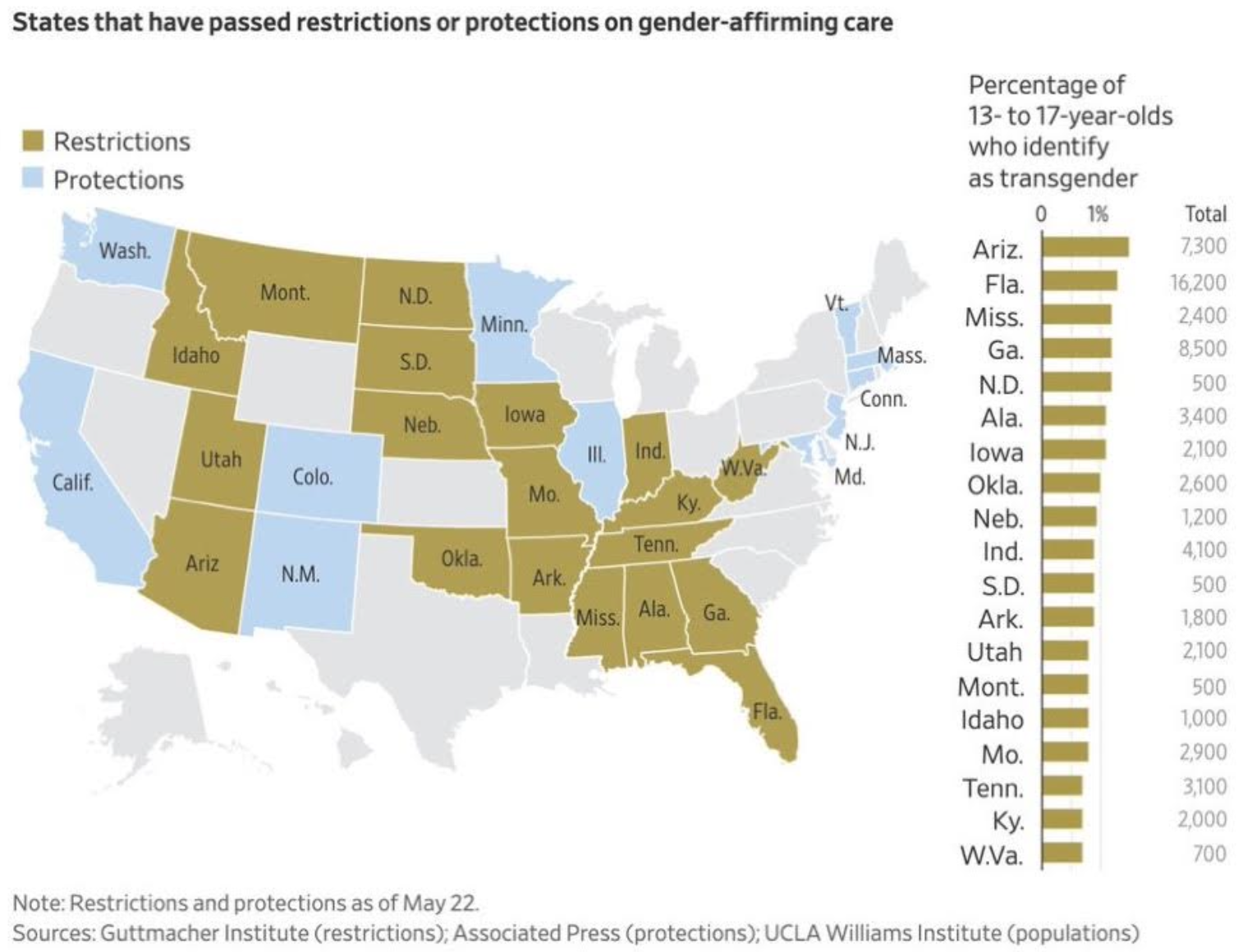
 Peter Champelli

Yet Tucker Carlson tried his darnedest to cast himself as aggrieved from his Maine country house, defending his ideological ground from an outpost of broadcasting on Twitter. To be sure, Carlson seems to have accepted a legal right to free speech to warn Americans of the dangers of immigration, terrorism, and feminism, in ways that mirrored the redefinition of “free speech” that had bloomed on the internet and among alt right media, and was recently articulated by Fox News lawyers who beat back an earlier charge of defamation brought by Karen McDougal against Tucker Carlson Tonight. The success of Fox News lawyers defending Carlson’s commentary not as truth but as “non-literal commentary,” boosted when federal judges dismissed the defamation suite, accepting the preposterous defense that the 3.2 million viewers his show nightly attracted did not understand them as “statements of fact” or “actual malice,” may have boosted Carlson’s sense of his own free speech. However implausibly, Fox lawyers had successfully argued his words “cannot be understood to have been stating facts, but . . . delivering an opinion using hyperbole for effect” that the District Judge Mary Kay Viscocil had affirmed.

The lawyers’ argument recalled Donald Trump’s defense of using “truthful hyperbole,” with a twist. In deeming Carlson’s speech to be “‘loose, figurative, or hyperbolic language’ that does not give rise to a defamation claim,” the judge agreed a reasonable viewer of Tucker Carlson Tonight “‘arrive[s] with an appropriate amount of skepticism’ about the statements he makes,” as if defamation were not the stock trade in the show. In agreeing to the new nature of hyperbolic speech, District Judge Viscocil effectively defended Carlson as a disseminator of defamation and rumor for the growing rumor mill of the Trump Era. But Carlson’s broadcasts had worked to shape dissensus on a scale that echoed how the Roman poet Virgil called Fama “the swiftest traveller of all the ills on earth, thriving on movement, gathering strength as it goes.” Over six and a half years, Carlson had nightly delivered invective that was perhaps “at the start a small and cowardly thing, it soon puffs itself up, and walking upon the ground, buries its head in the cloud base,” or the air-waves, the “swift-footed creature” of rumor escaped judicial sanction as pure hyperbole, as rooted in “exaggeration” as Donald Trump’s own claims, rather than “stating actual facts.” AlthoughTrump had famously counseled “truthful hyperbole” as a form of “innocent exaggeration” in The Art of the Deal (1987), Fox News seems to have expanded the effective business practice to news broadcasting, defending Carlson’s “hyperbolic language” to be protected as free expression, no matter how incendiary or vindictively dismissive it was.

The admission of hate speech and denigration as a form of “free speech” set a new standard in the weaponization of speech against the electoral map in which partisan battle was energetically waged no holds barred, going full Hungarian, to cite CPAC. If such hyperbole was but the stock-in-trade of Tucker Carlson’s on-air fare, Carlson’s partisan commentary had sped hotfoot through the country, intentionally, crying news not rooted in actuality, or anywhere but partisan reality, but in what we had come to expect on Tucker Carlson Tonight. For Carlson had already explained that immigrants made the United States “poorer and dirtier” (December, 2018), as the protests after George Floyd’s killing were “definitely not about black lives” or justice (2020) Yet FOX lawyers cast the dismissal of defamation charges both a “victory for FOX News Media and or all defenders of the First Amendment”–as if they fit the Free Speech protected by the U.S. Constitution. Such lowered standards of speech enabled Fox TV lawyers to suggest that viewers’ expectations for “truth” from Carlson’s brand of commentary had diminished, and one could not expect him to be prosecuted for going overboard–the argument was not, in fact, about free speech, but the lowering of standards on broadcast news that painted Carlson as not speaking the truth at all.

This quite broad interpretation or inflection in historical arguments about free speech was perhaps born online. It was first prominently set by the distortions by which Campus Reform, affiliated with Breitbart, appropriated Free Speech in 2020, litigating that “free speech” zones at university campuses to protect political proselytization–akin to the zones of political protest that emerged in the 1980s and 1990s for protest activities–but now against the restriction of conservative speech. The redrawn “protections” of campus speech mirrored “red” states or states with sizable “red” constituencies, North Carolina to Georgia to Michigan to Wisconsin to New Hampshire to Virginia–

Introduction of Legislation Protecting Free Speech at Campuses in Reaction to Universities’ Restriction of Political Proselytizaiton

–and had created a striking division by using state legislatures to “open” university campuses to conservative ideologues, a mission that escalated after Donald Trump’s election. The dispatching of talking heads from the alt right–Anne Coulter; Milo Yiannopoulos; Ben Goldberg; and other online trolls–raised the bar on ‘free speech’ and adopted it as a logo for conservative causes, in an attempt to staunch an electoral divide.

The citing of free speech as an outcome of Tucker Carlson’s defamation trial was nothing less than a feather in the cap of alt right media. Campus Reform had long sought to “expose the liberal bias on America’s campuses”–of which many universities seemed guilty as charged–to protect conservative speech and learning at college education after Trump’s election, following protests after Trump’s election on college campuses. The rallying cry that “The radical left will stop at nothing to intimidate conservative students on college campuses” animated the movements of protecting Second Amendment clubs in Utah, Free Speech Balls in Mississippi, and other conservative activists interested in sponsoring ideological speakers.

Tucker Carlson accused his past employer of ‘de-platforming’ the voice of conservative America, and limiting his broadcasts–even if the notion that he had crossed a line in the broadcasts was less compelling than the sexist private behavior and a bevy of texts that the new defamation suit uncovered red. Carlson invoked the term ‘free speech’ in the context of broadcasting, to make a point quite different from the definition of free speech in 1789–but far more akin to the earlier defamation suit that viewed his show as “loose, figurative or hyperbolic language.” When Carlson recast himself as aggrieved by the mainstream media, he hinted his dismissal reacted to the bravery of his vigorous election denialism. But his liability had grown. Carlson’s new texts reviled Donald Trump in a language not seen on air reveal a level of contempt for a man he characterized as a “good at destroying things” and as “a demonic force, a destroyer,” before whom he needed to stay alive: “But he’s not going to destroy us. I’ve been thinking about this every day for four years.”

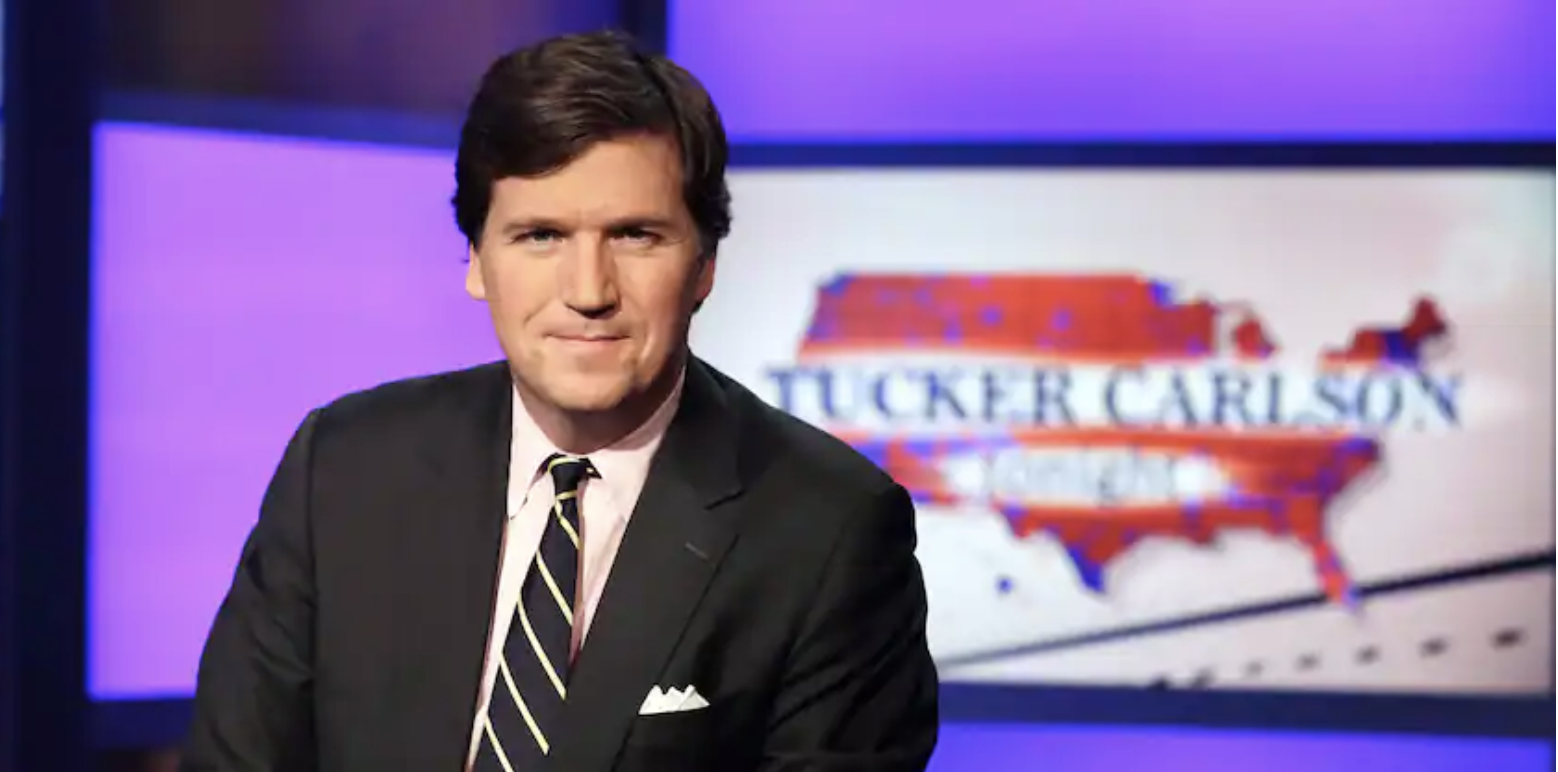
Yet Carlson had himself destructively sewn discord to destroy the civil fabric of the nation, however, which became the main currency of his own show. Even as he claimed to be within his “rights,” Carlson pushed the envelope to create a racist, invective-filled shows on cable news, espousing replacement theory as a danger to the character of the United States that aped white supremacism. Before the split map of red and blue counties of the 2016 election, he perpetuated the gap between parties as destiny, reprising themes of the Trump campaign and promulgating new resentment. The map before which he delivered the news became a banner of election denialism. Delivering “news” before a blurred electoral map–a map so iconic among Republicans to not demand detail–the backdrop for rosy-faced invective on Tucker Carlson Tonight. This post unpacks the persistence of this map on Fox News as a backdrop for Carlson’s version of truth-telling in opening monologues broadcast nightly from November 14, 2016, to April 21, 2023–as if it were a static screen to which Carlson sought to orient viewers, freezing the 2016 electoral map in time.

Tucker Carlson, host of "Tucker Carlson Tonight," poses for photos in a Fox News Channel studio...

Fox News Channel March 2, 2017, in New York/Richard Drew, AP

While the red swath had grown far less monolithic in the early hours of the tally of the 2020 election, in ways that might have seemed to warrant a challenge to Carlson’s logo, the map of 2016 was an icon for the “news” hour, the logo was so iconic that it had not changed,–even as the recent election suggested an opening in the monolithic division of blue and red states, and a more closely divided vote indeed. But as election denialism continued, Carlson had clung to the 2016 map, which occupied a central place in the ideological bent of his viewing audience, who saw that victory as a new road map for partisan identity–even as the states seemed to break in a different manner. Indeed, the early results on the “magic walls” on interactive news screens quickly reconfigured the logo that Tucker Carlson had used as the back screen of his nightly partisan broadcasts.
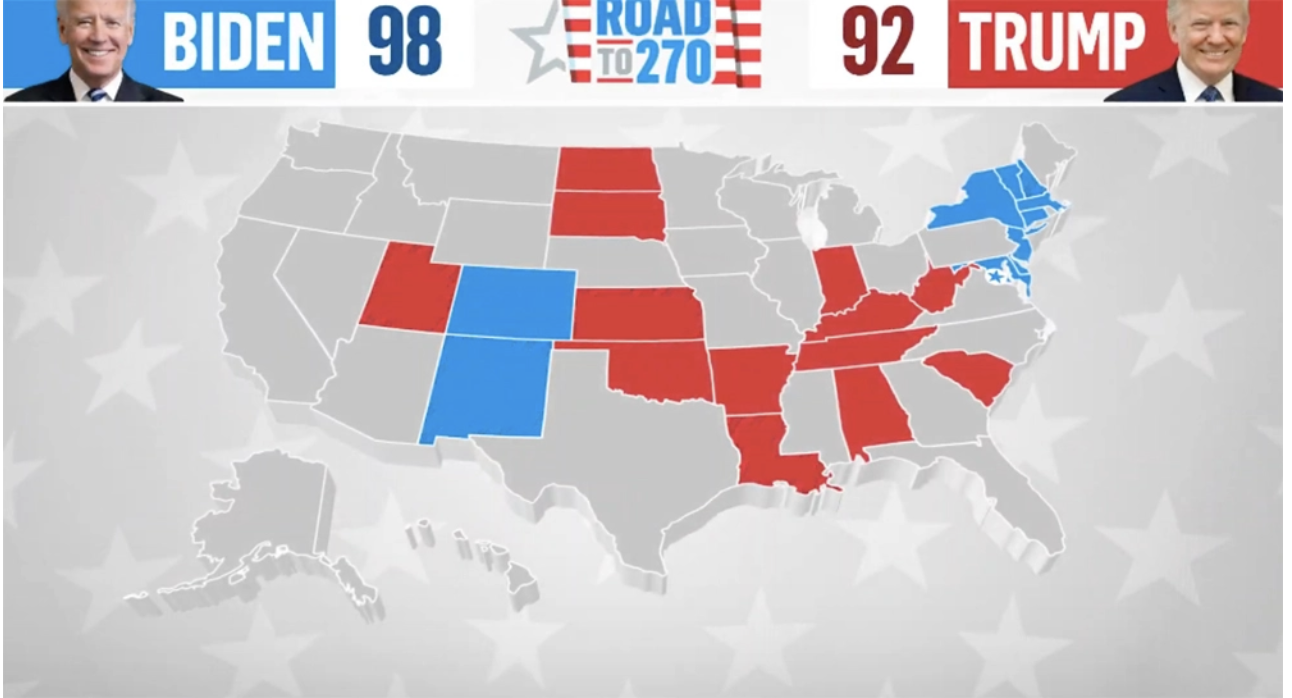
Magic Wall on NBC News, Election Night 2020

1. Tucker Carlson seemed more florid and a bit unnerved on Twitter, a bit faded after all those broadcast, a bit less animated, before a framed Bill of Rights, with far harsher lighting. He claimed himself ready to confront what he cast as a moment of media crisis in which he was not involved. Bereft of the logo of the nation as it was fragmented by electoral politics in 2016, split in “blue” and “red” counties as if it contained separate nations, the aggrieved news commentator seemed trying to convey an air of normalcy, hunkered down in a house as if sheltering in place.

Safety, and indeed free speech, had been imperiled by the liberal state. Protection of an imperiled democracy offered a rationale for broadcasting that was indeed akin to January 6, as if an insurrection was being live cast direct from Maine, in what seemed Tucker Carlson’s summer house, a site of safety and white purity, far from the current partisan wars, but also command central for waging them. In granting the possibilities January 6 rioters who entered the Capitol were only exercising free speech and rights of assembly, Carlson reprised a tired charge “liberals” imperil our national security–a big reveal of American conservative news media for some time. The emergence of the constellation of “national security” was forged in the post-World War II period, first linking “security studies” to “international political economy” in ways later made explicit by 1947, when The National Security Act coordinated global risks and federal agencies by a National Security Council created “to advise the President with respect to the integration of domestic, foreign and military policies relating to the national security and internal security.” The postwar triangulation solidified the place of America in a global theater that would redefining American liberalism, framing “national security” by military policy as well as foreign policy liberals long found problematic more than purely pragmatic.

When Carlson blamed liberals for intentionally undermining national security on his show every night–by cutting the military budget, welcoming refugees from war-torn nations, or migrants on the southern border as creating a national security threat, it was as undercutting that global order, as much as undermining a national order. And, most recently, he had delivered an exposé of sorts about the Capitol Riots of January 6–

–even if this meant taking the QAnon Shaman who decorated his face with warpaint as a victim of an American media, as much as a victim of his belief in false freedoms.

In exposing global existential threats, Tucker Carlson had created a script of urgency January 6’ers had almost coopted–an d then reframed the trials of the rioters in the January 6 Insurrection as an issue of freedom. If Carlson’s rants on immigration crafted a uniquely survivalist tone taken up by January 6’ers as charges when they entered the Capitol, creating an alternative narrative and reality about the protests, as well as about the convictions of : “in free countries, governments to do not lie about protest as a pretext to gain more power,” white-washing the event as “mostly peaceful chaos” in ways that offered those being tried for besieging the U.S. Capitol some hope. Carlson cunningly suggested federal forces increased the violence by planting disruptive agents in the January 6 crowd, finding evidence of a “false flag” operation in 46,000 hours of “secret footage” House Speaker Kevin McCarthy provided as an exclusive, as one of his first public acts, because, as Carlson put it, “Americans have the right to know” and have not been told the full story.
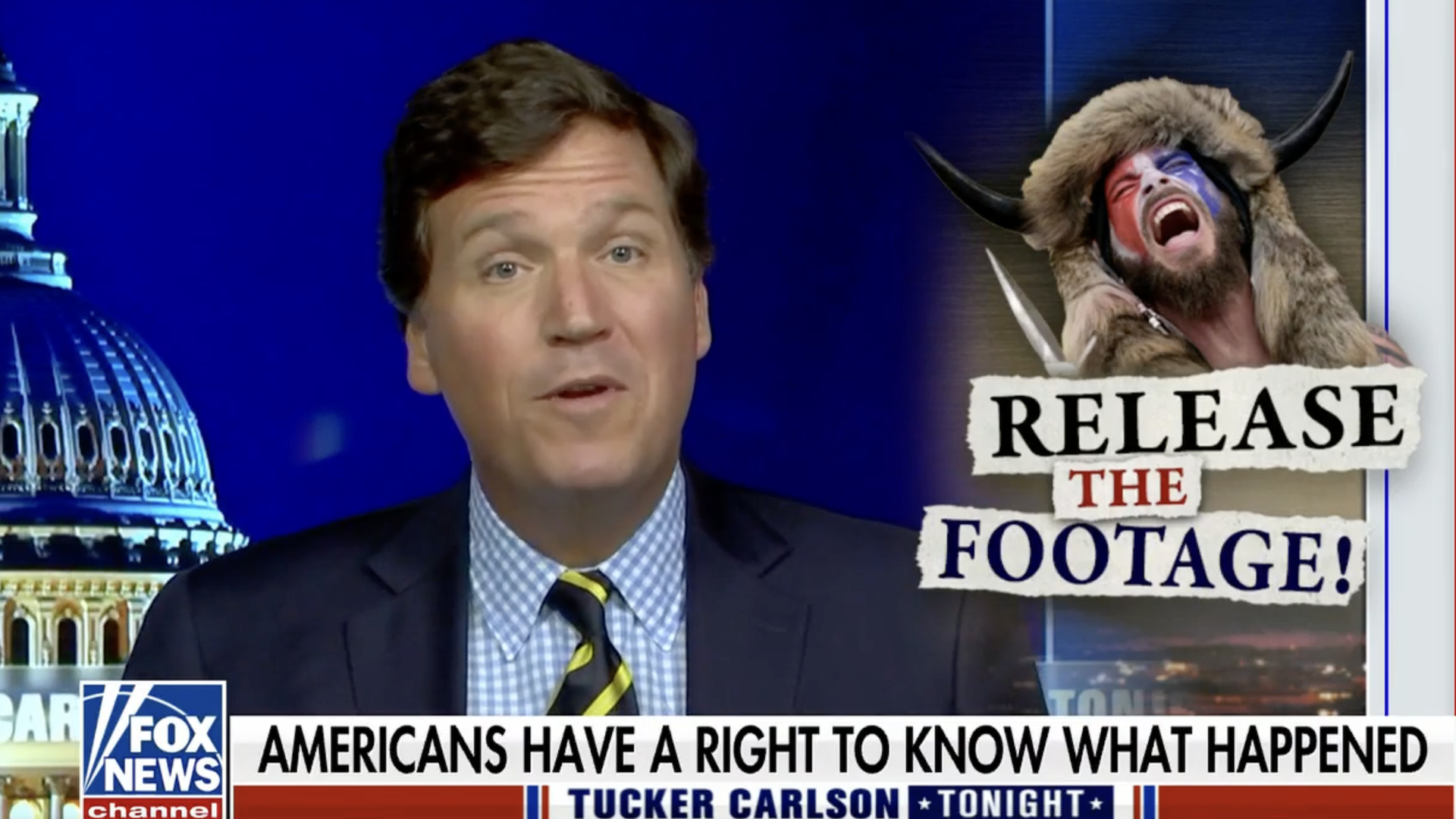
Exclusive: Kevin McCarthy gives Tucker Carlson access to massive trove of  Jan. 6 riot tape

Tucker Carlson’s “return” was a form of phoenix-like relaunch, born out of the ashes of the the defamation lawsuit against Fox News, arising to strike against the legal verdicts not of the January 6 rioters, but verdicts finding Donald Trump guilty of battery, defamation, abuse, felony and falsifying business records. Quite soon afer he was released from or asked to leave Fox News, it was predictable Carlson would not allow himself to be pushed around. Promising to continue to speak the unvarnished, unrestrained manner that gave voice to the aggrieved, he found a defender in free speech absolutist Elon Musk. Musk had stated ambitions to make the center of news information in the 2024 election, claiming Twitter might create a major platform of the election, and Carlson almost wanted to lend a helping hand. Granted a newly prominent platform by the free speech absolutist to reinvigorate his own failing business, Carlson perpetuated a true deep fake, reclaiming free speech as the terrain of the alt right, appropriating the early modern liberty as an empowering rallying cry against entitled but entrenched media interests.

The most recent gambit of Carlson to sew board discontent not only recast the former president as an aggrieved victim, but showed himself a victim of powerful interests that seek to de-platform his show–at a close remove from the limiting of liberties that now stood in the rifle sites of the new priorities of the state. The historical decline from America’s Four Freedoms were at threat as the switch he made to Twitter only revealed the threats to freedom of expression that were historically enshrined by the passage of the Bill of Rights sought to protect in an early age of print culture. The streaming and broadcasting of defamatory lies on television provided a qualitative and mode of expression more akin to groupthink than expression, cleverly camouflaged in Carlson’s championing of a right to “free speech.” Presenting himself as the aggrieved party, he became a living symbol the violation of civil rights haunting the country from the January 6 rioters to Derek Chauvin to Donald Trump, all white men targeted by the liberal state, at a time when the union–and not only the Capitol building, but the country that the Capitol represented–was under attack.

Tucker Carlson news: Fox host defends QAnon Shaman, attacks trans people  and calls Zelensky 'despot' | The Independent

The new argument of “legal exceptionalism” deviously undercut justice, if not the trial system, in the false populism of common sense. The dismissal of Tucker Carlson from Fox News may have occurred in the fallout from settlement of the Dominion lawsuit out of court, that revealed him to have sent several quite disparaging texts about Donald Trump amidst the rampant sexist of his newsproom, in a revelation of his off-the-camera behavior. The demand for a greater level of honesty on Twitter might allow was cast as a greater level of purity. In pandering to grievance yet again, he continued the Tucker Carlson narrative of grievance that was hardly new to his show. To be sure, in the light of the remarks made public during the Dominion lawsuit for defamation of the electronic voting systems, he wanted a place to reach the 3.2 million viewers who had nightly tuned into his show. His bracing announcement “We’re back!” quickly topped 100 million views in less than twenty-four hours, winning 21 million watches of a video, even if the number probably magnified individual viewers. This approached the audience of 3.2 million of times past.

Tucker Carlson let his viewers know that after he left the FoxNews network, in the fallout from settlement of the Dominion lawsuit out of court, texts disparaging Donald Trump and revelations of improperly sexist newsroom behavior were less the reason than claiming moral high ground. But Carlson may have been protesting too much: his show had almost intently if not obsessively exploited a politics of grievance to fostered since 2017 the hyper-partisan division of the United States. The recurring topic of the show was stated in the electoral map logo of red expanse and blue readouts that hung in the background of his nightly rants–Carlson’s news commentary fit the slightly blurred map of the electoral division of the nation, now an existential fact and eternal lesson in ways that its content didn’t even demand to be interpreted, glossed or read.

The blurred out map before which he had broadcast since 2017 on Fox News displayed a cleaving of blue and red counties he cheerily perpetuated. His show id his best to preserve if not magnify this map, if not to make it an iconic as a map of the party’s future. The map was a leitmotif of sorts of a struggle that animated all Carlson’s on-air rants: as if patriotism perpetuated the partisan divides, he basked before the warm glow of an electoral divide among blue and red counties that cartographic semantics dictated displayed perhaps less two different nations than two world-views. He didn’t need to explicate this divide that lay at the center of most all nightly broadcasts, but electoral divides placed in question the fate of the nation before the duplicity of Democrats and the national security threats they had enabled–as he invoked narratives of “how nations collapse.” The all but blurred logo had a centrality that didn’t even need to prominently register.

Continue reading

Leave a comment

Filed under Donald Trump, Free Speech, Freedom of Speech, social media, Tucker Carlson

Drone Warfare, Carpet Bombing, Righteous Strikes

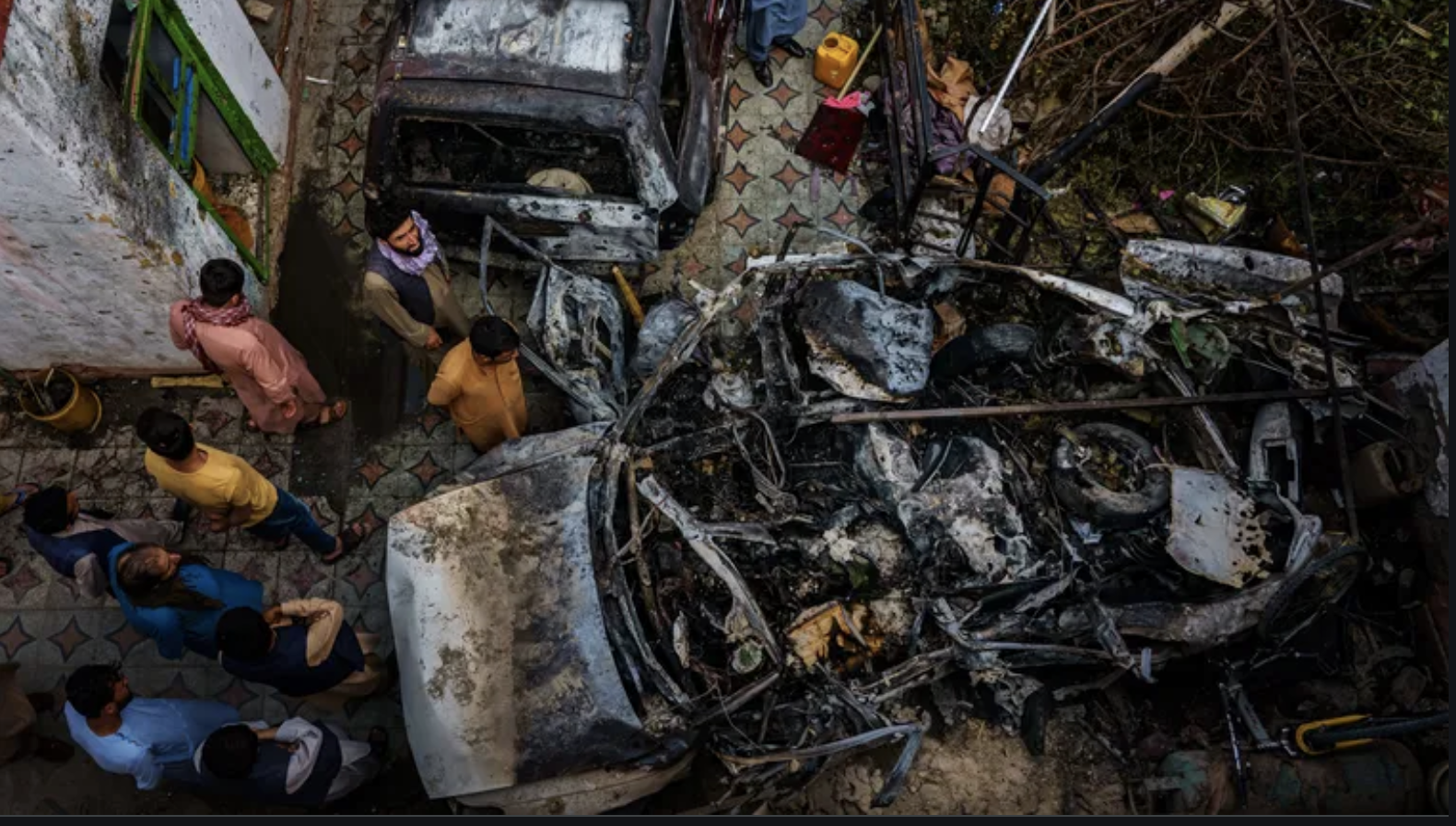
This problem seemed to come from Hell. The “righteous strike” of a drone-fired Hellfire Missile killed Afghan aid worker Zemari Ahmadi, his nieces and nephews was America’s military doing what it did best–a targeted precision strike. As much as targeting a human target who was instantaneously dismembered as his car shifted into park, the “Over the Horizon” strike cell commander who fired the missile from the drone was firing at a coordinate, and trusting in its authority. United States Dept. of Defense spokesperson John F. Kirby vowed “to study the degree to which any policies, procedures or targeting mechanisms may need to be altered going forward.”

The strike was to be reviewed by former senior staff officers who served in Afghanistan, assigning it high priority as an event that was based both on the lay of the land in the territory of the strike and of the unique capacity and liabilities of drones to both survey the area from human intelligence it is fed. But Rear Admiral Kirby insisted that the strike was only green lighted after the American General at Central Command, or CENTCOM, who remained apprised of surveillance found “a reasonable certainty of the imminent threat that this vehicle posed.” The descriptors of a “reasonable certainty of imminent threat” was itself a wartime coinage, the inheritance of the contradictions of the drone’s ability both to provide impressively detailed imagery from both infrared and image-intensified cameras in the Reaper drone that killed Ahmadi, believed and claimed to having decided to act as an agent of the Islamic State by a car full of explosives, a misjudgment for which no military were ever punished, or ever will be, as the intelligence failure was attributed not to humans, but to a defect akin to software–“a breakdown in process, and execution in procedural events, not the result of negligence”–even if it was in fact unnecessary to protect American troops from a strike from the Islamic State that the drones had detected.

The CENTCOM Commander himself apologized, saying “we thought [we had] a good lead,” the balance between “certainty” and “threat” was not so clearly mapped as the pinpoint targeting of the vehicle, watched for over eight hours. As if in a surplus expenditure of energy at the conclusion to the war, or a final moment of fireworks, the huge discrepancy of wealth and technology between two sides was made manifest in the explosion that took the aid worker Zemari’s life with his nine family members, a final salvo of the Forever Wars. But the striking of the vehicle containing Ahamdi, and which his nieces and nephews surrounded, were perhaps the fault less of a human error–if that was involved–than of a desire for a new method of war conducted in alarmingly disembodied terms, in which “it is exceedingly important to shoot the missile, not at the target, but in such a way that missile and target can come together in space,” as Norbert Weiner wrote in 1948, in a classic work of communication networks in animal and machine, in which human judgement become part of feedback loops, but not ever making anything like what we might classify as ethical calls: the transmission of information in this model is based on the clear transmission of alternatives, and reduction of ethics to so much background noise, based on the probability of how much accurate information was available or at hand.

This conflation of viewing and mapping is a creature of the geodetic grid, now enhanced, as never before, with qualitative footage that is real-time, if incomplete. The widely touted surveillance abilities of the Reaper Drone that is able to transport laser-guided Hellfire missiles, and day or night radar, was the “first purpose built hunter-killer UAV,” a precision instrument run by real-time video feed by operators located thousands of miles away was not only a filmic experience as a video that guaranteed its own sense of accuracy, assured by highly refined abilities of mapping that, as all geodetic maps, offer the security of a grid imposed on experience, as a substitute for experiential knowledge, but extends the global network of American military bases into the city blocks of residential housing able to drill down to the very driveway in which Ahmadi was hit. If the justification of “imminent threat” the reaction time from the growing constellation of drone bases” in a secret network of airstrips across Africa and the Arabian Peninsula to assure global military dominance growing from 2013 in the Global War on Terror, to achieve a targeted killing program of which Ahmadi’s death is only the latest fruit. The network designed to ensure the safety of Americans was justified by the Legal Counsel to Barack Obama’s Justice Dept. in 2011 as allowing lawful killing of any member of Al Quaeda or its affiliates of “imminent threat” to the United States, a formulation first used to justify the killing the American-born Muslim cleric Anwar al-Alaki, and his sixteen year old son. If the white paper does not mention quality of intelligence sources, it gave broad legality to aerial killing, stipulating “imminence must incorporate considerations of the relevant window of opportunity” and possible collateral damage to civilians. The geodetic architecture of spatial precision created a new regime of imminence, locking targets into the sights of removed

The legal term “imminence” is balanced with a distributed network to dilute responsibility in ways oddly commensurate with the technology of death. The removed visual experience conjured by the Reaper is an ideal cartographic knowledge, equipped with all-weather, day or night radar, a sensor ball bearing image-intensified and infrared cameras in the gridded screen of a target, is unique. Its firing is rooted in an ethically unquestionable phenomenology of film that depends on “what the camera can see,” which legal historian Nassar Hussain argued refined a way of seeing that elides its own mechanical construction and claims a total experience despite its often partial picture of the target in question; it is also a bolstering of the smoothness of the decision to strike a threat that proceeds down the “kill chain.” The moment of impact is geographically removed but also problematically removed from any ethical contract among combatants: it is the most extreme threshold yet of the “maximum range killing” that Dave Grossman, an authority on the psychological impact of lethal force in war, defined as “a range at which the killer is unable to perceive his individual victims without using some form of mechanical assistance—binoculars, radar, periscope, remote TV camera, and so on.” For Grossman, the occlusion of visual perception creates a suspension of ethics unique in military psychology: “I have not found a single instance of individuals who have refused to kill the enemy under these circumstances, nor have I found a singe instance of psychiatric trauma associated with this type of killing.” It was this unique psychology of killing, cleansed of all trauma, it appeared, that ballooned in the military theater of war in Afghanistan.

“Imminent threats” were intentionally removed scrutiny of targeted killing from public scrutiny by a legal whitepaper, commissioned by the U.S. Dept. of Justice in 2011, to confirm the lawfulness of a strike against an “imminent threat” of any senior or operational leader of Al Quaeda or affiliates just after the height of drone strikes in Pakistan and as drone strikes in Afghanistan reached astoundingly routinized presence. But the equipment of drone with lethal missiles from 2001, in the heady early days of a Global War on Terror after 9/11, transposed the legal language commonly used as a term of justification, to targeted killings as the 2002 strike against Al-Harethi in Yemen from a secret American base in the Horn of Africa, and the growth of drone strikes in Pakistani territory, whose legality the US government had effectively confirmed as part of the state of war and the landscape of aerial warfare that was increasingly incommensurate in scale of destruction with the terrorist attacks on the ground or IED detonations.

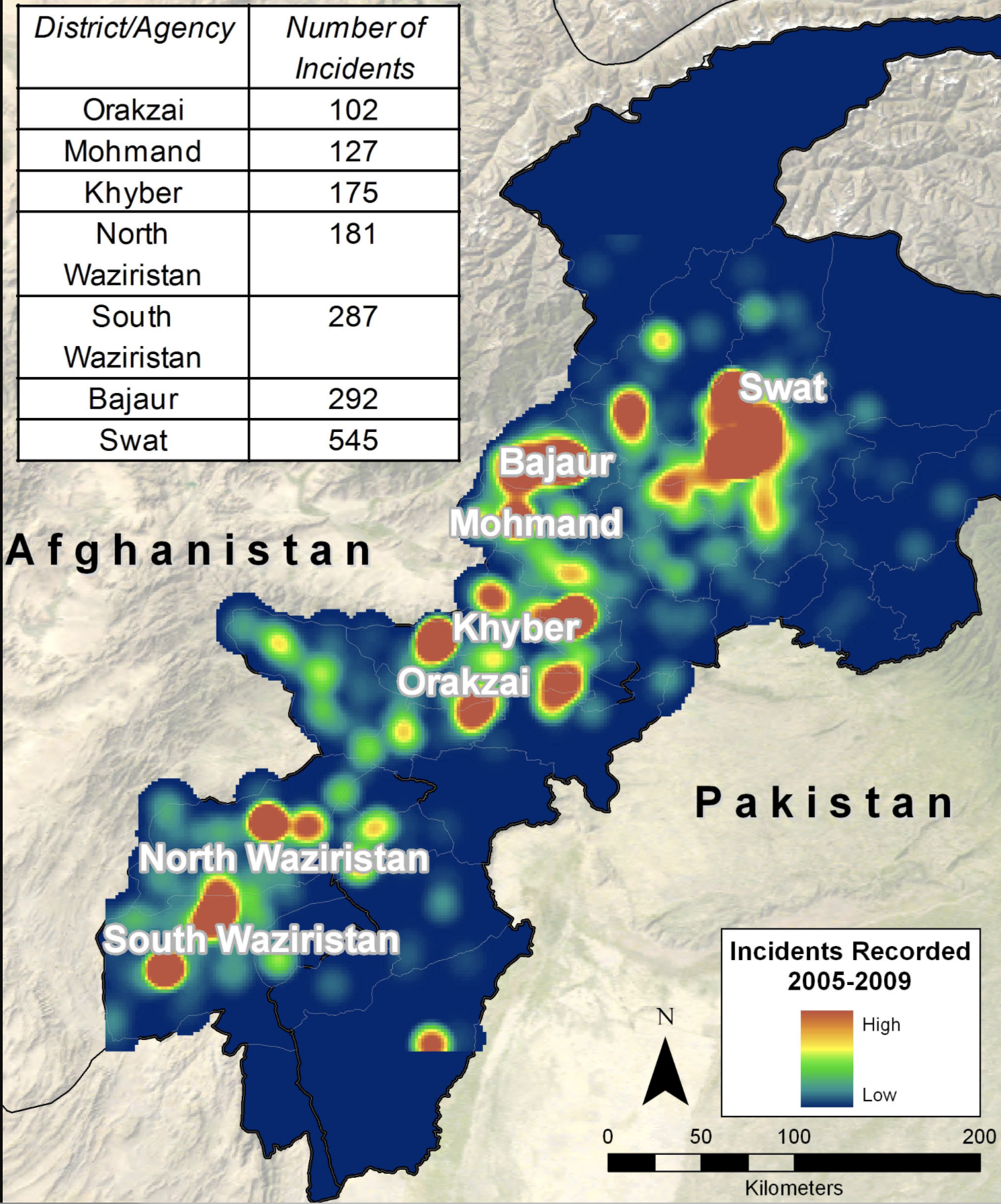
American Drone Strikes, 2004-2014, The Economist

At a time when ISIS had effectively internalized the danger of a sense of western besiegement, and the United States had almost amplified its power to suggest that waves of besiegement were utterly insurmountable and impossible to defend against, the arrival of a final Over-the-Horizon strike of a Hellfire missile seemed a parting strike of particular cruelty, by accident effectively perpetuating the inevitability of a continued narrative of besiegement for the world; as the escalated pummeling of ISIS presence in the hills of Peshwar and Afghan provinces had provided ample evidence of besiegement attempting at exhausting the “enemy,” in record numbers, over a decade of intense bombardment focussed firepower one final time on a residential courtyard in Kabul were someone far away had judged an Al Qaeda affiliate was parking a carload of explosives.

There are problems of balancing an awesome strike ability of a Hellfire missile, a missile conjuring the eternal fire faced by the dammed with a “righteous strike,” and the scale of local damage it can cause: the death sentence that the missile passed as a remotely tracked technology of obliteration was invested with curiously religious terms, the fire of damnation a sentence of divine wrath, sending the fire of hell to the courtyard of a Kabul family residence to shatter the life of the wrong man who had been tracked for eight hours by Over-the-Horizon Strike Cell dedicated to disrupt the Islamic State Khorasan. But this time the Over-the-Horizon strike in Kabul was, if precise, focussed on the wrong white sedan, as the intelligence about the car that was being tracked for over four hours was terrifyingly incorrect. The poor debut of “Over-the-Horizon” strikes was a bad omen of the value of geospatial precision.

Afghan Neighbors Ponder the Courtyard of the Zemari Ahmadi’s Home in Kabul, Afghanistan
Jim Huylebroek for The New York Times

Were the mechanisms for firing the laser-guided missiles encoded in the authority of the mapping tools that sent the laser-guided Hellfire missile to Kabul, as much as in faulty intelligence, and the limited guidance on targeting individuals? In what was almost a bravura use of force, American military drones fired Hellfire missiles as the airlift continued, on the eve of the United States departure, pointing to the appearance of secondary explosions as fireballs to indicate presence of explosives inside vehicles that ISIS operatives might drive into the airport for a second suicide attack. But if the strike was “deliberated” and the information military had collected “all added up,” the rules of engagement of airstrikes, as much as the human intelligence, implied deep ethical problems of trusting in the logic of maps to sift through evidence with greater accountability, especially as we seem to be approaching a threshold of increased engagement without men on the ground in Afghanistan, in developing an “over-the-horizon” strategy for the immediate future, as President Biden pursues his commitment to fight ISIS-K without actually increasing civilian deaths.

An Afghan man who lost family due to US drone strikes weeps.
Ajmal Ahmadi, Mourns Members of His Family Killed byu Hellfire Missile in Kabul, Afghanistan, Monday, Aug. 30, 2021. 
Marcus Yam/Getty Images

The mechanics of the decision-making process that led to fire a drone that later killed Ahmadi and his children, nephews, and cousins is under review, but the verbal and epistemic confusion between what was first described as a “righteous strike” of vengeance, evoking the theory of “just war” that was invoked by President Barack Obama in invoking “just war theory” to rationalize the use of the military force not as a wanton or needless display of power and with the hope of saving lives to prevent the loss of lives, required, in his hope a “near-certainty of no collateral damage.” And while this was of course collateral damage of the most extensive time, the coverage of the extent of mis-targeting of believed terrorists reveal a terrifying cheapness of life, undoubtedly only able to be researched in detail for the jaw-dropping mistake of targeting of innocent civilians by a laser-guided missile due to the density of journalistic coverage of this particular strike, and journalistic presence documented the costs of erroneous strikes and the scope of civilian casualties as horrific as carpet bombing–if far more surgical–as if this were a far more humanitarian form of war whose precision could be labeled just. We were able to see the Taliban checkpoint that let in suicide bombers to Kabul’s airport, causing almost a hundred and fifty deaths, we became convinced of the ability of targeting precision strikes of the perpetrators of similar crimes, and amped up the intelligence networks to scour the city for signs of any activity appearing that it demanded to be targeted, and snuffed out.

Planet Labs Inc., image of Taliban checkpoint blocking access to Kabul’s international airport Saturday, Aug. 28, 2021
(Planet Labs Inc. via AP)

Precise targeting, unlike bombing raids of the past, provided this certainty, or was supposed to offer surety of not being needless. But if such near-certainty depended on a map, it rests not on the accuracy of mapping. The strike that killed Zemerai Ahmadi — and ten of his family members–was mistakenly categorized as a “righteous strike,” killing an innocent aid worker and his family members. While it occurred in the heady atmosphere of retaliatory strikes for attempt to sabotage the withdrawal from Kabul’s airport attempted to be just, the slippage between the logic of targeted bombing and justice became apparent. It was a lurch to affirm global strength, more than justice, in using a technology of geolocation that had evolved to coordinate hand in glove with surveillance from Reaper drones. The ability to pinpoint track the progress of one car tagged as an imminent danger.

U.S. Central Command maps movement across Kabul of white Toyota Corolla on Aug. 29, 2021. CENTCOM/via Military Times

The mistaken of surveilling and targeting a young Afghan civilian in a Toyota Corolla was terrifyingly akin to the senseless bombing campaigns of South Vietnam, North Vietnam, and Laos, or more terrifying. Surveillance of Kabul and its airport were much better than Vietnam, by remote satellite and drone photography, the ability of such targeting–and the rush of such precision killing–seemed to follow the logic of the map, as much as people on the ground.

1. The maps used to conduct action at a great distance in Vietnam were not as transparent or evident, but they were for the time. In the 1960s and 1970s, they offered grounds to pose the eerily analogous question of the extent and expanse of the globalist claims of American power. The trust in the accuracy of maps provided an eery precedent for the confidence in strikes an old theater of empire, a theater once defined by imperial maps. The surety of the strikes that the UTM and LORAN B offered to American pilots existed in two theaters–the arena of the map that determined the strikes and the geographical space to which it corresponded, and old imaginaries of imperial and colonial power. The British empire was driven from Kabul in 1842 and 1843, and the French hold on Indochina had led them to withdraw; as the mapping techniques of post-war Europe led the United States to inherit Southeast Asia, global technologies of mapping opened the possibility of launching strikes that would offer lasting reminders as America withdrew from the Forever Wars in Afghanistan, leaving as the English did from both Kabul and Kandahar, but, in an attempt not to be forgotten, leaving a lasting imprint of the power of long-distance bombing. If combatants of most all wars fight with different maps, often reflecting differences in military intelligence, both these post-colonial wars were defined by the drastic dissonance of radically different maps of geospatial intelligence, one from the air and one on the ground, and the pursuit of a stubborn logic of air maps as if they offered both superior exactitude and geospatial intelligence, modernizing the struggle for control by defining a logic of modern military operations by which to understand and to shape the “sharp edge” of war.

Carpet Bombing in Vietnam by B-52 American USAF Planes

The beginning of the end of American Empire has been recently pegged to 1972, a year that marked and took stock of the the end of a huge expenditure of sustained bombing drives with little apparent enduring accomplishment. The geospatial logic that drove such earlier long-distance aerial bombing campaigns in Vietnam were driven by perhaps misplaced confidence in how maps enabled and facilitated military action at a distance: maps offered a logic, if there was one, for conducting the over six hundred sorties and operations over eight and a half thousand miles away. There is an eery analogy that we have the most complete and exact database for bombing raids of the American military in Vietnam, coordinates that were painstakingly compiled by Americans, so analogous to the geodata of thousands of drone strikes in Northwest Pakistan and Afghanistan, from 2004-2018, that the New American Foundation asserts the vast majority–over 80%–of those killed, were militants, though the Brookings Institution counters that drone strikes killed “10 or so civilians” for every militant who died,; Pakistan’s Interior Minister complained vigorously that a preponderance of the killed with civilians–especially in habitual follow-up strikes, targeting those responding to victims of the first hit, targeting of funeral processions, or mourners, or simply less surgical strikes. In an attempt to respond to these attacks from above, the Taliban’s weapon of choice was improvised explosive devices–literally, IEDs, placed on roads and activated by radio signal, mobile phones, or triggered by victims who step on them.

Paul Scruton, The Guardian

The warscape that developed 2004-9 of explosive shells, made often from diesel or fertilizer, along the major Afghan highway by the border with Pakistan where the Taliban was geographically contained–an increased density of which was tracked by Paul Scruton in the screen shot maps to the right of the map. The first attachment of a Hellfire missile to a drone followed the sighting of Osama bin Laden by one of the Predator Drone of the sort that flew across Afghanistan from September 7-25, 2000, in search of the terrorist who was wanted from 1998 suicide bombings in two U.S. embassies, his first strike at American territory; the unarmed CIA Predator was able to laster-illuminate and geolocate him so that it tracked him fro almost four and a half hours, but he could be hit by a Tomahawk missiles, but the time-lag for firing Tomahawk missiles failed to guarantee a similar sort of accuracy; as the new tool of the CIA and US Air Force were mounted with Hellfire missiles, they sighted and shot at Mullah Omar in 2001, but missed him, destroying only his car.

When Barack Obama assumed office in 2009, he tweaked George Bush’s invasion of Afghanistan by rehabilitating the “just war” theory, of medieval origin, formulated by Christian and protestant thinkers. Obama chose to rely on the accuracy and surgical nature of precision strikes as surgical means of not striking civilians, or focussing on enemy combatants, although the berth of such distinctions lay in the military or CIA: ifAfghanistan became the terrain for “the future of our military,” where Predators defined the mobile “edge” of warfare waged overhead and across borders. Targeted assassinations by CIA and USAF targeted the Waziristan region, mapping the region with pin-point in the notion of a “just-war” theory, rehabilitating an ancient doctrine of right conduct in war–“jus in bello” doctrine of Christian thinkers–by modern tools of geolocation, leading to the escalation of pin-point targeting by drone-fired missiles. In the face of global opposition to the use of missile enhanced drones as tools of targeting objectives in war in the mountainous areas of Pakistan province where the Taliban had fled by 2011,–

Escalating Drone Strikes Targeting Taliban in Remote Mountainous Region of Waziristan

–and, from 2012, the CIA went out of its way to try to design alternate missiles to “shred” vehicles and their inhabitants, but without blasts, to attempt to minimize “collateral damage” or killings.

Secret U.S. Missile Aims to Kill Only Terrorists, Not Nearby Civilians - WSJ
 Hellfire Modified to Limit Damage of Bystanders, Used from 2012

By the time the final American forces were set to ferry the final civilians from Kabul, however, the logic of drone strikes shifted to the home front of Kabul, set motion by the terrifying suicide bomber who struck Kabul’s airport, killing 143 Afghans and 13 American servicemen. In what was either the last gap or new frontier of geolocated killing, drones targeted Hellfire missiles in pinpoint strikes across Afghanistan, in “just” retribution of the fear of further K-ISIS suicide attacks on the ground during the last days of American presence in Afghan territory focussed on flights departing Kabul, revealing an ability of surveilling, targeting and striking far into the country as American forces departed the ground, as if to alert the Taliban of the continued proximity of CENTCOM bases in Qatar.

However celebratory the drone strike seemed, hellfire missled that killed Ahmadi suggested the haunting return of a lack of justice on August 29, as twenty pounds of explosive struck the car of the breadwinner of an extended Afghan family, with seven children who depended on his work. The children who had rushed out to greet him as he pulled his own white Toyota Corolla into the driveway of his personal home were not seen by the man who fired the drone missile, who felt secure no civilians were nearby. As we examined footage to detect the alleged secondary explosion, we found a weird echo of the airstrikes of an earlier war removed from our continent. While much comparison between the messy tactics and poor planning American withdrawals from Vietnam and Kabul spun, the incomplete coverage of the “collateral deaths” of civilians from the strike led to the military’s eventual backpedalling of its story of striking ISIS-K as an act of counterterrorism or “righteous strike.”

It was only due to careful investigation on the ground that the horrendous mistake was discovered. Reporters used footage from security cameras to follow the forty-one year old aid worker before he was driver targeted by the Hellfire missile suggested the poor intelligence which operators of “strike cel commander” who had been operating the drone in Kabul. Even as we await analysis of the decision-making mechanisms, we wonder a the high degree of certainty in public statements, even as questions circulated from the start of accurate video analysis of an after-blast confirming, as was claimed, that the Toyota Corolla was carrying a payload of ISIS-K bombs, and the lack of a mechanism of review before the drone strike. The accuracy of targeting the car was questioned by journalists as Spencer Ackerman all too familiar from the targeting of civilians that had escalated in previous years. Although announced as compensatory for the deadly suicide bombing outside Kabul’s airport, killing Afghans and thirteen U.S. military, as a second drone strike on ISIS-K leaders in Nangarhar Province of an “Islamic State planner” in retaliation for the deadly suicide bombing–and entranced the world with the surgical take-out of the very operatives who allegedly planned the airport attack that killed thirteen American service men and 146 Afghans, as they rode a three-wheeled truck near the Pakistani border from 7,350 miles away in the Nevada desert, injuring an associate but killing the two men immediately. There was a perfect symmetry in the image of men who were riding in a tuk-tuk being obliterated by a strike that left a crater four feet deep.

While removed in time, the bombing campaigns in Vietnam have left precise geodata for bombing raids so comprehensive to be able to map cumulative raids over time. The result privileges strikes over deaths, in the eerily lifeless and quite terrifying record of Bombing Target Maps,–charting sustained campaigns of bombing at a distance waged in maps. This blog considered human costs of aerial perspectives both as a result of the acceleration of bombing campaigns in World War II and how maps jusfitied and normalized the Atomic bomb dropped on Hiroshima. As the longest and least accomplished use of maps to sustained military engagement at a distance, is impossible not to consider the retrospective view it offers and reveals on the logic of the role of drones in Forever Wars. Systematic carpet bombing of Southeast Asia was pursued 1965-1973 as if by a logic of mapping, escalating by 1972 in a failing attempt to illustrate global dominance. The increased exactitude of the map becam a rationale for the power to wage war from afar, both to compensate for a lack of information on the ground, and to compensate for more irreducible problems of distance: mapping tools promised a logic of the ability to operate smoothly across frontiers. The unprecedented global coverage of GPS coordinates was administered and run by the United States for Vietnam through 1975, long after the war concluded. But the role of maps in waging war early emerged. If the United States in 1959 had blocked adoption of new standards of global projection, perhaps linking knowledge to power, the Army Service had recalculated surveys of Southeast Asia–Cambodia, Laos, and Vietnam from the global projection that became a basis to collate new geodata–the Army relied on for staging helicopter raids in Vietnam, and, later, for long-range bombing campaigns.

Tet Offensive, 1968

Not that this was always smooth. Despite troubling distortions inherent in the UTM along South Vietnam’s north-south axis and border with Cambodia, coordinates provided a basis for conducting war at an unprecedented distance, even if they would necessitate revamped geodetic networks to minimize built-in distortions.

Serial Aerial Bombing by United States Air Force in Southeast Asia, 1965-1975
Hatfield Consultants, Ltd; Ordinance Data Prepared by Federal Resources Corporation

Aerial strikes offered a sense of security, notwithstanding, and aerial sorties that continued to exercise claims to global power even in an unfamiliar theater of combat, evident in the dark lines of ordnance dropped along fairly fixed flight paths on what were deemed strategic locations in North Vietnam, and dense napalm dropped in the Thura Thiên region, where the saturation with napalm provided a carpet bombing of unprecedented scale, with limited sense of the effects on the local ecosystems. The planes’ almost indiscriminate blanketing of the strategic Thừa Thiên province and mountainous border with Cambodia where Việt Cộng hid were blanketed with ordnance and herbicides including Agent Origin, creating a massive deforestation there and on the network of roads known as the Hồ Chí Minh Trail.

Serial Aerial Bombing by United States Air Force in Southeast Asia, 1965-1975
Hatfield Consultants, Ltd; Ordinance Data Prepared by Federal Resources Corporation

Despite the bracketing of huge ethical questions and costs, the authority of maps assumed huge costs as they were were able to conceal huge liabilities, changing the nature of the battle line at which we were now, as a nation, waging war, and its ethical costs: for we were bombing locations, not people, and the people were faceless who the bombs were targeting, othered, and in the national imaginary all but erased. It would take a force of consciousness, indeed, to place them on the map–on the ground photography remained relatively rare. And it is the ability to erase people by dots that provided, this post argues, a similar logic for the expansion of drone raids and drone-delivered bombs.

As bombing raids hit the the Seventeenth Parallel, the war was fought on a map: as much as Võ Nguyên Giáp revealed his military tactical genius as military commander of the Việt Minh, who had developed with stunning success the principle of Sun Tzu in successfully applying minimum military force to maximum effect in deploying light infantry in the First Indochina War, and in engineering of the network of roads known as the Hồ Chí Minh Trail, whose targeting continued in the war, even as its north-south course were distorted in UTM projections. The uncertainty is almost registered by Americans turning for solace to sing Toby Hughes’s “Ho Chi Minh Trail,” a wartime blues to the tune of “Billy the Kid,” as a blues of airspace: “When you fly on the Trail through the dark and the haze/It’s a think you’ll remember the rest of your days./A nightmare of vertigo, mountain, and flak,/And the cold wind of Death breathing soft at your back“? “Uncle Sam needs your help again,” is the mock-resolute start of another of the many songs that tried to process distance and space during the war, “He’s got himself in a terrible jam, way down yonder in Viet Nam,” as was no better evident than in targeting the elusive Hồ Chí Minh Trail.

File:Ho Chi Minh Trail network map.jpg
Hồ Chí Minh Trail Netork (1990)
Week of September 27 | Vietnam War Commemoration

Americans administrators plagued by lack of knowledge about Southeast Asia or South Vietnam’s leadership relied on maps crippled by distortions. If the blues developed on the plantation, the wartime blues was a lament popular with American pilots as a new folksong of a technological divide pilots sung for psychic stability seemed to balance the demands they shouldered and fears–“the trucks must be stopped, and it’s all up to you,/ So you fly here each night to this grim rendez-vous”–as each sortie tempted fates in contested military space above the Trail; they watched from above “trucks roll on through darkness not stopping to rest,” consigned to their fate nervously navigating airspace by charts, “our whole world confined to the light of the flare,/And you fight for your life just to stay in the air./For there’s many a man who there met his fate,/On the dark roads of Hell, where the grim reaper waits.”

Carpet bombing was hardly comfortable, but was filled with fear. And one is filled by an eery apprehension at the ease with which geolocated records of bomb strikes in North Vietnam, South Vietnam, and Cambodia translate across time into a Google Maps platform, and the translation of the coordinates to a geospatial grid that we all have come to adopt to navigate space. UTM grid zones in Southeast Asia, as Bill Rankin noted, split in inconvenient ways in Southeast Asia, and although bombers were relying on them in raids that spanned over five years, As the provisional line of demarcation between North and South Vietnam, the so called “DMZ” of the Seventeenth Parallel Mendès France negotiated in 1954 was pounded twenty years later with all the firepower America could muster, trying to secure its border by a crazy huge show of power at a distance.

The result of these compound offensives was to riddle the countries with some 2.7 tonnes of explosives, as we were asked to keep our eyes on a static maps on television screens. This was described poetically as “carpet bombing” or continuous bombardment, first used only in 1944, in response to destructive V-1 and V-2 bombs, to mark a shift from the largely targeted bombing of industrial sites in the war. The sense of a lack of restraints or targets dramatically grew in the Vietnam War, as a no holds barred method, long before Ted Cruz vowed to recommit American to the carpet bombing of the Middle East to “utterly destroy ISIS,” asserting, as if in a perverse science experiment, that while he didn’t “know if sand can glow in the dark,” he would ensure American planes bomb ISIS positions until the sand glowed, in 2015,–intimating a carpet bombing of nuclear proportions. Donald Trump amped up Cruz on the campaign trail in Iowa, by promising not only to “bomb the shit out of ’em,” and “bomb the pipes, bomb the refineries, and blow up every single inch” of refineries to prepare for several months of rebuilding of pipelines by Exxon to “take the oil.” Since the debut of smart bombs in global video during the 1991 Gulf War, the sense of carpet bombing seems to have been consigned into the past, with the trust in the security of drone-fired bombs from 2003 promising to strike targets in a far more humanitarian way.

As the Vietnam War intensified, the long year of March 18, 1969-May 28, 1970 brought daily bombing of Cambodia, all but omitted from the entry of troops into Cambodia we watched on a static map on black and white televisions. Even as the escalation of disproportionate bombing campaigns that only ended on August 15, 1973 grew, they set a standard of sorts for the elegance of airborne strikes from afar.

Tet Offensive Bombing Campaign, 1968

Is it only a coincidence that after serving the nation as Special Assistant to the Undersecretary for Policy in George W. Bush’s Dept. of Defense that the right-wing columnist who has romanticized Gen. Custer devoted time to dispelling the “flawed Tet mythology still shaping perceptions of American military conflicts against unconventional enemies and haunting our troops,” completing This Time We Win: Revisiting the Tet Offensive (2012), winning praise from Henry A. Kissinger, who agreed that “the self-perpetuating myth that the Tet Offensive ended in a defeat for America continues to do us harm,” while endorsing Jerome S. Robbins’ re-examination of the bombing offensive “through the lens of terrorism, war crimes, intelligence failures, troop surges, leadership breakdown, and media bias”–as if to champion the very losing strategy that informed bombing raids in Afghanistan.

2. The limits of local intelligence recalled the opaque maps before which an earlier Commandeer-in-Chief who, convinced of the logic of military strikes, attempted to project assurance at having directed American troops to enter Cambodia in April, 1970, as bombing grew. Just two years before the continued expenditure on aerial bombing campaign seven thousand miles away revealed a failure to reach military objectives announced a start of the decline of the American empire, the drone strike at the old colonial city of Kabul CentCom ordered revealed a continued commitment to the logic of military engagement by drone that animated the logic of war under an inauspicious promise to Maker America Great Again: the conducting of increased bombing strikes eight and a half thousand miles away would grow in intensity from 1970, but the argument Richard Nixon made was not apparent, as it rested on a geospatial map, but used the crude maps of boundaries of states few Americans were familiar–Laos, Cambodia; South Vietnam; North Vietnam–that hardly reflected why such intense bombing would be occurring around the seventeenth parallel, or mapped a clear vision of strategy.

American Troops Enter Cambodia, April 30, 1970

Even as we knew enough to be skeptical of his map of crude cut-outs, remembering Dresden Hiroshima, and My Lai aggression against civilians, but knowing we had heard stories from reporters on the ground about its intensity. And so we watched the maps of new offensives, distrusting escalated air bombing in times of war–if we knew not to trust them, we took to the streets in protests because we remembered, and because the official news maps of selective hits in one offensive was a partial story–and the danger of what was being targeted by a carpet of explosive bombs dropped.

B-52 Carpet Bombing of Vietnam

–hardly mapped the increased intensity of air strikes of carpet bombing, the new illustration of force that blanketed the nation with strikes to cover borders between north and south Vietnam and the coast, as Air Force data reveals, releasing over two and a half million tons of bombs on over 115,000 sites in Cambodia, from 1969-72, of which over 11,738 were indiscriminate–with the blatantly false assurance from the military commander in South Vietnam, who requested the sites be targeted in a neutral country, that Cambodians did not live in them, in the wave of secret bombings ordered in violation of international law, and quickly developed by Nixon’s National Security Advisor Kissinger–

The unprecedented concerted orchestration of carpet bombing campaigns by air sorties attempted to wipe out all VietCong bases in eastern Cambodia, vaunted precision in dropping 7.5 million tons of bombs across Laos, Vietnam , and Cambodia, between 1965-75, from Operation Rolling Thunder (1965-68) and Operation Steel Tiger (1965-68), to the extended campaigns in Laos of Operation Barrel Roll (1964-1973) to Cambodia, before Operation Menu (1969-70), blanketing the nation and creating untold civilian deaths and injury in a show of force.

The latter raids covering the country in toto, but to target Khmer Rouge ranged widely across borders of Cambodia and Laos, which was facing a communist insurgency in its borders, and the nation Vietnam had invaded became central to the Domino Theory that rationalized an expansion of boming across borders, before returning with intensity to the seventeenth parallel from 1971-2, trying to hit precise coordinates, and effectively carpeting the old DMZ with bombs. There was something weird, as from a nation of the crossers of borders, we flew bombs across borders, carpeting regions with devastation, from the shorelines of Southeast Asia, to the interior, to the shore again, this time with even greater intensity and around what was then Saigon.

The intensity of carpet bombing was astounding in Cambodia and Vietnam, literally coloring huge swaths of the country red, in these maps that use red dots for cumulative tallies of bombing strikes.

Taylor Owen, University of British Columbia’s Liu Institute for Global Issues
U.S. Secret Bombing of Cambodia | rabble.ca
Aerial Bombardment by US Air Force of Cambodia, 1965-1973

The danger of those bombing strikes on civilians were rarely described, or even comprehended, at a distance. But visualizing the faces of the civiliians whose towns and life were disrupted so violently became a basis for protesting the war–and a crystallizing factor in antiwar protests as the bombing campaigns grew–as the ends of carpet bombing as a targeting of civilians nonetheless grew all too painfully clear, as the very intensity of such carpet bombing created a new architecture of destruction in an already profoundly unethical war.

Anti-War Protest Button, 1972

3. Precision strikes seemed more humane than carpet bombs. But the precision bombs of the Forever Wars were, perhaps haunted by those images of civilians with targets on their crudely drawn heads, trying to advertise themselves less as a global over-reach of the targeting of precise strikes in another hemisphere, a campaign that in fact began, back in the response to the apparent hubris of 9/11, in the battery of B-52’s brought out from retirement, before the Defense Department hit on the new idea of acquiring drones and investing in drone technologies, a budget that has risen to above $7 billion by 2021, whose use is severely restricted in American airspace, but seems the perfect medium for fighting forever wars, on which the United States has come to rely since at least 2005. Fighting the Forever Wars and for counterterrorism programs, a new logic of military engagement, although the program that was first used in 2003 to strike targets developed in secrecy as a way of blurring the “sharp edge of battle,” described by British military historian John Keegan as incomplete or elided in most military histories. Now the “sharp edge” is both everywhere, blurred, and intentionally difficult to see.

The airspace for operating for the 11,000 drones or “Unmanned Aircraft Systems” in the United States that the U.S. Department of Defense currently owns and operates in American airspace are far from civilian centers in the United States–but the logic of pinpointing strikes 7,000 miles away provided a precision bombing that replaced or antiquated carpet bombing, billed in a new humanitarian guise.

Department of Defense Special Use Airspace, 2006

–but the rest of the world is, as the Kabul airstrike reveals, an open surgical target. And the increasingly intentionally reduced transparency of an increased national commitment to military drones in the Trump administration has created a new logic for the use of military force, via armed drones, and the unprecedented mobility of military theaters, under the cover of the advancement of either military or national security objectives. The bulk of the drone programs run by the CIA are shrouded in entire secrecy, although the commitment to reducing any sense of transparency and accountability–a main operating strategy or modus operandi of the recent Commander-in-Chief–has left a stamp on the U.S. Drone Program that will be difficult to erase, and a new sense of the secret maps by which war is waged.

As military operators of drones gained far greater air-strike-decision ability and independence, both in the military and the CIA’s separate drone strike operations, a new level of security was increasingly embedded in the logic of the map. There was, moreover, not even a requirement for registering enemy or civilian casualties, even if they might embrace deaths, since Trump issued Executive Order 13732, exempting both the US Army or for the CIA for any such responsibility for strikes outside combat zones; strike-enabled drones were granted greater operating grounds with less scrutiny or oversight. At the same time, oversight of sales of U.S. drones waned, and the Department of State gained the ability of direct commercial sales without oversight or special export conditions. Drones, in short, became the new currency of the war, and the means by which anything like a familiar battle line vanished. Removing strikes of pin-point precision from a system of military review so localized the “sharp of edge of battle” that it might migrate, given the ease of mapping, to a civilian garage.

Kabul, Afghanistan, Aug. 30, 2021. Marcus Yam / MCT

The drone strike seems emblematic not of a hasty withdrawal from Kabul, but of the confusion of military and civilian space in the war that readily relocated anywhere on the geospatial grid. In targeting the driver’s side of the white Toyota with incredible precision, we can see something of a history lesson in how mapping tools offer terrifyingly increased precision strikes. Although the Pentagon assured us that the existence of “significant secondary explosions” occurred, indicating a “significant explosive load” in the car with “minimum collateral damage,” and “reasonable certainty” of no nearby civilians, the lack of any grounds for certainty of explosives or an absence of civilians suggest not only the fallibility of human intelligence, but the Hellfire warhead that ruptured the tank while targeting the driver’s seat was a disproportionate show of force of awesome precision led its operators to trusted was trusted with “reasonable certainty” to pose “imminent threat.”

Drone strikes were not particularly effective against Taliban forces, and rarely contained them. But the act of power of pummeling Afghan locations that seemed worrisome with credible degrees of “reasonable certainty” was a release. It led to an escalation unprecedented in airstrikes against the nation as a show of power–until the end of DOD releasing of air strike data during negotiations with the Taliban; if airstrikes stopped, the shipment and stockading of increased armaments funneled to the Afghan army’s American-built bases in an attempt to overpower the nation that created its own dynamic of awesome war all but erasing the sharp edge of battle. The escalation of strikes as Trump assumed office had only recently grown to unprecedented heights.

More seriously, without any public release of the principles and procedures guiding the U.S. drone program, secrecy shrouds the legitimacy of the use of drones or the notion of the responsible use of drone strikes of increasingly powerful capacity, undermining the accountability of the military’s actions. It is perhaps ironic that this is being revealed on the eve of the departure from Afghanistan, and twentieth anniversary of the attacks of 9/11, which were such a shocking violation of territoriality: the expansion of no oversight on drone strikes risks undermining legitimate military goals, and even undermining national security interests, in finally attaining the capacity to act as a rogue state.

4. Although the possibility of retributive payments for these lives have not been publicly raised, although America has discussed “considering ex gratia or reparations,” the demands for some sort of compensation for those who were killed outright by what U.S. Cent Com admits as a “mistake.” If the walking back from early qualifications that rather than being a direct hit in retribution for the airport strike against U.S. military, the strike was “unlikely . . . those who died [jn the drone strike] were associated with ISIS-K,” or a “righteous strike” foiling a strike, the admission of guilt by the “strike cell commander” located in Kabul raises questions of the logic of military engagement in an era of drone war. The increased trust in the mapping systems–rather than on-the-ground intelligence or a need for confirmation–had brought the war on rural Afghanis to the nation’s capitol, leaving looming questions of why the country was not so concerned to use arms left by Americans to repel the Taliban, and how the logic of drone warfare expanded in the Forever Wars as a logic of surgical strikes that had boasted to not involve or affect civilian populations.

This time, the on the ground tracing of the Toyota Corolla’s movement in downtown Kabul led it to be targeted based on faulty information, and faulty flagging of suspicions in Ahmadi’s white Corolla, or the proximity with which it was parked or had stopped near an ISIS-K compound. The tracking of the car as it moved along city blocks and well-known streets led to the capture of surveillance footage of Ahamadi filling his car with water bottles, and dropping off coworkers, while he returned to his family, but it is unclear how a review of policies and procedures of targeting mechanisms will alter the logic of the drone strike as a surgical tool of war; just after the admission of mistakes in mapping and targeting of an Afghan civilian, CENTCOM followed up with announcement of the drone strike of a “senior al-Qaida leader” in Syria, in which “we struck the individual we were aiming for, and there are no indications of civilian casualties as a result of the strike,” as if to demonstrate how the smoothly the logic of drone strike technology could continue to work.

Yet, as journalists were increasingly present in Vietnam to film, witness and provide testimony of the devastation of bombing raids, with increased secrecy around drone strike programs, we have to wonder whether the mapping of civilian casualties will be something that would be in the government interests to continue, or if it is the case that the sharp edge of war has been definitively blurred. There was, by chance, due to the intense on the ground presence of journalists, an attempt to review the way that we set up what was almost a “home front” in Afghanistan; the victims of strikes were captured on closed circuit television, and could be tracked through the city of Kabul. Unlike for most drone strikes, we have faces, making it all the more possible to grieve their deaths and need to figure out how best to mourn their needless deaths, if not to take them as emblematic of the 71,000 civilian deaths from military campaign in Afghanistan we are told will come to an end. Though this time, we know their names–and can say them–the children of Mr. Ahmadi, Zamir, 20; Faisal, 16; Farzad (10); the children of his cousin Naser, Arwin, 7; Benyamin, 6; Hayat, 2, Malika, 2, and Somaya, 3, as well as a former Afghan officer who worked with the US military, Ahmad Naser–and we know how to say their names, that basic, elemental form of mourning that we never had access to in the past–let alone the series of smiling head shots.

More to the point, our actions are effectively setting international standards for drone strike accountability and for the limits of drone use, running counter to global security, and how drone strikes in the future wars that may be, eventually, used against us, as well.

2 Comments

Filed under Afghanistan, Afghanistan War, bombing raids, military maps, military weapons

Afghanistan and the Tools of War

The haunting GIF in the header to this post tracks the rapid return of the Taliban to power as a drawdown of the Forever War. It echoes a sense of inevitable loss–a dramatic ceding of territory, echoing the “loss” of Korea, China, or Vietnam–an un-imagined conclusion to the War on Terror. The terrifying denouement of a collapse of provinces across this virtual Afghanistan seems to suggest a logic deflating bravura of the Forever Wars, in which arms and military materiel were funneled at unprecedented rate to Afghanistan–at a rate that would only be later superseded by the rush of arms into Ukraine. This was hardly, the GIF suggests, the conclusion Americans would have expected from Donald Trump’s promise to “ending the era of endless wars,” but was the end of an era of pretenses to American empire, that sent hundreds of billions of military spending to Afghanistan, inflating the budget for the Department of Defense in unsustainable fashion, and, intentionally suggests an ominous terms a haunting pivot to an unknown future without imperial plans. This is a future where the return of military forces from Afghanistan will upset a global military playing field, where war will no longer be fought in terms of a map of Afghanistan or a level field.

But if the glass can be called half-empty or half-full, its apparently overpowering logic of loss also obscures, by flattening to a few months the long history of post-9/11 period, how wars waged since 2001 has left the United States without any control over the ground game. For by failing to find allies in the ground we’ve been pummeling , unsuccessfully seeking to construct alliances on the ground, the arrival of arms and military technologies have re-written the situation of Afghanistan, or the conflict there in which we were long immersed, in ways few Americans have any memory, and surely won’t be aided in the dramatic GIF that suggests the collapse of the house of cards on which we created a power vacuum filled with only intensified high-powered arms, in what was virtually a powder keg of massive American forces across the Middle East, in an extended military apparatus designed to keep a geo-political map afloat that had no endgame or even game.

It is hard to come to terms with the 9/11 wars without tracking the flow of military technology and tools overseas. Over 9,000 Americans have died, or the hundreds of thousands who returned from the wars, injured in body or psyche, the roughly 6,200 U.S. military personnel, contractors, humanitarian workers and journalists killed in Afghanistan since the U.S. government invaded are left off the map, but the legacy may be greatest for the huge amounts of military materiel shipped into the Middle East–arms that helped in some way to “modernize” the current Taliban, who may have received training from Pakistan intel–as well as the huge losses of population and infrastructure in Afghanistan, where about 71,000 Pakistani and Afghan civilians are estimated to have been killed–a staggeringly disproportionate number in crossfire, bombing raids, drone attacks, suicide bombings in Kabul and other bases, IED’s and night-time raids by NATO or American troops.

The GiF that purports to document the effects of American withdrawal renders the battlefield of Afghanistan as the rapid falling of provinces as if they were a gameboard, or a mock battlefield, creating a sense of causation due to American withdrawl by the proverbial falling of a set of dominoes. But the limited long-term strategy of these wars is handily elided in what seems the result of an immediate retreat of military presence. The retreat was, however, only the last act of a tragedy on a massive scale, the result of funneling arms rather than promoting national infrastructure in a nation that has limited infrastructure–and which even American forces were compelled to cast and indeed to consider as a tribal society that had no social structures that could be trusted or built upon. The increased lack of trust that dominated relations on the ground were more revealed by the map–as well as the lack of effort to foster a functioning government. Donald Trump may have escalated the arms trade into the Middle East to levels far beyond his predecessor, but the frustration of his successor Joe Biden was perhaps more clear-eyed than is given credit, if intentionally so: “We provided our Afghan partners with all the tools — let me emphasize: all the tools.”

But were tools of war ever enough? Biden’s remarks revealed a combination of deep dissatisfaction at returning to government after four years, and finding the same boondoggle on the table from the Bush years, and apparent exasperation. If he was trying to justify his rapid withdrawal of U.S. troops from Afghanistan as a pivot in prioritizing strategy he had long seen as of limited benefit or without exit strategy, it betrays a deep sense of what might have been different in Afghanistan, or how the map of civil government could have been different–if the arms sent to Afghanistan in military aid was not seen as a sufficient basis to forge a civil society. The vague circumlocution “all the tools” may well come back to haunt both Biden and the world. For in the course of training and equipping a military force of 300,000 provided the basis for delivering much military support, America created spiraling costs of a global arms industry, even if the range of arms offered was not as well-suited to Afghani terrain or as protective as equipment offered NATO troops. (Oryxblog notes the poor protection these vehicles offer against feared improvised explosive devices (IEDs) compared to the MRAPs available to NATO forces in Afghanistan, and offered to police departments across the United States, but not offered to Afghan special forces.)

While the messy exit from Afghanistan appeared an uncoordinated relinquishment of control, the reliance on firepower and bombing raids as the sole veneer of stability in earlier maps of the region is revealed by the map, far more than the crumbling of a once united front of control. The GIF dramatically collapses the past four years as they unravelled over the months from May to April 13 to August 16, 2021; if it is only one of the several theaters of war, it seems to offer a compelling, if distorting story of a fall of provincial provinces in the state that the United States and the failure of rebuilding an infrastructure to which NATO committed from 2008, a loss that seems to ratchet up one’s sense of a lost opportunity. The failure of being able to control Bagram Airfield thirty miles north of Kabul–its control ceded to an Afghan army able to provide cover for fleeing Americans–was a final tragic episode in sustained lack of commitment in the ground game over more than two decades of ignoring the level of local trust that might have better created the nation’s infrastructure.

Indeed, the fraught planning of the withdrawal from Afghanistan, too easily blamed on a failure of “listening to those on the ground” who grasped the critical strategically critical nature of operations of drawing down the war rests is imbued with a sense of loss the mock up maps released by outfits as Long War Journal communicated to the viewers that reveal incomplete tactical awareness of a long-term ground game, but cunningly erased the costs of a war that inflicted such sustained damage on the country–and introduced escalating levels of violence and anti-government opposition–that little trust or loyalty remained after intense military efforts over all those years.

The costs of the pursuing of war and of bombarding much of the nation are never referenced in the maps of the advance of Taliban forces across the nation that suggest a strategic meltdown of ground-game. The “loss” of territory in the flip-book like sets of images recorded a real-time reaction to the transmission of power from American military camps, a transfer of power that was so poorly coordinated to not even allow the departing United States troops to secure Bagram Airfield, miles outside of Kabul, and the Hamid Karzai Airport to coordinate departures.

The narrative of Taliban advance is however mapped as an optic of loss. But the loss is almost hidden from visibility in the very same maps. The failure to compel Afghanistan to present Osama bin Laden and Taliban officers or training camps created the false sense of security of a show of power. It was based on and predicated the false concept of a submission of Afghanistan as best achieved by bloody bombing campaigns, drone strikes, and military incursions. For the loss of what we imagine territory held by our troops seems almost to cleanse the bloodiness of that past history. The advance of the Taliban into areas that were allegedly once in “government control”–or are labeled as such–reveal the spread of an ominous wash of deep crimson across the country as the tragic end of the War on Terror, something of a blood bath in the making, a spurt of pink and deep crimson red–as if the bloodshed was not cast by an American show of power.

Yet it erases the effects of a sustained numbers of deaths, violence and loss of blood, and the deaths of civilians that might have been prevented, already destabilized what was left of the civil government. The absences of governmental structures or webs of local allegiance allowed the superficial sense of stability that the provinces had retained, as American air power left them , and as stockpiling of arms and munitions in many former American bases provided the materiel for Taliban forces to advance even more quickly across space than they had ever expected. The insufficient supervision of arms that arrived at American bases suggested a landscape long permeated by naivite about the agency of Afghan people, and the utter the absence of training of local forces, that anticipated local governmental failure across the Forever Wars.

The readiness to point blame at a new President for not listening to the on-the-ground sources is concealed in the maps that suggest an abandonment of areas “under government control” as a betrayal–rather than a culmination of the long-term costs of a failure of effective governance of a land that long lacked centralized governance of the sort that is signified–but not demonstrated–by a map. The very national borders of what was shown to be a “nation” created a sense of false security, belied by the appearance of relatively few areas of insurgent activity across the terrain since 2018, and with little sense of the infrastructure destroyed by sustained bombing campaigns.

Afghanistan: Background and US Policy In Brief
Afghan “District Stability” and Sites of Insurgent Activity (2018)
SIGAR, January 20, 2019, Quarterly Report to the United States Congress

But the arrival of bloodshed to Afghanistan was something that the United States, of course, brought there on a scale no one had ever before imagined, flooding the nation with arms of a level of modernity as if they would defeat the society we had once called ‘tribal’ and incapable of tactical maneuvering or high-tech weaponry. As the United States assures we are As the area under “Government Control” contracts to an isolated the limited area, leaving us asking how the United States mapped it so badly. As the Government four Presidents promoted military ties contracts to a dot, but the dream of such an independent state now apparently eclipsed and recast into what may now seem more of an inter-regnum between two rulers–Hamid Karzai and Ashraf Ghani–in a Taliban regime. Rather than being cast as a restoration of power, the map illustrated to Americans the fall of an American dream, and an eclipse of the idea of nation-building as a primarily military prospect, that the US Army took over from NATO.

The hope to recreate firm borders of Afghanistan at untold expense fell like a house of cards. The Taliban’s strategic operations for controlling the very roads on which they once attacked American and NATO forces had destroyed the structures long before the troops retreated, as they had paralyzed the country’s movement and flexibility of its soldiers or national infrastructure. The fiction that was long nourished of an Afghan state that America had been able to try to fortify by the importing armaments–the “tools of war”–over more than twenty years. While the map is a visualization that derives from the work of the Foundation for the Defense of Democracies, and poses as a vision charting the erosion or loss of the coherence of a liberal state in the borders of Afghanistan, it both isolates the nation from its broader context in the Middle East and War on Terror–from the United States Central Command (CENTCOM) in Qatar, from the allies of Taliban in Pakistan and elsewhere, or the exit of many Afghan forces as refugees, or the seizure of weapons, humvees, and armored vehicles abandoned by the Afghan National Security Forces (ANSF) who left them behind as they fled north across the border or abandoned their posts. A map of the arrival of firearms and materiel–the procurement of Foreign Military Financing (FMF) and International Military Assistance (IMET) programs that American Presidents are authorized, and with Donald Trump escalated and Barack Obama had previously–would be as helpful, as it would track a vision of a significant increase of security assistance for geopolitical dominance.

Finally revealed: UK drone strikes in Afghanistan by province – Drone Wars  UK
UK Drone Strikes in Afghanistan
Tableaux Heat map of Drone Strikes in Afghanistan by Amderican Military under Presidents Bush, Obmaa, Trump tps://dronewars.github.io/narrative/Map of Drone Strikes in Afghanistan by American Military, Presidents Bush, Obama and Trump (2018)
DRONE WARS | Narrative
Total Drone Strikes in Afghanistan and Somalia by Presidents Bush, Obama, and Trump

The investment in drone escalation as a tactical relation to “space” redefined territorial dominance to replace one of community building, often confusing targets with the territory. Drone strikes not only served to “take out terrorist commanders”–but as if this did not destroy the stability of the fabric of a nation America was allegedly trying to rebuild since 2008–defined a view far from the ground. Over 13,000 drone strikes on Afghanistan alone–a minimum of 13,072 strikes killed in Afghanistan alone over 10,000–conducted by the United States Reconnaissance created a landscape being invaded by foreign powers. The dynamic of incessant drone strikes–conducted by a tool not owned by the U.S. military before the Forever Wars, and now showcased in targeted strikes is an invaluable prism to understand the mapping of the land that appears a hope for peace and end to the Forever Wars, as much as a lack of training, strategy, or American assistance. In ways that make drone strike fatalities pale, the recent estimate of 46,310 Afghan civilians–if below half of the estimated 95,000 dead Syrian civilian casualties of the War on Terror–suggests the way that the United States has benefited form the low presence of reporters on the ground.

The war in Afghanistan was located predominantly in the countryside, and across the many provinces that “fell” to a Taliban newly fortified by the windfall of armaments they accumulated as provincial cities, abandoned by the AFSN, fell. The logic that we had supplied the ANSF with sufficient arms to defend the territory reveals a confusion between the territory and the map–and the theater of combat and the situation on the ground. When Joe Biden marveled at how American-trained Afghan security forces Americans out-numbered Taliban fighters fourfold, and possessed better arms, the 298,000 armed ANSF were thinly spread and at low morale; if trained and armed by Americans, perhaps amounting to but 96,000, they lacked decisive advantage against Taliban force of 60-80,000 whose leaders effectively exploited internal weaknesses off the battlefield.

The real map–or the inside story of the progress of the Taliban across the nation–lay the perhaps not control over districts’ capitols, but the many well-stocked bases, airfields, and army depots long cultivated by American troops. The long-running bases across the country–sites with often mythic and storied names, like Kandahar and Bagram airfield, where tens of thousands of United States soldiers had been stationed from 2001–had posed a site of immense military materiel that the . The Bagram Airfield was a site for drones, of course, but also for storing cutting edge Blackhawk helicopters that the United States committed to Afghan forces, even if they were not well-trained in using or maintaining them, munitions, and firearms, even if the larger American aircraft and drones were withdrawn. As American forces withdrew, the rifles, ammunition, and tactical vehicles–as well as cars–were left at bases that the Taliban had long attacked–as Bagram—and had their eyes and were particularly keen. American commanders, as if intending to disrupt the withdrawal’s smoothness, disrupted the smooth transition by not even telling Afghans before they arrived at the Kabul airport–allowing the looting of laptops from Bagram, as a sort of bonanza, by local residents, before the arrival of Taliban forces.

Over three million items were abandoned by the U.S. Army in Bagram, from food to small weapons, ammunition, and vehicles–presuming that the “tribal” Taliban did not know how to use them–before they down-powered the entire base. Did the generals doubt that the Taliban could ever operate them, or just trust they were secure with Afghan forces? The weapons were poorly monitored. As ammunition for weapons not being left for the AFSN was destroyed, the abandonment of materiel, planes, helicopters and ground vehicles followed departure from ten other bases before Biden took office, often over NATO objections–that bestowed a huge symbolic victory of sorts to the Taliban of having driven foreigners from the land as they long promised, if not one of military materiel as wall. If American military argued “They can look at them, they can walk around — but they can’t fly them. They can’t operate them,” the ludic inversion of Taliban displaying armaments of Americans was profound theater of deep symbolic capital.

Taliban forces celebrate the withdrawal of US forces in Kandahar.
Taliban Forces Celebrate American Withdrawal from Kanadahar

If the hundreds of bases that Americans sent soldiers had long declined to dozens, the withdrawal of American forces without clear coordination with Afghans left a vast reserve of symbolic military material ready for the taking. How much was left at the bases closed in Helmand province, Laghman province, or Kunduz, as well as the bases in Nangahar, Balkh, Faryab and Zabul? Did these sites, and the reduction of American presence in Jalalabad Air Field, Kandahar Air Field, and Bagram not provide targets on which the Taliban long had eyes? The seizure of Kandahar provided an occasion for a triumphal procession of sorts, showcasing armored vehicles, as Blackhawk helicopters flying the Taliban flag flew in the skies overhead. In a poor country, the large prizes of American bases stood out like centers of wealth inequality, stocked with energy drinks, full meals, medical care and other amenities, and stockades were impossible to fully empty as the American bases closed from 2020.

Sites Supported by United States Military in Afghanistan, 2006/Globalsecurity.org

Few gave credence to Taliban boasts 1,533 ANSF joined the Taliban by May, or that June saw another 1,300 surrender, but the numbers of deserters only grew, expanding “contested” areas where Government forces lost ground without a fight. All of this crucial information is absent from the map, but we still believe, despite all we might have learned from Tolstoy, that generals and strategists determine the state of play on a battlefield, without knowing how the war was waged, or that the war was never seen as geopolitical–as it was waged–but across borders and rooted much more locally on the ground, as Taliban entered sites of former bases, and amassed arms caches in a drive of increasing momentum to Kabul–one of the only areas that wasn’t bombed so intensively, hoping it would be a reprieve from the violent bombed out landscapes on the ground.

For a war that was long pursued remotely, the image of territorial “loss” obscured the failure of engineering a transition to democracy. We have already begun debating the extent to which an executive decision-making shouldered full responsibility for the folding of the government of Afghanistan that followed the withdrawal of United States soldiers. –and air cover. We like to imagine that an American President has continued to steer global dialogue about the Afghanistan War, the remainder and reduced proxy of the War on Terror. Perhaps it is that we have a hard time to imagine a sense of an ending, and loose the ability to imagine one, and have lost any sense of a conclusion to the War on Terror that was long cast as a “just war,” against evil, and in terms of a dichotomy between good and bad, as if to disguise its protracted disaster. If we could never “see” the results of a an end to the War on Terror, Orwellianly, we were told it was not endless–Americans must have patience, said President George W. Bush as he promised us he had, to pursue a simple, conclusive, and final end to terrorism, assuring us the war would not, appearances to the contrary, grow open-ended, with a “mission creep” even greater than the Vietnam War. Barack Obama, after he presided over the military surge, hoped to “turn the page” on it in 2016. But any “exit” receded, and may not even be able to be dated 2021–as we imagine–but more protracted and indefinite than resolute–as Barack Obama, who presided over the military “surge”–hoped to “turn the page” and wind down by 2016. The logic of the war grew, as if deriving from Bush’s refusal to negotiate as was requested after the eight day of the bombing campaign, or move Osama bin Laden to a third country, but employ military might to force destruction of the camps of the Taliban, and delivery of all Taliban, fixating on the Taliban escalated the war far as an American struggle, far beyond attention to the situation on the ground.

The nightmarish reversion of Afghan territories was seen as the culmination of the withdrawal of American troops at large levels, almost achieved by President Obama in 2016, after the heights of the first “Surge” in 20011, but which was delayed by President Trump. The war that refused to end or conclude was never seen as a protracted struggle–or presented as one–but it was, and perhaps because of this never had any end in sight. “This is not another Vietnam” was announced by the father of that President, President George H.W. Bush in 1990. Americans changed the organizational structure and leadership of Afghan troops with each U.S. President, making it hard to conclude or manage, shifting how Afghans were trained, that must have encouraged a sense of clientelism and corruption of which the Afghan government became increasingly accused–and perhaps introducing a lingering suspicion of corruption and clientelism, more than bringing anything like a modern fighting army or New Model Army. There was never a sense of refusing to leave for fear that the failure that the maps depicted of the collapse of all districts of the new “Afghanistan” depended on continued American investment and support to endure.

Although the rapid reversion of districts to Taliban is far more likely to remain perceived by Republicans as a fiasco in leadership, the poor state of the country and ineffectiveness to work with the increased military materiel it was provided as if the army members did not have to be motivated and organized. The impossibility of mapping the geopolitical interests America felt onto the Security Forces–Lt. General William Caldwell IV reflected Defense Dept. opinion in the military when he assured the world Afghanistan National Security Forces were effective and trained, in fact “probably the best-trained, the best-equipped and the best-led of any forces we’ve developed yet inside of Afghanistan,” by June 2011, after a decade of military training, and only able to get better, even if American Generals were clear they would tolerate a degree of chaos, and didn’t want Afghans to be defining priorities, but only to instill a “particular kind of stability“: by 2016, National Security officials openly worried about the lack of any metrics–levels of violence, control over territory, or Taliban attacks that presented or projected confidence. The distrust, missed assessment and mutual mis-communications between American Generals who promoted and mistrusted Afghan troops whose efficiency they promoted created a disconnect between Americans as they downplayed the military ability of the Taliban, regarded as lacking sufficient air capacity or military prowess to command the nation or pose a threat to the Afghan Security Forces who folded before the Taliban’s military and threats of reprisals.

Is it possible to trace a transfer of military technologies and armaments in the twenty years since the crashing of airplanes into the Twin Towers by jihadist militants and the appropriation of sophisticated arms, night-goggles and humvees of members of the same Taliban who now occupy Baghdad? At the same time as American purchasers of handguns and firearms grew, the transfers of weapons and military firearms to the Afghan areas–UAE; Saudi Arabia; and especially Qatar–in a massive transfer of military technology that paralleled the emergence of the very groups cast as primitive rebels who had commandeered aircrafts to strike the Twin Towers into an efficient user of enhanced military tools and technologies, rather than the primitives who occupied the outer peripheries, but were both trained and prepared to occupy a nation’s center in disarmingly modern ways. Although the image of the plans flying into the Twin Towers presented an image of modernity versus premodernity, a lens through which the protracted war was pursued, as we cast the Taliban as “tribal,” and drove the Taliban into the opium production business, selling “modern” weapons and military tools into Afghanistan, the dichotomy of modern and primitive failed to present anything like a proper lens to pursue the war, although it was one American military had adopted on cue from an American President who had promised a “crusade” in no uncertain terms.

9/11

Perhaps the story of the War on Terror, in both its Afghanistan chapter and in other ways, demands to be written, when it is, as a massive transformation from the perspective of a shift of military engagement on the ground, and the military experience of the soldier, or what John Keegan called “the face of battle,” rather than the grand narratives of a conflict of civilizations in which it was framed. If the experience and strategic outlook Keegan emphasized might well be expanded, following increased awareness, to the long-term psychological and physical costs to those who were fighting, the erosion and fraying of the sense of nation and national motivation for combat must be included in the history as well, but the shift in war experience of the soldier must have shifted far more dramatically for how the “sharp end of war” appeared for the generation of the Taliban who matured in a terrain where American weapons had increasingly arrived in abundance to become part of the landscape of the state, and might be understood in terms of the shifting eras of military engagement from being attacked by bombers, targeted by drones–none of which were owned by the U.S. Army before the war, a telling index of engagement that reflects the way the war was in fact pursued at its sharp face. While in America disdain candidate Obama showed for how his opponent thought the military operated by measuring might by its navy or air force–“we have these things called aircraft carriers . . .,” suggesting one might use cavalry or bayonets as metrics in the Presidential debates in condescending tones–the shifting theater of military engagement of the Taliban, from placement of IED devices to the mastery of roadways and local influence–greater than the American soldiers on the ground.

From IED placement to suicide bombers, to rifles, kalashnikov, helicopters, and humvees, Taliban developed a new mastery of terrain, control of road networks for shipping materiel, to a n increasingly sophisticated tactical and performative use of arms and modern fighting tools that altered its experience and skill at the “sharp face of war” that we ignore, or attribute to outside assistance from Pakistani military, preferring to see the Taliban as primitive fighters without access to the technology America possesses and our provision of military “aid” as destined for “Security Forces” alone, rather than for a theater of war.

1. The current appeal of the clear mapping of the “fall” of Afghan districts to Taliban omits any senses of the line of battle. This is perhaps convenient for the military observers, who digest the war as it is pursued by American interests alone, even the NATO presence was increasingly defined in terms of the development of Afghan forces and democracy, although the “military alliance” shared by America and its Afghan ally is most often understood only in American terms. In mapping the “fall” of districts as if they were of purely strategic outposts in a geopolitical game, the map not only ignores the face of battle, but emblematizes the mis-mapping of American geopolitical interests onto Afghan interests. Despite the continued perhaps overzealous promotion of the skills of Afghan Security and the continued presence of American and NATO military failed to transition to Afghan Security Forces, even if we have continued to equip them with robust “tools of war,” without having trained them fully to fight our wars or to imagine their territorial mastery as anything like a strategic advantage for themselves.

Although the first elected President of Afghanistan, Hamid Karzai, was a friendly figure for Americans, trained in international relations and fond of Islamic philosophy, the promise invested in him as a “transitional figure” uniting “all Afghans” was better received by the British Queen and American President, Americans have been more concerned to map Afghan strategy as if it aligned with American interests, and a global war on terror, which Afghan Security Forces were deputized to adopt. We had long mapped the Taliban Resistance or “neo-Taliban” after the Taliban had been crushed as confined in the mountians, rather than in terms of its engagement with the “sharp face” of battle and its toll on both soldiers and the civilians who lived it. We saw the Taliban as an “insurgency” confined to the mountains as if these were the margins of the nation, and located them in Tribal grounds that were opposed to the vision of a central state–or as the inhabitants of a “Triangle of Terror” they had created.

File:Neotaliban insurgency 2002-2006 en.png
“Neo-Taliban Insurgency, 2002-6”
“Triangle of Terror”

In the images of Afghanistan’s “fall,” the “face of battle” is conveniently absent. In the visualizations of “district control” that were produced in the maps of the Foundation for the Defense of Democracy and reproduced across Western media, serving lambasted President Biden for some sort of dereliction of duty in concluding a forty-year old poorly thought out war? Democracy becomes something that the United States defends in these maps–or deputized Afghans to learn to defend–but the American President is suddenly seen as asleep at the wheel and not vigilant, the reverse of the image of a powerful Commander-in-Chief we desire, or the necessary and needed military “genius” who can strategically protect the national interests these visualizations reveal to have been tragically imperiled. And so we watch the “fall” of districts that had never gained independent unity, as if they failed to protect themselves from a theocratic opposition. We pretended that the failure was not the entry of increased materiel to the nation, but the global dismay at the levels of arms that are left in Afghanistan–more than are possessed by some NATO countries, and an unknown remainder of the $83 billion of materiel shipped to that nation–and the failure of Afghans to learn to use them against the Taliban, as if they were the exponents shaped by a Triangle of Terror, not affected by the shifting face of battle and “sharp edge” of war.

Increasingly, the promotion of the image of success in containing the Taliban that the U.S. Government promoted was doubted in the press, and seen as not an accurate reflection of the dominant role that the Taliban already had gained and controlled in Afghanistan, but which United States military assessments had rather dishonestly diminished, a scneario in which the maps of the Foundation for the Defense of Democracy provided a needed reality check as the true crowd-sourced story of the limited amount of control that the Afghan Government controlled. The extent to which the misleading military map by which the US government was seen as exaggerating and misleading the public on Afghanistan was US government is exaggerating and misleading the public on Afghanistan reflected the more bracing judgements of the right-wing Long War Journal, which valued its ability to present a clear-eyed view of America’s strategic interests in an unvarnished or not sugar-coated geopolitical assessment that America needed in the Trump era, when the confidence in our own government declined.

We did not ever map the “sharp edge” of war, preferring to view the nation from above, either against a “Triangle of Terror” we sought to bomb and domesticize, or parsed into tribal affiliations that became the preferred means of translating Afghanistan to an American audience, which almost acknowledge the failed imperial fantasy to project Afghanistan as a nation with clear sovereign borders, or to define an objective for Afghan independence that is not backward-looking, and rooted in the cartographic attempts of Great Britain in the nineteenth century, translated into the crucial “buffer” function that might contain Pakistan, and stabilize Central Asia in a geopolitical struggle defined by the War on Terror, and not the situation on the ground, or how Americans altered that situation by their increasing military presence and profile. As the Taliban slowly gained ground over the years, and in which the logic of waging war as a protracted struggle had ceased to be worth the $6.4 trillion American taxpayers have invested in post-9/11 wars through FY2020, in Iraq, Syria, Afghanistan, and Pakistan–and the escalating future costs that the war would mean. As we have lost sight of the logic of continuing the “forever wars” into the Biden Presidency, and the vision of a “just war” has become clouded and polluted in the Trump yeas, we have lost site of any ability to imagine the ground plan for the resolution of the continuation of a War on Terror or imagine at what scale such a conclusion might ever occur.

To be sure, the advance of Taliban was not how we wanted to imagine it as a restoration of “normalcy” or a status quo, and a rejection of a theocratic government for a secular liberal ideal. But perhaps the image of Afghanistan as a liberal state was indeed a failed project, and it only existed in maps that had outlived their usefulness or reflection of the area on the ground. The “fall” of Afghanistan reflects the inability to contain the Taliban from the nation, and the weird blindness that America–and the American military and perhaps military intelligence–have to the effects of war on Afghanistan on the ground, wanting to believe in a clear chain of command, recognizable in other militaries, in the AFSN. The GIF seems to raise as many questions as it resolves of the fall of Afghanistan’s provinces to imagine what that ending looks like. As much as the number of districts that speedily negotiated a resolution of hostilities with the Taliban, the fall of Afghanistan and painful and deadly withdrawal from Kabul has been cast as the final cataclysmic episode of the War on Terror, as if President Joseph R. Biden–and Donald Trump before him–had already decided on a military withdrawal from the region was both long planned, and was indeed a means of cutting losses and leaving a region to re-dimension or re-scale the War on Terror that had been fought.

The mapping of the collapse of Afghan districts to the Taliban, cast as sudden and without any sense of occurrence, seem to justify the continuation of that war, but track the erosion of a territorial war, long morphed into a struggle whose aims are unclear. Maps that suggest a “country” of Afghanistan as land that was lost help us imagine that the authority of US forces might have trumped geography. And so we are retrospectively questioning the reporting of intelligence on the ground, trying to read the records of intelligence, or debate the false confidence projected by U.S. military through the final years of the campaign, as if this were an American decision, and a reflection of American global authority, as a microcosm of the image of the United States in the world theater, and seem to present the reassuring picture of a scenario of global politics in which wars are still fought on the ground, and which the loss of the War on Terror was not a failure of the American military, but the ceding of land by Afghans themselves who lacked ability or conviction to fight the war against theocracy that was largely scripted by American Presidents and military–who were unwilling to share their sense of their mission in Afghanistan with Afghan leaders, certain, as last as 2016, that Afghan “priorities are different from ours”–perhaps making it impossible for Afghans to take charge, as leadership of the nation was less of a gridded battlefield that became the dominant graphic that filtered, processed and mediated the withdrawal of American forces across the mainstream media.

In viewing a nation as a battlefield, we are not looking at the right map, or perhaps not looking at the right maps at all–or at the role that the arrival of military weapons played in the rendering “Afghanistan” all the more difficult to map. Perhaps the exportation of arms to the Middle East and to Afghanistan in the years since the nation’s invasion provides a better legend, and indeed a necessary legend, to map how control slipped out of the increasingly corrupt Islamic Republic of Afghanistan, established in 2004 after the United States as it assumed control of most of the country, which has been ceded–and destroyed–by the advance of the Taliban. The drawdown of troops in the country from the heights of the first surge under President Obama of 10,000 men and women has in fact been declining for years, but we have not noticed, or even looked closely at it. Yet the compelling nature of visualizations of “control” over individual districts by 2020 seemed a sudden loss of the nation, a progression of a fall of provinces culminating in the Taliban taking control over almost all of Afghanistan’s provinces, and entering Kabul, perhaps as Afghanistan seems a fitting theater or field for the master-trope of America’s imperial decline. Indeed, the attention in media maps to the delusion at an apparent absence of groundplan for American extrication or withdrawal.

These graphic visualizations are hardly accurate maps, but conveniently omit all information about the “sharp end” of battle, falling back on the geostrategic place of “control” over provinces–is this by the flags flying in their capitals? what is control in a war-torn area?–that can be understood as an element of a “Global War on Terror,” rather than the ways that the war was fought. As uncomfortable as such images might be, we prefer the “objective” GPS image “mapping” control, not pausing to ask what they miss or distort, or process the war in an episode on the War on Terror, or a lost field of battle for Afghan independence which it has long ceased to be.

The time-lapse visualization in the header to this post, of Afghan provinces shifting from “Government Control” or “Contested” to “Taliban Control” offers an image of dramatic impact, as if it were real-time, compelling as a tragic narrative, but erases the deep roots of the “lightning drive” of Taliban forces, fueled in large part both by absence of administrative unity and a massive uncoordinated influx and abandonment of arms–both left to Afghan Security forces or in caches. So strong was the flow of arms to Afghanistan and Qatar from the United States that the Biden administration only suspended arms contractors from delivering pending arms sales. Caches of arms left abandoned by Afghan Security Forces and, presumably, American military who had left them to be used by Government forces, not only destabilized the landscape of local government, but amplified a landscape by men with guns long fed by the over $40 billion contracts for firearms and ammunition flowing to the Middle East since 9/11. But if Biden assessed the Afghan Security Forces as being “as well-equipped as any army in the world” in contrast to the Taliban–and greatly outnumbering Taliban fighters–the long-term distrust of Afghan priorities and concerns left them with little sense of a common grounds for defense. As Americans were making similar assurances, Afghans were already fleeing in July to Tajikistan, where over a thousand Security Forces had already fled.

The arrival of the Taliban did not embody the victory of a theocratic to a secular regime that Americans have cast the War on Terror. The arrival of the Taliban as an armed infantry group, with its own modern military power, is an unwritten history, but was fueled by the arrival of an increased number of weapon that arrived in the region, and the transmission of military technologies across borders in ways that American governments could not perhaps imagine. Whether they were not exposed to the arrival of high tech arms of US manufacture in previous years or not, the idea that the arms that allowed Taliban members to arrive with speed in Kabul and negotiate a ready capitulation of districts, perhaps with Pakistani assistance, the seizure of of an unaccounted number of weapons caches turbocharged the advance to Kabul, in ways that not registered adequately in daunting images of the shift in districts to Taliban control. Such visualizations map a checkerboard of district that seem to track the government “control” of districts that image the erosion of a secular vision of Afghanistan. The division of Afghan lands into “districts” is almost a shorthand for the localism of Afghan politics, an admission of the difficulty of knitting together a secular state from into a centralized state, was never resolved by occupying forces or the Islamic Republic of Afghanistan. More than confirm the alienation of ethnic groups from the vision of an allegedly secular government, inter-ethnic divisions have dramatically grown in the place of a coherent strategy for forging a multi-ethnic state, emblematized by an unknown CIA analysts’ map of circa 2017, that continued to map a nation bound by the red line of Afghanistan’s historical border–the “Durand” line, negotiated in the last decade of the nineteenth century–a conceit bisecting a region of Pashtun dominance and mountainous terrain that poses questions of Afghanistan’s ‘borders’ as much as it answers them. Was the retention of this imperial cartographic imaginary not suited for the sense that Afghanistan, as Samuel Moyn argued, offered a chance for the “last gaps if imperial nostalgia” in the post-Trump years, that was, improbably, able to play across the political spectrum?

This image has an empty alt attribute; its file name is cia-map-durand_line_border_between_afghanistan_and_pakistan-1.jpg
CIA Analyst’s Map of Afghanistan, Pashtun dominance in Blue “Tribal Belt” (CIA, c. 2007)

Is it possible that the among of weapons funneled into Qatar, United Arab Emirates, and Saudi Arabia that have disguised the cost of the War on Terror to some degree have created a huge concentration of arms in Afghanistan.

Stockholm International Peace Research Institute (SIPRI)

If a rationale for the increased ability of Taliban members both to manipulate negotiations may lie in their attention to negotiations at Doha, their use military weapons may lie in the increased arrival of arms in the region. The escalation of imports and sales of arms to Afghanistan–many not registered or under the radar–escalated in the course of the Afghanistan War, and reflect a growing geopolitical significance that the nation was given to the United States, rather frighteningly similar to Vietnam, if the withdrawal from Afghanistan has been most focussed on as the greatest similarity between these two long wars, both fought at considerable hemispheric remove, only conceivable as they were logistically mapped by GPS. In both cases, wars were pursued across a complex and often oversimplified logistic chain, pursuing an elusive vision of global dominance or geopolitical strategy, whose obstacle appeared a lack of geopolitical “vision”: but was the presumption of a possibility of “global military dominance” that mismapped both military projects from a purely American point of view. The flattening of the effects of waging war only seems to have increased, paradoxically, as the geopolitical significance of Afghanistan overwhelmed the well-being of its residents, blotting it out, as the country modernized by force as it became a focus of the arms trade.

2. The investment of American taxpayers’ monies in the region was astounding, and hardly democratic, so much as a tantamount to a massive dereliction of national vision amidst the faulty reprioritization of mission creep that may be attributed as much to the military-industrial complex as to leadership or governance. Over half of all American foreign military financing arrived in Afghanistan directly by 2008, but aid had long flowed to Mujahideen and other insurgents through Pakistan, yet in later years billions of substantial materiel flowed via Qatar, location of the $1 billion CENTCOM headquarters where Americans coordinated all air operations in Afghanistan–a small nation that became the tenth largest importer of arms in the world, after South Korea, Iraq, United Arab Emirates, from 2015-19, largely from the United States, with contributions from France and Germany, jumping by 631% from 2010-14–becoming the eighth-largest market share in arms imports for 2016-2020 behind South Korea.

The absence of attention to the situation in the ground is nowhere more apparent than in the GIF that is the header to this post, which reveals the “fall” of Afghan districts to the Taliban from April, 2021. We map the hasty conclusion of the long war in GIF’s of districts, as in the header of this post, the flattening of a country that has been divided for over forty years, a form provided by the Long War Blog. The division of inhabitants of the land, or the effects of previous combat on the nation’s infrastructure and sense of security, is hardly rendered in the shape-files that flip from one hue to the other, suggesting a “lightning” advance of a militarized Taliban, evoking a sudden loss of a territorial advantage for which Americans long fought, and for which Aghans are to blame. Yet as much as the linked maps of “district control” suggest a traumatic collapse of the Islamic Republic of Afghanistan, the ally of the past five American Presidents, the maps collapse or elide the deep disturbances the war and importation of arms has brought to the territory that lies beneath the map, or oversimplified visualization of regional control.

Financial Times via Global Investigative Journalism, “The Taliban’s March”
source: Foundation for the Defense of Democracy’s “Long War Journal” by Mike Roggio

The quandary of designating Afghan regions by questions of “control” presumed a sense of stability and allegiance more akin to an idealized military map than to the situation on the ground. The checkerboard image of areas of “government” and areas of “Taliban” control became thinly veiled covers for a Global War on Terror in which the United States defined itself on the side of the good, that was current in a variety of maps long after the First Surge. In the context of the broad drawdown of American troops after the First Surge, as US troops level fell below 10,000 and Afghan Security Forces were celebrated for their effectiveness, the Taliban made steady gains on the ground. But the maps that suggested “stability” in government-held areas created a cocoon from which to affirm stability of a regime that never had broad institutional support as if the dangers it faced were from an “insurgency” 2002-6, and promoted an image of government control within the outlines of a national map, arriving from outside of a nation that still had retained its integrity and clear bounds as if they were able to be preserved.

“Neo Taliban Insurgency, 2002-6”

Even as Taliban presence was more clearly established than we liked to map, the image of the Taliban as outsiders in Tribal lands created a sense of justifying a “civilizing mission” that was understood as more pacific than military, underpinned by a myth or conceit that the disciplined bodies of American warriors would beat the undisciplined bodies of the Taliban. This myth was confusing the goals of the military occupation, but creating an increasingly real edge for Afghans who experienced much more fully “the sharp edge of war” both forged increased bonds between the members of the military and the fighters and the landscape among the generations of Taliban fighters, and their logic of responding to a military strategy American generals mismapped on a geostrategic checkerboard–the very checkerboard that Foundation for the Defense of Democracies encouraged us to understand the success, progress, or challenges of combat, and indeed control their fears and responses to technologies of combat imported to the region by the United States.

Fall of Districts by July 1, 2021, documented by Fazl Raman Muzary, from local media and on the ground reports

The deep concern of a lack of “strategic vision” was not the best way to understand military engagement of Taliban forces, or to cast the compact shift of district loyalty after the American withdrawal.

But these terms provided the terms to condemn and bewail the broad geopolitical military failure read into the maps of Taliban advance in August, 2021, apparently confirming that the AFSN had built up as our surrogate was unable to “face” the Taliban militia we continue to cast as “rebels” or “insurgents.” But the negotiated settlement allowed te rapid fall of a number of districts, as while it required the Taliban cease hostilities with NATO and American troops who had negotiated the settlement, the terms allowed Taliban forces to concentrate on negotiating settlements with local regions, exploiting divisions and existing corruption of Ghani’s Afghan government, boosted by the concessions to release 5,000 prisoners in the past, and the opening of jails in districts whose centers they captured or negotiated a solution.

Donald Trump may have escalated the arms trade into the Middle East to levels far beyond his predecessor, but the frustration of his successor has perhaps provided a far more clear-eyed assessment, perhaps more than he is given credit. “We provided our Afghan partners with all the tools — let me emphasize: all the tools,” U.S. President Joseph R. Biden sternly told the nation, in a combination of evident dissatisfaction and apparent exasperation, in justifying his rapid withdrawal of U.S. troops from Afghanistan. The vague circumlocution “all the tools” may well come back to haunt both Biden and the world. For in the course of training and equipping a military force of 300,000 provided the basis for delivering much military support, America created spiraling costs of a global arms industry, even if the range of arms offered was not as well-suited to Afghani terrain or as protective as equipment offered NATO troops. (Oryxblog notes the poor protection these vehicles offer against feared improvised explosive devices (IEDs) compared to the MRAPs available to NATO forces in Afghanistan, and offered to police departments across the United States, but not offered to Afghan special forces.)

It is hard to tally or come to terms with the human cost of post-9/11 wars. Over 9,000 Americans have died, or the hundreds of thousands who returned from the wars, injured in body or psyche, the roughly 6,200 U.S. military personnel, contractors, humanitarian workers and journalists killed in Afghanistan since the U.S. government invaded are left off the map, but the legacy may be greatest for the huge amounts of military materiel shipped into the Middle East–arms that helped in some way to “modernize” the current Taliban, who may have received training from Pakistan intel–as well as the huge losses of population and infrastructure in Afghanistan, where about 71,000 Pakistani and Afghan civilians are estimated to have been killed–a staggeringly disproportionate number in crossfire, bombing raids, drone attacks, suicide bombings in Kabul and other bases, IED’s and night-time raids by NATO or American troops.

Continue reading
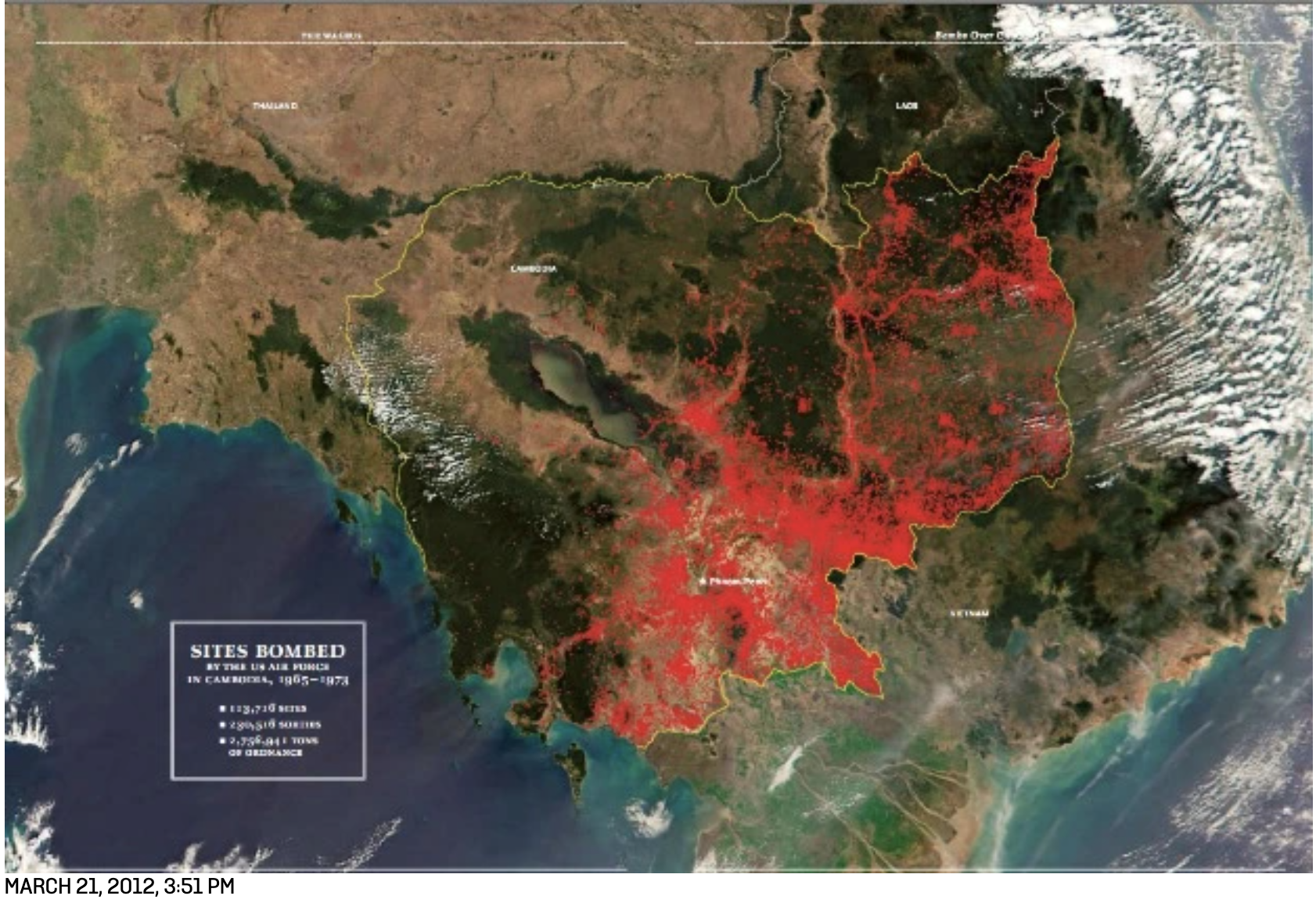
Leave a comment

Filed under Afghanistan, Afghanistan War, Kabul, military maps, War on Terror

Mobs and Jobs

Although we imagined that the barbarians crossing government barricades would arrive from the edges of empire, the edges from where the acting President had been mapping threats of their arrival for five years, imagining the crossing of caravans from south of the border with near anticipation, these barbarians arrived from all over the nation, from outside of the gridlock of Washington, DC, but to the Capitol building, to reclaim it for the people. While we focussed on the crowd assembled at the Rally to Save America as an event announced as an event that “will be wild,” on December 19, as if to make plans before Christmas to attend a final rally in Washington, DC, a final event to “swing victory to Trump” on the eve of the inauguration of Joseph R. Biden.

Trump approached the crowd of admirers less as a farewell speech than one energized by being surrounded by MAGA gear, affirming losing the 2020 Presidential election was “statistically impossible” to an assembly he had convoked to affirm “Today is not the end. It’s just the beginning. This might seem the last address he would offer to the nation, or perhaps it was the first address to a new nation the would arise, phoenix-like, from the destruction of old election laws and the fire that presaged the end of an earlier regime that would arise, as an old new America, from its ashes–not only a domestic resurgence of a Christian right, but a revisiting of the tortured reinterpretation of the confused message all but evident in the tea leaves of the electoral map.

Trump’s speech intentionally triggered the onrush of a crowd. His words created a set the stage for a reversal of the election’s results–and led so many of the MAGA crowd to bring election garb and flags to the event organized to stave off a peaceful succession. The January 6 Committee found Trump consciously energizing the armed crowd to charge the U.S. Capitol–a script that echoed Hitler’s instrumental use of lies to undermine the workings of government by appealing to a love of country and nation to the Nazi party. But his energizing of the crowd created an energy among them that ran around the justice of the nation’s governing body. Trump recast the election as invalid, and the incoming President as a criminal, enabled by a corrupt system, and demanding the reform of electoral laws as a legal end-run to secure his Presidency, all but intimating saving the country by an overthrow of the government–“calling on Congress and the state legislatures to quickly pass sweeping election reforms, and “you better do it before we have no country left,” he began his speech by saying, in an End of Times rhetoric, even as he assured the crowd that it was “Today is not the end. It’s just the beginning.” If his speech animated a March on the Capitol that would end in a disastrous fiasco as much as Hitler’s 1926 Munich Putsch, it may have allowed a new theater of the creation of national martyrs–as David Gumpert has argued–it mobilized a politics of grievance that was as steeped in fundamentalism and white christian nationalism and forged in a media ecosystem that whose retaking of the nation from news media that were “the enemy of the people,” as if convoking a personal redemption and a redemption of the nation.

The attention was heightened by what was a final chance and opportunity to reverse the incorrect results of the national election, resolving and a moment of a crisis of state by revoking the election and changing election laws to recognize the true nation he had assembled in the Ellipse. Trump electrified the assembled crowd to ready themselves to advance, as a crowd, united if not recognized by the media, to move across police barriers, past the capitol police, into the halls of governance, in a collective body, trying to fill the legislative chambers to retake the nation. Were they not being given permission to enter teh halls of state from which they had been wrongly exlcuded? Trump would recast January 6 not as an armed insurrection but as inevitable: one of those “things that happen when a sacred landslide victory is so unceremoniously & viciously stripped away from great patriots who have been badly & unfairly treated for so long.” The issue was personal, but far beyond personal, as it reflected the entire question of the security of the nation on which he had entered politics to defend, and with which his entire public service career had been oriented toward protecting: “This is not just a matter of domestic politics, this is a matter of national security.”

How can we question Trump’s responsiblity for orchestrating the attack on the hall of governance? The crowd was energized to assemble as if they were the true representatives of the nation, annointed by their ties to him. Trump had staged an attempted coup–or a half-hearted attempt to improvise one–inviting admiring acolytes to “walk down Pennsylvania Avenue” as a body to halt the joint session of Congress tabulating electoral votes–in an invitation to enter the halls of government with violence to overturn the election on that day, or create a good story of preserving the nation–and capital-“C” Country. The term “Country” invoked over forty times in speech transcripts are not capitalized, but he ad-libbed an invitation supporters to move toward the Capitol, framing the march as an attempt to prevent what “will be a sad day for our country,” urging them to “stand strong for our country, our country [as] our country has been under siege for some time,” invoking opponents eager to “hurt our country,” reminding them, eighteen minutes in, “you’ll never take back our country with weakness.” The “lying media” failed to report even “the magnitude of this crowd”: “Even I, when I turned on today,” identifying him as just another ember of the collective television audience, “I looked, and I saw thousands of people here, but you don’t see hundreds of thousands of people behind you because they don’t want to show that.” The rejection of the story or the judgement that he had lost the election, broadcast on news and by tabulation machines, was also not the full story, but was only a false story that the crowd must reject, as they assumed their true nature to remake the nation, energized by his speech.

Trump had elevated them as the real, true representatives of the nation, able to forestall a sliding of national grandeur that would leave the actual borders of the nation, and the border walls he built, and had campaigned on, vulnerable to the barbarians. He had, he told them, “ever seen anything like it.” They were ready, indeed, to become the new barbarians themselves, lest they invite the barbarians waiting at the border to invade the nation. And they had come, he assured them, as a mirror image of the barbarians or refugees that were waiting at the border, “from all over the world, actually, but they came from all over our country,” ready to reverse the false results of an election which “they rigged . . . like they’ve never rigged an election before,” evoking the fears of a “rigged” election of 2016, rehabilitating the word to which the audience would have cathected, as he converted them into an image of armed barbarians ready to enter the chambers of government. This was a false populism like never before, equipped with a vendetta of betraying the basic promise and function of representation.

Telling the rump of constituents that had congregated at the Ellipse they were “protecting the country,” the master of extended ellipses crafted a speech at the Ellipse rich in innuendo and and suggestion of danger to the nation–and mentions of “Country” that the transcripts of the speech cannot fully capitalize. The identity of the crowd that Trump created was planned over the long term–not crafted in twenty days between the call to assemble in Washington DC on December 19 and January 6. We might well map the arrival of energized participants in the culmination of Stop the Steal rallies across the country, a rally that promised to Save America as if to echo the end of times, by flared arrows, as they migrated down Pennsylvania and to the Capitol, as if on the street directions issued by the outgoing President.

Trump was verbally mapping an image of a dysfunctional country, where other barbarians were standing at the gates, not at the Ellipse. Channeling the rhetoric of hell-fire preachers promising redemption and national will, as if to go back in time to undo the election as Inauguration Day approached, the question of whether the crowd gained its unity as the President spoke, urged on by militant groups on the way to the Capitol may be debated. The master of the ellipsis found his stride at the Ellipse, basking in the display of signage and flags, perhaps, to stray from his Teleprompter to improvise an ad-libbed call to advance to the capitol, directing his followers to advance to the Capitol building as if to sanction their unity as a violent group, before they moved toward the Capitol grounds and moved to breach its perimeter, and the “rally” assumed new organic force.

The almost entirely all-white crowd of men–and very few women–carried signs of starkly ideological bent that seemed to overflow on television screens, as if designed to throw civil society off balance rather than allow the election to conclude. They mapped their own progress in the name of the multitude of flags they bore, dominated by the flags of the election that they refused to admit they had lost, as if to elevate the claims of election fraud Trump promoted as a crusade for the country. The crowd he assembled so provocatively, heard how a “system absolutely, totally rigged” had led to a stolen election was not only marked by “massive, widespread, total fraud,” as he had insisted since November, but had found the moment to “fight to expose this voter fraud and demand transparency and election integrity” by advancing to the Capitol. The call to erase any gap between political representation and voters was a call to arms masquerading as a call for transparency, mobilizing a crowd as truth-tellers who might invade the Capitol while fully armed as one body. When Elias Canetti pondered the force acquired by a crowd as an entity, and the consolidation of a crowd in terms of an elemental power, he addressed fascism, but also raised questions of the responsibility by which a crowd could be invested that seem to remain on the table after the hearings of the January 6 Committee have ended.

If the January 6 Committee after exhaustively interviewing the Trump White House staff and campaign associates found Trump consciously assembled and riled up a crowd to enter the Capitol to prevent the ceremonial transfer of power, creating a crowd as the crucial backdrop of consensus to flaunt the election’s results and to rewrite history. The staged coup was a way of marking a final attempt to retain the Presidency, it may have echoed the prominence that Hitler would assign the Bavarian Beer Hall Putsch in his prison memoirs, the forward to Mein Kampf, a book Trump once kept on his bedside, and that echoed the disgust with which Trump queried the loyalty of the American military while in office–“You f—ing generals, why can’t you be like the German generals?”–as if to model the subservience of the American military he imagined German generals had for Adolf Hitler, shortly after his election, in 2017. Hitler had commemorated the 16 party members killed by state police as he tried to kidnap government leaders by gunpoint became the propaganda victory for the Nazis, calling them martyrs in the preface to Mein Kampf, and burying them in “temples of honor” in downtown Munich where he staged party rallies to their remembrance on the anniversary of the putsch even after he was elected chancellor, celebrating their devotion to Germany. Trump had not only adopted increasingly violent language by the summer of 2020, but was immersed in these speeches: presidential historian Michael Beschloss set off a social media flurry over Trump’s relation to Mein Kampf or a volume of collected speeches My New Order, a sequel of Nazi propaganda repeatedly cited the Putsch as critical point of the Kampfzeit and sacred history of the Nazi Party– Heilsgeschichte–whose martyrs were commemorated in national parades in the German Reich, its “martyrs” buried in sacred temples.

By 2020, the concept of an “insurrection” had suddenly come home to roost, ready to be staged for national television, as the term if it loomed large in people’s minds. The nativist tenor of the March on Washington seemed reflective of a weird, old crazy America, reborn to prevent a stolen election, and the dire consequences that from such theft–as if it were akin to a new Original Sin, might ensue. The advance of barbarians were invented by the founders of democracy, the Greeks, Mary Beard argued, animated by the fears that their conquest, either imaginary or real, would be destined to triumph–from Persia or, later, from tribes living in German lands–but the fears were born from the awareness that the true barbarians lay within their midst, even if the fears were projected beyond the borders of the democratic nation or the boundaries of the city-state.

Barbarians Who Attacked and Destroyed the Roman Empire

Barbarian Invaders Filling the Vacuum of the Disappearance of Late Roman Empire, c. 480 AD

The entrance of migrants into the United States is perhaps a primal fear of globalism or globalization among the Trump crowd, of crossing boundaries, breaking boundary lines, and violating the nation and its sanctity.

We had all been waiting for barbarians for some time. The President had, for over six years, mapped the threat of the barbarians advancing from across borders as a security threat. but these barbarians came not from Mexico. For those ready to accept a wall between the United States and Mexico as a function of good government, it made sense to breach the Capitol, lest that border wall not be built . The fear that the charismatic leader who had been elected against the mainstream media’s prediction, and the interests of political elites, was about to be removed from office, and the borders of the United States in danger of opening to immigrants, gangs, and drugs, in the imagery of Trump supporters who feared the rising tide of globalism that Trump had staunched about to overwhelm the nation. He had declared a national emergency against the threat of the arrival of migrant caravans, and the arrival of “unprecedented numbers” of immigrant refugees at our borders.

The energized crowd surged over barriers to cross the perimeter of the U.S. Capitol lest forces of globalization from entering the nation to undermine its sovereignty, but entered the capitol only to venting their rage and vandalizing the government building. The barbarians entered the gates of government to prevent the erosion of the nation and follow the call to Make American Great Again–national integrity was in danger of being undermined, insisted online misinformation, detailing how nefarious foreign forces had shifted the result of the 2020 vote, as the software of electronic voting threatened to disenfranchise Republicans and end democracy. The danger of the subversion of the vote would require complete auditing of votes, lest ballot counting systems be allowed to maliciously delete over 2.7 million votes by voting systems in twenty-eight states, from Pennsylvania to Michigan to Georgia–causing rioters to arrive from all over the nation to defend the President, if we track those Proud Boys who arrived in the Capitol by their geotagged tweets.

Vigilantes had patrolled the border for years, animated by an ethos of defense of national borders, and mobilizing within the Customs and Border Patrol to find meaning in the slogan to defend deportations of migrants that “we need strong borders,” and “we have no country if we have no border,” as if he were defending American families, and the “blood” of those families, and celebrating his defense of borders and accusing his opponents of open borders. But the border of the U.S. Capitol was rendered open on the morning of January 6, 2020, as the Congress was about to confirm the electoral votes as barbarians entered, as if invited, into the Capitol, to make their voices heard.

This crisis was occasioned by the sudden loss of a charismatic center, and by the consecration of the crowd with new psychic energy to affirm the restoration of the Trump to power. With YouTube channels live-streaming fake projections as maps of election results as polls closed to hundreds of thousands, framing the narrative of the election as a theft of the nation, as self-made maps proliferated and confused all clear consensus and interpretation of electoral results, it made sense to enter the halls of government to force the issue of Presidential succession in a decisive manner that was fully merited by the distortion of the electoral results, and the incorrect tabulation of ballots, lest America was going to just stand by.

The poster and invitation to the event that was disseminated online in December as a last stand of indignation didn’t specify a time or location at first, when issued online, but the meme generated energy from across the nation, with an energy that evoked not only the fear of the end of a Trump Era, but the fears of an end to the collapse of a vision of globalization, maintained by that charismatic center, a wall built around the nation against immigrants more than against Mexico, a defense of unfettered wealth, and white privilege, a call-and-response rally able to generate a massive dynamo of popular wildness and will to secure America’s red, white, and blue whose philosophy was all there in black and white set the terms for the license of January 6.

Call to Protect Election Integrity

Trump sanctified the crowd, as the Preacher in Chief, as an alternative assembly of the nation. This was a nation whose borders we could strengthen by overruning the Capitol itself. Did Trump aim at creating a similar moment of national commemoration, akin to the bizarre National Garden of American Heroes he had imagined on July 3, 2020, while attacking the “angry mobs . . . trying to tear down statues of our Founders [and] deface our most sacred memorials”? The rhetoric of sacralization that was implicit in Trump’s address may well have anticipated a memorial of a scene that was of truly historical proportions, Trump implied, for those who were willing to participate. It was an alternative history in which they could take part, akin the bizarre Garden of American Heroes that had been the closest attempt he had ever made of a positive map of America, rather than one bound by poured concrete walls.

Continue reading

2 Comments

Filed under Capitol Riots, Donald Trump, fascism, January 6, January 6 riots, Presidential Elections

Coronavirus Advances

While we are increasingly deadened by data visualizations that track the infectious spread of COVID-19 across the world and country, their logic has often been implicit. As much as tracking real-time data of deaths and “hot-spots” in the world and the nation, we trust the data viz to orient us to the infectious landscape to better gain understanding of viral spread. We seek to grasp nature of the virus’ transmission, and perhaps hope that we can better grasp its spread. We depend on these daily updates to retain a sense of agency in the chaos, but realize that they are provisional, contingent, and selective snapshots, based on testing, and exist at a time delay from the virus’ actual distribution–without much predictive value. We maddeningly realize they are dependent on testing rates and reporting, and only as good as the datasets which they re-present.

On the heels of a 5% statewide positivity rate on December 5, 2020, California was declared in a state of shut down in all its counties. It almost seems that such graphics have started to fail us, as the spread of the virus overflows the boundaries of the map and permeates its space. The choropoleth renders individual counties all but indistinct, the state drowned in widespread infections, with only a few of its less populated regions as refuges. With a flood of purple overflowing the coastal counties, the delta, the Central Valley, and the entire south of the state, was there even any point in mapping the danger of viral spread beyond a state of red alert?

Dec. 5, 2020

While mapping offers little comfort in the era of saturation of heightened risk, the color-codes alert inhabitants to the danger of increased stresses on the public health system–as much as visualization challenges to translate tools of data aggregation to visualize the pandemic., as December 6 rates grew by December 19. As we shift to map a decreasingly multi-colored state by the moderate, substantial and widespread virus, and widespread cases seem to flood the state, the map offers a security of some sort of monitoring of the pandemic’s spatial spread.

The sea of purple is like Spinal Tap going raising the volume “up to eleven,” and are a sign that we are in unexplored territory that won’t be accommodated by a simple color ramp–or, indeed, a familiar cartographic iconography among our current tools of styling space. While we are used to maps embodying meaning, what the colors of the map embody–beyond risk–is unknown. To be sure, at a time when fatalities from the coronavirus in the south of the state have skyrocketed from the middle of the month, hitting records in ways terrible to even contemplate, the field of purple is a deeply human story of loss, as a surge of hospitalizations have flooded the entire healthcare community, and stretched facilities of critical care beyond anything we have known, filling half of intensive care beds in LA County at Christmas. 2020 enough to make it hard to feel any relief in the close of a calendar year, as if that unit still held any meaning, and very grim about 2021: and while the CDC allowed that there may already be a new, more contagious strain, in the nation two days before Christmas, the arrival of the more contagious strain in California and Colorado increased alarm before New Year’s.

San Francisco Chronicle, December 6 2020
SF Chronicle, December 19, 2020

How to get a handle on the novel coronavirus that we have been pressing against COVID-19 dashboards since March to grasp better, and will we able to do so in 2021?

Whatever sense agency the maps impart, it is an agency that is only as good as the compromised sense of agency that we expect in an era of geolocation, on which most maps track reports of infection. Even as we face the rather grim warning that we are waiting for the arrival of a vaccine that, in the Bay Area, rates of immunization face steep obstacles of vaccine distribution due to pragmatics of freezer space required, training of extra health care workers, and monitoring and tracking the two-stage process of vaccination, we will depend for public sanity on maintaining clear communication in maps. The actual tracking of the novel coronavirus doesn’t translate that well to a state-wide model, or a choropleth, although it is the method for public health advisories that makes most sense: we do not have small-scale public health supervision in most of the nation, although they exist at some counties. The stressed Departments of Public Health in areas are without resources to manage COVID-19 outbreaks, public health compliance, or retaliations for public health violations: and the effort to create public health councils to manage compliance and violations of public health orders may be seen by some as an unneeded bureaucracy, but will give local governments resilience in dealing with an expanding epidemic, at the same time as governmental budgets are stressed, and no body of law about COVID violations exists.

Rather than map on a national or state-wide level, we can best gain a sense of how much virus is out there and how it moves through attempts of contact tracing–even if the increasing rates of infection may have gone beyond the effectiveness of contact tracing as a methodology that was not quickly adapted by a federal government the prioritized the rush to a vaccine. The basis for such a map in LA county can reveal the broad networks of contagion, often starting in small indoor gatherings across the region, and moving along networks of spatial mobility across the city and San Fernando Valley, and help embody the disease’s vectors of transmission as we watch mortality tallies on dashboards that give us little sense of agency before rising real-time tolls.

ESRI

If such ESRI maps suggest a masterful data tracing and compilation project, the data is large, but the format a glorification of the hand-drawn maps of transmission that led to a better understanding of the progress of Ebola on the ground in 2014, used by rural clinics in western African countries like Liberia and Rwanda to stop the infectious disease’s transmission and monitor the progress of contagion to limit it–as well as to involve community members in the response to the virus’ deadly spread.

We may have lost an opportunity for the sort of learning experience that would be most critical to mitigate viral spread in the United States, as no similar public educational outreach was adopted–and schools, which might have provided an important network for diffusing health advisories to families, shifted predominantly to distance learning and providing meals, but we became painfully aware of the lack of a health infrastructure across America, as many openly resisted orders to mask or to remain indoors that they saw as unsubstantiated restrictions of liberty, not necessary measures.

Hand-Drawn Public Health Map of Ebola Transmission in Liberia (2014)

We are beyond contact tracing, however, and struggling with a level of contagion that has increased dramatically with far more indoor common spaces and geographic mobility. Yet the broad public health alerts that these “news maps” of viral spread offer readers omits, or perhaps ignores, the terrifying mechanics of its spread, and the indoor spaces in which we know the virus is predominantly acquired. The rise of newly infectious mutated strains of the novel coronavirus was in a sense inevitable, but the rising tension of what this means for the geographical distribution and danger of the coronavirus for our public health system is hard to map to assess its wide distribution, and we take refuge in mitigation strategies we can follow.

Why have we not been more vigilant earlier to adapt the many indoor spaces in which the virus circulates? It bears noting that the spread of virus in the state was undoubtedly intensified by over a hundred deaths and 10,000 cases of infection to spread in the density of a carceral network, which seems an archipelago incubating the spread of viral infections in the state. We only recently mapped the extent of viral spread across nineteen state prisons by late December 2020, tracked by the Los Angeles Times, but often omitted from public health alerts–

Coronavirus Cases Reported in Nineteen California Prisons, Dec. 21, 2020

–and the density of Long-Term Care centers of assisted living across the state, which were so tragically long centers of dangers of viral spread, as the New York Times and Mapbox alerted us as the extreme vulnerabilty of elder residents of nursing homes, skilled nursing facilities, retirement homes, assisted-living facilities, residential care homes who cannot live alone was noted across the world. The data that was not provided in the grey-out states interrupted the spread of infections among those often with chronic medical conditions was not surprising, epidemiologically, but terrifying in its escalation of the medical vulnerability of already compromised and vulnerable populations–and steep challenges that the virus posed.

unlike those greyed out states that fail to release data on deaths linked to COVID-19 infections, congregate on the California coast: while the New York Times depicted point-based data of the over 100,000 COVID-related deaths in nursing homes are a small but significant share of COVID deaths, exposure for populations with extraordinarily high probability of possessing multiple possibilities for co-morbidities is probably only a fraction of infections.

Coronavirus Deaths linked to Nursing Homes in United States, December 4, 2020

We strain to find metrics to map the risk-multipliers that might be integrated into our models for infectious spread. It seems telling to try to pin the new wave of infections in a state like California to increased contact after Thanksgiving–a collective failure of letting up on social distancing in place since March–as the basis for a post-Thanksgiving boom in many regions of the state, using purely the spatial metrics of geolocation that are most easily aggregated from cell phone data in the pointillist tracking of individual infections in aggregate.

New York Times/CueBiq Mobility Data

Based on cell-phone data of geolocation, a proxy for mobility or social clustering that offered a metric to track Americans’ social proximity and geogarphical mobility–including at shopping centers, oceanside walks in open spaces, and even take-out food curbside pickups, as well as outdoor meals and highway travel, few counties curbed aggregation as one might hope–although the fifty foot metric accepts the many outdoor congregations that occurred, well within the Cuebiq metric, wearing or without masks. A magenta California registered pronounced proximity, grosso modo, discounting any mindful innovative strategies in the state.

Increased Spatial Closeness within Fifty Feet/CueBiq/Graphic NBC News, Nigel Chiwaya and Jiachan Wu

It is stunning to have a national metric for voluntary mobility, rough as it is, to measure internalization of social distancing protocols and potential danger of a post-holiday COVID-19 bump. To be sure, we are stunned by geolocation tools to aggregate but risk neglecting the deeper infrastructures that undergird transmission, from forced immobility. While geolocation tools offer opportunities for collective aggregating whose appeal has deep historical antecedents in measuring contagion and anticipating viral transmission by vectors of spatial proximity, geospatial tools create a geolocation loop in visualizations which, however “informative” perpetuate a spatiality that may not clearly overlap with the actual spatiality of viral transmission.

Even if we demanded to map what were the novel coronavirus had “hot-spots” in mid- to late March, as if processing the enormity of the scale we didn’t know how to map, aggregating data without a sense of scale.

March 26, 2020

Across the summer, it seems best to continue to map daily numbers of cases, relying on whatever CDC or hospital data from Hopkins we had, trying to aggregate the effects of the virus that was spreading across the country whose government seemed to provide little economic or medical plan, in maps that tallied the emergence of new cases, as new hotspots appeared across the land, meriting attention difficult to direct.

We are plowing infections and mortality with abandon in a steady diet of data visualizations that purport to grasp disease spread, that were once weighted predominantly to the New York area, even as they spread throughout the nation by the end of March, but remaining in the thousands, at that point, as even that low threshold was one by which we were impressed. The tracking of the local incidence of reported cases seemed to have meaning to grasp the meaning of transmission, with a pinpoint accuracy that was assuring, even if we had no way to understand the contagion or no effective strategy to contain it. But we boasted data visualizations to do so, focussing on the nation as if to contain its spread in antiquatedly national terms, for a global pandemic, not mapping networks of infection but almost struggling to process the data itself.

After all, the John Snow’s cholera maps of John Snow are the modern exemplars foregrounded in data visualization courses as game-changing images as convincingly precise pictures of infection progressing from a water pumps in London neighborhoods is often seen as a gold standard in the social efficacy of the data visualization and information display. The elevation of the pinpoint mapping of cholera mortality in relation to a water pump from which the deadly virus was transmitted in a nineteenth-century London neighborhood:

John Snow, “Cholera Deaths in Soho”

The Snow Map so successfully embodies a convincing image of contagion that it has taken on a life of its own in data vis courses, almost fetishized as a triumphant use of the plotting of data that precisely geolocated mortality statistics allow, and can indeed be transposed onto a map of the land to reveal the clustering of death rates around the infamous Broad St. pump, that created a legible vector of the transmission of diseases in the Soho neighborhood, so convincing to be touted as a monument of the data sciences.

Open-Air Water Pumps Tainted by Cholera measured in John Snow’s Map

Snow is lauded for having effectively showed that, in ways that changed scientific practices of collective observation and public health: rather than being communicated by miasmatic infections that spread to low-lying London from the Thames, mortality rates could gain a legibility in proximity to a pump that transmitted an infectious virus, often presented as a conceptual leap of Copernican proportions (which it was, when contrasted to miasma that emanated from the Thames to low-lying areas–if it anticipated a bacteriological understanding of viral transmission). The association of danger with the water procured on errands from neighborhood pumps however replaced the noxious vapors of a polluted river, as in earlier visualizations of the miasma that lifted the noxious fumes of the polluted Thames river to unfortunate low-lying urban neighborhoods, who were condemned by urban topography to be concentrations of a density of deaths of more striking proportions and scale than had been seen in the collective memory.

Snow made his argument by data visualizations to convince audiences, but he mapped with a theory of contagion. But if Snow’s maps works on how the virus is communicated in outdoor spaces–and how a single site of transmission can provide a single focus for the aggregation of mortality cases, COVID-19 is an infection that is most commonly contracted in indoor spaces, shared airspace, and the recycled unfiltered air of close quarters. And the indoor spaces where COVID-19 appears to be most often transmitted stands at odds with the contraction in outdoor common spaces of the street and service areas of water pumps, that create the clear spacial foci of Snow’s map, and the recent remapping by Leah Meisterlin that seeks to illuminate the urban spaces of the contraction of cholera in a digital visualization as a question of intersecting spatialities.

Current visualization tools compellingly cluster a clear majority of cholera deaths in proximity to a publicly accessible pump where residents drew water where viral pathogens that had colonized its handle. But we lack, at this point, a similarly convincing theory of the transmission of the novel coronavirus SARS-CoV-2.

But the logics of COVID-19’s communication is nowhere so crisp, and difficult to translate to a register that primarily privileges spatial contiguity and proximity–it is not a locally born disease, but a virus that mutates locally across a global space: a pandemic. And although contact-tracing provides a crucial means of trying to track in aggregate who was exposed to infection, we lack any similarly clear theory to metaphorically grasp the contagion–and are increasingly becoming aware of the central role of its mutation to a virus both more infection and that spreads with greater rapidity in confronting the expansive waves of infection in the United States–as if an escalated virulence grew globally in the first months of this rapidly globalized pandemic.

Our dashboards adopted the new versions of web Mercator, perhaps unhelpfully, to offer some security in relation to the nature of viral spread, which, if they served as a way of affirming its truly global scope–

NextStrain

–also suggested that global traffic of the virus demands its own genomic map, as the virus migrates globally, outside strictly spatial indices of global coverage, and that perhaps spatial indices were not the best, in the end, for accounting for a virus that had began to develop clear variants, if not to mutate as scarily as many feared, into a more virulent form.

And it may be that a genomic map that allow the classification of viral strains of genomic variability demand their own map: for as we learn that genomic mutation and variation closely determines and affects etiology, communication of the viral strains offers yet a clearer illustration that globalization articulates any point in terrestrial space to a global network, placing it in increased proximity to arbitrary point not visible in a simple map, but trigger its own world-wide network of markedly different infectiousness or virulence.

NextStrain

From December 4 2019, indeed, we could track emergent variants of the virus best outside of a spatial scale, as much as it reminded us that the very mobility of individuals across space increased the speed and stakes of viral contagion, and the difficulty to contain viral spread, in the interconnected world where viral variation recalled a flight map, set of trade routes, or a map of the flow of financial traffic or even of arms. Mutations were understood to travel worldwide, with a globalism that a spatial map might be the background, but was indeed far removed, as we moved beyond questions of contact tracing to define different sizes of genomic mutation and modifications that we could trace by the scale of mutations, not only the actual places where the virus had arrived.

Was place and space in fact less important in communicating the nature of COVID-19’s increasing virulence?

The maps of genomic variation traced not only the globalization of the virus, but its shifting character, and perhaps etiology across some thirty variants by late April, that show both the global spread of the virus, and the distinct domination of select strains at certain locations, in way that researchers later theorized the ability to “track” mutations with increasing precision. If researchers in Bologna defined six different variants of coronavirus from almost 50,000 genomes that had been mapped globally in laboratory settings to map variants of the virus whose signatures showed little more variability than strains of the flu in June, variations of signatures seemed a manner to map the speed of coronavirus that had traveled globally from by February 202 to the lungs of the late Franco Orlandi, an eighty-three year old retired truck driver from Nembro, Italy, whose family could not place China on a map when, following diagnostic protocol, attendant physicians in Bergamo asked if Orlandi had, by chance, happen to have traveled to China recently.

NextStrain

Despite lack of serious mutation, thankfully, the data science of genomic sequencing of the COVID-19 cases triggered by genomic mutations of SARS-CoV-2 genome of just under 30,000 nucleotides, has experienced over time over 353,000 mutation events, creating a difficult standard for transmission into equivalent hot spots: some hot spots of some mutations are far more “hot” than others, if we have tried to plot infections and mortality onto race, sex, and age, it most strikingly correlates to co-morbidities, if all co-morbidities are themselves also indictors of mortality risk. While the mutations have suggested transmission networks, have the presence of different levels of mutations also constantly altered the landscape of viral transmission?

Global Distribution of Sars-CoV-2 Variants, March 15, 2020/Los Alamos National Laboratory

It makes sense that the viral variant was tracked in Great Britain, the vanguard of genomic sequencing of the novel coronavirus as a result not only of laboratory practices but the embedded nature of research in the National Health Services and the monitoring of public health and health care. Enabled by a robust program of testing, of the some 150,000 coronavirus genomes sequenced globally, England boasts half of all genomic data. Rather than being the site of mutations, Britain was as a result the site where the first viral variant was recognized and documented, allowing Eric Volz and Neil Ferguson of Imperial College London to examined nearly 2,000 genomes of the variant they judged to be roughly 50% more transmissible than other coronavirus variants, magnifying the danger of contagious spread in ways feared to unroll on our dashboards in the coming months. As teams at the London School of Hygiene and Tropical Medicine studied the variant in late 2020 in southeast England, they found it to be 56% more transmissible than other variants, and raised fears of further mutations in ways that rendered any map we had even more unstable.

The virus SARS-CoV-2 can be expected to mutate regularly and often. While England boasts about half of all global genomic data on the virus, of the 17 million cases of SARS-CoV-2 infections in the United States, only 51,000 cases of the virus were sequenced–and the failure to prioritize viral sequencing in America has exposed the nation to vulnerabilities. And although California has sequenced 5-10,000 genomes a day of the novel coronavirus samples by December, and Houston’s Methodist Hospital have mapped 15,000 sequences as it watches for new viral variants; an American Task Force on viral variants will be rolled out early in 2021, as the discovery of viral mutations haves spread across five states in the western, eastern, and northwestern United States. While it is not clear that the viral variant or mutations would be less susceptible to polyclonal vaccines, most believe variants would emerge that would evade vaccine-induced immunity.

Continue reading

Leave a comment

Filed under California, California Politics, Coronavirus, data aggregation, data visualization