Monthly Archives: June 2013

Re-Writing Mapped Space: Maps as Texts

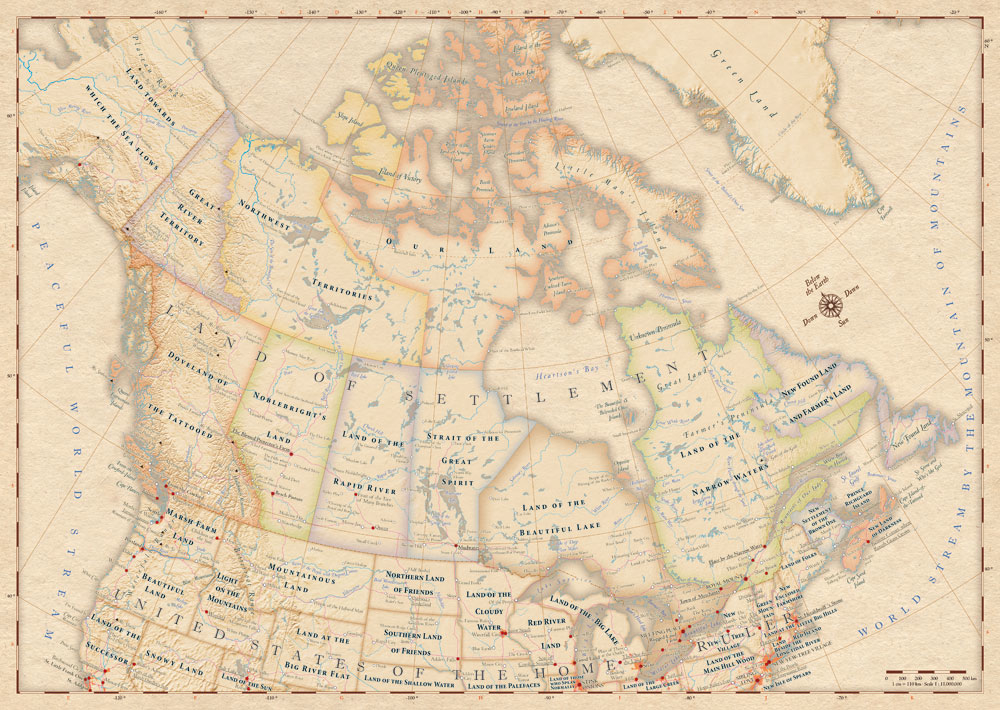
The Atlas of True Names   (2008) promises a legible cartographical surface clarifying confusions–although this enterprise is, in fact, less of a rebuttal to the deceptions of maps than based on whimsical fancy, the placid surface and mutely authoritative capitals of its densely written surface are something like a response to the comprehensive coverage of Google Maps.  Here, erudition crowds the visual surface of the map that draws its viewer onward across its surface on something more like a treasure hunt for amusement than a normal trajectory through space.  The text-based format of the map, whose traditional appearance and muted topographic coloring are equivalent to a calm reassuring voice, are a very retro surface, but as one looks closer, familiarity gives way to surprise:  for the translation of each place-name into the literal meaning of its signifier unpacks the familiar surface of the map.  The product on view gives new meaning to legible cartographical representations of expanse–or for that matter to maps as texts–by providing a map of the “true meanings” of toponymy in other maps, by a kind of reductio ad absurdum of etymological origins.

As we look at it, to be sure, we seem to be falling down something of a rabbit-hole, of which maps hang on each side, as for Alice; for the map  retains few familiar names.  The maps in the Atlas of True Names remind us of the extent to which our understanding of mapped space is determined by the location of names we read on maps’ surfaces, as much as other map signs.  Rather than use big data, the map of North America boasts data as small, and apparently as old, as one can get:


USA_1000


There’s more than a bit of wacked-out humor in the map’s subversion of the schoolroom hanging map used to study the states’ capitals or high-school text of history.  But just as the notion of “United States of The Home Ruler” seems inconceivable in a pre-Homeland Security world, and independent of etymological reconstruction, between the staid “Land of Settlement” and prosaic “Navel of the Moon,” the politics by which this atlas retrofits the map as object merit examination as remapping an inhabited space.  As much as a novelty, the marketing of this atlas returns us to the map we grew up with, and winkingly suggests what good map-readers we are.

In recasting such a familiar region with “true” place-names, map-reading becomes an exercise not only of re-reading toponyms with a thesaurus in hand, but an exercise of refamiliarizing ourselves with the naming of places that we know.  The notion of locating truth in maps might unintentionally echo an eery undercurrent scarily similar to the right-wing thirst for transparency in politics:  the shifted place-names of this project of re-mapping boasts the title of the “The Atlas of True Names” as if to curry to a skepticism in how place-names determined by multiple interests–even if the exercise in whimsy also aspires to enchantment.  Replacing the names we’d expect encourages to read the cartographical surface with the sort of pleasure of discovery of place-names we might have while headed to a radiant Emerald City past Truth Mountain, Winkie River and Rigamarole.
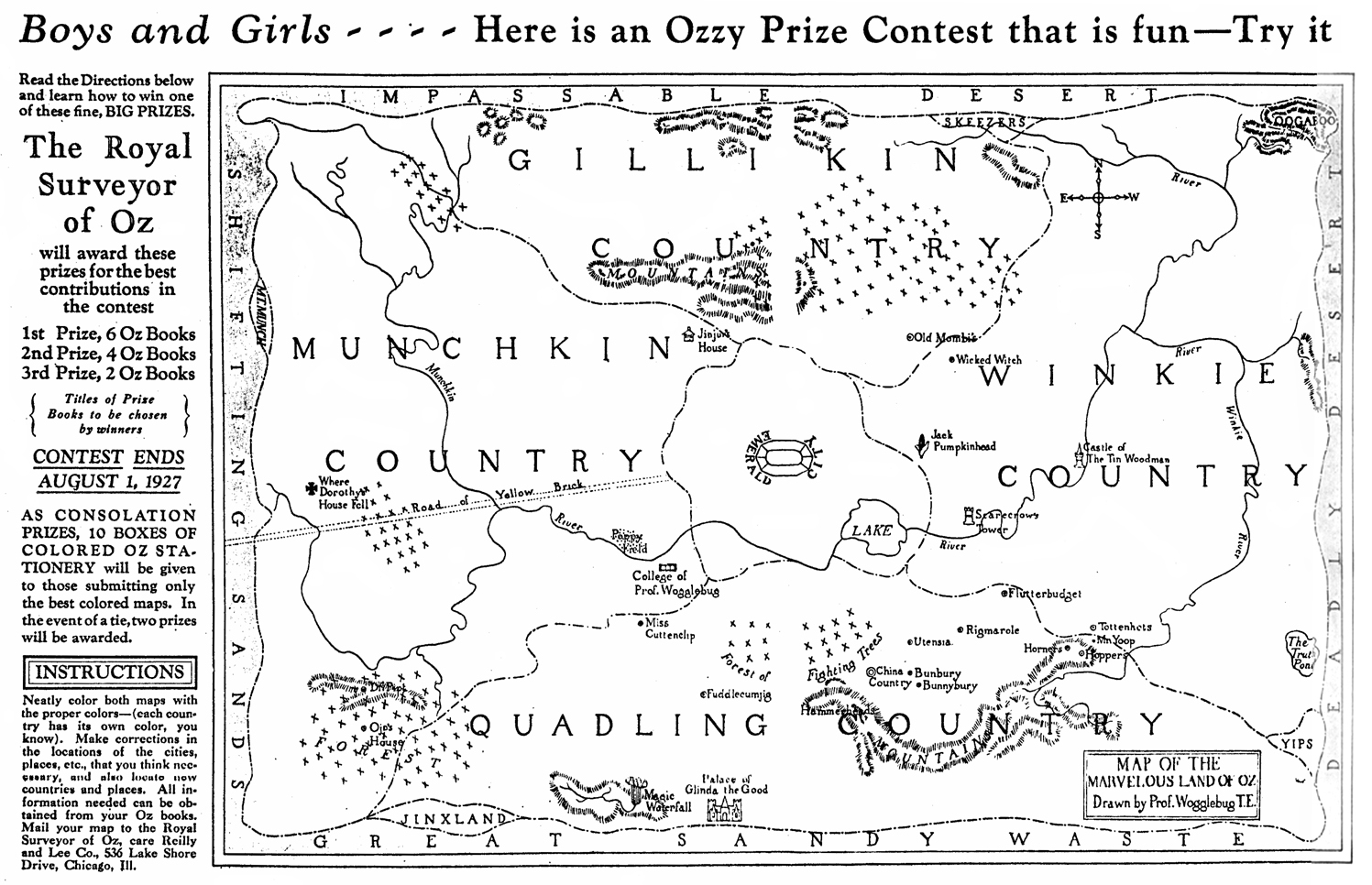
1927 Oz Map


But we’re in Kansas; not in Winkie-Land.  For American readers, the flattening of places into a register of quasi-scriptural authority of place seems to be an echo of the sort of national essentialism of the map–even if this was far removed from what the pleasant couple who designed it in their native Lübeck, here the “Lovely City,” might have actually intended.  Indeed, the negotiation of place names that began from custom and usage, is all but erased in the replacement of toponymy with a “true” origin that leaves Texas “Land of Friends” and Maine the “Land of Folks” and just reminds us of the darned problems of relating signifiers to signified.  Cuba as “Place to Find Gold” is transposed from a treasure map, but once removed from “X-marks-the-spot” deictic pointers, seems robbed of meaning.

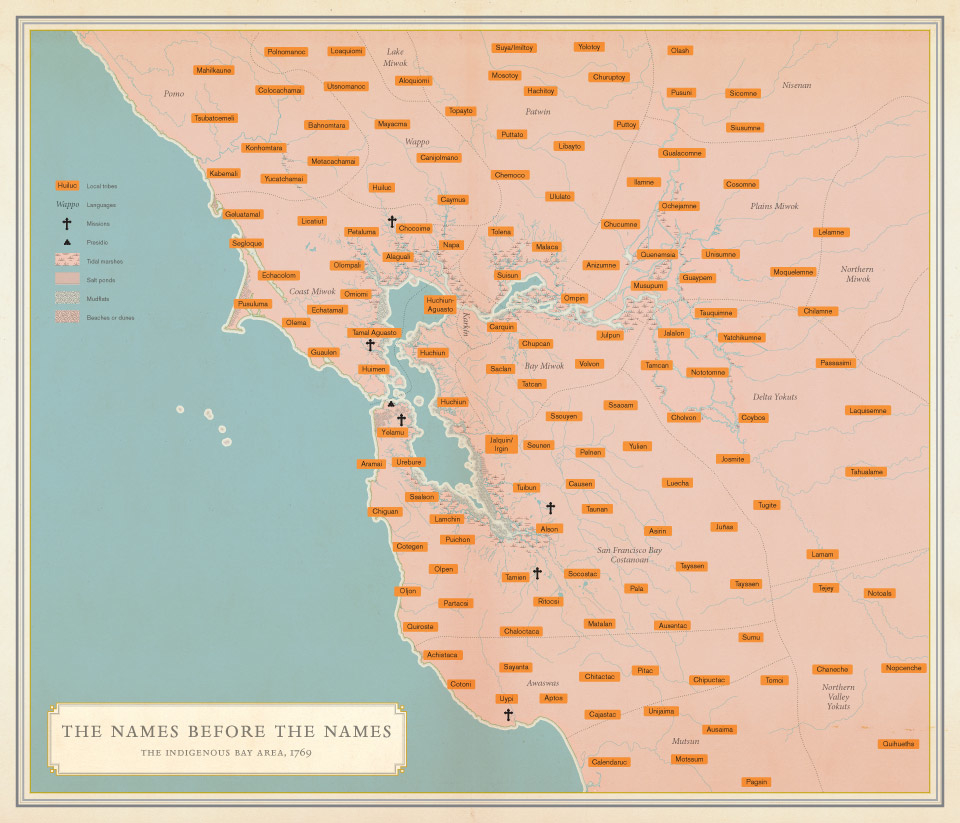
Consider, for one, the range of names that were lost or purged from the maps that we use to navigate the Bay Area alone, let alone the entire American West, in this intensive compilation of native names for place in circa 1760 since erased from our own cartographical records of the same area:
 

Solnit_Names_070610-1


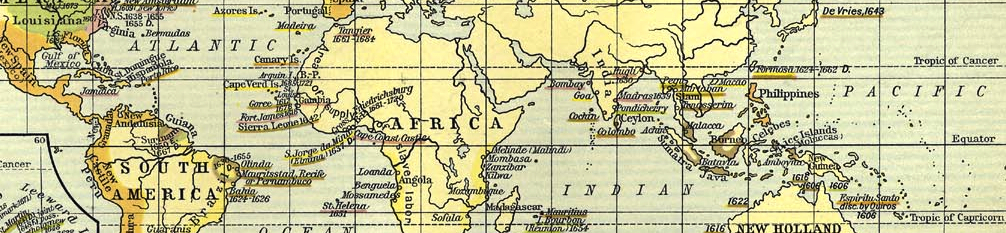
Or consider the active role of colonizers in the renaming of regions, places and islands over time and human history so evident in the band around the equator:


Colonization around Equator


Which brings us to the odd title of the atlas, sold for an unclear audience.  The claim to be “true” seems particularly questionable in its flattening of the historical richness  of the thick descriptions any map recapitulates.  While I don’t want to question or assail the attempt to “re-enchant” a space whose meanings mutated over time, the problem of viewing the layers of history as a matter of direct translation forgets that the past of any place is itself another country, if not a sequence of multiple worlds, that a one-to-one re-matching also threatens to impoverish at the same time as essentialize.   And as much as re-enchanting, there’s the sense that this pair of married cartographers, Stephan Hormes and Silke Peust, put their readers in the position of Alice, who “had not the slightest idea what Latitude was, or Longitude either, but she thought they were nice grand words to say,” but found the words compelling and so intelligent. Truthfulness and maps are an odd combination:  the map is a register of actuality, but a polyglot rendering of actuality.

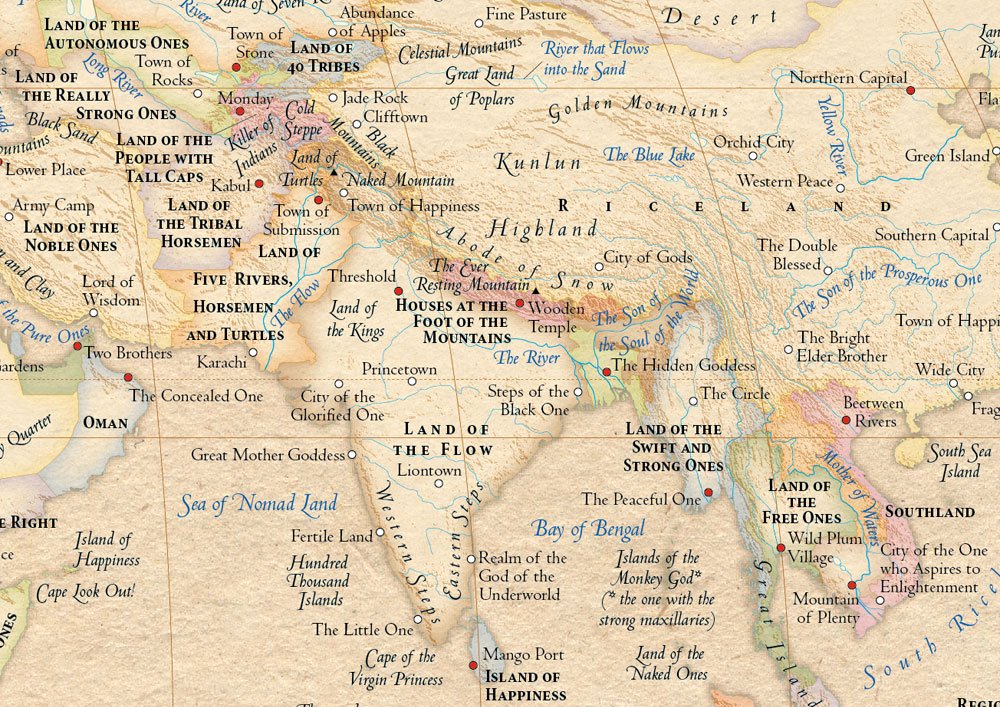
Yet as if disclosing hidden knowledge, even while barely maintaining a straight face, the unwitting effect of the “True Names” project is to flatten the historical accretion but also multi-cultural negotiations that provide the back story of the formation of place-names on the map.  The heaviness of “The Land of Settlement” that overhangs the familiar forty-eight, and the prosaic “Land of Cloudy Water” and “Land of the Shallow Water” aside, and even the romance of the “Land of the People with Dugout Canoes,” or “Land of Folks,” the notion is that this map has the true stuff for its readers.  Like the “Houses at the Foot of the Mountains” or the “Land of the People with Tall Caps” north of modern Pakistan.

The Anglicized toponymy of place is not only an etymological translation, but a sort of re-rendering of loci that invests the surface of the map with a epic-like declarative identification.  Of course, you don’t have to wander far:  Paris is the “City of Boat-Men,” and England (Great Britain) “Great Land of the Tattoed,” as any reader of Julius Caesar’s Gallic Wars might remember his description of the blue-painted men standing on the cliffs of Dover.  Hormes created the map together with his wife with aspirations to recreate ” an insight into what the people saw when they first looked at a place, almost with the eyes of children” as they encountered its topography, as if wandering for the first time in a country before time and seeking to capture local particularities, or to see the place for the mythical primeval time.

The inspiration of this map, and indeed for the treatment of mapping as a commercial enterprise, is less a report actual localities or surveying, than a removed activity of toponymic transcription, here under the guise or mask of Teutonic erudition more than compilation of unknown spaces; the idea is to make known space unknown or known again.  The aim is a sort of time-travel and a wiping clean of the slate of culture:   “Through the maps, we wanted to show what they saw,” he explained, eliding the palimpsestic quality of the map itself.  But the standards are not particularly high, as the goal seems to be to amuse.  There’s a certain failure to capture the acts of translation whereby a current English or American name descended from a French or other place-name, as Buffalo NY from belle fleuve, or for that matter recast “Rome” which appears as “Central City,” or even New York’s stint as New Amsterdam until 1644:  and even as late as 1630, colonists noted the divergent spellings of Mattachusetts, Massatusetts Bay, and Massachusetts, without seeing the need to arrive at orthographic stability.  And so perhaps a history of toponyms’ mutation can be included in the online version, bedecked with hypertext.   But learning is not the point, of course; and neither is a history of usage.

There is quite a bit of fun in imagining the renaming of the continuous 48 states with new identities like recasting Illinois as the “Land of Those Who Speak Well” or “Land of the Pale Faces,” even though the latter might now cover the entire continent:
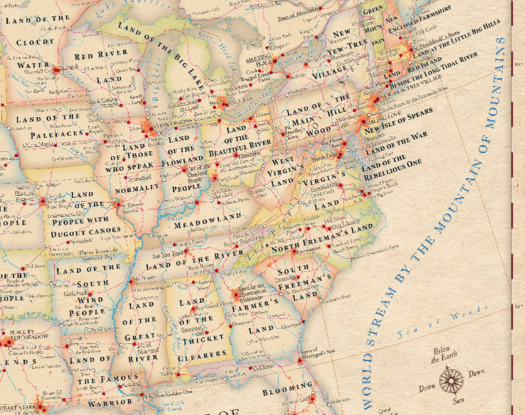
 

map detail North America


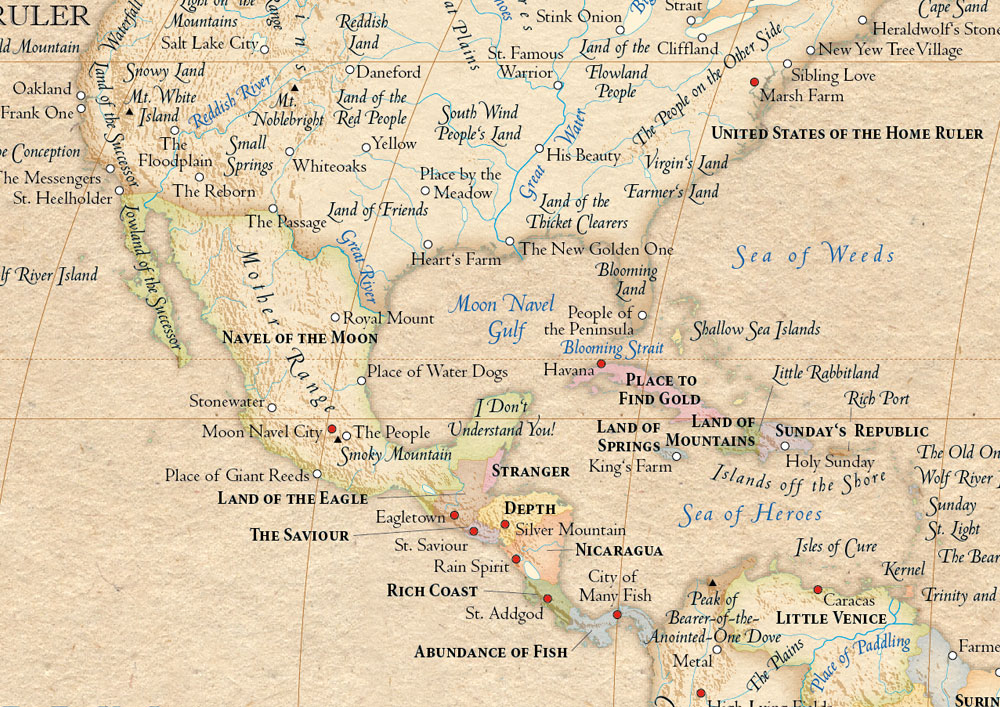
The imaginative etymological reconstructions are a source of delight, if they don’t always successfully re-enchant mapped space and may also raise eyebrows.  Few won’t love such place-names like the “Land of the Cloud Water” or “The Sea of Weeds” or “Navel of the Moon” that give a quasi-biblical authority to what we usually read on the surface of the map most of us have known from first or second grade. Even despite the familiarity of some names–“Oakland” and “Salt Lake City” among them on the map, the diversity and history of the transmission of place-names are somehow flattened out to a single surface in one fell typographical stroke. It might be, moreover, that the location of ‘trueness’ in the names suggests both a sense of what the surface of the map usually hides and a barely conceals the right-wing paranoia at a conspiracy perpetrated even against us map-readers–echoing if not somehow analogous to the fears of a conspiracy that the falsity of Barack Obama’s Hawaiian birth-certificate has been recently reconfirmed which vigilant readers of the Wall Street Journal continue to post in the responses to articles for whoever is listening.  The renaming of “true” place-names somehow contains an element of rectifying the deceits long perpetuated by state-trained cartographers obscure, with a healthy skepticism toward the authority transmitted in maps:  this almost seems  the latest echo of Richard Hofstadter’s paranoid streak that shapes politics, in which politics was an “arena for angry minds” –if not in such Manichaean terms as Hofstadter argued, but rather a sense that the signifiers associated with the place might be better decoupled from them, lest we naturalize the map’s surface, or mistake it for the territory.

One can imagine the scriptural significance that certain readers would paradoxically invest in the 2008 corpus of maps.  Although the two practiced cartographers mobilized an array of Old World erudition, and they clearly took some pleasure in tracing back, from the port of Halifax, “Remote Corner where Rough Grass Grows,” the act of renaming was something of an inversion of the cartographer’s task of “put[ting] as much information as possible in a single image.”   For in this case, the image is not what makes the information assembled accessible after all, so much as a the quasi-scriptural authority invested, with some imaginative leaps, in place-names that repopulate its surface, and shift the ground beneath one’s feet.  How is Hudson’s Bay (and other places linked to proper names) given true immediacy when Heartion’s Bay? Quasi-scriptural is not a misnomer given the solemn intoning of places like “Land Towards which the Sea Flows” or “Mountainous Land” across the map.
 

Einfaches CMYK


The sort of transparent legibility of the printed word seems vaguely Lutheran in its notion of a return to a scriptural truth, and indeed it echoes the enjoyment Luther himself took in including in his German-language Bible a supplemental map of the Holy Land.  The map, derived from the circa 1509 map Lucas Cranach had engraved of the region, was intended to satisfy readers’ curiosity of Holy place-names.  The reprinted version of Cranach’s map, with its toponymy expanded, is an example of the promise print offered to the legibility of the surface of the map.  Here is a version reprinted in a Dutch Bible of the 1542, revealing the course of Exodus and lending concrete meaning to those temporally removed events so that one could witness them anew:


Cranach Bible Map Holy Land toponyms


The sort of legibility that print promised provided access to an assembly of spatial relations that was not earlier in the ken of most readers.  The landscape map that provides a basis to understand Exodus invested a material presence to a set of quasi-mystical names long transmitted without a clear sense of their actual locations.   We are now perhaps not reading a map, but playing something like a post-modern parlor game. In contrast to Cranach’s useful collation of toponyms in the sacred text, many of these etymological reconstructions are amusing to imagine as modern road maps.

“Mom and Dad!  We’re finally at the City of Many Fish!  And I can see the Peak of the Bearer-of-the-Annointed-One Dove in the distance!” “Hurray!  We’re at Place by the Meadow in the Land of Friends!  Let’s get out of the car!”  This is the absurdism of etymological archeology, erasing the traces of population or local history in the hopes of a new essentialism of world myth. While all this is overwhelming, a focus on one contested region of the world–and attendant diminishing of wacky amusement that comes with time and repeated map-reading–suggests the odd comfort that comes from an erasure of the multicultural contexts of the evolution of place-names discussed, among others, by how George R. Stewart famously romanced American toponymy in his historical account of place-naming that traced in a somewhat dry manner the negotiation of practices place-naming, ceremonies of possession, and textual corruptions mediated and brokered by inter-cultural contact and aspirations, documenting the translation of French or Indian terms to Anglicized place-names or orthographic shifts over time.

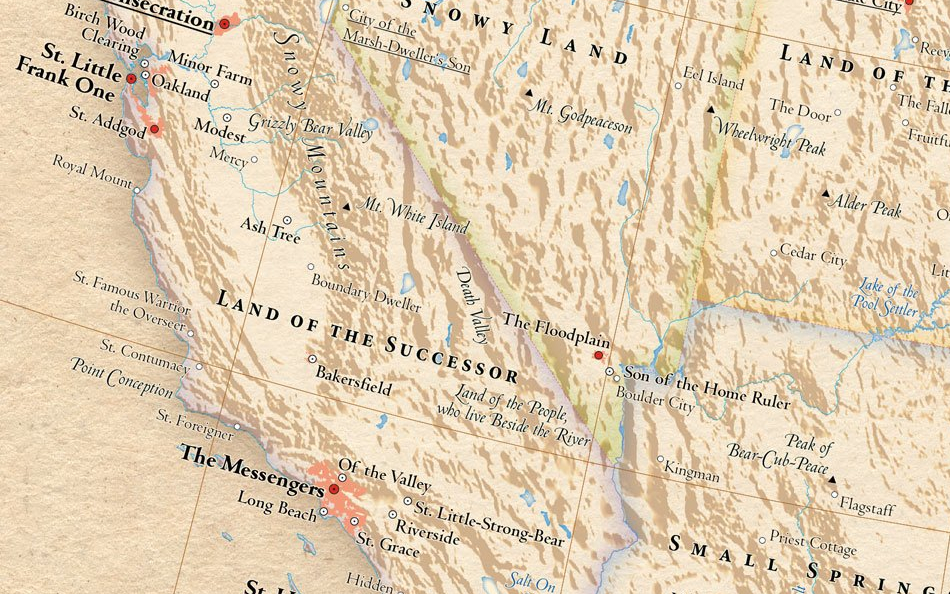
Indeed, a somewhat reverse pattern of trying to map primeval names for places from their modern proper nouns seem to cast some doubt on the philological rigor of the project as a whole:  the city first identified in the map’s first edition as “New Wild Boar Village,” was back-traced from “Nova Eboraca” (New York), despite the boar having questionable homonymic relationship.  (‘New Yew-Tree Village,’ reads the current map, although one isn’t sure how that relates to an earlier encounter with space not mediated by a number of encounters with lexicons; old maps, which might have provided “New Amsterdam,” are not noted or considered.)  Yet the prosaic image of yew-trees offer little sense of what York meant to the Romans or Britons, and the Latin toponymy might not even have been primarily vegetal in intent.  Other familiar places seem similarly distorted by an etymological imaginary or fanciful but sloppy erudition:  “Saint Little Frank One” seems a forced upstream etymology of “San Francisco,” inanely confounding “frank” as proper name and adjective.  And how does “United States of the Home,” with its unintended echo of the Homeland Security Department, line up with Amerigo Vespucci?   Why (on earth) is the city of fallen angels, “Los Angeles,” more transparently or truly registered as “The Messengers”?

What’s gained in the new linguistic transparency that this re-insertion of English toponymy for a rich cultural canvas of the surface of the map?  The more circumscribed focus on a map of the western US and southern California make more clear what’s lost in the flattening of historical encounter with space, however much it might satisfy the English Only crowd, a sanitized landscape where we are given the impression of being able to truly understand what the foreign tongue both mystified and masqueraded as euphonious for our ears, so present in much of the American midwest.
 

Sample_W_US-1


Some of the unsettling unheimlichkeit of the map may derive from the impression that the place-names have been taken off the map, put in a vat of acid, or a very hot rinse, and then put back in place on its surface.  Recasting the map as something like a Google Translator program’s reading of place seems to respond to fears of the messiness of globalization, by rewriting the maps in our own lingua franca to erase the multicultural messiness found on the map.  With everything has now been translated to English, at last, a properly legible text promises a true uniformity to project English only on any foreign labeling of place, extricating the map entire from its web of polyglot diversity in a newly proprietary way. The result is something of a comic fantasy of map-reading that has a somewhat J. R. R. Tolkein-ish tinge, or, in the case of the Land of Five Rivers, Horsemen, and Turtles, the sound of Dada-ist language poetry that calls into question the cultural specificity of very process of naming places on maps.  “Once the names have been taken back to their roots and translated into English,” Hormes and Peust boast, “it is immediately apparent that our own world has an extraordinary affinity with Middle-earth,” we learn, “clearly rooted in Man’s observation of his natural environment and [the] physical location of a settlement.”  (Holmes admitted that his own interest in maps can be traced back to a childhood obsession with The Lord of the Rings, which presents a toponymy “so clear that  every child understands it,”–even before the cinematic recreation of Mt. Doom let it enter most kids’ imaginations–in his map the Mediterranean is after all “The Sea of Middle Earth.”)

Am I wrong to see something monolithic and oddly neo-fascist in their alleged “re-enchantment” of a drawn, or re-written, cartographical space?  The sort of verbal dominance over localities may be less explicit, but it is somehow just as insidious, if not tongue-in-cheek about the authority maps hold. I don’t mean to be so harsh.  Although its authors openly aspired “restore an element of enchantment to the world we all think we know so well,” and allow readers to “take a look at the world with fresh eyes,”  even the Atlas of True Names “United States of the Home Ruler” or “Great Land of the Tattooed” playfully suggests a level of transparency to the map that seems to push  back against globalization by returning to a familiar idiom and tongue.
 

California


If Stewart’s classic study of American toponymy traced the negotiation with American Indian place-names, the reduction to one language is a cultural flattening of the surface of the map, in a somewhat paradoxical Enlightenment project of making inhabited space visible–or lisable–in the sense that legibility trumps space or cultural remove.  But the mobilization of this linguistic erudition into an enterprise pushing back against the world connected by the internet to restore wonder of creating an identifiable relation to space onto the surface of the individual map. The problem with attempting to restore such a sense of wonder is magnified when we deal with other cultures, where one finds echoes of the land of Marco Polo on the Spice Route, from the “Land of the Tribal Homelands” and “Land of the Fire-Keepers” (Azerbajan) along the “Golden Mountains” to “Riceland” (China); the “Town of Happiness” lies comfortably near the “City of One Who Aspires to Enlightenment,” perhaps the city of naked philosophers or gymnosophists inhabiting the edges of the worlds mapped by medieval men.
 

sample_w_asia


There is a certain Teutonic Enlightened strain in the bleaching of past history in the name of one mother (or father) tongue.  Shifting the names of places is a way of getting you to pay attention to the entire surface of the map for something surprising or out of the ordinary, but also flattens the aura of far-off places in a sadly normative fashion, creating something like a new level of two-dimensionality by robbing places of the imagined accretions and associations all place-names have.  There’s something sad of the absence of the romance of the map that results, in which even London seems pretty absurd as the “Unfordable River Town,” though the unaffordable river town it might be.


England--IMpotance of


Indeed, the romance of space is entirely tied to the euphonious nature of place.  Even Frances Mayes herself might have trouble writing about the Tuscan Sun by living outside The Blossoming One, in the sun-drenched Hilly Mountains–the very practice of cross-cultural translation that she professes is itself flattened by the absent assonance in the  toponymy that these maps of Italy and Tuscany afford budding poets.  Even though “The Land of Calves” and “Rainland” seem romantically appealing in their own right:  but they don’t sound like the euphonious landscape filled with ginestre and tromboni, as well as the lovely vibrant tastes of basilico.


Italy in English


White-washed to an English rooted in etymological derivations, the landscape is in an odd way de-peopled or depopulated as it is removed from how place is spoken, and re-mapped, by the people living in its landscape.  There’s a child-like naiveté we get from reading the maps’ place-names, which mystify even the locations that we know all too well. There is the odd sense that from a space in fragments, these cartographers are trying to create a new wonder of the whole, arrogating authority of naming to themselves in the name of recuperating an initial primeval confrontation with a topographic landscape.  The task seems in part to invest immediacy in the world as it is encountered in each place in a comprehensive topographic map–without considering the synthetic nature of the fabrication of cartographical space, and although this seems at odds with the synthetic construction of a uniform distribution of spatial relations.  It seems the cartographers took a digitized image to re-write the toponyms they found with evocative substitutes, but chose to keep some, as “Oakland,” “Riverside,”  “Long Beach,” or “Salt Lake City,” as such were sufficient topographic descriptors in themselves.  In seeking to preserve the essence of each name as much as they can, they may unwittingly undermine  forging continuity in the heterogeneous surfaces of mapped space.

2 Comments

Filed under "Atlas of True Names", cartographic whimsy, Frances Mayes, Google Maps, historical maps, Middle Earth, native toponymy, Winkie-Land

The Lexical Landscape: Islands and Divides

With lines of civic dissent and division dominantly drawn in our media, it’s refreshing that the statistician Joshua Katz took measurements of usage to map more chromatic variations across the national landscape.  It’s striking that usage habits, for different reasons, go against the idea of a melting pot, and reveal a deeply ingrown retention of lines of difference difficult to interpret and even often to draw.

But if the results of the end-product of a class in applied spatial statistics is not clear, the maps provide sources that are endlessly fascinating to pore over not only for the varieties of what they map but to extrapolate what more they might mean, since they reflect such sharp divisions over space.  Despite our increased cultural homogenization as a nation, and the blurs of globalization, these maps demonstrate a not too surprising insularity of a range of linguistic practices, from accents to stress to word-choice.  And although based on existing data, Katz mapped those statistics in particularly persuasive form provide enough grist for thought as “heat” maps from surveys of regional changes in pronunciation originally compiled by Bert Vaux and Scott Golder.

The resulting images have spread like wildfire across the internet as vehicles to visualize national divides in ways far more entertaining and erudite than the sort of electoral infographics that still haunt the unconsciousness of anyone who has tried to track trends in the incoming results of presidential elections, predictions based on polls, or listened to the denouements of their breakdown and analysis.  Rather than mapping an actual choice or preference, these maps track and give meaning to a set of disparate choices to reveal a linguistic landscape more than its immediate causes; the sequence of maps is intriguing because they lead us to hypothesize what the multiple causes that underlie such phonetic patterns or lexical choices are–or what the social meanings of these patterns of linguistic boundary lines or pronounced insularity might be.  Rather than reveal a nation “bowling alone,” or a world atomized behind computer screens and shifting consulting positions and service jobs, they map surprisingly healthy clusters of the sociogenesis of word use far more comforting or reassuring to the eye than rigid political divides.  At the same time, the proliferation of some maps–presented by Business Insider as maps of the “deepest linguistic conflicts in America” in twenty-two images, use the map as a prism to reflect chromatic differences in ways that map the multivariegated communities within the contiguous forty-eight.  And when one compares the divisions in the full range of 122 of the questions asked in the dialect survey, the map is used as a sort of lens for refracting multiple divides we probably didn’t know existed or only tangentially kenned.

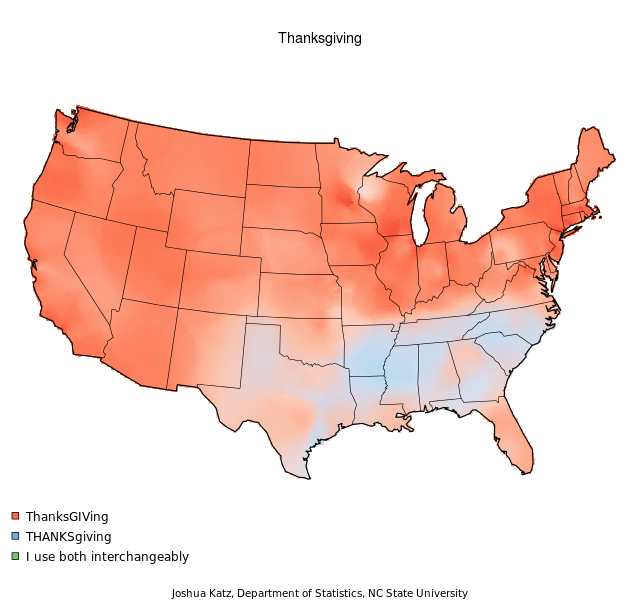
The public records of national divides on a lack of consensus seems healthy to me.  Now we know there are clear areas of the country where they continue to cut the grass, not mow the lawn, and even if associated with a traditional deep South of Louisiana, usage extend to western Pennsylvania, southern Ohio, and Indiana: mowing the lawn, cutting the grass Far more entertaining than something as indeterminate as a weather map, if only because of the multiplicity of deep divides of regional English they reveal, these maps give more vitality and dynamism to the country’s mouths in an era of apparent ideological chasms and oppositions fostered in large part by 24-7 news.  Without a legend, or what Wood and Fels call a paratext, or interpretive apparatus, the maps are simple declarative statements–each constellation of meaning in which raises intriguing questions about their possible analysis. The multiple maps through which a range of questions are individually refracted reveal the different divides in a set of composite pictures of the nation, raising questions about the fine quality of grain of the divides that maps can reveal. To be sure, the Southern United states are regularly regarded and cast as one of the strongest linguistic subdivides of regional English.   It is striking that the unique accents in southern states stands out in th composite data visualizations Katz sorted out to represent the differences in the enunciation of one single word–“lawyer”–across the contiguous forty-eight: isolation of Legal langauge However tempting to read the island of pronunciation as evidence of an isolated island of legal practices, or a veiled attitudes to what those JD’s do or protocols they follow, the map poses fun questions of how signifier is itself mapped to signified, using the form of a map to re-examine the images of division with which we’re all too familiar.   The dichotomy in the choice of pronunciation rests more in the vowel combination at the word’s center than what it signifies, however, if the insularity of that pronunciation is pronounced; more than reveal an insularity of habits of legal reasoning, the divide is structured by local dialect starkly drawn at the Mason-Dixon line: isolation of Legal langauge Not to mention its distinct preference for celebrating THANKS-giving, and not thanks-GIV-ing: thanksGIVing


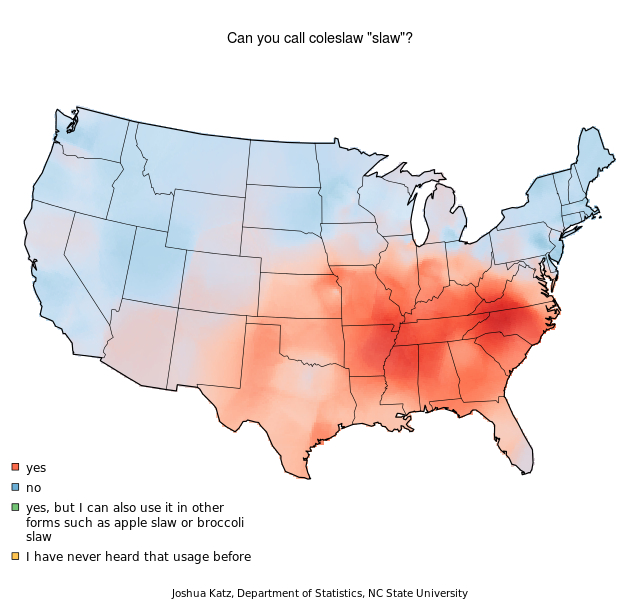
The southern United States historically distinguished by cuisine, and this converts onto its strong preference for slaw, even more broadly than by its shwas:  the clear dominance of slaw across much of Kansas, Kentucky, West Virginia, northern Florida, and Texas, as well as Mississippi and Alabama, speak to its local culture of food, as does the limits of the northern Germanic influence of ‘coleslaw’ in central Pennsylvania, Ohio, and northern Illinois–and this time, the fuzziness of its line of demarcation shows greater signs of permeability to culinary terms for sides to the north:

Land of Slaw But the question of “icing” v. “frosting” presents yet another spectrum of preferential divides, which rather than being almost divided in Pennsylvania finds its clearest locus of consensus there: icing:frosting


On the other hand, if we know that the “hoagie” is Pennsylvanian and the “hero” sandwich dominates Long Island, the “sub” is eating up the country, perhaps courtesy Subway Sandwiches:


sandwiches and subs


Other habits of reference are similarly surprisingly localized, even about attitudes to how much we can abbreviate one place-name in the country to a simple article, like this map of what “the city” means (if not New York) are more deeply rooted in preferred signifiers.  The centering of abbreviation of New York City to a simple “the” surprisingly  reveals a deep westward reach of New York’s cultural hegemony, despite the persistence of insularity in the national language-scape or usage map.  There is a similar agreement–if of a very insular sort–in designating what “the city” means in what might be called the tri-state area, if the implicit referent is fuzzy across the nation, save that particular region of southern Florida, apparently permeated by northeastern habits of linguistic reference once again.

The City!


Others are more bizarre, as the rituals of the evening before Halloween:


Sub

Who can explain the adoption across Wisconsin of “Mischief Night”?

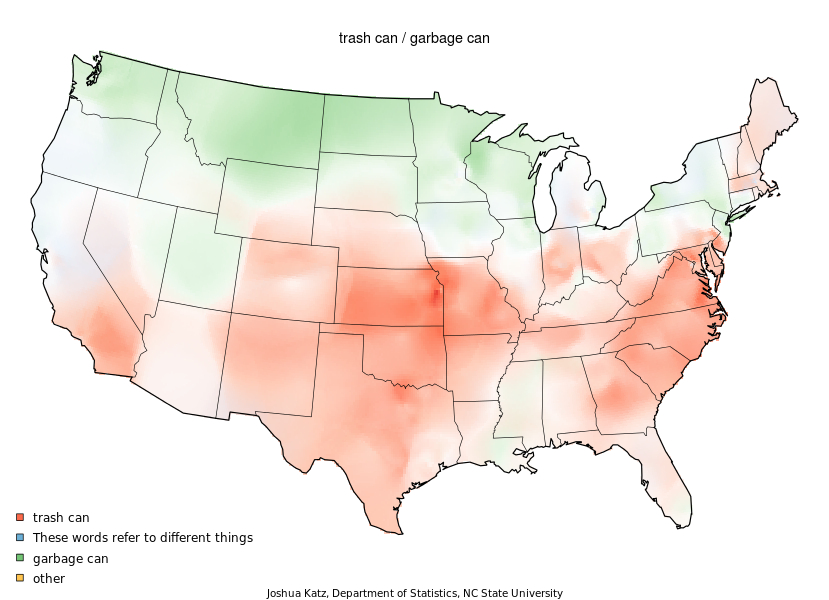
The sociogenesis of trash seems particularly difficult to explain, even though the dividing line in autumn temperatures might explain why “garbage can” dominates the triangular area from northern New Jersey to Vermont’s border with New Hampshire, over to the Great Lakes, and roughly from Chicago north, while trash cans dominate anything south of 42 degrees north, with the odd exception of Utah.  Temperate climates can’t explain the difference, give the shading of New England toward ‘trash,’ notwithstanding its apparently non-native provenance.

Garbage v. Trash


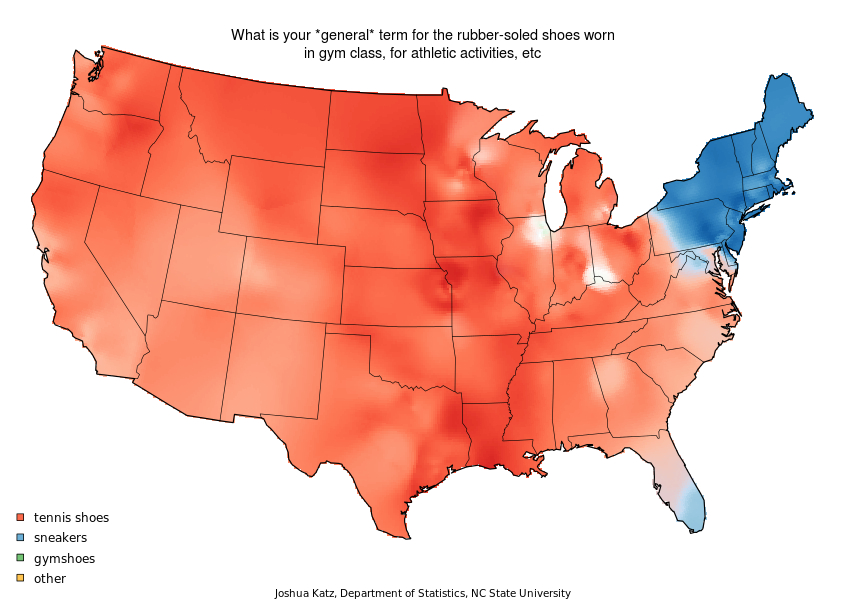
Given the compelling ways that maps create constellations of meanings and embody entities that one never ever saw, it’s tempting to indulge in armchair philosophizing about the patterns that they show. Far more than one expected, the maps show many intriguing regional redoubts of pronunciation or  pockets of word-choice that jump out of the national landscape.  These divides are surprisingly but comfortably strong, in other words, even varying among one another. Take the survival of the sneaker in the northeast, transcends pronunciation, and its survival in the southernmost parts of Florida hints at the presence in that state of many northeastern transplants:


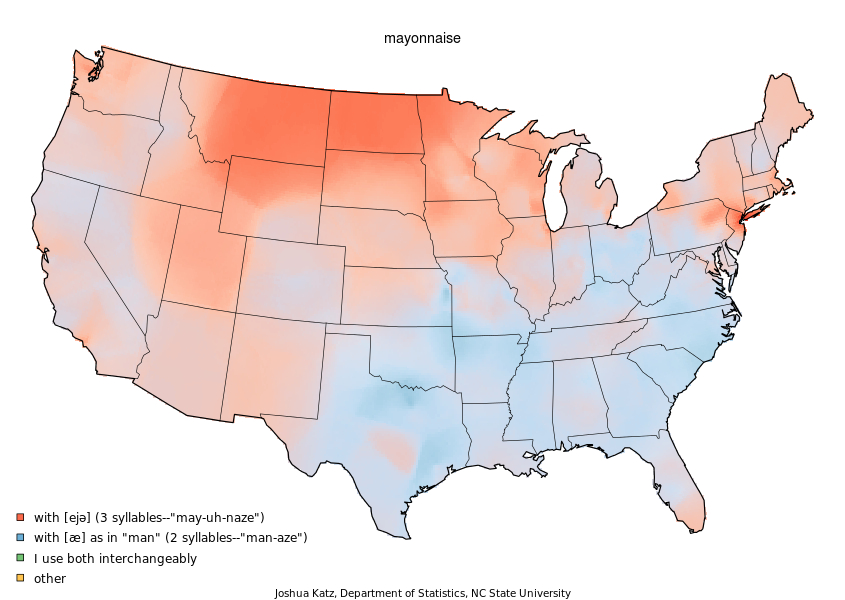
Sneakers! Despite a lack of clear preference for dividing mayonnaise according to a three-part breakdown to components nation-wide, there are surprising hold-outs for a three-beat scanning of the slippery stuff in Montana, New Jersey and Long Island: NYC Mayonaisse

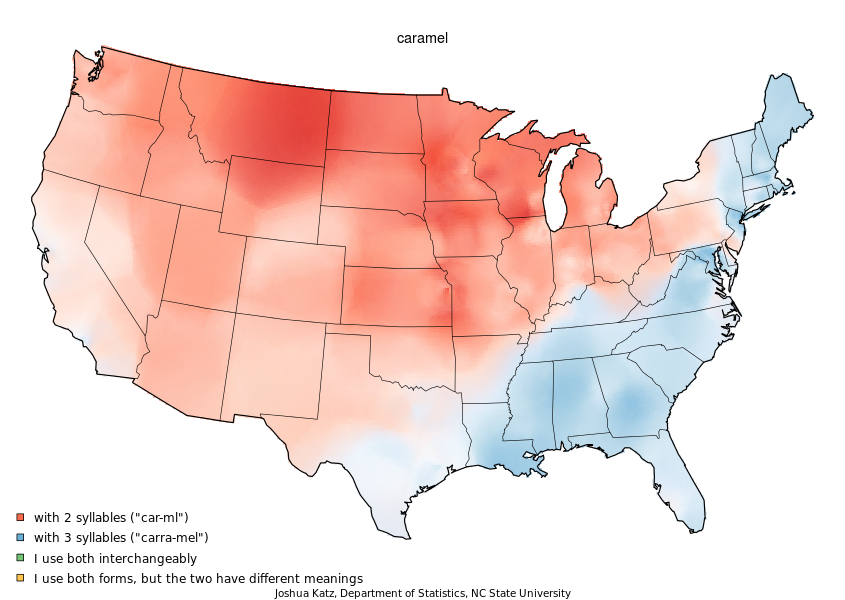
Phonetics often trump actual cuisine.  What about the sudden disappearance of two vowels from “caramel” across the Ohio River?

Caramel


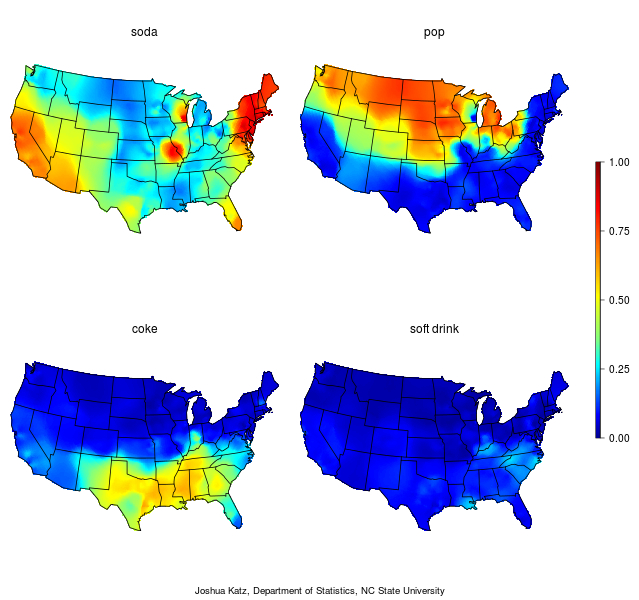
As much as this map for the use of “sneaker” reveals a boundary in choice of signifier, more than phonemes, one could argue that some divides of word choice are determined and perpetuated by local commercial interests.  This seems illustrated by the dominance around Atlanta, Georgia of the signifier “coke” as the empire of a brand, even if it doesn’t explain the national pop/soda divide:

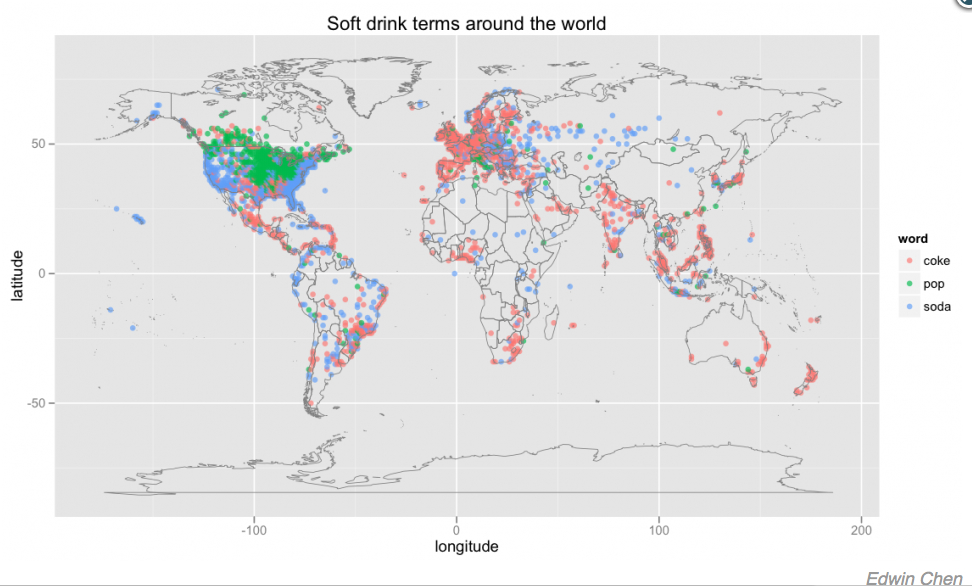
soda streamThis is interesting, since we’ve moved from accents to regional English of name-brand:  yet “coke,” no longer based in Atlanta, doesn’t seem to have a base there, so much as being a dominant term in Louisiana and Alabama, even as “soda” dominates the northeast and California and pop the midwest north: soda:pop:coke


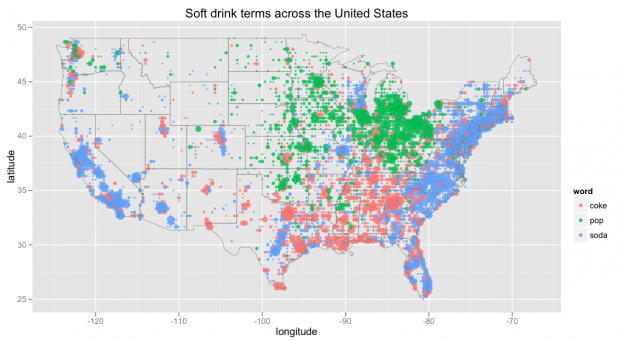
Perhaps “soda” is a term generated in larger sports arenas.  But isn’t social custom more likely to explain the intense burning reds of soda around metropolitan Chicago and Kansas City, in spite of surrounding lands that opt  for pop?  But this is a long debate, that Schwartz cannot perhaps hope to resolve in an authoritative manner.  Edwin Chen, a Twitter data scientist, for example dedicated time to construct a more pointillist map, of finer grade, while forsaking the color-range of a composite, to indicate a similar tripartite division of mapped space, with a preference for ‘pop’ clearly clustered around Lake Michigan, for some reason, and ‘soda’ dominating coastal regions almost exclusively, with a more concentrated representation in central Texas, around San Antonio and Dallas.  Is ‘soda’ just the more urban drink?  How does this map map onto drinking venues, concession stands, and watering holes?  Chen’s map, hoping to resolve these questions by geo-tagging tweets, and then making sure in a review that they were in reference to soft drinks, rather than brands, revealed a similar dominance of “Coke” around its former hub, Atlanta, confirming both its specific density and dominance.


Chen's Soda Map


He then, exploiting his databank of tweets, extended his map across the world, which aside from revealing a curious preference for pop in Italy, found the global hegemony of Coke a true case of globalization, but in surprising inverse relation to the contiguous forty-eight:


Coke in the World


With respect to Mr. Chen, the map only slightly reveals the dominance of “pop” above the 49th parallel, in part since tweets using the word ‘soda’ don’t necessarily correlate to actual usage preferences in spoken English, and ‘coke’ often tweeted.  (Anyways, tweets with the word “coke” cannot be claimed to  correspond clearly to a linguistic usage map.)

Ways of talking about and moving through space are perhaps most intriguingly map against geographic space.  Perhaps the set of maps that suggests a clear relation to habits of moving across expanse is the division, removed from phonetics and purely a notion of choice of signifier, is the pronounced preference for the freeway in the western states, or the end of the dominance of the highway in the Pacific Time Zone, and the reign of the freeway across Southern California:


Spaciousness of the Freeway

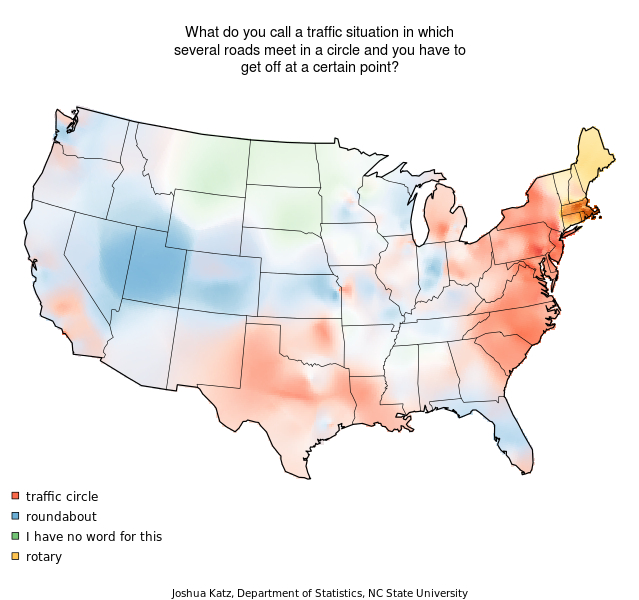
To clarify why Colorado defines one boundary of the lexical dominance of the highway is not evident.  But the maps out a distinct manner to move through space in cars, the expansiveness of freeway travel in Utah, Nevada, Oregon and parts of northern California, where light blue shading marks consensus around the constraints of highway travel, and the dominant freeway culture in green haze surrounding Los Angeles and Seattle. Motion through space or automotive travel are as pronounced as differences of phonology, revealed by the fragmentation of the “roundabout” in the Western states, Midwest, and Florida, where they are perhaps identified with planned communities or suburbia, and northern New England’s adherence to “rotary,” with Connecticut, while “traffic circles” dominate the oldest settled lands of the eastern states and those southern Florida transplants.fragmentation of the roundabout The road map is complex and would entail a detailed comparison to the national highway map.  A similar decisive break is seen in the culture of the service and frontage road, where South Carolina displays an affinity to the exclusive dominance of “frontage” in the expanses of highway in the Midwest, Mountain States and much of the west.

service roads v. frontage roads

These terms to move through space in cars are not, however, the deepest divides:  the vanishing as one moves westward of the term ‘supper,’ absent from the DC area but almost fully gone west of Utah and Idaho, indicates a striking persistence of a divide in usage where one’s surprised to find it a big deal.  The decline of “supper” in the western states, the DC area and around Detroit augurs the end of its exclusive use for the end-day meal, this ostensibly New England practice is not only to some extent retained there, but ingrained in the Dakotas:  supper has been extinct, to judge by the usage map, in California, Oregon, and Washington, and lost distinctive meaning in much of the rest of the country.

Limits of Supper, melding with dinner

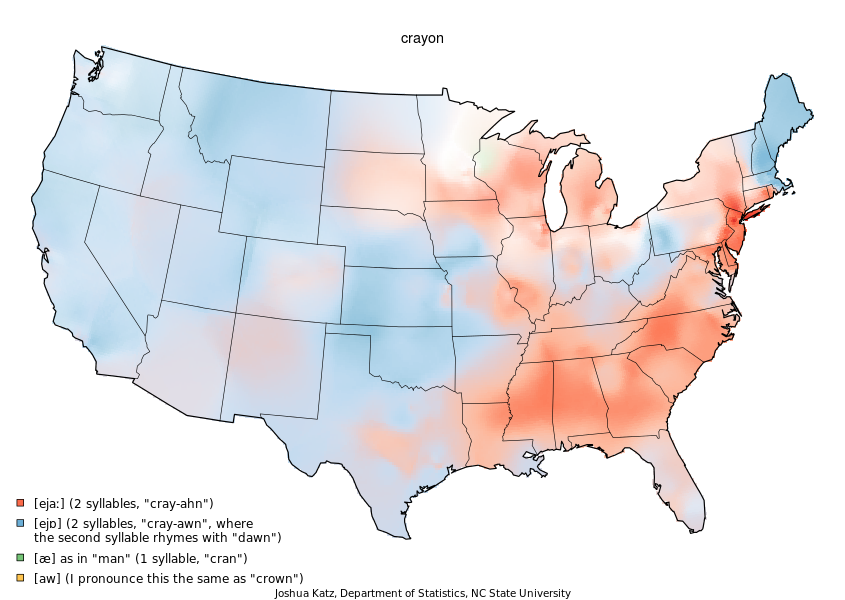
The deep divides continue about the phonetic habits difficult to analyze as linguistic divides.  The lines of division around vowel pattern of “crayon,” that almost universal tool of creative expression in the arty preschool set, is complex to imagine or assign to any cause:  the central Eastern states seem linked to the deep south, in contrast to the word’s contraction to one syllable in northern Wisconsin and the dominance of a more open second syllable across western states.  These clearly marked divides, far more difficult to explain, may be tied to preschool cultures, but is more likely linked to an interesting variation among some single-usage pockets and significant ranges of hybridised pronunciation.

americans-cant-even-agree-how-to-pronounce-crayon.jpg

At the end of the day, there is no red vs. blue in the way we speak, even if an infinite range of oppositions and variations pervade.

Leave a comment

Filed under Bert Vaux, Bert Vaux and Scott Golder, data visualization, linguistic boundary lines, maps of regional English, regional English, soda v. pop, statistical maps, Twitter-feeds

Drawing Hypotheses on a Newly Mapped World

At the same time as maps offer guides to spatially orient their readers, they collect a record of known space for viewers to occupy, collecting and displaying relationships that allow viewers to draw hypotheses about their relation to a totality otherwise not able to be seen.  The format of all maps provide tools to understand and collate relations over an expanse otherwise not evident.  The possibilities or potentiality for such comprehension–or the experience of the knowable–is encoded in the directions that any map provides to better navigate space by ship, car, train, or plane, but its syntax is also an invitation to inhabit space to formulate a hypothesis about expanse; early modern maps are especially conscious about how they mediated a record of the inhabited world.

My interest in how maps make these relations evident in multiple ways has been a theme of earlier posts; I have elsewhere blogged about the spaces Google Maps present for viewers, and the limited frameworks they offer to occupy space.  Once might do well to gauge the productivity of how maps generate hypotheses about an individual relation to expanse by the unity by their  representational surfaces–although the pictorial aspects of maps are too readily categorized as qualitative additions, held in contrast to their quantitative construction or collation of precise measurements of terrestrial position.

Early modern cartographers in the Dieppe school, like Nicolas Desliens, adopted modern practices in the hand-drawn maps, typified by the below 1566 world map, based on Portuguese nautical charts.  The maps retained the format of projection, but offered a new way to inhabit the expanding world map for elite audiences–here by displaying a new region of the earth, Java la Grande, a mythical island that described by Marco Polo and perpetuated by the cartographers based in Normandy:  the green swirls on Java recall the engraved illustrations in works of early modern botany or natural history that Sachiko Kusukawa has argued constituted material evidence from the natural world.

800px- Globe by Nicolas_Desliens_Map_(1566)

Java la Grande is prominently labeled, and the undoubted centerpiece of this world-map by Desliens, even though it is not at  its center:  it is, rather, introduced as a new area of inhabitation, whose verdant interior is a seat of spices and potential wealth, as well as lying, cosmographically speaking, in a sense as a complementary counterpart to the Americas, echoing the harmonious balancing of landmasses from ancient geography.  But the map also advertises the region’s potential wealth to potential backers of voyages.  There are, however, limited use of formal codes to structure the map’s surface, despite its notation of tropics echoes of the formal structure of world projections, or other conventions that lend order by structuring the map’s surface for its viewer.

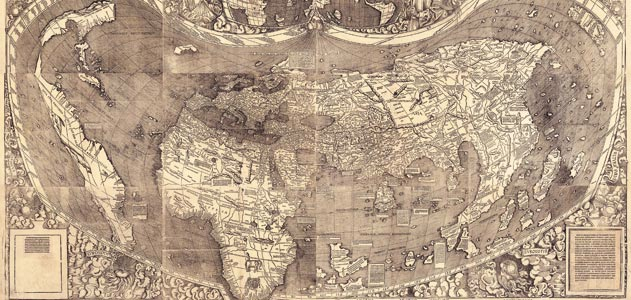
The circumscribed role of America in Desliens’ map is perhaps also striking to modern viewers because it minimizes the expanse of the Americas in a somewhat marginal manner, probably recalling the thin crescent of coastal archipelago in the multi-sheet wall chart the humanist Martin Waldseemüller designed, which did not even name “America,” and gave far greater place to South America

Waldseemuller-Map-631

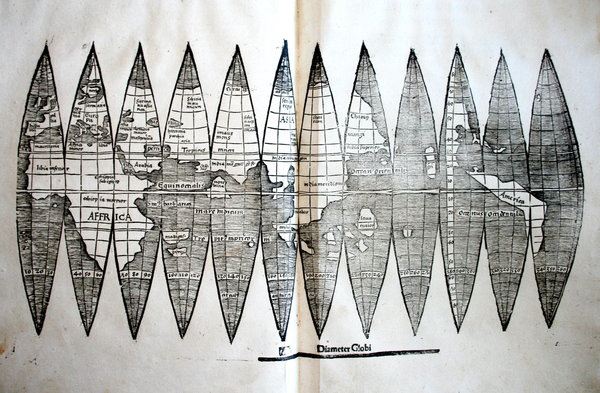
–though Waldsemüller did name the region on the slightly later set of printed gores that he engraved for purchasers to use to assemble their own globes:

Wertvolle Waldseem¸ller-Karte entdeckt

Waldsemüller exploited the expansive wall map of twelve sheets as more compendious and expansive record than a globe.  The limited employment of conventions to structure their graphic surface might be explained to some extent by the use of map signs to comprehend a range of toponymic content and limited authority of map signs to structure their surface.

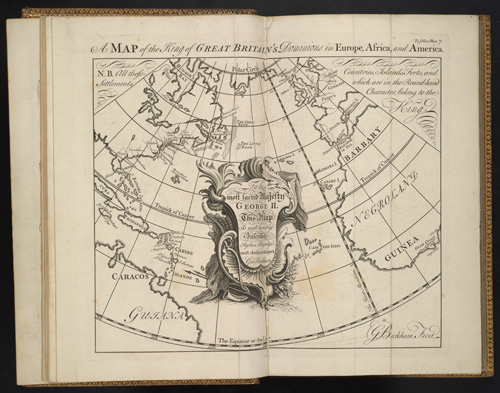
These images synthesize nautical charts in a comprehensive system of knowledge are at a remove from the ways that information is displayed about America–if still an empty land-mass– in later explicitly political maps that placed the Americas as an appendage of royal sovereign space, or as an area of self-government.  In an instance of the first case, Georg Bickham invited viewers of his 1748 “Chorographical Description of All the Dominions Subject to the King of Great Britain” to process their relations to its disparate dominions in a coherent ways as nothing less than a political space.  The conflation of a chorography of the national community with a global map is a classic conceit of empire:  but the below engraving suggests a wonderfully compelling way of reasoning across two hemispheres.

The map, engraved and printed in London for audiences far more familiar with maps, shows continents as unpopulated landmasses, but the relations of whose inhabitants were subject to the royal rule of George II, in a somewhat magniloquent statement of royal rule for its viewers to scan.  If the map reveals the expanse of Great Britain’s “Dominions in Europe, Africa, and America,” it is an optimistic knitting together of regions geographically removed, but subservient to the royal crown whose cartouche still occupied center stage.

Chorographical England 1748

To be sure, this image processes something of a cognitive map of the royal subject’s relation to the vast terrestrial rule of George II as a totality that spans no less than three continents.  The map is straightforwardly political, but conjures a land of royal unity that was geographically dispersed, and linked symbolically only in the map.  Indeed, the cartouche in which Bickham inscribed the “Lord Majesty” in relation to its subjects has greater prominence or centrality in the map than any place-name or region that is represented on its surface, as well as considerably more ornate a subject of Bickham’s burin in the acanthus-like flourishes and drapery:
Crest as Cartouche

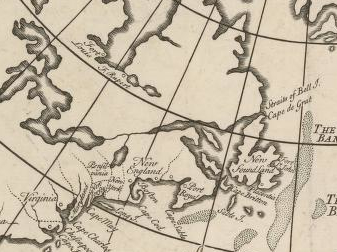
The obedience by which the royal subject inscribed the expanse of the map is more prominent than its geographic content because the map is quite distinct from a geographic record.  The regions of North America are in fact rarely mapped in much detail aside from their shorelines; greater detail is accorded The Banks, shoals famously dangerous for nautical approaches, than other areas, and the ties to Britain confirmed more by toponymy than by qualitative detail or the density of its inhabitation, and other than its coasts is largely blank, suggesting greater habituation with nautical travel:

Upper Canada--1748

Curiously, in this map of British global possessions, boundary lines among the colonies are noted but seem almost notional than juridical, and far less fixed in space than the rivers with which they intersect, dotted lines that extend into an unknown interior before they peter out into a vast unmapped continent, as if inviting viewers into blank unmapped regions.

trailing boundary lines of political division

The map illustrates the invisible ties of power that united these regions, far-flung as they were, as an image of royal authority.  If maps were advertisements of power and illustrations of authority in the early modern period and Enlightenment, this map serves to create a set of fictive ties that united and oriented its viewers to a sense of disconnected space, which the cartographical content of the map was not in itself sufficient to process.

The map complements a written printed chorographical description, as much as it offers a strictly cartographical record, the symbolic use of whose conventions allows us to connect geographically removed regions in its pictorial space.

Leave a comment

Filed under Dieppe School, Georg Bickham, George II, Java La Grande, Martin Waldseemüller, Nicolas Desliens, pictorial space, Sovereign Maps