

Geopolitical security is here only a surrogate for income inequality, and the preservation of income inequality is a strong border, strong tariffs, and economic supremacy. Is the State of Emergency not only a means to preserve a rigged income inequality between the United States and its neighbors, to nourish a myth of economic superiority and advantage as part of our nation? As if illustrating the readiness of the nation to switch from a rhetoric of emergency after 9/11 to the emergencies of climate change and global warming, to the emergencies of national security again, the divides in American politics have ramped up the normality of emergencies, while ignoring the emergency of ever-escalating income inequality. Indeed, the targeting of migrants as the evil thorns in American prosperity has led to a a rounding up of those who look like they weren’t born here, and terrorizing others by compelling them to sho up in Immigration Courts to face the United States without being entitled to any legal representation of any kind if they cannot afford one to represent themselves before the federal government: immigration courts become sites to expedite deportation cases for removal from the nation, by the program that Trump was ostensibly elected to enact, accelerating deportation cases picking up form the geography of at immigration courts when Trump left office.

County Residents with Pending Immigration Cases in United States, 2020/TRAC
The absence of all representation for those defendants at immigration courts is a disgrace of justice, forcing many to stand trial in defense of their own freedom that beings form the denial of that freedom. But the migrants against whom the cases are prosecuted have been converted to numbers, not even individuals–as numbers of removal proceedings never accorded any legal rights, and not deserving them. This will benefit the American economy, and Make America Great Again.
Maps that reveal the “GINI Coefficients” of income inequality by states when Trump was elected reveal the great difficulty of heightening income inequality across many of the so-called “border states” and For all its appearance as an acronym, and the deep need to find a myth of the nation–a myth of its separateness from Mexico, the origin of most of the service economy of states like Texas–where some 40% of the construction industry are immigrants, and 3.7 immigrant workers make up a full fourth of Texas’ labor force, as well as a fifth of the energy sector–but the image of an end to “illegal immigration” and an end to education and health care for “illegal immigrants” is cast as a way to defend and shore up the victimized American economy. The deep red states that are sites of serious income inequality per the GINI coefficient (sic, in this data visualization) although he income inequality of many states (as New York) is located in cities, not state-wide,
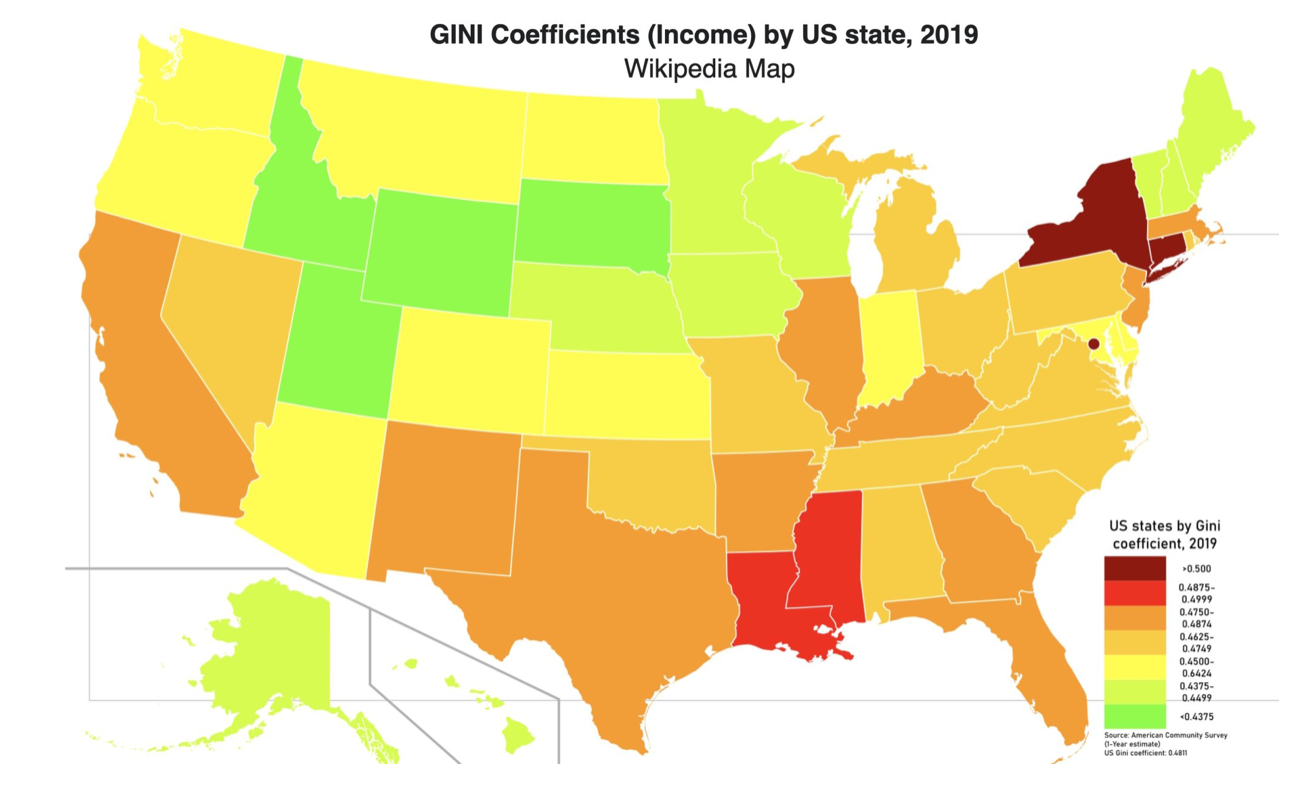
Income Inequality by Gini Coefficients in all Fifty States, 2019/GeoCurrents
as a more dated visualization crafted not in ways that might try to map onto the electoral college, but produced by friendly folks at UW Madison’s Center for Community and Economic Development who are less obsessed with states, and are trying to talk about economics at a local level, in hopes to help their readers get a closer feel for how things are on the ground, as much as in relation to the political slant of their communities. While the below map might be a good place to start to think about gerrymandering, a current concern, and the five year estimate is dated, it maps onto the election of Donald Trump with some surprising interest, and onto the emergence of “the border” as as a surrogate for national security and a political football Democrats have never been able to hold. The border communities are where the income inequality was highest, and where the fears of migrants stealing jobs and undercutting wages were most important, landing some needed electoral votes in New Mexico, Texas, Oklahoma, Arkansas, Louisiana, and Florida, and introducing a sense the global economy as something that the United States is unable to control and a victim.

The fiction and mapping of income inequality is is perhaps best examined from how difficult it is to map–and the presumption with which the mapping of economic development and economic modernization was critically involved in the growth of the fascist state that Fred Trump so admired. The Italian statistical demographer of Italy’s fascist era, Corrado Gini (1884-1965) is well-known for the eponymous coefficient he devised that his politics. The basic yardstick of globalization, it seems necessary to remember, was devised as an elegant way to map inequality by the unevenly distributed nature of a nation’s Gross Domestic Product. Gini is no acronym, as might be thought–Gross Income Nationally Indexed, as I once fancied–but a man, a technocratic demographer of the fascist state, whose career as an academic and indeed helped to normalize fascist ideology in the interwar period and international academic stage, arguing that fascist policy offered Italy a royal road to modernization. The eponymous coefficient he bequeathed the postwar world has grown in ways that paralleled his own rehabilitation in the postwar period as an Italian demographer. It is now not a means of describing Italy not as an outlier, but dear to the World Bank to index the beneficial effects of globalization in the late twentieth century, as a tool of visualization.
But we might do well to recuperate its forgotten role to envision the efficiency of economical policies of the fascist state–even as new goals of GDP has become the means to realize growth and development in the globalized world. For the Gini coefficient is a mainstay in the toolbox of World Bank data visualizations, whose currency has become, mutatis mutandi, an unavoidable graphic shorthand for the many economic processes of globalization that shaped the postwar world. For the divides that it describes even economic, or do they not hold their own ideological assumptions and hidden interior, squirreled in under the name efficiency and productive wealth? This might be called Gini’s revenge, as the rise of targets of GDP growth and search to stimulate GDP have become the basis of political rhetoric. Mapping international relations by GDP, or envisioning the globe by GDP, offers a revision of globalism, a politics less rooted in people than numbers, and less built on population than metrics.


National Gross Domestic Product Per Capita, 2024
The premium given to the Gini coefficient in economic thought have refocussed the shifting place of the United States in the world by the late twentieth century and in the vision of Imperial Presidency Trump rolled out at the start of his second term, as the past promises of stimulating economic growth were removed from investments in education or training, but invested in a twinned regulatory rollback and the bizarre claims that the border wall would stimulate GDP growth, as if the performative strengthening of borders was part of an entrepreneurial model of statecraft to Make America Great Again–able to affirm the deep blue uniqueness of GDP per capita enjoyed in the United States, in ways that obscure the income inequality distinguishing the land.
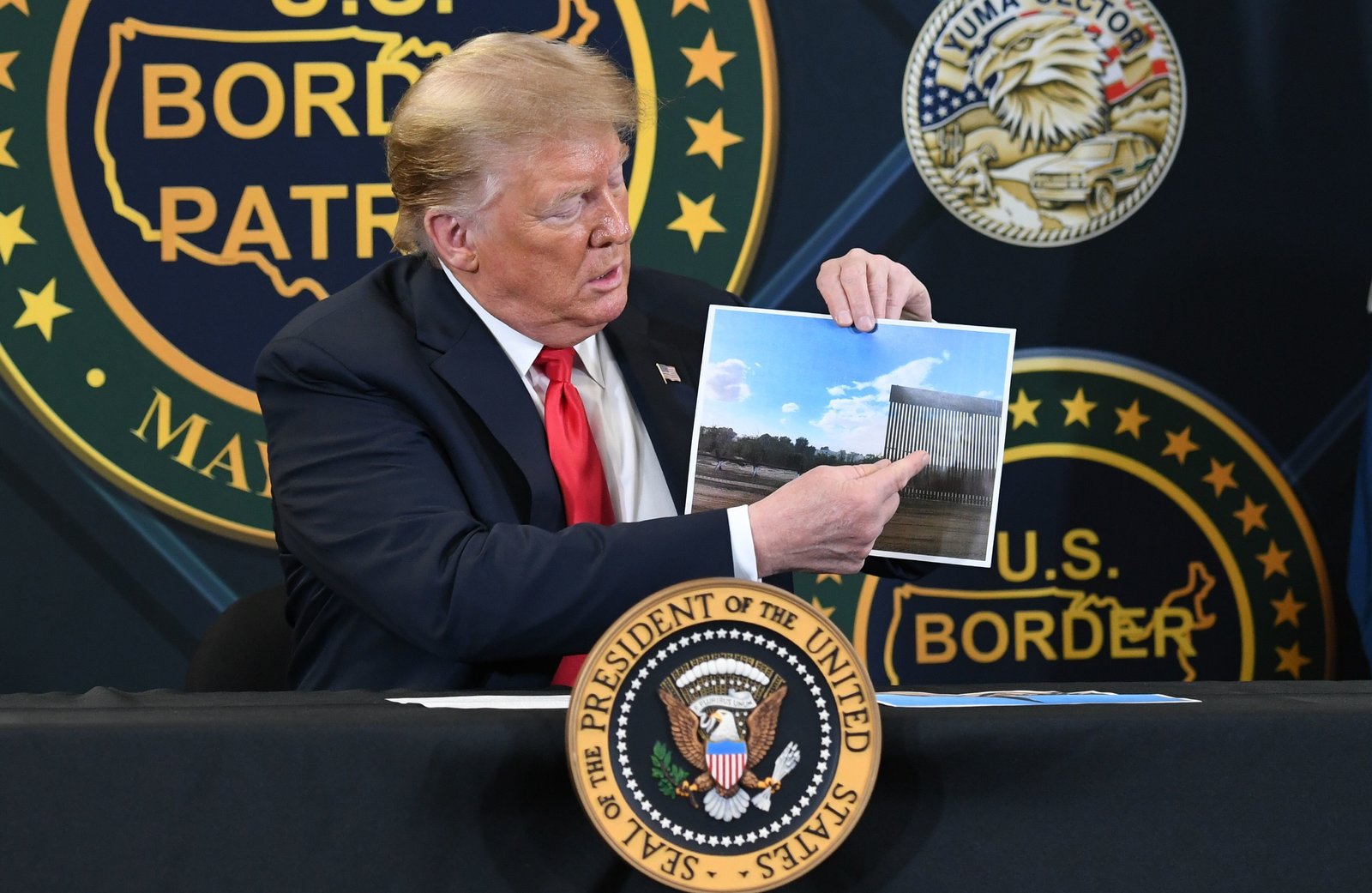
Indeed, the border wall–and expansion of American borders, uncannily akin to the expansive continent that was mapped or revealed in the header to this post, suggested that the border offered a means of engineering the expansion of GDP, as well, despite the majority of economic analyses stating the contrary. The expansive border wall was an illustration of grandeur, and, as Trump would have it, an illustration of economic wealth and national security able to inspire confidence and “awe” whose own “performative statecraft”–per Åshild Kolås and Lacin ldil Oztig, was evidence of his own entrepreneurial skill more than governance. “Nobody builds walls better than me.”
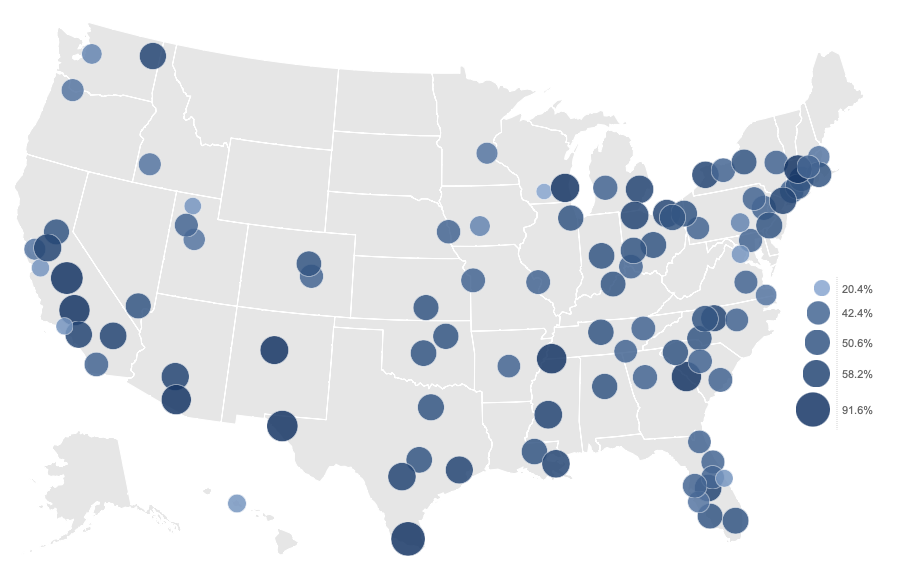
In ways Gini could not have foreseen, the rise of wealth inequality on a global scale has revealed the fractures of wealth on a global scale, the demographer Gini’s coefficient is the basis yardstick to map global economics–albeit from a distinctly western perspective of wealth. The Tesla’s high price makes it a symbol of the accumulation of wealth, and indeed evidence of the ability to “park” wealth in a luxury sedan, for $100,000, but have lead to the rise of numerous YouTube videos that seek to show that, yes, you can actually afford a Tesla!, if you examine the “full cost breakdown” and agree to pay about $700 a month for their most affordable line–and get a Federal Tax Credit, while they last, that will make it all the more worthwhile. The Tesla is an actual coinage of wealth in northern California, where I live, as the clustering of Teslas conspicuously parked on my block in Berkeley, CA, seem to attest, if noticing their dominance on my street took me aback a few days ago in surprise. Sure, the Bay Area was the laboratory that incubated Tesla’s self-driving cars; but the new status of multiple Teslas is a far distance from days when Tesla batteries won prestige as a sign of energy responsibility and weaning oneself from petroleum products. Vowing a commitment to energy independence, Tesla’s “mission to accelerate the world’s transition to sustainable energy” was to curb global warming and stop millions of tons of CO2 entering the atmosphere.
The car has become a way to realize accumulated wealth as a statement of social importance. The energetic mission statement seemed to invite its owners and future customers to a faith in the ability to stop Climate Change has long since receded in collective memory and existed the rear-view mirror. Tesla’s faith in ner ability to stop climate change or reduce petroleum consumption has been handily replaced by a new form of abundance, or of providing the comforts to consumers that they deserve: the rhetorical shift in its master plan of “sustainable abundance” assumes that technology is the solution to the economic woes and to personal satisfaction of its customers. The new promise of Tesla to engineer a “happier future for all with electric vehicles” is tied to the engineering of cars, and the availability on the market of a product inaccessible to all unable to afford that “happier future” of its hefty price tag, promising to retain a “north star to deliver unconstrained sustainability without compromise” for a market of the 1% of coastal elites–

Tesla Owners Living in Lower Forty Eight of the United States/2023
–to keep them happy. The slim portion of those able to afford the luxury cars in 2023 were once imagined to be a future intimation of the broader scale offerings of the energy conscious company, but the map has remained and seems destined to remain a veritable negative image of the 99%. The customers Tesla has engineered a product parallel a 1% whose wage earnings are only a fraction of their total sources of wealth, but who may buy one or more luxury cars. This is a church of the replacement of the living body, perhaps, apt to be enfeebled by time and stress, to the engineering of a safe space on the road, indeed a driverless car piloted by AI.
This future is offered to a mirror of the wealthiest Americans, whose wealth permits them the rather seductive promise to drive the symbol of abundance in the face of global warming in an engineered ecosystem of sort of automotive travel, insulated from weathering the storms that may buffet the less fortunate. It incarnates the gulf of prosperity promised to those who can afford a future. They can see the world that is engineered atop the world that seems about to be pummeled by the ravages of climate change, but are at least for now secure they will live in comfort.

Musk may even also incarnate a nation that has been able to erase the stubborn fact of wealth inequality from the vision of the nation. The image of efficiency became a basis for promoting a new role of America in the world, and of an expansive notion of American sovereignty, that dated back to the 1930s, and to the economic insecurity in the face of a Great Depression, when the Technocrats proposed a new continental ordering of sovereignty, free of foreign markets or foreign currency, that was rendered iconic by the map in the header to this post.
This map, of course, is almost a mirror image of the geographically limited spread of wealth in the United States, as the concentration of Teslas on the road is something of an image of the pathology of the nation, but an economic pathology–to use the words of Corrado Gini, a term introduced by the fascist demographer, who framed the Gini coefficient as a basis to understand income or economic development in the interwar period in terms of pathologies.
Yet the disparities of the distribution of income in the United States are proving increasingly difficult to look at straight in the eye, The dark density of market of Tesla’s that run like fault lines in the social fabric of the nation intensify the breaks of the distribution of median income in America in 2025–as states like Wyoming, Idaho, South Dakota and Alaska of low incomes seem to drop below the median, with areas in Texas not far off–and the super rich are clustered in coastal elites–might make us return not only to the robust power of Gini’s coefficient as an effective tool of visualization, but the academic’s more outdated concept of “economic pathology” the Fascist management of the Italian economy could prevent. (Gini’s expertise was readily recruited as a technical one that might promote and encourage the acceptance of the totalitarian state, Italian historians argue, and accept the National Fascist Party as able to modernize or rationalize Italian manufacturing industries, leading Gini promoting an ideological view in papers as The Scientific Basis of Fascism on objective grounds–promoting a statistical index as a record of economic practice in ways later economists question–by finding demographic grounds to promote”scientific racism” and racial laws.) Yet Gini also normalized mathematical models, as Amartya Sen has observed, as a misleading equivalent for discussing actual economics. Gini’s econometric arguments of development promoted fascist politics by invoking the pathological nature of the alternative, often by invoking or taking American economic development as a non-pathological alternative.
Today we must ask how how the distribution of income in the United States as not pathological, and as it were turn Gini’s admiration for American industry on its head by a Gini distribution of income, perhaps as we accept income inequality as a fact of life and a global condition.
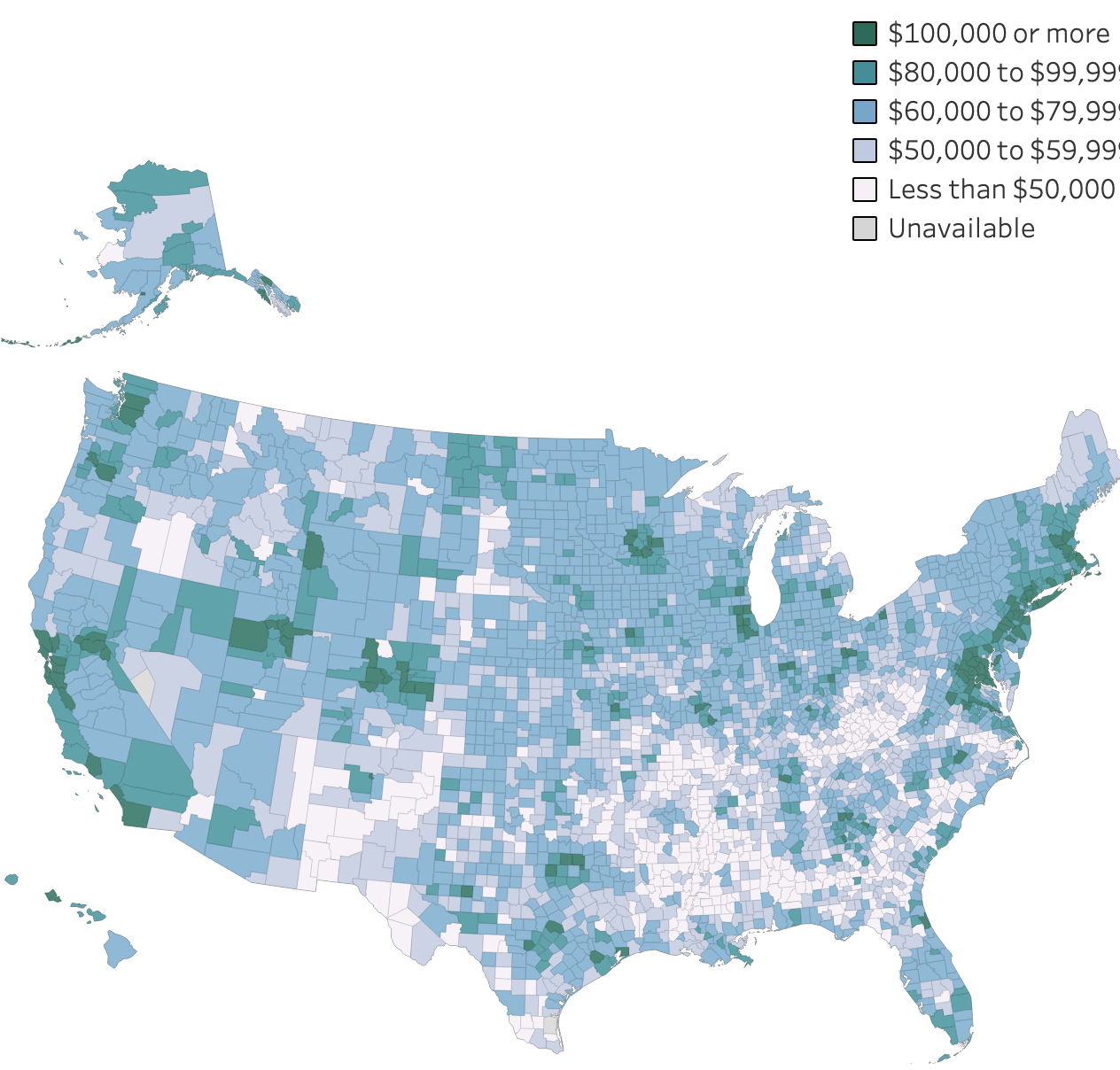
Median Household Income in the United States of America, 2025/Overflow Data
The future of this map has provided historians with an eery sense of reading tea leaves at the start of the Trump Presidency, when few imagined what the scope of the promise to “being dictator on Day One” meant, but the imperial Presidency that has unfolded, if with no constitutional or legal precedents, takes a page from the data-driven models of efficiency that Tesla–and Elon Musk, and his cohort in Silicon Valley–have advanced, a model of efficiency with rich science fiction roots, to be sure, that converts people to numbers and denies the numbers of climate change, for processing fields of information that make sense for markets, and using AI to integrate personal databases to create an alternative model of state rule and sovereignty than we have known for some time–call it TechnoFeudalism if you will. Musk felt so revulsed seeing hacked geodata of Tesla owners as he railed against what he called a map of domestic terrorism in March, 2025, in Trump’s language–he thundered at the transformation of the red T’s to targets, on the social media he claimed a venue of free speech absolutism, shocked at the illegality of inciting popular violence against his brand: “Encouraging destruction of Teslas throughout the country is extreme domestic terrorism!!” [sic]

The collective rage against Musk may be the most healthy news in a while for American democracy, the latest if not the only first response, perhaps, to the massive redrawing of American geography. For the concentrated poverty in America began already two decades ago–the same time Tesla appeared as a brand–that tolerates a pathological concentration of economically distressed neighborhoods outside and within metro areas, and promises ever fewer linkages of distressed neighborhoods to economic opportunity to leave poverty. These silenced paces of America, often not voting or less heard in the news, are often the silenced voters in America, enclaves the super- wealthy seek lives insulated from. The intense pockets of poverty receive minimal attention, and the gouging out of social assistance programs seems to seek to isolate them still further from a viable future, seeking only to cut government funding and end regulatory oversight, even as DOGE members tell themselves that they are profiting all. This is a world without oversight, where the hope of a government that provides social security nets is demonized and welfare and housing reform seen as evils of excessive expenditure, seeking only to devalue housing markets.
Presence of Poor Populations Living Clustered in Neighborhoods with Poverty Rates above 20%
Musk tweeted in rage at the online map of Tesla owners’ addresses was paid with Molotov cocktails, in a collective doxxing of dealers and owners titled “Dogequest.” The map put on line to empower “creative expressions of protest” was a take on Tesla’s longstanding promise for robot axis and AI vehicles. The anonymous hackers acting like pirates against the spread of the Tesla economy hoped to unmask the insidious presence of Doge as an invasion one had to be vigilant, as if alien powers marked by a bright red “T” had silently invaded the nation, in the oldest of science fiction tropes. The danger wasn’t from the southern border: it was the utopic promises of engineering a new future of deregulation and small government that Musk then embodied in the new Trump regime, a massive shift from the old image of the Tesla as incarnating a mission of energy responsibility.
Rather than the responsible use of energy, and the rise of Tesla batteries helped to convert may home’s electrical wiring to solar panel systems, wheat were in recent memory the sign of a responsible use of energy and an awareness of limiting unneeded energy use has gained a new cachet and signifying power not specific to the Bay Area at all–even if the Bay Area was something of a testing ground and launching pad of the Tesla self-driving car. The run of Teslas parked on the street, however, suggest not only a proliferation of charging stations, but new status symbols for what has become one of the more exclusive residential enclaves in the state. The Tesla has become a recognizable sign of wealth and a declaration of social status,–if not a mark of conspicuous consumption, rather a sign of energy efficiency it had long promised and provided to many. And if the Tesla served to naturalize income inequalities in the Bay, created a two-tiered level of luxury in automotive transit, Trump has treated the border wall as an icon to naturalize income inequality on a global scale, and indeed an ability to assert powers that go far beyond those of the Presidential office to assert the dominance of America on a global stage–as if turning back fourteen million migrants, as if Presidential decrees were another form of performance art that guaranteed the nation’s security, by re-bordering our relation to the world.
Nobody builds better walls than me.

The advancing of a mobile frontier on the Southern Border is the paradigm for a shift in the mobile frontier or blurred border of the Imperial Presidency of Donald Trump, that sees sovereignty as a gambit of dominance and domination, more than a model of government with established rules. We make it up as we go . . . and what could go wrong? Amid the charging stations, dealerships, Doge sites, and Musk’s own homes, Musk seemed on edge with conflating himself with the state with good reason, as the two had, by March 2025, become quite intertwined.

Former U.S. President Donald Trump at Arizona-Mexico Border, August 22, 2024. Oliver Touron/AFP
The dominance of the Tesla car as a recognizable icon of a vision of wealth–as much as of energy efficiency–made Elon Musk’s endorsement of Donald Trump’s second candidacy for President a moment that electrified the American electorate with a compelling image of wealth inequality–and of a celebration of income inequality. Musk’s endorsement of Musk in mid-July as “tough,” as if this is a quality we need in a President, was delivered as he was invited onstage to rallies, elated in what might be a drug-induced state as much as a rational reaction of someone considering their reasoned endorsement of a Presidential candidate, calling Trump engaged in an election he “must win to preserve the Constitution. He must win to preserve democracy in America,” as if the candidate were a savior for the nation. He may have promised the exchange of an endorsement for government contracts for Space X and for his companies, boosting stock and of corporate wealth in a manner that is rarely seen in America since the 1890s. Musk embodied wealth inequality as a new machine-man made for an odd pair with a low-energy Donald, but served to engineer his candidacy, as much as obtain a cabinet position, and the infusion of cash offered an emblem of the embodiment of wealth, in the name of efficiency, many could get beyond as a positive vision of America. Musk new little of the constitution, or democracy. But gone from Tesla was any emphasis on energy efficiency and futurism, the futurism of energy was assimilated to the future of a government and nationalism under Trump, and naturalized a new vision of global wealth inequality. Donald Trump was recast as a savior of the nation, as the triumphant icon of the Tesla car, by a South African immigrant with little knowledge of democracy, democratic ethics, or the Constitution.

The newly won status of the Tesla car as an audacious icon that boasted the benefits of income inequality may well have led many American citizens to get behind a new vision of politics–even as Teslas take up huge share of local parking places, setting themselves apart from the rest of the mere mortals who happen to live on the block. Is it only a demonstration of wealth inequality? It is an arrival, also, a metonym for California, or of Silicon Valley, of the arrival into the good life and its comforts as the world seems to endure. My friend who relishes that he owns one, as if it would have by chance arrived as a signifier of his entry into his household in the new America, repeatedly and theatrically makes a point of identifying this parked signifier of wealth as his wife’s possession,–but one which he is able to enjoy and unabashedly relishes,– disdaining ready to sport bumper stickers like “bought- before-Elon-went-crazy” to hold political ground, at least on their bumpers to a pious Berkeley audience, or adding the letters “OYOTA” after the Tesla T.
Disdaining such symbolic pieties of retrenching as a poor disguise for their absolute readiness to accept creature comforts of an air conditioned sedan with wifi and low gas mileage, and ample seats. And so we have arrived into the new world of floating signifiers that are parked on the street in a new world trumpeting wealth inequality proudly defining itself as Made in America,–but in a Brave New World where War is Peace, Freedom is Slavery, and Immigration is Terrorism, drained of all fears of global warming or climate change. The elevation of America as being FIRST, no longer subject to global covenants or a shared vision, asking we trust his vision of democracy and America.
While we were once asked to consider global warming as the main problem of the coming century, we are now in a place that wealth inequality seems as much of a problem of the century and world to come–and a vision that was seen as the main issue of understanding global geopolitics. This is odd, as the problem of a Gini coefficient was a way of understanding and healing the sharp divide of prosperity by what might be seen as a technocratic solution of promoting new patterns of work, of relations to money, and of economic behavior that would come to terms with the sharp economic divide in Italy, where Gini developed his coefficient, as much as he endorsed the imperial expansion of Italy to a colonial context in Ethiopia and North Africa as an economic policy good for the nation. When Gini devised the statistical coefficient of the continuity of wealth as an ideologic exponent of fascist policy at Benito Mussolini’s Bureau of Statistics, as the uneven domestic distribution of wealth a pressing problem for a newly united nation; but the coefficient has provided the most compelling shorthand and index to map globalization, allowing many to process global divides, in an odd coda to his role as a public ambassador for fascism from the late 1920s. Gini traveled to western countries in hope put a veneer of scholarly respectability on fascist ideology, and advance the image of Italy as an economically responsible nation and global actor in economic development. As a statistical demographer, Gini aimed o affirm the importance of Italy’s organic nationalism by overcoming the income inequality that divided the peninsula in the late 1920s to understand the social development of the nation to measure the dispersion of other statistical attributes of states.
Gini’s formula to determine the dispersion of wealth and income has provided the metric to measure globalization’s success and failures, in a quite different geopolitical world, to map economic inequality in objective terms,–or levels of educational attainment, economic opportunity, and on a graph, in a veritable a sideline in the toolbox of data visualization techniques promoted by the World Bank, as if they offered the entire story of globalization processes. They omit maps of the concentration of wealth or income in an ever-more-densely-concentrated elite. Gini’s metric, long since severed form his political thought or ideological formation, is a friendly shorthand that does not need to be qualified or unpacked, but a blunt tool to define the different fortunes of different levels of the economy, from the gains of wage earners at the bottom of the economic spectrum or the elite as a group of super-wealthy financiers. It is a metric that allows us to see a world, and come to terms with it, purged of environmental threats or risk, climate change, or studies of anthropogenic change, but an economic view of how we have all become great.
How else, perhaps, to orient oneself to the increasingly and quite terrifyingly uneven distribution of income in the world than the distribution of wealth, difficult as it is to see as a mirror of the economic organization of a society or its well being? The coefficient which Gini tried to map the differences of wealth as a problem of the nation now serve to process globalization, to orient an electorate to the dangers of globalization as a threat to the nation-state, and to challenge them to see the nation in a global context. The image of a “leaky border” that propelled the most unlikely Presidential candidate down the gilded escalator of Trump Tower into the world of global geopolitics may well augur a decade of “gilded escalator politics,” promising the easy enrichment of America in multiple ways from the campaign launch of 2015–from border walls to tariffs to Making America Great by deregulations and denial of climate change–that re-bordered America’s relation to the world.
The story of Gini coefficients is able to be wielded, in fact, to obscure different differentials of income, or the extreme nature of the concentration of wealth in a nation’s wealthiest households. While it is central to the Human Development Index, for example, it fails to capture the pernicious nature of the concentration of wealth in the upper .1%, for example, which in the United States has doubled since 2016 to surpass twenty trillion, hovering at $22.5 trillion since the third financial quarter of 2024, when the larger upper 1% was so unevenly distributed in the nation to make it difficult to meaningfully map the starkly uneven concentration of wealth let alone ultra-wealth.

But we face a question with the use of the the Gini Coefficient that it becomes the dominant metric to understand the global imbalances of economic advantage and success to obscure national divides of wealth. The poison pill of seeing wealth inequality as a measure of economic success, but the identification of Elon Musk and Donald Trump as “good businessmen” who will be able to help the nation run better as a business that will raise all boats equally gained traction in a landscape of wealth inequality that offers few guidelines for most to understand expansive economic divides, even if we use metric like Gini’s handy index to understand global economic development. While Gini technocratic thought was rooted in fascist ideology, his coefficient has been a way to embody economic development and the global distribution of wealth–not the insane concentration of wealth that might really be the only way we can explain the current infeasible distribution of goods and wealth that seek to make more money off of more data to define bounds between haves and have-nots.
Elon Musk was uniquely posed to give a boost to the re-bordering of America in Trump 2.0, as if joining him on another golden escalator. The endorsement Musk offered recharged an improbable candidacy and entry into politics, despite the un-American integration of private enterprise into the public sphere. For by transforming people to data points for political profit, and engineering a new era of American Greatness, based not only on the border but the illusion of growing America’s sphere of influence even as its civil service and foreign relations were hollowed out, reduced to a photo op. The launching of a slogan, a charge that all our disorder came from south of the border–“When Mexico sends its people, they’re not sending their best . . . . They’re sending people with lots of problems . . . they’re [sending] rapists”–cast the border in terms of violation of normalcy, in ways that distracted form the deepening income inequalities across America, the spread of the unhoused, and a decline educational opportunities, that a decade ago took America by surprise. Musk also helped to remap the nation, by blurring the boundaries of American sovereignty, and expanding the boundaries of American authority in ways expanded the boundaries of the state, to promise the advancement of the nation, even as he rode down the golden escalator to the cameras.

Trump’s 2015 Campaign Announcement/Christopher Gregory
The devaluation of the Electoral intelligence erased the striking discontinuity of the Gini coefficient that indexes income inequality in America. While inequalities show the lack of a level playing field, with higher percentiles mapping onto increased inequality, is a dark feature of globalization, it is one being naturalized at home by the uneven income inequality, which Trump seems to think he can substitute for national wealth. The lack of its spatial distribution is increasingly evident in all states. Trump has however redefine America’s place in this world of unevenly distributed wealth, and made it a hallmark of his Presidency and his appeal, even if the poverty of the new maps he offers for economic security have not replaced those of inequality. The ever-growing Gini coefficient in America is intentionally obscured in the new global geography that Trump promotes.
For in place of inequality, he hit on promoting the conceit that greater governmental “efficiency”–a loaded code-word!–might promote. Efficiency is not only code for smaller government, that Republican and neoliberal mantra of the 1980s, but a promotes reducing governmental oversight to a pale shadow of itself. Oversight is not necessary to increase national wealth–a “sovereign wealth fund” to restore American wealth and to make it great, again, will depend on relaxing all oversight. And Trump loves cryptocurrencies as Bitcoin and Ethereum, precisely as they not subject to oversight, and are the province of the superrich, despite their populist vibe. The absence of oversight will “unleash” America, he promises, if it will allow greater environmental risks for inner city populations, and not only–it will be a battering ram against the public health, educational attainment, and well being of America, a return to a free market in which only those with money and jobs have medical insurance or adequate health care, as others suffer. The new map of America will further divides in how GDP is distributed in the nation was not long ago greatest in New York, one in the United States, when Trump lived there on Fifth Avenue, but has grown in Texas, Florida, California, Georgia, Mississippi and Illinois, creating not only a new electoral maps, but distorted our politics in a new terrain of income inequality across much the nation since the 99% movement pointe it out in Occupy Wall Street in late 2011, almost fifteen years ago.

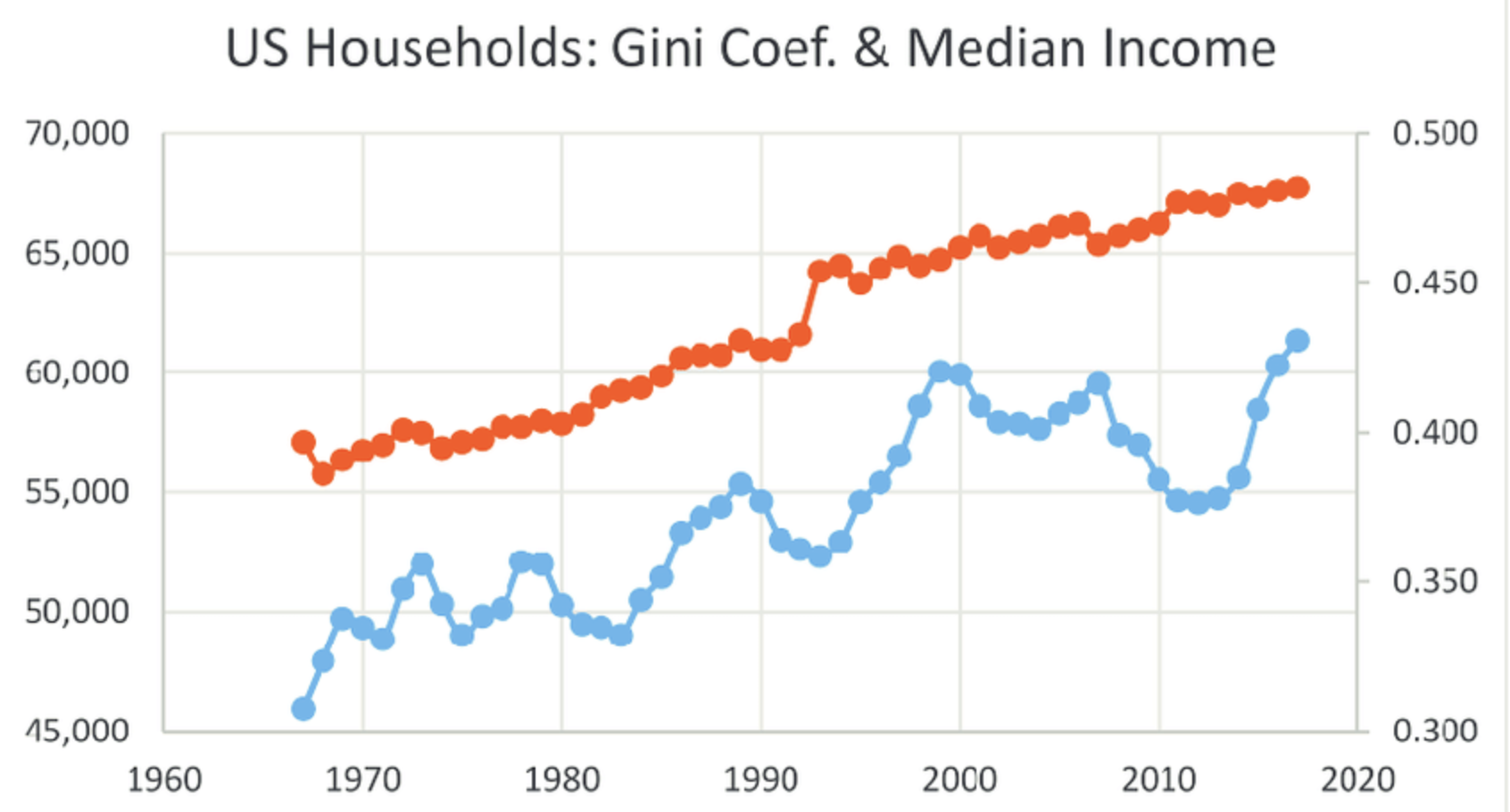
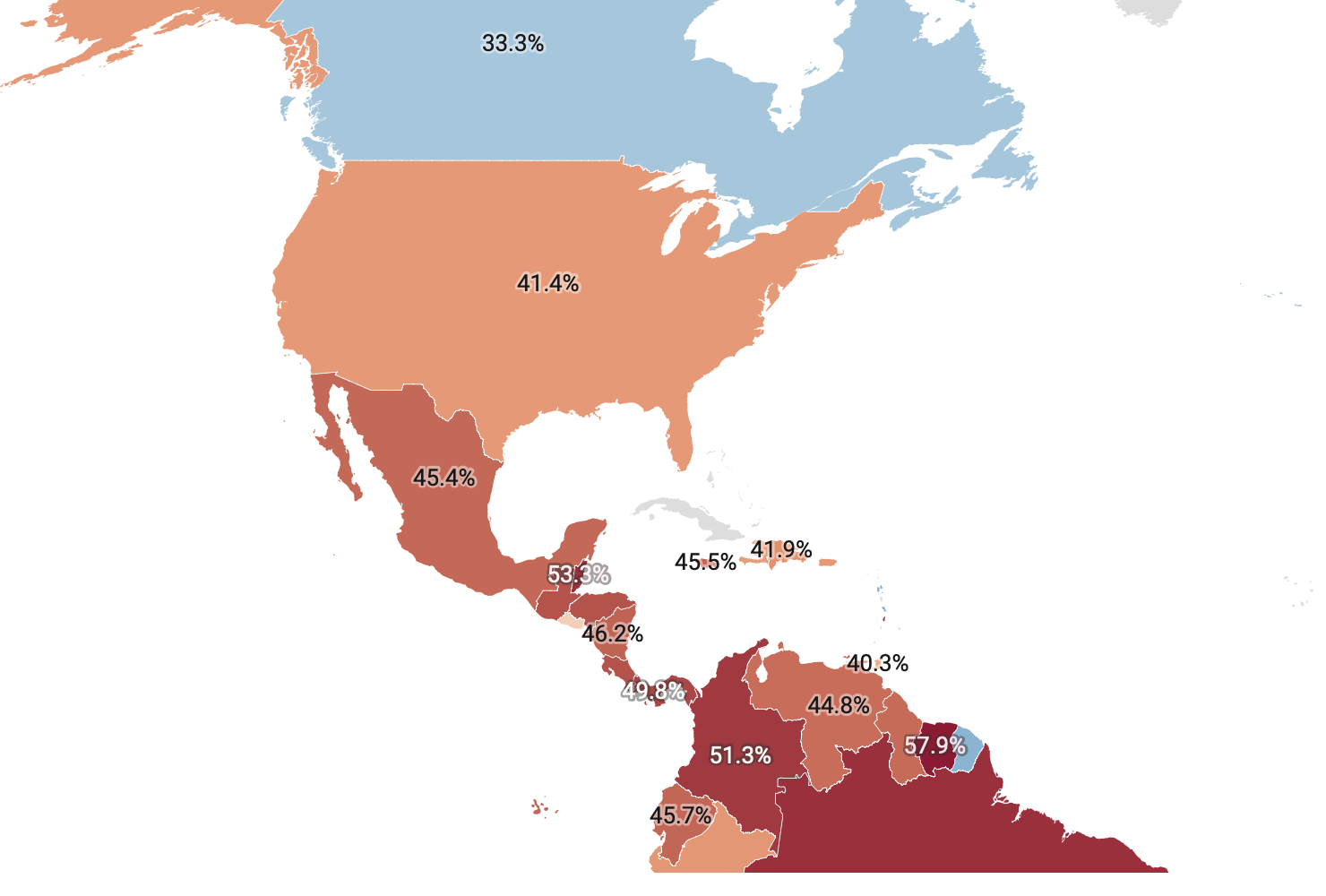
If the glaring rise in Gini coefficients seem the most compelling way to envision the economic distortions of globalization processes–to make them about societal changes, starting from the low Gini coefficient of Paleolithic times to sharper global inequities of the present–this is less a map of haves and have-nots, let’s remember, than of the people who are less served by economic changes that heighten the uneven distribution of wealth in a country: the Gini coefficients in Mexico and the United States are rather similar to that of the Congo (42.1%), if not as great as in the Central African Republic (52.83%R), South Africa (53%), or Brazil (53.4%), yet nowhere near as well-managed and tolerable as Canada (33.3%), Sweden (30%), Singapore (28.7%) or Iceland (26.1%). Falling below 30% is quite an accomplishment for a society, but does not make that nation wealthy or rich: these datapoints that aggregate individual incomes are taken as an index of well-being, but might be better seen as a record of what countries globalization processes have hit hard–and the blurred boundaries of a globalized world, where sovereignty stands in confused relation to aggregate wealth.
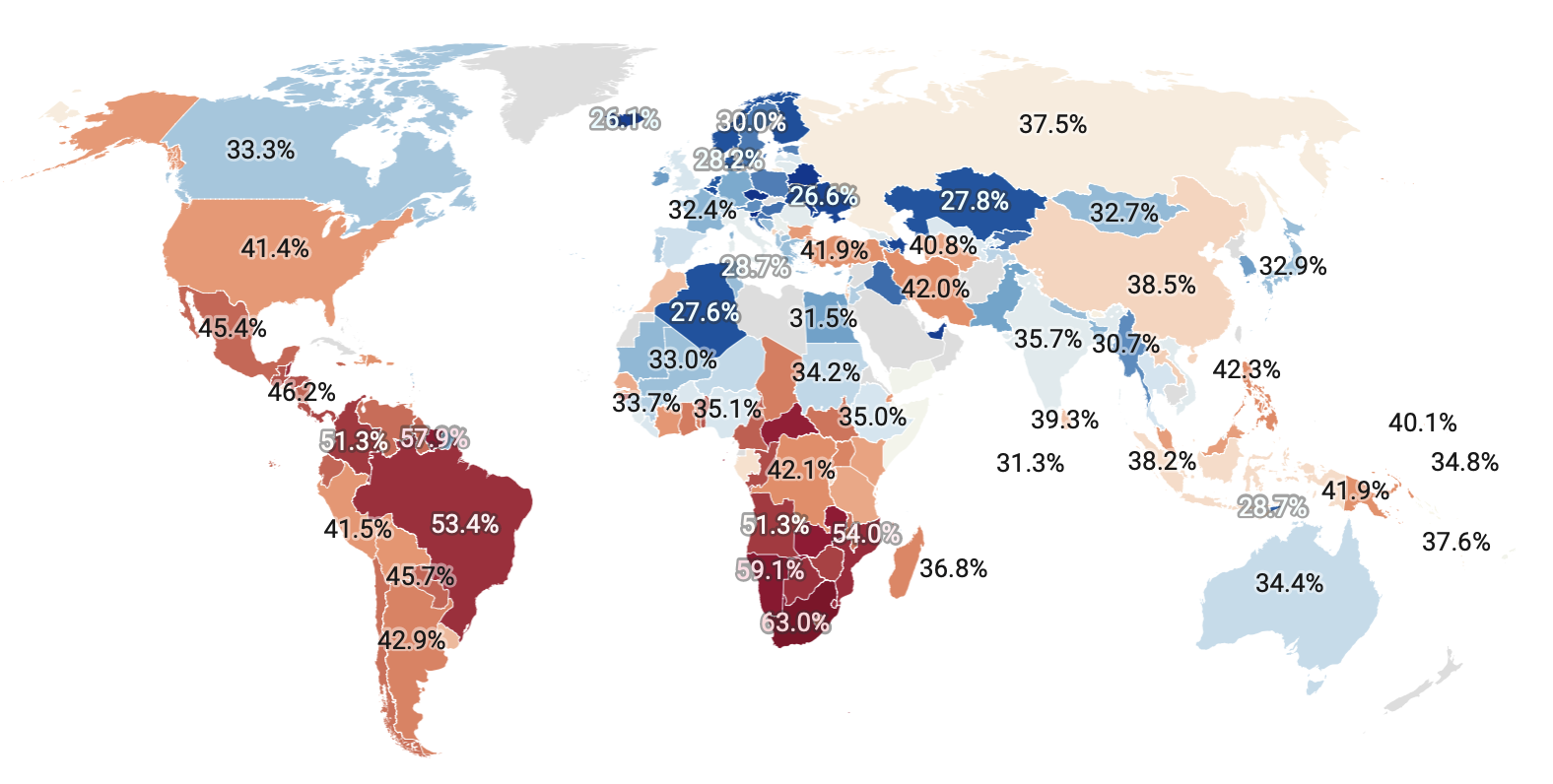
Gini Coefficient by Country, 2035
The defense of economic sovereignty of America underlies the obsession over border security that propelled the most unlikely of outsiders Donald Trump to the Presidency with pretensions of aristocracy, promising to militarize the border, perhaps but a precursor to military presence in our cities. If promising the protection of American wealth and economic security, different Gini coefficient are not at nearly as statistically striking or sharp as the concentration of wealth.
Yet the concept of hemispheric security Trump aims to achieve, if a distraction from declining individual incomes across America and sharper political divides, was a recurrent theme of the first months of the Trump Presidency of almost deliberate nature, as if economic security lay in the redefinition of a theater of economic dominance–by annexing Canada, claiming Greenland by fiat, seizing the Panama Canal–that seemed to expand and inflate the sovereignty of the United States. The uneven distribution of wealth in the United States was not to be mapped in the face of American Greatness, as if the greatness of America might compensate for its distorted economy. While the increasingly extortionist manner of finding ways to claim Greenland as part of America appeared a form of boosterish patriotism, the expansive claims of a need to defend the world by claiming Greenland–an increasingly preposterous fixation in a time of real crises of global warming, in which Greenland was perhaps designed and foreseen to melt–was claimed as a need to ensure global peace–‘The World is not secure unless we have Complete and Total Control of Greenland,” the preposterous President inveighed on social media, affirming in a message to Norway’s prime minister that “Considering your Country decided not to give me the Nobel Peace Prize . . . I no longer feel an obligation to think purely of Peace, although it will always be predominant, but can now think about what is good and proper for the US,” arguing that if Europeans collectively consent to “Make it part of the US and there will not be a conflict because the US right now, [since] we’re the hottest country in the world, we’re the strongest country in the wold” as if the government was convinced of a new era in which “the US projects strength”–and was searching for continental capitulation to the new assertions of global power of the United States.
The distorted image of Greenland in the Mercator projection that is in most folks’ mind, which make the land mass truly enormous, and equal to the continent of Africa–in fact fourteen times as large–might be a time to return to the Gall-Peters projection, that shows how peripheral the land mass is to the global struggle, without considering how much it would cost to establish military bases in the region–
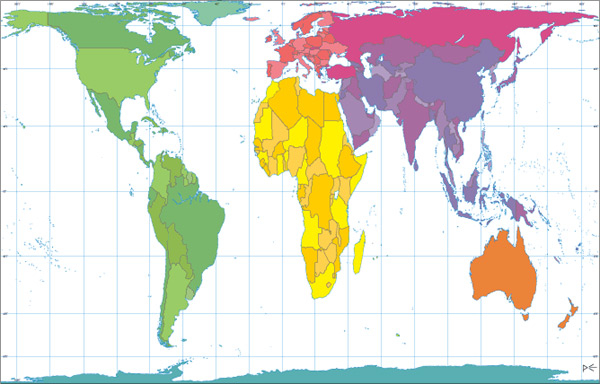
–instead of the radical distortion of the Parker Bros. board-map that is used in the board game Risk, which persists in the adoption of the Mercator projection that distorts its global place–so that it seems to offer a chance to double the nation’s size, rather than take on a huge financial obligation or waste international diplomatic political capital to seem to promote oneself as a strongman.
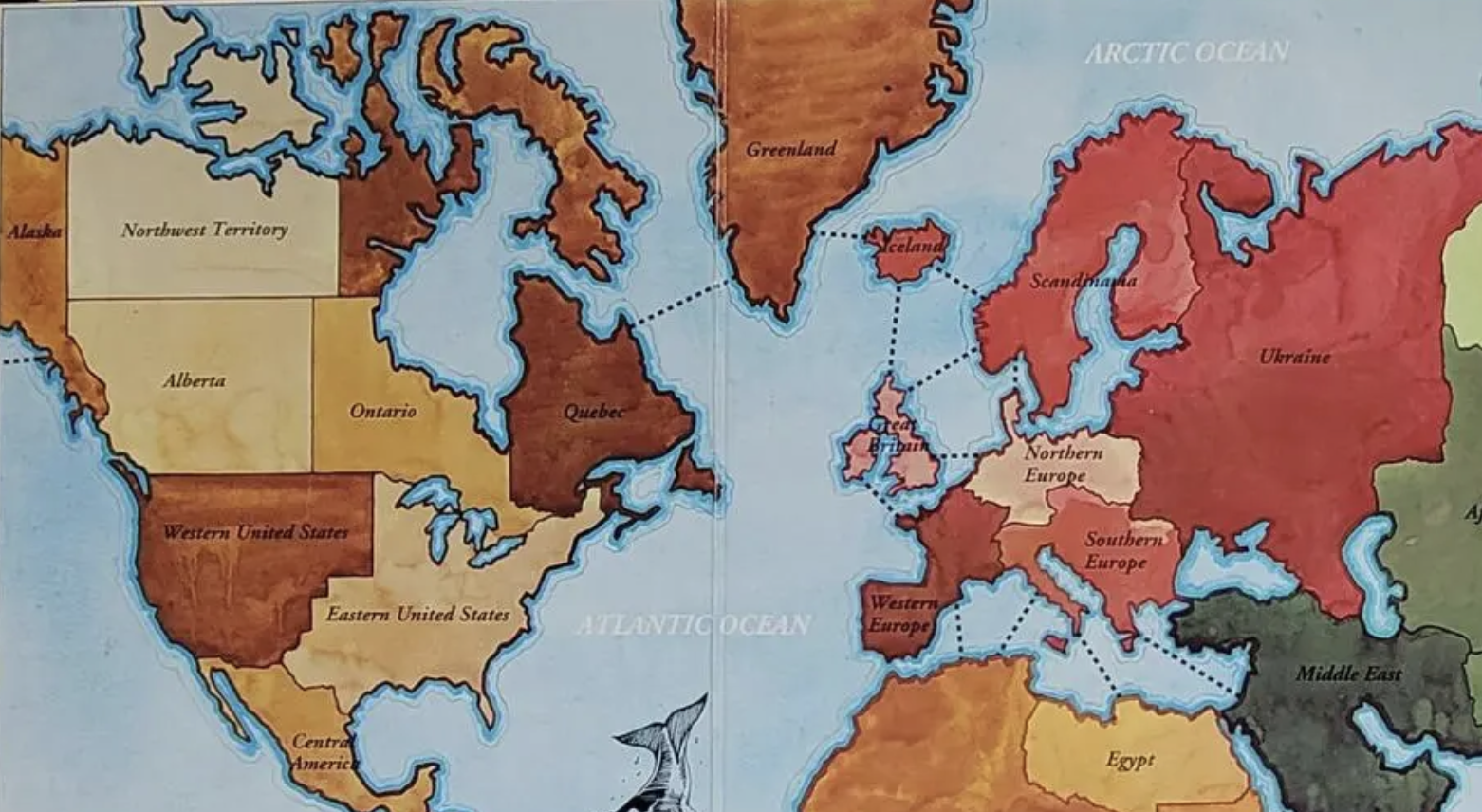
Risk, (c) Parker Bros.
The knee-jerk readiness of FOX or NewsMax to issue chest-thumping infographics comparing the fantasy of the United States incorporating Greenland, the sovereign part of a longstanding ally, as a patriotism comparable to the territorial purchases by past Presidents of Alaska or even Louisiana provided something that might be worthy of the diet of infographics of Presidential Daily Briefings. If the infogrphic was a preferred distillation of complex facts in the previous Trump administration, the readiness with which Ted Cruz claims that the ‘acquisition of Greenland’–never put on offer–was ‘key to US interests’ suggests how far we have strayed from a sense of American interests, if Cruz straightfacedly asserted ‘it is overwhelmingly in America’s national interests to acquire Greenland’ on FOX News, which supplied the infographics of the ratcheted up rhetoric of Trump, or the Democratic ‘Senator’ John Fetterman, who latched onto the idea ‘we purchase it–similar to our purchases of Alaska or the Louisiana Purchase’ as if to normalize the absurdity of the statement, as Cruz explained ‘Look, the whole history of America has been a history of acquiring new lands and territories’–omitting the centrality of Greenland to the unprecedented inflection of American expansionist ideology, by masking it in a geopolitical reality.

–or as if the arctic expansionism of America would offer Alaska and Greenland as new lungs for the nation that would pretty much suggest the doubling of our territory since the postwar period.

Doesn’t this absurd promotion of ‘strength’ only help mask the ever growing wealth inequalities in the nation, now heading toward a more uneven distribution of wealth than in the past eighty years?
As ever-wider wealth inequalities expand almost inexorably across the map both at home and abroad, MAGA politics have profited from a deep disorientation to place. The spatial fracturing of how the national GDP is distributed in space may be more meaningful distributions than nations’ sovereign boundaries–and may indeed confuse them. The declaration of ariff schemes and trade accords are claimed to promote the American economic and make it great again, belying the uneven distribution of wealth economic wealth–concealing the deeply disturbing divisions of wealthier areas with incomes seven times greater, and the wealthiest five a stunning ninety times wealthier than the poorest five, and the greatest wealth narrowly confined to urbanized coasts—

The Conversation/Disproportionate Wealth Gaps in the United States by Median Household Wealth
–that was by no means new in the income distribution in America, but seemed to accentuate the confines of greater incomes to ever more specific areas of the coasts, outside the midwest, and to specific states, beyond the distribution of incomes during Trump’s first term, per USDA, which back then foregrounded the depths of disenfranchisement of those earning less economic wealth–a quagmire we are less likely for whatever reason to see as an economic or democratic disfunction, but rather to accept as part of the status quo, embracing the coastal elites as the basis for American wealth (we see Intel as partly owned by the government, and other chip-makers paying the United States government for revenues in China, as if they owe that success to American greatness, in what may be “a step toward fascism” and state-owned companies, based on the agreements between the super-rich, rather than legislature that was intended to be industrial policy, as if to compensate for the transferral of the manufacture of computer chips, semiconductors, and technology abroad, a merging of corporatism and state authority that seemed to have begun with the absorption of NASA and the government aerospace, satellite, and defense programs into the portfolio of Elon Musk.

Household Median Incomes by County, 2021/Dashing24
These changed policies and exceptions will of course only increase the wealth inequalities in the United States and benefit elites– in ways many compare to a regime of technofeudalism–raising threats far from the southern border that Trump invoked as a threat to our sovereignty. While Trump invokes the border protection as able to protect our wealth, defend our global economic prominence, and protect economic greatness, it is a smokescreen central to the Trump Show. “Making deals for the country” is promised to boost national wealth across starkly divided incomes of Americans, as if to conceal something that we cannot resist admitting by the all caps promise of “making the USA RICHER, AND RICHER.” By fashioning a united Sovereign Wealth Fund from the American companies, he seeks to use control of government to promote and reify economic divides in a geography of wealth that we have yet to grasp, to enrich the state more than all Americans-or mask the low chances for economic upward social mobility for Americans born in the early 1980s.

Probability of Upward Mobility across the United States (2018), Raj Chetty
The low chances of social mobility mapped in 2018 troublingly map onto many of the “deep red” states across the south, and the newly “red” states as Ohio, Michigan, Indiana and even Wisconsin. As the restructuring of government and paring of the civil service stand to introduce a major shift in government’s presence in peoples’ lives, the radically pared down version of government promises efficiency, but stands to exacerbate inequalities and fail to offer needed protections both to the economy and public life. How did the image of greater governmental efficiency become accepted as a panacea for the growing divides of wealth that stand to be naturalized as part of our society? The Gini Index is a surrogate for the boundaries of a globalized world, but rather than respond to globalization whose effects it measures, we might do well to examine the relation between map and context: for the coefficient was born in the fascist state’s corporatist demands.
It is worth remembering that when the Italian fascist economist Corrado Gini imagined the eponymous coefficient to come to terms with the divides in Italy for a new national politics. When Gini formulated the eponymous coefficient he hadn’t imagined globalization, but faced stubborn problems of the obstinate division of wealth in the nation a decade prior before he joined Italy’s Central Institute for Statistics in the new capital city of Rome. He helped Benito Mussolini wrestle with the stubbornly uneven spatial distribution of wealth in Italy that had persisted in raising questions about its political coherence. Gini measured concentrations of GPD as gaping regional economic divides during the interwar period, far greater industrial wealth concentrated in an industrialized north, by 1914, gaping regional economic divides between southern provinces stubbornly evident to the entire nation–a gap that led to the economist’s postwar outrageous proposal Italy be absorbed within the United States. While Gini was roundly condemned for his active endorsement of National Socialist geopolitics a the end of World War II, the demographer’s coefficient has returned, as the return of the repressed, to describe the processes of globalization to the nation in America in heightened defensive terms.
The increasing economic disparity between the divides of north and south were extremely pronounced by 1929, when Gini’s criteria were applied to income and wealth concentration–
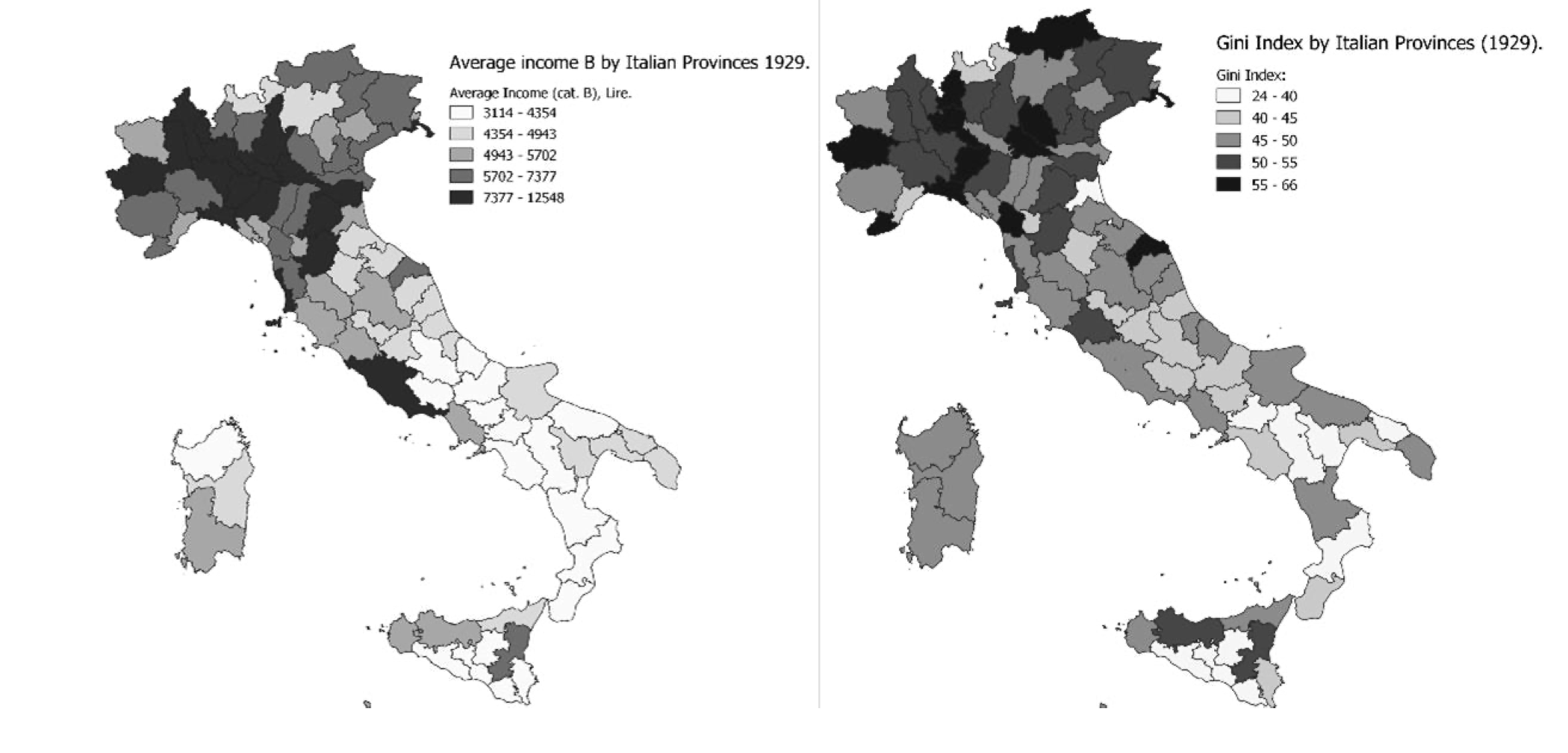
Mean Taxed Income and its Local Concentration in Italian Provinces, circa 1929/Giacomo Gabutti
–if it has been argued recently, with considerable authority, that deepened economic divides of the mechanical industry and economic productivity of north and south were in fact exacerbated by new economies of scale and transportation that were encouraged in northern cities at considerable cost to southern markets, that led industry to cluster in the northern metropoles in the fascist era.
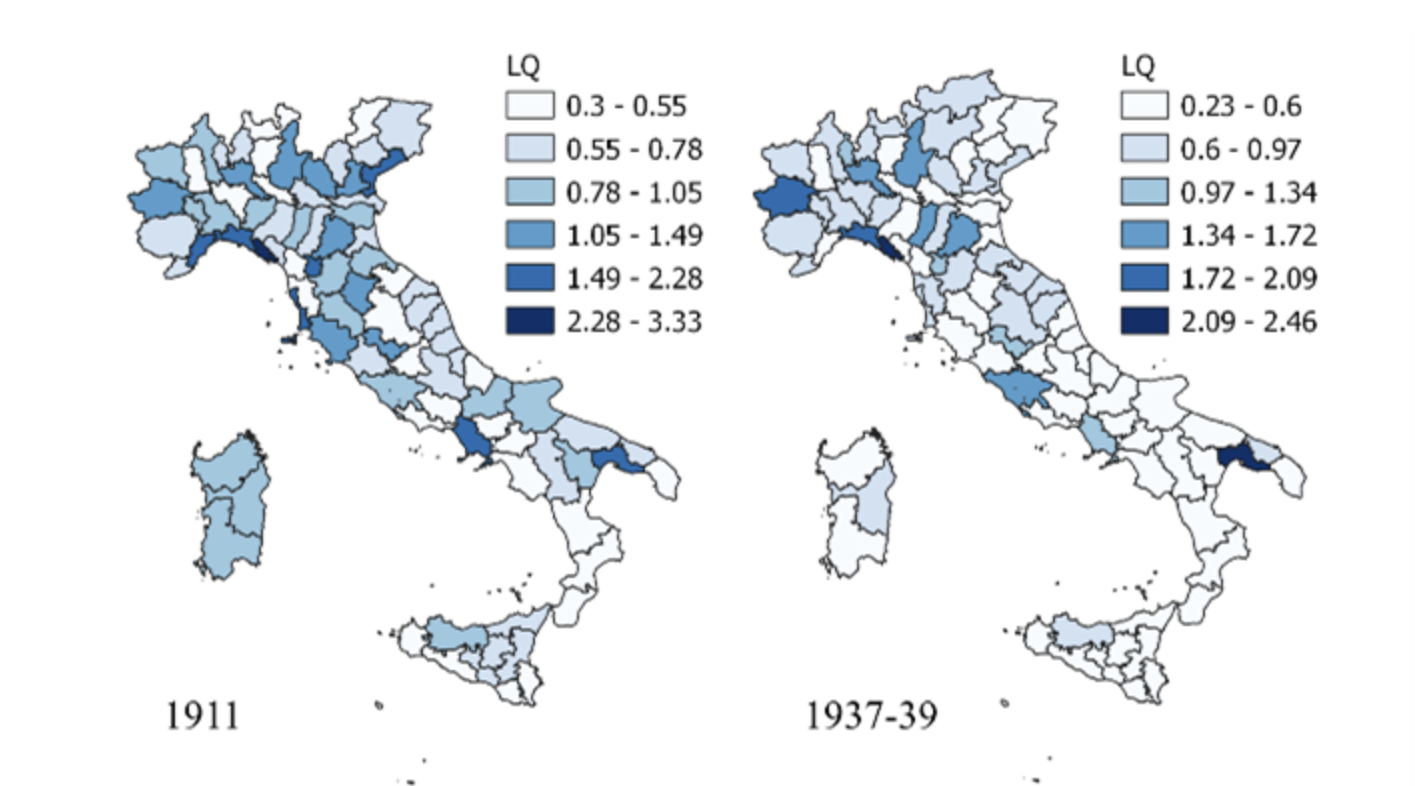
Location Quotients of Industrial Manufactures in Early Twentieth Century Italy
The relative geographic concentration of mechanical industry in the northern centers led industry to disappear from the southern provinces, creating a deepening spatial divide that has rooted manufactures in the north. Fascists fostered the economic activity of “entrepreneurs” who Gini’s economic policies led him to be convinced were the “motive forces” of economic growth, accepting inflation as a consequence of economic health, emphasizing economic protectionism as a basis to prevent “economic pathology” and a basis for nourishing robust “economic health,” and led him to devise the notion of anew economic man–the homo americanus–rooted in economic accumulation and a psychology of work that he loaded in the United States, rather than Italy, and lacking from the south–as a model for the future, consigning homo europaeus rooted in habits consumption and homo orientalis who refused economically productive work–as more efficient consumers and producers, emblematic of the economic behavior the new collectivist state might actively help, by instilling the accumulation of capital and entrepreneurial ideals,–an ideal of enterprise that Gini opposed to bourgeois economic behavior that was degenerate, and not rooted in self-discipline.
The search for more efficient models of economic behavior reveals Gini not as only a technocrat, or a spokesperson for the fascist state, but an ideologue who believed in a new economic man, even to defend the organized violence of the state, murders of opponents, and arrest and deportation of Jews and undesirables. As a statistical economist, Gini devised tools to map regional economic disparities with alleged transparency, reflecting his growing role in fascist economic thought. But he understood it in terms of economic pathology, of economic “bad actors” as the lack of workers in the south due to economic out-migration had lowered the economic productivity of lower classes, creating an aging society of less economic consumption or demand, and declining energy–as if the economic disparity might be explained by the far greater proportion of emigration from southern provinces, and a huge outflow from Sicily, on the economic health of the body politic by casting the nation in strikingly organicist terms that translated directly from fascist ideology he espoused. The pathological behavior of bad economic actors in the south was not a consequence of growing emigration of the impoverished regions of the south before World War I–
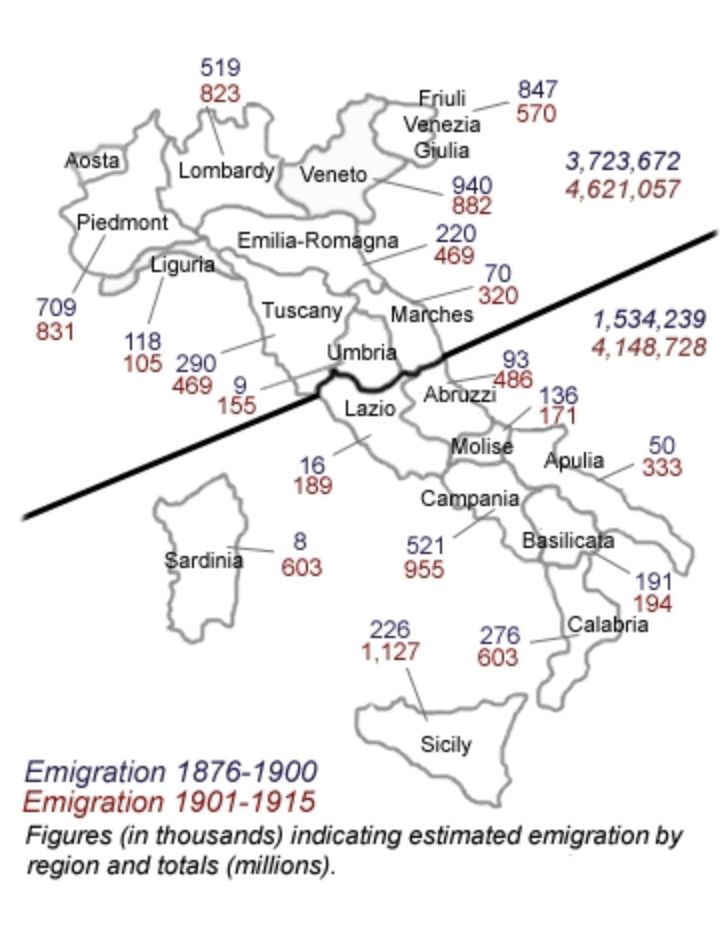
As we wrestle with economic polarities boundaries of wealth and nations, in pressing without clear resolution, the underlying economic fracture lines of wealth troublingly grow, raising questions of national unity as they continue to escalate and magnify or distort existing sovereign bounds. But the problems of national unity that we are struggling with today have deep macroeconomic origins, which the introduction of the purported panacea of tariffs will not solve–but only exacerbate. If we consider the origins of Gini’s economic index, it framed macroeconomic questions of national unity on the front burner of all national politicians at the start of the twentieth century, and were in dire need of being addressed, eve n more broadly and legibly as the economic divides in America today.
Yet this political genealogy of a global metric and data visualization tool is one we prefer to ignore–if it is a tie that seems increasingly inescapable as a startlingly recognizable synoptic image of the deep dilemmas and hidden contradictions of how capital is distributed in a globalized world, and as we use the Gini’s Index as a basic yardstick to orient ourselves to global equality. We may have once flinched associating tools of economist who rose to eminence as the enabler of a fascist strongman as a basis for understanding the modern world; but Gini’s tools is the compelling register of globalization, able to distill globalization in ways inseparable from our maps of our world in data–and of how Trumpism and MAGA deploy starkly contrasting earnings in Mexico and the United States as a metric able to Make America Great Again.
Trump has promoted an expansionist rhetoric as part of his brand to conceal growing economic divides of the nation–trying to promote himself as a global peacemaker, in the most paradoxical of global ways, the sense of a division of powers and a division of moral sovereignty was on view in Anchorage Alaska that recycles oddly Cold War origins. But by arranging the much-promoted meeting with Vladimir Putin in Anchorage, AK as a vertex of sorts to make a global decision about the Ukraine invasion, Trump risked legitimizing Russia’s claims to Ukraine in exchange for fishing rights and access to Ukraine’s heavy metals and industry: indeed, the media spectacle was to Putin’s advantage alone. As Zelenskyy rued that “Putin doesn’t want to meet with me, but he really wants to meet with the US President to show everyone videos and images that he is there,” as if the meting with Trump was a sign that he had never left the world stage, did not face sanctions, or was not viewed as a pariah in ways he had been during the previous Presidency, and that his invasion of Ukraine should merit. It was a photo op, and not only that: it was a performance of leadership for one seeking to normalize his political presence rather than be seen as an aggressor–and the blurred nature of the presence of Air Force One suggests that Trump is accepting of having become a prop in someone else’s show, as much as he was having a meeting on American soil, with Air Force One as blurred as the nature of the “land swaps” of Ukrainian lands that Putin wanted.
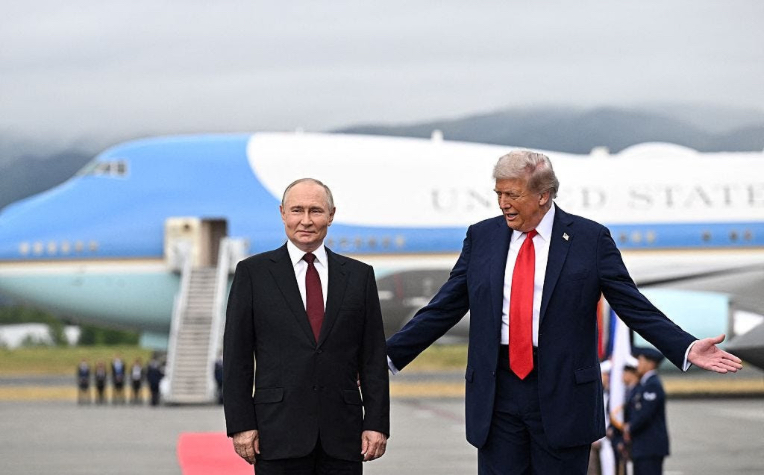
Putin and Trump before Air Force One in Anchorage, AK
The intentionally blurred, liminal meeting place on the far west edges of the United States once an edge of the Russian Empire and bulwark against communism in the Cold War was planned. The liminal role of Alaska was appreciated as it joined the American Empire–a pronouncedly odd place to discuss the global geopolitics of Ukraine, but a photo opportunity. Meeting on a tarmac framed by four F-22 Fighter Jets as more flew overhead hardly seemed a poor choice to negotiate a border dispute between Ukraine and Russia. It was a bizarre solipsistic bid to assert American sovereignty. At the same time, global warming moved to the background, and a different, older vision of global geopolitics emerged in its stead, a vision we thought past for some decades, if not mothballed.
There were odd echoes of a past history that seemed intentional, and sent pundits scrambling to find analogies of a meeting that suddenly claimed its status as one of global consequence at the start of Trump’s second presidency, as if it offered tea leaves to read the new global superpower Trump had become the President. Was the much vaunted meeting at Anchorage a reprise of sorts of the meeting at Yalta that consigned “Eastern” Europe occupied by Soviet troops to a theater of Russian dominance, even if Russia was here the outright military aggressor, and was hard to envision being recognized as winning legal possession of Ukrainian territory in an international meeting to which it was not a member? Never before did an American President seem so willingly to relinquish the grounds of tactical advantage, and indeed to celebrate the reduced territoriality of Ukraine by giving it his blessing, many worried.

On the eve of his departure for a meeting with Vladimir Putin in Alaska, Trump mis-spoke twice by telling reporters he was going “to Russia.” Was he perhapsnot showing his geographic confusion, but just registering his displeasure, or disappointment, at the unprecedented use by a visiting foreign leader of not English, but rather their language–Russian–to address reporters on American soil? Putin’s use of Russian as a lingua franca almost acknowledged the old Russian colony of Alaska as not American soil,–echoing what was known and mapped, if about a century ago, and even after it was purchased by the United States, as “Russian America”–blurred boundaries indeed!

The Last Days of Russian America: 1858 Marmocchi Map of Russian America, from Francesco Marmocchi, Il Global Atlante di Carte Geografiche
The transfer of the region from the Russian American Company to the United States was celebrated as a cession of land, akin to of other indigenous territories, expansing the coastline of America to approach the global circumference, still known as Russian America twenty year later, in 1878.
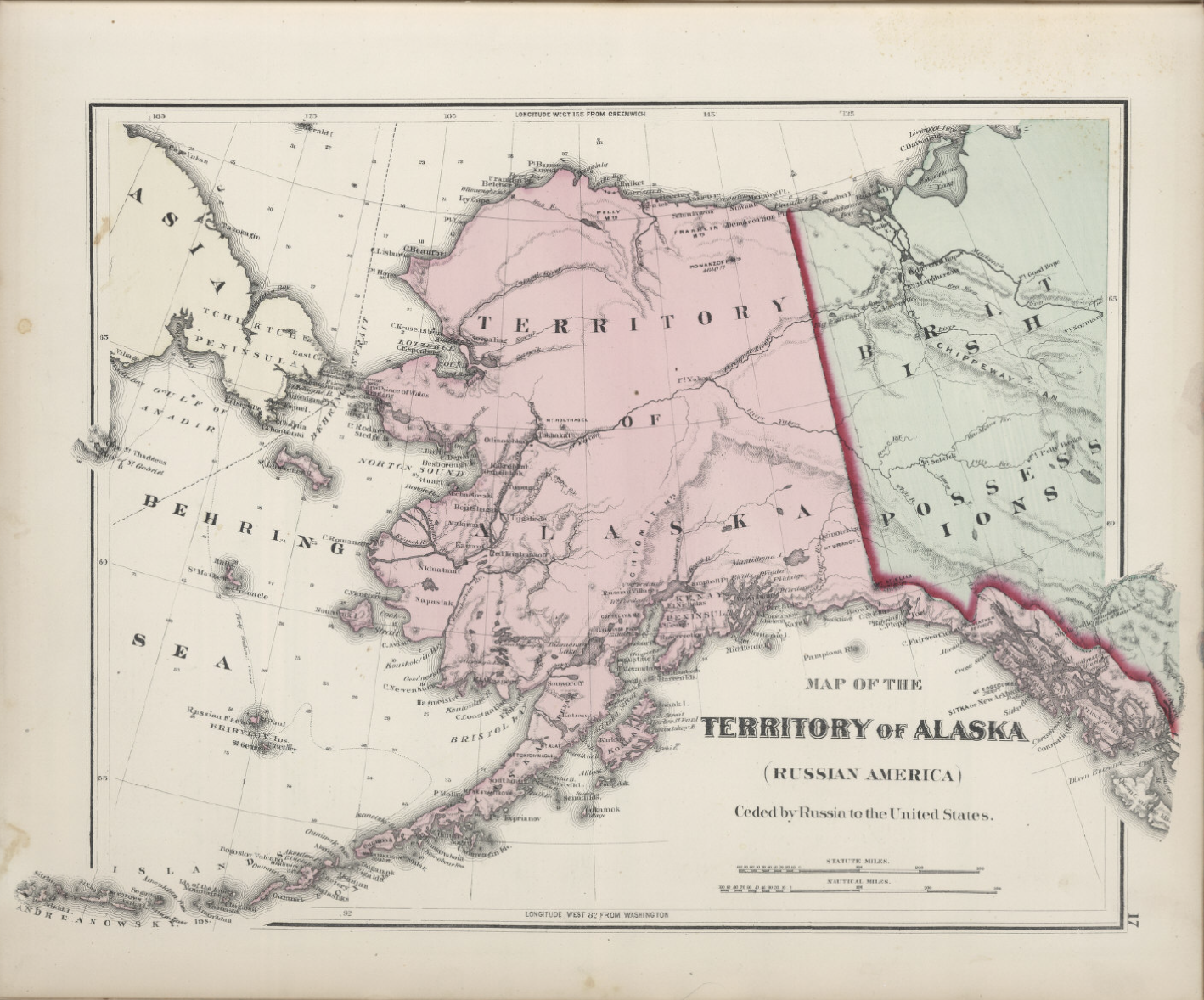
As if evacuating the deep geopolitical significance attributed to the territory on which he stood, not only when the Tsarist government, bogged down by the costs of the Crimean War, had started to hope to sell the territory Tsar Paul I decreed exclusively open for business above the 55th parallel to the Russian-American company For all the ostensible negotiation of what were identified only as “land swaps” that Trump had announced before the meeting. To be sure, “swaps” are usually conducted among friends, for things with assumed parity. (There was perhaps an eery echo of the hoped for a land sales, after some 80% of the indigenous population had been killed either from infectious diseases or in openly violent conflict with Russian settlers who lived only in Novo-Arkhangelsk, today’s Sitka, but seemed to claim (and be ready to sell) the entire coastline by 1867.)

North Western American, showing the territory ceded by Russia to the United States (1867)
The promotion of a meeting that achieved far less than billed, and little substantive results, unfolded in a setting among symbolic F-22 fighter planes. It seemed planned to remind Putin, Zelinsky, and the world that this was a battle of empires, not nations; it revealed a President seeking to affirm his relevance at the same time as it revealed his pleasure in being seduced. Trump seemed ready to accept Putin’s unchanging proposal to reduce any role that Ukraine might expect in its final outcome: if the reminder that United States and Russia almost share a border inflated the United States’ status s a global player, irrespective of European allies or alliances,–even as he seemed to back Putin’s proposal Ukraine cede territory to Russia without any resistance simply because “Russia is a very big power, and they’re not.” It is only expected to expand its frontiers as it desires, in what was promoted as “swaps” but were unlikely to have any benefit to Ukraine on the ground. The geopolitical significance of Ukraine seemed to vanish, by a neat magical trick, as surely as the geopolitical significance that Alaska long held in the Cold War, when it became part of the United States.
The meeting only affirmed that Trump, however improbably, recognized the war as about spheres of influence, as much as exchanges of territory or an actually negotiated “deal” as promised.

Repeated misspeaking of “going to Russia” to meet Putin, as if the state of Alaska were Russian, part of an empire it was not since the Crimean War, retained an imperial geography in the place of a national one of sovereign bounds. (Perhaps his parochial father, Fred Trump, may have seen it that way from Queens–as a simple demand for good coastal shoreline properties.) The Cold War setting of Anchorage, AK, provided, at any rate, an odd site to renegotiate the boundaries of older empires, and cede to the demands of Russia for expanded sovereignty over the Azov Sea and ports on the Black Sea, regaining Donetsk, Luhansk, Kherson and confirming its annexation of the Crimea–areas argued to have already voted fro changing their sovereignty. “Maps can’t hide,” RT argued, the effects of the Russian offensive, painting it as a border dispute.

Having attracted Putin to Alaska by telling him everything was on the table, from arctic drilling rights to sanctions on trade to embargoes to the historic ties of the United States and Ukraine, Trump seemed more than ready to relinquish any sense of understanding of geopolitical dynamics. Never before did an American President seem so out of his element, filled with bluster as he ceded any high ground to a man with far clearer appreciation of his goals and the situation on the ground.
The weird way that history seemed to rhyme in dissonant manner as Trump invited Putin to Alaska in hopes to resolve what was a long-simmering “border squabble” to wrest territorial sovereignty of Donbas from Ukraine oddly occurred in Alaska, as if to make the case that America and Russia were neighbors (did Putin use that word to echo the absurd proposal made in Trump’s invitation, to offer a credible American on ramp to leading negotiations on ending Russia’s war?) sought to foreground the proximity that must be recognized between Russia and the United States, as if to reconfigure a new global order in which the Ukraine conflict–a deep ethnic conflict and battle for resources of oil and grain–could be resolved, perhaps with a Nobel Prize in the offing. Instead, as Volodymyr Zelenskyy noted after the renewed aggression against his country from a Russian offensive after the meeting, “Trump gave Putin what he wanted,” that he could engineer a meeting with a sitting US President, doing an incalculable damage to Ukrainians’ morale and normalizing Putin ‘s aggression in the world stage, gaining no new sanctions and ending a carefully orchestrated international isolation.

The fuzzy image of Air Force One in the background to the leaders’ clasped hand mirrored the even fuzzier nature of a truly self-willed sense of global geopolitics such moments of evident misspeaking conceals is pure Trump grandiosity. While Trump has been inflating his sense of self on an international map to imagine his meeting as of truly global proportions as if it might end a Cold War, the Imperial Presidency seems nothing less than a ceding of power on a global stage.

Borders are clearly important to Trump, but they are not, when he seems able to redraw them as if at will for the nation. The myth of an inevitable expansion of the nation on a global scale, of expanding and expansive borders, was of course promoted in ur marble maps charting Rome’s fascist destiny on via de’ Fori Imperiali at the same time as Gini was developing his economic thought and applying his index, of a myth of an ever-expanding Italy and Italian global power, in a famous set piece of fascist theater along the wide thoroughfare Mussolini named via dell’Impero, celebrating Rome’s ancient and modern imperial grandeur in huge slabs of marble worthy of a truly imperial cartography.
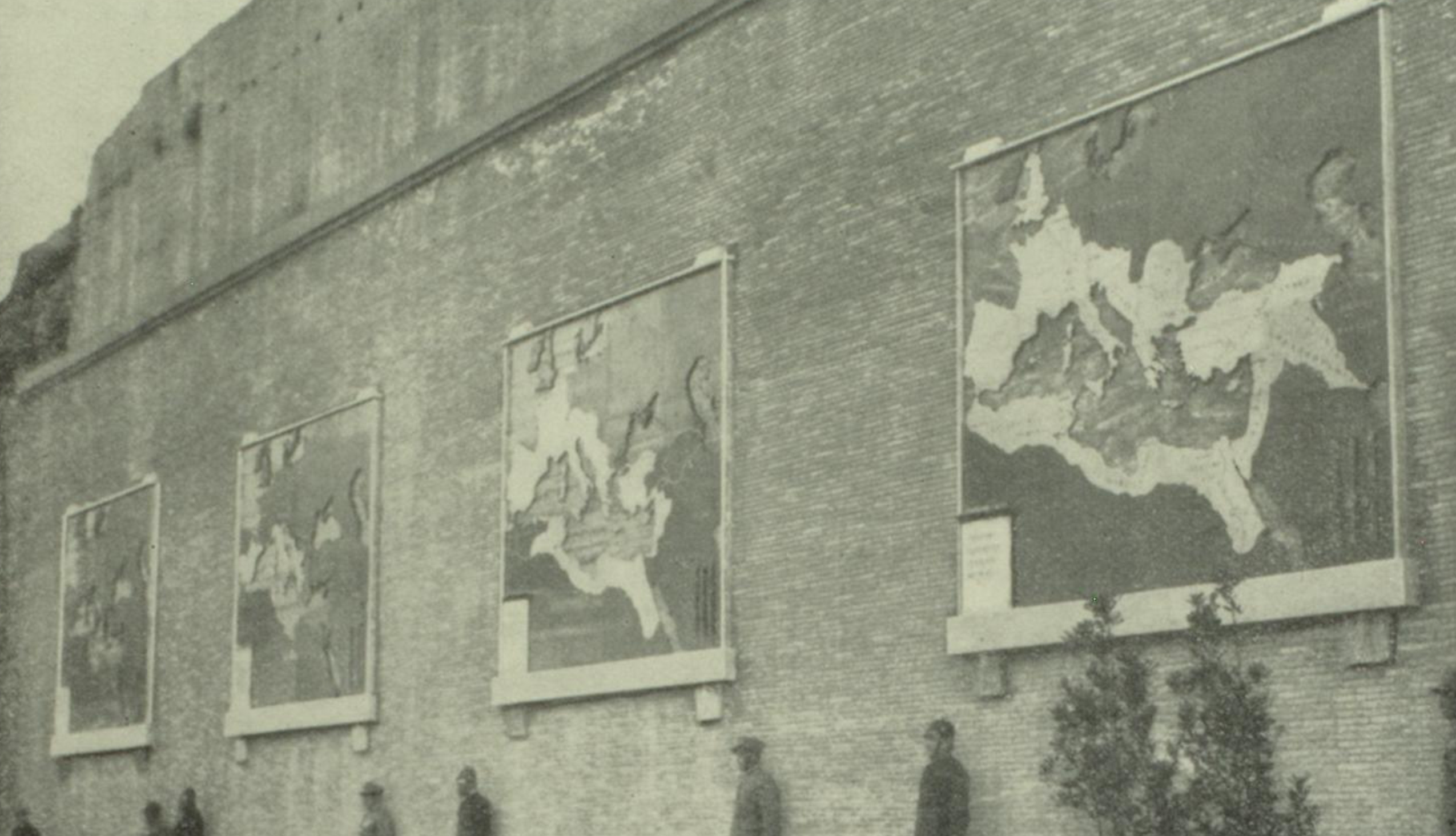
Maps of the Expanions of Ancient Rome on VIa del’impero, 1935
The problem of Italy’s unity was not related to only north and south, of course, but also the search for the dividing lines of of a border in the Alps that was sought to be defined in the post-unification period of the 1860s, as geographic surveys were undertaken and performed in the north border to realize the new political ambition to define a border along the Alpine chain on scientific grounds. The already plastic geographical imagination of an integrated Italy was not only an Augustan inheritance of the classical era, but mirrored the German notion of a human geography of clear borders and the “internal” territory of a state of manageable borders, reflecting a rationalized notion of regional geography and management of local populations that was pioneered by Friedrich Ratzel–a central proponent of the German definition of Lebensraum, and the natural frontiers of political geography, whose classic work Der Lebensraum proposed the political construction of the border as a natural artifact–and a necessary artifact–rather than an inherited political artifact.
The concept of Lebensraum in Italy has of course been known as the control of a new national space, even if it included many who were not Italian-speaking, a reclaiming expanded national space that has been known as rridentism, and the claiming of e terre irredente as a nationalist platform in the late nineteenth century that th work of geographer helped embody. The “border” was a “frontier zone” but could be ethnologically and linguistically mapped, as fuzzy as the actual borders between Austria, Croatia, or the future Yugoslavia, and France might be: the geomorphological nature of the frontier proved that geography was the child of geology–or “Geography the Geology of the present,” as the geographer Marinelli–who had left the Austro-Hungarian Empire for the new nation of Italy in 1866 declared with startling certainty in 1879, as if to clarify the division of the Alpine border in empirically verifiable terms in organic terms, giving the Kingdom of Italy a sense of rigorous bio-political integrity that it had historically long lacked. The maps devised by geographers gave concrete reality in a four color map to the Italian lands, transforming the border zone nourished by a large riverine network in new projects that quantified Italy’s newfound national space, measuring and mapping “regioni integrali” as both physical and biological concepts of political geography–as if this were not about politics but objectively recognized and acknowledge as areas of economic value in need of being securely policed by geopolitical borders–maps that were brought to the Paris Peace Conference after First World War I and impressed the Great Powers as a basis to determine the state’s new political frontier, long before fascism hoped to proclaim a far further expansion of the borders of the nation across the Mediterranean.

Borders are of course central to Trump’s myth of our own nation’s historical greatness on a global scale. The bisection of North America on the southern border, or the command over an economic divide in North America, are a relentlessly deployed magic trick Trumpism promoted to understand the nation–or re-understand the nation–as a global power not subject to pressures of globalization. But also to the distract the the nation from the gaping economic divides in its own borders. The southern border is a central myth of the Trumpist image of governmentality, an image crucially modified in the trimming of government to fill the demands of the executive Doge has provided in the name of the telling keyword of efficiency, a term foreign to the liberal state. And in a nation where the top 1% holds a staggering $49.2 trillion of wealth, a concentration of nearly a third of the entire nation, the contradictions of democratic representation are deep.
We are almost more easily distracted by the fetishization of divides of income inequality, as between Mexico and the United States, a divide that the Trump administration seems to seek to naturalize by not a border wall but the massive expansion of Customs and Border Patrol by 30% and expanding Immigrations and Customs Enforcement to a policing force larger than the Federal Bureau of Investigation. In ways that have made the map of the political program of a North American Technate pictured in the header to this post an inescapable way to sum up the political project of Trump 2.0, the boosting on steroids of a staunch economic in America amidst the dizzying income inequalities in the world and in the United States as a nagging feature of globalization we are unable to overcome but perhaps stomach across North America makes not only a nifty graphic but a new form of empowerment or will to power. Amidst resignation to income inequality as a feature of the world, the poorest fifty percent far beyond lagging far beyond the top ten, and the wealth of the lowest a gaping gap easily confounded with national security.
For Trump has also confounded continental security with global security, has served to deputize the new expansion of Customs and Border Patrol and Immigration and Customs Enforcement as the largest policing forces in the nation, tasked with the ability to find and remove every terrorist from this country” from a database integrating geolocation of all defined as undocumented immigrants from a range of long separate criminal and social welfare databases that will serve as a basis to deny them civil liberties. The creation of a National Defense Area alongside the border will militarize on third of the border as a National Defense Zone. Plans for such a “database” based on the profiling of Muslims planed for 2016 would be in violation of constitutional rights, due process and civil rights protections, as well as investigation of individuals or groups based on suspicions of wrongdoing even on the fears of national security threats of terrorism; the plans to “certainly implement” a national database of Muslim immigrants by profiling people of color without oversight or accountability was feared as due process of the fifth amendment and equal protection violations and erode civil liberties, and a database would violate federal privacy laws, even as Trump asserted his “Deportation Force” would “round up” suspects for “mass deportations” across the country within constitutional law, as bulk collection of data from personal communications would infringe on federal privacy laws.
But the transformation of the federal US Digital service into the the United States DOGE Service enables federal databases to be merged, cross-referenced and searched to geolocate immigrants. BY linking deportation plans to federal agencies within the Department of Homeland Security–ICE, tasked with identifying and removing undocumented migrants whose presence it defines as illegal–and Customs and Border Patrol–tasked with removal of undocumented at the borderlands. The rejection of applications of those who “violated the law coming into this country” illegally or applied for asylum in the United States–a number of pending cases beyond three million–targeting the estimated eleven million undocumented living and working the United States is a massive project of re-bordering, using the National Guard and Army to make sure “the illegals are going home,” in Stephen Miller’s words, or, as Trump pledged before the election, “I will rescue every city and town that has been invaded and conquered,” conjuring an actual battlefield needing to be clawed back as national territory, even if they lack convictions and their former countries will not welcome their forcible return. The map of migrants in the past ten years alone from South America offer a broad distribution of targets of deportation, most of whom reside in the 100 miles Customs and Border Patrol are per fitted to exercise uncontrolled “border enforcement” and oversight.


If Doge in a verb, it is a verb that enhances a powerful need for re-bordering–or indeed several operations of reborder. Each claims and aims to remake the nation in ways that can be sold as enhancing national security–even if that may not be its result. Dependable data only emerged on comprehensive maps of global income inequality in the 1990s–entire continents ignored or unmeasurable unknowns in 1961, when the U.S. Peace Corps was founded, perhaps to obscure this inescapable divide–by the mid-1990s, income inequalities so definitively popped in data visualizations to make legible a divide of Gini coefficients between Mexico and the United States: the “border” is one of the starkest divides in a global map of income inequality by 1996, per Our World in Data, when the United States first offered a massive bailout to Mexico’s government to sign NAFTA, in hopes of President Clinton to resolve immigration reform.
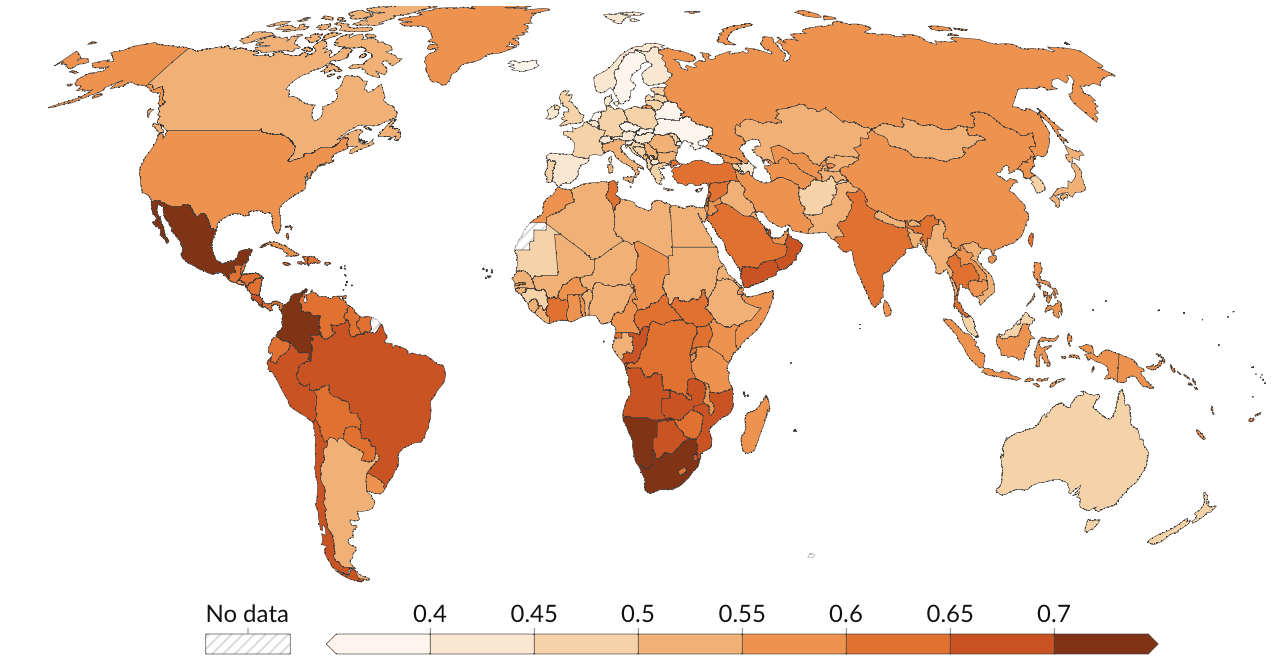
Gini’s metric is a trigger, if not the basis, for the construction of the wall, and the convincing bid to aggregate so many pressing problems of the American economy and society– illicitly produced drugs like Fentanyl, as well as heroin, methamphetamines, or cocaine; gangs and criminality; low-wage workers who accept lower wages than Americans would; rising health costs and public debt–on lax enforcement of a border that remains the most legally traveled and traversed in the world. The newfound “policing” of this border as critical to national security–amplified by the enlisted men who will be involved in the the policing of the border as a military frontier, and the prominent diplomatic missions of our Secretary of State to travel south of the border in hopes to take “swift and decisive action to dismantle cartels, halt fentanyl drug trafficking, end illegal immigration, reduce the trade deficit, and promote economic prosperity and counter malign extracontinental actors.” Who are the “malign extra continental actors” save those outside the North America continent, the countries with similarly high Gini coefficients, where drug-lords have a prominent position in society? These are the “bad actors” that Trump wants to distance from America, believing that the border is able to keep them out from our midwestern villages and towns.
The tensions that exist between the nations might be seen as a condensation of the first decisions with major foreign policy implications in Trump’s return to the White House–the renegotiation of trade deals and tariffs and the cut of USAID as a tool of stabilizing foreign relations–that seem to proceed from a misguided conviction that the United States is leading a unipolar world in the post-Cold War era, where the bordering of the world can be changed by massive USAID cuts, as if this will bolster our global power by making massive cuts in assistance to areas as agricultural devilment, maternal and child health, infrastructure, basic education, and good governance.

Art the same time, we have restructured our domestic space, cutting jobs in the National Park Services, to cite one area of grievous loss, by a quarter (24%) due to sudden layoffs, buy-outs and a hiring freeze that curtailed hirings, and have trimmed what might be a third of the Park Service budget. The opening of public lands to private interests that will profit by actively degrading the environment–extractive industries such as mining, logging, and drilling–will reshape public lands. Land once envisioned as part of the national heritage, worthy of preservation and restoration as sacred parts of the nation are being exposed to private interests due to the declaration of an “energy emergency” and a “timber emergency,” urgent language echoing the “border emergency” to evade oversight or regulatory control. Recent xecutive orders roll back “heavy-handed Federal policies” triumphantly to exploit public anger at government overreach: the declaration by the executive of an Immediate Expansion of American Timber Production is set to ramp up timber production on our national lands and calls for “streamlining” environmental permitting that has guided oversight of public lands. The “emergency situation” across 60% of national forests encourages where the Forest Service can fast-track logging and skip established environmental safeguards, public participation and legal review. The barometer has shifted, as well as the measuring stick.

Emergency Situation Determination of National Forests to Fast-Track Logging
The declaration by the United States Forest Service of an “Emergency Situation Determination” cuts restrictions or protections to the forested lands including some eleven million acres of wilderness areas, long desired by timber companies. While the “Emergency Situation Determination” promises to reduce fire risk, and be a problem of environmental planning, beneficial to residents near forests that have been poorly managed by previous administration’s negligence of the public good in an era of warming climate exacerbated by forest mismanagement: yet if up to a half of areas of increasing fire-risk regions like in the Emergency Situation Determination, a significant majority of the most vulnerable areas to fires (65%), and constitute a fraction of the “emergency” lands that are opened to logging by waving environmental safeguards, suggesting the hypocrisy of that alleged rationale for a change in land management practices. The logic of recalculating areas of conservation undercuts public participation in oversight of protected conservation areas while leaving areas of increased fireshed unprotected in western states like California, Colorado, Utah, and Arizona and New Mexico, in ways that suggest a massive give-away to logging interests–as if to promote industry of logging in California and Washington, even if the highest areas of fireshed exposure lie beyond the new “protected” areas. The lip service to limiting fire risk is laughable as an actual priority of the Emergency Situation Determination, which seems targeted to loosening oversight over the most densely forested lands long desired by lumber companies.
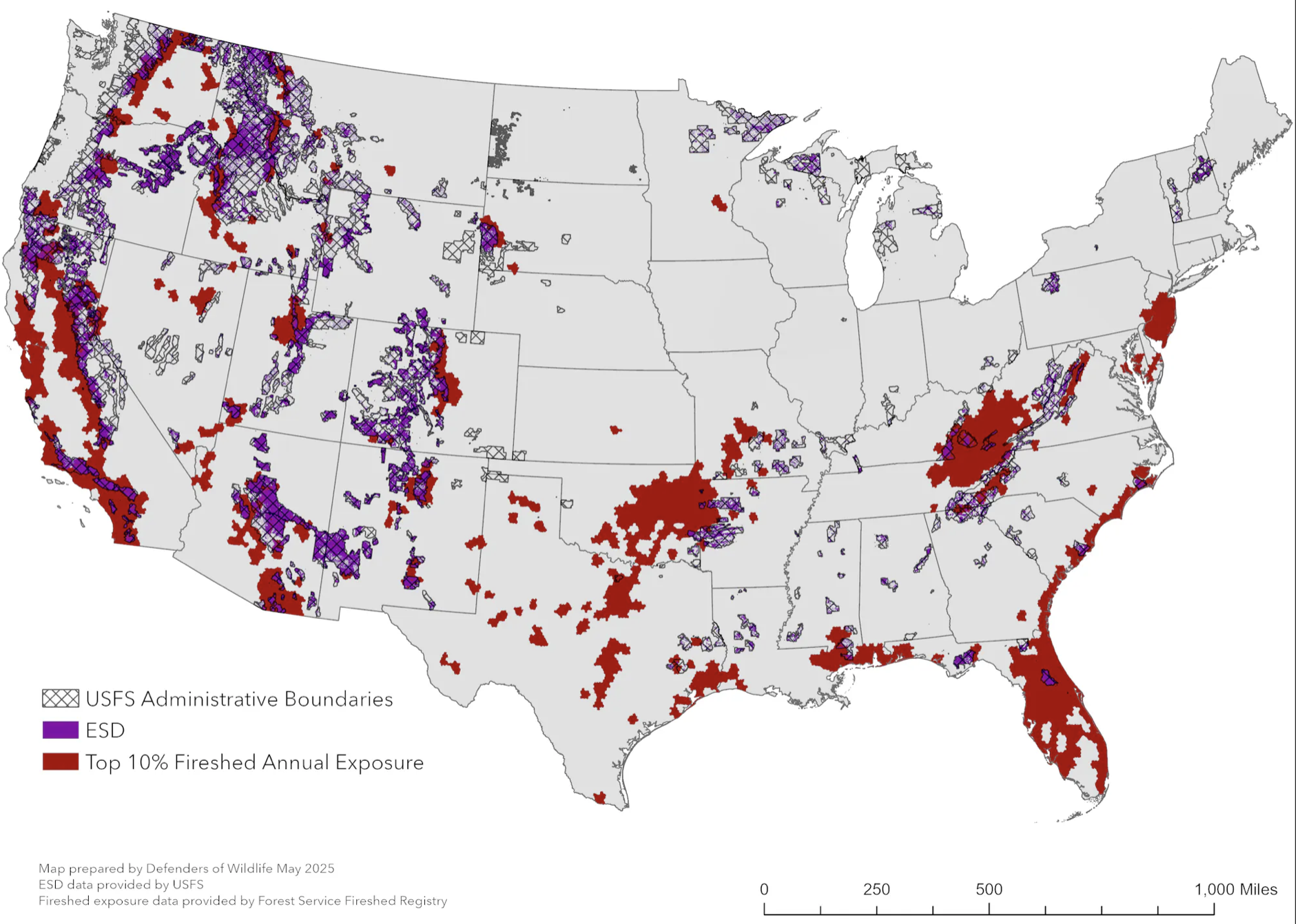
Top Tenth of Annual Fireshed Exposure (Red) against Emergency Situation Determination (Purple)
And even as national parks receive increased visits, attracting up to 331 million Americans in 2024 in a new national high mark, the long-growing problem of staffing parks have dropped by a fifth from January 2010 to the present, and an increasing number of “seasonal employees” expanded this year by volunteers to take the responsibility from rangers of orienting visitors, even as Trump mandated by executive order a hiring freeze soon after his inauguration. Seasonal employees remain exempt form the freeze, but the parks have been left chronically understaffed, as the NPS negotiated the cuts the agency has received by 24%–and may well reach beyond a third of the total budget at the same time as more lands are opened to logging and mining, curtailing the relation of protection of parks to staff. How is this efficient? The rededication of public parks and park services to the economy and to private interests have not only placed the National Parks at risk but the legacy of protecting landscapes “too magnificent to belong to private individuals, and [that] instead should be given to the nation,” in Rachel Dec’s words, as park rangers willing to talk confided declining morals and sense of duty among an overstressed staff not able to manage upkeep with staffing at their lowest level in two decades, and openly frustrated by the white-washing of public signage about racism, indigenous struggle, or conservation history.
Meanwhile, Trump has proposed slashing funding by a third of this year’s level for public land agencies–National Park Service (NPS); U.S. Forest Service (USFS); Bureau of Land Management (BLM); U.S. Fish and Wildlife Service (FWS)–in a wanton dereliction of public duty as park visitors reach ever-rising levels, perhaps due to costs of travel. Even as parks workers are widely judged in positive terms as federal employees, the trimming of park staffs by the thousands suggest an ungrounded purging of staff. And the declaration of a “national forest emergency” was not in the health of forests, or the need for securing animal habitat, but the alleged danger of forest fires from the “abundance of timber at high risk of wildfires” as a “Forest Health Emergency Situation” that will place increased forested lands at future risk–and work around for the onus of regulations stopping logging projects from proceeding.

United States Department of Agriculture Allowing 112 Million Acres Available to Logging
The use of a rationale of “emergency” to allow increased logging across the protected forested lands by a quarter lift the proscription of logging in wilderness study areas, but meet hopes of Republican governors like Steve Daines of Montana to exempt federal protections accorded Wilderness Study Areas in the name of growing wood markets–if most timber will be sold to foreign markets–and reducing staff responsible for modeling fire risk on public lands in the face of climate change–indcluding the expansion of oil and gas wells on national parks.

The end of foreign assistance in good governance, infrastructure, family-planning, education and conflict mitigation match the cuts to water supply and sanitation. The willful imposition of new priorities of funding respond to the charges of corrupt and undisciplined policies–not efficient, in other words. Yet efficiency is a keyword here of note, a fascist keyword, as in the efficient wiping out of the Jewish race, disguising and concealing the use of gas vans that were pioneered as efficient means of murder; Walter Rauch notoriously created efficient and cost-effective forms to kill by pumping poisonous fumes into sealed compartments, a technical basis for death camps that from 1942 implemented the euphemistically worded Final Solution.”
The argument that an objectively better world–more efficient, more moral, more beautiful–could be established,” in Zygmunt Bauman’s words. Efficiency is rarely the basis for the liberal state. And the sense of allowing himself to be seduced and persuaded by the powerful vision of Putin’s territorial ambitions or Musk’s image of efficient rule has led Trump 2.0 down some curious and almost unhinged paths, boasting of blurred boundaries to such an extent that suggest a man unhinged, but also one ready to accept and promote the latest vision of efficiency–one one cannot but imagined entranced the deeply weakened and somewhat unsure candidate who accepted Musk’s vision of an efficient state as if it was a greater and more impressive path to power.
The readiness of Trump to be seduced by these men’s visions of grandiosity–either Putin or Musk, or cryptocurrency, or, to be sure, the Customs and Border Patrol, feed a sense of power that he hopes to absorb by association–osmotically!–even if they have no respect for the law, or for legal precedent as binding. Much as Trump loves the game of golf on his courses, where he seems able to cheat rather systematically as if to ensure that he never falls far behind, offering his golf game as a way to prove that he is indeed “a winner,” that “my life has been about victories” and “I know how to win,” offering as assurances the eighteen club championships Trump not only boasts of often but took every opportunity to remind audiences during campaign stops, reminding them, “I win when I do something–I win . . . . In golf, I’ve won many club championships, many, many club championships–always as if seeking or needing confirmation that “I always won” will prove his mettle for politics.
Even if the impressive array of club championships are achieved by cheating in clubs Trump owns himself, where he won his victories, the drive to prove himself on friendly grounds is strikingly troubling. While Trump’s clubs have not only struggled to turn a profit but have lost millions annually, the topos of the club championship as an assurance of professionalism and of the status that he has won. But, for an incredibly ignorant man, with little sense of global dynamics outside a logic of free trade and negotiating great deals, the site of these golf clubs provide a distorted and impoverished image of the world, replicating a version of actual global wealth imbalances–an image of American expansiveness that has no obstacles, as it were, and stretches worldwide. The view from the putting green that is always sprinkled and mowed makes it hard to consider the importance or relevance of earth observation satellites that have recently produced such robust maps of atmospheric concentrations of CO2 we call climate change–compelling maps, long since displaced in our limited attention spans by far lower-scale maps of border crossing, criminality and immigration, without even trying to acknowledge that each migrant has a story–and indeed a vision, as much as a past history, criminal or not–that has animated their individual itineraries. If smaller scale, we have come to treat the migrant as a data point, of course, as if they were mapped, tracked, and measured by datapoints as easily as atmospheric concentrations of CO2.

Trump Corportation’s Hotels and Golf Courses/FlourishMap for Newsweek
This impoverished image of global trade that Trump International offered provided a poor proxy indeed Yet it is perhaps not surprising that Trump has allowed himself to be seduced by maps as contestatory grounds to prove himself, absent the golf course, and to prove he is still a winner,–or, better yet, to convince the nation that America is also a winner. The map of golf courses is as good as any fantasy of global relations to understand why Trump was seduced by a role in global expanse that was oddly expunged or cleansed form politics as we know them, or politics as normal, purged of an understanding of international relations, and without any sense of intermediaries or civil servants that might have played a prominent role in international relations as we know them. But the FlourishMap cannot capture the perspective from the isolated spaces of putting greens that offer little prospect on the world, promising a vision of opulence that is always rigged. This is the counter-map of a map of alliances, in other words, from which Trump entered politics, or was seduced by the political stage, and offers a sense of the interest in being seduced by grasping the configuration of real estate and national power from which he entered politics and remade it.
Quite distorted maps of quasi-empires have allowed Trump to continue to bask in adulation–even when doing so is against the interests of the nation or laws of the nation-state–and one could do worse, as a model, to begin from the weirdly distorted maps of “luxury championship-style golf” that Trump International offers as a template or start of the distorted view of the world he offers. Trump has, of course, before being President, branded “world-class golf destinations.” The purblind band of global wealth seems a terrain on which he can always win, at least in the clubs he owns that suggest a sense of economic arrival. Even if the clubs are not financially profitable, and never turned a profit, they offer confirmations of the Trump brand and of his sense of himself as a winner, although they struggle to turn a profit and shed millions. Golf courses have become venues for relations to Dubai and to Saudi Arabia. They are hardly map onto an efficient government, but meet a need for reassurance; the chummy golf clubs are grounds to promote himself and socialize by banter as real estate always was–a narrow band of “safe space” where Trump was aways able to project his sense of being a “winner” on helpful and assuring grounds, courtesy of local staff–

–and a geography of courses that allow him to cheat to his heart’s abandon, as if the golf field were a level playing field. And who needs a park, anyway, when one can have a great putting green?
Trump retires often to golf on courses he owns, increasingly accusing others of having cheated in their games against him. He has devoted an astounding fifty-one days of the first two hundred and twelve to golf since he returned to office promising to make America great to play, costing tax-payers over $71,400,000, including the $10,000,000 trip to courses in Scotland during negotiations with the European Union. He may value the time, but they are “lost” weekends for the country, involving less consideration of national security interests than personal time–but open up avenues for grift and corruption, where ten foreign governments have already visited to magnify their global standing in realtion to the Trump’s second Presidency.

Trump Properties are also one geography of the Trump brand that happen to mirror the relative global isolation and global isolationism of the Trump era, but their are an emblem of the hidden transactional way of doing business that Trump prefers, and an image of the global mediation of American global power–they are not only his brand, but he is branding America on his courses without ethical oversight, or any archival records for future histories of the Trump regime. Whgo wrongat could ? What official is ever even looking closely when the United States President drops the ball on the course that he owns, and can use the home ground advantage to his own advantage?

Trump Playing the Course in Turnberry, Scotland on July 28, 2025/Christopher Furlong
This is the perhaps narcissistic mode of setting up the rules for yourself, a model for the proving of the power and bragging rights let you set up the rules of the golf course, defining hazards and out of bounds, marking the boundaries and out of bounds. Was the “course boundary” and defining of the bounds of golf shots–the bylaws of “marking the course”–the boundary edge with which Trump was most familiar before he was elected or ran for President? The affixing of Presidential seals on golf courses–using the Presidential Seal as a golf marker is itself an unprecedented appropriation of the Presidential seal to a profit-making venture and to a venue for negotiation and discussion.
1. Efficiency is effectively code for totalitarian rule. Yet it is particularly tied to enhanced surveillance and computational abilities. Indeed, the premium on the word “efficiency” that has loose parameters and serves as an imperative and derives from a verb–both of taking immediate effect and empowering to accomplish a goal or end, being invested with ends removed from passions or emotion by the Taylorism or by Jeremy Bentham, as the functional production of a desired outcome, gains new senses in the pooling of data to achieve a given end, an effective deployment of resources to achieve an end, often in economically instrumental ways–Jurgen Habermas however cautioned it embodied a strongly limited rationality, blind to how a premium efficiency had different sorts of costs. The Taylorism of efficient production may lurk in the shadows, but is displaced by the engineer’s conviction that the improvement of efficiency is a product of computational abilities. While the instrumental rationality of ‘efficiency’ suggest a sense of completing tasks of increased efficiency that computers would bring to process information and use energy, the efficiency of the machine is as a set of operations that suspends judgement, reflection, or the law. There is no ethical oversight, or any real need for oversight.
If the Latin roots of “efficere” suggested an ability to “bring about,” and accomplish, indeed to “manufacture” and to “construct”, DOGE offered data pooling tools to profile and target the undocumented, as if to prove that Elon Musk was not a factotum at all but a foil. The same man whose expansion into engineering space travel has helped to redefine the National Aeronautic and Space Administration as a form of private enterprise rather than as a proud agency of extending to outer space as a new frontier has helped redefine the nature of government itself. It is no coincidence that the privatization of the space agency has provided something of a model for the contracting out of government and its downsizing as an extension of the civil service. But the national pride that we used to associeate with the achievements of space exploration as a greater good have been drained of motivational energy or spark by the vision of efficient private control and management that has become the future face of the American space agency.
The new configuration of the space agency is paradigmatic of the new task of increased efficiency–a governance based on metrics and engineering goals, rather than human governance. Good governance of human subjects has almost no place in the demand to perform new functions of governance that Trump et al. have defined–deportation–and to do so in ways that expanded the use of databases that the government possessed at the same time as the streamlining of the “excess baggage” of government buildings and offices, and the end of the expenditure of money on functions separate from governance. Governance of immigration–and immigration enforcement–have gone on steroids as their power has been enhanced in manifold ways through the linking of what were once seen as government databases.
The promise of databanks whose merging meets the demand for efficiency in deportation, for example, and the end of silos of information in the agencies of government to make them available for the apprehending of people to deport: for the restructuring of the Dept. of Homeland Security by using access to SNAP and IRS data on workplaces served to expand the abilities of immigration enforcement, identifying undocumented subjects to deport, made all the easier to deny legal rights by treating them as data, and indeed foregrounding the new master database for immigration enforcement to “streamline apprehension operations of illegal aliens” and “remove unnecessary barriers to Federal employees accessing Government data and promote inter-agency data-sharing” to speed up deportations without legal oversight to “ensure protection against invasion”–even if this leaves hundreds of thousands of refugees in limbo, ending asylum and legal protection of refugee status–even for refugees without criminal records. Indeed, according status to white South Africans believed to be victims of discrimination and injustice as refugees seems to empty the very term of much meaning–as the removal of any investigation of those injustices ridicules the very notion of a “legal” refugee.
The robust databases use data brokers to collate on in three photographs of drivers licenses, and track three in four adult drivers by Automated License Plates Reading; the investment of $2.8 billion in DHS data sharing programs from 2008-2021 planted hopes of data-sharing long before Trump’s election, using unemployment databases from the IRS to cellular devices on the eve of the 2024 election. The expandsive mapping of a “homeland” goes far beyond the US-Mexico border. For the Gini Index may well mask the steep increase of income inequality in the United States, and the rising income of the upper 1% since 1980 that appeared to inevitably escalate during the mid-1990s, ending the decrease of income inequality from the start of the First World War through the 1970s, a substrate still in our memories that may offer a possible interpretation for what “Again” would mean as a modifier of the promise to Make American Great. We may hesitate at linking America to the cradle of fascism, but the unprecedented appeal of an impenetrable border wall responds to the inescapability of income inequality in the United States, and as a metric to envision the world–it was a tacit metric for Trump to campaign on the construction of a border wall with such surprising success in 2016, when the unlikely prophet of a self-defined billionaire first boasted of his ability to translate skills to cook the nation’s books. Despite promising national security and safety, his appeal was never far removed from the economic bottom line. Indeed the salience of economic insecurity that haunts the nation was played up as a national security threat since 2016, that makes isolationism seem a far better form of protection against a world inescapably more dangerous, that closely map to the heightened levels of wealth inequality on our continent.
And the isolationism that Trump has so successfully promoted with his comrade in self-promotion, Elon Musk, this post argues, may begin with North American wealth inequalities, but might be explored both symbolically and as a mental imaginary in the promises of economic security that the map of the North American Technate, once championed by the self-made engineer who was Musk’s father-in-law, and perhaps second father, Joshua Haldeman, whose intense ties to Technocracy indeed led him to migrate to South Africa to raise his daughter Maye–Elon’s mother–among the leafy jacarandas of Pretoria, where he flew daredevil flights on his single-engine airplane with his small family across the Kalahari desert, burnishing his sense of resiliency after his plans to promote a self-secure Technate went south and Haldeman decamped to the security of a segregated South Africa by flying to Pretoria.

Trump had, to be sure, by 2024 successfully appealed to a rural electorate in a manner that many in metropoles may have ignored as they contemplated the runes of the electoral map. The little-remembered ballooning of farm subsidies in the first Trump administration was applied almost as a system of rewards to insulate Big Agra from the effects of Chinese retaliatory tariffs on American corn, benefitting largely the largest, wealthiest, and richest farmers–Big Agra–even as they short-changed family farms. The subsidies of the “market Facilitation Program” that compensated farmers located mostly in but six states for the losses of Trump’s trade war with China, evident in the hugely disproportionate expansion of ad hoc payments that distorted the Farm Bill of 2014, to benefit North Dakota, South Dakota, Texas, and Nebraska with federal subsidies to keep farming profitable, even in counties that have experienced severe contamination of drinking water from nitrogen runoff in fertilizers, as California’s Central Valley. The expansion of handouts were however concentrated to large farms to keep food prices down and affordable–and effectively insulated from the threats of globalization, or of the response of global markets to trade policies, doubling payments by 2019-20 for many megafarms in those states–

–that bore fruit in the surprising allegiance of many rural voters to Trump in the 2024 election, where support for Trump’s candidacy remained surprisingly strong in farming-dependent countries across America, especially in the “heartland” that Trump has long maintained and prized cultivating close political ties.
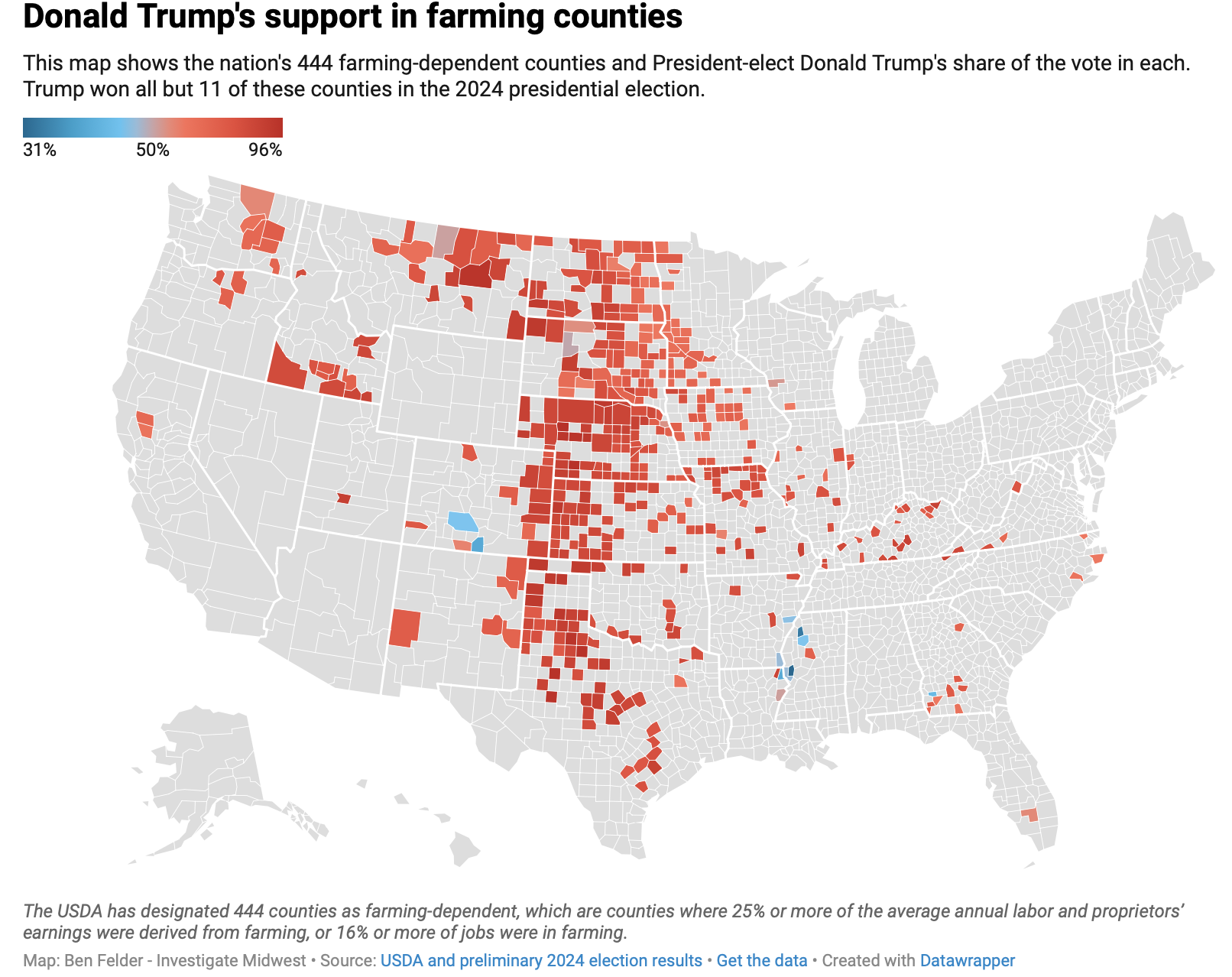
Trump’s Electoral Support in 2024 Election in Farming-Dependent Counties/USDA & 2024 election (Ben Felder) Get the data. Created with Datawrapper

The notion of a reordered world that the Technate offered in the years of the Great Depression as a message enhanced economic security and rational protection against the tides of global markets and currencies itself mapped nicely onto the promise of economic protections that Trump offered American households by building a border wall able to divide the southwestern states from the gaping income inequalities south of the border, and indeed the global poverty levels in the southern hemisphere that Trump has increasingly promoted and defined America’s wealth against, noting the specter of migrant caravans crossing the southern border in search of jobs, health security, and better education, and hope of a better life Trump has made it a priority not only to deny, but reverse–ending a longstanding pattern of migration recast as a sovereign invasion.
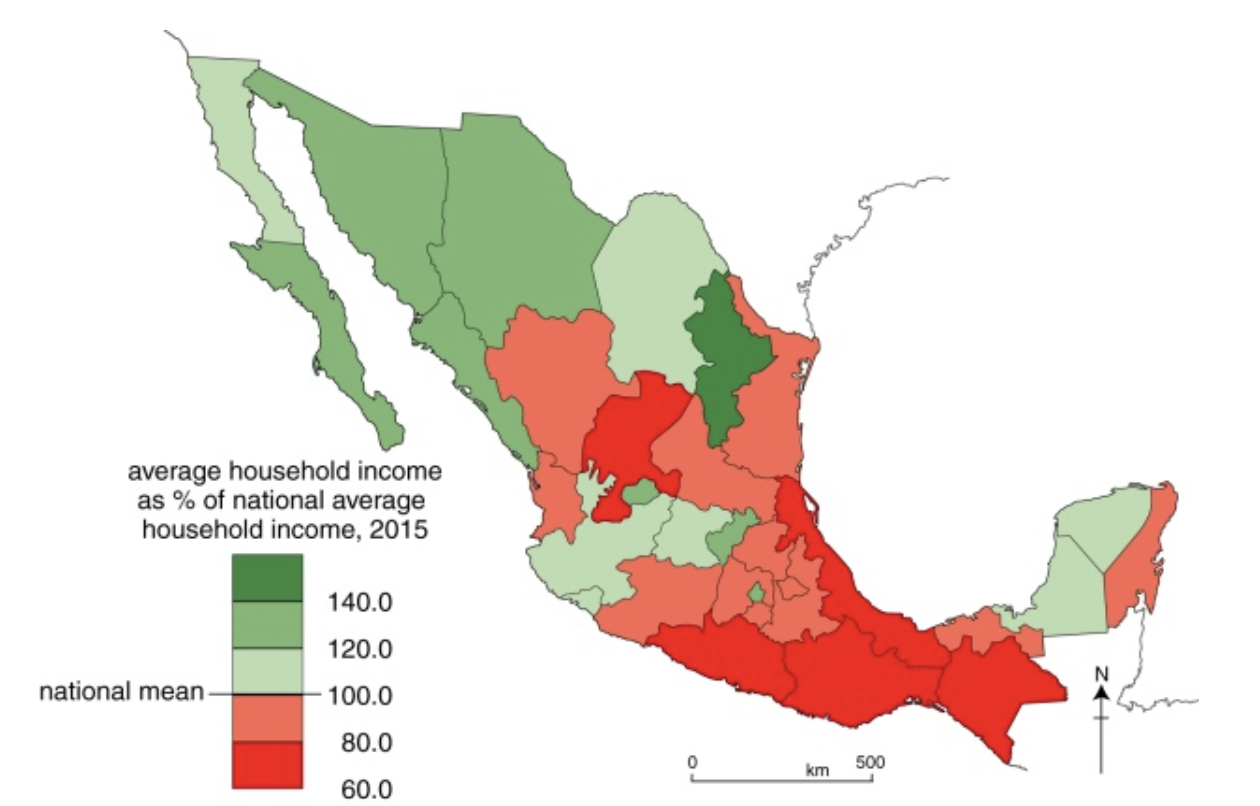
But the economic logic of privileging wealth is all too real to many: the Gini index may explain much about Trump’s rise, in his second term as President Donald Trump mastered a sleight of hand of preserving the wealth of America by the benchmarks offered by the Gini Index is naturalized by sovereign frontiers, to which the nation is entitled–the lion’s share, of course, as evidently as the gold-plated logo that recur on Trump Tower’s facade. And these increasingly stark divides of wealth are the basis for the projected construction of an unsurpassable wall–as if a boundary of economic security–lest any undocumented migrant enter the nation’s homeland.
The new patriotism of the Trump MAGA movement promoted a mythic notion of the nation that was not new, mapping the future security of a nation of strong borders, drawing on a mythic narrative of a removed past. But the rallying cry of defending these borders of economic inequality and illusory wealth, creating the most surveilled area of the nation if not the world, has created the illusion of a border war that has redefined the nation in relation to the world and outside of a nation of laws. The hope that even in the face of growing income inequality across America, the nation is able to be reminded they remain insulated from income inequalities south of the border is cast as a demand of justice, and indeed a measure of justice to protect America’s well-being and wealth. For the border has become, in Trump 2.0, something of a test case for American exceptionalism and the overturning not only of American law but international law, a basis for permitting the expansion of executive authority over human rights or liberties, by incarnating the proposition might makes right, along the defining of a line not limited to the frontier, but providing cascading effects in the hemisphere and the rights to defend the sovereignty and sovereign goals of the United States.
The quite recent pronouncement that “By the time the sun sets tomorrow evening, illegal raids on our borders have come to a halt” not only combines quotidian events of a day’s close with the ending of on impinged onslaught of dangers on our borders, but expands sovereignty over the borders to the prime function of the government–in keeping with the elevation of Immigration and Customs Enforcement to the primary agency of policing in the nation, and the Department of Homeland Security to the enforcement of “border security”: “tens of thousands of people will, in some form or another, be on their way back home”–apprehended, detained and forcibly removed, expelled from the nation they sought to make their own. The promise of “the largest deportation in American history” is grandiloquence, but an assertion of sovereignty that is redefining the nation –beyond the 1.3 million deported in the disparagingly radicalized “Operation Wetback” of 1955, but “the largest deportation program of criminals in American history,” but might be better called the largest deportation effort since Barack Obama’s Presidency. The border became a basis to define the new relation of the United States to the world–
Deportation Flights in the First Three Months of Trump Presidency


For the border has reemerged in national consciousness as a site of nation-building–

–in terms of a national Defense Area alongside the southern border promises to remap the border as a military bulwark against foreign invasion–against an invasion that it claimed to be already underway, but was denied by previous administrations, and indeed denied by partisan opponents. The bifurcation of realities of the nation the began at the border provide a basis for the re-envisioning of government–apologies to Al Gore!–and security priorities for which we will deeply pay.
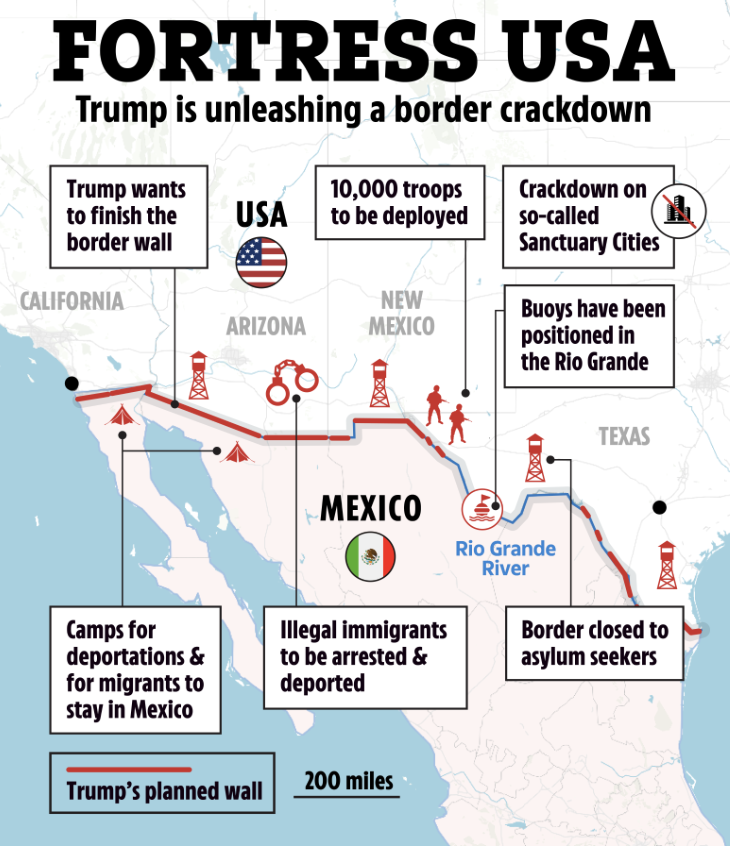
—that defines the project of national sovereignty.
The border wall looms so large to be taken as a basis for mapping America’s place in the world. Border security grew more fear broadly than immigration, tying them to the forces of globalization. While the mission of Immigration and Customs Enforcement was defined since its 2003 foundation as policing “criminal aliens,” using the language of the law as a rhetorical terms to define a mission of deportation, and using a legal system to prosecute and enforce offenders of immigration laws, it has long jailed people whether or not they were charged of a crime, the crime of immigration is increasingly recast as an attack on the nation symptomatic of how globalization has hurt America’s wealth, even as globalization has heightened wealth inequalities across America. The declaration that no “illegal migrant” would enter the nation or have rights to free speech and civil rights of Americans suggested a new demand to “find and remove every terrorist from this country . . . over the opposition of the far left judges, over the opposition of the federal bureaucracy” claimed a mandate “to make this nation safer than ever before.” Was this to be achieved primarily by the forcible extraction and deportation of “invaders” beyond the expanded bounds of the United States?
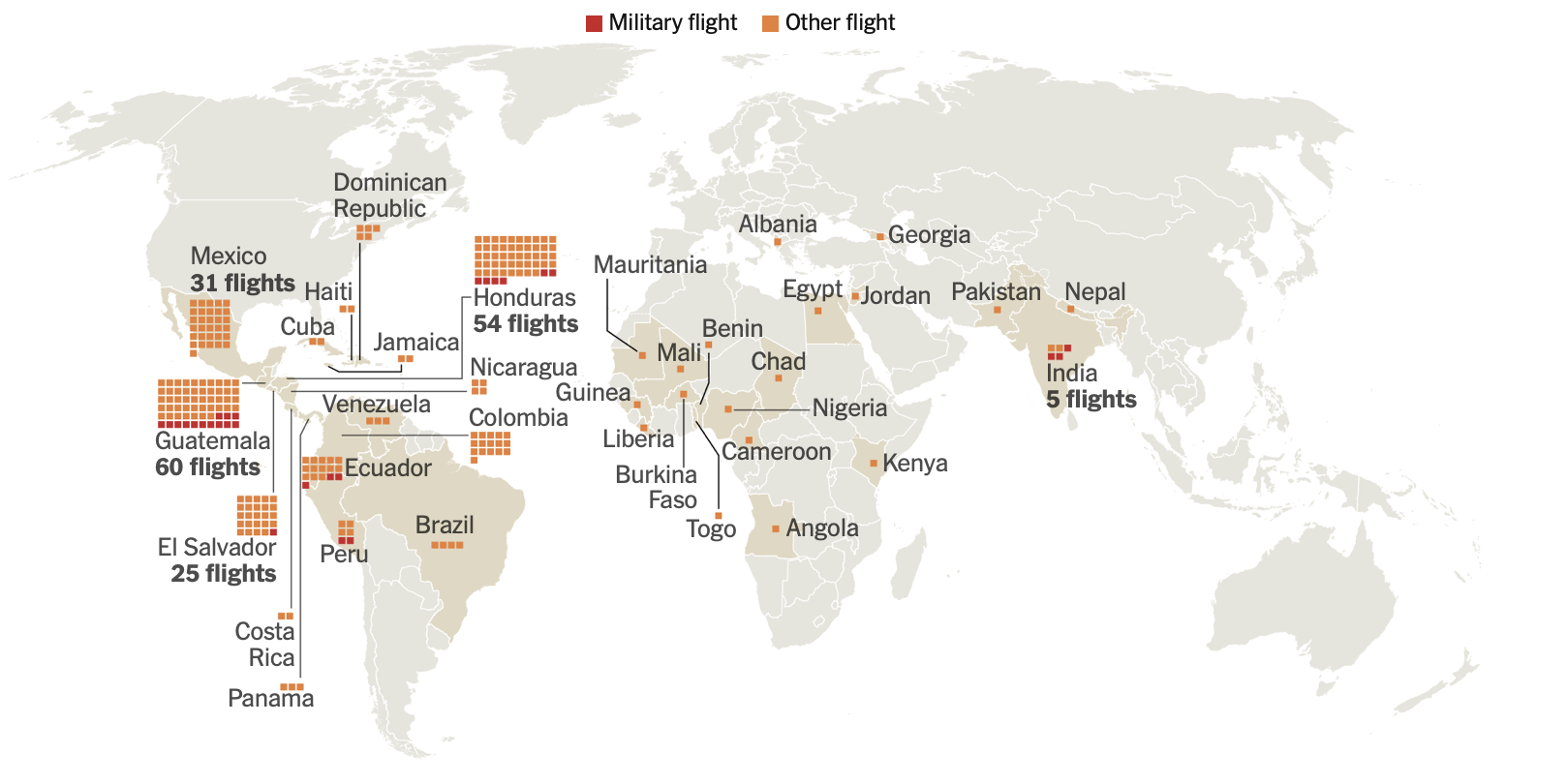
Deportations by Military Flights in First three Months of Trump’s Second Term/NY Times. Deportations on Commercial Airlines not Shown
If this is national security, however, the role of boosting investment in the defense of the border wall is a project of national defense that will be designed to expand the national debt by beyond $5.4 trillion, as its tax cuts are made permanent, a massive give-away to industries of defense and the increased data surveillance operations demanded to make the nation safe. Indeed, the showcasing of Los Angeles as a city that is “invaded territory” and demands personal deployment of military forces–members of the National Guard, U.S. Army and the U.S. Marines–to ferret out the undocumented by new tools of geolocation and databanks has created a map of detentions and deportation that has come to haunt not only immigrant communities across the nation, but to set new standards of justice, or of the lack of civil rights and ability to redress the plainclothes agents of DHS and CPB that have massed around the city’s malls, department stores, parking lots, car washes and fabric shops. The city is a poster-child for the power to deport undocumented living in America, many born in the United States, for the crime of border-crossing between June 6 and June 2, 2025 from Pasadena to Long Beach, and even far beyond LA County in Fontana or Oxnard–

–as masked agents pursue racially profiled men and women to make up announced numbers of depration that can be broken down, courtesy Bellingat, into verified stings at local car washes–

Incidents of Detention at Car Washes/Bellingcat/ATMOS
–often displaying intimidatingly significant shows of force by masked men carrying clubs, batons, and firearms. The displays of violence have come to haunt Los Angeles’ streets, stricking fear into immigrant communities not only in Los Angeles, but across the state, lest deportation agents expand their reach into areas many belonged to the civic fabric. Indeed, until a federal judge order barred federal agents from detention stops without “reasonable suspicion” and prevented warrantless raids, arrests and detentions escalated in raids on workplaces in the month of June seemed to continue under the pretext that the city had been invaded, and demanded a military show of force to “restore” justice by attempting to deport or detain a hundred people a day.
This sheer mythistory began from rebordering the nation that had a useful cartographic precedent in the map in the header to this post of the 1930s. The map was well-known in Elon Musk’s family, but offered a template or model to assert a national identity of expanded borders able to serve as an icon of the new Trump regime. If Trump had long been playing fast and loose with the law, the border wall offered a The attention Trump has devoted to the tally of border crossing currently supersedes the mounting national debt, or the number of nuclear warheads or sites of national unrest, and indeed provides the basis by which the nation understands its relation to the complexity of a globalized world. The confusion of domestic and foreign policy in recent months not only confuses politics by increasing fear, but a massive re-bordering of the national imaginary, beyond a “wall” of concrete of nine to sixteen meters to prevent Mexicans from entering the nation as an insuperable barrier. The proclamation of a “hundred days of the most secure border in the American history” by the Dept. of Homeland Security and “remarkable historic turnaround” conflates control over the southern border as a benchmark of national history, unlike how the “Biden Administration refused to enforce our nation’s laws when it came to border security,” as if a new era of governance and governmental priorities, but a restoration of security from a deep threat of losing our economic well-being and safety from crime, by allowing a “total control of the border” that eluded the nation. The expenditure of massive funds that expands the national debt is spent in the name of national security, but is in fact a way of protecting and asserting America’s economic privilege, and protecting income inequality in a globalized world. If Texas, Louisiana and California were the top states of immigrant detention in the first months of Trump’s Presidency, and have rmeained so, they have the greatest preponderance of detention facilities, tied to incarceration.

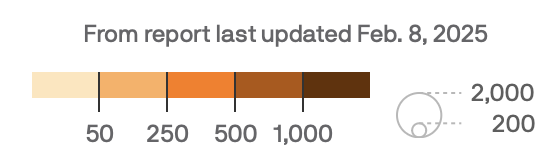
Average Daily Population of Immigrants Detained in Facilities/Data: TRAC; Map: Erin Davis
The result is to cut at the bonds of local society. The true invasion for which it prepares is, of course, the invasion by ICE immigration troops of our cities, in the search to round up undocumented immigrants–an invasion that will destroy the fabric of our economy, destroying millions of jobs of immigrants and U.S.-born workers who hold jobs in critical industries as construction (861,000 jobs) and eliminating many providers of child care, mostly by targeting vulnerable immigrant families in California, Texas, and Florida. Amplified by an enriched data dragnet that was also achieved by merging government databases long held separate by firewalls, between Social Security, Medicare, Health Assistance, and federal crime enforcement and local police records, the sifting of data for targeted arrests of undocumented and the legal immigrants sought to be criminalized and arrested suggest a massive war on cities.
For arrests, detention, deportation and an end to Temporary Protected Status trumpeted by MAGA bullhorns in a nation where one in five workers in the active workforce is an immigrant, the four million estimated deportations will reshape not only the workforce, but work conditions, that will probably see a broad detonation across the nation that will reshape the landscape of employment, to be felt in many states, especially New Jersey, Nevada, California, Texas and Florida, as the below cartogram crafted only this month reveals. The plans for deportation that will curb or end demand for foreign-born labor in America, and end an actually integral part of the labor market, will damage the labor market in ways that will hurt all workers, even as the oversight of labor standards declines in markets across the country–rather than increasing the actual number of American jobs.

Where Deportations Will Reshape Job Losses and Reduce Employment/EPI, July 2025
The broad invasion of cities and urban workplaces seen in Los Angeles, which provided a sort of test case for ICE invasion by expanded databases, suggest nothing less than a war against the nation, one able to shift our economic foundation and expectations, in a job loss estimated at 5.9 million, especially visible in sectors that may not be in the vision of technicians, but on which many rely. The promise to “improve” our economy by adding millions of jobs is a delusion, but will be deeply felt in the infrastructure demands and wellbeing of folks in the largest urbanized states–and drive terror to immigrant communities who have seen a massive drop in their children’s attendance of school, and their own involvement in the local economy, as many refuse to report for work..
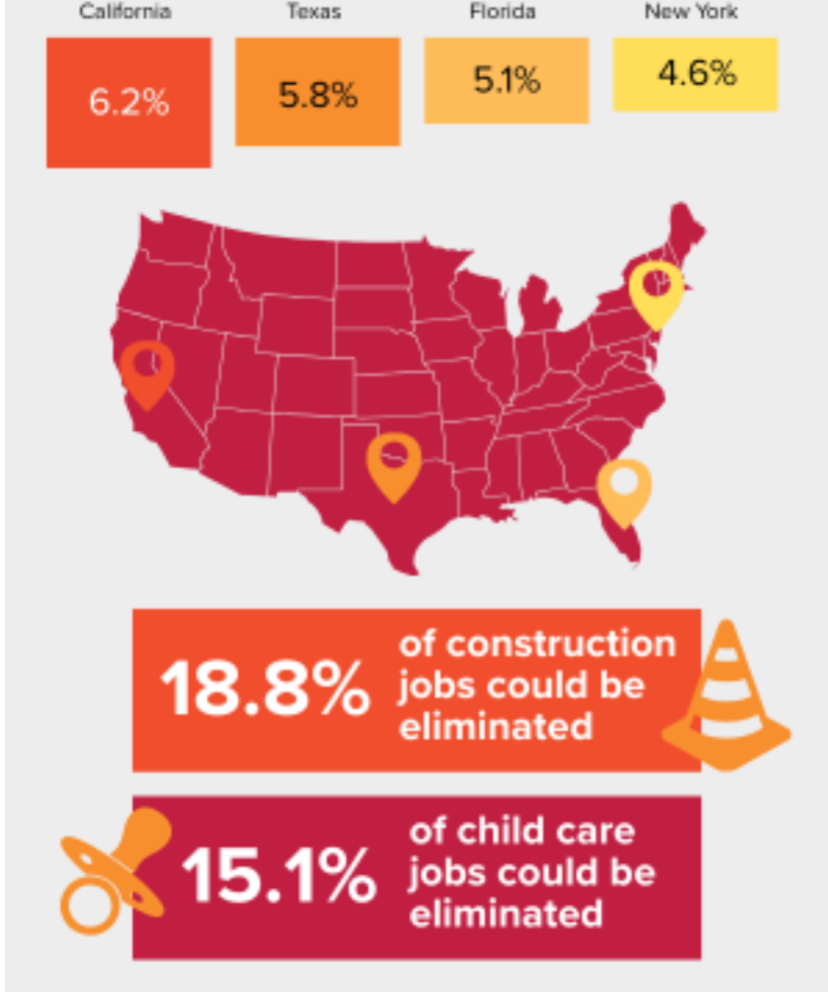
Perhaps the sense of economic renewal that Trump promises just doesn’t have room for many of the construction industries on which he long relied–and stiffed!–in previous years, but is based on the belief that Trump can attract new wealth to the United States–or promise wealth to Americans. Many still hesitate linking the current Presidency with fascism per se, Gini, long before he advocated Italy’s annexation by the United States in the postwar era, in a forgotten footnote to history, provided a tool inescapably central in understanding and mapping globalization, before it became a means to resist globalization. And the new use of DOGE staffers as a means to pilfer data that the U.S. Dept. of Labor has accumulated to help immigrant workers in the agricultural work force by Trump’s predecessor—awarding $6.5M in grants to provide temporary, permanent housing services to farmworkers and their dependents in the National Farmworker Jobs Program–has become repurposed as a tool of surveillance to monitor and locate migrant workers in American farms–in ways that have created websites cautioning “some news releases may be out of date” since the Trump Administration took charge.

The announcement that DOGE was working on a master database, openly described in terms worthy of Sauron as “one ring to rule them all,” provide an application programming interface–or API–to comb through government data across different applications, to shift Internal Revenue Service data to new ends, tied less to taxation and more to surveillance and policing. The aim for an API to overlay on health care data, IRS data, and Sifting through taxpayer names, addresses, employment data, and social security numbers provided an access to government databases usually only granted discreet access to on need-to-know basis to bulk datasets rather than be treated as separate “silos” of information. The desire for crafting “one right to rule them all” was attributed as a vision of omnipotence to LOTR-fan Peter Thiel; Larry Ellison urged to unite the “fragmented sets of data about a population’s health, agriculture, infrastructure, procurement and borders,” imagining they should be unified into a single, secure database that can be accessed by AI models in Dubai at the February, 2025 World Government Summit, as a way to achieve “the missing link” taking full advantage of AI technology as tools of governance. Ellison staked a vision of how AI migth be able to “provide high quality services, save the government vast amounts of money, [so that] our populations will be healthier, and government will be spending less for better outcomes,” echoing Elon Musk’s promise to pinpoint and weed out “vast amounts of fraud.” The vision of Peter Thiel, who takes Palintir’s name from J.R.R. Tolkien’s race of a team who by birthright are able to see the future in a power that is easily corrupted and corruptible, although Thiel championed the “one ring to rule them all” for his tools of predictive data gathering, without the crucial modifier “and in darkness bind them.” The mega-API is no doubt out to benefit Thiel, as much as serve government.

2. The darkness in which the rings were forged may have been in Mt. Smaug, but the darkness of the mega-API was born from dark monies of Political Action Committees that Citizens United allowed as forms of “free speech” for corporations and the megarich. The ability to be a data vendor–and to use the API they build, and may retain intellectual property, promise a monetization of government data of unforeseen capacity, and a predictive value that may invite revenue streams for advertising as well as surveillance data able to tabulate and indeed geolocate the undocumented, allowing for an immediate efficient deportation scheme that might arrive before any opposition or resistance could be staged,–even as Tesla owners call for solidarity in decals that rebrand their fancy cars, as if converting the status symbol to a call to solidarity might break the spell or curse of Gondor..
The dark side of the universe may have been entered by the coveting of the shiny Tesla logo, but the brand suggests a new era of what historian of sceince Mario Biagioli called “dark transparency.” The readiness to swap out the ostensible moral ethics of “honest” communication for scientific standards or norms, using pseudo-ethics to challenge established scientific authority or standards–may have been born as a way of discrediting the troubling results of climate science, displacing science and scientific standards from public debate to provoke a “climate of organized skepticism.” The strategy that may have begun at Scott Pruitt’s EPA around questions of climate change, to deny climate change by questioning the integrity or the professional experts who confirmed its results, by their poor ethical practices, the current manner that Trump’s Director of National Intelligence and CIA Director, that Barack Obama as President falsified evidence, and both his FBI and and CIA directors manipulated career professionals, and manipulated intelligence assessments to silence career professionals.
To be sure, the same moves animate calls for “curricular transparency” that question the validity of instructional models or analytic tools–as critical race theory as being nothing less than a threat on shared values of transparency, allowing parents to intervene in approved instructional models they disagree, invoking values of integrity, professionalism, and transparency to root out the extent to which individual instructor privilege personal ideological interests to indoctrinate students. For as scientists allegedly advance their personal agendas for personal benefit and gain, universities, as scientists are to be monitored by “objective” advisory bodies, using a language of disinterestedness to subvert scientific norms and authority to check personal corruption that allegedly prevent the subversion of actual scientific innovation. The dark transparency that allows and invites corporate profits that are unrestricted by regulations or metrics of security have allowed, to be sure, Trump appointees to invoke the danger of national security being compromised by the “catastrophic consequences for our national security, foreign policy, and economy” if the systematic tariffs that Trump has decreed be stayed by judicial opinion, threatening to provoke “financial ruin” should the tariffs imposed on European Union countries be legally compelled to be returned. The dark transparency is referring to another world, and other standards of reality, where catastrophe always beckons but not for any reason than to discredit expert judgement or reasonable judgement.
The resulting calls for casting “sunshine” on existing practices promises a deregulation of science, removing checks and verification processes deeply beneficial to energy extraction and big business, in the name of protecting citizen science, and free speech, preventing activist “experts” aiming to hinder citizen science and free inquiry–effectively undermining a scientific consensus demonized as obstructing industry, in place of scientific experts promoting disinterested judges or gate-keepers more friendly to exposure to environmental toxins, atmospheric pollution, and fetal life. The overt urning of earlier intelligence assessments that were seen as distorted in order to call into question the validity of Trump’s first election seek to demonize the Obama administration as organizatiin g a character assassination on Trump’s political career, leading to calls from the FBI Director to have the Justice Dept. initiate full-scale criminal inquiries into the “vindictive and viscious former leadership structure” in the name of ” a wave of transparency.” The rhetorical moves of “dark transparency” are quite opaquely dark indeed.

The dark world of deregulation prevents any obstruction on best business practices and efficient extraction of energy sources, minimizing regulation to allow industry-friendly standards be adopted by questioning consensus. The mega-database suggests not only infringing on many citizens’ rights to privacy to new extent, correlating employment history and health records with with criminal records and used to target populations, that will effectively put faces on anonymized tax data, previously only available in anonymized form social science research.
As US Defense Dept cut $5.1 billion on IT consulting contracts, IRS technology officers were placed on leave, the new “mega API” to unify all agencies data by the int-house tools of Palantir’s powerful data-mining analytics that create a “read center of all IRS systems” in private industry that Immigration and Customs Enforcement can employ for more effective raids for deportation, as the faux Palantiri who promised the ability to see a new future for America offered the data tools to rid it of immigrants, and offer the tools for a new Nativism rooted in refining the tools a data dragnet across America. The sixteen sites for data centers that the Department of Energy has quickly identified suggest a new structure for rapid data centers on DOE lands–beyond the hyper-scale data center facilities already being built across American for AI needs and demands.
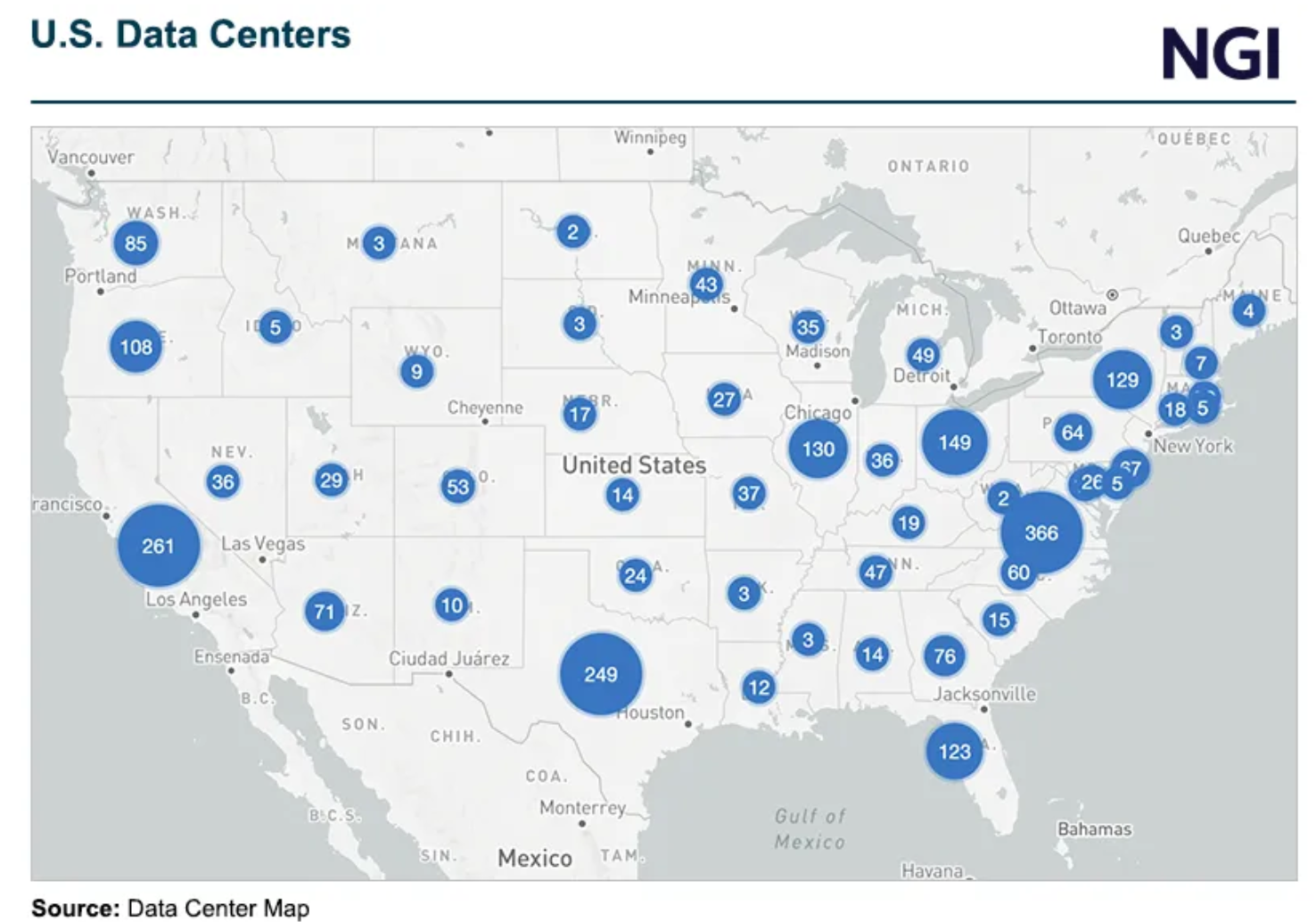
–and demanding far more power than the massive data centers that were already being planned for GenAI, centers whose power consumption that would need a veritable Mt. Doom beneath each.

The rise of Lord of the Rings imagery has parallels the amazing rise of dark money expenditures in the 2024 Presidential race, a contest that per Open Secrets attracted more than two billion destined for Political Action Committees for the Presidential election, including almost $240 million on Meta and 66 million on YouTube–on digital ads not reported in FEC data.
The demand to create “one ring to rule them all” uses claims of efficiency to conceal the fact that it was made in darkness. As the role of dark money grew in American politics, the “ring to rule them all” was indeed made in the darkness. Patinir, Theil’s industry, will charge the Dept of Labor for work done by DOGE affiliates and Patinir–bills upwards of 1.3 million over a year and a half–as Sovernment pays to outsource data collection while losing its own abilities of oversight and trimming agencies of employees. Tolkien’s fearsome description of how the elven smiths of Eregon forged a masterful ring in the fires of Middle Earth’s Mount Doom, the darkness in which the “master API” was forged allow is removed from ethical oversight or infringement on constitutional rights of Americans. This is a new era of the robber-baron as the enthroned holder of all three rings. Is this not the product of promoting government to secure the interests and befits of the uppermost 1%, disentangling the nation from any collective treaties or international benefits save the growth of the economy for the most advantaged of elites? The disentangling of the United States from all global alliances or provision of international aid to reduce the budget finances the tax cuts for prioritizing the new privileges of the uppermost elites.
The apparent bargain of its grown seems an exchange for the infusion of $290 million of what was once called “dark money” that Musk has been able to funnel over $118 million to the MAGA movement and GOP candidates by his Super Political Action Committee “America” to exercise his free speech IN there final months of the campaign, Musk emerged beneath a banner of political allegiance we had never seen, pumping so many funds into Trump’s campaign he became Trump’s second largest donor, after Timothy Mellon, the rogue heir to the fortune that has been dedicated to American education and “build[ing] just communities enriched by meaning and guided by critical thinking.” The boondoggle of PAC funds that arrived for the Republican and Democratic candidates was a huge influx of dark money hat opened up the possibility for direct influence in how government took shape–especially from a candidate who vowed to run the government “like a business”–and even parlayed his business experience such as it is to global politics, referring to taking control over Gaza after elected by casting it as “a big real estate site”–rather than sovereign territory. Dark money hit a record high of $1.9 Billion in the 2024 federal races, making it an election unlike any other, almost twice the previous record of $1 Billion in the 2020 election.

The monies enabled the rush of anti-immigrant ads in “battleground” states, linking “amnesty” and “illegal immigrants” to the Democratic Party, much as had been true in 2016, to provoke voters’ Pavlovian responses. The strategy of the airwaves was since adopted by the Dept. of Homeland Security as a strategy, even exempting the $200 million for anti-immigrant ads from DOGE cuts Homeland Security Secretary Kriti Noem credited as Trump’s idea: Trump demanded Noem thank him “for closing down the border” in the lucrative advertisements broadcasting the ultimatums: “To aid in responding to this emergency, DHS requires an immediate domestic and international campaign designed to direct undocumented to leave immediately.” The sustained campaign is a backdrop normalizing arrests, detentions, and deportations of undocumented internalized by all viewers: the Trump worried any delay in the broadcast “will allow illegal border crossings to continue to rise.”
The project for designing “one ring to rule them all” from inside the White House is nothing more than a shadow government to “rule them all in darkness,” and his own sort of fantasy reality game. As Musk surpassed ultra-Zionist Miriam Addison among Trump’s donors, Musk seems to have made no secret of his demands. For Trump not only promised to let Musk lead a new branch of Government Efficiency, but as well as inserting data harvesting by AI in government, established the status of SpaceX, Palantir, and Oracle as quasi-governmental “dark” tools free from judicial oversight. Musk worked hard to incorporate new “firms” as Group America LLC and United States of America Inc. to establish a political foothold beyond Trump’s Presidency, emerging as a dark messenger and white hope at Trump events and MAGA rallies from Madison Square Garden to Folsom, Pennsylvania. This is a darkness of political rallies, of rapt audiences before monomaniacal narcissists of the uberrich, a dedication to a dark personality cult where few have any individual power or , but are energized by being part of a dark machine, allowed to enter the inner sanctum of a concentration of power in one man–Musk or Trump–who incarnates the reverse of the distributed power of democracy, but argues he can incarnate it, and make it better. There is almost the sense of initiation into the community of darkness and rapture in these rallies, ostensibly “town halls” of direct democracy, that celebrate the enhanced power of one man over many, and that serves as nothing more than the naturalization of wealth divides.
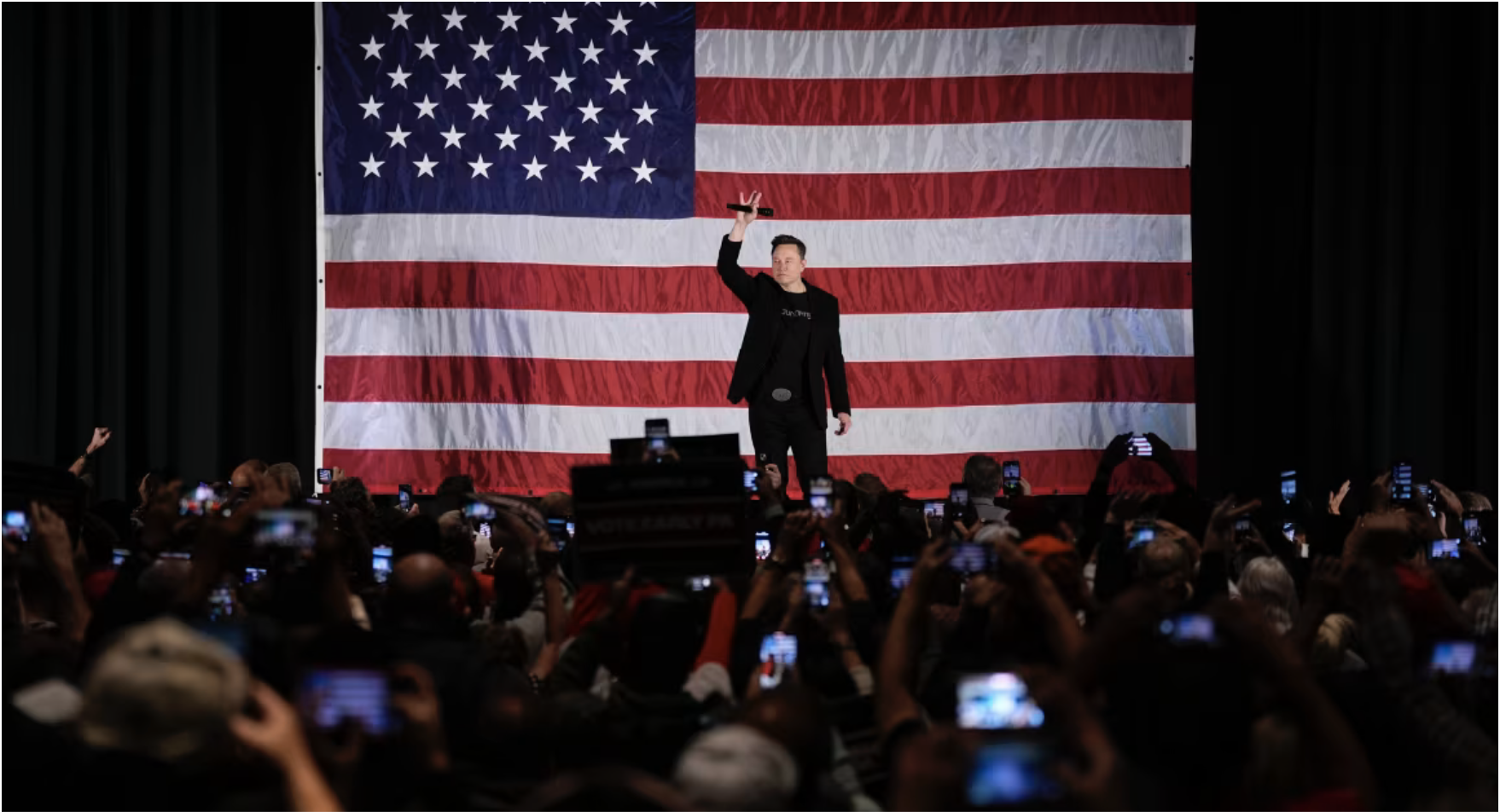
Musk Headlines Town Hall for Donald Trump in Folsom, PA, October 17, 2024.Matt Rourke/AP
As Musk aimed to dedicate himself to expand his profile in public life, announcing himself as Dark MAGA, he exploited the demand to police and monitor the border by surveilling undocumented. For xenophobia is all but the gift that never ceases to keep giving: in promising tools to reborder the national economy, and preserve the economic entitlement American voters, by the shorthand of the border–and undocumented in America–has become a sacred cow of America’s increasingly illusory economic advantage in a globalized world. In gifting gifting nearly $300,000 to the National Republican Congressional Committee and gifting $1 million to Early Action PAC, a super-PAC dedicated to registering Republicans to vote early, and giving away millions to gain Republican votes in midwestern states, Musk seems to have sought to engineer his inevitability as a fixture in the party that suggest a deep commitment to remaking government by correlating long protected datasets and the AI tools of public governance. Musk used his political capital to persuade Trump to found an “Office of Government Efficiency.” As Musk’s donations invite increased cautions from the Dept. of Justice, he has been able to evade them and wave them away by his growing personal ties to power, in ways Trump may have in the end spooked Donald Trump and his children. But the fateful map had been reengineered with Elon’s help in ways that shocked the nation, pulling four states to the Republican party’s column that few would have imagined would so quickly if narrowly turn red.
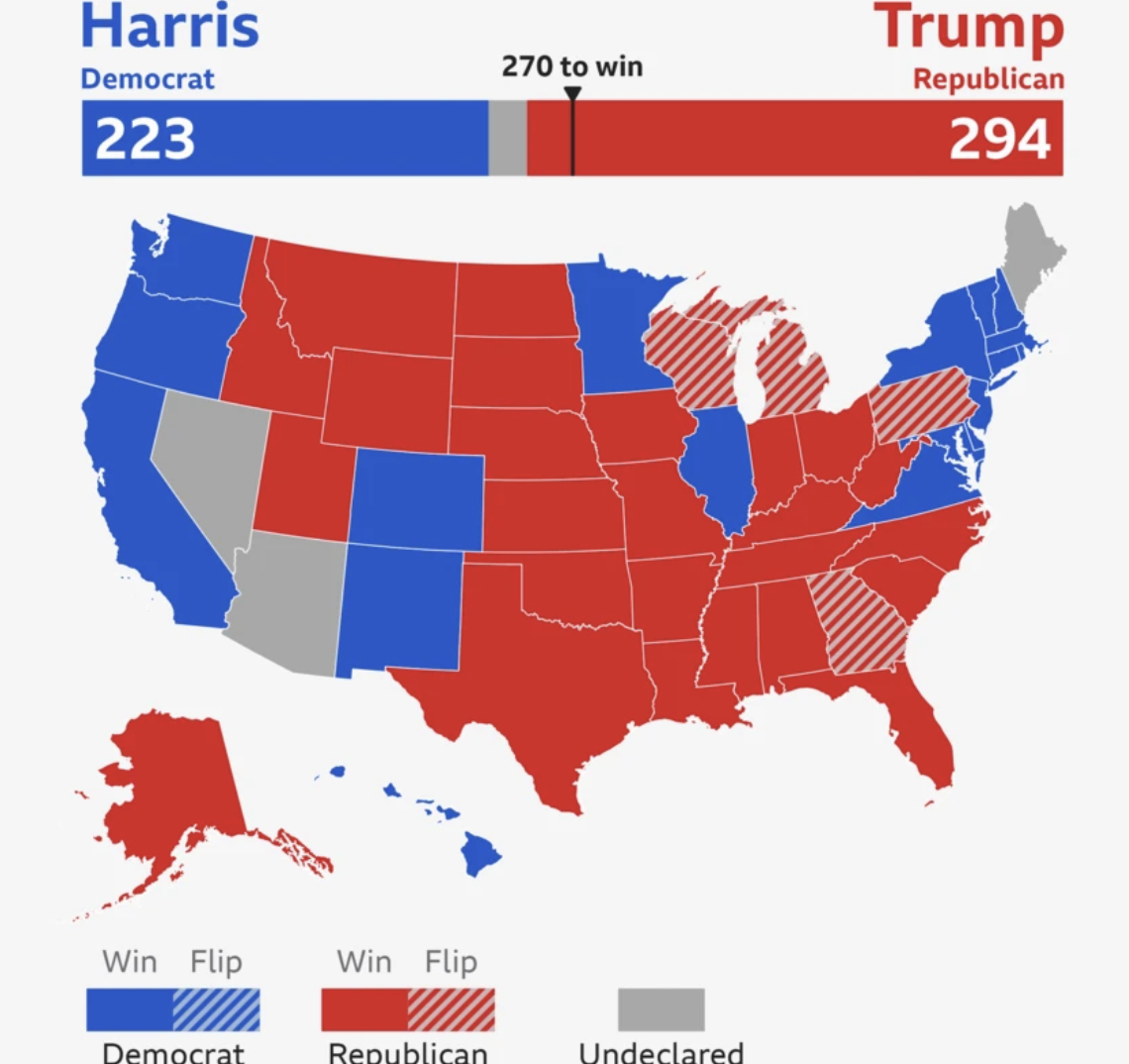

Wealth Distribution in United States by Gini Index, 2020 92024), as in Tolbert and Sizer,

GINI by County, 2009 and 2014, Dongkyu Kim
The focus on the border is designed to boost a security in the nation that many may lack and live with. The Gini Index has long offered a handy metric to process staggering global income inequalities, wealth imbalances and income gaps, to distance the terrors and moral inequities of income inequality across space. Gini’s own subsequent advocacy for blurring borders in order to shore up the Italian economy may have been an opportunistic ideological maneuver to survive in the postwar era. But it aspires to transnational sovereign identities, that anticipate the postwar North Atlantic Treaty Organization, to survive in a future globalized world, where Italy’s global profile seemed to be destined to shrink from the centrality that Mussolini had given to Italy as a new beacon of imperial identity in a global world. Is the inescapable echo of the sharpest divides of wealth and income in America with the growth of the deepest, reddest regions a coincidence? Or is the audience where the special significance of America is strongest, and the promise of economic greatness most tangible, however perversely, because it is most intangible and unreal? The rituals of the town halls was most powerful in these sites, to be sure, where the promise of wealth in visitations of the elite visitors who promised to restore untold wealth to the lower forty eight?

2024 Presidential Election Results by County
3. To be sure, President Trump wants to relegate NATO to the political past. His ideas of openly linking Italy and the United States suggests a bulwark against fascist backsliding as a new constitution was being written may have provided a logic of the clandestine operations American intelligence organizations began. We focus on the border, not on nuclear threats, or foreign wars we never wanted to be involved in, to promote an increasingly insular sense of security, uncannily akin to the persuasive cartography of North America as an economic unit separate from the world adopted by the Technocrats Musk’s grandfather adored. The mental map that the Technate suggests of a north American hegemon provided a powerful calling card and data visualization for Trump and Musk to consolidate their sense of partnership in crime in governance by purely rational models, that suggests a mapping of geopolitics removed from the logic of a Cold War or a recognizable ideology or a body of laws, let alone the Constitution.
Gini was fearful of communists’ ties to the Soviet Union, the supra-constitutional nature of sovereignty that Donald Trump indulged in his second term is an attempt to preserve and prop up American entitlement in an age of globalization, as if fixing in stone the global economic imbalances that Gini Index measures,–an imbalance evident in the blunt color ramp of this updated Mercator map of global economic reality of ever-deepening red, or crimson, to denote the greatest levels of wealth inequality in 2019–

–Trump seems to take divides of stark differences of economic inequality in openly confrontational terms. The confrontation of divides drawn on a Gini Index might underly Trump’s foreign policy of imposing outsized tariffs in recent months, as a strategy to retain national wealth. If the confrontational terms are less imagined in muted renderings of stark income inequality–the pastels that suggest the pastures of a global future in a less destructive image of inequalities–

–that cannot but remind us of the steep or accentuated income inequality of the United States, and the bitter fact of the persistence of far steeper income inequalities in South Africa.
South Africa, to which this blog will return, is of course the sole nation President Trump decided to admit refugees, and celebrate their acceptance in the nation, as he closes all cross-border flow of political and economic refugees from southern hemisphere. The shutting of the border seems designed to defend an illusion of wealth. And the illusion of the greatness of American markets that has led him to propose to impose higher and higher tariffs on global imports in a regressive system that will pass costs onto America consumers of middle and lower incomes indeed suggests the ease he imagines Americans can be duped to being convinced tariffs offer an untapped windfall for America–again imagining the geographic dominance of the nation in such starkly confrontation terms. At the same time, the expansive American penal structure is being tapped to hold the undocumented to reflect their designation as “illegals” who are demanding to be detained for deportation–leading to the early expansion of ICE arrests.


Prison Policy Initiative, 2025

It is no coincidence the stark colors of Gini coefficients are erased in the maps urging the need for immediate global secession of the continent for economic security in The Technate. The stark map was a fantasy of the economic secession of the United States and North America as an expanded supercontinent.
The propaganda map cleverly divided the world into red and black would have been forgotten a few decades ago. The logic of a needed acquisition of another continent to protect Canada and the United States from the advance of Russia and China suggests the Orwellian division into Great Powers in a state of perpetual war–distorting the global map into a set of imperatives and priorities that are increasingly isolated from allies or international relationships.
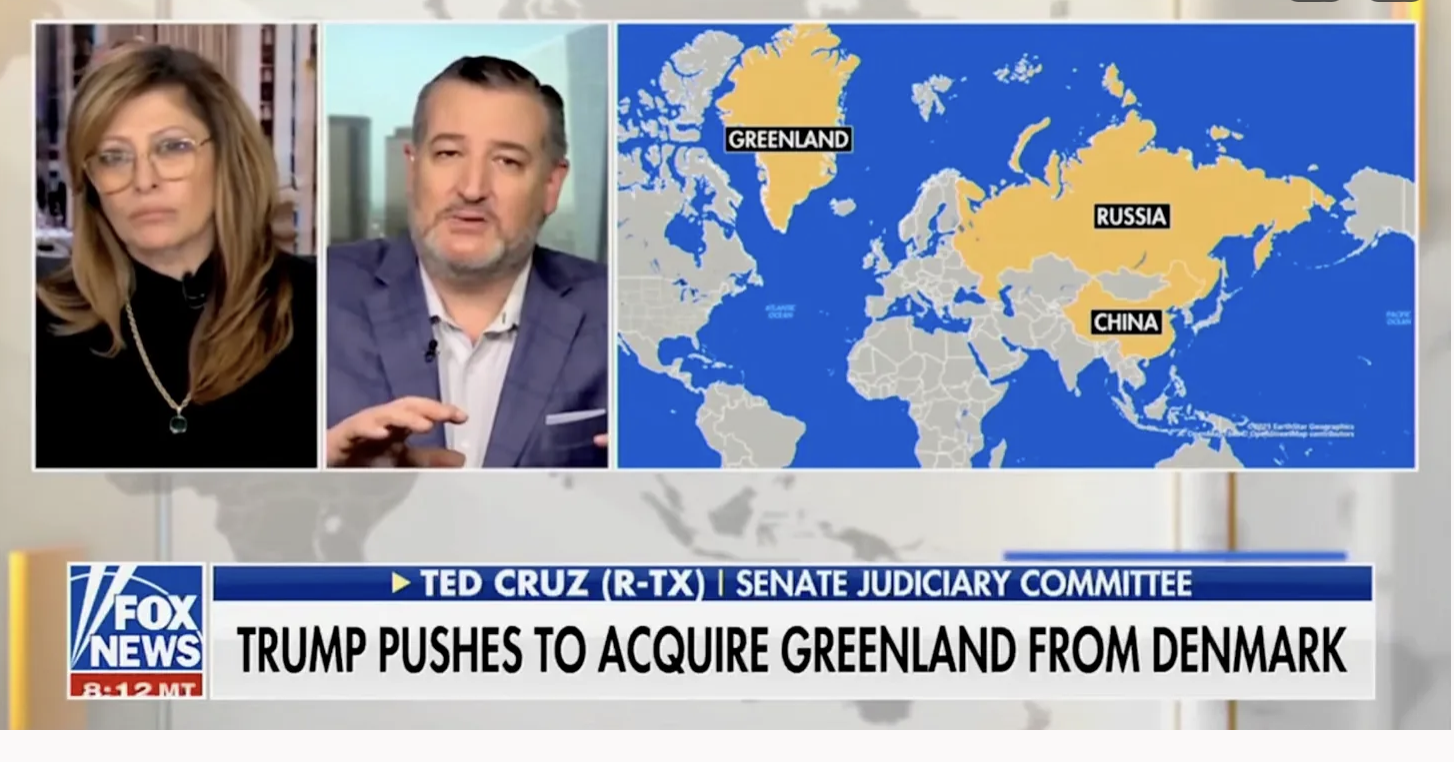
But the two-color global map floated by the Land Reform party of Elon Musk’s grandfather, the enterprising chiropractor turned engineer, Joshua Haldeman, recently received attention as a prophecy–a cartographic Nostradamus, if you well–of the policies Donald Trump has advocated to secure America’s prosperity and survival. In floating demands to seize Greenland, annex Canada, and take back the Panama Canal, the past expansionism of Nixon and Eisenhower seemed to return conclusively to Trump as a political tic. As Eisenhower has expanded statehood to Alaska in 1959 to shift the boundaries of the United States some 1,500 miles to the west to within but fifty-five miles of the Soviet Union, newspapers gleefully responded to the expansion of national territory by a fifth with Cold War patriotic gusto as enhancing the nation’s grandeur–

–in a major policy speech in Achorage, envisioning an expansionism of new scale, by “building great new harbors and canals,” projects of mega-development to boggle the mind, akin to terraforming, harnessing pseudo-scientific abilities on unprecedented scale “to develop atomic dynamite, atomic dynamite. . . which will move mountains,” “a new development that will mean tremendous progress for Alaska and for the nation and for the world” by developing “the oil resources of Alaska” and shipping routes of the Panama Canal. The linkage of these two projects of re-bordering that seemed inseparable, if they were geographically quite removed and distinct, would be a boon for the nation, and not only for big companies, but little companies, ostensibly out of his deep faith in individual American enterprise. The image of the Aleutian island superimposed along the current project for a Border Wall suggests a geographic fantasy of the new economic grandeur he might bring, moving Nome, Fairbanks, Kodiak, Sitka, into the lower forty-eight, bringing the former Russian colony back into the continental fold where its territory belonged. Was this why Putin, who speaks English fluently, seem to have surprised his hosts by explaining his goals in Ukraine to the world in Russian, as if it was the lingua franca of the land?
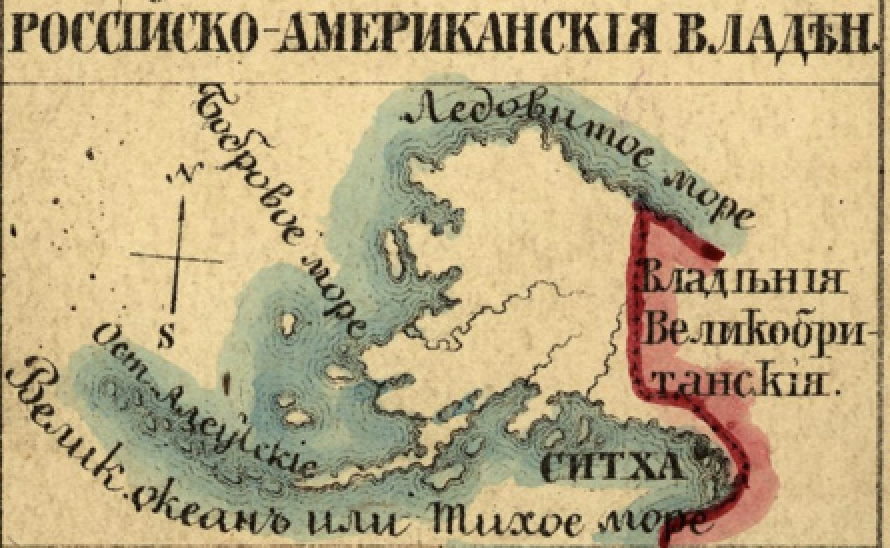
Russian-American Company Territories, 1856

Russian-Ameican Company’s Great Geographic Extent, mapped by Jake Chila/Global History of Capitalism Project, Oxford Centre for Global History
The region now nestled securely in the United States was long touted as an inviolable part of America not only by President Eisenhower, who made the statehood for the former territory part of the Republican platform that his then Vice President, Richard Nixon,–who ran with the Cold War conceit. As President, Eisenhower was blunt about its geopoltiical significance as a military man: “Anyone that looks at the map can see what the importance of Alaska — the Alaska territorial expanse — is to the United States from a security standpoint” including the Bering Strait and Arctic Ocean to national security. But Nixon seemed to twin the expansion of the frontier of America in Alaska and to the Panama Canal as part of a new vision of economic grandeur and expansive rule.
By linking America’s sovereignty over the Panama Canal to Alaska’s statehood, in an expansionist ideology benefiting Americans, that Nixon, as a Westerner, was most suited to deliver by “fighting for the cause of peace and freedom” that he argued incarnated the responsibility of government for reclamation and energy development that the “frontiersman of Alaska appreciate” who lived in the former colony deserved. Then Vice-President Richard Nixon trumpeted an American vision of the state engaged in developmental projects to create a bulwark against communism during the Cold War in the 1960 Presidential Election that revised the image of the continents of the post-war world. Evoking fears a region that belonged to the United States since 1912–and purchased from Russia–might slide into a Russian principality, he resurrected “American greatness” as a barrier against Soviet expansion. For in 1960 in Anchorage, on the role Alaska plays in national defense, by promising to develop–again that hope of expansion–for access to Alaska’s resources at the same as a second Panama Canal, describing the “resources of Alaska and of America” as if intimately linked.
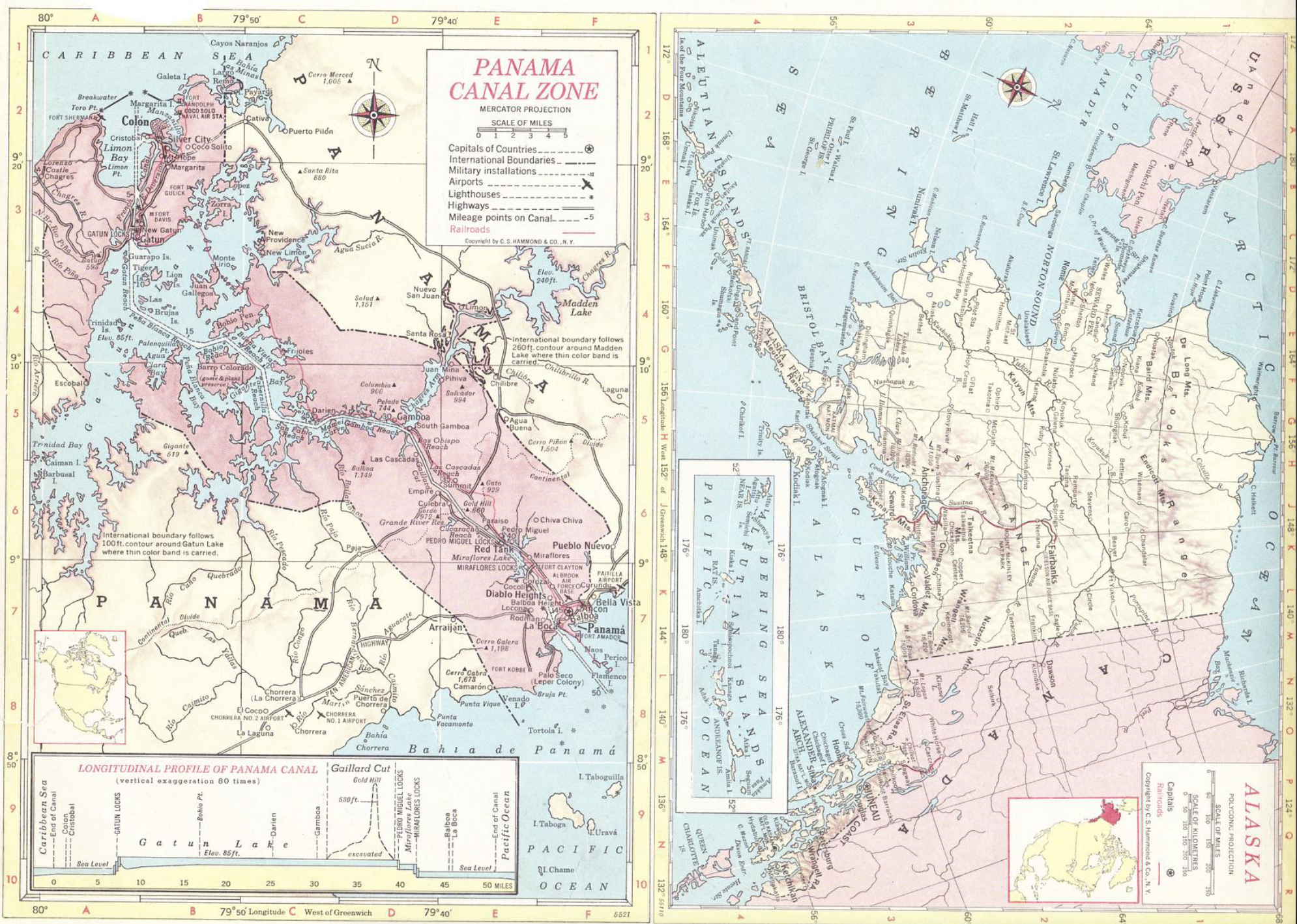
The redefining of the world map and the sphere of continents, energy markets, underseas oil and future projects of development made a rather surprising reappearance in the 2024 election as part of the nation’s bottom line. Trump wove this expansive framing of his foreign policy goals around the time that Musk was playing a central role in the Cabinet meetings and at Mar-A-Lago. The division of red and black that the chromolithograph promoted is an unlikely persuasive cartography of an alternative globalism in the Great Depression, rebounded with energy in the economic anxieties of the twenty-first century.
The para-political party of Technocrats used the super-continental map in the header of this post as a lost history, that might correspond to what it meant to “Make America Great Again” as Musk eagerly assumed the mission for restructuring executive agencies. If Musk’s impact on government will be a legacy we are saddled and a blight–far more than “remaking government” in efficient ways was championed by Al Gore in an earlier world and moral universe–technocrats are uniquely unable to grasp the nature of current problems from global warming to human rights crises or impending famines and natural disasters. Musk’s close ties to his grandfather, a hero in his family whose entrepreneurial ideals Elon has come to champion, shared a deep-set libertarian devotion to ending sovereign states, the appeal of Haldeman’s retrograde politics may have led him to declare his own current designs to form a new political party–a threat seemingly born out of intent to break from Trump and the Republican Party, after he fell from the President’s good graces, in a pique of rage. For the erasure of old boundaries and the breaking up of the geopolitical map by unilateral declarations reveals his intentions to remain front and center in the nation’s political debates for the near future.
Even after Musk’s public rift with President Trump, his grandfather’s hourly map of a future hemispheric dominance promotes a robust economic unity of defensible borders in a persuasive image whose logic of Trump’s ability to remap globalization. For if the map was designed as an isolationist screed in an early era of global mapping, it seems today to give license to mapping geopolitics on a dry erase board or Etch-A-Sketch, able to push to extremes how Trump 1.0 was cast as an Etch-A-Sketch presidency. The Etch-A-Sketch board designed by André Cassagnes gained such attraction as an American Toy in the Cold War after it was sold to the Ohio Art Company, the plastic red frame that encased a gray screen seemed an image of autonomy by which kids, maybe including a young Donald Trump, delighted as a way to focus their attention on an easy redesign of their visual field: the emulation of the television screen suggested a palette of design sold as a way to expand the creative potential of Americans was a uniquely clean ways with no mess,–in short, a tool promising utter absorption for hours for children, in long car rides, a sort of iPad before the iPad designed for intellectually nourishing low-cost babysitting, offered on television before the notion of a growth mindset to parents looking for the perfect Christmas gifts. Did Trump get one for Cas a child, offering hours of ways to whittle away the hours to magnify his early sense of self-empowerment?
Mapping by Etch-A-Sketch all but invites amplification of narcissistic tendencies as a cartographic medium, if one rightly celebrated in some circles for its dexterity on two plastic nobs approximate and perhaps superseded the United States in a paper map–as evident in “Tubby Rules the World,” featured as Map of the Week for the first time in 2012–if without the smooth continuity afforded by he Etch a Sketch Mobile app, whose version of the Mercator Projection magnifies Greenland, in ways that made its way onto the priorities of Trump’s to-do list in his second term. Is it a pure coincidence that this new cartographic medium won rather sudden prestige as an alternative way of mapping after the financial crisis of 2008, as the boundaries of the United States and indeed the boundedness of the economic project of the United States gained such a terrible shock?
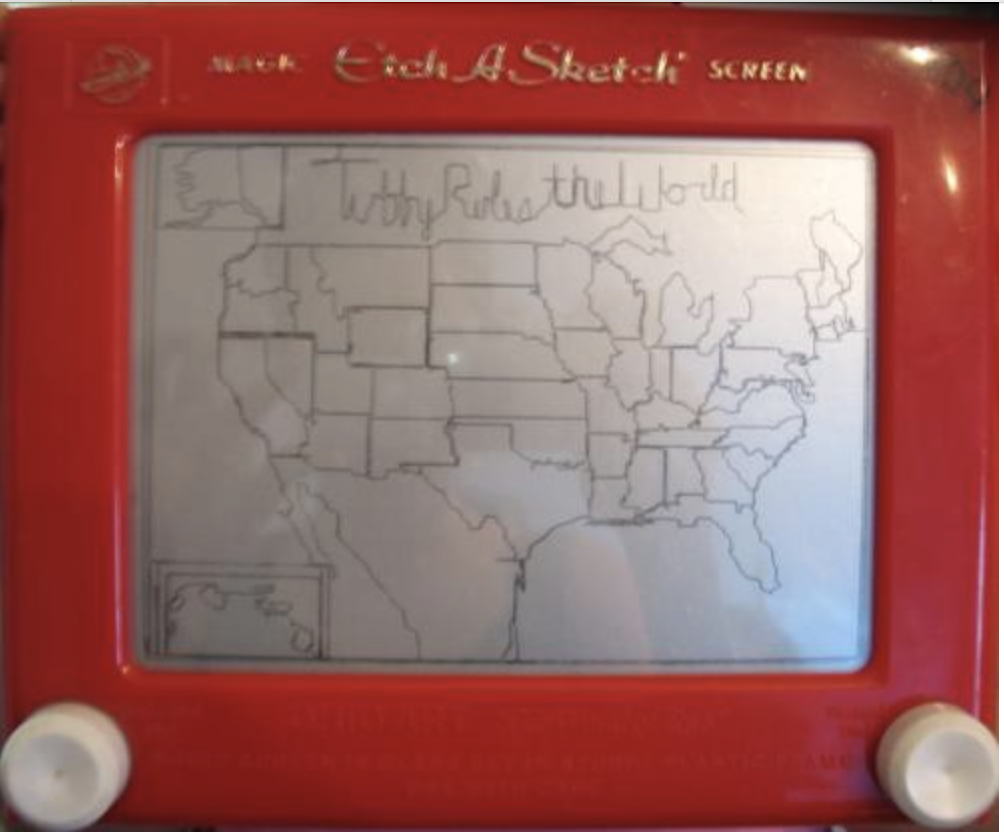
The dials of the Etch-A-Sketch became a powerful medium, perhaps, to understand the slippery fact of globalism, by the somewhat technology of the Cold War postwar era, as if to tame the currents of economic unrest that was still tense after the Financial Crisis was averted, but the fears of a global recession of markets was still close in the rear view mirror, and the old Mercator projection seemed outdated after the rise in consumption could no longer be economically sustained with the collapse of real estate bubbles as GDP growth rates plummeted for most of the world–United States, England; Mexico; Europe; Iceland; Scandinavia; Russia; Afghanistan; Peru–and a global financial meltdown barely averted in a last minute attempt to stabilize the American economy, but income inequalities grew as China’s and India’s economies grew far more quickly than the United States–and easy credit evaporated suddenly in a major shift from the American past.

Map of the Week, October 24, 2012
3. We seemed in need of crafting a global map whose borders might all of a sudden dissolve by a vigorous shake. The Magic Screen that first appeared as a cartographic surface during the Obama-Romney contest of 2012 came back with a vengeance as a geopolitical lens as a mirror, or a fantasy of sovereignty outside of the liberal tradition of the nation state, that all but eclipse citizenship and sends the political subject of the individual reeling into the forgotten past. The narcissistic mirror that this mapping of the world allows is a surface on which to present fantasies that have little to do with people, and boost illusions of self-sovereignty by asking one identify with the magnified borders of the nation-state, without caring about its basis in laws or the rights that the state affords, so long as it promises comforts, securities, and a simulacrum of confidence, income inequalities within the nation be damned–set aside normal questions of cartographic distortion.
If increased markets for spectacle grow in respond to income inequality, the skills of showmanship that stood Trump long in such good stead as a realtor became central in his candidacy. If Trump had long desired to go into “the movies,” spectacle gained a centrality at Trump Tower that anticipated Jean Baudrillard’s thesis of the simulacrum: and if the destruction of the Twin Towers became a defining spectacle, transfixing millions of viewers on an endless loop of time that fixed them in the imaginary space of September 11, 2001, in what Baudrillard sensed was the almost suicidal image of the collapse of the two tallest buildings in the Manhattan skyline, Trump had already used Trump Tower as a stage to proclaim his own public identity as a millionaire, or a simulacrum of one, before he adopted the role of the simulacrum of a President. Trump Tower was an alternative soundstage to the center of the White House or Capitol Building. Trump defined his career and the illusion of his personal wealth-using Trump properties to stage the illusion of easy access to wealth as a golden ticket to move across an ever-gaping wealth divide no other politicians seemed to have the guts and grit to be able to address.
The false virtual image of prosperity served to identify his candidacy responds to the unique nature of decreased access to wealth–and cash–in America since at least 2010, an image that no two Americans than Trump and Musk have managed to exploit. For as much as accumulate money, the image of prosperity was the prime fodder for shaping and inflating the robust nature of the candidacy boasting his personal ability to defend American wealth–most recently by slapping tariffs on imports–that allow the nation to thumb its nose to the global context as never before. Witness the eager assertiveness with which President Trump seeks to deny claims of asylum for those hoping to cross the southern the border on behalf of the nation: all while fetishizing access too the American Dream in a Gold Card able to be bought for a million.
Trump gave permission to keep Americans chill with income inequality by inflating an illusory sense of well-being, by outrageously normalizing income inequality and divides of well-being become increasingly intangible across America. For the border wall, if it has been replaced by the $660Bn for physical barriers and enhanced “barrier system attributes” are a tangible sign of difference to prevent traffic across the region of greatest legal cross-border transit in the world. The obstacles against migrants is an altar on which their hopes to cross the border can be sacrificed, if their actual bodies are not. It is a wall that defines the “nation state” and replaces any understanding of rights of immigration with notions of amnesty, to which no immigrants may be entitled or can expect. In this new world, no nations exists without boundaries, controlling access to the dream of American prosperity as he seeks to control access to birthright citizenship.
And the “map” of the North American Technate, an image of Musk’s childhood, seems to have not only gained wide appeal as a sort of meme and “what if” question of the American past for online communities, but been adopted as an alternative reality in Trump’s quiver, and indeed a powerful one that has been insufficiently examined as a master trope of the new Trump Presidency, in ways that imagined the new North American unity of an alternative global past, without the wealth inequalities so central to postwar globalization, as if the “large amounts of traction within the United States [of] the Technocratic Movement, . . . to put the most intelligent of society in charge of national functions, and envisioned the creation of a self-sufficient united North American unit.” This might be a lost present that might have happened in a world where globalization was not as inevitable at all.

Alternate History, 2020
While the map of The Technate in the header to this post is from a different era, the icon of the expansive nation state would be translated into a new setting of globalization in increasingly active terms: the confrontational role of The Technate in the new Trump Presidency suggests a logic of confrontation on a global stage, a rewriting ties of international relations of democratic nations and offering a new form of economically justified rationality of protected borders, reaching now across the hemisphere, and, with a new geopolitical rationale, if one of fantasy: war games between Russia and the United States demand the annexation of Canada on this global stage, as well, to gain an advantage on staging missile attacks and perhaps shooting down ballistic missiles, from Greenland, now viewed as a launching pad for an invasion as well as a site for the deepsea extraction of rare earth minerals, from a seabed that now extends into the polar regions of the Greenland Sea, adjacent to the rich reservers of the Barents Sea or Norwegian Sea, rivaling the North Sea–and a chunk of the ninety billion barrels of oil and the 1,670 cubic feet of natural gas assessed by USGS in the arctic region, which took Northeast Greenland as a prototype in a 2007 Circum-Arctic Resource Appraisal (CARA), identifying the Greenland Sea potentially holding large amounts of natural gas, crude, and lesser amounts of liquid natural gas, mapping the East Greenland Rift Basins Province in even geological units in collaboration with the Geological Survey of Denmark and Greenland (GEUS) exploring the sandstones of the Upper Jurassic held the equivalent of over oil, natural gas, and natural gas liquids equivalent to of 31 million barrels of oil ( 31,4000 MMBOE).
East Greenland Rift Basins, USGS
The global specter of an American possession of the Greenland Sea, a fantastic sovereign expansion that suggests no possibility of resistance to the demands dictated by the United States, would inflate the possibility of “territorial waters” far beyond the expansion of the offshore waters for drilling for oil and natural gas, and augmented fish stocks in the Extended Continental Shelf, whose establishment of the “full extent of the continental shelf of the United States” multiplies five-fold area of deep sea exploration beyond current American waters, according to the U.S. Department of State–adding over a million square km of seafloor to the limits of the United States–an area twice the size of the state of California, for reference–in a twenty-year project of remapping ocean waters that expanded notions of sovereignty outside the United Nations Convention of the Law of the Seas.

Extended Continental Shelf, CIRES, University of Colorado
The combined mapping of the ocean floor by an interagency team opened up unmapped areas of the ocean floor not before seen was headed by the U.S. Department of State, who employ the GIS analyst who headed the ECS Project Office. Brian Van Pay openly described the project of go-it-alone ocean mapping as “part policy, part law, part science, part operations and data collection, part geology and geophysics, part GIS analysis and cartography, and part data management;” the collaborative project asserted stewardship of areas far beyond the former offshore regions, and in claiming an expanded offshore adding millions of square kilometers to United States sovereignty changed how we understand and articulate sovereign rights, long before Trump reprised the new sense of the amplified bounds of the nation. Did the expansive boundaries of the the project that involved fourteen separate agencies not suggest a notion of environmental management and stewardship that the changing of the head of state to a more industry-friendly direction might effectively flip the notion of ‘stewardship’ to governance by auctioning off rights to the highest bidder, defending American sovereign bounds in the face of the international Law of the Seas?
The unilateral claim to redraw boundaries as “final and binding” was an effort begun by onetime Texas oilman George W. Bush, who floated the exploratory project in response to rising fuel prices and “national concern about the rising cost of gasoline” back in 2008, shifting the Outer Continental Self to new areas with an deep and steady eye toward future robust energy extraction. If it must have attracted oil companies, it set a precedent for the expansive claims with which Trump seems to remap sovereignty by fixed bounds. By expanding sovereignty to two hundred nautical miles from the coasts, the safety regulations of earlier administrations and of NOAA might be sidestepped and evaded, opening up management of areas untapped by industry, and less at danger of spoiling or polluting maritime coastal lands, by defining the sovereign rights to over three million km of ocean floor, larger than Alaska, Texas, and California combined, to use three states that have been historically associated with oil speculation, and collect data on the sediment thickness of the long hidden seafloor topography of particular interest to oil and gas companies.
The foundation of the Expanded Continental Shelf Project in 2014 only occurred in the Obama era, defined by a logic of protecting and advancing American interests over oil, natural gas and minerals–including the Arctic Ocean–the largest area of the United States’ Expanded Continental Shelf–by drawing new lines of state sovereignty in a bid to “delineate the outer limits of the US continental shelf in accordance with international law as reflected in [UNCLOS]” in 2022 as part of the National Strategy for the Arctic Region–even when those boundaries overlap with the lands claimed by Canada, The Bahamas, and Japan, where questions of sovereignty are apparently asserted for future negotiation. It seemed like a good idea, a remapping of national borders to national advantage, even if it was a gesture of supremacy that ran against the United Nations’ Law of the Sea, and did so to the benefit of drilling for offshore gas and oil.

Expanded Continental Shelf, Arctic Sea/U.S. Department of State, Expanded Continental Shelf Project

The weird power of fake maps of The Technate outrageously simplistic red color overlays have gained a persuasive power that belies the fact that they never existed–and never were part of a. democratic or liberal tradition. They have come to reveal the continued power of global maps that deny the wealth imbalances in the globalized world, or keep them at bay from a United States that is impervious to global markets by masking the complex reality of global wealth divides. As the iron panels of Border Wall recede in our geopolitical imaginary, this Fourth of July celebrated the newly branded “Big, Beautiful Bill” as a panacea to remove the nation from global actualities. The border divide is bigger than ever, and more costly than ever, but the aesthetics of legislation, rather than of the border barrier, backed by the unprecedented militarization of a National Defense Area beside the border, by writing into the budget a new quasi-military National Defense Army and Homeland Security Agency more funded that the Federal Bureau of Investigation, demanding loyalty to the figure of this monomaniacal Presdent, subordinate to executive command of Uncle Don alone.

We have focussed on defense as if it demands patriotic urgency. In allocating $46.5 billion to erect obstacles to border-crossers and $5Bn to Border Patrol facilities the Bill takes the place of the Border Wall to feed a distorted images of the world, even as blockades south of the border have effectively pushed problems of migration from South America to Mexico’s southern frontier and beyond, detaining migrants across Mexico and in other maxiprisons and detention centers–an ostensibly reassuring bulwark against immigration, that funds ICE as a special army of the executive, by over $100 Bn, the largest law enforcement agency in the United States more costly and larger than many nations’ armies. The agency’s reach will extend of course beyond American borders. The Bill presumes new image and logic of hemispheric control and globalism. It will allow by fiat the extraction of wealth from Mexico–renaming the remapped Gulf of Mexico as a Gulf of America, to make clear the inflate national wealth, and define that body of water in relation to the projects of extraction to inflate America’s sovereign wealth, as an earlier post has argued. It is no coincidence that the regime of Trump 2.0 began with two poster boys of economic inequality–Donald Trump and Elon Musk–who have reshaped the American Presidency, even if they are now fighting like kids, whose unbalance makes them relatively unlikely mascots to map the nation’s priority in a globalized world, but whose imprint on the Presidency as a bully pulpit seems hard to escape. If the decreased limits on personal donations to Presidential elections allowed Musk to provide millions to a massive get-out-the-vote campaign, the logic of the map by which Joshua Haldeman’s political party was so enamored suggests a complex media archeology for Trump 2.0.
How else to parse Trump’s Musk-inflected metaphor to promote the Big Beautiful Bill as being able to “make this country into a rocket ship,” as if the boondoggle of a bill compensated for Musk’s departure in Iowa festivities to celebrate July 4? Musk, in Peter Theil’s words “decided he had to win some battle over budget deficit or wokeness to get to Mars,” but saw Mars not only as a scientific project alone, than something like than. how sci-fi writer Robert A. Heinlein understood “the moon as a libertarian paradise” to replace earth, and indeed to offer a basis to deal with the twin problems Heinlein sawconfronting future humanity in his bible of libertarian sci fi, Moon as a Harsh Mistress, so formative for many in Silicon Valley: overpopulated prisons and the food shortages that Malthusian scissors of overpopulation brought earth and pressed them to the stars. The balancing of humanity’s future against technological costs was the axis of logic of Heinlein’s work in ways that tech has accepted as a bible of the costs of human progress, and moral reckoning of their own wealth, that has encouraged the adoption of scales of justice, long used as a divine ability to measure men’s souls by Archangel Michael at the Last Judgment–a judging of kerostasia, or psychostasia, weighing an object seen as representative of the individual, as the weighing of the heart, not otherwise able to be materially judged, a divine insight into society of a true God’s eye view, a central motif of the domain of libertarian science fiction where the political movement of Technocracy, once popular in the United States and Canada and not only among teen males, lay sequestered, waiting to emerge, to replace the rule of law and monopoly of the courts on justice.
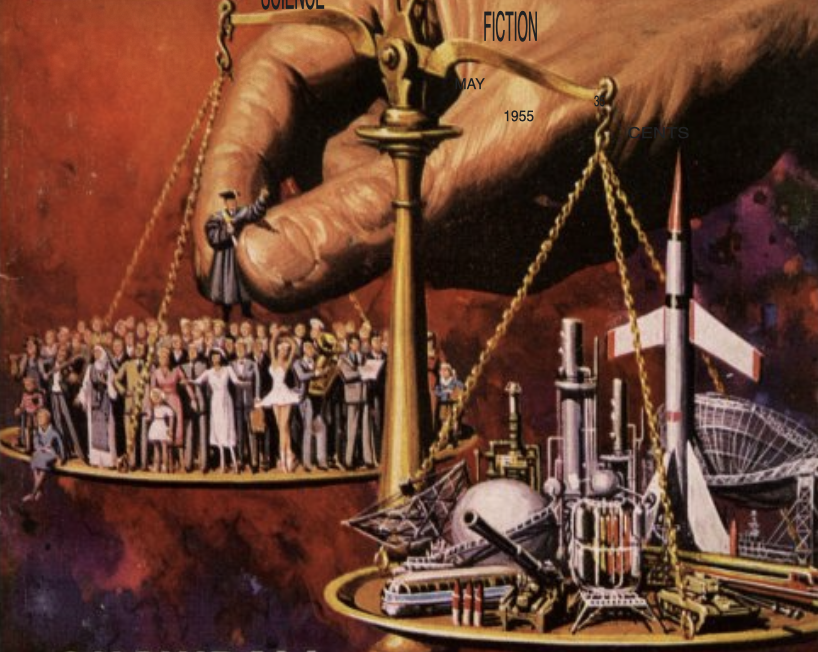
Kenneth S. Fagg, “Technocracy Versus the Humanities” (1955)
Judging and judgement were a central ability that Trump not only accepted from Elon Musk, but informed the new sense of DODGE as a verb–and the efficiency of big tech–that Trump made so central to the first, formative months of this most recent presidency. For we’re been quite badly dodged up indeed. Trump had as a candidate been considerably energized and reborn by the endorsement of Elon-almost adopting him as a surrogate son. President Trump must have recognized in him a kindred expression of wealth inequality, a showman and a huckster able to promote people’s fantasies of a smooth drive, as he pumped funds into his campaign in a terrifying end-run on the eve of the election, in a rather terrifying end-run against democracy on the eve of the recent Presidential election. For the wishes of Elon Musk for space travel to Mars, a missile defense program that might be a protection from outer space enabled by global satellite surveillance, were, truth be told, the very sort of startling stories of Thrilling Publications, in a medium that helped perpetuate many of the promises of the hyper-rationality dreams of efficiency that the Technocrats purveyed.
For despot their limited success, led by the indefatigable Howard Scott, in the 1930s and 1940s, as a dream of American isolationism the promise of technocracy fed into many of the fantasies of a Trump Presidency, that also pushed realities of climate change, global warming, or refugees into the background of our collective consciousness–and allowing a weird elision between the alien and immigrant. But the image of technocracy has found fertile ground in the mind of Musk not only from his visions of engineering, but their eery roots in the florid covers of sci fi “novels” of interplanetary glory that were “published every month” of almost pedestrian fare whose major figures have proved points of reference for many in Silicon Valley, less Douglas Adams than grimmer confrontation of the problems of rationality from Robert A. Heinlein and Isaac Asimov.

Although Musk has long departed government, his legacy (and associates) live on in slimming government to reduce its functions far more drastically and consequentially than ever imagined or dared in Trump 1.0, before Silicon Valley embraced Donald Trump. And if Musk seems to have embraced the Trump campaign as a way to gain approval of his plans for a voyage to Mars from the U.S. Government, For before that synergistic tie, we’d ever cast a Trump Presidency in such terms. But driven by increasing consolidation of wealth by the 1%, the refusal of government controls has provided a backdrop against which the wages of Americans were powerfully argued not to be sent abroad, and the taxes paid by the top 1% were kept quite artificially low.

Tech offered a new take on globalization that has accelerated and intensified the abilities of Trump to convert his instincts to a data-driven response to globalization on a scale–or on multipliers–that have brought an ecstasy or orgy of global power and of the evacuation of a government by law or expert judgment. The terrifying onslaught of prepackaged policies designed to reshape government under pretenses of greater efficiency have emptied the government of much legal foundation, or even a platform to respond to national emergencies,–as the flash floods in Texas that the National Weather Service or emergency readiness failed to respond. As the theatrical quarrels of Trump with Musk offer fodder for nightly news and internet memes, we risk being distracted from the erosion off the polity–for the expansion of techno-feudalism is central to realizing DOGE as a verb that would fulfill the promises of Making America Great Again with newfound tools of rationality.
4. The verb “DOGE” is best understood as a synonym for the rewriting and rearticulation of governing as a business. The verb “DOGE” is embodied in dismissals of workers with contracts in firings without basis, unannounced dismissals to fill the mandate of efficiency, a reshaping of policy priorities that empties the civil service of any autonomy. The verb that places a premium on the goals of efficiency sets abstract benchmarks like firing or retiring 15% of an agency’s workforce; their work, we must assume, might as well be taken over by Artificial Intelligence and AI agents, in the place of experts with training for positions; rather than demanding so many real bodies with knowledge of languages, political history, or moral sense, let alone an ability to apprise events on the ground, they are replaced by technical tools to calculate outcomes of optimal scenarios for the national good. How complicated could foreign policy really be?
The proposal to cut half of employees of the Dept. of Education–if not end the department outright, as if it were the difficulty–is perhaps all we can expect from a Presidential candidate long proud of his support from the uneducated. But the ending of a department that oversees discrimination, financial aid disbursement, or uniform educational standards gives oversight to states. Yet the recent widespread shortages of teachers across the United States–unpronounced in but two states–constitute an epidemic facing the nation, as the total teaching population has been hemorrhaging since the pandemic, when a full 7% of teaching population left their chosen profession.

Teacher Shortages across the United States, 2022-23
And yet the emptying of a Department of Education of needed oversight of national priorities suggest a lack of interest in strengthening civil rights and access to education, rather than emptying national agencies of their power of enforcement and oversight-despite shortages of elementary school and special education in Alaska, California, New Mexico, Utah, Wisconsin, Wyoming, West Virginia, Virginia, and Vermont saw huge drops in teachers across partisan divides; the dire condition of New Mexico schools, where school districts saw the departure of over a third of teacher vacancies led the state to deploy National Guardsmen in short-staffed school districts–raising questions about the content of lesson plans for third graders, and indeed the absence of focus on attending to schoolchildren’s educational needs in a time of increased stress
.

Highland Elementary School in Las Cruces, New Mexico, March 4, 2022
After deep dissatisfaction was directed toward banks after the financial crisis of 2008, inspiring the birth of Bitcoin and virtual currency, distrust in public government grew in the Coronavirus pandemic to allow the hollowing to of the state to proceed far more quickly than anyone imagined–if the election of Trump as President could hardly mean a continuation of the status quo. The broad effects of DOGE as a verb seems to swap out rights with for top-down directives, instilling uniform allegiances with tests of fidelity and support, based on a demand for unqualified assertions of executive power outside even the presence of a theater of law. The result is one of elevating the order of para-state operatives, north and south of the border, a performative declaration of nationality. A threefold increase (expanding the budget for detention facilities of a striking 265%) in ICE’s operating budget elevates the agency to para-state operatives, north and south of the border; the performative declaration of nationality more typical off a police state based on personal loyalty than the law, and grabs $51.6 Bn to build a border wall, an atavistic leftover of Trump 1.0 that still continues to haunt the nation as a specter of an undefended frontier.
But suddenly the Southern Border became far more central to the nation’s geopolitical imaginary. It did so in ways that suggested the return of a repressed, as we became haunted by fears of the impending invasion from south of the border. In a drive toward what might be called “data optimization,” integration of federal databases, swapping out what were once firm divisions of agencies, placed a premium on a new logic of surveillance and an articulation of executive priorities for pursuing an agenda rather than respecting past precedent. The logic of rationality or reason, if sounding as if an inheritance from the Enlightenment, is quite the reverse. It is from the dark side: the full-scale across the board emptying of actual expertise, in areas from health care to science to civil rights protection, seems to gut the notion of government oversight in broad brushstrokes foreign to the politics of much of the postwar period. For as we have politicized the science of global warming, maternal health care, and climate science, as well as DEI initiatives, the public sphere is itself politicized, as if to reveal long-held Enlightenment goals casting out ignorance with knowledge that are revealed to be purely ideological agendas, able to be swapped out one for the other with no real consequence. The code word of “transparency” suggests a stripping away of the interested nature of all government oversight, as if it were pure ideology, needing to be shuttered and closed down.







 Musings on Maps


Pingback: Appeals Court Blocks Trump's Wartime Law on Venezuelan Immigrants - Writ of Mandamus Lawyer in New York, New Jersey, Connecticut & Washington D.C.
Pingback: Judicial Review and Mandamus in California’s Fight Against Federal Immigration Overreach - Criminal Immigration Law Firm in New York, New Jersey
I think it speaks volumes that as Trump seeks to leave a global imprint he was denied in his first term, that he turned to a man like Musk, whose sense of global politics is so limited and skewed. This is a case of the inexpert leading the inexperienced, clamoring for authority with little priorities than their own self-aggrandizement.