Category Archives: data visualization

The New Separatism and the Gas-Tax Latitudinal Divide: Tracking the After-Images of Secession across the United States (Part III)

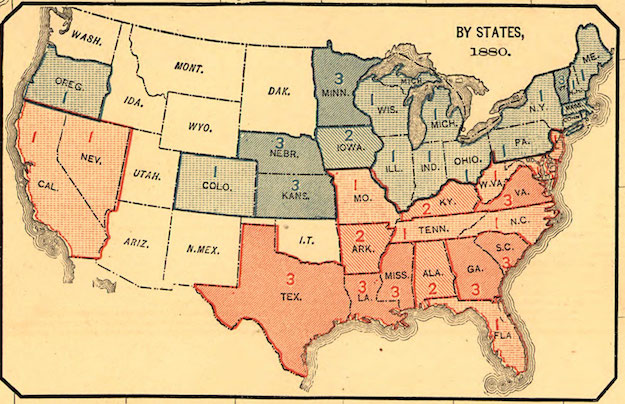
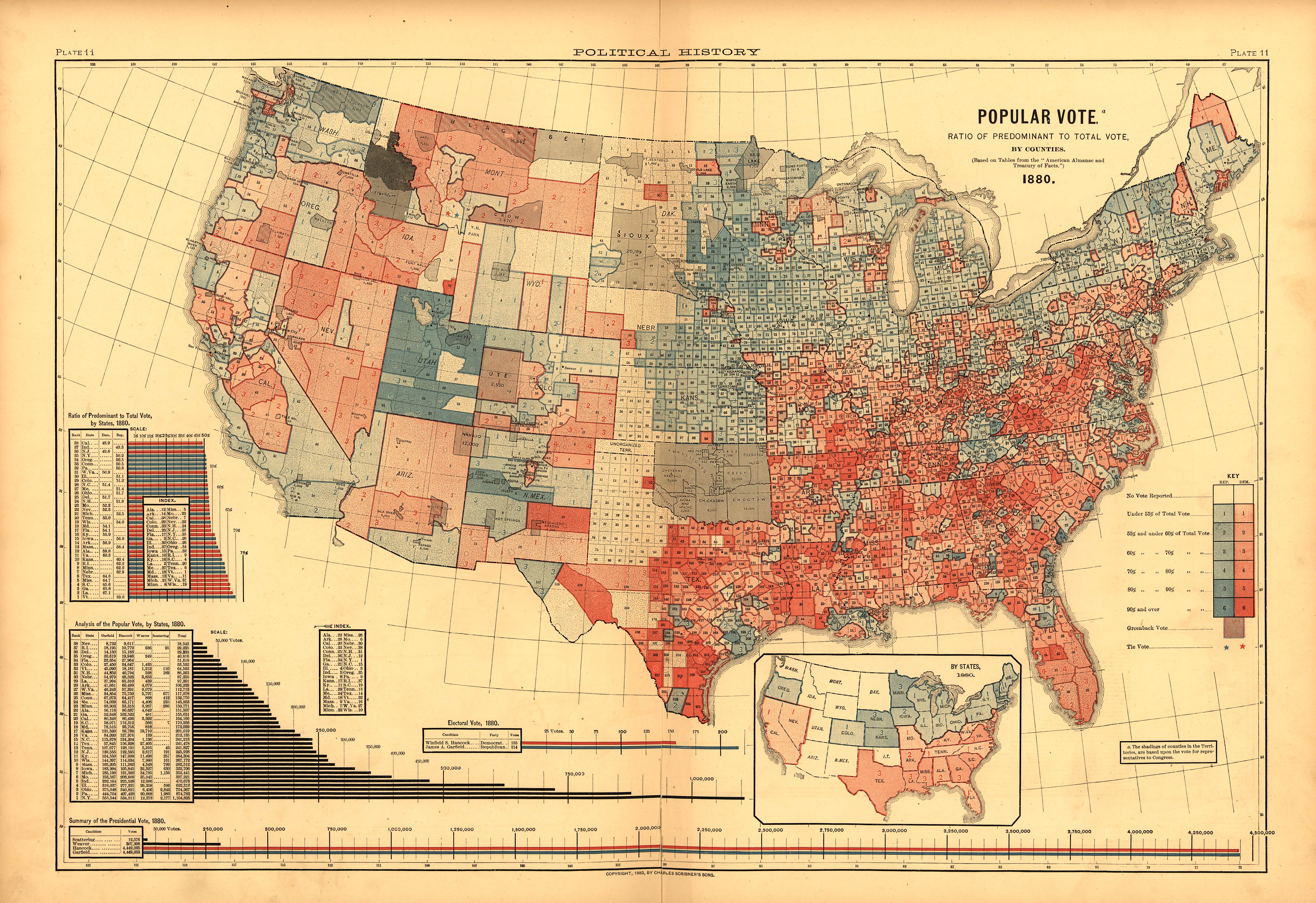
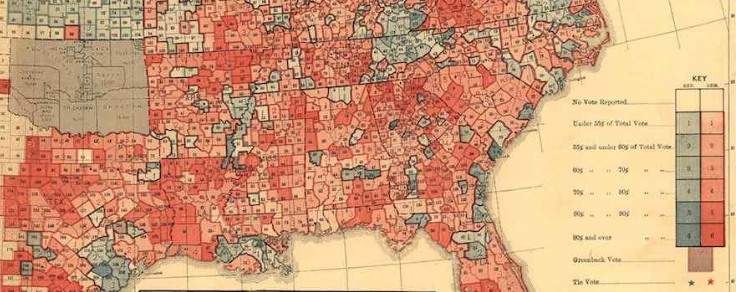
Mapping the nation gained wide currency as a way of performing national identity with the rise of the readily printed maps.  Outfits such as the U.S. Election Map Co. that were founded in the mid to late nineteenth century to provide readers a legible record of the nation.  Scribners was fortunate to be able to invest money in their appearance and legibility continued them in works such as the maps of presidential elections in Scribner’s Statistical Atlas in spectacularly modern form– including such maps as the masterful county-by-county survey that clarified results of the highly contested presidential election of 1880, where Republicans and Democrats divided around the contested question of the continuation of Reconstruction.  These images echo the statistical maps that applied the principles Francis Amasa Walker first developed in the 1874 Statistical Atlas to visualize varied spatial distributions from population density to wealth to ethnicities for the U.S. Government–“clothing the dry bones of statistics in flesh and blood,” so that, in Gannett’s words, “their study becomes a delight rather than a task.”
Statistical Atlas

The volume dedicated to Walker showed itself particularly sensitive to the possibilities of the visual delight of arranging information for viewers in data visualizations, using graphic tools developed with the German immigrant mapmaker Edwin Hergesheimer to wax poetical about the scope of visualize geographic variations as aids by which “not only the statistician and political theorist, but the masses of the people, who make public sentiment and shape public policy, may acquire that knowledge of the country . . . which is essential to intelligent and successful government.”  These sentiments–continuing those of Walker, but announcing the new purview of the info-graphic in a culture where maps had become, in Martin Bruckner‘s words, a new form of performing the nation that built upon increased geographic literacy to narrate national identity but one that extended dramatically beyond the role printed maps played in the eighteenth century.  In the aftermath of Civil War, the body of maps that Gannett and Hewes assembled provided nothing less than a new way to embody the nation in visual form.

Good government was the final endpoint of showing the deep divide in national consensus within the popular vote in his 1883 mapping the geographic distribution as a two-color breakdown or divide, and not suggesting the conundrum that the government must faced–or a sign of the lack of legitimacy of the government, and impossibility of governing well.  In showing a historical survey of not only the “physical features of the country” but “the succession of [political] parties and the ideas for which they existed,” Walker knew that Gannett’s map suggested the different divides revealed, and his pre-Tufteian precept that “simpler methods of illustration are, as a rule, more effective” to summarize and bring together the “leading facts” was done with “care . . . taken to avoid over-elaboration,” so that “by different shades of color, the maps are made to present a bird’s eye view of the various classes of facts, as related to area or population,” including political economy, church membership, mineral deposits, and electoral returns.  The notion that the reification of electoral returns constituted a map provided a new way of envisioning the polity that Walker saw as particularly profitable for mass-readership.  We’re now often the readers of info-graphics of far greater historical poverty, far more used to parse the political electorate of the country in ways that cast the viewer as the spectator to something approaching the naturalization of insurmountable divides.

1880 popular vote for HGLibrary of Congress

The new flatness of the divide is disquieting, if not false.  The maps in the Scribners’ innovative Statistical Atlas were the product of the adventurous tastes of newspaper and magazine editors who worked with new confidence to reach new numbers of readers, investing in graphics to appeal to a new eye and a new desire to envision the nation, in ways we have only begun to reach in the far flatter visualizations that we distribute online and even in print.  In the lavishly produced periodicals of post-Civil War America, multi-colored maps raised questions about the legibility of a unified national space.  They suggested fragility in the union from the government’s point of view.  But they challenged viewers to find how that unity might be read in a particularly engaging ways–as well as being preserved, and provide far more subtle texts–and statistical knives–than the pared-down infographics that appear so often on our handhelds and screens today.  In ways that suggest a new standard for the historical depth of the infographic, the map used statistical “facts” to embody the nation so that one can almost zoom in on its specific regions, in a manner that prefigure the apparently modern versatility the medium Google Maps, but that do so by exploiting its folio-sized dimensions as a canvas to read the nation’s populations.

In ways that graphically processed the tabulation of the popular vote that it lay at the reader’s fingertips, the map’s author, Henry Gannet, delved into the question of how clearly the divide between north and south actually mapped out onto the clear enclaves and redoubts of Republican partisanship that are located in Baton Rouge and the South Carolina coast, and much of Virginia and Texas, that challenged the dichotomic division between “northern” and “southern” states.  An antecedent to GIS, in Walker’s designs for the maps, the striking color scheme presented pockets of Democratic resistance with a clarity that made them pop out and immediately strike viewers’ eyes as a way to grasp the political topography of the country in especially modern ways, as if to map the meaning of its Republican consensus.  The map represents the heights of good design that the New York newspaper industry had pioneered after the Civil War, enriched by advertising and graphic design, even if it was designed by the statistician who helmed the United States Census in Washington.  Its pointed argument on the difficulty of taking the electoral map that resulted–shown as an inset–as a reflection of an actual divide raises questions about the current tendency to naturalize “Red” states versus “Blue” states, if it seems devised to answer questions about how the national fabric was rent by opposed divides during Reconstruction.

How the map, very much in the manner of contemporary graphics, came to synthesize political history in legible form by embodying them–Walker’s “flesh and blood”–seem premonitions of contemporary market for info-graphics.  But they were removed from the increasingly unavoidable divides that recent info-graphics suggest but seem designed to perpetuate, or the readily improvised graphics of the short-term that are consumed in made-for-television maps viewed largely in living rooms on television screens.  If the unified color blocks of much data visualization is sadly designed to discourage reading or interpretation, in ways that almost seem destined to limit our political vision for the future of the country, the opportunities that Gannett’s map allows to delve into the palimpsest of the popular vote might help to remove what seem blinders on our shared sense of the political process.  The market for the new info-graphic is quite distinct, and designed not for an Encyclopedia, but created for the short-term–and indeed valued as a short-term image of the contemporary with its own expiry date.

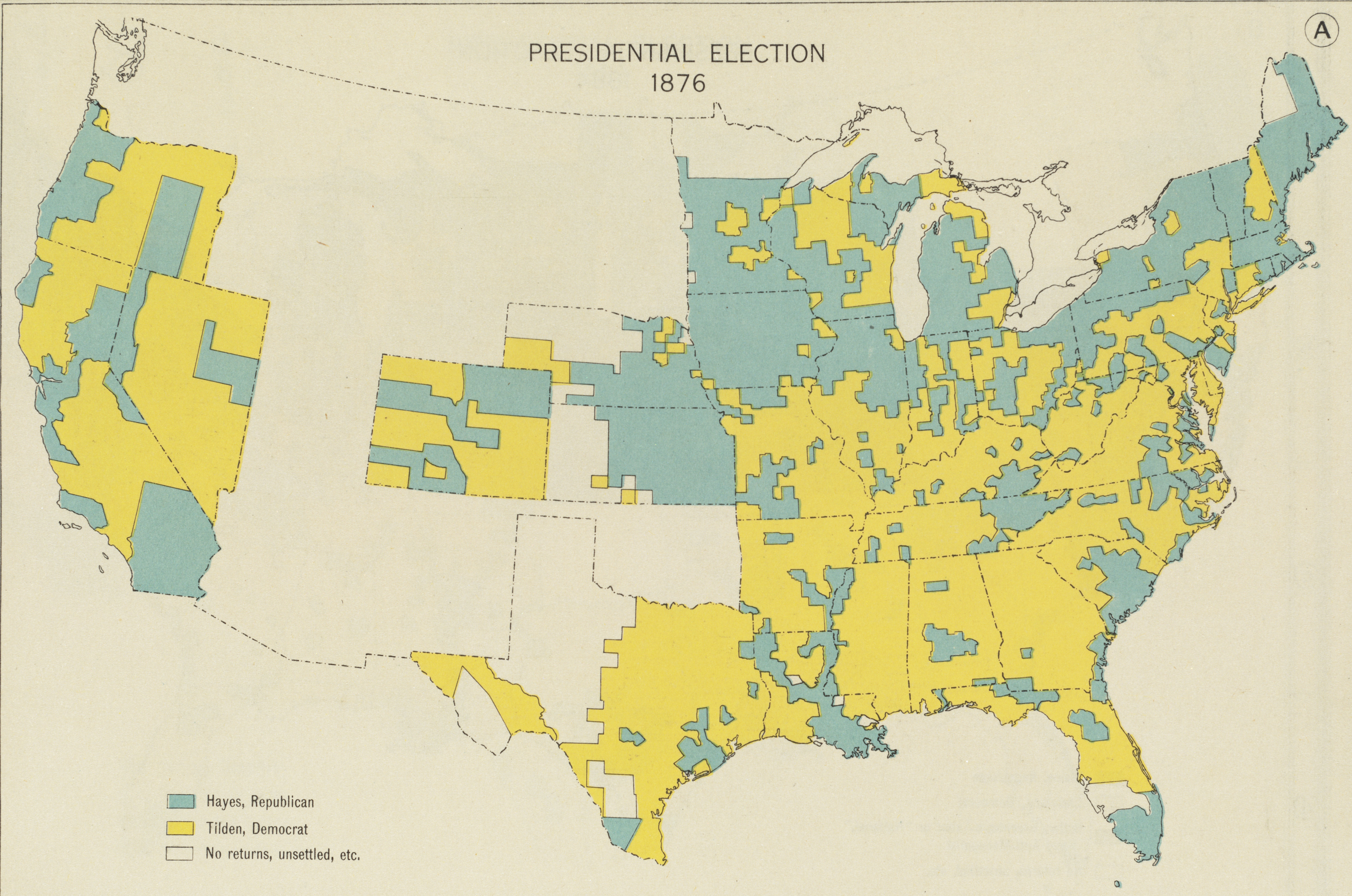
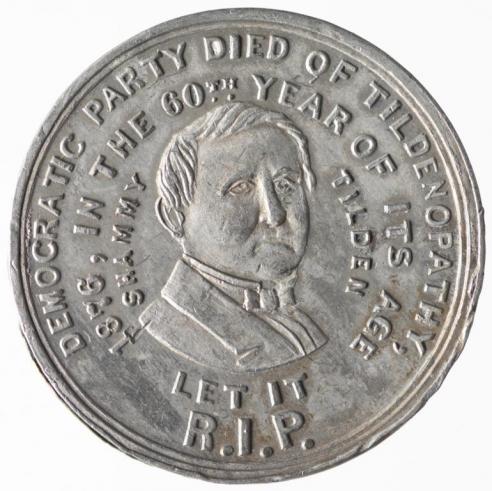
The needs of mapping an image national continuity were quite distinct, and might be profitably historicized in ways that would be foreign from the current market for or demand that info-graphics fill.  For the rationale for creating such a visualization of the popular vote’s distribution, if contemporary to a range of new maps for visualizing and processing the nation, gained pressing value after the Hayes-Tilden contest–as it would after the recent defining Presidential contest between Bush and Gore, or for the race between Obama and Romney–for their critical explanatory role to resolve the nation’s symbolic coherence.

The resemblance in the divide revealed in info graphics seems far deeper than political partisan allegiance, and the culture of this divide difficult to pinpoint–although the anti-Republican sentiment of the South was fierce in the election of 1880 seems a likely point to begin to map the local resistance to the continued presence of federal troops.  The divide between north and south echoes the division redrawn on Wikipedia between slave-states and free states circa 1849, and  enshrined in a latitudinal divide across the southwest of America in the so-called “Missouri Compromise”to permit slave-holding in the south and prevent its expansion to the north at the same time the country expanded–
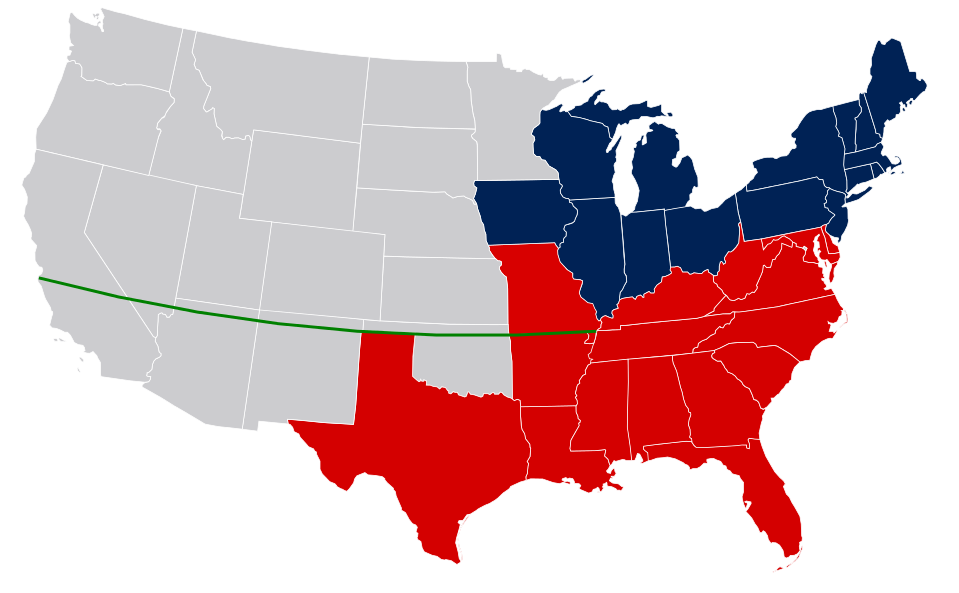
959px-Missouri_Compromise_Line.svg

Wikipedia Commons

–and seems to continue, almost but only somewhat humorously, in the  confidence with which the ex-KGB operative Igor Panarin in 1998 forecast the future fragmenting of the United States circa 2010 into four Divided States, in a somewhat silly graphic that transposed the fall of the Soviet Union in 1991 to the other side of the Atlantic.  Panarin’s image has gained currency as a meme of failed unwelcome futurology, describing the “Texas Republic” whose northern boundary recuperated the same latitudinal divide, and gained a new readership, ironically, among readers of the internet eager for new infographics to compress living history to paradigms, but suggest his own study of nineteenth-century history, as much as futurology:
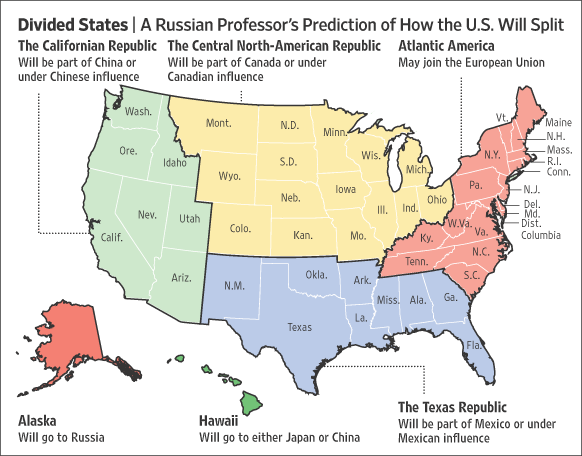
P1-AO116_RUSPRO_NS_20081228191715

And it raises questions about how we have begun to use and disseminate maps on the internet to stand as symbolic surrogates of the political divisions about which we’ve become increasingly concerned because of the worries they create about the continued smooth institutional functioning of representational democracy, and of the images we retain of how the popular vote can continue to translate into an effective Congress, rather than one dominated by gridlock.  (The ex-KGB agent’s prediction generated considerable interest in mapping the fracturing of the Republic along analogous regional divides in our own country, as the common practice of remapping cross-pollinated with GIS software and the rise of attention-getting maps.)

1.  GIS offers new modes to visualize statistical distributions and modeling national divides in the electorate, often warping actual geographical divides, in ways that have encouraged the increased role of the info graphic as a speech act.  The increased authority of picturing the nation in electoral maps have spun out from the night-time coverage of elections to remain burned in many of our cortices as evidence of a divided nation. As much as these colors have come to accentuate national divides, they create a differentiated landscape that the format of mapping seems to naturalize, and become a site that occasioned repeated glossing and interpretation for the evidence of national divisions that they appear to encode.  (Indeed, the sharing of two-color projections to forecast the outcome of the 2014 elections was both a cottage industry or diversion, so widespread was interest in adapting tools of forecasting to provide “flesh and blood” for making potentially compelling political predictions by slicing up the nation in different ways.)  Often seeming to evade the sort of issues that indeed continue to divide the United States, the widespread currency of such practices often perpetuate the very notion of a chasm of colored blocks as the best visual metaphor for the nation, in ways Walker and Gannett would find a remarkably different notion of a map.

Compelling translation of the popular to the electoral votes invoke the red v. blue divide in particularly graphic terms, and filled with a growth of a number of purple states that make the oppositional divide between Republicans and Democrats much less clean than it once was. (While the Republican party had long assumed the color blue in the nineteenth century, as the party of Lincoln, and blue was used to designate regions voting Republican the newscaster Tim Russert is credited with having first used the color-coding of the electoral choropleth to describe the prominence of the electoral divide in the United States presidential election of 2000 on a single episode of the Today show on October 30, 2000–although he denies having introduced the term as an opposition, and colored maps were long used to depict voter preferences in states.)  Back in the days of the innocence of 2000, the hues took hold to parse the nation with urgency during reporting about the results of that presidential election–and entered common parlance after the conclusion of the fourth presidential election in which the victor failed to win a plurality of the popular vote.

The apparent cleavage of the nation into two regions–more populace blue states with large electoral votes, and many red states with fewer, save Texas and the contested Florida, whose electors may have been erroneously awarded to Bush–and the map of a division of the states into what seemed a red “heartland” and blue periphery expressed a somewhat paradoxical national divide that appeared two different nations–or one nation of continuous red, framed by something of more densely populated blue.
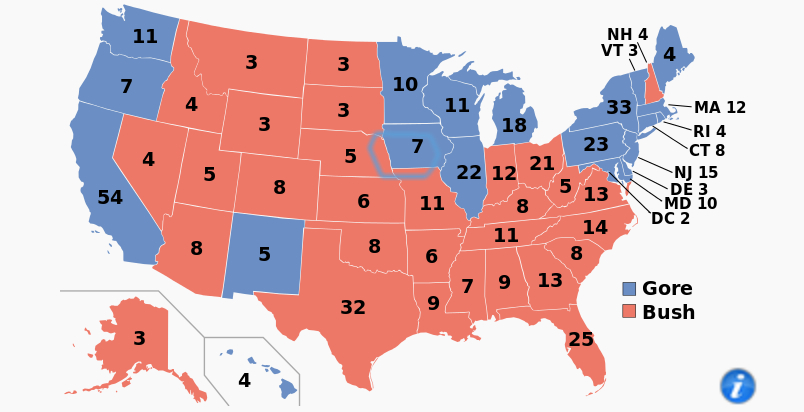
Bush v. Gore
The far more broader expanse of a sheet of uniform red, the color specific to the Republican party by 2000, drew a clear dichotomy drawn between Blue States versus Red States, that appeared less an emblem of sovereignty than of a deeply running national divide in a country whose political process had almost lost familiar geographical moorings: the familiar geographic map was warped by the outsized role of certain states in the electorate, and the consequent often disproportionate tussling over winning their electoral votes of “swing states.”

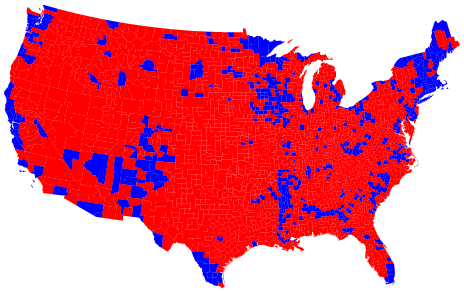
Unlike Henry Gannett’s statistical map, the image of a contiguous region of “Red States” in the above infographic seems to divide the union, as much as offering clues and cues to get one’s mind around a divided electorate. The below cartogram of the 2004 election warps the national territory to reflect the distribution of electoral votes in each state–and the mosaic of victory that the “red” states constituted in total electoral votes revealed several divides in the nation, or the hiving off of the northeast, west, and Great Lakes states from the majority–or, alternatively, the concentration of Democratic votes in dense pockets of urban areas–that reveals two republics, all the more evident from the continuity of the U-shaped red stretch of disquieting uniformity that emerged when the popular votes is translated to a map of electoral votes.
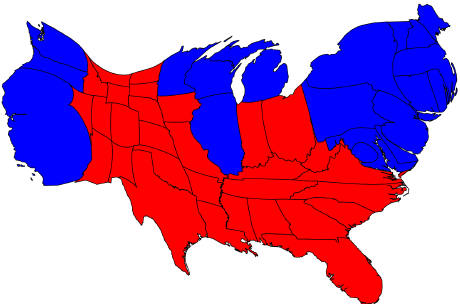
3-2004-electoralcollege-cartogram

4-2004-by-county

We have become especially accustomed to interpreting the contours of such national divides in the electorate with strategic urgency in the age of Obama, although the battle for electoral victory were more likely to be resolved in cartograms than the finely-grained county by county distributions that Gannett had devised. The appeal of cartograms lies in part in how they offered an apparent opportunity to gain clarity by the almost compulsive remapping of electoral votes to decode the alliance of victory in the 2010 election in two-color cartograms: warping the divide to suggest the dissonance of terrestrial continuity with electoral votes or money spent per voter, to suggest both an accentuation of its divides, as if to pose questions about the existence of continuity among the nation’s regions and states, and a deep divide that lay in the areas where campaigns devoted the greatest attention–and ask whether this skewing deriving from distorting electoral stakes bodes well for the democratic process.

The geographical distortions of infographics seem to clarify how electoral results run against the continuity of a terrestrial maps in similar terms. The representation of current electoral division have continued to aggravate the country’s continuity long after Obama’s two presidential elections: both electoral results have been often parsed across the country to explain the divide between red and blue states, especially in the 2012 election, as if to try to discover continuity a country that seems divided into blue states and stretches of bright red: and if, until 2000, both Time magazine and the Washington Post colored Democratic majorities in red, the opposing colors of red and blue have become an image of contested sovereignty, and of articulating regions’ political differences and divides. Rather than suggest generational continuities in political allegiance over space, the divide within the country reads more clearly in Gannett’s county-by-county census, but the proliferation of cartograms respond most effectively to the problem that “these maps lie,” morphing the fifty states into rescaled distributions.

Adam Cole doesn’t claim to argue that this reflects a bit of a crisis in democratic institutions, but one can’t but consider how the current gridlock in government may stem from its failure to adequately reflect the demographics of the country, or at least the economics of the Presidential election.  Despite increasing attention to the mobility of individuals outside “blue” states to other, formerly “red”-state regions, the divide was increasingly focussed on a diminution of red states, but a concentration of Republican majorities in the central regions of the country, lying largely below the Gas-Tax Latitudinal Divide–with some notable exceptions. Even if much of the country seems happily purple, the intensity of two triads of red states strikes one’s eyes immediately.

The United States, with state sized based on electoral votes.Adam Cole/NPR

(Such maps, of course, in their interest to provide info graphics that involve “purple” shadings of a mixture of blue and red may not take into account the neurological disposition of the eye to more readily read a purple state surrounded by a sea of red as red, and fail to distinguish the degrees of purple of a region as an intensity not independent from the spectrum of the colors of nearby states:  the interest in providing a more complexly qualified picture of variations in this map, introducing shades of “purple” to a map, if constructive in the abstract, according to Lawrence Weru creates misleading interpretations that rather than profit from such proportional blendings lead the purple region to appeal more blue or more red depending on the chromatic context where it appears.)

2.  The compelling nature of such cartograms no doubt the maps that express the views of political parties, and provide a basis for imagining the continuity in how campaigns dedicate attention to the nation. Despite their explicit warping of continuity, cartograms help get one’s mind around the nature of the apparent lack of continuity across the country, and understand the depth of electoral divides and to explain the country’s composition than the mapping of electoral votes onto spatial divisions on a map, if not to project the results in far more dynamic ways of translating the “map” to practices of political representation, as much as territorial manipulation. The cartogram seems to translate spatial divides into a system of political representation that fits imperfectly on a uniform mapped space or rendering of territorial expanse, and seems particularly compelling to analyze the way that the electoral process translates the nation’s geography into institutional terms.

The most telling translation of this political process is revealed in the warping of the nation by disproportionate expenditures per state, reflected by the distortion of electoral politics–and the nature of political divides. Parties have been compelled to devote disproportionate attention to individual states, out of sync with their electoral votes, but as a reflection of the calculus of receiving a majority in the electoral college. A compelling twist to the electoral cartograms parsed political parties’ relative expenditures in the most recent Presidential election as a distribution of funds in dollars spent per voter, grotesquely warping the scale of states in the country according to the political spending in millions of dollars–which keeps a lot of purple states, but suggests that one area of the nation has almost left the attention of either party, as if they were discounted as foregone by both parties–and received but a begrudged smidgen of millions of dollars from the GOP or Republican National Committee, so clearly were their political preferences already decided and minds just made up:

bbstates_custom-e0c6c871e5a185100d0be94271fba73c0a365998-s40-c85Adam Cole/NPR

An even more warped image of the republic is produced by warping the fifty states to reveal the disproportionate number of dollars spent per voter, in a warping which has the effect of shrinking the red states in much of the south and southwest to reveal the extent to which they are simply less the terrain in which recent elections were determined: one learns even more about the deep commitment of many of the voters in the southern states in the below graphic, reflecting the returns that each campaign had on the amount of money invested locally. The map reveals how little Romney even invested in the solid Republican voting base of the south, not seeing the need to disseminate the candidate’s message in states where he held such a clear advantage that they were conceded by the Democrats: it shows the relative inefficiency of Republican expenditures in New Hampshire, Iowa, and Nevada by an off-message candidate, and the balling amount spent on political media in each state from April 10 to October 10, in which many southern states are all but squeezed out of relevance, because their outcome remained–save North Carolina–something of a fait accompli, and absent from the volley of the barrage of ads that have only recently ended with mid-term elections of 2014:
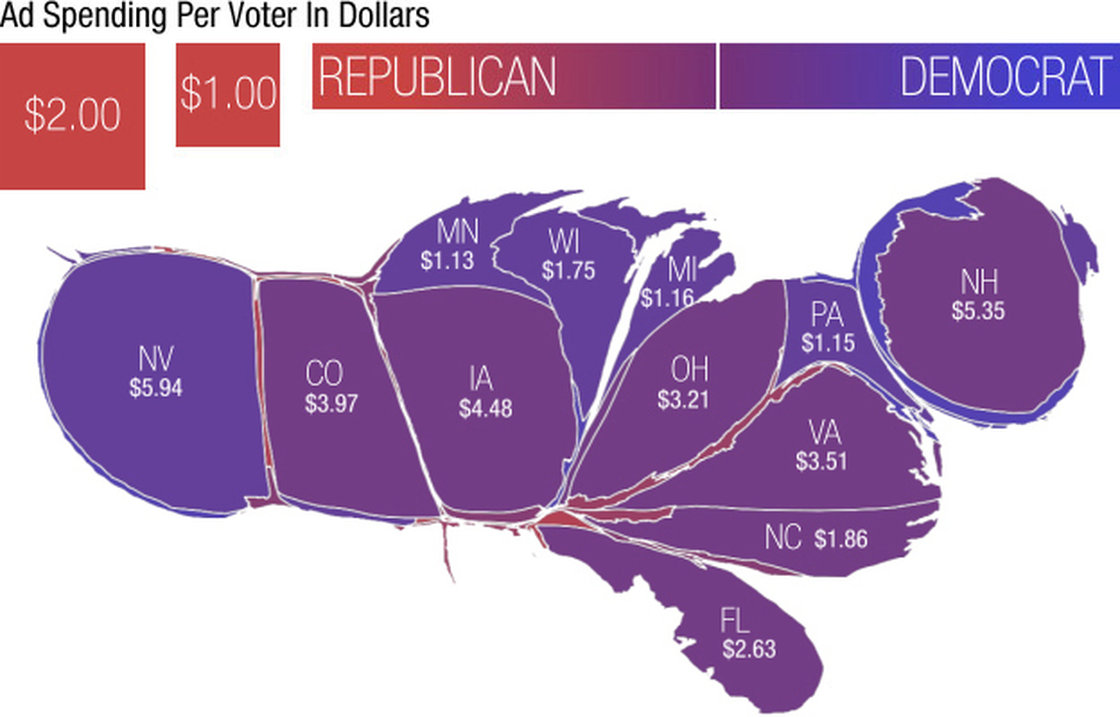
bbvoters_custom-0abd0dc8a4efa739c61d80b961226ae07e5b04ec-s40-c85-1

Adam Cole (NPR)/Kantor media data


It can’t be “fair” to absent a good portion of the country below a single line of latitude form the state of national political debate that on-air advertisements have to be considered as forming part. What does this mean for our Republic raises questions: but is this a form of secession itself, coming back to haunt the map of political parties’ distributions of their own expenditures? The cartogrammic shrinkage of the southern “red” states with those west of the Mississippi scarily suggests a region of the country has all but vanished from the contested regions of the electoral map, its electoral votes all but written off as a contest, and Texas shrunk to an unsightly narrow peninsula or appendage off the territories where political parties struggle: the geographic contraction of the areas below the thirty seventh parallel, which defines the “four corners” intersection of Utah, Colorado, Arizona, and New Mexico effectively privilege the more urban areas over the “exurban” southern states that were so much less of a contest or struggle for political attention.

The troubling depth of the division across the United States is less a mirror of the affiliation to different political parties, however, than they reflect different images of America that often reflect urban v. exurban perspectives–as in this topographical projection of peaks of population in the lower forty eight.

Blue v. Red Topo Raised

Presidential elections offer a major rush of disaggregated data that one can assemble in exciting ways, the inflow of data creates a flood of information that make it difficult to select specific criteria to foreground. One might find in the above sufficient grounds to interpret the growing chasm of political divisions in the nation as between states between those with large urban centers, and “exurban” areas of less density. The tendency to group states which tended to vote or lean Democratic–as New York, California, Florida, Ohio, Colorado, Wisconsin, Minnesota–apart from more exurban or rural areas, and to map the distrust of collective government as lying within exurban areas that lie at a spatial remove from social investments that seem compelling to areas of greater disparities of wealth that define cities–and the distance at which these “red” regions feel themselves as lying from urban areas or issues seem rendered compelling against social density.

Blue v. Red Topo Raised

3.  However tempting it is to parse the differences among the electorate’s behavior in the Obama and Romney’s contest as a mirror of deep cultural divides that seem geographically determined, this quite unsatisfactorily poses the question of how likely they can be ever bridged. Such a reinterpretation is compelling precisely because it pays less attention to the “after-image” of secession, and reveals a new political landscape of the nation, rooted in population changes. The divides between the urbanized and unorganized, or “exurban,” also reveal deep attitudes to the nature of national space, and the role of government in space–which this post wants to suggest we examine as an underlying map of voting preferences, but that can’t be revealed by voting preferences and electoral returns.

The differences between voting preferences across the nation lie not only in terms of relative urbanization, but attitudes to the economics of moving through space difficult to quantifiably map, but all to evident on the map. For in ways that define a cultural continuity that is hardly rooted in the physical land, the map embodies a divide, similar to the Gannett map, of the role of government in one’s life, and the presence of the government in economic activities, as well as the prominence of a consensus on social welfare needs.

Parsing the election of 2012 in another way by democratic v. republican gains per county, one might note the  Democratic electoral gains are strikingly concentrated in urban areas, while Republican gains dominate the exurbs that are red–a distinction that clearly correlates to driving practices and willingness to tolerate more highly priced taxes for gas–and the Republican gains group together in clear clusters and runs, predominantly in the inland central southern states and inland northwest.  This data visualization eerily reifies the very divides that Gannett’s almost hundred-and-thirty-year-old visualization of polarized voting preferences first set forth:

Net_Change_MapDavid Jarman/Daily Chose

What can explain this shift across such a firmly defined latitudinal divide, which seems a crease across the country, as well as a refusal to hamper what is taken as the inalienable right to keep low the cost of free access to take a seat behind the wheel?

4. The data used to parse these moderns electoral maps are invested with significance, but may not reveal clear “after-images” of earlier landscapes precisely because the priorities of parties have so dramatically shifted, and the range of issues addressed in the political landscape have left it to be polarized in ways that have far less to do with the polarization over issues such as, say, Reconstruction of the south. Despite the greater amounts of data that presidential elections offer to parse a picture of the country, local legislative institutions provide just as significant a “map” of the traces of autonomy from national standards. The mapping of levels of gas taxes was meant to register the affront of impeding open access to the cheapest mileage. But the map of the distribution of gas taxes in the United States may say much more.

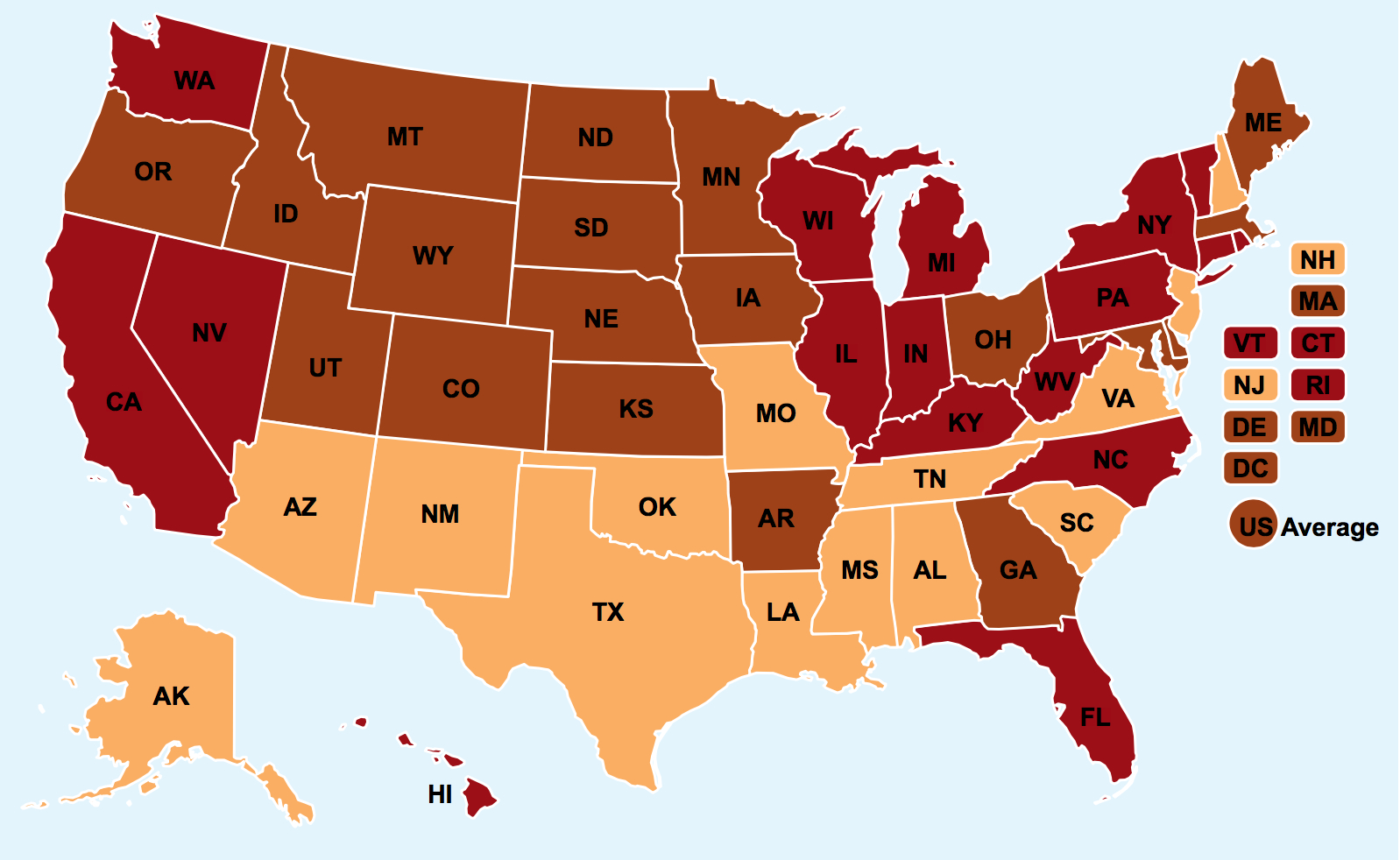
Exxon Mobil’s blogger Ken Cohen boasted that the map “explains a lot”, as a suggests clear division in local variations from the federal gas tax that exist across the country as if to show the inequalities in how local, state, and city taxes collect from forty to sixty cents per gallon–creating an inequality of cost that is itself far beyond the total federal tax imposed of 18.4 cents a gallon, creating unwarranted variations in the costs that drivers payed at the pump across the land able to be examined in greater detail at an interactive version of a map of the United States which displays the relative divisions of taxes by hovering over localities.

The differences in regions’ relative acceptance of gas taxes may indicate less the toleration of government’s invasiveness, but instead a huge shift in attitudes to space extending across exurban areas. The acceptance of a gas tax–or its ‘toleration’–reveals tendencies to reject as invasive the presence of government–and throw into almost topographical relief a considerably deep division within the local legislatures responsible to voters and local opinion. In ways that seems mirrored with surprising clarity in the below distributions of local “toleration” of taxes on gas–a sensitive barometer of regional autonomy, if one hardly comparable to the withdrawal of federal troops–the nation seems starkly divided that reveals difficulties of arriving on national consensus of its own, if on a topic of apparently less dramatic significance. If such taxes can be described as imposed by the government, the tax might be best construed not only on the toleration of taxes, but consensus if not agreement as to its collective benefits of something akin to a value-added tax. Indeed, the political divide in the country seem to have instantiated a divide along roughly the thirty-seventh parallel that reflect distinct national priorities, allowing the American Petroleum Institute to describe the disparities of the taxation on petroleum as if it described an unwarranted degree of government–state or federal–interference in the average American’s access to a full tank of gas.

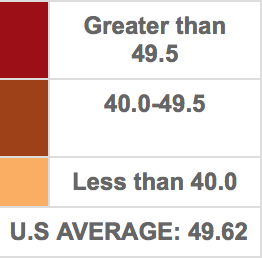
A surprising divide emerged in this far more simple visualization, whose divides may parse different attitude to the economics of occupying space, based on states’ relative willingness to accept and tolerate taxes on gasoline, as much as chart the unfair nature of differences in how costs are deferred to drivers at the pump. The admittedly interested map makes its point about the uneven national “gas tax burden” along the thirty-seventh parallel, foregrounding a deep divide in refusing the role of local or regional government in daily life. Rather than reflect a distribution of draconian levels of taxation on gas, the map charts consensus to accept levels of an additional gas tax. While it does not perfectly translate into electoral preferences, it reveals a deep divide across the country that seems to fold the populace in ways perhaps not basically political,so much as in the degree to which each state’s populace would accept or suffer additional taxes as a means to meet public needs: it almost seems as if the reluctance to sanction the sort of imposition of taxes at the gas pump was seen as an analogous affront to regional honor.
Gas Tax

gas key

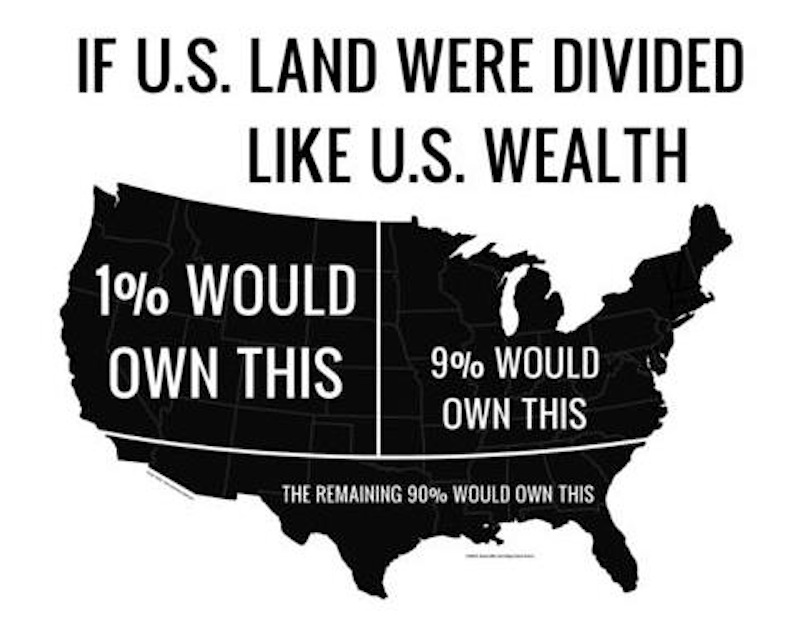
Thanks to the appearance of a map that first appeared on ExxonMobil’s “Perspectives” blog, we have a useful way to parse the spectrum of the country’s attitude to government–and to the involvement of government in regional differences to the economics of moving through space. For the refusal to raise taxes across the southern states-and indeed the apparent rejection of most anyone with a foot below the thirty-seventh parallel, almost carve the country into two halves, with the exception of Virginia, North Carolina, Georgia and Arkansas. It is striking that a cartoon that carves the country, or lower forty-eight, into a map that approximates the polemic division of wealth in the US by which Susan Ohanian assigned that very same region the 90%.  Her map echoes the divide, her cartographic take on the lower 48 assigning the the lower 90% percent of American wage-earners the region lying below the latitudinal divide, echoing the association of the region with a far less developed social infrastructure than either the east or west coast or to the north–only somewhat subliminally and slightly nastily pointing out the shifting per capital income across the land:
WealthMap

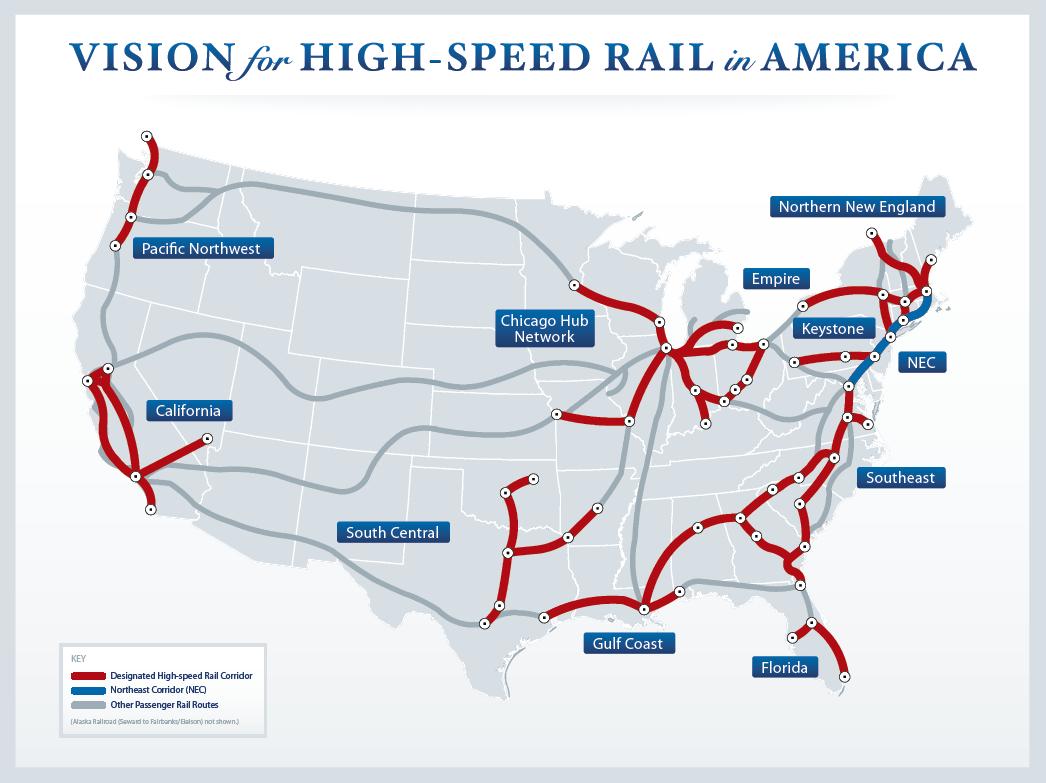
The divide that perpetuates lower gas taxes–or the “tax burden” on how freely gasoline flows at the pump–maps nicely onto a region with markedly less public transportation and transit.  The very same states’ governors, from New Jersey to to Florida, made something of a pact with the Devil to tank interconnected high-speed rail corridors proposed by President Obama, who championed alternative transit routes early in his presidency in hopes to rebuild a decayed infrastructure. If creating such corridors could have both encouraged local job growth and economic stimulus–as well as setting the basis for future economic growth–the refusal of and Scott Walker, that reflect the largely “exurbanite” populations of red states in exurbs. (Low gas prices serve to compensate for poor transit systems, and work to discourage their use, reducing demand:  only one top-ten rated US transit systems lie in the states–Austin–although a ranking meeting local “transit” is unclear, given that transit needs are by definition locally specific, and difficult to quantify.)  They are now a thing of the past, and Exxon-Mobil seems to turn its sights to the gasoline taxes that might enable their construction in the rest of the country–as if the lack of attention to the public good might be the new norm we could all be so fortunate to possess.

The two-color new flatness of the info-graphic seems complicit in how we perpetuate this view.

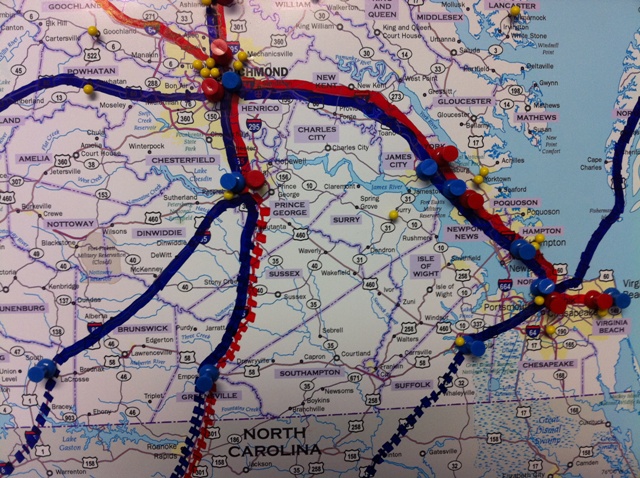
5.  What appears to perform a regional consensus exists may in fact register the primacy of accessibility to highway driving, or access to ‘automotive freedom’ in a region.  For it seems that the degree to which the individual right to drive through space is accepted as inalienable, or not having any possible contradiction with the public interest, in ways that might have much to do with the tanking of public projects for planned high-speed rail in some coastal corridors, if not an animosity to the project of expanding choices in public transit Obama long ago sought to enact–but whose projected corridors in the south were resisted and never completed.

high-speed-rail

The absence of transit corridors has led to the growth of private taxi-like shuttles for patients in areas where ambulance carriers cover wide areas without clear transit corridors.
IMG_0201

Did the recent resistance to enacting such corridors of transit help to intensify the sort of divide we can witness in Ken Cohen’s Gas-Tax map? The 2009 Stimulus Package was intended to include a planned Southeast High Speed Rail Corridor, designed to change transit’s playing field in the South and Gulf Coast.
High_Speed_Rail_07-09-2009

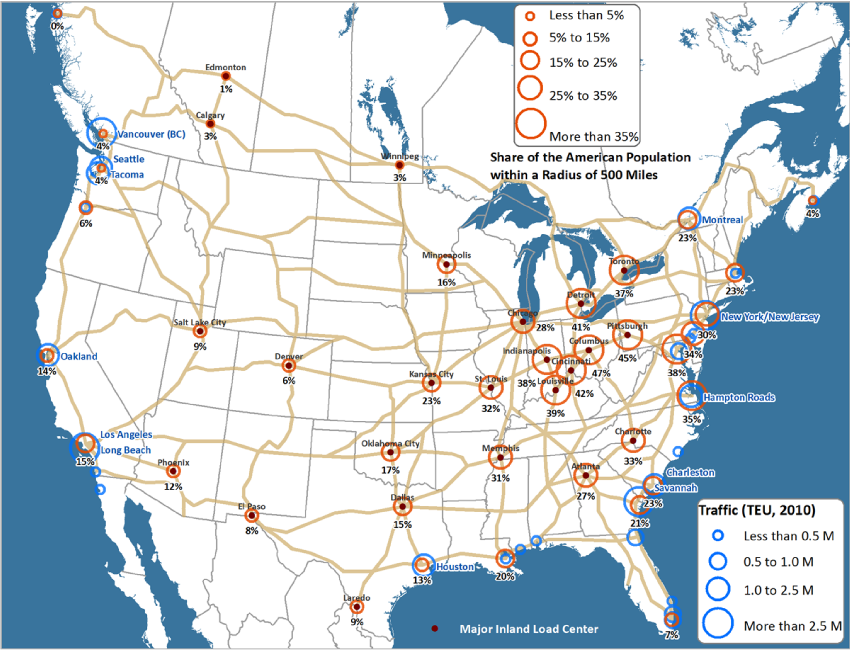
Such plans were already, of course, in the works since 2002, in the Bush Administration.  But their defeat, in no small part due to the apparently lesser geographic population density, was encouraged by the perception of a national divide of transit needs.
NA_market_500_miles

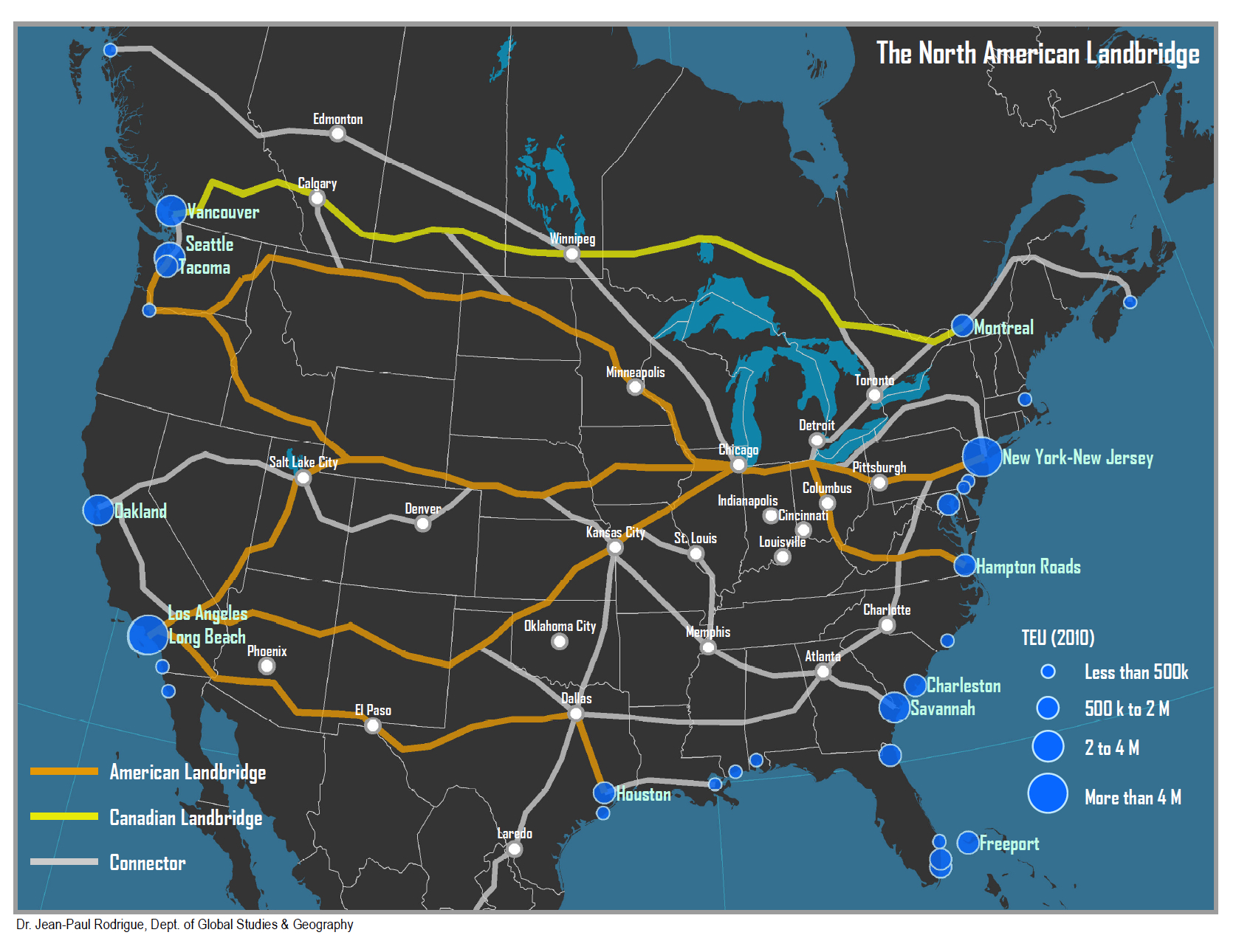
It prevented greater integration of a North American landbridge in much of the South, to supplement the lack of a crucial lattice of corridors of highway integration.
Landbridge

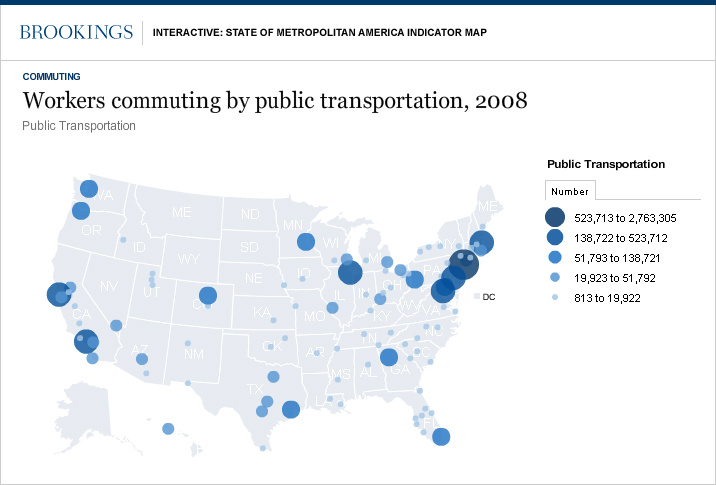
6.  We can make inferences about the lack of success of such transit programs, in part thanks to the consolidation of local, state, and federal taxes on gasoline provided by the American Petroleum Institute.  If the map derives from varying forms of taxation passed on at the pump, including local costs of fuel-blending that increase the costs of refining, a national divide to throw into relief of tolerating the imposition of an additional gas tax. While the map does not track the prices in taxes paid at the pump, and the cost for gasoline reveals considerable geographic variation by market and supply, the API plotted the total “fuel-tax burden” in a national map that reveals more about a national latitudinal divide than they had intended: the clear color scheme suggests that the 37th parallel creates a cliff in ‘superadded’ gas costs–and augments the sense of this divide by placing Alaska beside Texas–some fifteen cents below the national average in the U.S.  It mirrors the regions worst served by public transit in the US, to judge by the concentration of workers who relied on public transit for their commutes circa 2008.
6a00d83454714d69e20133f2536560970b-800wi

The missing information from other maps may suggest a quite grounded rationale for the absence of accepting taxes on gasoline:  not only the reluctance to accept taxes, given the reliance on automotive travel as a primary means of transit and transport, but the absence of a network of public transit that would provide an incentive and rationale for the readiness to accept a tax on gasoline in exchange for other public benefits.

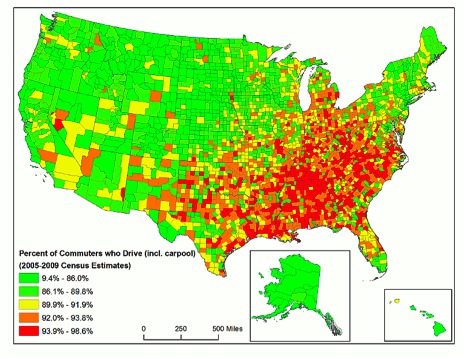
Seen another way, one can link the sense of spatial movement in the region of significantly decreased gas taxation on the rise of a single-driver culture of access to roads, rather than public transit–a trend that Streetsblog found to correlate not only to more restricted and curtailed transport choices, with little but circumstantial basis (and in a pretty cheap shot), to national obesity trends across the nation:
map_3

7.  Although the flatness of infographics oddly seems to obstruct further inquiry into the distribution it reveals, the differences in how the land is habited suggests divides that are difficult to surmount, and by no means only political in origin.  While it might be seen as leading many to move south for cheaper gas, the consequent lowering of the perceived “fuel-tax burden” to below forty cents per gallon–sometimes by as much as five cents/gallon–across state lines indicates a refusal to let the government interpose themselves between driver and pedal, or pump and tank. It suggests a shifting sense of taxation structures and investment of local priorities of dedicated tax revenue that strikingly mirrors the very regions at the presence of government in local life, but is often tarred as yet another instance of the invasive nature of government’s presence in public life.

The map echoes the more prominent manifestation of local resistance to the apparent federal invasiveness long mandated by the Department of Justice’s “oversight” of enacting changes in local electoral laws, based on historical presence of policies deemed discriminatory, first enacted in the 1965 Voting Rights Act.  Under the logic of the autonomy of “states’ rights,” such “pre clearance” was abolished, although an  alternative proposal the issue of “pre clearance” was framed as triggered by successive voting rights violations in four states–Texas; Georgia; Louisiana; and Mississippi–rather than fifteen. The VRA’s original provisions, widely deemed “for half a century the most effective protection of minority voting rights,” or fourth article, was approved as recently as 2006 by the US Congress. But widespread resistance to the federal policy grew with keen regional separatism among many of the same “southern” states, or the configuration of the South–minus Florida, North Carolina and Arkansas, with the addition of Arizona and Alaska–who pushed back against oversight of changes to voting laws as redistricting or Voter ID as undue interference as local policies–even as the ability of entrusting states to develop their own policies of redistricting has been recently open to challenge in Mississippi and, in Alabama, for the rigid use of explicitly racial quotas, echoing early charges of partisan gerrymandering in Texas–but raising questions of how much race or partisanship is at stake.

Areas Covered by VRA-and additionsAreas Covered by VRA-and additions

These coincidence between these maps isn’t entirely coincidental. Indeed, one is struck by the striking “family resemblance” to the infographics we use to represent the nation’s complex composition in a map.

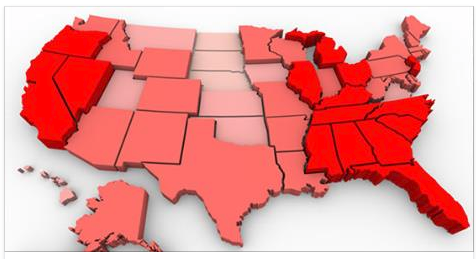
8. How much are we overly habituated to visualize a divide that we seem to have a difficulty looking outside its two-color classification?  It bears remark that the afterimage of secession is rehearsed in quite rhetorical manners to raise the specter of national dissolution–by now imprinted on the collective consciousness–if expanded to include a few ‘swing states’ to suggest the recent expansion of the “old South.”

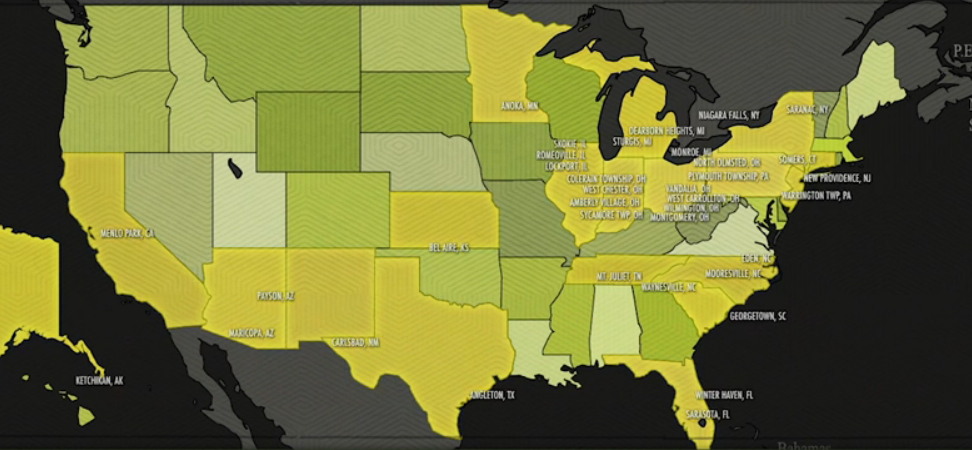
It’s ironic that the iconic image of secession is rehearsed in maps imagining secession from paper currency, which employ strikingly similar visualizations to forecast a coming shift in monetary policy and practice that would be brought by BitCoin. Although its eye-grabbing vision of secession is deceptive, the below “hoax”-map distributes thirty-six cities in twenty states where one can pay bills in Bitcoin as if they were poised to “dump” paper currency, or abandon the US dollar and withdraw from the closest to a common convention to which all fifty states adhere: the map of secession–perhaps based on states that have accepted applications for exchanges in the digital currency that originated on the Deep Web on the TOR browsing network and on hidden sites of illicit exchange as the Silk Road–is of course not an actual map of secession.  But it is designed to pose as a visualization of “the rebellion [in currency] that quickly spread to main street America” with antecedents in a system of currency devised by Thomas Edison, which would immediately provide financial returns as it replaced the dollar, as if it recaptured the past stability of a lost gold standard in the face of the fluctuation of value of American currency.  Lack of internal differentiation in the below of urban and non-urban areas in the below perpetuates an image of legal secession of states that are shown by big monochrome color blocks that seems to prey on viewers’ eyes by its introduction of a familiar dividing line.

The mapping of monetary secession, launched by Money Morning–Your Daily Map to Financial Freedom and diffused to alarm viewers on sites such as http://www.endofamerica.com, is not really explained carefully, and seems to lack its own legend but was intended to depict a collective rejection of paper money as if the “red states” were wise to a growing financial trend. In this barely disguised desperate push for Bitcoin digital currency–“now accepted by dentists in Finland!“–the data vis stokes fear in the survival of paper money in America, and a specter of monetary separatism, echoing fears of dismantling the remaining monetary union of the United States by the rejection of a federal currency–extending a language of states’ rights by its rather preposterous design of a fanciful future national fracturing as some states dispense altogether with paper money:  states once divided by the institution of slavery now seem divided by farce. (How maps mislead: California is colored red, due to the fact that one city, Menlo Park, has moved in such a direction, not the entire state–and cities elided with states.)
20states-red

The afterimage of secession is here, rather improbably, immediately recognizable, but raises a recognizable specter in monetary terms, stoking fears of a new national disillusion that has emerged along sharp lines. One doesn’t usually imagine the digital divide to include the majority of states in the deep South–if in ways that address the viewer who is tried to be wooed to Bitcoin, rather than an offer an image of the nations health. But if the map is a bit of a hoax, the use of something like a secessionary map to depict the rejection of paper money that the U.S. Government has unwisely continued to sanction cannot be much of a coincidence. The cities that push for the ejection of paper money were not by all means concentrated in the southern states, according to the map–which stages a hoax, but one that also reveals the country as broken into two halves by the abandoning of paper money which actually maps the sites of companies that will pay salaries in non-paper Bitcoin.

The recurrence of the very same fold across the nation’s center, roughly along a latitudinal divide to scare viewers–with California added in for good measure, based on the city of Menlo Park.
US broken by Bitcoin

Although a hoax, the “map” of the impending abandonment of paper currency shows a fracturing of the nation along the lines of the adoption of Bitcoin.  If it echoes the abandonment of the gold standard as a monetary system–or the amount of silver used in dollar coins and actual currency, the map is most striking for breaking down the divisions in the  nation in a state-by-state way that has particular power as it is so often used in political visualizations of electoral returns.  What else might explain the persuasive power of this meme of national division?  The status of Oklahoma, a familiar icon of frontier freedom, shows it has  recently moved to move away from paper currency to accept, with bipartisan support, gold and silver as currency.  The rejection of a common federal paper currency seems the ultimate standard of secession, echoing the dismay at the abandonment of the gold standard or the withdrawal from a cash-based economy.

An eery footnote to this atlas of symbolizing the nation is the proximity with which the map mirrors (or maybe recycles) the Democratic vote in 1880–although it stretches some credibility to imagine the former constellation of seceding states on the cutting edge of accepting Bitcoin.  It is tempting to universalize or essential the latitudinal divide that recurs in these maps, but makes sense to cast the region’s apparent distancing from majoritarian consensus as not only something of a different economic culture, but a different culture of moving through and occupying space.  The confounding of that culture with independence within the states’ rights movement–and deep distrust of federal government–existed long before Obama’s election.

Viewed through special lenses, alert to the after-image of secession, each of the maps define variations in the continuity of a cultural divide phrased as a reaction to the absence of continuity that was registered in Gannett’s earlier 1883 info-graphic–but that now seems to be replayed both as tragedy and a farce.  The question that this set of posts pose, perhaps, is how we can create more engaging info-graphics of the nation whose visual consumption would sustain and drive further attention and exploration of local variations–or at least not reduce us to a stupor of oversimplification that is an excuse for orienting us to the oppositional tactics of political debate through the pretense of showing us the actual lay of the land.  What compelling mapping of local variations might better command attention as a record of divides worthy of our attention?

Leave a comment

Filed under American Petroleum Institute, data visualization, Gore v. Bush, infographics, Obama v. Romney

The New Separatism and the Gas-Tax Latitudinal Divide: Tracking the After-Images of Secession across the United States (Part II)

The fetishization of infographics in television news has spread not only to print, but to our ability to map collectives and process data across media.  The fetishization reflects the readiness to imbue infographics authority as a communicative form, perhaps depending as much on the reduction of news teams and shift to computer-assisted reporting as it does to the greater certainty of GIS.  The readiness to sell information and the premium on winning audiences–or offering viewers splendid click-bait–has led publications to cultivate the infographic in ways that reflect how data visualizations indeed seem to be supplanting the authority of maps.

The infographic and mapping of political preference and opinion has gained the status of a speech act of particular synthetic power that has paralleled the growth of political analysis, although that analysis has often assumed the level of glossing the distribution of opinions, preferences, and employment on a map–as if in a perpetual search to find some coherence, or indeed to search for the possiblity of consensus in them.  The  hegemony with which computer-assisted reporting and news graphics that sectorize space with color-coded abandon may be deeply embedded in how the medium is the message, however, as much as being a by-product of Geographic Information Systems or computer-based analysis.  For the images are, to put it simply, user-friendly, and designed for surface reading–as if they processed a complex political process through snapshots or thin condensations of the status quo.

Given the growing symbolic authority of infographics, for reasons ranging from the downsizing of newsrooms to the contraction of attention of the consumers of news to the reduction of politics to an oppositional contest, the historian Susan Schulten is right to call attention to how Henry Gannett compellingly synthesized the divided vote of the 1880 presidential election, and the clarity that his  county-by-county coloration of the United States measured the division of the country after two polarizing Presidential elections.  After the confusion of the results of the division of national consensus in 1876, when Samuel Tilden’s victory of the popular vote was overturned in Congress by a Historical Compromise, the need to resolve the distribution of votes in 1880 emphasized the legibility of how voting translated into the electoral college.  It also mapped the survival of anti-abolitionist sentiment across the Southern states, and the difficulty of ever enacting the policies that would enfranchise African-American voters in those seats or strongholds of the anti-Reconstruction Democratic party in the South.  The Garfield presidency was not able to implement the promise of Reconstruction, to be sure, but along the coasts and midwest, particularly in the north, assembled an irrefutable consensus that Henry Gannett took great pains to embody in this 1883 map, in ways that recall his tenure as Supervisor of the U.S. Census.

3_scribners_1883_625_0Library of Congress

The embodiment of the United States that Gannett provided has long been with us, and has oddly continued to persist in some form–if with perhaps less clearly drawn and delimited lines, to be sure–to the continued image of a dichotomous divide within the Gas Tax Latitudinal Divide that has recently returned, ostensibly to trace the inequities of taxes that residents of different states are asked to bear–California first and foremost, but closely followed by New York, Connecticut, and Hawaii.


API-US-MapExxon Mobil Perspectives


What sort of embodiment of the nation does this map offer, if not one that is destined to evoke the unduly regressive interference of states outside of the Deep South?

In ways that measure the collective memories of secessionist sentiments, the map seems an after-image of the survival of anti-Union sentiment, or at least rejection of the program of Reconstruction that Republicans supported, and saw as the logical outcome of the Civil War.  But while quelling the actuality of Southern Secession, The dichotomous distribution of contrasting shades coloring the continent in counties shaded by two alternate primary colors both recorded the transition to a shifting society after emancipation–when privilege remained restricted to whites, effectively, and the deep difficulties overcoming of division between north and south.

Rather than show the nation divided, his map of the country celebrated the new basis of political union, even if its striking distribution of the popular vote provided an early data map of a politics of polarized public opinion eerily familiar to the  divisive politics dividing the country–echoing a map by which cotton was grown across Southern States, which undergird deeply felt economic divisions.  But the map of the country that takes its spin and meaning from the historical moment of the memory of southern secession is quite distinct from the political snapshots of the present-day, and their emphasis of the shifting physiognomy of the nation’s mosaic of political opinion.


Cotton bales and population increase

Gannett’s use of the format of mapping as a means to display his data attests to the level of trust accorded to the statistical map as offering a legible image of that provides something of model for our own info graphics, but also the historical importance of a time when national fracturing loomed larger in public consciousness than it ever had. Although it is less interested in the divides that separated the nation than the ability for their reconciliation by an electoral system, and less dedicated to depicting a national fracturing than a crafting of consensus, and evoking the diminished resistance to eliminating race-based distinctions, it also provides a striking map of their survival.  For in providing a statistical record of the vote, Gannett and Lewes divided the country in ways that were distinct from the recent national maps arranging of ethnic populations, slave populations, African-American presence, geological surveys, income distributions or population density, but presented a pressing portrait of the nation.  Yet rather than offer a single declaration of the current division of the country, the map seeks to sketch a changing national canvas in relation to the deepest debates which divided the nation, and to chart the emergence of a status quo in detailed fashion.

Rather than echo the sorts of political divides familiar from political infographics today, Gannett’s map inescapably referred to the specific temporality of the moment of secession and its overcoming–and the scars that the traumatic historical experience of Secession and Civil War on the nation, at the same time as their supersession.  But the complexion that the statistical map embodied bore not only traces of those scars, but of its quite recent supercession.  The statistical “facts” on which these maps were based chart an after-image of an acceptance of the place of Reconstruction in the nation’s political life, rather than seeking to naturalize the divide for readers, and it gained meaning for viewers in relation to the divide of the Civil War.  The lithograph that he prepared for the 1883 Scribners Historical Atlas returned to the recent division of the nation among a range of mapping activities that sought to embody the nation’s coherence in new ways, and takes its meaning in no small part in relation to the performance of national identity.  Readers of Gannett’s map could not avoid reading the distribution in relation to the historical event of secession and its aftermath, and the current campaign for Reconstruction across the southern states that the Republican party advocated.  The map encoded a deep dissonance between visions of the country.


HIS02-107.39199

1.  Printed maps constituted the nation in powerful new ways by 1860, casting it with new power in terms that stretched from coast to coast–and which they allowed to be read, by 1895 in a beauteous landscape that stretched “from sea to shining sea.”  The map individuated the somewhat troubled nature of the new nation.

Gannett’s map indicated an unmediated representation of the country’s political complexion, whose authority lay in both the image it offered of the nation and the diminution of the after-image it presented of the secession of southern states.  The coloration of the each country suggests an image that partly mirror the line of southern secession of eleven states in 1860-1, varied shades of pink, carmine and scarlet distinguishing counties where the vote tended increasingly Democratic, and sky blue, azure and deep blue those tending increasingly Republican, in ways that track the “afterimage” of secession, that almost fall along a line of latitude, where the most carmine seem clustered, below Missouri, itself distinguished by several pockets of blue, at the latitudinal parallel 36°30′ forms part of the boundary between Tennessee and Kentucky, but red also extends far northwards, covering an area whose expanse almost obscures the victory of Republican James Garfield’s decisive victory in the face of the “solid South’s attempt to overthrow the Government,” as the Bismark Tribune put in repairing the election’s results on November 5, with a victory of 213 to 147 electoral votes.  To understand the victory’s scope, however, we must look both at the great intensity of some blues, especially in Western territories, and at the distribution of the electoral vote map, inset, which neatly suggests the current containment of southern separatism.

1880 popular vote for HGLibrary of Congress

Rather than show the archetype of a north-south divide, the map–unlike the inset distribution of the electoral college–reveals pockets of varied intensity, as if to question the definitiveness of a geographic break in the “solid south” to which mappers would return determine challenges to envisioning national unity, and which very recently has returned to haunt the divide of recent data visualizations of the 2014 midterms.  But rather than create a national divide, the 1880 election saw what was, for the period, a decisive result:  “the country is spared the anxiety and uncertain which would have followed an indecisive result,” reported the St. Johnsbury Caledonian in the state of Vermont, “the question of Democratic or Republican supremacy . . . settled at the polls, and the settlement will not be contested,” as it had been in 1876. “No uncertain voice had echoed in the country “from shore to shore,” as if to echo the convergence of the westward expansion of the union and the traumatic closure of the Civil War–despite the persistence of a deep divide evident in the southern states.

No Uncertain VoiceLibrary of Congress

The triumph of arriving at consensus was the central take-away from Gannett’s map, as well, rather than the persistence of political division across the land.  The balance between the survival of a clear dividing line and the arrival of consensus is however the central story that underlies the map of the 1880 Popular Vote:  for the continuance geographic break that Gannett’s pioneering statistical map revealed undeniably charted the presence of resistance to Reconstruction–and the trauma of restoration of voting rights and the attempted erasure race-distinction–in the area of seceding states, but unavoidably resonates with today’s polarized political climate for reasons not entirely clear to define, though they seem to respond to the deep level of personal animosity toward the current U.S. President, Barack Obama.  Recent infographics focus on such divisions as a “red surge” across southern states evoking data distributions that parse populations to understand their bases, the projects of the cartographical consolidation of the nation in post-Civil War years celebrated its symbolic unity and conceal the specter of fracture-lines on which current visualizations harp.

The map Gannett devised showed the containment of the memory of Southern secession in ways that affirmed the nation’s unity, and showed a historical depth that our current infographics rarely allow.

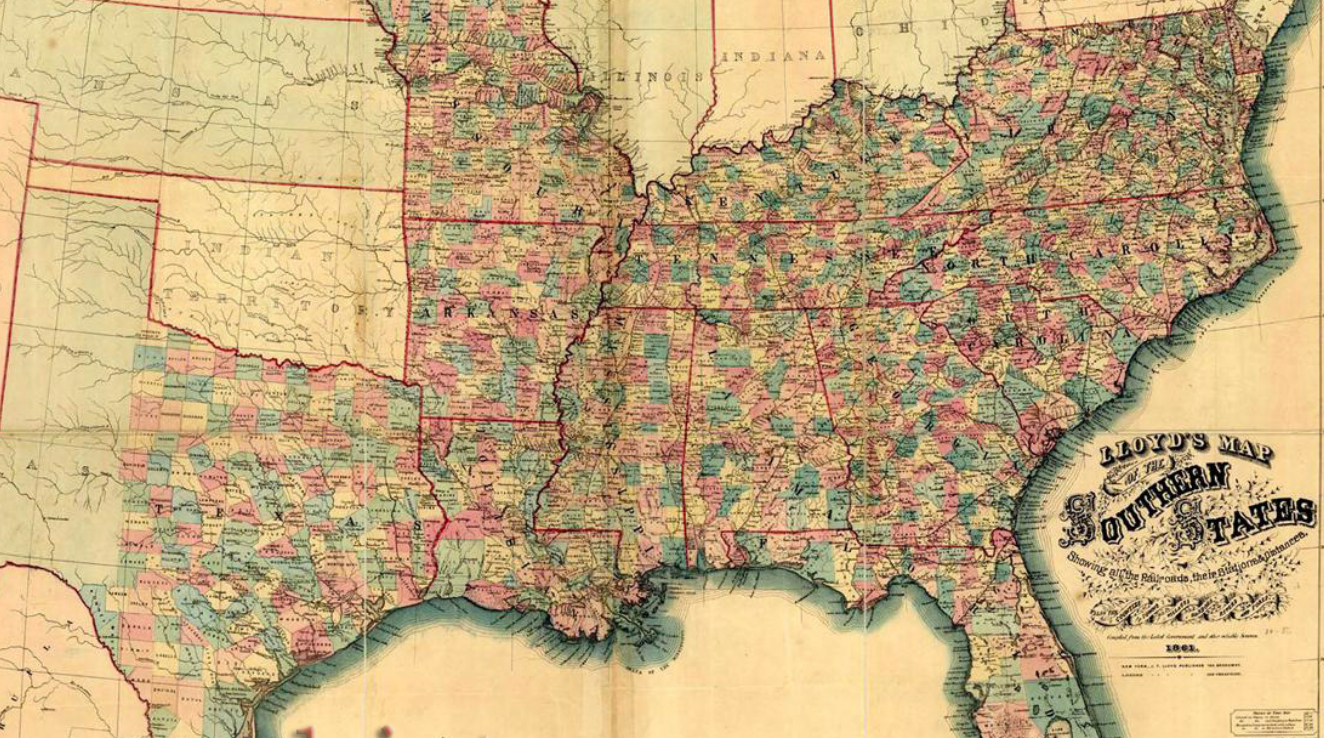
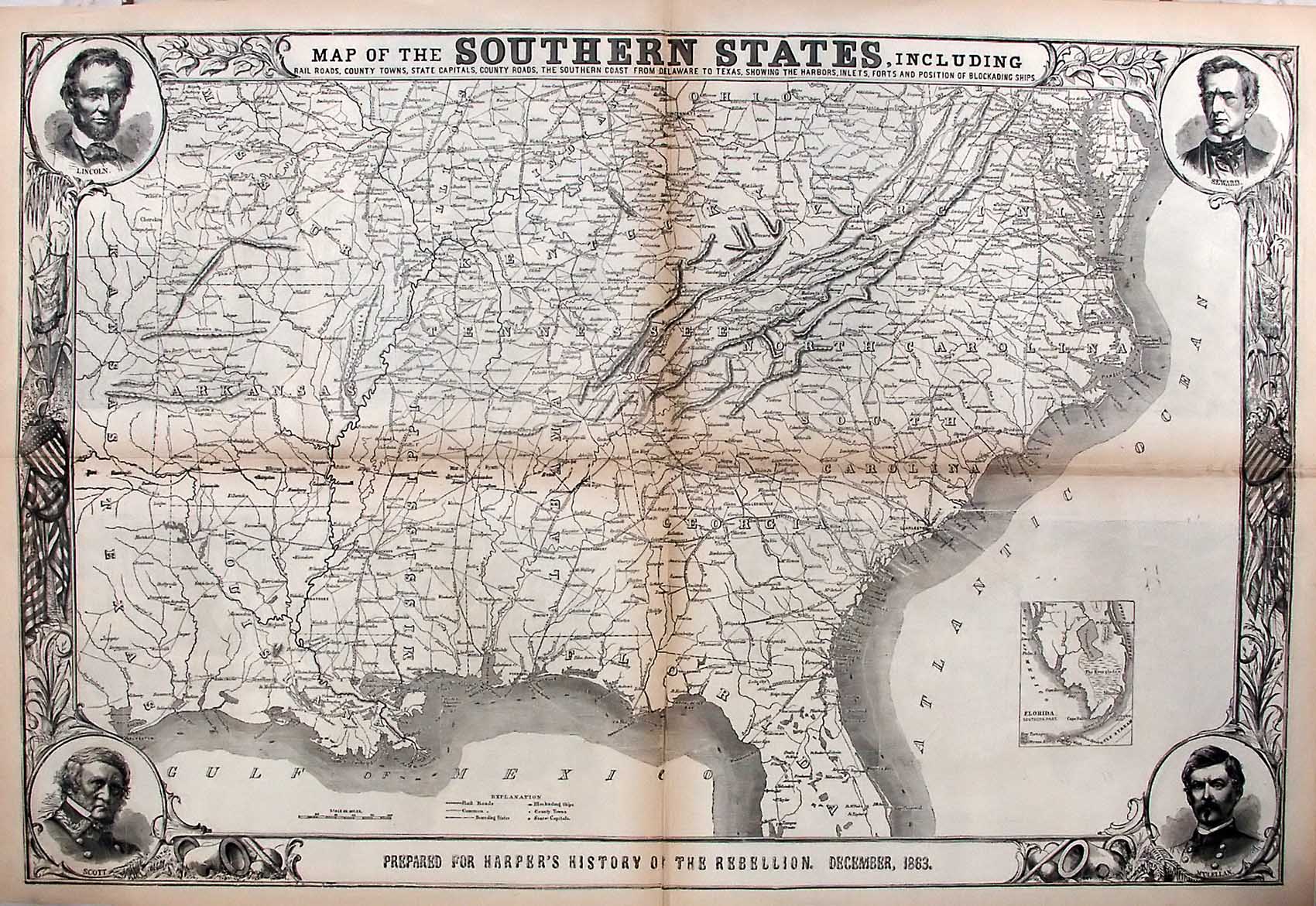
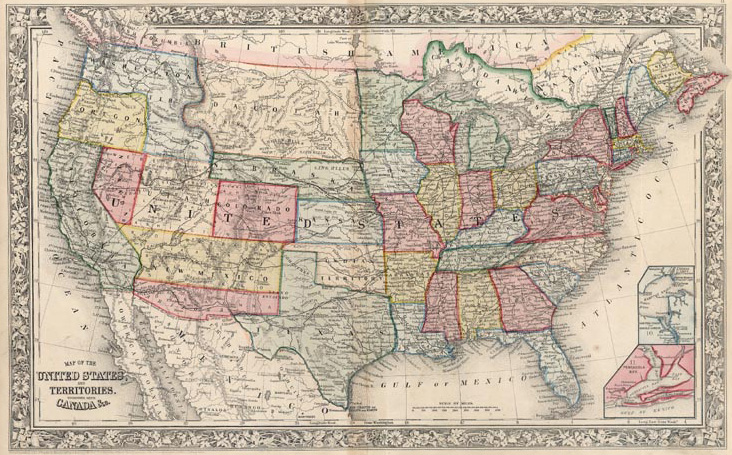
2.  The considerably impressive local detail of Gannett’s 1883 infographic–its local sensitivity–contrasts with the finality of the on-demand infographics that news outlets readily present of a divided nation.  Gannett’s map seems to register the opening of a divide between regions that cut the United States into two, in the aftermath of the Civil War and Secession, that intimates the infographics that forecast recent American midterm elections, or those repeatedly diffused in subsequent visualizations of the distribution of senate seats, described in part in my previous post, it also celebrates the nation’s continued unity in ways that would inform his career as the “father” of government map making in subsequent years: the project and dynamics of “mapping the nation” was raised in Gannett’s attempt to reconcile the after-image of the south’s secession with a definitive image the republic’s unity makes it particularly valuable to examine, recoloring the populations of individual counties previously synthesized in the 1863 Lloyd’s Map of the Southern States as the votes of citizens in the larger body of the United States abutting “Indian Territory.”

Map of the southern States 1863


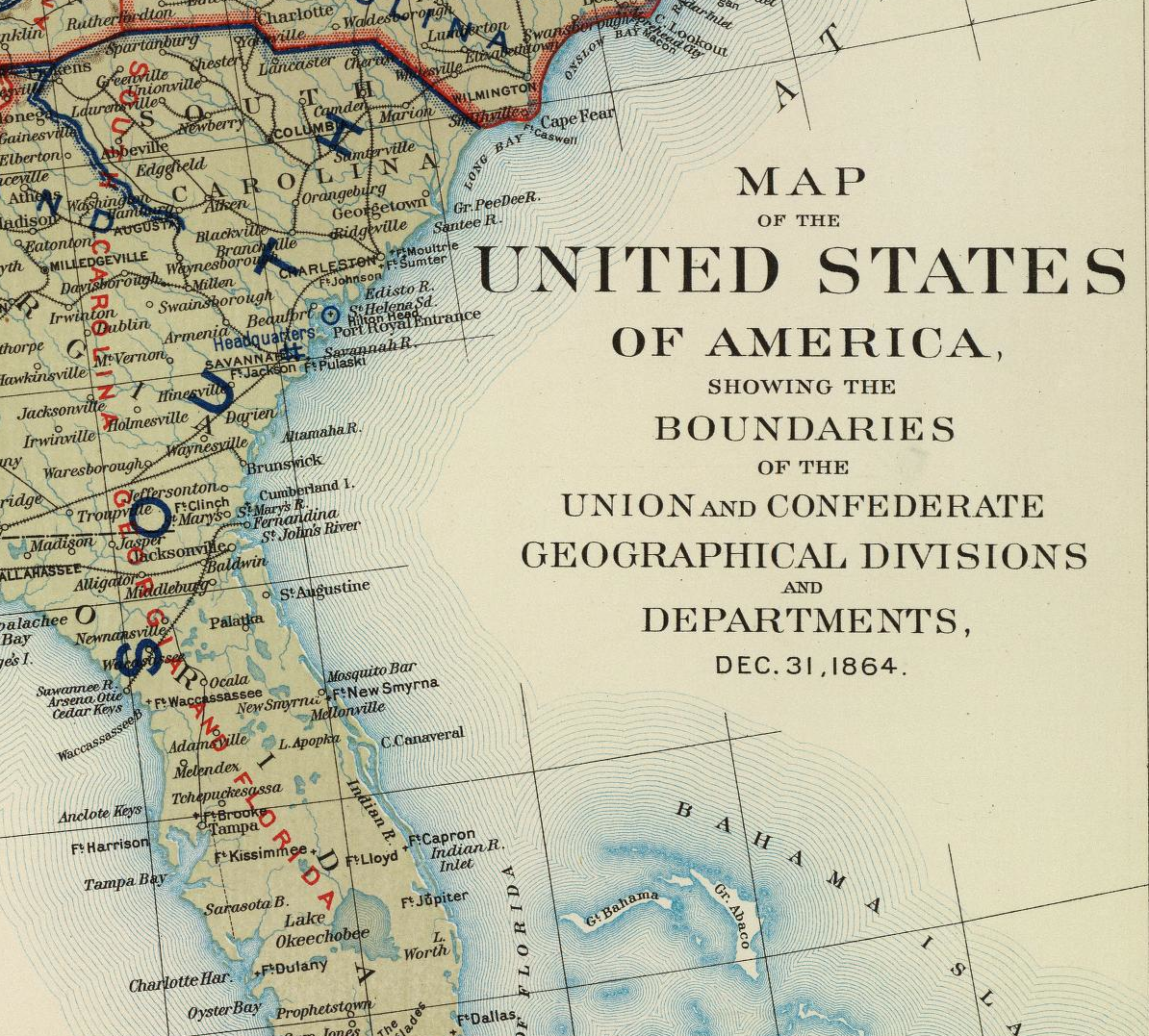
The map of the divides the Confederate States of America within the continent imprinted a latitudinal divide in the cartographical symbolization of space as it was compiled by the US Government c. 1895, in which broad generalities barely legible spread across regions to designate open expanse (“Northwest,” “Trans-Mississippi,” “Northern”)–representationally concretized into red-line bounded states.


Map of America NortheastDetail of “Map of the United States of America showing the boundaries of the Union and Confederate geographical divisions and departments, Dec. 31, 1864.” (1891-1895) (Courtesy Rumsey Associates)

legend of boundaries union confederate

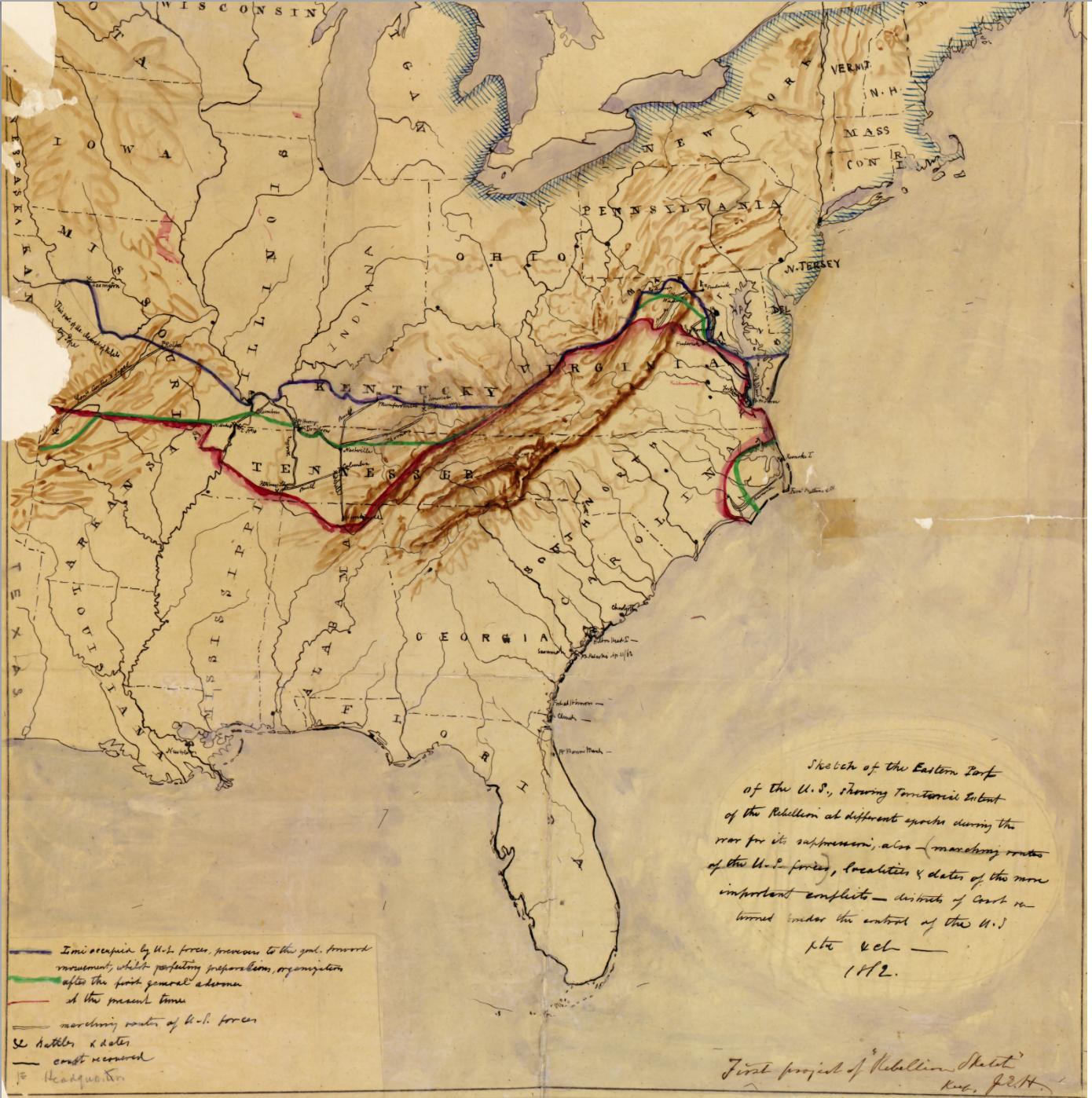
–though a manuscript map that figured secession, “showing territorial extent of the rebellion in different epochs during the war for its suppression” oscillated around the latitudinal divide, in ways that later maps of the popular vote would implicitly address or come to terms, even while they ostensibly map current events.

Map Showing Territories of the Rebellion

But the persistence of the latitudinal line, a state boundary that, rather than the Mason-Dixon line, seemed to define the boundary of resisting the end of the legalization of slavery, created the clearest temporal sign of trauma during the hindsight of Reconstruction, when the attempted enforcement of equality and erasure of boundaries based on the construction of race were for the first time addressed, albeit in ways not easily resolved.

Gannett defined a data-map colored to indicate different percentages of the vote by varied intensity in ways that uncover a historical depth of reluctance to support the program of Reconstruction advocated in the Republicans platform, providing a new way to dive into the local details of the entities that had been described on the surfaces of previous maps, as if to trace an after-image of the survival of the Confederate States of America.


Minolta DSC


3.  The strange conceptual space of the infographic is just beginning to be examined in ways that place its broad brush-strokes of colors in the context of a new way to imagine the nation.  In part, the consolidation of a mass of data in a graphic artifact replicates the problems of processing overwhelming amounts of data in a clearly legible form, distilling the shifting population of the nation into terms that can be comprehended at a glance that makes reduced demands on its readers.  It offers little opportunity to examine the relative “thickness” of these changes, or to try to unpack the surface all too often represented in a clear chromatic divide.

To meet the charge to process data flows by redistributing them in different visual forms, as if refracting the nation through a glass, the data visualization implies a nation that is always riven by fracture lines.  Such an image was perpetuated by focus groups, demographers, and television commentators, eager to continue discussion about the numbers pollsters parsed from exiting voters, to fill up the drama of the denouement that follows the closing of the polls, but also offer strategic insight into the activities of each campaign–and judge the campaign’s strategic effectiveness in messaging, as much as its message.  The demand of such infographics is to put viewers in charge of a broad range of data that they materialize, blending cvs files into divisions of high-contrast color, materializing by a set of keystrokes a  correlation similar to that which Gannett had earlier labored so hard to achieve in order to give the map a degree of accuracy that might best confirm the results of the 1880 presidential election.

The role infographics offer  to orient viewers to the nation’s divides was felt for the first time in the aftermath of 1880, when the collating of unity and cartographical consolidation of the mapping of nation raised questions of what divides were readily able to be surpassed.  The question of how current infographics swallow up the local in the regional–or subsume it in the administrative region in which the local is situated–provide a new way to orient one to a political expanse.  Contemporary infographics resist excavation by presenting images that allegedly record objective national divides.  But the far more complicated story about the nation early statistical presents make them particularly compelling.  The very blindness to the past in data visualization claiming to create a snapshot of a present political status quo alone make one turn to these earlier embodiments of the nation’s electorate, both to ask if they are really echoed so strikingly in our own division between “red” and “blue” states–though we now use an inverted color choice, using red to designate Republicans, and not blue as in the map in this post’s header–or what such colors now embody.  The nation is embodied in Gannett’s map for viewers to explore, as if  a palimpsest of the retention of Confederate collective memories.

Despite the insistence of newscasters to present up-to-date images of fractured political preferences, this post seeks to look under info-graphics’ surface, and unpack the image of a divided nation that infographics which the recent Senate elections perpetuate, creating a record of the short-term that ripped from historical context.  For in describing the results as condensations only of the preferences of the American people, info-graphics like those of the 2014 midterm elections offer a deeply impoverished sense of their historical background.  Using the format of the map to increase the symbolic divisions of the nation as if to naturalize the varied rifts they allegedly expose, trying to convince their viewers of their relevance–divides embodied in far more complex and nuanced ways in earlier statistical maps.

Denis Wood has suggested that the historical lifespan of the map lasts but five to six hundred years, and that the function of the map to embody the state may have already been eclipsed by our current fixation to use GIS to materialize conceptual objects we otherwise lack the terms to discuss.  Wood meant that the power of embodying the state–or the link of the map to the state–has changed in ways that have since eroded.  But the persuasive power of older maps provide to parse the country haunts data visualizations in interesting ways, as their own echoes of the unity and coherence of the nation reappear in them, even if they sere as less persuasive forms of embodiment.  The function of symbolizing the coherence of the nation informs Gannett’s mapping of the popular vote, even as it offers new forms of embodying the nation that depart, for one of the first times, from a record of its physical geography or landmarks.  While an antecedent to the bleached nature of info-graphics, where panels of colors replace a palpable nation, they tease us with the notion of embodiment, using the map to describe the fragmentation that afflicts our political system in ways that are both far less easy to read and less satisfying as texts–and frustrating as intentionally incomplete images.

Blindness toward the past that is so characteristic of most infographics spurs one to investigate the resonant divides of the earliest data maps of the breakdown of the Presidential vote of 1880–a map made at the culmination of the creation of exact statistical maps designed that created legible records designed to persuade viewers of the nation’s continued unity.  This statistical survey charted the distribution of the popular vote with exquisite care in the wake of a polarizing break in the electorate among the issue of Reconstruction in those post-Civil War years.  Gannett realized the historical import of the electoral data as a way to create something of a composite portrait of the nation–following the Francis Amasa Walker’s detailed distributions of the country’s population and racial composition–with the realization of the benefits that the vote could be graphically tabulated in ways that would break down along similar divides.  The result was not one he might have thought would both so stubbornly persist or be accepted as an unchangeable fact–and be naturalized as part of the nation–but provided an after-image of the reactions to Reconstruction across the South.

If Gannett mapped the popular vote’s distribution to suggest the diminishing of the after-image of secession in many Southern states, the notion of political polarization that has seized the media and political coverage exploit the ways that maps constitute an image of the nation’s coherence in potentially pernicious ways, by painting a politics of division, rather than consensus, that prey on the anxiety of intractable differences and evoke specters of a divided country that echo how the country was embodied in earlier maps.  But the recent decline of the power of maps in how we symbolize the nation or understand it makes info-graphics weak after-images of the divides that were, in the past, so deeply felt.


4.  The level of accuracy with which county-by-county data allowed Gannett to parse the polarization of voting patterns across the United States helped visualize lingering divides betwixt northern and southern states.  The divide  told a story of the weight with which the recent historical past sharply divided into two hues, opening local variations for the viewer to explore that have expanded far beyond what Gannet’s original scope may have been:   for to modern eyes, Gannett’s visualization revealed an after-image of resistance to Reconstruction across the reputedly gracious South–one which should not demonize the region, but raise questions about the persistence of economic inequalities and inequalities of citizenship and education that Reconstruction partly sought to remediate.

The effect of mapping is less of performing a history of a nation, in the manner of most printed maps of the nation that were posted in public places and classrooms of nineteenth-century America,  than of opening a breach that not only haunts the nation today, and mapping a scar which almost irrevocably threatens to disrupt the continuity of our political space.  Gannett’s maps make us ask about the ability of mapping as a way of telling a story about the persistence of memories across the land as registered in the genre of infographics, in order, a bit perversely, to interrogate the extreme superficiality of most info-graphics’ historical depth.  Mapping the popular vote in 1880 framed both the memory of the trauma not of the South’s defeat, but of resistance to Reconstruction within the Republican party’s platform–and a hope to surpass a political divide of opposition–by producing an image of national consensus to which many urbanized areas of the South contributed, rather than reflecting the continuation of Southern separatism across the land.

In ways that predate the post-Tufteian elimination of “chart-junk” and elegance of graphical economy of tools of data visualization, Gannett insisted in modern ways on the primacy of the visual as a means of displaying and grasping the deep divide across the nation that the aftermath of Southern secession had wrought, and had recently played out at the ballot box.  Unintentionally, however, the deepest aftereffects that his complexional map reveal among counties across the growing United States was to delineate a divide whose after-image continues to haunt our current political economy in ways we have not fully understood.  For Gannett’s early elegant visualization  is a telling snapshot of the lines of difference that continue to haunt the practice of representative democracy in the purportedly United States, as well as a model of facing the disparities in voting preferences that data visualizations can best hope to record.  The degree of current tacit acceptance or naturalization of this divide among the recent midterm Senate races is particularly troubling, because it suggests a tendency to allow it to persist.

Gannet took advantage of the increasingly better tabulation of the popular vote to chart its distribution with attentive care through shades of coloring provide one of the first attempts to geographically define the distribution of the vote–and measure the persistence of a deeply-runing divide.  Although less based on polls that would forecast the election or tools of current events, than a historical map of a significant election, the map raised questions about the future unity of the country for readers in pointed ways.  To be sure, Gannett’s map offered less a snapshot of an ever-receding past, of course, than a record of the steep demands to heal the divided Republic, but it is something that we can’t but regard with a twinge of recognition:   his map of the break within the 1880 popular vote traced a crisp “after-image” of the experience of the secession of Southern states from the union, providing a counterpoint to secession, whose many after-images also understandably haunts how the electorate divides today in ways difficult to fully process.

Gannett’s inset map visually translated the popular vote’s distribution to electoral votes.  The result was particularly striking, and engaged the increasing role that maps gained in the later nineteenth century as tools and symbols that embody the coherence of the nation.  It perform a story or narrative of national unity that contrasted with the division of the popular vote, and seemed to explain the representational institutions of the Presidential election.  If the symbolic disruption of  national unity was the shocker of Gannett’s map, it also traced a specter similar to that which we face in confronting and trying to mine information from info-graphics of the distribution of voting preferences across the United States in the previous weeks.  The very power of the story of national unity that maps had come to perform in public spaces threatened to unravel, dislodge, or be shaken in ways that the possibility of a post-Civil War fragmentation demanded viewers to confront–but, sadly, persist today and pose steep national challenges.


4_scribners-1883-electoral-vote_625

Gannett would surely have been quite surprised to know how the after-image he traced continued to haunt the electorate almost a century and a half after the fact.  But he would surely have been pleased to note that the breakdown of the vote he statistically mapped continued to offer a point of reference to understand and apprehend the legibility of the historical persistence of the split in the nation’s politics he measured.

For Gannett’s map is striking; historian Susan Schulten has perceptively realized it’s import as a precursor to our own interest in how info-graphics offer an image of national divides that might be overcome–or might haunt us.  In an age when and the dangers of the loss of the VRA have created something of a crisis in voting protections, and at a time when census blocks comprising  75% or more people of color are clustered in contiguous blocks to minimize their electoral presence and impact, the sense of a trust in an image of the nation seems especially important.  The transparency with which Gannett rendered the national divide of the 1880 election is indeed haunting, not because of the ingrained nature of political preferences or the lower geographic mobility in a region over a hundred and thirty-five years, but the problems of embodying political representation the map of the 1880 Popular Vote itself records.

1880 popular vote for HGLibrary of Congress
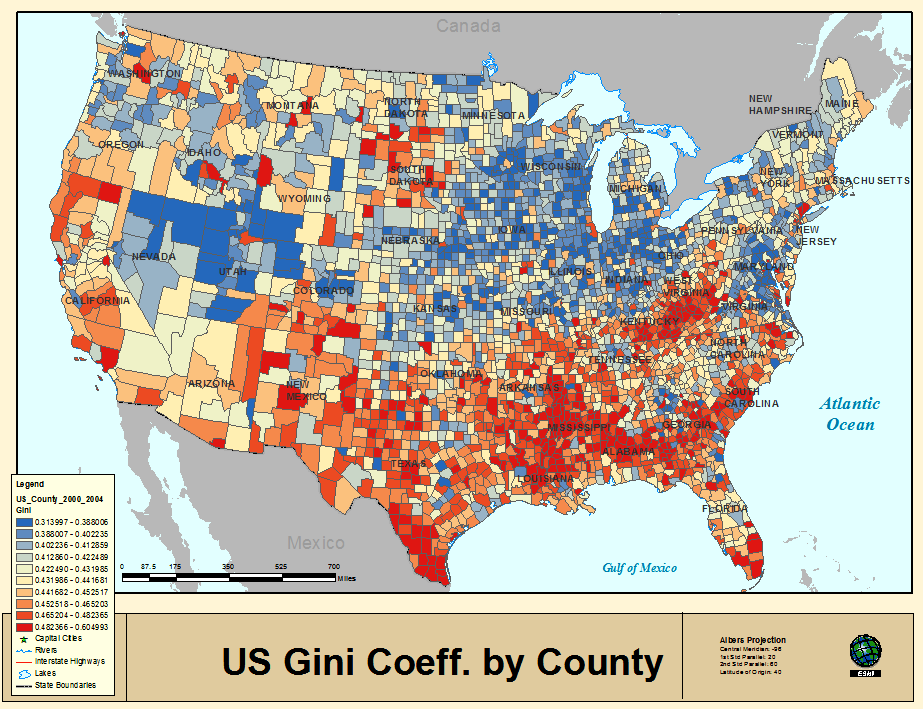
To be sure, the divides in current maps do not clearly reflect the clear carmine pockets of red of anti-Republican opposition.  But the steep economic inequalities underly the relevance with which Gannett’s 1880 map continues to embody breakages of national unity.  A map of Gini coefficients of income distributions in the United States today reflects in the distribution of persistent income inequalities, to be sure, a divide that is reinforced by low median incomes, populations living below the poverty line and low levels of education:

gini-us-by-county


This 2000-2004 map dates but from a decade ago, but itself preserves another eery after-image of the divide Gannett already mapped, and which is only partly continued in a mapping of the number of “active hate groups” that the Southern Poverty Law center found in 2013 persisted below the latitudinal divide of 36°30′–despite the over one thousand active such groups found in the country.


Hate Map spL

HateMap2007


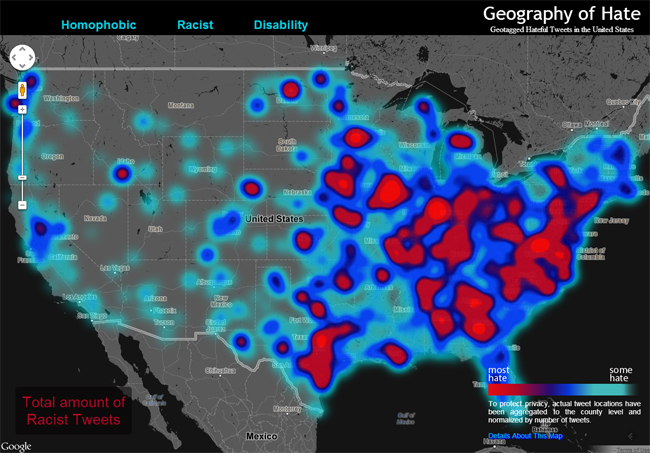
If the divide in the map between North and South suggest a political polarization we thought only existed in recent time, the rejection of most southern counties to vote Republican–and participate in the project of Reconstruction–is oddly echoed in the refusal to raise local taxes on gasoline consumption as my last post suggested.  (This contrasts to the more vague Twitter map of hatred, which suggests a more angry nation, or a divide in the open expression of race-based anger–


hate2


–but clearly reflects the actual manifestation of institutional acceptance for asocial virulence.)

A 2004 map using data from the Southern Poverty Law Center charted the density of the distribution of such groups however reveals a distinct weighting to the Deep South:

Hate Group Denisty

And in the confetti of antipathy that cluttered in specific cities, in another visualization from the Southern Poverty Group, a cluttering centers in the Deep South.

Hate Groups in Cities

The widespread confetti of hate-groups distributed in 2004 across the nation lay across the nation’s cities; but when read against regions of such groups’ specific local and regional densities, it, strikingly, clearly continues to privilege the very same trapezoidal structure lying below the latitudinal divide.

us_map


5.  Gannett’s 1883 map celebrated the refusal of the South to successfully secede from the Republic–and to obstruct the election of a single President–the divide it documents records the deep scar lines that existed in the country for several presidential terms after Lincoln’s death.  It testified to the deep hope in how statistical maps would provide a new image of a united nation.  More than measure or encode territory, Gannett distributed electoral data in ways that help us judge or measure our own distance and temporal remove from it, and, as it were, orient one’s sense of bearings on the divides of national unity it reflected, as well as divides in political preferences that the recent proliferation of infographics that parse “red” and “blue” states with different signifiers attached to each.  This raises questions about the continued embrace of a divide along lines of Secession as a future model of politics increasingly naturalized in our national landscape.

Contemporary national maps with which Gannett’s must be contextualized emphasize the performance of the nation’s symbolic unity unlike many earlier maps, and reveal the possibilities of printing maps for a large audience of readers and students, many of whom would read the map not only as a way to orient themselves to the nation but to naturalize the composition of the continental span of the United States’ continental expanse.

B3HmuB2IcAAy8Kt

In the wake of the 1880 election, Gannett created a conscious self-portrait of the nation for the Scribners encyclopedia of statistical maps that uncoincidentally sought to measure and explicate the possibilities of coherence that the election revealed, allowing the data to speak to readers at an unprecedented county-by-county granularity that exploited the new currency of the publicly displayed map as an image of the nation.  The Gannett map’s division of the country into counties reflects those images increasingly publicly displayed for didactic and pedagogic ends in schools, offices, train stations, and city halls replete with topographic signs and transportation routes–although it was evacuated of them, and replaced them with a tally of the vote to map  a symbolic digest of political institutions rather than a guide for spatial travel–disrupting a symbolic form of national unity that prominently featured in the typical rural schoolroom circa 1873, if one can trust the Universal Exhibition held that year in Vienna–though the display of worldliness was partly designed, no doubt, to impress continental viewers by such conspicuous placement of emblems of geographic instruction.

School-room-Vienna


Indeed, the shift in consuming maps after the civil war–when newspaper readers had tracked the progress of Union armies across the south, read and commemorated different battles, and received correspondences from loved ones in a landscape destroyed by war would have  rendered even the divided electoral map that Gannett drew deeply pacified, and a tacit agreement to resolve the distribution of dissent by other means.  Gannett indeed seems to have mapped such a divide between northern and southern states in its county-by-county distribution in ways that illustrate the dramatically increase in literacy in maps as accurately mediating the national vote.  While Gannett’s map showed pockets of Republican voting in the southern cities during Reconstruction in considerable detail, to be sure, but also suggested a national divide that could still be preserved, if not to create the unity of the United States preserved in national maps like that of Augustus Mitchell, showing the regions beyond the Mississippi the Union created in the Dakotas, Nebraska, and Utah in an attempt to enlarge by legislative fiat the number of non-seceding states.


mitchus61


The divide would continue to persist, of course, long after the 1880 election.  In ways viewers would readily detect, the 1883 map revealed the cultural memory of collective affront at the continued presence of federal troops to ensure the policies of Reconstruction and the , beyond a simple record of spatial relationships–an issue that had already led to the passage in 1878 of the Posse Comitatus Act, designed to prohibit armed forces from acting as a police force inside the country–but where the army’s role in enforcing civil rights clearly remained contentious.  Gannett’s map revealed an oppositional divide in the electoral distribution which seems eerily familiar to our own political division–it renders the extent of a  story of the affront perceived across the southern states far more dynamically textured than the rather generic templates of much contemporary digital map design.  in ways displaced from its original intent of describing the translation of the distribution of the vote it delineated a clear reluctance to support a Republican platform across the southern states.


6.  Gannett’s mapping of the reluctance to adopt the Republican platform of Reconstruction is sharply unlike the divide between gasoline taxation across of the country that was popularized on the blog disseminated by the folks at Exxon-Mobil to suggest reasons for gas’s uneven price, but that image–for all its dependence on fact–clearly depends on a familiarity with map readership of the separate polity of the south, and the unconscious image of a divided nation that defined southern secession.  For all its insistence on an uneven distribution of taxes, the uneven distribution it reveals has gained traction as an icon of tax disparity on account of these associations, no doubt, even if rather than being rooted in relation to an actual historical divide, the graphic suggests only the independence of select states–New Hampshire, Missouri, and an expanded version of the Old South–that compel us to wonder about the apparent latitudinal divide on the imposition of gas taxes as if it were something of a new Mason-Dixon line along the 37th parallel.

The divide in the popular vote’s distribution Gannett revealed in the 1880 presidential vote reflected historically specific political responses to Reconstruction.  But its divide is nonetheless interestingly echoed in a quite contemporary map as a way to document in detail the disparity in taxes on the price of gasoline.  For the Gas-Tax Divide, if generic in its features, seems inhabited by national divides of over a century ago.  If the American Petroleum Institute intended to depict local resistance to impeding access to fill one’s tank at the lowest possible cost, and document the local variations in the price of gas that were instituted by local tax policies, the latitudinal division  reflects the priorities of individual counties, far more than an artifact of the surveying of the boundary lines of States, and mapped less an image of separate sovereignty than a suspicion of curbs on unfettered consumption of gas below the 37th parallel.


Gas Tax


The light ochre monolith below the latitudinal divide?  If it echoes the distribution of the Popular Vote in Gannett’s map of the 1880 election, and falls along a clear line of latitude, the break offers an unclear a record of political affiliations.


7.  The “informational graphic” seems to recycle the conceit of dividing “red” states from “blue” states both in recent parsing of senatorial races and in the tabulation of Presidential races–in ways that crystallized during the aftermath of the election of 2000.  Whereas Gannet, adopting the colors of the American flag, connoted not just opposite ends of the spectrum, but the coherence of the nation, the connotation of fragmentation and opposition was invested in the bicolor map when “blue” was cast as the color of liberalism during the reporting of results of the 2000 American presidential election.   The choice of “blue” as the color-choice to designate the Democratic party was not only decided by the NBC graphics department–David Letterman famously gave broad currency to the notion of such an opposition when he tried to resolve heightened anxiety at the uncertain results of the election when he somewhat Solomonically (in hindsight, optimistically) suggested that the US Congress “make George W. Bush president of the red states and Al Gore head of the blue ones.”

The history of divides between “Red” states and “Blue” states perhaps respond to a need for meaning our chorographical collective, as much as they essentialize the attributes of any region or location as distinct.  But they tellingly employ the patriotic hues from the primary colors–red and blue–not only to visualize  either end of the spectrum, but to suggest the continued coherence of the data visualization in a map.  There is less intensity strong enough to generate such perceptual after-images in a map, or presume after-images might be expected to exist, given the shifting political landscape of polarization, which suggest something like a search for narratives of differences that is mediated through political institutions process a political space.

For Gannett, the choice of hues employed to elucidate the bitterly contested election rendered the abstraction of party affiliation at a time that the divide between platforms  around the Republican platform of retaining the federal military in the southern states during Reconstruction, creating a fierce anti-Republican divide across the South who voted strongly Democratic as a result.

1880 popular vote for HGLibrary of Congress
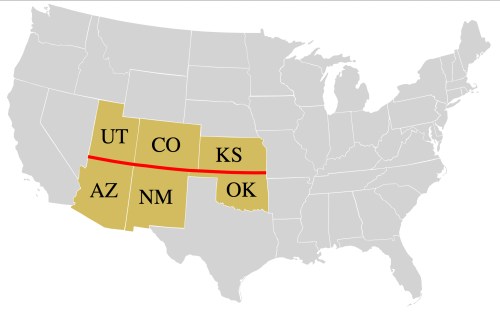
 

The analogy between electoral divides across such spreads of time suggests moments of alternate embodiments of the nation–with which Gannett, as Supervisor of the U.S. Census, was no doubt particularly sensitive.


8.  All maps tell complex stories about continuities in a national landscape that the individual map rarely explicitly describes, but which are often suddenly apprehended with a shock of recognition as the familiarity of their distribution embody seems so eerily familiar.  Although we look at the matter of maps as temporally removed, rather than remaining rooted in an inaccessible past, the landscapes maps create can throw into relief the actual divides that they seek to describe in accessible ways.  Even as artifacts of striking authorship, maps offer templates by which to trace trajectories in space that, rather than being inherently bound to the region they describe, and might be read as revealing a collective regional cultural memory or unconscious.   Reading such maps for after-images offers points of comparison and departure to read their spatial distributions–and offer indispensable points of reference and comparison to read meaning into later maps, as well as a basis for interpreting their terrain.  The non-physical topographical markers and divides in current maps such as that of gas tax levels in the United States demand a degree of historical depth to remove them from the admittedly polemical roles that groups as the American Petroleum Institute intended.  For in registering distinct landscapes of populations, even after a century, north-south cultural divides emerge, mapped in the below distribution between “red” and “blue” counties that Gannett sketched eerily mirror our attraction to mapping red and blue states that dramatize the divide in far more muted hues.  Its statistical basis seems eerily familiar as a synthesis of a gaping divide that challenges its viewers to wonder how that divide might ever be bridged.

Gannett sought to refine existing cartographical techniques and lithographic tools of representation to define the historical distributions of local populations and ethnicities over time in the United States in elegantly artistic if didactic ways, coloring regions in ways that blend aesthetics and cartographical to frame a complex narrative that measure the intangibles of national unity from the data available on its inhabitants.  Perhaps unsurprisingly, the story implicit in his mapping of the political divide that was inherited from the Civil War resonates not only with present distributions of lower taxes on petroleum in compelling ways.  It offers evidence of a continuity in problems of concluding a national consensus that continue a century later:   Gannett elegantly converted the data of the presidential election of 1880 in a particularly appealing way designed to forge unity by capturing its divides in the delicate balance of color-schemes on a map’s face, and created a striking image that seems to haunt shifting attitudes to accepting a tax on gas from which it stands at a remove of almost a century-and-a-half.

By examining disparities among political preference for parties at an unprecedented visualizations of variations across the country of considerably fine grain for the 1883 Scribners’ Encyclopedia, Gannett clearly mapped a strikingly stark political polarization in the United States which bore deep scars of civil war.  It has gained attention for its eerily familiar family resemblance of mapping the current gulf between red and blue states.  It seems to recapitualite a contested narrative it seeks to resolve as well as inventively retell.  In ways that have continued to sculpt a political landscape of the new century, and the elections of 2004 and 2008, the elegantly synthetic two-color info-graphic that Gannett devised imaged the continued divisions of the country as a form of political consensus, if of a fairly fragile sort we turn to maps to recreate across space.

In the wake of the secession of Southern states from the Union, statistical visualizations of the states served to explain the distribution of electoral votes as a decisive factor in the designs of printed maps of the country  to render the dissonance among the geographic size of regions respectively won by Republican Tilden and Democrat Hayes, Susan Schulten observed, in an omen for the nation’s centenary:  deep distrust over the continued presence of federal troops in the south to enforce Reconstruction Republicans advocated is registered in the anti-Republican vote across the south.  The division in the popular vote was troubling in 1876, because Tilden’s majority was preserved in the electoral college–in ways that led engravers as Henry Clay Donnell, Henry Kowalski, and Charles S. Israel to devise for the U.S. Election Map Co. an image that mapped the electoral college across presidential elections as states were mapped from 1789 to 1876, in parallel to Gannett’s own efforts, in a nineteenth-century version of Sparks’ minute-long video:

ElectoralCollege1789-1876


The chronological sequence of maps of the voting distributions over the first twenty-three presidential elections responded to growing interest in the wake of the divisive election in which the US Congress overturned the popular vote to historicize the apportionment of electoral votes and voting results, revealing a recent statistical familiarity with tabulating results that was perhaps particularly pronounced by 1880.  Such a sequence sought to affirm the consensus arrived between different regions, in order to process the political shifts of the expanding nation in cartographical terms.

The cartographical sequence of electoral apportionment is an argument for the nature of representational democracy, and a historical reaffirmation of  the institution of the electoral college, as much as a digest of past presidential elections.  After Republicans had cast themselves as the party of saving the union in 1876, Census Superintendent Gannett devised the idea of a detailed county-by-county account of the distribution of the national popular vote of 1880 whose publication was designed to overcome a vision of division by showing the local depth of Democratic votes for the Republican candidate, Garfield, that made his victory–as narrow as that of his predecessor, Rutherford B. Hayes, which had been only resolved by the electoral college–a form of crafting consensus and affirming the electoral system as well as well as a persuasive statistical synthesis of big data, on of the first of continued efforts to pioneer statistical geography he devised to chart and affirm the nation’s continuity as much as document a national divide.

In the above expansion of the tools and techniques Gannett used in the 1883 Statistical Atlas of the United States, Donell, Kowalski, and Israel mobilized the forms of maps created a visual record of how counties leaned Democratic and Republican across the nation that its viewers could readily interpret and analyze, defining an electoral divides to describe not only spatial relationships in a fixed distribution, but embodied distinct voting preferences across counties by differently hued shades of blue and red to represent the entire electorate and election’s outcome–in something of a precedent to Sparks’ compelling animated video of the shifting political divides between the electorate which have only recently crystallized into a firm red v blue divide.

By tabulating the vote in spatial terms, Gannett achieved a  sense of continuity and regional identity that has continued significance in the after-image it creates of war.  By defining local variations as if they themselves constituted an actual terrain–employing a recognized geographic apparatus to describe the processes of representative government–he quite compellingly register deep divides that still starkly divide the nation a decade after the Civil War, even if off of the battlefield.  He would have been impressed by the continued reluctance of a similar region to refuse the imposition of local gasoline taxes, and by the continued resilience of the opposition revealed in his own earlier info-graphic to have gained such rhetorical prominence during the Obama’s two presidential campaigns.

9.  Gannett resolved an astounding geographic specificity to chart the legitimacy of Garfield’s victory after a bitterly contested election in 1876, when the electoral vote had in the end famously revised the outcome of the popular vote.  For Tilden could claim a majority of the popular vote, but the pro-business New York Governor had lost the electoral college.   That election’s results had been sent to Congress, where a 15-member Electoral Commission sought to determine the validity of the contested popular vote and its translation into electoral counts and gave the victory to Hayes in the Compromise of 1877–or Corrupt Bargain–which ended the federal involvement in local southern elections during Reconstruction by the Republican party, and, despite Tilden’s victory in the 1876 popular vote over Republican Rutherford B. Hayes, modified the Republican platform for federal supervision of the civil reforms that would be part of Reconstruction.  Despite Hayes’ previous strong support of protecting the civil rights of newly freed slaves in the south, he continued his earlier promise that the Southern states to no longer be occupied by US federal troops to enforce civil rights in his administration but rather, as Hayes put it, enjoy “the blessings of honest and capable local government,” despite the clear continuation of measures explicitly designed to obstruct universal suffrage from poll taxes to intimidation.

The presence of federal troops across the south had been rejected in the Southern vote, and as part of the compromise that guaranteed Hayes’ victory, the Republican allowed Southern autonomy, gaining the misreported electoral votes of southern states in order to capsize Tilden’s majority vote, given his broad support not only in the Northeast, midwest, and West, but the most populated regions of the south, including along the Mississippi and Carolina coast.

Election of 1876

VHE_Campaigns_IL.2012.2.18.2_front_medium

Tilden’s over-ready acquiescence to the electoral configuration after Hayes’ challenged the electors from South Carolina, Florida, and Louisiana–in spite his having gained a plurality of the popular vote by the then-quite-considerable margin of over 300,000 votes–sadly sealed the end of his political career.  But the heavily contested nature of the election, and, no doubt, the difficulty of the narrative that it posed about the nation, also mandated the more detailed county-by-county remapping of the election of 1880–and which the modern reproduction of a county-by-county count revisits to show the limited votes for Tilden across Southern states.

1876

In the face of the building bitterness of the Southern states over the program of Reconstruction Republicans had advocated in their platform, Rutherford B. Hayes had earlier promised for the Southern states to no longer be occupied by US federal troops to enforce civil rights, but to rather, as Hayes put it himself, enjoy “the blessings of honest and capable local government,” despite the clear continuation of multiple measures that were explicitly designed to obstruct a universal franchise across the South and southern states–from poll taxes to intimidation, helped him reach significant support across South Carolina and along the Mississippi, often from newly enfranchised voters, although the majority of southerners had voted against Hayes.  The Gannett projection avoided the drawn-out sense of political stalemate that had haunted the 1876 election and its injury to a democratic process.

election-cartoon-1876-granger

The stinging victory of the Republican left considerable bitterness of dissatisfaction in the outcome for the Democratic party, however, in the face of much suppression of the vote, and deep scars across the land that the election of 1880 did not erase.  The relative independence of what often appears as a distinct enclave in the south did not only depend on the memory of the Civil War, often framed as resistance to Reconstruction.  Even as the presence of federal troops across the south had been rejected, as part of the compromise that guaranteed Hayes’ victory, in ways that the Voting Rights Act would replace by the oversight of the Dept. of Justice on changes to voting practices in order to ensure greater national uniformity of access to the ballot box.  The image of the rejection of Reconstruction, refusing the incursions of armed forces to teach a culture of equality, echoed in the reversal of returning federal troops to ensure the integration of Little Rock Central High School or Representative John Lewis’ vigorous call for martial law in Ferguson, Missouri after the tragic shooting of the 18 year old Michael Brown, and a similar need to federalize the Missouri National Guard “to fight the fires of frustration and discontent” across America–and the federalization of the national guard in Montgomery, Alabama during civil rights struggles of the early 1960s that Lewis knows so well.  (The recent expansion of a “no-fly zone” over Ferguson that was approved by the FAA to contain media coverage by creating a blanket of some thirty-seven square miles seemed to exclude police actions from public media attention, and subtract it from news coverage–a troubling violation of the First Amendment rights–was designed to subtract the police’s relation to protesters in the St. Louis suburb from national debate.

The local response to the riots in Ferguson suggest a militia-style intervention in the demonstrations that attracted uncomprehending and aghast global coverage.  Indeed, the local expenditure in the St. Louis county police to replenish their stock of needed “civil disobedience equipment”–including riot helmets and related gear, tear gas, pepper balls, plastic handcuffs and grenades–has approached $175,000 since the reaction to the riots following Michael Brown’s killing by local police, including “LiveX” brand pepper balls that boast themselves to be ten times hotter.  Amnesty International  recently noted the danger of “Equipping officers in a manner more appropriate for a battlefield may put them in the mindset that confrontation and conflict is inevitable rather than possible, escalating tensions between protesters and police.”

10.  The results of the 1876 popular vote  belied their geographic distribution in ways that are visible in the above recreation, where the majority of the land seems colored Yellow, and created new challenges for .  As a result, Gannett sought to educate viewers in the translation of the vote to electors, and no doubt to conclusively persuade of the decisiveness of the bitterly contested presidential election, by documenting the extent to which, despite the strength of anti-Republican sentiment throughout the south left, Garfield conclusively won the presidency.  Gannett’s map, while registering the suppression of African American vote in much of the south, responded to a pressing problem of the need to map the nation’s continued unity within the popular vote–as much as register its political divide around those pockets that revealed clear clusters of Republican votes in this reconstruction for schoolroom teaching about the distribution of the vote from 1932 that provided the regional breakdown within states that Gannett’s statistical mapping would allow on a county by county level.

Gannett’s visual explanation of mapped the distribution of the popular vote into electoral votes, tracing the complex distribution of pockets of counties of voting, and transferring the distribution of the popular vote to the electoral votes far more effectively than the less refined or elegant distributions that were engraved of the country to explain the outcome of the vote in 1876–when the matter had, after all, been resolved by committee–after two alternative sets of electoral returns were submitted by the southern states of Louisiana, South Carolina, and Florida, in ways that left the outcome of the election in balance–and demanding a greater proof of electoral returns in 1880–even if the cartoonist Thomas Nast had used the electoral map to predict the Republicans would carry the nation from California to Maine.

67574_188_elec22_lg

A far more variegated map of the distribution of votes was required to tell the story of Republican victory for James Garfield that was understood across the nation as a referendum on Reconstruction–partly explaining the fear that the vote would result in a division of the country that replayed a secessionist divide of the Missouri Compromise.   The story was particularly complicated of how the Republicans continued to carry the nation, but demanded, by 1883, the results of the 1880 election to be commemorated by a far more detailed map for viewers to scrutinize.  The zones of deepest carmine red in counties in Louisiana, Texas, Missouri, Arkansas, Alabama, and South Carolina create a canvas of deep distrust and map something of a dissonance in the nation in reaction to policies of Reconstruction and an agitation for strongest shifts in sovereignty.  The multicolored map allowed one to read the balance of popular and electoral votes in the country, and was clearly prepared for an audience eager to visualize the continued integrity of the Republic and construe relations between popular and electoral votes, reflect on operations of political sovereignty, and, indeed, to try to visualize and fashion consensus from the contentious elections results in peaceful fashion, where dense pockets of republicanism across the south, particularly along the Mississippi and around New Orleans, as well as South Carolina, seem to testify to the presence of the votes of enfranchised former slaves.

Continuous Crimson

The electoral division turned on the issue of the continued autonomy of the South, and effectively continued the dispute of the Civil War off the battlefield:  the north-south divide migrated from the battlefields to the ballot-box.  The county-by-county mapping distributed the popular vote and beside a translation of the election to electoral votes represented something of a conclusive resolution for the bitterly contested election.   The map registered almost palpable opposition to continued presence of federal troops, reacting to the feelings of infringement on local liberty from federal military oversight of the South during Reconstruction in the election whose traces can be seen in  cultural memory when federal troops much later allowed the Little Rock Nine to attend an integrated High School in 1957, if seems to have been remembered by few when Representative John Lewis responded to the deep distrust occasioned by local police’s August 9 shooting of eighteen-year-old Michael Brown in 2014 by requesting that President Obama declare martial law in the small St. Louis, Mo. suburb of Ferguson after violence erupted in the streets:  it seemed the proper reaction given mutual miscomprehension about the still unexplained ten to eleven pistol shots–an act that only led to an almost informal late-September apology from the local police chief.

Missouri and Arkansas contained particularly deep regions of crimson as former slave-holding states, where memories are strong.  (Missouri still lies on the other side of the gasoline-tax divide, if it is geographically located above the parallel that sets off most states in the American Petroleum Institute’s map.)  Is it unfair to note that as Gannett mapped a divide that reacted to the infringement of using  federal troops to ensure civil liberties across the South, he transcribed a cultural memory that echoes even a century off, and generates its own after-images of resentment at civil liberties?  Missouri is, of course, seen as a less reliable “red” state than it was in 2000–when it went for Bush over Gore–but remains, interestingly, on one side of the Gas-Tax divide, even if it lies mostly entirely above the most prominent meridian’s divide.

11.  Gannett’s infographic parsed county-by-county voting tallies of the election, years later, to clarify the impact of Hayes’ victory; the economy of the inset map of the electoral college succinctly symbolized Garfield’s Republican victory in an icon of national unity.  The cartographical image might now raise questions for some about the distribution of electoral votes that it records, and the heavy number of electors from the southern states, but it used the map to bind the continued coherence of the states in the republic at that time, explaining how the affirmation of Colorado’s statehood effectively tilted the balance of the electoral count.  But given the prominence of the issue of autonomy of the formerly seceding states in the union, it’s striking for the density of deep crimson in multiple blotches below the thirty-seventh parallel: their intensity holds the viewer’s eye , despite the lightness of the light blue shading in northern and midwestern states.

The dividing line served as a basis to articulate deep desire for autonomy and the withdrawal of federal presence oddly continued in current politics, and reflects a line that the US government had as recently as 1875 contracted the surveyor Chandler Robbins to find as a boundary line between Arizona and New Mexico, running along the 37th parallel from the four corners monument–the very same line separated the greatest concentration of anti-republican votes, and would encourage the growth of Southern Democrats, and the latitude seems a fold along which the nation divided into two just a generation after the wake of the Civil War, but although Utah, Arizona and New Mexico did not yet have electoral votes in the Presidential elections as other states, Gannett revealed a clear divide on the latitudinal line between the rosy pink states north of Tennessee and Virginia, and the deeper red reserved for the Deep South.

37th Parllel

4_scribners-1883-electoral-vote_625


The infographic effectively summarized the historical and sociological divide in deeply symbolic ways.  It affirmed a resolution before the expansion of the United States that relayed the future expansion along the lines decided by the Missouri Compromise:  unlike the simple geographic distribution of the popular vote in the election would suggest, the particularly contentious election was only resolved in a decisive manner by confirmation of statehood for Colorado its one electoral vote tipped the scales to Hayes and handing him the presidency.

The image suggests the increased expectations of cartographical literacy to read and interpret, that seems to mask over the deep divide between North and South which would repeat the division of the Civil War itself:  the reader of the map would note with surprise the considerable number of electoral votes assigned Minnesota, Kansas and Nebraska, which serve as a counterweight to the greater electoral votes of Southern states, that uniform swath of red  encompassing a considerable share of nation’s geographical territory.   Hayes’ presidency rested on midwestern states as Ohio, Iowa, Nebraska, and Kansas but also masked a division in the country parsed in the first data-maps and demographic infographics:  the map is also startling since it reflects political divides from recent elections:  the color-scheme almost holds, irrespective of shifts in political affiliation over one hundred and twenty-five years.  The dextrous distribution of the popular vote Gannett mapped was reprinted in Scribner’s Statistical Atlas (1883), for viewers to scrutinize local variations in the distribution of election returns at fine grain on the county level.


3_scribners_1883_625_0Library of Congress
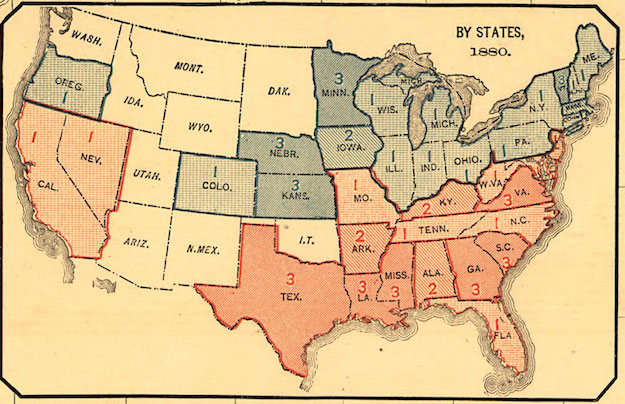
 

The lithograph was designed as a cogent explanation of a national divide, something of a counterpart to the famous chloropleth lithograph of slave-holding states which Alexander Dallas Bache devised based on the 1860 Census with the recent German immigrant Edwin Hergesheimer (1835-89), or the instructional wall maps like the so-called “Washington Map” Matthew Fontaine Maury mapped from the Census–“States Marked thus * Claim to have seceded from the United States,” the legend of the latter reads, presenting itself as an explicit performance of the continued claims to national sovereignty of the United States.  On the eve of the US Civil War (1861-65), Maury, then Southern Secretary of the US Navy, mapped a Republic in ways that silenced clear fracturing, following a county-by-county cartographical practice but intentionally omitting the geographical divide that would open like a chasm in maps such as Gannett’s in later years.

All are, in a sense, evidence of a turn to the resolution of crises of national representation and the dramatically increasing “map literacy” of the late nineteenth century American reading public, or map-mindedness, that suggest the extent to which thinking with and through maps provided new forms of symbolizing and understanding national unity in readily reproducible form.

jp2-1.py

JIM1443-redd

Yet we are also, for reasons it demands to be explored, both less attracted by attention to the complicated nature of divisions, and perhaps, given the amount of data by which we are increasingly overwhelmed, more eager to resolve disparities into monochrome voting blocks.  The divides we seem to imagine always existed or only increasingly solidified emerged as something like a means to heal how the performance of the unity in the map had been torn asunder in the Civil War, but was in fact able to heal, rather than to ossify or be accepted as an inevitable and insurmountable divide that so often seems to continue to cut across the land.

Leave a comment

Filed under data visualization, Henry Gannett, infographic, Persistent Income Inequalities, Red States vs. Blue States, Susan Schulten

National Waters, Legal Fictions, and Rivers of Fertilizer

If drawn maps rely on distinguishing lines of property, territoriality, or even shorelines, the overlaps of more interactive web maps provide new strategies to trace the complexity of relations between land and water.  The projection of the network of rivers within the United States Jason Davies mapped above, in the header to this post, creates an entrancing web of the body of rivers less as a network, but a nourishing group of waterways.  The map’s beauty provokes us to rethink relations between land and water.  In rendering rivers, rather than territory, it suggests how a dynamic mapping of layers and overlays from directly and remotely sensed data might lead to a range of new cartographical strategies to chart the increasingly complex relationships between land and water in ways that would be less concerned to abstract the waterways or supplies of water from their surrounding environment, but to integrate water into the landscape and ecosystem which it nourishes–or the ways that the entry of pollutants into that hydrographic network might compromise local ecosystems across the country.

To be sure, the apparently pristine pathways that irrigate a disembodied nation in Davies’ map are not so static as they might seem, but his map calls attention to the need to map this body of waters as a constantly challenging collective that registers its fluidity and the changing nature of its composition:  to be sure, not only are not all waterways on the map, but despite omissions the delineation suggests a delicate ecology increasingly in need of being mapped–and increasingly challenging to be embodied.  It is no coincidence, perhaps, that even as Davies created a utopian image of an unpolluted riverine network, it is in response to the attention that the 1972 Clean Water Act gave to the “national waters” of the country that a clearer mapping of these very waters have been called to attention.  If only to stop the range of legalistic reinterpretations of “national waters,” we face increasing challenges to coherently map rivers in isolation from wide the augmentation of phosphorous and nitrogen in surrounding lands, and difficult to disentangle from numerous questions of irresponsible misuse.  No doubt Davies would admit that his data on rivers are not meant to hide the multiple sources of pollution and human diversion of the nation’s hydrography.  Even in a recent rendering of the National Hydrography Database (NHDPlus v2) by the Pacific Institute estimates the magnitude of river flows across the lower 48, show a gage-adjusted record of flow in cubic feet per second as a quite pristine blue:

Average Anual FlowMatt Heberger/Pacific Institute

But the elegance of his hydrographic map, which morphs the fragile constellation of the riverine network of national waters, challenge readers to read the magnitudes of rivers’ flow, but preserves the raster image as an elegantly designed artifact.

It almost provokes us to develop something like a truly comprehensive cartography of the “national waters” the Clean Water Act first addressed in the deep need it isolated to protect the “untrammeled” identity of national parks or woodlands.  Even as we emend the perhaps unnecessarily broad language of “national waters,” which verges on attributing a misleading uniformity to water and to only include those waters that lie on the surface of a land map–and not deep within the ground–it behooves us to work with something like a new map.  To create this map, we must exploit rich data on water diversion and water quality to create a far more dynamic set of models to register the increased impact of pollutants not only on single points of entry into above-ground water, in addition to groundwater, man-made diversion, and return water and run-off into our nation’s rivers and lakes, as we seek to develop not only a better map of water-use but of the risks of polluting significant bodies of drinking water through continued inattentive agricultural policies or policies of drilling.  The attention that a new map could compel to the fragility of the landscape, and perhaps the dynamics of water-use, is particularly relevant.

There is a deep-lying prejudice to registering only above-ground waters as part of nation’s hydrographic network, one that was perpetuated in early terrestrial cartographies, that only viewed the water from the land, and was perpetuated in the USGS surveys that focus on surface water alone.  The disembodied electric blue network in the header to this post almost recalls the fulsome praise that the French Renaissance cartographer Maurice Bouguereau dedicated in his 1594 atlas to the rivers of his native France for providing “water and ornament” to the realm and contributing to its vitality, as if to suggest the pastoral nature of his nation in neoclassical poetry.  Unlike the sinuous rivers which Bouguereau lent prominence as navigable waterways and nourishing streams by the use of his burin, both by straightening their course and increasing their prominence beyond other existing national maps, to create an atlas whose extremely detailed potomography of his whole country wen long unsurpassed, the relation between land and water that includes groundwater reserves, watersheds, and drainage must depart from seeing the hydrographic network from a landlocked point of view.

Two huge changes that have occurred in our water system since the framing of the Clean Water Act that suggest the need to reframe its coverage of national waters:  both the increasing scarcity of freshwater that is drinkable, and its decreasing amount, and the need for agrarian efficiency in diverting and recycling water, and a far more complex relation of industry to water supplies.  Whereas most stipulations of the 1972 Clean Water Act were framed from the growing danger of augmenting single-point pollution in the 1960s and 1970s, in continuing to protect the purity of our “national waters,” we are in danger of inadequately mapping rivers only as points of pollutants entry into pathways of national nourishment alone.  Whereas once industrial pollutants were discharged into water, the evolution of agribusinesses and fertilizer spreading means that we far past the era of single-point pollution of the 1970s, when threats of chemical discharge and pollutants were primarily posed by manufacturing industries.  In other words,, relying on a simple map of a system of isolated waterways as pathways open to navigation runs the risk of ignoring the greatest dangers of pollution to waters–from the levels of phosphorous in fertilizers returned to the ocean in agrarian return waters, from the entry of pollutants into diminishing groundwater reserves, or from hydraulic fracking, as well as the diffusion of pollutants into the waters from agricultural return waters.

The early modern hydrographer Bouguereau boasted he crafted an atlas to display a detailed landscape of those waters that the nourished France; we are in need of a suitably dynamic atlas which, beyond extant maps of navigable waterways, orient viewers to waters within a landscape of over-use, poor land management or drought.

French Hydrography from MB

1.  Our network of rivers is less able to be embodied than their ecological equilibria monitored for the entry of pollutants from wastewater, industry, or agricultural run-off, and as subject to diversions.  Dynamic web-based maps can orient us to the causes and effects of water scarcity rarely faced before, to allow us to chart the effects of agriculture and industry on water-use across the country, in order to document and trace the changed character of our national waters–especially in the moisture-challenged West.  We demand dynamic maps of the national waterways in our own age of water scarcity and water diversion that will try to comprehend the increasing likelihood of the absence of drinkable water in several counties of California’s Central Valley–an atlas able to map land from the point of view of its waters, and more dynamically map rivers in relation not only to landscapes but to the available data of water-use.  Indeed, the availability of such dynamic web maps provides an opportunity to synthesize a far greater range of data than Bougereau had at his disposal–he usually traced and synthesized extant maps, increasing the sinuosity or curvature of a river or stream–within a far more subtle range of map signs.

The possible atlas that we might shape of national waterways reveals a shifting relation between water and landscape, in other words, and more accurately map waters in relation to land-use.  Whereas Bouguereau sought to expand the potomography of France beyond the navigability of rivers as a hydrographic network of wealth, recognizing streams, rivers, and lakes as something akin to a national resource, the changing economy of water, a mapping that foregrounds the relative scarcity of water, the fluidity of its presence, and the instability of its purity presents more of a shifting picture of national waters no longer able to be surveyed from fixed or stable shores.  Indeed, any consideration of national waters demands not only the multiple sources of potential impurities but demands to include both the depletion of groundwater reserves as well as wetlands, and the risks of the increased diversion of waterways based on permits issued in times of far greater (relatively speaking) plenitude of water as a commodity.  Rather than focus on the plenitude and abundance of the national waters that Bouguereau took as a synecdoche for national greatness, we must encourage increasingly compelling cartographical strategies to orient the viewer to the character of the national waters in an age of their increasing absence, and meet the challenges of registering how the  diminution and pollution of waters will increase the value of those pure waters that remain.

More dynamic maps of the national waters compellingly engage debates about defining the “national waters” of the United States or that “nexus of waters”–an almost poetic circumlocution whose parsing has become both increasingly crucial and contentious in recent interpretations that revisit the 1972 Clean Water Act.  If the Act’s passage ensured the cleanliness of national waters, what constitute these waters has been increasingly questioned.  Increased parsing of the meaning and subject of “national waters”–distinct from “jurisdictional waters” of legal oversight or “territorial waters” around nations–as comprehending navigable waters and waters having a “significant nexus” to them, while compelling, provide little clear precedent.  For such waters have been left poorly clarified, overly difficult to pin down on maps, and omit groundwater as much as the impact on water-systems of granted water-rights.  Any map of waterways must, in short, recognize that the waters of any land constitute a particularly fluid subject of oversight, including data as well as maps of geographic precision to gain consensus about what the body of “national waters” constitutes.

Do “national waters” refer only to those waters that have direct entrance on navigable bodies of water, or might they indeed exclude those man-made ponds, lakes, or ditches storing agrarian waste draining to rivers, directly or indirectly, as well as the groundwater that is rarely mapped as a body of water per se, and which the CWA does not address?  While court rulings have included playa lakes, intermittent streams, prairie potholes, wetlands and watersheds, the 2006 Supreme Court ruling  Rapanos v. United States defined them as “relatively permanent, standing, or continuously flowing bodies of water ‘forming geographic features,’ that are described in ordinary parlance as ‘streams[,] . . . oceans, rivers, [and] lakes,” thereby reducing the  integrity of the nation’s waters in which the EPA must prevent point and nonpoint pollution sources, as well as providing assistance to publicly owned treatment works for the improvement of wastewater treatment.

An elegant image of our nation’s riverine paths was created by CartoDB’s senior data scientist, Andrew X. Hill, that reveals the problem and potential of maps to render the flow of water around the topographically quite variable surface of the lower forty-eight, by rendering their directionality of their flow in different shades:


rivers and directional flowAndrew X. Hill/CartoDB

The color-coding of rivers by directionality in a postGIS platform creates a tacit appreciation of the relief of the country, in ways that would make the tracking of the possible dangers of pollutants even more concrete.

1.  In a recent response to a ruling advancing a rather restrictive notion of discharges to “navigable waters” not including wetlands, the ruling limited the authority of the Army Corps of Engineers over the “national waters” by excluding waters not directly connected to navigable waters from their jurisdiction in the CWA.  Despite the appeal of the above delineated blue network of rivers as a fragile lattice of nourishment, the complexity of defining the “national waters” suggests the deep fragility of the network of waterways, flowing, standing, or somewhere in between when it is determined only by a continuous surface water connection to permanent waterbodies, so difficult is it to determine where one waterbody ends and the wetland begins.  While maps suggest one objective image of that jurisdiction–an appealing one, to judge by the image in this post’s header–the complexity of judging sources of pollution that are less likely to be less from point-source pollution to broadly dispersed pollutants in an agricultural or industrial region suggests that the entry of pollutants into a network of water is a less compelling model of regulation than when the CWA was framed.

The difficulty of managing the continued purity of the “national waters” led to a non-majority decision excluding wetlands from the “national waters” by the Supreme Court.  But the 4-4-1 decision gave ground to Justice Kennedy’s criteria of attention due to any “significant nexus” of waters that affects the physical, biological or chemical integrity of downstream navigable waters that has become something of a legal precedent.  The pragmatism of Kennedy’s elegant locution still challenges the application in maps, however, as it leaves the issue of “significance” not only open to interpretation but in need of clarification since it is difficult to consider consensus-based.  Data maps offer a basis to construe the nature of Justice Kennedy’s “significant nexus” of waters that embodies their flow.  But the challenge of focussing on a “significant nexus” as worthy of attention, as in recent years the points of entry of different sources of pollutants is often distributed widespread across a region–rather than likely to enter the waterways at one point of entrance–in ways that challenge the supervision of local pollutants.  A word map may actually provide a better form of orientation, here, than a point that posits single-point pollution, so multiple are current risks to water purity.

contamination

The locution of defining a “significant nexus” might be best understood through the potential damages that pollutants or construction might incur, in other words, rather than through the attempt to defining those geographic features that make them worthy of attention.  Unlike paper maps, or static maps, dynamic web maps can uniquely chart the fragility of the fluid nature of water-flow and water-use, expanding importantly on the “geographic features” aspect of the 2006 decision and better serve to express one’s relation to the blue expanse of water that the conventions of paper maps–which lack the signs or conventions to describe the variations and variability of water quality, pollution, or diversion and color all water a uniform light blue–may lack.  Of particular significance here is the gauging the continued permitting of point sources of pollution, parsing a “significant nexus,” and in muddying the relations of groundwater to national waterways.

More recent maps made by the USGS of watersheds that contained “impaired waters” in the United States–water bodies containing excess sediment, nitrogen, phosphorous, or pathogenic organisms–chart the extent of water-quality standards across the country.

epamap

Environmental Protection Agency (1998)

For the continued intersection of point sources with the entry of pollutants, while monitored officially by the Environmental Protection Agency (EPA) and falling in their purview, demand to be linked more clearly to the broader project of ensuring the chemical, physical, and biological integrity of the nation’s waters by preventing point and non-point pollution sources and improving wastewater treatment plants.  (Debate about the definition by which the breadth or size of streams included in the national waters suggests it is a subject of ongoing debate.)   By mapping measurements of the local contamination from industrial, agricultural, animal feedlots, and municipal governments–including the now-exempt agrarian irrigation return flows that carry fertilizer, salinity, and Nitrogen contents into waterways–web-based maps could offer, more than a static map, a necessary layer on which the new nature of the our national waters could be read in ways that might better register threats of environmental pollutants, according to the Comet Program.

Point source to non-point source pollutants


Even a static map might set a basis to imagine the data such a web map might include:


Discharged Toxins in RiversMother Jones (uncredited map)

2.  More dynamic maps might effectively both resolve questions over not only what constitute national water systems but how we might best act to protect those waters.  Such maps might help determine whether the riverine network of national waters extends to artificial ponds, lakes, or ditches that are often repositories of agrarian waste, or the relation between groundwater and the national waters–a significant question in parts of the drying-up West, where low groundwater supplies have not hampered pumping or the concession of often-wasteful water rights.  Web maps offer forms to help embody the shifting and fragmented constellation that make up our “national waters” beyond “geographic features” which are often designed to map land, rather than water–and web-based maps can chart how they have changed and will change over time.  For the need to provide a more dynamic ways to embody the “national waters”–encompassing water waste, agrarian return flows into streams and rivers, levels of pollutants, and groundwater levels–offer a sufficiently dynamic picture of an ecology of water that is in the process of change and fluid.  Although we can continue to map a disembodied riverine network, we can only embody the fluid spaces of our national waters through the continued challenges that they are poised to face, best understood as the end-product of a shifting relation to waterbodies and waterways, and not a pristine image of nourishing a Virgin Land.  The complex permits allowing water use and diversion paint a picture that is even then difficult to synthesize or comprehend.

Debates over interpreting and defining “national waters” have provoked an uncomfortable plurality of glosses not likely to be resolved in a static map.  But a web map can best orient viewers to those waters subject to government oversight, and new hydrographic maps of the United States have tried to respond to doubts raised about what exactly “national waters” include, and what sorts of waters they include.  Debate about the parameters of “national waters” is intense because it delimits what areas mandated by the 1972 Clean Water Act to be kept free of pollutants and preserved in their integrity–and to what extent the Act is an optative or enforceable model.  If the intent of the law has been interpreted as only limited to navigable bodies of water, the potential exclusion of streams, tributaries, ditches, headwaters and agrarian return flows have called into question what the body of national waters is in ways that web maps offer opportunities to measure water-use, gauge water diversion, and embody the environmental effects of water waste and of pollutants.  As much as to celebrate the aesthetic idealization of a virgin land and promise of agricultural abundance, more dynamic web maps offer something stronger than a cautionary note of how water levels and quality offer a more adequate and reliable map of how waters are adversely impacted by land use.

The evolution of mapping tools give a basis to parse whether “national waters” constitute every body of water in the country–and to distinguish what bodies of water that merit inclusion within that once self-evident but now benighted category.  The ways that maps can most dynamically render the inter-relation between water bodies to offer a more compelling picture of the effects of water management and use in an era of water’s lack?   Such a map of water management and use may most effectively and persuasively compel us to better refine how we define a legal relation to our national bodies of water:  does the below map indeed offer a comprehensive picture of the future network of our national waters?

Tile Vector map of Unfair INsularity

All of these rivers might be considered “waters,” given the deep ecologically interconnected natures of their paths; the aesthetics of the digitized projection in the header to this post, designed by Davies based on data from Michael Bostock, below, offers a landless image of a well-nourished land, irrigated by natural tributary networks discounting canals, man-made ditches, or man-altered ditches. stands as an eloquent response to the difficulty that the definition of national waters has come to face.   Debates over the real jurisdiction of these waters–and their relation to property claims or industrial use–threatens to encourage something more like despair than idealization of the celebration of riverine nourishment one feels after seeing Davies’ map of a water rich continent.  Can we better define who has rights to use their waters, or to what event they can pollute their flow, so that their tributary networks don’t exclude canals, streams, or man-made ditches?

The multiple and different claims of water-use have resulted in something of a legal quagmire of defining the “national waters” across the apparently pristine fluvial system that is embodied below:  “national waters” are more narrow than “jurisdictional waters” and clearly lie within the territorial confines of the country.  Yet the range of legally sanctioned uses of groundwater and rivers relies on claims of property ownership and industrial uses difficult to simply follow a paper map.  It is far easier to idealize the riverine network than draft maps to define “reasonable use” of groundwater or reasonable standards of cleanliness–or what makes up a rationale for the appropriation and diversion of waterways within “reasonable use.”  The pressing need to map more effectively groundwater use, overdraft, or pollutants returned to waterways is compelling, and the objective image isolating a nation that is irrigated by natural tributary networks and unmapped watersheds suggests an inadequate basis to register the complex relation of water to land pollutants and to the land, accentuated by their lack of attention to actual levels of regional groundwater reserves.

River Map of US--Bostockian, by Jason Davies

Jason Davies

The lattice-like web of bright blue riverine pathways reveals a visually compelling icon of agrarian fertility by mapping the “blue streets” that run across America.  As in any map, questions arise for cartographers of what is a river:  the Russian River is left out as a water source in California, and regional rivers in Mendocino like the Noyo or Little River seem compressed to one.  Does the map imply categories of what bodies of running water it recognizes as a river?  Such questions are of import to designing maps of national waters for the EPA, which is directly concerned with addressing the nature of the pollution of “national water” or an adjacent “nexus of waters” which the Clean Water Act has been interpreted as addressing.   The notion of an objective system of rivers seems less crucial, especially in water-challenged areas, as defining the potential entry points of pollutants or as posing the question of water bodies whose purity from pollutants demands comprehensive oversight–on account of the multiple and actually undefinable points of entrance of pollutants that such a map either glosses over or omits:  indeed, it might make more sense to spend less attention on discrete rivers than a map of the nation’s groundwater aquifers–the best template on which to judge the relative pollution of national waters and especially of drinking water, yet which the national hydrographic maps do not take into account.  Indeed, the map is only based on the best data on which it is based.  The map of riverine courses offers a form of way-finding, but not for adequate water-management.

groundwater3Mission 2012; www-atlas.usgs.gov

The issue of mapping and remapping the national waters is a major enterprise for the Environmental Protection Agency, working often in concert with the USGS.

The Environmental Protection Agency has indeed taken some heat for detailing its own maps of the waters and wetlands of each of the 50 U.S. states, defining in the last year a National Hydrographic Dataset that embraces the varied types of waters in the country, from streams and water bodies (lakes, ponds, etc.) to “adjacent waters”–in short, “the waters” of the United States themselves that the Clean Water Act’s authors concerned and addressed–in a massive act of constitutional clarification to define the limits of pollutants and maintain the integrity of the aforesaid waters in perpetuity.  Rather than only address waters that were navigable, or the question of what the traditional understanding of navigable waters is, the agency sought clarification on what such waters were outside the broader rubric of territorial seas to clarify the purview of the wages over which they have jurisdiction–and debates about whether to preserve the exempt status of waste treatment centers or converted cropland from the body of “waters of the United States.”

The resulting clarification of national hydrography traced in “Streams and Waterbodies” tried to set a standard nut was quickly feared as a posturing to seek control over private lands, but constitutes an early attempt to fashion a standard to differentiate surface water features across the United States.


Streams and Waterbodies

The remapping of these water bodies–surface water features that cast as comprehending stream water, perennial, intermittent, ephemeral, or unclassified, canals, lakes, ponds, reservoirs, playa or just “wash,” so as to comprehend them all, manmade and “natural,” within the scope of the standards for pollution that are applied to the national waters.

They range in complexity even in the Bay Area alone, viewed thanks to the considerable scale of the USGS projection, is dauntingly comprehensive, at the impressively discriminating scale of 1:63,360:


Bay Area Water Types

In a larger section of the complete map, if its shades of granularity in this intensively farmed area comprehending the Central Valley and High Sierra are less clear, the complexity of what it means to be water in the United States are tantalizingly evident.


Norhtern California

The fragility of this network of waterways has begun to be measured and mapped by public interest nonprofits whose web maps effectively distinguish the claims, ownership, or rights of water use across the country, and indeed suggest some of the standards for mapping local pollutants. Interactive web-based maps offer  interactive tools to track both rights and relation of industries to bodies of water with a level of detail never possible, directing a new level of attention and access to relations between water-use and industry by remapping the context of riverine waters in the United States to illuminate levels of chemical pollution.

The access that they offer to the landscape, and a range of stories that they both tell about it and invite viewer to zoom in to better examine at the same time as our access to a precious common need like water is increasingly challenged due to environmental change.  Maps cannot freeze or forestall changes, but offer versatile tools to track the effects that agricultural or industrial claims make upon our national waterways.   For while we are used to the legal fictions that dominate much of corporate life in contemporary America–yes, of course Amazon exists as a corporation only in Seattle, where it operates from its sole warehouse, and from which it sub-contracts to many nondescript warehouses, just as many companies base headquarters or P.O. Box offshore in the Cayman islands or elsewhere, to subvert national tax codes; Richard Branson lives on a Caribbean island Necker which he bought in 1979, purely for health reasons, we accept grudgingly, rather than to avoid paying taxes on his business empire or personal wealth of £3 billion, moving to the British Virgin Islands where tax on income is nil, even if he incorporated the British flag into his corporate logo.  He is as a result required only to pay taxes on UK income; what constitute personal earnings outside of Britain are exempt.  Similarly, the owner of airbnb himself resides at no actual address but instead regularly travels.  But one ascends new heights of legalistic terms and legal fictions to parse the undefined category of “national waters” as verbal geography in which man-made sites are absent–the prospect of such reprising is especially perilous, given that water is hardly fixed in any given location–in the manner of a town or city–and by nature circulates in space, or might reasonably be polluted at multiple points independent from its status, and such pollutants will be always carried down water.

3.  The compelling interest to discriminate varieties of water usage within a map by distinct coloration demands new inventiveness to use maps as machine to think about terrestrial and territorial space, and remap inhabited lands from the point of view of water-use.  The need for the above maps lie in creating a  precedent to track water bodies themselves not distinguished on a map–where all share the colors light blue without much variation or discrimination.  Pinning down both water usage and “water rights” on a map has been a sort of fiction which American law has long engaged, often without employing clear map signs; one result is the difficulty of using map-colors or conventions to map the effects of declines in groundwater levels or overdraft, groundwater management, squander of water, groundwater contamination, polluted agricultural return water and the effects of existing water rights on ecosystems.  Such changes in water use are especially difficult to map given its fluid nature.  But one can start to scrutinize these questions carefully through a map of granted water rights, which grant “permission to withdraw water from a river, stream, or ground water source for a ‘reasonable’ and ‘beneficial’ use” of the 250 million acre feet of water in California.

The historical concession of “water rights” within the state of California are particularly complex, tied to local agrarian industry and the water-sources and the precedent of staking claims to water rights in the Gold Rush, and rarely construed from the point of view of the best provision of future water needs.  Despite the standing rejection back in 1903 that stripped Californians of Anglo-Saxon rights of possessing waters on wells dug on lands that whose deed they own, and a consequent prohibition on unregulated pumping on any tract of land, it is striking that given the endemic scarcity of water in the state, as of now no regulations on the book prevent pumping water or diverting rivers to protect the integrity of the “national waters” from poor water-management.  The restriction on well-digging did not seem to include prevalent practices of groundwater pumping.  California has been the only state not to restrict pumping, even as the depletion of aquifers only recently compelled the state to review this all too laissez faire policy in use.

Indeed, the absolute lack of regulation on groundwater extraction that has historically encouraged California farms has created large loopholes and exceptions for the Water Resources Control Board.  The inadequate regulation of groundwater–regulations that are “sorely needed,” according to Graham Fogg a groundwater expert at UC Davis–and its waste has led directly to the eventuality of the current “chronic lowering” of aquifer levels, and created collapses of overlying lands, and increased subsidence after heavy pumping of groundwater has significantly lowered the ground level.  Even as 80% of the state lands in California has been classified as being in the highest category of drought–and reservoirs like the Almaden in San Jose virtually dry, reduced to trickles–debate on regulating water-pumping have only recently begun with the requisite seriousness.


California Reservoirs

Current legal entitlements permit diversion of water from their source allegedly to serve the public interest.  But do these entitlements constitute the best use of our national waters?  These entitlements include, unlike most of the United States, jointly by the claims of property holders for water passing their lands by riparian rights, not requiring government approval , and appropriative rights of staking claims by posting public notice, now prevalent in agricultural uses of water as well as private land ownership. The web of water use has been greatly beneficial to agriculture, but raises questions not only of the diversion of water or groundwater extraction, but of the considerable pollution agricultural return waters.  The complex web of water usage requires all uses to be “reasonable and beneficial,” but creates difficulties of affirming that a given nexus of water would fall under EPA jurisdiction, and how the multiple claims brought for the water forms a considerable challenge for the EPA to monitor effectively in ensuring their continued cleanliness or lack of significant biological or chemical pollution.  The role or status of waters that did not have a “significant nexus” to other territorial waters as lying within the “water of the United States,” and as outside the purview of the CWA.  Sanctioned access to waters as defined by existing water rights constitute something of an exception to maintaining the “chemical, physical, and biological integrity” of the “national waters of the United States,” in a patchwork of promised water rights that fragment how we understand their integrity.  Indeed, the recognition of the need to accommodate claims of owners of properties next to water while ensuring that the diversion or appropriation of water matches “reasonable and beneficial” use.

The web of different varieties of water usage in California alone is worthy of attention both because of the shortages of water that threaten the state’s economy and the variety of legal rights to water-use that the state sanctions.  Different water rights create a complex quilt of recognized access to bodies of water that suggest just how complex overseeing or managing agrarian or industrial water usage is, let alone mapping its use.  Yet increased stressors on state groundwater in California and environmental challenges to such precious resources, when combined with challenges of global warming, compel the need for increased attention to developing strategies of mapping water and water use to speak back to industry and agribusiness.  The recent revelation of permits for oil-drilling and discharge of waste into California aquifers, issued after the 1974 federal Safe Drinking Water Act set standards for clean public drinking water for all Americans, suggesting that the contamination of aquifers were at risk at some 2,553 injection wells across he state, suggests an even more troubling issue of poor and inadequate oversight within the state.  Later revelations that some 3 billion gallons of wastewater from fracking in California was illegally injected into central California drinking-water and irrigation aquifers has compelled the Environmental Protection Agency ordered a review of the waste water sites that were shut down in July 2014, when the presence of toxic fluid in the waters, including carcinogens like arsenic, thallium and nitrates, led to Health Violations to be issued by the Central Valley Regional Board.  The sustained risks that such groundwater has long faced have only come to light, it seems, in a period of risk of severe drought.

Despite recent challenges of the pollutants that enter through the exemption of waters flowing from irrigated agriculture across the state, irrigation return flows include not only selenium and sodium-rich minerals harmful to animal environments, and populations, but agricultural drainage water and return flow above and below the ground that include pollutants which can affect drinking water quality, while not constituting a discharge of “point source” pollutants that the wording of the Clean Water Act pointedly prohibits as including “any discernible, confined and discrete conveyance, including but not limited to any pipe, ditch, channel, tunnel, conduit . . .”   Notwithstanding the clear attempt at comprehensive language in CWA section 301(a), its framers did not address discharges of pollutants into wetlands or wildlife areas in return flows from agricultural irrigation–although such return flows involve pumping polluted waters in untreated irrigation return flows, often collected in culverts, channels, and ponds and then discharged.  Both salinity accumulations and nitrate contamination from fertilizer pose threats to drinking water in California in cities like Davis and Fresno, whose groundwater supplies are threatened by the presence of salts, often result of treated wastewater, and of high quantities of nitrate discharge. Such measurements provide  basis for gauging and limiting water rights, no doubt, in such moisture-challenged regions of the state.

Notwithstanding knowledge of water rights, can we start to map more responsibly the effect of agricultural return flows, both on the state’s water supplies as well as widespread stock watering (dedicating waters to livestock) across the state?  Does the stewardship of “national waters” not extend to the control over the diversion of waters for agricultural needs in much of the Sacramento and Central Valleys, and their potential effects on the land as they re-enter the water systems shown below, often increasing its salinity?


California Water Map

California Water Rights LegendCalifornia Water Atlas


The above data for the California Water Atlas, based on face amounts collected by California’s  State Water Resource Control Board together with measurements of daily stream gauge values by the United States Geographical Society, can be examined at the recent clickable webmap at California Water Rights:  the detailed synthesis provides the most comprehensive picture of water usages and availability–an especially useful map when the scarcity of water and conservation needs must be better tracked and understood.

The arrogation of claims proves even more difficult to “map” with comprehensive clarity, combining coverage by private ownership and water-use rights, difficult to join to the “waters of the United States,” given the reluctance of encompassing varied water-usages or of tracing water rights that have been granted along riverine web within a single regulatory system.  If the mapping of a distinct topography seems a gambit to “freeze” the image of national waters, at a time when increased drought challenged their availability for the future, the claims for water usage constitutes layers of different water usage that is necessary to be read with considerable care.


California Water Rights

Simulated Streams

The colorful dots gauge the wide range of reasons recognized for the diversion of water across the state, and claims for water usage along the rivers’ paths.  It’s difficult to process the plurality of rights in anything like a single comprehensive image given the range of water rights staked around the rivers running into northern California’s San Francisco Bay or from the High Sierra, or the loss of massive amounts of water diverted to irrigate the central valley; the complex mosaic of artificial canals and reservoir or diversions against the natural paths and bodies of waters suggests a wide aggregation of claims to water codified over time, whose complex map remains sadly unknown to most even in an era of state-wide drought:


W Rights in Efflux of water in Bay Area

California Water Rights LegendCalifornia Water Atlas

The veritable mosaic of distinct claims for water-rights inland of the Bay Area show a complex adjudication of water-rights around the rivers that run into the San Francisco Bay.  Their mapping maps the region’s settlement against its rivers, revealing a hidden economy of water usage that has accreted over the last century and a half, and suggesting the largest sites for the diversion of waters along a dense riverine web:

Water Use Mosaic outside East BayCalifornia Water Atlas


The crazy quilt of water-rights claimed for stock watering in the Central Valley include licensing for irrigation, fire protection, fish culture or recreational needs, as well as domestic use, begin to trace the complex variety of water use–some rights are merely “claimed” or “cancelled” no doubt made on largely local decisions, without an overall picture existing of water usage across the state–as well as several revoked water claims.  Sort of a negative map of areas of dense settlement–San Francisco is itself entirely black, since it also lacks any above ground water-source, whereas the dense outflow of water along the Central Valley and through Sonoma County meets agricultural uses.

But the agrarian regions of the state are distinguished by a broad belt of a variety of water claims.  Better monitoring of agricultural return flows in tandem  with groundwater supplies could offer the sort of necessary synthetic image of water usage that would effectively benefit the state not only as it faces an era of increasing stresses brought by drought.  Indeed, monitoring return flow from agricultural regions could direct more attention to levels of nitrate contamination from agricultural fertilizers that returns to the drinking water–which , especially as decreased steam flows have effectively decreased the amount of groundwater supplies, are increasingly salient.


Central Valley

Simulated Streams

Hydrologic Watershed


Particularly significant to this post are the multiple exemptions from the EPA’s regulation or from the regulation of the Army Corps of Engineers, the body designated with the waters’ protection by the CWA.  Indeed, they afford a somewhat terrifying loophole to original intent of the law in how we understand the need to construe their cleanliness and proscribed limits on pollutants that enter their waters.  For how can we limit the waters of farmland from the mandate to maintain the “chemical, physical, and biological integrity of the nation’s waters,” at the same time as we try to keep the riparian network clean, and recognize existing industrial uses of water as not, in fact, able to be controlled, and presuming that they do not create disturbances to that integrity that we continue to oversee?  Indeed, while groundwater use in California was approached with a misguided belief in its continued presence, while the pumping of water has drained riparian ecosystems and reduced surface supplies, agrarian discharge has effectively more highly polluted a diminishing amount of water.

All of which reminds us of the need for mapping the other side of how the irrigation of the land promised to lead to the bountiful cultivation of crops with the westward progress of Empire–and the need to develop strategies for mapping the often poorly defined presence of water in land.  We have recently learned of the increased loss of water in the state’s major reservoirs–whose startlingly low levels demand monitoring water-rights with better consideration of their impact on local groundwater levels or poorly supervised and managed usages for livestock and cropland, or municipal, domestic and industrial markets.  A map that might readily refreshed of these levels of California state reservoirs suggest the widespread depletion of reserves of waters in ways that might serve to trigger limits on groundwater use–or greater attention to limits on waters for municipal use in areas with low groundwater, low water tables, or low water in reserve.
 

California Reservoirs

The absence of these reserves–clearly part of our “national waters”–has been less widely remarked.  Yet even as groundwater levels have declined, the amount of available reservoir has dramatically dropped further, on would think putting more pressure to bear on water waste. But the fears of a coming mega-drought in the future of the region makes such attention to local land-use especially important–and make it incumbent to think of the need for a better road-map for the future.


_80977955_rcp8.5_soilmoisture


Needless to say, the policies of pushing water down through a system of aqueducts to nourish much of the Central Valley and Southern California demands an enormous expenditure of energy:  unlike Roman aqueducts, these are not built to flown, majestically, downhill with the sway of gravity.  So much energy is required to pump an acre-foot of water through the system of aqueducts that criss-cross the state in the State Water Project, indeed, that Heather Cooley, director of the Pacific Institute’s Water Program, notes that the energy needed to pump that acre-foot from the Delta to Southern California is itself almost equivalent and comparable to the amount of energy required to pump an acre-foot of sea water through a desalination plant–giving rise to the call to consider coastal desalination plants a useful alternative once more.  A problem seems apparent in the economic abstraction of costs of energy from the role of waters and pollutants in a broader landscape.  For those plants already springing up in the Southlands’ coastal communities to convert saltwater to drinking water would produce an dumping of brine water to the coasts that could create a destruction of a delicate offshore ecosystem from the Farallon to the Channel islands.

Such a threat to ecosystems from desalination are also present in the diversion of waters and agrarian returns, but are best exemplified in the destruction of the aquatic habitat in the Gulf waters, which the final section of this post will conclude, making due on a consideration of the mapping of the national waters of the United States.


imageCarlsbad, CA Desalination Plant


4.  As the diversion of waters has adversely affected local environments, both by agrarian return waters that bear increased traces of salinity and nitrates, the national waters of much of the Mississippi basin bear a similarly terrifying imprint of industrial farming.  Moving to the effluents deposited in rivers in the wide farmlands of middle America, one can read their prominence and density in Jeffries’ national map with new eyes.  For the annual nitrate yield from highly fertilized farmlands along the Mississippi from its start to the Gulf of Mexico in particularly striking as it heightens the pollution that enters a formerly rich agrarian land, with unclear consequences.

Recent decades have seen a startling rise in the flow of the remnants of chemical fertilizer into the Gulf.  Adding the unseen enrichment of the crop lands of the basin, active area agribusiness augmented local fertilization of lands in the decade from 1997-2006 increased the runoff of nitrogen wastes in noticeable ways, according to the non-profit Ceres, which charted the extent of nitrogen pollution across it basin, reflecting the marked increase in ethanol plants in regions of agricultural pollution that enter the broad range of interconnected waterways that contribute to the Mississippi River to which they lead.


Streamer


Their effects on the land show the increasingly compromised character of the “waters of the United States,” looking only at Nitrogen risks around the Mississippi basin and surrounding shallow groundwater.


Miss Basin average annual fertilizer

nirtogen-risk-map


We can look more closely at this striking level of shockingly widespread groundwater contamination confining ourselves to the area around ethanol plants around the Mississippi River’s basin.  In the below map, whose “red” layer registers a very high level of nitrogen pollution, plants are noted by black dots in their actual location–one can comprehensively survey in it the extend of nitrogen delivery into watersheds, in something like a secret history of local land-use suddenly made all too plain to survey:


Nitrogen Pollution of Miss WatershedsCeres

One can focus on expanse corn that surrounds and supplies these plants, here illuminated with light green bubbles, to communicate the intertwining of ethanol plants with the local agricultural economies:


Courn-sourcing Radii includedCeres


The density of sites that deliver high agricultural pollution to local waterways has created a clotting of Nitrogen pollution that stands to fundamentally alter the very notion of the national waters’ inviolability:


Watersheds of High N PollutionCERES/Google Maps


One result of such habits of land-use across such a large share of the nation is to imbue an almost radioactive glow to saturated waters that enter the Gulf of Mexico, where waste-water standard developed in the CWA in 1972 have only begun to be developed to curb the resulting “dead zone” in the oxygen-starved Gulf of Mexico, where the enforcement of the CWA obligingly turned the other cheek until quite recent years–and we still await standards for the many industrial wastewater treatment centers along the Mississippi:


stelprdb1045285

General_Collection_deadzone1

Could the dangers of the changing relations between water and landscape be more clearly mapped?  The concentration of almost half the number of fracking wells in sites where water scarcity is greatest and water stresses extreme creates a further and even more tragic wrinkle in how we view the national waters of the US as “clean.”  In such areas, 80% of allocated waters have already been allocated for existing industries, municipal, agricultural, or industrial users, leaving few real supplies available, and the risk of water contamination and pollution extremely great.  If we map a black dot for each and every site of hydraulic fracturing or fracking in the United States against a projection of variability in water stresses, the resulting graphic in almost the same area of the Mississippi basin suggest not only the availability of cheap lands ready for reconversion, but a large national landscape that stands largely depleted of water supplies across almost all of the western states, and little of an encouraging image of the dangers posed by hydraulic fracking to the ecology of the deep south.


Water Stress Dots- Shale and Hydro-FrackingCeres/Google Maps
 

Zooming in by enlarging the map’s scale the pronounced density of a range of hydraulically fractured oil and gas wells that are clustered around the Mississippi suggests an alternate use for water around the waters of the Mississippi, a concentration of intense water demand, rich with the potential of future pollution.  Deep concern about the future plowback of wastewater–chemically enriched waters designed to loosen up shale deposits the better to extract or free oil and gas from underwater reservoirs–into national waters.  Whether these waters enter drinking water supplies or not–their impact is not yet fully known, and under study–the apparent violation of the Clean Water Act’s provisions for the national waters has often gone unremarked.


Fracking Concentrations?


Can we ever isolate the image of a pristine web of blue waterways on a white field in the same way?


Tile Vector map of Unfair INsularityNelson’s vector tile web map of rivers across United States


These rivers do not exist, save as a selective base-map from which we must better recognize the need to watch their relation to farmlands and industry in future web maps in ways that might adequately register claims of water use, allowing continued lamination of layers onto the fluvial network that we would be wise to take as a basis to remap their relation to the surrounding lands.

4 Comments

Filed under American Rivers, data visualization, Mapping Rivers, Safe Drinking Water Act, webmaps

Mapping Ebola’s Recent Spread–While Barely Containing Our Widespread Fears

Tracking the progressive advance of Ebola virus in West Africa in an animated HealthMap projection created an eery sense of inevitability of the virus’ unprecedentedly rapid diffusion.  But the mapping on a Google Maps platform so removes the virulent spread of the virus from any context, noting suspected and confirmed infections and fatalities in a bubble map, to poorly embody the scale and scope of threat of contagion.  Omitting the distinct terrain over which the strain has expanded from rural areas to urban slums, and the complex vectors of the new strain’s transmission almost conceal the reasons why this outbreak has been so hard to contain adequately, and leave one raising perhaps unanswerable questions about the delay of an orchestrated or more effective response to contain or try to control its increasingly exponential spread.

The rapidity with which microbes from the very rainforest allows the virus spread to highly vulnerable populations of Guinea, Liberia and Sierra Leone, as well as, recently, both Nigeria and Senegal–populations particularly vulnerable to the current strain–foregrounded in a time-lapse sequence of those infected with the deadly virus uses a Google Maps platform and template to map the spread, but might be taken as something of a challenge to better map the virus by refining our image of the virus’ transmission and catastrophic spread.  If such widely circulated maps provide a basis for describing the challenge of containing the virus’ spread, they also present a challenge for better mapping the transmission of Ebola virus and reviewing reasons for slow response, perhaps as we hoped the contagion would not emerge to be so virulent as it has become.  Were we confident in the containment of the disease, or were we not mapping the multiplication of pathways of its transmission?  What sort of maps can we now make to better understand the specific distribution of the disease?  Did our own reliance and use of apparently exacting maps, which were only as good as the data that they were fed, conceal a delay in broadcasting early warning signs to the world?

If this is the case, it makes sense to ask if an unwarranted trust in the metrics of mapping has contributed to a lack of clear understanding or reporting on how the disease has spread.  The outbreak that has outpaced previous outbreaks of the virus in central Africa challenge our models for mapping Ebola the spread of the deadly virus–whose mortality rate has at times been estimated as high as 90%.  Even notwithstanding the low resistance of the populations of West Africa, and its location in a region of recent urbanization–unlike the rural areas of Central Africa where outbreaks had been previously confined–the unprecedented levels of human-to-human transmission challenge us to map the contagion we seek to control in ways that can best process the very rapid transmission of the virus and its advance across six countries with varying rapidity.
Ebola Climbs

The numbers noting rate of mortality in the above map threatens to overwhelm our sense about the virus’s spread by privileging the rapidity of its contagion and not examining causes for its diffusion or vectors of its virulence.  The HealthMap announcements have become the recognizable image of its spread.  But despite the apparent authoritative HealthMap graphics as mapping the disease’s first appearance on March 19, a full “nine days before the World Health Organization formally announced the epidemic,” notwithstanding the considerably large investment in Health Map of the US government’s Intelligence Advanced Research Projects Activity (IARPA), rather than standing at the forefront of health reporting and surveillance, the first maps HealthMap issued in fact antedate the first news conference of the Guinea’s Department of Health of the Ebola outbreak, reported in the first news articles on a “hemorrhagic fever” which summarized the news conference of the Director of Disease Prevention, Dr. Sakoba Keita.  While we have focussed on the HealthMap graphics for the authoritative clarity with which they mapped the virulent disease’s outbreak, forecasting systems played little role in detecting the virus–and little advanced news of the outbreak beyond traditional news sources.

The rhetoric of the map has masked the lag that occurred in the first diffusion of news reports of the hemorrhagic disease.  The unfolding of the maps of the disease’s spread display a similar reluctance to listen or observe on the ground, but rather to synthesize data in what has become something like a proxy for direct observation or reporting.  The limited spatial context for the generic Google Maps platform used on HealthMap especially obscures, on account of its lack of spatial precision, the complexity of new vectors and sources of transmission that differentiate this outbreak from Ebola outbreaks in the Democratic Republic of Congo over the past fourteen years.  For it maps the disease only by registering numbers in vague national conglomerates–often using incomplete numbers reported by local agencies.  While the first cases appear to the Guinean forest, the spread infection to urban areas and slums offers a powerful chart of the outbreak that–unlike earlier outbreaks of Ebola in central Africa–gained a virulence that challenged both public health authorities and residents who had little exposure to the animal-born disease.

The crowding of states with tan and brown bubbles to designate human suspected or confirmed infections obscure the dynamics and dangers of Ebola’s transmission to a rapidly urbanizing landscape, and are silent on the dangers of confronting the wide range of potential pathways of its transmission that we seek–and indeed are ethically obliged–to contain.  Maps provide forms for embodying as well as tracking diseases, practices of mapping can both communicate the exponential expansion of fatalities of infected victims across space, and suggest potential future strategies for their containment.  Were we only hoping that, as earlier outbreaks in the Central African Republic or DRC, the West African outbreak would be contained, without considering the multiplication of vectors by for its contagion, or the new terrain and new populations to which it had spread?  Or did we fail to map its dangers as quickly as we could have done?

456092182_leetaru_9-25

1.  The lack of qualitative or specific details in these maps treat them as registers of the exponential expansion of epidemiological updates. Whereas no previous outbreak of a strain of the diseases has produced more than several hundred cases, the virulence of the specific strain of Ebola, previous confined to rural areas, may rest in the multiple vectors of its transmission and the difficulty containing new vectors for the transmission of Ebola, easily communicated through contact with bodily fluids or blood, leading to a far greater expansion of human-to-human transmission of the disease than occurred in recent history.  Shock at its spread displaces   the vectors of contagion by which Ebola has so rapidly and virulently spread.  Indeed, the current reproductive rate of the disease suggests its expansion will continue most dramatically.

When epidemiologist Michael T. Osterholm warns “the Ebola epidemic in West Africa has the potential to alter history as much as any plague has ever done,” the comparison may illustrate both its extreme danger and potential significance, and a need to reconsider how we have charted the contagion’s spread.  Plague was, of course, misunderstood as a miasma and not examined as being transmitted from the bacteria carried on fleas resident in rats.  While we don’t still know the natural reservoir of the virus, or the relations between different strains of Ebola virus, the pathways of its contagion challenge our ability to map the vectors of viral transmission–and the mapping tools we might better use to contextualize its virulent spread from its epicenter in the Guinean forests.  Despite repeated warnings of the dangers that the consumption of infected carcasses as bush meat constituted a neglected source of its transmission, the expansion of human-to-human transmission has obscured its animal-born origins.  The continued possibilities for infection from the meat of carcasses of animals infected with the virus moreover creates new problems as the WHO works to contain the spread of microbes dwelling in the very rainforest that spread to vulnerable populations in Guinea to recur in Liberia and Sierra Leone, as well as Senegal and Nigeria–whose populations seem particularly vulnerable to the current strain.

The need for a map that charts the spatial transmission of the disease, which has itself proceeded jump borders and region divides with ease.  Such boundary lines name the different public health authorities that are forced to face the ravages of Ebola, which may offer a haphazard barometer to calibrate the global danger of the danger, but might obscure the ways humans were infected by the virus in recent months. Already by March 23, cases of the virus were suspected near where it claimed its first victims:

By march 23 ebola

HealthMap/Boston Children’s Hospital

The first documented documented cross-border spread of the disease, according to tropical medicine specialist Dr. Estrella Lasry, occurred in late March–about the time that the outbreak was first reported by Guinean authorities to the WHO.  In over just a month, by April 20, the distribution of suspected cases had dramatically grown, in ways that would have already suggested the substantial threat of its growing incidence of what had been confined to inland areas, and had not been associated with the region:  the migration of the disease from forested and rural areas to cities marked the first time urban occurrence of hemorrhagic fevers in urban slums, in crowded areas where it dramatically spreadoverwhelming health care workers whom it affected in great numbers, and the fear of its international spread prompted  military-enforced cordon sanitaire at border areas, as more affluent areas trusted in their access to superior health care protected them from the growing diffusion of the infectious disease even as it spread.

April 20 Ebola

HealthMap/Boston Children’s Hospital

The concentration of infections seem relatively concentrated, but had taken on particular virulence on in Liberia–a country with limited health care facilities or health-care workers.  And by July 8, the area of those infected by disease had grown broader and deeper in density, and any hopes that the outbreak would stay in a concentrated area disappeared, although international attention was only gained as the virus arrived in Nigeria in later that month.

Ebola July 8

HealthMap/Boston Children’s Hospital

And on August 5, as the contagious virus decisively multiplied in Nigeria, which, one would think, eyebrows were first raised:

ht_ebola_outbreak_map_august_4_jc_140805_16x9_992

HealthMap/Boston Children’s Hospital

The number of confirmed cases not only had grown, but the number of confirmed cases in Guinea and Liberia indicated that the disease was spreading both toward the Côte d’Ivoire.  As of September 16, the virus had grown to new proportions and scarp, an epidemiological emergency only partly intimated by the crowded bubbles that hint at the changed profile of the infection even as they offer frustratingly few tools to process it:

Ebola Sept. 16

HealthMap/Boston Children’s Hospital

Providing a means of grasping the spread of a disease and the dangers that it poses is an inherent property of the map, but the obstinacy of not reading the disease’s widespread infection is difficult to explain fully.  Could it be that the multiplication of the vectors for the disease’s transmission were inadequately mapped?

Yet plotting confirmed incidence of Ebola tells only part of the story of the expanding risks of infection in the sub-Saharan continent, and the silences of the HealthMap graphic compromise its informative value.  Recent predictions that the spread of infection by Ebola across West Africa will continue for twelve to eighteen months have confirm, if this was needed, the global scope of the health disaster, as the cascading influence of the spreading contagion for which we have no vaccine challenge the region’s food security.  The expected spread of Ebola virus in new areas will continue to raise compelling questions of the ethics of care–and of the availability of provisional vaccines that will be developed as they are tested–as more than 70,000 people in much of sub-Saharan Africa seem to lie at risk–according to the fifty-two received alerts for Ebola in just a week in mid-September.

52 Alerts in Last Week

HealthMap/Boston Children’s Hospital

How did it travel so quickly after being apparently contained so long?  How safe can it even be to remain, at this time, in Liberia, or to send medical doctors and workers, needed nurses, and temporary hospitals there?

This post focusses attention on the ethics of how we have mapped the virulent disease both at a remove from the landscape and surroundings where it has occurred, and the sense it makes to continue to tabulate confirmed or suspected cases of infection.  For we have charted the current spread of Ebola virus spread to at risk populations, suppressing panic at its exponentially expanding scope, as we try to imagine how the infections might be contained by charting the number of humans infected, omitting the virus’ relation to vectors of transmission or hosts that may warp the dangers faced by people who might become infected in coming months.  Although there is the danger that the current strain may mutate to an air-born virus, as some fear, tracking its human-to-human transmission might be placed into better relief by considering both the paths by which the virus migrated into urban areas and jumped to humans from animal hosts.

A chief difficulty of continuing to map Ebola against a base map of national frontiers and boundaries is that it contains the virus lies in locating it within fixed boundaries and perimeters–and misleadingly suggest a controlled outbreak.  Maps of the region foreground numbers of dead and infected along a blank topography, moreover, in ways that conceal the potential for a qualitatively rich map of the virus’ spread from the Guinean forests, where the recurrence of the highly contagious disease first broke out in humans.  Such projections of the virus ignore important questions of how the vectors or courses of transmission the outbreak have made it so difficult to contain:  for we often read the maps for the possibility for human-to-human contagion, although the spread of the virus seems to mirror the possibility of several sources of Ebola’s transmission to humans from its animal hosts.

Indeed, the spread of the virus mirrors the fragility of the broadleaf forests that run from Guinea to Sierra Leone in the West and the Cote d’Ivoire, Liberia, Nigeria and Togo to the East, mapped below–an ecosystem that is an environmental “hot-spot” whose diversity is so endangered by slash-and-burn agriculture and irresponsible mining to be among the most “critically fragmented regions” in the world.   The terrain reflects the contours of  regions in which Ebola has spread from the very bats and primates from whom we believe the highly contagious strains of Ebola jumped.  We neglect at our peril possibilities of recurrent transmission from animal hosts as we seek to map the spread of contagion at a remove from the continued consumption of such animal host as “bush meats.”   The widespread contacts with meats of monkeys, rat, and bats–all affected by the virus–from the fragmented forest may have contributed to its spread to more heavily populated regions where we are now struggling to contain its transmission.

Guinean Forests

The coincidence of these regions suggests the need to map distributions of animal inhabitants as we chart Ebola’s dramatic spread across areas it rarely occurred previously–beyond the transmission of the virus by human hosts.  The spread of the disease has occurred without proper precautions or an establishment of best medical practices.  The worst Ebola outbreak ever  confronted by doctors and medical staff was regularly met without necessary protective gear in many West African hospitals for much of the summer.  As if in a terrifying apotheosis of Ivan Illich’s argument of the abundance of “iatrogenic” diseases whose transmission grows in hospital settings, we face descriptions of the frequency with which hospital beds and rooms covered with smeared feces, urine, or blood–the very prime vectors for contracting the virus–were the norm.

The inadequacy of facilities to control or treat the highly infectious disease’s spread has been facilitated not only by health-care breakdowns but an inadequate understanding or mapping of its epidemiological causes, masked in the above graphic, leading President Obama to propose the contribution of multiple mobile hospitals in order to bolster local health-care.  As we brace for waves of panic, challenges to food security with a far more limited harvest, and rising food prices, map-makers will be challenged to chart the waves of multiple impact of the simple virus across the continent.

Have we understood the best models for mapping a disease that has been imagined as specific to humans, but which has not only infected as it has jumped to humans from the animal population, but seems to have jumped from rain forest populations of fruit bats, antelope, great apes, and chimpanzees through local food supplies?  Although once the virus has migrated to humans, further pathways of infection will be human-borne, the continued danger of Ebola’s spread through meats and contact with animals’ blood suggest a proliferation of the virus’ impact we need to assess in order to contain most effectively.  Controlling the transmission of the virus’ transmission, which can occur through contact with the effusion of blood or bodily fluids from infected bodies, or spread from contact with cadavers, is now feared to spread to up to fifteen nations–of which some 22 million people stand to be at risk.  The maps of the risk of the infection have, indeed, displaced maps of actual infections or local mortality rates as the focus of international news–as what was at first a West African phenomenon has been replaced by a startling “heat map” of the broader populations at risk for virulent disease, whose infection of which is shown as spreading like an unstoppable cancer across Central Africa toward the Democratic Republic of the Congo and Burundi.

The eye-catching graphic in the Daily Mirror used data of at-risk populations across Africa to create a graphic of the disease boring a radioactive hole in the continent’s interior.  But the numerous absences and silences in this attention-getting infographic–as the Google projections of confirmed cases and deaths from Ebola in this post’s header–distort its communication by the remove at which they lie from the local landscape.

Ebola map

Daily Mirror; Sunday, September 14

Is this eye-grabbing graphic most informative guide to the progress of the devastating disease, if it tracks the range or human infection by Ebola alone?  And could one better understand the multiple “populations at risk” that it illuminates, not only in Guinea, Sierra Leone, Liberia and the Ivory Coast, but Togo, Angola, Uganda, Cameroon, the CAR, DRC, and Burundi by the migration of the virus and  the local transmission of viral infection?  Would this offer a better base map to chart the containment of successive waves of infection?  How would this change our notion of the best practices for the effective containment of the disease?

2.  The World Health Organization hoped last month to control the outbreak of Ebola over nine months to only 20,000 human infections.  But difficulties of controlling numerous vectors of the transmission of the disease through contact with bodily fluids now suggests the reality of soon facing 20,000 cases in one month  that will be increasingly difficult to contain.

Ebola’s spread raises questions of the best practices of mapping the devastating outbreak, and of communicating Ebola virus’s transmission:  so physically devastating and gruesome is the virus, which is notoriously difficult to contain with success, or even to treat by intravenous replenishment, that viewing the virus outside the lens of human-to-human transmission is difficult.  But the huge risks of transmission compels we consider what criteria to adopt to map to best  process the disease’s spread and contagion.  National maps of the distribution of illness make little sense in communicating that spread.  The rapidity with which  microbes focussed in the very rainforest that seem to have spread to vulnerable populations in Guinea to recur in Liberia and Sierra Leone, as well as Senegal–whose populations seem particularly vulnerable to the current strain.  The outbreak at first concentrated in these three countries was no doubt encouraged by their increasingly urbanized and interconnected populations, especially among the high levels of poor who live in dense slums, whose populations who depend on the foraging of “bush meats”–the term for local animals in surrounding rain forests on which many depends.  Such animals not only seem the hosts from which Ebola “jumped” to humans, but have themselves, due to deforestation, suffered from shrinking forest land, moreover, in ways that have restricted their regional habitat (and that of the virus)–augmenting the risk of a “spillover” of Ebola across species in these regions that it is deeply unethical not to map.

The silences of the info graphic conceals deep changes, including the expansion of a network of roads that have multiplied routes of contact of meats from rural areas to urban slums, that have shifted the ecosystem of the Ebola virus itself.  As we consider turning our attention to mapping the location of the virus and its varied hosts, we stand to gain much from what might be called  a “deep map” of Ebola both less widely discussed and understood, for all the emphasis on the dangers of eating bush meats, and better communicate what underlies the disease’s dramatic distribution.

FAO World's Forests 2000

FAO

Absences of endangered forests are by no means the only silences of info graphics depicting the virus’s spread.  The most prevalent way of mapping Ebola’s incidence by national boundaries and human habitation presents a striking contrast with the extent to which its hosts have been bats and other animals as rats and monkeys–whose consumed flesh is known as “bush meats.”  The meats constitute a prevalent form of nutrition among poor in a region without traditions of husbandry.  As much as the virus might be easily contracted by person-to-person contact, we may have focussed on contact of infected bodies, given both the horrors of hemorrhaging and bleeding in an uncontrolled manner so horrible watch and humiliating to experience, and our belief in familiar microbial transmission of influenza or other microbial diseases.  This concentration on hand-to-hand contact may however have perhaps led us to focus on the bodily fluids of the infected as a vector of the transmission of the disease.  Although such meats are now publicly prohibited from consumption by several governments, animals such as bats seem frequent hosts of the virus, although few mappings of the incidence of bat colonies have been attempted to determine the possibilities or potential for the virus’ geographical spread.  Could one map not only the presence of disease in populations of fruit bats, a common for of bush meat, and the routes of their harvesting and transport for sale to urban markets?

Such a practice of mapping is recognized by Oxford researcher Nick Golding as necessary to offer “the first step towards understanding where outbreaks of the disease might occur in the future,” as well as help “prepare for future outbreaks and to deal with the current one we need to understand how human movements cause the disease to spread once it has entered the human population.”  Indeed, while the disease is found in animals over a broad territory, the outbreaks of disease among these animals are rare, and the ability to detect infections in animals militate against the ease of such mapping, the ability to synthesize a variety of social and environmental factors where Ebola might be transmitted to people from host animals might be mapped in order to be correlated with the past occurrence of human infection from Ebola.

The mapping of such possible animal hosts of Ebola is not new or unavailable.  But a mapping of the simple distributions of animals who serve as hosts for Ebola–from fruit bats to chimpanzees to cane rats–provides a basis to examine the entrance of Ebola virus into local food chains.

0908ebola-hosts

BrainerdDispatch, based on data from WWF and WHO

Thryonomys_range_map

Wikipedia Commons

–and maps onto the range of populations mapped as being at risk:

1410462125569_700

Catholic Online

To do so would present a compelling alternative mode to track spread of the virus from the first epicenter in Guinea to Liberia and Sierra Leone ,where it has been particularly virulent, and to Nigeria, and illuminate links that exist from the surrounding forests from urban centers on which health authorities have concentrated attention.  To process the alarming spread of Ebola virus across West Africa, our use of maps to track the illness poses unique questions of how a virus judged to be hosted by animals (fruit bats or great apes or chimpanzees) in the continent’s interior has rapidly spread along its coastal populations as well as rural regions, that demand more advanced tools of mapping to track adequately.

As we synthesize increased data about the precise location of Ebola’s initial outbreak, its pathways of infection, as well as its future risks, it makes sense to increasingly adopt such models to process the virus’ geographic distribution.

3.  The recent closure of national borders follows the logic of quarantines for those infected with the virus, and reflecting the maps that specify nations whose citizens have been infected with the virus–rather than of controlling the vectors of its transmission.  Might pathways of the handling and consumption of meats be mapped against the spread of Ebola, to create a more complex map of the virus’ diffusion as we work to contain its spread most effectively?  Examining other pathways for the transmission and contraction of Ebola might lead to a more effective attempts to contain its spread, to be sure, even as we focus on rates of suspected or confirmed infections that are reported by national agencies or available to the World Health Organization and CDC, and at least complicate the picture maps might offer of its containment.  As it is, the progress of Ebola from rainforest environments is often labeled a “social problem” difficult to contain due to “deep-seated beliefs and cultural practices” as well as inadequate health care, and not mapped on the ground.  One stares at the progress of figures of mortality and infection in maps, questioning if they even display the full range of the infected, hoping to contain their future spread across the continent, without describing the range of narratives or social processes that have facilitated the contagious disease that they purportedly track.
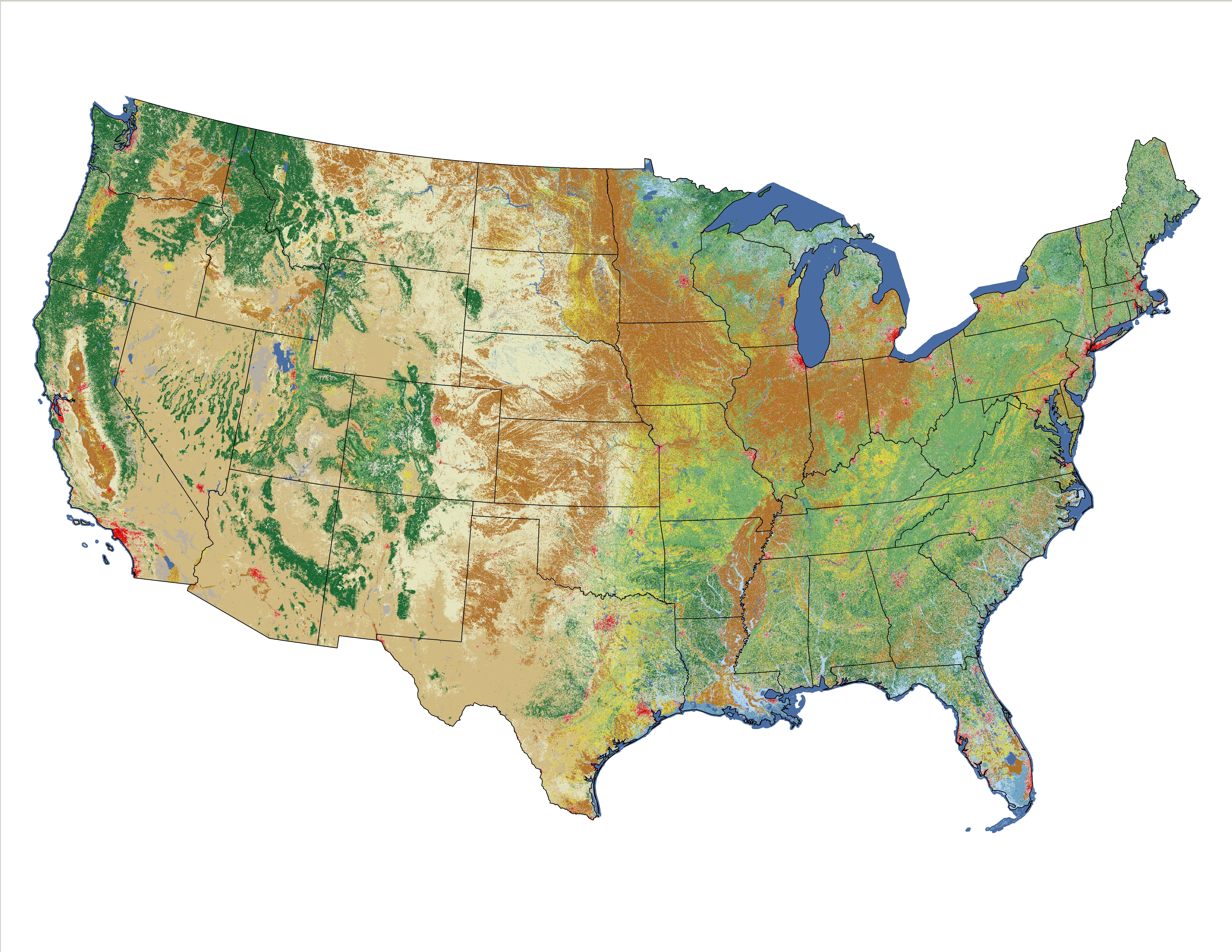
We have most often mapped the outbreaks and incidence of Ebola across West Africa by tallying infections and mortality in bubble maps that show sovereign frontiers, but might better map to trace the complex narratives by tracking so viciously contagious a virus against the changed landscapes where it has spread to understand the climates and environments in which it has appeared as we seek to contain the over 4,366 cases of infection so far confirmed.  Despite valuable charts and tables that “map” the spread of Ebola virus across West Africa from March 2014, the tally of infections hardly begin to process the shock of the dramatic levels of mortality but both barely chart the striking process of the disease, at the same time as their alarmist tone effectively heightens our deepest fears of contagion.

The recent proliferation of web-based maps chart the unfolding of the incidence of a virus previously successfully contained in remote areas in the African continent, but long feared to spread beyond its shores, as we picture terrifying screens for scenarios of a global health crisis caused by the tendril-like threads that seem to move from hosts with such ease as to complicate their vectors of transmission and confound the idea of what it would be to map the disease’s spread:  as we come to conceive of Ebola as able to move from contact with an infected individual’s bodily fluids, mapping the spread of the virus seems the only way to grasp the meaning of its reappearance and difficulties of its containment.  (The complication for West African food security as the virus has both increasingly claimed lives of rural populations and spread to the interior of the continent.)  The microbe’s spread is poised to create a devastating web of indirect risks of global proportions, where risks of transmission have grown, despite a widespread ramping up of clinical trials by GlaxoSmithKline.

By tracking the virus as if it were transmitted has spread only by human-to-human contact, and by excluding the transmission of the different strains of the virus from animals, we may be short-sighted in perpetuating only a part of the picture of Ebola’s rapid spread.  Alternate scenarios for viral containment among local populations forecast situations where the possible numbers of individuals infected by rates Ebola virus could range from 20,000, if conditions stay roughly the same, to as high as 60,000 if conditions worsen–and, should conditions for treatment and containment improve, or a vaccine developed for humans, below 20,000.  Although the geographic migration of the deadly disease is challenging to track, the maps we make of its incidence raise as many questions as they do red flags and suggest the importance of dedicating attention to Ebola’s spread.

The ways in which we map the virus raises questions of what sort of story we want to tell about the rapid spread of Ebola virus.  Ebola is transmitted by contact with the blood or liquids of the infected.  But the spread of the virulent strain is due not only to human-to-human contact–as suggested in many of the maps or the most inflammatory prognostications of possible avenues of its future global spread–but also in the body fluids or tissue of other hosts, such as animals, whose distribution are for more difficult to map.  As we contemplate the litany encoded in the distribution of over 2,400 deaths caused by the virus and over 4,700 infected, according to recent metrics of its fearsome spread, and a huge future fatality rate, given the absence of any vaccine; notwithstanding several promises to start testing a vaccine for humans, limited successes have been reached for individual treatment, despite the recovery of two Americans flown to Atlanta.  The pathways of the virus need to be mapped both from its first confirmed cases in March 2014 and from the case suspected in Guinea in December, 2013:  but difficulties to chart multiple possible vectors of transmission complicate the effect or informative nature of a tally of those infected, or afflicted.  (While we do not have a vaccine, the tremendous gravity of the situation is evident in the WHO’s recent acceptance of that experimental drugs to treat Ebola patients would indeed be ethical so long as it involves patients’ consent.)

Such maps may erase the very vectors and hosts in ways that obstruct a clear understanding or picture of the terrifying process of the disease across the continent–as we risk essentializing the disease or seeing it as a consequence of inadequate health care.  The drastic manner that the virus dissolves linings of the internal organs of the body by hemorrhaging and bleeding, perpetuate images designed doubtless to increase fears of the further spread of disease whose very symptoms–the discharge of blood and bodily fluids from bodily orifices, and, as blood fails to coagulate, something like the dissolution of linings of bodily organs–so horrific to experience so as to obscure other vectors for Ebola’s transmission.  (Practices for treatment by intravenous replenishment of blood and electrolytes pin hopes on the reconstitution of one’s bodily fluids.)  But the practice of mapping the disease’s incidence may tell only partial stories about the incidence of illness, and offer narratives inadequate to translate into health policies:  for they ignore the danger of the transmission of Ebola in animal meat, and the migration of the disease from rural to urban environments.

Has our fear of the transmission or communication of Ebola by contact with bodily fluids led us to focus, as in the case of SARS, only on the bodies of those afflicted with the disease?  Ebola virus was almost only found in Africa since its discovery in 1976, fears of its migration off of the continent have almost subsumed understanding of the contradictions of its apparent localization in central Africa, where the first cases were discovered in Zaire and Sudan, contained on account of their remote locations, but with high fatality rates in all its strains.  The absence of a vaccine or isolated antibody, the basis for much modern medicine, have increased deep fears about human-to-human communication of the viral disease, exploited in such films as Contagion and partly domesticated by the marketing of stuffed Ebola microbes.  The paramount questions of its containment and isolation–the goal of the World Health Organization–and the difficulty of raises questions of how medical supplies, infection control, and treatments can be maintained, and the ethics of medical treatment without tested vaccines, as the geographical spread of the disease across two geographically removed regions faces problems of being contained–especially when its communication is not well understood or studied.  The most recent panic provoked by the arrival of two infected Americans infected with Ebola virus in Atlanta’s Emory University hospital elicited immediate fears of the expansion of the virus and sympathy.

But the existing caseload of Ebola victims in all countries seems likely to surge in coming weeks across West Africa, and its spread difficult if not impossible to contain, despite attempts to do so by quarantine.  The virus’ spread have not been mapped in nearly the sufficiently sophisticated tools to comprehend the nature of its virulence.  We continue to privilege human contact with blood, sweat, bodily fluids, or diarrhea of human victims, so terrifying is the apparent breakdown of bodily structures Ebola provokes.  The difficulty of administrating the intravenous electrolytes to stave of its terrifying spread is all but secure, and the HazMat suits and protective gear mandated to be worn in the presence of cadavers of Ebola’s victims or the infected underscore needs to circumscribe contact with the diseased.  Indeed, the fixation on the confinement of the bodies of the ill in continued disputes over plans to quarantine Ebola victims suggest a difficulty of mapping the disease’s spread by local governments and international health organizations.  For while Doctors Without Borders/Médecins sans frontières doubts the value of quarantines ill in “death houses” to contain the virus–pointing to the number of cases that will go unreported and the risk of lack of food and clean water for those with the virus–even if they have also established isolation houses in hopes to contain the virus from spreading to further states as the Ivory Coast.  But attention to the constraining of bodies may obscure other avenues for outbreaks of the disease

Yet the logic of its spread may have been poorly mapped in relation to the environments where its progress has been most terrifying.  The challenge of how to project the expanse of widespread waves of infection by Ebola virus across much of West Africa are hardly met by a static map of the region in which it has spread–which treats the environment as a passive field against which the viral infection has spread.  As of August 31, the WHO reported over 3,600 confirmed, probable, or suspected cases of Ebola virus in West Africa,–and the number of people affected by the haemorrhagic disease has indeed recently exponentially grown, as reported cases have multiplied by over 50%.  Could a mapping of the sites of outbreak and transmission of the virus offer a way of telling a story about the physically ravaging and highly contagious virus, or even process the sheer information overload of so many infected or deceased?  Mapping the virus’ rapid and terrifying spread, as much charting its incidence from Guinea to Senegal, and beyond Nigeria, through their populations to Sierra Leone or Nigeria since its first appearance risks projecting fears of the danger of communicating the virus to populations worldwide that remove it from any cause, and limit our response.  This post seeks to raise several questions about what shown in the organization of information in these data maps–and if one is not just tallying demographics not readily updated and lacking clear geographic specificity–and how to map the local outbreak as a global health risk.  As we continue to process further information about the vectors of infection and the needs to contain infection among animals as well as humans, we can hope for more effective mapping of the incidence of Ebola, both in relation to urban centers, slums, and rural areas, as well as to areas of forests from which bush meats come.

NG Ebola Map

National Geographic

4.  The problem of charting local emergencies has become one of mapping a health crisis of truly global proportions.  Even if it is now confined to a region in equatorial Africa, mapping the communication of the virus raises question of what it means to track the outbreak of Ebola, its relation to previous outbreaks, and the incubation of the disease that allowed its rapid spread.  The relative lack of epidemiological sophistication by which maps tally reported cases of infection or mortality in bubbles fails to capture how the very geography that facilitated the contagious’ virus rapid spread by treating the base map of the virus’ communication as an oddly static field, and viewing humans either as potential vectors of infection or passive victims.  For most of the maps of Ebola’s rapid spread seem to confirm the scariest fears of “losing the battle to contain” the virus for which there is no known vaccine, and which has previously ravaged the African continent.  Geographic containment of the disease is a priority of the World Health Organization, the data maps of its spread in West Africa have offered a screen on which to project fears and concerns of outpacing efforts to control a disease whose spread through bodily fluids of people or animals–and the possibly placing the virus into broader circulation among humans once again.

This highly infectious variant of previous Ebola outbreaks in the continent appears to have been likely underreported since the possible earliest case last December.  While known vectors of its communication are poised to multiply, the practice of containment is impossible to achieve by quarantine and isolation of patients in sick-houses or containment of traffic between national borders:  while the sealing of national borders in hopes to create barriers that might prevent the cross-country mobility among the possibly infected stands at odds with recent rapid expanding urbanization and geographic mobility in growing cities of this very region:  demographic changes brought by increasing urbanization, deforestation and geographical mobility have transformed West Africa’s living geography in the past decade, effectively bringing the city closer to forests where the epicenters of past Ebola outbreaks.  Yet the specter of confined borders or the creation of confines stands to create undue stress on relations between doctors and local populations to slow the infection’s spread or arrival of medical staff and supplies, if not generate panic and mutual distrust within local populations at the same time as weekly count of infected exceed 500, with many likely to be unreported.

Quarantines have offered somewhat effective means of containing Ebola.  Their prevalence as a tool to combat Ebola echoes attempts to contain plague in seventeenth-century Italian cities, when the isolating the afflicted within cordoned city-state or regions as soon as possible fit new understandings of the transmission of disease by individual bodies.  Quarantines separated people known to carry the plague, segregated by analogy to goods exposed to plague or disease that remained for periods of forty days [quaranta giorni] in order that  miasmatic “pestilential air” could dissipate, and the rapidly growing numbers of those infected with plague be effectively circumscribed.  The practice of quarantine emerged before plague hospitals, and the same sort of isolation once again emerged as a coordinated reaction to unidentified virulent diseases such as the recent outbreak of SARS:  quarantine managed plague with shifting efficacy from 1347-52, as cities instituted quarantines of neighborhoods or goods in the face of a disease against which there was no known or effective medical response–encouraged or facilitated by the drawing of a fixed spatial boundary on terrestrial maps, as in this late seventeenth-century plan of the barriers that would contain the plague in seventeenth-century Bari.

Is this emphasis on the human-to-human transmission of disease the correct strategy to apply to Ebola?  The spatial containment of bodies of the infected and ill–who are often asked to lie in isolation wards that are deemed an effective death sentence for those effectively removed from medical care–oddly mirrors early modern reactions to pestilence despite our more effective concepts of tracking disease:  although effective if they occurred quickly, the scope of Ebola virus in the region suggests a range of factors have shaped true transmission of a disease beyond close contact with bodily fluids, or its human hosts:  are human bodies rightly presumed to be the sole agents in need of containment, and the sole subjects to be confined?

Cordoning Bari

Containing Plague in Bari (1690)

Is an emphasis on the danger of human-to-human transmission, the sort of transmission that quarantines seeks to limit, an adequate response?  Closed national borders have so far followed the logic of quarantines for those infected with the virus–rather than of controlling the vectors of its transmission.  If barriers have contained disease when created quickly, the vectors of Ebola’s transmission are so challenging to map to make analogous quarantines by cordoning off West African regions offer a sort of exemplum of the misleading picture of the pathways of infection that the Ebola virus might exploit.  Fifty thousand people were quite recently forcibly barricaded in Monrovia to isolate the Ebola virus’ spread, limiting access of inhabitants to food or drinkable water and no doubt increasing their desperation, fearfulness and sense of fatality.  The first two Americans reported to be infected with Ebola virus, Dr. Kent Brantly and Nancy Writebo, have been transported from the continent, and to Atlanta, to recuperate in isolation chambers set up by the CDC in Emory University Hospital, the former recently released after being cured.  Is such a dramatic contrast in understandings of the etiology or response to the disease unconscionable?  With numbers of those affected by the Ebola virus now seem destined to rise exponentially, with some West African countries experiencing an increase of 50% last week, the specter of further quarantines and fears of the airborne transmission of the virus are misplaced.  Although the contact with dead or ill bodies is one clear means of transmission of the disease, its long strands are rooted in the body’s fluids–and its most virulent strain yet encountered seem able to have “jumped” from animal meat to humans, and prove particularly difficult to contain in cases where the disease is advanced.

120729101443-ebola-virus-story-top

The initial response of the United States Center for Disease Control and Prevention was to issue bulletins restricting non-essential travel to Guinea, Liberia and Sierra Leone, in the hopes to create distance between the US and the re-emergence of the disease.  African nations followed suit, terrified by re-emergence of the deadly virus and the lack of any public health response that was deemed effective:  Nigerian airlines cancelled flights to Freetown and Monrovia in an attempt to contain human contact with the infected; Nigerians angrily blamed airplanes for allowing passengers infected with Ebola to enter the country as opening the pathways to transmission of the disease.  But presumption that victims of Ebola constitute the prime subjects needing to be contained, or quarantined, or that the disease could be bound and frozen, kept within the boundaries of states where the virus, not only hamper coordinating medical reactions to Ebola and needed supplies, as well as food, but offer a no-exit strategy that may fail to contain the disease or address the actual vectors and incubators of its rapid geographical spread through several cities across the central Continent.  If trade provides a crucial means for the communication of disease, which is not only particularly aggressive but may mutate in the face of resistance.

Rather than being an isolated instance, historian Tom Koch, who has studied the uses of maps to embody the spatial distribution of diseases from the early modern period to the present, warns that “rapid viral and bacterial evolution brought on by globalization and its trade practices” pose deep challenges to how we contain future outbreaks of disease as well as to our practices of medical protocol and ethics.  The reactions suggest a terrifying widespread return of medical quarantine as we face increasing fears of contagion as unable to be contained.  The need for containment is itself echoed in the mirrors maps manufacture about the disease’s rapid spread, and what better maps might exist in an age when our mapping abilities to track the transmission and probable bearers of the highly infectious virus.

5.  The figure of infected victims of Ebola crossing national borders has become a standard and repeated image of the transmission of disease and the challenges of its containment.  A widely read report of late July described with considerable panic the arrival in an airplane of a man infected with Ebola who collapsed in the airport of Lagos, Nigeria, infected with the Ebola virus.  It provoked increased fears about the very vectors of Ebola’s transmission, including airborne transmission (which is impossible) and exposure to the environments where the bodily fluids of its victims have been present.

The communicative value of even the most accurate epidemiological maps of the virus’ rapid outbreak may have failed their readers–as this powerful visualization from National Geographic–in communicating the nature of its transmission, despite its terrifying suggestion of its spread in West Africa serves to emphasize the global threats that Ebola’s spread pose.  Although disease maps provide clear tools to understand the spread and pathways of communication of a disease, the highly virulent and rapidly moving nature of the virus, whose spreading transmission has multiplied because of both growing density of urban population sizes and the increasingly interconnected nature of populations in the region.  Given the increased health risks that are the result of huge changes in West African urban geography, both the simple tally of cases of Ebola the snapshot-like nature of most distributions by country only skim the surface of the depth of multiple stories–and terrifying fears–about the virus’ rapid spread across the West African coast.  For the story of Ebola is increasingly about the new vectors of transmission that result from the relation of the cities to the interior, in ways obscured by data distributions that collectively group numbers of cases and deaths–mutely enumerating the daunting count of those infected and deceased, but without telling a clear story about its geographical spread across a rapidly urbanizing region.

NG Ebola Map

National Geographic

The spread of Ebola across four nations since April, when it was first reported to have spread from an epicenter in a rural Guinea, is unprecedented in the relative rarity of its geographic spread and the rapid bodily decline of those it has infected raises questions of how medical supplies, infection control, and treatments can be maintained, across two geographically removed regions–as the existing caseload of Ebola will likely surge in coming weeks.  The odd mapping of the incidence of Ebola by nation contrasts with the extent to which the hosts of bats and other animals whose flesh is consumed known as “bush meats”–and not person-to-person contact alone, despite the horrors of hemorrhaging and bleeding in an uncontrolled manner so horrible watch and humiliating to experience.  Although such meats are currently prohibited from consumption, the virus’ rapid spread provokes fears of containing increasingly porous boundaries between nations in West Africa, but such containment and isolation may discount other sources of the bearers of disease at multiple sites, or the over two thousand afflicted with Ebola.  And, if bats are indeed the hosts of the virus, few mapping of the incidence of bat colonies have been attempted to determine the possibilities or potential for the virus’ geographical spread.  Could one map not only the presence of disease in populations of fruit bats, a common for of bush meat, and the routes of their harvesting and transport for sale to urban markets, as a basis for the spread of the virus from the first perceived epicenter in Guinea to Liberia and Sierra Leone where it has been particularly virulent, as well as Nigeria.  Might pathways of the handling and consumption of meats be mapped against the disease?

Ebola Outbreak Poster

Is the danger of the disease’s fatality underestimated in the graphic posted above?

6.  Can we explain the dangers of its communication by maps that do not adequately chart the spread of the virus’ outbreak by a range of vectors?  The effort of humanitarian mappers, using OpenStreetMap mapping templates, readily applied mapping techniques to track the first outbreak of infections from April 2014 occasioned an early attempt to trace the spread of the virus from rural areas, and define its Guinean epicenter and routes of travel to coastal towns from the regions around Gueckedou, as Doctors without Borders requested the OpenStreetMap Humanitarian team to map the outbreak in an effort to define with greater precision the spread and immediate impact of the disease, using Bing’s high-res imagery of the region, and maps from Airbus Defense and Space as well as overlaying satellite images with MapBox Streets/Digital Globe to track incidence with a resolution absent altogether from most large-scale maps.  The collective effort of 200 mappers to locate over 100,000 buildings and some hundreds of miles of roadways supplemented the absence of adequate maps of the region of Guinea, the site of the first hemorrhaging confirmed caused by Ebola virus.  At the same time as worries already began of the spread of the virus to Liberia and Sierra Leone, the mapping helped establish the epicenter in Guinea and radius of the outbreak.  Despite the far greater complexity and geographic range of Ebola’s spread, such maps might be beneficially integrated with other overlays in attempts to try to understand the mechanisms of its rapid spread in an area for which we often lack adequate maps.

HUOSM ebola mapped in March 2014

Wired/OSM Humanitarian Team

The level of local detail in such early maps already pinpointed the breadth of its transmission, and raises questions about the role of human-to-human transmission as the sole vector of the virus, which has been argued by the World Health Organization in July to have been transmitted by wild animals, such as bats, but in addition to bush meats from wild animals, in the local pig farms that often play hosts to the bats.

Some of the precision of these maps has been lost in the later maps that seem emphasize occurrences of probable or confirmed and suspected cases in “countries” and regional “districts,” rather than in an inter-related web of the transmission of the disease.  The result of the tracking of cases came to embody the sources and centers of fears of its spread, as the confirmed or probably cases of infection were mapping against the continent as a whole, so that the spread of infections gained a new look on the map as a field of red that demanded to be contained, juxtaposed by the specters of historical sites of infection, as if to augment local fears of its future spread, and to understand the migration from regions of Guinea and Sierra Leone to other ports along the shoreline of West Africa as Dakar, suggesting that the spread of the virus has not only outstripped medical abilities in the area, but that the spread of the disease invaded an entire district which would need to be isolated or quarantined–as requested most recently by Theo Nicol, Sierra Leone’s Minister of Information–and not public health officials–to respond to the spread of the disease into the country, in ways Doctors without Borders (MSF) cautioned were without benefits and in face quite detrimental to medical care, nourishment, or establishing needed trust of medical professionals:  the mapping of confirmed cases as if confined to a given administrative region reflects a reality of public health administration, but a distorting image if one would like to map the vectors of its communication.  (The historical cases of former outbreaks of Ebola in the CDR or South Africa were another strain of the virus, and, while reaching into the collective memory, not related to this outbreak, which began with a similar jump of the virus from animals to humans.)

The spread of Ebola in West Africa in relation to “Historical Cases” magnify its danger, but oddly contain the virus to the African continent’s sub-Saharan regions.

Ebola cases--confirmed, probable, historical

7.  The mapping of “historical cases” of related Ebola virus outbreaks may introduce more than a bit of a red herring.  For although they similarly seem to have begun from similar reservoirs of monkey or bat hosts, relations between the viruses is not clearly understood, despite similarities between the Guinea virus and the Zaire Ebola virus (EBOV) lineage; nor are links between their different reservoir species or hosts and the virus outbreaks understood, although the relations are presumed in the coloration of the above inset map of the African continent.  The vectors of viral transmission may create a map quite distinct from the earlier inland growth of Ebola in both Central and South Africa.  For  outbreaks of Ebola may have all been incubated first within the animal populations in ways not communicated in the above maps.  At the same time, the natural cycle of transmission of Ebola within the forest remains largely unknown, creating problems understanding its transmission–although its appearance in and transmission from animal populations has been clearly identified as the basis for its spread at the forest’s edge in rural Guinea.

The spread of the virus across three countries by late July already made it the deadliest breakout of the contagious virus in the continent as it moved from Guinea to other edges of the forested interior, in ways that the CDC map below does not clearly describe, but explain the odd dispersion of cases reported around the border between Guinea and Sierra Leone.   When Liberia shut most of its border points in late July in an effort to contain the disease and halt the virus, it had already spread across at least four nations, leaving possibilities of its future containment optimistic at best, in an attempt to isolate the migration of infected individuals given deep preoccupations at continued geographic mobility in the region.

guinea-map

The confines created around those districts with suspected or confirmed cases in April, shortly after the spread of the deadly virus had been mapped, misleadingly places the problems of quarantine on each nation–Mali; Guinea; Sierra Leone; Liberia–and not to define the impact of infections on local society or analyze the channels of its transmission, apparently able to have jumped national boundaries with ease in areas.  We perform a far less sophisticated mode of mapping outbreaks by identifying its incidence in isolated districts, without the greater geographic or spatial specificity the OSM map tried to chart–and perhaps have provided a misleading map that raises false hopes for being a ground-plan to its spatial or geographic containment.  But the multiplication of incidence has of course made the process of mapping impossible, and fears of under-reporting widespread.  Such a mapping might be particularly important, however, since the evidence suggests that the combination of increasing human penetration into rain forests, and increased human contact with meats in urban centers–in addition, most significantly, geographical mobility between goods from rainforest areas to growing urban slums, creating channels and microclimates that are increasingly likely to change the patterns of the transmission of Ebola in ways maps might better track in order that the virus could be more effectively contained.  In an era when satellite-based mapping and GIS systems could make questions of human penetration into forests, contact with animals, distribution of bats and other species, and population density in urban slums where Ebola has spread could stand to be mapped in quite potentially significant epidemiological ways.

The recent growth of populations in West Africa that are living in urban slums from the Ivory Coast to Senegal suggest an especially dangerous topography for Ebola’s growth, which is left silent or unspoken in most infographics of the region, despite its significance in understanding the social shifts that magnify the transmission of the deadly virus.

slum-population-in-urban-africa

The considerable growth in urban areas and slums in Conakry, Bamako, and Dakar make them terrifying incubators for human hosts, again absent from infographics of Ebola’s current spread.

urban-growth-rate-in-africa_12bb

The distinctions of local distributions are unfortunately erased in flat “impact maps” which highlight danger zones of travel, and not effectively map the virus’ transmission and spread or the environments in which it has grown–the flat colors of data maps, prepared relatively quickly with whatever data is at hand about Ebola, and not the region, seem almost to hide, rather than try to foreground, the dangers of the virus’ spread and the dangers of its migration from rural to urban areas.

At the start of the virus’ spread, attempts to localize its incidence expanded the number of fine-grain maps in circulation–although the mapping of incidence onto the urban and rural environments was rare, as were fears and concerns about the mutation of the virulent disease.   The rapidity with which Ebola spread through Liberia and to Senegal makes the distinction between “confirmed” or “suspected” cases, or indeed an administrative mapping of the topography of Ebola less valuable in understanding its transmission or the possibilities of its potential spread by vectors or the overlap of incidence with even a road map of nations that might track the paths of geographical mobility by which removed outbreaks could be related to one another.  Although fourteen of Liberia’s fifteen counties report cases of Ebola, what does such a spatial distribution tell us about the disease save of the dangers that the administrative response must face?  Data on the large numbers of populations of the slums of Monrovia were not even available to the United Nations in its mapping of slum populations, shown above, from 2009–although the terrifying density of populations in urban slums in growing cities in Sierra Leone, Guinea, or the Cote d’Ivoire are striking, as is the massive urban growth of the city of Dakar (Senegal) or Conakry (Guinea), not to mention the large city of Bamako, which lies terrifyingly near to the suspected cases of Ebola in one district of Mali.  (There seems no data available in the UN map of urbanization about Monrovia.)

If in 1990 there were only some 24 cities in Africa whose population exceeded one million, the number of cities with more than a million inhabitants had doubled by 2011, and has exceeded that proportion by 2014, and many of these urban agglomerations are concentrated in West Africa in ways that have dramatically shifted the landscapes across which Ebola has so far most intensely spread.

West African Urban Agglomerations, 2011

The movement of the virus to these cities was terrifyingly close in April, when it seemed inevitable, or evident, but few measures of adequate containment were articulated or in place as the virus advanced from Guinea to Mali and Liberia.  But the shifts of urbanization that have occurred in the region were oddly absent in most of the maps that describe the disease’s spread in districts of Guinea, Sierra Leone, Liberia, and Mali–the size of urban populations only become prominently realized in maps of contagion after the virus arrived in Dakar.

EVD-outbreak

8.  Boundaries between states however provide a limited information to allow us to track the disease’s spread or its scope.  The responses to the spread of highly infectious virus by August was to shut the borders crossings and frontiers between nations, in a terrifyingly shortsighted miscalculation of the spatial geography of viral containment, and misplaced allocation of resources, since the virus had already spread to Guinea.  When Liberia shut most of its border points in order to contain the virus’ progress to the south, was the area of infection from Gueckedou already too progressed to rely on national frontiers as a basis to staunch its spread?  Were other possible causes or vectors of disease less addressed?

Confines around Ebola_detail

While the map rightfully suggests the importance of human-to-human transmission, it oddly omits the very animal populations that both suffer from the disease and from whom Ebola is prone or apt to jump.  Closed national borders follows the logic of quarantines for those infected with the virus–rather than of controlling the vectors of its transmission.

Continued consumption of bush meats across much of West Africa suggests a far likely route for the transmission of Ebola than person-to person contact.  The difficulties of preventing the consumption of bush meats that were infected with the disease–including fruit bats, rats and monkeys–though widely suspected to be as the chief bridge between humans and animals in the region.  The transmission of disease in meats–either uncooked or by butchery–can cause itself multiple centers for the transmission of the disease from infected humans, not tracked by the concentration on human incubators of the disease.   Despite the current ban on consuming bush meats, the possibilities of such a transfer of the virus through consumption poses a decisively high risk and is potentially difficult to enforce.  Many villagers openly blame the arrival of medical teams for the virus’ spread, even as fruit bats and antelopes and rats have disappeared from the markets of the main towns, attempts at curbing the consumption of animals that are both plentiful in the forests and provide a prime staple to meet local nutritional needs of urban and rural poor in an area without animal husbandry; such curbs on the butchery and sale of bush meats are however most often met with incredulity among many–“Banning bush meat means a new way of life, which is unrealistic”–in regions without animal husbandry, and the eating of potentially uncooked meats or handling of dead infected animals from the forests effectively multiply the potential for further human-to-human transmission of the disease.  A ban on consuming bush meats–Liberia forbade its consumption and shopkeepers selling bus meats were jailed in attempts to retract its consumption in Nigeria–was less effective in practice, and pushed trade underground.  Bans on the importation of bush meats into London reveals fears of the meats as vectors of transmission that are difficult to control in West Africa, but have gained less attention than they deserve.

Ebola in Liberia

Ahmed Jallannzoe, EPA

9.  The policy seems to hope to contain the spread of bodily fluids that are associated with its transmission from those inhabitants infected with Ebola, as if the enforcement of clear boundaries could prevent future transmission in an era when far great border-crossing and dramatically increased interconnectedness of urban populations across West Africa.  Indeed, the mapping of the epicenter of its “outbreak” seem to be beyond the point, if important to register, in dealing with its spread:  the unwarranted closing confines with Sierra Leone and Liberia rests on the conception that human-to-human transmission  constitutes the sole or primary sources of its incubation.  But this inference may be false, according to Mapping the Zoonotic niche of Ebola virus disease in Africa, who suggest that the transmission from infected humans is in fact surprisingly low.  The absence of attention of a topography of the network of transmission of the disease, and of the presence in animals, as well as humans, would offer a far more complete picture of its transmission beyond the numeric tabulation of the dead in datasets.

What could a more dynamic terrestrial mapping of the spread of disease show, beyond the fears for its further expansion?  In what ways does the embodiment of the virus’ spread in maps of the districts of West African nations poorly communicate the nature of its spread–or the relations between Ebola virus’ spread and recently increased connections between large urban centers on the coasts to rainforest areas previously less often penetrated by purveyors of goods for urban food markets.  Indeed, health authorities would do well to monitor then expanded unrestricted or reviewed traffic of foodstuffs and plants from vendors who move with increased access to the deforested rainforest areas on new roads into growing cities, even if the virus is already out of the bag:  for the very roads linking regions that were previously with far less contact with one another create new pathways for rapid transmission of the virus, as much as they might be seen as forms of regional modernization.

Other maps might offer unwarranted alarmist images of the potential pathways of Ebola’s feared future spread.  The justifiably intense fears now emerging about the uncontrolled spread of this hemorrhagic fever have grown after the spotting of several cases in Senegal and seems possible to be transmitted on any flight out of Dakar within the contents of a plane’s shipments.  We map the increased fears of cross-border transmissions of the dread disease in a particularly terrifying fashion, forecasting future distributions of illness by transposing a map of airplane flights from Dakar into a graphic that might be read as one of the exponential growth of the airborne transmission of a disease, in ways that misleadingly label the global health crisis as one of transmitting Ebola out of Africa, rather than trying to contain or understand the mechanics of its rapid spread on the ground trough far greater international aid before the outbreak itself is truly cataclysmic, and no longer possible to be mapped locally:

senegalFlightsMapJL

Mother Jones, September 4 2014

Despite the good intent to emphasize the global nature of the epidemic, the graphic removes attention from the on-the-ground story that the same magazine had been tracking so compellingly.  For all the knowing ways of getting the attention of readers of a progressive magazine, the image of the proliferation of Ebola on airplane flights may even minimize the questions of either its spread on the ground or provoke a rhetoric of quarantine.  The map of airplane flights from Senegal’s capital does suggest the huge changes in human connectivity that have emerged in the past decade, as if they stand to change the transmission of the deadly virus into a focus of global attention.   But the alarmist tenor of the map, which colors potentially affected countries in yellow as if to display how much of the globe could be touched by the bodily fluids from infected passengers leaving Dakar, suggests only potential channels of travel–and is not in facet based on actual reporting of disease.

The map almost seems to advocate the need to pursue a logic of quarantine and containment, so terrifying is the scenario of the virus’ potential spread.  Do the flight pathways tracked by Google Flight Search map potentially expanding pathways of Ebola virus’ communication in ways that play upon our fears, and, even as they ostensibly invite us to consider how the disease might be contained, deflect questions from situation on the ground that we are all too likely to see as if it is far removed?  Or are we already there, given the recent mapping of 140 alerts for the hemorrhagic virus that are already evident worldwide on HealthMap?

Alerts--International significance

In the case of West Africa, might it be prudent, as Pigott, Golding et al. suggest, to monitor the presence of disease in fruit bat populations and Great Ape populations to try to contain the outbreak of a disease whose outbreak is commonly associated with hunting and butchering, as much as contact with infected humans’ bodily fluids?  Despite the risks of contagion from the fluids of the dead, the mapping of diseased populations is often the most fearsome–and least preventative–means to track Ebola’s incubation and chart the virus’ spread.  Do such maps effectively perpetuate ungrounded fears of human-to-human transmission by regarding infected local inhabitants to be exclusive vehicles of contagion, since they are the subjects whose mapped distribution minimize the attention we might pay to the transmission of the disease by animals and especially rodents, monkeys, pigs, and widely ranging populations of fruit bats?

Rather than being a purely human-borne disease, despite the huge multiplication of human-to-human transmission, the transmission of Ebola through animals, uncooked bush meats, including apes, fruit bats, rats, porcupines, and non-human vectors has dramatically grown since from August.  The geographic spread of the virus did not follow regions that were geographically contiguous, but spread from multiple epicenters in the region, in ways perhaps dependent on animal hosts and the possible cross-species jumping of the disease from bats to apes and others.  The maps of local health authorities and treatment centers against the spread of reported instances of Ebola offer images of overwhelmed health institutions which surrounded by the virus’ spread, hampered from reaching inland areas affected: major treatment centers in the region appear to be swallowed in a sea of Ebola infections, themselves overwhelmed by risks of infection they are inadequate to handle.  They exploit justified fear of the virus as a source of infection by displaying the paucity of hospitals  field laboratories to study to the incubators of the virus’ spread or be trusted to staunch it, as well as the deep need for international aid to contain the further spread of the virus and care for its victims.

ebola-map-aug14-1200px

CDC

The map charts the spread of a disease as overwhelming medical capacities which are positioned in a far smaller area than the areas where confirmed case of Ebola have been reported.  Its design of placing the few clusters of treatment centers far removed from the expanse of afflicted almost confirms the decreased trust between healers and patients for a virus which not only lacks commensurate medical response:   treatment centers seem lacking in ways that could stave off the dangers of the virus’ inland spread.

The authoritarian images of control over cities by armed forces, or militias that fumigate streets or men in white HazMat suits, recuperating the body of the dead that were formerly attended by family, suggest an imagery of antibiotics and antiviral spray in Monrovia’s Duwala marketplace,  as if to acknowledge the fatalism of the virus’ spread and the only means of stopping it with antibiotics and law and order–notwithstanding the huge potential risks of panic.  (Indeed, the huge risks of decreased harvests and local food supplies, whose prices are poised to spike to levels never seen in West Africa, have already led the UN and FAO to secure and transport masses of foods from rice to maize and cassava.  Even the recent ban on consuming bush meat may further dry up other needed sources of nutrition.)  The promise for the arrival of American soldiers and military–while a needed reinforcement of personnel–cannot but raise fears and questions about the future multiplication of vectors of transmission of the disease, and of their arrival without coordination of the application of best resources to policy of containment.

enhanced-buzz-18737-1409238330-12

Stringer/Reuters

enhanced-4535-1406913957-10

AP Photo/Abbas Dulleh

10.  The unprecedented intensity of this West African outbreak has moved from Guinea in March 2014 and then Liberia and Sierra Leone, onto Nigeria and the Democratic Republic of Congo, reveal a potential multiplication of vectors of infection clearly knowing no national bounds and beyond the mandate of any local authority.  But it does little to provide a causation image of the historical necrology of Ebola it mutely registers, and places so suggestively to the apparently geographically broader, if less virulent, outbreak of Ebola in earlier years:

_77398785_ebola_deaths since 1976

BBC News; 28 July 2014

The BBC’s info graphic illustrates the intensity and increased risks that the current outbreak of Ebola poses.  But in projecting the data onto a relatively blank base map, it oddly removes attention from the situation on the ground that it fails to map sufficient detail.  The reluctance to encode further information than that disseminated by WHO and CDC creates a limited view of the transmission of Ebola on the ground, despite the impressive use of intense coloring to focus our attention on the expanse of its recent outbreak.  Despite data from such apparently reliable sources as the WHO and CDC, the map offers few guides for reading its mapping the incidence of outbreaks of and fatalities of Ebola virus by proportional nested circles, and presumes that the variants are Ebola are not different from each other, although it does suggest a broadly focussed geographic incidence in a similar region–and apparently similar ecosystems, putting aside the outlying outbreak in South Africa.  The absence of individual or collective narratives that it tells leaves one confronting the sheer numbers of the outbreaks, but hanging in the air.  Might the mute order of the data distribution be more helpfully placed in overlap with other data, in order to foreground its relation to other potential causes of these viral outbreaks?

Even less helpful, of course, are the maps that redden the entire central band of the continent as a source of infectious viral disease.  The maps that are proliferating online and in the news tell us little  of epidemiological value about Ebola virus’ spread, so much as they reveal the chance of infecting the entire continent, reminding viewers of the multiple sites of the outbreak and recent spread of the virus across the expanse of much of the central continent in alarmist fashion, as if to suggest the danger of neglecting the disease that had previously dedicated the Ivory Coast and CAR.

Ebola-map

The African, September 14 2014

To be sure, the detailed country by country regional spread of the illness suggests the benefits and needs of clearer tracking, and a unique topography for the pathways viral transmission has so far taken, raising multiple questions about the relation between human and animal vectors that encouraged the unique topography within which it has most rapidly spread, but also the distinct topography among reported victims of the disease.  Are these counts accurate, one wonders–do they rely on accurate door-to-door screening to tabulate the numbers of those afflicted by Ebola-like illnesses, or depend on the counts of health authorities and hospitals?–and can they forecast its future spread?   When the World Health Organization is now predicting some over 20,000 cases of a disease that has no known cure, the limited areas of exposure seem reassuring, but the map of confirmed cases offer little sense of a road-map to its future cure–even if they misleadingly suggested areas of its containment last July.

ebola-map_

Jide-Salu, July 31 2014

11.  The difficulty of establishing a clean dataset on the ground in these regions is, in a sense, compounded by the exclusive mapping of human cases of the transmission of the disease–which has, at the same time as displaying particular virulence in humans, been widely reported across populations of great apes across Africa–including the gorilla and chimpanzee–to an extent which has so far not been mapped or not mapped with nearly the same prominence as human cases and deaths.  Hunting and handling of bush meats appear the most likely causes of outbreaks of the virus, although the dangers of human-to-human transmission are particularly high risk during home care and funerary preparation of infected cadavers.  At the same time, they discount the extent to which the increased urbanization of West Africa–and its own expansive rise of urban populations–create a human density where the disease might be difficult or impossible to contain, and the vectors of its transmission uncontrollably spread.

Much of the mapping of the occurrence of Ebola outbreaks past or current occurs without noting Ebola’s presence in apes or fruit-bat population.  As if significant, they somewhat stubbornly retain the boundaries of the modern sovereign states.  In this late-July chart from the Economist, has the cumulative spread of the virus was mapped against the population of fruit bats who are credible vector of transmission across species throughout the continent, to judge band in this case it is based on a rough mapping of the ecosystem where fruit bats live, rather than the number of bats who are themselves hosts for the disease or, say, infected apes.  (And the result seems equally–if not more–alarmist, since not all fruit bats can be said to carry the virus, and the scientificity of the image that it presents undermines the intensity of this localized outbreak on the Western coast.)

Economist mid-July

The Economist

Reading the map, one imagines its spread was a public health crisis reveals the poor quality of public health in Africa, rather than that most western medicine has been particularly ill-equipped to understand the spread or the vectors of its disease.  But the map oddly conceals the different viruses of Ebola that have appeared in the past fifty years in Africa, and the increased virulence of the current disease.  For although the incidence of Ebola in the Central African Republic now seem to be confirmed as a separate, less virulent strain, the overlap in the map of incidence and the bat population suggest the danger that infected animals transmit the disease in ways not constrained by human-to-human contact.

Meanwhile, the map omits the routes of the transmission of the butchery and migration of uncooked meats to cities and slums on rainforest-to-city roads that seem to be a major route for the disease’s transmission.  The difficulties of reaching rural areas where the dependence on bush meats is particularly intense–and distrust of foreign doctors or medicine has the potential to be considerably stronger–might create a distinct map that foreign aid organizations might approach the growing epidemic.  Local insistence against the danger of consuming bush meats that might be uncooked or handling raw meats and widespread refusal to accept the interpretations of medical aid workers in much of the continent poses a serious health risk–and underscore the importance of confronting this resistance in providing aid to West Africa.  The reasons why a base-map of the habitat of infected fruit bats and bush meat consumption have been less prominent in the mapping of the outbreak suggests the limits of relying on base-maps to understand the spread of the disease.

12.  The recent dependence on the recycling of existing geographic and news maps of West Africa have been less informative of the vectors of transmission or incubation of the deadly virus.  They almost indeed seem to generate the illusion we are able to locate and control the disease whose spread we are still at such pains to try to control by effective quarantine–the three-day country-wide “lockdown” that is proposed in Sierra Leone suggest a desperation at confronting the disease, with the rationale of taking an updated count of mortality rates and number of those afflicted, and may well provoke a deeper erosion of trust between the sick and health-care providers, that would encourage many to disguise the symptoms of illness or not seek out care, at the very time that a better understanding of the basis for its spread need to be understood.

Despite the intentionally misleading opinion of the Nigerian government asserted that the haemorrhagic disease in question was in fact not Ebola virus, but Dengue–though this has few grounds for being true–provided an interesting distribution of this insect-transmitted disease across specific latitudinal parameters might lead us to re-dimension our own ways of mapping Ebola against a variety of base-maps, perhaps focussing less exclusively on human victims–even as we mourn their tragic deaths, and see such deaths as a barometer of the global catastrophe of the virus’ spread–by shifting from the counting of the dead that Ebola has claimed than the animal vectors which communicate the deadly virus, or the changes in human populations from urban population density that have increased the transport of meats and butcher shops that have made it more likely for people to come into contact with the deadly virus.

Dengue

6 Comments

Filed under data visualization, epidemiology, Mapping Ebola, Mapping Ebola in West Africa, mapping the containment of disease

Maps for Reframing an Over-Farmed Landscape

Agriculture maps frame the viewer’s relation to a settled expanse and farmed space.  They describe where we get our food, the intensive over-cultivation of regions of the midwest, and chart the changed fertility of cropland that have been the consequence of large-scale industrial farms in recent decades–and offer something of a basis to orient us to their configuration but to calculate their consequences.

Maps offer a palimpsest of our recent reshaping of the rural world and our relation to cultivated farmlands.  As such, they bridge the remove of most Americans from an agricultural world in ways that we have, as shoppers in malls and supermarkets, largely forgotten and moreover distanced ourselves from.  The distance is all too evident in our shopping habits and expectations for the year-round availability of fresh produce–even if we shop in Whole Foods.  Rather than mapping farmlands’ fertility, they try to map the active recreation of the rural as a site of economic activity, as much as an ecological unit:–a recreation underwritten in our current Farm Bill, even though few seem to have familiarity with the extent to which  Department of Agriculture subsidies have informed the geography of farmed lands.  For although nearly 54% of the continental U.S. is devoted to agricultural land–a slightly larger amount than the 40% worldwide–almost 99% of folks in the United States don’t work on farms.  The geographic and conceptual remove of these maps from rural life stands at odd ends with the fact that most policy-making decisions occur across a rural-urban divide.  Indeed, the disconnect between most Americans’ lifestyle and the growing spread of large farms in rural America suggest salutary benefits in perusing the wide range of maps from open data to immerse oneself in the quandaries of sustaining rural productivity in an age of increasing food demand.

For this is how we largely use our land:  world-wide, an area approximating the size of South America is dedicated crop production, and far more—7.9 to 8.9 billion acres—to raise livestock.  If this division does not seem that effective, we might begin from how the devotion of our own landscape to agriculture an effective form of land-use.  For this landscape provides a model for how macroeconomic interests have altered the relation to the agrarian landscape worldwide.  Despite the continued romance of the pastures and crops we produce, the mapping of agriculture productivity is particularly difficult in the failure to define the multiple adversely impacts on national farms–a problem that seems multiplied by the disconnect between most politicians from our agrarian landscape, and, indeed, most concepts of space and our agricultural space–both of which have led to a disquieting hybridization of our political and agricultural space that demands to be untangled.  In an age of data-driven maps, the static images of data visualizations may seem out of date.  The layering of visualizations however challenges viewers to assemble an image of urban-rural relations across the lower forty-eight–by concretely mapping and rendering evident such variables as crops in farms, farms in the land, the folks in the farms and the cities–that can provide a portrait not only of where we are, but of where we’re spending money, and how we might better conceptualize the fertility of the land we farm.

If all maps give visible form to data, maps of our agrarian landscape also create data for their observers in powerful ways.  Agricultural maps of land-use deserve to be examined for their inter-relations, as much as for what they ‘say.’  No single visualization should be taken as an image of the farmed landscape–but rather offer a point of entry into that the forces that shape the landscape and the very contested views of our national cropland, and what might be appreciated as the shifting ‘cropscape’ of an increasingly post-rural world.  (Even if over 90% of the farms in America are small and, for a variety of reasons, family run–96% of farms with cropland are family run, producing some 87% of the total value of crop-production in 2011, according to the USDA’s Economic Research Service, based on data from the Agricultural Resource Management Survey–the landscape is increasingly defined by large agribusiness, and by how such farmers react to a market of global futures as much as national or regional needs.)  The expansion of our agrarian land has been mapped by William Rankin, whose “World Cropland” (2009) provides something of a base-line for the conception of the temporal expansion and intensification of farmed crops.


Agriculture-landuse-2000William Rankin, courtesy Edible Geography


The layered images of farmlands that I consider in this post create a basis for future interactive analysis.  Even without snazzy animations of time-lapse imaging of Google Earth or Google Earth Pro.  By doing so, this post hopes to raise questions about how the relation and use of cropland to American agriculture might be most effectively mapped to would bring greater familiarity with the dilemmas of farming and agricultural practices.  At a time when most are increasingly more unfamiliar with the organization of agricultural life that with the rising of the tides, we are all too ready to view agricultural practices in a purely macroeconomic–rather than environmental–lens.  Although we imagine the agrarian landscape as an unconstrained or open space, the visualizations offer insight into what  might be best be understood as a complex mosaic not only of individual interlocking ecological regions, as this ESRI visualization of the High Plains, Corn Belt, and Great Plains, but a complex economic dynamics it conceals.  For despite its accuracy, and the differences between bioregions and eco regions, the unified landscape indeed conceals the divides created by the now dominant (if warped) view of each eco region as a source of crops on a global market–a view that has informed the rural landscapes over the past twenty to thirty years, from corn belt to the wheat fields to High Plains.


ESRI Ecoregions


For as much as map nature, the division and conceptual of agricultural space in America is effectively under-written by the world market’s orientation to its products, rather than to the individual farm as a unit of farmed land.  There has been something of a cognitive re-mapping of the national agrarian space, not only in terms of the needs of local bioregions or the diverse needs of bioregions that distinguish the alleged uniformity of agrarian expanse, that turns around the greater significance of cropland as a term of economic value, based on the extraction of grain or grasses from the land, distinct from the management of agriculture.  The change in focus–and indeed of conceptual mapping–might allow us to look at the very same verdant terrain in Moscow, Idaho in markedly different ways, even before we’ve begun to map the variety of local crops.


Moscow, ID


The increased extraction of goods from crop lands–from corn to ethanol to silage to switchgrass–instills a view of the commoditized landscape, more familiar from contemporary images from real estate maps of land-value than to the locally or spatially situated sense of agricultural land in a specific landscape.  The  shifting nature of the farm has altered the agrarian landscape in recent times:  despite some debate on the future of the family farm, the deceptive average stability of the size of farms has masked the rapid expansion of small farms that has paralleled an even greater expansion of large agribusiness.  The consequent conversion of most farming acreage to cropland of far larger farms has created quite new processes of food production:  if the mean size of a farm is 234 acres, most cropland is on farms of over 1,000 acres, and over a third on farms of over 2,000 acres.  We have seen a very recent massive increase in the sizes of farms in the corn belt and northern plains–two areas where they have more than doubled in acreage and productivity, no doubt partly in response to agricultural technologies, fertilizer, and farm-seeding, as well as to the reclamation of grasslands.


Decline of Small Farms


Something of a tipping point may have arrived in the expansion of farm size in these regions of the central United States, and the power of the economic investments behind them:  the ecology of the landscape threatens to become replaced by the commodities we extract and map in them.  By mapping the dedicated mass of biological production across regions of the country, we can se the warping of the nature of land-use that we have perpetuated in recent years, as the practice of fresh farming has become overwhelmingly concentrated in pockets of high-scale production, whereas we abandon most land to consumption in shopping malls or residential tracts, and confine a density of large-scale farming to parts of Iowa, Illinois, and North and South Dakota, and Arkansas–and one pocket eastern Florida, California and Washington.


map_biomass_crop_residues

A similar change might under-write, in multiple senses, the reframing of the agrarian landscape of the United States as a source of investment rather than view it as a single or united landscape:  provocative data visualizations of farmed land in the United States suggests that we have long ago passed a similar sense of tipping point.  Data visualizations are supple tools to chart notions of cropland and pasture are less rooted in place and space, and mark the results of viewing the farms in extractable units–corn or animal feed or soybeans–that shift agrarian wealth from the fertility of the lands and bounty of a region, into a map of value and investment, and often of intensive production, fertilization, and even GMO crops.

There is something paradoxical or perverse about using data visualizations as a record of landscapes, and the end is not to aestheticize data visualizations as cognitive tools–although the visualizations offer quite provocative by their colors schemes alone:  the images by which the conversion and farm management of the region has created offer interesting images to meditate on both the construction and the future of crop lands, and relative coherence of the concept as a viable construction of the agrarian space with which we live and to which we are deeply attached in ways that cannot only begin to be mapped.  Such visualizations of the continuous forty-eight are a useful place to begin to visualize the transformation of cropland, because their qualitative depth presents such compelling pictures of the community and of how its inhabitants use its land.  Take, for example, how Dustin Cable’s mapping of Census Data by one dot per person, on Stamen design’s base-map of the nation, affords a clear division in population just west of the Mississippi River.

Census Block gaping hole west of Miss

1.  Cropland, increasingly located in the less inhabited region between the High Plains and west of the Mississippi, has been shaped by the devaluing and reframing of cropland in terms of how much can be extracted from investment.   Even in the face of new stressors on agricultural land-use, from rural out-migration to the decline of the family farm to the decline of hospitable local environments, and the government under-writing of agribusiness and large farms:  crops are valued have combined to create a new agricultural landscape and concomitant foodscape that was more often linked to a macroeconomic context, in place of questions of how food can get to the marketplace.  The expansion of transportation has effectively removed what food we eat from where we live for most.

By reconsidering the range of forms of mapping farms and the use of farmlands, we must consider the landscape of farming in which we increasingly live, even if our food rarely derives from it. US farming incomes have appreciably risen since 2010-11, attracting some financial markets, but the dynamics of farming are too often based on models of extraction, rather than of nurturing the local landscape.  As the production of corn has increased, since 1980, 400 percent, soybeans 1,000 percent, and wheat 100 percent, as US Secretary of Agriculture Tom Vilsack has noted, largely based on agricultural technologies and machines, including GPS seed drills, combines, and tractors, the mapping of farms have relied on being under-written by tax dollars to the tune of 30-50% by government agencies that have less regard for the mapping of farmlands.  If crop insurance has helped to increase productivity some 50% since 1982, the expansion of farming technologies have shifted attention from the ecosystems and landscapes:  cropland used for crops declined almost uniformly by about 50% since 1982, especially in the Northern Plains, and land-use for crops by 13%–at the same time as the amount of land dedicated to pasturage markedly increased.  Corn, soy, wheat, hay, cotton, sorghum and rice traditionally constitute the bulk of farmed land; corn, soy, and wheat remain the largest cultivated crops, but the production of corn has peaked.

Millions of Acres

The range of visualizations of the changing face of farming and consequences of the emerging landscape or foodscape have neither been fully calculated or understood, and, even in an age of continuous LandSat photographs of the nation’s land cover, is challenging to map.  The proliferation of maps of farmlands, from Landsat images of cropland to the expanse of regional farms, suggest a compelling illusion of coverage and expanding food production that may offer a less reliable guide to an actual landscape being devoured by agricultural machinery:  if our agricultural policy is intended to bolster the strength of its remaining crops, policy has changed the landscape based on macroeconomics more than on-the-ground decisions, often ignoring place and space as construction with  monocrops such as corn, soybeans, or grasses that are far from demand-based.  The scarcity of water for irrigation in large part need to take stock of irrigation practices in such intensively farmed lands, in the hopes to “provide a better accounting of water use, cropland productivity, and water productivity.” The consequent proliferation of satellite-based remote sensing of farmlands provide an archive and a mirror of land use that may evoke the fear of a new form of agrarian surveillance–albeit one to encourage agreed best-practices of water conservation–but rather offer a feed-back loop to survey the recent transformation of the landscape that the reframing of national farmlands has wrought.

The striking concentration of farmed acreage in the central ten to eleven states has created a quite dramatic imbalance between the demand for agricultural subsidies and desire to control wasted water that has been so sharply contested it is difficult to agree on among elected legislative representatives.  Is it possible that special interest groups might gain greater sway in the manipulation of maps to chart future agricultural policy?


Farms in America


It is striking that during the period of just 2002-7, the acreage devoted to farmlands intensified in those central states, even as the nation saw a dramatic reduction in agriculture’s spread.


Change in farmed acreage 2002-7


The identical period was marked by a decline in farmed cropland acreage across the entire nation that exceeded 27 million acres, a loss apparently predominantly located in the central United States, as well as California’s Central Valley and the rural South, from Louisiana to central Florida and West Virginia:


Declining Cropland USA 2002-7


As of 2007, concentrations of those farms operated either by families or individuals were uneven in the very same regions of the central states, and in the north-central states dropped to less than 75 percent.


Farms Operated by Families or Individuals--2007.

At the same time, national drought placed undue pressure on farms to maintain their profitability, as this map of the counties affected by drought through 2012, compiled by the USDA’s Farm Services Administration–and who are compelled to take up drought insurance–seems to make clear.

Primary and Contiguous Counties of Drought, USDA FSA


2.  Maps of agricultural production reveal the increasing remove of an agricultural landscape of the nation from its cities, and from large urban areas–and indeed concentrated in a relatively restricted region of the central United States.  Of the 2.3 billion acres in the United States given to agriculture, in 2007 just under one-fifth were dedicated to crops (408 million, or 18 percent)–a number that had decreased by some 34 million acres over 2002-2007.  The claim to map the comprehensive changes in land-use and land-cover in the coterminous United States from 1973 to 2000–the broader goal of the professional paper–by local surveys and satellite imagery and remotely sensed data–begins to document and explain many of the deeper changes in contemporary land-cover change, to which this post returns below.

The composition of farmlands in current years suggest a marked concentration in cropland.

Cropland in USA (2007)

13sept_feature_macdonald_photo

The notable concentration of cropland at a remove from urban markets (noted in grey sectors of wheels in the above data visualization) and at a remove from population concentrations defines something like a belt of government subsidies that sustain large regions of agriculture–often of monoculture crops–that are abstracted from actual patterns of habitation.  It is impossible to map how this concentration of cropland came about from a disinterested point of view, but data visualizations offer a fragmented view of some of the narratives by which the landscape has been and is being shaped, and the distorted notions of place and space that they generate:  the visualizations suggest a range of narratives about the effectiveness of agricultural subsidies,  the foodscapes created in the rural United States, shaped through the changing relation of farming as an extraction of value from the landscape, rather than as a response to local economic needs.  The shifting optic that stresses the relation of the landscape to the national economy has re-framed the landscape’s fertility.

Rather than providing a coherent “map” of the agricultural economy and government investment in farms, data visualizations offer snapshots that provide a sense of multiple narratives that shape the relation to the new rural landscape.  The somewhat fragmented picture they offer present several narratives about how we’ve come to regard the farming of the land, and present questions of how to unite or reconcile the varied and discordant narratives we’ve come to tell about our tutelage of an agrarian landscape and how to best meet its needs. And they don’t add up to a collective image of a landscape that is designed to be habitable over the long term, let alone economically viable.

The problem of all these maps is how to visualize–and conceptualize–or relation to the collectivity of farmed lands that could best take account of their variety.  Indeed, the possibility of mapping the mosaic of agricultural productivity must begin from remapping their relations to regional needs, in ways that are obscured by privileging their relation to commercial products and food markets, as opposed to food needs–or the value of locally produced food.  The multiple mechanisms by which the state and government has chosen to invest in agriculture–and promote the production of certain products on farms, to the exclusion of others–have historically shifted away from  traditionally microeconomic understandings of the farm and rural agriculture to more macroeconomic questions in ways that are difficult to map, but have rewritten one’s relation to the land and the obscured the landscapes that they have begun to change.

3.  The remote-sensing of shifting maps of land cover in the United States is extremely of the moment, and not only for the impact of climate change.  It may be odd to present data visualizations as a landscape, but as indices of both productivity and indebtedness, regional map-based visualizations offer ways of thinking about how the land is seen in ways that have not yet been fully understood.  For if the mapping of rural America and its agricultural productivity are increasingly contested, the landscape .  Maps of farm subsidies offer telling mirrors of the extent of government investment in agrarian expanse.  They provide a sense of the expectations for the value of land-use, and frame the image of productivity one would want to produce:  but they are also the result or end-product of the negotiation of local demands, by tracing an image of the changing face of farmed land riven with debts, subsidies, relative lack of profitability and indemnities, the bulk of which go to larger farms, that expand to make up for the sizable decline in farmed acres.

When we map the huge levels of out-migration that occurred from 1980 to 2000–or from the Clinton years to the Bush years–marked by a decline of the population of the so-called “corn belt” in Nebraska, Iowa, southern Michigan, and Kansas–we can see the changed character of the rural landscape in America, as much as by the huge decline in crop diversity about which I’ve blogged in relation to the expansion of agricultural production that has been fed by agricultural subsidies–monocrops that maps of food reveal as having far less reference to a region or place, at a remove from urban areas of consumption that do not best serve populations.  The shifts in settlement away from the central US were clear long before 2010, but the distribution devised by Dustin Cable maps from that year’s Census maps a starkly blank central and west, into which extend feathery wisps, clinging to roads and interstates, the new rivers of rural settlement.


Dustin Cable's Census Block Data Divide

The long-term but recently drastic population declines from the Great Plains and Corn Belt have been a prominent back story on the remapping of American agricultural diversity, as has the declining revenues and work associated with farmlands, often worked by fewer and growing crops with greater intensity; losses of population in rural regions orient the viewer to the shifting national foodscape, whose image of dwindling population in non-metro areas reveal stressors on the economic structures of rural agriculture, and of the relation between urban and rural lands, or between the expansion of farming to meet the population growth of urban areas.   (This population shift that can also be charted by the expansion of “Heat islands” of “impervious surface area,” paved urban and extra-urban areas, mapped by Landsat images and night-time lighting, that exert disproportionate influence on climate change and remove a sense of urban settlement from agricultural space.)  The loss of populations to some extent mirror the decline of family farms and rise of agribusiness, which tries to meet growing population needs.

rural-pop-loss-map Economic Research Service


This picture gains another layer of complexity once we consider the infusion of government subsidies to agriculture in the very same states–subsidies inflating monocrop cultivation that have created a new map of the country’s farmlands, over the decade dominated by the previous Farm Bill, and created a new and unprecedented level of indemnity and indebtedness in farms that are now considered as cropland, but often face too little water to be productive.  While funds were distributed, they were concentrated in the same area where economic profits declined, and family farms shuttered–and an overall decrease in cropland nationwide was offset by increasing amounts of land dedicated to pasture and grasslands, according to the 2011 USDA ERS report.  There is a tortured logic of dedicating increased land to corn and silage as animal feed:  since it takes 10 to 14 pounds of grain-based feed for a cow to gain 1 pound of flesh; subsidizing animal feed is an outrageously uneconomic way to produce our food supply–although the international market for American meat is high.

subsidies-map499


Many of the same farms and acreage of farmlands are enrolled in federal crop insurance, changing the complexion of farms and character of government subsidies for land and increasing fear of their indemnities–and an increasing amount of farms enrolled in insurance programs nationwide, but especially dense in areas where state farming programs are established.


Acres Enrolled in Crop Insurance--2007

4.  What are the reasons for this investment, aside from the desire to keep the local economy afloat in hard times?  Despite the relatively restricted regions of intensive planting of subsidized crops, we remain tied to the mindset of a picture of the nation’s economically productive landscape as it was imagined circa 1940, when one-third of the world’s production of corn came from the central states, and half of the farmers in the central United States were tenant farmers:


An Economic Picture of the US 1940


The current agrarian landscape has sharply diverged from one where 62% of global production of oil was located, 52% of the entire world’s corn was harvested and Grade “A” farmland existed across the Midwest. But the attempt to invest money in the landscape to bolster its production of economically desirable products that might perpetuate this image, even at the expense of local farms and rising levels of indemnity.  Protectionist legislators have continued to write into and perpetuate in our most recent national Farm Bill, although that landscape no longer exists, even if it struggles to support the image of a fertile range of grazing and farm land in the “Nation’s Bread Basket” in a land where subsidies are crucial and indemnities endemic, and local ecologies often overlooked.

The more restricted areas of cropland, combined with the recent expansion of federal subsidies to certain areas, regions, and crops reflect the relative constraints of crops within the national land cover–whose row crops are measured below across the coterminous United States–can be traced from 1992 to 2006, with special attention to relations of row crops (light brown), pasturage (yellow) and shrub lands (tan) in the central states–noting the tortured logic of dedicating cropland to animal feed if it takes 10 to 14 pounds of grain-based feed for a cow to produce but 1 pound of animal flesh.

Midwest Landcover in Tan row crops

1992 Landcover icons

Row Crops 1992 v. Pasture and Shrubland

The Multi-Resolution Land Characteristics Consortium from 2001 reveals deep inroads of grasslands–with a slightly changed color-scheme–at a stunning spatial resolution of thirty meters, using remotely sensed Landsat Enhanced Thematic Mapper+, to differentiate land cover, and show an expanding northwest and midwest, even if the changes are slightly exaggerated by a stronger color spectrum–in which it almost seems that the physical remove of these row-crops from agrarian needs creates its own internal economy of production that has altered how cropland is conceived across the central states.

Landcover 2001 mapUSGS Land Cover Institute (LCI), 2001

The 2006 wall-to-wall land cover database, although it groups crops collectively, shows increasing inroads of pasture (yellow) and grasslands (lightest green) and slightly diminished cropland:


Land-Cover 2006

NLCD 2006 Legend

It might be compared to the highlighting of pasturage in a lighter almost neon green in this USDA map of cropland layers of 2009:

cropland-2009-us


5.  The increased incursion of grasslands, pasture, and silage into the cropland in the cover layer conceals the deeper changes in the organization of agricultural expanse–but also masks the sort of crops that are growing in each region–including the expansion of corn and soy.   Given the complexity of processing these groundcover maps, a sequence of data visualizations might reveal as a radically changed landscape both of government intervention and of expanding monocrops.  As a point of contrast, however, the North American Land Change Monitoring System monitored the land cover of all North America in 2005, using Moderate Resolution Imaging Spectroradiometer (MODIS) to reveal the far greater expansion of cropland to the north–an area projected for greater future productivity of crops such as wheat, due both due to lower rising temperatures and the expansion of arable land for growing wheat, canola, and barley in all Canada by 15%  in a 2008 United Nations’ Environmental Program map based on predicted “increased temperatures, precipitation differences and . . .  carbon
fertilization for plants,” while American productivity of crops is predicted to drop some 15%-50% on account of the impact of climate change.


agricultural productivity, projected


The image of arable land above the 48th parallel indeed seems much more expansive, anyways, and even far more fertile with crops today–not only due to a different structure of state subsidies, but also to different agrarian practices, and a high-speed rail dedicated to transporting grain to across the country.


2005 North American Crop Land

The relatively restricted cropland in the United States was balanced by, oddly, an expansion of land dedicated to agribusiness crops that were less dedicated or directed to the dining table, and to an increasing mountain of investment in ostensible farmlands.

There is some evidence for the bad effects of the unmitigated expansion of row-crops in the landscape of the central United States.  For the area of American cropland include a conversion of a substantial amount of land–2.5 million acres–from the Conservation Retention Program to the growing of soybeans and corn in North Dakota and Montana, creating some total plantings of some 97 million acres on formerly CRP lands since 2007, largely to the benefit of large agribusinesses who employ monoculture plantings, with a huge impact on the local landscapes.

Conversion to Cropland:Corn

The distribution across the country partly reflected a new “map” of how agriculture gained USDA appropriations to expand the growth of crops that might not necessarily meet food demand.  Although the investment in agriculture lumps subsidies, disaster relief, crop insurance premiums, and conservation programs in an area effectively costs the nation; questions of such spending are perhaps too significant to be determined by guidelines of a single Farm Bill.  In this map, farms have increasingly met needs for feed, fuel, and fiber, even while using less cropland to do so–and the design for subsidization was warped through the different agribusiness and corporate interest groups that may well have led legislators to concentrate resources in specific legislative districts, with limited  investigations of their long-term effectiveness.  Despite a massive conversion of nearly 400,000 acres of grasslands into cropland in 2012 alone, such “sod-saving” provisions in the Farm Bill are difficult to secure; states so notorious in converting grasslands to agricultural interests–like Florida, Nebraska, or South Dakota, and Iowa–to be known as “Sodbusters” seem indebted to the promise of jobs that big ag might secure.

cropland-conversion-map

A similar logic seems to play out in the receiving of agricultural subsidies to encourage the development of farmlands, most often with an eye to farm futures rather than local needs.

Sumner-Eddyville-Miller FFA Chapter (1)_thumb

farm-web-g

As a result, states are not directly subsidized–or farmers, for that matter–but the Department of Agriculture allocates funds to districts, creating a new map of the economy, as much as a map responding to needs of crop-cultivation or food-needs, based on this map of subsidies collected in bulk by some twenty-two congressional districts in the decade 1995-2004.

subsidies-map499 with payments

6.  Such representations reflect the realities of the shifting agrarian landscape.  They offer resources to refine our picture of the land by delineating varied concentrations of national resources by government investment.  These representations of agrarian landscapes serve as a gauge to negotiate our relations to reality, as much as to measure them, placing into visual relief how we project value onto agricultural landscapes without attending to the specificity of their character–and tend to link value to the continued economic productivity of rural lands in ways that deny local changes.  This even extended to the conversion of much “highly erodible land” (HEL) into cropland for moneys from 2008-12, often to intensify the farming of subsidized corn and wheat, filling areas from Montana to Texas that are centered in what was once a Dust Bowl devastated by persistent drought.

2008-2012 acreage of eroded land to crops

This occurred even as large numbers of wetlands, also important wildlife habitats of their own, and wetland buffers, were were also being converted to cropland in many of the same regions of the Dakota prairies, Montana and Minnesota, adding up to a loss of far over 15, 300 acres each year from 2001 to 2011–most (60%) in order to plant corn and soybeans.

Wetlands to Croplands

The individual county costs for such conversion of such acts of bad agricultural stewardship averaged, in the case of counties loosing wetlands, $10.1 million, and in counties of highly erodible lands $5.8 million–four and two and a half times the national average respectively.  And particularly notable seems the expansion of conversions of either both wetlands and highly erosive lands (framed in violet), or either wetlands (framed in sky blue) or erosive lands (framed in light green) both in Montana, upstate and western New York state, Texas and in northern California, suggesting a diffusion of bad practices of land-reclamation at much cost.

Raw_Idem_Map_revised

Farming Subsidized Corn

7.  How much does this actually cost the government?  And is this level of investment and subsidization financially sustainable?  If one filters data and divides subsidies per inhabitant of rural regions,  the largest six programs of USDA funds pump debt to diminished rural populations at astounding rates; if farming remains less profitable, it has gained and retained legislators’ ears for continued support for subsidizing crops as corn in areas of low population–dominated by agribusiness.

Federal Agriculture Subsidies


Despite the typo, the map displays an astounding concentration of relative farm dollars in North Dakota, South Dakota, and Nebraska–as  Kansas, the southernmost state shown in the below map of subsidized farms in local counties, and bright blue Montana in the upper left.


CENTRAL US FARM SUBSIDIES


The limited profitability in many of the very same regions–and indeed the focus of profitability only in states of the corn belt such as Iowa–suggest the deep economic constraints about such macroeconomic policies, and the limited success of farm income in many of the same regions in 2005–even as governments have shifted their investments to larger farms–with under 30 percent of farms receiving commodity program payments in a typical years.  Indeed, the shift in the allocation of funds to farms with higher incomes and higher-income households has encouraged commodity-related programs–like grain sorghum, wheat, oats, or soybeans–that are removed from real food needs, and creates a picture of radical imbalance for the smaller farm, privileging “high value crops” in a macroeconomic sense, in ways that were often removed from actual farm income in many regions outside of Iowa, Nebraska and select parts of Missouri and Texas in this map of 2005.

CropSubsidyMap

The shift to larger farms whose incomes actually far exceed average household income in recent decades created a new dynamic of regional and rural investment that has privileged a food trade removed from local needs or a variety of foods, and considerably increased the percentage of non-family farms in ways that seem poised to increase over future decades.

shift to larger farms

Are the results even profitable?  The level of indemnity is striking.  There is not only considerable variation in crop indemnity nationwide, but evident intensity in regions of greatest population loss that are relatively removed from metro centers:

INdemnities as of 2010


The patchwork strip of heavy indemnities of over $10 million per county, designated in dark brown, that run across the center of the country in 2010 (and are particularly concentrated in North Dakota, Nebraska, Colorado, Kansas, Oklahoma, and Texas–all big foci of federal farm expenditures) raises question of the allocation of farm dollars in any Farm Bill, and indeed how to encourage local best practices with federal policies.  Can such levels of indemnity be fiscally justified as a food policy?


Indemnities of over 10 Million:county

How do they indeed distort the sort of food policy that the government might want to encourage?  The question of best managing the balances of investment in the continued productivity of farmlands may have been too long framed in macroeconomic terms removed from local markets or best food practices–farm dollars being dedicated to the production of grains not destined to be consumed by human mouths, and whose cultivation imposes increasing costs for limited exchange value.  Are these losses concealed in most maps of investment, and what sort of image of crop production do they effectively produce?

Some of the same states are highlighted in the below, more detailed, map of such direct and counter-cyclical payments–those payments that depend on weather changes or currency fluctuations, rather than cycles of agriculture–emerge in the recent he Farm Program Atlas, mapped for the USDA by Anne Effland, Vince Breneman, David Nulph, and Erik O’Donoghue, mapping variations in the dollars received by local farms in 2009.  (The atlas will be completed through 2012, but this map provides an initial snapshot of where the money goes, county by county.)  It offers  a baseline of a picture of the benefits that the seven largest USDA programs give the nation’s farmers that is likely to be a touchstone in future debates.


DCS map USDA


The fluctuations charted respond to global markets and profits on crops, now removed from the calculus of local, regional, or national needs.  Given that in 2009 corn and soybean prices were extraordinarily high–too high to trigger counter-cyclical payments as well as the direct–they offer an image of direct crop payments.  And the image of direct cropland payments per acre is not in fact drastically different or distinct in its complexion, if it lightens the amount expended in the Northwest, Kansas, and Nebraska:


Direct Payments per Cropland Acre

(If one were to look only at the counter-cyclical payments for that year, however, the rise in prices would make most monies appear devoted to the South for that specific year:

Countercyclical Payments 2009


The different image that this provides of dollars spent in the Southland, however, is effectively a distorting mirror of the continued monies that flow to the acreage in the corn belt and across the midwest.)

If one charts the picture of the proportions of base acreage receiving either direct or counter-cyclical investment in farm dollars, a similar clustering of density emerges specific to the Midwest that suggests the remove of crops either from centers of population–metros–or areas of dense population–and even something of a marked inverse relation to population density:


DCP--Acreage


The below map breaks down variations among individual counties that received dollars in ways that offer something of a mosaic not only of government investment, but a map of the competing interests that defined the future of our land use in states as of great population loss–and increased allocation of dollars/person–like Nebraska, Iowa, and Kansas, suggesting considerable local variations perhaps based on local agitation.


Iowa, Nebraska, Kansas

What this means is not only an increased investment in large agribusiness, but a skewing of investments to areas removed from urban populations in the mosaic of those areas where federal farm dollars are received, and over $700/person of farm subsidies arrive yearly.

Which Counties Get Subsidies?

It is the underside, as it were, of increasing “over-specialization” in agricultural production and in the agrarian landscape–and the divorce of that landscape from our changing national foodscape, whose disproportional warping over the years has been described and charted by William Rankin with visual eloquence, revealing in five colors the recent expansion of monocrops in corn (orange), wheat (green) and soybeans (red), destined for agrarian feed at considerable expense both as an investment and a use of land.  Local economies, such as they exist, are sustained by agribusiness–the largest property owners in many of these states, who privilege a uniformity of crop.

8.  The most dangerous implication of this mis-managed mapping of federal investment may lie in the removal of local needs from a sense of what crops are being encouraged or discouraged by the USDA, creating distorted foodscapes evident in how the below map of William Rankin clearly reveals the disproportionate amount of farm dollars dedicated to specific crops–and to practices of monoculture–that are most often removed not only from the food needs of urban areas or urban poor, but run against both good agricultural practices of local variation and environmental health.

crops2007_big

And just to focus on the monolithic intensity of Soybean and Silage in one area, one can see how little of the per capita funds spent by the USDA on agricultural acreage actually reaches the tables of Americans, or might contribute to their dietary health.
red crops

US Government data, relatively recently released, provides a shockingly similar distribution of funds picture of roughly the same area received in subsidies, as of July 11, 2012:

USDA--as of July 11, 2012


9.  The dramatically lopsided geographical distribution that results among farmers’ markets across the nation–those ever-present upbeat small-scale micro-economies of the food trade–is no surprise:  even when providing the select with “fresher” food, such markets are removed from very centers where those subsidies arrive–the inaccessibility of those markets in the major metros to folks on SNAP programs (or food stamps that the farm bill guarantees) is no surprise because it is a sort of niche agriculture in an age of the homogenization of crops, and the withdrawal of industrial agriculture from produce:


v6SNAP_FoodAtlas

For organic farms largely spread to areas located outside the most intensively farmed acreage in the US by 2007.

Where have the organic farms gone?  Outside of the corn belt, in part, although the clearly cluster in many areas of Wisconsin, Minnesota, Montana and Iowa, but often in the Northeast, Northwest, and Central Valley of California, the great producer of nuts, fruits, and vegetables.

Acres:Organic Farming Prodcution 2007

What happens to larger markets of food when areas of the concentration of fruits such California’s Central Valley face sudden drought?  Just stay tuned.  It’s most likely coming to a food-stand near you.the USDA’s Economic Research Service, using data from the Agricultural Research Management Survey

1 Comment

Filed under data visualization, ESRI, foodscapes, USDA