Category Archives: environmental mapping

Our Increasingly Overlit Night Skies

In the year 2025, a seven year old girl looks up at stars against the “deep, black” night-time sky, remembering that her stepmother as a child could once not see their “cool, pale, glinting light.  Octavia Butler sets the scene for her cautionary tale, Parable of the Sower (1993), a novel which glosses the spiritual journey of the believer by cautioning against the indiscriminate sewing of seeds in infertile ground.  The abundance of light in this possible world is an increasing reality.   The girls’s stepmother used two words–“‘city lights‘”–to come to terms with the radical changes of nocturnal luminescence wrought: stars grew so feint in the night sky they lost visibility in her own memory.  “‘Lights, progress, growth, all those things we’re too hot and too poor to bother with anymore,’” is all she was able to explain, in a post-apocalyptic tenor increasingly haunting today’s world, as the absence of darkness seems to have rendered starlight invisible in most of an over-illuminated earth.  

The memory, and public remembering of an era of over-illumination haunted many works of the era with good reason, as the world of darkness has receded into the past. Novelist Russell Hoban imagined the absence of all government in a post-cataclysmic world drowned in darkness in Riddley Walker (1980), set in 2437 O.C. (Our Count, dating from an atomic blast) but haunted by fragments of the scientific language that are shard-like memories of a world  lost to “counting cleverness,” which by “straining all the time with counting” eliminated of night–“‘What good is nite its only dark time it aint no good for nothing only them as want to sly and sneak and take our party a way'”–who “los out of membement who nite wer” as “they jus want day time all the time.”  Echoing current environmental concern for the ozone hole, Riddley bemoans the “harms what done in poisoning the lan or when they made a goal in what they callout the O Zoan . . . you can’t see it but its there its holding in the air we brave.” The difficulty of remembering or registering the scale of global loss, and the possibility of an absence of terms to ever know the geography of stellar visibility or dark. If the reparation of “memberment” tries to keep together a world where all government is reduced to the performance of Punch & Judy puppet shows, the elimination of night is cast as a precursor to atomic apocalypse.

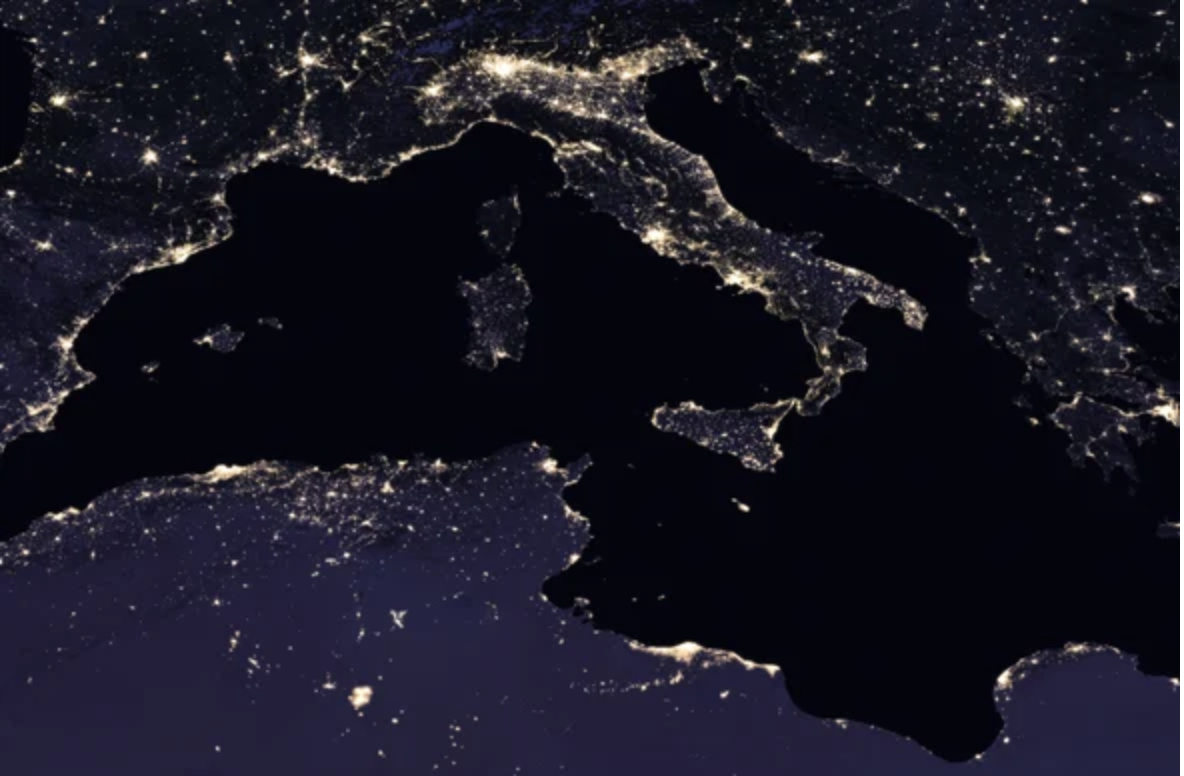
Are we in the midst of a current era of the lack of remembering an era that not so over-illuminated by artificial gas or electric light? The apocalyptic nature of a loss of the darkness of the night is increasingly upon us, and long before the year 4347 when Riddley Walker appears set. For the many reliant on round-the-clock work, any border between day and night is increasingly obscured.  All-night work across the world have fashioned glowing landscapes of increasingly illuminated night skies, over inhabited spaces in over-illuminated lands may redefine an uncanny materiality of maps for the new millennium, evident in composite satellite images of an electrically illuminated world.

Goddard mediterannean at night

Nasa Earth Observatory/Composite Image of the Night from the Godard Space Flight Center

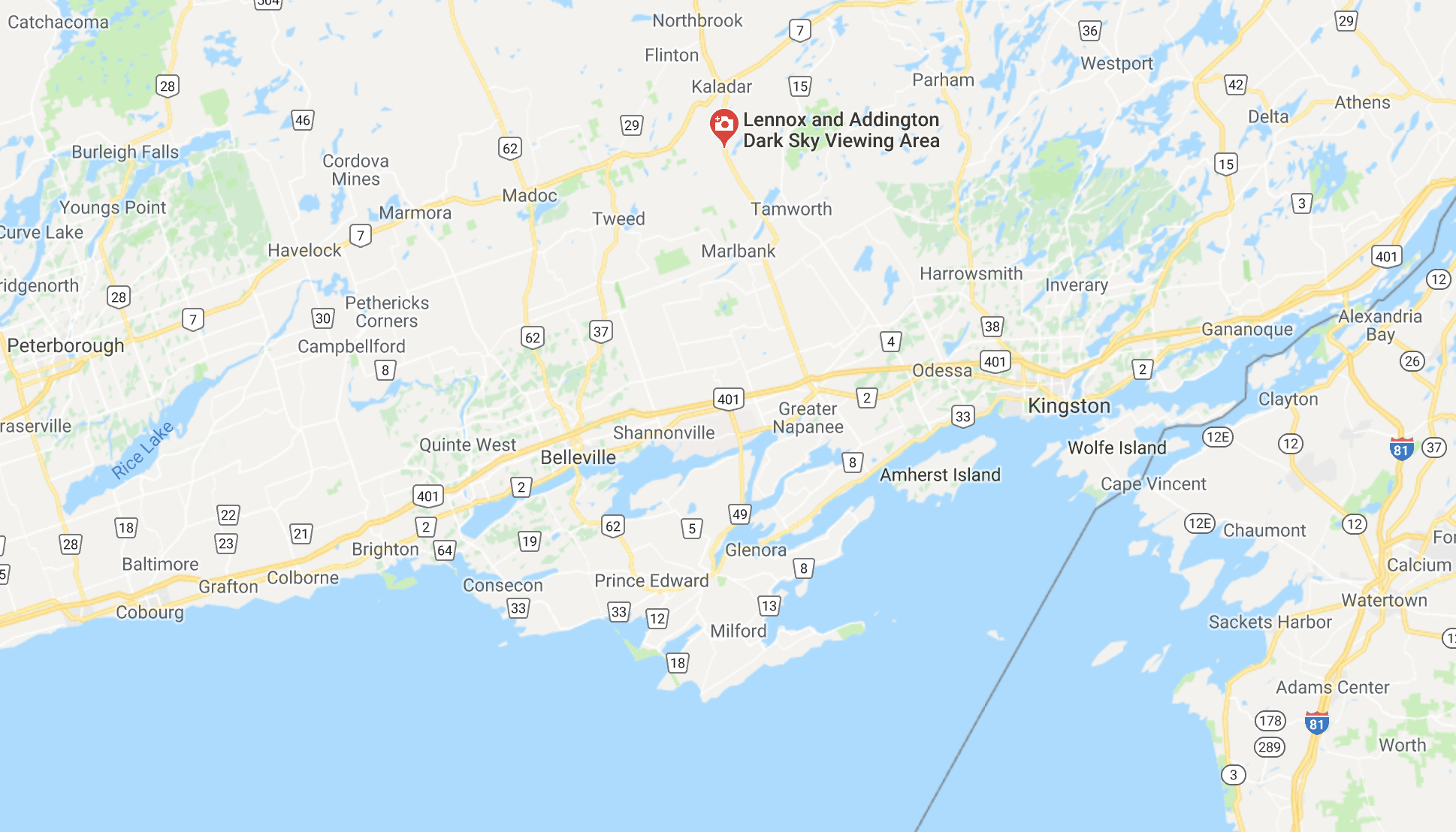
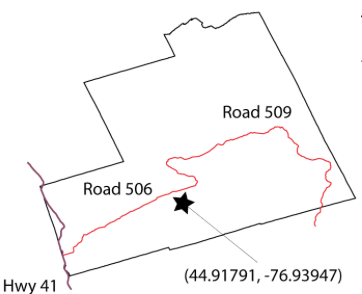
The notion of a “star-gazing station” that pops up along the highway may seem an improbability today.  But driving an hour and a half north from Toronto, just north of Napanee, one passes a Dark Sky Viewing Area, that offers the chance for volunteer-led star-gazing, where knowledge about viewing night skies are eagerly passed down, as if out of Fahrenheit 451, offering opportunities for amateur astronomical observation of geminoid meteor showers at the “most southerly dark sky site in Ontario,” where increased stellar visibility confirms that one has moved sufficiently away from the hyper-luminescent United States to “natural brightness” to view the Milky Way in all its glory.  The designation of “natural brightness”–or darkness–suggests a growing need to reckon with the geographical limits of night-time illumination.  North Frontenac, the Royal Astronomical Society of Canada   assures, offers surroundings suitably dark in fifteen km in all directions to be designated a “Dark Sky Preserve Status” for viewing night-time skies as they once looked.  The Star Gazing Pad invites all with telescopes in what seems a throwback to the popular astronomical observations of Victorian England. But it reflects growing anxieties and fears of the unprecedented skyglow and the augmented illumination of night time skies, where viewing stations are removed from major population centers. Astronomical observation in “dark sky viewing areas” exist outside of cities, near national parks, offering the possibility of respite from over illuminated skies.

Dark Sky Viewing Area.png

Dark Sky.pngLennox & Addington County Dark Sky Viewing Area

Driving north from the border today, one arrives on the 401 in “dark sky country,” as if a definitive passing of the border, north of Kingston and Lake Ontario, removed from the nocturnal glow of city lights, which promises to provide the “night sky experience very similar to what was available more than 100 years ago,” promising visitors the chance to “witness–perhaps for the first time [in their lives]–how the night sky is meant to be seen.”

N Frontenac

North Frontenac Dark Sky Preserve

Again, the question of the geographical boundaries of “natural brightness” and “natural light” are called into question by sites of such “Dark Sky Viewing Stations,” which have grown rapidly in Canada as preserves to “save the stars from light pollution.”  The United States was the foremost model for Butler’s cautionary tale of a post-apocalyptic future, when stellar visibility had only just returned, but only did after the decline of a world in which increasing artificial luminosity had long removed the stars from increasing portions of mankind.  

The vignette helped situate readers in a time just after a global collapse, where villages and cities are walled from roving gangs of drug-crazed marauders, and any semblance of security or infrastructure is gone from memory, and has faded into a past that few save the old can recall.  Lauren protests to her stepmother “there are city lights now” which don’t “hide the stars,” but the older woman is only able to shake her head in response, trying to summon earlier skyscape, and describe the changes that set the scene for the dystopia they now inhabit:  “There aren’t anywhere near as many as there were.  Kids have no idea what a blaze of lights cities used to be–and not long ago.” Lauren tries to recuperate an even earlier sill of reading the stars by an astronomy book that once belonged to her grandmother that allows her to decipher constellations she is now able to trace, and are newly visible in the night-time sky, using its maps as the sole means to be able to glimpse the stellar order seen in the night-time skies of bygone eras. Gas lighting was a memory of the past.

Henry David Thoreau pegged the confusion of night and day to the railroad’s expansion in mid-nineteenth century America, and to the expansion of the railroad outside of Concord. Amidst the spread of electricity, even in the unfrequented woods on the confines of town, traveling in th “electrifying atmosphere” “at some brilliant station-house in town or city,” Thoreau described the passage of trains as a new environment in their train of clouds and piercing whistle and defiant snort, acting as a giant plow amidst the countryside, registering the surprise with which even “in the darkest night dart these bright saloons without the knowledge of their inhabitants” as new environments. If this pollutes our language as “to do things ‘railroad fashion’ is now the byword,” the energetic coursing of the trains pollute his own senses not only by introducing light to the dark night where he is at peace: only after the train departs does he hear again the calls of whip-poor wills, hooting or screeching of owls, crying geese, or croaks of aldermanic bullfrogs of Walden, as if reacquainting himself with a natural sensorium of a living evening habitat that the train obscured. They return only after the retreat of any automated “path to the civilized world.” Far from the gas lighting that Thoreau had created a residence with “no path to the civilized world” in Walden Pond, even if it was with such a “deficiency of domestic sounds” that “an old-fashioned man would have lost his sensors or died of ennui” at the relative silence save squirrels on his roof, blue jays screeching, or a rabid or woodchuck beneath the house, finding privacy in a solitary life on a few square miles of forest, reclaimed from Nature, with “my own sun and moon and stars,” finding that even rare guests from the village “soon retreated, usually with light baskets [flashlights], and left ‘the world to darkness and to me,'” in an ideal of no light pollution that seems to have rapidly receded ever far away in time.

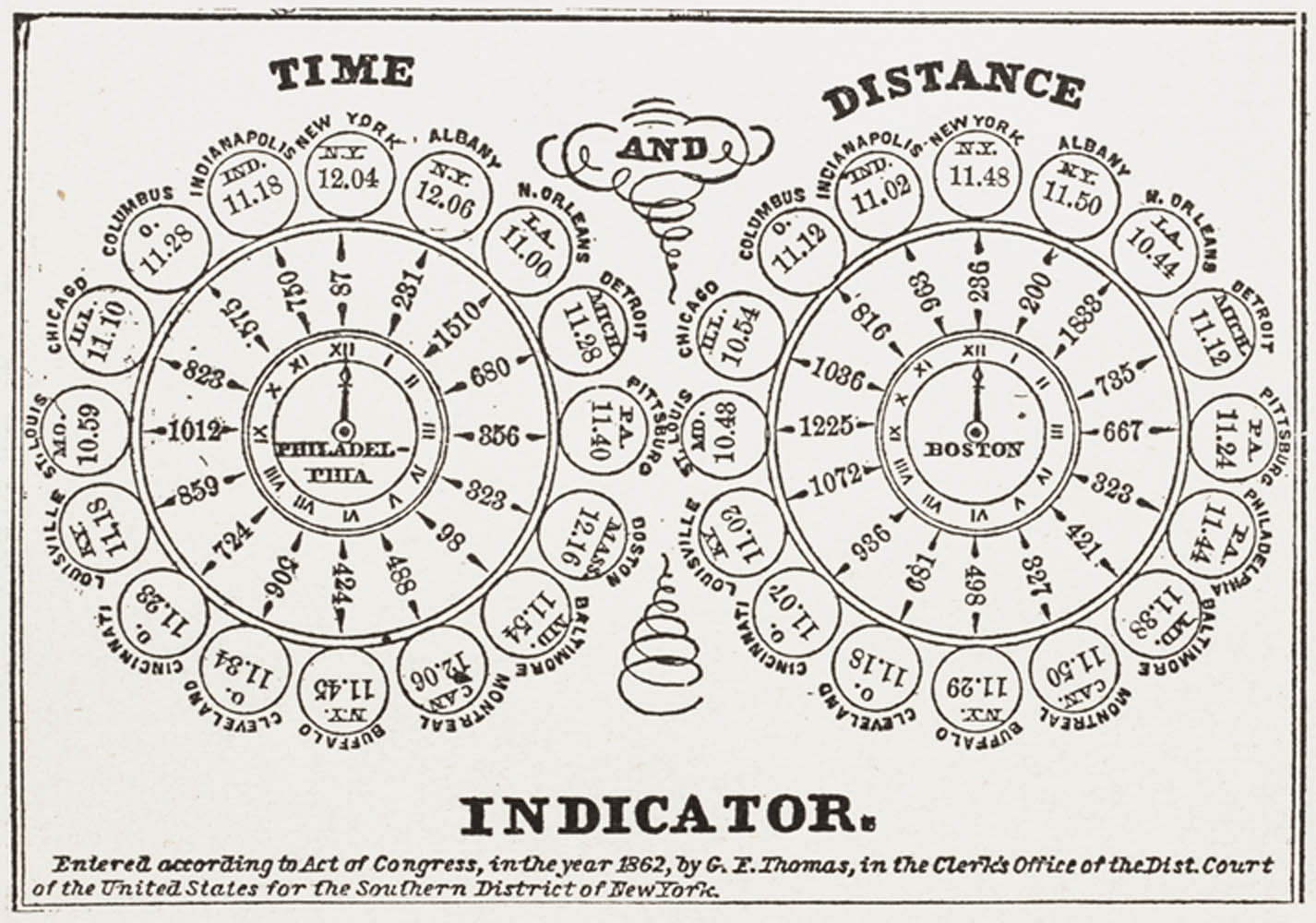
The night-time illumination of regions was tied to the introduction of the train. An animal of artificial invention, the train was a mechanical horse, snorting and creating a new environment of nature. Running across the countryside as a “fire-steed that flies all over the country,” a “cloud-compeller” that remakes its own habitat, stopping at “some brilliant station-house in town or city,” concealing the sun and leaving his own bucolic home cast into shade in its progress and he was awakened by its “defiant snort” in the middle of the night, erasing the division of day and night as it “penetrates my woods summer and winter. The progress of the train was, Thoreau suggested, to be weighted and considered a danger for the distancing of the world from nature, more than afford a support for civilization in the ability it offered to carry goods from all over the world to new locations, and provide odors carried with goods from “foreign parts, of coral reefs, and Indian oceans, and tropical climes, and the extent of the globe,” an effective precursor to the smooth surface of the transit of goods and open markets we tie to globalization. Concerned that there was “something electrifying in the atmosphere” of the train depot, where men “talk and think faster,” Thoreau invited readers to balance the improvements in punctuality the train provides even to farmers and the new compass lines it create perhaps obscure the path of fate in the air “full of invisible bolts,” as the individual is tethered to the relations of time and distance the train instilled.

Time Indicator, to Calculate Time Before the Standardization of Time by Charles Ferdinand Dowd in 1869

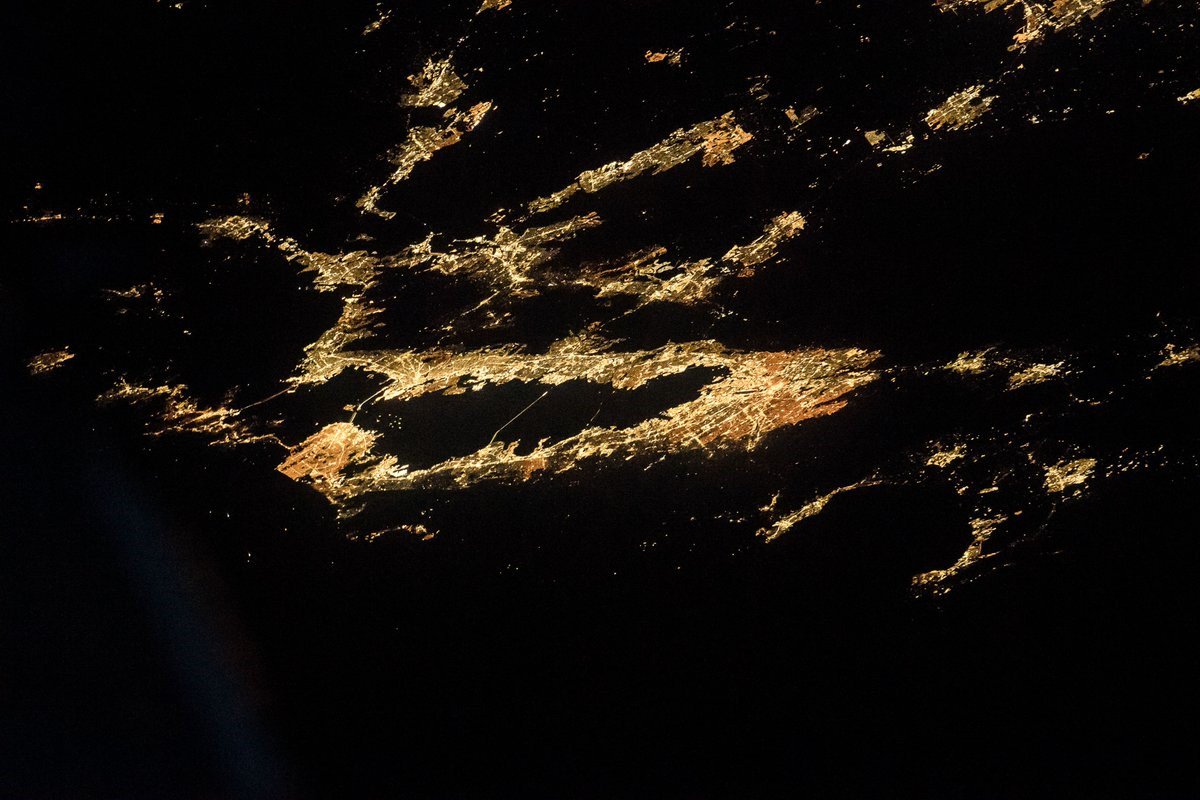
The rise of Railway Time by Greenwich Mean Time helped illuminate the landscape have accelerated to the premium on unelectrified unlit spaces of the present. In ways that give a new sense to “dark data,” techniques for mapping of the absence of light from an increasing share of the world suggest a new understanding of “place” that commands attention in multiple ways.  The Bay Area where I live can already be seen from the sky from the International Space Station, as photographed by astronaut Randy Bresnick photographed it in one of his final trips about the planet, that bear shocking witness to the expanse of populated lands that illuminate the growth of streetlights in the Bay Area, where intense luminosity stretches from San Jose to the Carquinez Bridge:

DQ45lruUMAAQUQW.jpg-largeRandy Bresnick/@AstroKomrade

The experience of the extreme intensity of urban blazing is echoed in the quite timely appearance of an atlas of night-time space.  The use of satellite maps to chart the extent to which artificial light has come to compromise the night-time sky over the past fifteen years.  For it reveals the global scale at which the growing impact of light pollution on the diminished darkness of the night-time sky not only around once sacred areas, like Stonehenge, but stands to change our sensitivity to the perception of starlight, and experience of a non-illuminated world.   At one time, the definition of astrological constellations provided a basis to organize time, space, and prognostication, they offered natural guideposts for maritime navigation–as the girl in Parable of the Sower seems to suspect, even as she struggles with the absence of many clear keys for their interpretation.  If Butler suggested the dark future of no stars in an alternate world of the future sometime shortly before 2024, by which time the dark sky has returned, we see little point of turning back in the maps of the over-illuminated world presented in the first-ever global atlas of light pollution atlas.

The atlas suggests we won’t so easily return to an unlit world–or at least won’t return save after a similar apocalyptic massive destruction of the over-industrialized world.  The recession of stellar visibility is only beginning to be fully mapped in full, but the ever-narrowing window of night-time perception of stellar visibility seems quite timely.  The global spread of man-made light pollution is the direct consequence of living in what historian Mathew Beaumont first described as “post-circadian capitalism” back in 2005– a condition where work-time is no longer governed by a clock, or biological rhythms of sleep, but both flexible employment and 24-7 economies have effectively expanded the working day to a continuous job, often enabled by continuous illumination. If Beaumont, following Jonathan Crary, has seen the sleep-deprived working worlds of the globalized world that denies the value of rest–or allows one to deny it–the attempt to process the global absence of darkness demands to be grasped as evocatively as Butler began. And one is pusehd to do so by a recent collection of the diminished global levels of starlight and stellar visibility, which invites us to try to survey what a sky without stars would be.

Continue reading

2 Comments

June 18, 2016 · 12:26 pm

Disappearing Open Spaces across the American West

In the visualization of land conversion map in the header to this post, cities like Denver, San Francisco, and Salt Lake City haunt the transformation of landcover across the western United States, as the place-names haunt the five-color map that denote the scope of an absence of open space.  From each city, expanses of red leach into the landscape, spreading outwards along patterns of settlement in ways that seem to infect the adjoining counties to register how development cascades to surrounding regions.  The image shows the reduction of once-open spaces with the dramatic pace of extra-urban expansion in most western states, whose absence seems to haunt the region that we once knew as the American West, and are departed from it.

The dynamic maps suggest a poetics of loss, both qualitatively objective and evocative of the disappearance of a landscape that no longer exists.  Increasingly elegant interactive data visualizations help orient viewers to a changed relation to the landscape of the west over the past twenty years, and the disappearance of what was once a notion of wilderness that have so dramatically retreated over increasingly active real estate markets and dynamics of expansion that allowed such pronounced extra-urban growth over a short period of time.  The subject of the maps is not only difficult to process, but complex to navigate over time:  if the use of a slider bar helps orient oneself, it also raises question of the historical implications of such a broad retreat of open spaces across western states.  If the Old West seems a fixed chronotype to some, it may be that mapping the retreat of open spaces can provide a lens to chose our Romantics, or map the nature of our Romantic tie to the retreating spaces of the past and its landscapes.

But how best to read the landscape that lies beneath them, and the changed experience of the landscape they seek to describe?  The stark colors of the data visualization cannot but suggest a romantic relation to place, marked by the disappearance of formerly open lands, and suggestive of a deep change over few years.  The multiple levels of time that the maps of The Disappearing West, a web-based map offering ultiple datasets of different sorts of human activity presented by Conservation Science Partners and the Center for American Progress.   The elegantly interactive website of land use, showing incursions of open spaces in alarmist red, provide a way to take stock of existing changes and the dizzying pace of the disappearance of opens spaces that may even be cognitively helpful, as the scale of such changes are so difficult to process.  The opportunity to examine change on different scales and over time, by use of a slider bar, provide a basis for coming to terms with the increasingly irrevocable rapidity of such changes, and indeed with the inevitable melancholy of the departure of the known world of the past, but provide a deep and irrevocable sense of how our own ability to observe the western landscape is in the process of irrevocable change.


1.  Such a sense of irrevocable change was quite violently tried to be stopped when the self-designated cowboy when the out-of-state vigilante Ammon Bundy summoned like-minded ranchers who inhabit another region of the same landscape in Nevada.  He summoned the ranchers who viewed themselves as rightful residents of a faded land so that they could seize public lands in Oregon’s Malheur Wildlife Refuge, without justification, but to assert their imagined rights to open lands.  In garrisoning one outpost of the wildlife sanctuary, without much regards to its use, they sought to stake claims to their rights to a rapidly departing map.  Their reaction–but one of many to the disappearing west–suggest a point of beginning to see how we might better come to terms with the acceleration of the loss of open spaces over time, and the problems of mapping them onto the region’s powerful spatial imaginary.

For in misguidedly hoping to occupy the refuge’s offices until the United States government “release” any claims to the public lands it has long administered, they seemed to act in hopes to reclaim a landscape increasingly fragmented by overdevelopment and forever altered.  As open spaces of the Old West disappear, the staying power of the  mental imaginary of open lands have created a tension palpable enough for Bundy and his followers to view federal protection of pubic lands as unjust, and armed with a sense of reclaiming a lost landscape for hunting, they aggressively reclaimed a myth of a sacred relation to the land that they might experience to use firearms freely without impunity in open spaces, and eager to recast protections of public lands as if they were primarily individual restrains.

As if to stage claims to a disappearing west, Bundy sought to reclaim them for ranching and hunting from a very local point of view, resisting a disappearance of the fabled “open lands” that once defined the imaginary of the West for Ammon Bundy, the son of a Nevada rancher.  Bundy and his fellows railed against the government, invoking hopes to restore the conditions of the west, as if removing governmental presence would let a wilderness reserve to revert to wilderness by liberating it from alleged government control:  his anti-government animus was evident in his earlier defense of the right of his father, Nevada rancher Cliven, to refuse to pay grazing fees of federal lands.  Ammon encouraged a 41-day armed occupation of Oregon’s Malheur National Wildlife Refuge in January, 2016 to defend local claims on a national stage–although his anti-government stance was more apparent than his appreciation for the historical loss of open lands across the extent of the western states.

The outpouring of sympathy of resistance of a range of militia to Bundy’s elaborately staged reclaiming the West was a response to a shifting mental geography of the west.  But the bizarrely misplaced response of such extreme violence among the Bundy and their followers in the name of reclaiming western lands seemed to act as if it was possible to restore it to a lost landscape of hunting, trapping, cattle ranching seems a geographic dream.  If the maps were in their heads, it was so remote from realization to be self-indulgent.  Might the interactive format of a web-based map provide a more clear-eyed way of taking account of the rapid decline of open lands across the western United States?  Can interactive data mapping of California’s rapid loss of open lands in an interactive format provide a more clear-eyed ability to track their disappearance?

A recent set of two-decade old change in The Disappearing West offer an opportunity to assemble and investigate data on the drastic reduction of public lands and extent of extra-urban growth across the west that seems particularly timely as a way to chart the rapid pace of landcover change in the West in relation to the Bundy brothers’ ill-conceived attempt to the back a mythic relation to the land.  The graphic tools it offers call attention to the loss of open lands in our national interior.  Indeed, the increased current dangers of dismantling the public custody of remaining open lands may make the website a valuable tool of visualizing and taking stock of the extent of their reduction in recent years–and raise questions about the best ways for preventing their disappearance.

For the dangers to the western lands lie in fact less with the invasiveness of public governments or the extent of government land-holding in western states than the true value of their custodial role in preserving needed habitat and open spaces–the commons of the wilderness, if you will–that are increasingly endangered or lost.  The imagined spatial geography that the Bundy clan sought to defend has long vanished, but Ammon and his brother Ryan held a spatial imaginary nourished in a landscape where federal policy, rather than local development, threatens the landscape of the west. Much as their father, Cliven, had evoked the former freedom of a once open lands of the western states once known as the “public domain,” the retaking of a federal wildlife reserve seemed a theatrical reenactment of federal lands as if a wildlife refuge constituted a last stand for defending his family’s rights.

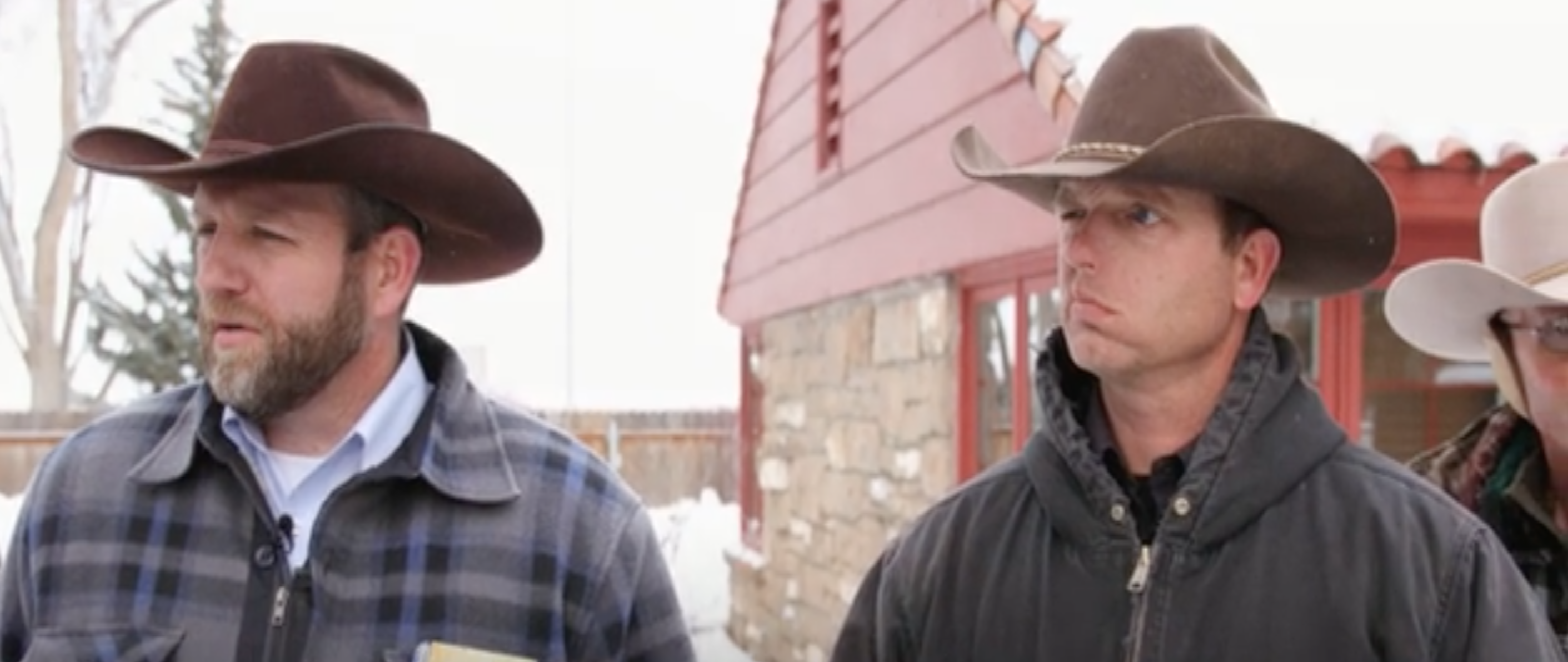
The vigilante group illegally occupied offices of a preserve for birds for month, after intending to remain for a year.  They did so in their desire to affirm a departed west, but acted somewhere between a costume party and organized terrorism in a poorly conceived defense of the Second Amendment, dressed in cowboy hats and attracting the support of anti-government militias at whose rallies Ammon Bundy and his brother Ryan announced plans to occupy the refuge’s unoccupied offices on the first days of 2016, inviting armed men to sieze them to defend the idea of access to an idea of wilderness long vanished for most.   The range of objects sent to them–many including sex toys that made fun of staging claims to masculinity in an isolated cabin–underscored the futility of hoping for a restoration of a rancher’s sense of the wild, by hopes to “open’ 1.4 million acres of the National Forest for logging, conjuring specters of governmental presence in untarnished lands to protest the government’s role in the US West.  Their bid to renew the old rules of the western lands by exposing an undeveloped forest to forestry, challenging how the National Parks have preserved remaining isolated areas of a once-forested expanse of wilderness, suggest the need to gain purchase on the scale of the expansion of paved landcover and property development across the western United States.


Screen Shot 2016-10-28 at 11.27.22 AM.pngAmmon and Ryan Bundy/Oregon Public Broadcasting


While their protests were misguided, the Bundy brothers seized state facilities as if they were their natural rights,  bulldozing new roads in the refuge, and attracting the attention and support of local libertarian militia until they were arrested as if protesting the death of an earlier rural America and of the once-open west through the issue of federal land-ownership.  But the problems of public management of lands have little to do with the disappearance of open spaces across the western United States, if the Bundys sought to defend their ability to graze animals, hunt, camp and live in open lands increasingly curtailed in most of the United States, and even in the western states where few opens spaces remain, but where residents were long attracted to the freedom of their open space and ready to defend what they saw as the impending encroachment on common lands, and lacked much objective relation to the deep exclusion that they felt.


image-1.jpegRick Bowmer/AP


2.  The loss of open spaces from Arizona to Oregon are far less the result of government policies than the rapid overdevelopment of western lands, and although the spatial imaginary of the Bundy and his followers directed much of their animus to the United States government, they responded to the rapid contraction of the notion of “public lands” that have changed the very image of open space across the western states, which Bundy seems only to understand–quite misguidedly–in terms of the federal policies of land management.  If the notion of “the commons” has long departed from the American West, the image of those commons and rolling plains has been far more compromised and challenged by the rapidity of land conversion due to public development and the rapidity of extra-urban growth, which Bundy from the perspective of his father’s ranch may not see–and may even only be able to be entertained from a site such as the Wildlife Refuge where he and his followers holed up and presented the demand that the “federal government will relinquish such control” of the national forest it maintains in a role of stewardship, and allow “ranchers . . .  kicked out of the area [to] come back and reclaim their land.”

The imagined intergenerational transmission of property rights in regions never open for ranching could be alleged to be “in accordance with the [U.S.] Constitution, which is the supreme law of the land,” but the desperate vigilante action was a power-play for national attention with little sustainable logic–especially given the scale at which open lands were lost to private development across the west.  Whether the image of the “Oregon Territory” inspired Bundy and his crew, privately held lands (light blue) dominate Oregon far more than the small bits of National Wildlife Refuge (brown) lying in Eastern Oregon–yet Bundy alleged his case lies outside of government jurisdiction, summoning a misguided notion of natural rights to defend his personal right to the land.


Oregon.pngLand Ownership in Oregon/Mark Green


3.  The accelerated diminishing of green space across much of the Western United States has rapidly rewritten a landscape of once-open lands.  Such rapid curtailing of open spaces, as much as revealing a change in land cover, has deeply altered the local experience of the very landscape and fragmented wildlife habitat in ways challenging to map-so radically have deep changes altered our experience of its landscape on the once-virgin west through the rapid change of once-rural lands.  With over a hundred million acres lost to modification by humans, a decade of satellite imagery of land cover over eleven western states, the interactive maps The Disappearing West offer a starting point to explore, survey and take stock of the scale of massive environmental changes created by an ongoing collective redefinition of how we have come to inhabit the new landscape of the American west.  Indeed the interactive timeline tracking urban expansion and landcover change offers a different ethic relation to how land ownership has led to the dramatic curtailment of formerly open space.

The progressive development of the landscape over a decade is difficult to comprehend.  But the streaming of this data into multiple layers, superimposed on each state, counties, and urban areas allows foregrounded layers of the map to jump out at viewers in particularly effective ways.  They help parse  the eleven western states that fills 165,000 square miles of landscape–a change in land cover equal to the construction of parking lots for six million superstores, and at an annual rate of an area almost as great as the footprint of the entire metropolitan area of Los Angeles–and far greater than the footprint of New York City, according to US Census records of the loss of natural lands used by Conservation Science Partners–to create a virtual profile of land conversion in an area that is increasingly fragmented by road, as once roadless areas are exposed to development.  The rapid nature of such anthropogenic change has been to some overshadowed by intensity of drought and of global warming, but distances the land in a terrifyingly definitive way as the region’s open spaces are increasingly segmented by roads and transportation routes.  But it has brought a fragmentation of open landscapes, driven by the expansion of roadways, overdevelopment and competition for limited resources, that have parcellized whatever protected open lands indeed remain.


land conversion


The web maps focus on a uniquely revealing index of the human footprint, rather than cities, or jurisdictional lines, to suggest the extent of how we are re-writing a relation to the land.  They aim to comprehend the loss of land over time a region that is reduced by a football field of uninhabited lands every 2.5 minutes.  The map is an attempt to depict the scale of this vanishing landscape, by a detailed record of the scale of the contraction of open lands that one can zoom to local levels, against which cities and regional names float in ghostly way, as if it describes the changes that underly a simple road map of place-names and individual states.

How can we read this record of disappearing space, save as the emergence of a new set of attitudes to the land?  Its flexibility helps take stock of accelerated changes in ways that we have only begun to take stock collectively; the maps force us to come to terms with the scale of recent “development” of open lands in ways that have been rarely so effectively or dramatically synthesized in one site, and our increased power to comprehend and try to come to terms with the disappearance of an older landscape that was the focus of such romantic attachment,–and the rate of the recession of that imagined past.

The visualization that can be examined over time and in such striking local detail affords a basis for imagining the terrifying scale of anthropogenic change across the west, with all its attendant problems of wildlife conservation.


Continue reading

2 Comments

Filed under American West, environmental mapping, open lands, open space, wilderness

Deep Blue Openings in an Increasingly Sound-Filled World

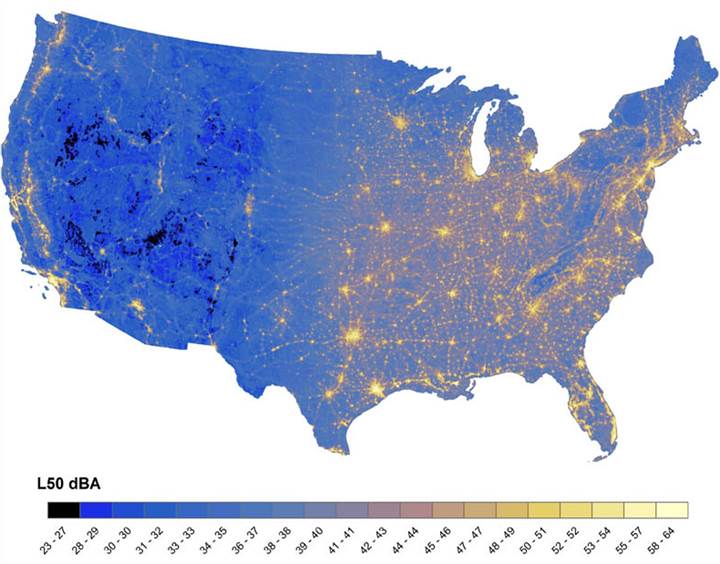
The detection of sound provides a primary registers by which we are able to judge spatial relations and experience space.  But sensitivity to auditory sensations may be increasingly compromised to orient ourselves across much of the country; the epidemic of the extinction of “quite places” in the modern world has created a deep alienation form sounds of place, even as we can continue to map place, and a dramatic contraction of auditory horizons by which we perceive the world.   Increasingly impacted by a barrage of anthropogenic sounds, the alienation that is increasingly common from natural ecosystems of sound, and predominance of sound pollution, has led acoustic ecologist Gordon Hempton to devote increasing energies to making sound recordings of areas of natural sound ecologies of the Northwest in Washington State’s Olympic peninsula.  The region, one of the few “deep blue” areas in recent mappings of increasingly elevated sound-polluted areas indelibly shape the acoustic and indeed neurological experience of place across the nation.  Registering the increasing presence of anthropogenic noice along thresholds of decibel levels creates an image of the dramatic contraction of sound horizons that Hempton is so interested in preserving.  The below map, created by computer algorithms, reveal a distribution that has rightly commanded increasing attention upon its release in no smart because of the recognizable mirror it lifts to our own world of a landscape–here, the soundscape is visibly rendered as a landscape that offers few spaces of blue in which to lose oneself–of the shrinking auditory horizons of most.

After synthesizing about 1.5 million hours of acoustical monitoring, the below representation of noise-levels across the nation’s roadways create a portrait of sounds likely to be heard on an average summer day presents an image of the extent of places where one can expect to encounter aural intrusions.  The flyover view illustrates shifting decibel levels across the continuous forty-eight states, but most strikingly reveals the rare places marked by an absence of human-made sound.  The almost inevitable infiltration of anthropogenic noises is only poised to grow further in coming years, standing to change our experience of place and how we inhabit the world.

The unprecedented registration of sound-levels mapped across the country and rendered by computer algorithms is a significant achievement, but a benchmark of human geography.  The shifting hues of blues used to map the registration of sounds at above-average decibel levels reveal a significant diffusion of high levels of background sound across the nation–and suggests the radical changes our national soundscape has experienced in recent decades.  For background noises have become an almost inescapable aspect of daily life.  While registration of auditory differences in ambient sound across space have rarely been able to be charted with such precision, the resulting map shows a national both distinguished by far higher sound-levels than the past, and a diffusion of human-made sounds spreading from megacities to the rural hinterland, leaving diminishing differences between the two:  the near-absence of lands removed from human-made sound across much of the land suggests a radical remaking of our auditory world, as loudness is no longer clearly localized.  Rather than reflecting clear boundaries, the almost inescapable nature of noise-levels across much of the Eastern seaboard, midwest, and west coast lights expanses by a dim sulphuric glow, confining “wilderness”–if by that we mean by that a space where we can listen to hawks cry, hear water running in streams, rustling grasses, the conversation of rainwater with leaves, or insects’ buzz–to a small regions of deep blue that roughly match the largest national parks.  Who’s to say that this is not a shift as significant as climate change?

The rising levels of human-generated background noise across the country may constitute a health risk, given established links between sound-levels and blood pressure; the near-ubiquity auditory interference also suggests a significant compromising of our sensitivities to the particularities of place that seems both particularly troubling and of historical note as a change in our lived environment and auditory atmosphere.
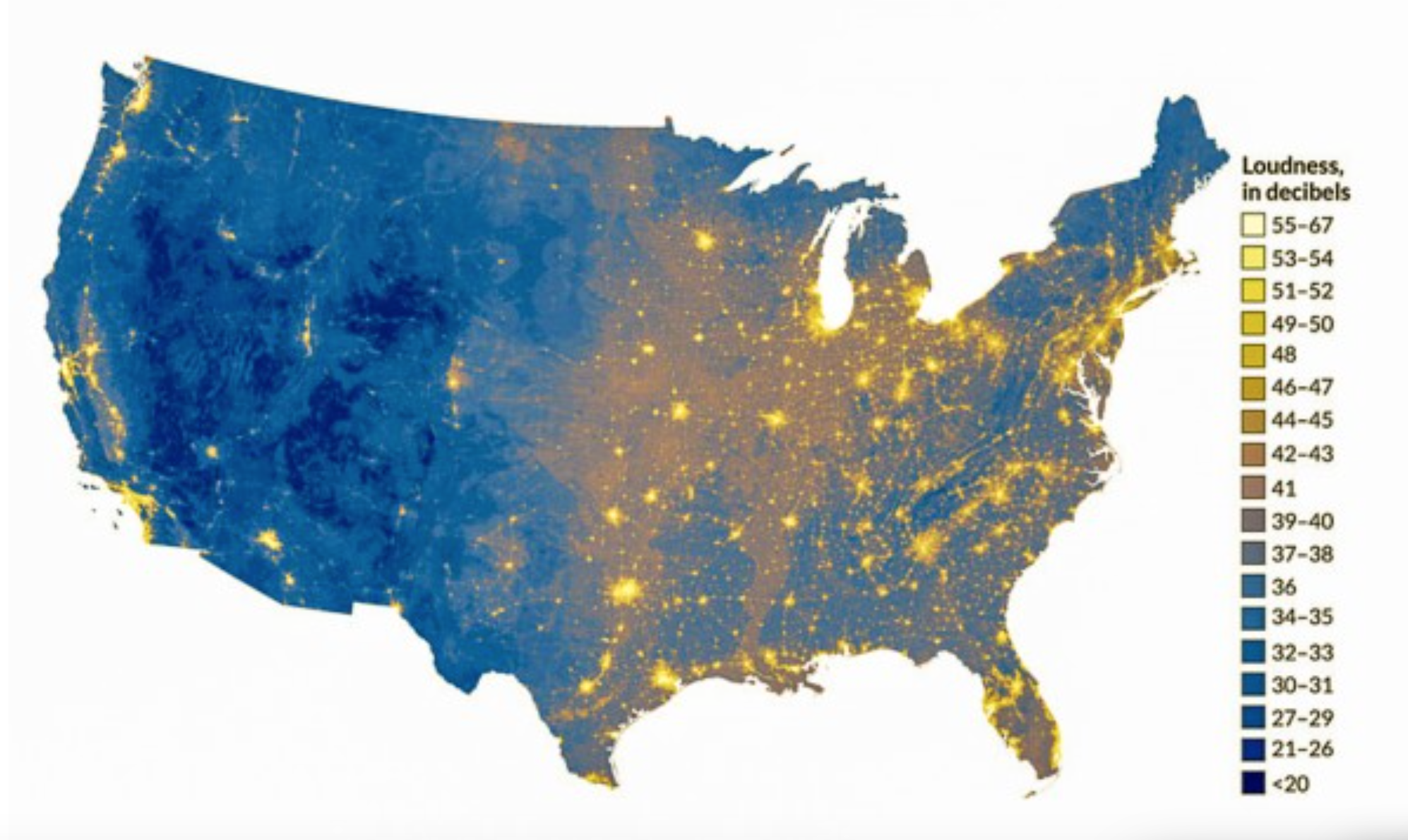
USA sound map in decibelsScienceNews


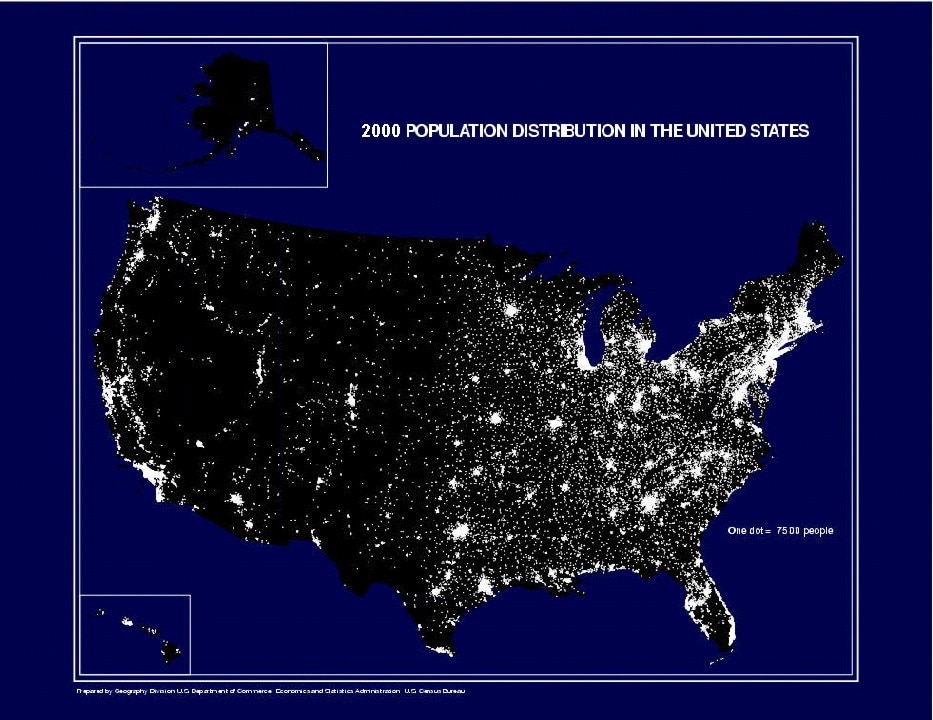
While reflecting human density, the map is not only a reflection of population centers–although it does map onto them–but of ambient noise.  And it is even more revealing not of where noise is concentrated, than on where it is absent–those deep blue openings on the map.
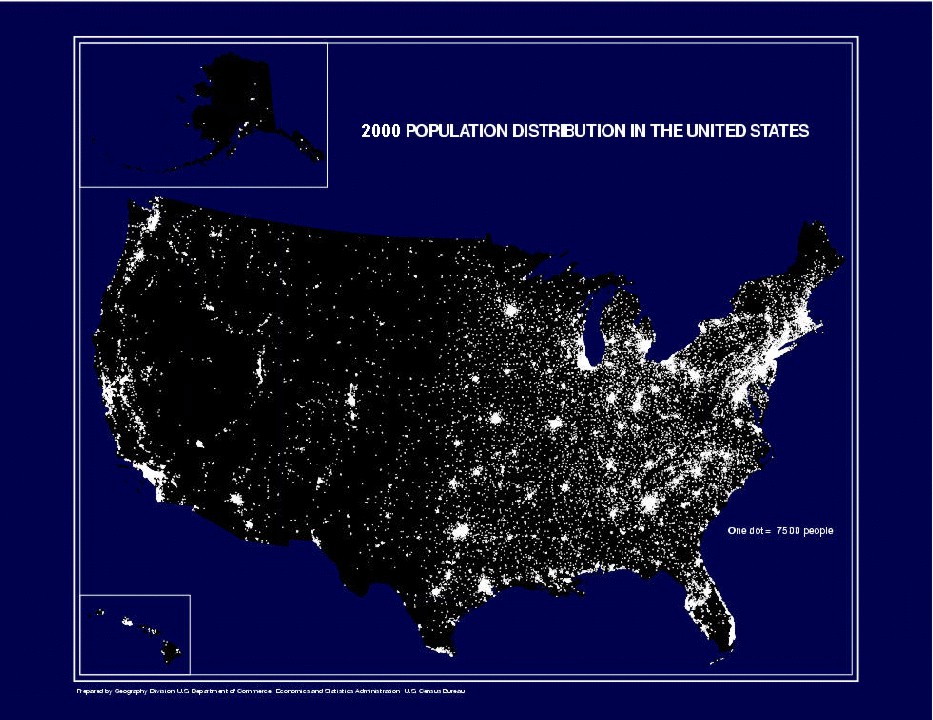
 

2000_Population_Distribution.jpgU.S. Census Map/Population Distribution, United States


The rapid expansion of anthropogenic noise has profoundly altered the national soundscape, and indeed made the protected aural environments that suggest the limited success of the management of sound a generation after the 1972 Noise Control Act set a standards of local and regional acoustical management.  The acoustic data was processed by computerized algorithms to exclude local street traffic as well as variable air sounds of jets that predicts spatial differentials in the levels of unavoidable local background sound even without such outside intrusions.  Human-made noise has not only outstripped population growth; the growth in rising ambient sounds has surpassed three decibel levels is perceptible in almost two thirds of the protected regions and National Parks–roughly mirroring that region of greater natural sounds, not accounting for sounds likely to be soon unleashed by the expansion of hydraulic fracking, pipeline construction, drones, and the expanding density of air travel.

The portrait of our decreasingly differentiated auditory environments raises the stakes for preserving secluded spaces that will undoubtedly compromise our own future sense of space.  To be sure, the notion of a comprehensive acoustical monitoring of the entire continuous United States is not possible, and would require far more funds than the National Parks Services has at its disposal.  But the picture that emerged of a shrinking space of silence–and a shrinking space of focussing on “natural” sounds, not generated by humans, is striking.  Even as we receive increasing recommendations from ecotherapists urging us to act to remedy widespread affliction by nature deficit disorder by immersing ourselves in greater sensory engagement, and ecopsychologists note the health benefits of hearing leaves rustling or wind through trees, the map paints a picture of a future of radically reduced horizons for auditory engagement with unavoidable nature of anthropogenic noise.  The illumination of up to half of the nation, if not two-thirds of its inhabited areas, by striking bursts of yellow suggest an encroaching inescapability of noise that may compromise our sense of space:   with refuges to experience soundscapes under thirty decibels of loudness increasingly rare, ecotherapists may be conducting some seriously long distance guided trips.  One’s eyes are drawn to those deep blue spaces of repose in select areas of the inner recesses of national parks, but one is simultaneously struck by their distance from the environment where one lives.

The imagined soundscape without the presence of humans–or filtering all anthropogenic sound–would reveal a national soundscape pronouncedly divided into relatively noisier eastern and significantly more silent western halves, reflecting the greater inhabitation of the half of  the country east of the deserts:  this seems almost an auditory Continental Divide.  When Kurt Fristrup and Daniel Mennitt of Colorado State University of Fort Collins sought to map a landscape of differentials in “natural” sound across the country, they used it as a sort of base-map on which future data levels could be read:  indeed, one can distinguish the deep green swirls of sounds of the Mississippi, silences of mountain ranges, and noisy coasts–but an expansive stretches of silence across most of the region west of the Continental Divide.
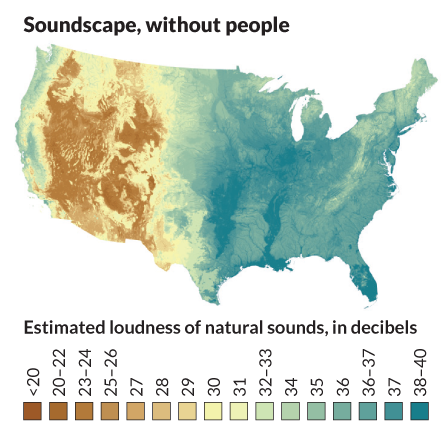
 

scivis_graphNational Park Services Natural Sounds and Night Skies

One can usefully compare it to the contacting regions of the forested United States, based on this 2012 remotely sensed map of the woody biomass of the continuous United States, released by NASA’s Earth Observatory and created by computer modeling, that reveals the growing expanse of those regions permeable to extensive infiltration by sound.
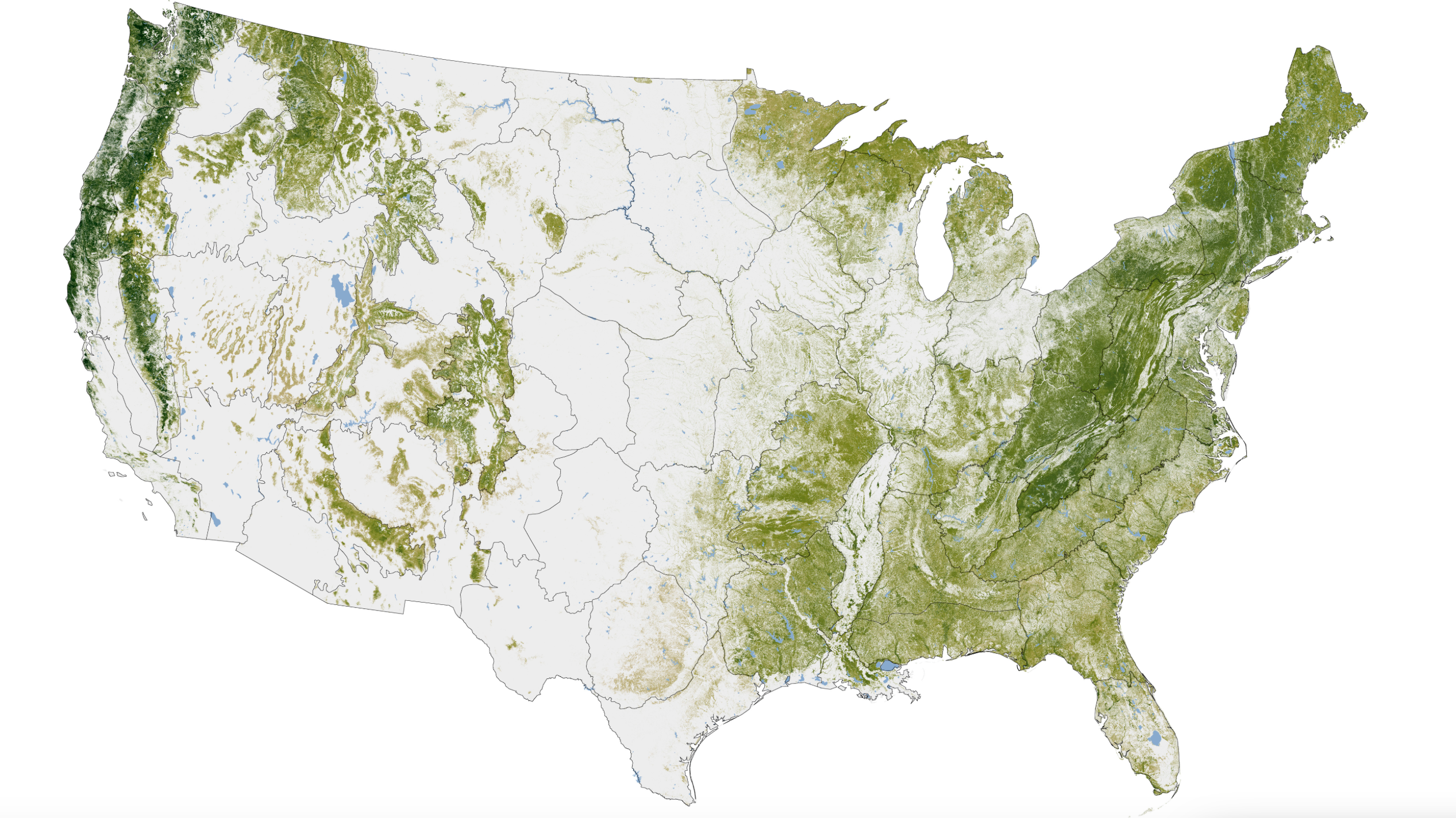
Woody Biomass from NASA 1999-2002

NASA


One might compare it to horticulturalist and dendrologist C. S. Sargent’s 1884 comprehensive mapping of the density of US Forests, now digitized by David Rumsey, which presented the first detailed survey of the sort, to note the decline in tree-cover across the Great Plains and Mississippi, as well as the Great Lakes:
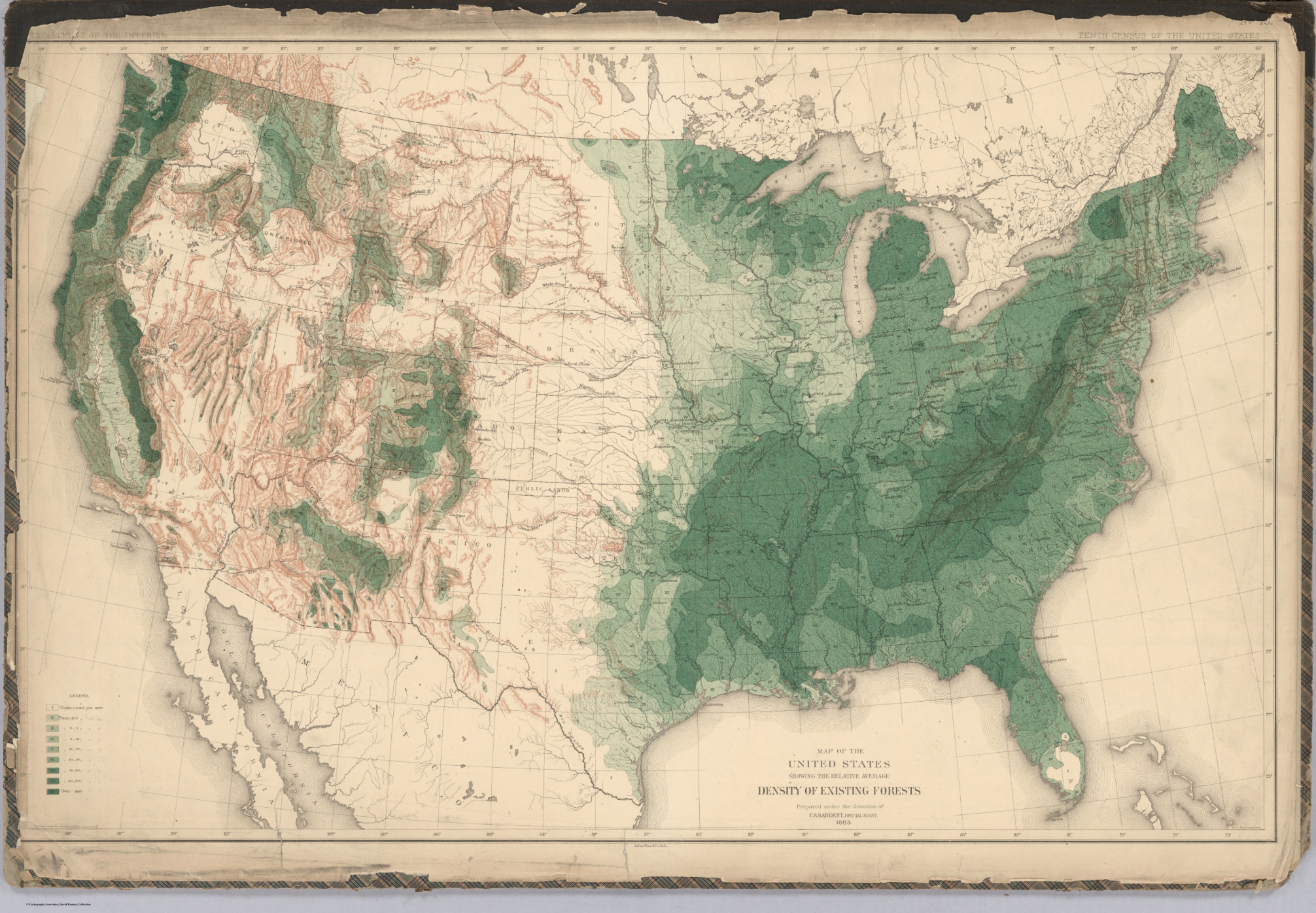
 

United States Density of Existing Forests 1884

Wired; from Rumsey Collections

The map of “natural” sounds reveals the levels of under 40 decibels marks a threshold in the intrusion of an array of anthropogenic sounds, one that reflects the changes of how we now inhabit the continent, and how we perceive the inhabitation of space, that might be compared to Global Warming in its cascading effects of how sound spreads across its sonic space.

 And in creating a synthesis of sound-levels across the nation, Frist has not only set something of a high watermark in the sound-drenched nature of our landscape.  The marked change across the national soundscape that Fristrup has helped chart based on 1.5 million hours of acoustical monitoring reveals a shift in hearing that seems on the level of that described by visualizations of the alarming local rises in regional temperatures across the nation, which providing apparent evidence of an inevitable process of global warming:  the maps below seems to suggest similarly ineluctible changes of the anthropocene at the nation’s edges that we have only begun to track, although the causation of such environmental impact to a release of greenhouse gasses is less clearly mapped in terms of causation, and human agency less readily determined than the registration of something that seems like climate change.
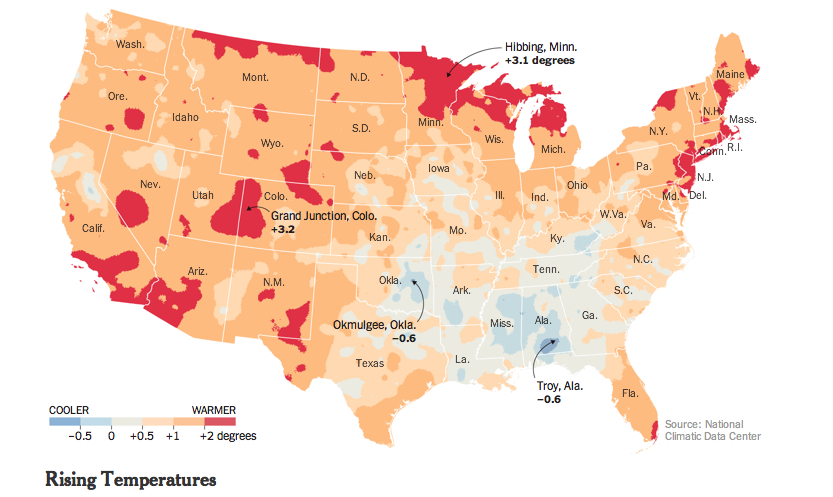
 

RISING TemperaturesNew York Times

Rather than consuming the edges of the country, as the above visualization of rising temperatures across the nation as evidence of impending global warming from the New York Times, noise encroaches on the country from the more populated areas more often located on its coasts and eastern shoreline.  The region providing platforms to the world is not organized as a clear workspace or a set of clear property lines, but as corporate entities and logos, and where the bulk of the wealth produced has proved increasingly elusive for many of its residents.  But the expansion across much of the nation’s soundscape by human generated sounds reveals what an analogous trend of man-driven change, if one that one can map with fine grain, and which impacts our perception of local experience in ways that seem more easy to measure and render at fine grain.

For the compromise of the sonic sensorium across much of the country suggests the degraded sonic environment we are transmitting to future generations.  The map of the auditory landscape across the United States suggests the emergence of sizable and rapidly growing rifts on the amount of audible sound to which we are daily exposed that seem as prominent as a Continental Divide:   radically different soundscapes in different parts of the country suggest a country increasingly plagued by noise–middle America or what was once known as the Midwest is distinguished by almost ubiquitous manmade background noise; intense acoustic shocks are rendered as bright corridors of noise run along Eastern seaboard of notably high loudness; only pockets of western parks, rendered as deep blue expanses in the interior, are distinguished by sound-levels of less than 20 decibels.  The Acoustic Society of America used some 270,000 hours of measurements across 190 sites in the country’s National Parks in the contiguous United States to assess an initial picture of levels of ambient human noise that seem all but inescapable in the U.S.  If the 1972 Noise Control Act was directed to strengthen legal protections against “unwanted or disturbing sound” to regulate noise pollution, sound-levels seem  so widespread across the nation to be hard to distinguish how unwanted sounds adversely affects one’s quality of life as unwanted disturbances.  Yet we now have a means to visualize the collective rises in ambient sound in ways that are truly as compelling as maps of global warming.

The change in our aural landscapes has gone largely unremarked, in part because the data is less easily available, and visualizations were long less able to be confidently rendered in such clear detail–or the amount of data not able to be clearly synthesized.  Even at first seeing the map of sound levels in the nation released by workers at the National Parks Services in past weeks, it’s hard not to be drawn to these scattered refuges that lurk inside the map, as we shun the bursting supernovas of  aggressively bright yellow whose streaks across the overstimulated sonic landscape where most of us live.  The brightness of areas in which greater levels of sound were sensed seem to push us to the relatively few remaining quiescent places in the continent:  it is not that they remind us of just how fully the sounds of motorized vehicles have come to penetrate most of our auditory worlds most of the time, but that they seem so ever-present and so visually loud, even when the levels of sound seem to fade miasmatically into the midwest, but reflect the growing population centers across the country that undoubtedly generate the greatest noise.  The map creates a compelling picture about how we can interpret the current distribution of populations as filling the nation’s space.

\
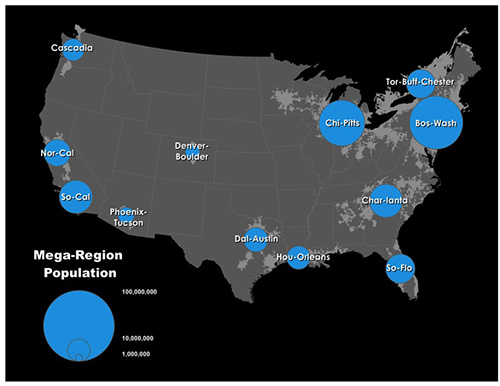
Ex01_Mega-Region-Population_500pxMartin Prosperity


Much of the attention that the map has received respond to just how rarely sound-levels have been so closely integrated–or so clearly shown to overlap–with the mapping of an environmental space, or so compellingly integrated within an understanding of environmental change.

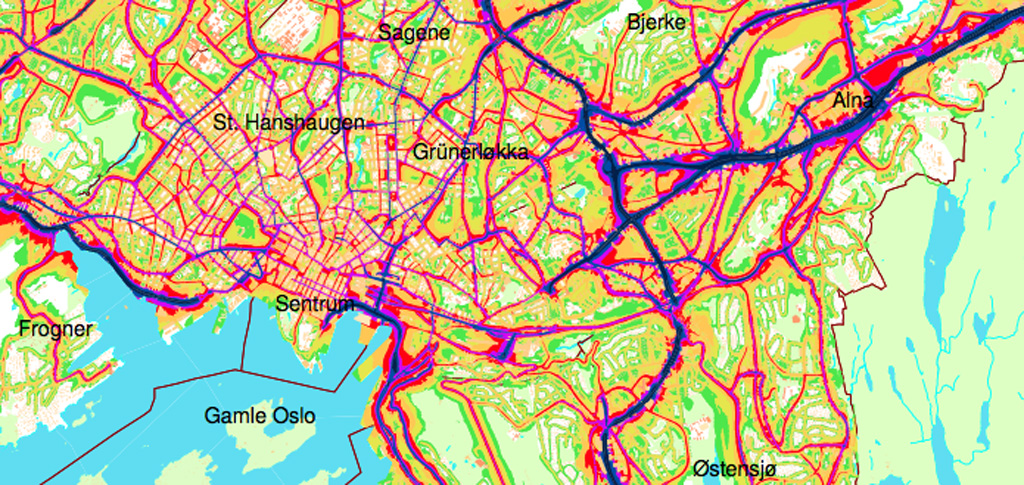
The question of registering an atlas of urban sounds have most often responded to less to subjective or individual perception than public policy issues that surround very specific local levels sonic pollution in urban environments from San Francisco to Oslo, based on visualizing noise levels across urban streets through GIS-based simulations that synthesize variations in decibel levels over time–and reflect a desire to control urban noise that even predate the Industrial Revolution, and which, R. Murray Shafer has found, there is evidence in Bern back in 1628, but which computerized maps provide a basis to visualize the results of such acoustical monitoring today.
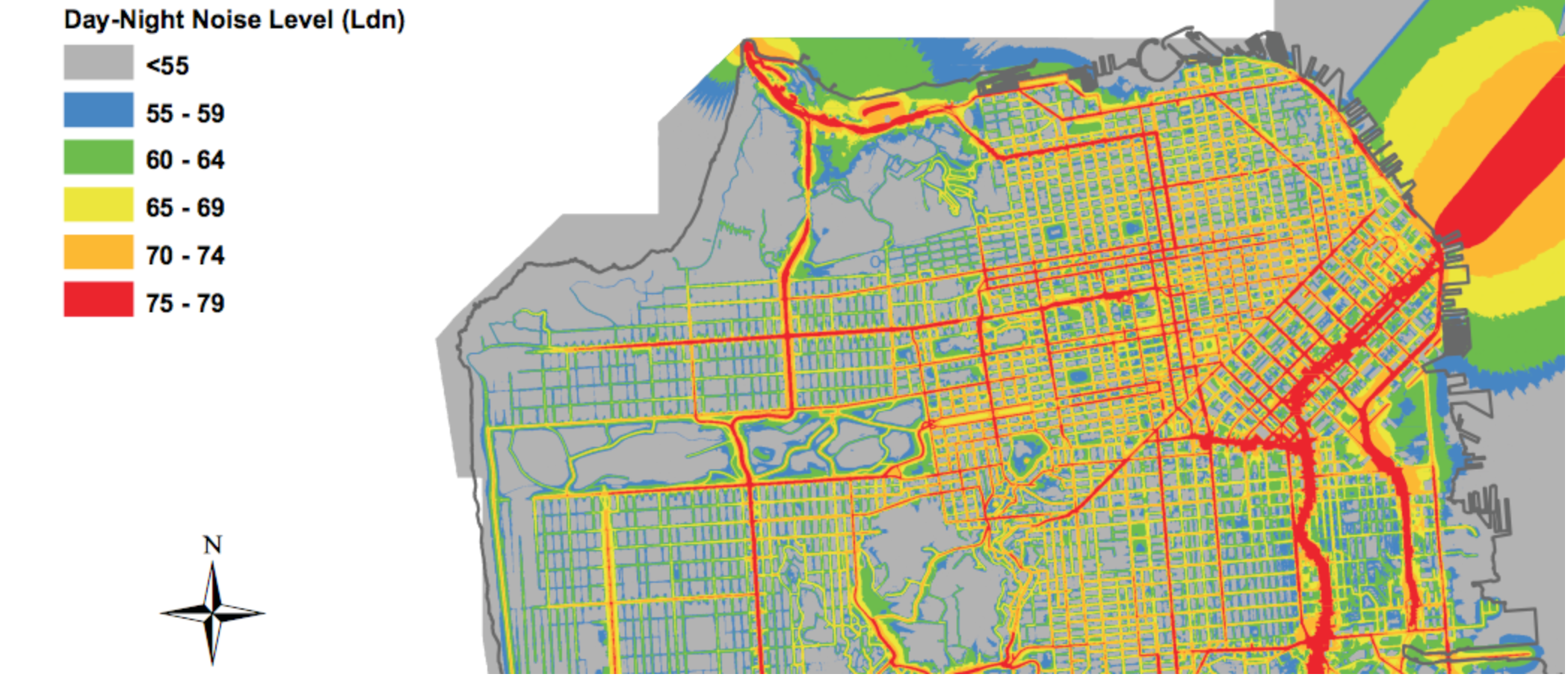
 

SF NOISE MAP

San Francisco

cus_figure18

Oslo

Despite such concern for managing urban soundscapes, less attention has focussed on comprehensively mapping endangered sounds–and even less on the endangering of silence, which have not been often imagined as a comprehensible object of concern.  Attempts at mapping local sound-levels for reasons of public health have focussed on a local level to assess problems of noise pollution and to assess aural impositions in urban spaces–and to measure benchmarks of tolerable sound-levels in urban space.  We more often consider noise abatement in relation to crowded restaurants than open spaces or countryside.   The registration of a varying range of decibel levels across the United States created the opportunity to visualize a color-coded record of ambient sound, grouped according to spatially situated environments, applied a broad palette to geographic space based on a much larger dataset, and one that responds less to problems of placing future projects of construction than measuring the increasing ubiquity of sound-levels often linked to urban environments across the country.

The innovation of the NPS sound map of the country’s less inhabited and more densely inhabited regions presents a particularly persuasive picture of the extent of the growing uniform nature of our aural environments.  Based on the 1.5 million hours of motoring across the country to capture  sound levels sensed on an average summer day, researchers with the National Parks Service have collated an impressive acoustic topography of the continental United States in hopes to map average decibel levels across the country, and found few areas of relative quiet.  The result is particularly striking for suggesting deep scars of sound that radiate aglow from urban agglomerations in a heat map of loudness that registers the diffusion of human-made noise levels across the country, and the extent to which much of its illuminated center is flooded with ever-present background sounds–acoustic pools, as it were, of almost 50 dB, or able to drown most natural sounds from animals.  If the sound map created from algorithms suggests just how urbanized we are today, and how far urban noise-levels extend across much of the country, it offers evidence of the auditory effects of anthropocene from which there appears no turning back.

USA sound map in decibels

The picture does not look good for the future of quiet spaces in most of the coterminous United States.  The stars and streaks of aggressively bright sulfuric levels of smoky yellow–indicating concentrations in urban areas of a level of 51 decibels or more–maps clearly onto population concentrations from the shores of Lake Michigan to Dallas, Atlanta or central Florida.  The noise map reveals huge differences in noise tolerance and indeed background noise that most Americans experience as normal, and indeed the auditory expectations most bring to their days, and the relative absence of silence over a large part of the inhabited country that noise has infiltrated, from a light gauze of yellow that surrounds are largest farming industries to the clusters of noise around expansive urban areas.  In those deep blue swirling patches of the interior lie the most silent spots of the country,abysses of quiet which register the lowest absolute levels of sonic interference, far from the pollution of urban noise which seems to spread like age spots across much of the eastern half of the continent.  (The very deepest deep blue regions designate areas of background noise below twenty decibels, the sound of a ticking watch, far below  the  a refrigerator hum, and very far from the ever-present ring of cell phones, piercing blasts of jack hammers or car alarms, freeway rumble or such sudden spikes as sawing concrete that now seem to so often mark the hubbub of urban life that is often difficult to blank out save by white noise machines.)  A considerable share of the population must be quite habituated to an almost constant loudness of almost fifty dB, or about that of constant traffic–and just below that which is claimed to increase high blood pressure, tension, and heart attack risks.

Remapping the limited areas of low-level sounds top stand out more dramatically in black as isolated islands of greatest quiet gives the map an even clearer urgency as a manifesto for the shrinking spaces of silence across the continuous United States:
150216-noise_0622150367affea5ca3ca361d54b523a.nbcnews-ux-720-600


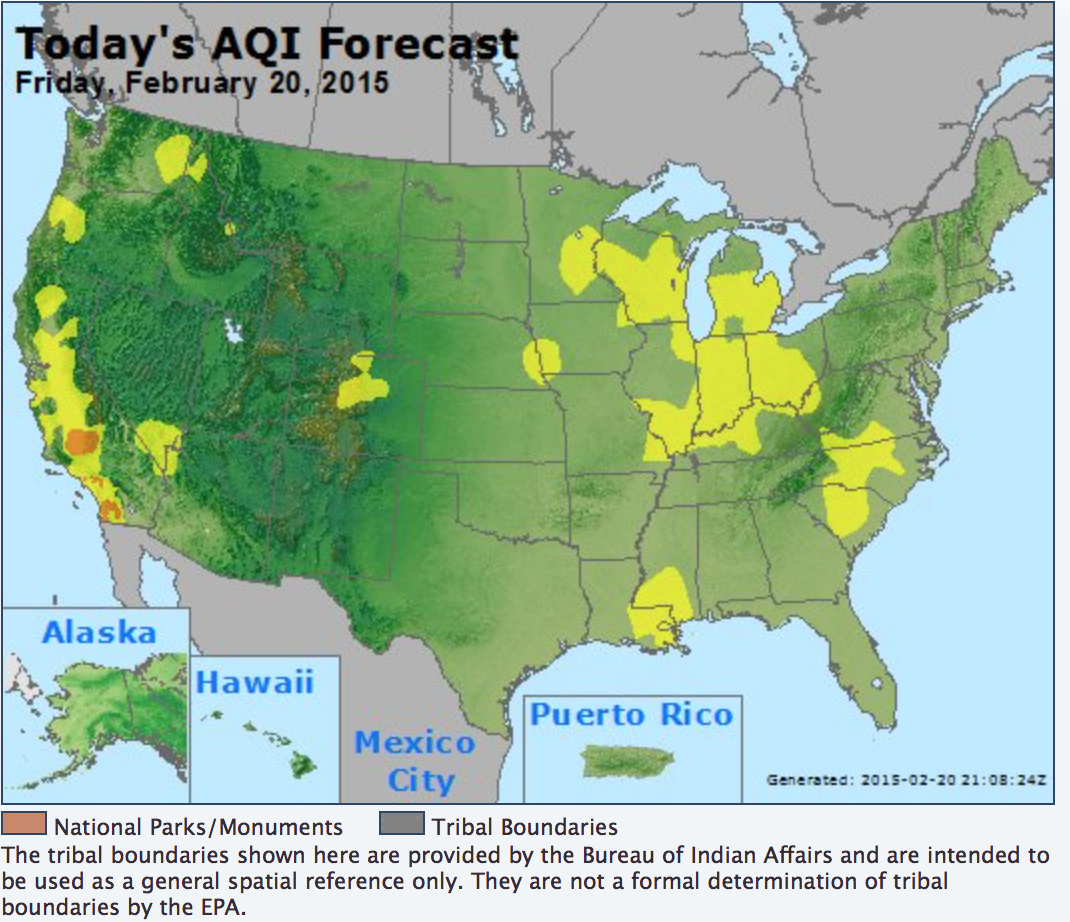
The map advances a narrative of the shrinking areas of silence in the soundscape of the continental United States that is decidedly not rosy, and in which levels of noise pollution stand to double or indeed triple every twenty years, making this a particularly troubling prospect that challenges the future of silence in America.  Not so surprisingly, it maps well onto a randomized map forecasting air quality across the nation in its contours, although variations in the NPS soundscape in the header to this post show more finely grained variations and seems to exploit a broader dataset.
 

Feb 20 AQI


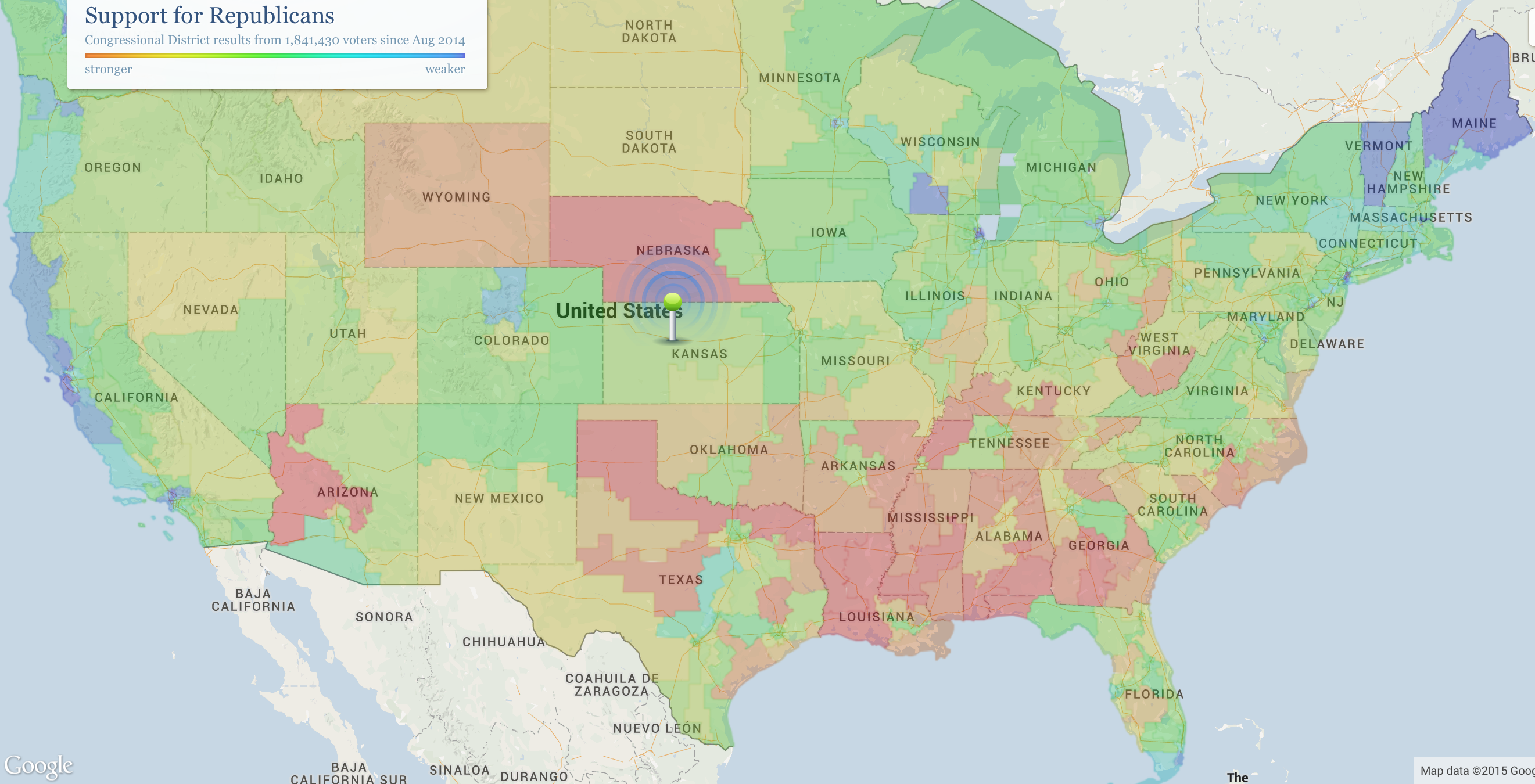
The deep discrepancies in decibel levels however bears little clear correlation to the current mosaic of political preference across the continuous forty-eight, however Lamarckian one would like to be about the relation between collective preferences and aural environments.  Despite a tendency to link weaker support for Republicans with louder areas of greater ambient noise, the data just doesn’t bear it out in full at all:  some of the reddest areas are those register considerably greater decibel levels.  (Low support for Republicans in Maine contrast with its predominantly low levels of ambient sound; noisy areas of the South are pretty darn red, despite strikingly diverse levels of ambient sound registered in those states; noise-levels in California’s central valley are roughly equal the blueness of its coast.)


Screen Shot 2015-02-18 at 9.10.13 PM


The narrative that the soundscape implies is far from rosy, however.  What seems most frightening is the lack of any clear map of the future penetration of high decibel levels across much of middle America.  Along the frontier of the decibel divide, much of the nation’s center appears flooded dark yellow; Denver, St. Lake City, Las Vegas and Boise seem beacons in an expanding aural frontier, burning bright already in Seattle and Olympia.  The registration of these ambient sounds include not only vehicles, but from factories, radios, sirens, televisions, construction sites, trains, or mechanically generated sound of any kind, registering the range of overlapping sounds at any space at any time, in a manner more like Zefrey Throwell’s 1,000-car-horn symphony than the heterogeneous ensemble of percussionists György Ligeti enlisted in his Grand Macabre.

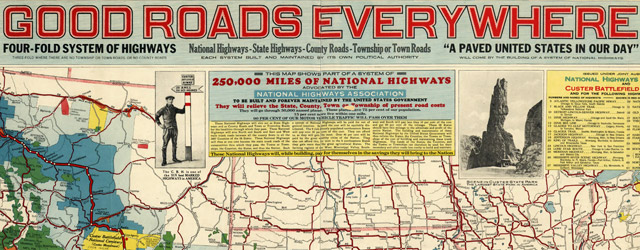
But the origins of the shifting soundscape in the nation might be better tracked through the appeal of the Good Roads movement of Charles Henry Davis, that industrious Quaker who lived in South Yarmouth, Massachusetts, but founded the National Highways Association in 1911, promoting the hope for an interconnected National Highway System of 50.000 miles “built, owned and maintained by the National Government,” which while limited at that time to six great “Main Highways,” advocated an image of “a paved Unites States in our day” that has persisted.   The benefits Davis saw in paved roads as an engine of economy that would raise the nation were more than only an infrastructure–“national highways will increase the wealth, the power, and the importance of this country as nothing else can do besides that which has brought civilization to the savage, wealth to the poor, and happiness to all–GOOD ROADS”–but an image of collective benefit.  The continued promotion of their benefits, so removed from views of the benefits of preserving place today, actively promoted the benefit of the ideal of a “paved United States in our day.”   Indeed, if all road maps were promoted in 1912 from South Yarmouth as useful tools that “will prove of inestimable value to the proposed national highways commission, and in addition will be of service in showing the people of each state how the national government can make use of their roads in the proposed plan” as of a piece with a bucolic vision of the nation.


Davis 1912.pngDavis, Good Roads Everywhere (1912)


Maps boosted the image of a national system of highways, and indeed our sense of access to national space, from the 1925 promotional map that synthesized the roadways of the nation as an invitation to their exploration to celebrate the achievement of 250,000 miles of national highway–
 

WVNZbcsbUGKLuyip_TT


–to the expansion of the “Good Roads Everywhere” movement creating a “paved United States in our day” as if it were “peace in our time.”
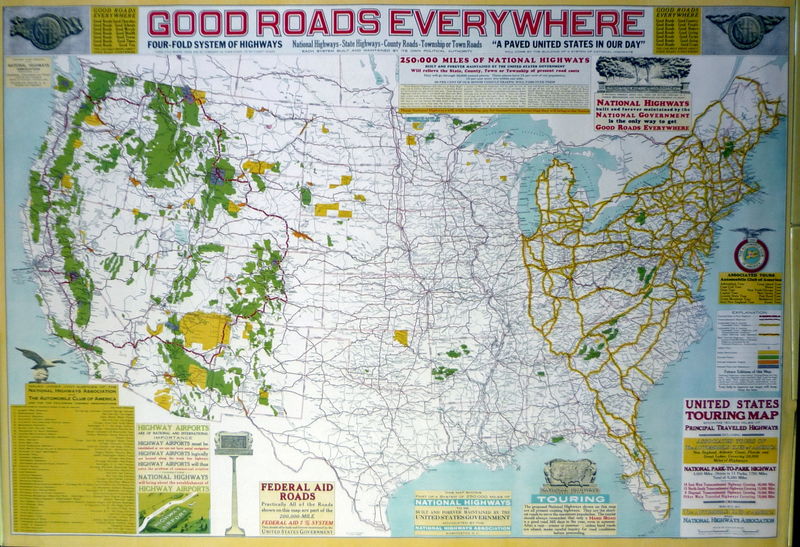
 

6a00d8341c6d6753ef010536249841970b-800wi.jpg


Looking at the nation’s soundscape, it’s hard not to be drawn to the chasms of deep blue where sound levels decrease.  National Parks Services’ researchers took some shots when they compared these areas without background noise to the notion of traveling back in time to the sound-levels before Columban contact–on their apparent ignoring of the dense population of the continent before its “discovery”–one might see it as the sonar landscape Lewis and Clark experienced with the collection of animal trackers and Native Americans which composed the Corps of Discovery,  traveling down the Columbia river or pausing in their portages:  these are the areas distinguished with a sound level of lower than twenty decibels, areas where one can access a pristine auditory experiences characterized by the near-absence of the background noises that we are tempted to screen out of our auditory experiences,–and against which would stand out the perception of local wildlife.

The attractiveness of these seemingly pristine places not only provides a compelling advertisement for visiting national parks during whatever summer vacations one might have, but is a compelling soundscape of a world not likely to return, where decibel levels fall far below the fifty that almost seem low for urban areas, the deep blue recalling something like the cold of oceans’ depths.  Created by the National Parks’ Natural Sounds and Night Skies Division, it reflects their mission statement to create an inventory of sound that seeks to preserve “acoustic and night sky environments unimpaired for the enjoyment of future generations,” Fristrup worries, and provides something of a watermark on our aural environments, but it is also intended as a diagnostic tool to measure the degree to which manmade noises affect owls and bats who depend on locating insects to find food–the somewhat synesthetic record renders an acoustic environment married by bright yellow splotches and sulphuric streaks, and ubiquitous noise levels comparable to hearing a washing machine churn from a distance of three feet away.

The ever-present scars of unwanted sound spread aggressively in almost radial fashion from major population centers and seem diffused across many the rural areas of the country.  The maps suggests the auditory compromises created by the road network which generates ever-present background noise across the continent’s more inhabited areas, even if the algorithm used to generate it discounted traffic, with non-human made sounds of wind and water.  Rather than present a watermark of sound levels, the map bodes poorly for the growing levels of volume in years to come.  If much of this noise-generated hearing loss perhaps on account of noise-levels artificially generated in iPods and MP3 players which funnel amplified sound into directly our ears–and which may have helped elevate the number of five million 12-19 year olds who have compromised hearing thresholds, according to Dangerous Decibels–a site which is full of tips on living with hearing loss and the risks of noise-induced hearing loss–the desensitization to environmental sounds that the map charts creates a landscape where even those without Noise-Induced Hearing Loss (NIHL) have a compromised relation to their environments.

But the map suggests the changing nature of outdoor hearing for most populations, compromised by the rise of background noise, and the deep penetration of what used to be considered urban sounds of mechanized movements across much of the country.

USA sound map in decibels

Reading the stark topography of sound levels across the lower forty-eight, one is indeed almost instinctively tempted to run into its scattered pockets of deepest blues:  these seem the safest areas of respite, as one shrinks from the bright incandescent yellows of even a tolerable amount of ever-present background noise–maybe not to the deserts of southwest Texas, but if not to the national parks bordering California, in the Cascades, the Colorado Plateau, Yellowstone National Park in Wyoming, Dinosaur National Monument between Colorado and Utah, and in the Great Basin.  (It’s perhaps not a coincidence that some of these ecosystems, many home to Native Americans, were to be preserved “from injury or spoliation” by the National Parks, preserved thanks to Carl Shurz, David Brower and Howard Zahniser.  Is the aural intrusion not a deep form of injury?)

One might as well get out a paper map of the greenspace in parks to correlate them with the deep blue lakes of silence .  . .
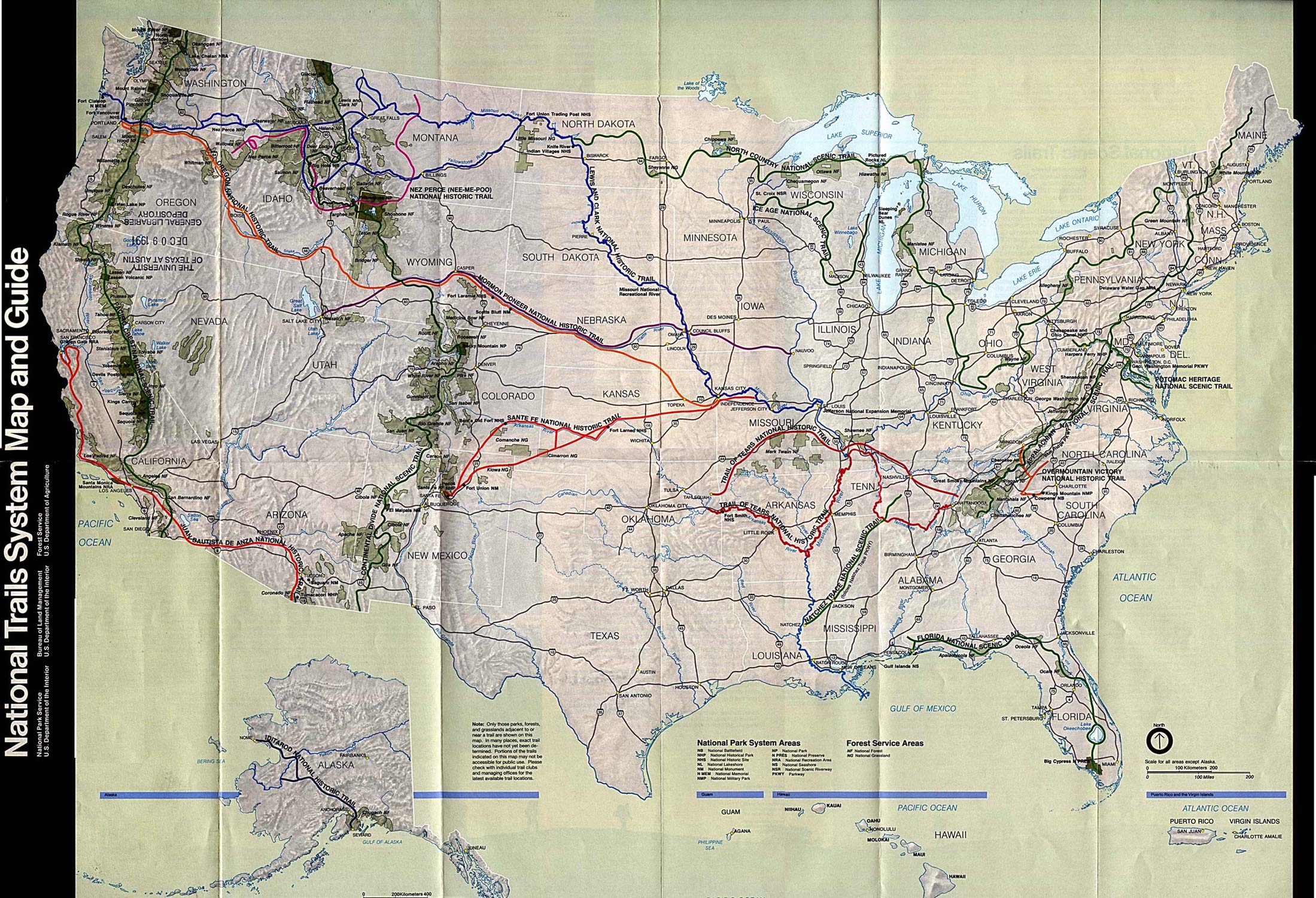
 

National_parks_trails_map


It is almost difficult to imagine the experience of those deep blue areas of silence today.

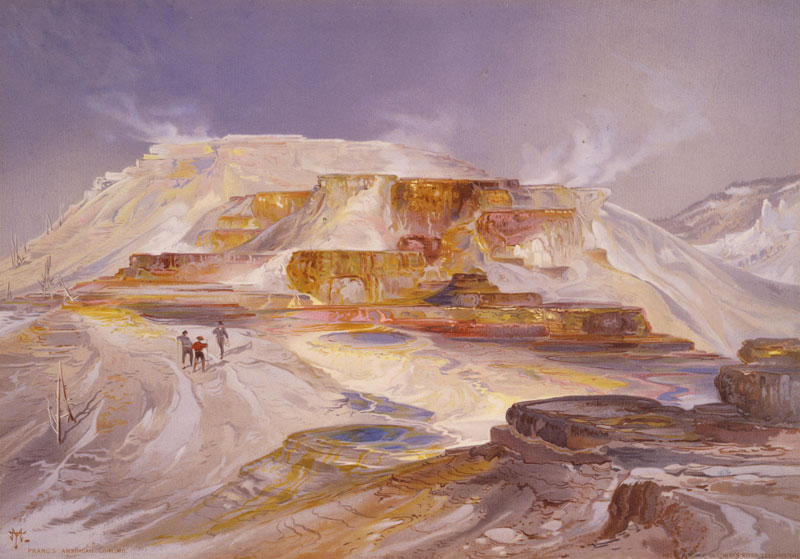
The expansive chromolithographies of Thomas Moran depict deeply hidden, inner resources of nature in sites such as the future Yellowstone or Zion Park, preserved from industrializing life of in ways that raised interest in the hidden landscapes of the United States, after he had accompanied Ferdinand V. Hayden on the 1871 Geographic Survey of the Territories, in ways that created one of the first romantic images to produce a popular movement for the protection of a landscape as undisturbed.  One is struck in Moran’s monumental landscapes by how these awesome environments dwarf their  human visitors, arriving in what seem uninhabited lands, far from the noise of railroads or cities in the industrializing United States:
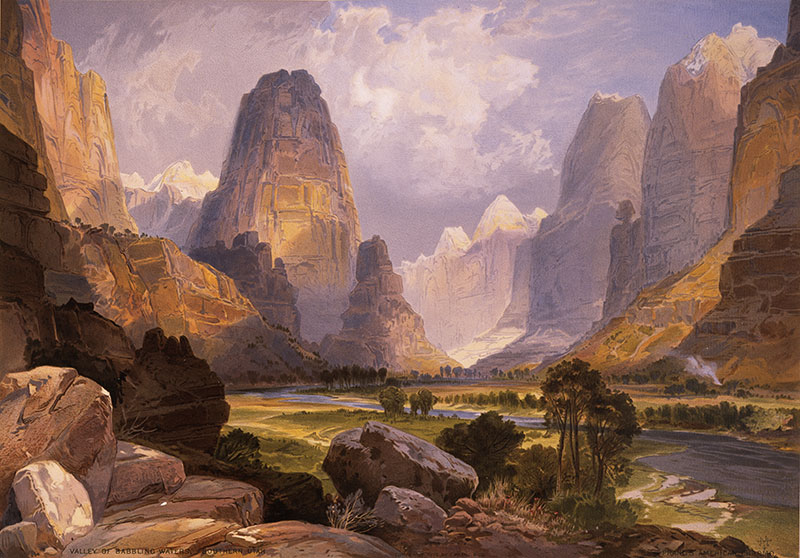


PW015_18.71.14

Thomas Moran, “The Valley of the Babbling Waters, Southern Utah” (1873) 18.71.14
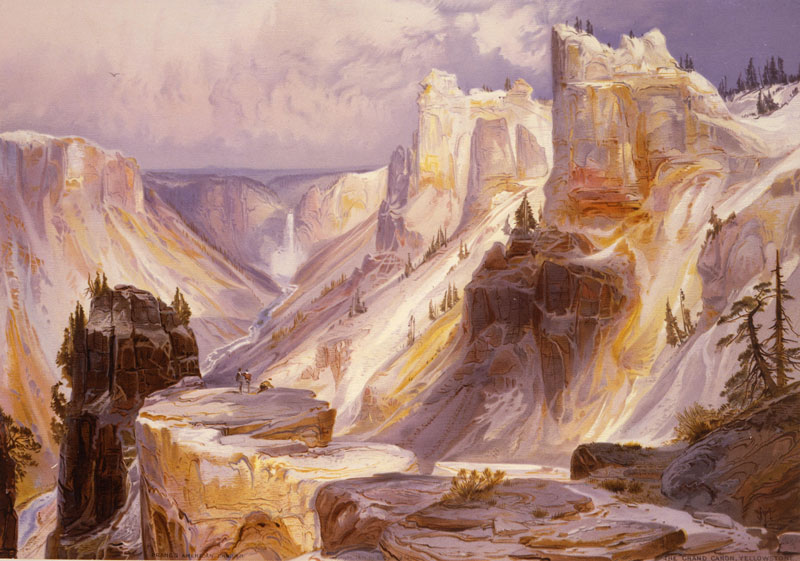
exhib_moran_GC_18.71.8Lrg

Thomas Moran, “Grand Canyon of the Yellowstone” (1875) 18.71.8


visit_ynp_moran_18.71.1lrg


These are the ideals of We now look at the romance of arriving at deep blue spots in the algorithmically generated soundscape, far removed from Moran’s monumental renderings of geographical formations that first communicated a sense of the natural majesty of the western United States to a large audience of viewers that communicated the wonder of a landscape he saw as both untouched and pristine, in contrast to the ever-present ambient noise that seems not only inescapable in remote regions of Oregon’s Crater Lake National Park but all but inescapable in much of the U.S.

But the levels of noise pollution that illuminate or almost incandescently light much of the country marks the encroaching of an auditory anthropocene from which there will be no turning back, and which has already altered the landscape as well as soundscape of the country.  The spatial collation of audio registrations finds most people live in environments “where night skies and soundscapes are profoundly degraded, Fristrup notes, describing the extent of both sound and noise “pollution” as almost spanning the continent, where median background noise plagues most, out of a desire to “conserve natural sensory environments for future generations” registers his deep and abiding sense of loss and the inevitability of a landscape of increasing auditory degradation that could bring a generation of “learned deafness” destined to dull one to the very soundscapes National Parks seek to conserve–and the notion of such environmentally provoked desensitization to sound seems backed by the datum that some 10 million people in the United States were judged, in 1999, to have permanent hearing loss from noise or trauma.  Are we becoming increasingly hard of hearing or deaf, or in danger of slowly losing a sense by which humans have long interacted with the world and gave meaning to it?

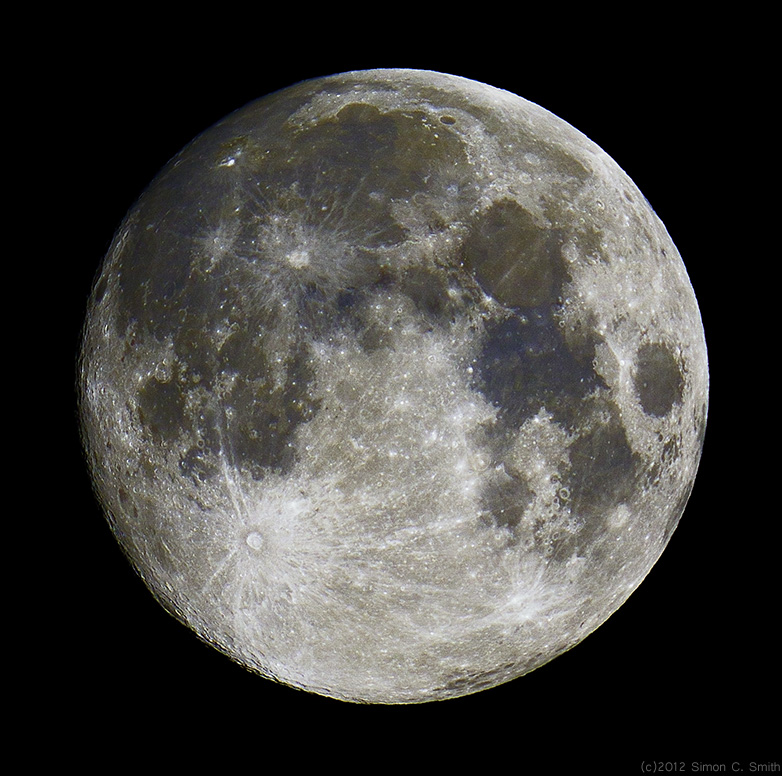
The argument has had special resonance–no pun intended.  The map that was quickly shared upwards of 10.9 K times record penetration of high decibel levels (above 40) across much of the country’s inhabited land–and the rarity of those deep blue chasms that seem to almost fall through the map.  Although the idea that they record the sound environment of the country before Columbus is doubtful, and not only because of the folly of thinking that it was not inhabited before 1492, the absence of industrial ambient background noise over a level of forty decibels is no doubt a pretty modern creation–though anthropocentric presumptions that the noise be generated by humans, rather than animals–stampedes of buffaloes?–seems more unwarranted.  But the map based on measurements of midsummer decibel levels is a unique map of how we inhabit the land, and a nice record of what we might mean now by the “inhabited world”–or ecumene.  It is a record, perhaps, of how we have chosen to inhabit space, and the ways that we have chosen to inhabit it–the landscape scarred with sound bizarrely analogous to the barren scored and spotted pock-marked lunar landscape, and the connotations of un-inhabitability it inescapably provokes in evoking this surface without life.


moon-full-moon-8-30-2012-1

The sterile landscape of the moon is an odd choice of comparison.  The worry that we may be facing the rise of a “deaf generation,” unable to hear the world as men and women once perceived natural sounds, due the growing decibel levels of constant noise in larger cities, and not be able to hear or register the natural sounds in cities, and even National Parks, has led Fristrup to worry about the threats and healthiness due to increases in ambient noise and wonder if future generations might not even appreciate the sounds of nature in cities or National Parks.  If such fears seem alarmist, they are reflected in the deep attraction most observers will have to the deep blue identified with tranquility–and with restfulness or even curl health–an association according with the profound healthful benefits of silence.

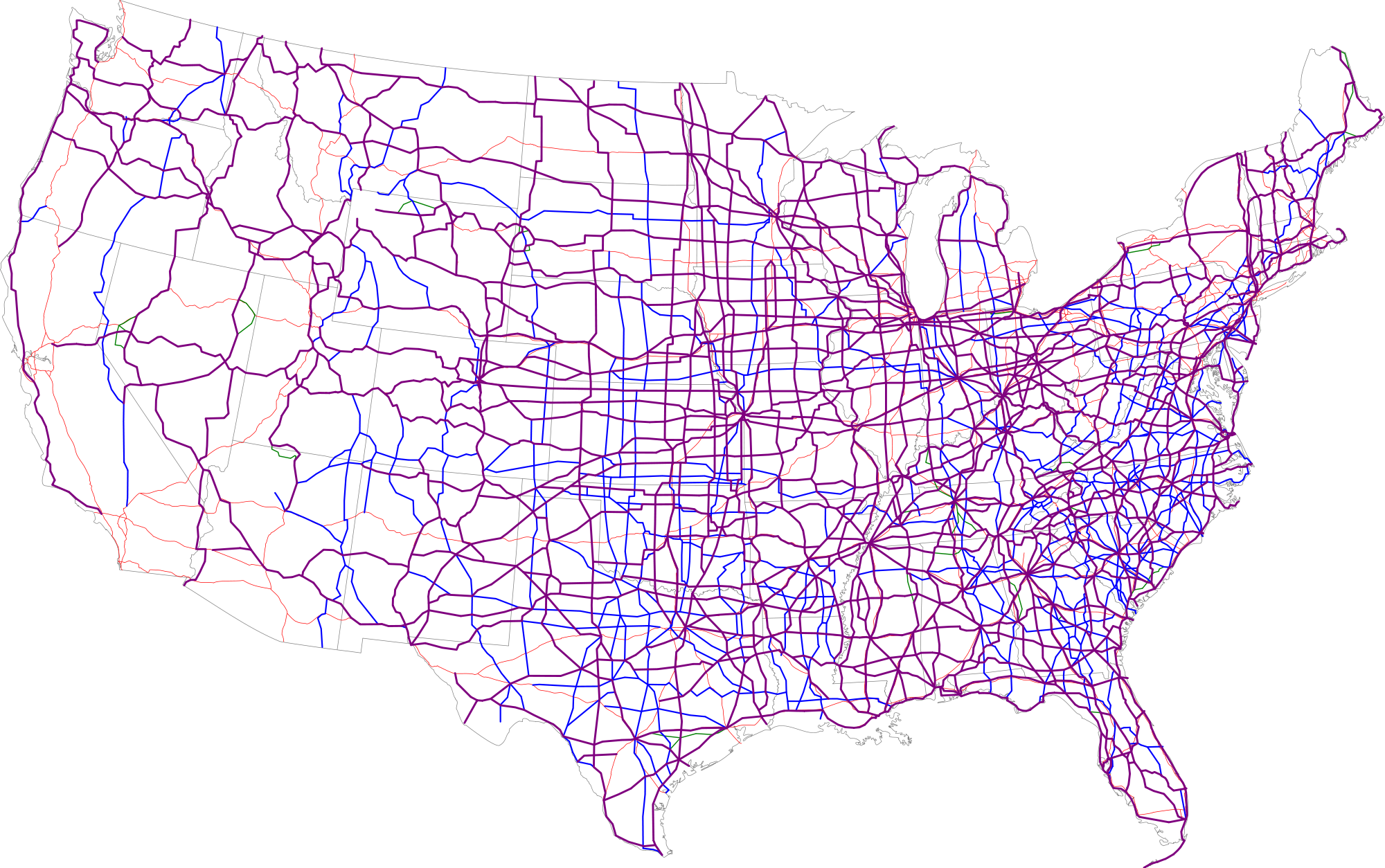
Fears of a growing disconnect with aural experiences makes the strong similarity between the scoring of the national soundscape and the lunar landscape somehow appropriate.  For the scientific synesthesia that results suggests how we’ve filled the continent with sound, from jack hammers to jet airplanes to trucks to power mowers to daily traffic to sanitation trucks to bird-calls.  The sonic landscape closely corresponds to the expansion of manmade environments across the continent, and ignore the level of noise that was made by earlier inhabitants.  The measurement of strong levels of sound pollution claims to screen out the traffic of nearby automobiles, but is appears to echo the very network pattern of freeways and highways that traverse the country and link cities with one another, and were no doubt privileged sites of measurement; where few or no roads exist, it seems that regions of deep blue must perforce prevail–or at least that the grids provide a basis to generate noise:  grids of streets even appear in the noise map, much as the splotches of bright yellow mark cities and sprawling urban areas that have made silence almost inaccessible for large shares of the nation’s populations without considerable geographic mobility, and moved all landscapes of deep silence far west, removed from traffic’s perpetual hum.


2000px-Map_of_current_US_Routes.svg

 Wikipedia


Only in 1970, of course, considerably more open spaces existed across the United States, if one focuses on Interstates alone across the western states:
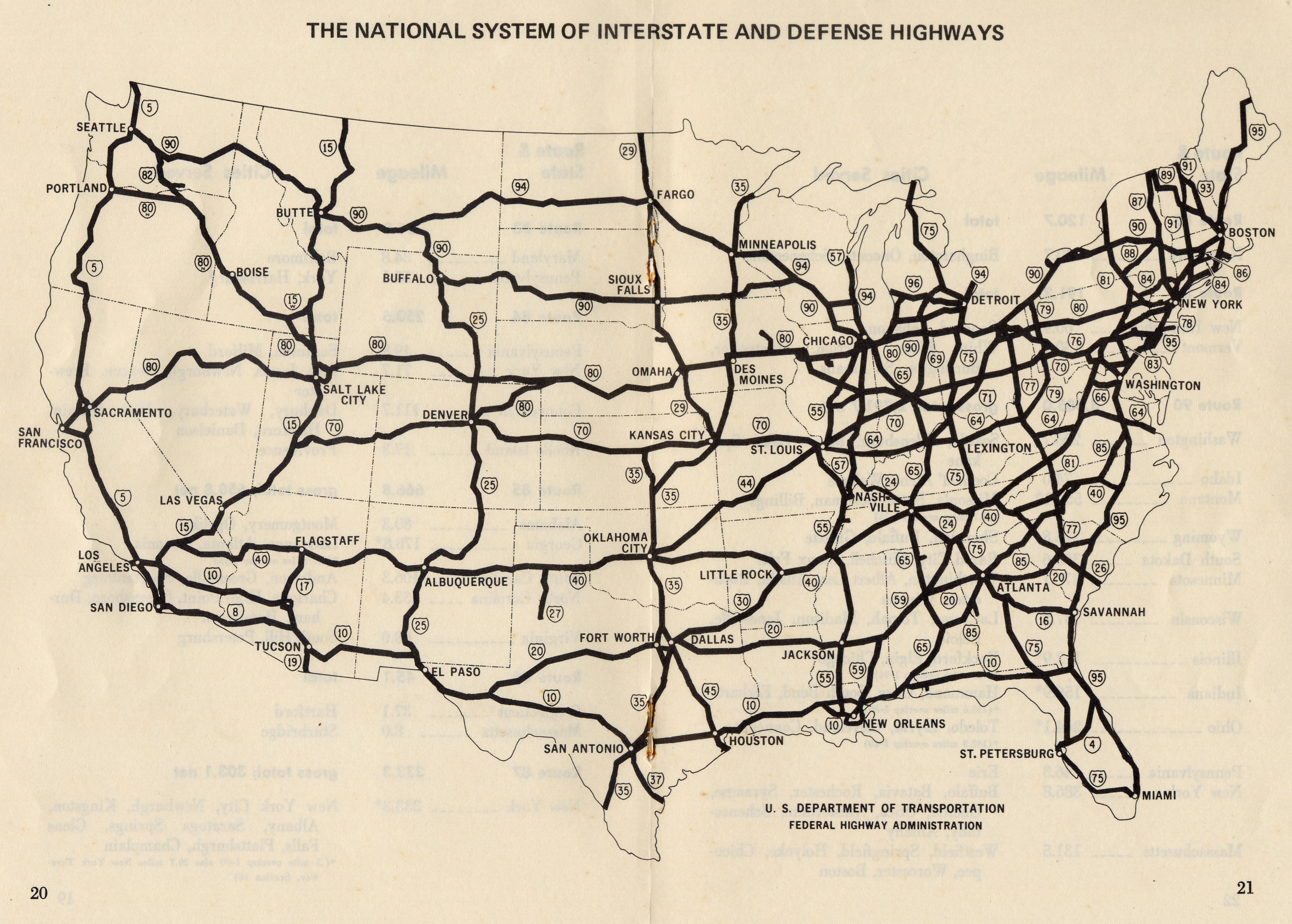


The apparent density of noise may indeed be partly explained by the density of the network of highways that course across the Eastern seaboard and much of the midwest.
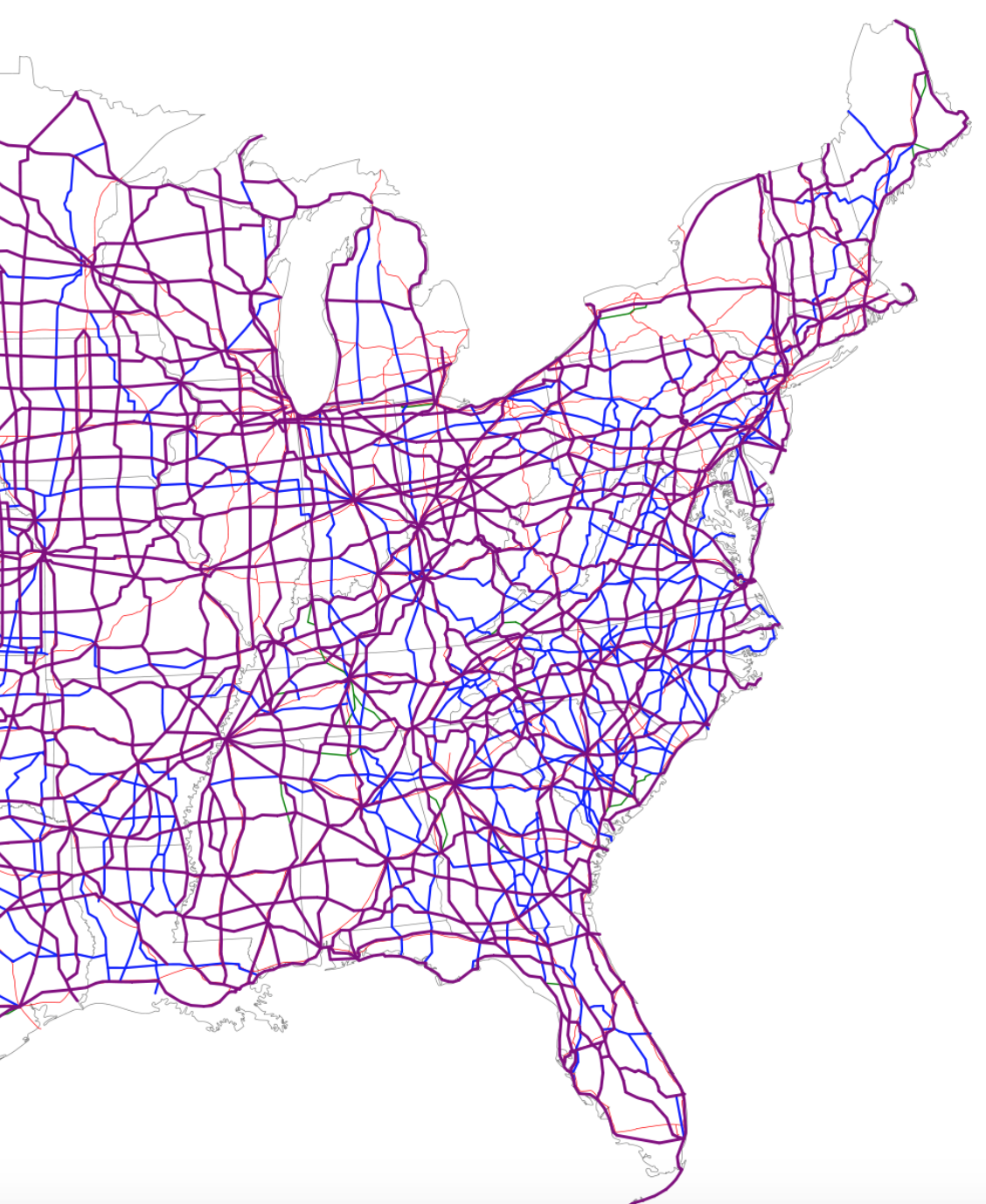


What might be called the “noisier half” of the United States shows an area of almost continuous noise pollution, where the “auditory horizons” have markedly shrunk in most places to but a few blocks of paved space–
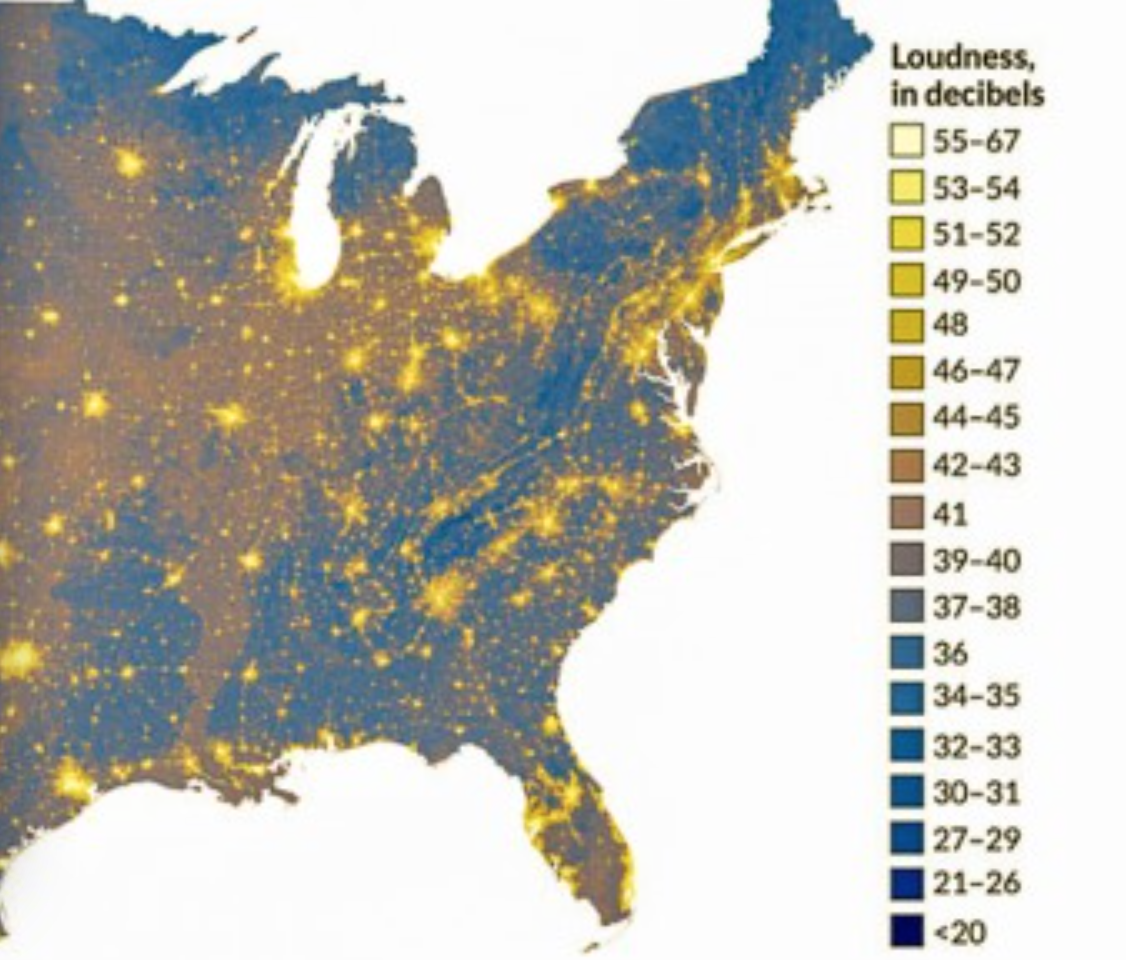


Noisier places


reflects the very same region where highways define a distinctly different relation to expanse:

half highways


The expansion of the National Highway System across the nation is perhaps best rendered by a hand-drawn map that tries to project its future and the compromising of place that it implies, with an eye to the shrinking of the auditory human experience of place:
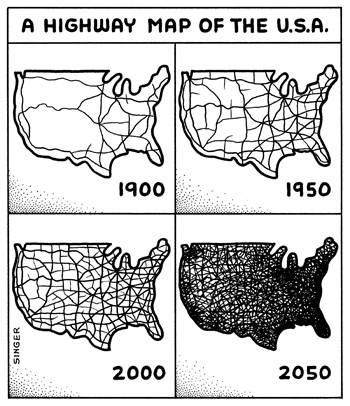


A Highway Map of the USA


For the congestion of noise, roads, and urban areas reveals an image of how we inhabit continental expanse.  We might compare the division of the country, grosso modo, to the imbalance in the density with which McDonald’s restaurants are spread across the contiguous United States, shown here by illuminated dots that reveal the proximity of fast food restaurants across the land, sometimes suggesting strikingly similar highway paths, and no doubt mirror population trends, and indeed the density of businesses:
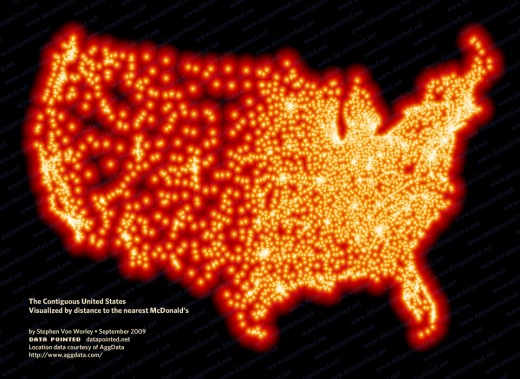


mcdonalds_us-520x379

Stephen Von Worley 


Does space tend to collapse in interesting ways once one is less able to sense sounds?  Such levels of noise pollution offer a sonorous residue or acoustic remainder of how we have come to inhabit the world’s environment and to remake it, and register the arrival an auditory anthropocene which earlier maps have often been hard-pressed to detect.

As much as being confined to the United States, the prospect of such elevated decibel levels in areas of dense population and the modern humming of transportation networks across the country find a parallel in the noises of the global traffic networks we have created in the seas.  Indeed, the oceans seem increasingly characterized by constant presence of such noise recalls the “background hum” of oceanic shipping lanes that resounds across the oceans, by modeling a global soundscape seeks mapping the range of sounds ships create in transatlantic voyages, that seem the material reminder of the increased intensity of a global network of shipping lanes.  Such sound levels, to be sure, often obscure the cresting of waves, with the upshot of radically compromising the auditory experience of the ocean for its inhabitants–especially imperiling animals that use sounds to communicate, cetaceans from whales to dolphins, in ways that may mislead the sonar skills they have evolved to map their own courses underwater, in ways that create more than auditory interference with how they experience space.  And with noise traveling some 4.3 faster in the watery medium than in air–and traveling at an unchanging intensity over considerable distances–the gigantic impact of large-cargo vessels that generate more noise than we would often permit onshore from constantly running diesel engines creates considerable ambient noise to which different marine creatures are especially vulnerable.

A map of the auditory intrusions of passenger vessels alone that was recorded and released by NOAA based on anthropogenic noise of cruise vessels alone suggest a shifting in the oceanic environment:
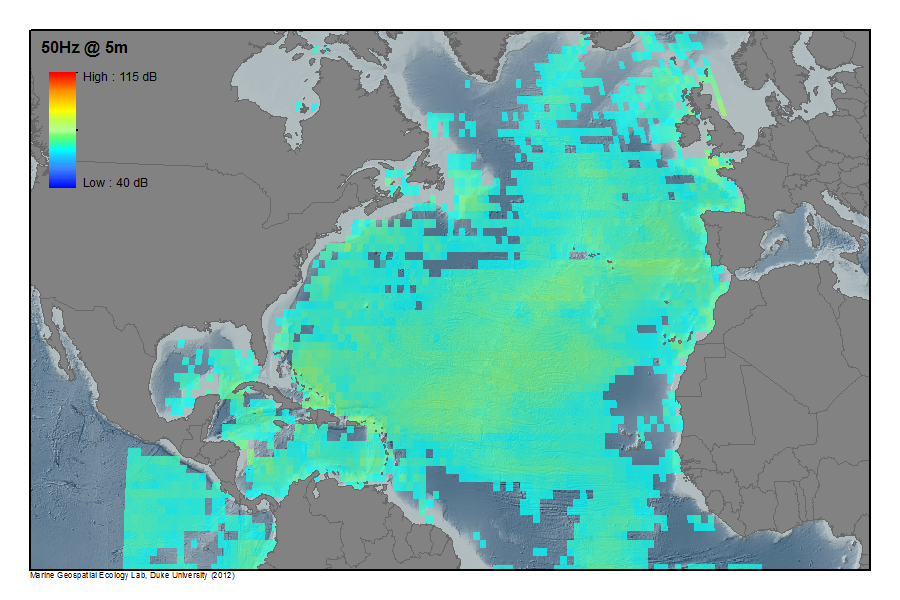
 

Atl_NL__PV_0050Hz_0005m


Yet the spectrum of noise from the chronic levels of noise modeled from larger commercial vessels was far more chronic:
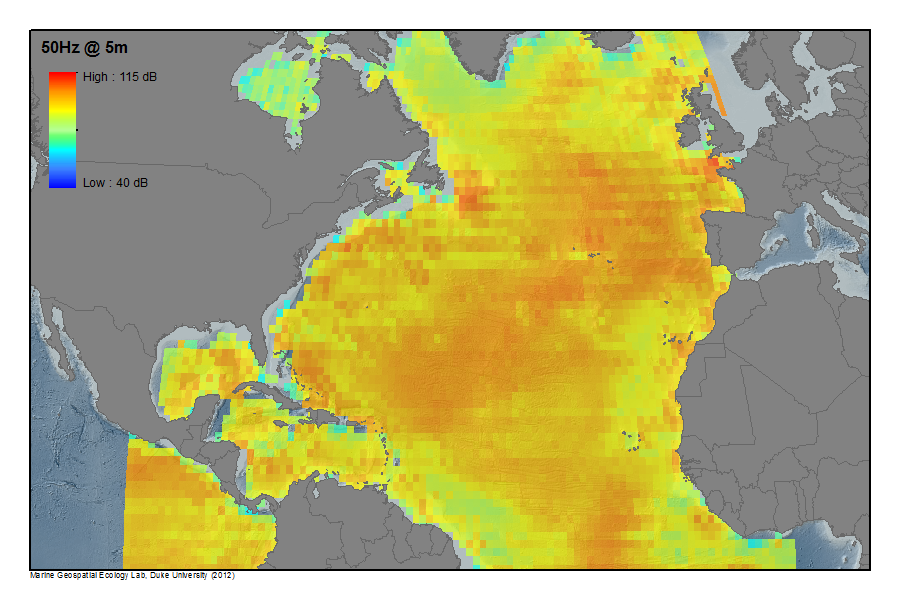


Atl_NL__0050Hz_0005m

And when summed, the picture that results is of a radically sonically altered and disrupted environment, apparently in ignorance of the disturbances that they create for actual (or any) ocean populations:
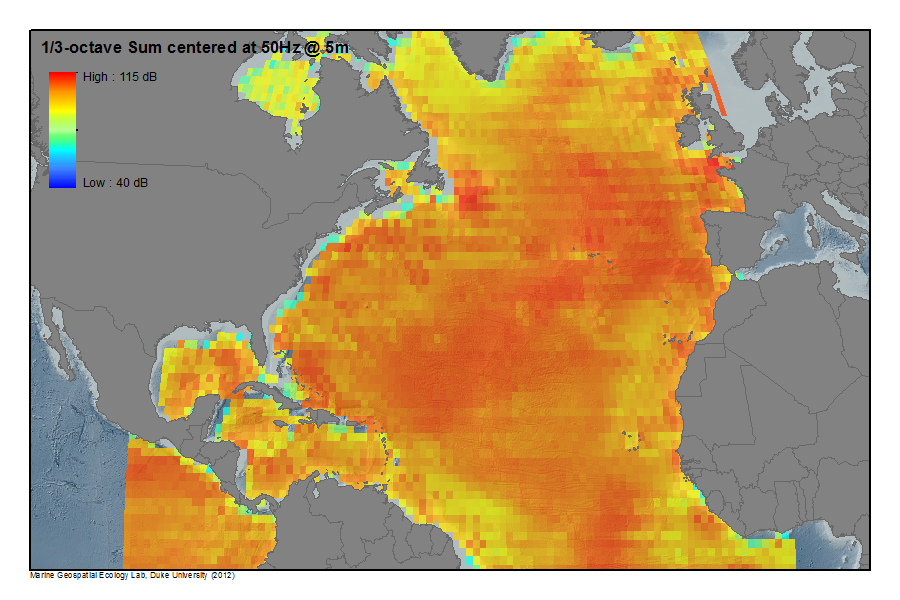
Atl_Sum_0050Hz_0005m_ThrdOct


The map below registers sounds that extend to a depth of 650 feet in a similar color spectrum map–which doesn’t include either seismic exploration or Navy sonar noise that add considerably to the range of ocean sounds that obscure today’s songs of humpback whales.  Indeed, if whales often base their communications over expanses of hundreds of miles through their song, whale space has undoubtedly against such background noise in a a sea with startlingly few areas absent from auditory interference.  Such changes would not only affect the cetacean populations of marine mammals as they navigate underwater transit–if von Uexküll suggests that whales are attuned to other worlds, it might be important to contemplate what they make of the ships’ apparently unavoidable background sounds, or whether they accommodate to their presence.
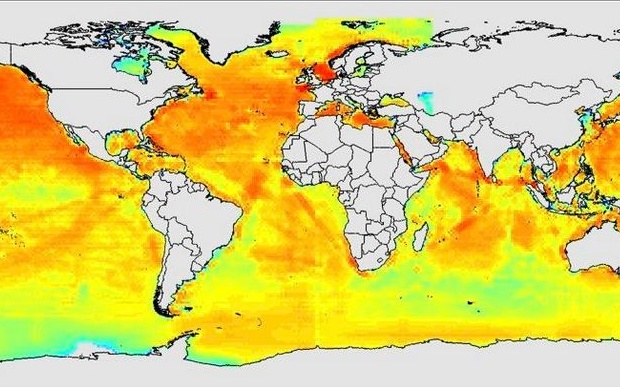


lead_large NOAA

If one goes to 200 Hz, a slightly different picture of the local variations in background hums emerges:
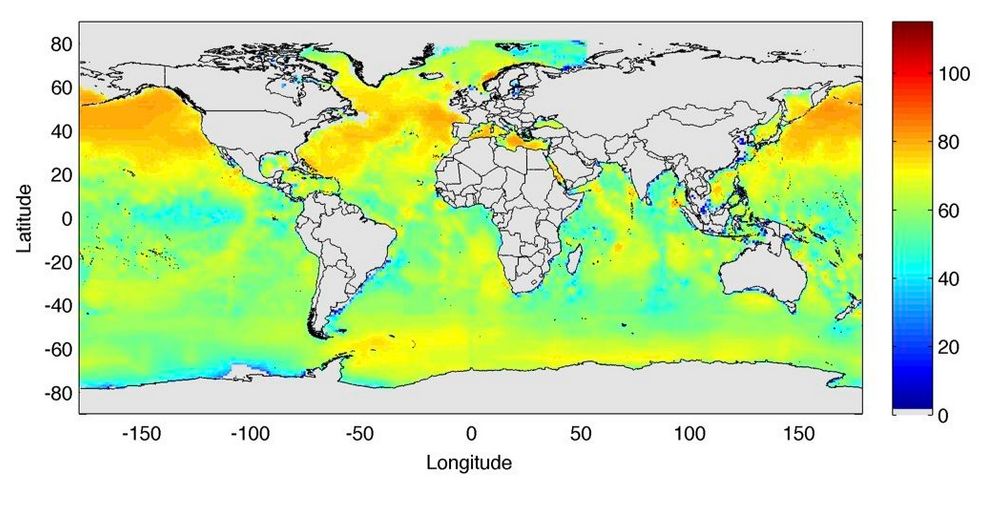
ocean sea noise global map noaa nasa decibels noise pollution marine animals mammals 200hz_NOAA

But what might be considered more broadly is the very difficulty of erasing the imprint that such ships that travel across the seas exercise over the entire marine environment. The sonorous surroundings characteristic of the oceans were earlier mapped at 400 Hz and a depth of fifty feet by NOAA in 2012, from passenger ships, commercial ships, to seismic surveys in an annual average, present a similarly pronounced offshore acoustic disturbances and an even more pronounced augmentation of background noise offshore, as if hidden from landlocked observation stations, as if ships’ engines are only started at full throttle after arriving in the open seas, where ship captains or automated pilots crank up their speeds and plow full speed ahead:
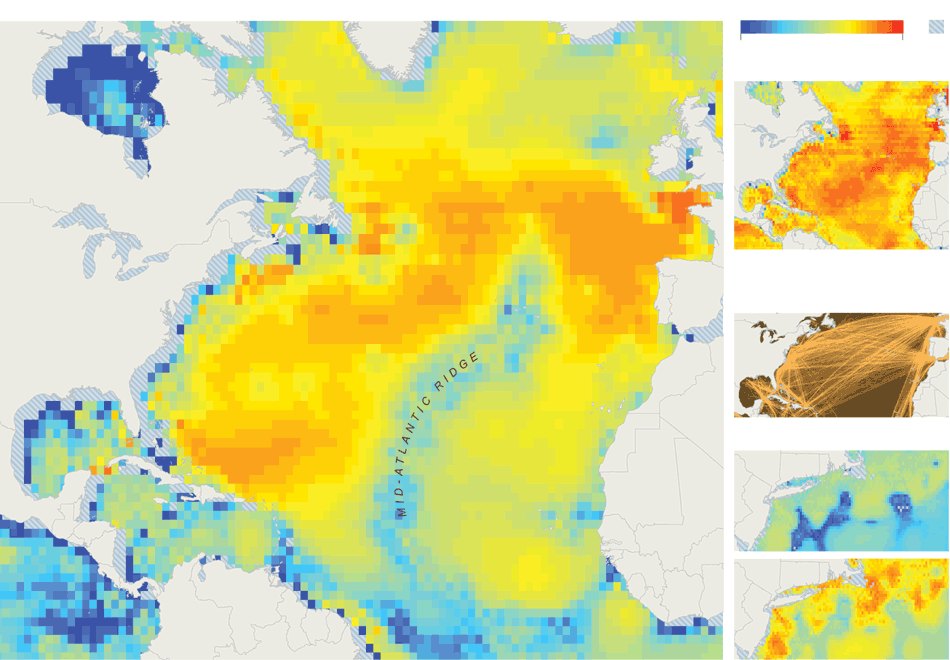
1211-sci-OCEANNOAA Underwater Mapping Sound Field Mapping Working Group/HLS Research/ NCEAS–Details of North Atlantic Shipping and local noises near Long Island–from the New York Times


The rumors of transatlantic voyages notwithstanding, it is somehow wonderful to move from the noisy oceans to their landlocked counterparts.

The deep blue sites of relative silence, often confined to the areas close to the coast, may indeed obscure the extent of noise we have created far out at sea, far from the increasingly noisy shore, where we cannot hear their hum.  The shifts in the national–as well as the global–soundscape makes one wonder whether, in obscuring some sounds or making other sounds inaudible, one is not changing perceptions of space in ways that the great majority of  data visualizations cannot register.  But both present us with digitized images of sound-levels so strikingly ever-present that we can almost hear them resonate across space.

Like the deepest blue spots on the sound map of the United States, they mark the rare areas of respite in an every-noisier world.

1 Comment

Filed under anthropocene, environmental mapping, national parks, sound maps, Soundscapes

Hearing through Maps: London’s Hidden Waterways

We do well to see through maps, Denis Wood enjoined, urging us to detect the “human landscape” that lies superimposed upon the land in maps, and uncover the ways that the landscape has been changed–and orient ourselves to those changes that have been wrought by the “huge arrogance” that “we can name and we can claim.”  Maps demand to be interpreted by scratching their surfaces, as if we could uncover how one might best “see through them,” to explore the landscapes that lie underneath the layer of words that lies on their beckoning if often all too opaque surfaces.  Webmaps allow this level of interaction, often by playing on the conceit of the paper map.  Indeed, the symbolic surface of the paper map–and the London Underground map in specific–have been used in a variety of web maps to suggest different notions of the “underground,” and to suggest the power of maps to alter one’s relation to place and space in provocative ways.

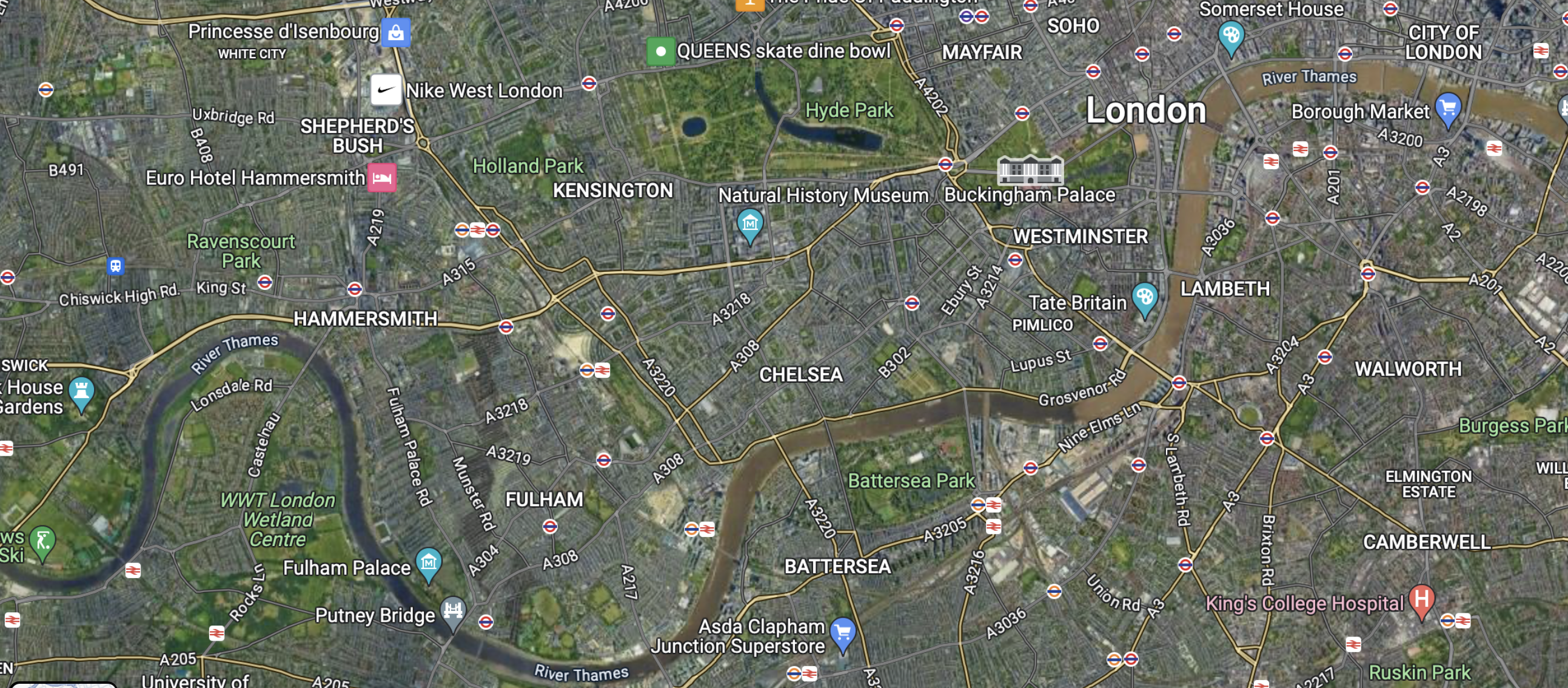
To take stock of how maps work by asking us to go about imagining the landscape that lies beneath those words is a way of uncovering their arguments about territories.   The format of the audiofiles linked to a map of London’s Tube provocatively invites readers to explore its surface, in the clever pun advanced in the web-based maps of the London Sound Survey. For its links invite us to explore soundscapes that would otherwise lurk beneath cellulose surfaces, treating it less as the modern relation to space and place that the Tube Map advanced in its early twentieth-century iterations–than as a sort of recovery of a lost sense of the sense-base experiential waterways underneath the expanding city, that the paved city has in many ways repressed.   The river that snakes across London today, mapped for its sludgy muddiness in many Google Earth terrain imagery, marginalized if not expelled from London’s built urban landscape. If the sinuous light blue line of river returns as a sonic reality as it laps along old unused docks and concrete pillars as one approaches its banks, its sounds letting the city disappear for a moment, the sounds of the Thames returns int this may that adopts the form of the underground Tube line of the built environment of the twentieth-century resurfacing of the city.

Web-based maps such as Sound Survey of London’s waterways indexed offer modes to remap the known environment of the city in new ways:  the choice to map the riverine network that is rarely seen in London seem specially suited to the conventions by which Harry Beck‘s almost universally recognized diagram of its Underground specifically invited users of the London Underground to re-see their own environments, offering a way to encourage map-readers to navigate the built space and neighborhoods of London as able to be readily accessed by the Underground.  The striking modernity of the circuit-like 1933 Tube Map that invited users to so successfully read the access to space the Underground offered at a distance from lived space, yet in ways that its simple form foregrounded utility, it offered an icon of the modern urban plant.

It was, of course, as it happens a radical revision of the attempts to picture the London Underground. The space of the tube was not only a new way of understanding place, but time, in strikingly modernist tones by artist Hans Schlegel–he signed the lithograph as “Zero”–suggested, as a new way to navigate space, adopting icon of the Underground to a map, as it offered an ability to negotiate urban time,–

–as the surrealist invited on to experience space by a new tool that “gets you there” in ways never possible before, warping space-time in ways that were entirely to the modern citizens’s advantage, a user in this case typified by the new subject of urban space–a man in a suit, bowler hat, and white gloves–who meets the demands of his job by the circuits that lie beneath the city that allow him to arrive on time. He is checking his watch in ways that suggest the timepiece had been replaced by the Underground to affirm its utility beyond only navigating a built space. London Transit used graphic arts to promote the new Tube as a basis to experience the city in many ways, and indeed experience to navigate the Thames, just a few year earlier, that suggest not only their investment in graphic works to reorient viewers to space, but to remap urban space by the river–the most important, perhaps, orientational path of the city’s neighborhoods, even as they were replaced by city blocks: streets were organized in relation to the Thames, historically, but the underground, in this lovely 1933 poster, proposed its utility as a way to access views of the river–

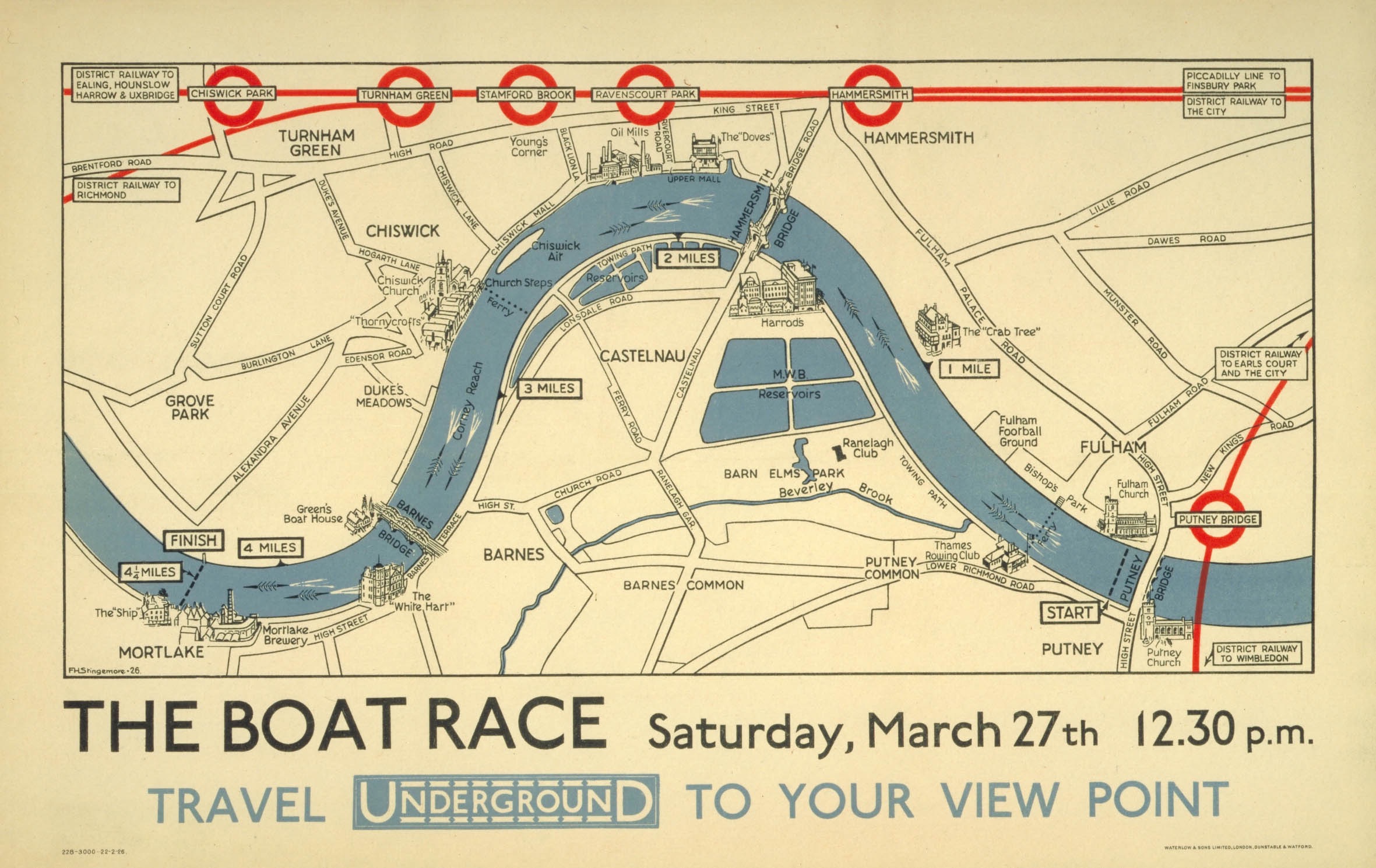
The Boat Race: Oxford-Cambridge Boat Race Map, 1926

–and specifically of the Cambridge-Oxford Race that was run annually on London’s Thames in one section–that in 1926 mapped the stations of the Underground to “travel to your view point” to watch the race–but took the river as the main course by which the riders of the underground would need to be oriented. In contrast to a map of taking public transit to watch a race–or to arrive at place on an urban river’s course–the new Underground map that was designed some seven years later after the diagram of electronic circuitry elevated its geometric form above the urban topography or indeed the urban sensorium. Beck’s innovative design for the map printed in January 1933, took as its logo and model, in many ways, the novel emblem of the underground tube–the Underground, as it was called, or Tube–as a geometric creation that replaced the urban soundscape, and a utopic idealization of space. 

This was a new way to understand how one could experience the river that the Sound Survey may have not known, but offered something of a symbolic foil to in asking us to view the river–or The Boat Race–in new ways via the access points the Tube provided to out-of-towners who arrive for the popular sporting event, akin to later campaigns to use public transit to access football stadia. The actual boat race–The Boat Race, as it were, founded in 1845, beginning half an hour before high tide on the River Thames, which has been from its founding timed to start on the incoming flood tide, and allowed numerous viewing points on piers, breweries, football clubs and taverns that lie along its 4.2 miles, or the steps that front upon the river, for crowds of spectators to gather and assemble. But the distortion of the river was, already by 1926, the point. The race between Oxford and Cambridge teams for which an umpire provided a running commentary for the first time in 1927, perhaps to accommodate the larger crowds who took the London Underground to preferred viewing points, accommodating the river’s course to the transit stations’ locations–even suggesting the degree of punctuality of arriving at a station to view the winding paths that the boats actually took on the river, comparing the directness of the transit line against the course that were taken by the crew teams.

The Boat Race Map: Oxford-Cambrdige Race, 1926

It’s no surprise that the Underground map from the late 1920s distort the path that the Thames takes between bridges, as Londoners well knew, was actually a far more sinuous course–navigating the bend is the point of the course!–on the four point two mile course running between Putney Bridge to Chiswick Bridge. But to illustrate how the Tube accommodates to its path, the straightness of the lines of tube track are privileged far above the actual riverine path in the 1926 map , , to which the tube accommodates.

But the attempt to reconcile the tube’s course to that of the river may have been a question of epistemic orientation by the 1930s, as a new geometry of the Underground first proposed by Beck in 1931 redefined the space of the underground. Beck used a geometry of 45 degree angles and diamonds to illustrate interchanges and stations that invite observers to reorient themselves to urban space free from the river’s course–indeed to focus their orientation to the network of tubes on which public transit ran. The map conceals massive effort of labor of building an underground infrastructure where immigrants laid track and dug ditches beneath the city, but the infrastructure soon became far more prominent for many Londoners in future generation than the map of the city’s landmarks, and was intended as an icon of British engineering if not the urban metropole.

The Sound Survey Map of waterways offered a sonic counter-map on in online form, as an attempt to reverse the building of anthropogenic space, by examining the sonic sites where the river returns to audible presence. In orientng its users to the presence of the Thames over the urban hubbub that defines London today, it shifts atteniotn from the anthropogenic built space, providing auditory evidence of the presence of the water that the Beck map overlooked. If the oval emblem that served as the key in the circuit-like map at forty-five degree angles that cast interchanges as diamongs and stations as notches was proposed to shock and consternation, remapping the built city for users of public transit in utopic ways in then following years–

Harry Beck, Tube map (1933; designed 1931)

–now akin to a Union Jack as an emblem of pride in English engineering ability to provide the smoothing of space in an infrastructure of smooth movement, both to escape urban congestion and arrive across the city in record times for work, as the lithograph by Zero–Hans Schlegel–affirmed in stark modernist terms in 1935. The promotion of the Tube as affording (and promoting) a modern form of urban space suggested a revision of all earlier urban maps–“All that is solid melts into air . . . “–as the known form of the city melted into the geometry of a circuit map, untangling the tangled streetpaths of modern London in crisp terms readily navigated by its perfectly symmetrical and smooth routes, a technological progress that was a sort of symbolic metaphor of the smooth modernity of the smooth ride that the Tube offered its passengers. (The aptness of the visual metaphor made the form so much more effective, promoting the Tube as offering a new way to move through urban space, in ways that the Sound Survey Map–and we will come to it soon!–seems to seek to pull back for its users, uncovering the lost sounds that the built city plant sought to erase.)

The images of the Underground break form the alluvial settlement of the expanding city from its past in definitively modern ways. While in a day when the London Transportation Authority offer City Mapper, an the ability to track one’s place on the London Underground on handheld devices, without every really needing a map, the smoothing of space has been accentuated–even as the actual lines of transit infrastructure has become considerably more complicated and tangled, both with the exponential expansion of the city that sets new standards for urban growth and neoliberalism. Perhaps the greatest sign of neoliberal achievement is that the map devolves onto our handhelds, as if consigning paper to the past; but the old pocket transit maps are given new life in the web maps that folks as the London Sound Survey have devised to bring the river before our ears, and invite us to reconsider the benefits and losses of mapping urban space.

Of course, the point of such interactive maps is to orient us as urban residents to the surroundings that the built infrastructure has long elided, and increasingly threatens to obscure. There is something remediative and restorative in a map of London’s everpresent river, that reorients us to the river of the riverside city. The Sound Survey Map asks us to use our ears to acknowledge the iconic map’s utopic nature, as it asks us to reorient our sense to the river waterway that the tube replaced, by excavating the sounds of buried waterways. Indeed, wherea pocket guides to the London Underground sold by UER before Beck’s design were startlingly sinuous, as in 1908, displacing the river from attention, in favor of an alternative infrastructure of railways–

–but almosty investing the tubes of the Underground Railways with a sinuous aspect of its own, respecting urban topography, if acknowledging the new transit web lay beneath, apart from, if ancillary to urban streets.

Whereas Beck’s iconic map promoted the primacy of the drafting table and the engineer, a form of engineering that might have well seemed overly radical and ecxessive in the lived environment of pre-war London, the web-based map is a sensorial register reminding us of the presence of water that the underground displaced.

In the Sound Survey, all “transit” lines are shown in their entirety, as if to return tthe river to a prominence it long held in London’s plant. Indeed, save the District line which is only shown as far as Mile End, the rest of the stat image offers an apt way to invite viewers to excavate audible aspects of the city absent from a drawn map, in a truly phenomenological map of the circuit of hidden waters beneath London. If subways are often noisy, the sounds that the Survey has compiled offers a somewhat synesthetic compilation of the hidden waterways that might be seen as corresponding to metro stations, less as a disembodied circuit–as Beck’ map–than as the subsurface lying underneath the engineered world. Beck’s map sanitized the subways in streamlined fashion to attract Londoners to the Underground, readers are asked to explore the waterways that emerge only in its parks, bridges, and channels linked to watery paths which we rarely see which run under and about its surface before they enter the central artery of the Thames.  

Rather than by mapping the  city’s space in reference to its individual  streets or intersections, but by placing the rivers of the Survey maps waterways’ sounds in ways that recuperate their perhaps forgotten presence.  Wood remapped the lived community of Boylan Heights so that is not only as a place in Raleigh, North Carolina, but charting the “metabolism” of the community in maps of the light street lamps cast, lit jack o’ lanterns placed on porches at Halloween, paper routes Wood ran with a tightly knit cohort in his youth, or “squirrel highways” of aerial wires, which collectively serve to unpack the often invisible ways of “how it works.”

Halloween in Boylston Heights

One might compare to this set of maps the ways in which maps in the London Sound Survey invites readers to enter an overpowering pointillist accumulation of local details, and similarly serve to map a setting in which everything sings–or at least we can enter its audible surface at distinct points.

Continue reading

3 Comments

Filed under environmental mapping, London, Thames, transit maps, urban environment