Tag Archives: Hillary Clinton

Counterfeit Puppets: Hustler’s University, Red Pills and the Manosphere

HU–“Huster’s University”–is an “educational platform that teaches you skills and strategies and encourages you to achieve financial freedom and live your dream.” Moving between reality and dream in the fuzzy space of the internet, it allows you to assume the identity that you always wanted, if you are a man: it has taken to promote itself in its recent incarnation as “The Real World” as the only real access to a world of Money Makers where they can lead a fulfilling life. It promises to lead all who enter to an alternative reality, mentoring users who are able to click on a button to reach “the portal to escape the matrix.” Billing itself as an online portal for those who are making six figures every month, it is a creation of the internet that offers no certificate, but a fast-track entrance into the gateways of an alternative world that escapes one of increasing wealth imbalances in a world where one only needs to learn the skill of “making money,” in a modern updating of Trump University–a sort of precedent for these new influencer’s successful outfit, if the life skills that Trump University offered were never specifically explicitly tied to the sex trade.

The toxic masculinity that the Tates long purveyed–what might be called “hegemonic masculinity”–was the core of their charlatanry, encouraging exploitation of the most vulnerable underage women, often displaced refugees, even as prominent figures of the American alt right news, from Ben Shapiro to Megan Kelly to David Portnoy have tried to distance themselves from the dropping the criminal charges the Tates faced in Romania of trafficking and money laundering. Cigar-smoking Andrew Tate, his feet perched in luxurious leather loafers atop a veneered desk, puffing on a cigar and looking out from this alternate world that he has mastered and you can too. The promise of being fast-tracked by having access to real-world entrepreneurs, to celebrate their achievements, rather than going through life as a wage-slave prole. And as he cultivated the persona he gained on social media in ranting about women and feminism on the dark internet, a gleeful misogyny, singing the praises of “alpha men” suppressed by a society they are failed to be understood. The online avatar styled himself as “Top G[entleman]” or “$Daddy$” has continued to curry attention from Donald Trump, in a search for attention danced with The Donald, for whom he claimed he joined Twitter in 2017, and met with his son, Donald, Jr., in True Tower, soon after. Tweet suggest the chemistry of their online egos: “Do you understand that trump is the last hope of the western world? A literal hero against our destruction?”; “@realDonaldTrump Great job mr president! #maga”; “When I’m on a date if the girl says she doesn’t like trump I ask ‘why?’ She never has a reason. I correct her. She apologizes. We Fu**.” Soon attending CPAC in 2019, as a commodity on the Right Wing internet.

This was indeed an actual bromance, rooted in the kinship of scamming customers and casting oneself as a defender of hypermasculine values from the other end of the age spectrum. Tates’ relentless objectification and demeaning of women as a practice of self-fashioning became tools of trade, benefitting from real-life resentments via AI algorithms directing droves of young men to internalize from their misogynist websites abusive language and techniques of physical coercion as tools of the trade to turn their bad luck into skills to monetize. For Tate, the looking glass of a nexus of economic and actual porn that made up a Hustler’s life– Romania is not the hub of porn it was in 2015 or the start of the century, when high def webcams compromised the capital of porn by allowing a new adult entertainment landscape of streaming, the reservoir of desperate camgirls had offered a pool for the Tates to exploit in their new site of residence, fed by the growth of human trafficking on the border of Ukraine on a new scale difficult to monitor. If the porn industry is a global purview nourished by online services, providing a wide range of services for clients that are increasingly able to be mapped by anonymized data, the recent growth of the 18-24 year old users has been striking–even as the over thirty five group continues to drop.

Tate became an online puppet or avatar for making millions, as pumped up as the suntanned face of Donald Trump became an icon of patriotism. Lifestyles of the Rich and Famous was on steroids at Hustler’s University. For the Tates both embraced the endemic wealth inequalities of the present-day world, and promised a ticket to the gold-plated world that lay beneath a heightened map of wealth inequalities, a ticket to a world in plane sight, only waiting to be hustled by those ready to swallow its red pill. The algorithms that have directed more and more young boys aged eleven to fourteen that promote misogyny have only grown with the rise of AI platforms–some 69% of English teens being exposed, per Vodafone, to misogynist website from unrelated searches, exposing over half to misogynistic online platforms of the “manosphere” that the Tates occupy the marquee, who have absorbed sexist language that schoolteachers and parents have both noticed. Almost 40% of boys between sixteen and thirty believe that feminism has done more harm to society than good, and 21% of the same cohort have a favorable opinion of Andrew Tate–a third of men arguing that he raised important points about the threats that feminism has created to male identity. The result is that they benefit from nothing less than a polarization of attitudes to young men and women to gender equality that maps onto the split in political beliefs–in which the isolation of the online life of surfing the web terrifyingly mapped onto a political divide in the UK and Unites States alike. This was the world of the Tate Brothers, targeted to lonely males and determined to protect the world from gender ideology.
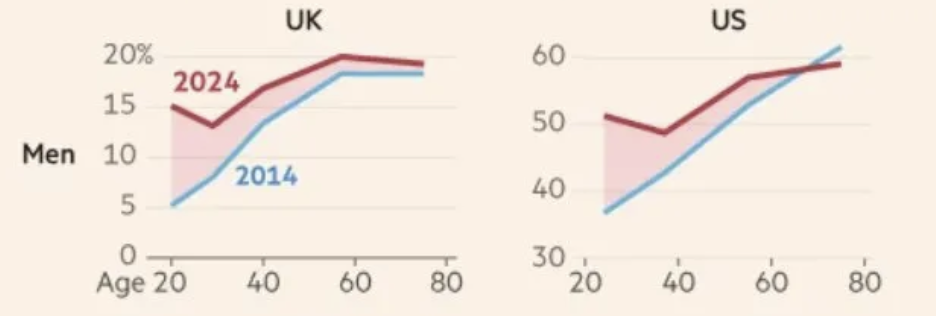
Young Men and the Populist Right in the United Kingdom and United States/John Burn-Murdoch 2024

Untethered from the economic world of payment processors like credit cards, it offers alternative banking systems as a pathway to personal responsibility, a “way out” of depression,–promoting easy entrance to a lifestyle of tech millionaires, a dumbing down, one might say, of the real university, for those who disdain them. The smooth entrance to a world of wealth in a frictionless world of the web is born of globalization, granting the Tate brothers–38 and 36 years old– the mobility of online life that made them seem robust digital nomads The influencers who champion their unrooted status are a creation of a rootlessness the internet allows, the holders not really of credible opinions, but constituencies that have allowed them to enter the circuit of the Alt Right as useful tools to corral followers, moving across boundaries in possession of seven passports.

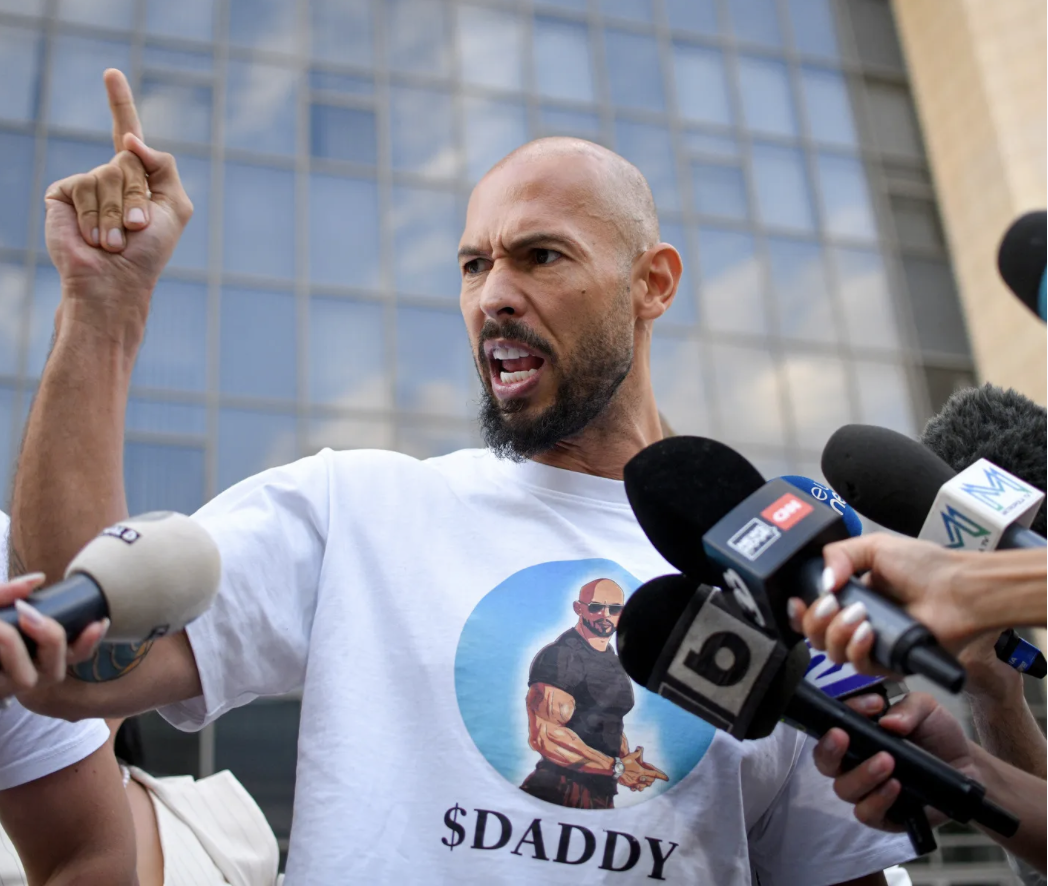
When Andrew Tate returned back to Romania, head hardly between his tail, he appeared for cameras outside the Bucharest Tribunal, a Miami Beach version of Steve Jobs, back to Romania again, boasting he was “happy” to be back, as Romania lost its status of visa-free travel to the US–and as Andrew faced a civil case threatening to reveal how she had been coerced into sex work that the Tates didn’t want to go public. Despite their large following in the alt right circles in the United States, the Tates walked back to Romania, allegedly to “prove our innocence” as victims of a “coordinated attack” that had led to their house arrest over two years in Romania, where they fled an investigations of abuse in the UK–claiming they were “never going to leave” the new home they had successfully redefined themselves as self-made millionaires from a social media empire, and posed as useful icons of masculinity for an online empire that fed political divides in the US and UK.

Andrew Tate Confronts Media after Leaving Police Station in Romania, 24 March 2025/Vadim Ghirdă/AP

We have trouble connecting the role that broadcasts to his 10.7 million social media followers and the fragmentation of politics with the victims of sexual violence he advocates, but the it rests on the geography of resentment that social media fuels, in which Tate can pose as a hero of the alt right’s ideals of masculinity, evading national laws but benefitting from human trafficking to trump up hyper-masculine images of resistance that so verges on cosplay to challenge mapping.

Is this not the image of a self-made man, or is Tate’s enactment of resistance so slickly staged for a manosphere as a response to political vendettas staged by USAID organizations, DEI initiatives, and men so sadly weakened by feminist orthodoxy to be mindless tools fostered by an internet that recasts allows human trafficking crimes as a Galahad-like quest for virtue? Tate evaded the law in an eery miniature counterpart to Donald Trump’s evasion of the law, a sort of cameo that confirms the need for hyper-masculine vigilance social media helps internalize among a growing section of young men in our society. Having won fame from the emergence of a beating of a contestant on a social media show that he claimed entirely consensual, the Tates use truly pornographic references to discard all legal notions of consent, offering an app “Real World” to purvey instruction to teenage boys seeking to become “real men” as a question of claiming their own rights to resist gender roles of “socially induced incarceration” they promise to free their paying clients, casting himself at the center of an international web of enrichment outside legal authority or social norms.
The victims of Andrew and Tristan Tate were terrified at the prospect of the brothers’ release from house arrest in Romania. Even if they had been banned from social media platforms, the platforms allowed their work to flourish, and they continued to purview their hard core misogyny online. Andrew Tate returned to a location where he was had successfully run an empire of global streaming as a lifestyle guru and social influencer–a pernicious position to the rest of the world but from a position as removed as the unregulated economy of the offshore. While Romania offers a high speed internet, the expansive “cam girl” industry in Romania emerged from the ashes of the porn industry of recent years, mutated out of the exploitative services that were a casualty of streaming, but has provided a new niche from which Tate can claim status in purvey8ing a Returning to the area where he claimed to have employed 75 women at his cam girl business, in a country that claims to have a corner on “40% of the market in the world” for cam girl studios, per Anastasia, a 33-year-old manager of another studio, Models4Models; Tate holds but one of the 500 studios in the nation that benefits from the speed of the Internet connection, a site where more and more victims of human trafficking “are being recruited around the world to work behind a screen,” in studios featuring intimate décor, large beds covered with silk sheets and pillows, and a camera.

Andrei Pungovschi/AFP

Cam Girl in Video Chat Studio, January 2023/Andrei Pungovschi, AFP

The platform that has provided Tate with his bread and butter are a stream of willing girls, entrepreneurs of their own, perhaps, who help provide a basis for his platform to flourish in an unregulated way that would not be so available in Ft. Lauderdale or even Miami. The platform pushes the limits of “Free Speech” but offers Tate a rich online persona that he has been able to cultivate and perpetuate online, indeed boosting his position even in a country where sexually explicit activity is a teeny share–but 5%–of the range of work women are able to earn when keeping their clothes on: the visages of the chat girl have offered a way to boost Tate’s reputation for his uniquely misogynist brand that has gained broad credibility online, providing a rich resource to which algorithms are able to steer his economic base of male clients of “Hustlers.”

But no one had exploited the internet like Tate from Romania, or gained the global following that won wide support on right-wing social media after he had thrown support bend Trump during the US election campaign. The fame that Tate one as an influencer had made him that strangest of animals of the internet, a hero of CPAC boys whose alienated isolated users saw him as giving voice to a resentment in his misogynistic rhetoric too over-the-top to be voiced by a right wing Republican Party, but whose followers were able to be brought into the fold of the Trump tent, and become a constitutive support for the team, fed by a close friendship with Donald Trump, Jr., whose condemnation of Tate’s detention as the “insanity” of politics echoed his father’s condemnation of a “witch hunt” paralleled his discussions with Tucker Carlson in 2023, endorsement by Elon Musk as a future candidate for the British politics, and support form J.D. Vance–a follower of both Tates on X–on pro-Tate podcasts. Tate has long condemned the compliance of conformity to DEI as a loss of soul and spirit; shortly after Trump’s electoral victory, Tate was poised for transactional gain, hinging at the coming dismissal of all charges against him. He had long been a social media imitator of Trump in attacking the politically motivated “witch hunt” against him, plotted by USAID programs weaponized against targets who were not woke, and verged from an influencer to a priest against the degeneracy that threatened straight, white males in a society where “if you’re a weak man . . . and you don’t have the strength and resilience to resist the trials and tribulations of being a man, and you’re constantly hurt by everything,” depression and isolation is a norm that needs to find refuge in the ethos of masculinity that Tate embodies but the radical left has marginalized.

The margins of the law–and of protection of individual women against predators–were pushed as Tate was offered entrance into the United States, before the admission was reversed on the technical suspension of Romania from the Visa Waiver Program granting admission without a visa for ninety days. But Tate had already become a poster boy for the very sexual predator that Trump has increasingly championed, and allowed to evade the law, whose hypermasculinity seems tied to his prominence on the manosphere, more than any credible rights of free speech. The Tates returned to the trappings of their international prominence–their multimillion-dollar supercar – no longer leaking oil on the streets of Bucharest, ostensibly to meet legal obligations to face trial without having to remain under house arrest, as the annulment of Romanian elections that were discredited after the revelation of Russian interference online campaign for the far-right candidate won–even. if J.D. Vance, fresh off experience with bankrolling right-wing candidates in allegedly open elections, crowed, “If your democracy can be destroyed with a few hundred thousand dollars of digital advertising from a foreign country, then it wasn’t very strong to begin with.”

Tate’s uncanny ability to monetize his omnipresence in the media manosphere may seem an eery reflection of that of Donald Trump, he has become a puppet of the alt right and Right Wing CPAC crew–Tucker Carlson; Elon Musk; Donald Trump, Jr.; Paul Ingrassia–that may well mirror the brew of False Populism espoused by each and the attack on the autonomy of a judicial system, or society of laws, that led UltraViolet Action to demand that Trump’s Attorney General, Florida native Pam Bondi, to extradite Andrew Tate to the United Kingdom from the Miami Beach mansion he rented to face charges against him, compiling testimonies of survivors of Tate’s violent abuse as a rapist able to exploit violence against women, as much as a poster child for free speech who was framed.

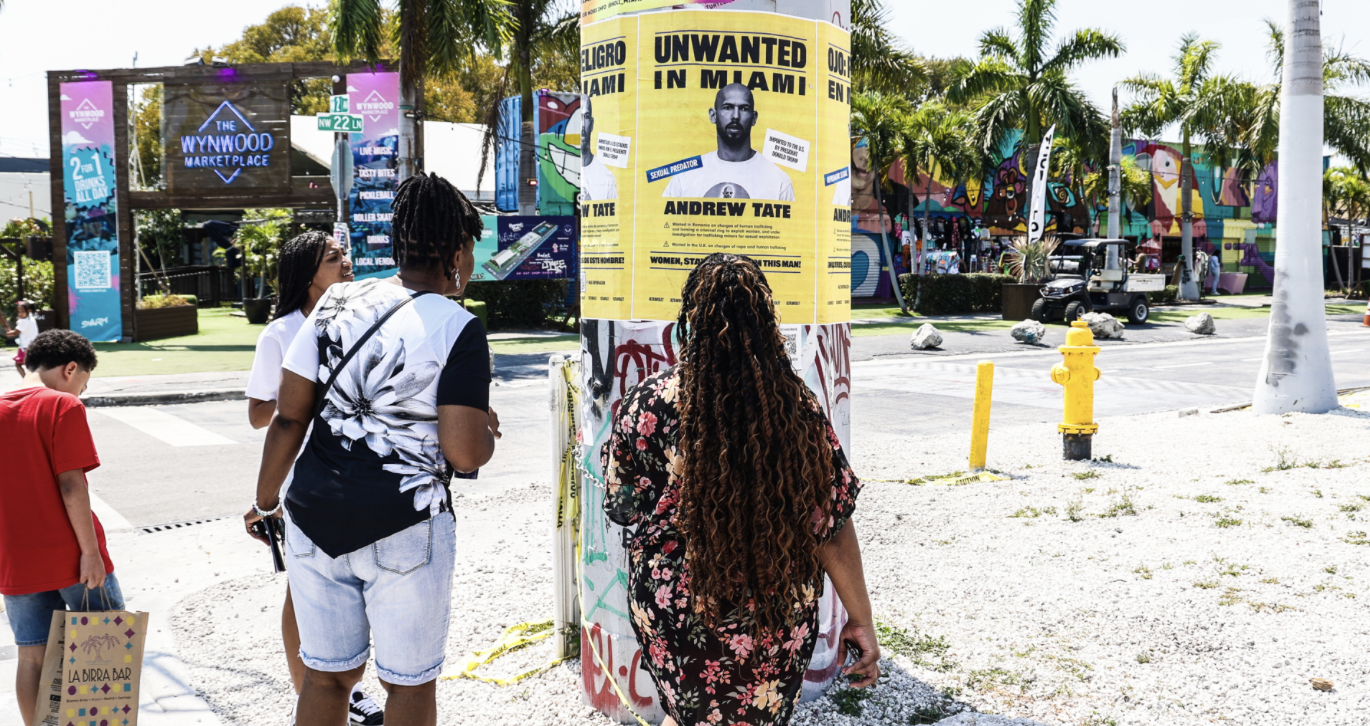
Despite Trump’s rhetoric of seeking to “protect women” in maintaining a clear division of sex roles, Donald Trump, Jr., J.D. Vance, and Tucker Carlson promoted Tate on social media, and appeared on pro-Tate podcasts that made social media circuits, during the election, leading Don, Jr. to attack Tate’s confinement as “absolutely insanity” and a politically motivated “witch hunt” from September 2023, aping Trump’s oft-repeated defense of his ties to Russia in the 2016 Presidential Campaign. Even as the Romanian court seized $3.9 million in cash and goods–fifteen luxury cars, fourteen designer watches, and cash in multiple currencies–he long insisted “there’s not a single video of an abused girl or one single statement against us,” promoting himself “one of the most important people on the planet,” the charges and accusations from multiple ex-girlfriends of sexual violence, coercion, and battery aside. Tate has remained a poster-child for absence of guilt, distracting from his unhesitating peddling pornography for self-enrichment on a global scale, with ties to trafficking, reveling outside of social norms or sanctioned codes of conduct in a social contract–his cultivation of misogynistic hate-speech in online forums have provided balm to the socially isolated men of the twenty-first century, the influencer in a hoodie who is professionally angry and aggrieved. This is increasingly a “real world” that young men increasingly live, and Tate sees himself as a totem of the aggrieved victim who is nonethlesss successful at making it.

BBC Andrew Tate with Tristan in background speaking outside a police station in Bucharest on 24/03/25

But he is particularly distrusting as an emblem of a false populism, cultivated in the currency of the online where he continues to emerge unscathed from legal charges. The changes aside, the Tates seem free to cross borders, as denizens of a shady internet. If the two Tates possess three citizenship, British, American, and as naturalized Romanians, Andrew Tate was a global creation and seems a global trendsetter–storing profits from business ventures offshore in Dubai, an in Bitcoin, and other cryptocurrencies, given far fewer financial regulations in Romania than in the UK or United States, and to invest in a large portfolio of Central European real estate, vastly boosting his net worth, and evade regulatory oversight. The features made him the product of the slippery frictionless world of the internet, able to appeal to lonely disgruntled men across boundaries who turn to social media in an attempt to get ahead, and seek affirmation in worlds that are removed from actual human interaction, are overwhelmingly attracted to the targeting of women as at fault for their own sense grievances at an imagined loss of status, eager to turn to the internet into the platform of new identity as Andrew Tate so proudly has, flaunting his own sense of fame before cameras proudly, in violation of all social norms, an incarnation of pure testosterone.

Was his decampment to Florida a way to gain ready access to the “offshore” Caribbean countries whose passports he also held? They are also the new entrepreneurs, not real people, per se, but icons of hatred and resentment, promising new worlds outside the social reality of the many, an exclusive utopia of hatred and free from gatekeepers, where the non-person who cultivates online followings may promise an escape demanding little attention or reflection, but a reflexive thinking and action alternate worlds, existing entirely online, and far removed from he world of education.
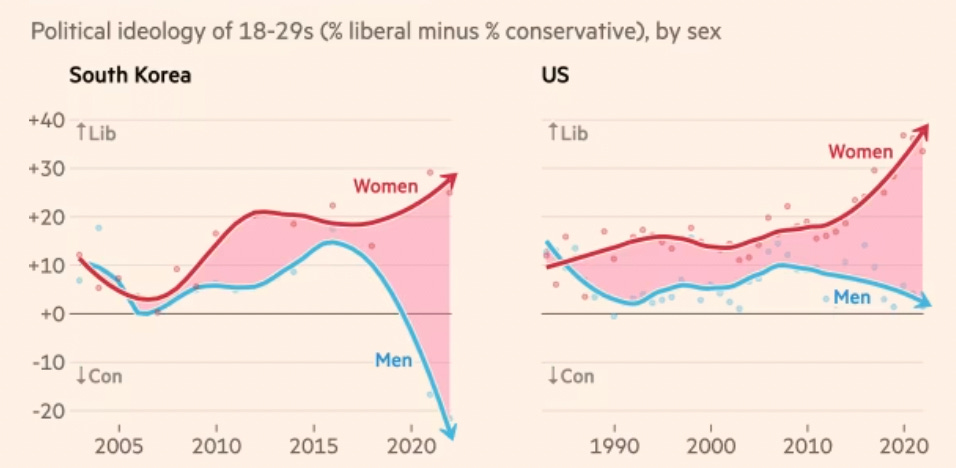
Burn-Murdoch/2024

Is Tate’s career something of a reflection of the scissors of an educated public, in which men have increasingly removed themselves from critical thought or education, rather terrifyingly dropping in their attainment of college degrees? The hunting comfort with which the Tates perpetrate attacks on women and champion toxic masculinity cater to the AI algorithms of the internet that offer a self-righteous claims that demand attention, attracting male audiences from the growing margins of wealth inequality and a society that cannot care for itself where more fall through the cracks, offering the worst convictions of unremitting passionate intensity among the lonely online, appearing as an answer to the bankrupt nature of an academic world dominated by women.
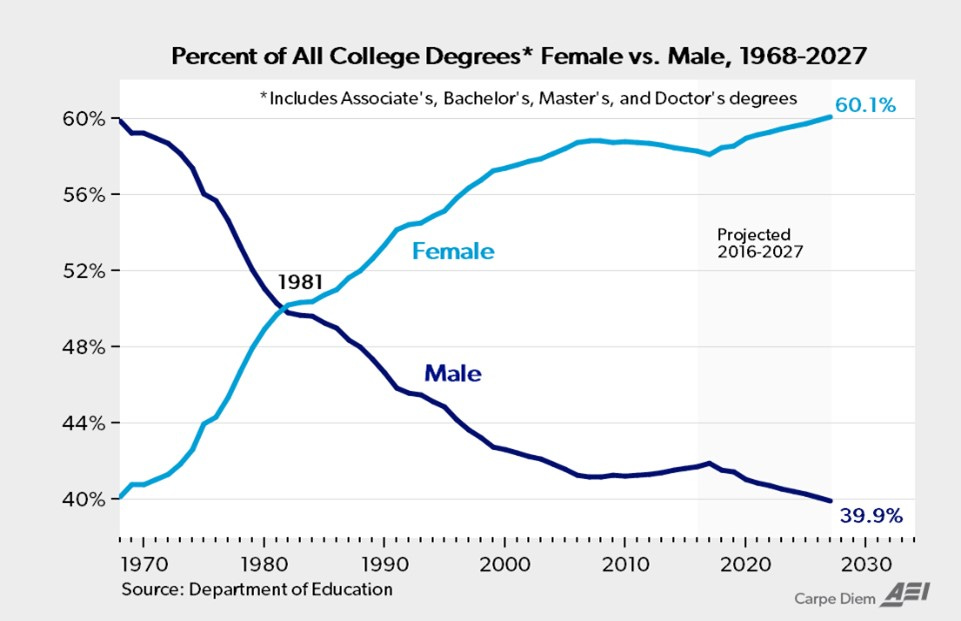
Declining Numbers of Men Attaining College Degrees in United States, 1970-2016/Dept. of Education

Indeed, the Tates have ably navigated the slippery sovereignty of a globalized world, evading any jurisdictions that set up laws that potentially restricted his trade. Tate modeled the personal freedom of holders of multiple passports–“passport bros”–among those disillusioned with the limited prospects in domestic market, to court economic investment opportunities or relationships outside legal oversight, cultivating “global citizenship” by purchasing citizenship in such offshore sites as St Kitts and Nevis ($250,000), St. Lucia ($100,000), or Antigua and Barbuda ($100,000), all for sale to attract real estate investment–and is a model for a future notion of post-citizenship, freed from national legal or economic regimes by a program of “Citizenship by Investment.”

Andrew and Tristan Tate on Release from Bucharest Jail on January 9, 2025/Vadim Girda, AP

The release of the Tates from house arrest in Bucharest arrived as they faced charges with the support of their followers. But the support of Don Trump, Jr., Alex Jones, and Elon Musk had improbably made them darlings of the alt right, even at the recent CPAC meeting. The celebrity of these notorious internet “gurus” or celebrity influencers extended beyond frequent media posts featuring sexist slurs and misogynist homophobic slurs to demean Trump’s political opponent–or the supporters of Kamala Harris, as if her political career was due to sexual favors.

These slurs were broadcast to his over fourteen million online (most likely entirely male) followers that had given him prominence in the MAGA universe. By promising to promote techniques of self-discipline, confidence and motivation common to talented and powerful men. Hustler’s University is a modern Machiavellian ticket to power, in a world where most all feel disenfranchised, promoting professionalism rather than credentials and confidence of self-determination in place of the slippery alternative of self-examination–promising confronting issues of “personal responsibility and accountability,” that promises as its very own “PhD”–the “Pimpin’ Hoes Degree” reflecting skills of grooming women for sexual work. The unfunny equation of wealth with skills of isolating and manipulatively persuading women to perform sex acts before webcams–transforming people into puppets–constituted the highest life skills the Tates promised at Hustler’s University. And if an investigation in Florida has begun into the Tates, who “publicly admitted to participating in what very much appears to be soliciting, trafficking, preying upon women around the world,” the question of whether they will continue to evade legal prosecution may be on the front burner of local and world news.

Tate’s debasing of education (even online education) in this alternative reality degree melds worlds of porno, bitcoin, and a smooth global surface of financial transactions that easily intersected with one of emotional neediness. It promised to smooth out your future by the psychological warfare tactics of ‘gradual steps to remove her entire support structure from her life” to create one for yourself. Proclaiming himself “one of the most dangerous men on this planet” in his own cultivated online persona, in eerily Elon Muskian ways, the Tates’ recent move to Florida may have been boosted by the lack of regulation in the state its governor, Ron de Santis, celebrated as a “freedom state” in the pandemic, but was easier something of a hub for alt right influencers who took up the Tates’ perverse cause. (Musk himself had long urged the Romanian government to drop the legal charges Tate faced.). Is it a surprise to hear Musk vouch to Joe Rogan that A.I. technology will bring “sex robots” to the market in “less than five years,” sex puppets if far more “realistic” than an inflatable dolls, allowing customers to “have whatever you want” from “a furry lady”to an alien Aurora out of the movie Avatar? The Avatar sex doll with blue skin on the market in 2025 is promoted as the “most realistic love doll” money can buy, with the “furry sex doll” made of “superior silicone and TPE materials” promising to “satisfy your fantasy” in harmony with nature. (These sex dolls, beside anime sex dolls of rather grotesque features, make up a market in alien sex dolls, a crude skimming of the internet reveals, are a rather rich niche market, featuring “unique non-human physical features, from green or red skin, large eyes, antennae and tails; the Pandora doll promising to be in harmony with nature features stylized beautiful blue skin, golden eyes, and pointed ears, with a truly “authentic feel” that boggles the mind about standards of authenticity as much as new horizons of pleasure–and simulated rape?–that Artificial Intelligence is promising.)

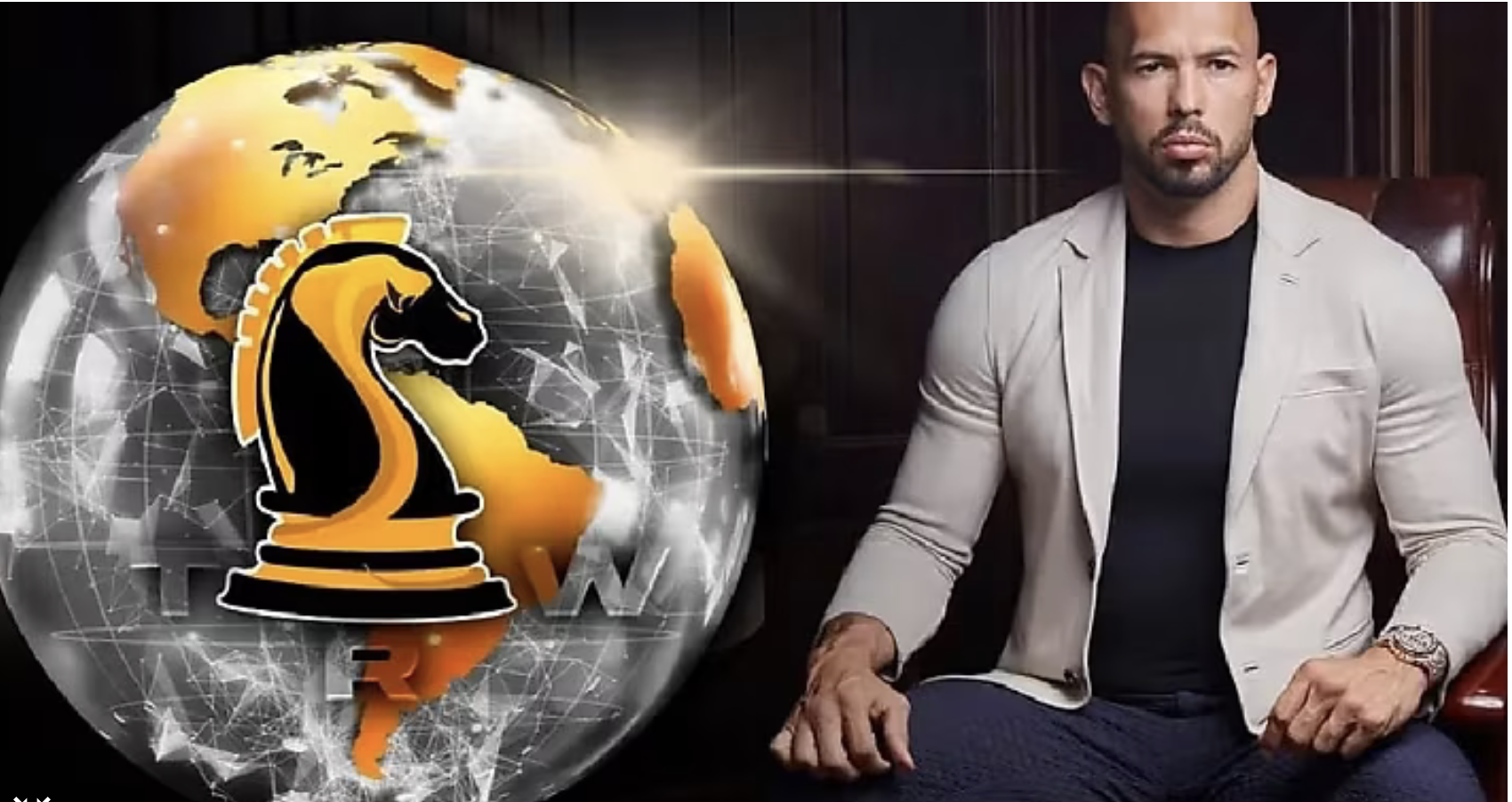
Andrew Tate promised his followers unfettered entry to a global community with access to tapping abundant wealth, a sort of Land of Cockaigne of untold abundance via sex videos flourishing on a virtual platform, promising a long-dreamed pathway to upward social mobility. Promising a way to beat the system, it is the ultimate red-pill entry to a “Real World” where “you’re part of an elite circle, receiving first-class training directly from seasoned millionaires,” allowing you to “elevate your game to levels you never imagined,” for those without much imagination of how to better their lives. You can be part of a globe-trotting world of men wearing sunglasses on airplanes, no longer “chained to mediocrity, laziness, and arrogance” that will take you to “true prosperity” in a pathway that has weird echoes of personal enlightenment and a financial scam, so blatant that it doesn’t might calling itself Hustlers University, that teaches you how to be a hustler on a global chessboard only superficially opaque, without any actual location, but converts the continents into a smooth gold surface of a gold-paved world that promises a generation of income through sexual subjection. If the Rook was a token of a global chessboard, the globe, for all its vaguely illuminated ghost-like grid, was a gateway to prosperity, or toolset for deception that would allow you to get ahead as they navigated the gold-plated manosphere that lay present in any map, so long as you could detect it.

The Real World AI by Andrew Tate Official ©️

The world glimmers beneath a rook that conveys domination, as if one merely need to learn rules of a game long concealed from you, but provides you with a sense of a deep game outside the deep state in exchange for a rapid payment of $8,000 that is a cheap ticket to life-long prosperity. The all-male club rests on the subjection of women to demanding tasks, often including physical violence, rooted in communicating a sense of total control over the vulnerable for personal gain. While rooted in cult-like brainwashing, the chatroom that incubates this access to a new world of wealth by the “life-changing positive force” of social media influencer Andrew Tate, a self-identified misogynist who rose to fame on the television show Big Brother in 2016 he had sought to model his violent lifestyle to 7.6 million Twitter followers–he now boasts 10 million on X–and recalls Don DeLillo’s prophecy that the future in crowds as much as Donald Trump himself.

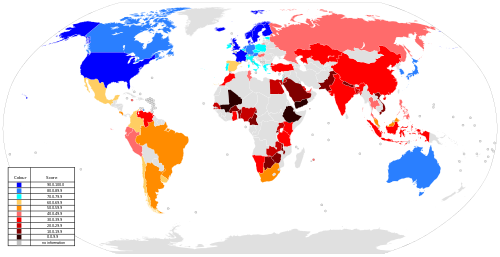
The globe that Tate uses to describe his “university” is an eery reflection of global sex-trafficking, but it only highlights the money to be made in all places for the Knight–a horse-like figure that is arbitrary, and not clearly assigned a gender or sex, and defined by its motion on the chessboard more than gender, but which the Tates imagine a figure of martial conquest and an emblem of they role in the world. Tate has emerged from the world of kickboxing to cultivate an image and role as a global citizen, not confined by nationality, and espousing his creed and credo online–the very medium for his game. He boasts he is not subject to jurisdiction or national laws. In quite eery similarity to President Trump, Tate has openly boasted “I’m living in a society where my money, my influence, and my power mean that I’m not below or beholden” to the law–if women, he famously argued, should “bear responsibility” for sexual assault. His reality television gig on “Big Brother” in 2016 led to cultivation on social media of an alluring online presence, whose hateful charges that women who are raped are not victim, but should be considered responsible for the attacks, gained broad appeal. The “king of toxic masculinity” doesn’t really live in any society or legal regime–he claims nineteen passports, as if this gives him full legal immunity and extraterritoriality, as he has built his empire entirely online. What he most enjoyed, however, was “living in countries where corruption is accessible to everybody,” and where everybody is able to bribe their way out of petty offenses as speeding tickets–and probably set his eyes on escaping warrants issued against him in England, finding Romania highly ranking on Transparency International’s Corruption Perceptions Index, if not much more than the global average, and Europe’s primary source for sex trafficking.

Tate established the country of Romania as his base from 2016, cunningly selecting a known hub of human trafficking; Bucharest proved a site to locate fantasy portal of male domination able to be broadcast globally with relative impunity, and was in the EU. But with historically chronically low levels of oversight, Romania was a hotspot of trafficking from the start of the millennia between Eastern Europe, and the center for a new level of human trafficking in vulnerable refugees, the greatest site of women trafficked to Europe for sexual exploitation–
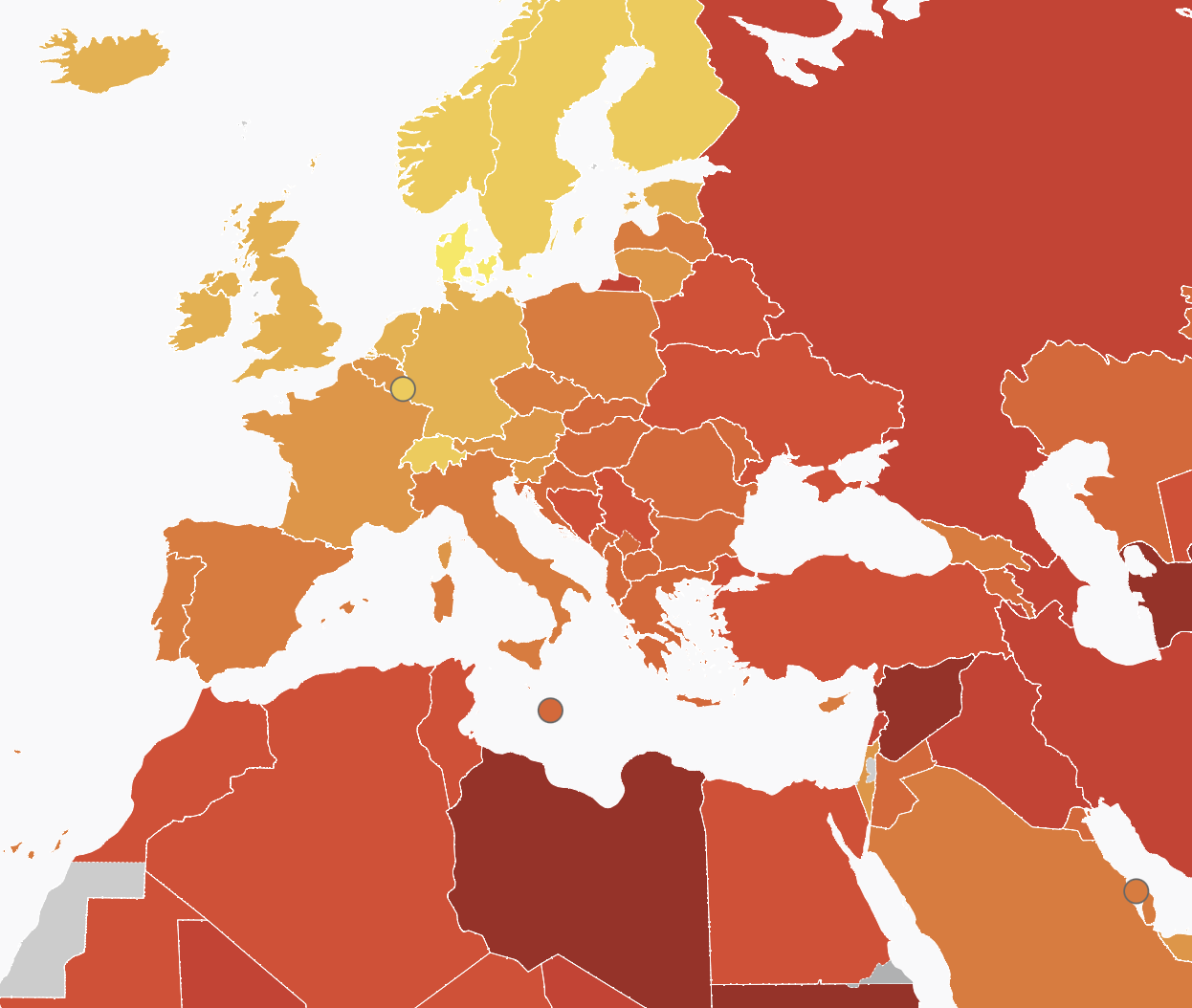
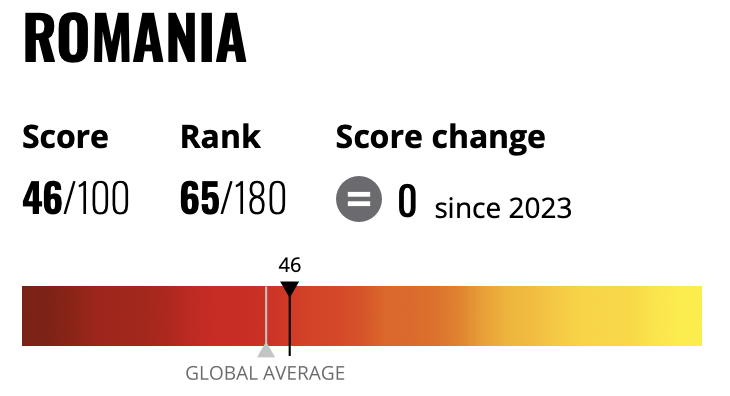
Corruption Perceptions Index, 2024/Transparency International

Increased human trafficking globally was a trade involving 140,000 persons a year, generating an astronomical $3bn annually, estimates UNODC, whose hub in Romania was well-established by 2010, many of whom were recruited to be sent by gangs to the UK against their will–at the forefront of pan-European statistics in recent years–

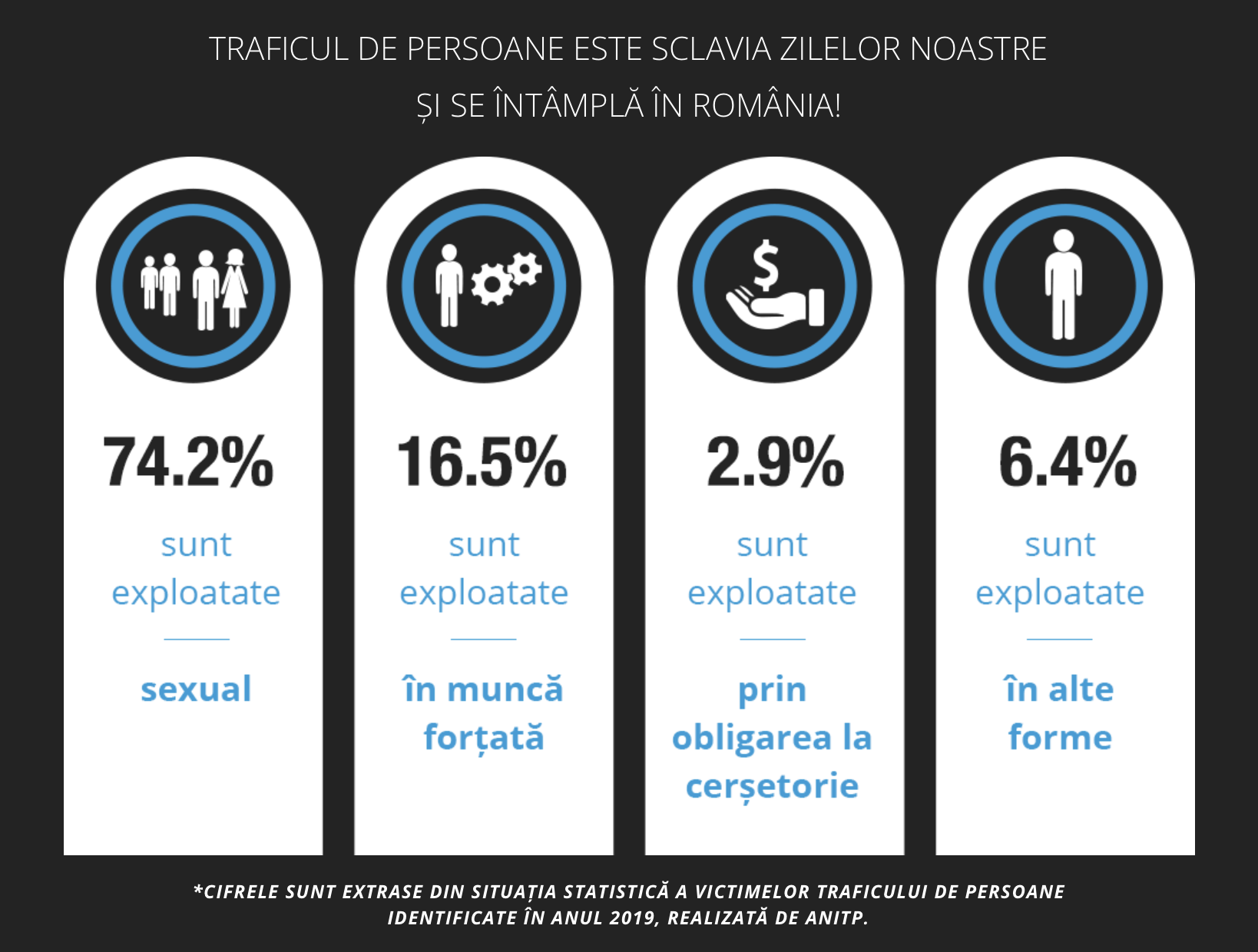
Romania has remained a primary “source country” for sex trafficking and labor trafficking victims in Europe, attracting the Tates to the country where they felt beyond the reach of the law by 2024, and a center for organized crime groups tied to human trafficking–whose victims, from forced begging, sexual exploitation, and labor exploitation, can be traced across Europe, and, despite the difficulties of counting or tabulating what is still tragically a largely hidden phenomena.

Geographic Range of Individual Victims of Trafficking from Romania/2024

–many girls who were tragically recruited, as public signage in Romania warns, by acquaintances–the poster in a Bucharest public transit station features a lipsticked girl denying she might ever be a victim (“Me? It cannot happen to me!”)–to raise public awareness about trafficking dangers–
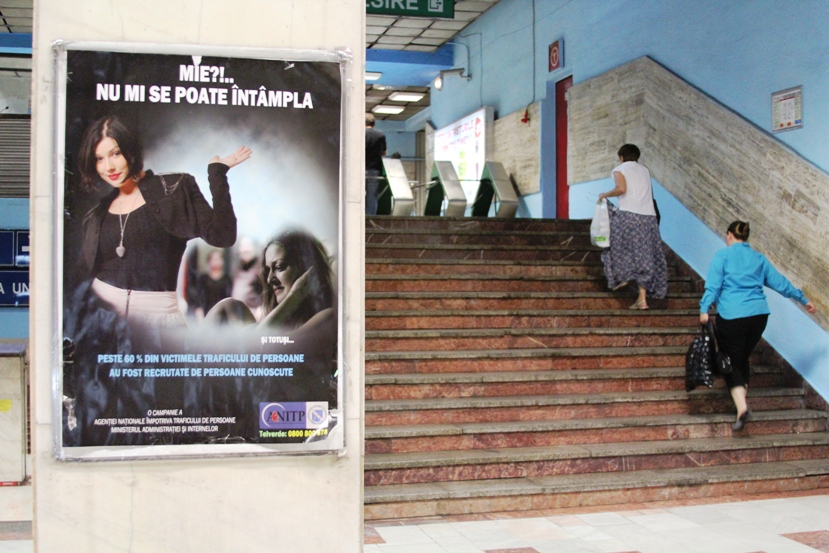
“Me?! . . . It Can’t Happen to Me!”/ Caritas Bucharest

–and several organizations have increasingly tried to raise consciousness about and help the victims of sex-trafficking, in ways that provide a needed context for the case against the Tate Bros–and feature the haunted look at the victims of sex trafficking mostly recruited by seeming friends.
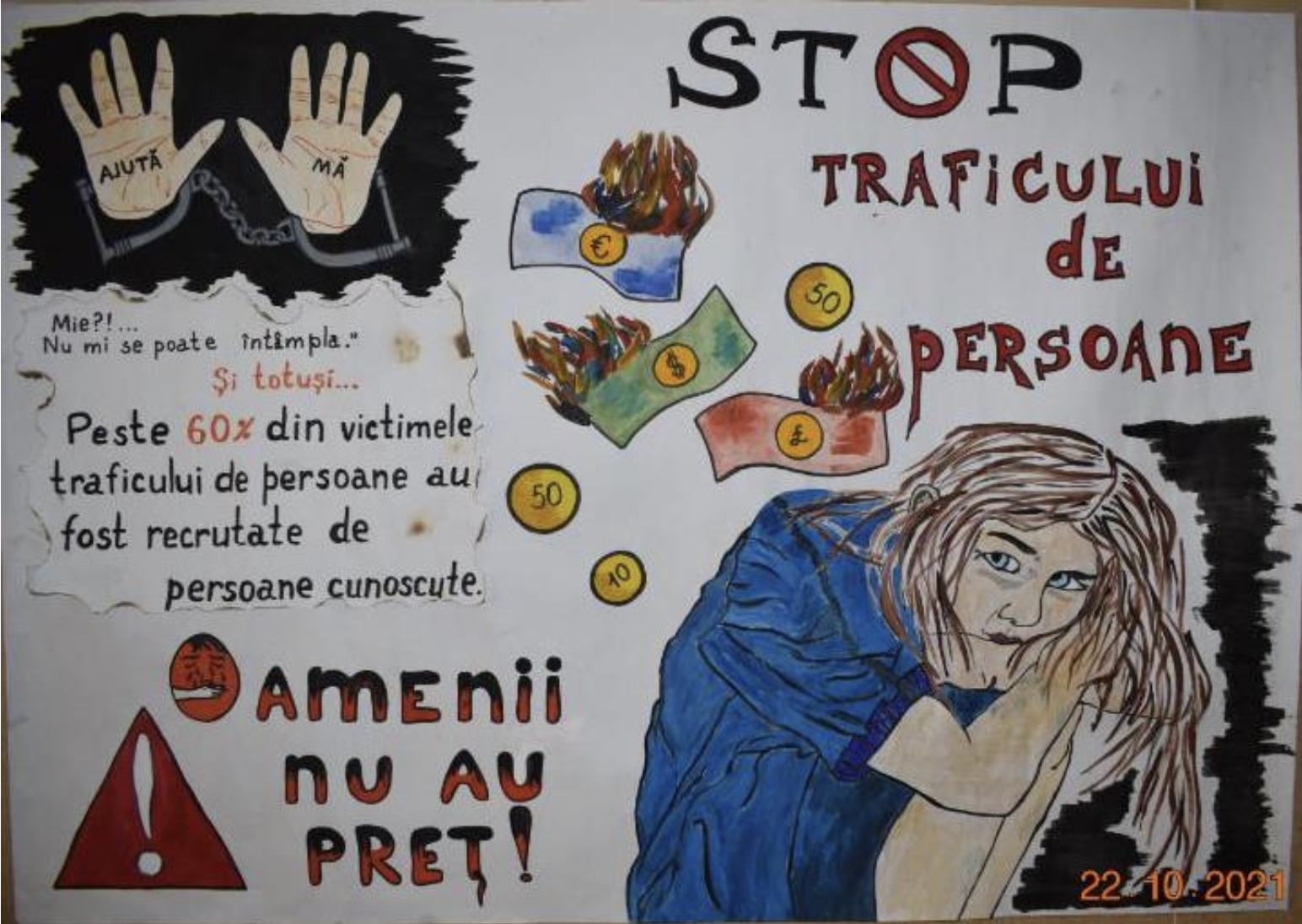
Stop Human Tafficking!–Over 60% of Victims of Traffickers are Recruited by Personal Acquaintances/2021

Even if buying and selling sex is illegal. As single women and girls flee Ukraine, 6,000,000 refugees crossing to Romania since 2002, vulnerability to sexual trafficking increased by the thousands in Romania: about three quarters of Romanian girls 14-19, per World Vision, describe human trafficking as including prostitution (72%); a third forced labor (34%); a third forced begging (30%).

Was Tate a war profiteer? He certainly profited from and preyed on erasing women’s experience in a site where there were increasingly vulnerable refugees, extremely vulnerable to be controlled and without many defenses; he championed his ability to strip them of defenses. But since the expansion of sexual trafficking in Romania from the start of the millennium, the state government has tried to control trafficking to change its recent reputation for lawlessness–despite the high vulnerability of displaced women to human trafficking, increasing punishment for human traffickers since joining the European Union in 2007 in ways that would lead the state to charge Tate with arrest. And Tate was apprehended by a dedicated anti-trafficking unit create to prosecute trafficking crimes and provide training and support to prosecutors, gaining a financial investigations unite from 2023 that helped expand the number of sex trafficking cases they might investigate by mapping financial transactions, in ways that helped locate Tate within their sights.
The power of such “influencers” as Andrew and Tristan Tate dramatically escalated for the Alt Right media as Tate’s “imprisonment in Romania” became a rallying cry of Free Speech. Members of his cultish tribe of G’s vowed in open proclamations of fealty to “prepare for the time when our commander comes back” in ways that aped rich-wing militia like the Proud Boys, using the micro-culture of the online community to promote not only a self-help group that had the appearances of a get-rich-quick scheme as if it were an underground of warriors, whose “soldiers need to strengthen one another for the time when our commander comes back” after his time in a Central European prison on what seemed dubious charges, but were in fact the same charges he had faced in the UK. Dedicated converts glorified Tate as a martyr of global tyranny, swearing “we are all grateful for the ability you are giving us” to prove ourselves by “risking your life to fight the good fight against tyranny” by extolling his work in helping them see through the false scrim that was the “Matrix,” providing a Real World in Hustlers’ University that clarified the danger posed by “all the puppets involved” in it. His arrest in Bucharest on December 30, 2022 led to a brisk online trade of t-shirts and swag using what seemed his mug shot tp promote the cause of a man charged with rape, human trafficking, and forming an organized criminal group were a political prisoner–

For his many devoted online followers, Tate was accepted a savior who alone could help them to navigate though dark times of loneliness, rent payments, and medical bills, where they must have had problems in distinguishing the real world form that of psychosis for those who “live paycheck to paycheck” in hopes of help in increasingly urgent desperate tenor, vexing to read because they seem almost verging on a psychotic break. “Free Tate” became a collective cry, while Tate was imprisoned in Romania, where he had fled to avoid the law; he was safe, but the location he was held must have conjured a Central European prison, and transformed Tate into a victim of plutocracy, awaiting for his champion in Donald J. Trump. By September, 2024, Tate went so far as to offer free membership in his online community, boosting his online persona to raise funds for legal defense–#andrewtatelifstyle#wealth#andrewtatemotivation#motivationmafia#talismantate–to all as a FIAL SHOT–as if he were a political prisoner able to model a wealthy lifestyle.
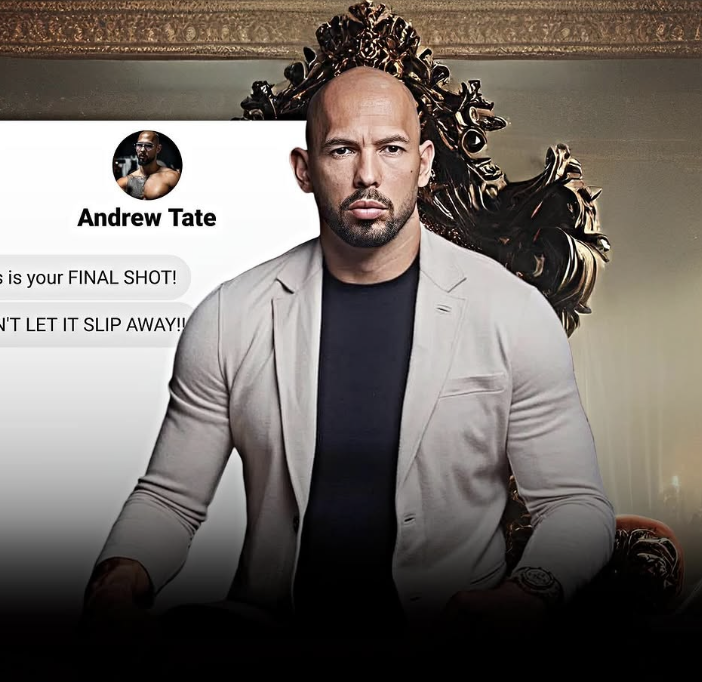
Describing in his life biography being raised by a single mother in Luton, England, living only on the frozen leftovers of uneaten KFC take-out that they froze for future meals, he rose to fame in the world of kickboxing to model the ultra-luxury lifestyle that features a fleet of thirty-three cars whose emissions he has boasted to Greta Thunberg release “enormous emissions.” Tate’s unprecedented frankness goes beyond Free Speech, but opens a door to clarification of power dynamics that He opens an alternative world of reality, or an alternate reality, appealing to young men, where “when you’re a realist, you’re sexist,” and there is actually “no way you can be rooted in reality and not her sexist.” While claiming with fervor he is a “force for good . . . actually acting under the instruction of God to do good things,” banned from YouTube, Facebook, TikTok and Instagram, platforms on which he once flourished as X as “cobratate.”

The sole platform on which the Tates have survived was X. The Tates’ bread-and-butter currency was owned by Elon Musk, a virtual protector in the manosphere modeling the “self-made millionaire.” Using nothing but a “little webcam business in my apartment” outside Bucharest, Tate profited from using seventy-five women in four geographically dispersed locations to rake in “$600,000 a month from webcam” in what he innocuously called the “adult entertainment industry.” (Musk’s latest start-up ensuring vitality almost seems a license for future sexual predation.). The discussion that emerged on Discord led many to dedicate themselves to his freedom, as Tate nurtured the sense of a deep, hidden war, he Discord where he thanked them for their dedication–“Thanks guys, we’re all going to make it.” He was worried about the possibility of his eclipse as a social media star to solicit their continued sympathy: “I remember yesterday thinking I will never be like those guys that get views” as he continued to post videos that circulated globally, promising to pierce though the veil of lies by teaching courses in crypto, e-commerce, and drop-shipping, as a pirate of the internet with the machismo of the high seas. And the arrival of the Tates in Florida–the region he had somehow negotiated the dropping of all charges and his arrival by a Gulfstream G550 private jet was widely celebrated by some as the release of a political prisoner.

That the Tates landed in northern Florida while Prime Minister Sir Keir Starmer was visiting Trump in Washington was not on the radar of Starmer’s team, although Andrew Tate was fleeing charges he faced in the UK for money laundering, sex trafficking of underage minors, sex with minors, but felt like a triumph of the dark lower-feeders of the internet over the rule of international law. Tate was almost sounding victorious as he gloated, with deceptive half-truths, “We live in a democratic society where it’s innocent until proven guilty and I think my brother and I are largely misunderstood.” Long strong supporters of Trump’s candidacy for President, the online endorsements Tate provided, often using sexual slurs of deeply misogynistic nature, exploited how the “millions of men” following him on social media offered a snub of international law that had a special edge as Andrew insisted “we have yet to be convicted of any crime” and their lawyer told news his clients “feel secure in America for several reasons, the primary one being that Donald Trump is President”–as if their return was entirely contingent upon Trump’s electoral victory.

Andrew Tate after Arriving in Ft. Lauderdale/Vadim Ghirda/AP

The airplane landed in Ft. Lauderdale, but is it any surprise that one of the most notorious sites in America for sex offenders is in fact Orlando–a hub highly ranked among cities in America for sex offenders, next to Wilmington–a site whose numbers may be inflated due to the tax-free laws of a technically “offshore” site for credit cards. Neither Andrew or his brothers will be wearing electronic bracelets, as their charges have been dropped, unlike the many sex offenders who are sentenced to do so, some so indelibly described by Russell Banks’ Lost Memory of Skin (2011), a novel that invites readers to enter a community of unhoused sex offenders on the margins of residential Miami, finding shelter under a causeway near his house, that Banks read about in newspaper articles in the Miami New Times from 2007, describing the shanty town under the Julia Tuttle Causeway linksing Miami to the shore, a causeway that offered shelter in a world saturated with internet pornography, which the lost memory of skin haunts despite the psychic toll of residents: the inhabitants of an encampment populated by sex offenders was cleared by 2010, but the over two hundred and sixty sex-offenders clustered in some fifty tents who listed their only residence as the intersection of Hialeah and Miami, among squat warehouses, were bound by electric bracelets restricting their movement and beeped when they went out of range between 10 p.m. and 6 a.m. Banks mapped the community as a distortion of space, located in empty non-spaces in his 2011 novel, an intersection of the market and legal surveillance lying “in the misty zone between reality and imagery, no longer able to tell the difference,” a negative space created by the internet as an absence of embodied intimacy. The book’s twenty year old male antihero solicited a minor online as he felt “real” only when downloading porn–“watching pornography and masturbating were the only times he felt real,” Banks writes, when he was not moving as a “dust bunny shaped like a person” or a soulless puppet of accumulated dead skin.

The refuge in the encampment beneath a causeway that Banks entered by chance encounter with the article explored the placelessness of online screens, a negative space of refuge from electronic tracking of sex offenders, doubly marginalized as they live in a part of the city without emergency preparation or emergency response. The state of Florida has indeed long occupied the nation as a site of homelessness, it ranked sixth among states with large numbers of confirmed victims sex-trafficking, only behind Georgia, Mississippi, Arkansas, and Louisiana, and the number one ranked per residents, Nevada. No doubt the Tates will be welcome, if free from inclusion in registered lists of sex offenders police monitors maintain available online–

Florida Sixth Densest site of Human Trafficking Victims in United States, after Nevada, Georgia, rkansas,, Georgia, Louisiana, and Nevada

We are hardly immune, as a nation, from a global spread of human trafficking, if absent protection of victims keeps it off the front page of newspapers, and outside the public eye. Yet the growth of human trafficking in recent years has created clear hotspots in Nevada, strongly weighted by Las Vegas and Reno, and southern states of Georgia, Mississippi, Louisiana, and Arkansas, promised the very luxury lifetstyles that the Tates also knew was so crucial to the cultivation of their brand. In Florida, where the Tates arrived to well-wishers, the density of sex offenders is mapped by per 10,000 inhabitants, a rgzzly continuum for Tate takes his seat with less oversight, perhaps, than in Bucharest, if there seems to be little likelihood but that he is not about to start up his trade soon.
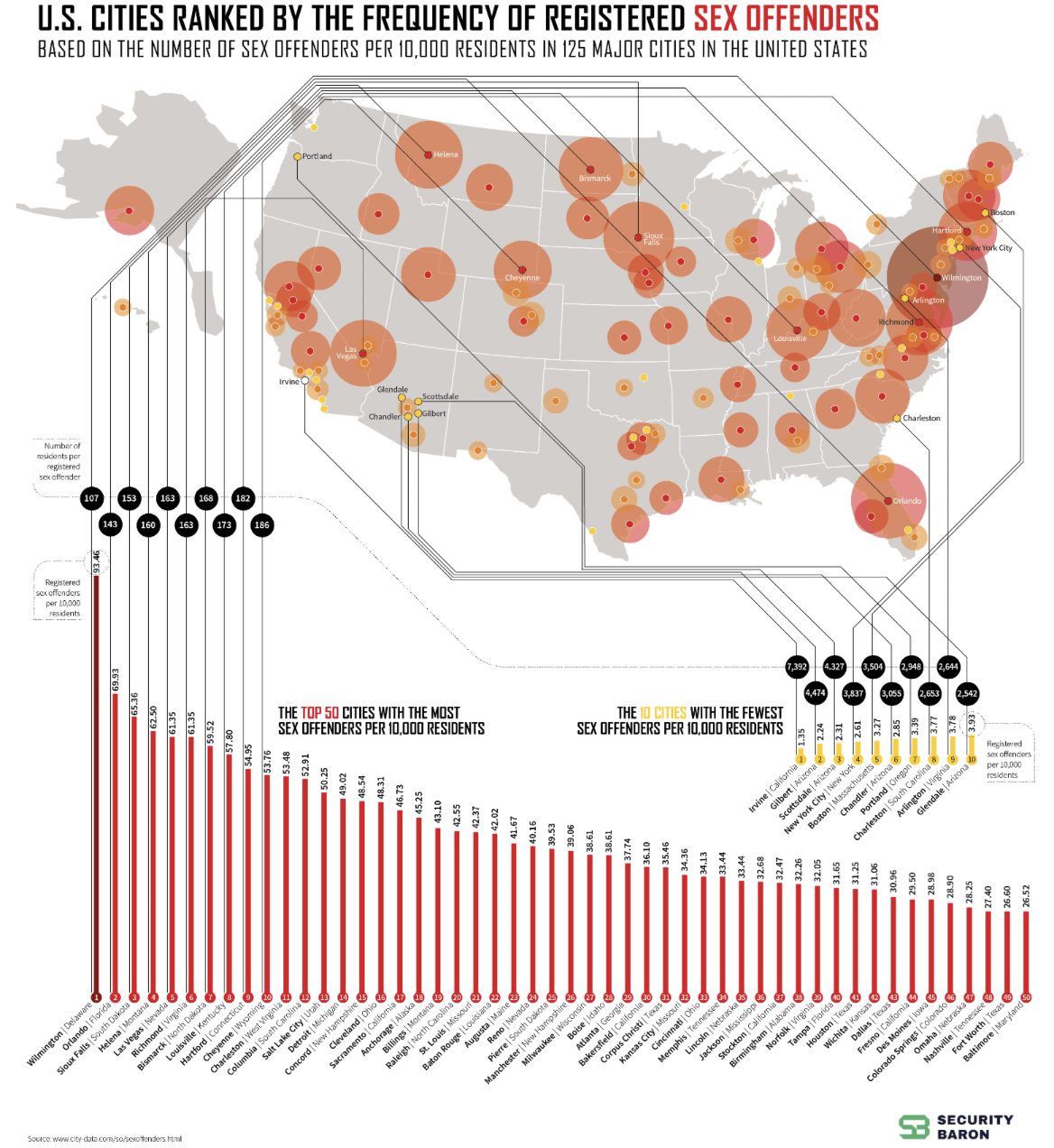
American Cities Ranked by Sex Offenders/Security.org

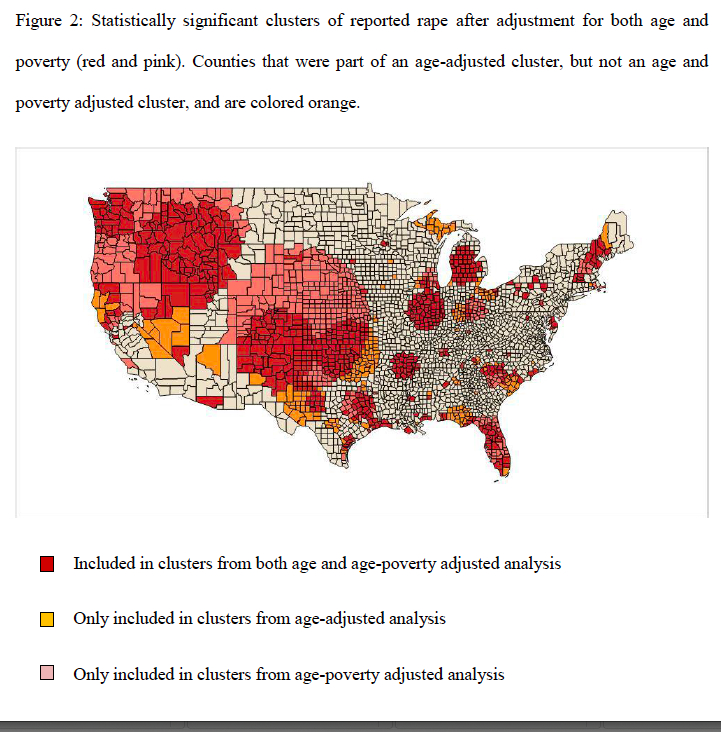
While Trump voters did not, perhaps, openly agree to welcome these sleazy smiling young men to fill the internet with male hegemony or misogyny, the new empire of the Tates in a state where there are more likelihood of a normalization of rape–based on adjustment for age and poverty–as Florida, as the second infographic map below shows or seems to reveal–mapping statistically significant geographic clusters of reports of rape in the United States from the years 2001-2011. The map hints at the possibility or alternate reality of normalizing rape as a community, as Florida alone among states approach the continuity and density of secessionist counties as Jefferson in northern California, a seat of the Alt Right, urban areas of Texas, or Reno and Las Vegas, Nevada-seedy sites, to be sure, but which in Florida seem a disquietingly dark shade of red–denoting clusters both age- and poverty-adusted, in ways that make their uniformity stand out in the lower forty eight.

Sexual Assault Cluster Map: Reported Rapes, 2001-2011/Studer Community Institute

This is the negative world not only on the margins of the law, or education, but not only of low-education counties, or low literacy but of low income, not only of low literacy–if there are some correspondences of note–but of deep inequalities. It is in some of these same spaces that the Tates are particularly successful at luring people with promises of wealth.

1. The offer to enter a world of untold wealth is promised and promoted, if you haven’t guessed, at Hustler’s University by the language of The Matrix. For it is in the real world, but at an angle to it, and provides a respite from the unfairness of society. For those ready and willing to take the red pill, to enter the reality of untold riches, as if a fantasy portal were ready by this seducer. It demands only recognition that you’ve been duped by a false map and a world of mediocrity that some folks are content to live. Are you ready to join? As if appropriating the language of a Calvinist elect, ready to offer illumination from a website of no real certification save that of bluster, as members of the church of the internet,–where you don’t even need a license to preach.

The pardon of King Trump awaits for the master hustler who is able to blame all of society’s issues on threats to the patriarchy in a world where most are being controlled and manipulated save those who take the “pill” of liberation by a portal of his own device, that borrows heavily from the film, operated by a bald man in Bucharest, recently retired from he world of kickboxing, itself based on staged illusion of Mixed Martial Arts, who appears with shades and a nicely groomed beard and sport shirts.


This is the mediated world in which Trump and his black-hatted buddy Musk dwell; it’s not unexpected that the head of Hustler’s University would gain the aid of Marco Rubio, who highlighted the injustice of jailing Andrew Tate, a military brat, in Bucharest, as the American was imprisoned under charges of rape and sex-trafficking in Romania for crimes that recent posturing of the American President suggested were in fact trumped up: but we might listen to Tate’s online boasting of the less than onerous nature of the trade in sexual domination and manipulation as a cushy job not demanding, but quite rewardingly remunerative as he converted his persuasive skills of domination and snake oil salesmanship through his webcam to reach a global paying audience.

This was not ever really about Free Speech as we know it, but about becoming the digerati who are able to make money on a new platform at an angle to the world, using only a cel phone to make money from drop shipping or e-commerce that required no actual labor, but entrepreneurship that smelled of a scam. Tate boasted in a notorious video aboutthe demands of the “job” he had fashioned for himself, that served as an example of his entrance to this world of untold wealth. “My job was to meet a girl, go on a few dates, sleep with her, test if she’s quality” and ensure she would be broken down psychologically to a point ‘where she’d do anything I say and then get her to go on webcam so we could get rich together” streaming porno to paying customers in the wider world–apparently the central conceit and get-rich-quick strategy of “wealth creation” promised by Hustler’s University, with its disturbing channeling of free-speech advocate Larry Flynt.

After facing jail terms for tax evasion for online businesses in the UK in late 2024, Tate had fled England to escape the threats of British courts to seize $2.4 million from his bank accounts. By then, Hustler’s University had morphed and expanded in the manner of online software, to new generations–Hustler’s University 2.0, then 3.0 before it was reborn as “The Real World,” as if in a bid to gain credibility as an alternate world without women, a virtual but deeply real version of a manosphere, offering men the ability to “escape slavery” for a mere £40 a month–which seemed a good deal.

The schemes began with sadistic exercises of psychological domination the Tates honed online but the tools of the trade were in fact hardly so new or particularly cutting edge at all, but a confidence game of sorts about staging empowerment before a live stream of paying customers: as if staging a puppet show of the internet, a drama denying subjectivity of sexual partners by gaining “consent” from women who were stripped of support structures or autonomy, while promising a respite from the “puppet show” of the other real life. The online version of a puppet show updated the oldest exercise of suspending belief, uncannily stripping subjectivity from the animated show of puppets that both entranced romantic figures as a theater of childhood and makes one, or made romantics as Goethe realize that they had to destroy the theater itself. This was not a theater to be destroyed, however, or grown out of, but available on one’s phone: the animated figures of female puppets of Tate’s theater of sex were trading in a currency of misogynistic domination doubling as get-rich strategies as well, the secrets of sexual domination presented as the ticket to wealth-generation by online schemes, only waiting for those who were ready to realize their visions of themselves as sexual dominators that they could use to win followers from the global audiences of online viewers.
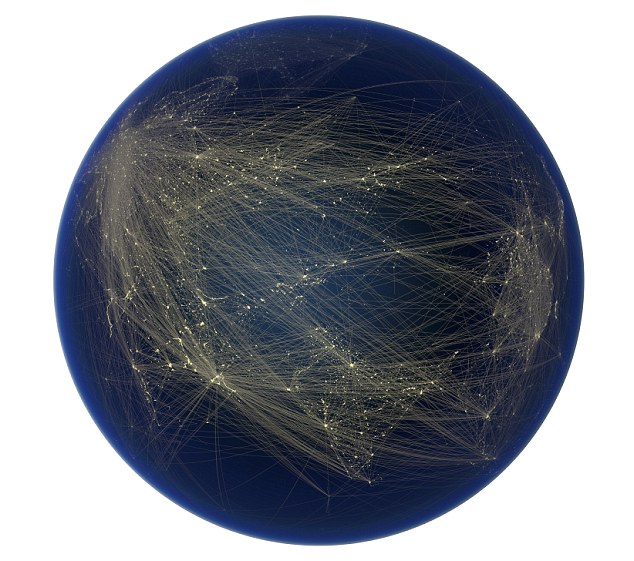
Why is the United States government and the Trump administration paying such attention to release the restrictions that Tate faces in Bucharest? Does the social media influencer’s territory on X provide an answer? Human trafficking has long existed as a modern form of forced slavery based on a combination of coercion, deception and exploitation, an under-the-radar geographic mobility escaping attention, often, in modern times, coinciding with forced migration or refugee traffic, taking advantage of and preying vulnerable populations as streams of isolated women or children are seeking to move without defenses in unfamiliar circumstances and need.

But the internet makes this into an ever more monetized revenue scheme, animating often broken-down individual subjects for paying audiences of mostly paying men, expanding the routes of human trafficking and sex slavery on a new frictionless surface, moving often lower middle income persons on already existing patterns of exploitation by a slick visual medium on steroids–based on corruption and the lowered risk of criminal prosecution, and driven by economic need and necessity. Romania is a cutting edge country foe sex exploitation and trafficking as it is an edge or transit country, between two economic regimes with low legal oversight or protection, and lower income and higher income countries, encouraging rampant trafficking with impunity.

Institute for Trafficked and Exploited Persons/2020 World Bank Country Classifications

2. The territory is notional, but Trump and Musk are currently making it a national priority to block Romania from investigating the Tates for charges of money laundering, sex trafficking and rape. For Trump and Musk, he seems a sympathetic figure, wrongly jailed in a nation that is holding an American against wishes, even if he is not prevented from using his webcam in his apartment. When President Trump has his envoy bring up the case with Romania’s Prime Minister and government as if it were indeed a state issue, demanding Romania return the two brothers’ passports to them so that they might travel,–possibly to return to the United States, where he might be pardoned as the Proud Boys and Rod R. Blagojevich, aka Blago, to enter the legal marionette theater of Trump’s America, a true tauerspiel where the President acts as King and Puppet Master of a broad theater of unsavory characters with whom the Tates would presumably be right at home, welcomed into the manosphere that the United States was determined to become.

The thumbs-up Tate flashed as he had left house arrest that Tate delivered to the cameras as he was released from house arrest to await trial for human trafficking and rape on July 6, 2023, didn’t allow him or his brother Tristan to move from Bucharest, where they faced trial, but he insisted “We’ve been completely innocent since the beginning of this,” as if he were a victim of a political conspiracy, rather than an intimidator who was at the apex of a scheme of human trafficking conspiracy, rape, and sexual violence, his bother Tristan calmly assuring his waiting fans that “I’m always okay–I was okay in jail, I’m okay now” as supporters tribally cheered him on, chanting “Top-G1. Top-G!” as if to dignify him as the first among gentlemen, as the social media tribe prides thinking themselves.

Influencer Andrew Tate released from house arrest while he awaits human  trafficking and rape trial | AP News

Since then, Andrew and Tristan Tate have of course reemerged among the top demands of the new administration in Washington, as the envoys of Donal Trump work hard to secure his release, as if pandering to the fame that the Tates have won on social media as influencers, and particularly on X, as the eyes of the hurricane of a global manosphere.

But Trump’s envoy Richard Grenell saw fit to raise the fate of Tate in discussions with the Romanian Foreign Minister Emil Hurezeanu, who observed (until he thought it wiser to check himself) Grenell had pressed in his state visit he was “interested in the fate of the Tate brothers,” as if the issue of “the fate of the Tate brothers” were matters of national interest, and perhaps might provide a basis to rebuild diplomatic ties, before backpedalling to deny any appearance of legal impropriety, lest Bucharest appear a puppet state, confirming “no demands either during the Romanian Ministry of Foreign Affairs-Richard Grenell discussion or after it” during their talks: “Romanian courts are independent and operate based on the law,” rather than petty favors of quid pro quo–and only hold “the same values regarding the fundamental rights and freedoms of citizens” as America. Is that even a reassurance? The Prime Minister Marcel Ciolacu weighed in on X to clarify he never ever received “any requests to us upon the legal situation of well-known foreign influencers investigated by the Romanian authorities,” preserving a pretense of dignity and legal autonomy even if the whole thing was quickly degenerating into a global puppet theater, so that one almost lost sight that it–ans Tate’s wealth–was generated in part by global sex trade in the media frenzy.

Of course, those “fundamental rights and freedoms” are online speech, Trump has made clear early in his Presidency, and Is Trump being manipulated by Musk? The defense of Free Speech as a victory of the 2025 inauguration was nowhere more clearly evident than on the stage of the Inauguration, when an elated Elon Musk raised his fists in triumph, as Jeff Bezos smiled, and Sundar Pichai clapped somewhat sullenly, as Zuck looked on with his new bedfellows from a more marginal position than he’d have liked, and Trump’s visage was almost intentionally blurred.

Billionaire’s Row at 2025 Inauguration of Donald J. Trump

The protection of Free Speech on the internet, and the end of any filters on hate speech or fact-checks for a weird adoption of “community policing” seemed to open a new theater of fake news, hate speech and rumors, encouraging beliefs that the LA wildfires had indeed destroyed the homes of Ukrainian generals who had been enriched by American taxpayers, or USAID officers acting as fronts for corruption, even if Ukraine offered firefighters to combat the recent fires. The puppet theater is one of intolerance, in other words, and of protecting the rights of men like Tates who had millions of followers, proved good for the X platform, and attracted more users to their sites.

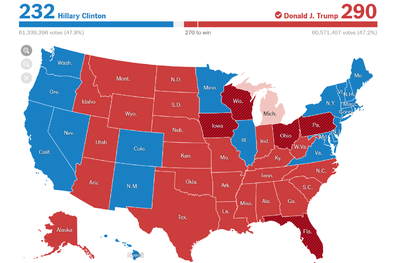
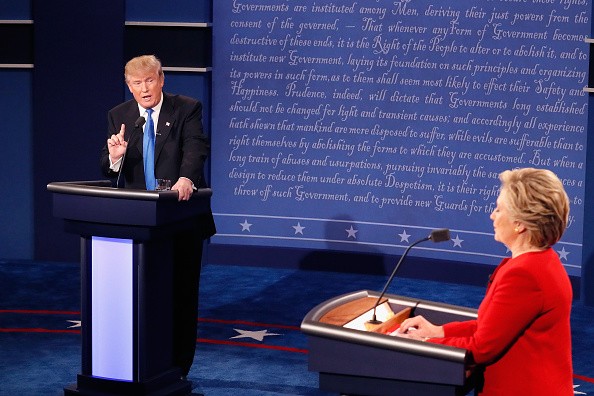
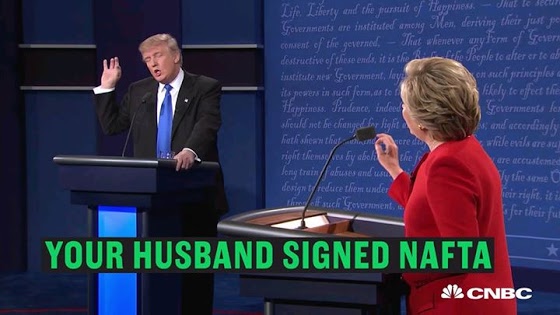
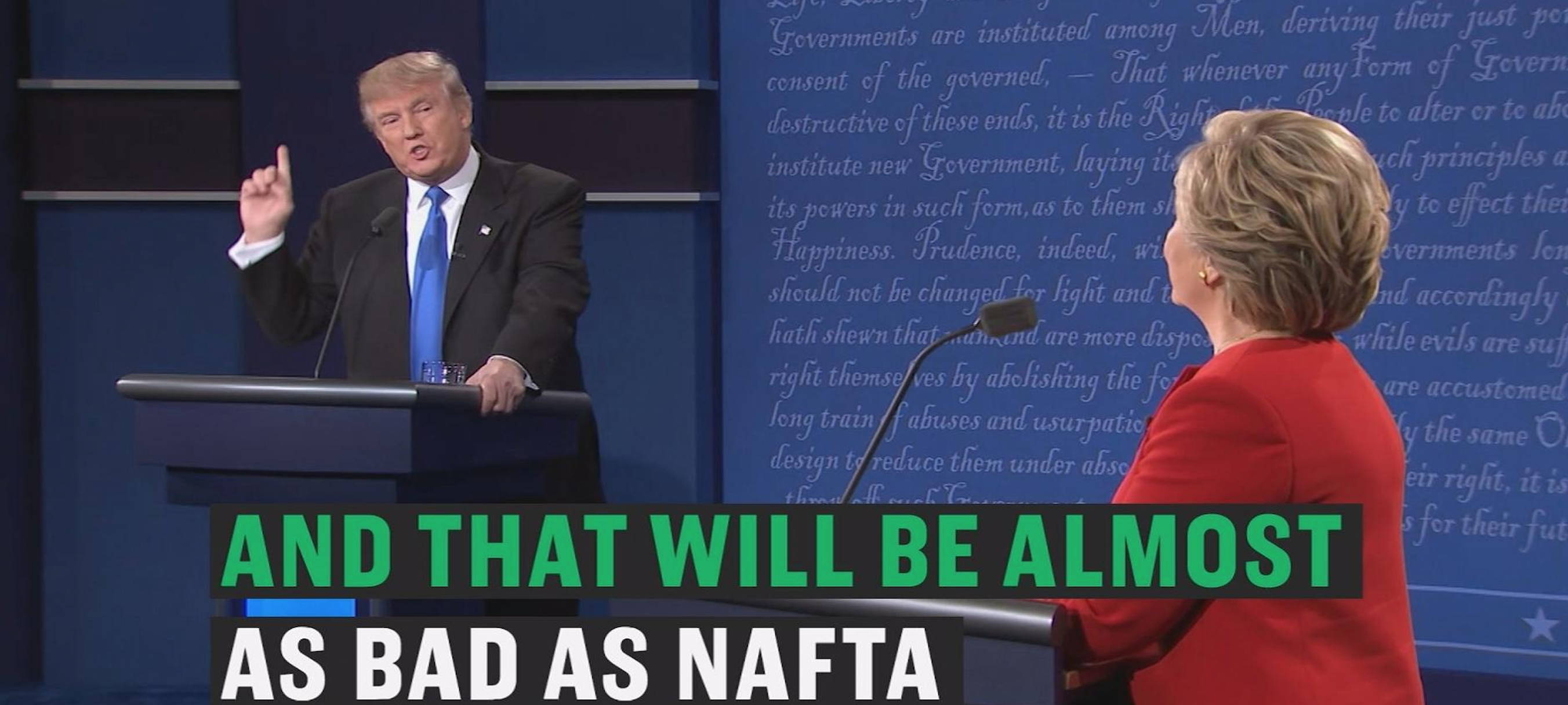
3. Or is Trump indeed not fascinated by the puppet? It is hard to forget the memorable accusations or counter-charges Hillary Clinton made in a Presidential Debate that merits rewatching today, as we try to understand where the United States is in global alliances. But it was the figure of female puppet–“No puppet! No puppet! . . . You’re the puppet! No!–You’re the puppet!”–with inarticulate bluster that became a comedic set-piece theater in the third Presidential debate with Hillary Clinton. What began as a debate on foreign policy, back in 2016, as Clinton charged that Putin “would rather have a puppet as president of the United States” shifted to borscht belt comedy on the status of puppets on a global stage that seemed a bit of a puppet show, after Clinton accused Trump of his willingness “to spout the Putin line” and “break up NATO, do whatever he wants you to do.”

Trump’s aggressive retort that seemed eerily to tap a deep-seated anger at being insulted onstage in such a manner was, of course, almost immediately eclipsed by the flood of internet memes it provoked—memes of puppets clamoring “No, you’re the puppet!” that, in an election turning on fears of America was rigged–had become rigged–and in which we were all, to some extent, puppets, left us wondering who was the puppeteer more than why Trump was so deeply wounded and ticked off. The exchange seemed evidence of “how childish our election system has become” as much as scowls of inarticulateness in contrast to Clinton’s poise. The theatrical staged exchange seemed evidence of the demeaning of politics of true virtues, or even interests, to a puppet show–

–or a “puppet madness” with its own seemingly vital online life in the post-debate world, as we looked to visual humor for some relief as Trump continued muttering, “No, you’re the puppet, . . . you’re the puppet” to gain some ground in ways that concealed how deeply wounded he was.

The puppet shows we now watch in our defense of two Anglo-Americans who made their fortunes teaching men the secrets of how to dominate and manipulate women as tools to escape the matrix, as if Fortune was a woman, and the platform they call Real World was “the portal to escape the matrix,” or the secret figures that, as a puppet theater, pull the strings and animate the individuals by controlling government and society, with only the freedom of online sex slavery the solution to make money, and unleash your inner millionaire, lest we continue to be distracted by those shadowy interests that “distract us for long enough so our bodies can be used for the machines”–as if it were a form of redemption. The unveiling of the “learning platform” that will dispense with all the necessary skills to become super-rich was long dismissed as another “get rich quick scheme,” with strong similarities, after all, to Trump University, although this is hardly the only superficial similarity between. the two men who have cast themselves as entrepreneurs.
4. Even if one shouldn’t say this, the demographic of one special sector the Trump voter may align more closely that we should ever admit. The stereotyping of the Trump voter should be resisted, as well as the attribution of the voter with a right-wing ideology. But the pool of pro-Trump voters overlap with the followers of the Tate brothers in disturbing ways, and indeed with the Tates –serial sex offenders who had gained fame as influencers on the manosphere district of the internet.

The release from jail of the two t-shirted Tates had fanboys who displayed their love for them in the manner many proclaimed devotion to Donal Trump at his rallies as Presidential candidate; as the ripped brothers emerged from holding cells in Bucharest, the Tates were swarmed by affection from fellow G’s who steadfastly and firmly supported Tristan and Andrew through their ordeal. The outsized support that the Trump administration took mirrors this outpouring of online sympathy at false accusation and imprisonment on house arrest. The support for the Tates in a country whose membership in the European Union is undecided given its widespread corruption has led to the restoration of their passports, confiscated financial assets, and dropping of criminal charges as they were provided with a private Gulfstream jet out of the country. Supporters of the Tates and long sought to protest and discredit the decision of courts in Bucharest, where the Tates fled to escape legal prosecution in England–seeking protection in the shadowy Central European country–the fear of a deal between the Romanian government and Trump White House seemed to reveal the preferential treatment to wealthy foreigners in a corrupt system, as Moscow was hoping to undermine the credibility of Romania’s elected government by trumping up its corruption. The release of the two Tates from house arrest in January, 2025, allowed them to continue to promote their brand of toxic masculinity online, possibly having bought their newfound liberty with unfrozen fortunes gained from their website, Hustlers’ University, their toxic online personas are poised to return to the internet as Romania faces more pressing problems of constitutional order.

The two bearded bros were in fact the very perpetrators of their own theater of cruelty of enticing women to acts of sexual submission. Yet, in the eyes of their defenders, it was they who at the end demanded their own freedom,–and what was the roll of the United States if not defend them? Who the constituencies were that attracted the Trump administration to the fate of the Tates was uncertain, but it might have begun in the Trump Dept. of justice, where lawyers who had defended the Tates was gainfully employed, and had fled to greener pastures, or maybe some of the fanboys of the Tates who had ties to the GOP, or even the folks at Turning Point, who had welcomed Trump’s election as “Daddy”–a term that Andrew Tate had reserved for his personalized T, “$Daddy.” Whatever the reason, if speculation is rife, the convicted Tates as they languished in jail in Romania quickly became a priority of the American government in place of America’s support for Ukraine, but championing the innocence of these poseurs is almost as much of a national embarrassment. Even if the Trump’s administration’s interference was criticized as a violation of their victims’ rights to due process, the muscular bros raised their fist seemed eager to cast themselves as vigilantes, warriors of the church on the internet far less violent than their online personas, even if they did seem hungry to return to the immersive world of online engagement.
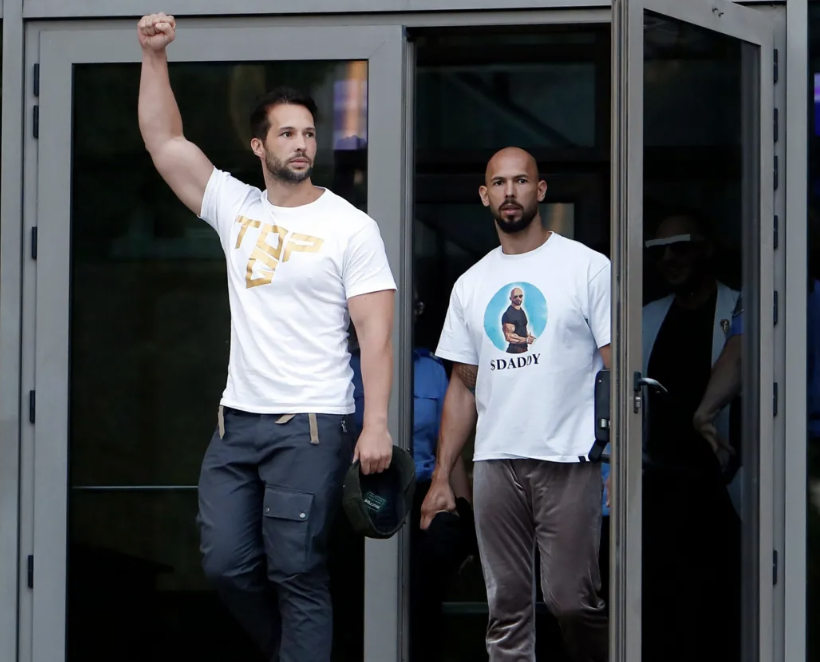
Tates Leaving Criminal Court with Fist Raised in a Gesture of Defiance to Legal System

The fist-pump that Andrew Tate’s brother defiantly delivered as the two left Criminal Court in Bucharest telegraphed defiance in ways readily recognized online by the alt Right for whom Andrew became a prominent cause, even if he looked a bit more worn and peaked than he did on the muscleman portrait that broadcast his internet identity as $DADDY emblazoned defiantly on his shirt when he was taken into custody in August 2024. This moniker, and its sense of infantilization of the G[entlemen] of Real World, was a welcome submission to the power of the kickboxer who imposed his will on all women, holding himself up as a model for the male hegemony that would be their platform to a future better life. The Tates’ use of this rhetoric of conversion–a conversion expressed by the “red pill”–was an invitation to a real life of being without the false constraints imposed by society’s matrix, and the conspiracies that were preventing one from realizing wealth. Of course, Tate had only flow to Bucharest to escape the warrant that British officials had issue for his arrest, and the Romanian court granted the extradition request after the social media influencer would be tried, but that Tate was trying to escape the law for forming a criminal gang to sexually exploit women was of little import to his followers, who understood him as a martyr for their cause.

But there was also no doubt inescapable delight to the President in protecting the “rights” of the Tates as sex offenders for a President who describes himself elected as a sex offender, or to clear the charges that he was one–a first in American history. To be sure, Trump had a history of sexual misconduct, and the number of women who have charged him of sexual aggression has grown from two dozen women to forty so far. Trump has eagerly sought to deflect his conviction for sexual abuse in a civil trial as the outcome of a “legal circus”perhaps only a puppet show–puppet shows being parts of traveling circuses; Trump supporters accept his portrayal of the guilty verdict as “a continuation of the greatest witch hunt of all time”–despite the disservice to witches, and even the inquisitorial accusations of witchcraft that is meant to target the legitimacy of a modern court of justice or rule of law. The presiding judge had argued that the conviction of liability had amounted to a conviction of rape, but President Trump has resisted the accusation he compulsively denied, even seeking remuneration in the millions for being called “liable for rape,” nominating multiple accused serial sexual predators–Pete Hegseth; Matt Gaetz; Robert F. Kennedy, Jr.; Elon Musk–to be in his Cabinet. (Trump even energetically pursued several defamation suits against a network liable for a news anchor who identified him as “liable for rape,” questioning the semantics of statements he had “raped” a woman a jury deemed sexually abused as “false, mendacious, and designed to cause harm,” maybe still smarting from being called “the most mendacious President in American history”–if the presiding judge affirmed the charge of rape to be “substantially true.”).

The dismissal of charges for sexual trafficking fit Donald Trump’s increased inclination to open endorsements of hegemonic masculinity. Indeed, it seems to push the legal envelope in what was almost a personal vendetta, not only minimizing rape but condemning such accusations as malicious, if not “unlawful acts of election and voter interference.” The rejection of weakness and embrace of toughness seems central to Elon Musk, but was long cultivated in the torturous candidacy that led him to the White House, perhaps embraced as the key to victory over Kamala Harris, cobbling together a new Republican electorate by images of toughness and strength. While the Georgia jailhouse mugshot became one front on which Trump rallied against prosecutors with the charge “Never Surrender!,” the New York charges of sexual abuse was emblematic of a demand to prove his innocence, after the fact of legal judgment, casting the election as if a way to expunge the legal record in the court of public opinion, and reject the law. While social media influencer Andrew Tate was awaiting trial for accusations of human trafficking, rape, exploiting women, sex with a minor and money laundering, he contended he was being wrongly portrayed as a victim. Did Trump feel kinship with the man promising he hardly merited investigation by Romania’s anti-organized crime agency, DIICOT? The glamorously tattooed kickboxer complained that all evidence against him was trumped up, venting to the peoples’ court of the internet, as if he were on the cusp of innocence, despite a long history of cases of sexual aggression dating back over ten years.

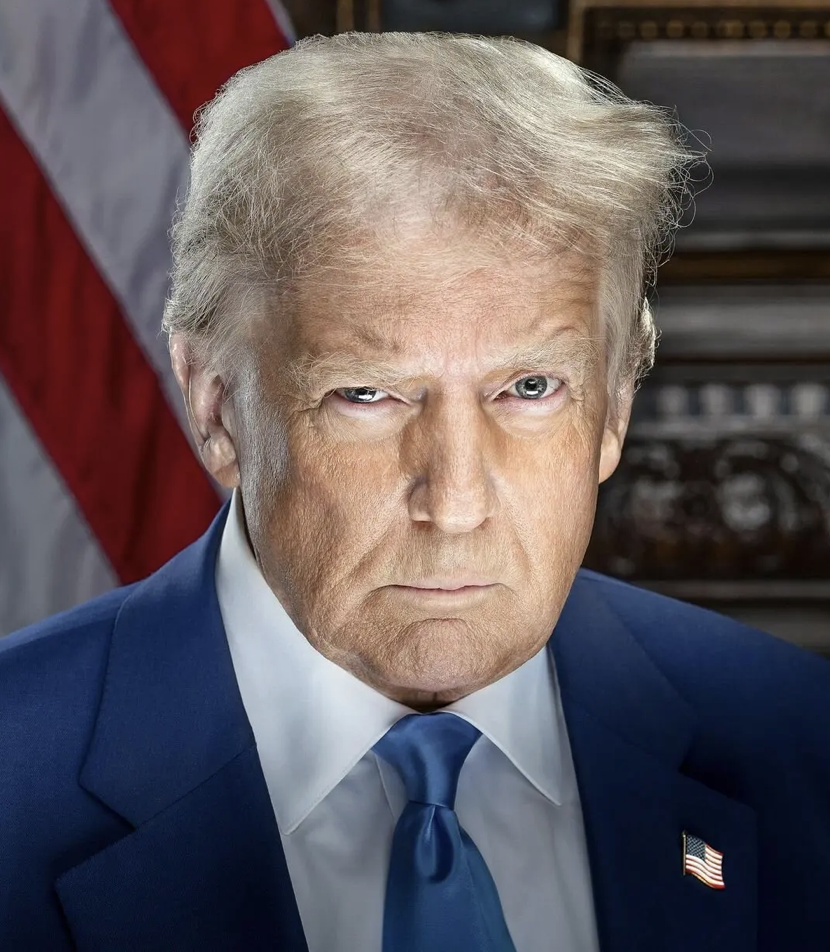
But the absolute contempt for the law is very much on the surface of the stare conjures not the jaunty cover of the entrepreneur atop Trump Tower of The Art of the Deal, but an anguished pain that served, mutatis mutandi, as a model for the power pose of his 2025 Inaugural Scowl, a portrait that seems to be skirting legality and legal norms in time for a new Presidency. If a photograph is worth a thousand words, this mug shot was the photograph that changed Trump’s fortunes in the Presidential race, a fundraising opportunity of sorts that electrified his supporters and prepared them for the vigilante of Trump 2.0 as a man who was defiant, and confidently outside the law. While Trump was only visiting the jail–where he spent but twenty minutes before flying to his New Jersey golf club in a personal jet, his visit and mug shot offered an amazingly remunerative stage to repeat his claim that this prosecution was corrup–as the others he faced–and politically motivated.
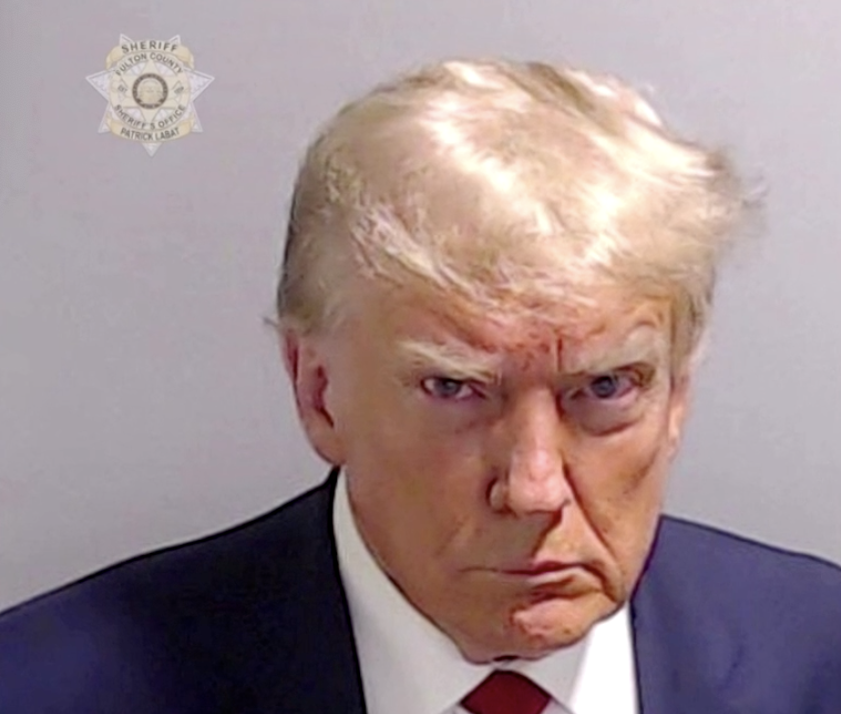
He was resisting being a puppet of this corrupt legal regime, standing up for the freedoms of those who felt only anger, rage, and amazement at the inequities of th real world. The booking shot taken in Georgia serendipitously captured a sense of anger, resentment, and sense of grievance that may have thrown a life preserver to Donald Trump’s candidacy, generating after an outpouring of support that raise a record-breaking 4.18 million on the day it was taken, and raised $7.1 million since he was booked at an Atlanta jail. The single-day record for his entire campaign was a point of inflection, even more than the failed assassination in Pennsylvania when he dodged the bullet by jerking forward, the scowling mugshot reprinted on a range of merchandise–shirts, posters, bumper stickers and beverage coolers–with the telling tagline “NEVER SURRENDER!” 

Is it any surprise that it became the template for is Inaugural Photo, breaking from tradition in using lighting from below and a grim scowl that glared at his public and the American people, a President who was fully prepared to show nothing but contempt for the law? The mugshot was posted on social media with the plea, as if felon to felon, to  “make a contribution to evict Crooked Joe Biden from the White House . . . during this dark chapter in our nation’s history.”

Trump 2.0 was outside the law, maybe a puppet or maybe not, without any intention of complying with any court of law. He was content with the inevitable triumph in the court of public opinion, convinced of his place, even as the oldest President ever entering office, but in fact an outlaw President, fully confident of holding a secure place in the firmament of the manosphere. Trump realized that the resistance that the mugshot perfectly captured had an appeal and power over his followers that was the identity of Trump 2.0 as an outlaw President he was determined to embrace.
Daniel Torok

Was it a surprise that the first response to the image Trump posted of the 2025 portrait on Truth Social aped Tate, and led Charlie Kirk to crow “Dad is home” in response to the glowering portrait, as Byron Daniels, thanking Trump for the return of stability at the southern border, declared merely “Daddy’s back” and Lauren Bobert exulted on social media, “Daddy’s home!” The male figure of authority and discipline was adopted as a means of bringing discipline into the budget, even if many of the cuts of spending were alternatively exaggerated, obscene, and illusory, but talked a game of grandeur and a return of an actual figure of authoritarian power.

Trump is of course quite a master of delaying legal proceedings, blurring grounds of legal jurisdiction and appealing cases to defer the pronouncement of guilt. His bizarre exercise of visualization led him to imagine a grim fate and “very nasty life” had he lost the 2025 election–“it was dangerous, actually very dangerous“–as if the election might be understood in purely personal terms, even as he had framed it as a battle for “the fate of the country” in a nation divided between good and evil. Before guests from the Middle East, and Kingdom of Saudi Arabia, including its Princess, he suggested some introspection of surviving a deep personal crisis, public persecution, and vicious attacks more than assassin’s bullets, after riffing happily on economic progress of his future administration.–briefly entertaining the prison time he would have faced had not “all fifty states shifted in a Republican direction” as if this was a divine intervention delivering true justice, superseding any criminal trial. And a nod to the broad online community became part of a lineage of American entrepreneurship and innovation in the inaugural address, which praised the iPhone as condensing all knowledge to the palm of one’s hand: one wouldn’t ever need to leave the virtual world due to the triumphs of American skill

For tee election was a means of surpassing the travails of his worldly trial s in court. And his victory helped him win “great respect,”but demanded personal “courage” as if it were a trial to campaign on his own freedom, and overturn the judicial circus. As the ultimate confidence man, elected to terminate scams perpetuated on the American people, as he told the eager press gaggle, Trump seems drawn to the Tates, charlatans and online performers, as heroes of his own constituency, as much as purveyors of fraud strikingly akin to his own deceit, but also as purveyors of misogyny skilled at converting sexual abuses to personal fortunes. Most voters view sexual assault as disqualifying one from national office, but the embrace of the pleasure of demeaning women–often by sexual coercion–comes full bloom in the defense of the Tates within the performance of white masculinity. Rather than only a ‘brand,’ it is a dark ideology revering dominance, an extension of narcissism, that trumps the male hegemony reflected in cabinet picks.

6. Trump’s Presidency was never imagined to include champions of women. But as Trump embraces the Tates as props of hi sown theater of masculine, he acted to silence the accusers the Tates faced in the UK in an outrageous ways, and isolate them from legal accountability in their schemes of sex trafficking. Those championing themselves as the defenders of wrongly accused Americans held against their will in a foreign land, victims of a grievance, is an open perversion of the injustices that Trump seems eager to cast himself as able to rectify. The affirmation of the right of sexual harassment is far more explicit than in Trump 1.0, and is now a very unstable and risky propositions. The stubborn presence of four women alleging sexual abuse by Tate are distraught at Trump’s involvement in Romania’s court of justice. (Romania remained in the targets of Vice President J.D. Vance, who accuse the Constitutional Court as acting on “flimsy” evidence to charge Russians of any interference in Romania’s national elections, to undermine concerns the Constitutional Court expressed.) As a civil case against the Tates is pursued by English courts, many worry that Trump’s team is going out of their way to dismiss–“what’s a civil case?”–to allow the pair of brothers to escape, welcome them home to the fold to protect Tates. One of the brothers’ former lawyer has indeed found employment at the United States Justice Dept., praising Tate for “offering the dying West some hope for [historical] renewal” not a conman purveying evil.

Of course the women who are accusing the Tates must be trusted in recognizing a vile puppeteer–“Fie, fie, you counterfeit, you puppet you!” stammers Helena full of rage, in Midsummer Night’s Dream, Shakespeare’s drama about love, illusions, enchanted forest, and magical enchantment; amidst the tricks that hath such strong imagination, Hermia aims to turn the tables on her onetime friend by questioning the advantages by which she attracted her beloved by her stature: “she hath urged her height” to prevail “with her personage, her tall personage,/Her height forsooth” as but a counterfeit of love. Counterfeits of government and governing are central to all puppet shows.

Musk, for his part, has insisted that AI images of Musk as the puppeteer of Donald Trump that have become widely popular on the internet are mere malicious attempts to drive their bromance apart–“They’re trying to drive us apart!” But the disturbing visual of the President of the United States slumped at the Centennial Desk, his mouth closed, “like a puppet while his master does the talking,” raises questions. The man Trump named to run DOGE as a shadow-governmental organization explained to the nation what we voted for, and Trump didn’t smile, making much of the world wonder when they ever voted for Musk, and how much Trump is entranced at his dazzle and ready to consign all authority over state records into Musks’s ever-growing domain. The puppet show is here an unbalancing of the ship of state, a crisis of authority, yes, but even more gravely a sense of deep instability where the rule of law and all legal norms are up for grabs, with the promises of a paradigm shift lying in a theatrical exposing of the wrongs of government, while the Emperor wears no clothes, but because he is actually only made of the most malleable cloth.

Puppet theaters are, of course, what we have grown accustomed to expect from the Oval Office, where the props are on hand to turn the theater of state into a grand macabre, or a parody of state. Donald is there with his folly of renaming the Gulf of Mexico as the Gulf of America, as it’s only a map, and he’s a king, as if ready to stake claim to national waters that are far from his own territory, and expand the underseas seabed where the nation can stake claims for drilling oil, even pumping at underwater sites in Mexico’s national water, closer to Mexico’s shores.

The theater of domination is close to the theater of the nation, it seems, and maybe the real one that matters, before it is destroyed. Or will it ever be destroyed? For as our minds are being pummeled by the latest Punch & Judy show, with firings and dismissals proliferate in the name of streamlining and cost-cutting and undue excess, but the excess seems to be the point. And putting our national reputation on the line for the Tates, two truly despicable creatures not meriting defense who promise untold riches but have a habit of being so lax with their own databases to expose eight gigabytes of data of 968,447 user accounts to public scrutiny since 8 April 2024, suggesting they had little interest in the interests of their clients save their getting rich themselves.
Leave a comment

Filed under Andrew Tate, Donald Trump, online extremism, Romania, US foreign policy

Where Do I Go?

As if doing an asana into a terrain-view surface of Kathmandu, or leaning too forward into a map screen to place his head into its tiles, a sportily dressed male icon in the Antipodes Map plunges across the map to its other side.  The imagined transit through rendered topography seems noteworthy of an alienated relation to place, despite the proliferation of toponyms on the surface of a screen.  Although the site is dated, the avatar is an emblem of the reduced interactivity on offer in most web-based maps, and something like a prisoner in the platform that he was intended to promote, and the poverty of how we use coordinates as a way to organize screen-based maps that remove from cartography from an art and perhaps–more seriously–the observer from the map.  At a time when the world demands more detailed observation and scrutiny–and Donald Trump proposes not only to do less to slow climate change, but give broad profiles to climate change deniers in his incoming administration, the importance of mapping climate change seems likely to be curtailed, in ways that raise the danger of an alienation from map-based inquiry.  At at time when we need something stiff to take our mind off what’s going on, the teasing use of the map in the  Antipodes Map seems almost an emblem of uncertainty.

For the staid Google Maps platform, despite its richness in place-names, hardly suggests the landscape of where you would end up in the world.  The platform maps the location where you would suddenly re-emerge by showing its antipodal counterparts of any location on a map screen.  But the illusion of hexadecimal accuracy conceals the maps generated from a toponym could in fact be located most anywhere:  the map is impoverished of meaning.  If the icon exists in almost comic way, it suggests the seriously diminished expectations of a map and their expanded claims for trust in their certainty, the website creates non-utilitarian maps, stripped of any navigational use of actual way-finding, that make one feel the slippery epistemic consequences of one’s remove from a globe.  Indeed, it makes one wonder if the embrace of such a platform suggests an endemic alienation from the local against which we seem condemned to struggle.  The figure in the map is almost something of an emblem for the “end of the map,” and the consequences of the adoption and diffusion of platforms of impoverished interactivity. Even in an age where expanding abilities of interactivity have redefined video games, musical composition and screen use, why is the map with such lowered expectations?  There seems to be a clear sense of removing attaching narrative coherence to its form, despite its hugely rich narrative possibilities.

The algorithms underlying the Antipodes Map are simple.  They playfully promise the possibility of re-emerging on the “other side of the world” in ways that suggest the remove of the globe from our geographic unconscious.  Provided for an audience of bored armchair travelers from bored office-workers  to zoned-out insomniacs, the paired maps of antipodal locations claim to be about place, but suggest the remove of the viewer from their content.  This is partly because the rather sterile landscape is stripped of any use for navigating or sense of orientation, and its remove from the operations for travel that the map actually presents–stripped of much sense of the local or the spatial, it is as if the map were a way to play with spatial travel, so compelling that it might substitute for geographic knowledge, so removed is it from much any sense of actual presence with which a viewer can interact.  In a sort of caricature of an online map, it is a low-tech cartographic formulation of place that seems to expose the consequences of our increasing remove from a world of tangible paper maps.  Indeed, the easy generation of misleading mapping at such an extreme cognitive remove may not only perpetuate the sense of global chaos that Donald Trump purveyed with such success, but the misreading of the voting landscape that made his election so much of a surprise.  The comic image of burying one’s head in a map certainly gains added resonance after the 2016 general election for President of the United States as an allegory about the costs the alienating viewers from place whose tiles are stripped of scale and cleansed of much local detail.


Different Scales antipodes.png


Although it’s difficult to take full stock of the diminished role of the globe in daily life, the limited presence of a relation to place or spatial differences that is perpetuated in the Antipodes Map seem particularly acute for the problematic question of how we map “place” today.  In an era when we increasingly stitch together georectified satellite images of the globe, bemoaning an absence of coordinates may seem hopelessly antiquated–but the problematic meaning of “place” in a globalized economy seems mirrored in the dislocated sense of place that is present and perpetuated in many overly schematic maps–and the difficulty to mediate place, or to tell an effective narrative about place in the set of GIS tools that are available in most web-maps, whose terrain view backgrounds hint strongly at homogeneity.  The increased slipperiness of grasping place in the raster tiles of a slippy map seems to inflect the level of trust that the modeling of electoral projections sustained this past month, and a failure to register the declining numbers of voters in the map echoes the sense of banality in the maps’ properties–and their remove from telling non-generic stories about place.  The troubling absence of a road map for the future may even increasingly make us come to yearn for the tangibility and stability of the maps to which many have said farewell.


1.  It is more than somewhat ironic in an age of increasing border controls and confinement that the Google Maps engine provides an almost entirely notional relation to place in how the Antipodes Map.  For the website, which employs maps as a sort of device, takes advantage of online mapping to create an image of antipodal points of any “place,” promising to help users to “tunnel to the other side of the world”–showcasing a virtual escape from the more densely inhabited regions of the earth to that uninhabited region through to an antipodal point in the Indian Ocean, in the image of someone in a pose ever so slightly resembling downward dog, but with their head immersed in a map’s face, as if entering the sea of map data to re-emerge, mermaid like, off the coast of Australia–the very region once described as the Antipodes.

But despite the antithetical or oppositional nation of the Antipodes–or the firm belief in an artistic localism the Antipodean Manifesto advocated in 1959, proclaiming “Dada is as dead as the dodo and it is time to bury this antique hobby-horse“–place is not that clearly differentiated in a website that constructs antipodal relations generated by adding 180 to latitude and a negative sign to longitude is as almost sterile as its flat base map.  With brio, the Melbourne-basd artists who launched the Antipodean Manifesto asserted it “only natural that we should see and experience nature differently in some degree from the artists of the northern hemisphere,” against the ascendancy of American abstract expressionism, with a flourish of place-based common sense; yet the local is lost in the diversionary algorithms for imaging complementary cartographies of geographic location that are less rooted in place, than seem to aspire to transcend it.


Antipodes.png


As much as doing downward dog on the slippery surface of a slippy map, the figure in the map seems almost to bow to the authority of geolocation in the web-based map that almost says goodbye to the relation of the viewer and the map.

In an age that increasingly seems to pride itself as existing “after maps,” the website offers the metastasis of a form of mapping, fitting for an age when we are tracked in web maps,  but maps have ceased to exist as objects with their own formal properties.  It’s almost fitting how the Antipodes Map website provides viewers with an opportunity for cartographical interface maps from any place concretely render the sense of how geolocated maps exist in our heads–in fact, so immersed in maps are we that we rarely can resurface near the international dateline off the coast of New Zealand.  The cartographical fantasia that’s engineered on the old-fashioned webmaps of the website is emblematic of the loss of the globe, however–it recalls the paradoxes of imagining travel without a physical map:  we don’t travel in maps, perhaps because we are already in them.  In an age that both is inundated by maps, and lacks them, the screen cartoonishly absorbs the spectator viewing the map’s content, with a half-hearted attempt at irony at placing you next to the International Date Line in danger of being attacked by sharks.  The sense of impending danger might exist almost anywhere, given the multiple narratives that might be hung atop the awfully opaque surface of a Google Map.


rome-to-antipodes-near-new-zealand


Although the stitching together of images would be impossible without coordinate systems, they are sublimated in most satellite imagery and web maps, which exist with hidden coordinates, recently reborn in an age of digitized mapping forms as the UTM.  The gridded lines that once guided readership and visual attention to some degree, as well as explaining the nature of the transformation, have receded into the background as a layer beneath their surface, tacitly accepted, not part of the map’s surface and without any deictic function of indicating place–as if we don’t need them any more to read the map’s surface or place locations; the map has gained a formal coherence as a picture plane.

The absence of indication or reference points remind one of the wonderfully cloud-free satellite mosaics of Planet Labs, which balance spatial precision with the “accuracy” of the visual georectification within a coordinate system, but it has recently receded entirely, as the coordinates have vanished and disappeared as indices.  Terrestrial coordinates are the conspicuous absence we rarely take stock of in our web maps as most cartographers fit satellite maps into most any mapping matrix as a base map– stitched together as a mosaic of pixellated forms to provide a disembodied relation to a virtual landscape, whose rendering assembles a place for us in a weirdly disconcerting cartographical pastiche.


Laos Spatially accurate.png“Laos,” Planet Labs


The coherence of this map is of course predominantly pictorial, with far less premium placed on the projection.  With so many models for achieving smoothness in what now are called maps, programs for georectification take the place of base-lines, as the assembly of maps take their reference from LandSat, stitching together a mosaic that adjusts for any photographic distortions, warping each pixel to terrestrial curvature to create a coherent image seems as if it is completely removed from geographical coordinates–which are banished to tacit signs, as if relics of a past relation to a map’s face.

Because of this, the suddenly unexpected prominence that the system of coordinates gain again, as if in a return of the repressed, is so surprising in the somewhat outdated Antipodes Map.  While the website streams Google Earth locations in familiar tiled map imagery, the hidden use of a system of coordinates is its central and animating conceit.   As in the header to this post, the engine of the Antipodes Map bears out its the promise to match any location to its antipodal location,  as if suddenly pairing any screen map with its counterpart as if in a cartographically-enhanced ADD by playfully juxtaposing any place on the globe with its antipode in a semantically bizarre visualization map-engagement–


aleppo-antipodal


–that is an illustration, perhaps, that the map exists in your head.

But the Antipodes Map seems to render the flexibility with which map data has come to  supersede maps in somewhat accurate ways.  It’s no surprise, perhaps, that in our map-inundated era, Gary Johnson was left confounded by questions of what “Aleppo” was–a sausage?  a fashion statement?  something a President is expected to handle?–almost exasperated for lack of context to place the place-name.  Are we all in danger of finding ourselves increasingly lost in the opaque surface of maps?  We may be faced by a limited range of stories able to be attached to or hang around place, as place-names are situated abundantly in generic landscapes with few clear claims for their physical actuality, or to the stability of place.


tiles.gif

tiles.jpg


2.  The on-line viewer of the Antipodes Map is cartographically rendered as lost in the map or as entering the surface in which he takes refuge–as if to invite the viewer to enter through its surface to arrive at a location’s terrestrial antipode.  It is an easy slight of hand but a bizarre semiotic conflation that seems to perpetuate the illusion of frictionless travel web maps allow:  the instant generation of map situating the viewer on the corresponding point on the other hemisphere echoes an image of global inter-connectedness that the constraints of a web-map don’t allow it to ever provide.  We indeed seem to fall into our screens, or into the terrain-view base maps that they generate, in the Antipodes Map website, that has revived the life of an early modern or medieval geographic concept of the weighted harmony of the place of landmasses or continents on the globe to provide a diverting disorientation to the world as viewed by Web Mercator, our current de facto default for imagining indexed tools of spatial reference on coordinates, for lack of a globe.


zDNb5.png


Despite the considerable analytic benefits of slicing up the continent and country into differently sized map tiles, the maps that cannily re-segment the country into units may have led to a lack of clarity in much of the nation for what it meant to pursue votes–no doubt complicated by the overdetermined distribution of votes, and the nature of turn-out, and the range of local policies of voting were so systematically altered over years.

To return to the Antipodes Map, the inspiration of this post, the website has the odd quality of defining place in a post-cartographical world, dispensing with the map to organize a sense of place independently from a map’s legends, words, or narratives, as if it was a readymade version of truth, to whose authority viewers enjoyed a largely passive relation, and whose immateriality contains some disorienting features of its own.


OpenStreetMap_homepage.pngOpen Street Map


3.  One cannot but worry deeply that the absence of material coherence has quite recently resurfaced in the U.S. Presidential campaign of Hillary Clinton.  The apparent failure to plan a pragmatic strategy to win the electoral college for Hillary Clinton’s campaign, as we replay its narrative and promise within our heads in an attempt to grasp where we might have gone–or just went–so sadly wrong.  Despite the reassurance for which we turned repeatedly to political forecasts, the poor prognosticative value endemic to most all data projections that were produced during the final months of the campaign almost removed us more than oriented us to the political problems of the country.  Even if we almost didn’t grasp what happened, the problem of missing the people behind the numbers–or somehow seeming to describe the electorate, not wanting to look at the voters, the maps produced now seem to betray the inherent fraudulence of any such forecasting as an exact art, and the dangers of their analogies as forecasts to the weather or competitive ports– without looking at the margin of error or fate of the undecided, fetishizing figures rather than issues, led analysts to endow a misleading degree of solidity in the opinion poll maps.

Whether due to a lack of clear messaging by the candidate, or of just being outclassed by another storyline, something just seems to have been not visible or escaped detection– despite the reliance of the highly talented Clinton team electoral maps and big data.  For if data was ostensibly what Clinton’s team so relentlessly pursued, one can’t but worry that some did so, somehow, without looking that closely at the landscape and realities that lay beneath it.  Buoyed by expectations for higher voter turn-out and far greater voter interest, the attention to advertising markets on unreadable territories somehow increased.  Why, one wonders, even during its final weeks, rather paradoxically pursued advertising markets so aggressively it took its eyes off of the “electoral map” of voters, to shape its strategy out of ideal aspirations for arriving at a political consensus that seemed in reach in Ohio, North Carolina, and Florida, as well as Arizona.  What were the reasons for selecting as the major markets for television advertising states she didn’t need to win, and directing precious resources in a quest that seems now, with the benefit of retrospect, most misguided.  For in focussing on them, her campaign seemed to ignore votes in Wisconsin, Michigan, and almost Pennsylvania–and the important down-ballot priorities in those states–maybe taking for granted their historical support for a Democratic candidate as able to survive without active cultivation–in ways that were almost, incredibly, oblivious to a landscape defined by increasing voting restrictions.


VRA restrictions.png

States Implementing New Voting Restrctions in the 2016 Presidential Election


One fears that by being egged on by a data-driven optimism, inspiring a last-minute appeals to the all-but-out-of reach, the disturbing allocation of resources seems a particularly dangerous error, unwisely hoping for a victory across an east coast time zone for viewing audiences on the nightly news  on election night, or enticed by the elusive promise of a broad victory, which in retrospect seems so very self-indulgent, or at least misguided by the overselling of the precision in models of voting, and ignoring just how many wait until deciding how to cast their vote, especially when 12 percent of the electorate claims being undecided, but broke late for Trump in ways that invalidate any security in polls-based prognostications as a guide on where to place your money.

For in failing to defend bread and butter of the Democratic party the Democrats may have crashed the ship of state atop the rocky symbolic politics of a general election.  During a campaign that became increasingly unhinged from policy questions, and waged by vicious but misleading ads insinuating outright criminality but fixated on soundbites–Build the Wall!; Drain the Swamp!; End NAFTA!–slogans seem designed to boost voters energy but distract attention from actual economic issues and global dangers or disequilibria.  The consequence of Democrats saturating certain markets, buoyed by what we now see as unreliable polls, has resulted in the increasing sense of uncertainty that now afflicts the world, even if they may have seemed to make so much sense as a guide to saturate selective media markets–setting apart the content of those ads and their effectiveness.  The regions where unions once defined the project of getting out the vote found that their members were just not voting Democratic after all in 2016, the ongoing decline of unions‘ strength had significantly changed the dynamics of the voting map.  (And where many were expected to vote Democratic in the past, that just wasn’t going down.)

The dissonance of such changing where money was spent seems terribly sad.  The intensity of the ad campaign might be selectively distributed to a set of states where investments were perhaps either not enough or were maybe not clearly warranted anyway, as the airwaves were apparently flooded with Democratic ads in an overly optimistic way, as a barrage on the airwaves was assumed to sway people to one side in the final weeks of the most contentious presidential contest in recent memory.  This was almost a sustained hope to pummel one side with an intent that may have escaped actual possibilities, but remained skewed to the ever-elusive targets of North Carolina and Florida in ways that are retrospectively tragic, and removed from the distribution of electoral votes–


floridanoth-carolina-ohio-penn

campaing spending TV ads.pngCampaign Spending on Television Ads in General Election, Aug 9-Oct 25 (Bloomberg)


ad-map-final-week2016-presidential-cmapignaCampaign spending on television ads in 2016 Presidential Race, September2-November 7


While the content of the ads can’t be ignored in assessing the value of these markets, the way that the media markets were so clearly cut up by someone in the Clinton camp make one raise eyebrows that big buying in Michigan, Wisconsin, Georgia, Maine and Arizona seemed not only to abandon the vaunted fifty-state strategy, but fell short in generating enthusiasm or response.  It’s hard not to wonder, even if it many not get us anywhere, since it might help to reflect on the sorts of narratives that maps might better allow us to frame and to reflect on the advantages and consequence of doing so.  The disarming geographical clustering of media elites, the distance from their lives from the majority of Americans, and the inability to report on a broad range of social conditions create a perfect storm for failing to reflect how most of the actual voters lived, and the increased remove of most journalists from the nation, with broad suspicions of media “elites” and their pronouncements, remain a significant problem for journalists to serve a public.  But it remains fundamental that the false promise of a certainty of synthesis lies also in the data-driven delusions that allowed many to not see the potential real weaknesses Clinton might face–and not the strengths she might gain–and less on the dangers that were implicit in getting out the vote in the strange, new landscape of voting restrictions.

Could Clinton campaign’s projections have taken the eye off an electoral map, by removing a sense of niche markets from an effective overall narrative of electoral victory?   Ronald Brownstein already feared such an eventuality in the works, wondering openly if the campaign was overly attracted to assembling an apparently attractive advantageous coalition of voters, which weighted their attention to the map of apparently obtainable electoral votes that so unfortunately didn’t ever materialize.  In attempts to assemble an increasingly diverse electorate that they hoped would turn out for them, it’s hard not to ask, without recrimination, if they were driven by data and margins of possibility–or enticed by the possibility of projecting huge margins of victory across the map, in ways didn’t help the campaign to focus more intensely on the people behind it or the places where they lived, not to mention the distributions that the electoral college reflects.

The “rational over-confidence” that led them to aim for long-shot down-ballot benefits in Nevada, North Carolina, and across the South, suggests Alex Lundry of Deep Root Analytics has argued, may have led to a rather stunning neglect of core states that so surprisingly migrated in the end to the Republican column, in ways that redrew the national political map few data projections imagined and pollsters or pollsters predicted.  It may make no sense to look back in anger.  But was an absence of attention to the “heartland” in favor of devotion to urban areas in Florida, Pennsylvania, and North Carolina a consequence of undue trust in data visualizations?  Could it be that the seductive illusion of intriguing electoral scenarios was created at the cost of curiously disembodied data in a market of political prognostication–as wide trust in models and figures helped move Democrats’ eyes off the prize in the political map?   For while Trump inundated ad markets in Ohio, Michigan and Pennsylvania with particularly nasty misleading attacks on personal character, the Florida market gained irrational magnetism as a site to stop his Train, in ways we have to resist pondering if only to keep our heads.

Bracketing the current electoral disaster, are there genealogies of trust in data, and mediating the country through an electoral map, in the dismantling of the material map?  They are tied to an acceptance of an age after the map, in which we’re guided by the promise of comprehensive coverage at one’s fingertips–and persuaded that it would be possible to put them “in play” since we seem so empowered by the data we’ve assembled in an apparently coherent map, that we ignore its other fault-lines.

The premise seems so compelling that to be worth tracing in greater detail.  Could the embrace of digits led to ignoring individual voters, as probabilities and the compelling nature of alternate scenarios and visualizations of past history dangerously took one’s eyes off how recent elections in 2012 were determined largely by the nation’s new socio-economic map?


countymaprb512

countymappurple512.pngMark Newman/2012 election cartograms
There are optimistic signs of the possibilities and options for refiguring the huge problems in democratic representation, as by creatively using data distributions that we have to create better centered electoral districts in less interested ways–shown here in the state of Georgia–that could reduce gerrymandering by redistricting through simple GIS.


Impartial Automatic Redistricting (2010)


Indeed, many plans for redistricting can lead to a more effective model of representation to which special interests, and bureaucratic slowness, have not led us to adopt, with potentially quite undemocratic results, in large part because of the huge cost of the transformation in voting practices.  But is the cost of such a failure increasingly apparent in the ways we form and select government for all?

And anyway, is the geographic allotment in California with greater sense as such a map?


CA.pngImpartial Automatic Redistricting (2010)


The alternative possible plausible map offering voters more equitable distributions of equidistance by automatic redistricting seems, in the abstract, potentially more reasonable, and removed from the interested division of districts in the existing map.


map-1.pngImpartial Automatic Redistricting (2010)


Perhaps the difficulties of redistricting are daunting, but the tools of mapmaking indeed have made them increasingly possible, if not for the difficulty of undertaking national changes that cut so sharply against entrenched interests of existing representatives who have nurtured bonds to their constituents, and would feel challenged by the compact district of a new electoral map, even though the older map is effectively infected by existing interests to easily confirm the redrawing of district.


pa-map.png


Or have we been overly disempowered by platforms of mapping, in ways that have allowed them to serve individual interests in overly explicit ways?  Indeed, the possibility that mapping platforms are tied to an unwarranted overconfidence in data and in the manipulation of individual votes seem to have been present in both sides of the 2016 vote, as plans for exercising rights to create a more equanimous image of voting representation remains in an earlier era–as, perhaps, the electoral college itself, may overly distort voting in ways that we are too often compliant.


RFD-map-votes-sfSpan.png


If we have long been attracted and attached to the descriptive power of the map–


fdr-and-glorious-globe


–is the medium not only interfering with the message, but overly disorienting?


4.  The enduring absence of a globe may be an eerily enabling underside of globalization, in which the never-ending wonders of internet are given something of an enabling basis in a range of maps that erase a contextualized view of place.  The imagined freedoms guaranteed  by uniform access to online information on the world wide web may have origins in the sense of liberation from geographical divisions of mapped territories that many maps once seemed, after all, to perpetuate so falsely as a bad ideology of the state.  One feels hard-pressed to imagine the democratization of the “flow of information” as leveling the playing field, save by its flattening of the earth.  But let’s move to a rosier age.  But the desire for the liberation of such a global vision of information might start in the “big picture” that maps provided for folks like R. Buckminster Fuller and of course Stuart Brand, who famously took the globe as an image of big issues and complexity.

For the economy of online information that derived from such initial optimism and indeed near-utopian aspirations to emerge from geographical constraints of Cold War nationalism has produced a spatial imaginary that has all but dispensed with place, by positioning it in a new matrix of geolocation.  Despite initial eagerness to envision global unity as proclaimed in the 1960s in the iconic interrogative Brand’s clever button posed in northern California on or around March 22, 1966.  For Brand hoped a more complete image the world could provoke a release from the ideology of a national map and a holistic attitude to environmental care as if by an interrogative of greater imaginative force–


Figure-1-Campaign-button-1967-by-Stewart-Brand-Urging-NASA-and-the-Soviet-Union-to.png


–the notion of the “Whole Earth” that Brand and crew believed to be almost in reach back in 1968 has more than somewhat receded from sight.

Brand had bravely advocated expanding one’s cartographical comprehensiveness to remap connections in a new picture for his audience.  He became an evangelizist for the “Whole Earth” perspective and offered broad “access to tools,” by boosting the breadth of its contents, and cramming information into the dense layout of its pages that optimistically erased one’s sense of disconnect to actual uneven distributions of wealth and, er, tools.  But by providing inter-connections by “big picture thinking,” Brand promoted a wonderfully holistic vision in the Whole Earth Catalogue, that Bible of “Holistic Thinking” aiming to remedy an absence of attention to complex, interconnected systems of which Brand dedicated himself whole-heartedly, by the sheer force of making a more open and comprehensive map to display the whole “big picture” in its copious abundance, enticing readers to trace extensive interconnections in the world that the Catalogue revealed.


Whole Earth Tools.pngFall, 1968


Stewart Brand and company viewed cartography both as an illustration and a model for the understanding of “big systems” he sought to illuminate in the Whole Earth Catalogue, providing an image of complexity of the “whole Earth” that interacted over an extended space in ways that cartography provided a metaphor to reveal.  Viewing the “whole Earth” sought to provide ways of revealing unseen connections between places and also offered with brio a ticket to understanding whole specialized systems and bolstered the hubris of bridging a gamut of specialities.  If this made the Whole Earth Catalogue a precursor to the internet and World Wide Web in its aims to reveal the breadth of the ongoing state of play, it was also embodied in the notion of a playful game in which the earth’s fate lay in the balance–echoed in how Brand imagined players of the cooperative game Slaughter shifting sides to prevent the earth from ever being pushed “over the edge” to one side–in an undisguised metaphor for preventing real slaughter from occurring during the war.


Whole Earth March 1970.pngWhole Earth Catalogue, March 1970 (MOMA)


The notion of a game inspired by volleyball using a ball painted as a globe sought to turn players’ energies toward protecting any team from pushing the earth over the “edge”–a fear increasingly emergent in the Vietnam War, by focusing on preventing it from falling–or, in a version modeled after Tug-of-War, by shifting sides in order to prevent the ball/earth from ever crossing too far across one line, and trying to maintain its stability.

For back when Brand and his friends optimistically  enjoined NASA and the Soviet Union to ‘‘finally turn the cameras backward’’ towards the planet earth to provide a picture of the world, posing the question first on buttons he hocked at the University of California campus in Berkeley, the notion of a new mapping of a global world and its connections would open a perspective that liberated users from what seemed hackneyed nationalistic values and promising notions of interconnection to ideas and information in new graphic forms.  The idealistic promise of global coverage didn’t create such a release, even long after the button-selling of Brand was chased off of Berkeley’s campus, but Brand’s idealistic notion of the power of global coverage informed the internet’s promise to provide information everywhere, by allowing unprecedented access to maps in ways world-changing in itself.

To be sure, the liberating force of the internet lies in its ability to provide information everywhere, but it remains true that the surface of the world wide web is anything but a uniform surface or playing field.


unknown-4


The absence of a level field in internet use continues even after Facebook‘s efforts to saturate the planet with free wifi, already evident in those most  connected to Facebook–


connessione-facebookFacebook Connectivity Lab


The obstacles to the dream of comprehensive online exchange hasn’t happened, and may not, given the uneven nature of the global penetration rate of the internet, whose global spread is broken down nationally on a cartogram warping of space by population, and shows deep whole in much of Africa and South Asia, and a lopsided evolution of web-use, convincingly rendered by the clever cartographer Luc Guillemot–


global-penetration-of-net-2000-2012Luc Guillemot


5.  Paradoxically, if inevitably the generation of most online maps is overwhelmingly and resolutely local, in the sense that it is only accessible in quite unevenly distributed ways–it would be wonderful to see the scope of the scale at which Google Maps is accessed in different places and regions, if such data were open; as it is, we rarely see the “whole earth” as Brand imagined, so much more focussed are we on tracking national political events or elections, or mapping the settings and spaces we travel and spread of local weather variations.  We map where we are in maps of air travel on view in airplanes, Waze apps we use to view traffic flows, or the crime maps of neighborhoods and, on a broader scope, the weather maps of nations, states, or regions, which have a sense of actuality that exploit most maps’ existence on a server, always able to be reformulated to track meaning and flows for our eyes, and indeed even to put us into its content.

Encouraged by the near-ubiquity of wifi and internet services, we use smart phones as navigational tools to trace our locations on winding roads, taking our eyes off of the itinerary, almost to the degree Rube Goldberg’s cartoon of Non-Tangle Map Rollers prefigured–running the danger of taking eyes off of the road on which we are driving.


Rube Goldbert's Non-Tangle Road Map Rollers.png


There is not such a utopian sense of how information actually flows online through the ether, to be sure.   Indeed, there are still clear winners and losers for the speeds of information exchanges that the speed of internet exchanges creates–and are not evident on Brand’s “whole Earth,” which still seems to provide the mental model to which online mapping aspires–despite the actual differences in the backbone that enables such online communications and the advantages it allots residents of certain regions:  for rather than provide a unified global image of à la Brand, cartographer Luc Guillemot’s recent map of internet capacities reveals intractable inherent differences in the sizing of information highways for different regions–and give the lie to the free-floating of information along the cables and backbones on which they are transmitted among different regions, by mapping the actual quantified capacities at which they run.

00.pngLuc Guillemot


The ways that we might understand the vision motion of information better have only begun to be mapped.  But the continuous provision of infinite information faces multiple material constraints.  The enticing image of the expanse of the global net has clear weaknesses, to be sure, as does the hope of expecting universal access to online maps.

So what of the whole earth?  Where did it go?  The proposals and presuppositions of the Google Maps template and of Web Mercator are rarely interrogated, but in the name of subsuming information to utility, and actuality to web tiles, the map engine does odd things, removed from experience, as a semantic web of spatial reference–like suppose a uniformity of land and water, render and reify abstract spatial positions removed from local context, and reinstate a flat-earth perspective that would be less familiar from a globe, that provide an array of tools to conceive of place–from tracking to geolocation.


6.  The framework of spatial reference generated the Antipodes Map streaming Google Earth locations in familiar map tiles imagery.   As in the header to this post, the engine bears the promise to match a map of where you are to the earth’s other side, analogously online information-sharing promises to place any user at any site, and by using the very same engine.  As internet-based maps provide a network of ready-made mapping whose instruments are accessible to all–despite the clear constraints that undergirds the internet and renders it less of the open area for free exchange.

The Antipodes Map engine is itself an artifact of the age in which any map is readily generated and supplied, more than exists.  It is an emblem of the utopian premises of the hyper-personalization of online maps–rather than present a record of the inhabited world, the site marks place for viewers by a search engine alone–and situates place in an otherwise undifferentiated expanse:  the map revels in the status of place in the map-engine as a “quasi-object” and of the map’s user as a “quasi-subject,” to use terms Bruno Latour coined as tools to understand the networks in which each exist; for the Antipodes Map website itself serves to trace networks of calculating place on an online map engine by a coordinate network, preparing a readymade sense of local landscapes disembodied from place and with little context, and removed from current political events or human habitation.

There is no Jules Verne-like majesty of imagining the construction of an actual tunnel, as a corridor running through the earth’s core, here advertised as a project to open to visitors tired of global air travel, linking Singapore and Ecuador, that is promised to be constructed from Singapore by 2050, which might provide the very sort of transport it imagines in an imagined physical corridor–


antipodes2


It oddly remaps place that preclude any sense of embodied travel, in a gloriously impoverished sense that sees the map as not only the medium, but simulacrum of travel.

The frictionless sort of travel that online mapping claims to provide to its users has been interestingly incarnated in an online Antipodes Map, if the magic of generating a web-map has admittedly lost much of its early initial sheen.  The search engine light-heartedly bills itself as a virtual “tunnel to the other side of the world” that half-exploits the decreasing availability of concrete media and forms of mapping in a “globe-less” society, whose lack it seems to mourn.  Many may mourn the symbolic centrality of the globe as a talisman of interconnectedness in the age of web-based maps, but the performance of the web-map and the surrogate reality that it offers viewers in a new network of map-use is celebrated in the engine as if to overcome the lack of the materiality of the map.  The engine allows, by an easy trick, instant generation of the web map from any set of coordinates, as “our ‘man’ will dig a tunnel from selected location, right through the center of the Earth, up to the other side of the world which will be represented on Right Map.”


different-scales-antipodes


Although the lack of scales in the two windows of the map-generator negotiates the fact that much of the world is water, the possibility for altering scales allow considerably bizarre symbolic, and even odder as a way to lend a sense of presence to the formally abstract and generic screen map–lending a notional materiality to the web-map that almost celebrates the map as a simulacrum that’s ready to be fashioned around where you are, wherever you are, immediately.


different-scales


For if the screen map declares it to be nothing so much as a “quasi-thing,” recalling a map in its pixellated forms existing only for the beholder for whom it is conveniently remade, and reassembled, that emulates the apparatus of map-viewing on a Google Maps platform.


7.  Indeed, the engine almost openly celebrates the rebirth of the new status of the map as a “quasi-thing“–which almost ceases to register spatial variations–where geodetic data exists only in a relation to the viewer or users of the platform, rather than inhere in the map, and place a “quasi-subject” that exists in a social network of map use and is provided for the user of a mapping service.   Place, in other words, emerges in the act of consulting the map and GS84 coordinates readily generates it, and place exists as a consequence of a technology of map-reading–and a network of reading place as it is generated on search engines–and as it circulates online in a network of map reading.  Although the Antipodes Map was not particularly successful as a search engine on its own, it recreates the same networks of map-reading to generate place through the immediate assembly of map tiles.  The Antipodes Map has little to do with actual Antipodes, but less dynamic GIS version that echoes the physical interactivity for reading space H.A. Rey so appealingly rendered in the illustrated children’s classic How Do You Get There?

Rey’s fold-out images offer visual surprises that dramatically addressed the problems of modern navigation of an age, as if to socialize children to problems of transportation, that responded to the increased mobility of the mid-twentieth-century, and indeed the increased possibility of a surprising degree of geographic mobility due to contingent circumstance that Rey himself experienced.  Rey’s classic book sometime seems a valiant attempt to put a good face on the history of displacement and mobility Rey himself experienced–but recalls a tyranny of the map that has become a far less sensitive visual medium in the a dangerously disembodied absence of a sense of self amidst the tiles of Terrain View.  The interactive mapping site suggests a nostalgia for the globe, by suggesting the notion of global antipodes can be easily rewritten for the screen, is subtly mirroring the imaginary of the smooth travel that the internet and many platforms of web-mapping openly promote, even as many face increasing obstacles to geographic mobility.  Any obstacles to mobility seem miraculously erased in the user-friendly promises to immerse oneself in the map and be transported to an antipodal point–albeit one that comes up quite short on any spatial experiences at all.

For if How Do You Get There? was permeated by a sense of place, and may indeed echo how  the intrepid children’s book illustrator might have mused on the varied conveyances of his narrow escape from Paris to Lisbon and through Rio de Janeiro, in Brazil, to New York City from bicycles to transatlantic ships, it offers a visual sequence of problems of transport and the most apt vehicles to move from one site to another, inventively exploiting the fold out pages in the paper product of the book to mimic movement across spatial divides across which different vehicles can transport you, retelling the radically expanded transit possibilities half way between the innovation of the ocean liner and the jet age:  the first image poses problems of transportations to which solutions immediately emerge by raising half the page, to reveal the conveyance allowing one to move across a medium–


unknown-9

inagll_031810_300pxc


The growth of new possibilities of transit is implicit in every page of Rey’s book, most often poignantly told from the child’s point of view, as if to offer a guide that can orient them to both the local and global, and newfound mobility in urban and global space.


bus.png

a_h_rey_page_open

In contrast, current users of “Antipodes”–a service whose plan lacks relevance to the actual Antipodes, a concept that maintained the balance and global harmony of the world’s continents, which came to refer specifically to the large southern landmasses New Zealand and Australia in much of the northern hemisphere–


207C.JPGSt. Sever (1030 AD, following Beatus Renanus)
207d2


–but rather relates antipodal points that intersect the earth’s center in a straight line, mapped on projected coordinates.

There is a sense in which the dual maps presented to viewers clearly recalls juxtaposition images in parallel slide projectors, as a sort of comparison of the formal shift in settings that the map takes the viewer or generates a place.  Rather than offer the material visual surprise of actively unfolding a paper flap, the parallel images that recall parallel projection from two projectors in the slide lectures given in darkened halls of art history lectures of a generation (or several) ago, to focus the attention of his audiences on the Formgefühl of projected images to unmask a syntax of art.  The twin map-screens of different scales in the Antipodes Map are clunky because they  echo how parallel slide projectors provided an apparatus, from magic lanterns to the slide projectors, for art historians to compare and contrast styles Robert Nelson once described as an inheritance from the Swiss art historian Heinrich Wölfflin–who employed dual projectors to give viewers the sense that they witnessed and hence best appreciated the content of images.


8.  The juxtaposition of two map screens less openly celebrate the work of art more than the speed of the instantaneous generation of images, of course.  But the Antipodes Map is similarly intent in the miracle of creating a juxtaposition of antipodal locations, as if place was merely something that arose from the comparison of locations.  The basic suasive apparatus of the website’s map engines echoed how the material apparatus of projectors that became such a staple for orienting beholders to stylistic differences, and appreciate a work of art.  They seem to celebrate the online map, despite its visual dullness of its form.

The contrast immediately generated between a provided place-name and how the engine locates its antipode by the magical apparatus of an online map engine; users are  invited to enter the sketchy simulacrum, and to identify with the icon in slacks and a white shirt who seems to reappear at a corresponding point, albeit almost always at radically different scales–that exploit the frictionless nature of the virtual map as an accurate interface.


bed-stuyaustralian-indian-ocean


The aesthetics of the website obscure distance, by allowing one to move by the input of any toponym to two points in the world, and find its corollary in the opposite hemisphere automatically generated.   The coordinates of longitude and latitude are suddenly, as if by a magical sort of travel, spatially re-situated by polar opposites of place represented by adventurous figurines who seem to stick their head in the ground, as in the manner of an ostrich, only for it to reappear at the corresponding antipode on the terrestrial sphere.  The website lists the range of actual antipodal cities that make one wonder what meaning lies in antipodal relations–Manila and Cuiaba (Brazil); Shanghai and Buenos Aires; Taipei and Asuncion (Paraguay); Aukland and Seville; Singapore and Quito; Suva, in Fiji, and Timbuktu; Hamilton, New Zealand and Tangiers; or Masterton (New Zealand) and Segovia–beyond suggesting the extreme over-inhabitation of much of the current ecumene.

Indeed, “tunneling through the world” will allow one to move from through an infinity of antipodes, as from Split, in Croatia, to its actual antipodal point off New Zealand by a hexadecimal coordinate system of Google Maps,–


–in ways that suggest the antipodes don’t actually “exist” as a place, but only in the relative terms that exist in a Web Mercator projection of WGS84, which in the map screen can be imagined as two points between which web-maps allow one to physically move, and coordinates that can be readily juxtaposed.

The conceit of the simulacrum of the map through which one passes, as if to another world, to its antipodal counterpart, is a cool tool to vaunt the power of the web map with apparent precision.  Tunneling through the virtual screen will surprisingly transport you from one city to another.  Iconic humanoid stick figures, our new stock figurines of surrogate explorers within the screen map, are immediately oriented to a mapped place abstracted from any vehicle of travel by the GIS mapping engine, on a website that seems glibly to treat the map itself as the medium for imagining one’s voyage to a point of parity on the globe by analogy to Google Street View, as if one might poke one’s head through the world’s surface, and treat the conveyance of the map as a way to shrink space.

While the logic of calculating terrestrial coordinates of antipodal points is ridiculously simple–by simply switching out North (N) for South (S) in each latitude; subtracting the longitude from 180° and visualizing the result in Google Maps–


Antipodes.JPG


–the visualization is profoundly bizarre symptom of a globe-less culture, where coordinates exist not on paper, or on a spherical surface, but rather on a screen–and may suggest something of an a nostalgia for the globe as an object of contemplation, despite the sense that it is a far less adequate substitute, whose interactive format is a bit more of a parlor game quick to become outdated in the age of online mapping.

The formal trick of the interactive Antipodes Map invites us, perhaps for want of a paper map, to dive through the surface of the map, and presents the flat surface of the screen map as if it were a surface through which one could travel through a now-absent globe, as if through a looking glass, between such antipodal points as Rome and New Zealand–


Rome to Antipodes near New Zealand.png


or Denali Park in Alaska to the even colder regions of the Southern Ocean near Antarctica’s edge–


Denali Park:Antarctic Southern Ocean.png


and imagine easy transit from Oakland CA to the Indian Ocean–


rockridge-to-indian-ocean


or from the West Bank and Jerusalem, as if to escape the constraints of increasingly obstructive boundary barriers, to beside the international dateline in the South Pacific–


The notion of such smooth cartographical getaways are flights of fancy, but can’t help but make one think of the actual mobility of refugees who increasingly crowd the surface of the world whose itineraries are all the more fraught.  Has it been a coincidence that as globalization is based on new modes of mapping borderless travel and data flows without frontiers, frontiers of economic differences are increasingly constraining ever-increasing numbers who are not often on our mental screens?


Perhaps the magic of shifting place in the Antipodes Map is a product of a society where our travel intensity is so susceptible to place-shifting and where upwards of 700,000 are up in the air at any moment, and over a million paying passengers flew daily in 2015, and airlines are expected to fly 3.6 billion passengers by 2016.


air_routes-1Michael Markieta (Arup)–60.000 air routes


In an era of massively accelerated geographic mobility connecting some 7,00 airports, there is something crazily believeable about the playful conceit of the Antipodes Map:   one might readily imagine one can stick one’s head into the land only to re-appear, presto changeo, on the other side, as if by sticking one’s head into the ground, one might reappear on the other side of the globe.  We are removed from the sense of a globe–despite the use of terrestrial coordinates; the website rather provides a sort of Flat Earth Project, now is cast as sort of paired Moebius strip, using the visual metaphor of entering head and hands first though the pixellated map of New York,


New York.png


–one might be conveyed by the search engine, as the map gives way, in all of its faux materiality, and we appear at the opposed set of terrestrial coordinates, off the coast of Australia, in a metaphor for the cognitive difficulties of world navigation by smart phone, using a projection that expands Antarctica to a prodigious size the it serves as the footer of the screen:


Near Australia.png


Resolutely and radically anthropocentric, if similarly antiquated–much as the conceit of compare and contrast with dual slide projectors, the variation on Google Street View places the humanoid and seemingly male figure in an abstracted landscape, in ways that incarnate an idealized interface between man and map, loosened free from any environmental context or actual spatial orientation, save longitude and latitude.


phoneix


One can move in to closer scale, to be sure, and focus on a specific neighborhood or intersection of streets in a city before symbolically tunneling to the other side of the world, or reappearing on the matching coordinates in the other hemisphere:  but place is less here understood as a place of habitability, or inhabitation, so much as the coordinates mediated on a screen and as a sort of place-marker, familiar from Google Maps, with only marginal reference to its topography, and not a space for settlement or inhabitation.

The fictional cartographic conceit entertains an imagined transit of childhood–digging a hole to China?–but rather than present an actual adventure, à la Jules Verne, one celebrates the versatility of the flimsy artifice of the flattened screen, which suddenly and playfully invests itself perhaps with a health share of faux materiality, as if to announce the lack of global bearing or geographic learning that are in the end required for new tiles to assemble and reassemble themselves at convenience, to show you where you are, and no real need for a conveyance to arrive anywhere in embodied form, and to celebrate that no resistance or friction to imaginary travel exists any longer in a globalized world.

Sometimes the icons may seem odd, not to mention out-dated, as if one was doing asanas in the midst of a forest near Nepal, where all of the previously familiar constraints of travel are erased by the imagined access to space that the terrain map provides.


kathmandu


We can move, frictionlessly, to tunnel across the world in this cartographical fantasy from a site located beside a lake–


Chicago.png


to an unkown site in the Indian Ocean–


site-in-indian-oceran


or indeed from the Himalayan mountains of Tibet to off the coast of Chile–


lhasa-tibet


The oddest aspect is the utter absence of a sense of conveyance, as if a celebration of the fact that what exists is not reality, but only, and absolutely, the fantasy of a flattened map.

If Ray celebrated the opening up of the landscapes of travel by different conveyances, as if to celebrate the transit across space for readers, by orienting them to challenges that almost seemed impossible–


15038531

15038532


–the notion in this search engine seems to be that there is no landscape, but that by playing with maps, in an innocent way, the contours of the globe are not only easily transformed to a hand-held pixellated screen, the new medium of the map–


bed-stuyaustralian-indian-ocean


–but that one almost doesn’t even need to see anything in the map as a set of spatial relationships, but can use it to lead to situate oneself immediately in the static landscape ties that the search engine generates.

How to reconcile the constraints in which so many live clustered on the side of borders that defined economical disparities, or just outside them, with the unbounded optimism of the online map that can track our position at any place in the inhabited world seems a problem of world-making, if one that mapping may not alone resolve.

2 Comments

Filed under data visualization, geolocation, Google Maps, interactive maps, mapping place

Fear of NAFTA

Our jobs are being sucked out of our economy by the deal her husband signed,” bellowed Trump pompously during the final Presidential Debate of 2016.  If he didn’t provide much evidence for the departed jobs that he conjured to suggest his opponent had encouraged the decline of the American economy, he conjured fear from the audience with apparent desparation.  Despite prominently referencing the bad trade deals made by the United States government from the 1990s, Trump wanted to lay blame at the feet of Hillary Clinton for a treaty that has become quite a symbol of the danger open borders pose to the conservative media as well as to Trump supporters.  Trump evoked NAFTA in a terrifyingly effective way, even if the sort of association Trump was trying to make ignored the benefits of NAFTA brought to both states–but he linked the signing of the treaty to an “open borders” policy as if it were pegged to a narrative of national economic decline.  Calling NAFTA “the worst trade deal ever signed” was no mean feat of exaggeration, but conjured a geographic imaginary of fear more effectively than might be realized–given its quite unfirm grounding in fact–only less than a month before the Presidential election.


migrants-gaze-through-a-f-009-rossignol-p


Trump’s rhetoric rehabilitated the call a fence along the Mexico-United States border proposed by Pat Buchanan of the Reform Party.  The Donald, in Trumpian fashion, amplified the fantasy of an expansive 2,000 mile fence, into a “beautiful wall,” towering forty to fifty feet height, rather than the six-eight foot tall pyramids of rolled barbed wire long ago favored by Buchanan and conservative Sir John Templeton.  Trump imagined the structure designed to “control our borders,” at over ten billion dollars, as a promise to the electorate of which NAFTA was something of an inversion.  For the spectacle of wall-building transcended questions of policy, transforming a slogan and a promise to take action on the image of departing jobs into a geographical imaginary, able to do triple duty by responding to departing jobs, rising crime, and being left behind by the currents of global trade.


gettyimages-610599622-1474941522-compressed


Karl Marx long ago prophesied consumer goods would move seamlessly across borders in the mid-nineteenth century, the fears of jobs moving across the border and Mexicans entering the country played well to the electorate, even possibly including Latinos, over a third of whom supported the candidate in the 2016 Presidential race, against all predictions.


socialfeed-info-donald-j-trump-blames-hillary-clinton-for-nafta-worst-trade-deal-ever


Trump’s ominous evocation of NAFTA was a figure of speech similar to his promise to build the border wall, signifying a staunching of impending economic deflation.  For by blaming NAFTA for breaching the boundaries of the nation, exposing it to the rages of globalism in ways Trump promised to exorcise, NAFTA  decidedly resonated with his voting base:  after all, the map in this header shows imagined corridors of trade that move from the lower forty-eight states to the light turquoise land of Mexico.  But the spatial imaginary of NAFTA that he sought to communicate to television audiences during the final Presidential debate of 2016 was of an undue burden on our economy, destined to prevent true economic growth, and a terrible deal inflicted on the United States from which he presented himself as able to liberate the nation.  Opposition to NAFTA provided a talisman of Trump’s commitment America First commitment, and his unwavering defense of the danger of leaving national borders open.  If the idea that border security led the notion of a “giant wall across our borders” to be something of a fetish for far-right groups as WeNeedaFence.com, which tied its necessity to terrorist threats, the image of NAFTA is something like the negative of such an expansion of border patrol, meant to evoke feared gaps in our national borders.


border_4


For the fear of NAFTA seems to have haunted the election in ways that Trump sought to perpetuate.  Karl Marx so famously argued that capital rendered national frontiers artifacts of the past, swept away by the flow of trade move across national borders rendered antiquated artifacts , as industrial products are consumed across the globe across borders:  yet the fears of NAFTA seems to haunt the current Presidential election with a vigor Marx could never have imagined.  For if the circulation of goods may have rendered border lines obsolete, trade protectionism and advocacy of punitive tariffs have helped to resurrect the specter of NAFTA that has continued to haunt the current Presidential election, and has become a mantra that has infected Trump rallies–to the point where, dislodged of any actual truth, it has come to signify among supporters a point that cannot be disputed.  Yet as the place of the treaty in Trump’s campaign rhetoric went virtually unchallenged by Clinton’s campaign, and its place in the spatial geography of Trump voters only grew.


hqdefault-png


To nourish our economy, runs this line of thought, we must reinstitute border lines to prevent “our” jobs leaching, factories relocating, and trade imbalances growing–yet treaties threaten the local economy in what Trump has painted as if it were only a zero-sum game, predicting that the same harm would be the result of the TPP.  Marx argued that the “instability of life” of the bourgeoisie meant that “the need of a constantly expanding market for its products chases the bourgeoisie over the entire surface of the globe . . . [and expanding markets] must nestle everywhere, settle everywhere, establish connections everywhere.”  As if deeply uncomfortable with that image, Trump argued repealing the treaty would keep commodities and jobs in the United States.


Almot As Bad.png


Trump pointed evoked NAFTA for the benefit of his audience, in ways that recalled the construction of a border boundary wall–a wall that already exists for Mexican migrants–as a talisman of his protection of this frontier, by describing NAFTA as a treaty that pushed capital and jobs south of the border, or as if by a vacuum sucked them south of the border.  Indeed, Trump may have performed a crucial pivot to gain appeal across many midwestern states by presenting NAFTA as “the worst thing that ever happened,” he takes “the worst trade deal signed anywhere” as if it were a synecdoche for the globalization that has actually seemed to suck jobs out of the United States.  Trump has represented the trade treaty as a way to explain the economic shocks of the new dominance of China–and Chinese imports–in the manufacturing industries, according to the recent study by David Dorn of MIT and Gordon Hanson of UCSD, which mapped regional vulnerability of job markets in manufactures to the growth of Chinese imports to the United States from 1990 to 2007–changes that occurred long before Obama’s Presidency, but are still deeply felt and cast a shadow over the nation from Wisconsin and Iowa to Texas and New Mexico.


Unconditional Exposure to Trade Shocks.png


The specter of economic deflation is again haunting our Presidential debates, thanks to Trump, who re-introduced it into the 2016 election as a way to redraw the constituency he might best assemble beyond the Republican party–even if this means pivoting from Republican dogma on Free Trade.


cracks-in-the-foundation-16-42d5b8.pngThe Nib/Andy Warner


Despite Trump’s very limited sense of national geography, the image of NAFTA created a blueprint for something like a national policy.  The liposuction-like prospect of jobs being sucked out of the country was coined by Ross Perot back in 1992, when he contributed a memorable metaphorical onomatopoeia to the political lexicon in a Presidential debate with Bill Clinton and George Bush, leaving the legacy of a much-viewed meme Trump has resurrected and made his own.  Without mentioning the legacy of the claim from the late Reform Party, Trump has used it as a convenient shorthand for impending economic ruin, and a rudimentary spatial imaginary that sounded something like an executive function.

When Trump evoked fears of another unwanted breaching of borders, he adopted Perot’s inimitable evocation of a “giant sucking sound” to conjure factories and jobs shifting en masse south of the border when he ran for president against Bill Clinton and George Bush.  For Perot, the sound of vacuuming presented the cross-border migration of jobs to Mexico as inevitable–if in ways that evoked the scenario of a low-budget horror film as much as macroeconomic theory–and the image of loosing economic vitality across the border was long recycled in Trump’s 2016 Presidential campaign.  But Trump’s suggestion that the similar inevitability of a breaching of founds of an economic frontiers as a form of national betrayal lies, eliminating national tariffs–one of Trump’s own most favored economic punitive policies of retaliation–seemed like an instance of Clintons caving on leverage in trade imbalances, but also a betrayal of workers, adopting the charge voiced by the AFL-CIO to assume a populist mantle.  (When Pat Buchanan took the Reform Party torch, he also argued that such surrender of border tariffs was a surrender of Congressional authority on trade.)

Trump’s accusation of intentionally exposing the American economy to job-deflation resurrected a lost or largely forgotten charge of national betrayal that he wants to lay at the feet of the Clinton family.  The fears of losing jobs are proven to resonate, but has this occurred?  NAFTA has helped expand a third of our trade exports.  The numbers of jobs exported to plants in Mexico since 1992 does seem cumulatively significant to many.  Indeed, the increase in jobs moving south of the border seems as if it might provide new evidence Ross Perot was right about the inevitability that that “giant sucking sound” of jobs going south, drawn by cheap labor markets in Mexico, altering the American economy forever–


jobs.jpgGEI Analysis/Business Insider


Yet NAFTA has also led to a growth in corporate profits, with many of the jobs moving to Mexico being for American-owned factories.  And the departure of manufacturing jobs is difficult to lay at NAFTA’s door:  in comparison to the enormous trade deficits with China and the European Union, rising trade deficits with Mexico since NAFTA are miniscule–and most “trade deficits” with Mexico include goods produced by American firms relocated to Mexico–roughly 3,000 factories have drawn jobs just  barely across the border, but outside the American workforce, that have grown the American GDP.  NAFTA’s passage created significant growth of GDP, as growth in exports to Mexico rose 218%, helping manufacturing–improving GDP all around for all three countries, if not producing the “level playing field” Bill Clinton had  once earnestly guaranteed.


GDP NAFTA Growth 1993-2012.png


NAFTA has produced, it can actually be argued, an expansion of American manufacturing and trade in ways that have helped not only US manufactures, but allowed an economic decentralization in Mexico that led to a tripling of trade between US and Mexico, and the creation of a North American economic behemoth that expanded possibilities of economic competition south of the border and changed the political dynamic of that country in important ways.


image002Cato Institute


And yet, the metaphorical power of NAFTA has created a very deep fear of national compromise, as many see NAFTA as embodying a fundamental erosion of national protections and identity, locating an abandonment of American jobs and a compromise of American independence in the NAFTA flag–often imaged as a threatening compromise not only as of American economic independence, but of national sovereignty for the alt-right, who saw the treaty as concealing a far-flung plan from multiple governments to destroy American liberties in an integrated North American Union, about which Ron Paul had already warned an increasingly credulous electorate back in 2006.

The same slippery borders that whose dissolution and departure Marx had prophecied as a natureal result of capitalist markets became cast as a loss of national integrity, evidenced symbolically in fears of the abondonment of the stars and stripes.


NAFTA_logo.png


The metaphorical power of NAFTA grew in ways less easily measured in charts than in the geographical imaginaries that fed and nourished fears of economic decline, in ways no data visualization can adequately reveal.  The fears haunt the minds of Trump’s constituents and haunt his oratory, linked to right-wing conspiracy theories that long evoked NAFTA as a question of national betrayal far, far beyond issues of trade–and ignoring the five million new jobs NAFTA has created in America or that jobs the treaty with Mexico has created increased revenues by billions of dollars in all of the fifty states.


legend NAFTA.png

NaftaMexico/Segretaria de Economia/@MxUSTrade (September, 2016)


Trump has rather relentlessly portrayed “jobs are being sucked out of our [national] economy” as a violation of an almost embodied integrity in order to evoke fears of a loss of sovereign power, and the belief of a national catastrophe that NAFTA has perpetrated on the United States economy, echoing Trump’s assertion that American industries packed up and left en masse” since NAFTA was approved.  The longstanding fear of weakening America, launched with increasing eagerness by opposition parties but reaching a crescendo in the Age of Obama, has shifted from wrong-headedness to deliberate perpetration in ways that suggest that the map is being destabilized, as it has migrated from the AFL-CIO to an issue of national integrity to become a pillar of the Reform Party platform.


jobs-displaced-due-to-trade-deficits-with-mexico_videolarge


Shortly before the NAFTA treaty negotiated by then-President George Bush went into effect, Reform Party candidate Ross Perot conjured the unwanted effects that would be the result of the as-yet unsigned treaty as one of jobs being sucked out of the United States back in 1992, inviting viewers of the 1992 Presidential Debates to imagine the effects on their pocket books of the trade treaty in strikingly concrete terms as a “giant sucking sound going south” whereby jobs funneled south of the border as a mass migration–a cartoonish sound.  The auditory effects were no doubt intended to be commensurate with the massive migration of as much as 5.9 million American jobs–as factory owners were compelled by lower wages.  While his appearance on television reduced his popularity, Perot launched an early memes of the early age of digital memory–officially transcribed as “job-sucking sound“–in a haunting spatial imaginary driven by fears of unwanted inexorable economic deflation, and Trump couldn’t let it go.

If Perot’s figure of speech went viral, as many were left scratching their heads at an expression somewhat ill-suited to describe job displacement or to concretely render economic fears, the ugly onomatopoeic simile conjured a departure of jobs in effective ways.  The sound-bite was meant to distinguish Perot from either candidate from the two major parties against which he ran–Bill Clinton and George H.W. Bush.  Although the expression mostly struck audiences as funny because of Perot’s largely dry delivery of the line, it lingered in political discourse with a long afterlife, and was repeated by Pat Buchanan during his subsequent run for President, has reappeared as a rhetorical figure of speech in discourse on free trade in the European Union, and was used often to express the departure of jobs from wealthier nations before being adopted by Donald Trump as a rallying cry of economic protectionism.

The sense of suction mapped economic fears of geographic displacement in many ways, but the fear was embodied in new ways as it was used by Trump to evoke a national betrayal in ways that were inflected by paranoia of the far right.  Indeed, the departure of jobs has not occurred as they shifted south of the border, despite the broad economic displacement in manufactures as a result of globalization.  The migration of jobs was not mapped by Trump by the maquiladora industry that thrives on the border-region, but as a massive movement of industry.  NAFTA stood for a growing fear of jobs being reassigned to Mexican workers, especially in the auto industry–with Mexico slated to be building a quarter of North American vehicles by 2020, according to the Detroit Free Press–


Screen+Shot+2015-08-10+at+7.32.18+PM.pngWorld Socialist Website (2015)


635698318093916797-dfp-auto-nafta-mexico-plants-map-prestoMexico’s Auto Plants/Detroit Free Press


–and the aerospace and defense industries located in Mexico located close to the border:


mexico_ad_2014.jpgAerospace Industry in Mexico


This is particularly impressive over a longue durée:  from but four automobile assembly plants located in Mexico in 1980, the blossoming post-NAFTA of an “auto alley” of light vehicle production, aided by low production costs that compensate for the costs of export, have encouraged the expansion of assembly plants in Mexico, even if the sites of parts suppliers are clearly centered in North America–and indeed, the spatial distribution of parts production is clearly centered around Detroit, also a center for assemblers, although some assembly plants of electronics parts that are most labor intensive were pulled south of the border to maquiladora plants just inside Mexico’s northern frontier.


img-1-2.pngThomas Klier and Jim Rubenstein


maquiladora_industry_4_web-700x352Assembly of car radios in Matamadoros, just south of the Mexican border/World Socialist Website


Trump mapped his adoption of a vaguely onomatopoeic description of job displacement onto a narrative of national decline with a decidedly new twist, in the sense that it promised a return to a never quite existent past and a basis to work against globalization.  For Trump co-opted the image of suction to bemoan the impending deflation of our national economy, and suggest his hopes for returning to a status quo ante that is not likely within reach.  For Trump seems to have sought to remind constituents of his promises to protect “our” borders and “our” jobs he used shorthand for globalization, claiming to protect our interests within a transformational process transcending national frontiers.

The trade deficit with Mexico has indeed grown:  it has quintupled to $107 billion from 1992 to 2004.  But US exports elsewhere also declined at the same time by two percent.  The decline of manufacturing jobs in America in broad terms during the first decade of the new millennium don’t suggest a clearly determining link to the signing of NAFTA–if it does suggest a measure of “voter anger” that might be placed at the doorstep of broader trends of offshoring, globalization, and automation since 1980 that have in tandem led the US economy to shed  7 million manufacturing jobs over just twenty-four years, with a rapidity that was more impacted by more far-reaching changes than can be mapped onto NAFTA–however compelling NAFTA appears as a target that might be in our control, and a basis to turn back the tide of globalization within a President’s control.


US Employment Manufacutring, to 2014.pngBrookings Policy Program


Candidate Trump evoked NAFTA as a basis for geographical over-generalization, as a somewhat clumsy synecdoche for globalization:  by presenting the treaty as a part of a whole, he mapped the state of the economy to embody the notion of a departure, localizing fears of a funneling of jobs at one site as a focus for orienting audiences’ attention to globalization:  whereas institutions as the World Bank might be more properly as a synecdoche for global finance, which in turn might be taken to stand in for the world economic system, NAFTA is located in the sense that it stands as a synecdoche for globalization from an American perspective:  rather than disembodied, it is a sound of trans-border movement of capital, jobs, and employment, emptying out a closed system of economic goods and benefits, and mapping the downside of globalization for Americans, and manages to label that on actors who are allegedly working against American interests.

This is most probably not consciously done.  But Candidate Trump presents NAFTA as a symptom of a government committed to a logic of globalization rather than American interests, raising a specter of national betrayal long cultivated by the Alt Right, and to which he tries as hard as he can to oppose himself and to which he presents an imagined alternative:  Trump’s conflation of an economic treaty with globalization, and suggests his ability to work, single-handedly, to achieve a Deal that will resist globalization and undo its wrongs.  When Trump invoked the old sucking sound, without acknowledging its role in the Reform Party, he used it to raise fears of a spatial imaginary of jobs going south.  Trump wanted to lend currency and concreteness to the image of involuntary deflation to conjure fears by casting Hillary Clinton as a job-slayer, and link the deflationary trade accord to Bill Clinton, who signed the treaty–if he of course did not negotiate it–by treating “[Hillary’s] husband” as red meat for red states.

Although NAFTA was a product of George H.W. Bush’s presidency and in 1992 was no longer really on the table, Bill Clinton had celebrated its arrival after it went into effect on January 1, 1994.  But NAFTA stood as bogeyman and surrogate for the greater evil of “globalization,” loosely defined as the system of worldwide integration by which goods, capital, and labor travel frictionlessly across national border-lines, and the consequent ceding of control over the paths of global capital, and a consequent decline in state sovereignty–even if Mexico is not “offshore” of the continent, it seems visually emblematic of a permeability of cross-border traffic that Trump believes it lies within the power of the President to re-negotiate, largely as he sees the office as an expansion of that of the CEO, and understands all treaties as open to more advantageous renegotiation to recoup national interests.


renegotiateDonald J. Trump for President Ad, “Deals” (October 18, 2016)


For NAFTA has become emblematic of the fear of erasing borders haunts much of the spatial imaginary of the alt-Right, and presented as a decline of manufacturing that seems something of an undercurrent to how American needs to be Made Great again, or what it once was–even if the net effect of the treaty has been widely judged negligible, despite the growing trade deficit.  (After all, NAFTA remains hard to disentangle from the overall rise in employment in the United States.)  Yet “open borders” are so linked to illegal immigrants in his mind, and “amnesty,” as well as to the danger of open borders that failed to keep out all those “bad hombres,” themselves in turn linked to accusing Hillary Clinton of welcoming into our borders the “ISIS-aligned” Syrian refugees.

Trump casts all as targets of his wrath and threats to the nation, in a Mad Libs style of debating usually works, even when it is ad-libbed, although he soon strayed into the realm of free association.  “Building a wall against Free Trade” has almost become a platform of Trump’s candidacy, as if safety lies in disaggregation–to repurpose an older cartoon poking fun at Canadian national claims–


70563_600.pngPatrick Corrigan, Toronto Star (10/28/2009)


or a more recent one that suggests the security that Trump argues the wall would bring to civil society–and it indeed seems the only concrete proposal that Trump has offered to increase safety, save the scary policies of mass-deportation of migrant workers:


20kristof_cartoon-articlelarge


The peculiar after-life of Ross Perot’s unlikely figure of speech had been transformed by a world where borders and border walls seem symbols meant to staunch the flow of jobs in a globalized world seems like a new mercantilist project, lest they be sucked out as Perot, and later Pat Buchanan, sought to make the electorate increasingly fear.  But real wages have steadily grown in all three countries, and few jobs have migrated to Mexico, and if the US employment rate started to rise by 2008, the predicted inevitable giant sucking sound was never heard, despite a trade deficit, as imports markedly did as well, jobs grew, and free trade also raised living standards across both borders, despite Trump’s claim of having personally visited sites in recently on his campaign, including Pennsylvania, Ohio, and Florida–badly concealed shout-outs to the residents of swing states, cast as mapping sites from which “jobs have fled” across the border, promising that the author of The Art of the Deal could renegotiate the deal or “terminate” it in favor of making new “great” trade deals–both echoing his earlier promises to auto workers to “break NAFTA” and the image of Trump’s Reality TV successor in the wings on The Apprentice, Arnold Schwarzenegger.

Current memory of Perot’s sound bite may be somewhat dim, and the genealogy of Trump’s language in the Reform Party faded, but the echo of the party  of which Trump once aspired to be Presidential candidate, before he discovered Reality TV, stuck in some heads, even as Trump packed his sentence with claims to repatriate jobs and  money, even if Hillary Clinton didn’t start smiling until Mike Wallace cut him off.  Trump almost created a new meme of his own about NAFTA’s proposed termination, but evoked the suction of jobs “out of our economy” as if a feared deflation had already occurred.  The fear of suction extracting jobs from the southern border was resurrected in all its onomatopoeic glory to promote a deflation of the economy that fit the themes of deflation to which Trump has returned repeatedly when banging his drum about the dire state of the nation, if with a post-Perot twist:  the loss of jobs unveiled a new campaign strategy, aired soon after the third Presidential Debate in the Trump campaign’s “Deals” ad, asserting that the Clintons collectively have been involved in “every bad trade deal over the last twenty plus years” with the promise to “renegotiate every bad Clinton trade deal in order to put American workers first,” as if to rally midwestern states behind his candidacy.


Trump-Ad-NAFTA-640x480.jpgDonald J. Trump for President Ad, “Deals” (October 18, 2016)


The Donald’s demonizing of “The Clintons” is rooted in labelling NAFTA a Bad Trade Deal–evidence of the involvement of “The Clintons [as having] Influenced Every Bad Trade Deal Over the Past 20+ Years,” in an economic fear-mongering intended to make folks wary of potential economic losses, while Trump boasts his ability to “Renegotiate NAFTA” as a response to Clinton’s arrogance in “shipping our jobs offshore,” wherever that is, forgetting that “our economy once dominated the world” and borders were more hermetically sealed:  the renegotiation of the weakness as the border seems to be at attempt to find new focus for a flailing campaign.


Renegotiate.pngDeals,” October 18, 2016


Although free trade was long considered the best benefit to a nation’s economy, the renewed insularity evident in Trump’s open embrace of America First as his slogan and doctrine, and the spatial imaginary he has promoted.  Trump has actively cultivated fears of the danger of movement of manufacturing from our shores and beyond our national borders; images of corporate relocation seem the most pernicious ways government is doing bad to its people, and promoting an economic weakening against national interests:  the absence of sealed borders seem to be a way to cast the United States, a huge beneficiary of economic growth brought by globalization, as in fact afflicted by its ill–rather than developing economies who are most likely suffer from the costs of the frictionless circulation of global capital, and a global economy that increasingly immobilizes cheap labor in foreign manufacturing centers.

Economic integration have provoked a new economic protectionism, reconstitution the frontier, echoed by the actual “crises” of globalization, as a symbolic front of defense to protect local economies, fed by streamed images of refugees moving across borders in search of work, as the relations of stronger developed countries to developing countries are comparably understood as biologically inflected invasions of outsiders–which “we” no longer can unilaterally prevent or contain.  The notion of jobs going south of the border is laughable–the presence of Mexican migrants have a large place in the US urban economy, most concentrated in the nation’s south, but the contribution of Mexican immigrants to the American economy is all but erased, and all too conveniently so.


SPT-Mexico2016-F3.png


Moreover, the mutual benefits of NAFTA considerable–and not clearly linked in any way to the symbolic magnification of the border as a site of illegal immigration–an image of cross-border permeability that Trump has perpetuated and rendered as a terrifying object of national concern.


nafta-powerpoint-9-638

New York Times


Fears of NAFTA were recently inflated by Democrat Bernie Sanders, if reducing the loss of jobs south of the border to 800,000, and “tens of thousands” in the Midwest, where he was when he spoke, in Michigan, labelling it a disastrous trade agreement for corporate America, boosting the trade deficit, although the analysis by the Economic Policy Institute, although others differ, and the greatest change seems to have undeniably been the normalization of trade with China–and the expansion of auto making in Asia.  In comparison, the notion of job losses tied to NAFTA seem exaggerated at best, even if AFL-CIO calls NAFTA’s “job killing” trade accord the basis for displacing some 700.000 jobs–although maps this in a way that is deeply out of skew with its color-choices–


Jobs-Displaced-Due-to-Trade-Deficits-with-Mexico_videolarge.pngAFL-CIO


–and a more grim image that Trump meant to evoke was more like the following, grim totaling of jobs that seem difficult to identify as “NAFTA-related” with any precision, but creates a wonderfully gloomy image of the national economy at the same time as it has in fact grown.


NAFTA-related_job_losses_since_1993.gif


Yet is the alleged displacement of jobs related to NAFTA alone, or its consequence?

Yet the loss of jobs aren’t clearly tied to NAFTA, as much as it seems to make tacit sense that they are, in comparison to the expansion of trade deficits with China, and the WTO, which create a data visualization that tells quite a different sort of story, expanding to a broad level of jobs lost in many eastern and midwestern states, if the mapping of such losses date roughly to the start of Obama’s first presidency, or the economy he inherited from George W. Bush.


NAFTA:WTO.png


The question phrased in micro-economic rather than macro-economic terms may, however, play to some states well–and may indeed describe the Trump/Clinton divide.  For the factories making cars moving south of the border aren’t Ford, Chevrolet, or General Motors, but Toyota, BMW, Audi and KIA, who weren’t driven there by NAFTA, but by globalization writ large:  foreign automobile companies have invested some $13.3 billion in Mexico since 2010, and few American car makers have voiced plans to relocate–Ford’s assembly plant is the only one of the $23.4 billion in passenger cars Americans buy that are built in Mexico exceeds the entire $42.2 billion US-Mexico trade deficit.

In fact, Mexico’s low tariffs with most South American countries and Europe encourages the deal, not the microeconomics of wages, despite Mexico’s car-manufacturing workforce growing to 675,000 and rising employment by car makers in the United States, whose presence in the United Stats largely depends on the ability to shift ‘low-paying jobs’ to Mexico over the last two decades, essentially protecting the 800,000 jobs of car making that remained in the United States, including engineers.  There may be some difficulty, however, as well as little comfort, for those out of work to thinking in macroeconomic terms among the very audience that the current Republican party considers the base which it most wants to get out to vote or that it considers its most dependable rallying cry.

The recurrent Republican demand to shore up our borders and boundaries to keep jobs at home is an illusion in a globalized world, where jobs are lost to sites far further overseas.   Along the northern border, the renewed fear of border-breaching has created one of the weirdest manifestations of a surveillance state to our northern borders, with the clearing of trees on the US-Canada border, known locally and colloquially as the “Border Slash.


US-Canada Border Slash.pngUS-Canada Border Slash/Google Map Data © 2016–Creative Commons


As the border barrier that Donald Trump has proposed, but already underway, the “Border Slash” would materialize the boundary through 1349 miles of forested land in the forest along the 5525-mile border between the Canada and the United States, in part running along the 45th Parallel, and plans to extend from Houlton, Maine, to Arctic Village, Alaska–to leave no one unsure of a boundary line that exists only on a map, even if its existence on maps since 1783 has been rarely altered, and was better defined in 1872-4.

Fear of jobs fleeing to Canada are not yet articulated, but creating an area for potential surveillance and apprehension that may have started out of concern for forgetting overgrown monuments on the border needing to be cleared has blossomed into the performance of the boundary line is an odd exercise is isolationism.  The Slash, running ten feet into US territory and three meters into Canadian territory, created by the International Boundary Commission, concretized a cartographical divide quite similarly to how Trump has proposed “beautiful” barrier on the US-Mexico border, if markedly less obstructive in its appearance or design.


4773248534_1f5de418ca_o.jpgCarolyn Cuskey/Creative Commons


Perhaps the lack of clear borderlines mirrors the suspicion of the actuality that mapped borders continue to have, as pressures of economic migration have combined with state security apparatuses to refashion the border as a site of national interest.  The fear of border-leaching jobs has grown in a world where walls seem designed to keep out job-seekers has led to the expansion of so many multiple projects of national self-definition that the notion of protecting jobs by “terminating” NAFTA seems to make sense.  The mounting attacks on free trade, presented as the prime obstruction to economic growth in the US in this most recent Presidential campaign, has been incarnated in a variety of maps that fly in the face of accepted economic consensus that free trade benefits jobs by increasing trade, and cultivate ungrounded if existing fears of the breaching of economic border-lines as an act of national danger.

But the specter raised in cartographical imbalances that have been described as the unexpected if inevitable by-products of trade agreements waged by a political class who took their eye off the interests of the country suggest the monstrosities of free trade has created range from widespread unemployment to a trade deficit of untold proportions that have leached the nation’s virility and emptied its future hopes.  Current maps of trade corridors, presented as leaked documents worthy of Wikileaks or the Panama Papers that are to be perpetrated on an unknowing nation, have been widely re-presented as evidence of the hopes to drain the country of jobs, by a measure of deceit almost analogous to the Protocols of Zion, as if jobs ran south with the pull of the gravity exerted by lower wages south of the border, echoing old fears that images of trade corridors were in fact intended as superhighways, begun as a reporter at Fox News described “NAFTA Superhighways” as if similar violations of the national integrity of our economy.


nasco-trade-corridors-map


The globalism fears of the introduction to the national highways of a secret “NAFTA Superhighway” has been widely described online as a scam perpetrated by George Bush to dismantle the nation, and create a North American Union, with the maps provided to prove plans for public-private partnerships the would use Texas as the grounds to lease the highways out to toll highways whose funds would be exported from the United States, allowing Chinese goods to be distributed from the “inland port” of Winnipeg, combining three nations into a transport web for a North American Union which would be but a step toward global government, conjuring the geography of a secret highway system as the infrastructure of a network of corridors of transport replete with inland ports and systems of water redistribution, even if they might also as easily recall oil pipelines, and conceal an attempt to convert the United States into a North American Union that will betray the nation’s constitutional ideals:


Screen Shot 2016-10-21 at 8.54.19 AM.png


Although the corridors of trade may provide a basis for the interconnected economies of North America, they suggest a breaching of the interior–and a potential erasure of economic dominance for those who see our future as in manufacturing jobs:  for presented in slightly different terms, the corridors suggest an “offshoring” of industry that mirrors a relocation of factories outside of our territorial bounds, and outside our jurisdiction.


NAFTASUPERHIGHWAYJune 2006 NASCO website image of I-35 Corridor


The affirmation of effective transport routes runs against the image of national Autarky–the flawed economic ideal of nations who suspected banks and big business–in favor of dangerously open trade flows, which seem to overwhelm the symbolic uniqueness of American exceptionalism, effectively re-dimensioning the nation in a global context and signaling an active eroding of national integrity.


nafta highway.jpg


nafta-super-highway


Striking at the heart of the American economy, others connected the “NAFTA land-grab” to the closure of Wal-Marts, as if it offered evidence of the destruction of local jobs in small towns as a result of the growing “NAFTA super-highway” by lowering property values through the closings of War-Marts and K-Marts on which small towns depend, from Wal-Mart Express stores (blue icons) to Wall-Mart stores (red), Supercenter stores (purple), and Neighborhood Market stores (green) suspiciously mapping onto “red states”:  the bizarre paranoia that seems to have begun from mapping the closure of a string of 154 Wall-Marts–affecting 10, 000 workers, but giving rise to a bizarre conspiracy theories mapping closed stores onto Red and Blue states or secret government plans that takes the distribution of store closures as revealing foreboding patterns of potential political import from planned conversions to FEMA training grounds or underground military tunnels.
 

mwatchmap

walmartclosings0

mwatchmap.jpg


If the distribution of War-Mart closures was tied to hidden NAFTA plans, the expansion of fears quickly found cartographical grounding for a range of deep-set economic unease, that necessitates a new sense of security which economic policies alone can’t provide, and that only a “wall” blocking transnational movement is able to provide reassurance.

The alleged uncovering of the globalist conspiracy of a “Port-to-Plains” corridor was demonized as prefacing a dismantling of the integrity of the nation, and heralding an inter-continental union that would in fact lead to the re-writing of the Constitution, as the map is presented as if it provided a crazed confirmation of American identity under renewed attack.


ports_to_plains_map_1.jpg


Dots can be easily connected to the worsening of the local economy and disappearance of jobs as factories head south of the border and the trade deficit starts expands, reducing employment in those very areas where corridors of trade seem to exist–after we had gotten comfortable with billions of trade surpluses, which steadily shrunk from $5 billion in 1960 to just $607 million in 1969.  Those days are long over, but the institution of reciprocity brought with it record numbers of job displacement, on the heals of growing trade deficits:  the image of “jobs displaced” called for a recipe for their repatriation that has provided a significant source of steam to the Trump train, even if it now seems more likely to crash.  Indeed, the image of jobs “displaced” since NAFTA seems to have led to the notion of a motion of jobs to Mexico, even if more have been shifted to India and China than remained in this hemisphere.


MEXICO-JOBS


The result, for Melanie Taub, is a state-by-state emptying of the workforce by shifts in employment that confirms that the national government was just not provident when it signed those trade accords, exposing the US to a rush of outsourcing by the very same companies–NABISCO; Ford; Pfizer; even Wal-Mart–that Trump claims led “millions and millions of jobs, thousands and thousands and thousands of plants,” in somewhat inexact economics, to depart the nation that once nurtured them as 680,000 job displacements occurred across the country by 2010.  Blaming many of the displaced jobs on trade deficits that “decimated” the American workforce and led “good jobs” to vanish ignores a record expansion of deficits, before NAFTA encouraged a small if significant trade surplus:


uploads-irw_displacedjobs_06_16_2011v2-2Melanie Taub, Investigative Reporting Workshop


Encouraging fears of the outsourcing of American labor, as well as the fearsome byproduct of globalization, threaten to cut at the source of American ingenuity and capital, and are depicted as poised to threaten to eviscerate American wealth and economic resourcefulness:  jobs have crossed borders to unprecedented degrees, and trade deficits expand to the incalculable of $400 to $500 billion that seem impossible to sustain.  But the  attempts to forestall their departure–Chris Christie and Donald J. Trump forego Oreos, for one, until Nabisco brings back its cookie factories to the continental United States.  For the jobs that we need to create in the country are not jobs in cookie plants, although any and all jobs are to be valued, but more highly paying jobs for trained workers.

While numbers of guest-workers in America, often not documented, have surely risen steadily in recent years–


TServ-Chart-1.gif

OutsourceMap


NAFTA trade corridors will increase the traffic of goods between both countries in undeniably productive ways, significantly helpful for the infrastructures of both countries.


TServ-01


For Trump, the sound remains one of some sort of unsightly evacuation, or just a painful blood-letting, that the spectacle of a wall–as if one doesn’t already exist–conjures an onomatopoeic simile seen as likely to be staved off, ominously indicating an impending deflation of absolute economic value.  By the end of the debate, he somewhat fittingly seemed most spent, the energy sucked out of his face as he was able only to assemble some vague closing remarks of recycled triumphalism after gloating that he would “keep us in suspense” about his intentions to respect the election’s outcome–the response he seemed happiest to deliver all night, remembering how he had started the campaign “very strongly,” before descending into conjuring fears of folks disrespect, inner cities that are a disaster, and words for people with “no education and no jobs,” before pivoting to the specter of four more years of Barak Obama and the concluding and not that rousing the ad feminam taunt of final and utter exasperation, “that’s what you get when you get her.”


IMWH-magnets_grande.jpg

Leave a comment

Filed under 2016 US Presidential Election, borders, Donald Trump, Mexico-United States Border, NAFTA