
Technocracy was a master graphic visualization for persuading people of a new global order on the horizon of far greater security than the risk of contemporary life, in ways that are an uncanny echo of Trump’s own political program. Trump has an uncanny ability to purvey borrowed goods as if sources of his own energy: the skills were the staple trick of Trump’s real estate ventures, placing his name prominently on buildings backed by banks and foreign investors as if they projected his own brand’s grandeur. His political career recycled a hackneyed mantra, “Make America Great Again” from Richard Nixon and Ronald Reagan, as a brand that passed himself off as a Republican but when launched in wearable form was a false populism embroidered on structured baseball caps, patriotic headgear of America’s pastime an affidavit of his apparent authenticity.
Trump is particularly energized by maps, appreciating the power of the simplest of explanatory data visualizations, that he asks advisors to often use in presenting global issues in bite-sized form. As well as remapping American sovereignty, he has provided a compelling way of remapping the nation, based on fear, refusing “amnesty” to immigrants he casts as dangers to the everyday American, in order to deny the “misunderstood” concepts of birthright citizenship that have long been central to American identity, and indeed curry fears of immigrants as a danger we have allowed to enter the nation. He has repurposed data visualizations to galvanize the nation, mapping a “beautiful” border wall an almost erotic fixation of his first Presidential campaign, before it was replaced by a “big, beautiful bill.” Both beauties, if seemingly out of reach prosperity to embody a promise to return offshore jobs to America, of security, and an end of fear, by warding off imminent dangers. For by conjuring a map of a border wall–even in a rather ridiculous map that showed the nation guarded by a mote filled with live crocodiles to deter migrants, the image of security and care that was fostered by the Trump campaign as a fantasy of border security, however improbable its form, suggesting a militarized border that was suddenly a reality of Trump 2.0.

Border Security Ideas: Tri-County Independent, October 2, 2019
The new metaphors to defend the border suggested the high stakes of the southern border, of truly cartoonish quality, allowed th border to enter the collective imaginary as a ramping up of fear. But if fear was located south of the border with success, the expanding economic fears of Trump 2.0 played on the anxieties of loosing the status of America in the globalized economy, a leaching of funds that were known collectively as being ripped off. The promise of remaking of America by a new scheme of economic engineering were persuasively argued as able to be created by expansive tariffs, if not a new form for economy strong-arming, that suggests a wild belief in his ability to rejigger the world, and global order, that he’s been both quite open about as well as cannily quiet.

Donald Trump Unveiling MAGA Cap to Audiences at Rally during U.S. Presidential Campaign, 2016
But the intensity with which Inauguration Day led Trump to adopt a language of expansionism that seemed upcycled from Frederick Jackson Turner and late nineteenth-century jingoistic boosterism by claiming that the “call of the next great adventure resounds from our souls” and “the spirit of the frontier is written into our hearts,” the future of the body politic may indeed be in question in the dissolution of Dept. of Education, EPA, and revision of the tax code, the expanded function of the Office of the Geographer may register growth even an the era of small government that DOGE claims to seek to advance. Although the bravado with which Musk gloated a month after Trump was sworn into office, and he gained his first experience ever in civil government, that “Canada is not a real country” may have led his compatriots north of the border to revoke his citizenship, the weird map that underlay bluster that “The Panama Canal is vital to our country” or that “We need Greenland for national security purposes“–or even that remaking Canada as a member of the United States would entail only the application of necessary “economic force.” While the glib taunt “a nation without a border is hardly a nation” cast wall-building as a platform of national strength, the needs of the nation expanded, as the vitality of remaking the map broadened in ever-expansive ways.
While strong-arming is a typical Trumpian tactic, was this an open emulation of the Technate that Musk’s energetic grandfather was so attached as a North American super nation? Or is there any map that Trump seems to be following with his haphazard issuing of orders to unsettle global markets, as if he had just cluelessly stepped out of a closet with no sense of orientation to established borders? Why is it that Trump seems so likely to have come out of a closet with an utter absence of orientation to the global markets that he seems all too ready to begin to play? He seems delusionally convinced in an ability to reengineer the global economy by evoking tariffs of to wield a big stick of his own in the hope to boost his own and America’s brand, boasting of a golden age of economic prosperity with no costs to the nation, without attending to the currents of global trade.

Did the vision of hemispheric dominance of the Technate possible guidelines to rediscover and reboot America, as much as the American expansionism of the Monroe Doctrine to promote trade, or the “big stick” doctrine Teddy Roosevelt used to assert the right to hemispheric policing offers source code for the Gulf of America? Roosevelt expansion of American influence as the Assistant Secretary to the Navy had advocated the seizure of Pearl Harbor, one pole central to The Technate, to reach Asian markets, and layer the groundwork for coastal shipyards to project America’s sovereignty and sea-power, based on Alfred Thayer Mahan’s Influence of Sea Power upon History (1890). The cartoon of Roosevelt defending the Caribbean as if collecting collective debt suggested nothing less than a racist image of a Gulliver tromping on the shores Mexico, Panama, Venezuela and Santo Domingo, as if these nations were infantilized in rather clearly racialized tones by 1904.

Theodore Roosevelt and his Big Stick in the Caribbean (1904)
Trump deployed Roosevelt’s geographic bombast in the Presidential inaugural and later statements that concealed in smokescreens or clothed in obfuscation their grounding in a geostrategic map. But was the map there all along, since 1941? Musk may well have shared the iconic map of The Technate with Trump after his surprise electoral victory, misleadingly cast as a ‘mandate’; maybe Musk, seeking to ingratiate himself despite his past support for Barack Obama, sought credibility as he promoted his new career in government not transparently rooted in graft by the old printed map of The Technate his grandfather Joshua Haldeman treasured, and staked his own political identity in Canada, before disowning? Maye Musk’s technocratic father was indeed a father of sorts, more than an opportunistic player in local Saskatchewan politics. If his schemes for a new global order antagonized Canadian Prime Minister John Diefenbaker, perhaps his belief in Ratzelian geography helped Haldeman become the staunch defender of South Africa’s apartheid system he became in Pretoria, a daredevil pilot who traveled without radio signaling or geolocation tools.
To both Errol and Elon, Haldeman must have appeared as a visionary and family hero. They not only seem to have admired his hatred of elites for planning the Great Depression for their benefit, and how he had escaped “global forces that feel completely out of everybody’s control” learned at the feet of the engineer and political visionary founder of Technocracy, Inc.–Howard Scott, an Ayn Rand hero who made up for a limited education by internalizing Thorsten Veblen. Errol and Elon idealized engineers’ ability to confront and resist the dehumanizing processes of a globalized world, who wore a sharp suit as he declaimed “gross waste, inefficiency, and shoddy workmanship.” The purging of waste and disdain for the low groveling of politicians led to a demeaning of the political class that made Errol turn on the leaders of South Africa who would seek to negotiate a new political future–or unsuccessfully whitewash the racial struggle, as Pik Botha and F.W. de Klerk tried, as many in his parents’ circle protested relaxing Apartheid laws. The new “design for a new America” that Technocracy had proposed lay in the back of Haldeman’s mind, indeed, as the map before which Scott had taken to pose invited the question to future engineers, “Have you investigated Technocracy’s design for a new America?” preached the “bountiful America” of a unified hydrographic system that achieved the “abolition of scarcity by technocratic means,” releasing, as one of his apostles claimed, the “stores of latent power, useful minerals, and fertile fields, such as the North American continent [possesses], to possess goods and powers beyond desire.” The fantastic bill of sale in the 1933 novellistic essay of Harold Loeb, Life in a Technocracy was a manifesto of engineering and futuristic thought, which seemed almost destined to percolate into the science fiction of Isaac Asimov and Robert A. Heinlein.
The dangers of any disruption of industrial organization or transportation, increasingly susceptible to extreme price variation, created macroeconomic problems that only a technologist could fix, posing dangers of disrupting the balance of supply and demand that only a rational organization of the Technate might fix by removing capitalism’s dependence on a scarcity of goods to artificially elevate prices.

Howard Scott of Technocracy, INC.: Have you Investigated Technocracy’s Design for a New America?
Howard Scott loved using the crisp delineation of maps–and the professionalism communicated by a sharp, grey suit under a trenchcoat suggestive of a n elegant bureau chief–to plan a futuristic society organized outside political structures, and dispatched with the notion of democracy as outdated. The continental map was a final stab at authority of a movement of social engineering born in the dark years of the Great Depression to explain the “disastrous inefficiency” of global capitalism by presenting the continental unit as a building block of resources to understand and distribute the energy output of of the citizenry, calculated by Technocratic savants–rather than the lawyers and teachers it dismissed as “charlatans” who had duped the citizens–as Donald Trump would put it, “had ripped off the American people for so long.” Scott sought to reissue his programmatic argument in a compelling map, printed above, as the United States had not yet committed to entering World War II, before the Battle of Britain or the bombing of Pearl Harbor.
Of course, Scott might well have lamented entry into the war as only leading to NATO and the United Nations: indeed, the promotion of membership in NATO and the United Nations that Joe Biden put so much trust helped power the rise of Trump’s candidacy and the investment of funds boosting Trump’s viability as a Presidential candidate,–leading Elon Musk to pour millions to add voters to battleground states, harvesting their data to help tilt all seven swing states toward Trump. But the imposition of tariffs by hardening borders from free trade if bizarrely outdated is an idea that might appeal to Scott, as much as the open trade that NAFTA and USMCA seemed to create the very sort of unitary continental block that he had earlier envisioned. But the barriers of trade and imposition of new tariffs suggest a trade wall of sorts by which to insulate the region, if in ways that would create the exact sort of wild oscillation in prices of which Scott was determined to prevent.

The compelling cartographic logo of a Technate of America (1941) was mapped by 1941 as a last chance. As an alternative to the Universal Transverse Mercator’s vision of global interconnection, the new map seemed a sort of brand at the brink of Canada’s and America’s entrance into global war, a last plea to extricate an imagined nation of North America from Europe by a map promising the economy security and safety of the United States as the global Universal Transverse Mercator gained power to the U.S. Military. The Technate offered a persuasive alternative vision of security that promoted the promise of extracting the nation from global war in sleekly modernist terms. As if to provide a rejoinder to interventionist fears of the costs of war politicians seemed destined to bring, clear borders defined a continental land mass as an icon of security, insulated by the Atlantic and Pacific, in a sort of rewriting of the habitable zone. IN foregrounding one region in red, it posited North America as a geopolitical block of economic coherence of ostensibly ‘rational’ design best administered by those engineers with enough rational training to allocate resources and distribute the inherent wealth to its residents, freeing them from global markets of currency–not the self-serving politicians who could not be trusted to promote the people’s economic interests. And its almost suprematist aesthetic made people feel secure, in erasing the division of national states, town and country, and even bridging climates from Central America to the Hudson Bay.

The Technate of America, 1941
This was perhaps the New World that had ben imagined to be conjured by Columbus, if he had had access to accurate tools of terrestrial projection, a new kingdom that was designed to replace Europe as the true economic center of the world, and a unit that might be able to leave England and the United Kingdom–to which Canada of course belonged as a province–far behind in the dustbin of history. The pseudo-modernity of the concept, recalling the coordinates of a UTM used in airplane travel, but isolating one region as a political construct of defensible borders, quite unlike the map of logistical supply lines that stretched globally from the North Atlantic shown in Richard Edes Harrison’s 1942 “Atlantic Arena,” an orthographic projection showcased the North Atlantic as a “separate ocean” to link continents in a global whole: Edes Harrison’s mapped the Atlantic as a theater of logistic routes in wartime for theaters of global war. In contrast, the map of the The Technate obstinately and securely was removed from wartime theaters, able to survive in a global age as an economic autarkic unit as a land apart in Ratzelian terms as an isolated geopolitical unit–including a north tier of South America, just above the equator, much of the arctic and Greenland.
The alternative map seemed almost to anticipate the incorporated territory of Alaska. as part of the nation. It stood as well as an anticipatory salvo against the map of military traffic that was depicted by Edes Harrison argued in an orthographic projection to demonstrate that in World War II was marked by the emergence that we understand the modern world by the global conflict of world war in which “the North Atlantic . . . is essentially a separate ocean with three main branches–the Caribbean, the Mediterranean, and the Arctic Ocean, each of which functions as a definer of continents.” For the war ended the global isolation of the United States, the new mapping of global ties persuaded viewers of the relative ease of the fluid transit of military materiel enabled by the precise coordination that a coordinate system linking land and sea; the actual practice was of course far more messy, but the map allowed us to see the multiple ties of traffic across the oceans that bound the world as a unit, in ways it had never been understood, as a new world that war may have accelerated, but that the precision of the careful calculations of the precision of global map projections allowed us to map and understand–a training of cartographic expertise to engineer a new global space, far from the expertise that technocrats claimed. The world map is almost a rebuttal of the relative provincialism of the fortified continent of a Technate that the engineers like Joshua Haldeman and Howard Scott had proclaimed–was it mere coincidence e that Haldeman had at this time retreated to South Africa, a nation that seemed to lie almost off the face of the orthographic map that depicted the primary “supply arteries across the Atlantic” that had shrunk the oceanic basin of the North Atlantic to a new field of transit?

Richard Edes Harrison, The Alnatic Arena (1944) from Fortune (Time-Life), courtesy Ramsey Library
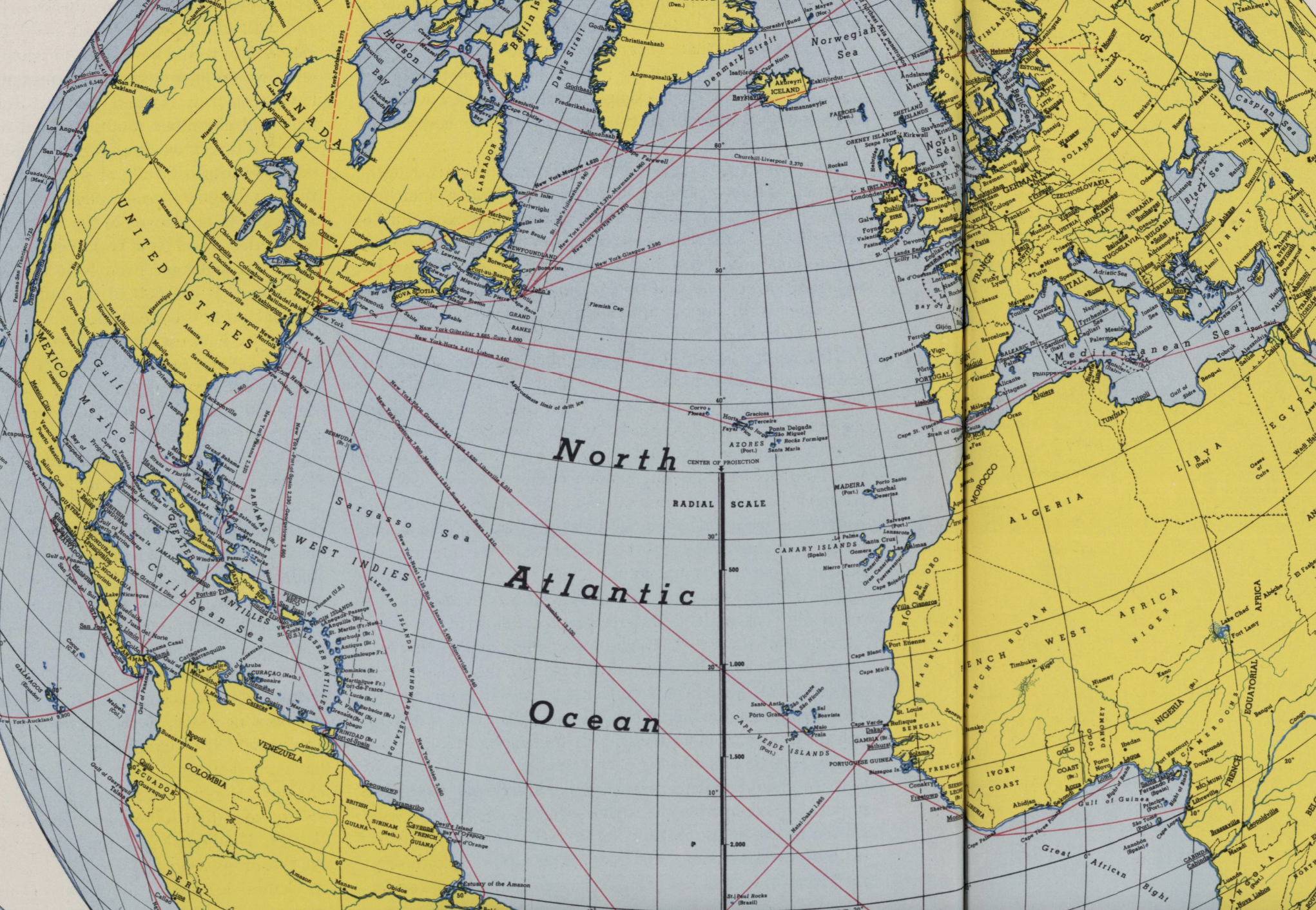
Whereas Harrison boasts “four U.S. supply arteries cross the Atlantic” even in wartime, the futuristic design of the The Technate had of course resisted an interconnected world. The 1941 map that clothed anti-modernity in modernism imagined the preservation of autarkic identity had an economic rationale that could be preserved, that might survive even the ravages of war and prevent the military campaigns already begun in Europe from contaminating North America.
As a program of isolationist nationalism, of the most flag-waving sort, the zombie idea was almost bound to last, and had considerable momentum to do so as it appealed as a preservation of the status quo that was far less messy–or seemed so–than the image of global military engagement. Did not the Technate even preserve the very preservation of economic wealth and resources that boosted confidence in the continued remove of the United States from the world? The ability to defend an isolated economic unit apart from a world of global currency markets provided a utopian independence of economic self-sufficiency–ringed by defensive bases as far afield as Cape Farwell, Newfoundland; Georgetown, Guyana; and Pearl Harbor. By adapting a fashionable cylindrical projection whose central meridian bisected North America to distort the remove and coherence of The Technon as a global unit that exaggerated both Greenland’s size and relation to North America. The technologists were able to bolster the deeply dubious economics by which the rather mystified notion of “energy inputs” that were managed by technocrats,–instead of money or the financial medium of exchange goods, provided a rational measure of geopolitical unity. The area above the equator provided the basis for a “self-sustaining geographical unit” (Sept., 1937), rather than the nation-state, preventing a collapse Technocrats predicted inevitable by 1940. The same year as the trumpeting of the “self-sustaining geographical unit,” a global map put out by the radio industry imagined the peace and harmony that existed in the prewar world on Christmas, 1937–
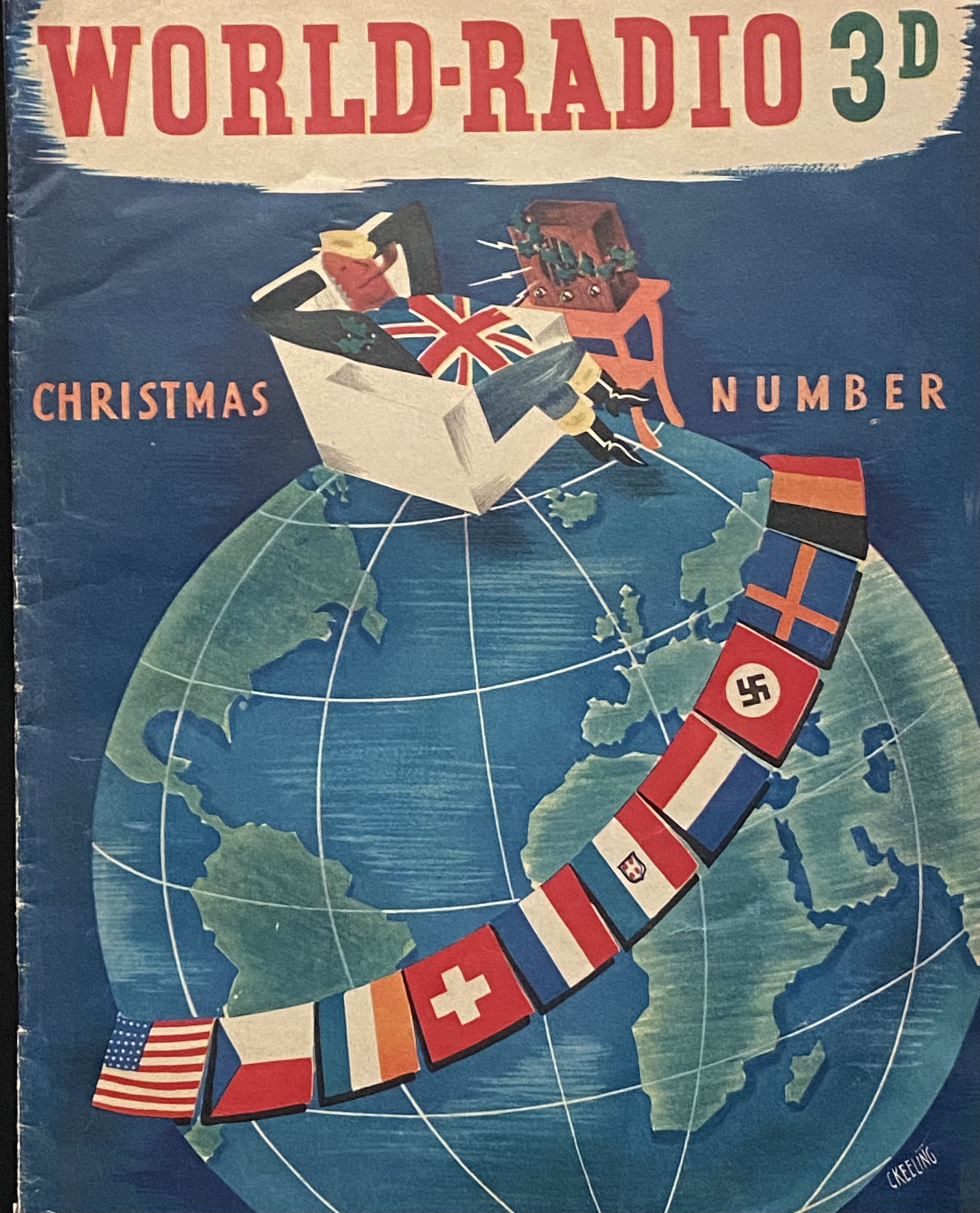
World Radio, December 17 1937
–as if the possibility of global peace was achieved by broadcasting, and would be listened to from a position of comfort from one’s living room, a map of odd harmony that showed the world as ringed by a peaceable Nazi banner at the same time as Europe approached the cataclysmic events of global war of World War II. In the very same year, as it happens, the Technate persuaded viewers of the existence of a quite analogous, if not eerily complementary image of global security; the maxi-continent of a global island existed at peace apart from Europe. For the Technate promised the ability to preempt the war–akin, perhaps, to the new currency of the Expanded Continental Shelf that the Trump administration has promoted as the basis for a Sovereign Wealth Fund, discussed in a previous post, by including the underseas energy reserves within the nation’s expanded bounds.

The use of maps as forms of mystifying spurious economic and geopolitical arguments in the Gulf of America comes to mind, similarly linking North America, Central America and the Caribbean to oil-rich offshore regions of northernmost South America. The powerful nature of the mega-nation seemed designed only to boost the nation, as if on steroids, to the level of something that nations had never been imagined to be–by a continental essentialism of a pseudo-rational cartographic magic trick, perhaps easy to imagine in a world where migration was far less common, and the idea of economic independence from currency markets or stock exchanges able to be visualized as a powerful economic unit of gigantic proportions and scale. If there was a triumphalism in how Edes Harrison exploited “the most nearly pictorial of all formal projections” to orient American readers to global war by affirming the centrality of New York in a logistical reference chart of global ties–
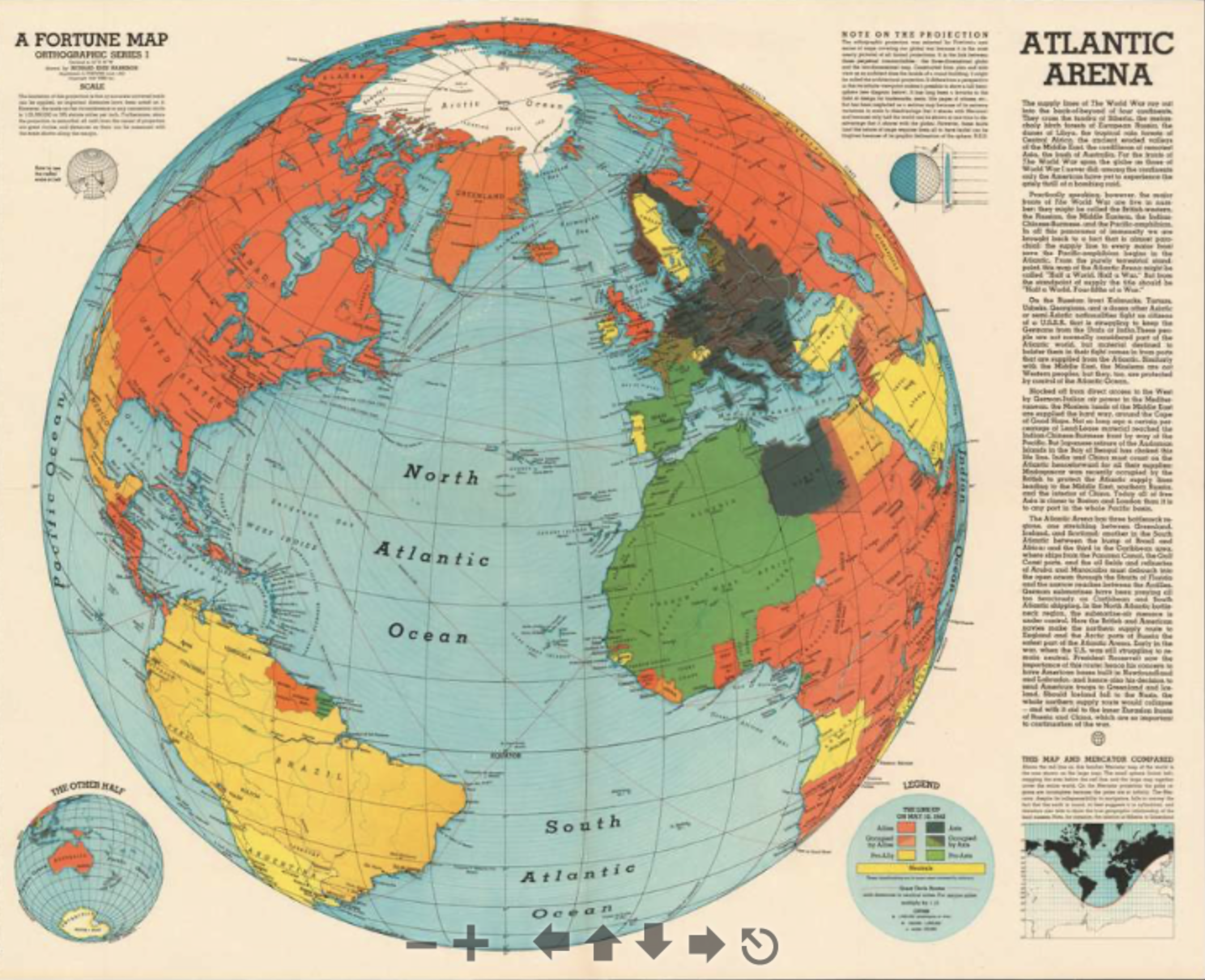
Richard Edes Harrison, “The Atlantic Arena”/Fortune, courtesy Rumsey Institute, Stanford University
–if Edes Harrison affirmed the global routes by which military arms shipped out of New York across the Atlantic Ocean “to Russian, the Middle Eastern, the European and the Indian and the Chinese fronts,” Scott persuasively shifted attention to an expanded continent as a viable isolated unit.
Scott had mapped economic unit of The Technate as an icon of continental thinking that preceded the Eisenhower highway system, presenting th contours of land and waterways as a natural version and as a fait accompli that had, of course, a quite limited future in postwar debate But it survived. Scott felt the map made a case of the need to “acquire” Canada, and integrate the Caribbean and Greenland to the United States in an isolationist vision of continental security in global war. He did so by mapping sufficiency against the desires and designs of foreign financial transfers, by focussing attention on a mystic map on “delineat[ing] the geographical territory required for the adequate defense and operation of this Continental Area,” as if a continent offered far more rational than the sovereign state. While Scott adapted the yingyang as a way to express the balance of consumption and production in a monad, the program of economic management explicitly opposed to representational democracy, arguing economic managers in the terms coined by a California engineer, William H. Smyth, in 1919, “technocracy” as a more effective mode of governing rooted in economic effectiveness of engineers as social managers–able to envision the hydrographic waterways that undergirded the continents they spanned: this was, of course, in an age before the Eisenhower freeway, when the depths of waterways seemed the best or most affordable options of commercial transportation, dependent on river depths in imagining the hydrology of the Technate as supercharging the continent that have a virtual analogue today.
![[object Object]](https://dabrownstein.com/wp-content/uploads/2025/04/586px-technate_continental_hydrology.png)
Transportation Routes of the Hydorology of the Technate/July, 1940
The assertion of continental unity that seems a sure way to link the Panama Canal to the rest of the United States and Canada was, it turned out, a construct that quickly crumbled after Pearl Harbor and after America entered the war. Technocracy seemed at that point subversion of a war effort.
But the technocratic thinking of the new boundaries of North America had a dubious afterlife on a global scale he would never have imagined. As the political movement of Technocracy rather spectacularly imploded due to poor press and political actualities, if its emphasis on technocratic managers survived in much science fiction. Technocracy demanded local evangelists who might promote its mission of replacing politicians with expert technocrats across Western Canada led him to summon disdain for the existing political order in the province of Saskatchewan that led the scales to drop from Errol’s eyes: “Politics is the natural approach of morons” he affirmed, in ways that entranced Maye Musk’s father–who evangelized the new “design” that Technocracy envisioned for a new America, that he brought to public meetings in a hemispheric map he was fond of posing before–wearing the grey business suit of neofascist design that all Technocrats were obliged to assume as a uniform that would communicate and befit their respect for the professional experts who would be designing a new America and directing all resources to “consolidating these territories, not as separate political entities, but as part of the Continent of North America . . . for the defense of this Continent.” The needs were clear and the Technocrats were their to affirm them: America need only to “take immediate action to acquire” Greenland, the Galapagos, Panama, Newfoundland, Hawai’i, and Venezuela, offering, perhaps, an expansive version of the USMCA.
Howard Scott, Founder of Technocracy, Inc., before Map of The Technate of North America
At the same time as war raged in Europe, the Technocracy movement, before being declared subserve and against the war effort in June 1940, when it was banned, entranced Musk’s enterprising grandfather, who readily wrote for the in-house journal Technocracy Digest that the utopian society of North America might exist as a unit outside the political squabbles of Europe, safe from the wars that were consuming human lives. Indeed, at the same time as a new global mapping of the Universal Transverse Mercator was enabling American troops to coordinate naval, air, and land forces in attacks on France, the isolationism that the Technocrats promoted was based on a sense of autarky that provided the mirror-image of fascists like Mussolini, rooted in an image of national self-sufficiency that trumped civil society or the law by the hyper-national. The former furniture polish salesman. Scott provided a promise of resolving economic difficulties, and indeed shortening the workweek–by automating all industry, long before AI or computing, leaving the average person only needing to work but a dozen hours each week by engineering the sheer waste and duplication of industries–by the language Musk seems ready to echo in insistent trimming of governmental agencies, retooling the boring company to bore holes in the federal government.
The map Scott devised was premised upon the conservation of energy, indeed, and energy resources. The Technate had handily absorbed Greenland, Cuba, Canada, Colombia, and Venezuela into a “Technate” was of Scott’s own device and engineering, but has been noted as at the origins of Trump-Musk playbook, replacing crypto for the “energy credits” that Scott and the Technocracy movement introduced as a basis for regional unity more potent than cash during the Great Depression, building on the isolationism to evangelize a super-state that riffs on the North American Technate to Canadians in which Musk’s maternal grandfather, an enterprising chiropractor with an uncanny interest in global politics who was admired by Elon’s father, Errol, seemed to explain the sense of disenfranchisement and disempowerment of rural western Canada. The state was an inefficient actor in Saskatchewan, Errol might have gleaned; the actual interests of farmers trumped the markets that states seemed to serve. Musk’s father-in-law Joshua Haldeman, a cowboy and a chiropractor, proselytized to rural Canadian publics in an in-house journal of Technocrats with the eager of a recent convert that the benefits “No other country has anything that the North American people either want or require,” making a leap of logic (if one that didn’t quite follow) that the abundance of natural resources across the continent provided grounds “to build this new order of mankind, this new America, here and now”–O, My America! My New-Found-Land! The Technate of America was a post-national structure to be managed by experts, not politicians.
It is hard not to be struck that Trump’s near-compulsive attention to Greenland, Central America, and Canada is an uncanny reflection of a political order for America’s national advantage–also managed by the technocrats of DOGE–but serving as a mythic template of an alternative vision of global power, a persuasive map of a region isolated from global trade–undoubtedly enriched by Venezuela’s offshore oil, which helped make it the third largest producer of crude oil in the world by 1940, when the map first appeared in print, surpassing 27 million tonnes per year, and enough to give The Technate the fuel that would power its appearance on a global stage. Is the prominence of Venezuala not compensated by the postwar mapping of all that underseas oil and gas at the bottom of the Gulf of Mexico, the basin of water that the Trump/Musk team has been quick to rename the Gulf of America, to absorb the storied Gulf within the grandeur of America, and, perhaps, provide the basis for its very own Sovereign Wealth Fund?

The Technate of America/Howard Scott, originally in TECHNOCRACY. Series A, No. 19. New York: July 1 1940 (courtesy P.J. Mode Collection, Cornell University)
The new globalism was the new isolationism. The proposed “American Technate” Scott had so successfully popularized in the July, 1940 issue of Technocracy was that most curious of hybrids–a global construct, which takes advantage of a Universal Transverse Mercator to draw mega-national lines, in a globalized world of wartime struggle, for autarkic ends of isolationist bent. Its crisp delineation of a Technate during an ongoing war of insistently global character severed an expansive continent from all external obligations or ties to a global society, in a rebuff to the Wilsonian notion of a League of Nations or internationalist thought, and as such might well appeal for new reasons to Donald Trump’s eye. Scott designed a map in ways that bear the imprint of a deep fascination with a fascist rejection of a global economy that took money as its medium of exchange, it is a cartographic manifesto for a “rational” union of “the self-sustaining geographical unit” in maximalist terms to assert regional hegemony–it follows a Universal Transverse Mercator, but excises a macroregion from all obligations or economic ties to the rest of the globe during a World War; it affirms a unit of self-governance by skilled exploitation of natural resources by an elite, echoing Friedrich Ratzel’s fascist idealization of the geographic unit as the basis for the nation–the geographer Ratzel was the first espouser of the National Socialist dogma of lebensraum, but had somehow neglected affirming the lebensraum that oceans afforded to America.
The primary objective of “continental integration and mobilization” would allow “complete conscription of men, materials, machines, and wealth by the government of the United States” above “all other objectives of the American peoples”–an odd acknowledgement of plurality that is overrode by insistence on economy unity; “defense stations” guarded the maritime borders of The Technate, to ensure its economic security as “self-sustaining” apart from risks of global trade. (There is a way in which Scott’s maps are the seeds of Trump’s proposal the Expanded Continental Shelf as containing the petrochemical reserves that will provide the seedbed of Sovereign Wealth.). The mandate for such integration is never specified, but asserted as an ultimatum for future security, with an urgency that is apparent in the bright red hue the Technate assumed. This was not the colors of Communism, but, as if in a rebuttal to the four-color theorem that required no more than four colors to distinguish nations on a global surface asserted in 1879 in the age of nationalism first proved by the mathematician Alfred Kempe, or the six-color theorem that at most six colors are required to distinguish a legible record of nations distinguished by the fact that none share a color, only one color is required to design a Technate: the image that dates from July, 1940–before Pearl Harbor was attacked, if it had a new traction after it, and before the Atlantic Charter stated the convergence of British and America war aims in response to the perilous geopolitical status of England, only spared from a German invasion in the fall of 1940, agreed off of the shores of Newfoundland they would reject an architecture of territorial expansion in a postwar international system, based on “common principles” of liberalizing international trade and establishing freedom of the seas; international labor, economic, and welfare standards; and rights to self-government.
Could it be that the abandonment of the four-color scheme in online mapping services and systems like Google Maps has made the notion of the border and boundary more malleable, less embodied, and more conventional, mapping systems existing at a layer that seems separated from the ground? While Google Maps can clearly satisfy the four-color system as a formal cartographic proof, the remove of handheld devices and indeed the cartographic surface of planning war offers a four-color map unlike any space we have seen before, where the divisions in space between geographic units either fragment the nation, or fail to assemble it, using shape files to color regions in a tapestry of colors and affiliations that have no clear correspondence to the local lay of the land, combining administrative divisions with nations, reveal a fragmented parcelization of global space akin to a dissolution of national belonging, by removing federal governments from mapping structures.
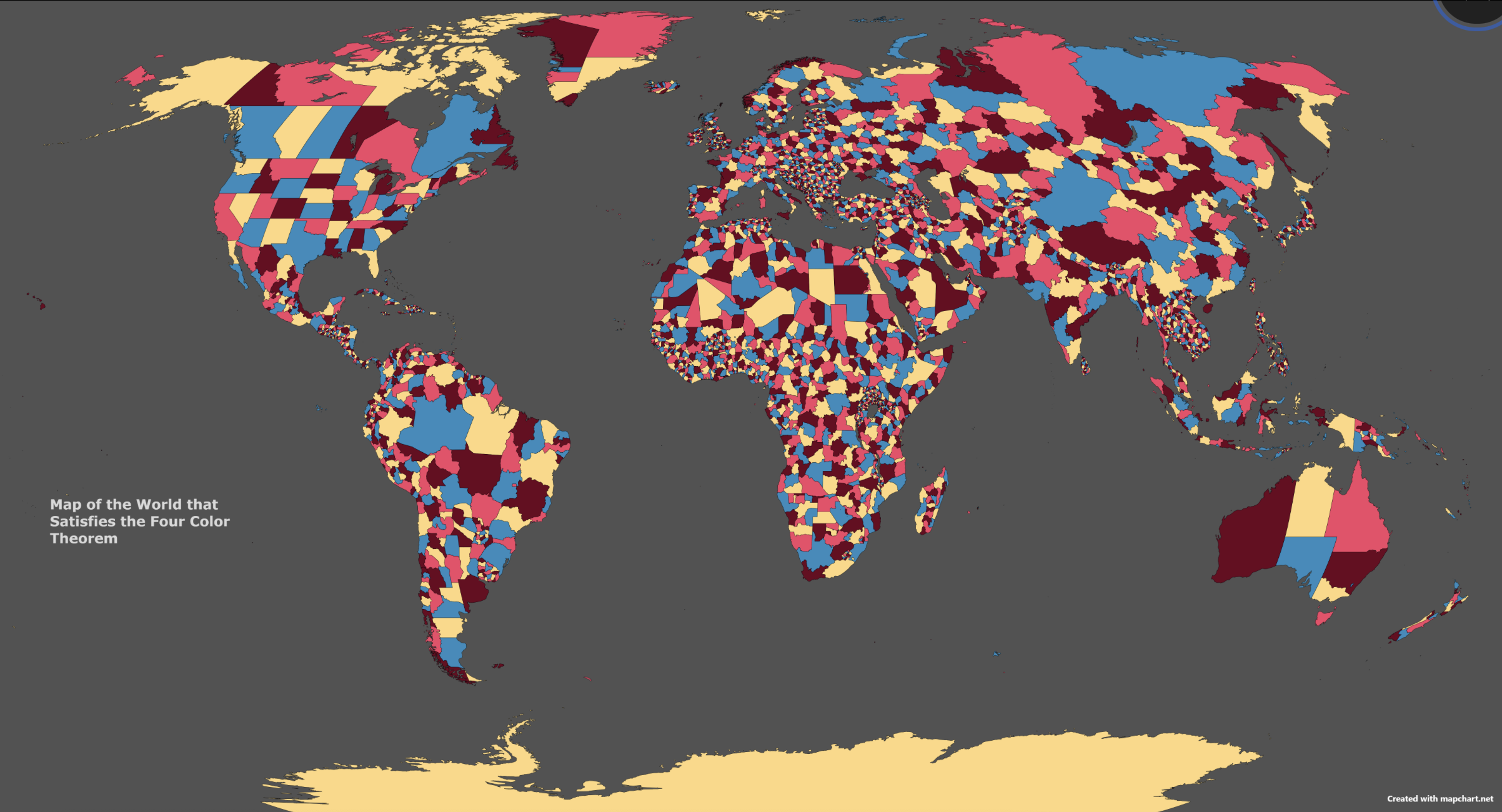
Four Color Theorem of Global Coverage
Unlike the four-color or six-color map, the suprematist mapping of the Technate was a response to the tensions of industrialization and economic modernization in the midst of economic depression. If hardly associated with Russia, proved a counterweight of sorts to a Russian national expanse, by a map that in true Suprematist principles prioritized pure feeling and geometric forms, that might be mapped in place of the real world and readily abstracted from it in far more intense colors than used in maps. Although Suprematist artists as the abstract art theorist Kazimir Malevich (1878-1935) confined his abstractions to the geometric shapes of squares, circles, and rectangles as a sufficient visual vocabulary, of almost renewed mystical powers, if in mystifying and deeply mystical ways–

Mystic Suprematism (Black Cross on Red Oval)
–the reliance on a similar electric color palette of but one shade–prioritized the declarative use of colors as hues, before it was silenced by socialist realism, a year before his death, bur privileged the “primacy of the pure feeling in creative art” in the forms of a new pictorial vocabulary Malevich pronounced in Non-Objective World: The Manifesto of Suprematism might offer the best description of the power of Technocracy’s blunt assertion of hemispheric cartography. The near-triumph of colors aver text and words, and the triumph of sheer colors over boundaries, suggested a rather willful re0bordering of the Caribbean and indeed South America, as if to meet an economic demand the might reassure American s of their newfound position of strength on a global map.

Technate of America. July 1940
Malevich’s precepts developed in response to a sense of the instability of rapid societal shifts and social unrest that were provoked by rapid industrialization and mechanism, that were mirrored in the way that Technocracy offered a more gauzy claim of expertise in response to the sense that All that Was Solid Was Melted into Air. The turn form mapping states “as they are” or even describing the state was replaced by the unicolor cartographic imagination of but on striking primary color in the map of the Technate, as if it was the only region that needs to be mapped for its citizens and for the world. the simplification of a cartographic color palette was not the denial of sovereignty to any nation, or of a right to self-determination, but the denial of any other interest than protecting the economic well-being of the unified unit of the Technate, even. if that unit had never existed in the past, as if it might be fabricated out of whole cloth, or, better yet, by cut-outs. For the figure of the cut-out, the overlay that might be better understood as a scissoring of space for cut and paste, seems to underlie and inform not only the graphic artists whose skills devised The Technate as a new administrative unit of the economic wealth, but the preposterous renaming of geographic reasons advanced by the Trump White House in the first months of 2025.
And while we are in an era of relative stable prosperity, the increased anxiety and unease of multiple global wars and a perilous state of economic futures leads to a similar turning inward to elevate one nation’s place in the global polity among all others–and an abeyance of questions of truly global importance, from climate change to sea-level rise. Could one not detect an echo of the energetic arrogation of the Expanded Continental Shelf in the insistence of Venezuela’s defense within the expanded borders of bright red surface by which The Technate as a super-nation, indeed the sole economic unit in the world that needsd to be accurately map or might matter? The radical reduction of cartographic literacy in an age of globalization is reflected in the draining of color from any other area on the global map, as if in counterpoint to the mapping of the world by Rand McNally, and indeed the maps for Rand McNally’s Standard Map of North America in its Commercial Altas (1930) is striking how it offers a template, minus the railroads, definition of boundaries, and expansion of South America, from the image of The Technate that was proposed as a sort of counter-map to the division of the Dominion of Canada from the United States in the iconic map of its sixty-first edition. In place of the light frontiers that the map provides for North America–
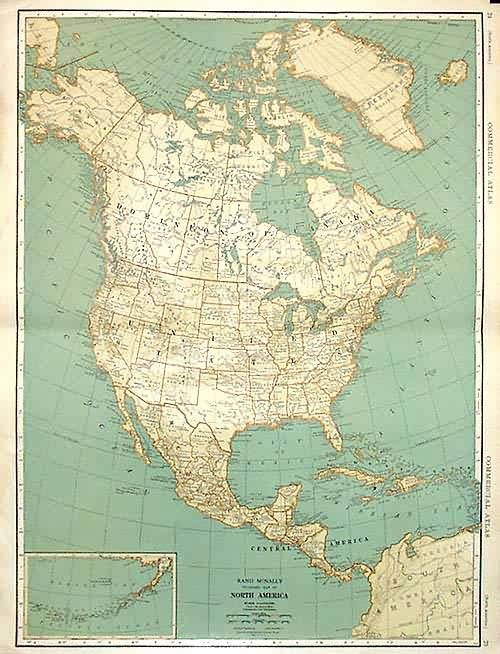
Rand McNally, Standard Map of North America (1930)

–or the four-color map that had been used to delineate the political divisions of North America in 1903, in what was called the “popular map of North America” that Rand McNally offered, and seems to have been the basis from which the “rational” mapping The Technate of America had derived.

North America, Rand McNally & Co. (1903)

Rand McNally Popular Map of North America (1933)
–the brutal primary red that imprint the expansive boundaries of The Technate’s on one’s retina is not only an annexation of territory, but aggressive assertion that no self-determination exists in the modern world. And the absence of any sense of self-determination–a basic presumption of mapping in the postwar world–is absent form the world map of the Trump 2.0 era, evidenced in the discussion in the White House policy papers of an annexation of Canada, or purchase of Greenland, and a declaration of the new name of a Gulf of America, and restoration of an American Panama Canal–indeed a new way of seeing states less as Manifest Destiny by resurrecting the imaginary of an old frontier existing on an expansive offshore, that–let’s imagine?–entered Donald’s attention span as he sought to turn his back on Europe, shared by Elon Musk one day in Mar-a-Lago?
It might helps us parse the conceit of an expansionist America of Trump’s inaugural speech in imperial terms–as rewriting the autarchic image that ran from the southern tip of Greenland to Cayenne, securing the Panama Canal as a trade route, embracing the mouth of the Orinoco, running from the Galapagos to the Bering Sea, a Technate cut off from Asia and Europe as a fantasy of a Greater North America that encompassed the entire Gulf of Mexico. But rather than depend on a Border Wall, The Technate is defended by a network of stations of defense linking the Southern tip of Greenland, Cape Farewell, to St. Johns in Nova Scotia, Bermuda, Guantanamo Bay, Panama, the Gulf of Fonseca, Pearl Harbor and the Aleutian islands, to coincide with the International Date Line.

Technate of North America, detail
The tariff-free unit of a new USMCA is eerily coincident with the apparent absence of Canada and Mexico from the global tariffs recently announced by Trump’s White House–a sign that, per some Trump whisperers, this list is less a strategic document than a negotiation tactic or a chapter in trade relations that might be seen as an “olive branch” soothing trade tensions, and placing less onus on the billion dollar trade of border states like Texas, Michigan, and Arizona.
But the deep red uniform coloration of but one region of the world–a mega continent of no clear political sovereignty, to be sure–suggested nothing so much as a new symbolization of a homeland, a sense of domestic sovereignty that distances itself from much of the world.
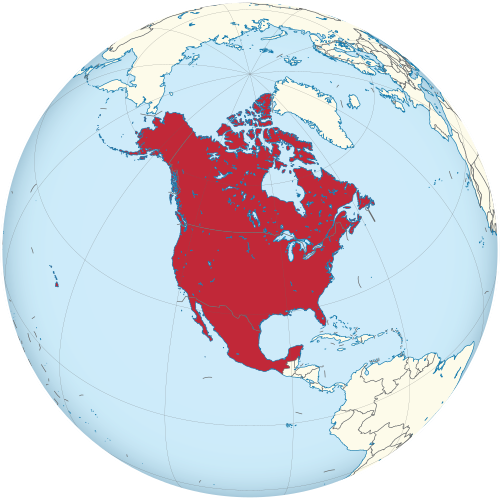
The map might be compared to the expansionist designs Donald Trump offered in his inaugural, an expansion not of the USMCA, to be sure, but of a Greater United States, encompassing not Mexico, Canada, and the United States, but the United States, Canada, Greenland and Panama Canal Zone–
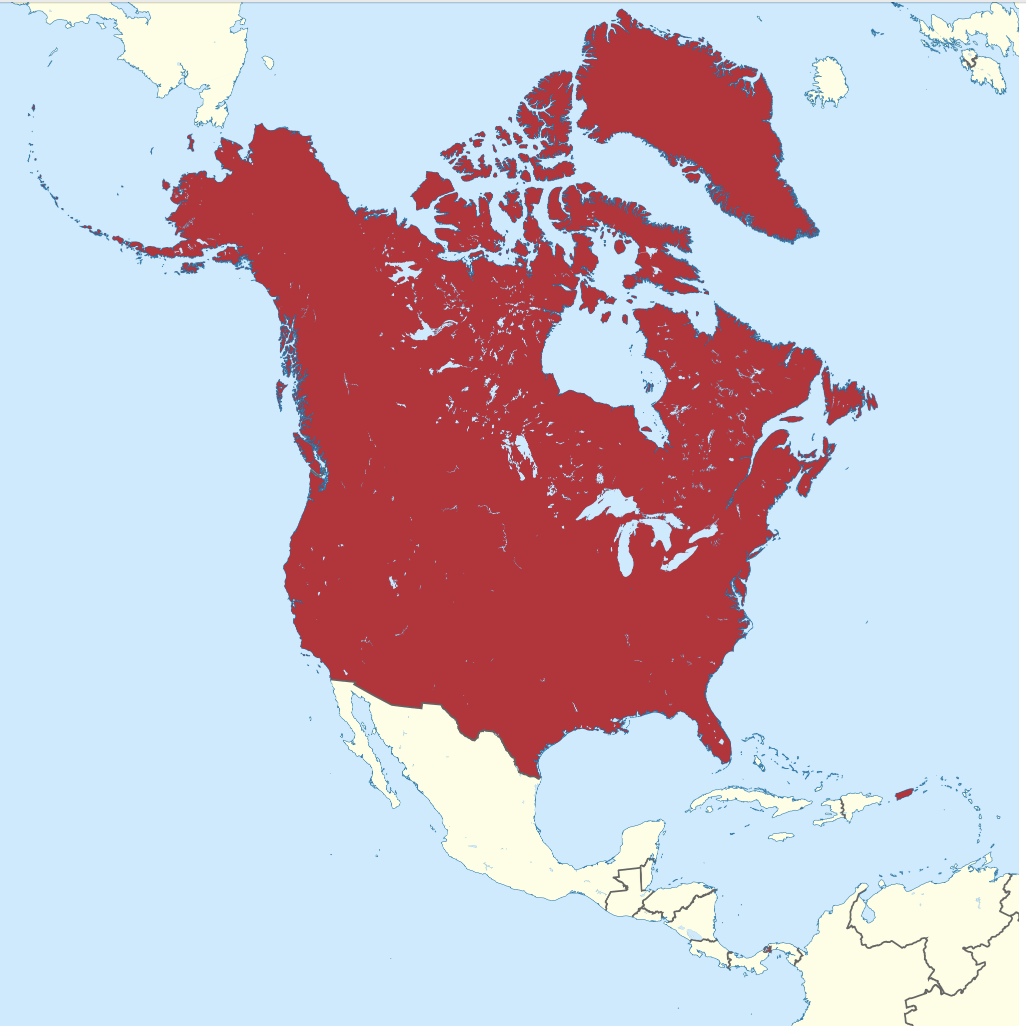
Greater United States including Canada, Greenland and Panama Canal Zone Proposed by Donald Trump (2024)
–that has rather eerily adopted the coloration and orientation of The Technate which Trump may be channeling. All inconveniences like state sovereignty, were suddenly washed away in The Technate by the technocrats’ vision–the map recalls an airline map with good reason, as it is the artifact of the Jet Age,–suggesting a modernity of an age without nations or state sovereignty. As an airplane pilot, and staunch advocate of Technocracy, the frontiersman cowboy and chiropractor Haldeman would have seen himself as tied to the vision of the Technate of America, in ways that would have been quite suddenly seen as being subversive after Canada entered the war.
Having swallowed the Kool Aid, one can see the advantages of state, economy, and sovereign wealth that resurrecting the Technate might have, giving new vitality to an idea that is perhaps undead, able to be employed as a new vision of state that would get people excited, and indeed motivate a sense of national pride, and, hell, might even be able to use the same map, if it weren’t for questions of what to do with Mexico or of reconciling the appealing vision of The Technate and Border Wall. Better yet, the advancing of this new map of geographic blocks with little credence for self-determination echoes the geopolitics that an oligarch in Russia, Vladimir Putin, might not only advance but enjoy the United States to adopt, as a tacit recognition of his right to erase the self-determination of Ukraine, as he has continued to expand the brutal war crimes of destroying not only the civilian infrastructure of Ukraine, but imposing policies of starvation and denial of health rights or transit that recall the Stalinist conditions in which Kazimir Malevich had worked on Suprematist compositions, until the restoration of socialist realism ended the utopic dream, to capture the oddly ungrounded floating life of a modern world–as if the hopes to untether himself from an artistic vocabulary and indeed a shared consensus had been compelled to meet its end.

Kazimir Malevich, “Airplane in Flight (Mystic Suprematism)”
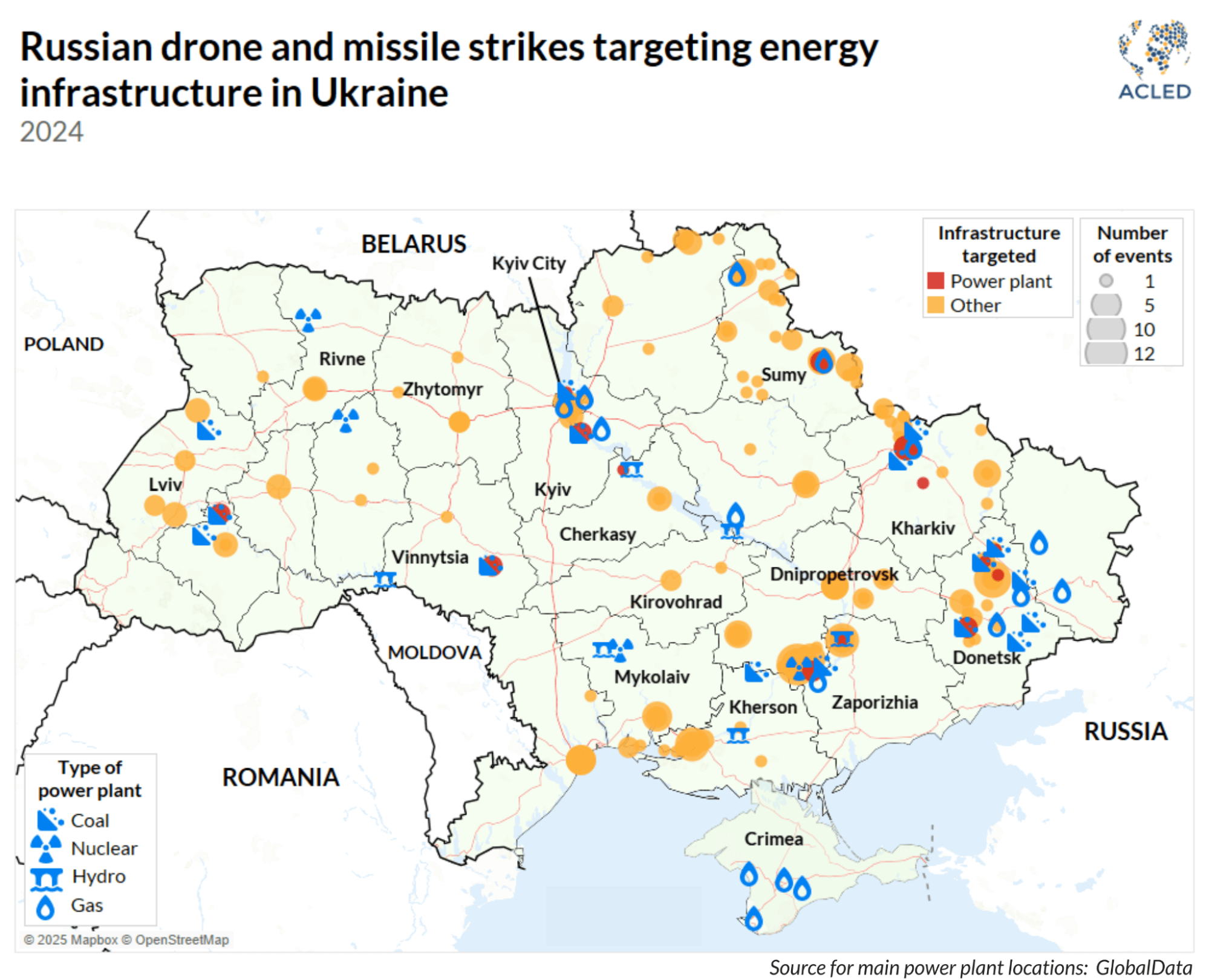
Malevich of course reminds us of Ukraine, and no discussion of the new geographic mapping of an American kingdom of reordered form could fail to addresss–in part as the crossing of borders was so recently normalized in the invasion of Ukraine. Of course, the violation of that map has only proceeded apace since the decade-old invasion began so many years ago. For the increased assertion and toleration of the new map of Ukraine where Russian arms are able to accelerate war crimes with virtual abandon, outside of the conventions of all rules of war, specifically started to target Ukraine’s energy infrastructure–power plants and substations–from the oddly symbolic date of September 11, 2022, striking plants that created power outages for over a million residents of Kharkiv, Sumy, Poltara, Dnipropetrovsk, and Donetsk oblasts he wants to remap as Russian, continuing through December 2022, that disrupted the power and safety of some 10.7 households, a full-scale debilitating attack on civilian populations’ energy infrastructure whose adoption as a military “course of conduct” constitutes a war crime of relentless campaign of demoralization and disruption that are crimes against humanity. Indeed, the escalation since 2022 of intentional attacks to disrupt and devastate civilian public health systems–a crime against humanity and without conscience–violates the Geneva Convention as a war crime that is without precedent in the postwar period, an intentional degradation of civilian public health that attempts to erode the state and the well-being of the aged, the newborn, and the infirm that sets new standards for war crimes and the destruction of critical infrastructure without a military objective.
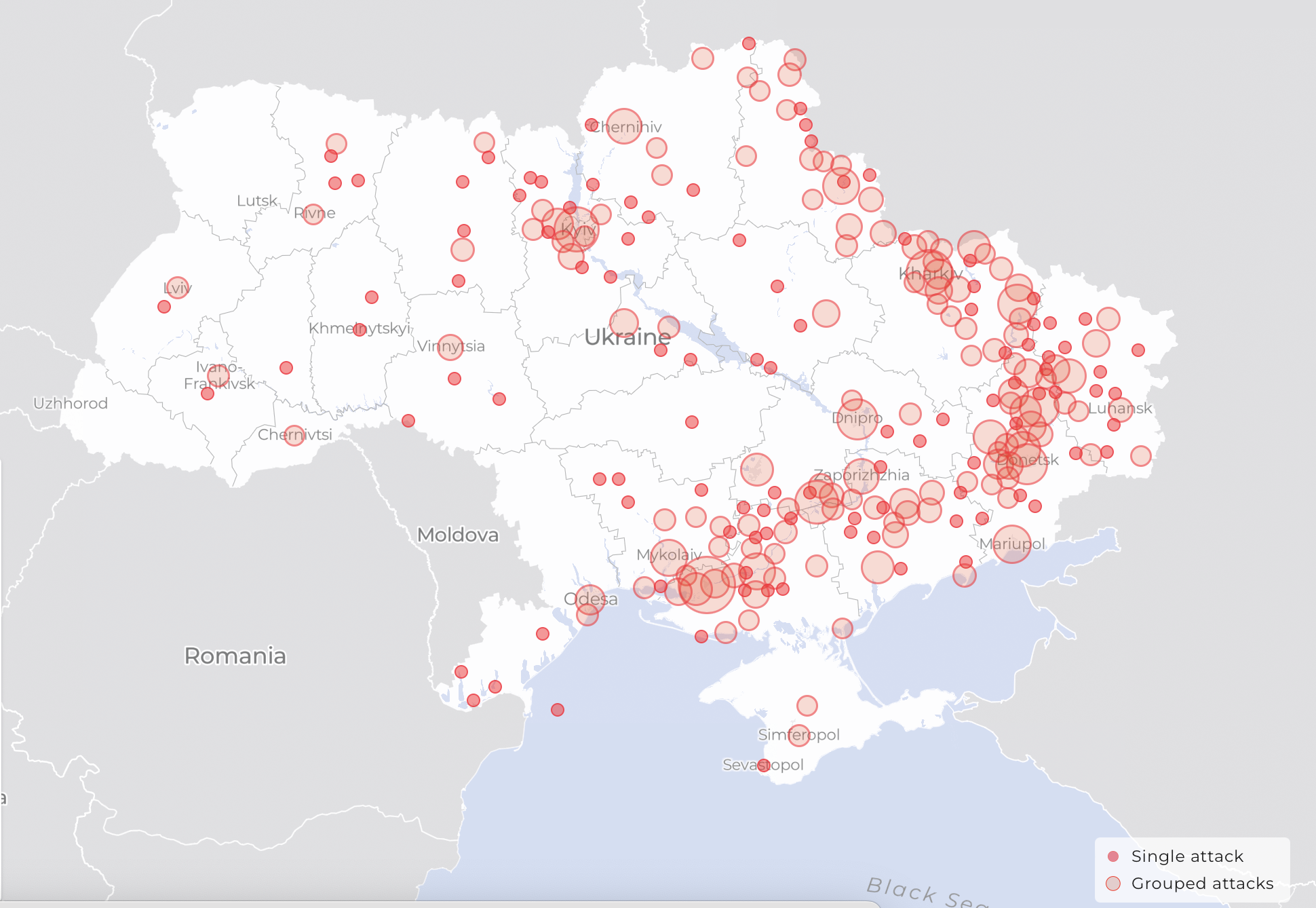
Russian Attacks on Public Health Care Facilities, Workers, and Staffs in Ukraine, 2022-Febrary, 2025
The border is intentionally being attempted to be blurred. Drone and missile attacks wilfully cross boundaries indiscriminately, targeting businesses, apartment buildings, hypermarkets, and schools that have escalated in retaliatory fashion with an utter absence of precautions, geared primarily to the objective of a readiness to remap space. Was the absence of interest or attention from Donald Trump, whose personal flattery by Putin has granted a sort of license or permission to accelerate such attacks on critical infrastructure of civilians, rather than military targets under the radar, as the international community, led by the United States, seems to turn the other eye.


These aerial campaigns of drone and missile attack across borders are crimes of humanity that are geared toward the systematic remapping of an expanded frontier of Russia, and a tacit recognition of the rights of Russia to remap, from its own perspective alone, space, outside self-determination, to erode trust in the ability of Ukraine to exist as a separate state.
Wasn’t the map before which Howard Scott, the founder of Technocracy, able to be repurposed in a new age of globalization, and in need of a conceptual reboot on the global stage? The ability to replace the notion or principle of self-determination was at the core of Scott’s map, which demands a sense of consent to the experts to “map” national belonging less in terms of nation-states than one nation’s compelling national interest to remap the world–precisely the sort of cartographic argument that may have led Elon Musk’s father-in-law to bring Maye Musk to South Africa in 1942.
]For the folks of the Technate had it right, by staging in parvo a global economy that might be able to triangulate the question of the Panama Canal, in a Cold War vision that preceded the Cold War, as an angle of the new boundaries of travel in an expansive Technate of America,–

The Technate of America (July, 1940)
–whose edges curiously coincided with Guantanamo Bay and the Panama Canal, amalgamating the Caribbean Sea and Gulf of Mexico as its southern perimeter to ensure an ample stock of petrochemicals lay in The Technate’s apparently expansive hemispheric borders.

Or was the terrorization of American citizens in recent renditions of men and women apprehended off the street by police for their political speech and sent to foreign prisons is not an erasure of borders and sovereignty, anticipated by the expansive globalism of The Technate of America? The brutality of forced airborne deportations on military flights or planes chartered by the Immigration and Customs Enforcement may anticipate plans for the deportation of twelve million living without documentation in the United States, bent on the breaking up of the twenty million families in which one or more is undocumented, an illustration of the expanded hegemony of a range of offshore prisons in a Technate of today.
This is far beyond Guantánamo Bay, even if that prison is not closed, but a forced migration that illustrated the hemispheric dominance or hegemony of the United States in a Technate of America: military flights of repatriation to places like Guatemala, compelled to absorb migrants of other nationalities, El Salvador, Honduras, Ecuador and Colombia, as flights of handcuffed undocumented arrived on military aircraft. As Technocrats had championed airplanes’ aerial flight as a tool of transit able to unify an expanded continent in the Jet Age, the planes on which crowded handcuffed Venezuelan migrants arrive in prisons in El Salvador seemed to affirm broad margins of continental dominance, as well as a performance of cruelty making up for the absence of American hegemony. The assertion of an ability to denaturalize American citizens they see to move to prisons overseas sets a new standard for the paramount importance placed on Schmittian distinction of friend versus enemy, assessing an ability to denaturalize the unwanted for disposing them abroad.
The creepy response the Prime Minister of El Salvador made to reporters, asking them how he might “smuggle a terrorist into the United States” and return or locate Kilmar Abrego García of Maryland, mistakenly deported to the notorious high-security CECOT prison he had been sent after a warrantless arrest by the government together with undocumented migrants. El Salvador had since 2022 been in a State of Exception–analogous to what may be imposed on the border, and in many ways similar to the period after 9/11–to a brutal regime working outside of international norms or democratic rule, subjugating the human rights and civil rights of men to a regime of violence with ties to gangs, who run the prison system based on mass arrests is a shadow-state tied to increasingly allied with police that may be a model for the regime Trump seeks normalizing both at the border, but for undocumented migrants. While Trump revoked and minimized the protected status of García without trial, or due process, alleging he was an MS-13 member denying his rights by moving him to a separate sovereign nation outside legal protection: in refusing to extradite or return the wrongly deported man languishing behind bars in a prison, El Salvador’s Prime Minister seemed to invite deportation of men deemed dangerous threats.
This not only is a serious miscarriage of law, violating due process, but mediates an ever-expanding geography of violence outside or on the margins of the law–in televised appeals to bar judicial interference in “what President Trump is doing to make America safe again,” as argued the Secretary of Homeland Security within the Tecoluca Terrorist Confinement Center, a model megaprison to showcase the State of Exception. (The regime of brutality was premised on a secret pact with gang leaders, seeking to restyle El Salvador as a crypto center of sunny beaches.). The hot sun hitting the prison courtyards in El Salvador has the chance of containing increasing numbers of former American residents, tax-paying members of the economy, whose equivalents of passbooks have ben confiscated and taken from them, leading them to be placed handcuffed on planes to a nation they may never have been, but has offered to outsource its penal apparatus to house unwanted migrants the United States seeks to deny residence to offshore sites where they are without access to legal rights or legal recourse to protect themselves. Such is the new instability of an anti-globalized map.

El Salvadorian Prison in March, 2022
While affirming the need for such mass deportation to protect Americans, the Homeland Security Secretary never mentioned how much the American government had funneled funds to hold men in El Salvador, and display them as tattooed savages clearly foreign to the body social to which they no longer belong: they seemed members of a gang one never wanted to see on American streets, best held en masse behind bars, paraded in front of American television cameras to demonstrate how “violent gang members” merited abduction as “foreign terrorists” by the Alien Enemies Act (1798) entitling a President to deport or detain citizens of an enemy nation in times of war–even if many of the hundreds of deported men deny being members of the notorious Tren de Aragua gang, and the Venezuelan government claims that not a single member of the incarcerated can be confirmed as members of the gang with which the DHS has memorably if inexplicably tied them.
After nine days in CECOT of traumatic imprisonment where he was taunted in CECOT in a cell of twenty five men, having been transported by plane in handcuffs and shackles, the sheet metal worker Abrego García was transferred to a new holding cell in a different facility, although the Trump administration denied having knowledge of his whereabouts. Is this infliction of trauma not a public display of evidence intended to reflect the heightened trauma that Trump abetted migrants had brought on the nation, showing the same monstrous shaved tattooed men behind bars, as if asking viewers across America if we weren’t glad Kristi Noel had kept across the border?

Kristi Noem at Tecoluca Terrorist Confinement Center, El Salvador, March 26, 2025/Alex Brandon, AP
The visual of the DHS Secretary before incarcerated men seems to have only confirmed the need to expel them from the sovereign body, and dispensed with any sense of law–the Homeland Security Secretary was an embodiment, perhaps, to the need to strip them of all civil liberties and deny them any civil or human rights. Was this pornography of violence not a clear “monstrification” of them as foreign and as terrorists, even if none were charged as such? Where else might they be rightly placed in a Terrorist Confinement Center? Surely not in a court of American law. We weren’t going to be fooled again. The image of the DHS Secretary with her $5,000 Rolex on her wrist suggested a steep naturalization of wealth inequality before the shaved tattooed men asserted to be gang members who form part of a foreign terrorist group that El Salvador is willing to incarcerate.
The CIA is no longer no longer deploying “external raids to internal sabotage operations” from bases in Cuba, British Guiana, Haiti, or the Dominican Republic, interfering in democracies and left wing groups in South America to fight a long completed Cold War. But we now, rather, as a post-hegemony, send the men we want to strip of rights to prisons that have become external reserves to deport migrants to what seemed dark sites removed from legal appeals or judicial review.
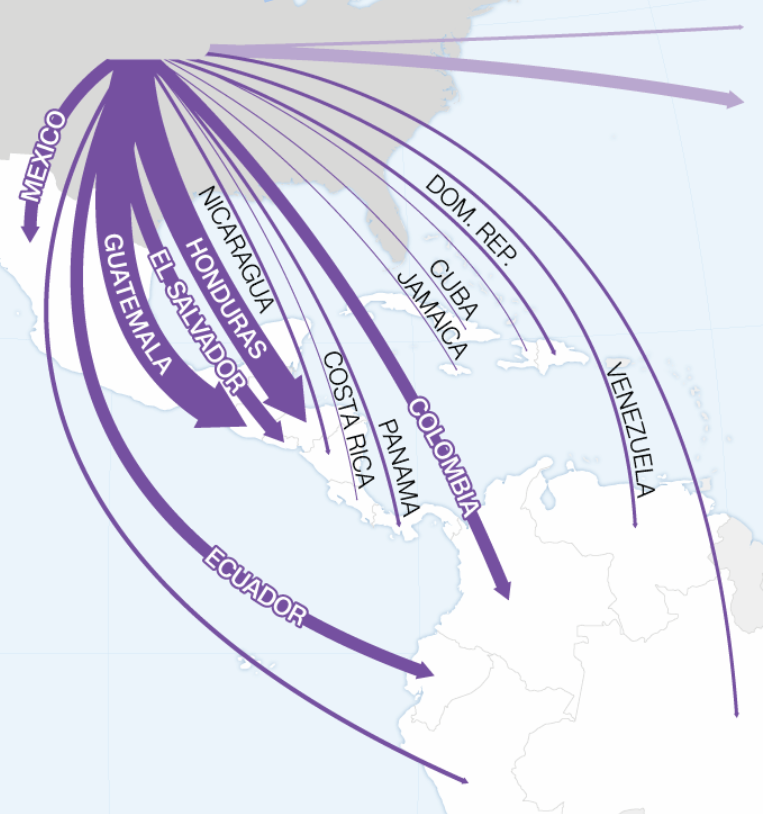

Forced Deportation Flights by Chartered Flights by ICE or Military Flights in First Month of Trump Presidency January 20-February 20, 2025/Renée Ridden, CNN based on Witness at the Border data
Can one imagine the map reverses the remittances that migrants return to countries, pictured here as a share of local GDP, that reveal the dependence of Colombia, Costa Rica, the Dominican Republic and Ecuador on the undocumented workers living in the United States? Perhaps the absence of global hegemony needs to be replaced by the theaters of cruelty that the Trump administration thinks it can establish in these “offshore prisons” to call in a debt from the remittances, in a creative accounting that moves migrants by technocratic allocations to engineer national safety.
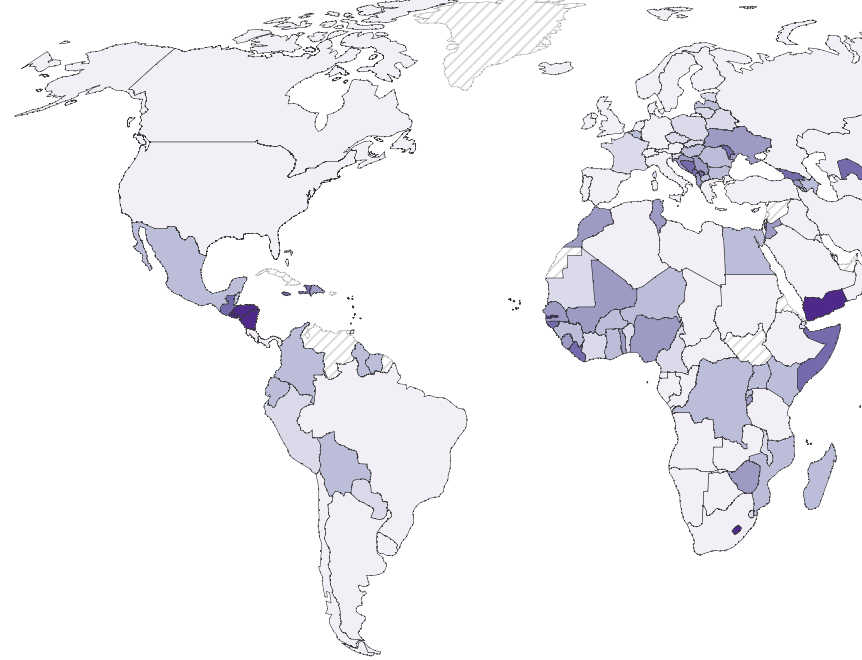
Money Sent or Brought Back by Migrants to Countries as a Share of GDP, 2023/Our World in Data
There were disturbing echoes in the flight paths that were taken in the first month of the Trump administration of force ed deportations of residents of the United States, without any arrest, of individuals who would never appear before American courts, but were expelled from the nation summarily, as if their removal from the territory–and rights of legal representations–were suspect. nCould it possibly be that the government sees vindication in graphics reversing the influx of faceless migrants across a southern border–or the flow of remittances from a decade earlier?

Estimated Remittances Recieved in South American Countries in USD, 2013/Pew Research based on World Bank
The sense of an expanded Technon that is able to shift the undocumented from the country without any review of their cases (and without really charging them of a crime) to foreign maximum security prisons opened the door to misidentification. But we are waiting to see if the Supreme Court will bend to the claims of executive authority to mandate forced removals from the country, a removal that seemed openly calculated as a removal of their civil rights. The forced deportation to prisons on the blurred margins of American sovereignty but within American hegemony seemed a terrifying image that was a preview of the stripping of constitutional rights from individuals,–perhaps a preview of the detention of the undocumented at military bases across the nation or “dark” private detention facilities where legal aid organizations had no legal access: a month into the Trump, administration, it sought $45 billion to expand a landscape of detention across a new American landscape, a six-fold increase in budgetary allocations from Fort Bliss to Niagara Falls.
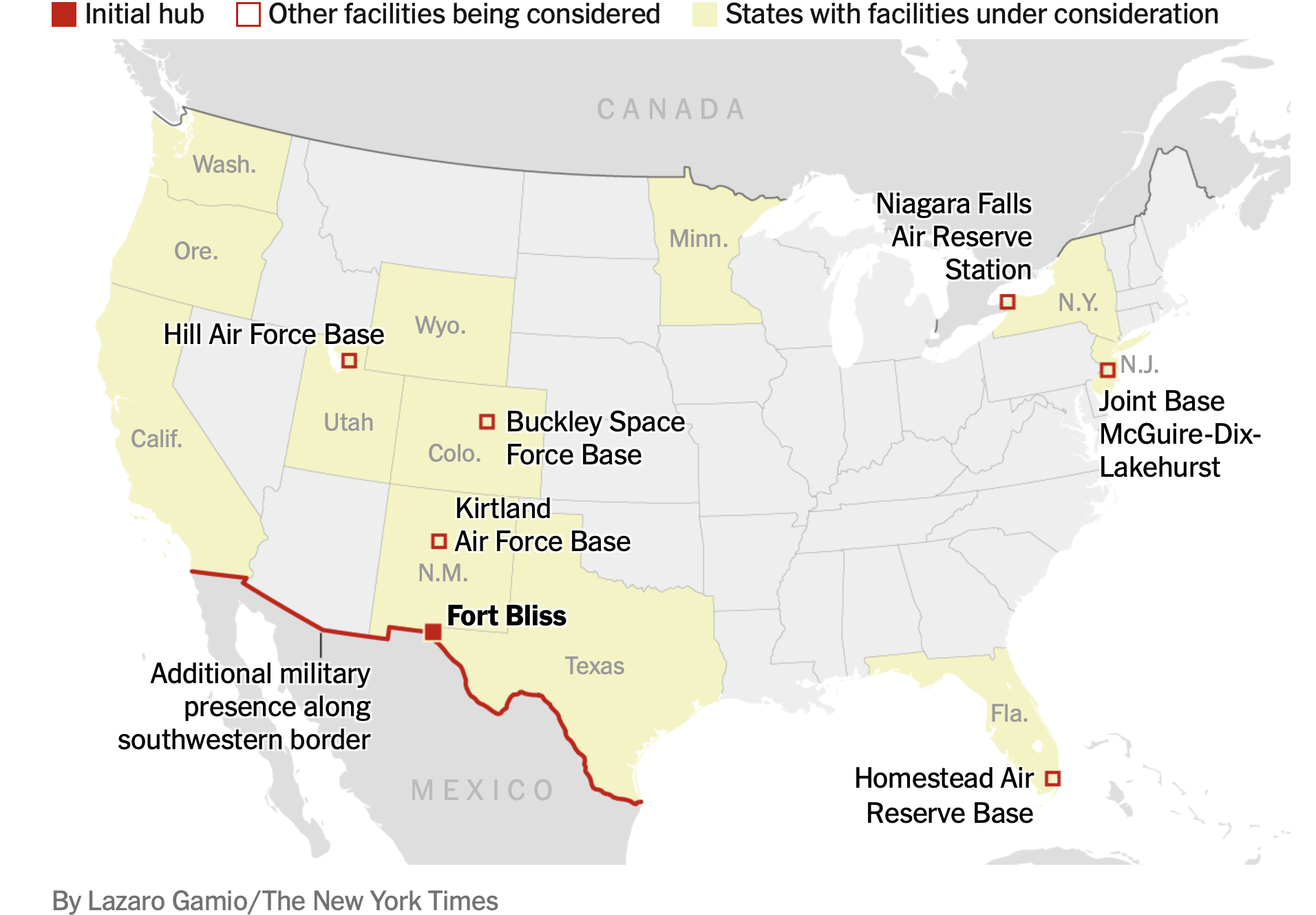
Military Facilities Planned to House Undocumented Migrants/February 21, 2025
The militarization of immigration enforcement was something Trump had already imagined, but is as foreign to immigration policies of the past as the use of tax information of undocumented workers for deportation by furnishing data from the IRS to ICE for “streamlining the abilities to pursue criminals.” The terrifying extradition of citizens to courts outside the United States shirked constitutional responsibilities without any qualms, exploiting the border as a legal loophole to impose dump migrants and even citizens in a “Gulag archipelago” of foreign prisons, where judicial review is held in suspense and they lack recourse to American courts, with foreign partners to aid in deportating men to maximum security prisons without any possibility of legal redress. Operating by military and chartered flights from military bases to high security prisons, the militarization of deportation evades all constitutional rights or laws in truly terrifying ways, running a secret ring of military flights to housing undocumented migrants apprehended from American cities, in preparation to “return” them to jails that are in a Great America, where they are far from our cities, but we can pay the costs for their imprisonment from tax-payer dollars with a clear mind. The recently posted image of an alleged image of García’s hand as if it were the “ocular proof” needed to ridicule as a “man that the Democrats feel should be brought back to the United States” attempted to confirm his membership in a demonized gang as grounds to keep him outside the United States by planting evidence he must be recognized as a danger to national security,–the false evidence has been widely determined to be digitally altered evidence rather than showing García’s hand.
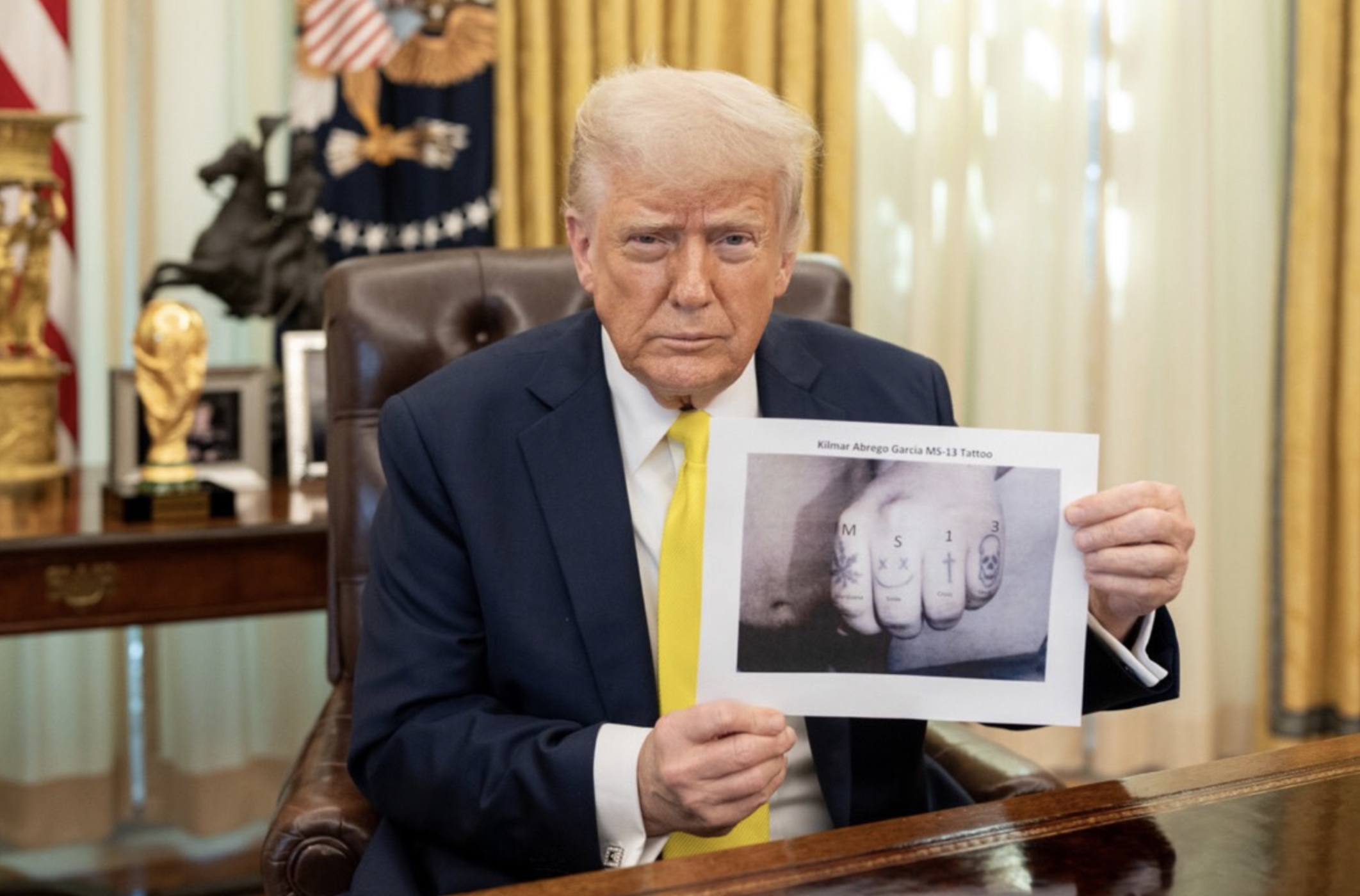
President Trump Displaying Photoshopped Hands of Kilmar Garcia in Oval Office
The man in the Oval Office where those Executive Actions were signed seems smaller than ever before, squinting to the viewer in an attempt to convince his social media followers he has had the evidence all along, in a bright yellow tie that may matches the gold curtains but signifies a deep sense of betrayal of national ideas.

Might one imagine one of the several night-time meetings of Trump and Musk at Mar-a-Lago, over diet coke, dwelling on the deep similarities of Fred Trump, booster of Fascism and isolationism, and Elon’s grandparents–Haldeman, who Errol Musk so clearly heroized, perhaps even inspiring that he and Maye move to South Africa? Musk would be fondly remembering with some clarity how his technocrat father-in-law explained shared frustration at Saskatchewan’s rail system, not built for the convenience of farmers needing to transport food to local markets, but spanning the nation, to fill political needs, while leaving the people of Saskatchewan at the mercy of “global forces completely out of everybody’s control.” And the global forces of today that exposed Americans to gangs and created a state of war at the border had long been out of everybody’s control, Trump has told us, indeed even so out of the control of to such an extent to place at risk America’s family dogs.
Kicking back the Diet Coke on the patio of Mar-a-Lago, when men pitched Trump ideas and plans for their political roles in an upcoming administration with abandon, Elon Musk took up residency at the beach club, with a large security detail, probably bringing some snazzy graphics to the incoming president to the oceanfront estate that seemed insulated from economic downturns or poverty. Downed iced drinks to spin Diet Coke-fueled fantasies of eviscerating government into the night, and Musk tired to burnish his credentials as an engineer ready to apply his skills to budgetary cuts for the good of the nation, the image of The Technate must have haunted his words, assuming new guise as a form of futurism that made its first debut in the global Depression, but seemed ready as a way to reassert hemispheric dominance beyond national bounds. Both men presented themselves to gullible audiences a way return the power to the people, and prevent government from being an obstacle–and provided a basis or precedent for the aspirations of Trump 2.0, leading Donald to see in Elon a cousin or son. Did Elon actually pull the map out of his backpack, eagerly telling Donald it had to be seen to be appreciated? Did Donald Trump find illumination in the crude lines of Scott’s prophetic map? The map must have appealed to a public truly terrified by global conflict, and was an iconic understand of Scott’s vision of a mega-state for Haldeman,– removed from risks of global markets; self-sufficient in securing the flow of resources and goods.)
If in the midst of a global conflict, Scott focussed on ensuring the perimeter that would be guarded to protect The Technate from any external aggression, it was, indeed, a map of disengagement from global affairs. Whether or not it became an actual influence on the Trump-Musk vision for a world of electronic transfers and cryptocurrency, that exists with its own values and transcends frontiers, its visionary nature suggests a retrograde sort of isolationism, born of an image that exploited the reactionary tendency to disengage America from the world, that is echoed in Trump’s hatred of Europe, NATO, or the European Union he sees as an antagonist to America’s global role. It is a vision of protectionism, free trade among neighbors, and walls around expansive nations, premised on distrust and a lack of trustworthy allies, a sense of security only in autarky, and a reaction of globalist or global thought. The Technate of America reminds us of how retrograde the Trump-Musk vision is, for all its glorification of futurity, and elevation of technology, and reflects the tragic defunding of government expertise, or indeed any modern public health or medical care, that is the obverse of the elevation of sovereign wealth as the sole directive and rationale for the state’s existence, as if an expanding level of wealth will, once generated, provide for the good of all.
As much as we scratch our heads at Trump’s impulsive ideology as a hodgepodge of interests and right-wing concerns, it is important to see it as securely rooted, in Trump 2.0, in an alternate genealogy not only rooted in CPAC, or pro-life, or racism, but in a home-grown genealogy of cranks, whose roots take their spin from both chiropractors and Wernher von Braun, shaped by crack visionaries as Thorsten Veblen and William H. Smyth, via Ayn Rand to Silicon Valley, where pilot Joshua Haldeman’s motto–Live dangerously, carefully–morphed smoothly to Move fast and break things. If not seeming disruptive, the management style rooted in the rationality of technocratic governance. Leavened by fears of international conspiracy and spooled out with healthy doses of anti-establishment paranoia. If forgotten, Howard Scott seems surprisingly quite central to that genealogy of the purveying of snake oil to Americans, and the oddly unfamiliar engineering of a mega-version of America, with its constitution somehow hollowed out, that Trump seems to be taking for granted–and the Republican Party seems more than ready to line up to support.
This is not a familiar genealogy, if it includes many familiar suspects–the reprinting of the odious Protocols of the Elders of Zion as well as the triumphalism of the late, great science fiction fantasist Isaac Asimov and other theorists of interplanetary colonization; a healthy dose of Nietzsche as well as Ratzel mixed in with the substrate of odious racism; a model of autarky that raised its shield against the globalism and internationalism that smells of the Nazi Party, and might be readily mapped onto Jews, defending the persecution of American whites with pernicious consequences. Few would have thought that these strange bedfellows might be distilled into a maps alerting the lebensraum of national and outer space–modern updating of geography and cosmography of a medieval cast. But it is now, one feels, based on perpetuating an illusory hegemony, when no hegemony exists. And yet it is the false sense of security after the end of hegemony, a song and dance routine that gets people riled up and enthused. It is fueled by a deep sense of anger and resentment, not to mention entitlement, at having been subjugated to global obligations and responsibilities, to attend to issues like global warming and human rights, rather than the sort of territorial protection that is deeply wired into our brains, based on something like an instinctive defensiveness, gaining new urgency before the threats of an inescapably interconnected world.
That responsibility is something we can save ourselves from, perhaps, by the demand to stand our ground and protect our homes, to insulate the social body and America’s much-trumpeted wealth, and perpetuate a world of ever widening wealth divides. We might recognize the divides by what we’ve been using to divide the sections of this screed: a car that proposes to offer low emissions that is exclusively for the super-rich, that will allow you to use it as a home, if you need to on the road, with its batteries providing full air conditioning and its leather seats able to fully recline. It is a car that is engineered by the best and brightest, but produced by low-wage workers without unions on assembly lines who will never drive one, but has become the status symbol embodying the inequities of wealth inequalities endemic to the United States, and that we have been talked into to wanting to embrace. m It is in some ways what allow us to carve up the world, irrespective of the desires of citizens who live there or their needs, but to argue in terms of urgent necessities and security of our continued protection, and not the future of the world.
We have left behind a vision of energy efficiency, for an expansion of the ideal of governmental efficiency, with deep roots in fascist thought. It will leave us with tons of unwanted spent lithium-ion batteries, argued to be able to be recycled, but many of which are left to accumulate and the cost of recycling seems increasingly prohibitive–they cost far more to recycle than make–but a sliver of Li-Ion batteries are recycled globally compared to the increasing number that are entering the global market. As we continue to wreak environmental devastation by mining lithium for batteries, mining nickel, palladium, and lithium stands only to expand environmental degradation, if not take it to new heights and create new anthropogenic waste that will be leaving a long mark on the planet indeed, perhaps for other space visitors to discover. For only by stopping registration of the scale of carbon we are emitting, and ceasing to tabulate the scale of climate change, not attending to the dangers we are creating, can we continue to produce more car batteries at a profitable rate.

Sure, these people cannot but look at DEI initiatives as if they were from Mars, utterly foreign to the world of leafy jacarandas, alternating between Manhattans and Old Fashioneds, fizzy drinks and the smoky sweetness of Rooibos tea. This vision of international freedoms is a model that is, of course, both international in scope–its roots are global and rooted in provincial notion of place in isolated enclaves–Saskatchewan; Pretoria; Silicon Valley–that are isolated from global change, but aspire to being globally situated and to assert their global role. If global inhabitants, they promote a model apart from the world by their own legal systems, systems that are exempt from a global order or international treaties and accords, resolute, chrome-headed, flag-waving, violent and American.
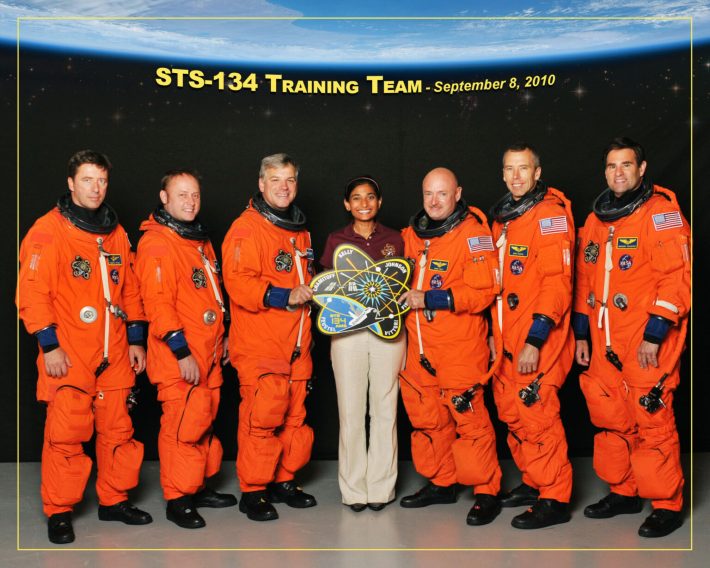
Musk is no longer in the White House. For now, he is throwing tantrums about the size of budgets that defund his projected research in electronic cars, a critical potential pipeline for the funding of the self-driving car, and probably also fuming at the firing of his handpicked choice for NASA, Jared Isaacman, fast on the heels of his official date of departure from Washington, as well as Mamta Patel Nagaraja, as NASA’s chief scientist, after DOGE trimmed the DEIA initiatives in NASA, and the cuts in funding that will put United States scientific research into freefall, subject to the data-driven cuts that DOGE has imposed, and the scrutiny of student visas for foreign-born that have become so central to the significant scientific community in the United States, combined with the vengeance-driven cuts to granting agencies that appear a version of January 6 storming American laboratories.
Raised on the shoulders of data and the influence of pale giants of genius like Isaac Asimov, Howard Scott, Ayn Rand, and Thorsten Veblen, not to mention Friedrich Ratzel, these are the good old boys of the sun porches of Pretoria, coming back to purge the future of the Space Shuttle and indeed the forefront of American science that was first invested in during the Manhattan Project offering any advantage of anyone else in the world. We are guarding our borders; do we need to protect the once flourishing scientific communities that had for so long nourished global standards? America will no longer be taken advantage of, or seen as suckers, even if that might be for a greater good.







 Musings on Maps
.svg)
Pingback: Appeals Court Blocks Trump's Wartime Law on Venezuelan Immigrants - Writ of Mandamus Lawyer in New York, New Jersey, Connecticut & Washington D.C.
Pingback: Judicial Review and Mandamus in California’s Fight Against Federal Immigration Overreach - Criminal Immigration Law Firm in New York, New Jersey
I think it speaks volumes that as Trump seeks to leave a global imprint he was denied in his first term, that he turned to a man like Musk, whose sense of global politics is so limited and skewed. This is a case of the inexpert leading the inexperienced, clamoring for authority with little priorities than their own self-aggrandizement.