The Infographic Pontiff?

The refreshingly broad geographic purview of Pope Francis’ Urbi et orbi Christmas benediction, delivered to the faithful in St. Peter’s Square as a greeting to the world and the city, and to all Christians in the city and throughout the world, newly displayed the spectacular breadth of Pope’s call for peace across the world in a globalized age.  As the Easter Sunday Urbi et orbi papal benediction included imprecations and injunctions for peace in the Middle East, “and particularly between Israelis and Palestinians,” hoping for Godspeed in the process of negotiations, “peace in Iraq,” and “above all for dear Syria,” Mali, Nigeria, the Central African Republic, and across the Korean peninsula, Francis’ Christmas Homily illustrated the extent Francis’ direction of his annual pastoral message beyond both sola scriptura and beyond issues of church doctrine.

The homily’s wide geographic compass–containing a level of detail so tellingly absent from the generic breadth of recent predecessors in communicating the significance world peace–suggests a far broader notion of the church than was followed by his immediate predecessors, and indeed a needed geographic specificity in the relation of the pontiff to the faithful:   before some 70,000 faithful, the pontiff resumed a similar itinerary of sites of the persistent absence of worldly peace, touching similar landmarks in a tour of global conflicts from South Sudan to Syria, Nigeria, the Democratic Republic of the Congo, Israel, the Palestinian Authority and Iraq. Francis’ comprehensive roundup of global hotspots took its brief in refreshingly literal terms as addressing “omnium ecclesiorum Urbis et Orbis,” by effectively mapping commanding Hotspots of civil unrest and travail across our inhabited world, and of course hoping for future tranquility.

This indication of continued horrors we might too easily neglect is a far cry from how the global maps commissioned by Gregory XIII in the 1580s.  If the monumental cycle of maps in the Galleria delle carte geografiche expanded the image and presence of Italy in the Mediterranean, as well as its significance to the worldly church, and the above Loggia offered a canvas for tracing missionary routes to different continents, Francis’ mapping of suffering dramatically departed from the magisterial function of the church in dispensing dispensing worldly teachings, and suggests a way to broaden the vocal role of church in a globalized long considered one of the earliest globes to depict the New World in detail, if the third to survive.  T.  Perhaps this came from his appreciation of the actual difficulty of prayers for worldly peace.  Francis’ homily gave new breadth to his sense of moments “both bright and dark” in worldly politics.  Whatever the reason, breadth doubt informed the sense of peace and what peace would entail–his procession from St Peter’s basilica gave prominent position to pairs of children from Italy, the Philippines, Lebanon, his native Argentina and Congo, as if in an embodied objective correlative of worldly suffering among Christian believers, and an infographic that could be held before the eyes of the faithful, and remind us of the great stakes of any future map for worldly peace at the start of the third millennium.

As the first non-European pontiff, no doubt the former Cardinal Jorge Maria Bergoglio was acutely conscious of his charge for ensuring global comprehensiveness within the Church, as well as of expanding the doctrinal focus of his immediate predecessors.  Francis openly joked on assuming St. Peter’s throne that his fellow cardinals of seeking a new bishop of Rome that they went “almost to the end of the world.”  And long before being anointed by Twitterfeeds with the hashtag #BestPopeEver, he suggested a broad perspective on the alleviation of and attention to worldly suffering and the active role of the church in its alleviation, a consciousness no doubt present in his adoption–the first time for a Roman pontiff–of the name of the Franciscan founder, St. Francis of Assisi.  His appreciation of thee relative nature of peace may have surely derived from his personal experience and exposure to dictatorship as a Jesuit during Argentina’s Dirty War (guerra suicamay have made many and multiple compromises to preserve peace; Bergoglio was quite familiar with Argentinian death squads, and seems to have minimized the 30,000 deaths of that place and period, in ways that  surely invested a different view of “peace” as an arduous uphill climb.  (His relative silence in a period of terror terrifyingly paralleled the minimization of violence of the dictatorship of Jorge Rafael Videla, and he has revealed something like a dedication to atonement ever since he offered Videla comfort and communion–if not his concealment of political prisoners–charges perhaps due to pragmatism in the moment, but which the pontiff has not clarified satisfactorily.)


popewithdictator


But to forgive is Christian, and to err human, and since he worked within the Argentine political structure, Francis has attained the unique perspective to turn a significantly more tolerant eye on the Christian faithful and to devote considerably more attention to the scale of worldly suffering.

And when Francis evoked a cast of characters in need of peace and hope, from child soldiers to migrants,  and providing something like a literal tour of moments of worldly peace, his sermon had a clearly cartographical quality:  he offered a sort of virtual travel to or evocation of places of unrest that merited personal papal attention (or intervention) and indeed the spiritual attention from the world’s religious.   He took more seriously the global nature of the address that hoped for “peace in the world” from human trafficking to natural disasters in his “urbi et orbibenediction that embraced the literal scope of the sermon hoping to foster global unity and peace–even if his history of compromise and possible collusion suggest a more problematic history of personal involvement in reigns of terror.   Following the time-honored presumption of ecclesiastic universality that befits such an annual homily, Francis openly addressed once more the “ongoing conflict in Syria,” hoping that followers of all religions were working for peace there, and praying for a resolution to civil strife, hoping that the Lord would act to “foster social harmony” in Southern Sudan, as well as the Central African Republic, hoping for dialogue to grow in Nigeria and the Holy land, and that tragedies never again befall migrants as they did this year at Lampedusa, an island off the coast of northern Africa, ever again.

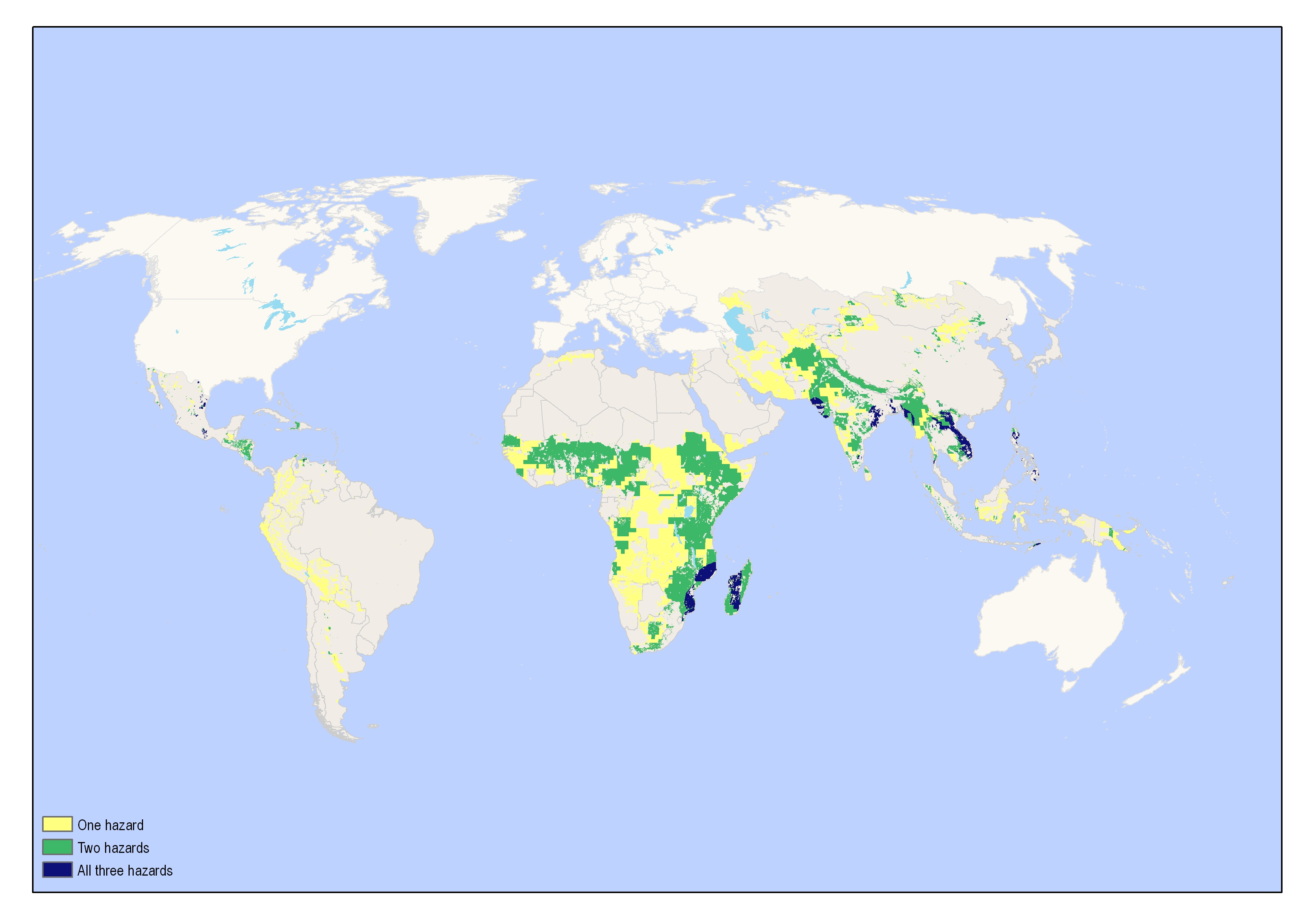
The breadth of his call to conscience was striking, and has been widely celebrated.  “Too many lives have been shattered in recent times by the conflict in Syria, fueling hatred and vengeance,” hoping to spare future suffering for the Syrian people, and hoping that the Prince of Peace might also help to heal the constant attacks on innocent and defenseless in Nigeria, the frequency of violence in “beloved Iraq,” so often struck by senseless violence, and that hope and consolation reach the many displaced from the Horn of Africa to the eastern Democratic Republic of the Congo and those displaced by natural disasters in the Philippines.  In providing a personalized message of support and succor, Francis also offered something of an infographic of global Hotspots of need and humanitarian disaster far more explicitly than his predecessors would have ever articulated, focussed as they were on issues of doctrine as much as of worldly conflicts or wars.  If we don’t know what newspapers Francis reads, his words echoed the March public comments Valerie Amos who, as head of the UN Office for the Coordination of Humanitarian Affairs (OCHA), described the many “neglected” areas she met as “In the last year alone, I visited more than 40 countries from Syria to Sudan, Democratic Republic of the Congo, Niger, Afghanistan and Myanmar, and saw and heard for myself the terrible conditions that families face and their harrowing stories–loss of loved ones and homes.”  These “neglected regions,” surrogates for the neglected, offer a new geographic language for understanding regions of humanitarian assistance and need whose rhetoric seems modeled after that of maps to show the humanitarian Hotspots that are familiar from maps of global warming, and which provide new visual models to contemplate the increasing depth of inter-relationhips within the world.


Implications_drought_hotspots_conflict_11


Or our own globalized sense of the multiplication of hazard Hotspots so disparate to be hard to process or even get one’s mind around–also a tragic challenge in the face of global warming.


Implications_all_hazard_hotspots_cumulative_world_13


Pope Francis seems to realize and relish the challenges both of ecclesiastic leadership and of providing comfort and consolation in an age of globalism.  In the age of elegant but impersonal infographics, the expansive geographical breadth of spiritual compassion across the world seems a response to globalization that tabulated the costs of what we too often lose from the 24-hour news cycle:  for if the pontiff’s world tour was a worthy exercise of extending a globally frayed compassion, it was also a cursory review of selective dim points of civil strife across the inhabited globe that was (as befits the medium, perhaps) short on particular details or local context, and as an impassioned address fell a bit short, as well as a depressingly long laundry list.  But that said, the infographic that Francis provided to believers was a welcome inclusion of specifics to hold before their mind, in contrast to His austere predecessors, the world-travelling ecclesiological conservative John Paul II and the even more austere Benedict XVI, for all the Enlightened pretensions that the undoubtedly intentional echo of Benedict XIV suggests.  Indeed, Francis offered a telling shift from the dominant concern of his predecessors with questions of catechism, arising from their magisterial notion of the pontiff as head of the church.

The papal Christmas benediction was a sort of infographic for a world weary of war, where He could only hope to offer succor or faith for the many victimized and displaced world-wide in hot-spots of civil unrest, an attempt at offering a sense of hope which seems so thinly stretched.  Can we process the infographic that he gives us, and use it to keep an eye on needs for worldly assistance and sympathy?


Pope Francis Christmas 2013


And the new vision he has presented in the elevation of Cardinals in the very first month of 2014 provided a refreshing image of the church whose collective memory and spiritual body has been for perhaps far too long identified with Italian bishops, and whose corpus mysticum has been difficult to separate from the Italian peninsula–or Italian cities such as Venice and Rome–even as it has gained a truly global status over the twentieth century, removed from a colonial apparatus if also redolent of colonial ties.  Pope Francis’ recent timely elevation to the cardinalate from regions in Latin America, Asia, and Africa make a case for the church’s global face–and distance the worldly body of the church from a clerical career path or ladder often moving from Venice and Turin.

Indeed, the infographic provides a compelling new vision for the body of the Church, and its ties to believers, as well as its charismatic body whose legitimacy derives from divine intervention in human history but is sustained by continued faith.  For in selecting a cardinals’ college that includes not only Managua, Rio de Janeiro and Buenos Ares, but Seoul, Les Cayes in Haiti, in addition to the Ivory Coast, Burkina Faso and the Philippines, Francis clearly intends that the church begin to present an image of itself to its believers and to the world that is globalized, rather than rooted in one peninsula.


0113-for-webVATICANmap-artboard_2


This is refreshing, and particularly timely–in light of the planned February 22 consistory in Rome. If we have seen narrow-minded screeds about how “the US is getting skunked” in this reconfiguration of the church’s public profile, this is also an affirmation that the mystical body of the church derives from its continued ongoing relevance to its faithful and to those in need.

Leave a comment

Filed under #BestPopeEver, Christmas papal homily, infographics, Pope Francis, St. Peter's Basilica, Urbi et orbi

Mapping Ancient Ruins

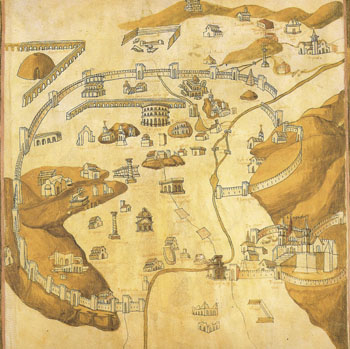
Few precedents of mapping historic ruins are as striking as the curious radial map for which Leon Battista Alberti provided instructions for fellow antiquarians who sought to envision the spatial arrangment of Rome’s monuments in the middle of the 1430s:  by plotting ancient ruins in Rome, the paradigmatic city of ruins, the Renaissance humanist recast the city of perpetual incarnation and of survival in the midst of recurrent abandonment, seeking to provide a guide to retain an image of the classical city’s monuments and topography in the mind’s eye of humanists, and his creation around 1450 of his extremely popular and innovative Descriptio urbis, a humanistic version of the city’s marvels–Mirabilia–a genre narrating the miraculous sights of the city which had circulated, as an early tourist brochure and keepsake from the 1100’s.  If the Mirabilia was a guide to the wonders, augmented by numerous early urban myths, listing its gates, hills, columns, statues, baths, arches, bridges, amphitheaters and temples, often including fanciful etymologies of their names, the Descriptio urbis provided an exact location of each, or as an exact a description as possible, setting out the minutes and degrees from which each could be observed from the Janiculum Hill in Rome, providing what many have argued constituted a model for drafting one’s own schematic map of monuments for ready consultation.  The popular manuscript survives in multiple copies.

A practiced architect and impassioned enquirer about the physical construction of ancient Rome, Alberti set forth directions for preserving their arrangement in an elegant radial map which plotted ancient ruins by a meridian and a circular calibrated arc, in order to better excavate and make present–or recreate–the ancient remains lying in the city in its reader’s mind, which circulated widely in manuscript form before the age of print.

Alberti's Meridian

Alberti significantly described the advantages of plotting such monuments according to a radial grid by using “mathematical tools” to survey monuments by taking sightings from atop the elevated Capitoline hill.  The finding of significant monuments on coordinates served to purify earlier travel books by selecting its authentic classical buildings, stripping away accreted legends like so many obscuring cobwebs, and creating a pristine media to understand the ancient world and the city’s physical plant.  Although the rubric by which Alberti mapped the ancient city on top of the new one–the half-inhabited Rome of the recently returned popes–his intent was not only to replace the handbooks orienting pilgrims and visitors to Rome’s marvels but refine his admiration to a veneration of antiquity and the city’s ancient design, which he preserved in traces in its contemporary layout; his booklet may have provided a model for contemporary views of the ancient ruins in the city’s walls such as this Florentine fifteenth-century illumination from the workshop of the Renaissance mapmaker Pietro del Massaio, who made several maps of the region of Tuscany and of Italy that were destined for inclusion in a codex of Ptolemy’s treatise on world geography–an ancestor of recently undertaken efforts of digital archeology of the city.  (The maps of Pietro were also known in several independent sheets, some of which are stored in the Vatican libraries.)  But the city views that he included in the most precious codices were the most similar to the transcription of archeological highlights that Alberti, who sought to share his own passion for the antique with a generation of humanists with whom he corresponded in other Italian courts, had noted:  they gave the monuments of the ancient world a new plastic form, and complemented the image of Rome–its coliseum a bit above its center, as seem below, but the Janiculum and Senatorial palace closer to the center–with images of other ancient Mediterranean cities, including Cairo, Alexandria, Constantinople, and Venice.

Massaio's Rome

More than a hint of Alberti’s Renaissance resuscitation and incarnation of the ancient city in erudite terms was present in the view that Michel de Montaigne in later took in 1581 pf “studying Rome,” whose plant was at that point still two-thirds uninhabited, by climbing the Janiculum to “contemplate the configuration of all the parts of Rome, which may not be seen so clearly from any other place,” lamented “that one saw nothing of Rome but the sky under which it had stood and the plan of its site” with knowledge of the city only “as an abstract and contemplative knowledge of which there was nothing perceptible to the senses” since the world, “hostile to its long domination, . . . [had] broken and shattered all the parts of this wonderful body and, since even quite dead overthrown and disfigured, the world was still terrified by it, had buried its very ruins”–and lamented the lesser nature of “the buildings of this bastard Rome which they were now attaching to these ancient ruins.”  These sort of maps preserved a city from its own decay, and created a powerful structure and physical design for mediating the past, as much as mark the situation of the city as a nexus of itineraries–such as the “Peutinger” chart (named for the Renaissance humanist who discovered it) depicted the city at the node of ancient Roman roads.

Rome-Peutinger

It’s interesting to think of Alberti’s booklet as an attempt to halt the burial of the past, or to excavate the lost history of a city whose buildings he had excavated and measured, but whose underlying plan was difficult to grasp:  the techniques he offered provided not only a basis to draw one’s own version of the “map” of the city, but to internalize the ratios among its monuments, even for those who would not visit the site itself, at a time when the preservation of the ancient past gained new premiums as a model of urban planning.  Alberti accorded the ruins a new language of wonder, and accorded a new wonder with the city that was associated with an unprecedented level of literacy with the map, using a graduated or calibrated circle reflecting his precision as an architect and classicist.  It provided interested readers with practical instructions to create a reproducible map on the eve of the age of widespread circulation of printed images–images that no doubt encouraged subsequent humanist men of letters like Pirro Ligorio to create his own detailed mappings of the ancient city by the 1550s, as Flavio Biondo had earlier offered antiquarians a more detailed written geography of the ancient city.  And it is the basis for projects of constructing an urban map of Rome’s monuments today by the same instruments.  The role of these maps as validating the emerging antiquarians by setting standards of proficiency and expertise for interpreting and deciphering its ruins as they encouraged admiration of Rome as a unity in ways that undoubtedly served to lend far greater concreteness to its dismembered past.  The distance of antiquity that one realizes in Rome today, accentuated by the proximity of its actual ruins, would provide Dr. Sigmund Freud in 1899 with a concrete metaphor for the simultaneous storage of multiple dispersed memories in the mind.

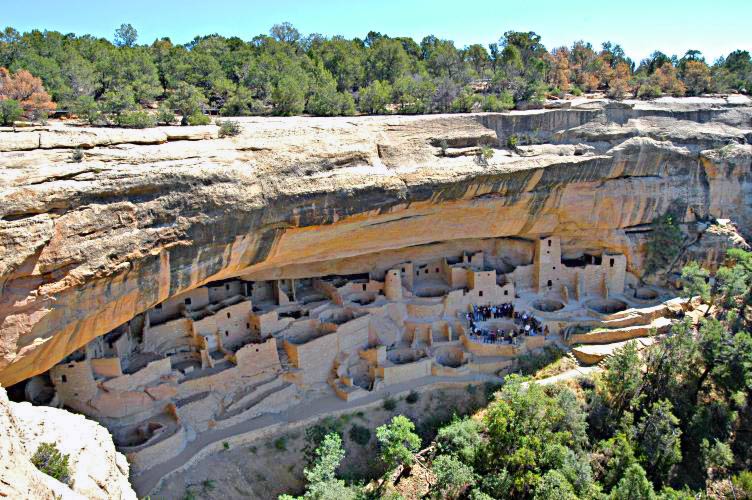
The medium is not always the message, but the personalized maps created by GPS (or, for that matter, Google Earth) dispenses with the intermediary of the cartography as a guide to orient viewers to a region.  Rather than viewing or privileging the map as the vehicle for accessing the coherence of the past–or assembling a desire for such coherence–the map becomes a mode to access meaning and location, isolating the part from the whole, or the object from the context.  And it may well be that the lack of coherence that we now have of our maps of ancient prehistoric sites in the United States is somehow informed by the media with we use not only to geo-locate but to pillage them.  It is odd that GPS provides us with a new method for exposing and accessing the ancient world of the Americas in quite a different manner:  if Alberti and Ligorio sought to provide readers a valued guide to antiquity, geo-location of Flickr images offer owners of GPS devices ready access to the coordinates of the cities of Ancestral Pueblos or Anasazi across the boundaries of Arizona, Colorado, or Utah–often to better pillage sites such as the cliff dwellings of Mesa Verde in Colorado, as well as to get access to the archeological heritage.

For the form of mapping that is used fail, unlike Alberti’s map, to preserve the sense of coherence that Alberti so prized, and that Montaigne sought to regain contact with, and, as such, preserved little sense of its fragility and cultural integrity as a patrimony.  Those visitors who arrive with GPS devices in hand to navigate these prehistoric sites, David Roberts reports in the New York Times, not only observe their structures but often to take a piece of its ancient artifacts home with them–or might well carve their initials beside rock art panels, and indeed validate their locations by the coordinates they’ve downloaded, if not disturb their contents unknowingly in a region where pueblos of Anasazi are often beside evidence of later Hispanic settlers.  One doesn’t need to be a Luddite to compare the relative poverty of meaning in most downloaded maps available online that promise ready geo-location of regions of Anasazi pueblos  to the pilgrims to such sites.

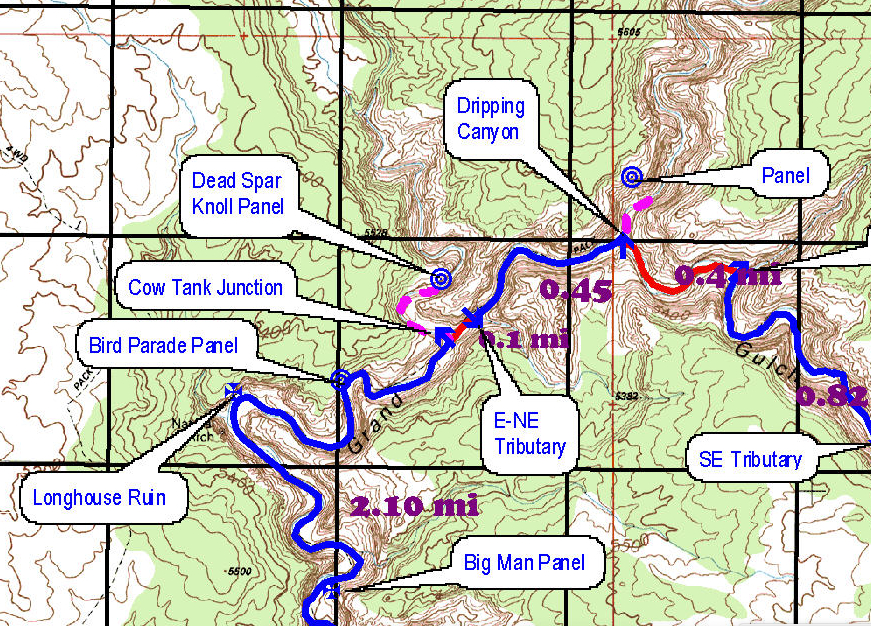
To be sure, the detailed topographic maps of the Anasazi lands provide accurate records of picturesque panorama for local hikers or explorers–if the routes of exploration are quite oddly rendered on websites as unfolded topographic map of the region, in which specific itineraries are highlighted on which one can track one’s elevation and descent, viewable as if an old USGS survey were extended before the viewer–but one that contains a far lesser level of density of meaning than that survey itself, whose legibility preserves but a fraction of the detail of the paper topographic map.

Picturesque Panorama

But most maps and handbooks they use to explore the sites offer few signs of warning–or cautions–that frame them as a site of similar historical or cultural significance, and the remains or objects that fill the site seem there for the touching, tagging, or taking.  Even the above visualization conveys a sense of unfolding a privileged map of the region for foreground specific sites of interest and views, as much as to track their relative distance.  Yet the users of this site, as Gary Gemberling, include imprecations enjoining readers to respect its integrity by advising them to refrain from vandalism and lack of respect for its original inhabitants, given the increasing use of trails as a form of prehistoric tourism and in situ observation of long-abandoned dwellings, formerly abundant pottery shards, in a tone that is all but absent from any earlier maps.

Here’s Gemberling, writing on the actually quite informative site of Jay David Archer, addressing visitors to the Anesazi ruins in Grand Gulch Park in Utah:  “I’ve done this loop 3 times and every time is like the first, this loop i feel has the best rock art and cliff dwellings of the whole stretch, GET A MAP! its easy to walk right by some of the dwellings, i missed perfect kiva the fist time in, walked right passed it, and now my fav[orite] site, RESPECT!!! there is some vandalism sadly, its easy to disturb ruins, they are fragile, but you will learn this in the ranger station, you must check in,this place is like a outdoor museum, and its my church, i love it there more than any where in the world and i have been to 36 countries and 47 states, i have changed my life style to be able to go back here for many years to come, cedar mesa, monument valley, goosenecks park,bridges nat park and grand gulch is the jewel area of south east utah . . .”   Yet the dense location of abundant wall-paintings or panels seem located on twisting path, with limited or little sense of their cultural uniqueness, even in the most detailed of maps of Jay Archer David, with limited signs of how best to negotiate its extremely fragile landscape:

Panels

fragile landscape

The sense of entering a privileged space seems diminished, partly as a result of the media, but also of the very accessibility of the ancient sites.  With GPS device and iPhone in hand, one compares where one is to the destinations others have already photographed, and which are readily downloaded from the internet and available as a sort of vicarious tourism that one can use to plans one’s own trips.  There is almost a popular confusion here with the rise of GPS geolocation of seeking to commune with the past–or realize concrete contact with its ruins–by leaving a sense of one’s presence their, or view the site as a treasure hunt, which lacks its own integrity as a privileged place where ruins continue to be in situ and, as much as they will ever be, alive.  If Alberti wrote a guide treasured by antiquarians, the accessibility GPS offers on exact coordinates allows a form of tourism without a sense of antiquity without any entrance fee save a GPS devices.  The accessibility of the map, and, indeed, of multiple posted photographs of the actual site itself, does not mediate the past, but seems to create a sense of entitlement that apparently justifies removal of loot found at the end of the treasure hunt, or the prize of the pilgrimage.  There is less of a sense of the marvel of the ruins as mirabilia with the transference to the Google Earth sense of wonder in the mappability of everything–and the problems of the accessibility of everything via photographs downloaded off smartphones and the GPS tracking of precise coordinates.  Perhaps access to wi-fi could be limited or circumscribed in these areas of reservations,  or national parks, in the hopes to preserve a sense of their wonders.

Mesaverde_cliffpalace_20030914.752

Leave a comment

Filed under Anasazi sites, GPS, Leon Battista Alberti, mapping ruins, Sigmund Freud

Empire of All You Can Survey

In writing on Google Maps’ ambitions to map the world, Adam Fisher invokes Jorge Luis Borges‘ one-paragraph fable of how the Cartographers Guild “struck a Map of the Empire” at a 1:1 scale with its entirety, “On Exactitude in Science.”   Fisher evokes it in comparison to the massive collation of geographical coordinates in the virtual map Google Earth and Google’s project of remapping the world:  and although he does not note this, in Borges’ story, the map “which coincided point for point” with the empire is abandoned by generations “not so fond of the Study of Cartography as their Forebears.”

The map of the imperial cartographers Borges described stand as something of a reductio–or perhaps extensioad absurdam of the very sort of large-scale mapping that was first adopted in the English Ordnance Survey–a large-scale project of highly detailed national mapping begun in 1791 prototypically English in its character, ambition and scope.  What might be the largest (and longest lasting) mapping project ever undertaken might be worth some retrospective comparison.  The ambitious project of the Ordnance Survey of offering a highly detailed national map of six inches to the mile–since the 1950s, continuing at a scale of 1:10,000–set something of a standard for protecting the nation.  Originally aimed for one inch to 1000 yards (1:36,000), its framework was set by the Principal Triangulation of Great Britain (1783–1853), but its product served to record a legible record of all British lands.  The aim of the Ordnance Survey was to create a comprehensive record of Britain for ready consultation for defense against potential (French) invaders, and the instantiation of mapping of the nation has long been tied to military ends, whose tabulation of an exact correspondence to place provided an account of national resources and needs.  Borges’ evocation at the end of his tale of the continued presence of shreds of the paper map in remote deserts of the empire that he described is so very apposite because of how the comprehensive map-weaving in Google Earth renders any state-run project of paper mapping as so antiquated to be unrecognizable–and leaving any in shreds–although what the massive and glorious project reveals about map reading might be better explored.

The global map of Google assembles is of a qualitatively other order:   for one, it is an interactive exercise of letting the consumer decide what to map, or providing a selective map for their preferences or needs.  But more broadly, it is mapping for world-domination of the market for maps, which has no clear end-product.  And not only the market:  the interactive nature of Google Maps aims to make it inseparably fused to the minds of its users, suggests Michael Jones, chief technology officer at Google and co-founder of Keyhole, one of the first companies to offer online satellite views  suggests in a nice interview with James Fallows in the Atlantic.  For Jones, Google Maps  provide an “extra-smartness” due to their ready availability as interactive media,  effectively ramping up everyone’s IQ by 20 points and working toward offering a “continuous stream of guidance and information.”  Most users have so internalized the interactive map, the founder of Keyhole argues, that “they get so upset if the tools are inaccurate or let them down:  they feel like a fifth of their brain has been taken out.”  The aim is not to unfold Google Earth over a territory, but situate the map’s readability in our heads:  after 6,000-10,000 years, we’ve turned a bend and mapping has become both interactive and personal, or there is far less of a boundary between the personal and the map.

The map is no longer static, but both only and constantly being framed in an interactive fashion.  As well as change the nature of maps, it alters the nature of map readership in profoundly interesting ways, because of how it organizes and translates data into a new sort of platform.  Unlike a project of mapping national coherence, seems designed to offer a model for marketing maps that includes the ability to toggle directly into a visible record of place–“Street View”–that includes the now-familiar tagging of addresses, locations, and monuments that seemed once to be the semantic dominion of Facebook.  We can now see everything in the map, at incredibly high resolution, so we can prepare for trips of business, commerce, or pleasure by taking a look at the always-sunny record of the topography of wherever we might be heading when relying on Google’s Street View to take us there.

Whereas Borges described how the remnants of that hugely expansive paper map once coextensive with the empire that the cartographers created as lying only in the outlying deserts, Google hopes to overturn the notion of the paper map itself–leaving it shredded, or rather recycled–with everyone pulling up maps of their own on the screens of Android smart phones.  (Think of the cache of searched maps that one leaves, as a sort of paper trail, complete with search history and places navigated:  such information is not stored, Google says, but would give a veritable system of surveillance that the NSA must be eager to get its hands on, no matter what the recent ruling of Judge Richard J. Leon’s recent rebuke of mass surveillance practices, by questioning their violation of constitutional rights–no matter how ill-fated their attempt to mine big data to geo-locate global populations.  The “personalization” of the map as an interactive medium is widely seen as a surpassing of its static medium and becoming a web interface, introducing functions of zooming, panning, and rotating 360 degrees on a pin, qualitatively unlike a road atlas and even threatening to dethrone the TripTik.  For the “view” that Google aims to synthesize, linking the technologies of Keyhole and Google Earth and creates its illusion of continuity by how the alchemy of how digitized photography seamlessly melds images tagged with exact geographic coordinates.

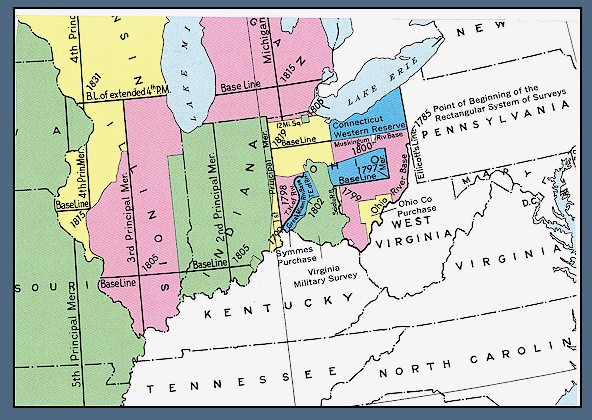
The excitement of translating global meridians as a scheme of reference are gone, as are the excitement of working from a single base-line, to be extended outwards by triangulation, that so distinguished the Principal Triangulation and its American emulator, the Point of Beginning–a starting point of the calculation of rectangular land-surveying that took on somewhat suitable evangelical tones for the New World, after the Royal Society tracked the Mason-Dixon line.  For the mapping of the territory of the US shaped the configuration of states from the ascertaining of the base-line that determined the rectangular surveying of the United States further West–


map_point_of_beginning


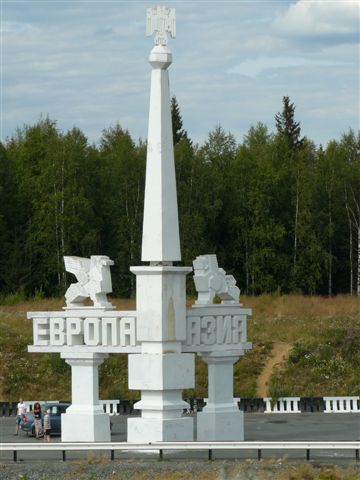
One thinks of a similar line not at the Continental Divide, but the line surveyed dividing the continents of Asia and Europe at a precise point in Russian lands–a point that was cause for continued debate from the time of Catherine the Great as to the European location of Russia’s capital cities, viewed from a train on the way from Yekaterinberg to Vladimir, one encounters a simple obelisk to note the division.


obelisk:  Europe is to the left!Derek Low


The stem division is inscribed along this frontier in monumental form at multiple sites, or in elegantly neorealist terms at another site, similarly in a wilderness, as if a monument that few would view until they arrived to see it or passed by:


p1030748


These material markers use statuary monumentality to remind passersby of the definitive nature of the line between continents that they traverse.

Google Maps (and Google Earth) is less concerned to create a correspondence within the conventions of maps to order space within a nation than to create a map outside sovereign bounds.  If there is a clear spatial marking of the “Point of Beginning” where the survey that determined state lines and lots drawn east of the Mississippi, the folks at Google have no interest to place a place where their mapping project begins; the premium is rather to capture all the points of view so accessible a mouse-click away.  There will be no reason or interest to mark an actual boundary line, was the case on the centenary of determining the boundary of 1786:   the marker celebrated the triumph of the conventions of the cartographical line in ways that Google won’t ever need to do, since their world mapping is entirely virtual, dispensing with or downplaying conventions like map-signs.


Beginning_Point_of_the_U.S._Public_Land_Survey_Ohio


When Google maps, there is no need for mere monuments–or the practice of verifying base-lines.  The empire of the visible that Google aims to construct is animated by the indexing of digital photographs that can be reassembled at the viewer’s will; Google will offer them upon demand.  The paradox is that little actual measurement is expected, but rather that lines of data flow must be secured:  programs can synthesize the photographs that are uploaded into Google’s Street View or Google Earth, and provide a way of moving from the street map to a representation of what it looks like to be outside the map–allowing one to toggle between “Map,” “Terrain,” and “Street-View”–the holy trinity of their App–to immerse oneself in the map wherever one is, without any need for future surveys, and in ways that show to all who care the skeletal nature of a simple map.  The map is dead, in the sense of a drawn map whose conventions are about translation, but long live the map as a visual record!

There is something like a back-end move in Street View, or Google Earth, as the photograph (or a million digital photographs, seamlessly woven together) substitutes for and comes to replace the map.  The symbolization of space in a street plan or road-map becomes a heuristic device for exploration, in ways that is only a hollow echo of the photographs synthesized in Street View, which are so much more satisfyingly real:  the innovation of the satellite views of Keyhole, acquired by Google and the basis for Google Earth, allows the direct proximity for viewing place, and exploring space, that seems to go through the other side of the map itself, or be a proxy mirror on what the map maps.  Google began its quest to assemble the world on the slippy screen by downloading–or purchasing–the newly declassified LandSat satellite photographs of the world’s surface, and by purchasing and synthesizing the U.S.G.S. surveys of our nation’s road maps:  little was newly mapped here, but the world was newly mapped, in the sense that it was now made available to a larger audience than it had ever been mapped for.  The empire of map-signs did not live long, however, because the unique marketing vehicle of Street View, which set Google Maps off from others, afforded viewers something more palpable and immediate (and more gratifying) than a mere map, and whose skeletal form is revealed by toggling among alternative views:  the map as the ultimate eye-candy and as the vehicle of voyeurism, where one wouldn’t have to be content with lines on a piece of paper, but could gloriously pan around and, yes, turn one’s attention to a perpetually sunny record of whatever one wanted to see.  (“Keyhole” technology all too appropriately allowed the very zooming into high-resolution satellite views of Earth that Google now provides, as if to engage the voyeuristic interest in reading maps that the static map did not allow, and has become central to the interactivity of Google Earth.)

Why would one chose to go back to the map, or explore the map as a medium in itself?  In a neat slight of hand, there suddenly is no map, in the sense that the map is trumped as the primary register of negotiating with place, and one can suddenly see through it.  The question then becomes less a map that is co-extensive with the world, but an image-mine that dispenses with the need to make any maps.  Sure, Google is going around and checking the relations of roads and one-way turns on their road maps.   The end of doing so is to create for its users a point of view that never needs to be redefined:  much as Denis Cosgrove argued the point of view of medieval maps was often understood as the eye of God, Google Maps provides a point of view somewhat like a Leibnizian eye of a God ever-present everywhere.   OpenStreetMap is often cast as a competitor to Google Maps, is pushing in the quite contrary direction not only in the open-ness of its A.P.I., but in preserving continued relevance for the map as a collective compilation of data and meaning–and preserving both the activity of transcription we all call mapping, but is always also mapping to help us better figure out our relation to how we occupy spatial expanse.  For as much as Google Earth might be seen as the modern corollary to “the Art of Cartography attained such Perfection that the map of a single Province occupied the entirety of a City” in Borges’ story, geo-caching Street View images in Google Earth suggests another parable.  Much as Yertle the Turtle, King of the Pond, proudly proclaimed himself Emperor of All He Could See, until Mack burped, Google feeds our inner Yertles, more than maps the spaces we occupy.

While the evocation of The Principal Triangulation of Great Britain may seem odd, the massive project of data collation set a standard that has long driven our notion of the land-map.  Google Maps creates a persuasive illusion of totality of the visible world that often does not map human networks or their environmental consequences, and which may leave us blind to them even as it champions map-reading as something like a spectator sport.  Google Earth’s dominance as a medium raises questions about what other sorts of networks are left unmapped, or what other methods of dynamic mapping might represent social networks, but that are less clearly revealed in its maps–or are obscured–in the seamlessly knit sunlit world that we track in the slippy maps of the open screens of our androids and other Google Earth browsers.

1 Comment

Filed under Google, Google Earth, Google Maps, Keyhole, OpenStreetMaps (OSM), Principal Triangulation of Great Britain

Variations on Our Fragile Union: Small Stores across 40,000 Zip Codes

Any maps create quite powerful tools to knit regional divides into coherent forms.  The order of maps serve both to fabricate harmony of a whole from its parts and for showing its divides, in ways data visualizations make increasingly clear.  If the origins of “chorographies” were illustrations of communities, and aestheticizations of their harmony, we’ve become increasingly interested in and attuned to visualize divides, as much as visualize unity, to explain the symptoms of divisions where they might be most evident, and use the format of the map to demonstrate compelling evidence of the fractures that divide, and explore how ideology ever came to “cluster so predictably,” in with geography,” as Steven Pinker nicely put it, and if different conceptions of human nature exist in different parts of the country. We’ve all been all too familiar with the recent remapping of these divisions, increasingly evident  in our political discourse, and affirmed in different ways by posing a set of choropleth maps as points of departure in order to chart, gloss and explain the extent of our divides by the range of data available on local differences across our fragile union.

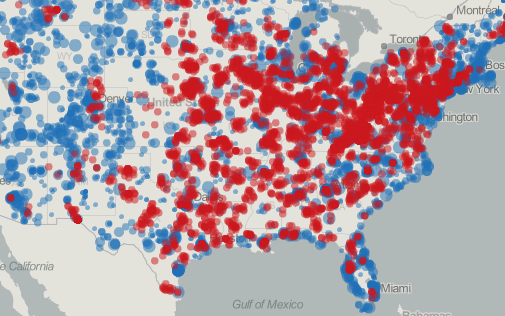
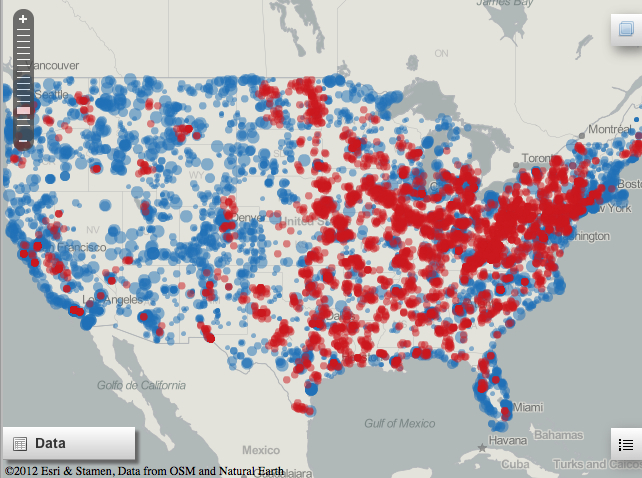
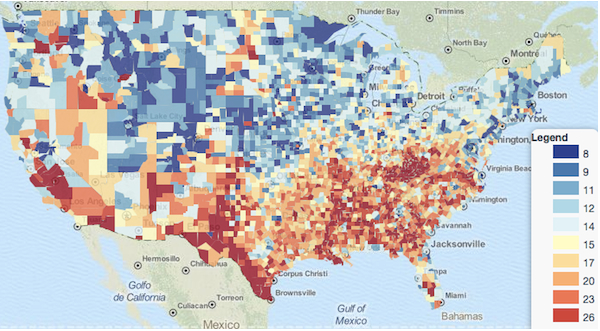
As we approach Christmas and the season of gift-buying upon us, it makes sense, as Philip Bump, with some help from folks at Esri and Stamen, suggests, to consider the stores where we realize shopping habits and alternatives as criteria that increasingly divide us–and consider the consequences such divisions hold.  Indeed, the divided commercial topography in many regions of America reveal–even more than real estate–a deeply drawn set of cultural divides rarely considered in attempts to understand our fractured political landscape:  so dense are the clustering of large stores in certain areas that they obscure the legibility of place names.  In ways that reflect something like a Google Maps query “shopping at private business near [ZIP code]”, the distribution of data suggests how the landscape of shopping shifts in regions of the United States that provide a deeply qualitative record of our society.  But rather than generate a list of sites, or map all stores, selective parsing of large scale vs. independent shops provides a neat filter to measure the commercial contours of the landscape in ways that won’t so much correlate as reflect a composite image of the lower forty-eight. What’s the new political topography of the United States?  Well, perhaps it’s less red states vs. blue states, here shown in two views of the divisions between Democrats (blue) and Republicans (red)–by data here parsed at county level and by intensity of affinities–map a deep set of social divides that have strikingly played out in weirdly clear geographical blocks in presidential elections.

As Steven Pinker put it, “Regardless of who wins the presidential election, we already know now how most of the electoral map will be colored, which will be close to the way it has been colored for decades.”  Why, indeed, are some red states so red, and other states so blue?  Is this a sign of a divide between rural and urban inhabitants and political preferences–or is it deeper, and, if so, how did we become so divided in our imaginary of what the nation should be?  Are these maps creating differences, or do they reveal some of the deeply-set social divisions codified by Mason and Dixon as a latitudinal divide, but whose division is now reflected ban urban/rural divide? We all know that the last few elections have been stunningly fragmenting–
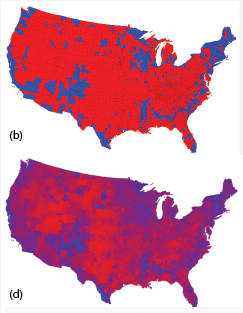
votes-  red v blue, by county and interest level

In a coy reference to collective mapping, Aaron Black of the Washington Post used Gallup’s annual rankings of which states are the most conservative and which are the most liberal to create a heat map of populations across the nation, employing the popular cartographical device so often adapted in infographics to chart virtual a spectrum of political opinion, which, while less intended to emphasize the fixity of divides within current public opinion, showed that outside of Alabama and Wyoming, the number of self-declared “conservatives” in the country does not follow such a close divide:  yet it is hard to find a less changing term than “conservative” and “liberal,” and these don’t map onto the breaks in voting that have recurred across four presidential elections.
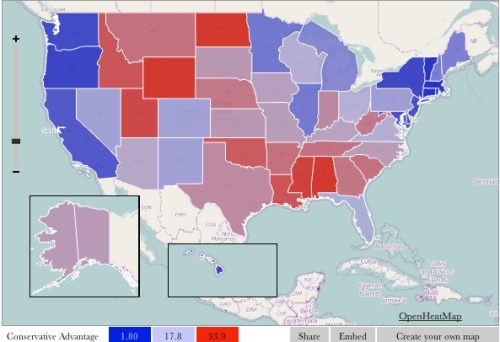
%22Open Heat Map%22Washington Post

But the pressing question of where these divides actually lie have led folks to return to maps with considerable zeal–both as powerful heuristic vehicles of statistical measurement and projection, and to find possible answers for these real divides.  The prevalence of infographics and talk radio have conspired to make this a real issue of political debate for the The American Conservative, where Patrick J. Buchanan placed the question of secession on the front burner this year, corralling red state secessionists and blue-state secessionists into the same category as folks who acknowledge we either face increasing ungovernability due to geographic expanse or having little in common:  the issue of what we have in common, not much of a question for the very notion of a nation or state was in the past understood to balance multiple interests, may be less the question than the “spirit of intransigence” that we face in most political debates.   Does this have to do with the vociferous defense of issues that won’t be debated, or the fact that we have been all too often poising debates in quasi-imperial essentializations of what is un-American?  Or is it due to “lifestyle”?

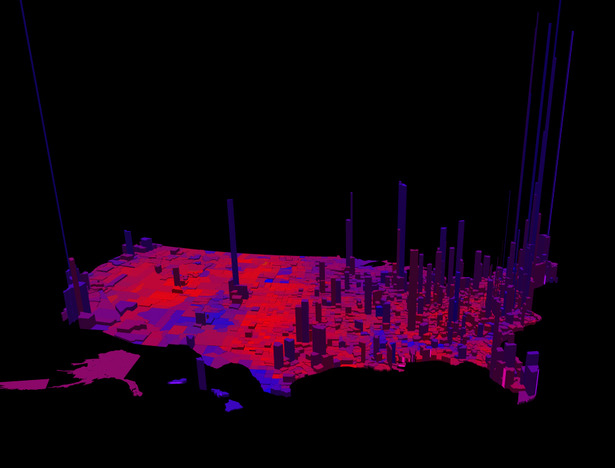
Can we remap these divisions along lines of population density, as Robert Vanderbai of  Princeton University has argued, whose compellingly recast the electoral map to reveal how two alternate styles of sociability came to inhabit one land.  By throwing the stark red/blue political topography into 3D relief, Vanderbai invites us to look at that divide, not fractured by different data, but mapped onto density so that we might better understand our electoral maps:
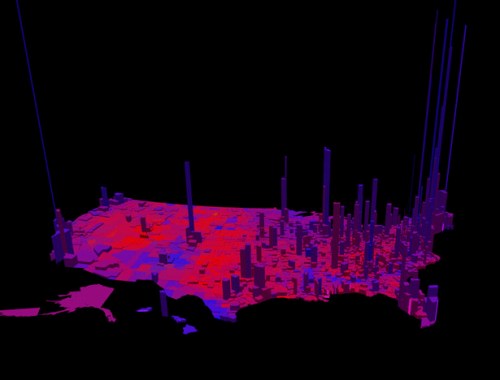
Blue v. Red Topo Raised

The divisions in the electorate have also, of course, encouraged the weirdly popular but loosely credibly parsing of local attitudes across the nation.

Despite the hugely informative value of this density distribution, the question of how the distribution of the landscape we have created might be as well illustrated by the commercial topography we have created, and the space that they create.   For the interesting map that charts a distribution between the majority dominance of large box-stores or chain-stores over smaller privately-owned stores suggests a unique landscape that we have become all too used to inhabit, and a measure of density all its own–but not necessarily in tandem with Vanderbai’s glorious and striking distribution of a two-color bar-chart.  Although Vanderbai’s chart makes the compelling case that our distribution of electoral votes no longer in fact reflects the population distribution in the country–and indeed the possibility of the winner of a popular vote losing the number of votes in the electoral college–the map is less than informative of the landscape we have created in the United States–a landscape that is still being repeatedly surveyed.  To be sure this reflects or is a reflection of density, but also offers an alternate index of social topography.

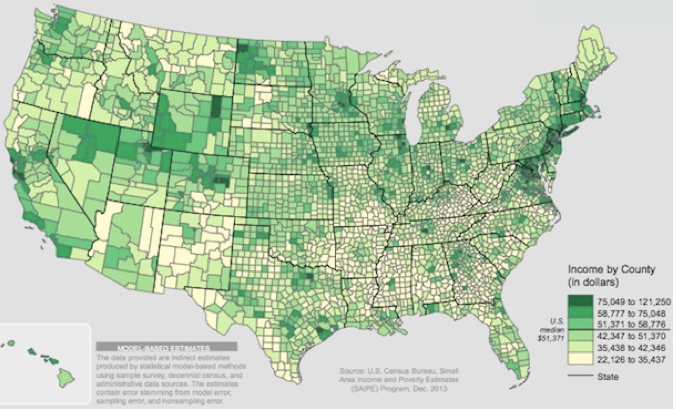
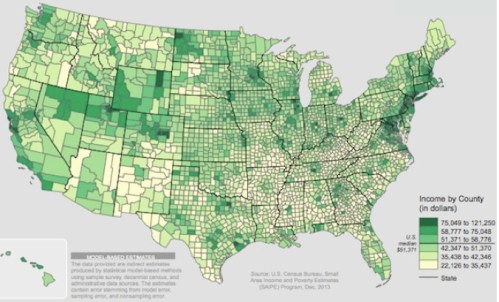
Let’s peak at the regions that Bump has created, in far more fuzzy fashion, by agglomerating the number of stores across its 40,000 zip codes, and taking a measure of those regions where large retailers show a clear dominance to the extent that they have pushed out all but one privately owned retailer, noted in reds of varied intensity, versus those blue dots where privately owned retailers constitute the majority, and the corridors that this creates, despite its lack of clear contours.  While the ZIP-code breakdown is reflective of the new concentration of wealth on the eastern corridor, the relative decline in incomes provides a clearer index of where such box stores (predominantly discount retailers, who appeal to the pocketbooks of their customers) will tend to concentrate.
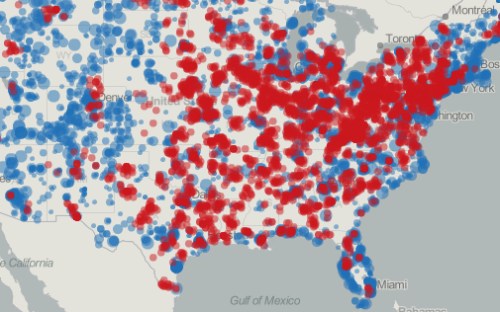
Fuzzy USA

Income by County:2012

The contours of these divides provide a basis for re-examining the arguments implicit in most recent choropleths, and thinking about the nation we are poised to become.  Although not exactly mirroring the levels of declining income, one can detect in the areas of the spread of the big red superstores a reflection of the yellow states with median incomes below $22,126 a year, showing a selective density of big bog scores pushing in toward Denver, and congregating around Michigan, the Great Lakes, Iowa and near Arkansas.
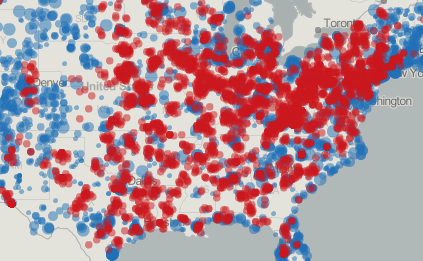
Red Crawling INland to Denver

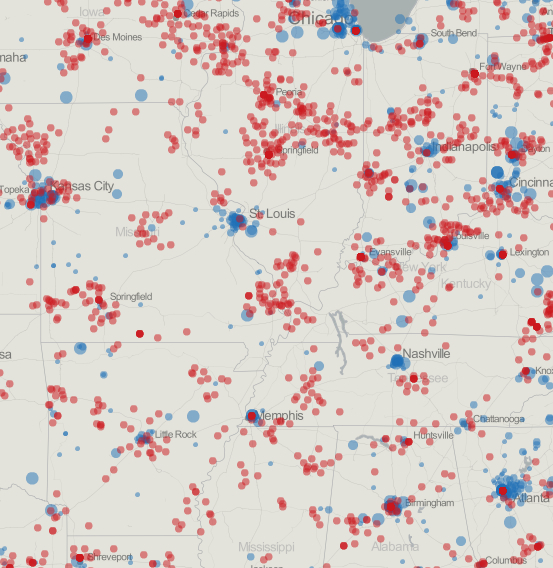
Starting small, for example, take the data that Natural Earth and OSM mappers help reveal about the new topography of shopping in the Midwest, that both reflects density but even more the sorts of incomes that can support private businesses:  as one moves outside of urban areas, the proportion of zip codes composed almost or entirely of exclusively large retail stores rises in clusters, often clustering (predictably) about pockets in precisely those cities also able to support small businesses:
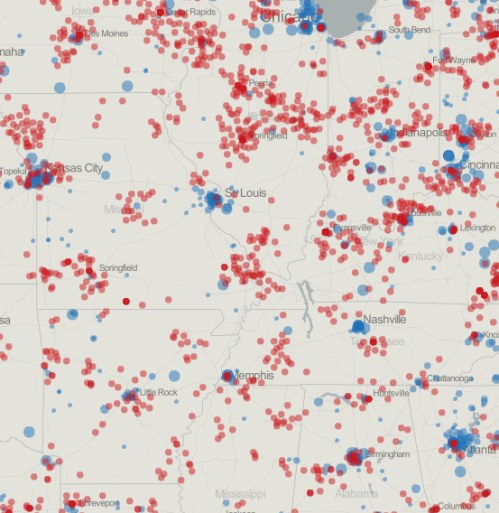
Density?

The blurring of the map, in a far fuzzier version at larger scale, suggests a veritable field of red that is almost aligned in belts, and creates a strong contrast to many parts of the country lying further west . . . where they seem to choke off privately owned stores.
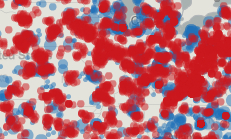
Fuzzy Mid-West

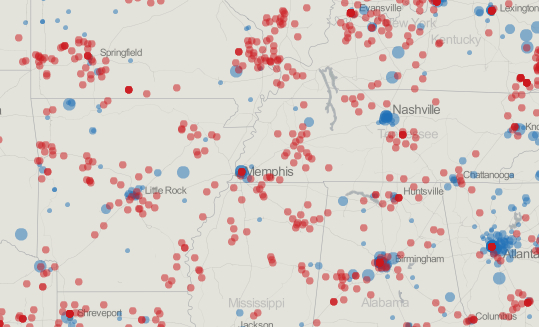
Returning to view the southern reaches of the country a greater scale, the discreet stores in much of South appear as oases of small businesses in relatively open land–presumably where small businesses don’t crest above a level of 50%– in Nashville, Atlanta, and Memphis:
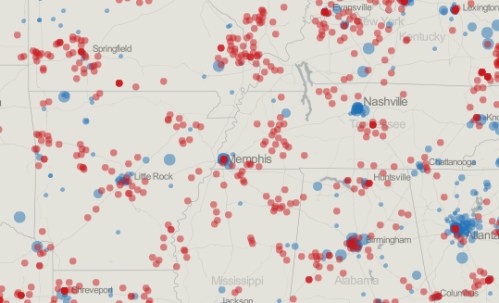
Southern US

Looking at the odd distribution of the Eastern seaboard, a region where large stores appear to dominate the landscape of all but the coastal corridor, and gain a distinct density as one moves inland and approaches a different economy.
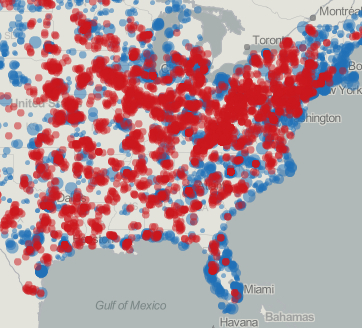
Fuzzy NE

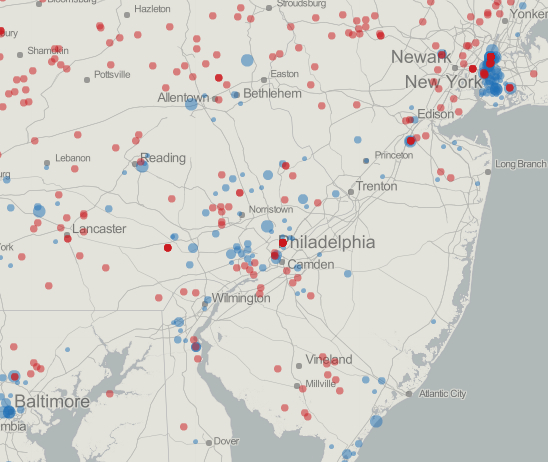
A more fine-grained view of the same region–focussing on New York to Baltimore–reveals a more complicated topography, but echoes the general division between small pockets of private stores and box stores that choke out the competition, being the chain stores that they are, which, with relatively cheaper real estate at malls that can be bought up and leased out by developers, creates a new division between our populations that may be deeper than–if it is created by–a gap in income or disposable wealth.  Interestingly, an abundance of privately held, smaller stores is often concentrated around smaller towns, as well as taking on density at large cities.
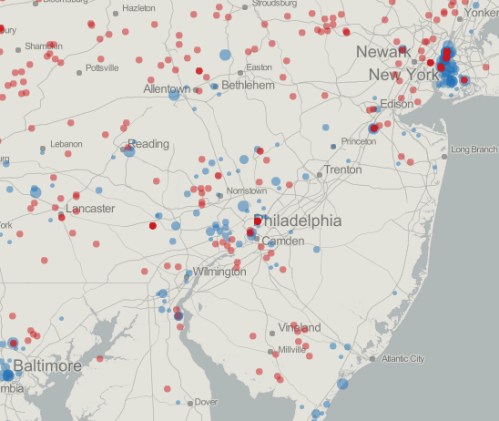
New York to Philadelphia

What sort of social topography does this create?

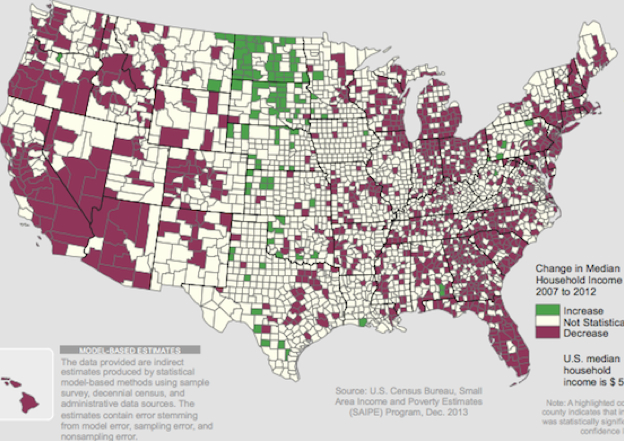
The distribution of stores has not been indexed for growth rates, but might be measured against recent census findings about declining incomes.  The depressing image of the appropriately colored “brown” marking declining median household incomes in a period of just five years nicely captures the tone of depression of much of the country, and the difficulty of political classes to capture much backing outside the venting of folks whose incomes have declined.  Despite the aversion of a serious depression after the banking crisis, we’ve been hardly hit.
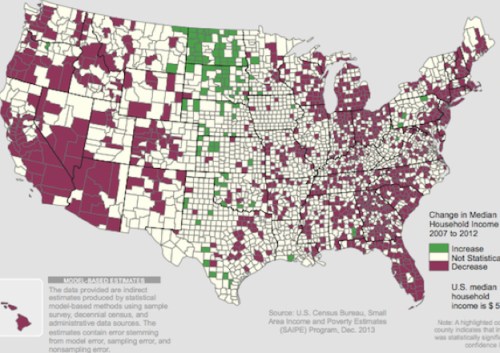
Median Income Changes, 2007-12

But the choking off of private businesses might be a sad consequence of these declining incomes, and the road trip searching for big bargains at Dollar Discounts that might be taking up the weekend breaks of much of the country.  While demanding further investigation, the number of chain stores that have emerged across in the country surely reflect the declining incomes in the nation, as much as changing costs of real estate.  And these m

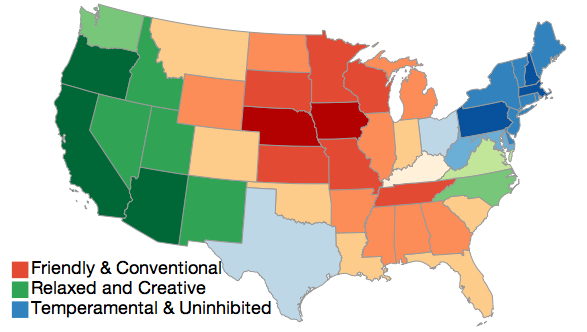
The proliferating choropleths that have emerged to explain our social divisions, something of a tour of data visualizations that have duplicated like rabbits on the web will reveal, have in fact tried to uncover divisions in moods as dividing the country–although this map, with the authority of a DSM, seems to assign fixed moods to the boundaries between states that we have come to internalized, so nurtured are we in reading data visualizations as records of objective truth.

On one extreme, the heuristic value of those boundaries between states are fetishized in a spectacular fashion in America’s Mood Map, which uses statistics originally published in the Journal of Personality and Social Psychology to detect underlying differences of constitution–the personal, rather than the political–that creates an odd visualization whose  very terms (“relaxed and creative”; “friendly and creative”; “uninhibited”) make it sound like we’d all really get along quite well, aside from difficulties of understanding tone, and downplays any political division by recasting the map in terms of something like affect.  By ostensibly mapping divides of personality types and tabling the political, this map even invites you to find the state that best matches your mood, if one is to believe self-reported data.  (The division was parsed, with a straight face, as reflecting weather–hypnotized by the ubiquity of the weather-map and seeking to invest something like objectivity in the odd color-scheme below as something that revealed actual differences to invest the odd graphic with similar credibility–for more on the notion of mapping how “different regions have different personalities” in a data visualization, look here.)
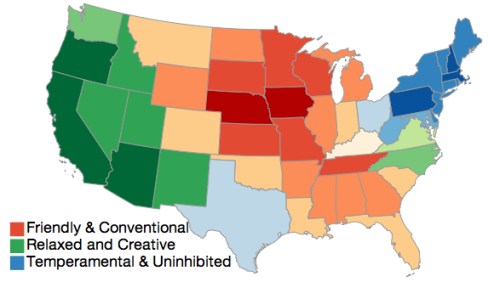
America's Mood Map


Regional essentialization has proceeded, in an attempt to map the country as made of different nations.  In the drive to map national divides, Frank Jacobs parsed nine nations of North America on largely economic criteria, rather than personality, distinguishing regions of similar economic production, and casting each as a separate GDP, based on concepts of the uniqueness of our nation from WaPo journalist Joel Garreau, and again granting them stark objectivity via a choroplethic map that similarly served to instantiate diverse regions of the continent:


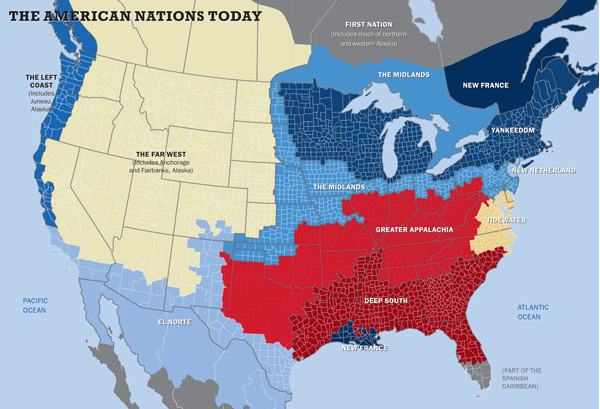
GDP map Is this a proposal for introducing new tariff lines?  If so, how much such a distinction makes sense–what about that “Empty Quarter”?  what on earth do they do, and how can they exist?–can be tabled.  And the future of the “foundry,” if it rests on metallurgy, is certainly on the rocks.  And what does Quebec produce, aside from fleurs-de-lis? Colin Woodard sought to describe national divides into some eleven groups, arguing that we’ve “we’ve never been a nation-state in European sense,” for all who imagined the possibility of American political unity, and wrote a slim book that recast the Progressive notions of a ‘melting pot’ by explaining that each region reflected its own distinct stock, and illuminate differences to which our democracy, supposedly, had unfortunately rendered us blind–but whose divisions Woodard appears to suggest might explain all American history, including the Civil War, up to the spread of the Tea Party.  Woodard’s pedantic mapping of distinct regional variations combines racial essentialism and a “revenge of geography” to point up our innate fragmentation: ELeven Nations
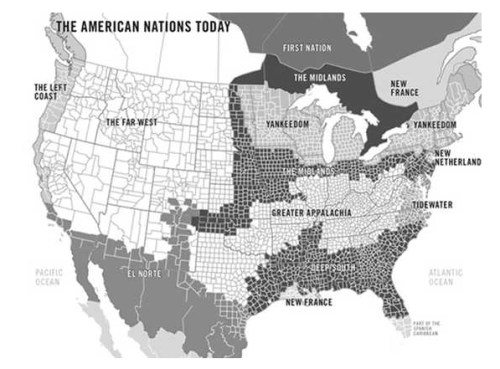
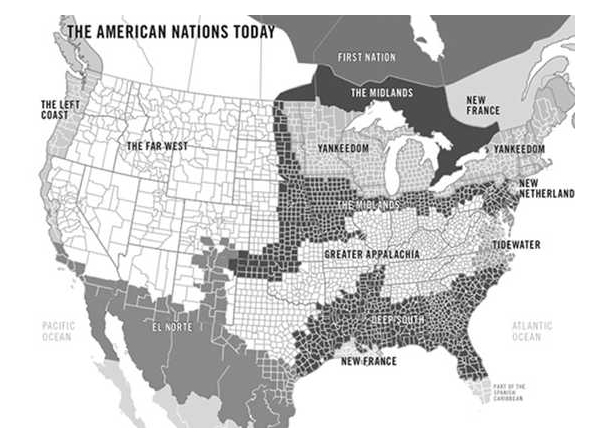
The distinctions were starkly mapped in alternative iterations of the “American Nations” were presented as a key to better understand ourselves, as if to hold a mirror to the land:
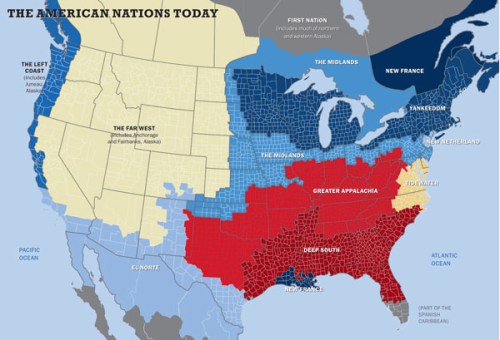
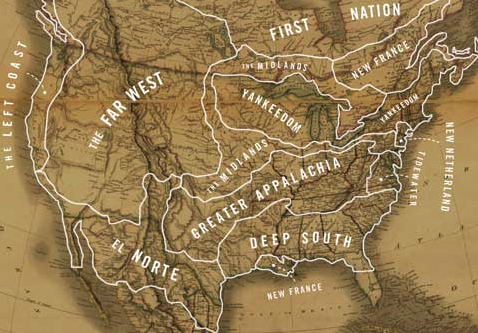
 

American Nations Sean Wilkinson Design


Sean Wilkinson Design Woodard’s work extrapolated from the historian David Hackett Fischer’s argument about the differences in the settlement of different regions–particularly the northeast and south–by different Anglo cultures, and the effects of Anglo farmers who settled the northeast from the Scots-Irish herders who settled the Deep South, and from the work of many anthropologists and the psychologist Richard Nisbett on the culture of honor in the South.  But despite some  neatness in registering cultural differences in the map, it doesn’t take huge skill to reveal the culture of separateness in the Deep South, and a floating barrier of “Appalachia”–the ‘light South’–around it;  yet problems arise when one moves from the map to individual experiences. Despite the evocative names with which other regions are endowed, from Tidewater to the New Netherlands, their relative stability or homogeneity as entities comes to break down, as does the notion that their boundaries are so firm.  The odd coherence that he supposes in such regions as “New France”–would Québécois see anything similarly to folks in Louisiana or even New Orleans, let alone accept them as affines?–and other regions–how isolated and cut apart is this “Left Coast” today?  What could ever be mapped as weirdly as Yankeedom, and is it still alive?–seem animated by an ethnic essentialism belied by the shifting map of ethnic divides and affiliations in the United States.

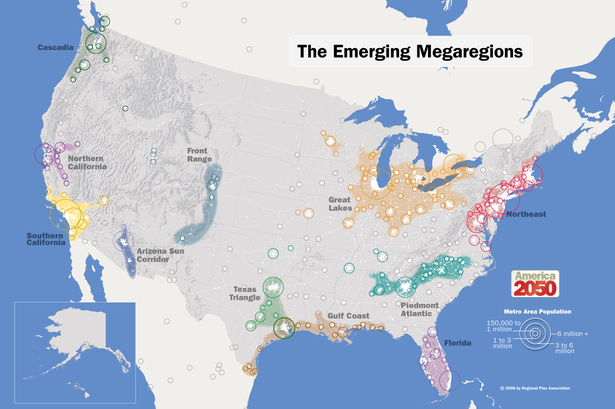
And it is not clear that these areas will retain meaning with and over time–although the deep danger of which the map is something of a symptom is a pronounced lack of national belonging across the land!  Woodard’s sense that American history “all goes back to who settled those regions and where they came from” flattens history, and would not be readily recognized by any local inhabitants. No doubt these can be traced to the deep and unavoidable social divides and fissures that exist in our country, and to the different parts that different regions have played in the culture wars.  Perhaps it might make sense to adopt an approaching demographic forecasting, less entrenched in the categories used today, and the apparent generation of megaregions.


2050_Map_Megaregions2008_150-thumb-615x409-106683


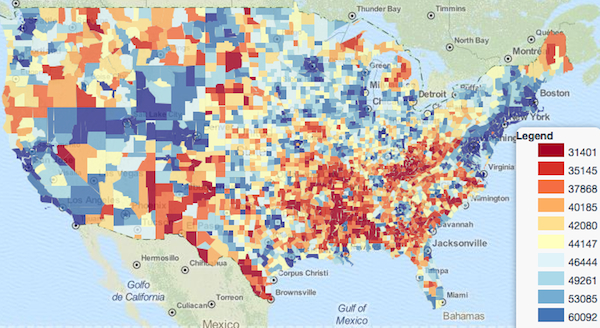
There are, of course, true socioeconomic divides that fragment the country in all too real ways.  The frighteningly influential role of real estate in shaping the country is sadly evident when we map residential space by income, and illuminate truly early modern concentrations of wealth.  Using the American Community Survey to map a choropleth by variables of income, real estate, and educational levels attained, we can perform something like an archeology of the national map, digging deeper to examine the real divides among its inhabitants.  Dividing regions of the country by median level of income, clear pockets of navy blue surprise the eye and remind us about the unavoidability of underlying social divides–that, I’ve elsewhere argued, mirror local reception of the Affordable Care Act.
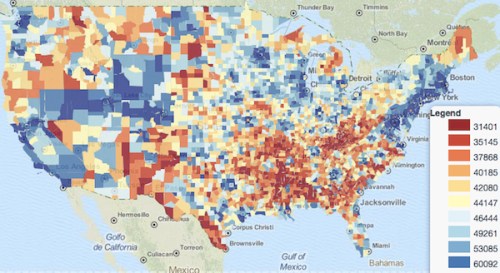
 

income


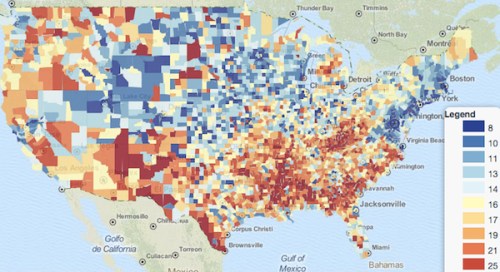
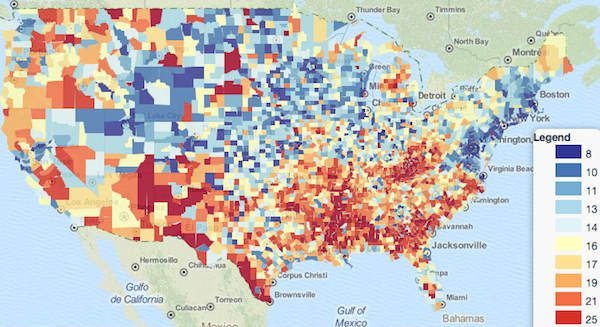
Or, again with an eye to the opposition to the ACA, long after the Great Society, we can divide our choros by clearly drawn concentrations of poverty as much as wealth, using a distribution of  local populations living below the poverty line in each of the nation’s counties that reveals a similar concentration of poverty in the deep south and southwest:
 

poverty


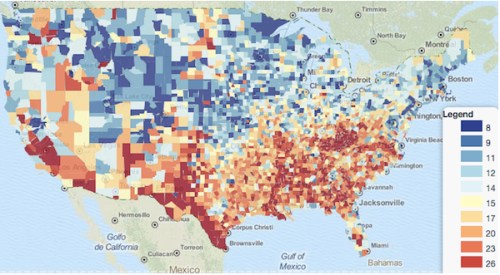
Not to mention the map–which somewhat scarily illustrates parallels–of the percentages of adults over 25 years of age who did not complete High School, in a sort of national map of educational attainment as they are reported in US Census figures:
 

Over 25 w:o High School Diplomas?


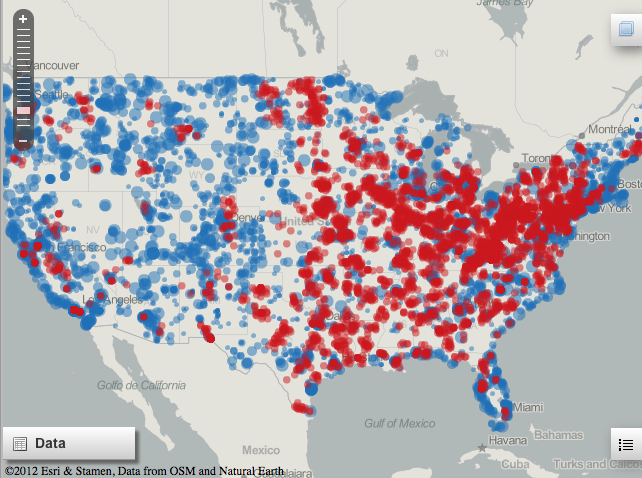
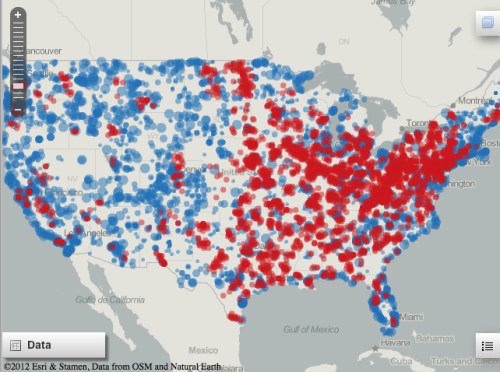
These stunning choropleths, courtesy Calvin Metcalf, Kyle Box and Laura Evans, reveal a Southwest and deep South we knew, but weren’t ready to acknowledge.  They tell an interesting story as to why Virginia and Florida belong less to the Old South–or to what it has become.   To look more closely at a comparison of other local trends in the Community Survey, look here. Yet we might do well to look elsewhere to map national divides, and new databases to grasp our emergent geographic divisions and continental divides.  While real estate markets have much to do with the divides, we seem to have individuated the intersection between density and real estate across state-lines, by taking the presence or absence of small businesses in our communities as a sort of tipping point.  For the benchmark of zips with one or more privately owned businesses reveal a major fracturing of the local landscapes in the country, oddly resonant with our divided electorate.  The huge regional discrepancies of coasts and interior needs to be read with density, in ways that few openly consider, as a means to map the habitation of the landscape, shifting from questions of bodies, ethnic composition, or other criteria, toward the nature of interaction between self and place that shops afford, and even the sorts of relations to objects that are synthesized in the contractual relations of the marketplace, not to mention the stimulation and relative criteria of judgment that a diverse marketplace affords customers. The below map of the nation is limited to those spots with no or one small businesses within the ZIP in question (the red dots, which often cluster and overlap, and are more intensely red to reflect the intensity of that concentration) and zip codes which are distinguished by a majority of small businesses (blue dots).  While this omits large regions of the country–where there are an intermediate percentages of small businesses, and they don’t register–those are of course the very regions where large stores are equivalent or exceed small businesses, making them likely sites of the inevitable large box stores.  And the selective optic of the map is precisely its virtue as a portrait of contemporary agora, or our evolving landscape of exchange.
 

small shops:large shops


In ways of considerable sociological significance, the map reflects the landscape we’ve made for our country, or we make for our selves, by mapping some of the sites where we define ourselves to what is left of the public sphere.  The map may indeed suggest some interesting sociological detail about where the country is heading, with interesting correlations to level of educational completion below which it lies.  There is something that goes beyond or beside a decay of discrimination, but leads to a shift in one’s relation to the market and how one is a participant or spectator in a collective activity, in the geography of box stores that can be mapped across America.   The dominance in a mental universe of Home Depot, Walgreens, Wal Mart, Dollar General, Target, Lucky, Thrifty, Family Dollar, Dollar Tree and even Sports Authority exposes a topography of disorientation and dislocation, rooted in the offshore production of goods and plastics, undermining face-to-face encounters in 24/7 Emporia that offer the best deals may well conceal endemic conditions of placelessness and timelessness:  in a country where 80% of the stores nearest to anyone are large retail chains, one has to interrogate the ramifications of what sense of social space we retain:   as we become consumers in another Holiday Season, bracing ourselves for sales, what sort of social change lies in no longer having a corner store? Where’s the analysis of this shift of commercial topography when you need it?

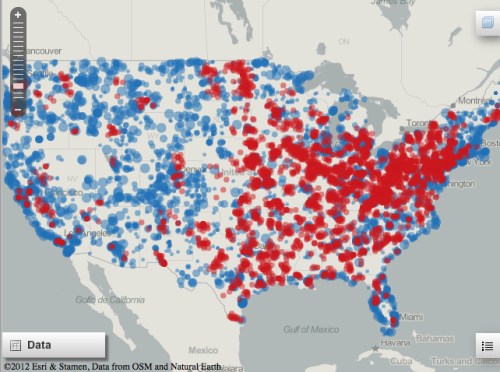
In ways rich with sociological significance, the map tells much about how store-goers orient themselves to the publish sphere, direct consciousness to the relation of goods’ producers, and regard the social contract or social nexus as a given or negotiated part of the status quo.  For as much as it lies in our pocket-books, perhaps the deepest divide among us of all lies in the landscapes where we spend it.  Perhaps the deepest divides of all rest on not so much in levels of income or consumption across the lower 48, so much as the shops available for perusing or spending time–and the attachments to place, to space, to objects, and indeed behavior pursuant from them, which inevitably cascade from how much time inhabitants devote to patrolling the aisles of brightly lit box stores of Sam Walton–rather than looking in at local businesses to greet their owners and examine their wares.  Based on a search for the places where “small business really thrives” in the lower forty-eight among the nation’s 40,000 zip codes, data from OpenStreetMap has allowed a map of the sorts of stores in each–noting in red those zip codes hosting none or one small businesses, whereas those where small businesses constituted an outright majority enjoy varied shades of baby blue.  The resulting small-business texturing of the country provides a valuable index for looking at–or reading, if not actively interpreting–the nature of its communities, and an alternate American Community Survey of its own.

While this doesn’t exactly correspond to a political divide, it may tell us more about what sort of a nation we’ve become–and what sort of commercial contacts that we value, or personal contacts we are able to cultivate to the owners of shops, places more likely to apt local products.   The division of red vs. blue is less reflective of a political divide, but seems to offer itself as an alternative metric to those above introduced to measure social divides, and belongs in the company of other social indicators taken as prognostics of political divides in the electorate, if not of an alternate community survey.
 

small shops:large shops


In ways that do not map directly onto the distribution of real estate–shown in the first map from data of the American Community Survey above–as one might expect, the topography of shopping that it indicates suggests deep social divides to which Nate Silver might pay some attention:  while the coasts are brightly blue, in California we can detect the conservative central valley and interior; the absence of blue in much of the central states is shocking, and preponderance of red throughout the south–save coastal Florida–overwhelms, although the Northwest seems reliably blue.  In Minnesota and Wisconsin, the red blotches shade to pink and dissipate; Texas seems divided with deep red concentrations.  Indeed, the problematic position of Pennsylvania in the national picture is nicely illustrated by its deep red isolation, whereas privately run business dominates the Northeast Atlantic seaboard, particularly north of New York, as well as in much of New England:
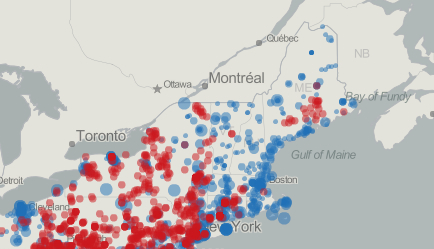
 

Pennsylvania?


The irony is hopefully apparent, given that the defenders of Republicans are presented as the champions of free enterprise.  Maybe they are:  they are not, it seems, defensive of independent shops or businesses. The sea of red in the middle of the country, but seems a growing miasma that doesn’t necessarily respect political affiliations, but also bodes pretty badly for the survival of a culture of localism, at least in terms of the future (and profitability) of independent business:
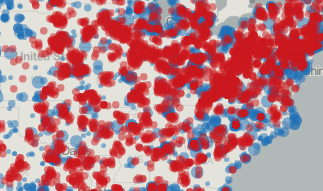
 

Growing Miasma


The map, in the image it offers of the Midwest, reveals a striking clumping of regions without independent businesses–clumps not necessarily paralleling cities–the like of which is probably a major shift in our society the likes of which the world may have never seen:
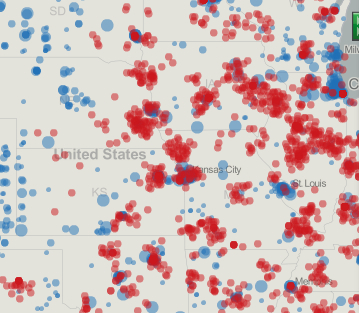
 

MidWest


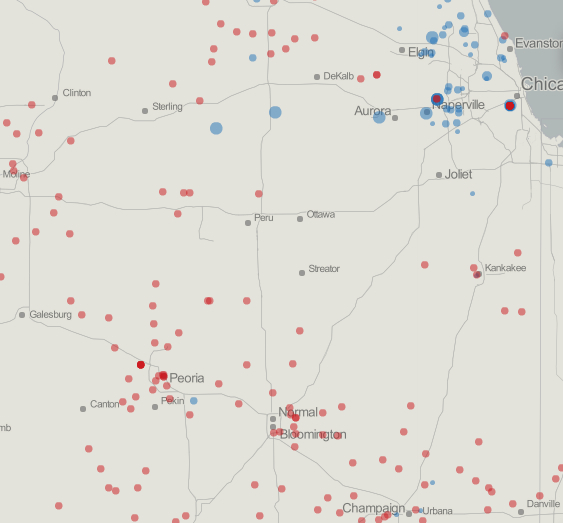
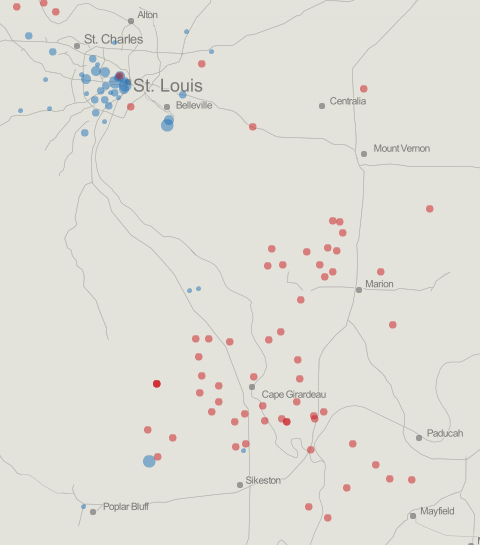
Those places with greater income may simply be ready to foot the extra bill for local boutiques, some will say, or forget the offers of Amazon’s free shipping:  but we see a deeper divide, I’d argue, shaped by the market as much as responding to lines of wealth, and conditioned by all those aisles of shopping centers illuminated by starkly lit flourescent lights, lured by the slogan “Save Money.  Live better,” and names like Dollar Tree and Family Dollar that remind shoppers to keep the bottom line first and foremost in their shopping experience, rather than cultivating stores that might provide more jobs to their neighborhoods.   (Even if their parking lots may use LED lighting, most stores have a sort of blinding or blanching flickering flourescent light so recognizable that it seems potentially addictive as a unique neurological experience.) We can see a new mapping of the landscape around cities, which, if we take only the midwest, emerge as something like islands with private stores, surrounded by areas of box stores that cluster around the nearby highways and urban belts, to take Chicago and St. Louis; smaller towns are dominated by zip codes dedicated to large chains:
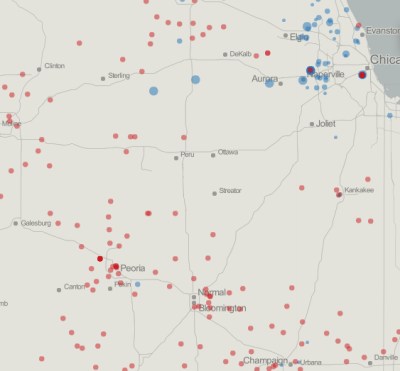
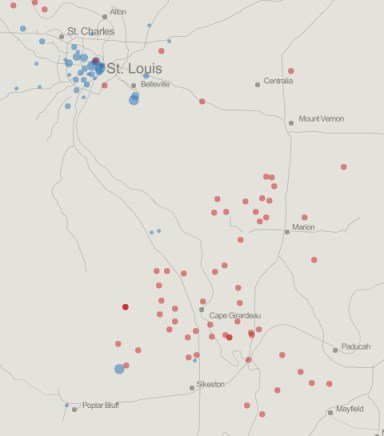
 

Around Chicago

St. Louis

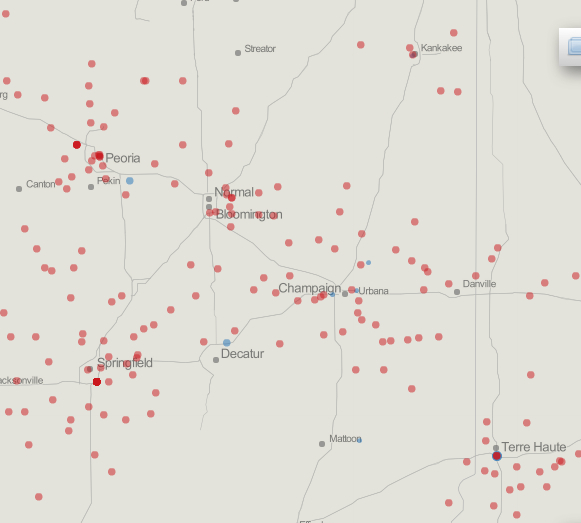
And in the deep interior, many zips feature the near-absence of anything but larger super-chains:
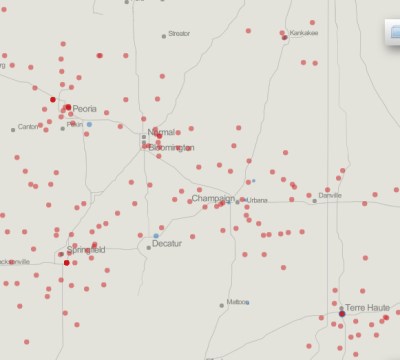
In Illinois

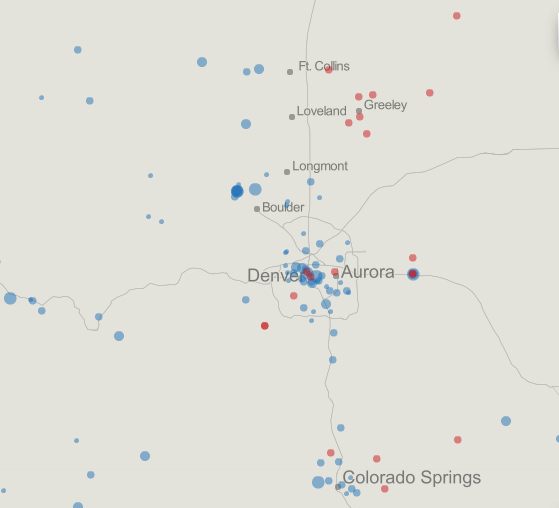
And we can see the fracturing of a political landscape in divided states–such as Colorado–where diverse concepts of the geography of sales, as it were, present different models of a lived landscape, almost cheek by jowl, alternating between spaces of chain stores and a telling density around Boulder, Denver, and Colorado Springs–with a few exceptions–of small businesses.  In some ways, this reflects the deep debates in the state on such issues as gun-control, birth-control, ecology and a more nuanced or complex relation to federalism.
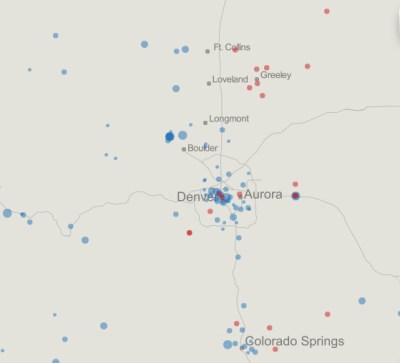
Complicated Colorado


Where we shop is increasingly what we are not only because of our attachment to objects or commodities, but how we are oriented to the world through the market–and as we map our relation to markets in different ways,  the ongoing onslaught of this attack of the big box stores has deep repercussions for our society’s unity.  Go forth and map as you do your holiday shopping . . . To be honest, some of the maps derived from this data don’t make immediate sense to me, or at least jibe with my own experience, such as the large number of small businesses found in Las Vegas, although I suppose this reflects the definition of a “small business.”
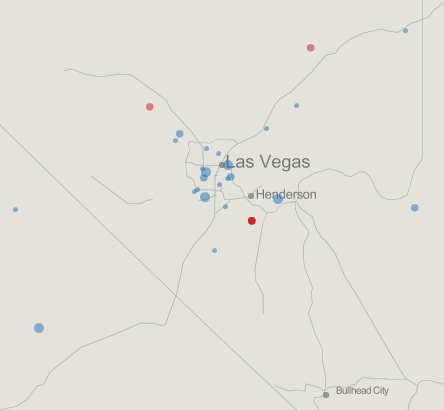
 

Las Vegas?

But the image of the Bay Area is somewhat recognizable, and recognizably blue.
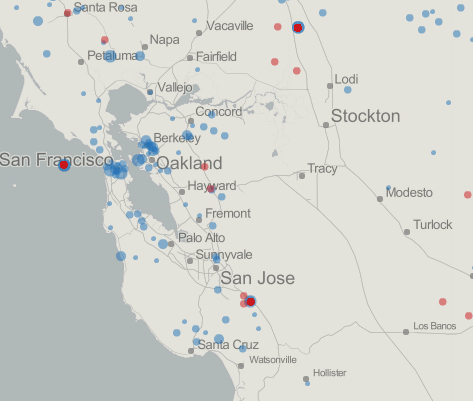
 

Bay Area

Yet a broader landscape and context emerges as one expands to adjacent ZIP codes in order to include bordering strip malls, including those inevitable and all too visible nearby strings of outlets, and sections of highway that are dotted exclusively with box stores.
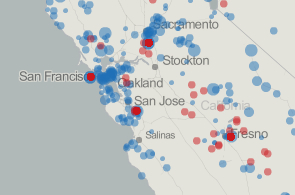
 

Bay Area Large

Leave a comment

Filed under American Community Survey, choropleth maps, Mapping Box Stores and Small Businesses, OSM, Red states v. Blue States, Red States/Blue States

Sacred Toponymy Matters: Framing Canaan, between Sacred Site and Jurisdiction

Symbolic maps of the Holy Land are unlike the local maps created for establishing territorial boundary lines or land-ownership that set.  But they have come to enshrine shared precedents and common recognized grounds of law, defining property lands of cultivated land.  Such maps acquired the status of legal precedents–indeed, they were ways of enshrining rights of possession in the law, even when limited legal grounds existed for territoriality or for dividing rights to areas where no evident natural boundary existed, and were to an extent imitated in these maps of the Holy Land.  The influential fourteenth-century jurist Bartolus of Sassoferato, among whose many briefs of Roman civil law  one had defended the legal governmental rights of city-states in the area of central Italy, famously appealed to the authority of maps to resolve disputes over river rights and alluvial deposits between towns by maps.   Although Bartolus’ influence, considerable before 1800, developed outside of a clear notion of government territoriality, he appealed to maps to resolve ownership boundaries outside of local statutes, in ways to create a common understanding and consensus about the occupation and ownership of a potentially disputed plot of land. The determining tools of cartography afforded the authority for manufacturing the map in ways that provided a precedent for drawing property lines, and bounding a landscape’s expanse which could be regularly provided and widely recognized.  This 1689 image of Bartolus’ treatise on the manners of measuring river rights uses a quadrant of Euclidean derivation to transpose a river’s winding serpentine course into geometric fixity, translating his discussion of to seventeenth-century surveying practices. illus244s Lines of jurisdiction are of course still particularly fraught, despite Bartolus’ appeal to the rule of the quadrant, and difficult to transmit, and not only around rights to rivers, some centuries later, but the value of maps in recording an authoritative transcription of rights emerged as a powerful judicial concept in similar quaestio, providing a precedent to which one could appeal as a form of priority. The authority of the map as a form of access to a precedent emerged in a context of reading that shifted from historical terms to juridical terms in an oddly circuitous way, in which the conjuring of territories came to be invested with quasi-legal qualities; indeed, to argue that the map conjures the territory or synthesizes it into existence collapses the complex process of mediation, causation and transmission, in which the map serves in very powerful ways. Sacred maps demarcate a sacred space that collapsed historical time in powerful ways. But once translated into historical terms, such maps materialized cartographical precedents, even if they when more rooted in a cartographical imaginary than in surveying practices or jurisdictional claims of a state. But historical maps of Palestine acquired a sense of authority as precedents in what might be seen as a sort of cartographical promise, as the map came to offer a tangible image to the historical imagination that also suggested a record of historical precedent.
For although they were less easily treated as precedents of similar binding force, historical maps increasingly came to stake claim to the inhabitation of the land. And in few cases can the relation between map and territory become more fraught with complications, and more delicate–especially when the same map is also being used to construct a nation, and is so strongly conjured from biblical writings as a way to imagine the existence of a new homeland. The historical maps of Palestine, framed in considerable detail long before the eighteenth century rise of jurisprudence, offered a compelling basis to organize and encourage readers’ familiarity with sacred toponymy and bounds that long anticipated European settlement of the land–and encouraged increasingly complex narratives to be attached to their own reading. The description of the historical borders of ancient land of Canaan encouraged an outpouring of early modern cartographical materials in the first age of widespread cartographical literacy, or familiarity with the authority of the map. The expansive fourteen-sheet wall map of Canaan executed by that industrious seventeenth-century mapper of England‘s territories, John Speed, is lost, but it expanded the 1611 “mappe of Canaan” he designed for the King James Bible–whose design was sufficiently tied to his cartographical competence that he secured a privilege for its reproduction. The map organized narratives about the Holy Land in ways that invested the region with a clearer sense of territorial identity it seems not to have earlier enjoyed. When Speed mapped the Holy Land in the seventeenth century, the map created a model for reading biblical space; William Stackhouse amply provided extensive maps in his 1744 New History of the Bible from the Beginning of the World to the Establishment of Christianity as historical documents of the boundaries dividing Canaan: the map of Canaan in his History afforded a material basis to understand how the Roman census divided inhabitants of the Holy Land, a territorialization of tribal divisions lended concreteness to the occupation of the region by Israelite tribes into discrete regions administered by Roman governors on clearly drawn lines. The national maps that Speed had earlier fabricated provided a precedent for mapping Canaan–not only as the “eye of history,” as the humanistically-educated Jean Bodin and Abraham Ortelius proffered in their maps–but as a form whose boundaries constituted something like a precedent to a modern nation-state. Speed had received a privilege for his “description of Canaan, and bordering countries” in 1610 that took advantage of recently increasing cartographical literacy to extend biblical readership by supplying maps of ‘the Ancient World’, ‘Palestine as Divided among the Tribes of Israel’, ‘Palestine in the Time of Christ’ and ‘The Eastern Mediterranean World in the First Century.’ Such images recast the functions by which maps invited religious meditation in the early printed bibles of Lutherans, by evoking territorial terms that prefigure if not invoke sovereignty. The curate Stackhouse, former grammar school headmaster expanded the authority of engraved maps in Bibles printed from 1733, and expanded in a two-volume edition of 1742-4, “rectifying Mif-Tranflations and reconciling feeming Contradictions, the whole illuftrated with proper Maps and Sculptures.” In it, Stackhouse’ “Map of Canaan, Divided among the 12 Tribes” was a surrogate for the map Revernd Stackhouse surmised with due consideration God provided “to shew Moses the compass of the land.”

Twelve Tribes Mapped in Stackhouse by Hinton

The Reverend Stackhouse explained to his readers that, given the difficulty of displaying the land of Canaan from Mount Nebo, “Jews indeed have a notion, that God laid before him a map of the whole country, and shewed him therein how every part was situate; where each valley lay, each mountain, each river ran, and for what remarkable product each part was renowned”–although he expressed doubts that this was the case, since it would dispense with any reason to ascend the mount “since in the lowest plains of Moab, he might have given him a demonstration of this kind every whit as well.” But what Moses saw from the mountain was itself quite comparable a map: although the “visive faculties” required to see Dan and Mt. Lebanon to the north, and the lake of Sodom and Zoar to the south, or the Mediterranean to the west and land of Gilead to the northeast, were “a compass above the stretch of human sight,” scriptures had it that the 120 year old Moses’ eyes “were not dim;” no doubt, Stackhouse surmised, “God strengthened them with a greater vigour than ordinary” that “‘gave his eyes such power of contemplating it, from the beginning to the end, that he saw hills and dales, what was open and what was enclosed, remote or high, at one single view or intuition'” (vol. III, chapter IV, 34-5) The visual presence of the map that Stackhouse imagined bequeathed a sense of concrete entity and identity to the territory that no doubt reflected the authority that printed maps of England had recently assumed, and indeed that the map had assumed as register of national identity. The notion of demarcating a legal territory in biblical times echoed the five maps Speed designed for the King James Bible, and gained a privilege for designing, although based on the earlier efforts of “the learned divine” John More. These maps were commissioned to encourage vernacular biblical readership, but respond to a sense of cartographical literacy unlike earlier maps of Palestine or Canaan. Speed’s maps coincidentally paralleled his project of uniting the parcels of English territory in the 1610-11 Theater of the Empire of Great Britain, creating a composite legible image of national sovereignty across England, Wales, Ireland and Scotland, in ways that abstracted an entity from the land that was earlier difficult to be cartographically imagined. The widespread republication of Speed’s atlases and Theater in the 1670s and 1680s that included maps of “His Majesty’s Dominions Abroad” on its title–and maps of New England, Virginia, Barbadoes, and the Carolinas, broadening the canvass of the nation. Reverend Stackhouse built on this precedent of recording imperial unity by offering a territorial explication of biblical narrative in his New History of the Holy Bible: his “proper maps” were proper since they set a standard for the symbolic mapping of the region that might have been read by Abraham, and offered a basis to understand the distances from Nazareth to Bethlehem as bound by legally binding frontiers, linking the name of each tribe to a region that reflected the Roman imperial administrative divisions drawn across the Holy Land, as much as its cities. In addressing a larger readership of printed bibles, such maps concretized a detailed and palpable relation to the territory.

The translation of the findings of surveys to such widely diffused maps–and the translation of surveyors’ findings from these maps to later maps that won a large readership in sacred texts–deserves to be examined as a subject of cultural history.  To argue that the map conjures the territory or synthesizes it into existence collapses a complex process of mediation, causation and transmission, in which the map delineated an imagined “geobody.”  And the emergence of “historical” maps of the Holy Land raises questions of how the map only becomes the territory over time. Where the palpability of such images derived from, and how they were deployed for a wide readership across a broad geographically dispersed readership, raises questions of the sort of cartographical literacy that came to be communicated about the Holy Land. The layers of translation from territory to map and back again open something like a chasm of misreading how a map maps to a land.  The attempt to restore the bounds of a broader “Greater Israel” beyond the national bounds of the nation–and returned its bounds to the “Promised Land” described in Ezekiel or Genesis 15:18-21–bizarrely transpose a sacred text to the project of  the mapping of the nation, current among some  more right-wing parties of the current Israeli state.  The multiplication of alternative maps expresses a dueling between contesting visions, still needing to be fully mapped, and exchange between an imagined unity and the state’s actual boundaries.  As the reality of the state of Israel has grown, the map that informed it, however, takes on new urgency–if only because of the expansion of a mythical-historical perspective on the identity of the same land.

Palestine1100tribes

The inclusion of a series of geographically situated Battlefields of the Twelve Tribes in this 1864 map of the same territory lent considerable tangibility to the map of the Holy Land as a detailed historical topography, based on the current surveying of the same landscape.    The positioning of the sites of ancient battles against this field of clear elevations, hillocks, rivers, the Dead Sea and other topographic realities created a sense of concreteness that bestowed a sense of strategic encounters in an actual lived terrain–something of a proxy for the hopes for territorial repossession of an actually remote sacred land:

battles2

Did such glorious four-color relief maps, published before the Hungarian journalist Theodore Herzl called for the creation and foundation of a Jewish homeland in his 1896 Der Judenstaat, help to conjure the territory? For by 1897, Herzl described the goals of Zionism “to establish a homeland in Palestine [that was] secured under public law,” the idea gained resonance because the map had already concretized a claim to the territory and the “legally assured home in Palestine”–long before the the 1917 Balfour Declaration affirmed “the establishment in Palestine of a national homeland for the Jewish people”–transposed the sacred map into a legal precedent, mapping a mythical historical toponymy onto an actual territory in ways with which we continue to struggle, and to which numerous counter-maps have been articulated at the same time as maps are used to try to narrate the geographic displacements and renaming that occurred–so often in the name of remapping the map to the territory, and re-asserting the complex narrative that was itself generated from the increasingly fraught relation between territory and map. The concrete detail of the maps realized the imaginary existence of the region with a concreteness that provided a recognized and recognizable image of lands settled by the Twelve Tribes by 1900 as if it were their property.

israel-holy-land-divided-amongst-12-tribes-section-from-east-to-west-1900-map-73345-p

And, to jump wildly–and fairly irresponsibly, it must be admitted–across time, after 1948, the negotiation of these sites of settlement and creation of places of habitation was considerably more complex to negotiate, as this recent map of Israel’s relation to the occupied territories reveals, a process of negotiation building from and negotiating the attempt to integrate Gaza or the West Bank in an earlier notion of a “Greater Israel.” More pressingly and compellingly, than this cartographical fantasy is the manner that the image of land defined the bounds of the land’s inhabitants by 2007.

West_Bank_&_Gaza_Map_2007_(Settlements)

The “other” side of the historical story is presented in this 2012 map of the scope of the declining expanse that was bounded in the Palestinian state from virtually the same date–1897–up until the present, a map that seeks to conjure, if it obscures the human cost of displacement of some 5 million Palestinian refugees from the 1948 and 1967 wars and their descendants, now living in Jordan, Libya, and Syria, as well as the West Bank, at a moment commemorated on May 15 as the Nakba Day [يوم الن], or the Day of Catastrophe.

Map6_RefugeesRoutes

The map is striking for how it reveals a counter-example to the above fantasy of occupation–paralleled a renaming of the land, and a government committee dedicated to the erasure of some thousands of Arab place names, from cities to hills, valleys and springs, was delegated with the task of creating Hebrew names as when David Ben-Gurion affirmed “We are obliged to remove the Arabic names for reasons of state,” dedicating the nation to the project of determining place-names in the Negev, or southern half of Israel. For a more expansive version of this post, please click here.

Leave a comment

Filed under Bartolus of Sassoferato, Holy Land, Israeli toponyms, Israelite Tribes, Mapping the Holy Land, Michael Chabon, Nakba, Traditional Palestine, Twelve Tribes, William Stackhouse