Monthly Archives: April 2013

The Density and Habitability of Urban Space

How to map the compelling question of urban livability?

The journalist, blogger and economist Paul Krugman sought to qualify exactly which pressures drive the costs of urban housing recently in “Conscience of  a Liberal.”   Krugman qualified how population density effects urban housing prices, by noting the importance of mapping density in new ways.  Scarcity of space or land constraints might seem to shape prices from a point of view of supply and demand, but Krugman argued that we can attend to a new urban geography by looking at aggregate rather than standard population density alone:  in response to Noah Smith’s argument population density was less relevant than proximity to economic centers, he argued that the rise in the prices of extra-urban areas across America, and “hiving off” of exurban areas in such cities as Phoenix or Houston, where the relative scarcity of land does not determine prices and population density in cities’ centers can change independently from the prices on its peripheries.  Following  Richard Florida, the mapping of “population-weighted density” of census tracts that can capture the way that Americans tend to be moving toward less densely weighted areas of habitation, even if the population, nation-wide, is rising.  (While population rose 10% in the US 2000-2010, it also spread out across urban areas, which became less densely weighted over time.)

This new picture of the United States that has cultivated a “lifestyle” of a less dense mode of living seems to be based on the increased valorization of “inhabitability” as a metric for home ownership in ways that are for more widespread than the movement to the suburbs in the 1970s:  we are all moving toward less weighted centers of population.  The hiving off of new suburban regions on the map that Krugman describes have not only pumped-up real estate is a reaction, in part, of voting with one’s feet against the over-density of urban space.  To be sure, although New York City property values are high, if we all lived in at the amazing density of New York City, the entire 7 billion inhabitants of the globe could fit into a geographic space similar to Colorado–a state which currently has a low density in much of its expanse, but whose pockets of population density are interestingly clustered close to adjoining regions of medium density.
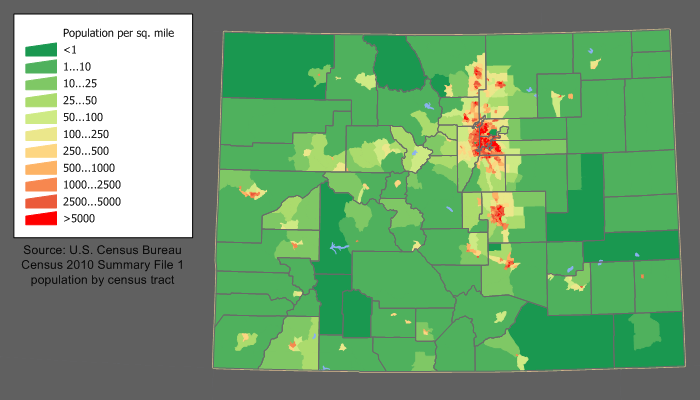
Colorado_population_map

One thinks of the much-circulated infographic, repopulating the world within the United States at the density of global metropoles, that suggests the exceeding density that urban cities have come to acquire, and the continued density that a city such as New York or Paris holds, in comparison to San Fransisco or Houston:
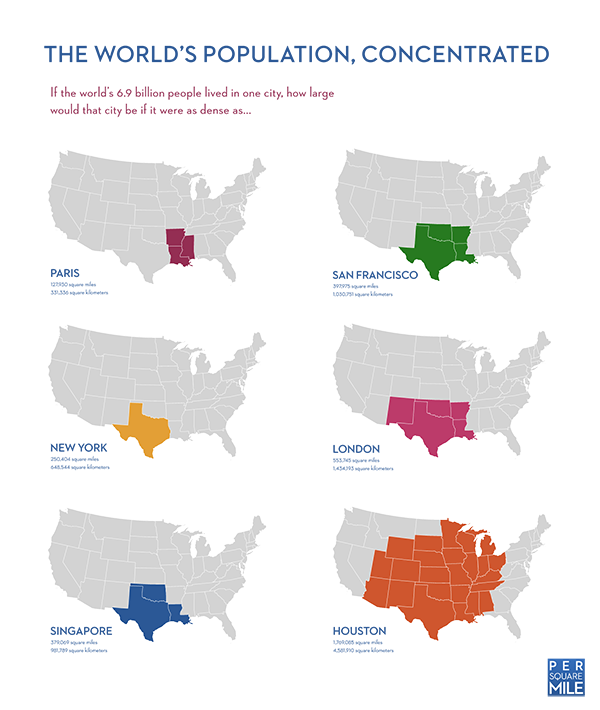
the-worlds-population-concentrated-small

The variation of cities suggests some reasons for, say, the greater “livability” of certain places, as well as the distinct nature of the urban experience in a broad selection of cities across the world.

So what does this “hiving off”–distinct from suburbanization, as it suggests an exurban experience even outside of cities with relatively low population density, entail?  The 1970s phenomenon of widespread suburbanization, allowed by the creation of major highways and arterials that fed by commutes to urban centers like New York or Los Angeles, which served as an endangering withdrawal from many public schools in cities and urban centers, reacted to the intense pace of urban growth and in-migration.  Rather than based on suburban homes, the hiving off of communities echoed a similar demand for “habitability,” but was now about creating new spaces where exurban communities could be created, and how we could use the concept of aggregate density to measure them.

Krugman offered a more specific updating of James Kunstler’s compelling critique of urban sprawl.  when it was launched in the 1993, Kunstler decried the unwarranted expansion of suburban housing and malls in a manifesto that responded to America of the late 1980s, The Geography of Nowhere, as “the greatest misallocation of resources the world has ever known”–what he called “dead spaces” that he saw as produced by the new attitudes to space that the automobile allowed, stripping vitality from urban centers, and creating the rise of quasi-spaces of strip malls as suburban heterotopia, displaced amusement parks of purchasing, lined with unproductive spaces of parking lots.  This partly architectural perversion of lived space, for Kunstler, led to an evacuation of vitality.  Krugman focusses rather on the place that “habitability” has gained among the economic forces that shape the prices of urban homes:  his argument begs to be mapped, or graphically modeled as well as understood by statistical indices.

Economic thought might be playing catch up with cartographical modeling here:  the critical mapping of density, after all, began right after the 1870 census, when Francis Amasa Walker, superintendent of the census, offered a new model for mapping the population density of the nation not according to county, or electoral districts, but according to the actual contours by which the citizenry inhabited space:  dividing each square mile into its relative density of inhabitants, Walker distinguished those zones with less than 5 inhabitants/sq. mile from those with 5-15, 15-40, 40-75, 75-125, and over 125 inhabitants/sq. mile in 1872, and from that year undertook a number of projects with congressional funding that mapped that distribution against wealth  per capita, to create the first map to record the distribution of wealth in the nation’s geographic space, revealing the dynamics of income distribution along spatial axes–in what Susan Schulten aptly described as the nation’s first example of an infographic.  (Never one to not consider the uses of mapping populations, he created similar maps for the US Congress that mapped population density against disease, illiteracy, public debt, ethnic groups, and the birthrate.)

Desnity of Population [of US]

Such a clear figuration of density does not correspond to actual urban areas, given the former density of rural populations–or have fine enough grain to distinguish property value in them.  But it roughly reflects property values in the nation.  But its generalization of density across each county provides a useful metric to understand variations in the generation of income, tax revenues, and birth rates.  While a model of density-independent population growth may be applicable to animals–plants, insects, mammals, and other seasonally reproducing species, population growth is rarely independent from density in human populations:  and with the increasing segregation of age cohorts in contemporary America–and the graying of some cities, and lower age-level of others, the metrics of growth are especially not uniform.

A more contemporary, but less statistically exacting, version of the infographic–stated in the bluntness of th modern infographic, might provide the following portrait of the relative density of individual states in the union:
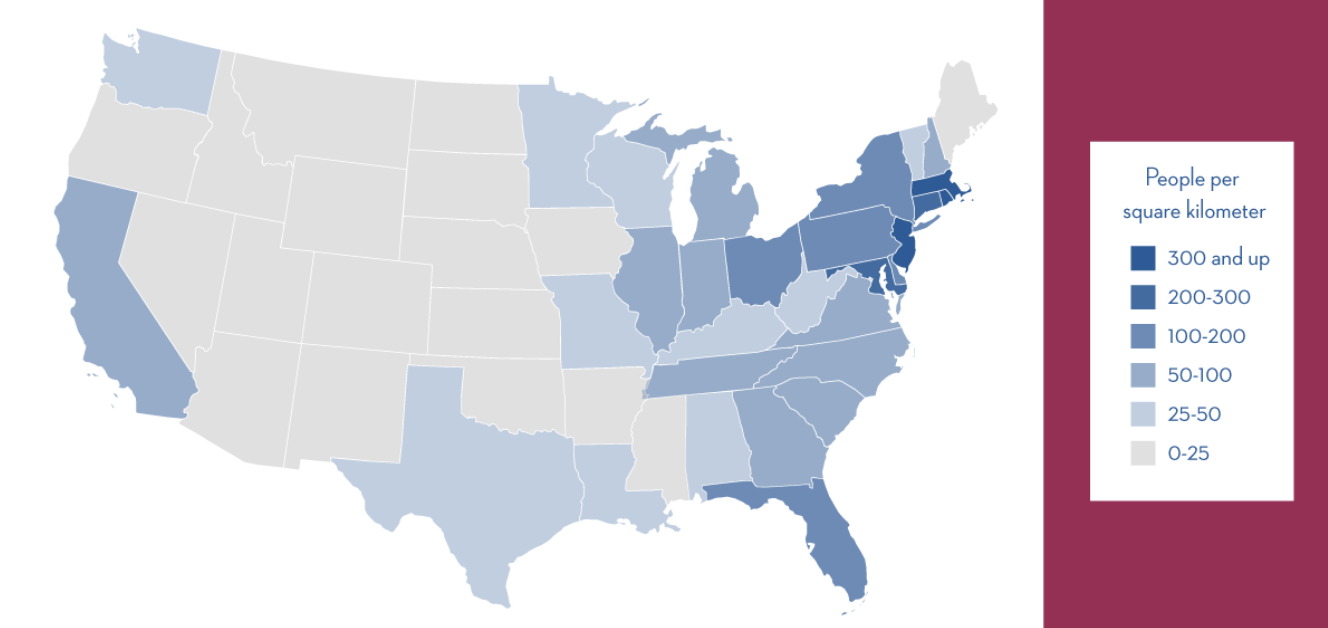
sq kilometer

At a finer grain, we find a density map as the following, which provides far more refined detail:
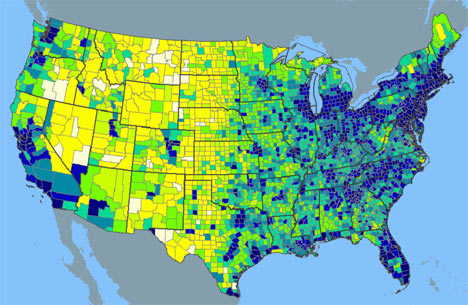
specialreports_2edb.population density usa

And we can zoom in for density of regions, in ways that provide a clearer picture of the Southwestern states in terms of how they broke down by counties, over time, around metropoles:
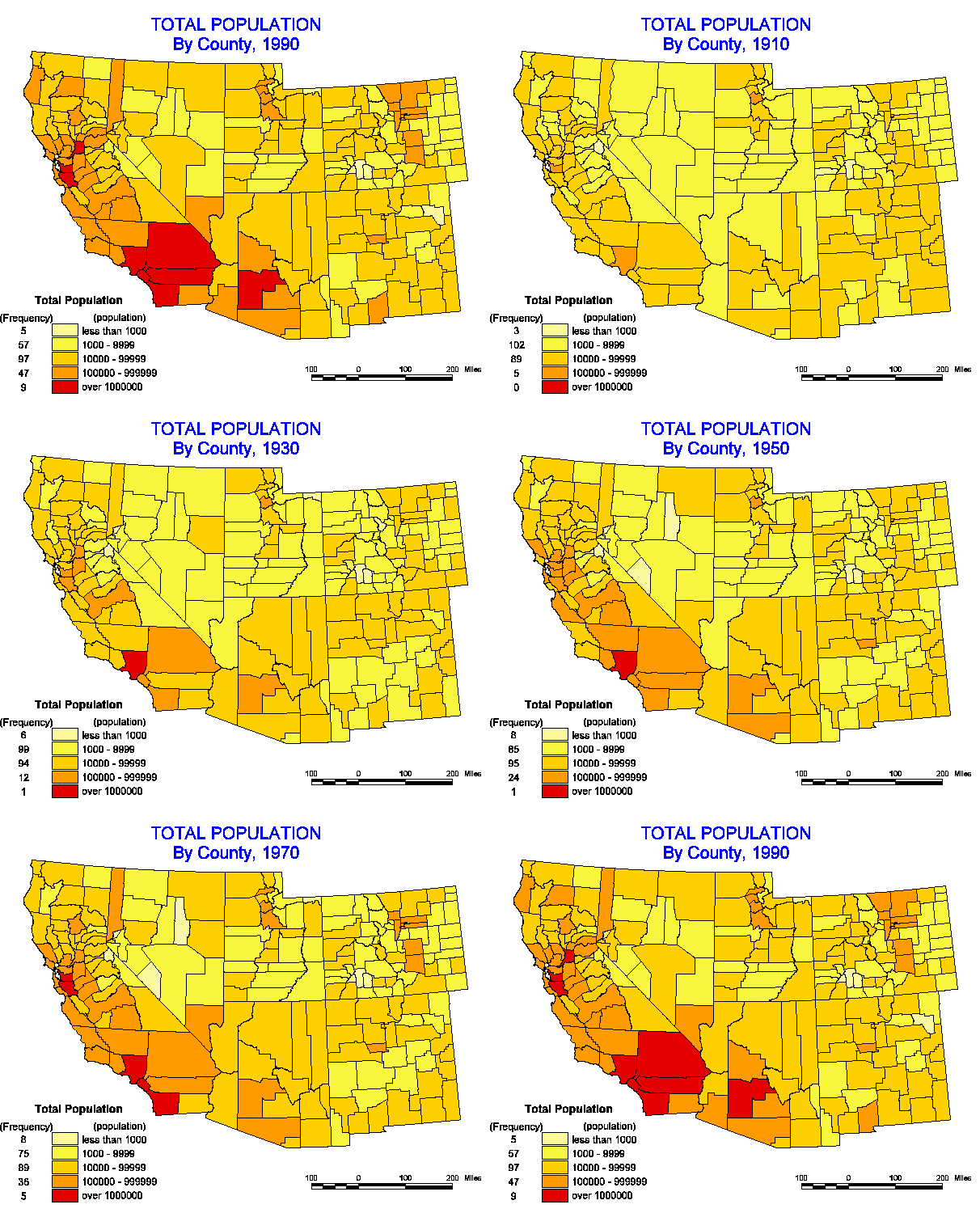
popanim

To be fair, such a general level of density is not that relevant to the points that Krugman addresses in this specific issue, where he advocates the need for moving away from such generalizations of state-wide population densities, which are less meaningful for microeconomic questions, to examine the organization of the city as a unit in ways that will allow us to distinguish the changing character and economics of urban areas.  Krugman considers how changes in urban geography across the US reflect a new paradigm or model of population density, he asks us to consider new tools to map where ‘average’ Americans live by the “weighted” density of population distributions similar to the sort of maps Walker first innovated, and focus attention on the relative density of different zones not of the nation but individual urban areas.

He argued that overall ‘density’ means less today than ‘aggregate density‘ or the relative density of neighborhoods or sectors of new urban growth, and used this as a dynamic structure to  map population density according to weighted density to better  understand how the “average” American lives.   He does so to offer a critique or assessment of how his fellow-economist Bill McBride suggested attending to population density as they were correlated with housing costs his competing finance blog, Calculated Risk.  Does overall ‘density’ mean less as a measure of housing cost, Krugman wonders, than ‘aggregate density’ (or relative density) within selective regions of cities?

Like Paul Krugman, I would question the meaning of density as an index of value, but I would suggest we need to develop tools to understand the dynamics of density that involve a more fuzzy or less quantifiable variable of habitability, which I would argue if less easily quantifiable becomes more evident in maps.   And in the remainder of this post, I’d like to show how maps offer a measure of the fuzzy value of ‘habitability’ as well as its inverse, a perceptions of ‘uninhabitability,’ might be loosely understood as a way to map the increase or the radical diminishing of property values rather than density alone–or understandings of how density drives demand.

We might  use these maps to include other variables that shape density, and use maps  to do so.  The question of how we can try to map habitability, both in terms of access to open spaces, access to markets, and attractive environments, might create an even better index of value.  In San Francisco, for example, where property rates have risen dramatically in the past several years, and whose neighborhoods are confined to a small area of land:  Oakland is itself much less dense, if also confined by similar topographic limitations, notably the mountains:  but four of the ten most expensive housing markets in the country, including Santa Clara, San Mateo, San Francisco, and Marin, are in the Bay area, according to the recent March 2013 Report of the National Low Income Housing Coalition–and in the state that requires the greatest hourly wage to rent a two-bedroom apartment.
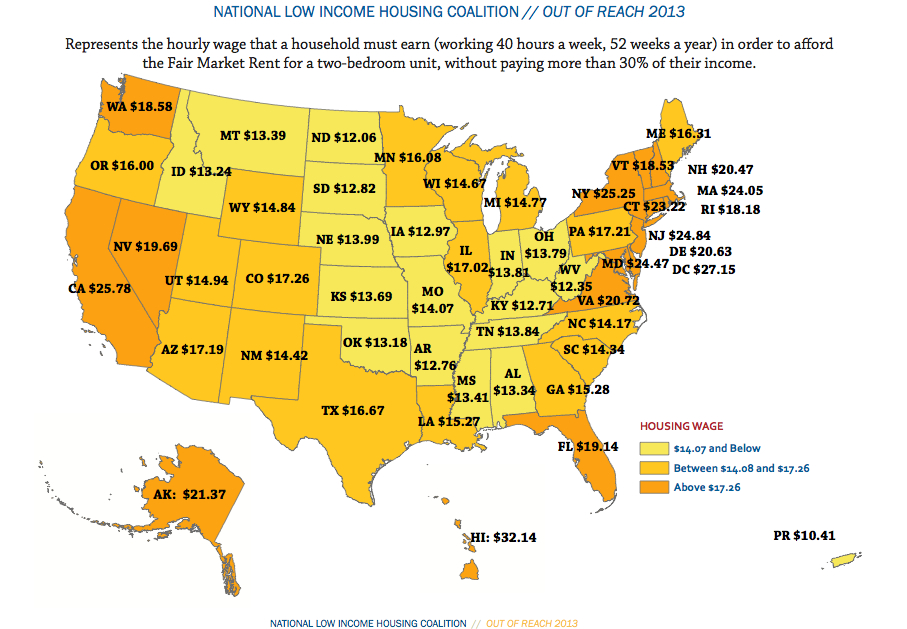
out of reach hourly wage per two bedroom

To be sure, the variations of real estate and population in a state like California are closely tied, given the huge variations of density across the state.
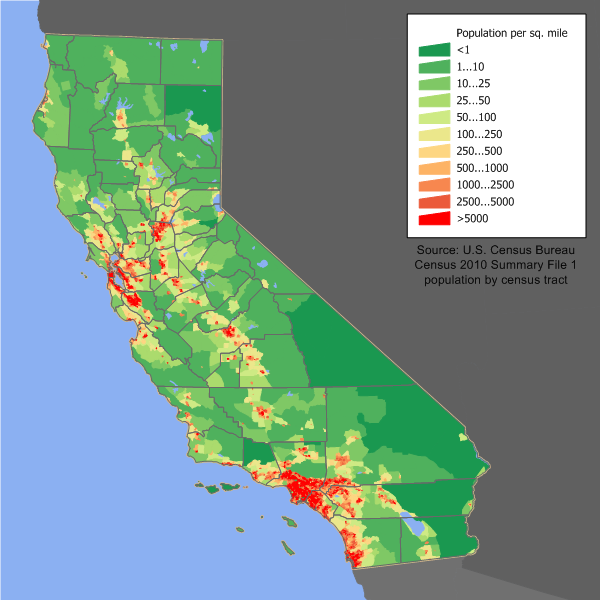
California_population_map

Yet the profound variations in the Bay Area, to take one example that is clotted with a red of high density, indicates profoundly striking differences in desirability:
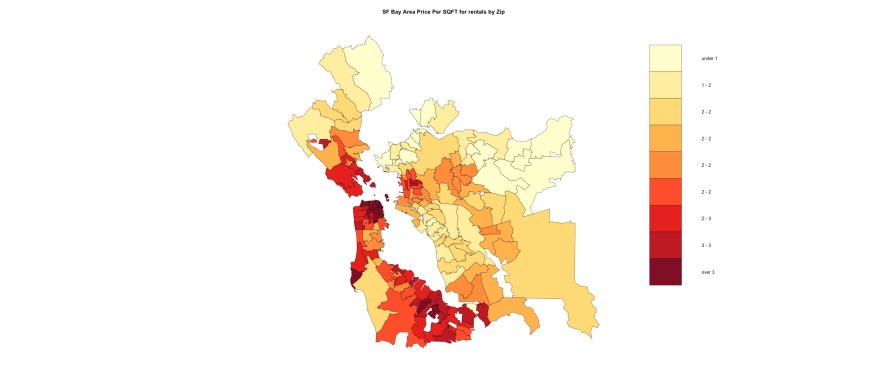
sanmap1

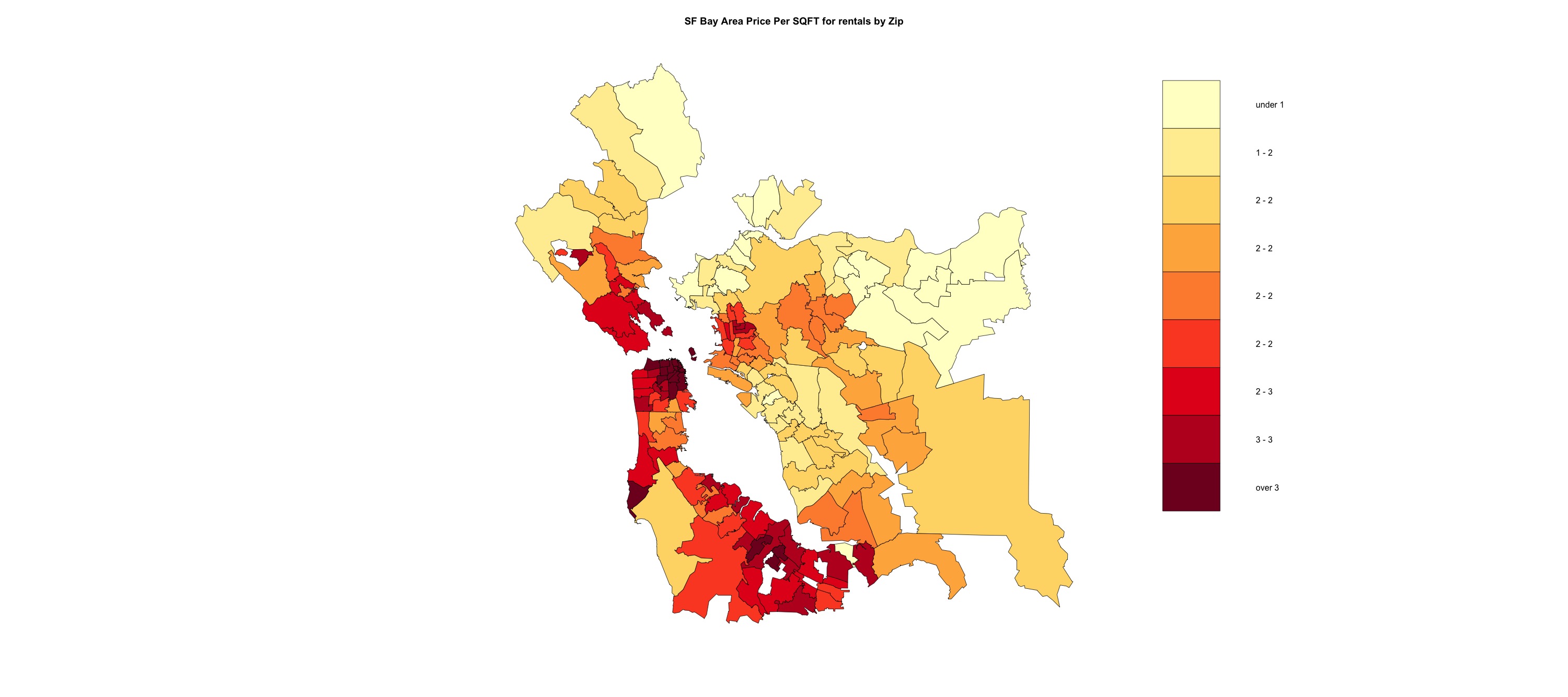
And such dramatically differing variations across the region seem to be distorted by the demand for living near a not-densely populated area such as Silicon Valley, where real estate prices are suggested in this Kwelia map of 2012 which illustrates the relative geographic distribution according to median incomes–and suggests the very real distortions in real estate that can occur independently of actual or weighted density.
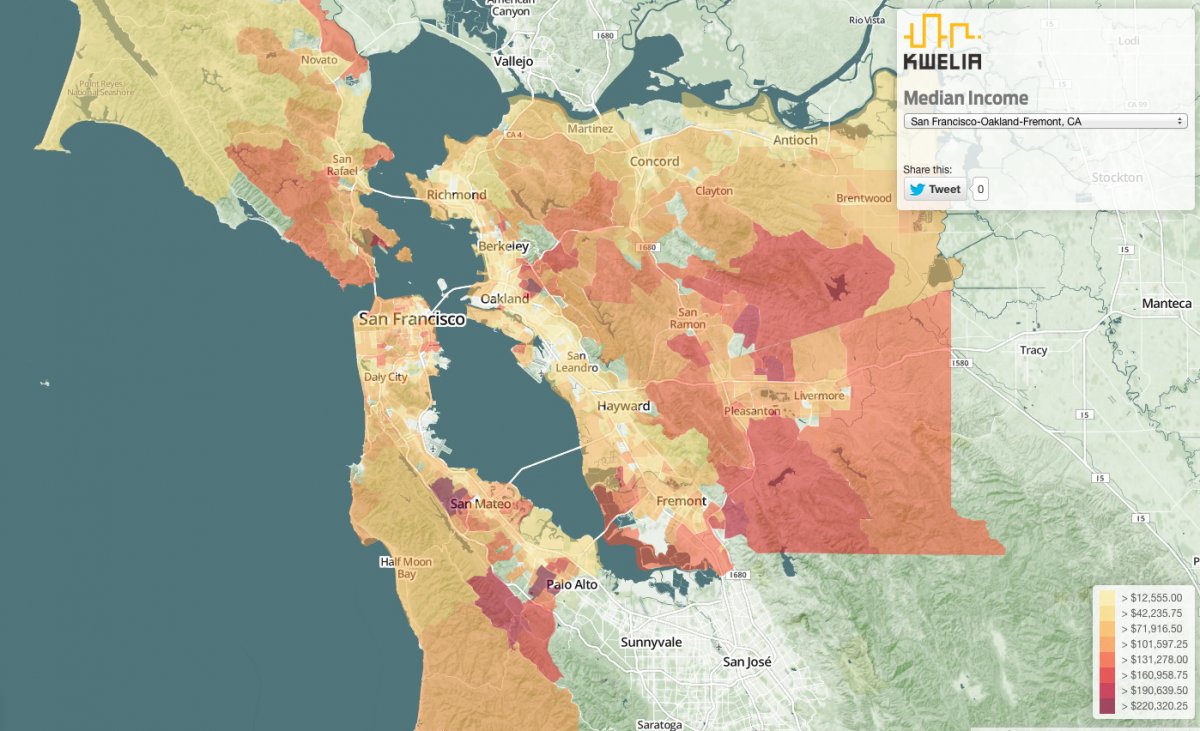
screen shot 2014-01-17 at 9-2.14.13 am.pngKwelia


Whereas the debate between the economists turned around the measure of density, it’s unclear why in an age of complex data visualization Krugman omits variables beyond density or to map determinants of urban spaces.  As an economist is wont, Krugman tends to confine himself to contrasting the relative value of alternative models of housing markets in urban space.  If we accept the model of scarcity as the motor of rapidly escalating real estate prices, it’s hard to explain the rise of attraction to less densely populated urban areas in urban areas, however, or the re-use of less inhabited areas as new areas of density.  If we might assume rising population means rising housing costs, as Smith has since noted in an update to his post, transit policy and presumably other public policy issues related to urban infrastructure can influence or shape housing costs–issues that introduce habitability as much as density as an influence on housing costs.

If we weigh models of density and populated-weighted density as models of urban environments, population-weighted density might help explain the social geography of urban spaces at a time when average American increasingly live in somewhat less dense neighborhood:  during the first decade of the century, population has broadly “spread out within metropolitan areas” and brought a “hiving off” from cities and led many cities to abandon the model of a vital urban core is often associated with  “quality of life.”   But the generic term does not reflect how urban space becomes mapped as habitable to different populations and demographics:  for just as cities are mapped in new ways by public projects of urban infrastructure, people map areas of settlement around the contours of urban space by preferring zones,  in turn attracting further interest in them.  An interesting liberal strain of response to Krugman’s post bemoans the end of Jane Jacob’s model of the city as constituted by local communities and the positive sense she gave density as causes of the community and vibrancy of individual neighborhoods, which she valued as the basis for urban life.  (Many also critiqued his argument as not acknowledging the economic models of different cities, from how the absence of economic vitality thins cities like Detroit to how hi-tech creates a new geography of work.)  But in mapping population-weighted density only in numeric terms, Krugman may ignore the appeal that the neighborhood–as much as geographic location–has on real estate, and the increasing flexibility with which a neighborhood–even of different but overlapping socioeconomic backgrounds among their residents–is redefined in particularly flexible ways.

Less attention is paid in both models  to the constraints by which people map their own living spaces, even when constrained by a city’s complex and often unfair geography.  Parts of urban environments are recast as more habitable based on different criteria, often in response to the made or ‘created’ geography of the city–or fail to be recast in habitable terms.  The growth of desirable land in Los Angeles responds to the constraints with which freeways have sculpted urban space, and indeed in ways bound by the 405 in a sort of deterministic way, and the creation of the former Cypress Freeway shaped–and in cases destroyed communities in Oakland, California.  Vice versa, patterns of urban settlement and housing prices helped the investment in an urban infrastructure as transportation in Boston or New York, because they led populations to map their lives in urban space.

Does density alone shape market prices?  In a sense, yes:  but density is a reflection of deeper indices that one might better term ‘habitability’ given their manifold causes and considerable variations.  Changes in workplace practices and locations encourage a shifting relation to the urban space, as more people work on-line, of course, and live and work in isolated archipelagos around cities:  the vitality of neighborhoods that Jacobs celebrated has become far less important as a unit of economic meaning with increased geographic mobility and more dispersive work environments, including telecommuting. As a result, the framing of a debate between population-weighted density or the availability of “space” as determining land value omits the notions of habitability shape urban space: rising land prices in LA, for example, reflect the shifting attitudes to space created by a system of freeways that shaped land values–rather than scarcity–and defined a map of urban settlement outside corridors of transport that, more than mountains, shape Los Angeles neighborhoods.

This reflects the desire for a way to maps how areas become understood as habitable:  and in Oakland, where property values have risen not only in response to the rising rents in SF, but as the city has been defining new notions of habitability by restaurants, urban gardens, and public spaces like farmers’ markets.  By trying to identify a model for urban settlement, geography of population density becomes a stick of measurement rather than the remaking of urban spaces:  multiple complex constraints on the habitability of urban environments limit the development of urban land values.  In  the recent recouping of housing prices in the Bay Area, for example, areas of recent price increases were mapped based on data from Zillow.com–and metadata from Google Maps–to find a considerable recuperation of costs in San Francisco and Fremont alike, despite their quite different density, and a mild recuperation in many of the low-density areas of Berkeley and Oakland, as is rendered evident in the regions of light rose coloration below.
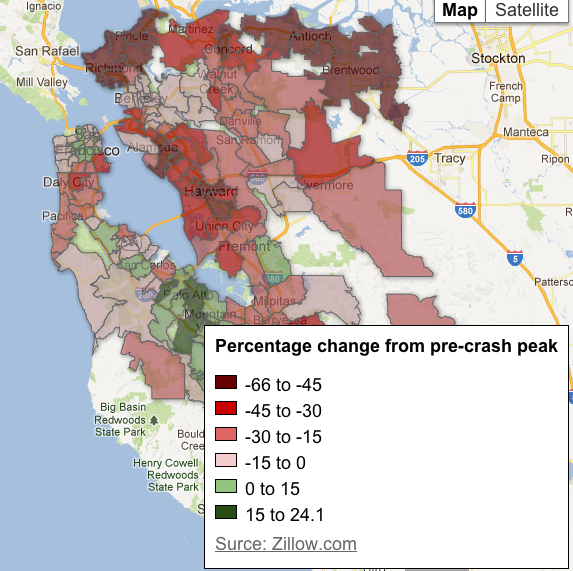
 

Bay Area Property Map

Conversely, if much of Richmond, Brentwood, Antioch, Union City and Hayward remain selling at a far lower price than in the prior boom, many Oakland properties sell at a brisk price, and hi-tech areas like Mountain View–and some areas near Walnut Creek–are positively booming.  To some extent this has to do with access to economic centers:  the less populated but also less desired and more removed Daly City is nowhere near recovering its boom prices, while Mountain View has surpassed boom prices.  But the widespread recovery speaks to issues of habitability, as much as density.

As a counterfactual, let’s look at some actual urban environments where the question of habitability responded to a striking lack of investment in creating a habitable urban space with adequate infrastructure or access to green space–one crucial measure of habitability.  Consider, for example, the considerable distances at which less valuable property lie from green spaces or urban parks in Los Angeles, creating an endemic that led the “LA Streets” Blog Santa to bring the city more green spaces last Christmas.  (African American neighborhoods enjoy .8 acres per thousand people, in contrast to the recommended 10 acres per thousand inhabitants, or the median 6.8 in high density American cities.)  Pink regions here map a distance from park exceeding the LA average, most of which are concentrated away from the shoreline or surrounding national forest:
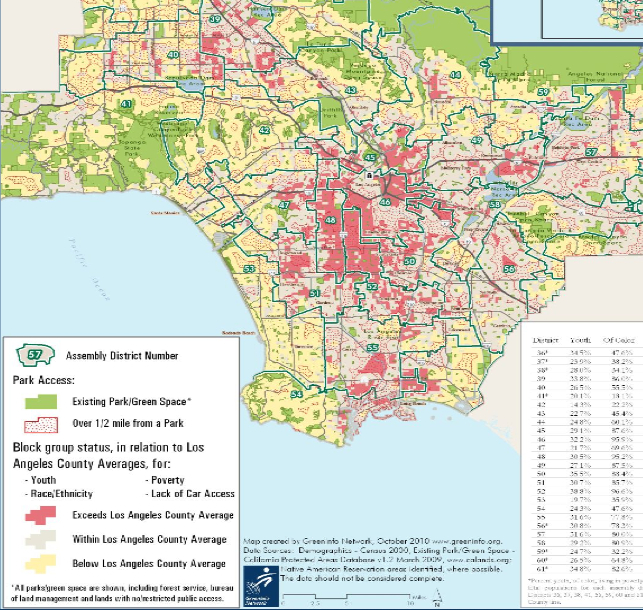
Access to Parks in Los Angeles


The value of land responds to how we map urban spaces as habitable often shapes property values, as much as the questions of the availability of space. Something like the new Stamen map that focusses on the readability of mapped space by watercolor tiles, pioneered by Zach Watson, provides a new resource to look at urban space to analyze questions of habitability without being distracted by data overload, in what was intended as a visually simpler and pleasurable alternative to the tedium of Google Maps, provides a manner to differentiate neighborhoods in San Francisco–albeit a region whose high real estate prices don’t need much explaining:
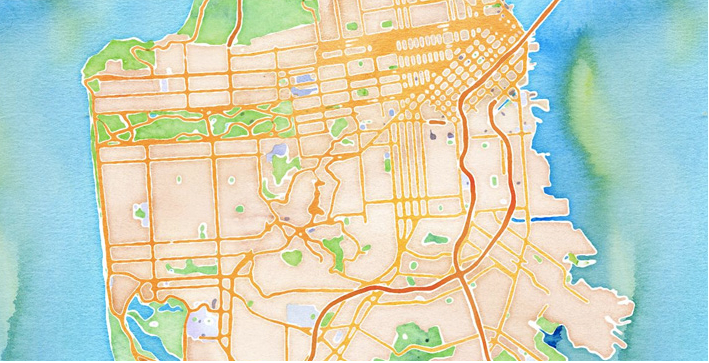
 

SF Greenspace Stamen


Krugman provoked an interesting comment that advances in GIS could provide new tools to include aggregate densities in urban spaces.  Indeed, working with the above Stamen map, or with a time-lapse model of aggregation might provide tools to show the shifts in how space became ‘habitable’ or worthy of inhabitation.  These tools offer the ability to map a new geography of work:  one could model of the shifts in economic redistribution of wealth in urban space, or relative distance of residents to workspace, that might map the relation of neighborhoods to space beyond their relative income or real estate costs.

Flexible GIS models might also help reveal the different maps people create within a city as an environment in powerful ways.  In juxtaposing the alternatives between two models of urban life–the metric of population growth, which  creates competition for limited resources of land in a somewhat Malthusian fashion, or population density, or urban settlement informed by how agglomerations understood in terms of population-weighted density shape demand in extra-urban spaces or urban peripheries for land that changes land prices–the mutable map of the urban fabric is either dramatically oversimplified or ignored.   When land is constrained, the first train of thought goes, rising populations increase the price of land faster than inflation; the questions of how people map land as habitable–and desirable–more informs the second proposition, pointing to the rise of “edge-cities” on extra-urban space that become desired centers of population.

That choice between population and weighted density seems a bit artificial,  because both are abstracted from how people make concepts of neighborhoods out of open space–by mapping it as their own, or by not being able to do so.  Today, New York has of course become the model of a high “population-weighted density” city, based on the average land density of its inhabitants, or the relative density of its populated areas.   But whereas in the 1970s suburbia gained value in the 1970s around greater New York, leading them to abandon a city that became defined as less “habitable,” and to define preserves away from commercial activity, we now value habitability as a relation to a neighborhood, or something like one.

The remapping of the urban core as economically vital paralleled a shift in the understanding of its “inhabitability”– mapping not only its density, but what makes it conducive to habitation or less appealing as a living space.  Could we map the shifts in aggregate population density to investigate patterns of land value, to examine the rise of prices in New York and in regions of uneven density of population spread out within large cities?  One point here would be to chart the spaces made and created in individual cities over time that informed property prices by creating new models of the habitability of the same spaces and of urban life.   To do so, I’ll use maps to illuminate shifting attitudes to space.

Before considering urban geographies, it’s interesting to map a distribution of the predominance of bars to grocery stores in a cute map that I can’t resist–with surprising concentration, the number of bars exceeded grocery stores in urban areas clustered in the Midwest and parts of New England, and areas of the plain states and spots of the Southwest.  It would be interesting to pursue this map into urban areas–does the prevalence of bars over grocery stores suggest a greater role in serving neighborhoods, or a preference for the social function that bars serve in specific urban or rural regions?
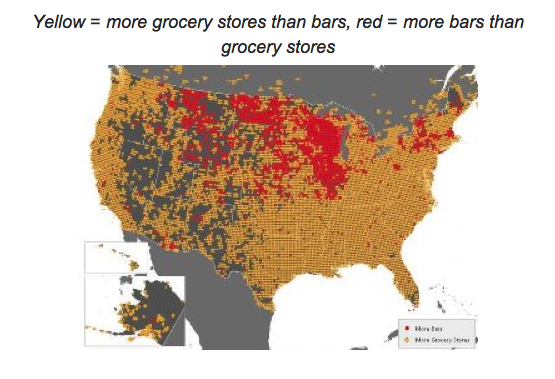
Grocery Stores v. Bars

The map may tell us about a culture of sociability–in the colder midwestern north, and New England, bars are important sites of aggregation.  The map speaks about how folks create habitability in urban space in response to different constraints.  We can use this model, more importantly, and this will be the end of the post, to expand the criteria by which we look at urban spaces beyond density that can help raise new questions about the relationships between property value and urban milieu.

Others might reveal the increased livability of different spaces within the city, as this map of the green spaces in New York City, perhaps the city that possesses the densest urban core, in ways that map urban resettlement outside the region of its greatest densities by the foundation of community gardens and urban agriculture, discussed in an earlier post, which notes those places that accept volunteers by blue dots:
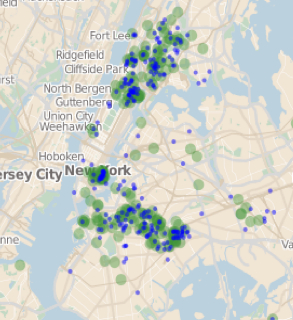
 

Community Gardens NYC region


The map reveals not only an expanding urban green-space, but the re-envisioning of densely occupied areas as of more livable urban spaces, in ways that mapping population density or aggregate density alone don’t suggest.

Still other maps of urban environments reveal the constraints on the very maps we make of urban space that are so central to housing prices–a process perhaps missing from Krugman’s discussion of two attitudes to the analysis of land-value.    Maps are a central tools of real estate to attract attention to  property and shape urban space into neighborhoods, and fit notions of habitability into existing spaces.  Many structures define these spaces of habitability, not necessarily understood in terms of weighted density alone.  Los Angeles is not, as Krugman’s piece suggests,  “hemmed in” by mountains that constrain city’s sprawl; its low density seems to run out to the Valleys, as freeways define the urban space and create  anew map of property values and more habitable and valuable land.  It almost seems land properties rise in their remove from the freeway, where the relation of land to freeway is more easily mapped, much as much of the value of land in Santa Monica seems to recede in value from the Pacific. Freeways or overpasses divide urban space and help structure maps of habitability; freeways of easy commute may, conversely, increase the value of hived off aggregations of “edge” cities, by improving connectedness to other environments.

We can map moreover habitability in different ways.  Cities like Oakland CA offer a sort of counter-example of a space where habitability set off a rapid rise of real estate values and the price of land:  there is no clear confine to urban space, but the spread of restaurants, green spaces, farmers’ markets, urban farms, and open public spaces fashioned a new notion of the inhabitability of distinct areas of its urban space in successive districts, earlier shunned, even when considerable crime continues to plague nearby parts of the city and the city hears the screaming sirens of police racing to the victim or scene of a homicide.  (If some would say real estate prices derive from the flight from the property values of San Francisco, that only seems to be the icing on the cake.)

The value of land is not a simple calculus of limited supply, but of the mapping of urban space–first taken up by real estate agents who sculpted Oakland’s neighborhoods, but informed first by a shifting sense of the habitability of the land, whether in the middle of an old port-city or the more trendy area of the Temescal.  Demographics prefer different models of habitability; the age of the population of Oakland seems exceptionally low, for example, as they might first define the city as more habitable.  The shift of populations toward less densely settled urban areas reflects this shift in how we have come to map habitability, one might say, even if aggregates of population density reflect land value; without numerical data to show for it, I  offer that the value of land reflects the relative scarcity of habitable areas in urban space, but also shifts as notions of habitability emerge.  In New York, the premium on habitability drives the growth of new neighborhoods, from the allure of Soho or the East Village to Brooklyn Heights as more habitable than more crowded urban environments.  Imaginative ways to map public spaces create habitability in urban regions; the lack of parks in Los Angeles fuels a somewhat undifferentiated urban expansion and settlement.

But there are huge obstacles to mapping the habitability of space in the very regions and cities that habitability might be encouraged, as we find habitability to become, in much of California, the preserve of the wealthier few, and urban spaces constrained by barriers to their physical improvement.  Take a simple map of the distribution of parks in the state, and reveals radical differences between the parks/inhabitants: the polemic map ties park-poor areas to income, contrasting darker greens to show greater availability of acreage/thousand inhabitants in the San Francisco than Los Angeles areas:
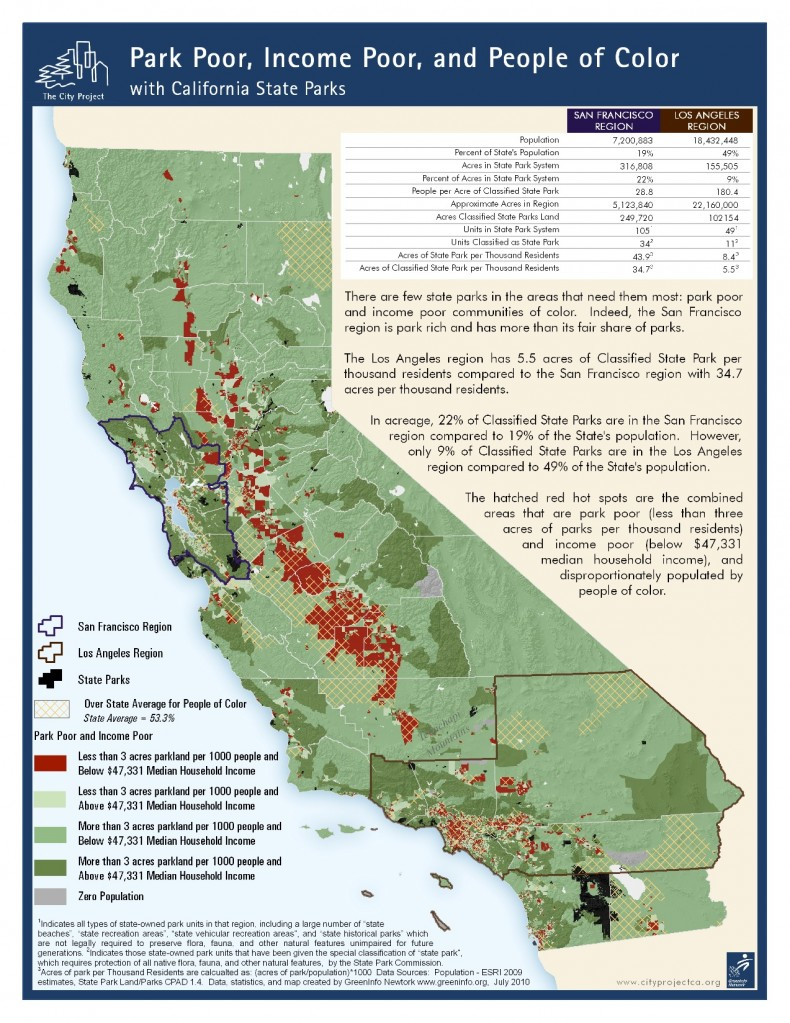
 

map-save-state-parks-for-all-Park-Income-Poor3-790x1023


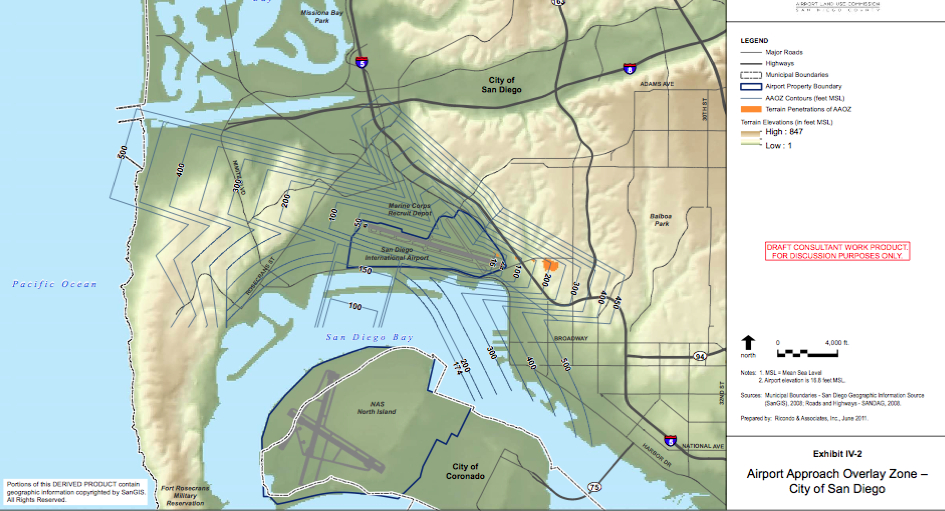
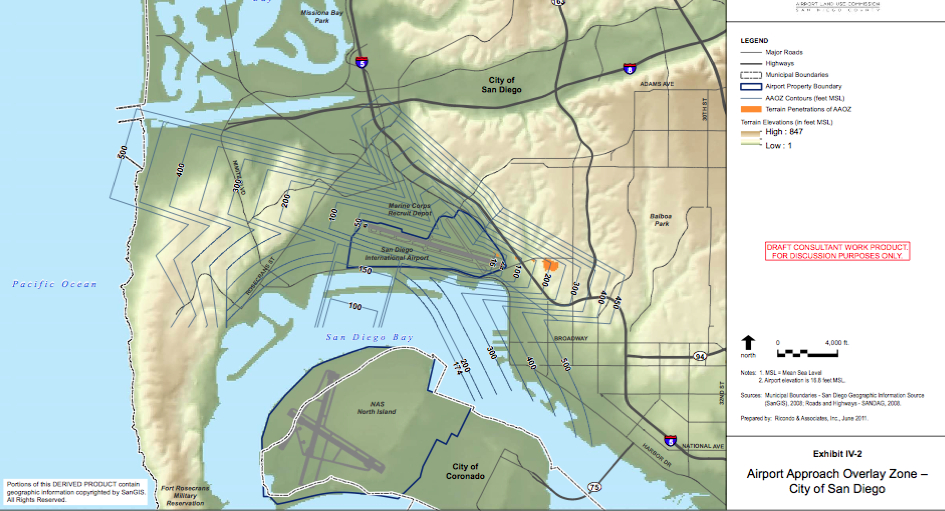
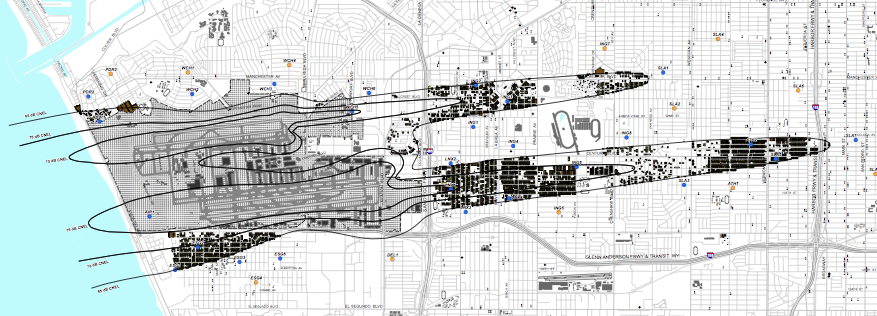
Income variations allow the possibility of a flexible and inventive relation to maps of habitable space–as the clumping together in aggregates or scarcity of desired urban lands reveals.   As we become more movable in our work, and develop a more flexible notion to workspace, this shifts the relations of local routines of personal and work space, and there is considerable choice about the spaces where we live:  workspace is less dense in different cities, to be sure, as silicon valley or other IT belts like the Research Triangle around Durham NC, but the premium on the flexibility of defining one’s own model of habitability seems to determine the new urban geography Krugman describes.  Further anecdotal evidence, beyond the United States but in North America, might point to the shifting geography in urban Ottawa, where the residential Glebe was distinguished by rising residential real estate.   Within the shifting infrastructural map of the city, one maps one’s own personal space.  Indeed, the bizarre settling of San Francisco’s sky-rocketing real estate prices is partly driven by the arrival of highly paid executives working in Silicon Valley, shuttled to their work in select buses whose routes allow them to select an alternative to public transit, as discussed in an earlier post.  The paths of flights into San Diego, to use another example, skirt more select residential areas like Mission Bay, create a zone marred by the rumble and whine of overhead airplanes.  And the organization of urban space no longer reflects how we map and understand urban geographies as habitable–or come to dismiss them as simply uninhabitable and worth less.

Only by balancing what maps tell us about how an urban region gains value for its habitability can we effectively broaden the discussion and use maps to measure inhabitability against degrees of uninhabitability and will we be able to extend the critical evaluation of value beyond questions of supply and demand.

Leave a comment

Filed under human geography, infographic, mapping density, Mapping Park Poor Neighborhoods, Oakland CA, relative density, urban geography, urban growth, Urban Livability

Mapping Holes over Poles: Disappearing Stratospheric Ozone

Maps can make wonderful arguments to orient us to a variety of global processes whose scale could not otherwise by visualized or even adequately comprehended.  Maps of the relative size of the depletion of ozone over Antarctica over time, looking at the earth’s atmosphere from the South pole and mapping the threat of a monumental environmental shift to allow us to consider changes in the loss of stratospheric ozone that have recently occurred, in ways that are only adequately understood by few:  diachronic maps provide the best means to chart the emergence at the poles, due to the similar pocket of cold air, of the disappearance of the thin layer of ozone that encloses the earth’s atmosphere, and blocks 90% of UV rays of solar radiation:

Sept 2006-Sept 2012 ozone

These two maps centered on Antarctica highlight where weather conditions helped expand the largest ozone “hole” in the stratosphere–a region where ozone has been reduced from 300 to 100 Dobson units, or by two-thirds, and an unprecedented entrance way for UV radiation unveiled.  With the continent of Antarctica reduced to an exposed island in the bright green iris of a protective level of stratospheric ozone, they map provides both a visualization of the permanent gap through which UV radiation enters our atmosphere, and the stubborness with which a problem that first registered at the British Antarctic Research station in 1985, literally wasn’t accepted as genuine, so sudden and unthinkable was its appearance:  deep blue registers the diminution of high-level ozone to 220 Dobson Units, the lowest ever recorded up to 1979.

There’s a tension in using bright iridescent hues to represent a tenuous layer that, if not so widely dispersed, would be only just three cm. in width.  The fragility of this protective if thinly distributed layer may be impossible to visualize as a unit, and as difficult to map as the mechanics of its depletion is to grasp or predict.  The depletion of ozone in the “hole” –more of a relative absence of ozone that usually checks UV rays–lacks the sort of boundaries or objective parameters maps chart, and its gradations hard to ascertain from the ground:  the tenuousness of the dispersed level of ozone in other words challenges cartographical denotation; exactly how much radiation enters the earth’s atmosphere is harder to calculate or represent, so we are left with registering the diminution as an effective ‘hole,’ given the lack of objective criteria to map the diminution in spatial terms that narrate the scope of its effects.  Such obstacles or constraints in mapping has no doubt lead to well-warranted criticism of inadequate appreciation of its seriousness or persistence in media stories that champion its reduced relative size, as we try to grasp  a process we can’t control.  This seems tied to the difficulty of presenting an argument in recognizable graphic conventions, and the appropriation of the map above as an argument that the hole’s expansion reduced and is under control or no longer subject to further expansion.

The inability to map a relationship between the hole and the land in anything like a one-to-one fashion of meteorological maps creates a challenge in registering satellite readings of a thin layer spread across the upper reaches of the stratosphere as if it were an object or place.  The iridescent hues that render depletion of ozone map are both misleadingly and deceptively presented, Bruce Melton argues, as evidence of a “record low” ozone hole–since the reduction in size conceal the fragility of the tenuous ozone layer when increased stratospheric cooling will further deplete the failure of ozone, as Melton argues, and create an uphill struggle to ever block the entrance into our atmosphere of radioactive UV rays.  The map is in this case not the territory:  the territory is being irradiated, and is going to be irradiated for some time.  Climatologists predicted many narratives of the hole’s eventual shrinking in the early 1980s, or in 2006, when it was noted that “in Antarctica, we can say that the patient is not getting any sicker, either,” and 2006 led to the prediction tha reducing fluorocarbons would bring clear evidence of unambiguous improvement by 2016.

Yet the persistence of the hole is striking:  2011-12 saw the re-emergence of a similar ‘hole’ above the north pole, far closer to inhabited areas.

The evidence is difficult to interpret, and harder as a result to represent in maps.  Most maps effectively materialize or embody land and a relation to space, but the hole or gap records the depletion of a gas whose effects are far greater than its relative size, and not necessarily proportional to its size.  To be sure, after being warned of the eventual depletion of ozone, it does not seem so inevitable. Although naming a “hole” seems concrete–something is leaking or escaping from a delimited zone–the entrance of UV rays through this “hole” can’t be adequately mapped to reveal or represent what is happening climatically, and the scope of the dramatic increase of the ozone hole’s radius is difficult to imagine, for  it’s difficult to know what the size of the hole means.

The perspective above Antarctica shows an area about as large as the Antarctic continent itself to be entirely depleted of ozone.  This map of absence challenge us to chart something that resists most of the usual categories of maps.  Perhaps the process is better communicated by mapping the distribution of real-time ozone loss at an altitude of twenty kilometers, as the below visualization of the World Data Center for  Remote Sensing of the Atmosphere, using a vertically resolved distribution to  map variations in loss and depletion of ozone, showing a significant reduction above the north pole that becomes more urgent below the equator:


scia_o3loss_actual__still


A similarly striking map of local variations from the normal density of 300 Dobson units, tells the difficult to grasp story of wide-ranging atmospheric shift over the southern hemisphere at a time of greatest ozone depletion, of which the hole over in the ozone layer over Antarctica is only a section:


scia_o3column_actual__still

Mapping the absence of ozone in the atmosphere is a difficult proposition as well as graphic, especially since most maps are static in nature. The first two visualizations of NASA’s Ozone Watch centered on the continent of Antarctica portray the region’s exposure to UV rays, as if one is somehow looking up the world’s skirts, in ways that work because they tweak or shake up the notion of a global map to show a vital or exposed place in the world’s atmosphere: the perspective from  from that of solar radiation entering our atmosphere suggests looking into something that one shouldn’t be able to see.

It’s a bit comforting that there was some contraction from the massively gaping hole of 2006,  but the slight apparent contraction doesn’t really offer any reassurances.  If purple and blue is where ozone is least present, and yellow toward the red end of the spectrum where it is most present, the hole is still gaping pretty large in April, 2013:  the ozone (O3) in the upper atmosphere is present in such trace amounts, that its absence from the stratospheric atmosphere allows ultraviolet radiation to seep in; while it can absorb the most dangerous and intense radiation before it reaches the earth’s surface, ozone depletion allows it to enter freely.

We can far more easily, of course, map the extent to which more and more ozone is itself trapped, as a greenhouse gas, in our atmosphere, but that is not where we want it–its benefits are nil and even adverse since it is a health hazard.  Its concentration as measured in our country roughly matches concentrations of smog:

National US Ozone Map

The above map registers ozone created from car and other industrial emissions lying below the stratosphere, and the rise of parts of ozone/billion from 10-15 in pre-industrial society to upwards of 80–a rise that has largely contributed to local smog or “ozone days,” and the “spare the air” days of the East Bay when folks are asked to take public transit.

The geographic centers of pollution documented from satellite photographs from 2006 to travel surprisingly wide distances, in ways that suggest we try to understand the local heights of ozone as a truly global crisis if it is also one of local creation:

160294main_ozone_map

This concentration of atmospheric ozone is a form of smog, that serves no protective function as a trapped greenhouse gas; the ozone layer in the stratosphere itself has little relation to global warming.  But we can perhaps develop a perspective of more global character to map or visualize the absence of ozone at stratospheric levels.

This was, after all, the primary effect when NASA compellingly created a map of the relative depletion of ozone concentration–and the potential disappearance of stratospheric ozone–from 1994 to 2060, should  further production of CFC’s not be banned.  This image of ecological disaster was not fleshed out, but is apparent in the deep blue hues that uniformly enveloped the familiar form of North America, as if to tell our future gone astray as a consequence of the increasing industrial production of fluorocarbons worldwide:


The mapping of more recent depletion of ozone over the pole is the consequence of its unique climate, mapped a sort of topography of ozone loss, in which blue and violet mark significant deviations in local ozone concentrations that were sensed in 2003, but were first detected as early as 1985:
40497088810de20030907

And the resulting spottiness of the ‘ozone column’ prominent in this global map of 2006 suggest a broad depletion of ozone layers around the equatorial region, where the sunlight is also more unremitting and intense, outside of the polar regions:

Ozone Column 2006


What does this massive decline of a shield against radiation mean?  As of yesterday, the map was considerably expanded and not much more comforting, looking at online near real-time ozone maps:


o3doas_yesterday

NASA also continues to provide daily visualizations of the established gap in ozone over the Antarctic, based on satellite measurements, to register a daily changing picture of the hole that is not much more comforting:

OZONE_D2013-04_G^716X716_PA-TIME.IOMI_PAURA_V8F_MGEOS5FP_LSH


Such snapshots tell half the story; stop-action photographic frames chart the hole’s growth form 1979 to 1991 shows the difficulty in pinpointing its size or shape, providing something of a narrative, as registered by satellite spectrometers:
http://www.atm.ch.cam.ac.uk/tour/tour_mpeg/anim_toms.mpg

The jerky seasonal variations seem to be always up for grabs! But a compilation of monthly averages in a suggestive sequence of time-lapse stills, also from Cambridge’s Centre for Atmospheric Science, reveals the expansion of the violet blotch almost appear from nowhere in about 1983, when it was first detected, in ways linked to how gasses emitted from CFC’s had dramatically depleted atmospheric ozone:


Cambridge Ozone Maps


These Cambridge Ozone Maps–a wonderful name–show an odd shifting of form, shifting due to polar meteorology, of how the gasses spewing out of factories, homes, and airplanes attach to stratospheric clouds that, in the polar vortex, introduce atomic chlorine over the pole which at such low temperatures, destroy ozone.

To map the loss of the layer over time, in animated form, is perhaps far more compelling than a static map is able to offer its viewer:
http://wdc.dlr.de/data_lib/SCIA/ROSE/animations/scia_o3loss_fullsize_mpeg2.mpg

For the lack of better conventions to visualize the opening of ozone over the earth, its hard to remember the difficulty of turning back or reversing this depletion at all.  The challenges of mapping ozone are multiple, both because of the stories we impose on the maps and an inability to comprehend the costs of the opening hole hovering over the pole.  Is it that the map embodies a process that can be visually grasped, transforming a topic of debate into an entity that cannot be denied?  Indeed, there seems a relative poverty of words–what is a hole, actually?–that seems resolved when one looks at the maps of stratospheric ozone depletion over the poles, and sees where the ever-widening gap lies.

Leave a comment

Filed under Antarctica, global warming, Ozone Hole, Solar radiation, UV Radiation

Mapping Worldly Entrances to Hell

We are all perhaps forced carry our very own hells with us,  even keeping their maps and the routes of access to get their  in our heads.   If the location of Hell has been mapped and re-mapped as a personal experience since the Renaissance, defining fixed locations of Hell projects something of a state of mind to the world’s physical geography.  If, to quote Marlowe’s Mephistopheles, “Hell hath no limits, nor is circumscrib’d/ In one self place; but where we are is hell,/ And where hell is, there must we ever be,” the places Hell resides is almost a practice of mapping that reflects a culture’s cartographical imagination, hell has proliferated in the age of genocide on an unknown scale, as the atrocities of Armenia, Cambodia, Argentina, Bosnia, Iraq and Rwanda have created new landscapes from hell that have proliferated in the world as real places of a level of trauma that transcends any normalcy, including the normalcy of a map.  And the appearance of worldly hells over much of the world may have its  rhetorical apotheosis in the fondness Donald Trump had for mapping hell on earth–the cities of America that are now “crime ridden hell holes” and the “hell holes” that are the origin of immigrants who cross the US-America border–even if the hell-hole that might be a prototype was in Guantanamo, not Mexico.’

In antiquity, it was easy for the son of Anchises, Pious Aeneas, founder of Rome,  able”to descend into Avernus” directly since for him “Death’s dark door stands open day and night,” with the dire foreknowledge that “to retrace your steps and get back to upper air,/That is the task, that is the undertaking./Only a few have prevailed.” If it was  possible to be ferried across the River Styx and “to explore the dark abyss/ . . .  in the pathless/Shadowy valleys” where fate had called him, few would know if they would return, as the abyss was not that easy to leave even if one knew the entry-point.    There was a time, lest we forget, when entrances to worldly hells lay confined to the walls of churches, in the threatening death panel paintings of the Last Judgement,–

–or lay safely at the foot of the manuscript pages of Dante’s Inferno–just under the terra fima poetic text–

Inferno manuscript of the Third Quarter of the Fourteen Century, MS. Holkham misc. 48/Courtesy Bodleian Library

At the time of the war of the Holy League against the Turks, the painter El Greco seemed to have outdone Dante, or remapped the landscape of hell one had read in his poems, in new ways, as a precipice toward which Europe was about to hurtle, seen through the gaping mouth of a shark, as a worldly incarnation of the diabolic, that the pact between the Pope, Rulers of France, Spain, and Venice were able to expel from the world, leading troops to beat back the Turks from the Mediterranean, as if to affirm the sacrality of Europe against outsiders.

The maws of hell in El Greco’s terrifying piece, long kept in the Spanish monarch’s personal royal collections, suggested that the monarch had averted hell from entering into the modern world, keeping it at bay in ways that had only grown increasingly problematic and perhaps apparent over the divide of Christianity in the sixteenth century, an era when the jaws of Hell became more broadly apparent across Europe.

El Greco HOly Alliance Hell

shark like maus of hell

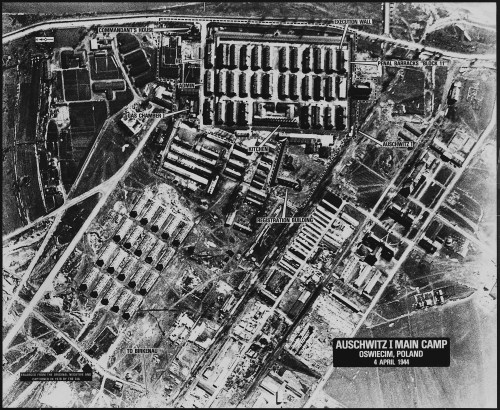
It may be that we carry around our personal hells with us.  But the mapping of worldly entrances to hell came back with a fully secularized vengeance in the Second World War and long before.  For the problems of these atrocities challenges on an ethical and moral scale the commensurability of our conventions of mapping, and with it any commensurability itself.  Perhaps the muted colors and odd grey zones by which earlier concentration camps in the Nazi era suggest that they are zones “off of the map,” indeterminate spaces ringed by green fields, all but exempts them from conventions of mapping, their primitive barracks, gates, transports, mess halls, work fields, ditches and crematoria all outside of “normal” space, and unmapped, left to strain credibility–even if they were viewed from space by reconaissance flights, these spaces and their modern proliferation cannot be adequately morally mapped in ways we know the world.

FARBEN_DWORY

This sense of places out of the normal, hardly part of humanity, has perhaps led to the proliferation of maps of hell online.  The problem of proliferating hells is a one good way to describe modernity.  From Samantha Powers’ attempt to map “problems from Hell”  as eventualities the United States government will be condemned to face to the problems of mapping atrocities that recurred in the terrifying landscapes of Hades, Argentina, worldly hells have proliferated in the world from Nazi concentration camps to sites of disappearing that ask us to map the presence of hell in the world, in a grim geography of devasttion that challenged pallettes and iconography to describe adequately.

grim geogrqphy of devastationaBefore these maps of spaces of dehumanization and devastation, we are really looking into hellish worlds we had not been able to see before.   But even these dots cannot capture the scale of the hellscapes that emerged for the accelerated loss of life within the industrialization of death that proceeded from Heinrich Himmler’s order of 19 July 1942 stated that unleashed mass-killings from bullets, fire, and gas extermination to fullifll the demand that by the end of December 1942, all Jews, gypsied in Greater Germany be killed, leading to an unprecedented intensity of rates of mass-killings almost impossible to map on paper or by a graph, challenging as the spatial dynamics of the three-month long burst of killings is poorly documented–intentionally–and indicate a terrifying challenge to the world of the data vis that challenges the imagination to even attempt to “map” in the over 40,000 camps of imprisonment and mass-killing that were built between 1933 and 1945, dedicated to imprisonment, forced labor, or mass killing sites dedicated to exterminating Jews, Sinti, Roma, Communists, and so-called “enemies of the state.”
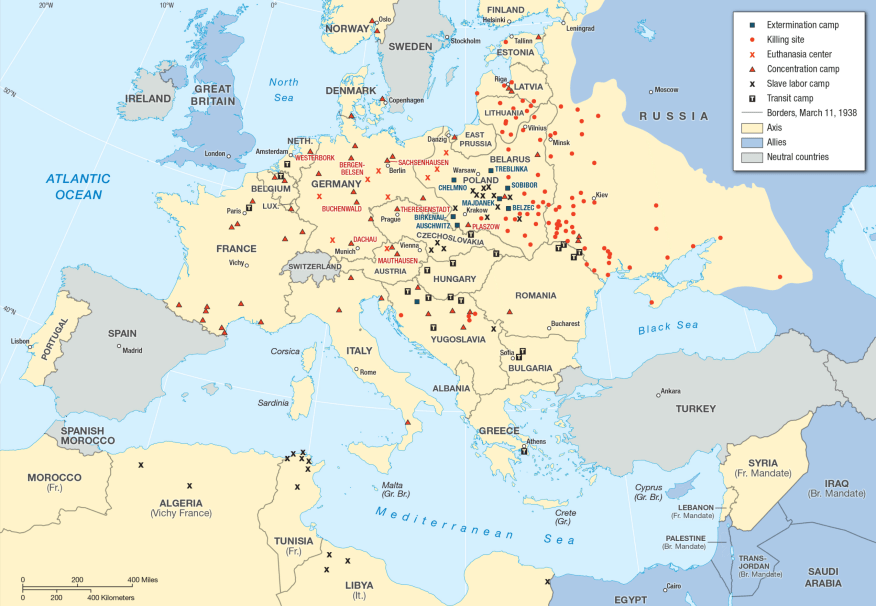
extermination

aau7292-f1

There is a sense of the utter inadequacy of an aerial view–or indeed even Google maps–to map the horrors of sites commensurate to their moral and ethical existence, as if they lay resolutely and stubbornly outside the known world and could not be assimilated to the categories by which we map it.

Landscap

Aerial Reconnoissance Flight over Auschwitz-Birkenau, April 4, 1944 

It’s perhaps not a surprise that every culture seems to have its own notion of Hell but of where the location of hell and its entrance is.  If one can pinpoint and map it in an image of the known world, perhaps one can escape its presence in one’s own mind.  The poet Czeslaw Miłosz wondered, in a very late poem of 2003, “Have we really lost our faith in that other space?/ Have they vanished forever, Heaven and Hell?/ . . . And where will the damned find suitable quarters?” and bemoaned almost tearfully the unimaginable proportions of the “enormity of the loss,” but there is considerable existential comfort in being able to map Hell with security, and indeed to map the intersection between hell and the world that seems normal, as if the presence of Hell demands of expressibility that elicit stubborn difficulties in placing recurring reappearances of Hell on the relative poverty of conventions we use in a global map of human settlement. The problem of mapping hell was perhaps long a part of humanity, as much as the evils of genocide stupefy in their excess, and raise questions of how to map not only people and places but souls in the world.  Mapping hell is, indeed, something of a poetic feat.

Mapping was long about finding a place for the soul in the world, however, as much as ordering spaces or offering way-finding.  You know the lay of the land, and the parts you want to avoid.  As if consciously and quite intentionally one-upping Christopher Marlowe, on seeing the efflux of modern industry afflicting  London, Percy Bysshe Shelley imagined “Hell is a city much like London— A populous and a smoky city,” to comment on the transformation of England; his belief that “It is not necessary to consider Hell and the Devil as supernatural machinery” is uncannily similar to the many maps that pinpoint Hell’s multiple worldly entrances for those eager to read them.  It has long been far more satisfying if one can try to pinpoint the entrance points in informed fashion, using some sort of knowledge or evidence to buttress the choice.  The location of “Hell” or the underworld was, of course, pre-Christian, even if it is now colored by Christian sources; Hell is a pre-Christian mental geography that was mediated by Christianity and its own specific notions of suffering  and remorse, but also is a place that we all know exists, and are eager to find–although not to go there ourselves.  Is it any surprise that the dominance of point-based mapping, with its comprehensive tally of location, raises the fundamental moral question of mapping a common relation to hell?

Perhaps it is a coincidence that the proliferation of hells began with the dominance of new national maps, and new military maps, crafted to enable us to think outside of a national frontiers, created a point-based mapping system like the Universal Transversal Mercator, that raised moral questions of where hell was, and that hell exists in the lives of most modern refugees, who live not only outside the edges of borders, but, as the unhoused, outside of geolocation systems.

But perhaps our current maps, dominated by geodata, force the question of the lack of location of a hell, at the same time as we are seeing a proliferation of global hells, all absent from the point-based maps that we treat as surrogates for reality.  According scripture, Hell is located deep down in the earth, without either geographic specificity and far more figuratively evocative than precise.  Hell is  reality and state of mind for the Gospels and Apocalypse; it is not a precise location:  it is a place where in “outer darkness: there shall be weeping and gnashing of teeth” (Matthew 25:30), whose inhabitants are “in agony in this fire” (Luke 16:24), surrounded by “the devil and his angels” (Matthew 25:41).  The topography of the new camps made little sense in rational mapping systems, but as a vampiric relation to the enslavement of people, before the scale of atrocities could be imagined.

nazi-vampire-1941

The image of perpetual burning, self-consumed bodies has been embellished with extensive pictorial detail as a place of eternal punishment, and a site of the destruction of both body and soul and of unending separation from both; it was based on the Old Testament idea of  “Sheol” as an abode of the dead (Psalm 49:13-14)–or of those with no abode or place to be, but this place with no life was always seen as closely connected to our own.  Hell was deeply spiritual for Dante and in his age–the appeal that we had an informant who had in fact been their to survey its complex topography and descending rings of punishments bore the satisfying sense that we knew where we are in the moral compass of life.  The appeal of Dante’s map of hell is evident in the considerable care and detail which Sandro Botticelli and others used to delineate the space through which where Virgil led Dante and navigated among the inhabitants of hell’s circles–an image popular in the late fifteenth century–that could be examined with some recognition and even more amazement as a site of the afterlife.

Botticelli's Ms Map of Dante's Hell

When Dante’s Florentine editor Girolamo Benivieni’s prepared a printed edition including engraved maps, the portal to Hell was strikingly placed in explicitly modern geographic terms within the terraqueous sublunary world:

Benivieni 1506 Dante's Hell

The deep comfort of this clearly mapped ontology of the afterlife is to some extent preserved today.  Online, we can also navigate this image, thanks to digitization of manuscript images, on one’s very own, and explore the mind-blowing map that Sandro Botticelli drew as if confronting the page from inches away in all its gloriously imagined Dantesque details.  The mapping of Hell has taken off in ways that oddly reflects a pretty secular age; sites of anguish and suffering are, it turns out, still pretty compelling to map in a geographical lens.

Compelling woodcut maps described the topography of the realm of the Dantesque afterlife with exquisite geographic care:

1527_33.wc1.150dpi

Hell was long an individualized affair, and rightly so, the culmination to a balance of sins physical and of mind.  But the mapping of a public geography of hell–entrances to the underworld, now navigated not only but Virgil and Vulcan, or even Percy Jackson, but able to be pinpointed on a map.  There seems to be somewhat of a flourishing of the addition of “Hell”-sites on the web today, in fact, something of a response to the absence of this all-too-concrete state of mind from the reaches of Google Earth–not that some folks haven’t tried.  Perhaps the absence of hell’s location on Google Maps–or how Hell frustrates that portal promising ubiquitous coverage to any user–may have helped generate something like a proliferation  of on-line pseudo-erudition about Hell’s possible locations, and the curiosity that it could be in fact right around the corner in some pretty familiar sites that we can arrive at by our devices.

The appeal of mapping hell–and at looking at the sites where others map hell–is a branch of the Googlish compulsion to provide a total mapping of humanity, as much as a religious ontology, and is reflected in the proliferation of models of Hell that circulate online and provide some sort of satisfaction that we known where we are.

Continue reading

1 Comment

Filed under Apocalypse, Biblical Geography, Global Displacement, Google Earth, Hell

Environmentally-Induced ADD

The disorientation of “environmentally-induced” Attention Deficit Disorder is not the result only of a piling up of diagnostic categories:  it is a piling up of detailed sensory stimulation, a lack of filters for hedonistic pleasures, an assault on the senses that defies information overload but approximates a disorientation of sensory overstimulation:  if ADD hyperactivity made it into DSM IV, entering a Whole Foods store and not knowing which aisle to walk down, even though you have entered the pleasure palace only in search of a tooth brush or some strawberries, is a bit of an induced disorganizational phenomenon in itself.  You find yourself under some sort of assault in a land of such overwhelming abundance where objects cry out as if you really need them, and sales assistants, who have the right to give away up to $20.00 of goods per day if it will boost sales, beckon with potentially enticing trays of moist carrot cake or fresh juices, all of them hard to ignore.  The attention to accumulating all of these goods under one rooftop and in such an attractive display makes it difficult for one to sustain attention to the task of shopping, or getting what one needs for the menu in your hand, as the culinary details with which one is assaulted or to which one is invited to be privy lead to repeated careless mistakes about putting things into your shopping cart.  Being “often needlessly distracted by external stimuli” (criteria number 8 in DSM IV) become a way of life when cruising that supermarket aisle, not to mention difficulty organizing things necessary for tasks (number 7), in this case leaving the store.  (Perhaps one also encounters a difficulty awaiting its turn to enter DSM V.)

This is an odd permutation of the cult of self-identifying as a locavore, or circumscribing the terrain from which cultivated food will be consumed to a restrictive radius.  As we discover the American terroir in our kitchens with Rowan Jacobsen, indulging in the locality of geographically specific flavors, we’re apt to wonder where we are even as we fantasize about the benefits of living off the land.  It’s no doubt in part that we need to remedy this sense of dislocation–of remove from the sources of our food–that we rush headlong into sourced tastes.  But there is something odd about being offered a geographic pedigree of locally farmed food and not being able to process whether you really need to relocate it into your refrigerator, or  single origin beans on whose origins you can’t place a value.  The collection in our high-end supermarkets of vegetables of excellence provenance, identified by agrarian footnotes beside their price tags, often seems intentionally and oddly disorienting in itself. so culturally removed is our own map of the origin of eggplants, apples, cranberries or kiwi from our sense of where we are and the reasons why we entered into this store, anyways.  Is the scholarly apparatus on those placards informative or a nagging distraction?  It is hard or at least a challenge to hold in one’s head the map to which objects of fixed provenance in the supermarket correspond.

But the cost is one of extreme disorientation as one enters the brightly-lit floor of the local supermarket that caters to such high-end locovoric tastes.  It is one thing to have a map of terroir on the wall in a wine shop for customers; the map is a tool of identification and situation of the grape or the vine, and demand a degree of expertise (or map-literacy) to be read.  There was a clear identification of provenance in an ice-cream store that boasted to use only the milk of family farms in Vermont for its super-premium blends (as did, at first, and to some extent still, Ben & Jerry’s) or the ice-cream pleasure palace in Bologna, Italy, that claims to use only milk from the Romagna (the local region surrounding the city in north-central Italy) to make its highly saturated super-rich gelato (la Sorbetteria Castiglione)–but locovoraciousness looses focus as it is staged in a setting of consummate marketing and, its counterpart, hedonistic consumption.

As if response to the criteria of sourcing vegetables from a ten-mile radius at some local farmers’ markets in the region, the folks at Whole Foods have offered to clear this up for customers in an on-line local foods map that allows us to look at what local goodies stores offer across the country–even though this can help us sort the information overload of the aisles, as we look scour the country for the locally produced goods that might be available at our own Whole Foods outlet–or develop the sort of eco-lust of a committed locovore at the foods available to other Whole Foods customers around the country, leaving one only to gaze at the mapquest image to dream of purchasing foods in other supermarkets of brighter  aisles.  The idea is to think local, but market nationally.

Whole Foods Local Foods Map

One kind of looks only at the geography of the sort of foods one wants to eat, in other words, as much as the folks that live there.  A similar problem of mapping goes on in the supermarket.  The question is how to map the abundance, and how to map the variety of distinctly sourced goods.  That there is little seasonal variation to inform the vegetal abundance in the aisles of supermarkets increased the disorientation; one finds year-round tomatoes from Mexico or plums and berries from Chile that have organic claims.  Flourescent lighting doesn’t help, and the nicely lit fruits and vegetables, often under their own miniaturized rain-showers, beckon with a take-me-home sheen as the mute locally farmed sirens of the produce aisle.  A simple aisle-map won’t suffice since the sensory stimulation of the store makes it hard to not enter its labyrinth.  Perhaps we’ll all be better encouraged to take Ritalin before going shopping in the future, or acquire better filters to screen out beckoning samples and signage that boasts fidelity to locally farmed goods, if one adopts a generously restrictive meaning for the term.

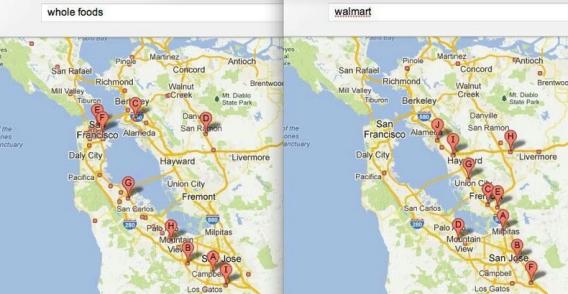
The disorientation is not only geographic, but sociological.  Of course, when we are looking with lust at those avocados, red cabbages, plums, and apples with a sort of existential desire, it’s tempting to forget the rest of the world and its social geography, so much is the origin of the apple the prime focus of our ecological concern.  Not many folks even enter into this flood-lit arena of healthy and tasty treats.  Matt Iglesias’ retweet of Jarret Barrios’ division of the geography of Whole Foods v. Wal-Mart stores in the Bay Area maps a nice geography of consumption patterns, even if one allows that Wal-Mart is interested in buying cheaper real estate, in terms of the markets that each chain store caters:


bayarea.jpg.CROP.article568-large

At least one can see who might go into all those Whole Foods to be disoriented by their variety, or speculate on what their disposable incomes are likely to be.  And one wonders at the elite charmed circle that those organic veggies seem destined to feed.

It is a far more focussing experience to focus attentiveness on the eating of sourced foods; food does belong on the plate.  Now, a locally sourced hamburger from Marin farms of the sort sold at Super-Duper is a great  example of “sourcing the previously unsourced,” as it were, and turning back the tide of intentional geographic anonymity.  And who could resist eating beef under a map of the regions of cuts of beef?  What better image for a burger joint that featured grass-fed beef from Marin county?

Photograph by David Paul Morris

Leave a comment

Filed under Attention Deficit Disorder, DSM IV, Walmart, Whole Foods

Mapping Approaches to Airports: on the Social Production of Air-Space

The medallions that map the routes taken by airplanes to the world’s metropoles on the first floor of San Francisco’s International airport offer curious artifacts of the first Jet Age, when air travel provided something of a miracle of linking the world’s cities in a vision of post-war harmony, even if they were only included in 2000.  For without imagining their exhaust, fumes, or the inevitable aural disturbances that are created by flight paths in the urban spaces that they boast to connect, the eloquent maps including weather isobars of inlaid brass in the terrazzo of the International arrivals terminal show the locations and arrival routes at international airports worldwide, spanning some  12,000 square feet of floor space.

They promote a triumphal vision of global interconnection, and an image of air-space that airline companies have defined, tracing the approaches to individual airports from the air.


APPROACHES TO OAK IN SFO


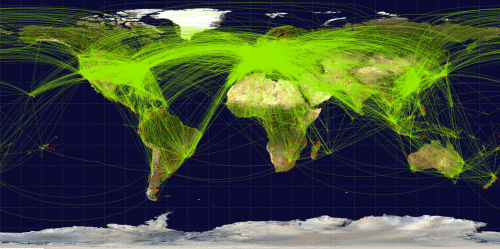
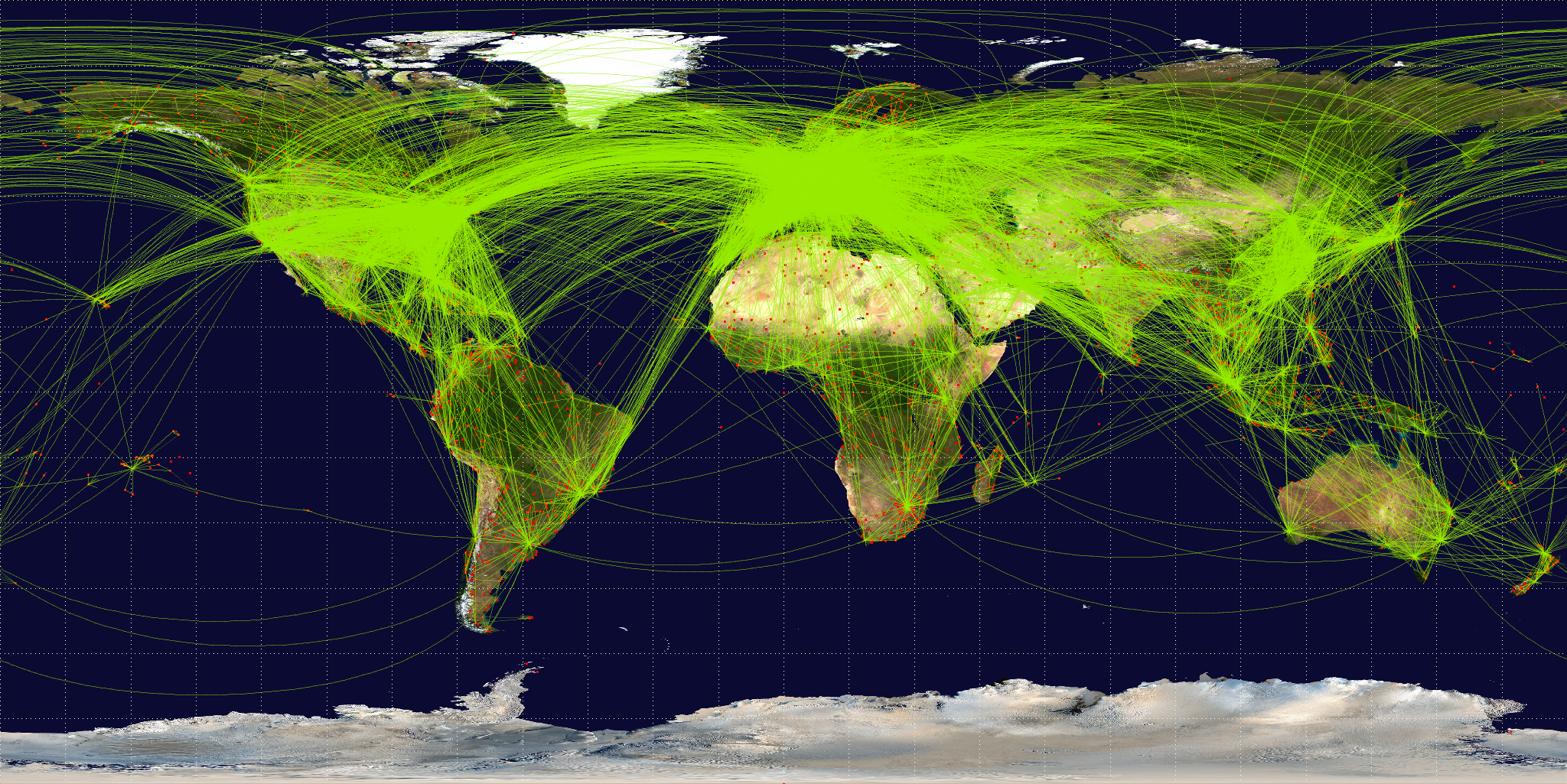
Today, the density of airplane flights across the world is so fantastic that the collective inscription of routes that now carry an estimated 77 million passengers a day, or a billion and half a year, placing a sizable portion of folks in the air at any given time.  The range fo flight paths that serve an estimated 3.6 billion passengers in commercial flights is so dense that OpenFlights.org, an open source logging, tracking, and mapping commercial airplane flights, map online, displace the inhabited world with a curiously organic constellations of densely overlapping paths:  the repo for storing flight informaiton offer ways to render flights on multiple projections, in ways that knit together space in fundamentally new ways.  Does the constellation of flight paths create a new organic mode of modeling spatial relations?


openflights.pngOpen Flights


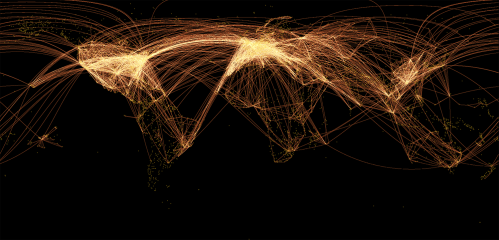
It is quite conceptually challenging to map actual overhead flight traffic–and even to visualize routes of national air-traffic, given their complexity and difference from most forms of travel, but reliance on similar needs to correlate flight paths, heights, and plans.  It is hard (and unfamiliar) to map sonic disturbances, even if it is familiar to map supersonic flight.  But it is fascinating to map how flight-paths impact the ground in the course of take-offs and descents: the zones where airplanes descend over cities have only recently begun to be charted.  Indeed, the multiple interests in charting airspace have only begun to be evident as airspace threatens to encroach urban space.  Indeed, if it is more accurate to map the paths of flight by the distance between global airports, the distorting crutch of a Mercator projection seems to be more recognizable–even if the density between airports so intense from Europe to America as of 2012, shown below, so as to render the contours of continents illegible, and almost erase Europe from the map–but seems so much more immediately satisfying as a way to show spatial linkages on formal grounds–if only since its curves suggest the terrestrial globe’s curvature–perhaps even more when the routes are rendered is drawn without satellite imagery of earth cover–or indeed any base layer, and focussing on airports locations alone.


Mercator Fligths.pngOpen Flights


air_routes-1.pngCartoSkill/Open Flights


Both suggest the increasing warping and shrinkage of space, but do so in ways that are oddly abstracted, given the range of data that they marshal, from the interests at stake in mapping flight paths–or in rendering the unique perspective that being in flight offers.

The very terminology we use to map flight patterns in the liminal landing areas around air strips reveal competing interests at stake in their definition, and might expose the lack of clear terminology to express the different interests of mapping flight from the position of the ground:   “fly-over” areas precede landing paths near airports; “overlay zones” around airports try to regulate the relation buildings near airports, establishing limits for building inhabited space; “noise contour maps” map impact and impingement of sound;  “overflight zones” animal sanctuaries’ exposure to flight-paths. The “fly over zone” oddly suggests the remove of the airplane to lived space, even as such maps map the impact that flight landings have on residential areas.  We used to refer to the “fly-over zone” in dismissive tones as the area between the coasts led them to hop between New York, Los Angeles, San Francisco, Seattle or Boston with little contact with those areas between–but also to conceal some anxiety at the limits of this constrained geographic awareness–increased density of air-traffic that threatens to max out runways make overlay zones  into potentially contested areas in need of mapping.

The interests are at stake in the commercial expansion of airports and the determining the criteria for the limits of acceptable levels of environmental noise and pollution.  While maps locate specific sites of population in a universal matrix, the impact of the descent and take-off of airplanes on urban space suggest a troubling overlap of navigable airspace, a wooly and capacious category that conceals its overcrowded nature, and inhabitable land, focussing on the grey zone on the margins of the airport.  To get our heads around airspace, whose considerable scale is almost unfathomable, let’s try to examine the impact of its contours on urban space in this post. The sociologist Henri Lefebvre drew a distinction between the production of representations of space, of social spaces, and of individual mental representations of space in The Production of Space, when he sought to capture the diversity of spatial production within the city’s everyday life:  Lefebvre argued relations between the production of social, the representation of space, and the space individuals represent to themselves demanded attention as distinct tools or “spatializing practices” in urban space, if not the political character of the social production of urban space.

But Lefebvre didn’t consider airspace within this constellation–a space that exists outside but on the margins of social space–but it is a qualitatively different image of a commercial space that has been increasingly imposed upon lived space or inhabited space without much planning or regulation–particularly when it comes to take-offs and descents, the main focus of this post.  The mapping of the incursion of airspace on lived space It’s perhaps not only a coincidence that since Lefebvre’s book appeared in the early 1970s, inter-city airline travel has boomed as a social sphere, if not a space in and of its own right, often removed from urban space but on its margins.

And paths of flight have only begun to be mapped in their diversity.  The density of air-traffic indeed may have even changed our perception of space in complicated ways, with both the rise of faster planes and long-distance flights and the common nature of air travel and of plane arrivals as common ways of entering cities or departing from them.  And landings and departures, from commercial airline travel or air transit to air transport to unmanned flights, has begun to impinge in increasingly perceptible ways on lived space.  The lived space below the webs of air travel, take-offs, and landings suggests a persistence of place in a geography of flight, as in places that are crisscrossed with air routes, airplane flight is too often naturalized as white noise.  “[The noise] bothered me until I realized that, when I hear the planes, it’s always a reminder that there is life out there, and people are traveling, and traveling is a big part of me,” noted a Turkish immigrant living by the San Diego International Airport with some stoicism in 2005, trying to look at the upside of this rumbling that then punctuated her day in 15 second interruptions, coming roughly often every minute and a half.  “So even if I can’t go home to Turkey and visit my family,” she reasoned, “I know that there’s this possibility that one of them could get on a plane or that I could get on a plane and go back.” Most flight travel in the United States are primarily supervised not by localities, but the Federal Aviation Administration.  The legal status of restriction to these paths is limited or constrained by the fact that no general policy seems to exist–indeed, the FAA is slightly compromised in its interested in fostering commerce, as much as protecting the safety of urban space or local rights, and has limited ability as a national organization to mediate between local residents’ desires as it negotiates the interests in maintaining commercial hubs to foster the expansion of commercial national airspace.

When I was in San Diego last weekend, the close proximity of the airport to the harbor and marina made me think of the huge growth in airspace in past decades, and difficulties of mapping airspace in American cities.  The huge expansion in air traffic since the initial growth of airports in the 1950s, combined with recent growth in belts around cities and in formerly extra-urban areas have led to a common phenomenon of living in or on the margins of an overlay zone, in cities like San Diego.  Although  issues of noise were not a problem in the early age of airports in the United States, dominated  by smaller-sized planes and far fewer flights, since the expansion of non-stop nation-wide flights in the 1960s,  commercial cargo services have created a new geography of air flights and air use, and an increased  intensity of air travel at hubs, as well as the consequent expansion of a huge web of air travel, with attendant plane landings and take-offs, that create a virtual web of crisscrossing flight-paths across the country. Mapping the navigation of individual routes is far more direct.


SFO to EWR


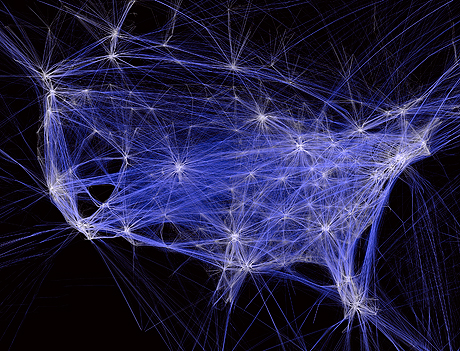
Yet the image of a nation bound by flight-paths of different carriers already seems to wrap itself in a serpentine fashion around the geographic map.  Basing his work on a mine of FAA data, Aaron Koblin’s “Flight Patterns” uses data to track flight-paths to map of our active airspace–an image of which we are rarely conscious and constitute a maze difficult to spatially comprehend, but whose ghostly network exists around nodes of airline hubs and links arcs of aerial paths.  (This is a hard balancing act:  NASA indeed predicted in 2007 that allowing computer software such as Terminal Sequencing and Spacing to remotely coordinate the flights of the aircraft that simultaneously course across the skies would not only increase the regularity of landings and take-offs at airports but allow airplane companies–perish the thought!–to be a blue to manage an increased density up to twenty percent by utterly banishing human controllers from the scene.

In a finding appealing to cost-cutters, NASA forecast that the combination of more autonomous planes and increasingly automizing traffic control would bring a significant savings to airplane companies; the prospect of switching to automated copilots alone might reduce labor costs in passenger aircraft by some billions of dollars every year.)  The wonderfully organic image of the flight paths across the country seem to render something like an Indonesian stick map.


koblin-flight-patterns-1210-lg-43918985


Our awareness of the rapidly growing density of flight paths may be masked by the mental images we receive from personalized in-flight tracking maps, which perpetuate an illusion of navigating the airways or wile away hours by mapping progress to a destination one rarely registered consciousness of traveling toward, sitting in an isolated cocoon at 60,000 feet, as if we were pilgrims bravely undertaking a cross-country trek, accentuating our experience by wildly magnifying the plane out of any relation to the map on which it is super-imposed.


American 22 in flight map


This map has a wonderful ability to place us in a sort of  relation to a local environment:  we are the bright green moving icon, launched on a dotted line across the country, as we try to equate our perspective with the projected flight path over the screen of a static map. Contrast this, say, to the sort of snapshot that Anthony took at the National Air and Space Museum in Washington of the planes in flight above the country at a moment in 2006, that led him to “imagine the pressure of Airport control conductors . . . at major airports” as they managed flights’ course:


Airplane Flight Maps

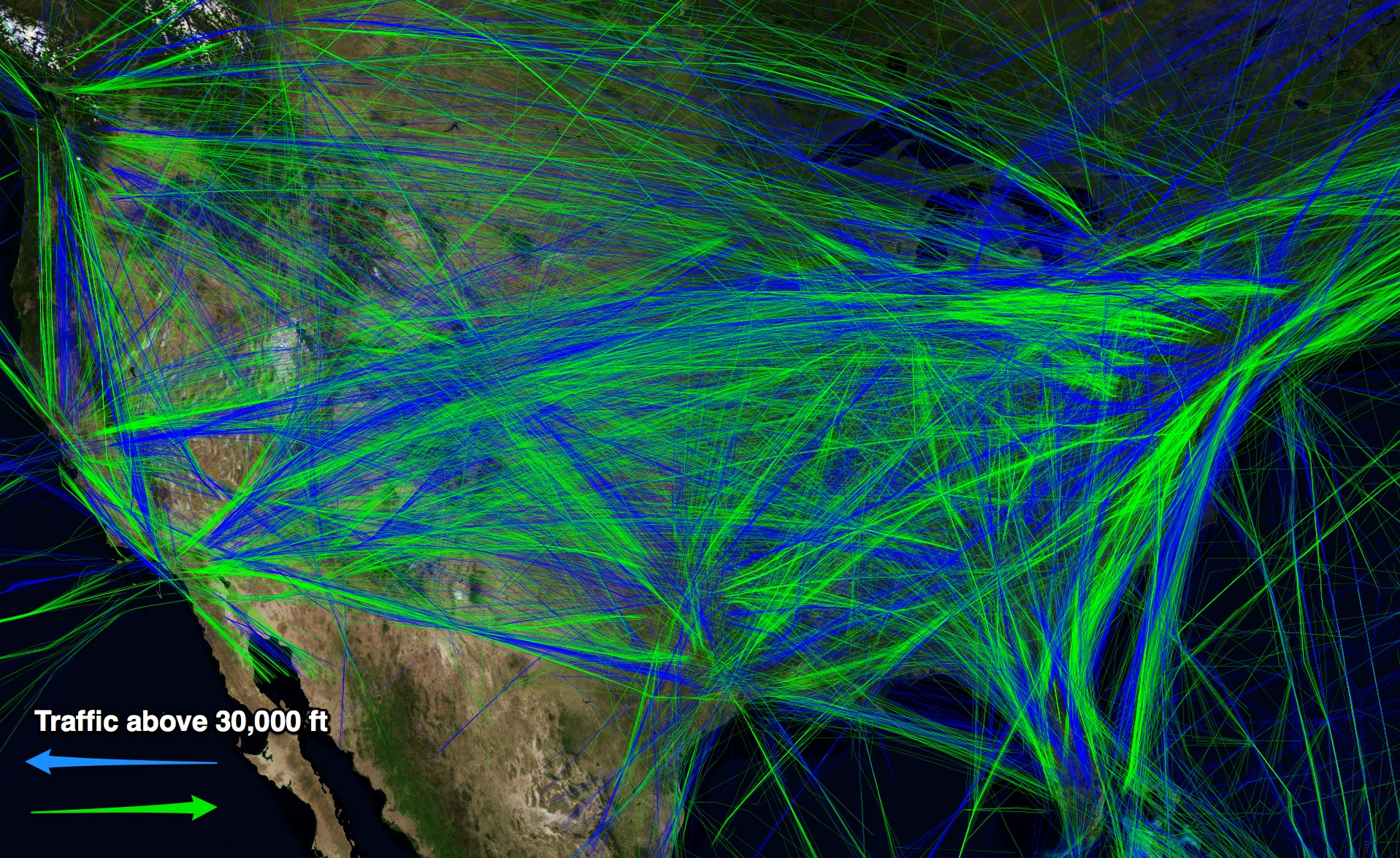
  Of course, the icons of individual planes, which seem about the size only slightly smaller that seen by observers on the ground,  wildly out of scale in relation to the background map of the United States, so that they seem to crowd the skies  like buzzing flies.  It is somewhat reassuring that there are directional corridors of national travel across the country, we can see in a map of flight paths; the density of the lines boggle the mind even when we distinguish flight paths at over 30.00 feet, and we face only a ghostly spider’s web of blue and green streams that designate the arcs of inter-city flight paths:


Traffic avobe 30,000 feet


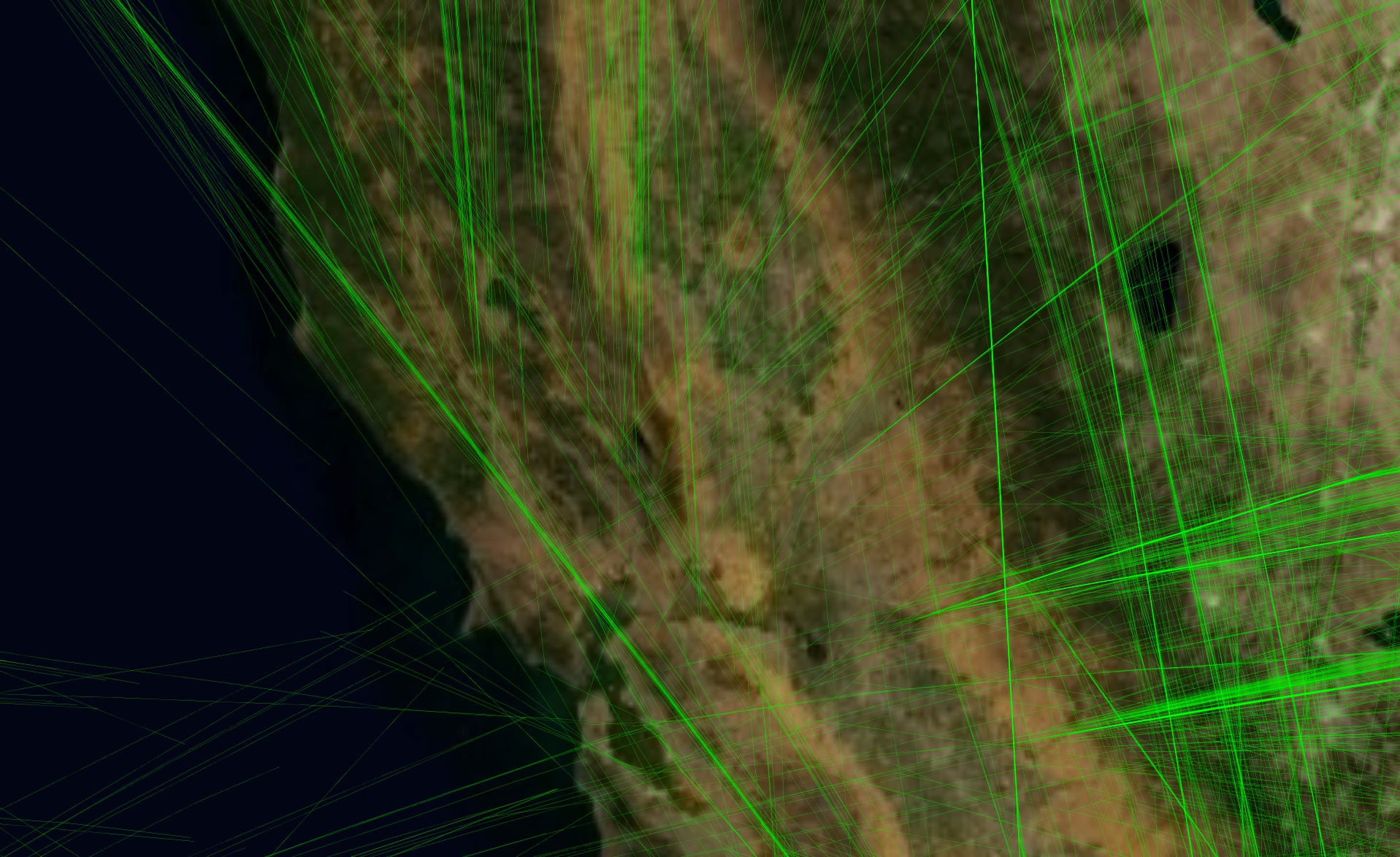
Even looking at the Bay Area alone, it’s hard to get one’s mind around the inhabitation of the sky above 30,000 feet, marked as they are by streaks, and contrary to the idea of inhabitation as well as covering a space greater than most can intellectually comprehend:


viz_-_bay_area-20121009-150243


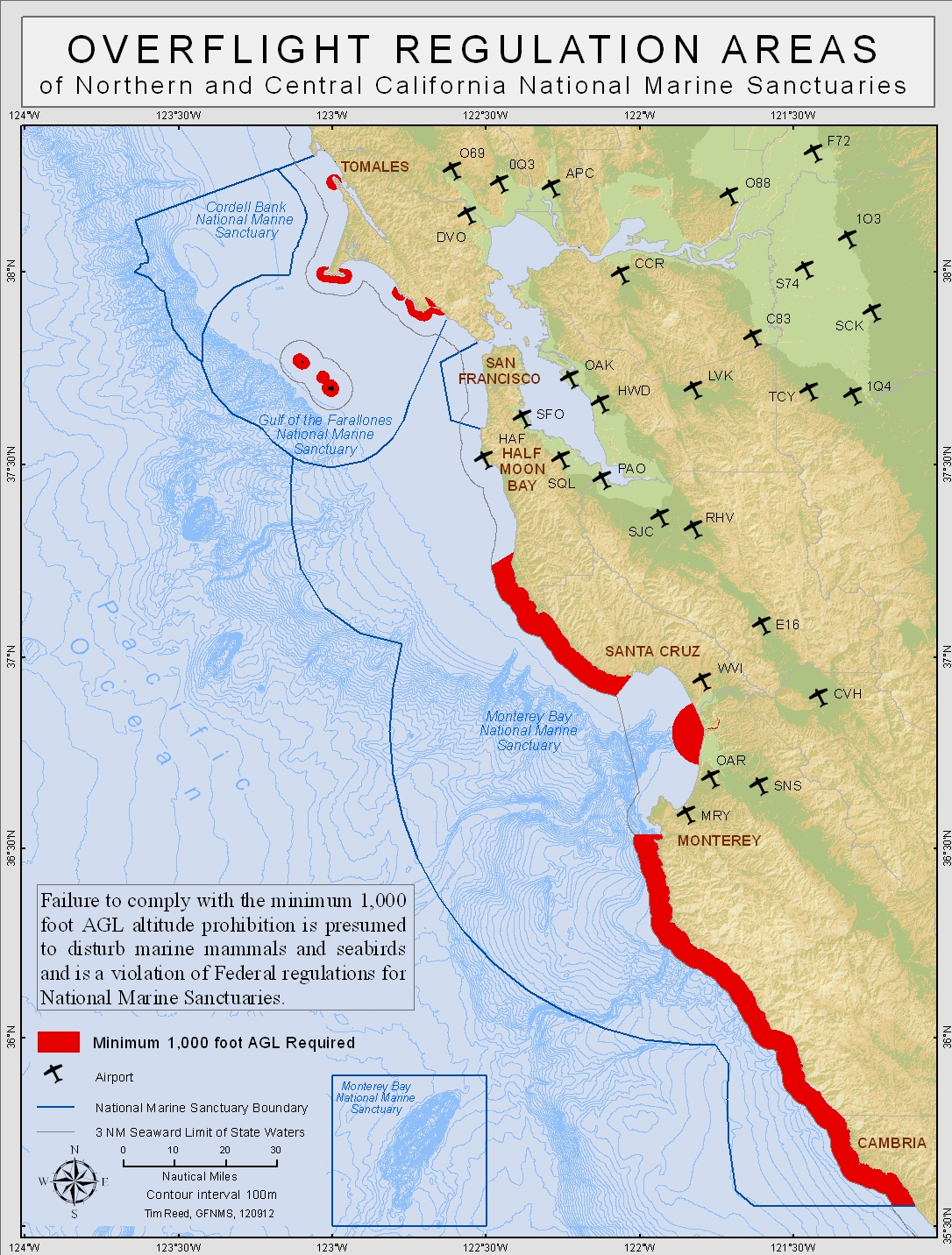
Given the need to maintain protection for wildlife sanctuaries, there is a considerable body of maps regulating overflight altitude above protected populations of marine species.


overflightregmaplg

Such maps don’t address urban space, but they do suggest the problems of defining similar overflight regulations of areas human residents inhabit.

It’s less hard to comprehend crisscrossing paths of air-travel from outside the passenger seat.  We can imagine and track the divergence of commercial airspace from a ground-bound perspective as it impacts a city’s social space.   The government-sponsored expansion of airspace has in many ways created an odd and un-natural urban geography between pathways of flight and urban residences:   fly-over zones are mapped over and on top of social space, and airspace as mapped over lived space.  The relation of fly zones to personal  is not only figurative; fly-over zones impinge in concrete sensory ways on the mental space of the individual, which is now permeable to the  unnatural rumble of the turbines overhead.

What’s it like to live under a flight path?   The protection of airspace by the FAA makes it not the best government agency to represent how planes impinge on the ground:  the mapping and protection of flight paths creates a bit of a super-jurisdictional commercial space with limited attention to how flights permeate the mental space of nearby residents.  As if some would naturalize the rumble of a nearby volcano, a sandstorm, or the Santa Ana winds, there’s the knowing acknowledgement, with a shrug, at the convergence of the airplanes overhead.  (This is a soundscape that is worth recording in its entirety, of which the  YouTube video below offer a more condensed time-stop spliced condensation that doesn’t really capture the improbable regularity with which cruises intrude on the sunny street-scene.) Let’s examine the ways airspace is mapped.  Indeed, the FAA has recently been required to publish a set of “noise exposure maps” or NEMs for public notice, as the 1969 National Environmental Policy Act omits airplane noise.  They hope to provide an open forum or acknowledge public input to  the environmental impact of increased air traffic, responded to local resistance to the adverse environmental effects of expanding airports in WisconsinFlorida, Toronto, CharlotteArizona, Sacramento, and elsewhere, given the conflict of interest for the FAA in negotiating local noise regulations and  improve commerce through air traffic as they seek to prevent the expansion of commercial areas around airports that are increasingly becoming engulfed in extra-urban space. But it is the impacting of areas of inhabitation with air-space that creates perhaps the stickiest situation for mapping flight travel for the FAA, and poses the deepest problems of how we expand our airspace at the same time as curtail the impact of that airspace on something we might call quality of life, but has much larger consequences and implications than that numinous and intentionally generic term implies.  Fly-over zones near San Diego exemplify air-traffic appears about to max out , as expanding airspace impacts residential space. The frequent the flights at San Diego International Airport over residential space at a distance as close as 400 feet does not seem a great feat of modern urban planning:  nestled near the port of Coronado, right by Highway 5,  the airport is a stone’s thrown away from the city’s Marina and three miles from the Pacific.  Perhaps this relates to the fact that the city is a long-time base for the military, with it’s own frequent air-shows and culture of naval and air-force bases.  But the expansion of the city around the town of Coronado has paralleled a transformation of the former Lindberg Airport to a three-terminal sprawling cluster of buildings, maximizing its use in response to economic development of the city, apparently naturalized within the coursing freeways that surround it, while dealing with only two runway zones.


Airport Overlay--San Diego


Planes fly overhead at a distance that seems roughly equal to a football field.  In a manner that provides limited negotiation between local inhabitants and the regulation of airspace, we find only the most general stipulation in Part 91, Title 14 in the Code of Federal Regulations about maintaining a minimum altitude of 1,000 feet for air travel over “congested areas,” which is waived in the event of take-off or landing.  And any restriction on airport use or control of flight paths depend on the approval of the FAA, according to the Airport Noise and Capacity Act of 1990 (ANCA), an approval that must rest on demonstrating that any restriction isn’t a curb or impediment to interstate commerce and is “not inconsistent” with “safe and efficient use” of “navigable” airspace:

The airport restricts or “disallows” take-offs in the wee hours of the night between 11:30 pm and 6:30 am but with over 600 departures and arrivals each day and growing, the distinctive combination of a rumble and high-pitched reedy whine from planes that literally fly over apartments at a distance of as close as 400 feet create an inescapable part of the aural environment of urban spaces–with noise levels averaging 150 dB at 100 feet.  The delineation of precise paths of approach airplanes must take to the runway creates the working framework to descend over six-lane freeways to enter the area ringed by palm trees right by San Diego Bay and the old Marina.  It all seems pretty disordered when one enters on commuter plane, but the pathways of arrival are mapped in detail, allowing one to enter along the following elevations, which seem designed to encourage a slow approach from the ocean or inland into the two runways, avoiding the City of San Diego or Mission Bay area, for which landing would require a far more precipitous route of descent, and would anyway be discouraged by the orientation of the field’s two major runways:


Airport Approach Overlay Zone


These points of entry overhead are in a sense defined.  But the dramatically rising number of flights that land or take off to the East create a sizable amount of traffic, rumbling as they do.  While the restriction of the heights of buildings in the pathways of flights are legislated to be no taller than forty feet, there seem to be a way to guarantee safety by not impinging on residential areas in region where 10,000 houses and over 20,000 residents are packed, in a combination of rental apartments and condos.  Of course, most residential areas in California are made up of houses of less than forty feet, anyways, so while this dedicated to the safety around airports and clear runway views for pilots, the restrictions on elevations in the above map–a sort of contour map of the minimum elevation of flight paths–try to map the boundaries that determine relations of airspace and lived space. Overlay zones protect the more verdant Mission Bay area, the more desirable ocean residence, the mid-century area around the city of Coronado–now a suburb whose harbor just getting its first restoration of buildings ringed by palms–creates the backdrop for approaching flights whose entry zones offers an eery aural backdrop oddly incongruous with a harbor populated with small boats sailing at full sail.  The approach of large airplanes over the bay is encouraged, with access from the west, over the Pacific, while restrictions limit flights over San Diego itself.   Guidelines of air travel encourage pilots to descend from the Pacific or over the harbor by two routes of approach, avoiding low travel over the protected Mission Bay area and making convenient two access lanes:


Airport Approach Overlay Zone


But Lindberg was expected to exceed its capacity for air travel by 2015, and there is now no clear alternative to remapping flight density or flight paths in sight. The mapping of air travel around the city, as it were, reflects the constitution of layover zones where flights are restricted over more inhabited areas.  In such maps, routes of flight are granted near-legal precedence over the priorities of folks who live under flight-paths, since commerce must be protected over all.  (This might include, for example, the importation of high-grade Sushi from Japan, on its way with JAL cargo jets for consumption in high-end restaurants in Las Vegas, or a slew of FedEx planes ready to depart, as well as all those commuter flights to Los Angeles.)  While privileging commercial needs seems reasonable, one would not of course expect landings or take-offs to occur in densely inhabited areas anyway, so the stipulation seems bureaucratic legalese, with limited ramifications.  Yet since “neither the City of San Diego nor the State of California can regulate the altitude, speed, location or direction of aircraft in flight,” the road is literally open to free market expansion of flight routes, especially if market forces dictate the creation of airstrips situated cheek by jowl beside residential areas. In much of the nation, the original sites of airports built and constructed some fifty to seventy years ago were planned in areas then outside of the city limits, outside of settled zones.

The expansion of the airport as a hub has led to further construction of buildings in the seventies and eighties, even as their location is increasingly taken over by urban sprawl to such a degree that they’ve been swallowed up in the city itself–if still not in what constitutes its most “congested areas.”  Since it was legally stipulated no buildings be constructed within fifty feet of FAA-established approach paths to the airport, with the exception of those less than 40 feet in height, a large number of relatively short buildings cluster around the flight approach paths at San Diego International Airport’s Lindberg Field.  In other areas of the country, the FAA has turned its attention to the impingement of “development creep” around airports formerly located at a remove from  populated areas, but now more ringed by malls and housing developments and residences, creating a need to impose overlay zones to protect  “public investment in airports,” as much as safety–several airports less economically important have been forced to be closed because of development creep. The FAA, meanwhile, has been legally required to make public  limits of permitted airport noise on the internet in a set of “sound contour maps,” to map the neighborhoods and residential areas impinged by airport noise, as this map of the area around LAX, which restricts approaches to from the east and west, in an attempt to reduce noise pollution in more affluent areas whose property value could be compromised, and only marginally create intrusive noise pollution from residential inhabitants, cast here as if the mitigation of noise exposure imitated the orientation of runways, and conveniently sidestepping issues of noise pollution below the approach corridors of most flights in poorer neighborhoods:


LAX Sound Contour Map


The desire to “make [available] noise exposure and land use information from such noise exposure maps [prepared under 14 CFR part 150] . . . in an appropriate format” created a neat set of contour maps for Oakland in 2006, which took advantage of the planning of the airport along the Bay over which it places the greatest square footage of noise, and effectively removes anything over 70 dB–the sound of a car engine from fifty feet away–from all but a few inhabitants:


Oakland Airport

Yet is the distribution of noise is difficult to steer from urban areas, mapping the impact of noise impingement has led to some dramatic improvements in levels of airline noise in some residential areas, as around Midway Airport, a small one to be sure, which suggests a considerable reduction over time of the level as of fly-over noise from planes in Chicago:

Midway International Airport Noise Contour Map


The selection of maps raise questions about the monitoring, measurement, and dissemination of models of noise-reduction, to be sure.  The FAA seems to clearly desire to project an image of making these maps available for easy download and consultation, as if to give a sense of transparency to the problem of noise pollution in overhead flights, and to convey a degree of public trust.  But there is a   countervailing tendency to naturalize the map, and to naturalize the overhead flight zone, which stacks the cards against any attempt to effectively monitor the impingement of flight zones in areas of urban life, or prevent an idea of the importance of reducing ambient sounds from the social space of urban areas.  Once the threshold is established, to be sure, acceptance is on the way.  Unclear local means of redress  exist, despite the availability of maps online, and we still haven’t assessed acceptable limits for airport noise or the elevation of overhead flights. Sure, in San Diego there’s a lot of pleasure in seeing the planes enter the urban airspace for some air shows– –that echoes how my mother was taken by her parents in the 1940s to watch the planes land and take off at La Guardia Airport on the Flushing Bay waterfront in Queens New York, then the New York Municipal Airfield.  But there’s a danger we naturalize airport noise not in the environment, among the quite variegated sound map of urban life from motorcycles to tow trucks and diesel trucks.


Sound Map of Missionjpg


And, more deeply, there’s the criteria question of whether one means sounds, or the potential other effects of airplanes flying close overhead, and entering inhabited residential areas that are filling up the areas around extra-urban areas.  Isolated motorcycle sounds are the greatest dB count on Saturday morning in the mission, and the neighborhood is spared the sonic intrusion of flight paths.  The effects of that much noise pollution around LAX or SAN have already been removed from the table, perhaps as demand for airspace remove public input for the design of a map of urban airspace off the map. Such planned flight paths that skirt the crowded or more affluent areas of urban residence doesn’t, of course, even start to take into account the density of a map of unmanned flights across the country.  At the risk of caving into the fears of the right wingers, the pleasure many CIA operatives took in their use of drone flights as a relatively error-free incursion into foreign airspace seems an odd extension of the resolution of problems of mapping air flights by legitimizing rising air traffic over residential areas.  There are, of course, entirely other way of raising questions about the pretty clouded ethical issues of occupation of airspace by unmanned objects–but the uses of attack planes to arrive at positions that cel phones or GPS locates suggest an expansion of their coverage of airspace.


flight-route-airspace-chaos


Remotely piloted aircraft are so densely flown over the country, if this chart is to be believed, that one can’t but wonder about the ways that our current process of mapping flight “overlay” zones around airports relates to the bartering for access to foreign airspace–or the legal wrestling with the notion that a government can barter or grant off rights for sending unmanned drones into populated areas.  We have coerced the ISI into agreements that all drone flights over Pakistan operate under covert US authority, in other words, and silence be preserved over the invasive nature of their entry into foreign airspace with a mission to kill. In the process, we’ve ceased to defend or see as legitimate a process of open local negotiation about the organization of airspace, even though many of the casualties are nearby residents in the wrong place at the wrong time; the Central Intelligence Agency presumes or assumes airspace rights and flight zones as legitimate tools to target individual inhabitants, in ways that would have little legal justification fifteen years ago.  There seems some parallel in the trade-offs with which we’ve decided, rather than boost the local economy, to protect increased commercial traffic, and to legislate permissible zones of approach, and let the residential market take its own path.  To do so may map an inevitable collision course between airspace and lived space by affirming the exposure or vulnerability of our spatial situation in the face of air traffic above.

2 Comments

Filed under air travel, open data, over-fly maps, Overlay Zones, Santa Ana WInds