Sea Surface Temperatures

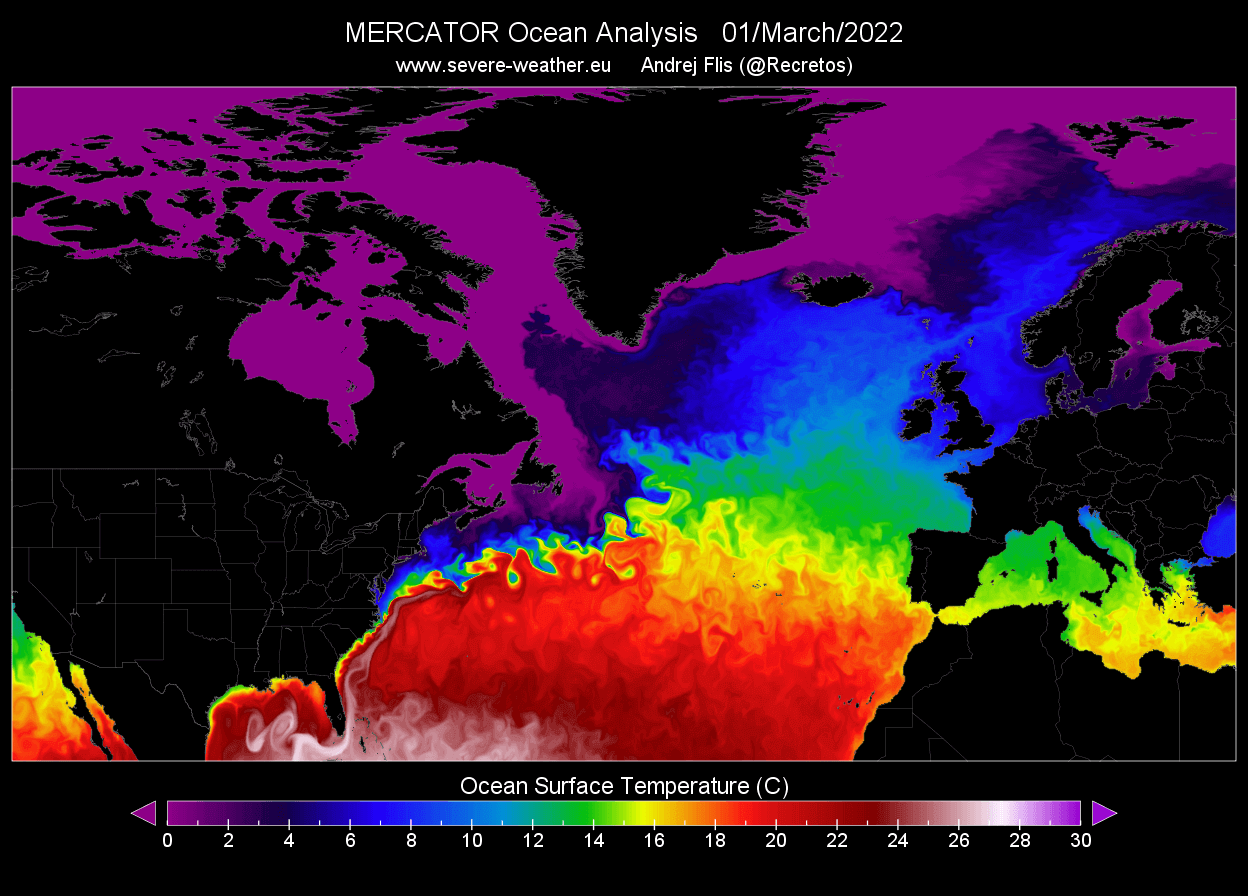
With global ocean surface temperatures shot way off the charts by mid-March, beyond forty years satellites have monitored sea surface temperatures, we’ve been struggling valiantly to map the changes in sea-surface temperatures, both globally and locally, in satisfactory and meaningful ways. The disruption poised to cascade across the planet in what might be the summer able to make climate change a less contentious issue of politics or partisan polarization. Maps of the remote sensing of surface temperature–sea surface temperature in specific–are shocking as they broker even deeper forms of estrangement, rendering the global temperatures against a baseline of the postwar period. The accumulated data from the first era of remote earth observation by satellite has generated a terrifying picture about which we lack a storyline, or a way to narrate our own relation. The problems of a metageography of impending global collapse that lacks any narrative resolution, more properly, and compels us to attend more closely to the conventions and imagery of how we map sea surfaces to interrogate more closely what we are actually seeing in such maps.

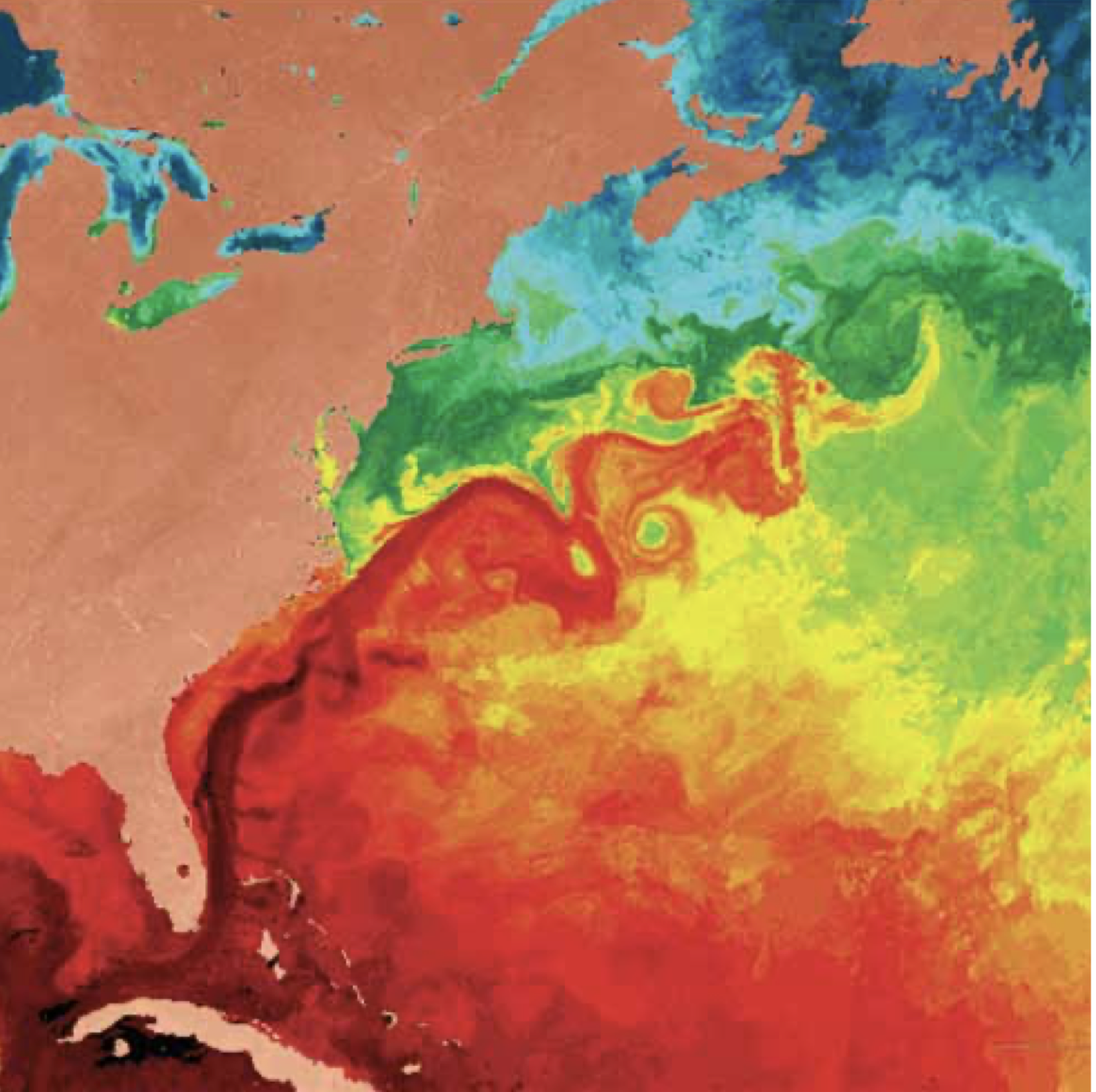
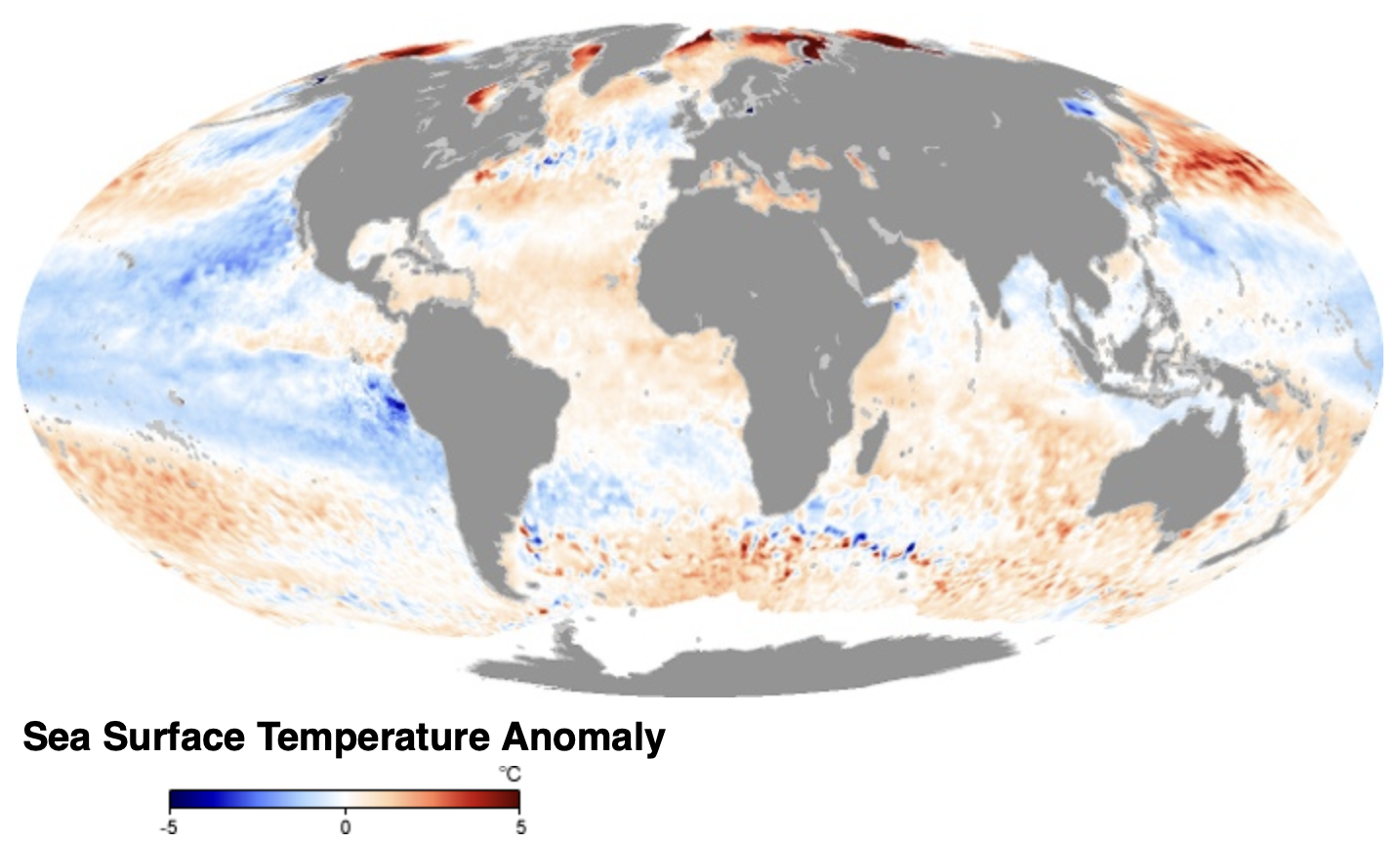
The totality of global warming are nowhere more evident than in the charts of sea-surface anomalies of temperatures, which pool red and orange on the planisphere in unearthly ways, but the correlation of remotely observed temperatures that deviate with standards of a century ago that showed foxing or burning over a decade ago, as the “hotspots” of intense rising temperatures near Greelnaldn, in Hudson’s bay, or off the coast of Maine and Siberia in July 2009 or even more strongly in September, 2011–but demand us to investigate the changing relation of land and sea.

July 2009/ NASA Earth Observatory
September, 2011/NASA Earth Observatory

–that have reached such record levels to lead Earth Observatory scientists to describe long-term effects of global warming by diagnosing that the global ocean “has a fever,” with disparities from past averages above three degrees C, not a lexicon of hyperbole, but suggest the inevitability of what early modern physicians would call fast approaching critical days–the discrimination of the moment when the patient will become “critically ill” or persevere, but that challenge us to classify the nature of such critical onset, as the ancient physician Galen felt fevers turn to more severe or worse forms at measurable moments, registering the temporal progression of fevers in his case histories that form the basis for modern clinical records to classify the effects of the fever in its  ‘quotidian’, ‘tertian’ or ‘quartan’ stage. But we sadly seem to lack the same sophistication for record-keeping of global warming, in the age of the Anthropocene. If Galen distinguished fevers by the responses they required from physicians between those that were acute (‘fast’, oxys, or celer) and chronic (‘slow’, chronios, tardus), the action of this oceanic fever requires is particularly acute.

Although Galen suggested that the “best physician” would take care to distinguish and discriminate the causes understanding the imbalances of vital humors that he argued caused illness, the causes that underlie such entirely anthropogenic rises in ocean heat have been increasingly debated and even suppressed, even if there is more than adequate indications that the consumption of energy and burning of extractive fuels have creat4ed and exacerbated temperature anomalies–and little interruption has occurred in the increased extraction of oil and gas under the optimistic slogan of “energy independence”–not actually providing or producing sufficient energy for a nation but exporting more fuels than one imports.
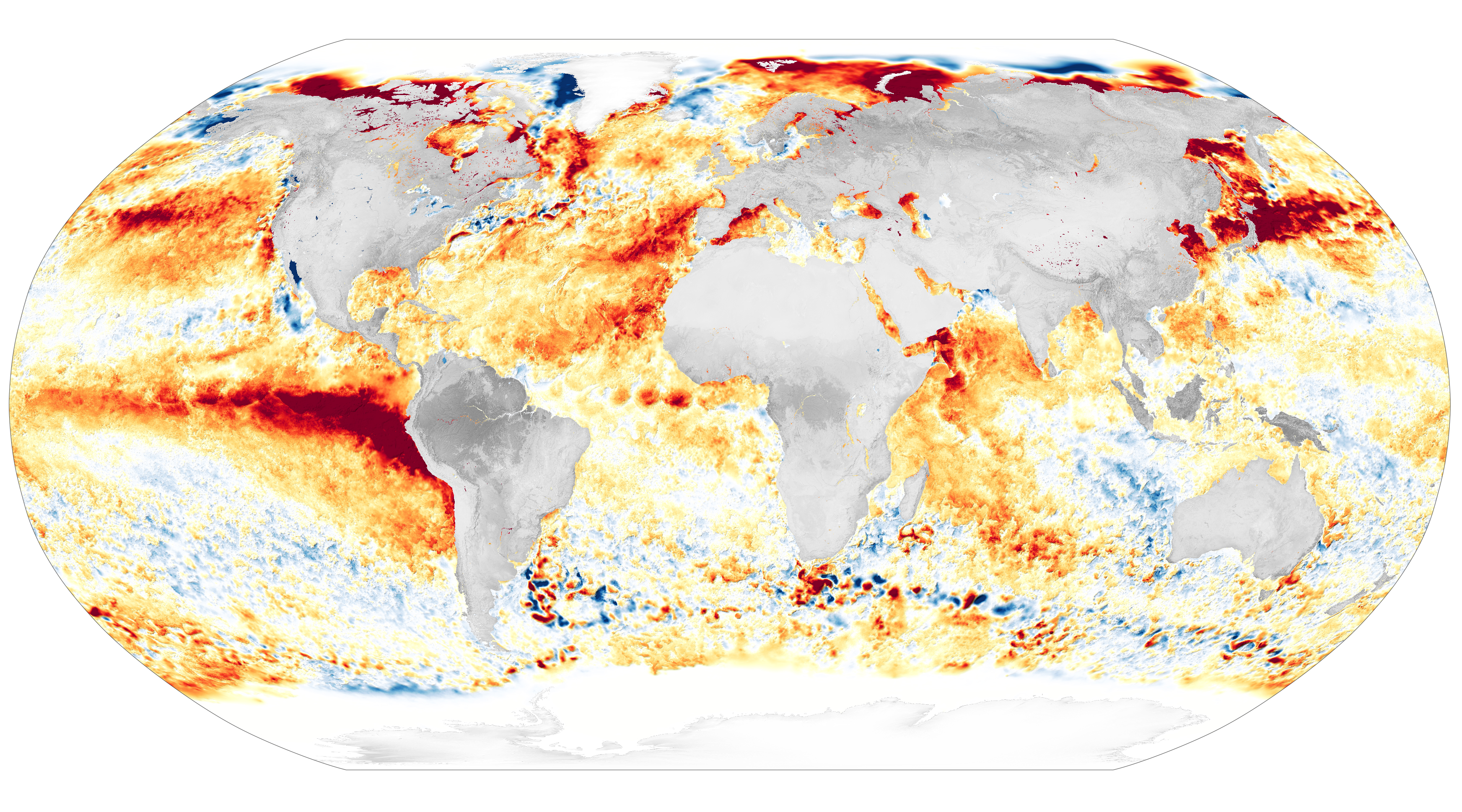
August 21, 2023/NASA Earth Observatory

The startling results of remote earth and sea observation stands as an odd counterpart to the iconic “blue marble” that became such a slogan of aspirations to global environmentalism almost a full half century ago. Yet the layers of these mapping tools seem, as the rage for composite forms of IKEA furniture, that arrives in assemblage components, to suggest a readymade far from Marcel Duchamp, as if to respond to the magnification of an imagined “migration crisis” by which the nation is challenged. If that crisis may be in fact false, or imaginary, even if migration rates have changed, and most migrants have arrived in the United States for work. The assemblage of the Border Wall is an elision of the identities and the experiences of migrants themselves, or the routes they travel or their work and trades.

IKEA Börder Wåll (2017)

The layers of our environmental maps of ocean temperature anomalies carry ideological presuppositions leaving us purblind to the massive scale of ecological changes in the global ocean, or ability to steer the results of global warming and planetary change by better grasping its effects, rather than creating indelible images of fear. As the practicalities of building a “Border Wall” with the cheapness Candidate Trump had promised, the proposal to create a readymade Börder Wåll that was a far more affordable option at less than $10 million–exactly $9,999,999,999.99 with a five-year guarantee–used the iconic instructions of the Swedish furniture company to imagine a version able to be assembled by screws and Allen wrenches whose pressboard standing a full ten meters tall. If the more affordable assemblage of the border wall was a potent figure for the political emergence of a salesman with little to offer the nation save the image of security, the layers of the remotely sensed map offer a similarly terrifying othering of the global surface, as if the known world were suddenly at variance from the world that we knew, if not destabilizing the very blueness of the seas.

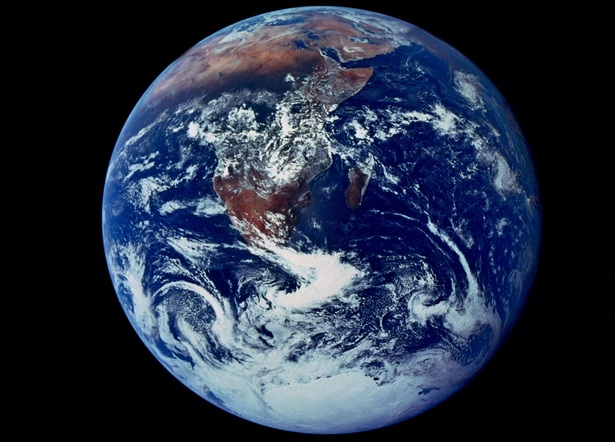
In the famous “Blue Marble” images taken by those aboard the final Apollo 17 to the moon in 1971, we recognize the continents bathed in a sea of bright blue–continents we recognize from the map, but now see, for the first time, a powerful map, lit by the sun before our eyes. The blue nature of the earth is its most overwhelming aspect, however, unlike a map, as if we can see the sea below sparse cloud cover against the Arabian Peninsula, the Indian Ocean visible from the polar ice cap, with the earth’s other continents for the first time ever: we recognize and identify Africa, Madagascar off its coast, and clouds swirling over the ocean, no nations in evidence. It is othered, but made more recognizable, defined more than by nations by the brilliantly illuminated azure of oceanic blue that seems for all practical purposes to dominate the world’s surface beneath clouds.
cool-space-picture-5.jpg

The icon of “Apollo’s Eye” soon the most reproduced in world history–an image of technological progress, but also a snapshot from space, taken off-hand at 20,000 miles per hour, a disappearing or receding planet, lit up by the sun, even thought the 70 mm camera on board was not intended for non-scientific ends, and the aweing nature of the film snaphsot was only recognized as it was develped by a film technician as a portrait of the planet. Although its authorship of who reached for one of the several Hasselblad’s not stowed away for more properly “scientific” purposes on the Moon in order to taken one of the great images of space tourism: one of the first remotely “sensed” images of the earth tilting toward the sun’s rays illuminates its blue oceans that are recognizable under swirls of cloud-cover, revealing recognizable continents–Africa; South Asia; Antarctica–from a perspective never before experienced. MODIS satellite reveal show the current oceans no longer as blue, but greenwith phytoplankton as oceans warm the acceleration anthropogenic carbons in the ocean, incubated by human-caused climate change or “planetary warming.” The Blue Marble now definitively receded so that it seems not a Hasselblad image but might be a photoshopped, the seas no longer offer an image of the Blue Marble. And nowhere is the alteration of sea-surfaces evident than in their temperatures, a gradient relatively new to GIS, but all too compelling if also problematic to render in convincing ways. Can we better render the layers of the warming ocean in ways that allow us to better come to terms with the effects of planetary warming?

cool-space-picture-5.jpg

Blue Marble Photograph by member of Apollo 17 Crew Commanded by Eugene A. Cernan

The Blue Marble image was widely reproduced in global newspapers. But it was only recognized as of interest soon after it was developed by a technician. What NASA called “AS17-148-2272” would be quickly adopted as the “Earth Day” flag. But if it was never definitively credited, and was only in a sense “discovered” by the technician who developed it, its appeal grew as it was consumed by an audience eager to imagine what the members of the space flight teams saw, and as they existed the Earth’s atmosphere. Its immediately recognizable emotive and inspirational power as an image of the earth’s totality as never seen grew, in part, because it was snapped as the winter solstice approached; the full illumination of planet Earth’s vibrant blue oceanic surface appealed as a moral centering, as it became a basis for the Earth Day Flag. Its recognizable nature was not only the crispness of its geographic outlining of continents as they lay and appeared on a terrestrial map,, but, unsurprisingly perhaps, as they echoed and modernized the very claims of divinity that early American environmentalist Henry David Thoreau found as he left Concord ‘s society and his daily job to contemplate the blue waters of Walden Pond he had praised as “cerulean” a hundred and twenty five years earlier, in a wor that was widely read by modern environmentalists in the 1950s and 1960s. The deep blue ocean surfaces from the polar cap of Antarctica to the Mediterranean, around the coast of the entire African continent and stretching to the Persian Gulf, was a counter-map to national maps of borders familiar from school maps, but asking we alter perceptions of the “blue marble” delicately suspended without strings as an image of strength and stability, without any, or at least apparently without any, technological mediation.

But the image of the blueness of those oceans is now undeniably an image that has receded in space, not an eternal image of timelessness, and transcendence, but a definitively receding past, as satellite observations of unprecedented oceanographic detail and range that allowed high-quality ocean color data by the MODIS-Aqua satellite systems announce an inevitably greening of the surfaces of the global ocean. The blue marble icon i, confined to the past, and an artifact of the past, after the anthropogenic alterations of phosphorus and carbons in the global ocean has, in an era of anthropogenic global warming, so boosted phytoplankton populations to recolor the ocean. The new surface ecosystem indicate new variety of microscopic organisms photosynthesizing in the global ocean, and carbon-enriched phytoplankton populations whose abundance in global oceans have “turned the seas green” and “othered” the ocean that was once such a pristine blue.

The iconic call to environmental consciousness map of the blue-drenched seas taken 28,000 miles from Earth at a point where the manned spacecraft crossed the point an Earth fully illuminated by the sun is definitively of the past. Eugene A. Cernan, the commander of the last manned lunar mission who claimed to have taken the photograph claimed to capture the crew’s collective astonishment at the spaceship’s transit before the sun. But he has returned multiple times to the sense of deep surprise by which undoubtedly melancholy window-gazing brought a sudden defamiliarization of earth and disorientation of the observer as much as a feeling of transcendence. It was removed from technology, but made him the most privileged observer of earth with a clarity and simplicity that had in fact been never experienced in history. The placement of himself was as strongly resonant as the fleeting nature of the perspecive, and “Do you know where you are at this point in time and space, and in reality and in existence, when you can look out the window and you’re looking at the most beautiful star in the heavens — the most beautiful because it’s the one we understand and we know, it’s home, it’s people, family, loved, life — and besides that it is beautiful?” The stunning image comprehending oceans and continents with “no strings holding it up,” “in a blackness that is almost beyond conception” in a soothing defamiliarization of awe.

The “blue marble” immediately hat was reproduced globally in print newspapers was an icon of globalism and an image of transcendence before it was an icon of environmentalist Earth Day that would spur a new consciousness of those blue waters’ preciousness and purity by showing them as if they were indeed Walden Pond. The photograph registered an oceanic expanse that appears timeless, and so intensely blue, a pocket of living life that might be modern version of Henry David Thoreau’s praise of the transcendent vitality of Walden Pond’s “cerulean” blues that reflected the sky so intensely as a mirror. (Let’s dwell a bit on this comparison: if Thoreau described the pond as “the landscape’s most beautiful and expressive feature” as “earth’s eye,” “looking into which one the beholder measures his one nature,” and his most prized companion during in “this mode of life” away from Concord, as he grew “suddenly sensible” of a sufficient space nature afforded, we are filled with dread at maps of rising surface temperatures that seem to bode an end to seasonality.) The awe the Apollo 17 Commander Eugene Cernan claimed to be compelled to snap the first image of the earth’s surface, entirely illuminated by the sun’s rays from Apollo 17, the south pole tilted sunward before the winter solstice and oceans illuminated as a seat of life seem a modern updating of Henry David Thoreau’s sensation of being in a privileged site of contact with the divine at Walden Pond. (Cernan’s claim was contested, but he felt the image akin to a re-centering of self.)

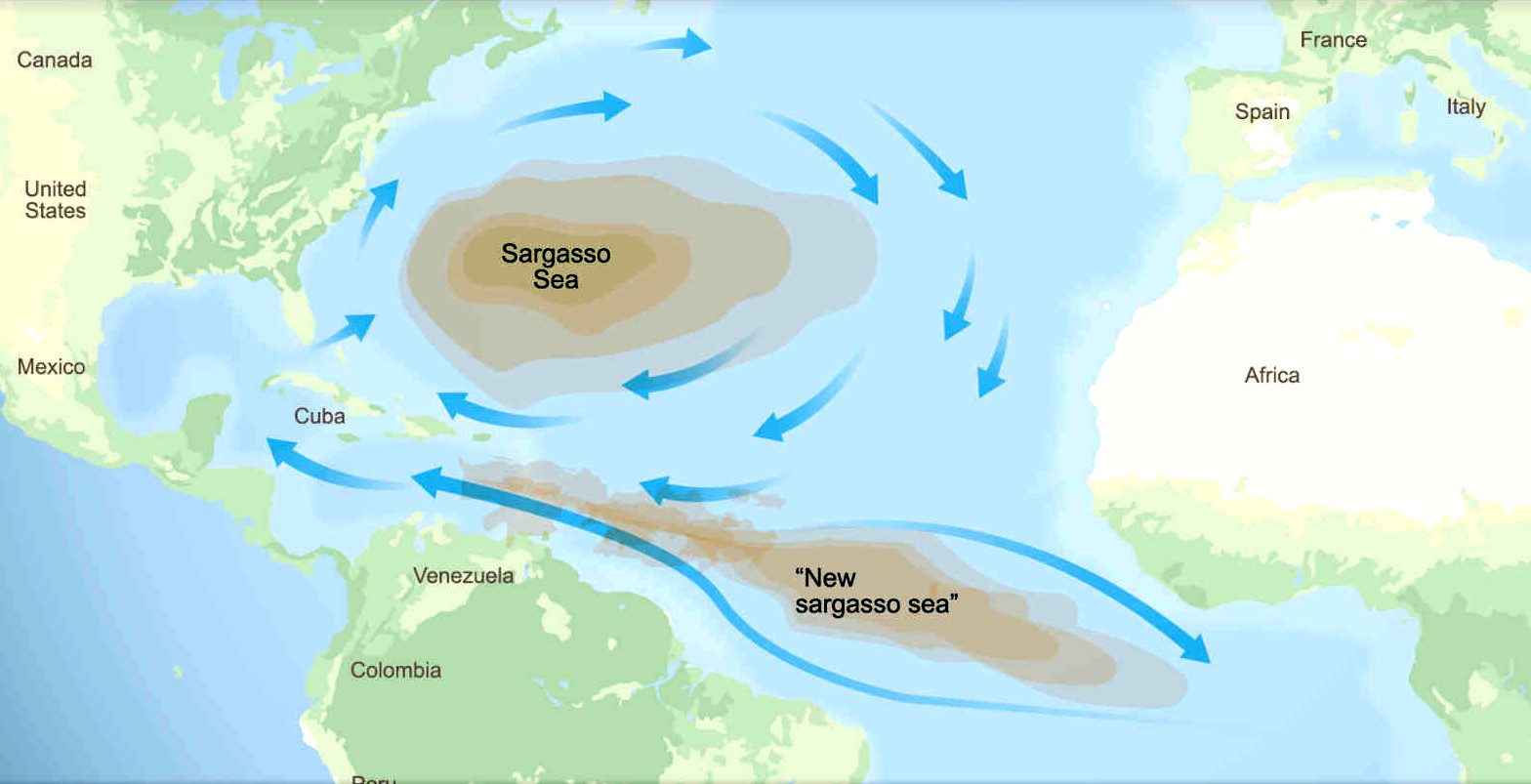
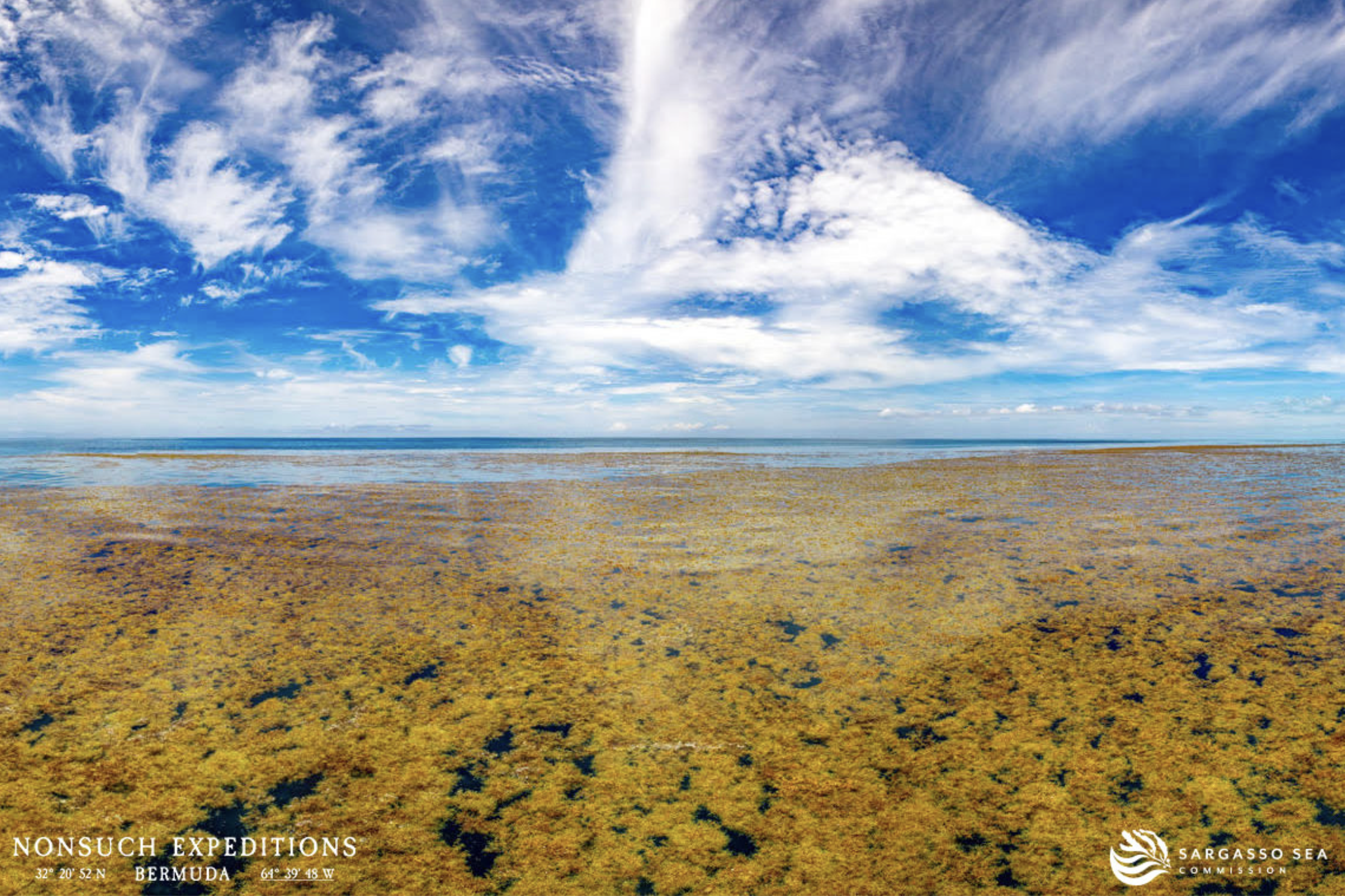
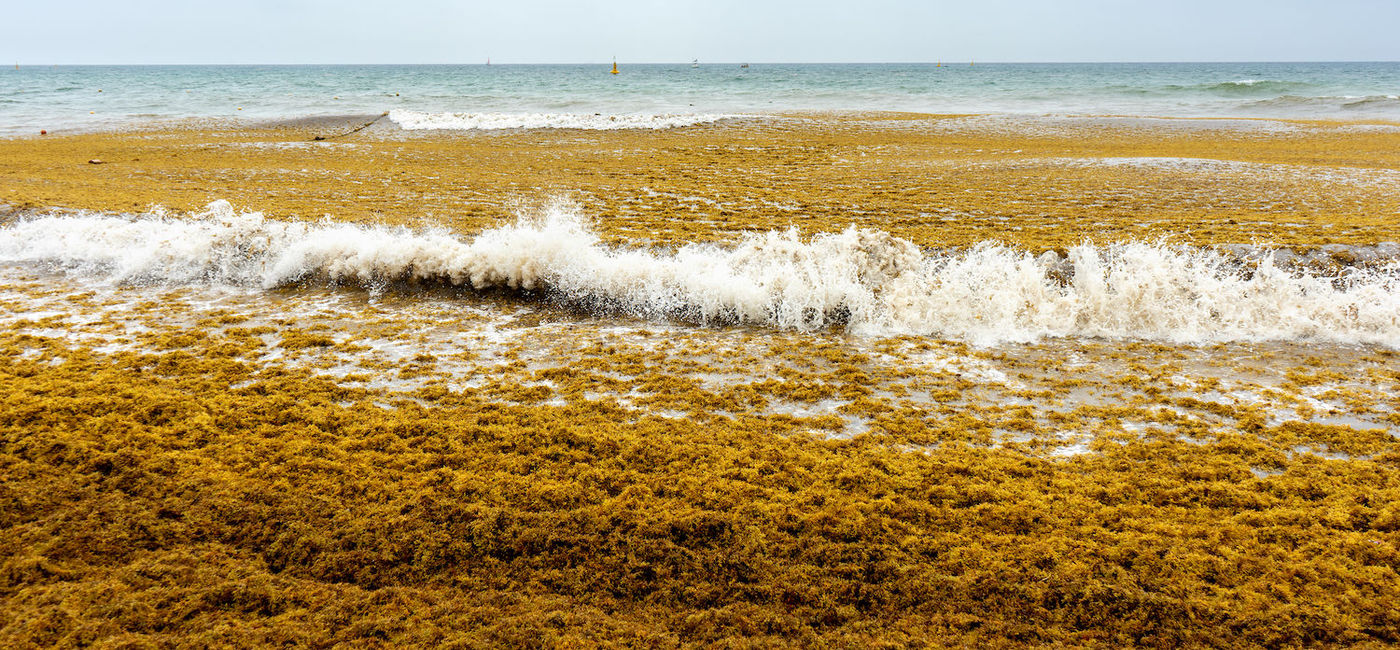
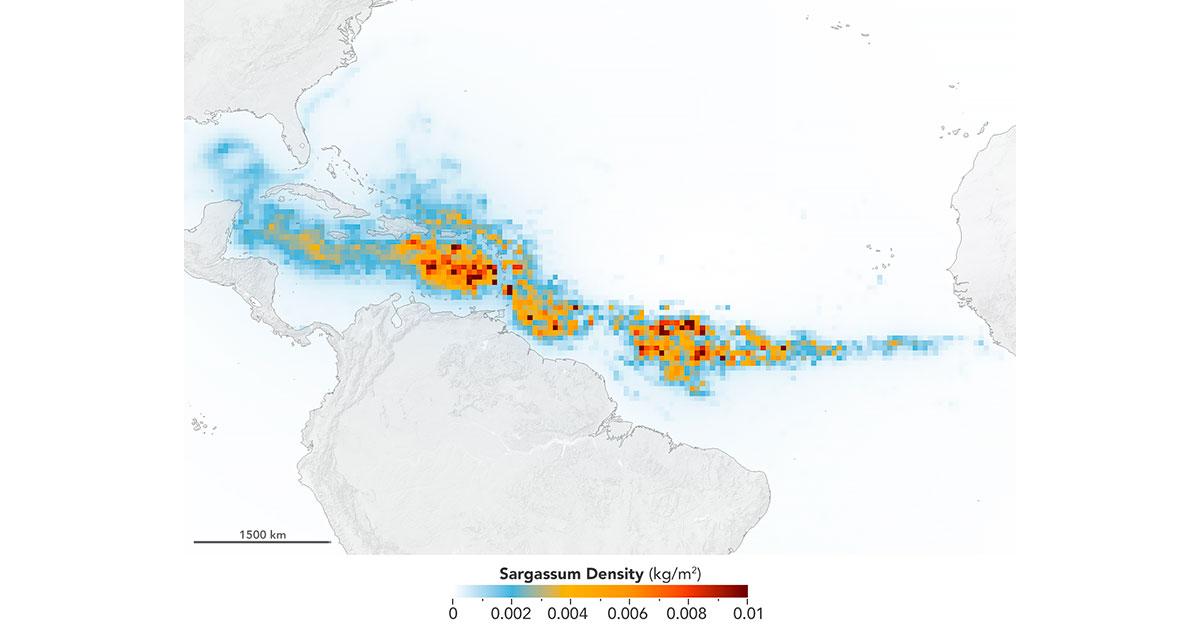
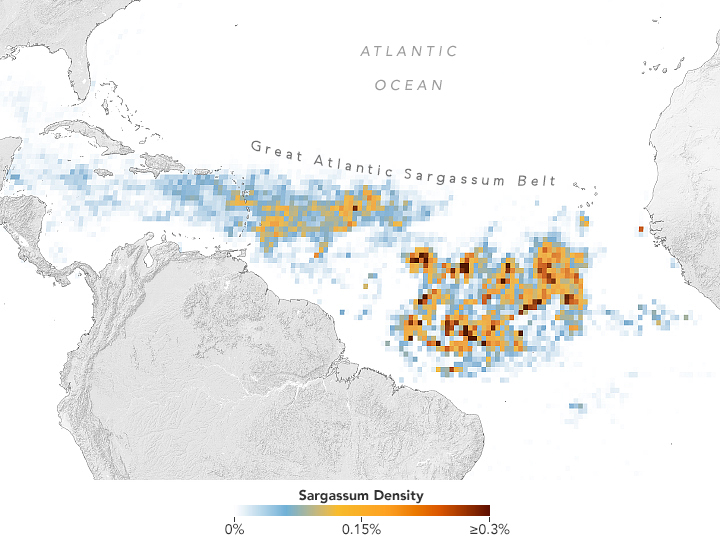
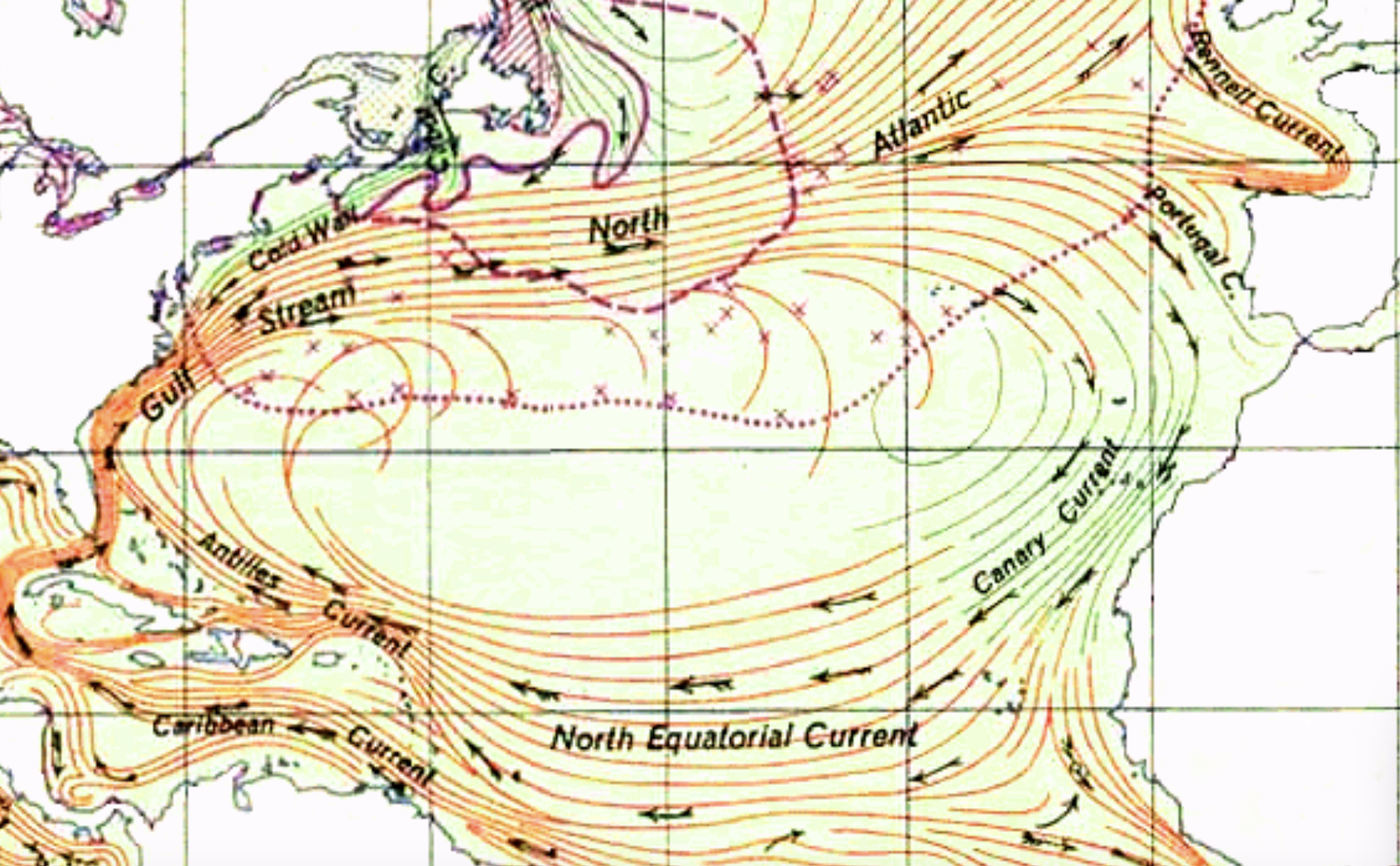
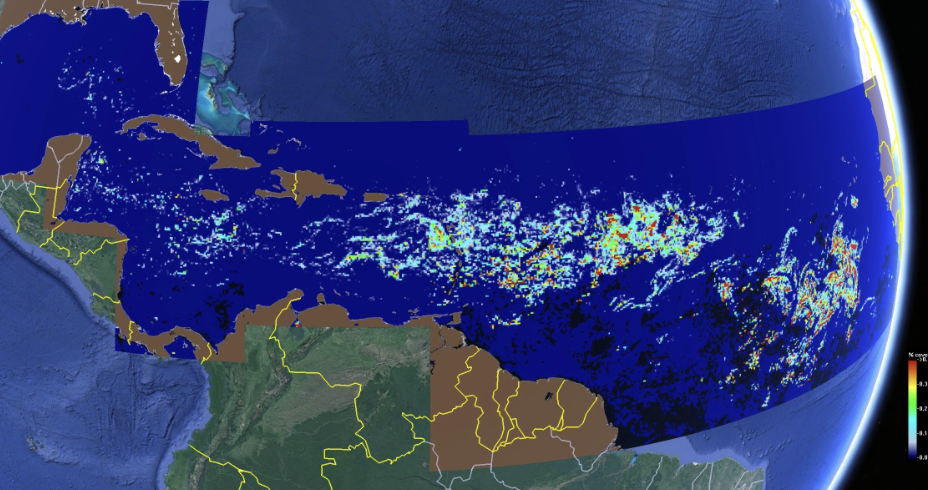
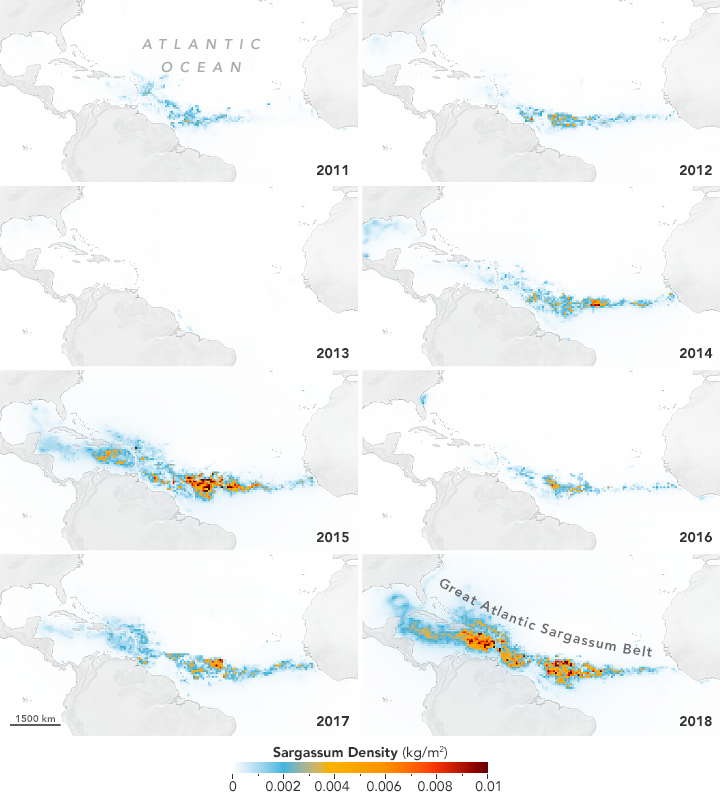
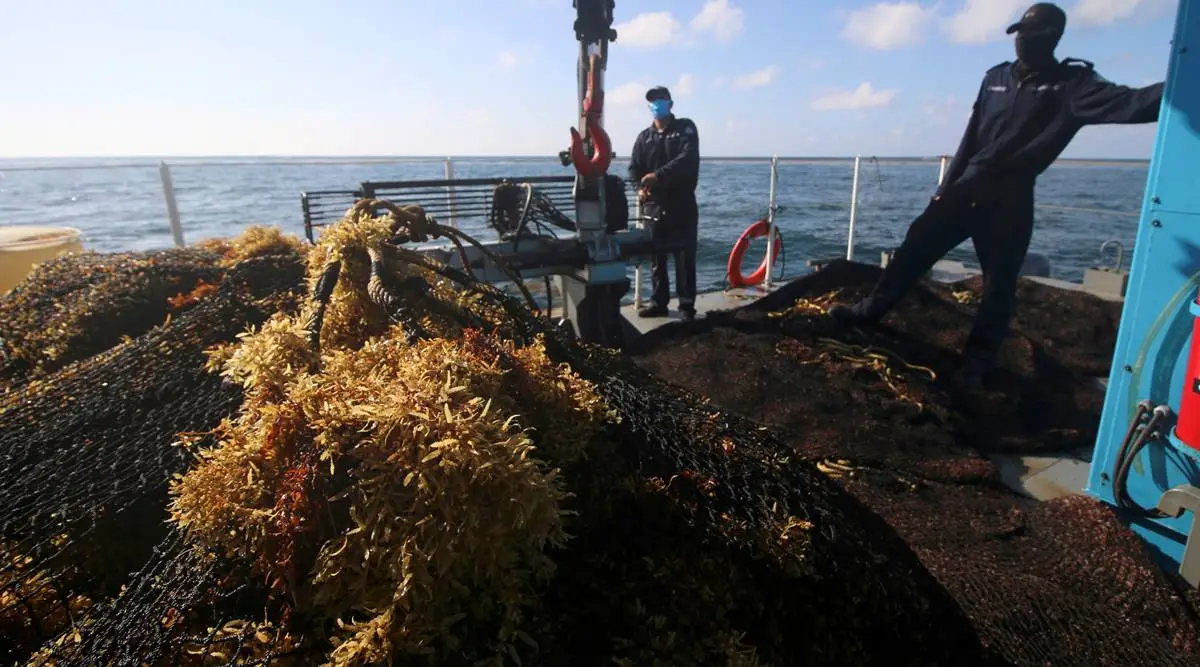
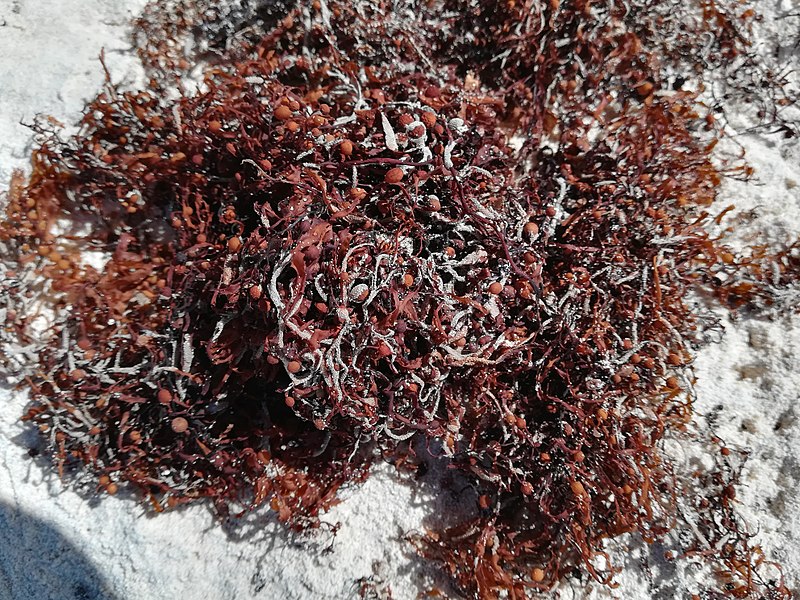
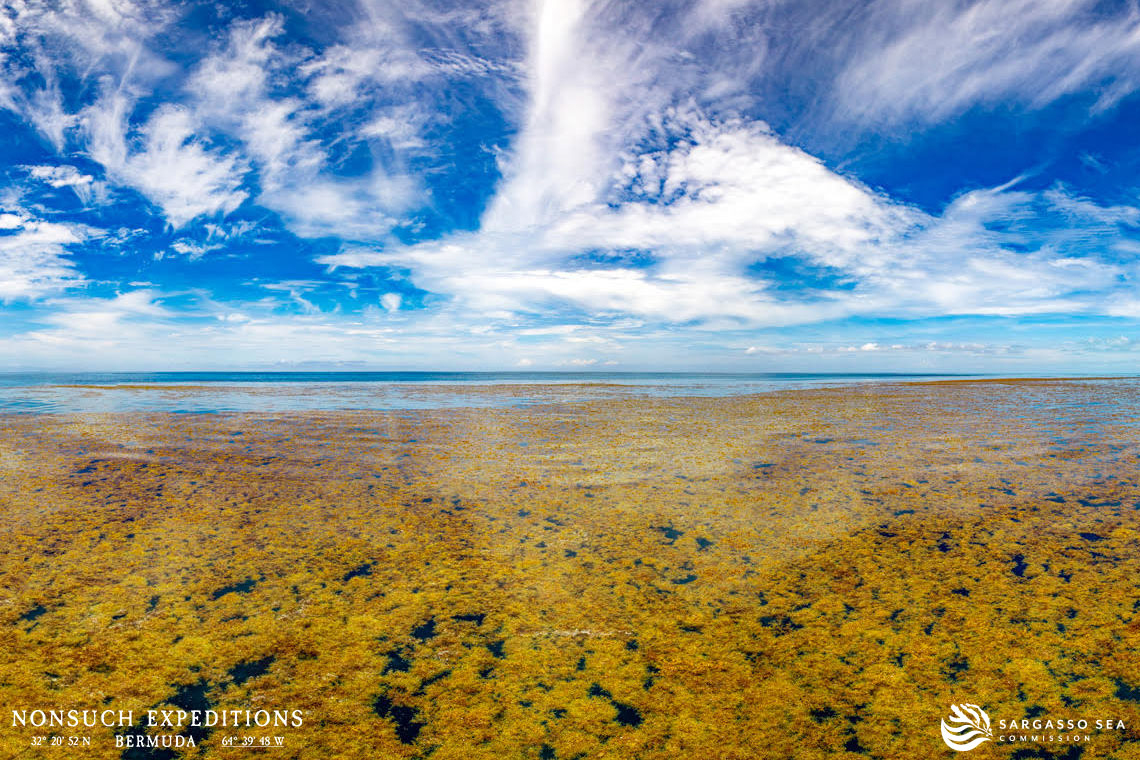
The Apollonian view that was communicated globally became an icon of technological progress and of re-familiarization of the earth. This was so much so was this the cast that the image that was reproduced globally with an unprecedented rapidity–a signe of the new globalization of the news–became adopted as an icon of the ecological movement of the first Earth Day, first observed two years previous in 1970, as if to acknowledge how the photograph taken by Cernan or another of his crew effected a changed relation to global space. In sharp contrast, the planispheric image of the increases in global temperatures is a deep dread, provoking an absence of orientation or storyline: dread is the only word for viewers’ disorientation before maps of rising surface temperatures that reveal the disparity of recent global temperatures from the recent past. Is it any coincidence that the seaborne Sargassum proliferated in the mid-Atlantic in record-setting ambient ocean water?

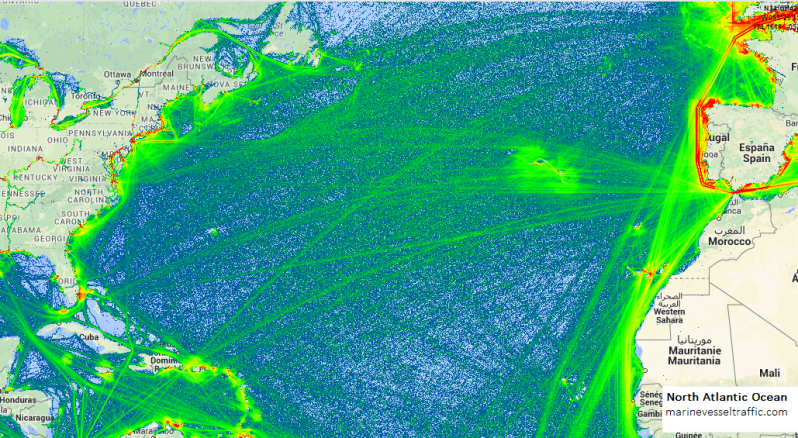
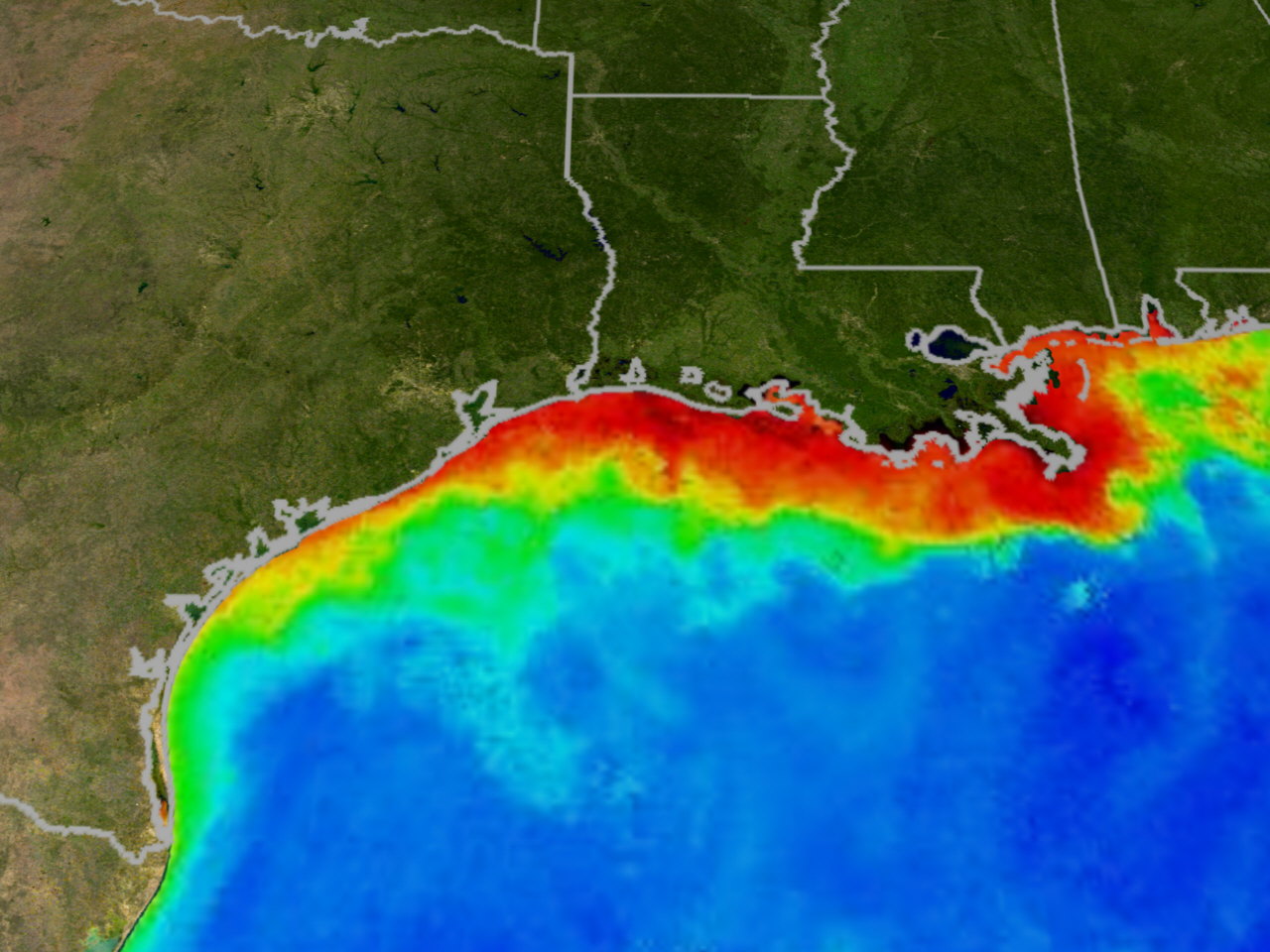
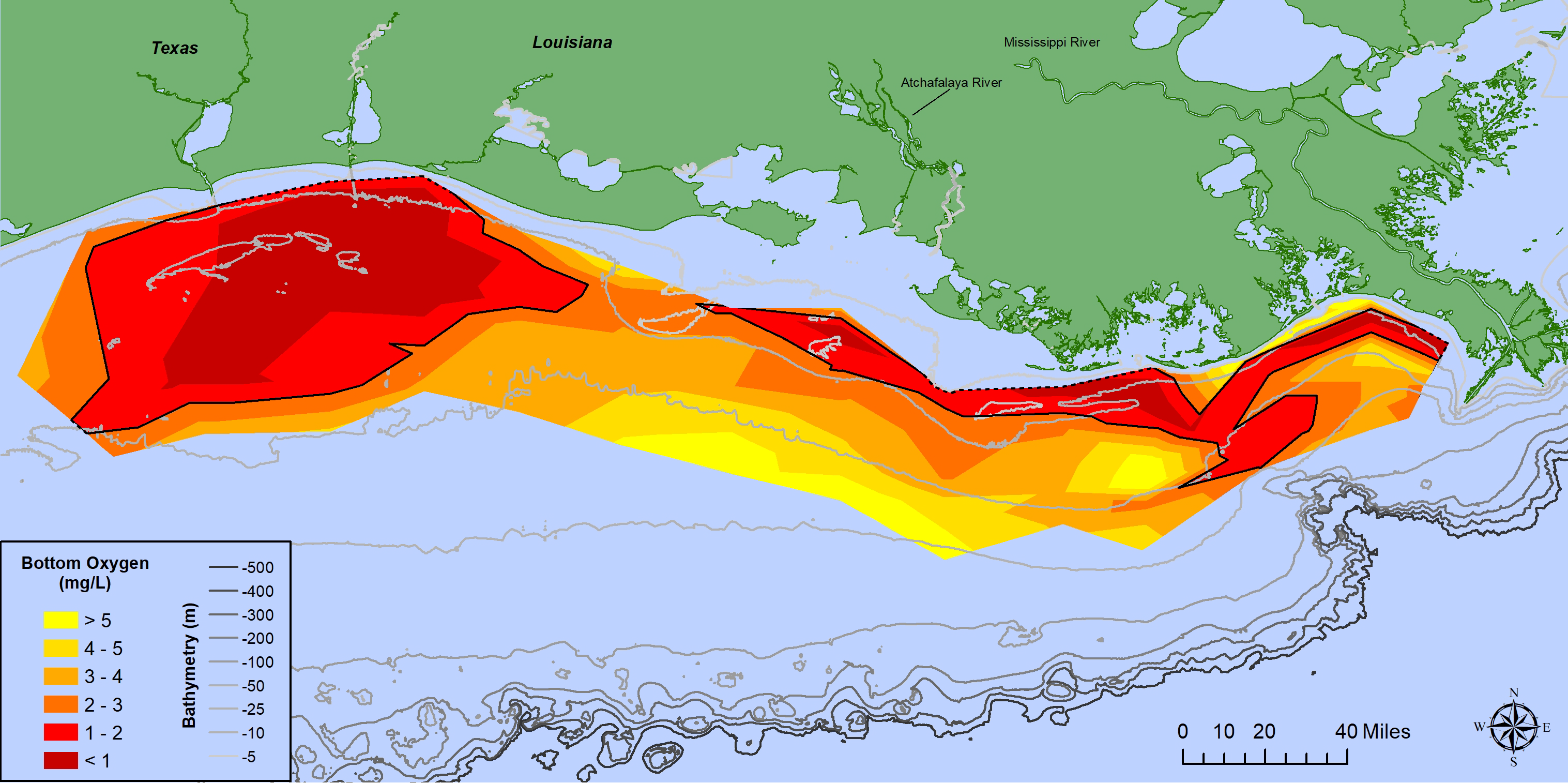
They bode an end not only to seasonality, but the vitality of the global oceans–if not the vitality of the habited world itself. Nowhere is this more apparent than the slick of petroleum that have appeared at the great site of marine diversity and vitality–the Gulf of Mexico–that has become a hub of the offloading of global oil supplies to the Americas for processing, seen as a “chokehold” for daily maritime oil transport of the 56.5 million barrels that traveled on maritime routes–about 63% of world’s total oil production. Indeed, the critical maritime routes for the global transit of oil were long referred to as “chokepoints”–

U.S. Energy Administration, based on 2013 data of Lloyd’s Intelligence, Panama Canal Authority, Suez Canal Authority

The registering of land temperatures monitored from satellites at a closer distance has created far more terrifying images of defamiliarization this summer and in recent years. The temperatures anomalies is hard to recognize as anything like a map that we might easily recognize, and indeed push the boundaries between cartography and art. If all art may be about estrangement–ostranenie for Russian formalist literary critic Victor Shklovsky and his circle–or “defamiliarization” of the known, the estrangement of global warming temperatures area shocker and an artistic narrative we do not know what to make of save as a learning model for the entrance into the new era of the Anthropocene.

If the politics of estrangement was for Shklovsky rooted in a new sense of life become art, and a revolutionary estrangement of self, global warming seems the utmost in estrangement, although what living through global warming honestly remains hard to come to terms or conceive. It is, for one, outside of our familiar narratives, save the apocalyptic, and we may tend to the apocalyptic as a result. But, this post will suggest, the danger is in a sense deeper than a failure of narrative alone and in ways that we may take a clue from the Russian formalists themselves to understand: for the formal presuppositions of visualizing and of mapping sea temperatures as continuous with land, and as able to be mapped in the same terms as the anomalies of land temperatures, is an ideologic construct and choice, independent of the content of the global maps of raising temperature: for we flatten the sea temperatures at our own risk. Flattening the ocean expanse as if it were akin to land temperatures ignores the extent to which greater heat that drive increasing global temperatures have been storied within the ocean, and the risks of rapidly cascading nature of changes in ocean temperatures that anthropogenic change has produced.

Indeed, the critical ways that mapping sea surface temperatures and mapping ocean resuources as if they were sites for extraction, akin to land-extraction, has led to an increased dependence and sanctioning of offshore waters for extractive drilling, as nations from Canada to Russia to the United States to Argentina to Mexico aim to expropriate underground reserves of oil to boost their national economies and trade, auctioning off lots to the highest bidde, or subsidizing offshore drilling of gas and oil. These huge anthropogenic changee masked or concealed by relying on the relatively surperficial maps of remote satellite sensing of sea surface temperatures alone.

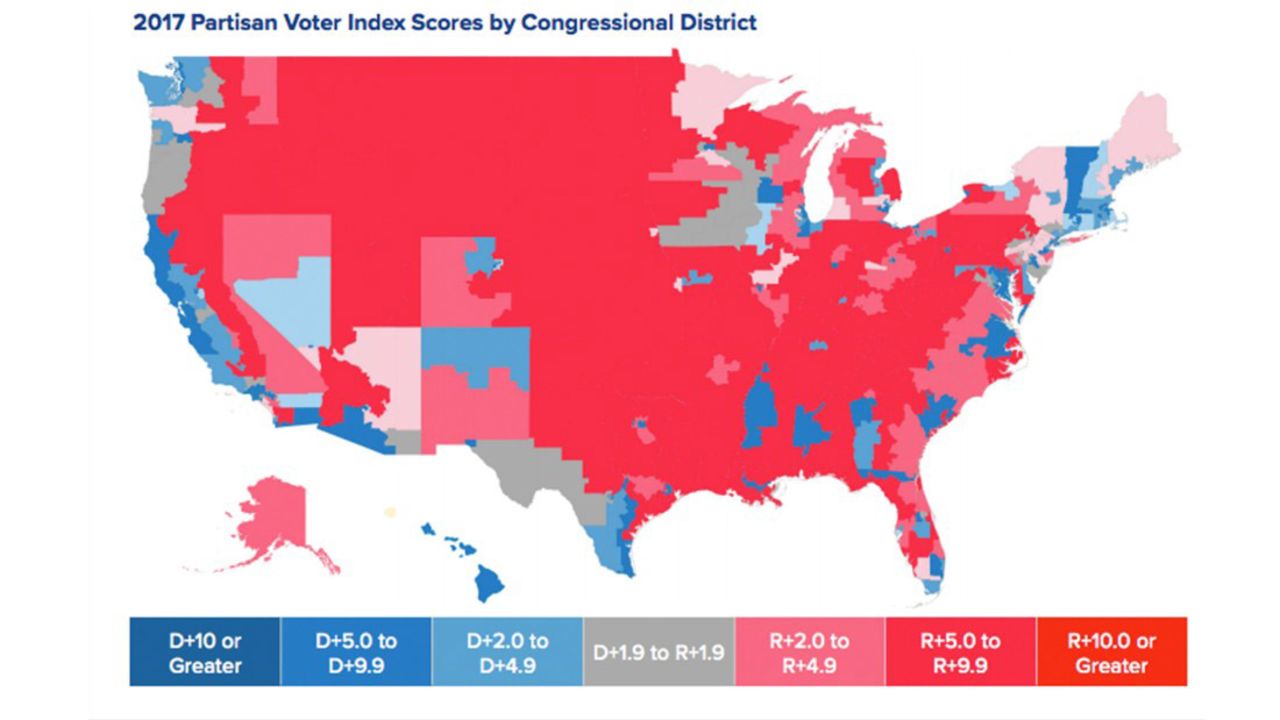
By the middle of June, the GIS anomalies of global temperatures from a baseline of my pre-college years revealed how much personal history had intersected with a radical change in global climate. One’s life memories somewhat incredibly and suddenly in synch with global epochs, reminding me of how very unlike global temperatures for most were compared to the normal in my own memory as well as that of the planet–a daunting prospect and possibility indeed to get one’s mind around. (It’s hard, however, not to wince at the echo of the fractured partisan topography in this map of global temperature change, even if the confine of blue to the arctic regions and western and northeastern United States ; the carmine warming temperatures looming over Canada is quite hard to dissociate from the dry forests that ignited in fires across so much of the nation this summer.)

The view from a generation–if not a life perspective–showed a modeled planisphere hard to get one’s mind around, scorched by temperature anomalies, from the ocean off of South America, the arc under the Aleutian Islands, the hot-spot off of west Africa and burn holes of Europe and Siberia. The warming of the global atmosphere was long seen as “one of the most pressing problems of the twenty-first century,” the global maps of heightened atmospheric warming due to elevated carbon levels now a full 50% above preindustrial levels–and larger than ever seen on earth since three to five million years ago–according to paleoclimatic data–make it hard to place the climate changes amplified by greater methane, nitrous oxide, and fluorinated gases. It is a register of the all too human art to burn carbon, if not just a deeply depressing image leaves one drained of any agency; it is hard to stand before it with anything like the exultant transcendence of fifty years previous.

As carbon levels continue to crest above 420 ppm, we look back at the high levels of CO2 fifty million years ago, average temperatures reached about 10°C warmer than today and the planet ice-free, with sea-levels lapping shores two hundred feet higher above current sea-level. One can segment it many ways, but the huge escalation of temperatures of the oceans–which have stored a vast amount the growing heat we experience on earth, or a whopping 93%–moves unlike how heat is experienced in land, but reflects the most densely populated coasts–and densest sites of anthropogenic waste–
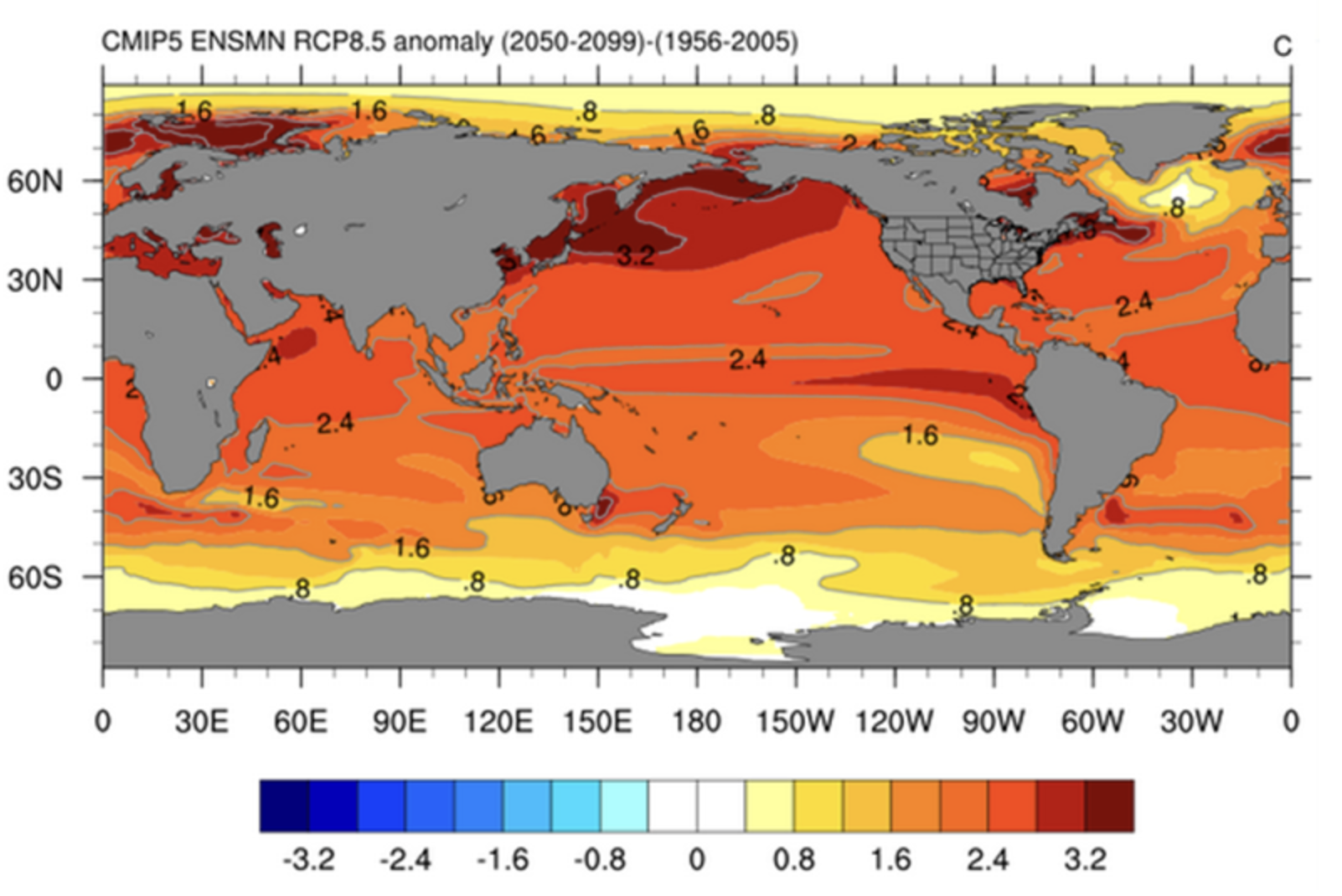
–in the global ocean.

The warming of seas were long recognized just several years ago–in relation to a dataset from the twentieth century and first two decades of the twenty-first–in ways that call attention to just how much atmospheric heat the global ocean has absorbed into its own waters in the past century–and how much more it has additionally absorbed, perhaps putting it over the top as a site able to sustain life, in recent years. If death was the “master fear” that philosophy was able to conquer for stoic philosophers from Seneca to later Romans, able to be overcome to conquer fear itself, the increasingly inhospitable global oceans suggest little to meditate upon we have an ability to process save their own evanescence as habitat for life: the images are perhaps not records of a life lived, but are literally the collective residues of “lives lived” in the twentieth and twenty-first centuries. There is no known script of how to live that they offer for virtue or nobility.

We are increasingly pessimistic about our world view, and the maps of global warming fit with an increasingly pessimistic world view that has been seen as a problem of global purpose, at least from the US-led invasion of Iraq in 2003 without debate that after eight years of conflict saw “shock and awe” lead to wide questioning if it was worth fighting. If the 3.4 million aircraft sorties that dropped the equivalent of 640 Hiroshima bombs in Cambodia and Laos had cast a shadow over America’s global purpose for one generations, the burning of 700 out of control oil field fires lit by retreating Iraqi forces as they withdrew from Kuwait under fire: as U.S. and allied troops arrived to defend the fields in a war of a hundred hours, of bombing sorties of air-launched cruise missiles, Iraqis lit wells as they retreated to blanket the air rendered unbreathable for soldiers without gas masks in improvised smoke screens of toxic with particulate matter. As “allied” intervention destroyed an amazing 3,000 tanks and 1,400 armed personnel carriers in a matter of days, with countless other vehicles, the plumes of 700 gushing wells were lit, creating up to 300 oil lakes in the desert whose pollution of the soil is as deep as four meters today, now hardened to sludge leaving lakes that are toxic today, even as almost two and a half million cubic meters of sand were cleared. Concservationists remained concerned about continued effects on humans and the environment.

The very commodity over which the war was fought became an aggressive act for the military advantage, squandering petroleum resources the west valued in an age of ecological aggression the transformed the Greater Burgan oil fields into an anthropogenic inferno. Wells were commandeered in a scorched earth policy of unprecedented scale, an environmental disaster that cost over a billion to extinguish, individual wells only able to be extinguished at a rate of one or two a day, as forces were anticipating billions to reconstruct the fields the United States led “allied” forces to defend. The anthropogenic effects may be obscured by of the sovereignty of Empire, far beyond the bounds of the nation state, and the bounds of the Kuwaiti oil fields.

If the logic of direct intervention in the 100 hour war depended on the myth of effective global military apparatus ready to wage a “just” war, asserting military control over Iraqi and Kuwaiti oil fields in the logic of war, the lighting of oil rigs and gas rigs by retreating troop and bombs improvised a network of resistance, blanketing the region with smoke that made aerial surveillance impossible and useless, and offered deep health risks to those troops with “boots on the ground.” As wells burned they ignited the very source of one of the sources of shipments of crude to be refined in the Gulf of Mexico, where much global petroleum is offloaded. The arrival of petroleum in the Gulf’s dispersed system of refineries and multinational companies was a basis for the extension of “American interests” to a region in the Gulf seen as so critical to the globally extended economy to justify the “just war” by American-led forces. The global web of oil refineries across the coastal region was a way in which the wealth of the United States was preserved and transportation economy fed. If oil spills had declined in recent years in U.S. marine waters, the offloading of forign oil in a network of refineries established in American waters in a site of deepewater oil and gas production was a basis for the extension of American “sovereignty” that had ignored the anthropogenic effects of oil toxins was released in the war, if far beyond the US coasts.
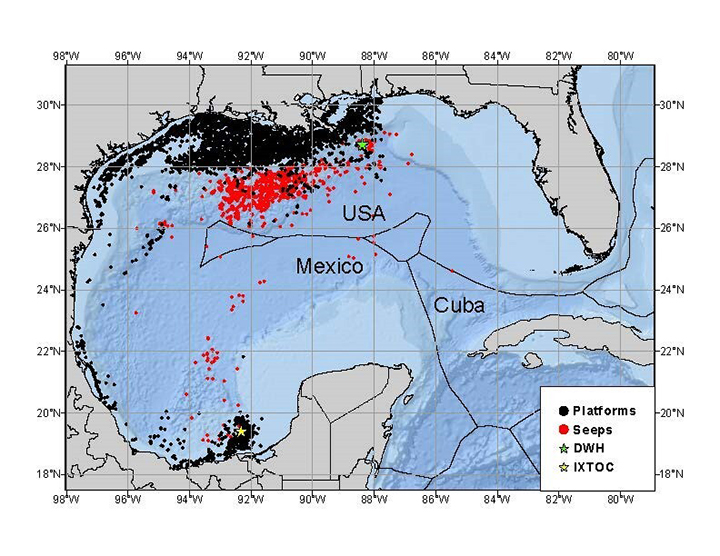
Oil Toxins Pervasive in Gulf of Mexico

If America was stunned that the United States had coordinated the Iraqi invasion of the oilfields in Kuwait, the new source of most oil refined by American oil companies on shore, the war that was fundamentally about blurred borders, and control over the continued flow of extracted petroleum and gas for commodities, the burning oil fields took back the very grounds of production by lighting the oil rigs as torches in the night.
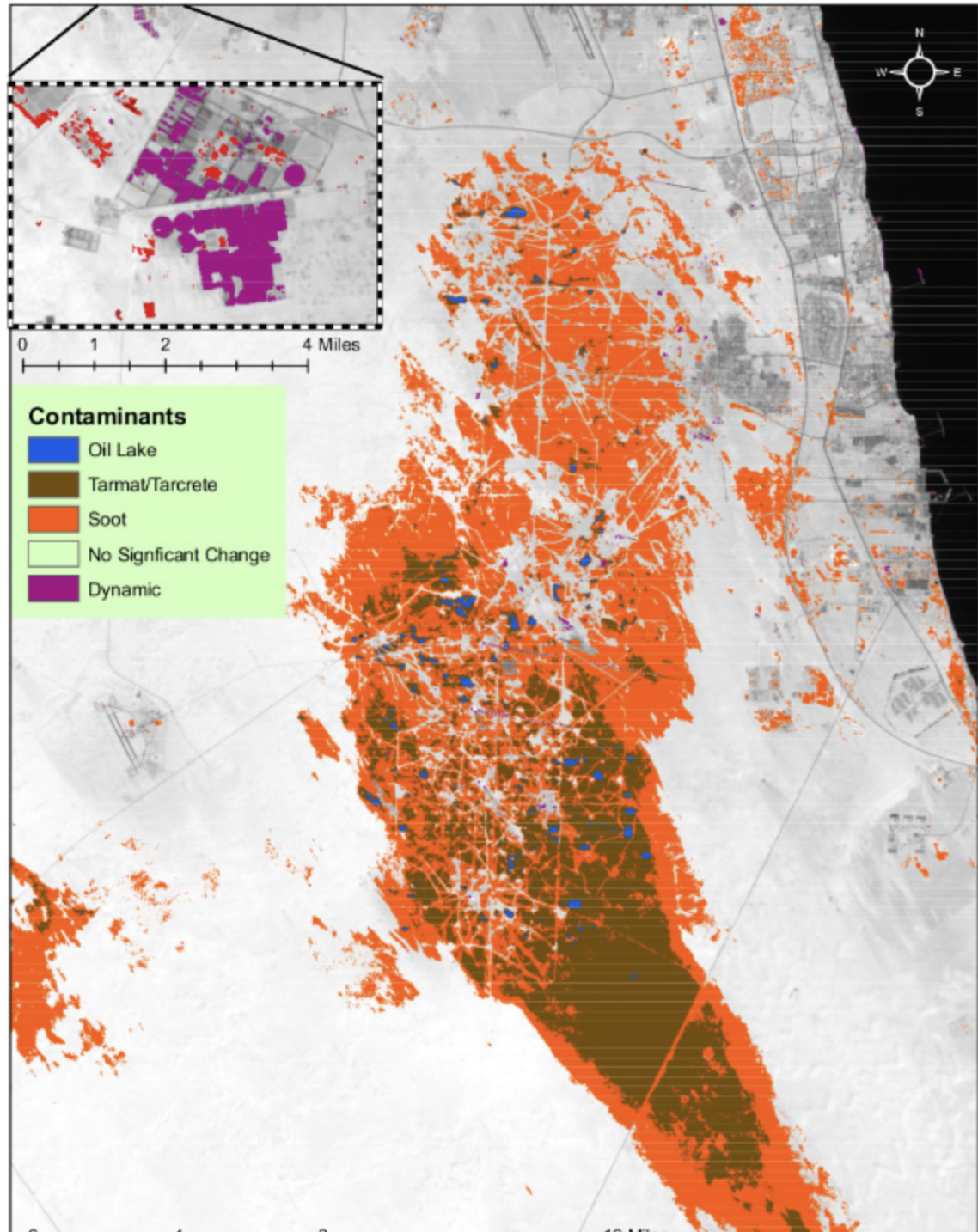
“Kuwait Oil Spill, 1991” by Christopher Gomez (2016)

The anthropogenic scars of the 1991 war with Iraq created warnings of a nuclear winter never to materialize in 1991, burning of hundreds of thousands of barrels released one and a half billion barrels of crude into the environment including “oil lakes” burning for months created but 2% of global emissions. A further hundreds of thousands of barrels of oil from oil field rigs gushed through most of 1991–a record of anthropogenic harm predating Paul Crutzen’s popularization of the concept of a geological epoch distinguishable by its environmental archeology. While the Anthropocene is dated as most evident from the 1950s, as the acceleration of technologies and explosion of atomic bombs left new residues on mountainsides and the planet, the invasion came at the end of the Cold War, at a time when the mobility of troops across the planet had grown in a converse of globalization. The ability to move troops to “invade” or “free” Kuwaiti oil field by aerial bombardment, that mobilized thirty one nation alliance against “military targets” by B-52 strikes and hellfire missiles to prevent Iraq from occupying the oil reserves on which America depended was called a “just war,” but the intervention led to the combustion of eight hundred oil well rigs, three quarters catching fire and burning, and fifty gushing oil onto the ground, until they were capped in October 1991.

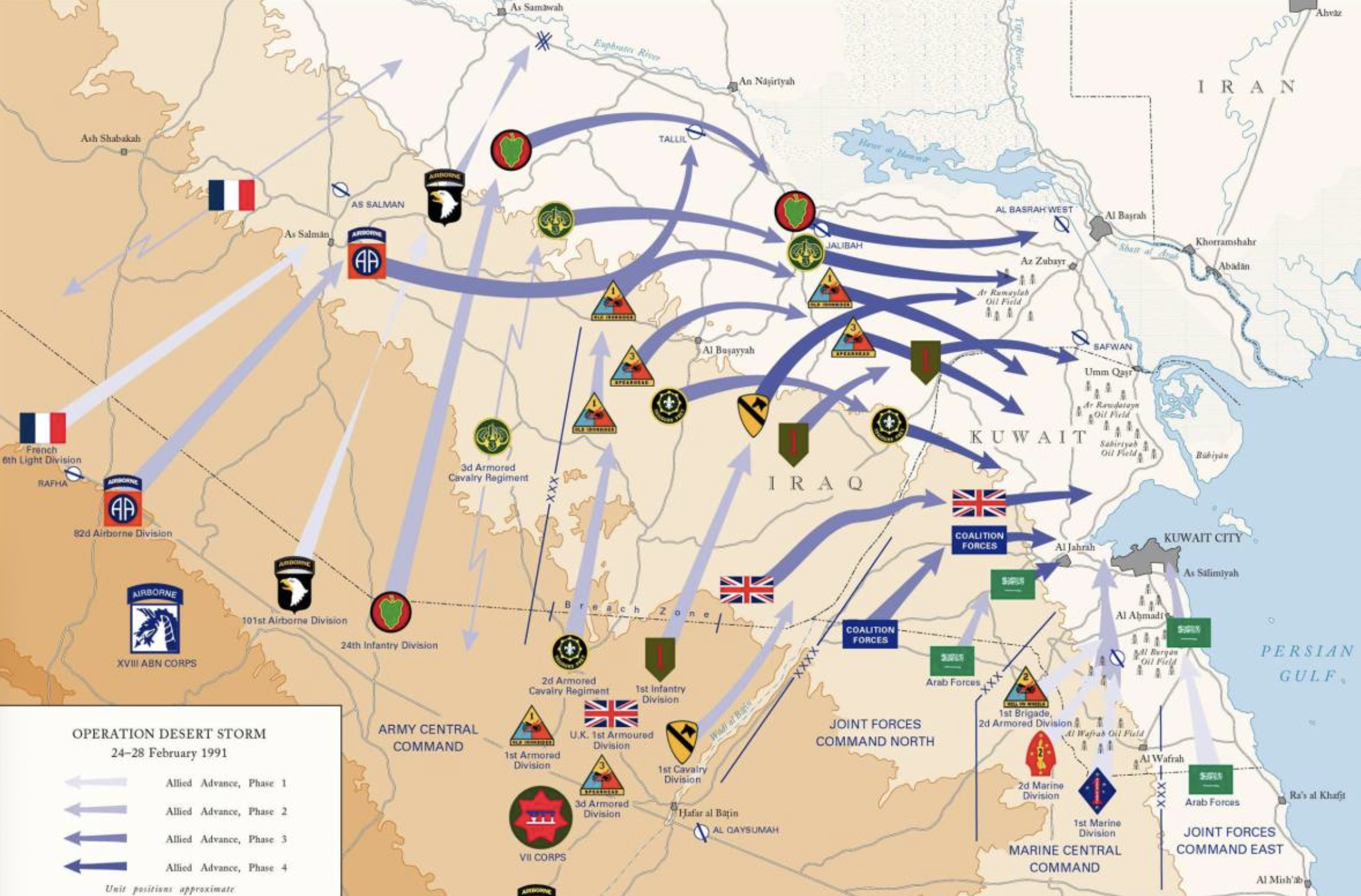
The drive to protect oil and gas led to oil fires burning, releasing about 355,000 tons of crude. Their destruction was a retaliation of the sovereign control of speedy troop movements in an intervention that paradigmatically revealed a new sense of Empire asserting sovereign control over Kuwaiti oil fields in a self-defined “just war.” It became a monument of anthropogenic alteration of the landscape by an environmental disaster of new proportions and scale. If the term “boots on the ground” only gained currency in the Invasion of Kuwait, the term that dates in the military from the hostage crisis in Iran suggests the limits and frustration of global mobility, but conceals how the grounds of the region were altered in decisive ways, responding to how the United States showed its readiness to move anywhere in the world with a massive show of force of unprecedented scale, in a new multi-national effort difficult to map or narrate as a story of “boots on the ground,” or to register in the consequences of how multi-national forces intervened in oil fields in Desert Storm.
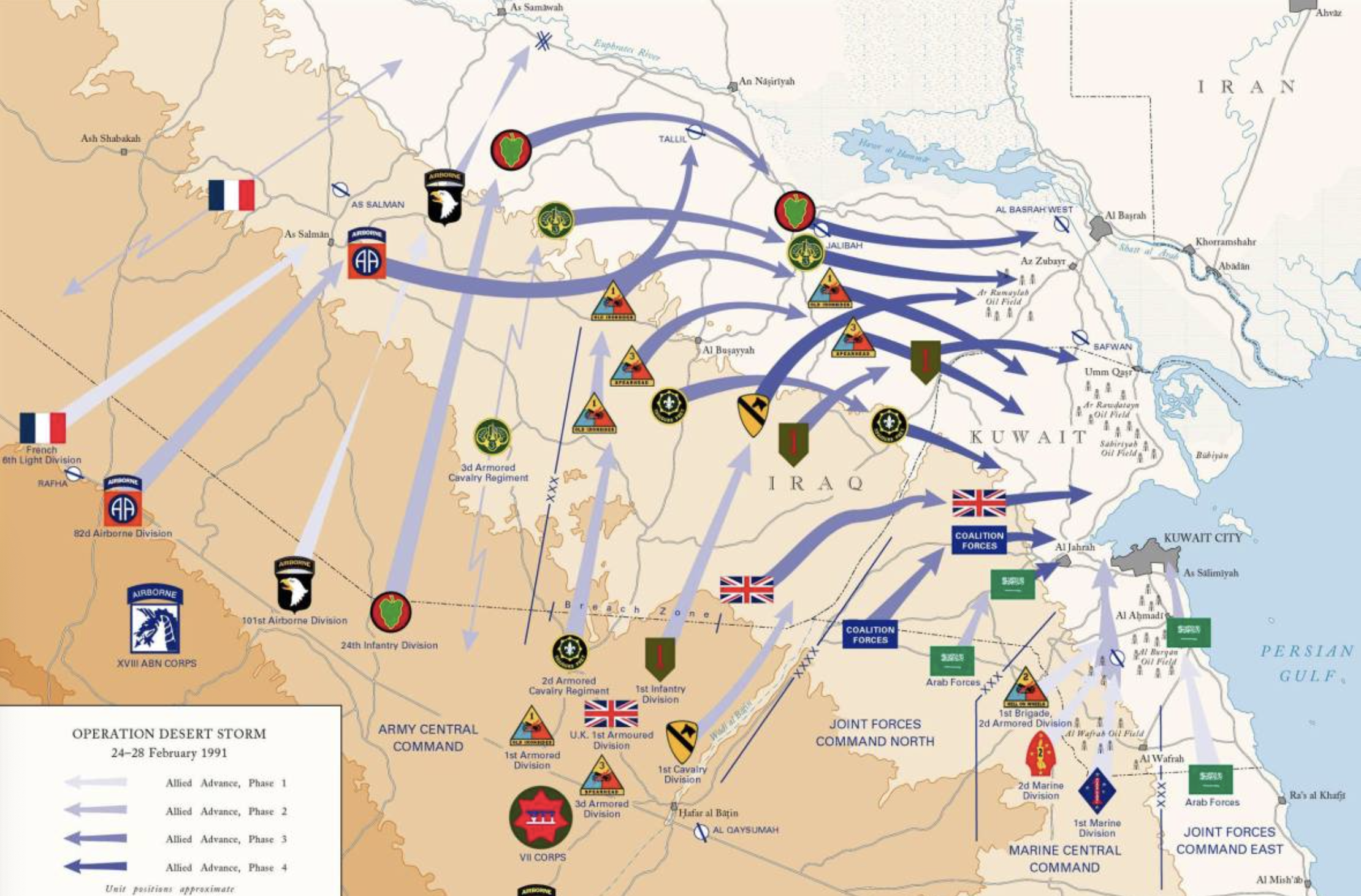
Operation Desert Storm/U.S. Aarmy

The burning of wells by retreating Iraqi troops left a residue left across the desert sands. Accumulated soot from petroleum refineries and carbon–“tarcrete”–spread as a residue of the war; the dark plumes continued to spew400 metric tons of particulate matter of 2.5μm daily from oil wells with over a hundred million cubic meters of natural gas; sixty to eight million barrels of oil directly entered the Gulf in a major environmental disaster that affected the entire ecosystem, as at least fifty oil wells gushed to the ground and eight hundred were destroyed with explosives, if the total carbon emissions were 2-3% of the global annual anthropogenic burning of fossil fuels and but 0.1% of global CO2 emissions. The local density of soot in the Arabian peninsula lowered climate temperatures by 10 degrees C, and covered extensive areas in Kuwait, Northern Saudi Arabia and the Gulf. Gushing wells flooded the oil fields with lakes of petroleum of up to ten hectares, polluting the Gulf, nearly fifteen thousand million cubic meters of oil leaching in Burgan alone–a site of major air attacks–and 22.5 thousand million in total, much from the armored tanks an munitions were abandoned by soldiers in the desert.

Air Attacks and Major Clashes where Depleted Uranium Rounds Fired into Kuwaiti Oilfields

If the 1991 invasion was a critical starting point in staging a deep environmental estrangement than the rise of the new form of military intervention Negri and Hardt argued epitomized the global interventions for just wars in the new legal formation of Empire. The aggressive American-led military intervention ostensibly to “maintain peace and order” by ensuring the smooth circulation of petroleum extraction from the oil fields of Kuwait and Iraq that were the true targets of western desire. But was the burning of oil wells on the border of Iraq not an active rejection of the claims of this new formation of Empire to the Kuwaiti oil fields? Before a feared economic disintegration of multinational claims, the military intervention and conquest sought to construct a global order superseding time to replace it with “free markets,” Negri and Hardt argued, beginning from the military interventions that precipitated the Gulf War.

In response, Iraqi troops set rigs on fire by wresting control of the very underground deposits of petroleum defined as the economic resources of the region, using the infrastructure of energy companies to upend the peaceful new neoliberal order so blithely unilaterally proclaimed. The consumption by combustion of the gushing rigs that were an infrastructure of global energy networks were appropriated as the sites of resistance against the western “peace-keeping” forces that arrived from the air. Who is to say it was not staging resistance on the ground, from the ground up? The redirected anthropogenic effects of a massive project of extraction as Iraqi troops unexpectedly released improvised smoke-cover undermined the organization of a planned international military intervention of a “just war” monitored from above by satellites as a massive disproportionate show of force and deployment of troops by obscuring it from satellite monitoring from a new theater of war. If the war depended on an effective image and logic of military control over Iraqi airspace, the seven hundred oil rigs that burned as a monument to the Anthropocene offered an improvised network of resistance, blanketing the region with smoke that made air surveillance impossible, subverting mapping military progress by satellite from the ground and subverting the smooth exercise of power over the space of what was define as a Just war against Iraq.
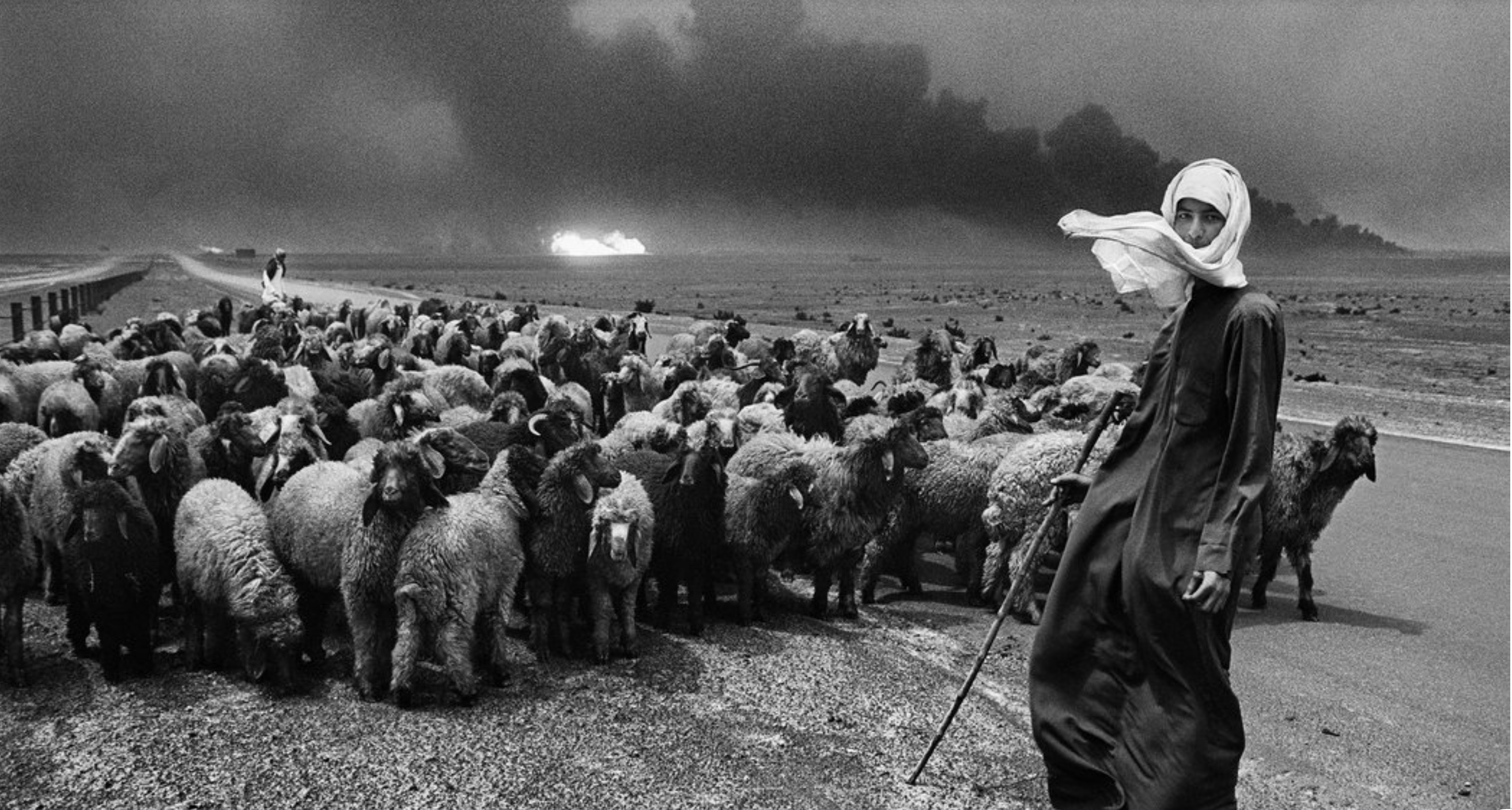
When Oil Fields Burned (1991), Sebastião Salgado/Amazonas

If the months leading up to the invasion of Iraqi-held Kuwait met the criteria of Christian “just war” doctrine formulated by St. Augustine, and refined by the scholastic theologian Thomas of Aquinas, the claims of legitimacy of an invasion to secure peace in the region was closely tied to apocalyptic outcomes: as retreating Iraqi forces lit the abandoned oil fields, even if the feared “Nuclear Winter” or year without summer did not materialize, the dense plumes of smoke spreading hundreds of kilometers from multiple points in oil fields set a new standard of fear in haunting images of burning oilfields streaming black smoke, as periodic oil fires have since haunted the region. The model of imperial authority was maudlin if not blatantly absurd. Could the pastoralism of Kuwaiti shepherd corralling sheep and goats–most of whom are in fact migrant workers from Uttar Pradesh or other Indian states–be more mismatched than against the apocalyptic billowing black clouds that drove streams of particulate matter across the skies?

Was the fear not an attempt to come to terms with the unprecedented global scale of such then-devastating environmental aftermaths? The oil plumes streaming hundreds of kilometers across the horion have provided a topos to which later wars in Iraq and Afghanistan have returned, an image of the iconic burning of oil once stored underground, in reserves–releasing more than twice as many barrels of oil into the Persian Gulf as the Deepwater Horizon would release in the Gulf of Mexico, and spreading eight times as many across the desert.

The jarring image of the burning blazes of the swells in a region defined by its pastoral economy suggested the deeply dissonant historical circularity of the claims to Empire that were at stake across borders, as troops on the ground were sent to defend multinationals’ interests–if with democratic pieties–the first great neoliberal war defined by alleged defense of Kuwaiti sovereignty by a “line in the sand” was the first war of Empire, for Negri and Hardt, in a boundless, universal space: the plumes spreading to international air space–as well as a hazard for those breathing on the ground:

Plumes from Kuwaiti Oil Wells Burning around Kuwait City in April 7, 1991 from Space Shuttle Atlantis/ NASA’s Earth Observatory

The streams of black particulate matter that was so toxic to the lungs of those with “boots on the ground” defending oil fields in Kuwait were grasped in global terms, less in terms of Empire than another global climactic events–if this time released by man, blaming the Iraqi troops for loosing the fires in response to massively disproportionate air fire launched against them for a famously brief hundred hour war entitled “Operation Desert Storm,” a multinational military seizing of oil fields cast as a “just war” but revealing increased global energy dependence on extracted crude.
The black smoke issuing from burning rigs were feared to englobe the world in a “little ice age” akin to the black ash clouds that were emitted into the global atmosphere at the 1883 volcanic explosion of Krakatoa, or four volcanic eruptions that had earlier led to the expansion of the Arctic Sea circa 1275-1300, leading to the expansion of glacial valleys in Europe from the Alps to Norway, in a similarly global cataclysm of man-made origin, and came to be paradigmatic of the definition of barbarism versus civilization, or the economic status quo, or democracy versus totalitarianism. Burning of oil fields, many not fully exhausted or capped until November, 1991, spewed or released petroleum into the desert and river or Gulf for up to eight months, creating new “oil seas” of toxic character, set a stage for the burning of gushing and roaring in future wars in northern Iraq that have colored the desert landscape with a dark anthropogenic pall of thick, dark smoke, repurposing a geography of oil fields as geopolitical tools of, normalizing the burning of 4.6 million barrels/day by 2016-17 whose blanket of fine carbon dust blocked solar rays to cool local temperatures.
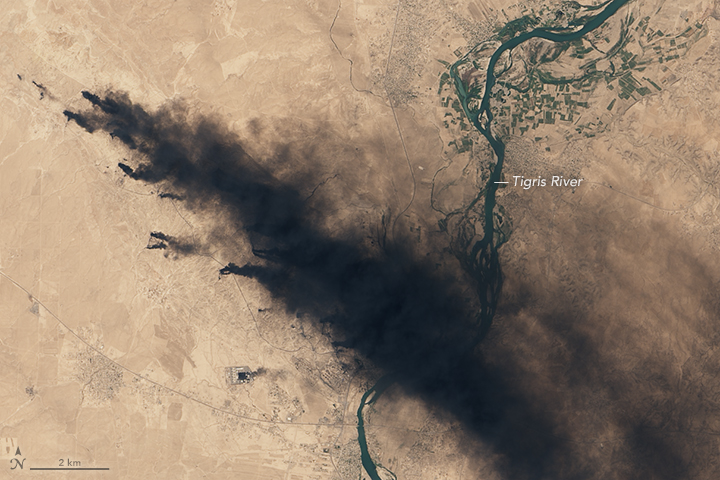
Oil Fires in Iraq

The pessimism of purpose in the world extends to the and infects the warming of our global temperatures, as if to condemn us to a history of carbon extraction of which the Gulf War was the iconic turning point. Temperature rise is easily seen as part of a pessimistic world picture we cannot intervene, as if evidence of inevitable products of life of a carbon-burning age, the rise of temperatures. the age was spurred by the billions made from the postwar extraction of carbon-rich fuels have been the stimulus of an overheating planet, bringing temperatures of oceans and land alike–albeit in importantly different ways–to a tipping point, starting from that harrowing moment of apparent apocalyptic images of burning oil wells in 1991, the spewing of tarcrete seemed to confirm the arrival of an age of the Anthropocene before the word emerged in the critical literature–an age defined by the spread of economies of extraction as the dominant means of moving far beyond sovereign bounds.

The increasing quantities of “accidental” spills that have been occurring in the United States since 2010 alone have led to a blossoming of pipeline leaks, shipping accidents, train derailments and industrial disasters that have revealed the downside of the extractive industries the government overabundantly subsidizes and funds: over half the spills were of crude oil, and a further third petroleum products, and a sixth highly flammable gas. The small number of leaks of ammonia and other highly volatile liquids made from petroleum should not detract from their high levels of their toxicity: the greatest number of accidents of costly crude spills whose clean-up can continue for years range from petroleum products such as diesel or gasoline, to liquefied natural gas or crude, have an unsurprising epicenter around the Gulf of Mexico, per Visual Capitalists Preyash Shah, and can include the very liquified CO2 products under high pressure regularly transported in pipelines, commonly used for carbon capture storage. If almost have of such spills have been mapped in Texas (site of 40% of the almost 5,000 spills that were mapped in the twelve years 2010-2022, the leaking of crude and natural gas plumes across the density of offshore platforms along the Louisiana Coast is downright terrifying.

U.S. Oil and Gas Spills, 2010-20122/Visual Capitalist, 2022

It is all too problematic that the very same companies benefitting form gas and oil extraction are now at work–from Occidental Petroleum to Exxon Mobil to Chevron to Shell–on the unproven Direct Air Capture technologies, misleadingly billed as a means to achieve emissions reduction goals set in the recent Paris Climate Accords and as the corporate ticket to “carbon neutrality.” This is the new gospel of a soft neoliberalism in which the government would outsource aging infrastructure of energy extraction to capture carbon from the air at the very site of its release by energy corporations. If a “soft neo-liberalism” at the edges of the nation state, the expansion of public-private partnerships that extend offshore into Gulf of Mexico, beyond the edges of the nation, are haunted by the terrifying LandSat images of a landscape of hundreds of oil fields burning out of control.

For in reaction to the 1991 arrival of American-led “boots on the ground” forces in Kuwait, who waged all-night battles on the Euphrates, Iraqi troops repurposed the underground reserves of subterranean oil fields to super-abundant Molotov cocktails thrown into the atmosphere far beyond sovereign bounds. The striking televised footage of the global dispersion of carbon ash, that almost replaced teh expectant footage of a ready and easy victory, anticipated the billowing towers of the foormer World Trade Center, belching black smoke from the combusting contents of the tankers of airlines that later flew into the twin towers. If the towers billowing black smoke in lower Manhattan was an icon of the War on Terror and of the Gulf War, the unstoppable release of those hundreds of oil fields senselessly burning oil, as if to reappropriate the crude bound for western tankers in the Gulf, and energy markets abroad, the staking of oil sovereignty in the Atlantic seems to bring the reserves extracted far, far closer to home. T he unpromising and unproven promise of carbon removal by Direct Air Capture seems to rewrite the wounds of Middle Eastern wars of oil sovereignty closer offshore, mapping a new image of petrosovereignty in an age of Empire. Carbon removal is promoted as a way of justifying petroleum and gas extraction in an era of extreme climate change–and climate activists urged to support carbon removal by Direct Air Capture even as oil companies have treat it as grounds to continue drilling, producing and using fossil fuels.

We are argued to have no other option, but our backs are up against the wall if we hope to stay the rising of ocean temperatures. There may be virtue in recycling, but the density of this color spectrum, tending from red to carmine, only illuminate a massive shift on a scale we have no clear ability to presume a personal relation to–or perhaps even the cognitive ability to grasp fully. We stand before these maps haunted by a deep dread, a fear that is perhaps debilitating more than empowered, but perhaps diminished by what has preceded, and with no sense of rational decision–although we are tempted to arrive at many a quick fix to steer back from the apocalypse of warming oceans. Can the deep reds be anything other than a warning of warming to come, a continuation of the global trends of dramatically increased ocean warming and sea surface heat.
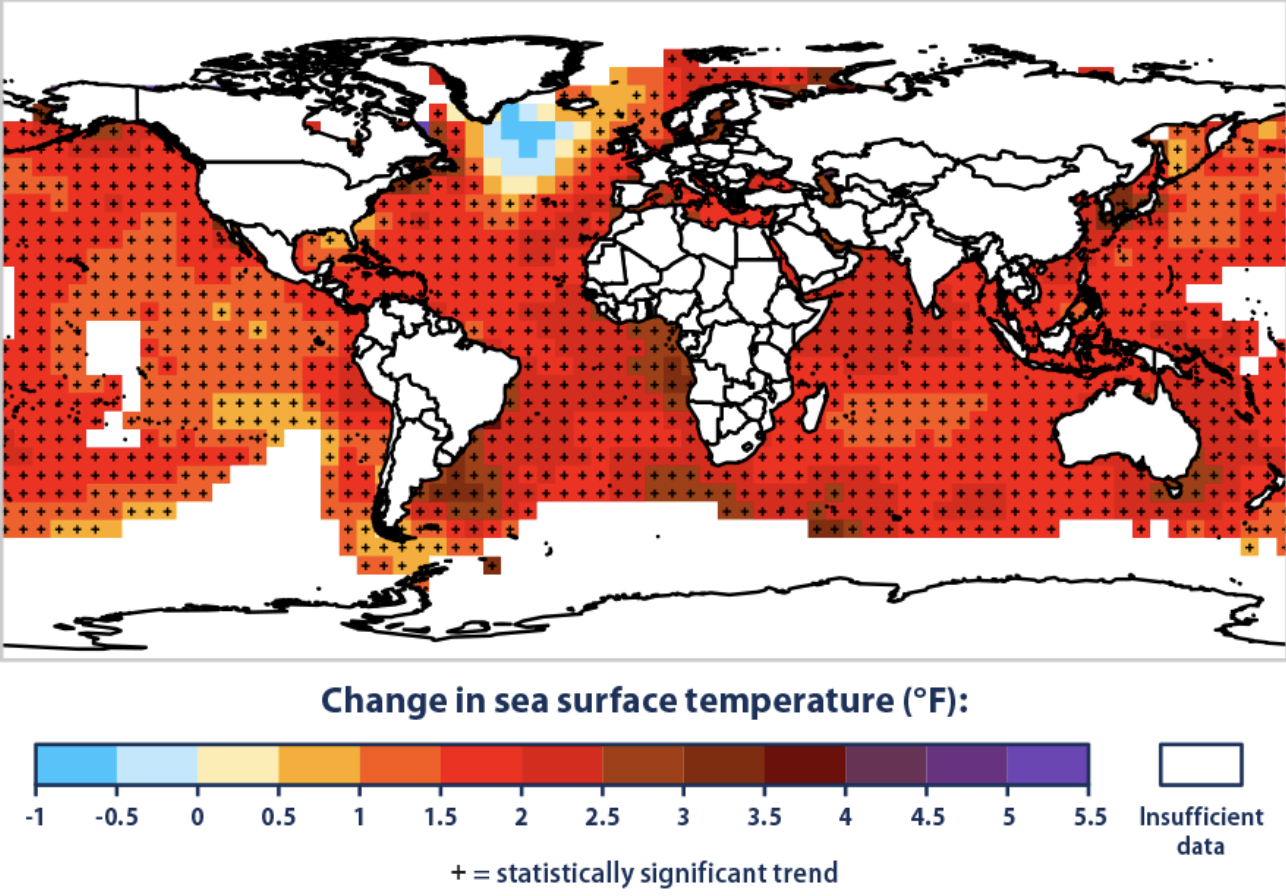
Trends in Global Sea Temperatures in Twentieth and Twenty-First Centuries (1901-2020)/EPA 

The rasterization of the global ellipsoid suggests a dangerous distance from the mechanics of warming, even if it maps the globe on a jarring color ramp we have not seen before, or are likely to be able to interpret. The very etheriality of these raster maps of temperature anomalies are striking as they cast the ocean on a distinctly red color ramp. As if in synchony with the massive waves of coral bleaching in global oceans–whose impact and scale we cannot yet calculate–we find things of the impending nature of ecosystemic colapse that fills with palpable dread, but is more striking in its absence of any fitting narrative. If the story is tragic, and existential in scope, the cognitively disarming nature of these pixellated maps are as strikningly removed from any material basis, and lacks any clear distance to comprehend as it is bereft of any narrative.

It seems the lack of clear narrative, and the alarm of red, leads to such perhaps well-intentioned but tragically desperate cries for help as Just Stop Oil protestors calling for the immediate end of fossil fuels by using orange florescent spray paint to target the neoclassical Radcliffe Camera icon of Oxford’s Bodleian Library, spraying a fluorescent orange on a structure built 1737-1749 to embody Enlightenment ideals. The Palladian domed building might typify the Enlightenment, targeted as if the root of deep ignorance of the consequences of extraction, but also illustrates an inability to imagine any end-game save cessation of use of extractive fuels across the entire global economy. The rugged demand–Just Stop Oil!–suggests a purblind view of the interests at play–is it only government or any government, or isn’t the problem a little more manifold? can orange spraypaint to deface a heritage structure really make a mark, or is it just a muffled cry for help?

Hugh Warwick/October 10, 2023

Welcome to truly desperate times. The intense orange removed by power0hoses hours after a disgruntled Oxford student and his mate seem to have repurposed the immediacy of Nike’s corporate slogan suggest nothing less than an existential sense of the teetering image of the world’s environment that could not but echo the insisted on recent temperature trends that have lasted the lives of the ecological activists, twenty-one and eighteen year respectively, taking a stand against the markedly uncontrolled increased warming of land areas and wildly shifting extremes of seasonal temperature that had led to the expansive melting of arctic regions. Following the alarming colors of temperatures changes NOAA features on the Climate Dashboard, the spread of rising temperatures by over half a degree Fahrenheit/decade are truly causes for alarm.

Climate Dashboard: Changes in Climate Temperature by Decade , 1993-2022

But the deep orange hues of the slogan of the Just Stop Oil folks earnestly demanding “no new oil, no new gas or coal” are calling for a “deliberate disobedience” that the spray-painting of Radcliffe Hall–a symbol of Oxford–inaugurates across three weeks of action from October 29, akin to a reckoning, designed to appeal to students, promises a greater sense of agency and empowerment in a world where “No-one’s going to save us, we have to come together to do that for ourselves” in time for Halloween, as if to grab the steering wheel on a car that has been driving out of control, and force the hand of civil government by collective actions of “deliberate disobedience”– assuming equivalent existential urgency of the dispossessed: “what will the Government do? Concede to our demand, or crack down and arrest us all?” The Oxford protests, on the heels of the spraying of Bristol’s Queens building with the same bright orange paint, urging all faculty and students to join in the “civil resistance,” led to the Oxford student to claim to be “taking action to resist the destruction of my generation,” noting the scale of the climate crisis of which “Oxford academics are fully aware of,” but despite knowledge of fast-approaching “unsurvivable heat and humidity” that will force “hundreds of millions of people will be forced to move, or die” is tantamount to genocide.

Before “the annihilation of everything we care about,” the Oxford student who defaced a site of study by florescent orange paint seemed to interrupt quiescent study. On the heels of the spraying of a building in Bristol’s Queens building with analogously orange industrial paint, asking all university students and faculty to unite in a “civil resistance” to extractive energy, the Oxford undergraduate felt he was “taking action to resist the destruction of my generation” in existential terms, decrying how “Oxford academics are fully aware of the scale of the climate crisis” but ignore it. As a member of Just Stop Oil, a coalition committed to forcing the government to end “all new licences and consents for the exploration, development and production of fossil fuels in the UK,” he was confined of the need to stop a narrative of planetary warming that has an inevitably tragic end.

Have we failed this generation, and indeed failed the cause of climate change, by maps that assume an impending disaster of warming that offer no possibility of change or berth of safety or remove? This seems a Eurocene, to be sure, as much as an Anthropocene, of unconscionable harm to habitat range, environment, and ecosystems as a massive amount of energy has been insistently raising global temperatures by extra unwanted heat. The recent rasterization of our ocean maps–we map less bathymetry than temperature anomalies in the daily coral reef watch–recast the ocean as haunted by color ramps we have never seen before, pressing us to create stories and gain a grasp on what has been happening with the oceans as they warm in dangerous directions across the north.
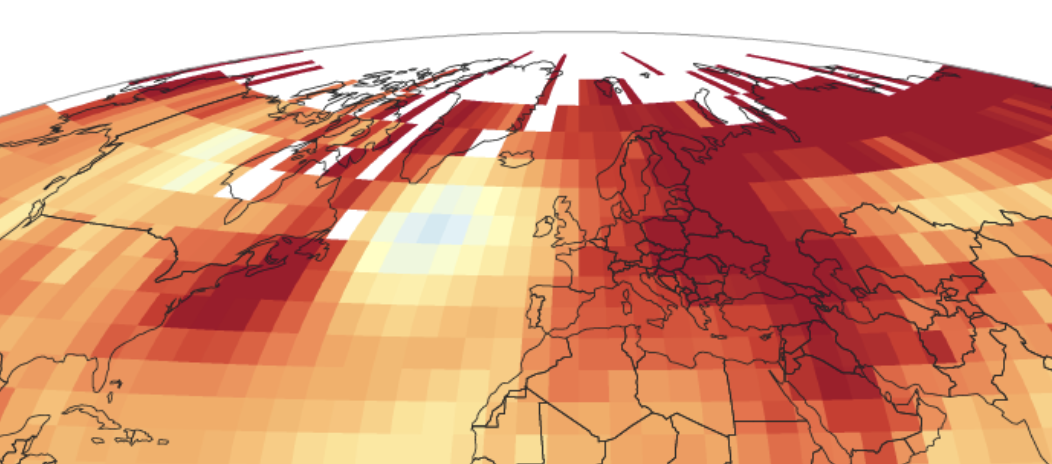
The liability of such raster maps may lie in their eery ethereality: a pixellated space distances us from the materiality of climate change. For rasterization problematically offers an eerily immaterial way to view global warming unhelpful in its terrifying immateriality, as if blocks of predestined pigment sprayed across the ellipsoid outlines globe at a distance and from on high mark the bleaching of ocean life. It is terrifyingly inappropriate not only in its lack of narrative–if the story is tragic, and it is existential to boot–but cognitively disarming as it is removed from any precedent, wrapping the surface of a globe as if spray-painted across the flat ellipsoid disk we struggle to map to particular losses, filled with forebodings of increaed global warmth.

But we have hard time focussing on the shores as endangered areas by the disproportionately warming global ocean, overwhelmed by data that we are cognitively challenged to process. The late historian John Gillis warned us often of the danger of such assertive and short-sighted “turning one’s back on the sea”–and Gillis was worried that we had done so as a culture and society to our great detriment–rising ocean heat and sea surface temperatures remind us of the disproportionate amount of heat that has been absorbed in global oceans, and the danger of having remade the ocean as a vital habitat. For the shores have been unjustly ignored, as a space whose ecology we might do well to focus as sites suffering from anthropogenic change. We have a hard time focus on the vulnerability of the shores as ecosystems, indeed, so often do we see surging seas as a threat to human habitation of the shoreline, rather than having a broader sense of the threat to the ocean biome as a threat from largely anthropogenic warming. Yet as they are so vulnerable, and so potentially rich with significance as vital membranes of the planet. they are precisely where we must attend with greater atteniotn, as we try to parseunprecedented risks of overheating.

Even as country-based promises to reduce rates of carbon emissions became the talk of the town after the Paris Accords, with few imagining reductions likely for most of the developed world, before the United States withdrew from the global accord, which had pledged to cut 52.4 billion tonnes of emissions, on a global scale, little probability of the reduction to goals by the highest emitters–China; Western Europe (EU); Brazil; Canada; Japan–we face the global impact of planetary warming with few guideposts, precedents, or narratives to process catastrophic climate change.

We risk casting anomalies of surface temperatures and indeed looming rises in surface temperature as but the latest flattening of the world’s surface, eliding differences of land and sea temperatures that fails to come to terms with the cascading consequences and scale of anthropogenic climate change. For the most striking aspects of the rising surface temperatures on the planet may be the rising warmth of ocean waters. And the registering of global waters suggests, not paradoxically, both the liability of a focus of most mapping on the land–and extension of terrestrial coordinates to the oceanic surface, as if the anthropocentric claims of land maps might be extended, with brash or unwarranted assurance, into the ocean, without appreciation of the degree to which oceans have absorbed the great preponderance of anthropogenic heat: does an anthropocentric map of land effectively elide the extent of anthropogenic influences on global surface temperatures? Offering a private record to observe temperature variations that are remotely sensed, we may be foreclosing our relations to our own surroundings, and indeed of the relation of species beyond the human to the oceans as globally vital habitats.

But in mapping temperature rises as part of a continuation of land temperature anomalies, we may not grasp the full extent of the problem–and only risk entering into a climate apocalypse. So, indeed, runs the presuppositions implicit in the newly vaunted technologies of Direct Air Capture (DAC), the neo-liberal promise of carbon sequestration, by projects promising to capture carbon at the sites where it is produced that is being entrusted–bottled at the source!–that seven of the largest oil and gas companies are promoting as a public-private venture to “remove legacy emissions” even as the oceans warmed. For DAV is billed as the new mission of energy companies to use their existing infrastructure in offshore a reas to make good on the danger of the climate scenarios such maps threateningly propose, treating the recent promise of Direct Air Capture, if unproven, as a awaits public funds to “flow into the [existing energy] sector so it can scale,” with Occidental Petroleum floating promises to remove one million metric tons of CO2 every year by what is billed as a model for what the “best, most sophisticated, most committed companies” in the oil and gas businesses who are rooted in extractive industries should do “to preserve our industry over time.” Occidental Petroleum’s CEO is making a rather desperate argument as the nation’s energy companies have their backs up against the wall if they want to continue to emit more carbon, with carbon being the prime contributor to and accelerator of anthropogenic climate change.

For if its technology is unproven, it ostensibly or plausibly offers carbon-based energy companies an basis to sustain DAC can leverage a write-off able to balance out costs of future carbon emissions by using machines on the drawing boards to “pull carbon from the air” of unproven efficiency, erasing future costs of carbon burning, and overlooking the past costs of carbon emissions energy companies have themselves so conspicuously historically contributed.

Fossil Fuel Emissions Inventory per Capita based on 2000 Census/Kevin Gurney and Vulcan Project, Purdue

The unproven technology uses the very tools of extractive industry to inject and store carbon in the earth’s surface, , creating a tool akin to double-entry bookkeeping to balance the costs of future energy develpment against the removal of carbon that may well in the end return to the earth’s atmosphere without ever needing to reduce emissions. “Direct Air Capture” is a new language of soft neoliberalism, fulfilling needs to acknowledge the untenable scale of costs of carbon emissions, but scaling up their own responsibilities to reduce emissions by promises to sequester carbon in underground reserves, of putting the greenhouse gases back where the oil was extracted years ago, and indeed filling up old empty oil mines with carbon reserves in the Permian basin. Although the largest DAC plant removes only 4,000 tonnes of CO2 from the air per year, the logic of an enormous growth of investing in technologies of Direct Air Capture plants could eventually and only by the middle of the twenty-first century extract a full gigaton of the carbon released into the atmosphere.

Proposed and Operational Direct Air Capture Facilities, 2018/Global CCS Institute

Global oceans have absorbed a preponderance of anthropogenic heat over the past seventy years– some ninety percent of excess heat that was trapped in the earth’s atmosphere since 1955–that makes them perhaps the clearest single register of the extent of anthropogenic contribution to climate change. Yet our monitoring of sea surface temperature adequate, based on a points, hinders rather than help the scale of climate change that is occurring in the global oceans. It is perhaps a hard pill to swallow, that cannot be sugar-coated, but the deep reds of temperature anomalies present a stronger picture than the levels of temperature rise of the planet’s surface, and its detail demands far more unpacking and deeper drilling into its detail, to use a poor metaphor, to unpack in satisfactory ways.

It is otherwise hard to grasp the alarm registered in the header to this post. The very land-based tools of mapping that have allowed us to track landcover and agricultural productivity by GIS overlays may have been far less helpful in grasping the scale and of the anthropogenic modification of global oceans–and the to grasp the changes in global oceans that will help to process or come to terms with the consequences and scale of rising sea surface temperatures, and the contribution of anthropogenic contributions to rising global temperature that are at risk of changing the global habitat and our relation to the surrounding world at the levels we demand to understand. Fort he very tools of geographic mapping are ones that arose in terms of mapping from the perspective of a state–effectively, of seeing like a state–that led us to understand land use, as much as anthropogenic change. Yet the state has sold increased offshore drilling rights to many oil companies, in ways that have set the stage for planning offshore Direct Air Capture plants in sites like the Gulf of Mexico, increasingly treated by 2018 as a pubic-private density of point-based drilling sites, even as sea temperatures rise. The network of old wells abandoned permanently and temporarily on lands that the the US Government leased to energy corporations suggest a basis for the encouragement of a man-made shoreline tied to an infrastructure of energy extraction by 2018 that was difficult to change or every fully separate ourselves.
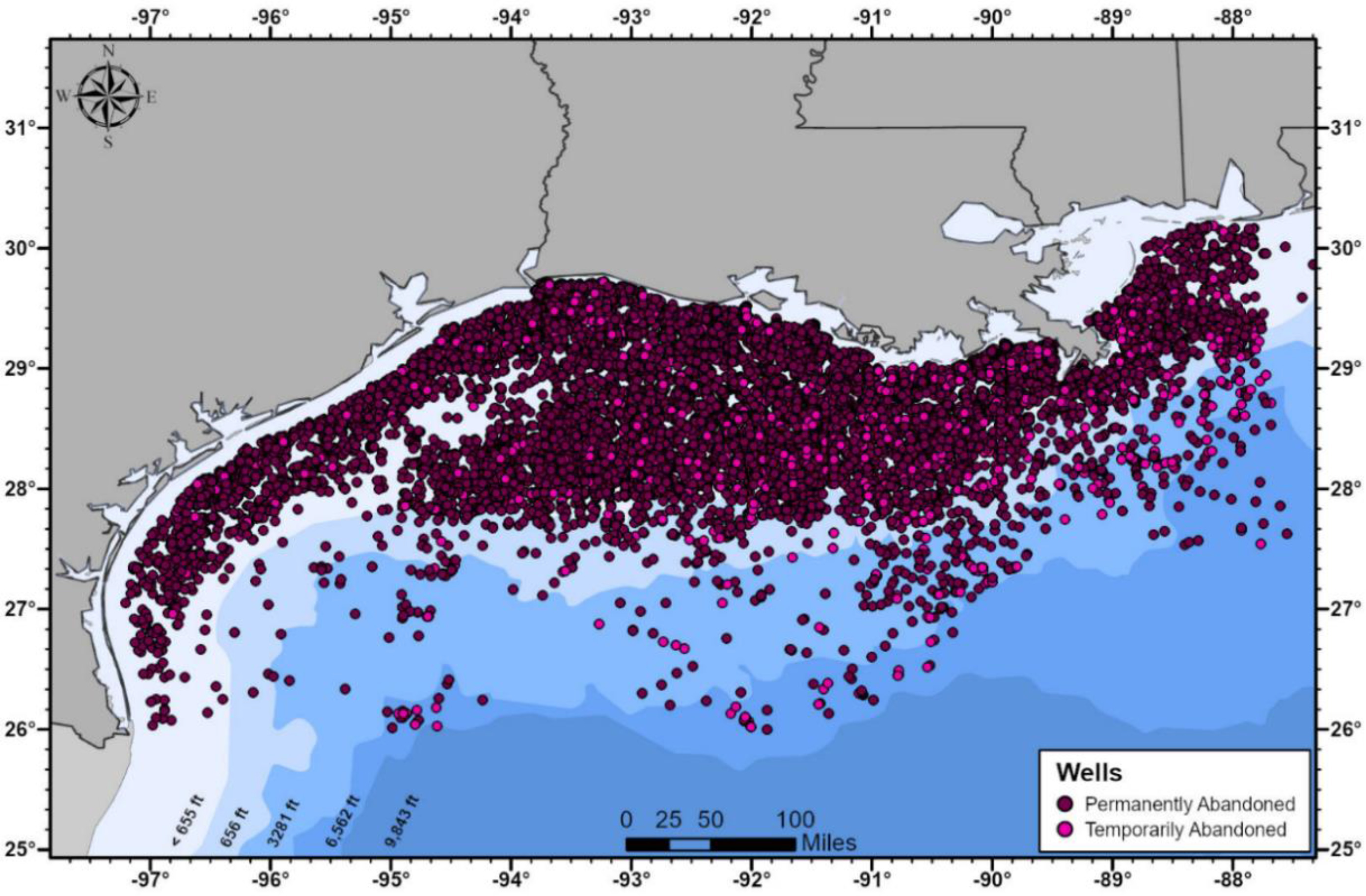
Permanently or Temporarily Abandoned Oil and Gas Wells Leased in Gulf of Mexico, 2018/Enverus 2018National Energy Technology Laboratory, Undated

GIS layers helped engineer the most effective site of carbon sequestration in offshore regions of the well-mapped geological terrain of the Gulf of Mexico, already crisscrossed by a density of pipelines for optimal sites for low-cost offshore storage of optimal geologic suitability, despite the existence of clear risks of locating extractive industries offshore beside a wetlands that bordered on a rich marine ecosystem that was delicately stuctured as a complex oceanic habitat. The reference points for storing are the cities where workers at the new plants would live–Mobile; Houston; Corpus Christi; Biloxi–rather than the ecologically delicate salt marshes, wetlands, and estuaries that are critical to shorebirds, and spawning sites for crayfish, oysters, shrimp, mink and alligators. The choice sites for subzero storage of the coast of Louisiana lie within the offshore continental shelf, as if an extension of territorial claims of the well-mapped underseas regions long studied by the energy industry.

Favorable Locations for Offshore Storage of Captured Atmospheric Carbon, 2022

This may be the fate of the pointilistically mapped seabed, a weirdly compromised cartographic flattening of the offshore. For the oceans–the very life-giving areas from which we arose, and on whose edges human society long lived–offer the clearest register of the anthropogenic image of human-caused temperature rise, although, perhaps paradoxically or more probably circularly, the deeply anthropocentric systems we have mapped or registered land by a point-based system may be inadequate to register the impact of rising sea surface temperatures on planetary health.

Change in Global Sea Temperatures in Twentieth and Twenty-First Centuries (1901-2020)/EPA

–but how much our recent maps of marine monitoring are not evident as much in point-based registering of anomalies, but specific sites of ocean heat, with a troubling density off the coast of Japan, in the Persian Gulf, and in the Gulf of Mexico,as well as the Eastern Seaboard.

Marine Monitoring of Global Ocean Heat Trends, 2005-2019

This contribution is difficult to map, or map to satisfaction as the result of human activities. But the stubborn nature of these deep carmine reds suggest, of course, a change that goes far beyond politics, and, if we might be glad for the light blue airbrushing on part of the Arctic Ocean and Greenland’s edge, the ice-free arctic and warming of antarctic ice shield seems much more terrifying signs of where we are headed, with a warming Atlantic–and Gulf of Mexico–a cause for alarm. If Canadian rock singer Neil Young dryly lamented in “Mother Nature on the Run” that 1970s would change the environment of the planet, his dreamy, druggy, hallucinogenic if anthemic call for help paralleled major breaks from the baseline of global temperatures. For from the postwar era through the 1970s, weather changes reveal the deeply disruptive nature of the global climate to which we are headed–and the step difficulties of visually communicating temperature anomalies. Were increasing surface temperature from 1900-2020 already hinting at the consequences of a failure to incorporate rapidly shifting temperatures farmers would faced by the late 1960s, in a 1970 album reflecting on how rising temperatures of the late 1960s and increased pollution created a powerlessness before a changing landscape, parallel to declining agricultural productivity?

If Young was not necessary a student of the Canadian Land Inventory, as a twelve year old set his sites to be an egg farmer–and to be a student of scientific agriculture at the Ontario Agricultural College to “learn to be a scientific farmer” after having tallied the improvised inventory of “Neil Eggs” as he organized sales of a chicken coop in close contact with Ontario farmers before listening to Chuck Berry, Fats Domino, and Elvis Presley replaced his raising chickens and selling eggs. The environmental anthem anticipates Young’s fierce opposition to factory farming since the mid 1980s, shunning venues serving foodstuffs from factory farms–venues “fed by factory farms.” But the oracular nature of the song covered by Patti Smith, after I’d written much of this blogpost, in Golden Gate Park, first made me wonder how the roots of the Canadian Land Inventory was unsuited to measure the changes in sea surface temperatures and indeed offer a meaningful narrative context for global temperature changes.

Extreme heat itself endangers farm workers–most U.S. farmworkers endure dangerous levels of heat three weeks of each year, beyond historical levels of heat exposure, growing to two months by the current century’s close per a recent study of the actual concentration of agricultural workers in America who will suffer from such a shift against the regions that are in upper quartiles for community resilience–suggesting the lack of abilities we will have to absorb or respond to such critical even if apparently “small” changes in temperature across the United States, shifting the productivity of farms in an era of climate change projected under different models or scenarios.

How to include people in the map, or how to include lived experience of other animals? We have perhaps all retreated into the comfort of our own buildings, retiring to contemplate rasterized images of modeled temperature changes in air conditioned rooms. The shifts in temperatures captured by eye-catching rasters offer limited narrative context to process such rapidly accelerating shifts of global surface temperatures. And if we presume to hope to “capture” carbon to turn back such rapid and unsustainable swings of surface temperatures in future years by continuing to allow carbon emissions, we are perhaps allowing ourselves to be the victims of cartographic distortions that fail to register the consequences of how oceans–in ways we have not fully been aware–have been absorbing up to 90% of anthropogenic global warming.

The arrival of July brought the warmest July on record–tempting a bitter riff on Stevie Wonder’s album by calling it “Hotter than Julys” about “making the earth a burning fire,” over a full degree centigrade–1.12°C (2.02°F)–above the 20th-century average of 15.8°C (60.4°F), raising questions of mapping anomalies meaningful, as the monitoring revealed a level of warming so beyond average that one might distinguish record temps warmest as something that the entire planet had not experienced, and that raises questions not only about the world, but our relations to the world–the Umwelt, that zoologists appropriated from idealistic philosophy at the turn if the twentieth century to acknowledge how different species used the senses to map external lived environments –that we are going to be forced to come to terms as our environments reached record heats.

The agency of animals in perceiving the world is less the point of this post, however, than the radical accomodation of Umwelt that such record shifts in ambient land and sea temperatures pose–and how we can recognize and communicate them beyond simple color ramps. The recent record marine temperatures raise questions of the warming of sea surfaces, in fact, that demand to be distinguished as a reservoirs of heat we have perhaps poorly mapped in describing the land-sea continuity of maps–a continuity that was long heralded as a modern innovation of terraqueous cartography in the early modern world–that might be less helpful when it comes to grasping the effects of heating oceans and the rising sea-surface temperatures and oceanic heat waves remote sensing tools currently reveal.

Record Land and Ocean Temperature Percentiles in July, 2023/NOAA

The pinning of heat to pixels renders not political polarization, but even more toxic disturbances of equilibria of global temperatures–but an even more bracing problem of organizing our relation to a rapidly warming world. These quite literal heat maps paint a scary picture of the complex distribution of warming across land and sea over a century of of warming, synthesized from the first era of fairly uniform data in global temperature maps.

But are the rasters tracking warming able to communicate the imbalances of these significant anomalies of global warming by almost three degrees in some spaces of the global ocean–and some a few regions–an increase that follows the yearly rising of surface temperatures from just before 1980. This was the very time that Young–son of a prominent Canadian newspaperman who as a daily columnist for the Globe and Mail had a knack for reporting–was chronicling quite recent spiking in global surface temperatures before 1970 when Neil Young called our attention to the new scale of pressures we put on the planet, at what would be watershed of rising temperatures that only escalated over the next fifty odd years. By some odd coincidence that may not have been that odd, Canadian government began to monitor land-use management in ways that would lead to the formation of early geographic information systems, as Canadian geographer Roger F. Tomlinson began using aerial surveys–using large-scale photogrammetric maps–to create visual information forms bridging computers and geographic data. By collating data about wildlife, forestry and the census to increase agricultural productivity, Tomlinson offered new ways of seeing like a state rather than like a farmer, in ways that claimed a benefit for farmers and farms across Canada..

But data on resources was privileged beyond data on warming–“heat” was not even a category of inventorying land information in maps, at a uniform scale and overlay, in ways that allowed “layers” to be read overlapping factors on a basic dot-grid, able to incorporate census data, that would reduce the manpower for resource mapping beyond the capacities of actual staff. Canadian surveys amassed databanks beyond human abilities to assimilate an inventory of land-use information, able to store information in readily usable form in a computerized inventory of overlapping layers jto process the scale of information overload in maps of environent, land use, and productivity that humans cannot process or analyze in an instant library of statistics stored on tape, but not maps–even as any point on the earth’s surface “can be identified by numbers” to allow a synoptic inventory of land quality to devise new practices of land use.

Tomlinson coined of “Geographic Information Layers”–long before he joined ESRI, down in he San Bernardino Valley outside of Los Angeles on the Pacific coast–as a public respository of land use. The weighty term itself predates a century of rising heat, however, and its inventories largely bracketed temperature and the effects of heat waves’ differently deleterious effects on land and sea. The Canadian government was presented by Tomlinson as the landowner akin akin to a farmer forced to make decisions but who had “hasn’t got too much idea about the climate” or the water on his property he has just inherited, forced to make decisions about how to plant the right seed for his family. The very same questions, he explained in a classic CBC promotional short, were pressing to addressed both by the farmer who inherits a plot of land, but can be extrapolated to the nation’s management of millions of miles across Canada in an inventory.

The result that “the map has been converted into numbers” allowed readings of land quality at every hundred feet across the country, now readily accessed in hours, stored on tape on a grid aligning census tracts, water rights, and the fertility of the soil, placing jdata in the hands of decision makers in a public library of land. By replacing the human eye’s relation to landscape by an interface of soils, climate, topography, wildlife, forest capabilities and census tracts by subdivision in a profile of the nation, map layers were analyzed at multiple scales to zoom in on local land use at points and polygons,–

Saskatchewan’s Land Capaibility for Wildlife, Canadian Land Inventory (1976)

–merging files and coordinates of the Canada Land Inventory that have provided abasis for optimal land use and government investment that offered a tempting basis for similar inventory of the nature of atmospheric changes on a global scale. Yet a farmer’s local knowledge is different in feel and texture than the point-based layers Tomlinson optimistically advocated as a national mapping model–in ways that is not captured in the massive inventory that classified the land.

But the land use inventory presumed a stable definition of “nature,” that he current escalation of temperatures when Neil Young composed his anthemic song about Mother Nature being “on the run” as a fugitive or convict around 1970s, as temperatures started to rise yearly, shifting the crop yields in the data that Tomlinson measured for he Department of Forestry and Rural Development by stacking up layers that would align point-based data for cartographers’ benefit on any land-map.

Neil and his father Scott Young famously lived outside of Toronto, on an Ontario farm, and would have been aware of the Land Use Inventory, but also of the problems of a shifting sense of nature that it did not easily capture in its discrete point-based layers of information. Yet the rising surface temperatures of the late 1960s and later years that won a large and continued audience for Canadian guitarist Neil Young’s anthem in his first great solo record was rooted on working on a farm responded to the increasing anthropogenic nature of rapid temperature change–as much as the fears of nuclear apocalypse and technological advances–that inaugurated an escalation of above-average land temperatures through the first fifth of the twenty-first century far beyond what Young himself had feared or envisioned, difficult to reduce to but a single layer of a map.
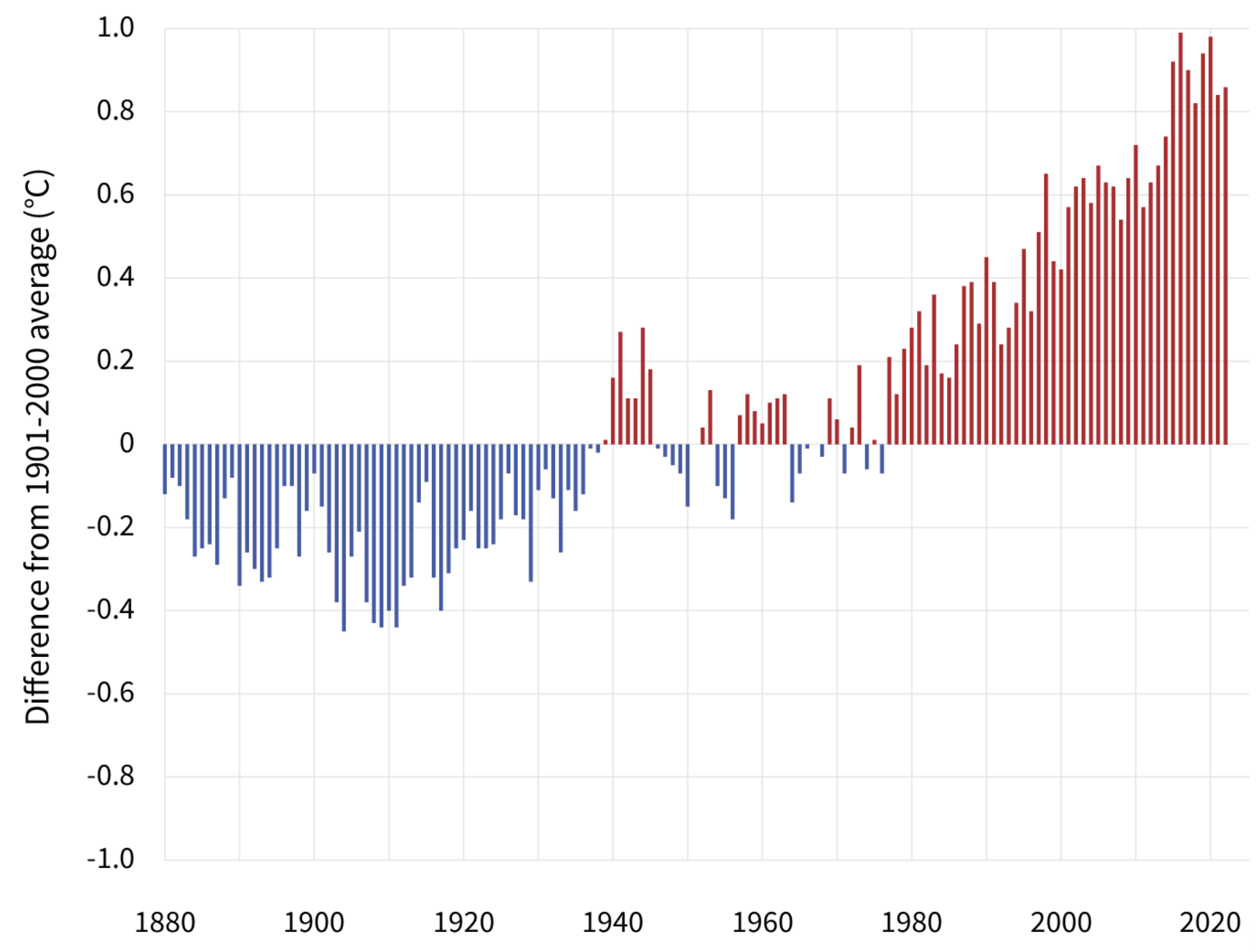
Surface Temperature against Average (°C/NOAA, data: National Centers for Environmental Information

We are not cognitively attuned to imbalances, and dramatic departures from the status quo. If cognitive biases that lead us to prefer status quo relations where things remain the same are common basis for poor decision-making, the desire to prefer that things stay the same is an especially pernicious error in assessing the anthropogenic contribution to climate change: we allow ourselves to be seduced to maintain the status quo, to minimize risks, but have occluded the imperative and huge benefits of reducing the disruptive cascade of ecosystemic shifts of such consequence to be impossible to process in terms of the two-color schema of red and blue.

It is hard not to worry that the tools of registering such rapid shifts of surface temperatures offer a poor sense of our relation to the natural world–or help to clarify the rapid shifts in the biological of the world that will be and are experienced by other creatures. For the stark shifts of temperature changes map a misleading balance sheet of environmental change that is oddly distanced from the relation of organism to the planet, or a tally of benefits and costs that occlude the relation of organisms to the to the surrounding world, that should be the true centering of any understanding of climate change. The compromised relation to surrounding environments that the plotting of value in underground deep-sea energy reserves is a distortion privileging the point-based location of value, removed from the oceanic environment or critical dangers of warming waters of the global ocean waters. As the habitats of oceans shift in irreversible ways, the ability of creatures to relate to the world, or to perceive their surroundings, changes, and we are caught, as a deer in the headlights, without a clear way to grasp either the scale or effects of changes in the global ocean.

We trust we still have time to withhold judgment–as if fears of losses of once abundant petrochemicals can occlude an appreciation of potentially hugely favorable gains, driven by fears that declining oil prices might hinder profits to drill over 50-60,000 more new oil wells annually–
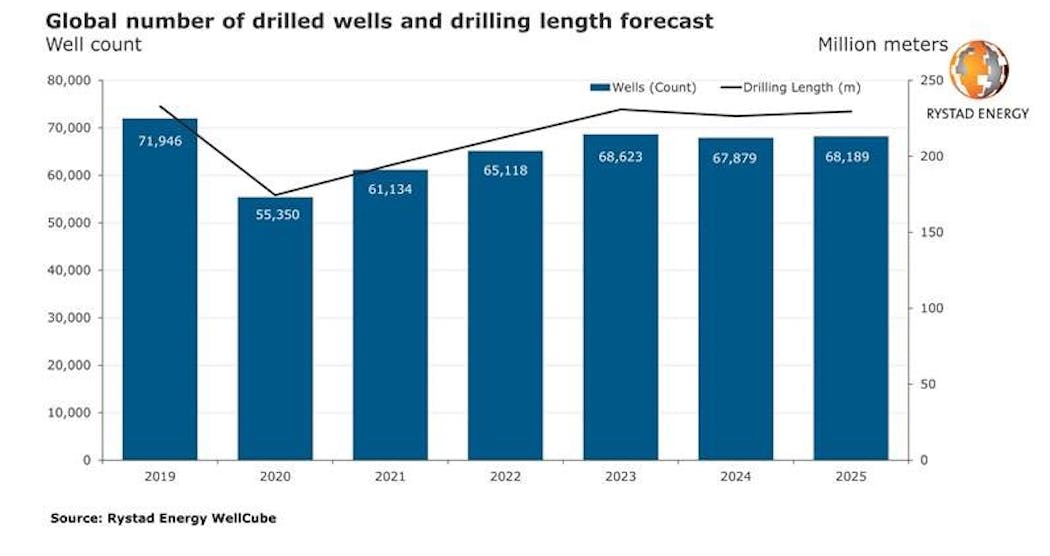
200714 Rystad Global Drilled Wells

and as the expansion of inland drilling in the southwest’s Permian basin has continued to expand of every increasing depth, reaching unwarranted heights, driven by demand for profits and continued petrochemical security, driven by the illusion of an abundance of underground petroleum reserves. nd the increased depletion of near-shore wells that were drilled off the Louisiana coast in the Gulf of Mexico back in 1938 have led to the growth of an offshore archipelago of 3,500 platforms off the continental shelf of the United States, and along the continental slope, leading to a boom in wells under a thousand feed of water on federally leased land–deepwater and ultradeep rigs, whose risks challenge notions of environmental responsibility in a larger network of active gas and oil pipelines, processing plants and offshore structures in leased lands on the outer continental shelf.
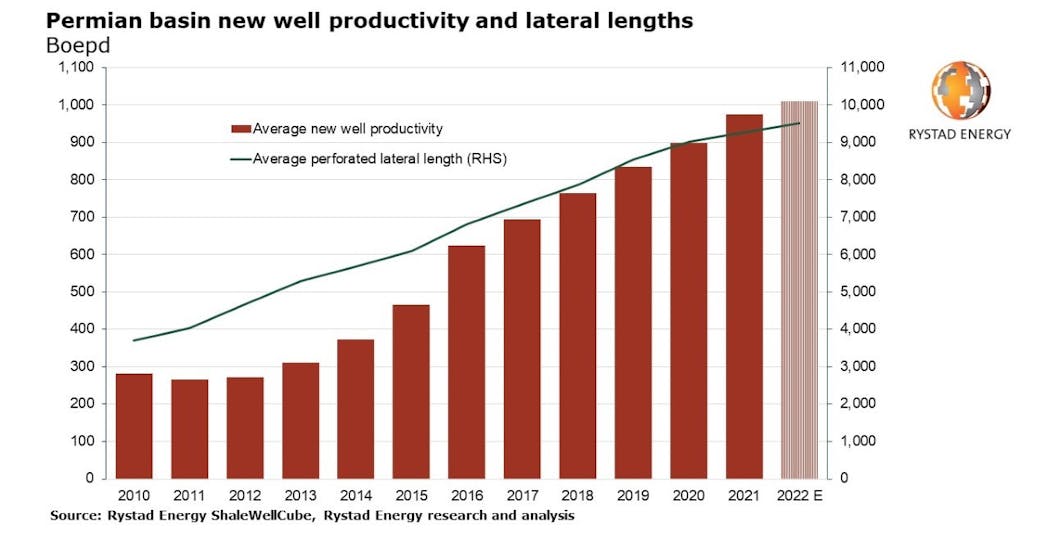
220128 Cx Rystad Permian

New Wells Drilled Annually in Permian Basin in Texas and New Mexico

Perhaps we have little clear ways of registering the scale at which anthropogenic contributions add to the warming of the global ocean, or of planetary seas. We have no clear basis to represent this growing contribution, let alone to narrativize or narrate our own relations to the rapid acceleration of climate change and its multitude of consequences of a warming world. Our maps are not at fault, but have their limits as they reify the conditions we live in–rather than our contribution to them, whose specter is perhaps all too evident in the world’s largest gulf, a marginal sea of the Atlantic whose seaward boundaries provide one of the greatest challenges of coastal management.

The Gulf of Mexico is itself an anthropogenic space, where’s the seamless bridging of land and sea: as well as a proof-of-concept of liabilities of mapping a continuity of land and sea by leasing of federal lots for platforms for extracting oil and gas of increasing depth, far deeper than five to six thousand feet below sea-level. The expansion of deepwater mapping has grown dramatically since 2000, by energy companies growth eager to match demand for gas and oil as abundant in “national” waters; the government is eager to license to ensure the ability to “keep” energy prices down. If the current plans to invest billions in unproven tools of “direct air” carbon-capture promises a reduction of greenhouse grasses and new commitment of industry to greening, by “vacuuming” emissions at their source,” that would allow us to address the “carbon problem” with no change in our consumption of fossil fuels. Even as it promises of erasing the onerous emissions are unproven the promise to allow carbon dependence is widely promoted by energy companies: public funding of Carbon Capture and Sequestration would sanction the continued expansion of the largest offshore energy infrastructure in Texas and Louisiana, and boast the adoption of the best mapped geological region to sequester captured carbon for 559 BN metric tons of carbon storage.

Off-shore Geologic Carbon Sequestration in the Gulf of Mexico (GoMCarb) -  Earth and Environmental Sciences Area

Offshore Carbon Sequestration in the Gulf of Mexico/Helen G. Prieto 

The promise of investing public funds in a boondoggle of corporate “greenwashing” is promoted as the “evolution” of a new American landscape of Carbon Capture and Storage (CCS), by subsidizing Occidental Petroleum to build corporate-sized “direct air” carbon capture and storage plants ready to imagine as a a new national infrastructure dedicated to construct “hubs” of carbon capture to be piped to “injection” sites where it might be stored or “sequestered.” Planned carbon “sequestration” projects are paired with green-lighting bids for offshore sequestration on federal lands lying in one of the most studied geological basins and potential sinks, the Gulf of Mexico–a site of expansive offshore energy infrastructure that is currently promoted as “the largest volume regional geological sinks in the United States for large-scale Carbon Capture and Sequestration.” The region that has a large number of depleted oil fields, already owned or leased by energy companies, essentially, is promoted (and extrapolated) as a bonanza of Gigatons of carbon storage.

The continued mapping of the man-made offshore environment of the Gulf of Mexico is plotted as a prime site to capture of carbon. The transformation of the Gulf of Mexico to a site of future carbon storage fulfills a fantasy of absorbing fossil fuels’ pollution from the skies without reduced dependence on petrochemical fuels, detracting attention from the very edges of marine habitat oil and gas extraction threatens. The very premise of “Direct Air Capture” takes eyes of the maps of global warming and many modeling of the effects of ocean warming.

Proposed “Direct Air Capture” plants would imitate the very functions performed by the very coastal ecosystems–salt tidal marshes; kelp ecosystems; and even the open ocean–or are argued to do so on a broader scale than the sequestering and absorbing of one to two tons of carbon per hectare in existing salt tidal marshes, or the Florida Everglades, whose mangroves and peat soils have huge carbon stocks, and carbon sinks valued at $3 billion, if reduced by pollution and climate change. Spending over $6 billion in carbon capture projects along the Louisiana coast to sequester the carbon produced at refineries, making the state’s coastline into the carbon capture capital of the American South–but suggest the abstraction of costs and balances of carbon in maps of unproven possibilities of capturing carbon across the state, even as ocean temperatures rise at rapid rates.

 Industrial CO2 Emitters against Potential Biomass Residue Availability/Carbon Mitigation Initiative

Yet the seductive promise and premise of carbon capture is perhaps best understood as a way of keeping the actual problems of anthropogenic global warming that has already shifted the qualitative character of our global oceans in increasingly irreversible ways. The operational metaphor of “vacuuming” carbon at sites of emission is billed with unwarranted optimism as a technological fix for states that are notable  CO2 emitters who produce potentially dangerous biomass residue. The trust in technological fixes claim that coal-fueled plants can continue to burn brightly, but stored underground, as more petroleum and gas is removed from the offshore fields by “blue hydrogen” or “green fuels” that claim energy companies can lower their carbon profiles–by giving license to further pollute, and place continued risks and environmental stresses on the Gulf of Mexico. While the coastal forest in the watershed of the Mississippi as it enters the Gulf might sequester two to four tons of carbon/acre, annually, if rehabilitated as a “blue carbon” reserve by conserving, replanting, and restoring coastal forest, black mangroves, and receding salt marsh.

Yet investment flowing to carbon capture diverts funds of energy companies from projects of coastal restoration, that is pressed to reduce massive emissions of greenhouse gasses by energy companies, as we continue to burn increasing quantities of extracted carbon fuels–a decade after the goals for reducing emissions were set, and carbon emissions began to fall nationally. Might we not better call out the illusory promise of DAC not blue-washing, obscuring the effects of prospecting and extraction from global oceans acutely felt at the delicate habitats of coastal edges? For only by looking more at these edges can we fully come to terms with the anthropogenic environments we have created, subsidizing energy companies at the hopes of reducing the prices of energy in national markets in responsible ways, and come to terms with the blinders we have kept on the extent to which we have redesigned the coastal environment of a our “national” ocean of underseas energy reserves for national markets.

The building of projected “Direct Air Capture” plants at a rate of thirty a year from 2020-2050, per the International Energy Associations, and fifty a year from 2030-40, and forty 2040-50, would allow global energy consumption to grow, and the petrochemical plants to expand with them.

Would not such plants–and areas for geological storage of CO2–not be a bonanza for energy providers, as their prohibitive cost would demand public funding to delay and eventually reduce their huge cost, to allow air travel to be a climate-neutral, or of net-zero emissions, while it relies on carbon fuels, and the plants’ own costly operation be run either by renewables or non- or low-carbon fuels. The geography of “renewable energy sources” and “CO2 storage” provide a numbing assurance that erase the salience of the very useful artifacts of these global anomalies, treating the world’s surface as a smooth repository for “storage” of the gasses that accelerate climate change.

Existing Direct Air Capture Plants and Planned CO2 Storage Facilities/International Energy Association

If the hundred and thirty DAC plants are allowed to proceed, they are argued to guarantee net zero emissions by 2050. But the promise that the plants are argued to gain efficiency and reduce costs only by a huge investment of funds in an unproven technology, although we have already begun to cataclysmic effects of a warming oceans. Are we not being invited to adopt a selective amnesia of the huge effects of off-the-charts anomalies of land and sea temperatures and their effects?

This post, ranging widely over ocean space, seeks to given more materiality to the screen-like maps of ocean anomalies that have provided the most common media we rely on to grasp climate change with the necessary detail or grasp. Specific sites provide a basis to drill down these global anomalies onto on a local level. For only by doing so can their dizzying array of detail be fully appreciated and taken stock of for its effects, and the scale of anthropogenic change be appreciated. The useful “baseline” of a land-sea temperature might be appreciated as an artifact of postwar globalization–transverse global grids having been adopted roughly contemporaneously by German Wehrmacht aerial photography and the United States Army Corps of Engineers as the coordinate reference system for global war, due in part to the professionalization of cartographic corps and the challenges of mapping across borders in World War I, pragmatic questions of firing and land-sea coordination, as well as working across the often separate and distinct coordinate systems of European nations. But the very illusion of continuity of land and sea temperatures are less helpful to appreciate the scale of anthropogenic climate change we have witnessed in recent years and over the summer of 2023. Has the imposition of a gridded map of energy extraction helped to ignore the sensitive and intensely rich habitats of the shoreline and coast–watersheds, wetlands, as marshes–as areas of vulnerability and protection?

The question of linking land and sea temperatures in a smooth surface was inherited from the mid-century postwar era. It has informed the presuppositions of weather maps, and is common to the mapping of extreme global temperatures. But the realization of the intense levels of heat stored and sequestered in ocean waters this summer has sent a jolt through the mapping of rising sea-surface temperatures of extreme intensity far beyond normal, raising questions of how to process a global warming monster of heat stored offshore as it presses against the thin margins of cool coastal waters that crash against California’s shores,–are as terrifying as the maps of recent fires’ spread in an overly dry state, or maps of low groundwater levels in California and other regions. Although the California drought in over, it seemed oddly apt if deeply disquieting that the ocean heat wave now threaten the states’ shores in marine infernos lying off of our green shores.
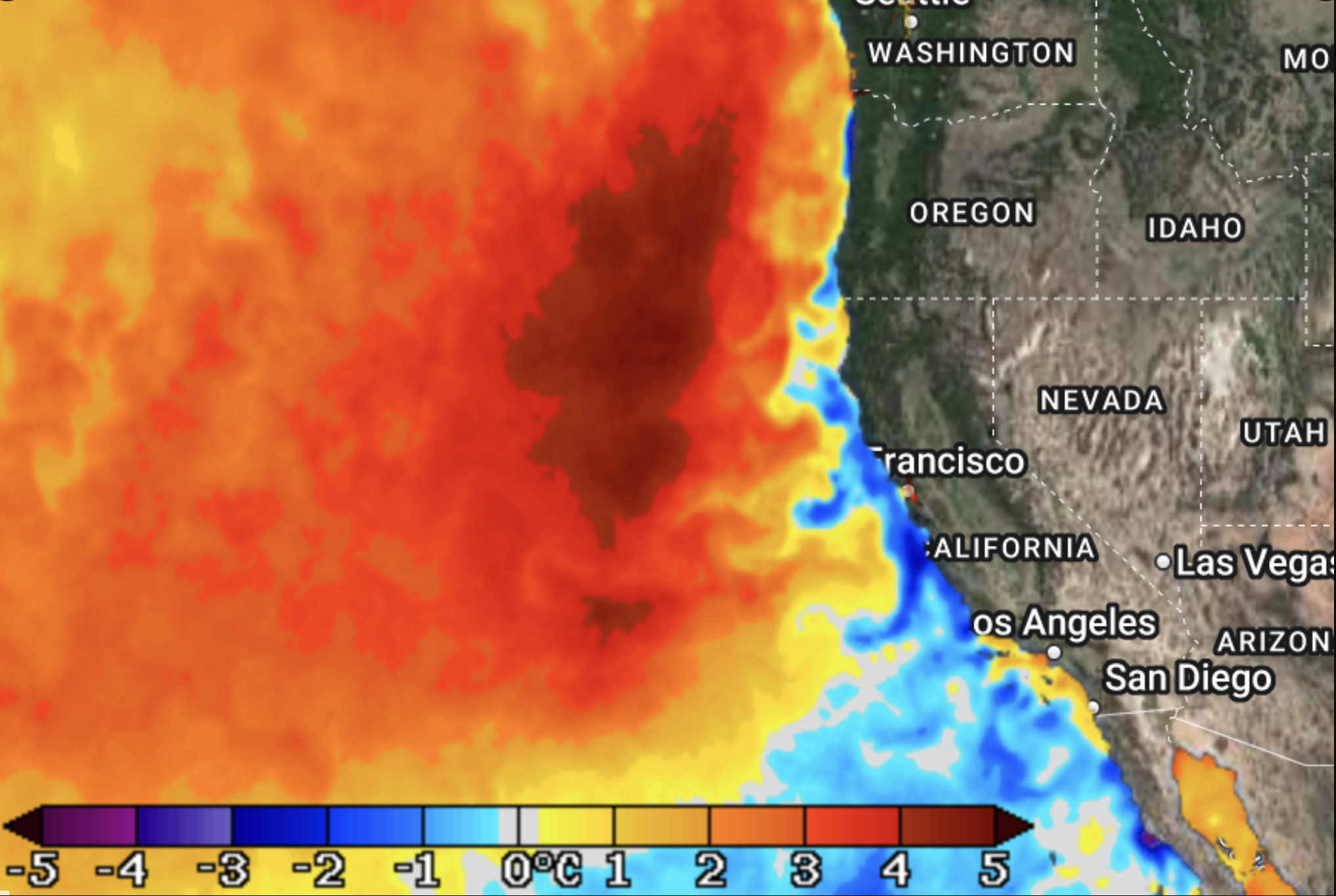
Category 4 (Extreme) Marine Heatwave off the West Coast of the US, nearly 5°C (9°F) above Normal/NOAA

The intense heat wave satellites recently registered off the coast of California, where I live, was unprecedented as it was a weather system where water temperatures peaked almost ten degrees Faherenheit above mortal, has developed off the West Coast of the US, with water temperatures peaking nearly 5°C (9°F) above normal. As much as the Category 4 (extreme) marine heatwave was an event of local shock, it had been advancing across the Pacific Ocean for them. Rather than registering a deceptively flat synoptic view, the image of marine monitoring is a story that exists at multiple scale, the seasonal weakening of colder deep sea waters that cool the coasts in upwellings may bring significantly warmer waters off California’s coast than habitual for Pacific waters, the “Category 4” Marine heat wave risks provoking offshore harmful algal booms, compromising coastal ecosystems, and causing die-offs in coastal waters of mussels and other intertidal species that risk upsetting the marine food web.

The cognitive confusion of ecosystemic disruption is hard to get one’s head around as it exists contemporaneously at multiple scales. Can one map, however, within those layers, the contribution of anthropogenic influences on these stories of cataclysmic change? The complexity of telling a story about ocean warming–let alone a powerful or positive one–seems to be the difficulty of shoehorning the global scale of surface temperature warming in readily graspable terms. While we live locally–mostly–and perceive temperatures in the atmosphere around us, or the immediate ambient surroundings, processing the terrifying range of global temperatures as anomalies places cognitively demands on us as we contemplate the prospect of weather systems we have no means of controlling, if we are wrong to bracket weather systems among circumstances beyond our control. The difficulty of processing the dissonance between how heat is stored and processed on land and at sea, and indeed out the extent to which ocean waters are storing and sequestering ocean heat may offer the clear-eyed appraisal of the extreme weather systems that have shaped the summer of 2023. The inability to come to terms with the cascading effects of such anomalous warming on such a scale is undeniably existential, and we don’t narrativize existential issues well.

Our maps seem to be challenged, and of little help. The very ellipsoid reference system featured in our global weather maps threatens to distance itself from lived world as a pixellated screen by which we witness global warming with alarm, forced to seek moorings before deep red rasters of alarming anomalies, however, that quite convincingly seem to supersede the geopolitical borders of the nation-state, if not raise questions of scales that nation-states seem unable ever to resolve. The red and blue coloration of the regions of America, set in an eerily similar terms to a map of partisan divides, are even less easy to come to terms–if with effects even far more disempowering.

The recent rasterization of our ocean maps–we map less bathymetry than temperature anomalies in the daily coral reef watch–recast the ocean a color ramps than we have seen before. If the massive coral bleaching of this summer has become a token of the sudden nature of ecosystemic collapse of global warming, the loss of coral reefs a microcosm of climate apocalypse, pressing us to create stories and gain a grasp on what has been happening with our oceans and ocean temperatures as they start to warm in dangerous directions across the north.

The liability of such raster maps may lie in their eery ethereality: a pixellated powder distancing us from the materiality of climate change, rasterization is an eerily immaterial way to view global warming unhelpful in its terrifying immateriality, as if blocks of predestined pigment sprayed across the ellipsoid outlines globe at a distance and from on high mark the bleaching of ocean life. It is terrifyingly inappropriate not only in its lack of narrative–if the story is tragic, and it is existential to boot–but cognitively disarming as it is removed from any material basis, but the map is haunted by a lack of distance, wrapping the surface of a globe as if spray-painted across the flat ellipsoid disk, which we struggle to map onto the particulars of the loss of life in the global ocean. As m much as the dark rids of rising anomalies are located in oceans, it is difficult to link the flousescent colors to the tragedy of the blanched reefs of the Florida keys, whose deathly whiteness of long flourishing staghorn coral, and quite vulnerable elk horn coral, seem blanched if not boiled in the heating up of the ambient coastal oceans of which we are suddenly all shocked observers.

Coral Reef Restoration Judges the Bleached Coral at Looe Key Coral Nursery/Jason Gulley

The absence of boundaries and sovereign spaces from the map of temperature anomalies tells a great lie of the uneven distribution of warming, apart form the different contributions of individual nations to the release of greenhouse gasses and carbon fuels, and continued extraction of carbon-based fuels that have been the predominant contribution to temperature change. If the ellipsoid without national borders is indeed an icon of globalization, it too handily lacks any accounting or inventory of the contribution of greenhouse gases to climate change. Global warming was long the greatest treat to coral reefs of global oceans, as algae leave–or “jump ship”–from the living tissues of coral polyps, even as ocean acidification has slowed the growth of coral skeletons needed for a vibrant ecosystem. If coral blanching has gained heightened attention as a die-off in our coastal waters, fed by the dramatic images on globally streaming media, global oceans have already been widely impacted by warming since 1950, dramatically decreasing the biodiversity of these delicate and unique habitats in oceans by a stunning 63% since the 1950s. Ocean heat waves of direct anthropogenic creation have dramatically triggered mass coral bleaching events of reefs already compromised by overfishing and inadequate ecosystemic protections.

Global coral reef cover declined quite dramatically below the baseline in the early 1960s in ways witnessed by indigenous cultures who sounded alarms for conserving reefs by a more sustainable blue economy, as if monitoring of reef ecosystems was only registered as coral bleaching approached national waters of economically developed nations. As bleaching has entered the EEZ’s of developed nations, we would do well to take stock of the deep dangers of the myopia of global warming. The scale of global diminishing of reef cover by over 50% from 1957–2007 is parsed by shifting rates of loss of coral coverage ranging from 4.7-6.8%, even as Caribbean countries, Thailand, or Japan saw modest increases in reef health, didn’t gain global attention until it arrived at our geopolitical doorstep, even if long feared. Even as some 90% of living corals in global reefs were lost from 1980 to 2020, projects of coral restoration–suspiciously funded by the United Arab Emirates. But as the recent spate of uncontrolled tragic wildfires across the island of Maui have led to a sudden worry about the entry of carbon into coastal waters on rare coral complexes of long tourist attraction of its pristine beaches, the threats to coral ware only seen once they are on our doorstep. Maintaining the array genetically diverse varieties of twenty species of coral, of over 1,3000 putative genotypes, poses challenges not only for marine sanctuaries but a globalizing world as oceans warm, driven predominantly by global consumption of fossil fuels.

Changing Percentages of Coral Cover In Exclusive Economic Zones, Tyler Eddy, et al, 2021

The shifts in the blue landscapes of coral cover suggest that the cataclysmic collapse of reefs off of Florida’s coast was not so sudden or unexpected on a. global scale. Yet ecological safeguards and monitoring were not yet attended This post suggests some ways to re-materialize those anomalies. By rendering them not only as a wash of rather inevitable ineluctable tides wrapping around the ellipsoid, those pixels might be more clearly cognitively rooted in material geographies of overly rapacious petrochemical extraction of petrochemicals that has given new meaning areas lying in the offshore those coasts. For the spaces that suddenly gained new materiality in the postwar period of a mania of mapping that led to the reordering of the offshore as a national energy market as an abundant mine of carbon energy for the nation led to an accelerated offshore prospecting, as offshore seabeds gained new materiality in maps as a site able to be extracted for growing energy markets that redefine the seabed and seepage of gas and oil into the global ocean.

Yet the immateriality of our rasterized maps of temperature may distance us from our impact of petrochemical harvesting from the largest ecosystem on Earth are heavily impacted by anthropogenic climate change. Their distancing helps us forget that how, on a local to global scale, it is not only the oceans that have formed a reserve for adverse weather systems, but how oceans have long absorbed human-made heat, and change the very shortest that are among the most diverse ecological areas hosting vital ecosystems, whose stable if quite delicate structure may be a site where changes in climate are disproportionately felt. The point-based pixellated maps of measuring temperature change are dangerously thin as they are distanced from the environment of the ocean, and near-coastal, as well as the coastal environments whose wetlands are so critical to shorebirds, migrating birds, coastal species, and other wildlife.

Nearly 400 species of bird live in the Gulf of Mexico–a “super breeder” environment and keystone habitat–of high avian intensity– from the snowy plover, egrets, spoonbills, to bobbies and frigatebirds who nest in the Southern Gulf of Mexico. These bird populations–and other neotropical and neoarctic migrating populations who use the Gulf as a critical flyover stop for feeding. The coastline may be more threatened by plastics and fishing line than oil, the region already threatened by man-made coastal development–it was not even regarded as a critical areas of wetlands threatened by saltwater intrusion (like northern California’s Sacramento Delta or Delaware) or industrial pollution (as New Jersey)–if that changed by 2010. But the sensitivity to coastal development and petroleum extraction revealed by the Deepwater spill with an immediacy few had imagine, leading to a short-lived push for safety standards for oil and gas to protect threatened flyover habitat by which many migrating birds are nourished as they travel north.

Threats to Migrating Birds in Gulf Of Mexico by Population Growth and Coastal Development

Despite the considerable power by which rasters place into relief a synoptic screen of regional temperature anomalies, their totalistic scope is difficult to parse with the necessary patience and specificity. They invite us to register temperature shifts in the global oceans expected to trigger a change in near-coastal habitat, as if the shores–that site where man historically evolved, as well as one the first sites of mapping, seems in danger of being rewritten, in ways that should shift the focus of our worries from sea-level rise.
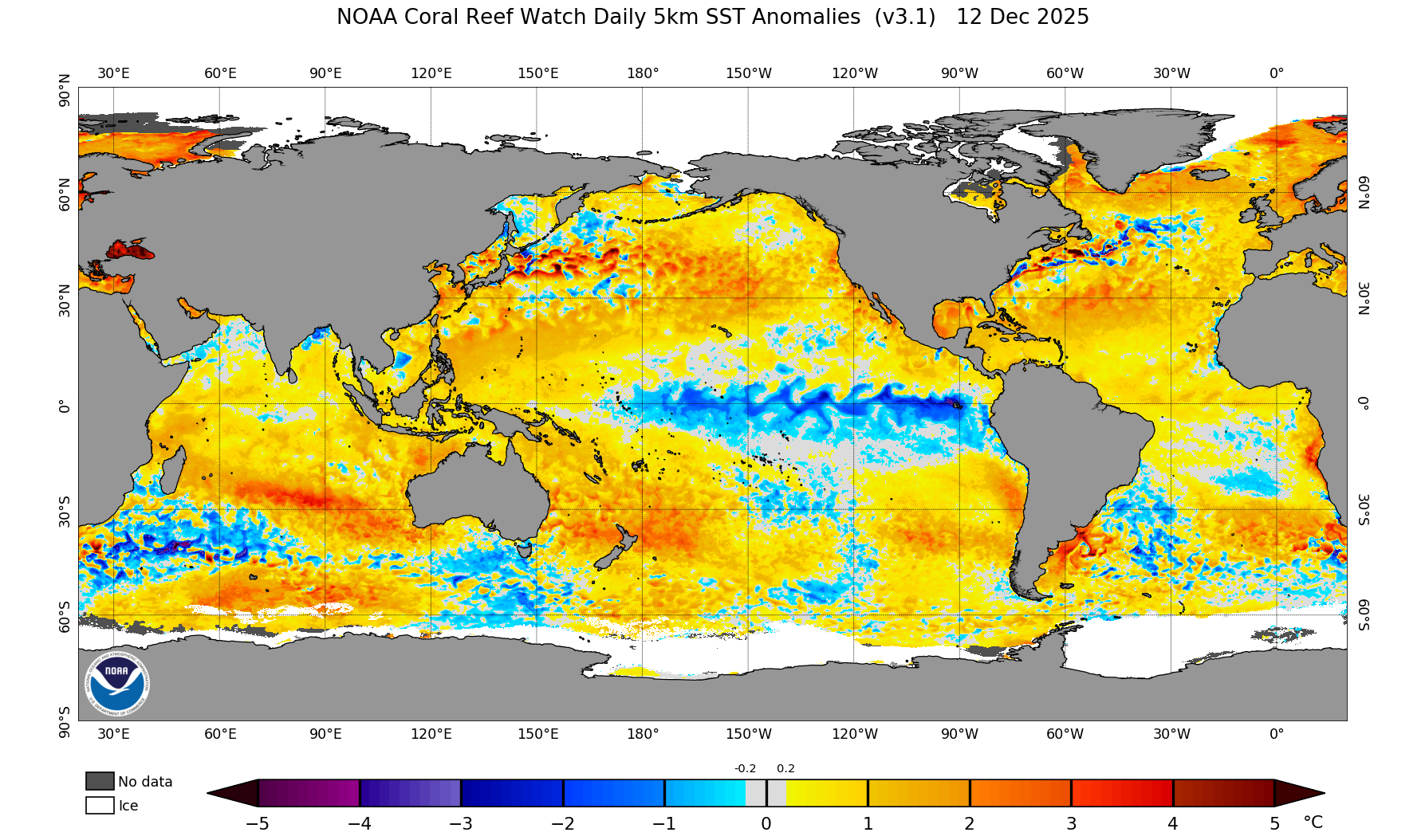
When Solnit argued we are paralyzed by our inability to tell a story about climate change, she raised objections of failure of narrative is one of not being able to see a possibility for change, or a livable future: in arguing that we risk being paralyzed by a lack of ability to tell a story about climate change that allows us to see clearly, or creatively enough to understand our power to retain a sense of agency before the massive data of climate change, she may be suggesting we are at risk of being cognitively overwhelmed by and drowned in widely circulating stories of die-offs due to warming, as so many desperate signals of all-but-inevitable climatological defeat–in the polar caps, for example, diminished sea ice thickness create a surplus of ice-melt sends far less salty, warmer water into the global ocean, threatening to shift the colder deep-water masses that drive ocean circulation.

Yet is this not also a failure to map the ocean waters in ways that do not leave us drowned in data? Is the circulation of deep-water masses so remote to be difficult to comprehend in how super-saturated colors that call our attention to global warming, of which the appearance of indigo is so striking and so terrifying–as if blue waters peak through the thin ice shelf on the edges of once floating ice. Does the electric blue swirling about the edges of the arctic shelf that call attention to our eyes as a dangerous abnormality not also register the thin ice on which we collectively stand?

We struggle to encompass both the immensity of a global story that does not drown us in disempowerment. We are indeed acutely aware of lacking a story that presents options for responsibility; we have trouble coming to terms with how to find a place for the local or the individual in totalizing maps whose projections cow us before the gears of an altering climate, their data lying on the surface, as it were, in haunting spills of color whose apparent immateriality makes their actual effects difficult to grasp.

The saturated rasters pixellate a world indelibly haunted by climate change, pools of dark ink swirling to create a tipping point of inevitable rupture from the past. As much as mark an environmental “tipping point,” the effects of global capitalism is to conspire to delay ecological consequences and ruptures, effectively testing nature’s ability to absorb shocks as it teeters toward potential collapse. By casting the thinning ice shelf on the edges of as opening an all but inevitable cascading of still greater, future dangers–projections of sea level rise, coastal flooding, erosion, habitat destruction–we fail to render how technologies of energy extraction have changed the ocean, or the long-term testing of the elasticity of nature by testing the limits of the natural world to absorb increased waste and the detritus of consumption, while extracting and appropriating natural wealth of petrochemicals as a national bounty that has no effect on local ecologies.

If the testing of the first atomic bomb by Robert Oppenheimer was long appreciated as heralding modernity in New Mexico’s desert landscaped; effectively black-boxed, the story of the stresses that it exposed the environment and local inhabitants went unquestioned. The increased effects of anthropogenic pollution are however, as Kohei Saito argues, in a rather telling ecological critique of capitalism, no longer able to be absorbed in the world; we attempt to register the shifts in data in maps, all too often, without trying to tell a story of the inroads of natural wealth or the possibilities of environmental regrowth, if not obscuring the very possibility.

The masses of data in current projections of temperature rise appear all too inevitable–unable to be assimilated to a story, because they seem to truly allow little place for us in the world, or might take our focus off of the hopes for diminishing the accelerated sea-surface warming that may alter global ocean circulation and the rise of the global ocean. Indigo tracery served as hieroglyphics of a future melting ice sheet in 2019, in the cutting edge NASA satellite photographs of Earth Observatory that revealed a melting midsummer pooling of indigo waters in ICESat-2, the most sensitive tool yet to measure the surface of the world’s largest ice sheets in Greenland or Iceland–regions that threaten to add significantly to sea-level rise in coming years, as the world is losing over 200 billion tons of grounded ice annually by the thinning surfaces of ice sheets–as if blue indigo ink were pooling on their surface.
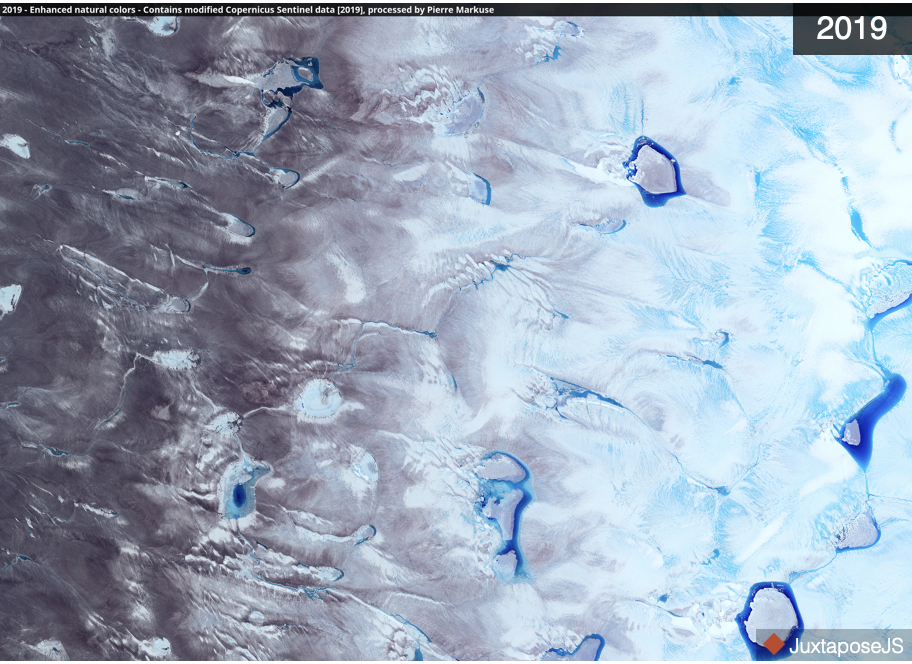
And a clipped elevation raster with a blue color ramp of Antarctica, enlisted indigo to register the increasingly low elevations where the Antartican ice shelf currently meets the sea, as a saturation of deep indigo of lower elevations at the ice shelf’s shore. This indigo demands more materiality.

Is it trying to recuperate the pristinity of the indigo ringing the arctic poles in the very first polar projection by Renaissance cartographer Martin Waldseemüller? The haunting Waldseemüller engraving of the arctic oceans and channels feeding unknown blue waters harbor multiple seas of its own, themselves with islands of uncertain edges. The cartographic rebus–itself a microcosm of the compass–offered an enticingly new vantage on a spherical world–imagined a northern ocean still not sufficiently mapped at whose center lay a giant magnetic mountain at “due north,” from which four flowing rivers combine functional reference points of four cardinal directions with the microcosm in an convincing conjectural cartography of areas few Renaissance explorers explored save Martin Frobisher and James Davis, whose nautical accounts were the basis for invented polar isolario not rendered or appreciated with true interest in most Renaissance planispheres.

The newly mapped “glacial ocean” was no longer the site of abundant fantastic islands, but a separate sea lying as if in wait above the northern edges of the world’s continents, whose frozen islands whose edges had not yet been fully mapped, was a remnant of “T-in-O” microcosms, four frozen rivers flowing beyond a multitude of islands whose edges were, enticingly, not yet mapped, and might well be, as Waldseemüller had wanted the readers of his map to imagine, to be inhabited by pygmies. The fantasia of light blue waters and edgeless islands around the poles was one improbably inhabited by pygmies, whose flower-like perspective on the world opened an iridescent fantasia on map colors, unlike Gerardus Mercator’s maps–the reedition by the Amsterdam based cartographer Jodocus Hondius was more of a hybrid conjectural cartographic rebus, with edges of continents of North America, Asia, and Europe peaking out of the sides with part of California, as if inviting readers to puzzle their assembly of an unseen perspective of the Typhonian, Scythician, Mirmanskoi, Petzorke and Hibernian oceans in the northern glacial sea–Nova Zembla and the Straits of Anián, and a giant whirlpool that threatened direct navigational access–each with a heritage in Russian literature of Vladimir Nabokov or Straits of Anián, to construct as an imaginary division between North America and Asia that offered grounds for early modern cartographers to believe in a Northwest Passage. The current blurring of the pole driven by greenhouse gasses have grown in a new era of globalization, poised to re-blur the edges of arctic and antarctic ice shelves.

Gerardus Mercator, Septentrionalium Terrarum (1606 edition by Jodicus Hondius)

Waldseemuller’s cartographic conjecture of semi-frozen regions of the Northern Pole left its indelible imprint of indigo in recent remappings of ocean currents and the polar ice shelf. If the fanciful assemblage of a quadripartite pole nestling the stony magnetic mountain–a “black cliff of immense height” that created the very same due North on which Dutch navigators had relied was in fact nested in oceans, ringed by mountains just outside where we now place the polar cap, inside the red perimeter of an arctic circle ringing the Mare glaciale, as literary as cartographical space.

At the time, many assumed the pole itself featured a giant, magnetic mountain.

Can its imprint of indigo also be an invitation to invest new materiality in a region for which we risk defamiliarizing in rasters? Is the material basis of indigo–a distinct new color of the seventeenth century, not only for Newton but as an abundant luxury import from the Indies, a natural dye–“true indigo”–that was the product of increased global commerce, and perhaps a hint of the new materiality? Deriving as a modern hue of textiles born from a global Atlantic exchange, imported by Spanish colonists to plant and harvest in plantations of the New World, from the Carolinas to Guatemala,–a boom market for in natural dyes was magnified in Europe’s textile wars, and the fueling of its industry by new fashions for striking colors. Unlike the celestial blue of lapis, the market for the trade in textiles was based on a commoditization of colored fabrics that, far from being associated with celestial blues, were signifiers of status in a market of woven commodities.

Demand for textiles was the economic engine of a first era of globalization, from beyond the Indian Ocean to the Americas, as demand for fashions grew capital in seventeenth-century transatlantic trade. If the burning of petroleum and petrochemicals has been by far the greatest engine of the Anthropocene, the dependence of the current age of globalization on unbounded markets of petrochemical extraction that have created an indelible imprint of Anthropocene–extending from global oceans marked by floating gyres of garbage patches to microplastics in ocean waters and the increasingly impreganated plastic seas to the textile fibers detected in human breast milk.

Read more: Sea Surface Temperatures

There remains a dangerously deep risk of de-familiarization of the planet due to data overload. These global trends are so cognitively overwhelming, even in an age of globalization, the rising tide of ocean temperatures seem destined to overwhelm, and not only on the coasts and coastal environments. We have trouble trying to sense this change, as temperature anomalies become the tool in trade to represent an extreme overload of heat burdening the world far from the equator by a blanket of unprecedented warmth both off the charts and physically hard for humans to sustain.

Climate Reanalyzer, Climate Change Institute, University of Maine, based on Environmental Prediction Global Forecast

The appearance of “excess heat” that ranged considerably above average for late July, which was literally hotter than most all Julys since Steve Wonder’s nineteenth studio album was released–enormous stretches of six continents were as much as fifteen degrees Fahrenheit warmer. The powerhouse graphic sent a global alert to caution we were in historically unchartered territory.

Climate Reanalyzer, Climate Change Institute, University of Maine, based on Environmental Prediction Global Forecast

The current calculations of heat stress on the human body in direct sunlight–“wet bulb temperature”–is a measure of heat stress, is in a sense the reduction of that temperature change to the basic common denominator of the human body. Although the point-based assessments might map to isotherms, in a broad way, the outliers might be so extreme to render this pointless. And the current water temperatures in western Florida of over 90°F or 32°C in the Keys, three or four degrees greater than land temps.
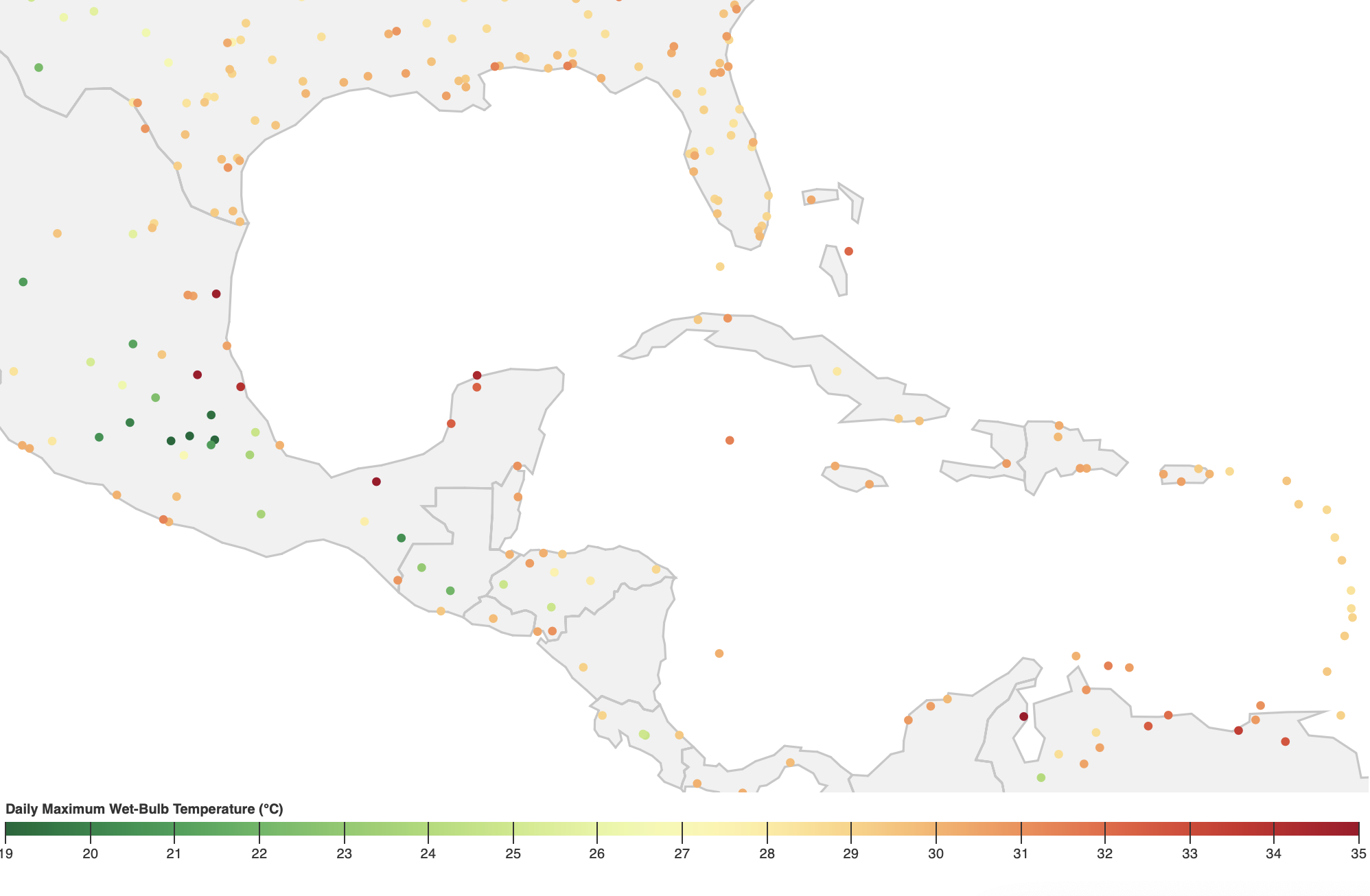
The land is both inhabited–and we are suffering from overwhelming excess heat. But the record heat absorbed in the global oceans and rather unprecedented effects of rising Ocean Heat Content—-water temperature change times the density of water times its heat capacity–has led the Gulf of Mexico to rise 1.8°F since 1950, and in May 2022 almost two degrees Fahrenheit above the 1981-2010 average, fed by the deep fast-moving warming waters that long intensified the Gulf’s heat. (The red is here denoting the rapidity of the Loop Current that enters the Gulf from the Western Caribbean; the indigo denotes the relatively still waters along the coasts and semi-enclosed sea, shown in a combination of rasters and vectors of warm Loop Current’s sudden influx to the Gulf.)

Ocean Heat Content of Loop Current Entering Gulf of Mexico May 2022/image: Navy Research Lab

The recent alerts that NOAA issued to alert the Florida Keys to the threat of widespread coral bleaching in late July transform the once-bucolic waters off the sleepy southern Florida coast into a dark red danger zone may make coral a surrogate for humans. The rasters that shift attention from the land offer a salutary alert and caution, but their saturated colors are hard to process without alarm.

The recent risks of coral bleaching in the Gulf of Mexico’s waters may be so powerful not only as coral is a keystone species, of broad impact across the ocean ecosystem, whose living reefs offer food sources that promote or foster biodiversity in tropical waters, whose very structures and food sources promote biodiversity, and allow the ocean waters to function as a carbon sink, the image is apocalyptic as a record of the declining vital signs. Are corals a proxy for wildlife from migrating landbirds to a vast and vital coastal ecosystem centered in wetlands, whose habitat and food sources would be threatened to be compromised by petrochemical accidents or potential spills?

The density bird stopovers along regions of the shore and wetlands map an area most vulnerable to maritime spills or pollution. A single spill would compromise a vital stopover habitat mis-mapped as a shoreline, and not a resting and feeding site for birds making returns north after a thousand mile migratory flight to search for food that will equip them to continue their journey north. If the striking density of bird stopovers in the Gulf of Mexico might suggest a value that is erased by the mapping of value in offshore lots leased for excavating oil and gas.
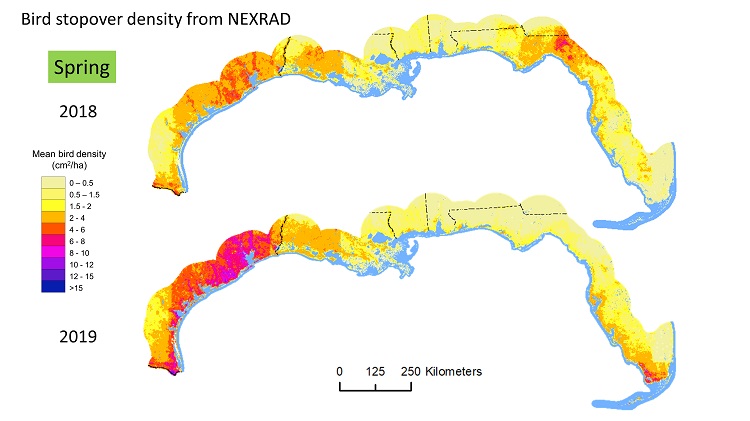
Distribution of Migratory Landbirds around the Gulf of Mexico | Land  Imaging Report Site

Predicted Avian Biomass in northern Gulf of Mexico per Weather Surveillance Radar Data. uploaded from USGS Distribution of Migratory Landbirds around Gulf of Mexico

The red rasters hemming in Florida’s coast recall the unhappy ending of the father and son who wander across a post-apocalyptic America in that first gothic novel of climate change, The Road, which eerily doubles as the first novel of post-9/11 America. Father and son travel on foot to an ocean whose surface is not at all blue, as promised , but reveals itself in the book’s final pages as a “vast and shifting heavily like a slowly heaving vat of slag,” transformed to a “the endless seascrawl” as if itself rewritten. “I’m sorry it’s not blue, he said,” the father manages, whose son, expectations long diminished, replies “That’s okay.” It is not the coast of Florida, but it might as well be the coast of a massive coral die-off, of dead zones, littered by detritus of nuclear or atomic ash. But this is not the story we want to tell, invoking a leap of faith at a gray, grimy mournful end.

This is one, archetypical, story of climate change, and not the one we want to have. It is a story of love and despair, as grimly post-apocalyptic as one might imagine, if deferring the apocalypse, but only not to tell us how it ends, but to suggest something akin to spiritual if not religious consolation. That is, perhaps, as far as it gets as a story of hope. But the alerts NOAA released seem increasingly of a sea shorn of life, if not yet covered with post-apocalyptic ash, registering an apocalyptic reality that might only find redemption, William Gibson has suggested, in a more recent twist, we might only be spared by by a virtual surrogate alternative reality.
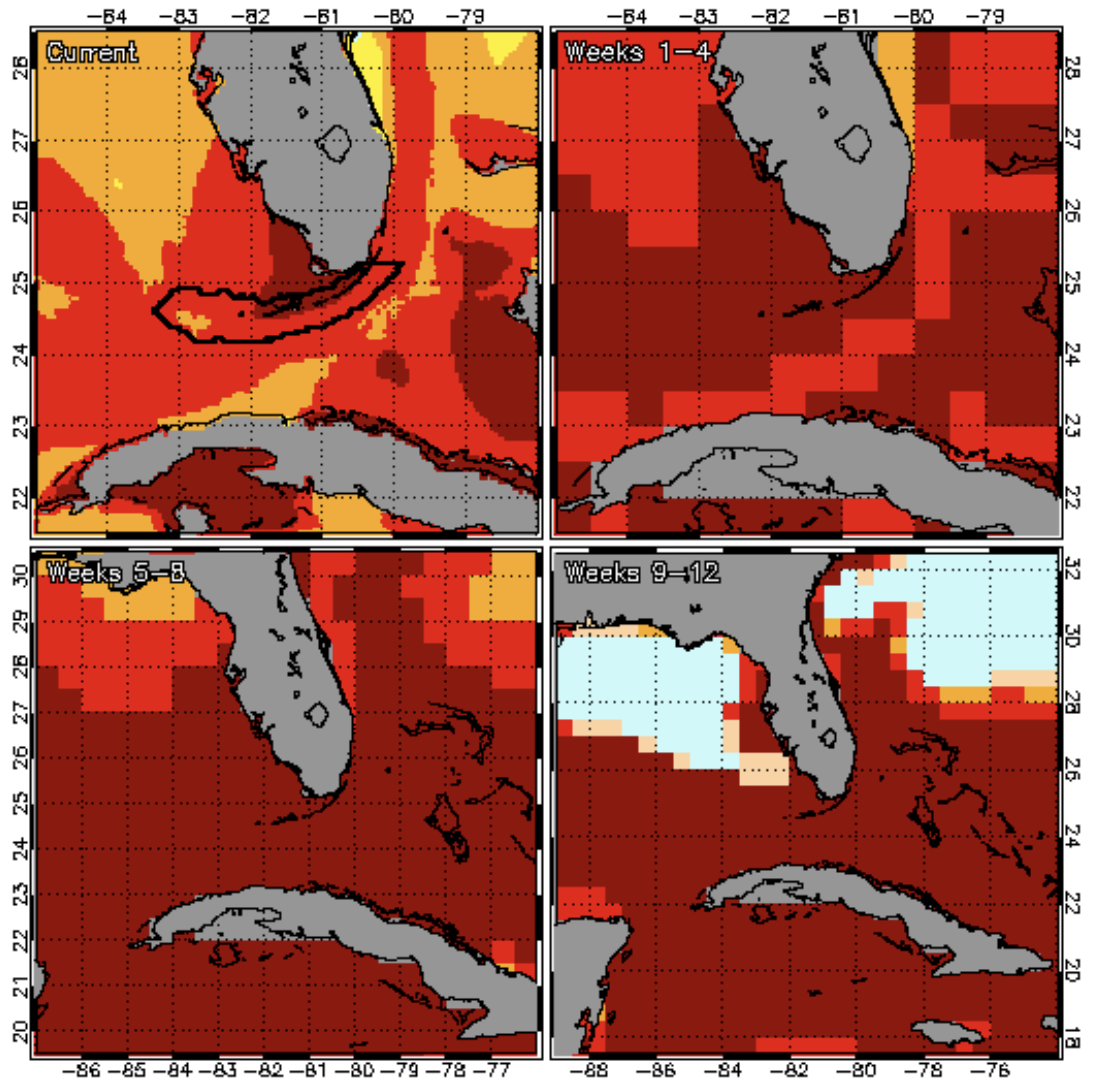
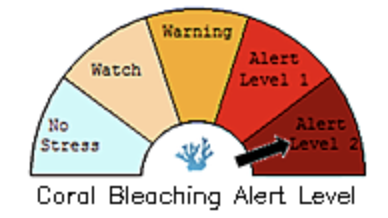
Regional Heat Stress Map for Florida Keys/Coral Reef Watch, NOAA (July 26, 2023)

The threats of the absence of equilibrium in such a map fly directly in the face of an image of hope, as well as the recommendations the International Energy Agency planned as a roadmap to net zero emissions of approving no more new oil or gasfields for development from 2021. Not only the United States have granted far more licenses to fields, many of which are offshore and an increasing number in the Gulf of Mexico–if the Gulf of Mexico became regarded as a “national ocean” from the 1950s, new wells may be slated beyond national waters.

If April is the cruelest month, as the world regenerates, “breeding lilacs out of the dead land,” June is the month of pronouncing on impending anomalies of global melting as lilac drifts to the northern climes. If lilac offers the color for cooling waters, in most ROYBGIV color ramps, each summer, lilac seems to be moving farther and farther to the poles, as the equatorial regions approach 35C, the withdrawing of cold water to the poles is in a sense an occasion of mourning, with Whitman, a sense of loss. Newton may have introduced indigo in the rainbow spectrum–as Thoreau was to give prominence to Cerulean, another tertiary color–to affirm the sacred geometry of the rainbow, after first finding five colors and then adding orange, but its prominence in the Opticks (1704) denotes the rim of warming waters on the blue-violet edges of arctic regions, levels of lilac in the north suggest the scarcity of cold, cresting the arctic regions of water where ice melts. May be the uncanny warmth of indigo has made it into a default of warmer ocean become an omen of warming waters that lead to an unstoppable glacial collapse, not only in the west Antarctic, as indigo seems the apt color of the danger of a feared potential rise of global ocean-level by over a half-meter, and triggering a rise of several meters more–and the fear of an inevitable retraction of the edges of the Antarctican ice shelf of global consequence.

Global Impacts from Shrinking Ice, Visual Capitalist/Research by Niccolo Conte; Design of Mark Belan

And the uncanny warmth of the near-arctic oceans, ever warmer in recent years, as the warming underbelly of floating ice, seem a fearful record of the warming waters set to trigger large and potentially sudden changes in sea-level rise. Even if we are confounded by alarming carmines and deep reds in raster maps of landsea temperature anomalies in recent months, the warming waters of lilac and indigo speak rather deeply to the warming of arctic and sub-arctic waters.

Thwaites Glacier in West Antarctic Ice Sheet/NASA/AP

Does telling a potted but pertinent story about indigo as color offer a surprisingly global tale of markets and man-made world? Indigo has a history, and the history of indigo as a plant dye that entered European luxury markets as a craze for vividly colored clothes in the seventeenth century would boom in the eighteenth, but made it the most noticeable color of note to the English eye when it was included in the spectrum in the Opticks (1705), when it had challenged the longstanding use of woad to color wool. No doubt reflecting the dominance that material versions of blue had secured in the market for colored fabrics before the discovery of Prussian Blue in the early eighteenth century, a precious resource and prime product of harvests in colonial settings in the West Indies used in the textile industry whose importation was already a prized if not dominant import from 1650 in the transatlantic trade from Spanish colonies, “the most famous of all dyes” no longer arrived from India, Newton would have been familiar with the stability of “true indigo” as a universal dyestuff, if one deeply compromised and affected by the War of Spanish Succession, whose purity as a ground vivid color grew in the textile trade–by the late eighteenth century the East India Company exported over a million pounds of the dyestuff from Bombay and Surat as gild restrictions on its importation eliminated or reduced, as Spanish indigo replaced the Indian origin of Indicum, notwithstanding the plant’s historical toponomastic origins. (Recall the blue dresses worn by Vermeer’s women beneath their linen veils in their private, whose vivid Delft blue made us privileged witnesses of global ties of commerce in quotidian interiors of scrubbed walls.)

The global origins of indigo in the transatlantic trade is aptly tied to a first age of globalization, as much as for elevated reasons of mystical harmony or the spectrum of available paints–whose warmth finds new if dissonantly telling prominence in our ocean maps.
The scarcity of indigo from India was challenged as New World imports reshaped luxury textile markets to feed a growing markets for fashionably vivid colors. But the scarcity of indigo in early modern European markets seems apt to illustrate the shrinking margins of cool waters that are driven by anthropogenic climate change, as global markets for energy prospecting oil and gas fields have released greenhouse gasses es into the atmosphere with seemingly irreversible consequences.

Warmer indigo waters create a slippery if critical band of sea surface temperatures above freezing that has encroached the edges of global arctic oceans–the very region that the scientist James Lovelock, father of climate studies, cunningly chose to be the last remaining temperate region of a climate apocalypse, in The Revenge of Gaia (2006), where the flipping of the global climate due to greenhouse gasses and ended animal life has forced polar migration for its few remaining survivors: those compelled to travel to the only cool sites of the Arctic, migrating to the few remaining oases with camels they have presumably fled where temperatures only cool as the sun’s rays dissipate. If Lovelock’s was a clear-eyed cautionary tale about the stresses on the global system humans created, the equatorial heat already spanning oceans in contemporary maps of eighty and ninety degree water have clear red foci of intensely electric carmine in the Persian Gulf and Gulf of Mexico, and off of China’s coastal waters, that have received less attention than the individual buoys that register “record” heat cresting the magical metric of 100°F. The novelistic retelling of the “Gaia” hypothesis viewing the earth as a coherent organism able to be seen as a self-regulating system in 1972 was dramatically disrupted in ways that offer a bracing story of the consequences of a climate out of balance of which indigo may be an apt indicator indeed.

Melting is something foreign to the waters of the Gulf of Mexico, where we were already breaking significant records in Spring. But we are increasingly relying on new carmines as we used new violets last year to register the extreme heat wave that strained power grids in the west in a previous heat dome in September 2022 that colored the Central Valley, Las Vegas and Phoenix shades of violet as a hot air mass settled over wester states for multiple days. We had warning. We suffered the warmest May on record. per the European Union’s Copernicus Climate Change Service; global sea-surface temperatures hit record highs in May and June, as it became clear that this summer was less of a season than a record of extreme heat.

By early July, a heat dome engulfing southern states around the Gulf of Mexico pushed the color ramp to deep reds, and meant triple digit temperatures of excess heat scary heat dome, whose isotherms span the border, in a reminder if we need it that global disruptions do span borders; El Niño stands to create record global July temperatures, as warm weathers off the global oceans wrap themselves around North America, raising lands temperatures upwards of a hundred degrees Fahrenheit in new record temperature anomalies.

Weather Bell/July 10, 2023 Forecast by American GFS model (F)

The rising sea surface anomalies suggested extraordinary temperatures of an intensity we’ve rarely experienced, and are challenging our color ramps moving toward darker and darker carmine. The temperatures around the coast of Florida are not limited to the threatened ecosystem of its Keys, where water temperatures above 100F° in late July lead to wide die-offs of coral reefs.

The isotherms tracking landsea temperatures make it hard to get specific or drill down into amidst the array of alarming datapoints. But the deviations of anomalies of sea surface temperatures are a terrifying hint of what might be in store, the Gulf Stream carrying warmer waters than ever to the Arctic North, warming the Baffin and Labrador Seas, as well as parts of Hudson Bay–show lowlands. These regions are already among the fastest warming in the planet–projected to warm at a rate three times higher than the global average, sending fewer cooling winds across Canada and offering less of an amenable subarctic habitat for whales or polar bears.

Dark red and orange map shows Atlantic sea surface heat

Sea Surface Temperature Anomaly (Centigrade), June 14, 2023

If June is the month to register the first anomalies of summer months, July has become the time of realizing extreme warming is going off the charts. These temperature records are anomalies we had not imagined, and stretching beyond color ramps with which we are familiar. And they are being circulated with far more alarm than the sense of inescapability already present as the 1980s presented the hottest decade on record–including five of the warmest years since 1890. If the arming of arctic permafrost was first detected in the 1950s–as dozens of exploratory oil wells were drilled in Alaska’s North Slope, the inevitability of global warming was tied to the fears greenhouse gas emissions would bring an exponential growth of CO2 levels in the global atmosphere, forecast to reach the benchmark threshold of a doubling of preindustrial standards by 2030 in the early 1980s, if no reduction of emissions were taken, and the earth entering a path toward irreversible warming of 2 to 5°C by 2020 and a doubling of carbon dioxide levels in the global atmosphere.

If the optimistic hope was to slow warming and carbon doubling until 2060, worries of coastal flooding and erosion–or of land erosion in places like the Gulf of Mexico leading to ocean flooding–the dangers of sea-level rise that is primarily due to fossil fuel combustion–as well as deforestation–has been replaced by even more anxiety-producing stories of the warming of ocean heat and its effects.

The focus of rising sea surface temperatures have striking continental focus in the waters of the Gulf of Mexico–characterized by a surface temperature anomalies from the 1950s, partly due to the low level of the ocean from the seafloor, rising by the mid-1970s and by 1990 at extraordinary rates.

Fig. 3.

Time Series Chart of Average Sea Surface Temperatures at Ocean Surface and Ten Meters in Gulf of Mexico

We are hard pressed in the middle of July to realize how sea surface temperatures are poised to escalate with El Nino. But they are so deeply red in places like the Persian Gulf, that global site of oil production, and in the site in our own national waters touted for possible future oil extraction–the Gulf of Mexico. These are among the most anthropogenic areas of the world, made for intense offshore petroleum extraction, where oil seepage and spillage may create a uniquely elevated ability to capture heat in their swirling current coursing in its semi-enclosed ocean waters.

Lilac hues signifying colder global waters are pressed to the Arctic and Antarctic, at the boundaries of or outside the bounds of human settlement. And lilac is a scary reminder that few colder water will be sent southward in the Meridional Overturning Circulation that sends colder, saltier water across global oceans that drives marine upwelling. But if this is the global, the story is in many ways local, too, as the changes in the heat of the Gulf’s surface waters, even before El Niño and La Niña, are warming those gulf waters as astounding rates as they swirl in that semi-enclosed sea-


Climate Reanalyzer, Global Sea Surface Temperatures/July 22, 2023

–and by the end of the month, just four days later, Sea Temperature was introducing lilac in its ramp for global oceans, in an extraordinary expanse, and rightly so, to register the rising ocean temperatures at the equatorial belt as a cause for alarm. Lilac is the only way to communicate these extremes, perhaps, to catch one’s eye, as perhaps Newton knew it would have, as it was feature in any rainbow, but as Newton must have known indigo well from the common use in early modern England of imported indigo dyes–indigo discharge printing of saturated colors long before William Morris prints, in indigo chintz–that were so popular that by 1720 the Calico Act restricted global trade of calicoes and indigo dyes to appease wool gilds who used woad plants, assessing fines for “Use and Warings in Apparel of imported chintz, and also its use or Wear in or about any Bed, Chair, Cushion or other Household furniture”–true indigo gained status to catch or arrest the eye, as indigo or lilac in our maps of current sea surface temperatures. The weaker dye from European woad–the isatin tinctoria of colder climes–was never as vibrant as the imported indigofer tincotria. Before restriction of the luxury import, Newton would have known the treasured dyestuff of “truer” imported indigo: the luxury trade of woad ensured Languedoc’s wealth in 1705 as “the richest in Europe,” but indigo displaced woad’s currency as a guarantor of credit was displaced by indigo, as it displaced the chromatic organization of dyers gilds–red, white, and yellow; green, black, and blue–derived from Aristotelian: indigo’s intensity was implicitly modern in Newton’s rainbow spectrum, unlike blue.

But indigo and lilac haunt the color ramps of sea surface temperatures as extremes, at the arctic edges and the equatorial zones, at the super-hot and indigo waters at the poles formerly freezing “warming hotspots” of the north.

World Water and Global Sea Temperatures, www.seatemperature.org/July 26, 2023

We may have to live with more indigo–just above freezing, where surface water shifts to marine blue–in the rasters of our maps of sea or sea surface temperatures, and try to tell the clearest story possible. This should be a story that is far more explicitly anthropogenic in nature, but a story few maps tell. To do so would be to remind us of the materiality for these changes, and indeed the materiality of Newton’s inclusion of indigo in the rainbow spectra on which our color ramps and buckets rely. The deep reds of those isotherms–whose reds seem so much heavier, impinging itself on the global ocean, no longer bridges land and sea in a topography of heat, given problems of translating land heat to the heat of the surface, force us to contemplate the anthropogenic effects on ocean environments. Whereas Romantic art promised a merging of the human with the natural as an ideal, subsuming the natural to art, the art of mapping anthropogenic influences on nature is central to the intensifying problem of mapping our current relation to our climate emergency.

We might well return to the global synoptic maps of ocean warming, enhanced by appreciation of local detail that are the best ways of gaining access to their meaning and cascading effects. The rapid rise in sea surface temp was not a record, although its surface temperatures had been rapidly rising, but hovered around the 80°F threshold. While the nightly news graphics seek to command attention as an immediate existential threat, however, the deep causes of the surrounding seas’ growing temperatures and the challenge that they pose for oceans’ memory demand greater attention and appreciation for the long-term changes in governance that have gotten us here–the transformation of the Gulf of Mexico to a sort of open bank account of perpetual national oil reserves, able to be claimed by seabed rights, that seep to the ocean, pumping of groundwater to feed crops and cities, phosphorous flows to the coastal ocean and into the sea, deluded by what may well be illusory hopes to inject waste into wells that themselves seep offshore.
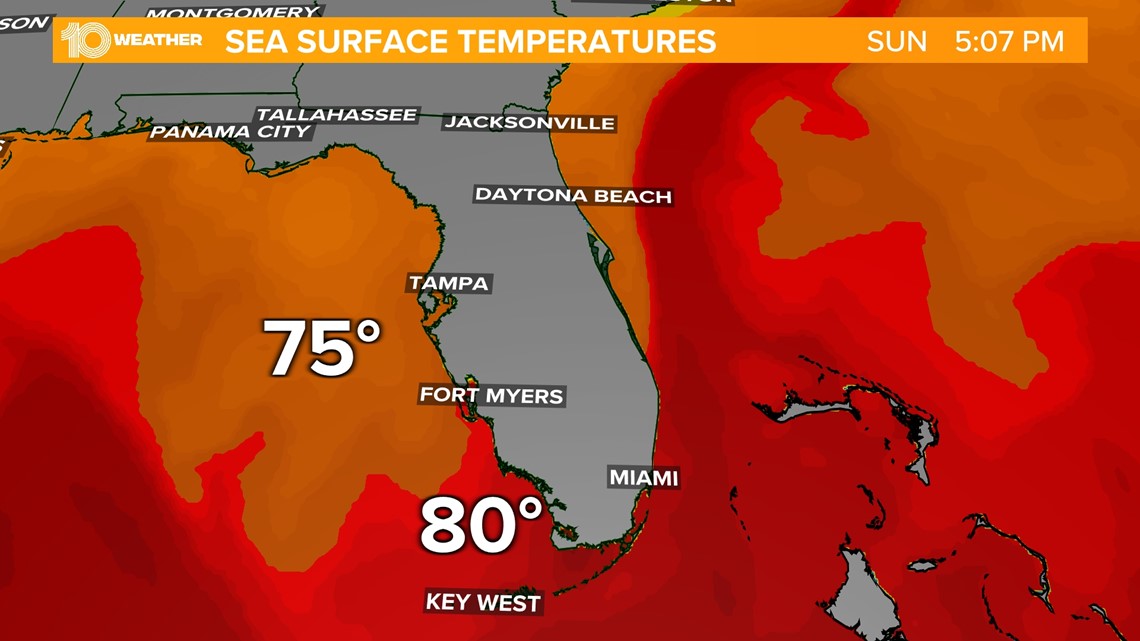
The danger signs of red, the sign of danger flags, red alerts, and blood, have been intensifying in the color ramps of overlays that we place on ocean currents in the maps of sea surface temperatures for several years. Yet rather than see the oceans as passive victims of climate change, the maps we make might seek to register or appreciate the active anthropogenic nature of those changes in sites like the Gulf of Mexico and the western and eastern Florida shores. Terrifying climate records had been announced nationwide, of course, by mid-June, before catastrophic rainfall hit New York and Vermont, with accumulated humidity condensing in the air, as anomalies of notable escalation hit the climate community from the first days of June 2023–following the warmest May on record, of a new high by quite a margin, as Antarctic sea ice suddenly shrunk to record lows, setting off alarm bells about global sea surface temperatures that haven’t been able to be silenced.

The outrageous color ramps of astounding rises in sea surface temperatures register a remarkable change in coastal waters, as global oceans hit record highs, with the ocean temperature rising as oceans absorbed the lion’s share of excess anthropogenic energies and a pronounced warming of the North Atlantic Ocean and the Gulf Stream that has sent warming waters to the North Atlantic, in a spectrum of red and blue that suggest the end of the cooling waters of the Arctic Ocean–as well as a global picture of climate change, if we needed one, rooted in the anomaly of sea surface temps across the globe. But as we wonder how those changes will be relate to local government–or how mjuch they outstrip the ability of any local government to respond–the crisis must be seen as one of governmentality, as much as climate.

Dark red and orange map shows Atlantic sea surface heat

In posting the deep lavenders off the chart temperatures that surrounded the coast of Florida this early summer, he Newspaper of Record shifted our attention to the corals, and the danger of their bleaching, beyond indulge in the effects on humans alone of these rising temperatures alone: they weren’t inviting us to take the “animal turn,” but turning attention to how the surprising spectrum was not only about when it was good to swim, but concretized the warming as a living record of marine health, akin to a charismatic keystone species. The warming is rarely tied explicitly to government, but an early engraved map of Florida might hint at the difficulty of mapping clear boundaries of land and sea–a Google maps artifact, but also one of mapping softwares–not because of its greater accuracies or inaccuracies, but the complex relations between land and sea that are suggested around the Gulf of Florida, both in the land-sea fracturing that defined the ‘state’ and its government, and the dotted lines of those far less sharply defined shores.

As K. brevis sends unprecedentedly ballooning neurotoxins s into the Gulf of Mexico and to Florida’s Gulf Coast waters, yet again, and blows onshore to trigger lung symptoms for many, as it enters the air, we are reminded of how much land and sea are tied, in the rusty red tide lasting for months off of Florida’s western coast washes a shore, we might ask about the porous nature of good government in Florida, both East and West alike, by looking at the appreciation of this porous boundary of the shore that was central to early maps of the region–not only before landfill led to the remaking of the state, but before we were convinced of a firm separation of land and sea.

Sailors of course paid more attention not only to the existance of islands in the Gulf of Mexico, where their crafts would run ashore, but to the great sand banks as the Great Bank of the Bahama (or Great Bahama Bank) that is one of the largest of the world’s fringing reefs, even in an era of routine sand pillaging and illegal sand mining. But as our shores have become too narrowly defined, as we have viewed them as the edges of government. As we imagine the shores overly sharply defined, the irony may be, unregulated drainage of sewage, industrial fertilizer, and urban wastewater create decisively warming temps around that quite critical coastal margin, where warming temperatures enter into that purple, reminding us yet again, in way, howe much anthropogenically caused heat oceans are trying to absorb–and how off the charts the rises in temperatures are to the ocean’s memory. The presence of and threatens to ocean memory might well be part of the stories that we tell about climate change, and indeed made central to them.

Indeed, rather than see the ocean as a glassy surface, as if the surface temperature were a record of the sea surface, suspended by an illusion of calm waters, we need maps that allow us to look deeper in maps, to the areas underneath, as this post has tried, and noting what else is on the surface of the seas as they circulate ever-warmer waters off sensitive coastal environments. So much is suggested by the coral reefs, dotted zones in danger of being bleached at higher temperatures. Rebecca Solnit invites we entertain the climate crisis as “in part a storytelling crisis,” a crisis in which we find ourselves “hemmed in by stories that prevent us from seeing, or believing in, or acting on the possibilities for change.” The foreclosure of possibilities are perhaps nowhere as evident in the finality of the color ramps of maps of global climate that trigger our alarm; color ramps of sea surface temperatures are, in their opacities, perhaps as much as fault as being part of that problem. They are an ultimatum, as much as any thing like a narrative, as much as a late-arriving warning sign and a cry for help: the stark disequilibria of something so large as a global climate or “surface temperature” is hard to grasp with anything like traction, let alone weave a story around.

Yet the problem of mapping a story of where we are requires more depth, and detail, of appreciation and perhaps wonder, as much as fear. As much as posing existential issues of impending ruptures in ocean habitat and even in ocean memory, we might pay better attention to the local scales of what is lost. For the inattention to the changes that are already quite evident in the membranes of coasts and the margins of shores, stories that don’t leave us much room to move. They are multiply depressing stories about about politics, or governance, and the irresponsible expansion of seabed governance to mine and extract non-renewable energy sources as petroleum and natural gas, to supply petrochemical needs. Yet the stories that we tell are perhaps so depressing as they ignore and are rarely addressing shores as lived environments or enduring habitat but the steep fears and constraints of coastal risk and of both urgency and emergency.

We are perhaps far, far beyond investigation, regulation, rehabilitation, or clean up of isolated sites contaminated by the spills and discharges. But we must look deeper into the maps, perhaps beneath the frustrating opacities of crimson and the misleadingly gentle lavender. Hui Shi of the Farallon Institute in Petaluma, CA suggests that similarity in ocean surface temperature from one year to the next is the best “simple metric for ocean memory,” independently from atmosphere-ocean exchanges, as a systemic change in ecological memory. Another way to see this, of course, is by remembering the long permeable membrane of Florida shores, an implicit part of its good government, and one that has been neglected in the erasure of banks, reefs, and undersea health that is long part of the region, and erased by the reduction of the region’s “government” to the policies of one state–and to call more attention to the role of good government in the very porous relation of land and sea in Florida’s government, that appreciates the state’s integral connection to the Gulf of Mexico as well as the “Gulf of Florida” and Atlantic Ocean.

We map the sea-surface temperatures around Florida by a color ramp, as if they were similar or about the same as land temperatures. they are not. Not only does the ocean absorb a huge amount of anthropogenically driven climate change. The disruptive nature of marine heat-waves are less similar to those on land, as they can be more intense, and more sudden, and even more directly impacting human health and disrupting abilities of meteorological assessment and prediction, and compromising our relation to the shores. If ocean warming accounts for some 63% of the stored heat of the planet, rising temperatures of expanding oceans threaten coastal communities, and undermine the very clear lines we drawn in most of our maps–including weather maps–that fix edges between land and sea as distinct divides. They are not, and this is a casualty, perhaps, of the graphic syntax of the map, which signals a divide, rather than a membrane or, better yet, medium.

The oceanic amnesia between rapid sea-surface temperature changes can be mapped, scientists have argued, in a neat cognate of a sea-surface temperature map, in terms of increasing amnesia–a sort of memory-decline on a global scale–that is jarring because of the choice of blue as a metric of declining memory, and a decline in the continuity between temperatures between one day and the other, that is not only in the water of the ocean, but also its habitat and ecological stability and vitality–the very problem of the coral reefs that are the focus of the Times article. The discontinuities of sea-surface temperatures suggest a major disrupter, in other words, tied to different scenarios of climate emissions, reflecting decreased thermal inertia of the uppermost layer of the ocean, as it grows shallower in response to anthropogenic warming.
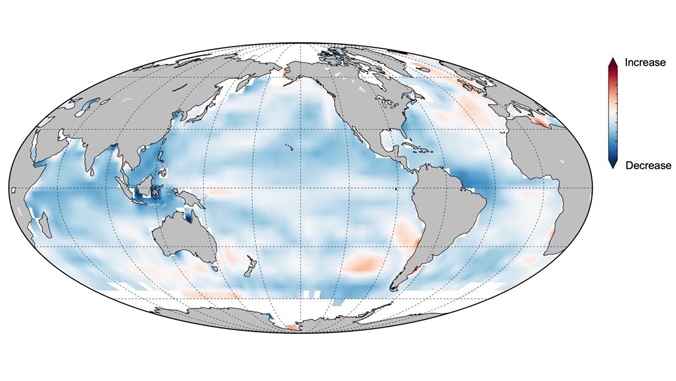
graphic of earth

 She, et al., Science Advances (2022) 

She’s metric for “ocean memory” is perhaps a far better and significant chart than the existential immediate sea surface temps, and demands to be placed in a sense of temporal duration, tied to the degree of ocean memory that seems to have existed in the last century, and over different possible emissions scenarios, for the coming decades. He suggests a need for attention to the management of marine ecosystems–which we regard in a largely quite laissez-faire manner–and expansion of government from land-based regions to oceanic environments, and to those sensitive margins of land and sea–watersheds, swamps, tide pools, shores–where life is increasingly abundant, but are also increasingly determinant of biotic and environmental health, in ways that makes them health multipliers. If clever folk at the island-centric UH Mānoa have documented the increased ocean heat anomalies from 1993 to 2019 in the upper layers of oceans, those very sensitive registers of ocean memory, of seven hundred meters in depth, the warming of 53% of global oceans suggests a decline in memory, of some significance, with but 3% of global oceans able to be characterized by cooling trends. From 1968 to 2019, whereas ocean warming was found in 72-9% of global oceans, cooling confined to but 1-2%, in a terrifying trend that only mirrors the dangers of the scale of such a massive memory loss.
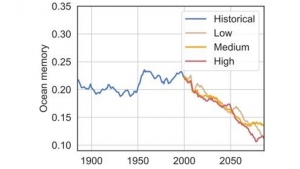
chart

If speculative in nature, the historical depth of a discussion of long-term ocean memory suggests something quite distinct from the structural sort of histoire immobile as is fitting the ocean sea: rather than rooted in economic arrangements that we can map by structures, the slipping away of ocean memory suggests a receding shoreline, or a failed ability to grasp the sudden changes of weather that increasingly characterizes the sea, an erosion, in other words, of a measure critical to ocean health not rooted in the day-to-day nature of surface temperatures, or the disputed averages of temperature over time, but of the ability to navigate the coming sharp changes in ocean health, which, with a majority of humans living on or near the shores, we should be compelled to attend. We risk, as my late friend John Gillis reminded us often in his final years, “turning our back on the shore,” imagining the healh of the oceans to exist independnetly of the land, and the ocean able to be mapped as an extension of the topography and heat of the land.

Another way of seeing this absence of continuity of temperatures might be in terms of the setting tight the oceans offer: the predictability of the warmers as hospitable environments, in other words, rather than as sites of escalating temperatures approaching trigger points for the massive die-offs we have seen. To be sure, surface temperatures are not only reason for die-offs. But they are at play in them, and probably more than we realize: the failure of oceanic environments to be hospitable environments are not only able to be measured by individual digits of Centigrade and Fahrenheit, but, as oceans are absorbing ever greater surface temperatures, of ecosystems most affected by solar irradiation, the rise of sea surface temperatures in the Gulf of Mexico between 1970 and 2020 stands out–warming at twice the rate of the upper layer of global oceans, as ocean heat content in the region has risen so dramatically to raise questions about environmental ocean management–and to explore reasons for the imbalances in Ocean Heat Content (OHT) globally in relation to anthropogenic activity in the upper 700 meters of the ocean, that can help track marine heatwaves that have become greatly more prevalent in the past century.

And the Gulf of Mexico–which receives runoff from over a hundred and fifty rivers from thirty-one out of fifty states, is a sort of distillation of the polluted content of our American rives, in ways that riverwater from more than 150 rivers and runoff from 31 of the 50 states, including nitrogen and phosphates, as well as offshore petroleum-producing zones, a main cause for hypoxic zones and harmful algal blooms, is notably warming at twice the rate of the world’s oceans.

If coastal Florida had seen a distinct rise of temperatures in the heat content of offshore waters, a huge stress on marine environments, in the 1990s and early twentieth century, the recent escalation of heat waves across the Atlantic and Gulf Stream suggest a real reason for panic, tied to displacing habitat, and less salty–and less dense–ocean waters, that are especially dangerous to the vitality of oceanic environments–and the danger of die-offs, often not mapped by digits alone. Far better to focus on and scrutinize trends, disturbances, and abrupt shocks to the ocean’s environment, and to the mitigation of those shocks issuing from the land, and interface of land and sea, where toxins and industrial discharge and pesticide runoff leaches offshore freely. Even a relatively circumscribed “deep view” of warming trends from, as it happens, the start of the Trump era, reminds us, by its dark red blotches, of the warming waters off of American coasts, warmed by the Gulf Stream that carried Caribbean waters from the Gulf of Mexico along the eastern seaboard.

1 Comment

Filed under anthropocene, anthropogenic change, global warming, ocean warming, remote observation

Very Perilous Waters?

Urgent hopes to discover the five passengers tragically killed in the lost submersible off the shores of Newfoundland spread with compelling urgency across global media after the Titan Submersible lost contact with those on land. The disappearance of the crudely-designed submersible that Stockton Rush had claimed would offer a voyage to the ruins of the great tragedy of the twentieth century had exploded from the undersea pressure it endured as it descended to the wreck of the Titanic. The voyage had tempted fate as a disaster in the making. fell off of the global map, venturing deep, deep underseas. The craft’s tragic disappearance quickly dominated global media with an odd urgency of portentousness fed by the image of a renegade entrepreneur who seemed, despite his worldly wealth, to be courting disaster, in braving a new frontier of an improbably untouched wilderness. Although no bodies or skeletons remain on the Titanic’s undersea ruins, the loss of life that was itself transformed by newspapers into a traumatic site of global mourning and tragedy was eerily replicated. What Rush and his company, OceanGate, had promoted as an ability to transcend a classic icon of death, or at least carry paying observers to see at first hand, was a project he pushed even while making the deep diving sub out of experimental materials, without any third-party oversight, out of the robustt sounding materials as carbon fibre and titanium.

The wreck of the Titanic is an icon of unbearable loss, the scale of whose unexpected destruction is an icon of loss that continues to attract curiosity as it still fails comprehension for many as an epic tragedy. The promise to revisit the unspeakable pain of ruins long lying on the ocean’s floor was perhaps a form of triumphal return. It had been promised to a once-in-a-lifetime underwater voyage, by new technologies, if one with origins in the early twentieth century diving bell. For Rush’s small pod-like vessel several feet in diameter was fitted out as if inversely to a stratospheric balloon, promising take one to depths at which no humans had traveled, as if to a new frontier of utter darkness, removed from terrestrial light. But the hubris of visiting the technological disaster of the Titanic–a primal scene of the mid-twentieth century, which Rush now promoted as a disaster tourism with more than a bit of Jules Verne in it, to the confines of the known, equipped, with the self-assurance that spurred his confidence to try to push limits. Rush had assured his coworkers and subordinates that he would undergo a safety assessment of the craft–he was aboard it, after all, and claimed in board meetings about safety concerns had proclaimed “I have no desire to die,” arguing the deeps dive was “one of the safest things I will ever do,” that suggests a deep self-deception terrific in its determination to escape outside oversight. As much as the name of the Titanic promised to face the “titanic features of the wild” in the manner of the American naturalist Thoreau argued met our “needs to witness our own limits transgressed,” every schoolboy’s dream, and Rush seemed so convinced “I understand this kind of risk.” Yet although the vessel he piloted had made the trip down to the deep-sea ruins some thirteen times before, the degraded state of the hull caused it to implode suddenly at 3,000 feet depth suggested “sustained efforts to misrepresent the Titan as indestructible” animated Rush, driven not only to explore the deep sea ruins, but resist registering the craft to any nation to erase regulatory oversight: the dive in international waters evaded all governmental oversight, suggesting the fault lay not only in a “bad actor” possessed by delusions, but abilities to elude government agencies in a hot market for deep-sea exploration.

Indeed, the picture provided by a whistleblower who was far more trained in underseas missions suggest that the degraded nature of the hull that was not only exposed to deepsea pressures, but to face the winter conditions that could have compromised the composite hull, was prominent tin the number of safety concerns many felt in the submersible community, but which Rush tried to shirk off. While not diabolic or nefarious, a desire to achieve not only the insurmountable dangers of deep-sea exploration, or to “touch death” by visiting the deepsea ruins of the Titanic at first hand were animating Rush’s apparent obliviousness to oversight, and intense silencing of executives and employees to raise concern about the absence of inspectors but insistence to dive to unprecedented depths for financial gain led Rush to silence the experts that he employed, and retain the “experts” h needed for window-dressing to add public luster (rather than real oversight) to the mission.

Over the four days of panic that rescue forces and underseas divers searched to map traces or survivors of the imploded submersible, hoping that the children at least might be living, somehow, trapped in safety compartments beneath the sea, as we wondered how legal parameters on deepsea travel were avoided, we rarely heard from or about whistle-blowers who had long raised questions bout Musk’s overeager plans, trying to alert the very workplace safety regulators–OSHA; –that Donald Trump is, with eager encouragement from the business world–trying to limit and erode. For OceanGate’s quite sturdy Director of Marine Operations, sea-going Glaswegian David Lochbridge, who had worked with a range of submersibles for the Royal Navy and then as a pilot of submersibles in the North Sea, was shut out of the launch of the Titan: he was indeed silenced, and forced to watch the arrival of the titanium caps on the ends of the lost submersible as they returned to shore with everyone else. or if Lochbridge had promptly alerted to the design dangers of the tiny submersible oddly named the Titan,-as if it were the lesser cousin destined to meet the Titanic. The underseas engineer wrote promptly to the Occupational Safety and Health Administration–OSHA–in the United States, who themselves had alerted the U.S. Coast Guard. Yet OceanGate lawyers were set like attack dogs: they insisted that he pay $10,000 for compromising their project, and asked he drop his complaint immediately, charging theft of intellectual property. It got only worse: “From the initial design, to the build, to the operations, people were told a lie,” the expert pilot ruefully remembered. The charge of a theft of Intellectual Property that OceanGate was ready to lodge was, of course, entirely bogus–the IP was nonexistent, as the submersible was not able to endure such high pressure, and the problem was poor engineering rather than theft of trade secrets.

The carbon fibre hull built by the University of Washington Applied Physics from 2019, however for a hull designed for constructing “the shallow-water vessel” called Cyclops 1, made from different entirely materials–steel instead of the carbon fiber as was the case of the hull of the Titan–for diving 500 meters or 1,640 feet, not the 12,500 feet the Titanic lay (“APL-UW expertise involved only shallow water implementation, [and] the Laboratory was not involved in the design, engineering or testing of the TITAN submersible used in the RMS TITANIC expedition,” wrote the executive director of the UW Applied Physics Laboratory in a June 20, 2023 to distance himself from the OceanGate disaster into which he feared his laboratory was implicated, claiming it only offered its services for “shallow water implementation.” Yet Rush was explicit in noting that the college’s broad background in ocean engineering to develop “fixed and mobile ocean systems” for “deep ocean exploration” was always OceanGate’s final goal, and the laboratory claimed experience conducting research on the deep ocean floor that no doubt attracted Rush in the first place, as he sought help for OceanGate to build a submersible that in “the development, construction, launch, recovery, test and analysis of a deep-ocean, manned under-water vehicle.”   Rather than rooted in trade secrets that defined the enterprise of deepsea exploration, the carbon fiber hull, designed as if it were indeed a voyage to another planet and inexperienced space, recalls the Carl Sagan image sent to outer space for extraterrestrials, more than the ability to withstand tons of pressure, and multiple flaws in its assembly to withstand the pressures most engineers would quickly realize.

The confidence game that Rush was able to While David Lochbridge and his wife called OSHA every few weeks to alert them to the cracks, pops, and delimitation of the carbon-fibre hull that had been specially built for the submersible’s descent and the glue that bonded it to the titanium rings, by December 2018, Oceangate legal team demanded Lochbridge and his wife drop their complaints and the observations they offered on the plans for descending in the submersible. The legal team successfully delayed investigation of the craft that had never been certified by any third-party organization, as Lloyd’s Register or the American Bureau of Shipping, but was allowed to descend in international waters: the lawyers deflected any investigation by OSHA by charging Lochbridge with appropriating trade secrets, fraud, and theft; he had sought in vain the whistleblower protections from OSHA that never arrived-even as experts at the Marine Technology Society joined the DMO in raising safety concerns about the safety standards for the titanium hubs, evading the industry standards in March, 2018, ways likely to set back the entire industry of underseas exploration by “negative outcomes (from minor to catastrophic) that would have serious consequences for everyone in the industry.” While the cute submersible was promoted as able to navigate safely in any aquatic environment–but little intellectual property or “trade secrets” worthy of the name.

The questions that had been raised about its joins of tail cone or porthole and the degradation of the lamination of the carbon-fibre material, not used in arctic conditions, in winter weather of the waters off Newfoundland evaded the regulatory frameworks in place for national or international rates. Did Rush realize that the lack of oversight in international waters off of Newfoundland where the Titanic had previously sunk allowed the escape hatch he needed to press full speed ahead with plans that many doubted would be able to sustain deep-ocean pressures, let alone those on the ocean floor? The Titan, of course, never reached that ocean floor destination, as it had advertised.

Experts Worried the Laminated Carbon Fiber Hull would not Withstand Pressures on Ocean Floor

This was not under the radar. Ocean Governance was evaded as Rush was working without any oversight to fabricate a submersible he claimed was able to withstand underseas pressure based on his own engineering training alone, and his zeal to conduct underseas missions at the ocean floor. By insulating himself with pseudo-experts–from Pierre Nageolet, working outside of deepsea protocols in place for some time in engineering communities, and silencing his whistblower by intimidatory tactics of actual or threatened lawsuits, who he quickly sacked without grounds, And while the U.S. Coast Guard has determined that the almost instantaneous explosion of The Titan, the submersible Rush helped design and whose construction he single-handedly supervised and oversaw resulted from a failure in the glue joining the hull and titanium ring, or the carbon fiber hull’s delimitation as a result of wintering in the north seas, the simulation of how the submersible en route to carry passengers to the ruins of the HMS Titanic after an hour and forty-five minutes may have been a “painless death,” the four days of panic as to its fate conceal the deep dangers of lack of safety oversight or regulations in an almost unregulated search for underseas minerals that seems to have driven Rush’s rather single-minded pursuit of a way to explore underwater canyons on the ocean floor and deepsea territories long hidden to the human observer.

The exploration of the underseas, as much as following Jules Verne’s nineteenth century adventure books, was driven by a growing market for mineral and energy speculation as much as personal glory. If the truly catastrophic implosion of the submersible lasted but milliseconds–too quick of the mind to process, per YouTube sensation Dr. Chris Rayner, who has most recently piggybacked on the global catastrophe, asserts. If the hull collapse may have been preceded by squeaks and pops that inspired panic,  the possible site of collapse and structural failure—the viewport, the adhesive seal between the titanium end-caps and the collapse of the cylindrical hull–resulted from evading oversight of nautical regulatory bodies, perhaps steeped in the ethos of American individualism, but driven by a market for offering new platforms of first-hand underseas oil exploration to oil companies and engineers in search of deep sea minerals–the very community of engineers Rush hoped to win over for the benefits of the submersible as a mode of underseas mapping. The need to evade the law of the seas, and situate the site of exploration in international waters, was situated at the ruins of the Titanic to attract worldwide media attention, and pull other outsiders into Rush’s outsider project, evading any regulatory commissions or guidelines on passenger safety. All of Rush’s passengers had of course signed release forms prior to boarding the Titan, and the pressures to which it was exposed that reached 5,000 pounds of pressure per square inch. Carbon fibre was an “unpredictable material” all along for such depths of 3,000 feet, if not an impractical one, raising questions of why Rush was so committed to allowing multiple untested features to remain before performing the dive, advertising the ride to passengers he would take to their deaths as entirely safe.

1. The romance of the underseas exploration was clearly intensified–and made attractive to financial backers–by the nature of its destination: the ruins of the Titanic–and, however paradoxically, the ability to transcend death. The expression of a desire to transcend perceived boundaries was communicated to Stockton Rush as a boy in Walden, or Maine Woods, where Thoreau waxed ecstatic at an almost mythic awareness of something “vast, Titanic, such as man never inhabits”–channeled by the original transatlantic transatlantic voyage that mirrored the telegraph to the Newfoundland coast, before hitting an iceberg, to the search of the steel ruins still lying submerged undersea. Rush sought to break new boundaries of the globalized world by the venture of OceanGate, as if breaching new frontier of exploration, if not an affirmation of personal vitality and renewal by traveling to a space “such as man never inhabits,” where “inhuman Nature has got him alone.” It is impossible to read the ecstatic revery of how Nature moves man and “pilfers him of some of his divine faculty” as an open invitation to descend into the deep of the ruins of the Titanic, to relive the massive tragedy of the first decades of the twentieth century, as attempting to reconquer time.)

Stockton Rush had recuperated a narrative of canasta with deep roots, if one that was promoted in the recent films that had become museum shows and even adventure rids at amusement parks–but this, as if in contrast to studio recreations, was promised as the utmost exhilaration of the real thing. But was it ever reality, so entangled was Rush’s promise with beliefs in transcendence that trained generations of readers of Thoreau to search for sites of transcendence beyond our abilities? Or is the fiction of transcendence that Rush promised to paying customers, and that Thoreau had so memorably inspired, gained new meanings in a world defined by globalization, where the voyage of Stockton Rush into the depth of international waters, outside legal oversight, been tainted by the map of globalization, and indeed inspired by the abilities to transcend our own known limits were newly conflated with the transcendence of legal regimes, and indeed the transcendence of limits of deepwater exploration for energy reserves that oil and gas multinationals hoped to extract from the deep seas, but lacked the requisite technology to survey? For the voyage in the modern diving bell was indeed a trial balloon to industries eager for tools of underseas mapping promising greater precision, that it isn’t unlikely to think Ocean’s Gate was eager to market, for far more money than offering exerting underseas joy rides of disaster tourism. And a very different if related sense of “Titanic’ that Thoreau used in Maine Woods, of something that “was vast, Titanic, and such as man never inhabits” where “Nature has got him at a disadvantage” might better describe the deep seas.

The bravura of descending by a diving bell had been memorably used in the mid-century novel Dr. Faustus by Thomas Mann as an aesthetic experiencetragically tainted by hubris from the start. Mann seeks to express the Faustian goals of his hero, Adrian Leverkühn by the diving bell he travels undresea to witness unknown monsters in perfect submarine darkness, far from humanity, in the diving bell that prefigure the ecstatic aspirations to symphonies he hopes to create. The trips with Dr. Capercale to the underseas world with a fictional scientist, as pushing the limits of human understanding. Leverkühn claims to have experienced new limits when he descended in the waters off Bermuda, only several sea miles from St. George, in the company of a man who claims to “have set a new record for depth” underwater. Mann’s memorable hero descended in a “bullet-shaped diving-bell” that transcended human limits, descending a if in inverse to the stratospheric balloon it resembled, promised to be “absolutely watertight, . . . capable of withstanding the immense pressures and came equipped with plenty of oxygen, a telephone, high-powered searchlights, and quartz windows for viewing on every side.” If ‘anything but comfortable” they were secure in their descent, “by the knowledge of their safety . . . beneath he surface of the ocean” behind four-hundred pound door, as descending to perfect darkness at 2,000 and then 2,500 feet, bearing 500,000 tons of pressure.

Leverkühn somewhat cozily entertained his friends with gusto of the descent to underseas depths, smoking a cigarette. The voyage was a metaphor for the modern Faustian bargain he made with the Devil, sacrificing human love for his skills of composition. For in the descent to the inhuman realm, he described having gained “glimpses afforded onto a world whose silent, alien madness was justified–and explained, so to speak–by its inherent lack of contact with our own” in the descending chamber, in three hours that “passed like a dream, thanks to the . . . glimpses into a world whose soundless, frantic foreignness was explained . . . by its [absolute and] utter lack of contact with our own:” “all around reigned perfect blackness” akin to “darkness of interstellar space.” Diving bells not only provided visits to witness sunken wrecks off Bermuda’s coast on the ocean floor, but conjured a transcendence of the human, in an unmapped region beyond the limits of the known, traveling 3600 feet below the seas surface in a two-and-a-half ton hollow ball for a half an hour, looking through quartz windows “into a blue-blackness hard to describe, . . . eternally still . . . not quite allayed by the feeling science must be allowed to press just as far forwards as the intelligence of scientists is given license to go.”

Else Bostelmann, Dragonfish or “Bathysphere Intact” off Bermuda (1934)

The images Else Bostelmann offered in scientific periodicals captured the fascination of underseas that colonized the imagination; “the incredible oddities that nature and life had managed here, these forms and physiognomies that seemed to bear scarcely any kinship with those on earth above and to belong to some other planet, . . . hidden in eternal darkness.” The deep sea hid “these abstruse creatures of the abyss” that seem “to have no tie to humanity” provided the first ken of the pleasure Leverkühn takes in flaunting familiarity “his experiences in regions monstrously above and beyond us humans,” plunging with diabolic relish and ease among the “deep-sea’s life grottesquely alien life-forms, which did not seem to belong to our planet.” His friend thinks that the indulgence of these memories seemed “a devilish prank” of “the horridities of creation” able spur him to a new form of composition of the “cosmic music, with which he had become preoccupied,” before World War I, in compositions the narrator condemns as a “sardonic lampoon apparently aimed not only at the dreadful clockwork of the universe, but also at the medium in which it is painted . . . at music” of “a nearly thirty-minute orchestral portrait of the world is mockery–a mockery that confirms only too well the opinion I expressed in our conversation that the pursuit of what is immeasurably beyond man can provide no piety or nourishment.”

The sense of an infernal voyage was amplified in the disaster on the way to visit the Titanic’s ruins. For that voyage was akin to the blasphemic nature of what Mann’s narrator calls aLuciferian travesty” and blasphemy against the elevated medium of music expressed–or mapped?–by artistic ambitions to transcend the human world. For Mann, writing in global war during the 1940s, the desire of Leverkühn seems one of technology and modernity that might be captured by Adorno, whose music criticism he had pillaged in the novel–deeply human problems of alienation that plagued the mid-twentieth century and Nazi period. These musical compositions, after all, confirm Leverkühn’s own diabolic pact, only hinted at or foreshadowed in the book’s earlier chapters. The imagined underseas voyage was a voyage to the unknown depths of the ocean provides the basis for describing his imagined trips to outer space; the orchestral fantasia suggest horror in the ears of his admiring friend, for a Godless vision to dethrone all religious humanism of a search for music able to describe the terrible marvels of outer-space or grotesqueries of the deep.

The Faustian nature of Stockton Rush’s quest was nothing if not a Faust-like underbelly of globalization, this post argues, piggy-backing on Mann’s shoulders for a bit, from the perspective of globalization and deregulation that open up the deep with even more terror. While Mann will be less a focus of the post, I will follow him in examining and descending into the terror opening up of ideas and imaginations of prospecting the ocean’s floor multinational firms of opened by hopes of prospecting. For the huge bonanzas of extraction have opened up new deepwater spaces, as access to the deepwater reserves of energy or rare metals provide secret promises to an eternal ability of extraction, a search for energy sources that is a broader Faustian problem by Big Oil we can only see, but is almost engraved in the desperation on his face as he readies to plunge to the ocean floor.

The Faustian nature of the deepwater voyage within the curved steel walls of a cast iron Bathysphere had been devised to protect the biologist William Bebe and his assistant from the dark, boasted to guarantee against the heightened pressures of ocean depths few had experienced or would survive. The thrill of the deep seas plunge that exposed the vessel to such enormous atmospheric pressure left in the composer the sense of risk in his skin–a “prickly sensation that came with realizing one was exposing to sight what had never been seen, was not to be seen, and had never expected to be seen” whose unavoidable “sense of indiscretion, indeed of sinfulness, could not be fully mitigated and neutralized [even] by the exhilaration of science.” Ocean scientist and engineer Bebe gained nearly global attention for his exploration of deep ocean life behind two fused eight-inch quartz portholes in 1934,–a new horizon on uninhabited worlds electric light was able to reveal to human sight as a technological wonder of observation, a new sort of scope regime. The biologist reported observations be telephone to a nearby boat–for Mann, a bestiary of “mad grotesqueries, organic nature’s secret faces: predatory mouths, shameless teeth, telescopic eyes; paper nautiluses, hatchetfish with goggles aimed upward, heteropods and sea butterflies up to six feet long.” The descriptive relish of revealing this hidden bestiary cannot capture the strangeness Else Bostelmann imagined for National Geographic of the deep sea life illuminated in the Bathysphere she never participated. But thirty-five pioneering dives were conducted, many years after the Titanic sunk in the far colder waters off Newfoundland, its starboard air chambers shattered as they hit an iceberg.

The transport Adrian Leverkühn imagined might be conveyed in Bebe’s ambitions to view “here, under a pressure which, if loosened, would make amorphous tissue of a human being . . . here I was privileged to sit and crystallize something useful.” The sturdy Bathysphere set records descending to 1,200 feet; diving spheres soon plunged to 4,500 ft., if only a third of the way to the 12, 500 feet at which the Titanic had sunk. The deepwater voyages became the subject of a popular film by 1938,–perhaps as popular as the recent blockbuster of Titanic’s sinking–and a spectacle of the revelation of the uncanny creatures of the Deep Sea, capturing the excessive hope that in part animated Stockton Rush in his own fantasia–if it didn’t hint that he wasn’t driven only by science or exploration, but monetary profit, revealing the huge financial benefits of surveying the underseas world in an age of globalization that threatens to expose more and more underseas minerals to hopes of extraction, in a Faustian bargain we have not yet come to contemplate fully but is increasingly waged in maps, and cartographic precision to map sites of extraction underseas.

The absolute alien nature of the darkest reaches of undersea life must have epitomized the Faustian bargain of Leverkühn, eager to court danger of the inhumane for renown. Thomas Mann was in fact describing the underseas as an inevitable attraction for the composer who made a deal with Satan in Dr. Faustus (1946), one imagines akin to the compulsive attraction with which Stockton Rush persued th e deep. The plunge below 4,000 feet was sufficient other-worldly to recall a pact with the devil, as the idea of descending and returning to the underseas graveyard of the Titanic’s ruins.

Yet the attempt to market underseas heroism of tempting fate that Stockton Rush offered the passengers of the submersible he called ‘Titan’ never did reveal “what genuine underseas exploration looks like;” its passengers all met with death. Mann described the eery inhumanity of a descent below 2,400 and 2,500 feet, opening “an interstellar space unvisited for eternities by even the weakest ray of sun,” to be “examined under a brutal artificial beam, . . . brought down from the world above” as a bridging of life and death. Rush’s unwarranted promise of survival in such a transit to the deepsea ruins is however akin to how Leverkühn courting exhilaration before “forms and physiognomies that seemed to bear scarcely any kinship with those on the earth above and to belong to some other planet,” unveiling not “products of concealment . . . hidden in eternal darkness” compared only to “the arrival of a human space-craft on Mars.” But what Rush promised was underwritten and sponsored by a deeper diabolic pact of hoping to sell the submersible to multinationals after its media success for use prospecting oil and precious metals below the sea we are unable to map.

Continue reading

Leave a comment

Filed under deregulation, maritime safety, ocean mapping, Titanic, undersea exploration

The Growing Global Landscape of Glacier Loss

With frozen glaciers disappearing into the oceans at an unprecedented rate, the rise of an ecotourism of glacier viewing is hardly unexpected. The new heights of glacial melt that are feared for much of the arctic this summer–even if the disappearance of sea-ice predicted by late summer won’t be radically different or worse from previous years–suggest cause for environmental alarm as monumental as the burning of dry forests that spew smoke across the nation. The arctic sublime is, perhaps, more deeply rooted in our imagination, as the fascination of the edges and margins of the arctic as a timeless region and place. The contraction of those margins by melting glaciers suggests that our notion of acclimating to a wandering pole seems more time-stamped, in the mode of current maps, than timeless, a warping as well as a melting of time and space.

The disappearing glaciers map conflicts between two logics–a globalized world of smooth surfaces of the Anthropocene, and image of a timeless arctic wild, whose purity is frozen and lies preserved just beyond our reach. The blurred boundary of the Arctic Sea is a consequence of the blurring of boundaries wrought by globalization: warming temperatures that have been created by escalating emissions of carbon and other greenhouse gasses are creating an age of global melting–and glacial melting–where icebergs are fewer and harder to see, and the sea-ice in the former Arctic Ocean is far less likely to strand ships. The erosion of an edge of the Arctic circle, already nudged north at a rate of just under fifteen meters a year beyond  66.6° N, is mapped in anticipation of arctic melting, a surface of pristine blue bound by a line–despite questions of the margins of thawing permafrost, meltwater flow, ice-thinning or of sea-ice. Drawing a clear line for the Arctic Circle is the vestigial inheritance of print cartography, whose conceptual authority hinders us from mapping the critical margins in which glacial meltwater moves into the northern oceans and warming northern seas.

The shrinking mass of the patchwork of glaciers, mapped in part by satellite, reveal rates of disintegration more rapid rates than the ice-sheet of Greenland, in the new millennium, marked by accelerated reduction of mass, of hydrologic consequences that demand local observation. After twenty-five consecutive years of sea-ice los, late season warming created melt conditions for over a third of Greenland’s ice sheet, revealing the new face of global warming of spreading icemelt–as well as surface melt on 36% of the ice-sheet, surface melt at its highest altitudes were fed by surface air temperatures the sixth warmest since 1900. After sustained sense of limited loss of glacial mass in previous decades, among small glaciers over three decades 1961-90, even given the difficulties of accurately mapping time-series for glacier mass before satellite observations, increase loss of ice mass set off alarms. The far lower mass lost by glaciers sharply contrasts to current levels of ice-melt and widespread glacier loss, here alarmingly noted by a cautionary color ramp of orange-red.

Accelerated Global Glacier Mass Loss in the Early Twenty-First Century/Hugonnet, in Nature (2021)

To be sure, the increased interest in preserving a recording of the arctic’s vital signs–the changing soundscape of ice crackling under ships, and glacial waterflow, seek to register the vitality of the glacial landscape to bring the arctic regions to greater prominence, relating to the new scale of anthropogenic disturbance able to be sensed by their own “vital signs”: the Arctic Report Card issued annually by the U.S. National Oceanic and Aeronautic Administration since 2006 offers a rich database virtually accessible of the disturbances of the global arctic,–although the report of 2018 predicted the entrance of the arctic into “uncharted territory” as a lead research scientist of NOAA warned, with an irony firmly based on new data of surface-air temperatures, sea ice decline, wildlife mortality to erosion to ice-melt that had previously long been difficult to access. If we feel the weird weather systems as a local deviation, more than a consequence of arctic melting, they may remind us how rooted our sense of place is in the frozen remoteness of the upper north, whose icepack reflects more than absorbs solar temperatures–as melting stands to end the idea of a frozen timeless purity, as the survival of sea ice more than a few years precipitously declined, even if some fraction of the Arctic Ocean seem to still remain frozen year-round.

How can we chart these uncharted territories in maps, or can we develop the tools for a conjectural cartography as sufficiently orienting even while we face the prospect of a migration of due north–a change as radically unsteadying for mappers as removing the carpet from beneath our feet? The long-term movement of magnetic North toward Siberian islands is indeed on an uncertain course–

–shifting from Thoreau’s time to the Siberian shores, making us rethink arctic margins, and indeed the stability we were long accustomed to associate with magnetic north, a motion partly tied to melting, and which makes us take stock of glacial health, whose vitality has less to do with warmth.

Conceptual artists as Julian Charrière, whose Swiss origins have perhaps left him particularly sensitive to Alpine landscapes and glaciers, have made it an artistic mission to preserve the fragility of ice fields, sea ice, and underseas sounds of the new Arctic, offering a sense-based record of melting in images able to act as repositories of a new visual relation to a fast-melting world in collaboration with scientific explorers of the reduced levels of sea ice and growing glacial melt.

Julien Charrière, Towards No Earthly Pole, 2019 in Erratic (SFMOMA)

The arctic landscape is also made more alive by the sounds of arctic landscapes, all too easily black-boxed from our world in a denial of climate change. The sounds of glacial calving that are so resonant with the catastrophic consequences of polar glacial collapse offer a sonic register of a collapsing arctic world; the multiplication of YouTube videos of glacial calving seem a yearning to make more concrete the awesome spectacle of glacial collapse. Attempts to extract ice cores from glaciers to preserve the evidence of climactic history before it melts has also inspired attempts to record the interior sounds of glacial vitality in sound recordings of the snapping, crackling, and crevassing as evidence of glacial vitality not from the margins but center of the arctic landscape that remains–somewhat akin to how bioacousticians recorded Humpback Whales circa 1970 to preserve vocalizations as ecological affirmations of balene humanism, revealing sonic expressive sequencing and improvisation never before heard by an innovative “hydrophone” in a nature recording so famous to grow consciousness for a global moratorium on whale hunting.

But if the perception of the aesthetic beauty of whale calls were background music for mindfulness, the melting margins of the Arctic are rarely mapped they demand–or mapped at all, as they are so reduced.

The arctic circle above alaska

Global warming stands to erase the arctic as an extreme frontier, and to change the flow of sea temperatures in ways that will dramatically accelerate sea-level rise. The archetypal romantic Arctic explorer, Robert Walton, marveled at the “beauty and delight” of desolate frozen fields, even as his blood froze in his veins on the Greenland whaling ship he commandeered to reach the North Pole. , marveled at its “beauty and delight.”

Only as Walton’s whaling ship is trapped by floating ice and cannot move did his arctic reveries conclude; before the ice breaks and frees the ship, he spied Victor Frankenstein, the sled on which he pursued the monster who had perhaps duped Frankenstein to follow him to the North Pole, impervious to temperatures his creator could not survive. The novel inspired by ghost stories may invite us to track the monster from a ship that lay at the edges of sea-ice in the Arctic Ocean–

Walton’s Course and the Edge of Average Arctic Ice Edge from March through August in Nordic Sea/ ACSYS Historical Ice Chart Archive, Boulder CO, Frankenstein Atlas by Jason M Kelly

–she was informed by the frustration of numerous polar voyages sponsored by the British Admiralty to the North Pole that were stopped by ice sheets and icebergs beyond the Barents Sea. Mary Shelley seems to have mapped a desolate arctic landscape to conclude Frankenstein’s search for forbidden knowledge, perhaps as she revised the manuscript with grading contributions from Percy in England, and access to the records of the Admiralty. The arctic setting became the fatal conclusion for the “Modern Prometheus,” before the backstory of Frankenstein raising ghosts by alchemical incantations send him to fuse Paracelsianism and natural science that would long haunt histories of science. The very setting of Alpine glaciers where Shelley conceived the story found their conclusion in the arctic, both haunted by accelerated glacier loss. The register of glacial melt is a current register of the Anthropocene, whose own Promethean character is only just beginning to be understood. The northern arctic margins where Frankenstein and Walton crossed paths was still continued to be charted through the mid-nineteenth century, the Polar Sea resistant to staking territorial claims as solid land, the sea-ice unable to be mapped within northern polar seas–

British Admiralty Chart of North Polar Sea (1855, rev 1874) noting Coasts British Explorers Discovered pre-1800 (Dark Blue) and post-1800 (Brown); noting coasts explored by Americans, Germans, Swedes and Austrians 1859-74 in Red Ink

–in ways that we are currently coming to terms with as a mapping of ice-melt and sea-ice melting, in a horror story of its own that has transcended territorial claims.

The current landscape of arctic melting frustrates bounding the arctic by a simple line. Rather, we are challenged to map the rates of glacial retreat and the melting of ice sheets, that stand to erode the sense of the Arctic as a fixed frontier, whose margins are remapped as remote sensing provides data of the increasing rates of melting. While icy breezes refreshed Walton’s senses as he passed to the Arctic, if not overwhelming him with the vision of filling long-nurtured hopes of sea-faring at the edges of a geographic extremity, we lack map signs adequate to register fears of polar melting in our warming world. Niko Kommenda’s 2021 visualization in the header to this post of the increased rates at which global glaciers melt bravely tries to sound the alarm. The schematic projection captures the terror of the impending glacial melting, a flattening of the polar surfaces of the globe, where trans-arctic commercial pathways are finally being imagined and plotted, two hundred years after seeking in vain for a northwest passage across Arctic Seas.

By 2016, as the ice had already retreated from the pole,  nine hundred passengers had signed up for spots on a luxury cruise liner, the Crystal Serenity, to sail through the sudden access that low sea ice offered to the lost geographic imaginary of the Northwest Passage, a sea route around the top of North America that had become open to commercial ships, and has since become a route of commercial yachting, if it was only first crossed in 1906 if attempted long earlier. While once passing some 36,000 ice-bound islands, some seven routes have opened for ships today, and innumerable routes by yacht, stopping at the site of the unfortunate 18445 Franklin expedition and recent polar catastrophes,

Jason van Bruggen/Boat Iternational

as well as some pretty spectacular vies of calving glaciers, but demand constant navigation of the shifting sea-ice and floating glaciers by yachtsmen, and super yachts able to cross sea ice who often retrace the popular “Amundsen route” first made in 1906, when sea-ice retreat allows navigation.

Entry to the Northwest Passage in 2022/Jason van Bruggen

As we anticipate the ice-free arctic, we will brace for a shifting global axis, potentially upsetting our mapping tools, and a rapid rise in global sea-level, if the melting rate of sea ice proceeds at currently revised rates. As the shifts in global mass distribution due to the melting of glaciers and polar ice-sheet seem to have progressed to throw earth off its axis, we are increasingly disoriented not only by raging fires, or torrential rain, but by ice-melt–the sea ice of the arctic is predicted to melt by the summer of 2030, polar archipelagos melting two decades earlier than once projected, when 2050 was projected as a watershed for an ice-free Arctic Ocean, even in low-emissions scenarios. (Observed sea-ice area in the arctic dramatically plunged 1980-2020, but even in the face of such authoritative models, it is difficult to imagine the disappearing act to conclude.)

Although global mapping companies are beset with worries at the possibilities of a wandering and irregularly migrating or wobbly north pole, as extreme melting has sent the arctic regions and magnetic north into uncharted waters, we rightly worry we are headed not only into an era of submerged landscapes, but unstable relation to old orienting points. The “post-glacier” era not only has started to shift stability of the earth’s axis, on account of the readjustment of mass melting of the polar ice-sheet and global glaciers have already caused in the new millennium, but may well be tilting our bearings and sense of being in the world. The unsteady migration of the North Pole in the new millennium is a deep unsteadying, warping our sense of mapping and being in the world, whose strange behavior has accelerated since the nineteenth century in unsteadying ways, moving from Canada toward Russia in a weird consequence of globalized economies that may be accelerating its motion and force necessary geodetic adjustments to our GPS. If the geodetic maps that Henry David Thoreau devised for Walden Pond were seen by some readers as a comic send-up of the mapping of national waters of the U.S. Coastal Survey, magnetic north offered a framework for transcendentalism for Thoreau to map Walden Pond and the adjacent lake country,–tangible and quantitative even if it diverged from the compass, an accurate frame of reference for surveying and an ethical framework and way of life to liberated from social constraints, a firm foundation to a imagine a more ethical world, firmer than the sailors who vainly sought to arrive at the polar cap.

4. The nineteenth-century American explorer Elisha Kent Kane’s accounts of arctic icebergs that had trapped the search vessel on which he was surgeon soon became a media sensation of sorts in the mid-nineteenth century. Indicating the global lines of the arctic that Kane courted vicariously for his audiences in newspaper articles, public speeches, and indeed the watercolors and drawings he displayed on the lecture circuit and Philadelphia’s American Philosophical Society, of which his father served as secretary from 1828-48, seems to have engaged the nation’s attention to the arctic in ways that appear destined to parallel the upcoming attention to the glacial retreat by which the quite sudden melting of long-frozen polar ice merits action in an age of global warming. Despite a growth of climate expertise, we are painfully without guides to the disappearance of glacial markers and glacial melt that has already changed the axis on which the earth spins.

It is disturbing to find a landscape once seen as timeless to be mapped as time-stamped. Can the awe of the arctic landscape still hold awe? Elisha Kent Kane’s audacious account of first-hand contact with the Humboldt Glacier–now the Sermersuaq Glacier–off of Greenland, while now forgotten, was so vivid Henry David Thoreau even felt jealousy, as he doubted polar explorers like Grinell, for all their public celebration, had ever needed to travel to Greenland’s coast. (Henry David Thoreau echoed the deep doubts Ralph Waldo Emerson expressed in “Self-Reliance” about the value of a current fad for travel abroad as a model for personal development, calling the rage for visiting Rome or Greece “a fool’s paradise” that followed from neglect of one’s own backyard, if it promoted a Grand Tour as a formative exercise of bildung: “the soul is no traveller, the wise man stays home;” the rage for travel as amusement only leads only to travel farther away from one’s true self.)

The terrain for potential conflict of motivations had already been mapped: among the personal papers of the doctor served as senior medical officer in a polar expedition, a rather stiff Bones McCoy to Grinnell’s far more suave, searching, and elegantly coiffed Capt. Kirk. But Kane was in the end selected, given his resourcefulness and self-reliance, to head the attempted mission of a polar rescue expedition of the lost explorer, that followed recent maps of the open polar sea. He had probably hoped he might find a northwest passage, before being unexpectedly trapped by sea ice, and forced to abandon ship for a long, rather spectacular trek south, subsisting in the wild on walruses and having dressed in animal skins amidst the frozen landscape of towering icy peak, accompanied only by the canine companion who seemed to have had a clear nose for direction and never flagged in his spirits, even after Kane was forced to leave some companions in the northern wastes, as he searched in vain for Sir John Franklin and any surviving members of the crew of 128, encountering the graves on the sows of Beechey Island (Iluvialut in Inuktitut), three graves that led him to be seen as a naturalist of considerable celebrity, publishing to considerable attention in 1853 an extended account, The U.S. Greinnel Expedition: in Search of Sir John Franklin: A Personal Narrative, a gripping account of arctic travels indulging the “picturesque sublimity” often absent from the natural sciences, including watercolors of Baffin Bay depicting the refraction of arctic light that rival contemporary panorama in uncanny encounters with icebergs, dismal trying weather, and the menace of polar bears that played particular well for the increasingly urban reading audiences.

Kane

The U.S. Grinnell Expedition in Search of Sir John Franklin: A Personal Narrative (1853) 

If he found only the graves of Franklin and his crew, the encounter with the arctic wilds won him considerable fame as an explorer and scientist, compiling meteorological tables of some length for readers’s perusal. Kent Kane had fronted the wild in the popular personal narrative of 1853 would precede Thoreau’s condensation of twenty-six months spent at Emerson’s property in Walden Pond and were based, as Thoreau’s written classic, on lectures that made good on the many newspaper accounts filed at sea. In his adventure narrative of escaping the arctic extremes, the enterprising surgeon rejected scientific jargon to evoke the terror of arctic landscapes of an uninhabited wild, in ways that Thoreau cast his work against. Kane added his own watercolors to capture the spectacle of fronting of the uncanny ice floes and bergs of unknown arctic wilds that left impoverished any architectural panorama, placing rapt audiences in a harrowing story, of barely avoiding shipwreck on massive icebergs that threatened the vessel in arctic seas as the compass froze. Kane’s romance of confronting the nature of a frozen north, as if the lands were uninhabited, and he was a Robinson Crusoe of the northern hemisphere, a melodrama against dramatically magnified elements, and woodcuts that conjured the danger of the ship listing or almost crashing as he traveled off the map, barely surviving his own parallel voyage to recount the adventure Franklin never got to recount.

Ship Wrecked on an iceberg, from Elisha Kent Kane, Arctic Explorations in the Years 1853, 1854, 1855

Emerson’s maxim about the vanity of travel is often cited proverbially, perhaps imbued with new tones in an age of globalization, apart from the Sage of Concord proviso about the pleasures of solitude that “Our minds travel when our bodies are forced to stay at home.” The range of remote observation that we are able to access about the arctic this warming summer–and warming summers previous–are cause for alarm, as the number of glaciers have declined rather precipitously in recent decades, as the oceans have warmed, and their melting across the northern hemisphere have contributed and stand to contribute more to the rising of sea-level, as well as exhausting one of the largest storehouses of freshwater in frozen form.

Whether or not the heroes of arctic exploration never fully explored their own back yards with due diligence or not, Thoreau framed a prospective from Walden on the world, as he cultivated his perceptual abilities–refining his own study of the local landscape and its morphological characteristics. To be sure, Thoreau appreciated his own backyard as a source of rich meditation informed by his avid reading of Darwin’s discussion of Patagonia, Rev. William Gilpin’s accounts of the depth of Scottish coasts and Lochs, as well as Kane’s spectacular accounts of his approach of Greenland’s glacier, to view icebergs calving from its coast at first hand. The edge of Walden Pond emerged something of a standard by which he was to judge them all, and for each natural history text (from Lyellian geography to historical bird migrations pioneered by Gilbert Whyte’s Selbourne) to measure Walden Pond against. They offered a basis for Thoreau’s mind to travel, while he was rooted on the banks of Walden Pond, and even to imagine, the actual engineering of Walden Pond and the ponds of Sudbury Plain as excavated by glacial retreat, long before the “Hyperborean” workmen (Irish day laborers) came to export its precious if undervalued ice for a global market.

Kane’s sensational voyages to the arctic had made him an American hero, against whose narrative of an arctic picturesque narrative or so, Thoreau might well have sought to define himself against, but in the past sixty years, Thoreau has remained the model of local observation. Recently, as one tries to process the extent of global warming, remote sensing gives some strength to Thoreau’s point–and Emerson’s–given the possibility of considering the world from one place, without braving the elements to risk being trapped by sea-ice and ice floes of the arctic north in the rather sensational manner of Elish Kent Kane, heroized in his time as a public speaker, American hero, and arctic explorer, before Thoreau began to gain popularity on the lecture circuit in Massachusetts. He was a bit of a competitor, and arrived in Boston with the huge drawings he had made of arctic icebergs that his ship had encountered and seen at first hand as an actual arctic sublime.

Arctic Glacier, Melville Bay from US Grinnell Expedition in Search of Sir John Franklin Grinnell (1853)/ American Philosophical Society Library

Thoreau famously prized Walden Pond as a site of purity from which to apply himself to watching the world, perhaps recuperated in the enthusiasm for viewing glaciers today in an era of ever-decreasing contact with the wild, the uneasiness of watching the retreating remaining glaciers in the warming waters of the northern seas is more than tinged with a sense of melancholy, capturing the sight of the few remaining glaciers and icebergs, and summoning what is let of Thoreau’s deep admiration of the wild. Thoreau would indeed be shocked at a shifting North Pole as a surveyor who, Patrick Chura has shown, prided himself on determining magnetic North by a “true meridian” if modest in many ways: accessing the “true meridian” was a more elevated sense of moral purpose and direction, as he navigated at night-time by the North Star that escaped slaves followed to secure their freedom. Thoreau was proud of his exactitude and precision as a surveyor of farms and of the woodlots around Walden Pond, mapped “so extensively and minutely that I now see it mapepd in my mind’s eye,” he wrote in 1858, to plot his motion across lots’ property lines,–as if the exactness of magnetic north was warranted to navigate the woods accurately.

Thoreau prized the ability to detect the undisturbed wilds of America just outside of Concord, Massachusetts, and in his own back yard, cultivating his perceptions of the wilds of the continent that still survived even in the age of the railroad and outdoor lighting, the timeless glaciers–or seemingly timeless iceberg–offer one of the last sites of the wild, a fast disappearing margin of nature, in a warming world and a world of warming oceans. Now, rather than haunted by icebergs, we are more likely to be threatened by prospects of glacial retreat. In an increasingly warming haunted by polar melting and glacial retreat, twenty-eight trillion tons of global ice melted between 1994 and 2017, raising the prospect of melting of the 70% of the earth’s freshwater stored in permafrost, ice-sheets, glaciers, and ice caps. Remote sensing led NASA to say almost elegiacally, “goodbye, glaciers” in 2012, finding almost 60% of ice loss melting in the northern hemisphere, and much in the Americas, northern Canada having lost 67 billion tons of ice in the previous seven years, southern Alaska 46 billion tons, and Patagonia 23 billion tons. The skills of engineering by which Thoreau, who built his own house in rusticated style, recovering the shingles from an Irish worker as Romans might reuse pieces of ancient buildings, fancied the environmental engineering feats by which glacial retreat had sculpted the ponds he boated, swam, drank, and skated in winter. If Kane had been inspired on his expedition by maps of an ice-free open arctic sea, we have trouble not standing in fear of the prospect.

Augustus Heinrich Peterman, 1852

At the same time as Kane set sail in search of Grinnelle, or 1855, Peterman combined the arctic panorama with intense cartographic scrutiny of the islands and icebergs of the frozen landscape, trying to preserve a navigable open arctic, combining art and cartography to tempt travelers to the prospect of Humboltdian voyages to the many islands and archipelagos of a partly frozen north.

Peterman, Karte des Arktischen Archipel’s der Parry Inseln, 1855

1. The scale of global melting is the negative image of globalization, haunted by a hidden story of dizzyingly increasing global icemelt and global melting. As increasingly warmer waters enter the arctic regions it melts more sea ice, allowing more sunlight to enter the arctic ocean, whose contracting margins trigger a feedback loop as more icemelt reduces the margins of arctic sea ice whose effects we are hardly able to process, let alone to confront.

T. Slater et al, (2021), Copernicus

Indeed, we are haunted by the image of glacial melting far more than we might imagine, and wherever we live. For the mapping of glacial melting–suggested by the data vis heading this post–is best understood as something of a negative map, as well as a map of tragic if not irreversable loss. It is a map that we will not need to travel far to see–per NASA, which has been monitoring glacial loss and ice sheets’ weight since 2002, the prospect of all glaciers and ice sheets melting would provoke sea level-rise over sixty meters or 195 feet. The message of the remote sensing GRACE satellites provided from 2002 to 2017, and GRACE-Follow On satellites after 2018, have yet to hit home, Emerson might say, perhaps as even accurate monitoring is only offering provocation to assess the shrinking margins of the arctic on the ensuing loss of habitat, warming ocean currents, that send ever less cold water to the deep ocean to trigger upwellings of nutrients, and indeed land erosion that rising sea-level can provoke.

Despite its persuasive power, this map remains largely negative, as it tracks ice loss, without the more terrifying consequences of a greater degree of icemelt, with significant consequences downstream. We imagine glaciers as if they had edges, but the margins of ice melt are an image globalization and the only recently conceivable prospect of the margins of arctic melting The arctic must be understood by its margin, not a line, whose changing margins–seasonal margins, margins of melting, and margins of glacial coasts–shown as ‘dripping’ in the header to this post, a projection revealing how much the loss of ice due to global warming has accelerated in the north.

Faced with the burgeoning data of 267 gigatonnes of ice-melt as glaciers and ice caps recede, Niko Kommenda hoped to process remote sensing by statistical data profiles to render the loss of ice at specific as a sequence of spikes at fixed transects. Kommenda long considered possibilities of visualizing glacial melt as a visual projects editor at the Guardian, but the prospect of a recent doubling of rates of ice-melt over the previous two years suggested a need to illustrate the rising rate of flow as a massive shift in the calculus of water flow into global oceans. Recalling the use of spiking red to render rates of mortality of COVID-19 in American cities, if with a downward flow, he mapped a synoptic data vis of global annual change in ice mass. The global continents drip red, in a gripping distribution of the image of ice-loss that almost recall a geo-referenced remix of the classic Sherwin Williams logo, but of a world whose northern hemisphere was dripping with melting ice, as the small rise of several light blue spots suggest rises in ice mass mostly confined to high altitudes.

The map evokes geodetic take on the familiar Sherwin Williams globalism, repurposing the promise to “cover the earth”: in a projection akin to a transverse Mercator project like WGS84, flattens the earth to a single legible surface, haunted by the specter of nearly inevitable sea-level rise.

Drop Cloths & Plastic Sheeting - Sherwin-Williams

Henry Sherwin’s logo was, when it appeared after World War I, in 1919, a rebus signifying the victory of American capitalism and enterprise as it expanded to markets to a European theater, across the Atlantic Ocean, in an iconic image of free enterprise that new no national frontiers–

Cover the Earth indeed! The bold totality of Kommenda’s graphic suggests a bold distillation of international mapping tools, a drip drip drip that is almost unstoppable: rising rates of flow from the melting of global glaciers had doubled form the start of the new millennium, sounding an alarm after the first comprehensive studies of ice rivers revealed at high latitudes more meltwater leeched than the ice sheets of Greenland or Antarctica,–putting glacial thinning into prominence as a result of NASA satellite data. Remote sensing may have revealed one of the greatest historical catastrophes of losses of ice in human history, prompted Kommenda to tote up a compelling balance sheet of losses of frozen mass to embody the alarm glaciologist Romain Hugonnet sounded. The work of Kommenda’s mapping continued, as he focussed on the outlines of glaciers and glacial complexes–“The more accurately we can map glacier outlines, the better we can track their melting due to climate change,” Ann Windnagel of the National Snow and Ice Data Center, who has been trying to track the recent reduction of glacial complexes in the Arctic, Iceland, Alaska, Scandinavia, Antarctica, and Central Asia, as well as the Southern Andes, in a global assessment of glacial health–ranking the glaciers’ size and footprints as a long-lasting, enduring flowing mass of ice. To describe the “footprint” of a mobile form may be an unhelpful mixed metaphor, but the inventory of glacial size can map glacial health in relation to glacial fluctuations, ice shelves, ice tongues, ice thickness and ocean temperature, given considerable contribution of glacial melt to sea-level rise–often able to be compared with over 25,000 digitized photographs of glaciers, dating back to the mid-19th century, as a graphic historical reference for glacier extent. By tracking ice bodies and glacial complexes over time, snapshots help appreciate the extent of complexes in different regions.

The awareness of just how much glacial mass had been lost by warming became evident as it set the earth’s axis wobbling off due North in ways that may upset the geodesy on which the global grids we rely in satellite-based mapping rely. The hope to mirror the deep urgency Hugonnet felt to make the remote glaciers more immediate in a multiscalar global water cycle, able to encompass the considerable risks of huge downstream changes in regional hydrology, a fact that Hugonnet appreciates as a long-term resident of the Alps–the fastest melting glaciers offer a microcosm or test case able to contemplate the consequences of a global phenomenon of glacial melting–also known as glacial disintegration, as the over 200,000 global glaciers and glacial complexes have begun quite radically to reduce in their mass and size–releasing a considerable chunk of the world’s freshwater reserves to global oceans.

Although Alpine glaciers are far less thick than their polar counterparts, they risk to by 2050 in current warming scenarios to loose 80-90% of their mass, altering downstream ecosystems by starving them of water, even if not flowing into the open sea. The starving of landscapes from freshwater sources is striking; glacier outlines allow mapping shrinking glacial margins in many regions, including mapping glacier devolution in Alpine areas by a combination of optical imagery and LiDar, as well as old arial photographs, to help to take stock of the loss of about 30% of the volume of forty-eight glaciers in the Austrian Silvretta in Tirol, revealing a rapid recession of glaciers the recent emergency of formerly ice-covered rock face, after gradual glacial retreat, suggesting the loss of a massive repository of frozen freshwater. Zurich’s World Glacier Monitoring Service (WGMS) has already detected a doubling of losses of glacial mass each decade since the 1970s; but the picture of losses at high latitudes and high altitudes needs to be made concrete for those living on near the coasts–despite the North Atlantic anomaly of decelerated mass loss.

Glacial Retreat in Tirol by Digital Elevation Models from 2017 (Black Boundary Lines)

We may lack commensurate memory or metaphors to describe the disastrous consequences of the disappearance of glacial mass, it never having occurred in human history–and any prospect of the growth of glaciers remain quite remote, and if folks continue to feel that “the science is still out on global warming,” the multiple impacts of global thawing will be far more less able to be visualized–or the species that will survive the different possible future scenarios of catastrophic climate change. The scenarios that have been lambasted and demeaned as “theories” but the record-low sea-ice places the survival of glaciers in Antarctica and Greenland that are surrounded by bodies of water at extreme risk of accelerated rates of disintegration that may advance to general collapse by 2050–the record lows of winter sea-ice in Antarctica this June 2023, over a million sq km below the previous record low set just the previous year.

We prefer to view the arctic with awe, and at a move. Or are climactic analogies bound to catch up with us, in inescapable ways?

The current burgeoning riverflow as snowpack melts in California, but may well exemplify the potentially catastrophic effects of raging river water throughout the Central Valley. Increased riverflow from the Sierras have not only rendered rivers dangers, but changed habitat, submerging vegetation and prompting fears of erosion on narrowed riverbanks–and indeed the overwhelming of the drainage systems of the state. The changing calculus of icemelt from the Sierras after a boom year of rainfall and snow said to have ended a multi-year drought will challenge the coastal habitats of the state’s rivers, as well as endangering swimmers: surging rivers stand to submerge older habitats, and suggest the need for more local studies of ecosystems and habitat in the face of increasing glacial ice-melt. The stressors are unknown if unimaginable; icebergs suggested to be linked to awe and abundance and timeless abundance, as much as fragility. Alaskan wild lands, coastal ecosystems in Greenland, the Arctic, Labrador and Newfoundland would be threatened in ways impossible to imagine.

2. The glacial landscape is more acessible to those with the means than ever before, who might well imagine themselves as in a Thoreauvian wild. The expansion of polar melting has created, perhaps paradoxically accelerated, a new sort of ecotourism to search of remaining glaciers of solid blue ice. This seems more of a cross, to be sure, between the expeditions of Kent Kane and for purity channeling Thoreau’s attraction to the wilderness and the wild. Thoreau famously realized the glacial origins of Walden’s kettle morraine and glacial origins of Walden Pond’s purity by a glimpse of appreciation of its deep geological time as he stood by its stony shore. While the memorable image of him seeing himself in the snows of the Winter of 1846-7 preceded his epiphany of the glacial drift across New England, he focussed one spring after the pond froze on the almost animate veins and vessels in the patterns snowmelt created on the sandy banks of Walden Pond, more pronounced beneath the recently built railroad track, as the steep banks revealed “foliaceous heaps” whose interpretation he felt might reveal the secret of life, if not “nature in ‘full blast'” that he had so desired to discover in the wild. As he stood before the sandy banks of the Deep Cut beneath the tracks, as if witnessing ancient treasures uncovered by the construction of subway stops in Rome or Naples, he witnessed secrets of seasonal change and revivification of the vital spirits of Walden Pond in the life of inanimate sand, combining his own passion as a self-styled naturalist and interpreter of global history, in ways akin to the glimpses of calving icebergs, or of the epiphanic blue ice of ice ecotourists witness as they paddle off the northern latitudes in search of ecological grandeur of the wildstill able to be accessed or recouped off Newfoundland’s coast.

Thoreau famously found the most opportune moment for mapping the depth of Walden Pond in the midst of the preceding winter months, in January, 1847 when “snow and ice are thick and solid.” That winter, the arrival of over a hundred Irish laborers excavated ice of Walden for Frederic Tudor, the Boston ice-baron, using saws, ploughs, knives, spades, rakes, and pikes to remove some thousand tons of ice a day–and 10,000 tons in one week–that is often contrasted to Thoreau’s contemplation of the local and the infinite value of the priceless purity of the waters of Walden Pond. Tudor exploited the global circulation of ice packed in sawdust by train and ship that fed a global demand booming in the colonies and plantations for ice future cool drinks and ice cream on a far-flung market, in ways that offers an image of an earlier globalism, based on the growth of markets that failed to grasp the priceless value of Walden’s limpid transparency. But if Tudor and Thoreau are often contrasted, the enterprise by which Emerson was relieved to have the prospect of the “increased value” he might gain from his woodlot in Walden Pond by leasing the rights to harvest its ice to the businessman may well have provided Thoreau with a foil Thoreau detected in how Emerson perceived the “prospect” by which his woodlot by Walden Pond might recoup its cost and gain “increased value” to contrast to the thrift and economy by which he cultivated virtue while living in the woodlot quietly–and indeed fashioning a new sort of exemplary life for himself far from his father’s pencil trade or the commerce of Concord or Harvard’s academic halls.

Few sites of purity remain outside the arctic. But Thoreau discovered a method of sustained local observation of ecosystemic change that the melting of arctic glaciers demand. We risk devaluing how fast-disappearing glaciers feed ecosystems and ocean circulation, at the changed margins of arctic landscapes in an age of ocean warming. Indeed, the extent of expanding icemelt triggers not only feedback loops, but habitat loss, coastal erosion, and changing ocean currents that only local observation can track. If the order of neoliberalism dulled our senses to the disappearance of glacial mass, encouraging an era of denial even as arctic ice thinned, before the melting of 2007 trigered a shift in the thickness of sea ice with less ice remaining in the arctic seas from 2005, undermining the structures of glaciers, we are slowly leaving an era of denial in which maps are able to play an important persuasive role–both to rebut climate denialism and to come to terms with the new margins of the arctic, as arctic borderlands long imagined as permanent are poised to erode: by 2010, Greenland’s coast entered into a thin ice regime definitively, with sea-ice thinning in warming waters over the next decade. By 2019, one of the warmest summers in recorded history, Greenland’s ice sheet was losing some 12.5 billion tons of ice a day in the heat of the summer, in one of the largest events of melting since 2012.

Ice Loss in Greenland, 2013-19

If we have to travel ever further north to experience the timelessness of icebergs–“It’s taken them 10,000 years to get here, but you can discover them in just a click with IcebergFinder.com!”–the latest form of ecotourism seeks to celebrate the contact with a fast-disappearing north, whose “very narrow, very thin margins” have become far more narrow in the face of a warming arctic sea, as the surveyor W.V. Maclean told the pianist Glenn Gould, as we watch the ice floes of Hudson Bay. The stoic surveyor, pulling from his pipe, sought, like a modern Virgil, to summon the scarce abundance of the frozen arctic in ways that maps might ignore, for the CBC documentary Gould produced to show the northern reaches of Canada in a modernistic manner by overlapping audio tracks that commensurate with the “lifelong construction of a state of wonder and serenity” he saw as the role of art. Gathering awe for northern reaches of a nation he saw as generating insufficient awe for many Canadians, Gould clearly channeled his own fascination northward by rail and air, awed by the scarce margins of the northern reaches, the jagged edges of whose the margins of ice, embodied in the pristine barren of ice floes, his documentary reveals as a part of his own conception of art.

Pianist Glen Gould chose as a central subjects of his 1964 CBC Documentary, “The Idea of North,” the cartographer W.V. Maclean, as the surveyor with first-hand expertise of agrarian prospects of northern Canada offered a dry witness to the arctic to invite audiences to the north, far “from the noise of civilization and its discontents,” in an odd use of Freud’s phrase, not as an uncanny, but an the Virgil of unfathomably vast arctic regions entral and on the margins of Canadian identity. The surveyor offered a fitting profundity for the CBC documentary by inviting to reflect on the arctic while hearing a Sibelius symphony, which, despite the thin profit margins, was promoted as a sort of virtue that Canadians had for too long overlooked, daunted by the prospect of extensive rail. despite its thin margins, the arctic was the land of margins, demanding its own poet.

The thinning margins of glaciers and of sea ice are however increasingly hard to convey tranquility. The illusion of the smooth surfaces of global capitalism and markets are perhaps impossible to be reconciled with the jagged edges of arctic ice, or the consequences of the new margins of the arctic, and terrifying realities of the prospect for arctic melting–or global melting, a long neglected component of climate change. If the arctic circle is drifting northward at a rate of 14.5 meters every year, arctic melting accounts for over a third of sea-level rise, and the Antarctic circle shifts south by fifteen meters every year, the warming atmosphere melting long immovable glaciers. Shrinking margins of sea ice have retreated annually, as the Arctic warms four times the rate of the planet, as accelerated Arctic warming in the recent decades–spiking in 1999 and the mid-1980s–suggest that seasonal warming stands to cause massive loss in sea ice that changing arctic margins, and our understandings of the north, challenging earlier simulations and climate modeling.

These are margins that the point-based tools of geospatial technologies are pressed to assess on a local level or “downstream” from the deterioration of the arctic ice-shelf. It is as if we started to loose memories of the past landscape of the north: arctic sea ice has steadily declined since 1979 at the astonishingly rapid rate of 3.5-4.1% per decade. The scarcity of ice in the shifting margins of the north reveals quite different rates of ice melt; warmer waters beside the margins of shores have revealed striking anomalies of ice volume: the levels of sea-ice in May, 2023 were the ninth lowest on record,–considerably below the average of 1979-2022–as the decline of arctic ice elevations, the very age of arctic had precipitously declined by 2016, the “perennial” sea-ice more than two years old now a fraction of what had long been the significant majority of arctic ice.

The consequences felt downstream on local ecosystems, habitat, and coastal health we have yet to map. As impressive as statistical cryosat data on the thickness of ice-sheets across Greenland and arctic regions, we remain fettered by the difficulty of cognitively processing of ice-thickness anomalies, as great as they are, of a pointillistic character–to quote geographer Bill Rankin, whose coining of the term pointillistic cartography may well be steeped in his arctic surveys.

Sea Ice Thickness Anomaly For April 2023, Relative to 1997-2020/CryoSat 2, AWI, v. 2.5I

Only by looking in an iterative, analog fashion at the downstream consequences of habitat and ecological niches can we train our minds to better interpret statistical pixellation of ice-thickness variability, and the consequences of those dark blue pixels that crowd Greenland’s northeastern coast, and much of the Canadian far north on the edges or expanding margins of the once-stable Arctic Circle. Each deep blue dot of a meter and half anomalies in reading the fields of light blue pixels the Interferometric Radar Altimeter notes, where warming waters move north of the arctic circle, driving the rapid rates of ongoing steady shrinking of polar sea ice–and the disappearance of permanent sea ice, to judge by the seasonal retreat of frozen seawater in recent memory from the pole during the past two decades against the 1981-2010 median.

While we isolate this as a northern phenomenon, limited to an “Arctic Sea,” its constitutes nothing less than an undermining of the collective memory of oceans of the flora and fauna who are its residents–perhaps particularly in Alaska and Canada’s north, but also Siberia and Greenland.

Seasonal Extent of Sea-Ice at North Pole against Median (yellow line), September, 1980-2020/ NASA Earth Observatory

The decline of the age of arctic sea ice is a diminution of arctic memory, and a change in the arctic landscape. It was not anticipated however, in ways that may seem to accelerate the fast-changing nature. Despite longstanding convictions of the immunity of Arctic permafrost to global climate change, as if the coldest areas were somehow immunized or inoculated against thawing.

Yet Google Earth Engine datasets have over the last fourteen years indicated a massive increased in arctic landslides triggered by melted ice in the permafrost during the summer months–“thaw slumps” of long frozen matter able to release potent greenhouse gases as methane emissions in the atmosphere and carbon dioxide in the fastest warming areas of the world of the high Arctic are unable to be stopped–reshaping the arctic landscape in ways that may in time lead to the eventual disintegration of the ice sheet. Glacial melting prompts the growth of coastal landslides created by the collapse of rock glaciers long held together by ice–avalanches and landslides grew in 2014-19 across the warming north, catalyzed or triggered by glacial retreat. In the face of such expansive rewriting of the arctic margins, we risk ignoring the more analog, recursive, local observations of wildlife and habitat that Henry David Thoreau, for one, detected at Walden Pond’s margins, preserving tallies of the dates at which irises, lilies and blueberries bloomed around Walden Pond, allowed Charles Davis and Richard Primack to understand and indeed measure the climate change by howh warming’s shifted the dates of flowering of irises and lilie–giving new sense to Thoreau’s stay at Walden as an experiment,–beyond as one of living in nature or refining his own abilities of sense-perception, but providing an experimental baseline to observe the effects of global warming.

The growing margins of glaciers, including ice tongues form from the flow of ice from many northern glaciers in the northern glaciers of Greenland’s ice sheet and the largest southern glaciers track the migration of long-frozen ice to the arctic sea, increasingly visible in the last twenty years. But can we come to terms with the study of their effects outside of similar analog observations?

Greenland’s Melting Ice Sheet/NASA/GSFC

3. The retreat of glacial ice sheets in Greenland, which is melting in a warming ocean past the point of no return, is already losing 255 gigatons of ice each year, 2003-16, and while its melting is not inevitable, its melting–measurable by elevation loss–would increase as its elevation lowers to an ever warmer atmosphere. And as the coast of Greenland, long a source of iceberg transit, seems to melt, he viewing of icebergs, those last remnants of a frozen Arctic Ocean, are tracked not as sites of self-reliance, are crowd-sourced for tourists, as if testimonies still promising access to a divine,–

-as if to arrive at the Walden-like purity of a blue-tinged spectacle of ice off the shores of Labrador or Newfoundland, while they are still visible, still floating as remants in the warming arctic waters.

IcebergFinder.com/Newfoundland and Labrador

Continue reading

2 Comments

Filed under anthropocene, arctic melting, climate change, climate modeling, global warming

“He Could Easily Destroy Us”

“Amazingly, as of tonight,” new host Tucker Carlson declared in hopes to build anticipation for a Twitter broadcast, “there aren’t many platforms left that allow free speech.” While Fox News took Carlson’s show off the airwaves, he promised to return quickly on the social media platform owned by Elon Musk. Having worked for networks across the political spectrum, from CNN to MSNBC to FOX, Tucker Carlson seems to know what he was talking about. Musk seems to have promised the very sort of guarantees of free speech–a lifting of all monitors or warnings about misinformation or the content of posts that were adopted in the 2016 election–by deciding to remake Twitter a site of “free speech” without any restraints–indeed the very safe haven for “free speech” that right wing pundits and partisans had long demanded. In rescinding any bans on political ads on social media sites, by which social media sites sought to dissociate themselves from political messaging, Musk set the basis for rolling back misinformation set a new standard that opened the gateways to racist, antisemitic, and homophobic tweets. The new notion of normative “free speech” led to the “unbanning” of accounts of high-profile polarizers with a limited relation to truth-claims–as “free speech” become more woolly and capacious as a form of entitlement.

But when he called his own de-platforming as a suppression of his right to speak his thoughts he claimed a constitutional liberty, invoking his freedom of speech, he raised the stakes to a boiling point to appeal to his viewers, inviting them to feel that they had an ability to preserve their one sense of “free speech” by moving, with him, from mainstream media and network news to the social network formerly known as Twitter. In parallel to the truly terrifying and unprecedented loosening of all restraints or gatekeepers on increasing hate speech and an efflourescence of antisemitic content on the social media platform per the University of Southern California’s Information Sciences Institute dating from Musk’s aggressive takeover,

New Twitter, now with more hate

the same man who holds a disturbing dominance of global satellites via Starlink, Musk seems to have invited Carlson–and Trump–to help him enter a new space of media dominance. Already, state sovereign governments accused the owner of the network once known as Twitter of steering public discourse into a sovereign-free space by a Global Internet Satellite Network in dangerous ways. The network is perhaps designed to enable and feed off of, a new model for unrestrained public discourse, the likes of which we have never known, but will be augmented by 7, 518 low-earth orbit (VLEO) beyond 4,425 existing satellites, functioning as a cross-linked satellite system. If the social critic Roland Barthes prophecied with something akin to ecstasy that when labor-saving devices of the very sort that Musk’s self-driving cars promote would replace any need for work and “when progress will have rid men of every manual task, they will then to do nothing but discourse and kiss!” perhaps all they will actually do is follow. social media with bated breath.

Musk’s stated goals to make the social media platform X into the central staging ground and media feeding ground for the 2024 United States Presidential Election would be making use of Carlson–and of Trump, if in a quite mutually beneficial ways, suggests something like an alternate reality, surrounding earth with so much space junk to cause many astronomers to complain it is poised to compromise observation of far-off galaxies and nearby asteroids alike, weaving a web cocooning the earth’s atmosphere with the new litter of space junk: if geographer-artist Trevor Paglen warned geographers in 2016 to retool the focus of their disciplinary lenses on the immediate extraterrestrial pathways of satellite space, Musk forces Paglen’s cautionary argument.

This illustration of Starlink, a fleet or constellation of internet-providing satellites designed by SpaceX, shows roughly 4,400 satellites of the project’s first phase deployed in three different orbital “shells”. Photo: University College London

Yet this business plan is far more than a conceptual art. It seems to strike at the heart of the news media system, and approach the predictive algorithms of psychographic profiling that Cambridge Analytica allegedly launched back in 2016, by opening up a free-for-all of communicative pathways.

Is this planned chaos? If Tucker Carlson’s decision may break his contract, it was a way of sticking it to his former employer. Many were surprised Carlson has continued to act as a center of gravity on “X,” posting interviews not affiliated with any broadcaster as if they offered uncompromising and unclouded evidence of “free speech” on the sole platform where it existed–X, as in SpaceX, a floating signifier able to carry any informational content. While the notion of a global lock on the news by a media elite is hopelessly outdated in an era of the fragmentation of monopolies by corporate news behemoths of a previous generation, the new libertarian owner of X has studiously tried to lead rapt listeners by a drip drip drip of insider news and heightened expectations for unvarnished honesty unavailable outside respected news channels–“More interesting than you think,” promoting the platform as “humanity’s collective consciousness,” deleting the ability to block other users, and hijacking other platforms. In rejecting formats of debate sanctioned by political parties or authoritative streaming service, Carlson was almost perfecting a cult of personality, more than the respect for the U.S. Constitution, that would of course appeal to the indicted former President, seeking to convince the nation he did not violate the U.S. Constitution, Donald Trump. (Trump pre-recorded an interview with Tucker Carlson to broadcast the first debate of Republican candidates for President on X, thumbing his nose at FOX executives by announcing he will miss the debate of a race for which he is front-runner, in a clever bit of strategic counter-programming designed to depress FOX revenues after they had let him go.) Although Carlson claimed to hate Trump “passionately” and “couldn’t wait” until the television network was able to ignore him, after a last-minute deal led Fox to cease broadcasting Tucker Carlson Tonight, Musk’s network fed the former President into Carlson’s new platform.

But if Carlson believes that he is entitled to continue to broadcast in Tucker on Twitter, claiming his continued “rights” to speak his mind to his base, having lost his broadcast platform, the lack of understanding individual liberty–and indeed rights–tell us more about his misunderstanding of rights–and the individual’s relation to the state in a democracy, even if he was talking about broadcasting more than “speech.” Carlson claimed that he had been ‘cancelled’ as if it were an honor and his destiny. “Tucker will not by silenced by anyone,” boasted Carlson’s lawyer assertively, as if going on the offense to guard the rights of a man whose “singularly important voice on matters of public interest” should be acknowledged to play a major role in the past as well as coming elections. Carlson’s lawyer claimed his client was in danger of being forced “be silent until after the 2024 election,” insisting that the broadcaster had every right to bond with the nation as effectively as that 2020 election map that froze ed and blue states into the logo of his NewsHour. The blurred luminous map that was the televised subconscious of the Republican Party was suddenly no more.

From decrying of “cancel culture” nightly, is it possible that Carlson “won the cancel culture lottery” by being able to port audiences to Twitter and outfox Fox? For Tucker Carlson, the dismissal from Fox was a slight that led the often over-confident anchor to be utterly confused: “I was first confused, and then shocked,” he claimed. “It was just, ‘We’re taking you off the air.’ No explanation why, and they’ve let me guess ever since. That’s literally all I know. I asked if I violated my contract. They said, no, I’m not fired, I’m still under contract.” The cancelling of Tucker’s airtime, he would argue in his defense, would cause damage to the nation, against the very constitutional freedoms that have defined the republic, might not be that absurd. While he suspected the “cancellation” was due to his strong opinions about the Ukraine War, rather bombastically linking himself to geopolitics with characteristic sense of disproportionate self- importance, noting that even if Rupert and Lachlan Murdoch “definitely didn’t like my views,” Lachlan, News Corp’s co-chair, was fine they disagreed. “The Murdochs were fine about Ukraine,” even if Tucker had mapped the conflict in curious ways that denied Ukraine’s sovereignty so blatantly they were rebroadcast on Russian state-owned news.
Intentionally sewing a cunning cartographic deception in coloring “Ukraine” and Russia by the same color–and not only Crimea–as if to dupe listeners into thinking the war a mater of secession, confusing the question of Ukraine’s pre-2014 and pre-February,2022 borders by arguing that Ukraine was unreasonably demanding “taking Russian Crimea from Russia” as a hostile act. In asking if NATO was “determined to go to war with Russia,” Carlson may have been exercising free speech, but was rather deviously and dangerously questioning Ukraine’s sovereign status. (Yes, Carlson had insisted, invading Ukraine would lead, as Russia said “many times, . . . would lead to nuclear war” and likened its Prime Minister to the “manager of a strip club” but was entitled to his free speech by his constitutional rights.)

In Carlson’s Fox Newshour, he had long decried how “fear of being ‘canceled’ due to unpopular political and cultural opinions or unsubstantiated allegations, often amplified with viral Facebook, Twitter, or Instagram posts, has become a serious issue in America.” Against the spectre of cancellation haunting North America, Carlson promised to tell audiences the stories of the victims most affected by it, presenting himself as the defender of a toxic cancel culture, found himself the most recently wronged star of the epidemic afflicting America, mutatis mutandi, rather than admitting past lies or apologizing. Rather than being a fractured shifting the newsmedia landscape in America, Carlson’s departure from FOX after six years was recast as typical of what was wrong with America, not the systemic lies about election fraud helped keep Trump’s cause alive.

This was now about his personal survival. Tucker Carlson long championed his role at Fox News as mediating the relation of individual to the state in a new electoral map. But his rhetoric reflected a disproportionate sense of self that seemed inflated by the podium Fox News had offered to address the entire nation, and to do so with the aim to magnify partisan divides. So much was suggested by retaining as an electoral map as the logo for the news show, which saw its survival as beyond any one person, and tied to nourishing and maintaining the new sense of national identity that 2016 had created with Carlson’s own help. With Carlson leaving the network, FOX seemed to have lost faith in the election map as an icon of the future, or the foundation of broadcasting, even if they had long promoted the Big Lie he had won the 2020 election. In getting rid of Carlson, they were cashing out of that long-iconi 2016 electoral map.

Carlson had become a global figure, far beyond the nation. He had relished this role as an icon of a movement beyond national borders, wishing “Godspeed” to all the Americans in Hungary as he bonded with the Conservative Political Action Conference that met overseas as promoting a fight that had begun at home as if he were a bystander in a conference that served as a platform for containing the “virus” of recognizing civil rights of migrants, LGBTQ, or the content of educational curriculum and, indeed, the press. The CPAC meeting of May, 2023 for which Carlson broadcast a prerecorded segment from his old FOX studios seemed a lovefest of sorts, as the Hungarian Prime Minister exlaimed “programs like his should be broadcasted day and night” in ways that only suggested Viktor Órban’s own tight control over broadcast journalism, as much as it recalled Soviet-style Cold War press beneath the blustery banner of questionable humor, “This Is No Country for Woke Men.” Cormack McCarthy, RIP.

Tucker Carlson Addresses Budapest CPAC Remotely in Pre-Recorded Statement, May 2023

The future conditional Carlson used to imagine his future firing in the segment he pre-recorded in the Fox Studios eerily anticipated his own actual dismissal from Fox News–Dominion Voting Systems already had filed its case by March, 2023, two months before Carlson spoke via video link at CPAC; it had perhaps already hinted–if this was never recognized as a demand of the legal settlement–that Carlson be released from the network. Tucker Carlson had already entered some legal hot water after parroting false claims of “massive electoral fraud” that seemed filtered straight from QANON screeds, in ways that had raised questions of how much Free Speech a broadcast journalist, if Carlson can be called that, enjoyed, even for Rupert Murdoch.

The global reach that Carlson’s news show had attained–despite its focus on American politics–suggested a pivot from the fomenting of electoral divisions that were made manifest in 2016 to a crusade of sorts that might continue unmoored from his old employer and old studio. The “pivot” was from a map of red versus blue states to anti-globalism, an agenda that’s been central to Carlson’s Twitter monologues on Ukraine, the truth of 9/11, and questioning the legitimacy of mainstream media. Tucker on Twitter became rebranded as a sort of Lone Ranger against globalism, as he had always been, to be sure, but was now holed up in his Maine house without the accoutrements that FOX had refitted in an old Grange Hall near his Bryant, Maine country house, as an improvised if convenient studio, but continued to tilt, a Sancho Panza for the new millennium, against globalist windmills–immigration; NATO; LGBTQ+ rights–snug in his own house in Maine seemingly from his own iPhone, where the Bill of Rights was pinned behind him on a rustic pine wall. There was something of a new mantra he seemed to have prepared for the new “show,” as much as the electoral map before which he had pontificated as he delivered the newshour in past weeks: “Free speech is the main right that you have. Without it, you have no others.” But this was not really a broadcast, or a news show, as much as the invectives of infotainment of another era.

Twitter was in a sense “outside the law”–or it least, this is what made it so welcoming in Carlson’s mind, as a terrain in which he might reasonably claim First Amendment rights–and Tucker indeed concluded his first monologue with a rousing pitch for Twitter as a platform to which all were entitled to spew lies.  “Twitter has long served as the place where our national conversation incubates and develops. Twitter is not a partisan site. Everybody’s allowed here, and we think that’s a good thing,” Carlson wound up his monologue as the all-new Tucker on Twitter, reminding viewers that even as he remained under contract to FOX News, that Tucker on Twitter was a guarantee of their own rights: “Free speech is the main right that you have. Without it, you have no others.” Twitter isn’t mentioned in Carlson’s FOX News contract–as Brian Stelter, the latest chronicler of the struggle between Fox News Network and American democracy, has suggested might inform Carlson’s own legal strategy. Carlson may imagine that his Twitter monologues are a form of Free Speech, tied to his public persona beyond any network, rather than an expansion of the invective-spewing persona of the character he cultivated on Fox News for alt right constituents. The fiction is that Twitter exists beyond the nation-state, as would please Elon Musk, and beyond legal enforcement of his contract.

For his part, Carlson groused on Twitter few platforms allowed free speech anymore, in quite strikingly globalizing terms,–Twitter was “the last big one remaining in the world,” he seemed to seek to embarrass his old employers, and maintain his bond to viewers by portraying the news network as yet another curtailment of American rights. Carlson celebrated his presence on Twitter–whose owner Elon Musk had already hoped would be center stage in all future elections–to play defense on his de-platforming, but boast that his appearance on social media would be a defense of his personal rights, as well as a protection of the nation. It is as if Musk had advised Carlson’s grousing as a way to invalidate a contract by which he was “prohibited from rendering services of any type whatsoever, whether ‘over the internet via streaming or similar distribution, or other digital distribution whether now known or hereafter devised.'” He felt he had a deeper bond with his audience, or to American voters, to be silenced in the political arena til 2025.

While Fox was forced to let go of Carlson’s highly rated show as an agreement in the recent Dominion case, in which his sustained denial of the 2020 election results and defamation of their voting machines was so central, leaving a $20 million salary was only part of the network’s $787.5 million settlement with the voting systems company–Musk must have been more than happy to scoop up the highly ranked news show was appealing to one of the few billionaire with a powerful hold on news information that reaches what is left of the public sphere. While Carlson accepted a severance package from Fox News, he seemed to continue to speak from an old place on the map–as a defender of specious rights, inexistent privileges, and imagined protections, more akin to the notion that January 6’ers were exercising their freedoms by entering the U.S. Capitol, or that former President Trump had a privileged relation to the law. While Carlson believes his Twitter account is protected Free Speech, he confuses his media presence and his right to public speech.

Fox News and Dominion Voting Systems deny they demanded the removal of Carlson from the cable network in their legal settlement. But Carlson is portraying his dismissal as a denial of his rights to free speech in ways Musk must deeply enjoy. After being kicked off of Fox News’ platform. The map before which his divisive news hour had long aired as the highest rated on air suggest the dedication of his show to the sharpening of the nation’s political divide, however, as much as Carlson grandiosely claimed his rights to Free Speech as a reaction to his sudden and surprising de-platforming. The logo of the 2016 electoral map might be seen as a sign of the relative provincialism of his successful news hour: far more significantly, it was a sign of his opposition. to “mainstream” news media. If the CBS evening news had refurbished the Mercator projection of the world before which Walter Cronkite had presented the news from 1962-81 as an image of moral probity, which the station would refurbish in 2018, after having in 2016 swapped it out for video panels, the world map that had long been an emblem of trustworthiness and impartiality–

–was quite quickly recast as informed by bias, in an American political landscape defined by division, rather retreated from claims of objectivity. By 2015, CBS News featured not the flat wall map before which Walter Cronkite had delivered the nightly news with some probity, modernizing it as an extruded map colored bright gold, to keep in line with the times of HDTV, the post-election package designed for the news was thrown out by Carlson’s Newshour, which flattened the world to red and blue states. The smirk with which Carlson was ready to gloss the map, often blurred as it receded into the background, became glossed every night for 2.7 prime time television viewers in 2017, in what might indeed be called a nation within a nation, and a significant voting bloc.

Never mind that CBS had started to use the revolving globe as its new icon of global news by 2009; Carlson’s map was a rebuttal of globalism, and global elites, cast against mainstream media and committed to revel the insidious interests by which the actual news in America was now defined. Tucker used an idea of Free Speech to deliver the unvarnished news, political beliefs born proudly on his sleeve, as Les Moonves of CBS celebrated a refurbished replica of the dimensional world map in a model TV studio in the Cronkite Memorial of Missouri Western State University in 2015.

This was not, of course, anything like what Free Speech meant, for the Founders. But Carlson cast his “deplatforming” as a violation of a foundation liberty. Carlson had of course recently re-aligned himself with “free speech absolutist” Elon Musk’s proclamation that Twitter was the new public town square of democracy. Tucker Carlson Tonight was dedicated to championing the freedoms Carlson championed on his long-lived show, whose life tracks neatly against the Trump Presidency, prolonged a bit by election denial into 2023, promoting freedoms that were portrayed as “under attack” from the left, while he assured his audiences that all other media “have succumbed to Trump hatred so obsessively . . . so much that they’ve begun to dislike the country that’s elected him,” rather than his open attacks on immigrants, civil liberties, racism and religious “freedoms,” and courting of the alt right. (The popular election of 2016 had of course tilted to Hillary Clinton: but, as seen in the header to this post, Carlson obscured that nightly, commenting on ‘news’ before a 2016 electoral map as if it revealed an actual national status quo.) The text messages admitting he “absolutely can’t stand” a former President who “could easily destroy us” may have seemed to destroy his longtime brand and public trust, declaring he long “hate[d] him passionately.” But Tucker Carlson flamed out in the light of the Dominion lawsuit.

Yet Carlson has continued to promote and his election denialism, calling 2020 a “grave betrayal of American democracy.” But he had undermined trust and credibility for the right, and as the attack dog on civil liberties that Fox News had birthed. Fox News sought to restrain his appearances on Twitter, Carlson announced he would never “be silenced by anyone,” as a lawyer leading the Center for American Liberty sought to defend his continued broadcasting on social media platform as protected by his First Amendment rights, and promoting it as a venue for his “response to the indictment of Donald Trump. The complicated story of how the Dominion suit involved the departure of Carlson from Fox News platforms led him to claim higher legal precedent, bizarrely claiming the infringement of his own personal constitutional rights of free expression, going it alone on Twitter as a confidence man of his own, even building a news room of his own in a work vest, plaid shirt, and axe, as if he were defining a new media frontier.

Carlson in his wood shop attached to his studio. (Gillian Laub for TIME)

Gillian Laub, Time

The ‘freedoms’ with which Carlson long aligned his News show did not only reflect his own opinions: Fox News promoted many of the causes promoted by non-profits of the right, as the Center for American Liberty, that promotes religious freedom, targets protests of Black Lives Matter, Covid restrictions, or gender-affirming healthcare, as a sort of ACLU in reverse, founded in 2019, in response to “anti-free speech” and “anti-civil liberties” trends, dedicated to “holding those who destroy our civil liberties accountable through the courts” and promoting “traditional Judeo-Christian values,” by pursuing suits against school boards, Kaiser Permanent, parental rights, alleged victims of Antifa violence, the vaccine mandate by suits intended to keep schools open, and indeed “Big Tech Censorship” that included both Twitter and PayPal as “oligarchs who threaten American values.” Carlson now elevated Twitter as a bastion of Free Speech in its new owner’s vision. (Tucker Carlson has incidentally elevated Twitter from ephemeral media to a repository of apparently considerable historical significance: his alma mater Trinity College features in Fall, 2023 a co-taught course in Writing, Rhetoric, and Media Studies departments, for which Carlson and Jesse Waters assign reading all of Trump’s tweets as a corpus, beside the post-Civil War inaugural of Andrew Jackson and Adolf Hitler’s Mein Kampf.)

While it was hardly new that Carlson acted aggrieved, as if his own rights to free speech had been denied, by recasting his own abusive behavior as a preservation of rights he seemed to tailor a new sense of free speech familiar to his demographic. The “denial” of free speech rights was a relatively recent bête-noire of the alt right. From calls to speak out “against the numerous attempts by college administrators to limit and attack students’ free-speech right” as “free speech zones” that were argued to restrict “a culture of free expression and develop in students a robust ability to reason” began a narrative of repressive left Carlson seemed to parrot. The multiplication of “free speech zones” at political conventions, areas of protest, or during the war on terror made the mapping of areas guaranteeing freedom of expression protected by the first amendment a contested concept of civil rights–isn’t the entire country a free speech zone?–and the emergence of “free speech zones” on universities have created real limitation of public protest and had restricted freedom of speech at over three-quarters of universities–even as judges have questioned the limitation of “free of speech zones” on campus, and legislatures in multiple states passed prohibitions that outlawed the establishment at campuses of “free speech zones” in conservative states suggesting the different natures of “free speech” in a starkly divided partisan map: Kentucky, Missouri, and Virginia became sites championing “free expression” and “individual rights in education” from 2014-17, as claims to “free speech” preventing restrictions on political or hate speech grew in the aftermath college protests of the election of President Trump. Legislatures restrictions on the curtailing of free speech zone polices, as a ballast to academic freedom,–

–in ways that alt right media like Breitbart embraced as a the rewriting of claims to free speech, claiming censorship by universities, as if to protect free political expression–even if such expression embraced incendiary anti-immigrant rhetoric–that challenged boundaries of “free speech” in unexpected and unprecedented ways that Carlson seemed to invoke more than the Bill of Rights had ever intended. While he cast his intentions as an echoe of the First Ammendment, Carlson’s own pursuit of polemics pleasing the alt right white supremacists was long known–it seemed he had targeted the demographic in attacking mainstream news–to provide alternative news able to unite an increasingly intolerant partisan political constituency that was as rooted in anti-intellectualism as it fetishized the freedom to hold hateful positions. Free speech was expanded as a megaphone of public address on social media, as the logo of “Campus Reform,” a news organization backed by the funders of Breitbart, dedicated to exposing liberal “bias and abuse” in American universities and colleges to delegitimize higher education around issues of free speech.

As the new terrain of “free speech” expanded from civil liberties to anti-immigrant rhetoric to Black Lives Matter to anti-vaxxers to mask-wearing, it embraced shelter-in-place policies in the COVID-19 pandemic, school closures, and public health responses before election denialism. Ever broader and broadened concepts of “free speech” became a surrogate for perpetuating persistently deep fissures in the body politic, boosted in no small part by Tucker Carlson’s news show on FOX. Tucker Carlson Tonight embraced an algorithm oriented to the distortion of free speech, and created a demographic that distorted free speech from the freedom of parents to protest school curriculum, as learning institutions were attacked as restricting abilities of open inquiry and “debate” by mandating reading lists. “Restore Free Speech Acts” had earlier emerged in local state legislatures to push back against such perceived restrictions. Carlson reached back in his recent relaunch on Twitter–his first appearance on airwaves after leaving or being let go from Fox News–to echo the image of a restrictive environment of free speech by those who sought to push the envelope of foundational freedoms and the Bill of Rights as protecting the open circulation of ideas online, and the end of “free speech zones” at universities that legislators had introduced back in 2017–more than the Bill of Rights that was framed in 1789. The partisan legislatures tied to red states, from Texas to Louisiana to Kentucky, vacated the “free speech zones” on university campuses, long before Donald Trump.

States Where Bills Preventing Campus Restrictions on Free Speech Were Introduced, 2017/Campus Reform

Maps of free speech seem to have broadened to free speech zones in the media, often adopting notions of free speech not based on expression but social media platforms and the fears of a restriction of political speech in a specter of de-platforming. Broadened claims for the protection of free speech was condensed to an electoral map every night on Tucker Carlson’s popular news hour. As Free Speech was rooted in the algorithm that brought his messages to millions and reached the right audiences, invoked against deplatforming, as if his sprinkling of volatile statements designed to open a greater cleave in the electoral divide was rooted in a freedom to collapse complicated and considered political debate into an ongoing strategic battle between two parties and ways of life. To be sure, this was “free speech” as understood in terms of a search for ever-higher ratings, a “free speech” that was in a sense modeled after alt right journalism, coopted by @realDonaldTrump, “liberties” easily seen as shaping a battleground for electoral votes.

What Painted Us So Indelibly Red and Blue?

The understanding of “fundamental freedoms” that expanded the electoral footprint for partisan ends was a great feature of his Fox Newshour that was embraced by Lachlan Murdoch and Rupert Murdoch, until the Dominion case. As much as due to unethical improprieties, the settlement with Dominion seems to have stipulated that Carlson cease to appear on Fox News, who curtly if promptly decided to “thank him for his service to the network as a host and prior to that as a contributor.”

Tucker Carlson sought to stake out somewhat familiar higher ground. Carlson’s post may have channeled Musk, who cast his social media network at the center of a “battle of civilization” in promoting Twitter-without-monitors as a vanguard of free speech, tweeting out, “if free speech is lost even in America, tyranny is all that lies ahead”! As Musk tried to represent or rebrand social media without constraints on hate speech or disinformation as American, issuing the latest iteration of his Messiah complex on his private social media platform, gaslighting the nation has long been Tucker Carlson’s principle trade. Branding of the social media platform as a venue for free speech may have been suggested by Musk in an invitation of Carlson–the most offensive of pundits–to the social media platform. Carlson waxed elegaic on free speech as the rarest commodity, affirming dedication to protecting speech though he lost the platform of Tucker Carlson Tonight, the highest-rated show on Fox, as if his departure his new venue was his free choice, or a changing media landscape, not how his own alienating comments and actions left him damaged goods.

The global scale of Carlson’s claim about Twitter was absolutely self-serving, to be sure, as much as an illustration of Musk’s uniquely deceitful brand of “free speech absolutism.” He sought to flatter Musk, his new platform’s host and sole proprietor, and to offer a powerful dig at Fox News, by upsetting the algorithm in his own favor, as if he were able to wrest it back from the Murdochs by becoming his own media figure, so much as Twitter offered him the chance. He claimed to have thrown his lot the last remaining safe space in media, and turning his back on television in disgust. Carlson was long habituated to rail against the media, and offer the alternative story of the disaffected and aggrieved. But this time, aligning himself with a “free speech absolutist” eager to attack Twitter for “failing to adhere to free speech principles” as a platform before purchasing it, and doing so only to make it a “public town square” of democratic value. Yet he fired all objecting to his corporate policies and politics, if he felt censorship of a social media platform was unethical. The two-faced nature of Musk firing employees he disagreed modeled ‘free speech’ as a fundamental freedom born of a social media ecosystem.

Long before Carlson’s revisionism of the January 6 Capitol riots, calling “mostly peaceful” the violence begun as President Trump dramatically enjoined crowds assembled before the Capitol building to “fight like hell” to contest 2020 election results then being tabulated by Congress, Carlson forged the combative nature of “free speech” as a pragmatics of perpetuating hyper-partisan social divisions of a sharply polarized nation in alt right media as the Daily Stormer. He perpetuated divides displayed in a dated electoral map of 2016 as a battlefield map on the new show premiering after Trump’s inauguration in 2017, as a realpolitik of broadcasting. When Kevin McCarthy gave Carlson secret footage of the Capitol Riots to allow viewers “to see the truth” of “exactly what transpired that day” in a “media exclusive,” he perpetuated claims of election fraud he claimed protected by a freedom of speech. And if the riots were dedicated to the resetting of a historical narrative and apparent shift of legitimacy–a shift of the historical understanding of the nation, oriented not to 1619 but to 1776 or 1492, the historical recreationism of January 6 was not cosplay but a rectification of revolutionary time,–a restoration of white men in Washington, and a right to bear arms, and to restore racial supremacy, all of that was embodied by Tucker Carlson.

Although he had hosted a news show for six and a half years since Trump’s election, before a map of the fragmented nation polarized by partisan divides; free speech, he suggested, no longer existed on mainstream media. However, he was without the tell-tale map that was a longtime logo for his news show–a news graphic of 2016 that had become the permanent illustration of the status quo he sought to address, and to filter all “current” events, as if in a time warp from the 2016 Presidential election, that showed the country divided, or nation split, into two sharply divided nations, hued red and blue, that formed the perspective to which his commentary was addressed. Immediately after Trump’s inauguration, Carlson was broadcasting live from Washington DC, promising to guide the nation on “a live hour of spirited debate and powerful reporting each night, as America gets set for the administration of President Donald Trump,” while only addressing half the nation. While preparing perspectives on news able to “bring you to every corner of America to hear from you and tackle the issues you care about” engagning “what the other outlets are missing and what the media isn’t telling you,” Carlson’s brand was to supplement the mainstream media by dedicating himself to “calling out the status quo in his signature style,” using his status as founder of The Daily Caller to reach a large 2.8 million since starting to air, and gaining viewers across demographics by speaking to a divided United States electorate by presenting issues through the fierce urgency of now.

Or was this an image, a counter map of the traditional newsman that showed the planet since the studio of Walter Cronkite, a representation of the new limits of the expansiveness of free speech? The visualization of the continental United States–the lower 48, and the continuous heartland at its center–offered an image of belonging that was talismanic for the TV audience, and a powerful image of belonging in an increasingly atomized United States, bowling alone and with few ties in its neighborhoods. Carlson was its prophet and its oracle, and effectively ventriloquized the divides with such success that he had become a channel for Donald Trump himself. Despite his affirmation of the stolen election, and the credence he gave to January 6 protestors, without that map Carlson was suddenly weaker, suddenly punctured by the actual news.

Carlson’s celebration of his relation to the partisan position of the former occupant of the Oval Office and to the Trumpian talisman of his news show was far less powerful, even after January 6.

Tucker Carlson strongly criticized for Jan. 6 comments after airing footage  from Capitol attack - CBS News

The map of the Lower 48 was a nice means to deny global warming, to ignore weather maps, or international politics, and even the real pressure migrants face. It was an image of the New Isolationism, America First for the twenty-first century, an image without rising temperatures, sea-level rise, or global economic forces beyond Americans’ or America’s control. Yet in a few weeks, Carlson was deemed a social liability by Rupert Murdoch, after winning unprecedented ratings as Lachlan Murdoch’s darling, as the Dominion lawsuit unwound and his own indefensible offensiveness was revealed. In a departing dig at Fox News, as well as an encomium to the social media platform he was about to join. Yet without the map of a permanently divided landscape of politics, promoting a polarized landscape split by partisan hues as a different reality, the values that Carlson was suddenly so desperate to fall back on–the Bill of Rights–as a language of the aggrieved was all too inappropriate and far less credible or effective. A trademark of he tried to remind his most loyal viewers that “Speech is the fundamental prerequisite for democracy”–as if speech were the same for the Founding Fathers as in an age of de-platforming, claiming a right of redress as an aggrieved media pundit, hailing Twitter as a unique preserve of republican liberty. (This much must have come as music to Elon Musk’s ears, who convinced Ron De Santis to declare his own candidacy on the medium–even if that didn’t go so well. But it didn’t break Twitter.)

Tucker Carlson may have had few grounds to claim free speech was violated, but there was of course a clear precedent for claiming such rights of free speech. For this formed the grounds by which Fox News lawyers had quite successfully defended him in a recent defamation case brought by Karen McDougal, who Calrson had treated as a punching bag while at Fox News with something like barely concealed glee. Fox News lawyers had successfully argued Carlson was in his rights to speak derivatively of McDougal, the 2020 verdict of a federal judge agreed, as no “reasonable viewer” could be expected take his show literally–he was, it ruled, “not ‘stating actual facts’ about the topics he discusses and instead only engaging in ‘exaggeration’ and ‘non-literal commentary.'” The successful dismissal of claims of slander was made on the grounds that “Mr. Carlson’s statements were not statements of fact,” and could not be interpreted as defamatory as such. The indefensible on-air statement that McDougal had “approached Donald Trump and threatened to ruin his career and humiliate his family if he doesn’t give them money,” as if she were an extortionist. (The court ruled Carlson’s words could not be interpreted as slander, or containing “malice” as but, as FOX lawyers argued, “delivering opinion using hyperbole for effect,” in an odd echo of how Donald Trump advocated “truthful hyperbole” to negotiate good deals in his 1987 Art of the Deal.)

Carlson seems to have accepted the verdict as a sort of license of his defensible rights to issue slanderous broadsides by converting political debates or even personal actions into the crisp colors of a partisan divide, a divide that was embodied as it had never before been by the very electoral map he used as a backdrop if not leitmotif for his show since its 2017 premier on Fox. He had staged a nightly news show to gloss the partisan divisions of a polarized landscape as the new status quo, harping on cultural resentments that divided the nation by district and county, as they existed as his show began, as an electoral landscape he would perpetuate and perhaps expand, and reinstate beyond the divisions of 2017 as a permanent map by which to understand the news–and the place of the nation in the world. Keeping open the sharp divides of a seemingly “continuous” red block and fractured blue in place was the grounds for his daily show, and the work of perpetuating the map had become glossed as a form of free speech.

cook report map 1

 Cook Political Report, 2017 

Having left the highest rated show on cable news for huffing it on his own, he invoked his rights to free speech again, as he attacked mainstream television itself. This time, his status as an outspoken commentator was infringed by his former employer, it appeared. He sought to invite his audience to follow him onto the new Twitter platform, as if it was a preserve of free speech. He had discussed the infringement of rights–from the rioters of January 6, whose peaceful invasion of the Capitol he culled from exclusive footage of the thousands of hours Kevin McCarthy granted of “secret” footage that day, to Donald Trump himself–in recent shows, using free speech as a sacred cow. The protection of freedom of speech that Carlson had conspicuously denied Black Lives Matters protesters–who he disparagingly cast as a mob whose violence that threatened the nation–clothed both January 6 protestors and his own show. Never mind that Representative Zoe Lofgren, D-CAL, who had served as a member of the January 6 Committee, felt that Carlson’s broadcasting of the footage “a road map to people who might want to attack the Capitol again.”

In presenting himself as a champion of Free Speech, Carlson claimed the higher ground, as if his constitutional rights had been infringed, in ways that were not only aggrieved. Of course, his rights to speech were quite from curtailed–he was an evangelist of the right whose outspoken claims made him a darling of liberty at the Turning Point USA’s AmericaFest,–

–and he had become an international figure of jet set global conferencing with national leaders outside the United States, at the first meeting of the Conservative Political Action Committee outside of the country. Carlson had delivered speeches at the invitation of right wing anti-immigration strongman Viktor Orbán, whose cry to “take back the institutions in Washington and Brussels” led him to summon Tucker Carlson to Hungary as he sought to remake it as a bastion of conservative Christian values long before 2021, quenching the opposition media and openly urging audiences to stand up against the “rule of the liberal media” as a form of “Conservative resistance to the woke revolution.” Of Orbán dressed outrageous ethnic nationalism as a form of libertarianism, he seemed to have ripped a page from Carlson’s rhetoric, taking him on a helicopter tour of his own “border fence” that led a perhaps mystified Carlson to return the favor by calling Hungary “a little country with a lot of lessons for the rest of us,” terrifyingly gestured to the media monopoly that Orbán created in his illiberal democracy that silenced all opposition in the nation.

Carlson suddenly found himself suddenly an international media star, basking in the attention he won overseas from a man who was an icon of conservative demagoguery. Orbán’s extreme hard-line policy of rejecting asylum- seekers was an outlier of liberal democracies indeed–which Carlson eagerly promoted as a model for American immigration system he calls far too lenient and argues was poised to weaken the power of native-born citizens in ways that aped White Supremacists. Was this a watershed in his defense of what he called free speech, or a new height of self-deception? Carlson’s 2021 visit to Budapest followed a range of anti-LGBTQI laws by the Hungarian parliament, issued to help Orbán cling to power in ways that rested on a profound rewriting of the mediascape of the nation: the refusal of legal recognition of transgender people in Hungary, and enshrining birth sex in Hungarian law, ws normalized transgender discrimination that culminated in bans on any application for change in gender recognition by 2023–legal barriers to gender recognition that became widespread in much of the United States (more alter). When Carlson was forced to participate remotely In the 2022 meeting of CPAC in Budapest, he vouched “I wish I was there in Budapest,” adding in terms that now seem irenic that “If I ever get fired and have some time and can leave, I will be there with you.” (Carlson had found virtues in Hungary’s limited free speech–Orbán has clamped down on media coverage of the Ukraine critical of Russia, as if Trump could end the conflict–“Come back, Mr. President, make America great again, and bring us peace!”–that he blamed on the United States as CPAC imitated Hungary in allowing only alt right journalists to cover the event, rather than the Associated Press.)

Fox News’ Tucker Carlson visits Prime Minister Orbán in 2021/Office of the Hungarian Prime Minister

Prime Minister Viktor Orbán’s policies in Hungary against trans people and gender reassignment has made him a hero on the alt right, a weird affirmation from afar of a charge against “global progressive elites” who promote immigration, transgender and LGBTQ+ rights, bundling them as a “virus” in need of being defeated by a “Christian conservative turn” that offered a model for how right-wing culture might defeated and dispatch “woke” agendas in its defense as a bulwark of Christian democracy, conjuring Hungary’s historical role as a buffer-state of the Austro-Hungarian Empire against Islam. The ban on public depictions of homosexuality in Hungary or any promotion of sex education became a way to for Orbán to emphasize his protection of Christian values: “No Country For Woke Men,” read banners at the CPAC conference he hosted in 2023, proclaiming his nation an “incubator” of “the future of conservative policies” world-wide to energetic applause. (His censorship of the media were elevated as a model for American CPAC leadership who vowed to “go Hungarian,” deciding “who is a journalist and who is not a journalist” for entry to their events, as universities were transferred to being run by Orbán cronies to silence free speech.

Hungarian Prime Minister Viktor Orban addresses a keynote speech during an extraordinary session of the Conservative Polit...

To be sure, to cite a recent news maps of the change that has swept across America of Orbán-like doctrine, mental health was thrown to the winds by the broad imposition of restrictions on gender identification, as a slew of “red” states have introduced restrictions on gender-affirming care across the nation, per the Guttmacher Institute, crating a cleft across the nation of the Orbán-esque policy by enacting outright restrictive transgender laws or curtailing care for trans teens in states over the past two years–a new hot-button issues to motivate to intensify political polarization by invasive restrictions on competitive sports, restroom use, and other health care. The adoption by state legislatures of restrictions and protections a new front of divisive polarization of increasingly sharp lines, as a terrifyingly contiguous block of “red state” litmus tests of knee jerk variety now threaten to return critical swing states–Georgia; Florida; Arizona–into a hard conservative fold.

But the national political struggle is perhaps less the point than the harm inflicted upon some thirty thousand kids in Arizona, Florida, and Georgia who may be destined to suffer psychological harm. The laws against transgender identification in America, echoing Carlson’s false charge that transgender people are targeting Christianity–and “the natural enemy” of Christians, arguing that gender-affirming medical treatments are “chemical castration” by 2022 that was protected by the U.S. Constitution, after the White House criticized states’ criminalization of gender-affirming care. Carlson’s statements echoed Orbán, but also pushed the envelop on free speech as medical care for transgender was revealed as a macabre Grand Guignol theater: “Slicing off a child’s sex organs, preventing a 12-year-old from going through puberty, that’s not ghoulish and dangerous and horrifying. No, it’s not. It’s ‘gender affirming health care.’ Indeed, it’s all we’re now calling a best practice.” And after Arkansas banned puberty-blockers in 2021, a potentially life-saving intervention, as endangering children with long-term medical side-effects, encouraging local legislatures to oppose them, giving a platform to anti-trans authors without any medical qualifications or experience, to shape public opinion on gender-affirming medical treatments as reliant on “massive, massive doses” flooding the bodies of young children who become “cash cows” for the medical establishment, but are not seen by doctors–casting trans support as abusive parenting “irreversibly damaging their bodies.” (Gov. Greg Abbott of Texas obligingly took up the charge in a directive declaring gender affirming services provided youth could constitute child abuse as “abusive procedures” in early 2022, echoing bans on gender-affirming surgery in Alabama, Arkansas, and Arizona.)

The map of outright bans on gender-affirming care suggests an echoes of the red state map, to be sure, with the “heartland” of America from the Dakotas to Iowa down to Arkansas and Tennessee and the Deep South constituting a local legislative block against gender reassignment practices, as transgender healthcare coverage by Medicare in America has become a prominent partisan divide, as the call for “protecting” children by preventing transgender treatment have grown in America–

–in ways that stand to place many who identify as transgender at risk, following the bullhorn of Carlson’s openly wrong condemnation of transgender care as a violation of Constitutional Rights.

 Peter Champelli

Yet Tucker Carlson tried his darnedest to cast himself as aggrieved from his Maine country house, defending his ideological ground from an outpost of broadcasting on Twitter. To be sure, Carlson seems to have accepted a legal right to free speech to warn Americans of the dangers of immigration, terrorism, and feminism, in ways that mirrored the redefinition of “free speech” that had bloomed on the internet and among alt right media, and was recently articulated by Fox News lawyers who beat back an earlier charge of defamation brought by Karen McDougal against Tucker Carlson Tonight. The success of Fox News lawyers defending Carlson’s commentary not as truth but as “non-literal commentary,” boosted when federal judges dismissed the defamation suite, accepting the preposterous defense that the 3.2 million viewers his show nightly attracted did not understand them as “statements of fact” or “actual malice,” may have boosted Carlson’s sense of his own free speech. However implausibly, Fox lawyers had successfully argued his words “cannot be understood to have been stating facts, but . . . delivering an opinion using hyperbole for effect” that the District Judge Mary Kay Viscocil had affirmed.

The lawyers’ argument recalled Donald Trump’s defense of using “truthful hyperbole,” with a twist. In deeming Carlson’s speech to be “‘loose, figurative, or hyperbolic language’ that does not give rise to a defamation claim,” the judge agreed a reasonable viewer of Tucker Carlson Tonight “‘arrive[s] with an appropriate amount of skepticism’ about the statements he makes,” as if defamation were not the stock trade in the show. In agreeing to the new nature of hyperbolic speech, District Judge Viscocil effectively defended Carlson as a disseminator of defamation and rumor for the growing rumor mill of the Trump Era. But Carlson’s broadcasts had worked to shape dissensus on a scale that echoed how the Roman poet Virgil called Fama “the swiftest traveller of all the ills on earth, thriving on movement, gathering strength as it goes.” Over six and a half years, Carlson had nightly delivered invective that was perhaps “at the start a small and cowardly thing, it soon puffs itself up, and walking upon the ground, buries its head in the cloud base,” or the air-waves, the “swift-footed creature” of rumor escaped judicial sanction as pure hyperbole, as rooted in “exaggeration” as Donald Trump’s own claims, rather than “stating actual facts.” AlthoughTrump had famously counseled “truthful hyperbole” as a form of “innocent exaggeration” in The Art of the Deal (1987), Fox News seems to have expanded the effective business practice to news broadcasting, defending Carlson’s “hyperbolic language” to be protected as free expression, no matter how incendiary or vindictively dismissive it was.

The admission of hate speech and denigration as a form of “free speech” set a new standard in the weaponization of speech against the electoral map in which partisan battle was energetically waged no holds barred, going full Hungarian, to cite CPAC. If such hyperbole was but the stock-in-trade of Tucker Carlson’s on-air fare, Carlson’s partisan commentary had sped hotfoot through the country, intentionally, crying news not rooted in actuality, or anywhere but partisan reality, but in what we had come to expect on Tucker Carlson Tonight. For Carlson had already explained that immigrants made the United States “poorer and dirtier” (December, 2018), as the protests after George Floyd’s killing were “definitely not about black lives” or justice (2020) Yet FOX lawyers cast the dismissal of defamation charges both a “victory for FOX News Media and or all defenders of the First Amendment”–as if they fit the Free Speech protected by the U.S. Constitution. Such lowered standards of speech enabled Fox TV lawyers to suggest that viewers’ expectations for “truth” from Carlson’s brand of commentary had diminished, and one could not expect him to be prosecuted for going overboard–the argument was not, in fact, about free speech, but the lowering of standards on broadcast news that painted Carlson as not speaking the truth at all.

This quite broad interpretation or inflection in historical arguments about free speech was perhaps born online. It was first prominently set by the distortions by which Campus Reform, affiliated with Breitbart, appropriated Free Speech in 2020, litigating that “free speech” zones at university campuses to protect political proselytization–akin to the zones of political protest that emerged in the 1980s and 1990s for protest activities–but now against the restriction of conservative speech. The redrawn “protections” of campus speech mirrored “red” states or states with sizable “red” constituencies, North Carolina to Georgia to Michigan to Wisconsin to New Hampshire to Virginia–

Introduction of Legislation Protecting Free Speech at Campuses in Reaction to Universities’ Restriction of Political Proselytizaiton

–and had created a striking division by using state legislatures to “open” university campuses to conservative ideologues, a mission that escalated after Donald Trump’s election. The dispatching of talking heads from the alt right–Anne Coulter; Milo Yiannopoulos; Ben Goldberg; and other online trolls–raised the bar on ‘free speech’ and adopted it as a logo for conservative causes, in an attempt to staunch an electoral divide.

The citing of free speech as an outcome of Tucker Carlson’s defamation trial was nothing less than a feather in the cap of alt right media. Campus Reform had long sought to “expose the liberal bias on America’s campuses”–of which many universities seemed guilty as charged–to protect conservative speech and learning at college education after Trump’s election, following protests after Trump’s election on college campuses. The rallying cry that “The radical left will stop at nothing to intimidate conservative students on college campuses” animated the movements of protecting Second Amendment clubs in Utah, Free Speech Balls in Mississippi, and other conservative activists interested in sponsoring ideological speakers.

Tucker Carlson accused his past employer of ‘de-platforming’ the voice of conservative America, and limiting his broadcasts–even if the notion that he had crossed a line in the broadcasts was less compelling than the sexist private behavior and a bevy of texts that the new defamation suit uncovered red. Carlson invoked the term ‘free speech’ in the context of broadcasting, to make a point quite different from the definition of free speech in 1789–but far more akin to the earlier defamation suit that viewed his show as “loose, figurative or hyperbolic language.” When Carlson recast himself as aggrieved by the mainstream media, he hinted his dismissal reacted to the bravery of his vigorous election denialism. But his liability had grown. Carlson’s new texts reviled Donald Trump in a language not seen on air reveal a level of contempt for a man he characterized as a “good at destroying things” and as “a demonic force, a destroyer,” before whom he needed to stay alive: “But he’s not going to destroy us. I’ve been thinking about this every day for four years.”

Yet Carlson had himself destructively sewn discord to destroy the civil fabric of the nation, however, which became the main currency of his own show. Even as he claimed to be within his “rights,” Carlson pushed the envelope to create a racist, invective-filled shows on cable news, espousing replacement theory as a danger to the character of the United States that aped white supremacism. Before the split map of red and blue counties of the 2016 election, he perpetuated the gap between parties as destiny, reprising themes of the Trump campaign and promulgating new resentment. The map before which he delivered the news became a banner of election denialism. Delivering “news” before a blurred electoral map–a map so iconic among Republicans to not demand detail–the backdrop for rosy-faced invective on Tucker Carlson Tonight. This post unpacks the persistence of this map on Fox News as a backdrop for Carlson’s version of truth-telling in opening monologues broadcast nightly from November 14, 2016, to April 21, 2023–as if it were a static screen to which Carlson sought to orient viewers, freezing the 2016 electoral map in time.

Tucker Carlson, host of "Tucker Carlson Tonight," poses for photos in a Fox News Channel studio...

Fox News Channel March 2, 2017, in New York/Richard Drew, AP

While the red swath had grown far less monolithic in the early hours of the tally of the 2020 election, in ways that might have seemed to warrant a challenge to Carlson’s logo, the map of 2016 was an icon for the “news” hour, the logo was so iconic that it had not changed,–even as the recent election suggested an opening in the monolithic division of blue and red states, and a more closely divided vote indeed. But as election denialism continued, Carlson had clung to the 2016 map, which occupied a central place in the ideological bent of his viewing audience, who saw that victory as a new road map for partisan identity–even as the states seemed to break in a different manner. Indeed, the early results on the “magic walls” on interactive news screens quickly reconfigured the logo that Tucker Carlson had used as the back screen of his nightly partisan broadcasts.

Magic Wall on NBC News, Election Night 2020

1. Tucker Carlson seemed more florid and a bit unnerved on Twitter, a bit faded after all those broadcast, a bit less animated, before a framed Bill of Rights, with far harsher lighting. He claimed himself ready to confront what he cast as a moment of media crisis in which he was not involved. Bereft of the logo of the nation as it was fragmented by electoral politics in 2016, split in “blue” and “red” counties as if it contained separate nations, the aggrieved news commentator seemed trying to convey an air of normalcy, hunkered down in a house as if sheltering in place.

Safety, and indeed free speech, had been imperiled by the liberal state. Protection of an imperiled democracy offered a rationale for broadcasting that was indeed akin to January 6, as if an insurrection was being live cast direct from Maine, in what seemed Tucker Carlson’s summer house, a site of safety and white purity, far from the current partisan wars, but also command central for waging them. In granting the possibilities January 6 rioters who entered the Capitol were only exercising free speech and rights of assembly, Carlson reprised a tired charge “liberals” imperil our national security–a big reveal of American conservative news media for some time. The emergence of the constellation of “national security” was forged in the post-World War II period, first linking “security studies” to “international political economy” in ways later made explicit by 1947, when The National Security Act coordinated global risks and federal agencies by a National Security Council created “to advise the President with respect to the integration of domestic, foreign and military policies relating to the national security and internal security.” The postwar triangulation solidified the place of America in a global theater that would redefining American liberalism, framing “national security” by military policy as well as foreign policy liberals long found problematic more than purely pragmatic.

When Carlson blamed liberals for intentionally undermining national security on his show every night–by cutting the military budget, welcoming refugees from war-torn nations, or migrants on the southern border as creating a national security threat, it was as undercutting that global order, as much as undermining a national order. And, most recently, he had delivered an exposé of sorts about the Capitol Riots of January 6–

–even if this meant taking the QAnon Shaman who decorated his face with warpaint as a victim of an American media, as much as a victim of his belief in false freedoms.

In exposing global existential threats, Tucker Carlson had created a script of urgency January 6’ers had almost coopted–an d then reframed the trials of the rioters in the January 6 Insurrection as an issue of freedom. If Carlson’s rants on immigration crafted a uniquely survivalist tone taken up by January 6’ers as charges when they entered the Capitol, creating an alternative narrative and reality about the protests, as well as about the convictions of : “in free countries, governments to do not lie about protest as a pretext to gain more power,” white-washing the event as “mostly peaceful chaos” in ways that offered those being tried for besieging the U.S. Capitol some hope. Carlson cunningly suggested federal forces increased the violence by planting disruptive agents in the January 6 crowd, finding evidence of a “false flag” operation in 46,000 hours of “secret footage” House Speaker Kevin McCarthy provided as an exclusive, as one of his first public acts, because, as Carlson put it, “Americans have the right to know” and have not been told the full story.

Exclusive: Kevin McCarthy gives Tucker Carlson access to massive trove of  Jan. 6 riot tape

Tucker Carlson’s “return” was a form of phoenix-like relaunch, born out of the ashes of the the defamation lawsuit against Fox News, arising to strike against the legal verdicts not of the January 6 rioters, but verdicts finding Donald Trump guilty of battery, defamation, abuse, felony and falsifying business records. Quite soon afer he was released from or asked to leave Fox News, it was predictable Carlson would not allow himself to be pushed around. Promising to continue to speak the unvarnished, unrestrained manner that gave voice to the aggrieved, he found a defender in free speech absolutist Elon Musk. Musk had stated ambitions to make the center of news information in the 2024 election, claiming Twitter might create a major platform of the election, and Carlson almost wanted to lend a helping hand. Granted a newly prominent platform by the free speech absolutist to reinvigorate his own failing business, Carlson perpetuated a true deep fake, reclaiming free speech as the terrain of the alt right, appropriating the early modern liberty as an empowering rallying cry against entitled but entrenched media interests.

The most recent gambit of Carlson to sew board discontent not only recast the former president as an aggrieved victim, but showed himself a victim of powerful interests that seek to de-platform his show–at a close remove from the limiting of liberties that now stood in the rifle sites of the new priorities of the state. The historical decline from America’s Four Freedoms were at threat as the switch he made to Twitter only revealed the threats to freedom of expression that were historically enshrined by the passage of the Bill of Rights sought to protect in an early age of print culture. The streaming and broadcasting of defamatory lies on television provided a qualitative and mode of expression more akin to groupthink than expression, cleverly camouflaged in Carlson’s championing of a right to “free speech.” Presenting himself as the aggrieved party, he became a living symbol the violation of civil rights haunting the country from the January 6 rioters to Derek Chauvin to Donald Trump, all white men targeted by the liberal state, at a time when the union–and not only the Capitol building, but the country that the Capitol represented–was under attack.

Tucker Carlson news: Fox host defends QAnon Shaman, attacks trans people  and calls Zelensky 'despot' | The Independent

The new argument of “legal exceptionalism” deviously undercut justice, if not the trial system, in the false populism of common sense. The dismissal of Tucker Carlson from Fox News may have occurred in the fallout from settlement of the Dominion lawsuit out of court, that revealed him to have sent several quite disparaging texts about Donald Trump amidst the rampant sexist of his newsproom, in a revelation of his off-the-camera behavior. The demand for a greater level of honesty on Twitter might allow was cast as a greater level of purity. In pandering to grievance yet again, he continued the Tucker Carlson narrative of grievance that was hardly new to his show. To be sure, in the light of the remarks made public during the Dominion lawsuit for defamation of the electronic voting systems, he wanted a place to reach the 3.2 million viewers who had nightly tuned into his show. His bracing announcement “We’re back!” quickly topped 100 million views in less than twenty-four hours, winning 21 million watches of a video, even if the number probably magnified individual viewers. This approached the audience of 3.2 million of times past.

Tucker Carlson let his viewers know that after he left the FoxNews network, in the fallout from settlement of the Dominion lawsuit out of court, texts disparaging Donald Trump and revelations of improperly sexist newsroom behavior were less the reason than claiming moral high ground. But Carlson may have been protesting too much: his show had almost intently if not obsessively exploited a politics of grievance to fostered since 2017 the hyper-partisan division of the United States. The recurring topic of the show was stated in the electoral map logo of red expanse and blue readouts that hung in the background of his nightly rants–Carlson’s news commentary fit the slightly blurred map of the electoral division of the nation, now an existential fact and eternal lesson in ways that its content didn’t even demand to be interpreted, glossed or read.

The blurred out map before which he had broadcast since 2017 on Fox News displayed a cleaving of blue and red counties he cheerily perpetuated. His show id his best to preserve if not magnify this map, if not to make it an iconic as a map of the party’s future. The map was a leitmotif of sorts of a struggle that animated all Carlson’s on-air rants: as if patriotism perpetuated the partisan divides, he basked before the warm glow of an electoral divide among blue and red counties that cartographic semantics dictated displayed perhaps less two different nations than two world-views. He didn’t need to explicate this divide that lay at the center of most all nightly broadcasts, but electoral divides placed in question the fate of the nation before the duplicity of Democrats and the national security threats they had enabled–as he invoked narratives of “how nations collapse.” The all but blurred logo had a centrality that didn’t even need to prominently register.

Continue reading

Leave a comment

Filed under Donald Trump, Free Speech, Freedom of Speech, social media, Tucker Carlson

Floating Sargasso Sea

When wecall the edges of our world as blue, we offer what is actually an anthropocentric perspective. The pale blue line of the horizon is a product of atmospheric distortion, an artifact created from a line of sight. If the horizon privileged as the position of the observer, the construction of clear edges might be questioned by the presence of the prolific Sargassum bloom that stretches across the Atlantic Ocean, bridging continents that reflects the abundance of nitrogen in ocean environments. The floating macroalgae seems to disrupt the idea of a fixed perspective on the sea, and the very construction of clear edges questioned by its offshore presence, outside of bounds of territoriality.

The Sargasso Sea was an artifact of nautical charts, featured in global maps that detailed ocean currents of the Atlantic for transit, the emergence of the Sargasso Sea–the “New Sargasso Sea” as it appears in news maps–demands to be seen as an artifact of economic processes of globalization, rooted in over-investment in fertilizer to provide food for growing populations, that result in increased sediment flow to the coastal and global ocean. Isn’t hot time to map it as such? Rather than a pool of water bound by the Gulf Stream and Equatorial Current, in this lovely nineteenth-century map, the once radiating Sargasso Sea nestled within ocean currents offshore has gained a new prominence as an invasive force, arriving at South and Central American beaches that seems to bridge our increasingly blurred continental divides.

As much as nestled within the open oceanic expanse, radiating peacefully in the open seas offshore, as it was in 1891, filling The Atlantic in rather dominating fearful ways, the sargassum is approaches our shores invasively, adopting the current metaphor for globalization, breaching the boundaries of familiarity of our comfort zone, no longer confined to the watery elements, washes up on our beaches, the arrival that seems nourished by river discharge from a far-off continent, in an age when nitrogen outflow has transformed the oceans from the innocent purity of a pale baby blue.

Atlantic Sargasso Sea, Peterman’s Geographie (Justus Perthes, 1891)

For the approach of this brown biomass that now bridges continents antiquates the idea of having one single, fixed perspective on the sea. We see the mass of seaweed as an invasion of territorial waters, a problem of coastal management, whose migration outside the ocean currents that bound the Sargasso Sea that spread across the South Atlantic, unlike the constant temperatures of the North Atlantic, the metaphors of migration in which this influx of macroaglal migration is drenched casts this Sargassum sea ass the detritus not only of ocean warming on a global stage–but as a natural event, removed from human agency and anthropogenic change created in large part by the remediation of soils of Western Africa and much of South America with nitrogen-rich fertilizer.

ARABIAN SARGASSO NEW SARGASSUM INVASIVE SPECIES BLOOMS WORLD PLAGUES THEORY  THEORETICAL STUDIES THESIS SEAS SEAWEED MIGRATIONS FROM ATLANTIC TO  EQUATORIAL INDIAN AND PACIFIC OCEANS

We are unsure of the relation to the growing brown-yellow biomass to our national waters, or the lines we draw around them, but are preoccupied that it is entering them. We might ask, however, why we are mapping the sargassum in remote sensing, we are projecting its origin beyond our own lands, and the scale at which we are depositing nitrogen-rich effluent into coastal waters at a terrifyingly high rate. The entry of plumes of nitrogen in the ocean is not defined by a fixed line. Indeed, the fixity of the ocean’s horizon might be a relic of the navigators of a more open ocean of the past. John Updike once parsed the maritime horizon that crisply divided the blue sky from the sea as a border between two worlds mirrored in elegant rhyming couplets–

That line is the horizon line,

The blue above it is divine.

The blue below it is marine,

Sometimes the blue below is green.

–whose elegant divide was fixed. Updike had attended as a graphic artist to blank blue skies, or snowy surfaces, or ocean surfaces, “tracing what I see with a mental finger or pen” while meditating on the limits of his field of vision. Crisp lines and fixed divisions are upset by the appearance of sargassum on the global stage, a blurred brown streak of a mobility that disrupts our categories of state lines and land-locked territoriality. But its appearance is also born of it. If Updike drew clear dividing lines of an almost early modern character in the romantic consciousness of a bored yachtsman off the New England coast, the drawing of crisp dividing lines in our ocean maps is disrupted by the exponential growth of a large biomass of sargasso about to make landfall along Central American shores. The increased coastal anxieties of the exponential growth in of macroalgae seems far away from the New England coast–however much algal blooms and sea-level rise, as well as erosion, threaten the Maine coast–but we might do well to start by mapping the sargassum of the South Atlantic from the perspective of the seaweed, as much a from the shores.

The rise of sargassum approaching the shores of the Caribbean may demand the reaction of national waters, but are in no small part the fruit of ocean pollutants and phosphorus effluents that are offering nutrients to the algae on unprecedented scale. Indeed the growing application of fertilizer to meet “local” demands of the production of food, from West Africa to the Amazon, suggest that the growth of this new abundant flotilla of Sargassum is a product of global trade–as much, perhaps, as the flow of migrants a respond to sharpening economic inequality, that demands to be mapped as such.  If the hopes to harvest macroalgae on ocean waters encouraged oceanic clean-up operations as SeaVax to direct ambitions from industrial waste and oil spills to harvest the macro-algae by giant oceanic cleanup operation, in plans for the SeaVax-Sargasso™ or AmphiMax-Sargasso™ to meet the growing blooms of brown seaweed on the high seas from becoming a coastal threat, the aim to prevent the large brown seaweed from approaching national waters hints at how intertwined its biomass is with global economic exchange that this post tries to develop and expand upon.

Atlantic Sargassum, 2023 and Exclusive Economic Zones in Caribbean Waters

As we map the flotilla Sargassum approaching Caribbean shores as a threat to “coastal waters” as it enters countries’ “Exclusive Economic Zone” and “national waters”, we remove the prolific seaweed’s unprecedented abundance from growing increased food from the lands by emending lands with fertilizer, rather than ocean warming. If entrepreneurial operations as SeaVax-Sargasso™ or AmphiMax-Sargasso™ oriented local businesses and governments to the surface of oceans, the global risks of nitrogen plumes in river run-off must be mapped far more deeply than the above satellite map of millions of metric tons of sargassum biomass, more often cast in terms of seasonal migration rather than the engineering of coastal waters.

The absence of clear lines in the Atlantic ocean, where the migration of macroalgae floats across high ocean waters, seems a canary in the coal mine of a warming world. One might see its sudden appearance as the result not of anthropogenic climate change, but an alien monster of global industry. Amidst 269,000 tons of plastic refuse floating on the undulating surface of global oceans, the thirteen tons of biomass floating in the mid-Atlantic may seem slight, but the astounding prolific growth of brown strings of algae in the Atlantic are an oceanic anomaly, moving shoreward, distant from the Sargasso Sea in Sargassum that long sequestered similar strands of seaweed in the mid-Atlantic amidst ocean currents.

Unlike the vitality long tied to the Sargasso Sea–first, a sea of monsters, but then a sea of untold fertility, a disproportionate producer of oxygen and carbon sink akin to a floating rainforest–the expansion of sargassum species has become a deep danger for our coasts and shores. It is as if spun off of the wild vitality of the Sargasso Sea, long an image of terror–the “Sea of Grassy Death,” for Mickey Spillane, littered with lost ships as a “living graveyard,” or “mystical ocean graveyard, hundreds of miles wide, hundreds of fathoms deep”–no longer constrained by ocean currents conjures cascading threats to coastal management in an age of climate change that knows no edges, not because of what lies hidden in its fearful deep–but as amorphous islands of expansive of algal monsters ominously approaching the pure white sands of beaches under seemingly bucolic skies.

Sargassum courtesy Jean-Pierre Rouge

The strands of floating Sargassum were reinterpreted in the ecology movement, due to Rachel Carson’s classic work, as a site that nourished the abundant growth of microorganisms, a feeding grounds for fish and a floating rain forest of intense vitality: but the prolific floating Sargassum that now appears to extend across the Atlantic below the equatorial current is mapped as unwanted migrants, destined to foul the shores and coastal habitats across the Caribbean; the long strands of algal mats drifting on the ocean’s surface loom as the latest global casualty of climate change.

Charles Darwin, abord the HMS Beagle visiting ports on the Atlantic, took seaweed as a critical Rouregister of globalism. As he docked at ports in South America, Darwin gathered samples of algae that he collected samples, catalogued for his perusal what he perceived as a register of oceanic life and vitality, in ways that influence Ernst Haeckle and others: he sent weeds to correspondents from the Falklands and elsewhere as keys to the similar if unique habitats that evolved in benthic waters, impressed by the brown-green marcoralgae forests waving at him at the Galapagos, as if blossoming in the shallow, nutrient-rich waters of near coastal environments. The seaweeds were a basic register of biologic of global diversity studies on his travels, able to be sent on letters for future study–

Amphiroa orbignyana, coralline red algae

–and of the primitive forms of life that evolved in the near shore rocks, evidence of the biodiversity of Atlantic waters and their vitality. But if Darwin collected Patagonian and other algae with care, the prolific biomass of floating kelp steaming toward Caribbean beaches out of control. Their extraordinary plenty in rafts of foot-long seaweeds are carried by currents destined as they wash ashore to kill coastal habitat and environments.

The abundance of the floating Sargassum, like a return of the repressed, removed from holists in coastal environments, again haunts the oceanic waters in an age of global warming in a monstrous manner, returning to prominence as an anomaly we are unable to catalogue or fit into our maps of ocean waters. Floating in international waters, the macroalgae appear removed from national jurisdiction, but is hardly “natural” in appearance. It has begun to mass over the Atlantic High Seas in recent decades, poised to redraw the margins of our coasts. The growth of inordinate algal biomass of algal strands are poised to swamp the divide between land and sea, as if a liberalization of the greenhouse effect, redrawing the margins of shores and land-sea divide. The growth of such an unprecedented mass of Sargassum, far from the confining currents that bound the Sargasso Sea, have been located across the high seas of the mid-Atlantic, but demand to be studied in relation to how nitrogen is entering our coastal oceans, shifting the ratio of phosphorous and nitrogen in the marine bath in which they float, as much as they deriving warming oceanic temperatures. The man-made nature of the anthropogenic changes in large coastal rivers–the Amazon or the Niger River basin, the Volta, and Mississippi–send greater blooms of nitrogen discharge in the Atlantic, shifting the chemical composition of coastal waters in unprecedented ways.

The blue marine is no longer only sometimes green, but often brown with algae. The blue marine is no longer only sometimes green. Covered with algal bloom, it is red, green, or often brown. As many coastal and lake waters gain industrial hues, unprecedentedly saturated with indelible hues of algal blooms, the rise of the Great Atlantic Sargassum Belt in recent years has become the latest evidence of the massive scale or cascading of climate change. We might imagine the bloom, given that it is viewable from space, as a surface mark akin to the storm of the Great Red Spot of Jupiter, but the abundant growth of seaweed, maps as a global disruption, evidence of how much “nature” no longer exists as a category. But if the Giant Red Spot is in fact a huge storm, a vortex swirling for centuries as a supersized cyclone–the largest storm in the solar system, enduring for centuries, far deeper than it appears from the gaseous surface–the undercurrents of the sargassum bloom are elided by remote sensing provides. Oceanographers distinguish ocean bathymetry as holding littoral, pelagic, and abyssal species, the shoreline clustering of seaweeds on rocky coasts are unlike the pelagic algae that seems a new seasonal visitor to our shores.

Coastal and Ocean Distribution of Brown Algae, 2020/published by Global Biodiversity Information Foundation

Anthropogenic influences on ocean waters demand unpacking the remove of an anthropocentric point of view Algal blooms–the massive efflorescence of Sargassum in the Caribbean, offering reminders (as if we needed them) of just how poorly adapted are mental constructs to understand the state of oceans. There may be some historical circularity in the fear with which the impending arrival of thirteen tons of Sargassum on the shores of the Americas and Caribbean islands is described: as the early modern sailors who were terrified of the Sargasso Sea as a point of disorientation, concealing monsters, we are terrified at the accumulation of brown coastal seaweed–macroalgae that floats in large masses, accumulating in the Gulf of Mexico and tropical Atlantic, in a dramatic deviation from the largely coastal settlement of seaweed across the globe. If the Sargasso Sea is as big as America, the belt of Sargassum spread across the Atlantic is as large or larger, if more dispersed.

Unlike the global distribution of brown seaweed on our coasts, the flotilla of brown sargasso whose density has caused such alarm is anything but natural in its copious abundance. The superbloom of brown macroaglal biomass that seems born by winds into the Caribbean is indeed a cause for alarm. The excessive abundance of this algae is a hyper-event, the latest evidence of the anthropogenic alteration of ocean waters, not directly driven by ocean warming, but the new nature of oceans. The increasing abundance of macroalgae were perhaps dislodged form the Sargasso Sea by the southern-shifted winds, where Sargassum were long confined by currents in the mid-Atlantic; the extravagant growth in global waters however, demands to be mapped. The feared arrival of the biomass that threatens to clot coastlines, basins, estuaries, and inlets this summer is the largest harmful algal bloom on earth. Yet our maps may not capture ho much it is the result of altered by human activity. We do not pause to analyze its appearance, or try to map it, as an anthropogenic effect, viewing the remotely sensed maps of its biomass floating toward our shores as if they migrated from afar, distancing the macroalgae on the high seas from any anthropogenic in origin.

The unprecedented offshore growth of a seaweed that offers precious habitat to life has accelerated in growth in recent years. The seasonal arrival of anthropogenically induced fertilizer has changed the relation of not only land to ocean, but ocean ecology, accelerated by increased rainstorms driving more plumes of nitrogen to ocean waters, including unknown amounts of deforestation-induced runoff excess sediment whose influence on coastal ecology demands to be better mapped.

Image: An overgrowth of sargassum choking the waters around Florida. (Image via Getty Images/carlosrojas20)

The arrival of the thirteen tons of floating biomass into the coastal waters of the Americas is a cause for alarm–described as an “invasion” and “creeping threat.” Species of Sargassum have been arriving in Caribbean waters since 2015 in large quantities to pose a threat to coastal ecosystems as well as shoreline management. Large strings of algae of at least two species–and several varieties–have spread beyond the current-bound Sargasso Sea, floating on ocean currents across the Atlantic growing by vegetative growth, perhaps accelerated by warming waters, born by winds in ways that have echoed the cataclysmic metaphors we have been accustomed to describe migration. The appearance of what is cast as a problem of coastal management is newly prominent in global oceans as a problem of climate change: even if Sargassum are ecosystems with long historical roots, the exponential growth in floating seaweed has led to search for metaphors of a climate emergency and alarm bell of an anomalous growth of brown biomass, compromising the Caribbean beaches of countries where summer tourism is such a vital part of the economy.

Yet the exponential growth of Sargassum is perhaps better mapped as yet another fracture in the illusion of prosperity that drives globalization; evidence of the disturbances in the coastal biome of offshore life that has been triggered by the release of plumes of nitrogen from expanding application of fertilizer, from Mexico to Brazil to West Africa, whose discharge into the coastal ocean have set the stage for such a prolific algal super-bloom? We are overly comfortable, perhaps, mapping the “arrival” of the large biomass of kelp from remote satellite sensing, placing the bloom outside of our national waters, and the geographic space of a nation-state. We map the arrival of the astounding macroalgal mass that stretches across the Atlantic measured by remote sensing to grasp its density, by metaphors of migration of brown-skinned kelp as if they were “foreign” to our coastal ecosystem, possessed by economic fears, we adopt a perspective primarily from the coast, or an anthropocentric cartography, driven by feared economic vulnerability by which we map migration more generally, and in which migration often seems increasingly embedded. Perhaps it would be of help to map the arrival from a new sort of “story-map,” however, more tied to globalism and economic engines of globalization, from the perspective of the Sargassum itself.

Fearful of the anomalous expansion of macroalgal biomass that is floating across the Atlantic, heading toward our national waters, we map the arrival of the Great Atlantic Sargasso Belt by cartographic fictions of ‘Exclusive’ Economic Zones (EEZ’s), as if the ocean were a flat space, exploiting the fictional nature of maps to remain in our comfort zones. As much as the solace that was found in the sea, we are frustrated at the absent geometry to orient us to the seaweed floating in the Caribbean about to approach the web of islands at the edge of the open sea. The dark green surroundings of earlier eighteenth-century nautical routes magnified the equatorial islands of the Caribbean that were sources of economic wealth, as if seaweed clung to their coasts, before breaking off to join the dense fields of weeds that were estimated to b about 10 million tons by A. E. Parr to be circulating at the heart of the Atlantic, where Columbus first described seeing as dawn rose, on his first return from America, as being surrounded by “so much grass that it seemed to be the sea curdled with it, and it came from the West [en amaneciendo hallaron tanta yerba que parecía ser la mar cuajada de ella, y venía del Oeste” (Viernes 21 septiembre 1492)” on Friday, September 21, 1492.

If the “Relaciones y Cartas” that Columbus kept from his trip preserve a primal record of contact with the drifting, fragmenting, asexually reproducing, vital region of the Sargasso Sea, whose macro-alga only die if they are picked up by outward flowing currents from its permeable edges, the maps made for Columbus’ voyage were famously made to capture that the earth was not flat. And yet, we pretend the ocean is flat, and with clear edges, we fail to map the changed oceans in an era of climate change, whose cascading effects extend far beyond rising ocean temperatures. As much as it makes sense to see the seaweed blooms as result of rising temperatures, in an era of anthropogenic change. As coastal waters are increasingly defined by discharge of rivers of fertilizer feeding the Gulf of Mexico and the estuary of the Amazon, the river that feeds more freshwater to the ocean than any other, its sediment increasingly filled with phosphorous from its many sediment-laden tributaries, providing a nourishing bath for the Sargassum. The increased flux of phosphorus to the ocean has grown as Amazonia is clearcut, replaced by farmlands, and as increasing flooding from extreme weather, and cyclonic activity, washes organic matter to the ocean, to be released in its coastal ocean, that have long raised question of the phosphorous cycle.

The discharge of rivers that defined the Atlantic reveal the need for new tools of understanding the shift in phosphorus in the Atlantic in an age of globalization. The flux of phosphorous may help to track the explosive growth in the mid-Atlantic of sargassum, whose tangled strands have grown a hundred-fold since 2011, when they first appeared, to the south of the Sargasso Sea where it was long contained by equatorial currents. The irregular expanse of seaweed–thirteen tons of macroalgal biomass, we have no idea how to deposit or dispose, even in an era when Florida produced four times as much solid waste annually, and twenty times as much floating garbage lie in our oceans. In an era when plastic waste annually accumulates in ocean gyres, the stream of living seaweed has become, paradoxically, the latest cause for alarm, an unexpected anthropogenic substrate for bacteria, upsetting existing horizons for the gyres already accumulating in extensive pools of plastic waste across the North Atlantic, filling the seas with floating plastic debris, not to mention the microfibers that fill the deep sea–overlapping if not centered at the Sargasso Sea.

Can we better map the seasonal arrival of sargassum that is now again approaching our coasts in the midst of these changing seas? For those early modern Atlantic sailors, the region of the Sargasso Sea know no clear bounds–even as the early modern ties to South America were defined by creating clear meridians whose bearings were located in London, Paris, or, famously, the Cape Verde islands in the Treaty of Tordesillas. As the mass of tangled seaweed was feared to hide terrifying shoals and monsters, named after the Spanish word for kelp–sargazo–that swished again the prows of caravels, they realized this floating biomass was a new wilderness, sensing its brown-green surface concealed monsters or dangerous shoals against which they might be stranded, feared the Sargasso Sea as a foreign floating mass. The early mapping of the central role that such island would play in the sugar trade and slave trade was made quite prominent by Joannes de Last, head of the Dutch West Indies Company, whose volume on the Americas sought to make central their place for Europeans in their understandings of the new world, and new world trade, magnifying the seas of seaweed for public view circa 1620 off of the coast of Florida–her almost reduced to an appendage–in the image of the larger and smaller islands off of the Americas–

–the prime sites of interest for traders that he sought to put central importance upon for his readers. The shoals of seaweed that surrounded these islands, quite prophetically suggested the spatial centrality that they would gain within the expansion of Atlantic and global ocean trade. And the danger of these shoals, so prominent in mariners’ reports of their voyages, correspondingly occupied a central role in the immensely magnfied place of Cuba, suddenly as great as the island came to appear in American political debates of the Cold War, mapped in far greater detail than the loosely fragmented shores of a landfill-free Florida, a place that seems to register minimal interest.

Although the euphonious sound of this new marine oceanic body, later re-imagined a site of adventure or final frontier of wilderness by the early twentieth century–when many sailors continued to avoid the floating biomass–the arrival of the new variety of sargassum that is accumulating in long strands we are calling a Belt poses new fears for the modern nation-state since it appeared with surprising prominence in July, 2018–but has dramatically expanded by 2023. While we map the biomass from the perspective of shores, and from the fears it poses to coastal environments, the accumulation of seaweed seems closely tied to the displacement of phosphorous that heavy rainfall events increase by a factor of two- to four-fold. As anthropogenic inputs–and increased nitrogen fertilizer–stand to double phosphate flux to the coastal ocean, further accelerated by multipliers in an age of extreme weather, its entry acts as a biological pump, shifting the ambient waters for which it provides a nursery–

2015 Sargassum Density of Macroalage in GASB in Atlantic, Measured by Satellite Observation /NASA MODIS

A Massive Seaweed Bloom in the Atlantic

–which a story or narrative of migration seems hardly able to capture. The complex problem of causation driven primarily by ocean circulation and rainfall threatens to remove the human agency at the origin of the massive macroalgal superbloom across the ocean, driven by a change in the ocean waters that the Sargassum species has long lived, but has become prolific across the Caribbean and Central Atlantic, rather than being confined within the rich habitat of the Sargassum Sea. If the delicate ecosystems that floating beds of Sargassum has created in the shoreless “Sargassum Sea” has been protected in international waters, and the contribution of the sea as a massive carbon sink in proportion to global oceans has led it to be called a “floating rainforest,” the robust growth of the pelagic algae demands increasing global attention–if its “migrations” are poorly understood only in reference to ocean shores. The astoundingly prolific volume of Central Atlantic Sargassum has boomed in a manner we cannot only understand by narratives of migration.

The clots of floating marine seaweed in the news–the Great Atlantic Sargassum Belt–is running across edges in troubling ways. The pelagic seaweed is suggestive of an upwelling of nutrients off West Africa, but seems arrival of blooms both off the coast of Africa and at the mouth of the Amazon suggest a new anomaly in the ocean, driven by the ocean circulation, unlike the binding of the Sargasso Sea by ocean currents. The GASB, stretching across the Atlantic from West Africa to the Gulf of Mexico, is an icon of globalism, one that demands mapping not only as an oceanic phenomenon, however, but a disturbance that seems deeply tied to the illusion of affluence that investment in fertilizer and the application of fertilizer to lands from Africa to South America, in an attempt to boost the agrarian self-sufficiency across the global South.

In contemplating the fixed line of the horizon, Updike, perhaps without ever intending, evokes the eschatology early modern transatlantic voyagers shared navigating high seas by dead reckoning and astrological bearings while they trusted to the divine. If early modern sailors were deeply disoriented by encountering the mid-Atlantic mass of swirling seaweed they knew as the Sargasso Sea–after the tawny tangles of floating kelp that swirl in its transparent waters, using the Spanish for ‘kelp’–saragazo–to describe the separate sea colored brown and gold, that was clearly a place apart, in Rachel Carson’s memorable phrase, “forgotten by the winds, deserted by the strong flow of waters that girdle it as with a river.. Trying to map the seaweed rainforest in their terms, long feared the dangers of hidden shoals or monsters, avoided by early sailors, and mariners through the nineteenth century, has long posed challenges because of its lack of edges. The half-rhymes of John Updike’s couplets of pentameter conceal a deep truth, but also also perpetuate a half-truth of marine edges, more than a deep truth of life at sea. If Carson believed that strands of seaweed were transported from the West Indies’ shores by hurricanes, carried up by the Gulf Stream, carrying marine creatures from coastal banks to the “new world” of the mid-Atlantic ocean, the size alone of the Great Atlantic Sargassum Belt–GASB–is a New World of unclear edges, registered by a dedicated Satellite-Based Sargassum Watch System that registered the wind-driven approach of floating Sargassum, whose greater density as they move westward qualify metaphors of migration.

2023

The anomalous size of seaweed strands in the Sargassum Belt are not bound by any edges. Unlike Updike’s horizon, the floating fields of macroalgae brook little boredom in their undulating expanse. As it approaches our shores, nourished not by warming seas–as often imagined–it appears fed by weather of global warming have triggered discharge of more nitrogen in major rivers from Africa to South America, as flooding and torrential rains and extreme weather have channeled more nitrogen fertilizer than ever intended into the Atlantic waters. The anomalous size of seaweed distorts any clearly defined a line of sight. Indeed, if the ocean hardly prepared sailors for encountering the tawny tangles of kelp floating in transparent Caribbean waters in the Sargasso Sea, the surprise and astonishment of the appearance of sargassum that has grown is even greater. The extraordinary hundred-fold multiplication of sargassum that has since 2010 been clotting Caribbean coasts demands mapping not on two dimensions, as it is normally visualized, based on NASA’s satellite maps, but in the ocean’s changing character and indeed chemical composition, as floating and nurtured in an increasingly nitrogen-rich bath.

1. If the floating sargassum we track on the ocean surface does not seem a direct result of ocean warming, an anomaly of climate change, it is the fruit of extreme storms that have washed copious amounts of nitrogen-rich fertilizer that flows from our rivers, far from the agrarian soils they were intended to emend; we hardly track the entrance of nitrogen into the coastal waters of our oceans, beyond the continental shelf, but the new variety of sargassum clotting the coasts of Caribbean waters hold far greater nitrogen than the sargassum weeds floating to the north in the expanse of the Sargasso Sea, stretching from the Bahamas to the Canary Islands. If late nineteenth-century cartographers who perhaps mapped with greater surety than later generations fell back on nervously quivering lines to map, already realizing, it was indeed “a world apart” lying outside conventions of terrestrial or marine mapping.

The tawny gold biomass swirling mid-ocean in the Sargasso Sea is not mapped by clear edges or blue edges: in 1875, cartographers rendered the long trails of sargassum seaweed that provide the Sea its euphonious name by quivering lines, between the North Equatorial Current and the Gulf Stream, two currents that set itself off apart from the mapped expanse as a region apart, perhaps suggesting the rich marine habitat it provided for fish, birds, and pacific pelagics, over a century before laws of ecological protections prevented marine trawling or harvesting of the sargassum in the region. Some of the plants circulating in the sea less defined by currents may have belonged to the gold-brown fields of sargassum that swished the prows of the caravels as Columbus returned to Spain, still circulating afloat in a region girdled by ocean currents–the prows of the boats broke flotillas of floating algae that “appeared suddenly floating a lot of herbs [Apareceiron parcels yerba mocha]” , Columbus wrote in a letter of 1493, far from the shores, soon described as its own sea. If the Sargassum Columbus encountered was feared, an d the fields of the Sargasso Sea avoided lest they entrap the sailing vessels or conceal monsters of a deep that may well have fed there, animated by the mirages of shipwrecked vessels condemned to rotate slowly in listless waters, as the ArcGIS story map “The Saga of Sargassum” suggests, after about 1500, we lack maps to chart the fear of Sargassum in an anthropgenic ocean pollution, we might start by better examining mapping the Sargassum we plot by remote sensing in relation engines of anthropogenic change–lest we allow the “layers” of ArcGIS to remap the ocean’s surface as if it were flat or had clear territorial edges.

Shifting Routes that Columbus Took in his Four Transatlantic Voyages in Relation to the Feared Sargsasso Sea

The mats of floating sargassum we map as arriving to our shores appears a different species than the sea, lying to its south, as a massive algal bloom. The Atlantic Sargassum Belt suggests its own parallel global reach. It colors the near offshore, without by fixed edges, but demands a new story map of sorts. In an age marked by anthropogenic change, our shores are blurred by red tides, blue-green macroalgae, and phosphorous-fed cyan-toxins that generated increased health advisories. As coastal waters across the United States are increasingly mapped by river-born fertilizer, we might well examine the appearance of an unprecedented on the open seas–over twenty million tons of floating sargassum, a blue-green algae, poised to clog shores and pose a real health risk, as fed and nourished by the increasing nitrogen concentrations in the largest rivers’ coastal plumes. To map the sargassum that has begun to fill the Caribbean since 2011, we would do well to explore narrative models beyond that of migration, all too often coded for immigration in national waters, charting the sudden appearance of the mass of macroalgae in the mid-Atlantic.

These are stories not only of living plants torn from their holdfasts in the coastal waters of the West Indies, ripped into the ocean by hurricanes to enter the northern border of the swirling Sargassso Sea, the metaphors of Rachel Carson, who so carefully oriented us to the ocean and the sea as an inadequately mapped area of vitality and life. If the power of her model of writing about the sea provided powerful precedent for how Jean Rhys finished later an alternative version of the literary classic Jane Eyre, of how Rochester’s first wife, Bertha, arrived in England, stripped of her West Indian name, Antoinette, after being torn from the island of Jamaica by Rochester, who took her properties and house as his possession, in a painful act of appropriation, and patriarchal authority, before he married Jane Eyre, embedded in a landscape of poqt-colonialization as much as the English manor. Rochester is described by Rhys as unable to orient himself to Antoinette’s land and life, disoriented and stunned before the blue-green sea of the island on which he never gained his sense of bearings–“‘Everything is too much. . . . Too much blue, too much purple, too much green.

Rochester returned with his new wife to England from Jamaica mirroring the painful path of enslaved subjects in the transatlantic slave trade that formed Jamaican plantations, but also as a new model of extraction, and the extractive economies of the islands. For Rhys excavated the older transatlantic transit as a form of oceanic circulation; the backstory for the “madwoman in the attic”is revealed to readers as one of female subjectivity in the lens of colonization and expropriation, mapping offshore imbalances that may well have encouraged the recent sargassum superbloom. Antoinette half-conjured her ideas of her new home with Rochester as if from from a printed map– “England, rosy pink in the geography book map, but on the page opposite the words were closely crowded, heavy looking. Exports, coal, iron wool. Then Imports and Character of Inhabitants“–trying to grasp the global narrative of the extraction of sugar from plantations enriched men like Rochester to the islands, and its wealth. (She cannot imagines it as other than a place “filled with fields of corn like sugar-cane fields, but gold colour and not so tall,” trying to ken the global wheels of economy that lead Rochester; upon arriving in Rochester’s house, she fears she was in fact never brought to this place England, convinced “we lost our way to England” at sea, as we “changed course and lost our way to England, and that “this cardboard house where I walk at night is not England.”

The narrative of economic extraction of sugar cane and agrarian wealth that Rhys described in 1832, just after the alleged emancipation created a new class of indentured servitude in Jamaica, acknowledges the unequal history of extraction and economic over-production beneath a veneer of plenty that led to the far more recent over-enrichment of the very impoverished lands, emended with fertilizer, that have shifted the coastal waters in an era of extreme weather, flooding, and coastal hurricanes. The sudden appearance of sargassum on our radar occurred as the landings of seaweed into the western tropical Atlantic–the size of landings exploded on Caribbean beaches, tied to extreme climate events of 2009-10, seemingly shifting winds and currents outside the usual confines of sargassum’s range that had confined its growth offshore in the belts of ocean currents. We have come to map sargassum now by local “inundation risk” of landfall, an addition to our coastal ocean placing an increased percentage of shoreline at increased risk, mapping the “risks” of inundation faced by beaches increasingly central to the economy of islands and coastal states, as if it were just suddenly entering our national sphere of influence and economic impact.

Sargassum seaweed moving into the Gulf of Mexico | WEAR

We may be tragically purblind to the deeper changes far beneath the flat blue surface of the Atlantic, by which in real-time maps we charge its arrival against swirling arrows of winds and currents, lacking a truly volumetric qualitative map of waters that fostered its rapid growth. If we are alarmed by the arrival of the Atlantic Sargassum Belt that is a new creature of the oceans, something that never encountered in the mid-Atlantic but now prominent from space, might we better map not only a flat ocean surface, but a shifting configuration of land to sea?

CoastWatch, Sargassum Inundation Risk in Caribbean and Gulf of Mexico,Apr 25-May 1, 2023/NOAA

As our coastal waters are increasingly filled with accelerated algal growth, we have come to map shores and offshore waters as risk areas, neglecting how the growths are boosted by overabundant nutrients in river discharge from abundant use of industrial fertilizer, far outside the offshore waters to which the untold abundance of tawny sargassum was once primarily confined. As increasing nitrogen fills our coastal ocean, water acquires foreign hues of inkjet printers, as an overabundance of prolific algae clot coasts of the North Atlantic and are feared to wash across our shores. So, one fears, the arrival of the Great Atlantic Sargasum Belt.

The now-seasonal arrival of the macroalgae along Caribbean beaches, crowding out the stories white sands from the Bahamas to Mexico to Brazil, entangles shores, seas, and global ecosystems. If seaweed was an “inexhaustible wealth of wondrous forms” for Ernst Haeckle, whose hand-drawn images of radiolarians based on a thousand-fold magnification in microscopes provided grounds for the appreciation of natural forms–the abundance of seaweed is a problem show proportions we are not sure of how to observe, as it floats across the island, creating what once was seen–and is protected–as rich habitat for fishes, marine pelagics, birds, and microorganisms as yet the latest load of trash demanding disposal, leeching toxic sulfurs soon after it has washed ashore.

Coastal maps that foreground clear edges of shores fail to disentangle, or to blur, the way that the abundant generation of sargassum in our seas demands a new form of coastal mapping. In mapping their entry into national waters, we are often haunted by a metaphor of migration, fearing their impending landfall as a migration from abroad–across the ocean surface from Africa. But the long strands of sargassum that have flourished in our coasts was born in a bath of nutrients from rivers. The thirteen tons of free-floating macroalgae that favors temperate tropical oceans has gained new attention, enough to rouse the world from boredom at ocean swells. The fear of landfall grows as the sargassum bloom, now reproduced over a hundred-fold since appearing in 2011, is both fed by river discharge of the Congo and Amazon. While we map their seasonal arrival on the ocean horizon, as if it moves west to the south of the Sargasso Sea whose swirls are removed from shores, bound by ocean currents, the sargassum seems an invasive species we map as migrating. But in mapping the danger of the Atlantic Sargassum Belt by remote sensing, we are delinquent in failing to integrate its growing expanse to a global setting that has unintentionally saturated coastal oceans by anthropogenic nitrogen plumes, as extreme weather sends more and more manmade fertilizer in river discharge. Would a volumetric mapping help us to escape from the flat geographies by which we see the arrival of these floating mats as arriving on the sea from afar? It is all too easy to compartmentalize the “migration” of sargassum as a global artifact, destined once beached to release methane gases and hydrogen sulfide, a noxious smell toxic not only for respiratory health risks, but a unwanted potential public health risks for pregnant women.

Invasive Sargassum Belts Floating off Caribbean Island of St. Martin/Michel Vela (April 2018)

The half-rhyming couplets of Updike’s pentameter evoked perspective of a yachtsman more accustomed to hugging the shore than to high seas, and the lack of clear edges in the densely populated Sargasso Sea suggests a pool of algae without clear edges, bordered by islands from the Azores and Cape Verde in the east and surrounding Bermuda and the West Indies to the east, in a floating expanse that is hardly blue, even in Caribbean waters: we imagine the floating surface of sargassum, akin to Updike’s yacht, moves on the surface of the ocean, and map a two-dimensional image of it as advancing across the Atlantic Ocean below the equatorial current, but would do well to consider how a volumetric map of the seas might far better describe the huge macroalgal bloom.

Seaweed, Rachel Carson emphasized, inhabit an inter-tidal zone, if their “dark, mysterious forests” often “go down into deep water,” as evident in the giant key that are often cast ashore, if most kelp’s holdfasts are rooted to a rocky shore, and other inhabit the deep waters or polar sea. She believed that the sargassum of the central oceanic regions had entered the area bound by the strong flows of the Gulf Stream and North Atlantic Current from the coasts she loved, imagining that the “brown alga that lives attached to the rocks along the coasts of the West Indies and Floridas” were “torn away by storms, especially during the hurricane season,” to be picked up by the Gulf Stream and head north, bearing “as involuntary passengers . . . innumerable larvae of assorted species of marine creatures.” Although the Sargasso Sea becomes a destination itself of many pacific pelagics and fish, the prime role that she gives to the hurricanes in shaping the sea reveals a keen sense of the impacts of oceanic movement.

If the sargassum that was so feared by sailors in the Sea nurtures creatures attached to the “weedy jungle” to which they cling as a life raft, the lives of the sargassum by which the vast sea is defined as a land apart, inhabited by millions of tons of sargassum, seems a place where they may drift “endlessly, growing, reproducing vegetatively by a process of fragmentation,” outside time, perhaps including the very same weeds once passed by Columbus with fear. We are more reasonably afraid of the sargassum that has multiplied open the open ocean, to the south of the sea and the Great Atlantic Current, the 13.5 million metric tons of sargassum are poised to arrive at are coasts in far more time-sensitive ways. For as the sticky mats of meter-long strands of sargassum leave international waters, the very weeds that were the necessary habitat and spawning grounds for pelagic eels, sea turtle, fish and marine mammals, rather than offer “cover” as a floating island, is a threat to coastal habitat–and to the beaches of the shores where they are destined to make landfall. While we view our Florida beaches as sites for summer vacation, the arrival of seaweed is not only a nuisance, but the scale of the golden brown biomass offshore is a cause for global alarm.

“Seaweed Blobs Headed for Florida”/New York Times (Apri 19, 2023)

The appearance south of the Sargasso Sea of a flotilla of sargassum of unprecedented biomass may seem a new continent in the ocean, without clear bounds but of global significance worthy of preoccupation. Rather than bearing the creatures and microorganisms they host as distributed over ocean waters, invasive sargassum stands to threaten the reefs as they obscure transparent Caribbean waters as a layer of opacity, clogging the benthic habitat and, as they beach, releasing toxic vapors after two days. The amalgam of macroalgal kelp floats on the ocean’s surface, no longer bounded by currents’ flows, as the Sargasso Sea, but decaying soon after making landfall as it beaches ashore to pose problems of disposal we have no clear answer. Even south of the rich Amazon Reef System, the vital clustering of areas of rich species richness along South American shores that lie just within the continental shelf slope threaten to be covered and clotted by long weeds of sargassum that prevent sunlight from entering the blue caribbean waters of the Atlantic.

The flotilla of over thirteen and a half million tons of seaweed mapped by remote sensing have been cause for global alarm and anxiety as they seem to be entering our national waters in mid-March. The arrival of a long belt of sargassum seaweed, far below the channels that bound the swirling calm of that massive tide pool, demand a deep plumbing of its origins, as hidden as the deep sea that roils beneath the deceptive calm of the marine surface of the Sargasso Sea, with global ties as deep led Jamaican-born Jean Rhys to adopt the poetic figure of seaweed weaving a hidden tapestry across the Atlantic’s surface to span a global narrative from an English novel. Rhys, whose mother was Creole, reacted viscerally to Charlotte Bronte’s characterization of the madness of a creole first wife of her heroine, offering a backstory of the madness that led her to be confined that took its bearings form the plantations we do not see in Jane Eyre, but become a psychological backstory in what might be an early example of Atlantic history. Her title adapted the swirling Sargasso Sea that surrounds Jamaica, that Carson had characterized as spanning the ocean in a world apart, to ready readers for an interior geography that reveals the global reach of the cruelty of enslavement in the Caribbean plantation slavery in a postcolonial world, whose reach after, long emancipation, spans the worlds of Jamaica and the England: Wide Sargasso Sea orients readers to an encompassing toxic masculinity based on poisoned race-relations and intermarriage, almost titled The Creole, spools its story of an unruly web sprun from one side of the Atlantic to the other–from Jamaica and the island plantations–the trans-Atlantic slave trade mirrored in the first marriage of Rochester as a tragic prefiguration for the destiny of Jane Eyre, rather than confining Bertha to the attic as a madwoman who remains unknown but as Rochester’s first wild, creole wife.

The destiny of the first wife who Rhys felt a haunting absence in Jane Eyre stands at the center of the racial tensions the island of Jamaica was infected–moving from the tensions in speech and actions of maroons who had escaped slavery; blacks; mixed race and English. Her own perspective led Rhys to root a global drama of tortured patriarchal relations in plantation life, that circulated transatlantically to England, mimicking the currents of the actual Sargasso Sea. If Bermuda, in the Sargasso Sea, was believed by early moderns as “the Devils’ Island,” inhabited by devils and “feared and avoided by all sea travelers, above any place in the world,” per William Strachey, secretary-elect of Virginia, in the early seventeenth century, Rhys argues the fearsome nature of slavery itself in an Atlantic narrative too often elided by European novels, with origins in transatlantic trade, and the absent British landlords. Reading Rhys as an early critic of colonial globalism, one might find cues to read the biomass, not only against global warming and increasingly violent summer storms that flood regions recently converted to agrarian ends, a complex web that leads annual flooding to stream nitrogen fertilizer in plumes far beyond national waters or exclusive economic zones.

Nitrogen Plumes Released to North Brazil Current (NBC), Guyana Current (GC), and Equatorial Currents, May-June, 2010

Even mores for the flotilla of sargassum mats mapped across the Atlantic. To map the biomass of the Sargassum Belt, we would do well to leave a two-dimensional mapping, and examine the interaction of this new species of floating sargassum that is arriving south and easterly of the swirling Sargasso Sea, but churning in the ambient waters of increased phosphorous as it approaches the America, that expand its reproduction. If the life cycle of the sargassum ends quite quickly when it comes ashore, exiting the nourishing oceanic habitat that led it to flourish, as it is beached ashore, as the tangled agal mass decomposes rapidly after landfall, its sulfur emissions are of a toxicity that cause acute respiratory problems, multiple side effects, especially for pregnant women; it will also, without being sunk, releases methane, a greenhouse gas that we are attempting to reduce–the biomass of over eleven million tons we are warned “is coming to shore” in coming months, as a 5,000 mile long train of macroalgae enters our national waters, stands to clog benthic habitats and coral reefs, and give of an obscuring stench as it fills the white sands of Caribbean beaches, although the economic impact on tourism is perhaps as two-dimensional way of mapping its arrival as seeing the massive belt as floating on the ocean’s surface, as Updike’s yacht.

The arrival of massive rafts of this deep green brown invader of clear waters is not only an opaque layer of seaweed belt, a displaced denizen of the High Seas, floating outside a region where its tangles are habitat and shelter to marine pelagics, from birds to fishes to sea-turtles to snakes to whales. The impending arrival the floating mass of the sargassum belt was mapped by NASA Earth Observer’s remote sensing has caused alarm, but the news growing mass this Spring has seemed to reach American news cycle several years late. While its notable growth was measured already ten years back, the two-dimensional mapping of the seaweed as a brown mass, visible from outer space, has become incorrectly seen by metaphorically cast in terms of migration. To be sure, the arrival of the toxic clotted algae raises questions of the inadequacy of such constructs as territoriality, sovereignty to manage the arrival of the abundant algal bloom washing ashore from international waters. But the multiple dimensions of a map of tis increased reproduction must begin from the anthropogenic waters it is encourages its massive growth, akin to steroids, as extreme storms are pushing more and more fertilizer from topsoil across the Amazon and Central America, creating a bath for its reproductive growth.

Unlike the mats of seaweed in tidal pools, rooted to hard surfaces by holdfasts, that Carson studied, these mats of macroalgae may seem to migrate seasonally to our shores. The news cycle depends on metaphors of migration, driven westward by ocean currents, “heading westward” that anticipate the dangers of its landfall as the rafts of kelp enter our coastal waters, far south of sargassum’s normal range. But the seasonality of their arrival, rather than being driven only by warming waters, or the best known “agent” of climate change, are keyed to river discharge that has fed sargassum both in the Atlantic much of the Atlantic ocean currents.

Sargassum Makes Landfall at Playa del Carmen (July 4, 2021)/Eyepix/Nurphoto/AP

For the Caribbean islands stand again at the center of an entangled web of enriching soils to ease economic imbalances, this post suggests, as plumes of synthetic fertilizers enter the western North Atlantic, sending out nitrogen plumes to the Great Atlantic Current, rather than sargassum whipped by hurricanes from the island shores and coast of Florida to enter the Gulf Stream, as Carson believed, beyond national waters. The origins of Atlantic Sargassum Belt mirrors the new proximity that global warming has brought the seas around to over-fertilized agrarian lands, as tropical cyclones of increasing intensity drive river discharge rich with nitrogen out to sea to promote algal growth.

If the form of seaweed was long known to biologists, and even extolled as a rich offshore habitat, in the past ten to twenty years, the appearance of an entire new population living near the equator  is preoccupying many, as a new continent-sized mass stretching from the coast of western Africa’s coast to the Mexican coast to the Caribbean. It threatens to cover the shores of Caribbean islands, if it is not netted offshore. NASA’s Earth Observatory registered a “massive seaweed bloom in the Atlantic” approaching our shores, its biomass dissolved as pixels, poised to enter the American hemisphere and United States’ sphere of influence, America is late in noticing the biomass that has set new records for its seasonal appearance. But the a belt of rapidly reproducing macroalgae has hit the news cycle in anticipation of its landfall on American beaches.

NASA Earth Observatory/April 8, 2023

Mapped from the Canaries to the West Indies, against a blank background, we remove the anomaly of its presence from the rich sediment of the coastal ocean that nourishes the Sargasso Sea, or the phosphorous that now feeds the coastal ocean. If the disturbingly high density of its presence–already thirteen million tons in mid-March–is isolated as the latest whacky disturbance of the Anthropocene, of unprecedented density, just below the currents that bound the Sargasso Sea, this new species of sargassum that seems to have sprung from the deep is fed by the boosted nutrients coursing in coastal oceans, and taken up by Equatorial currents, of nitrogen fertilizers that have altered the ocean waters.

If we map the sudden recent density of the new species of sargassum floating across the central Atlantic into the Gulf of Mexico as a disturbing violation of ocean boundaries that raises questions of the law of seas, its mass suggests a global presence we have trouble to process. If the Sargasso Sea was long cast as a site of mystery, by mariners who feared becoming prisoners of its swirling algae, unable to orient or right their course and becoming removed from solid ground, this blog post invites us to consider how land and sea are bridged not only in the Sargasso Sea itself, but the emergence of the Belt, and how much maps have served us well to comprehend its growth.

Ocean Currents and Sea Ice, US Army (1943), detail

1. Rachel Carson, who has helped orient ourself to the life-filled edges of oceans, found the “Sea” helps us think differently about edges, if not oceanic expanse: the world that it presents is an assemblage, floating in blue transparent waters of the mid-Atlantic. The swirling sea blurs our sense of edges, and extends to the deep sea in a rich ecosystem, asking us to shift attention from edges, to call attention to the curious dynamics of the space. In 1870, a generation after Maury’s map, it was defined by quivering lines, akin to a protoplasm, in an age of increased cartographic objectivity– nervously drawn squiggles in the Atlantic, in the Mercator projection, bounded by the Gulf Stream and North Equatorial Currents, not clear lines. A site of fascination, its place name a different font from any other site, the quivering Sargasso Sea appears a region that shipping routes largely tend to avoid–the active energy of the region seems to be set against a divided globe.

World on Mercator’s Projection, 1879 (detail of Sargasso Sea, magnified below)

Courtesy David Rumsey Library, Stanford University

Tons of sargassum–now some ten to twenty million tons of algal weed–floating outside the famous Sea have been likened to a floating continent in the mid-Atlantic, not swirling in the Atlantic around the outer islands of the Caribbean, but stretching from African coast.

The floating belt of sargassum algae now floating westward across the Atlantic is distinct from the Sea. If the Sargasso Sea was a site of nourishment and habitat, the weeds have merited attention of the news not only as a poor omen for summer beaches, but as an ocean we no longer know how to manage, and indeed a biome we are managing in increasingly poor ways. We map the floating algae as the latest unwanted assemblage born of climate change even though the seaweed’s growth would be curtailed by warming ocean water. But as ever increasing storms produce greater runoff fed the ocean with a bath of nitrogen-rich agrarian runoff, the increasing seasonal expansions of the belt below the Gulf Stream suggests a mystery of the Anthropocene.

Fears arrival of a mass of seaweed–visible from space, and mapped by remote sensing in all its biomorphic bulk of a boom of over twenty million tons–by some estimated to be above twenty-four million tons–seems less a bonanza than a symptom of the oceans’ poor health, and the latest source of anxiety. The roiling weeds seem a floating continent that is about to make landfall in America, a waiting time bomb for the release of all that seaweed’s waste and methane gas after it arrives on American shores. Mexican marines had removed some of the twenty million tons of brown sargassum since 2018, as its rapidly increasing biomass was linked to the growth of riverborn nitrogen both from fertilizer and carbon emissions in the coastal oceans linked by the mid-Atlantic Sargassum Belt, seaweed that emits a toxic sulfates soon after it is beached. The massive seasonal growth each spring and summer poses problems of the emission of smelly, toxic gasses, irritating the respiratory system and the eyes–evident in satellite imagery as the largest harmful algal bloom on the planet–that will live long in the ocean, but dies after two days on land, releasing toxic gas.  Its increasing global presence is yet another nightmare of the Anthropocene.

–that will decline only in the fall and winter months, when less sunlight arrives to encourage its marine growth.

In sharp contrast, Carson followed Thoreau in searching for the “tonic of wilderness” in the Sargasso Sea–as Thoreau found an antidote of sorts for civilization in the wild just outside of Concord, on the shores of Walden Pond, Carson meditated on the shoreless sea as a site of organic vitality, shifting American readers’ eyes from cities in ways that challenges us to move beyond a anthropocentric perspective or line of sight. It was hard to imagine how the curious Sargasso saw itself, or would position itself, seemingly diffused across space, as much as a bounded region, isolated apart from the syntax of maps of nation-states. In Matthew Fontaine Maury’s 1855 Physical Geography of the Sea, it is a grassy patch of seaweed, between the Canary Islands and Bermuda, in a gyre; in later ocean atlases it was a curious patch of green dots.

Matthew Fontaine Maury 1855), detail of “Gulf Stream and Drifts”

Sargasso Sea (1873, rep 1886)

Long seen as treacherous to sailors, the Sargasso Sea was long difficult to map because it was outside of our fundamental mapped categories of land masses, a floating surface. Perhaps because of its intriguing algal network without any clear bounds of land, the sea attracted the attention of Rachel Carson, who taught us much about the permeable edges of marine life, as “different from any other place on earth,” a place apart on the high seas, a sea with no shore. How did all these weeds arise in the mid-Atlantic? Were they born by winds that tore them from the shore?

The rich floating habitation marks a new space in the open ocean, its surface covered by ten million tones of tan sargassum as far as the eye can see. Carson called attention to the immense habitat of its large biomass–imagining a compounding of seaweed torn from the nearby shores, swirling within the protective bounds of ocean currents that nestled its flow. If seaweed is currently being re-conceived as a potential carbon sink, able to suck a disproportionate share of carbon from the rest of the ocean, the mats of seaweed and macro-algae that make up the Sargassum Belt may have been stimulated by the latest entry of -the seaweed that grew in the ocean was encouraged by the rich river sediment from the Amazon and other shores, sucked up into its gyre, as much as seaweed torn from its shores, that has allowed the protected algal mass to thrive. Shown by quivering lines in an age of increased cartographic objectivity, as a vital site, a place that was not only “apart” but preserved a wild that stood in contradistinction to the “depressing record of destruction” man has waged “against the earth he inhabits” that, she feared, diminished us all as humans. The relatively recent expansion of the GASB, however, seems an addition to that record–no longer sequestered in the ocean currents, but stranding on shores from the Caribbean to West Africa, where they threaten coastal ecosystems and biodiversity.

The whirling tawny golden of kelp that grew across the sea is truly a marvel and a place apart. The Sargasso Sea offered the illusion to sailors of a dangerous trap to Columbus, and many sailors mistakenly took its size as a pernicious danger for ships navigating the high seas–believing the fields of swirling algal fields were indications of reefs below on which their ships would risk running ashoal before their arrival at their destination, or were indeed just good omens land was nearby. The tawny mass is neither blue or blue-green, nor anything in between. The Sea was a marine wilderness that is largely unknown: Carson fancied that visitors to the Sea might see the same sea-plants that were seen by Columbus and his crew, as if the weeds were a surviving state of nature in the offshore. (Fifty years before she wrote, the Sea was a site of romance for adventure stories of the open ocean as an unknown edge of the earth.) Of a size that was indeed about as big as America itself, and vitality that demanded to be known, akin to an unknown floating continent. For the biodiversity that differs from any other ecological niche as grounds for spawning and foraging, a habitat that is also a destination for endangered pelagics.

IMG 0292 PhilippeRouja

Distinct from most mapped regions for lacking any boundary or shoreline, it is not defined by blue edges, by bound by oceanic gyres not able to be seen from sea. Outside the any government body, or Exclusive Economic Zone, it has limited legal protections. If the Sargasso Sea eludes national bias of mapping, outside international bounds, its fragile overlapping floating ecosystems were only recently protected due to a joint governmental accord–a conveyance that might be called the fruit of globalization–between the Bahamas, Bermuda, Dominican Republic, the Azores, British Virgin Islands, Principality of Monaco, United States, and United Kingdom, protecting the High Seas span across two million sq nautical miles recognized as complex locus of oceanographic migration. Often compared to a “golden rainforest,” in ways the mirror of the rainforest of Amazonia, its canopy stretches across the high seas, and extends deep into marine depths below 4500 meters, as challenging to map as it is to models of management for marine sanctuaries.

Perhaps because she was impressed by the poetic powers of Carson’s 1950 disentangling of the copious ecosystem of the Sargasso Sea, novelist Jean Rhys retitled the novel she was working set in the Caribbean that describes the first Mrs. Rochester, a revision of Jane Eyre, in a post-colonial optic, set just after the abolition of slavery in the sugar plantations of the English Empire. While the title replaced the more racially explicit The Creole, or, after a Caribbean spiritual, Gold Sargasso Sea–a plantation song–Wide Sargasso Sea captured a broad encompass of a tangled lineage, after the tangled seaweed, in the modernist masterpiece that expanded race, Caribbean history, and forced social marriages echoing the tangled violence sugar plantation, Coulibiri, across the Atlantic world. The Wide Sargasso Sea is a truly wild sea, marked by upwellings of rich minerals and churning up of long suppressed genealogies of the Atlantic slave trade, absent from Charlotte Brönte’s 1847 novel, Jane Eyre, set just after the Slavery Abolition Act of 1834 nominally liberated enslaved at plantations as Jamaica,–“No more slavery! She had to laugh.”–that is told in the optic of patriarchal domination. The “dark space” of the plantation and its un-English environment maps a backstory of the “Madwoman in the Attic” as a tortured space of female subjectivity spooling forth from a place where “Desire, Hatred, Life, Death came very close in the darkness. Better not know how close.

The plantation life of removed landlords in the West Indies islands form the previously unwritten background of the first Mrs. Rochester. And from the moment she overhears estate workers wonder at the impending plans of her stepfather–“‘a wealthy man who could take his pick of all the girls in the West Indies, and many in England too‘”–to remarry her mother, and gain wealth and an island estate in the Bahamas, the transaction of a removed landlord echoes a plantation economy built on the slave trade. The voiced fears about the marriage are a premonition of her abusive marriage to Rochester and indeed that of Jane Eyre–if Jane Eyre and Antoinette, the future Bertha Rochester, never meet in the world of the novel, the parallels in their lives take their spins form the global diaspora in which Rhys placed the novel’s layered dramatic tension. After nominal emancipation, the West Indies plantation remained a nexus of the sugar trade that defined wealth in the British Empire–as they did earlier of France–and were measured as lands of enrichment distant from the Paris or Greenwich meridians, diasporic settings of extraction on the edges of empire. If slavery had been abolished just before Rhys set her interior work, the absence of a clear land reform or legal structure not only left calypso a compelling form of social resistance and redress, in popular song and performance, as a running social commentary on the backstory of Jane Eyre, rooted in a quite often subversive Afrocentric orality, that offers a moral center to the tragic prehistory, akin to how an Afrocentric spirituality argued to offer Rhys’ heroines an “alternative epistemology”–if not an alternative spatiality to plot the colonial relations to the islands of the West Indies, viewed not only as a site to generate domestic wealth–as in Jane Austen’s 1812 Mansfield Park, but a sense of agency and moral redress against a stifling patriarchal silencing, echoing the derision of English institutions vocalized in transgressive song. Is it a surprise that the title took the name of a calypso that Rhys had penned herself with her cousin, in the French patois of the working class, also known to many of the colored mulatto élite? The revolt of slaves in the area of Suriname and Guyana had been romanticized as a trade in women by William Blake who illustrated the early printed history of John Gabriel Steadman–Narrative of the Five Years’ Expedition against the Revolt of Negroes of Suriname, in Guiana,

–setting the cruelty of enslavement against an exotic landscape was a stock trope.

The drive for extraction wealth from West Indies plantation demanded reorientation, and reorientation to the generation of imperial wealth in Jane Eyre, which silences Rochester’s first wife, Bertha, or Mansfield Park (1812), itself haunted by revolutions on overseas plantations, vaguely described “concerns of West Indian property” without faces. Rhys illuminated a critical backstory of domestic patriarchy, and logic of extraction that echoed in current attempts to resolve problems of dire poverty and promote an image or veneer of prosperity, in this case by the quick fix of emending new farmland by fertilizer to engineer agrarian self-sufficiency and a veneer of economic prosperity to the southern hemisphere. The arrival of fertilizer in West Africa, the clearcut lands of the Amazonia, and Mexico proceeded in the past decades under to offer food security to growing populations. As if to echo howJamaica, Antigua, and Barbados enriched European Atlantic empires, by extraction, investment in agribusiness that has transformed rainforest to fertilized plains has provided less of the positive effects it promised with increased amounts of nitrogen-rich fertilizer flushed in plumes out to sea, returning in a bounty of stranded Sargassum onto the shores that are providing the prime basis for economic security to many of the islands sugarcane was farmed.

J. Bellin, Petit Atlas Maritime (1764)

In our own maps of the arrival of sargassum belt, we must separate ourself from the perspective of removed landlords, reentering the Sargasso Belt seen as arriving from international waters, but examining it as a tortured product of over-fertilized land. Rhys revealed a rich patios the novel often neglected, in the English novel, mapping the exchange of brides as a wide sea of tangled webs across the Atlantic, familial and imperial, in a emotionally quite tangled racial origins of a heroine and English wealth from plantations that, as a gyre, spread its global web across the Atlantic, in ways that may have been informed by Rachel Carson’s earlier work on the Sargasso Sea as a hidden habitat situated between two continents, the exuberant growth of seaweed belts in recent years demand better mapping. The Sargasso Sea offered little or no safety form some swimmers off Jamaica, where sargassum makes its waters dangerous to many, and the arrival of sargassum in the mid-Atlantic is indeed a serious public health threat. If Rhys played with numbers of titles to capture the geography of the plantation and its extraction of wealth, including both That Wild Sea of Weeds where I was Wrecked (the voice of Antoinette, perhaps, or Rochester himself, whose voice is also in the novel) and That Wild Sea of Weeds where They Were Wrecked–gesturing to the geographic centrality of the Sargassum Sea that was imagined as a derelict space of swirling seaweed and ruins of old ships; the lonely plantation song that Rhys’ cousin from Dominica called a “Creole Song,” “Across the Gold Sargasso Sea, I watch my heart come back to me,” led her to consider Gold Sargasso Sea as a title, but the region where the trade winds grew and the cruel transatlantic slave trade spun out came to embody the social network her novel came to describe. Can we map the economic inequities that have, as much as the storms of global warming, created the latest marine anomaly?

It is as if the expansive proliferation of floating seaweed may be the unintended consequence of expanding investment in fertilized Caribbean soils, under the mantra of self-sufficient agriculture. While advanced by the World Bank as a quick fix for agricultural expansion, the global oceans are bearing the brunt of the region are investment of nitrogen excess in an era of severe weather, as the very same islands stand to bear the unintended brunt of a destabilized coastal ocean. If the world of global fertilizer has boosted crop production, the increased availability of nitrogen across the Atlantic basin has spread to the High Seas on both sides of the Sargasso Sea–increasingly under attack not only from plastics and ships that trawl for fish or cut across its kelp mats. Invertebrates, ocean upwelling, and transforming a “nursery habitat” for fishes into a site for massive harmful algal blooms. The abundant foliage of plants Charles Darwin had studied intensively by the samples he had captures in his 1835 voyages to Caribbean ports, the chain of life that he sought to decipher from the weeds suggested a stable balance of life that the abundance of Sargassum seemed to reveal to be radically and profoundly upset, if not destabilized and out of the possibility of management. If the new taxa of tropical plants held a stable place in Darwin’s herbarium, the placement of Sargassum seemed a disturbing displacement of the high seas to Caribbean waters.

Junermannia Atrata/Frullania Atrata.
Darwin’s Sample of Seaweed Taken from Charles Island, Galapagos, South America

Yet the scope of the global problem of abundant seaweed moving , if tied to World Bank subsidies for farming, suggests that since 2010, the availability of new nitrogen-rich nutrient sources provided a fertile bath for brown macroalgae across the Atlantic due to Spring river discharge with increasing quantities of nitrogen from agrarian runoff, unlike the historic upwelling of ocean floor sediment–evident, per LaPointe et al., in the presence of nitrogen after 2010 in new clustering of rafts of sargassum in the Gulf of Mexico or off Florida, unlike the sargassum in the Sargasso Sea.

An external file that holds a picture, illustration, etc.
Object name is 41467_2021_23135_Fig1_HTML.jpg

Sargassum Reflecting Nitrogen Availability in Atlantic Basin, LaPointe, Bretton, Herring et al. 2021

The flotilla of sargassum mats are a substrate of a global economic inequalities, as much as climate change. It is a reflection of subsidized investment in agriculture that in recent storms brought increased runoff in the coastal oceans from increased fertilization with nitrogen, in an attempt to emend soil nutrients for food production–an over investment designed to foster to end economic inequality in the southern hemisphere, from West Africa to South America, begun in the development projects from the 1990s, before unforeseen extreme weather of downpours and hurricanes spilled the nitrogen into the pristine blue seas. We cannot remove it from the nutrients that not only entering the Caribbean in the form of agrarian run-off but the stirring up of deep water by cyclonic winds and hurricanes, creating levels of nitrogen in sargassum plants a third higher than average–35%, to be exact, by La Pointe’s measurements–at the same time as the rise of nitrogen:phosphorous ration in coastal waters has grown by 111%, with little collective attention. Ever since the topical storms of 2008 created more cyclonic activity than the Carribbean ever experienced–including Bertha, the largest tropical cyclone ever experienced in the North Atlantic–

–the damage costs of tropical cyclones that had grown to some $50B have only expanded since, leaving it increasingly irresponsible to invest in fertilizing topsoil to boost agrarian productivity.

We can point to the increased billions of investment in the production of expansive farmlands–an extractive model of industry, even in the name of economic self-sufficiency and food security. Annual delivery of millions of tons of nitrogen-rich fertilizer to unregulated private-sector fertilizer plants–FERTIMEX, private from 1991; Potassio do Brazil, which encouraged local mining of potash from the rain forest from indigenous lands, to blend with nitrogen and phosphorus–pollute coastal oceans with gypsum, phosphoric acid and sulfur dioxide as a result of enriching the agrarian lands with nitrogen fertilizer to enhance land productivity. Augmenting fertilizer use in the name of food security fed fertile use from Dominican Republic to Guatemala to Honduras leeches plumes of phosphorus in Caribbean waters–and may be increasingly irresponsible in an era of extreme storms. Are not the offshore rafts of rust-gold kelp a reminder of the poor return on investment in self-sufficient farming, and a wake-up call? Local strategic mining of fertilizer created ripples not only in fertilizer markets but disturbed the ambient composition of the ocean biome; continued soil emendation fed millions of tons of nitrogen in ocean currents, driving anomalous seaweed blooms.

Application of Nitrogen-Based Fertilizer in Global Harvested Crops (2011)

The extensive fields of olive-yellow to golden-brown floes are awesome in their majesty, and akin to a transatlantic economy of its own. We are apt to view the Belt of Sargasso as growing in the course of its arrival, but does the small stream bloom as it approaches nitrogen-enhanced water? If the nitrogen-rich plumes leaving the Amazon have been argued to enhance carbon sequestration in the North Atlantic sinking carbon into the deep sea, N2 fixation accelerates the reproduction of sargassum in more macroaglal mats than we are able to process ashore.

Men wearing white shoveling seaweed onto a truck

The so-called Sargasso Belt may be a massive breeding-ground for macroalgae acting as a counterweight to the historical function of the Sargasso Sea, and is creating an unforeseen “boom” in a bumper crop of macroalgae that led the Mexican Navy to send a flotilla of boats to harvest the weed as it arrived in national waters, removing by 2021 some 10,000 tons of sargassum from the ocean surface and farming more from the beaches of the Yucatán from 2011. The “counter-weight” to the increasing fertility of croplands suggests an extension of anthropogenic alteration of the environment far beyond the continental shelf, and expanded borders of nation-states we are accustomed to map as Exclusive Economic Zone (EEZ) that regulate exclusive economic use of ocean waters some two hundred kilometers out to sea.

If there will be a demand for both Mexico and the United States to “manage” the influx of biomass of the Sargassum Belt as they approach the continental shelf, broad changes in weather–often grouped as “climate change”–go unaddressed, and the reaction of extreme weather to enriching the land by nitrogen-boosting continue. Are the models of sovereignty and territoriality by which we understand relations to the ocean booby-trapped models that fail to capture the inter-relations between land and sea in an era of large-scale fertilization?

The “sea” is of loose borders, enclosed in the North Atlantic gyre, a slow-moving gyre bound by the Gulf Stream, Antilles and North Equatorial Current, out to the Canaries. Composed of weed of varied species, the “sea” is set off from tropical blue waters, but increasingly threatened both by seaweed harvesting and climate change. The drifting plants that multiply as they drift, a tangled covering of the high seas, move across the surface of the ocean, covering an extensive deep underwater community dependent on its webs. The subject of this post is the problem of mapping the magnitude of the weed, and interpreting those large belts of sargassum remote sensing have revealed floating westward to the Caribbean and Florida, whose size caused considerable alarm as the arrival of tons stinking piles on beaches to disrupt the summer tourist economy, rather than the disturbance of the ocean and dangers of artificially expanding nitrogen runoff entering the sea.

2. I’ll turn to the delicate nature of the feeding grounds and floating ecosystem of the Sargasso Sea itself, long bound by currents as a world apart, but which faces unique preservationist challenges. Mind-boggling in breadth and width, the tangled tawny mass of weed of many varieties was long thought pulled from shores of the islands of the Caribbean–Jamaica, Hispaniola, the Bahamas, or Florida–as much as an autonomous floating island. It is so hard to map in its complexity as an ecologic assemblage, let alone one of considerable volumetric depth; hard to map that perhaps because of this, few would imagine it able to be accorded the legal rights recognized for the Whanganui River in 2017, if it is the size of a nation, a sea as large as the United States. The recognition of the legal rights of that river protect the ecological integrity of the New Zealand river flowing into the Tasman Sea, both relied on for foods and as a travel route by Maori who live on its banks. Might it be possible to define the Sea as a biological entity, as much as an area of the open ocean, given the contribution that it makes to not only ocean health and habitat, but the oxygen generated by photosynthesis?

If the Whanganui River is protected as a site of longstanding indigenous settlement, the floating biomass of weed sequesters a disproportionate share of carbon of the world’s oceans, just off the North American continental shelf. Might it soon demand mapping to define its legal rights? The prospect is complicated as it lies in international waters. Yet the shift in legal thought by which the Whanganui River can bring suit for abusive pollution–or, indeed, be sued itself–is a landmark of environmental thought: the notion of its personhood inspired legal rights to be gained by the Ganges and Yamuna in Indian courts, if only temporarily. Is the forum of international courts may well provide a forum for the independence of the sargassum’s rights, in a global context, as much as the humans who have long failed to map its centrality in global climate adequately? A vital habitat swirling above abyssal plains and a rich mineral floor of metallic deposits, fed by mineral waters, the sea demands protection as an ecosystem.

North Atlantic

Live Tracking of Shipping Routes in Northern Atlantic Ocean

The difficulty of mapping the integrity of the tangled mass is one issue. Or is the boggling growth of sargassum belts proceeding too quickly to try to start imagining its rights? The Sargasso “sea” is avoided by most routes. Distinguished by windless calms, ships’ captains long followed Columbus in mapping nautical routes around its mass until the maps were discovered by 1940 to be aggregations of plants, rafts reproducing far from land masses as a floating, edgeless mass, not only containing some of the same algae that was present in Columbus’ day, but preserving the same water in a the current’s effective enclosure or envelope.

But the mass is often still avoided by most trans-Atlantic ocean traffic, as of 2010–if this compilation of self-reported oceanic itineraries is far from comprehensive.

Voluntary Observing Ship (VOS) Program Data of 4500 Vessels in 2010/Roberts 2011

The absence of attention from this floating mass in open ocean waters, extending halfway into the Atlantic, the loosely bounded sea gained its name from millions of tons of floating sargassum, a rich and curious assemblage of animal life it fosters, challenging our abilities to map. It stands apart from the flow of any freshwater stream or demarcated edges and fixed bounds or shores; hardly a single polygon, the floating surface of brown algae are borne, the argued, by the Gulf Stream, that offers homes to crabs, shrimp, small fishes, sea slugs, edible roofs for sea turtles, or feeding grounds for laying larvae or webs or for flying fish and sea snakes to hide their eggs.

Like a new world lying in the middle of an ocean, a “weedy jungle” as Carson put it, a mobile “life raft” for others, it is a shelter for many to forage for food far below, and challenges our notion of surface, edge, or indeed ecological niche. The sargassum fields were either torn apart from the shore of Florida, or Caribbean land masses, or merely float rootlessly in open sea, fragmenting and enduring for up to centuries until they drift into less warmer or propitious areas of ocean, a tangled web of seaweed that lives off the land, a superfeeder site of marine habitat.

Sargasso sea map

Mapped something like the fertile inverse of the Great Pacific Garbage patch that is perhaps the prime surface-evidence of the Anthropocene, in the Sargasso Sea, an estimated ten million tons of seaweed floats unrooted, as if accumulated from distant coasts, far off of coastal waters, pulled in by oceanic currents, is hard to capture as a polygon. The site of the adventure stories of William Hope Hodgson, of vessels trapped in the sea’s flowing mass, a “cemetery of oceans,” prefiguring the Bermuda Triangle, where ships are attacked by underwater creatures, fearing the “thing in the weeds” in the “tideless sea”, its vitality reimagined as a site of danger, hiding marine monsters and sea demons within its weeds as the site of the last unknown, in pre-war adventure stories with a bit of H.G. Wells and Jules Verne, conjuring canny myths monsters emerging from its deeps.

The REAL Sargasso Sea! | william hope hodgson

And, although once avoided by ships, there seems evidence that despite some loose protection of the sargassum rafts in international laws of sea, the propellers of large transatlantic ships slicing the algal mats with increased regularity, with little protection accorded to the sea as a space to avoid, threatening to degrade the integrity of this delicate floating tan raft. The once-continuous floating rain forest is increasingly exposed to anthropogenic underwater noise from shipping traffic, difficult to quantify or map, but considered deeply disruptive to marine life.

As the Sargasso Sea has become a concentration of pollutants and plastics, sargassum has recently grown so dense since 2011 that images of abundance and fertility are replaced by fears of harmful algal blooms, from which marine life in the coastal oceans have increasingly suffered. The flow of plastics into the seas suggest an incursion of particulate matter difficult to map in detail, but raises the prospect of trying to disentangle the line, brittle pellets, already of some 3500 pieces per sq km, in the western Sargasso Sea, back in 1972, regularly ingested by fishes and microorganisms from radiolarians to diatoms, as well as pelagics, that as they depolymerize have made the algae pioneers of a plastisphere, that new marine entity of the Anthropocene, lying just within the Gulf Stream.

Density of Plastic per sq km in Atlantic Ocean/2010

3. The abundant feeding grounds at a remove from coastal oceans have converted, in the remotely sensed mapsworthy of globalization and climate change, to a brown opacity charting the unwanted arrival of malodorous seaweed to clot the pristine sandy shorelines of the tropical Atlantic. Fears of over-accumulation and decomposition of rank sargassum along the coasts seems akin to the garbage of global warming, anthropogenic only by extension from living in a warming ocean. Its mass has become a nuisance and a danger to human health, if not ecosystems of the coastal ocean. The danger of these unwanted algae on our shores is something that Floridians are increasingly wrestling, feeling more than ever inconvenienced by international law that forbids the extermination of this broad edgeless mass.

The bloating of the sargassum belt to some 13 tones of floating kelp is larger this March than in any previous year on record. If the sargassum belt had already grown some 1,000% in size from 2011 by 2018, the bulk of its biomass has continued to grow each subsequent year, as it grew as long as the coastline of Brazil. Satellite registrations have tracked the sequential yearly growth of the belt’s floating mass, not as a feature of hidden fertility, but a massive seaweed bloom whose “load” is greater than in recent memory, even as it ominously threatens to arrive on our coastal shores. NASA’s tracks by remote sensing tools track the density of sargassum as it floats in a Great Atlantic Belt form earth observations of MODIS via satellite, as if unwanted visitors approaching the Americas, fed by the isequilibria of warming ocean temperature —

A Massive Seaweed Bloom in the Atlantic

 “Great Atlantic Sargassum Belt”/NASA Earth Observatory

–and tracks its abundant density as a dark brown opacity, rather than a form of life. We may find ourselves frustrated by the inability given international conventions against capturing or culling the seaweed/algae as it approaches on open seas; the floating rain forest is protected as a habitat for endangered species, from sea turtles to multiple species of Atlantic eels who regularly return to its nourishing labyrinths, and its arrival in international waters–as if it was the latest casualty of globalization, unable to be stopped at our territorial waters!

Why so much loosely floating seaweed is carried by the oceanic currents seems in part to do with oceanic warming, the very warming that has multiplied the blooms of toxic coastal algal blooms. This is not a new manifestation of the “wide Sargasso Sea” long seen as a site of marvel, and enduring ecosystem, if the Sargasso Sea is hardly protected in international waters, its surface cut by the marine traffic that, unlike caravels, rent as the intensity and the speed of ships increased markedly in the post-war era from the 1950s to 1970s, feeding a global market of trade, before the arrival of micro plastics and anthropogenic detritus–and a disturbing accumulation of a plastisphereacross much of the more pristine waters of the Atlantic.

Microplastics found in the Sargasso Sea | CNN

The intermingling of sargassum with plastics compromised its sensitive habitat, if not the wealth of nourishment and shelter that the marine sea forest has historically offered fishes, pelagics and other creatures. Carson speculated that the status of the Sargasso Sea may have been ripped by marine currents from shores, but what if Carson had it wrong? What if the swirling sea were fed by minerals that entered the rich coastal ocean, carried by the gyres into the mid-Atlantic, and feeding a swirling biomass? Have we been unintentionally injecting not only plastics into the Sargasso Sea, but fertilizer (phosphorous and nitrogen) into the coastal ocean, providing an overly nutrient-rich solution for the microalgae?

While Carson imagined the seaweed to have collected in the gyre, having departed the coastal environments she knew so well, the peculiar agglomeration of floating weeds, a gyre offering needed nourishment for beings from bacteria to pelagic eels and whales. But the gyre was itself nourished by waves of sediment, deposited from rivers as the Amazon into an offshore habitat.

The belt of sargassum floating across the Atlantic are unlike the Sea, nestled between the Gulf Stream and Equatorial Current, and lying safely offshore. Recent concern has grown around the question of whether the Sargasso Sea has been itself violated, ripped apart as coherent mats of habitat to a floating biomass of less fertile spawning or feeding ground, nestled between the recirculation of the Gulf Stream. Larger mats of sargassum appeared across the Atlantic ocean, spanning from West Africa to the Caribbean, as a “belt” from 2011, fed by nutrient-rich agrarian runoff, as much as warming waters, in the manner of those harmful algal blooms we have heard about ten years ago, as they showed up in remotely sensed maps and on our shores. For all the hullabaloo about the impending arrival of sargassum in the Great Pacific Belt, the appearance of blooms has become so common a public health risk of our coasts the EPA runs a dedicated line to report HAB’s in many state. In our new age of increased environmental anxiety, HAB’s are feared to harm water–not to mention how to protect your dogs from the toxic waters–in a health risk, and the health risk of Sargassum is indeed all too familiar, if of far greater proportions and biomass.

Is this not due to the change of the mineral-rich waters, now supersaturated by fertilizer pumped into the ground in a hope to increase agrarian productivity both on the Amazon and in Amazonia–now being converted into a deforested grazing field–and West African countries that have become hubs of processing fertilizer for independent farmers, in a bid for economic independence sponsored by such international entities as the World Bank? Driven by the hopes for economic investment and boosting productivity of “small farms” in the hope of economic self-sufficiency of the global south, the multiplication of fertilizer plants in hopes to feed a growing population has led to the greatest application of nitrogen-based fertilizer globally, and an increasing use of fertilizer based on nitrogen in Brazil, that doubled 2010-20, per Our World in Data, and is off the charts. The imbalances of oceans risk feeding macroalgae across the Atlantic at far greater scale than algae ever experienced, creating an unwanted bumper crop of algae on the oceans’ surface as we boost global agriculture, with pronounced blinders at risks of accelerating global ecological change in an era of extreme storms.

4. Fears of algal blooms led to remote tracking of sargassum as it leaves international waters. Recent satellite tracking of sargassum set a new standard of measurement for mapping of the algae’s biomass that among that now threatens to dump some 13 million tons of clumps of the brown tan ashore as it makes landfall. But do we have a sense of how generated the Sargassum making landfall has been generated in its new habitat? How large is the bloom off of West Africa that seems to have set the transatlantic voyage into motion, and how abundantly is it growing in the offshore waters? (International Law about sargassum is oriented to the Sargasso Sea’s protection; an apparent obstacle in harvesting the weed as it floats in international waters. The apparent frustration of legal protections that prevent the algae from being harvested on the high seas before it arrives, despite its increased density and size, make it hard to map the growth of its biomass over time, as a truly volumetric map might help provide.) Hopes to prevent the five-mile belt of sargassum from beaching have led some to propose environmentally-friendly solutions to avert off-gassing, by sinking the floating weed in deep waters.

Multiple theories have been proposed for its sudden appearance and growth outside the frame of currents: the outflow of industrial fertilizer from the Amazon river–the conversion of Amazonia, and destruction of a rainforest that historically has absorbed carbon dioxide to agricultural lands by large-scale deforestation–add unseen nutrients to the coastal waters of the Atlantic, increasing the levels of nitrogen in Caribbean waters to offer propitious conditions for expansion of a belt below the Antilles and North Equatorial current. In sharp contrast to these anthropogenic growth of a rise in the ration of nitrogen to phosphorus, driven by sewage and farm runoff, fears of ocean upwelling of minerals off the coast of west Africa may be a cause of the emergence of a flotilla of new sargassum–or arrival of sands from decertifying lands in the Sahara, spread the skeletons of ancient algae as far as the Caribbean, combined with smoke and ash, into coastal waters. While perhaps partly driven by the huge sandstorms of the Sahara that blew minerals of a Saharan Sand Layer as far as the Caribbean waters, rich in marine nutrients, in the midst of the pandemic in 2020, significantly after the first appearance of the sargassum belt ten years previous.

This animation shows the aerosols in the Saharan dust plume from June 15 to 25, 2020.

NASA/NOAA/Colin Seftor

–the Saharan dust clouds that reached Caribbean waters June 15-25, 2020, while they long helped to fertilize the Amazon, form part of a multi-factorial shift in the sediment richness of global waters. Th feeding of phosphorous to ocean waters of the Atlantic basin contribute to the richness of the Sargasso Sea, no doubt, but the abundance that floated westward in 2020 are not able to describe the marked growth in density of the Sargassum Belt observed 2014-18, as it became a part of the Caribbean that raised particular alarm for the ocean anomalies of warming waters, particularly intense in the Gulf of Mexico, where much of the weed reproduced floating in the Yucatan Current.

This may be another way of mapping the Sargassum Belt as a global event. Did arrival of African dust that spewed across the Atlantic during the global pandemic another world-event spread across the very areas that soon stimulate algal blooms appear of such unprecedented intensity of growth? While the dust storm was a huge meteorological event itself closely tied to planetary warming, it overlapped with the seasonal discharge of nutrients to bring stimulate unprecedented algal growth.

Godzilla Dust Storm over Atlantic, June 2-23, 2020 Aerosol Optical Thickness/ NASA Earth Observing System

If seeded with more intensity, perhaps, by the dust storms from the Sahara, the Godzilla Dust Storm able to be seen from outer space was yet another example about how land and sea are interrelated, in ways that our focus on a sense of the clear edges of land and sea fail to capture, to the extent that the flow of currents are no longer a fully self-contained system or circuit, bearing algae along the South Equatorial Current westward, in the manner we can map by clear vectors.

The challenged to mapping the size and the reasons for the appearance in consecutive seasons of the large biomass seems tied to the increase rainfall of that led to a huge increase in global surface-temperature from the pre-industrial era, and magnified the chance of massive rainfall by multiples of four or five in the Bahamas, and threefold in the Dominican Republic. Despite increased drought across South America, rainfall in Latin America grew as did intense rainfall driven by hurricanes and cyclones in wintertime, sending much fertilizer, poorly integrated in dry lands, to the coastal ocean. The belt of kelp runs below the Sea appeared as a new entity at the same time. If the macroalgae of the Sargasso Sea was once thought torn from the coastal waters of the West Indies and Florida, the size of this train of the Great Atlantic Sargassum Belt is a new strain of sargassum that threatens to wreck havoc on Floridian and Mexican shores, and throughout the Caribbean.

The evocation of an emergency has been long in coming. Only five years ago, it had astoundingly grown from earliest measurements to eleven million tons of floating kelp–the estimated size of the tangled weeds that comprise the Sea, now stretched across the Atlantic. Over some twenty years, the arrival of westward moving sargassum floats have been arriving in the Caribbean, unwanted global visitors impacted by ocean warming. While the upwelling in Africa has pointed to natural causes for newly sargassum, might one be mistakenly confusing Africa as a site of nature, not engineering? Has the dominant emergence of a focus on food security not increased the flow of nitrogen and phosphorous from subsidized agriculture not also contributed to flows of nitrogen and phosphorous, perhaps in combination with the emergence of sargassum species from the upwelling of ocean waters?

Fertilizer was subsidized by Presidential Initiatives in Nigeria since 2015, reaching the fields of some five million farmers by 2020, as other initiatives promising economic growth of agricultural sectors in led to importation of synthetic fertilizer across West Africa, leading to hopes to emend soil nutrients to expand productivity by World Bank initiatives, importing fertilizer to Dakar, Lagos, Abidjan, Port Harcourt, Lomé, and San Pedro, or in Senegal, Guinea, Côte d’Ivor, and Ghana; Côte d’Ivoire imported 525,000 metric tons from 2015, and West Africa importing and blending one and a half million MT annually by 2021, per Fertilizer Focus, creating a new addition to ocean ecosystems as an added bonus of sorts, whose impacts we may be charting as a resurgence of offshore macroalgae.

West Africa Fertilizer-Watch, May 2020

Fertilizer Logistics in West Africa/Fertilizer Focus, 2021

How much are the offshore nitrogen leaching into the coastal ocean the sources of the nourishment of such abundant sargassum yields? Whatever the mechanics, we are mapping an untold aggregation of floating mats of sargassum, dislodged from the gyre in which the Sea once lay, of a new species and vitality. The absence of clear edges–even the fuzzy bounds of Sargasso Sea–are cause for alarm, precisely because of their inability to be controlled in any offshore national space–as, for example, an oil leak–and the difficulty to combine ecological efforts across borders. The mats of sargassum poised to return to its beaches in future years, and to moor on Atlantic shores, stand to emit a noxious “sea” of offensive smells as they rapidly decay in the days after they reach the shore, releasing unhealthy sulfurs that not only mar the shores we like to imagine as pristine.

What else may have magnified the arrival of this belt? We must look for comparison–and points of needed orientation–to our own coastal oceans, and inland lakes, where algal blooms–and harmful algal blooms–have predictable been in recent news in quite alarming ways. If the increasing flow of sargassum across the ocean may be fed by the nitrogen runoff that leaves the Mississippi from farming regions that saturate coastal oceans–overloading them with nutrients to create more algal blooms. The growth of this new variety of sargassum–not present in the historic Sargasso Sea–may have, argued other oceanologists, respond to the change in oceanic currents themselves, and the deep mixing that led new nutrients to be rise from global ocean beds, feeding the migration of kelp: or did a new floating population of kelp arise, outside of the once loosely defined sector of the floating sea, floating seasonal algal blooms?

Do we need to try to map this global fear in more globally rooted terms, even as we map it as an oceanic anomaly revealed by remote sensing?

5. The possible environmental explanations for the Sargassum Belt are hard to reconcile with the immediate encounter with the prolific algal belt from 2018. The encounter of an oceanographer who studies the extent to which kelp’s intensive photosynthesis might be used to draw carbon dioxide from the air, was shocked at the meeting the large biomass. If he had conducted South Atlantic expeditions for a quarter of a century, he had never seen anything like the sudden shock of disorientation sailing into the Sargassum Belt: “one moment we were moving in the blue sea, then–BAM! It was all around the ship for tens, hundreds of meters.” remote sensing, but on the water. The algal bloom interrupted the ocean waters of unprecedented scale, as if it were indeed the Sargasso Sea being encountered for the first time, that the oceanographer only later discovered was a huge sargassum bloom monitored in satellite imagery since 2011 but has continued to explode in size.

The MODIS imagery may be, in short, as good an icon of globalization as any, from the rising runoff that has been encouraged in the name of greater agricultural productivity by the artificial enrichment of nutrients in new farmlands from West Africa to Amazonia, creating an immense biomass as a new Frankenstein in the middle of a new, warming world, where increased runoff defines the composition of coastal oceans. the acceleration from 2014 of the Sargassum Belt, while already detected in 2012, to be sure, of increasing tropical hurricanes and flooding, record levels of warming of ocean waters in the mid-Atlantic waters, and land temperatures far warmer than normal in South America and western Africa–multiplying events of extreme weather, closely tied to the increased rains brought by rising temperatures across the equatorial belt. The flash floods of 2023, and recent history of severe flooding in the Brazilian Amazon, destroying crop lands at the same time as the region is afflicted by severe drought that reduced overall river runoff, have produced increasing torrential rains and terrifying mudslides, after record rains that were the highest in Brazil’s history. Yet the essentially two-dimensional imaginary in which we map the apparent “approach” of a broadening belt of macroalgae to the shores of North and South America are perhaps less than helpful in incommensurable with our spaces of territorial governance.

The incommensurability of our concepts of territoriality with the confluence of extreme weather events, nitrogen flows to the coastal ocean, and warming waters have frustrated existing attempts to manage such hyperbolic algal growth as the Sargassum Belt. The isolation of sargassum density by remote sensing models helps to capture the intensity of blooms, facilitated by an unprecedented expansion of marine nutrients from both runoff and severe weather. The frustration we feel before the visualizations of time-lapse maps that suggest a cumulative growth of algae–mapped from 2012-18 in ways that cannot but recall the “flat” spatialities by which migration is imagined, a model of territoriality haunted by the actual building in the same year of the border wall–have infected the manner in which we map, visualize, and understand the approach as an escalation one which we are spectators, and have no control or impact.

The prime analogue for managing macro alga is the hyperbolic algal growth in the notorious dead zones of the Gulf of Mexico. The warming waters of this bioregion, endemic with algal blooms, is not driven by accumulation of arriving sargassum. But it mirrors the nourishment the Gulf Stream offers in ambient waters of that the sargassum encounters, that allows its tangled biomass to grow dense, as oceanic and atmospheric temperatures dramatically affect the marine ecosystem. If the dimensions of these extreme elements, foreign to our actual mapping systems–the accumulation of nitrogens in agricultural runoff from attempts to emend soil in the Amazonia; torrential rains that send more synthetic nutrients into the seas; toxic blooms of rapidly reproducing floating algae–can be mapped in microcosm in our own national waters, driven by warming waters. If warming waters can retard the sargassum’s growth in part, the floods that have driven plumes of nitrogen out to sea for hundreds of kilometers–far beyond the benthic environments of the continental shelf each Spring, due both to fertilization of land and replacement of rainforest with cattle ranching. Can the oceans suffer the increased boost of nitrogen plumes into the a warming Gulf Stream?

Sea Surface Temperatures of Gulf Stream/January, 2009

Warmer sea-surface temperatures in the Gulf Stream are not a false flag for the sudden blooms of macroaglae, but a context for understanding the state of the world’s largest holopelagic seaweed that we are still mapping primarily as a problem of coastal management–as if the ecological pollution derived from the seaweed arriving on our shores. We are late to map the arrival of this biomass with undue alarm, at the same time as hurricanes

To be sure, the sequestration of carbon sequestration in which plays such a disproportionate role in the global ocean; the Sea is fed by both upwelling of nutrients and warm water trapped in the North Atlantic Gyre, whose surface temperatures have been steadily rising. The floating Sargassum Belt is not rooted in the Gulf Stream or bound by it, but the path of its own transatlantic migration seems rooted in the highest sea-surface temperatures that causes its tangled webs to multiply.

gulf-stream-ocean-surface-winter-temperature-united-states-europe-arctic-circle

The new sargassum flourishes in regions of high sea surface temperatures, but seems fed by surface nutrients, rising to the ocean’s surface that accelerate their growth. The Atlantic Belt is an amalgam of hypermodernity, superficial floating set of plants, unlike the broad Sea that descends in a constellation of habitat some 4500 meters, offering shelter throughout its expanse to marine mammals.

The belt is far less friendly. Its arrival seems an unwanted invasion of global scale, and threatens to pollute the purity of dry, sandy beaches, that massive infertile absent ecosystem of our American shores, promoted by beach restoration, sand emendation, a site of pleasure. The sands of these beaches are often imported from islands in the Atlantic, as so many ecological engineering offering little habitat of any kind. Indeed, the absence of habitat that the belt provides–it is not being consumed, so much as reproducing in warm sunlight–is an unwanted result of experiment gone wrong: as much as a nuisance on pristine shores, the methane that will offgas from these tons of beached sargassum, removed from their oceanic habitat, will add yet another accelerator to global warming and climate change.

Scientists come closer to solving Caribbean seaweed mystery | Technology  News,The Indian Express
File:Sargassum closeup Barbados.jpg

Clumps of Beached Sargassum on Crane Beach, Barbados/Clump via Creative Commons

The arrival of the stream of kelp that is ominously moving across the Atlantic is not only a threat to beach lands, but to the environment. The over-abundant kelp seems one of the many aspects of overabundance global warming has produced, but which we have studied more in the home-grown variety.

6. The growth of offshore coastal seaweeds is not the same species as Sargassum, but we are all too familiar in recent years with algal blooms. The runoff of sediment and growing nitrogen load of rivers in estuaries of our largest coastal rivers–the Mississippi, the Potomac, the Columbia River–have delivered a larger nitrogen load in their discharge in recent years, delivering seasonal discharge from coastal rivers that has changed our sense of the offshore and nearshore in ways we are only beginning to map–but are increasingly present on the ground.

The Gulf of Mexico’s massive hypoxia zone has been measured as a consequence of freshwater runoff, from the Mississippi watershed, the river discharge that nourishes algae to extract almost all the oxygen from coastal waters hypoxic zone extending nearly 6,5000 sq miles, weed nourished not only by riverborn nutrients but growing sea surface temperatures.

The Gulf of Mexico Dead Zone

We are inclined to map increased coastal temperatures onto global warming, but are increasingly called upon to map chart the consequences of algal blooms as a danger of deoxygenated near coastal environments–altering near coastal ecosystems on which so many shore-dwellers depend–

Map of measured Gulf hypoxia zone, July 25-31, 2021.

But if we are much more ready to map the near-coastal in alarmist terms, perhaps this is because the national waters in which they lie have been mapped with far sensitivity, due to their proximity and integration with our economy, leading to news graphics that justly pronounce upon their danger as a sort of end of life for both fish and marine life in the nearshore coastal waters–

–and imagine the dangers of all that decomposing sargassum on the beaches, marring the deliveries of emendations of sand that try to prop up beaches as sites of economic vitality, which stand to be marred this summer by a smelly sort of return of the repressed, littering the shores with an unwanted abundance of decaying algal mats.

Before it arrives before our eyes, we have started to map its course, perhaps to try to ken the origins of all that stinky mess we have to sweep up and dispose. We’d do better to map the arrival tons of seaweed from a more global perspective, more oriented to global oceans and less guided by the landlubber’s beach shores. We would do well to do so through a truly global perspective, one encompassing Atlantic flows of kelp, even broader and wider than the truly expansive Sargasso Sea.

Leave a comment

Filed under algal blooms, anthropogenic change, ocean pollution, Sargasso Sea, sargassum belt