Tag Archives: city maps

Gravity’s Landscapes: Bombed Out Landscapes over Time

When the Germain army declared, in April of 1942, as accelerating violence of global war brought the arrival of the British bombing of German towns, the wartime Nazi government boasted that they would use native maps in the public domain to destroy valued buildings in England with impunity. over 20,000 bombs fell on the city of London, destroying beyond repair 116,000 buildings, they left a bombed out landscape that has been forgotten with time, but increasingly offers an eery reflection of the twenty-first century’s bombed out landscapes created by saturation bombing raids that the precision strikes of GPS-enabled missiles allows. The bomb sites persisted long after World War II ended, scarring the urban landscape as it was dramatically overbuilt in n unheard of density unforeseen in wartime years, so that it has increasingly faded from our collective memory, even as we try to prevent the bombed out landscapes of recent memory becoming a terrifyingly blur.

In blood-curdling claims that prefigure the American threat to violate international law by targeting of historical sights in Iran, the bombardment of Syrian cities by Iranian supplied forces, the bombing of cities in Ukraine, or the Israeli bombardment of Gaza by precision strikes, the V-2 bombing of London began from the declarative Teutonic bast of a boast,’We shall go out and bomb every building in Britain marked with three stars in the Baedeker Guide.” The conversion of a tourist map to a map of targets may suggest slippage between German fetishization of precision in tourist maps tied to cultural formation to a German Luftwaffe’s determination for an arial blitzkrieg determined to destroy historical sites. The precise strikes of flattening a landscape by V-1 bombs and V-2 rockets blanketed England with a “Vergeltungswaffe” of vengeance weapons, an air-launched arsenal designed to destroy whatever had once been celebrated on the map, with a destruction that was poorly processed in literary terms as it was hardly able to be understood.

A screaming comes across the sky . . . it has happened before, but there is nothing to compare it to now.” There was no precedent for the destruction of the London Blitz, and the experience of a bombed out landscape was hard to distance oneself from–and all but impossible to map. If Thomas Pynchon invited us to imagine the progressive targeting of the city–writing in a time when many bombed out areas of London were still fenced off, some still not benefitting from the Lend Lease act of government financing, and some still present in the 1970s, when I visited the city as a child, the bombed out landscape is impossible to imagine in real time, perhaps, as the front lines of war blurred with the home front. During the blitz, Graham Greene gave it his Eton best, chiding Anthony Powell how the bombing raids made London “extraordinarily pleasant these days with all the new spaces” as rocket bombs had torn through buildings: Greene distanced himself from violence by affecting admiration for the “rather Mexican effect of ruined churches.” He was not only being picturesque, but looking back on the hatred he felt for the Mexican landscape whose ruins he had officially visited in 1937-8, while investigating Socialist outlawing of Catholicism in Mexico; the dark sarcasm no doubt concealed fears rockets rendered the capitol akin to the landscape he saw as a periphery whose poverty and dishonesty he loathed as “a state of mind” without morals, economic precarity, bad food and drink, and bad faith.

The bombing of London followed the escalation of raids launched on Germany from seven airfields built for the purpose in East Anglia, after 1940, which had dropped seven hundred and thirty-two thousand tons of bombs on German cities by the new strategy of “carpet bombing,” creating firestorms in German cities from Cologne to Bremen, from Würzburg to Stuttgart, and many more, creating landscapes of instant ruins in a form of psychological warfare that seems to effective to be almost omitted from German postwar literature. Whatever churches Greene saw in Tabasco and Chiapas were empty of ritual or priests by state decree, secret Masses confined to private houses by priests who register with civil authorities after agrarian and land reforms stripped the church of property. If Mexico seemed a periphery, London seemed in danger of becoming one, as Britain’s bombardment by Germans hoped to reduce England’s capitol to ruins; he disdained American superiority to Mexico whose wealth they had extracted, and thought little of the “cold, snarky chambers” of Mexican ruins in the seventh century Mayan city of Palenque, but the bombing of London by “vengeance weapons” threatened rapidly to reduce the metropole by a Third Reich that hoped to triumph over Britain by consigning it to the past to bring to a close an early historical epoch.

If Mexico was “a country to die in and leave ruins behind,” the specter of silent, majestic ruins may have been hard to map onto London, but the Bomb Damage map undertaken by surveying the buildings damaged and destroyed by German bombs provide a fascinating attempt to maintain equilibrium in a time of devastation. The evocation of a ruins was telling at a time in the almost exactly eight month bombing campaign from October 1940 to early June 1941. V-2 “vengeance weapons”–or simply “revenge weapons”–were unlike earlier types of war, definitively shifting military hostilities to a home front. If Graham Greene had imagined Mexico as the glamour site of the adventures of Pancho Villa in his childhood, the dangerous landscape of wartime suggested , the start of a campaign whose targets were chosen from a travel guide was a metaphor of how bomb strikes might close a historical epoch by sheer application of force, confirming the imperial destiny claimed for the Third Reich, and reduce London to the material traces of a past Germans long studied of Rome’s Empire and ancient Greece.

It must have been quite hard to watch the raids at the stoic remove it demanded, but the British were up to it. The emigre bookseller and intellectual historian Chimen Abramsky tied to wacth at close hand London’s bombing unfold by binoculars from the roof of his Highgate residence, scanning the urban landscape for the sight or sound of bombs’ inevitable before joining fire brigades to rush to the scene to mitigate flare-ups in urban neighborhoods, stunned “London was on fire, burning from four sides,” as if the Nazi invasion of Poland, Belarus and Russia had followed him and his father refuge. The V-2 bombs were perhaps only a rehearsal for the aggressive carpet bombing of the Siege of Stalingrad of late August 1942 they preceded; the utter destruction of those air raids challenged novelist Vasily Grossman’s points of reference–“Everything burned down. Hot walls of buildings, like the bodies of people who have died in the terrible heat and not yet cooled down . . . miraculously standing–amid thousands of vast stone buildings now burnt down or half-destroyed,” he wrote in his notebooks. Stalingrad became a landscape of historical ruins, “like Pompeii, caught by destruction in the fullness of life.”

Is it an an oddly English response to try to map this destruction in poignant pastels, as in the header to this post? The elegant maps of the destruction of buildings that were tallied with care during the Blitz cartographically process the bombs’ arrival in an array of watercolors, as if to hold at distance the violence done to place with which each writer–Greene; Abramsky; Grossman–struggle to frame in a language of ruins that suggest historical breaks. They affirm the continuity of the landscape, rather valiantly, against Ordnance Maps, as if to chart hopes for rebuilding.

They are far leess abstracted than recent dense collection of red datapoints of where bombs hit in the recent webmap “Bombsight” charts, which illustrate the overpowering reach of the rockets but makes it hard to comprehend the scale of their effects by the density of these crowded datapoints on a Google Maps base map–even if one zooms in on closeups on individual neighborhoods against the muted generic landscape of a base map. The unprecedented intensity on London, temporally collapsed, challenges the viewer to process the impact of eight months of rockets in totality. The preservation of a set of hand-painted Bomb Damage Maps created to assess the rockets’ devastation in real time offer keys to navigate that experience, as records of the cartographic reaction to the modern violence they wrecked and the transformed urban landscapes that so many Londoners continued to inhabit.

Mapping the World War II Bomb Census: Rockets Targeting London, October 7, 1940-June 6, 1941
Bombsight

As the destruction of these cities fades from collective memory, the online sources of like “Bombsight” that aggregate actual geodata placing the density with which all rockets and bombs dropped on the city in individual time frames offer something like a slider bar to view the violence, without the fire and death, remotely on our screens. But how to describe or take stock of the scale of such devastation, let alone to do so in a map, or to make contemporary maps and accounts to be embodied in an adequate spatial form? For the journalist Grossman, bombs that fell amidst the flames of burning houses over Stalingrad redefined the place as it had been known from maps, and redefined the lived space of the city that were unable to take stock of by a single observer. “It was no longer a matter of individual explosions; all space was now filled by a single dense, protracted sound” of the howls of bombs, air cloudy with white dust and smoke, the characters of his novel search for images of Pompeii, wondering if any one will remember them, the thunder of explosions and crack of anti-aircraft guns marking time against the howl of a bomb that grew in volume, altering one’s sense of time as “howling seconds, each composed of hundreds of infinitely long or entirely distinct fractions of seconds,” erased desire, memories, or “anything except the echoes of this blind iron howl.”

Whether referencing the obliteration of space by the Baedecker guides was a conceit of historical migration of empires or conflated cartographical superiority of touristic guides with the precision of aerial bombardment suggests the crossing of categories of bombarding civilian populations. The obliteration of clearly demarcated lines haunted Stalingrad’s bombardment included modern incendiary bombs, for Grossman, as tens of thousands of which small canisters that could tumble out of in containers of thirty-six filled the air with a distinct screeching unlike the whistles of high explosives, a screeching that echoed the screeching of the V-2 bombs that Thomas Pynchon employed as the arresting auditory perception of the mesmerizing opening sentence of Gravity’s Rainbow focusses on the “new sound” then unknown of “A screeching came across the sky” . . . Grossman focussed on the “new sound” bombs made in Stalingrad as unlike the whistle of hunters of high-explosive bombs, but “penetrated every living being [from the] hearts of those about to die [to the] hearts of those who survived–all hearts clenched in tight anguish,” so that “there was no one who did not hear it as they plunged into the city, rendering “building after building joined in a single blaze and whole burning streets fused into a single, living, moving wall . . . as if a new city of fire had appeared over Stalingrad,” introduced by the distinct sounds that follow the arrival of “planes coming from north, west, east and south [that] met over Stalingrad,” whose descent on the scientific “seemed to be the sky itself that was descending–sagging, as if under dark, heavy storm clouds, under the vast weight of metal and explosives.”

To register the new city rendered by daily destruction, lest the earlier city by lost, the London City Council undertook in a valiant act of cartographic preservation during the air attacks from September, 1940, just after the Germans had planned to invade Russia, to 1941, and amplified with the attacks of V-2 rockets by 1944, to ensure a level of destruction more sudden and more terrifying than the incendiary bombing of Stalingrad. The ways that the British Army mapped the destruction that V-2 rockets of terrifying precision were able to carve out of the city of London had been long lost, but the recovery of these map provides an eery echo of the historical models and precedents of civilian targeting of historical sites that haunts the contemporary world. For he scars of ethanol-fueled V-2 rockets that speedily struck wartime London seventy years ago are a good place as any to start to map the systematic bombing of civilian spaces.  As if mapping the liquid-fueled fantasies of destruction of Wernher von Braun, the V-1 and then, subsequently, V-2 bombs silently arrived to create a psychologically searing topography of death that transformed the city, immersing civilians to new topographies of fear.

The contemporary graphic tabulations of damages in recently published Bomb Damage Maps  orient one in chilling ways to the progress and degree of bombing wartime London in purples, violets, oranges, and light blue on London’s familiar plan.  The pastels are disarmingly tranquil if not placid in tenor, but seem to conceal within a Benjamin Moore-like in their variety, which seem to reveal a of destruction wonderfully measured concealment  resistance of a British culture of grim-faced exactitude to the horrific episode of wartime destruction, generations away from the bombardment of images of bombed out landscapes in Beirut, Syria, or so much of the Middle East and Libya today.  If these pencilled sketches seem oddly antiquated and removed, the poignant attempt to come to terms with the radically escalation of destruction in the  devastatingly regular tempo of accelerating bombardment that is known as the London Blitz–even if they cannot capture the panic, commotion, terrified screams or chaos, in the muted pastels in an aerial perspective that affirm the organic city that once existed in a still alive past.  The three weeks of airstrikes on Gaza that have focussed on obliterating a density of buildings and underground tunnels in Gaza City to drive an underground terrorist cells form the region are only the latest of focussed campaigns; can their experience be better understood by guides to process aerial bombing raids in the past?

The images of community that they preserve in a time of the compacting of time and space stand in a bizarre psychological counterpoint to the terror of the Blitz, an attempt to maintain level-headedness perhaps in the methodical taking of stock of the sites that were apparently be turned into Baedekers of a future lost world. The bombs that clustered on London in the Blitz are not only preserved, but collated, in a stunning overpowering overlay that suggests a puncturing of space if not obliteration–in a collation of the sites of all German bombs dropped on London in the Blitz, September 1940-June 1941, courtesy “Bombsight“, embracing a massive repository of spatial information aggregating locations of all bombs dropped on the city.
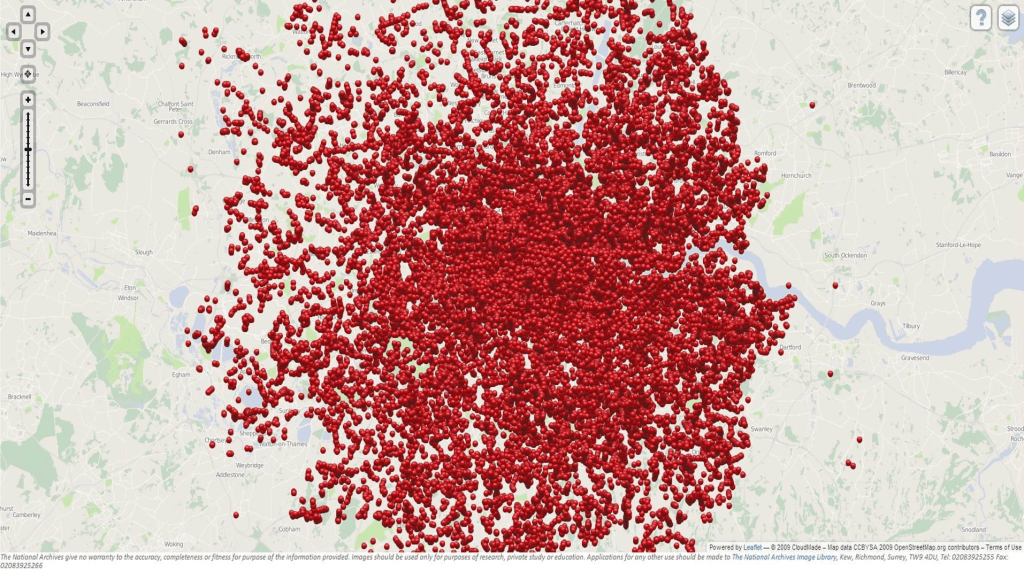
The data is so overwhelming, of course, that the viewer is vertiginously unable to process the extent of detail it aggregates, in what might be better known as a Cartofail. The multiple maps that were made by the Bomb Damage Maps tend in the reverse: they preserve the underlying street network and sites of all buildings in the city, preserving a palimpsest that survives in the face of aerial bombardment that attempted to efface any sign of human habitation; the result is a valiant basis for the recreation of the future of London in a dark period, and a particularly healthy and plucky form of cartographic resistance, of sorts, running against the collapsing of time and space in a time of total war, by trying to retain and train attention on what exists in the city that can be preserved lest it be forgotten. In the face of total war, it is a resistance of exactitude.

The maps recall those colored glossy stars pasted, in the manner of pins, at the sites of explosions in London, which “cover the available spectrum” from silver to green, gold, red, blue, and  a surprising preponderance in certain areas of violets whose locations seem to coincide with bomb strikes, but are so  suspiciously marked with the names of women, the silver ones labelled “Darlene,” others Alice, Delores, Shirley, Sally, amidst  Carolines, Marias, Annes, Susans and Elizabeths.  The disjunction between names and places map the interior experience of Lt. Slothrop against the city that became a canvass of war, but the placid colorings of the map hues suggest a deeper disjunction between mapmaking and violence.

The maps capture an attempt to take measure of the scale of destruction, from black areas bombed out beyond repair to more lightly damaged areas in yellow, as if to process the unprecedented scale of disaster in the precision of the Ordnance Survey Maps. In ways that seemed to try to contain the violence of the bombs that killed over 9,000 by a coloring the sites that were hit by the daily assessment of bomb damages, Bomb Damage Charts drafted by the London City Council tried to process the daily destruction that took the toll of 9,000 in what Germans portrayed as revenge for allied bombers suggest an English tabulation of the ethanol-fueled violence, called as retribution for allied bombing of German cities, that revealed fingerprints of the fantasy of Wernher von Braun, the rocket scientist who was driven by truly stratospheric aspirations to reach the moon.

waterloo-detail-bombs

And they reflect, as such an attempt to map the devastation Thomas Pynchon so famously began Gravity’s Rainbow by suggesting the sudden arrival of an ethanol-fueled V-2 rocket that struck the zero Greenwich meridian around 1967, by describing a volley of ballistic missiles whose targeted strikes and explosions brought to life something like a new world, and a terrible one that is punctuated in a senseless sequence of devastating strikes.  And as Pynchon famously used the Matthausen testimonies to describe the horrors of the bombs’ production during the war by the remain side, the bomb damage maps would have provided powerful means to elaborate the destruction of the city came to map the fictionalized if troubled ever-idiosyncratic psyche of Tyrone Slothrop.  The rooftop observations of the arrival of V-2’s that arrive, arching short of the land and arriving on London, tracked by a group of Yanks, stationed at the Allied Clearing House, Technical Unites, Northern Germany (ACHTUNG), a paper warren filled with black typewriters that pose as grave markers, removed from the war but close to its violence.

As much as orient one to the destruction of bricks and mortar buildings, they suggest a way to complete the terrifying topographies of the wartime city, as familiar cityscapes suddenly vanished, taking human lives in a chaos difficult to psychologically sustain.  If Stephen Spender described how in “destroyed German towns one often feels haunted by the ghost of a tremendous noise” as it “is impossible not to imagine the rocking explosions, the hammering of the sky upon the earth, which must have caused all this,‟ evoking the inability to grasp or orient oneself to the ineffability of the sensory barrage of modern destruction with particular eloquence.  Pynchon was particularly attentive to transpose the complicated topographies of what were otherwise blank space by recourse to the “old Baedeker trick” not limited to that genre of travel books alone, but pillaging from WPA guides and other maps, in ways that make it more than likely that something like the Bomb Damage Maps provided a similar basis to orient his readers to imagining the new topography of war in which his characters sought to navigate as best they could, and the tourist maps of post-war London which rendered the continued effects of bombed out areas light green offered an effective palimpsest as any to recover the  psychological trauma of the destruction of the psychic network of place and society–

close-up

–itself a mirror image to the German Schadenskarten created to document the parallel six years of trauma inflicted on cities in the Nazi state.
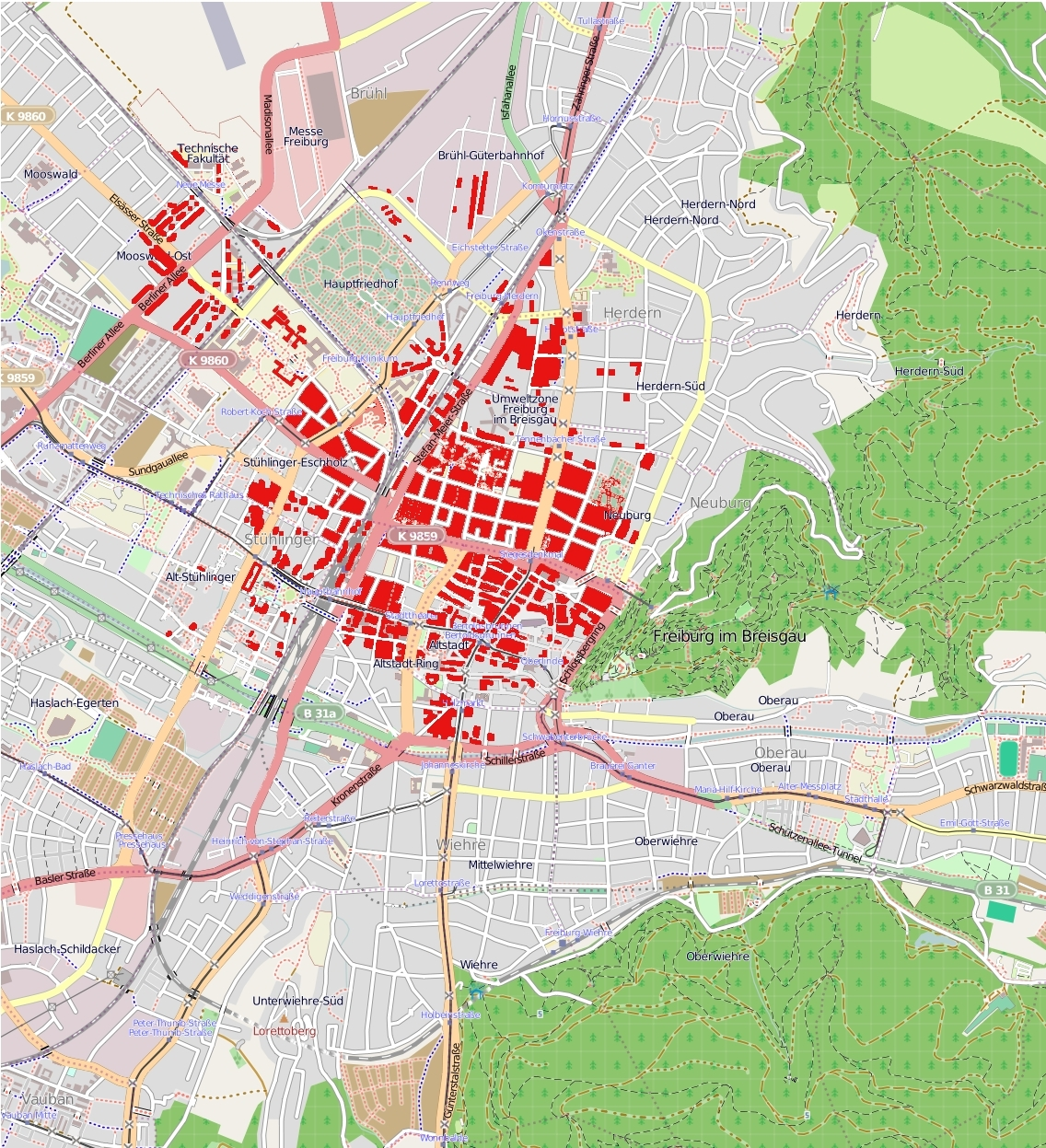
1280px-Luftbild_Freiburg_1944.jpgStadtarchiv Freiburg, destruction of Freiburg sometime after or during Summer of 1945

Continue reading

3 Comments

Filed under London Blitz, military maps, Vietnam War, war crimes, World War II

Landscape/Image/Map: Map-Making in Neolithic Çatalhöyük

“All maps have edges,” writes Margaret Atwood, noting that even slime-molds, bereft of a central nervous system, readily map adjacency. And although the notion of metric accuracy or or accurate indices are lacking–as is a frame–there is a distinct sense of mapping adjacency in the cave-painting or mural that has survived since circa 7000 BCE (6960±640 BCE) in the Konya region of Anatolia, in a valley that has  provided a site of intense archeological investigation of one of the earliest dense areas of human inhabitation.  Although we usually consider the map as both a reproduced and reproducible format–allowing it to be readily consulted and read by many–and have identified the rise of map making with the rise of the state–and might be warranted in seeing the recognizable role of mapping as foreign to the ancient world, the sense of mapping adjacency to the imposing Hasan Dağı range of mountains seems an extremely compelling case of the early mapping of adjacency, and of the boundaries of the known inhabited world.  Although embellished and given greater chromatic definition in this reconstruction now in Ankara’s Museum of Anatolian Civilizations, where it is regarded as a precious artifact of the Neolithic settlement, may be, according to new evidence, a paradigmatic record of how “place” becomes constituted by lived experience, and defined by the confluence of external events.

catalhuyuk-map1

This restoration and recreation of a Anatolian cave-painting found in one of the more densely inhabited sites of the Neolithic world has been presented by several generations of archeologists as the earliest map–probably because of its symbolic affinities with the transcription of dwelling homes or areas of residence.  The subject-matter of the Neolithic wall-painting is unclear, although it recalls a majestic panorama that befits its length of some three meters, and does suggest a considerable conscious attention and investment of energy in the division of its surface that seem to encrypt information in ways that address its viewer.

But what does it show?  Is the representation of an apparent mountain range a topographical representation of the mountains at the base of which extended a Neolithic settlement?  What the subject of has been contested since it was discovered in Abauntz cave in Central Anatolia.  The three-meter long cave painting reproduced above was first identified as a map with considerable excitement by the archeologist James Mellaart when he discovered it in 1964, and its scope is stunning.  But subsequent debates have contested his identification of the image.  Subsequent scholarly debates have contested Mellart’s identification of the image as inconclusive–as it must be–and have  alternately argued the mural was a symbolic abstraction or just an animal skin shorn of extremities, similar to nearby neolithic mural images, shown above a rectangular grid of no recognizable geospatial significance at all, rather than a specific landscape.  Yet the fascination of this image as a map has gained new supporters, even if many early attempts to find proof for classical objects that reveal a distinctly cartographical sensibility of symbolizing space–such as this rock, once taken as a representation of ancient Gaul by Otto Dilke, with drilled holes noting human settlements, mostly likely seem retrospective projections from a time when we have grown more habituated to map-use, or the relative leisurely learned activity of mapping.

Gaulish Rock?

Unlike this fairly undefined and unsigned artifact, the location of the Aubuntz mural on the side of cave where it seems to have been viewed–and in relation to a range of images in nearby cave-dwellings–the image appears to address the viewer in interesting ways, and to define its subject less in abstractly formal terms than propositionally, and even perhaps in relation to a natural event.  Drawing a map of space would have had little apparent analogous similarity to our own use or habits of viewing maps, which are so familiar to us we must be careful not to naturalize them.

Although interpretations contest the notion of its apparent division into plots or houses served as a map, they cannot deny it specific power as an image–and seek to explain its apparent cultic significance.  Expressing considerable visual tension, the image–even when shown below in a reconstruction from Ankara’s Museum of Anatolian Civilizations to better reveal its definition of a distinct visual field for observers, as if in a framed space–makes us think about what what sort of function the image would have and what readers it would address–although the Abauntz mural seems to have a scope and symbolic significance that parallel the early use of maps in Neolithic society that expanded from small villages–especially in such a populated a proto-city, one of the largest known to date, which includes many wall-paintings, some 8,000-10,000 year old.  The pictorial culture of the region suggests a deep visual concern with geometric designs.

The recent proposal that this mural indeed constitutes the world’s oldest surviving map made it likely that the image was created from the vantage of a town, probably on the northern side of the mountain, that would have been more threatened by the eruption than Çatalhöyük itself:  it seems to document the settlement at the very moment of the volcano’s eruption, or to commemorate the event in ways that would befit its presence in a cave that was associated with some sort of shrine or celebration.  It is unclear that there would have been a similar interest in commemoration, the most human of activities, but the event must have been terrifying.  The apparent naturalism of this distinctively painted image sharply contrasts to the apparently man-made line engravings on stone fragments in ways that make us ask about its performative function as a pictorial description that served to describe a region of early human settlement.

Çatalhöyük

This reconstruction clearly foregrounds the regular repetition of what seem serial reproduced rectangular land-plots or houses of fixed territorial bounds to suggest a system of measurement or mensuration in the Neolithic community.  But the contrast of the ostensible landscape and the background and the area of settlement, defined by demarcation, seems more striking than the suggestion that this painting is evidence of a systematic measurement of land-plots.  Mellaart’s original thesis that the mural constitutes the earliest cartographical construction–or map–of a specific geographical site has recently gained potentially critical and compelling new evidentiary support from an unlikely source–reopening these debates once more.  Findings that the mural was contemporary to the eruption of Hasan Dağı mountains which indeed appear represented in it pin the image to a geographically specific landscape and location.  The Hasan Dağı (or Mount Hasan) stratovolcano is distinguished by two peaks of similar elevation (3253 and 3069 m), forming Big and Small Mount Hasan, and might make this image a strikingly early example of a landscape-map we might associate with the engraved “bird’s-eye” views of cities most familiar from Georg Braun and Franz Hogenberg’s compendious and copiously illustrated Civitates orbis terrarum that appeared in print in 1574.  Such a composed scene of an early area of inhabitation would, indeed, seem foreign to the views Braun and Hogenberg collected as artistic forms, but suggests an attempt to comprehend the relations, I would suggest, between the events of the explosion and the bounded settlement lying at the mountain range’s feet.

The skyline does not reflect  the situation of Hasan Dağı from the vantage of the modern or prehistoric Çatalhöyük, but the pairing of these two peaks in the mural as a horizon, revealing one mountain clearly erupting, seems an attempt to document a specific moment in time as a way to chart the place of human settlement nearby to the mountain range, in ways that define the specificity of its place in the manner of a map; the reconstructed geochronology places its eruption age at 6960±640 BCE, coeval with the settlement and occupation of Çatalhöyük as a region suggest the image was an early first-hand record of the observation of volcanic eruption.

Hasan1Hasan Dağı, photograph by Janet C. Harvey

Although the Neolithic wall-painting is a contender for the earliest map ever–predating Babylonian clay tablets.  Its depiction of the built settlements of some size at the base of two peaks also suggests a distinct consciousness of the prehistoric inhabitation as lying in precarious relation to the natural world.  What sort of vantage point in represents in relation to the twin peaks of Hasan Dağı is unclear; but  evidence and magma remains indicate a widespread eruption that would have been visible near its base when the area was populated, although the broader historical impact of explosions on the region in the Holocene demand further investigation.  The discovery that the magma from the Hasan Dağı mountains erupted at about the very time that the mural was painted also raises interesting questions about what status the mural might have had as a map, a personal testimony, a cultic image or very early landscape, and how the maker of the ostensible map might have regarded their mapping of an inhabited or settled space.

The mural has been hypothetically identified as an early form of scientific observation of the eruption of a volcano based on the comparison of geochronological dating with the archeological dating of the mural.  Realism is rarely associated with Neolithic art.  But the mural would, if it has been correctly identified, be something closer to an example of early landscape painting than a map–its field  densely packed and intricately detailed pattern, resembling a honeycomb, more than either an abstract pattern or animal skin.  The prospect is fascination that the image in fact reflected the historical settlement of Çatalhöyük before specific mountain ranges:  identification of the painting with a datable eruption in the Hasan Dağı mountain by carbon dating of the ash to the time of its last eruption, thought to have been inactive since circa 75000 BCE.  Can it be understood, one wants to ask,  as a first-person observation of Çatalhöyük, or a sort of site-specific reportage, and the dramatic and fearsome commemoration of a natural disaster?

Although Mellaart identified it with the eruption of a volcano of two peaks, the map has long been argued to be a substitution for and representation of a specific landscape–approaching an image, unlike the topographical renderings of mountains with the accuracy and indices of elevation that surveying tools might later allow.  Based on new evidence of hardened magma at the crater near the settlements, given that volcanic rocks can be usually expected to cool uniformly after eruptions, at the last eruption of the volcano–as if the mural might be more accurately described as a shock to the trauma of eruption, and the atmospheric and environmental turmoil that resulted, in ways that suggest that the “map” was a way of both processing and in a way compensating for the shock of the human disaster, and, if removed as a survey, of suggesting the destruction that the eruption was in danger of bringing to the repetition of sites of settlement to which humans had divided the land lying below the mountain range:  rather than a “bird’s-eye” view, the juxtaposition ostensibly offered a potentially disastrous meeting of natural disaster and human settlement.

catalhuyuk-map1

The crude geometric regularity of the odd lattice-form of the “map”-mural seems to recall a clear sense of a planned town or settlement of a surveyed form, perhaps echoing early plans of built environments.  But even if this were correct, as much as offering a map of settlement. But rather than simply function to map its situation, the mural would offer a historical record of the threat of that community’s cancellation, of the impending threat posed by volcanic ash and magma erupting from the volcanic peak at that single terrifying moment–when the built houses of human construction were threatened to be buried under the volcano’s sudden eruption and the arcs of ash and fire whose threatening and terrifying trajectories seem traced in the image.

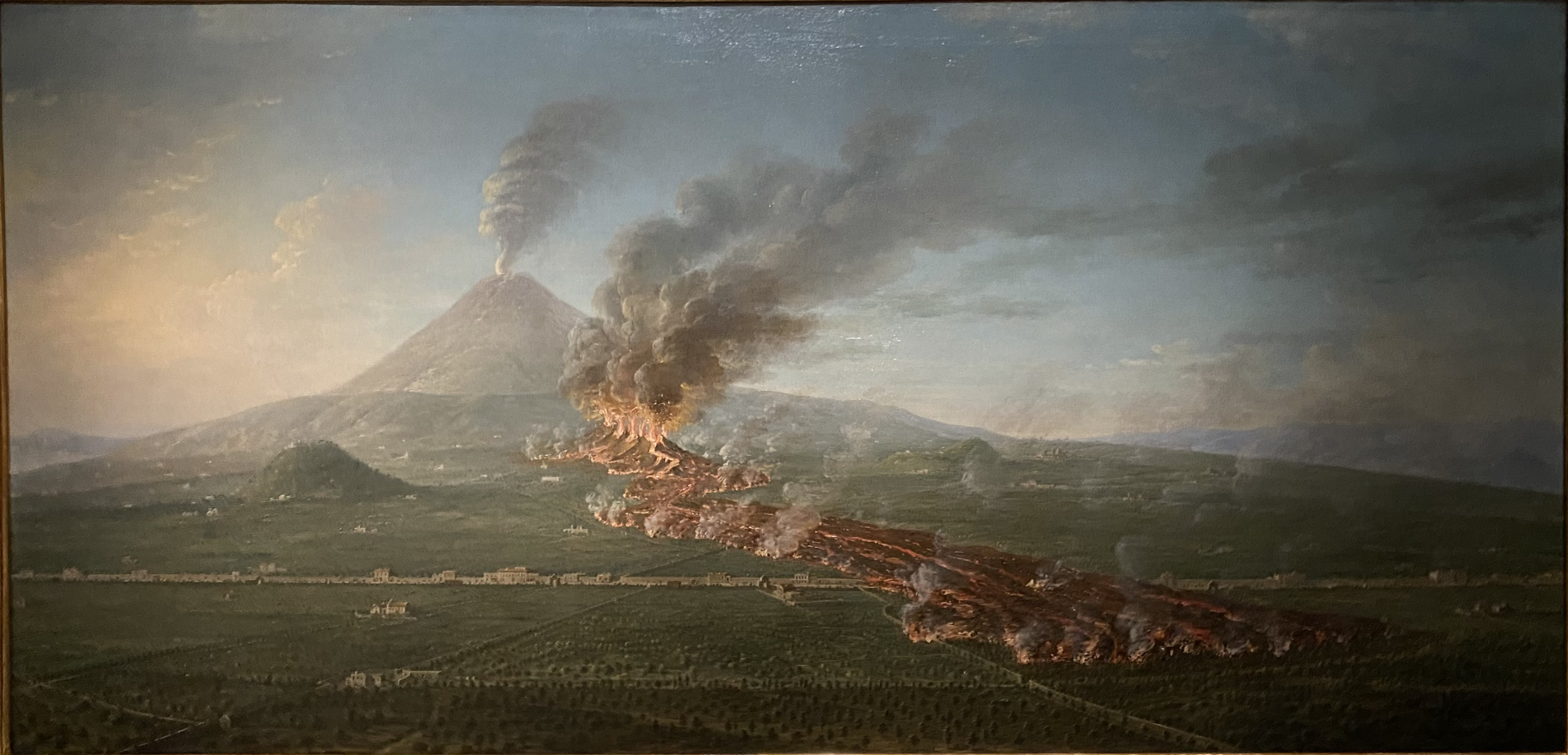
Is this an impending catastrophe?  The evocation of loss works through the evocation of specific details, just as the image seems to evoke the potential loss of the human division of settled lands.  Much as Pliny the Younger in Letter 6.16 to Tacitus described an account of his uncle’s terrifying death “to posterity . . . in a devastation of the loveliest of lands, in a memorable disaster shared by peoples and cities” by the eruption of Mt. Vesuvius after he rose from reclining for dinner with his books, having taken a sun bath and a cold bath, so as to get a better view of a white cloud rising with patches of ash and dirt that “rose into the sky on a very long ‘trunk’ from which spread some ‘branches.'”   Struck by the majestic sight of the explosion of Mt. Vesuvius he decided to save Tacitus’ wife from her a villa at Vesuvius’ foot, tempted both by the need to save his friend’s wife, and also by the possibility of taking advantage “continuous observation of the various movements and shapes of that evil cloud.”  Much as Pliny the Younger had paused, “dictating what he saw,” the mural seems to record the spewing of “broad sheets of flame” from the Hasan Dağı mountains, as if recording less of a landscape or topography than the precise historical moment when erupting volcanic ash threatened to bury the built settlement in the Çatalhöyük valley together with its many inhabitants.  Pliny wrote his account subsequently, at the request of Tacitus, but the image would probably have been drawn, also, considerably after the catastrophic event had occurred.  The interruption of an apparently bucolic landscape was expertly imagined in the Enlightenment by the painter Antonio Joli (1700-1777), in an oil painting of expansive countryside into which suddenly streamed an incursion of lava during the day, a stream of  burning fiery flames incongruously cutting across the green fields outside of Naples in an otherwise tranquil afternoon.

Antonio Joi, Vesuvius' eruption by day 1761)

Antonio Joli, View of the Eruption of Mt. Vesuvius by Day (1761)

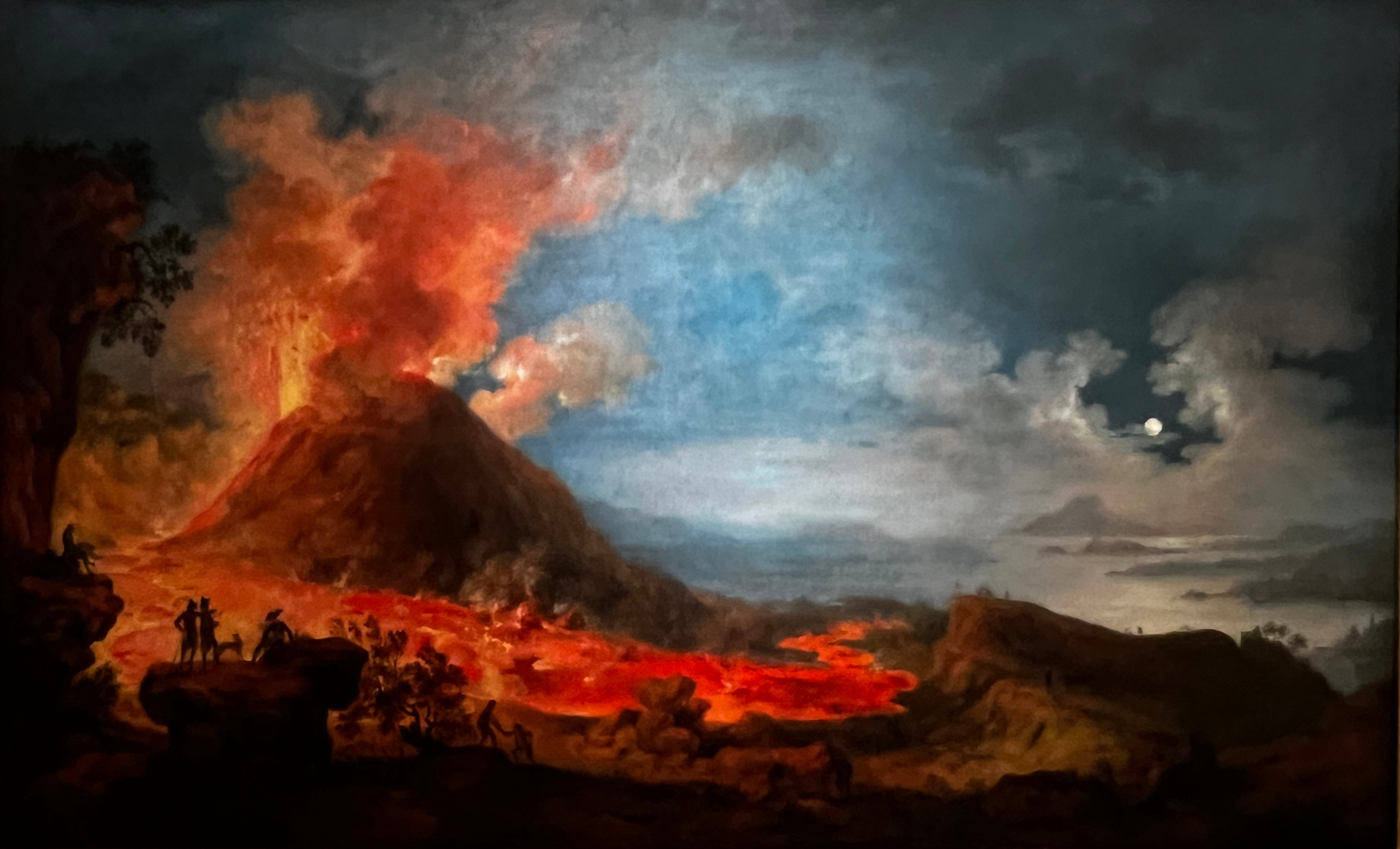
Indeed, it is tempting to read the mural that details the volcano’s eruption as analogously dramatic to how Pliny the Younger, in a famous letter, recounted his uncle’s process of decision-making at the moment he confronted “dangers that were coming down from the rocks, consumed by light and fire as the bits of pumice that arrived first were,” a terror of confronting disaster that Joli’s painting seems to invite one to try one’s best to imagine.   Pliny described many “weighed relative dangers they chose the outdoors; in my uncle’s case it was a rational decision, others just chose the alternative that frightened them the least.”  Indeed, the fascination of the observation of the eighteenth-century eruptions of Vesuvius afforded a sort of cosplay for the Enlightenment men who traveled to observe its flow of fiery lava from nearby hills, even portray8ing the scene as a sort of learned activity of description that took advantage of the virtuosic colors and shading of paint to try to represent the scene even when it was not, as in the case of Antonio Carnicero Marcio, depicted the leisured spectators who watched, as if with terror, at the lava’s incandescent flow–based on the account of his friend, Pierre-Jacques Volaire, the French painter who lived in Naples, who in the 1770s had almost specialized in dramatic paintings of the volcano’s  eruption .

80860

Erupción del Monte Vesubio el 14 de mayo de 1771. Vista tomada por Volayre y pintado por don Antº Carnicero”

The Çatalhöyük mural seems particularly powerful when seen as a similar moment that forced its maker to try to preserve a moment of potentially catastrophic change–and its observer to decide whether to stand or to flee the erupting scene.  The image could be best described as a sort of “living landscape,” as well as simply as a map.  It is interesting to consider this earliest of scientific observations as being prefigured by the painter of the Çatalhöyük murals–and the image less as a landscape-map than a living image.  What the painter of the mural imagined must remain unclear, but the recent re-dating of the mural to the time of the eruption of the volcano in PLoS ONE used Carbon 14 dating–using (U-Th)/He zircon geochronology–radiometrically link the mural’s composition to the witnessing of the volcano’s historical explosion in ways that offer grounds to link this landscape image to an actual event in time–and not assume its formal intricacy recapitulated an abstract form or iconic rendering, linking it once more to a clearly specified community at the exploding volcano’s feet.

The dating of the mural may indeed recapitulate a map that might be understood as commemorating and directing attention to the drama of a moment of volcanic eruption, and the image of threatened reconfiguration of the landscape itself, rather than a static map.  Can the image be better understood as mapping a fixed historical moment, which the viewer is forced to process and remember?  For if its composition was a monumental way of coming to terms with the destructive events that the volcano’s last explosion wrought, this earliest of maps was a living image, recording of a moment of shock and readjustment of expectations, commemorating a sudden shift in the environment less than a record of a fixed spatial configuration, and confronting viewers with a single moment of impending environmental change.

Map Image-Keith ClarkeImage: Keith Clarke

Leave a comment

Filed under archeological maps, Çatalhöyük, early human settlements, Mount Vesuvius, Neolithic Maps

The Recent Resurgence of Manually Made Maps

A somewhat celebratory survey of the recent rage for manually designed maps affords a veritable visual smörgåsbord of aesthetic pleasure and innovative graphical design.  It is interesting and tempting to compare them to the craftsmanship of manuscript maps, a subject discussed in an early post in this blog.  But the survey oddly makes little reference to the notion of the ‘counter-map’ that resists the omnipresence of the digitized map, and the manner we have come to be immersed in the traffic and generation of digitized maps.  To be sure, these are images suitable for framing.  But the appeal is in part a knee-jerk reaction to the satellite photo or the schematic land view.

In mediating a more fully stylized map of first-hand knowledge of urban areas clearly reacts to the increased hegemony of Google Maps–add your own business here!  map your way to work!  note your favorite coffee shop or restaurant near work!–as a plastic form of collective memory.  And, of course, a data resource on which Google can draw  in its own work.  The hand-drawn map is the map stripped of metadata and made without surveying instruments.  For the self-made map re-invests the format of mapping with a vibrancy and immediacy to enliven inhabited space once more–and indeed enliven the medium of the map that seems to slip out of our grasp as it turns up on our hand-helds, and even tracks our own habits of shopping, physical movement, data usage and cel phone use.  When we see the self-made map–and we buy them because of this–on Etsy or in the house of hipsters, we re-recognize places, and subscribe to how they define our emotional relation to space in ways that many other web-based maps make us feel more alientated.

If our memories are recorded in our maps, which note centers of interest, sites of pilgrimage, historical buildings, or public parks, the processing of how we track places worldwide in Google Maps is not somehow wrong or diminished, but has the sad effect of erasing any sense of specificity.  There is a display value of the map that is diminished from its reappearance on a tablet or smart phone, but also a dramatically reduced range of semantics or iconography:  it’s hard to imagine Charles Sanders Pierce, who enjoyed his spell of work on the conventions of map making and determination of spatial coordinates for the US Geodetic Survey, dressed in a neon shirt emblazoned with a corporate logo, using his expertise to boast of the benefits of Google Maps in tutorials.  The semantics of the Google Maps project is geared not toward innovation, but streamlined synthesis and ready access, after all.

And there is something of an erosion of display-value of the digitized map approximating Walter Benjamin’s concept of aura, since the refinement of data in digitized form approximates a concept of disembodied mechanical reproduction:  the emotional tie to the map is in a sense severed, the trace of the hand absent, the physical touching of the map’s surface gone.  These maps provide the clues and signs to reconstruct a mental map of place in one’s mind’s eye, rather than synthesizing the authoritative satellite composites whose clicks release downloaded data, but draw fewer associations from synaptic ties.  The focus of enriching the map’s metadata removes any trace of the hand.

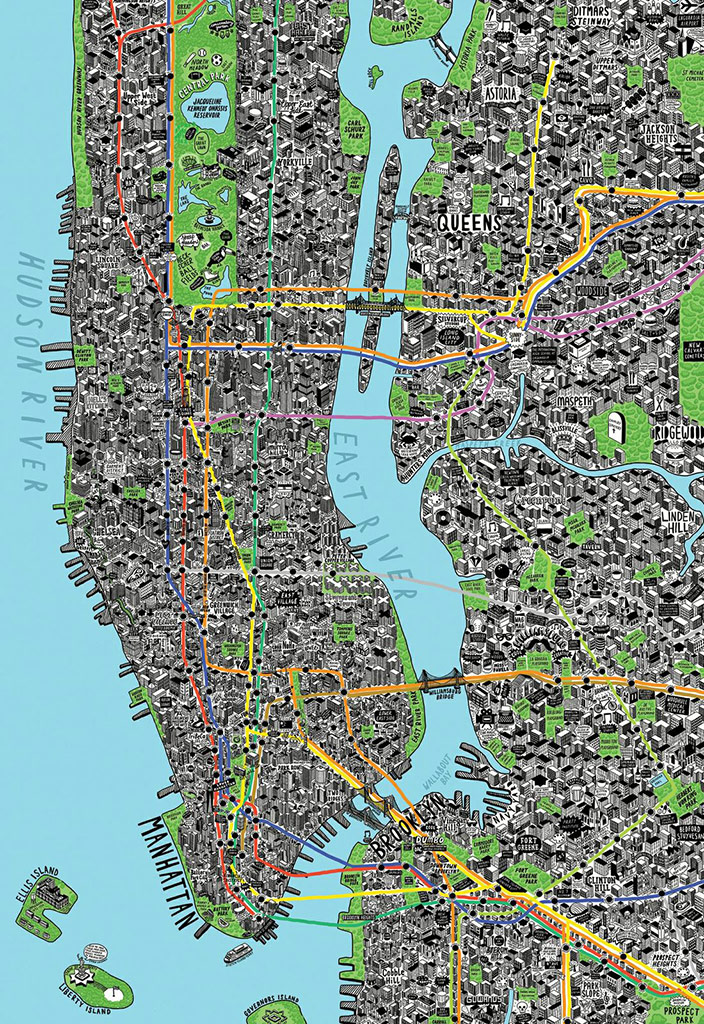
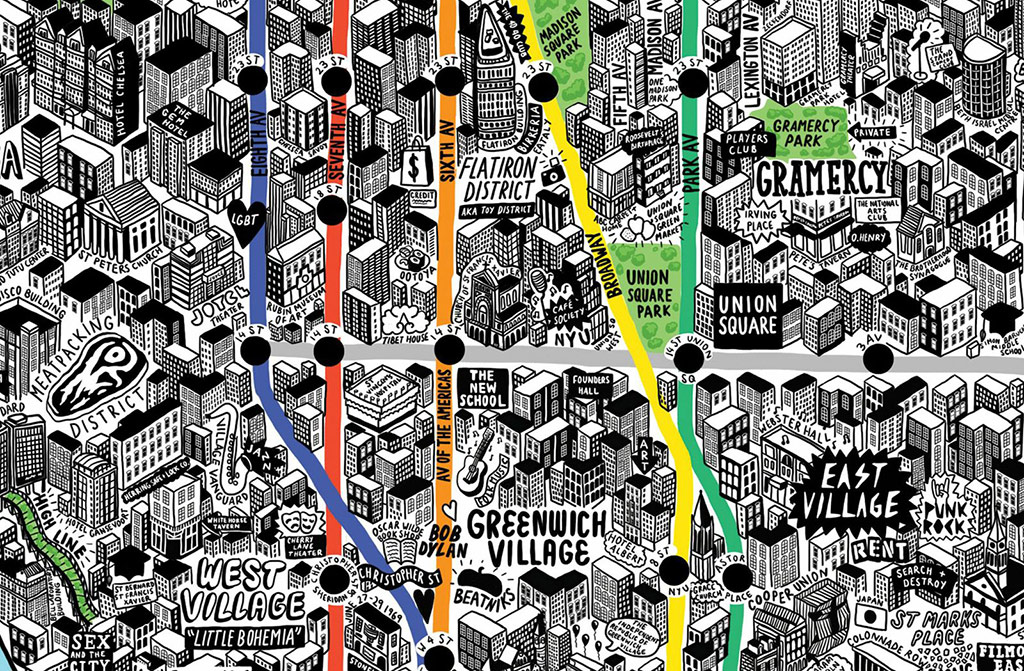
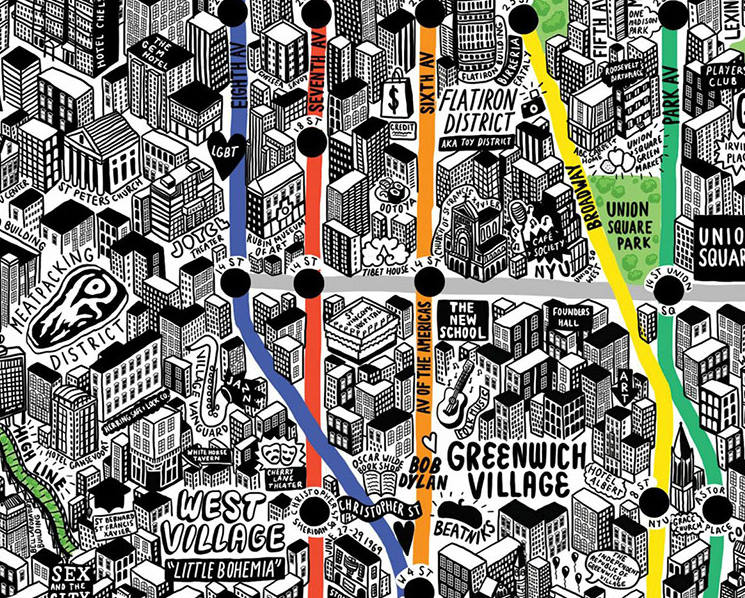
Mapmakers like the artist Jenny Sparks set out to recuperate the specificity in place that still exists and see the map as a medium to invite the viewer to explore.  While there’s a tendency to map a uniform green, Sparks’ comprehensive imaginary but copiously detailed ichnographic stark rendering of the collective architecture of elevated skyscrapers in New York in 3D, in ways that collapse street-view into a crisp crowding of built boxes.  The map, interspersed with memories and words, includes Bob Dylan on 4th Street; Beatniks in Greenwich Village’s Washington Square; and the Farmer’s Market on Astor Place, and is interactively enriched with text.   Sparks winks at the zoom function of Google in the elevated buildings  of Manhattan, each carefully drawn, and words that unpack the cornucopia of memories that the built space of the city holds, as some sort of metonymy for its residents.


New York map by Jenni Sparks


The pop-up three dimensionality of the map plays with the flattened two-dimensional view of maps, but suggests a bird’s eye view into which viewers can peer.  A few close-up details of Sparks’ self-made map of reveal how the skilled placement of words among 3-D buildings in her imagined elevated view draws you into a space linked or bound by the colored avenues of underground subway lines, peering into its so densely cluttered detail:


Close-up of New York map by Jenni Sparks

The closer one looks, the easier to see an image of place saturated with the visual interest that Google Maps just fail to afford, as one falls into the map in order to get to know its neighborhoods, suggesting a unique zoom-in function that the clumsy navigability of Street View only approximates:

Sparks' NYC


The rise of the hand-drawn map not only is a testament to design or a rebirth of a craft, but uses precepts of design to counter the vagaries of digitization Google so actively promotes, in championing the synthetic properties of a register of businesses, places, and personal routes.  I’ve written elsewhere, earlier in the year, about Becky Cooper’s recent anthology of the recent efflorescence of maps that personalize one’s relation to place, almost a collection of tools to encode personal meanings for a broader audience.  These images recuperate the aura of the map and its materiality, its hand-made status and both the physical practices of encoding place and decoding space.

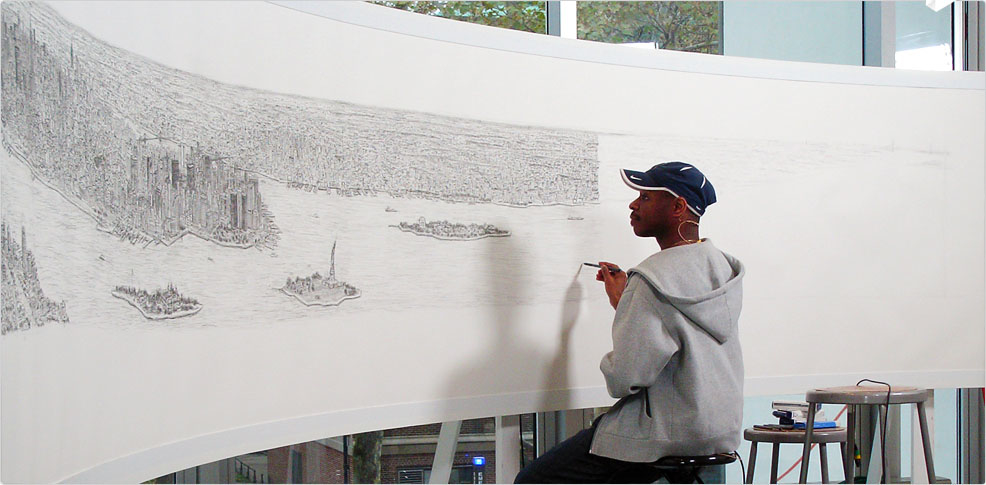
Something similar is going on in how Stephen Wiltshire draws Manhattan’s skyline from memory, lovingly attending the scale, proportions, and perspective views of each of the many skyscrapers whose sight so impressed Wiltshire on his first trip out of England that he promised to move to New York “in the future,” and claimed to have already designed his Park Avenue penthouse.  Wiltshire’s retention of and fascination with urban environments has been discussed by Oliver Sacks, and is the subject of Cities (1989) or Floating Cities (1991).  But his drawings are the intuitive opposite of a map’s abstraction of place by selectivity and spatial remove.


new_york_panorama_banner


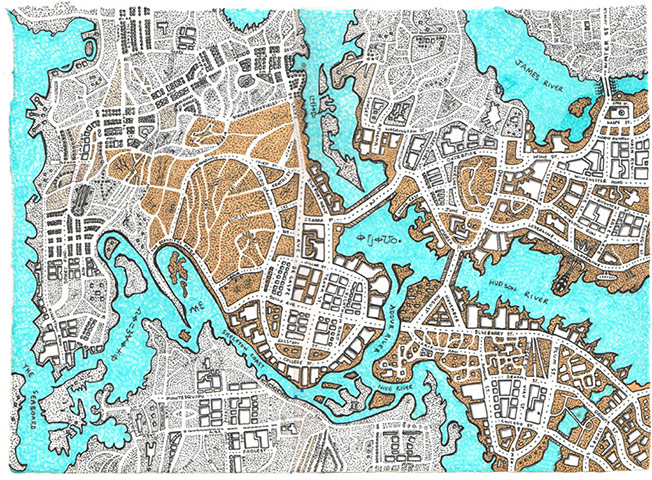
Unlike Wiltshire’s intuitive renderings of urban space, the abstraction of space of a place underlies these hand-made maps, which sketch something like a hierarchy of relevance within their totality.  There’s a huge appeal in reclaiming the map as an intimate record of place, as well as an art of encoding meanings that encourage further examination, as this “mash-up map” based on the personal experience of Shawn Watts, and might be best described as his spatial experience of a long-distance relationship, compiling the places they had been together not only in his native Montreal, but in Athens, Washington, DC, and Philadelphia, as well as Montesquieu, France, and reflects his own deep pleasure in “hiding secrets in maps” as opposed to publishing information, and a pleasure in using the map’s form to map or be the surrogate for an interior emotional state:


Shawn Watt's Shutterbug


For Watts, the density of meaning in maps becomes a way to unravel and eloquently express one’s own state of mind in public form, and to invite the viewer to partake in the pleasure of decoding its contents.


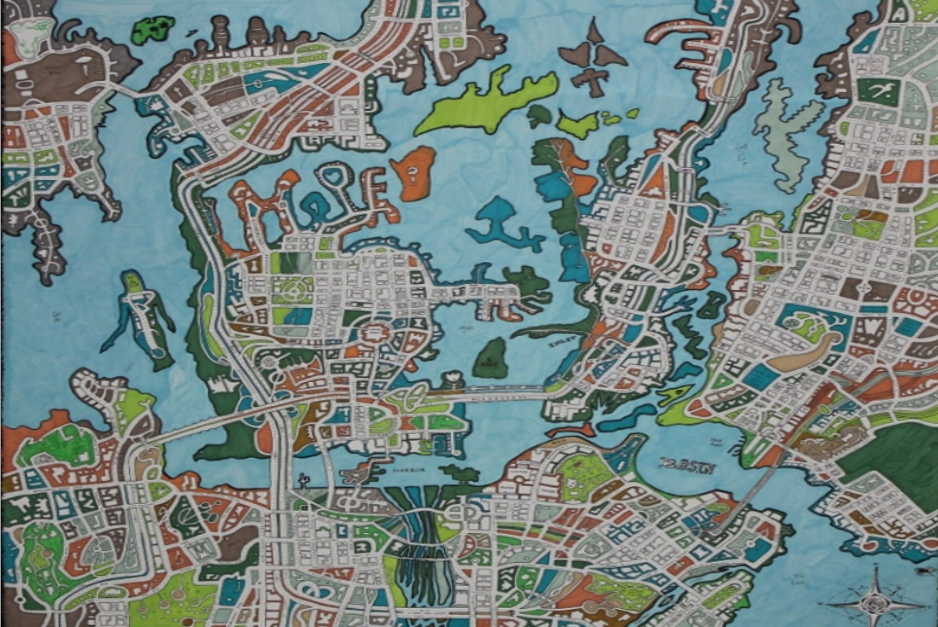
Hope Mapped


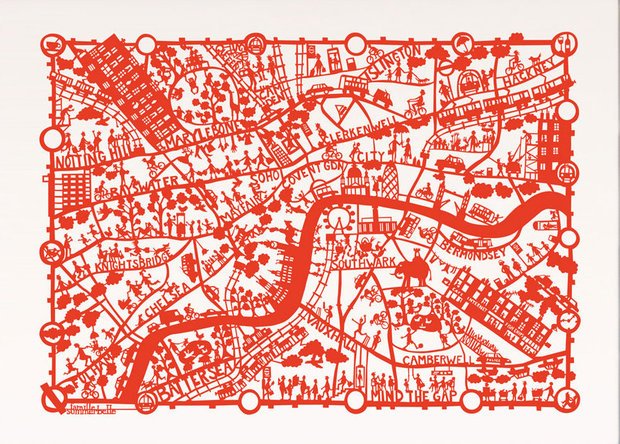
This somewhat but only partly legible hand-made silkscreen map of London comes in varied colors, populating areas with figures and words to approximate a paper cut-out hanging as much as a map:


553390_479276322084293_1624826968_n

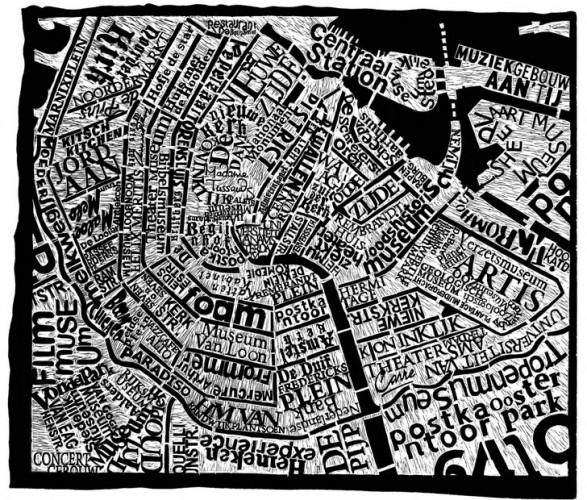
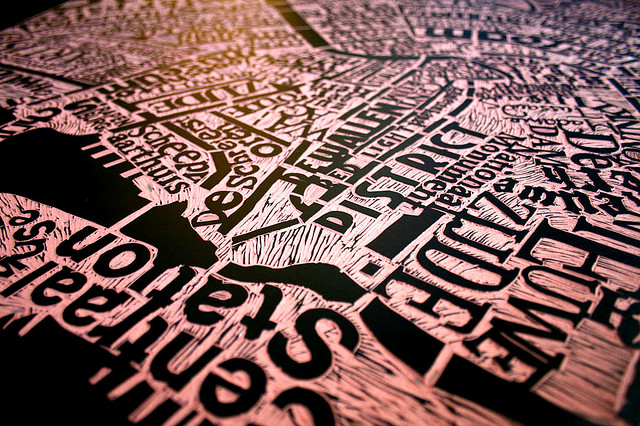
If these maps treat the map as an artwork, the trace of the hand on the map is even more present in the medium of linotype map, recalling Renaissance single-point engravings or woodblocks.  The linotype word-map Marc Webber designed of Amsterdam, a historical center or clearing-house for engraved maps, places front and center the words often absent from Google Earth or many digitized maps to use them to fashion a sculpted cityscape, whose linotype words offer something of an alternate surface to see the city in one’s mind’s eye:


Mark-Webber-Amsterdam-Map-120-x-100cm-Linocu-Print-on-Paper-e1331468741268


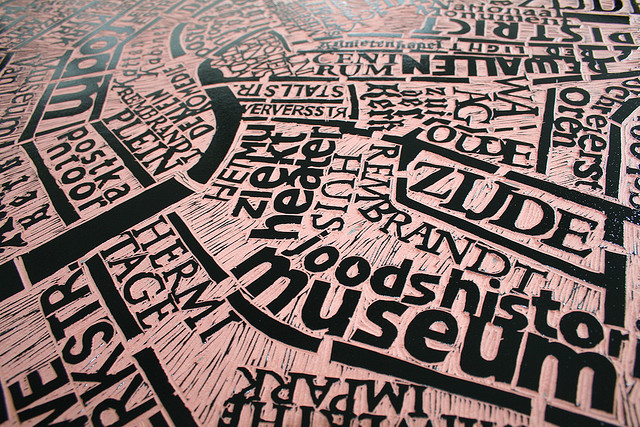
In Webber’s ‘map’ of Amsterdam, the written landscape becomes a site to explore and its very surface a sight to ponder; the texture of its woodblock words gains new textural richness as it is seen from different angles, from which the materiality of place-names on its linoleum-like surface increases in impact:


Amst Linotype-Looking at Map's Surface


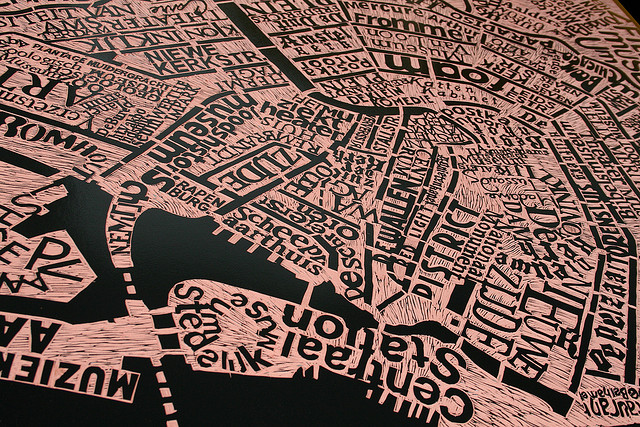
Moving in to examine details more closely, the map assumes status as a surrogate for the world, as if the one-to-one map of which Borges dreamed or described is suddenly translated to words that substitute for things, as well as to the notion of a word-map:


centraal_station_wider


The Central Station assumes a newfound concrete prominence that transcends its place-name, without the curled Stedelijk Museum beside it, from a distorted view of this mapped space:
centraal_station_close


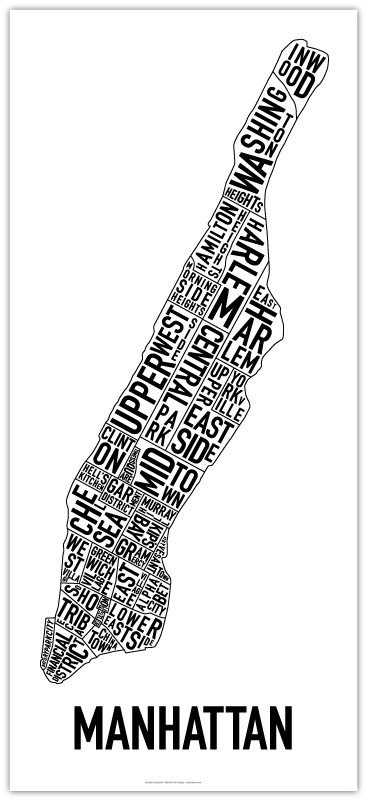
Somwhat more derivative or second-generation forms of manual mapping already exist on the market, as the sort of silkscreen word-maps popular in New York that maps the city’s neighborhoods, many of which are as much destinations as the city itself–and might provide a tourist map of realty.  If it is meant to evoke neighborhoods, it oddly recalls  real estate, even as its cartographical transcendence of space seeks to create something like a cascade of memories whose every words might serve as triggers, rooted within lived experience.


Manhattan word map


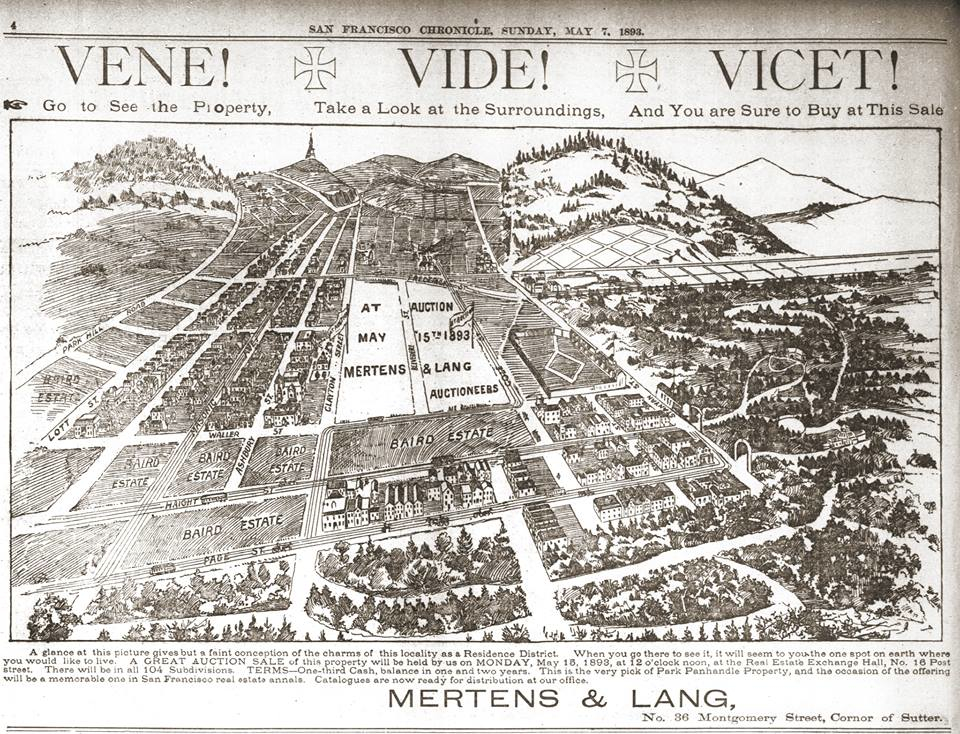
If the map seems a bit of a bare-bones realty map to the uninitiated in New York life, it is far less elegant and inviting than pictorial perspective views realtors employed of San Francisco to enjoin viewers to become settlers.


Vene! Vidi!  Vicet!


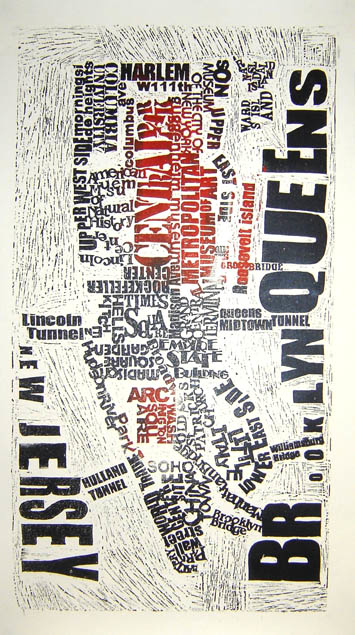
There’s far more detail in a linotype word-map of New York City.  The silkscreened map plays with the legibility with which maps use words to arrange space by surrounding Manhattan island with big, looming, isolated blocked fonts–inserting recognizable neighborhoods and cultural monuments in an what seems a more improvised mish-mosh of fonts from a printer’s tray, rather than from a pull-down menu, arranging the text to replicate what might better correspond to the place of regions within our mental geography, all the while emphasizing the extremeley crowded nature of inhabited space in New York boroughs:


New_york1


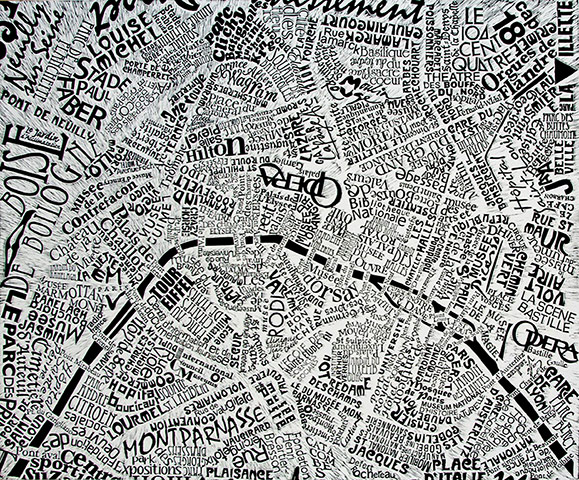
Sensitive as always to the particularity of place, Marc Webber’s quirkily detailed ‘word-map’ of Paris is more elegantly artisanal in how it fills the surface of the map, exploiting a range of fonts to arrange historical layers and tiers of class and style from the staid if impressive Opera to the lounging letters of Montparnasse, moving rangily down large streets.

Paris map by Mark Webber

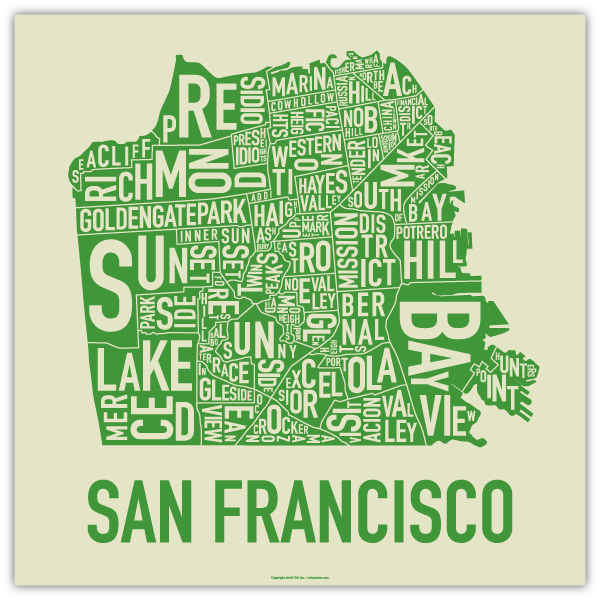
The written city is more demanding of a mastery of fonts, to be sure, since it also depends on the arts of assemblage; the word maps sold in the Bay Area provide a nice counterpart since its patchwork of its complicated topography is so impressively dense, and the only area of uniformity seem the Presidio or the landfill regions of Bayview:

SF Word Map GREEN

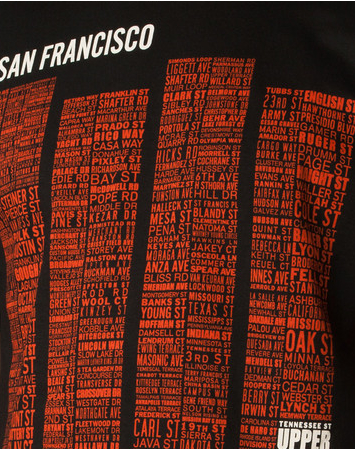
An alternative to this sort of mapping, illuminating the micro level of street-names, graces the design of one of Upper Playground’s t-shirts, suggesting the relative size of individual streets by their prominence in a list of names, that lends currency to the idea of the wearable “map”:

Upper Playground Tees SF name map

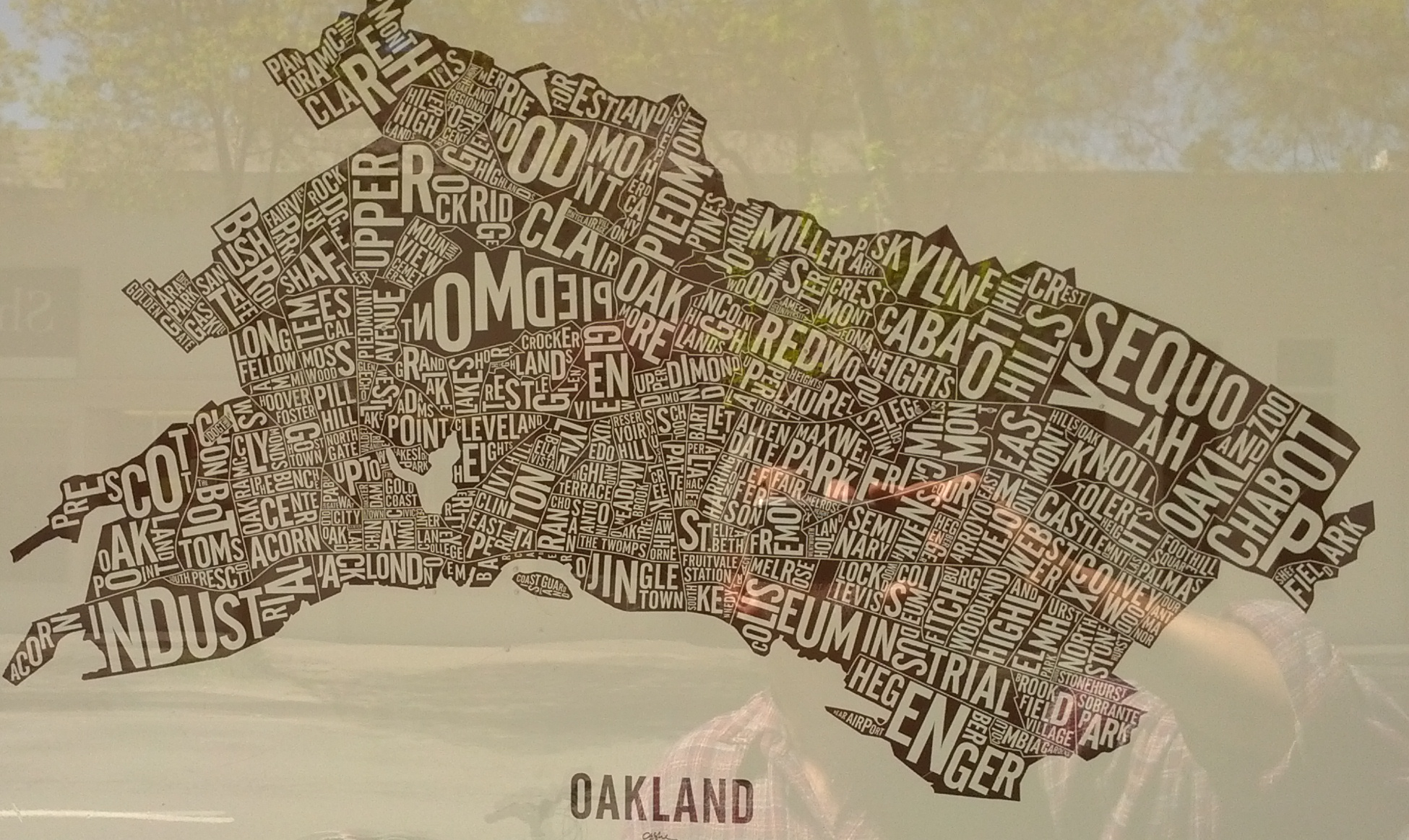
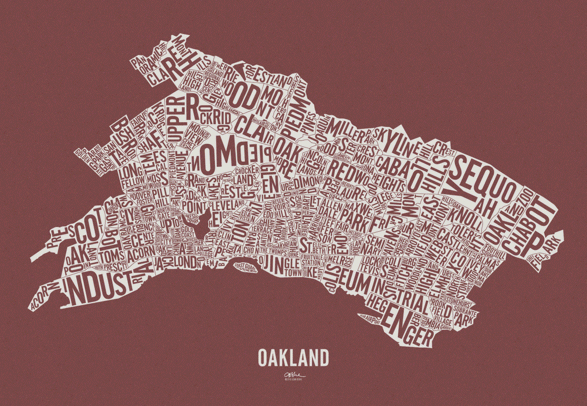
The diversity and unity of nearby Oakland is aptly captured in this patchwork roughly-hewn word map by Oakland native Ozan Berke of its 146 neighborhoods:  the jumbled density is almost rendered illegible by crowding, but with such dexterity that the artist/mapmaker uses to capture its diversity.  The density of some neighborhoods balance the urban intensity of some areas with the far more light settlement of the hills (Montclair, Sequoia; Claremont Hills; Skyline; Joaquin Miller):

Oakland Word Map

dD_Oakland_26x18-PR_2


Writing the unity of the city in a sequence of place-names reconstitute the whole in a new form, as if by magical transmutation or an alchemy of type: this artist adroitly resolves the absence of the seceded largely ‘white’ village Piedmont from the city with the contribution that this town-within-a-city continues to make, writing its “name” as a neighborhood in mirror-writing, the “OMD” among the largest and most eye-catching in the map.

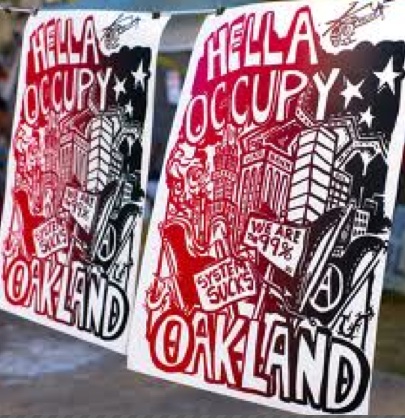
The declarative blending of words with place resonate with the politics of remapping popularized in the urgent signs displayed in the recent Occupy Movement outside Oakland’s downtown City Hall in Frank Ogawa Plaza to the iconography of the protest movement–mapping the helicopters that whirled overhead, but minimalizing their police surveillance to the upper corner of the map, and giving prominence to the placards that protesters held in front of City Hall–the scene at which these maps were sold:


Hella Occupy System Sucks

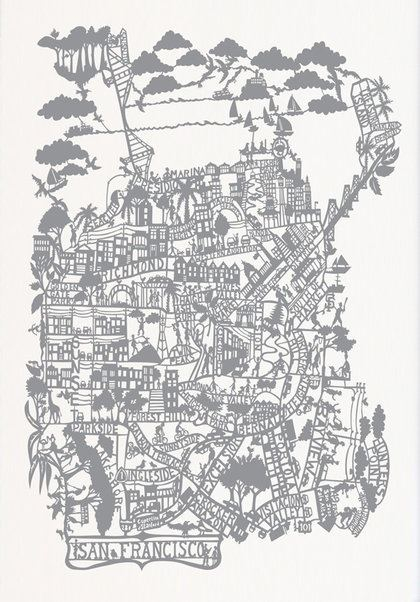
It is fitting to contrast the map to the elegance of San Francisco should be captured in the distinct media of a paper-cutting map, adapting the Chinese art of  Jianzhi (剪纸):

Paper Cut Out SF

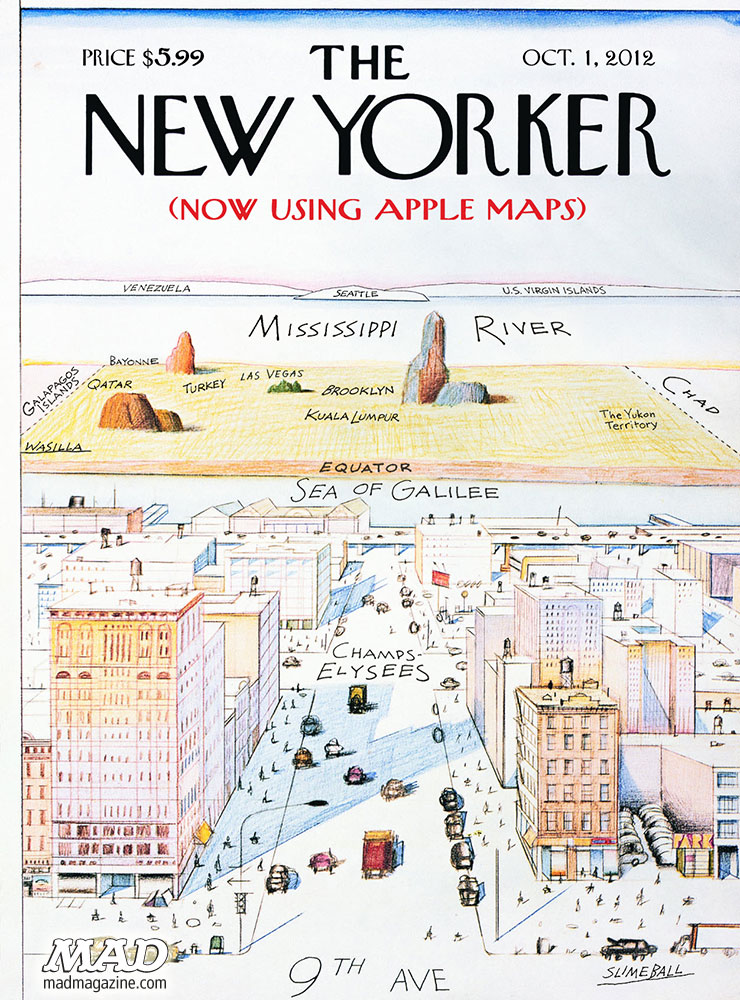
The remove that all place cartographical practice from digital media or design is central, I would argue:  the artist reclaims their own synthesis of a unified whole as the subject of the map.  All evoke the late Saul Steinberg’s over-reproduced map of New York, famous as a poster and originally a New Yorker cover, used to suggest the limited global perspectives of its residents or the centrality of the city in a mental map of the world.  That map has its response in the recent satire of Mad magazine’s “Slimeball” mismapping mediated by and poking fun at the recent failures of Apple Maps.  The revision of the classic Steinberg view of the New Yorker’s View of the World  plays with the spate of failures that app by calling attention to the radical disconnect between even a familair place and digitally mediated map, as if to suggest the depths at which we’ve been had!


MAD-Magazine-NewYorker-View2-2012


The growth of such a range of hand-drawn maps seems to me a reclaiming of place–as well as of mapping skills–that has come to gain a special niche of its own in the craft economy.  We are discontent with the proliferation of maps from which we are increasingly alienated–and which abstract information in ways confined to, say, only three viewing preferences.

There is still a possibility of changing less the digitized reconstruction of space than the notion of what Google defines as information, of course:   and perhaps the range of hand-drawn maps suggests some ways that this might be done.  The above view of New York, or rather its prototype, makes me wonder about maps that reprioritize the structure of information imposed on the templates of Google Maps:  a map, say, that would not note the Russian Tea Room or Trump Center and Empire State, but create historical layers of Automats, bodegas, Chock Full o’ Nuts, and 5-and-10 stores or the shifting confines of invisible ethnic neighborhoods in the city, and the impact of waves of migration.  This falls back on a map of memories.  And then, after all, it probably wouldn’t be hand drawn any more.

2 Comments

Filed under Aura, Charles Sanders Pierce, digitized maps, hand-drawn maps, Jenny Sparks, Jianzhi, linotype map, Marc Webber, Oliver Sacks, Saul Steinberg, Shawn Watts, Stephen Wiltshire, Street View, Walter Benjamin