Tag Archives: sovereign bounds

The Office of the Geographer and Art of the Deal

Plenty of blame has been going round this election cycle on the Democratic Party for having given material assistance–if not tacitly supported–in the bombing of Palestinian settlements in Gaza by Israeli Defense Forces. The drumbeat of disquiet about the Democratic President for lending apparently unfettered support to Israeli bombs and air force in destroying the Gaza Strip is not only a cause for pronounced disquiet. The destruction may be a determinant factor in an election cycle that could open floodgates to untold ramifications of both foreign policy and domestic inequality. But as the world focussed its eyes on Gaza, we have taken our eyes off Trump’s promotion of a deeply symbolic if imaginary tie to Israel, and Israeli claims over Palestinian lands.

This tie is not only tied to imperial legacies or geopolitics, but stands to gain a new zeal, melding the early Zionist idea of a “greater Israel” with American expansionism and a Christian Zionism of peculiarly Trumpian stamp. Many believed that Netanyahu, confident in the hopes of Trump’s future victory offering a basis to enter the once and future President’s good graces, and led Thomas Friedman to argue that Netanyahu only suggested to be interested in a ceasefire in Gaza in order to achieve “total victory” of hoping to occupy both the West Bank and Gaza in the near future by escalating the war in Gaza before Election Day, in order to proclaim his ability to work toward “peace” after a Trump victory, having established the transactional value of reoccupying Gaza, while helping to return Trump to the White House again.

Despite the global revulsion at the killing of civilians, forced migrations, and violent atrocities, it is so difficult to process for the violence of suffering we may forget the tactical role maps of supposed peace “solutions” played preceding these struggles–and indeed how “remapping” the Middle East to defuse its conflict only served to sanction or endorse an unprecedented explosion of violence. Did the maps that the Trump White House created, assisted by the Office of the Geographer in the U.S. State Department, help to sanction a ground plan to drivePalestinians from Israel’s borders?The cartographic framework that President Trump deceptively promoted in his first Presidential term as a “Deal of the Century” was boasted to be a gift to the Middle East remade the borders and normalized the rebordering of Israel in quite violent ways. The consolidation of expansive borders was done quite aggressively-by invoking far-right Israeli ideas of territoriality of scriptural precedent removed from the ground, rooted in myth more than precedent. Trump bombastically magnified a “deal” that was of course both one-sided and deceptive, not a treaty or process of negotiation, and perhaps never really or truly on the table; it demanded few sacrifices if any from Israel even as it promised it was an end of sectarian violence.

The rather crude maps not based on GPS and drawn on paper napkins that came out of the Trump White House however became a basis for a “deal” in the Middle East gained a tactical role as Trump positioned himself as master of the “art of the deal” able to bring peace to the Middle East, born of a transactional logic of personal negotiations. The improbable prominence of Jared Kushner as alleged architect of a new “peace plan” long elusive to previous American administrations balanced a promised port, access to the River Jordan, and a cut-out boundaries as a viable future for the State of Israel, constraining Palestinians to islands of green. The “Plan,” as it was known, was never taken that seriously, if promoted as a once-in-a-lifetime “Deal of the Century, was drafted with no input from Palestinians, and ignoring all stated desires, but offering several carrots in mistaken hopes to end diplomatic stalemate to restrict Palestinians to a reduced presence in the new State of Israel. If President Trump is best known perhaps for his dictum that a state without clear boundaries is not a state, the Palestinian population would not be in defensible boundaries, or any boundaries, but linked by a set of bridges, tunnels, roads, and islands, without coherence in this “visionary” plan.


President Trump remained oblivious he hadn’t addressed the situation in a meaningful way: “All prior [American] administrations have failed from President Lyndon Johnson,” he said beside Netanyahu in 2020, “but I was not elected to do small things or shy away from big problems.” Netanyahu was overjoyed at a man he praised as “the first world leader to recognize Israel’s sovereignty over areas that are vital to our security and central to our heritage”–obfuscating words about the protection of a barrier of security in Israel’s bordering with Palestinian populations, and offering no “right of return” for Palestinians expelled from ancestral homes in Israeli territory, and offering Israel “access roads” across and between Palestinian enclaves.

The hope that if extending Israeli sovereignty “to Judea and Samaria” would anger the Palestinians, all bets were that the Palestinian Authority would in the end “maintain a certain level of security cooperation with Israel to prevent the strengthening of Hamas–as if the calculation of according Israeli sovereignty would be a step toward “peace” ensuring “dignity, self-security, and national pride,” offering a prosperity that could be fashioned out of whole cloth and promises of independent economic wealth.

Trump” Peace Plan for Middle East, 2020

Since then, despite–or perhaps because of–the incomprehensible scale of tragedy and violence in Gaza and much of the Middle East, we have continued to consume our information by infographics and maps by territorial maps that foreground borders, as if this was a geopolitical dispute about territory, in ways that ignore how these are a new war of bordering–and often mythic borders, as much borders that can be mapped or reflect the situation on the ground, as if legal precedents–and how far we have come from a war that new borders might resolve. The very maps we use to help process attacks that are cut as border-fighting often destabilize the viewer’s perspective on the Middle East, distrusting Israeli politics, and the tactical goals of the Israeli army–and rightly so.

And although Kamala Harris has refused to distance herself from the War in Gaza, and affirmed the policy of providing support for Israel, even as the United States has little apparent leverage to shape Israeli aggression, despite her empathy for Palestinians, the endorsement of robust military action of Israel to defend its borders, and to attack trans-border threats, not only to vilify and condemn all anti-war protest with antisemitism, as part of a transnational “Hamas Support Network,” by the President who authorized annexation of the West Bank, endorse the annexation of the Golan Heights, and relocate the United States embassy to Jerusalem–the strident pro-Israel branch of the Republicans Overseas promise to secure a remade the map of the Middle East with the active contribution of a new Republican President who proclaims himself “Israel’s Best Friend” will be far more ready to supply Netanyahu with arms to defend borders and offensive weapons rather than stop their flow. If globalization ensures every point in the world can be more immediately connected to any other than ever before, a President promising to encourage Israel defend its borders and “finish the job” of extermination in Gaza blurs America’s borders with the defense of Israel’s borders and a license for far more escalated violence. The readiness with which Netanyahu has praised Trump as a “savior” for Israel, amidst the increased violence on three fronts of war.

A large billboard posted by the Ayalon highway in Tel Aviv, in support of Republican presidential nominee and former US president Donald Trump, October 30, 2024. (Avshalom Sassoni/Flash90)

Tel Aviv, October 30, 2024/Avshalom Sassoni

Donald Trump’s vaunted promise to “make America great” was more closely tied to the role of the United States in Middle Eastern politics than has been acknowledged. Trump’s “Deal” replaced true negotiation with a set of illusory promises of economic benefits, investments, and technical know how. The offering of this “deal” was presented in patronizing terms, economic advantages and promises was all Trump offered to the Palestinians, a carrot of future investments. Could it be that the death of any two-state solution lay in the ultranationalist ideologies of Trump and Netanyahu, whose respective ultranationalist ideologies, for all their differences, invoked state boundaries with massive blind spots to the situation on the ground?

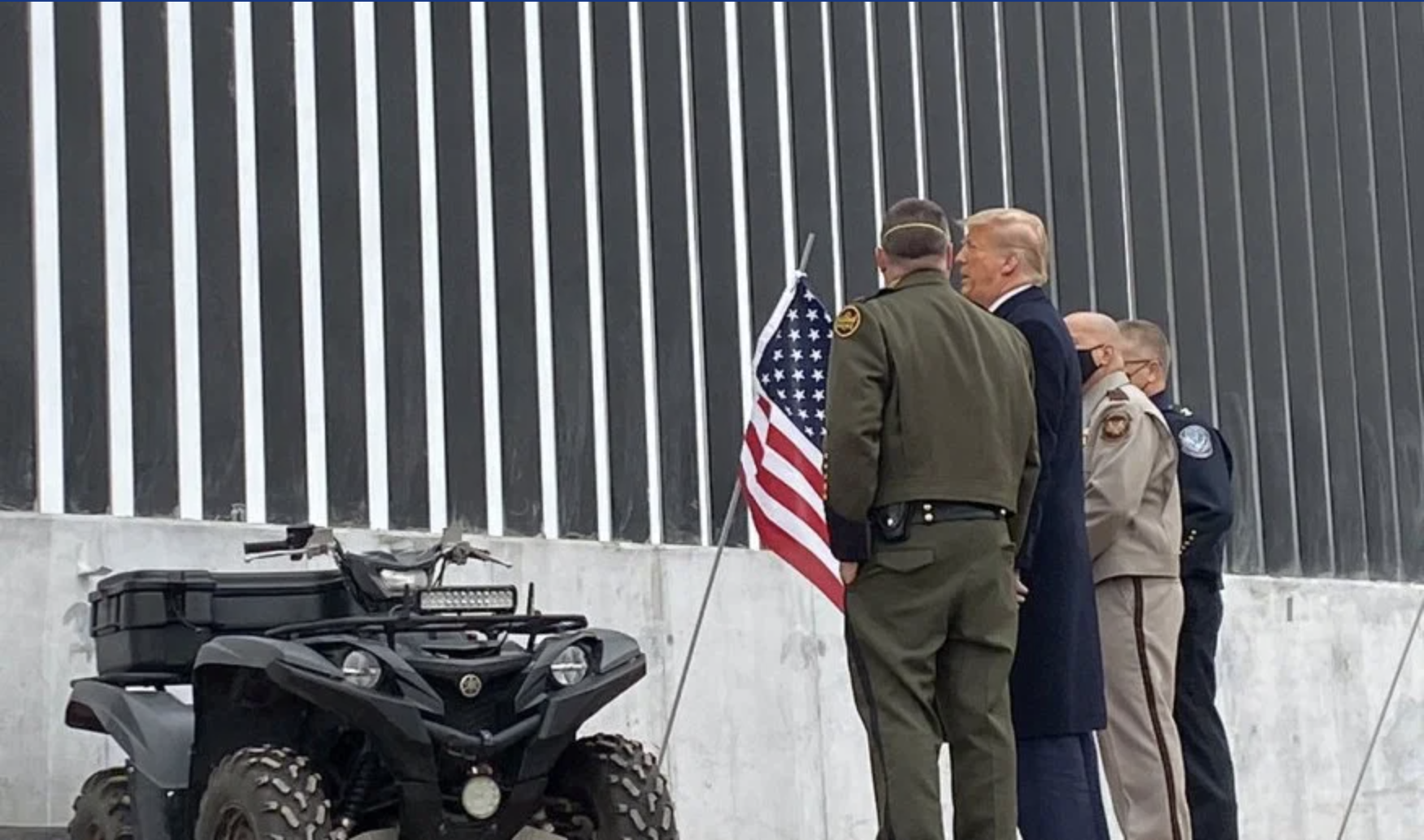
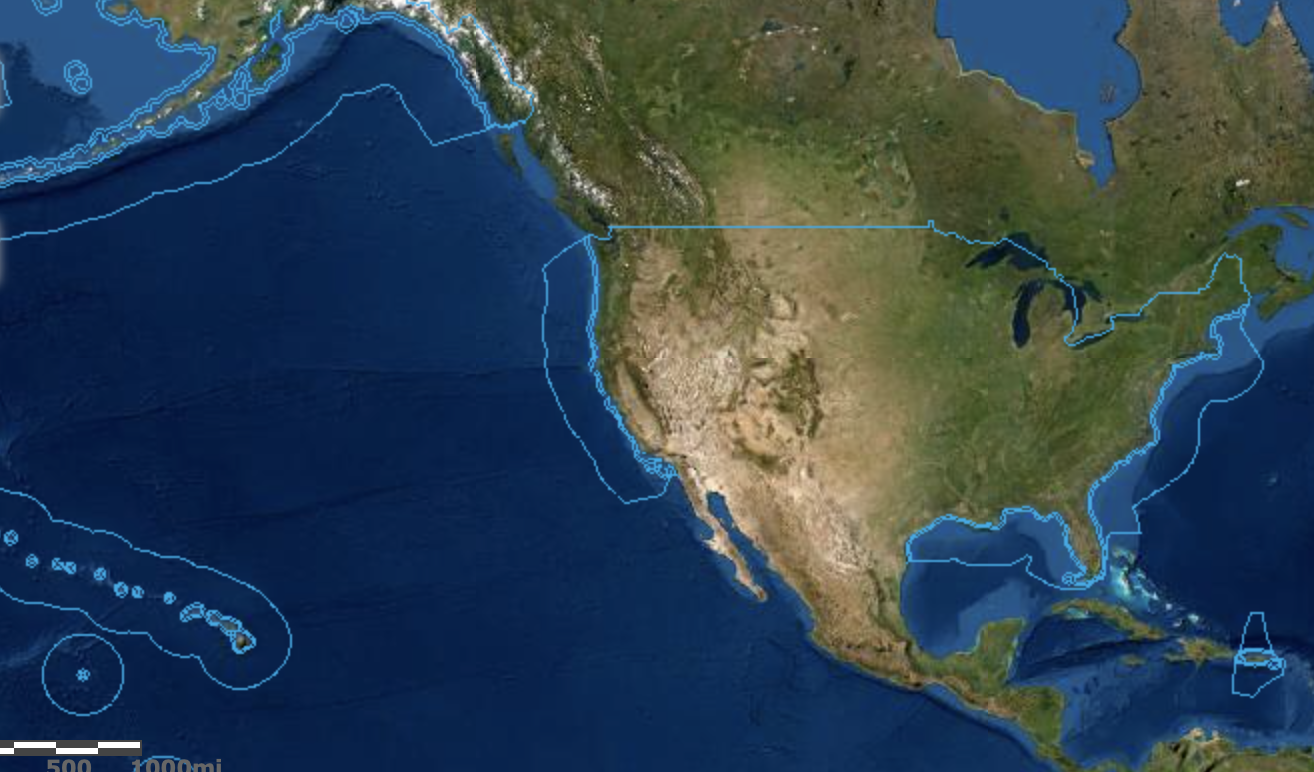
The promotion of the rights of an army of settles to expand a protective buffer or envelope for Israel, the hundred mile envelope Customs and Border Protection and the Border Patrol conducted warrantless searches from any “external boundary” of the United States strips innocent people of constitutional rights–limiting constitutional rights along the entire coastlines as well as southern border, allow new technologies of surveillance in a range of technologies as a militarization of the border. If the battery of surveillance technology lack geographical limits, the border zone expanded by settlers long militarized an expansive boundary of the Israeli state, in powerful cartographic genealogy of the demands for a “Greater Israel”–a concept that found surprising acceptance and endorsement from the very individuals Donald Trump would come to nominate for key roles in his cabinet upon winning the 2024 Presidential election, Pete Hegseth for the Department of Defense, who was proposed as a key negotiator in any future military deals with Israel, and Mike Huckabee, the former Arkansas Governor and Baptist minister reborn as political commentator as the next U.S. Ambassador to Israel, who has been long committed to establish Israeli sovereignty over Gaza, impressed by the “overwhelming spiritual reality of understanding that this is the land that God as given to the Jews” while hosting tours of srael hundreds of times since the 1980s–and arguing that the very concept of Palestinian Identity is not a valid concept of governance, but invoked only as “a political tool to try and force land away from Israel.” All this is well-known. But the circulation of this sentiment among American Baptists and evangelicals across the Atlantic to reinforce or grant currency to resurrect a zombie idea of Greater Israel in the current Middle East is beyond imperial, but is a symptom of globalization, if not a symptom of the “shallow state” enabled by drafting lines of polygons in crude overlays, as if toponymic tropes of biblical tropes respond to current crises.

The conceit of a Greater Israel, at the start of the twenty-first century, is a symptom of the confused legacies that were promoted by Donald Trump and Co. to give license to the expansion of military might over Gaza, as much as the alleged failure of the United States to intervene. Would the idea of intervention even seem possible, once the entertainment of the permission to expand Israel to the West Bank and the Mediterranean was floated in the first Trump Presidency in the maps that the Office of the Geographer at the U.S. Dept of State had given their imprimatur? The maps that were made by the United States, as much as displayed by Benjamin Netanyahu to the U.N. General Assembly, suggest the deep origins of the expansion of Israeli territory in perhaps the shallowest corner of the first Trump era, where the boundaries of Israel were tacitly expanded and the two-state solution taken off the table as a desideratum. The pro-settlement ideology Huckabee has openly espoused and literally preached rests on the belief that expulsion of all self-identified Palestinians from the biblical bounds of Israel is part of a preordained divine plan for Christ’s return, opposing any two-state solution–at least, “not on the same piece of real estate.” The old conceit of “sovereignty over Judea and Samaria,” regions that did not exist on earlier maps of the Middle East, is presented as a decision “for Israel to make,” even if they were not named in any recent maps of the region, as the future Ambassador described himself as “very pleased that [Donald Trump’s] policies have been the most pro-Israel policies of any President in my lifetime.”

Applying Israeli Sovereignty to Parts of Judea and Samaria according to the U.S. Peace Plan – Implications

President Trump Announcing Comprehensive Settlement Between Israel and the Palestinian People, January 29, 2020

The genealogy of these “pro-Israel” ideas rests on a reconstruction of a longtime US-Israel alliance in the optics of the rise of apocalyptic rhetoric far different from the afterlife that the Cold War granted Imperialist ideas. (The central crux of an oxymoronic credo of “Christian Zionism” denies blame or agency for the killing of Palestinians in the Gaza War, and whitewashing of Likud regime policy with Christian millennialism.). It is also less of a “vision forward” than resting on the recycling of some of the most toxic concepts of nationhood that demand to be fully examined to be understood. Although Huckabee has claimed that Trump will assemble a “pro-Israel dream team” to ensure that nothing like the bloody massacres of civilians in the invasion of Israel on October 7, 2023 will ever occur, the notion of turning the page on October 7 seems designed to demonize the Palestinian slogan, “From the River to the Sea” to an excuse to obliterator the legacy of Palestinian presence from the map–and to assert, as Huckabee claims, that the legitimacy of biblical terms “like ‘Promised Land,’ and ‘Judea and Samaria'” hold the significance “that live from time immemorial,” a nomenclature that the United States has had no small part in perpetuating.

The castrophic events foretold in the Book of Revelations were not close to the ideas of right-wing Zionists who affirmed the boundaries of a “Greater Israel” as the historic borders of a sovereign state. Promoting expansionist vision of territorial maximalism of a Jewish state beyond the boundaries of a Palestinian Mandate, and across the River Jordan, of biblical derivation, was first championed by the Right Wing Zionism before the state of Israel was founded, informing the current demands to annex lands beyond mapped borders, if they now neatly dovetail with demands for security and with evangelist eschatology. Expanding the current boundaries of Israel in the ultranationalist vision of a greater Eretz Yisrael beyond ends of security, power, and reflected in the affirming state boundaries in Israel? The ultra-nationalist vision of far-right supporters of a fixed protective barrier securing a frontier meshed with the resurrection of the map of an expansive Greateer Israel advertised “The Only Solution”–the sole solution–years after the Final Solution imagined the idea of a world without Jews set sights on a Greater Israel–

Irgun Poster from the Military Organization of Eretz Israel, beyond Palestine Mandate

–whose decisiveness underlay the cartographic genealogies of ultranationalist thought from the time former Irgun like Menachem Begin entered Israel’s government, advancing advancing gradual annexation by settlers of “lost” lands. The map produced in Central Europe in the post-war period of the 1940s set a territorial goal. If the constitutional silence on territorial borders in Israel’s constitution is invoked as berth preserving the vision of “Greater Israel” in Israeli politics, the ultranationalist ideology of America First ideology invokes an expansive border as a site for federal law enforcement of a “virtual border fence” of Border Patrol’s federal mandate has compromised individual liberties in Donald Trump’s vision of the United States in the Trump era, Likud nourished outwardly expansive borders, as if resurrecting a zombie idea from the dead, but one of deep biblical resonance with the land granted Abraham’s children “from the brook of Egypt to the Euphrates,” accomodating the territorial given to the children of Abraham and Israel over generations to the new language of nations.

For this map–that places Palestine beyond the borders of Israel, in Lebanon, Jordan, and an “Arab Palestine” to the south of “Eretz Israel” of bright blue hue, that encompasses in its midst the biblical territory of Jerusalem, and the Jordan River, and assumes an almost cloak-like form, in a land map recalls modernist abstract expressionism argues that lands promised to the children of Israel when they left Egypt in Exodus or Deuteronomy offers a template to a modern Israeli state–“two banks the [River] Jordan has./One belongs to us; the other does as well,” read lyrics at its base, redrawing state borders already being negotiated in interwar years.

Greater Israeli from the Nile to the Euphrates, 1947

Which returns us to the telling erasure of a Palestine on the River Jordan’s left bank in the map that Prime Minister Benjamin Netanyahu, Begin’s heir, brought to the United Nations’ General Assembly to make his case While the Democratic presidency is faulted for pursuing a “deal” rather than supporting the future rights of a Palestinian state to exist, there is a stunning amnesia of the promotion of the language of a “deal” in the maps designed and issued in the architect of the Art of the Deal, who set the terms for a “deal” that would given Palestinian territoriality, delimit Palestinian rights, and offer an upper hand to the Israeli state. President Trump’s vaunted “Deal of the Century“ has perhaps been overshadowed by the violence of war, but is a “deal” for which we can find ample fingerprints–and indeed a famous scrawled signature!–among paper maps not only props of statecraft, but frameworks with power to re-shape Middle Eastern politics on the ground. These are maps that echo ultranationalist demands, and echo the forms of ultranationalism that became platforms he articulated in his first Presidential campaign.

As props, these maps–in tiresome ways–demand to be traced as symptoms of the personalization of the political, and indeed the entrenchment of the United States in projects of remapping the Middle East, as much as personalized as a “love affair” between Netanyahu and maps, as Middle East Eye has with accuracy recently observed, noting the “history of using controversial maps” in public presentations to international bodies and the Israeli press, while not fully underlining the personal sanction that the cartographic gifts from President Trump provided Israel’s Prime Minister both to promote his vision of Israel to the world, but a platform to rehabilitate Netanyahu’s political career.
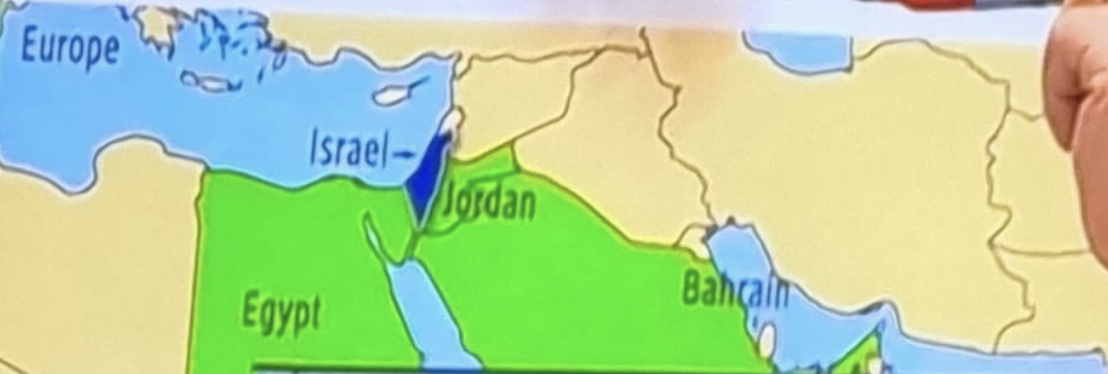
The oddly vivd green-hued map all but eliminated Palestine from the Middle East. The blue island of Israel placed “Palestine” in vivid green nations mapped as Palestinians’ actual homes: “Egypt,” where potentially over 270,000 Palestinians live, Jordan, home to 3.24 million Palestinians, and Saudi Arabia, home to a community of 750,000, and quite vocal as to Palestinian sovereignty–as well s Bahrain, where pro-Palestinian advocacy has been intense among its pluralistic population and Sunni Arabs among the most influential groups–and Sudan, where many Palestinians reside.

The color scheme of the political lay of the land erases Palestinians, perhaps, in a bright blue Israel which lies like a mosaic amidst the clear borders of nations. But the coloration of the political lay of the land is slippery. Such vivid green, long a color symbolizing allegiance to the cousin of the Great Prophet, Ali, gained status since the prophet’s lifetime as a the important color in Islam and the green spirit, Al Khader, and a sign of the vitality of Islam alive from the rich cultural Fatimid era up until the arrival of western crusaders. Netanyahu rose to political prominence, by no coincidence, amidst this improvised patriotic flag-waving in the occupied territories when flying the flag’s colors was forbidden in Gaza, the West Bank, or Golan Heights by Israeli law–provoking the improvised creative display of its colors in laundry hanging outside windows of private residences. If the same flag led the watermelon to become a symbol of resistance, combining the four colors of the flag, the red marker that Netanyahu used before the United Nations to draw a “trade corridor” across an Israel straddling the Mediterranean Sea to River Jordan “map” Palestine outside of Israel’s borders.

Netanayu and ‘The New Middle East’ at 78th session of United Nations General Assembly/September 22 2023 AP/Richard Drew

The vivid light green color of “The New Middle East” that Netanyahu crossed with a red marker was no longer needed to be a theater of war, but could be transformed to one of economic vitality, as if coopting the “green fields” in Safi al-Din al-Hali’s verses Arab nationalists first coopted in the early twentieth century and by 1947 Ba’athists and members of the Arab League took as the national flag of Palestinian people–“White are our deeds, black are our battles,/Green are our fields, red are our swords.” Netanyahu wanted to place these fields securely behind the borders of Jordan, Bahrain, Egypt, and Sudan, not in Israel that lay on a channel of trade to Europe. This quite rebarbative map–as others that Netanyahu brought to the General Assembly of the United Nations from around 2018, and the maps he continued to display through 2023, as if to make the case Israel demanded to be seen as a “normal nation” among nations. But increasingly it may indeed seem to conceal it is not–indeed, Palestinian residents in Israel are not deserving of any clear political role in the New Middle East.

Netanyahu Addresses General Assembly from UNGA Lectern September 22, 2023/AP/Mary Altaffer

The geopolitical situation as he spoke was extremely complex, but the presence of Palestine was masked in mapping Israel by a blue island by the River Jordan held before the General Assembly, in ways oddly incongruous with the image of global peace on the lectern from which he spoke. The map clearly showed a West Bank and Gaza under Israeli control, even though the situation on the ground as he spoke was one of fragmentary political control by both Hamas in Gaza and Fatah in the Jordan Valley, largely subject to the “supervision” of Israel’s government. The complex administration of the areas of Fatah control in the West Bank and Jordan Valley contrast to muted blue areas jointly administered by Fatah and the Israeli military, and a light green sea of Israeli military control surrounding the lands of settlers in the Jordan Valley If the blue regions were subject to joint administration by Fatah and the Israeli army, light green showing areas of Israeli military control, rather than administration by a civil government, the airspace of the entire region was administered by Israel, but the entire region not controlled by any means by an Israeli state.

Evan Centanni, Administration of Land October 6, 2023,/reproduced by permission of Political Geography Now. Sources: B’Tselem, UN, Gisha, city population.de

Why was such a mixed administration around areas of Fatah control masked before the General Assembly? Was this intended to normalize the Israeli control over a mythic “Greater Israel” or was it just a map? The map Netanyahu held proudly of The New Middle East as if teaching a class without familiarity with world affairs. It was a sort of magic trick as much as informative, and masked actual bounds. It successfully concealed the violence of apartheid relations, on the one hand, and erased historical Palestinian demands, simplifying history immediately raised eyebrows by rendering a “New Middle East.” The map that the Prime Minister brought to New York while his generals planned the invasion of Lebanon was reflecting back at Americans a recognizable coinage of then Secretary of State Condoleezza Rice, who in late July 2006 had vouched during an earlier invasion of Lebanon with American arms–and just before the United States invasion of Iraq–the bombing campaign focussed on freeing Lebanon of Hezbollah that targeted terrorists with unprecedented force marked “the birth pangs of a New Middle East” able to accelerate a “freedom and democracy agenda,” rather than one of dislocation and destabilization. Secretary Rice had promised a “domino democratization” across the Middle East would result from assisting these “birth pangs” by “pushing forward to the new Middle East, not going back to the old one.”

Secretary Rice invoked the groundless discredited rhetoric of “dominoes,” not as about to fall to communism but as an extension of a “green revolution” in Arab states that would alter the geopolitics of the Middle East in definitive ways to the benefits of Americans. Armed with these persuasive tools, Rice cast extirpating Hezbollah not as violence but as a “moment of opportunity,” advocating the chance to intervene decisively to remap the geopolitical center in the Middle East among Egypt, Jordan, and Saudi Arabia during the war between Israel and Hezbollah–in place of the “old Arab center,” and leaving the question of the future of Palestine off of the political map, remapping the Middle East from afar for American eyes. Indeed, the affirmation of Jerusalem, a divided city with a large Palestinian presence in the East, which Israel considers critical to its territorial integrity as a capital, was surrounded by light green territory under Israeli military jurisdiction, beside a mosaic of light blue regions jointly administered by the army and Fatah.

Territorial Administration around Jerusalem, August 2023/Evan Centanni, detail of above

In ways that obscured this complex balance of shared authority and jurisdiction, the map of “the New Middle East” Netanyahu presented was not a return to the rhetoric of George W. Bush, but refracted through the hardball politics of redrawing of boundaries encouraged by Donald Trump. Was not the map of Jordan, Bahrain, Egypt, and Saudi Arabia but an updated version of that hope? Netanyahu may have implicitly told the United Nations that Israel, extending from the Mediterranean waters to the River Jordan, was already surrounded by states of Palestinian populations–that Palestinians, in other words, who often designated themselves by light green, had “their” states already. The Palestinian flag of white, green, and red, prominently included green to designate the survival of nationhood of which medieval poet Safi al-Din al-H’ly rendered an icon of three colors–“White are our deeds, black the fields of battle, our pastures are green, but our swords are red with the blood of our enemy.”

The tricolor was proscribed from flying in Palestinian lands– Gaza, the West Bank, and Golan Heights–for the generation,1967-1993, as Netanyahu rose to political power in Likud; the cartographic symbology seemed coopted in the map Netanyahu conspicuously displayed at the United Nations, placing Palestinian pastures beyond Israel’s borders. In the “New Middle East,” Israel possessed the Golan Heights and lands of the West Bank, the reduced Greater Israel is far more limited scope than Jabotinsky’s vision, but integrated in a community of nations–imagining a new “security envelope” that expanded Israel’s territoriality to the West Bank.
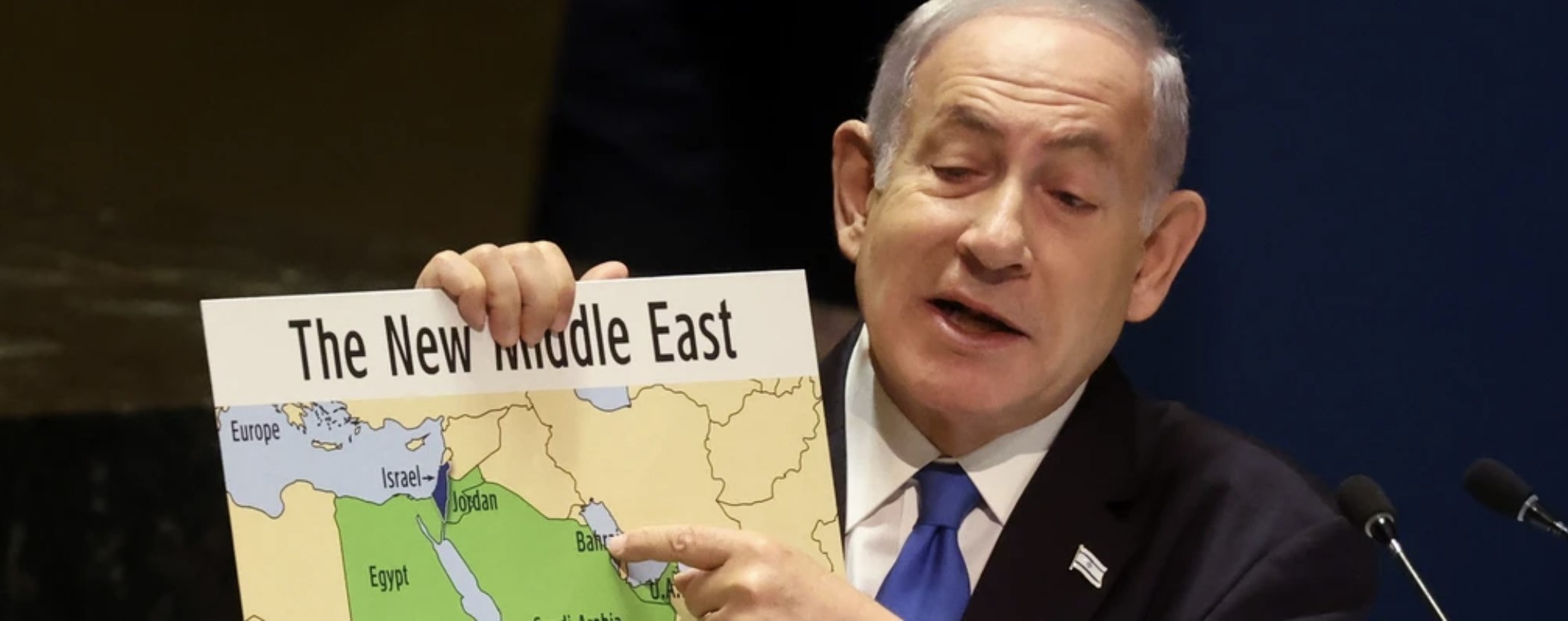
Map of “The New Middle East” Netanyahu Prominently Displayed to Address General Assembly Sept. 22, 2023/ Spencer Platt/AP

The Israeli Prime Minister was using the map to demonstrate a world view, more than a regional map. No map is all-seeing, objective, or all-knowing, but maps shape reality as knowledge-making systems: the powerful map green seemed to illustrate an Israeli state surrounded by the Palestinians with which Israel could live. The security of such secure bounds was a creation of the Trump presidency, but we may have forgot how keenly Trump fed that new map of the Middle East to Netanyahu in transactional exchanges to maintain his political survival, navigate a future with far right-wing allies, and win a second term. A sort of “Dance of Death” had indeed emerged between this remapping and remaking of the Middle East in the Trump Presidency, that used maps to redefine reality, and indeed maps to redesign political boundaries from an increased removed from the ground. Yet the situation was quite different, PolGeo reminds us, on the ground.

Administration of West Bank October 6, 2023, Evan Centanni/used with kind permission of Political Geography

The map of a Greater Israel became a sacred icon for the new hardball politics of the Middle East parallel how Trump employed crude maps of the US-Mexico border maps to advance the populist politics of a nationalist movement. In the map Netanyahu used to address a mostly empty halls of the General Assembly in late September 2023, Lebanon was notably not marked as a nation. As the map showing the boundaries of Israel after the first Arab-Israeli War in 1948 Netanyahu displayed incorporated the West Bank, as if to erase history, the “New Middle East” resuscitated the ultranationalist vision of an Eretz Yisrael— a “Greater Israel” including the West Bank and Golan Heights. The “map” was in fact less a nation than a concept of a nation, but the ultra-nationalist older right wing Zionist conceit quashed any idea of negotiating about a Palestinian state.

The expanded territory of Israel symbolically expelled the 1.7 million Palestinian residents of Gaza–before the October 7 invasion, retaking the ancient “territories” of Judea and Samaria, west of Jerusalem, to use the scriptural place-names of ancient biblical Kingdoms–as if those were the true territories the nation of Israel was historically destined to include. Entrusting an army of settlers to annex over future generations lands claimed as lying within Israeli territory seems to naturalize a territoriality by a map of transhistorical verities, rather than of political process or human rights.

“The New Middle East” Netanyahu Displayed at U.N. General Assembly on September 22, 2023, detail

Netanyahu’s notorious use of maps noting “military control” of Gaza’s borders by Israeli forces, like the these maps that extended Israeli territory to the West Bank, make offensive arguments of silence by erasure. They offer templates for failing to recognize Palestinian presence. If Zionist groups had earlier at times claimed the Transjordan, or historical Mandate, to imagine an expansive ‘Greater Israel”, the Likud Party set its sights on settling the West Bank, and even resettling a Greater Israel that included the Gaza Strip and Golan Heights–a far right conceit that extended beyond Israeli borders to the Transjordan and Sinai Peninsula, its capital in an undivided Jerusalem. As much as geopolitical intentions were ascribed to Israel of territorial ambitions to settle the region from the Nile to Euphrates, little different from how the Israeli flag was allegedly interpreted by leaders of Hamas as the “map” of a region extending from the Nile to Euphrates that included Jerusalem at its center, as claiming territory from the Mediterranean to the Jordan.

The actual proposals for securitized corridors around Gaza bounded Palestinians outside Greater Israel, after the armed reprisals for Hamas’ invasion of Israel, dismantling Hamas’ presence in the region and policing the boundary between Egypt and the Gaza Strip under Israeli control in future years, so that it is residents are entirely bordered and contained by Israeli military authorities. The demand to block what Israel treats as a dangerously transnational space–the very route by which arms, weapons, and bombs entered along the only remaining corridor of Gaza to the outside world–is cast as an objective of the Gaza War, demanding control of a narrow space lest it continue to provide “oxygen” for Hamas in the Gaza Strip., as if the border crossing Israelis have held since May provides a sort of tourniquet and security envelope for the future. Is the image of protective corridors not a Trumpist vision of space of a militarized border zone?

 “Philadelphi Corridor under Israeli Military Control”/Ohad Zwigenberg (AP)/September 2, 2024

But the use of these maps to normalize aggression–perhaps even raising questions of a future Israeli settlement of Gaza that has recently emerged as a far-right agenda–provoke and enrage only since October 7, 2023. The truly mythic geography that placed Jerusalem at the center of a “Greater Israel” could not but include the mythic, biblical kingdoms of Judea and Samaria–not on any actual political maps, but nourished in ultra right-wing Zionist political rhetoric and increasingly close to platforms of Likud. The recognition of Jerusalem as a capital of Israel early in Trump’s presidency responded to an old demand that the divided city be recognized as a national capitol. In announcing a decision to place the American Embassy in Jerusalem from he White House had sent shock waves around the Middle East. For he seemed consciously to recognize and proclaim a new order of American foreign relations in 2017, by announcing in a news conference “Today we finally acknowledge the obvious: that Jerusalem is Israel’s capital” as “nothing more or less than a recognition of a reality.” But no map, of course, is ever merely a reflection; as much as a recognition, maps offer a shaping of reality.

The map that officially designated Jerusalem as Israel’s capital–long a demand of the Israeli state that American governments resisted–was an affront to allies across the Middle East, and remaking of decades of rather delicate foreign policy, opening fault lines between Palestinians and Israelis, and making the United States an outlier among nations–even as Trump deceptively cast it as “a long overdue step to advance the Peace Process,”– even as he recognized having rocked the international boat while appealing to “calm, . . . moderation, and for the voices of tolerance to prevail over the purveyors of hate.” By November 17, the United Nations, over American opposition, declared void any action by Israel to impose its laws, jurisdiction, and governance over Jerusalem as “illegal and therefore null,” invalidating all authority of the “occupying power” and demanding withdrawal from Occupied Territories. Netanyahu responded by the bluntly drawn borders of a counter-map.

American Shift of U.S. Embassy to Jerusalem, Lending Recognition to Israel’s Declared Capital City/NY Times

Who were the “purveyors of hate” but the Palestinian people? The maps that were provided by the Office of the Geographer of the United States of the future “State of Israel” in the Middle East curtail hopes for a Palestinian state, if not provide grounds for the disarming arrogance with which Israeli right-wing forces seem to have adopted an open policy refuting the right of Palestinian settlements or states as it situated the U.S. Embassy in Jerusalem, only recognized as the Israeli capital as President Trump single-handedly issued a Presidential proclamation in 2017, shortly after his election, ordering relocating the embassy be situated in Jerusalem, to the glee of Prime Minister Netanyahu, who won a sort of prize from the United States in official placement of a five-pointed star designating a capital in a city that sparked such sudden protests across the Middle East in early December, 2017, the United Nations Security Council immediately condemned the proclamation as destabilizing of any peace process in early December 2017.

Trump saw the early declaration of a new site for the embassy as purely “transactional” more than political or ideological–“today, I am delivering!”— fulfilling a campaign promise he long ago made the late Jewish American financier Sheldon Adelson, who with his Israeli-born wife made it a hobby of vanity to meddle in Israeli politics and media. Trump wanted to recognize Jerusalem as Israel’s capital, he argued, before the Israeli-Palestinian conflict was resolved, echoing Sheldon and Miriam Adelson’s intense opposition to a two-state solution from 2017. The opposition grew into an agenda for the Israeli-American Council political lobbying group, arguing against history “the Palestinians are an invented people” to promote the right of return of diasporic Jews to Israel–promoting the Birthright Foundation with a half a billion dollars of their fortune to take Jews from across the world to visit the Holy Land to strengthen ties to Israel. By inverting Jews’ historic expulsion from the Roman Empire’s borders forbade Jews led to settle the expanded boundaries: whereas Romans forbade Jews to settle in Jerusalem or Palestine, the call of return inverted the wrongful diaspora created after wrongful blame for Hadrian’s death, the expulsion from the Empire’s borders ca. 133, effecting a “return” from the Empire’s edges in Egypt, Babylon, Italy, Spain, Eastern Africa or India.
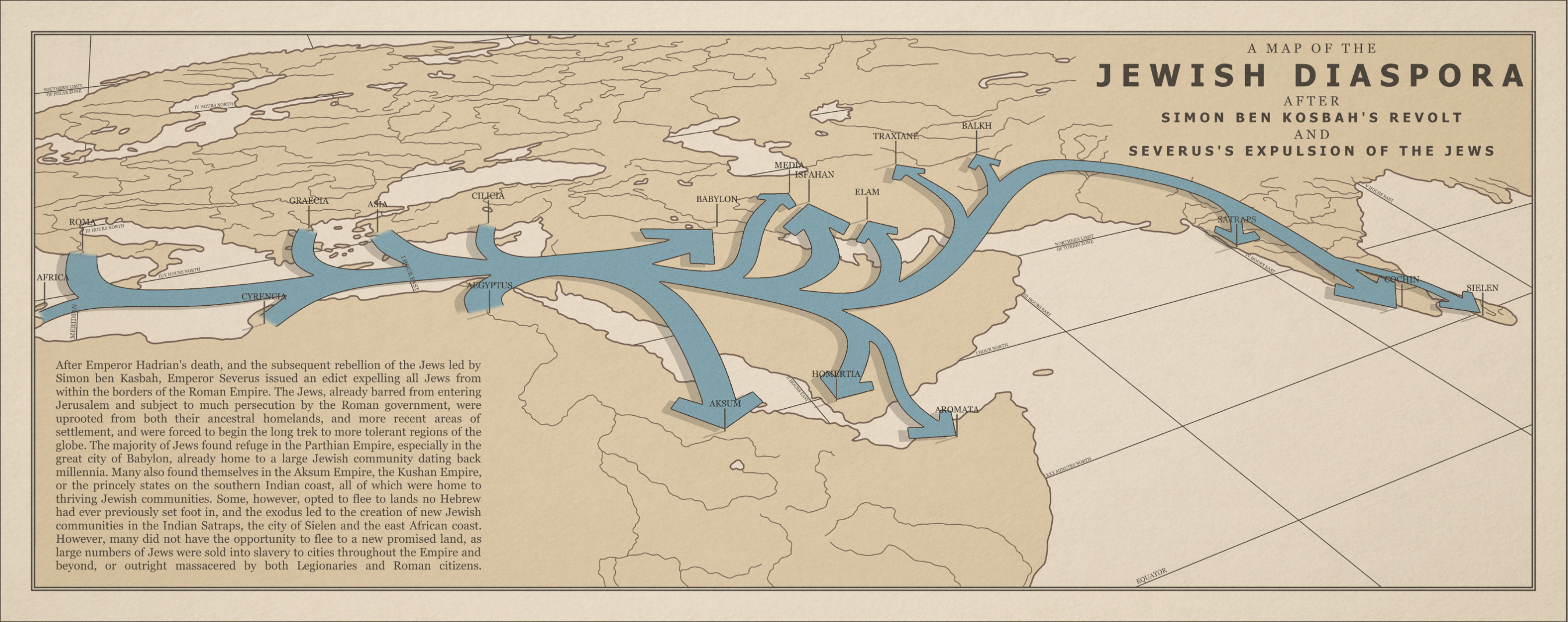
Imagined Trauma of c. 130 AD Jewish Diaspora from Severus’ Expulsion of the Jews from the Roman Empire/ Radioactive_Bee/r/imaginarymaps

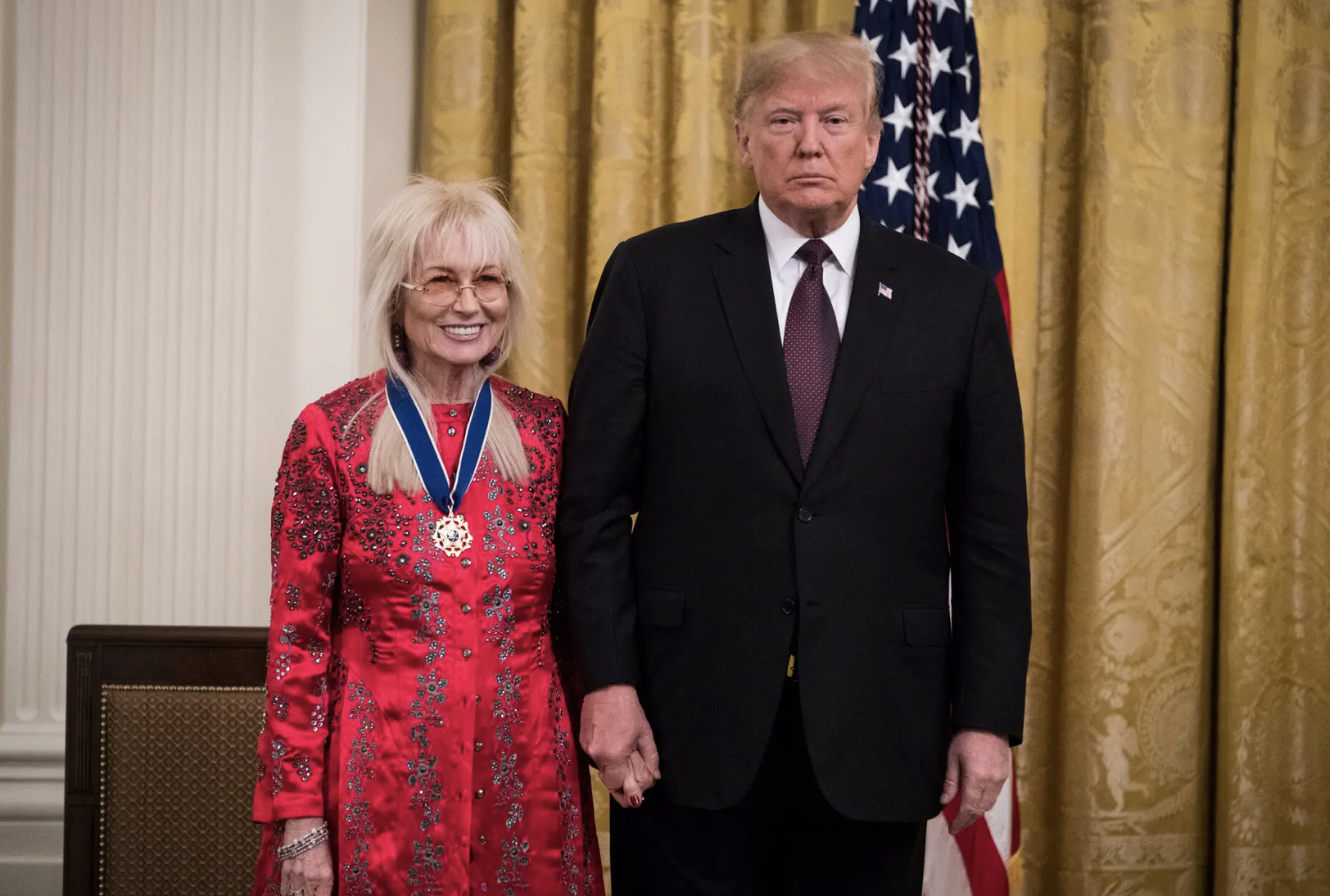
Miriam Adelson, a megadonor to Trump’s 2024 Presidential campaign, donated a sum second only to Timothy Mellon and Elon Musk, over $106.8 million, five times what her husband contributed in 2016, and has courted billionaires to support Trump’s White House bid. Her award of the Medal of Freedom in 2018 confirmed her role as a kingmaker of sorts, and she attracted a hundred donors to her own SuperPAC to swamp the airwaves of battleground states, convincing WhatsApp founder Jan Koum to add a five million dollar contribution. Her auditions of Republican candidates in Las Vegas became a litmus test that fed Trump’sinitial expectation that Trump she was good for $250 million in 2024–she aimed to drum up the support as Trump made it clear he demanded from mega donors to appreciate the strings he could pull after his return to office, reminding them repeatedly how much they had to be grateful for for tax reductionss, militaRY support and defense of Israel’s expansive boundaries, even after the Gaza War, alternating assurances over cozy candlelight dinners at Mar-a-Lago and text messages angrily demands donations to his campaign through Election Day to expand his support for moving the American consulate to Jerusalem, for which the late Sheldon Adelson had long mobilized support, provoking Miriam Adelson to demand Trump support an official annexation of the West Bank and deny all possibility of a Palestinian state. Critics of the Israeli counter-offensive in Gaza “are dead to us,” Adelson ominously warned; Adelson promoted not only Micke Huckabee for ambassador and Elise Stefaniak at the United Nations.
The myth of expulsion was mapped in the didactic style of an old schoolbook is fictional despite its authoritative arrows, the infographic attracted attention on reddit; it might be an icon of a diasporic imagination. Tracing the imagined consequences of a ban from the Roman empire’s borders after the Bar Kochba revolt, it embodis the mythic diaspora that Zionism seeks to reverse–a reversal invoked in the mythic geography as a basis to demand that Israeli law be applied to the fictional regions of Judea and Samaria–regions Israeli settlers have increasingly occupied, demanding military protection, that led to Likud demands to reject international law designating ‘Judea’ and ‘Samaria’ as “occupied territory.” This wanton elision of international law was basis for a roll-out of the “Trump Deal,” expanding a “Greater Israel” outside Israeli borders, a flouting of international agreements that must be placed in the chronology of current understandings of the Gaza War. The erasure of international law that was adopted in the Likud platform included a “right of settlement,” that continues to animate the current calls of right-wing ministers to “settle Gaza” and encourage Palestinian migration as a restoration of a “Land of Israel” as if it could be imagined as “the most ethical” solution to the currently devastating war, mirroring calls to settle the West Bank. The fears of actual threats of “rocket strikes” from Judea and Samaria have mobilized fears about the regions–the presence of settlers argued to prevent rocket strikes on Israel’s unsecured borders, as Israeli withdrawal from Gaza led Palestinians to fire Katuyusha rockets to Israel.
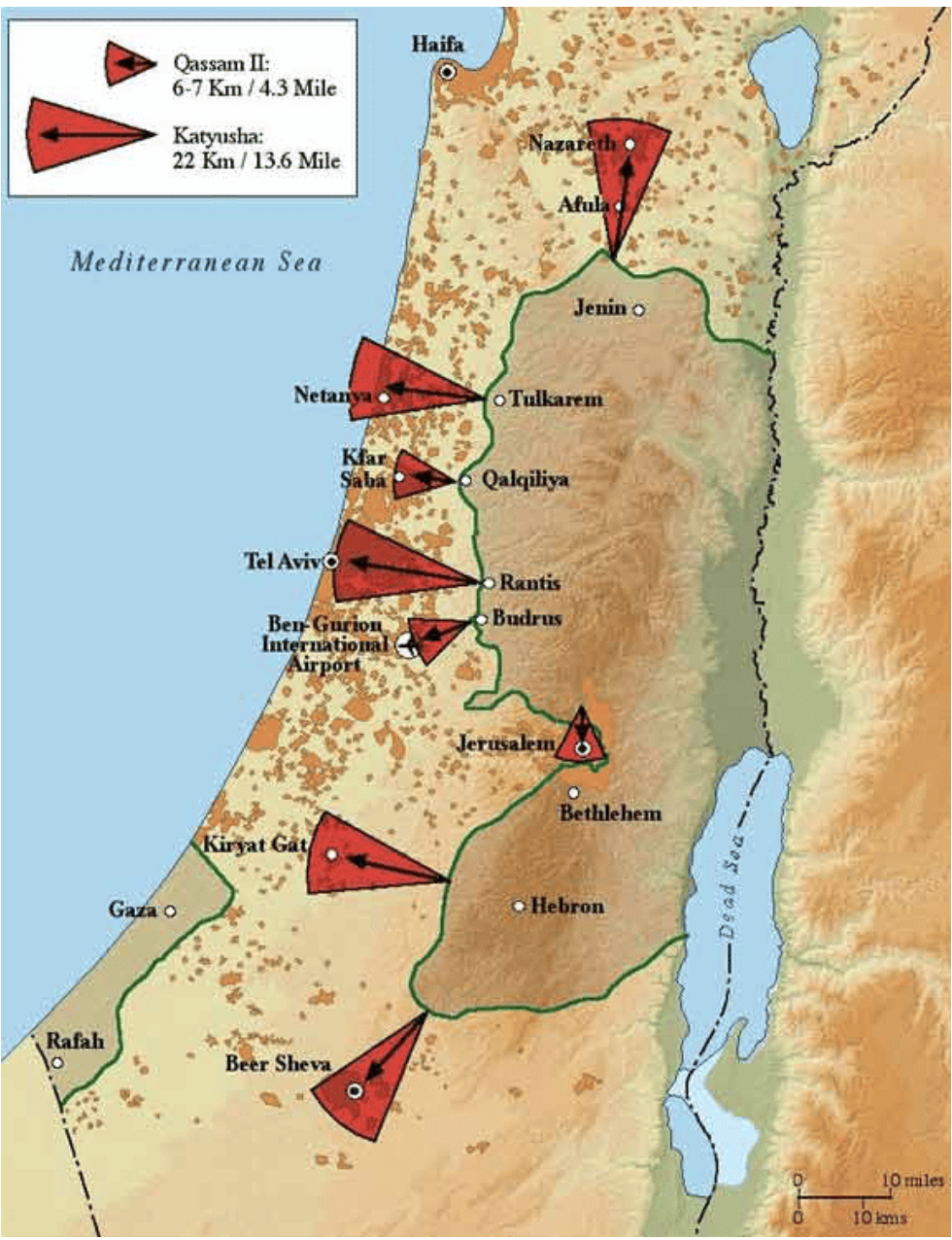
Map of the Rocket Threat from Judea & Samaria to Israel (2020)/Endowment of Middle East Truth

The fear of transforming Judea and Samaria to a grounds for staging a terrorist attacks on Jerusalem, Nazareth, Beer Sheva, and Tel Aviv makes the “green lines” of this map of rocket threats leap to prominence, and demand the protection of settlers’ de facto annexation of the West Bank.

The securing of a “Greater Israel” is impossible to separate from the designation of Jerusalem as the capital. Trump’s recognition of Jerusalem as a capital was an insult to hopes to secure East Jerusalem as the capital of a Palestinian State were placed on ice, even if Trump’s Texan Secretary of State, Rex Tillerson, sought some conciliation in statements that the move “did not indicate any final status of Jerusalem” and “that the final status, including the borders, would be left to the two parties to negotiate and decide.” Despite such ample acknowledgement of some form of future agency, apparently betraying a lack of attention to details as actual borders, the interest in determining new borders–and defensible borders–were promoted in the “deals” to animate a promised “peace plan” resolve longstanding Palestinian-Israeli conflict, entrusted to the 38- year old apprentice, Jared Kushner, the son of the wealth realtor and son-in-law of the President, promising varied economic plans and proposals and touring six capitals, in a week-long trip of Middle Eastern countries, even after the Palestinian Authority preemptively had rejected any United States proposal after the affront of relocating the embassy to Jerusalem–long the center claims and counterclaims to the sacred center of any two-state solution, and the site of the division since Israel’s founding in the 1948 Arab-Israeli War, long sectored by different temporal authority,–

— but unilaterally annexed since 1980, when Israel declared its capital, even if Palestinians make up close to 40% of its current population, and the city is divided in East and West, and bisected by a complicated curving wall, check-points, and gates manned by soldiers, increasingly to protect enclaves of Israeli settlements in East Jerusalem.

[Chart]

Boundaries featured, unsurpisingly, fashioned in simplistic, arrogant, and insulting terms in the different iterations of the Trump Plan, hardly led clarity to the islands of Palestinian population, but created a “green entity” linked by roads, and tied to the River Jordan, while offering Israel control over the West Bank, and being presented as a concession that allowed the fiction of an Israel that stretched from “The River to The Sea,” if one accepted the map’s general design. If the kingdom of Judea existed in the 9th Century BCE, to one side of the Jordan from the Ammonites and the Moabites, the historical populations of an ancient Kingdom of Israel was able to be mobilized, as the ancient Temple Mount in the Old City remained very much at the center of territorial dispute.

The Trump Plan proclaimed a resolution of Israeli-Palestinian differences with bluster as the first “plan” to be put on the table and have multiple signatories–save Palestinians, that is, whose arms were seeming to be twisted to gain approval through a broader international consensus and economic carrots to promote the far bleak futures of impoverished residents in a Gaza Strip, but required no Israeli concessions. The map granted single isolated port city for Palestinians, was premised on drilling an underground Gaza-West Bank Tunnel (!) linking Gaza to the Palestinian enclaves lying at a remove west of the River Jordan, suggested a massive remaking of Israeli state’s position of strength in the Middle East, and victory of absolute recognition of Israel’s right to exist from Palestinians–the map was a map that would guarantee recognition of Israeli boundaries, rather than a Palestinian land.
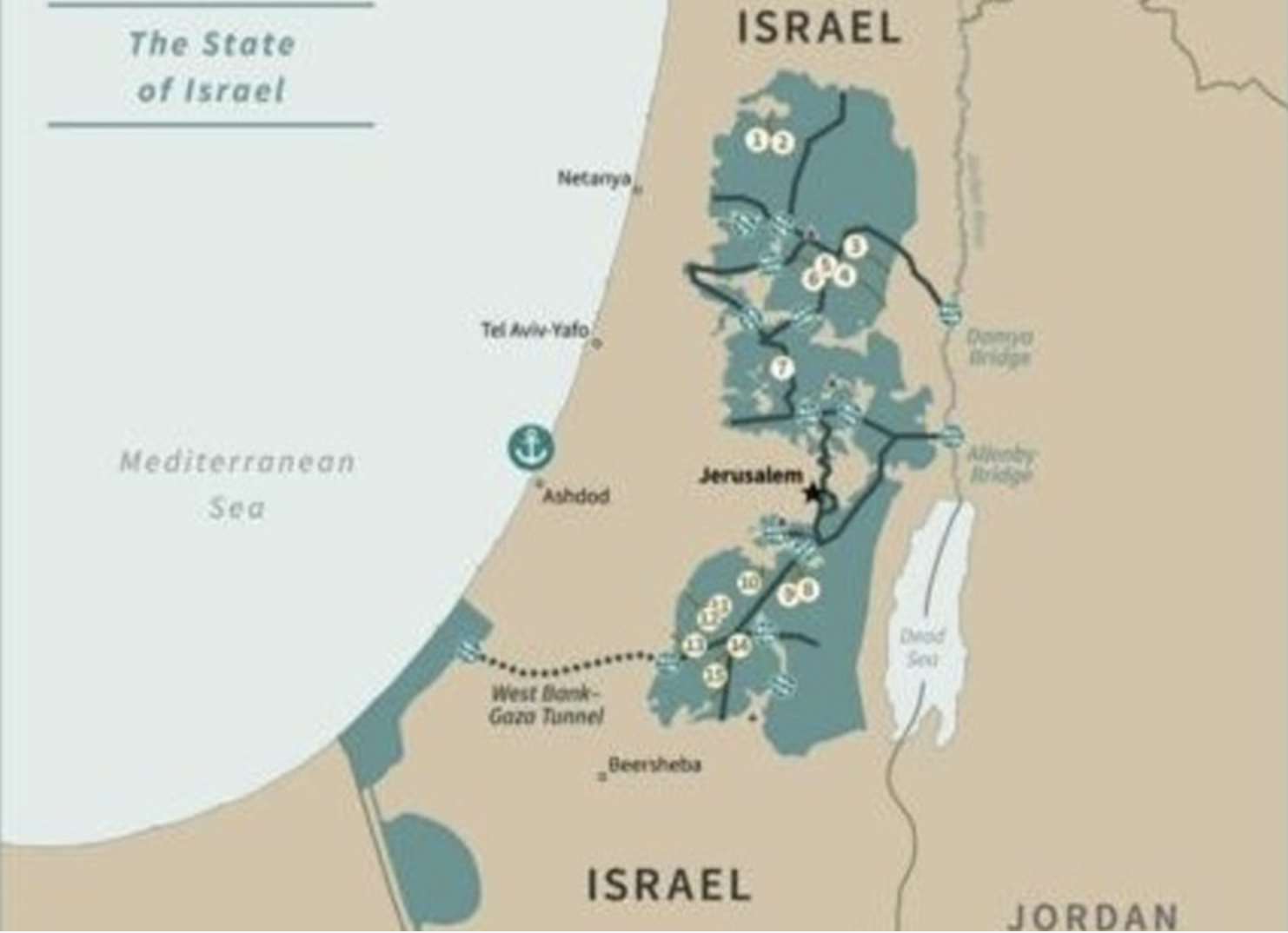
The promises that the Palestinian economy might be boosted by planned residential, agricultural, and industrial communities way to the south of Rafah, if an acknowledgement that few fertile lands would be in the reduced Gaza Strip, would be oddly placed at a remove in the Negev, linked by thin roads or causeways along the border with Egypt, fragmenting the Palestinian presence.

But the closest appearance of Trump’s figurer prints lay on “the new official U.S. map of Israel” that Trump personally allowed Kushner to give to Prime Minister Netanyahu, as a promise to be in his court, in his February 2019 trip by the apprentice Kushner, the thirty-eight year old son-in-law Trump had placed in charge of the deal he called a “peace process’ that at last recognized the Golan Heights–a site of the current war between Hezbollah and Israel–as Israeli territory. This map set a powerful precedent of similar international precedence essentially recognizing lands occupied since 1967, and annexed to Israeli territory in 1981, removing what the rest of the world recognized as Syrian territory that the Israeli army had occupied, as part of Israel’s sovereign grounds. Indeed, the “plan” registered a severe and unidirectional loss of Palestinian lands that Al Jazeera was quick to note, removing lands form Palestinian sovereignty to make the Oslo Accords look like the good old days, shrinking land under Palestinian control away from the West Bank and limiting jurisdictions.
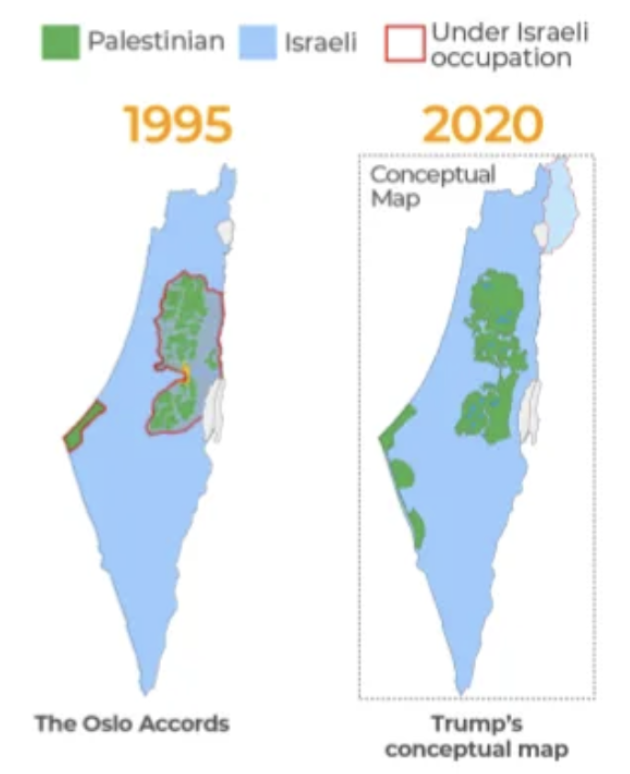
If the firing of many Hezbollah rockets into “Israel” were target at the Golan Heights in recent months, the unusual map presented Netanyahu two weeks before what would be his reelection became a slap on the back and endorsement, labeling Israel’s annexation “Nice! Recognizing the reality of what were deeply contested boundaries as straight lines, Trump took to what was then Twitter to tweet he was “hoping things will work out with Israel’s coalition formation and Bibi and I can continue to make the alliance between America and Israel stronger than ever. A lot more to do!” The recognition of Israeli sovereignty over the Golan Heights had been formally recognized on the visit of Netanyahu  to the White House in an earlier proclamation of March 25 confirming Israel’s ability to “protect itself from Syria and other regional threats” in defending the Golan Heights–a move of chess of fundamental import in the current war against Hezbollah and invasion of Southern Lebanon by the Israeli army. The arrival of Kushner with the map in April, just before the Israeli elections, led him in May to showcase the “update[d]” map as the basis for the Trump ‘Peace’ Plan.

The proclamation asserted a deep commitment of the United States to the acknowledgment “any future peace agreement in the region must account for Israel’s need to protect itself from Syria and other regional threats,” not naming non-state actors but giving backing and carte blanche to the Israeli leader to defend enhanced boundaries of the state. When the map was displayed by Netanyahu at t press conference, he crowed “Here is the signature of Trump, and he writes ‘nice.’ I say, ‘very nice!'”–as if delighted with the new objective truth and framework the map set forth.

The sentiments were reprised in Kushner’s late May public statement stating “The security of Israel is something that’s critical to the relations between America and Israel, and also very important to the President, and we appreciate all your efforts to strengthen the relationship between our two countries;” Prime Minister Netanuyahu happily stated Israel’s relation with America had “never been stronger, and we’re very excited about all the potential that lies ahead . . . for the future.” The powers of prognostication were in a sense supported and formalized but he
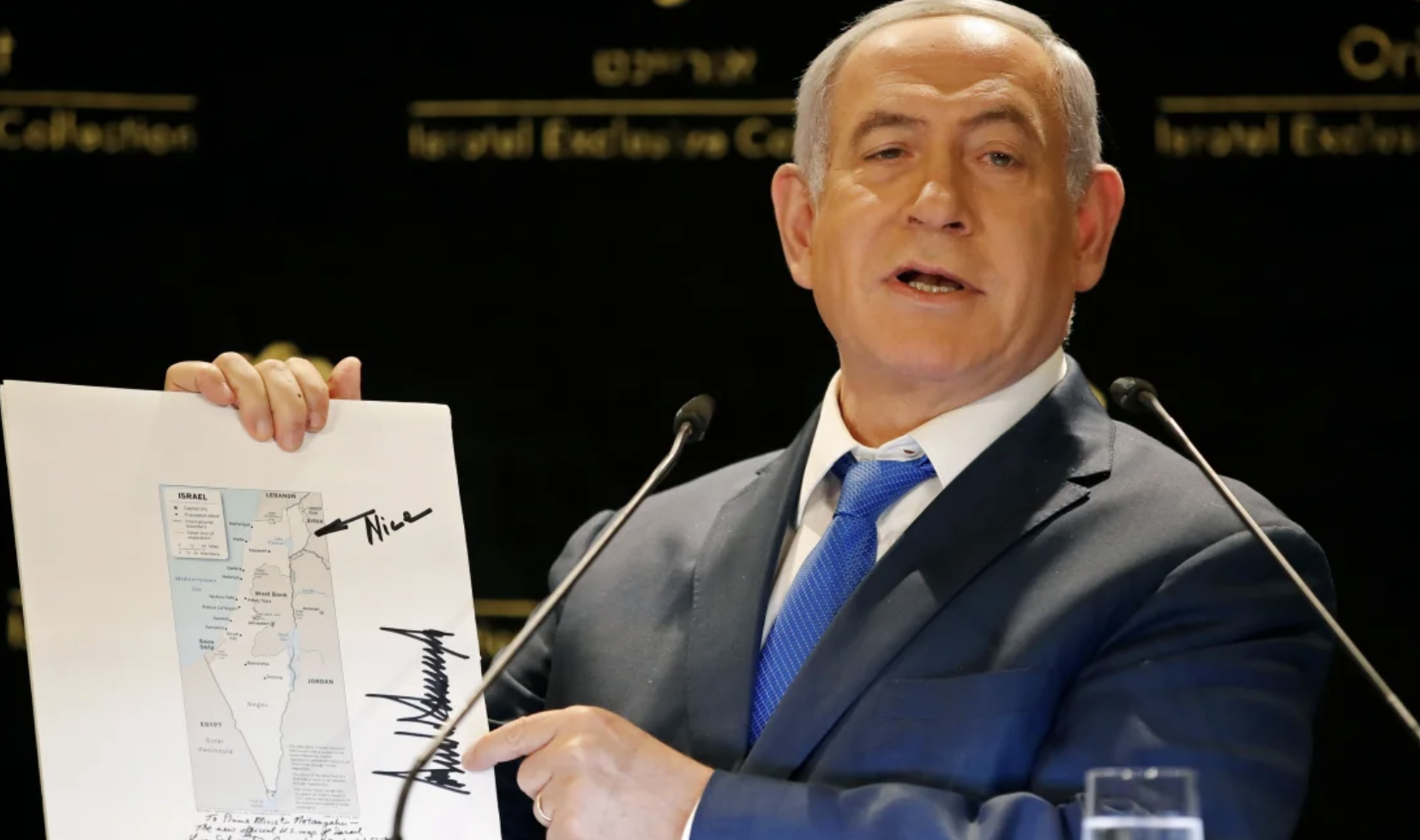
May 30, 2019Thomas Coex/AFP

The election of April, 2019 was hardly a massive victory for Netanyahu, if it meant a fifth term. His political party won a mere 35 of 120 parliamentary seats, but it placed him in a new alliance with the far-right parties that had been engineered by the cartographic gifts that Trump had provided the Prime Minister became props for a new form of political theater with which Netanyahu was particularly taken. The map was a gift that kept on giving, a new knowledge system to deploy the firmed up boundaries of the Israeli nation that no other nations would recognize save the United States. Even if it was not a recognition of “reality,” the flouting of international consensus offered Netanyahu a needed shot, a show of support for the defense of current expansive borders, and even support of the arrogance of drawing borders,–as if the “Geographer of the United States,” Lee Schwartz might take up a larger role in the State Department, where his office was in fact located.

This map was the gift that kept on giving, a showpiece of sorts that preceded the many maps that Netanyahu quite triumphantly brought to the United Nations, maps that set the precedents for the maps Netanyahu brought to the United Nations General Assembly to lecture the world on the possibilities for peace in a New Middle East, in which Israel controlled the full West Bank–a map he had displayed before the April election on Israeli national television, and the map where Gaza was shown to be part of Israel, absorbed in an attempt to focus on the international alliances that Israel was announcing, the small details of Palestinians’s hopes for territoriality were dwarfed by the fantasy of a new community of nations–that led to campaign promises to incorporate the West Bank to affirm an expanded Jerusalem at the center of the Israeli nation, reaffirming in “blue” the territory of a united Jerusalem that was nestled right up to Jordan in the 2019 election. The map was a political promise to expand Israeli territory in the West Bank he insinuated the Trump Plan would allow him to annex in the Jordan Valley, due to his close relation to the American President.

The speech before the 2019 elections promised “Peace and Security” as if citing Revelations 19:20, at time when the contents of the Trump Plan were not yet fully known, and the power of suggesting a major remapping of the relation of Israel to the West Bank might be persuasively made. The map, whose logic seems to underlie the claims of the map of the “New Middle East” Netanyahu would use before the General Assembly, on September 23, 2023, just weeks before the October 7 invasion. Indeed, the image of an annexed West Bank suggests a negative image of the invasion of Gaza, or make Jericho, as Youse Munayyer, the Director of the U.S. Campaign for Palestinian Rights put it quite succinctly, leave Palestinian residents of Jericho dependent on Israeli authority to enter and exit what would be a “new Gaza, another open-air prison Israel can lock down as it pleases.” The desired transformation of almost a quarter of the West Bank by the wave of a magic wand into an area of Israeli control area would disenfranchise Palestinian residents who would lack all voting rights or citizenship, but live in a system of limited autonomy might be better called apartheid, controlled by a minority of Israeli Jews.

Menahem Kahana/AFP

What Netanyahu boasted was a “dramatic” plan and opportunity for fragmenting Palestinian communities within Israel was hardly a “deal” acceptable to Palestinians, and prevent a future Palestine, annexing a quarter of the occupied territories. Describing the option as able to be realized by virtue of his privileged relation to Trump, he openly appealed to far right parties: by calling the Trump Plan “visionary” in scope, he offered the vision of a containment of Palestinian hopes for sovereignty in an Israeli state that was in fact recycled form a 1968 plan for a divided West Bank that annexed rural Jewish settlements to an expanded Israel, while allowing enclaves of Palestinian communities around Jenin, Nablus, Ramallah, and Hebron to formalize ties to Jordan.
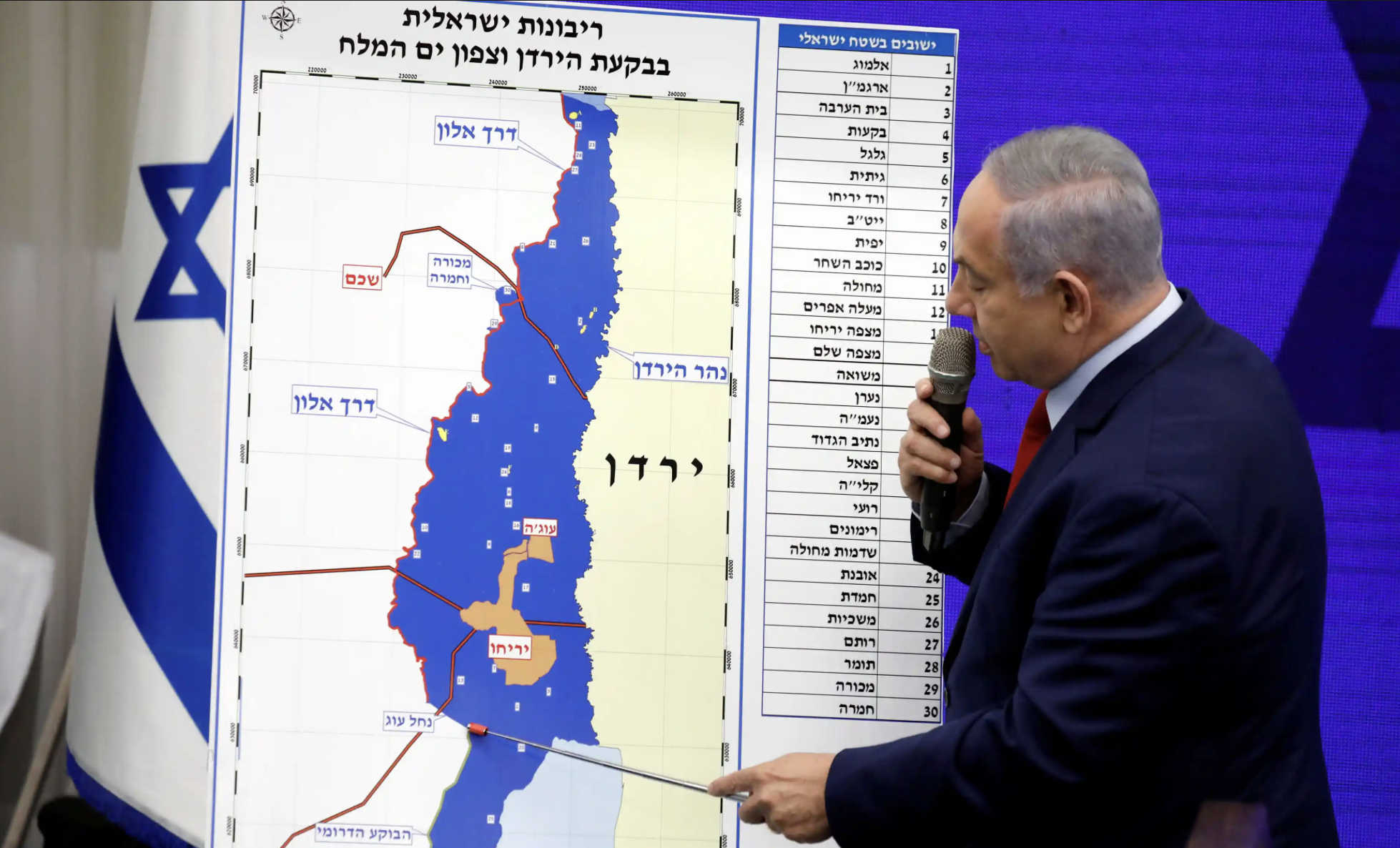
Netanyahu Hints Trump Plan Will Let Israel Annex Key Land

Netanyahu’s 2019 Proposed Annexation of West Bank and Confinement of Palestinian Civilian inhabitants

But if Netanyahu spun fantasies of new borders and expanded Israel out of maps, this post is about the fate of the Trump maps. For the presentation of that map–and the map of a peace proposal that demanded no sacrifices of land for Israel–seems the tipping point of sort. The maps played a large role that provided Netanyahu with the credibility of a statesman in Israeli national elections, a gift allowing Netanyahu to claim control over territory that Israel had not won recognition by the rest of the world. When Netanyahu displayed the personally signed map to the nation in a news conference, even if he failed to assemble the coalition needed to gain a second term, the Prime Minister used the maps s prop to affirm his ability to navigate the nation to the future defense of its borders and boundary lines by his personal ties to the United States President, a gift of statecraft that materialized boundaries of a newly expansive sort as if they were a true consensus. Displaying the map helped his foreign policy expertise to be leveraged for a new term. He quite quickly invited Americans to visit the new Israeli town he in northwestern Golan to found in Trump’s name to acknowledge the meaningful nature of geographic recognition of the Golan plateaux under Israeli sovereignty, voyaging to the region to celebrate Passover as part of a “thank you” for the gift of an American president who “recognized Israeli sovereignty over the Golan Heights forever,” declaring the foundation of a new permanent village be named after the former American President.

Was the gift of the map that Kushner was entrusted not the basis for the forging of a new personal friendship of transactional sorts that Trump was able to present Netanyahu as a promise to stand behind the Israeli Prime Minister’s illusions of protecting Israel’s greater borders, to protect its security? The United States Geographer Lee Schwartz, who signed the map that Trump entrusted Kushner, lists his remit as “defining detailed and advise policy makers on territorial disputes to aid international boundary negotiation may have gone above and beyond his role to offer “guidance” on the ways boundaries are shown on government maps, to adjudicate and resolve international disputes, as Schwartz had in Kosovo and the Baltics, and to guide the Office of the Geographer and Global Issues–a weighty title, not to suggest that folks at the office didn’t also have fun with maps.
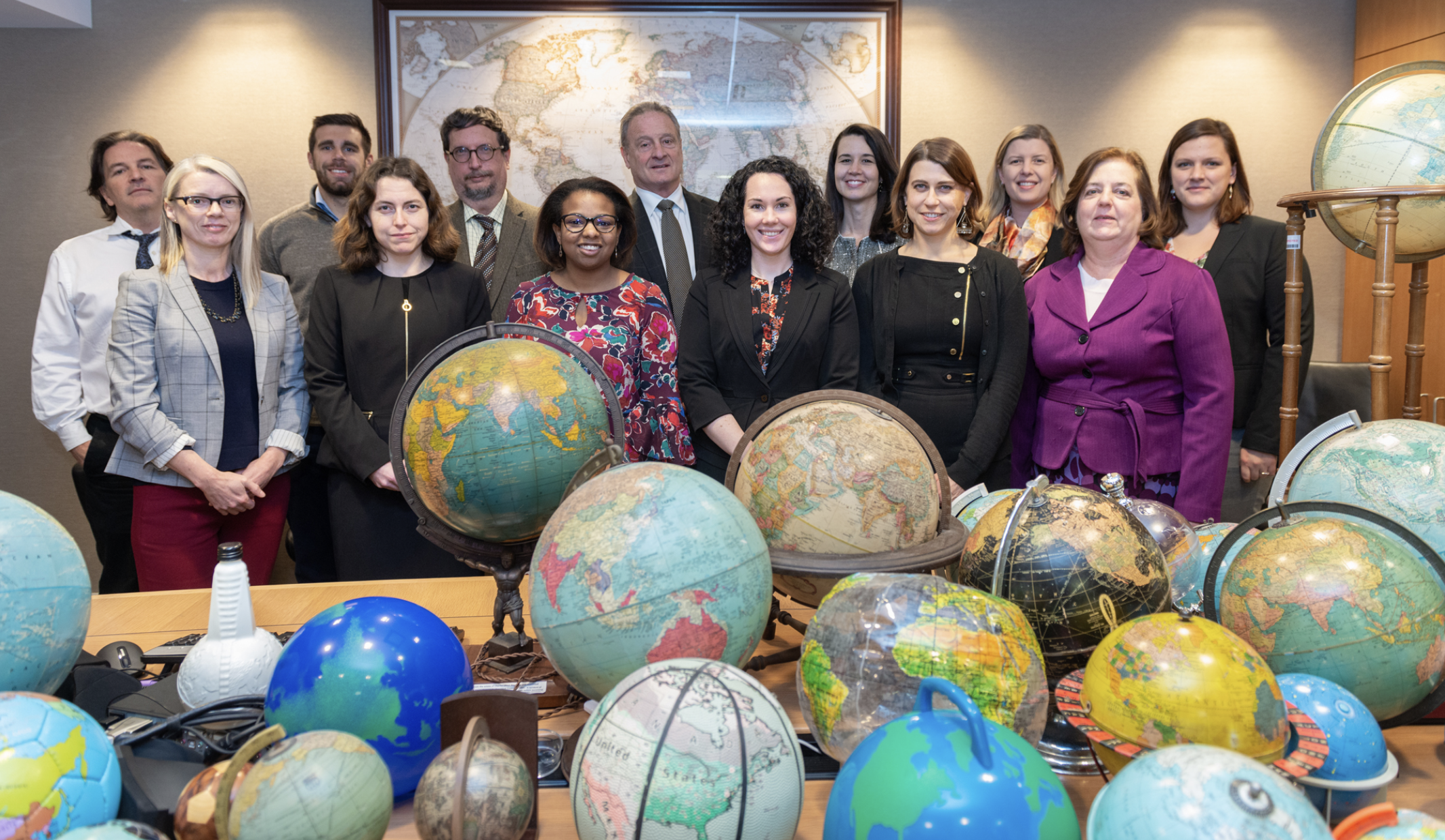
Dr. Lee Schwartz with INR/GGI Team at the Office of the Geographer on Global Issues, 2019/Isaac D. Pacheco

The office of Geographer had evolved in a global context after the Cold War to endorse claims of sovereignty and international boundaries to federal agencies became a platform of sorts to curtail the advantage of redrawing boundaries, as well as determining problematic questions of naming, even adjudicating maritime boundaries that addressed “global issues” analytically from an office within the Department of State. Haing taught at American University in Washington, DC, with a background in the Cold War, Schwartz was soon recruited at the State Dept. to work in the office of regional analysis, specializing in refugee affairs.

Stream episode Lee Schwartz: The Coolest Geographer You'll Ever Meet by US  Embassy South Africa podcast | Listen online for free on SoundCloud

The drawing of boundary lines recognized by the U.S. Office of the Geographer were trusted as “holding up in court cases.” The Office used s “compelling evidence” to map states in the Balkans, that were seen as far more compelling than satellite views. But the maps of Israel’s expanded sovereign bounds launched a missile at the heart of Hezbollah and of Palestinian claims to the region, providing “legal” validation of Israeli territoriality anticipating Israel’s legal rights to territory above any other nation, offering legal validation of the expansion of Israel’s frontier outside the United Nations or international community. Which makes the speeches Netanyahu delivered all the more frustrating. For his cajoling of the United Nations General Assembly to “go along” with new maps in future years played fast and loose with the shifting toponymy of a country much as Trump’s unilateral shifting of the United States Embassy to Jerusalem. The recognition of Israel’s capital as Jerusalem led to the renaming of a small square in Jerusalem beside the embassy’s new location after the United States President, nominally in recognition for his having the courage to “stand on the side of historical truth and do the right thing”–coopting the phrase in an act of pretty radical historical revisionism, eliding the sacred and the secular and echoing biblical geography for his American fundamentalist audience. Trump may not be personally invested in a Christian Zionist vision; but he has cultivated religion as a critical constituent in the marketplace of ideas as a valuable investment. For Trump, the sacred rhetoric easily bled into the image of a strongman. It was fitting Trump concluded his campaign by arrogantly assuring audiences should God “come down and be the vote-counter for just one day,” Trump would win decisively states with immigrant populations–he singled out my blue state of California–by excluding illegitimate votes.

For a strongman who has advantageously coopted agendas, cobbling together religion and apocalypse provided vast reservoirs of hyperbole in Donald Trump’s political imaginary. The survival of a sacred image of Israel has gained an untold and terrifying prominence in the American imagination, not of Puritanism, or of a nation in the wilderness, but of of apocalyptic meaning, as Trump himself assumes a near-biblical prominence as a prophet in the MAGA world who is able to claim a historical destiny not only for Israel, indeed, but, by way of extension into the notion of a sacred nation of America, within the ultranationalist imagination. In this imaginary, territoriality of scriptural sanction bears a close family resemblance to the fundamentalist insistence on borders over rights, and of near-divine sanction, in the promotion of the southern border of the United States as it is promoted with a near-apocalyptic vein and verve. While the same twill cap retails on Etsy for $29.99, it opened a view on a mental geography I was quite surprised to see in the Sierras offered a window into how Christian Zionist imaginary invested the geopolitics of the Middle East with prophetic meaning. Tapping an evangelical strain I associated more with Mike Pence, the cap seemed an artifact of globalization, hardly out of place in Ace hardware store in Nevada stocked with objects made in China. But it provided a vividly sense of the access to Middle Eastern politics the Trump campaign promised that I hadn’t ever appreciated with such sudden and direct impact.

The year 5785 that began at sunset on October 2, 2024 places Trump’s Presidential campaign in a calendar not of the secular world but from creation, by God’s calendar, beyond any political cycle or national calendar. The year end of times destruction may be the conclusion, revealed in the Hebrew letters of Trump’s name on a cap fit for a coming apocalypse, more than any election, seemingly signed by the signature of the very same executive proclamation that recognized Jerusalem as Israel’s national capitol, and cemented Trump’s symbolic ties to a Holy Land. The headgear that was in fact widely available online was no doubt not made in America, but was an ideology whose eschatological implications sent my head spinning as I was preparing to canvass voters who might be eager to support a ticket that was ready to promise it was zealous to acclerate Armageddon, and eager to promote a sense that the proverbial prophetic writing was indeed already on the wall.

Hebrew Hipster ships the RUMP VANCE 24 (2024) in Hebrew Embroidered Baseball Dad Hat from California

Hebrew hipster ships the MAGA kippa, needless to say, as well as MAGA twill caps, for the faithful.

But if the Jewish electorate or “vote” is important, the evangelical may be as critical. For the cap remained me how much the end times teleology of Christian Zionism was apt to link the current election to a date ready to be remembered by the Jewish calendar from creation. The awakening of 5785 suggest a deliverance and spiritual rebirth that is provided only a candidate inspired by the breath of God, no matter what events are occurring in the world: if 2020 was a season marked by a lack of faith, the coming year would bring a final revelation of God’s word, to combat the Moabites, Ammonites, and the proud people of Mt. Seir attacking the nation of Judah, for Israel to occupy the restoration of its full territory in the year when Israel and America will, per Christian Zionism, also recover territory the enemy had wrongly entered as the entire nation will come to repent–and by Psalm 85, in order to restore divine favor to the land–lest abortion, same-sex marriage, trespassing against one’s created identity, and absence of prayer inspire God’s Old Testament wrath. Let us heal our land in the first forty days of the Jewish New Year, lest it be destroyed by his fire.

Ace Hardware, NV

A semiotic decoding of the hat, so overdetermined in its Hebrew lettering and Old Testament associations, is challenging, so cluttered is it with symbolic paraphernalia, accumulated symbolic identities of faith, nation, and masculinity to resist interpretation, subsumed in combination of Old Testament faith and Christian apocalypse, save as an announcement of destiny to prepare for the awaiting of the Rapture. It proclaims that the faith of “proud deplorables” intersect with a vision of Trump-as-biblical-prophet of apocalypse whose time has indeed come in America, even if it may begin in the calendar of Hebrew scripture.

In proselytizing a candidate for the American Presidency in black Hebrew letters date the campaign from the creation of the world, the salesman I met while canvassing was promoting a cult of personality as a prophecy destined to inaugurate a new historical era more than a President. Even in a store selling goods mostly produced overseas, the largest proportion probably in China, the cap reminds us to place Trump’s candidacy in a global context, as much as one of Making America Great Again, transposed from a medieval universal history culminating in the Apocalypse, which resonated strongly with the Fundamentalist origins of placing the capitol of Israel back in Jerusalem. While I was in the state to encourage voting, I didn’t need to reflect much how the prophetic vein was bound to elicit votes far more effectively than an army of door-knocking volunteers. Could it be that in the current United States, apocalyptic rhetoric has become the ultimate strategy of getting out the vote? In affirming right-wing Zionist Israelis hopes to restore God-given borders of sacrosanct nature, mutatis mutandi, the logic of territoriality was doubtless but a reflection in many ways of continuing to defend “our” borders as well, and a restoration of its rightful extent and “legal” boundaries in maps, no matter the situation on the ground.

Borders were framed in prophetic ways for 5785, as if created by the force of worship: as if the expectation of the year were an anointing of a monarch, able to set those borders, returning to a new level of reverence for life, and restoring favor to the land; numerologic glosses on this year’s digits, 5 + 7 + 8 + 5 = 25, or two fish and five barley loaves of abundance, affirmed God’s intelligence in providing, and encouraged thanks to God’s demands for a candidate to enact his will, and service in the election to confront those intimidating giants that have threatened the nation as David threw five stones against intimidating giants with the outpouring of spirit and a new battle plan. Despite transposition of loaves and fishes to decipher the prophecy of the year, the gloss demanded believers give freely of what God needs of us–votes for Trump?–to steward of things beyond individual needs. The message emblazoned on the man’s cap burst on the eyes of customers akin to the revelation of the prophetic writing that burst before the eyes of Nebuchadnezzar as he stole the sacred goblets and golden cups from Jerusalem’s Temple, perhaps seen as somewhat akin to the stealing of the vote and White House–as prophetic words of caution and terror, “mene, mene, tekel, upharsin“, letting him know the4 days of his kingdom are indeed numbered. If Svetalana Alpers argued that Rembrandt painted gold objects and clothing to play with the value of the painted work of art, the below painting of Belshazzar’s Feast, far from a foray into the baroque, is an escalation of the rendering of gold of a new level of the divine sublime of perhaps the greatest value–gold letters drawn by the disembodied hand of God, a model far from the glittering if polished mock-gold facades of hotels Donald Trump so delighted to inscribe his own name in capital letters to convince the world of their inestimable value.

Rembrandt van Rijn, Belshazzar’s Feast (1635-1638), National Gallery, London (Daniel 5:1-31)

Only the visionary Daniel can interrupt the mysterious letters–apparently arranged in an acrostic cypher, that evaded the interpretation of any Babylonian wise men, as a prediction of the doom of the king and his dynasty. The failure of the royal astrologers Belshazzar had summoned to read the golden letters were only able to be read by the visionary Daniel, who realized the doom they prophesied was evident to all who read the letters as columns, rather than trying to force meaningful words by reading from right to left. The discovery that God had numbered the days of the kingdom of Belshazzar in the Masoretic text depended on glossing the same verb as both senses of “numbered” and “finished,” the third column as “to weigh” and “find wanting,” and the fourth as both “divide” and “Persia.” In the electoral fantasies of a divided nation, wanting the election of a true leader, the cap had of course provided the illustration of a direct tie of individual to leader, a sartorial proclamation of a direct allegiance to a leader akin to the brown shirts of Nazi storm troopers issued from 1925 or the immediately recognized uniforms of Mussolini’s blackshirts.

If the inscription that Belshazzar witnessed on the Temple walls demanded Daniel’s interpretation to decipher, eluding even the Babylonian wise men, any in the know grasped the meaning of the revelation of Trump’s name in Hebrew–a revelation akin to the inscription traced on the Temple wall. There is nothing wrong transcribing a candidate’s name to Hebrew characters–but the valor into the cap seems to violate a division of church and state, commanding a vote for a candidate as if it was a message from on high, and question of obedience to God. The inscription of Trump’s name in Hebrew characters assume a divine command, as if invoking a scriptural authority in Trump’s support. Rembrandt relied for the top-down columns of his painted Hebrew characters on the learning of a rabbi and printer who lived in Amsterdam’s Jewish quarter, Manasseh ben Israel, despite incorrect transcription of one character–a zayin for a nun–render the luminous prophetic inscription traced by a disembodied hand on the temple wall to the amazement of all present:

Rembrandt van Rijn, Belshazzar’s Feast (1635-38), detail: Inscription on Temple Wall, ()

The difficulty in interpreting the Aramaic chiding that was included in Daniel 5 derived from the encoding of the sacred message in an early form of encryption, a matrix of coded data that demands to be read from top to bottom, rather than right to left, an early form of cypher that was historically accurate, but pushes us to demand the decoding that hat. If the son of Nebuchadnezzar, the conqueror of Jerusalem, had not recognized his own hubris of destroying the Temple and carrying off its sacred vessels to be used as goblets to drink wine at a banquet with his concubines, the cryptic message demanded God be shown reverence as it was dramatically inscribed on the palace wall. If the glitter of gold was a frequent color Rembrandt used in his studio paintings, from helmets to coins to a cuirass, and the artist must have delighted in depicting the abundant wealth of Belshazzar’s Feast by painting the sacred goblets of gold and silver stolen from the Temple.

The set of stolen sacred goblets seem suddenly to fall as God’s hand leaves a shimmering on the palace wall. A shocked Belshazzar sees the inscription with terror as he turns a turbaned head atop which a gold jeweled crown seems to totter; the inscription warns his days of rule are numbered and his dynasty will fall due to failure to honor Israel or the kingship of the God of Israel: the “writing on the wall,” that claims inevitable restoration to a throne of rule by one who honored God in words, Mine, MENE, TEKEL, UPHARSIN, that outshine even his glittering royal gold encrusted cloak.

For the candidate who still reminds audiences of his plans to laud efforts to Stop the Steal, the story of Belshazzar is not only biblical legend. It may even form a natural part of the aura of a God-given inevitability of his return to the United States Presidency. Trump eagerly revealed at a Pennsylvania rally in mid-October how in a “very nice” [telephone] call” he gave Netanyahu his blessing to “finish the job” in Lebanon and Gaza, promising “you do what you have to do” when it came to defending Israel and its border, determined to allow Israel to “ultimately make decisions according to her national interests.” Trump’s affirmations of placing a premium on Israeli interests revealed the far more solid commitment of his relations to Netanyahu than Biden’s; it made him a true confidence man. Trump regaled audiences with how Netanyahu took his call from his private vacation residence in Caesarea after it had been targeted by a drone, reminding supporters of their regular contact, as if to evoke the deep ties a Trump presidency would have to Israel. Trump had, after all, from 2017 transferred the American Embassy to Israel from Tel Aviv to Jerusalem, removed the Palestine Liberation Organization from Washington, D.C., stopped referring to Israeli settlements as illegal and ensured the United States State Department no longer called the West Bank “occupied territories.” This was the very map that Netanyahu presented the United Nations.

To flip the metaphor, the writing was indeed on the wall–and on the map!–since Trump removed occupied territories on the West Bank from State Department map. This “new map” was indeed but a model of the Middle East that the Trump Presidency worked hard to map. In the cap I saw as I canvassed in Nevada, Trump’s name seemed to affirm his destiny to win the election, an event of such historical importance fit for counting from the creation of the world. In ways that recall the insidious intermingling of the sacred and secular in the Trump Presidency, the Presidential election of “5785” has become in large part a referendum on Donald Trump’s continued defense of the United States as a sacred nation with boundaries the former President has defended as if it were sacred and worked to sacralize.

The man’s cap was emblazoned with a logo so aggressive to be tantamount to a revelation: it was nothing less than a divine endorsement from on high, on a bright red field that may as well be glittering in gold. It reminds us of an end times philosophy, and a Republican Party exhorting more arms flow to Israel to defend the sanctity of the borders of a Holy Land. It affirms the impending inflection of global history 5785 is destined to bring. Indeed, the date on the cap may gesture to revelation of Ezekiel 47:13-20, sketching “Boundaries of the Land,” a vision of the future boundaries a restored land of Israel, running east to the Jordan, that run near Damascus, unified “into one nation on the mountains of Israel” with a temple at its center.

This vision of reconstituting the State of Israel was of course of meaning among Christian Zionism not as a political affirmation of an apartheid state, but a precondition for the end of time, and return of Jesus; the religious right’s ideology interpret all Middle Eastern politics through the lens of a prophetic of end-time teleology and premillennial belief, more than geopolitical dynamics let alone a demand for human rights. The previous President has nourished if not cultivated an intentional confusion of a vision of geopolitics with one of spiritual authority and territory with a revelation of a scriptural legibility. Even as we continue to insist that the conflict is between nation-states and ideological in nature, and demands to be solved between nations, by shuttle diplomacy and Secretaries of State, the confusion between a sacred map and a map of territoriality of the Middle East has been nourished in that vision of the Middle East for decades, juggling around the pieces as if to find a winning and unable solution. For we continue to insist that the conflict is geopolitical and at base ideological and between nation-states, in ways that blind us to its distinct and deep-seated nature of these claims of territorial possession, as if is between nations among other nations, as if purposefully creating and bequeathing blind spots in our maps.

5785 has been called a year to invest kingly and priestly authority, await divine intercession and kingly rule, a year of righteousness and peace where the Lord will give what is good to yield increase and a year of awakening. If the current Middle Eastern situation has proven to be a time of crisis not only in Gaza and Lebanon, and Israel, but a moment of revealing the lesser role that the United States can play in global affairs and global wars, an apparent lessening of authority and prestige that seems to show the weakness of the Biden administration, and reorient America’s relation to the world, and the apparent erosion of anything approaching a secure grip on global affairs. In the legend of Balshazzar, the hubris of the worldly ruler is punished by the inscription of the legend that the King immediately beholds, with his assembled guests, who dropped the sacred goblets from which they were obliviously drinking wine in shock. “The God who controls your life breath and every move you make–Him you did not glorify! He therefore made the hand appear and caused the writing that is inscribed: Mene Mene Tekel Upharsin . . .” that predicted the doom of the pagan ruler and of his dynasty, from a God who would soon bring both to their ends (Daniel 5:22-25). The writing was, as it were, on the drywall in the Nevada hardware store that I glimpsed the MAGA hat two weeks before the Presidential election. Maybe 5785, I thought, will be a year all plumbing issues will be suddenly resolved, fixtures will be free and lightbulbs easily able to be returned.

Leave a comment

Filed under boundaries, Gaza, Gaza War, Gaza-Israel Boundary Wall, Israel, Israeli Borders, Israeli-Palestinian relations

Blurred Boundaries and Indigenous Lands

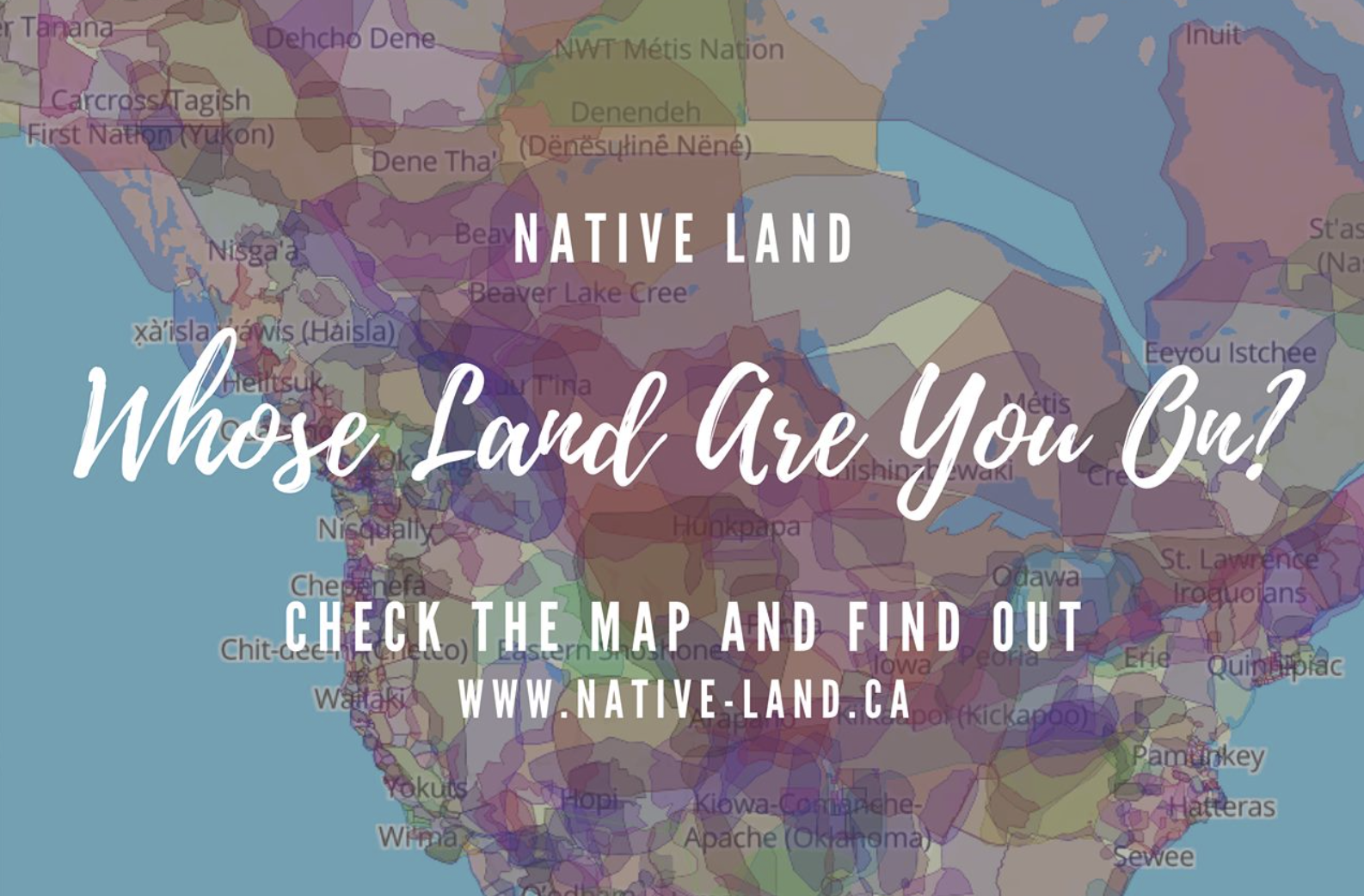
Geodesy has increased the number of claims by extractive industries through remote sensing, and especially over indigenous lands. Yet crowd-sourced tools of geolocation have also enabled a range of counter-maps of indigenous native land claims that have pushed back on how industries that have increased access to the resources buried beneath the very lands to which indigenous groups have ancestral claims. Indeed, powerfully innovative webmaps like Native Lands–previously launched as “Tribal Lands”– provide not only a new standard for cartographic literary, but to change ideas of property–as much as give vitality to ideas of property within a new cartographic medium. Indeed, if the original moniker of “Tribes” suggests a non-state actor, the enhanced claims to a public voice in “native” lands suggests an alternative way to stake property rights, and acknowledge and redress the multiple land “cessions” that stripped indigenous property rights.

Boundaries were an invention of the enlightenment, creating clear lines of personal property as well as national bounds. The blurred boundary lines offer an opportunity for ethical redress of the lost of lands indigenous have roundly suffered from the uninvited Anglo settlers of North America, a counter-mapping that is alive and well on web maps. The decisive choice to blur these boundary lines reflects the cartographic preoccupations with which the American government long has regarded indigenous inhabitants–not only as the governors of states and then the federal government forced migrations of tribes into areas that they viewed as “uninhabited,” but as late as 1877, when the Secretary of Interior deemed “there is some difficulty in drawing a line sharp between the California Indians and their neighbors,” who, Stephen Powers told his superiors, “shade away from tribe to tribe, from valley to valley, so that one can seldom put his finger on a river or a mountain-range and say that here one nation ends and another begins.” If landscapes were refigured as bounded expanse, the attempt to inject a sense of on-the-ground experience in maps is the goal of the open source mapping platform Native Lands–an attempt to integrate indignity into the platform of mapping itself.

The cartographic undoing of the primacy accorded to settled land and settlers’ claims is not only revisionary, but a new reality we have rarely seen–the cartographic inheritance of the first settlers of North America eagerly imagined extending land claims westward to the Mississippi River, encompassing the Great Lakes in their maps–

–as if the claims of land might continue to extend westward, across what was seen as tempting green, fertile, and unclaimed, if perhaps not uninhabited, unordered lands populated by the Outworks, Outagamis, Osages, as the Uttawais in upper Virginia straddling to New York, Iroquois or Six Nations on the edges of Pennsylvania and New York, Missasagos north of Lake Erie in a nominal Virginia, Twigtees of Virginia, Cherakees in North Carolina, and Algomkins on the borders between Virginia and Canada, and Creeks in South Carolina and Georgia nestled within the borders of existing colonial land claims, as if their relation to the land didn’t need to be mapped, and had no borders of settlement–or rights–of their own. “Illinois” was “expelled by the Iroquois,” and the contested borderlands, but the conception of wandering or itinerant landless groups was clear.

A New and accurate Map of North America, Drawnfrom the famous M. Danville with Improvements from . . . English Maps, London, 1771

The map was printed in London with the benefit of recent cartographic sources from French Jesuits as D’Ainville as an invitation to settle North America, promising open lands able to be surveyed and owned by future immigrants, and an early evidence of envisioning America as a land of wealth, the landlessness of indigenous was clear. It was a legacy, moreover, firmly lodged in our nation’s own cartographic imaginary, that has long understood indigenous as outside of federal bounds. Indeed, the mapping of properties in the North Atlantic for English Plantation Owners in the British Empire saw no place for the very indigenous who were figured so prominently in feathered headdresses in the map of North America’s cartouche.

Indeed, the original 1755 map for the Earl of Halifax and other Commissioners of Plantations baldly all but invited the staking of claims to property as there for the taking across the entire continent!

Map of the British and French Dominions in North America (1755), Library of Congress

The mapping of property by straight lines and tools of surveying had promised the opening of the entire continent, as if without any objections or interference from those inhabitants who lived on ancestral lands. If the same pastel color scheme is adopted, for new ends, in NativeLands.com, the maps try to undo the tyranny of cartography in opening up the continent. For disregarding or blurring of any boundaries is a way of disenfranchising indigenous from the continent, and denying that any territory existing among a peoples long cast as lacking government and having or claiming a title to land. If one might succeed in mapping the inhabitants of a land continued to be seen as contiguous with an unbounded nature as better mapped by language groups than territoriality: even the largest of indigenous nations in the Central Valley of the state “have no common government, and not even a name for themselves”–just “a common language, with little divergence of dialects for so great an area as it embraces . . . but little community of feeling.” Rather than defend territorial boundaries, Stephen Powers noted in a North American ethnology Tribes of California, that tried to shoehorn indigenous into mapped states, tribes in the Sacramento Valley “believe that their first ancestors were created directly form the soil of their respective present dwelling-places.” Whether the language of borders and boundaries had been returned to in the expansion of the western settlements and the creation of reservations of bordered territories, already salient in newly mapped “Western territories” of the early nineteenth century, showing indigenous settlements in vague termsbeyond Little Rock, Louisiana, and the Kansas prairies.

The question of how to reconcile indigenous inhabitants of the new world with the tools of mapping states was.d long felt, an epistemological struggle, at heart, cast as a legal search to draw bounds on indigenous maps, less rooted in exclusive claims of property–the basis for western maps–or property laws. Rather than embody a “commons,” the long and tortured history of land sessions affirmed to native peoples, often signed under duress, without clear understanding of their consequences of what provided precedents for land claims, informed–or stand in uneasy dialogue with–maps of indigenous presence across North America, as rights of land use were marginalized from the 1830s, with the appropriation of indigenous lands sanctioned by the Indian Removal Act (1830). As the forced migration and approval of dispossession continued, Thoreau’s sought traces of indigenous inhabitation of New England–through the adoption and compilation of place-names and sites that he found of special significance to the nation–to push back against that Act, perhaps, as if to reclaim or restore symbolic awareness of that fast-fading past.

Thoreau returned eagerly to early maps, imagining an earlier era of cohabitation in the New World he imagined might be recuperated or intuited from Champlain’s 1612 “Carte Geographique de la Nouvelle France,” which he had idealized as capturing a moment of contact where natives were not yet mapped off a new national map. If Thoreau had little basis for creating blurred boundaries in his maps, NativeLands hopes to use online platforms to affirm the existence of precedents for the future, with the benefit of hindsight of the historical cessions that confined the indigenous presence of Americans into far more constrained territorial confines of current “reservations” and lands of indigenous governance–even in as small an area as Long Island, an area dear to Walt Whitman, who knew it as Paumanok in homage to its first inhabitants, and recognition of the early land cession of Algonquians resident in the region who in May 3, 1639, deeded the region to one Lion Gardiner of which the webmap shows a far more complex picture than Whitman rather idealistically and romantically imagined to derive from a historical document of the 1639 land cession signed by “Yovawan, Sachem of Pommanocc.”

Thoreau rather hopefully that he might access an accurate remapping of historical land-claims in his own native New England by an earlier print precedent. He viewed the early modern map as lenses to mediate an area of settlement before settlement and contact, soon after he had left his solitary retreat at Walden Pond. Although Champlain in 1608-11 only encountered the tribe he knew as the Armouchiquois while exploring the St. Lawrence River and Maine coast, he took far greater notice of their presence than the current federal government, or indeed the state of Massachusetts in its recently completed land surveys of privately held and public lands. Yet the historical map Champlain created of native peoples and fruits resonated with him as a deep tie to the land, leading Thoreau to retrace its contours to capture that primeval moment of real contact.

Clear designation of the past presence is oddly evident in notations of early modern maps, albeit outside of clear boundaries. Indeed, on the surfaces of many early modern maps, the capital letters of early colonial states commingle with the tribal presence of Shuman, usually mapped near the Rio Grande; Natchitoches, a Caddo-speaking people now located at the borders of Texas, Oklahoma, Arkansas, and Louisiana; the Cododaquio or Great Caddo on the Red River; Chicachas or Chickasaw of the southeastern woodlands, whose forced migration west of the Mississippi lost their ancestral lands in 1832; or Tchatas or Choctaw who once dwelled across what be came Alabama and Mississippi–or the Alabamans or Alibamu tribe, tied closely to the Coushattas, belonging to the Creek confederacy. These names, and others, legible on the map, as evident in the 1764 Atlas petit marine, were preserved in maps prior to American independence and sovereignty, can be seen as stylistic ancestors of the alternative forms of noting ancestral claims on web-based maps.

The growth of consciousness of ancestral land claims has promoted a need to accommodate property claims that had promoted a mapping of jurisdiction along clearly demarcated lines, ending or eroding indigenous land claims, and parallel the search for a new legal framework to acknowledge and recognize past claims of historical habitation that had been eroded by a treaties, land cessions from claims of collective possession, and fit a new legal language of ancestral lands often excluded from property law. After all, back in the famous if not canonic account of the Plymouth Plantation that the Puritan William Bradford wrote, the sites of Europeans were already firmly set back in 1650 on the “vast and unpeopled countries of America, which are fruitful and fit for habitation, being devoid of all civil inhabitants, where there are only savage and brutish men which range up and down, little otherwise than the wild beasts of the same,” perpetuating a quite distasteful image among Puritans–who saw the inhabitants as satanic in ways that are difficult to acknowledge–of lacking ‘civil’ grounds of inhabiting the selfsame lands, as well as being “cruel, barbarous, and indeed treacherous, . . . merciless [in their] delight to torment men in the most bloody manner.”

The rather hateful image Bradford painted meant that hey not only lacked license to inhabit the lands by property rights, but constituted a civil danger for those settlers who colonized them–or arrived to set up commerce and trade on them. Bradford, who wrote the Plymouth Plantation history in the immediate aftermath of the Peace of Westphalia, inscribed the New World as an anti-Westphalian order of no boundaries, akin to a state of nature, but also left open the possibility of inscribing the landscape in a post-Westphalian order, an imaginary of boundedness that was divided by frontiers and mapped indigenous outside boundaries around exclusion, an imaginary of space that has continued to inform the cartographic imaginaries of indigenous from early anthropologists as Alfred Kroeber’s maps of Indian languages in California to today–not imagining the indigenous societies of the world to exist outside of and in relation to a bounded state or miniature mini-states. To be sure, Kroeber, an upper middle-class German Protestant born in Hoboken, New Jersey, imbued with the ideals of Boasian anthropology was of deeply rationalist bent, if a proponent of cultural relativism, was an unapologetic positivist, if, as his fellow-student Edward Sapir, believed the individuation of what Sapir called ‘linguistic stocks’ were distributed in regions that did not reflect anything like national lines and allowed a flow distinct from race: as Sapir suggested that structurally unified linguistic groups in aboriginal America might spread over like-minded cultural groups, rather than being isomorphic with cultural divides, and indeed mingle with one another and go to the same intertribal religious ceremonies, the groupings of language are historically rooted, not coinciding with divides culture or race, and not implying a nation–so much as rooted in a distinct setting–

Alfred Kroeber, “Indigenous Languages of California,” University of California, Dept. of Anthropology (1922)

–the divides of “native California” Kroeber mapped stood as a surrogate for the absence of laws, or of national belonging or identity. Sapir, born in Pomerania but migrated to the United States at 5 years of age, must have studied with the father of American anthropologists worked with Kroeber to map indigenous languages after finishing his doctorate in Native American languages, was soon employed by the Geographical Survey of Canada given his expertise in indigenous language families as the Athabascan, Algic (Algonquin), Uto-Nahuatl, Southern Paiute and Chinkookian language groups, providing some of the first authoritative “maps” of regional indigenous languages, enticed by the manner that indigenous languages shook traditional assumptions of the origins of language, and committed to the study of linguistic typologies distinct from race or ethnicity, collaborating with indigenous informants and setting his sights under Kroeber’s influence on the Yahi language between the Feather and Pit rivers in Shasta county, the language of Ishi, the “last wild Indian” who claimed to ‘have no name because there were no people to name me,’ or left to speak his name. For Sapir, a German Jewish refugee, the problem of the study of disappeared languages as linguistic groups was painful, but must have promised a sort of weird redemption.

The problem of mapping the presence of past indigenous remained on the front burner of native peoples. The difficulty of mapping the inhabitation of the continent outside of a Westphalian optic of fixed boundaries, by European concepts of territoriality and land possession, posed problems of the mapping indigenous presence of an epistemic dimension. The cession of land and territory, and the removal of land rights, have been cast in this Westphalian optic, networks of migration, trade, and sacrality or social spaces of the indigenous societies–and their relation to entities like rivers, lakes, or mountains, fails to translate into a syntax of polygons and bounded edges,–even if these are the edges by which property and parklands are increasingly understood. This has pose a problematic that Tribal Lands seeks to resolve. How can the multidimensional relation to space among indigenous be figured or mapped?

The problem of the plurality of land recognitions that NativeLands documents in its mobile maps across America document the complexity of native land claims in its web maps as a bounteous flowering of a multitude of local claims that seek not only to evoke the ancestral lands, but to show the wealth of inhabitants who, far from wandering, regard their claims to land as historical, and indeed were compelled to historically compelled to cede them. By the mapping of actual cessions and land claims, the wealth of material the mapping engine assembles offers a radically different nature of continental inhabitation–inhabitation that long antedated the Puritans’ arrival.

The rich range of pastel colors in these webmaps suggests the range of claims that we must, moving forward, be compelled to entertain and would do well to celebrate. Modern Canada constitutionally only explicitly recognizes three groups of aboriginal or indigenous–the Inuit, Métis, and generic “First Nations”–the multi-color blocks of native lands and historic “cessions” of tribal lands suggested a new understanding of how Canada had long celebrated its multiculturalism as a “mosaic” and not a “melting pot”–but showed the divisions of the land claims of a plurality of indigenous groups never recognized by Canadian law–and still quite problematically recognized in public acknowledgements of respect for land long inhabited by indigenous or “autchothones” proclaimed with piety by national airlines whose flight paths criss cross endangered boreal forests that tribes have long inhabited.

Air Canada went to pains the national company took at presenting a land acknowledgment in the form of a public announcement to all passengers, as if a remediation of the incursion of their airspace. But the video quickly turns to promote the airline as a platform for personal advancement that actual indigenous elders–if not leaders–embraced, affirming the cultural mosaic called into question if not challenged by the shard-like divisions staked on NativeLands, and its maps of historical land sessions. The flight over land seems to acknowledge indigenous claims to regions of pure waters and lands of a boreal forest, that maps an odd acknowledgement of indigenous presence from the air–paired with testimonials from Air Canada workers of native parentage attesting to longstanding fascination with the planes flying above over native lands and in airspace that was never properly defined–and the company’s commitment to secure these rights, as the major national company of state-run transportation.

–that suggest a respect traditions from the perspective of the modernity of air flight–as First Nations asserted data sovereignty over the lands they inhabit by a system of automated drones from 2016, to build a transportation infrastructure available to communities often isolated from infrastructure roads–and the notable fact that Canadian indigenous constitute the fastest-growing population in Canada, a notable fact of increased political significance, raising questions of the integration of their communities that could be reconciled with the historical transfer of land in the numbered treaties, 1871-1012, to transfer tracts of lands to the crown for promises that were rarely kept.

The odd status of indigenous lands in the nation puts the national airline of Canada at a unique relation to indigenous territories in recent years: while Canada’s divided system of federal sovereignty has begun to affirm aboriginal title in legal terms, and recognize autonomy of regions of indigenous settlement within Canadian sovereignty of the entire nation, the status of First Nation’s title are like islands of federal supervision in provinces, leaving national agencies like Air Canada, which reserves Parliament’s legislative jurisdiction over “Indians and lands reserved for Indians,” in an outdated legal formulation, a unique and privileged ties to lands of aboriginal title: the title of the nation is understood as parallel to and not in conflict with historical title of First Nations, which are incorporated into the nation as islands of federal sovereignty which still exists over the regions of the Numbered Treaties, which have never been legally dissolved.

Numbered-Treaties-Map.svg

Numbered Treaties and Land Cessions with Indigenous First Peoples, 1871-1921

Is Air Canada, the national airline service, not acting as a proxy of the federal government in acknowledging the continued land claims of Native Peoples hold to old growth boreal forests below routes the airline often flies? The question of indigenous properties and indigenous autonomy is in a sense bracketed over areas Canada acquired from Great Britain in 1867 and purchased from the Hudson’s Bay Company three years later? The increasingly pressing question of how to acknowledge native sovereignty is hoped to be accommodated to the Canadian image of a “cultural mosaic” of sorts, and the NativeLands offers what might be best seen as a response to that mosaic–not an image of interlocking shining cultures of sparkling individuality, but the overlapping rights of possession not rooted in firm boundary lines, but in forests, rivers, and streams, not as a generic bucolic region out of cities or accessible infrastructure, but a new form of mapping, rooted in notions of neighboring places, and acting as a neighbor to places–and inhabiting spaces–that is distinct from an Anglo-American system of property rights.

To Learn More about the Indigenous Peoples of Canada, Click the ‘About Us’ Onscreen Tab”

For although the maps of Anglo settlers–attracted by the shifting global markets for goods, from cotton, to gold, to petroleum, all claimed without consent from their longtime inhabitants–erased or omitted local claims to land by those seen as nomadic, and of an earlier historical developmental stage, with a cutting logic of relegating their very presence to the past, the reframing of collective memories to inhabiting lands and regions offers a plastic and particularly valuable cartographic resource for remediating the future. The change parallels the first assertion of reversionary practices to land title, marked by. the Nisga’a Land Title act of 2000, which guaranteed title to lands outside of a historic chain of property deeds, allowing the determination of titles dependent on competing interests, by which the state can ensure ownership that incorporate traditional ways of recording property interests, outside of a property system of deeds: the new legal authority of the state may as well have inspired, this post suggests, a new form of mapping, in a webmap able to register mutually competing interests in compatible ways, rather than privileging historical titles of written form. In this sense, the growth of webmaps offer a new form of an open repository for competing claims, not linked to a legal system that has long favored colonial or settler claims.

The problem of a project of decolonization of course was greater than a map could achieve–but the relentless colonization of indigenous spaces and places needed a public document or touchstone to return. The presence of native tribes was never in question during the colonization of the continent–if one can only ponder the notion of the Library of Congress, Daniel Boorstin, who commemorated the approach of European and native cultures as so culturally fruitful for American culture, rather than one of loss. But how to take stock of the scale of loss? Northern California has been recently a site of active indigenous resistance to a legacy of colonization, the cartographic unearthing of land claims offers a new appreciation of increasing pluralistic possibilities of occupying the land.

Webmaps offer the possibility of stripping away existing boundaries, in cartographically creative ways, by interrogating the occupation of what was always indigenously occupied in new ways. Henry David Thoreau was plaintive as he voyaged down the Concord River, realizing how native lands had been not only usurped by the introduction of European grasses and trees, not only leading the apple tree to bloom beside the Juniper, but brought with them the bee that stung its original settlers; pushing downriver and “yearning toward all wilderness,” he asked readers, “Penacooks and Mowhawks! Ubique gentium sunt?” The signs of longstanding presence are not erased, but present on the map. And although lack of fixed boundaries on native lands have long provided an excuse to stake claims that exclude inhabitants who are seen as nomadic, or not settled in one place, and laying claim or title to it, and “without maps,” the blurred boundaries of NativeLands re-places longtime residents on the map, wrestling with the long-term absence of indigenous on the map.

NativeLands.ca

It is, perhaps, not a surprise that the crowd-sourced interactive website Native Land Digital that was the brainchild of Victor Temprano, in the midst of the heady environment, CEO of Mapster who worked on a pipeline-related project, circa 2016. The sourcing of maps for indigenous land claims was pushed by his own anti-pipeline activity that involved remapping the place of planned lines of transport of crude oil from the boreal forest south to New Orleans on the KXL project and to Northwest ports Victoria threatened native lands and the ecological environments exposed to threats by drilling and clearcutting and risks of leaks. The current live charting at a live API offers total coverage of the globe, as may be increasingly important not only at a time of increasing unrestrained mineral extraction to produce energy but the retreat of ice in global melting that will alter animal migration routes, thawing permafrost, and sudden drainages of inland lakes that might call attention to new practices of land preservation.

The rich API provides a reorientation to the global map promising a powerful new form of orientation. Temprano, an agile mapmaker, political activist and marketer, framed the question of a more permanent digital repository of a global database of indigenous geography, that put the question of indigenous map front and center on the internet globally. The product, that led to an ambitious open source non-profit, sidestepped the different conceptions of space, time, and distance among indigenous communities, or the blurriness of fluid bounds, and opted the benefits outweighed the costs of an imagined the collection of maps of ancestral lands in term by the GIS tools of boundaries, layers, and vector files, as a rich counter-map to settler claims, able to collate lands, language and treaty boundaries on a global scale. The dynamically interactive open-source interactive project, known for its muted pastel colors, rather than the harsh five-color cartography that reify sovereign lines that posits divide as tacit primary categories of knowledge, is subtly compelling in its alternative non-linear format, that invests knowledge in sensitivity to the contributions of each of its viewers: dynamic, and administered by a non-profit with native voices on its board.

It is, inventively, able to maintain the dual display of a site where one could easily navigate between native and Canadian place-names and explore “indigenous territory,” as if it might be mapped by mapping space onto time in the broadly used cartographic conventions that have developed and flourished in online mapping ecosystems–and offered the benefit of creating layers able to be toggled among to layers of treaties by which land was legally ceded, overlapping language groups, and a decolonized space that was particularly sensitive in Canada, where the ability to engage outside colonial boundaries had been placed on the front burner by extractive industries. There is a sense, in the crowd-sourced optimism that recalls the early days of OpenStreetMap and HOT OSM, of the rewriting of maps and the opening of often erased land claims that crashed like so many ruins that accumulate like a catastrophe as wreckage that has piled at the feat of an Angel of History who is violently propelled by the winds to the future, so she is unable to ever make the multiple claims and counter-claims in the wreckage at her feet whole, and the pile of ruins constituted our sense of the progress of the present, even as it grows toward the sky. Was this a new take on the cultural mosaic of Canada, now revised as a problem of staking claims to the visions of property that the land cessions of the Native Treatise of Canada erased.

The website was the direct reaction to the active search for possibilities of extracting underground petrochemical reserves on indigenous lands in Canada. The growth of the website north of the border however has resonated globally, underscoring the deep cultural difficulties of recognizing title to lands that was long occupied by earlier settlers. If many of the claims to petroleum and mineral extraction in indigenous land is cast as economic–and for the greatest good–the petrochemical claims are rooted in an aggressive military invasion, and are remembered on NativeLands.Ca as the result of abrogated treaties and land cessions that must be acknowledged as outright theft.

The history of a legacy of removing land claims and seizing lands where Anglos found value has led many to realize the tortured legacy–and the unsteady grounds on which to stand to address the remapping of native lands. General Wesley Clark, Jr. acknowledged at Standing Rock, asking forgiveness in 2016, almost searching for words–“Many of us are from the units that have hurt you over the many years. We came. We fought you. We took your land. We signed treaties that we broke. We stole minerals from your sacred hills. We blasted the faces of our presidents onto your sacred mountain. . . . We didn’t respect you, we polluted your Earth, we’ve hurt you in so many ways, but we’ve come to say that we are sorry.” Crowd-sourced maps of claims on NativeLands offer an attempt at remediation, although a remediation that might echo, as Chief Leonard Crow Dog responded at Standing Rock, “we do not own the land–the land owns us.”

Oceti Sakowin (Sacred Stone) camp near the Standing Rock Reservation, Cannon Ball, North Dakota, United States on December 6, 2016.

The sacred lands that had long reserved sacred lands in ancestral territory to indigenous tribes were indeed themselves contested at Standing Rock in 2015-6, when the 1868 Treaty of Ft. Laramie that assigned Sioux territory east of the Missouri River and including the water that runs through these ancestral lands as including the water, but the protection of these waters as within ancestral lands was not only challenged but denied by the proposed Dakota Access Pipeline, even if the water runs through Sioux territory, as it long had, leading the Sioux Nation to bring suit against the US Army Corps of Engineers for having planned the pipeline through their ancestral lands, and attracting support of military veterans who objected to the continued use of Army Engineers to route the pipeline through historical and cultural sites of the Upper Sioux that ran against the lands reserved fort he Sioux nation.

Indian Claims Classification Determination of Sioux Territory across Missouri River

The challenge or undermining of ancestral claims to land by the DAPL offered a basis for accounting or tallying of the respect of previous treaties and land claims. In the rise of the webmaps Native Lands, a new and unexpected use was made of the very cartographic tools that facilitate international petrochemical corporations–and indeed military forces–to target lands valued for mineral production with unprecedented precision have helped to stake a claims for the land’s value that undercut local claims to sovereignty. The website offers a way to preserve claims that were never staked earlier so clearly, and to do so in dialogue with broken treaties as a counter-map taking stock of the extent of indigenous lands. It is as if, within the specters of extractive industries’ deep desire to possess the targeted energy reserves, and at the end of a history of dispossession and destruction, the indigenous that were systematically killed and removed from their lands over the nineteenth century, at whose close 90-99% were killed, in a massive and unprecedented theft of land, forcing them from migratory habits to receive religious instruction and live on bound lands to which they were confined. In Canada, where NativeLands grew, displacement of land rights began from clearing herds of bison herds from Prairies to begin construction of the Canadian Pacific Railway, the principle commercial artery to the West, that had by 1869 shifted indigenous resources to rations that rarely arrived, to be replaced by cattle on lands settled by European farmers and style of agriculture. The melancholy history Plenty Coups framed of the extinction of Crow sovereignty went beyond land rights: “when the buffalo went away the hearts of my people fell to the ground, and they could not lift hem up again: after this, nothing happened.”

Time stopped because the imposition of new modes of agrarian regime recast native lands as terra nullius to be settled by Anglo and European farmers, a surrender of land title from 1871-1921 that nullified local land claims. The cartographer and framer of the U.S. Census, newly appointed to what would be the Bureau of Indian Affairs, Francis Amasa Walker conducted the first review of 300,000 Native American in the United States of 1874, trying to sort out the theft of land over four hundred treaties. Walker’s agency was not clear, but if he bemoaned theft of ancestral lands fertile and rich with game, confined in land that could not support them and dependent on rations, there is some sort of redress in how the NativeLands maps invites us to retrace the sessions of lands that undermined these indigenous land claims, erasing the nations not deemed fit to have place or stake belonging in American made maps that Walker helped to codify, placing the loss of land that Plenty Coups did so much to try to protect and retain, against all odds, in making trips to Washington DC to allow Crow claims to survive in this new White Man’s world. Even if the claims that he preserved were less than they had been originally allotted–just 80%–he forestalled desires to claim land for gold prospecting and mineral extraction that are effectively on the cutting block once again today.

Continue reading

2 Comments

Filed under California, data visualizations, indigenous land claims, native lands, tribal lands

Order on the Border: Prologue or Retrospective View?


Border security was the hallmark issue of the Presidency of President Donald J. Trump–as of his candidacy–that proudly foregrounded a specter of racial division. The promise to expand the fences that had been barriers along six hundred and fifty four miles of bollard, chain link fences, and even helicopter landing pads that were military materiel from Vietnam were to be expanded to a continuous wall by the man who, Ayn Rand style, promised he was master architect and builder of a border security system, in hopes to get the costly concrete wall he imagined would be perfect for the border built. He won election in no small part because of the assurance “I’m very good at building things,” first and foremost a wall to Make America Great Again. The President who disrupted conventions of government by provoking a government shutdown in 2019 resisted the prospect he would “give up a concrete wall” in government negotiations, Chief of Staff Mick Mulvaney reminded the nation, and in visiting Alamo TX, on the eve of his departure form office, appeared to relish the presence of the slatted wall he wanted–he vowed “a steel fence” back in 2019–and to affirm the centrality of the southwestern border for the nation he was loath to admit he would soon cease to lead, if a true national emergency could not be provoked.

If the visitation of the border provided a recurrent site for Trump to affirm his candidacy, Presidency, and indeed to wield and exercise executive authority by appropriating billions on the construction of a border wall–without even knowing if it is effective–the border wall provided an occasion to affirm a uniquely distorted vision of the state.

Trump’s visit to the US-Mexico Border paid final homage to the achievement of building a border wall that was indeed of concrete and reinforced steel core seemed to create a shrine for an image of the border rooted in white supremacy, and no better site for such a shrine seemed to exist than Alamo TX. The very name of the border city in Texas few had ever heard of before it was designated as a site to salute the completion of four hundred miles of Border Wall near the Rio Grande Valley evoked a society based not only on the state’s funding of border defense, but a nation that was “founded, nurtured, and financed” on White Supremacy, as Ta-Nehisi Coats put it long before the Trump Presidency. In visiting “Alamo,” the outgoing President was not only visiting the border. He was affirming the centrality of the border wall as a monument to his followers, a memorial to border protection that was a dog whistle in its name. For the hybrid constellation of an “Alamo” along the Border Wall elevated the symbolic value of the southwestern border of the United States as if it were a battle-line to fight for the permanence of a color line long fundamental to American democracy, but long denied as a brutality of racist ideology naturalizing a social hierarchy in ways that were enforced by state power.

The Border Wall was an icon of the Trump Presidency, a prop for his public political persona as President of the nation, and a site of illustrating the commitment to the defense of borders, fulfilling the syllogism there are no strong countries without strong borders–or that, per Ronald Reagan, “a country that cannot control its borders is not a nation”–as if the border were going to vanish from the map. And when Trump visited Alamo, eight days before leaving office, in a choreographed speech, he elevated the Border Wall to a spectacle. The visit on the surface sought to reprise a bond with the American people around construction of a Border Wall, and which he was proud at having allocated–or wrangled–$15 billion that the U.S. Congress had never appropriated. Designed to slow migrants and smugglers from crossing the border, but a token of an expanded system of border surveillance from helicopters, river boats, aerostatic blimps whose radar systems are Customs and Border Patrol’s “Eye in the Sky,” and military jeeps, and an archipelago of incarceration in detention facilities that deny migrants rights. But the concrete bastions he visited on the Rio Grande affirmed the spectacle of border defense. “The spectacle proves its arguments simply by going round in circles: by coming back to the start, by repetition,” as Guy Debord argued, “by constant reaffirmation in the only space left where anything can be publicly affirmed,” and the reaffirmation of the spectacle of the border seemed to ahistoricize and perpetuate the border wall as a defensive monument, refusing to obliterate and elide it from national memory, by eliding it with the border defense of Texas, before Texas was a state.

The visit to Alamo provided a fitting stage for the final lap of a “Promises Kept” tour, as it reprised the hostile border as a part of the American imaginary. Trump long claimed. that without borders. or border enforcement, “you don’t have a country,” as if a reinforced border was a needed affirmation of national security and identity and indeed–at least semantically–nationhood. He sought to summon dignity at the border, days after the fiasco of the insurrectionary staging of an assault at the U.S. Capitol, and warn then-President-elect Joe Biden not to destroy the wall lest he undermine immigration policies crucial to the nation, and erode the border to bring “calamity” to national security at the site he had long declared a national security threat. Seeking to both stop time, refocus national attention, and conflate myths of national identity at Alamo, the dog whistle of a defense of security at Alamo TX placed the border wall in the national mythos, to stay the prospect of these sections of concrete wall and levees from being dismantled, to keep alive the story of wall-building that he had long promised to the nation as he left office, casting it as a heroic effort of national defense and construction project that he had presented himself as the Presidential candidate as uniquely suited to create. To visit the completed section of the Border Wall near “Alamo” was to evoke the mythic nature of the crumbling wall of S. Antonio de Behar in San Antonio at the Alamo, the site of resistance of Texan Revolutionaries, still the model for many local militias and white supremacists, and recall the cleavage in society Trump invoked when claiming his impeachment would provoke a “new Civil War,” elevating his own Border Wall to the mythic status of an unsavory part of the collective memory of national defense.

In the final hours of the Trump Presidency, with only four hundred and fifty miles of the border wall built, lest it be reduced to Ozymandian fragments for visitors to look upon his Presidency and despair, Trump visited the poured concrete wall at Alamo, TX, as if to greet the final testament to the achievements of his Presidency and to unveil to the nation completion of the legacy of his Presidency, as if it were a final campaign stop. Visiting a small section of Border Wall mounted on concrete levees around the Rio Grande became an occasion to reprise his commitment to national security, and the culmination of a heroic struggle of border-building and defense of the nation’s territory. The heroic struggle seemed less so, in the shadow of the tragically empty theater of the Capitol Riots, but perhaps it was the memory of his legacy he felt most able to leave: it served to epitomize the difference of “us” from outsiders, in a way that might better play to the nation than the raucous display of angry identities of flag-waving separatists, and set the tone of framing an ongoing future Presidential campaign, praising the Caesar-like monument for which he had secured federal funding, and insisting it would never be buried in the public imagination.

Indeed, among the colorful flags waved with exultation on January 6, 2021 that incarnated a social body excluding the entrance of African Americans or migrants into the nation, from Confederate Flags to III Percenters, angry at any change inclusion in a social contract that had persistently excluded those marked by ancestry and melanin from the state, the prominence of flags waved at the combat around the inaugural stands by MAGA shock forces of militia groups who cast the nation as white treasured the mythic defense of Tejano lands by militia at The Alamo as a foundational historical precedent and basis for “keeping America great,” embracing the image of The Alamo as a war that was fought both for liberties and for racial hierarchy against Mexican troops–an image nurtured not by the state, but by the powerful cultural currency of The Alamo in Hollywood as a proxy for a race war.

Even if the 2020 Presidential campaign was effectively over, the values of white supremacy that had long forged the alliance of pro-Trump separatists and deniers were kept alive by what seemed a hastily engineered visit to the border town of Alamo TX. After an incompetently ineffective summoning of minions to interrupt the counting of electoral votes by Congress, and to create a legacy for his Presidency, visiting Alamo to affirming a border wall as a monument built to keep “undocumented” Mexicans out of the United States, destined to survive even if his Presidency ended: insisting on a specter of the dangers of cross-boundary migration for America, the visit seemed perfect stagecraft for asserting the timelessness of the border wall as a legacy of defending the nation’s borders at a new Alamo, as insistently as AK47s were historically conflated with the role militias to “repel . . . danger” in 1788, and its ratification in 1789 as guaranteeing a “Right to Keep and Bear Arms.”

On his final state visit, six days after the insurrection, Trump seemed to steer national attention from the danger of domestic terrorists ready to assault the U.S. Capitol in combat gear to a racial specter of invading migrants, criminals, rapists, and seekers of asylum, collectively invested with criminal intent. As Trump had long presented the border wall as a site of military engagement–perhaps even of armed forces–the visit to McAllen and Alamo provided a means of continuing to fight the same battle over national identity, but to fight it at the border wall. The President had concluded his presidency by disrupting conventions of governing again, by refusing to recognize the popular vote’s results and inciting a riot that invaded the U.S. Capitol by minions waving flags from the lost campaign, which they insisted was not over, amidst an inverted American flag of distress, which militia groups had been regularly raised in protests about counting votes and ballots with accuracy over the previous months in Wisconsin, Georgia, Michigan, and Arizona, and has been displayed in discontent at the outcome of Presidential elections since 2012.

People rioting on the west side of the Capitol with Trump flags
Pro-Trump Protestors at West Side of U.S. CapitolThomas P. Costello/USA Today via Reuters

The sense of distress of the inverted flag that one protestor held signaled, in no small part, fear of failure to complete a continuous wall of two thousand miles in the desert promised to keep undocumented barbarians out of the nation. And as the center could not hold, days after the riot or insurrectionary attempt to end the certification of the electors, Trump concluded his Presidency in what might be a valedictory visit to the border as a site of materiality, as if to prove that it could hold, if his presidency could not. The intent to mythologize the border as a material statement of state power, and as an imaginary of the nation, was underscored by the visit to Alamo, TX–

Donald Trump Reviews U.S.-Mexico Border Wall at Alamo, TX Tuesday, Jan. 12, 2021
(AP Photo/Alex Brandon
)

–that recast the visit tot he border wall and concrete levee of the Rio Grande River as an occasion of state, and indeed a military event, to identify himself with the commitment of funds reallocated for the military budget to commemorate the construction of four hundred and fifty new miles of brand new wall along the southwestern border. Did President Trump imagine that doing so would enshrine the monumental status of the border wall would be elevated to the image of national defense? Although many had scoffed at his purposeful diversion of military funds to create the wall, which was not allocated funds by the U.S. Congress as Trump had demanded, the visit sought to cement the border wall in a project of military defense, assisted by the striking historical memories of the battle between Texian revolutionaries and the Mexican government in what later became Texas, in a battle that first redefined the US-Mexico border. The Battle of the Alamo was famously lost by insurgents only to become al Lost Cause: this often-recited memory of a military loss as if it were an affront and injunction anticipated nationalism would inspire the Texan Revolt that led to the formation of Texas as a Republic.

Indeed, the line of the Rio Grande that Texans compelled the captured General Santa Anna to order the Mexican Army to retreat in 1836 below, nearly ten years before Texas was annexed as a state, created a new “line in the sand,” now drawn far South of The Alamo, and in the border town of what would be Alamo, TX. The Texas flag of a militia, with the bronze six caliber “Gonzalez Canon” Spanish munitions seized by Tejano revolutionaries conflated arms, right to enslave, and defense of the border–reprising the 1835 battle cry of Tejano colonist militia as a defense of ancient liberties and modern militia’s defense of bearing arms. The old flag became the most popular flags sold online amidst gun control debates of 2015, and the symbolism of the armaments that were conflated with calls for local liberty is a quite popular patch for militia-members. Is it not a reprisal of an earlier and unforgotten map, at the origins of many militia who still guard the border?

Flag of Gonzalez Canon at Texas State Capitol

The “line in the sand” demanded no real logic or precedent or land claim. Its cartographic virtue lay in its simplicity: as a line drawn in the sand, traced by the drawn sword of Col. William Travis or by a Texian boot before infantry or soldiers, to incite them to battle, or even as a battle cry, the line required no real justification or legal precedent, or international recognition. This was not a line in the sand, but a wall in the sand, on a concrete pediment, dotted by American flags, lest we forgot who drew it, to sanction the cartoraphy of the border as a state affair, worthy of being the final public or private event of the Trump Presidency, affirming the crudest cartography of all: the line in the sand was invoked as the crudest technology of border cartography, and was the crudest of archeologies of the border, an assertion whose logic demanded no justification, but provided its own triggers of nationalism and national pride, and demanded no justification but could be unilaterally affirmed. A line in the sand could be drawn where the man who drew it, and determined as a line of defense.

As a myth, it demanded no formal explanation as a claim of sovereignty, but was affirmed by a simple signature, in a final signing statement bequeathing the legacy of the Trump era to the nation–a dog whistle, more than anything like a legal act. Was the cartography of the border an appeal to a mythical notion of national distinction, conjured to being to fabricate clear distinctions one wanted to call into being on a map? If this was a symbolic and performative act, the erection of the wall Trump sought to take responsibility and to celebrate, as well as to deny American reliance on immigrant labor, was designed to demean Mexican claims to sovereignty and elevating an oppositional ethnonationalism by building a wall along that line, in implicit reference ot the line drawn in the sand by the ragtag militia of defenders of The Alamo.

President Trump signs border wall plaque on Jan. 12, 2021, in Alamo, Texas
(Border Report Photo/Sandra Sanchez)

Trump seemed to salute the wall to turn his back on the abuse of Immigration and Customs Enforcement officers, and rather to praise their service in to the nation as he toured the border wall on January 12, at the same time as over two million people were on the border, seeking to migrate across it, 60,000 having been returned to Mexico from Texas, to wait for their claims to be processed in camps. For Trump desired to recast the border wall as a historical achievement of Making America Great, turning a shoulder on the institutionalization of family separations, crowded and abusive conditions in ICE detention centers, and overwhelmed immigration courts. “Building a massive wall that spans the entire southern border [of the United States] is not a policy solution,” President Biden would soon proclaim on his first day in office, pausing construction work on the wall and calling for a reassessment of the legality of its construction.

In declaring a “National Emergency Concerning the Southern Boundary of the United States” in February 2019, Trump would diverted billions of dollars to the construction of the border wall, he fiction of the boundary that Trump sought to affirm in his visit, and had demanded in unilaterally fortifying the border as a subject of national defense, in treated as a National Emergency, rested on the need to “protect” American security, demonizing how migrants stand to “put countless Americans in danger.” shedding American blood and taking American jobs in order to redirect $8 billion to the border wall as a boundary that needed to be defended for national interests, without legislative oversight.

The legitimacy of the border was, of course, deeply engrained in our history and tied to our national mythos in ways that Trump was keen to exploit by staging his final signing visit to a section of border wall in a town called Alamo: as a Representative to Congress, Abraham Lincoln, later no stranger to the loss of life to determine national borders, detected the “sheerest deception” on the part of then-President James Polk in blaming the aggressiveness of Mexican soldiers across the Rio Grande as part of a campaign to admit Texas to the Union as state that would expand territories tolerating slaveholding: rebuking the mythic sense of the Rio Grande as a frontier of the nation, the barrier across which Spanish troops were forced to retreat in the aftermath of Tejano insurrectionists motivated by their loss at The Alamo, Lincoln doubted whether unquestioned acceptance of the Rio Grande as a frontier could serve as a basis to declare war: to rebuke charges that Mexican aggressors had crossed the Rio Grande to shed American blood, and rebuking the necessity of a national military reprisals against Mexico as inevitable–given that the determination of the boundary was contested. But the image of the “line in the sand” that gained incredible affective power as a statement of revolutionaries and in the Mexican-American war, provided the crudest of notions of the border’s stability and indeed of the border wall, not needing any precedent in law or in a mutual accord, but oddly naturalized into the landscape, at home within the construct of manifest destiny far more than in the legal record.

The fiction of locating the boundary line of the nation at the Rio Grande was a but a convenient invention, Lincoln had insisted back in the 1848, as it was, while asserted by Texans who looked to military treaties they had dictated for confirmation of their inclinations to take land, able to be manufactured as a sharp-edged mental construct of affirming value. The border of the Rio Grande’s course, Lincoln had observed, was claimed on paper by Texas as a western boundary for reasons of self-interest, but never internationally recognized as binding,–and had indeed never recognized by Congress as a question of American jurisdiction. Rather than accepting the groundless claim of a sitting President that “the soil was ours, on which the first blood was shed” in the Polk administration, eager to avoid a needless war, sending an army to fight with those Mexican resident who themselves never submitted to American sovereignty, Lincoln in 1848 found little in the historical record to accept the Rio Grande as the “boundary” of the nation, based on a unilateral declaration of the State of Texas, let alone as a binding basis for a cause of war between Mexico and the United States based on aggrandizement. Lincoln in 1848 sought to query the grounds for defending a boundary lacking mutual agreement as a boundary to be defended by American military. But the defenders of the Alamo, Travis, Crockett, and Boone, have been celebrated as patriots of Texas, and as defenders of a white tradition in recent years, as the Cenotaph in which their ashes were said to be translated in 1936 were defended by the Texas Freedom force, who in May 2020 urged members to “Defend the Alamo & Cenotaph if the need arises,” seeing the Cenotaph, as the statute of Col. William Barrett Travis, sword’s point touching the ground at his feet as he struck a pose of public oratory, on a plinth on the old Mission grounds, in Travis park, as symbols of national defense to be guarded against vandalism.

When Lincoln distinguished the international boundary line from where states claimed jurisdiction, he questioned the validity of unilateral assertion of a boundary line. Veneration of The Alamo elevated the drawing of the sand as a sacred event, a shrine for the defenders of the fortress, whose ashes in the Cenotaph have created a powerful monument to Anglo defenders, Travis, Crockett, Bowie and Boone, beneath the commitment to “never surrender-never retreat,” recently celebrated by the white supremacist militia as the “This is Texas Freedom Force,” that has urged members to “Defend the Alamo & Cenotaph if the need arises” in late May, 2020, standing guard over the Cenotaph and the statue of Col. William Barrett Travis, commander of Tejano troops who defended The Alamo, holding his sword’s point on the ground as he struck a posture of public oratory on the grounds of the old Mission. While the statue of Travis on a plinth deferred the final results of the stand–the all-out assault assault ordered at dawn by Mexican General Santa Anna left all one hundred and eighty nine defenders of the Mission grounds dead, its facade reduced to war-like visage of ruins–the heroic defense was embodied by the line in the sand, the poweful metaphor of boundary drawing to which the border town Alamo gestured. And although Travis’ statue voted to be relocated from the landscaped park that was once part of the Mission’s grounds, the confederate monument sought to be relocated in 2017, it still stands by The Alamo grounds.

In declaring emergency surrounded by U.S. Border Patrol members, the primary enforcers of the border with ICE, the very men who who become his personal agents since their early endorsement of his candidacy, and who he later visited at Alamo, TX, at the end of his term. Surrounded by the border patrol agents whose number had hovered about 2,000 until 1985, whose number peaked beyond 10,000 by 2000, Trump celebrated a border that circumvented congressional appropriations and the law, provoking a spate of lawsuits from many states and environmental preservation groups, extending the declaration of a state of emergency at the border in February 2020, and again renewing it, as he left office, two days before Joe Biden’s inauguration on January 18, 2021.  President Trump was confident, playing it by the numbers, that lawsuits against the National Emergency only emerged from “blue” states he did not need to win to be reelected, counting on the border imaginary to be preserved.

The visit to Texas was an attempt to bolster that border imaginary, to the site where the greatest “immigration enforcement” efforts against refugee influxes had begun with deployment of a large, flexible, mobile Border Patrol Task Force, then in the INS, in the most severe “border build-up” in memory: “Operation Hold the Line” deployed armed Border Patrol officers along the border, along the McAllen Sector administrating the Rio Grande Valley, as Operation Gatekeeper grew along 194 border checkpoints to construct the first section of border wall on the western border, introducing a militarized border oriented toward stopping or physically halting the passage of unwanted migrants and refugees. If the San Diego initiative of “Operation Gatekeeper” evoked a mock-pastoral metaphor of the “gate” to cast migrants as animals, and mask the violence of migrant deaths–1,200 migrants died trying to cross the border from 1993-96, when it was in force, with the greatest number where Operation Gatekeeper was in force, as many more were detained as criminals. In parallel, “Operation Hold the Line” emphasized the placement of Border Patrol stations along the border, to compensate for perception of no coherent federal vision for the border management, to replace standard practices permitting migrants to cross the border before they were apprehended and deported, mandating continuous presence at the border of Border Patrol. Stationing Border Patrol across the border began in the lower Rio Grande valley, by a model of Border Patrol echoing Tejano defense of the line “drawn in the sand” at the Alamo, was later deployed at El Paso as “Operation Blockade,” staunching all cross-border movement.

The image of the defense of a “border” that existed as a “line in the sand” tapped a mythos of the Texas revolutionaries who defended The Alamo, a site of an old Mexican mission–a stone complex constructed by Spaniards in San Antonio as a Franciscan mission hat had, mutatis mutandi, become a garrison, for all of its Franciscan origins, venerated for its defense by Travis, as a line able to be drawn between the intermingling of Mexican and Anglo cultures, the mixture so intolerable it had to be defined along an edge. In rallying a small group of insurrectionaries hoping to defend The Alamo, and to extend the “rights” to extend plantation systems into Tejano lands, William Travis had drawn the “mother of all lines” in 1836 in the sands before the mission complex, perhaps the archetype of all maps of the southwestern border: in drawing a line before the assembled rag tag insurrectionary Anglo troops he would lead against the approaching Mexican General Antonio Lopez de Santa Anna. The line whose drawing is an archetype in all films about Texas gives narrative prominence to the defense along a line in American film, as if tracing an archetypal cartography as a topic of attention, tension, and crisis, that “visiting Alamo” seemed to seek to reprise for a President who was long in touch with television producers about choreographing his public appearances to present his political persona.

In a different cinematic key, outside the Trump canon of action films, John Sayles’ Lone Star referenced in the taunt of the owner of tire repair store in a border town who traces a line before his store to taunt the Anglo sheriff from across the border who is adamant in his cartographic convictions, “Bird flying south, you think he sees that line? Rattlesnake, javelina–whatever you got!–[once] halfway across that line, they don’t start thinking different. So why should a man?” The crossing by species of the border, especially at the rich and delicate habitat of the Rio Grande, stand in contrast with the lines that the American government has been increasingly insistent to draw, and that Donald Trump convincingly coupled to a display of national identity and a showpiece for Making America Great. Was it a coincidence that it was at The Alamo, according to the cheesy poster publicizing the Technicolor western epic written, directed and produced John Wayne, that the dangerous troops besieging The Alamo held Mexican flags, in what was openly mapped as a military confrontation at a border in terms of a race war, circa 1960, between latino extras and Anglo cowboy combattants, eager to hold their ground?

The image of the tactical defense of the walls of the old Spanish mission, since restored by the U.S. military as a shrine to national combat, has been memorialized in multiple dioramas emulating cinemascope as a historical struggle for identity, created in a recreationist model designed b Thomas Feely, has been recently expanded in a still more detailed diorama to incarnate the threat of Mexican troops flooding the walls of the citadel in San Antonio, showing at its central moment of dramatic tension the amassing of Mexican forces to breach the northern wall to show “how really doomed” its remaining defenders were as they remain to repulse the mass of armed Mexicans, placing 2,000 hand-painted pewter figurines in an dramatization of an action-packed version of this cartographically generational conflict, intended to replace the fifteen by thirteen foot diorama that already exists at the History Shop, just north of The Alamo. While such models are far from Alamo TX, the investment of the dramatic moment of history as an inspirational event–rather than a failed insurrectionary event–was channeled days after the Capitol insurrection, in Washington, DC, seemed to stage a dramatic pseudo-coup replete with its own historical myths, as if to affirm the inspirational value of the defense of the border as a national project.

Did the fantasy of a border that could be held again at The Alamo, or at least at the Rio Grande, create a powerful mental imaginary whose simplicity underlay the cartographic crudeness of the deep history of Trump’s border wall? Operations of controlling the border, as a fixed line, grew to hold an increasingly prominent place in the mental imaginary and mythos of border patrol agents near McAllen, as Border Patrol vehicles were increasingly stationed every hundred yards o the banks of the Rio Grande: as “Operation Blockade” reverted to “Operation Hold the Line” in El Paso, in the mid-1990s, it reflected the extension of the metaphor of a “line in the sand” at The Alamo to the entire border, and a basis for understanding the demand for “operational control over the international land and maritime borders of the United States,” borders that Trump would conflate with the identity of the nation. The expansion of Border Patrol Operations to stop migrant travel across the entire lower Rio Grande was amplified in the 2004 deployment of boats, fencing, and lighting along the banks of the Rio Grande to reduce migrants’ entrance across the border at a cost of $3.5 billion. The dream of instituting a “line in the sand” along the Rio Grande hoped that the invasive construction, amplified noise and lighting disturbed sensitive habitat and breeding behavior “temporarily” without adversity and “little permanent damage,” as if failing to consider the long-term nature of the “grand strategy” as it mutate into a multi-year project from 1997.

Border Patrol operations in the Lower Rio Grande Valley, Texas. Cartography by Eric Leinberger. 
Eric Leinberger/US Border Patrol Operations in Lower Rio Grande against Migrants, 2011

The expansion of both border patrol officers, 20,000 by 2010, mirrored the allocation of $7 million for steel fences across the border, which expanded to Trump’s public requests for $8 billion for a border wall likely to cost as much as $25 billion. The huge sacrifice to the nation of building the border wall existed not only in the squandering of funds, but the legitimizing of a mindset of criminalizing and detaining trans-border migrants–and discounting of migrants’ lives. Migrants detained during the Trump Presidency in holding facilities along the border or in detention centers were willfully administered without humanity or dignity by the Immigration and Customs Enforcement: detention centers were sites of systemic abuse, operating with impunity in a culture of “dehumanizing physical, sexual, and medical abuse,” in the eyes of one observer, left over-crowded as President Trump sought to make them monitory examples to migrants. “Look, this is tough stuff . . . I know we’d see a system that is overcrowded,” adding on Twitter, “Tell them not to come to USA– . . . problem solved!” “Where do these people come from?”

Trump asked with open arms at a pro-border wall rally in February, 2019, anticipating the Presidential challenge of El Paso’s Beto O’Rourke, stirring up anti-immigrant sentiment, but ignoring the daily violence at the archipelago of Detention Centers that were administered by ICE. The project of wall building however became a monument in itself, the logic of whose construction as a monument to the nation consigned to oblivion migrants’ fates by being recast and dignified as a military project, and a military struggle–an elevation of the building of the border wall to a struggle for national identity that was referenced in the reference to defending the border at the celebration of the completion of four-hundred and fifty miles of wall at an American border town called Alamo, where the line in the sand could be firmly drawn by blocks of reinforced concrete with a rebar core–presented as the completion of a promise long made to the nation.

Trump in El Paso: Dueling rallies show border wall support, opposition
MAGA Border Wall Rally at El Paso Texas, 2019

The policy separation of migrant families at the border began in late 2016, before Trump was inaugurated. It was extended without public debate over the policy, however, and dramatically escalated in Trump’s Presidency. If the wall concealed America’s dependence on migrant labor, it also concealed the extent of this rampant abuse of human rights. The systemic family separations at the U.S.-Mexico border expanded despite documentation of its abuse–there are many cases of losing, abusing, and even killing children increasingly detained in centers in southeast Texas–but Trump tolerated and shouldered abuse as he had directed attention to the construction of the border wall that was financed almost two years ago, with the declaration of a National Emergency as Congress refused to apportion $5.6 billion he requested for its construction, but a fifth of his original request, with the assertion that the nation faced “tremendous dangers at the border” that demanded a border wall, seeking to secure the desired funds without the congressional approval by hyperbole, to use funds apportioned for military construction projects to redirect to a border wall he cast as a project for American armed forces as the funds were not forthcoming–but meeting legal challenge as only projects in which American armed forces were engaged didn’t demand congressional apportionment, and as, it was widely noted, border apprehensions were in decline. The steep increase in detentions at the border was cast as evidence of the need to build the wall, as policies of detention and increased numbers of those detained by Immigration and Customs Enforcement created a sense of its increasing need.

But it was as true that the need for a wall as a shared cultural symbol grew to distract populations from the growing gaps of wealth, access to education, health care, and justice in the United States, and the growing wealth gaps between the super-wealthy and the rest diminished before the spectacle of the wall. The National Emergency was declared to secure funding for the border wall, concealing that the securing of the border was neither an emergency or a military operation, but a mythic redrawing of the border.

When President Trump visited Alamo, TX to review the border wall as his last and final public act as United States President, it seemed in a sense the end of an era. It was valedictory in its salute of the Border Guards who had first endorsed him for his Presidential run, and had turned into a sort of personal storm troopers of the executive wing, a set of armed men to attack and detain illegal immigrants as they acted to parol the borders. In visiting the border at Alamo, he seemed to reprise his promise to build an impassible border wall that would protect the United States–or a version of the United States–from the entrance of globalization. And the appeal that Trump had made as a presidential candidate of restoring national integrity and an illusion of American greatness began from the restoration of the values of The Alamo–a timeless a mythic defense of the United States at The Alamo, linking the border wall with a mythic project of national defense, even if the defense of The Alamo during by Texian Revolutionaries was not fought at the walls of the old mission by the American government. The visit to Alamo TX was an affirmation of the values of The Alamo of defending national sovereignty, and dedicating himself to the affirmation of sovereignty, as well as to whip fears of a return to an open borders policy he had tagged President Biden and the Democratic Party.

Was the myth of The Alamo not at the heart of the legend of national grandeur, rooted more in race than in nation? Rather than providing an outpost of the American government, the garrison of The Alamo that is linked with the start of the Texan Reolution was defended by men who have been retrospectively cast by white Americans as the self-annointed ancestors of Texians–they were the precursors and model of the current vigilante groups who have been encouraged to make citizen’s arrests of undocumented migrants. Varied groups, defining themselves as self-designated Patriots, took in upon themselves to seize land that was Mexican–and under Mexican sovereignty–to claim it as part of the United States. The “Come and Take It” flags first flown as a symbol of defiance to Mexican soldiers in 1835 provided a false originalism that flew as it was elevated in the insurrectionary Capitol Riots President Trump had not distanced himself for several weeks; the defiant Confederate flag affirmed Second Amendment rights, and the President’s own rhetoric of “taking back the country,” familiar among militia.

Come And Take It': A Texan Symbol Of Defiance For Sale : NPR

The ease with which Trump described the building of the wall was in 2015 was confirmed by the visit to the border Alamo, by staging a revisionary and selective history of the border wall rooted in national triumphalism and American flags. Trump had convinced the American electorate building a wall across a border of almost 2,000 miles, extending from the Pacific to the Gulf of Mexico, across rugged topography was a piece of cake for someone so practiced in construction was itself a map-trick. Trump in fact possessed little sense of the practicalities of building in such terrain, and barely registered the scale of the problem save its effectiveness of a wall that would render the legal identity of the migrant opaque. Rather than dwell its logistics or practicalities, Trump had promoted the performative promise of constructing a border wall in his campaign–displaying pseudo-maps promising national security–whose simplicity lay in its denial of rights of migrant, a simplicity of evacuating rights by the border wall that was a subject of pleasure, an inspirational image whose financing he presumed that the office of the President would help waive established mechanisms of appropriating necessary funds.

The image of the fantasy wall bounding the nation, concrete punctuated by what seem hexagonal towers of surveillance, was attributed to “The People,” as a new embodiment of the nation, separate from international conventions or law.

What Trump owes his supporters, and now, the country | PBS NewsHour
2016 Presidential Candidate Trump Shows Border Wall Map Allegedly Given by 2015 Rally-Goer in Fayetteville, NC/
Johnathan Drake/Reuters

The fantasy of the border wall that Trump was offered at a political rally for his candidacy was completed at Alamo. The evocative name of continued resistance, and refusal to give up, was evoked by the place-name alone of one town near where the border wall spanned Hidalgo County that popped as a trigger for transmitted memory far more than the other towns the section of border wall passed near Ft. McAllen–‘Mission’, ‘San Juan’, ‘Weslaco’, ‘Mercedes’, and Brownsville, a frequent stop of border visit, and popped out of the map for some time. Plucked from the map, its prominence drowned the fate of migrants or the protected areas the Trump administration sought waivers to cut through from 2017, wrangled by 2018 as regions the wall was only permitted to extend by declaring a National Emergency at the border; Customs and Border Patrol waived environmental regulations in the Lower Rio Grande, as regulations preventing construction of border wall in protected lands were extended to the western regions through 2019. Was the Rio Grande Valley not a model for the waiver of environmental regulations limiting construction that President Trump long sought to wrangle?

Border Wall | Sierra Club
Proposed Levee Wall Constructed in Rio Grande Valley, 2017
Expanded Levees Proposed along Rio Grande Valley
Existing and Proposed Border Wall beside the Rio Grande River and Valley (2017)/Sierra Club

By late August 2019, the problem of extending the border wall and levees along the lower Rio Grande Valley still remained on Trump’s front burner, and the nagging question of how to extend these sections of existing border wall in a defensive line along the windy course of the Rio Grande near McAllen was a thorny question of securing needed exemptions.

As a realtor, Trump was habituated in the construction of hotels and golf courses to move around regulations and obtain special clearances with the ease he might move across the globe’s surface, and as he flouted regulations and Congressional approval by declaring a National Emergency in February, 2019, to circumvent budgetary approval, allowing himself to flout regulations as in the past. As a real estate promoter, Trump had mostly used maps to skirt regulations, gain tax breaks, tax-forgiveness, or debt relief, to generate much vaunted “gross operating products” to “pay as little in taxes as possible.” Tax-avoidance is the major strategy of wealth preservation of the ultra-wealthy, and the range of tax breaks that Trump gained in what constitutes as public assistance benefit all fifteen buildings at the core of his Manhattan real estate empire; circumvention of regulations of appropriation was the only way to achieve the building of the border wall, and was probably what Trump meant, if anything, when he argued that his expertise in building would allow the border wall to be publicly funded, even if he argued that deal-making skills would allow construction of a “big, beautiful wall” that no previous President had been able to deliver–and which demanded a voice outside the corrupt American political class.

Donald J. Trump, left, with Mayor Ed Koch, center and New York Gov. Hugh L. Carey, pointing to a rendering of what would become the Grand Hyatt Hotel, in June 1978. A crucial factor behind the hotel’s construction was 40-year tax break that has cost New York City $360 million to date.
Trump at June, 1978 groundbreaking for Grand Hyatt, Associated Press

The wall was a symbol of the popular mandate on which Trump promised to deliver, providing a monument of public safety no other president had been able to offer. The very narrative of its imminent construction had long offered a performative basis to save the Trump presidency, returned to several times as if it were a promise that was the basis of his alleged popular mandate and a demand for safety only he could meet or discern. If Trump clothed the construction of the wall and its funding in questions of border security, and the needs of economic and criminal security that he argued the lack of a border wall imperiled, arguing for the basis of domestic security to attract the broadest base, as an act of love–“you build a wall around your house not because you hate the people on the outside, but because you love the people on inside” (January, 2019), Tump was selling us a vision of domestic security akin to luxury living at a remove from the city’s sounds and diversity, concealing the economic dependence of the nation on immigration, and the violence of the border security apparatus, more costly, perhaps, if far less beautiful than the “big, beautiful wall” he promised.

Love? The wall emblematized an independence from international protocol or conventions, and human rights requirements, as a “line in the sand,” and was able to be drawn in the sand as the site to build the towering, opaque wall able to blot out what lies across the border, replacing the sovereign state with a model of border defense of earlier eras, eras predating sovereign claims we would recognize, and suggesting a Hobbesian state of nature. Trump saw the wall as, one might argue, a similar part of the landscape, able to blend seamlessly with its surroundings and necessitated by them.

–in a performance of sovereignty, rather than a sovereign discussion with other states: the border wall was long for domestic consumption as a spectacle, if it was argued, and presented, to be , and was involved in a mythos of the nation that was for domestic consumption, displacing claims of sovereignty in the ceremony of defining a dichotomous divide by fiat, on a reality show that was for national broadcast, rather than framed by a language of international law.

Trump staged his final visit to the border at Alamo, TX, seeking to savor the triumphant construction project he now cast as a monument of national achievement of what he had campaigned would be akin to the Eisenhower Highway System, funded by defense appropriations even if they unapproved by congress, but The wall provided a monument to the Trump Presidency, emblazoned with his name or his signature, as if in a gambit to claim that the structure deserved to be named after himself. He visited the poured concrete levees on the Rio Grande as a fruit of his presidency, the only concrete walls left of the entire border wall, which was vertical steel beams filled with concrete to replace fencing, but judged to meet the “operations requirements of the U.S. Border Patrol” in 2019–until, that is, they were found easy to be sawed through by a circular saw. Such “high security fencing” would cost 1.6 billion, but a fraction of the $25 billion Trump desired to allocate for border building, promising at the start of work “not only on some new wall, [but] . . . fixing existing walls and existing acceptable fences” very quickly. He had accelerated the pace of border construction in ways that seemed to be timed to the election, and had probably planned to visit the border wall for a final time in his Presidency, win or lose the election, as a platform of expanding the need for allocating more funding to the wall. When he came to “highlight his administration’s work on the border wall,” the valedictory visit sent the message that he. had done his hardest to keep the barbarians on the edge of the empire on the other side of the border, and sought to transmute into the national memory.

All of this was far from the town of Alamo, and even father from the mythic imaginary of The Alamo that had assumed a sacred importance in many Americans’ collective memory that Trump was eager to transfer to the Border Wall. President Trump’s visit was to a site near McAllen, Texas, rather than The Alamo, but the questions of how they were related quickly rose to the surface of newswire accounts. AP and other news outlets quickly reminded the nation, as the White House had left it unclear, that the city of Alamo TX near the military base was, indeed, not The Alamo in downtown San Antonio. But Trump had long claimed to love the uneducated, and the faithful, and the possible geographic confusion seemed an opportune way to fulfill the mission of the trip to tally achievements by affirming the threat came from south of the border at his term end–and elicit continued fears that the failure to complete border construction projects would not Keep American Great less cross-border flows of population continued to be stopped, as important to the nation as the historic “border conflict” by the so-called “defenders of the Alamo,” who had in fact started an insurrection in Mexican province.

As if visiting an outpost on the border of the empire where he sought to protect barbarians from invading, days after having incited riots that had staged an actual insurrection, at a rally where the President claimed Democrats “threw open our borders and put America last,” reminding them at President Biden would “get rid of the America First policy,” he ceremonially visited the border as if to mythologize it. Trump arrived in full regalia, as if denying his loos, but as if visiting the groundbreaking of a new hotel, accompanied by city officials, as if it were a privileged site of national defense, near the river whose meander had long defined the international boundary between Mexico and the United States, and indeed was a return to the Rio Grande Valley he had already visited to discuss border security in January, 2019, and sought to confront questions of the need to seize privately owned land to do so by eminent domaine. If the border wall was to be tall, daunting, fitted with flood lights, sensors, cameras and an enforcement zone that was a hundred and fifty feed wide was a steep goal, Trump treated government shutdown as a small price for 450-500 miles of border wall on track to be completed by the end of 2020, promoting a border wall whose construction would be completed by March 2021.

It still existed, even if that moment in history would never arrive. And although the story was told of population movement across the border, another story could be told about the disappearance of the boundary that almost seemed imminent by the mid-1990s, even as anti-migrant feelings grew: the expansion of the transboundary cooperation along much of the border that responded to the growth of the border region to almost a billion inhabitants in the 1990s, through which increasing billions of exports moved yearly–$3.3. billion at the San Diego checkpoint alone by 1990–that led Border Mayors Conference to request a transboundary zone allowing free movement to all of twenty five miles, as the increasing economic importance of the boundary brought an increased interest in drawing a boundary able to define the exclusivity of the wealth of an imagined community of Americans from outsiders, as a porous border region seemed less in control of the United States government, and almost a separate nation.

The line between nations that Trump chose to emphasize along the river delta where Alamo TX is located and which Trump visited is one of the sole places along the entire US-Mexico border where steel panels appear, fully mounted on large concrete levees. As one of the rare sites where the concrete wall that Trump promised actually exists, it became an important backdrop to conclude his Presidency in a final photo op, as well as to rehearse a new national imaginary.

The visit to the concrete levees of the Rio Grande Valley that were mounted by concrete-core steel fencing were a display of Presidential authority on a line drawn in the sandy riverbanks far from the Alamo, as newspapers had to remind their readers, but provided a tableaux vivant of sorts, eight days before the end of Trump’s presidency, to defend the necessity of drawing a firm line in the sand.

President Trump Visiting Border Wall at Alamo, TX, January 12, 2021–Alex Brandon/AP

The actual geographic distance between Alamo TX and The Alamo seems to have shrunk symbolically, if the car ride was still three and a half hours: Trump seemed to treat his visist as a retrospective view on the grand project of national redefinition on which he had coasted as he teared up in remembering the “great honor” after working so “long and hard” on the border wall as he found himself “here in the Rio Grande Valley with the courageous men and women of Customs and Border Patrol.” The encomium that he planned to the four hundred and fifty miles of wall built so far was an occasion of deep personal bonding with the built, akin to the ties Trump promoted to many real estate projects of construction over the years, on which he had affected the same deep tie by affixing his name in ways that we had understood as a promotion of his brand as much as a canny extension of self to a distributed global network. He had forged deep bonds to the wall, so it was difficult to decide where the wall ended and the candidate–or the man–began, as the monument he had promised so fulsomely from the declaration of his candidacy became a sign of the nation, a sign of national security, and a sign of the vision of national security that he, Trump, and only he could promise, akin to the visions of luxury lifestyle that he, Trump, could guarantee and promote.

The term that he had served out, and was now coming to a close, became an occasion to express, in mock humility, his gratitude for the very experience of having “gotten to know [the members of the Border Patrol] very well over the last four years,” praising the “incredible . . . really incredible” people at Border Patrol he had promised the wall to be built, and was now there to say he had delivered, and the promised were indeed kept. “We got it exactly as you wanted it–everything!–including your protective plate on top . . . for extra protection,” he noted, the real estate promoter returning as he surveyed the levees, and the reinforced concrete, ignoring the detention centers and the human lives lost in its construction, as well as the habitat destroyed, a concern which he was successful at having dismissed. The delivery of border wall concluded a transactional relation to the Border Patrol, as much as to protect the nation. Looking at the reinforced concrete structure with heavy slats, Trump channeled his identity as a builder that could be cemented with his status as an American President, explaining how it was “steel,” “concrete inside steel–and then its rebar–its rebar–a lot of heavy rebar inside the concrete,” channeling his inner engineer–“as strong as you’re going to get and as strong as you can have . . . . 100% of what you wanted!” The swansong speech promoting the achievement of an “extraordinarily successful building of the wall on the southern border,” of four hundred and fifty miles bookended Trump’s October 2018 speech at Calexico, CA, to commemorate the construction of two hundred miles of a “full wall system” looking suspiciously like a fence.

Gregory Bull, AP/President Trump Approaches Improvised Podium at Calexico, CA (Oct 26, 2018)

The border wall sections that had been commemorated for three years running revealed increments of two hundred miles by rolling out the border as a prop–a talking point, and a monument, more than an accomplishment. As monuments, each roll-out of border wall and affixed with the commemorative plaque crediting construction to President Trump staged a new era of border protection and defense. But the monuments to the militarization of the border wall and exclusion of refugees from the nation was based not on actual precedents, or a map, but gestured to a new national imaginary, and increasingly did so by comparisons to mythic events of the nation, rather than to actual events, migrant surges, or need.

Trump’s speech before the concrete levees in Alamo TX seemed uncoded. He deliver hope and a prayer that the piece of national infrastructure would survive as a personal legacy. But the comparisons he made were deeply coded, from the billing of the wall as a project of national infrastructure to the gesture to celebrating the militarization of the border at a city called Alamo, which effectively placed the border wall on two imaginary maps, neither coinciding with the lay of the land or the geographic situation of the border wall as a project of massive environmental destruction of sensitive habitat, inhumane treatment of detained migrants, and disrespect or acknowledgement of a world of increased displaced persons and refugees. Trump had bizarrely compared to the Eisenhower National Highway System from his campaign of 2015 would survive as a personal legacy for national development and will ensure memories of the success of his Presidency defending national security. When Donald J. Trump had first refurbished a political identity, he not only added a middle initial to his name in the fashion of Eisenhower, but presented “America’s Infrastructure First” as in the mold of Eisenhower, promising a transition that echoed the commander of allied forces in hopes to “implement a bold, visionary plan for a cost-effective system of roads, bridges, tunnels, airports, railroads, ports and waterways, and pipelines in the proud tradition of President Dwight D Eisenhower, who championed the interstate highway system”–as a basis for his credibility and perhaps legitimacy as a President. To be sure, the marquis project of a Border Wall System exhausted the budget and federal funds available. But in the way that Eisenhower mandated the highway system be federally funded as a national defense program in 1954, linking the need for roads to imminent the fears of nuclear attack, as much as for transportation needs, based on his experience in rebuilding Europe, the massive cost of the Eisenhower Highway System–which had unprecedentedly cost the United States $101 billion, far beyond the original federal bond that Congress had approved, provided the only comparable form of expenditure to the border wall that he had proposed. Even as the cost of the border wall had expanded,–and left President Biden noting that stopping the construction Trump had arranged by classifying it as a National Emergency might save the incoming administration $2.6 billion, freeing up needed funds for needed projects of national health, border barriers would have become the most pricey piece of infrastructure in the nation.

If being run by the Army Corps of Engineers, the visit to Alamo TX keeps alive the defense of the border and conjures the streaming of Mexicans over another wall, and the gesture to the improvised insurrection of The Alamo that might be effectively enlisted as a new model of service to an imagined nation. As he looked at the wall, the outgoing mused in his final days in office, unsubtly reminding his audience of the potential sacrifice to the nation of stopping the project, that the current wall was “as strong as you’re going to get and strong as you can have.” His audience new well that all bets were all off about building more wall in the Biden administration, and his words seemed to seek to rile up his long-term allies at Customs and Border Patrol, whose union had been the very first endorsed his presidential candidacy, excited by the priority he gave building a border wall in the first days of his campaign. For this real estate promoter turned salesman of a vision of the nation was most familiar with maps as a basis to evade building codes, zoning restrictions, or municipal regulation, by means of winning exemptions through wand-waving reclassifications that seemed a sort of grand opera of “deal”-making.

For Trump, such canny framing metaphors as a reference to infrastructure and a visit to Alamo helped to frame the project of the wall as one of national defense, requiring a reclassification of budgetary appropriations, and indeed fast-track prioritization as a project of national need. Both Eisenhower’s unprecedented achievement of infrastructure investment and the saber-rattling reference to The Alamo seemed to reframe the project in credible terms for a base, independent from the lay of the land or the practicalities and logistics of the border terrain: both metaphorical gambits removed the wall from the map, and mapped the border wall within a new logic of nation-building. Such reference to the Eisenhower Interstate, a model of expansion of infrastructure that had creeped up on the nation slowly, to become part of its national identity over time, had slowly created the expanse of national highways that fit with doubling of highwasy after World War I in the United States, as, the paved mileage of but 257,000 miles grew over time to almost 522,000, as the plans Eisenhower had laid were solidified as the Federal-Aid Highway Act would pave concrete interstates of 41,000 more miles–and adding 5,000 miles beyond Eisenhower’s mandated 41,000 miles of interstate provided, few have noted, a memorable event in Trump’s life, whose construction was elevated as a powerful model of what passed for public service in Trump’s youth. If Trump had ben celebrating the building of four hundred and fifty miles of wall, Trump framed the innovative nature of his future vision of a nation that was walled, by many more miles, as well as securing an image of the strength and identity of the nation that he had tried to cement. Eisenhower, famously, had mandated the project of the interstates during the Cold War as a project of national defense of the economy, in the event of attack, allowing federal dollars to flow to local projects. Was it only coincidence that Trump entertained audiences at his rallies, as if flying a trial balloon from August, 2105, “Maybe someday they’ll call it the Trump Wall,” he mused early in his candidacy, recognizing the power and unique privileges that the office of Presidency might bring. The fantasy became a near-actuality in his public platform as a candidate when by December of the same year he described the “Trump Wall,” in mid-July 2016, after he left the official campaign trail, promising a project of needed national infrastructure “someday named after me.”

The final days speech delivered with the dateline “Alamo” was hardly valedictory. It affirmed the section completed border wall as a great piece of infrastructure almost a personalized as a gift to the nation’s security. He cast his visit to the wall as forward-looking, for the right audience, as what might be a personal salute to his legacy of border defense, the trademark promise Trump made as an American politician, was not a retrospective but a final epideictic of the promise to Make America Great Again, elevating the conceit of a mythical defense against “illegal aliens” on the southwest border he had personalized as integral to the logic of his Presidency and the prime evidence of Presidential authority. Trump’s Presidency, he wanted to claim, might be remembered as a time of the building of a similar basis of the nation’s strength and architecture, as he sought to secure the centrality and preeminence of concrete wall-building to a vision of the nation. From his speech, one would think the wall had become a testimony to the strength of the nation in the Trump Presidency, and he championed the vision of the nation’s strength that he had long sought to promote, as if to celebrate and acknowledge a change in the topography of the nation and people’s relation to the nation, analogous to the highway system. It hardly mattered the drive to The Alamo was a couple of hundred miles, on Route 35 (three hundred and nineteen miles) or Route 37 (just short of two hundred and forty miles); the symbolic link of the wall to the nation was echoed, despite that quite considerable real world distance, to the map between a place symbolic of saving of a vision of national identity and a mission to defend national lands and liberties.

The link left salient during his speech was perhaps the greatest and most significant take away for the right audience, as it was its figurative intent: even in the light of failure of one battle at The Alamo, the fight was long, ongoing, and would in the end prevail as a new vision of the nation, and in the end, win out as a definition of the border in the national imaginary: if Representative Abraham Lincoln saw little precedent for the border to be drawn on the Rio Grande either in treaties or in law cases that showed recognition of the river as a mutually consented boundary line, save in the conceit of manifest destiny all abolitionists and Republicans disdained locating justifications of the border in God-given right to territorial expanse, Trump appealed to the very manifest destiny for which Lincoln demanded proofs in visiting Alamo–a “line in the sand” grounds to defend a nation, reprised as a myth of national defense in 1836, heroized by John Wayne in technicolor in the 1962 extravaganza Wayne starred, directed, and produced to promote Cold War principles of national defense.

The Alamo,” uncredited poster (1961)

While Trump had increasingly used history both strategically and purposefully as a distortion of bonds that tied the nation and its citizens, the heroic battle that the visit referenced was more likely the film version of The Alamo as a racialized struggle of white defenders against Mexican extras playing invading forces: the film, which itself downplays the location of The Alamo in Mexican Territory, and indeed the status of Texas as a Mexican state that belonged to a nation which prohibited slavery and enslavement, provided an iconic image of division that mapped onto Trump’s intent to divide the nation as he had devoted the summer of 2020 to address a broad and merciless left-wing attack to “wipe out our history,” conscripting numerous iconic images of the nation as props in his attempt to divide the nation by staging iconic patriotic tableaux to evoke a dogmatic use of historical memory.

The skill of wielding historical memory to further divides that was on show for most of 2020–from Trump’s bemoaning of attempts to “demolish our heritage” were long tagged along racial lines, from the defense of memorials and monuments to confederate soldiers, slave-owners, and anti-abolitionists he sought to preserve in our national memory, to the statues of colonizers as Christopher Columbus, who had introduced trade in enslaved peoples, to expand a sense of moral reckoning in response to social justice movements, opposing an official “patriotic” history against those who would “defame” our heritage, not acknowledging the erection of monuments to Confederate soliders belonged to a Jim Crow era designed to glorify segregation and disenfranchisement. Did the gesture of a visit to Alamo not situate the border wall in a context of defending a “line in the sand,” at the site of “Operation Hold the Line”? If this was not rationalized similarly, it was meaningful to members of the Border Patrol he visited there.

Trump Uses Mount Rushmore Speech to Deliver Divisive Culture War Message -  The New York Times
July 4, 2020/Anna Moneymaker, New York Times

The President has long lavished attention on the projected construction of border as if inhabiting the role of the public official, the enabler, and the fixer all at once in the unveiling of an even more majestic and far more grandiose national monument. Without ever conceding the election–and indeed instructing those who supported his candidacy in 2020 to “never give up, never concede,” Trump appropriately visited the border city that was named after a spirit of independence revealed in the refusal of the armed insurgents of 1835 to ever leave the garrison in Tejano lands that they sought. to hold, as if to hold off the advancing Mexicans soldiers that were valorized as creating a needed “barrier of safety to the southwestern frontier” long, long before it was ever described as a border, back in 1836. If that struggle was remembered in its day as a battle waged, as Stephen L. Austin wrote, in a May 4, 1836 letter to Senator L. F. Linn of Missouri, “by the mongrel Spanish-Indian and Negro race, against civilization and the Anglo-American race,” preserving what was enjoined to be “remembered” in public memory as a purification of ethnic and racial contamination.

The preservation of the memory of these insurgents as heroes had led them to be extolled President Trump in a historical pantheon, among public models of American heroism in a fiery State of the Union address of May, 2020 that extolled “our glorious and magnificent inheritance” as an alternative history to that of civil rights. He had praised the “beautiful, beautiful Alamo,” urging that all school children in America continue to learn the names of the “Texas patriots [who] made their last stand at the Alamo–the beautiful, beautiful Alamo,” beside the name of pilgrims who landed at Plymouth Rock as a foundational myth of the nation that confirmed its Manifest Destiny, eulogizing the defenders of the Alamo beside Wyatt Earp, Annie Oakley, and the Pilgrims at Plymouth Rock as Americans who “changed history forever by embracing the eternal truth that everyone is made equal by the hand of Almighty God.” Supported in their seizing of the Alamo-and the lands of Texas–by Trump’s hero, Andrew Jackson, who saw the benefits creating a “slavocracy” extending plantation lands across the South; the New Orleans Bee 1834 lamented the racial degradation Mexico embodied in bemoaning “the unfortunate race of Spaniard, Indian and African, is so blended that the worst qualities of each predominate.”   The visit to Alamo TX, named after the rebels whose leader had solemnly vowed “I shall never surrender and never retreat” seemed quite opportune as Trump sought to re-iterate the notorious vow he took January 6 to never give up and never concede.

The Associated Press

The speech memorialized a refusal to concede or Alamo to make a final performance of border security before the Rio Grande, and to acknowledge the depth of his commitment to boosting border security. The very emblem of the Alamo was among the flags of current militia who had arrived for the January 6 riots, and a powerful emblem of the Texas militia groups who had defended the commemoration of The Alamo as a nationalist cause, verging on white nationalism. In returning to the Rio Grande Valley, Trump announced in the Texas border town of Alamo that the border wall had progressed from a development project as “completion of the promised four hundred and fifty miles of border wall” he exaggerated as either in “construction or pre-construction” at pains to deny he had left the “wall,” the impressive centerpiece of his political promise to America, as scattered unbuilt fragments, after having rallied his candidacy behind the construction of a continuous concrete wall.

The collective struggle was ongoing and undying, in the post-Presidency of Trump, as the project of wall-building, he insisted, would continue in the appeals he had made in his candidacy, American flags draped behind him, to the flags behind him as he spoke at the wall he had guaranteed would be built, and the wall that would be a reason that folks had once sacrificed their lives. It is hard to imagine the huge costs of this project of wall building, and the expanse of an archipelago of detention centers that now existed along the border of the United States. (One might remember that it was in the Austrian border village of Braunau a son was born to the Customs Inspector Aloïs Hitler was born a future Führer.)

Continue reading

Leave a comment

Filed under Alamo, border barriers, border wall, Donald Trump, US-Mexico Border

Get Me Out of Here, Fast: Escape from D.C.?

The forced monotone of Donald Trump’s public address to the nation on March 12 was a striking contrast from his most recent State of the Union address. He sought to calm the nation as it faced the pandemic of the novel coronavirus COVID-19 in what was perhaps his most important public address. On the verge of breaking beneath the gravity of circumstances that spun far out of his control, however, rather than show his customary confidence, Trump seemed a President scrambling and in panic mode trying to rehearse stale tropes, but immobilized by events.

President Trump tried to look as presidential as possible, re-inhabiting a role of authority that he had long disdained, as he was forced to address a nation whose well-being he was not in control. The national narrative, as it was begun by WHO’s declaration of a pandemic, was perhaps seen as a narrative which seemed to spin out of his control, below his eyes, as he tried to calm markets by addressing the nation in what he must have imagined to have been as reassuring tones as he could summon. With his hands grasped but thumbs flickering, as if they were a fire under which he sat, as if he were wriggling like a kid strapped in the back seat of a car where he was a passenger to God-knows-where, wrestling with the increasing urgency that his aides demanded he address the outbreak of the virus in the United States that he had long tried to deny. Serial flag-waving continued to fuel President Trump’s attacks on China and the World Health Organization, as if trying to toe the line of adherence to America First policies of nationalism before a global catastrophe, that did not compute. If America First as a doctrine allows little room for empathy, affirming national greatness and the importance of a logic of border closures was all he could offer, and would be predictably lacking reassurance or empathy as he attempted to create a connection at a defining moment of his Presidency, but looked particularly pained.

March 11, 2020

If Trump rarely trusted himself to make hand gestures as he plighted through the speech, thumbs flickering, hands clasped, he every so often seemed distinctly out of synch with his austere surroundings, gold curtains drawn to reveal two flags, barely aware, perhaps, that the eyes of the world were very much on his performance in this new sound studio to which he was not fully accustomed, trying to explain that he had undertaken measures that had made us safe, even if he must have been worrying that the lack of worry he had been projecting and urging in previous weeks had risen across the nation, and his performance was not calming them at all. He was tasked with describing the vulnerability of the nation to the novel coronavirus whose effects he had downplayed repeatedly, but was no longer able to dismiss, and no longer able to concede posed a far greater threat to the American economy than the danger of “illegal” migrants he had so often pointed to as a cause of national decline: the virus that had already crossed our borders repeatedly, since the first cases of COVID-19 were diagnosed in San Jose and Seattle, would potentially bring down his presidency, and he lacked any ability to explain the scale of the effects of the virus that he had effectively helped release by ignoring warning signs.

Oval Office address of Wednesday, March, 11, 2020. Doug Mills / The New York Times)

The link of America to the world defined in his America First candidacy–even made the very identification of a pandemic difficult to process. And he did so in the starkest national backdrop possible, vaunting his closing of borders, suspension of “flights” from China, and ties to Europe–even as he encouraged Americans to return from abroad, and had allowed unmonitored entrance of Europeans and world travelers into New York that would make it the site of the entrance of the disease to the majority of American cities where the viral load arrived, with over 900 people entering America through New York daily for months after China suspended travel from Wuhan on January 23–after China called the outbreak “controllable” on New Year’s Eve. The declaration that echoed the concerns of the World Health Organization may have been buried in global celebrations, even as Trump blamed it for starting a sense of false complacence before undeniably “real” news that he feared would come to define his Presidency.

Trump was unable to accept declarations of the World Health Organization had just called the coronavirus outbreak–an outbreak which, we now know, he had in fact been hearing alerts from American intelligence as early as November 17, about the outbreak of cases of the novel coronavirus in Hubei province, rather than January, when initial infections in the United States were reported. As much as Trump found it difficult to admit the vulnerability of the United States to a global pandemic–or to the recommendations issued by WHO–who set the caduceus that symbolized medical ethics authority over the North American continent–at which he bristled at the notion of a global scope of edicts across boundaries, as if a map where national divides were erased as if it compromised national authority for a disease the President has been uncannily persistent in localizing in China, even before an increasing preponderance of evidence of its global circulation and transmission over a series of months.

Fabric Coffrini, AFP

As cascading fears grew in markets across the world, Trump was perhaps forced to realize his new relation to the world, even as the German stock exchanges plummeted as the measures he announced seem either difficult to process, or failing to address the importance of maintaining trade ties–or of taking adequately prudent steps of public health.

Slumping in his seat at the Resolute Desk, perhaps contemplating how no predecessor had ever delivered on air unprepared remarks from the desk, and visibly discomfited in doing so. He must have hoped to make up for his televised performance by sending surrogates scrambling to social media, issuing clarifications for misstatements–as the exemption offered U.S. citizens to return from China, or the exemption of Ireland, as well as England, and an assurance that trade would “in no way be affected” by the ban, as markets had reacted poorly to his performance. While it seemed that Trump was cognitively unable to process the possibility of a crumbling American economy–and a decline of America’s place in a global economy–under his watch, a prospect faced since he had met with airline executives with whom he discussed the effects of stopping flights of foreign nationals from China in a March 4 meeting, offering them a bailout that limited the impact economic effects of heightened travel advisories, is it possible he had no sense of the massive fallout on the national economy?

March 11 Address/Ralph Orlowski/Reuters

As Trump spoke, global markets not only failed to register confidence–but plummeted, as he revealed no clear plans to to call for social distancing to contain the spread of the virus, and revealed that lack of national preparation for confronting an infectious disease that had no vaccine. He may have remembered that he had outright fired a former cabinet member, barely remembered in the rogue’s gallery of administration, Tom Bossert, who had demanded preparedness “against pandemics” and a “comprehensive biodefence strategy” of the sort the previous administration of Pres. Barack Obama had tried to institute, or that a simulation of a pandemic that could devastate the American economy and kill up to half a million revealed in October 2019 “just how underfunded, underprepared and uncoordinated the federal government would be for a life-or-death battle with a virus for which no treatment existed.”

It seems likely he was rather trying to conceal the massive scale of lying to the nation about the effects of an economic downturn unprecedented in scale, but which the increased lines at Wuhan’s Tianyou Hospital the previous November had already indicated had a problem of infectious diseases on their hands that would have a potentially global consequence. Trump tried to spin the consequences as purely local, in an unprecedented wishful thinking whose scale of deception far exceeded the pathological deceits he had long taken to perpetrate on investors, business partners, and even on family members–from hiding his older brother’s treasured trucks that were a Christmas gift and then admonishing him not to cry, or he would destroy them before his eyes. Even as satellite imagery showed a clear rush to hospital emergency rooms in Wuhan in November, as clusters of cars marked in red crowded the emergency rooms that revealed “a steep increase in volume starting in August 2019 and culminating in a peak in December 2019,” when China began epidemiological investigations that led to identifying and sequence of the novel coronavirus by January 12, ten days before the city went on lockdown to contain its spread.

Annotated Satellite Photographs of Wuhan’s Tianyou Hospital in September 2019

While Trump registered no alarm at the arrival of the very pandemic whose global impact American simulations feared would cripple the national economy, he tried to offer spin on having closed borders to the virus, as if it were not already diffused within the country, in a mind over matter sort of exercise that suggested limits purchase on reality, as if he was able to recognize the risk earlier administrations had identified as a national priority.

Continue reading

2 Comments

Filed under borders, Coronavirus, COVID-19, data visualization, national borders

Being Offshore in a Globalized Economy

Is the notion of the offshore trumping national sovereignty as a means of storing and generating wealth? As much as the phenomenon of globalization is a mutation of the nation of clear bounds, or clearly mapped bounds, the discovery of the offshore has been as central to the economy of the globalized world as the discovery of, say, the Indies or America was once central to Mercantilism. For the offshore is often considered a negative space, apart from the world of nation, apart from settled lands, apart from industrialization, or post-industrialization, the offshore plays an increasingly commanding role in the global economy to sequester funds and finance. And if the offshore was invented by legal conveyance as a way to avoid taxation of sovereign states, it is increasingly corrosive of the state, and as much as a legal fiction demands to be understood as a “discovery” internalized by a new financial class, and global elite, as a new operating strategy in the global economy. If even the realtor turned oligarch turned autocrat Donald Trump is a product of the offshore, this is a new playing board for the game of global competition, giving financial elites an upper hand, but demands to be traced as a discovery that will have deeply corrosive effects of international landscapes and a national good. For why need government exist, if most funds are stored offshore, and why does taxation or any financial administration of currency need to exist, if increasing funds are docked on offshore reserves?

The notion of the “offshore” suggests a realm out of reach of the law of the land, existing just off the coast of the regions supervised by regulators and taxmen, but has wildly expanded with the perpetuation of the legal fictions of the offshore as a place that offers an escape from national programs of taxation.  Rather than exist only as a region beyond the shoreline or coast, and lie of the known map, the “offshore” is what escapes legal overview–and lies outside of national legal bounds.  Arising as a convention to designate “offshore spaces” that lay outside of the recognized sovereign tax codes.  But “offshore” regions need not properly be removed far from the mainland, or even from it at all–and are found on most any region or continent, save Antarctica.  They are places where money of the superwealthy is invisibly routed, out of sight, not to remain, but to escape regulators’ oversight or the payment of a national tax or subject to national sovereign claims. The map of the offshore is increasingly a map of the unseen paths of where the superwealthy’s funds go. We are supposed to park our funds offshore to avoid taxes,

top twenty offshore sites

The growth of the offshore is not a place to locate money, indeed, but through which circuits of international capital travel in a globalized world.  For the expansion of the offshore is a not so odd consequence of globalism, and the increasing fluidity of finance to travel smoothly across territorial bounds–an ability to sequester funds just out of site, nestled in offshore accounts that are not subject to state scrutiny or traceable by paper trails.  We have recuperate the notion of islands, removed from the shore, as a new way to symbolize and achieve the escape from regulation:  the offshore as an entity emerged with the ability to dislocate and remove global capital from any place, and all oversight, as the circulation of global capital among the superwealthy resists being parked or located in a national framework or onshore spaces, but can be invested in sites of excessive demand and overvalued property.  

The “offshore” is the ultimate example of the uneven nature of the valuation of space in an age of income disparities, and a fiction to allow these income disparities to be preserved. It is the geographic manifestation of a logic of tax avoidance that has become the exclusive privileged operation of the superwealthy, who feel entitled to subtract their wealth from the community they live, escaping the demands of living in any nation by shifting their wealth–“parking” their luxury cars to secure parking places or garages–that guarantee tax-avoidance, and indeed sanction a geography of tax-avoidance that is the privileged exemption of the superwealthy, those of a guaranteed worth of $30 million for the next twenty years, a coterie of increasingly large size as a bracket, that in 2010 included 62,960 ultra-high-net-worth folks in North America; 54,325 in Europe; and 42,525 in the Asia-Pacific, per Wealth-X, with the latter predicted to leapfrog both by the 2030’s. havens located offshore currently enable the super-wealthy–the richest 0.01%–to evade 25% of owed income taxes, in a global scam that, per Gabriel Zucman and colleagues, effectively conceals over 40% of their personal fortunes, rendering them opaque to any national government, and as a consequence erodes claims to national sovereignty, and indeed the authority of the post-Westphalian state that was defined by its borders. If the map of territorial waters loosened national authority from borders to accommodate a global economic playing field allowing actual offshore mineral extraction–in what were felicitously termed “international waters, free from taxation, and outside the nation-state.

United States Territorial Waters

The rise of the “offshore” as an geoepistemic category, or “geoepistemology,” in Bill Rankin’s terms, effectively legitimized by the broad “tax amnesties” granted by multiple governments extended to tax cheats after the 2008-2009 financial crisis. The amnesties from sovereign taxes many–even before the release of the Panama papers–to for the first time try to “to map out the frequency of tax avoidance, by income level” that was long unmapped, first among Scandinavian countries, to start to plot the range of financial subterfuges and conceits that removed the wealth of the super-rich from any actual tax franchise, affirming the existence of a perilously increasing wealth inequality: in America alone, the disappearance of a “tax gap” that only between 2008-10 amounted to a massive $406-billion between what taxpayers owed Uncle Sam and what they actually paid. This removed their wealth from the territory, and indeed from the sovereignty, that create a deep crisis in the form of a time bomb for the sovereign state, making conceits of “tarriffs” and “imports” almost pale as a lower level of financial transactions occuring in real time, or on the books, rather than offshore.

Is there any surprise that no moral authority existed able to compel Donald Trump to reveal his actual tax returns as U.S. President, when a gap of such proportions was the norm in the Obama era? The decreased in likelihood that America’s millionaires would ever find their returns audited have dropped up 80 percent than in 2011, suggesting a tacit acceptance of a gap in wealth that the geography of the offshore perpetuates and enables. Even after the stock market’s boom and bust cycles, returns of the upper 1% jumped in capital gains for mutual funds and financial accounts–measured in trillions of dollars in the last decade–that only solidified wealth inequality as a reality.

New stratospheric wealth levels pushed the collective net worths of the 1% considerably north of a hundred trillion; these rates of return were both not shared by other income groups, and not able to be comprehended by them. And such wealth generation granted rights to park wealth in an exclusively available geography of tax evasion of an expanded offshore constellation of money managers, outside sovereign reach; they would be no longer beholden to sovereign taxation agencies and were without obligation to states. The concentration of a hundred and twenty trillion in the wealth of the upper 1% created new spaces for wealth, apart from sovereign surveillance, where they might accumulate and grow, unable to be tracked in the global projections by which we are used to monitor other global events.

If the notion of the offshore is a relic of the post-colonial era–and began as a legal clarification of the category of offshore jurisdictions or overseas dependencies, removed from the European colonial powers as they enjoyed a liminal connection to formerly colonizing states–but it is perhaps better understood as the hegemony of a new notion of financial empire and wealth inequality. Today’s offshore are an exclusive insider knowledge, not open to many, but accessible to all initiated in schemes of tax avoidance, brokered in a bespoke maner by agencies–as Mossack Fonseca–who exploit loopholes of international law and the financial fictions of the ius mari to enable clients to sequester vast sums from national oversight–lest financial transactions be mapped.  The offshore ensures opacity ing financial mapping, or the ability to place vast sums of money off the table, that sanction frictionless cash flows off the map.

In a global economy whose cash flows are more difficult to detect or embody–based less on the face-to-face, and rooted in the borderless fiction of the friction-free, increased integration of markets open multiple loophole for syphoning off national tax franchises, facilitating the sequestering corporate money–as the wealth of super-rich long tolerated to hold accounts described euphoniously as offshore, or, even more opaquely, as overseas, opening up fantastic speculation as to what that might really mean.

0214map.jpg
Continue reading

1 Comment

Filed under globalization, offshore, Panama Papers, tax shelters, wealth inequities