Monthly Archives: May 2013

Imploding Maps or the Artifice of Cinematic Apocalypse

It hardly is a coincidence that the narratives of many disaster films parallel less of a storyline than what might be described as an imploding map:  the destruction of familiar landmarks, the upending of orientational signs on a map, and unsettling of the known world extend far beyond the erasure of whole cities, whether New York or Los Angeles, from the map–or even an existential sense that we are the sole survivors, stranded on the surface of an unmarked map.  Such filmic narratives mirror a sense of deep anxiety about the coherence and reliability of the map, or of how maps might help us to navigate space and to process a cohesive or coherent record of terrestrial expanse.  When one enters cinematic space, there is the horror, which we can barely stop watching, of having that sense of space implode, as the familiar landscape which we’ve been accustomed to orient ourselves within is suddenly open to threats of inevitable destruction.

Cultural critic Mike Davis has excavated a history of filmic adaptations of the destruction of Los Angeles, pointing to the multiple fictive destructions of the city of angels by tornadoes, storms, earthquakes, fires, sea monsters, snakes, wolves, or wild bees as a projection and a response to the fragile ecology of the city itself–as if the screen images of natural destruction were the return of a repressed awareness of the region’s ecology of So Cal, and particularly of the basin from the San Andreas Fault and San Gabriel mountains to the Pacific.  Of course, Los Angeles has been defined so many times since the 1950s in film, it is difficult not to lapse into chronicling the appearance of such cinematic destructions, if not evident restlessness on the part of screenwriters to move from the 1974 “Earthquake” to volcanoes, viruses or tidal waves–as in the film “Volcano” (1997), when a volcanic eruption threatens to destroy the entire city and its inhabitants.


Volcano2

Davis made a strong case that the fairly self-referential act of destroying what was the epicenter of movie-making in the United States was not about the medium of film, but the denial of the quite precarious environmental volatility in the city itself.  “Earthquakes and fires and floods are just the normal metabolism of the landscape,” Davis remarked in an interview; “but we deliberately, almost, keep putting ourselves in harm’s way,” or court disaster in order to deny it.  Take the building and rebuilding of mansions at the mouth of canyons out of which the Santa Ana winds carry fire every decade or two.  He observed that at the same time natural disasters in Southern California were minimized in much of the early part of the century in the press, there was an odd normalization of the destruction of LA in particular in a slew of films that detract attention from the political ecology of the region in the name of entertainment.

87863

In a somewhat early modern way, the city of Los Angeles became a microcosm on which to project world disaster (or the disasters of modernity) that repeatedly recurred in a string of bloated disaster films of the 1970s and 1980s, from “Earthquake” (1974) and “The Towering Inferno” (1974) to “The Swarm,” that dangerously threatened white men.

earthquake still

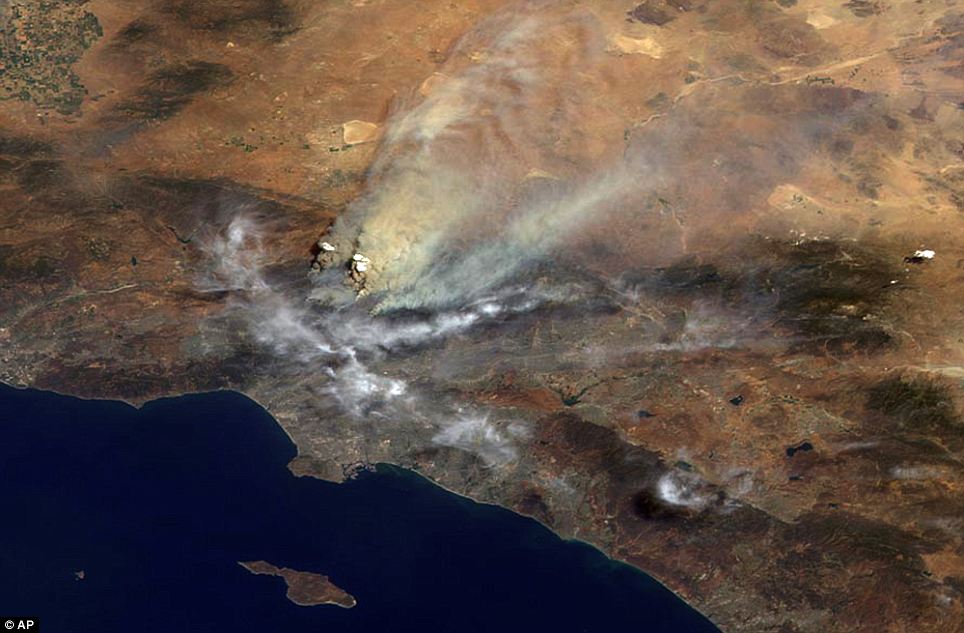
The relations between the destruction of Los Angeles that repeatedly occurred on film had clear grounds to be confused with the fires that ravaged its nearby hills–especially for the inhabitants of the city itself.  The recent 1990 Station Fire arson provoked an interested comparison to the mushroom cloud that would be created by the tonnage of a Hydrogen Bomb.  “Was it Hollywood that provoked the Station Fire, as a means to assert that life must follow its ‘art’?” asked one blogger wrote.

Aug2009_LA_Fire cloud

To be sure, the fire created both a filmic image of destruction, and exploded the calm coherence of a map of the region:


article-1210417-063EFDC5000005DC-431_964x633

News outlets took some pleasure in the perverse congruence of Hollywood representatives and those charge of response, as Arnold Schwarzenegger himself  traced the fire’s effects on a state map as if to contain the disaster that unfolded on TV:


article-1210417-064133B8000005DC-962_964x644

Davis was not only concerned with film-sets, of course.

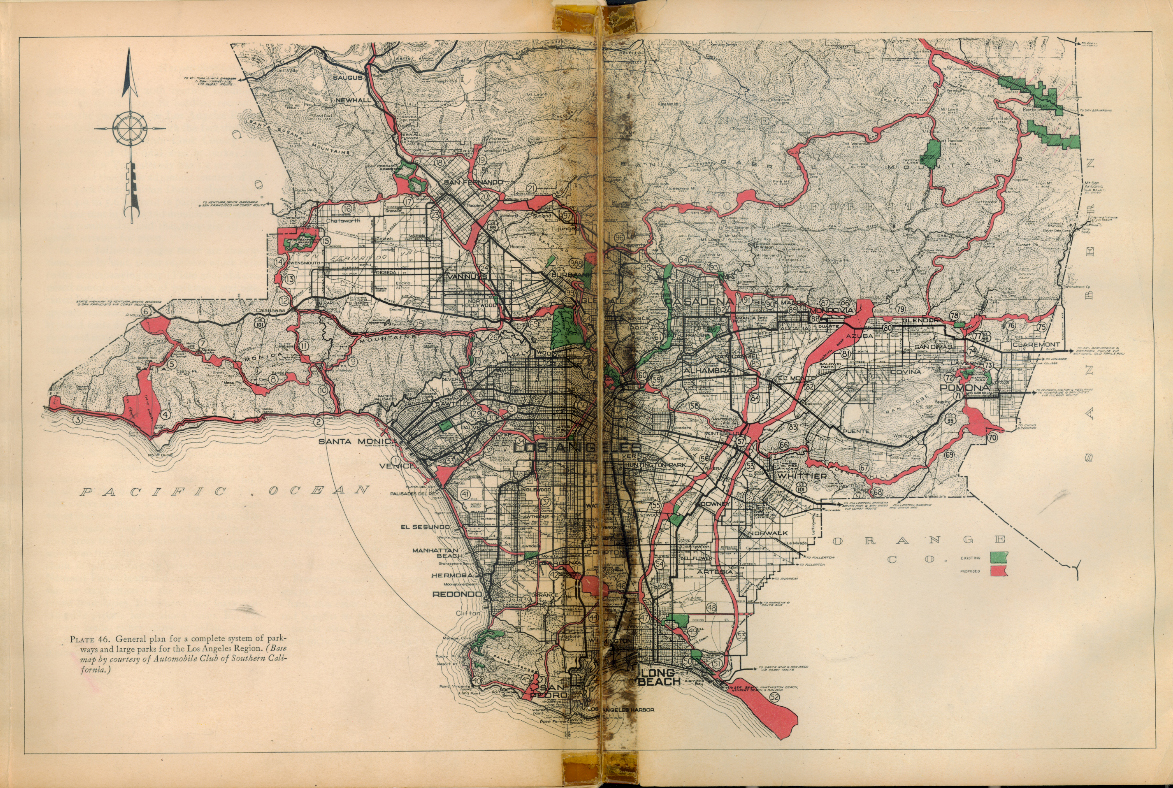
Davis showed how the rise of apocalypses that engulfed LA paralleled a deep historical denial of the ecological destruction perpetuated by the encasing of rivers in concrete and destruction of open spaces revealed in the 1930 Olmsted-Bartholomew Report, “Parks, Playgrounds and Beaches.”  This report, which detailed the effects of rampant urban expansion–and in the 1990s became an icon and emblem for the destruction of LA’s natural environment, and a “lost Eden” irrigated by riverine paths was transformed into a transformation of the Los Angeles river into a freeway–had the odd distinction of being suppressed by the very Chamber of Commerce that had commissioned it to be drawn, so clearly did it represent an image of the city that they city did not want to encourage.

plate46

Something similar is at work in the disorientation created by the implosion of familiar sites and landmarks–and mental maps–in films that localize destruction or map apocalypse for the masses at the multiplex.  Whereas Davis provides an image of a city that relentlessly throws itself into harms way with oblivious denial and a slight shrug, there is a pleasure in watching the familiar destruction of the map compensates for our own fears of disorientation in striking ways.

This is the destruction of a local network, or a lived network, as if to assert the authority with a fatal stroke of an imaginary world that engulfs the viewer in its violence.  The effects are uncanny.  The juxtaposition of “news” and filmic narratives of destruction in the post-9/11 world has been widely noted, as have the precursors of the tragic suicide attacks that killed so many on studio lots and in the megaplex.  The parallel between images of destruction and of the towers’ collapse is chilling–as the common difficulty many had in discriminating the destruction in New York City (and elsewhere) from the familiar images of a disaster film.

Unknown

The rising threshold of shock value of scenes of mega-destruction in many films of the 1990s both contrasted with the relatively quiescent era of the Clinton years, and made it oddly difficult to distinguish fantasies of urban destruction from actual destructive events. There is a broader sense of disorientation to which the recurrent implosion of familiar maps on the multiplex screen reveals–as well as a deflection of anxiety about something as potentially tragic as a terrorist attack.  The implosion of the maps  is worth contemplating in recent films, because it creates something of a parallel universe on screen that oddly offers a promise of orientation on a level of fantasy in its repetition of a global or a micro-apocalypse.  There’s a fairly big prehistory, of course, for the destruction of iconic place-markers, from:

escape-from-new-york

to Los Angeles besieged in war:

Destruction of LA


The implosion of the coherence of place in these pictures suggests the attraction of watching a literal implosion of the known map in both films shortly before the disastrously fatal airplane attacks of 9/11.  And since then, Hollywood seems to have responded by treating the screen as a sort of imploding map of the world on truly phantasmagoric proportions and scale, as the urban canyons created by the iconic Empire State becomes a site of Amazonian appearance, blending nature and culture and undermining our maps:


transformed landmarks

The city itself becomes the prime the battleground for the future and the site of total and utter disorientation to a degree that is itself sublime:
Battle- LA
The most recent Roland Emmerich disaster pic of 2012, rife with conveniently ‘disinformational’ plots that explain global warming by the release of abundant neutrinos by solar flares– rather than any human activity–cryptically and mystically tied to the prediction of a global catastrophe in the Mayan calendar designed to claim box-office victories by a heady mixture of apocalypticism and pseudo-science:  the rise of temperature in the world’s core leads global eminences to save humanity by a commitment to preserve a select 400,000 in new Noah’s Arks in Tibet, as they raise the funds to do so by–you guessed it– allowing the super-rich to buy tickets for just a billion a head. (That’s a fifth of the film’s production cost.)  Los Angeles isn’t just destroyed, but falls with all California into the waters of the Pacific–significantly raising the bar on the films Davis describes–as a destabilizing shift of the crust of the Earth causes a massive 10.9 earthquake of the sort predicted by the hack Charles Hapgood–who has a sort of cameo appearance by video–as tsunamis and volcanic eruptions result in global mayhem on a scale and scope whose imagined perspective on worldly disaster rivals Albrecht Altdorfer’s mapping of an ancient battlegrounds in his 1529 “Battle at Issus“–whose panoramic canvas whose aerial perspective of near-global purview the movie’s poster both recalls and recreates to entice potential viewers into theaters to watch.
2012_Poster
The Battle of Alexander at Issus. Oil painting by the German artist Albrecht Altdorfer (1480-1538). 1529.
Of course, the scale is biblical in proportion.  But who cannot deny that the difficulty of mapping current crises from global warming to the war on terror has not created a veritable deluge of films that challenge one to grasp their mapping of world-collapse in ways that seek to rival and upstage contemporary apocalyptic threats?
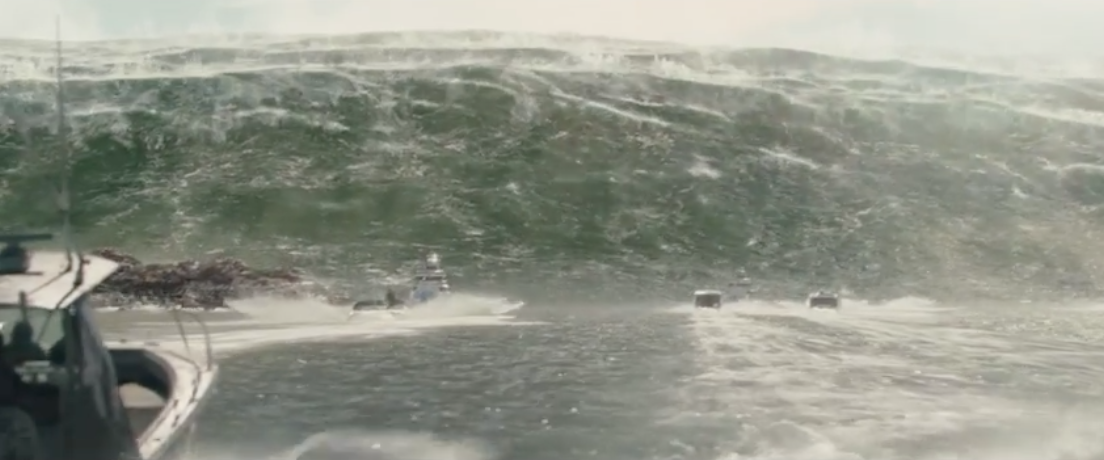
The 2015 film “San Andreas” proposes we watch the opening of the fault line in the landscape opens, and we watch the obliteration of the familiar landscape of Los Angeles from the elevated view of a safety helicopter, as, further north, tsunamis arrive in the San Francisco Bay and obliterate the heavily trafficked Golden Gate Bridge:
San Andreas #2
San Adreas #1
Andreas #4
Amid “megatsunamis” that send aircraft carriers to the White House lawn–killing the American president–even as the eruption of the Yellowstone Caldera covers most of the United States and Las Vegas with volcanic ash and debris, and Hawaii basically disappears as volcanos explode, the map is shifted beneath one’s feet, as Africa rises in elevation and South Africa–that lovely place–and the Cape of Good Hope become the site that the ark carrying lucky few lands.  The world map is destroyed in shreds, even as the heroes search for a lost map that may promise redemption, until the colonialist capital of Capetown is finally resettled, and a hope of harmony restored.  Is this a restoration of the colonialist map of a white Cape?
A global pandemic provides the background or only context for the 2014 version of “The Last Ship,” which revisits a tale of post-nuclear holocaust:  the earlier plot focussed on two submarines, one American and one Soviet, that travel from the Barents sea and Arctic Circle to tour a world whose sites are destroyed or covered by dense clouds of radioactive smoke, from London to Gibraltar, through the lifeless Mediterranean and through the Suez Canal until they make it to an uncontaminated French Polynesia after having braved a nuclear winter in the Indian Ocean until they are forced, as even that island is destroyed, to McMurdo Station to find new homes.  In contrast to the global tour of the “Nathan James” after it fires its last nuclear strike on ICBM silos, global pandemic has rendered the world uninhabitable in the TNT “Last Ship” (2014):  video communications to the ship stranded in Antarctica for months without contact inform its captain of the death of the president and vice-president and thousands more as a virus has made its own world tour from Cairo, the site of its ininitial outbreak, to Russia without government, London burning, and leaving most dead.  Filled with aerial footage scanning Antarctica, imprecations of global duty, blazing guns and more, Michael Bay’s TNT “post-apocalyptic action drama” centers on the paleomicrobiologist conveniently located on the ship as she works to manufacture a virus on the last ship floating, the known world long gone.
The world doesn’t explode so much as our map of it implodes.  Without any map for the future, there is a sense that the world is itself gone: the map no longer covers up the territory, or obscures it, but implodes with the world’s expanse:  the metaphysical beauty is the imploding map.  The recuperative role of the medium of film can also, of course, provide a comfortable context in which to relive the lost in a fantasia of recurrence or re-centering, where we can inhabit the very bodies that themselves stare at the twin towers’ collapse:
Unknown-1


There’s a familiar melancholia in Nicolas Cage’s wistfully longing eyes that once more brim with stoic regret.  He might be recalling an era of films with more coherent narratives, or a more ground-bound perspective on human events that he seems resignened to accept as a thing of the past.

2 Comments

Filed under 9/11, apocalypses on film, mapping total war

Aquifers/Monocrops

Recent news of the quite devastating dwindling of the High Plains aquifers sent me back to how William Rankin charted the uneven distribution of monocrops in the United States.   For the authority with which maps render a depletion of High Plains aquifers as an “underground pool drying up”–as if it were a record of nature, intensified by global warming, echoed in the discussion of a dwindling or disappearance by the time  the aquifer that runs from the sands of Wyoming reaches Kansas and the Texas panhandle, leaving farms without the groundwater on which their livelihood depends.  Although long characteristic of the nation’s landscape, the underground water that feeds the high plains long taken for granted to dry up–in ways that challenge mapping tools or a reliance on cartographical practices as tools explication.  How much this has been intensified by increasing temperatures of summer months, maps reveal the extent to which the depletion of landwater has been exacerbated by agribusiness and the dramatic unsustainability of irrigating subsidized crops from an aquifer that is, due to evaporation, rarely recharged.

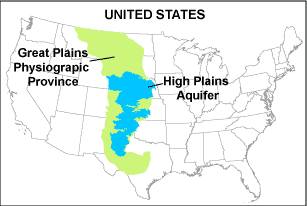
Most maps of aquifers’ depletion effectively minimize the impact of patterns of human inhabitation on the plains–if only because they don’t register how nature no longer exists as an autonomous category, or how all maps represent the human shaping of a “natural” record.  The authority of the map erases the effects of inhabitation, or the very agricultural practices that much of the same article describes of an intensification of irrigation across the region, uniformly distributed without regard to the level of the water-table.  They naturalize the presence of water in the ground, as, most simply, by coloring the aquifer’s expanse by a uniform blue, as if to render a plentiful underwater sea readily accessed by drill.


High Plains Aquifer


The shifting water-levels of the irrigation have however shifted the availability of this hidden underground reserve challenge us to use map to expressing the dynamics of its depletion.  Use of the Northern Great Plains aquifer system for irrigation has long consumed over half of underground aquifers:  irrigation of lands in Wyoming and Montana regularly feeds the aquifer system itself, as excess irrigation feeds the aquifer itself in those states.  Yet water-level monitoring in the High Plains aquifer led to increasing declines in its level from the start of its intensive irrigation from 1950, and has most recently led to the failed search for new wells in its southernmost reaches.

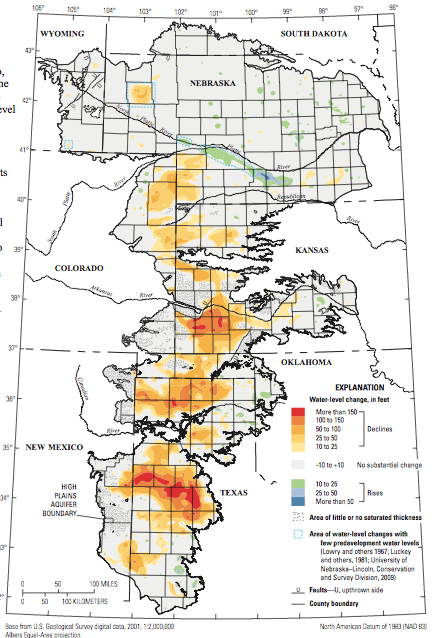
The long-term decline of water levels have been concentrated further south in its almost 112 million acres for at least five years.  The mapping of water-levels revealed a decline of almost 100 feet by 1980, when the irrigated acreage used for agriculture most dramatically grew from just over 2 million acres to 13.7 million.  In the high plains, unlike the great plains, the aquifer itself was rarely restored with water withdrawn from pumping and wells, and an expansion of the demand for water from agrarian land-use led to a single-headed search for extraction even if little water was to be had.  The gradual draining of the southernmost aquifer was in a sense long known:


Water Level Declines

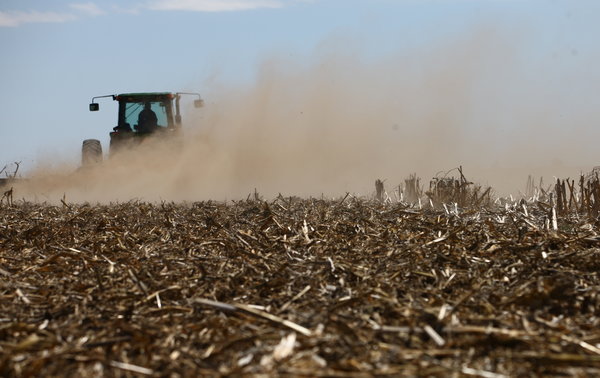
The recent chronicling of the transformation of fertile plains into dust by the New York Times stands at the end of a depletion already mapped by 2009:  if the compelling article painted a somewhat passive picture of the depletion of the aquifer that has so shaped the American landscape, the problem of mapping water and crops lay in the implicit tone of a naturalization of water-loss–whose effects nicely intersect with fears for the effects of global-warming–whose ‘news’ may exist in its delayed economic impact on farming, rather than on the absence of warning signs.   When Ashley Yost told the reporter Michael Wines “I’ve raised 294 bushels of corn an acre there before, with water and the Lord’s help,” he grouped water with the divine assistance, as if it didn’t come out of the ground.

The combination of landscape images of the effects of a parching of agricultural fields with a set of regional maps threaten to naturalize the changing hight plains landscape and minimize the ways in which all maps pose arguments–as much as Matthew Staver’s striking image of arid corn fields–because they fail to register the dwindling as the effect of their practices of inhabitation and a changed dynamic of water-use.

PLAINS-articleLarge-v2Matthew Staver

The recent drop of the aquifer of some four and a quarter feet in Kansas from 2010-11 is a call for alarm not only as a “lack of water”; the drying up of landwater during the summer months has led to a dramatic decline in the amount of corn cultivated in that state that reflects a failure of agrarian planning and a concentrating of water-resources in monocrops–as much as the depletion of an existing water reserve in a uniform fashion over time, accompanied by an expansion of water-hungry crops such as corn, beside others like wheat, in the region–not to mention the raising of livestock on water pumped from aquifers.  The destructive intensity of the drainage of water that never returns to the aquifers lying deep below rest on processes of extraction and irrigation to a degree that can never be replenished never lay in the individual farmer.

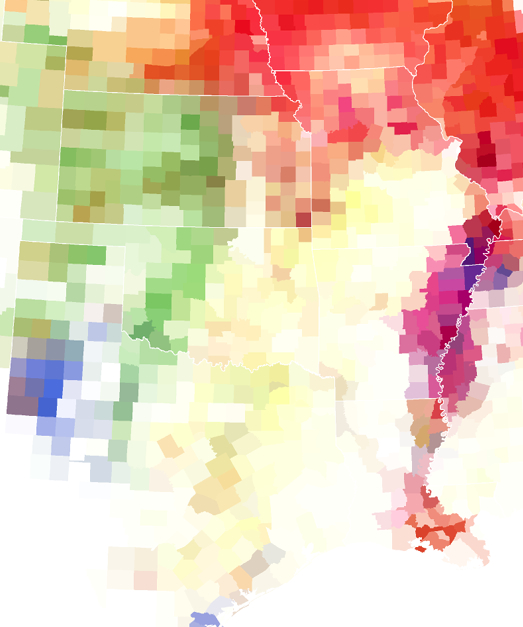
I’ve discussed Rankin’s maps that speculate on the consequences of the uneven distribution of crops and land-use in an earlier post.   The correspondence of that aquifer to large corn monocrops they’ve been used to supply is striking when one maps the expansion of corn as a subsidized crop across the nation.  What amounts to a submerged sea and had long seemed an unending resource of underground feeding supply has finally begun to exhaust itself–with disastrous consequences for farming communities who depended on its supply as if were a cash cow to irrigate less than fertile lands in the former dust bowl.   Corn monoculture was facilitated and undergirded by the unsustainable illusion of irrational abundance of an unending supply of underground springs.

Rankin's Map of Crops

Although the patchwork of intense corn-farming may not be dominant in relation to wheat (shades of green) or silage (yellow), the intense patchwork of corn-cultivation in an area not particularly rich in water-sources suggests the ill-effects of agricultural subsidies on the distribution of natural resources.

patchwork of tan

The tan patchwork reveals a depletion of landwater in the very region a region that the New York Times singled out as revealing the adverse effects a dwindling aquifer had on farmers’ productivity.  The ill-effects of sustained drilling in vain attempts to force underground water to rise in pumps range from the depletion of the region’s water-level to the survival of crops.  But its maps conceal a story of the depletion of resources across the plains with the increased reliance on pumps.  The difficulty to pump water grew further south extract demand grew to feed central-pivot irrigators to drench crop lands so as to enable them to remain emerald green and fertile in spring and arid summer months, at the very time that the intense sun dries them, the terrain maps present the present consequences of irrigation practices as the new nature of the plains.

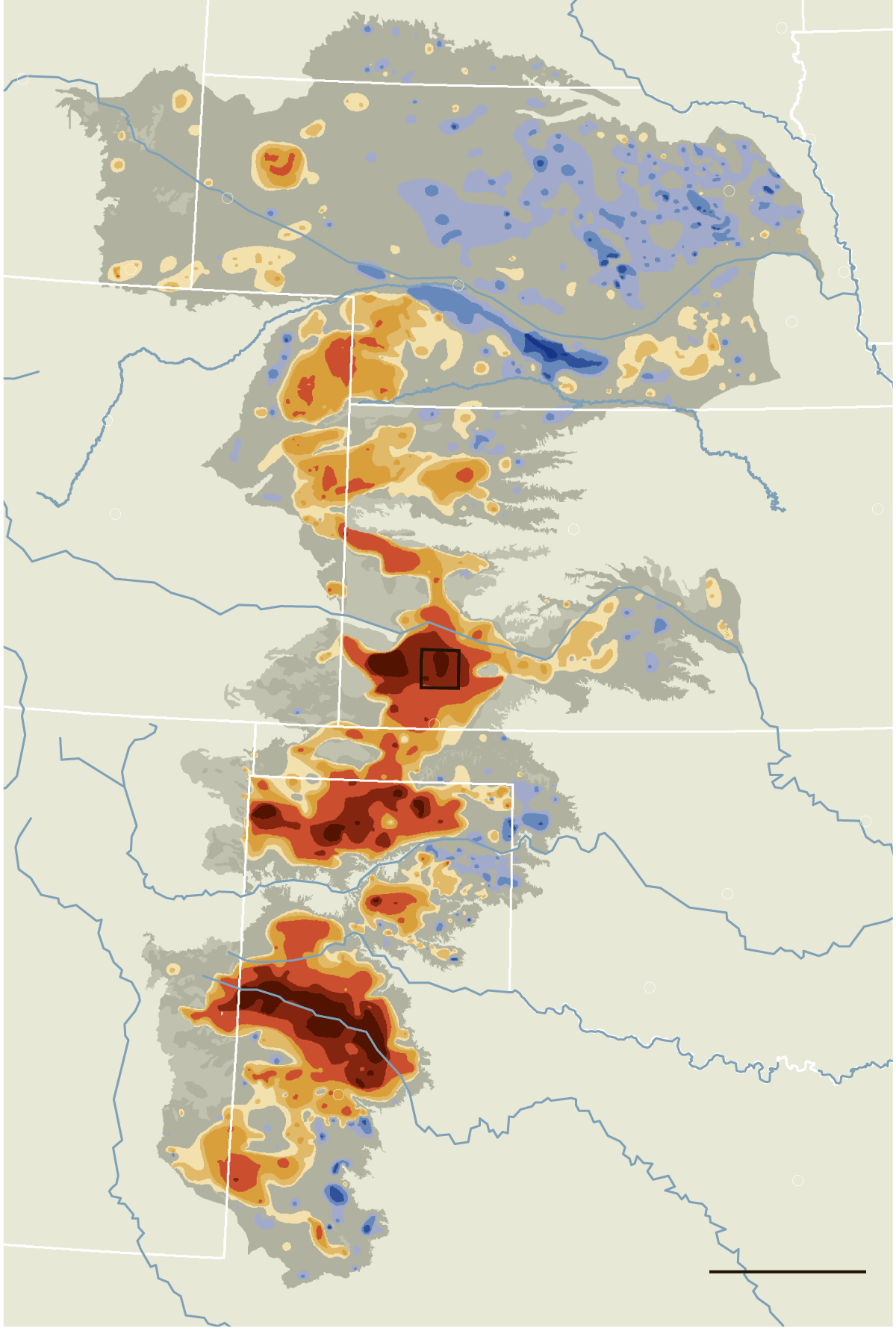
The map that shows a “drying up” of hotspots on the paths of underground aquifers is a map of the future of US agriculture.  But the dramatic dark-spots in the area of north Texas and Kansas, the edges of the underground aquifer and the areas of new corn farming, demand to be further unpacked.


Hot-Spots of Aquifers


Indeed, the extent to which the cultivation of corn as a dominant monocrop maps onto the depletion of the once-plentiful national aquifers in Midwestern states recently in the news, as the regions whose agrarian geography was defined by big center-pivot irrigators–temples to the belief of infinite water-extraction and the plenty of crops–have been able only   to water circles of diminished radii as the aquifer has declined. Yet if “up to a fifth of the irrigated farmland along a 100-mile swath of the aquifer has already gone dry” at the same time as summer temperatures have risen, we need to accept how much of it was forcibly extracted by men hungry for cash.


Htospots from Kansas to Texas


The maps of this water-depletion reveal the need for revising the expectancy that regions of Nebraska, Kansas, Oklahoma, and Texas that occupy the High Plains Aquifer of North America.  What amounts to an submerged sea and had long seemed an unending resource of underground feeding supply has finally begun to exhaust itself with disastrous consequences for farming communities who depended on its supply as if were a sort of cash cow that could be used to irrigate already fertile lands.  The question is in part how such agricultural practices can change.

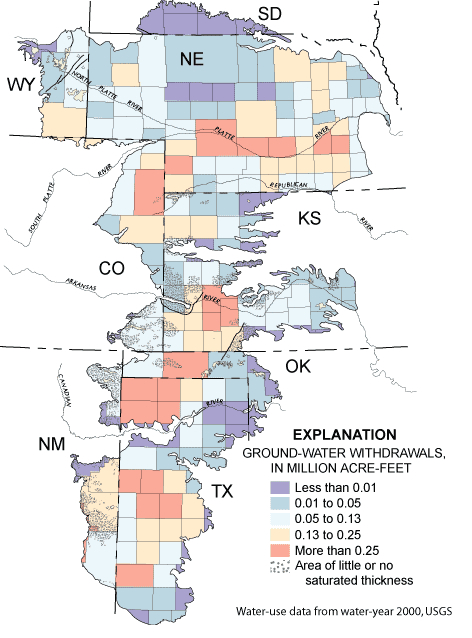
The correspondence between corn and landwater gets scarier when one notes the  intensity with which aquifers had begun to be drained by ground-water withdrawals as early as 2000 to nourish the spread of thirsty crops such as corn that have led to increasing reliance on unwarranted extracting of groundwater.
Ground-Water Withdrawals 2000


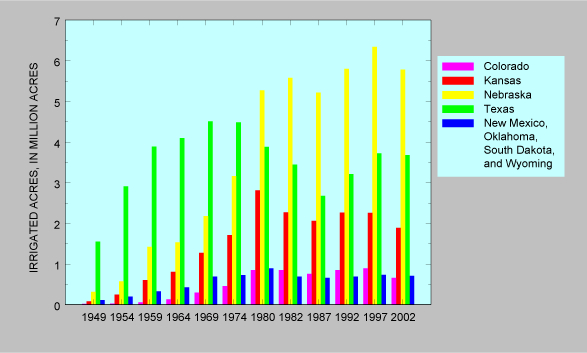
The dramatic rise of irrigated acreage in this region maps onto the epicenter of a devastating dwindling of the plenty of aquifers in Texas, Nebraska and Kansas–and onto the period corn was subsidized:


Irrigated Acrage


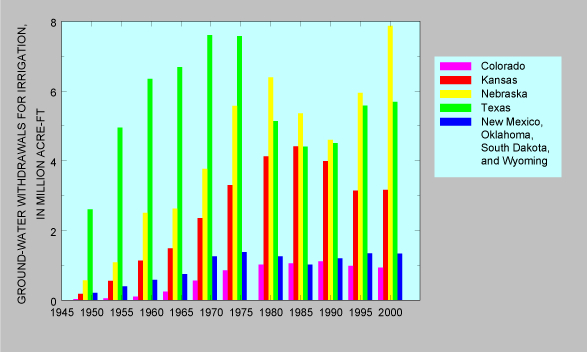
The steady rise of ground-water withdrawals for irrigation was particularly dramatic in the 1990s for Texas and Nebraska, and the decline in regions like Kansas may have already been precipitated by a draining, as much as a drying up of, aquifers:


Ground-Water Withrdrawls for Irrigation

1 Comment

Filed under agribusiness, agricultural subsidies, agriculture in america, groundwater, High Plains Aquifers, mapping ground-water withdrawals, Mapping Water Depletion, monocrops, monoculture, water table

Java La Grande

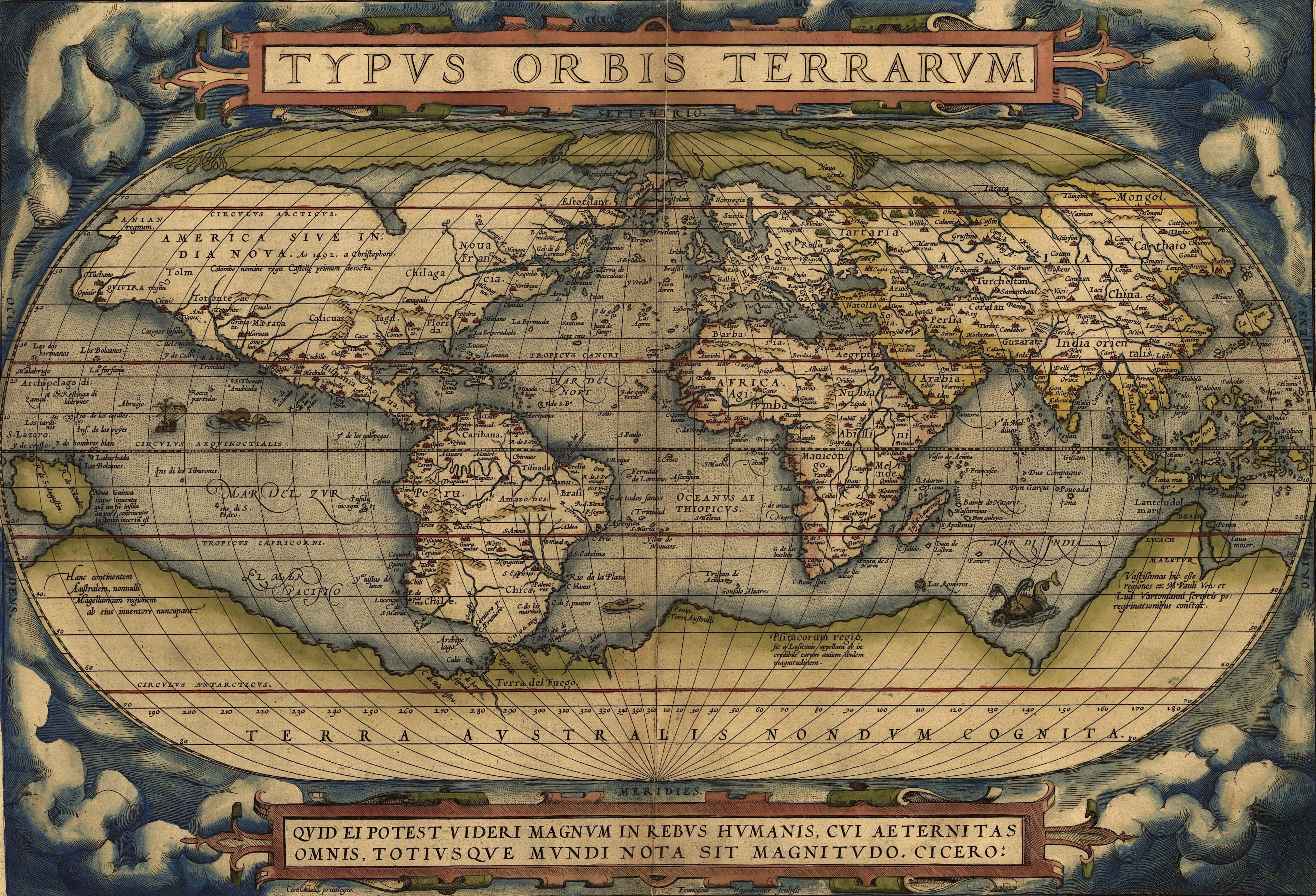
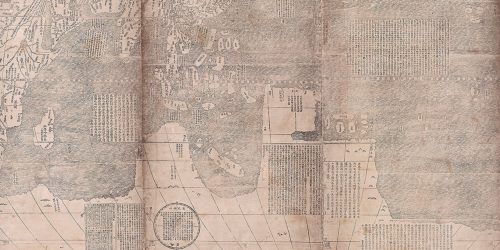
The map “Java La Grande,” an imagined continent that invited close inspection from viewers, gives new meaning to the assertion that the map is the territory.  For although this territory never existed, it was mapped: the medieval construction of the antipodes, a mode to balance the continents, was an artifact of early modern European cartography of considerable duration and lasting power.  When Matteo Ricci mapped the world’s regions in 1607 for his Chinese hosts, his copy of the Ortelian map included a large discussion of “Guinea” as a place not studied or known well by Europeans, and perhaps an independent island or attached to the southern pole–albeit one that was not known to be inhabited, and with which little if any contact had been made.  In this sense, Guinea remained an outlier in the age of discoveries, and a somewhat rare blank spot on Ricci’s global map.


Ricci SE Asia.png


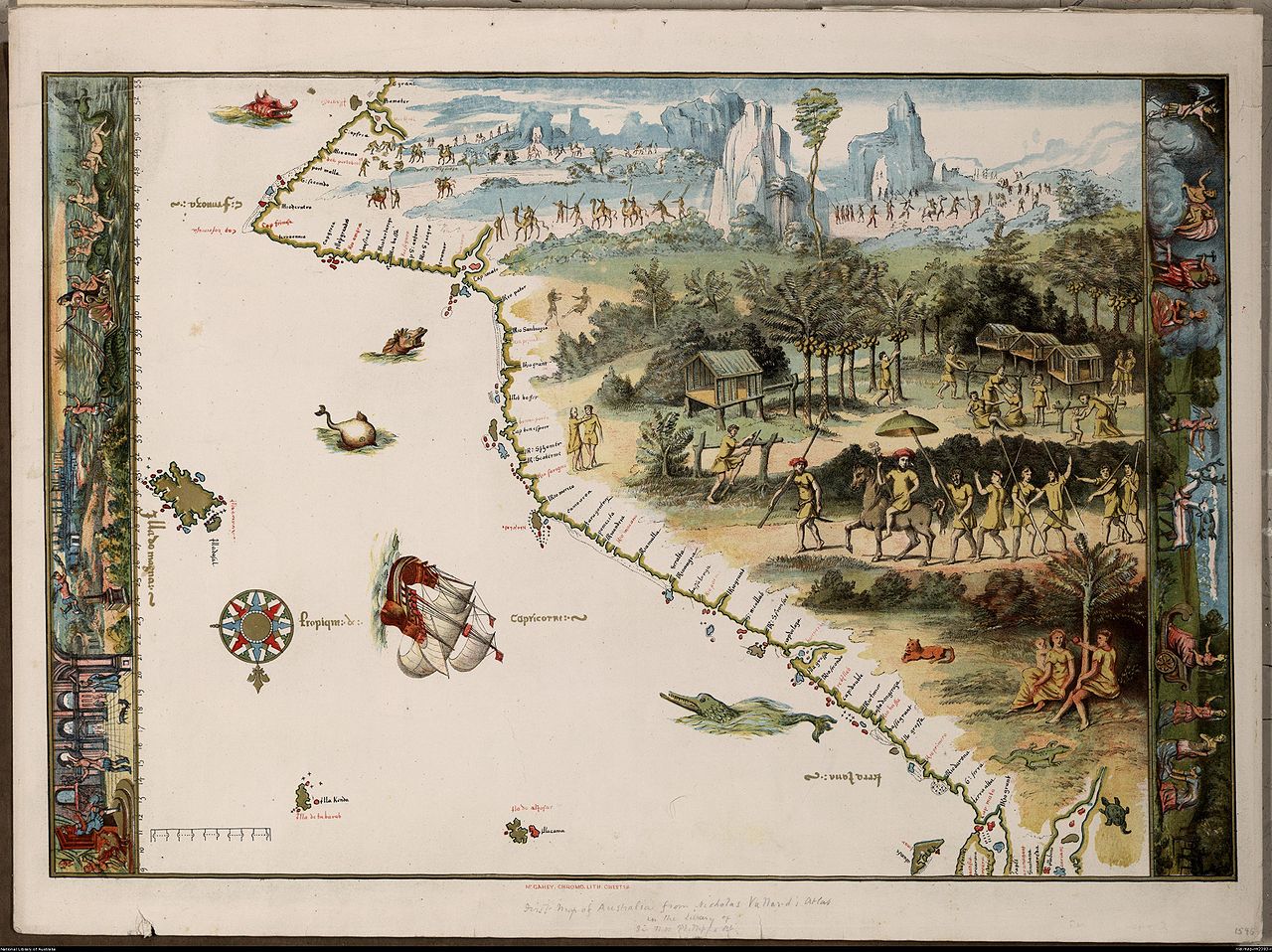
As an artifact with an esteemed cartographical lineage, the image of the continental landmass continued to be mapped into existence by the mid-nineteenth century.  But its appearance in the below chromolithograph of a Renaissance map from the library of baronet Sir Thomas Philips was declared the first map ever recorded of nothing less than the very continent of Australia, as ostensibly witnessed by the Portuguese sailors in the pristine state of nature in which they had allegedly first discovered it.  The map was prized as an image of initial discovery.


1280px-Australia_first_map


The anonymous artist-cartographer recorded the recession of space in this map, which as it recedes its inhabitants are registered in brownish tracery, foregrounded the idyllic life of this entirely unknown land.  You get the idea of arriving in a region taken as Australia that was the entrance to a landscape of untold wonders in the map of “Java La Grande” designed for Nicolas Vallard’s nautical atlas of 1547 in Dieppe, a center for the diffusion of Portuguese nautical charts for an elite audience of European nobility, reproduced in this 1856 facsimile now stored among the jewels of the Australian National Library.

The pictorial landscape chart was a luxury embellishment of the sorts of rutters that were drawn with artists of local topography.  The material object was prized and promoted by Phillips as a record of the first encounter with the territory of Australia, reproduced with such painstaking care in the mid-nineteenth century  as a chromolithograph from the first baronet’s library when he tried to disperse the Vallard atlas and other early modern books to the British Library, inspiring the reproduction of the map, which he mis-titled “The First Map of Australia,” to promote the value of his collection   The map made for the Vallard atlas by an unknown painter was probably valued because it seems to record an image of Portuguese encounter with the indigenous inhabitants of Australia.  As part of the corpus of Dieppe charts that were, unlike earlier nautical maps, pictorial syntheses Portuguese discoveries of almost ethnographic qualitative richness as depictions of inhabitants for elite audiences, the image has provided a touchstone of a vanished native culture that is particularly powerful as an imagined precursor of the discovery of Australia, valued as an image of imagined contact.  The Vallard map possesses the distinctively attractive qualitative lushness peculiar even to the Dieppe school of which it forms part.

The identification of Australia with the mythical “Java La Grande” is not entirely rooted in geographic fancy.  Java La Grande was described by Marco Polo as the largest island in the world–but reflected some recognition of this unknown landmass that extended to Antarctica, and recurs in the Dieppe maps as a cosmographical idée fixe as not an island, but terra firma:  at the same time as the current-Java was described by geographers of the 1540s, the Dieppe school identified La Grande Jave as an extension of the Antarctic Terra Australis, and it was taken as an early evidence of the southern continent’s early discovery.

The map became taken as the territory.  And so why not preserve this map as a treasure of the collections of the Australian National Library, even if it is a nineteenth-century copy–and quite a faithful one–of a map that represented quite a different imagined land?


350px-Australia_first_map

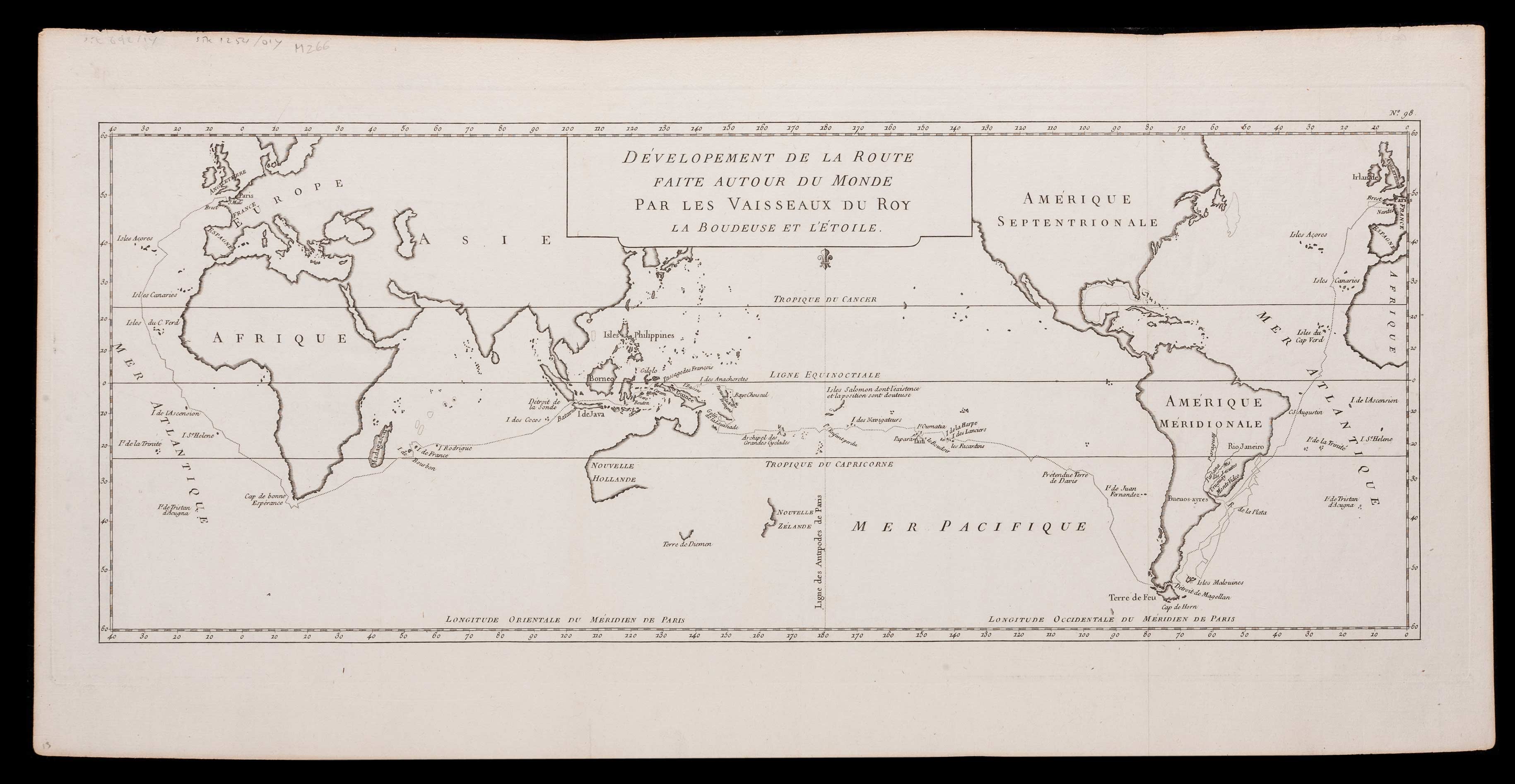
Early identified as the first map made of the continent, this map provided a list of coastal ports that an artist proceeded to fill in with imagined views of inhabitants advancing as if to greet newly arriving visitors with arms literally open in welcoming signs, if not in a ritual procession.  The intensity of play of imagination is evident in contrast to a later 1777 nautical map showing two ships’ circumnavigation of the world under the command of Antoine de Bougainville, whose cartographer constrained himself to parts of the Eastern coast observed with sufficient detail to establish for readers, allowing far more local detail to the as yet unsettled continent, and confined himself to the better-known shorelines of its coast:

CBA-2030-full


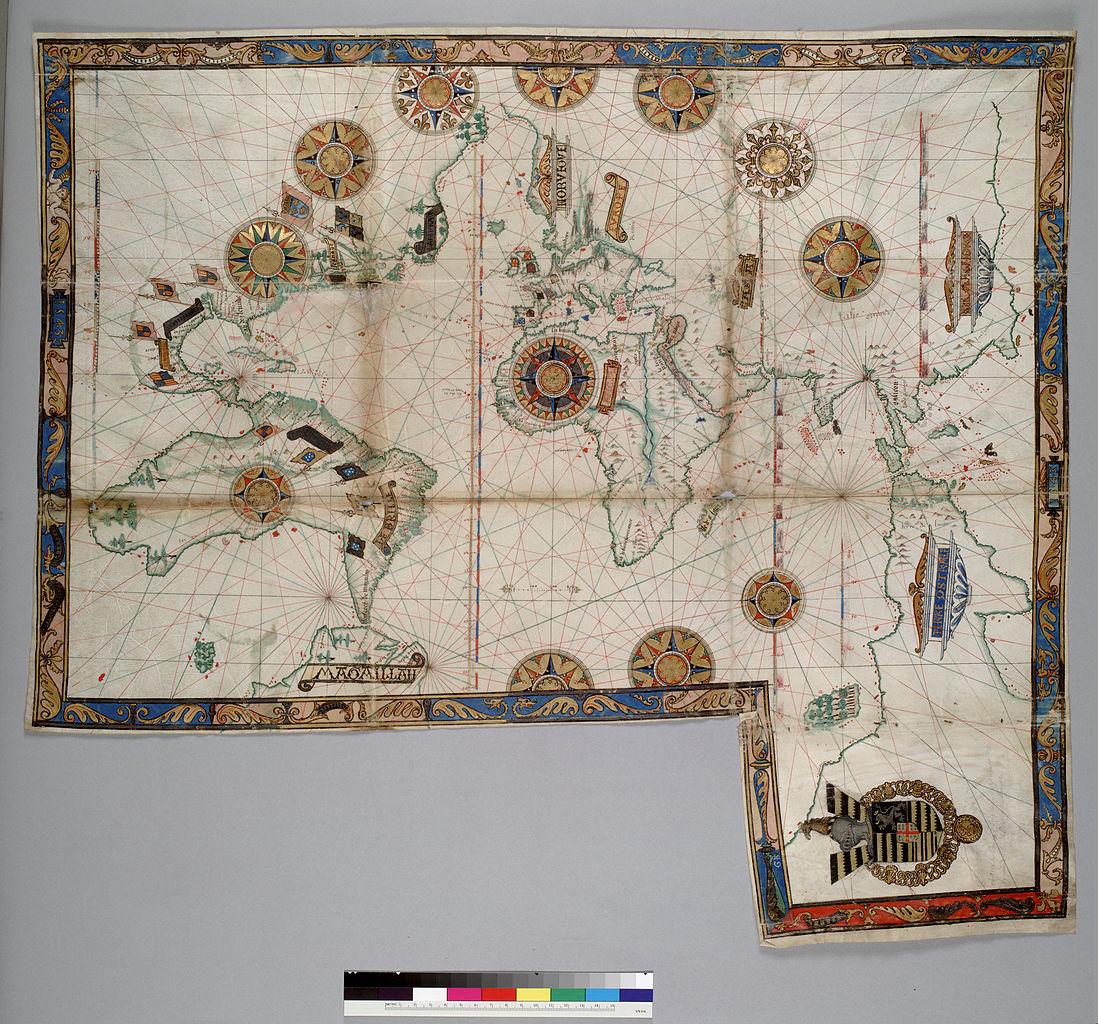
Yet what was later prized as the “first map of Australia” is  distinct from a roughly contemporary 1543 chart by Guillaume Brouscon of the same school in Dieppe, who synthesized information from prized Portuguese charts to a new audience of landlocked European nobles.  This earlier map devoted a considerable space to “Java La Grande,”  extending the rectangular format of the engraved global projections later standardized after their printing by Mercator and Ortelius, if already adopted by humanist geographers, and offering far more detailed depictions of the settled interior than nautical charts that confine themselves to coastal towns.  The almost ornamental multiplication of compass roses that proliferate like heraldic crests on this map suggest its ornamental nature in a corpus of maps.

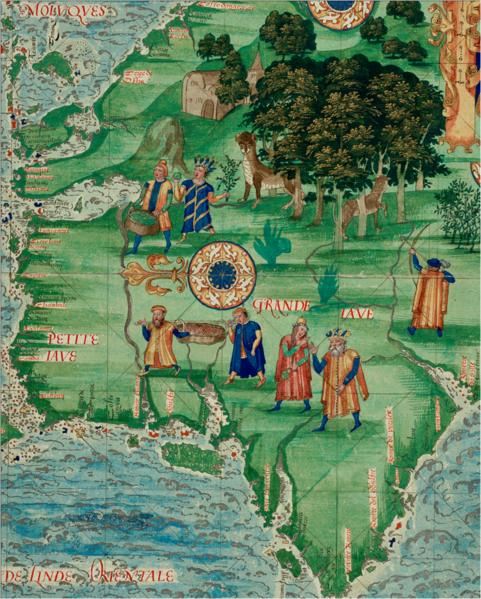
A fair amount of extension of the topos of cartographical invention or the mediation of new discoveries that animated these excited atlases of the late 1540s in Dieppe are reflected the map of Java le Grand among the 56 maps that the nautical sailor and self-styled cosmographer Guillaume le Testu included in his Comosgraphie Universelle, selon les Navigateurs, tant anciens que modernes.  The work’s comprehensive claims derived from its use of a range of Spanish and Portuguese charts together with maps of his own design that synthesized recent maps of the Americas:


481px-Le_Testu_GRANDE_JAVE


He readily presented this map as rife with cartographical invention, as well as following cartographical conventions, as if suggesting the frequent embellishment of persuasive or recognizable detail in maps, more than the license his own achievements in mapping much of the Americas may have merited:  “what I have marked and depicted is only by imagination, and I have not noted or remarked on any of the commodities or incommodities of the place, nor its mountains, rivers or other things; for there has never yet been any man who has made a certain discovery of it.”  The absence of “certain discovery” is an odd juxtaposition with his own discoveries, and the admission of the absence of such “certain discovery ” led to a land that was entitled to be created by the imagination.

The imagined land’s expanse was documented as well in nautical maps limited to shorelines, offering far less qualitative local details than the expanse of its coast, but suggesting in an enticing fashion its expanse, and multiplying elegant compass-roses as if for an excuse to include more gold leaf, as a sophisticated ornamental boundary of decorative motifs:


1098px-Guillaume_Brouscon._World_chart,_which_includes_America_and_a_large_Terra_Java_(Australia)._HM_46._PORTOLAN_ATLAS_and_NAUTICAL_ALMANAC._France,_1543

These abundant cartographical imagery suggested the fascination of imagining how space extended far beyond a situated eye, and a sort of key to processing the extent of that dramatically expanded spatial expanse of the inhabited world.  But for Brouscon, as for le Testu, Java was both a continent of sorts, that extended to the pole, and needed to be accommodated by an extra flap of paper to be contained, but an uninhabited or at least unknown place in the “Terra Austral,” jutting up to Indonesia to reflect geographic tradition and, perhaps, to balance the landmasses distributed elsewhere on the chart:
Java in Brouscon's Map
The addition of far greater detail and qualitative content in the Vallard map developed the notion of the materiality of the map in the Dieppe school.  If we are struck most by its interior, the coastline of Java in the Vallard map suggest a detailed attentiveness to local toponymy, derived from Portuguese sources, of more specific scope, despite the lush detail of its interior, and a playful alteration of inks of different colors to add variety to its form:
java's Coastlines
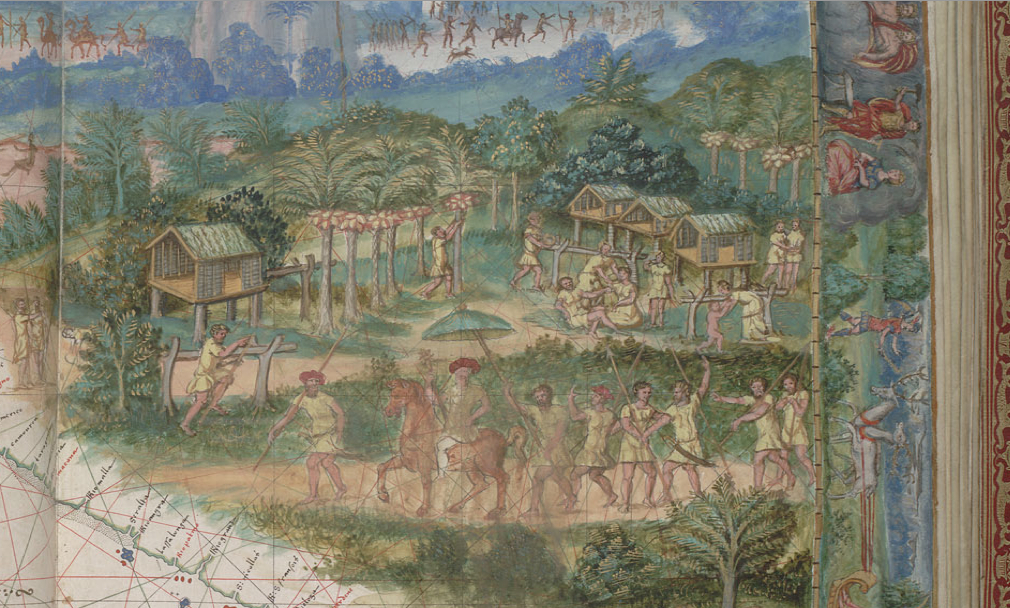
The considerable local detail depicting something like the discovery of a pre-Adamic life is something of a counterpart to that expansion of the inhabited expanse in early world maps:   the clothes of its inhabitants, cast in somewhat neo-Orientalist garb as following their red-turbaned leader to greet arriving men, are paired with curious dwellings, customs, and styles of work, as well as a uniquely local bestiary and vegetation, as   well as different customs of social life: two figures on the left of this scene almost seem foreign observers, describing what they see:
Dancing Inhabitants.Vaillard


The narwhale rising from the waters just off the coast, shown without regard for the scale of islands or inlets on the coast, paired with a resting bobcat or lynx.  This image of the Eastern coast of Australia is only slightly embellished from Vallard’s original.

It’s been recently suggested that the inventive maps of the Dieppe school fabricated the entire continent out of geographic legends to evoke a potential land for colonization by the French monarch, as in this earlier 1566 Desliens world-map.  Indeed, these deluxe manuscripts reflect the broader interest of the materializing of wealth on the map, and, on the surface, seem to cast Java La Grande as something of the potential equivalent of what the Spaniards found in the Americas.


Nicolas_Desliens_ World Map 1566) with Java


The notion of this fabrication of continent seems absurd, but had confirmation in geographic theory.  Java La Grande is projected as a land of potential conquest and wealth, and is a survival of medieval written geographies that was transposed to a recognizably modern cartographical form, if it antedated the imagined expansive island of Taprobana, identified with Madagascar but often shown as a land of wealth, and in ways moved this target of European interest further East toward the Spice Islands and Indonesia.

The exquisitely tangible nature of the contents of the Vallard map may give some confirmation to its invention.  The upper register of this first image of the original Vallard atlas, now in the Huntington library, showed the region’s aboriginal inhabitants in a monochrome hues of striking similarity to a cave-painting as proud hunters bearing spears:


Dieppe atlas origianl


The image now held in Canberra is a striking copy of this image of the inhabitants of Java le Grande, which featured its  inhabitants in a procession across the newly mapped land:


horseback procession in Java on horseback


The placement of  initial folio perhaps as it was the most pressing communication of cartographical news–pays particular attention to the forms of habitation in Java, and the houses in which the inhabitants live and the palm-nuts on which they live:  as if to embody the information displayed in disembodied form in later world map projections:  in the years before Mercator’s Theatrum orbis terrarum, nautical charts concretized viewers’ material relation to spatial particularity.


First map Vallard atlas


The map offers something like a luxurious window into the newly discovered land for viewers to contemplate in ways that simple terrestrial projections did not allow.

The imagined continent of luxury and untold riches, filled with nutmeg and cloves as well as “idolatrous inhabitants,” made its way onto the globe by 1583, if somewhat assimilated to Antarctica:


Globe_terrestre_de_Jacques_Vau_de_Claye_(1583)


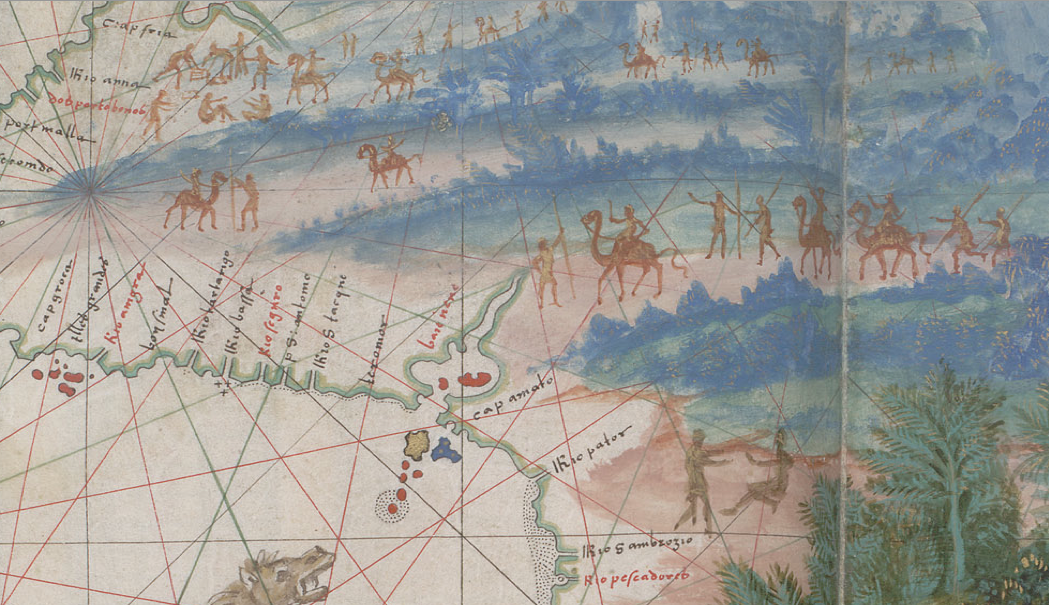
This might explain the staying power of nautical charts, based on observational practices of sailors and possessing a clearer pedigree as transcriptions of space, into the seventeenth century.  At the same time as material goods were arriving in Europe from west Africa and southeast Asia, maps provided something of a spatial catalogue to understand their arrival and place them somewhere in a lived topography, as much as they offered tools of orientation.  Java La Grande was attractive as something of an evidence of the inhabitation of a region later identified with Australia, before the arrival of Captain Cook, in ways that depicted the inhabitants that occupied its expanse in something of a romantic light.


Add. 7085, f. 1

4 Comments

Filed under Australia, Java La Grande, La Grande Jave, Nautical Charts, rutters

Mapping a World We Have Lost

Our way of moving through space determine the nature of our maps, and in a globalized world, it is both focussing and challenging to think about old ways of occupying and moving through or across space.  This map by a Venetian (Istrian) admiral who designed nautical charts, Pietro Coppo, incorporated the popular genre of “island books” to suggest the infinite number of places that one could visit by ship on the edges of the world–and the unknown continent of the Americas peek out from one edge–and the range of Mediterranean and west African ports to be reached by sea.

Coppo World Map

The nautical chart reveals a sense of the motion across waters to new lands, but I want to focus on how railway maps reveal the accessibility of space because they suggest a world we have lost in which the accessibility of space and routes of travel are rendered like a public good, even if for commercial ends.

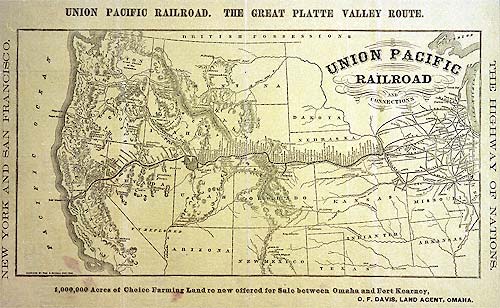
Railways defined, in ways that highways later came to do, a new sense of national space like “the Highway of Nations,” because they graphically charted–much in the manner that this 1869 map of the transcontinental line from New York to San Francisco, a new way of moving through space.


map-c1869-transcon-1


The single thread of a line that reaches across the continent, names of stops stacked perpendicularly to its course, much as the names of ports in the nautical chart, the railroad’s path provides a metric by which terrestrial expanse was traversed.

The map charts a model for moving across an almost unknown expanse for rail-travelers, past an area defined only by a loosely understood hydrographic web.  It was, to be sure, replaced by the highway maps that provide individualized modes of transcontinental travel focussed on one destination.


800px-LH-Map-75

Almost a hundred years after the engraving of the Union Pacific Railroad as a network that linked the nation, and just before the issuance of the infamous 1961 “Beeching Report” addressed “The Reshaping of British Railways” by setting out to prune the branch and secondary lines that received limited traffic in Britain’s national rail system, there existed a network of timetabled traffic linked an astounding number of cities and towns to provide access across the nation’s expanse:


BR1961c

The cartographer’s pride of this map seems evident and on display, and it depicts an extent of lain railroad track unthinkable in the infrastructure of the twenty-first century.  Take, for example, the detail of the network of communications created between Aberdeen, Edinburgh, and Glasgow, before decimation by the folks who tried to tabulate the economics of rail use in terms of passenger-use per ride:

Glasgow, Edinburgh, Aberdeen

If Coppo’s world map offers a somewhat quaint rendering of the Americas that peek into one edge of a cosmos reminiscent of a medieval view of infinite islands ringing an habitable world, the railway map is a map of spatial access for all as remote, in those days before the denationalization of transport.

2 Comments

Filed under Beeching Report, British Railways, isolari, Pietro Coppo, Union Pacific Railroad