Category Archives: border barriers

Dropping Dozens of Bunker-Buster Bombs in Beirut

A pillar of orange smoke rose over Dahiyeh, outside of Beirut, the site of Sayyed Hassan Nasrallah’s death, on the night of September 27, creating a crater some twenty feet deep. As local residents flooded shelters in downtown Beirut from the southern suburb, the intense bombing illuminated the night sky an extreme show of force that Israeli Air Force knew no boundaries in the control it exercised to defend its borders across the Middle East. Dozens of precision-guided bombs that enetered four high rises were designed to penetrate heavily fortified bunkers or caves with a thirty five meter radius; the bombs exploded at time delay after entrance, destroying the four buildings with a force three times of bombs dropped by United States in the Iraq War. The headquarters Hezbollah used to coordinate military responses since October 8, 2023 was reduced to a fifty meter deep crater as large as an entire city block in Beirut’s southern suburb, erasing its presence.

The airstrike that killed Nusrallah together with seven highly ranking Hezbollah commanders and officials from the powerful group sought to paralyze the deep commitment to support for Hamas on Israel’s northern border, and the increased flare-ups along the occupied Golan Heights. The massive explosion of dozens of bunker-buster bombs–designed for fortified compounds, more than residential settlements–itself mapped the overlap between militants and civilian residences that Israel had long argued non-state actors had taken advantage, using communities as human shields, and has led to the blurring of so-called “safe zones” that have so tragically become sites for the massacring of innocent civilians with a regularity that is truly hard to stomach, that has provoked global indignation, which the airstrike against Nusrallah–followed by killing Hamas leader Yahya Sinwar after he was encountered in a civilian zone in Rafah, a city on the Gaza Strip’s border with Egypt. The massive scale of the vengeance strike in Beirut was a response to the tranquility of the AI scene, suggesting the deep evil character of the non-state actors and disabling their abilities of resistance.

The massive explosion of military munitions in the Beirut suburb didn’t erase a global threat posed by militants–but rather magnified it, escalating cross-border violence to a new threshold and level of destruction with a rapidity that is unprecedented. The complex politics of the Middle East since October 7, 2023 were cast as a conflict of good and evil, but the execution of the Shiite Muslim secretary-general long designated a “global terrorist” reconfigured a long-simmering local border conflict as a war far beyond its borders, or the safety of those borders. Indeed, the air raid was a transgression against the very authority of or respect for borders in targeting non-state actors within a narrative beyond states. The fear of a global threat–a threat to the Jewish people only able to be understood in global terms–that Nusrallah propounded justified the huge deployment of force, magnifying and realizing the rhetoric of destruction as an escalation that can only be understood in retributive terms of a lex talionis, outside either international law or the laws of war.

The strike at the heart of Beirut’s residential neighborhood was a qui pro quo responding to attacks on Israeli territory. The attacks were on territorial claims long denied by Hamas and Hezbollah–but the retributive strike of long planning was a proof of concept of the power of the Israeli Defense Forces had to strike–and indeed flatten-any village in Lebanon to protect its own frontier, civilian loss of life discounted. The assassination was a demonization of all civilian infrastructure violating international law, but presented as a retributive strike for a higher good–a “measure of justice” to achieve war aims, and a map of frontiers, escalating the violence of the war on civilians beyond earlier wars, even amidst current calls for de-escalation. Rather than map the war by frontiers, or by national borders, the attack on the stronghold of the non-state actor in Beirut flattened four buildngs to kill its Secretary-General Hassan Nasrallah and elite, blurred boundaries of civilian casualties and military targets in violation of international law and legitimate tactics of war. The bunker where senior leadership convened for strategy seemed an actual bonanza. But in expanding the battle beyond Israel’s actual frontiers, yet of utmost urgency as a jackpot strike against the leadership who had perpetuated the assault on its northern frontier. The Israeli Defense Forces boasted, “Hassan Nasrallah will no longer be able to terrorize the world” spoke to the globe–as if justifying the huge show of force–three times the bombs of the “shock and awe” Iraq War on a Beirut suburb as Israeli Prime Minister Benjamin Netanyahu addressed the United Nations.


People Displaced During Armed Confrontations on Southern Lebanon Border from October 8, 2023-August 22, 2024/ Mobility Snapshot by International Organization on Migration (IOM) Based on Daily Monitoring/UN

The strike was an explosion not only of six apartment complexes, but an illustration of the power of a retributive logic of cross-border attacks, a logic manifested the violent military exchange across borders that have led to the growth of evacuation zones, non-man’s lands, and dead zones. Whereas the unclear locations of the Israeli hostages in the tunnels of Gaza City were not known–and while the leader of Hamas, and mastermind of the October 7 invasion, Yahya Sinwar, has long surrounded himself with “at least twenty hostages” per the expert on the conflict who interrogated him for Shin Bet, Kobi Michael, who continues to elude Israel Defense Forces in the Gaza tunnel networks. The assassinations of Hezbollah leadership flouted borders to send a message.

The bombing escalated the exchanges of rockets fired from southern Lebanon’s territory from early April, as border tensions on Israel’s northern border heated up, all but invoking a higher narrative of collective memory to sanction destroying infrastructure for staging attacks in Southern Lebanon on northern Israel.  Israeli Defense Forces Rear Admiral Daniel Hagari “contacted the residents of the three buildings in the Dahieh” living in units “above and near Hezbollah’s strategic assets must evacuate immediately for their safety and security,” blaming Hezbollah for placing their lives at risk by burying “strategic capabilities . . . underground in Beirut,” demanding a bomb of requisite force in a residential neighborhood by a surgical strike as itself an abnormal violation of the law. (Hagari indeed advocated a surprise reprisal attack on Lebanon after the October 7 invasion, not Gaza.) In the year since the invasion, Israeli forces fired some 80% of rockets across the border. But the assassination of Nasrallah together which Hezbollah’s high command was followed by the displacement of a quarter of Lebanon’s population–some 1.2 million innocents, a mass exodus is rarely mapped–poorer Lebanese citizens; Palestinian refugees; migrant workers, and Syrians, and killing over 1400 residents of the region.

Displacement of Lebanese, Palestinian, and Syrian Civilians from Lebanon, October 8, 3023-August 20, 2024

But the redrawing of the lines of “normal” interaction of the strike–and in the war–was predicated on erasing the idea of clear parameters of safety or precaution, expanding the battle zone in ways that frontier and border disputes can no longer illustrate or explain, as we map the “evacuation zones” imposed by the Israeli Defense Forces based on the data they released against the border which has ceased having much practical (or even tactical) meaning any more. The dispensing of the border as a unit on the map seems to have been the terrible result of the logic of this war.
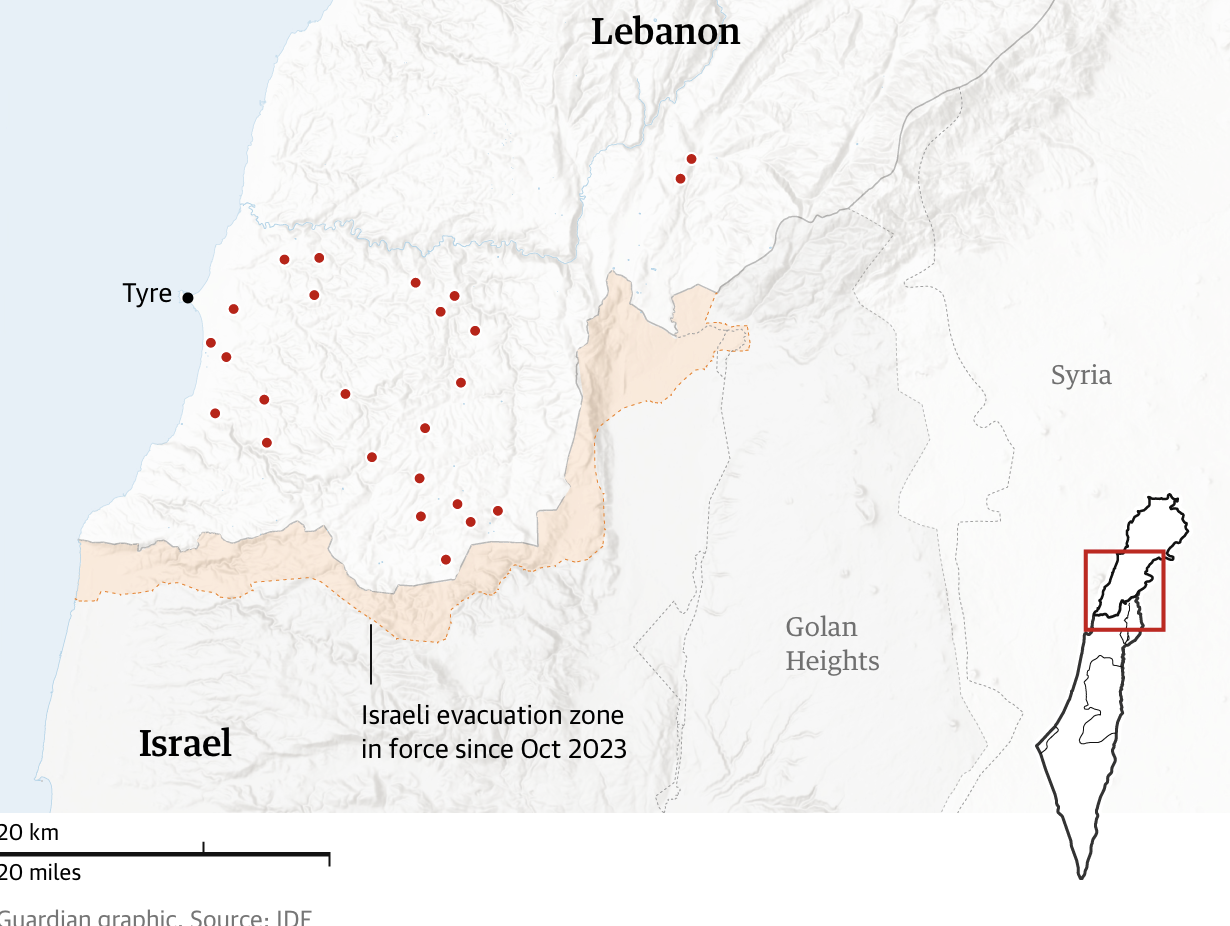
Guardian/Evacuation Zone, October 1

BBC, October 8, 2024/IDF Data, OpenStreetMap
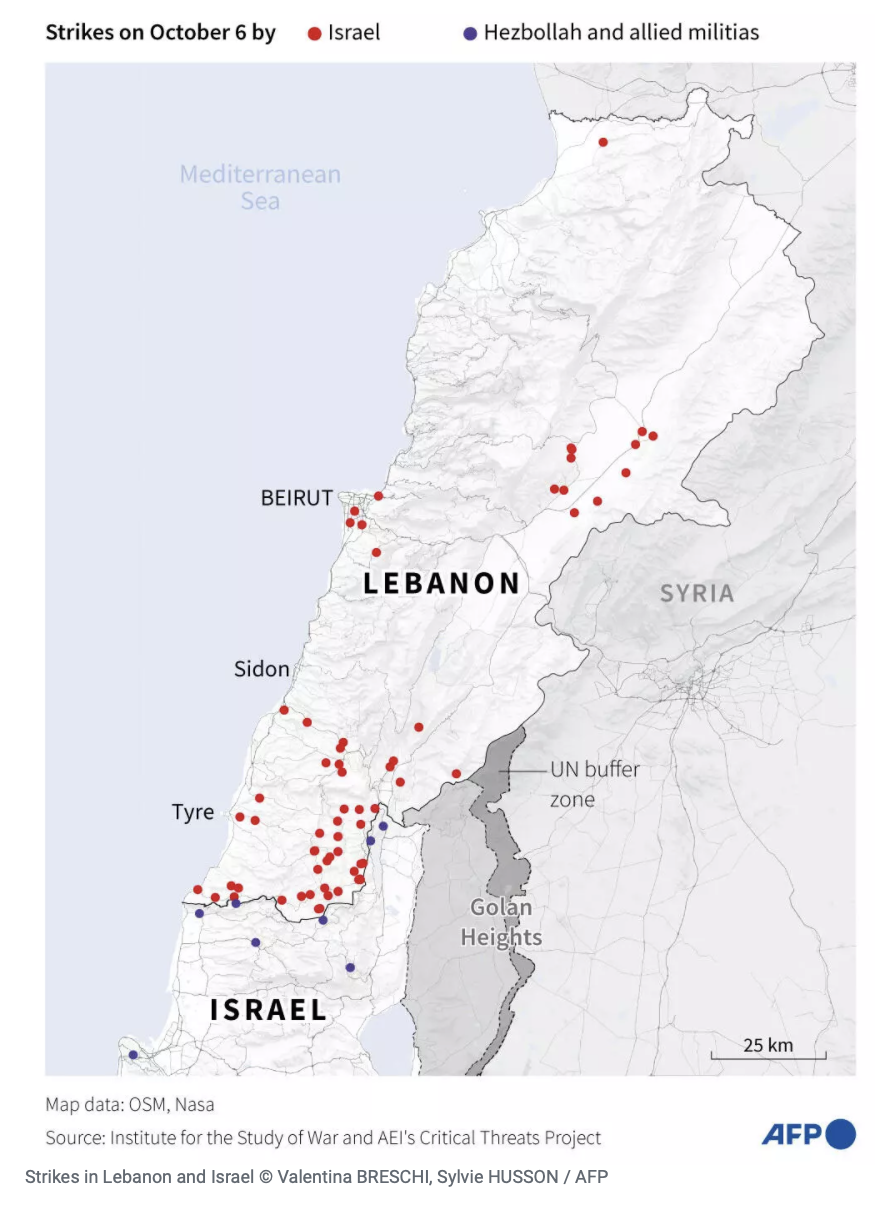
These “warnings” may arrive only a half hour before the start of bombing, as if their delivery has become increasingly perfunctory, provided as a script to undertake the bombing of a broad sector of the border zone the first week of October, per a recent map of Amnesty International, rather than in a manner that would allow civilians to plan evacuations at all, researches like Ahmad Baydoun have found, trying to track not the arrival of bombs by IDF data, or their effect and impact on the ground, but the communication to residents living south and north of the Litany River.

Villages and Regions Impacted by Evacuation Orders, October 1,2024-October 7, 2024/Ahmad Baydoun, OSM

The frame of reference for the barge of such precision strikes are increasingly cast in terms of divine wrath and retribution–and the killing of Hassan Nasrallah charged with opening a “northern front” against Israel, linking that war to the army’s defense of Israel’s borders. American President Joe Biden explained the strike on Secretary-General Hassan Nasrallah as a retributive act–“a measure of justice for his many victims” –echoing the apocalyptic terms Netanyahu cast the war, by a Biblical frame of reference as much as a geopolitical explanation. Indeed, while this is a war pursued on non-state actors–Hamas; Hezbollah; the Houthi in Yemen–the tribal terms in which they are cast by reference to Amalek, often tied to the “chief of the sons of Esau” in the Bible, as a nomadic tribe of ancient Israel or Canaan–who came before all other nations to make war on Israel, or to the descendants of Esau, whose tribe first encountered the ancient Jews as they came “out of Egypt,” and were the first and primal enemy inhabiting the idolatrous cities that demanded destruction–destroying the original inhabitants of Canaan to fulfill the covenant with Abraham, for a conquest in a Promised Land. If the October 7 attack reawakened Israel to the fact that the New Middle East could not avoid the Palestinians, it led to the evocation of the Amalekites, leading Netanyahu to invoke Amalek, as if prompting the involuntary memory of collective recitation,  “You must remember what Amalek has done to you, says our Holy Bible. And we do remember.”

The imperative remapped power dynamics within the Middle East in a way that was best evoked by a Black Cloud. The tribe of Amalek is not thought to have existed, but the current war is animated by a rhetoric foregrounding the divine punishment of Amalek “for what he did to the Israelites.” Th punishment has been long remembered, celebrated and recited as a collective truth in a scriptural narrative. It has become a terrifying topos justifying a war without borders, of visiting divine wrath. The pronouncement by Israeli Defense Forces “Hassan Nasrallah will no longer be able to terrorize the world” was not an understatement, but a justification of the totally overwhelming use of force. The increased equation of Hamas, Hezbollah, and the Houthi with this mythic tribe, allowing Netanyahu to lump these allies together, casts them as a war against Israel that must be waged as one of divine wrath, and a war that will be truly apocalyptic–that mirror Nasrallah’s own fiery rhetoric. Indeed, the repeated invocation of the Amalekites kept alive the memory of biblical destruction, leading up to the invasion of Gaza and the invasion of Lebanon, that offered something like an alternative orientation to a map, a model of describing the relation of the Jewish people to justice, and to escape the confines of international law–and indeed of nations. This is not a newly deployed future–Netanyahu compared the prospect of a nuclear Iran to Amalek before the US Congress in 2015, declaring that “the days when the Jewish people remained passive in the face of genocidal enemies are over”–even though the comparison to a ritualized memory of a biblical memory is absurd to modern geopolitics, and made Israel unlike any “normal” nation. Yet the “normalcy” of these operations depends on inherited narratives of scripture to motivate a military campaign without any clear endpoint of goal, that stands to consume the land.

The threat of failing to exterminate and destroy Amalek has redrawn the map of the Old Middle East in place of any rapprochement to Saudi Arabia in a New Middle East, which is now relegated to the past. This makes the invocation of the “Curse” that the Middle East faced out of keeping with the family of nations–or the participating of a council of “normal” nations, the United Nations–or hopes for peace among “a new Middle East, between Israel, Saudi Arabia and our other neighbors.” The a community of nations joined by a nation forged by shared memory of how it had come out of bondage, but been defined by a lineage and shared memory. The “Curse” lay outside of any nation’s history, and, via the invocation of a perhaps purely legendary people of the Amalekites was elided with the new shadowy non-state actors, identified as part of the “war against Amalek throughout the ages” that was waged by Jews. And Nasrallah’s refusal to cease waging war on Israel and fire on its northern regions until the end to all Israeli hostilities in the region of Gaza, a belief tied inseparably to his conviction that he was indeed shaped by having watched  “what happened in Palestine, in the West Bank, in the Gaza Strip, in the Golan, in Sinai” and Israeli hostilities in Gaza. At the same time as the war has been pursued, in hopes some living hostages survive in the two hundred tunnels below Rafah, the slogan of global alertness–“All Eyes on Rafah”–calls attention to the dangers of residents of the city were Gaza’s 2.3 million civilians were forced to migrate–a social media counter-offensive, launched in parallel to Israel’s military offensive in early May if generated by AI and shared on Instagram and TikTok, of orderly rows of tents.

These hostilities have made that border war with Lebanon not about a Blue Line, or about Lebanon’s border with Israel, but about the persistent conflict of Palestine with an Israeli state. The attacks on Gaza increase the license of cross-border attacks on Israel, Nasrallah felt, justifying the lethality of the strikes independent from their legality, expanding a “balance of terror” to an axis of resistance.
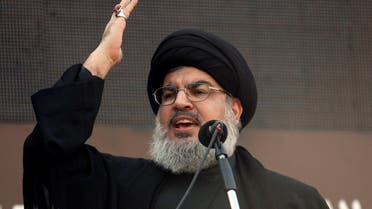
Nasrallah Preaching, circa 2014

The activation of the memory of the Amalekites provided a way to understand the need to visit destruction on the Amalekites as a way of living in the present. The ritualistic memory of the tribe who were hereditary enemies of the Israelites from the time of their arrival in Canaan elided the Palestinians–and Palestinian identity–with an ancient enemy of the ancient Israelites native to the Negev, dating from the era of Moses and Joshua, transporting audiences to pitched battles of an era of stateless wandering from a period before settlement in the Holy Land, who in Exodus had viciously attacked the Israelites at battles in the actual battlegrounds of the Sinai Peninsula, recalling the Mosaic altar inscribed with promise that “The Eternal will be at war with Amalek throughout the ages,” as if they were continuing a war of extermination internalized ritually, but was now transposed from a historical Canaan to a nationalistic notion of Israel’s frontiers: did the boundaries even have to exist or be drawn to continue the war that Amalek had himself advised other nations afraid to join him to join his initial push against their : “Come, and I shall advise you what to do. If they defeat me, you flee, and if not, come and help me against Israel.” Is not “war against Amalek [continued to be fought against the continuity of the deep rhytms of history] throughout ages?” The memories of these deep rhythms are preserved by telling, hearing, and repeating, but kept alive as a way of looking forward by looking back and–as Gabriel Josipovici observed of Jewish scripture–“by looking back only to help it move forward” in the “ritual recalling of what once happened” that is not historical or fixed in remote time, but an ongoing story, not motivated by looking back with nostalgia, but by demanding reform in the present.

The jagged line of the current de fact division of the states was never an international boundary, but the conscious choice of Deuteronomic terms of vengeance and retribution of the current mission to “blot out the memory of Amalek from under heaven” as one of eliminating attackers of the state of Israel–transform a war disputing boundaries to one of smiting those who staged an attack of viscious surprise on the Israeli people–erasing the long contested boundaries of northern Israel to an existential war at the heart of Judaism, devastating land, property, and border lines. The references are not only asserting a biblical right to territory, but a Jewish Holy war, mirroring the oratory of non-state actors as Hamas and Hezbollah, that stands in place of a language of nations.

Israel-Lebanon De Facto Boundary Demarcation Line

The boundary derived from triangulation of Palestine in 1948 that became the base map for the state of Israel–boundaries with Lebanon from the Mediterranean to cairns at Las-el-Nukurah, Khirbet Danian, Labuna, the edge of cultivated lands of the Waddi Kutayeh east to the Wadi Dalem as an armistice line, rather than an international boundary, to the villages of Ramia, Rita-al-Shaub, and valleys of Wadi Bediyeh, to villages of Tarun, El Malikiya and eastern village of Meis, Odessa, and Metallic or Metulla, the cairns of triangulation of the armistice line never intended as an international boundary than a line of withdrawal for Israel’s army, even in the Blue Line–a de facto line, provisional more than ever intended to conclusively resolve borders or boundary disputes. The mutation of a fixed line to security zones, and zones to be cleared of population, not only to meet the demands of Orthodox supporters of his own government, the language of biblical vengeance was supported by the invocation of the “horrific attacks of October 7,” attacks that were clearly intentionally designed to provoke the collective memories of panic of an actual holocaust–removed from any mere debate about “borders” and “boundaries” on a map. As Netanyahu used the narrative of “genocide” in terms of a revenge on the Amalek–“Go and smite Amalek, and utterly destroy all that they have, and spare them not; but slay both man and woman, infant and suckling, ox and sheep, camel and ass“–as an existential threat, the armistice boundary of Lebanon was undone, erased and replaced by a devastation of a border zone.

The pseudo-scriptural injection to “eradicate this evil from the world” has been cast as for the benefit of American evangelicals or indeed for Orthodox allies, sanctioning his attacks on Gaza by the fact that “the Lord will have war with Amalek from generation to generation,” so much as a statement of the collective memory of Jews Palestinians would recognize and shudder. The projection of divine law offered a transcendence of the legal boundaries of Israel, unable to undermine or be in conflict with Israel’s longstanding aspiration to be a “normal” nation-state. If the triangulation of Palestine that preceded the State of Israel organized the mapping of temporary land settlements in a framework of organizing the territory in terms of its colonial administration, visualizing the temporary nature of divisions of land as a state of “permanent temporariness,” rather than of temporality. Indeed, the claims of naturalizing or institutionalizing boundaries present at the founding of the state of Israel are quite dramatically being undone and revised in the current remapping border zones of Southern Lebanon. While they may seem to be in terms of “Friend” and “Enemy”–the polarity of politics famously espoused by political theorist Carl Schmitt in the Nazi Era–the zones of evacuation, exclusion, and displacement are not about sovereignty, in a Schmittian sense at all: as much as a political theology, the intensity of such retributive strikes are Deuteronomic at core, if designed tto preserve the safety of an Israel. It is a logic of securing its borders to “blot out the memory of Amalek from under heaven” per the Book of Deuteronomy, by visiting a retribution of such intensity and wrath that emulates the divine. The operations bring commands of remembrance–“Remember what the Amalekites did to you when you came out of Egypt . . .”–of scriptural origin to the modern day. Indeed, the figure this fictive tribe of Amalekites occupies in collective memory is an imprecation that today is akin to “Never forget . . .,” of deep resonance for the Jewish nation as a biblical collective memory from the very foundation of the Jewish people, no longer of a removed historical event but a living memory by virtue of its repetition as an ancient event bounded in space and time, that has become timeless.

If the injection is experienced as a bonding of God to his children as much as a leader to a nation, it has created a new logic of cross-border attack that demands to be appreciated outside the political. For as much as merely the recollection of a removed event of scriptures, the figure of Amalekites has become or been activated in contemporary Israeli political discourse and theology as a guide of living in the present; the call to “remember” becomes to learn how to remember becomes a way to “know” of a resonance that transcends political boundaries–even those confirmed in December, 1948, after the First Arab-Israeli War, at the Israeli Declaration of Independence that created the boundaries Israel shared with Egypt, Lebanon, and Jordan. If those boundaries were created by a series of famous armistices signed with Egypt on February 24, with Jordan March 3, and with Lebanon on March 23, 1948, the last of which set a basis for military withdrawal at the “Blue Line” that led Israeli forces to withdraw from thirteen villages in Lebanon’s territory, on July 20, 1949, the armistice line that was agreed to in Northern Israel is no longer a line of armistice,–but has been cast in a different collective memory, no longer on paper maps or set stations of triangulation–

undefined

Israeli Delegation to 1949 Armistice Talks: Yehoshafat Harkabi, Aryeh Simon, Yigael Yadin, Yitzhk Rabin

Geodetic Triangulation of Palestine, 1946

–but by the logic ofan internalized narrative. The frontier nominally about a line of withdrawal enemy forces was, indeed, a basis to visit violence of a new level of complete destruction, and a new sort of enemy beyond the notion of a boundary dispute, and which challenged registers of mapping that reflected only on-the-ground damage: the level of damage inflicted over nine months and more of border fighting between the Israeli Defense Forces and armed Hezbollah forces in Lebanon goes beyond a border dispute, as the reference to the Amalekites tapped a collective memory of a litany of destruction that in fact knew no place, but was an almost timeless narrative not confined by space or time, a visiting of vengeance on a people who demanded divine punishment–“Now go and attack the Amalekites and completely destroy everything they have. Do not spare them. Kill men and women, infants and nursing babies,[1] oxen and sheep, camels and donkeys“–that was a divine judgement and not even a human one between nations or nation-states. This alone served to explain the non-state actors who attacked Israel–Hamas and Hezbollah–in ways that were foreign to a discourse of nations or a law of nations.

If the complex military situation on the ground was extremely contingent, and multinational in its composition of conflicting Syrian Iraqi, and Lebanese “Defensive” forces, the complex armistice line determined along the mountainous terrain of Southern Lebanon respected Israeli military control, if it was drawn along the line between Lebanon and Mandatory Palestine, with careful attention to Armistice Demarcation Lines that hinged on the control over mountainous terrain as much as permanent legal borders–at Arab insistence–but which would mutate into Israeli borders–refusing to recognize the boundaries as a settlement of the Palestine question in interim agreements that lead to the creation of demilitarized zones around many of Israel’s “borders” never leading to the signing of a peace treaty between Israel and Lebanon,–a problem of renewed relevance today.

Into this absence of clear cartographic rendered boundaries, and a stasis of military control led to deep resentment, the invocation of the shared memory of almost involuntary rather than voluntary recollection entered, echoing the imperatives to preserver memory and keep memory alive that may have been consciously invoked by the brutality of the invasion of October 6 by Hamas, but was a away to process the violence of the invasion. The tag “Amalekites” emerged as a counter-memory meriting the retribution on a biblical scale, invoking the Deuteronomic law of a lex talionis, not about the actual ancient landscape of the Middle East of Canaan–in which no proof has ever been found for the Amalekites–but an anathema-like demonization of a living threat to the Jewish people, tied to the deep political rhythms of their suffering and the affirmation of their primary and precedent tie to God–irrespective of who first inhabited the land of Canaan east of the Jordan, whether the Ammonites, Moabites, Edomites or Amalekites. For in the ritual recitation of Jewish belonging, it was the Amalekites who had joined the nations ion Moab and the Ammonites to attack the Israelite tribes, capturing “the city of palms” – perhaps Jericho or its pasture lands–(Judges, 3:12-13), and joined the Midianites in destroying the crops of farmlands they raided as desert tribes, before their decisive destruction, when Saul responded to the divine request to obliterate their memory by driving the nomadic tribe back close to the border of Egypt, reducing the influence of the Amalekites in the border regions of Judah and the Negev, back into the western Negev. The timelessness of a struggle against evil was a far more powerful lens to see the current war as a dichotomy between Good and Evil, removed from circumstances of dispossession of land, and far preceding the foundation of Israel in 1949.

This was a construction of the Palestinians in the modern Middle East as removed from actual problems of discrimination, an apartheid Israeli, or a dispossession of homes, but as an enemy to the Jewish state. The tag of the Palestinians as a tribal people of the desert–the “Amalekites”–were terrifying fighting words to designate Palestinians in Israeli politics. In national discourse, the evocation of Amalekites, even if the tribe is now thought never to have existed in Canaan, save in the scriptures as a people whose destruction was worthy of memory. The offense preserved in Deuteronomy and the Book of Samuel has become shorthand for acts of violence preserved in the collective narrative of Israel’s eternal memory; these original inhabitants of Canaan who terrorized the Jews. The Amalekites had occupied a figural if imaginary prominence as a threat preserved in collective memory of the Jewish people through Deuteronomy 25:17, a touchstone of calling to witness, and a call to witness in post-Holocaust Israel, a process of bearing that was deployed to process October 7 the violence of the attacks as an invasion meriting immediate retribution, and process events that intentionally triggered reflexive memory of the violence of a pogrom occurring on Israeli soil. The visiting of a ritual terror on the Israeli people merited a lex talionis akin to Amalek was not modern in any way, but confirmed the tribal nature of the peoples who had lived in Canaan before the Jews’ arrival out of Egypt. Both recent Israeli settlers and right-wing politicians have deployed the imagined tribe as a figure foreign to the world of “normal” nations, to conure an existential nemesis to be destroyed with a violence that did not belong to the world of normal nations, of divine proportions; the violence may stand in contradiction with Israel’s founding goal to be seen as a “normal” nation not unlike other nations from its 1948 founding, a steep problem of there constitution as if an exception of the ability to pursue geonocide.

The terrifying salience of the Amalekites in contemporary political discourse among settlers and Likud members is particularly striking, and suggests more than an audience to which Netanyahu played. Benzi Lieberman, Chairman of the Council on Settlements, invoked with zealousness the destruction of Palestinians by the boogeyman of Amalekites to map a people worthy of destruction–“The Palestinians are Amalek! We will destroy them. We won’t kill them all. But we will destroy their ability to think as a nation. We will destroy Palestinian nationalism.” Similarly, Likud activists used the equivalence to justify genocide: “Arabs engage in typical Amalek behavior,” a proclivity to evil resonating with the ritual retelling of scripture; if the prominent Likud activist was unable to “prove this genetically,” he recognized “behavior of Amalek” demands destruction, even a destruction as that visited on the Amalekites by God.

 The reference to the Amalekites—who didn’t even exist!—offer the outlying example of acceptable conduct, even if it betrays the goal of being a “normal nation,” and casts Israel apart from normal nations, betraying its goal of being a normal nation—though what a normal nation is today is hard to know.  “Torah commands the Israelites to wage an eternal war against the nation of Amalek, and to wipe them out totally,” reads the current website of Chabad, arguing that theAmalekites are no longer a foreign nation, but “an internal enemy” who “wage a lethal war with our soul,” and must accordingly be annihilated. “Amalek unfortunately and definitely exists,” and the South African legal team accusing Israel of genocide at th International Court of Justice quoted the commandment to “erase the memory of Amalek” to convict Netanyahu of having plans for genocide, but another face of Amalek is identified as forgetfulness, and the casting of the Amalekites as not fixed in time, but “internal enemies of the Jewish people” from he Nazis in the twentieth century to Hamas today suggests the demand to recognize the survival of the Amalekites, and “never forget'” what threats they continue to embody. The rather timeless opposition that Netanyahu invoked served as a way to cast the global threat as an existential threat, not tied to contingent circumstances or the dispossession of land, but only as a form of pure evil.

The diffusion of the future of speech in Israeli politics cannot be overlooked as a part of Netanyahu’s long game denying boundaries and borders. Over a decade ago, a member of the National Religious Party saw collective guilt of all Palestinians as “creatures who came out of the depths of darkness,” who “we will have to kill,” they characterized them as Amalekites–a people needing extermination. They are people who know no borders, who are not nations, and who have no place in the Middle East if Israel is to belong to a world of nations. When the remarks of Netanyahu were glossed by 1 Samuel 15 in the American media, a divine order to “destroy Amalek entirely,” the prime minister’s office insisted news agency clarify the exact citation of Netanyahu’s speech to the Book of Deuteronomy; if both passages reference elimination of a people, the Prime Minister’s office insisted the Deuteronomic origins clarified the logic by which these Amalekites were especially dark vicious non-state actors–whose extermination was demanded as they had no place in the world of nations, as it was entirely foreign to it, but a f tribe–even if there is no evidence for the tribe–save as a place-holder of collective imagination and collective memory. The Deuteronomic origins of the mandate for destruction was not to “blot out the memory of Amalek,” but to dispose of the creatures of darkness of the Amalekites by the logic of the Israelites penal code of the lex talionis of Deuteronomy 19:21, “life for life, eye for eye, tooth for tooth, hand for hand, foot for foot”–as a law of retaliation, and of protecting humans from every threat to their lives, the Old Testament principle, not a historical narrative of kingship, but precept for brutally visiting punishments on a people out of respect for the value of human life.

While the refenrce to the Amalekites was a potent signifier in right wing politics of a collective memory that offered tools of living in the present, the figure of speech was no doubt readily recognized by the Palestinians in Hamas and Hezbollah as a declaration of war that disrespected borders, a contradictory evocation of a license to kill–a declaration of genocidal intent to remove the “ability to think like nation”–a group that was likened to a tribe, rather than a nation. The characterization was a terrifying explanation for justifying failure of adherence to international norms by a nation, and, perhaps, the license to act as a nation outside of national norms. The new norms for visiting destruction on the Amalekites was not in the handbook of national norms, but was a script that mandated a total destruction of borders, indeed, and a reversal of the idea of the border to a border zone of safety of military creation, of evacuation zones from the Gaza Envelope to the border zone of Southern Lebanon, zones whose destructiveness with no similarity to borders.

The ceasefire lines between Lebanon and Israel, if long established, were in a sense negated by the assassinations, if they were already allowed to be contested in the expansion The assassinations of Nasrallah and two successors to his leadership–“Nasrallah himself and Nasrallah’s replacement, and the replacement of the replacement,” as Netanyahu crowed, sewed leadership chaos as a means to redraw Israel’s Northern border, even if it contravened international law. Netanyahu openly threatened Beirut stood at the abyss of “a long war that will lead to destruction and suffering like we see in Gaza,” on the anniversary of Hamas’ invasion of Israel, as four heavily armored divisions of Israeli troops filled southern Lebanon, destroying villages and burned thousands of hectares of farmland in Southern Lebanon, in a rewriting of the map that raised the specter that the nation no longer able to feed itself, seeking to destabilize the entire nation to pursue its ends of remapping the dynamics of power in the Middle East. Much as the Israeli Prime Minister hoped to “evacuate the whole Gaza Strip in coordination with the Egyptian government,” the hope of normalizing the expunging non-state actors from the future map of the Middle East was a “plan for the resettlement and humanitarian rehabilitation of the entire Arab population in the Gaza Strip which aligns well with the economic and geopolitical interests of Israel, Egypt, the USA, and Saudi Arabia,” remapping of national interests that expunged non-state actors from the map.

Netanyahu was addressing a press conference after addressing the General Assembly in New York, but the military planning of the assassination demand a reexamination of the maps Netanyahu had presented to the United Nations General Assembly–long involved in the negotiation of Lebanon’s southern border–and the maps by which we understand what was treated as a border conflict has become a map that expanded to what might be call a border zone, if not to create a demilitarized zone or a “dead zone” in ways far more literal and apocalyptic than the rhetoric of Nasrallah or Netanyahu had used. In arguing to Beirut’s residents “We’re not at war with you. We’re at war with Hezbollah, which has hijacked your country and threatens to destroy ours,” as meaning “Israel has no choice. … Israel must defeat Hezbollah,” the mushroom-cloud image of destruction that began in the evening and sent massive clouds smoldering sent a plume over Beirut in dawn hours and early morning rocked underground Beirut suburbs, demanded residents evacuate southern Beirut, blaming Lebanon for having allowed the transit of munitions from Iran to arrive in civil airports of Beirut, and continuing to target buildings housing munitions across southern Lebanon and Beirut.

September 27, 2024/Hassan Ammar/AP

The delayed reaction bombs entered the buildings to explode, creating a devastating if targeted damage by their pinpoint accuracy, striking Hezbollah commanders. Nasrallah had been tracked for twenty years, killing the head of Hezbollah, his successor, and close circle of commanders in an underground compound, is an illustration of frustration at inability to define the prolonged war at its borders. The strike across borders raised questions of violating international law, and of legal munitions, but eerily evoked a divine sort of justice.

The pinpoint strike at the circle it blamed for plotting attacks on Israel shifted the long war on its borders to an urbanized area: Nasrallah had angrily condemned how the planting of explosives on Hezbollah’s pagers and walkie-talkies for having “crossed all red lines,” and “broken all the rules,” as it had issued a virtual “declaration of war” by flying supersonic planes over Beirut, buzzing the headquarters of Nasrallah as if taking a reconnaissance flight over targets of later bombed. The final televised address he made condemned the aggression of the strikes airplanes made on Lebanon’s territory, coordinating a set of explosions across the entire nation of Lebanon, as if to alert the leader and of Hezbollah of the possibility of an Israeli strike at any site in Lebanon–a television appearance curious for how the Sayyed was instant on the bounds of Lebanon.
This can be seen as a declaration of war,' Nasrallah says as Israeli Jets  Fly Low Ov

September 19, 2024

The the coordinated air attack that sent columns of smoke into the night air crossed those lines even more emphatically and spectacularly, revealing the precision mapping of the targets with a rather awesome if terrifying sophistication, suggesting a sort of divine wrath by dual guidance bombs that exploded eighty 2,000 lb bombs after they entered the four buildings, sending a fireball into the night sky, after residents were asked to evacuate all buildings that held “Hezbollah facilities and interests,” in a protocol of warning that has become standard to shield the civilians of the Gaza Strip and southern Lebanon.

Defense Minister Yoav Gallant (left) and Chief of Staff Lt. General Halevi (center) watch the September 27, 2024 Attack in underground Israeli Air Force Command Center near Tel Aviv/Ariel Hermoni/Defense Ministry

But the strike that was monitored closely from Israeli Air Force Command Centers in Tel Aviv, show how the security of Israel’s borders knew no limits. The war begun as a defense of Israel’s boundaries was presented as neither in cities or Lebanese territory, but against the infiltration of Hezbollah, a non-state actor, deep underground in Lebanon.

Explosions over Southern Beirut of September 27 Bombing of Southern Beirut Spread over the City/AFP

President Joe Biden, an honest man, declared “his death from an Israeli airstrike . . . a measure of justice for his many victims, including Americans, Israelis, and Lebanese civilians,” the statement issued September 28, insisting he had no advance warning of the strike, but calling the death “welcome” even if it may well destabilize the region. While his Defense Secretary had spoken with Israeli allies about using the bunker busters only as the operation had begun and was already underway, Israeli official described Netanyahu’s address of the UN General Assembly amidst escalating fighting with Hezbollah in Southern Lebanon as a ploy and “part of a diversion” to lull Hassan Nasrallah into believing in his safety, the open rejection of any hope for diplomatic resolution of the ongoing border conflict ramped into new gear as the aim was revealed “for threats to Israel to be removed.”
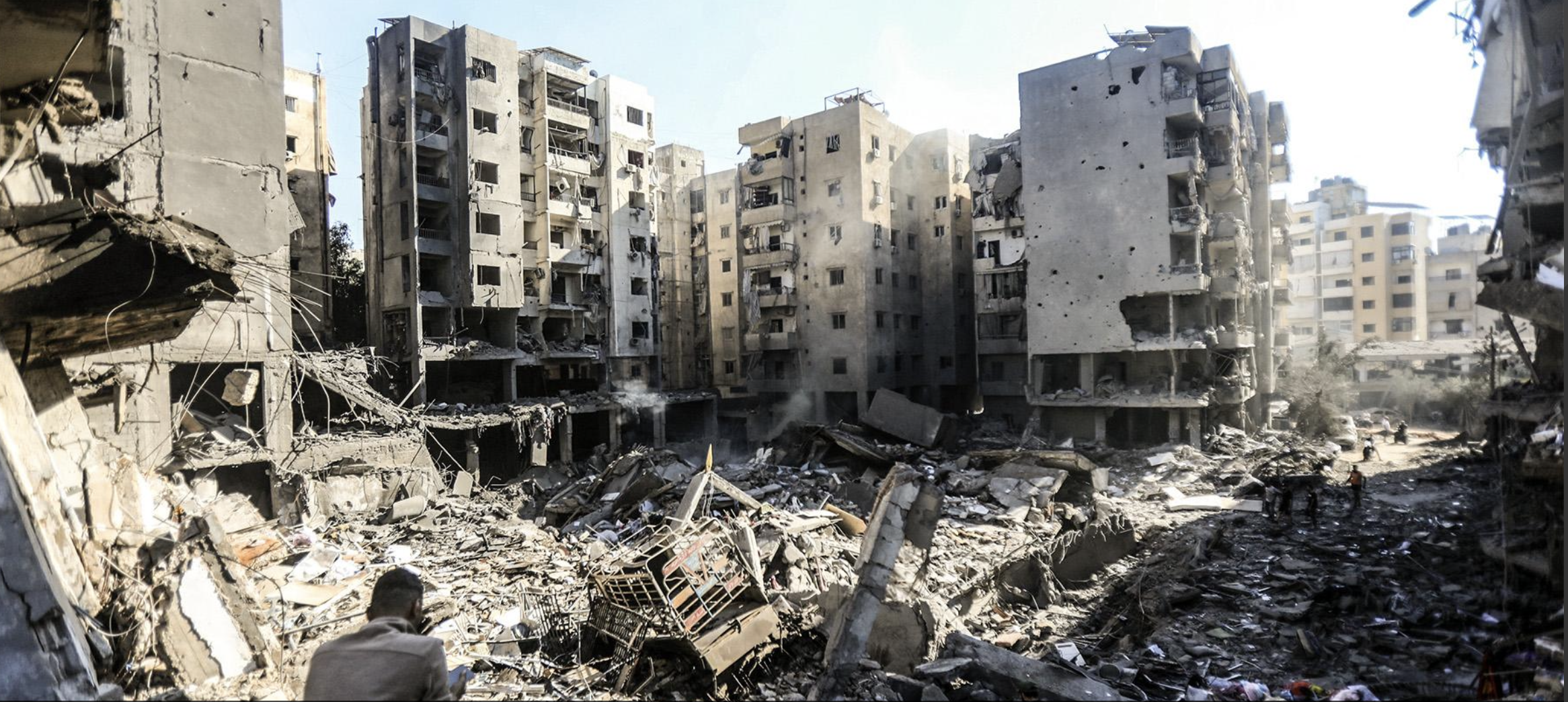
Bombed Compound in Beirut Suburb, Dahiyeh, September 28, 2024/AFP

The assassination, timed after multiple unsuccessful attempts to locate the hostages of August 7 or protect its victims from attack, was based on tracking the senior chain of command of attacks on Israeli citizens, as if dropping at least sixty bunker buster bombs equipped with precision guidance systems–bunker-busters able to penetrate deep underground and flatten built structures–killing Nasrallah and much Hezbollah elite was a just strike. Nasrallah had been long targeted by Israeli forces, after being tracked by radioactive material placed on his palm in a friendly handshake, ageolocation of a man long underground was able to offer inside intelligence. Ten days after a spate of terrifying explosion of thousands of pagers booby trapped with explosives across Lebanon in the hands of Hezbollah commanders on September 17, and walkie-talkies on the following day, had compelled a meeting of commanders, the strike in Beirut’s suburbs revealed terrifying vulnerability of once-secure borders. The border treaties suddenly destabilized with the jackpot of killing believed the senior chain of command planning “terrorist activities against the citizens of Israel” as if to legalize the strike, by preemptively eroding the borders of a zone of conflict across Lebanon.

Borders were the center of Nasrallah’s active engagement in the military, defending Lebanon as a frontier. Nasrallah had long claimed the resistance of the “oppressed people of Palestine” would triumph even over a nuclear powered Israeli army, preached the power of on the ground resistance to any military force. And the explosion of pagers on Lebanon’s territory violated “all red lines” in its brazen violation of the integrity of territoriality, the arrival of bunker busters in a residential neighborhood suggested even more completely the absence of respect for sovereign lines. Indeed, if the disputed borders in the world of territorial disputes are widely spread–
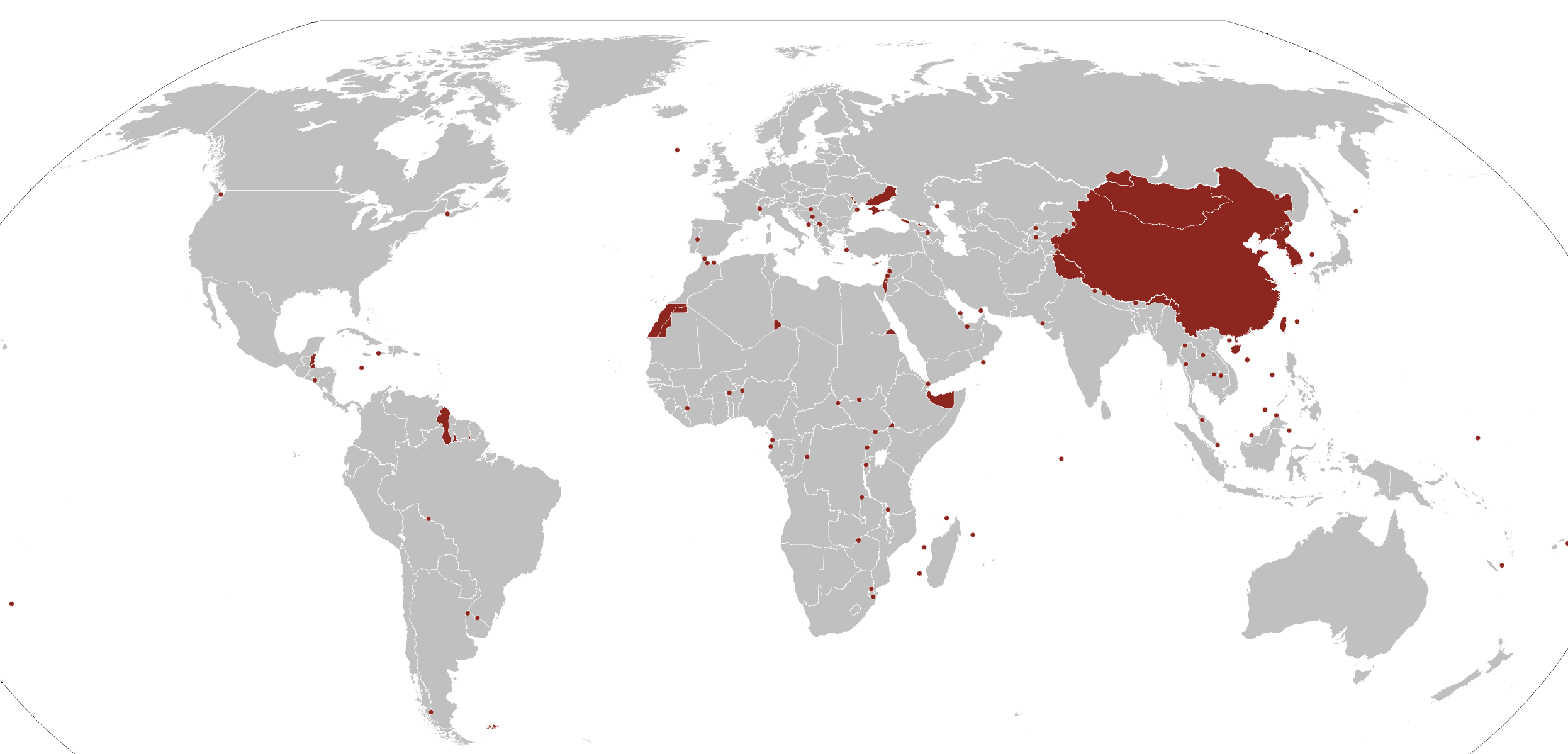
Territorial Disputes in the World, 2024

–the focus of territorial disputes in the Middle East were intensely linked, with firing cross-border rockets from Lebanon as the Gaza War began, or after the Al Aqsa invasion, and the rockets of reprisal Israel fired at underground tunnels for assembling rocket launchers in southern Lebanon.

Territorial Disputes in Mediterranean Theater and Middle East, 2024

The intensity of arial bombs that were three times the force as used in the Iraq War suggested a massive show of force. Yet the long disputed border in which Nasrallah had essentially dedicated his life–inviting Iranian arms into the longstanding dispute on the border with Israel, daring Israeli forces to enter Lebanon or Lebanese lands, seeing each village as the basis for defying Israeli arms, after having expelled Israeli forces from southern Lebanon in 2000, while wearing the black turban of a Sayyed, or descendant of Mohammed, had declared the imminent arrival of a moment of reckoning, had avoided assassination for more than a decade, but the onslaught of precision bombs offered a near-apocalyptic ending for his life, as much as a precision strike.

Americans might wonder at the use of bombs of this strength in an urban area. The strike targeted the rapid expansion of rockets supplied by Iran to arm Hezbollah–estimated with 150,000 missiles, drones, and rockets, over ten-fold what it possessed at the end of the 2006 war. The current explosion matched attempts to stop the smuggling arms to Syria, Lebanon, and Yemen–a black cloud hovering above the region that Benjamin Netanyahu, having approved the massive strike, showed the UN as “The Curse” of the modern Middle East. While “A few years ago, I stood here with a red marker to show the curse, a great curse, the curse of a nuclear Iran,” the return of “The Curse” on the eve of the assassination of Nusrallah seemed a cause for celebration. In a sense, the map was a smoke screen and distraction from the invasion of Lebanon’s frontier, ignoring national sovereignty and laws of sending bunker-busters in inhabited areas or military targets near them: but the “lumping” of nations opposed to Israel’s borders–Iran, Iraq, Syria, and the Houthi non-state–as if it was the mushroom cloud portentously spreading above the entire Middle East–

Map Displayed to U.N. General Assembly, September 27, 2024

–that his precision strike hoped to end. The map masked how the bombing was a transgression of international norms. Israel had undertaken in targeting the leader of Hezbollah for three decades, but finally did so in ways Netanyahu seemed to offer an explanation, if one that was not logical in any way. “The Curse” evoked a Neo-scriptural justification of the precision strike already planned against Nusrallah and underway, as pinpoint bunker-busters had left to strike at a link at the heart of the black cloud hovering over the Middle East–Iran’s man in Lebanon, who had been firing rockets across the northern border of Israel with considerable annoyance over the past year.

Sick of the involvement of Iran in non-state actors in the Middle East, the Prime Minister ended his press conference in New York quite abruptly as he was informed the strikes had been achieved, not taking any questions. The massive show of force intensified cross-border rocket attacks at northern Israel and reprisals preceding Nasrallah’s assassination blurred a border drawn on the ground, relegated to a relic of the past. To affirm the integrity of Israel’s borders, the planes flouted the sovereign space of Lebanon, at great costs to seeing Israel as a “normal” nation among nations, sending a two thousand pound bunker-buster bomb agains the man they had tracked for years, but now claimed, using a word that had its Old English origins before 1150 to cast an anathema on the forces of non-state actors that threatened Israel’s borders, and in his eyes threatened a global order: if the map was more of a news map, a backdrop of a television news show of the 1990s rather than a map of any granular resonance,–or that reflected actual mapping technologies the Israeli Air Force was using at the very same time to kill Nasrallah asNetanyahu finished his address.

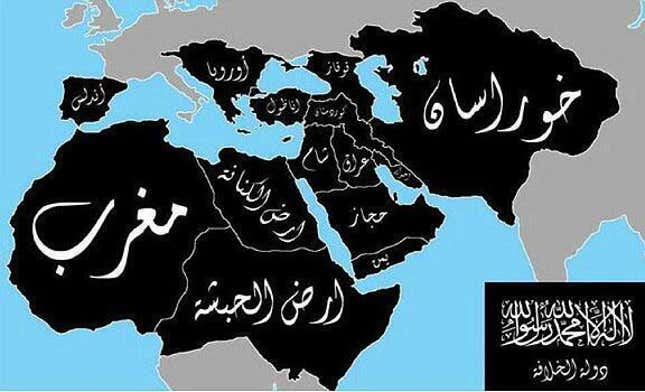
The map conjured the scale of an anathema that existed in the present more associated with the occult or medieval origins–if recently revived in Harry Potter–to conjure excommunication from the world of nations, or the church, the opposite of a blessing of a future of peace. Was there not an intentional similarity of this dark map of the Iranian state’s infiltration of non-state actors to the remapping of the Middle East in maps that circulated online a decade earlier, in 2014, allegedly depicting the world domination sought by ISIS, a mashup of earlier maps, as a curse, to evoke a perspective restoration of a Caliphate that might bridge Iraq, Syria, and Iran, up to Vienna? The map emerged online, an emblem of fear paired with the change of ISIS’ name to “the Islamic State,” and pronounced its leader to be the caliph, or the global leader of Islam–and seems a projection (so to speak!) of the fears of an actual caliphate bent on global conquest–as a pseudo-Stalinist “Five Year Plan” that seemed to broker a resurrection of an early modern version of a global Cold War–“a chilling plan for global domination” per the Daily Mail–was the original image of a global threat.
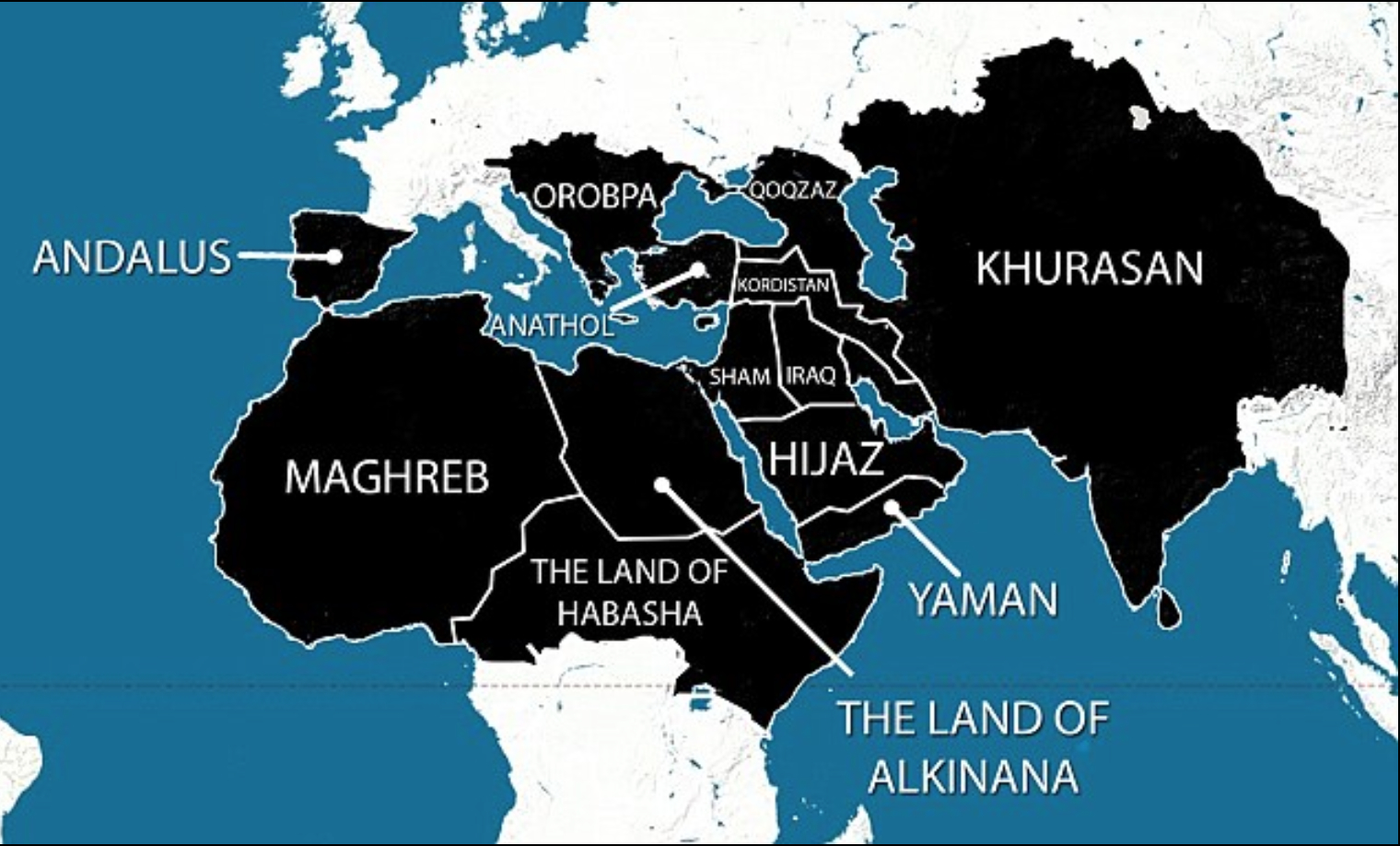
Although the purported “five year plan” of the Islamic State made runs as “showing their plans for the next five years” on American television networks, eager to find a new image of global divides–
no-caption

False Mashup of Islamic Hopes for a New Caliphate, Twitter circa July, 2014

–themashup of online extremists, based on a hundred year old map of an imagined Caliphate, was an old recycled map, rather than designs for global domination. If versions included India and Bangladesh for good measure as a counterweight to Europe, it sought to conjure fears of barbarians at the gates of Europe, a sort of expansive vision of a Fall of Constantinople to barbarian hordes, to which Netanyahu’s September 2024 map of the “The Curse” made some weird reference. This was the global threat that the bombing of Beirut was serving to puncture or thwart.

Maps stoking fears of the spread of Sunni extremism were amped as the Islamic State as a miasma spread across an expanded Middle East, destabilizing the post-Cold War New World Order with a near global reach. The specter stood behind the map Netanyahu brought on September 27, 2024 was itself a massive exaggeration of the fragmented pockets of Sunni terrorism, per the US Office of the Director of National Intelligence, yet the cartographic mashup activated a potent emblem of fear, circulating quite widely as a haunting of the Middle East that seemed destined to spread to the EU.

1. When Netanyahu claimed that Hezbollah–and Iran–constituted a global threat “able to terrorize the world,” he was magnifying his own perspective on the world, and elevating the strike of Israel’s Air Force to a global intervention of its own. The strike was a bonanza in geolocation, a payload that seemed a jackpot against Hezbollah after a year of deepest frustration. After Nasrallah had charged Israel “violated all red lines”–not only the so-called “blue line” that marked the border of Lebanon since 1948–as it blew past the militarized borders in an unprecedented firepower claiming legitimacy, as if visiting a divine judgment on a man who has long preached the destruction of Israel in Messianic terms. It revisited the apocalyptic rhetoric of Nasrallah on himself and his inner circle, as if to reclaim a rhetoric of divine judgment and wrath at the violation of Israel’s borders.

Banner of Nasrallah’s Turbaned Head Held on Religious Procession in Beirut, July 2023
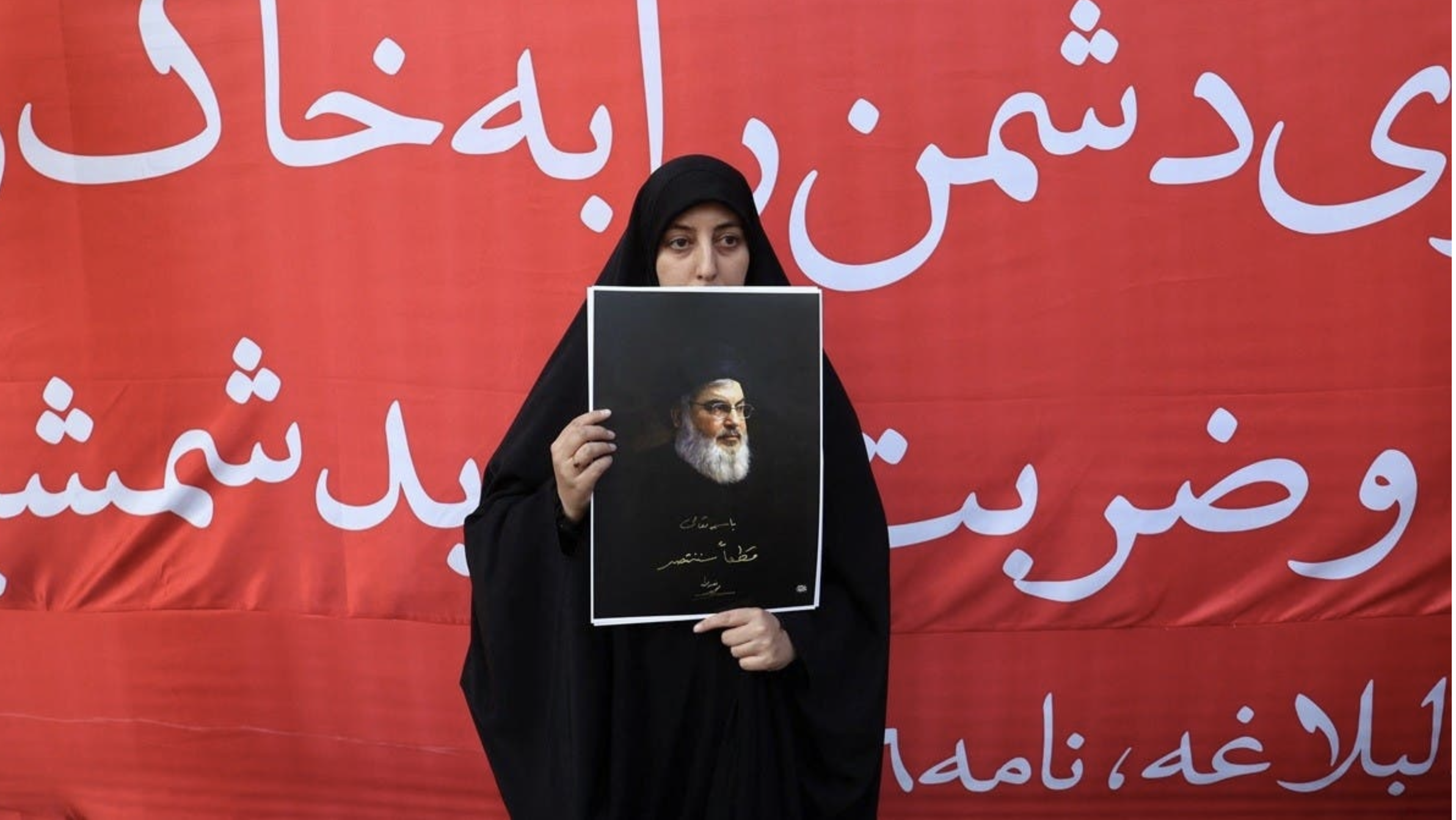
Mourner of Nasrallah’s Death in Iran

Yet the Prime Minister who ordered the bombing tried to make the case of its necessity, even if it removed Israel from ceasefire or peace process. In contrast to the regional the maps Netanyahu had displaced before of Israeli frontiers, he bought a map of an expanded Middle East to the United Nations of alternative future geopolitical scenarios, Israel’s incursions of the border to “limited, localized, and targeted ground raids” against Hezbollah in southern Lebanon, the tonnes of bombs seemed to se disarray in a “militant infrastructure” of Hezbollah on the eve of the first invasion of Lebanon’s border for eighteen years. The presence of Hezbollah among residential areas–per Netanyahu, in late September 2024, “a missile in every kitchen, a rocket in every garage” merited returning Lebanon, per Yoav Gallant, “back into the Stone Age,” in June, 2024, if a diplomatic solution does not present itself. As journalists are for the first time invited into Southern Lebanon, to witness the degradation of Hezbollah in villages across the border, achieved by airstrikes, artillery and raids, the invasion past UN demarcation lines revealed weapons caches, Kalashnikov rifles, artillery, hand grenades, and mortar shells, designed to stage an invasion of Israel, to disable all remaining offensive capacities of the terror group by the end of the first weeks of October, 2024.

But the IDF had already made its presence known. If the walkie talkie and pagers exploded to injure faces and arms of many, the attempt to cut off the head of Hezbollah was designed to send shocks across the system. The sudden shock of pagers long used as they were believed possible to avoid geolocation in their lack of sensors seemed a magic trick of sorts: “we are everywhere, and we can strike you anywhere,” able to strike in the web of the secret militant organization under Nasrallah’s eyes, troubling his sense of control. He did not know that he had been tracked for some time–a trackable substance being placed on his palm in a handshake in Iran or Saudi Arabia or Beirut, per Saudi news, placing him in the building complex.

Deep underground beneath an anonymous apartment complex outside Beirut, the long-hidden Nasrallah, nemesis of the Israeli state determined to undermine the Peace Process for three decades, was as vulnerable as a sitting duck by a massive explosion–unable to hide longer. His death at sixty-four cut short a fiery leader of thirty years, offering stunning confirmation soon following Prime Minister Benjamin Netanyahu’s declaration of what seems an ultimatum to the United Nation’s, not revealing or tipping his hand about operations that were by then already underway, “We will not accept a terror army perched on our northern border able to perpetrate another Oct 7-style massacre.” The “limited” operation seems a way of expanding an occupation of the region Hezbollah has long worked and based its infrastructure of rockets and missile launchers from the south of Lebanon, as it has attempted almost forty years ago to root out the Palestine Liberation Organization from Lebanon in 1982.

The explosions of low-tech pagers and walkie-talkies did not rely on geolocating sensors–but revealed the hidden reach of Israeli Defense Forces into the organization. Panicked at hearing rumors and buzz of an attack, Nasrallah instructed Hezbollah members to rid themselves of phones, bury them or put them in lock boxes, back in February as compromised–“I tell you that the phone in your hands, in your wife’s hands, and in your children’s hands is the [compromised] agent.” He had heard rumors on intelligence lines for the planning of the attack that would render his forces vulnerable in new ways. The operation had been planned for over twenty years, the result of outrage at the border war. Nusrallah had concealed himself for eighteen years, shunning public appearances since 2006 war, aware he was targeted, was a victory of mapping, as much as inside informants. The blast of eighty tons of bombs that followed in quite dramatic fashion based on real-time intelligence triangulated a quarry long sought in a dramatic blast of thunder from above. The Hezbollah leader had been shaped by the Israeli invasions of Lebanon, religiously trained in a Shia mosque in Iraq, combined liberation theology and apocalyptic imagery to articulate a charismatic vision of the struggle non-state actors suited to wage against Israel in his customary black turban and brown robe. After remote assassination by cel of a Hamas bomb-maker in 1996, he grew rightly wary of remote devices able as keys revealing the location of soldiers, in danger of lifting a needed veil of institutional secrecy to his enemy. The planting of timed explosives in walkie-talkies and pagers evaded his justified suspicions of mobile networks, but penetrated deeply into his infrastructure.

Reported Locations of Surprise Explosion of Pagers and Walkie Talkies across Lebanon, September 16-17, 2024

The shock of the exploding pagers staged a cross-border assault of brazen intrusion and infiltration that suggested the intensity of the war no longer about the contested border of Lebanon, or the range of Hezbollah in Lebanon, but the open wide nature of war.

Indeed, these exploding pagers were but the prelude to a new state in cross-border infiltration and attack, a long designed operation of which the supply chain infiltration in pagers–in which explosives were inserted as they waiting to be shipped to Lebanon–was the first escalation of cross-border strikes. The strikes that maimed some 1,500 fighters from September 17-18 set the stage for the bombing of the complex in which Nasrallah summit had called a device-free summit in Beirut, to plan future attacks against Israel, to open a needed window in which Hezbollah’s arsenal might be strategically dismantled in Lebanon. Overriding desire to find hidden underground leaders of Hezbollah and Hamas across jurisdictional borders has prioritized problems of cross-border tracking as well as of evasion.

The increased sophistication of strategic tracking became paramount in ways that cannot be explained by the boundaries of the Middle East and the Israeli state since its founding in 1948, even if Israel’s boundaries are defended as having the authority and legitimacy of a scriptural covenant. With boundaries this intensely in need of defense and guarding, how can Israel be a normal nation, or a nation like all other nations, when it is dependent on firm borders to exist? Are the barriers that were built around Israel–and the concrete barrier along the “Blue Line” of withdrawal in the north, the divide from Lebanon, a sign of strength to be defended, or of weakness, isolating the nation from its neighbors, even if the hope is to live peaceably with them? Is not the northern border with Lebanon, more than the border of Gaza across which Hamas charged on October 7, the more dangerous border on which IDF forces have focussed in the previous decade? The completion of the barrier of border fences that were completed by the one hundred and fifty mile frontier fence between the Sinai and Negev deserts in the south of Israel, leaving only the barrier between Jordan and the Dead Sea without a physical border barrier, were claimed necessary deterrents against terrorism, complete with the thirty-two mile barrier with Gaza that Hamas insurgents pierced on October 7, 2023, including the new wall planned around Metullah in the north.

Border Barriers Constructed around Israel, 2012

The maps that Netanyahu brought to the United Nations General Assembly as the attack on booby-trapped walkie talkies and pager was underway was crude, if to the point–not of nations, or of states, but of “The Curse” that had afflicted his nation–as if to conceal this was a war of stateless–positing the true dark nemesis that was the “curse” of dark forces that threatened Israel’s existence and had in fact animated the distraction–absent from this map–of the Gaza War–there was no Gaza, no Palestine, no West Bank, but a true menacing black cloud without “true” borders. The black expanse almost surrounding Israel is identified only as an anathema–“The Curse”–to suggest what has been mapped predominantly as an issue of territorial jurisdiction is a spiritual, temporal, and even existential evil. Challenging his audience to open the “black box” of threats Israel faces is perhaps the only way to appreciate the operations already in the process of being launched into Lebanon’s sovereign capital, as four planes bearing bunker blaster that would soon be on their way to bomb apartment complexes in Beirut.

The dropping of a hundred “munitions,” dropped by bombers over Beirut every two seconds in a stunning precision, erased any trace of the commanders of Hezbollah in ways that were hoped to clear the board to remake the map of the Middle East and northern Israel, yet again. The black cloud of accursed enemies of Israel–Syria, Iraq, Iran, Lebanon, and the Houthis–were not only the sources of increased missiles attacks on Israel,–was shown as a transnational alliance, intimating if not mapping the constellation of state, semi-state, and non-state actors supported by Iran as a destabilizing agent of regional instability, united with allies, as the audience of nations of the General Assembly understood, to undermine the presence of the United States influence and indeed a UN presence in the Middle East.

Netanyahu Addresses the United Nations General Assembly, September 27, 2024

The black transnational “curse” stretching from Lebanon to Iran exposed an unconventional alliance hardly in need of mapping. It made the link implicit in the vengeance strike that would arrive later the next day in Beirut as a strike of vengeance akin to of a deity, although he didn’t say so. As if announcing the traditional role of an ancient king of Israel to “break the power of the wicked,” by the state prerogatives of defense akin more to a Law of Kings of Israel than grasped by the law of sovereign states. This ruler of the state stands in place of the king. Indeed, as the message of Samuel to Saul, Israel’s king, that he punish the Amalekites for “what they did in opposition the Israelites when they came up out of Egypt” to the land of Canaan, that lead Saul to “utterly destroy all the people with the edge of the sword” [1 Samuel 15.8] in a central “genocide narrative” in which the Israelites received the divine sanction to wipe out an entire people by a “holy war” over a sacred space, not necessarily believing or even lending credence to biblical legend but ramping up the shows of force against non-state actors to a level historical inevitability of the acceptance of the unending presence of a state of Israel in the Middle East. Rather than occupying merely a story of the legends of ancient tribal heroes–Samuel or Saul–the Book of Judges–that suggest a story of the regaining of the spiritual destiny of the Jewish people, the origins of the legend of the Amalekites that Netanyahu’s office reminded American press agencies belonged to Dueteronomy, the sacred and most deep-lying legal codes of the Jewish people, from a time of their deep tie to God, rather than the Babylonian period or Roman period or a lamentational prayers to God as a righteous judge.

The maps Netanyahu carried to the United Nations was not a map of boundaries, but a haunting of the Middle East with anathema. The ongoing presence of a malignant “curse” of proxies was a continuation of the Amalekites, in some sense; it helped to make the state of Israel difficult to see as a normal state, as it could not be understood by a map of boundaries and their defense: the map of the black blot that spread as a dark cloud across the Middle East from Iran, even if this was not identified, was paired duo with “The Blessing,” as a theological or exegetical map, masking as a geopolitical map. It invited member-states of the General Assembly to take sides while they still could, in order to stop gathering clouds of an end to peace sponsoring terrorist organizations dedicated to Israel’s distruction. The map Netanyahu presented to the UN General Assembly, after he had given the go-ahead to the bombing of the bunker where the Hezbollah leader was sequestered. This killing might dismantle the anti-Israeli Axis of Resistance, Netanyahu hoped, diminishing anti-Israeli forces in the region and ending the threat to his northern border. It was a map that was not designed for American audiences in particular, but its display, combined with news of the assassination in progr4ss, led increasing American forces to be stationed in the Middle East, as ceasefire negotiations continued, was a smokescreen to the incursions of Lebanon’s border.

Arrival of Amp[lified United States Strike Groups in the Middle East, October 1 2024

These new forces were off the map, a bit jarringly, as Netanyahu somewhat blandly compared the options for the community of nations in his address to an almost empty chamber in New York on a late Friday afternoon. Speaking five days into the launch of the attacks across the northern border into Lebanon, the map of the Middle East was a blunt refusal to recognize international pressure for a ceasefire, and a refusal of the two-state solution establishing Palestine as a “normal” nation, as the Israeli Defense Forces were given the directive to “continue fighting at full force” to protect its borders amidst a map of such looming existential threats.

The paired maps offered a rhetorical smokescreen, a counter-map to the question of the conflict on Lebanon’s southern border, on the eve airplanes were sent over Beirut’s night skies drop bunker-busters that would kill Nasrallah, Hezbollah’s leader, and justify the pummeling of cross-border attacks on residential communities in southern Lebanon, where Israel has argued Hezbollah is entrenched as a proxy for Iran. The map was launched in response to Hezbollah’s cross-border attacks to protest the invasion of Gaza, but the map Netanyahu brought to the General Assembly this year neither showed Gaza or the West Bank or military operations of that invasion. The speech was not performative, but a stubborn tenacity to a map that might later be understood to justify the hope that a planned ground invasion of Lebanon would reconfigure the map of the Middle East in the long run. It was a smokescreen not to look closely at Lebanon’s border–or a summons of a sort of shadow-diplomacy to send quickly more American reinforcements to the Middle East.

Netanyahu had given approval to the assassination of Nusrallah with bunker-buster bombs shortly before he addressed the United Nations on September 27, and his use of maps as visual aids in a speech that commanded less attention than his previous addresses of the General Assembly can be seen only in the context of the surgical strike he knew already underway half way across the world.

Prime Minister Benjamin Netanyahu Addresses United Nations General Assembly/September 27, 2024

Netanyahu set the map of “The Cures” off against an alternative vision of a far rosier sense of the future, the map of “The Curse” rhetorically presented, as if diverging roads in a wood, a stark choice of the world between alliances, as if a compare and contrast question for High School art history. The black block of nations that were seen as agents of Iran perhaps addressed an Israeli public as a message of resolve, and in part addressing Iran, with the declaration that, with attacks of increased firepower in Lebanon underway, that the crude superficial maps depicted a reality that “There is no place in Iran that the long arm of Israel cannot reach, and that’s true of the entire Middle East.” There was of course no monopoly that Netanyahu had on apocalyptic visions–they were central to Nasrallah’s oratory and his own political thought, if it can be called that, and his motivational calls for the role of Hezbollah in the Middle East as an agent of destruction.

But it was also a map for the American public and an attempt to rebuff the possibility of negotiation or a ceasefire in a war that was fundamentally for the world’s future. The global map of Manicahean alternatives was a map of theological dimensions, delivering two ways Israel could be integrated in the community of nations. The pressing importance of the potential constellation of alliances between Saudi Arabia, Egypt, and India illustrated a de facto annexation of Gaza and the West Bank as if this were the starting point of negotiations, and the reality that Iran was isolated and contained as a nuclear power by the alliances he showed in green. But if the map of “The Curse” of the current geopolitical landscape that Israel faced in the Middle East, it hardly presented Israel as a normal state; far from it, the rhetoric of vengeance of the current map threaten to recast it as a a pariah state. Although the mapper maps projected the deep isolation Israel felt. It failed in its attempt to visually communicate the pressing urgency Netanyahu (and Israel) both felt at the need to act alone, even in the face of the broad condemnation of Israel’s invasion of Palestinian lands in the Gaza War as the air raids on Beirut unfolded. Perhaps the shift from the map of Israel secure behind borders in a “new Middle East” Netanyahu held up in 2023 before the General Assembly,–offering no mention of Lebanon, as a new regional alignment just before the October 7 invasion–

Map Netanyahu Displayed to the UN General Assembly of “The New Middle East,” September 22, 2023

–secure behind the barriers constructed to defend its borders, including between Lebanon and Israel, that preserved Israel as cosseted in a super-national of regional consensus on its autonomy as a state. Israeli independence was recognized without qualification in “The New Middle East” he invited the General Assembly to visualize. That global perspective may have been unexpected, from a nation that has been focussed on barrier walls, but was not asking them to visualize peace. The map is an open affront to the General Assembly, eliminating non-state actors in a community of nations, and mapping the nemeses of the Israeli state against a trans-border entity that the Assembly’s failure to comprehend could not be expected–it didn’t seem likely given that it was cast “a swamp of antisemitic bile” from which Israel was increasingly quite desperately left isolated.

Netanyahu had deployed a different infographic–a ticking bomb!–to demand in 2012 the General Assembly recognize “a clear red line” about Iran’s nuclear program, as if addressing kindergartners by declaratives such as “This is a fuse” and “This is a bomb,” to demand nations adopt “a clear red line on uranium enrichment” for the future of the world, not Israel’s future–for nuclear weapons “in the hands of the most dangerous regime” would become corrupted “by the lust of violence”–we must prevent Iran’s access to a final stage of access to high enriched uranium, that would allow the Iranians to complete a true bomb to which it was per open data 70% of the way to possessing–
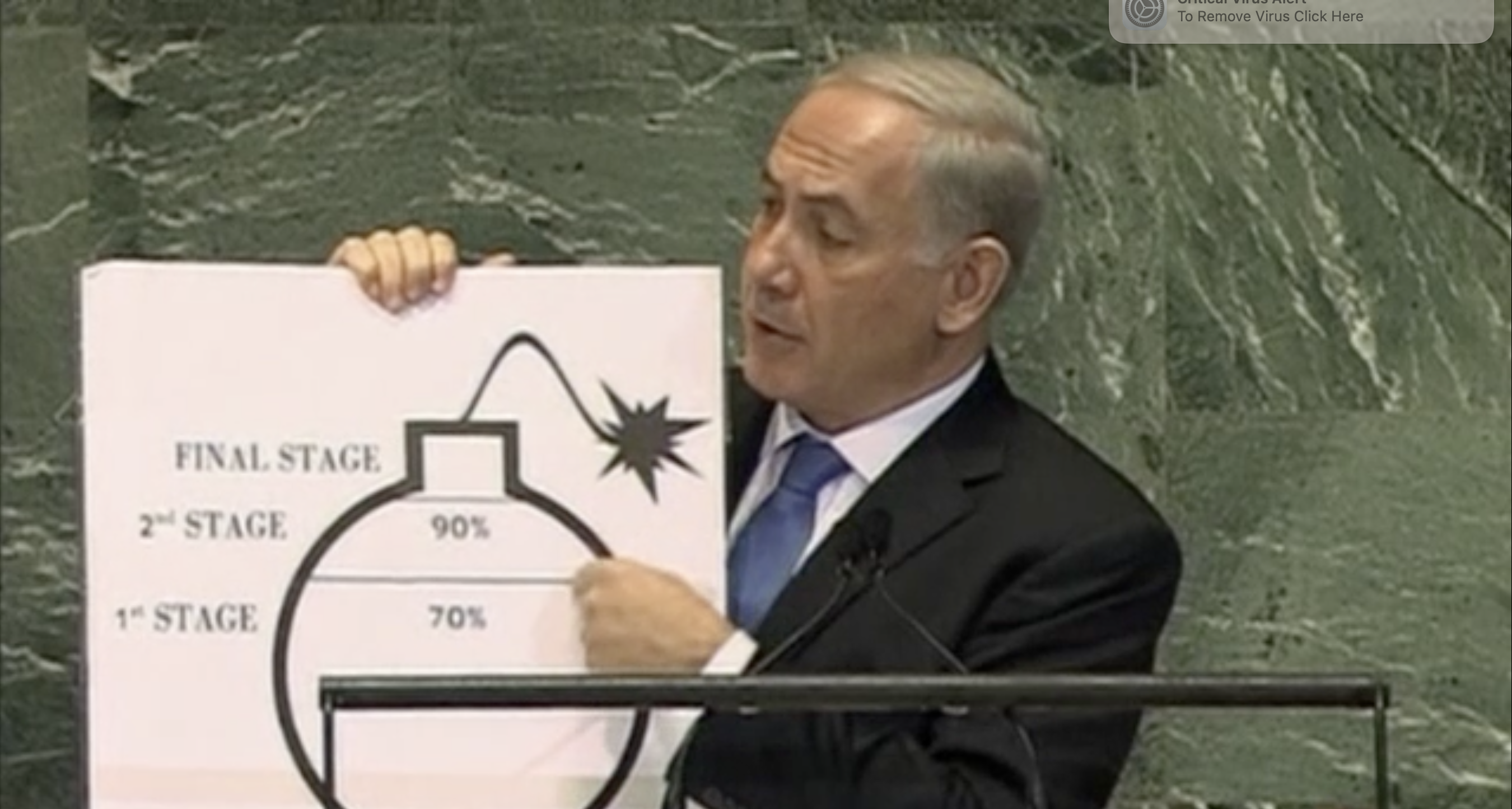
–and, he grimly concluded, allow Iran, a rogue nation, to arrive at full possession a nuclear bomb–

Netanyahu Addresses U.N. General Assembly on September 26, 2012

–that Netanyahu used a sharpie to prevent, beseeching the United Nations a decade ago force Iran to “back down” not only from introducing nuclear weapons in the Middle East, but upset the balance of power in which Netanyahu claimed he sought to “forge a durable peace with the Palestinians” that had long been elusive, implicitly blaming Iran as the chief bad actor to ongoing crucial process of peace negotiations to secure the recognition of a Jewish state of Israel. Netanyahu used public reports of the possession of enriched uranium, but turned to cartographic props in later years to describe Iran not only as enemies of Israel, but enemies of God, like the very Amalekites who it was the duty of the Jewish people to wipe and eliminate (Deut. 25:17-19), as they were of an order of evil and threshold of wickedness that demanded to be contained, Netanyahu has relentlessly, and per formatively turned to maps to erase occupied territories and Gaza, but imply, as his cartoon bomb, the fear Iran would enhance Hezbollah’s ability to strike targets in Israel.

Netanyahu Iran

The map seemed revised “Greater Israel” transcending its borders to a threatened nation, aspiring to normalcy, but threatened by the non-state actors tied to Iran, the “threat” or curse in a region where boundaries and borders made no sense. Netanyahu paradoxically condescendingly lectured the community of nations at the meeting of the 79th General Assembly to defend Israel’s conduct in war, without saying so, mapping the transnational ties that had become a threat from the perspective of an isolated country. This was the deepest reality Iran must understand, the states of the world must recognize it was impossible to tolerate any longer, and the reason for the border wars he was about to launch with increased intensity. The violence of the attacks, he seemed to be saying, or apparent violation of international law were the least of the world’s real concerns. The remainder of this post is concerned with mapping of the threats to Israeli sovereignty, the mapping of the borders of Lebanon that Israel invaded, and the question of mapping the future of the nation. When he returned to the United Nations on 22 September, 2023, no doubt enraging Palestinians in the audience, he displayed the future “New Middle East” with no Palestinian presence visible–

–in ways that this blog has linked to the invasion two weeks later of Israel in the Al Aqsa Raids, named after the old mosque in East Jerusalem whose presence was recently closed to Palestinians. That performative use of the map of a bucolic “green” future appropriated the green banner of Palestinians for a “New Middle East” that suggested a community of nations poised to recognize the legitimacy of Israel in 2023–Egypt; Sudan; Saudi Arabia; Bahrain–that appeared to welcome Israel as a “normal” nation in a map of clearly drawn borders.

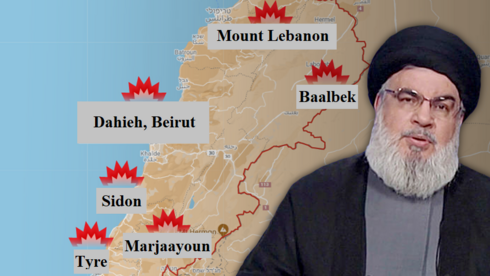
The strikes on Lebanon, he seemed to say, were the “domestic policy” of a “normal” nation. But the increased scale of the bombing raids that followed Nasrallah’s violent death under Israeli bombs led to a massive attempt to degrade the strength of Hezbollah on a region not imaginable before, providing a massive launching of air raids across southern Lebanon, focusing on the area below the Litany River in the southern part of the country, but extending up to the area below the Awali, the two proxies for the agreed lack of a border of Lebanon, as if to compel the United Nations and international community to accept the borders of Hezbollah’s presence in the nation and in the Middle East. The folks at “Understanding War” provided a far more sanitized image of the localized strikes that Israel had taken of cities or villages south Sidon, as well as just outside of Beirut–where they destroyed the compound of buildings where Nasrallah was meeting operatives of Hezbollah–including reconnaissance and observation points of the Israeli territory in the Golan Heights, based on local Lebanese reporting, that seemed destined to “degrade” the force of Hezbollah in Lebanon.

The demand for such a degrading of the border zone emerged as a logical response to waves of rocket attacks on Israel, mostly on IDF positions and an attempt on the Mossad headquarters outside Tel Aviv, the later fired in response to the bunker blasters that killed Nasrallah on September 27. The flurry of cross-border bombs can offer some clarity on a war that was still being called “focussed,” “targeted,” and “delimited” but appeared intended to secure a sense of lasting violation of borders and sovereign integrity, and to reassert its control of the area south of Sidon.
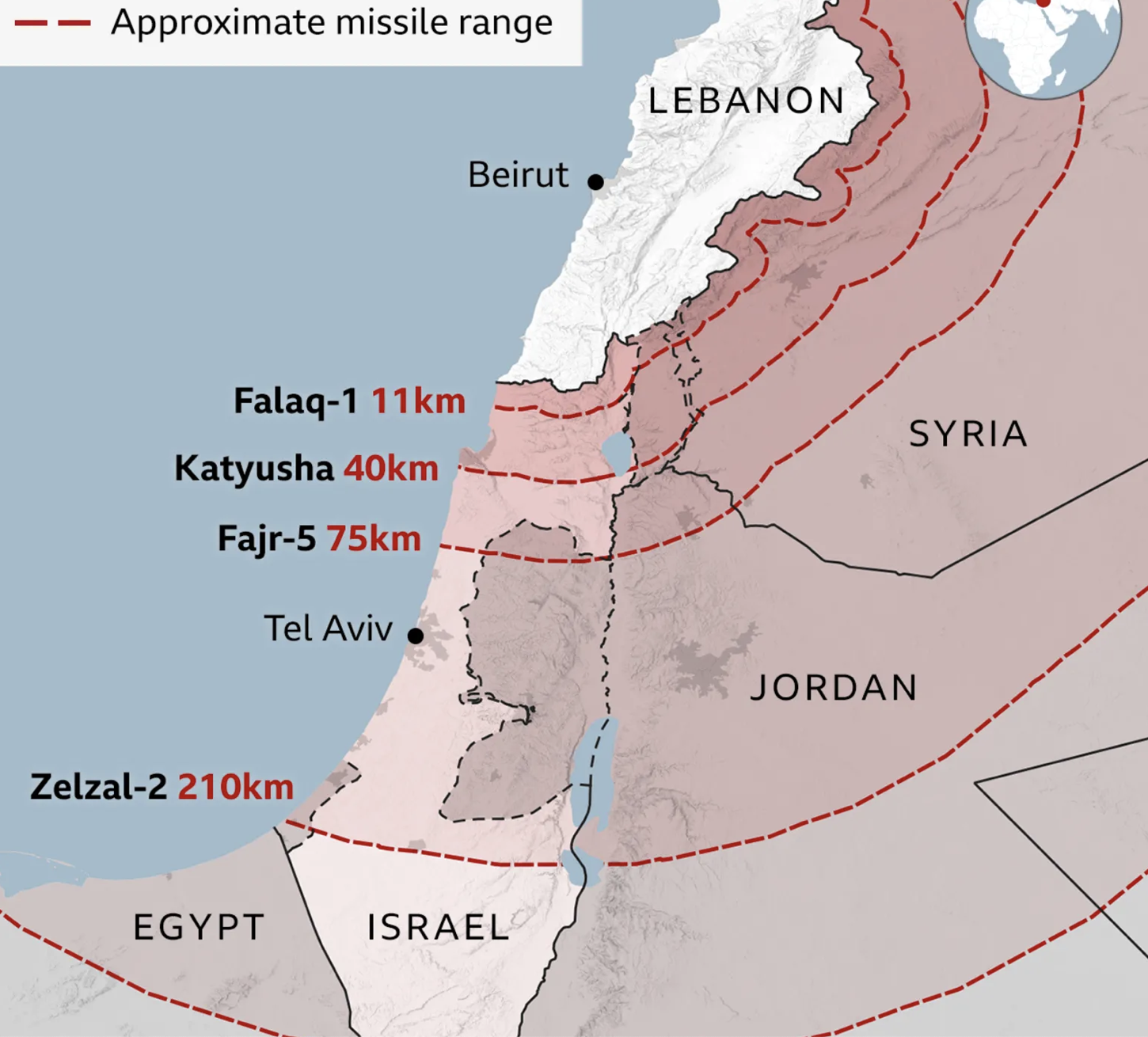
Capacities of Hezbollah Missiles Striking Deep within Israel/BBC, via CSIS, AFP/October 1, 2024

To a certain extent, the targeting of the southern third of Lebanon made little tactical sense, with missiles of considerable precision no reaching not only a forty kilometer rang of Katyushas, but the seventy-five km range of Fajr-5 missiles, the Iranian made long-range multiple launch rockets named after the morning prayer, first developed in the 1990s. modernized with GPS guidance in 2017, or the two hundred and ten km Zelzal-2 long range unguided rocket–Persian for “Earthquake”–which promises an enhanced level of local destruction upon impact, but also offers far less precision, but the Israeli precision strikes seemed surgically elegant, but seem to respond to the increased accuracy of short-range missiles, and the hope of removing the threat of cross-border strikes of increased velocity and defined by “more accurate, more precise, multidirectional fire” for the past six years of increasing chances and worries of cross-border war, in many ways more salient than the Gaza Strip had ever been in the previous decade, per the IDF’s former chief of operations.

Vulnerability of Israeli cities to Syrian-Made and Iran-Made Missiles/GIS Reports Online, 2018

From October 2023 to July, 2024, there were over 2,295 rocket attacks on Northern Israel, displacing many, but over a far more limited range than the study of Syrian rocket ranges revealed, mostly confined with in 20 km of the armistice line, and few beyond 30 km of the border, designed the abilities of Syrian and Russian long-range missiles, whose use was understandably restrained–the greatest majority within but 2.5 km of the border, and 94.3% within half a kilometer of the border.
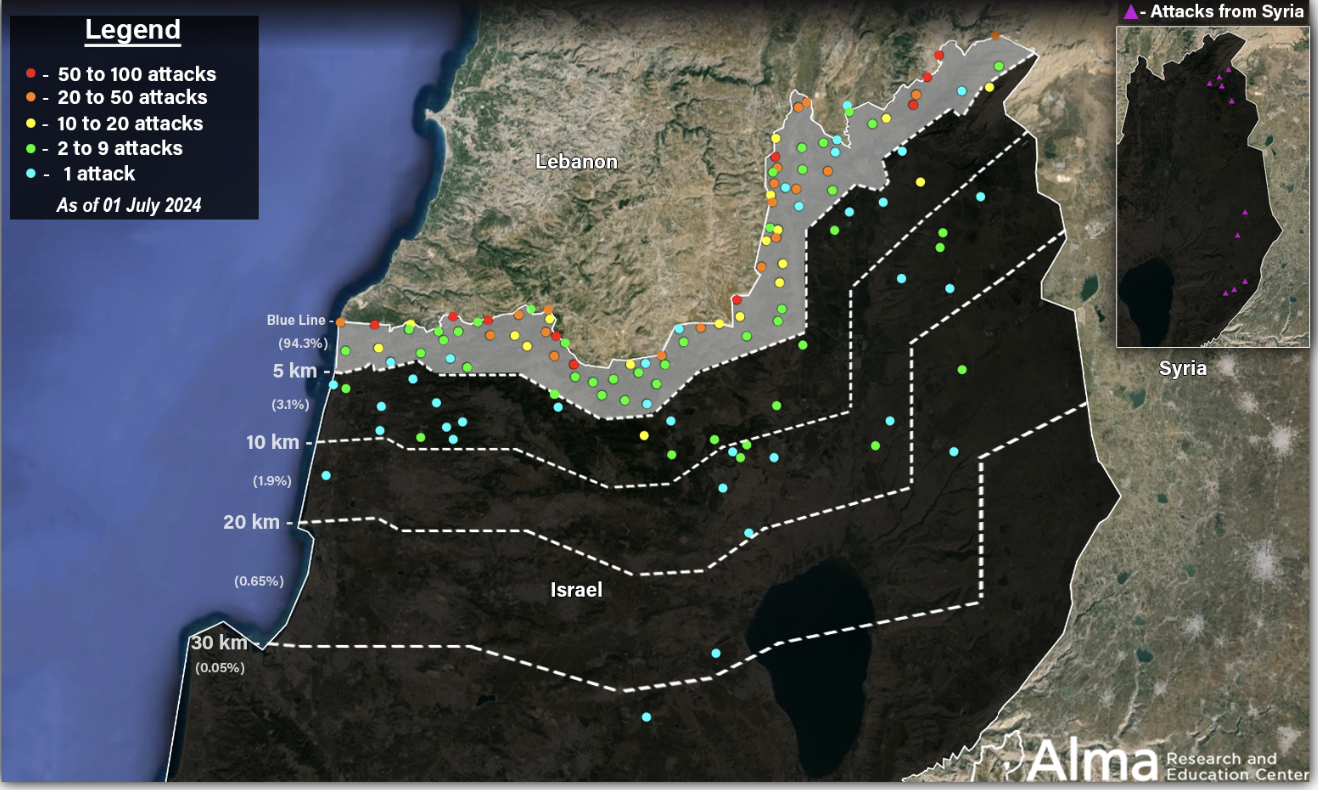
Attacks on Israeli Territory, October 8, 2023-July 1, 2024/ALMA

Netanyahu seems to have won Americans go-ahead for “for dismantling [Hezbollah’s] attack infrastructure along the border,” assurances bolstered when US Defense Secretary Lloyd Austin “reaffirmed US support for Israel’s right to defend itself against Iran, Lebanese Hezbollah, Hamas, the Houthis, and other Iran-backed terrorist organizations.” Although Hezbollah had no intent to withdraw from the border, viewing its fostering of a “resistance society” as a prelude for the collective annihilation of the Israeli state, if not the annihilation of Jews that suggested defense was only possible by all-out war. While the lame duck American President bravely held out hope for a ceasefire, the war on the border had raged for weeks, and wouldn’t stop soon. In launching fireballs and incendiaries with trebuchets and from missiles, a border war of new intensity and scale had emerged for which Gaza may have been a rehearsal, and the purported choices of two maps–a “blessing” of alliances and a “curse” of Iranian proxies’ victory–is itself a smokescreen.

Or was the map not only a smokescreen, but demands to be taken seriously as a counter-map of the maps of bombing raids that he at this point knew were imminent, and underway? The deployment of the bunker-busters was not taken light heartedly and without much internal debate with members of his cabinet; the blast that seemed a veritable hand of God and strike of death for the elite commanders of Hezbollah and their General Secretary was sought to be explained, before it happened, by the lamentation of the situation in which Israel found itself. The map provided a “message for Teheran” Netanyahu had traveled to New York to bring–“if you strike us, we will strike you “–invoked the absence of borders, opening a window to escalation or a imminent missile strikes from Iran threaten. No magic marker was required, or any clear rhetorical hectoring of his audience–he seemed now heavy lidded and quite tired as he spoke to the General Assembly, with full foreknowledge of his order to send the bombing strike that would assassinate Nassrallah in his hiding place. The visual aids keyed to a language of biblical derivation, oddly misplaced on the modern geopolitical situation of Israel, was a language of self-preservation and of flattery–Indian media seemed a bit overjoyed it had been identified as “The Blessing,” irrespective of the dark side of these visual aids–the “dumb” map of the political dilemmas of the Middle East evoked the very biblical terms in which he had cast his retributive strikes on Gaza, and would now strike Beirut.

September 22, 2034

Continue reading
2 Comments

Filed under border barriers, boundaries, Hassan Nasrallah, Hezbollah, Israel

Order on the Border: Prologue or Retrospective View?


Border security was the hallmark issue of the Presidency of President Donald J. Trump–as of his candidacy–that proudly foregrounded a specter of racial division. The promise to expand the fences that had been barriers along six hundred and fifty four miles of bollard, chain link fences, and even helicopter landing pads that were military materiel from Vietnam were to be expanded to a continuous wall by the man who, Ayn Rand style, promised he was master architect and builder of a border security system, in hopes to get the costly concrete wall he imagined would be perfect for the border built. He won election in no small part because of the assurance “I’m very good at building things,” first and foremost a wall to Make America Great Again. The President who disrupted conventions of government by provoking a government shutdown in 2019 resisted the prospect he would “give up a concrete wall” in government negotiations, Chief of Staff Mick Mulvaney reminded the nation, and in visiting Alamo TX, on the eve of his departure form office, appeared to relish the presence of the slatted wall he wanted–he vowed “a steel fence” back in 2019–and to affirm the centrality of the southwestern border for the nation he was loath to admit he would soon cease to lead, if a true national emergency could not be provoked.

If the visitation of the border provided a recurrent site for Trump to affirm his candidacy, Presidency, and indeed to wield and exercise executive authority by appropriating billions on the construction of a border wall–without even knowing if it is effective–the border wall provided an occasion to affirm a uniquely distorted vision of the state.

Trump’s visit to the US-Mexico Border paid final homage to the achievement of building a border wall that was indeed of concrete and reinforced steel core seemed to create a shrine for an image of the border rooted in white supremacy, and no better site for such a shrine seemed to exist than Alamo TX. The very name of the border city in Texas few had ever heard of before it was designated as a site to salute the completion of four hundred miles of Border Wall near the Rio Grande Valley evoked a society based not only on the state’s funding of border defense, but a nation that was “founded, nurtured, and financed” on White Supremacy, as Ta-Nehisi Coats put it long before the Trump Presidency. In visiting “Alamo,” the outgoing President was not only visiting the border. He was affirming the centrality of the border wall as a monument to his followers, a memorial to border protection that was a dog whistle in its name. For the hybrid constellation of an “Alamo” along the Border Wall elevated the symbolic value of the southwestern border of the United States as if it were a battle-line to fight for the permanence of a color line long fundamental to American democracy, but long denied as a brutality of racist ideology naturalizing a social hierarchy in ways that were enforced by state power.

The Border Wall was an icon of the Trump Presidency, a prop for his public political persona as President of the nation, and a site of illustrating the commitment to the defense of borders, fulfilling the syllogism there are no strong countries without strong borders–or that, per Ronald Reagan, “a country that cannot control its borders is not a nation”–as if the border were going to vanish from the map. And when Trump visited Alamo, eight days before leaving office, in a choreographed speech, he elevated the Border Wall to a spectacle. The visit on the surface sought to reprise a bond with the American people around construction of a Border Wall, and which he was proud at having allocated–or wrangled–$15 billion that the U.S. Congress had never appropriated. Designed to slow migrants and smugglers from crossing the border, but a token of an expanded system of border surveillance from helicopters, river boats, aerostatic blimps whose radar systems are Customs and Border Patrol’s “Eye in the Sky,” and military jeeps, and an archipelago of incarceration in detention facilities that deny migrants rights. But the concrete bastions he visited on the Rio Grande affirmed the spectacle of border defense. “The spectacle proves its arguments simply by going round in circles: by coming back to the start, by repetition,” as Guy Debord argued, “by constant reaffirmation in the only space left where anything can be publicly affirmed,” and the reaffirmation of the spectacle of the border seemed to ahistoricize and perpetuate the border wall as a defensive monument, refusing to obliterate and elide it from national memory, by eliding it with the border defense of Texas, before Texas was a state.

The visit to Alamo provided a fitting stage for the final lap of a “Promises Kept” tour, as it reprised the hostile border as a part of the American imaginary. Trump long claimed. that without borders. or border enforcement, “you don’t have a country,” as if a reinforced border was a needed affirmation of national security and identity and indeed–at least semantically–nationhood. He sought to summon dignity at the border, days after the fiasco of the insurrectionary staging of an assault at the U.S. Capitol, and warn then-President-elect Joe Biden not to destroy the wall lest he undermine immigration policies crucial to the nation, and erode the border to bring “calamity” to national security at the site he had long declared a national security threat. Seeking to both stop time, refocus national attention, and conflate myths of national identity at Alamo, the dog whistle of a defense of security at Alamo TX placed the border wall in the national mythos, to stay the prospect of these sections of concrete wall and levees from being dismantled, to keep alive the story of wall-building that he had long promised to the nation as he left office, casting it as a heroic effort of national defense and construction project that he had presented himself as the Presidential candidate as uniquely suited to create. To visit the completed section of the Border Wall near “Alamo” was to evoke the mythic nature of the crumbling wall of S. Antonio de Behar in San Antonio at the Alamo, the site of resistance of Texan Revolutionaries, still the model for many local militias and white supremacists, and recall the cleavage in society Trump invoked when claiming his impeachment would provoke a “new Civil War,” elevating his own Border Wall to the mythic status of an unsavory part of the collective memory of national defense.

In the final hours of the Trump Presidency, with only four hundred and fifty miles of the border wall built, lest it be reduced to Ozymandian fragments for visitors to look upon his Presidency and despair, Trump visited the poured concrete wall at Alamo, TX, as if to greet the final testament to the achievements of his Presidency and to unveil to the nation completion of the legacy of his Presidency, as if it were a final campaign stop. Visiting a small section of Border Wall mounted on concrete levees around the Rio Grande became an occasion to reprise his commitment to national security, and the culmination of a heroic struggle of border-building and defense of the nation’s territory. The heroic struggle seemed less so, in the shadow of the tragically empty theater of the Capitol Riots, but perhaps it was the memory of his legacy he felt most able to leave: it served to epitomize the difference of “us” from outsiders, in a way that might better play to the nation than the raucous display of angry identities of flag-waving separatists, and set the tone of framing an ongoing future Presidential campaign, praising the Caesar-like monument for which he had secured federal funding, and insisting it would never be buried in the public imagination.

Indeed, among the colorful flags waved with exultation on January 6, 2021 that incarnated a social body excluding the entrance of African Americans or migrants into the nation, from Confederate Flags to III Percenters, angry at any change inclusion in a social contract that had persistently excluded those marked by ancestry and melanin from the state, the prominence of flags waved at the combat around the inaugural stands by MAGA shock forces of militia groups who cast the nation as white treasured the mythic defense of Tejano lands by militia at The Alamo as a foundational historical precedent and basis for “keeping America great,” embracing the image of The Alamo as a war that was fought both for liberties and for racial hierarchy against Mexican troops–an image nurtured not by the state, but by the powerful cultural currency of The Alamo in Hollywood as a proxy for a race war.

Even if the 2020 Presidential campaign was effectively over, the values of white supremacy that had long forged the alliance of pro-Trump separatists and deniers were kept alive by what seemed a hastily engineered visit to the border town of Alamo TX. After an incompetently ineffective summoning of minions to interrupt the counting of electoral votes by Congress, and to create a legacy for his Presidency, visiting Alamo to affirming a border wall as a monument built to keep “undocumented” Mexicans out of the United States, destined to survive even if his Presidency ended: insisting on a specter of the dangers of cross-boundary migration for America, the visit seemed perfect stagecraft for asserting the timelessness of the border wall as a legacy of defending the nation’s borders at a new Alamo, as insistently as AK47s were historically conflated with the role militias to “repel . . . danger” in 1788, and its ratification in 1789 as guaranteeing a “Right to Keep and Bear Arms.”

On his final state visit, six days after the insurrection, Trump seemed to steer national attention from the danger of domestic terrorists ready to assault the U.S. Capitol in combat gear to a racial specter of invading migrants, criminals, rapists, and seekers of asylum, collectively invested with criminal intent. As Trump had long presented the border wall as a site of military engagement–perhaps even of armed forces–the visit to McAllen and Alamo provided a means of continuing to fight the same battle over national identity, but to fight it at the border wall. The President had concluded his presidency by disrupting conventions of governing again, by refusing to recognize the popular vote’s results and inciting a riot that invaded the U.S. Capitol by minions waving flags from the lost campaign, which they insisted was not over, amidst an inverted American flag of distress, which militia groups had been regularly raised in protests about counting votes and ballots with accuracy over the previous months in Wisconsin, Georgia, Michigan, and Arizona, and has been displayed in discontent at the outcome of Presidential elections since 2012.

People rioting on the west side of the Capitol with Trump flags
Pro-Trump Protestors at West Side of U.S. CapitolThomas P. Costello/USA Today via Reuters

The sense of distress of the inverted flag that one protestor held signaled, in no small part, fear of failure to complete a continuous wall of two thousand miles in the desert promised to keep undocumented barbarians out of the nation. And as the center could not hold, days after the riot or insurrectionary attempt to end the certification of the electors, Trump concluded his Presidency in what might be a valedictory visit to the border as a site of materiality, as if to prove that it could hold, if his presidency could not. The intent to mythologize the border as a material statement of state power, and as an imaginary of the nation, was underscored by the visit to Alamo, TX–

Donald Trump Reviews U.S.-Mexico Border Wall at Alamo, TX Tuesday, Jan. 12, 2021
(AP Photo/Alex Brandon
)

–that recast the visit tot he border wall and concrete levee of the Rio Grande River as an occasion of state, and indeed a military event, to identify himself with the commitment of funds reallocated for the military budget to commemorate the construction of four hundred and fifty new miles of brand new wall along the southwestern border. Did President Trump imagine that doing so would enshrine the monumental status of the border wall would be elevated to the image of national defense? Although many had scoffed at his purposeful diversion of military funds to create the wall, which was not allocated funds by the U.S. Congress as Trump had demanded, the visit sought to cement the border wall in a project of military defense, assisted by the striking historical memories of the battle between Texian revolutionaries and the Mexican government in what later became Texas, in a battle that first redefined the US-Mexico border. The Battle of the Alamo was famously lost by insurgents only to become al Lost Cause: this often-recited memory of a military loss as if it were an affront and injunction anticipated nationalism would inspire the Texan Revolt that led to the formation of Texas as a Republic.

Indeed, the line of the Rio Grande that Texans compelled the captured General Santa Anna to order the Mexican Army to retreat in 1836 below, nearly ten years before Texas was annexed as a state, created a new “line in the sand,” now drawn far South of The Alamo, and in the border town of what would be Alamo, TX. The Texas flag of a militia, with the bronze six caliber “Gonzalez Canon” Spanish munitions seized by Tejano revolutionaries conflated arms, right to enslave, and defense of the border–reprising the 1835 battle cry of Tejano colonist militia as a defense of ancient liberties and modern militia’s defense of bearing arms. The old flag became the most popular flags sold online amidst gun control debates of 2015, and the symbolism of the armaments that were conflated with calls for local liberty is a quite popular patch for militia-members. Is it not a reprisal of an earlier and unforgotten map, at the origins of many militia who still guard the border?

Flag of Gonzalez Canon at Texas State Capitol

The “line in the sand” demanded no real logic or precedent or land claim. Its cartographic virtue lay in its simplicity: as a line drawn in the sand, traced by the drawn sword of Col. William Travis or by a Texian boot before infantry or soldiers, to incite them to battle, or even as a battle cry, the line required no real justification or legal precedent, or international recognition. This was not a line in the sand, but a wall in the sand, on a concrete pediment, dotted by American flags, lest we forgot who drew it, to sanction the cartoraphy of the border as a state affair, worthy of being the final public or private event of the Trump Presidency, affirming the crudest cartography of all: the line in the sand was invoked as the crudest technology of border cartography, and was the crudest of archeologies of the border, an assertion whose logic demanded no justification, but provided its own triggers of nationalism and national pride, and demanded no justification but could be unilaterally affirmed. A line in the sand could be drawn where the man who drew it, and determined as a line of defense.

As a myth, it demanded no formal explanation as a claim of sovereignty, but was affirmed by a simple signature, in a final signing statement bequeathing the legacy of the Trump era to the nation–a dog whistle, more than anything like a legal act. Was the cartography of the border an appeal to a mythical notion of national distinction, conjured to being to fabricate clear distinctions one wanted to call into being on a map? If this was a symbolic and performative act, the erection of the wall Trump sought to take responsibility and to celebrate, as well as to deny American reliance on immigrant labor, was designed to demean Mexican claims to sovereignty and elevating an oppositional ethnonationalism by building a wall along that line, in implicit reference ot the line drawn in the sand by the ragtag militia of defenders of The Alamo.

President Trump signs border wall plaque on Jan. 12, 2021, in Alamo, Texas
(Border Report Photo/Sandra Sanchez)

Trump seemed to salute the wall to turn his back on the abuse of Immigration and Customs Enforcement officers, and rather to praise their service in to the nation as he toured the border wall on January 12, at the same time as over two million people were on the border, seeking to migrate across it, 60,000 having been returned to Mexico from Texas, to wait for their claims to be processed in camps. For Trump desired to recast the border wall as a historical achievement of Making America Great, turning a shoulder on the institutionalization of family separations, crowded and abusive conditions in ICE detention centers, and overwhelmed immigration courts. “Building a massive wall that spans the entire southern border [of the United States] is not a policy solution,” President Biden would soon proclaim on his first day in office, pausing construction work on the wall and calling for a reassessment of the legality of its construction.

In declaring a “National Emergency Concerning the Southern Boundary of the United States” in February 2019, Trump would diverted billions of dollars to the construction of the border wall, he fiction of the boundary that Trump sought to affirm in his visit, and had demanded in unilaterally fortifying the border as a subject of national defense, in treated as a National Emergency, rested on the need to “protect” American security, demonizing how migrants stand to “put countless Americans in danger.” shedding American blood and taking American jobs in order to redirect $8 billion to the border wall as a boundary that needed to be defended for national interests, without legislative oversight.

The legitimacy of the border was, of course, deeply engrained in our history and tied to our national mythos in ways that Trump was keen to exploit by staging his final signing visit to a section of border wall in a town called Alamo: as a Representative to Congress, Abraham Lincoln, later no stranger to the loss of life to determine national borders, detected the “sheerest deception” on the part of then-President James Polk in blaming the aggressiveness of Mexican soldiers across the Rio Grande as part of a campaign to admit Texas to the Union as state that would expand territories tolerating slaveholding: rebuking the mythic sense of the Rio Grande as a frontier of the nation, the barrier across which Spanish troops were forced to retreat in the aftermath of Tejano insurrectionists motivated by their loss at The Alamo, Lincoln doubted whether unquestioned acceptance of the Rio Grande as a frontier could serve as a basis to declare war: to rebuke charges that Mexican aggressors had crossed the Rio Grande to shed American blood, and rebuking the necessity of a national military reprisals against Mexico as inevitable–given that the determination of the boundary was contested. But the image of the “line in the sand” that gained incredible affective power as a statement of revolutionaries and in the Mexican-American war, provided the crudest of notions of the border’s stability and indeed of the border wall, not needing any precedent in law or in a mutual accord, but oddly naturalized into the landscape, at home within the construct of manifest destiny far more than in the legal record.

The fiction of locating the boundary line of the nation at the Rio Grande was a but a convenient invention, Lincoln had insisted back in the 1848, as it was, while asserted by Texans who looked to military treaties they had dictated for confirmation of their inclinations to take land, able to be manufactured as a sharp-edged mental construct of affirming value. The border of the Rio Grande’s course, Lincoln had observed, was claimed on paper by Texas as a western boundary for reasons of self-interest, but never internationally recognized as binding,–and had indeed never recognized by Congress as a question of American jurisdiction. Rather than accepting the groundless claim of a sitting President that “the soil was ours, on which the first blood was shed” in the Polk administration, eager to avoid a needless war, sending an army to fight with those Mexican resident who themselves never submitted to American sovereignty, Lincoln in 1848 found little in the historical record to accept the Rio Grande as the “boundary” of the nation, based on a unilateral declaration of the State of Texas, let alone as a binding basis for a cause of war between Mexico and the United States based on aggrandizement. Lincoln in 1848 sought to query the grounds for defending a boundary lacking mutual agreement as a boundary to be defended by American military. But the defenders of the Alamo, Travis, Crockett, and Boone, have been celebrated as patriots of Texas, and as defenders of a white tradition in recent years, as the Cenotaph in which their ashes were said to be translated in 1936 were defended by the Texas Freedom force, who in May 2020 urged members to “Defend the Alamo & Cenotaph if the need arises,” seeing the Cenotaph, as the statute of Col. William Barrett Travis, sword’s point touching the ground at his feet as he struck a pose of public oratory, on a plinth on the old Mission grounds, in Travis park, as symbols of national defense to be guarded against vandalism.

When Lincoln distinguished the international boundary line from where states claimed jurisdiction, he questioned the validity of unilateral assertion of a boundary line. Veneration of The Alamo elevated the drawing of the sand as a sacred event, a shrine for the defenders of the fortress, whose ashes in the Cenotaph have created a powerful monument to Anglo defenders, Travis, Crockett, Bowie and Boone, beneath the commitment to “never surrender-never retreat,” recently celebrated by the white supremacist militia as the “This is Texas Freedom Force,” that has urged members to “Defend the Alamo & Cenotaph if the need arises” in late May, 2020, standing guard over the Cenotaph and the statue of Col. William Barrett Travis, commander of Tejano troops who defended The Alamo, holding his sword’s point on the ground as he struck a posture of public oratory on the grounds of the old Mission. While the statue of Travis on a plinth deferred the final results of the stand–the all-out assault assault ordered at dawn by Mexican General Santa Anna left all one hundred and eighty nine defenders of the Mission grounds dead, its facade reduced to war-like visage of ruins–the heroic defense was embodied by the line in the sand, the poweful metaphor of boundary drawing to which the border town Alamo gestured. And although Travis’ statue voted to be relocated from the landscaped park that was once part of the Mission’s grounds, the confederate monument sought to be relocated in 2017, it still stands by The Alamo grounds.

In declaring emergency surrounded by U.S. Border Patrol members, the primary enforcers of the border with ICE, the very men who who become his personal agents since their early endorsement of his candidacy, and who he later visited at Alamo, TX, at the end of his term. Surrounded by the border patrol agents whose number had hovered about 2,000 until 1985, whose number peaked beyond 10,000 by 2000, Trump celebrated a border that circumvented congressional appropriations and the law, provoking a spate of lawsuits from many states and environmental preservation groups, extending the declaration of a state of emergency at the border in February 2020, and again renewing it, as he left office, two days before Joe Biden’s inauguration on January 18, 2021.  President Trump was confident, playing it by the numbers, that lawsuits against the National Emergency only emerged from “blue” states he did not need to win to be reelected, counting on the border imaginary to be preserved.

The visit to Texas was an attempt to bolster that border imaginary, to the site where the greatest “immigration enforcement” efforts against refugee influxes had begun with deployment of a large, flexible, mobile Border Patrol Task Force, then in the INS, in the most severe “border build-up” in memory: “Operation Hold the Line” deployed armed Border Patrol officers along the border, along the McAllen Sector administrating the Rio Grande Valley, as Operation Gatekeeper grew along 194 border checkpoints to construct the first section of border wall on the western border, introducing a militarized border oriented toward stopping or physically halting the passage of unwanted migrants and refugees. If the San Diego initiative of “Operation Gatekeeper” evoked a mock-pastoral metaphor of the “gate” to cast migrants as animals, and mask the violence of migrant deaths–1,200 migrants died trying to cross the border from 1993-96, when it was in force, with the greatest number where Operation Gatekeeper was in force, as many more were detained as criminals. In parallel, “Operation Hold the Line” emphasized the placement of Border Patrol stations along the border, to compensate for perception of no coherent federal vision for the border management, to replace standard practices permitting migrants to cross the border before they were apprehended and deported, mandating continuous presence at the border of Border Patrol. Stationing Border Patrol across the border began in the lower Rio Grande valley, by a model of Border Patrol echoing Tejano defense of the line “drawn in the sand” at the Alamo, was later deployed at El Paso as “Operation Blockade,” staunching all cross-border movement.

The image of the defense of a “border” that existed as a “line in the sand” tapped a mythos of the Texas revolutionaries who defended The Alamo, a site of an old Mexican mission–a stone complex constructed by Spaniards in San Antonio as a Franciscan mission hat had, mutatis mutandi, become a garrison, for all of its Franciscan origins, venerated for its defense by Travis, as a line able to be drawn between the intermingling of Mexican and Anglo cultures, the mixture so intolerable it had to be defined along an edge. In rallying a small group of insurrectionaries hoping to defend The Alamo, and to extend the “rights” to extend plantation systems into Tejano lands, William Travis had drawn the “mother of all lines” in 1836 in the sands before the mission complex, perhaps the archetype of all maps of the southwestern border: in drawing a line before the assembled rag tag insurrectionary Anglo troops he would lead against the approaching Mexican General Antonio Lopez de Santa Anna. The line whose drawing is an archetype in all films about Texas gives narrative prominence to the defense along a line in American film, as if tracing an archetypal cartography as a topic of attention, tension, and crisis, that “visiting Alamo” seemed to seek to reprise for a President who was long in touch with television producers about choreographing his public appearances to present his political persona.

In a different cinematic key, outside the Trump canon of action films, John Sayles’ Lone Star referenced in the taunt of the owner of tire repair store in a border town who traces a line before his store to taunt the Anglo sheriff from across the border who is adamant in his cartographic convictions, “Bird flying south, you think he sees that line? Rattlesnake, javelina–whatever you got!–[once] halfway across that line, they don’t start thinking different. So why should a man?” The crossing by species of the border, especially at the rich and delicate habitat of the Rio Grande, stand in contrast with the lines that the American government has been increasingly insistent to draw, and that Donald Trump convincingly coupled to a display of national identity and a showpiece for Making America Great. Was it a coincidence that it was at The Alamo, according to the cheesy poster publicizing the Technicolor western epic written, directed and produced John Wayne, that the dangerous troops besieging The Alamo held Mexican flags, in what was openly mapped as a military confrontation at a border in terms of a race war, circa 1960, between latino extras and Anglo cowboy combattants, eager to hold their ground?

The image of the tactical defense of the walls of the old Spanish mission, since restored by the U.S. military as a shrine to national combat, has been memorialized in multiple dioramas emulating cinemascope as a historical struggle for identity, created in a recreationist model designed b Thomas Feely, has been recently expanded in a still more detailed diorama to incarnate the threat of Mexican troops flooding the walls of the citadel in San Antonio, showing at its central moment of dramatic tension the amassing of Mexican forces to breach the northern wall to show “how really doomed” its remaining defenders were as they remain to repulse the mass of armed Mexicans, placing 2,000 hand-painted pewter figurines in an dramatization of an action-packed version of this cartographically generational conflict, intended to replace the fifteen by thirteen foot diorama that already exists at the History Shop, just north of The Alamo. While such models are far from Alamo TX, the investment of the dramatic moment of history as an inspirational event–rather than a failed insurrectionary event–was channeled days after the Capitol insurrection, in Washington, DC, seemed to stage a dramatic pseudo-coup replete with its own historical myths, as if to affirm the inspirational value of the defense of the border as a national project.

Did the fantasy of a border that could be held again at The Alamo, or at least at the Rio Grande, create a powerful mental imaginary whose simplicity underlay the cartographic crudeness of the deep history of Trump’s border wall? Operations of controlling the border, as a fixed line, grew to hold an increasingly prominent place in the mental imaginary and mythos of border patrol agents near McAllen, as Border Patrol vehicles were increasingly stationed every hundred yards o the banks of the Rio Grande: as “Operation Blockade” reverted to “Operation Hold the Line” in El Paso, in the mid-1990s, it reflected the extension of the metaphor of a “line in the sand” at The Alamo to the entire border, and a basis for understanding the demand for “operational control over the international land and maritime borders of the United States,” borders that Trump would conflate with the identity of the nation. The expansion of Border Patrol Operations to stop migrant travel across the entire lower Rio Grande was amplified in the 2004 deployment of boats, fencing, and lighting along the banks of the Rio Grande to reduce migrants’ entrance across the border at a cost of $3.5 billion. The dream of instituting a “line in the sand” along the Rio Grande hoped that the invasive construction, amplified noise and lighting disturbed sensitive habitat and breeding behavior “temporarily” without adversity and “little permanent damage,” as if failing to consider the long-term nature of the “grand strategy” as it mutate into a multi-year project from 1997.

Border Patrol operations in the Lower Rio Grande Valley, Texas. Cartography by Eric Leinberger. 
Eric Leinberger/US Border Patrol Operations in Lower Rio Grande against Migrants, 2011

The expansion of both border patrol officers, 20,000 by 2010, mirrored the allocation of $7 million for steel fences across the border, which expanded to Trump’s public requests for $8 billion for a border wall likely to cost as much as $25 billion. The huge sacrifice to the nation of building the border wall existed not only in the squandering of funds, but the legitimizing of a mindset of criminalizing and detaining trans-border migrants–and discounting of migrants’ lives. Migrants detained during the Trump Presidency in holding facilities along the border or in detention centers were willfully administered without humanity or dignity by the Immigration and Customs Enforcement: detention centers were sites of systemic abuse, operating with impunity in a culture of “dehumanizing physical, sexual, and medical abuse,” in the eyes of one observer, left over-crowded as President Trump sought to make them monitory examples to migrants. “Look, this is tough stuff . . . I know we’d see a system that is overcrowded,” adding on Twitter, “Tell them not to come to USA– . . . problem solved!” “Where do these people come from?”

Trump asked with open arms at a pro-border wall rally in February, 2019, anticipating the Presidential challenge of El Paso’s Beto O’Rourke, stirring up anti-immigrant sentiment, but ignoring the daily violence at the archipelago of Detention Centers that were administered by ICE. The project of wall building however became a monument in itself, the logic of whose construction as a monument to the nation consigned to oblivion migrants’ fates by being recast and dignified as a military project, and a military struggle–an elevation of the building of the border wall to a struggle for national identity that was referenced in the reference to defending the border at the celebration of the completion of four-hundred and fifty miles of wall at an American border town called Alamo, where the line in the sand could be firmly drawn by blocks of reinforced concrete with a rebar core–presented as the completion of a promise long made to the nation.

Trump in El Paso: Dueling rallies show border wall support, opposition
MAGA Border Wall Rally at El Paso Texas, 2019

The policy separation of migrant families at the border began in late 2016, before Trump was inaugurated. It was extended without public debate over the policy, however, and dramatically escalated in Trump’s Presidency. If the wall concealed America’s dependence on migrant labor, it also concealed the extent of this rampant abuse of human rights. The systemic family separations at the U.S.-Mexico border expanded despite documentation of its abuse–there are many cases of losing, abusing, and even killing children increasingly detained in centers in southeast Texas–but Trump tolerated and shouldered abuse as he had directed attention to the construction of the border wall that was financed almost two years ago, with the declaration of a National Emergency as Congress refused to apportion $5.6 billion he requested for its construction, but a fifth of his original request, with the assertion that the nation faced “tremendous dangers at the border” that demanded a border wall, seeking to secure the desired funds without the congressional approval by hyperbole, to use funds apportioned for military construction projects to redirect to a border wall he cast as a project for American armed forces as the funds were not forthcoming–but meeting legal challenge as only projects in which American armed forces were engaged didn’t demand congressional apportionment, and as, it was widely noted, border apprehensions were in decline. The steep increase in detentions at the border was cast as evidence of the need to build the wall, as policies of detention and increased numbers of those detained by Immigration and Customs Enforcement created a sense of its increasing need.

But it was as true that the need for a wall as a shared cultural symbol grew to distract populations from the growing gaps of wealth, access to education, health care, and justice in the United States, and the growing wealth gaps between the super-wealthy and the rest diminished before the spectacle of the wall. The National Emergency was declared to secure funding for the border wall, concealing that the securing of the border was neither an emergency or a military operation, but a mythic redrawing of the border.

When President Trump visited Alamo, TX to review the border wall as his last and final public act as United States President, it seemed in a sense the end of an era. It was valedictory in its salute of the Border Guards who had first endorsed him for his Presidential run, and had turned into a sort of personal storm troopers of the executive wing, a set of armed men to attack and detain illegal immigrants as they acted to parol the borders. In visiting the border at Alamo, he seemed to reprise his promise to build an impassible border wall that would protect the United States–or a version of the United States–from the entrance of globalization. And the appeal that Trump had made as a presidential candidate of restoring national integrity and an illusion of American greatness began from the restoration of the values of The Alamo–a timeless a mythic defense of the United States at The Alamo, linking the border wall with a mythic project of national defense, even if the defense of The Alamo during by Texian Revolutionaries was not fought at the walls of the old mission by the American government. The visit to Alamo TX was an affirmation of the values of The Alamo of defending national sovereignty, and dedicating himself to the affirmation of sovereignty, as well as to whip fears of a return to an open borders policy he had tagged President Biden and the Democratic Party.

Was the myth of The Alamo not at the heart of the legend of national grandeur, rooted more in race than in nation? Rather than providing an outpost of the American government, the garrison of The Alamo that is linked with the start of the Texan Reolution was defended by men who have been retrospectively cast by white Americans as the self-annointed ancestors of Texians–they were the precursors and model of the current vigilante groups who have been encouraged to make citizen’s arrests of undocumented migrants. Varied groups, defining themselves as self-designated Patriots, took in upon themselves to seize land that was Mexican–and under Mexican sovereignty–to claim it as part of the United States. The “Come and Take It” flags first flown as a symbol of defiance to Mexican soldiers in 1835 provided a false originalism that flew as it was elevated in the insurrectionary Capitol Riots President Trump had not distanced himself for several weeks; the defiant Confederate flag affirmed Second Amendment rights, and the President’s own rhetoric of “taking back the country,” familiar among militia.

Come And Take It': A Texan Symbol Of Defiance For Sale : NPR

The ease with which Trump described the building of the wall was in 2015 was confirmed by the visit to the border Alamo, by staging a revisionary and selective history of the border wall rooted in national triumphalism and American flags. Trump had convinced the American electorate building a wall across a border of almost 2,000 miles, extending from the Pacific to the Gulf of Mexico, across rugged topography was a piece of cake for someone so practiced in construction was itself a map-trick. Trump in fact possessed little sense of the practicalities of building in such terrain, and barely registered the scale of the problem save its effectiveness of a wall that would render the legal identity of the migrant opaque. Rather than dwell its logistics or practicalities, Trump had promoted the performative promise of constructing a border wall in his campaign–displaying pseudo-maps promising national security–whose simplicity lay in its denial of rights of migrant, a simplicity of evacuating rights by the border wall that was a subject of pleasure, an inspirational image whose financing he presumed that the office of the President would help waive established mechanisms of appropriating necessary funds.

The image of the fantasy wall bounding the nation, concrete punctuated by what seem hexagonal towers of surveillance, was attributed to “The People,” as a new embodiment of the nation, separate from international conventions or law.

What Trump owes his supporters, and now, the country | PBS NewsHour
2016 Presidential Candidate Trump Shows Border Wall Map Allegedly Given by 2015 Rally-Goer in Fayetteville, NC/
Johnathan Drake/Reuters

The fantasy of the border wall that Trump was offered at a political rally for his candidacy was completed at Alamo. The evocative name of continued resistance, and refusal to give up, was evoked by the place-name alone of one town near where the border wall spanned Hidalgo County that popped as a trigger for transmitted memory far more than the other towns the section of border wall passed near Ft. McAllen–‘Mission’, ‘San Juan’, ‘Weslaco’, ‘Mercedes’, and Brownsville, a frequent stop of border visit, and popped out of the map for some time. Plucked from the map, its prominence drowned the fate of migrants or the protected areas the Trump administration sought waivers to cut through from 2017, wrangled by 2018 as regions the wall was only permitted to extend by declaring a National Emergency at the border; Customs and Border Patrol waived environmental regulations in the Lower Rio Grande, as regulations preventing construction of border wall in protected lands were extended to the western regions through 2019. Was the Rio Grande Valley not a model for the waiver of environmental regulations limiting construction that President Trump long sought to wrangle?

Border Wall | Sierra Club
Proposed Levee Wall Constructed in Rio Grande Valley, 2017
Expanded Levees Proposed along Rio Grande Valley
Existing and Proposed Border Wall beside the Rio Grande River and Valley (2017)/Sierra Club

By late August 2019, the problem of extending the border wall and levees along the lower Rio Grande Valley still remained on Trump’s front burner, and the nagging question of how to extend these sections of existing border wall in a defensive line along the windy course of the Rio Grande near McAllen was a thorny question of securing needed exemptions.

As a realtor, Trump was habituated in the construction of hotels and golf courses to move around regulations and obtain special clearances with the ease he might move across the globe’s surface, and as he flouted regulations and Congressional approval by declaring a National Emergency in February, 2019, to circumvent budgetary approval, allowing himself to flout regulations as in the past. As a real estate promoter, Trump had mostly used maps to skirt regulations, gain tax breaks, tax-forgiveness, or debt relief, to generate much vaunted “gross operating products” to “pay as little in taxes as possible.” Tax-avoidance is the major strategy of wealth preservation of the ultra-wealthy, and the range of tax breaks that Trump gained in what constitutes as public assistance benefit all fifteen buildings at the core of his Manhattan real estate empire; circumvention of regulations of appropriation was the only way to achieve the building of the border wall, and was probably what Trump meant, if anything, when he argued that his expertise in building would allow the border wall to be publicly funded, even if he argued that deal-making skills would allow construction of a “big, beautiful wall” that no previous President had been able to deliver–and which demanded a voice outside the corrupt American political class.

Donald J. Trump, left, with Mayor Ed Koch, center and New York Gov. Hugh L. Carey, pointing to a rendering of what would become the Grand Hyatt Hotel, in June 1978. A crucial factor behind the hotel’s construction was 40-year tax break that has cost New York City $360 million to date.
Trump at June, 1978 groundbreaking for Grand Hyatt, Associated Press

The wall was a symbol of the popular mandate on which Trump promised to deliver, providing a monument of public safety no other president had been able to offer. The very narrative of its imminent construction had long offered a performative basis to save the Trump presidency, returned to several times as if it were a promise that was the basis of his alleged popular mandate and a demand for safety only he could meet or discern. If Trump clothed the construction of the wall and its funding in questions of border security, and the needs of economic and criminal security that he argued the lack of a border wall imperiled, arguing for the basis of domestic security to attract the broadest base, as an act of love–“you build a wall around your house not because you hate the people on the outside, but because you love the people on inside” (January, 2019), Tump was selling us a vision of domestic security akin to luxury living at a remove from the city’s sounds and diversity, concealing the economic dependence of the nation on immigration, and the violence of the border security apparatus, more costly, perhaps, if far less beautiful than the “big, beautiful wall” he promised.

Love? The wall emblematized an independence from international protocol or conventions, and human rights requirements, as a “line in the sand,” and was able to be drawn in the sand as the site to build the towering, opaque wall able to blot out what lies across the border, replacing the sovereign state with a model of border defense of earlier eras, eras predating sovereign claims we would recognize, and suggesting a Hobbesian state of nature. Trump saw the wall as, one might argue, a similar part of the landscape, able to blend seamlessly with its surroundings and necessitated by them.

–in a performance of sovereignty, rather than a sovereign discussion with other states: the border wall was long for domestic consumption as a spectacle, if it was argued, and presented, to be , and was involved in a mythos of the nation that was for domestic consumption, displacing claims of sovereignty in the ceremony of defining a dichotomous divide by fiat, on a reality show that was for national broadcast, rather than framed by a language of international law.

Trump staged his final visit to the border at Alamo, TX, seeking to savor the triumphant construction project he now cast as a monument of national achievement of what he had campaigned would be akin to the Eisenhower Highway System, funded by defense appropriations even if they unapproved by congress, but The wall provided a monument to the Trump Presidency, emblazoned with his name or his signature, as if in a gambit to claim that the structure deserved to be named after himself. He visited the poured concrete levees on the Rio Grande as a fruit of his presidency, the only concrete walls left of the entire border wall, which was vertical steel beams filled with concrete to replace fencing, but judged to meet the “operations requirements of the U.S. Border Patrol” in 2019–until, that is, they were found easy to be sawed through by a circular saw. Such “high security fencing” would cost 1.6 billion, but a fraction of the $25 billion Trump desired to allocate for border building, promising at the start of work “not only on some new wall, [but] . . . fixing existing walls and existing acceptable fences” very quickly. He had accelerated the pace of border construction in ways that seemed to be timed to the election, and had probably planned to visit the border wall for a final time in his Presidency, win or lose the election, as a platform of expanding the need for allocating more funding to the wall. When he came to “highlight his administration’s work on the border wall,” the valedictory visit sent the message that he. had done his hardest to keep the barbarians on the edge of the empire on the other side of the border, and sought to transmute into the national memory.

All of this was far from the town of Alamo, and even father from the mythic imaginary of The Alamo that had assumed a sacred importance in many Americans’ collective memory that Trump was eager to transfer to the Border Wall. President Trump’s visit was to a site near McAllen, Texas, rather than The Alamo, but the questions of how they were related quickly rose to the surface of newswire accounts. AP and other news outlets quickly reminded the nation, as the White House had left it unclear, that the city of Alamo TX near the military base was, indeed, not The Alamo in downtown San Antonio. But Trump had long claimed to love the uneducated, and the faithful, and the possible geographic confusion seemed an opportune way to fulfill the mission of the trip to tally achievements by affirming the threat came from south of the border at his term end–and elicit continued fears that the failure to complete border construction projects would not Keep American Great less cross-border flows of population continued to be stopped, as important to the nation as the historic “border conflict” by the so-called “defenders of the Alamo,” who had in fact started an insurrection in Mexican province.

As if visiting an outpost on the border of the empire where he sought to protect barbarians from invading, days after having incited riots that had staged an actual insurrection, at a rally where the President claimed Democrats “threw open our borders and put America last,” reminding them at President Biden would “get rid of the America First policy,” he ceremonially visited the border as if to mythologize it. Trump arrived in full regalia, as if denying his loos, but as if visiting the groundbreaking of a new hotel, accompanied by city officials, as if it were a privileged site of national defense, near the river whose meander had long defined the international boundary between Mexico and the United States, and indeed was a return to the Rio Grande Valley he had already visited to discuss border security in January, 2019, and sought to confront questions of the need to seize privately owned land to do so by eminent domaine. If the border wall was to be tall, daunting, fitted with flood lights, sensors, cameras and an enforcement zone that was a hundred and fifty feed wide was a steep goal, Trump treated government shutdown as a small price for 450-500 miles of border wall on track to be completed by the end of 2020, promoting a border wall whose construction would be completed by March 2021.

It still existed, even if that moment in history would never arrive. And although the story was told of population movement across the border, another story could be told about the disappearance of the boundary that almost seemed imminent by the mid-1990s, even as anti-migrant feelings grew: the expansion of the transboundary cooperation along much of the border that responded to the growth of the border region to almost a billion inhabitants in the 1990s, through which increasing billions of exports moved yearly–$3.3. billion at the San Diego checkpoint alone by 1990–that led Border Mayors Conference to request a transboundary zone allowing free movement to all of twenty five miles, as the increasing economic importance of the boundary brought an increased interest in drawing a boundary able to define the exclusivity of the wealth of an imagined community of Americans from outsiders, as a porous border region seemed less in control of the United States government, and almost a separate nation.

The line between nations that Trump chose to emphasize along the river delta where Alamo TX is located and which Trump visited is one of the sole places along the entire US-Mexico border where steel panels appear, fully mounted on large concrete levees. As one of the rare sites where the concrete wall that Trump promised actually exists, it became an important backdrop to conclude his Presidency in a final photo op, as well as to rehearse a new national imaginary.

The visit to the concrete levees of the Rio Grande Valley that were mounted by concrete-core steel fencing were a display of Presidential authority on a line drawn in the sandy riverbanks far from the Alamo, as newspapers had to remind their readers, but provided a tableaux vivant of sorts, eight days before the end of Trump’s presidency, to defend the necessity of drawing a firm line in the sand.

President Trump Visiting Border Wall at Alamo, TX, January 12, 2021–Alex Brandon/AP

The actual geographic distance between Alamo TX and The Alamo seems to have shrunk symbolically, if the car ride was still three and a half hours: Trump seemed to treat his visist as a retrospective view on the grand project of national redefinition on which he had coasted as he teared up in remembering the “great honor” after working so “long and hard” on the border wall as he found himself “here in the Rio Grande Valley with the courageous men and women of Customs and Border Patrol.” The encomium that he planned to the four hundred and fifty miles of wall built so far was an occasion of deep personal bonding with the built, akin to the ties Trump promoted to many real estate projects of construction over the years, on which he had affected the same deep tie by affixing his name in ways that we had understood as a promotion of his brand as much as a canny extension of self to a distributed global network. He had forged deep bonds to the wall, so it was difficult to decide where the wall ended and the candidate–or the man–began, as the monument he had promised so fulsomely from the declaration of his candidacy became a sign of the nation, a sign of national security, and a sign of the vision of national security that he, Trump, and only he could promise, akin to the visions of luxury lifestyle that he, Trump, could guarantee and promote.

The term that he had served out, and was now coming to a close, became an occasion to express, in mock humility, his gratitude for the very experience of having “gotten to know [the members of the Border Patrol] very well over the last four years,” praising the “incredible . . . really incredible” people at Border Patrol he had promised the wall to be built, and was now there to say he had delivered, and the promised were indeed kept. “We got it exactly as you wanted it–everything!–including your protective plate on top . . . for extra protection,” he noted, the real estate promoter returning as he surveyed the levees, and the reinforced concrete, ignoring the detention centers and the human lives lost in its construction, as well as the habitat destroyed, a concern which he was successful at having dismissed. The delivery of border wall concluded a transactional relation to the Border Patrol, as much as to protect the nation. Looking at the reinforced concrete structure with heavy slats, Trump channeled his identity as a builder that could be cemented with his status as an American President, explaining how it was “steel,” “concrete inside steel–and then its rebar–its rebar–a lot of heavy rebar inside the concrete,” channeling his inner engineer–“as strong as you’re going to get and as strong as you can have . . . . 100% of what you wanted!” The swansong speech promoting the achievement of an “extraordinarily successful building of the wall on the southern border,” of four hundred and fifty miles bookended Trump’s October 2018 speech at Calexico, CA, to commemorate the construction of two hundred miles of a “full wall system” looking suspiciously like a fence.

Gregory Bull, AP/President Trump Approaches Improvised Podium at Calexico, CA (Oct 26, 2018)

The border wall sections that had been commemorated for three years running revealed increments of two hundred miles by rolling out the border as a prop–a talking point, and a monument, more than an accomplishment. As monuments, each roll-out of border wall and affixed with the commemorative plaque crediting construction to President Trump staged a new era of border protection and defense. But the monuments to the militarization of the border wall and exclusion of refugees from the nation was based not on actual precedents, or a map, but gestured to a new national imaginary, and increasingly did so by comparisons to mythic events of the nation, rather than to actual events, migrant surges, or need.

Trump’s speech before the concrete levees in Alamo TX seemed uncoded. He deliver hope and a prayer that the piece of national infrastructure would survive as a personal legacy. But the comparisons he made were deeply coded, from the billing of the wall as a project of national infrastructure to the gesture to celebrating the militarization of the border at a city called Alamo, which effectively placed the border wall on two imaginary maps, neither coinciding with the lay of the land or the geographic situation of the border wall as a project of massive environmental destruction of sensitive habitat, inhumane treatment of detained migrants, and disrespect or acknowledgement of a world of increased displaced persons and refugees. Trump had bizarrely compared to the Eisenhower National Highway System from his campaign of 2015 would survive as a personal legacy for national development and will ensure memories of the success of his Presidency defending national security. When Donald J. Trump had first refurbished a political identity, he not only added a middle initial to his name in the fashion of Eisenhower, but presented “America’s Infrastructure First” as in the mold of Eisenhower, promising a transition that echoed the commander of allied forces in hopes to “implement a bold, visionary plan for a cost-effective system of roads, bridges, tunnels, airports, railroads, ports and waterways, and pipelines in the proud tradition of President Dwight D Eisenhower, who championed the interstate highway system”–as a basis for his credibility and perhaps legitimacy as a President. To be sure, the marquis project of a Border Wall System exhausted the budget and federal funds available. But in the way that Eisenhower mandated the highway system be federally funded as a national defense program in 1954, linking the need for roads to imminent the fears of nuclear attack, as much as for transportation needs, based on his experience in rebuilding Europe, the massive cost of the Eisenhower Highway System–which had unprecedentedly cost the United States $101 billion, far beyond the original federal bond that Congress had approved, provided the only comparable form of expenditure to the border wall that he had proposed. Even as the cost of the border wall had expanded,–and left President Biden noting that stopping the construction Trump had arranged by classifying it as a National Emergency might save the incoming administration $2.6 billion, freeing up needed funds for needed projects of national health, border barriers would have become the most pricey piece of infrastructure in the nation.

If being run by the Army Corps of Engineers, the visit to Alamo TX keeps alive the defense of the border and conjures the streaming of Mexicans over another wall, and the gesture to the improvised insurrection of The Alamo that might be effectively enlisted as a new model of service to an imagined nation. As he looked at the wall, the outgoing mused in his final days in office, unsubtly reminding his audience of the potential sacrifice to the nation of stopping the project, that the current wall was “as strong as you’re going to get and strong as you can have.” His audience new well that all bets were all off about building more wall in the Biden administration, and his words seemed to seek to rile up his long-term allies at Customs and Border Patrol, whose union had been the very first endorsed his presidential candidacy, excited by the priority he gave building a border wall in the first days of his campaign. For this real estate promoter turned salesman of a vision of the nation was most familiar with maps as a basis to evade building codes, zoning restrictions, or municipal regulation, by means of winning exemptions through wand-waving reclassifications that seemed a sort of grand opera of “deal”-making.

For Trump, such canny framing metaphors as a reference to infrastructure and a visit to Alamo helped to frame the project of the wall as one of national defense, requiring a reclassification of budgetary appropriations, and indeed fast-track prioritization as a project of national need. Both Eisenhower’s unprecedented achievement of infrastructure investment and the saber-rattling reference to The Alamo seemed to reframe the project in credible terms for a base, independent from the lay of the land or the practicalities and logistics of the border terrain: both metaphorical gambits removed the wall from the map, and mapped the border wall within a new logic of nation-building. Such reference to the Eisenhower Interstate, a model of expansion of infrastructure that had creeped up on the nation slowly, to become part of its national identity over time, had slowly created the expanse of national highways that fit with doubling of highwasy after World War I in the United States, as, the paved mileage of but 257,000 miles grew over time to almost 522,000, as the plans Eisenhower had laid were solidified as the Federal-Aid Highway Act would pave concrete interstates of 41,000 more miles–and adding 5,000 miles beyond Eisenhower’s mandated 41,000 miles of interstate provided, few have noted, a memorable event in Trump’s life, whose construction was elevated as a powerful model of what passed for public service in Trump’s youth. If Trump had ben celebrating the building of four hundred and fifty miles of wall, Trump framed the innovative nature of his future vision of a nation that was walled, by many more miles, as well as securing an image of the strength and identity of the nation that he had tried to cement. Eisenhower, famously, had mandated the project of the interstates during the Cold War as a project of national defense of the economy, in the event of attack, allowing federal dollars to flow to local projects. Was it only coincidence that Trump entertained audiences at his rallies, as if flying a trial balloon from August, 2105, “Maybe someday they’ll call it the Trump Wall,” he mused early in his candidacy, recognizing the power and unique privileges that the office of Presidency might bring. The fantasy became a near-actuality in his public platform as a candidate when by December of the same year he described the “Trump Wall,” in mid-July 2016, after he left the official campaign trail, promising a project of needed national infrastructure “someday named after me.”

The final days speech delivered with the dateline “Alamo” was hardly valedictory. It affirmed the section completed border wall as a great piece of infrastructure almost a personalized as a gift to the nation’s security. He cast his visit to the wall as forward-looking, for the right audience, as what might be a personal salute to his legacy of border defense, the trademark promise Trump made as an American politician, was not a retrospective but a final epideictic of the promise to Make America Great Again, elevating the conceit of a mythical defense against “illegal aliens” on the southwest border he had personalized as integral to the logic of his Presidency and the prime evidence of Presidential authority. Trump’s Presidency, he wanted to claim, might be remembered as a time of the building of a similar basis of the nation’s strength and architecture, as he sought to secure the centrality and preeminence of concrete wall-building to a vision of the nation. From his speech, one would think the wall had become a testimony to the strength of the nation in the Trump Presidency, and he championed the vision of the nation’s strength that he had long sought to promote, as if to celebrate and acknowledge a change in the topography of the nation and people’s relation to the nation, analogous to the highway system. It hardly mattered the drive to The Alamo was a couple of hundred miles, on Route 35 (three hundred and nineteen miles) or Route 37 (just short of two hundred and forty miles); the symbolic link of the wall to the nation was echoed, despite that quite considerable real world distance, to the map between a place symbolic of saving of a vision of national identity and a mission to defend national lands and liberties.

The link left salient during his speech was perhaps the greatest and most significant take away for the right audience, as it was its figurative intent: even in the light of failure of one battle at The Alamo, the fight was long, ongoing, and would in the end prevail as a new vision of the nation, and in the end, win out as a definition of the border in the national imaginary: if Representative Abraham Lincoln saw little precedent for the border to be drawn on the Rio Grande either in treaties or in law cases that showed recognition of the river as a mutually consented boundary line, save in the conceit of manifest destiny all abolitionists and Republicans disdained locating justifications of the border in God-given right to territorial expanse, Trump appealed to the very manifest destiny for which Lincoln demanded proofs in visiting Alamo–a “line in the sand” grounds to defend a nation, reprised as a myth of national defense in 1836, heroized by John Wayne in technicolor in the 1962 extravaganza Wayne starred, directed, and produced to promote Cold War principles of national defense.

The Alamo,” uncredited poster (1961)

While Trump had increasingly used history both strategically and purposefully as a distortion of bonds that tied the nation and its citizens, the heroic battle that the visit referenced was more likely the film version of The Alamo as a racialized struggle of white defenders against Mexican extras playing invading forces: the film, which itself downplays the location of The Alamo in Mexican Territory, and indeed the status of Texas as a Mexican state that belonged to a nation which prohibited slavery and enslavement, provided an iconic image of division that mapped onto Trump’s intent to divide the nation as he had devoted the summer of 2020 to address a broad and merciless left-wing attack to “wipe out our history,” conscripting numerous iconic images of the nation as props in his attempt to divide the nation by staging iconic patriotic tableaux to evoke a dogmatic use of historical memory.

The skill of wielding historical memory to further divides that was on show for most of 2020–from Trump’s bemoaning of attempts to “demolish our heritage” were long tagged along racial lines, from the defense of memorials and monuments to confederate soldiers, slave-owners, and anti-abolitionists he sought to preserve in our national memory, to the statues of colonizers as Christopher Columbus, who had introduced trade in enslaved peoples, to expand a sense of moral reckoning in response to social justice movements, opposing an official “patriotic” history against those who would “defame” our heritage, not acknowledging the erection of monuments to Confederate soliders belonged to a Jim Crow era designed to glorify segregation and disenfranchisement. Did the gesture of a visit to Alamo not situate the border wall in a context of defending a “line in the sand,” at the site of “Operation Hold the Line”? If this was not rationalized similarly, it was meaningful to members of the Border Patrol he visited there.

Trump Uses Mount Rushmore Speech to Deliver Divisive Culture War Message -  The New York Times
July 4, 2020/Anna Moneymaker, New York Times

The President has long lavished attention on the projected construction of border as if inhabiting the role of the public official, the enabler, and the fixer all at once in the unveiling of an even more majestic and far more grandiose national monument. Without ever conceding the election–and indeed instructing those who supported his candidacy in 2020 to “never give up, never concede,” Trump appropriately visited the border city that was named after a spirit of independence revealed in the refusal of the armed insurgents of 1835 to ever leave the garrison in Tejano lands that they sought. to hold, as if to hold off the advancing Mexicans soldiers that were valorized as creating a needed “barrier of safety to the southwestern frontier” long, long before it was ever described as a border, back in 1836. If that struggle was remembered in its day as a battle waged, as Stephen L. Austin wrote, in a May 4, 1836 letter to Senator L. F. Linn of Missouri, “by the mongrel Spanish-Indian and Negro race, against civilization and the Anglo-American race,” preserving what was enjoined to be “remembered” in public memory as a purification of ethnic and racial contamination.

The preservation of the memory of these insurgents as heroes had led them to be extolled President Trump in a historical pantheon, among public models of American heroism in a fiery State of the Union address of May, 2020 that extolled “our glorious and magnificent inheritance” as an alternative history to that of civil rights. He had praised the “beautiful, beautiful Alamo,” urging that all school children in America continue to learn the names of the “Texas patriots [who] made their last stand at the Alamo–the beautiful, beautiful Alamo,” beside the name of pilgrims who landed at Plymouth Rock as a foundational myth of the nation that confirmed its Manifest Destiny, eulogizing the defenders of the Alamo beside Wyatt Earp, Annie Oakley, and the Pilgrims at Plymouth Rock as Americans who “changed history forever by embracing the eternal truth that everyone is made equal by the hand of Almighty God.” Supported in their seizing of the Alamo-and the lands of Texas–by Trump’s hero, Andrew Jackson, who saw the benefits creating a “slavocracy” extending plantation lands across the South; the New Orleans Bee 1834 lamented the racial degradation Mexico embodied in bemoaning “the unfortunate race of Spaniard, Indian and African, is so blended that the worst qualities of each predominate.”   The visit to Alamo TX, named after the rebels whose leader had solemnly vowed “I shall never surrender and never retreat” seemed quite opportune as Trump sought to re-iterate the notorious vow he took January 6 to never give up and never concede.

The Associated Press

The speech memorialized a refusal to concede or Alamo to make a final performance of border security before the Rio Grande, and to acknowledge the depth of his commitment to boosting border security. The very emblem of the Alamo was among the flags of current militia who had arrived for the January 6 riots, and a powerful emblem of the Texas militia groups who had defended the commemoration of The Alamo as a nationalist cause, verging on white nationalism. In returning to the Rio Grande Valley, Trump announced in the Texas border town of Alamo that the border wall had progressed from a development project as “completion of the promised four hundred and fifty miles of border wall” he exaggerated as either in “construction or pre-construction” at pains to deny he had left the “wall,” the impressive centerpiece of his political promise to America, as scattered unbuilt fragments, after having rallied his candidacy behind the construction of a continuous concrete wall.

The collective struggle was ongoing and undying, in the post-Presidency of Trump, as the project of wall-building, he insisted, would continue in the appeals he had made in his candidacy, American flags draped behind him, to the flags behind him as he spoke at the wall he had guaranteed would be built, and the wall that would be a reason that folks had once sacrificed their lives. It is hard to imagine the huge costs of this project of wall building, and the expanse of an archipelago of detention centers that now existed along the border of the United States. (One might remember that it was in the Austrian border village of Braunau a son was born to the Customs Inspector Aloïs Hitler was born a future Führer.)

Continue reading
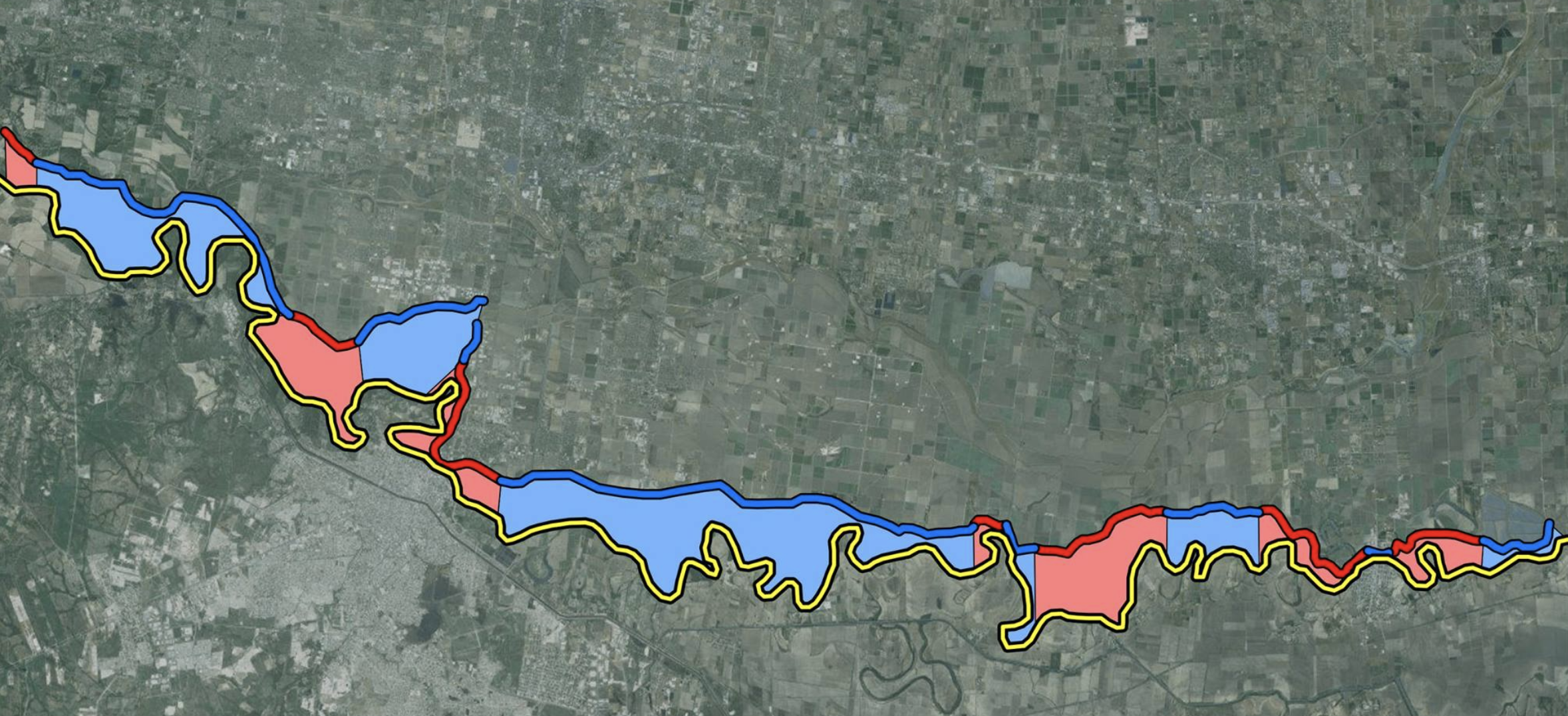
Leave a comment

Filed under Alamo, border barriers, border wall, Donald Trump, US-Mexico Border

Strongman on the Border

The border was closed and immigration authorities simply ‘at capacity,’ announced newspapers, after a Caravan of migrants from Central America arrived.  In rejecting the ability to process new arrivals who lacked necessary papers of transit, the papers parroted a an anti-immigrant line, revising the southwestern border from a line of passage, or space of transit, in what seemed a meme about the border as a threshold of legality-as if a line defines the legality of those who cross it.  If the border wall is a “new” creation, it seems designed as a monument of the “new” nation, bisecting an area that was not truly demarcated for some time, despite it suggestion of eternal authority–the Thono O’odham Nation of the Sonoran Desert long lived on both sides of the modern “border” before either nation existed across its divide, and are recognized as “border dwellers” in both the state of Arizona and Sonora.   But the wall served as a label, and a divider between “us” and “them,” a boundary where the outsider was defined as an enemy, and “politics” was indeed the definition of the enemy lying outside of the social body. To affirm that distinction, the wall needed to be built–and to explain the enemies to the body politic, the performative spectacle of the confrontations that might occur at the border was in need of staging, again and again, as a primal scene, as much as the wall-as-border might be mapped.

Department of Homeland Security

The creation of the border as a defining feature of the nation–a nation that was able to be recreated, or literally “made great again” as a nation by its border wall as a human creation–suggested the deep belief in the making and remaking of nations, a concept of the intellectual creation of nations that oddly echoes the legal historian Giambattista Vico in its insistence on the making of a nation not in reference to its laws, but as a collective whole who felt that borders were defining characteristics of modern states.  But the institution of this border at the same time exists outside of the law, and assumes an oddly primal characteristic as a site of sacrifice, echoing in surprising ways how the Neapolitan jurist Giambattista Vico saw borders as defining the inclusion and exclusion of rights to property, and senses of citizens, that was prior to and predated the law. Although the massive public works project that the state had mandated at the U.S.-Mexico Border was not at all an Enlightenment project, so much as a mega-project that was destined to incarnate state authority in an age of mass politics: a public works project proclaimed to fill multiple needs of protecting property, securing wealth, and building the nation’s power, of Neo-imperial dimensions, akin to Mussolini’s draining of Pontine Marshes or to the state programs of collective transformation of the mid0twentieth century, by dramatically staging the power of the nation in its ability to incarnate mythic notions of a powerful state for the benefit of all its members.

The creation of a strongman, who has arrogated the American eagle clutching fasces and a laurel, announcing that it will transform “many” to “one,” but only the many admitted past its sign. For the legist Vico, the ongoing brutality and conflict of society was not only natural, but a position even of possible growth: the very words of one society and culture might be reused and adopted by the following in even discordant ways.

But if Vico was clear about the “boria delle nazioni“–the conceit of nations–that they were unique in the very national characteristics that only they possessed, and the each nation had most critical aspects only it alone possessed. The conceit is amplified by the border wall, and the lie that it is built on to keep out others–and indeed to perform a sort of ritualized sacrifice of the other on the built barrier that the nation sought to create. For the Border Wall, if the most vain construction of any nation, a homeostatic barrier or norm of sorts that proclaims the identity of the nation, the unveiling of the border wall was an exploitation of the potential of television and the stagecraft of nationhood to stage that identity, as a fascistic or photo-fascist rehearsal of national foundation, or refoundation, by newly erected boundary walls that lack all porousness of the past. Indeed, the border wall seemed to be an occasion to re-educate the nation on the notions of citizenship, and the barrier that needed to be created on which to sacrifice the other. Was the conceit of the border wall a medieval conceit, or a form of statehood that was only made in the twenty first century?

The image that suggested migrants atop the wall, or of others scaling a dilapidated section of slatted border fence near San Isidro–“through a dark, treacherous canyon, notorious for human trafficking and drug smuggling”–collapsed multiple tropes of border-crossing on the least likely of targets:  a peaceful procession through Mexico that began on Easter Sunday, crossing borders to call global attention to migrants’ rights.

_101103435_mexico_caravan_migrants_route_640-nc

While the simple visualization of the course of the procession that wound through Mexico City from the southernmost border of Mexico cannot trace the mental geography on which the arrival of migrants was mapped in the United States, the progress of Central American migrants was viewed and mapped by Donald Trump and FOX in terms of the desire to see their arrival from behind the proposed $18 billion border wall that has become a contentious object of debate.  As the number of arrests along the border has grown above 50,000 for the third straight month in a row, and more children separated from parents in an attempt to broadcast cautionary warnings about the dangers of attempting to cross the border, or to appeal to existing immigration laws by asylum pleas, stories of migrants that the proposed wall would silence are increasingly difficult to silence or contain, and the human narratives of migrants are increasingly difficult to place behind the imaginary screen of an insurmountable border wall,–which of course does not exist, save as a mental construct–but is cherished as one and difficult for many to relinquish or deny.  

Even though there is no structure corresponding to the height, thickness, and architectural design that Trump had treated audiences during his campaign, the Caravan threatened to remind us that the wall didn’t exist, despite the attention that has been lavished on its proposed construction at a cost of an estimated $18 billion, far below what actual costs might in fact be. Yet the specter of the arriving migrants from Guatemala, El Salvador and Honduras–the triumvirate of “failing states” that Trump has demonized has provided a new basis to affirm the urgency of its construction. The caravan of migrants was cast as a threat to the nation, of urgency to place at a distance from the nation–even if they were also cast an oddly unstoppable “horde” able to evade or defy Mexican immigration authorities who had not successfully turned them back. As if to say that the “buck stops here,” their impending arrival was rhetorically magnified as a threat to create a persuasive image that reminded the nation of the urgent need for the border wall as an artifice of defining the nation.  

After months of dehumanizing migrants as faceless hordes, poised at the border, migrants seemed to have arrived at the border fencing, about to breach an inadequate barrier that is a relic dating from the era of the Vietnam War.  The news of the progression of the Caravan–and clouded interpretation of what their aims for crossing the United States’ southwestern border truly were–led them to become a poster child for the urgency with which Donald J. Trump has so stridently advocated the construction of a “real wall,” with an intransigence that almost embodies the physicality of an actual concrete wall, a month before the construction of the border wall began in San Diego and Calexico, CA, replacing some fourteen miles of improvised border fencing that was long ago made of scrap metal to “secure our border” as a way to “make America great again.”  The promotion of building the border wall was a way to ensure “public safety” followed repeated images of migrants attempting to scale or protest before existing improvised fencing–

image

-whose inadequacy to deal with the border threat Trump had relentless ridiculed as useless during his Presidential campaign.  The danger of cross-border traffic that Trump had repeatedly magnified circulated back to prominence within the national media with the arrival of the migrant Caravan.  The hope for the migrants to gain asylum in the United States was immediately questioned as their true agenda was assumed to be one of evading the border controls before the Wall was built–and the immigration laws that would permit their entry changed.

If the announcement of the construction was a feign of a a show of strength, and promoted as a basis for national pride, it was an insult to migrants petitioning for asylum, as the promotion of the border wall as a sign of national security debased the notion of the nation as one of laws and civil society.  The promotion of the wall as a slogan of nationalism remapped the nation in relation to the border, after all, in the Newspeak of social media and twitter–“Strong Borders are Security”, “Immigrants are Criminals”; “Refugees are Terrorists”–the border wall protected national security and projected the idea that all migrants were illegal.  The spatial imaginary of the border wall echoed the longstanding claim, made without evidence, that the immigrants at the border were “the worst” of their society, and for allowing an untold number of undesirables to enter the the nation.  As well as protesting the treatment of the United States”the dumping ground of European Refuse” as an insult to the nation, the insult was accepted by the nation.  The blame rests on citizens who are accept the very immigrants Europe does not want.  The image, which appeared just before Bartholdi’s “Statue of Liberty” was erected in New York Harbor, raised objections to accepting those rejected by Europe’s crowned heads, of dubious value to the nation that echoed Trump’s position.

European Refuse.pngKendrick, “And We Open Our Arms to Them” Life Magazine (July 12, 1885), 

The very chaotic narrative of depositing “human refuse”–a group of former colonials identified as “not like us” but being advanced by an invisible broom–was repeated in the image of the approaching Caravan, as the legitimacy of their requests for asylum from Central American nations were questioned, and suggested to be fundamentally an illustration of disrespect for the law.  The “Caravan” of over 1,000 migrants seeking a better life was widely mapped as a threat to sovereignty and law, recasting a protest march that promoted migrants’ rights as an invasion of sovereign space–and a grounds to deny migrants’ rights.  The  tweets of President Trump directed the attention of the country to the border to query the status of the migrants who were headed to the nation, as he announced instructions  “not to let these large Caravans of people into our country”–magnifying the migrants as a national threat through a dichotomy between “them” and “us.”   The anxieties about immigration policies that Kenrick’s cartoon registered panic at the caricatured faces of the new arrivals.

In announcing an intent of illegal entry across the border, Trump once again conjured the need for a border wall, as if trying to co-opt the message of migrants to create an image of a cross-border threat.  The construction of border walls against an “existential threat to the nation”–as did the former commander of the southern border who was named Trump’s director of Homeland Security and now his Chief of Staff—creates an urgency for protection that corrodes the possibility of an open society.  Kelly’s disparagement of migrants as “people who would not easily assimilate into the United States,” “overwhelmingly rural,” from countries where “fourth, fifth, and sixth grade education are the norm,” described them with the same disdain as Kendrick’s cartoon from the early Life of the 1880s protested the insult by which ex-colonials were sent to the United States as to Australia or India, which had indeed become “dumping grounds” for convicts, remittance men, and socially unwanted cast-offs, as well as seeing them as barbarians who threatening the social fabric of the United States.  The disparagement of migrants who are seeking asylum as uneducated, of rural origins, or indeed, as Kelly’s remarks must have reminded his audience, criminals.

ICE 2014 arrests gangs--ms13?ICE Arrests of undocumented immigrants, 2014

The disproportionate warnings of a “border threat” or “trouble at the border”  telegraphed on Twitter was inserted in a narrative rooted in the plan to create a border barrier of cast concrete in August 2015, in the heat of the Presidential election–a mission that crystallized support behind Trump’s campaign.  Trump insisted that the border wall he advocated wasn’t rhetorical, symbolic, or virtual–a space defined by hi-tech monitoring–but an impervious barrier that would succeed where other poor-quality fencing had failed.

The build-up of the arrival of the migrant caravan ran against the disproportionate attention that Trump had drawn to the border.  As Trump pedaled the fiction that the wall had already been begun, newscasters on FOX mapped a showdown by the approach toward the border of “that scary migrant caravan” of Central Americans with American law enforcement as inevitable, placing the migrants in a narrative of unwieldly crisis of immigration management on the US-Mexico border.  In ways that intersect with a broad unease of increased immigration–often manifesting itself in extreme xenophobia, othering and racism–a vaguely masked anti-immigrant sentiment that has growth in the United States over the last four to five years which Trump has deftly exploited. For the ‘border wall’ was recognized code for a thinly disguised racism, captured in John Kelly’s characterization of the Caravan–and migrants–as “overwhelmingly rural people” not capable of assimilating, who “don’t have the [necessary] skills” to do so, and are “overwhelmingly rural people,” as if ignoring just how dependent U.S. farms are on immigrant labor.

The disproportionate attention the Trump and his planned border wall directed to the southwestern border made the region seem far more immediate to all Americans–and defined the Caravan’s approach as national news.  Although the formation of such “Caravans”–a name not coined by Americans, though it gained new spin in the mouth of President Donald J. Trump, who had grown frustrated with an uptick in U.S. Border Patrol metrics of illegal entry–the tactic that was long adopted by advocacy groups to foreground migration difficulties was used by the group Pueblos sin Fronteras, or Peoples without Borders, whose name was seen as revealing their opposition to the redefinition of the southwestern border of the United States, which has also been mapped onto the wall–creating a reflexive panic at the sight of large crowds of unidentified migrants marching toward the border.  The legal and physical obstacles that Trump promised to place on Mexicans or Central Americans seeking entry to the United States were always twinned, but the arrival of the migrant Caravan seemed to give it a new urgency, and to legitimize, as a suddenly mainstream demand of border management, the ability to control human cross-border flows.

image.png

The march was described disdainfully as a “political stunt” in media, as the Attorney General and Director of Homeland Security demonized the “Caravan of migrants.”  Trump had promised the nation a border wall unlike the reclaimed corrugated metal fencing in Tijuana, but made of  “precast [concrete] plank,” a protective barrier far more powerful and robust than the inadequate fencing he treated as “a joke” and a disgrace to the nation, and which the multitude of migrants were seen as able to cross, but in need of immediate arrest and detention in a fantasy of border enforcement.  If Trump had promised to be a strongman at the border, the old border wall seemed indeed flimsy obstacles, unable to stop even the crowd from the Caravan who arrived to petition for asylum at San Ysidro, CA.

Migrants arrive at Tijuana

The peaceful protest of the Caravan de madres centroamericanas, to use their full name, was recast as a march of opposition to Trump’s border policy, while for Trump, as some three hundred odd members of the Caravan arrived at San Isidro, a recognized port of entry, in five busloads, and mounted on a fence made of repurposed scrap metal became for President Trump evidence of a crisis of sovereignty.  In response to a crisis he seemed to have created on Twitter, he ordered the Department of Homeland Security to “stop the caravan,” displaying his knack for sound bytes and slogans, and imagine that, searching for the right string of capital letters on his keyboard,  only “a strong, impenetrable WALL. . . will end this problem once and for all”–even if the problem lay with the places the migrants had fled.  The motion of “migrants,” now cast as “illegal aliens” in the right-wing press, even as they hoped for a miracle from god able to “touch the hearts of immigration agents,” was not able to be seen clearly by many, even if their course was carefully mapped over the previous month in increasingly colorful reportage.

image.png

Continue reading
Leave a comment

Filed under border barriers, border policy, Donald Trump, immigration, undocumented migrants

Mapping the Material Surplus along the US-Mexico Border

When running for President of the United States, Donald J. Trump already betrayed a shaky knowledge of the territory. He didn’t want you to think that a wall had already been built along the southwestern boundary of the United States.  Now occupying the Oval Office, he seeks to convince the nation that it is in fact being built, and that the need for a permanent, impassible “wall” exist, despite Congress’s refusal to allocate new funds for a “border wall.”

But the massive show of force of cyclone fencing, regular patrols, and bullet-proof barriers set a precedent of border fencing since the 1990s, and something like a precedent for redrawing the nation in ways that are designed to resist changes in a globalized world. In ways that Trump has put on steroids as a racist divide between outsiders and “Americans,” and used as a vehicle for an “America First” agenda, as filling a need to remap strong divide between nations that would replace an “open border,” able to protect the nation, the “border wall” has become fetishized as a paradigm of the unilateral mapping of global space–in terms of actual sovereign bounds, and as a way to remap the nation’s involvement in the world and shuns international responsibilities. If the rhetorical role of the “border wall” has replaced its actuality, and mapped the proximity of the nation to the border in both duplicitous and quite dangerously simplified ways, only by returning to the border, and viewing the existing scars on its lived landscape and the traces of the migrants who have crossed it, can we unmapped the mental mapping of the border.

The effectiveness of the current complex of bollard fencing, barbed wire, steel fencing, cyclone fence, prison-wall like bars, and other obstacles has become one of the largest collections of military surplus in the United States, an accumulation of military materiel that appears designed to remind those who see it of their absence of rights.  As much as a defense against globalization or immigration, the border wall stands as a fiction.  Although some Americans lend credence to the idea that a barrier along the border could prevent “unlawful” entry of the country, whether such entry is in face unlawful–and what sort of balance of justice would be reinstated–is unclear.  The frontier is constructed as site for denying justice, and a denial of human rights, both embodied in the a massive build-up of military material and show of force in its regime.  

The construction of the border as a region that denies civil and legal rights–a “negative space” of sovereignty and liberty–has redefined its relation to the state.  While the project of a wall seems to mirror the lines of a map that would separate two countries, the simple division of national zones and spatial division more of a fiction in the transborder region.  The compulsion to create a map that was present on the earth–a sort of scar between two regimes–depends on defining a space outside of either state, overseen by someone who has no interest in securing rights of its inhabitants.

In this sense, Donald Trump is the perfect messenger of a circumscription of personal rights. When Trump urges the nation that no choice exists save a wall– “We really have no choice but to build a powerful wall or steel barrier”–citing that any agreement with Congress for “a fair deal” to be far off, he invokes a notion of fairness and justice that he argues it would create a sense of security–and promote a sense of national security as well as personal security–but relies on evoking the sense of fear and vulnerability that “open borders” conjure.  Without any clear statistics or evidence for its value, save the magnification of border security, the need for a border wall is only a fantasy, based on an imagined. As someone who defines himself outside the political classes, and apart from an interest in preserving civil rights–or a sense of the role of government in the preservation of the nation’s liberties–Trump is perfectly suited to define himself in terms of the border wall, which he seems to be set on developing as a property.

1. The sense of justice or security is altogether absent from the landscape of the wall, and from its already heavily militarized region.  The absence of place along the border is particularly striking as the accumulation of increasing obstacles to cross-border transit seem designed to preserve a sense of the integrity of the nation–and the safety of our own sense of place–in a world increasingly defined outside of the nation-state as a category, where “states” have decreasing presence or meaning for many American citizens, and most inhabitants of the globe.

In an era of the continuous extent of global space, where borders of nations are to a large extent rendered arbitrary in the virtual space of the meridians of the widely adopted Universal Transverse Mercator coordinate system–

–there seems an urgency that is more easily created of the need to define a boundary line, and to believe that the ideal border line of a national map can conjure the antiquated entity of the “nation”and defend it against the danger of migrating threats.  Invoking the fear of the dangers of cross-border movements  are so often epeated by the America First movement–“bad hombres,” rapists, murderers, or criminal networks, drug cartels, and multi-nationals that go beyond the current systems of state-based law enforcement, that seem designed to suggest threats that only a clear partition of territories can stop,

Migratory Routes of White Pelicans in the United States Originating from the Gulf of Mexico


Historical and Current Sites of American Black Bear in Mexico

In  ways that echo the growth of border walls world-wide–only fifteen existed in 1990; there are beyond seventy–the US-Mexican border barriers already constitute one of the most massive investments in wall-building–and the most massive project of wall-building that exists.  Rather than offer a spatial division that can serve to protect the nation, or reassure us of the possibility of law enforcement, the complex created around the militarized complex serves only to suspend individual rights, as much as to guarantee the law.  Ie exists in an atmosphere of compromised legality, if not  lawlessness, in the name of security.  

Rather than see to create a secure spatial division, the border has been transformed into a deeply hostile landscape, a site seeking to erase or obliterate any sense of individuality, however much the wall is identified with justice or national protection against the threat of criminal elements.  The rhetoric of wall-building that invokes justice indeed obscures the utter injustice of its construction.  The 2,500 mile barbed wire fence that India is building to separates itself from Bangladesh, the US-Mexico border wall would be by far the longest such wall in the globe, as if a bald rebuttal to globalization and a declaration of American self-interest:  if intended to illustrate American strength against the specter of the threat of the cross-border movement of workers, criminals, or lawlessness, it claims the ability to remove surgically the territorial United States from the dangers globalization has wrought.  

In this sense, the project of wall-building is a promise to protect the sense of “place” of the nation.  At the same time as our sense of the nation and our sense of place has dramatically altered for reasons beyond any individual nation, the wall reified the nation as an entity, even as the distinct nature of the nation is unclear.   John Berger observed grimly, but surprisingly presciently, toward the end of his life, after touring the Occupied Territories in the Middle East, that “The present period of history is one of the Wall,” shortly after 9/11, he foretold the policing of border-crossings and humanity, ” . . . concrete, bureaucratic surveillance, security, racist walls.”  The new definition of walls that are defined to separate hoary categories of race or ethnicity are increasingly evident in all too frequent attempts to create barriers of regional protection.  They are based on the sense that national survival depends urgently on such massive projects of enclosure, as if such projects could be isolated from their huge effects and psychological consequences for those who might confront them on the ground.

The current emptying of words–emergency; invasion; criminality; violence; human-trafficking–make them tags to activate the border within the political imaginary, but conceal the actuality of the borderlands where the military is already present, and the lands are already quite secure–and quite vacant of habitation.

2.  The place of the amassing of materials and military materiel along the US-Mexico border seems designed to create a new experience of the border, and to make it scarily real for those who might seek to move across it or to regard it as part of a zone of permeability.  The exquisite photographs portraits of the wall by west coast photographer Richard Misrach has worked to document  the extent to which border barriers have changed experience of the border crossing.  

The barriers progressively built on the southern border of the United States reveals a new heights of the costs of bureaucratic surveillance in the name of border security.  As if in a second episode of his classic Desert Cantos, begun in the 1970s, which, Geoff Dyer noted, “record the residue of human activity inscribed in these apparently uninhabited lands,” in an attempt to explore “the multiplicity of meanings in the idea of desertness.”  The residue of the human is even more haunting in Misrach’s new project, and the photographs that result of human traces on the border, because they are emblems of the disenfranchisement of the borderlands that hauntingly parallel their military build-up. One might even say Misrach interrogates the landscape in his work–if the word didn’t tragically resonate so closely with the state-security apparatus on the US-Mexico border. Misrach dwells on human traces that lie around the militarization of the borer regions–from the cultural detritus left by cross-border travelers, left on migrations, the security apparatus encountered at border, and the hollow loneliness of the massive redesign of its landscape capture the expanded military-defensive complex at the border.

This evacuated land is the region that Donald Trump has come to champion as a basis for defense from national emergencies. The argument that the border is understaffed erases the rewriting of the transborder landscape that has already occurred. Misrach’s contemplation of magnificent vistas, broad traces of the inscription of authority at the border, and the reduction of the human, are truly Kafkaesque in their nightmarish reduction of the individual before the inscription of authority in its landscape.

Fence on Mexican Border.png

Near Campo, CA. ©2008 Michael Dear

3.  For since the definition of the US-Mexico borderline as a line of passage monitored by the border patrol back in 1924, the expansion and militarization of increasing sections of border wall is in part a spectacle of state.  Their growth reflects increasing concern not only with the border, but the militarization of a border zone.  But increasingly, such a zone seems sealed off form much of the country, and is rarely fully comprehended or seen, but rather invoked as a specter that needs to be expanded to establish national safety and economic security, even if its expansion has already occurred in a hypertrophic fashion, long before Donald proposed to build a “beautiful wall” to prevent crossing the US-Mexican border. If the expression reveals a lack of compassion, its problematic nature is even deeper: it reveals Trump’s peculiar identification with an apparatus of border protection, and of human containment, and the removal in his eyes of that apparatus from a discourse of rights.

Trump has celebrated the wall as if it were a new hotel and building project–asserting that he has the needed expertise to build and design it.  Trump presented himself to the American press that he was perfectly suited to such a task, since building is what “I do best in life.”  “I’m a great builder,” he assured his audiences, with considerable self-satisfaction, to suggest his suitability to the position as chief executive, despite his lack of political experience; defining himself apart from other political candidates in the vision of the nation that he supported, Trump added with evident satisfaction, “Isn’t it nice to have a builder?”  

Precisely because he came from outside the political sphere, and outside the government that preserves and respects individual rights, he has been presented as a perfect fit for a region that lies and has developed as outside the securing of individual rights.  By having a “builder” of the nation and the nation’s identity, he suggested, rather than a politician, he could guarantee the increased presence of the military along the nation’s southwestern border, and indeed promised to dedicate an increased amount of the national budget to the defense of this borderland.  Precisely because Trump lacks interest in guaranteeing or preserving the rights of migrants, or rights of asylum to the nation, he is a perfect custodian and symbol of this over-militarized zone without rights.  As a man without military experience, but cowed by military authority, he has become, as President, the perfect surrogate for the stripping of rights for people who try to cross the border.

Trump’s promise is that the continuous wall, to be payed for only upon completion, would remove deep worries about border security.  Widespread national concern about cross-border movement since the 1990s have led to the investment to making the border more physically and symbolically present to potential migrants than it ever was–no doubt reflecting an inflated fear of illegal immigration and the dangers of their immigration by fortifying what was once an open area of transit and rendering it a no-man’s land.  The number of US Agents stationed along the border has almost tripled from 1992 to 2004,  according to The Atlantic, and doubled yet again by 2011, even as the number of US federal employees shrunk.  Investing in the border by allocating over $4 billion each year created a concept in our spatial imaginaries we have not fully digested or mapped, or assessed in terms of its human impact, despite increasing appeal of calls for its expansion and further consolidation–even as the further consolidation of the border zone has made migrants depend on drug smugglers and other illicit trade in hopes for guarantees of cross-border passage.  And in an era when a large portion of Americans seem to interact with government through the TSATransportation Security Administration–or NTSB–National Transportation Safety Board–the fear of external threats to the public safety seem incredibly real.  

The inspired gesture of a monumental wall to be built across our Southern Border with Mexico, if a sign of weakness far more than one of strength, obliterating hope for the promise of a future, as Berger noted, intended to overwhelm and oppress as a monument to decadence and American insularity.  Outfitted with not only walls, fences, and obstacles but checkpoints and surveillance cameras, the US-Mexican border has become a pure hypostatization of state power.  And although Trump’s promises to build a “beautiful, impenetrable wall”–“He’s going to make America great, build a wall and create jobs,” folks repeated on the campaign, as if these were causally linked to one another–the massive construction project has been revised, as the “great, great wall” promised at rallies was scaled back to a fence and confined to “certain areas”–with the odd reassurance that “I’m very good at this, it’s called construction,” while acknowledging that the wall was “more appropriate” only in “certain areas.”  

Does Trump have any sense of the massive investment of capital that already exists on the border.  The promise of dedicating as much as $26 billion–even $30 billion–to such a soaring, precast concrete monument along the border, standing as high as fifty feet, was a mental fantasy, and election promise, but filled a need for ending perceptions of its permeability grew so great that his advisers see the need to warn folks “it’s gonna take a while,” but promising the ability to do so by fiat and executive order and reallocating funds for immigration services; others demur, “it was a great campaign device.”

110519_mex_border_fence_mpotter-grid-6x2

Mark Potter/NBC News

At the same time as deporting hundreds of thousands of immigrants now deemed “illegal,” the Department of Homeland Security has effectively rendered the border a militarized zone, interrupting what had been as late as the 1980s was a relatively porous transit zone on which both countries’ economies had depended:  the accumulation of capital on the border has expanded what was once a simple line to create obstacles to human movement challenging for viewers to process from a distance, or to map as a lived experience.  Of course, the existence of the wall has created a blossoming of illegal trafficking, as migrants are forced to depend on smugglers to help them in their quest to cross the imposing border, augmenting the illegal activity that occurs along its path, under the eyes of the many employees that guard the expanded border zone, in a far cry from the border patrol of years past.

The accumulation of obstacles for human transit contrast sharply to the old border fences that they have long rendered obsolete. The growth of the border zone dates from 1986, when granting of “legal” status to Mexican immigrants in the 1986 Immigration Reform and Control Act (IRCA) had the consequence of redefining Mexican migrants as “illegal.”  The investment in increased construction of the border over thirty years to  the “illegal” immigrants who were surveilled by the U.S. Border Patrol at the highly monitored militarized border, designed to thwart unregistered immigration.  The argument that the old border fence is now outdated, and contiains gaps–

US_Mexico_Border_ap_img.jpg

AP/Gregory Bull:  Border Agent Jerry Conlin looks out over Tijuana beside old border fence 

–has been demonstrated repeatedly in maps.  And since the Customs and Border Protection agency dedicated to “securing the nation’s borders” has come to expand the border between the United States and Mexico to prevent any possibility of human transit, reifying frontiers in ways that are nicely stated in one side of the pin worn by the very officials tasked to secure the border by regulating cross-border movement.  The mandate for U.S. Customs and Border Protection–“Securing America’s Border and the Global Flow of People and Goods”–is fulfilled by a range of devices of detection, surveillance and apprehension–attack dogs; choppers; drones; visual surveillance; horseback; speedboats; binoculars–that seem to expand an impression of total mastery over space in ways that are oddly ignore the human targets of the Agency.

CBP Commissioner USA-2.jpg

Badge of the Current Commissioner of U.S. Customs and Border Protection (Reverse)

The division of Border Services that is dedicated to secure the US-Mexico border has attracted a level of investment that multiplied the increasingly inhumane terrifying ways, as “securing the border” has encouraged a material surplus and hypertrophic expansion of the border as militarized region that exists to obstruct human transit that is undocumented.  The border-zone assumes an increasingly prominent place within the spatial imaginary of Mexican migrants, as it has become increasingly accepted as a militarized–and naturalized as such–within the United States at considerable costs.  What are the consequences of such acceptance of the frontier as uninhabited lands?  How can one confront the consequences of its built-up construction from the perspective of the border-crosser?  How can one measure the human consequences of the expansion of this  outright militarization of a space between two countries who are not officially at war?

The separation of customs enforcement from border protection led an increased amount of resources to securing the material border, independent of the enforcement of customs, with effects that can be witnessed in the broad expansion of the border’s expansion as an uninhabited policed area needing to be secured in the abstract–independently from the human traffic that passes through it.

Misrach, Border Signs

Richard Misrach/Wall, Jacumba, California (2009)

It is difficult to process the expanse or scope of the expansion of the border or the imposing barriers to border transit that is intended to prevent unmonitored migration and indeed terrify migrants from crossing the border .  The experience of the surplus on the border is especially difficult to capture from an on the ground perspective, distinct from the abstract definition of the border on a map as a simple line.  For the investment in the border obstacles and barriers that have themselves created the terrifying idea of sealing a border to human transit, and protecting the entry of those newly classified as “illegal”–a category that was the consequence of the IRCA, and legislation that criminalized the presence of “undocumented” Mexicans in the United States, and the growth of apprehensions of migrants after the increase in the monitoring of the border after IRCA– and the later increase of border patrols from 1994, in response to the inhumane balancing of needs for Mexican workers with fears of an increased number of Mexican immigrants, as the number of “undocumented” migrants multiplied nation-wide to new levels.  The increased militarization of the border to monitor all and any cross-border transit has created a massive expansion of border fortification under the Homeland Security Dept.

The result has been to create a shocking dehumanization of border crossing as attempts to cross the border in search of a better life have grown.  And the response of Richard Misrach and Guillermo Galindo to recuperate the human experience of border crossing that is erased by most maps.  Recent explorations by Misrach has called renewed attention to the expansive construction of the border as a human experience migrants face and encounter, and the new landscape of border-crossing that has been created across a new no man’s land.  His attention to the remains humans have left along the wall–abandoned detritus and intentional markers of cross-border transit–remap the construction of the border zone so challenging to capture in a territorial map, and capture a new sense of urgency to confront the human rights abuses that have grown with the border’s senseless expansion, and the overbuilding of border barriers and borderlands as a militarized space.  

For the accumulated military surplus along border boundary is less a clear divide, than a means of creating a territory of its own within the growing border area:   Misrach’s recent photographs map intensive fieldwork of the region of the border that try to comprehend the scale of its presence for those on its other side or who traverse the border zone–an experience entirely omitted from even the most comprehensive maps of its daunting scale and expansion, which reveal the growing presence that “the border,” border area and the growing expanse of trans-border regions have already gained–a scale that can in part capture the heightened symbolic role that the debates about a border fence or barrier have gained in the 2016 United States presidential election.  The notion only a wall could fill the defensive needs of the United States must be protected from those Donald J. Trump labeled “bad hombres”–we stop the drugs, shore up the border, and get out the “bad hombres”–is laughable, but was a lynchpin to fashion himself as a strong male leader.

The grandiosity of the wall as a project of Trump’s megalomania led the architects at the  Guadalara-based Estudio 3.14 to propose a version in hot pink, stretching along the 1,954 miles of the border, based on the work of Mexican architect Luis Barragán.  The wall, including a prison to house the 11,000,000 deported, a plant to maintain its upkeep and a shopping wall, seems specially designed both to daunt migrants and offer eye-candy for Americans.

the-design-was-also-inspired-by-the-work-ofrenowned-mexican-architect-luis-barragn-who-is-famous-for-his-blunt-stucco-walls-and-use-of-bright-colors

Agustin Avalos/Estudio 3.14

stretching-from-the-pacific-coast-to-the-gulf-of-mexico-the-wall-would-separate-the-southwest-us-from-northern-mexico-jpg

Agustin Avalos/Estudio 3.14

the-designers-imagineda-pink-wall-since-trump-has-repeatedly-said-it-should-be-beautiful.jpg.png

 Agustin Avalos/Estudio 3.14

Indeed, such a “Prison Wall” reflects the deeply carceral function of the space of the border, whose systems of surveillance systems and technological apparatus make it less a space of transition than a site of expansive investment going far beyond the notion of border protection, both as a spectacle and expansion of territorial control.   The hot pink wall offers a good substitute surpassing the expansion of border security in recent decades.

4.  Indeed, as the transborder region has dramatically expanded with the expansion of cross-border trade since NAFTA in 2004, the expansion of the trans-border region has been widely neglected, and rarely mapped.  The attention the photographic mapping of the human experience of border crossing–evident in the abandoned detritus and remains of cross-border transit–present a ghostly counter-map to the expanded border region.  

This human map is all too often unfortunately overlooked, even with increased attention Republican presidential candidates have paid to remapping a closed border and constructing a border wall, a project that seems to erase or remove the broad area of cross-border traffic that occurs within the immense region that surrounds the physical border–whose sociological expansion is so oddly conveniently erased by any project of wall building along a region demanding to be recognized as being part of the United States.

img-1.png

Barajas/Sisto/Gaytán/Cantú/Hidalgo López (2014)

Most boundaries between states are regularly rendered in maps by dotted lines, as if to recall milestones–miliaria–placed at regular intervals on perimeters of lands or counties in earlier times.  But the borer strip that is embedded in an expanded border area is a site of increasing surveillance that seems to engrave itself on the land.  To map the proposed building of a fence along the 2, 428 mile border between Mexico and the United States reveals a the expansion of the policing of the national borderspace, erasing its past status as a transit zone across which people and goods easily moved.

In an age of globalization, borders are increasingly not only policed, but managed at a distance from their crossing lines–and increasingly invoked in Presidential elections as if they have become the primary charges of governmental management.  Constructed to symbolize and symbolically represent sovereign authority, the overbuilt border seems staged a spectacle to impede human movement and to monitor and erase, individual experience, and to bolster the appropriately faceless authority of the state.  Borders once the creation of shared conventions, are colonized by an apparatus designed to impose state authority on helpless people, and constructed at massive cost as artifacts that seem to exist to violently intersect with actual lived experience, confronting the cross-border motion or migration of populations, and concretizing the need for a fixed frontier as a need of the nation.

gettyimages-74958843

Getty Images

5.  The huge popularity of advocating construction on a continuous border wall within Donald Trump’s Presidential campaign to seal the frontier along Mexico’s sovereign territory reveals the degree to which borders become a means to assert failing claims to sovereignty–even as it is an attempt to reassert the authority of an individual nation-state by unilaterally asserting its own abilities to police its bounds.  How the border gained such broad purchase on the national imaginary is unclear, and may require another post–but the incommensurability of the alleged solution and the situation on the ground demands empirical evaluation.  Revisiting the spectacle of the border and the suffering it creates engages broad advocacy to the continuous wall advocated alike by such presidential candidates like Trump and Ted Cruz–and the explicit violence they serve by of subjecting social life of border-crossing to surveillance in the name of national security.

And so it is apt that, in Border Cantos, a recent collaboration between photographer Misrach and Mexican-born composer Guillermo Galindo, the amassing of capital on the US-Mexico border is so eloquently documented and revealed as the brutalizing landscape that it is.  More than any map is able, their collaboration bears witness to the expansion of the border’s imprint on the lives of migrants in incredibly moving ways, by asking viewers to evaluate the costs of the overbuilt structure of the fence, and assembling the artifacts and unintended traces that were found and collected about the border–traces accidentally left by actual migrants from backpacks to sneakers to books to children’s clothing and dolls to the spent shotgun shells that targeted migrants or the bicycles used to overcome border barriers–to reflect their social experience.   These remains are human traces that do not appear on any actual map, of course, but are the remains of the violence that is enacted on how national boundaries are mapped–and the continued violence of the experience of border crossing that intersects with the broad security apparatus on either side of the border fence.  As if to accompany Misrach’s photographs of the human geography of the borderlands–a largely empty space with few humans and only scattered human markers and material possessions–Galindo fashioned musical instruments whose playing is able to generate sounds in his own scores, specific to the surreal fraught space of the overbuilt borderlands, an eery score to accompany Misrach’s haunted landscapes, and remind us of the human presence that is so often necessarily absent from the images.

Such ephemera pale in contrast to the experience of migrants, to be sure, but offer both avenues of empathy and proofs of the brutality with which sovereign authority intersects with the mundane everyday at the border walls, in the built space that runs across the emptiness of the desert borderlands.

misrach-wall
Continue reading

7 Comments

March 1, 2016 · 1:06 pm