Tag Archives: international waters

Very Perilous Waters?

Urgent hopes to discover the five passengers tragically killed in the lost submersible off the shores of Newfoundland spread with compelling urgency across global media after the Titan Submersible lost contact with those on land. The disappearance of the crudely-designed submersible that Stockton Rush had claimed would offer a voyage to the ruins of the great tragedy of the twentieth century had exploded from the undersea pressure it endured as it descended to the wreck of the Titanic. The voyage had tempted fate as a disaster in the making. fell off of the global map, venturing deep, deep underseas. The craft’s tragic disappearance quickly dominated global media with an odd urgency of portentousness fed by the image of a renegade entrepreneur who seemed, despite his worldly wealth, to be courting disaster, in braving a new frontier of an improbably untouched wilderness. Although no bodies or skeletons remain on the Titanic’s undersea ruins, the loss of life that was itself transformed by newspapers into a traumatic site of global mourning and tragedy was eerily replicated. What Rush and his company, OceanGate, had promoted as an ability to transcend a classic icon of death, or at least carry paying observers to see at first hand, was a project he pushed even while making the deep diving sub out of experimental materials, without any third-party oversight, out of the robustt sounding materials as carbon fibre and titanium.

The wreck of the Titanic is an icon of unbearable loss, the scale of whose unexpected destruction is an icon of loss that continues to attract curiosity as it still fails comprehension for many as an epic tragedy. The promise to revisit the unspeakable pain of ruins long lying on the ocean’s floor was perhaps a form of triumphal return. It had been promised to a once-in-a-lifetime underwater voyage, by new technologies, if one with origins in the early twentieth century diving bell. For Rush’s small pod-like vessel several feet in diameter was fitted out as if inversely to a stratospheric balloon, promising take one to depths at which no humans had traveled, as if to a new frontier of utter darkness, removed from terrestrial light. But the hubris of visiting the technological disaster of the Titanic–a primal scene of the mid-twentieth century, which Rush now promoted as a disaster tourism with more than a bit of Jules Verne in it, to the confines of the known, equipped, with the self-assurance that spurred his confidence to try to push limits. Rush had assured his coworkers and subordinates that he would undergo a safety assessment of the craft–he was aboard it, after all, and claimed in board meetings about safety concerns had proclaimed “I have no desire to die,” arguing the deeps dive was “one of the safest things I will ever do,” that suggests a deep self-deception terrific in its determination to escape outside oversight. As much as the name of the Titanic promised to face the “titanic features of the wild” in the manner of the American naturalist Thoreau argued met our “needs to witness our own limits transgressed,” every schoolboy’s dream, and Rush seemed so convinced “I understand this kind of risk.” Yet although the vessel he piloted had made the trip down to the deep-sea ruins some thirteen times before, the degraded state of the hull caused it to implode suddenly at 3,000 feet depth suggested “sustained efforts to misrepresent the Titan as indestructible” animated Rush, driven not only to explore the deep sea ruins, but resist registering the craft to any nation to erase regulatory oversight: the dive in international waters evaded all governmental oversight, suggesting the fault lay not only in a “bad actor” possessed by delusions, but abilities to elude government agencies in a hot market for deep-sea exploration.

Indeed, the picture provided by a whistleblower who was far more trained in underseas missions suggest that the degraded nature of the hull that was not only exposed to deepsea pressures, but to face the winter conditions that could have compromised the composite hull, was prominent tin the number of safety concerns many felt in the submersible community, but which Rush tried to shirk off. While not diabolic or nefarious, a desire to achieve not only the insurmountable dangers of deep-sea exploration, or to “touch death” by visiting the deepsea ruins of the Titanic at first hand were animating Rush’s apparent obliviousness to oversight, and intense silencing of executives and employees to raise concern about the absence of inspectors but insistence to dive to unprecedented depths for financial gain led Rush to silence the experts that he employed, and retain the “experts” h needed for window-dressing to add public luster (rather than real oversight) to the mission.

Over the four days of panic that rescue forces and underseas divers searched to map traces or survivors of the imploded submersible, hoping that the children at least might be living, somehow, trapped in safety compartments beneath the sea, as we wondered how legal parameters on deepsea travel were avoided, we rarely heard from or about whistle-blowers who had long raised questions bout Musk’s overeager plans, trying to alert the very workplace safety regulators–OSHA; –that Donald Trump is, with eager encouragement from the business world–trying to limit and erode. For OceanGate’s quite sturdy Director of Marine Operations, sea-going Glaswegian David Lochbridge, who had worked with a range of submersibles for the Royal Navy and then as a pilot of submersibles in the North Sea, was shut out of the launch of the Titan: he was indeed silenced, and forced to watch the arrival of the titanium caps on the ends of the lost submersible as they returned to shore with everyone else. or if Lochbridge had promptly alerted to the design dangers of the tiny submersible oddly named the Titan,-as if it were the lesser cousin destined to meet the Titanic. The underseas engineer wrote promptly to the Occupational Safety and Health Administration–OSHA–in the United States, who themselves had alerted the U.S. Coast Guard. Yet OceanGate lawyers were set like attack dogs: they insisted that he pay $10,000 for compromising their project, and asked he drop his complaint immediately, charging theft of intellectual property. It got only worse: “From the initial design, to the build, to the operations, people were told a lie,” the expert pilot ruefully remembered. The charge of a theft of Intellectual Property that OceanGate was ready to lodge was, of course, entirely bogus–the IP was nonexistent, as the submersible was not able to endure such high pressure, and the problem was poor engineering rather than theft of trade secrets.

The carbon fibre hull built by the University of Washington Applied Physics from 2019, however for a hull designed for constructing “the shallow-water vessel” called Cyclops 1, made from different entirely materials–steel instead of the carbon fiber as was the case of the hull of the Titan–for diving 500 meters or 1,640 feet, not the 12,500 feet the Titanic lay (“APL-UW expertise involved only shallow water implementation, [and] the Laboratory was not involved in the design, engineering or testing of the TITAN submersible used in the RMS TITANIC expedition,” wrote the executive director of the UW Applied Physics Laboratory in a June 20, 2023 to distance himself from the OceanGate disaster into which he feared his laboratory was implicated, claiming it only offered its services for “shallow water implementation.” Yet Rush was explicit in noting that the college’s broad background in ocean engineering to develop “fixed and mobile ocean systems” for “deep ocean exploration” was always OceanGate’s final goal, and the laboratory claimed experience conducting research on the deep ocean floor that no doubt attracted Rush in the first place, as he sought help for OceanGate to build a submersible that in “the development, construction, launch, recovery, test and analysis of a deep-ocean, manned under-water vehicle.”   Rather than rooted in trade secrets that defined the enterprise of deepsea exploration, the carbon fiber hull, designed as if it were indeed a voyage to another planet and inexperienced space, recalls the Carl Sagan image sent to outer space for extraterrestrials, more than the ability to withstand tons of pressure, and multiple flaws in its assembly to withstand the pressures most engineers would quickly realize.

The confidence game that Rush was able to While David Lochbridge and his wife called OSHA every few weeks to alert them to the cracks, pops, and delimitation of the carbon-fibre hull that had been specially built for the submersible’s descent and the glue that bonded it to the titanium rings, by December 2018, Oceangate legal team demanded Lochbridge and his wife drop their complaints and the observations they offered on the plans for descending in the submersible. The legal team successfully delayed investigation of the craft that had never been certified by any third-party organization, as Lloyd’s Register or the American Bureau of Shipping, but was allowed to descend in international waters: the lawyers deflected any investigation by OSHA by charging Lochbridge with appropriating trade secrets, fraud, and theft; he had sought in vain the whistleblower protections from OSHA that never arrived-even as experts at the Marine Technology Society joined the DMO in raising safety concerns about the safety standards for the titanium hubs, evading the industry standards in March, 2018, ways likely to set back the entire industry of underseas exploration by “negative outcomes (from minor to catastrophic) that would have serious consequences for everyone in the industry.” While the cute submersible was promoted as able to navigate safely in any aquatic environment–but little intellectual property or “trade secrets” worthy of the name.
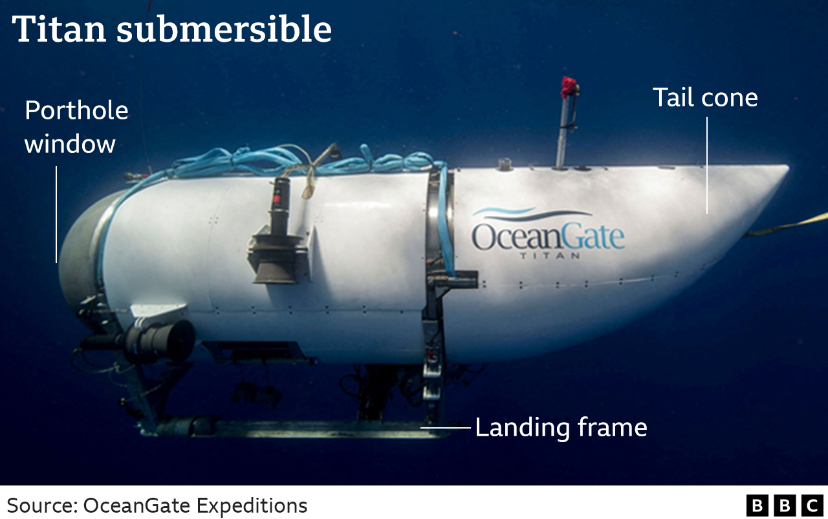
The questions that had been raised about its joins of tail cone or porthole and the degradation of the lamination of the carbon-fibre material, not used in arctic conditions, in winter weather of the waters off Newfoundland evaded the regulatory frameworks in place for national or international rates. Did Rush realize that the lack of oversight in international waters off of Newfoundland where the Titanic had previously sunk allowed the escape hatch he needed to press full speed ahead with plans that many doubted would be able to sustain deep-ocean pressures, let alone those on the ocean floor? The Titan, of course, never reached that ocean floor destination, as it had advertised.
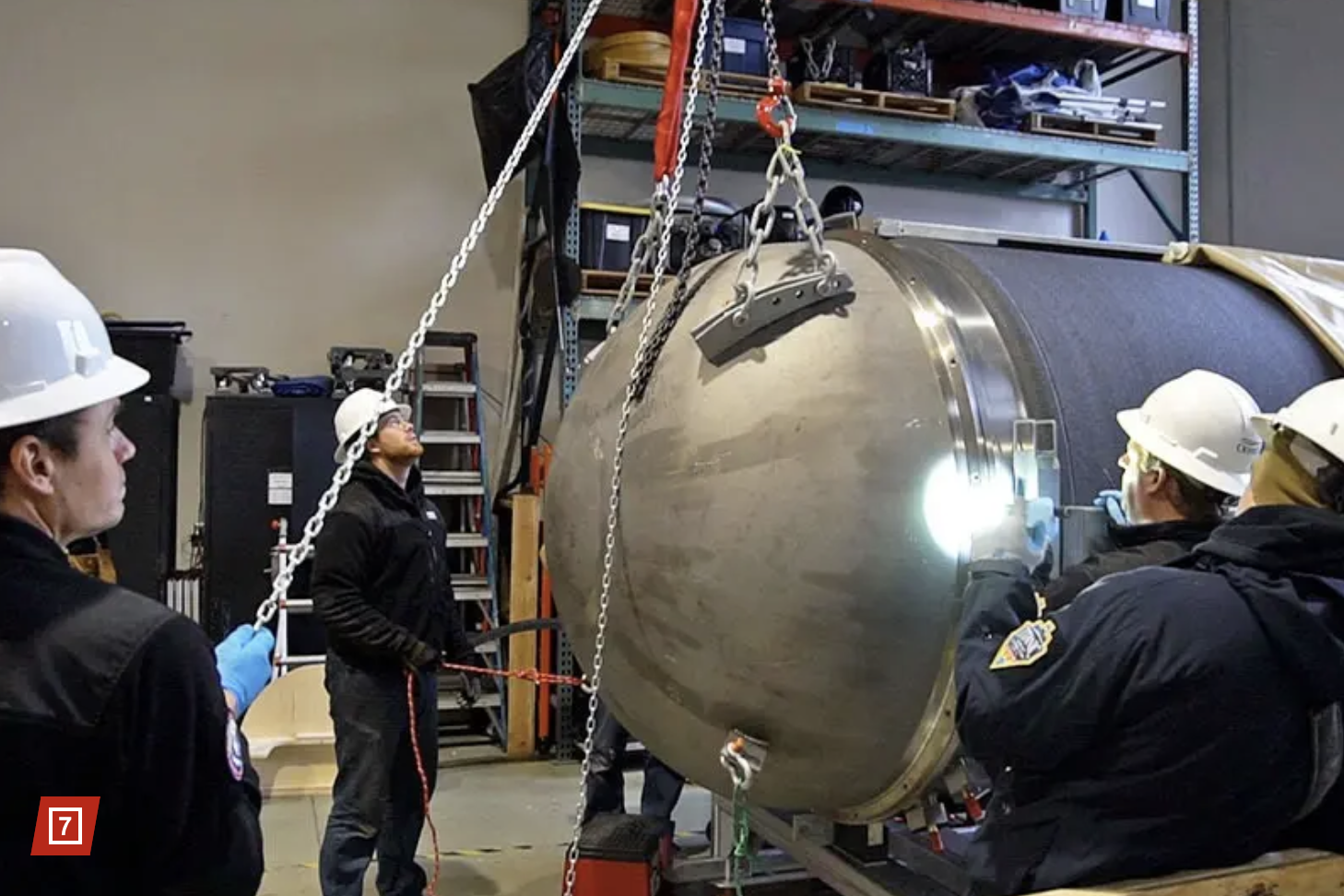
Experts Worried the Laminated Carbon Fiber Hull would not Withstand Pressures on Ocean Floor

This was not under the radar. Ocean Governance was evaded as Rush was working without any oversight to fabricate a submersible he claimed was able to withstand underseas pressure based on his own engineering training alone, and his zeal to conduct underseas missions at the ocean floor. By insulating himself with pseudo-experts–from Pierre Nageolet, working outside of deepsea protocols in place for some time in engineering communities, and silencing his whistblower by intimidatory tactics of actual or threatened lawsuits, who he quickly sacked without grounds, And while the U.S. Coast Guard has determined that the almost instantaneous explosion of The Titan, the submersible Rush helped design and whose construction he single-handedly supervised and oversaw resulted from a failure in the glue joining the hull and titanium ring, or the carbon fiber hull’s delimitation as a result of wintering in the north seas, the simulation of how the submersible en route to carry passengers to the ruins of the HMS Titanic after an hour and forty-five minutes may have been a “painless death,” the four days of panic as to its fate conceal the deep dangers of lack of safety oversight or regulations in an almost unregulated search for underseas minerals that seems to have driven Rush’s rather single-minded pursuit of a way to explore underwater canyons on the ocean floor and deepsea territories long hidden to the human observer.
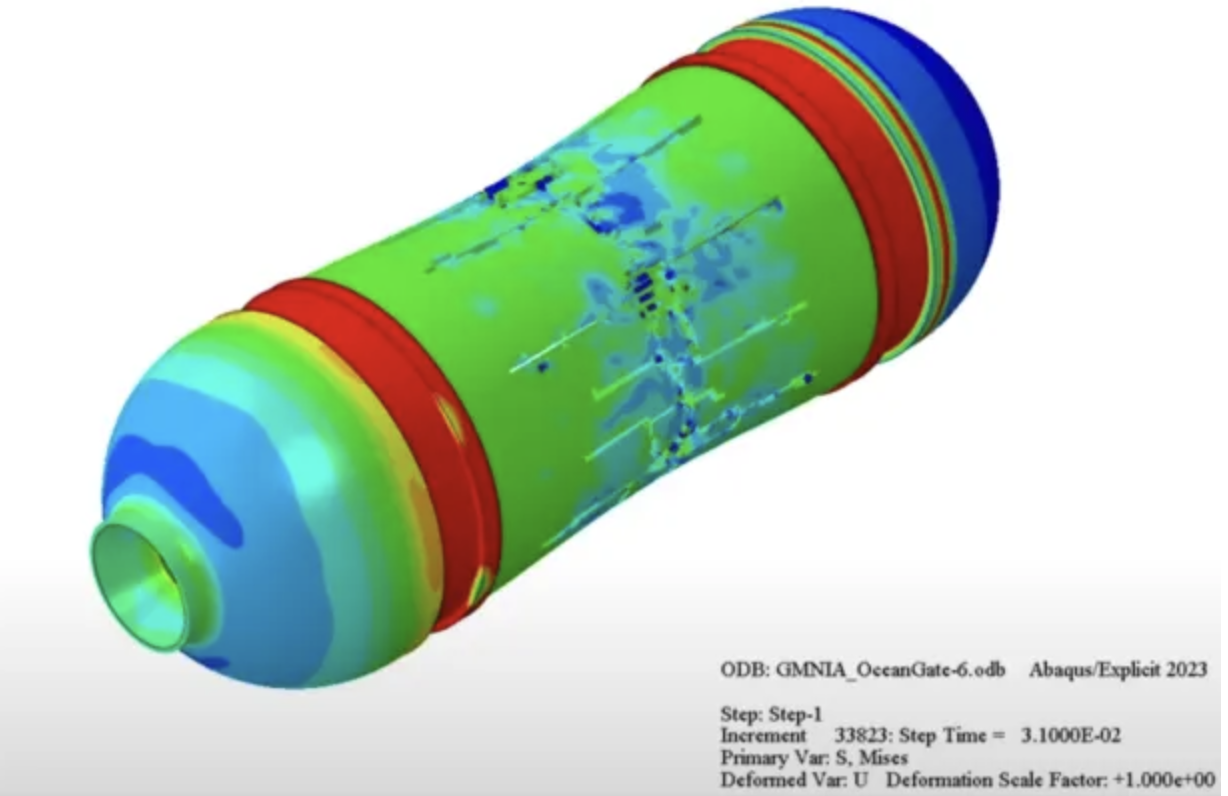
The exploration of the underseas, as much as following Jules Verne’s nineteenth century adventure books, was driven by a growing market for mineral and energy speculation as much as personal glory. If the truly catastrophic implosion of the submersible lasted but milliseconds–too quick of the mind to process, per YouTube sensation Dr. Chris Rayner, who has most recently piggybacked on the global catastrophe, asserts. If the hull collapse may have been preceded by squeaks and pops that inspired panic,  the possible site of collapse and structural failure—the viewport, the adhesive seal between the titanium end-caps and the collapse of the cylindrical hull–resulted from evading oversight of nautical regulatory bodies, perhaps steeped in the ethos of American individualism, but driven by a market for offering new platforms of first-hand underseas oil exploration to oil companies and engineers in search of deep sea minerals–the very community of engineers Rush hoped to win over for the benefits of the submersible as a mode of underseas mapping. The need to evade the law of the seas, and situate the site of exploration in international waters, was situated at the ruins of the Titanic to attract worldwide media attention, and pull other outsiders into Rush’s outsider project, evading any regulatory commissions or guidelines on passenger safety. All of Rush’s passengers had of course signed release forms prior to boarding the Titan, and the pressures to which it was exposed that reached 5,000 pounds of pressure per square inch. Carbon fibre was an “unpredictable material” all along for such depths of 3,000 feet, if not an impractical one, raising questions of why Rush was so committed to allowing multiple untested features to remain before performing the dive, advertising the ride to passengers he would take to their deaths as entirely safe.

1. The romance of the underseas exploration was clearly intensified–and made attractive to financial backers–by the nature of its destination: the ruins of the Titanic–and, however paradoxically, the ability to transcend death. The expression of a desire to transcend perceived boundaries was communicated to Stockton Rush as a boy in Walden, or Maine Woods, where Thoreau waxed ecstatic at an almost mythic awareness of something “vast, Titanic, such as man never inhabits”–channeled by the original transatlantic transatlantic voyage that mirrored the telegraph to the Newfoundland coast, before hitting an iceberg, to the search of the steel ruins still lying submerged undersea. Rush sought to break new boundaries of the globalized world by the venture of OceanGate, as if breaching new frontier of exploration, if not an affirmation of personal vitality and renewal by traveling to a space “such as man never inhabits,” where “inhuman Nature has got him alone.” It is impossible to read the ecstatic revery of how Nature moves man and “pilfers him of some of his divine faculty” as an open invitation to descend into the deep of the ruins of the Titanic, to relive the massive tragedy of the first decades of the twentieth century, as attempting to reconquer time.)

Stockton Rush had recuperated a narrative of canasta with deep roots, if one that was promoted in the recent films that had become museum shows and even adventure rids at amusement parks–but this, as if in contrast to studio recreations, was promised as the utmost exhilaration of the real thing. But was it ever reality, so entangled was Rush’s promise with beliefs in transcendence that trained generations of readers of Thoreau to search for sites of transcendence beyond our abilities? Or is the fiction of transcendence that Rush promised to paying customers, and that Thoreau had so memorably inspired, gained new meanings in a world defined by globalization, where the voyage of Stockton Rush into the depth of international waters, outside legal oversight, been tainted by the map of globalization, and indeed inspired by the abilities to transcend our own known limits were newly conflated with the transcendence of legal regimes, and indeed the transcendence of limits of deepwater exploration for energy reserves that oil and gas multinationals hoped to extract from the deep seas, but lacked the requisite technology to survey? For the voyage in the modern diving bell was indeed a trial balloon to industries eager for tools of underseas mapping promising greater precision, that it isn’t unlikely to think Ocean’s Gate was eager to market, for far more money than offering exerting underseas joy rides of disaster tourism. And a very different if related sense of “Titanic’ that Thoreau used in Maine Woods, of something that “was vast, Titanic, and such as man never inhabits” where “Nature has got him at a disadvantage” might better describe the deep seas.

The bravura of descending by a diving bell had been memorably used in the mid-century novel Dr. Faustus by Thomas Mann as an aesthetic experiencetragically tainted by hubris from the start. Mann seeks to express the Faustian goals of his hero, Adrian Leverkühn by the diving bell he travels undresea to witness unknown monsters in perfect submarine darkness, far from humanity, in the diving bell that prefigure the ecstatic aspirations to symphonies he hopes to create. The trips with Dr. Capercale to the underseas world with a fictional scientist, as pushing the limits of human understanding. Leverkühn claims to have experienced new limits when he descended in the waters off Bermuda, only several sea miles from St. George, in the company of a man who claims to “have set a new record for depth” underwater. Mann’s memorable hero descended in a “bullet-shaped diving-bell” that transcended human limits, descending a if in inverse to the stratospheric balloon it resembled, promised to be “absolutely watertight, . . . capable of withstanding the immense pressures and came equipped with plenty of oxygen, a telephone, high-powered searchlights, and quartz windows for viewing on every side.” If ‘anything but comfortable” they were secure in their descent, “by the knowledge of their safety . . . beneath he surface of the ocean” behind four-hundred pound door, as descending to perfect darkness at 2,000 and then 2,500 feet, bearing 500,000 tons of pressure.

Leverkühn somewhat cozily entertained his friends with gusto of the descent to underseas depths, smoking a cigarette. The voyage was a metaphor for the modern Faustian bargain he made with the Devil, sacrificing human love for his skills of composition. For in the descent to the inhuman realm, he described having gained “glimpses afforded onto a world whose silent, alien madness was justified–and explained, so to speak–by its inherent lack of contact with our own” in the descending chamber, in three hours that “passed like a dream, thanks to the . . . glimpses into a world whose soundless, frantic foreignness was explained . . . by its [absolute and] utter lack of contact with our own:” “all around reigned perfect blackness” akin to “darkness of interstellar space.” Diving bells not only provided visits to witness sunken wrecks off Bermuda’s coast on the ocean floor, but conjured a transcendence of the human, in an unmapped region beyond the limits of the known, traveling 3600 feet below the seas surface in a two-and-a-half ton hollow ball for a half an hour, looking through quartz windows “into a blue-blackness hard to describe, . . . eternally still . . . not quite allayed by the feeling science must be allowed to press just as far forwards as the intelligence of scientists is given license to go.”

Else Bostelmann, Dragonfish or “Bathysphere Intact” off Bermuda (1934)

The images Else Bostelmann offered in scientific periodicals captured the fascination of underseas that colonized the imagination; “the incredible oddities that nature and life had managed here, these forms and physiognomies that seemed to bear scarcely any kinship with those on earth above and to belong to some other planet, . . . hidden in eternal darkness.” The deep sea hid “these abstruse creatures of the abyss” that seem “to have no tie to humanity” provided the first ken of the pleasure Leverkühn takes in flaunting familiarity “his experiences in regions monstrously above and beyond us humans,” plunging with diabolic relish and ease among the “deep-sea’s life grottesquely alien life-forms, which did not seem to belong to our planet.” His friend thinks that the indulgence of these memories seemed “a devilish prank” of “the horridities of creation” able spur him to a new form of composition of the “cosmic music, with which he had become preoccupied,” before World War I, in compositions the narrator condemns as a “sardonic lampoon apparently aimed not only at the dreadful clockwork of the universe, but also at the medium in which it is painted . . . at music” of “a nearly thirty-minute orchestral portrait of the world is mockery–a mockery that confirms only too well the opinion I expressed in our conversation that the pursuit of what is immeasurably beyond man can provide no piety or nourishment.”

The sense of an infernal voyage was amplified in the disaster on the way to visit the Titanic’s ruins. For that voyage was akin to the blasphemic nature of what Mann’s narrator calls aLuciferian travesty” and blasphemy against the elevated medium of music expressed–or mapped?–by artistic ambitions to transcend the human world. For Mann, writing in global war during the 1940s, the desire of Leverkühn seems one of technology and modernity that might be captured by Adorno, whose music criticism he had pillaged in the novel–deeply human problems of alienation that plagued the mid-twentieth century and Nazi period. These musical compositions, after all, confirm Leverkühn’s own diabolic pact, only hinted at or foreshadowed in the book’s earlier chapters. The imagined underseas voyage was a voyage to the unknown depths of the ocean provides the basis for describing his imagined trips to outer space; the orchestral fantasia suggest horror in the ears of his admiring friend, for a Godless vision to dethrone all religious humanism of a search for music able to describe the terrible marvels of outer-space or grotesqueries of the deep.

The Faustian nature of Stockton Rush’s quest was nothing if not a Faust-like underbelly of globalization, this post argues, piggy-backing on Mann’s shoulders for a bit, from the perspective of globalization and deregulation that open up the deep with even more terror. While Mann will be less a focus of the post, I will follow him in examining and descending into the terror opening up of ideas and imaginations of prospecting the ocean’s floor multinational firms of opened by hopes of prospecting. For the huge bonanzas of extraction have opened up new deepwater spaces, as access to the deepwater reserves of energy or rare metals provide secret promises to an eternal ability of extraction, a search for energy sources that is a broader Faustian problem by Big Oil we can only see, but is almost engraved in the desperation on his face as he readies to plunge to the ocean floor.

The Faustian nature of the deepwater voyage within the curved steel walls of a cast iron Bathysphere had been devised to protect the biologist William Bebe and his assistant from the dark, boasted to guarantee against the heightened pressures of ocean depths few had experienced or would survive. The thrill of the deep seas plunge that exposed the vessel to such enormous atmospheric pressure left in the composer the sense of risk in his skin–a “prickly sensation that came with realizing one was exposing to sight what had never been seen, was not to be seen, and had never expected to be seen” whose unavoidable “sense of indiscretion, indeed of sinfulness, could not be fully mitigated and neutralized [even] by the exhilaration of science.” Ocean scientist and engineer Bebe gained nearly global attention for his exploration of deep ocean life behind two fused eight-inch quartz portholes in 1934,–a new horizon on uninhabited worlds electric light was able to reveal to human sight as a technological wonder of observation, a new sort of scope regime. The biologist reported observations be telephone to a nearby boat–for Mann, a bestiary of “mad grotesqueries, organic nature’s secret faces: predatory mouths, shameless teeth, telescopic eyes; paper nautiluses, hatchetfish with goggles aimed upward, heteropods and sea butterflies up to six feet long.” The descriptive relish of revealing this hidden bestiary cannot capture the strangeness Else Bostelmann imagined for National Geographic of the deep sea life illuminated in the Bathysphere she never participated. But thirty-five pioneering dives were conducted, many years after the Titanic sunk in the far colder waters off Newfoundland, its starboard air chambers shattered as they hit an iceberg.

The transport Adrian Leverkühn imagined might be conveyed in Bebe’s ambitions to view “here, under a pressure which, if loosened, would make amorphous tissue of a human being . . . here I was privileged to sit and crystallize something useful.” The sturdy Bathysphere set records descending to 1,200 feet; diving spheres soon plunged to 4,500 ft., if only a third of the way to the 12, 500 feet at which the Titanic had sunk. The deepwater voyages became the subject of a popular film by 1938,–perhaps as popular as the recent blockbuster of Titanic’s sinking–and a spectacle of the revelation of the uncanny creatures of the Deep Sea, capturing the excessive hope that in part animated Stockton Rush in his own fantasia–if it didn’t hint that he wasn’t driven only by science or exploration, but monetary profit, revealing the huge financial benefits of surveying the underseas world in an age of globalization that threatens to expose more and more underseas minerals to hopes of extraction, in a Faustian bargain we have not yet come to contemplate fully but is increasingly waged in maps, and cartographic precision to map sites of extraction underseas.

The absolute alien nature of the darkest reaches of undersea life must have epitomized the Faustian bargain of Leverkühn, eager to court danger of the inhumane for renown. Thomas Mann was in fact describing the underseas as an inevitable attraction for the composer who made a deal with Satan in Dr. Faustus (1946), one imagines akin to the compulsive attraction with which Stockton Rush persued th e deep. The plunge below 4,000 feet was sufficient other-worldly to recall a pact with the devil, as the idea of descending and returning to the underseas graveyard of the Titanic’s ruins.

Yet the attempt to market underseas heroism of tempting fate that Stockton Rush offered the passengers of the submersible he called ‘Titan’ never did reveal “what genuine underseas exploration looks like;” its passengers all met with death. Mann described the eery inhumanity of a descent below 2,400 and 2,500 feet, opening “an interstellar space unvisited for eternities by even the weakest ray of sun,” to be “examined under a brutal artificial beam, . . . brought down from the world above” as a bridging of life and death. Rush’s unwarranted promise of survival in such a transit to the deepsea ruins is however akin to how Leverkühn courting exhilaration before “forms and physiognomies that seemed to bear scarcely any kinship with those on the earth above and to belong to some other planet,” unveiling not “products of concealment . . . hidden in eternal darkness” compared only to “the arrival of a human space-craft on Mars.” But what Rush promised was underwritten and sponsored by a deeper diabolic pact of hoping to sell the submersible to multinationals after its media success for use prospecting oil and precious metals below the sea we are unable to map.

Continue reading
Leave a comment

Filed under deregulation, maritime safety, ocean mapping, Titanic, undersea exploration

“We Like Fighting Games”

As he waited rather glumly for “the Feds” to arrive at his home, as his stepfather predicted, Airman First Class Jack Douglas Teixiera may have pondered why he had posted classified maps of heated battle fronts in the Ukraine War to Discord was aware he was speaking to a much larger audience of interested readers than he ever considered. Teixeira’s friends defensively stuck with him, explaining the enlisted airman was a peaceful anti-war man, who “just wanted to inform some of his friends about what’s going on” as if the global battlefield was seamless with video games. Many in his largely male circle even had buddies who were actually fighting in Ukraine. He felt for them. The appearance of a mass-drop of top secret government documents must make us wonder not only about the restrictions on secret military information–and the security of detailed surveillance maps–but of the remove of the interest in the maps as cool images from the war they describe.

Texeira, who has been described as not a leaker like Edward Snowdon, but just a normal guy, had a preternatural passion for scoping out the battle-plans of Ukraine, profiting from the security clearance to “Top Secret” files he gained just two years after joining the National Guard. From his perch in Cape Cod, Teixeira had the sort of a privileged perch to read intelligence–and a gamer’s keen eye for detail of a war scenario–that you have to wonder what sort of division he sensed between the video games he enjoyed matching wits in post-apocalyptic scenario and the sense that he knew many who had shipped off to fight abroad, as he might soon, and the eager attention of a family who were proud of the uniform he wore to report to duty at the 102nd Intelligence Wing of Otis Air National Guard Base to manage and troubleshoot critical communication systems. As more information flows about global battlefields are routed and monitored from decommissioned Air Force stations in bases no longer charged with flying missions, the expanded intelligence-gathering function of drones leaves many watching large flat-screen monitors, removed from battlefields–or the battlefield terrain–

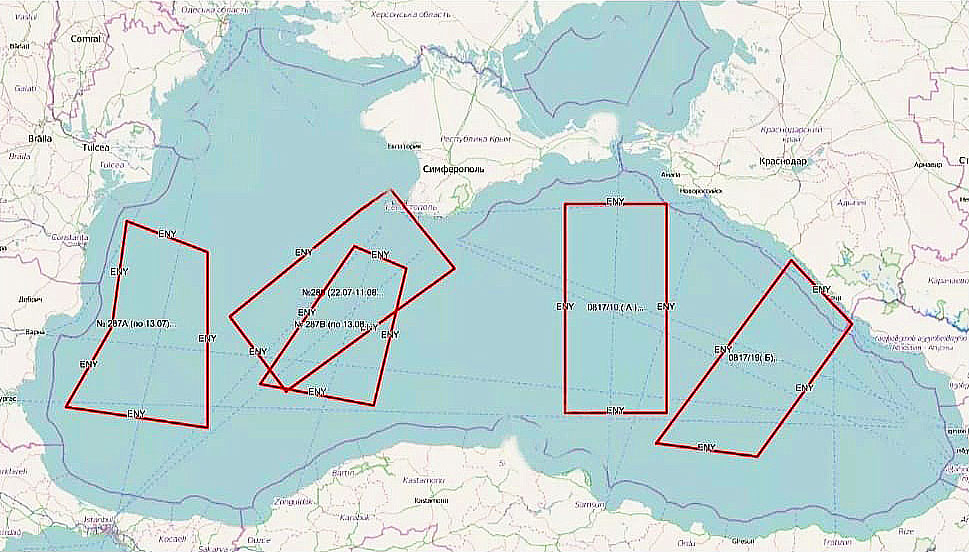
–participating not in airplanes, but in new tasks of surveillance, intelligence and reconnaissance that provide the basis for information-gathering that are deemed adequate for global war–“robust, multi-intelligence processing, exploitation and dissemination (PED) activities” that reflect the new architecture of the distributed networks of what global war. As Reaper drones fly above the Black Sea–over “international waters” outside the exclusive economic zones nation-states claim as part their national waters–even as Russia has from 2016 sought to transform the Black Sea’s waters, in the words of NATO Secretary General Jens Stoltenberg, “into a Russian lake.” Russia has annexed the continental shelf entitlements national waters of the Autonomous Republic of Crimea–shelf entitlements once belonging to Ukraine–for gas and sand mining guarded by air defense systems of its Black Sea fleet, the Russian navy has obstructed up to a quarter of the Black Sea–

Black Sea Regions Russian Navy Shut off from July, 2019

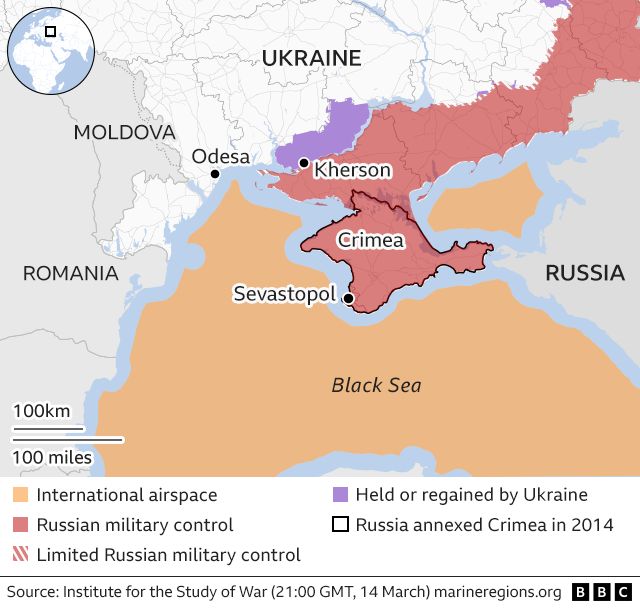
–laying effective and actual claim to its territory, American Reaper drones have maintained regular flights to monitor the battlefield, gathering intelligence about the Ukraine War from 50,000 feet, and increased their surveillance flights over the region from 2022. The new mission of gathering ‘sensitive intelligence” depends on flying over what America still considers international waters–

Map of Black Sea

–although the dispute of how close the aptly named Reaper drones or Global Hawks might fly to the coast of the former is contested, and every nautical mile from Ukraine’s coast and the Crimean airspace compromises the amount of military intelligence that they can gather–and U.S. military intelligence was increasingly eager to expand drone flights to Russian-held territory in March 2023. The latest intervention in this ever-expanding theater of distributed war was, improbably, in Cape Cod. What has been called a “casual theft” of Top Secret intelligence of battlefield maps were sites of endless curiosity to the American Airmen who seems to have used their access to the monitors to take photographs of the maps over a few months, posting them to a gaming network. Jack Teixeira snapped shots on his iPhone of hundreds of maps of military scenarios, foreign land and air defenses, systems designed to deter Russian missile attacks “to defend [Ukraine] against Russian aerial attacks from all latitudes, and other documents from top secret spy satellites, signal intelligence, and infrared sensors. He included, for added interest, detail about mounting troop losses on both sides over time, with unclear appreciation of their actual geopolitical significance.

Rather than “stealing” the intelligence for a spy network or secretly embedded moles, the map that dropped on social media suggest the hidden vulnerabilities of expanding distributed intelligence from increasing drone flights across such distributed intelligence networks. Even as Ukraine insisted that these were outdated information about “constantly changing positions” in an entrenched territorial war, where positions shift in a war of attrition, the projections of the depletion of air defenses by mid-April or early May suggested a dwindling of resources that coincided with the debates on providing long-sought surface-to-air missile systems and a Patriot Missile System just arrived in Ukraine to defend Ukraine’s borders. Borders were, of course, in flux and up for debate as the intelligence collection of MQ-9 reaper drones, as the one that Russian

Airman Teixiera and other gamers liked to kick back by imagining a survivalist scenarios in the past. Part of this online sociability was boasting of his ability to share early info about the coming invasion of Ukraine, noting the intel on casualties on both sides during the war to his best buds on the internet, life-time non-disclosure agreement signed or not. As well as describing Russian boots on the ground and predicting plans for invading Ukraine, his circle enjoyed using their skill navigating the undead that populated the post-apocalyptic landscape of a future Kentucky, in a zombie apocalypse: legions of zombies where death is not only inevitable, anthropophagy all too real a threat for its players. The game seeks to capture a palpable thrill of death in the immediacy of its fictional topography, levels of risk distinguished by the revelation of hidden appearance of the undead meant players have to face the sudden possibility profuse bleeding lies just behind a door or around the corner as they navigate zombies invaders in a rural America of a not distant future. Weren’t the maps of Ukraine’s forces a similar rush of navigating a tight spot for the gamer group known as #War-Posting? Approaching real war with truly vertiginous proximity, the military slides suggest a terrifying landscape of death, with real time troop fatalities on display.

This is in fact not far from the actual daily scenario soldiers regularly face in many outposts of the Ukraine War, as Ukrainian soldiers hunker down in hopes of defending actual bombed-out cities like Bakhmut and other war-torn landscapes. But the daily tallies of war dead in Ukraine seemed to be rising so quickly in Teixeira’s daily posts on Ukraine battlefields from NSA and CIA records, dating back to February 2022 or over a year ago, that Ukraine must have almost replaced Zomboid for its cool factor, before he shifted to the Discord platform in December. The photos of paper maps of military groups of the Russian forces, Wagner forces, and Ukrainians provided a game-like view of war.

The leaked slides showing actual battlefields–“Here, have some leaked documents!”; “I have more than [merely] open source info–Perks of being in a USAF intel unit!”–fed our collective interest in geopolitics in ways that made them appear quite eerily much more seamless with imagining oneself amidst an apocalypse. They circulated mostly among gamer groups who liked to visualize themselves to, by some sort of futuristic time-travel, and one can imagine them teleporting themselves instantly from a war-torn rural Kentucky in which deadly zombies threatened their lives, hidden in dark corners and around doors, to Ukraine, from the pseudo-military landscape of omnipresent threats to actual war. The internet became a source not of leaking, but sort of platform designed cyber transport systems specialist, processing top secret military intelligence briefings from his base outside Boston, in Cape Cod, uploading hundreds of slides of real-time intelligence on a global scale arriving from the Office of the Director of National Intelligence, National Security Agency, and CIA, beyond intel collected from drones, to many friends.

Project Zomboid

The early maps that showed the expansive battlefield of Ukraine, so removed from his station in Massachusetts, shared a board-game like image of the war that had a real-life frisson. To be sure, Teixeira did condemn the military as run by “the elite politicians,” but loved war games. If the earliest maps leaked anticipated Russian military advances into Ukraine, rather than trying to leak military strategy, or suggest an interest in geopolitics, Teixeira seems to have been fascinated by toting up the daily tally of war dead on the battle field of Ukraine, sitting in his base, posted fatalities of Russian and Ukrainian troops–some argue that he diminished the losses of Russians, or augmented the number of Ukrainian military fatalities–as the military conflict maps became an inside running narrative of the war. This was not Daniel Ellsberg or Edward Snowden: there was no horror about war, but rather a sort of vertiginous fascination with the scale of death of one practiced in war games, ready to appropriate battlefield intel to encounter the frisson of true Thanatos, without much Eros available to the eye or mind.

Paper Map from Group Shared by Airman Teixeira on Social Media from January 2023/BBC

The enumeration of the tally military dead on paper maps to which he had clearance and privileged access–by all accounts sensitive information–became a glorified killing fields in which Teixeira seems to have realized his friends would delight more than Zomboid, with an eye to the cool factor of classified information. In the ecosystem of attention, the highly classified maps of the Ukraine War have been reposted and reshaped, occurred with little sense that their audience was with real-world interests, or that the scenarios they described were real. “This guy was a Christian, anti-war, [who] just wanted to inform some of his friends about what was going on” on the other side of the world, even if it was in the daily news, said a friend from the online community, defensively arguing that some of his fellow-gamers were even in Ukraine, and they were thinking primarily of their personal ties to them.

Did the gamers just want to inhabit the landscape of combat that was even more “real” than existing gaming situations, zeroing in on the fatalities and deaths in the fight for control over real terrain in Eastern Ukraine–

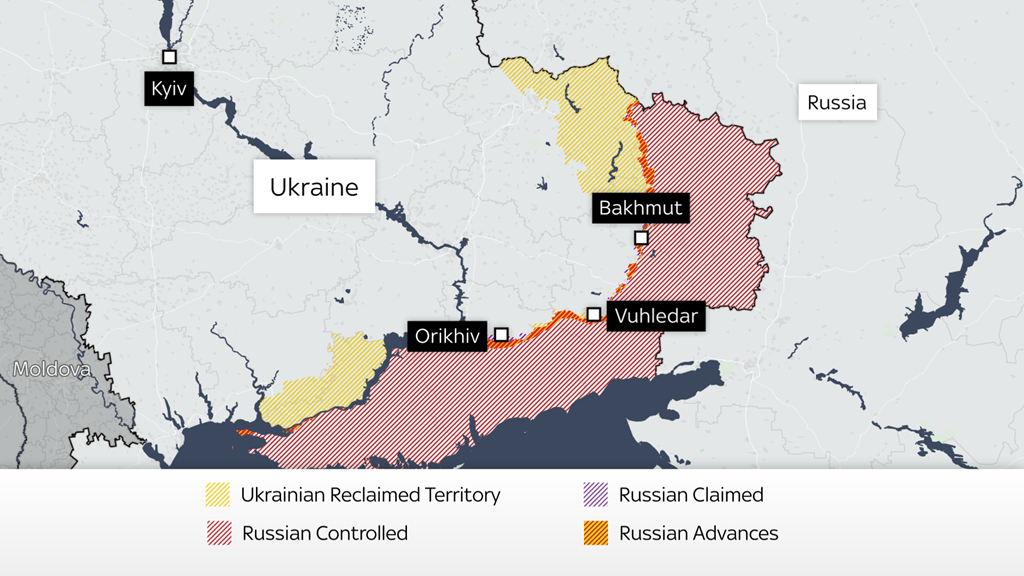
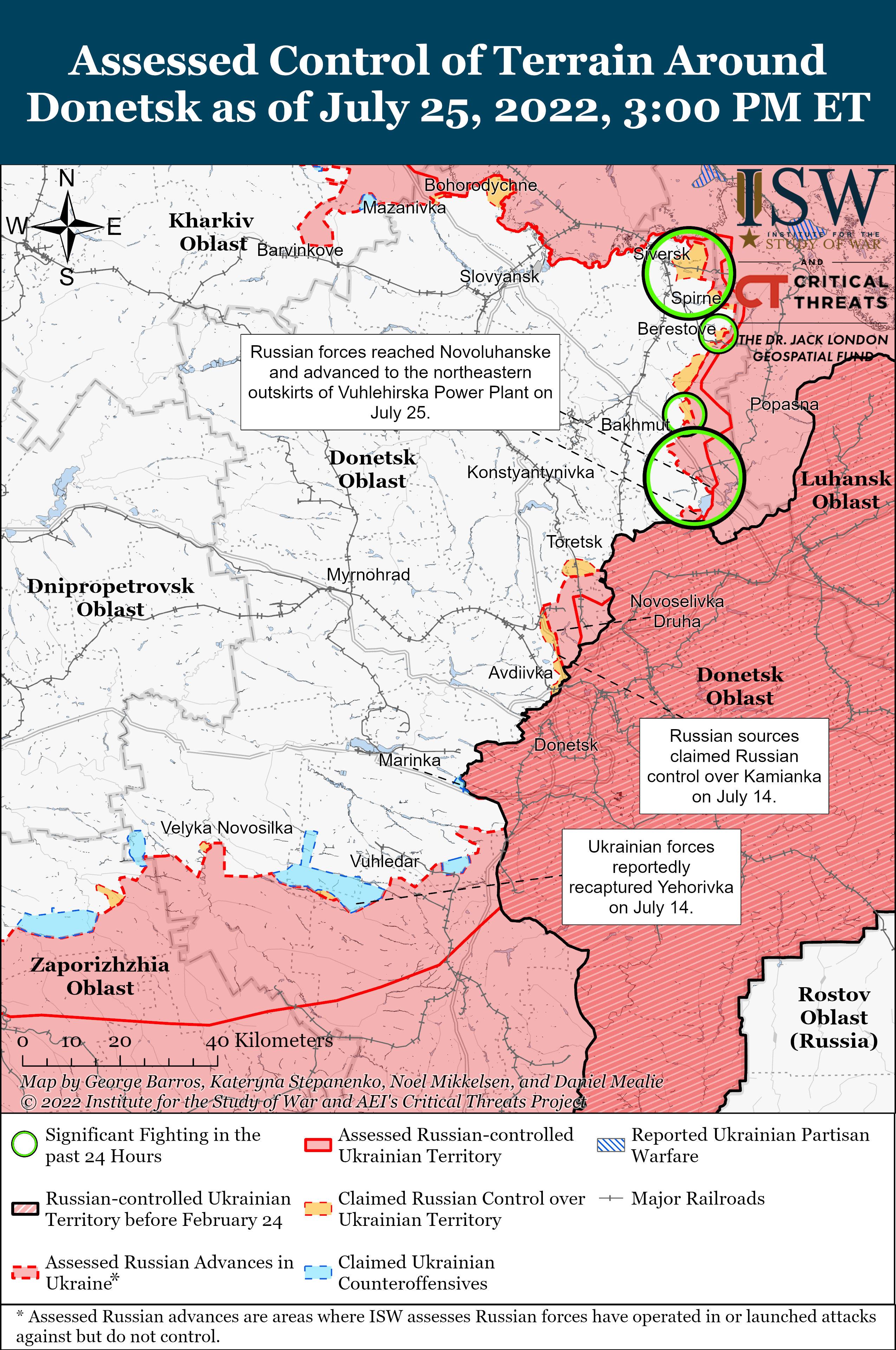
–at the same time as everyone in the world was trying to use the best geospatial intelligence to assess the fight over contested terrain, watching daily updated maps of the battle over the last year, in hopes to follow the gains of Russian forces around critical combat points like Bakhmut, that so sharply contrasted to the rapid gains Russian forces had made in the military offensive in Luhansk.

Russian Offensive Campaign Assessment, July 25 | Institute for the Study of  War

As the lines of military combat were contested, and media footage was posted of military advances into social media networks and messaging channels, the attacks of Russian advance moved slowly, being able only to capture small slivers of terrain in weeks of fighting Ukrainian defensive positions, often raising questions of why they were less able to exploit battlefield geometry and Ukrainian defenders relied on their effective degrading of offensive positions in a war of attrition. After months of very marginal territorial gains against Ukrainian forces, fundamental limitations of on gaining substantial grounds had begun to appear, adding a new dramatic quality to the war. In short, this made compelling stuff, difficult to fully track in words, clearly part of a global war dynamic more interesting to navigate than the zombie wars back in the alternative future of rural Kentucky. Thumbing his nose at military authorities, Teixeira used the pipeline of classified maps he had access even to compromise military theaters globally, using his phone to shoot secret information about Canada, China, Israel, South Korea, the Indo-Pacific military theater and the Middle East.

Teicheira, in a sense, was acting in ways akin to Edward Snowden, his head burst from processing reams of geospatial information that were impossible to fully get one’s mind around, even if Teixeira’s actual reaction to the challenge were of a very different ethical stamp. For this spate of over-sharing of slides was not really only about Ukraine. It rather offered a sort of ecoysystem that existed at an angle to the world: “We like fighting games, we like war games,” and the more real, presumably, the better. And the maps of real population centers, front lines of operation, and key assets–a vocabulary and graphic syntax that was troublingly–or maybe not so troublingly?–akin to a game board or a board game, even if it was labeled “SECRET//NOFORN.”

It must have seemed pretty cool when it was making the rounds on Discord online in early March, and then eventually migrated onto 4chan by April 5, 2023. By then, the widening online circulation of the maps created such an international kerfuffle to compel U.S. Secretary of State Antony J. Blinken and Defense Secretary Lloyd J. Austin to try to explain the commitment of the United States government to prioritize “safeguarding intelligence” even as the carefully sourced lightly encoded battlefield assessments of air defenses and discussions of military capacities of each side globally spread, and the Discord group known as #War-Posting improbably intersected with a real war, and Thug Shaker Central shook down from the trees some seriously large fruit. It was perhaps not any surprise that Jack became promoted as a poster boy for the MAGA crowd by @RepMTG, the MAGA megaphone, quick to defend the “white, male, christian and antiwar” man who promoted the man-child they recast as “an enemy to the Biden regime.”

And the Airman who violated his life-long nondisclosure agreement with the US government became a “kid,” a renegade American speaking truth to power, as he was praised for having finally “told the truth about [American] troops being on the ground in Ukraine, and a [whole] lot more,” on FOX, warned Tucker Carlson. Carlson’s media megaphone liked to circle back to Ukraine, and he hardly hesitate praising Teixeira as an American hero of real principles–unlike the American administration that has committed to defend Ukraine’s sovereign borders. Indeed, he cast Teixeira’s arrest for criminal activity as a form of telling truth to power–making a poster child of the Airman’s leaking beneath a menacing image of the actual Secretary of Defense, Lloyd J. Austin, seemingly designed as if a mug shot to make his shiftiness appear all the more suspect to entrust American troops.

Carlson claimed far deeper interest in geopolitics than the Airman ever expressed. From his Fox News platform, Carlson praised Teixeira for a principled stance, while overlooking the illegality of posting classified military information on open servers. For critics of American military involvement in Ukraine, as Carlson, the feds were moving to “destroy him,” targeting the “kid” whose release of top secret maps was red meat to Republicans already eager to cut American ties to Ukraine. Carlson couldn’t know that this was within his final weeks as a Fox anchor.

He asked his audience to overlook who is the criminal, describing the maps as revealing a board-game of Ukraine War as the battle-ground of a proxy war between American and Russian troops America had accepted, as Carlson described them as revealing what j the “war machine” of the national news media ignored but the slides “reveal that this is very much America’s war,”–that the Ukraine War is really between the two prime nuclear super-powers on earth, together with the Biden administration encouraging war crimes with aid of the mainstream media.

Domestic politics seemed to trump international relations; the leaker was championing of this leaker by both Tucker Carlson and Taylor Greene–who sits on the Homeland Security Committee in the U.S. Congress. Was Taylor Greene illustrating she might not be the best person to trust with national security information of any kind? Her readiness to tweet out secret maps monitoring troop positions and deliveries of military materiel, estimates of military capacity on the ground and more, if irresponsible from a national security standpoint, set a new standard for amplifying actual leaks. As if to deflect media attention from Russia’s behavior on the battlefield, the leaked maps served to deflect attention from the stakes of the Ukraine War, a chance to unmask an extensive cover-up by the Biden administration.

Teixeira’s leaked slides raised a specter of “mission creep”–an escalation of involvement far beyond stated goals, an echo of Vietnam or Afghanistan, a military expansion far beyond arms transfers, long threatened as a domestic risk for America, a “blank check” or irresponsible statecraft–Carlson promoted the problems with the presence of “much larger presence of CIA and US Special Operations personnel” than acknowledged, as the Airman revealed–and became emblematic of–a secret expansion of a hidden war in which the Biden administration had involved the United States that “Ukraine is actually loosing,” Carlson told his viewers. This “leaker” was a hero. Teixeira–“the kid”–has become cast by the White House and its cronies as a “criminal” who needed to be apprehended by federal forces, but who had taken their own eyes away from real questions of national security in sending forces after “the kid” who is a patriotic American.

We all know that Carlson was among the more vocal critics of American military assistance to Ukraine in any form. He happily spread anti-Ukraine propaganda on Fox, when he confessed he “secretly root[ed]” for Russia in 2019 as if he were the spectator to a conflict he had no stake in–“Why do I care what is is going on in the conflict between Ukraine and Russia? Why shouldn’t I root for Russia? Which by the way I am.”–and America had no reason to “care” about, but in which “we should probably take the side of Russia if we have to choose between Russia and Ukraine.” Teixeira’s gambit became enlisted as a reason to shift American viewers’ attention from the extremely brutal war crimes that Russia had performed against civilians, converting the actual war in Ukraine to a set of leaked maps that proved the endangering of America’s global interests.

Tucker Carlson Tonight, April 13, 2023

Why was this unprecedented leakage of top secret maps seized on by the MAGA media to decry American involvement? If so, why was the twenty-one year old Teixeira styling himself by online avatars like TexKilledYou, popular on military focussed social media platforms primarily for his survival games, as if he was enjoying being a marketer of a more real survivalist death gave of his own design? Was being a leaker a sort of IRL survival game, in some bizarro way?

Carlson spun it eagerly as a question of deep patriotism. Carlson used the story of “the kid” as if to magnify Americans’ fear of military escalation in Ukraine, as it offered evidence, even if Vladimir Putin dialed down nuclear threats, of the threat that “the United States is a direct combatant with Russia” and “American soldiers are fighting Russian soldiers”–even though, as Greene affirmed, when she shared her own copies of the removed maps, “Russia poses no threat to the United States.” The proxy war was hard to read in the maps, but the legibility of the maps was not really the question, after all. The level of detail on military operations that American forces were witnessing offered enough–military monitoring and intelligence assessments of troop locations and battle plans–to suggest a proxy war that might escalate into a nuclear exchange.

The detailed monitoring by American forces of intelligence projections resonated with Putin’s charges that the United States seeks to undermine Russia’s sovereignty–and seemed to obscure that it was the invasion Putin staged and organized that was explicitly aiming to end Ukraine’s existence as a sovereign country. The social media drop to the gaming group Thug Shake Central was neither partisan or ideological. The document drop was primarily shared for its coolness included a reveal of future plans for a buildup of Ukrainian forces–a subject that dominated global media sphere–and maps that project a range of eye-opening”wild- card scenarios” stunning as they imagine a range of potential escalations of the theater of war–as well as a negotiated end to the conflict–including a Ukrainian strike on the Kremlin itself and the death of Russian President Vladimir V. Putin, a scenario of a level of violence that was not ever openly described. To be sure, there were many things that were not in the maps, that we might do well to focus upon, instead: the six million internally displaced residents of Ukraine since the invasion began, and the eight million that have fled the nation.

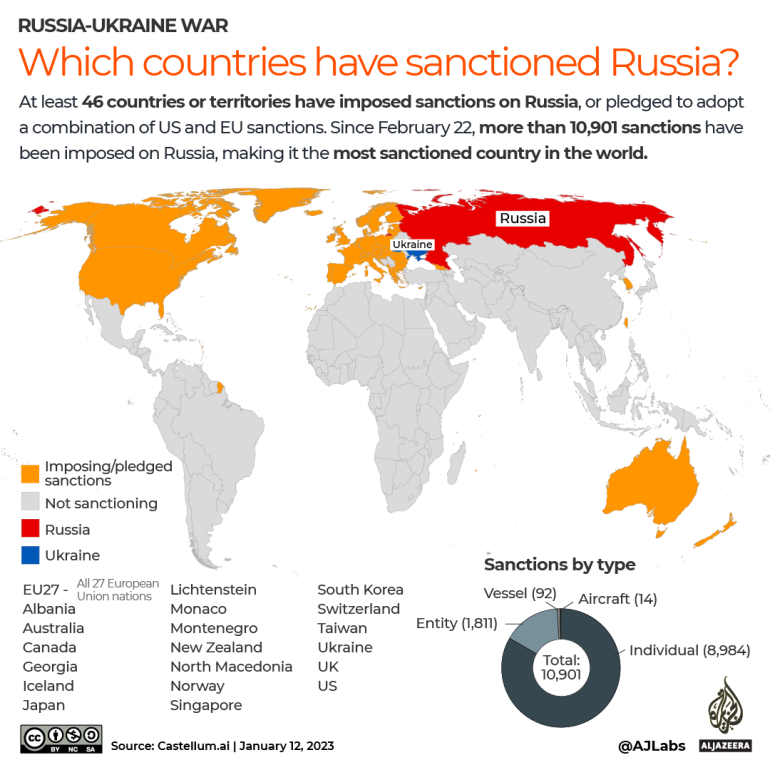
Neither do we see the status of Ukraine’s invasion as a potentially pivotal place in global theater of war–or the fact, all too often elided in maps on the ground, that whatever scenario occurs, Russian possesses the greatest nuclear arsenal in the world. For Tucker Carlson on FOX, “the slides show that this is in fact not Ukraine’s war, it’s our war,” Tucker Carlson affirmed, arguing that it showed that “this is not a regional conflict in Eastern Europe, but this is a ‘hot’ war between the two primary nuclear superpowers on Earth,” suggesting that the Biden administration was concealing the global stakes of Russia’s quite openly imperial stance to an expanded “sphere of influence” on a truly global scale–including Armenia, Syria, the Middle East, and Africa, or the global nature of the over 10,000 sanctions that were imposed on Russia after its invasion. The permanence of Russia’s claims can hardly be called out as not regional–if one looks at the maps that Russian forces have plastered themselves in cities like Kherson, claiming to be “here forever”–

“Russia is Here Forever,” Kherson January 2023/(c) Anastasia Magazova

–or the maps of the sanctions that forty six countries have placed on Russia, aware of the danger of the expansive military claims Russia is unprecedentedly staking in a zone where Ukraine stands at the epicenter of a global crisis in democracy where Russia has tried to impose its will on a nation.

INTERACTIVE- Which countries have sanctioned Russia sanctions Ukraine War- January 12

February 20, 2023

There was little interest in revealing the presence of American forces abroad. Wasn’t the strategic mapping of military forces in the slides, however, not the reason for the interest in posting the images to a group of serious gamers on Discord in the first place? While the slides bracket the question of whether the invasion of Ukraine was not a global crisis in democracy, this would be bracketed in the sort of strategic maps that Zomboid fans might like to focus, finding the cool factor in the on-the-ground strategic questions of life and death, where no real values exist save questions of brute survival, more than the real threat of unfolding a war of stabilized conflict that is the entry point of a new Cold War, and growing battlefields which have only victims. The Biden administration, one might almost sense, had been waging their own war games in Ukraine against Russia–never mind that they were the active aggressors–that the American architects of the war sought to keep hidden from the American people.

The military maps leaked demand some attention, however, in themselves. Was the increased realism gamers have come to demand from combat games like War Thunder–where several secrete military documents appeared in January–including the diagrams and system manuals for military aircraft not yet in production–spread to reddit, meriting wrist-slapping from moderators made about leaking “export restricted or classified documents” in internet arguments escalate to federal crimes, an example of the increased confusion of gaming intensity and the ethics of public communication? The whole episode reminds us just how much maps are about gaming, or gambits, as much as mirrors of the situation on the ground: the escalation of a steady flow of intel maps that the airman approved for full security clearance had spread on Discord from January to March before they ended up on the Minecraft Earth map server suggests not only how private unmoderated platforms migrated to a broader community, by a twenty-one year old who had gained Top Secret security clearance to “sensitive compartmentalized access” since 2021, and was familiar–if not curious–as an Airman to read maps projecting aerial strikes and interpreting aerial combat maps.

Jack Teixeira may not have intended to post the intelligence documents marked “Top Secret” about the Ukraine War in specific. He posted them to a channel of video gamers. To be sure, he’d tried to process the documents he had access, describing them as best he could as detailed summaries that he hoped would be exciting for his fellow-gamers–even if some of the analyses of Russia’s invasion of Ukraine and include images of the hotspots of war in Kharkiv and Bakhmut, some of the most intensive areas of combat, Ukrainian air assets in the region, as well as timetables of weapons delivery to Ukraine. Acting as if he was loosed in a house of secrets he wanted to process all around the globe reflect how much the Pentagon has become a clearing house of global knowledge. While both Ukrainians thought this was Russian propaganda cautioned they were western propaganda, and embarrassed Americans cast doubt on their official origins, the leaked intel gained international attention as they appeared on pro-Russian Telegram channels, including tabulations of Ukrainian and Russian war dead.

As many became skeptical of the authenticity of written descriptions of military engagements that Jack Teixeira had posted to his tightly knit social media circle of gamers, he tried to convince them as he began to post the images of documents from Ukraine War that were clearly marked “TOP SECRET”–as if to demonstrate their authenticity to his friends to assure them of the access he had to authentic records, soon bringing caches of what added up to hundreds of maps home to his dining rom table from January that he photographed on his mobile device, beside hunting magazines and sights for his guns. He was cumulatively releasing a hundred and then two hundred more of documents that would slowly began to make rounds on different sites with limited attention. The release of the cache of maps by Teixeira of the plans and projections for war was the latest evidence of the surrogate war that was being waged between nations and international alliances in Ukraine in a scorched earth fashion, but it was evidence of the scale and nature of a global war, waged on information networks and on the ground, based on intelligence as well as arms, the substrate filtered from global intelligence networks that was destined for few eyes–although when they appeared on a Minecraft Discord server beyond the far smaller American group they had first circulated, they quickly spread on 4chan, Twitter, and Telegram servers that entered the global media sphere in ways Teixeira seems never to have anticipated. Teixeira seemed shocked by the global intrigue–real discord!–the revelations spawned; an avalanche arrived four months after he began posting to friends, and in his final email messages as he quietly closed out accounts said farewell in a rather valedictory way, as if not yet registering the chances for his imprisonment.

The rather surprising auspicious kinship of his name to elegant cartographers of the early modern period was probably beyond Teixeira’s knowledge. Unlike maps of Japan celebrated early modern Jesuit cartographer Luis Tesiéra sent to Abraham Ortelius of Japan, from Spain, leading Ortelius to craft the first accurate European map of the island even if neither man set foot there, to be sure, Jack Teixeira had never set foot in these territories, but had perceived these theaters of war only from afar in news media, and seems to have tried to reveal a more real sense of proximity to the battle sights through the Top Secret maps. Jack Teixeira posted inside intelligence compilations onto Discord because they seemed real cool, or real and cool. The hand-painted planisphere credited to the Portuguese cartographer Abraham Teixeira of 1573 revealed the world amidst a chain of secrets of another sort–global spice routes–had a cool factor as well, to be sure, but far more tied to the globalism of another era, if in its detail and cutting edge for its day.

Domingos Teixeira, 1573 (Biliothèque nationale de France)

The global reach of these early modern nautical maps promised a new global coverage of sea routes. No one could assess the damage that Airman Jack Teixiera’s eager oversharing had caused, or its effects on the war, but the human geography of combat intersected with the geographic imagination of gamers in more explicit ways than we had been accustomed to admit. If the demographic of peace-loving military service who relaxed by enjoying war-games they imagined cordoned off from the real world is unknown, it is far greater than we would like to admit. It’s hard to imagine the intensity with which his gaming led him to remove, photograph, share, and repost the maps and other intel, as if he was reaching out to folks by entrusting them with Top Secret information on a medium that he must of known had global reach. Was the game of courting public revelation of his own breaking protocol by revealing state secrets part of the game?

Maps and secrecy are, of course, in the news in other areas this week, including that a map of sensitive intelligence information–this one we haven’t yet seen–was kept by Donald Trump from the White House, and after being taken to Mar-a-Lago perhaps displayed or shared, perhaps including military intelligence. Trump’s lawyer Christopher Kise questioned the imbalance in national security questions in the Biden administration by focussing on “some outdated map” Trump took to his resort in violation of national security protocols, but allowing “real wartime intelligence data is flying out of the door”–or at least being shared on social media outlets–trying to distract from how Trump took a classified map of “sensitive intelligence information” out of the actual White House door to keep it in his private possession among classified records he regarded as memorabilia or bargaining chips. Is the game of secrecy waged about the secrets in maps always as important as their contents?

2 Comments

Filed under Black Sea, Mapping Crimea, Mapping Ukraine, military intelligence, military maps, Ukraine, war games

Gulfs of Meaning

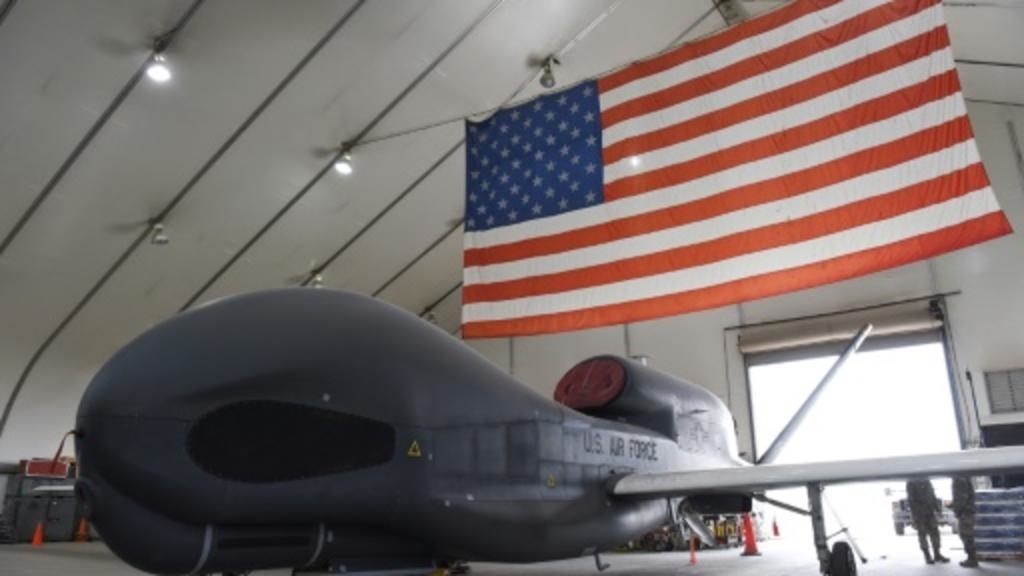
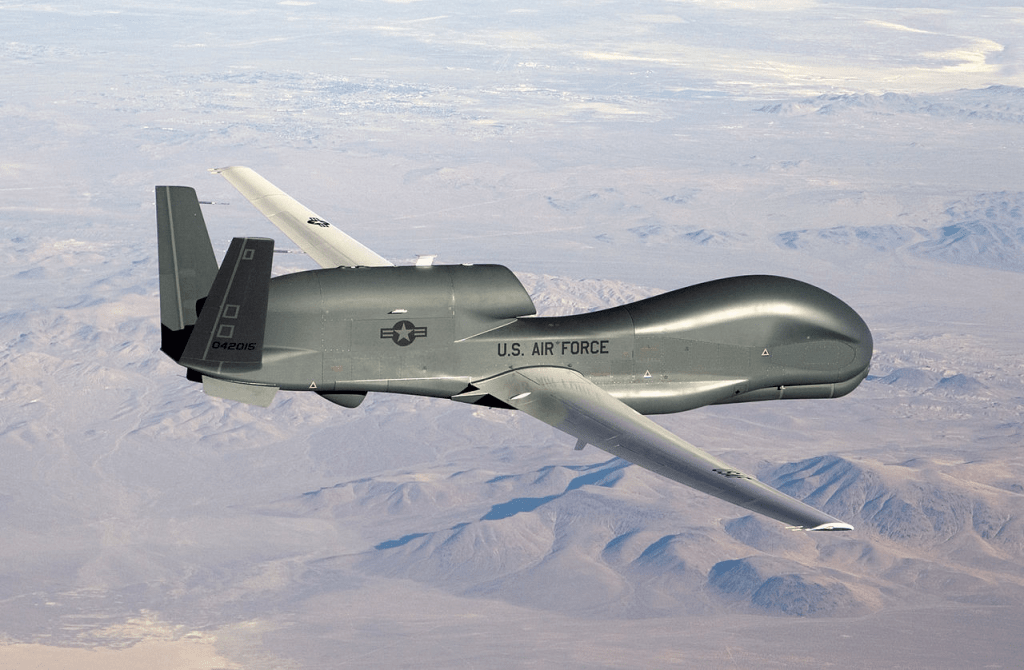
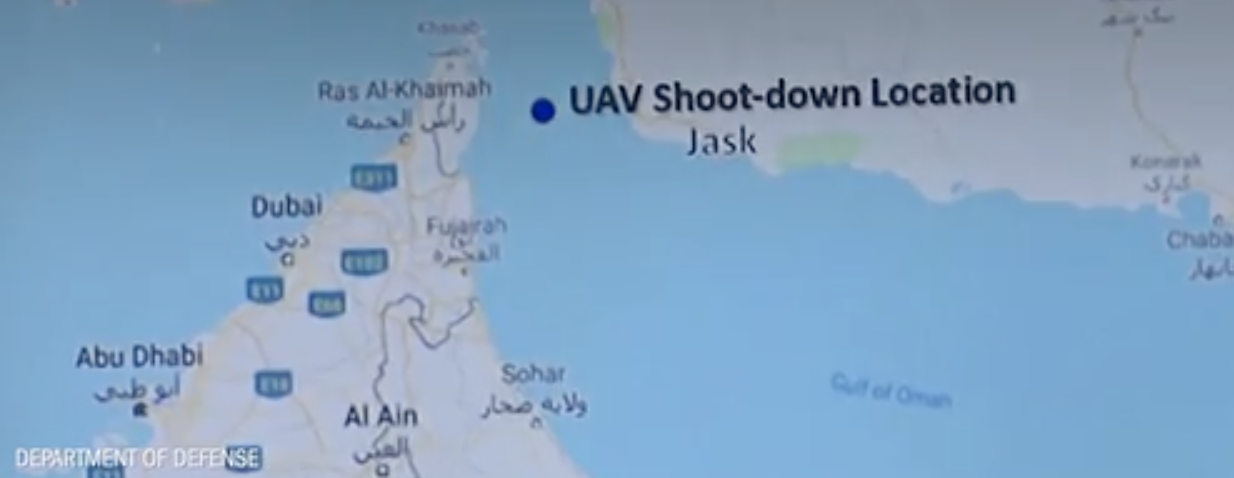
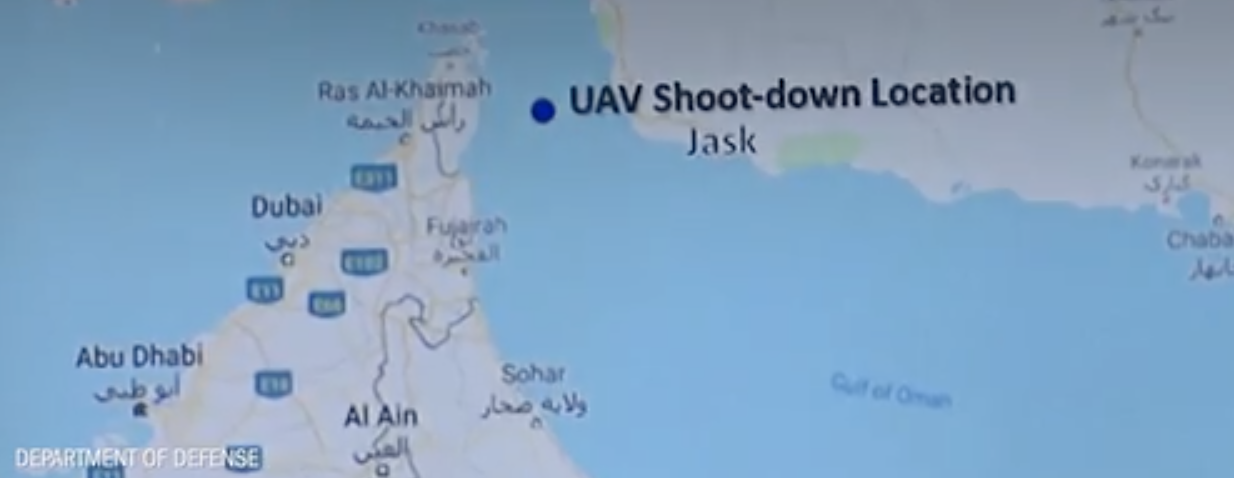
In a world where borders don’t often correspond landmarks or terrain, tensions of incursions on new forms of territoriality multiply. Tensions of violations of airspace and national waters pose questions of the accuracy reliance on mapping systems, moreover, difficult to contest or resolve on a single map, as, at the same time, the frictionless nature of drone flights–here embodied by the costly RQ-4A Global Hawk, whose price as a high-end unmanned surveillance tool reflects its abilities to transgress borders without detection, flying at over 20,000 feet across borders at a speed of five hundred miles per hour, embodies an ability to remap a space of surveillance by superior mapping technologies than other countries. With literally hours remaining before devastating military airstrikes on Iran, amidst fears that a slight miscalculation or misinterpretation of mapping systems could precipitate an unwanted war of massive scale, the strikes were canceled at 7:30 p.m. Washington time, and the threat that Iran had “made a very big mistake” de-escalated. Trump surprised the world by suddenly allowing for the margin of human error, even as he insisted the drone was flying “clearly over international waters,” rather than Iranian airspace just 750 miles southeast of Tehran, refusing to relinquish his own map of wherejn the Global Hawk was downed.

The trust in this unmanned drone may possess its own almost hubristic quality. For its downing by Iranian missiles downed not only a costly military surveillance tool, but punctured a space of surveillance of the Persian Gulf and Iranian territory, and a sense of security in a precarious geopolitical region–at the same time as the American government seems to be bent on increasing tensions about the continued flow of crude petrochemicals to much of the industrialized world, creating global flows and energy markets that are themselves concealed by the question of at what point Iranian missiles struck the drone–or into whose national airspace the drone was flying.

The downing of the drone punctured confidence in a continuous space of surveillance that was built, painstakingly and over time, to guard those global energy markets. While the shock to U.S. military intelligence may have been that Iran had gained the ability to observe, fire at and down the high-flying unmanned vehicles that they had purchased at considerable expense from Northrup Grumman, not revealed even by the most precise hexadecimal GPS coordinates, which would render the costly drones more than a poor investment in preparation for the very grounds of war that Northrup Grumman had promoted to transmit high-resolution images from higher than ever altitudes of sensitive hotspots in “real time.” The United States Military didn’t ever think Revolutionary Guards possessed or could acquire marked not only a threats of war,–and chose to celebrate the RQ-$ “Global Hawk” as a tool of maintaining an infrastructure of global surveillance rooted in Afghanistan, Iraq, and Syria, as well as covering the Persian Gulf, while piloted remotely, by yet another one of the increasing paradoxes of the globalism of globalization, by pilots in bases in Beal, California and Grand Forks, North Dakota, far from the military theaters they sought to control

U.S. Air Force/AFP

But the shattering of this imagined space of global dominance occurred not in U.S. bases, or even on the military maps of Americans, but rather on the screens that Iranians used to monitor the unmanned vehicle’s flight, and, by extension, the missiles they launched that downed it. The missiles’ surprising accuracy disrupted the imagined continuity by which the United States hoped to extend sovereignty into international waters to protect traffic across the Strait of Hormuz–not only by a new surface-to-air missile, but a new radar system able to detect the drone–

–that effectively ended a map of surveillance that will no longer exist in the face of new Iranian defense systems allowing Revolutionary Guards to protect their territorial claims.

The Persian Gulf region has long been planned and imagined to be a new theater of possible war. Indeed, each side has become compelled to map the potential battle field in ways that has been forced the region to be remapped, creating a delicate balance of often contesting Exclusive Economic Zones, international waters, and territorial waters, in ways that have constrained the possibility of American surveillance. But the drone’s downing air revealed that Iranian guidance systems of surface-to-air missiles that Iran possesses to target drones, aircraft and unmanned vehicles are no longer clearly understood by the U.S. Army or U.S. military intelligence. The American “upper hand” in mapping technologies has perhaps been punctured, in ways that may cause the entire battlefield to need to be remapped in costly ways, if to preserve the delicate balance global trade of petroleum from the Persian Gulf, one of the most concentrated and easily accessible site of petroleum reservers, especially in the increased tensions between the United States and Iran.

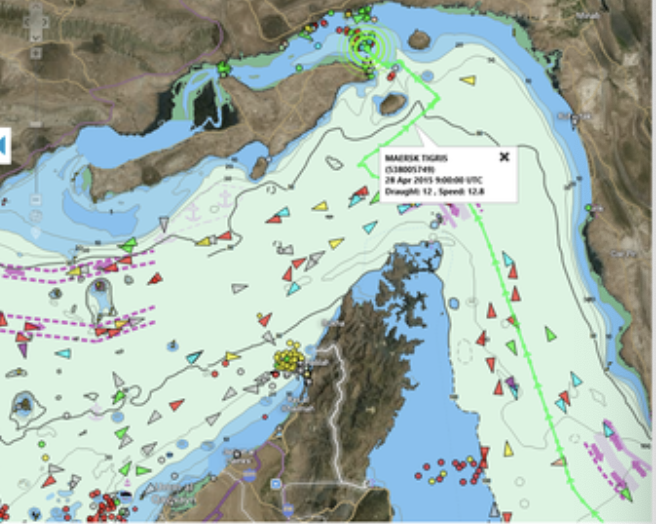
Airspace and territorial waters are more difficult to map on earlier maps, and difficult to map on top of shorelines, or in navigational routes, perhaps, for an untrained eye, but the proliferation of alternate readings of sovereign space have become especially fraught in the waters of the Strait of Hormuz, where overcrowded traffic turns on hairpin turns, seems to have been detected entering Iranian airspace–if one trusts the maps tweeted out in self-defense by Iran’s Foreign Minister Javad Zarif–who argued the unmanned surveillance drone had crossed the “red line” of its sovereign airspace without warning, ignoring alerts from Revolutionary Guards, and interpreted as threats to its sovereignty.

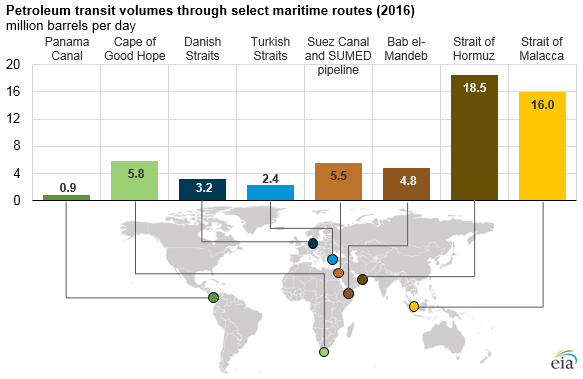
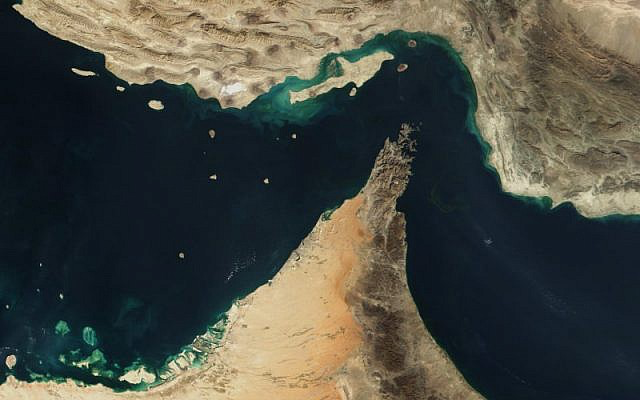
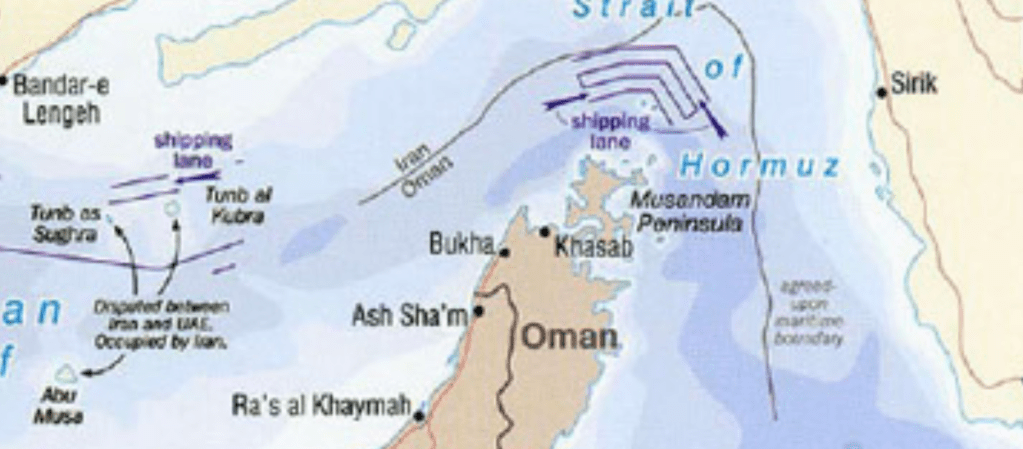
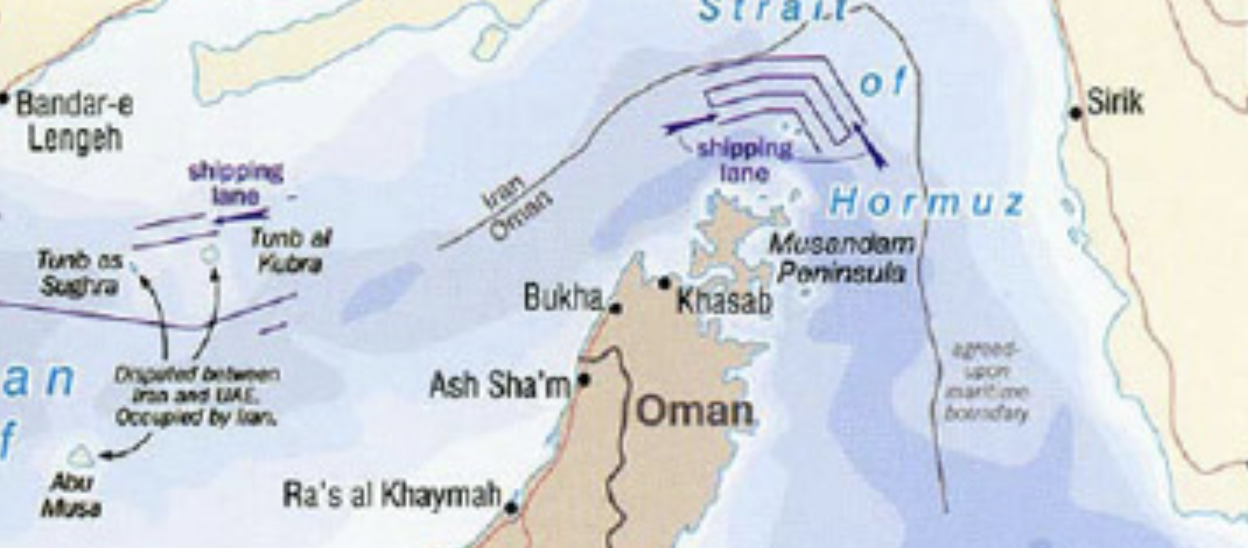
Coming on the heels of Iranian threats to shut the Strait of Hormuz to all traffic, as Iranian speedboats patrolled the waters, as if tempting to assert their control over the narrow passage-way out of belief that “if our oil does not go through the Strait, other countries’ will certainly not cross the Strait,” the jockeying for power over the transit of oil in international waters set up a conflict between where national sovereign interests began and ended, and what power the United States regained on a global geopolitical stage, even as the United States openly asserted the upper hand of global surveillance over what is one of the narrowest maritime site of petroleum transit in the world wildly out of proportion to the millions of barrels that cross the narrow strait daily, a transit that wildly dwarfs the petroleum carried to global markets by other maritime routes–despite the quite narrow nature of its passage, and the even narrower space of international waters by which oil tankers navigate the Strait.

NASA/Public Domain
Shipping Lanes of Strait of Hormuz

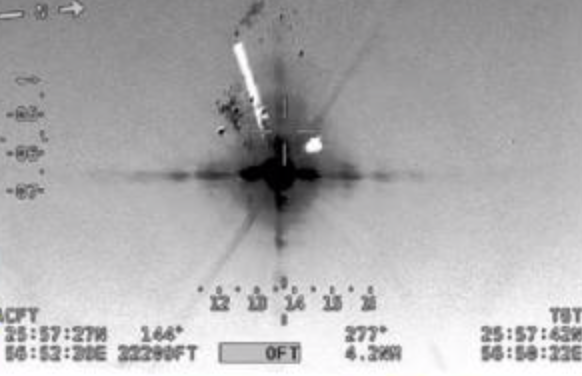
Where the unmanned vehicle flying American colors flew–and whether it crossed into a sovereign space–bedcame a flash-point of regional tensions, so much that the downing of the $110M drone, long celebrated by the U.S. Army as covering surveillance needs over the Gulf, embarrassingly became a target of Iranian defenses, as it was downed on June 20, even as it was flying at over 60,000 feet, or above what American forces believed that Iranian Revolutionary Guards could detect. The illusion that American unmanned surveillance drone RQ-4A Global Hawk could itself move frictionlessly across national boundaries without being downed was itself unmanned, creating a small catastrophe or large disruption in the international balance of powers.

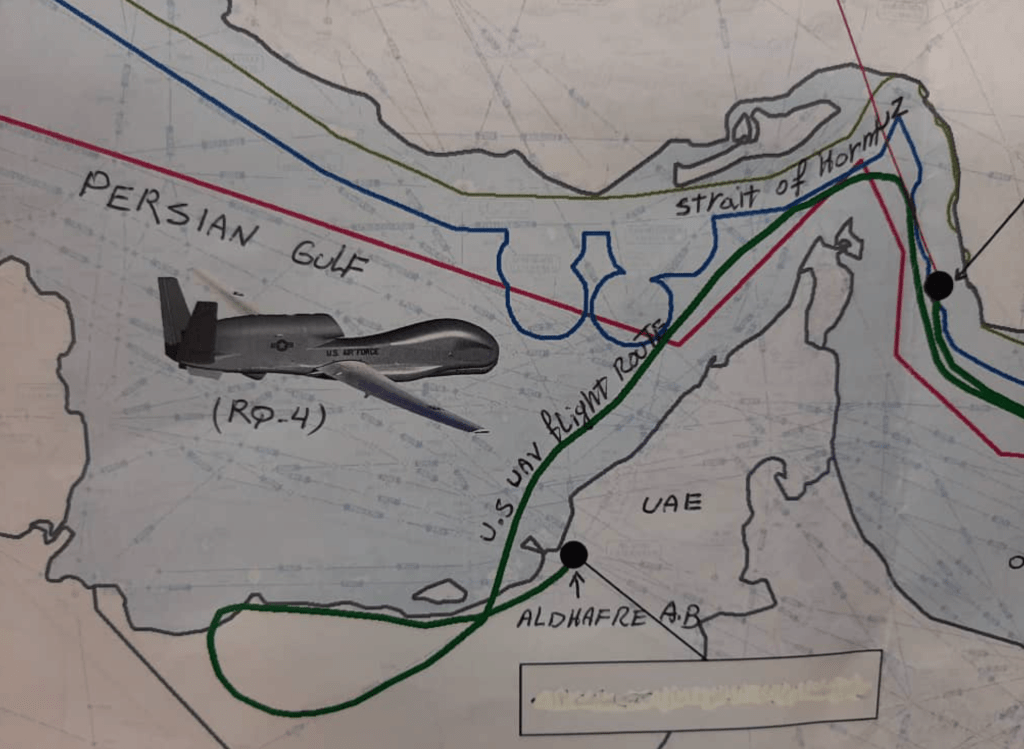
Did it cross the red line?

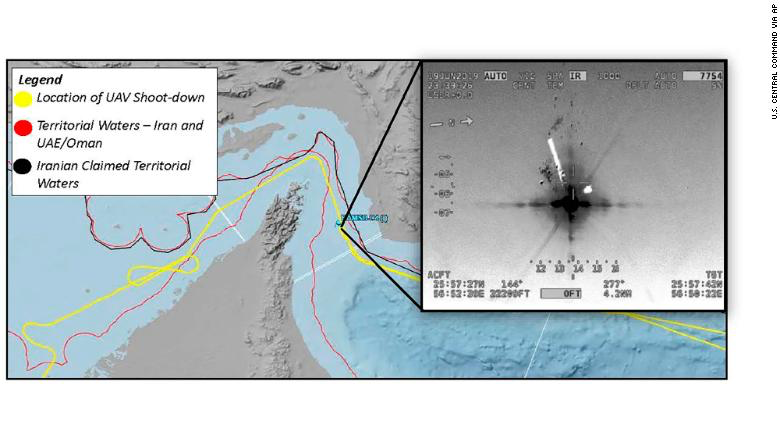
Or, as the U.S. Military’s Central Command tried to assert with its own parallel graphic of where the drone was downed, showed the apparent intensity with which Iran was able to pursue the dominance in a theater of oil transport vital to the global energy economy, and to the global economy that was attached to it, signaling a real Achilles heel in the continued image of American global invulnerability. which the United zStastes was determined to map as occurring outside Iranian sovereignty as an attack on American property and super-costly military hardware–starting a war of maps on the heels of a renewal to past Tanker Wars, both possibly poised to escalate into actual military bombardment.

It certainly seemed that the downed Global Hawk would constitute something akin to the arrow fired by the Trojan Pandarus into the groin of the Spartan Menelaus, the great warrior and husband of Helen of Troy, causing blood two streak down his legs, in an image of the fraught virility of the fabled warrior to incite the wrath of the leader Agamemnon, if not reveal newfound imbalance of military relations which Athena seemed to use to provoke the shattering military disaster of the Trojan War by starting the siege of Ilium. Would the downing of the jet provide the occasion of the bombing of Iran that Donald J. Trump has hoped to begin, matching his heightened bellicose rhetoric with the presence of a violent escalation of arms?

What happened was not clear, as was evident in the difficulty of mapping the event. When the costly U.S. Army Global Hawk drone looped back in the course of its surveillance of the Strait’s coasts, possibly entering Iranian airspace, after it was shot down, reverberations spread across the world, quite quickly. President Trump declared that Iran had shown itself by this act to be “ready for war” before plans for a miltirary reprisal were called off with but hours before it was poised to begin–perhaps saving the world from a global catastrophe, although U.S. Secretary of State was later dispatched to forge an improvised alliance against Iran in the coming weeks. Although war was averted on a global scale, the question of whose map was more authoritative, and whose could be trusted, reveals much about the contested status of authoritative maps in the globalized world, beyond being a debate waged across social media. The debate turned on different ways of reading space–or of wanting to read space; one hinged upon a notion of national boundaries and sovereign space, whereas the other relied upon the frictionless space of a notion of regional surveillance.

The downing of the drone lifted a corner on the shifting tensions in globalization, and indeed the increased problems of lamination of multiple maps over the increased density of economic traffic across the Strait of Hormuz, and indeed the conflicts between national and international waters along which petrochemical and crude petroleum leaves the increasingly blurry–if much mapped and over-patrolled–region of the Persian Gulf. The tensions were not about the drone. At least not only. The ratcheting up of tensions with a policy of “maximum prsssure” and rhetorical escalation has ratcheted up tensions, as Iran policy has been transformed into a flag-waving exercise of defense against a perceived infidel enemy–one that has disdained civil discourse and alleged overtures of open negotiation–in ways that are about American desires to map “international waters” and international airspace–

–rather than recognize even the potential legitimacy of a sovereign state’s defence. For all the mapping of “national” spaces on new maps of the region–that for all their identification of names of nations affirm the abilities and potentials of U.S. surveillance maps.

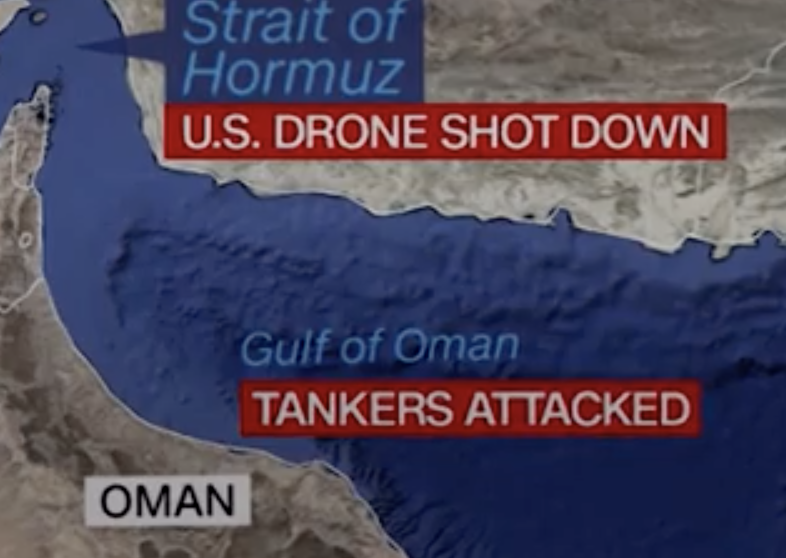
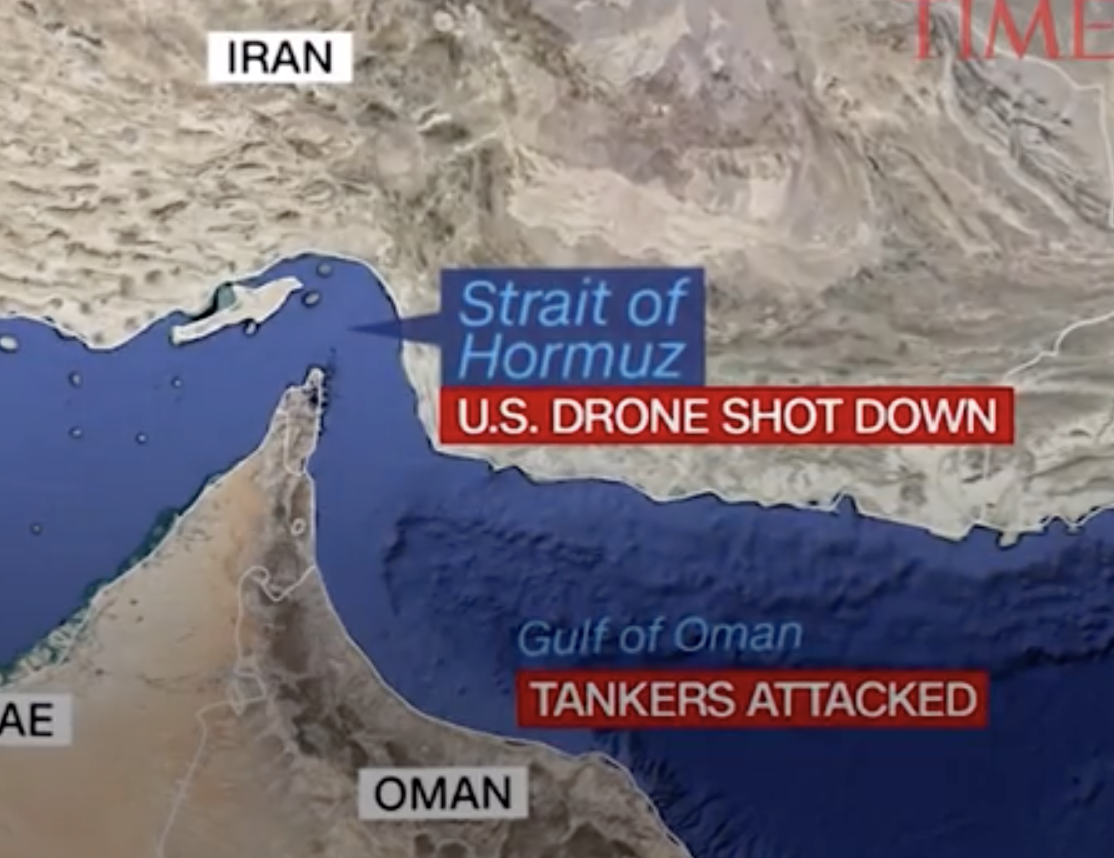
The Strait of Hormuz exists on the borders of several nations, and might be mapped in multiple ways. While the central waters of the Strait–which narrows to just twenty-one nautical miles, or less than forty kilometers–nonetheless retains a thin band designated as international waters, which puts it outside of local sovereignty. But the Strait increasingly is mapped in radically different global and local contexts, making the question of its territoriality and international status a question of increased tensions in the past weeks–when one American Global Hawk, a pretty fancy piece of surveillance, was downed. The cost was not only limited to the fourteen million dollar piece of military hardware, or to its symbolic loss, but the casualty of a sense of security in the frictionless policing of an economically vital transit routes–and the hegemony of mapping and ensuring the safety of the movement of crude oil from the Persian Gulf to global energy markets.

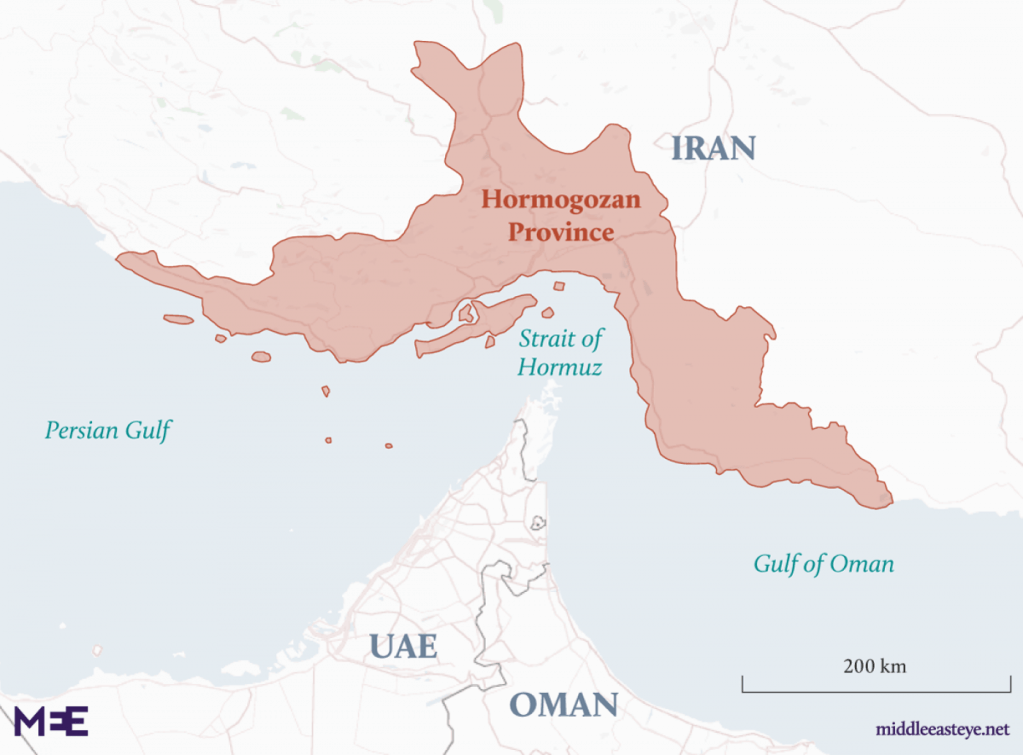
What appears to be a navigational course, in an era when territoriality is designed by points, rather than either landscapes or terrain, created an increasingly serious a quandary for measuring locations along a nautical map alone, or in reference to a mainland. For the question of incursion in territoriality–as the high-grade U.S. Army drone that was shot down in Iranian airspace–is not so evident from the Gulf waters, or the landscape over which it flew, approaching the Islamic Republic of Iran’s sovereign region of Hormogazan Province, or appearing to stray outside of the path of international airspace, or at least doing so at a height of 20,000 meters, higher than Americans’ expected Iranian radar systems could detect, but in fact just within the Iranian Revolutionary Guard’s radar detection abilities.

Was it an incursion of sovereignty? It depends less on whose maps you are looking at, than what sort of landscape of military conflict and geospatial intelligence you followed, or what side of the cat and mouse game of mapping the nature of the international status of the navigational paths of the Strait you follow to understand how securing “free passage” through he Strait of Hormuz became rooted in the security of abilities of mapping energy transit. If the Strait has emerged as a hotspot in an increasingly irrevocably globalized world, the conflict between Iran and American interests arose as abilities of local mapping temporarily shifted, and the hegemony of American mapping of gulf waters was challenged, as Iran accused the United States of crossing a long drawn “red line” of sovereignty in spying on the banks of a Strait that Iran has increasingly asserted its ability to close, and indeed to monitor the escalating American surveillance of its waters and shores.

1 Comment

Filed under drone strikes, drone warfare, globalization, Middle East, Persian Gulf