Monthly Archives: July 2013

Oakland Represented Variously: What We See When We Map Oakland’s Inhabitants

The range of ‘open’ online data that is available for a city such as San Francisco showcases the city’s clear definition of a public space.  Although there are plenty of spaces of local meaning and importance in Oakland, from the site of Occupy near the mayor’s office to nearby Chinatown and Lake Merritt, or from Fruitvale Station to west Oakland urban farms and on to Alameda, the fragmented nature of public space is difficult to map coherently.

When it comes to public space, the East Bay and Oakland–despite a rich variety of parks, an estuary, and increasing vitality of Jack London Square–is a polycentric sprawl, its former downtown interrupted by freeways, and open boulevards dotted with closed commercial centers, beauty supply zones, or dense interchanges.  This is in part due to how little the diverse areas and neighborhoods of the city know themselves.  How to map the inhabitants of Oakland, CA, given the considerable diversity across neighborhoods?  Does it exist as a unified social space, or what image of the city emerges?  By looking at some of the census maps of the city, and mining the range of information compiled in them by displaying their data in mapped form, we can process and digest the complexly variegated nature to view its population’s profile.  (Indeed, the problems of politically representing the complex composition of a somewhat divided city were revealed in the most recent mayoral election of 2014.)

The sprawling city challenges the abilities of the social cartographer as much as the post-modern space of Los Angeles, even in this real-estate view.  Maps of any scale organize social space by relevance, preparing a selective record of its inhabitation and revealing networks for ready consultation.  Maps of any scale create a simulacrum or construct of social reality, as much as simply orient their readers:  the city’s salient features highlighted and network of organization explained, omitting other spaces and residents. We might start by acknowledging how the below bird’s-eye view of Oakland from c. 1900, of unknown origin, celebrating the city’s settlement and early Bay Area Real Estate:  the engraving showcases an open urban grid as an area becoming future realtors to its shores:  if mostly green and largely uninhabited, presents a prospective view of the city-port as a commercial center, showcasing notable houses of prosperous residents that distinguished Oakland’s built environment, and beckoning viewers to its estuary and the man-made shores of its new Lake as if to shift our attention from the city of San Francisco.
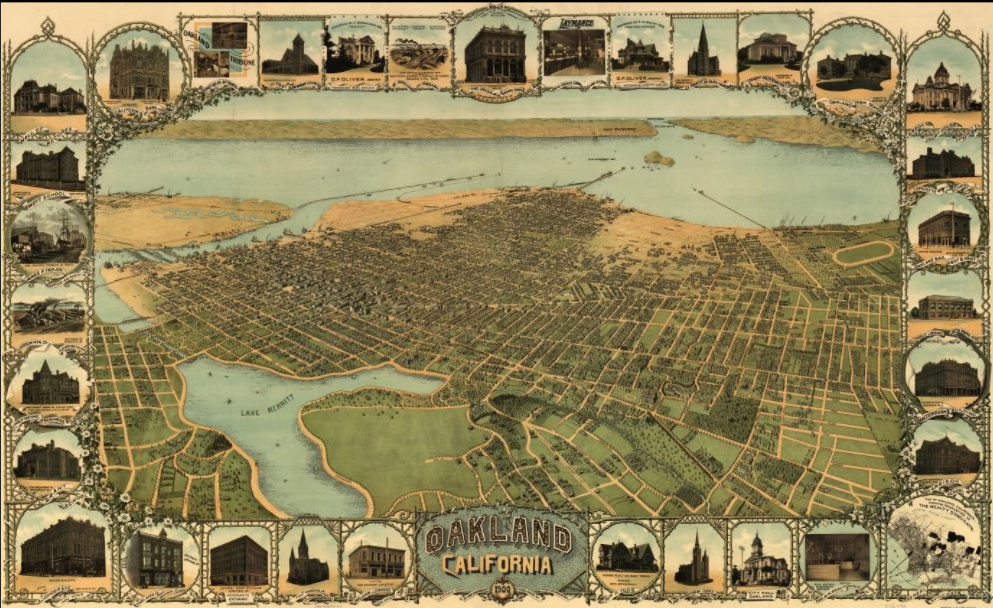
Oakland 1900

Elevated or “bird’s eye” views praising urban identity and architecture such as this anonymous print had a long tradition.  Such imagined constructions that gained currency as encomiastic forms, often complemented by poetic paens to their social harmony.  If the artist who engraved and designed the elevated map is not known, the presentation of the city’s growing physical plant and street structure echoed the architectural elegance of earlier urban views, as the visual encomia to the elegance of architectonic form of Venice in the virtuosic perspective designed by Jacopo de’ Barbari circa 1500 of his own creation.  De’ Barbari exploited skills of perspective to craft a graphic and pictorial encomia to his native city’s architecture and burgeoning wealth to trumpet its social distinction; an earlier elevated view of Florence, sold by the cartographer and engraver Francesco Rosselli similarly celebrated and displayed the architecture of his native city.  De Barbari famously employed to evoke the harmonious order of his city, also lying in close proximity to surrounding wetlands, by displaying its distinctive harmony–vaunting its delicate socio-political balance figuratively by deploying his mastery of creating a previously unimaginable perspective to considerable effect, showing the density of its architecture in the watery surroundings.
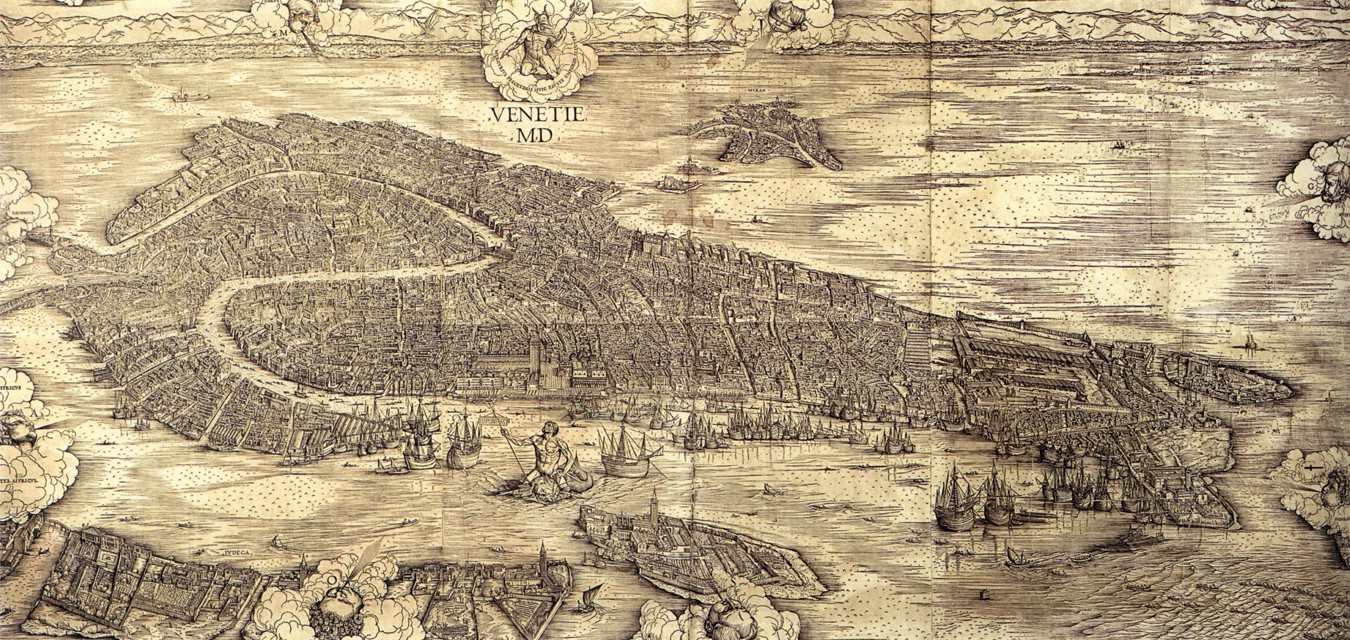
Jacopo_de'_Barbari_-_Plan_of_Venice_-_WGA01270

Even if much of present Oakland seems a bit of a blank slate, whose territory expands from its port and the man-made lake built to beautify its urban estuary, the print of c. 1900 divides plots and settled acreage, as the surrounding images of buildings that testify.  This is not only a pictorial space, but an attempt–as the Rosselli and de’ Barbari maps–to show the social space as harmoniously mapped to a pictorial space of representation, and distinguish the city as a microcosm of the world.  Both maps offer  sophisticated visual glosses on the ancient notion of a “chorography” or qualitative view of a community, elegantly overlaying and equating their imaginary perspectival space with he social spaces of each city.

Can we create a modern chorography of Oakland that both displays and comprehends its dynamic heterogeneity, or would the city split into social divides?  Google Maps clearly fails to do so, but what would a comparable mapping of Oakland’s populations look like, perhaps mapped from the ground up–in the manner that Jacopo labored to achieve?
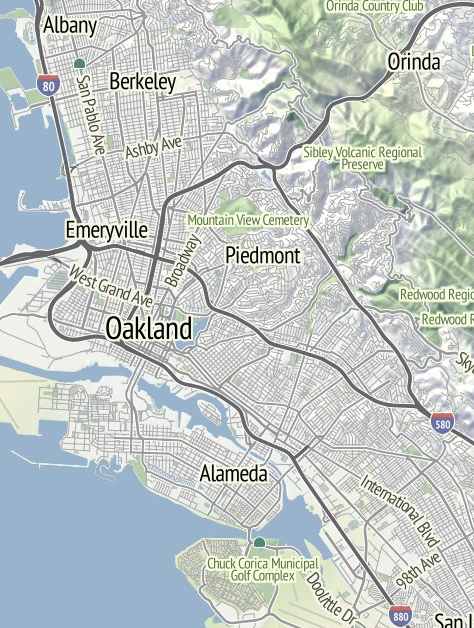
OAK Topographical

There was clear redlining of much of the East Bay’s residential areas in real estate maps for the East Bay cities dating from the Depression, in which Home Owners Loan Corporation rated neighborhoods for the refinancing of mortgages  that amounts to a reflection of the value of property in the East Bay, and reveal an odd mosaic of the city that privileged some regions, but also include a clear redlining of those regions by the Bay and the main arteries of transportation that continue to define Oakland’s port.  The red-lining of the city’s residential areas in the New Deal structured the city’s social geography in  imaginary construction ofways that reflect the continued exclusion of African Americans and blacks from the market of legitimate home mortgage in much of America through the 1960s, described so compellingly by Ta- Nehisi Coates, and in Oakland not only reflect the deep divides in residential ownership but created social disparities but record scars that make the city’s future harmony particularly difficult to re-imagine.  The zones of imbalanced opportunities for home ownership that long existed in the city created perpetuated deep social divides among its residents, often left without the chances of refinancing that were available to many other residents from the 1930s in the United States, as its port and low-lying areas became victims to a classic image of “blight” with roots in its deep abandonment by the public good in ways not yet overcome.

OaklandBerkeleyHOLCmap

From the first settling after the San Francisco earthquake of the Oakland hills, the demographic divides Oakland’s settlement seem to have been reflected in the value of residential ownership in its neighborhoods in ways revealed in the fractures lines of the map of the Home Owners’ Loan Corporation, and which have continued to divide its neighborhoods even after a period of urban growth.  The absence of clear neighborhoods or community organizations around the major traffic arteries that Oakland has long been defined by at its port and older shipping canals created something like a social divide not only in this early HOLC map, but that has been perpetuated within the socioeconomic divisions that were so starkly reflected in the “red-lining” of urban real estate.
Redlining By the Shore

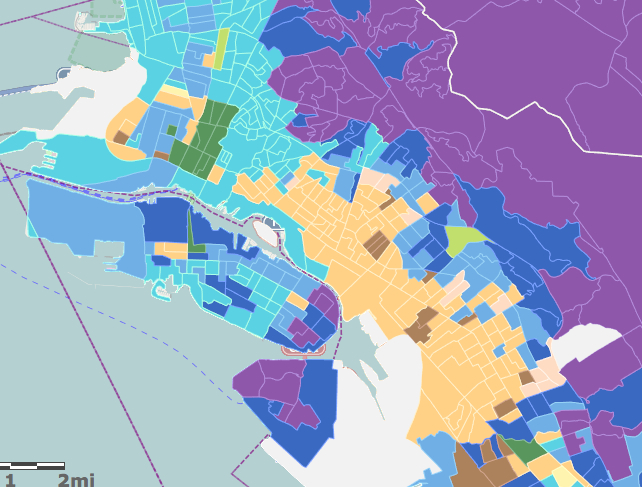
Even if Oakland has been billed a “livable city,” the “split personality” is revealed in the divides starkly illuminated by a map of social lifestyles generated by an ESRI tapestry charting dominant lifestyles–purple noting High Society; blue “upscale avenues;” teal “Metropolis;” light bright blue “metro trendsetters;” green “seniors;” and tan and brown “inner city,” “highrise,” or “up and coming.”

The map shows the city’s split personality:
esri dominant lifestyle est bay

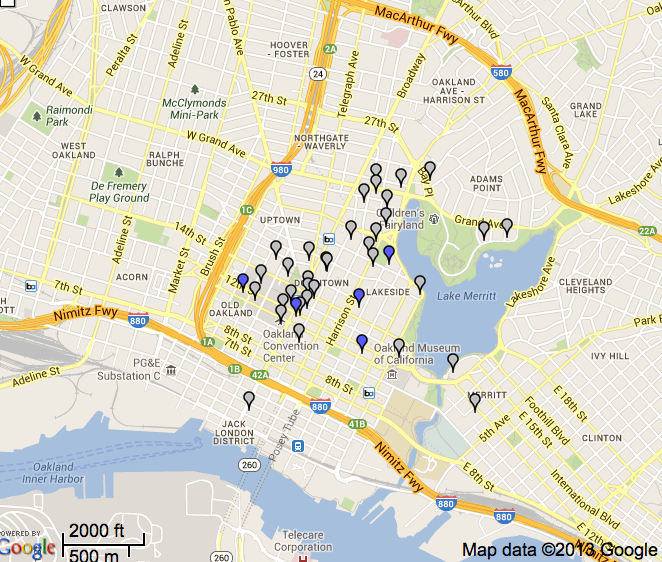
In a year that boasted crowd-sourced mapping of the San Francisco Bay, organizing the demographic divides that continue to shape Oakland deserves our sustained attention–and the varieties of viewing the divisions and distributions in the settlement of Oakland’s space.  Unlike San Francisco, dominated by some 359 skyscrapers in its downtown and other regions, Oakland is far more geographically disperse and diffuse, with only a small number of buildings over fifty meters all clustered by Lake Merritt–including those noted in blue, under consideration or construction.
Skyscrapers in Oakland-  50 meters

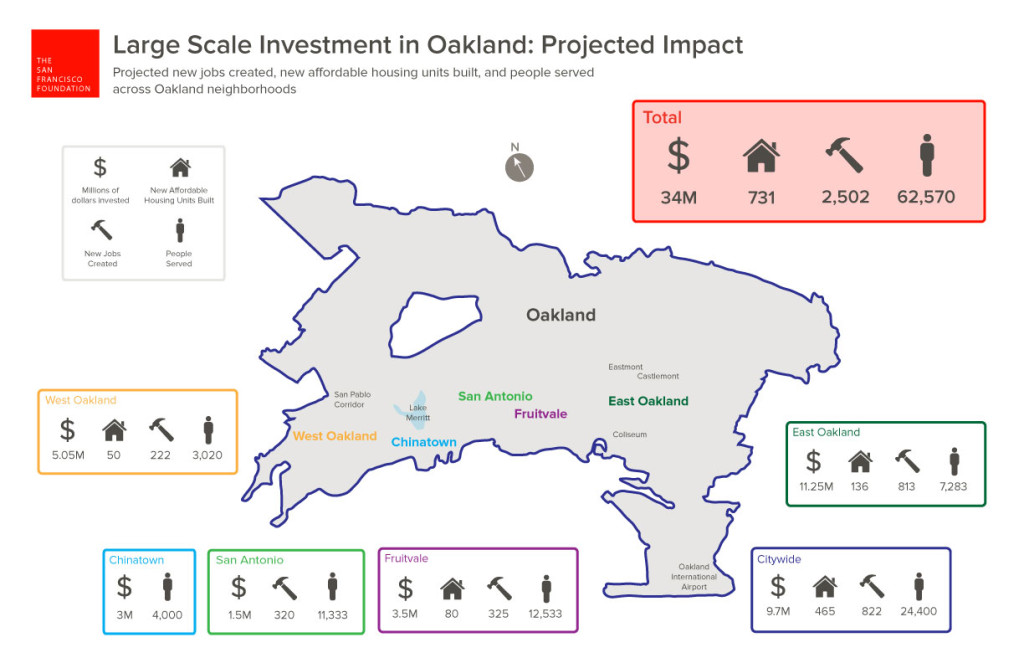
The recent ambitious and brave investment intended to equalize these clear socioeconomic divisions and to prevent them from being perpetuated by public services from schooling to economic opportunity is a step in the right direction and, based on a back-of-the-envelop calculation, seems to have its priorities and direction of resources fairly straight in how it has decided to invest in Oakland’s neighborhoods’ futures.
OaklandOpportunityImpactOverview-1024x663Distribution of San Francisco Foundation’s Investment in Oakland

But how to frame and orient the viewer of a map of the city’s demographic divisions is fraught, given the difficulty of uniting Oakland as a whole, or even in abstracting an analogously unified image that connects its disparate inhabitants.  The network that bounds the city was advanced rather optimistically in a map that elegantly promoted the lost or abandoned system of Key Cars whose web linked downtown Oakland to the Temescal and Alameda–the infrastructure for the local economy that it did up until its complete dismantling by 1959.
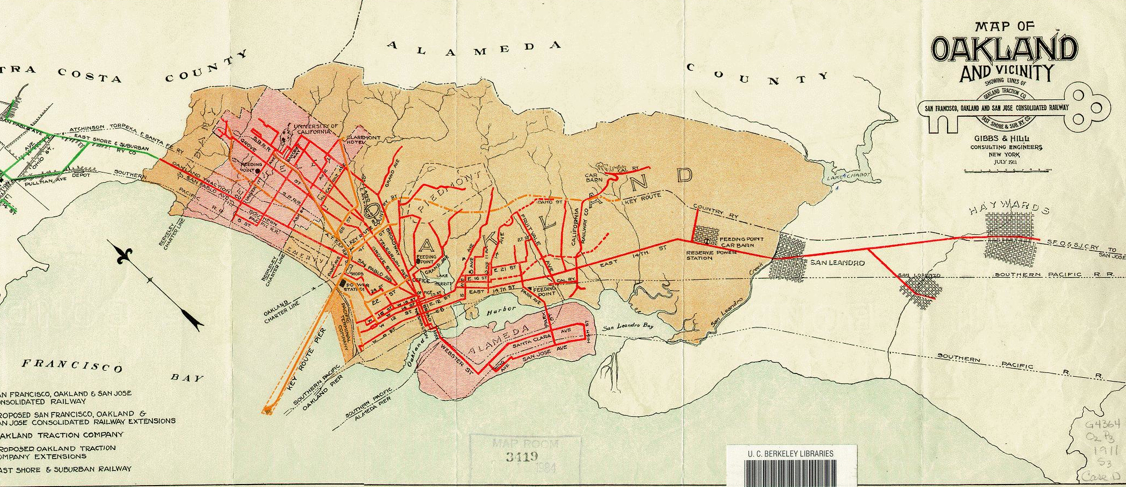
Map of Oakland and Vicinity- Key Car System

The serviced networks that any map foregrounds, even one of transit routes, engage their readers by networks of inter-relationships.   The above map affirms a network of transportation for their rider, suggesting the ways that the infrastructure by which the Key-Car systems united downtown Oakland and the vicinity–much in the manner current BART maps promise to link everywhere in the East Bay in a radius to Point Richmond, Brentwood, and San Jose.  The current BART network may link the Bay Area, indeed, as Oakland seems to be forsaken as being the economic it was by transit authorities and Bay Area residents.

But Oakland is also a city whose social space was long both divided and eviscerated, as the network of streetcar transit was dismantled, the railroad stations that centered the town from the 1880s declined or closed, preparing for the razing of the West Oakland residences of many porters for the MacArthur maze, long before the collapse of the I-880 Cypress Freeway in the 1989 Loma Prieta earthquake–and the subsequent massive shifts in home-ownership as a large number of houses went underwater after 2007 led to a wave of foreclosures that was almost distributed across the city, and which redefined its social space once again.
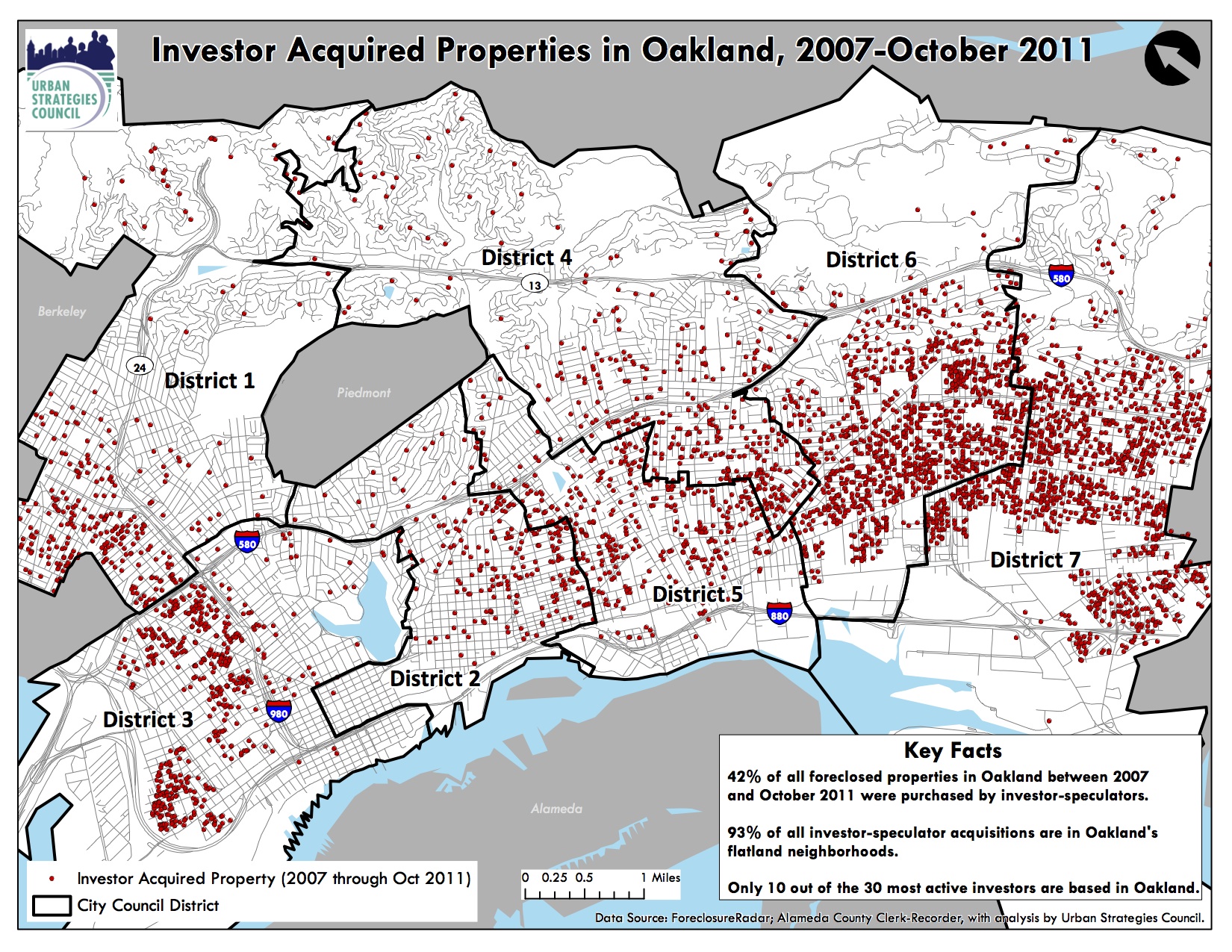
FORE_MAP

The divides and diversity in Oakland make the mapping of the city of particular interest as tools to understand its social reality.  In a society where we are regularly mapped and surrounded by maps, the critical of reading maps is recognized as an important tool to negotiate and mediate lived social space.  What sorts of divides and continuities emerge in a city like Oakland, historically defined by considerable racial diversity and income disparity?  How to map so many variations in one place?

When Denis Wood and John Fels described the map as an ideological construction of space or territory, they took time to examine the surrounding ‘paratext’ to maps as keys or markers that revealed the ideological construction of the space within the “nature” of the map, created by interpretive legends and iconography, as well as the semiotic conventions of the map itself:  yet interactive urban maps provide much more of a creative cartographical conventions and treat the map as something like an open text.

In their critical examination of the authority inherent in the medium of the map, The Nature of Maps, Wood and Fels argue that the relation between a map and territory exists through how cartography–as much as cartographers–“constructs the natural world” in relation to other sign systems, construing the relation of a ‘map’ to ‘territory’ by how maps inescapably make their subject ideological.  Taking as their case in point maps of nature, they argue the order of maps demand assent from readers through what they call the ‘postings’ and the relays that the map creates to the world it ostensibly depicts, and the new understandings of space it creates.  Wood and Fels argue “relays” in maps, tied to the texts inherent in them or positioning in books or  paratexts, which uniquely promote the construction of meaning, effectively organizing complex mental spaces to understand nature in maps, whose structure demands assent to create truth-claims about nature, and transform the space of the natural world into a structure by which nature is spatialized as known.  The Barbari and Rosselli views assert an ideology of the local, spatializing the city as it is best viewed and encomiastically celebrated as a microcosm, even though the “paratexts” by which one reads a map are left tacit for their viewers.

Yet the map does not begin from an empty space, so much as it is rooted in a space that is inhabited:  it indeed tracks multiple networks of inhabitation.
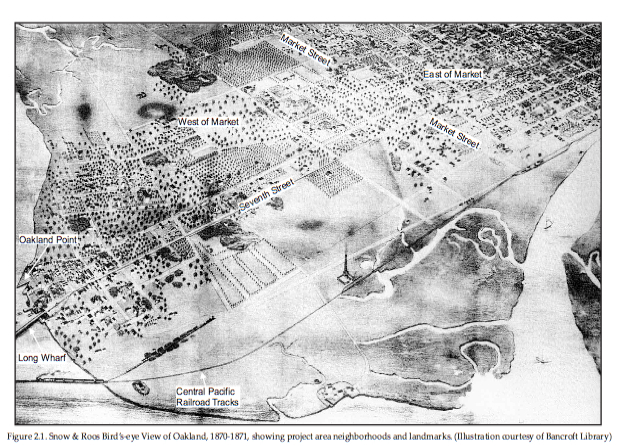
Oak 1871 Birds Eye View

Tempting as it is to argue that social space fills in the empty space of a geographic region, the maps of Oakland’s inhabitants suggest a remaking of the city’s social space–and present an image of the remaking of that space viewed from the ground up.  For rather than providing a fixed or authoritative transcription of space that promotes “a standard scientific model” that creates a “mirror of nature . . . through geometry and measurement,” as Harley wrote was endemic to the discipline of cartography, or invest authority in a single map, the variety of Google Maps templates to plot data from the US Census for the years 2005-9 create a set of multiple maps in themselves each provisional, which they invite viewers to act by ordering their content.  It is perhaps no surprise that, in an age when maps proliferate, and we are both regularly mapped and surrounded by maps, the appeal of the website is that it provides tools to select variables and determine geographic parameters about the city that we can know:  indeed, their interactive nature provide a shifting notion of a map as a graphic fixity.  Wood and Fells primarily examined the organization of space within the printed map, critically reading map’s insertion in printed texts and their relation to the semiotics of written legends.

The compilations of maps based on census data offer, at a far greater granularity than other maps, to divide space by variable criteria of income, race, or level of education to offer what might be treated as elements of a composite picture of the city’s inhabitants–from the ground up–rather than demanding assent to a given cartographical record.  In a sense, the interactive maps below start a discussion about the nature of mapped space from which one can begin to examine the city’s social space.  The interactive map creates an open text whose variables and criteria users can create.

They provide a basis to question, critique and re-evaluate question the dominance of stereotypical categories of local violence or gangs as relevant descriptors of the city, but provide a bit more complex picture of its social composition.  For the interest of these maps lie in how viewers map them as simulacra against their mental maps, rather than in their mimetic claims:  ‘simulacra’ since all maps are both filters of information that parse the relevance of social space and embody a coherent order of space, providing deeply social tools for reading.   Rather assigning integrity to the map as a unique document, we can understand its ‘social life’ through how each creates and constitutes its own social reality for readers:  the Google Maps templates offer a basis to refract socio-economic distributions in the city, rather than fetishize the authority of the given map as a form that commands assent; the familiar templates increase the improvised nature of the comparative mapping exercise.  But Matthew Block, Shan Carter, and Alan Maclean are also particularly inventive graphic artists in how they use of Google Maps–especially in comparison to how it is usually used by others.

The interactive maps created from the Census Bureau’s American Community Survey provide tools to track social realities across the nation, and filters to view specific variables in each zip-code and neighborhood.  I’m interested how maps embody Oakland as a coherent entity, and in Oakland a test-case to examine maps as embodiments of space and to illustrate spatial divides, as well as to filter different aspects of social space.  The interactive maps devised by Block, Carter, and Maclean employ Google Maps templates to invite viewers to process the coherence and divides within data from the US Census in spatial terms, using data for the years 2005-9 to create multiple maps, generated on demand, that refract or mediate statistical realities in visual formats which provide compelling ways to embody and understand social realities from the ground up. The statistical “maps” map at stunningly finer grain that reality–by “Mapping America: Every City, Every Block,” as they boast–that use tools of mapping creative interventions to analyze the Bay Area and its inhabited landscape; the mapping forms offer tools more than vehicles to demonstrate variables of race, income, education, or presence of recent immigrants, offering alternative models by which the region might both be mapped and, by extension, surrogate realities by which its composition might be known.  As much as surrogate realities, they refract pieces of that reality that we must juggle and assemble for ourselves, less attentive to the semantics of the Google Maps frame than their content. One might compare them to conventional maps based on skimpier data, to which their detail and agility provide a sort of foil–starting from the graphic charting crime-density in the Bay Area based on the police blotter.
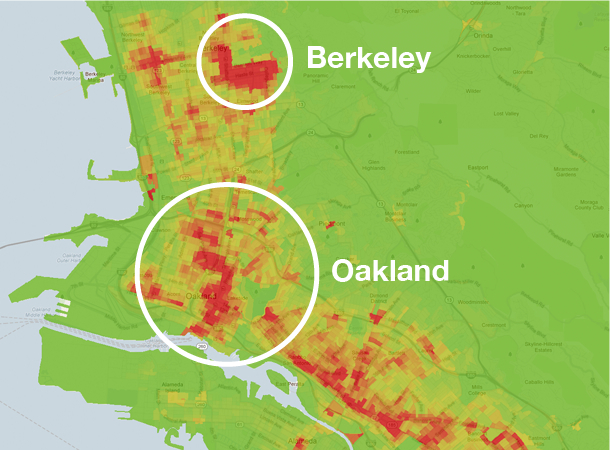
Berkeley:Oakland Crime Density

The map is surprising for how the area immediately around the campus is a thick blotch of indelible red, bleeding into its nearby areas and along Telegraph Avenue like indelible ink.  Most of this “crime” is based on calls to the Police Dept., including a significant number of calls about problems of noise around fraternity row:  the impermeable barrier both around campus can be explained by the different policing agency that supervises the university’s campus, and the boundary of the Berkeley Hills to the East.  Crime is mapped not only indiscriminately, but distributed to reflect the contours of public complaints, as much as actual crimes.  Although the red splotches and streaks around much of Oakland and focused in its downtown seems in keeping with the difficulty of maintaining control over the dispersive city, while around UC Berkeley are dense stains of intense crimson that corresponds to the frequency of calls that the local police receive near campus.  It is interesting to contrast the map to that of San Francisco–where a huge amount of crime is clustered in the downtown, near the Embarcadero, Tenderloin, and Mission and some pockets around Van Ness–in a broad field of relatively crime-free green.
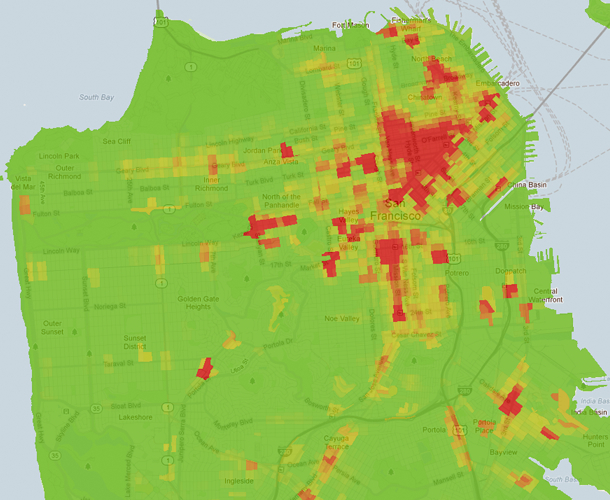
SF Crime Density

And so, if we shift mapping forms to a sort of heat-sensitive map of the violence committed and reported, the hot-spots of Oakland are more readily apparent–almost as a diffuse miasma of violence spread over neighborhoods like a viral form whose trajectory is difficult to explain or track:  heat-sensitivity is an apt cartographical metaphor of the subject charted:
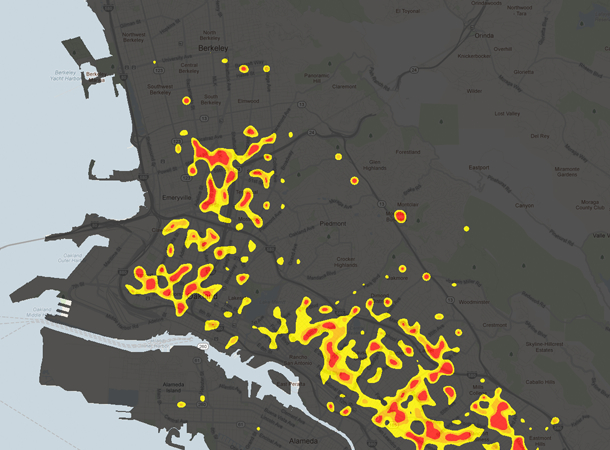
eastbay_violent crime

The map of hot-spots of violent crime provides a different picture, if a tragic one, extending along the city’s major streets deep into East Oakland.  One might ask how this maps onto the city’s racial diversity. Given common predispositions, it might make sense to reflect on the city’s composition with greater granularity.  Does violence correlates to the complex ethnic or racial distribution of the city?  or to income?  or to gangs, as often suggested?  The interest of the interactive maps lies how viewers map these simulacra against their own individual mental maps, as much as in their mimetic claims:  ‘simulacra’ since all maps are both filters of information that parse the relevance of social space, providing deeply social tools for reading.   Rather assigning integrity to the map as a unique document, we can understand its ‘social life’ through how each creates and constitutes its own social reality for readers. Aside from the heat-spots in West Oakland, race is not a determining factor in a clear a way at all, although the ethnic diversity of Oakland–a historically African American city with a rapidly shrinking number of areas dominated by African American populations.  It’s in fact striking that the greatest mix of black and hispanic Oaklanders in any neighborhood occurs on the edges of Oakland:  and that the island of Piedmont is the only area that’s white.
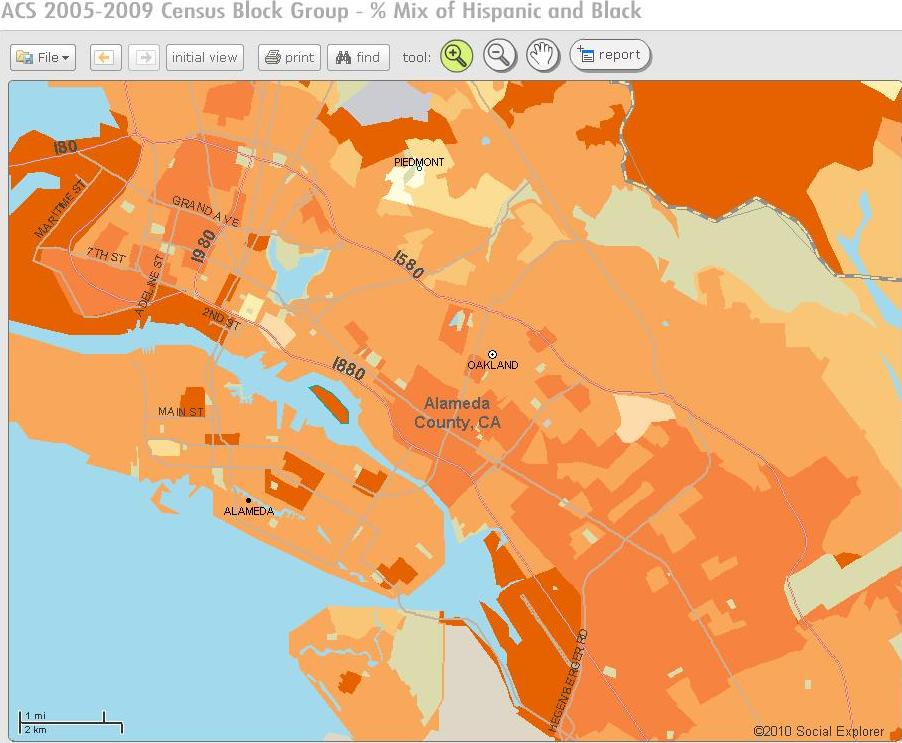
oakland-racial-map

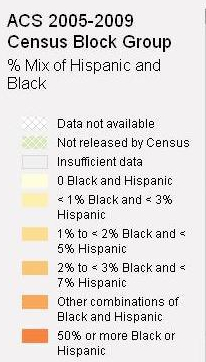
Census Block legend

The same data can readily be re-mapped to present a distinctly different picture of the city, emphasizing urban diversity, by using the US Census Bureau’s data from 2005-9, using the American Community Survey.  Block, Carter and Maclean exploit the Google Maps platform to embed Census data in color-coded terms, which shows small pockets of African American concentration by light blue, but relative integration with the greatest concentration of Asians near Chinatown downtown.  The below aggregates units of fifty people, rather than proportional composition, to provide finer granularity of the population and of each neighborhood in Oakland, if in a less than dynamic manner:
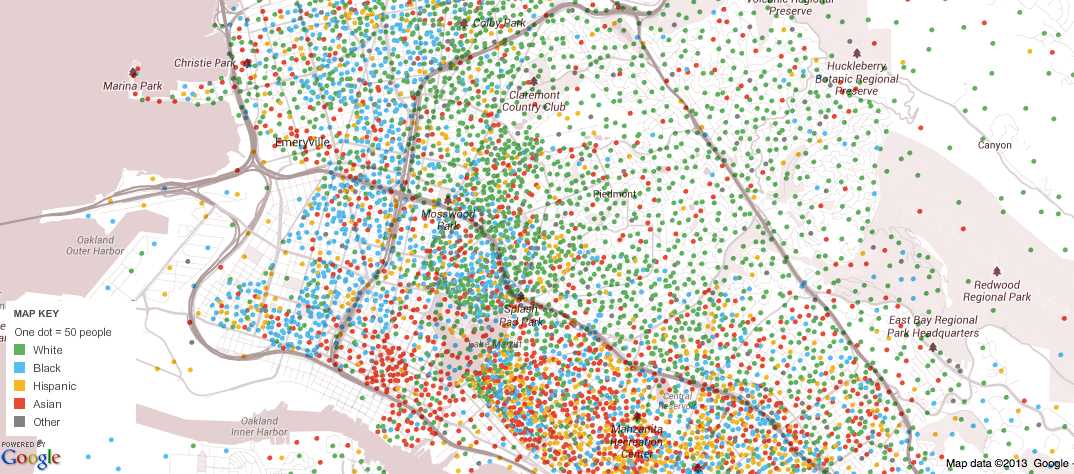
Race in Oakland Google Mapped

Oakland’s complex diversity might well be compared to the clearer clustering in other urban regions of the Bay Area, where whites are more concentrated in clearly bound neighborhoods, and Asians similarly concentrated in areas around Golden Gate park (Inner and Outer Sunset)–if with considerable overlap of Asian and Hispanic populations in the Mission:
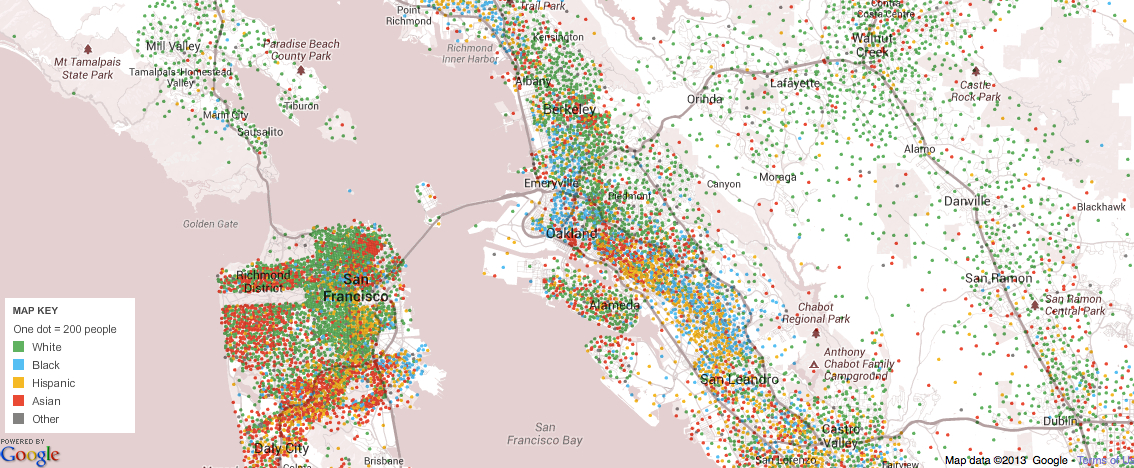
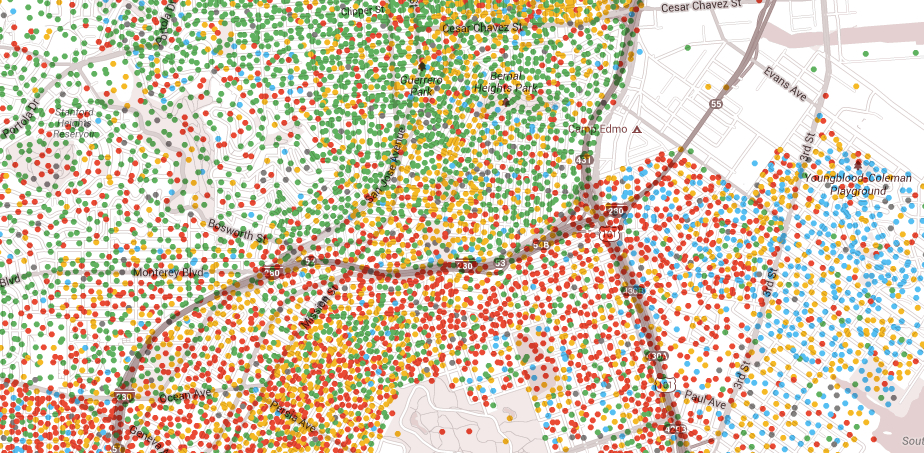
Mapping Race across Bay Area

%22Greater Mission%22

Far more sharply defined geographies of racial separation define New York City, where property values create the starkly demarcated racial composition of  Manhattan, and concentrations of blacks in outlying peripheries in the Bronx, New Jersey, Queens, and Brooklyn, as well as part of Harlem:
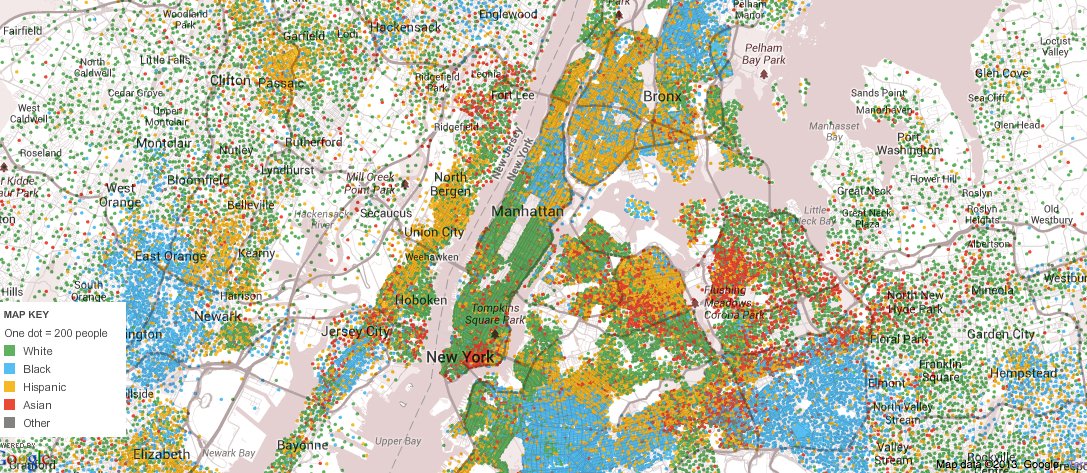
NYC Racial Map from 20005-9 census

We see a different picture of Oakland if we look at outside racial self-identification, but examine economic diversity at a finer grain in its neighborhoods.

Back to the Bay Area, stark income divides define the landscape of Oakland in this map of median family incomes in the same dataset, more than race:
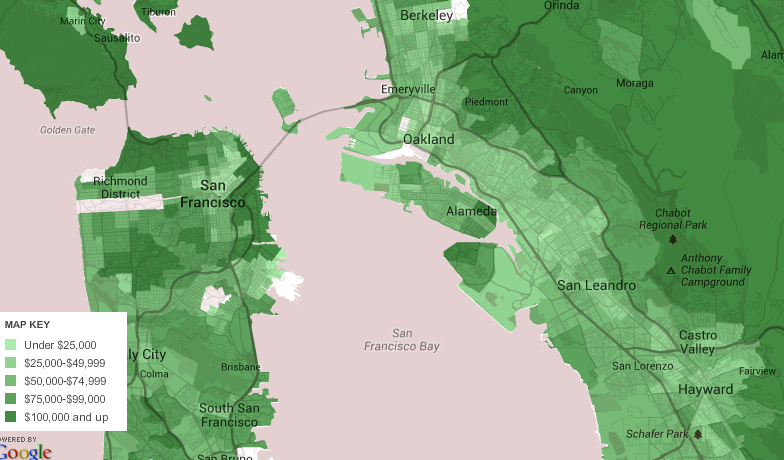
Oakland Household Income Mean

More specifically, the map reveals clear divides and income troughs where median incomes have sunk below $25,000, often reflecting food deserts and islands of an evil toxic brew of desperation, hungry desire, and distraction:
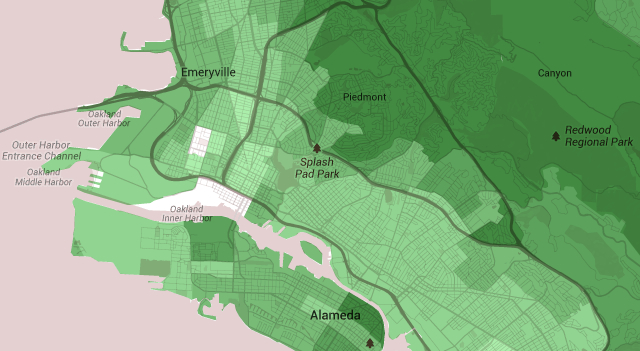
Below 25,000

For Oakland, the website Spotcrime employs catchy icons to track arrests (handcuffs); arson (flames); assaults (fists); burglaries (masked faces under hats); robberies (men running with money-bags); shootings (cross-hairs); thefts (purple silhouettes of men running); and vandalisms (green cans of spray paint spraying red), creating a detailed map to set off mental alarms in the name of a call to “know your neighborhood’s dangers”:
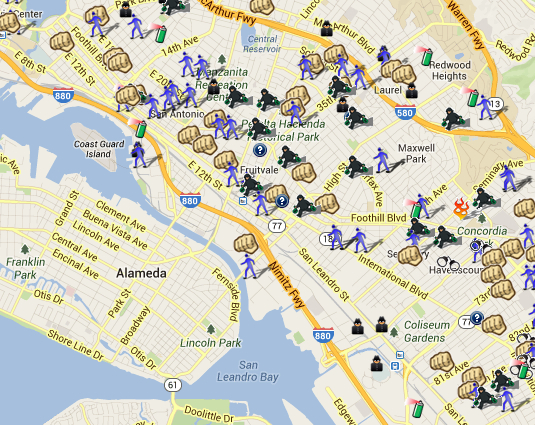
Assaults, Arrests, Arson, Burglary, Robbery, Shooting, Theft, Vandalism

Even if the violence and theft are predominantly in low-income areas, where the map dutifully foregrounds these impressive icons, doesn’t it remove a lot about what good happens in the same low-income areas?  After counting 1, 077 shooting incidents in Oakland in 2011 with 1, 594 victims of guns–the largest category among which (140) belonged to minors, and the greatest sub-group 16-year-olds (40) and 17-year-olds (38)–John Osborne used Google Maps to represent in a fairly schematic way the urban distribution of fatal shootings by neighborhood:
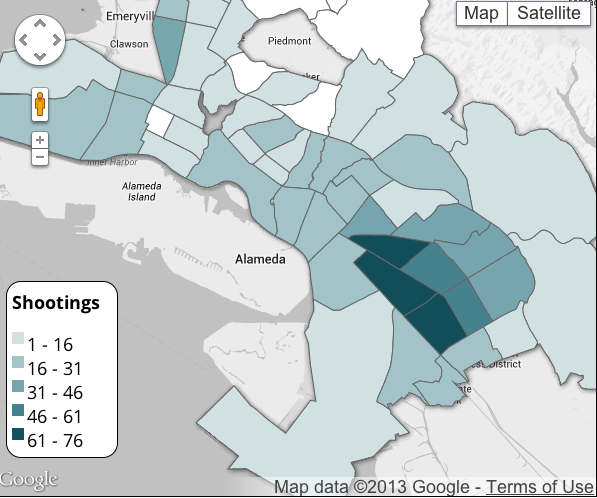
Shooting Map in Oakalnd 2012

The terrifying concentration of aggregates off International Boulevard, a major thoroughfare in East Oakland, past Fruitvale Avenue, the overwhelming majority of whose suspects are male.  In abstracting each as discrete, of course, the map is less successful underlying ties to both prostitution rings or drug deals, so much as a platform to make claims about gangs or organized crime.  The following map of victims of shootings reveals an even somewhat scarier density in the identical area of West Oakland:
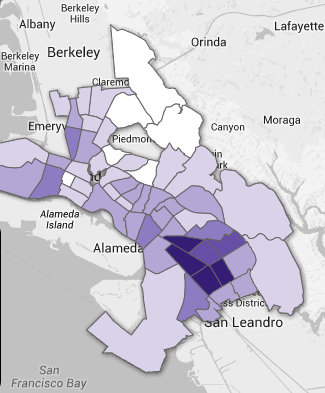
Victims in oakland 2011

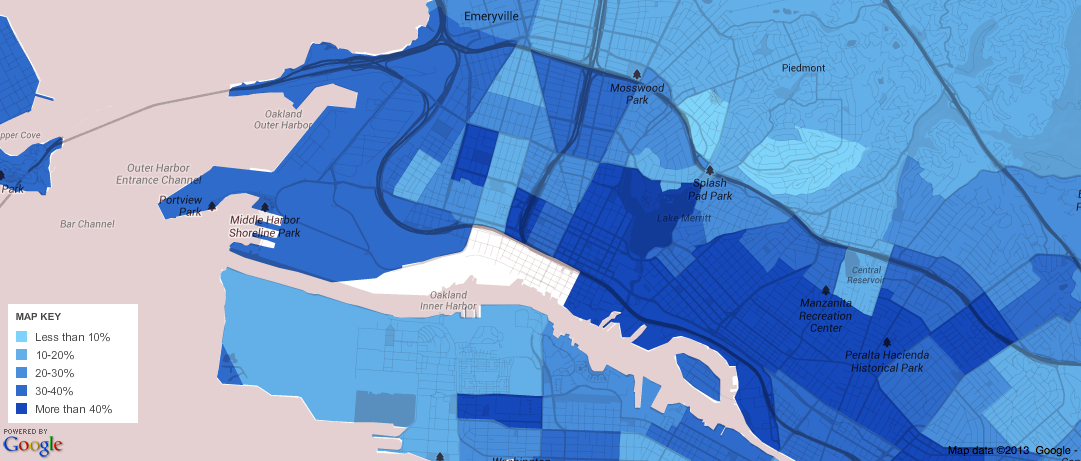
What kind of image of Oakland emerges?  It’s difficult to map it clearly.  One striking effect of the greater scale and definition of the maps based on the 2010 census is that the considerable proportion of resident immigrants in the city, which reveals a considerably high percentage–often more than half and up to 70% if not almost 80% in West Oakland, across from Alameda–of foreign-born residents, which demonstrates a considerable geographic mobility among residents that seems specific to the area:  Oakland has long been a cosmopolitan center that attracted the displaced to its margins.
Oakland Foreign Born Map

Immigration is not criminality, but suggests the margins of the city are where the displaced arrive:  displacement might be something of a thread in Oakland’s history, from the arrival of (far more wealthy) San Franciscans after the 1906 earthquake in Piedmont to the Chinese-American railroad laborers who settled downtown, the railway porters whose families created a large community in West Oakland from the 1880s, and workers for the shipyards, or rich communities of Eritreans, Africans, Native Americans (Lakota or Dakota), Hispanic, Hmong, Vietnamese, Somalians and Congolese who most live in cheaper housing and are likely to be taken advantage of in varied ways.  As of 2004, Oakland somehow ranked tenth in the US for the largest number of immigrants, according to the 2006 Census, despite a less vigorous local economy, and almost 30% of its entire population is foreign-born.   The margins of the city somehow remain greater and far larger than its center.

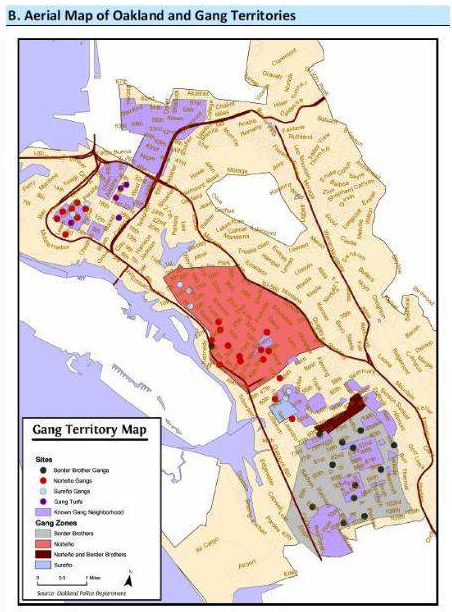
But Oakland remains known, despite this mobility, despite the presence of city gangs, a more deep-seated and almost endemic presence and prime descriptor of the city.  One can–and many do–blame gang-violence, or the competition for turf; but the violence is difficult to separate from prostitution and drug-related crime, not necessarily competition between gangs or gang-related activities, even though gangs do suggest a culture of violence.
Gangs in Oakland

Gangs are difficult to measure, although the intensity of turf-wars would seem to make it easy to use the map as an indicator of violence.

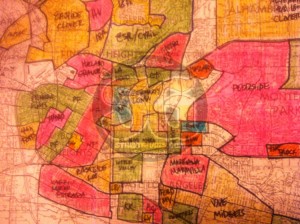
Yet if one looks at a broader map of “gangs,” the variables seem impossible to keep constant, even in a hand-drawn map of gangs in East LA from 1978 purporting to decode ‘insider knowledge’ about a topography of violence, but provides only the sketchiest of tools:
1978-eastlos-gang-map-oplg-300x224

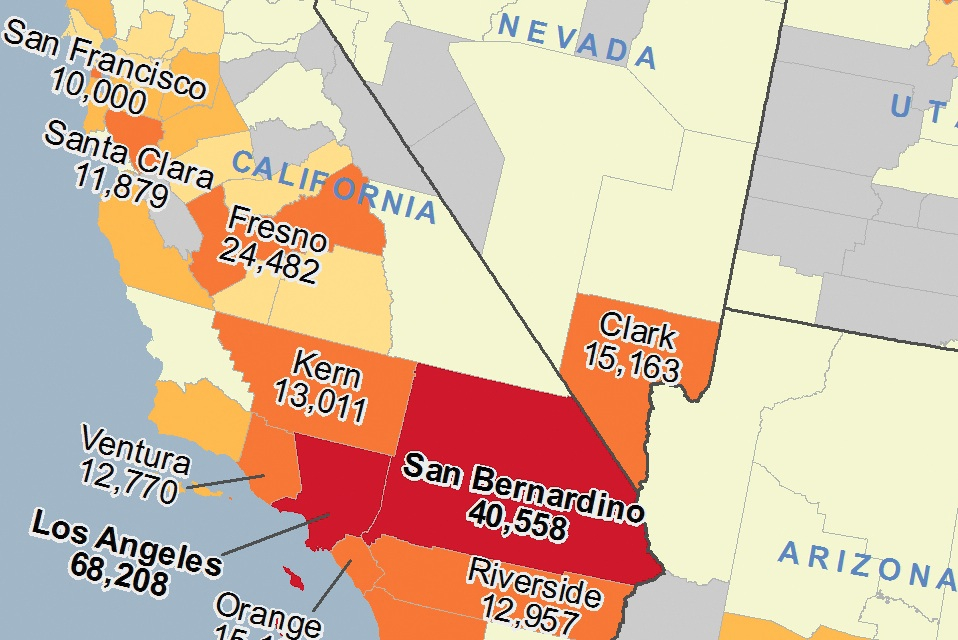
The difficulty of attributing meaning to the mapping of gangs is more apparent if one notes their widespread presence, given this–perhaps unreliable–map taken off of a “National Gang Map” which reveals a dramatic concentration of gangs and gang members in the Westernmost states:
National Gang Map

Perhaps their presence itself reveals an attempt to make meaning from life or to carve it out of one’s social terrain to the greatest extent that is possible. One compelling map maps educational attainment–with the brightest yellow indicating an inability or difficulty to complete High School at 70%–with less than high school completion hovering around 40% among families.
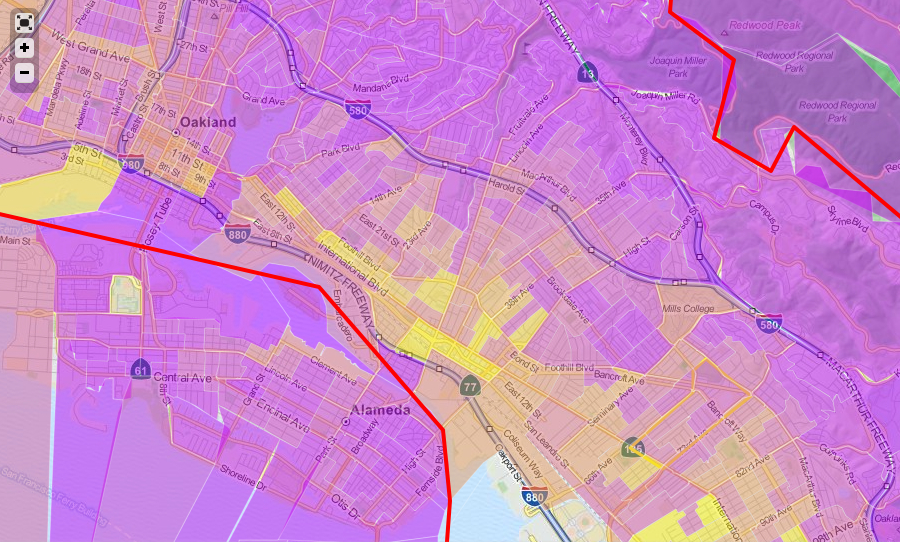
Education--Less than high School degree

In the Bay Area at large, the failure of education in the Foothill-International area is striking, and is doubtless also some degree of failure in socialization if not of public education, and maps a continuing challenge for the city’s School Board and public schools.
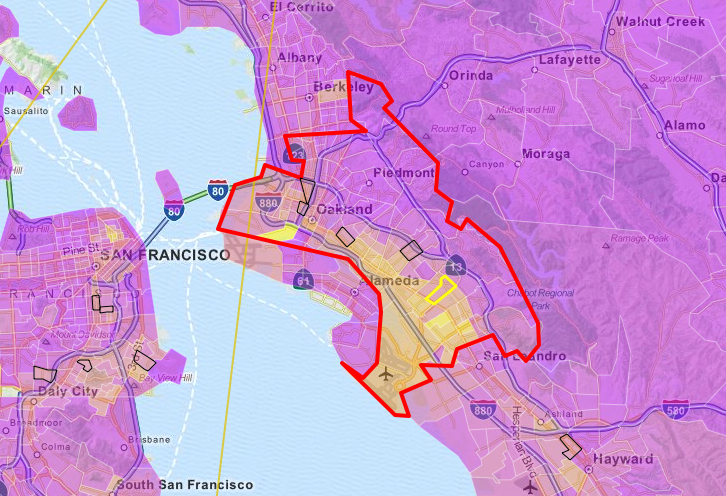
70% no HS Bzy Area

And a corresponding map of college-educated Oakland reveals a bounded drop in below 20%, more roughly characterized at 5-14% with a BA, with large numbers of closely bordering districts hovering between 5-8%:  this might be one measure of the cultural insulation and isolation of the region, if not a clear barrier to what is often described as an ‘achievement gap.’
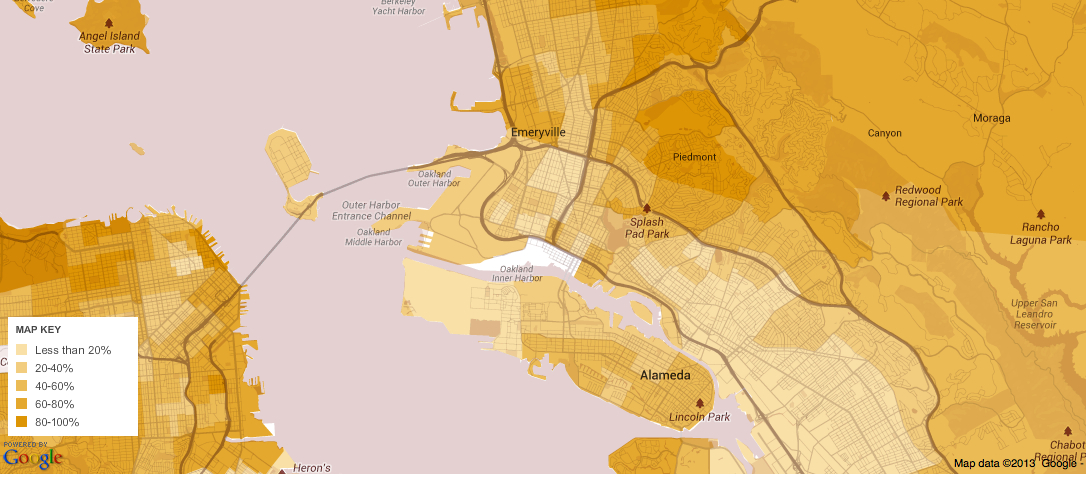
College-Educated Oakland

Those empty tan regions are a measure of the difficulty of shifting a divide between different Oaklands, because it maps a cross-generational or at least temporal divide in the given area over time.  The heterogeneity of Oakland is nonetheless striking even in its inequalities, to turn back to map racial diversity of Bay Area generated in bright colors on the NYT website of Block, Carter and McLean, since it suggests a picture of considerable promise.
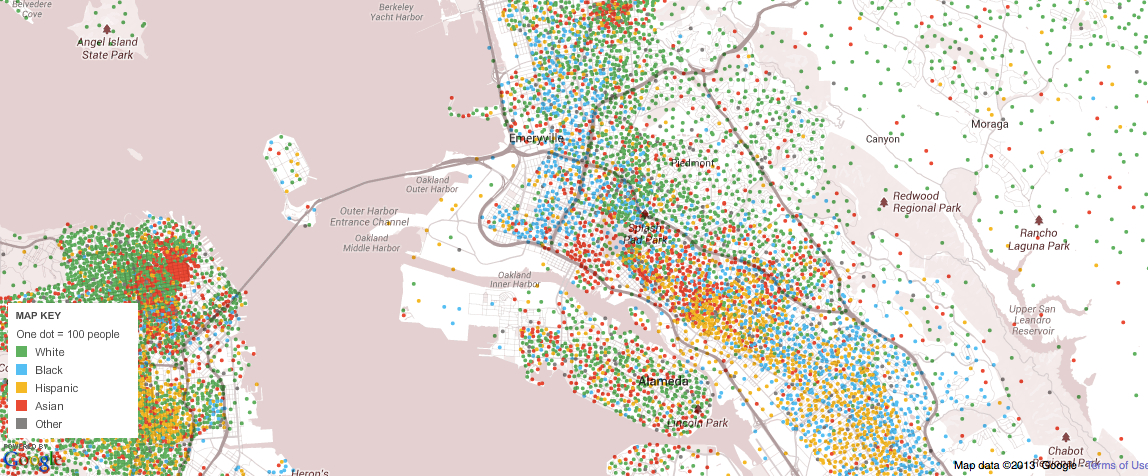
Racial Composition OAK in Bay Area

But of course a map is not a picture.   It is a picture of variability, which can shift depending on one’s chosen criteria.  In the distribution of income levels in North Oakland, aggregating incomes of twelve families reveals a telling integration of an income-mix more striking and apparent than the in the above demographic models:  despite a scattering of upper-income levels across this North Oakland area from Emeryville, across San Pablo, and up to Broadway Terrace and Grand Avenue, lower income levels are present virtually throughout the region, with the exception of East of Broadway, although Broadway provides a clear dividing line of high incomes and lower ones, and the 880 corridor below MacArthur dotted with light blue markers.
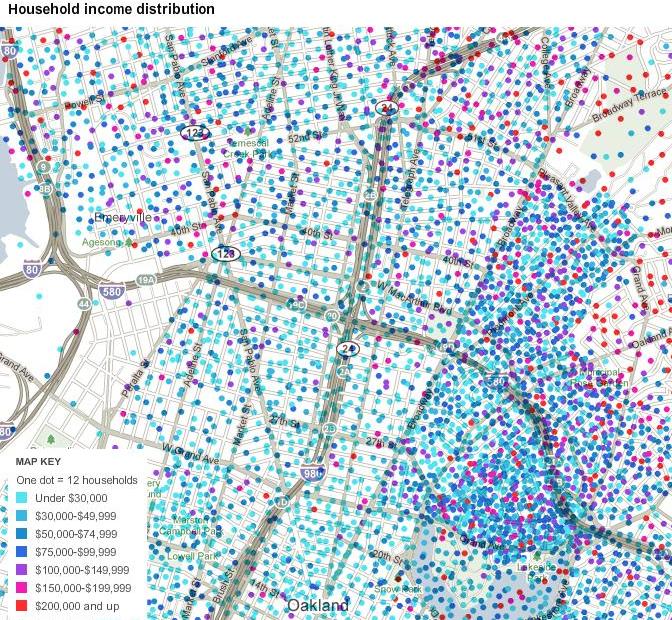
my-neighborhood-income-map

The color-coded map of relative incomes provides us with some possibly meaningful correspondences to the hot-spots in crime.  But I wouldn’t advance the sort of argument that maps crime–or gun-violence–onto variations in household income.  The pictures of the city offer limited tools that suggest possible sites of research that might help to connect these dots.  But they offer useful, ground-up mappings of the city’s inhabitants.

Processing the relations among inhabitants of Oakland offers a way to renegotiate your relation to the city as a whole.  Mapping is about navigating, as well as processing, a surfeit of information, and about making the connections among it, grosso modo, that exist.  The fine grain of the census maps provides both a corrective to our preconceptions, and the start of something like a more fair–and illuminating–map of the city’s social space.
4 Comments

Filed under Oakland, Oakland CA, open data, Racial Diversity, US Census

The Recent Resurgence of Manually Made Maps

A somewhat celebratory survey of the recent rage for manually designed maps affords a veritable visual smörgåsbord of aesthetic pleasure and innovative graphical design.  It is interesting and tempting to compare them to the craftsmanship of manuscript maps, a subject discussed in an early post in this blog.  But the survey oddly makes little reference to the notion of the ‘counter-map’ that resists the omnipresence of the digitized map, and the manner we have come to be immersed in the traffic and generation of digitized maps.  To be sure, these are images suitable for framing.  But the appeal is in part a knee-jerk reaction to the satellite photo or the schematic land view.

In mediating a more fully stylized map of first-hand knowledge of urban areas clearly reacts to the increased hegemony of Google Maps–add your own business here!  map your way to work!  note your favorite coffee shop or restaurant near work!–as a plastic form of collective memory.  And, of course, a data resource on which Google can draw  in its own work.  The hand-drawn map is the map stripped of metadata and made without surveying instruments.  For the self-made map re-invests the format of mapping with a vibrancy and immediacy to enliven inhabited space once more–and indeed enliven the medium of the map that seems to slip out of our grasp as it turns up on our hand-helds, and even tracks our own habits of shopping, physical movement, data usage and cel phone use.  When we see the self-made map–and we buy them because of this–on Etsy or in the house of hipsters, we re-recognize places, and subscribe to how they define our emotional relation to space in ways that many other web-based maps make us feel more alientated.

If our memories are recorded in our maps, which note centers of interest, sites of pilgrimage, historical buildings, or public parks, the processing of how we track places worldwide in Google Maps is not somehow wrong or diminished, but has the sad effect of erasing any sense of specificity.  There is a display value of the map that is diminished from its reappearance on a tablet or smart phone, but also a dramatically reduced range of semantics or iconography:  it’s hard to imagine Charles Sanders Pierce, who enjoyed his spell of work on the conventions of map making and determination of spatial coordinates for the US Geodetic Survey, dressed in a neon shirt emblazoned with a corporate logo, using his expertise to boast of the benefits of Google Maps in tutorials.  The semantics of the Google Maps project is geared not toward innovation, but streamlined synthesis and ready access, after all.

And there is something of an erosion of display-value of the digitized map approximating Walter Benjamin’s concept of aura, since the refinement of data in digitized form approximates a concept of disembodied mechanical reproduction:  the emotional tie to the map is in a sense severed, the trace of the hand absent, the physical touching of the map’s surface gone.  These maps provide the clues and signs to reconstruct a mental map of place in one’s mind’s eye, rather than synthesizing the authoritative satellite composites whose clicks release downloaded data, but draw fewer associations from synaptic ties.  The focus of enriching the map’s metadata removes any trace of the hand.

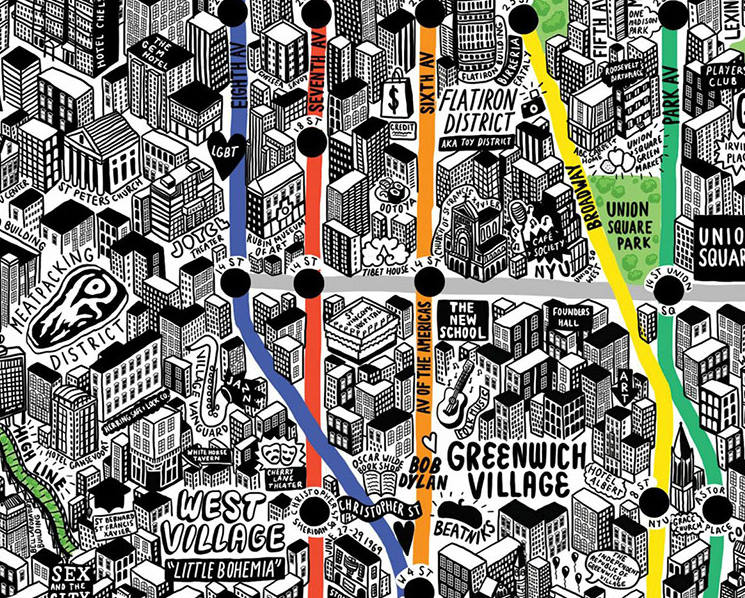
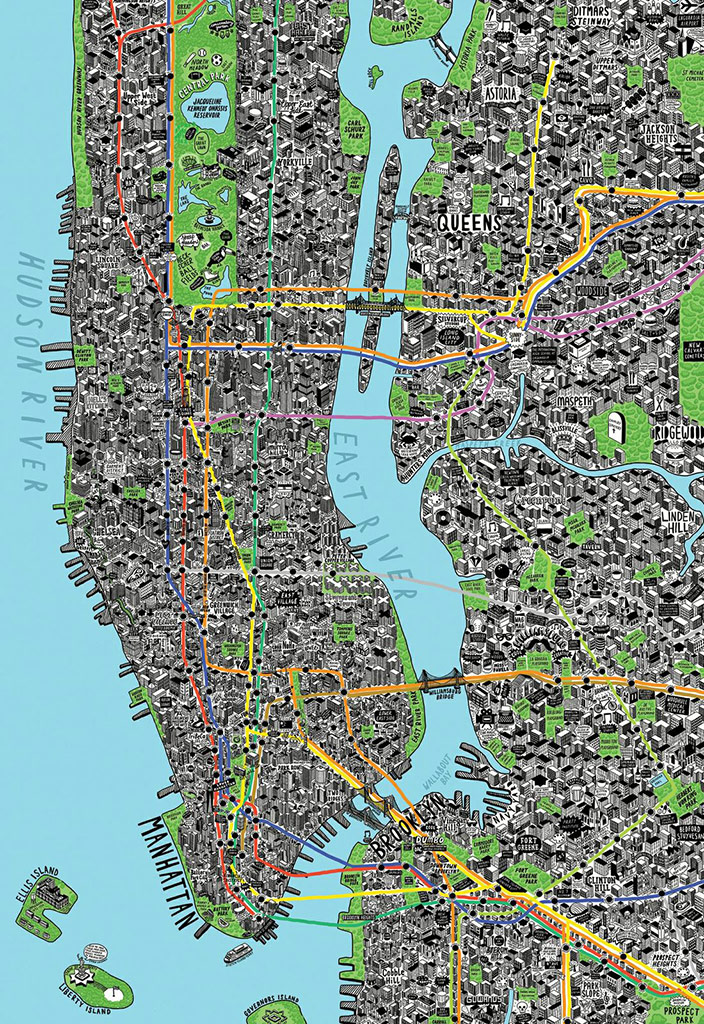
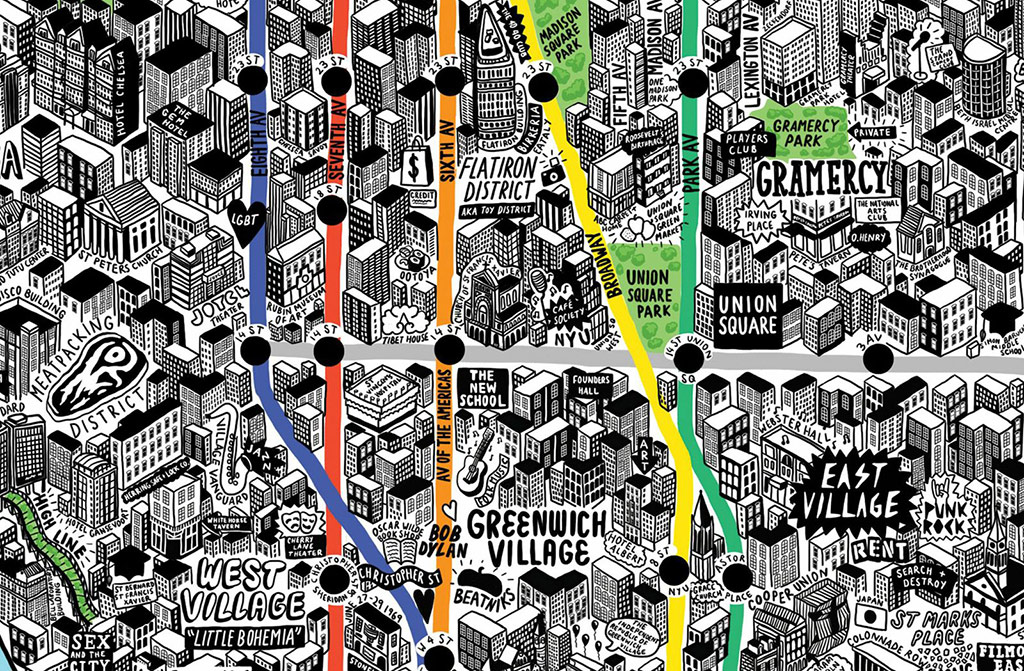
Mapmakers like the artist Jenny Sparks set out to recuperate the specificity in place that still exists and see the map as a medium to invite the viewer to explore.  While there’s a tendency to map a uniform green, Sparks’ comprehensive imaginary but copiously detailed ichnographic stark rendering of the collective architecture of elevated skyscrapers in New York in 3D, in ways that collapse street-view into a crisp crowding of built boxes.  The map, interspersed with memories and words, includes Bob Dylan on 4th Street; Beatniks in Greenwich Village’s Washington Square; and the Farmer’s Market on Astor Place, and is interactively enriched with text.   Sparks winks at the zoom function of Google in the elevated buildings  of Manhattan, each carefully drawn, and words that unpack the cornucopia of memories that the built space of the city holds, as some sort of metonymy for its residents.


New York map by Jenni Sparks


The pop-up three dimensionality of the map plays with the flattened two-dimensional view of maps, but suggests a bird’s eye view into which viewers can peer.  A few close-up details of Sparks’ self-made map of reveal how the skilled placement of words among 3-D buildings in her imagined elevated view draws you into a space linked or bound by the colored avenues of underground subway lines, peering into its so densely cluttered detail:


Close-up of New York map by Jenni Sparks

The closer one looks, the easier to see an image of place saturated with the visual interest that Google Maps just fail to afford, as one falls into the map in order to get to know its neighborhoods, suggesting a unique zoom-in function that the clumsy navigability of Street View only approximates:

Sparks' NYC


The rise of the hand-drawn map not only is a testament to design or a rebirth of a craft, but uses precepts of design to counter the vagaries of digitization Google so actively promotes, in championing the synthetic properties of a register of businesses, places, and personal routes.  I’ve written elsewhere, earlier in the year, about Becky Cooper’s recent anthology of the recent efflorescence of maps that personalize one’s relation to place, almost a collection of tools to encode personal meanings for a broader audience.  These images recuperate the aura of the map and its materiality, its hand-made status and both the physical practices of encoding place and decoding space.
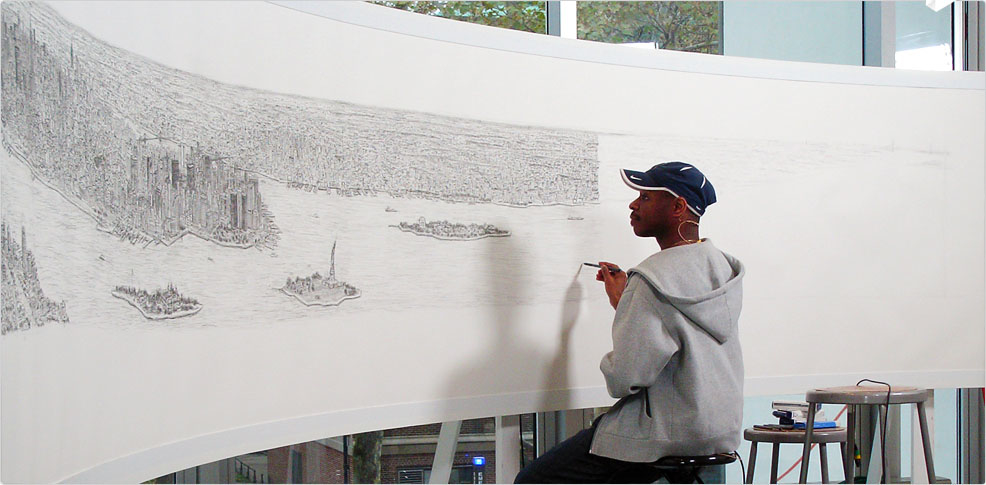
Something similar is going on in how Stephen Wiltshire draws Manhattan’s skyline from memory, lovingly attending the scale, proportions, and perspective views of each of the many skyscrapers whose sight so impressed Wiltshire on his first trip out of England that he promised to move to New York “in the future,” and claimed to have already designed his Park Avenue penthouse.  Wiltshire’s retention of and fascination with urban environments has been discussed by Oliver Sacks, and is the subject of Cities (1989) or Floating Cities (1991).  But his drawings are the intuitive opposite of a map’s abstraction of place by selectivity and spatial remove.


new_york_panorama_banner


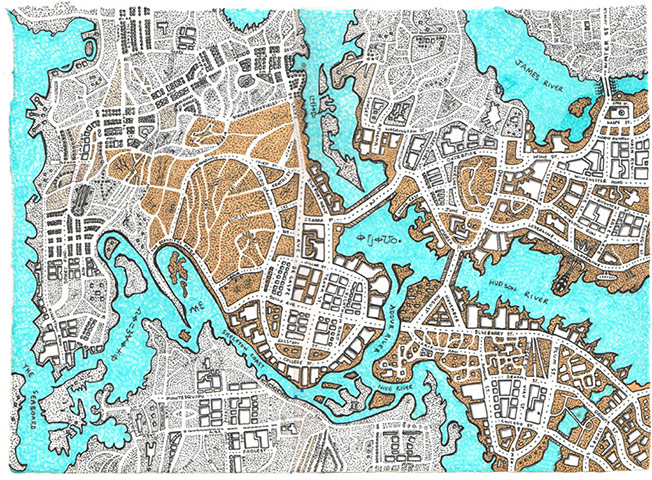
Unlike Wiltshire’s intuitive renderings of urban space, the abstraction of space of a place underlies these hand-made maps, which sketch something like a hierarchy of relevance within their totality.  There’s a huge appeal in reclaiming the map as an intimate record of place, as well as an art of encoding meanings that encourage further examination, as this “mash-up map” based on the personal experience of Shawn Watts, and might be best described as his spatial experience of a long-distance relationship, compiling the places they had been together not only in his native Montreal, but in Athens, Washington, DC, and Philadelphia, as well as Montesquieu, France, and reflects his own deep pleasure in “hiding secrets in maps” as opposed to publishing information, and a pleasure in using the map’s form to map or be the surrogate for an interior emotional state:


Shawn Watt's Shutterbug


For Watts, the density of meaning in maps becomes a way to unravel and eloquently express one’s own state of mind in public form, and to invite the viewer to partake in the pleasure of decoding its contents.


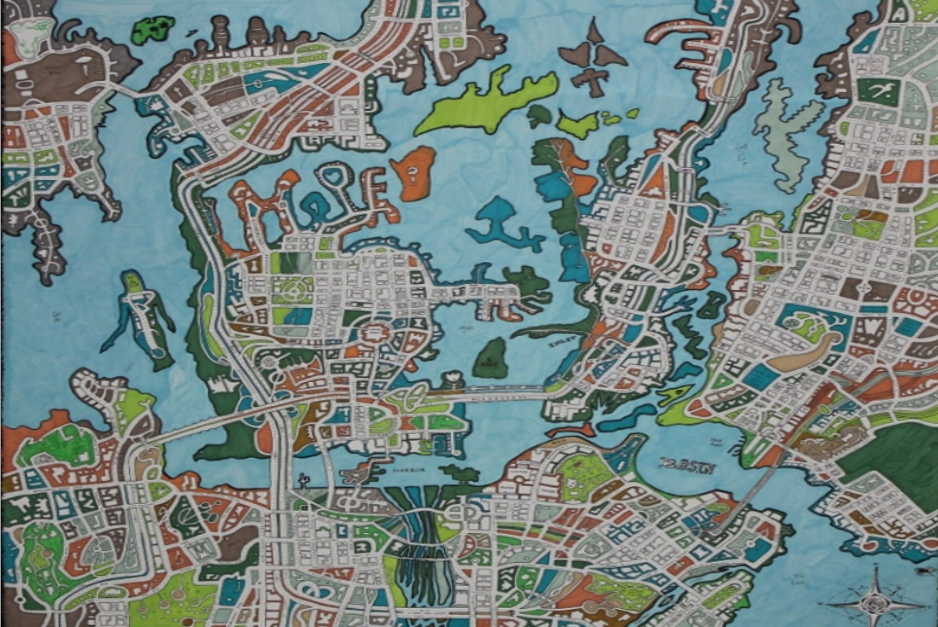
Hope Mapped


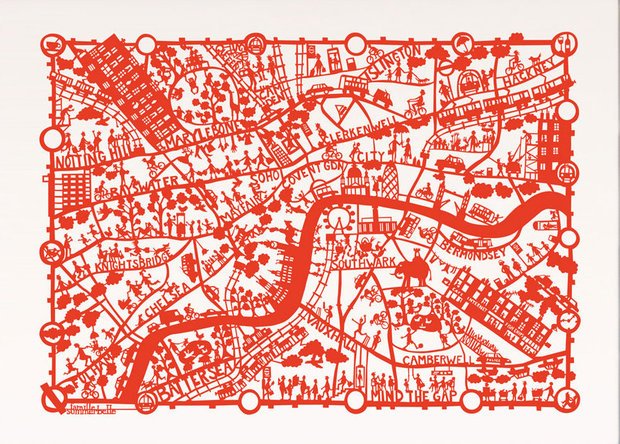
This somewhat but only partly legible hand-made silkscreen map of London comes in varied colors, populating areas with figures and words to approximate a paper cut-out hanging as much as a map:


553390_479276322084293_1624826968_n

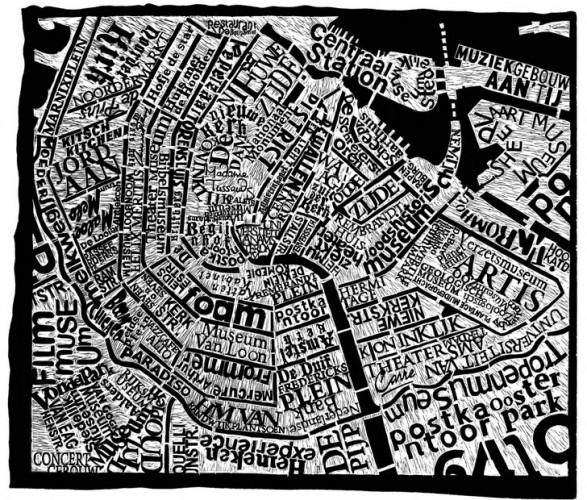
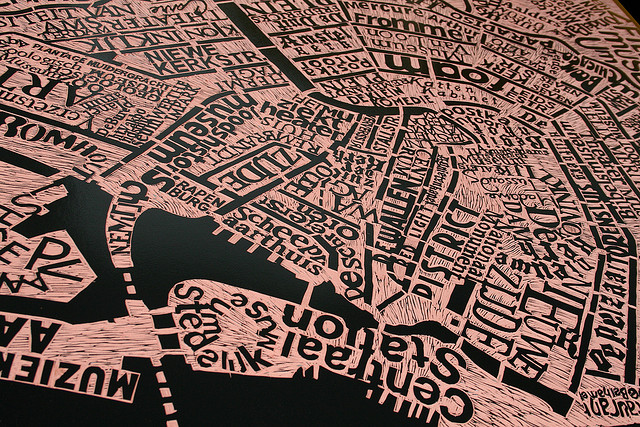
If these maps treat the map as an artwork, the trace of the hand on the map is even more present in the medium of linotype map, recalling Renaissance single-point engravings or woodblocks.  The linotype word-map Marc Webber designed of Amsterdam, a historical center or clearing-house for engraved maps, places front and center the words often absent from Google Earth or many digitized maps to use them to fashion a sculpted cityscape, whose linotype words offer something of an alternate surface to see the city in one’s mind’s eye:


Mark-Webber-Amsterdam-Map-120-x-100cm-Linocu-Print-on-Paper-e1331468741268


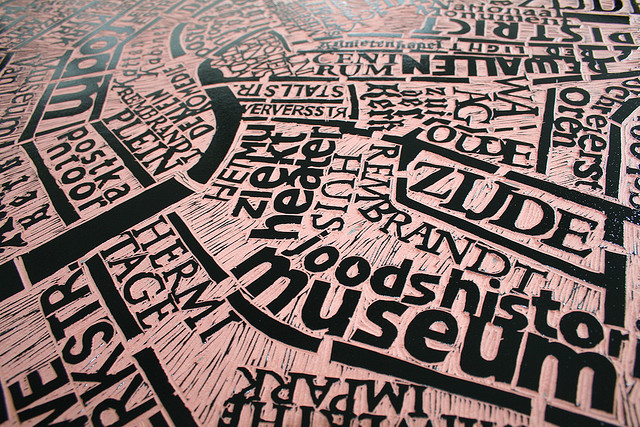
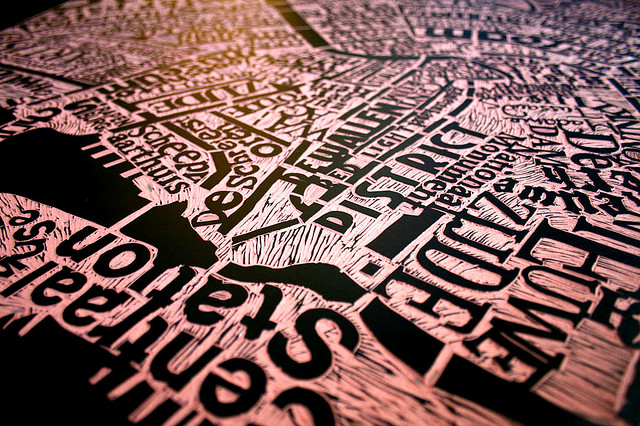
In Webber’s ‘map’ of Amsterdam, the written landscape becomes a site to explore and its very surface a sight to ponder; the texture of its woodblock words gains new textural richness as it is seen from different angles, from which the materiality of place-names on its linoleum-like surface increases in impact:


Amst Linotype-Looking at Map's Surface


Moving in to examine details more closely, the map assumes status as a surrogate for the world, as if the one-to-one map of which Borges dreamed or described is suddenly translated to words that substitute for things, as well as to the notion of a word-map:


centraal_station_wider


The Central Station assumes a newfound concrete prominence that transcends its place-name, without the curled Stedelijk Museum beside it, from a distorted view of this mapped space:
centraal_station_close


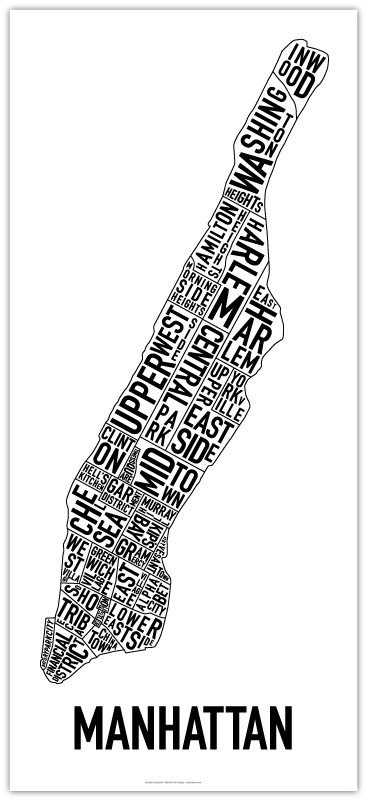
Somwhat more derivative or second-generation forms of manual mapping already exist on the market, as the sort of silkscreen word-maps popular in New York that maps the city’s neighborhoods, many of which are as much destinations as the city itself–and might provide a tourist map of realty.  If it is meant to evoke neighborhoods, it oddly recalls  real estate, even as its cartographical transcendence of space seeks to create something like a cascade of memories whose every words might serve as triggers, rooted within lived experience.


Manhattan word map


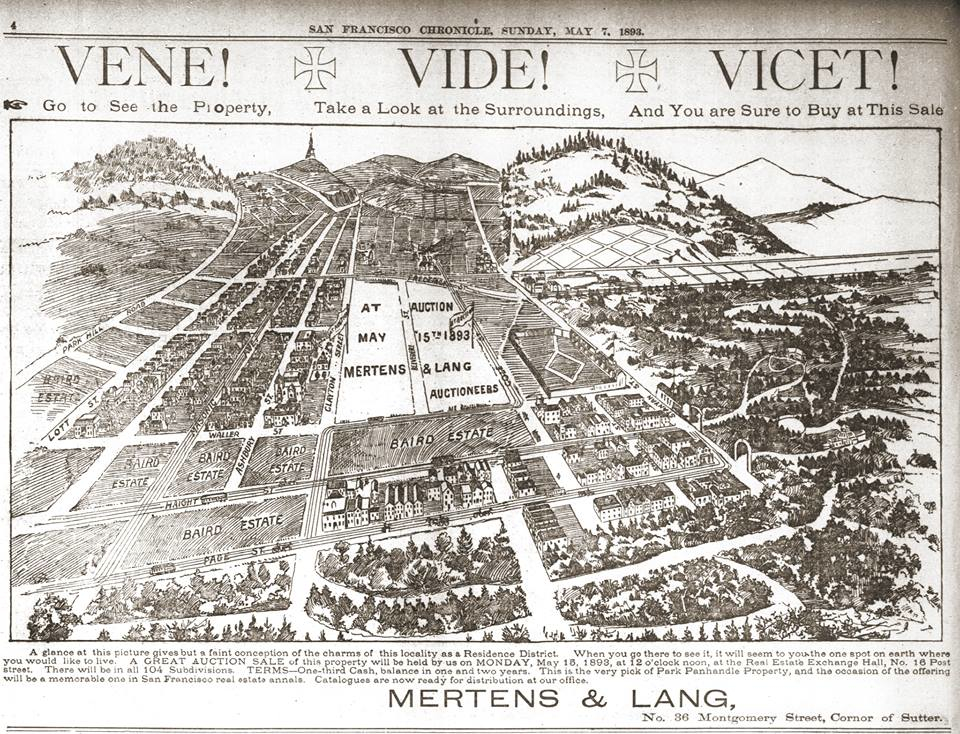
If the map seems a bit of a bare-bones realty map to the uninitiated in New York life, it is far less elegant and inviting than pictorial perspective views realtors employed of San Francisco to enjoin viewers to become settlers.


Vene! Vidi!  Vicet!


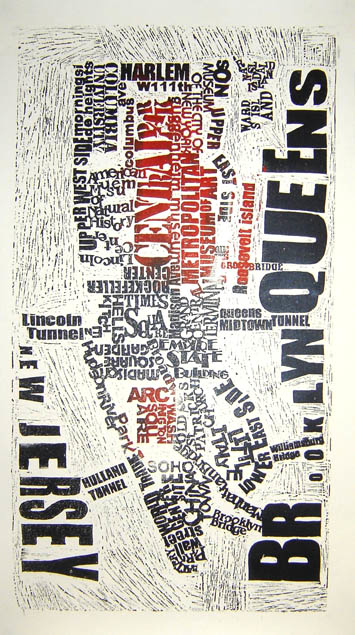
There’s far more detail in a linotype word-map of New York City.  The silkscreened map plays with the legibility with which maps use words to arrange space by surrounding Manhattan island with big, looming, isolated blocked fonts–inserting recognizable neighborhoods and cultural monuments in an what seems a more improvised mish-mosh of fonts from a printer’s tray, rather than from a pull-down menu, arranging the text to replicate what might better correspond to the place of regions within our mental geography, all the while emphasizing the extremeley crowded nature of inhabited space in New York boroughs:


New_york1


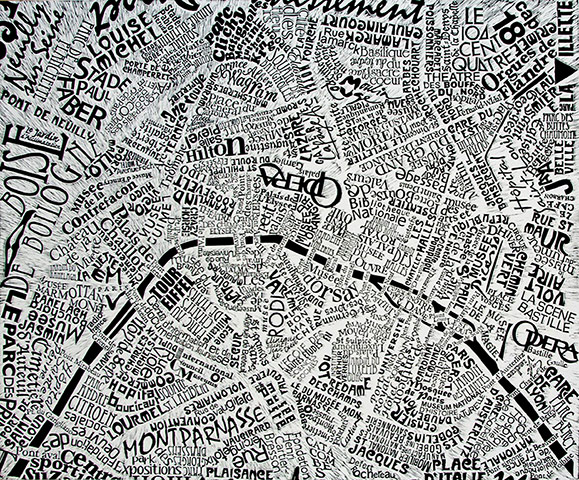
Sensitive as always to the particularity of place, Marc Webber’s quirkily detailed ‘word-map’ of Paris is more elegantly artisanal in how it fills the surface of the map, exploiting a range of fonts to arrange historical layers and tiers of class and style from the staid if impressive Opera to the lounging letters of Montparnasse, moving rangily down large streets.

Paris map by Mark Webber

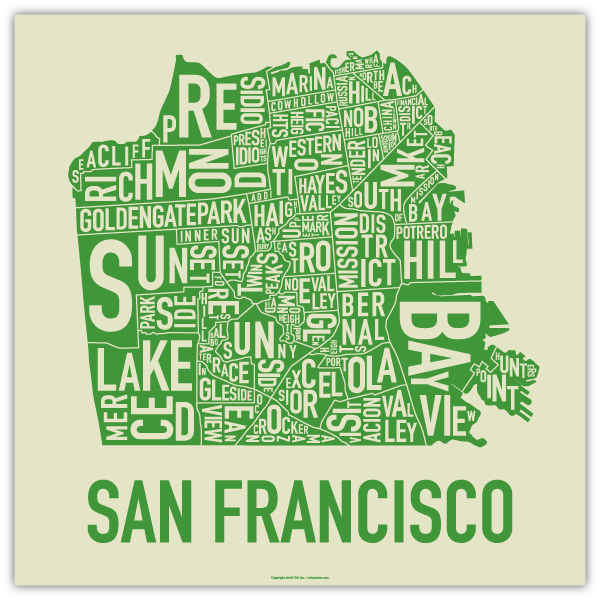
The written city is more demanding of a mastery of fonts, to be sure, since it also depends on the arts of assemblage; the word maps sold in the Bay Area provide a nice counterpart since its patchwork of its complicated topography is so impressively dense, and the only area of uniformity seem the Presidio or the landfill regions of Bayview:

SF Word Map GREEN

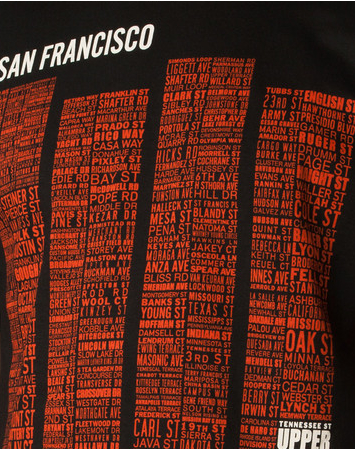
An alternative to this sort of mapping, illuminating the micro level of street-names, graces the design of one of Upper Playground’s t-shirts, suggesting the relative size of individual streets by their prominence in a list of names, that lends currency to the idea of the wearable “map”:

Upper Playground Tees SF name map

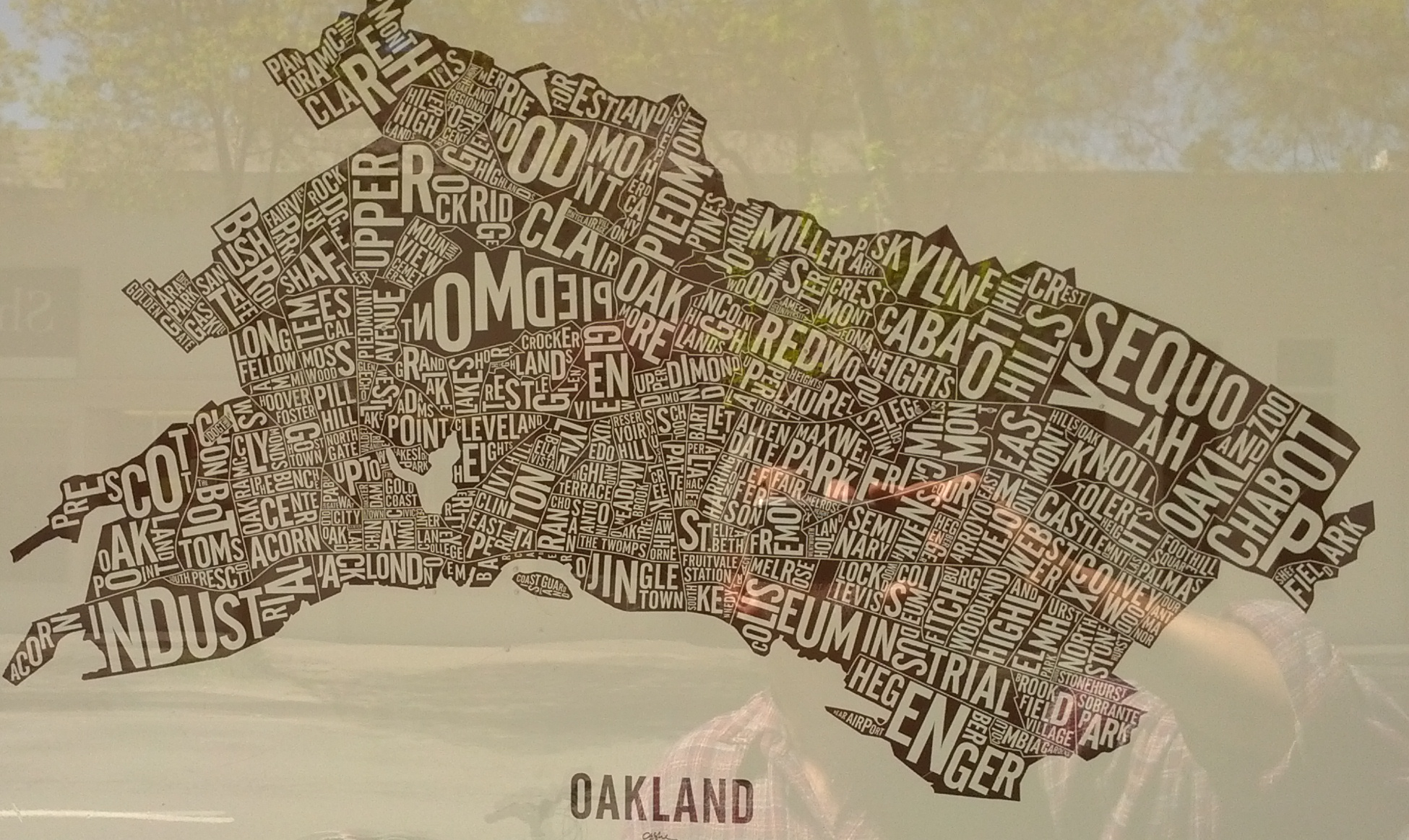
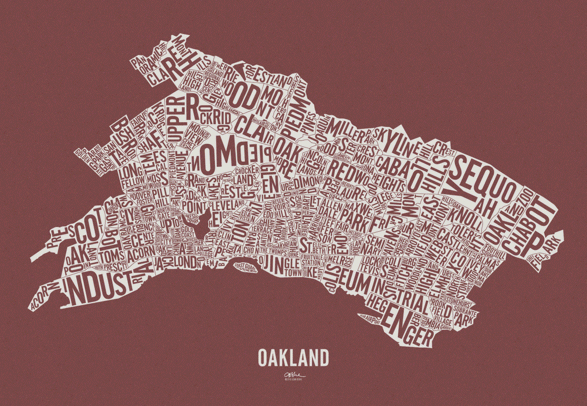
The diversity and unity of nearby Oakland is aptly captured in this patchwork roughly-hewn word map by Oakland native Ozan Berke of its 146 neighborhoods:  the jumbled density is almost rendered illegible by crowding, but with such dexterity that the artist/mapmaker uses to capture its diversity.  The density of some neighborhoods balance the urban intensity of some areas with the far more light settlement of the hills (Montclair, Sequoia; Claremont Hills; Skyline; Joaquin Miller):

Oakland Word Map

dD_Oakland_26x18-PR_2


Writing the unity of the city in a sequence of place-names reconstitute the whole in a new form, as if by magical transmutation or an alchemy of type: this artist adroitly resolves the absence of the seceded largely ‘white’ village Piedmont from the city with the contribution that this town-within-a-city continues to make, writing its “name” as a neighborhood in mirror-writing, the “OMD” among the largest and most eye-catching in the map.

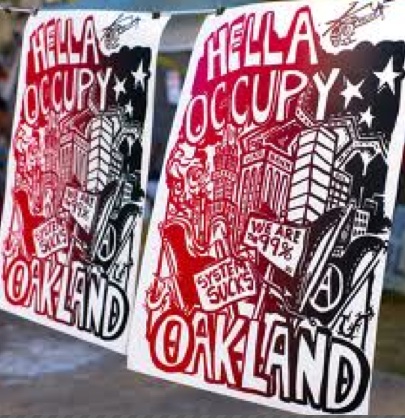
The declarative blending of words with place resonate with the politics of remapping popularized in the urgent signs displayed in the recent Occupy Movement outside Oakland’s downtown City Hall in Frank Ogawa Plaza to the iconography of the protest movement–mapping the helicopters that whirled overhead, but minimalizing their police surveillance to the upper corner of the map, and giving prominence to the placards that protesters held in front of City Hall–the scene at which these maps were sold:


Hella Occupy System Sucks

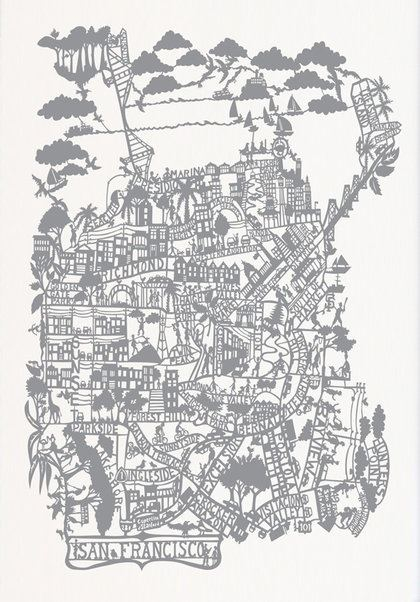
It is fitting to contrast the map to the elegance of San Francisco should be captured in the distinct media of a paper-cutting map, adapting the Chinese art of  Jianzhi (剪纸):

Paper Cut Out SF

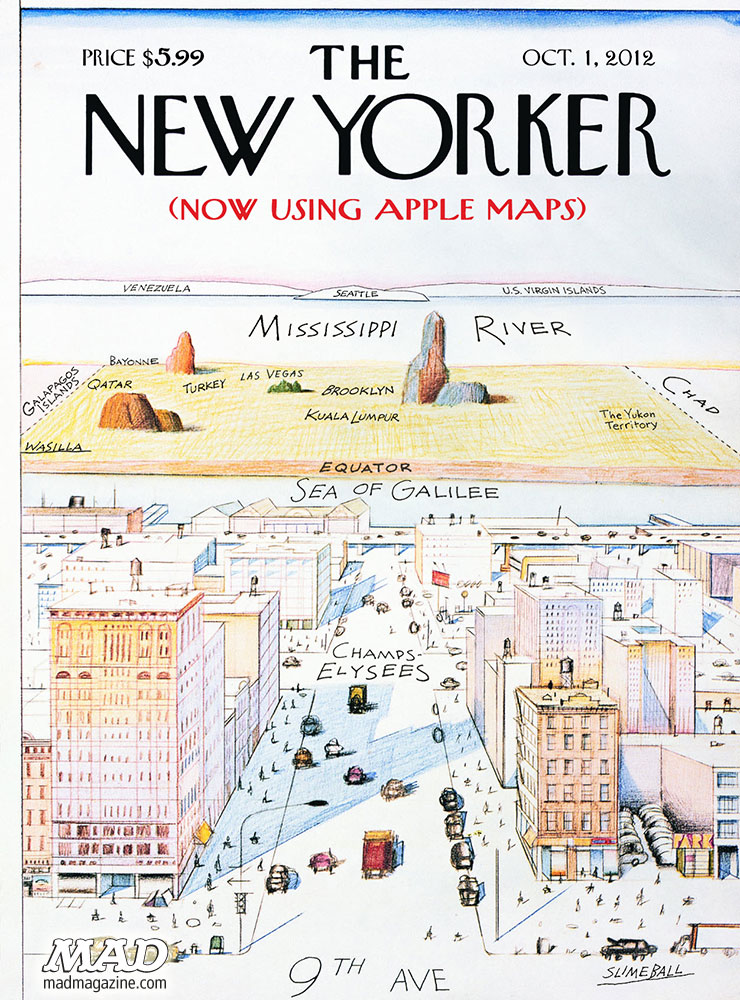
The remove that all place cartographical practice from digital media or design is central, I would argue:  the artist reclaims their own synthesis of a unified whole as the subject of the map.  All evoke the late Saul Steinberg’s over-reproduced map of New York, famous as a poster and originally a New Yorker cover, used to suggest the limited global perspectives of its residents or the centrality of the city in a mental map of the world.  That map has its response in the recent satire of Mad magazine’s “Slimeball” mismapping mediated by and poking fun at the recent failures of Apple Maps.  The revision of the classic Steinberg view of the New Yorker’s View of the World  plays with the spate of failures that app by calling attention to the radical disconnect between even a familair place and digitally mediated map, as if to suggest the depths at which we’ve been had!


MAD-Magazine-NewYorker-View2-2012


The growth of such a range of hand-drawn maps seems to me a reclaiming of place–as well as of mapping skills–that has come to gain a special niche of its own in the craft economy.  We are discontent with the proliferation of maps from which we are increasingly alienated–and which abstract information in ways confined to, say, only three viewing preferences.

There is still a possibility of changing less the digitized reconstruction of space than the notion of what Google defines as information, of course:   and perhaps the range of hand-drawn maps suggests some ways that this might be done.  The above view of New York, or rather its prototype, makes me wonder about maps that reprioritize the structure of information imposed on the templates of Google Maps:  a map, say, that would not note the Russian Tea Room or Trump Center and Empire State, but create historical layers of Automats, bodegas, Chock Full o’ Nuts, and 5-and-10 stores or the shifting confines of invisible ethnic neighborhoods in the city, and the impact of waves of migration.  This falls back on a map of memories.  And then, after all, it probably wouldn’t be hand drawn any more.

2 Comments

Filed under Aura, Charles Sanders Pierce, digitized maps, hand-drawn maps, Jenny Sparks, Jianzhi, linotype map, Marc Webber, Oliver Sacks, Saul Steinberg, Shawn Watts, Stephen Wiltshire, Street View, Walter Benjamin

The Will to Map: GPS and its Discontents

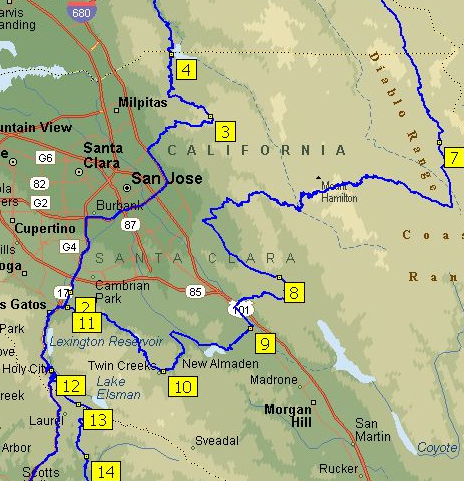
Navigating the necklace of highways that hug the Santa Cruz Mountains beyond San Jose with a GPS map affixed to the windshield, you become both disoriented from the panorama before your eyes and quickly aware of the token roadmap GPS offers.  What is the map on the screen doing in the car and when do we need to look at its content?    The question emerges since it’s not clearly a partner to the voice-directions; the interface between isn’t evident or apparent:  the overlay of data on the terrain graphic of a Google Maps backdrop seems interactive, but shows a route, and not a guide or a means to explore paths of other possible travels.  There’s a need to offer a map in our map-saturated culture–but the map is no longer a clear way to translate familiarity with space to their readers, so much as an added document.

The difficulty of internalizing directions from the onscreen map derives from its limited use to orienting oneself, and is unlike the roadmaps that readers internalize over time.  It is not only ready-made and disposable, but seems to exist to satisfy customer expectations for a visual record more than offer users an actual guide.  It has limited relation to the injunctive directions declaimed by a Siri-like voice, and seems a source of ornament despite an absence of actual visual interest, as if it was designed to meet nostalgia for the visual records of automotive navigation on highways and interstates or for a time when we needed maps.  Some drivers might object to directions from a disembodied voice, instead of someone informed about the topography or terrain.

Without those over-creased highway maps in our glove compartment, one grapples with the minimalist Google Maps graphics before surrendering passively to the intoned directions, still frustrated that we can’t  transpose directions from the map, and conscious of being cognitively challenged, but perhaps pleased to contemplate a landscape of trees overhanging on each side of the mountain roads and to follow a course traced from on high.


Boulder Creek Map Traffic


The mechanics of the synthesis of a digitized map is of course completely different compilation of meaning.  But it is most striking that the map didn’t need to be there, and wasn’t that likely to be consulted as a navigational tool and of limited use if one strayed off course the curvy roads in the Santa Cruz mountains; if so, we’d be more likely to look at a paper map anyway, for the image provided little easily-consumed information of fine grain about the mountain roads; the verbal directions were so removed from the map as if to devalue the long history and use of maps as autonomous media: rather than provide the purification of spatial experience often attributed to maps, the schematic Mapquest image distances experience so abstracted from an actual route of travel to minimize our sense of reading space.

As well as a shift in how mapped information is synthesized, digitized maps mark a shift in reading terrestrial expanse and reading one’s place in maps, diminishing the relevance of a coordinate system or apprehension of spatial inter-relations.  Whereas the Mapquest route that defined a path of travel, navigation by GPS seems a new relation between map-use and environment.


images-1

The relation to its pixellated surface is rooted in fascination with the image that adjusts on one’s screen synchronized to one’s actual bearings, rather than reading one’s course and the options that it presents.  GPS was not made for wanderers.  The screen notes a route on a formal schema abstracted local terrain, which is replaced by a generic image, its data mediated at a remove from the world as if “flattened” to two dimensions, rather than the sort of surface that invited multiple possibilities.   The map produced on demand places cartography with limited sense of permanence; the personalized nature of the map it creates, as in a service economy, offers an image of terrestrial location that dazzles, but is only commensurate with a specific viewer’s specific needs, and as it is part of a system that provides on-demand maps that can be immediately generated for any global region.

Santa Cruz Mountains

The place of reading a GPS map in a car or a mobile phone is independent from the expectations for both providing and decoding the map.  How maps are read over time offers perspective on how maps address their readers by embodying a relation to space through their synthesis of spatial information.

Such an emphasis is distinct from, say, one on the mathematics by which cartographical projections synthesize data on a uniform graticule or techniques of transferring the curved surface of the world:  one can appreciate these precepts only in a very vague sort of way, similar to ignorance of how GPS generates a map, to read its organization.  As the video by which Google promotes Trekker as a natural extension of a user’s relation to their environment during a walk in the woods.  The mechanics by which the cameras stuffed into a bulky backpack remain both mystified and  outside of the average viewer’s appreciation or ken, but the user is amazed at how the digitized synthesis takes us through a mind-bogglingly detailed record of space.

One is awed by the alternative surrogate awesomeness that the map provides of the Grand Canyon.  The data such maps compile for readers implies a very different sort of map-reading from te far smaller-scale trail maps of a similar region which offers clues to travel on foot, rather than car, whose color-coded signs of elevation, trail lines, and symbols of orientation offer a semantic register to decode.

berryvreekfallsmap

The legibility of the above map engages different cognitive skills to decipher our position than the plastic formats of mapping in GPS, which derives from a  dramatically different context of the corporate investment in map making, less dependent on attracting viewers than provide comprehensive access.

Google Earth’s data collection and synthesis is unlike that of the National Geodetic Survey’s mandate to maintain “a consistent coordinate system that defines latitude, longitude, height, scale, gravity, and orientation throughout the United States” for the public, by which “everyone accurately knows where they are and where other things are anytime, anyplace.”  Criteria for mapping are now market-driven and based on providing information for consumers in an explosion of available maps.  Google acquired the digital mapping company Keyhole back in 2004, allegedly when Sergey Brin claims to have been so wowed by digitized maps of bombing Iraq he saw on television.  The digitized satellite maps that Keyhole provided afforded a new way of defining one’s relation to an over-mapped world:  Google’s vice-president, Jonathan Rosenberg, celebrated how the military-grade map-provider used by the Department of Defence was repositioned as it became “a valuable addition to Google’s efforts to organize the world’s information and make it universally accessible and useful,” allowing users to “fly like a superhero from your computer at home to a street corner somewhere in the world–or . . . map a road trip” by tapping information collected via satellite and airplanes through easy-to-use software.  The rhetoric was fulsome as the acquisition was completed: “The sun is shining brightly in Mountain View,” read the press release, describing Keyhole employees as “all smiles” and Google employees as “all open arms,” as the same software used by the US government to track the arrival of smart bombs to Iraq via a multi-terabyte database (and begun by a venture capital firm backed by the CIA) was re-deployed to dramatically expand the wide, wide world of GPS.

Driving through the region near Mountain View, one couldn’t help think of how the removed view on the GPS screen was a diminished share of the mapping tools Google had purchased.  It’s striking that even in 2004, Google felt the need to calm anxieties about the potentially intrusive nature of such satellite technology that would cover the United States, but was energized by the belief it could unseat Time-Warner’s Mapquest–as it has– in providing its users with a far more robust mapping technology to orient themselves.  “It’s not like you are going to be able to read a license plate on a car or see what an individual was doing when a particular image was taken” in ways that would violate their privacy,” Keyhole’s General Manager, John Hanke reassured the public.  The photographs, after all, were from a database generally six to twelve months old, rather than being real time.  But recent indications about intrusive surveillance suggests that such a project might not have been far from the CIA’s mind in funding the project, which Google rolled out as an innovation in both convenience and reach to craft high-tech maps for viewers from satellite views by its powerful search engine.

GPS  situated its customers into a culture already bombarded by images by granting vicarious participation in a Brave New World of digitized maps.  What is striking in the maps is the near-absence not only of textual but semantic content, which are dramatically reduced in its imagery to increase its ready legibility.  The ways maps were understood in specific sites of reading, argues the medievalist Patrick Gauthier Dalché, who examined the questions that readers from Italian humanists, monks, or the readers of marine charts had for maps, and called attention to the ways of reading maps as much as their semantic construction.

Considering the combinations and forms reading practices a printed map engaged opens interesting possibilities to understand relations of text and image in early printed maps whose readership is not known; it documents the cultural translation of mapped information from manuscript to print, and raises questions for the materials of reading we wax nostalgic when using GPS systems.  It is common to compare the shift in mapping space that digital  interfaces allow to the shift from manuscript and print in the European Renaissance, both as an increased legibility of space that maps diffused and the greater circulation of  maps as reproducible engravings.  We might take time to reconsider the different semantic varieties of map-reading print encouraged,  examining how early printed maps ask viewers to engage a representation of expanse to understand them as forms of spatial literacy.


Ptolemaeus Teutsch


Few land-masses are evident to modern viewers of this printed map of apparently spherical form, an early German translation of Ptolemaic precepts that transposes the form and outlines of a manuscript projection. Most likely adapting the semantic forms originating from a Ptolemaic codex its printer or engraver transposed the map onto the gridded surface of a globe to create the illusion of a mathematically derived spherical projection.  Although the spherical projection is but an illusion, the transposition of a Ptolemaic projection to a spherical grid provided a new way to read its place-names:  a few place-names on the surface of this printed map–“Europa,” “Asia,” “Ethiopia,” and a “Mare Indicum.”  Although the map echoed the tripartite organization of mappaemundi, numbers keyed locations to written descriptions unlike the ancient places listed in manuscripts of Ptolemy’s geographic manual:  the names were not only abstractions, but numbers provided tools to gloss a sophisticated primer of geographic knowledge, using Euclidean precepts to render global expanse on a uniform plane.  Readers would have seen the map and its accompanying German text–the map appeared as the fold-out endpaper of a book titled Ptolemaeus Teutsch–as mediating the ancient classical treatise of world-geography to a broader audience than a tradition of learned geography.

The map abstracted expanse as if to address readers familiar with single-line engraving by compacting of terrestrial relations–although it does not seem to have been as successful as a commodity as its printer hoped.  The limited success of the booklet may reflect the extent to which it dramatically and rather drastically condenses geographic data to symbolize measured expanse in a spherical format that imitated how globes prepared a surface for readers to  actively gloss, interpret, and reflect on its symbolization of expanse, and a dynamic tool to render and encode the distribution of worldly expanse.

Europa


The reduced size of the engraving encouraged its engraver to use numbers instead of bulky toponyms, in order to create an easily consultable spatial template for placing the known regions on a ruled plane surface which comprehended–and mimicked–the terrestrial globe.


Globe of Ptol Teutsche


If the GPS system made me think of the manner information was processed and distilled on the screen in a passive form of readership, the positioning of place on the globe suggested a combination of tools of single-line engraving and a facility to abstract a geometric record of spatial relations, often tied to a unique exchange between humanist and artists in Nuremberg’s visual culture that printers eagerly exploited to expand the book market.

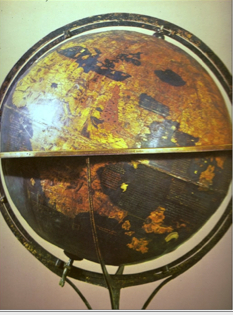
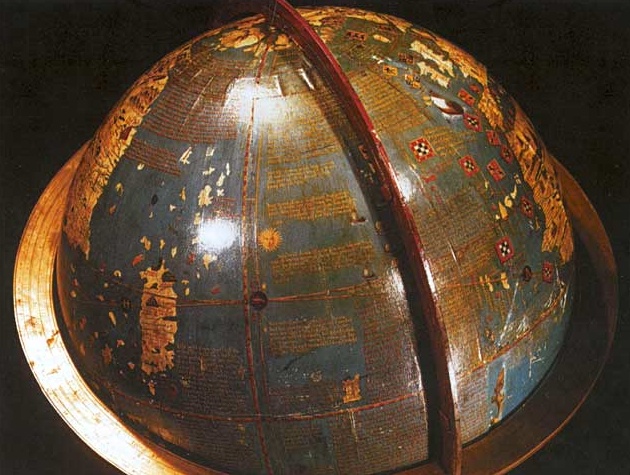
The map recalls its rough contemporary, Martin Behaim’s Globe, celebrated for concretizing a “mental image” of a new relation to space and place in Nuremberg around 1490. Although it omits America,  the globe’s surface assembled an image of oceanic expanse that confirmed Behaim as master of crafting a modern relation to a  legible space from nautical charts circa 1492.


Behaim Vorstellung


This modern recreation of the Behaim globe’s underlying map suggests how the engraved spherical map reflects the status of globes as material records of regional relations, representing terrestrial curvature as much as to measure spatial relationships with precision or provide a guide for travel, and indeed to arrange the disposition of place on a globe.

The engraving reproduced skills of reading the commodity Behaim presented Maximilian I in 1492; it indicated appreciation of the material construction of the globe in imitating the epistemic claims and encyclopedic intent by combining visual and written on its surface, if in far compacted form.


Behaim's Globe


Behaim had earlier sailed with Portuguese vessels for several years, where he gained access to supposedly secret charts, and fashioned the globe from them, working with the painter, woodblock cutter, and printer Georg Glockendon to assimilate an abundant and expressive tradition of written geography even as they embodying expanse in a new form of material media. Earlier  publishers of colored maps for translations of Ptolemy’s ancient Geography unsuccessfully attempted to reach broad audiences; Behaim’s erdapfel provided a  materially impressive way to depict a comprehensive record of the inhabited world; if it exaggerated the world’s oceanic expanse, it  profited from empty oceans to inscribe written accounts of travelers from Marco Polo to Mandeville, in ways readily readable at a reader’s eye-level.

Behaim-Globus


The self-standing globe attempted to replace written geographic media it amply cited in as a materialization of global expanse, as much as completing empty spaces on the map’s surface:  it suggested empty spaces as a way to pique interest among its readers.  Unlike scholarly editions of Ptolemy, the material condensation of Behaim’s erdapfel was a powerful painted media, juxtaposing huge continents with islands that spill across its surface, making less reference to meridians or parallels than texts to orient its audience and invite them to pour over its content.

Globe's Written Surface


The globe echoes imperial regalia.  Designed for the Holy Roman Emperor Maximilian I, the modernity of the globe is thematized in a 1939 film about Behaim as a man of action, “Das unsterblich Herz,” portraying Behaim as a  precursor to Columbus, and a Germanic figure of modernity (rather than, say, Luther), whose will to map the world and African coast modernized the imperial heritage of Holy Roman Emperors:  no doubt his globe was imagined as something like a precursor to the Third Reich.  The cinematic retelling of how Behaim fashioned a globe of comprehensive coverage for Kaiser Maximilian I glorified the mapmaker’s imperial service.

The master of kraft, roughly contemporary to Columbus, is presented as conscious of the strategic deployment of maps as tools of dominance that broke with the medieval past:  this Behaim recognized the inaccuracy of sundials or timepieces at sea, and his decisive realization of the need for portable clocks enabled him to map the shore of western Africa, filling uncharted regions of the globe on account of his dedicated perseverance.  The film celebrated Behaim as a man of action and genius, representing the globe-maker’s craftwork and the material globe as an icon of modernity.  The Nuremberger’s skilled instrument making is indeed juxtaposed in the film with two other measures or standards of modernity, clocks and ammunition, which define a modern conception of time and finality that fundamentally broke from medieval conceptions of time and space; the globe-maker seems a figure who rises above medieval conceptions of the closure of the world’s confines, if not of the confines of an imperial expanse–if he also seems a bit manic in his vision than one might suppose of the historical Behaim.


Behaim--Unsterblich herz


The historical Behaim is far more complex, and so is his modernity.  Although the film lionizes a globe-maker who epitomized a way of being-in-the-world for its audience, Behaim worked from manuscript nautical charts to make his globe, and if he fashioned the globe was a modern way of interfacing with space by embodying it in concrete form, the globe provided a medium for reading space informed by multiple sources that its surface effectively synthesized.

Modern reconstructions of the globe and close-up photographs demonstrate how the globe creates a legible surface, a site of reading where place and space not primarily mediated  by meridians or parallels, as much as a grandiose modern conceptions.  Islands as those here around Taprobana suggest less of a unified than fragmentary regions for their reader to imagine, haphazardly situated on  the surface of the far-off the unknown shore of Asia, and as incomplete as closed.  Panels of text seem to anticipate the reading of a new notion of expanse, but treat the globe’s surface more as a composed text than a pictorial cartographical record.


Globe's Written Surface


The organization of meaning on the globe was no doubt in many ways understood as a site of writing, as well as a surface on which to trace extensive rivers, discovery lakes, or find move from the landscape to surrounding written texts.  Conceptually familiar sites like the rubicund Red Sea  provided reminders as much as depicting actual oceanic conditions–as is evident in this lovingly crafted modern facsimile of the globe in Alberta (Canada)–as much as a uniformly distributed graticule; the globe reveals the epistemic difficulty of synthesizing nautical and terrestrial maps even as it provides a surface for reading both in relation to one another.


Globe of Behaim- Africa

Interrogating the map as a scene of reading afford a lens to read the map than evaluating it as a purely formal geometric projection of expanse, but as a material interface.  Behaim’s stationary globe and the printed spherical projection both vaunted the map as a form of reading that its printers believed would reach a large audience.

The German translation seems less profitable as a printing enterprise, and survives in but two editions–only one of which includes the map, now stored in the New York Public Library which was discovered and squirreled out of wartime Europe by the book collector Erwin Rosenthal.  But it suggests a new consciousness of the map as a form of reading space, one that might be reproduced in the form of a German-language primer for a large audience of readers.  The preservation of a measurement of terrestrial relations is often argued to have redefined the map as an autonomous register.  But the sense of the globe as a legible space is even more apparent.  It’s not a coincidence that some of the first globes were donated to libraries, synthesizing written information that parallel the growth of early modern libraries; early globe-makers donated terrestrial and celestial globes to the Vatican libraries–still private, but a world-famous repository of manuscripts and codices.  If print was an early information overload in demand of new expertise to process, the globe was both an abundantly copious container of meaning and a particularly modern means for ordering terrestrial expanse.

Questions of legibility provided the engine for the reproduction of early modern maps.  Even as lines of parallels and meridians were foregrounded in this map by Peter Appian, amplified by Vespucci’s maps and those to include the Americas, reading a globe-like surface was more important for consumers than being able to trace terrestrial locations, although it clearly vaunted the indexicality of place as a basis to better organize place-names or textual content–which now seems subordinate to the disposition of a mapped expanse within a frame in this image based on Martin Waldseemüller’s 1506 wall map, which first named “America,” vaunting a new ability by which a framed expanse could be read, over which our eyes could skim in super-human ways, much as maps offer the neat trick of both embodying  space and allowing us to escape our own embodiment.


Iuxta Ptolemei Cosmographi Traditionem

It’s difficult to recast maps as other than sites of intensive reading. The digitized screen of GPS seems strangely disembodied because it lacks similar tools of decoding. For rather than a dynamic semantic surface, GPS provides limited visual navigational tools that interface with the viewer, even seeming to diminish its readers cognitive skills by replacing a legible register of space.  That is why the map is hard to replace as a material object or legible register.

Leave a comment

Filed under Google Maps, GPS, GPS maps, Keyhole, Mapquest, Martin Behaim, National Geodetic Survey, Siri, Trekker, user interface