Monthly Archives: November 2014

What We Really Want to Eat?

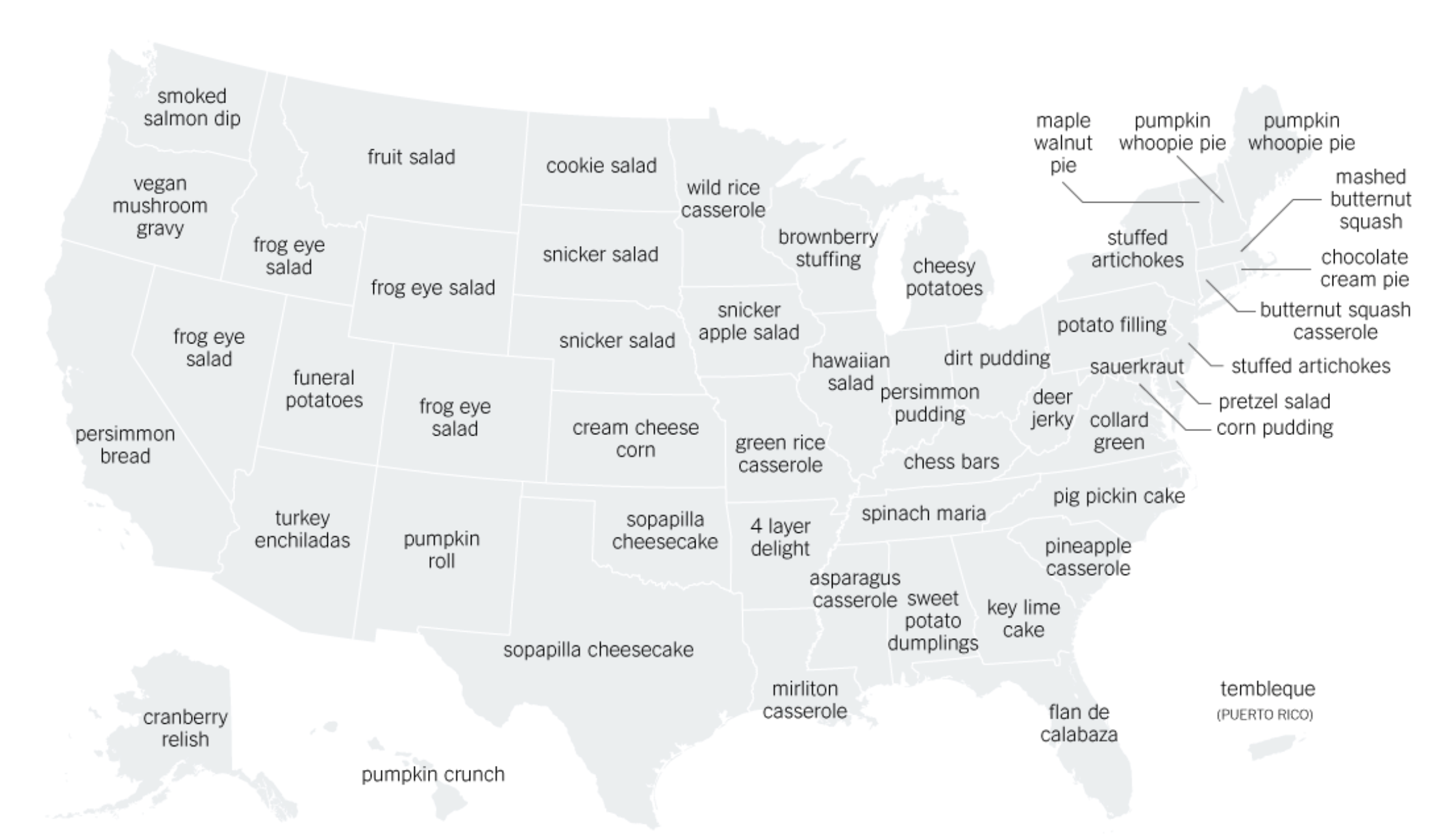
Shortly after New York Times produced an elegant pictorial map of Thanksgiving recipes in each state, to emphasize the varied bounties of our national cuisine, the Upshot opted to rethink how to map the meal.  Rather than concentrating on whetting taste buds, they consulted the new masters of the web to depict the current foodscape–a subject of increasing cartographical scrutiny.  By inviting Google researchers to mine data for a map of most-searched Thanksgiving recipes, to trace local variations in what sorts of foods are on folks’ minds.  As much as being the staples, or the family traditions, these Googled recipes seem the real crowd-pleasers, the seasonal favorites less indulged during the year.  The map tracks the latest permutation of a festival that probably began with native Americans’ collective dances and rituals to secure successful future harvest embraced by puritan pilgrims and later adopted as a national holiday; as much as map making constitutes a nation, world maps of searched recipes meals oddly renders a national holiday of thanks.

The word-search map of “most-looked for and most distinct types” distributes Thanksgiving foods by word searches specific to states.  As much as an actual lay of the land, the word-map provides an inside-out version of the pictorial map of favorite holiday dishes, as Googlers identified the most-searched for recipe by state in what was deemed a “democratic” counterpart of what is currently cooked for Thanksgiving tables across the fifty states and Puerto Rico.  While not constituting much of an an invasion of privacy, the results present a striking picture of the national palate.  It does suggest, in ways unlike the pictorial map of home-made regional recipes, both a tendency to uniformity and a growing distance between farm and table–if not the disappearance of farms–in what was long billed as the harvest holiday.  What, exactly, is being harvested is not that easily able to be described, although it suggests the changes wreaked by supermarket-bought foods–or just supermarket chains–in our nation’s edible geography, if not in our sense of gemütlichkeit.

The nonprofit conservation organization known as the National Wild Turkey Federation has mapped the wide ranges of wild turkeys across the nation, revealing the wide access to turkey across much of the most settled regions of the continent.


range_map_tnail_031314-1


When the New York Times mapped the “most searched for, most distinct types” of food across the country in time for Thanksgiving, it did suggest that some of the more esoteric store-bought alternative recipes that might make it to American tables varied widely in the distance of states from an actually turkey market.  The results included many local favorites, but were not that encouraging on the front of healthy winter foods, or able to offer much of a foodscape than a mapping of the foods on folks’ minds, if not those that are made in bulk, and offer a strange harvest of edibles which the families gather round dining tables to eat:

Thanksgiving Menu Map

New York Times


The non-geographically-specific nature of this map of the cornucopia of foodstuffs that folks seek to confect for Thanksgiving is perhaps it’s most striking quality–if not the limited number of food groups it includes.  Despite the diversity of food-names, several striking bands suggesting continuity of culinary preferences emerge in the map of most-googled items searched with thanksgiving dinners across in the country that suggest a manner of carving up what’s on offer on tables–a run of squash in the northeast; a clustering of cakes in the deep south; wild rice in the northern midwest of Wisconsin and Minnesota; a variety of candy-enhanced fruit salads that seems specific to the Northwest–and in contrast to the more southern taste for sweet baked desert or the Missouri taste for green rice casserole.  Of course, Mirliton Casserole is a nice indulgence of shrimp for the Gulf Coast and Louisiana, albeit at the tail-end of the inland shrimp harvest (although frozen does fine).

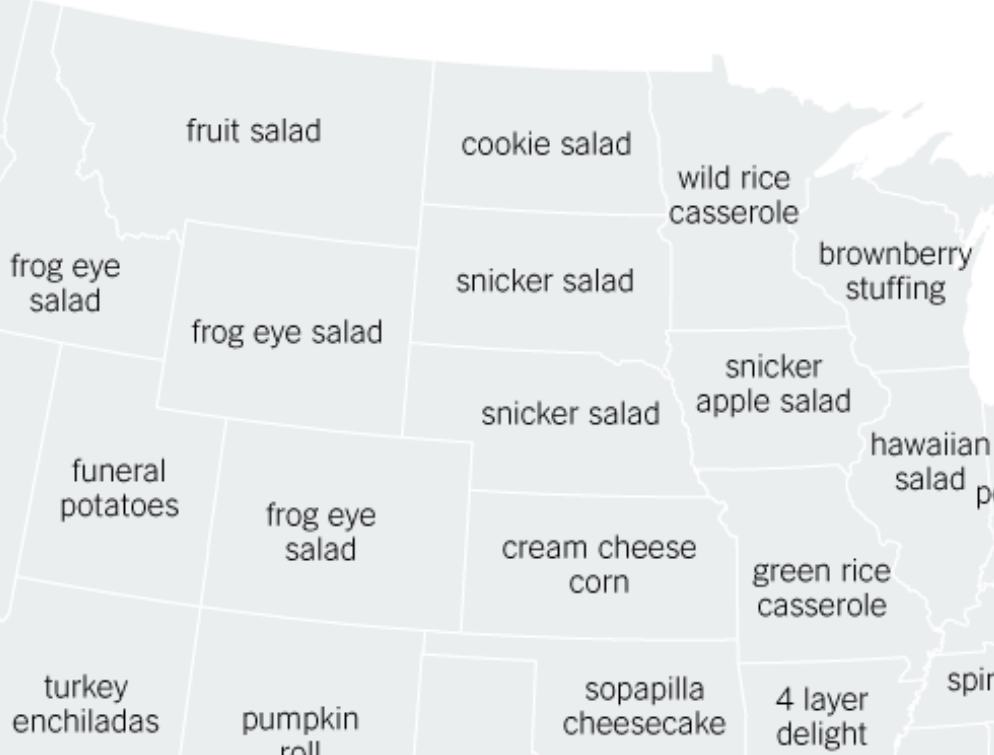
We move into shopping for sugary salads for much of the landlocked western and central plains, however:


Cookie SaladNew York Times


It’s not surprising the folks in Montana are thinking about fruit salad, but the broad popularity of “frog eye salad” in neighboring Idaho, Nevada, Colorado and Wyoming suggests something other than an abundance of amphibians, but a taste for sugary fruits that seems decidedly regional in their appeal–the concoction of pineapple, eggs, coconut and mandarin oranges with marshmallows is akin to the nearby desserts of the midwestern Candyland of Cookie Salad and Snicker Salad, but represents a distinct variation on a theme, reflecting folks loading up on sucrose and glucose for the cold weather of winter.  “Dirt pudding” isn’t only the result of desperation or a shortage of cash in Ohio, but an Oreo cookie and vanilla pudding concoction often decorated with gummy worms, suggesting mental distance from actual farms.  The Northeast fad for Pumpkin Whoopie Pie is a variation on holiday-themed deserts, based on the sort of autumn foods, like persimmon, if a twist from what one might expect to be on the traditional Thanksgiving table.


Cnady Land


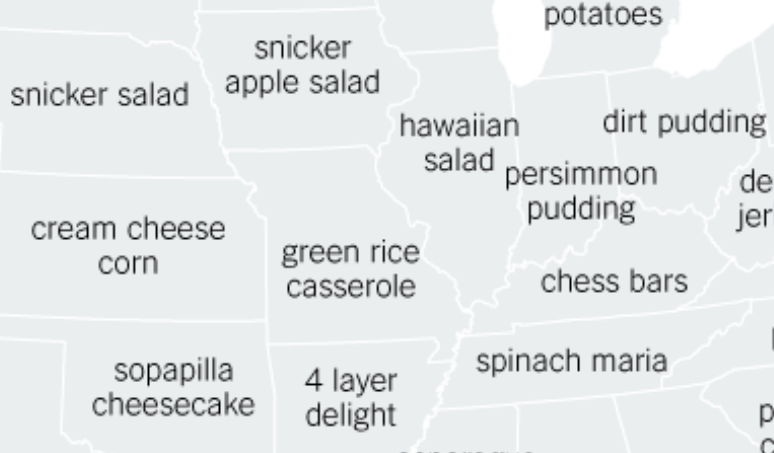
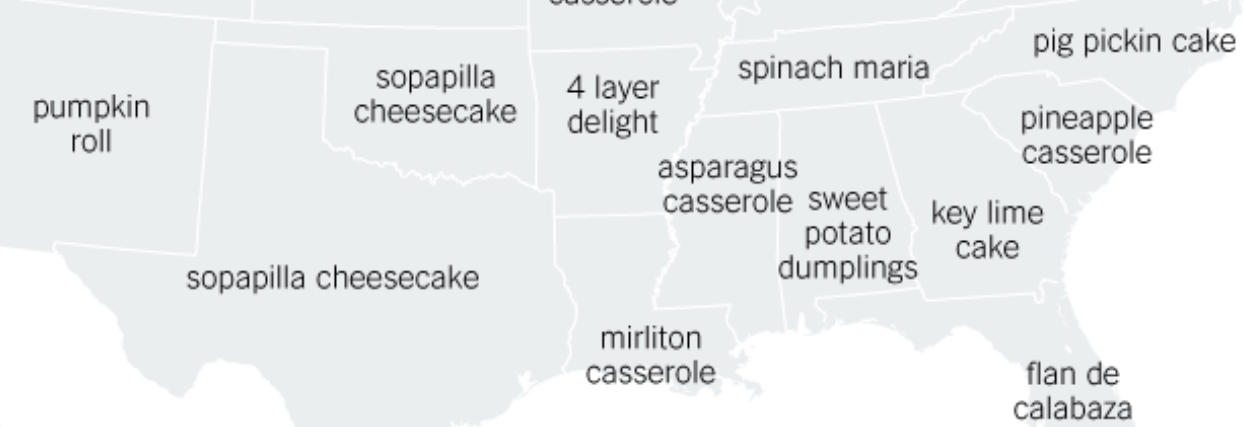
There is a striking American obsession with dessert has interesting inflection in its focus on cake throughout the south–4-Layer Delight in Arkansas; Key Lime Cake in Georgia; Pineapple Casserole in South Carolina; Chess Bars in Tennessee; cinnamon and vanilla Sopapilla Cheesecake in Oklahoma; Hawaiian Salad in Illinois and Persimmon Pudding, a local treat in Indiana, where it grows wild in abundance, even if it’s originally native to the southeastern states–which one might tie to the alarming recent trends the CDC has offered on obesity in the United States, but seems a cheap shot for the holidays.


South


If these are the foods that most Americans are busy preparing to put on their holiday tables, are the other recipes being handed down or bought as prepared foods?  To be sure, wild rice Brownberry Stuffing of wild rice and mushrooms has a nice Wisconsin ring, and pairs with Minnesotans interest in Wild Rice Casserole, even if it met with local skepticism.  But while folks in Portland are opting to search for vegan mushroom gravy for their tofurkeys or mashed potatoes, and in Seattle can afford the smoked Salmon dip, they are the outliers.  We might group with them residents of New Mexico looking at leftovers with “turkey enchiladas” or the Virginians who love their collard greens, but these seem last-minute searches not so central to the Thanksgiving menu.

By far the most Americans seem looking to indulge in high levels of corn syrup and calories to live it up with friends, but rather than focussing on obesity trends in America, one might focus on the proximity of the table to farm.  (Pretzel Salad isn’t exactly farm-to-table.)  To be sure, perhaps a Google Search is not much evidence for what’s consumed on the table.  Maybe googled recipes are made by those without their own family cookbooks in the kitchen, or just comparing alternate desserts for the holidays.  Perhaps, indeed, after watching Citizenfour for the Holidays, most folks realize the NSA is likely to be reading their searches, and intentionally circumscribe searches, even for what they’re ready to eat.  Or, a bit more likely, it suggests the limits of what information NSA folks can get from Google searches.  But is it possible that folks aren’t looking online for times for the basting of their turkeys, or do they just prefer to get such information from a human voice that can be questioned about specific details of culinary preparations, but trust the web for a special branch of last-minute additions to already prepared menus?

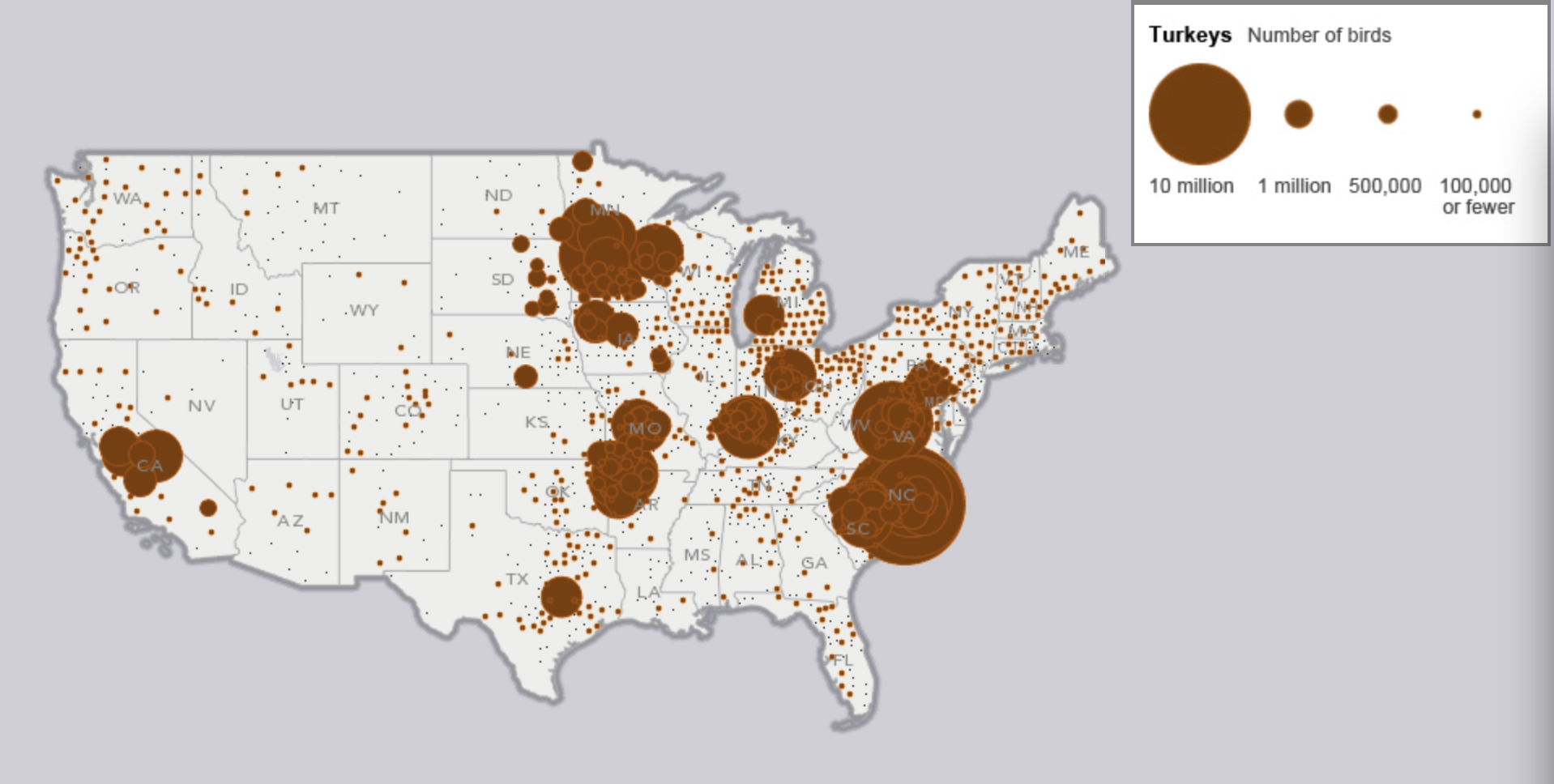
The map of Google searches, if not suggesting a reaction to Michael Pollan’s suggestion we eat more greens, may well reflect just how far away we’ve grown from farms and farmed harvests.  That isn’t much new news in itself.  In 2011, the USDA’s agricultural census (agcensus.usda.gov) offered a basis for a compelling Esri “story map” or spatial narrative of just how far food travels to tables for most Thanksgiving meals.   The nice bubble map includes the provenance of the turkeys from big agribusiness in the Midwestern states or the central eastern states, with a considerable cluster from the farms in California’s Central Valley, even those birds blessed by Bill Niman–but are very predictably focused on regions where there is already a pre-existing plenty of soybeans and corn to feed turkeys–which is why they are few and far between from Montana to Texas, or Kansas to Utah.  That turkeys seem raised overwhelmingly in very a restricted region on the map seems a casualty of American agribusiness, if raised by the millions–and served up 46 million birds to create the illusion of plenty on dining room tables–to signify holiday cheer.  (This despite their relatively wide small-size farming in much of the midwest.)

When we place a turkey on the table, lest we forget most are shipped up to half way across the United States, we might review the story map below:


Turkeys 2011Smithsonian/ESRI maps


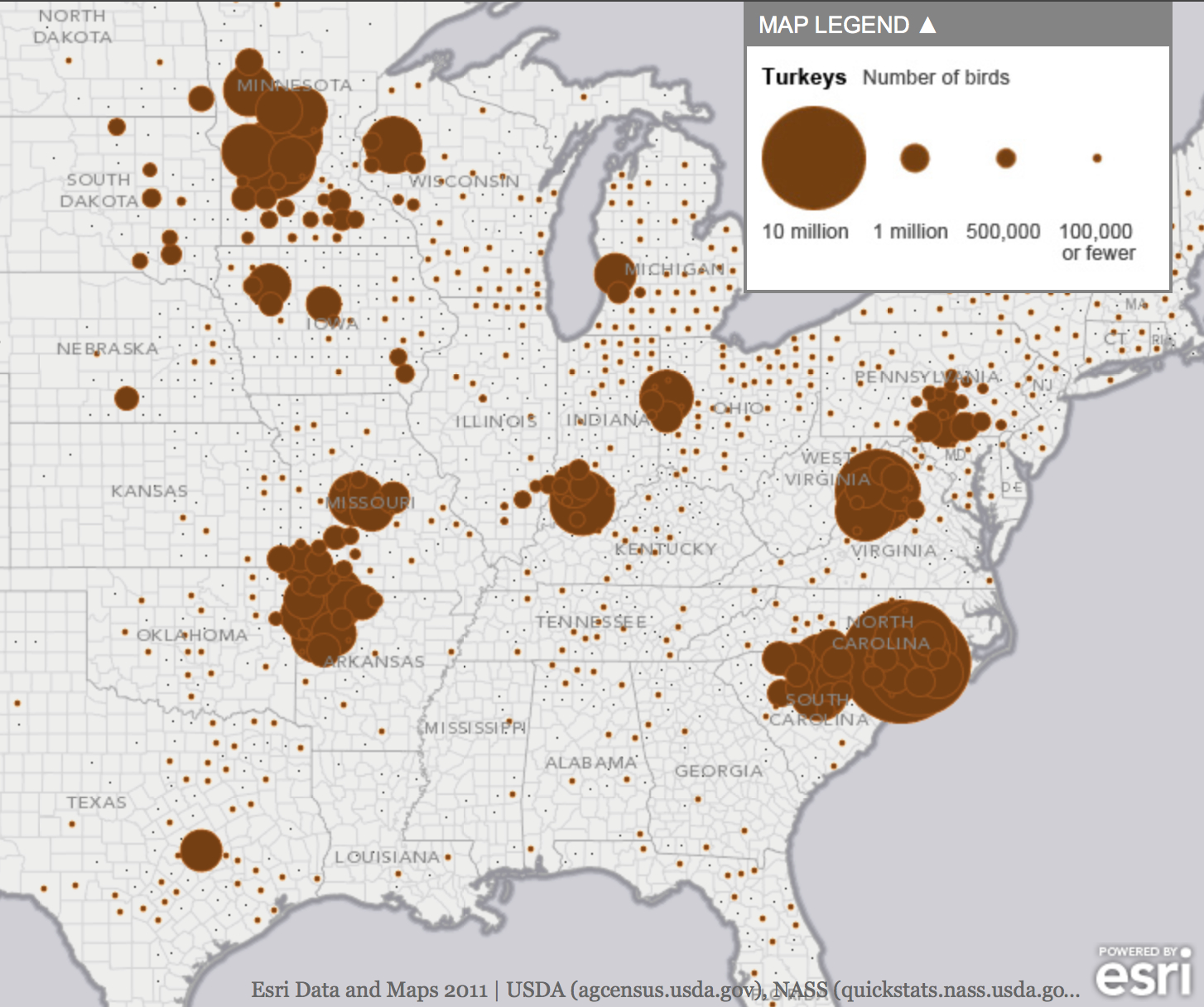
The bulk of the population of turkeys that feed the nation seem in 2011 are agglomerated, by the tens of millions, in farms in North Carolina and Virginia, which, with those in Iowa, Minnesota, Missouri, West Virginia, Indiana and Arkansa, feed the nation.  The predominance of turkeys raised in North Carolina, origin of much turkey served in the south and central states, is striking; maybe Minnesota feeds the midwest.


Midwest and NC TurkeysSmithsonian/ESRI maps


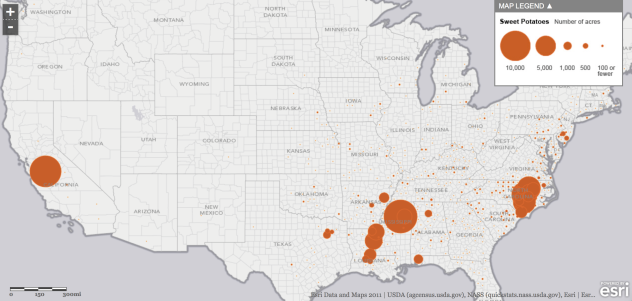
Moving along the sourcing of the Thanksgiving menu, the similar concentration of the solidly southern sweet potato, the vegetable most destined beside the turkey, must be noted, before we move on to the green beans:


Sweet potatoes


(Back in 2009, the newspaper of record used the top search terms in Allrecipes.com as an index to map what folks across the country cooked by GIS, to arrive at a geographical clustering of sweet potato casserole of unsurprising similarity:  despite the more national purview of pumpkin pie.)

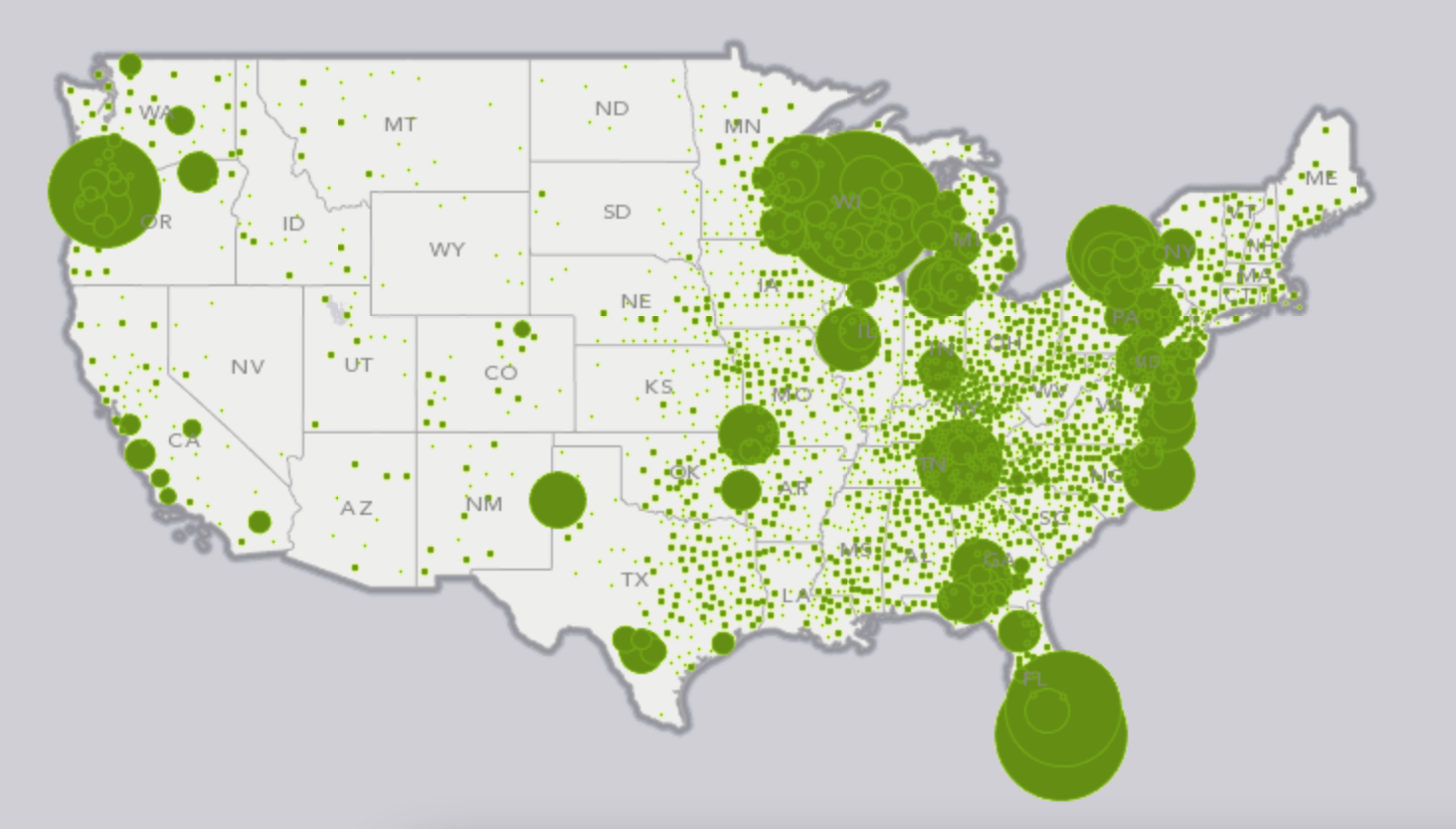
For the record, and to map the full Esri story, or allow that story to speak, green beans were widely cultivated in 2011, providing a taste of the local for the table as well as a visually pleasing dash of light green–save in those places where fruit salads of undefined provenance were particularly popular Google searches:


greeen beans


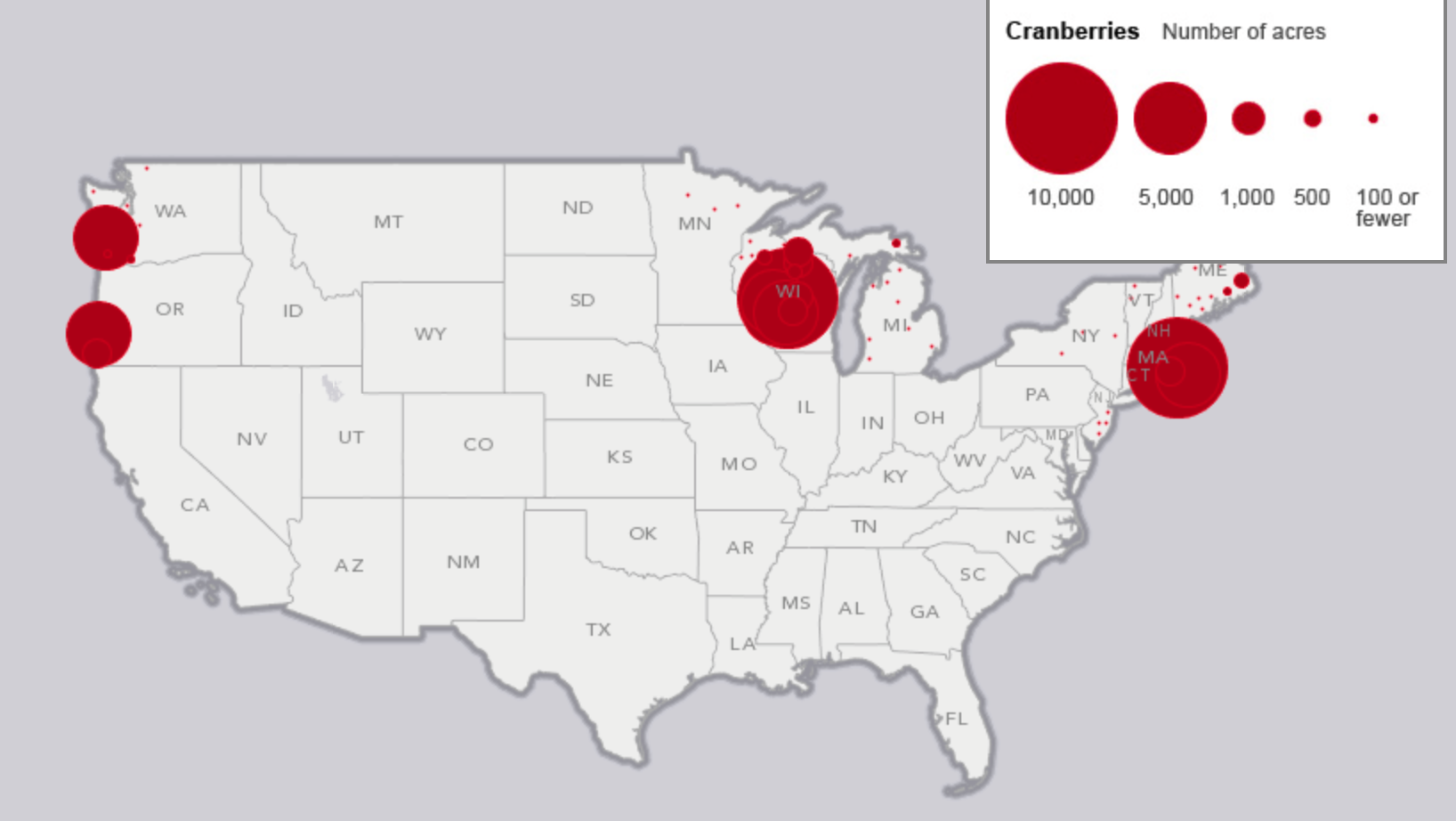
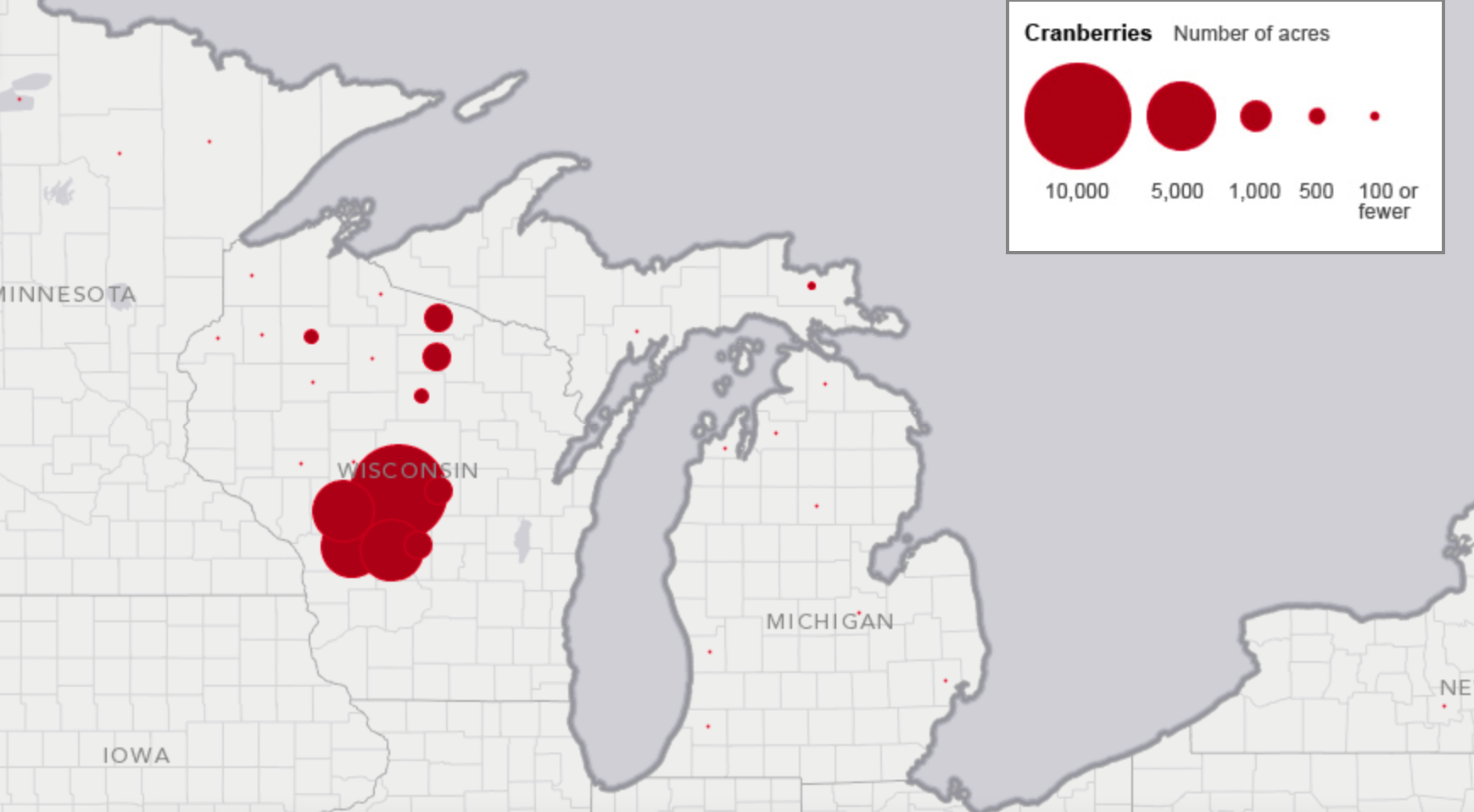
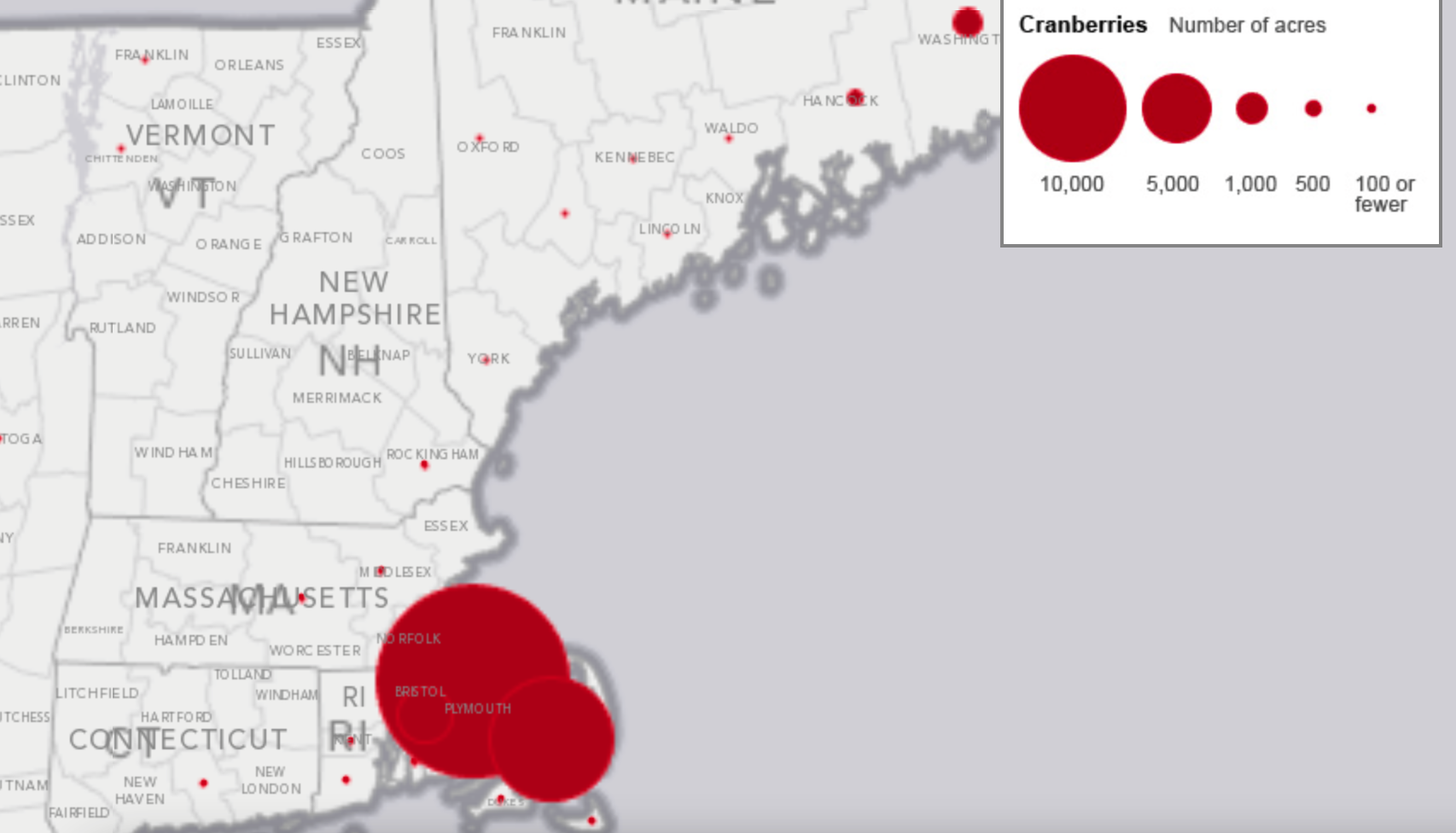
But the real persistence of localism in the arrivals on the table seems rooted not in the origins of the meat or the yams, but in the persistence of localism of the cultivation of cranberries–that indelibly red fruit element that complements turkey.  Fresh cranberries seem to signify something like a custodian of local culinary tradition in many of the very same regions where folks searched for the least confected foods:  dependent on environmental particularity, their survival as a crop in Wisconsin, Massachusetts, Washington and Oregon is tied to old agriculture, which may well be tied to the searching for staples as vegan stuffing, wild rice casserole, wild rice stuffing, mashed butternut squash that bode the survival of the winter vegetable.  Will this change with global warming, and the increased aridity of most of the New World fields?


cranberries


The persistent localism of farmed cranberries is a sort of index of the survival of agrarian geography–


Wisconsin cranberries


PErsistence of localism in cranberries-MA


–and, in one slightly optimistic if also unwarranted reading, of a persistent taste for the locally grown.

The specific conditions for the cultivation of crops of cranberry, which demand bogs and abundant wetlands, and a period of winter, leaves it both the talismanic reminder of seasonal crops with which we’re left in late November, the reminder of the agricultural calendar of the stuff on the table–together with the persimmons of southern Indiana and perhaps the collard greens of Virginia.  Furthest from the agrarian time cycle, it seems, Google searches tend to the far more readily at hand/least processed to the most confected.

Perhaps the annual transport of sweet potatoes and some 46 million turkeys every Thanksgiving entails also make one realize the illusory culinary diversity the Times mapped:  perhaps we wish that fewer folks would continue improvising desert rather than shipping trussed birds cross-country, or keep accompanying the carving of the bird that is bulked up with water, stuffing, and potatoes with a suitably over-the-top dessert.

The maps remove us from a tactile relation to the edible harvest feast we might well pause to mourn.


Salvatore LascariSalvatore Lascari (1884-1967), Thanksgiving, n.d. Smithsonian American Art Museum

3 Comments

Filed under mapping agribusiness, mapping foods, mapping local foods, mapping meat, mapping thanksgiving, mapping turkey farms, national foodscapes

KXL?

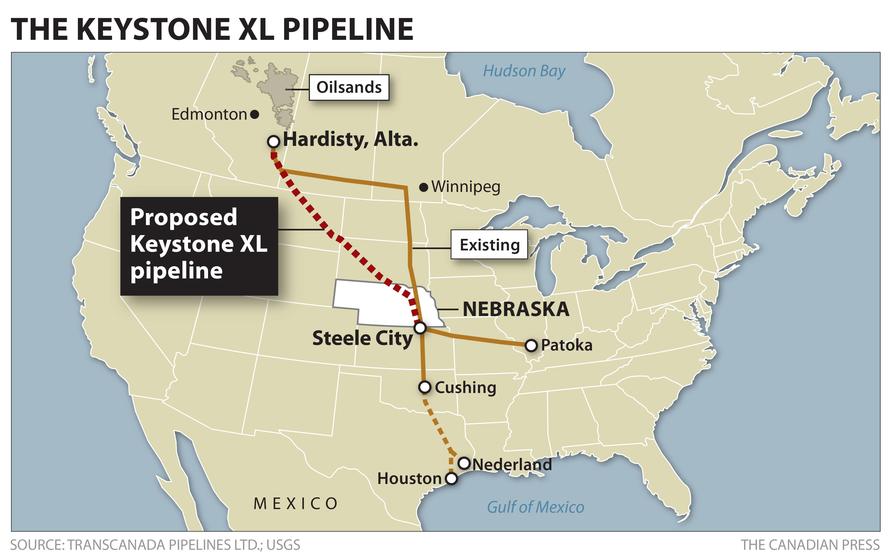
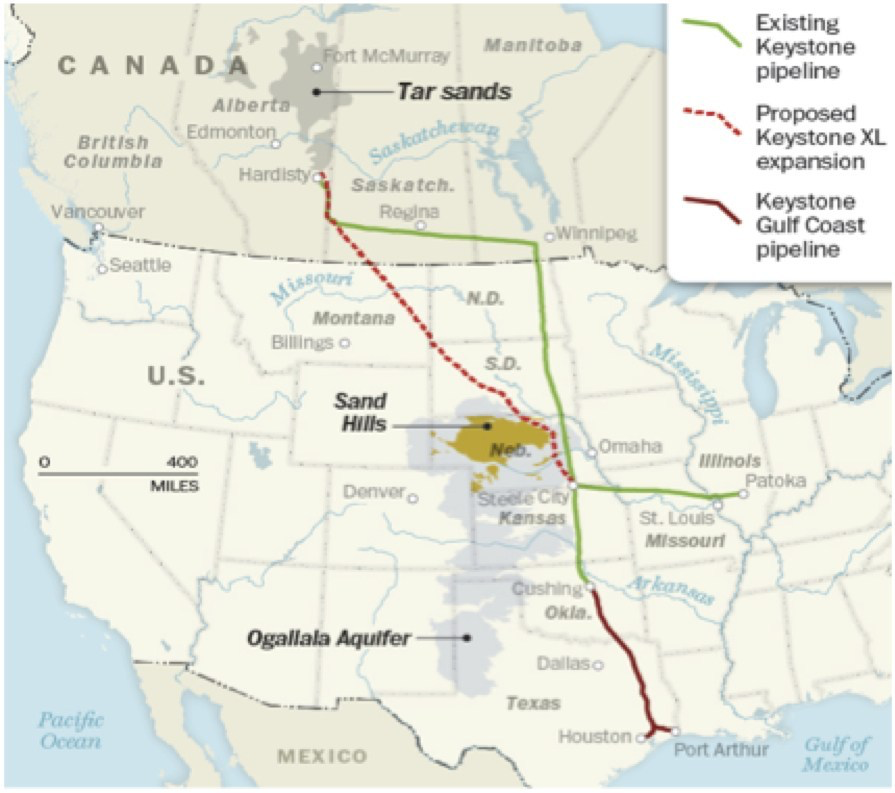
Last year the Senate failed to pass the bill to authorize the construction of the Keystone XL pipeline.  But the fight was intensely waged before a map, and it seems time to scrutinize what that map charts, and place it beside what sort of future map of an energy landscape we seek to create.  And as debate continues, and we look at maps to understand the potential transformation of the landscape the would result from the pipeline promising to carry 800,000 barrels of bitumen/day across farmlands in the central United States, running across many so-called “red states” of a Heartland, from North Dakota, South Dakota, Iowa, Nebraska, to Texas and Louisiana. The planned assembly of sections of this massive megaproject of overland pipe could at any point contaminate farmlands, native lands, and waterways to create massive public health risks.   But we have trouble mapping such risks against a thirst for energy, and a demand for energy independence, to allow us to have access to gasoline for driving cars–even though this bitumen is refined–to petroleum products and to preserving the perpetual light blue incandescent glow of television screens.

Keystone Pipeline segments waiting for assembly in Summer Texas/Tony Guttierez/AP

Or are not prepared to do so. As we allow battles to be waged primarily I courts since a district court famously placed a permanent injunction on hopes for the pipeline’s construction in November 2018, leading the President we have to re-issue a new cross-border permit that sought to replace the previous permit issued by the State Department, under his sole authority as executive framer of the nation’s energy policy, even in the face of no plans for pipeline construction in 2019, we need to map both the benefits that the Keystone XL pipeline against the real risks it would pose. Indeed, the almost hubristic attempt to build pipeline from Hardisty all the way to Houston, in ways seems a straight line, suggests a huge amount of new pipeline that would challenge the technology we have of transporting bitumen, to provide crude for existing refineries in Houston and Galveston that falsely promises to restore their industries, even by raising risks we cannot start to fully imagine in an age of rising temperatures, increasing climate pollution, and the possibility of actual national emergencies. Even before Transcanada’s own maps, we should pause at the claimed promise of jobs and easy energy–

–especially in the face of clear alternatives, already under construction, by which the oil would be shipped for refining to Asia, at a rate that is far beyond the 800,000 barrels per day Keystone XL is designed to carry.

Alternative Planned Courses for Bitumen Transport from Tar Sands

The transport of the messy, oily, Tar Sands bitumen and slick through the proposed expansion in the pipeline would, of course, cross not only farmlands and run relatively alongside of rivers that trained to the Gulf of Mexico, but transport petroleum through a region of the largest aquifers of the central United States, as well as raise threats of the possibility of leaks into above-ground streams and rivers, which would be difficult to clean up, not to mention 2500 groundwater wells lying near the proposed pipeline, whose monitoring for possible contamination would subtract even from any possible revenues that the pipeline would create.

Harvard Bioinformatics and Genomics

But the specter of losing promised jobs, and indeed of a declining American petroindustry above-ground, long active in local and national politics, has made the fear of alternatives–and alternative energy exports from Canada–frightening to many United States Senators, even if the refineries in American waters or mainland would not be receiving the bulk of bitumen shipped from American ports, and hardly would keep them active alone.

And the recent decision to adopt measure designed to designate the built pipeline sections “critical infrastructure would criminalize any damage gas facilities currently under construction as third-degree felonies that can carry as many as ten years in prison, preventing “impair or interrupt” protests or even entrance into property with the intent to damage or disrupt to become recognized as felonies by the state of Texas–if not the second degree felonies that was proposed in an earlier bill proposed by Representative from Marshall, TX. Such bills are intended to disrupt any environmental protests against the 650-mile Jupiter oil pipeline and Kinder Morgan’s 430-mile natural gas Permian Highway pipeline, both designed to transport fuels above ground from one of the nation’s largest oil patches in West Texas to the Gulf Coast, with the intent to prevent protests of civil disobedience or environmental justice as has occurred in Standing Rock. Despite the danger of such pipelines to San Antonio’s drinking water, the rush of a boom in oil and gas production in the Permian Basin of West Texas, en rushing to build pipelines across the state despite tremendous opposition from landowners whose lands would be seized by Texas law that allows private, for-profit companies to claim rights of eminent domain: such anti-pipeline-protest legislation has been adopted in Oklahoma and Louisiana to stymie protests seen as unnecessarily disruptive, and have been overwhelmingly supported by the oil and gas industry who seek to secure their rights to construct pipelines, and cast any attempt to disrupt their construction as disruptive interfering with corporate operations, and probably disruptive the possibilities of protest of native nations as it would impose severe fines and penalties of up to $10,000.

And the recent decision to adopt measure designed to designate the built pipeline sections “critical infrastructure would criminalize any damage gas facilities currently under construction as third-degree felonies that can carry as many as ten years in prison, preventing “impair or interrupt” protests or even entrance into property with the intent to damage or disrupt to become recognized as felonies by the state of Texas–if not the second degree felonies that was proposed in an earlier bill proposed by Representative from Marshall, TX. Such bills are intended to disrupt any environmental protests against the 650-mile Jupiter oil pipeline and Kinder Morgan’s 430-mile natural gas Permian Highway pipeline, both designed to transport fuels above ground from one of the nation’s largest oil patches in West Texas to the Gulf Coast, with the intent to prevent protests of civil disobedience or environmental justice as has occurred in Standing Rock. Despite the danger of such pipelines to San Antonio’s drinking water, the rush of a boom in oil and gas production in the Permian Basin of West Texas, en rushing to build pipelines across the state despite tremendous opposition from landowners whose lands would be seized by Texas law that allows private, for-profit companies to claim rights of eminent domain: such anti-pipeline-protest legislation has been adopted in Oklahoma and Louisiana to stymie protests seen as unnecessarily disruptive, and have been widely

The debate about the pipeline was first rehearsed before a predominantly Democratic Congress, before 2014 elections led Republicans to promise to place the Keystone at the top of their Congressional agenda–in the attempt to place it on an actual map.  The first effort to pass the bill was championed by a Democratic Senator from Louisiana, who vaunted the benefits it would bring to New Orleans and the Gulf of Mexico, and hoped to convince the C-SPAN public to the nation as a whole.  At a time when the long-time senator felt increasingly politically isolated, Sen. Mary Landrieu (D-Louisiana) staged a photo-opportunity standing before a map of the nation:  the map placed the proposed project for laying line across the US among a web of existing national pipelines, as if it would symbolize her own relation to the nation, as well as the place the pipeline within the much-vaunted promise of energy independence.  The deceptiveness of the map by which she sought to symbolize such independence had of course been crafted by pro-corporate supporters of the pipeline, and its deceptiveness–and erasure of costs–needs to be examined, lest it be lodged in one’s mind.

For longtime Sen. Ladrieu, the map displayed the Keystone pipeline as a key to restore or burnish the image of America as an energy superpower.  Yet it disguised the devastation of the extraction of oil or the fact that little of the oil transported was destined for or needed in an American market.  At the same time as oil consumption is declining nationwide and prices are rapidly declining worldwide, Landrieu used the map as something of a backdrop to sell the pipeline by placing it at the centerpiece of a compelling, if largely illusory, vision of energy independence.  But the declining significance of oil to US energy problems (or energy policy) was obscured by Landrieu’s appeal, as it will be, in the Republican priorities for the new Congress, as they make it a top energy priority and link it to the hope of “energy independence” again.  Although such approval would have little effect on changing gasoline prices, and obscure that we face an oil glut, there is almost a fetishization of the pipeline as opening hope for an expansion both of offshore drilling for gas on public lands, and an acceleration of the permitting process for exploring for natural gas that have already been granted.  Hortatory banner ads trumpet with urgency the enticing promise of “Leading America to Energy Independence”–and claim that that will all be done safely, with our best interests in mind.

energy indepndence?
Pipelines Work!

Yet although the Keystone pipeline has become something of an entrée to the expansion of a new US gas and oil boom, and is billed by TransCanada as the “safest and most advanced” pipeline in the continent, which would offer a new “essential infrastructure” to American oil producers, despite a glut of cheap oil, by presenting the $8 billion project in a rhetoric of progress in energy policy–even though the 800,000 barrels of bitumen (or diluted bitumen) that it would promises to transport each day all the way from the Alberta tar pits to the Gulf Coast refineries would be destined for export, and would mean only 35 permanent jobs.

With no clear benefit to American consumers made clear, however, the “progress” of the bill is being pinned to the notion of creating an expanded and renovated energy infrastructure, even at the cost of expanding other serious infrastructural problems in the country.  By integrating the network of existing gas and oil pipelines as a single network, the map used situated the delayed Keystone project as part of a national network of pipelines, suggesting that it would take its place within a coherent national energy policy.

11.19-kxl_standard_540x360

Joshua Roberts/Reuters

Yet whether such an energy policy exists remains open to debate.

Continue reading

1 Comment

Filed under environmental risk, gas and oil pipelines, Keystone Pipeline, Keystone XL, mapping a national energy policy, oil pipelines, oil spills, Tar Sands

Tracing a Shadow Transit System: Subaltern Cartographies?

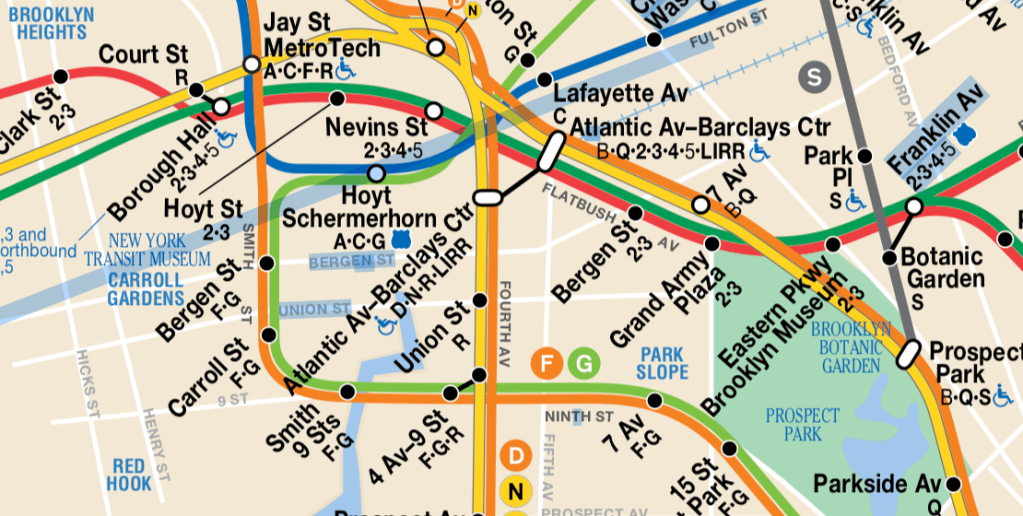
With Manhattan long ago out pricing many who might have lived there in the past, even as New York City’s Mass Transit Authority does good duty as a serviceable means to secure transportation across the isle, the five boroughs are simply not fully linked to the surrounding extra-urban area residents are pressed to move.  We needed Aaron Reiss to give voice to the less-mapped history of “paratransit-systems” fashioned from a web of dollar vans linking the city’s residents and constitute a central part of its perpetual mobility.  

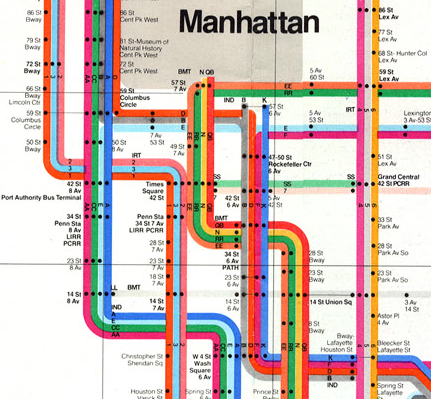
If New York City’s MTA map was a modernist icon of the city that initiated one to a labyrinthine pathways as a right of passage–the long-gone tokens are often worn as necklace, fetish, and a totem of conquering the web of transit–the map showed a preponderance of lines running north and south in Manhattan shortchanged commuters to Queens, and barely served Long Island.

The 1972 modernist remapping lent coherence to the historical layering of a system of subways, organizing its individual lines of the BMT, IRT and IND in a system of streamlined colors so its order seemed intuitively clear.  Designed by the late honorary New Yorker Massimo Vignelli, whose graphical craft would rebrand much of New York City in the early 1970s, so indelible has the iconography become that its subsequent iterations continue to respect the constellation’s symbolic form.  Reiss appropriated the same iconography and symbolic form to move beyond the service in five boroughs and suggest a system which operates where busses and subways just don’t reach, providing a guide to the routes on which large numbers of Manhattanites daily travel to destinations the city’s “public” transit system doesn’t extend or recognize.

Out of Manhattan

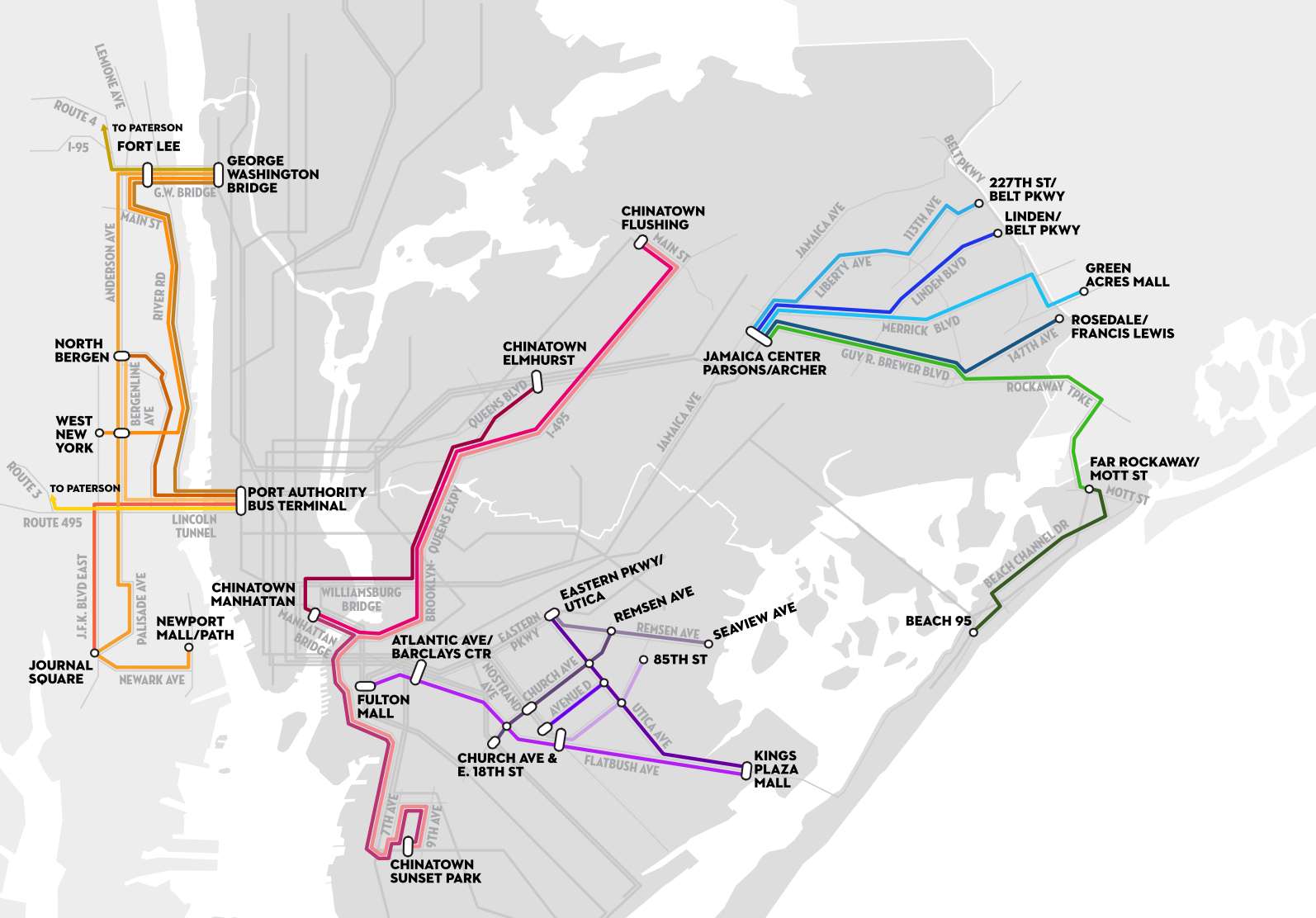
With the apparatus of MTA subway lines left in a ghostly grey that might indicate their supersession, Reiss provides the other map that is perhaps more present to a range of New York’s residents, collating commuter routes across low-income (and often immigrant) neighborhoods that supplement the system of subways run by private companies which offer far more than service to JFK.  Working at lower cost than the system of public transit itself, these lines/shuttles, more often known about through employees and networks rather than from printed or paper maps, to render what Reiss calls “New York’s shadow transportation system,” and which he dignifies with an iconography imitating the elegant minimalism of Vignelli’s classic map.

M Vignelli maps subway system_1972

Vignelli’s spider-like tracery of pastel lines improbably festooned a grim New York with candy-colored stripes spreads out from the dense knot of Midtown (Central Park is an improbable squat grey, alerting viewers to the map’s distortion and representational remove), a bow of ribbons from which it serves the outer boroughs.

Downtown

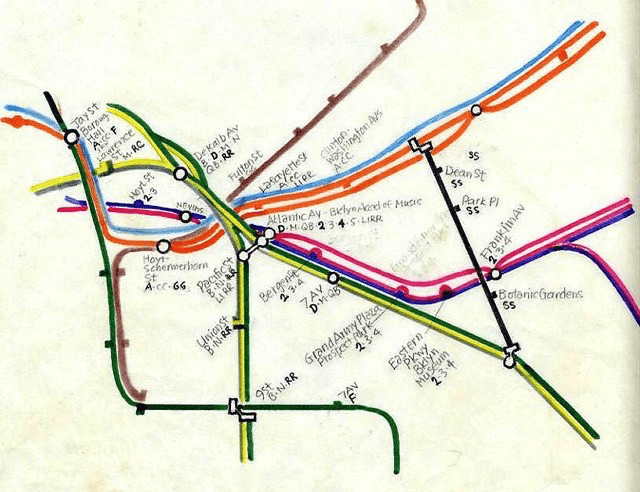
The real story behind the map is the extent to which this vision of the transit system no longer serves the needs of a wide range of commuters, who have attached themselves to a system of public transit hubs to more easily move among the now-geographically-disparate pockets of ethnic communities by lines of dollar-vans, minibuses or limousines, often to reach places on routes of transit the MTA doesn’t offer–from which it has even, Reiss found, withdrawn as service has contracted.  To be sure, the Vignelli map was importantly adjusted in later years, the sinuous routes prepared by graphic artist Nobuyuki Siraisi helped Michael Hertz and Associates design a more phenomenologically elegant version map of New York City subway lines, approaching the subway system in a new light by riding each line with eyes shut tried to capture the motion of cars along the tracks, the better to capture passengers’ embodied experience in his sketchbook; his sketches were used to render the routes of the trains might feel as a way to register their experience in the train–rather than against surface streets or a geometrically elegant symbolic form.

Nobu Siraisi, 1979 working sketch for NewYork subway map
MTA Subway Map Based on

By riding the cars regularly to create the basis for the Herz map, Siraisi sought to try to resolve the discrepancies riders had expressed between the clean lines of the modernist map and their experience, foregrounding the sinuosity of subway lines to capture their paths, and render the lines by a color-scheme that translated easily into words–blue, green, red, grey, Kelly green, tan–to create a more universally accessible map, that other designers were able to complement by including above-ground markers of urban topography that riders would know, and using distinct fonts for parks, neighborhoods, streets and cultural monuments that fabricated a legible palimpsest of spatial registers.

But the different users of subways do not contain themselves to a single ride, and the intersections of subway lines and transit system are increasingly fragmented in a city where social homogeneity is a relic of the past. By providing culturally familiar settings of transit for work, links among ethic enclaves, beyond making trips to airports, cash-only van lines permitted by the New York City Taxi and Limousine Commission continue to serve the working-class underserved, offering an ethnography of immigrant populations in the five boroughs and New Jersey coast and malls in an unofficially improvised response to local needs.  If needs are met in ways that arose from informal networks of drivers and dollar vans, Reiss did not imagine affirming these for users, but render a visual ethnography of the improvised economy of urban transit, The result is to offer map-readers a voyeuristic way to look at the emergent economy of dollar vans as if it were an autonomous system of transport of its own,–in ways one imagines would not be so happily welcomed or accepted by the majority of its drivers paying customers.

Reiss’s map more to the point shows the degree to which the aging public transit systems of Manhattan and New York City at large has found itself outstripped by the pressing needs of a larger populace.  In ways that reveal the relocation of many immigrants to regions out of the purview or coverage of the existing public transit webs, the improvised sub-economies reflect the city’s shifting social geography, and offers, more than an actual guide to transit, something like a guide to the dispersion of formerly contiguous communities, and indeed often more recognizable (and less costly) modes of travel than the city’s underground subway lines.  With the rise of fares for the subway, and inflexible nature of much of the physical plant of subway lines to keep up with the city’s expansion to outer boroughs, the lines provide quick lines of transit able to keep up with the geographical displacement of communities, as well as more culturally familiar modes of travel.

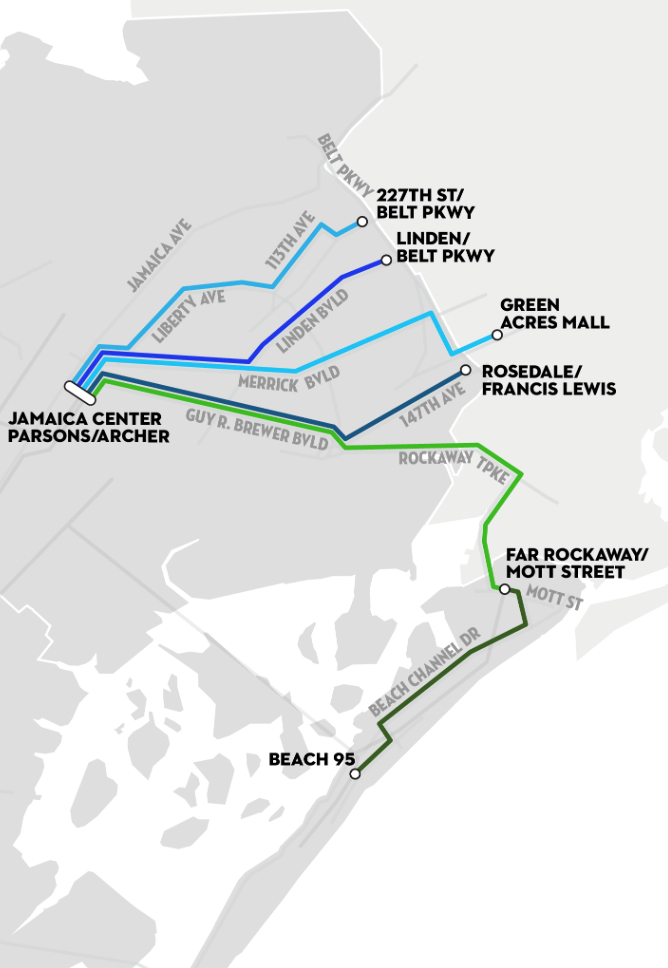
When you read the maps themselves, think less of an interlocking system, than a mode to link the removed, reflecting the subaltern cultures of transit from Jamaica Center to Long Island and Far Rockaway,

Jamaica Center

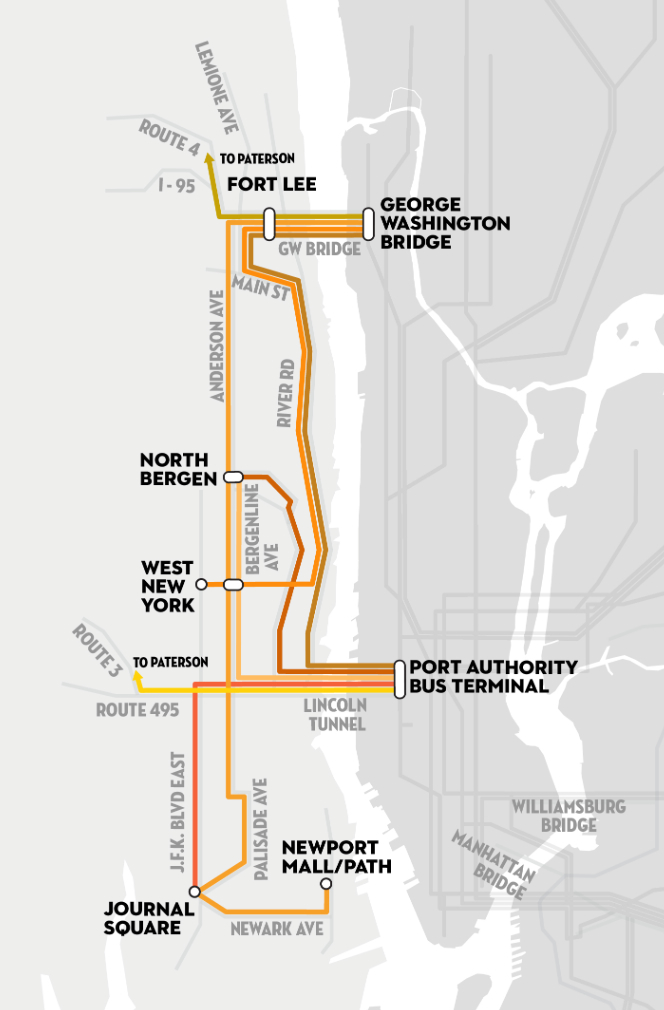
across to work in Eastern New Jersey from the Port Authority,

NJ Minibuses

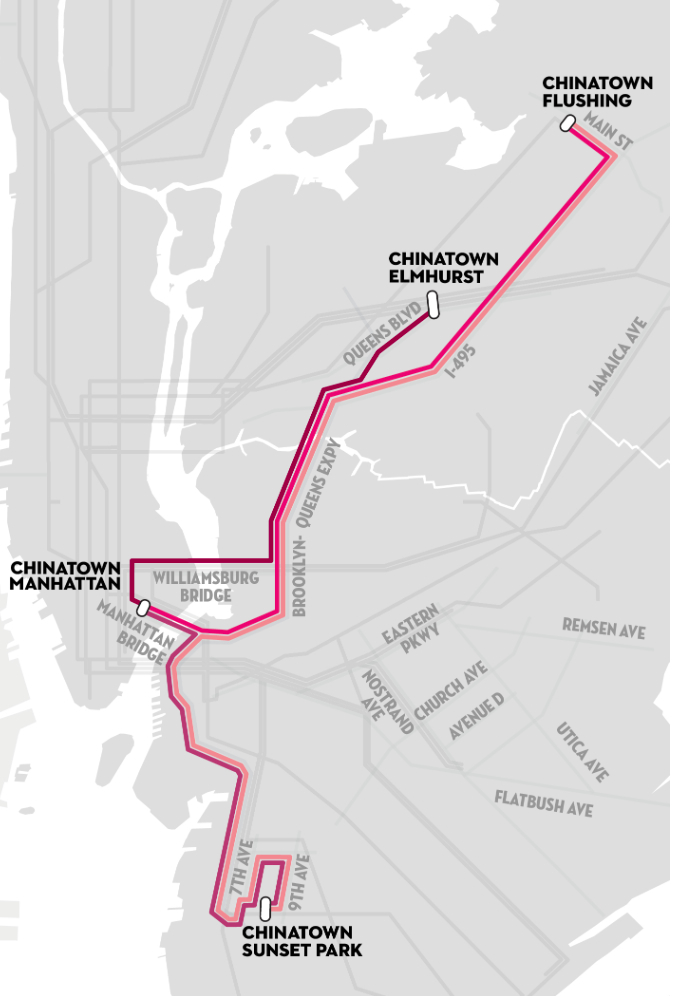
or among New York’s recent dispersed Chinatowns.

Linking Chinatowns in NYC

If Vignelli’s modernist map celebrated the antiquated system of transit was, in turn, widely celebrated for its untangling of the layers of public transit–adding a contemporary sheen to an outdated outfit and enlivening an apparently creaky enterprise–Reiss’s map untangles how communities have spun off the accepted grid.

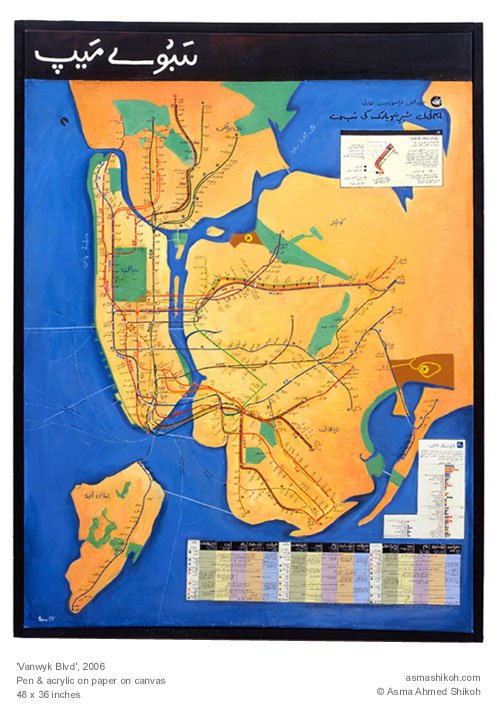
His map recalls Pakistani-American artist Asma Ahmed Shikoh’s elegant 2006 appropriation of Vignelli’s subway lines to her neighborhood in Brooklyn as a cultural microcosm of the city’s expanse as a whole, converting the iconic map to an Urdu manuscript, the maps create a poetics of presence and reuse of urban space–albeit in ways that stretch beyond the circumscribed range of transit the system provided itself.

ASVanwyck-1

But if Shikoh deftly showed “Vanwyk Blvd” in a new iconography of her own community, returning the map to the tones of an illuminated manuscript to give it a scriptural status, Reiss uses Vignelli’s symbolic form to give graphic form to the process of dramatic disaggregation of the new New York City that a newly improvised system of dollar vans arose to meet.

Leave a comment

Filed under Asma Ahmed Shikoh, Massimo Vignelli, New York City, New York Taxi and Limousine Commission, Port Authority (NY), transit maps

Mapping the Current State of Surveillance

Near my house in Berkeley, a curious street sign that canceled the word DOPE beside warned motorists near a low-income housing police are reading their license plates.  A relic of a war on drugs of an earlier era, when crime waves spun through a now gentrified neighborhood, the signage beside a four-way stop dissuaded prospective drug sellers–in what must have once been a hub of clandestine activity–of the vigilant eyes of ever-present police cameras–with added messaging that they have entered into a residential neighborhood that has taken crime “seriously.” How seriously? It offers a visual illustration of the etymology of surveillance from the French surveiller, “to oversee or watch.”  This surveilling will, in other words, anticipate their punishment.

Beneath a roving eye, this Berkeley Neighborhood Crime Watch warns potential felons they will “immediately report all suspicious activities to our Police Department” as a caution to all, giving “buyers and dealers” cognizance that “your license plate numbers are being reported to the police.”

Signage on Ward Street, Southwest Berkeley, CA

The old signage that seem smart of a nation-wide advertising campaign of the 1980s and early 1990s to urge school-age kids to resist drugs, best known by Nancy Reagan’s “Just Say No” program, a slogan that gained national attention after the First Lady used the simple phrase in response to the question of an Oakland girl, interested in how to respond to the offer of drugs from her own cohort, responded in words to immediately powerful that “Just Say No” clubs emerged around the nation as well as at Oakland’s Longfellow Elementary School, where she was visiting. (I’d long been told it was used at my daughter’s elementary school my daughter frequented, but I will cede that dubious honor.)

The expansion of hidden cameras designed to capture license plate numbers of passing vehicles increasingly knows no bounds. Its collection suggest a new level of intrusion, justified in the war on drugs or crime, but has increased the gathering of license plate data registered indiscriminately in the name of law enforcement by automated license plate reader systems across many cities in America. They suggest the transformation of the very same landscape, forty years later, where the city has invited the placement of scanners situated at intersections of Oakland, Berkeley and Kensington, to suggests the readers able to capture license plate numbers. Any child watching cars on the highway may have fantasized about the legibility of the plates on passing cars, but the expansion of computer software has allowed the processing of a big data archive of license plates across the nation, allowing a database to be assembled for police departments to request information about individual cars on an unprecedented scale by scanners whose retention of data lasts for years–and has escaped much public regulation–and are hoped to have the potential for a permanent archive of the populations of many states, without secure protection of the data stored and without public access to many records that are deemed classified for public safety. The lack of protections on the technology of surveillance suggests a dangerous data breach waiting to happen, and even a lack of clear policies for storing, protecting, and archiving the data in different states. Have police departments improvised new technological tools to surveil their populations, with no method or adequate protection for the data that have overzealously grabbed from new devices in the belief that it would help ensure public safety?

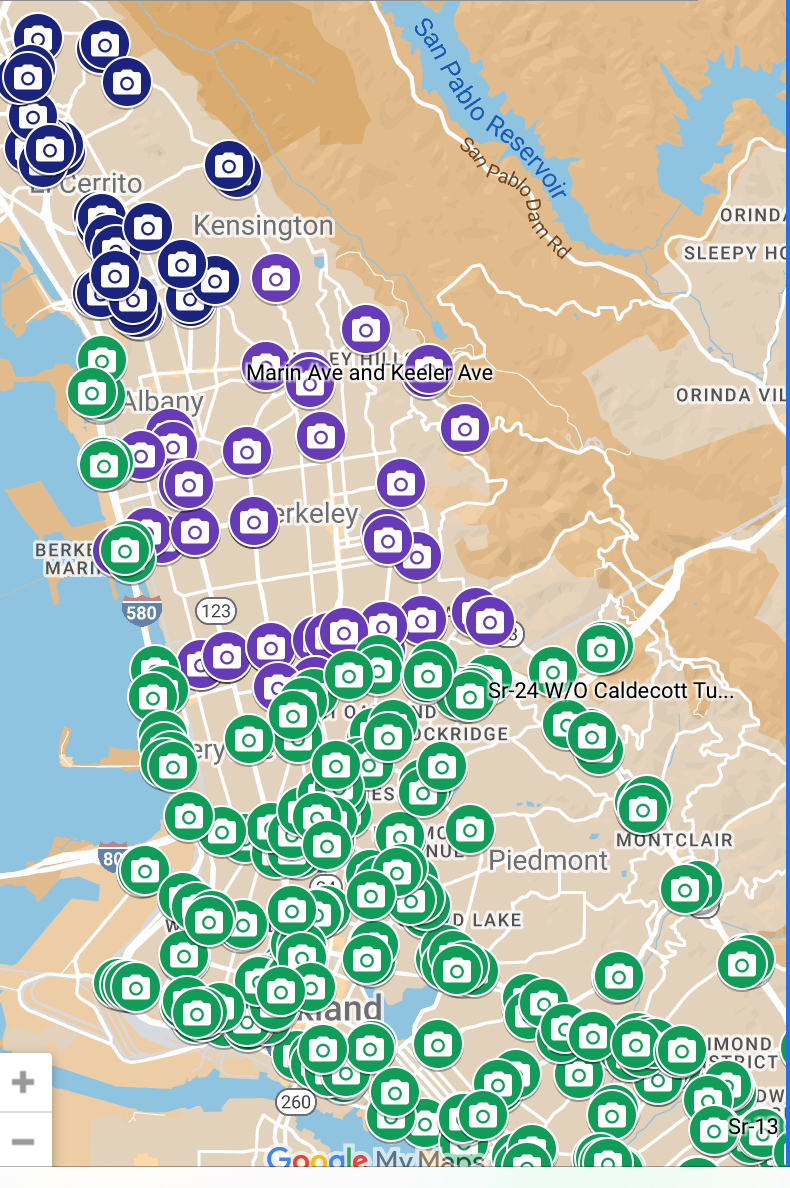
The tools of registration are not single photo cameras, but the icons of the camera suggest the sense of watchful surveillance that groups like Electronic Frontier Foundation and others are trying to be vigilant against, providing maps of the levels of enhanced surveillance that the police department has on city streets. (They do so not to offer a reverse map of the routes of getaway cars, but in the belief that the public has every right to know about these massive information grabs of data, often sold to or made available to a range of other audiences.). Marked by cameras to denote the readers set up on fixed locations that scan all license plates that are within their view, license plate readers have vacuumed up up to 1,800 plates that come into their viewing range per minute, noting the time, date, place encountered, that are stored for years–a huge megadata trove now able to be mined.

Autonomatic License Plate Readers Currently Active in Oakland, Kensington, Emeryville and Berkeley, CA

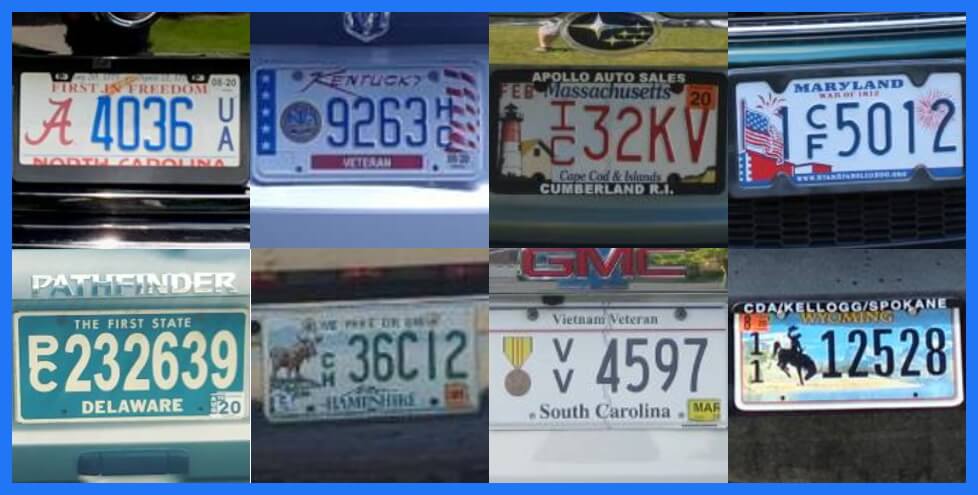
While cameras can be mounted on police cars or at fixed location, the scanning in the city of Los Angeles of about 3 million plates per week before the recent pandemic take up a range of information that predominantly includes law-abiding drivers, but allows should allow many to have a monopoly on data about drivers who move across America in all jurisdictions, data possibly shared with private policing groups, Homeland Security, border agents, and indeed immigration authorities and airport security that constitute a massive invasion of privacy–as was recognized in a precedent setting decision in 2017 in California in a public records suit against the Los Angeles Police Dept. and Sheriff’s Office on the classification of the data collected as open–and not investigative in nature. The massive datasets that are assembled by the proliferation of cameras and cameras on police cars, even if the “stacked characters” in the plates of many states prove difficult for ALPR software to decode with dependability. The demand to refine tools of surveillance that ALPR uses, however, has only increased attempts to fine-tune license plate readers to improve their possibilities of surveillance.

ALPR US license plate recognition stacked characters

But the increased expansion of license plate readers suggests a continued expansion of neighborhood surveillance violating the privacy of drivers without their knowledge or consent that constitutes a huge database of street-level surveillance that is increasingly expanding in America. As the public benefits of ALPR’s are touted by law enforcement agencies as large as the LAPD, the movements of drivers have assembled a massive database of increasingly sensitive information that the Homeland Security is increasingly interested in using as a way of “fingerprinting” vehicles of citizens who have not committed crimes, or related to ongoing investigations, based on the technological success of having scanned up over 1.6 billion scans of cars’ license plates in the state of California alone in 2022,– allowing law enforcement to create a “fingerprint” of the movements of drivers, without offering any means to citizens of having this information cleansed or purged.

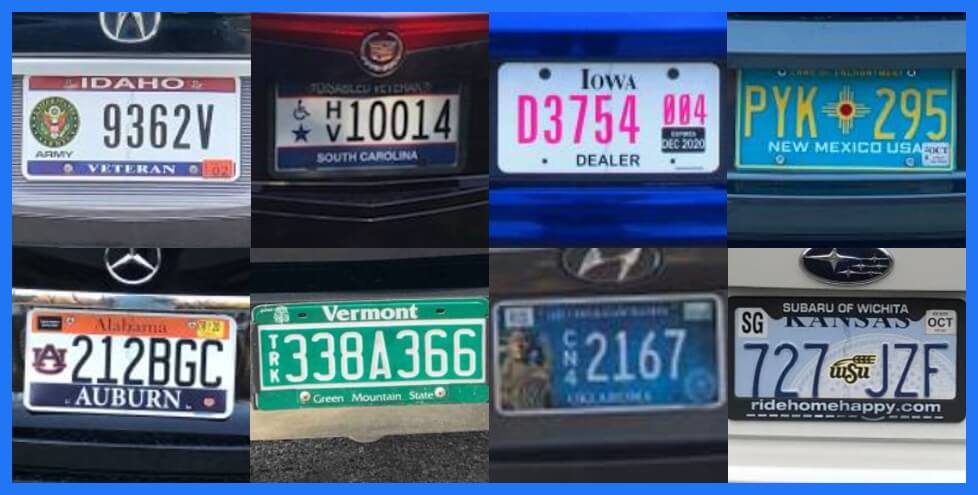
The result of surveillance on such a massive scale is itself a public safety threat. While the data on movements of such vehicular “fingerprints” are at extremely fine grain, they are preserved in a database that is stored to later identify cars near any protest, abortion clinic, or civil action–but constitutes a huge database of extremely close grain, but hardly encrypted or protected. Such a massive database of the movements of cars may be used to track individuals to expose them to robbery or security threats, and indeed the data stored in each camera is not only vulnerable, but the entire network poses questions of vulnerability that law enforcement never seems to have considered–as it has not considered the invasion of privacy posed by the mandate for scooping up all this data. On the first level of danger, the data is not be protected against ransomware attacks or hackers able to access the data by cyberattacks. At a smaller level, the streaming of data on LPRA The logic of assembling as much information as possible suggests a huge network of surveillance able to be used in other problems, while providing a rich resource that is not protected against vulnerabilities. While ALPR cameras have been criticized as themselves vulnerable to invasive hacking by criminal elements, the expansion of cameras in Washington, California, Texas, Oklahoma, Mississippi, Louisiana, Alabama, Florida, Ohio and Pennsylvania suggests a virtual dragnet of sorts that is being stored for future police work or investigation of police suspects. Yet it is also true that most of the data stored by ALPR cameras in Louisiana, California and Florida are at present connected unsecured to the internet, and are located on publicly accessible websites that if accessed might be used to manipulate the camera controls or siphon off the granular data.

Difficult license plate recognition USA

What can be done to protect the privacy of all the drivers of those cars who pass daily across ALPR cameras? An analysis of the metadata and data by the Electronic Frontier Foundation in 2021 found that up to at least 99.9% of this data is entirely not related to public safety threats when collected, the hope is to store a massive database in which criminal license plates can be tracked, mapped, and potentially employed to target future arrests or apprehensions, even if the data was taken from those who were never proven guilty–most of whom are entirely innocent–but whose cars might be tracked by anyone who obtained the raw data, either directly from the police forces or with other agencies and organizations with whom they are shared.  The avenues for harassment, stalking, and even kidnapping or extortion and blackmail are huge, if one wants to track the number of, say, wealthy individuals who would be tracked to a position that might compromise them based on data collected for public safety. The data assembled by law enforcement is is a crime waiting to happen.

If the feeds must have been unobtrusively mounted on traffic posts by the Berkeley Police Dept., at bout the same time, the open eyes of neighborhood surveillance linked to local police offered a new tech whose innovation has provided a new market for surveillance of cars, far beyond drugs, as the images of snapped license plates of cars, stolen or not, fills a nation-wide market for surveillance. If the cameras suggested a need for adult monitoring of the streets beside schools, however, or in border line neighborhoods, the market for clandestinely snapped up imagery has provided tools of mapping cars, traffic, and individual vehicles, as huge databanks that these cameras have generated provide a new form of big data for which endless new markets are being discovered–often without any knowledge of the owners of cars who happen to drive by vigilant cameras. We may soon need a set of signs, warning folks that their cars of vehicles may be fed into new information markets in ways that they little suspect, as license plate cameras have become significant intrusive tools on personal privacy.

The ACLU has explored the expansion of crude techniques used by the FBI in mapping American Communities–in a sort of darker side of the illuminating geography of data amassed in the US Census’ American Community Survey.  Much as Senator Jon Tester not that belatedly strove to balance his desire for “law enforcement agencies to use cutting-edge tools to catch criminals and protect our borders” with the appearance that such technologies “potentially violate the Fourth Amendment and represent a significant intrusion into the lives of thousands of Americans,” the ACLU has recently mapped a growing geography of surveilling that the FBI has created in recent years that include the very surveillance devices of dirtboxes which Senator Tester, who has quite staunchly supported citizens’ civil liberties, invited Jeh Jenson of the Homeland Security office and the Attorney General to take time to explain to the country.

Senator Tester’s belief that stricter oversight is needed stems from the “extreme lengths” to which federal agencies have so assiduously cloaked such programs in secrecy, his letter of request about the widespread use of dirtboxes that act as cellphone towers to intercept phone communications by both US Marshals and the US Drug Enforcement Agency may well have stemmed in part from the geography of a widespread surveillance program that the ACLU has started to map in the state of California, but which might reveal both the dissemination of military technologies of surveilling across the nation, and the local expansion of the new level of worldwide surveilling recently focussed on and directed mostly toward areas outside the territorial boundaries of the United States.  While we are waiting for Mssrs. Jeh and Holder to respond, the arrival of the scope of the mapping of residents of California–or even those traveling in the state–might well give pause if not raise expectations for the scope of what levels of individual surveilling will be revealed.  For the map of degrees of surveillance shows something of a microcosm of the extent of the expansion of surveilling ourselves of the very sort that Senator Tester was so rightly wary that he has promised to his best to publicize should it pose so clear a violation of the US Constitution as seems the case, in an attempt to place them under the oversight of both courts and the US Congress in order to restrict their use.

The maps of surveillance that the ACLU has taken upon themselves to provide is not only “cutting-edge” in its use of tools of surveillance but suggest the degree to which law enforcement agencies actively aspire to something along the lines of precognition of which groups might be likely to commit crimes in recent years–as if in a gambit for the foreknowledge Philip K. Dick imagined pre-cogs helping police apprehend criminals before they commit crimes in Minority Report,  but based not on the psychical foresight of “pre-cogs” so much as the statistical prediction of categories of probably cause of criminality or value of surveillance that runs against many of our legal traditions.  Such snooping for intelligence gathering recalls the sort of racial profiling former which Attorney General Eric Holder (quite rightly) once lent his voice to strongly oppose, following the 2003 DoJ “Guidance on Race”–yet which he incrementally allowed from 2008 for both national security and law enforcement alike.  Holder has hesitated to restrict or unmask such activities as an abusive expansion of surveillance over Americans.  And he has allowed investigation and surveillance of “behaviors” and “lifestyle characteristics” to be directed at American Muslim communities from New England to Northern California.

These activities have actually continued to expand dramatically over the past decade–including instances of the outright abuse of community outreach programs first initiated to build trust.  In a bizarre absorption of such outreach into the apparatus of a tentacular system of state surveillance, the monster seems to have been fed by the deep fears of the insufficiency of procuring further information,  and the need to gather it at all costs.  In ways that recall the suspension of individual human rights in the use of torture to obtain state secrets–but is directed to monitoring its populations, much as the extraction and mapping of such racial and ethnic data by the FBI’s Domestic Intelligence and Operations Guide (DIOG).

Such crude tools of mapping function by a pervasive sense and logic of invasiveness.  We are mapped in ways that lack even the logic or ethics one expects from a government service, it appears, as government services aim to create a sort of all-seeing eye for mapping populations, vacuuming up information in an almost paranoid manner.  ACLU’s Chris Soghoian has recently disclosed the existence of widespread surveillance program among US Marshalls across the state of California, including a fleet of airplanes flying from five metropolitan airports dedicated to collecting cell phone data and equipped with dirtboxes to do so–since 2007,  that parallel the NSA’s programs of surveillance, now known to be concentrated on the Southwestern border of the US by the DEAImmigration and Customs Agency, Homeland Security Agency, and FBI.

The degree of widespread and almost routine adoption of public surveillance systems by the government across the United States might be best understood as a sort of surveillance of the everyday, ranging from video surveillance, false cell phone towers, or facial recognition software that offer a range of tools to map populations to a degree never known.  The new nature of law enforcement mapping may suggest something like a desperation to agglomerate information, and a deep difficulty to hold back on abilities and technologies to extract information on individual whereabouts, and indeed to track persons where they could not be often seen.  The ability to map the invisible, and to try to intercept signals that move through the air, transcends whatever notions of mapping to which we might be habituated, cultivating new abilities of collating information that seem deeply intrusive.

spyfiles_marquee

ACLU

Techniques of mapping populations have grown in their intrusiveness far beyond the mapping of ethnicities, initially pioneered by men like Francis Amasa Walker, that offered a statistical visualization of the demand for more information than most maps can provide.  When Walker mapped the nation’s populations from 1873, as Secretary of the Census, he offered a way of reading national space in new ways for public ends as well, potentially, for the needs of the government.  The recent mapping of ethnicity and behavior has of course augmented in detail in order to track individuals’ spatial position over time, as well as to chart patterns of individual behavior.  The compilation of such an exhaustive map of spatial position has grown for reasons of security, but meets a increasing interest in reading maps of local populations at a level of detail and crude classification renders Walker’s tools of tabulating the composition of the population something of a precedent for enlisting new technologies of surveillance used to create the appearance of safety and quell  fears–although the forms of tracking, intelligence gathering, and remote sensing must have created a broad body of map-readers whose charge it is to interpret the massive range of data that is daily culled.

alker Legend

What has perhaps most radically changed is the studied intrusiveness with which such data is culled–and the precision of ongoing surveillance that it allows by a proxy army of drones. stingray tracking devices that mimic cell phone towers to capture identifying information, cameras of automatic license plate recognition and scanners of facial recognition systems to create a state of surveillance that we are only beginning to map.

The quantities of data that such tools amass is suggested by a survey of the layers of procuring information across the state, recently issued by the ACLU to draw attention to their amassing of data without public notice, which seems to complement the large-scale infiltration of Muslim communities.  But it goes beyond them, in suggesting a mapping project that monitors daily behaviors and to target individuals by a battery of technologies which abandon and depart from tools of rendering to collate data human minds could not visualize.  These technologies cannot but change how space is experienced–and perceived–even if we lack an image of the results that such surveilling will be able to produce, since the master-map will remain inaccessible to our eyes.

The government money that is directed to maintaining an intensive level of intrusive surveillance of the everyday across the state of California alone has been mapped by the ACLU in interactive form to allow comparisons between levels of surveillance that exist in California’s communities and fifty-eight counties.  The map was appositely issued together with both a community guide to resist intrusive surveillance technologies whose use has so dramatically expanded, oriented to different technologies currently used, and its initiation of a statewide campaign against abuses of intelligence gathering that use drones (used in three counties or cities), body cameras (used in thirty-two), tools of facial recognition (used in sixteen) or video surveillance (used in sixty-one–roughly half the number of cities and counties surveyed).

Video Surveillance in CA

Highcharts/US Census

That’s right, the cost of such surveilling of the state?  Quite a bit over $18 million.

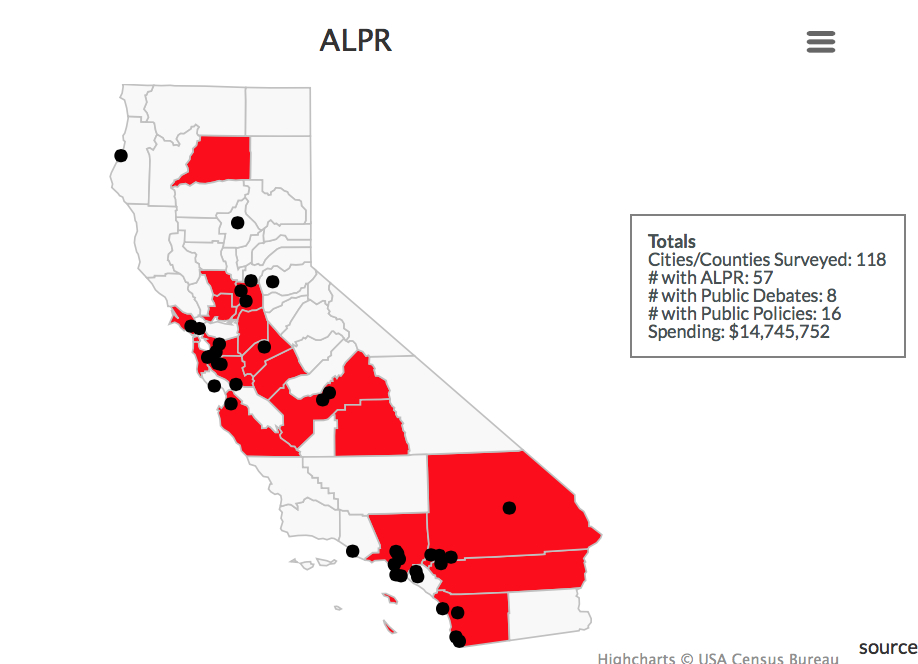
The number of states and counties using Automatic License Plate Recognition, a particularly invasive mode of monitoring populations on the road that comes at only a slightly lower cost, is similarly quite expansive (fifty-seven), suggesting the broad range of areas that are subject to surveillance in California’s largest cities and (interestingly) the Central Valley:

ALPRE

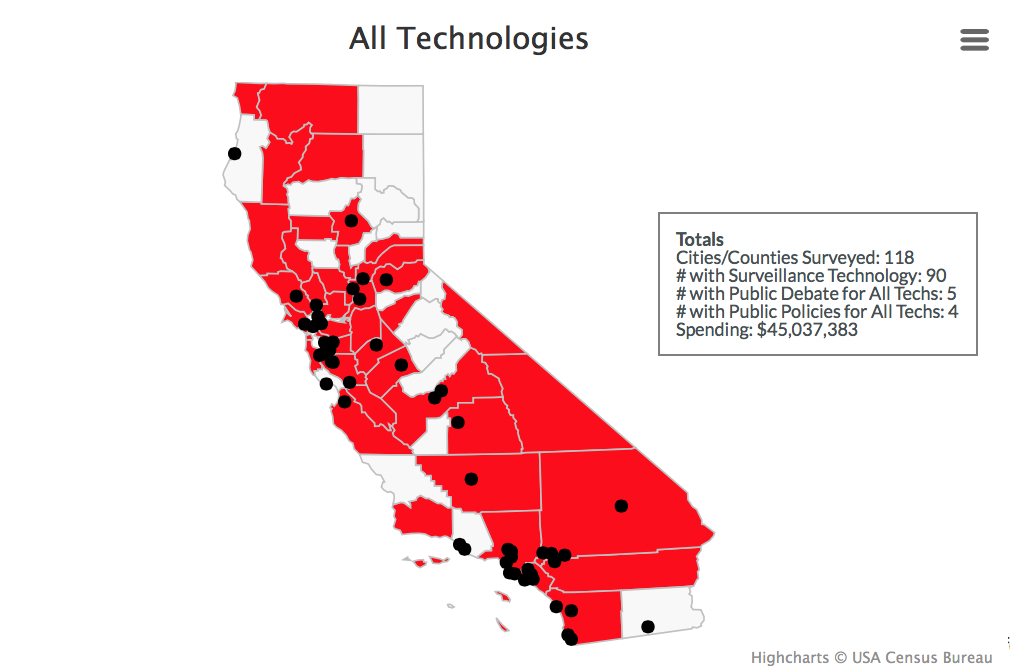
Grouping the technologies, Attorney General Kamala Harris, the state seems strikingly well covered for less than $50 million of your tax dollars:

Grouping the Technologies

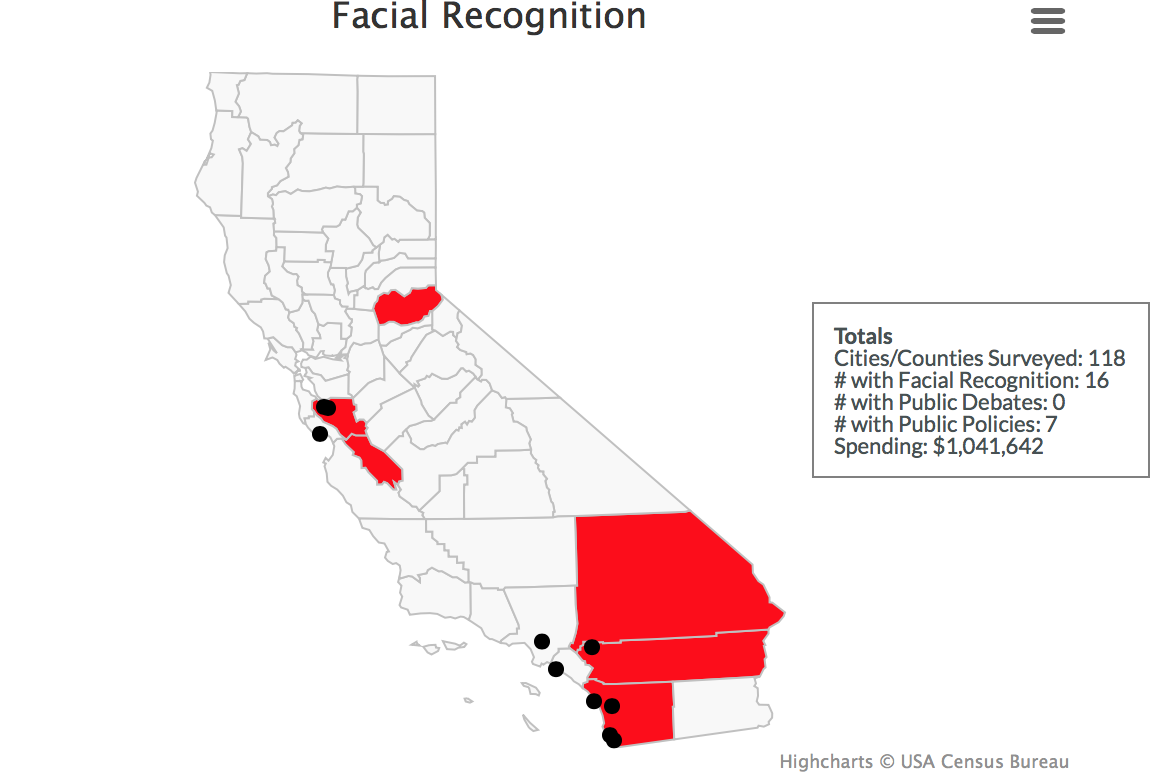
While Facial Recognition techniques are concentrated in mostly in the Southlands, it augurs a particularly invasive form of individual mapping, whose apparent concentration on questions of immigration may be destined to expand with time beyond the sixteen counties and cities where it is used currently.

Facial Recognition
Face Recognition--CNN

Although we have focussed on the technologies purchased by local police in Ferguson MI, we have done so perhaps ignored the spending spree on body cameras by local authorities across the nation.  Uncovering the considerable expenditure of some $64 million on mapping the whereabouts of potentially suspicious individuals poses a new level of government invasiveness across the state.

The ACLU has created a specially designed checklist for local governments and authorities across the country to consider, before adopting technology that we associate with the NSA.  Such advanced technologies, enlisted as useful without clear oversight practices having evolved or being instituted, or even with public notice being given, have been seem designed to create a comprehensive map that echoes, in microcosm, the state of surveillance we’ve been learning about increasingly this year.  Stingray technologies, able to track a person’s location based on cell-phone signals, are a high-precision level of mapping, already adopted in twelve counties or municipalities including by police in Oakland CA, are increasingly widely used by police throughout the United States in fifteen states, the adoption of which can be tracked interactively, if you are planning on Thanksgiving travels and would like to know.  (And it’s not only the government that is now in the business of using cellular interception technologies for the ends surveilling, we’ve been recently reminded, lest this sort of snooping only be understood as a top-down activity, rather than a widely available software for intercepting unencrypted calls long considered private by means of a radio scanner.)

Stingray USe

ACLU invites members and non-members alike to send email letters, with the subject line “Don’t Map Me or My Community,” to express their desire to help restrict such intelligence-gathering and mapping tools that are regularly based on practices of ethnic or racial profiling, and set new standards for invasiveness.  NSA has long been doing this sort of tracking worldwide, but the intrusive mapping of populations across the US has come home to roost.

google_cameras_inside

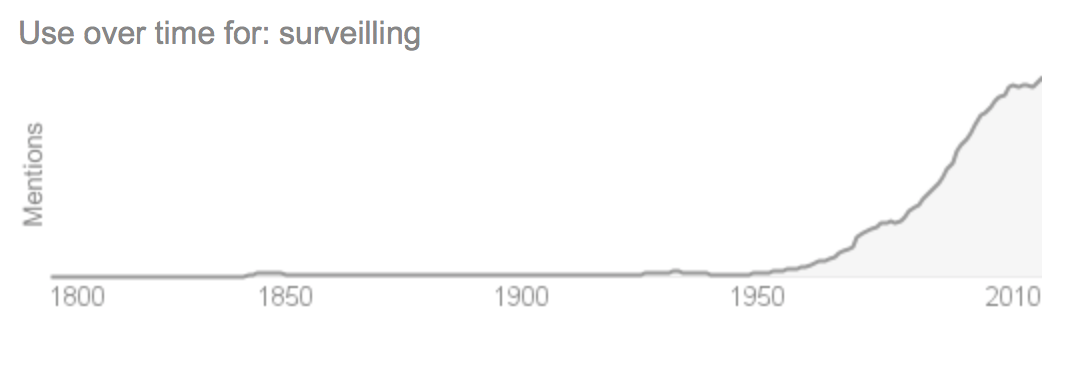
Surveilling is a backformation dating from the 1960’s from “surveillance.”  Its use has, however, unsurprisingly really taken off recently, even if it has crested from about 2000, as databanks of license plate information are sold on the open market. In may ways, the omniscient folks at Google let us know . . . and the question that this post might principally pose is just how much it is destined to further grow in common usage and in ubiquity in the physical world.

Surveilling

Increasingly, this is the State of the State, a growth of the postwar national security apparatus, perhaps, but a rapidly escalating compilation of tracking that has been normalized since 2000.

Leave a comment

Filed under Homeland Security, mapping public space, police surveillance, public safety, surveillance state

The New Separatism and the Gas-Tax Latitudinal Divide: Tracking the After-Images of Secession across the United States (Part III)

Mapping the nation gained wide currency as a way of performing national identity with the rise of the readily printed maps.  Outfits such as the U.S. Election Map Co. that were founded in the mid to late nineteenth century to provide readers a legible record of the nation.  Scribners was fortunate to be able to invest money in their appearance and legibility continued them in works such as the maps of presidential elections in Scribner’s Statistical Atlas in spectacularly modern form– including such maps as the masterful county-by-county survey that clarified results of the highly contested presidential election of 1880, where Republicans and Democrats divided around the contested question of the continuation of Reconstruction.  These images echo the statistical maps that applied the principles Francis Amasa Walker first developed in the 1874 Statistical Atlas to visualize varied spatial distributions from population density to wealth to ethnicities for the U.S. Government–“clothing the dry bones of statistics in flesh and blood,” so that, in Gannett’s words, “their study becomes a delight rather than a task.”
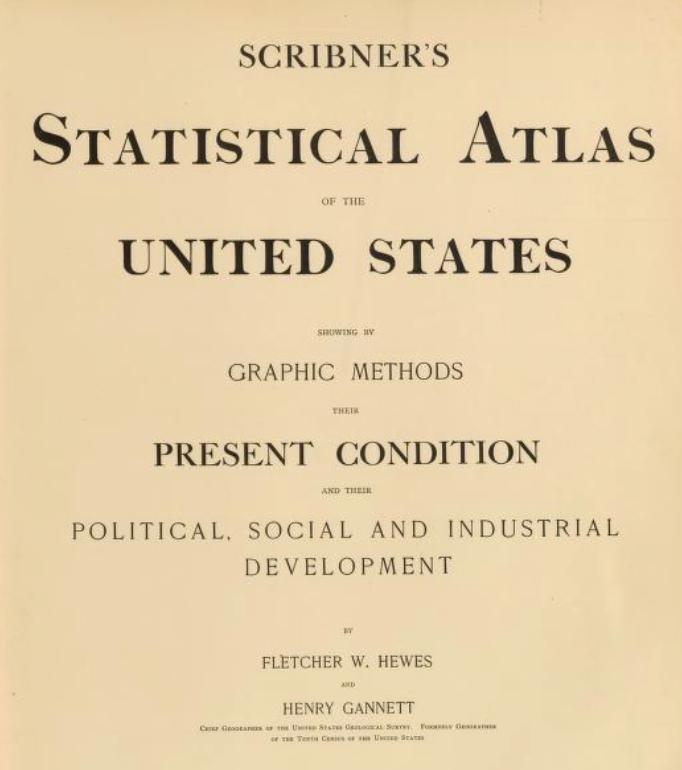
Statistical Atlas

The volume dedicated to Walker showed itself particularly sensitive to the possibilities of the visual delight of arranging information for viewers in data visualizations, using graphic tools developed with the German immigrant mapmaker Edwin Hergesheimer to wax poetical about the scope of visualize geographic variations as aids by which “not only the statistician and political theorist, but the masses of the people, who make public sentiment and shape public policy, may acquire that knowledge of the country . . . which is essential to intelligent and successful government.”  These sentiments–continuing those of Walker, but announcing the new purview of the info-graphic in a culture where maps had become, in Martin Bruckner‘s words, a new form of performing the nation that built upon increased geographic literacy to narrate national identity but one that extended dramatically beyond the role printed maps played in the eighteenth century.  In the aftermath of Civil War, the body of maps that Gannett and Hewes assembled provided nothing less than a new way to embody the nation in visual form.

Good government was the final endpoint of showing the deep divide in national consensus within the popular vote in his 1883 mapping the geographic distribution as a two-color breakdown or divide, and not suggesting the conundrum that the government must faced–or a sign of the lack of legitimacy of the government, and impossibility of governing well.  In showing a historical survey of not only the “physical features of the country” but “the succession of [political] parties and the ideas for which they existed,” Walker knew that Gannett’s map suggested the different divides revealed, and his pre-Tufteian precept that “simpler methods of illustration are, as a rule, more effective” to summarize and bring together the “leading facts” was done with “care . . . taken to avoid over-elaboration,” so that “by different shades of color, the maps are made to present a bird’s eye view of the various classes of facts, as related to area or population,” including political economy, church membership, mineral deposits, and electoral returns.  The notion that the reification of electoral returns constituted a map provided a new way of envisioning the polity that Walker saw as particularly profitable for mass-readership.  We’re now often the readers of info-graphics of far greater historical poverty, far more used to parse the political electorate of the country in ways that cast the viewer as the spectator to something approaching the naturalization of insurmountable divides.

1880 popular vote for HGLibrary of Congress

The new flatness of the divide is disquieting, if not false.  The maps in the Scribners’ innovative Statistical Atlas were the product of the adventurous tastes of newspaper and magazine editors who worked with new confidence to reach new numbers of readers, investing in graphics to appeal to a new eye and a new desire to envision the nation, in ways we have only begun to reach in the far flatter visualizations that we distribute online and even in print.  In the lavishly produced periodicals of post-Civil War America, multi-colored maps raised questions about the legibility of a unified national space.  They suggested fragility in the union from the government’s point of view.  But they challenged viewers to find how that unity might be read in a particularly engaging ways–as well as being preserved, and provide far more subtle texts–and statistical knives–than the pared-down infographics that appear so often on our handhelds and screens today.  In ways that suggest a new standard for the historical depth of the infographic, the map used statistical “facts” to embody the nation so that one can almost zoom in on its specific regions, in a manner that prefigure the apparently modern versatility the medium Google Maps, but that do so by exploiting its folio-sized dimensions as a canvas to read the nation’s populations.

In ways that graphically processed the tabulation of the popular vote that it lay at the reader’s fingertips, the map’s author, Henry Gannet, delved into the question of how clearly the divide between north and south actually mapped out onto the clear enclaves and redoubts of Republican partisanship that are located in Baton Rouge and the South Carolina coast, and much of Virginia and Texas, that challenged the dichotomic division between “northern” and “southern” states.  An antecedent to GIS, in Walker’s designs for the maps, the striking color scheme presented pockets of Democratic resistance with a clarity that made them pop out and immediately strike viewers’ eyes as a way to grasp the political topography of the country in especially modern ways, as if to map the meaning of its Republican consensus.  The map represents the heights of good design that the New York newspaper industry had pioneered after the Civil War, enriched by advertising and graphic design, even if it was designed by the statistician who helmed the United States Census in Washington.  Its pointed argument on the difficulty of taking the electoral map that resulted–shown as an inset–as a reflection of an actual divide raises questions about the current tendency to naturalize “Red” states versus “Blue” states, if it seems devised to answer questions about how the national fabric was rent by opposed divides during Reconstruction.

How the map, very much in the manner of contemporary graphics, came to synthesize political history in legible form by embodying them–Walker’s “flesh and blood”–seem premonitions of contemporary market for info-graphics.  But they were removed from the increasingly unavoidable divides that recent info-graphics suggest but seem designed to perpetuate, or the readily improvised graphics of the short-term that are consumed in made-for-television maps viewed largely in living rooms on television screens.  If the unified color blocks of much data visualization is sadly designed to discourage reading or interpretation, in ways that almost seem destined to limit our political vision for the future of the country, the opportunities that Gannett’s map allows to delve into the palimpsest of the popular vote might help to remove what seem blinders on our shared sense of the political process.  The market for the new info-graphic is quite distinct, and designed not for an Encyclopedia, but created for the short-term–and indeed valued as a short-term image of the contemporary with its own expiry date.

The needs of mapping an image national continuity were quite distinct, and might be profitably historicized in ways that would be foreign from the current market for or demand that info-graphics fill.  For the rationale for creating such a visualization of the popular vote’s distribution, if contemporary to a range of new maps for visualizing and processing the nation, gained pressing value after the Hayes-Tilden contest–as it would after the recent defining Presidential contest between Bush and Gore, or for the race between Obama and Romney–for their critical explanatory role to resolve the nation’s symbolic coherence.

The resemblance in the divide revealed in info graphics seems far deeper than political partisan allegiance, and the culture of this divide difficult to pinpoint–although the anti-Republican sentiment of the South was fierce in the election of 1880 seems a likely point to begin to map the local resistance to the continued presence of federal troops.  The divide between north and south echoes the division redrawn on Wikipedia between slave-states and free states circa 1849, and  enshrined in a latitudinal divide across the southwest of America in the so-called “Missouri Compromise”to permit slave-holding in the south and prevent its expansion to the north at the same time the country expanded–
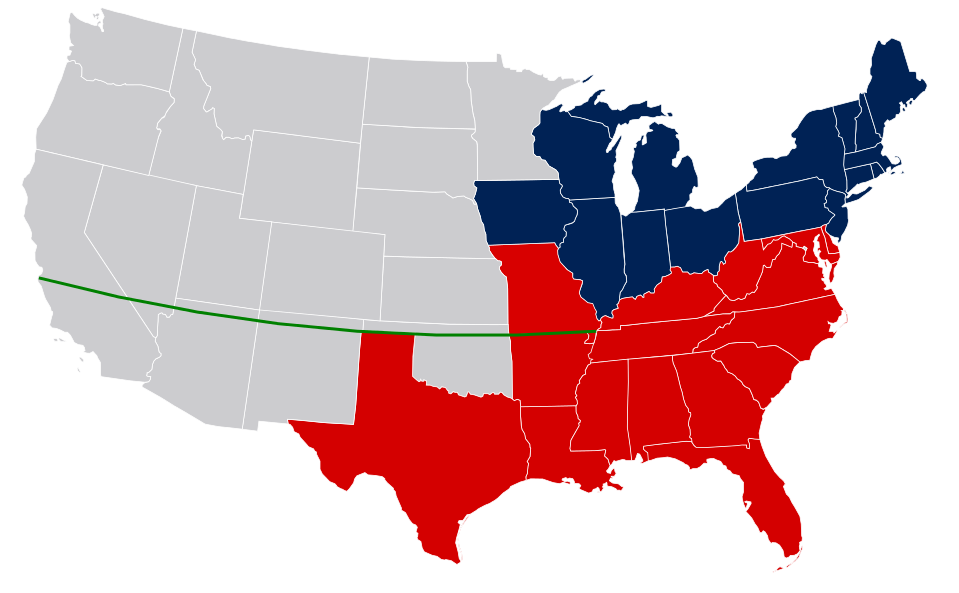
959px-Missouri_Compromise_Line.svg

Wikipedia Commons

–and seems to continue, almost but only somewhat humorously, in the  confidence with which the ex-KGB operative Igor Panarin in 1998 forecast the future fragmenting of the United States circa 2010 into four Divided States, in a somewhat silly graphic that transposed the fall of the Soviet Union in 1991 to the other side of the Atlantic.  Panarin’s image has gained currency as a meme of failed unwelcome futurology, describing the “Texas Republic” whose northern boundary recuperated the same latitudinal divide, and gained a new readership, ironically, among readers of the internet eager for new infographics to compress living history to paradigms, but suggest his own study of nineteenth-century history, as much as futurology:
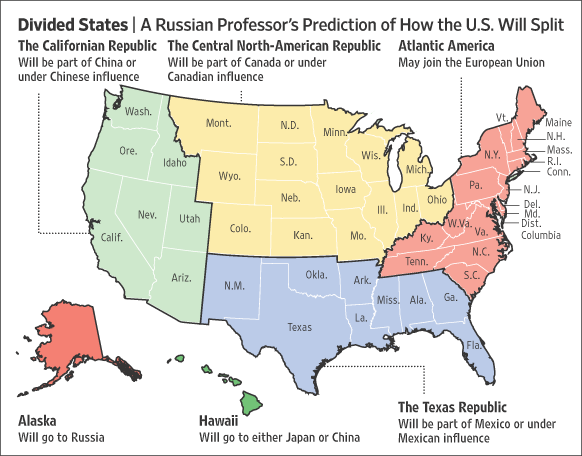
P1-AO116_RUSPRO_NS_20081228191715

And it raises questions about how we have begun to use and disseminate maps on the internet to stand as symbolic surrogates of the political divisions about which we’ve become increasingly concerned because of the worries they create about the continued smooth institutional functioning of representational democracy, and of the images we retain of how the popular vote can continue to translate into an effective Congress, rather than one dominated by gridlock.  (The ex-KGB agent’s prediction generated considerable interest in mapping the fracturing of the Republic along analogous regional divides in our own country, as the common practice of remapping cross-pollinated with GIS software and the rise of attention-getting maps.)

1.  GIS offers new modes to visualize statistical distributions and modeling national divides in the electorate, often warping actual geographical divides, in ways that have encouraged the increased role of the info graphic as a speech act.  The increased authority of picturing the nation in electoral maps have spun out from the night-time coverage of elections to remain burned in many of our cortices as evidence of a divided nation. As much as these colors have come to accentuate national divides, they create a differentiated landscape that the format of mapping seems to naturalize, and become a site that occasioned repeated glossing and interpretation for the evidence of national divisions that they appear to encode.  (Indeed, the sharing of two-color projections to forecast the outcome of the 2014 elections was both a cottage industry or diversion, so widespread was interest in adapting tools of forecasting to provide “flesh and blood” for making potentially compelling political predictions by slicing up the nation in different ways.)  Often seeming to evade the sort of issues that indeed continue to divide the United States, the widespread currency of such practices often perpetuate the very notion of a chasm of colored blocks as the best visual metaphor for the nation, in ways Walker and Gannett would find a remarkably different notion of a map.

Compelling translation of the popular to the electoral votes invoke the red v. blue divide in particularly graphic terms, and filled with a growth of a number of purple states that make the oppositional divide between Republicans and Democrats much less clean than it once was. (While the Republican party had long assumed the color blue in the nineteenth century, as the party of Lincoln, and blue was used to designate regions voting Republican the newscaster Tim Russert is credited with having first used the color-coding of the electoral choropleth to describe the prominence of the electoral divide in the United States presidential election of 2000 on a single episode of the Today show on October 30, 2000–although he denies having introduced the term as an opposition, and colored maps were long used to depict voter preferences in states.)  Back in the days of the innocence of 2000, the hues took hold to parse the nation with urgency during reporting about the results of that presidential election–and entered common parlance after the conclusion of the fourth presidential election in which the victor failed to win a plurality of the popular vote.

The apparent cleavage of the nation into two regions–more populace blue states with large electoral votes, and many red states with fewer, save Texas and the contested Florida, whose electors may have been erroneously awarded to Bush–and the map of a division of the states into what seemed a red “heartland” and blue periphery expressed a somewhat paradoxical national divide that appeared two different nations–or one nation of continuous red, framed by something of more densely populated blue.
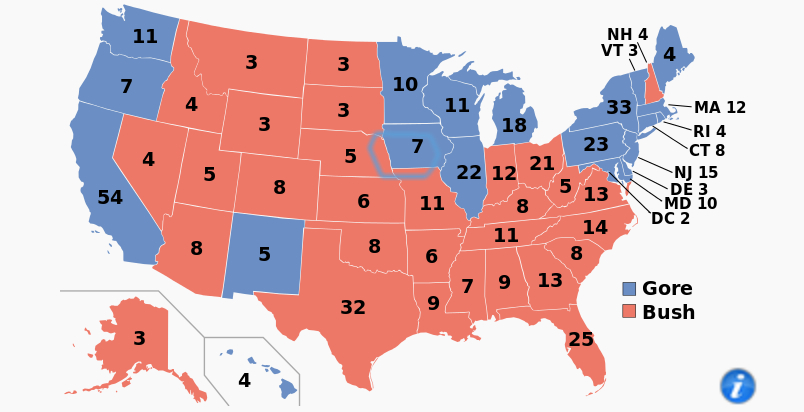
Bush v. Gore
The far more broader expanse of a sheet of uniform red, the color specific to the Republican party by 2000, drew a clear dichotomy drawn between Blue States versus Red States, that appeared less an emblem of sovereignty than of a deeply running national divide in a country whose political process had almost lost familiar geographical moorings: the familiar geographic map was warped by the outsized role of certain states in the electorate, and the consequent often disproportionate tussling over winning their electoral votes of “swing states.”

Unlike Henry Gannett’s statistical map, the image of a contiguous region of “Red States” in the above infographic seems to divide the union, as much as offering clues and cues to get one’s mind around a divided electorate. The below cartogram of the 2004 election warps the national territory to reflect the distribution of electoral votes in each state–and the mosaic of victory that the “red” states constituted in total electoral votes revealed several divides in the nation, or the hiving off of the northeast, west, and Great Lakes states from the majority–or, alternatively, the concentration of Democratic votes in dense pockets of urban areas–that reveals two republics, all the more evident from the continuity of the U-shaped red stretch of disquieting uniformity that emerged when the popular votes is translated to a map of electoral votes.
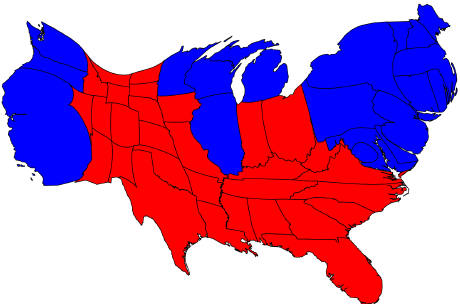
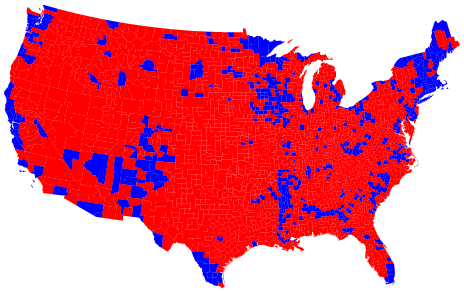
3-2004-electoralcollege-cartogram

4-2004-by-county

We have become especially accustomed to interpreting the contours of such national divides in the electorate with strategic urgency in the age of Obama, although the battle for electoral victory were more likely to be resolved in cartograms than the finely-grained county by county distributions that Gannett had devised. The appeal of cartograms lies in part in how they offered an apparent opportunity to gain clarity by the almost compulsive remapping of electoral votes to decode the alliance of victory in the 2010 election in two-color cartograms: warping the divide to suggest the dissonance of terrestrial continuity with electoral votes or money spent per voter, to suggest both an accentuation of its divides, as if to pose questions about the existence of continuity among the nation’s regions and states, and a deep divide that lay in the areas where campaigns devoted the greatest attention–and ask whether this skewing deriving from distorting electoral stakes bodes well for the democratic process.

The geographical distortions of infographics seem to clarify how electoral results run against the continuity of a terrestrial maps in similar terms. The representation of current electoral division have continued to aggravate the country’s continuity long after Obama’s two presidential elections: both electoral results have been often parsed across the country to explain the divide between red and blue states, especially in the 2012 election, as if to try to discover continuity a country that seems divided into blue states and stretches of bright red: and if, until 2000, both Time magazine and the Washington Post colored Democratic majorities in red, the opposing colors of red and blue have become an image of contested sovereignty, and of articulating regions’ political differences and divides. Rather than suggest generational continuities in political allegiance over space, the divide within the country reads more clearly in Gannett’s county-by-county census, but the proliferation of cartograms respond most effectively to the problem that “these maps lie,” morphing the fifty states into rescaled distributions.

Adam Cole doesn’t claim to argue that this reflects a bit of a crisis in democratic institutions, but one can’t but consider how the current gridlock in government may stem from its failure to adequately reflect the demographics of the country, or at least the economics of the Presidential election.  Despite increasing attention to the mobility of individuals outside “blue” states to other, formerly “red”-state regions, the divide was increasingly focussed on a diminution of red states, but a concentration of Republican majorities in the central regions of the country, lying largely below the Gas-Tax Latitudinal Divide–with some notable exceptions. Even if much of the country seems happily purple, the intensity of two triads of red states strikes one’s eyes immediately.

The United States, with state sized based on electoral votes.Adam Cole/NPR

(Such maps, of course, in their interest to provide info graphics that involve “purple” shadings of a mixture of blue and red may not take into account the neurological disposition of the eye to more readily read a purple state surrounded by a sea of red as red, and fail to distinguish the degrees of purple of a region as an intensity not independent from the spectrum of the colors of nearby states:  the interest in providing a more complexly qualified picture of variations in this map, introducing shades of “purple” to a map, if constructive in the abstract, according to Lawrence Weru creates misleading interpretations that rather than profit from such proportional blendings lead the purple region to appeal more blue or more red depending on the chromatic context where it appears.)

2.  The compelling nature of such cartograms no doubt the maps that express the views of political parties, and provide a basis for imagining the continuity in how campaigns dedicate attention to the nation. Despite their explicit warping of continuity, cartograms help get one’s mind around the nature of the apparent lack of continuity across the country, and understand the depth of electoral divides and to explain the country’s composition than the mapping of electoral votes onto spatial divisions on a map, if not to project the results in far more dynamic ways of translating the “map” to practices of political representation, as much as territorial manipulation. The cartogram seems to translate spatial divides into a system of political representation that fits imperfectly on a uniform mapped space or rendering of territorial expanse, and seems particularly compelling to analyze the way that the electoral process translates the nation’s geography into institutional terms.

The most telling translation of this political process is revealed in the warping of the nation by disproportionate expenditures per state, reflected by the distortion of electoral politics–and the nature of political divides. Parties have been compelled to devote disproportionate attention to individual states, out of sync with their electoral votes, but as a reflection of the calculus of receiving a majority in the electoral college. A compelling twist to the electoral cartograms parsed political parties’ relative expenditures in the most recent Presidential election as a distribution of funds in dollars spent per voter, grotesquely warping the scale of states in the country according to the political spending in millions of dollars–which keeps a lot of purple states, but suggests that one area of the nation has almost left the attention of either party, as if they were discounted as foregone by both parties–and received but a begrudged smidgen of millions of dollars from the GOP or Republican National Committee, so clearly were their political preferences already decided and minds just made up:

bbstates_custom-e0c6c871e5a185100d0be94271fba73c0a365998-s40-c85Adam Cole/NPR

An even more warped image of the republic is produced by warping the fifty states to reveal the disproportionate number of dollars spent per voter, in a warping which has the effect of shrinking the red states in much of the south and southwest to reveal the extent to which they are simply less the terrain in which recent elections were determined: one learns even more about the deep commitment of many of the voters in the southern states in the below graphic, reflecting the returns that each campaign had on the amount of money invested locally. The map reveals how little Romney even invested in the solid Republican voting base of the south, not seeing the need to disseminate the candidate’s message in states where he held such a clear advantage that they were conceded by the Democrats: it shows the relative inefficiency of Republican expenditures in New Hampshire, Iowa, and Nevada by an off-message candidate, and the balling amount spent on political media in each state from April 10 to October 10, in which many southern states are all but squeezed out of relevance, because their outcome remained–save North Carolina–something of a fait accompli, and absent from the volley of the barrage of ads that have only recently ended with mid-term elections of 2014:
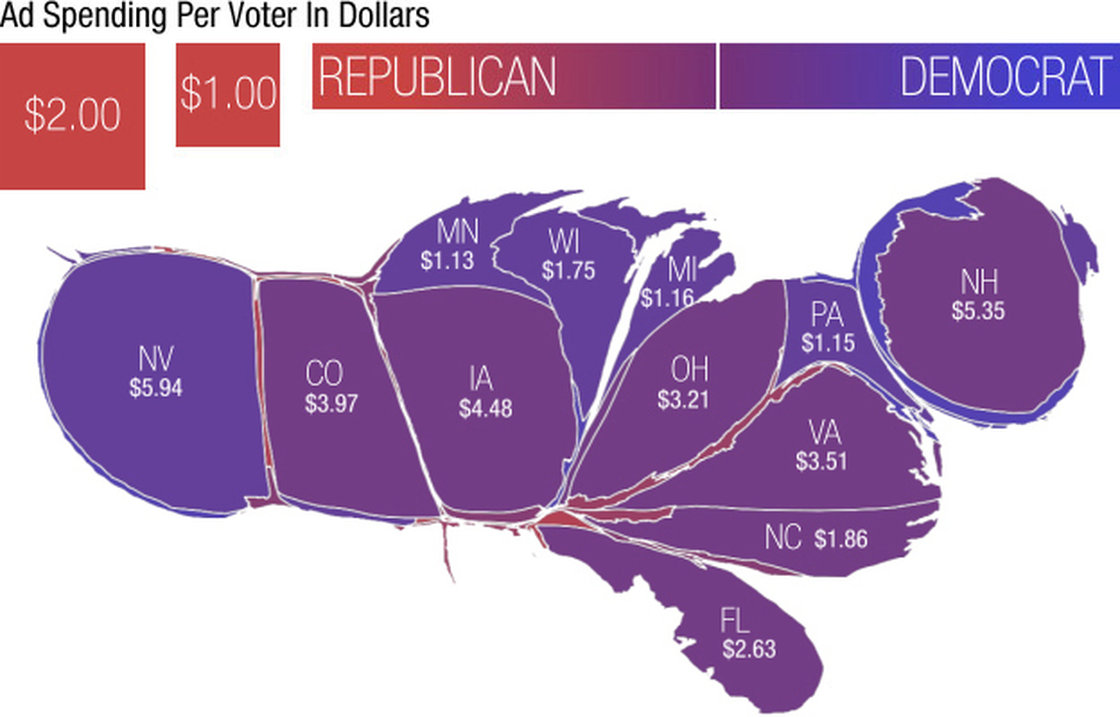
bbvoters_custom-0abd0dc8a4efa739c61d80b961226ae07e5b04ec-s40-c85-1

Adam Cole (NPR)/Kantor media data


It can’t be “fair” to absent a good portion of the country below a single line of latitude form the state of national political debate that on-air advertisements have to be considered as forming part. What does this mean for our Republic raises questions: but is this a form of secession itself, coming back to haunt the map of political parties’ distributions of their own expenditures? The cartogrammic shrinkage of the southern “red” states with those west of the Mississippi scarily suggests a region of the country has all but vanished from the contested regions of the electoral map, its electoral votes all but written off as a contest, and Texas shrunk to an unsightly narrow peninsula or appendage off the territories where political parties struggle: the geographic contraction of the areas below the thirty seventh parallel, which defines the “four corners” intersection of Utah, Colorado, Arizona, and New Mexico effectively privilege the more urban areas over the “exurban” southern states that were so much less of a contest or struggle for political attention.

The troubling depth of the division across the United States is less a mirror of the affiliation to different political parties, however, than they reflect different images of America that often reflect urban v. exurban perspectives–as in this topographical projection of peaks of population in the lower forty eight.
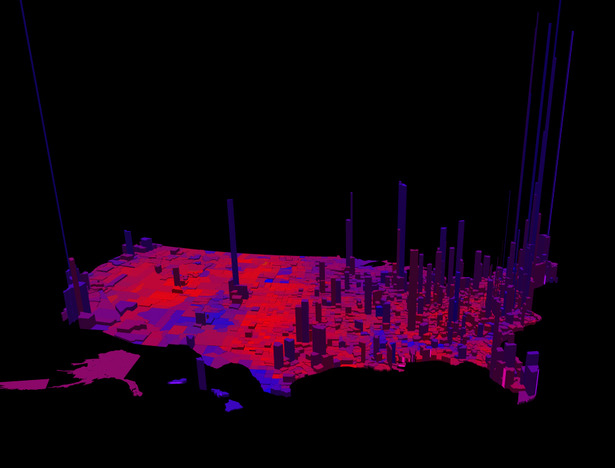
Blue v. Red Topo Raised

Presidential elections offer a major rush of disaggregated data that one can assemble in exciting ways, the inflow of data creates a flood of information that make it difficult to select specific criteria to foreground. One might find in the above sufficient grounds to interpret the growing chasm of political divisions in the nation as between states between those with large urban centers, and “exurban” areas of less density. The tendency to group states which tended to vote or lean Democratic–as New York, California, Florida, Ohio, Colorado, Wisconsin, Minnesota–apart from more exurban or rural areas, and to map the distrust of collective government as lying within exurban areas that lie at a spatial remove from social investments that seem compelling to areas of greater disparities of wealth that define cities–and the distance at which these “red” regions feel themselves as lying from urban areas or issues seem rendered compelling against social density.

Blue v. Red Topo Raised

3.  However tempting it is to parse the differences among the electorate’s behavior in the Obama and Romney’s contest as a mirror of deep cultural divides that seem geographically determined, this quite unsatisfactorily poses the question of how likely they can be ever bridged. Such a reinterpretation is compelling precisely because it pays less attention to the “after-image” of secession, and reveals a new political landscape of the nation, rooted in population changes. The divides between the urbanized and unorganized, or “exurban,” also reveal deep attitudes to the nature of national space, and the role of government in space–which this post wants to suggest we examine as an underlying map of voting preferences, but that can’t be revealed by voting preferences and electoral returns.

The differences between voting preferences across the nation lie not only in terms of relative urbanization, but attitudes to the economics of moving through space difficult to quantifiably map, but all to evident on the map. For in ways that define a cultural continuity that is hardly rooted in the physical land, the map embodies a divide, similar to the Gannett map, of the role of government in one’s life, and the presence of the government in economic activities, as well as the prominence of a consensus on social welfare needs.

Parsing the election of 2012 in another way by democratic v. republican gains per county, one might note the  Democratic electoral gains are strikingly concentrated in urban areas, while Republican gains dominate the exurbs that are red–a distinction that clearly correlates to driving practices and willingness to tolerate more highly priced taxes for gas–and the Republican gains group together in clear clusters and runs, predominantly in the inland central southern states and inland northwest.  This data visualization eerily reifies the very divides that Gannett’s almost hundred-and-thirty-year-old visualization of polarized voting preferences first set forth:

Net_Change_MapDavid Jarman/Daily Chose

What can explain this shift across such a firmly defined latitudinal divide, which seems a crease across the country, as well as a refusal to hamper what is taken as the inalienable right to keep low the cost of free access to take a seat behind the wheel?

4. The data used to parse these moderns electoral maps are invested with significance, but may not reveal clear “after-images” of earlier landscapes precisely because the priorities of parties have so dramatically shifted, and the range of issues addressed in the political landscape have left it to be polarized in ways that have far less to do with the polarization over issues such as, say, Reconstruction of the south. Despite the greater amounts of data that presidential elections offer to parse a picture of the country, local legislative institutions provide just as significant a “map” of the traces of autonomy from national standards. The mapping of levels of gas taxes was meant to register the affront of impeding open access to the cheapest mileage. But the map of the distribution of gas taxes in the United States may say much more.

Exxon Mobil’s blogger Ken Cohen boasted that the map “explains a lot”, as a suggests clear division in local variations from the federal gas tax that exist across the country as if to show the inequalities in how local, state, and city taxes collect from forty to sixty cents per gallon–creating an inequality of cost that is itself far beyond the total federal tax imposed of 18.4 cents a gallon, creating unwarranted variations in the costs that drivers payed at the pump across the land able to be examined in greater detail at an interactive version of a map of the United States which displays the relative divisions of taxes by hovering over localities.

The differences in regions’ relative acceptance of gas taxes may indicate less the toleration of government’s invasiveness, but instead a huge shift in attitudes to space extending across exurban areas. The acceptance of a gas tax–or its ‘toleration’–reveals tendencies to reject as invasive the presence of government–and throw into almost topographical relief a considerably deep division within the local legislatures responsible to voters and local opinion. In ways that seems mirrored with surprising clarity in the below distributions of local “toleration” of taxes on gas–a sensitive barometer of regional autonomy, if one hardly comparable to the withdrawal of federal troops–the nation seems starkly divided that reveals difficulties of arriving on national consensus of its own, if on a topic of apparently less dramatic significance. If such taxes can be described as imposed by the government, the tax might be best construed not only on the toleration of taxes, but consensus if not agreement as to its collective benefits of something akin to a value-added tax. Indeed, the political divide in the country seem to have instantiated a divide along roughly the thirty-seventh parallel that reflect distinct national priorities, allowing the American Petroleum Institute to describe the disparities of the taxation on petroleum as if it described an unwarranted degree of government–state or federal–interference in the average American’s access to a full tank of gas.

A surprising divide emerged in this far more simple visualization, whose divides may parse different attitude to the economics of occupying space, based on states’ relative willingness to accept and tolerate taxes on gasoline, as much as chart the unfair nature of differences in how costs are deferred to drivers at the pump. The admittedly interested map makes its point about the uneven national “gas tax burden” along the thirty-seventh parallel, foregrounding a deep divide in refusing the role of local or regional government in daily life. Rather than reflect a distribution of draconian levels of taxation on gas, the map charts consensus to accept levels of an additional gas tax. While it does not perfectly translate into electoral preferences, it reveals a deep divide across the country that seems to fold the populace in ways perhaps not basically political,so much as in the degree to which each state’s populace would accept or suffer additional taxes as a means to meet public needs: it almost seems as if the reluctance to sanction the sort of imposition of taxes at the gas pump was seen as an analogous affront to regional honor.
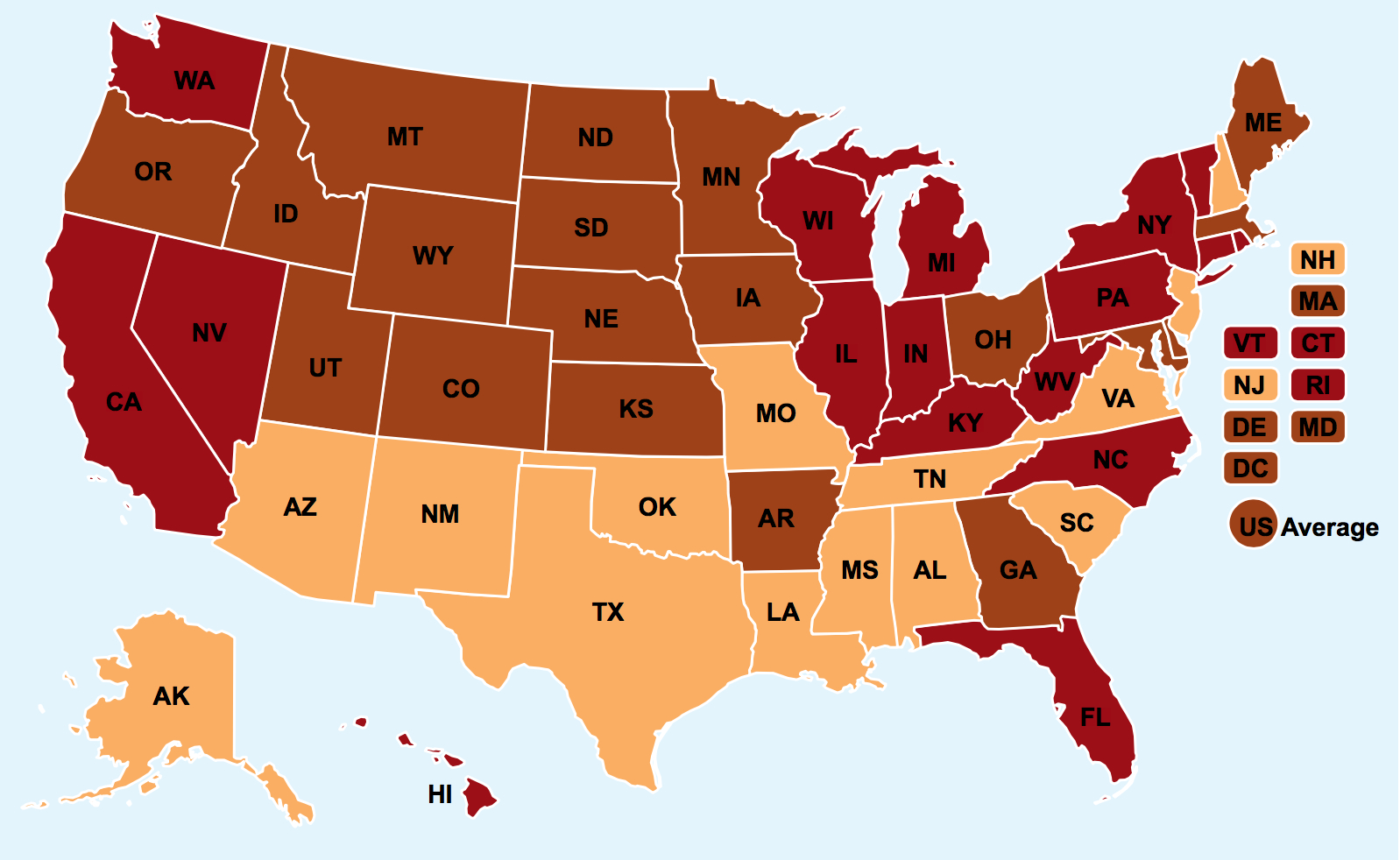
Gas Tax

gas key

Thanks to the appearance of a map that first appeared on ExxonMobil’s “Perspectives” blog, we have a useful way to parse the spectrum of the country’s attitude to government–and to the involvement of government in regional differences to the economics of moving through space. For the refusal to raise taxes across the southern states-and indeed the apparent rejection of most anyone with a foot below the thirty-seventh parallel, almost carve the country into two halves, with the exception of Virginia, North Carolina, Georgia and Arkansas. It is striking that a cartoon that carves the country, or lower forty-eight, into a map that approximates the polemic division of wealth in the US by which Susan Ohanian assigned that very same region the 90%.  Her map echoes the divide, her cartographic take on the lower 48 assigning the the lower 90% percent of American wage-earners the region lying below the latitudinal divide, echoing the association of the region with a far less developed social infrastructure than either the east or west coast or to the north–only somewhat subliminally and slightly nastily pointing out the shifting per capital income across the land:
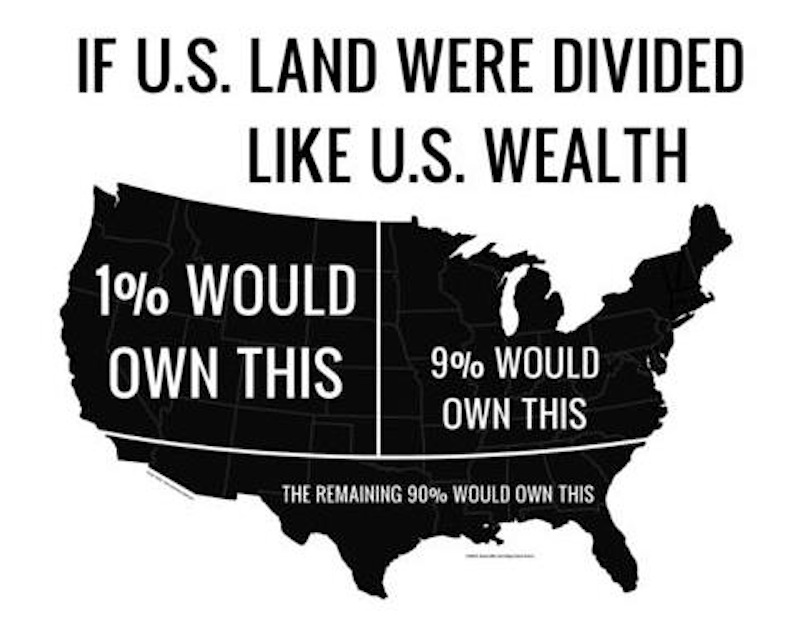
WealthMap

The divide that perpetuates lower gas taxes–or the “tax burden” on how freely gasoline flows at the pump–maps nicely onto a region with markedly less public transportation and transit.  The very same states’ governors, from New Jersey to to Florida, made something of a pact with the Devil to tank interconnected high-speed rail corridors proposed by President Obama, who championed alternative transit routes early in his presidency in hopes to rebuild a decayed infrastructure. If creating such corridors could have both encouraged local job growth and economic stimulus–as well as setting the basis for future economic growth–the refusal of and Scott Walker, that reflect the largely “exurbanite” populations of red states in exurbs. (Low gas prices serve to compensate for poor transit systems, and work to discourage their use, reducing demand:  only one top-ten rated US transit systems lie in the states–Austin–although a ranking meeting local “transit” is unclear, given that transit needs are by definition locally specific, and difficult to quantify.)  They are now a thing of the past, and Exxon-Mobil seems to turn its sights to the gasoline taxes that might enable their construction in the rest of the country–as if the lack of attention to the public good might be the new norm we could all be so fortunate to possess.

The two-color new flatness of the info-graphic seems complicit in how we perpetuate this view.

5.  What appears to perform a regional consensus exists may in fact register the primacy of accessibility to highway driving, or access to ‘automotive freedom’ in a region.  For it seems that the degree to which the individual right to drive through space is accepted as inalienable, or not having any possible contradiction with the public interest, in ways that might have much to do with the tanking of public projects for planned high-speed rail in some coastal corridors, if not an animosity to the project of expanding choices in public transit Obama long ago sought to enact–but whose projected corridors in the south were resisted and never completed.

high-speed-rail

The absence of transit corridors has led to the growth of private taxi-like shuttles for patients in areas where ambulance carriers cover wide areas without clear transit corridors.
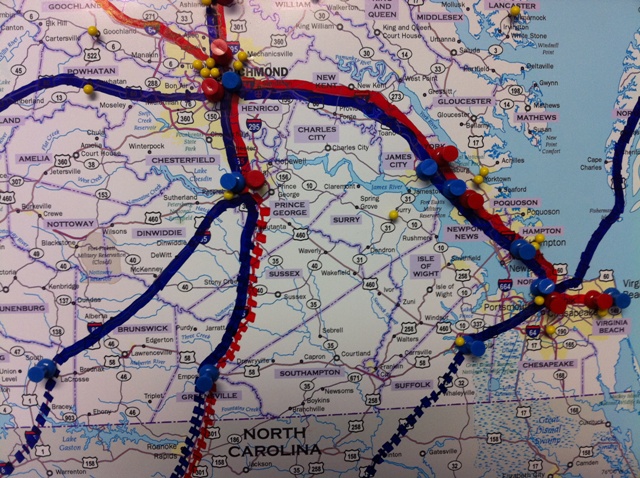
IMG_0201

Did the recent resistance to enacting such corridors of transit help to intensify the sort of divide we can witness in Ken Cohen’s Gas-Tax map? The 2009 Stimulus Package was intended to include a planned Southeast High Speed Rail Corridor, designed to change transit’s playing field in the South and Gulf Coast.
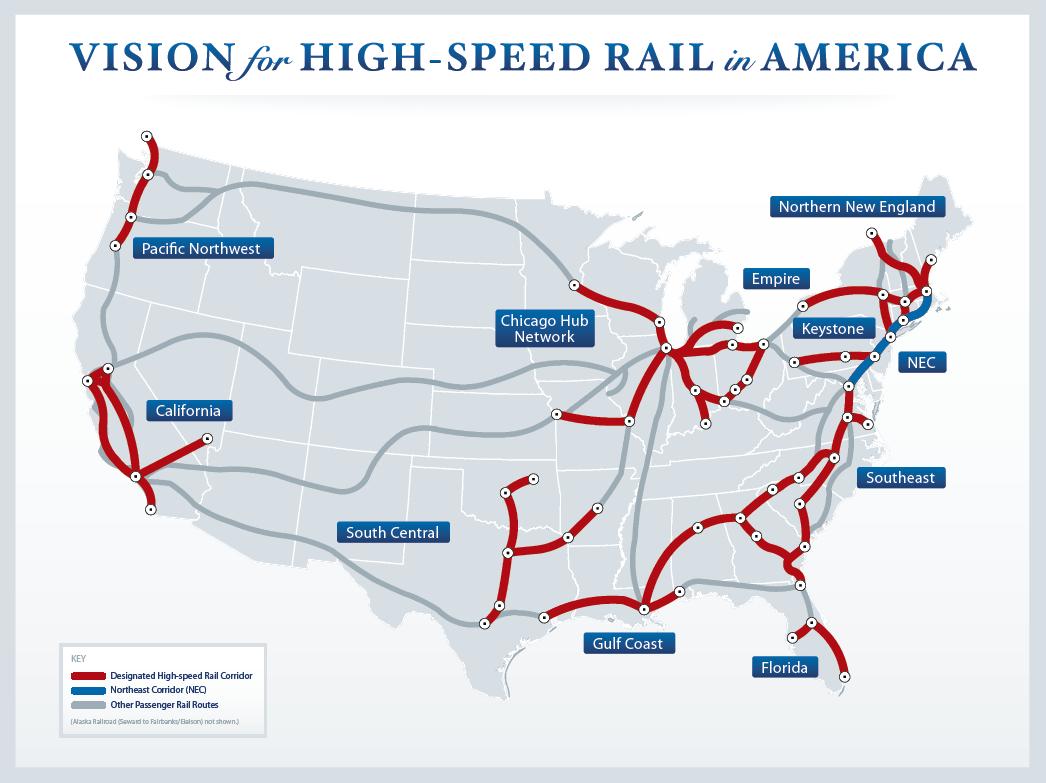
High_Speed_Rail_07-09-2009

Such plans were already, of course, in the works since 2002, in the Bush Administration.  But their defeat, in no small part due to the apparently lesser geographic population density, was encouraged by the perception of a national divide of transit needs.
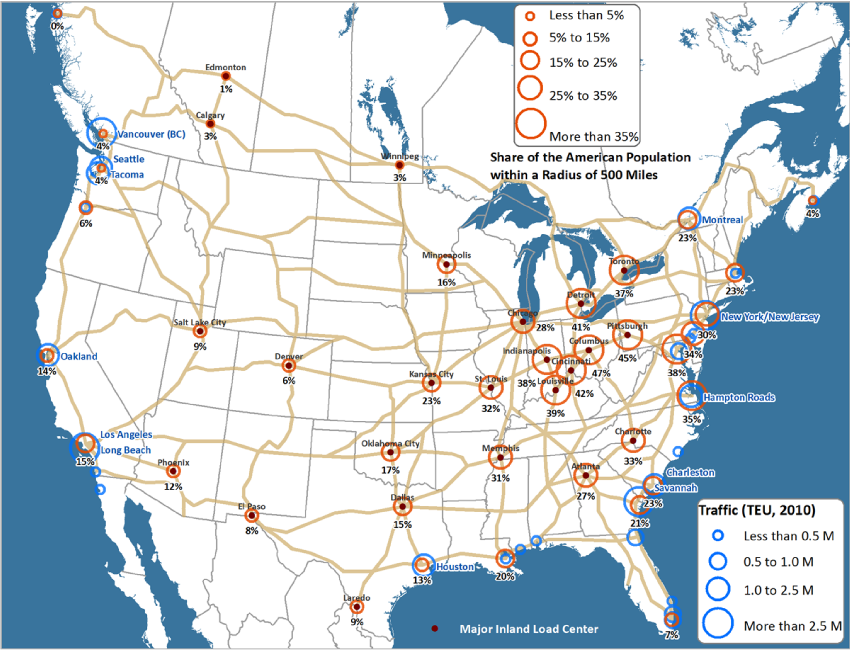
NA_market_500_miles

It prevented greater integration of a North American landbridge in much of the South, to supplement the lack of a crucial lattice of corridors of highway integration.
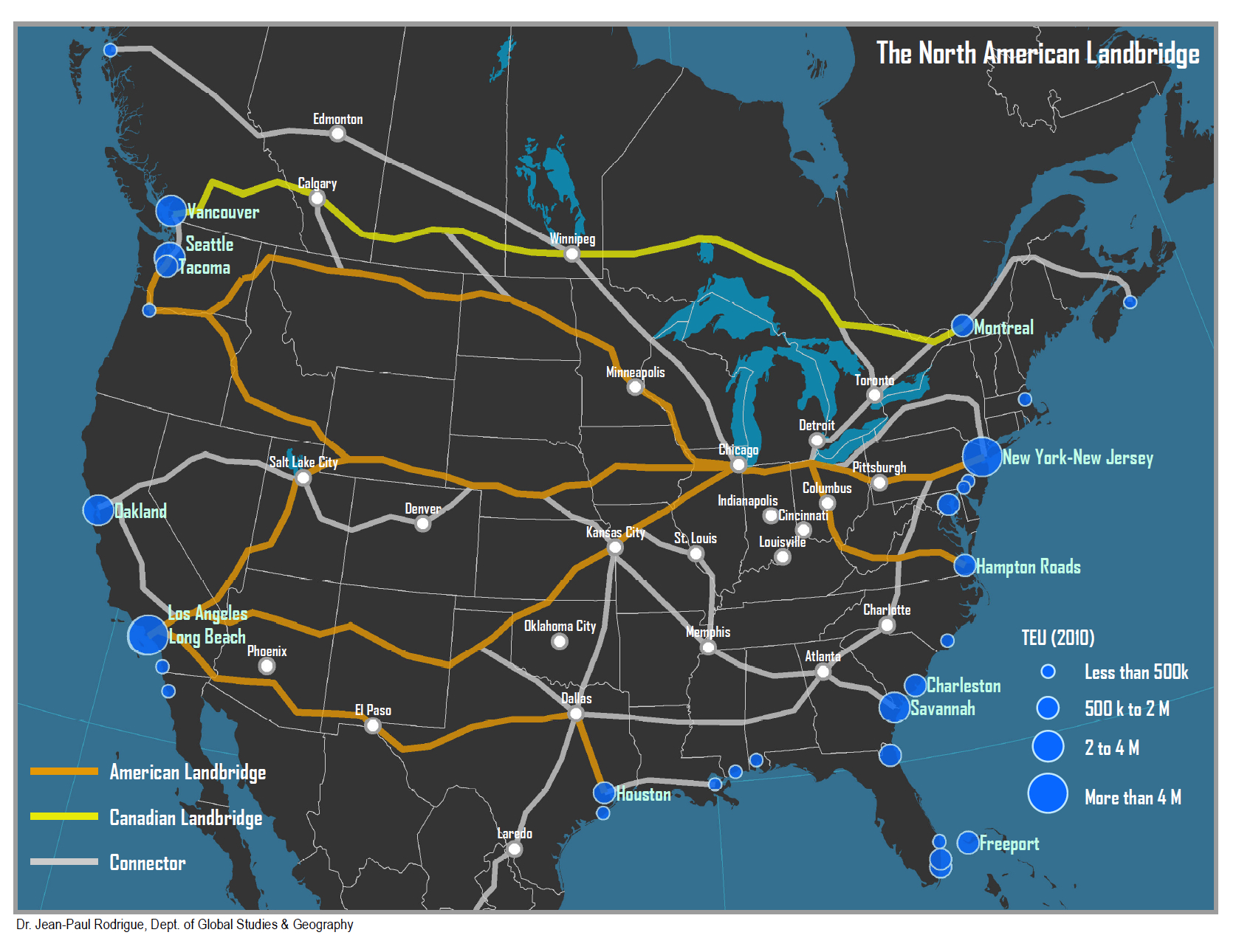
Landbridge

6.  We can make inferences about the lack of success of such transit programs, in part thanks to the consolidation of local, state, and federal taxes on gasoline provided by the American Petroleum Institute.  If the map derives from varying forms of taxation passed on at the pump, including local costs of fuel-blending that increase the costs of refining, a national divide to throw into relief of tolerating the imposition of an additional gas tax. While the map does not track the prices in taxes paid at the pump, and the cost for gasoline reveals considerable geographic variation by market and supply, the API plotted the total “fuel-tax burden” in a national map that reveals more about a national latitudinal divide than they had intended: the clear color scheme suggests that the 37th parallel creates a cliff in ‘superadded’ gas costs–and augments the sense of this divide by placing Alaska beside Texas–some fifteen cents below the national average in the U.S.  It mirrors the regions worst served by public transit in the US, to judge by the concentration of workers who relied on public transit for their commutes circa 2008.
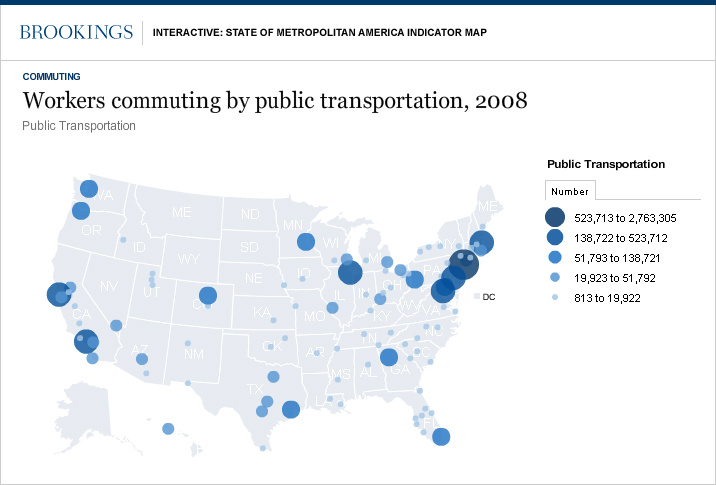
6a00d83454714d69e20133f2536560970b-800wi

The missing information from other maps may suggest a quite grounded rationale for the absence of accepting taxes on gasoline:  not only the reluctance to accept taxes, given the reliance on automotive travel as a primary means of transit and transport, but the absence of a network of public transit that would provide an incentive and rationale for the readiness to accept a tax on gasoline in exchange for other public benefits.

Seen another way, one can link the sense of spatial movement in the region of significantly decreased gas taxation on the rise of a single-driver culture of access to roads, rather than public transit–a trend that Streetsblog found to correlate not only to more restricted and curtailed transport choices, with little but circumstantial basis (and in a pretty cheap shot), to national obesity trends across the nation:
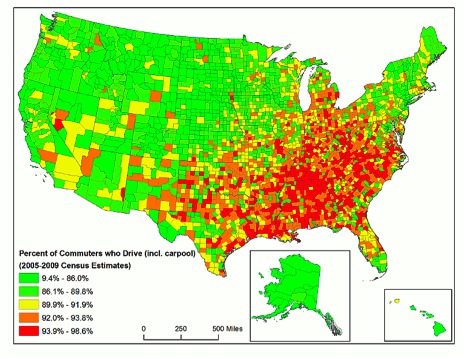
map_3

7.  Although the flatness of infographics oddly seems to obstruct further inquiry into the distribution it reveals, the differences in how the land is habited suggests divides that are difficult to surmount, and by no means only political in origin.  While it might be seen as leading many to move south for cheaper gas, the consequent lowering of the perceived “fuel-tax burden” to below forty cents per gallon–sometimes by as much as five cents/gallon–across state lines indicates a refusal to let the government interpose themselves between driver and pedal, or pump and tank. It suggests a shifting sense of taxation structures and investment of local priorities of dedicated tax revenue that strikingly mirrors the very regions at the presence of government in local life, but is often tarred as yet another instance of the invasive nature of government’s presence in public life.

The map echoes the more prominent manifestation of local resistance to the apparent federal invasiveness long mandated by the Department of Justice’s “oversight” of enacting changes in local electoral laws, based on historical presence of policies deemed discriminatory, first enacted in the 1965 Voting Rights Act.  Under the logic of the autonomy of “states’ rights,” such “pre clearance” was abolished, although an  alternative proposal the issue of “pre clearance” was framed as triggered by successive voting rights violations in four states–Texas; Georgia; Louisiana; and Mississippi–rather than fifteen. The VRA’s original provisions, widely deemed “for half a century the most effective protection of minority voting rights,” or fourth article, was approved as recently as 2006 by the US Congress. But widespread resistance to the federal policy grew with keen regional separatism among many of the same “southern” states, or the configuration of the South–minus Florida, North Carolina and Arkansas, with the addition of Arizona and Alaska–who pushed back against oversight of changes to voting laws as redistricting or Voter ID as undue interference as local policies–even as the ability of entrusting states to develop their own policies of redistricting has been recently open to challenge in Mississippi and, in Alabama, for the rigid use of explicitly racial quotas, echoing early charges of partisan gerrymandering in Texas–but raising questions of how much race or partisanship is at stake.

Areas Covered by VRA-and additionsAreas Covered by VRA-and additions

These coincidence between these maps isn’t entirely coincidental. Indeed, one is struck by the striking “family resemblance” to the infographics we use to represent the nation’s complex composition in a map.

8. How much are we overly habituated to visualize a divide that we seem to have a difficulty looking outside its two-color classification?  It bears remark that the afterimage of secession is rehearsed in quite rhetorical manners to raise the specter of national dissolution–by now imprinted on the collective consciousness–if expanded to include a few ‘swing states’ to suggest the recent expansion of the “old South.”

It’s ironic that the iconic image of secession is rehearsed in maps imagining secession from paper currency, which employ strikingly similar visualizations to forecast a coming shift in monetary policy and practice that would be brought by BitCoin. Although its eye-grabbing vision of secession is deceptive, the below “hoax”-map distributes thirty-six cities in twenty states where one can pay bills in Bitcoin as if they were poised to “dump” paper currency, or abandon the US dollar and withdraw from the closest to a common convention to which all fifty states adhere: the map of secession–perhaps based on states that have accepted applications for exchanges in the digital currency that originated on the Deep Web on the TOR browsing network and on hidden sites of illicit exchange as the Silk Road–is of course not an actual map of secession.  But it is designed to pose as a visualization of “the rebellion [in currency] that quickly spread to main street America” with antecedents in a system of currency devised by Thomas Edison, which would immediately provide financial returns as it replaced the dollar, as if it recaptured the past stability of a lost gold standard in the face of the fluctuation of value of American currency.  Lack of internal differentiation in the below of urban and non-urban areas in the below perpetuates an image of legal secession of states that are shown by big monochrome color blocks that seems to prey on viewers’ eyes by its introduction of a familiar dividing line.

The mapping of monetary secession, launched by Money Morning–Your Daily Map to Financial Freedom and diffused to alarm viewers on sites such as http://www.endofamerica.com, is not really explained carefully, and seems to lack its own legend but was intended to depict a collective rejection of paper money as if the “red states” were wise to a growing financial trend. In this barely disguised desperate push for Bitcoin digital currency–“now accepted by dentists in Finland!“–the data vis stokes fear in the survival of paper money in America, and a specter of monetary separatism, echoing fears of dismantling the remaining monetary union of the United States by the rejection of a federal currency–extending a language of states’ rights by its rather preposterous design of a fanciful future national fracturing as some states dispense altogether with paper money:  states once divided by the institution of slavery now seem divided by farce. (How maps mislead: California is colored red, due to the fact that one city, Menlo Park, has moved in such a direction, not the entire state–and cities elided with states.)
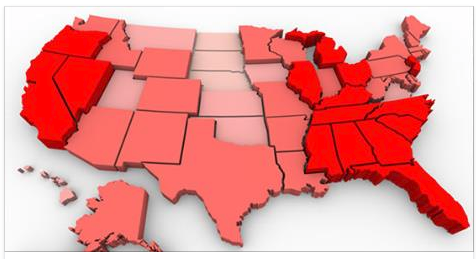
20states-red

The afterimage of secession is here, rather improbably, immediately recognizable, but raises a recognizable specter in monetary terms, stoking fears of a new national disillusion that has emerged along sharp lines. One doesn’t usually imagine the digital divide to include the majority of states in the deep South–if in ways that address the viewer who is tried to be wooed to Bitcoin, rather than an offer an image of the nations health. But if the map is a bit of a hoax, the use of something like a secessionary map to depict the rejection of paper money that the U.S. Government has unwisely continued to sanction cannot be much of a coincidence. The cities that push for the ejection of paper money were not by all means concentrated in the southern states, according to the map–which stages a hoax, but one that also reveals the country as broken into two halves by the abandoning of paper money which actually maps the sites of companies that will pay salaries in non-paper Bitcoin.

The recurrence of the very same fold across the nation’s center, roughly along a latitudinal divide to scare viewers–with California added in for good measure, based on the city of Menlo Park.
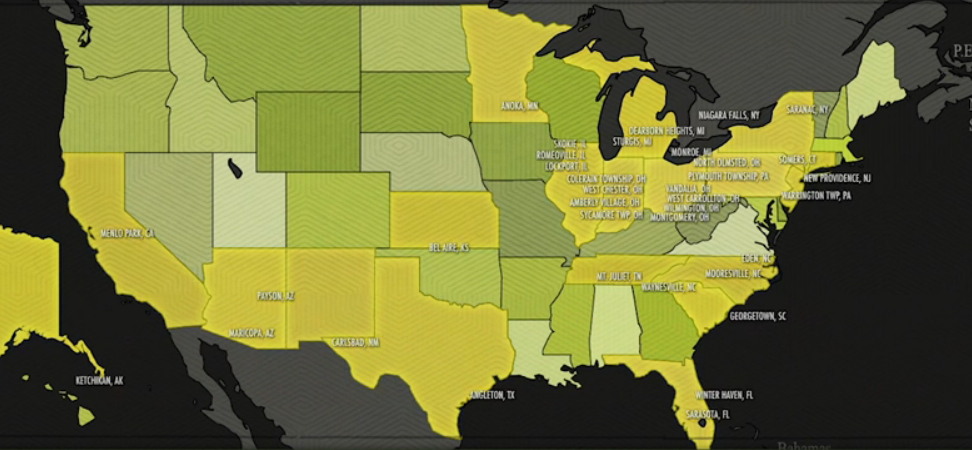
US broken by Bitcoin

Although a hoax, the “map” of the impending abandonment of paper currency shows a fracturing of the nation along the lines of the adoption of Bitcoin.  If it echoes the abandonment of the gold standard as a monetary system–or the amount of silver used in dollar coins and actual currency, the map is most striking for breaking down the divisions in the  nation in a state-by-state way that has particular power as it is so often used in political visualizations of electoral returns.  What else might explain the persuasive power of this meme of national division?  The status of Oklahoma, a familiar icon of frontier freedom, shows it has  recently moved to move away from paper currency to accept, with bipartisan support, gold and silver as currency.  The rejection of a common federal paper currency seems the ultimate standard of secession, echoing the dismay at the abandonment of the gold standard or the withdrawal from a cash-based economy.

An eery footnote to this atlas of symbolizing the nation is the proximity with which the map mirrors (or maybe recycles) the Democratic vote in 1880–although it stretches some credibility to imagine the former constellation of seceding states on the cutting edge of accepting Bitcoin.  It is tempting to universalize or essential the latitudinal divide that recurs in these maps, but makes sense to cast the region’s apparent distancing from majoritarian consensus as not only something of a different economic culture, but a different culture of moving through and occupying space.  The confounding of that culture with independence within the states’ rights movement–and deep distrust of federal government–existed long before Obama’s election.

Viewed through special lenses, alert to the after-image of secession, each of the maps define variations in the continuity of a cultural divide phrased as a reaction to the absence of continuity that was registered in Gannett’s earlier 1883 info-graphic–but that now seems to be replayed both as tragedy and a farce.  The question that this set of posts pose, perhaps, is how we can create more engaging info-graphics of the nation whose visual consumption would sustain and drive further attention and exploration of local variations–or at least not reduce us to a stupor of oversimplification that is an excuse for orienting us to the oppositional tactics of political debate through the pretense of showing us the actual lay of the land.  What compelling mapping of local variations might better command attention as a record of divides worthy of our attention?
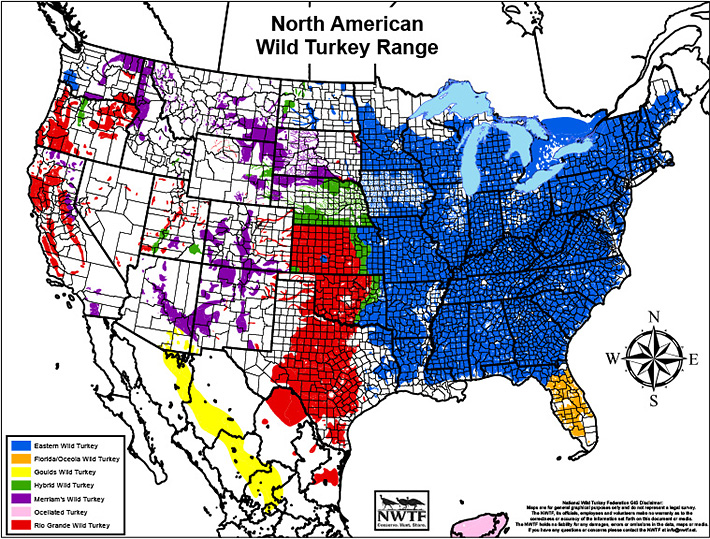
Leave a comment

Filed under American Petroleum Institute, data visualization, Gore v. Bush, infographics, Obama v. Romney