Category Archives: satellite surveillance

Maps and Metaphors: Nests, Spiders’ Webs, Lairs, Warrens and Labyrinths

The Gaza War is not for territory, but is explicitly about erasing sovereignty. And much of the war, if fought above ground, is aiming at what lies underground, hidden from sight, and not on maps–even if we imagine that we might be able to map the damage, disaster, refugee flows and loss of life as well as destruction of structures across the Gaza Strip in ways that are truly impossible to process. This data overload, or information overload, responds to a proliferated media coverage of the disastrous war, but is also difficult to relate to the terror of the unmapped underground network of tunnels in Gaza, and the ways that the tunnel networks have been a reason for the terrible escalation of aerial attacks that have created such humanitarian catastrophe across Gaza and the Gaza Strip. As much as a war for territory, in a traditional sense, the Gaza War is almost one of purification–not purification in a religious familiar from the Middle East of the Middle Ages, but of the possibility of purifying the region to ensure Israeli national security.  And as a war of purification, it is almost fitting that the metaphors of vermin or unwanted animals dehumanize the enemy, as if a negative of actual residences or humans with rights. We are in a pre-Enlightenment discourse that denies all concepts of rights, or

The tunnel network that evolved from an infrastructure of smuggling to a means of tactical defense has become a target that is quite elusive: if the tunnel network beneath he Gaza Strip was underestimated quite dramatically at but about 400 kilometers after October 7–reflecting boasts of an Iranian general “Hamas has built more than four hundred kilometers of tunnels in the northern section of the Gaza Strip,” the estimated underground passages became a basis to underestimate the scale or intensity of its destruction. Indeed, the shock at the scale and technical quality of the underground network has been slowly grasped as far more difficult to target, as its size has since February greatly expanded to seven hundred or even eight hundred kilometers across the entire Gaza Strip. The tunnel network provides both a significant military and tactical challenge,–but one unable to be easily targeted or eliminated, even by existing mapping tools, flooding with seawater, the engagement of robots with facial recognition, or the location of hidden networks and their destruction. The tunnels under Rafah that are feared a network for smuggling arms from Egypt to replenish the arsenal of Hamas–underground tunnels dug under civilian neighborhoods that served as “terror nests” where Hamas commanders retreated–allowed the infrastructure of civilian neighborhoods to be destroyed, while the military infrastructure of Hamas remained intact.

Destroyed Buildings in Gaza Strip, November 5, 2023/Atia Mohamed/Flash 90

The hidden, unmapped expanse of underground tunnels, which Israeli intelligence for all its capacities seems to have misjudged, has become a target that has evaded mapping or location, turning the destruction of tunnel networks into a game of whack-a-mole, even with the prioritization of tunnel detection and warfare tools. Meanwhile, hostages held underground are unallocated, leaving the Israeli army far more “blind” in its engagement with Hamas. The intelligence of the network has been repeatedly minimized by metaphors as it is animalized as a warren, a lair, a spiderweb, or a labyrinth, as if to suggest its animal like nature, promised to be dissmantled as a structure of evil–an inhumane warren, more than a site of human resistance. The engineering of the network that has been able to be reduced in metaphors has expanded as an achievement of engineering–“beyond anything a modern military has ever faced,” per the chair of Urban Warfare Studies, at West Point’s Modern War Institute, making the conflict far more than academic–and a focus of global tactical attention of the shifting terrain of future combat.

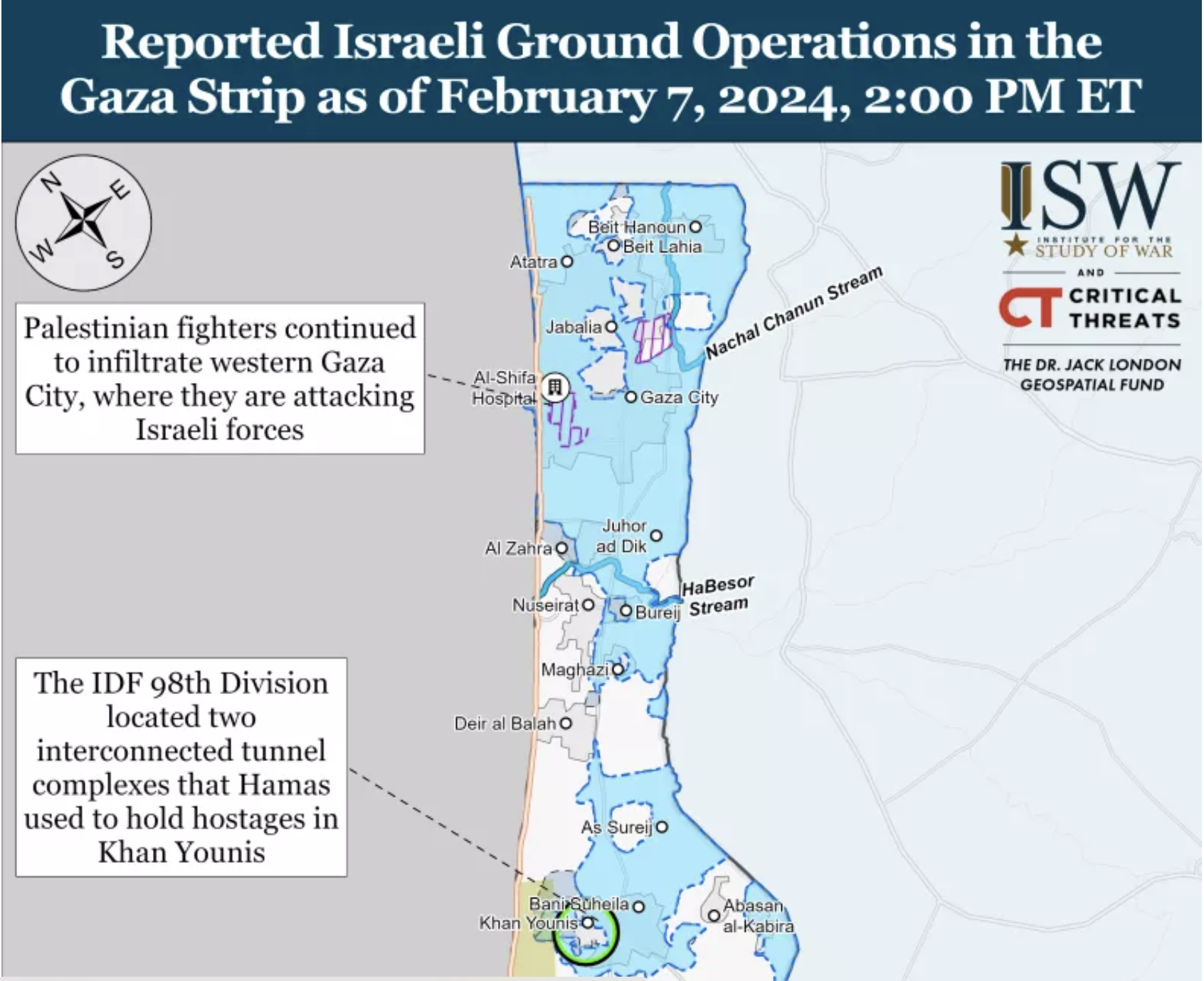
Meanwhile, it has only grown, as we have understood the existence of longer tunnels, fifty meters underground, as if underestimating the tools of engineering the warren, and the evolution of underground engineering that has allowed Hamas to dig in for the long war, making any lightning strikes impossible and only endlessly destructive. The destruction has been, as a game of Rope-a-Dope, infuriating Israeli Defense Forces, who seek to target an evanescent enemy; the Israeli Army tries to materialize its existence as a set of targets–even as the Israeli Army has issued repeated maps, in hopes to rationalize their expanding ground operations across an increasingly bombarded and devastated Gaza Strip, locating tunnel complexes where the hostages were once held. Is the war not really on two fronts, one, the human civilian casualties, who have been erased as “shields” manipulated by Hamas, and the true, hidden front, which is fought with a group dehumanized to the level of animals, not deserving of anything like a decent residence or shelter in the Gaza Strip?
The Gaza War was explained in no uncertain terms as the destruction of this hidden network in which the terrorists who planned the attacks of October 7 could be extirpated from the region of the Gaza Strip, as if independent from the humanitarian needs of inhabitants of the Gaza Strip, in a sort inexorable logic that leads to no apologies, but exists as an imperative that is the only narrative frame for bringing the war to its conclusion. “Dismantling Hamas’s underground strongholds in the north, center, and south is a significant step in dismantling Hamas, and it takes time,” we were clearly warned by Israeli spokesman Rear Admiral Daniel Hagari, in late December, 2023–aware of the intensity of bombing of hidden “nerve centers” of Hamas, but unaware of the visible brutality wreaked by the tremendous–and perhaps truly incommensurate–destruction above the ground. If Israel has destroyed many “cross-border” attack tunnels that extended some two hundred meters into Israeli territory both in 2008, 2012, and in 2018, the extent of tunnels that were celebrated in Al Jazeera back in 2014 for their ability to store weapons and shield Hamas leaders from air attacks as well as link the Gaza Strip to Egypt–and long designed a site of resistance to Israeli sovereignty.
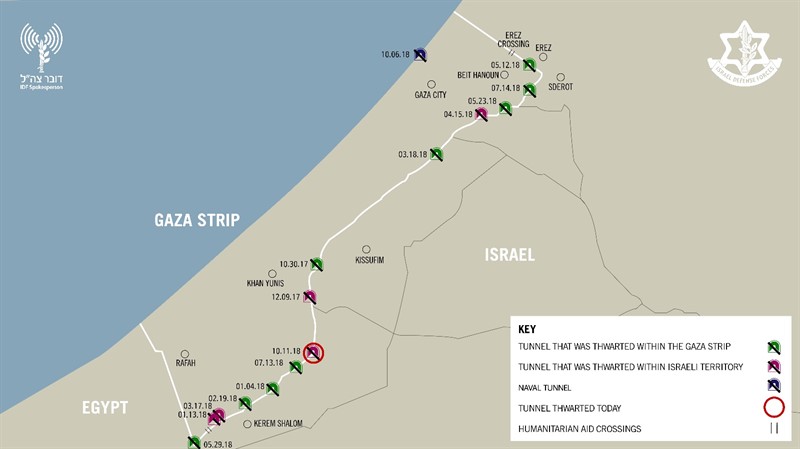
IDF demolishes Gaza attack tunnel that penetrated 200 meters into Israel |  The Times of Israel

Destruction of Tunnel Network Dug into Israeli Territory/October, 2018

For as the network has grown as the governance of the Gaza Strip has shifted, expanding as a form of hidden sovereignty able to endure attacks and escape Israeli vigilance and guarding of borders of the enclave. Although “mapping tunnels in Gaza right now is not going to happen,” the tunnels have become the elusive map of power in the Gaza Strip, a “big reveal” that has become the focus of the war, revealing the terror of porous borders that were echoed by the discovery of five Hezbollah tunnels on the Lebanon-Israeli border in 2018, in a military operation, that seems to seek to frustrate the Israeli Defense Forces’ charge to “defend Israel’s borders, since the formation of the Israeli Border Police in 1948, immediately after the foundation of the state of Israel–a Border Police who have long worn the Green Beret, signifying their status and crucial military role, symbolizing the “Green Line” drawn on the early maps of the Armistice of the first Arab-Israeli Wars of 1949, the pre-1967 border that have been taken as contravened by illegal sites of construction. If the Border Police have long imagined “peaceful borders,” the nearly 20,000 structures built along the border of the Green Line were viewed as a “ticking bomb” in the West Bank after October 7 invasion.

Years before the invasion, fears were raised by the scale of apparent bloom of illegal projects of Palestinian construction in Judea and Samaria, assembled by a combination of GIS mapping and aerial photography, as well as field work, that tracks the huge increase in “illegal” construction in 2022 in areas of Israeli jurisdiction by 80%–some 5535 new structures being built in 2022, an 80% increase over the construction in the same area in 2021, that are far from makeshift shacks.

Construction of “Illegal” Palestinian Housing in 2022/Regavim

The construction of what has been deemed strategically placed projects–and can be shown as such in maps of the region above–seem designed to hem in the settlements of Israelis around the so-called “Area C” of the Oslo Accords, if they might also be seen as overflowing the narrow areas allotted to Palestinians. But the huge construction project suggests an influx of cash, that might be seen as analogous to the creation of a costly network of tunnels by Hezbollah on the Lebanon border and in the Gaza Strip, as ways of challenging the stability of borders, and indeed the security of borders that has long been central to Israeli identity, and has become an accentuated topic of public concern in recent yeas–and least because off increased rocket attacks in Israeli territory.

In recent years, the ramping up of cross-border vulnerability of unforeseen proportions has placed the nation on tenterhooks that rendered most major Israeli cities vulnerable from the Gaza Strip with the rockets of Islamic Jihad capable to reach targets in Israel one hundred and fifty miles away, and escalated fears of the increasing proximity of the Gaza Strip to Israeli cities–long before the raid into Israeli territory concretized the fears of cross-border vulnerability in nightmarish ways.

Rocket Ranges of Hamas from Gaza Strip, 2022/Jewish Virtual Library

The same alarmist catalogue of the weapons that were posed at Israel’s cities by a range of rockets from the international market–Qassam, Katyusha, GRAD, and Iranian M-302, M-75, and Fajr-5–were suddenly aimed by surrogates at ranges to reach m-and Israeli populations in Tel Aviv or Jerusalem–were mapped, of course, by the IDF itself, who are tasked to guard Israel’s borders. as an armory poised at most all of Israel’s cities, far from the Gaza Strip, a decade ago. But we had the illusion, or geographic imaginary, for a decade, that those dwelling near the Gaza Strip were as protected as anyone else in the nation, and did not suffer any special degree of vulnerability.

The Deadly Arsenal of Hamas,Israel Defense Force, 2014

map returned to tabloids and newspapers in Israel after October 7, questioning the ability to allow such intensive proximity was haunting the Middle East. The increasing density of the projects of technically “illegal” housing was not a proxy or basis for cross-border attacks, or for firing rockets. But the worry of destabilizing borders by occupying such “seam zones” on borders grew, as they seemed to reveal a long-term strategy after the invasion of October 7, not even twenty-five kilometers from Gaza, and was worried in the days after October 7. The fears Israelis would be hemmed in would be potentially explosive if Israeli military presence in Area C was withdrawn, as in Gaza Strip from 2005; any Peace Talks, it was feared, that would sanction a Palestinian State would have to lead to recognition of their legality and potentially set the stage for a similarly catastrophic invasion of borders, as the rhetoric of an imperative of securitization grew.

Construction of “Illegal” Palestinian Housing in 2022/Regavim

They deep fears that the invasion of October into Israeli territory triggered and made palpable fears of a violation of Israeli boundaries in ways not previously imagined–and could only imagine after October 7. The fears that such an invasion could be facilitated by an existent tunnel network in the Gaza Strip the have defined the “goals” and prerogatives of the Israeli army to destroy, even if their danger is contested and not readily seen. And if we project such tunnels as a “satellite map,” we are preserving the false illusion that we even know their scale, or can “map” the network as part of the landscape–even if they are indeed part of the geopolitical landscape of the Middle East.

For the underground Islamic Jihad tunnels, lying far beneath the ground, and not able to be “seen” or mapped in any actual manner, the tunnel network remains largely figurative, spectral, and assembled in partially from old surveys from previous invasions of the Israeli Defense Forces, offering a poor proxy for targeting, but providing a terrible image of a hidden enemy, unseen and impossible to measure. As the earth that as extracted to construct the tunnels was dumped offshore into the Mediterranean, making it difficult to quantify the scale of earth excavated by tunnel-makers, or the scale of a network that has offered a basis for the Palestinian terrorists in the Strip to survive aerial attack, and indeed to keep the civilian “hostages” taken from Israeli territory under concealment–even as the “tunnel network” is also widely mapped in international news.

The web of Gaza tunnels complicating Israel's possible ground invasion

If we are shown “Hamas’ Secret Tunnel Network,” “Hamas’ Tunnel System,” or “Gaza’s Underground Labyrinth” in respectable news sources, and “Hamas’ Huge Underground Network” in somewhat salacious terms of more popular news sources, the secret spaces of these underground caverns have a truly Alice in Wonderland-like quality of an underground storehouses, or hidden hideouts, worthy of evil comic book characters, and apartments, tied to shafts, elevators, and other concealed openings, existing under the street plans of the city, as a “city beneath a city,” and even imagined as a future terrain for military combat, hand-to-hand wars, or the future zone of conflict.
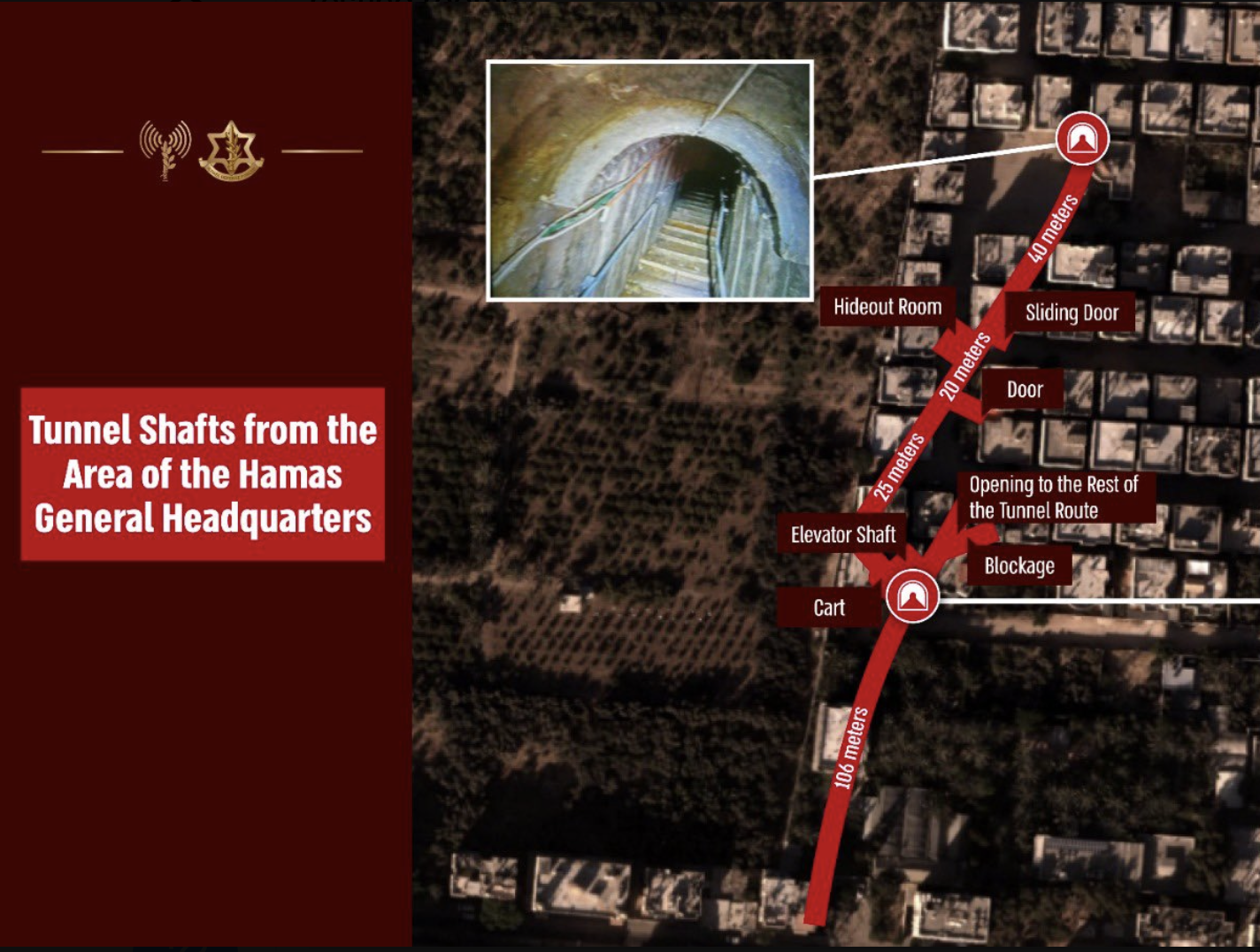
1. The tunnel network is a remapping of the boundaries that are formally imposed around Gaza Strip. Although it is odd to see them as a form of counter-mapping against the claims to sovereignty in Israel’s boundaries, they are just that. For the tunnel network, if begun as an economic necessity, has been expanded and exploited to as a basis to deny the limits formally imposed by the 1950 Armistice Line, which has perhaps provided the basis for the energetic chants heard in public spaces across the Western world, to Free, Fee Palestine, that invest a coherence in the currently occupied territories as an enslaved region that has been left at the mercy of a “terrorist state.”

The Armistice Line concluded after 1948 Arab-Israeli Wars did not invest territoriality in a region–

–but recorded a status quo of sorts later preserved in the Peace Accords and 1955 Armistice Agreements at the height of the Cold War, a stalemate of sorts between global powers, to be sure, understood and enshrined in maps along the original reference points of a historic Palestine Grid–

1950 Armistice Line and 1955 situation of Gaza, Mapped within Palestine Grid

–whose construction was, to be sure, the legacy of a colonial or quasi-colonial movement, drafted by the English on the model of their own OS maps as a way of preserving the spatial organization of archeological ruins, but that have created a framework to what is misconstrued as a religious war.

The provisional line that was drafted at the foundation of the State of Israel, and provided the orignary boundaries of the state that was guarded by the IDF, as the persevered the territory that was newly mapped in terms of a UTM projection that extended, as the timeless liturgy of the Prayer for the Israeli Defense Forces suggests, and increasingly patrolled by IDF forces in order to contain threats to the security of Israelis living near the region, as well as the increasing number of settlers near the border. The mapping of the expanded boundaries of the Gaza Strip to deny access to the outside world or to Egyptian neighbors is nothing less than a classic micro-macro point of tension in global geopolitics–“over our land and the cities of our God, from the border of the Lebanon to the desert of Egypt, and from the Great Sea unto the approach of the Aravah, on the land, in the air, and on the ground” in existential terms–even if the 1994 construction of a barrier between Gaza Strip and Israel was stated to be provisional, unlike the current claim to have created an “Iron Wall” that offers no clear basis for future discussion–and indeed seeks to force future negotiations from a position of power.

United Nations Palestine Map Showing Armistice Agreements between Israel& Lebanon, Syria, Jordan & Egypt, 1949-50

The current construction of a heavily fortified “Iron Wall” has provided the current crisis in which the framing of Israel as an occupying power has morphed into charging it as a terrorist state–a reflection of the very terms that Israel’s government charges Hamas, and given the events of October 7, seems to offer ample justification for doing so. The effective boundaries, however, provide the clearest basis for containing terrorist incursions has however not served the state.

The “Green” Line has been an internationally recognized boundary of the Gaza Strip, defended by the Israeli Defenses Forces as such, never intended to be designed or rendered as a border of sovereignty, but has been construed as a political or territorial boundary in local and global geopolitics. If drawn independently from claims to rights of Palestinians, a question kicked down the road to an unspecified date for future resolution by the global consensus, increased fortification defense of a militarized barrier that maps the Green Line as an actual border–

–that hinges on the perimeter fence. If it is design to limit global traffic it is unavoidably now treated as a border that demands protection to protect “our land and the cities of Our God,” as the prayer written in 1967 has it, that have perhaps enshrined the dating of the time-stamped “1967 borders” or “pre-1967 borders” as the basis for a “demilitarized” future, a fact that might be datable in terms of history of globalization–hearkening back to a time when the United States was an engine for almost half the global GDP, before the United States abandoned the gold standard, and before the waning of American global economic dominance of the postwar–the era in which the Universal Transverse Mercator was adopted as a model of a smooth global surface.

The network of tunnels that were dug under imagined border revealed its first porousness in 2005, with withdrawal of Israelis and Israeli troops from the Gaza enclave, and the expansion of a tunnel system that Israel had tried to contain. Increasingly seen as a threat to Israel’s sovereignty, the network has become a way of testing the borders that have emerged in an enclave once in 1955 tied to Israel by roads; the, contesting the so-called “Green Line” that divided Arab from Israeli sovereignty since 1950. If it is a sticking point in Palestinian peace accords, it is the stubborn site of the only survival of the old “Green Line,” the last line standing, that was set out in the 1949 Peace Accords, as a new “underground reality” emerged, not on most national maps, proved a way to erode–quite literally–a map seen as engraved in stone, contesting the original “demarcation line” seen and equated as an “original sin” of the “Palestinian Question.” While territories beyond the Green Line were not incorporated into Israeli sovereignty, the growth of robust tunnels along the contested “Philadelphi Route” running from the Gaza Strip to Egypt, was perhaps the original robust tunnel to smuggle weapons to evade Israeli surveillance, underneath the “security belt” Israel claims as a defensible border, as the tunnels appear to confirm an actual terrorist threat.

Hamas built tunnels to smuggle weapons under the Philadelphi Route from Egypt to the Gaza Strip. In recent years it has also dug attack tunnels from Gaza into Israel.

Robust Underground Tunnel of the Philadelphi Route from Egypt to the Gaza Strip

The “belt” is not a national border, or an international border, but has become defined as a “security border” analogous to the status of the Jordan Valley, by tactical terms first defined by the General who oversaw the victory in the 1967 War, critical to Israeli security–if not for its territorial identity. The bifurcation of the security border and national boundary at Gaza has grown as the boundary of the Gaza Strip become guarded as a border of Israeli territoriality, I argue in an earlier blog post, shifting understanding of Israel’s boundaries and their guarding. Guarding the Gaza “perimeter” is prioritized to securitize the borders of Israel for Jewish settlers who moved from the region beyond its walls, as new communities expanded beyond that perimeter, the tunnel systems have grown as an increasingly robust form of hidden governance, hidden from surveillance.

 If the network of tunnels first built to smuggle weapons in from Egypt in the 1990s before Israeli troops left, it expanded in depth and sophistication as Hamas gained control over the enclave and as it grew economically isolated, both as a network for importing goods and cross-border attack, extending five times below the depth of tunnels dug at the start of the new millennium, across a network claimed to extend over 500 km by 2021, according to propaganda videos of Yahya Sinwar, the length of the New York Subway, able to reach to Gaza City.  If the tunnels dug four to ten meters below ground seemed unstable beneath fifteen feet, the deeper tunnels are harder to sense by radar or to hurt by explosive force, as well as to detect from above ground–some over ten times as deep, if reports of 200 feet deep tunnel structures is true.  While the earlier smuggling tunnels of c. 2010 were closer to the surface and far more rudimentary in their framework and structural support–
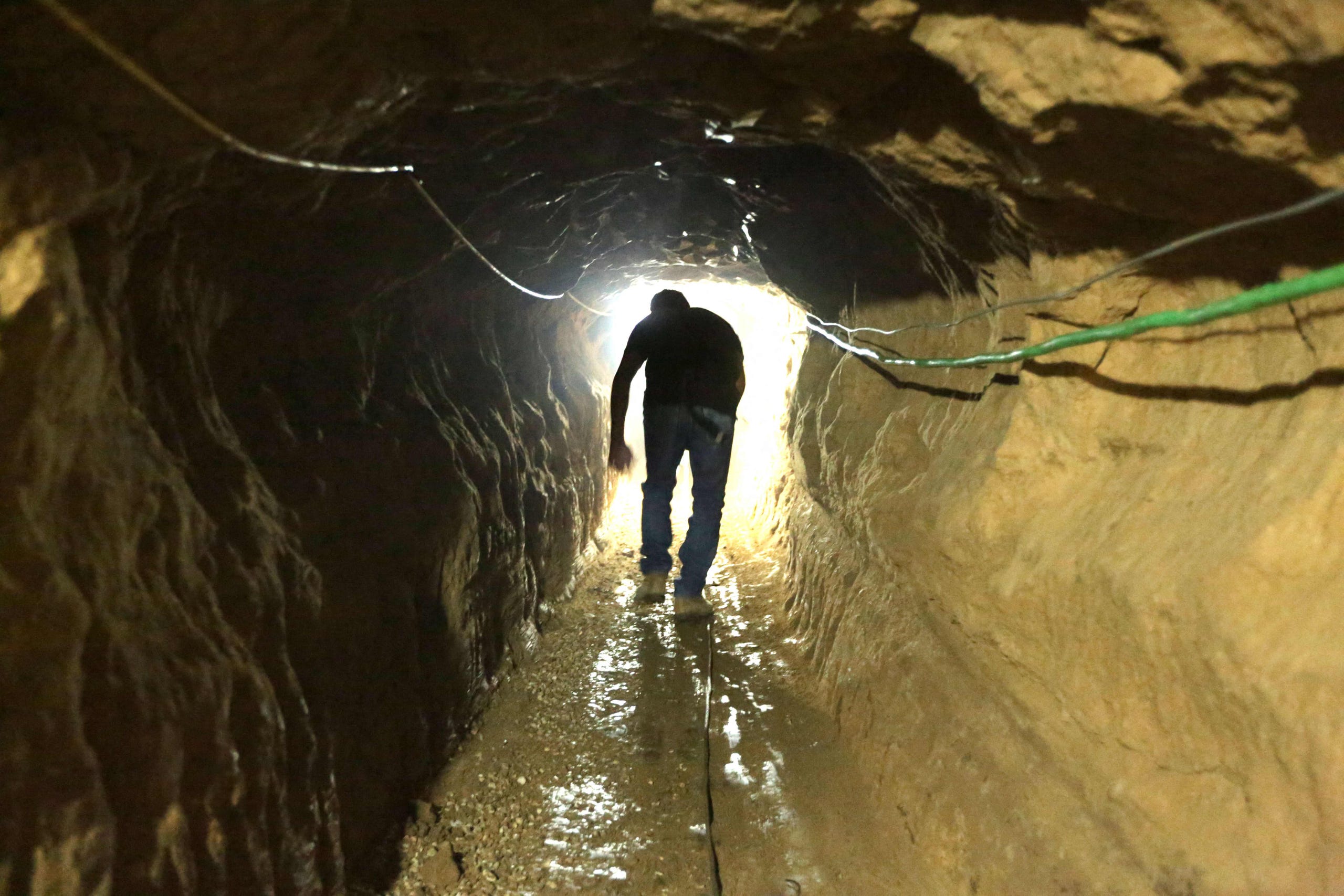
Palestinian Entering Reconstructed Bombed Smuggling Tunnel from Egypt, near Raffa, 2012/Patrick Bay, AFP

–the robust defensive and offensive functions that evolved of tunnel networks demand more careful discrimination in our maps, and are too often suggested as primitive networks imagined as able to be removed from the Gaza Strip–rather than forms of its current governance. The expertise in tunnel engineering by lego-like concrete blocks, ventilation shafts and soil compacters helped expand the engineering of an underground network tied to Hamas, and increasingly hoped by Israel to be able to be removed form the region, the offensive and defensive network has gained increased resilience. And as Israel’s right-wing government linked itself to the defense of adjacent communities near the wall, and tunnels targeting of Israeli forces or settlements near the border grew in response to a vision of sovereignty that exclusively defined the state for Jewish citizens-settlements mostly made for those Israelis who left the Gaza Strip in 2005, now lived in by a new generation of settlers, familiar with demanding protections for living outside a region composed of refugees before the current refugee crisis created by Israel’s invasion.

Israeli Settlements in the Coastal Regions of the “Gaza Strip” before 2005

Unlike the territory of Gaza or the Gaza Strip that is shown in surface maps of houses, buildings, roads and communities, the underground network of tunnels that extend across the Gaza Strip were long both the de facto network of Hamas sovereignty and the targets of Israeli invasion and air raids. The mapping of the tunnel network has shifted from a target of attack to its re-mapping embodying identification of the tunnel network as the underground nefarious form of negative-sovereignty by which Hamas has defined its presence in the Gaza Strip.  The metaphorical mapping of the tunnel network has served to embody an image of the “negative governance” of Gaza, and metaphorically mapped to delegitimize the authority of Hamas as a responsible governing entity.

2. The networks of underground tunnels that grew up to support Gaza’s literally “underground” economy as its borders were closed by Israeli Defense Forces in 2005 became, in 2012 and 2014, the targets of invasion and destruction–as airplanes targeted five hundred tunnels, some of hundred kilometers, as one that running from the South to Gaza City, by bombardment and ground operations–destroying 140 smuggling tunnels that evaded the Gaza blockade, including 66 tunnels used to target Israeli forces. The engineering of tunnels expanded to deeper and broader underground corridors to ferry cars of militants and reinforced by iron, with ventilation for larger mobilization, the network emerged in global consciousness as a new terrain of combat, and a new battleground lying far beneath the ground. Even if North Gaza has, as Israel insists, ceased to be under the sovereignty of Hamas from January 2024, the tunnel network dug beneath the territory has provided the firmest illustration of the survival and resilience of Hamas governance in Gaza.

Israeli Soliders Patrolling Newly Discovered Tunnel at Erez Crossing, December 15 2023/Amir Cohen

Tunnel networks in the Gaza Strip have been long targeted as threats to Israeli sovereignty. From their beginning as cross-border passages designed to import weapons from Egypt into the Gaza Strip, the commercial network that Hamas encouraged since taking charge of the enclave in 2007 for incursion. The networks of underground tunnels that grew up to support Gaza’s literally “underground” economy as its borders were closed by Israeli Defense Forces in 2005 became, in 2012 and 2014, the targets of invasion and destruction–as airplanes targeted five hundred tunnels, some of hundred kilometers, by bombardment and ground operations–to cut the enclave off from external contact, destroying the excavation of 140 smuggling tunnels that evaded the Gaza blockade, including 66 tunnels used to target Israeli forces.

Yet if the underground network that has however grown as a dense network of resistance to Israel’s denial of the sovereign presence Hamas has created deep in the underground tunnels of the Gaza Strip, a difference not shown in many maps of tunnel routes–which show tunnels collectively, akin to surface roads of OSM maps, without distinguishing either the origins, depth, or status as a hidden infrastructure, equipped with electricity, internet access, and communications, that long served as a regional tax franchise. The elision of the different tunnels, and their different quality, flattens the history of the network, and indeeds elide its central importance in Gaza’s governance, by portraying it solely as a target of attack.

Gaza Strip in Maps/BBC/NPR

While these maps are entirely the product of Israeli Defense Forces, they flatten the emergence of the tunnel network, and flatten the entire process of constructing, funding, and using the network of underground tunnels demonized as a target of military attack. Since the rise of cross-border tunnels that have been sanctioned as targeting Israeli forces, contesting the sovereignty of Israeli forces beyond the Green Line, the tunnel network was targeted of a vision of sovereignty that was tied to the invasion of Israel, and increasingly responded to by defined the state of Israel as exclusively for Jewish citizens.

But as the tunnel network has become a target of Israeli attack, it has assumed figural status by cartographic logic both to undermine the symbolic identity of Gaza Strip. It has served to demonize the sovereign claims of Palestinians in the region, and an image of the negative sovereignty by which Hamas has defined its place in the Gaza Strip. To flush that presence from the enclave, or to attempt to remake the enclave separately from the enclave that was attempted to be isolated by the Israeli army as a threat–by a 60 km fence, Egyptian built fence, and patrolled harbor–

–whose destruction has been suffered by the Palestinians increasingly trapped between a map and a hard place indeed, as the specter of tunnel networks has come in a grotesque macabre of Grand Guignol to take precedence over their lives, a spectacle of destruction of homes, intent to define attacks on the neighborhoods of Gaza City by targeting attacks on an elusive underground network of tunnels independent of their habitation or of the cost to civilian lives.

Continue reading

1 Comment

Filed under Gaza Strip, Israel, national security, satellite surveillance, tunnel networks

The Built World

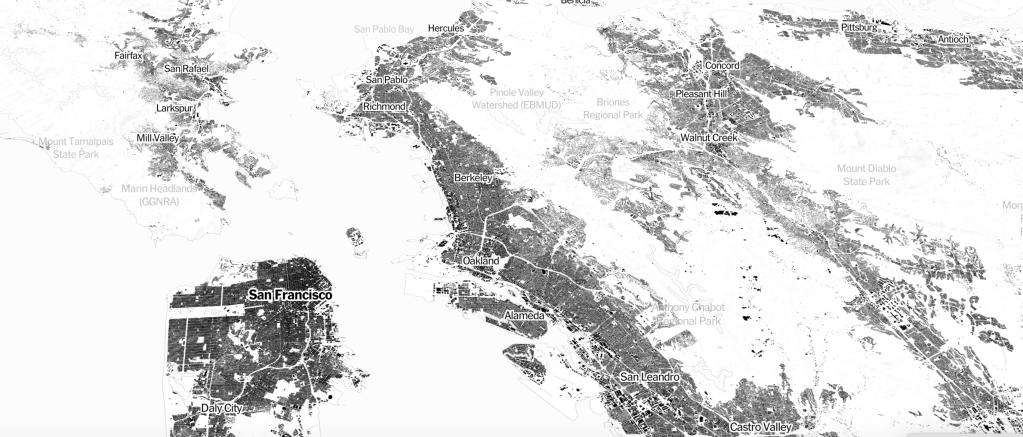
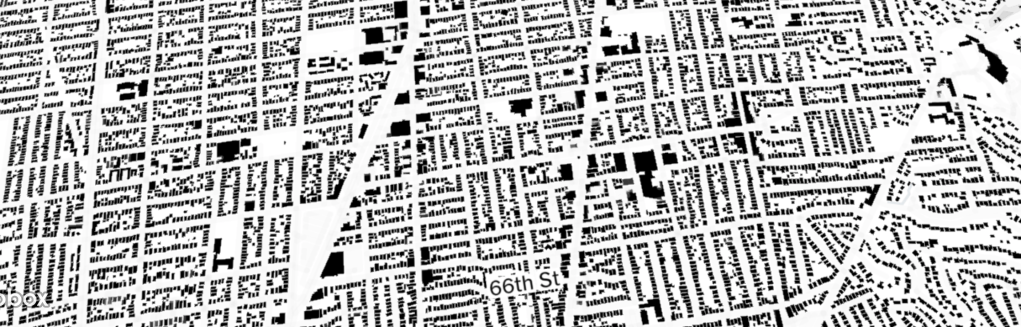
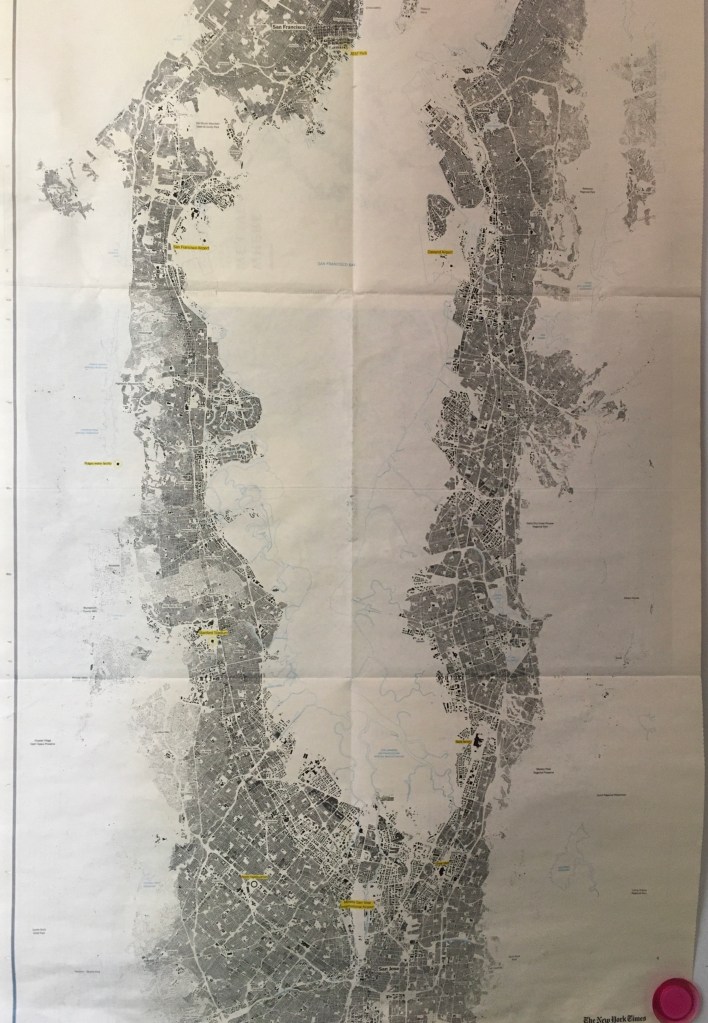
Walking the streets in my now apparently abandoned neighborhood for an errand after a few weeks of sheltering in place in Oakland, I had the eery experience of navigating and inhabiting empty city. While I knew the pavement, I almost felt no longer familiar with the streets that afternoon. There was the sense that no one knew the state of affairs about reopening, and many were just puzzled about how to proceed: as a few young kids skateboarded up Shattuck Avenue, profiting from the lack of cars, some odd improvised bicyclists were on the sidewalk. The absence of interaction was a weird pause indeed, giving an eery sense of the timelessness of space, as if the time/space fabric by which I had long seen the neighborhood was suddenly out of whack. While no visible destruction had happened or occurred, the disembodied nature of the inhabited world was drained, even as it was filled with sunlight and birds, giving me the eery sense I had had when I looked at the machine-read maps of building footprints, “Every Building in the United States,” whose section situating Bay Area buildings hung on our refrigerator wall, like a scary map of the archeological ruins of a future Baedecker Guide to the ruins of San Francsico.

Had the designers of te interactive webmap of machine-readable imagery Microsoft had assembled intended the eery effect of describing the inhabited world as a ghostly ruin of lived life? The relegation to place-names to a very secondary status in the image of the overbuilt landscape seems to lie on the edges of the black blocks of built space that is was the basis for the AI map distilled from aerial photographs, and parsed as black and white data. If its form seems oddly ghostly, the reduction of the monochrome paper map reveals shades of grey that fade into rare open spaces, where one’s visual attention seems at first drawn, before one returns, with hopes for some sense of recognition, to the built spaces that one knows, and the congestion of black that marks urban agglomerations. The black boxes of settlement reveals the crowding of our coasts, the density of much urban housing and indeed of the area of the East Bay where I live, but is also an eerily image of an inhabited landscape selectively organized to omit any sign of living presence–either of “wilderness” or habitat, but anthropocentrically maps the anthropogenic world as if for posterity. For is not the black boxes of building footprints something like a record of the anthropogenic imprint on the world, by now extended across the globe. The building footprint map derived from AI is a rewriting of the ancient notion of the ecumene–the “habitable” more than “inhabited world”–or οἰκουμένη, which sought to encapsulate the inhabited regions as the ones that entered human comprehension: is it a removal of the humanist object of the map, now mediated through machine learning?

If the ancient geographers discussed the οἰκουμένη as the “habitable world” from the frozen north to the scalding sub-equatorial lands that seemed to “balance” the inhabited regions, as if what merited human attention and contemplation was that region that permitted settlement: the turn to a record of imperial administration in the Roman Empire–and of religious unity in a ‘civilized’ world–introduced the governmentality of the control over the inhabited world, that by the Renaissance had become an enticing image of national incorporation and political ties, that became intellectually articulated in the post-Cold War as a global ecumene of imperial cultural dominance and integration incarnated in European inheritance of political institutions, science, technology, and economic forms as a world system: the association of a global integration whose exponent in historical texts was perhaps William McNeill’s Rise of the West (1963) had withered away by the time of the data-driven map of inhabitation, as we have become increasingly aware of mapping the human impact on the world–an image in which the building footprint map might be placed.

It is hard to discuss intentions in a map that was organized by AI, but the ledger size newsprint that covered almost a full side of the refrigerator, hanging on magnets, assembled a flyover of the ruins of a future world, a snapshot of each and every building in the area. The result is a poor excuse for a “wall-map” of the region of Northern California. It seems more of a memento mori of the prosperity Silicon Valley once enjoyed from a future world, registering the intense economic growth that fueled the housing bubble along the San Francisco Bay, in an unintentional snapshot of the explosion of paved space and housing across the coastal margins of what was once one of the more “edgy” areas of the United States: entertaining the imagined future might have created the perverse pleasure of hanging it in my kitchen, long before COVID-19 struck, a celebratory if slightly morose record of the world in which we once lived.

But the sidewalks were empty and sun intense; storefronts often boarded up. The streets were no longer places for salutation or recognition, even if I greeted a familiar mailman on my way home: as if no time for social niceties remained I walked down the sidewalks and into empty streets, rarely negotiating margins of safety, or distancing with a few folks on foot, noticing with a cringe the large number of homeless who stood out against the stark streets, closed storefronts, and empty stores.

They were, as it were, always there. I had been cutting myself off from the surroundings, as I never thought I would. As I had been sheltering, thoughts going global as I was following updates about the pandemic, this was a stone’s through from my home, so many had none. Looking down Adeline Street, at the still tents of homeless encampments that may have multiplied, I felt new distance gaping between us, as the very streets I had walked down regularly seemed to have been forgotten while sheltering indoors, the stores now empty, their windows recently boarded, few driving in the streets where one might walk without danger. The eery absence of population was a scene from The Last Man, momentarily interrupted by an isolated airplane, the first seen in days, flew overhead: I felt like I was on a filmset, more than where I lived, a tracing of life past.

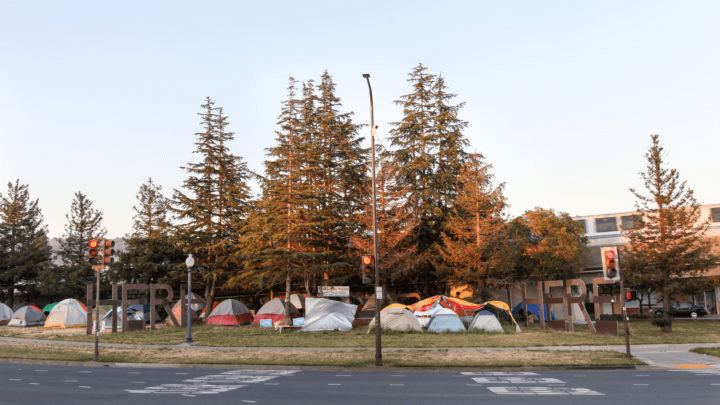
If we were sheltering, what was place, anyways?, I wondered with the footprint map in mind. Empty streets looked like nothing more than an apocalyptic reimagining of the neighborhood, drained of inhabitants, save the apparently increasing cluster of homeless tents, looking far more embattled, and more survivalist than ever. If the building footprint map was restricted to spaces where people lived and work, the ghostly anthropogenic substrate seemed to have an eery counterpart in the homeless encampments near my house. The survivalism was evident in the homeless settlement that had in recent years overflowed, expanding to fill in the island of trees where how Steve Gillman’s 2011 public sculpture marked the interurban divide. The public sculpture elegantly if snidely punned on the allegedly dismissive pity saying ascribed to an icon of modernity about her native home–“There’s no There there“–as an entertainment for motorists, or BART passengers, as much as a public art for pedestrian passersby–by broadcasting a literary reference in greenery.

The two words marked the Oakland-Berkeley border by two words, now rusted fifteen years later, as relics of an earlier epoch themselves: the homeless encampment blurred both sides of the dividing line between the cities which had long since melded indistinguishably in the increasingly gentrifying area where I had lived for twenty-odd years.

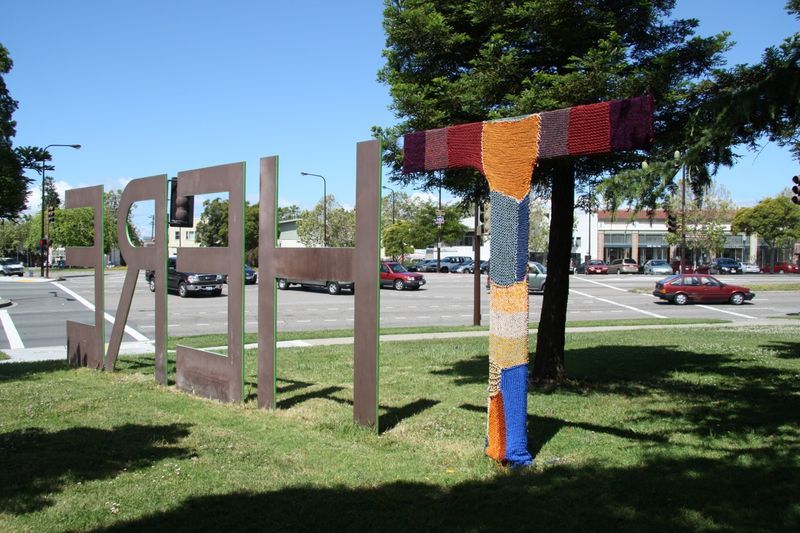
The erasure of a sense of “here” that was promoted by the public sculpture seemed erased in the AI map, that reduced space to built houses, even as the homeless were the only residents in sight as I walked around the tensely empty neighborhood. I’d long appreciated, if a bit begrudgingly, how the Gateway_Project defined the edge of Berkeley CA took Gertrude Stein’s saying and liberalized it in hight-foot tall powder-coated steel letters, where the BART tracks go underground, intended as “a literary and whimsical welcoming to Berkeley,” where they supposedly read not only Stein’s poetry, but where so many poets had lived–and was a “here” worth commemorating by sculptured letters, a new Fons et origo of the Beat Generation, perhaps, or a dynasty of mid-twentieth century poets–Kenneth Rexroth; Czeslaw Milosz; Allen Ginsberg; Gary Snyder; Frank Whalen; Thom Gunn; Robert Hass–by 2002 recognized as a literary patrimony. Designed primarily for passing motorists, as if few could be imagined to walk nearby, the site built to commemorate a “sense of place” had become a cluster of encampments, as if that was the only place that existed at a time when all remained shuttered indoors–if in 2010, just ten years ago, one letter was covered, by a group of Oakland knitters, to transform it to “HERE/HERE,” peacefully protesting the work as barely concealing an agenda of gentrification.

Jill Posener, on Jill Rants and Raves/June 1, 2010

The collective of knitters who had covered the “T” as if to object to the tired trope with which Oakland was long saddled was the result of a. relatively calm tussle, cast as a border war against gentrification. But the global pandemic had subsumed any distinction of “here” and “there” in a new global: the AI map seemed to be indeed a snapshot of the scale of habitation before the pandemic, a ghostly picture of an earlier time.

As I walked through it, at least, the same North Oakland neighborhood was suddenly, if maybe temporary, rendered ghostly: the built landscape that I was inhabiting was the same world, with fewer inhabitants, and less secure attachment to palce–as if the artificial interruption of indoors life shifted my relation to built space, made it harder to navigate, and shifted the security of place, and indeed removed any sense of recognizability from the built landscape, almost to ask what the civilization was that led to the building of all this paved space.

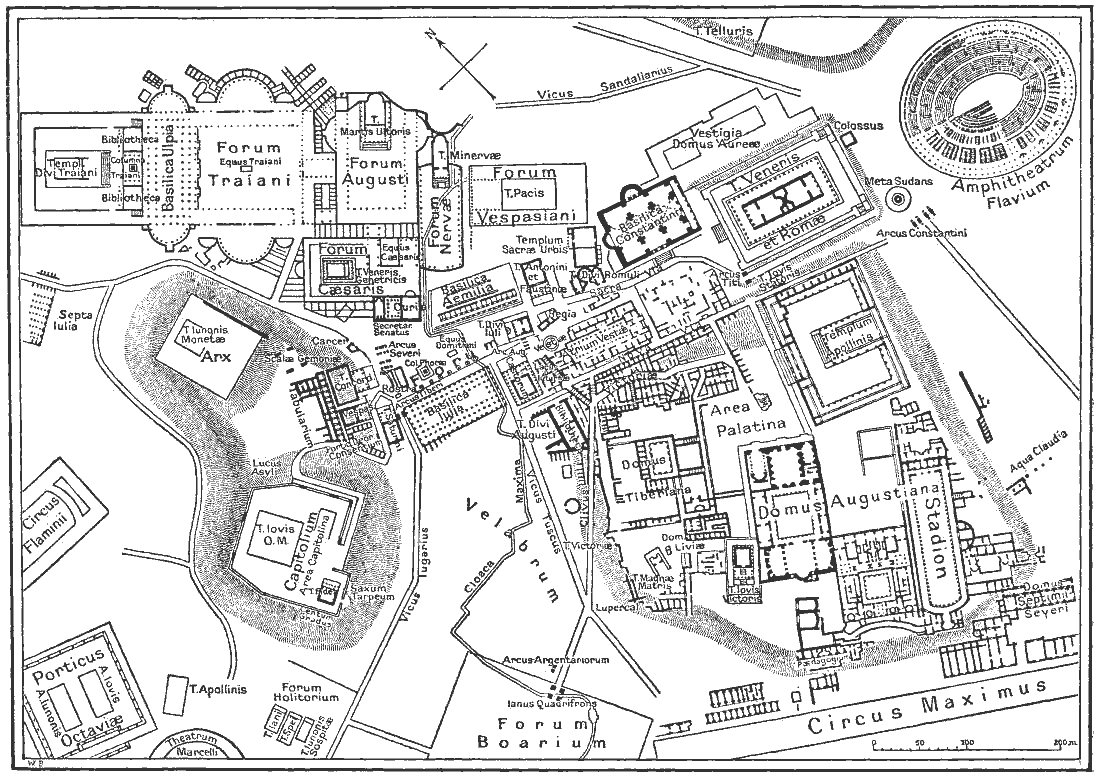
The unmooring from physical presence was like being dropped, I imagined in a flight of fantasy, to that Microsoft map, so akin as a snapshot to the sort of map of archeological ruins future generations might trace as guidelines of orientation to a lost past, when what was the greatest “here” of antiquity–the city of Rome–was etched by nineteenth century archeologists and antiquarians by the physical plant of what once stood on the site of the ancient Roman forum, only perceptible to the eyes of tourists if they had trained themselves on the map to imagine the ghost-like presence of architectural monuments that had once affirmed the place of Rome at the center of the world at a far earlier time.

Where was here, now, on the AI map? Was the tie I was drawing between the map and the uninhabited neighborhood only the depressive meanderings of a middle-aged crisis? Or was it a global one? West Berkeley and North Oakland had been certainly rendered quite a different place, quite suddenly, and not a comfortable one–still inhabited by ghosts. Stripped of my points of reference or familiarity with my neighborhood, a few dispossessed in the sidewalks, of what wasn’t a nice area of town, I was reminded rather urgently of ongoing part of urban life no longer framed by sounds of traffic, public transport, open businesses and pedestrian sounds, that continued while I was indoors. The degree zero of urban life reminded me of the empty landscape of building footprints that, in a detailed satellite overview that recalled nothing more than the outline of an archeological dig of ancient city, as if drained of motion, and filled with apprehension, in a damn eery way. Was this a pause or a new landscape?

I had only recently been navigating the 2018 building footprint map, “Every Building in the United States,” and aout a year ago, hung the section of the houses of the Bay Area onto our refrigerator wall. The creation of Microsoft that was removed as one might imagine from the ancient notion of an “inhabited world,” comprised of building outlines, a distanced description of the world a declination of mapping human settlements, mediated through what seemed the iconography of an archeological map of a removed time, rather than the actual lay of the land–or, better yet, it seemed to exist in two planes more than ever, and both as a historical record of a snapshot of built space across America, and of actuality. The interactive website of the machine-readable result of aerial imagery that invites one to zoom closely not on landscapes, but a black and white rendering of built space, recalled nothing more than a flyover of the ruins of a future world.

The aerial snapshot of each and every building in its current position had a sci-fi aspect of a record of space drained of nature, biodiversity, non-anthropogenic environments, and life–distilling selectively the extent of built spaces across an otherwise quiet and otherwise uninhabited world: as if the perfect document of the anthropocene, this was the built landscape, removed from and detached from a natural world. This was the built landscape of the region, divorced from the lay of the land, as if a perfection of the GPS contents of street view, without any street traffic or greenspace at all. The stark interactive map of 2018 seemed to be newly present to the space I was negotiating in my mind, even more stripped to its bare bones and evacuate of inhabitants.

The vertiginously uninhabited interactive map peered at onscreen allowed one to look at the nation and soon to whatever spot on the map, suddenly panning and focussing into crisp detail, but lacking all sign of inhabitants, save the names on each street or place. The sense of exploring a neighborhood I once knew may have been an accelerated arrival in late middle age. But the spatially empty landscape of building footprints encountered I opened in 2018, “Map of Every Building in the United States,”was filled with a sense of dread and of testing my own geographical knowledge, scanning to familiar neighborhoods and structure, and matching abilities to recognize the flattened forms against the material structures with which they correlate.  There is no sense of the amount of chemical waste and diesel pollutants in the nation’s largest port, Long Beach, pictured in the header to this post, where pollution has caused ongoing health problem for residents.  

Continue reading

2 Comments

Filed under Bay Area, data visualization, interactive maps, satellite surveillance, virtual space

NORAD Maps the Flight of Santa’s Sleigh

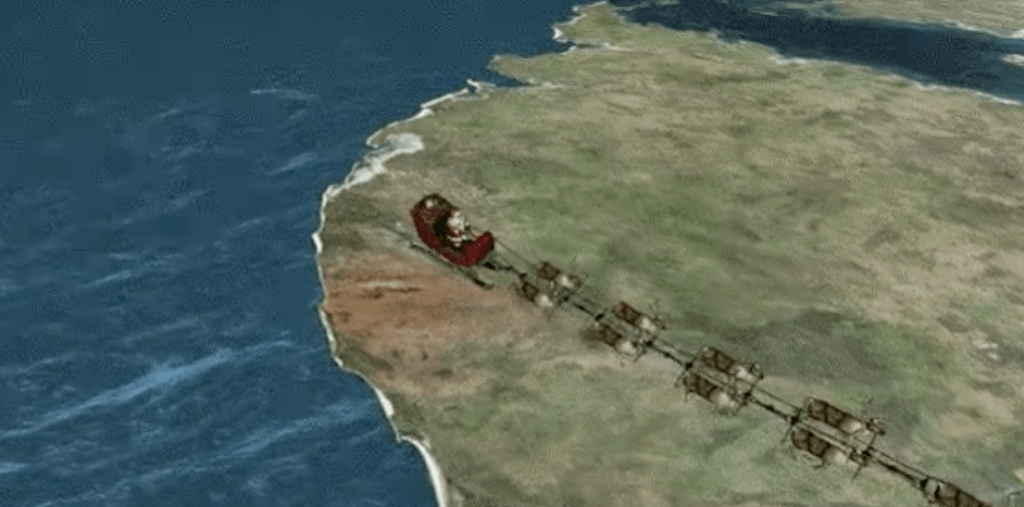
If Santa Claus is global, the image of Santa living in the North Pole outside of sovereign divides has been elevated to a new horizon of expectations in the age of real-time maps. The question of “Where is Santa?” now can be responded to on a real-time viewer, prepared each and every Christmas Eve for over fifty-fie years, the North American Aerospace Command. For since the Cold War, and through the present age of smart phones and real-time tracking, NORADh as invited viewers all over the world the chance to track the gift-laden sleigh of Santa crossing the night-time sky at the speed of starlight. Never mind the different hours and expectations of Santa Claus in different nations or countries. For NORAD allows the world to track the flight of Claus cum reindeers on NORAD’s Santa Tracker, an annual collective exercise in mapping of increasing popularity, moving the image of bearing gifts into the globalized world.

images-52.jpeg

Indeed, the mind-boggling proportions of its popularity, attracting upwards of 20 million individual users in 2011 alone, is a statement not only to its improved UX, but to the versatility of its incorporation of mapping servers better to imagine the itinerary of Santa’s airborne sleigh.  For while we once envisioned the night-time flight of Santa Claus far-off and against a starlit sky and full moon, to accentuate the surprise of a magical sled-borne itinerary–

–the Santa Map brings that journey up-close for everyone before a computer monitor, following a sort of sleigh space that is the surrogate for airspace.  The remapping of Santa’s itinerary has been done in a way that tracked, as the sleigh’s global progress is intercepted and relayed online in real time from posts of remote observation to viewers around the world.  And in an age of global surveillance, there seems to be no reason why Santa’s sleigh cannot as well be surveilled for the interests of children everywhere.

There’s a huge appeal in the ways that the Santa Map creates and imagined community, as much as it embodies an annual itinerary.  The interest in tracking Santa’s sleigh has grown considerably in recent Christmas Eves.  The huge interest in tracking Santa’s sleigh–and effectively mapping the visits of the airborne sleigh into our hearth–is a way of bringing maps in line with pleasure at a time when we need to look for solace where we can find it, and where we can find a comfort that the onslaught of most maps of contemporary events in fact rarely provide.  

Christmas has been a communal but solitary experience–located in the hearth and around the tree, and gift-opening a ritual of individual families–but somewhat serendipitously, the collective witnessing of the Santa Map offers a vicariously removed experience for crowds of viewers, removed from one another but creating the illusion of comprehensively witnessing the arrival of a fictional character to homes everywhere, as if to knit us together in holiday wonder, suspended for the evening in an imaginary international airspace of momentary world peace.  In recent years, but perhaps since the Cold War, this particular image of good cheer provides the odd inversion of the danger of the military missile strikes, if not offering the miracle of suspending fears of missile strikes, or the contradictions implicit in imagining peace in a world that lies on the brink of global war by using the very tools to chart missile defense systems as instruments of good cheer. Santa may face a different workweek in the malls where he can now be met in many different nations–as he traverses national borders with different work weeks!–

Santa’s Workweek in Ottawa Mall

–but the folks in the U.S. government and NORAD it completely reasonable to have the right to track the geospatial complexity of Santa’s sleigh ride, without removing any mystery out of Christmas holidays. It may be even reassuring that if Christmas Eve is Santa’s busiest hour of flight, the arcs of where reindeers guide his flightpath can be illuminated on our devices, in vivid geospatial specificity and even local detail.

Continue reading

1 Comment

Filed under Christmas, globalization, mapping technologies, Satellite maps, satellite surveillance, United States Defence Meteorological Satellite Program

On the Repeated Mapping of the Unknown Flight Path of Malaysia Airlines Flight 370

The proliferation of maps tracking the diverted flight path of Malaysia Airlines Flight 370 repeatedly re-enact an exercise of mapping the unknown:  if the early proliferation of possible maps of its flight path matched the shock of its disappearance, the continued frenzy of the search for signs of the fate of the airplane and its 238 passengers, as if trying to help get our minds around the implausible nature of its disappearance on a rather routine commuter flight.  The rapid proliferation of hypothetical maps of plausible diversions hang on the turning points in the trajectory of the vanished plane from its last point of contact and observation all seem to be seeking to explain what happen with something like the surety we expect from maps:  in the absence of any information that is clear, we turn to the map as a way to ground what we know, and to try to find meaning in it.

But the multiplication of these maps almost seem to respond to a lack of real information, or conceal the absence of any clear leads as to what happened.  For each map includes an abundance of bathymetric contour lines, shorelines of islands, point of take off and the place of the satellite had last contact with the flight are all included in these maps, which obscure the sadly open-ended nature of the tragic narrative that exists around it.  While none presents the individual narratives of the passengers or pilots on the flight, by necessity, and may even represent the frustration of our remove from whatever happened on board the flight after it left the airport, the multiplication of news maps and digital reconstructions capture desperation at not knowing what sorts of events or potential diversions occurred.

At the same time, the underlying narratives of all accounts is often left unstated and go unexpressed:  that of how the flight path of an airplane managed not to be tracked.  The proliferation of news stories seem driven by the continued technological attempts to produce a comprehensive detailed account of what happened on the plan in its final moments–or of the location of potential wreckage –as we openly worry about the controlled nature of our international airspace, and the extent to which it can ever be fully mapped.  The inflection of this story, which is in a sense the parallel story that has been driving the story of the search for a narrative to describe the tragic events of the flight that left 239 passengers in the flight and its crew missing and presumably dead.   The assurances of international authorities on the International Investigation Team (ITT) that the search for fragments of the inexplicably vanished aircraft in the Indian Ocean will continue over a search area of nearly 50,000 square miles–aafer the perfunctory issuance of death certificates for all passengers by the Malaysian government–creates a puzzle about both our mapping abilities as tools of surveillance and effective control, and sustain a continued wish to compensate for such concerns by repeatedly illustrating the abilities to map, remap, and map again the area and the plane’s flight path, producing maps that might provide a narrative structure to events that seem dangerously incoherent.  For the map offers uniquely reassuring coherence on an event whose narratives have literally gone out of control.

Existing maps largely proceed from reconstructions of plausibly altered itineraries the airplane may have taken after it veered dramatically off-course in the course of an otherwise routine flight from Kuala Lumpur to Beijing.  The underlying questions to which they appear to respond is how technology and ramped up security could prevent us from losing another plane, and how we can, as Tony Tyler, head of the International Air Transport Association, Tony Tyler, calls for the need “track aircraft wherever they happen to be, even if they go outside normal traffic coverage . . . in the most effective way.”  After the intentional closure of the transponder during the flight, the increased suspense of any air travel–and the anguish of the families with members on the Air Malaysia flight, increased attention has been directed to border control, as minimal information seems provided by attempts to map–or digitally reconstruct–the diverted flight.


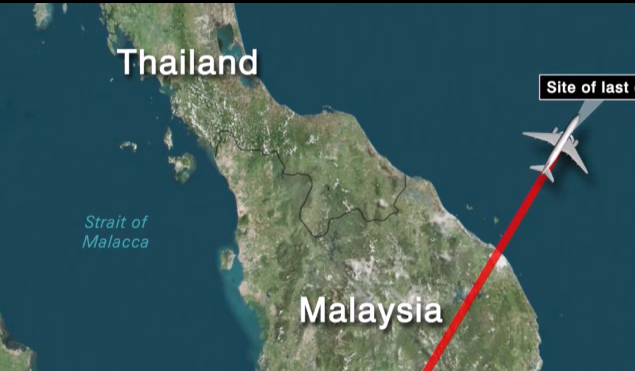
Site of Last Contact


The map of flight-paths is often combined with maps of search missions and sites of possible wreckage in news maps and online media, as if to condense the slight information we encounter in a single map.  Chances of discovering or locating whatever is left of the lost plane–the ostensible goal of the search mission–seem remote, like a needle in a haystack, despite the lack of an appropriately marine metaphor.  The insistent and repeated mapping of the Boeing 777’s flight path and its contact with ground control is not only an artifact of the news cycle; it is an incomplete narrative we keep on trying to resolve or find resolution for:  the story of the interrupted flight path has left audiences world-wide wondering whether the storyline will ever be resolved, how the intervention in flight path was made that caused it to shift its planned itinerary, and why our apparently refined abilities of mapping can’t complete the narrative we all want to bring completion to. There is a commanding logic in matching the search area to the possible diversion of the plane’s in-flight trajectory, but everything is complicated by trying to balance a narrative of the flight’s tragically diverted course with the mute azure surface, without landmarks or points of orientation, of oceanic expanse over which jets travel on search missions and boats patrol.

In ways that have gripped viewers but also raise frustrating questions of how to best search international waters, as well as unfamiliar perspectives on mapped space, all eyes were for a time directed to the South Seas with an intensity that oddly echoed eighteenth-century speculators. For after we have watched a cycle of maps of the flight paths, we have found them substituted by the maps of the dangerous search conditions of the area, and the stories that they tell of the challenges of searching in the South Seas, at the same time as a fairly constant drumbeat of the maps of potentially sighted objects–things that can at least be mapped, unlike the plane itself–in the hope to locate something that might close the rather terrifying narrative of another potential diversion of a passenger jet’s flight path.  (That fragment of the story–an entrance into the cockpit or pilot’s cabin; the diversion of the path of a preprogrammed flight–is so powerful to summon nightmarish scenarios, and to search for any sign of resolution.)  That “other map” that has increasingly dominated news-shows and newspapers of potential fragments of the lost Boeing 777-200’s wreckage in the Southern Indian Ocean, Gulf of Thailand or even the Mediterranean has taken over, spinning the search mission into something like a cartographical myse en abyme, which lacks the possibility of clear resolution of perspective in mapping the shifting sites of searches that are super-imposed into maps of the flight path.

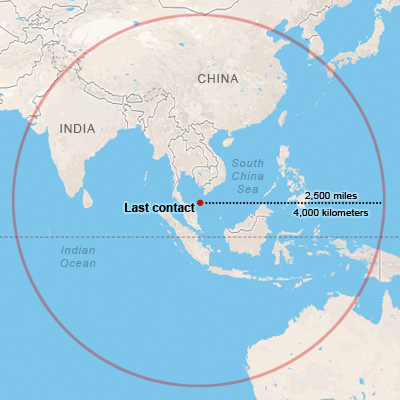
For fragments are repeatedly being reported in the ever-expanding and shifting search area for the tragic and still as of yet inexplicable disappearance of an airline with 239 passengers aboard:  in ways that have driven comparisons to black holes into which the jet mysteriously disappeared have created an almost near-impossibility of locating what one thought were the most trackable of flight paths, if only given the broad area of the radius of 2,500 miles which the fuel tank of Flight 370 might have allowed it to have gone after its last contact with radar.  The open seas that provided the only places to be less carefully tracked, as it left Malaysian for Thai airspace, seem a rare region removed from land-surveillance, as well, as we have since discovered, the sort of windswept area of fast-moving currents that have sufficiently flummoxed the densely concentrated and often multi-national surveillance systems that have mobilized around the area.


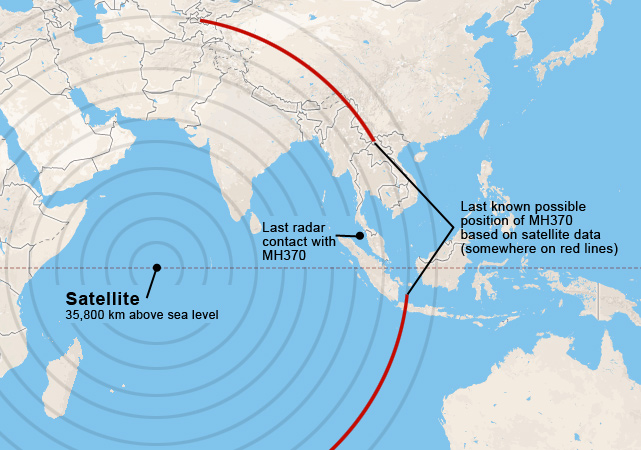
mh370-range


The mid-March findings that the airplane took a planned sharp turn westward, most likely programmed by someone inside the cockpit contributed grounds for fears of hijacking by someone on board, bolstered by the swerve of flight path toward the Strait of Malacca that the Royal Thai Air Force observed, traveling back out to the Indian Ocean, rather than its planned course to China, and the search has progressed along the lines that Flight 370 headed in another direction than was first believed, costing significant delays in time for the search for the missing plane, but not reducing the search area beyond 2.97 million square miles. But how does something like a plane fall out of contact with civilian radar or satellite?  Where, simply put, could it go, and how did it get there?  As the story has circulated in the major news outlets, a sort of popular response to the inability to map its course has surfaced or emerged.   The disappearance of the American-made airplane has recently provoked the existence of something like—you guessed it—a Bermuda Triangle, that often evoked conceit of the 1970s, or provoked (in less responsible news outlets) the existence of a “greater force” that just gobbled it up, in ways that explain (in comparable  ways) the sudden disappearance of aircraft from civilian radar monitors or satellite reception.  The notion of a “Bermuda Triangle”-like theory matches the odd absence of clear territoriality over the open seas in the region from the Gulf of Thailand or Strait of Malacca to the Indian Ocean, whose rapidly expanding search area that has involved the Chinese, American, Australian, Malaysian, British, New Zealand, and Thai governments, and evoked potential dangers from Uighur separatists, as much as Al Qaeda.  (Or might it be, as was recently suggested by a Canadian-based economist with ties to the petroleum industry, that the United States was involved in targeting MH370?)

The notion that no government is prepared or able to adequately chart the waters of the wild South Seas suggests an absence of governmental supervision that somehow links the plane to separatist groups–even if no one seems to dare to claim responsibility for diverting the flight. The difficulty in stopping the search starts not only from the tragic disappearance of a jet with some 260 people aboard.  The compulsion evident in the maps of air traffic controllers to the sighting of debris seems almost to derive from the fact that something managed to evade the system of worldwide surveillance somehow managed to escape being tracked, despite its size–or, more probably, the fear that we are not being surveilled and mapped as well as we had all hoped.   The latter not only opens the door to invite a further future opportunity for terrorist acts that we might all of course want to avoid, but lifts the veil on the surveillance industry itself. The images distributed by the Malaysian Prime Minister’s office, no doubt in response to how frustration made the government an early target for the inquiry, seemed to suggest an eery possibility of a middle-eastern connection, now doubt familiar to American ears–even though this expanded search area suggests little basis for such fears.  How, a concern runs across the media, did it ever disappear from radar coverage and surveillance?


mh370-possible-positions


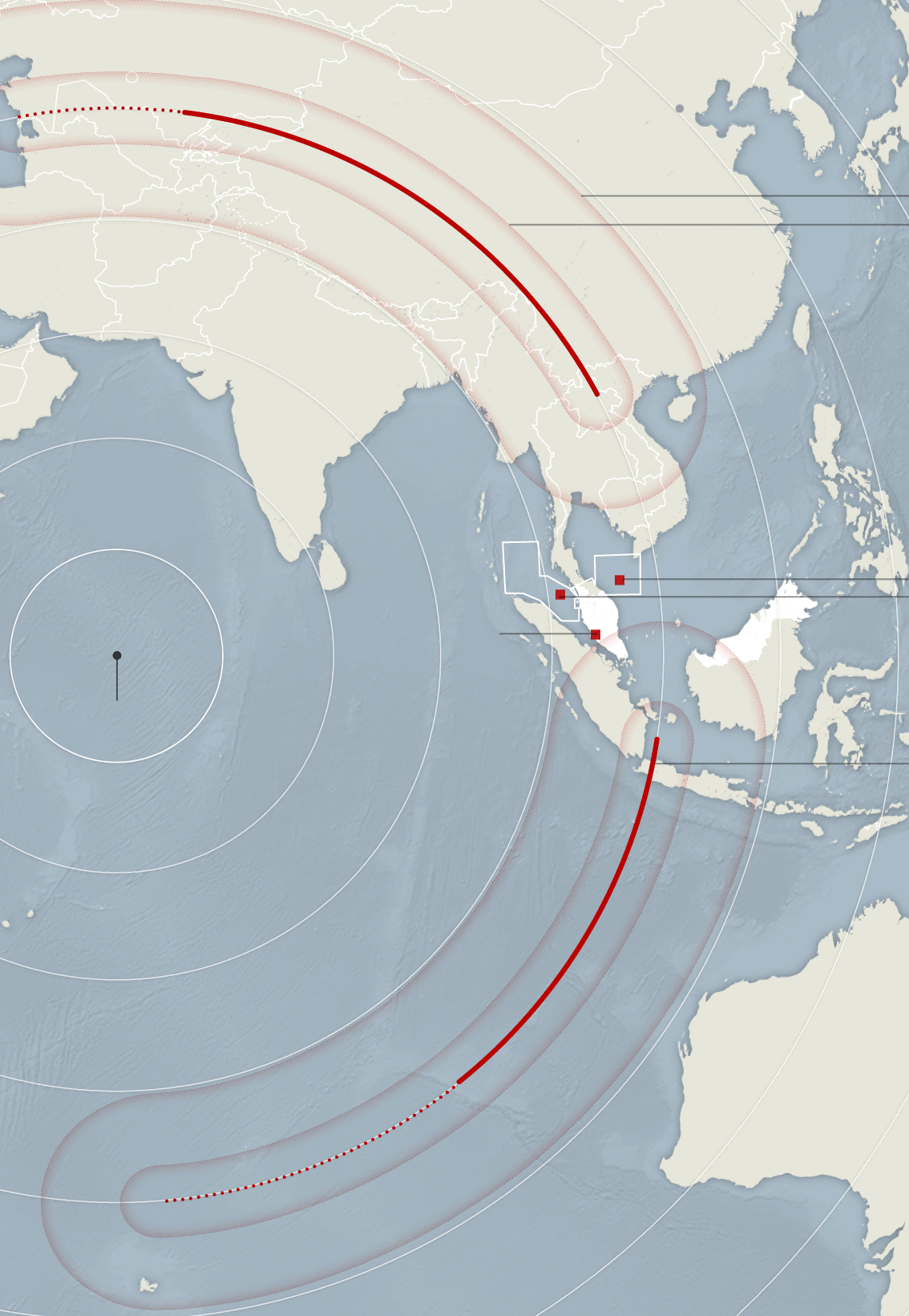
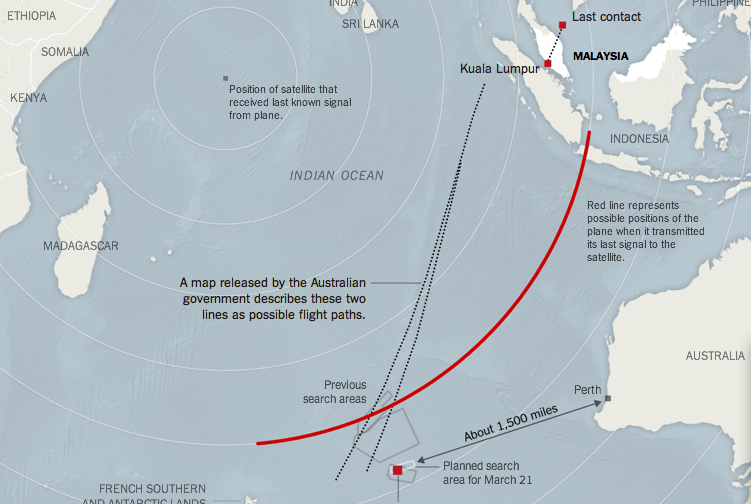
But the very vagueness of potential trajectories Based on the amount of fuel within the jet’s tanks, the possible position of the flight when it was last heard from satellite suggested only that it lay along one of the red arcs of potential diversion of the aircraft’s flight path from Kuala Lumpur in the 7 1/2 hours after its 12:41 take-off, tracing some  2.97 million square miles in which to conduct the search for the areas to which it was originally delimited and confined:


Estimated Range of Possible Flight PathsNew York Times


Although the area the arcs encompass approach the expanse of the continental United States, the arc to the Caspian Sea or Kazakhstan seem to have received far more initial attention:  it would, one supposes, be confirmation of the tentacles of Al Qaeda rearing their head.  The far smaller areas in which the plane had first been searched, defined by white rectangles, suggested in this map, made a week after the airplane had disappeared, as well as the difficulty of tracking what had been assumed to be so readily confined to the Gulf of Thailand, but which now has expanded to cover much of the South Seas.  But the fact that even those flying the most up-to-date jets of American Navy surveillance like the  P-8A Poseidon have been peering out of glass airplane windows and not looking at their electronic screens to spot the potentially downed craft, relying on the human eye to scan the open waters, and only spotting such objects as orange rope, white balls, or blue-green plastic reminds us of how much ocean-borne garbage might create distracting signs to frustrate the search.  And the reports of a low-flying plane sighted March 8 near the Maldives might potentially refocus attention in other areas that might well be mapped.


INitial Search AreaNew York Times


It’s a bit shocking that in over three weeks, no sign of the airplane’s disappearance has been noted, despite numerous potential sightings that have in the end proved red herrings.  The oddness of plotting an opening of an escape from surveillance and tracking that are the basis of the concept of modern airspace find reflections in the repeated maps of loss of contact with controllers, exit from tracking systems, and potential paths of flight, all concealing the absence of surety in being able to verify what happened to the unfortunate passengers on Malaysia Jet 370 more than the results of an ongoing inquiry with little sign of any clues in the transcript of exchanges between the flight and controllers for the seven and a half hours after it took off, and little indication of the expected tussle that would be associated with a diversion of flight paths. The potential sites of wreckage that have been found are something like the catalogue of a junkyard–including some 122 pieces of unknown floating objects in the Indian Oceanseventy-eight foot debris off Australia’s coast; white balls, orange string or other junk–in ways that have led to an explosion of articles on potential sightings that seems without end, each announced as potentially “credible” as the last.  So many potentially distracting objects that bear no demand for further scrutiny seem to exist that the Australian military took it upon themselves to include a list of those objects worthy of follow-up, including “debris, distress beacon, fire, flares, life jackets, life raft/dinghy, marker dye, mirror signals, movements, oil slick, person in water, smoke, wreckage.”

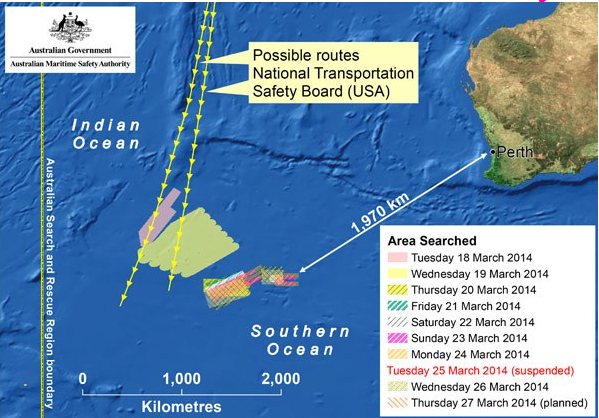
The demand for news maps suggest the shifting areas of the search and the aporia of inquiries that reinforce how difficult it is to believe that anything like an airplane would be so difficult to map.  The Australian government assembled a colorful collage of spots already examined, indicating the intensity of their daily attempts, which have shifted as time progressed and new theories emerged:


Australian Colorful Collage of Searches


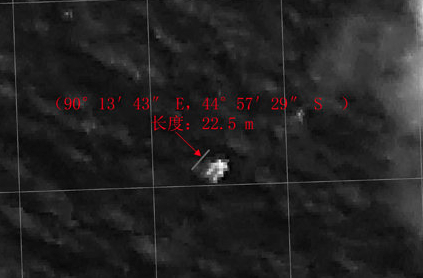
The Chinese government sought to provide ocular proof and exact coordinates of what looked like aircraft, 74 feet long and thirty feet wide, as if to reassert their claims to be monitoring the airspace by satellite, and staking claim to a region of particularly intensely disputed nautical boundaries–but so far finding little confirmation of the wreckage by boats:


Chinese Object in India Ocean


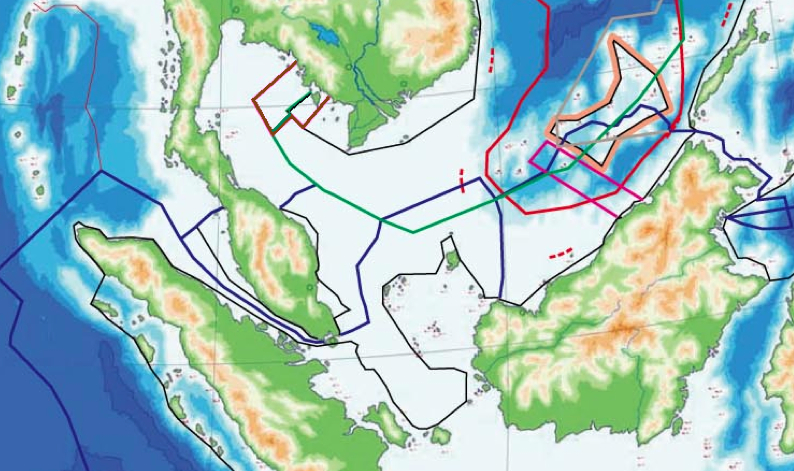
Are we just discovering how much garbage is in the ocean?  Or are we staking a claim to rights of sovereignty over maritime lanes, when maritime sovereignty still seems particularly difficult to define–raising questions of what sort of waters the craft may have been lost in, and whose right it is to retrieve whatever of the plane is left, but also pushing the search out to international waters, to avoid fraught questions of contested maritime sovereignty.  The oddly international complexion of the search parties that have been engaged so far has all too often muted the deeper salient question of the complex contestation of conflicting lines of maritime jurisdiction in the very region of the seas over which the plane flew.  (While few would want to suggest that the search has progressed in reaction to disagreements about jurisdiction, the difficulty of mapping jurisdiction in these waters has received far less press coverage than one might expect.)


Complex Delineation of Nautical Borders Legend-boundareis


In a field of disputes of maritime boundary lines, the search for the place is filtered through the actually contested sovereignty on multiple fronts, in ways that greatly complicate questions of responsibility for searching for the aircraft and its presumably dead passengers:


Complex Maritime Boundaries   Legend-boundareis


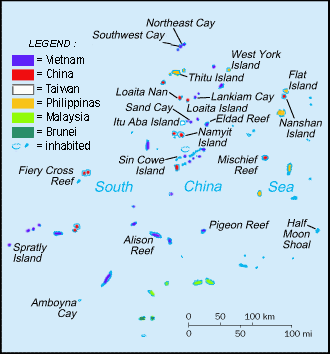
Indeed, the territorial complexion of many of the uninhabited islands of the South Seas resembles the random bright coloration of the multiple islands of medieval and early modern isolari, or books of islands, even if the colors are no meant to denote sovereign claims:


Spratly_Is_since_NalGeoMaps


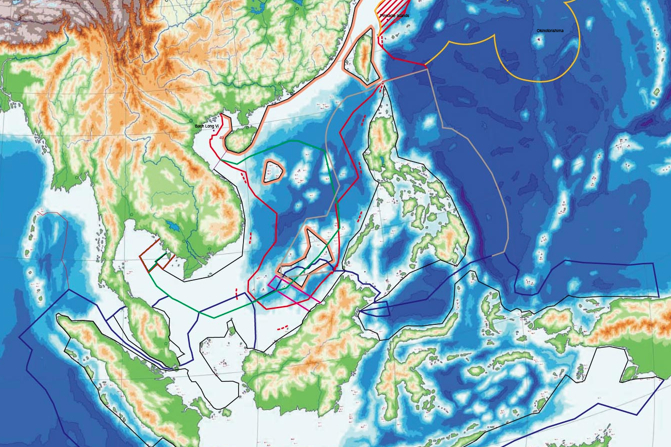
The larger picture is even, of course, both a bit more complex, and carries deep conflicts of how one can best understand maritime bounds, in ways that raise but a corner on the difficulties of resolving maritime boundary lines:


Complex Question of Boundaries


For most Americans, of course, oblivious to contrasting claims of sovereignty over water in a globalized world, and amused by the idea of contesting the sovereignty of maps, the questions might turn around the simpler incredulity at what has happened to our satellites or systems of radar.  The amount of ink spilled over the absence of indications of a major airline’s flightpath leaves viewers aghast at not being able to interpret the map that results. The pleasure that commentators on ‘The Ed Show’ or ‘Bill O’Reilly’ take in evoking and imitating authoritative maps that show potential arcs of air travel provide a scary shock-tactic of disorienting observers to an over-observed world, and suggests the discomfort not only at the potential for future skyjackings or dangers of flying aboard airplanes–but that we’re just not being watched as well as we all wanted to be, as if that was what we wanted. Or is it that the mapping of the results of post-9/11 surveillance have let us lapse, reassured, into a false sense that we need not worry about the dangers of the diversions of commercial flights, or that all is indeed under control?  Yet the hunt has now turned to the southern Indian Ocean, based on scattered new evidence of active flight diversion, after being centered in the Gulf of Thailand or South China Sea, with concern arising from the fact that the batteries on flight data and voice recorders–the main hope of finding the plane’s location–are due to die, and with them much potential evidence of what transpired in the cockpit, as pings emitted to facilitate their geolocation are due to die, after which the hopes to find evidence of what occurred would be drastically reduced.

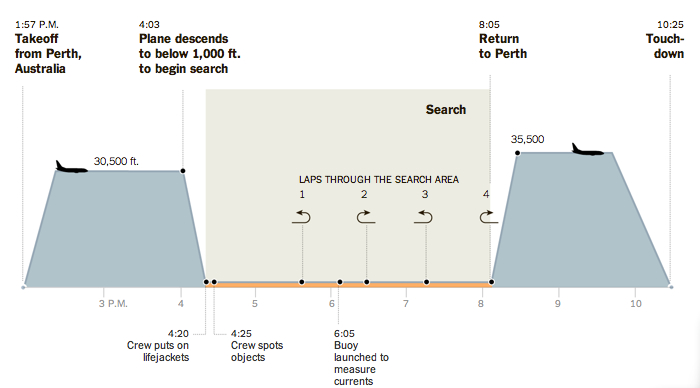
The search for the information is being collected in the need to affirm the continued safety of airspace, not to mention confidence in the air travel industry.  Does it also serve to conceal the huge costs that the US government is ready to spend on the search, already having allocated 2.5 million for the participation of US ships and aircraft to this mission, presumably in the hopes to find clues to the disruption of monitored airspace.  (The flight of an search of the average high-tech surveillance navy jet of the sort equipped with the requisite surveillance cameras lasts two hours, deploying the most cutting edge example of surveillance of the “sea state”:  the theater for remapping the waters by planes such as the P-8A Poseidon suggests a rehearsal of the gamut of equipment that the Navy has assembled and huge costs to use must be balanced with the eagerness of being able to deploy our latest surveillance toys.)

average Search Plane(from The New York Times)


The frames of geographic reference somehow seem part of the dramatic narratives spun about the disappeared plane, whose possible paths not only inspire limited confidence in the accurate measurements or tracking capacities but oddly orient viewers to the South Seas from a strikingly new orientation on landmasses and marine space, in which the dramatically open areas frame the aerial search along a diverted flight path far from land, in an area that is moreover swept by winds that often exceed 100 miles per hour, and rough seas:


Reconstructions of Flight PathsNew York Times


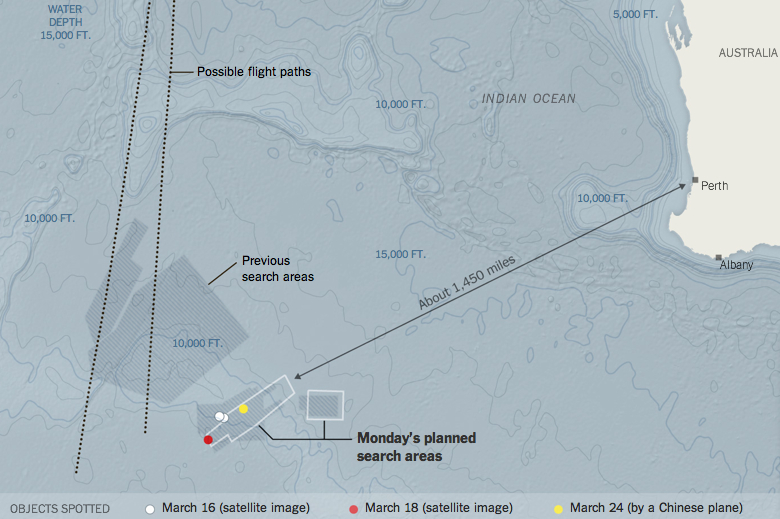
The deployment of all this technology to map the region by weather charts or debris-sightings seem designed to bolster confidence that this area, if blocked by cloud cover and rain and tremendously powerful waves, and deep waters, is still being mapped with relative accuracy. Yet what is one to make of the mapping of potential sightings? What significance does their clustering in the Indian Ocean mean save the intensity of searchlights turned to that direction, and the new horizon of expectations that results–even if the idea that pings from the airline’s data system, ACARS, dating from the period of four to five hours after the last transponder signal, and transmitted to satellites, indicate its arrival in the Indian ocean.  But why map potential sightings if they are not confirmed, except to try to restore some confidence in a search that might be akin to searching for sightings of Elvis or Christ?  In the meantime, the proliferation of alternative theories continue, from the plane being attacked by extraterrestrials, captured by folks who’ve shrouded it in an “invisibility cloak” or the locally generated theory that the disappearance of the plane is part of a an ambitious life-insurance scam, and not a terrorist plot–floated by Malaysian police chief Khalid Abu Bakar.  Over the month since the airplane’s disappearance, the biggest winner has no doubt been CNN, whose 24-7 coverage has stoked continued interest in the story; CNN President Jeff Zucker boasted how the new ratings showing reveal “a record-setting month for CNN’s digital platforms, including record-high page views, video streams and mobile traffic,” as if he was addressing shareholders, as it continued to describe and map objects floating in the Indian Ocean, without any sense of whether they were related in any way to the flight–so long as they were located along “possible flight paths.”  Is the technology of mapping a legitimation here for the absence of any actual detection of the flight path?  


Objects SpottedNew York Times source Australian Maritime Safety Authority


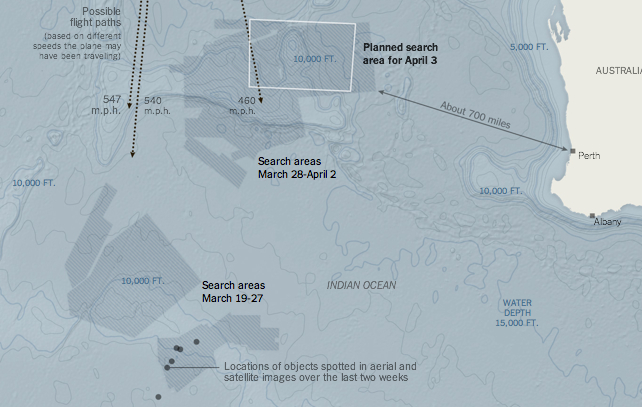
It’s hard to follow the logic of those who are organizing the Australian search teams, even thought the New York Times does its best to keep us in touch with the latest, but the recent relocation of the search by some 700 miles to the northeast suggest the hunt is a grab-bag of guesswork, and reveals the intense feelings of desperation at the narrative spinning out of control.


Relocation of Air SearchNew York Times; source: Australian Maritime Safety Authority


But to generate more information about the “unfolding story” of what CNN has continued to call the “airline mystery,” given the fact that no resolution of this mystery is in sight, and no indications that the plane crashed have emerged, nothing does the trick like a map to link the event to a number of alternate narratives and abstractions.

And as it has emerged after almost three months that the unending search is the most costliest episode of recovery of a jet in human history, the devotion of such emergency apparatuses to locating a lost jet must be assessed:  at the cost of millions of dollars per day, and over three and a half million dollars just to deploy an underwater detector of potential pings over the past weekend, it might be time to return attention to what is the end of the search, save seeking closure on a traumatic disruption of any illusion of totalsurveillance of airways such as that which the United States government wants desperately to be able to sustain?

What else occasioned the repeated search for the ruins of the jet without any sense of limits of cost, and indeed the devotion of a recently developed technology of surveillance to the detection of potential signs of the lost plane and its passengers?  At the same time, the rescue mission seems a sort of dress-rehearsal for surveillance of submarines on the high seas, the narrative of locating fragments of wreckage of the plane’s fuselage or wings fits into a sense we need to find closure in a sense that something happened while we all thought we were being watched:  this notion that the incident of Malaysia Airlines 370 suddenly disrupted and shattered that sense of an achieved limited peace, even in a time of ongoing contained military engagement in several theaters of the world.  It is hard to get used to the fact that we are not, and cannot be, safe in air travel.  (But at least, perhaps, we have generated these detailed maps, which seem to be reassuring of a sense of monitoring an unfolding story, even if it is one that seems to have not gone very far after all.)

The sense that we’re somehow being less well-watched than we once were seems to have driven the constant stream of news stories—unconscionably, never edited or diminished on airline flights, but almost increased in an attempt to keep passengers more relaxed and on their toes, the jet has increased critical thinking to the extent that it has provoked calls for the re-introduction of “reliable psychics” (in a return to the Nancy Reagan White House).  Where the plane went is less the concern of these maps, it seems, than the fact that draw as many maps as we want, not much turns up on them. The courses of potential flight paths after the pilots lost contact with the airport in Malaysia from which they first took off on that tragic day seems less directed to the protection of our own frontiers—or even airlines—than the notion that we cannot map a map of that path, even with all our satellite coverage and technologies that we’ve devoted, in the wake of 9/11, to monitoring maps of all movements along flight paths across the inhabited world. One problem may be that 9/11 opened a narrative, or saw one forced on us, so haunting that we don’t know how to bring to an end, or cannot see an end of, so deeply unsettling is it all.

Leave a comment

Filed under CNN newsmaps, flight-tracking maps, infographics, mapping flight paths, radar maps, satellite surveillance, surveillance mapping