The border was closed and immigration authorities simply ‘at capacity,’ announced newspapers, after a Caravan of migrants from Central America arrived. In rejecting the ability to process new arrivals who lacked necessary papers of transit, the papers parroted a an anti-immigrant line, revising the southwestern border from a line of passage, or space of transit, in what seemed a meme about the border as a threshold of legality-as if a line defines the legality of those who cross it. If the border wall is a “new” creation, it seems designed as a monument of the “new” nation, bisecting an area that was not truly demarcated for some time, despite it suggestion of eternal authority–the Thono O’odham Nation of the Sonoran Desert long lived on both sides of the modern “border” before either nation existed across its divide, and are recognized as “border dwellers” in both the state of Arizona and Sonora. But the wall served as a label, and a divider between “us” and “them,” a boundary where the outsider was defined as an enemy, and “politics” was indeed the definition of the enemy lying outside of the social body. To affirm that distinction, the wall needed to be built–and to explain the enemies to the body politic, the performative spectacle of the confrontations that might occur at the border was in need of staging, again and again, as a primal scene, as much as the wall-as-border might be mapped.
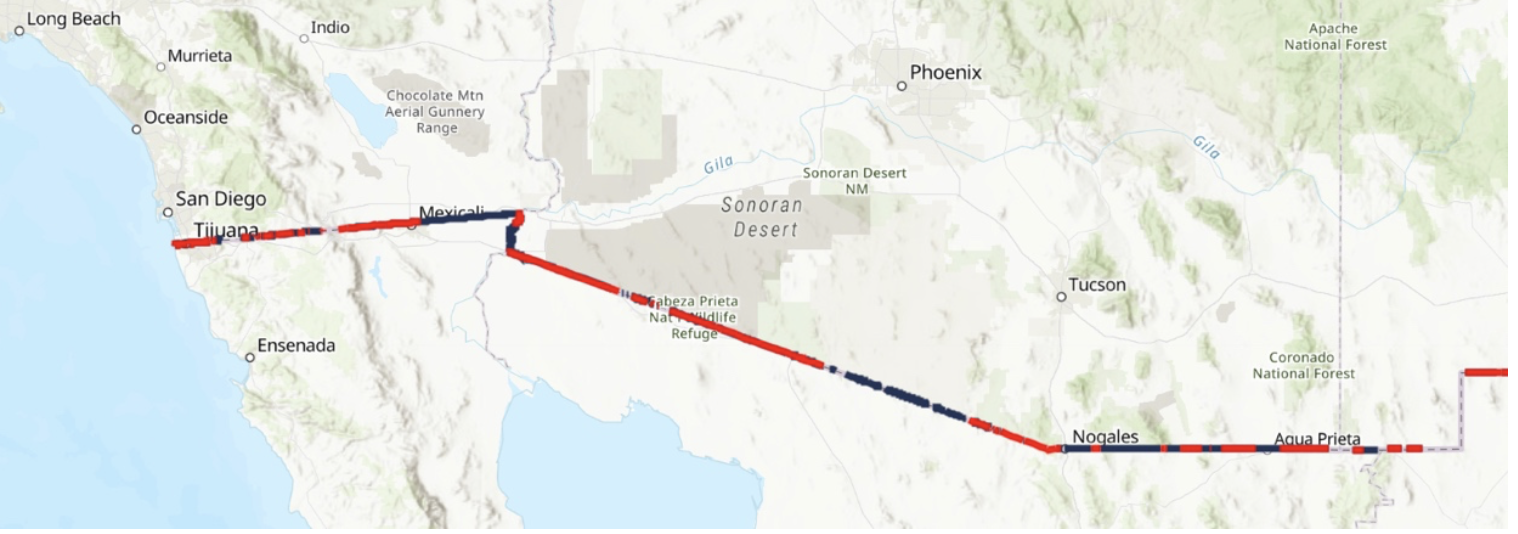
Department of Homeland Security
The creation of the border as a defining feature of the nation–a nation that was able to be recreated, or literally “made great again” as a nation by its border wall as a human creation–suggested the deep belief in the making and remaking of nations, a concept of the intellectual creation of nations that oddly echoes the legal historian Giambattista Vico in its insistence on the making of a nation not in reference to its laws, but as a collective whole who felt that borders were defining characteristics of modern states. But the institution of this border at the same time exists outside of the law, and assumes an oddly primal characteristic as a site of sacrifice, echoing in surprising ways how the Neapolitan jurist Giambattista Vico saw borders as defining the inclusion and exclusion of rights to property, and senses of citizens, that was prior to and predated the law. Although the massive public works project that the state had mandated at the U.S.-Mexico Border was not at all an Enlightenment project, so much as a mega-project that was destined to incarnate state authority in an age of mass politics: a public works project proclaimed to fill multiple needs of protecting property, securing wealth, and building the nation’s power, of Neo-imperial dimensions, akin to Mussolini’s draining of Pontine Marshes or to the state programs of collective transformation of the mid0twentieth century, by dramatically staging the power of the nation in its ability to incarnate mythic notions of a powerful state for the benefit of all its members.
The creation of a strongman, who has arrogated the American eagle clutching fasces and a laurel, announcing that it will transform “many” to “one,” but only the many admitted past its sign. For the legist Vico, the ongoing brutality and conflict of society was not only natural, but a position even of possible growth: the very words of one society and culture might be reused and adopted by the following in even discordant ways.

But if Vico was clear about the “boria delle nazioni“–the conceit of nations–that they were unique in the very national characteristics that only they possessed, and the each nation had most critical aspects only it alone possessed. The conceit is amplified by the border wall, and the lie that it is built on to keep out others–and indeed to perform a sort of ritualized sacrifice of the other on the built barrier that the nation sought to create. For the Border Wall, if the most vain construction of any nation, a homeostatic barrier or norm of sorts that proclaims the identity of the nation, the unveiling of the border wall was an exploitation of the potential of television and the stagecraft of nationhood to stage that identity, as a fascistic or photo-fascist rehearsal of national foundation, or refoundation, by newly erected boundary walls that lack all porousness of the past. Indeed, the border wall seemed to be an occasion to re-educate the nation on the notions of citizenship, and the barrier that needed to be created on which to sacrifice the other. Was the conceit of the border wall a medieval conceit, or a form of statehood that was only made in the twenty first century?
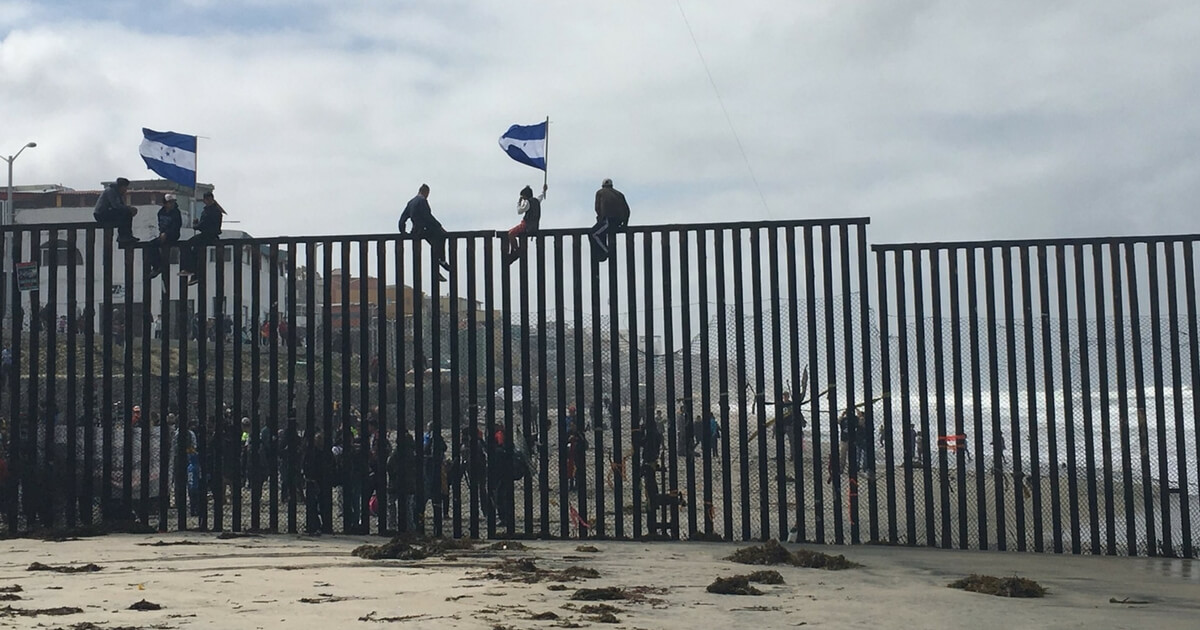
The image that suggested migrants atop the wall, or of others scaling a dilapidated section of slatted border fence near San Isidro–“through a dark, treacherous canyon, notorious for human trafficking and drug smuggling”–collapsed multiple tropes of border-crossing on the least likely of targets: a peaceful procession through Mexico that began on Easter Sunday, crossing borders to call global attention to migrants’ rights.
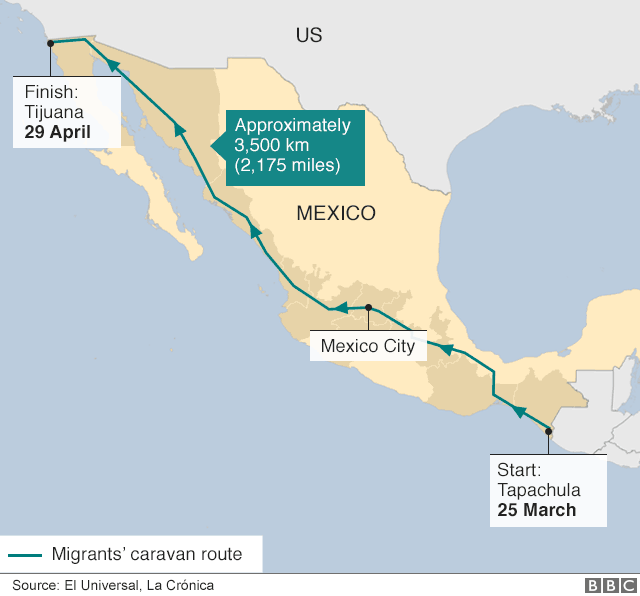
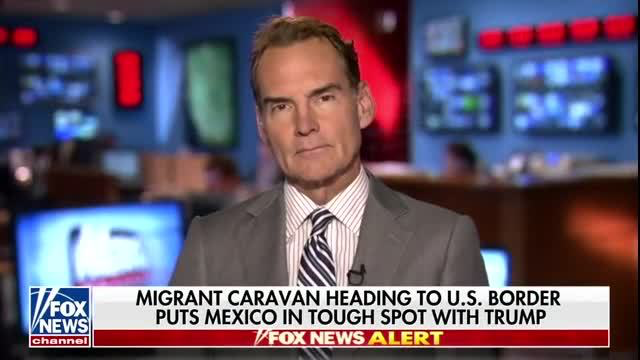
While the simple visualization of the course of the procession that wound through Mexico City from the southernmost border of Mexico cannot trace the mental geography on which the arrival of migrants was mapped in the United States, the progress of Central American migrants was viewed and mapped by Donald Trump and FOX in terms of the desire to see their arrival from behind the proposed $18 billion border wall that has become a contentious object of debate. As the number of arrests along the border has grown above 50,000 for the third straight month in a row, and more children separated from parents in an attempt to broadcast cautionary warnings about the dangers of attempting to cross the border, or to appeal to existing immigration laws by asylum pleas, stories of migrants that the proposed wall would silence are increasingly difficult to silence or contain, and the human narratives of migrants are increasingly difficult to place behind the imaginary screen of an insurmountable border wall,–which of course does not exist, save as a mental construct–but is cherished as one and difficult for many to relinquish or deny.
Even though there is no structure corresponding to the height, thickness, and architectural design that Trump had treated audiences during his campaign, the Caravan threatened to remind us that the wall didn’t exist, despite the attention that has been lavished on its proposed construction at a cost of an estimated $18 billion, far below what actual costs might in fact be. Yet the specter of the arriving migrants from Guatemala, El Salvador and Honduras–the triumvirate of “failing states” that Trump has demonized has provided a new basis to affirm the urgency of its construction. The caravan of migrants was cast as a threat to the nation, of urgency to place at a distance from the nation–even if they were also cast an oddly unstoppable “horde” able to evade or defy Mexican immigration authorities who had not successfully turned them back. As if to say that the “buck stops here,” their impending arrival was rhetorically magnified as a threat to create a persuasive image that reminded the nation of the urgent need for the border wall as an artifice of defining the nation.
After months of dehumanizing migrants as faceless hordes, poised at the border, migrants seemed to have arrived at the border fencing, about to breach an inadequate barrier that is a relic dating from the era of the Vietnam War. The news of the progression of the Caravan–and clouded interpretation of what their aims for crossing the United States’ southwestern border truly were–led them to become a poster child for the urgency with which Donald J. Trump has so stridently advocated the construction of a “real wall,” with an intransigence that almost embodies the physicality of an actual concrete wall, a month before the construction of the border wall began in San Diego and Calexico, CA, replacing some fourteen miles of improvised border fencing that was long ago made of scrap metal to “secure our border” as a way to “make America great again.” The promotion of building the border wall was a way to ensure “public safety” followed repeated images of migrants attempting to scale or protest before existing improvised fencing–
–
-whose inadequacy to deal with the border threat Trump had relentless ridiculed as useless during his Presidential campaign. The danger of cross-border traffic that Trump had repeatedly magnified circulated back to prominence within the national media with the arrival of the migrant Caravan. The hope for the migrants to gain asylum in the United States was immediately questioned as their true agenda was assumed to be one of evading the border controls before the Wall was built–and the immigration laws that would permit their entry changed.
If the announcement of the construction was a feign of a a show of strength, and promoted as a basis for national pride, it was an insult to migrants petitioning for asylum, as the promotion of the border wall as a sign of national security debased the notion of the nation as one of laws and civil society. The promotion of the wall as a slogan of nationalism remapped the nation in relation to the border, after all, in the Newspeak of social media and twitter–“Strong Borders are Security”, “Immigrants are Criminals”; “Refugees are Terrorists”–the border wall protected national security and projected the idea that all migrants were illegal. The spatial imaginary of the border wall echoed the longstanding claim, made without evidence, that the immigrants at the border were “the worst” of their society, and for allowing an untold number of undesirables to enter the the nation. As well as protesting the treatment of the United States”the dumping ground of European Refuse” as an insult to the nation, the insult was accepted by the nation. The blame rests on citizens who are accept the very immigrants Europe does not want. The image, which appeared just before Bartholdi’s “Statue of Liberty” was erected in New York Harbor, raised objections to accepting those rejected by Europe’s crowned heads, of dubious value to the nation that echoed Trump’s position.
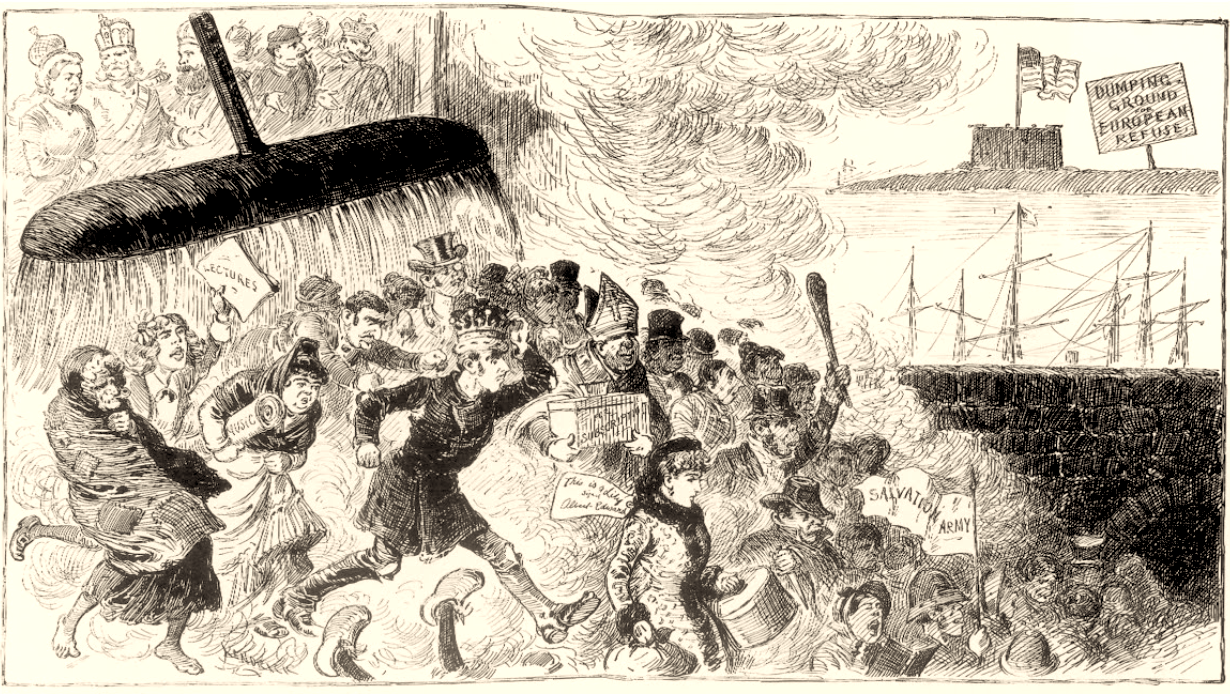 Kendrick, “And We Open Our Arms to Them” Life Magazine (July 12, 1885),
The very chaotic narrative of depositing “human refuse”–a group of former colonials identified as “not like us” but being advanced by an invisible broom–was repeated in the image of the approaching Caravan, as the legitimacy of their requests for asylum from Central American nations were questioned, and suggested to be fundamentally an illustration of disrespect for the law. The “Caravan” of over 1,000 migrants seeking a better life was widely mapped as a threat to sovereignty and law, recasting a protest march that promoted migrants’ rights as an invasion of sovereign space–and a grounds to deny migrants’ rights. The tweets of President Trump directed the attention of the country to the border to query the status of the migrants who were headed to the nation, as he announced instructions “not to let these large Caravans of people into our country”–magnifying the migrants as a national threat through a dichotomy between “them” and “us.” The anxieties about immigration policies that Kenrick’s cartoon registered panic at the caricatured faces of the new arrivals.
In announcing an intent of illegal entry across the border, Trump once again conjured the need for a border wall, as if trying to co-opt the message of migrants to create an image of a cross-border threat. The construction of border walls against an “existential threat to the nation”–as did the former commander of the southern border who was named Trump’s director of Homeland Security and now his Chief of Staff—creates an urgency for protection that corrodes the possibility of an open society. Kelly’s disparagement of migrants as “people who would not easily assimilate into the United States,” “overwhelmingly rural,” from countries where “fourth, fifth, and sixth grade education are the norm,” described them with the same disdain as Kendrick’s cartoon from the early Life of the 1880s protested the insult by which ex-colonials were sent to the United States as to Australia or India, which had indeed become “dumping grounds” for convicts, remittance men, and socially unwanted cast-offs, as well as seeing them as barbarians who threatening the social fabric of the United States. The disparagement of migrants who are seeking asylum as uneducated, of rural origins, or indeed, as Kelly’s remarks must have reminded his audience, criminals.
 ICE Arrests of undocumented immigrants, 2014
The disproportionate warnings of a “border threat” or “trouble at the border” telegraphed on Twitter was inserted in a narrative rooted in the plan to create a border barrier of cast concrete in August 2015, in the heat of the Presidential election–a mission that crystallized support behind Trump’s campaign. Trump insisted that the border wall he advocated wasn’t rhetorical, symbolic, or virtual–a space defined by hi-tech monitoring–but an impervious barrier that would succeed where other poor-quality fencing had failed.
The build-up of the arrival of the migrant caravan ran against the disproportionate attention that Trump had drawn to the border. As Trump pedaled the fiction that the wall had already been begun, newscasters on FOX mapped a showdown by the approach toward the border of “that scary migrant caravan” of Central Americans with American law enforcement as inevitable, placing the migrants in a narrative of unwieldly crisis of immigration management on the US-Mexico border. In ways that intersect with a broad unease of increased immigration–often manifesting itself in extreme xenophobia, othering and racism–a vaguely masked anti-immigrant sentiment that has growth in the United States over the last four to five years which Trump has deftly exploited. For the ‘border wall’ was recognized code for a thinly disguised racism, captured in John Kelly’s characterization of the Caravan–and migrants–as “overwhelmingly rural people” not capable of assimilating, who “don’t have the [necessary] skills” to do so, and are “overwhelmingly rural people,” as if ignoring just how dependent U.S. farms are on immigrant labor.
The disproportionate attention the Trump and his planned border wall directed to the southwestern border made the region seem far more immediate to all Americans–and defined the Caravan’s approach as national news. Although the formation of such “Caravans”–a name not coined by Americans, though it gained new spin in the mouth of President Donald J. Trump, who had grown frustrated with an uptick in U.S. Border Patrol metrics of illegal entry–the tactic that was long adopted by advocacy groups to foreground migration difficulties was used by the group Pueblos sin Fronteras, or Peoples without Borders, whose name was seen as revealing their opposition to the redefinition of the southwestern border of the United States, which has also been mapped onto the wall–creating a reflexive panic at the sight of large crowds of unidentified migrants marching toward the border. The legal and physical obstacles that Trump promised to place on Mexicans or Central Americans seeking entry to the United States were always twinned, but the arrival of the migrant Caravan seemed to give it a new urgency, and to legitimize, as a suddenly mainstream demand of border management, the ability to control human cross-border flows.
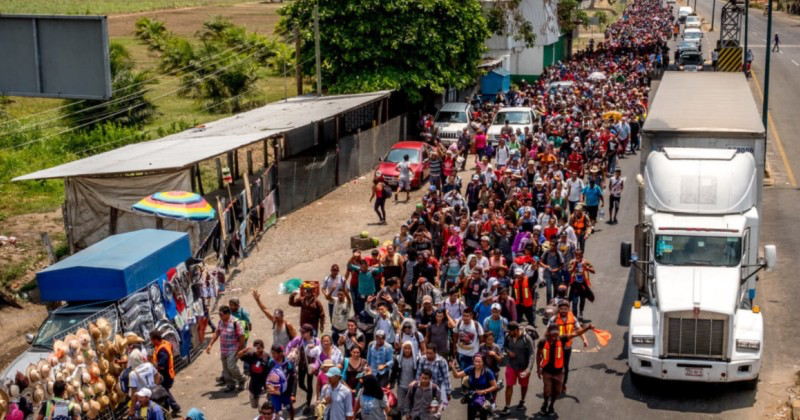
The march was described disdainfully as a “political stunt” in media, as the Attorney General and Director of Homeland Security demonized the “Caravan of migrants.” Trump had promised the nation a border wall unlike the reclaimed corrugated metal fencing in Tijuana, but made of “precast [concrete] plank,” a protective barrier far more powerful and robust than the inadequate fencing he treated as “a joke” and a disgrace to the nation, and which the multitude of migrants were seen as able to cross, but in need of immediate arrest and detention in a fantasy of border enforcement. If Trump had promised to be a strongman at the border, the old border wall seemed indeed flimsy obstacles, unable to stop even the crowd from the Caravan who arrived to petition for asylum at San Ysidro, CA.
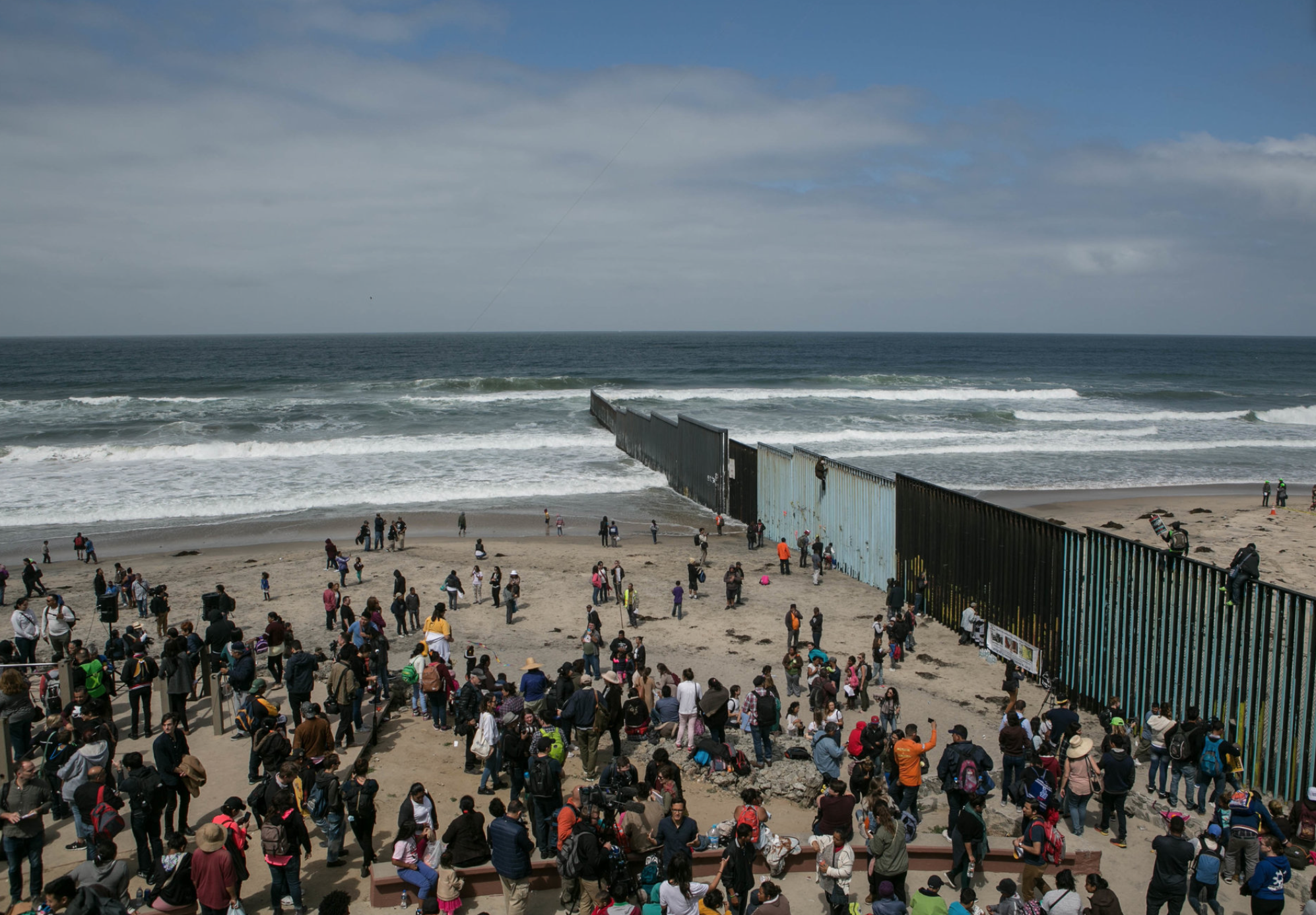
The peaceful protest of the Caravan de madres centroamericanas, to use their full name, was recast as a march of opposition to Trump’s border policy, while for Trump, as some three hundred odd members of the Caravan arrived at San Isidro, a recognized port of entry, in five busloads, and mounted on a fence made of repurposed scrap metal became for President Trump evidence of a crisis of sovereignty. In response to a crisis he seemed to have created on Twitter, he ordered the Department of Homeland Security to “stop the caravan,” displaying his knack for sound bytes and slogans, and imagine that, searching for the right string of capital letters on his keyboard, only “a strong, impenetrable WALL. . . will end this problem once and for all”–even if the problem lay with the places the migrants had fled. The motion of “migrants,” now cast as “illegal aliens” in the right-wing press, even as they hoped for a miracle from god able to “touch the hearts of immigration agents,” was not able to be seen clearly by many, even if their course was carefully mapped over the previous month in increasingly colorful reportage.






 Musings on Maps