Windswept Lands

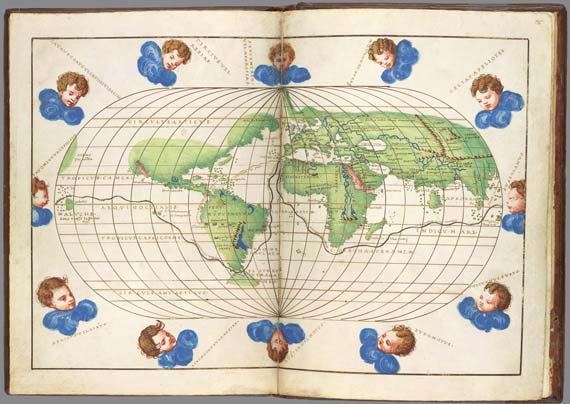
Warm wins that rise in the high plains have increasingly driven the fires that have devastated California, hurricanes battered our costs, and driven unprecedented showers that have flooded southeastern Texas.  But winds are rarely mapped, or even perceivable in maps, although winds were once a central part of the maps known as portolan charts designed when the primary means of long-distance voyaging was navigation.  But data now stands to integrate the winds–once shown as heads that buffeted human history or at least human travel–


venice Agnese_Portolan Atlas


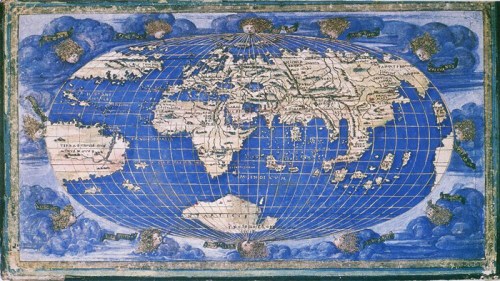
00but are increasingly able to be incorporated into our own maps of disasters, if only to fully understand the fluidity and vulnerability to which we are exposed by high winds.  Indeed, it is increasingly clear that we are better able to read the relations of geographic locations and the information of data visualizations only by including the winds in their surfaces, at the same rank, or level, as the sites of human habitation that maps have long prized.   But if the winds shown on global maps are confined to its margins as embodied personifications, less quantifiable than the graticule of longitude and latitude but vestiges of an older traditional of nautical charting where the provided directionality as well as the force of gales that would provide a basis to orient one’s sails,


rosellimap700


the place of the winds are able to be inscribed on the surfaces of many recent data maps.

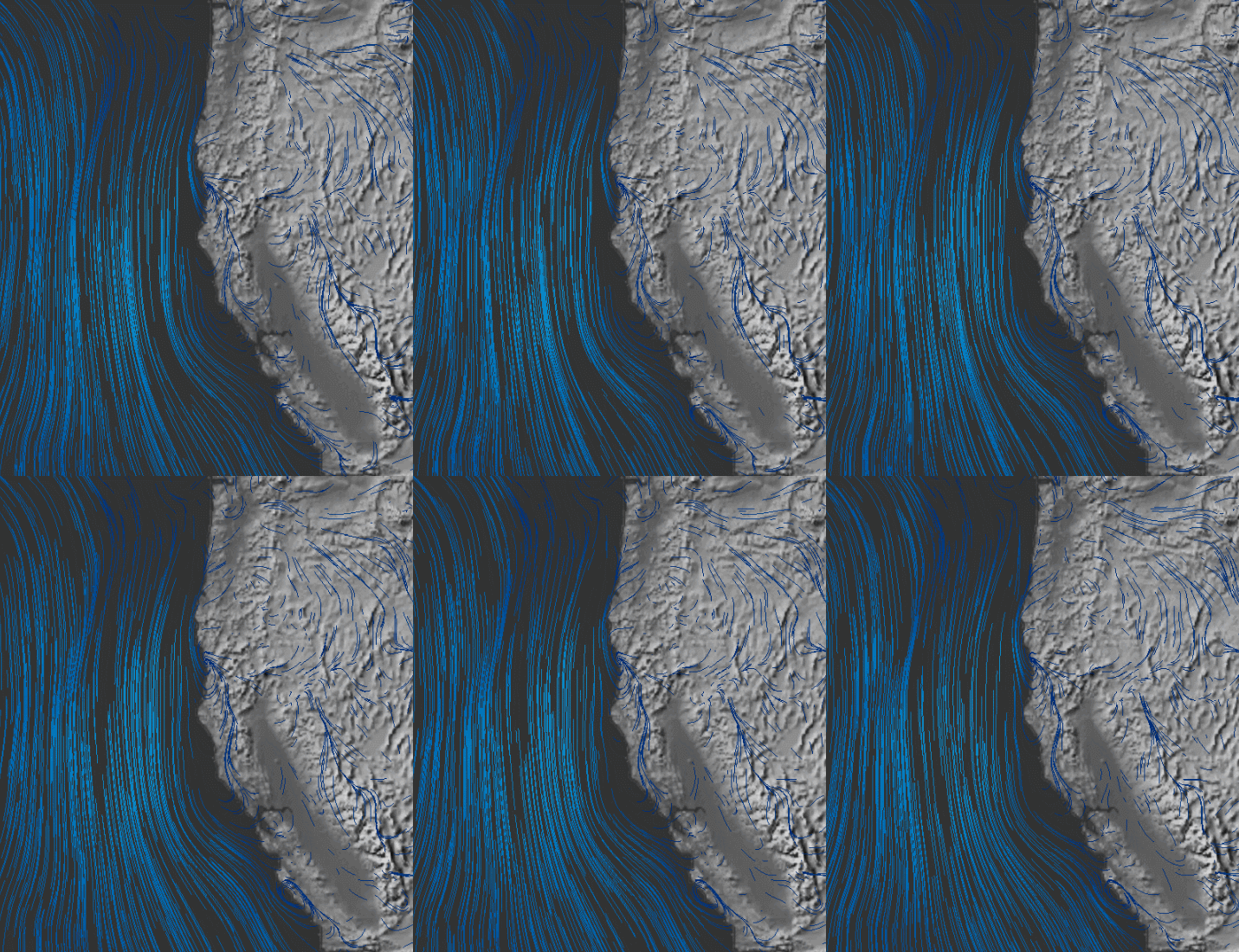
The ready availability of huge datasets about wind-strength indeed offers multiple formats for modeling an increasingly dynamic relation to space, and perhaps to incorporate them within the legibility of the map .  Indeed, the processing of remotely sensed data allows for frighteningly rapid condensation and synthesis of what can be called information within a single map.  And the recent NOAA based on modeling weather conditions in a real-time wind map is particularly neat in how it invests the currents of air that swirl above land and sea with a hue of their own, as if to invest them with character as a subject of mapping and give them a new level of visibility.  Set against a night sky, where details such as topography or ocean currents are conspicuously silenced, the lines of winds appear in neon blue relief off the California coast, showing an elegance of serpentine motions are tracked with far more wonder than the static terrestrial map:

wind

The flowing electric blue lines used to render wind move with a sleekness as if to promise immediate access to meteorological actuality that seem to blend the screen with current wind conditions, and provide that most fantastic of illusions of a map of the present-day that almost sends tingles up our neck in providing a map of events that seem actually to be transpiring.  The maps have in fact led reporters to gush thanks to the US government for its funding of the project with tax dollars, creating new conditions for the visibility of currents of air to which we are ineluctably drawn in an almost zen manner.  The GIF suggests a mapping that is based on looking at the overlooked, or rendering the smoothest of airborne sensations with cartographic legibility.  It echoes the recent ability to encode data from sensing stations in a transfixing image of swirling gusts that seems far more animated than the flat topographical base map that lies beneath.

sssss

The attraction of these maps is more visual, in fact, and somehow more seriously phenomenological, than having to do with geographical information, save as it suggests the increasingly fluid nature of all information flows.

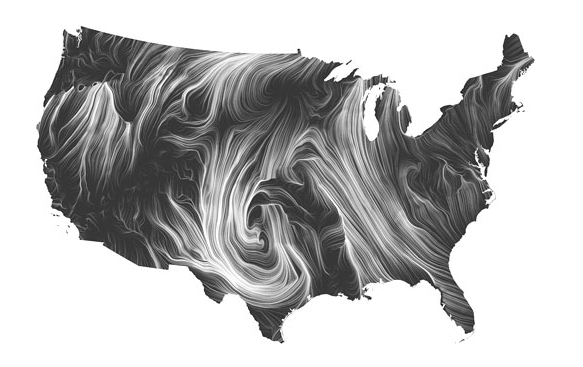
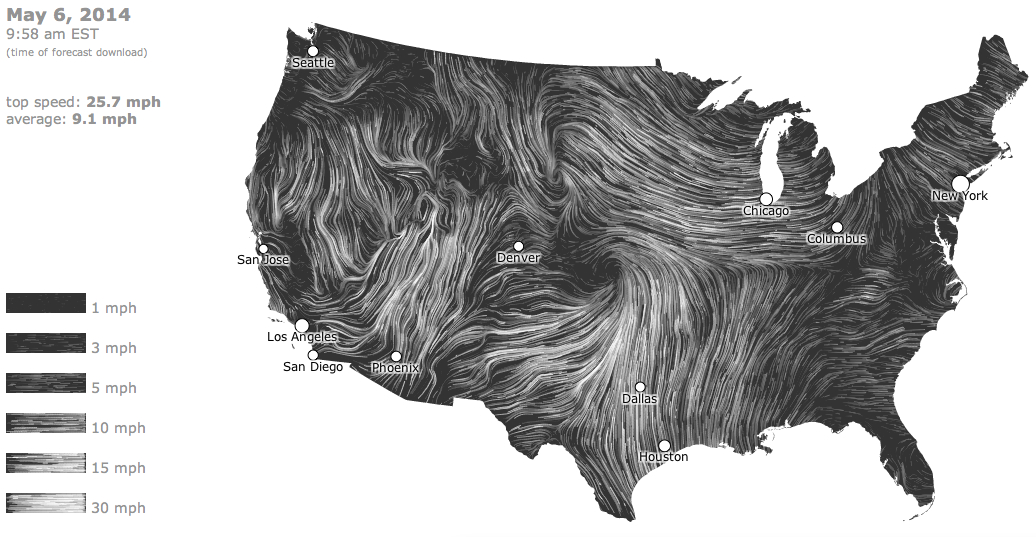
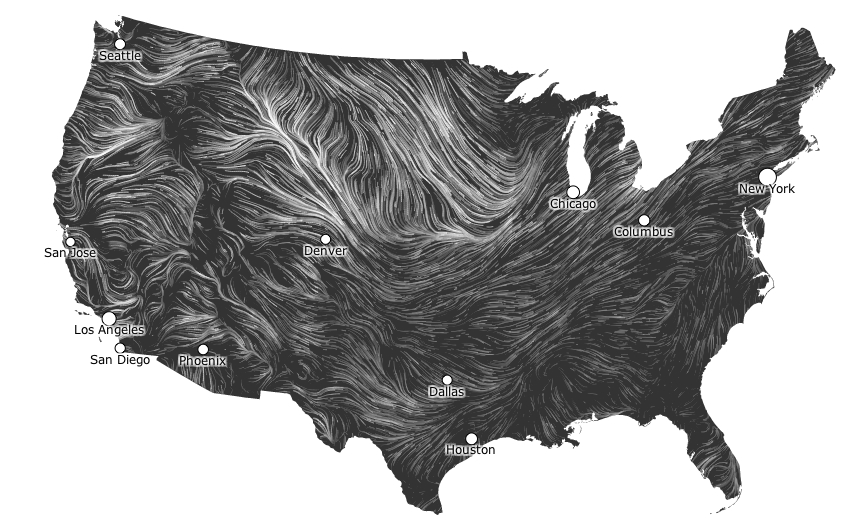
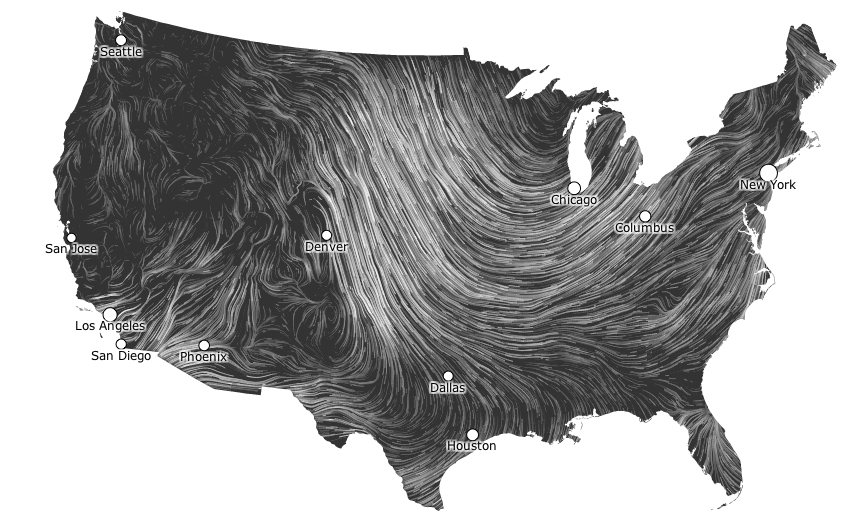
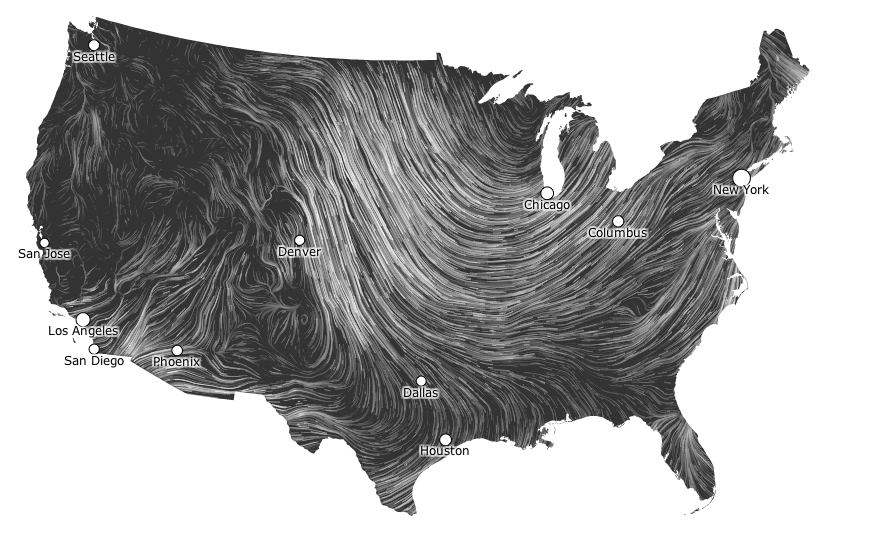
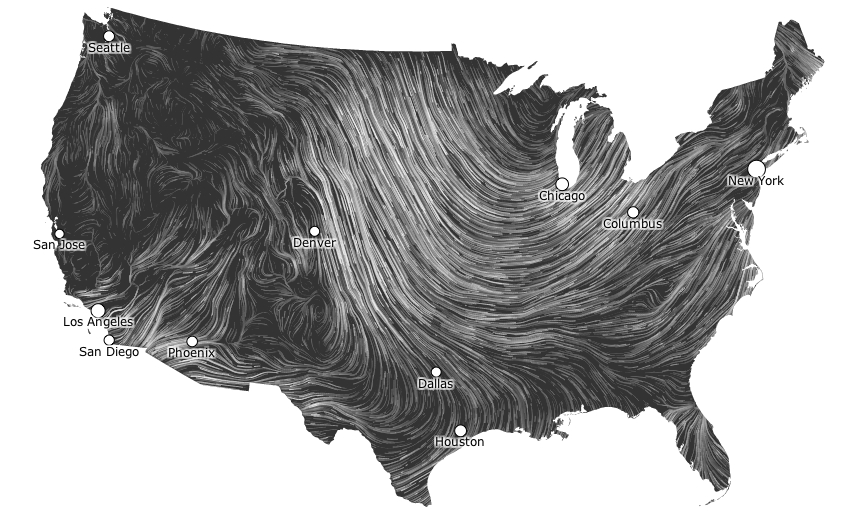
The dynamic nature of wind maps renders an idealized perspective whose content asymptotically approaches a view that is almost entirely abstracted or removed from the inhabited world, based on the mathematical models for projecting and tracing the currents and intensity of wind over land:  indeed, in the marvelously idealized data-driven maps, wind currents create whirls of whorls over the lower forty-eight.  The website hint.fm uses real-time images of the inroads winds make across the territory of the United States, distinguishing gradations of gustiness by wisps of differing intensity to describe a space not only removed from the inhabited world, but whose elegant tracery enacts an aerial drama across in an artificially demarcated mapped space too vast to comprehend, but offers a sort of atmospheric ballet of the wind’s shifting directionality and intensity, as if traced by a multitude of individually situated geographically dispersed weather vanes oriented by the shifting winds across the lower forty eight.

Wind Map website image

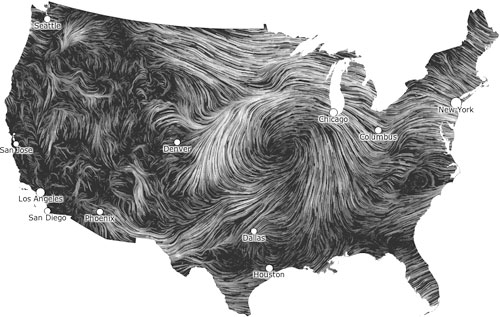
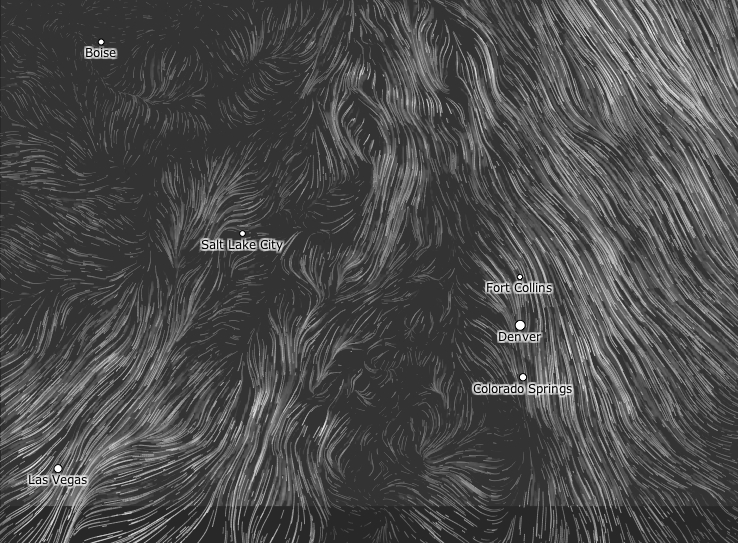
If the image recalls something like a smoke-filled room, it is more of a wind-filled continent, where blowing winds cross borders, rivers, and plains in an image of the bounds of the contiguous forty-eight states.  The cartographers, or artists of technological visualization, Fernanda Viégas and Martin Wattenberg are dedicated to “work [that] explores the joys of revelation” and in converting local data to suggest natural currents that existed before highways carved the continent into itineraries–like the “blue roads” of rivers run across the land–but their constantly shifting trails mark a weirdly curved space in a situated perspective rarely able to have been captured before.  Even on a “mild day,” the winds give a sort of dramatic intensity to the organization of space oddly removed from the cartographer’s art, which is quite passive in the sense of offering a surface to be inscribed by the movement of the air, as wind curves around the nation’s great plains in currents of a recognizable patterns or flows that approximate stop-action photography.

wind_west_to_east

Looping Denver

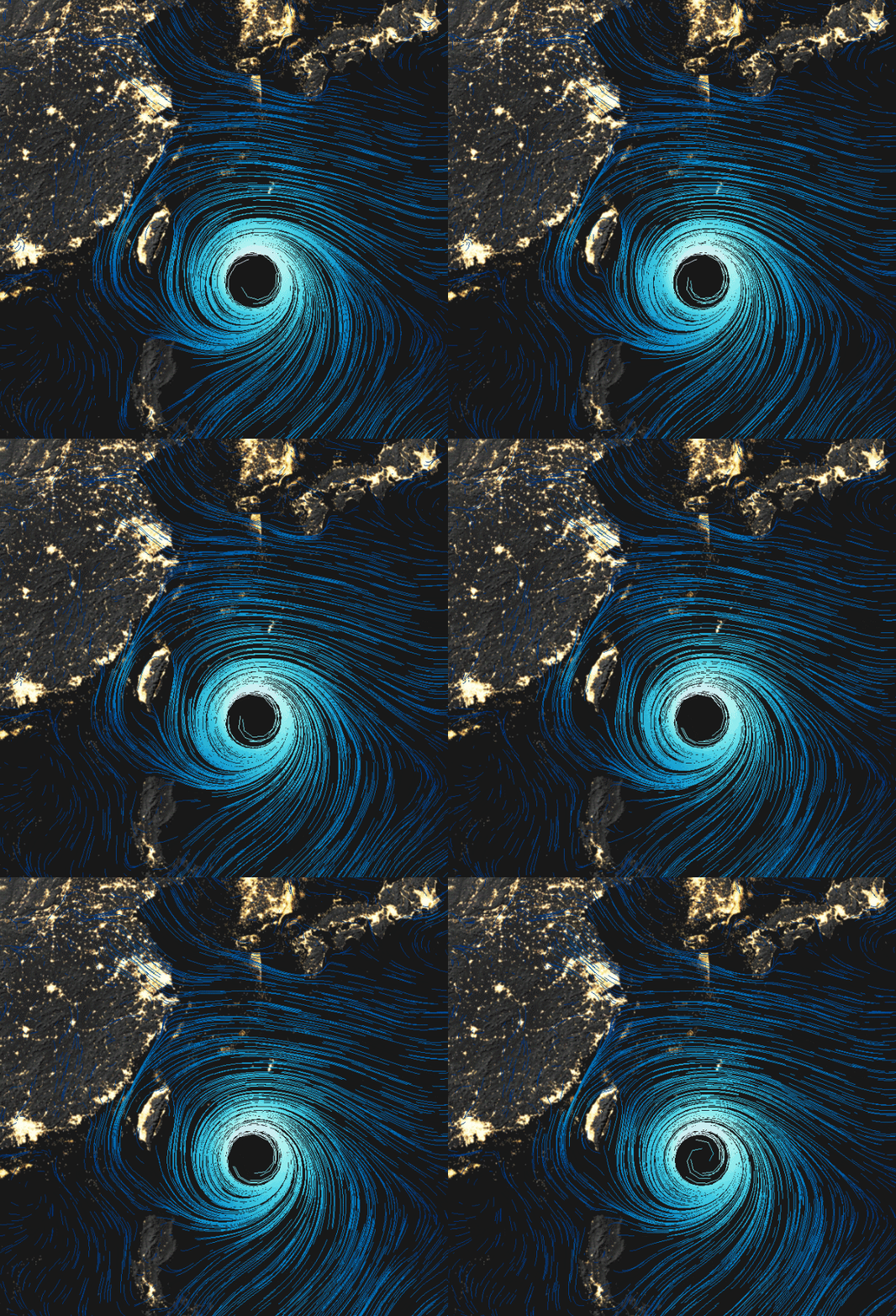
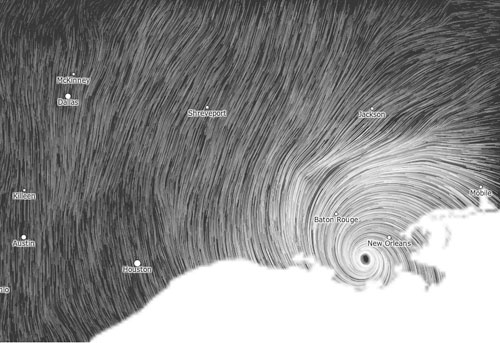
Sure, there are specific moments of meteorological intensity when winds line up in a recognizable pattern–a tornado or hurricane–in ways that define a geographic focus of interest or attention, as in the vortex of Hurricane Isaac as it approached New Orleans,

wind_isaac_zoom

but all too often the dispersal of attention is the rule, as one watches the patterns that winds themselves generate.

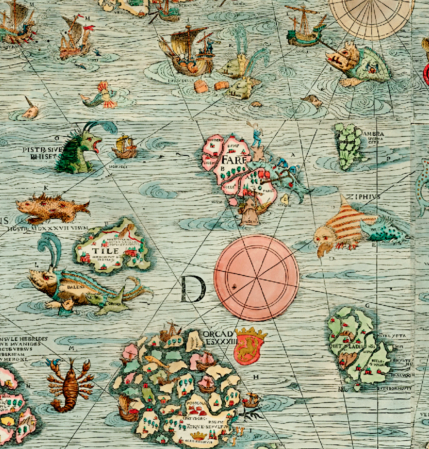
This charting of currents is one of the most precious dreams of early map-makers:  to chart the very presence of winds across the land and sea, early symbolized by the rhumb lines that were so important for nautical navigation in early modern and medieval charts, where they communicated the basis of projecting travel across oceans otherwise rarely noted or known how to be represented in the surface of the map itself:  even the lines surfaces of the waves on which ships gently rock and sea monsters rear their heads is only a suggestion of the winds that run across their surface.

Olaus Magnus

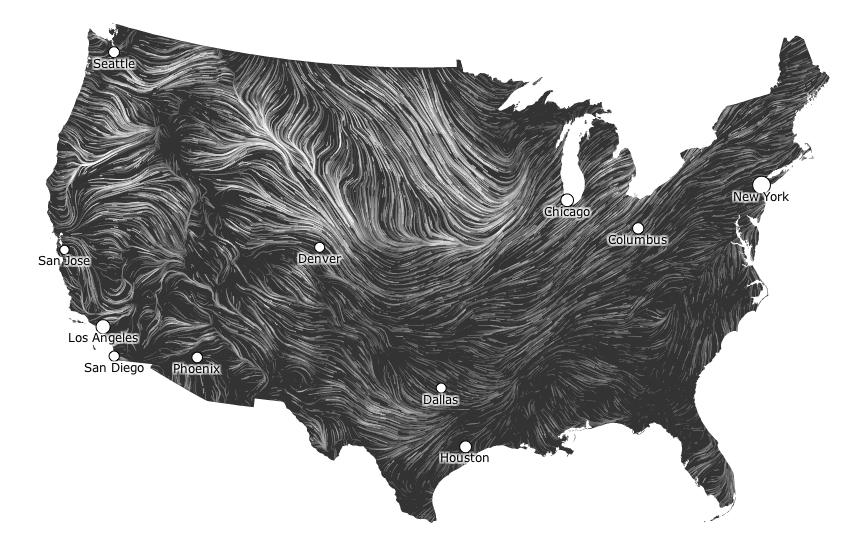
The wind-map is abstracted from territoriality in a sense, as were the oceans:  its formal focus on the United States, derives from its synthesis of predictions of the National Digital Forecast DatabaseLaura Kurgan has suggested how much the big data of cartographical operations like Google Maps or Google Earth were not only enabled but indebted–and informed by–the declassification of satellite views during the Clinton administration, which created something of a boondoggle of available data for American mapping firms, if it also informed the very strategies of global surveillance that Google inherited:   the delicate wind-maps Viégas and Wattenberg conceived and coded suggest less of a governed land than a territory inhabited by air, in which the unfurling curling currents of wind estheticize the bounded nature of territory:  migrations of flows of air that course above the terrain, tracing inroads of whitespace into the blackened map of the lower forty-eight until, over a sufficient amount time, the entire region would be wiped white or erased by air currents, and present only where wind-velocity was nil, in an atmospheric vanishing act of a truly windswept land, where winds course across by crossing out space and inevitably white-washing inhabited lands.

Winds over US whitening out whitening #3

Drained Nation Whitening #6

In another sense, the wind maps register the messiness of local interaction, so absent from the idealized rendering of the map, even if that interaction and specificity lies above where human interaction occurs, and creates a network of a sort that is constantly reconfigured before our eyes as it is drawn and redrawn in trajectories with comet-like tails.

Modelling Wind Flows 12-58 EST-4

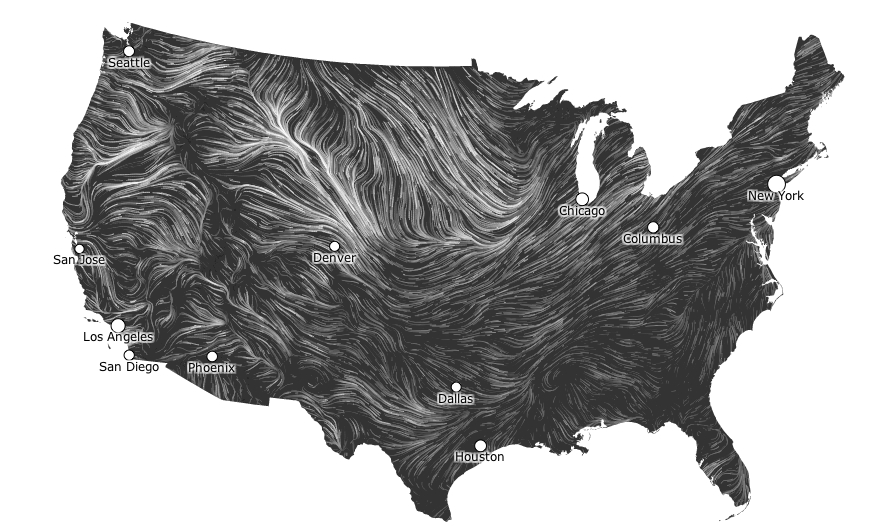
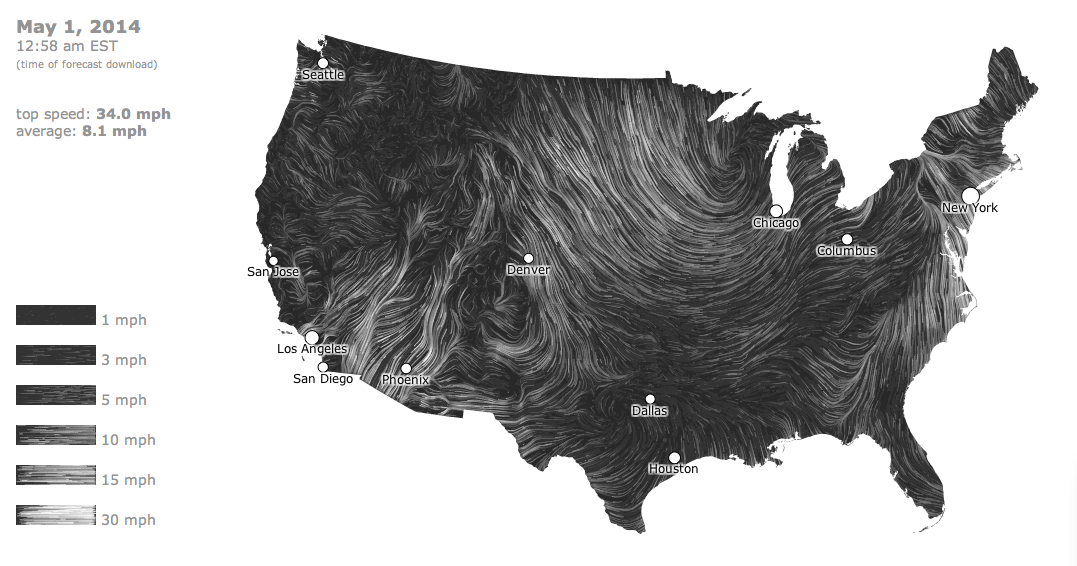
The modeling of wind gusts across the contiguous United States suggests a new sense of the spectatorship of the D3 map, although real-time of the map qualities maintain an illusion of an actual meteorological surveillance of the skies.  Just as we cannot watch the unfurling of wind-currents of different velocities over the space that is mapped, they define the dispersal of wind currents across space as if at a remove from actual habitation:  the fine lines that recall stop-action tracing of six levels of gustiness across the nation are extraneous to sites of habitation, because habitations are not what is being described, or included in the data that drives the map:  the conventions recall streets or waterways or rivers, but follow a set of mathematically modelled swirls and whorls that render air apparent over the land that we more usually map, in a view to currents far above the ground.  And yet the mesmerizing drama of modeling data of wind currents is so elegant and engaging that it is hard to stop watching: its ambitious organization charts a record of our world at a remove from the categories of mapping that we are more habituated to scan.  In a way, the windmap is the most elegantly estheticized of terrestrial or worldly maps, because it is also the most etherial.

USA Windswhirls May 1 12-58

What is the subject of the map is the flow of data that is so oddly anthropomorphic, casting the map as a hirsute surface and second skin, even as it describes the velocity of air currents above the land abstracted from any view of place?  Do the wind-currents create or seem to sculpt a sense of place in their whirls and eddies, giving a concrete palpability to the map’s surface that somehow runs against the flattened isotropic surface of a map?  Is it still a map, now that any sense of spatial indices are erased, and centers of habitation are dramatically reduced?  Or is it a screen?  One of the beauties of this projection is that as one zooms in to the ground, further cities appear in the map, providing the needed points of reference that would be too busy in the larger scale versions, where they would obscure the beauty and drama of the inroads made by the winds that circulate across the lands.

Shaggy USA

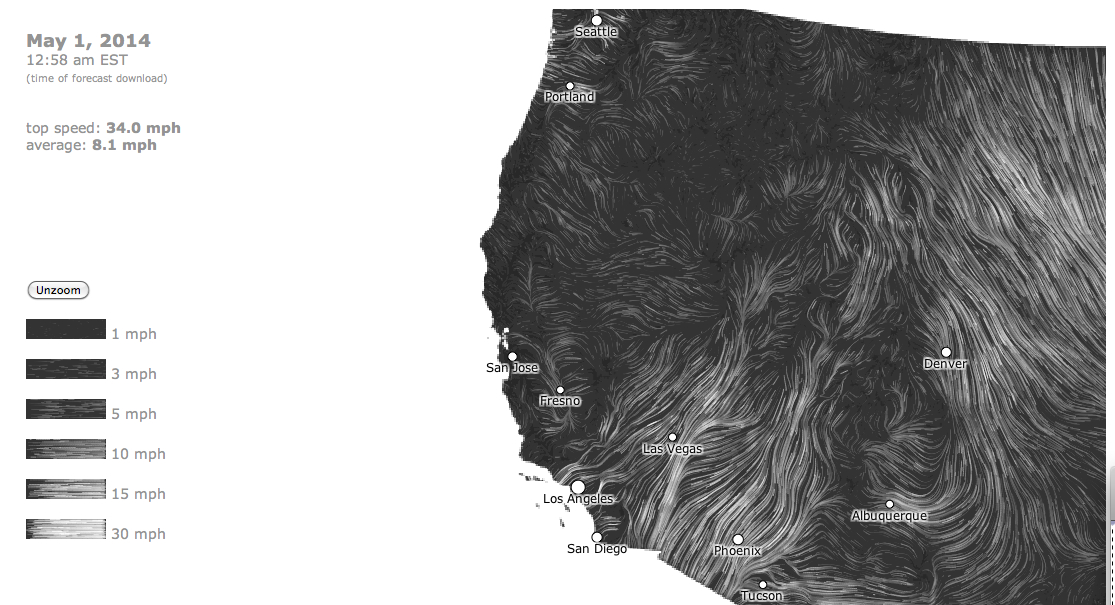
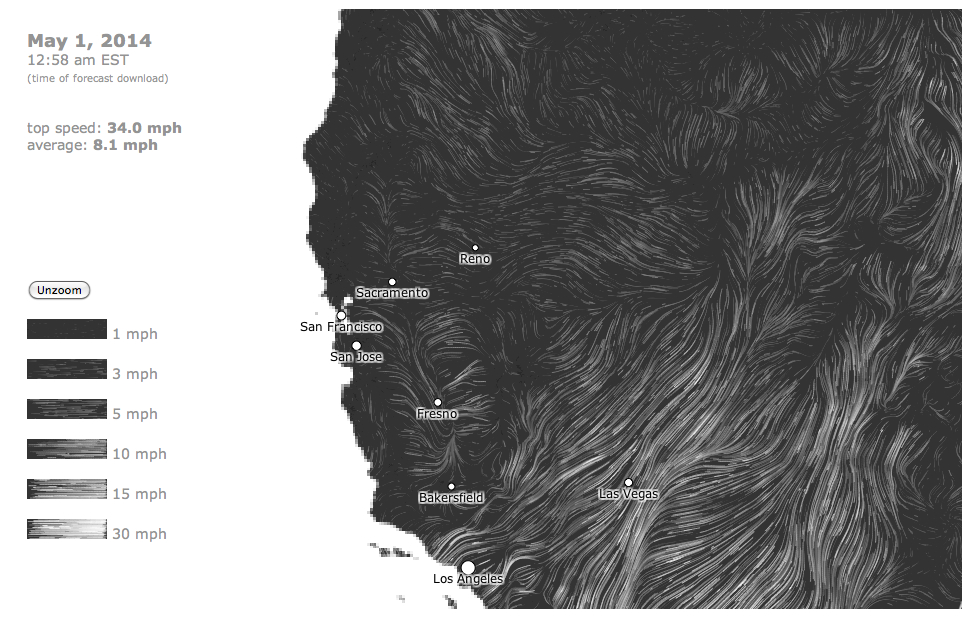
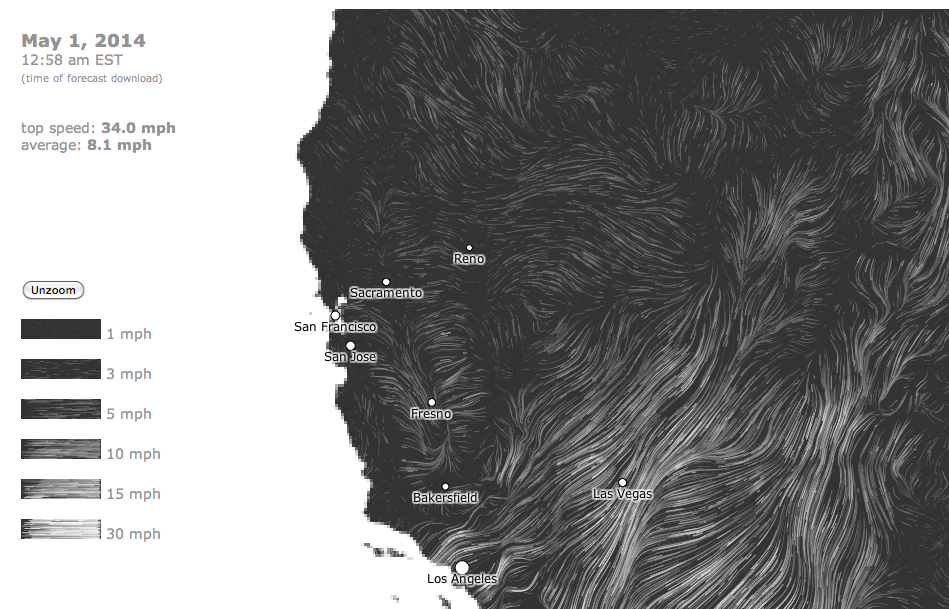
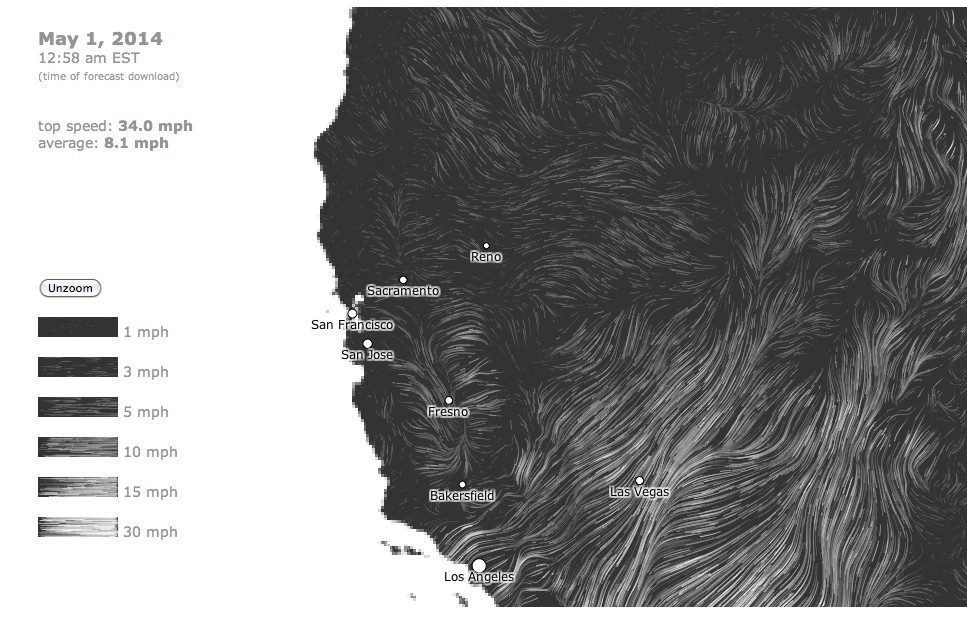
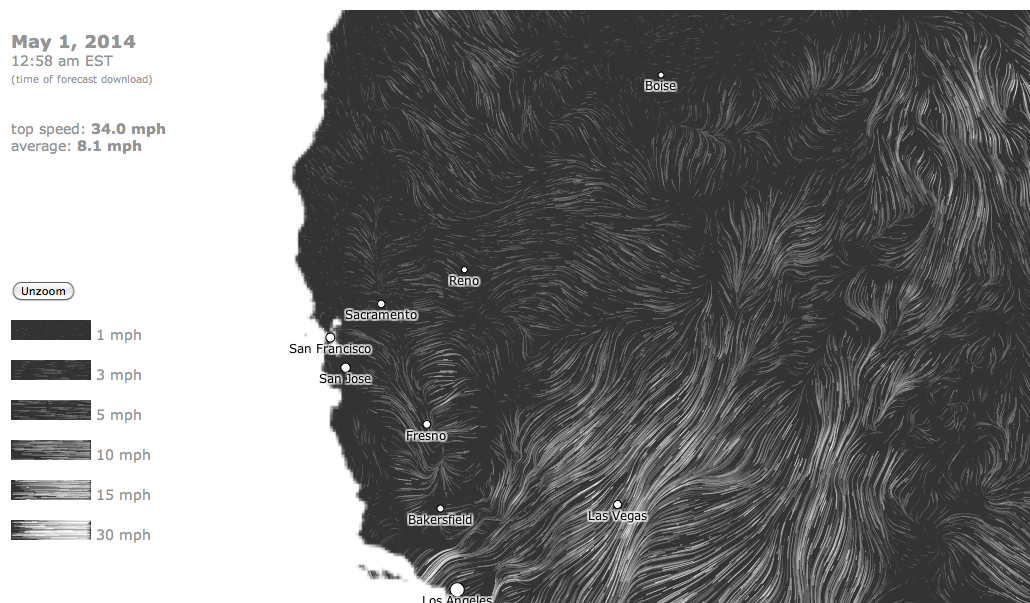
There is specific period eye that is attracted to the data visualization, familiar with reading data distributions rather than describing a topographic space in naturalistic terms of portrayal.  If the United States seems a shaggy dog, the most mesmerizing of D3 tricks in the book is to watch the ongoing expansion of wind currents across the Rocky Mountains, Desert, and California, from an imagined t-zero at which the calculations are assumed to begin, as winds begin to be inscribed, as if on an etch-a-sketch in reverse, and give contours and form to the blank black area that the first screen seems to map, suddenly giving it a texture that is specific to a date and time when the download of whether data began, until it gains something of a meteorological image of wind flows.

West Coast Winds 1

Califn Currents #3

Calif Currents #4

Calif Currents #5

Californai Currents #7

Is this sort of data visualization, as attractive as it is, a map?  The processing of the distribution of air currents is difficult to stop watching because of the elegance with which it makes us look at the winds that we notice but have such a hard time collectively grasping, and because of the currents, eddies, whirlpools and lines of different flow that the wind map increasingly reveals, so that it gains a coherence in itself that it initially lacked. The idea of mapping air is intensely appealing, because it acts, as a map, to make visible what is so easily overlooked or otherwise has no concrete identity by which to be grasped.  The parallel currents, if approximating a familiar natural appearance of a hirsute coat, are nonetheless quite conceptually difficult to envision in their relations to one another or totality.  The best reaction is one of wonder–wonder at being able to find a visual residue tracking the unrelated sensation of wind:  this is mapping, in a sense, as an exercise in synesthesia, where sight replaces the sensation of wind on skin.

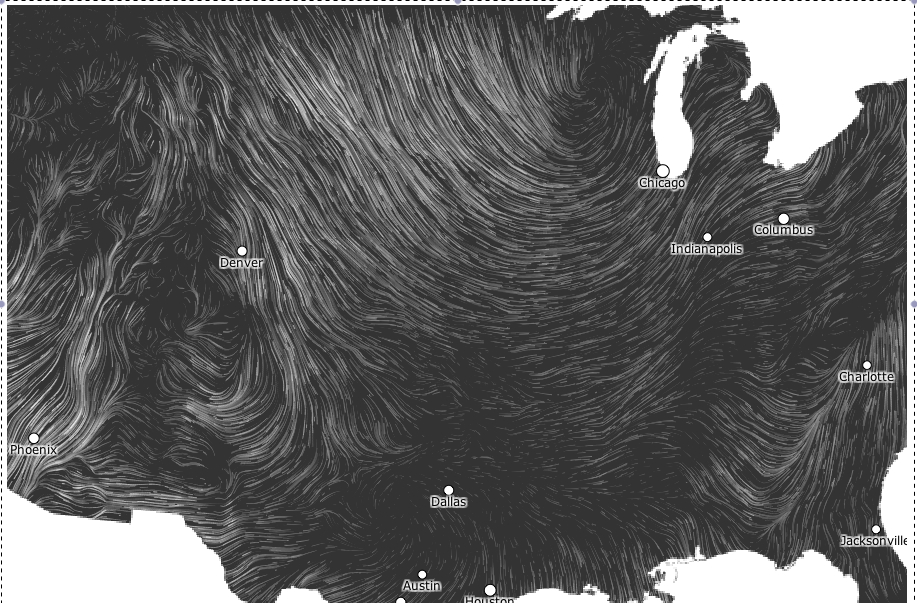
There are elements of translating sense-based observations to a format of visual modelling in all maps, but the oddity of removing the array of wind-velocity from sense-peception of course seems odd because one rarely thinks of spatially locating winds with precision or fixity.  With closer examination of the trajectories of gustiness one notices, first, the odd pockets of calm across the land, oddly coincident with some cities, and probably not only because their buildings block the velocity or intensity of air flow, in what can appear like racing currents or overlain strands:

Pockets of Calm?

And then the country, as it is inevitably drawn by an invisible hand of the forces of the winds, cumulatively gains the contours that it originally lacked:

Modelling Wind Flows 12-59 ESTModelling 12-58 EST--3Modelling Wind Flows 12-58 EST-4

1 Comment

Filed under CityLab, comet-like tails, D3, Fernanda Viégas, Google Maps, hint.fm, Martin Wattenberg, National Digital Forecast Database, NOAA, wind-maps

Where Is Ukraine? What is Ukraine?

“In Ukraine, there are no problems,” I was reprimanded a customs agent in Stockholm’s spotless Arlandia airport.  Hearing she had left Kiev over twenty years ago, I had ventured to ask about her native country, after she had gamely asked us five questions about our favorite Swedish foods, before asking why we had just arrived in Stockholm.   In response, it was evident she had been barraged by the question: “Problems are on border, . . . across border, where they always are.”   Across the border lay the large petrostate of Russia, increasingly dependent on the sale of buried gas and oil reserves, which had given a new strategic value to Ukraine, once the site of many nuclear ground-launched ICBM’s directed toward the west, and now a site for easy overland and underground transit of the buried wealth on which the future Russian state depended to the wealthier markets and countries lying to the west.

But what are the borders of Ukraine, and where exactly does over the border lie?  Regional maps of Ukraine–and of the region of Crimea–are inevitably filled with their own narratives, most usually of the ethnic and cultural division of the region.  Maps of the region’s populations implicitly pose the question of where the region’s unity in fact lies, or from where derives, as if to question the validity that the post-Soviet nation could ever gain, even under the best of circumstances.  The map of Ukraine’s population becomes a mirror of disunity, by mapping the linguistic and ethnic groups in the region, although such a division of Ukraine is only using the results of long-term plans of Russification that were designed to promote an image of national unity for Russians that is manufactured as a retroactive justification for invasion.   For although such images of ethnic regional fracturing recall the multiple maps of national divides with which we’ve been inundated, the veneer of democratically determined ethnocentric or linguistic parcels that they create are a false mapping of the regional divides or sovereign boundaries of a state.

The increasing number of visualizations mapping ethnicity and political preference mirror the disunity of the region in ways that have an oddly libertarian undertone–and is particularly pernicious to the sovereign unity of a state.  Even if they don’t all explicitly advocate or question secession, the explicit fracturing of Ukrainian unity, such as it is, exploits the importance of ethnic-regionalism in ways that are harmful if not toxic to democratic practices.  Indeed, Ukraine provided something of a start for Vladimir Putin’s regime to stoke separatists and racialists in annual conferences since 2014, under the aegis of the Anti-Globalization Movement of Russia, headed by Alexander V. Ionov, under the fraudulent title of a The Dialogue of Nations. The Right of Peoples to Self-Determination and Building of the Multipolar World.  For although term “deglobalization” has gained currency as a critical tool against international business and multi-nationals, the “Dialogue of Nations” promoted at the conference is less of a critique of global capital  than a championing of ethnic divisions among parties who hold positions that are deeply undemocratic in tenor, and less promote the stated goal of “sovereignty for small nations around the world,” than to question nations’ existing borders and independent sovereignty, inviting and promoting such groups as the Texas Nationalist Movement, the anti-Iranian Talyish Revival Movement, or National Sovereign State of Borinken.  Such hopes to champion regional interests under the banner “self-determination” constitute a sustained subversive regional nationalism seeking to divide liberal consensus, in ways that have provided something of a deep precedent for Russian sponsorship of Donald J. Trump and Russian Ukraine, or Novorossiya, in addition to the Brexit movement.

For if the sponsorship of such meetings stands in odd contrast to the themes of Russonationalism, and includes members of the smaller states outside the boundaries of the Russian Federation, including Ukraine, Georgia, Moldova, Azerbaijan and Armenia, who it keeps in its orbit effectively by increasingly stoking their own divides.   And although Russionationalism is often invoked to justify the invasion of Ukraine, and the overturning of a democratically elected President, returning to maps of ethnic division muddies questions of the military invasion of Ukraine occurred, and offer seizure of Crimea unwarranted and unwanted justifications.

The steady cross-border entrance of  support for the separatist pro-Russian rebels over the summer of 2014 proceeded largely from military bases located on the border, as a stream of military support to rebels in Ukraine undermined the question of its national sovereignty in particularly disrespectful ways.  Russia made its military presence increasingly known to Ukraine, in an openly bullying manner of shooting jets, supplying separatists arms, and crossing the Ukrainian border at several undefended sites.  Questions of what are the actual “true” borders of Ukraine may ignore the question of its tactical importance as an area of contesting global energy flows.  Indeed, as much as there existed any enmity or opposition for many to Ukraine as a political entity, the crucial place the region occupied in the energy reserves that Russian held may have made it increasingly desired as a site of political control, in ways that the debate over Ukraine’s politics seem to have served as a smokescreen to conceal.  For the manufactured war against Ukrainian independence seems to proceed less from the protection of ethnic Russians, or the survival of the Russian language and cultural groups whose dominance in Ukraine was encouraged in the Soviet Union, than the cold economic interests of securing a continuous pipeline for oil transport on the ground.

The redrawn boundaries of Ukraine might take into account where the Ukraine actually lies, but to understand their contestation one might do better to map the global ties that have reconfigured not only the place, but the political and economic stakes that have directed new global attention to that region.  How might the global dynamics that have invested Ukraine with compelling global interests be best mapped?  The stakes are great.   So much seems increasingly important as, despite the UN’s declarations that the internationally recognized boundaries of Ukraine must be respected, the precedents for those borders and boundaries turn out to be messier and more unclear than one would expect–and the hold of the Ukrainian government over these borders become difficult to assert, with several of Kiev’s border posts physically abandoned by soldiers and undefended.  Increasingly, Ukrainian border checkpoints became porous to Russian troops.  With the borders being wiped off the actual map as the result of outright intimidation, what, one is tempted to ask, is Ukraine–and where does it exist?
russian-armenian-tanks

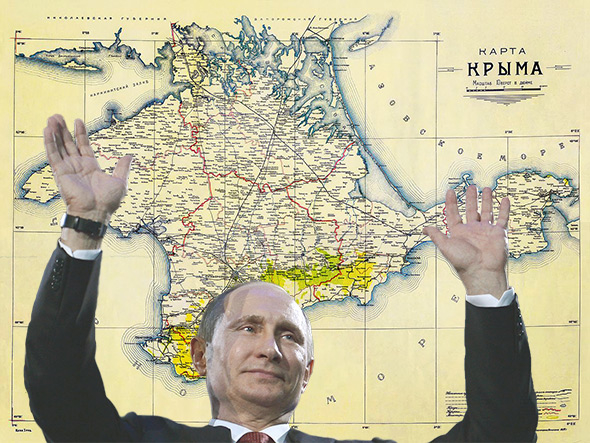
From the point of view of Vladimir Putin, her poised in his Palace in 2006, the Crimea is presented as native “Russian land.”  Its 2014 annexation was promoted as reclaiming a region long part of a Russian Empire-and not only as inhabited by linguistic or ethnic Russians, whose scarlet boundaries seem to place its entire topography beneath his eyes:  and in ways that prefaced the Russian role in the eastern Mediterranean and Syria, expanding its ties to warmer seas through its extended intervention in Syria’s Civil War, the importance that Putin’s Kremlin has placed on Syria’s prominence as a point of entry into the Middle East’s geopolitical landscape was prefaced by the warm sea outposts that Crimea–and Ukraine with it–offered the Russian military both to delegitimize a democratically elected government, and secure its ownership of gas pipelines through Ukrainian soil, not pictured in the below map.

Russian President Putin stands in front of map of Russia and Commonwealth of Independent States at Novo-Ogaryovo just outside MoscowVladimir Putin before Map of Russia in his Novo-Ogaryovo Residence, 2006/KremlinRU

The bleeding crimson boundaries of the Russian Federation are indeed more prominently highlighted than any city, region, or old soviet state, as if to insist on the naturalization of the integrity of its borders, and erase any other borders–quite tellingly–from the map.  Putin has demonstrated considerable affection to romancing the map as a fiction of state boundaries, recently presenting Moldova’s President, Igor Doyon, with a late eighteenth century map of Moldova drawn during the Russian-Ottoman War by Italian cartographer Bartolomeo Borghi in 1791, which he noted to his Moldovan hosts showed the undeniable truth that “Half of today’s Romania is actually Moldavia”–to the considerable annoyance and consternation of many in Bucharest, who bristled at the apparent disinterest Putin showed for Romania’s territorial integrity.  (The gift was successful in its effect:  Dodon viewed it as an occasion to lament that the Russian Empire, back in 1812, had annexed what was then Bessarabia, but stopped short of the Carpathian mountains at the Prut River, and later announced before Putin left that his party, should it gain the majority, was committed to shifting his country away from EU ties.)  And when the single mother Yekaterina Vologzhenova decided the she would repost a cartoon showing a Putin lookalike looking at a map of the Ukraine, focussed on the city of Donbas while holding a large knife Putin poring over a map of Donbas, knife in hand; the single mother was sentenced to 350 hours of community service for “internet extremism” for sharing an image that suggested that Russian forces were behind the loss of much of the Southeastern Ukraine’s territory, and suggesting President’s mania for maps; the government ordered her lap-top computer to be destroyed.

The image of the President before the map suggested a sense of restoration of past borders, and a sense of romancing territorial integrity as if it were removed from state interests or personal advantage–using the map as a mask, similar to Putin’s caution that the anger of the Ukrainian government at Russia for its loss of Donbas in the southeast were related to Moscow, lest they “take a stand-off between Ukraine and russia to a higher level”–since “no one needs an armed conflict” on Europe’s edges.

Russian border.pngDetail of above map, on Black Sea

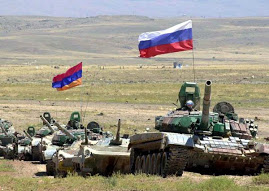
But the claims for Russian ties to Crimea and Ukraine–and illustration of Russian military might in the Ukraine’s invasion–used assertions of ethnic nationalism as a basis to place Russia in a position of strength in the national news, and assert its relation to Chechen and Crimean neighbors, and parade the strength of military hardware in so doing.

maidan-4-mar-crimean-sdf-per-putin-300x200

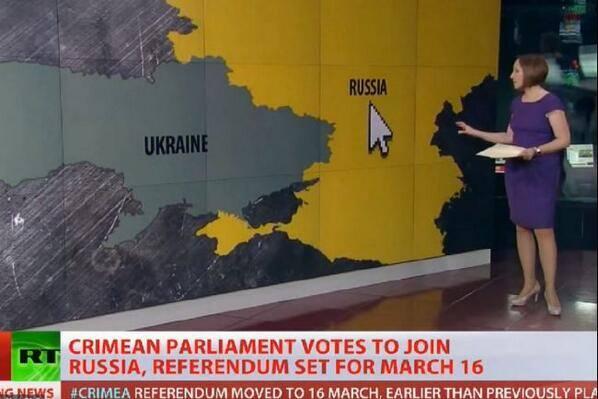
In so doing, the Putin government is remapping the Crime as part of an expanded Russia, using Russonationalism to deny or ignore the Budapest Memorandum of 1994 to “respect the independence and sovereignty of the existing borders of Ukraine,” but remapping the region on Russia Today as lying in the boundaries of an expanded Russia whose military might is right–as a decision of local ethnic Russians–in the hope to assure a continued tie to the shipping and piping of oil outside of its borders.  The scrim of a Russia Today set showed the new configuration of the Crimea as a part of Russia once again, joined to its expanse of yellow in ways that left room open for the continued violation of Ukrainian sovereignty under the illusion of a false democracy of a referendum to rejoin the Russian Federation:  the vote, which offered the possibility of independence or integration with Putin’s Russia, in response to the ouster of  Ukrainian President Viktor Yanukovych was immediately remapped as an expansion of Russian territory by popular demand, even as the plebiscite was held as Russian soldiers occupied the peninsula.
maidan-10-mar-rt-map-with-krim-in-rs1

1.  Putin’s tie to the prominent topographic map that is displayed in his residence–a map that seems to naturalize political boundaries, and is oddly without any clearly visible names, but includes striking national borders, provides a site before which he seems eager to be photographed–as if to suggest his keen study of the geography East of the Urals, as much as his care to the Russian nation.  The relation of Ukraine to the Russian Empire and nation is complex–and goes back to the secession during the Revolution, when the region claimed an independence that has become far less clear in its national or linguistic autonomy.  But the enmity between Russia and Ukraine is over-exaggerated.  While the Ukrainian Republic that seceded from the Russian Empire was greater than the now seceded region–the area had been significantly “Russified” as a Soviet Socialist Republic, whose ethnic or linguistic autonomy was attempted to be erased–if not denied–to integrate the region into the Russian historical lands, as if to erase the scars of the splintering of Ukraine from the Soviet state and from “European Russia” after the 1917 Revolution.  Despite the importance of this historical legacy, the spatial importance of Ukraine to Putin’s government has much to do with the geography of energy and oil pipelines for Gazprom and the Russian state–to recover national claims of Russia to the region are tried to be magnified more than are seen as a part of Russia’s identity.

Dismembered Russia--and Ukraine.png“Dismembered Russia–Some of its Fragments,” New York Times (1918)

Yet the remapping of the region is often cast as an integral whole.  And so when Putin gazes quite icily if somewhat longingly at the regions that extend to the Black Sea, but exclude Crimea, in the large topographic wall maps of his Presidential Palace outside of Moscow, it is pressing to consider what sort of region he saw, and what continued Russian presence–cultural or linguistic–existed in the region he was so ready to invade.

Putin_Geopolitics_Map_Reuters_Slider1-600x330.jpgREUTERS/ITAR-TASS/PRESIDENTIAL PRESS SERVICE (RUSSIA) – RTR1GAL3/August 11, 2006

The creation of a newly independent Ukraine more closely tied to the European Union would be so close to Moscow evoke a Cuban Missile crisis like setting, reviving deep Cold War fears–even as it would reaffirm the cultural independence of the region, the image of a repeated division of Ukraine from Russian state seemed to undo its longstanding Sovietization, and to return to an image of Russification that was first cultivated by Peter the Great, or cultural assimilation of non-Russian minorities in a fictive map, and can be traced as far back as to the sixteenth-century Russification of the newly conquered Tartar Khanate of Kazan (which included the former Volga Bulgaria) and extended to become a state policy, and was most present in the marginalization of non-Russian languages, the use of Russian as the sole language of government, and Christianization, but included the marginalization of local memory, which increased the large number of endangered languages in the current Russian Federation, as well as the effective persecution of  indigenous minorities in ways that intensified in the Soviet Era:  forgotten languages of Komi, Mordvins, Volgic Finnic peoples, Belarusians, and Lithuanians were reduced to symptoms of its implementation–and in Ukraine led Peter the Great of Russia to issue a blanket decree in 1720 designed to expurgate any evidence of Ukrainian language or theological treatises from typographical houses in the region, making ethnic nationality virtually supervise;  Catherine the Great similarly ordered a program of rigorous Russification for Ukraine, Livonia, and Finland–allegedly using light-handed methods, and remapping Ukraine as “Novorossia” to indicate its subordinate nature of its possession.  The renaming of the region not only absorbed Ukraine as a territory, but tired to erase Ukraine’s cultural memory.

2.  Even if much as it is tempting to see Russian invasion of Ukraine through the lenses of a Cold War, as Putin seems to want to suggest, and a deep desire of Moscow to keep ties to former Soviet military bases as a sort of buffer zone, it seems in fact the renewed economic importance of the region’s stability to the transport of gas and oil that has produced the increased insistence on the integrity to Russia.  For the fraudulent claims to ethnic protection conceals the emergence of a new global geography of the energy market, where boundaries are less based on the demarcation of united ethnic units or political bodies than the ways that gas has increased the value of those and adjacent lands.  Mapping the region of Ukraine and nearby lands demands situating the region’s boundaries in a global context of economic value, where economic transactions and activity are often bound up in the growing value of the gas pipelines that ran across its territory.  Rather than to fall back into categories of the Cold War, or inherently Russian qualities of regions of the post-Soviet state, even if these might line up with recent politics, we might do well to explore other reasons for interest in its redefinition on a map.

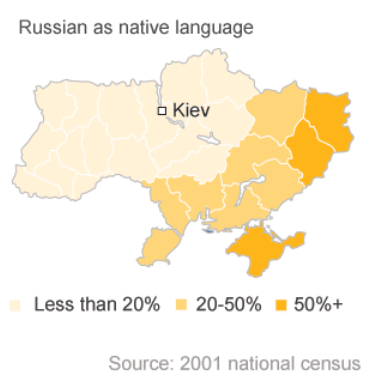
To be sure, the geographic distribution of Russian-speakers in the country appears relatively confined to regional divide which are both linguistic–

Russian Speaking Ukraine

–and reflect the political divisions of its landscape of the supporters of Timoshenko and Yanukovich, a basic fault line across the region’s terrain that seems to threaten its integrity and division in separate blocks.

Voting for Timochenko

But the clear lines that are drawn between dominating parties and political persuasions in these choropleths draw far clearer divisions in the integrity of the region than might be useful as tools of analysis, and they might be better taken as starting points than as coherent projections of data.  These maps place their viewers at a distance and remove from the increasing strategic importance of Ukraine’s boundaries in a post-Cold War world, which is perhaps more defined by the circulation of regional capital and energy from the growing number of gas fields and already built pipelines than the positioning of military material.  Indeed, these maps of regional divisions oversimplify the potential actual reasons for military invasion, as do analyses that seem to privilege fears of Russian deployment of ICBM’s within a Cold War scenario, in which the placement of tactical weapons lead to the escalation of a war of conventional aggression into nuclear weaponry, by removing the region from the new reasons for the tensions surrounding its coherence in a growing market for natural gas, and relying on recycled narratives of the Cold War.  The annexation of Ukrainian land is striking since not really about geography, or territory, in ways that are able to be quickly reduced to the surface of a map.  And although Russia’s Federal Border Guard Service continues to insist that it allows no one to enter Ukraine illegally, with the Ukrainian post sitting some two miles within the official border, the apparently porous boundary between the two states–as the boundary between Ukraine and Belarus–is far less clearly defined than the boundaries appear to be on the map.

3.  To effectively carve up a country in a delicate balance of power and global economy is exceptionally dangerous.  The variety of choropleth maps that depict the ethnic, linguistic, and electoral divides across Ukraine in our national news as “the data visualization needed to understand the political situation in Ukraine” have, no doubt, distracted us from the situation on the ground and the geographic questions that underlie the political crisis.  In fact, the country’s geopolitical situation may be far better mapped explain its emergence as a somewhat unlikely theater for playing out scenarios from an old Cold War, although for reasons more tied to natural resources:  for the webs of pipelines, as much as the ethnic and linguistic divisions of the region, provide a  the economic networks of the breakaway former Soviet.  Although we’ve become accustomed to posit deep divides within our electoral politics and to grasp political divides by handy data visualizations, as if they both synthesized and decoded compelling sociological explanations, the data visualization seems to replace real reporting with stories of deeply set national fracture-lines, our love of  infographics might become a form of disinformation that migrate from the television screen across the internet.  For the infographics define and restrict the questions that might be asked about the situation, dangerously removing the issue of Ukraine’s sovereignty or politics from a globalized context of financial capital.

Infographics create particularly problematic in representing news about the Russian Federation’s recent annexation of Ukraine:  they obscure the variety of more informative maps that have been drawn about the region, and the dilemmas of mapping the value of Ukraine as a region, or the specific value that its individual parts have gained.  With the closure of many US news agencies abroad, and the shrinking of foreign bureaus, mapping Ukraine is an increasingly important means for grasping the political effects of shocks in a global inter-connected economy, where transactions are as important as the demographic composition of inhabitants, but the range of already generated and accessible data, readily processed into data visualizations, is in danger of drowning the real story of a narrative of global economics.  For the projection of strategic value in Ukraine is replaced by images leaving viewers dumbfounded at the messiness of mapping electoral or demographic divisions or synthetic charts that compress a complex historical narrative that only make us wonder on what basis that country came to exist.

The narrative needs to be recuperated in a broader map, perhaps one synthesizing less information on its surface.  Perhaps even a clearer visualization of the place of Ukraine within the continuity of a spectrum of corruption and authoritarianism in post-Soviet republics can tell more of a story than one that carves up the country into distinct sectors.  The so-called ‘civil war’ in Ukraine is clearly exacerbated by the increased eagerness of Russia’s interference with the nation’s sovereignty than divisions lying within its populace, in ways that the charting of the area as a longstanding “geopolitical prize” might reveal.  We might need to look at the shifting ways that geopolitics have changed to make propitious the recent return from the dead of the Tsarist geographical construction of Novorossiya as a category that has suddenly acquired a rehabilitated geopolitical meaning in a globalized world:  the surprising re-introduction of a construction of Tsarist geographers to refer to the Eastern Ukraine has the primary goal of rehabilitating a Ukraine primarily oriented to Russia–instead of its current government–that nicely lends itself to Putin’s pan-Russian (or anti-russophile) rhetoric.

To understand what makes this particularly advantageous, we might begin from remapping Ukraine less in terms of ethnic divisions than pathways of transit of gas and other natural products; for these pathways might show what issues are at stake in Russia’s contesting boundaries of the region, and the reason’s for Putin’s odd re-use of a long dead name to hide his quite pragmatic interests in making it part of Russia once more.  For the discovery of a range of gas fields in the country, and the inherited gas lines that run underground through Ukraine, have shifted the geopolitical meaning of the frontiers by which the country is mapped, as much as the mapping of its different ethnic inhabitants.

4.  Ukraine’s contested sovereignty–or rights to sovereignty–can maybe be succinctly mapped by a variety of quite simple tension lines that exist in the region crisscrossed by a dense network of pipelines of natural gas.  Indeed, the control over the pipelines speaks volumes about the mobilization of military forces along the borders of this relatively recent country than the ethnic divisions which can cause many Americans to raise their hands and shrug their shoulders as they try to grasp the volley of double-speak around the protection of Russian minorities.  Andrew Barry has revealed the degree to which the pipelines of gas created a rapid shift in pricing the value of lands in the Caucasus in ways that are utterly incommensurable with the economies of its inhabitants; the value of the land for laying pipes and creating new sources of multinational investment have suddenly involved globalized economies in regions that were, until incredibly recently, rarely considered of value or easily on the map by international agencies, who are now increasingly involved in their use to a degree that local inhabitants have difficulty grasping.  The new constellations of interests appear to be configured around the Ukraine in ways that questions of political annexation cannot come to terms with.

The explosion of Ukraine as a sudden hotspot of the global map might be explained by maps of its status as a nexus of economic networks that many current infographics fail to register, since they are foreign to most of our cartographies of social or political division.  The concealed motivations for militarization in Ukraine seem to reflect the pipelines that are concealed underground or just above its surface–and the projected value that Gazprom identifies with their flow–in ways that have little to do with local sovereignty in ways that it is often considered, and are often removed from its inhabited lands.  And it may well be that in mapping divisions in Ukraine as if condemned to irresolvable quagmires of disunion and political dissent, we obscure how its geopolitical situation reflects the rising stock of the region’s value for economic resources.  Infographics that parse space by either ethnicity or electoral divides conceal and bury the geopolitical interest of Ukraine beneath data as if to mask the global strategies being played out on the ground.  Have we fallen into a blind acceptance of the Ukraine as divided by diverse constituencies?

Putin branded Ukraine’s government as a “junta” and announced cryptic “consequences” should the actual government–whose authority he denied– purportedly threaten Russian lives, the rhetoric of Russia jumped borders. What Putin duplicitously presented as a defense of human liberties or civil rights denied the sovereign bounds of a nation to defend ethnic Russians, playing a high stakes odd game with maps, in which the place of a mythical unity of “Russia” echoed the geographers of Peter the Great.  For Putin has elegantly balanced his threats with the double-speak accusation that places direct responsibility at the United States–“for causing the demon of fascism to once raise its head in Europe, [while] Europe and the international community are for the most part silent and are instead engaged in a frenzied irrational campaign to demonize Russia”–barely concealing his own frustration that the world did not recognize by consensus the  “treaty” or “Independence Bill” annexing Crimea unilaterally signed on March 18, 2014.

The readily redrawn map must not be so readily given common currency.   The motives for its radical redrawing cannot be so easily attributed a purported desire to protect human rights, since the redrawn boundaries to forge new networks that would meet economic aims and guarantee a monopoly on gas.  Indeed, Russia’s open contesting of the sovereign independence of Ukraine is not so much about political sovereignty or the sorts of claims of economic dominance that are supported by shifting globalized economy, which cuts across boundary lines, and works with the facilitation of the extraction and flow of natural resources across land, and which dispenses with questions of political sovereignty.  Putin’s openly Machiavellian rhetoric intentionally creates confusions between sovereign identity, national divides, and the strategic value of political control.  The problem may lie in how Putin maps Ukraine, how many news maps map Ukraine in the US and world media, and the obstructions that both maps create in understanding what is at stake.  We are, perhaps, in danger in assuming identities and divisions are synthesized and captured in maps, since they also easily package the rehabilitation of the rhetoric of the Cold War that Putin’s government seems to expect we’ll accept as credible.

The new geography of Ukraine might, it is true, not be so readily understood, or its strategic importance incompletely grasped.  As much as offer a port on the Black Sea, or a market for Russian gas, the status of Ukraine as a border into which the EU or NATO appears ready to poach invites this projected image of inevitable ethnic or linguistic divides in Ukraine that are ready lead to inevitable lines of national fracturing that would reflect its geographical position on the edge of Europe, defined by the Dnieper, Dniester and Bug rivers that run through it to the Black Sea.

EU TIES

WaPo’s Max Fisher stoked the news-wires as he chose to illuminate the potential for an inevitable dissensus across the map, as if the point the country to inevitable social fragmentation of the sort Fisher has delineated in the past–as if a nation were ethnically determined in its constitution. One can, for example, map the linguistic divisions of Russian as linguistic and demographic fault lines in a sequence of three-color choropleths of the country:

Russian as Native Language

Or find the tensions in the electoral divisions of the landscape, in ways that naturalize the focus of government protests by arguing that these regions weren’t the ones that wanted Viktor Yanukovich to win, anyways, as if this would explain the rightful secession of “red” states from the USA, as a sort of reflection of national preferences and easily comprehended data visualization of civic divisions that foregrounds the spectrum of its political lines of division:

ukraine-protests-map-k

And yet–what do these visualizations even describe, save the inevitability of regional divisions?  Is this all window-dressing of the deeper divisions of economic value and  the inheritance of international investments in built pipeline that threaten to increasingly paralyze a Western response to Russian aggression, as much as motivate it?  Is it possible that in those areas where the pro-European party won, and which directly abutted pro-Yanukovych regions, the amount of protests were fewer than in those which bordered on Russia?  Can the election between Yanukovich and Tymoshenko be understood by analogy to the rifts and fault lines among political parties in our own country?  How could they not be informed by the economic, as well as the ethnic, complexion of different regions of the country, and local pressures of self-definition of a region that had an unclear sense of identity before 1991?  And aren’t these divisions now clearly based on economic interests, and the changing economic ties that have created a different calculus of value for folks in different regions of the country?  Even as many pro-Russian nationalists exist in Ukraine who imagine a “Transcarpathian People’s Republic,” the geopolitics of the region have been eager to imagine the region’s incorporation into the Russian Federation for reasons far removed from ethnicity.

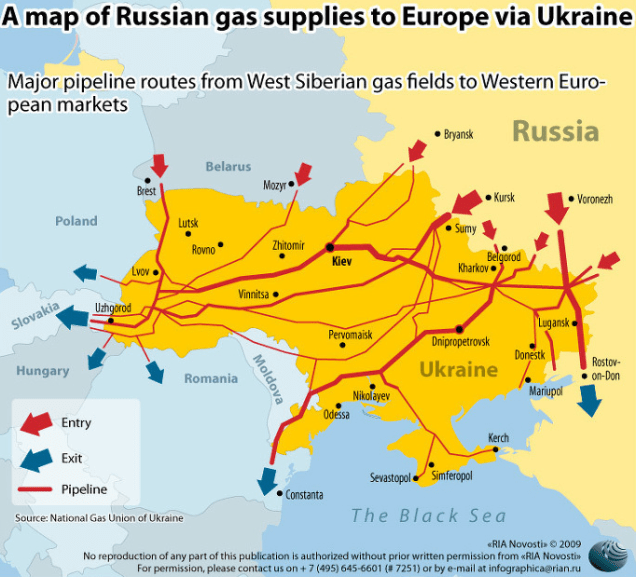
In an era where “Ukraine” means many things, most reports have been oddly silent about the webs of international traffic that run across Ukraine, tying it to a larger picture of economic transactions that are as determinant of Russian attitudes to the region as the internal composition of the country.  For s much as a nation of different areas of linguistic dominance, which evokes neo-Whorffian notions of linguistic-formation, the crucial fact of the presence both of gas fields in much of Ukraine that borders the East and Crimea key routes for the transit of Russian gas, and potential areas of future exploration, outweigh the geopolitical or ethnic considerations most often invoked in news media.  (This surely seems more relevant to the current crisis than the survey of 300 years of Crimea’s history in a sequence of maps that chart its shifting boundaries and relative autonomy–despite the healthy volley of exchanges that post elicited.) But the most recent contention of Ukraine’s sovereignty or boundaries seem driven by the shifting relation of a network of gas pipelines–and the traffic in gas–to the policing and control over its frontiers:  the map of key pipelines that underlie the nation’s territory might be the clearest indication of the redrawing of this region as two geobodies, and the pronounced pressures placed on its continued cohesion.

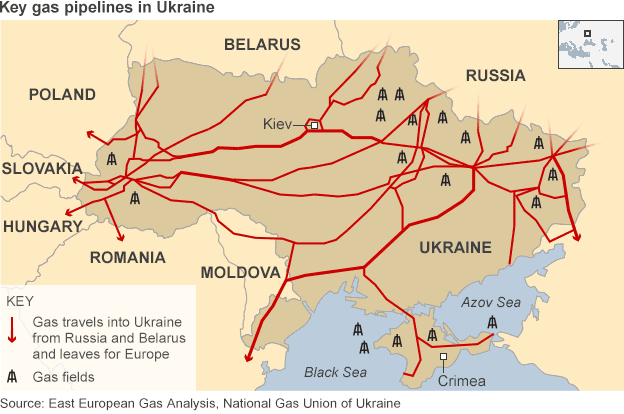
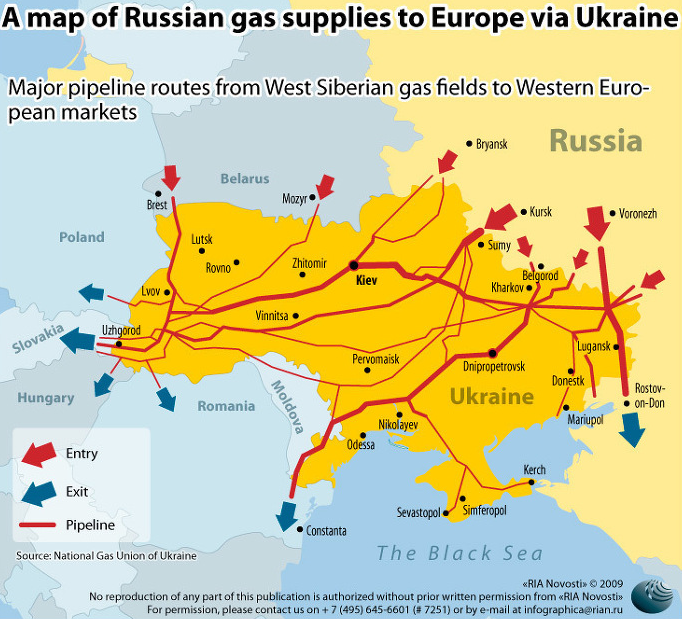
For the rapidly rising stock of the Eastern Ukraine with the discovery of a relative abundance of a range of potentially valuable gas fields has both created new ties and conduits between Ukraine and the EU, and Russian Gazprom’s reliance on transmitting gas to the EU in ways that have dramatically shifted attitudes to the regional landscape and its geographic significance, as it would also allow European gas to “reverse-flow” to Ukraine, separating the region from a dependence on Russian gas. The situation of active gas pipelines–and potential or recently discovered gas fields–has shifted international focus to a region, in ways that reveal how the presence of pipelines have mediated the strategic importance of Eastern Ukraine, in ways poorly understood or represented by maps of lines of ethnic division or of linguistic groupings, and that might determine how the region has become a site for the investment of global capital:

_73340564_ukraine_gas_pipelines BBC News; source:  National Gas Union of Ukraine

The recent mid-June decision of Russian CEO Alexei Miller to cut off gas shipments to Kiev and Ukraine–“Gazprom has decreased deliveries of gas to zero,” reads the public statement, seems the latest elevation of a declaration of real war, following months of negotiation, in which Russia seems confident that it can continue to funnel gas to the EU through Ukraine, the company which it mostly (50.1%) owned by the Russian government announced an act of economic aggression that seems to realize the true stakes over which the conflict had occurred.  Although the territorial boundary line between Ukraine and Belarus, and Ukraine and the Russian Federation, does not seem to have been formally negotiated after 1991, the decision to cease gas imports to Ukraine challenge the region’s autonomy–and significance–as much as the surreptitious transport of tanks and military material across its recognize national borders:  for cutting off gas supplies would achieve a similarly interventionist means to challenge the legitimacy of the government, just after the election of Prime Minister Arseniy Yatsenyuk in June 2014.  With Gazprom insisting that Kiev has been pumping gas deliveries from Russia into underground storage tanks, without advancing adequate payments, Yatsenyuk observed that the decision “is not about gas,” but rather “a general plan for the destruction of Ukraine.”  Ethnic rights of return seem less the point than controlling both oil reserves in the Black Sea and shipping lanes for valuable exports.

If Ukraine has been long been said to have been loosing control over a tenuously drawn border with Russia, what is Ukraine save a territory needed to grow the Russian economy, and a region over which “threat[s] to the lives and health of the local population” are less relevant than restoring energy revenues?  Perhaps the ethnic Russian groups encouraged the fostering of economic ties to specific regions.  But for all of Putin’s rhetoric of cultural and linguistic nationalism–and the spectre of Russian persecution–the wells in the Crimea and Black Sea and in the shale sands of Eastern Ukraine have determined the value of the region’s annexation–and the rehabilitation “back from the Dead” of Novorossiya” [New Russia], even if anti-Russian sentiment is strong in the “ethnically Ukrainian” western regions of the country, as if to prompt the increased federalization of the country.

The investment of European banks informed the reluctance of banks to impose sanctions on Russia’s annexation.  If the space occupied by Novorossiya was located historically by the Black Sea and Crimea–rather than the steppes–the areas that guarantee the future flow of secure gas to travel through Ukraine as it leaves for Europe constitute a central prize for Russians.  (Although there is some suggestion that the term might augur a basis for claims for local independence of the region, separated from Russia, the term floated long before in the Russian press.)

NOVORUSSIYA

The constellation of pipelines situate Ukraine in a global energy market, revealing a web of ties linking Russia to Ukraine, and linking Russia to Europe through Ukraine–and indeed through several of the cities in the new entity, from Dnipropetrovsk and Lugansk, both of which lie on significant pipelines that route supplies from Siberian gas fields to the West–and the strength, as we have seen, that Russia could end Crimea’s gas supplies.
Ukraine gas pipes

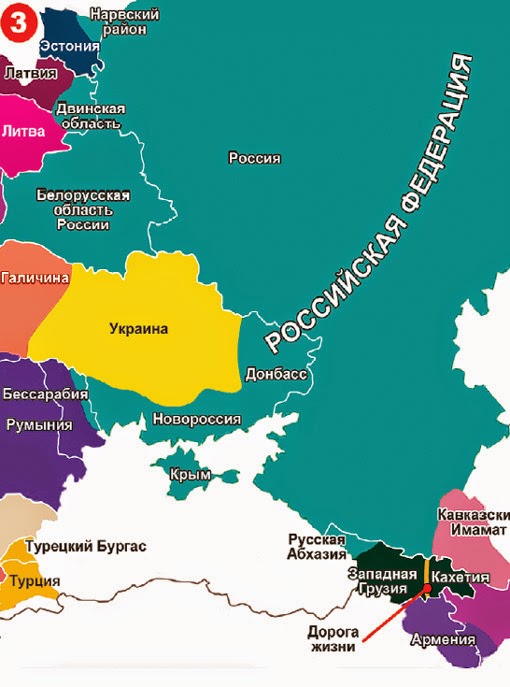
And the emergence of new maps of the region of Novorossiya as a part of the Russian Federation, predating the annexation of Ukraine, mirror an imagined image of the region’s appearance by the year 2035 in a set of maps attributed to high-level report by Russian security and policy experts on what Europe’s borders would probably look like in 2035, an ultra-nationalist vision that imagined an expanded Romania and a Ukraine surrounded by a newly enlarged Russian Federation including a Carpathian Ruthenian Republic from Ukraine’s oblast, and around the former Czechoslovakia, and an independent Galician state taking part of the western Ukraine, while Bukovina amalgamates with Romania in the Chernivtsi oblast, dismembering Ukraine at the same time as Russia encompassed the area by the Black Sea, while, the same report predicted, Europe balkanized.  We see a large region of Belarus beside a landlocked Ukraine in this fantastic futurology, where the regional name “Novorossiya” is already emblazoned on the map’s face, apparently sharing borders with the named region of Crimea, both apparent states, with Transnistria, within the Russian Federation:

2035 east

5.  The futurology allegedly based on CIA information and geopolitical experts in the USA predicted both a division of Scotland from England, the separation of the Basque region, division of Italy and emergence of Wallonia and Lorraine, as if to deflate the image of NATO and comfort any fears of the coherence the EU might have ever possessed–at the same time as Germany incorporated Poland and emerged as the only power worthy of consideration in the region.  The premise of Russian “rights” to these lands may mask a deeper sense of the continued economic coherence that they present to Putin’s revision of Russia’s economical relations to the perhaps-to-be-soon-disolved European Union.

Charting routes of gas flows across the region and the central points of entrance and exit from the country, within the Crimea and in its eastern regions, suggests how intense the region has been for new investment of global capital in ways that make the Russian government particularly concerned:   the economic consequences of pushing large quantities of gas to Eastern and Central Europe, potentially destined for expansion with the discovery of oilfields in the Black Sea and Sea of Azov, could both make Ukraine less dependent on imports of gas, boost Ukrainian exports of gas, or create a bonanza for Gazprom suppliers of the EU.  (Since most of Russian gas going to Europe passes through Ukraine, the potential energy independence of Ukraine could pose a deep threat to the marketing of Russian gas, as the decision for such pipelines to be raised levies or used less widely, raising the spectre of a blow to Russian imports and balance of trade on the global energy market.)  The increased involvement of European banks to the expansion of investments in pipelines across Ukraine has also inflected the ability to coordinate any national response–or the response of the European Union–to the very question of respecting  national sovereignty, and made delicate questions of how Ukraine could be mapped:  only the fear of Crimean nationalization of natural gas-fields in the Black Sea has led to potential ban on banks’ financial ties to Crimea, now a center of Russian finance.   Lack of stability has been a source of banks’ continued concerns and increased financial concern of the energy industry.

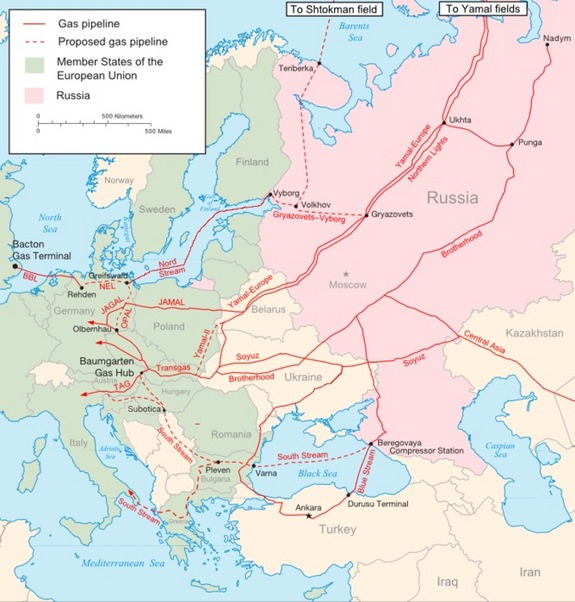
Despite aspirations for future expansion of the matrix to funnel gas to the EU, the pipelines already illuminate the increasingly central role that Ukraine plays both as a conduit and by its fields of future exploration for shale gas, increased interests for the United States as well as nurturing Ukrainian energy independence, may be superseded by new pipelines.  The plans to expand the network of gas pipelines outside Ukraine–through which over half of this gas now passes in pipelines–would alter the configuration of the region to wean Russia from its dependence on Ukrainian pipelines, and expand a range of alternative energy pipelines, most significantly from northern gas fields into the EU, built with funds from German and European corporations and governments eager to underwrite the importation of gas from new fields at a relatively cheap price:
Gas Pipelines Ukraine EU

The planned Nord Stream and South Stream pipelines would allow Gazprom to avoid dependence on conduits in Ukrainian lands–and draw from the Shtokman and Yamal fields and Central Asia–is not yet on the horizon, and And so when Putin threatens that negotiations must begin with Russo-philic “real representatives” of the so-called Russian-speaking rebels of the Eastern Ukraine, who Putin has insisted should manage their own political affairs–and promote their “own” ties to Russia:  by belittling the “utter nonsense” that Russian troops were in fact sent into eastern Ukraine, they are allowed to bemoan the “grave crime” of Ukrainian soldiers being sent to Eastern Ukraine.

At the same time, the recent annexation of Crimea continues to play out quite uneasily on the ground and local politics.  With looming bureaucratic disasters of the integration with Russian government growing increasingly troubling and apparent, even if “Crimea has always been an integral part of Russia in the hearts and minds of its people,” the annexation of Crimea within a month after the February 21 collapse of Yanukovich’s government on March 18 seem to have greater risks than alleged hopes to protect a population tied to Mother Russia and facing alleged persecution by a constellation of “russophobes” and “neo-Nazis.”  The actual interests involved in this power game are so removed from those of local inhabitants or a hope for ethnic tranquillity, and seem more guided to restore harmony in a balance of the gas trade–or allow its manipulation and orchestration by Russian businesses.

Putin and Crimea.Wired:  Map Time

Indeed, the emergence of maps that projected the future remapping of the region helped to create its coherence.

6.  The confirmation in the face of Russian denial that “separatists” who stoked unrest across Eastern Ukraine were Russian military and defense forces–based on systematic photographs of individuals and descriptions that the Obama administration confirms, indicating that subversive agents were placed into the country’s borders by the Russian military, drawing from a KGB playbook of fomenting local civil unrest in foreign states, at the same time as increasing military operations were staged near the Eastern border of Ukraine, in ways that seem to mirror the very points of entry into Ukraine of significant pipelines of natural gas.  It may make sense to ask whether Max Fisher was duped by data of social divides–in suggesting that the above infographics of social divisions among groups favoring integration with the EU and those who seek, for ethnic or political reasons, to “draw the country closer to Russia,” reflect the dividing lines in recent electoral results–claimed to mirror linguistic divides between Russian and Ukrainian, but is actually less of a divide based on whether Ukraine will face Russia or Europe–and rather something like a ghost of  Cold War rearing its head in Ukraine.

Russian forces outside UkraineNew York Times; source: IHS Janes

The opportune clustering of Russian forces to the East–at the entrance of gas pipelines that enter Europe–almost seem to respond the Soviet-era placement of military arms in Ukraine to the far West, where tanks and mechanized infantry were intended to serve as an effective balance to NATO–with airforce and navy in and near the Crimea.

3b01b-2009voiskauairu

How is the right of Russia to “protect” Sevastapol and Crimea repeatedly evoked as a basis for a “just” war?  The odd evocation of all of Southeastern Ukraine by the old term of “New Russia” or “Novorossiya,” evoking an imperial term and eighteenth century legacy to designate the lands that the Empire conquered, north of the Black Sea, after which “God knows” why it rejoined Ukraine.  While the area was widely colonized by Russians, particularly in its urban centers, after being taken from the Ottomans, and nineteenth-century Novorossiya centered at Odessa, the sparsely populated region included a plurality of ethnic groups, and Russian became the language of its cities–with Yiddish–while Ukrainian dominated the countryside, but was resettled and developed after huge population losses by famine and in World War II by Soviets, leading to some unease that the former “New Russia” became part of the Ukraine in 1991.  However, the adoption of the term by protesters in Donetsk who sought independence from Ukraine–and perhaps to rejoin Russia, and perhaps backed by Russia in a coordinated plan to federalize the region–was mirrored in Putin’s rehabilitation of this old toponymy, as if the reversion of lands away from Russia was a devolution of a former satellite of the late nineteenth century, was voiced on the region’s current website–and had circulated in the region ever since the region became part of Ukraine with the fall of the USSR.

Bke6GGqCUAAoaLQ

7.  Putin promoted an inflected Newspeak of the Cold War to argue that although Russia had the “right” to invade the province, Russia also “hoped” that such an unwanted act would be unnecessary–recasting regional boundaries that had existed from 1764 as a natural right to  areas north of the Black Sea or Sea of Azov.  By reclaiming sovereignty over an area of Tsarist heritage (rehabilitated as a Soviet) as a “natural right,” the invocation of “Novorossiya”  re-brands a borderland in ways invoking how Catherine the Great invited Europeans to settle and over which Prince Grigori Potemkin presided, but largely to prevent it from sustained incursions of Cossacks and Tartars.

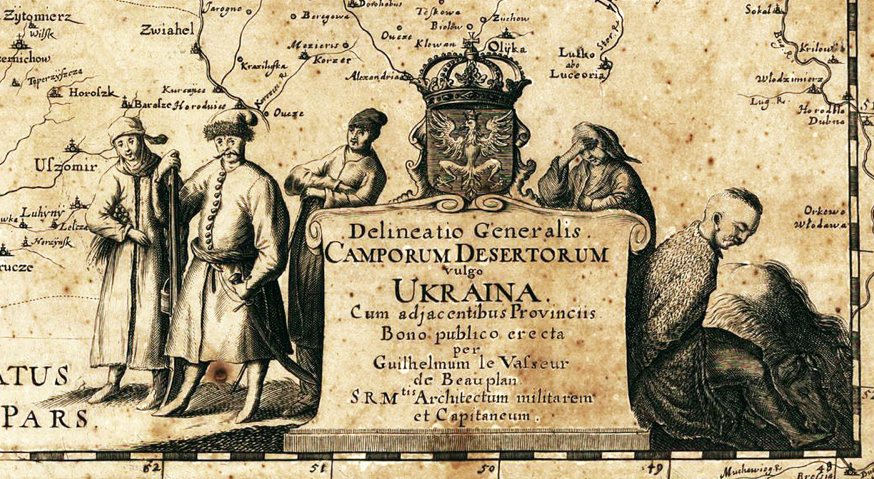
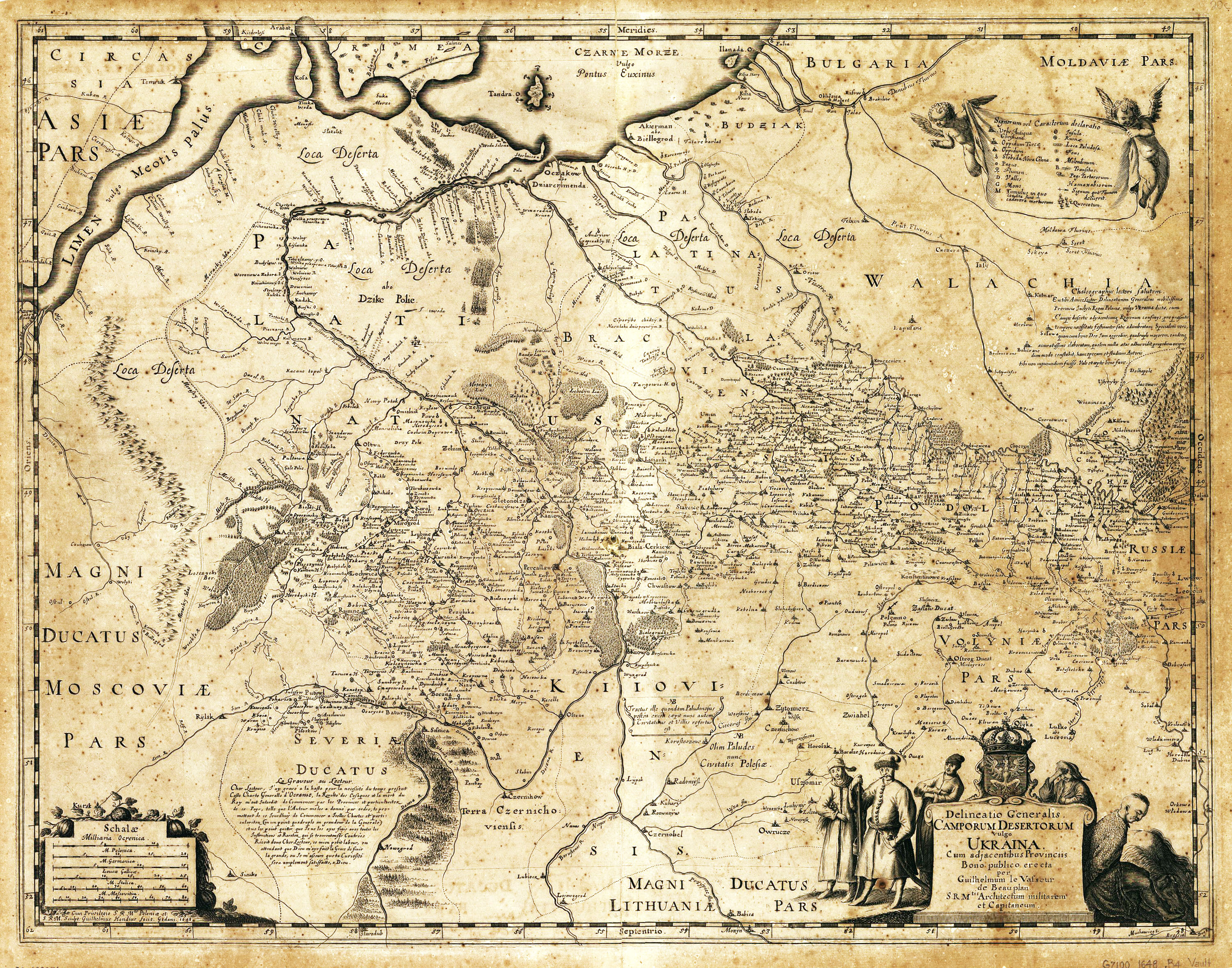
But the rebirth of the geobody that Putin wants to redefine has, bizarrely, served as a sort of screen on which to project new identities in maps.   For the densely inhabited regions between the Dniester and the Dnieper rivers were settled by towns, but surrounded by steppes, former swamps and peaty plains of Polesia, in a triangle of Brest, Mogilev on the Dnieper and Kiev, or the region of Lithuania, Wallachia, Bulgaria, Lithuania and Poland and Muscovy, whose heterogeneously inhabited cities and “deserted fields,” long part of the Ottoman Empire , where divided, and shown, quite disorientingly, as East of Asia, if the inhabitants of these once-swampy area also seemed to be poised between sparsely settled lands of Walachia an Muscovy, as if poised between East and West, and populated by amiable-looking traders of sorts:  if the late seventeenth century sought to divide “Europe” from “Asia” along such rivers as the Volga, Don, Kama, and Ob, only by the eighteenth century did Philip Johan von Strahlenberg define the geographic divisions between Europe and Asia along the Ural Mountains, in a proposal Peter the Great’s program of Westernization adopted–and which Peter’s commander, the cartographer and future historian of Russia Vassily Nikitich Tatishchev claimed as his own, redefining Russia as European, and reclassifying Siberia as lying at an Asiatic remove.

Turkia Asiatica

Although the Urals gained dominance as a geospatial division, and the Ural River’s entrance in the Caspian Sea became a borderline, the question became less clear as one approached the Black Sea, but was less clear in the continually contested “vanquished areas [loca deserta]” that faced tartar incursions to the north, or the wilderness of the steppes, later settled by Russian nobility, but also by a range of Serbs, Poles, Armenians, Bulgarians, and Tartars to populate the historical wild lands of the steppes:

Densely inhabited river villages in community

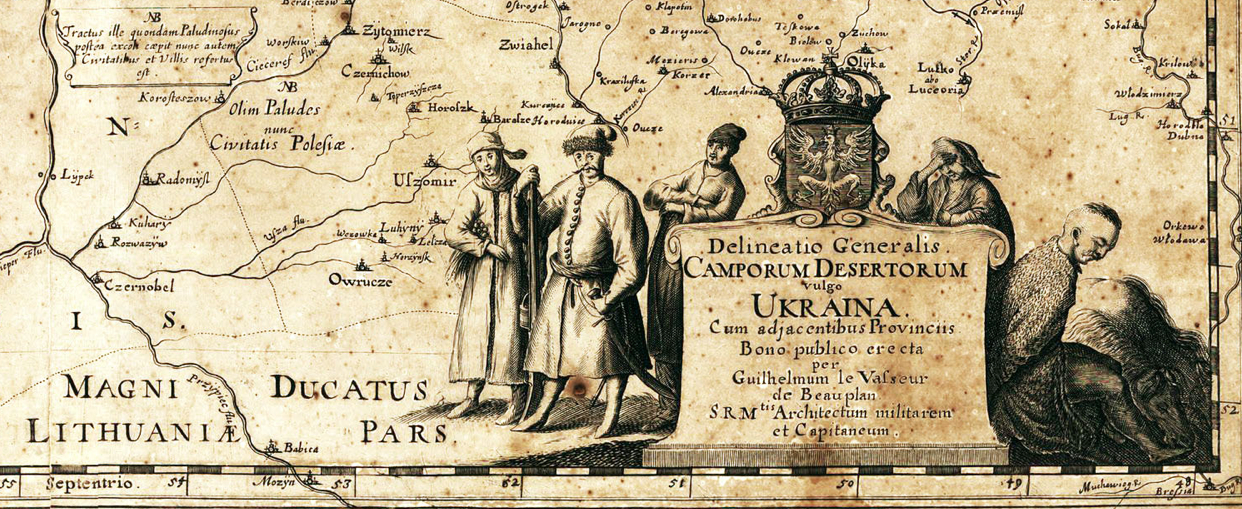
The addition of qualitative images of local inhabitants at the base of the map, around its cartouche, in the tradition of illustrating the variety of local costume and habits in maps of foreign region that Abraham Ortelius expanded in his Theatrum Orbis Terrarum to amplify the truly scenographical functions of the map as a description, serve both to supplement the erasure of any inhabitants in terrestrial maps, and expand the descriptive qualities and enargaeic power of maps to make a region present before readers’ eyes:  pensive inhabitants stand about the cartouche in varied local dress who seem trustworthy traders and businessmen, expressive, not only of sartorial variety their headgear and buttoned-up shirts, but sympathetic characters current maps erase by shoehorning into demographic divides, unlike this delineation of the shifting ethnic constellation of “Ukraina cum adjacentibus Provinciis“:

Vulgo Ukraina

That is not that political divisions do not exist, but that the attentiveness to dividing the region into its constituent parts may go back to the positivistic origins of regional geography that hoped to grasp a coherent and legible picture of the region, rather than to capture the variety of forces that have now poised around its borders.

Long hopes for creating a clear picture of the region is something of a geographic dream of clarifying the ethnic divisions of the region, if it is now presented not in the division between Christian and Islamic (Turkish) towns, and Cossack so much as political parties that seem all too rooted in ethnic divides.  For a generation of Enlightenment geographers obsessed with delineating state frontiers and classifying continental divides, this area, not clearly on either side of the Ural Mountains, Ukraine posed problems of liminality, partly in Asia and partly in Europe, like Poland, and peopled by groups without frontiers, or whose relations were particularly hard to determine and would be even harder to determine during the ever-shifting regional geopolitics from Cossack resistance to Ottoman forces to the of Russo-Turkish wars over much of the late seventeenth and eighteenth century that would, in the end, grant Russia access to the Black Sea and a sense of entitlement to the region:  the inhabitants of Ukrainian lands were situated in relation to other regions, rather than as a region, and Turkish and Christian cities on both sides of the Dnieper distinguished on the map–which noted continued incursions of Cossack and Tartar tribes.

Beauplan_Poland_XVII_map

Camporum Desertorum

The unexpected recent rehabilitation of the mythic-historical construct Novorossiya” as being not a myth, but rather defining “a country of twenty million people, with industry, with resources,”   may in fact conceal that the resources are what military intervention would allow the Russian government access and the ability to control.  

The newly resurrected language of borders created an alternative nation-state.  It has provided a basis to shift the denial Ukrainian autonomy into an actual excuse for military invasion:  the assertion of the imaginary region of Novorossiya has effectively denied the boundaries renegotiated with the fall of the Soviet Union, as if they perpetuated a swindling that shortchanged Russian collective memory, and offered cover to deep-set fears the West would actually reclaim Ukraine; Putin has from April 17 re-described greater Crimea  as if it were Russian, beyond having ethnic Russian residents.  There is little coincidence that the wealth of Eastern Ukraine in its many coal fields and iron ore beside the Donetz River would itself make the region such a profitable site of resources.  The region’s considerable wealth seems to have solidified the deep ties of the region to Soviet Russia, so that it is in practice impossible to extricate Russian desires for control over the region from trade in its natural resources or actual mineral wealth.  So is his land grab a pragmatic one, or is Putin shadow-boxing both with Soviet collectivization and imagined NATO-expansion to Russia’s frontiers by resurrecting the historical confines of Novorossiya, over a century after its demise?

Friesen--NovorossiyaNew York Times, from Friesen, Rural Revolutions in Southern Ukraine; Magocsi, Ukraine:  A Historical Atlas 

8.  The reclaiming of this region that existed in a historical imaginary alone–but whose frontiers were far larger than the region where Yanukovych had won a large share of the popular vote–suggests the invocation of an imaginary heritage of a past frontier to disguise the protection of economic resources in an age of globalization.  Indeed, Putin seems intent on enlarging the historical boundaries of Novorossiyain his current land grab.  Putin was quite open about his true target of concern:  “Needless to say, first and foremost we wanted to support the residents of Crimea. But we also followed certain logic: if we don’t do anything, Ukraine will be drawn into NATO sometime in the future. We’ll be told, ‘This doesn’t concern you’ and NATO ships will dock in Sevastopol, the city of Russia’s naval glory.”  Mapmakers might do well to engage this redefining of the Ukraine’s sovereign bounds, and to consider the region less as a bounded territory in the manner it is so often mapped, but of crucial importance not only on account of the access that it offers to the Black Sea, but for the access that it allows to burgeoning gas fields in the Black Sea and the Sea of Azov, and to the network of pipelines Gazprom long ago laid across the region’s current actual boundaries.  

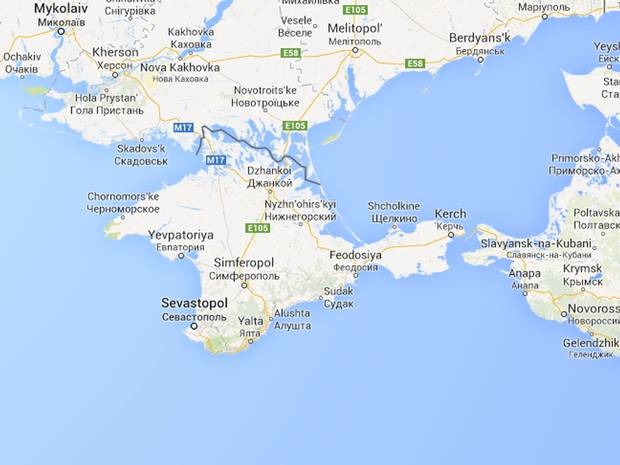
The situation of these pipelines no doubt offer a considerably persuasive rational for backing and sustaining claims to Crimea’s alleged regional sovereignty, and its integrity to the Russia’s economy and state.  Google Maps quickly caved to repeatedly recarving of the map of Ukraine that the invasion created, when it opted to reflect user preferences or the path of least resistance.  The decision to go ahead and allow the peninsula of Crimea appear part of Russia for its Russian users was in part an abdication of responsibility in mapping–and an attempt to remove the map from politics, by making it one of the disinterested provision of information, and offering two different maps to two sets of map-users.  But in claiming agnosticism on its decision to air this boundary line–as if to boost its page views, more than adopt a position of clarity, while continuing to retain place names in Crimea as part of Ukraine  (see Simferopol, Crimea, Ukraine).   Google’s not-so-Solomonic option seems to mirror the announcement by the politician Anatoly Sidyakin that Bing, Google, and  others to imitate how the Russian search engine “Yandex . . .  shows Russian users that Crimea is part of Russia, while showing it as part of Ukraine to Ukrainians,” as if in a sleight of hand, and leaving its spokesperson Svetlana Anurova only to remark with taciturnity that “In relevant cases the borders of disputed areas are marked in a special way. In countries where we have a localized version of our service, we follow local laws on representing borders and use of landmark names.”  

crimea-google-russia

Is the actual vociferous denial of any contested territories in the map itself a Solomonic judgment, or a weirdly back-handed denial of the power of the imagined maps and boundary lines that seem so important to Putin’s own created image of himself as the protector and defender of Russophiles, and his manipulation of the situation to booster a flagging Russian nationalism?

Or are we just punting, as the National Review‘s Alec Torres worried about National Geographic‘s decision to quickly recognize Russian annexation of the region, and Wikipedia’s hemming and hawing about how to acknowledge the disputed relationship between Crimea and Russia in its maps.

Crimea Disputed

In announcing the “historic reunification treaty” as expected to be ratified by the Russian parliament, somewhat gleefully noted that “Experts at the Washington-based National Geographic Society have announced plans to redraw the world map to show Crimea as part of Russia after the Ukrainian breakaway region’s reunification with Moscow is finalized,” as if it were but one step away from formal recognition by the UN.  (There seems to be a clear conflict here between demands for 24-7 news and the difficulty of shifting the boundaries on a map to reflect a shifting situation on the ground; Rand McNally’s Amy Krouse promised its prospective readers that in mapping the region, “we take our direction from the [United States’] State Department,” which, of course, has not recognized the annexation, leading to a kerfuffle about the drawing of maps that did little to clarify news information, as it amounted to flag-waving.)

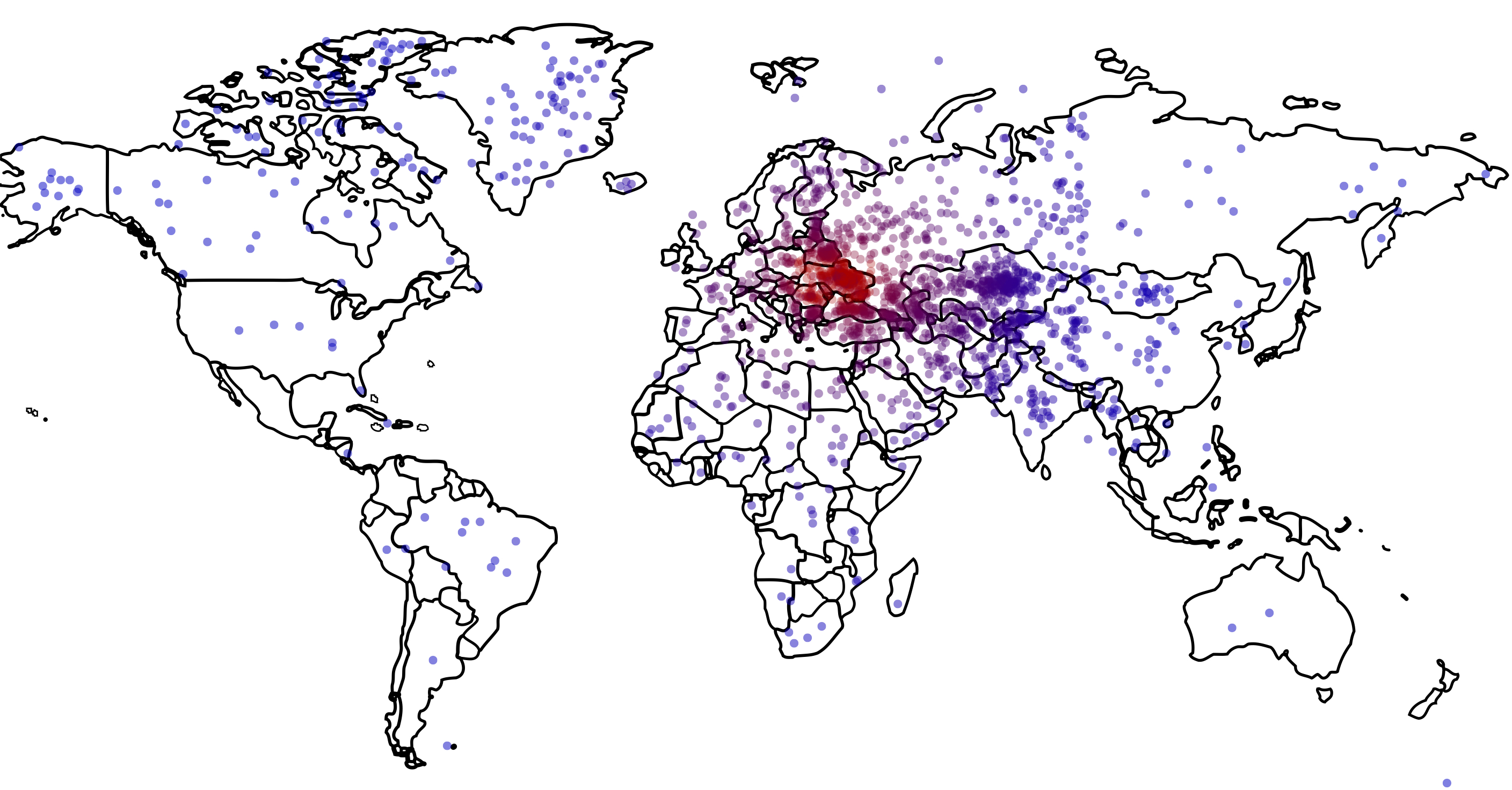
9.  WaPo’s Monkey Cage jumped into this confusion of drawing boundary lines, by asking how much these maps even reflected geographic knowledge.  The creative blog featured a widely popular map questioning, in a lamentational vein, taking knowledge of the Ukraine’s geographical location “as a proxy for overall knowledge and news consumption” about events in Ukraine.  The post explores how much Americans’ know about the geographic position of Ukraine.  Despite the reported pseudo-statistic that over two thirds of Americans are following the situation on the ground at least “somewhat closely,”  the Monkey Cage punchline is that the least understood about it geographical location, the readier folks are to advocate military intervention by the US as a solution to a problem they are unlikely to have understood: only one in six were able to place Ukraine on a world map, let alone a regional map of Europe, and the failure to locate Ukraine extended to some 77% of American college graduates, most placing it 1,800 miles away from its actual location, based on a poll of Survey Sampling International.  Most are removed from the imaginary geography of Novorossiya that Putin invoked:  the spread of locations identified in the sampling use blue dots to show places most widely varying  from Ukraine’s actual geographic location, in a map whose methodology and relative relevance was later elaborated in depth:

Ukraine_Full

Stephen Colbert present the map while he wondered about odd clusterings of imagined notional Ukraines in South Asia, Greenland or Canada, and one response near Iowa–as if the move suggested the belief of one polled respondent that in invading Ukraine, Putin might be entering himself in the next Iowa straw poll.  Doubtlessly, the notion that Russia might be fighting a war far from its borders is somehow a part of the odd mental baggage most Americans have about being stationed in Iraq or Afghanistan–an uneasiness informing the recent toponymic mutation of “Chiraq” to describe the surge of violence in the city in the Midwest. But the point is that unless we return Ukraine to a sense of geographic place, our understanding of the situation that has led to the crisis.

Where is Ukraine, anyway?  Definitely on a map, and in many heads, but you might do well to take care to map the dynamic to understand how its frontiers are in danger of being redrawn.
2 Comments

Filed under geopolitics, mapping ethnic groups, mapping national divides, Mapping Ukraine, Ukraine

Crafting an Imaginary Atlas for a Dystopianly Disproportionate World

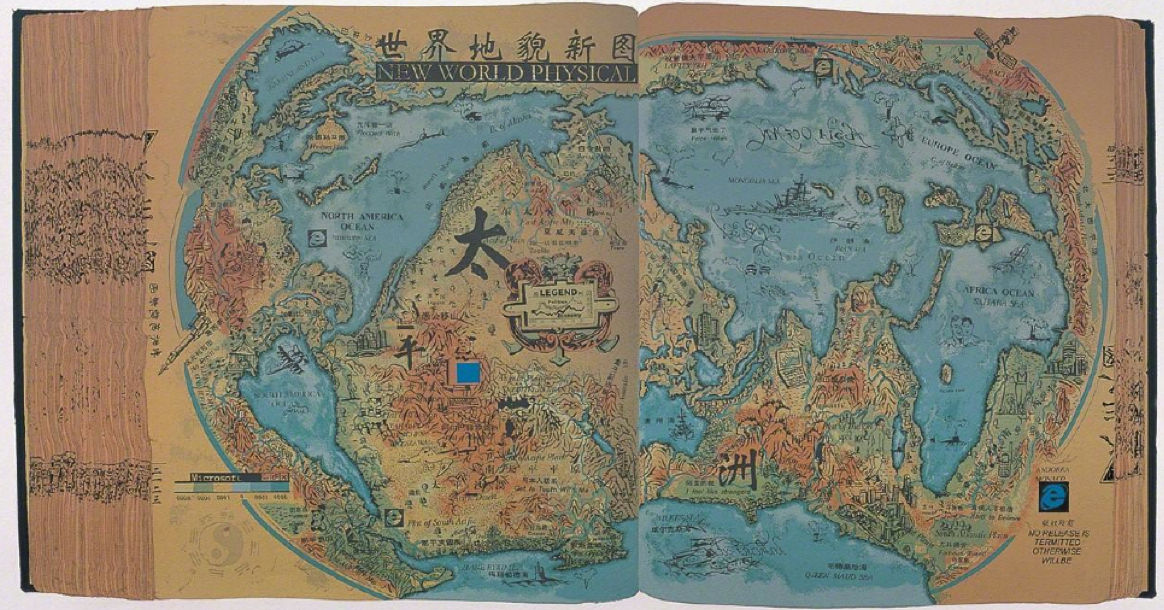
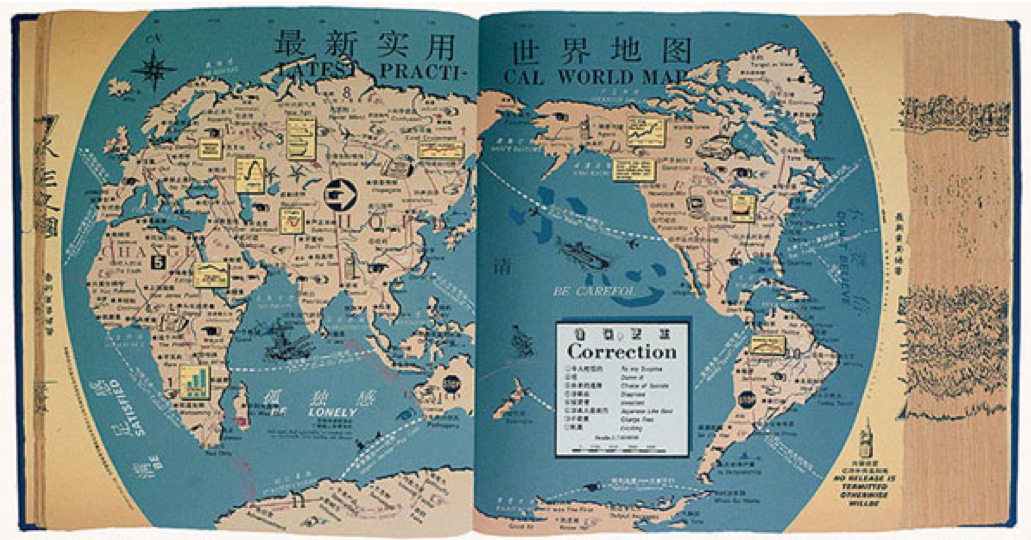
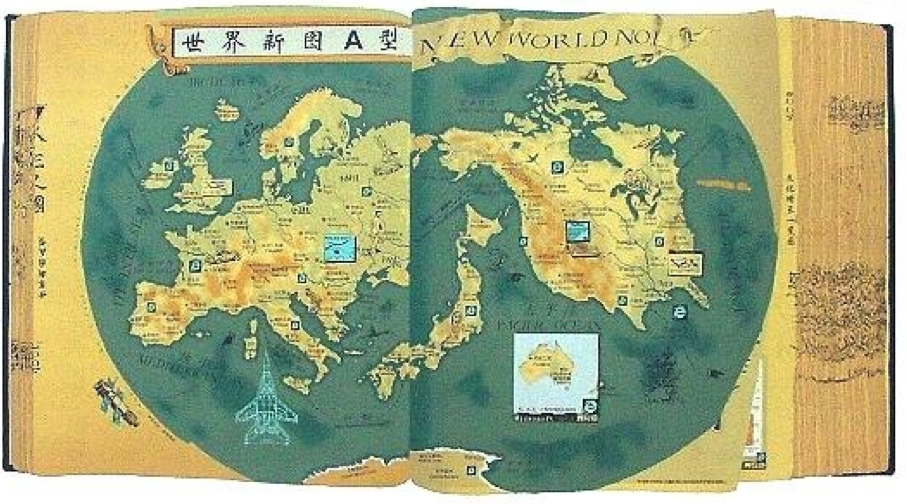
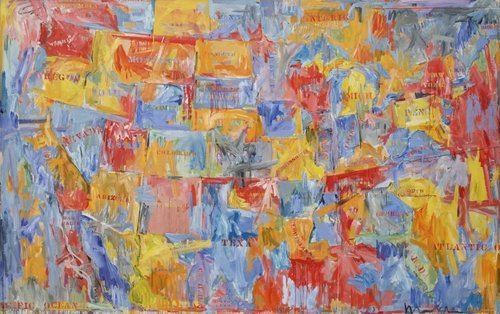
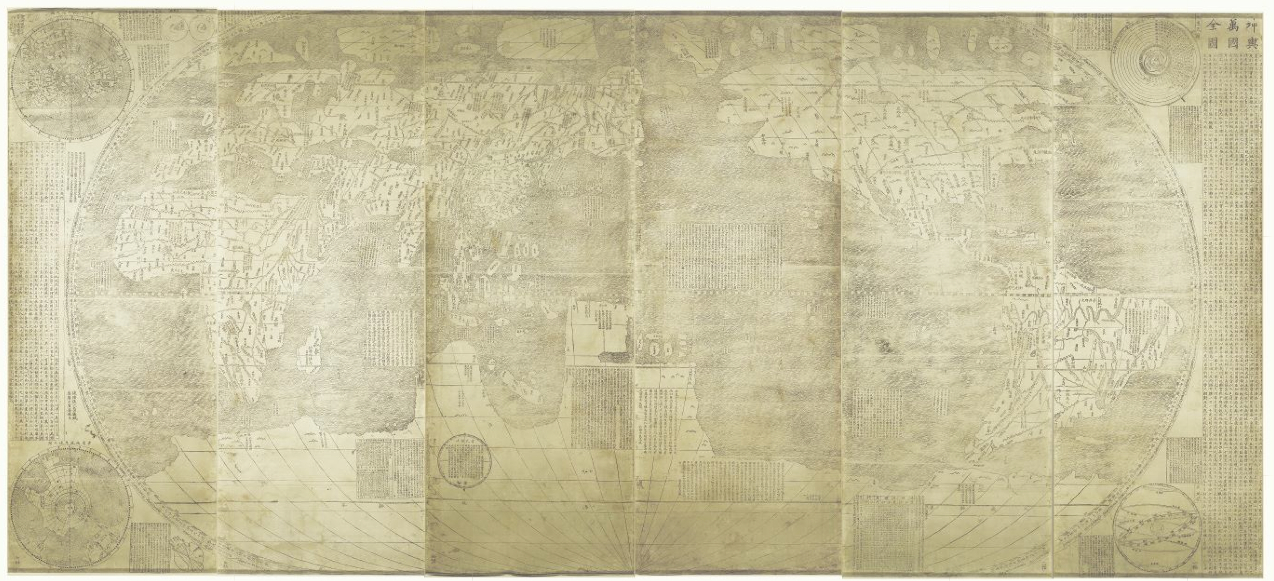
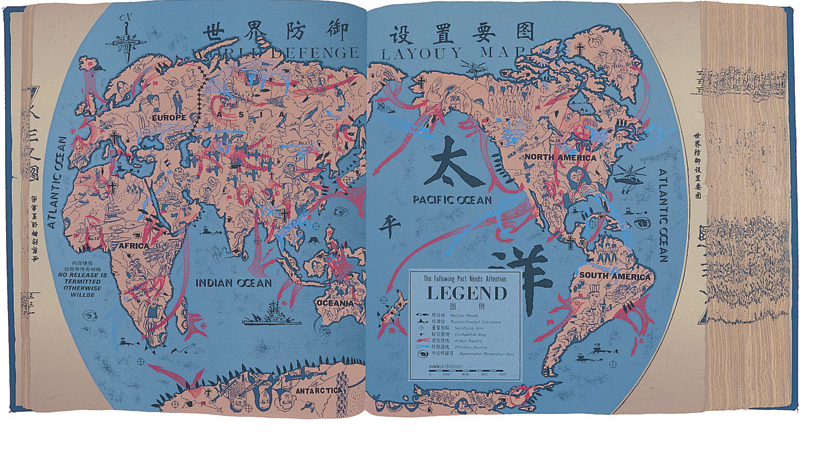
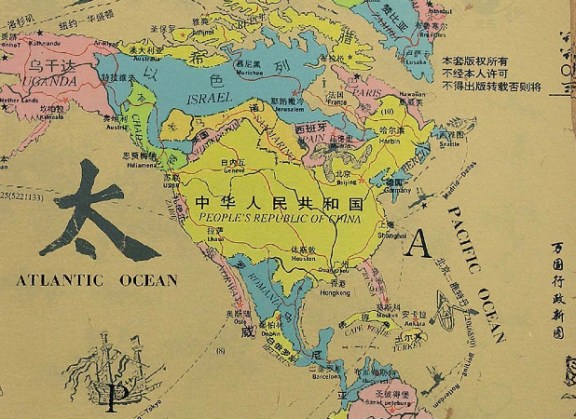
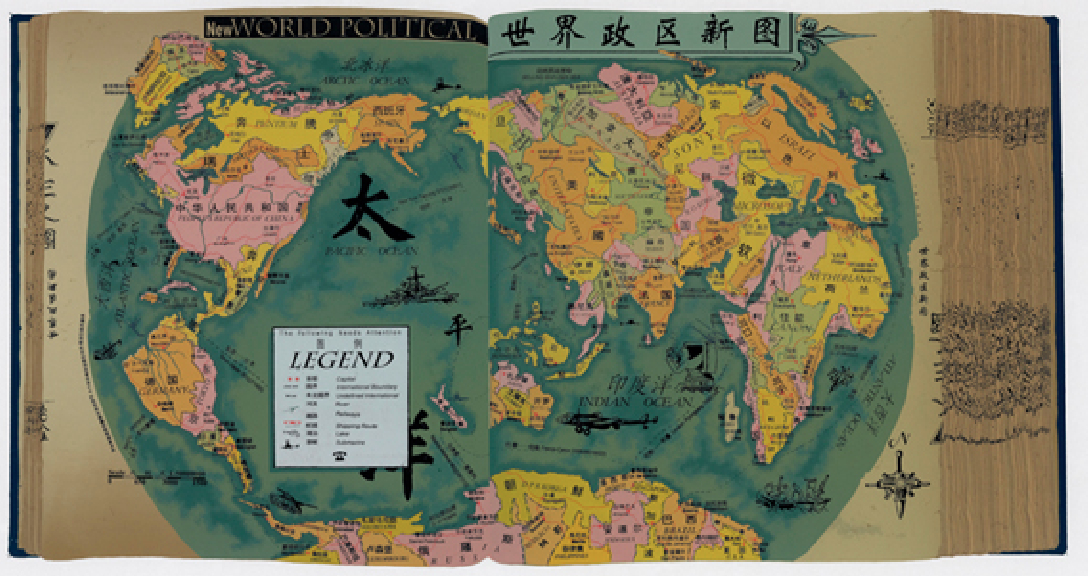
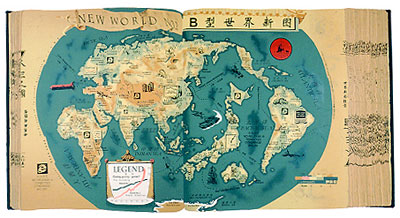
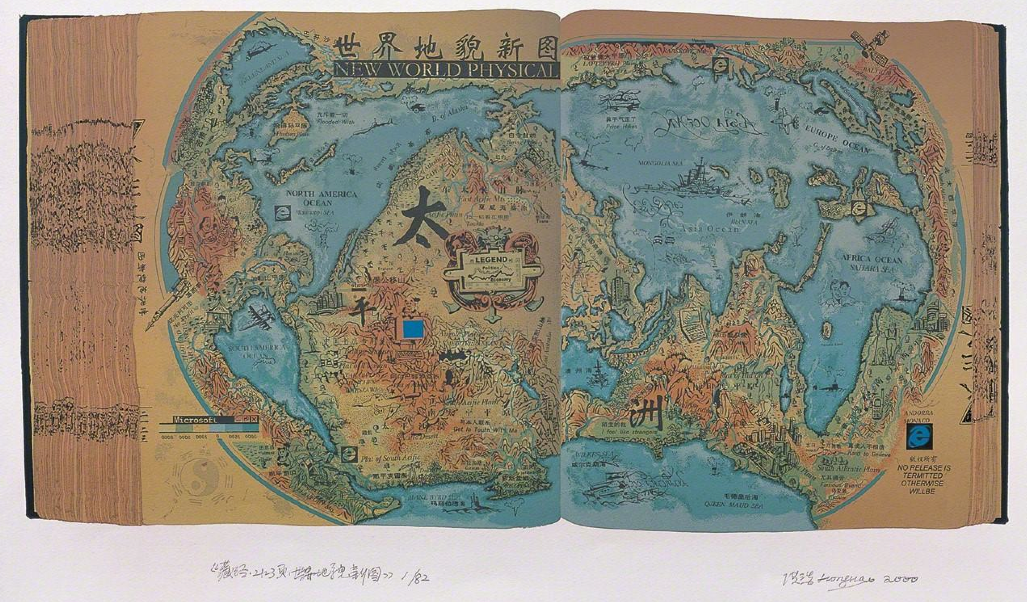
What is one to make of the silkscreen prints Hong Hao assembles from digitized versions of antiquated printed world maps?  While dispensing with anything like an exact correspondence to the world, each creates a fantasia of borderlands, and offers something of a wry response to the frustration at imbalances of globalization, as much as they appropriate antiquated cartographical conventions and forms.  Hao’s silkscreen prints manipulate scans of older global maps, he’s argued, as a set of confines or parameters to draw the world in new ways, but in doing so deploy the conventions of mapping to empty the familiar authority of the conventions of cartography.  The huge success of his production of world maps in the series Selected Scriptures, which this ambitious and eclectic printmaker began in the 1990s, but dramatically expanded after 1995, have reached a demanding public.  Is there appeal how they question how we see nations as best described on a map as they make foreign–and winkingly poke fun at–the authority of the print map as a register of the nation-state or territorial boundary lines?  Or does it lie in the special appeal of their static form, presented as a classical sewn binding of an encyclopedia, in an age when most of the maps we use are downloadable networked media?  In an age of online and digitized maps, Hao seems careful  to design the sequence of maps as situated and constructed forms, that open to the viewer in the site of a stable book.

But the maps that he produces also chart an increasingly globalized world, no longer subject to the confines of antiquated or inherited cartographical forms he creatively has appropriated, and seem to gesture to the construction of a warped world of a less clear balance of power or status quo, concealing many unseen networks of financial exchange or political relations.  The introduction of corporate logos, upbeat slogans, and fractures of linguistic translation into the imaginary corpus of maps Hao has produced with astonishing invention and rapidity question not only the hold of the power of maps but the medium of mapping, by dislodging the conventions of mapping from a familiar story and by suggesting the outdated nature of narratives of bounded territories and balances of power, as well as to indicate the increasingly skewed nature of global relations.  If Hao has chosen the silkscreened image to be confined by antiquated formats of mapping, unlike the screens we use to view maps on hand-held devices, his crafted silkscreens take the map as a liberatory form to reorganize global space in something of a provisory or provisional fashion for their viewers to contemplate.  In ways that dispense with notions of geographic correspondence or way-finding, and adopt the conventions of mapping to undermine western narratives, Hao distances us from paper Rand McNally maps in ways as appealing as they are successful on the international art market.   In appropriating Western conventions for viewing global space, Hao surely comments on the power of mapping as a symbolic form and graphic practice, if only by undermining and defamiliarizing the coherence of the map as a record of familiar territory:  not only do his silkscreen prints mutate forms of mapping, by altering names, locations of countries, color-schema and mirroring continents in wry ways, but adds weird arrows, graphs, and currents mark the ties of countries and continents.  Rather than confusing the surface of the map, the direction of viewers’ attention to the map seem to reveal fractures and imbalances in the globalized world, even if in ways that seem to undermine–or question–the map’s own claims to reality, by releasing the map from claims of accuracy or indeed truth-claims.

The appeal of these images among his other attempts to synthesize an eclectic variety of scaned brightly colored objects from everyday life seem quite distinct.  For not only do they indulge in the translation of maps to Chinese culture (and a global art market), but they raise questions of how all maps are translations of reality in ways that are comforting in an age of the web-based map.  If Hao severs the map from claims of precision or forms of way-finding, he rehabilitate antiquated structures of mapmaking, now somewhat foreign to our period eye, to orient us to the impossibility of proportional mapping in a truly disproportionate globalized world.  The images Hao defines are extremely popular as a sort of response to the failure of globalization, and indeed the failure to create a new map of the modern world.  The sustained return to the map as a medium seems quite unlike the numerous ways that artists have long referenced the authority–and formal objectivity–of mapping as a register of the political status quo, in how they question the vision of global unity that maps and politics that maps have so long bequeathed.   For if Hao uses the palette of mapping as a clear set of constraints to in Selected Scriptures, an inventive sequence of silkscreen prints that create revisionary maps of the world’s countries, begun from 1992-95,  dismantle the oppressive presence of the map in our world to question the new hybridization of map making by moving it out of a “western” art.  There is a sense for many art critics of a Duchampian inspiration; each seem to announce “This Is A Map,” or maybe even “This is a New Atlas” as a ready-made form.  Hao reached back to the conventions and forms of printed Rand McNally-esque mapping forms–if not an earlier cartographical sublime–appropriating the claims of novelty and reduction of information as an elegant and economic statement of truth to make an artifact that  lies between found objects and the “ready-made,” even as his final products seems to satirically advertise their own cheapness and untrustworthiness as a vehicle:  the translation of the format of mapping in much of these works not only undermines its authority, but suggests an impatient and persistent attempt to find meaning in the map.

Hao’s sequences of silkscreen prints chart dystopia in faux open pages of an imagined traditional thread-bound Chinese encyclopedic text–as if to create the fictional broader corpus of which each form part.  While they do not pose as recreations of an actual experiential world, they seem to comments on the mapping of the world that have particularly pressing urgency to the material presence of the map in an age that is increasingly online.  Hao’s work, including imaginary pagination from the encyclopedia of knowledge from which they ostensibly derive, register glimpses of an atlas that charts the oppressive nature of global divisions, or an imagined atlas of the social construction of space, if not of an attempt to start dialogue with a “new world order.”  The prints appeal s a way of romancing the hand-made map, in an age of the web-based maps and a surfeit of digitized data, however, by recycling such foreign, if familiar, conventions of printed maps to orient the viewer to a disorienting world.  In place of the data visualizations that chart the process of globalization, Hong’s recourse to screening maps to show inequalities and disparities seems by no means accidental.  For Hao takes the map’s surface as a field for further manipulation:  the world seems an open book, in the silkscreen prints shown below, made after the original series, and use the cartographical surface as a charged field for modification, inversion, and inscription, adopting the abilities offered by digitization to create a mock-permanence in his prints.

Take two examples.  The very mutability of the medium of mapping in his work suggest not the tyranny of modern mapping, but the provisory nature with which maps translate space for their viewers, and the indiscriminate nature of how they present global inter-relations as a space that can be read in “Selected Scripture, page 1999, The Memory of Millennium” (2000).  If all maps are translations, these are quizzical ones, as much as physical ones–filled with corrections, misprints, and ways of subverting their own iconic authority as maps, and glimpses of an imagined atlas of a nonexistent world.


NEW WORLD PHYSICAL 2000

Latest Practical World Map


In the first, the excavated distorted “North America Ocean” and “South America Ocean” are dotted by odd arms and insignia, their actual confines warped to create imagined lakes and emblems of airplanes and Microsoft, unlike the “Asia Ocean,” and oceans become land mass.


America's Microsoft Explorers


In the scanned maps Hong has altered and manipulated, America might be expanded, renamed as the PRC, Asia folded into obscurity save Japan, and Canada foreshortened into a swelling United States, all to upset viewers’ expectations for reading their surface, which he reiterated in “New Political Map, 2” (2000), “New Political Map, Which One” or “New World No. 1” (2000), repeatedly playing with the constraints of mapped space in ways that not only skew actual relations, but invite us to recognize the arbitrariness with which we map our mental space or are accustomed to do so.


%22New World No. 1%22 p. 2001


Hong Hao was trained in printmaking, and values the medium of silkscreen prints as versatile tools not only to sort objects and create catalogue, but to treat the map as an ordering device.  The series of Selected Scriptures, which are distinct from much of his work in their ostensible unity, are distinct from Hao’s interest in sequence of assemblages that are characterized as mosaics of found objects, for the maps he has invented are anything but disinterested collections of visual information or compilations of objects.   Hao’s sharply observed maps are not aestheticizations, so much sharply observed post-modern satires, and comments about the recoding of information systems and the processes of the translation of information that occur in maps.  In his powerful series based on the clever appropriation of older maps, the antiquated nature of the maps allows them to be treated as a new expressive field.   For Hao’s Selected Scriptures (1992-2000) seems to ask us to about the role of visualizations in suggesting the global imbalances of networks of power often removed from actual terrestrial relations in an our over-mapped world, treating the map less as a totalitarian constraint or a set of fixed conventions than something like a musical piece that could be assembled, varied, and reorganized in sharply provocative ways.  Hao has created skillful digital transpositions of world maps in his silkscreen on heavy wove paper, as if to recall their craftsmanship and artifice to contrast to the mechanical reproduction of serially produced maps of topical concerns.  The contrast of materials of their subject and handmade production recall the power with which printed maps once assembled the lived world, in ways that masked all its inequalities and absence of proportions, working within the structure of the maps to undermine their content and reveal the very inequalities that they concealed.  Hao has claimed to be especially attracted to historical maps as being “capable of inspiring ideas on what we take as common knowledge” and as “almost the most direct and most economical way to know the world.”  But the economy of mapping by no means limits his variation of his range of artistic expression in this series:  Selected Scriptures exploit this economy of graphic expression and its organization as an inspirational guide for playing with their formal transcription of space, redeploying the map as a new arrangement of space in works that bear such self-titled silkscreen prints as “Latest Practical World Map,” “New Political World,” or “New World Physical“–to cite the prominent English typeface in his Selected Scriptures series.

Several of Hao’s set of maps, which appear below, capture the promises of how maps make new claims to organize the world’s totality in readily legible ways that make us look at maps in new ways, alternately whimsical, quizzical and ironic look at space.   In an age of online and digitized maps characterized by the near-constant mapping of financial transactions, geographic locations, and activities, Hao’s images are less about “found” maps than the rediscovery of the assembly of space from digitized images maps and varied map detritus that he wields and transfers onto his chosen medium.  For he has adopted the particularly copious formal syntax of mapping, preserving the appearance of cheaply printed maps that he emulates, to ask how successfully maps might ever translate an image of our world, subtly reshaping their economy to upset their meanings–evacuating the map of any sense of wayfaring tools, but enriching its symbolic form.


1.  The formats of mapping that Hao appropriates are, of course, removed by several generations from our own notion of map-use or the medium of mapping in modern life.  If it is increasingly confusing how to orient oneself to an increasingly imbalanced world whose inequities have been put on display in how news media often ignores most inequities in the inhabited world–not to mention the disproportionate threats of global warming to ecosystems, regional economies, and global food supplies–Hao assembles more light-hearted–if deadly serious–maps that invites us to engage the mystifications on maps.  Artists have long worked with maps.  But rather than offering an aestheticization of the map’s surface, as Jasper Johns, whose re-used the familiar image of the names of states in the United States, repainted to transform a well-known image,  converting familiar conventions of maps to encaustic, in an etherial blurred space of dripping paint that obscured clear lines of legal divides, and render the conventions of four-color mapping a ghostly haunting blur rather than a symbol of space–


CRI_159124


–Hong Hao actively remakes the surface of the map as a map.  And his works demand to be taken for that reason as maps, or at least as interventions in practices of mapping, rather than images that appropriate cartographical images, conventions, and signs.

Hao’s maps map, of course, a globalized space as a space into which the artist makes his own interventions, although his work is in ways resonant with Johns’ evacuation of mapping forms.  For Hao’s maps re-assemble the disparities and tyranny of the globalized (over-mapped) world.  The disparities within the global economy has the danger of being recapitulated, of course, in ways that he lampoons.  The collective atlas that he imagines, which collectively run against the global maps we carry around in our heads, or the maps that we use to try to come to terms with unimaginably complex implications of global military constellations and warming processes.  Already, in a work that predates the Selected Scriptures, Hao’s “The World Distribution of Guided Missiles” [sic] (1992), a monochrome silkscreen print replete with the mythical beasts and figures that recall the figures on medieval portolan charts for ocean travel, shocks us with the explicit charting of state secrets.  It also suggests a new playful engagement of the map as a communicative form, even as he works to expand the boundaries of a map’s informational value.  When he locates the bulk of guided missiles in Antarctica, the effect expands the map as a record of inhabited space, repurposing of the cartographical iconography with which he knowingly plays:  in this map, the effect is oddly to diminish the appearance of the world’s size:  at the close of Operation Desert Storm, of Gulf War, and the inundation of airwaves with images of US fighter jets on a sustained campaign of aerial bombing more extensive than expected, and provoked counter-attacks, Hao imagined the world as cowering from missiles poised for launch in the “World Distribution” silkscreen i seem to translate the cheaply printed paper ink map into his own image that magnified China at its approximate center.  As much as translating western cartography into a new art language of classical Chinese origin, Hao seems to confront the difficulty of mapping power in this and his many subsequent silkscreen prints.


World Distribution of Guided Missiles (1992)


The disproportionate prejudices in these maps are well-known.  Global warming, a concept few can claim to understand, is also the,  most mapped–if perhaps most disproportionately mis-mapped–is repeatedly wrestled with in a variety of maps that try to lend the process a concrete appearance.  Despite the fact that 40% of the world’s population lives within sixty miles of the shore, and  200 million people live within five meters of sea-level, the disparity of the dangers of shifting shorelines that are poised to shift dramatically with global warming are only partly evident in an interactive “Global Heat Map” produced by the Union of Concerned Scientists:  and the extreme dangers that the shifting shorelines poses for low-lying countries is by no means limited to the United States, even if this sometimes seems the case in our own news media or the relative blindness or radical shortsightedness government working papers on shoreline sensitivity–subtitled “American Starts to Prepare–on the impacts of global flooding of low-lying lands.  (Even if there are exceptions in American media publications.)  The deepening disparities of our own mental maps–evident in the apparent perplexity that one out of six Americans in where in the world Ukraine is located, according to the Washington Post, which almost makes one wonder if the survey was credible or if it generated sarcastic responses–the lopsided maps we contain may make Hao’s imaginary  corpus of lost maps apt commentaries on global inter-relations, as much as a formal syntax for creative expression.  But they grapple, if in a light-hearted way, with the problems of mapping the globalized world.


2.  Hao’s work is a retrospective recreation of a cartographical sublime that reaches back to a lost medium of paper maps.  The particular productivity of mapping as a new form of invention in Hao’s work from the late 1990s, suggests a particular neat coincidence of how maps speak to power, or power through maps, that interestingly mirrors the growth of online mapping:  although Google Maps was only launched just less than a decade ago, in 2005, shortly after Steve Coast created a free, editable map of the world, OpenStreetMap, based on Wikipedia, in 2004, the first online mapping service, MapQuest, If OpenStreetMap responded to the inability to freely download government-run and tax-funded projects like the Ordnance Survey in England, as these mapping projects have expanded, the epistemic remove of maps such as those that Hao uses–and the apparent chronological distance of a map created by silkscreen, but belonging to a printed encyclopedia bound as a classical Chinese book–gains new appeal as a rehabilitation of mapping as an aesthetic medium and as a tool for imagining and locating geopolitical abstractions.  Unintentionally, the rise of GPS and geocaching as modes of map making, satellite imagery, digital searchability, the branding of Google Maps and the Google map viewer, and dramatic expansion of use in over one million websites of the Google’s API, have conspired to so remove the five-color map from our “period eye”, that its epistemological antiquity may be increasingly difficult to distinguish from the thread-bound classical encyclopedia Hao’s Selected Scriptures referenced.  (Google’s corporate logo is absent from Selected Scriptures, but the presence of Internet Explorer and other corporate insignia suggest a need to locate the web-based map on the borders of what we once new as the world’s inhabited territories.)

Yet the weird notions of contiguity of a flattened earth that Google Maps has perversely re-introduced–reinstating a continuous block of Eurasia and Africa, for example, isolating China, Australia, and North America–mirrors the  oddness with which Google Maps has rehabilitated its own variant of the long-discredited and cartographically retrograde biases of the Mercator projection, a handy solution to the flattening of the earth’s surface to coordinates of straight lines of latitude and longitude but which amply distorts its surface, irrespective of actual land-mass, but whose convenient centering on Europe provides the basis for all Google-derived web-maps.  (China’s role in this internet society is contested, with most social networking sites banned in the country, including Facebook from 2008, Twitter from 2009, and Google+ as it was introduced–despite relative open-ness to LinkedIn, reborn in China as 领英, pronounced “ling ying”).


Contiguity in Google Maps


For all the personalized coziness of the Google Maps Navigation, Google Street View, or My Maps, this close variant of the quite retrograde Mercator projection has perpetuated a primarily targets that Hong skewers as a frozen model of global relationships of power, which is striking for how it eerily corresponds to Hao’s “New Political World” (1995), whose evocation of the modernity of rewriting the world’s geopolitical structures is not only reminiscent of the early modern cartographers Mercator or Ortelius–the former’s “Nova et Aucta Orbis Terrae Descriptio ad Usum Navigantium Emendate Accommodata” [“New and more complete representation of the terrestrial globe] properly adapted for use in navigation]” of 1569 and the Nova totius terrarum orbis geographica ac hydrographica tabula . . .” of 1570–but also to announce new political configuration of landmasses in relation to one another.  Although Hao didn’t prominently include Google’s logo among the logos of international corporations  in the sequences of maps he has designed from 1995, his work succeeds by upsetting our Westernized confidence in mapping, more than playing with cartographers’ formal conventions.

And if Ortelius prided himself on drawing national boundaries and distinguishing the world’s expanding number of continents, Hao’s silkscreen prints take pleasure in redrawing boundaries, reconfiguring the shapes of countries, and shifting and switching toponyms, as if to describe a world less defined by boundaries than the continued symbolic authority that maps have long continued to exercise.   Indeed, rather than accessing or retrieving data in the format of a map, we are presented a map in the legible form of an open book and private space, even if we are invited to imagine the audience of readers for whom such a map might be mechanically reproduced.

The maps are forms of imagining a conscious redesign of the balance of power and populations that antiquated static maps once mapped.  Indeed, Hao’s reassembly of the map may as a form of memory might even recall the famous translation of the Ortelian project in 1602 by Matteo Ricci, working with the astronomer, mathematician and geographer Li Zhizao (1565-1630), who engraved it, in ways that affirmed the dynamic and interactive nature of the actually static nature of a woodcut print map.  (Although Hao may not reference this famous notion of cartographical translation, his appropriation of the format of world-mapping seems to intentionally reverse the trajectory of Ricci’s importation of cartographical iconography and place-names on a somewhat comparably busy and densely crowded symbolic field.)

Ricci Map 1602James Ford Bell Library

Hao’s subversion of western mapping as a national political tool is often too crudely cast as reaction to the western–and American–dominance of constructing the world map, and an incorporation of traditional cartographical tools within a “Chinese” art.  This is too simple, and too readily essentializes “western” and “Chinese,” and where these works of art lie in relation to map making as a craft–or how Hao’s art relates to the currency of the mash-up as a map.  For Hao works with antiquated maps–indeed, making maps, rather than than only find them, to play new stories out on their surfaces–and indeed its distance from the imbalances of authority in our geopolitical world.  Reading the surface of the distribution of political power in the eponymous “New Political World” (1999) in the Selected Scriptures project playfully inverts the notions of legibility to demonstrate a balance of power regularly elided:  the playful projection of geopolitical values is exploited to present a new way of reading a familiar demarcation of terrestrial expanse divided by naturalized boundary lines, playing fast and freely with some of the iconography from news maps or other cartographical images.

If we love to read maps to move across space, and cross frontiers drawn in space, the shifting toponymy and place-names that we encounter in the imaginary Atlas of Hao’s device opens up a world we’re sad to read but that we can at the same time also recognize as something that the anonymous mapmaker has synthesized.  Hao’s work suggests a uniquely hybrid creation, as well as a satirical relationship to the Rand McNally political atlas, which seems its primary target at first.  Hao, who graduated from the Beijing Academy of Fine Arts the year of the suppression of protests in Tiananmen Square, has specialized in transposing digitized images to silkscreen prints that skew the actual geography of the world in his prints, much as they play with the reproduction of five-color maps in print culture with the format of an hand-made artist’s book, but derive from reproduced images scanned, digitally altered, and reproduced as silk screened images, linking traditional crafts, the Cultural Revolution, and modern digitized media to deconstruct and repackage (or redeploy) the map as a political statement.

The weird translation of cartographical images is part and parcel of the project, evident in the irony of the most “accurate” map in the Selected Scriptures, the “World Defenge Layouy Map” [sic] (1992), a variant based on Hao’s earlier 1992 work:


Scriptures Hao

Hao’s new map of nations illuminates military power by relatives geographical sizes of nations to reflect military power, recycling the map as a metaphor.  As much as it suggests a cheap reproduction, with its title seems suspiciously printed in uniformly spaced letters, the image of a “new political order” is meant to dislodge our expectations for reading a map centered on t:  and on the map, although the pathways of world travel include a sailing junk, but are dominated by fighter jets among large pinyin characters that immediately strike a western viewer, and reminding us that all maps are both constructions and translations and that, indeed, the power of the map in part lies in its success in translating reality to a seamless whole.  In Hao’s Scriptures, the integrity of the map is disrupted by the shifted orientation in the digitized images of names, landmasses, and pastel hues, as if to recall the mass-produced posters on cheap paper that recall Maoist times, the upbeat candy-colored pastels worthy of PAAS Easter Egg paints rather than a five-color map.  They describe a scary surface of disproportionate global powers, with the PRC at their center, now straddling the Atlantic and Pacific, whose places are oddly reversed, as if one emptied a Rand McNally map of toponyms and reshuffled their location, as if to mock the faux disinterested nature of maps from the  perspective of the current PRC, which finds itself somehow between the Atlantic and Pacific, in the place of North America, an expansive Israel to the North, and the United States displaced from its position of power:


%22New Political World%22Metropolitan Museum of Art
 

3.  Artists have been making maps–or using maps to make art–since before the first printed atlas, if not since the first globe.  But Hao takes the map to excavate it of meaning, and ask about the oppressive world system we have inherited, playing with the oppressiveness of that system and the almost light-hearted pastels of artificial colors (pink, yellow, orange, blue and green) we use to divide the inhabited world in printed maps to suggest that the map has little bearing on it.   The odd remoteness of the historical map offers a “tool to think” that exposes the discrepancies of our mental maps of geo-bodies.  Hao all but ignores the actual geographical contents that are the ostensible subject of a map:   and as the project progressed, the maps he creates have an increasingly ironic organization of space.  Reading the surface of the distribution of political power as referenced in the eponymous “New Political World” (1999) plays with notions of legibility that are regularly erased or elided within print maps, but seem especially pregnant with the distance of time:  the playful adoption of the map’s projection of geopolitical values is exploited in Hao’s work in order to present a new way of reading a familiar demarcation of terrestrial expanse that is divided into naturalized boundary lines, playing fast and freely with some of the iconography from news maps or other cartographical images:  Hao’s map of nations illuminates military power by relatives geographical sizes of nations to reflect military power, but even its title seems suspiciously printed in uniformly spaced letters:  and on the map, although the pathways of world travel include a sailing junk, but are dominated by fighter jets among large pinyin characters that immediately strike a western viewer, reminding us that all maps are both constructions and translations.

The power of the map in part lies in its success in translating reality, so that the PRC now occupies where we expect the United States:


New PRCMetropolitan Museum of Art
 

The humorous reconfiguration of space in these maps transpose space and place with a flighty flippancy foreign to any actual land map.  Why is Hong Kong now at the mouth of the Mississippi, in the place of New Orleans?  The legibility of the rest of the world is almost made ridiculed, not only as the ocean off of what seem Alaska’s shores is labeled “Atlantic Ocean,” but since the region is actually Uganda, nestled beside the newly bordered Israel and Chad, creating a perverse geopolitical world that seems an absurdist collage of what might be:  as the People’s Republic of China now occupies, save in Florida and parts of Norther California, most of the land that one might associate with the United States; to the north, Israel lies lazily across current Canada; London is dispatched to the South Pole; Canada is relocated to a strip of diagonal land in Eastern Africa, beside the Indian Ocean; Europe divided between Vietnam and Mozambique as if their names are dislocated from the geographic fields in which we are accustomed to find and locate them.

Hong Hao all but ignores the actual geographical contents that are the ostensible subject of a map:   and as the project progressed, the maps he creates have an increasingly ironic organization of space.   Many of Hao’s works trumpet their modernity in analogous, if tongue-in-cheek fashion–“The New Political World Map” (1995); “The New World Survey Map” (1995-96); “The New Geographical World,” Selected Scriptures p. 3085 (2000)–as if they offer windows on a newly registered reality to readers. Is ‘place’ less of a signifier, in the map, than the global distribution of power?   The sizes of countries are ordered, not only in terms of the military and economic power of nations, but in ways that upend the semantics of the legibility of space, despite the familiar color-scheme.  The result is often a fairly scary image whose totality one pays far more attention to, decoding the configuration of countries and assessing their sizes with an eye to power perhaps far more than geographic relationships, which are–witness the fighter jets–of far less import today.  The clearly cultivated flimsiness of a mistranslated map, standing askew to the actual world and placing Asia at its center, pushing mirror reflections of Europe to its margins, and dispensing with America, in ways that not only skew spatial relationships but show the reproduced map as a field for staging imbalances of power.


New Political World Hao

National Gallery of Canada


hong_hao_art_atlas2_400

Selected Scriptures, p. 1999, The Memory of the Millennium” (2000) assembles a grab-bag of cartographical inventions around an inversion of land and water, so that oceans that connect and separate continents now seem landmasses:  as if to exploit the map not only as construction, but assemblage of cultural artifacts that desperately press space into readily legible terms, Hao presses the fertility of the format of the map as a signifier into his service to new extents:  emblazoned with the prominent descriptive legend “New World Physical,” the map is difficult to orient oneself to even more than his earlier work, its oceans (NORTH AMERICAN OCEAN; AFRICA OCEAN; EUROPE OCEAN) erase landmasses, as if to repurpose this most conservative of media so that where once lay land, oceans are overburdened with objects.  Weird graphs erase any familiar promise of the legibility of mapped space.  The didactic iconography of educational maps becomes a repository for graphs, varied iconographic detritus from warships and the logo of internet explorer:


Memory of the Millenium (2000) Artsy Artis


The playful array of translations in the map–both translations among mechanical processes of reproduction, and contexts for viewing maps, as well as translations of map-signs, conventions, and toponymy–play with the “novelty” of the map and its antiquated medium to make a new material object for readership.  By using a base-map, scanned from a four-color map of Westernized derivation that seems printed on foolscap typical of the posters of the Cultural Revolution, which Hao cast in the form of a traditional hand-made book in  a set of individual silkscreens, as if it belonged to a corpus of lost maps in the Chinese tradition, rather than informed by Western cartography.   We are a far cry from the Eurocentric “Map Translator” functions, if the adherence to a cartographical structure and the color-scheme is oddly familiar:  Hao takes the the levels of translation, indeed, in a much more playful and wryly sarcastic direction that exploits the almost generative fertility of the proliferation of meanings in mapping forms, that consciously reveals the power of mapping forms that are left as a neutral backdrop in the image that uses the Google Translate API.  To be sure, unlike the Google API, the maps Hao crafts, if in their collective dizzy the viewer in percussive ways, rather than retrieve or access data, present a fixed tableaux.


Map Translator_Nation State


Some of the other imagined pages Hao designed from Essential Scriptures of 1995, as “Latest Practical World Map,” manipulate and lampoon the sense of practicality of a map, even as they introduce emblems of consumerism as much as militarism within the map the maps themselves, in ways that play with their surfaces by renaming continents so that countries, continents, and cities are no longer recognizable, hydrography abstractly symbolized and an eery globalism illustrated in the surface of the map itself–and slogans such as “Be satisfied” or “Be careful” will later give way to those of free market neo-conservatism, from “Control, gain, own, exploit” to “Fame and fortune:  you can have both”:  these maps have been compared suggestively to a traditional Chinese landscape in which the manipulation of the conventions of landscape become a register for a subjective state of mind, although in Hao manipulates conventions takes aim at their ostensible objectivity, and indeed the images of globalism they present:  the conceptions let silent in the map are used as commentaries on mapping practices, or on the concepts of globalism.  Or, the map becomes a surface for an almost random generator of slogans and injunctions–“BE SATISFIED,” “BE LONELY,” “BE CAREFOL,” “DON’T BELIEVE,” “BE LONELY”–that suggest the alienation of its viewers.   Whatever constitutes the practicality of a map, the combination of odd translations, even odder graphs, juxtapositions of slogans and generic injunctions uses the historical remove of the map-as-image and inscribed surface to puncture its utility and authority, and point up some of the odd ways of reading truth into maps.


Latest Practical World Map bigArtis


4.  What, indeed, constitutes practicality in a map, and how is the translation of the world to “practical” terms defined?  Practicality suggests that it offers ease of ready consultation by readers, but we find a surplus of significations that mimic many maps in their almost distracting quality.  Many of the slogans that are on the map–“NO RELEAE IS TERMITED OTHERWISE WILL BE–subvert any sort of reading for sense.  Indeed, Hao’s intentional layering of odd  translations (BE CAREFOL), odd graphs, juxtapositions of slogans and generic injunctions uses the historical quality of the map-as-image to puncture the very notion of utility, and point up some of the odd ways of reading truth into maps.

Hao’s “New World Survey Map” engages playfully with the ways maps symbolize the proportionality of space in powerful ways, reduced Asia, as it magnifies Japan, but shows the globe wonderfully distorted with the magnification of Europe and America, in a playful accentuation of the disproportionate distribution of weapons and political influence.  Or is this the image of the political order that the West–or an exaggerated and hugely magnified Europe and [North] America and Japan–purports to create and legitimize at such political organs as the UN Security Council?  In the below map, the “legend” is of little help, but the map says enough, shrinking oceanic expanse and magnifying countries that are bloated in the disproportionate attention that they receive from news channels, or in international political bodies, as if to render a map based on their prominence in a world historical record or online news-sources:


New Topographical  World Map


This utterly “othered” “New World Survey Map” (1995) punctures the hegemony of the map, and stubbornly it refuses to relinquish the truth-claims of a map:  if the westernized cartographical tradition to diminish all Asia save the Japanese, which it so greatly magnifies.


5.  The invention of re-inscribing the cartographical surface in these silkscreen prints provided Hao with a particularly rich vein of production among his varied projects, and one that met a large audience.  “New World No. 1” (2000), Selected Scriptures, p. 2001, contracts the known world to a scary picture of three imagined continents or landmasses, surrounded by warships, arms, and satellites that suggest their military might:  where the Typus Orbis Terrarum is a contraction of Eurasia and the United States, who bracket the vastly expanded island of Japan, improbably raised to the status of a Superpower among them, and only a hint of Antarctica to the south.   America is emblazoned by iconic “lounging ladies” between Las Vegas and Texas, this map is emblazoned by the odd emblems of progress from the ancient Skylab to Internet Explorer, as if this “New World No 1″‘s order were antiquated already, its seas haunted by blueprints of jet fighters or warships, inhabited surface surrounded by satellites circulating its perimeter, as if floating in outer space.


New World No ! bitArtis


The image of a new book of world history and global powers is particularly powerful, not only for disturbing the mapping of a stable geopolitical orders that maps perpetuate, in a sort of inversion of the Peters’ projection disturbed our preconceptions for seeing the world as imitating or mirroring a political order, but inviting us as viewers to make and remake the maps that perpetuate political orders and biases in our minds, and how the an atlas for a disproportionately under-represented world might be renegotiated by its readers.   The reproduction of these cartographical orders of representing global powers becomes a sustaining theme in Hao’s work, so infinite and unending is the variety of silkscreen maps that he produced, almost haunting by the disproportionate images of the world and by maps as the flimsiest of representations that continued to be accorded a significant weight for so long:  the map is lampooned as a reproduction, albeit one with deep westernized connotations of arrogating claims for totality to itself, while presenting a diminished image of what it purports to map.  Indeed, the flimsiness of its reproducibility is evident in the difficulties of its translation, laden with “corrections” and odd graphs seem to record the map’s remove from the viewer, lampoon the tyranny of its own absurd assertions.


Latest Practical World Map bigArtis


6.  Hong Hao is by no means alone in questioning the inheritance of mapping forms.  His work is evocative of Ai Wei Wei’s interest in the hybridization of Western commercial logos and ‘traditional’ art forms, apparent in his powerful statement of the naturalization of his “Map of China,” (中国地图) (2006).  Ai Wei Wei’s work that might be said to literally translate a map of the frontiers of China into the stolidity of a classically Chinese material–wood of Qing dynasty temples–that might be verging on sacrilege.  The “map” suggests the consolidation of the official map of China from fragments of the past, as much as a terrifying isolationism, unlike Hong Hao’s odd global refigurations.  Yet Wei is far less interested in the symbolic conventions and legibility of the map than what might be called its iconic form–even if his work indulges in some of the same questions of the synthesis of old materials and practices with modern symbolic forms, and the translation of maps to new media.

Yet rather than present the “fantastic and absurd” world “governed by violence and greed,” Ai’s art-map forces us to find the map in and that is refigured from it, even as it asserts the isolation and frontiers of the unit of the Peoples’ Republic of China, as if a continuous tree trunk.  In translating actual geographic frontiers to something that looks like it emerged from a 3D printer more than a map, Ai Wei Wei invites viewers to linger over the shifts in shading on its face, even as it distances the map as powerful construction, emptying the stale medium of the map of its stale symbolic authority by translating it to another medium:  in the above, the PRC is fashioned out of Qing dynasty wood; the below, out of recycled cartographical imagery.


Ai Wei Wei

New PRCMetropolitan Museum of Art
 

Both images ask what sorts of opaque surfaces, rather than mirrors, something like a map creates.  But  perhaps the playful irony of distancing any of the positive associations–if any still remain–from globalism in a more engaging view of the legible conventions of a bounded map, Wei comments on the fetishization of the form of the map and its delineation of naturalized frontiers.  Hong Hao’s work seems more engaging, and more familiar, because it speaks more incessantly to our own habits of reading of maps, and the increased business of the making of the map’s surface as a format that increasingly unceasingly begs to be read and re-read.  Hao returns us, with comfort as well as to produce considerable unease, to the reading of the map’s surface, making fun of its transparency and referentiality at a time when online maps dispense with claims for transparency or signification that now seem to be artifacts of letterpress typesetting or print.  Hao’s maps recall objects of serial production–and he indeed seems to be serially producing such artifacts for an eager art market–in ways that recall habits and formats of reading space that are in many ways no longer accessible or familiar, but which register the difficulty of the possibility of undertaking an ethical mapping of the inhabited world.  Not connected, and not networked, Hao’s almost serially reproduced maps gesture to the translation of the authority of the static map from another time.  Rather than offer images delivered by the screen or accessed remotely, even if he does not think so, Hao’s maps translate back to western eyes as cartographical eye candy and comfort food.
Leave a comment

Filed under Beijing Academy of Arts, Google Translate, Hong Hao, Map Translator, OpenStreetMap, silkscreened maps

On the Repeated Mapping of the Unknown Flight Path of Malaysia Airlines Flight 370

The proliferation of maps tracking the diverted flight path of Malaysia Airlines Flight 370 repeatedly re-enact an exercise of mapping the unknown:  if the early proliferation of possible maps of its flight path matched the shock of its disappearance, the continued frenzy of the search for signs of the fate of the airplane and its 238 passengers, as if trying to help get our minds around the implausible nature of its disappearance on a rather routine commuter flight.  The rapid proliferation of hypothetical maps of plausible diversions hang on the turning points in the trajectory of the vanished plane from its last point of contact and observation all seem to be seeking to explain what happen with something like the surety we expect from maps:  in the absence of any information that is clear, we turn to the map as a way to ground what we know, and to try to find meaning in it.

But the multiplication of these maps almost seem to respond to a lack of real information, or conceal the absence of any clear leads as to what happened.  For each map includes an abundance of bathymetric contour lines, shorelines of islands, point of take off and the place of the satellite had last contact with the flight are all included in these maps, which obscure the sadly open-ended nature of the tragic narrative that exists around it.  While none presents the individual narratives of the passengers or pilots on the flight, by necessity, and may even represent the frustration of our remove from whatever happened on board the flight after it left the airport, the multiplication of news maps and digital reconstructions capture desperation at not knowing what sorts of events or potential diversions occurred.

At the same time, the underlying narratives of all accounts is often left unstated and go unexpressed:  that of how the flight path of an airplane managed not to be tracked.  The proliferation of news stories seem driven by the continued technological attempts to produce a comprehensive detailed account of what happened on the plan in its final moments–or of the location of potential wreckage –as we openly worry about the controlled nature of our international airspace, and the extent to which it can ever be fully mapped.  The inflection of this story, which is in a sense the parallel story that has been driving the story of the search for a narrative to describe the tragic events of the flight that left 239 passengers in the flight and its crew missing and presumably dead.   The assurances of international authorities on the International Investigation Team (ITT) that the search for fragments of the inexplicably vanished aircraft in the Indian Ocean will continue over a search area of nearly 50,000 square miles–aafer the perfunctory issuance of death certificates for all passengers by the Malaysian government–creates a puzzle about both our mapping abilities as tools of surveillance and effective control, and sustain a continued wish to compensate for such concerns by repeatedly illustrating the abilities to map, remap, and map again the area and the plane’s flight path, producing maps that might provide a narrative structure to events that seem dangerously incoherent.  For the map offers uniquely reassuring coherence on an event whose narratives have literally gone out of control.

Existing maps largely proceed from reconstructions of plausibly altered itineraries the airplane may have taken after it veered dramatically off-course in the course of an otherwise routine flight from Kuala Lumpur to Beijing.  The underlying questions to which they appear to respond is how technology and ramped up security could prevent us from losing another plane, and how we can, as Tony Tyler, head of the International Air Transport Association, Tony Tyler, calls for the need “track aircraft wherever they happen to be, even if they go outside normal traffic coverage . . . in the most effective way.”  After the intentional closure of the transponder during the flight, the increased suspense of any air travel–and the anguish of the families with members on the Air Malaysia flight, increased attention has been directed to border control, as minimal information seems provided by attempts to map–or digitally reconstruct–the diverted flight.


Site of Last Contact


The map of flight-paths is often combined with maps of search missions and sites of possible wreckage in news maps and online media, as if to condense the slight information we encounter in a single map.  Chances of discovering or locating whatever is left of the lost plane–the ostensible goal of the search mission–seem remote, like a needle in a haystack, despite the lack of an appropriately marine metaphor.  The insistent and repeated mapping of the Boeing 777’s flight path and its contact with ground control is not only an artifact of the news cycle; it is an incomplete narrative we keep on trying to resolve or find resolution for:  the story of the interrupted flight path has left audiences world-wide wondering whether the storyline will ever be resolved, how the intervention in flight path was made that caused it to shift its planned itinerary, and why our apparently refined abilities of mapping can’t complete the narrative we all want to bring completion to. There is a commanding logic in matching the search area to the possible diversion of the plane’s in-flight trajectory, but everything is complicated by trying to balance a narrative of the flight’s tragically diverted course with the mute azure surface, without landmarks or points of orientation, of oceanic expanse over which jets travel on search missions and boats patrol.

In ways that have gripped viewers but also raise frustrating questions of how to best search international waters, as well as unfamiliar perspectives on mapped space, all eyes were for a time directed to the South Seas with an intensity that oddly echoed eighteenth-century speculators. For after we have watched a cycle of maps of the flight paths, we have found them substituted by the maps of the dangerous search conditions of the area, and the stories that they tell of the challenges of searching in the South Seas, at the same time as a fairly constant drumbeat of the maps of potentially sighted objects–things that can at least be mapped, unlike the plane itself–in the hope to locate something that might close the rather terrifying narrative of another potential diversion of a passenger jet’s flight path.  (That fragment of the story–an entrance into the cockpit or pilot’s cabin; the diversion of the path of a preprogrammed flight–is so powerful to summon nightmarish scenarios, and to search for any sign of resolution.)  That “other map” that has increasingly dominated news-shows and newspapers of potential fragments of the lost Boeing 777-200’s wreckage in the Southern Indian Ocean, Gulf of Thailand or even the Mediterranean has taken over, spinning the search mission into something like a cartographical myse en abyme, which lacks the possibility of clear resolution of perspective in mapping the shifting sites of searches that are super-imposed into maps of the flight path.

For fragments are repeatedly being reported in the ever-expanding and shifting search area for the tragic and still as of yet inexplicable disappearance of an airline with 239 passengers aboard:  in ways that have driven comparisons to black holes into which the jet mysteriously disappeared have created an almost near-impossibility of locating what one thought were the most trackable of flight paths, if only given the broad area of the radius of 2,500 miles which the fuel tank of Flight 370 might have allowed it to have gone after its last contact with radar.  The open seas that provided the only places to be less carefully tracked, as it left Malaysian for Thai airspace, seem a rare region removed from land-surveillance, as well, as we have since discovered, the sort of windswept area of fast-moving currents that have sufficiently flummoxed the densely concentrated and often multi-national surveillance systems that have mobilized around the area.


mh370-range


The mid-March findings that the airplane took a planned sharp turn westward, most likely programmed by someone inside the cockpit contributed grounds for fears of hijacking by someone on board, bolstered by the swerve of flight path toward the Strait of Malacca that the Royal Thai Air Force observed, traveling back out to the Indian Ocean, rather than its planned course to China, and the search has progressed along the lines that Flight 370 headed in another direction than was first believed, costing significant delays in time for the search for the missing plane, but not reducing the search area beyond 2.97 million square miles. But how does something like a plane fall out of contact with civilian radar or satellite?  Where, simply put, could it go, and how did it get there?  As the story has circulated in the major news outlets, a sort of popular response to the inability to map its course has surfaced or emerged.   The disappearance of the American-made airplane has recently provoked the existence of something like—you guessed it—a Bermuda Triangle, that often evoked conceit of the 1970s, or provoked (in less responsible news outlets) the existence of a “greater force” that just gobbled it up, in ways that explain (in comparable  ways) the sudden disappearance of aircraft from civilian radar monitors or satellite reception.  The notion of a “Bermuda Triangle”-like theory matches the odd absence of clear territoriality over the open seas in the region from the Gulf of Thailand or Strait of Malacca to the Indian Ocean, whose rapidly expanding search area that has involved the Chinese, American, Australian, Malaysian, British, New Zealand, and Thai governments, and evoked potential dangers from Uighur separatists, as much as Al Qaeda.  (Or might it be, as was recently suggested by a Canadian-based economist with ties to the petroleum industry, that the United States was involved in targeting MH370?)

The notion that no government is prepared or able to adequately chart the waters of the wild South Seas suggests an absence of governmental supervision that somehow links the plane to separatist groups–even if no one seems to dare to claim responsibility for diverting the flight. The difficulty in stopping the search starts not only from the tragic disappearance of a jet with some 260 people aboard.  The compulsion evident in the maps of air traffic controllers to the sighting of debris seems almost to derive from the fact that something managed to evade the system of worldwide surveillance somehow managed to escape being tracked, despite its size–or, more probably, the fear that we are not being surveilled and mapped as well as we had all hoped.   The latter not only opens the door to invite a further future opportunity for terrorist acts that we might all of course want to avoid, but lifts the veil on the surveillance industry itself. The images distributed by the Malaysian Prime Minister’s office, no doubt in response to how frustration made the government an early target for the inquiry, seemed to suggest an eery possibility of a middle-eastern connection, now doubt familiar to American ears–even though this expanded search area suggests little basis for such fears.  How, a concern runs across the media, did it ever disappear from radar coverage and surveillance?


mh370-possible-positions


But the very vagueness of potential trajectories Based on the amount of fuel within the jet’s tanks, the possible position of the flight when it was last heard from satellite suggested only that it lay along one of the red arcs of potential diversion of the aircraft’s flight path from Kuala Lumpur in the 7 1/2 hours after its 12:41 take-off, tracing some  2.97 million square miles in which to conduct the search for the areas to which it was originally delimited and confined:


Estimated Range of Possible Flight PathsNew York Times


Although the area the arcs encompass approach the expanse of the continental United States, the arc to the Caspian Sea or Kazakhstan seem to have received far more initial attention:  it would, one supposes, be confirmation of the tentacles of Al Qaeda rearing their head.  The far smaller areas in which the plane had first been searched, defined by white rectangles, suggested in this map, made a week after the airplane had disappeared, as well as the difficulty of tracking what had been assumed to be so readily confined to the Gulf of Thailand, but which now has expanded to cover much of the South Seas.  But the fact that even those flying the most up-to-date jets of American Navy surveillance like the  P-8A Poseidon have been peering out of glass airplane windows and not looking at their electronic screens to spot the potentially downed craft, relying on the human eye to scan the open waters, and only spotting such objects as orange rope, white balls, or blue-green plastic reminds us of how much ocean-borne garbage might create distracting signs to frustrate the search.  And the reports of a low-flying plane sighted March 8 near the Maldives might potentially refocus attention in other areas that might well be mapped.


INitial Search AreaNew York Times


It’s a bit shocking that in over three weeks, no sign of the airplane’s disappearance has been noted, despite numerous potential sightings that have in the end proved red herrings.  The oddness of plotting an opening of an escape from surveillance and tracking that are the basis of the concept of modern airspace find reflections in the repeated maps of loss of contact with controllers, exit from tracking systems, and potential paths of flight, all concealing the absence of surety in being able to verify what happened to the unfortunate passengers on Malaysia Jet 370 more than the results of an ongoing inquiry with little sign of any clues in the transcript of exchanges between the flight and controllers for the seven and a half hours after it took off, and little indication of the expected tussle that would be associated with a diversion of flight paths. The potential sites of wreckage that have been found are something like the catalogue of a junkyard–including some 122 pieces of unknown floating objects in the Indian Oceanseventy-eight foot debris off Australia’s coast; white balls, orange string or other junk–in ways that have led to an explosion of articles on potential sightings that seems without end, each announced as potentially “credible” as the last.  So many potentially distracting objects that bear no demand for further scrutiny seem to exist that the Australian military took it upon themselves to include a list of those objects worthy of follow-up, including “debris, distress beacon, fire, flares, life jackets, life raft/dinghy, marker dye, mirror signals, movements, oil slick, person in water, smoke, wreckage.”

The demand for news maps suggest the shifting areas of the search and the aporia of inquiries that reinforce how difficult it is to believe that anything like an airplane would be so difficult to map.  The Australian government assembled a colorful collage of spots already examined, indicating the intensity of their daily attempts, which have shifted as time progressed and new theories emerged:


Australian Colorful Collage of Searches


The Chinese government sought to provide ocular proof and exact coordinates of what looked like aircraft, 74 feet long and thirty feet wide, as if to reassert their claims to be monitoring the airspace by satellite, and staking claim to a region of particularly intensely disputed nautical boundaries–but so far finding little confirmation of the wreckage by boats:


Chinese Object in India Ocean


Are we just discovering how much garbage is in the ocean?  Or are we staking a claim to rights of sovereignty over maritime lanes, when maritime sovereignty still seems particularly difficult to define–raising questions of what sort of waters the craft may have been lost in, and whose right it is to retrieve whatever of the plane is left, but also pushing the search out to international waters, to avoid fraught questions of contested maritime sovereignty.  The oddly international complexion of the search parties that have been engaged so far has all too often muted the deeper salient question of the complex contestation of conflicting lines of maritime jurisdiction in the very region of the seas over which the plane flew.  (While few would want to suggest that the search has progressed in reaction to disagreements about jurisdiction, the difficulty of mapping jurisdiction in these waters has received far less press coverage than one might expect.)


Complex Delineation of Nautical Borders Legend-boundareis


In a field of disputes of maritime boundary lines, the search for the place is filtered through the actually contested sovereignty on multiple fronts, in ways that greatly complicate questions of responsibility for searching for the aircraft and its presumably dead passengers:


Complex Maritime Boundaries   Legend-boundareis


Indeed, the territorial complexion of many of the uninhabited islands of the South Seas resembles the random bright coloration of the multiple islands of medieval and early modern isolari, or books of islands, even if the colors are no meant to denote sovereign claims:


Spratly_Is_since_NalGeoMaps


The larger picture is even, of course, both a bit more complex, and carries deep conflicts of how one can best understand maritime bounds, in ways that raise but a corner on the difficulties of resolving maritime boundary lines:


Complex Question of Boundaries


For most Americans, of course, oblivious to contrasting claims of sovereignty over water in a globalized world, and amused by the idea of contesting the sovereignty of maps, the questions might turn around the simpler incredulity at what has happened to our satellites or systems of radar.  The amount of ink spilled over the absence of indications of a major airline’s flightpath leaves viewers aghast at not being able to interpret the map that results. The pleasure that commentators on ‘The Ed Show’ or ‘Bill O’Reilly’ take in evoking and imitating authoritative maps that show potential arcs of air travel provide a scary shock-tactic of disorienting observers to an over-observed world, and suggests the discomfort not only at the potential for future skyjackings or dangers of flying aboard airplanes–but that we’re just not being watched as well as we all wanted to be, as if that was what we wanted. Or is it that the mapping of the results of post-9/11 surveillance have let us lapse, reassured, into a false sense that we need not worry about the dangers of the diversions of commercial flights, or that all is indeed under control?  Yet the hunt has now turned to the southern Indian Ocean, based on scattered new evidence of active flight diversion, after being centered in the Gulf of Thailand or South China Sea, with concern arising from the fact that the batteries on flight data and voice recorders–the main hope of finding the plane’s location–are due to die, and with them much potential evidence of what transpired in the cockpit, as pings emitted to facilitate their geolocation are due to die, after which the hopes to find evidence of what occurred would be drastically reduced.

The search for the information is being collected in the need to affirm the continued safety of airspace, not to mention confidence in the air travel industry.  Does it also serve to conceal the huge costs that the US government is ready to spend on the search, already having allocated 2.5 million for the participation of US ships and aircraft to this mission, presumably in the hopes to find clues to the disruption of monitored airspace.  (The flight of an search of the average high-tech surveillance navy jet of the sort equipped with the requisite surveillance cameras lasts two hours, deploying the most cutting edge example of surveillance of the “sea state”:  the theater for remapping the waters by planes such as the P-8A Poseidon suggests a rehearsal of the gamut of equipment that the Navy has assembled and huge costs to use must be balanced with the eagerness of being able to deploy our latest surveillance toys.)

average Search Plane(from The New York Times)


The frames of geographic reference somehow seem part of the dramatic narratives spun about the disappeared plane, whose possible paths not only inspire limited confidence in the accurate measurements or tracking capacities but oddly orient viewers to the South Seas from a strikingly new orientation on landmasses and marine space, in which the dramatically open areas frame the aerial search along a diverted flight path far from land, in an area that is moreover swept by winds that often exceed 100 miles per hour, and rough seas:


Reconstructions of Flight PathsNew York Times


The deployment of all this technology to map the region by weather charts or debris-sightings seem designed to bolster confidence that this area, if blocked by cloud cover and rain and tremendously powerful waves, and deep waters, is still being mapped with relative accuracy. Yet what is one to make of the mapping of potential sightings? What significance does their clustering in the Indian Ocean mean save the intensity of searchlights turned to that direction, and the new horizon of expectations that results–even if the idea that pings from the airline’s data system, ACARS, dating from the period of four to five hours after the last transponder signal, and transmitted to satellites, indicate its arrival in the Indian ocean.  But why map potential sightings if they are not confirmed, except to try to restore some confidence in a search that might be akin to searching for sightings of Elvis or Christ?  In the meantime, the proliferation of alternative theories continue, from the plane being attacked by extraterrestrials, captured by folks who’ve shrouded it in an “invisibility cloak” or the locally generated theory that the disappearance of the plane is part of a an ambitious life-insurance scam, and not a terrorist plot–floated by Malaysian police chief Khalid Abu Bakar.  Over the month since the airplane’s disappearance, the biggest winner has no doubt been CNN, whose 24-7 coverage has stoked continued interest in the story; CNN President Jeff Zucker boasted how the new ratings showing reveal “a record-setting month for CNN’s digital platforms, including record-high page views, video streams and mobile traffic,” as if he was addressing shareholders, as it continued to describe and map objects floating in the Indian Ocean, without any sense of whether they were related in any way to the flight–so long as they were located along “possible flight paths.”  Is the technology of mapping a legitimation here for the absence of any actual detection of the flight path?  


Objects SpottedNew York Times source Australian Maritime Safety Authority


It’s hard to follow the logic of those who are organizing the Australian search teams, even thought the New York Times does its best to keep us in touch with the latest, but the recent relocation of the search by some 700 miles to the northeast suggest the hunt is a grab-bag of guesswork, and reveals the intense feelings of desperation at the narrative spinning out of control.


Relocation of Air SearchNew York Times; source: Australian Maritime Safety Authority


But to generate more information about the “unfolding story” of what CNN has continued to call the “airline mystery,” given the fact that no resolution of this mystery is in sight, and no indications that the plane crashed have emerged, nothing does the trick like a map to link the event to a number of alternate narratives and abstractions.

And as it has emerged after almost three months that the unending search is the most costliest episode of recovery of a jet in human history, the devotion of such emergency apparatuses to locating a lost jet must be assessed:  at the cost of millions of dollars per day, and over three and a half million dollars just to deploy an underwater detector of potential pings over the past weekend, it might be time to return attention to what is the end of the search, save seeking closure on a traumatic disruption of any illusion of totalsurveillance of airways such as that which the United States government wants desperately to be able to sustain?

What else occasioned the repeated search for the ruins of the jet without any sense of limits of cost, and indeed the devotion of a recently developed technology of surveillance to the detection of potential signs of the lost plane and its passengers?  At the same time, the rescue mission seems a sort of dress-rehearsal for surveillance of submarines on the high seas, the narrative of locating fragments of wreckage of the plane’s fuselage or wings fits into a sense we need to find closure in a sense that something happened while we all thought we were being watched:  this notion that the incident of Malaysia Airlines 370 suddenly disrupted and shattered that sense of an achieved limited peace, even in a time of ongoing contained military engagement in several theaters of the world.  It is hard to get used to the fact that we are not, and cannot be, safe in air travel.  (But at least, perhaps, we have generated these detailed maps, which seem to be reassuring of a sense of monitoring an unfolding story, even if it is one that seems to have not gone very far after all.)

The sense that we’re somehow being less well-watched than we once were seems to have driven the constant stream of news stories—unconscionably, never edited or diminished on airline flights, but almost increased in an attempt to keep passengers more relaxed and on their toes, the jet has increased critical thinking to the extent that it has provoked calls for the re-introduction of “reliable psychics” (in a return to the Nancy Reagan White House).  Where the plane went is less the concern of these maps, it seems, than the fact that draw as many maps as we want, not much turns up on them. The courses of potential flight paths after the pilots lost contact with the airport in Malaysia from which they first took off on that tragic day seems less directed to the protection of our own frontiers—or even airlines—than the notion that we cannot map a map of that path, even with all our satellite coverage and technologies that we’ve devoted, in the wake of 9/11, to monitoring maps of all movements along flight paths across the inhabited world. One problem may be that 9/11 opened a narrative, or saw one forced on us, so haunting that we don’t know how to bring to an end, or cannot see an end of, so deeply unsettling is it all.

Leave a comment

Filed under CNN newsmaps, flight-tracking maps, infographics, mapping flight paths, radar maps, satellite surveillance, surveillance mapping

A New Other Green World? Mapping Algae Populations and Tracking Harmful Algae Blooms

Access to pure freshwater seems an innate right, and freshwater lakes conjure pristine landscapes.  But the twinned threats of global warming and industrial farms threaten to alter the geography of watery world in an apparently definitive fashion, as rivers, ponds, and lakes across America–and the world–have been found to be teeming with toxic algae.   In what seems to be a brazen photoshopping of photographs of the Great Lakes, the apparent aquatic “greening” of formerly fresh waters in fact carries quite sinister associations.  The abundant algal blooms in the Great Lakes recall the modern miracle of the annual greening of the Chicago River each St. Patrick’s Day, but are of much more anthropogenic origin.  Appearing at regular times and places, they raise a corner on a changing relation to the worldly environment.

But they are also–in the manner of all “offshore” events–both particularly challenging to chart or to measure by fixed or clearly demarcated lines so often employed in terrestrial maps.  Rather than being photoshoppped, the satellite maps make points difficult to interpret or decode, even if they trigger immediate danger signs of the dawn of a different world, and a quite different national map of the extent of our potable water.  They prompts questions of how to map man’s impact on the shifting environment of the Great Lakes.

lake-erie-habs

Populations of algae move with the currents of local waters, as the blooms of pools enter rivers and rush down streams, as a weirdly alien presence in water supplies that have impacted fish in many ways, and stand to impact humans as well.  As we start to chart our relation to their presence, their emergence in select spots of the US and other countries demands to be connected to one another, or placed in a causative web geographic as much as environmental.  The nature of this greening suggests a new presence of the bacteria in the world.  For Northrop Frye, the “green worlds” in Shakespeare’s plays connoted a pivot scene of action–an extra-urban environment producing to reflective individual insight of a personal nature but also a setting to overcome natural challenges that stood for inner obstacles.  The argument that Frye formulated in 1957 paralleled the earliest ecological movement–one thinks of the founding of the Nature Conservancy (1951), as well as the Wilderness Society (1935) and Defenders of Wildlife (1947), but also of the success of blocking the damming of the Colorado River at the entrance to the Grand Canyon National Park, and the fruits of many volunteers in the Civil Conservation Corps that, before the war, put many men to work on conservation projects.  The critical moment of the appearance of green algae in waters across midwestern America suggest not only an environmental challenge, which in 2011 cloaked one-sixth of Lake Erie’s surface, but prompt needed reflection on both a local and a global struggle with environmental change–linked not only to rising temperatures, but to the increasing over-saturation of nitrate-rich fertilizer in agricultural run-off.

Algae populations are not usually mapped as the populations, but the recent spread of algae in what was once called American freshwater lakes and rivers has not only generated significant media attention and concern.  For it posed problems of locally mapping of algal growth in compelling ways–not only for fishing or swimmers, but for communities and regarding the potability of water piped into public circulation.  While algal blooms are the concern of environmental studies or marine biologists, more than geographers, their inescapability as part of the impact of humans on the environment force us to include them within our spatial experience and  geographic horizons:  it is as if the very bucolic settings we had known are being reconfigured as nature, and dramatically scenographically redesigned, and their origins remain ineffectively mapped, even if they are often bounded by vague warning signs.  Where did these blooms arise, and can we relate their inland flourishing to the mapping of their marine migration?  Can they be placed, more importantly, not only in a given set of waters that are polluted, but within a web of land-use that unintentionally geographically redistributes nitrates and phosphorous so that they tip the crucial quotient of algal populations and bacteria in the waters that lie in rural areas, near to farmlands?  The abundant greening caused by rural pollutants pose a major ecological imbalance still neither comprehensively acknowledged nor assessed.

Ages before online memes circulated about dating of the anthropocene in the guise of critical thought, George Perkins Marsh declaimed the widespread environmental changes effected by human actions as anthropogenic in scope.  Back in 1860, Marsh bemoaned dangers posed to mountaintops and  deforestation and evoked the losses that were the result of dried water channels, reducing meadows to parched infertile stretches and creating sand- or silt-obstructed streams where irrigation occurred, poetically lamenting the shifting ecology which “converted thousands of leagues of shallow sea and fertile lowland into unproductive and miasmatic morasses”:  Marsh’s 1874  The Earth as Modified by Human Action was written in the hope “to suggest the possibility and the importance of the restoration of disturbed harmonies and the material improvement of waste and exhausted regions.”   It set the template for Paul Crutzen’s later dating the “anthropocene” and its diffusion as a critical concept and a form of global introspection about our environment:  and as that impact becomes ever more apparent, the recent appearance of toxic algal blooms.  Algae blooms offer one measure for mapping the advent of anthropocene.  Can one map the dawn of the anthropogenic in cartographical terms?  Actively mapping such population in freshwater and marine bodies of water are as visually striking an index as any of the impact of poorly agricultural planning and practices on living geography.  In a sort of stunning irony or counterpoint to the nosedive of the worldwide algal mass by 40% over the past sixty-five years, a huge reduction of biodiversity of marine ecosystems altering the marine food web, the appearance of algal blooms is less linked to human impact on the environment.  Could expansion of the ozone hole, and global warming, be easier to render compellingly in a graphic map, and toxic algae harder to register in compelling cartographical forms?  Or is the appearance of blooms just too overwhelmingly entangled in multiple circumstantial factors that already assume inevitability–from global warming to chemical fertilizer–that the map seems a fait accompli?

Marsh was also an active champion, of course, of a more custodial relation to the water, forest, and the land.  The problem of mapping algal blooms in a coherent or compelling manner is problematic, even though the data is there, and the visualizations in snapshots of lakeside scenes arresting.  The recent rise of “toxic algae” are, while apparently visible to Google Earth, difficult to decipher on maps, or even in satellite images, which carry ominous signs of a changing global geography with immense impacts to human and animal life alike–the effects of whose shifting bacterial populations radiate out from local ecosystems to human disease, but are rooted in a deep uncertainty that something in our bodies of water is either just out of kilter or deeply wrong.  But the hardest question is how to compel attention to these maps, which provide a basic charge for understanding and communicating how the blooms spread, as well as the networks of causation that contribute to such strikingly hued waterborne algal populations.

Cwall99_lg

This 1999 image of algal blooms off the southern coast of Devon provides a visualization of the spread of harmful blooms of toxic algae that have hurt the whales and dolphins who have ingested them, as other fish.  Dissecting data visualizations of the prominence of such toxic algae or “harmful algal blooms” in oceans or inland raises pressing questions about their nature and causation, and about the salient mechanics that might be revealed in how such blooms might be better or more clearly mapped in web-based platforms.  In an age of the omnipresence of Google Earth, or satellite views of significantly high resolution, as well as MODIS, as well as the imaging spectrometer MODIS aqua of high resolution launched in 2002, the measurement of water populations should not be difficult to define:  but the presence of algal blooms requires increasing introduction of data layers based on local detection, in ways that the surface appearance of all aquatic environments just cannot register alone.  Algae provides a case for looking at the unmapped, and mapping the sort of rapidly reproducing migrant bacterial populations in aquatic environments that are otherwise particularly difficult to detect by superficial observation–until they have already rapidly progressed or bloomed.

Algae’s presence in lakes was rarely a mapped population or identified as a species until the spread of toxic “harmful algae blooms” (HAB’s) and alarms over cyanobacteria:   algal populations have recently gone off the charts, and the explosion of their accumulated biomass has created huge alterations both in food web dynamics–and sucking off most of the oxygen in waters on which fish depend–as well as increasing the growth of bacteria that themselves pose dangers to human life, best known in the bacterial spread of the so-called “Red Tide” of Karenia brevis that flourished in ocean waters off the coast of Florida during the late 1970s–but more terrifying, and considerably more difficult to track, across the freshwater lakes, ponds, and rivers that are often sources of drinking water.  Mapping and charting the presence of bacteria in waters is notoriously difficult, born as they are by currents, weather, water-depth and amount of refuse that locally enters waters, and the alarming visuals of chromatic variations caused by algal presences in aquatic environments poses practical challenges to visually represent in maps that combine dispassionate distance and analytic engagement.

hab

These maps are less fun or enjoyable to read, if only because they so often bear bad news.  The adverse effects of algal blooms on local animal populations and food webs are even more difficult to track along clear analytics, although a varied range of metrics and maps–from MODIS satellite views of remote sensing to GIS plotting of specific readings to Google Earth views and aerial photographs.  Even as folks are downing Spirulina and eating Kelp, the pernicious cyanobacteria of green-blue algae blooms, The effectiveness of the beauty of mapping algae is difficult to effectively use as compelling narratives, however, whether about that danger, or in ways that overcome the difficult distaste of the un-kelp-like sludge of algal blooms, about the alarming spread of Harmful Algal Blooms (HAB’s) either off the shores of the United States or as effectively clogging food webs in its lakes.  As of 2013, health authorities issued advisories and warnings on algal blooms at 147 different sites and untold cost and environmental impact due to such harmful blooms, of which no systematic collation seems to exist.

Mapping the presence of such HAB’s is not only a question of reporting locations of efflorescence, but of mapping both the causative webs by which they seem to emerge with the deposits of phosphorous-rich fertilizer and waste in rivers and runoff, as well as mapping the impact of blooms within food webs and food-cycles, although it is often discussed primarily or solely in regard to its potential dangers to humans–given the neurotoxins that it has produced in rivers, lakes, and even waterfalls in Minnesota, as well as Michigan, Illinois, Kentucky, Pennsylvania, Vermont, Ontario, Ohio, and even the Sacramento River delta, in addition, most famously, to Lake Erie–whose shallow waters encourage algae blooms, and where locals of recently sought a joint US-Canadian agency called for the immediate imposition of fixed limits on local fertilizer use.   If over 140 sites of algal blooms are present in the bays, ponds, and lakes of New York State alone, and in many lakes across the world, the widespread occurrence of such blooms have been tied to fertilizer runoff, but their endemic presence in so many freshwater lakes have only relatively recently been systematically tied to outbreaks of disease.

Hand of HAB

Only now is the huge efflorescence of algae blooms being linked both to the production and broadcast dispersion of industrial fertilizers.  One back story that demands to be mapped is the effect of the longstanding encouragement that farmers in the United States have received to  minimize plowing of their lands, less the huge carbon mass that regularly tilled lands release not only erodes the atmosphere but degrades the soil itself; tilling costs more to pursue in a systematic way, and, especially in large farms, has been discarded as farms have shifted their equipment for tilling to a program of “no-till planting” that uses machinery to drill seeds into undisturbed soil, and scatter fertilizer atop in prepared pellet form that needn’t be entered into the soil by tilling machines–even though such pellets depend on rains to enter the soil, and up to 1.1 pounds of fertilizer per farmed acre enter rivers directly in rainwater, as a result, rather than serving to fertilize the soil, working to effectively unbalance ecosystems far beyond the bounds of farmed lands.

Harmful algae blooms’ explosive off the charts growth responds to a confluence both of high usage of fertilizer in crops and lawns, intensified by rapidly rising temperatures that foment their spread in freshwater and seawater alike:  the expansive growth of algae seems something of a by-product of our current global warming trends, as the increased summer heat provides an optimum occasion for spurts of algal growth, nourished by streamed-in phosphorous and other animal wastes, in ways that change the microbial populations of freshwater lakes.  And the world of rapidly growing algae has deep consequences for public health.  For rather than the edible sorts of seaweed, the toxicity of algae in freshwater systems is all too likely to foster bacteria-levels in human drinking water and fish that are not usually seen, making the mapping of stagnant water algae of increasing concern in much of the midwest and northeast–especially nearby sites of large-scale or industrial agriculture.  What are the best ways that algae can be mapped, or that the mapping of algae can be a proactive safeguard on the responsible stewardship of the toxicity of agricultural and lawn run-off?

The blaming of substandard practices of fertilizing soil and huge expansion of chemical fertilizers with phosphorous, combined with the increased problems of storing waste, create a new geography of pollution that renders human impact salient by the spread of an algae bloom crisis around the Great Lakes, which since 1995 have emerged in the Maumee River that feeds the Great Lakes and runs through many factory farms in these inland lakes:  increasingly, Kansas is reporting widespread algae blooms in lakes, as well as Pennsylvania and Kentucky, according to the Kentucky Department for Environmental Protection blog and which the Courier Journal describe as the first cases beyond the lower Midwest.

Screen-Shot-2013-09-24-at-11.17.56-AM

Even when not toxic in nature, the problem of uncontrolled algae blooms lies in their absorption of all oxygen from the body of water in question.  The predictive maps of expansive algal blooms specifically in Lake Erie, where aerial photographic visualizations recorded the  record levels of 2011, warn of the spread of toxic blue-green algae–a harmful algal bloom (HAB), focussed on the lake’s western basin, based on the careful reading of the nutrients that flow into the lake.  The new levels of algae that have steadily increased in recent years, hark back to the algal blooms of the 1960s and 1970s in the same region of the lake.  But the blooms have recurred with a new intensity, spurred by hot weather and an increased amount of phosphorous, sewage, and manure into Ohio lakes and streams, boosting the blue-green cyanobacteria to new levels last summer that more than doubled previous years–increased by the accepted practices of broadcasting fertilizer on fields without tilling, and the reluctance of the Environmental Protection Agency to issue any warning on cyanobacteria in these waters–even after the algal blooms broke previous records in the summer of 2011–although we know that colorless odorless carcinogens like microcystins can linger long after the blooms have left.   Mapping the blooms proses a problem of going beyond geo-visualizations or aerial photography as a way of mapping the flow of bacteria and subsequent algae blooms that deoxygenate waters in an easily legible form, or linking the toxicity of blooms to set intensities.

Are we even close to cultivating the ability to read the levels of toxic agents like microcystins in algae blooms, or able to find reliable ways of transcribing their potential harmful side-effects? The specific case of Lake Erie, specific both since it is one of the densest sites of such blooms and on account of its low water-level, may itself be predictive of the danger of algal blooms in future years.

lake-erie-habs

The 2011 bloom was rapid and sudden, as is apparent in two aerial photographs of the lake snapped just five months apart, between June 1 2011 and October 5, which illustrates the blossoming of the algae under the summer’s sweltering sun:

0315-nat-ERIE_webNew York Times; source: NOAA Centers for Coastal Ocean Science; data from NASA MODIS sensor

If not a map, the green coloration of the algae highlighted the frontiers of its expansion so effectively as if to isolate that one feature within the aerial photograph.  Such local photographic “mapping” of the density of toxic algae blooms is perhaps the most compelling chart of their impact.  But the expansion of algal blooms, if similar to that covering 300 square miles in 2003,  now threatens to spread across the entire southern shore, has been closely tied to new levels of toxicity, producing liver and nerve toxins, and creating a dead-zone of oxygen-depleted fish.  If not as severe as it was in 2011, when remotely imaged by MODIS satellite revealed a particularly disturbing concentration of cyanobacteria close to Detroit and along several spots of the lake’s shore, before extending from Toledo to Cleveland in 2011.

erie-forecast-art-gmqnkink-10703gfx-erie-forecast-compare-eps MODIS Cyanobacterial

The existence of sediment in the Great Lakes revealed a distribution of particularly thick portions of algal spread, no doubt particularly notorious due to its low average depth of just 62 feet.  At the same time as Western Lake Erie continues to experience a fairly unprecedented resurgence of toxic algal blooms,  health advisories and “do not drink” orders have been issued by the state of Ohio, although Michigan, which lacks a formal monitoring program to monitor waters’ purity, has not issued any:  the current debate on the Farm Bill has led to a jeopardized program of Conservation Stewardship and fails to include controls to encourage farmer’s to monitor their effects on water quality–or even to set uniform standards for the toxicity of HAB’s to drinking water, local ecosystems, or lake life.

Algal Blooms 2012 true

Modis Green Erie

The spread of their population in the lake was visible on Google Earth:

Algea on Google Earth

The intense concentrations of algal blooms can be likewise revealed due to remote sensing of the absorption of light in the lake’s water, to image the toxicity of the most polluted of the Great Lakes. based on data from the International Space Station.

Lake Erie satellite image

Looking at lake Erie provides something of a well-mapped test case of algal blooms.  Most of the blooms are typical of the over 200 toxic blooms in the United States, due to run-off of fertilizer and manure in rivers and lakes, often carried by heavy rains, often confined to the northwest, but spreading throughout the high farming regions of the midwest, where phosphorous no doubt increasingly leaches to water supplies–leading to public health warnings and closures of lakes or beaches.  Rainfall has increased the flow of agricultural run-off and nutrient-rich storm water into rivers and lakes, providing food for algae to grow to toxic levels.  Indeed, the National Oceanic and Atmospheric Administration has developed an early detection and forecasting system for the Gulf of Mexico by using remotely sensed data to monitor harmful algal blooms beyond the Great Lakes and Chesapeake Bay–some of the largest repositories of freshwater in the United States–and in over one hundred and forty sites as of the summer of 2013.  And the clean-up of many Minnesota lakes has led to a call for reducing the use of nitrogen-rich and phosphorous-based fertilizers by some 45%, although no realistic ways for achieving the goal–which might not even be as high needed to reduce algal blooms–has been defined. The difficulty that occurred when a satellite photograph of Lake Ontario suggested a similar efflorescence of blue green algae blooms of cyanobacteria in that large body of water led an overwrought panic-attack to be voiced on Twitter, as the photograph that ostensibly boded the local arrival of an onslaught of heptatoxins, already problematic in Hamilton Bay, to have metastasized to the lake as a whole.

L-Ont-bloom-580x386

But the “bloom” was a boom of plankton–mostly plankton like diatoms, and chrysophytes, dinoflagellates, in other words, which are often mistaken for blue green algae in remote sensing, although blue green algae blooms just a small amount of it, and little cyanobacteria–was an optical illusion.  The apparent errors in the imaging of algal blooms suggest a greater difficulty in its accurate mapping, and makes us rely on self-observations by water-sampling for certitude.

This is not to minimize the danger.  But only to warn of the limitations of tracing by superficial observation.  The actual potential for the sudden spread of HAB’s in the continental United States is in fact quite serious, however, as is the need for ensuring water-quality standards in many rural regions–from questions of potability to the eventuality of die-offs of fish.

blooms across USA

The interest of this very broad-scale map is the proximity of blooms to large-scale farms raising cows and pigs:  such  concentrated animal feeding operations (CAFOs) generate unduly concentrated amounts of livestock waste in precise locations–termed “liquid lagoons”–thee liners of whose storage tanks regularly leak in heavier rainstorms, creating a manure run-off from poorly regulated sites into lakes.  The EPA estimates that over half do not have Clean Water Act permits, creating deep problems of local stewardship that becomes evident in the efflorescence of toxic algae blooms–but only long after the fact–in ways that reveal the ingrown nature of poor standards of agrarian stewardship.  Living in the right town, we might see such headlines as Citizens of the Town of Lincoln, Kewaunee County are concerned that the Kinnard Farms Inc. plan to manage 70 million gallons of untreated animal waste doesn’t protect groundwater from contamination, or How Big Meat is taking over the Midwest, describing the widespread multiplication of permits for such “poo lagoons” in the landscape to hold the refuse of the 19.7 million pigs raised annually in that state alone, and the return of a booming industry in 2011.

Factory Farms Focus on Iowa?

Lying down water of such overflowing containers of animal feces creates a possibility of toxic contamination that is particularly difficult to contain–especially when fueled by an unnatural abundance of phosphorous and nitrates that has all too often been insufficiently or ineffectively tilled into agrarian lands.  The contamination of so many of Minnesota’s lakes offers a sad case in point.  The striking case of green waterfalls in Minnesota suggests something like a direct inversion of the rural picturesque–and a compelling need for new standards of river pollution or run-off, as well as intensive attention to the tilling of fertilizer so that it remains buried as much as possible underground.

Operation-Downspout-Logo

Somewhat more ecologically conscientious states, like Vermont, removed from the landscape of the factory farms, have begun to provide interactive local maps to measure and track the intensity of algal blooms, of “blue green algae tracking,” as this map recording the blossoming of green by the shores of Lake Champlain–a tourist destination–that are considerably interactive and detailed, as well as allow a considerable fine-grained detail of local reporting that are incorporated into visual overlays for ready consultation each day.

Algae by Burlington

Others, like Florida’s inland waters, have seen massive toxic algae outbreaks that have killed manatees, fish, and birds, as well as dolphins in the Indian River Lagoon, where fluorescent green slime filled the river this past summer, leading to widespread health warnings.  Of course, such a menace is not only localized:  the actual specter that is haunting the mapping of algae comes from China–where, coincidentally, few controls exist on fertilizer or greenhouse gasses, and algal blooms fill large, slow-moving rivers like the Sichuan.

220px-River_algae_Sichuan

In the course of preparation for the 2008 Olympics that the Chinese government pulled some 1,000,000 tons of green algae from the Yellow River, famously, relying on some 10,000 soldiers in the project to remove the waste, leading folks to just negotiate with algal blooms as they appear, and their relative toxicity not to be tested.

green-algae-bloom-china-lake-wading_37797_600x450

The disquiet conveyed by the images of raking algic scums off the Yellow River, or of swimmers happily standing waste-deep in the light green blankets of what looks less like fresh parsley than artificial coloring can only be viewed with the alarm that Bartholomew Cubbins witnessed the arrival of Oobleck in the Kingdom of Didd.  (We might reconsider the assumption that the last printed work in the Dr. Seuss corpus, The Lorax, was the one most directly about the physical environmental.)  Indeed, the comparisons of Oobleck to HAB’s seem unavoidable given their sudden ubiquity across so many of the changing climates of the United States and world.

220px-Oobleck_Cover

Mapping something as imaginary as Oobleck might be an apt association, if intentionally slightly ridiculous if evocative comparison, but the odd appearance of green toxic slime in freshwater deposits evokes the sudden omnipresence Oobleck quickly acquired in all Didd.

oobleck in act

The fear of self-generated Oobleck seems implicit in much literature.  Indeed, Qingdao’s 2013 summer scourge of “surf like turf” meant the arrival of what locals called “sea lettuce.”   Perhaps from the farms of Nori on Japan’s Jiangsu coast, or from irresponsible farming in China itself, the consequence of a massive failure of marine stewardship created currents of harmless-to-humans algae running toward the center of the Yellow Sea.   The blooms, given the run-off of nitrate-rich fertilizers from farms and industry, didn’t seem to threaten beaches often used as centers of tourism, but created an odd sight of bathers luxuriating in the aquatic lettuce they were told had not toxicity.  The algae are often regarded as harmless to humans.  But harmless to fish they are not:  the algae serves as a ravaging of the aquatic ecosystem:  bright green beds of algae were deemed a “large-scale algae disaster” by the Shandong province, and 19,800 tons of it cleared as it started to decompose, releasing noxious fumes of toxic hydrogen sulfide gas, at a cost of over $30 million.  The relation between harmful algae and the local ecosystem or food chain has not been fully explored to map, despite the wide ramifications of its impact on the greater food chain.

floraison-massive-algues-vertes-chine

The explosion of algae blooms has been linked to the rise of the so-called red tides in the Gulf of Mexico, has already hit our coasts as well:  southern California coast and Florida have both placed a new premium on mapping the density of algae that flourish in these warm ocean waters, which have long been worried to disrupt local ecosystems and food chains, before the toxicity of fertilizer-fueled algal blooms started to appear inland.  These tides have largely been treated as dangers to marine life, and specifically to the shellfish regularly harvested there, however, and were consequently charted and mapped in relation to water currents, salinity, and winds, to get a picture on their sources of origins of these concentrations of  dinoflagellates of reddish hue that so rapidly accumulated along the Florida coasts from purple to pink, and which seem–despite their name–to be entirely independent of tidal flows, but were toxic to birds, fish, and mammals, and potentially harmful to human beings when consumed in shellfish.  The awareness of this vector of transmission has led to the monitoring of these early HAB’s, which have disrupted fisheries along the Atlantic as far north as Maine, and, according to some were witnessed in Canada as early as 1793 in British Columbia:  but far more recent measurement of red tides in northern California, where they created a massive die-off of shellfish, the Gulf of Mexico, the Southwest Florida coast, Malaysia, Maine, and Massachusetts, killing fish, manatees, and shellfish like abalone, has led to increased NOAA alerts and concerns of respiratory irritations at beach shores.

Is such efflorescence due not only to lower rainwater that flushes the system of oceans, and increased warming, but also to the nitrate-rich outflow of fertilizer from Florida plains, and indeed the Mississippi?  The lack of tilling in larger farms, driven by the needs to produce more crops in their growing seasons, has encouraged the dispersion of high-grade fertilizer across the Midwest, most of whose runoff enters the same waters. Indeed, the inland growth of HAB’s echoes historical documentation of the approach of “red tides” that endangered shellfish and fish living along Florida’s western coast in recent decades.

The ability to survey the massive growth of Karenia brevis organisms in the warm shallow waters of Florida’s western coast, and the dangers that they posed to local fish and marine life, benefit from the extension of data and record-keeping along the Florida waters since 1954 by multiple agencies.  The data creates a context for data visualizations of the expansion of the “red tide” of HAB’s in ocean waters near to an exceptionally rich and endangered ecosystem, but also one huge stretches of whose coast falls under environmental protections for endangered species, and whose waterfront economy enjoys far greater protection than most inland lakes.  By exploiting the largest continuously recorded database of Harmful Algal Blooms in the United States–and world–we can examine the spread of sites of the Red Tide of 1979 in relation to ocean currents, which appear, based on data from Florida Marine, clearly clustered in shallower waters by the ocean coast:  maps track the abundance, intensity, and duration of growth of Karenia brevis by color, switching to rectangles for the largest, and the extent of their presence by shape-size, based on data collected on November 1979, Christmas 1979, December 20, and January 20, 1980.  They reveal the algal spreads as moving quite rapidly from being concentrated around Tampa Bay along the coast to Naples in dense brightly colored blooms that flourished for the longest time near bays, often in the shallower waters sometimes within the red line marking a distance of 18 kilometers off the coast, where they have most contact with shellfish.  The evolution of these animated static maps provides a temporary solution, based on intensive compilation of water data by the Florida Coastal Commission, but provides an exception of the degree of successful visualizations of algal presences in aquatic environments.

Nov 2 1979--Florida Marine

FLorida Marine 1979 Red Tide

Florida marine Dec 30 1979

Red Tide Expands 1979 Florida Marine

The “tide” returned in 1985 to the shallow waters off the beaches and coastal inlets of western Florida, pictured with a key of the local density of blooms which is also applicable to reading the above images, and the increased presence of blooms on New Year’s Day 1986:

Florida Marine carina 1995

Florida Marine Key

new year's day 1986

More recently, Florida’s Fish & Wildlife Research Institute charted the same coastal waters of its coasts.  By using readings that were based data for the NOAA Ocean Service and Satellite Information Service, who registered high levels of marine chlorophyll by MODIS Aqua imagery, bacteria clearly hovered especially, when present, around the Floridan shores and coves in which they multiply.  Does this suggest that they are specific to shallower, warmer waters, or more likely densest at the very point when they enter the seawater in such high concentration from the land?  Commonly known as “red tides,” these off-coastal aggregations of algae, again Karenia brevisseem largely in decline on Florida’s southwest coastal waters for the present, but had long flourished on its relative shallow ocean shelves.

Florida Fish and Wildlife HAB

Or, in October 2013,

October 2013 Florida Fish and Wildlife RI

But the bacteria and algae are focussed not so much offshore–notwithstanding the so-called Red Tides–but rather in the very estuaries and inlets where freshwater leaches out into the surrounding seas, evident in this self-reported data of algae via Google Maps, where sightings were crowded upstream the inlet of the St. Lucie St. Park Preserve, with a congestion that travelled up the course of its river.

Google Maps St. Lucie River, 2013

Indeed, the particular porousness of these offshore waters in the below engraved map, which shows a region characterized and distinguished by circulation of rivers in wetlands and estuaries, so long characteristic of Florida and much of the American south, struck early cartographers as so distinct by its density of estuaries.  The map, in the context of this blog, provides a striking contrast as Ooblek-free, even if its territory was far more submerged and coasts follow far more irregular lines.  This early eighteenth-century map–possibly 1720-30–this version courtesy of the expanding on-line collections of David Rumsey, offers the start of something like a cartographical archeology of the region, whose coves and inlets evoke a pristine Gulf of Mexico, fed by multiple rivers from the southern plains still inhabited by Native American Peoples:

Florida--part of America

Florida at that time was described by the cartographer as a “Neck of Lakes and Broken Land, surrounded by man-eating Indians, whose Straits were nourished by streams, before being included in Herman Moll’s Atlas, with its rendering of glorious irregular shorelines, inlets, and islands that suggest a Florida before the expansion of landfill and filling in of much of the southern state.   There is something akin to a raining of Oobleck in Florida, the sudden and widespread appearance of HAB’s in modern maps of different states offers a point of entry into how the map can be taken as a rendering and record of man’s impact on and relation to the land, or of how our maps of human knowledge provoke questions of how to map man’s own relation to the remaking of the environment, less by setting the benchmark of a given date, but by how  it slowly started to be filled up with lots of sorts of shit, all of human origin or introduction.  To look at the elegant bird’s eye map that John Bachmann designed of Florida, among his many images of the southern states of America of 1861, printed as a collective “Theater of War,” the mapping of the water surrounding the peninsula shows a much more clearly integrated web of land and water.  In the panorama the peninsula is colored a light green oddly reminiscent of the algal blooms, but the green land, fertile with rivers crisscrossed with estuaries and permeated by lakes where brackish waters surrounded archipelagoes of islands, each its own flourishing ecosystem, and shipping docks, suggest an interpenetration of green land and water in a settled land.

Panorama of Florida

Northrop Frye coined he notion of travel in and to the Green World as a dramatic device evoking a crucial passage, which the protagonists must survive in order to restore balance to the actual world and to the plot.  One could argue that travel to old maps, rather than being only a form of antiquarian indulgence, provides and affords something of a parallel site of reflection on our environment.  The Green World that they present is an “other world,” and a world that seems increasingly distant as our own bodies of water are polluted, and we might look back to maps to see the lived environments we are in danger of loosing–and loosing sight of.  Viewing old maps like that in Moll’s Atlas after reviewing the above data visualizations and overlays is chastening and ethical, in ways, something like returning to a site of meditation on a relation to a world we have lost, and perhaps a way to turn back the tide of inevitability that informs our relation to the mapping of algal blooms.  Whether we can restore balance to our world may seem another story, assembling a coherent map of toxic blooms of algae that recur around the world, we can map its distance to the world we knew, and ask what sort of balance lies in our own.

Straits of Florida 1720

But it is the “other world” of blooms of green algae that the run-off of industrial agriculture appears to have bequeathed that is the world that seems, for the moment, far more likely to be left with us.  Without mapping the growth of such recurrent aglal blooms, and tracking their mechanisms of causation and varying intensity–feared only to increase in an age of global warming–the other world will become our own.

3 Comments

Filed under algae blooms, coastlines, Environmental Pollution, Florida coast, global warming, Great Lakes