Sacred Toponymy Matters: the Territory in the Map

In very few cases are the associations of place-names so powerfully resonant as in those that derive from a biblical frame of reference:  they speak across time, in a powerfully incantatory way, unveiling a sense of space in maps, and claims to that spatial jurisdiction.  Palestinians ruefully note that Jews–or Israelis—live in ruins, the myth of their past inhabitation inhabits the present through place-names on a map, and on a scribal map, as it were, that underlies the most sophisticated GPS claims to boundaries: if geopolitical boundaries are determined by hexadecimal coordinates of GPS in current treaties, textbook maps in the Israeli courses of Civics frame the territories won in the 1967 Six-Day War as a historical geography of liberation of lands in the West Bank that fulfill “a return to Judea and Samaria, areas where our patriarchs and matriarchs lived” and “where the Kingdom of David and Solomon was established.” The regions are identified as physical loci of collective memory, and indeed invested with elevated status as places to almost sublime transcendence of contemporary politics as constituting “the heart of the Jewish people,” more than contested lands. Such textbooks that instruct readers that “already in the Bible period, Jews lived in this area, and the Bible . . . this is where the patriarchs and matriarchs were buried,” evoking the lands and boundaries Jews gained as a people set forth in the Book of Numbers not as modern, but confirmation of expansion of the nation’s borders concluding a sacred narrative of the establishment of Biblical era, rather even if it is inhabited by Palestinians.

Such maps fulfill especially pernicious ends in failing to orient Israeli students to the world in which they live. One can find “Judea” and “Samaria” in books of Genesis and Joshua point to the Jewish presence in the region–although I first heard them referred to as places in the current world was when I moved into a condominium in Los Angeles’ Fairfax district, and was told by my neighbor Clara Markowicz that her husband was born in Judea, coming home with cans of goods she requested as I heard, in the stairway, of a region I had to ask as Israeli friend to clarify after I had brought her several bags of groceries in a gesture of neighborliness. The region had a concreteness in her mind as a birthplace, of almost mythic stature; the foundation of settlements that were often military outposts that became residential rapidly expanded as they were established after a pioneering rabbi founded a local yeshiva that seeded the settlement in the collective imaginary on a scriptural foundation that would later gain sovereign status within the rapidly changing arial map of “Israel” as a nation.

Local toponymy is rarely so transparently or so powerfully painted on a cartographical canvas to evoke of narratives of collective memory as in maps of the Holy Land, designed to orient readers to a sacred space, as much as within a territory–and to confirm the elision between past and present by the magical condensation of space that cartographic conventions allow. Although many of the best-known maps of the regions are reconstructions, the location of holy sites as Jerusalem, Bethlehem, Jericho, Caeserea or Mt. Sinai create points of entrance, more powerfully than siting points, for plotting multiple master-narratives across a historical gulf and spanning different epochs; the map is alternately the container and the field, the historical synthesis, but also the screen: Israeli annexation of 40% of the West Bank anticipates how a Trump plan would “turn temporary occupation into permanent occupation” over the land God told Moses would “fall to [the people of Israel] for an inheritance . . . in its full extent” in Numbers 34:2-3, as bounded by the “edge of the Salt Sea on the East.”  

The “conceptual map” for “Peace to Prosperity” a vision that Trump issued is proclaimed the “ultimate deal” ensuring sovereign unity of Israel, but proposed a very, very old idea of sovereign boundary lines. It was perhaps encouraged by his own love of borders, the plan pacified evangelical Christians who arrived to be volunteers in settlements and envisioned these new boundaries. Numbers 34:1-10 idealize the very boundaries of Canaan the Lord descibed “as an inheritance” extending to the Dead Sea –“up to the Salt Sea on the East“–as Israel’s territory only expanded to its full extent to the north in the time of King David, rabbis realized Pro-Israel evangelicals, skilled in the territorial visualization and eschatology, deferred questions of residents, wondering at living beside folk not sharing faith and lifestyle in the Holy Land–as strategic allies over the long term. If President Trump would be able to mimic the God-granted boundaries in his “vision” of the State of Israel that annexes land far beyond the current security barrier, and demilitarizes the West Bank by annexing some 40% outright, the sovereign expansion to include all settlements whose legality in international law has been intensely debated for over fifty years, but often reassessed “in light of new realities on the ground.”

The redrawing of the settlements on occupied land would be included in the “greater map” of Israel proposed, which demands interpretation against the deeper symbolic map sketched in Biblical pronouncements, rather than being defined by the new authority of GPS coordinates in international law:

Vision for Peace: Conceptual Map, January 28 2020

The power of such potent toponymy mark place by offering access to a sacred space, in ways that illustrate the dual deictic functions all maps have of showing or making present and of conjuring narratives.  So evocative is the verbal map of the region in scriptures that the map they help to weave and any later maps that respond to this image create a place where time collapses–where the present is poised to dissolve into the past. Current plan s for Israeli annexation of the West Bank in July 2020, given the green light by the Trump administration and the dauphin Jared Kushner, absorbing areas control by the Palestinian Authority and annexing areas all the way to the River Jordan, absorb regions now militarily ruled by Israel with a semblance or presence of local autonomy–“belligerent occupation” denotes more of a stalemate than peaceful accord–uniting areas populated by Israeli settlers into a single territorial unity and sovereign identity.

In one sense, the new announcement of annexation was a map of annexation issued by the Israeli government. But if the Netanyahu government announced it, the winking go-ahead was already announced in the “conceptual map” unveiled in Washington, D.C. by Trump January 28, 2020, by a U.S. President still in denial about reports he had received about the threat of a global pandemic emerging at brisk rates in China, already detected by the week previous by public health agencies in the United States, related to travel from China.

Can the characterization of this geopolitical map of expanded boundaries as a “vision” conceal the pandering to evangelical audiences of promoting a newly expanded Israeli territory? The deception of the map as a “vision of peace” echoed visionary maps of the Holy Land, long dear to evangelicals, as if to curry wishes of American Evangelical communities, and the hurried announcement seemed to solidify the map’s borders in the public imaginary, before the pandemic spread. The map that unifies the state of Israel with the Gaza Strip and West Bank, integrating the new infrastructure of an underground tunnel running between the West Bank and the Gaza Strip, seemed to suggest ready access from Beersheba to the Dead Sea, without having to pass through checkpoints,–and incorporate what were long deemed illegal redouts of “Israeli enclave communities” to a united and harmonious geopolitical unit, relegating the entire idea of a divided Jerusalem to the remote past, beneath the feet of Walter Benjamin’s Angel of History, and enshrining a non-contiguous Palestine: the prominence of these “new towns” on the map, in exchange for a freeze in future settlements–reversing a longstanding American opposition to West Bank settlements by a single map of new toponyms in the Samarian mountains, as Har Barakha, consolidated from Palestinian villages.

Vision for Peace Conceptual Map (detail)

The powerful biblical narrative of inheritance is so imbricated with the political map, so self-consciously entangled are map and text, or sacred toponym and physical space. Perhaps only a map can create such an entangled union that is presented as objective, or trick the viewer to read entanglement as objectivity. If the Old Testament discussed military maps, administrative maps, and historical maps, these were written, instead of drawn.  Reading the Pentateuch or New Testament extends an invitation to organize an image of regional coherence absent in the Hebrew or Christian Bible, however, and in a society where maps were increasingly familiar medium of information, they offered a powerful poetic and increasingly a polemic means to create a palpable present for readers of scriptures even when they were–or perhaps especially because they were–both physically and geographically removed from the region and the very space that they described, but preserved in a different space of the book, and through it into the very different register of collective consciousness.

Maps drawn of Palestine and of biblical history combine the ostensive functions of displaying place (showing) with the connotative functions of map signs to make present a landscape that was perhaps never seen as such:  in so doing, they show readers where they might be, and offer a map that corresponds to their reading of sacred narrative, and indeed of giving enargaic power to that narrative in the present.  But they are most powerful examples of a form of “distanced reading,” around which one can weave multiple narratives about the territory, or narratives of pilgrimage and sacred visitation, without necessarily going there and visiting the very sites that the maps situate before the viewer.  For the particular power of maps of the Holy Land lies in how they offer the possibility for a reader to enter the narratives as much as they provide a description of space.  When the most familiar verbal map of Canaan–“from Dan to Ber-sheba” (2 Sam. 24:2)–created a very loosely defined region, it allowed viewers to enter the specific sites it described.  Drawn maps served to frame the pilgrimage across and intellectual inhabitation of a region and emplot specific events for viewers who become, even when physically removed from the region, vicarious witnesses to an always-present Holy Land.

Continue reading

Leave a comment

Filed under biblical maps, historical maps, Holy Land, Israel, sacred territory

Mapping the Cancer Corridor along Louisiana’s Gulf Coast

“Cancer Alley” does not itself appear on maps.  But this eighty-five mile stretch of the Mississippi River between Baton Rouge and New Orleans, into which are packed some one hundred and fifty factories of petroleum refining or chemical production, merits the name since its notorious wastes have grown so large to define the local landscape to merit the name–the amount of toxic and hazardous wastes that they regularly release has overwhelmed the landscape, all but crowding out all local place-names.

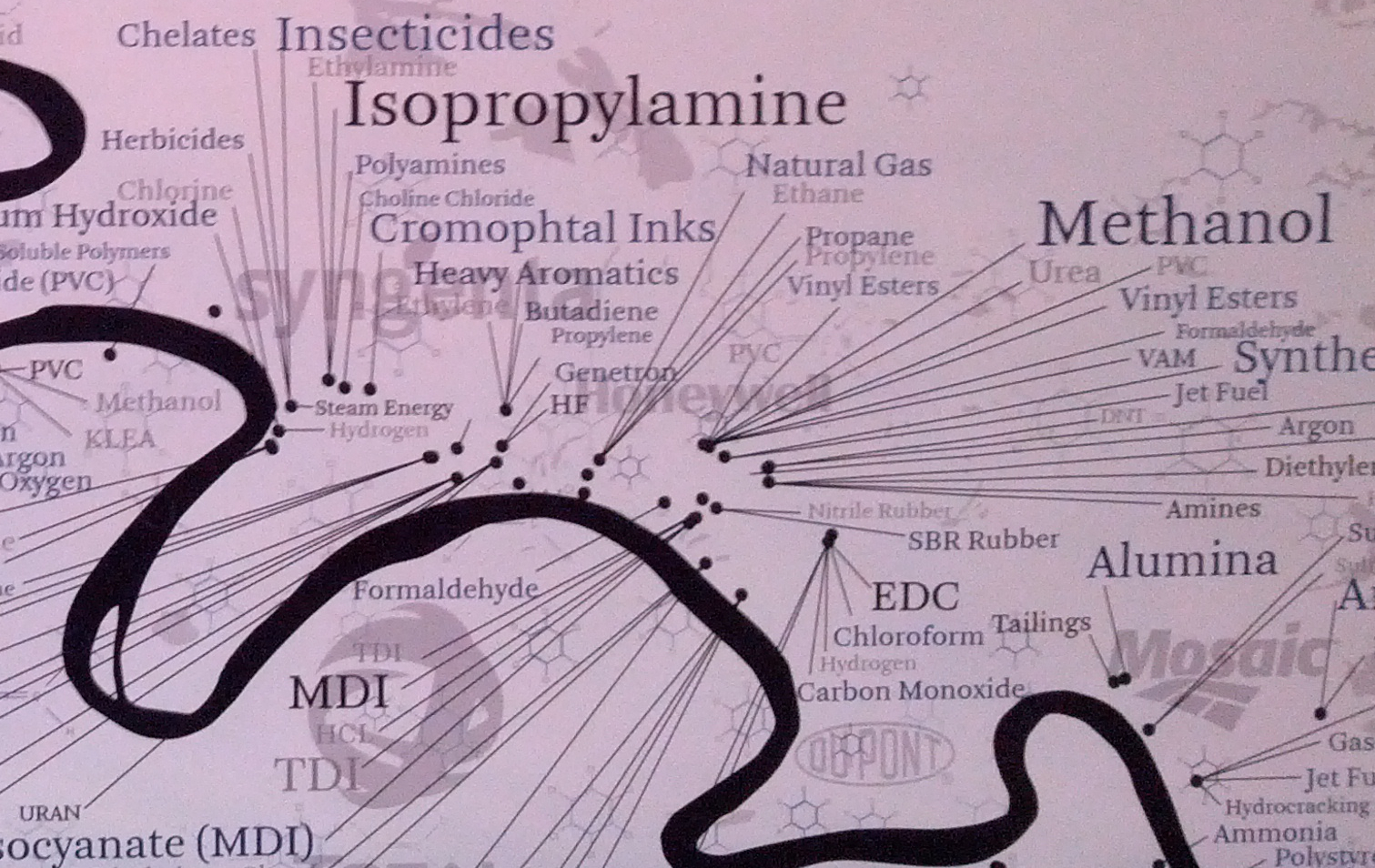
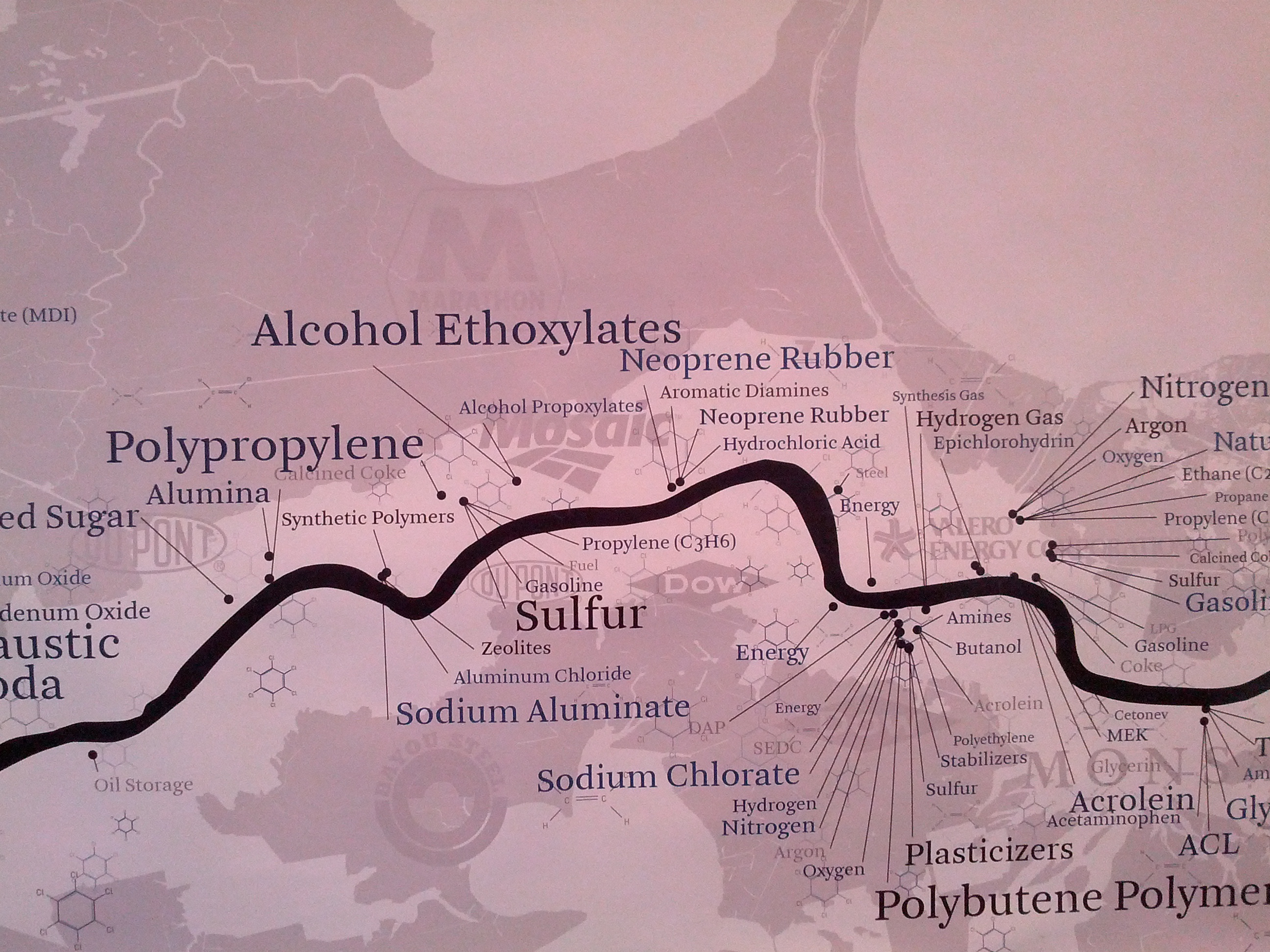
The simple austere presence of names of chemical compounds, no doubt sized in an elegant Times New Roman in a font-size that corresponds to their relative production, suggests an imposition of meaning inscribed on the map, stripped of any actual toponymy, save the ghostly half-tones naming the corporations who have remade the landscape as a site of corporate refineries and chemical production, where the refinement of carcinogenic materials extracted from underground threatens to overwhelm the landscape:  a black thread of a river may be traced where the Mississippi meets the Gulf of Mexico, whose serpentine course of solid black carries broad public health implications for the nation we endanger ourselves to neglect.

05_OIL_CancerAlley

Kate Orff, “Ecological Atlas to ‘Petrochemical America'”

The banks of this Louisiana Bayou landscape on which so many sites of the manufacture of petrochemical products are nested, transformed a former a site of sugar and cotton plantations into one of the most polluted areas in the United States of America.  The petroleum refineries, chemical industries, and hazardous waste containment sites along the winding river are a stark contrast to the sinuous bends of the lower Mississippi, but suggest the deep transfiguration of place that has occurred, complicit with the erosion of so much of the wetlands region near the Louisiana coast into the open waters further downstream.  The smokestacks of factories of chemical synthesis produce clouds of emissions that have led it to be named “cancer alley” to reflect the high rates at which residents of the area.  Most of its current residents–largely poor, poorly represented, and largely African-American and with strikingly low levels of educational attainment–have been victimized by the discrepancies of environmental protection in the nation’s geography as a whole.

The question of mapping pollutants in the region is truly not only a map limited to one area, but suggests an atlas–a term Kate Orff adopts in her map–of the underside of the national consumption of petroleum products and their synthesis for American markets,  compressed to one small region of the lower Mississippi.  Even as American Presidents have taken it upon themselves to declare for over fifty years–we can date the metaphorical call for the moonshot that Joe Biden oversaw as Vice President to cure cancer all the way back in 1971, when Richard M. Nixon called for a national effort to conquer “this dread disease” from which Americans suffered through “the same kind of concentrated effort … that took man to the moon,” as if an anticancer blastoff was waiting in the wings, the “war on cancer” that Nixon sought to begin as the Vietnam War was winding, there was a sense that the “war” didn’t pay much attention to the grim landscape of postindustrial waste and pollutants and hazardous waste that refineries were emitting into the beautiful bayous where the Mississippi opens into the Gulf of Mexico whose dangers were claimed to be avoided and superseded by “research and therapies [that] are on the cusp of significant breakthroughs,”as Joe Biden Biden put it as he corralled the nation to join him in a national mission to develop both therapeutic treatments for cancer and liberate “science, data, and research results [that is currently] trapped in silos, preventing faster progress and greater reach to patients. It’s not just about developing game-changing treatments” promised to be on the horizon of being delivered.   While privileging immunotherapy, genomics, stem-cell research and combination therapies, the expansion of petrochemical industries between New Orleans and Baton Rouge grew, creating carcinogenic landscape along the banks of the Mississippi continued, its landscape covered by a smokescreen despite the promise of increased access to information for the community of oncologists who treat cancer patients.

If much fanfare accompanied a “new national effort” designed to “cure cancer” by the federal government in 2016, federal oversight over petroleum pollution has seemed to retreat.   Despite the “inspirational” nature of such calls for cures, backed by a billion dollars of investment in cancer immunotherapies, vaccine development, genomic analysis and data sharing, the lack of attention the increasingly global context of increasing cancers in “developing” countries where most extractive industries are based–currently projected to grow from 55%  to over 70% of global cases of cancer, where Paul Farmer found an overwhelming 80% of disability-adjusted life-years already lost to cancer globally:  the lack of attention to unequal translation of such compelling calls for a “cure for cancer in American research universities conceals a global “disequilibrium” mirrored in the lack of access to costly coronavirus vaccines. Is the lack of attention to therapeutic best practices for mitigating cancer’s spread, mirrored in the absence of attention or objection to the expansion of industry on the largely abandoned riverbanks?  Or is it that the land long habituated to extraction has provided a new industrial landscape for the benefit of petroleum refining, with limited federal oversight?

The absence of expanding cancer prevention programs in America that might translate globally is mirrored in the lack of attention to petrochemical pollutants along the rivers course, that have transformed the region into an unmapped or identified Superfund site–beside urban populations and endangered wildlife.  The over 26,000 pounds of vaporized ethyl acrylate that have leaked from the stacks of the Dow Chemical plant–without a fine–or the forty-six thousand tones of toxic water in unlined containment sites of hazardous waste emitted daily.  If the concentration of creaky and leaky factories on the winding end of the Mississippi is peculiar in its proximity both to urban populations and stupendous bayous inhabited by endangered species, the map reveals a sort of legibility in the landscape that at times seems threatened to be lost.  Indeed, the map can only hope to capture the injustices created by the dense proliferation of industrial petrochemical refineries along the river, site of plantations in years past, settled with poorer populations living between New Orleans and Baton Rouge:  the industries have not gone under the radar of government environmental agencies, but the industries are itself part of the region’s landscape, not removed from its surrounding dense cypress groves and former mangroves in what was once dense with plantations and wildlife.

BayouCoveBearUSGS

Viewers of Kate Orff’s map are forced to confront the density of sites of chemical production and register how the collective industries that crowd the end of the Mississippi have created a post-industrial landscape of toxic waste that both permeates and engulfs the region as a whole.  The historical expansion of chemical industries along the winding river has grown with their increasing use of petroleum or conversion of chemical products that are derived from oil, coal, and natural gas.  Orff’s mapping of the spectacular concentration of industries that synthesize propylenes for acetone or plexiglass or antifreeze or polyethylenes used to make plastic bags into one poor residential region serve not only as a map of part of the bayous, but a map the petrochemical dependence of the nation, to allow us to see for ourselves the new landscape we have made.  In this sense, while focussed on one riverine landscape, Orff’s “ecological atlas” charts a devastating indictment of the transformation of our habits of land use, revealing and unpacking the depth of an industrial settlements along the shores of the slow-moving river.

For the eighty-five mile of bayous, no longer populated  by alligator, herons, raccoons, or ibis, are the site of the massive release of pollutants  whose density of waste-products to an extent almost unfathomable in their density or extent.  Orff’s remapping of one area of delta estuary on the Louisiana Gulf reveals the industrialization of a region which has also been a seat of National Wildlife Refuges–parts of the sleepy bayous highlighted in light tan–against, almost perversely, a light green map of the Louisiana landscape that remains that takes our eyes off of its pollutants, and by which one is tempted to note multiple protected areas in a region that once fell under environmental oversight.

SELouisianaMap

Orff’s atlas was designed to complement the stunning photographs of the devestation of local bayous’ landscape between the two cities by Richard Misrach, one of which is reproduced below.  But  Orff’s river map opens the area as an area of industrial settlement, as much as population, also reveals the national landscape with which we may be left.  The atlas marks the potential release of carcinogens in an area whose ecosystem of the Southeast Louisiana National Wildlife Refuge is designated as an endangered ecosystem and seat of endangered species–although many of the local species, including the American alligator and bald eagle, were “delisted” as endangered during the 1980s or 2000s.  Yet rather than map the selective refuges of the Bayous, seats of hunting and wildlife fishing, Orff offers a chart the consequences of the region’s historical transformation from an agrarian to petrochemical industry that provides something of a narrative of the region’s transformation to a site of chemical synthesis.  This provides something of a counter-story–and counter-map–to the Delta National Wildlife Refuge, including the largest urban national wildlife refuge, the Bayou Sauvage Refuge, of 24,000 acres of freshwater lagoons and brackish habitats, including herons, pelicans, and cormorants–an area of restricted waterfowl hunting and fishing.

In the waters Orff maps a region just upstream of the Refuge, many products with which we have daily familiarity appear in different guises, and in a concentration that reflects the huge forces of demand for petroleum products–for inks, insecticides, plastics–in a cocktail of methanol, synthetic nitrogen, hydrochloric acid, styrenes, ethyl acetates, chloroform, kerosene or formaldehyde–a veritable catalogue of toxicity crowded into one place.  The map offers a veritable chart of our addiction to petrochemical products, by forcing readers to map and recognize the continued long-term presence of these industries of extraction onto a landscape in ways we rarely see, and indeed places them into a landscape that was the site of slave plantations and of longstanding economic exploitation.

What are, we have to ask, its costs?  Can they even be calculated or tallied?  For the environmental damages wreaked on the wetlands go beyond (if they are based upon) social justice:  even though we use maps of diseases to bring into being communication of infection or incidences of illness tied to the environment, as Tom Koch has shown, it is notoriously difficult to link cancer clusters to any particular or specific exposures to warrant liabilities, and the density of chemical products in the area–which almost appears zoned for the synthesis of petroleum products–dilutes any question of individual liability for the production of toxic wastes.  Cancer was, indeed, tried to be tied to environmental causes soon after it became an identifiable demographic reality in industrializing England by Dr. Alfred Haviland, based on the apparent concentrations of cancer mortality rates, in an attempt to map incidence in correlation to altitude, or, by analogy to infectious disease, either bodies of water or other biological models or determinants like parasites:  but no clear geographic distribution emerged, despite the attempted identification of “cancer houses” or “cancer streets” that might allow its occurrence to be understood, as John Snow’s famous 1854 map of the outbreak and spread of cholera in London.

Although the causal connection to environment was pursued, despite apparently clear clustering the difficulty of individuating cancer-causing influences remains, despite the continued attempt to map cancer–both on different types of cancer and distinct from other potential causes–for the vectors of cancer’s causation are poorly understood.  This diminishes the ability to map clear ties or relations:  no clear causational relation can be drawn between illness and environment, although environmental influences are evident.  The difficulty of mapping a clear and direct relation makes any cancer map impossible to draw, despite a preponderance of evidence, notwithstanding Orff’s map of the concentration of carcinogenic compounds, some of which are dispersed into the environment by the regular release of plumes of carcinogenic compounds from benzene to hydrogen cyanide and ethyl acetate.

On the heels of intense attention to the recent 2010 Deepwater Horizon oil well blowout–a toxic release that occurred not far offshore the already devastated landscape whose intense settlement by industries of petroleum-extraction and synthesis she maps–but only distinguished by the scale at which it released oil into the aquatic environment.  If the site of that massive and ongoing leakage was a source of ongoing petroleum pollution even after being plugged, the map reveals the intensely embedded nature of the petroleum industry in the land that rivals the Horizon blowout in its continued release of toxins to the waters and air of the region, as an ongoing threat even in an age of multiplying projects of coastal restoration.  Yet if these projects are conspicuously absent from the area covered in Orff’s atlas, the hidden nature of potentially toxic bayous of petrochemical dependence that have, with saltwater, devastated cypress swamps and mangrove orients readers a new topography of the poisoning of the wetlands.

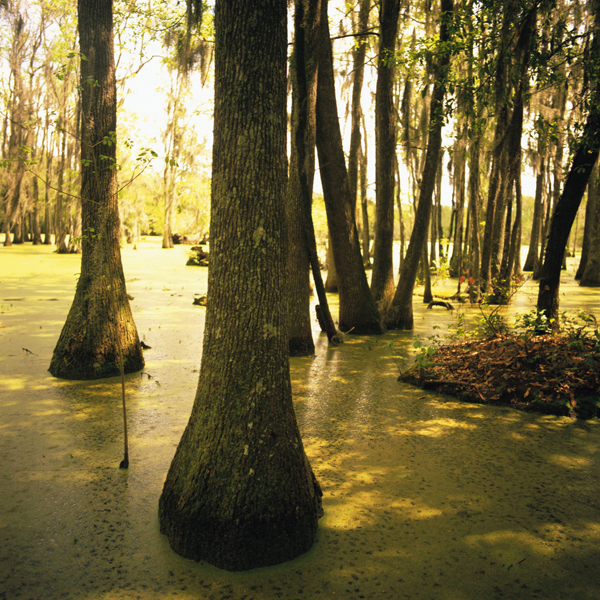
CypressSwamp1-1.resized-e1364970905919Misrach, “Cypress Swamp, Alligator Bayou, Prairieville, Louisiana” (High Museum of Art)

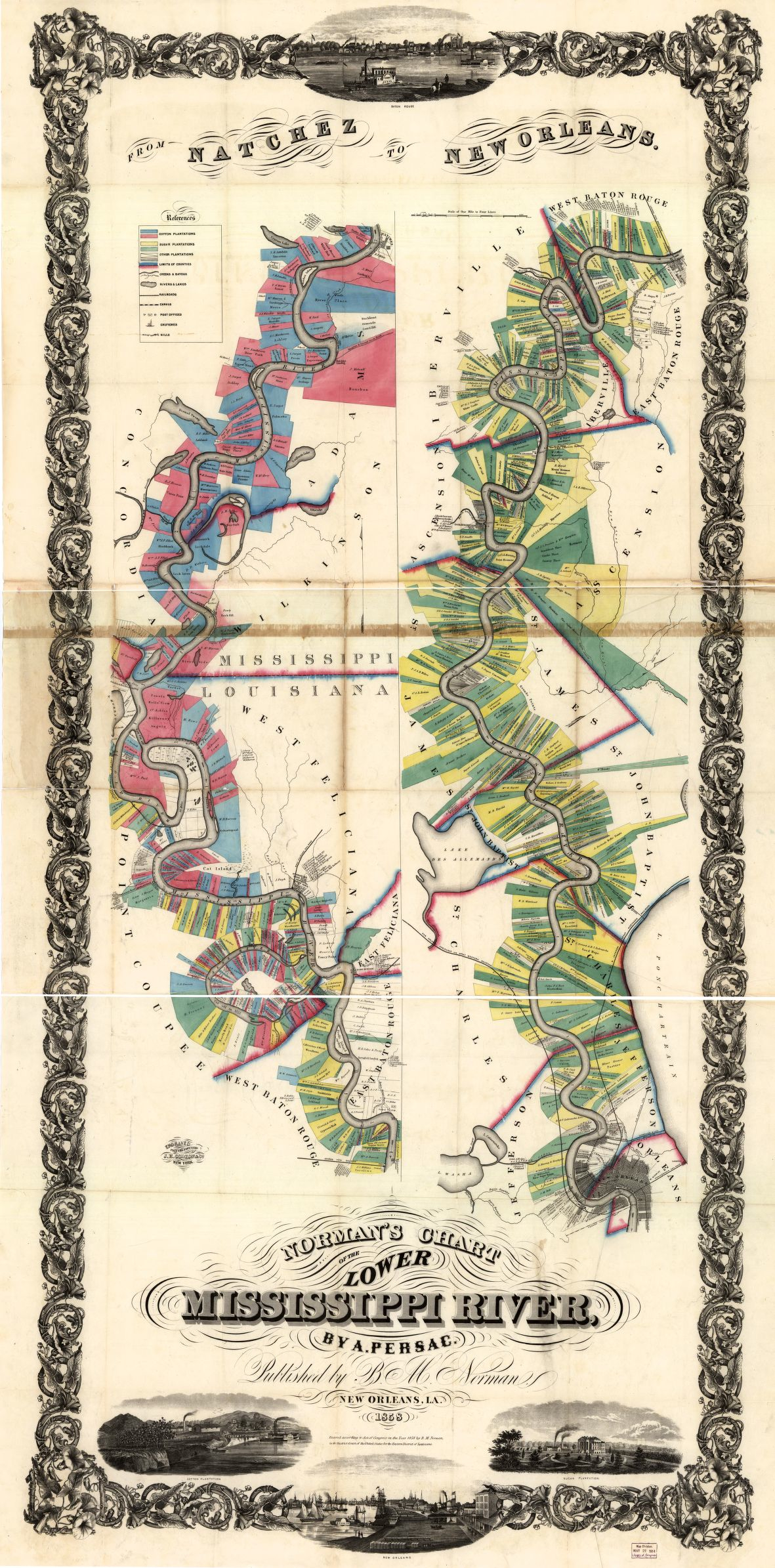
The formerly agrarian landscape of the Louisiana Gulf now industrially harvests wide array of products we consider part of our household.  Its industrial production includes the synthesis of many of the food additives that enter our refrigerators or arrive on our dinner tables, the synthetic nitrogens used to make fertilizers, pesticides and herbicides that often enter, through the back door, as it were, into the food we consume.  It is a source of much food consumed, with just under 20% of the sugar consumed in our country being refined just outside of New Orleans, some of the least expensive that is most likely to be added to manufactured foods.  This has long been the landscape where the brutality of extraction was staged, both from plantation-based sugarcane harvesting–whose traces are still present–and cotton plantations, whose practices once crowded the very same river banks.  This habitat of dense planting and day-laboring, so nourished by the bends of a winding river that it was complexly divided by plantations in a patchwork which charted land-ownership on the Lower Mississippi and now abandoned river banks with cadastral precision by Benjamin Moore Norman in 1858.

jp2Library of Congress

The landscape of the winding river has been replaced by a register of petrochemical products, as if they have erased and replaced the image and notion of the landscape once so valued on the river’s rich banks.  Reading the names of petrochemical products in this new landscape one is struck by compounds  more familiar from the aisles of a supermarket or hardware store, but now, in place of the tracts of land that so densely divided these fields, are transposed to the landscape of the Mississippi. Orff reveals a dense concentration of such industries whose products are not only made for a growing market, but whose synthesis and storage significant risks to the population and well as its other inhabitants.  Crowded in the liminal landscape of coastal wetlands composed of former marshlands and pastures, many of them formerly rich ecologies filled with dense trees from bald cypress, black cypress, and mangrove trees–all marred by earlier deforestation and cross-clearing, we can imagine them crippled and palsied not only by the entry of saltwater but by industrial pollutants to the extent that may never be restored.

Bend in River

An earlier map of the bucolic landscape of low-lying lands on the Mississippi-Louisiana border haunts Orff’s petrochemical atlas, one crowded with plantation works whose coloring in vibrant yellows and greens indicate the regional density of sugar and cotton plantations in this region to which rich mineral sediment was carried by the Mississippi, in Norman’s historic map made when that land was scarce and extraction in high demand.  At the same time as almost two thousand square miles of marshlands have disintegrated into open, salty waters, and channels and canals made to stave off the loss of wetlands allowed the entrance of salty waters that kill off freshwater plants, the interstate river corridor has been settled by industrial factories based on oil extraction in ways that render the earlier plantation system almost entirely unrecognizable.

Mississippi-Louisiana map

Orff’s “atlas” unpacks if also conceals a dense and tangled narrative of historical environmental exploitation and change, and more than several decades of poor stewardship.  For those with time to read its detail with sufficient care, it describes the conversion of the formerly agrarian area to a site of industrial production, and the rewriting of its landscape as a site for the refinement of petroleum products that feed an ever-growing American market.  To the extent that the original landscape that was there–or the ecosystems that existed beside its sugarcane fields–these were effaced by the network of commercial industries from which the landscape appears impossible to disentangle, and which have mushroomed along its cheap land as the sugar industries have moved out.  The network of this one corridor suggests a compression of layers of contamination and chemical production into something like a forgotten land, or a liminal riverine space where the destruction is wrought that we don’t see as part of our urban life, and lies at a convenient remove a known landscape.  The factories regularly burn off excess gasses daily in production, or contaminants leech into the environment, giving the zone the name of Cancer Alley, as Orff has described in an interview on the project of environmental mapping.

The mapping of manmade carcinogens introduced into the landscape formerly inhabited by a rich ecosystem of flourishing alligators, herons and mangroves is haunted by the corporate landscape of America, revealed in the industries that now inhabit the lower Mississippi’s relatively inexpensive former farmlands, whose names appear in half-tones legible for the observer who approaches at closer detail to track the sources of these contaminants from copolymers to kerosene to insecticides and other chelates:  who knew that all these elegant compounds and liquids were spawned from the same region of industrial production?  The extent of environmental damages wreaked on the larger environment are based on but range far beyond the specific questions of environmental justice that they should force us to confront.

carcinogen map

This might well be a map of the poisons that have been released into this watershed, mapping as they do a scene of a terrible crime.  Although they own the land in which they work, from Exxon Mobil to Dow Chemical, Union Carbide, Shell, Honeywell, Syngenta, Dupont and TDI–present a veritable register of corporate irresponsibility.  The availability of oil from regional pipelines has created an economy of convenience that pollutes one of the richest watersheds in the land, and has lastingly polluted it by the leaching of underground storage sites of hydrocarbon wastes, themselves physically present and legible in the land, as well as released into the water and air of the ecosystem itself–and whose presence can at times be detected in traces downstream in the running tap water of New Orleans.

close up

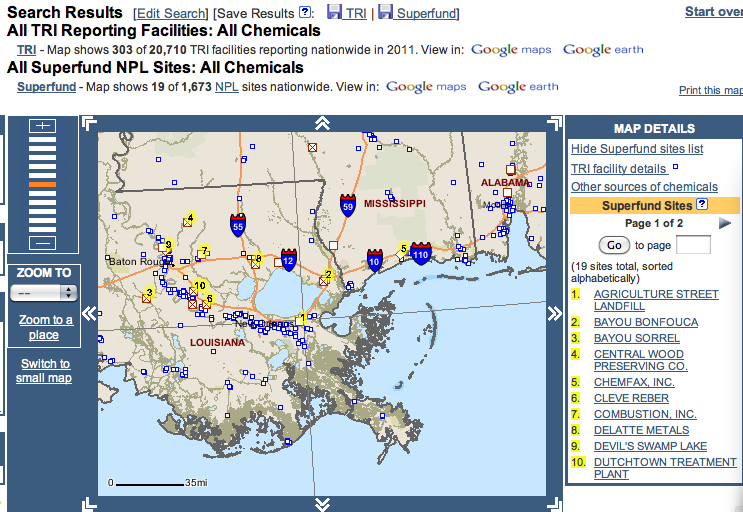
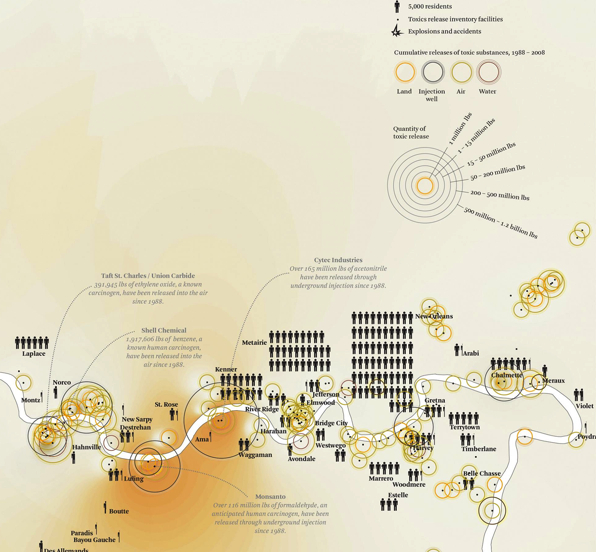
The abstract map conceals some devastating effects of this leakage, yet also provides a window on the transformation of a land once worked by slave labor for sugar-harvesting:   still filled with sugar cane, the new geography of extraction and refinement reflect and refract the degradation of the agrarian landscape.  The immensity of the transformation of the landscape is difficult to comprehend in words, and words are even challenged to describe the historical layering of devastation of a formerly flourishing ecosystem:  it provides the footnotes for a story of the threats posed to the watershed by ongoing entrance of toxic chemicals into the region that demands to be explored, as do the toxic waste of Superfund sites already threatened with flooding in Hurricane Katrina–sites that threatened to release carcinogenic contaminants from heavy metals to polycyclic aromatic hydrocarbon.  The clustering of Toxic Release Inventories and Superfund sites in the same stretch of river from Baton Rouge, according to the  National Institute of Health’s “TOXMAP”–which marks Superfund sites by brown rectangles in the map below–suggests a tragic landscape of hazardous wastes.

TRI:Superfund New Orleans

superfund sites near Baton Rouge

The landscape of petrochemical America compromises its inhabitants most unfairly, daily exposing  large numbers of local residents to reported amounts of toxic releases between the single decade from 1998 to 2008, according to the EPA’s Toxic Release Inventory.

Populated Bayoux

The Louisiana Gulf is by no means the only privileged site of such industrial pollutants–given the proliferating cycles of petrochemical contamination in an age of globalism, all bringing heightened risks of cancer and the large number of cancer alleys worldwide that now exist from the Nigerian delta, site of some of the most continuous oil flares to the rice fields and fishing grounds at Myanmar, not to mention the Persian Gulf (the global dataset on petroleum contamination here employed was originally provided by the Blacksmith Institute).  And in each area, as Orff maps below, the “cancer alleys” are underwritten by corporate interests, even if they remain in the shadows of the landscape.  But the gulf of the Mississippi is a veritable self-made Superfund site–notable even in a global context, and by far the densest concentration, due to the perfect storm of cheap land, nearby oil, and old factories in the Delta–not to mention limited federal oversight.

Cancer Alleys Worldwide

It is in many ways a return of the repressed, and the wound inflicted by the patterns of consumption to which we are so habituated.  But it is perhaps also, importantly, one of the most unjustly afflicting its residents, in ways that have only begun to be assessed, and whose complicated narrative of intertwined interests and toxic production remains untold.  Only by the detailed local mapping these landscapes that Orff has so magnificently achieved, and speaking out against their silences, can we reclaim knowledge of the land, as it were, and a topography where ethyl oxylates, glycols, esters or methanol displace and become more prominent features of the landscape than its inhabitants–for now, the molecular structures of petroleum derivatives haunt the land as much as the multinationals whose industries produce the “cancer corridor” that we can thank Orff for having begun to map, and whose collective responsibility for making we can perhaps all work to alter.

Alcohol Exoxylates

The photographs of Richard Misrach have been exhibited together with Orff’s maps at the Fraenkel Gallery at the David Brower Center in Berkeley, CA.  The traveling exhibit will continue be on view at Pomona and Carleton Colleges until December, 2014.  It is also available as a book.

8 Comments

Filed under Environmental Pollution, National Wildlife Refuges, New Orleans, Petrochemical America, superfund sites

Commemorating Kennedy, Each Place, Everywhere

In the rush of commemoration and remembering of President John F. Kennedy‘s death some fifty years ago, it is fitting to remember how widely inscribed his name is in the land–as well as across much of the world.  While we often examine places’ renaming, the widespread adoption of one name is a striking act of commemoration; while it’s not clear when they were bestowed, a great proportion of these names must have been made in the days soon following the President’s sudden–and numbingly shocking–death.

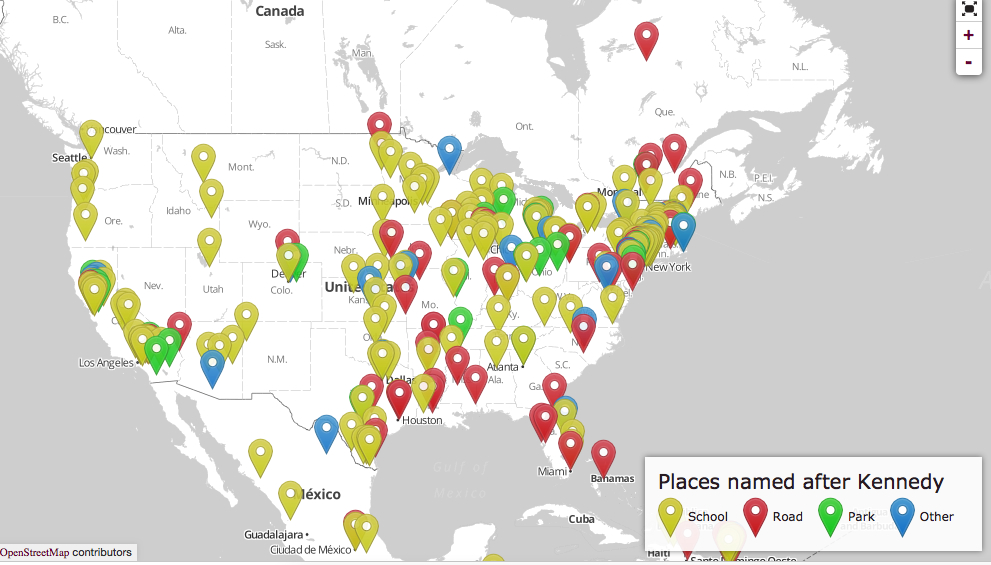
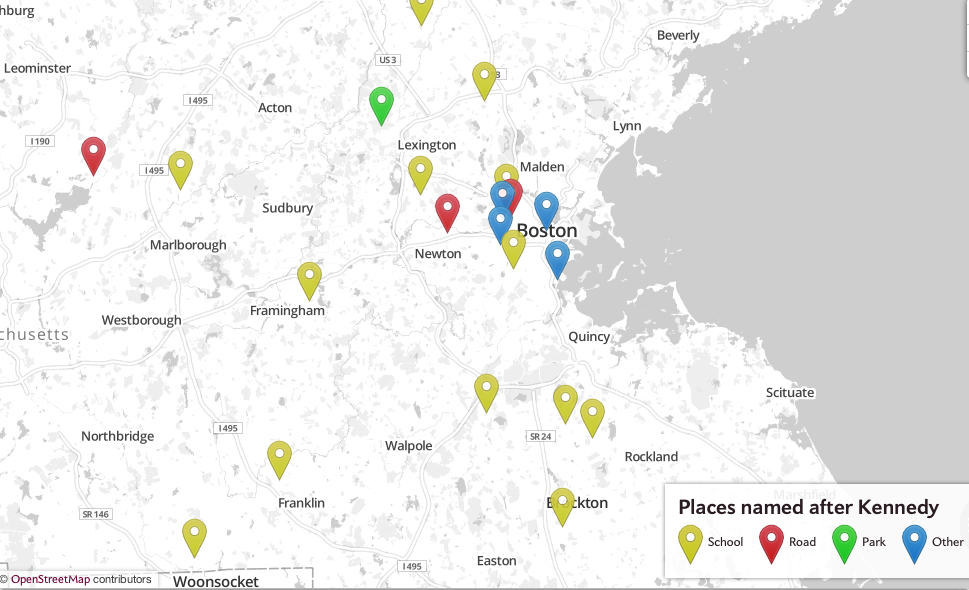
We can see, over the fifty years ago in Dallas, the memory of the killed President is present across the land, dotting the country, schools, parks, streets and more–of which there are over 400 across the world.  The maps below chart, thanks tot he diligence of OSM’s many mappers, the rippling out of shock and memory after November 22, 1963.  (Open Street Maps collects the data that its users upload, creating a collective map of global scale whose open data is an invaluable resource.)  Thanks to their diligence and the work of Chris Kirk, Emma Goss, and Nicholas Duchesne of Slate Labs, whose excellent controlling and parsing of this data in a map of three sorts of Kennedy commemorations ensures the Kennedy commemorations referred to the President (or that Kennedy)–with little comment.  Yet the graphic has impact alone.

We may never know how many of the fatal shots were fired–or from where, or by whom–or what led the so-often-analyzed events of that day to occur, although we may.  But we can se the country as marked almost ubiquitously in ways we have come to overlook.  By looking at the overlooked, as it were, we can appreciate how closely rooted President Kennedy is as part of our national memory, and how familiar such namings–especially of schools, but also parks or squares–actually are.


Across US


Though we don’t have a graphic of their temporal spread, the toponymy is almost uniformly spread about the country, particularly of schools–it might be interesting to ask why there is not a school named after John F. Kennedy in any major city–and Kennedy roads are mostly uniform from Texas to the East, outside of which regions Kennedy parks are present across the nation in a slightly lesser degree to judge at first glance.  But the map is, if most striking for its weird clusterings of Google Maps pinpricks, or inverted tears, a difficult canvass to read:  the clustering in Texas is striking, as is the density of overlapping sigla in New England in New York, but can we read its abstraction of sites of memorialization as more than a residue of collective mourning, or a reverberation of the terrifying events that day in Dealey Plaza to the world?


Across US

The distribution of sites that were named after President Kennedy almost seem the clearest reminder of the border between the US and Canada, it’s interesting to note, especially in the West and Midwest–though this is a bit less true of Quebec, perhaps since the region always sets itself apart from Anglophone Canada.


Kennedy Street, School, Airports and More-  Memorials to JFK Mapped


This has something to do with President Kennedy’s Catholicism, as well as the sudden shock and hopes invested in the young President.


Quebec

Although the spread of commemorations world-wide reveals a clear differentiation between a wide density of road names in Europe, including squares or places, and even an actually surprising number of schools (and parks) outside of the United States, according to the statistics compiled so far by many OSM-mappers–and not only in satellites like Guam or the Philippines, but in Pakistan and India, as well as in Liberia, Hong Kong, and Brazil, or Argentina and Peru.

Places Named After Kennedy across the World

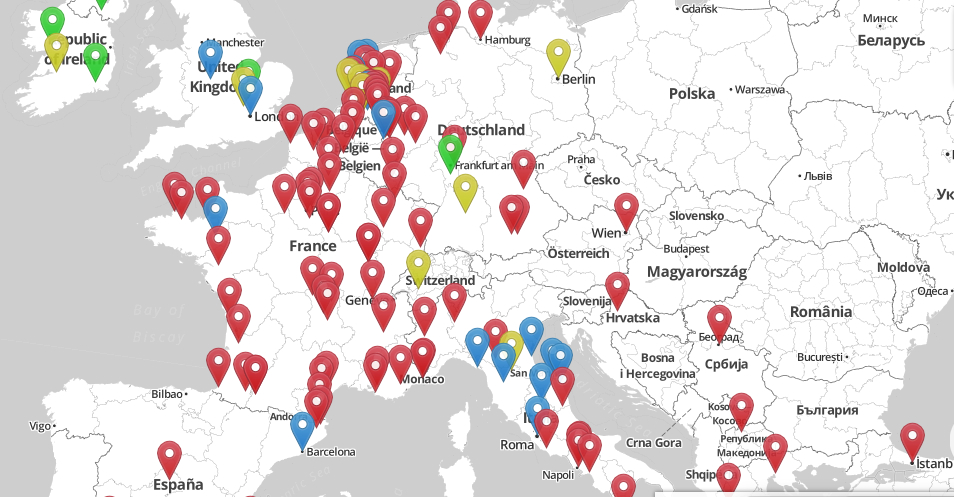
The spread of “John F. Kennedy”nomenclature extend far beyond the usual Anglo-American ties–and the Anglo-Irish that the Kennedy family embodied, but is particularly dense across France and Germany–we can see in a map that also reminds us of the Cold War, and its division of the quasi-continent into two halves, with outposts in Berlin and Vienna.

 Europe

And a somewhat famous (laudable) Swiss profession of neutrality:

Swiss Neutrality


Turning back to the United States, the concentration of Kennedy commemoration might be predictably dense in the Boston area, which seems explicable given the Kennedy ties, but it actually seems the process of naming was actually perhaps more difficult to be performed.


OSM Maps Kennedy Sites around Boston

A broader look across  New England clearly reveals greater breadth of naming outside the Boston areas:

Around Boston and MASS OSM maps of Kennedy

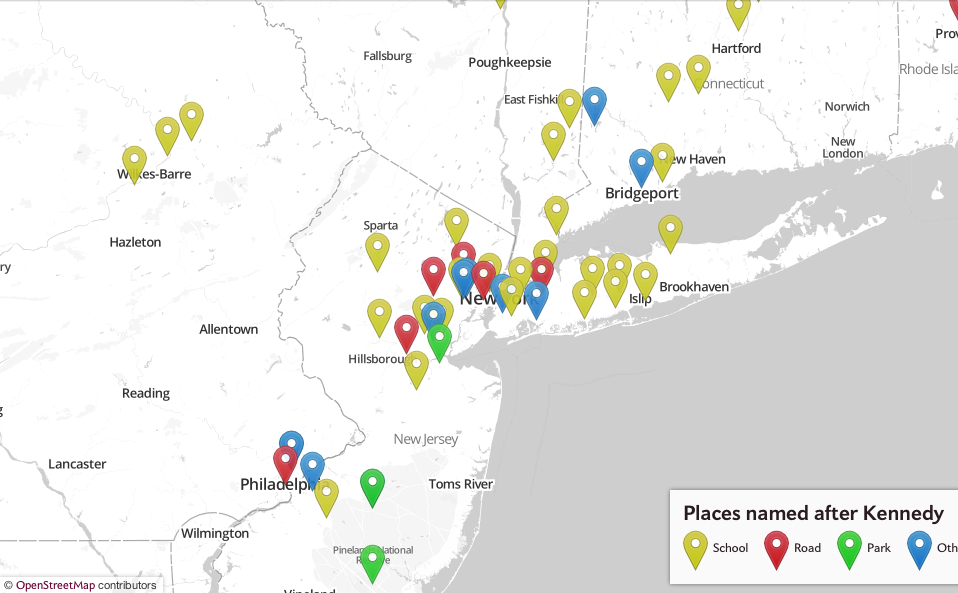
But the density of mapping in the Northeast–particularly of schools–seems most reliably intense around New York City, probably marked by an intense expansion of educational institutions, but perhaps because of a possible intensity of legislative involvement in renaming of the region, from roads to, of course, airports.

Kennedy Density around NYC


The southeast betrays a  real density in southern Texas and in Dallas-where two schools appear–and a strong number of roads in Florida–perhaps a reflection of the longstanding Cuban community?

 
Kennedy in Florida and south US


The places whose names honor the former president’s memory seem densely grouped (or looped) around Cuba, in a memory itself of how closely discussion of his death has been often, but in ways still not fully explained, linked to that country, and to the American policy with it.
Kennedy names around Cuba

While it may never solve the Gordian knot around the bizarre relation of Lee Harvey Oswald to the assassination, or the unanswered questions of what happened on Dallas that day, the huge act of collective grieving is awe-ing, and can remind us, if we need it, of how close and physically proximate its memories still are.

1 Comment

Filed under John F. Kennedy, Open Street Maps, OpenStreetMaps (OSM)

Urban Modernity, RIP: Mapping Marshall Berman Mapping Modernism

The meaning of place seems especially difficult to retain in an age of increased mobility, when information flows are increasingly removed from any site, and offer multiplying perspectives.  The work of cultural critic Marshall Berman (1940-2013) provides a clear eyed way to recuperate modernism through the inhabitation of place.  Berman, a long-time New York City resident and echt urbanite, created rich qualitative maps of literary modernism that rhapsodized cities as places–as privileged and vital sites of generating meanings that were rooted in place.  Even after his recent death, it’s hard not to be struck by the vitality that he mapped as rooted in cities, and whose existence he never stopped reminding us about and celebrating.  A native New Yorker, Berman wrote from committed engagement in New York’s space and shifting fluidity, and in his works mapped the sense of fluidity or perpetual permutability of urban life.  He showed us, in so doing, that maps are not only imposition from above, or Olympian views, but can map daily encounters best registered on city streets.  Even when I best knew Marshall in the 1970s and 1980s, he was one of the inveterate street-walker of the Upper West Side and Broadway who exulted in most everything he noticed on the street.  Marshall maybe increasingly became an inveterate street-walker who took pleasure in public space, and enjoyed claiming for himself a spot on the street, finding a sort of release and liberation on the night-time sidewalks, in Times Square, or at the diners where he so loved to sit.

In retrospect, I imagine his championing of the street’s energy came from the magnum opus he was then completing, All That is Solid Melts into Air (1982)–but that his love of street-life also shaped his voracious exploration of the space of literary modernism through the act of being in public.  For Berman quickly recognized that the depersonalization of urban life was not only the trauma and drama of modernity, but, transfigured by literary expression, also a privileged site for individuality.  In ways that are still resonant, his generous mapping of the modernity among cities extended from the city that he loved to the modern urbanism.  R.I.P., Marshall.

Berman’s sudden and unexpected death in a booth at the Metro Diner, at the heart of the Manhattan Upper West Side, can’t but provoke a reflection on his relation to the concept of urban space, from the sense of public space he lived and explored relentlessly as an observer and city-dweller to that which he read so very widely to excavate and explore with a canny sense of the personalized human geography.  For Marshall loved the lived urban environments and continued a life-long fascination he had with the living nature of a streetscape illuminated by electric lights, as if an ecosystem of the Great Barrier Reef, whose deeply modern possibilities he always felt beckoned and invited and which he was eager to explore.  Marshall’s recent death has prompted several emotional reflections that note the inescapably autobiographical aspects of his work, some of which he would himself, surely, be the first not to hesitate to note.  Marshall’s work was, first and foremost, that of a public intellectual who bridged personal criticism with urbanism.  For Berman often described his engaged writing on modernism and modernist projects of urban space as part of the creative projects of his life.

Continue reading

Leave a comment

November 22, 2013 · 4:02 pm

Green Urbanism? Blue Urbanism?

Since maps invite their viewers to enter an image of the natural world, as well as to relate places to the broader geographic context in which it lies, they offer increasingly useful perspectives to relate the ocean to the land.  The perspective they offer on all regions has long been rooted on the land,  however.  And the coasts–and indeed the dangers–for adhering to such a “landlubberly perspective” on our rising oceans are increasingly apparent.  A perspective that privileges mapping inhabited lands –and orienting viewers to a set notion of place–places us at a particularly disastrous disadvantage when assessing questions of climate change, or reacting to the increasingly lethal storms, tsunami, and typhoons encountered as the inevitable consequences of climate change, and that coastal cities–from New Orleans to New York to the devastated Philippine coastal cities of Tacloban, Ormac or Baybay–seem condemned to repeat.

In continuing to rely on maps whose perspective denies that of the future expansion of oceanic seas, we threaten to lose perspective on our changing relation to the sea.  We have long found threats of the invasion of ocean waters difficult to integrate in an inherited image of the city as a bounded entity, and continue to draw clear lines around the cities in which we dwell:  our maps draw clear lines between land and water.  Perhaps this is because waters seem so difficult to circumscribe or bound, and the fluid relation between land and water difficult to render accurately or draw.  When an influential movement of urban architecture and planning calls for a greater integration of the natural world–so often bound outside of cities or city walls–within urban entities, they retain the notion of the bounded city.  Recuperating the term the entomologist and biologist E.O. Wilson coined, “biophilia,” to express the “innately emotional affiliation of human beings to other living organisms” in human nature that demanded attention, they argue that cities need to promote contact with nature, since, Wilson argued, such contact provides a spur to creativity, productivity, and well-being.  The planning of “biophilic cities” is dedicated as a movement of urban design to “contain abundant nature” in their structure.  The championing of “model cities”–such as Perth or Singapore–are promoted as examples of the “biophilic” age of urban architecture.

Yet are these models (often located in semi-tropical climates) not limit cases where we can most easily integrate oceanic waters into a built environment?  For by isolating the city as a unit in which to restore nature, there seems more than a bit of bio-fetishism in singling out new spaces where blue waters can enter an urban environment:  the optimism of its evangelical tenor as a movement of urban planners, dedicated to reframing the reintegration of cities with the watery surroundings has gained a broad charge and dedicated following, including partner cities that border on water such as San Francisco, Portland, Milwaukee, Vitoria Gastiez (Spain), Birmingham (England), and Wellington (New Zealand).  While the benefits of such urban architecture appear considerable, the challenges for expanding the role of the ocean in the horizons of city-dwellers seem only the start of restoring the historical isolation of the city from watery life, or integrating the oceans within our future urban planning.

The movement of blue urbanism is an illustration of courageous dedication to a project of reintegrating aquatic and urban environments–at least, presumably, before the shores of cities will be redrawn by ocean waters.  The considerable cognitive benefits claimed for these more enriched urban networks build on movements for integrating networks of urban “green-spaces”–including not only parks but green-belts and even forests is a reasoned reaction to urban sprawl and overbuilding and way to take charge of the built environments we create.  “Blue urbanism” would comprehend a watery frontier, offering opportunities for immersing children in rivers, urban parks, watery excursions, and underwater ambients which surround cities.   Blue urbanists espouses an improved integration among the fauna and flora lying near aand around cities within something like a green belt–and espouse the value of an analogous “blue belt” as a way to foster a new attachment to the waters and their shores, rather than seeing them as limits of built city.

Yet does emphasis on the human benefits of such contact carry a all too narrowly restricted notion of what a watery surrounding might be?  The watery oceanic borders of cities are in themselves rarely mapped, though the shifting waters of the Gulf Stream and other currents determine the shoreline inhabitants of North America, but might a map provide a fuller perspective on the interchanges and ecosystems lost by drawing firm barriers between urban and ocean life?

1.  The “blue urbanism” that Timothy Beatley advocates wields the rhetoric and best practices of green architecture’s “integrated network of urban space” to invite us to re-imagine cities’ relation to the shores on which they border.  Yet there is concern that such projects of rebuilding turn away from the depth of our historical remove from the waters that surround our cities–an increasingly pragmatic concern after the very fragility of this divide has been so traumatically revealed in recent decades, from damages inflicted on US cities by Hurricanes Katrina and Sandy or, afield, the Indian Ocean Tsunami and super-typhoon Haiyan.  The ecology of biophilic design, for all its benefits, could benefit from a broader global ecology, basing itself less on the benefits of human friendship with the biosphere, and being more oriented to global contexts of the cost of climactic shifts by looking back to the geography of the past–lest the affections of biophilia border on the bio-fetishism of the philistine.  The precepts of adaptation and resilience to mitigate bad policy decisions are of intense importance; historic maps offer base-lines to qualify the alienation of cities from their shores that compliment the need to build green and blue belts.  The maps we have drawn about urban areas may provide a basis to recuperate the integration of life along the shorelines we have lost, in short, and the nature and settlement of life along the city’s shore–as well as the ways that oceans serve less as a barrier to than interface with the shore.

While we map the trespass of waves over the finely drawn boundary lines of territories, measuring incursions across demarcated shorelines and property lines, and mourning the scope of damages and loss, we seem to remediate via maps–much as how OSM-mappers have begun to chart buildings and routes in the Philippines for delivering humanitarian supplies, as a way of rebuilding, if at first in virtual form–to restore urban infrastructures in digital form.
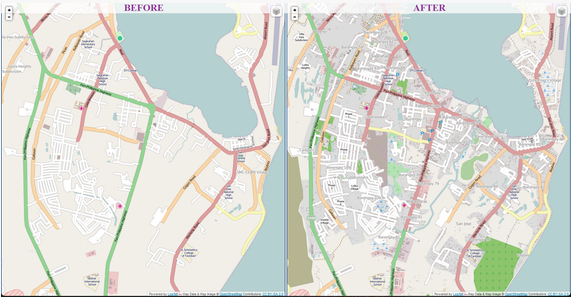
Mapping Tacloban via OSM

Yet these maps do not comprehend, for lack of a better word, the sea.  The terrible human costs of each of these events serve as something of an intimation of the threats global warming poses to urban environments, and invite rethinking notions of ‘planning’ replacing the imagined stability of  a built frontier of urban society with a more permeable line of inter-relations, even as we come to appreciate how little conscious “planning” went into the drawing of earlier boundary lines.  Both the human and material costs of these events compel an appreciation of the role of the shoreline, as well as intimations of the threats global warming poses to urban environments and indeed the world we have built.
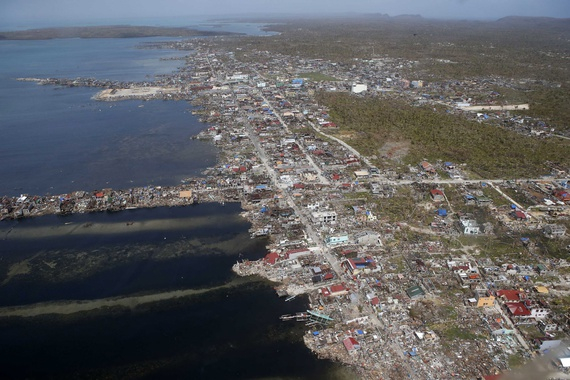
Homes in Samar provinceReuters

Naturalists have recently begun to realize the power of maps to invite reexamination of our relations to place, however–often by using historical maps to excavate the shifting historical relation to the natural world that have led us to draw such finely parsed lines between planned urban environments and their surrounding waters to assess the costs of these sorts of fantasies of spatial distinction:  if we don’t build on the water, we cannot ignore it but at our collective peril.

Map offer a particularly precise if plastic means to situate place that are able to register deeper, less easily visualized, chronological changes and global contexts, or shifts within a regional ecosystem that would be otherwise difficult to conceive.  In age of rising oceans and global warming, maps draw relations between local settings and global changes to help assess the extent to which global warming threatens to obliterate or erode the stability of our concepts of place.  Maps of the circulation of waters around specific cities compel us to rethink an inherited oceanic boundary.

2.   Can a “blue architecture” invite us to re-imagine bifurcated schema of ordering of space to which we have reduced the relation between land and sea to a simply drawn line?  Or have we lost a relation to the land that a new building project cannot recover without clearer lenses to view the relation between water and planned environment, and to be invited to appreciate a clearer register of the relations between coastal cities and the surrounding sea, and, indeed, of the delicate interdependencies that are the basis for our sense of place, and underwrite how we imagine “place” as a category?  A historicized art of mapping stands to call attention to the ecosystem that might lurk beneath the threat of climactic change, and understand the changes they pose to local ecosystems.  The art of mapping provides unique tools to invite viewers to consider local settlements, and develop tools to re-imagine a relation to the sea new building projects alone cannot foster.
Sanderson's Base Map

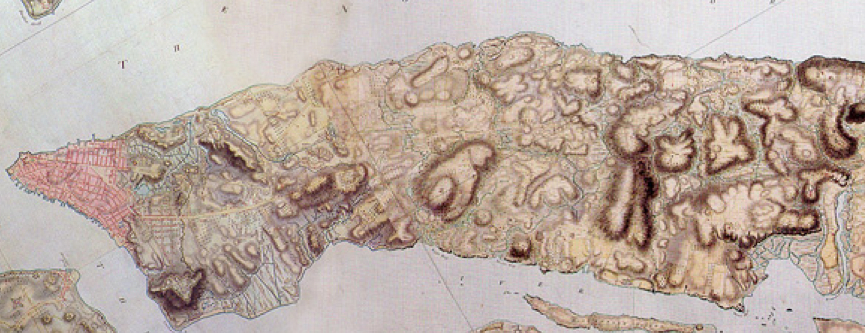
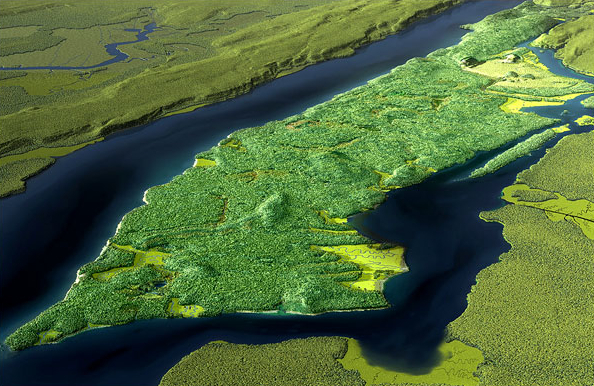
We can appreciate the huge changes wrought in a relation to the shore by how a cartographical reconstruction of Manhattan island revealed in this stunning 1782 British Headquarters map drawn at the painstaking scale of 6 1/2 inches per mile reveals the island’s coastline as it was experienced by Lenape tribespeople.  Using the watercolor map as the base-map for his digital reconstruction of the local environment, landscape ecologist Eric W. Sanderson of the Wildlife Conservation Society worked over five years to create GIS database, geo-referencing landmarks and sites to reconstruct the forgotten landscape based on 200 control points.

Sanderson’s completed map has a beauty that invites viewers to explore a computer generated landscape’s verdant arboreal landscape and rich wildlife, moving with amazing apparent precision over a web of lost streams, rivers, and hills that agricultural and urban development erased over time–most all of the more than 570 that distinguished the island Lenape members to give the name “Mannahatta,” the ‘island of many hills,’ and to map over 627 varieties of plants in the island, and the 233 types of birds and 24 different mammals who lived in its delicate interstices of interlaced ecosystems, in its swamps, ponds and the estuaries of its shores.

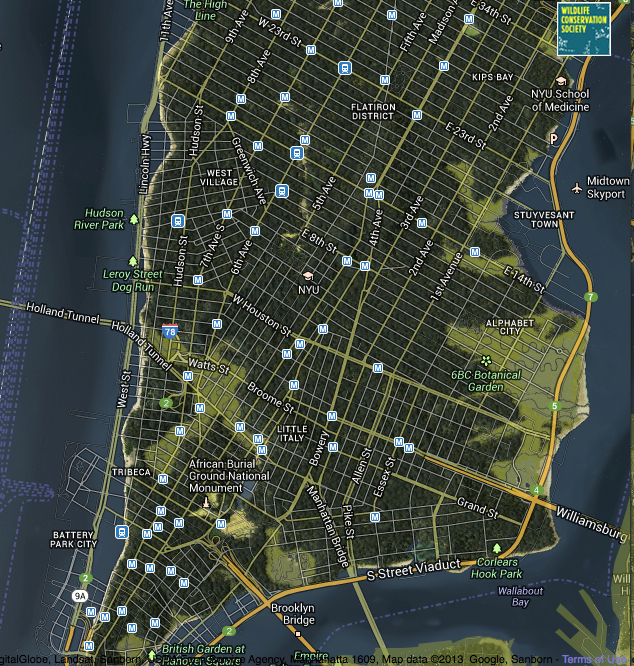
The older shoreline strikingly engages one’s mental map of Manhattan’s shore.   It jar one’s notion of place, and shift the stability of shorelines, streets, and riverine banks within one’s head.  Superimposing data from a Google map visualization of the verdant forests, ponds, streams, and marshes before four centuries of landfill shrunk its coastal geography, the map reveals a huge change in place in a powerfully persuasive graphic form.

Indeed, the superimposition of the shifted maps–the street grid and coastal drives laid above the earlier contours of the island’s expanse– is compelling by the complex cognitive dissonance it creates, placing multi-lane expressways and drives on the expanded edges of the island, so that they run across the marshland estuaries of the Lower East Side or cut into the blue waters around the island, suggesting the actual de-naturing of the landscape even more than the de-naturing of place that all Google Mapping templates seem to afford–and far more eerily reminding us of the extent to which we’ve effectively distanced ourselves from the expanse that the island once occupied as well as the ecosystems that it held.
Welikia 1609 Map of Mannahatta

3.  The remove of the world of this island situated on merging saltwater and freshwater, and with a dynamic verdant ecology is apparent from Markley Boyer’s stupendous digitization, which recreates the island seen by Henry Hudson in 1609, and which, if not a map per se, compels us to both explore its content by mapping them against our own experiences and spatial imaginaries.  The almost palpable landscape invites us to explore its content, as if as it invited Henry Hudson and his men in:
Mannahatta's verdant paradise 1609
These now absent beaches, marshlands, and estuaries in the landscape offer a striking contrast to the current shore.

Mid-Manhattan
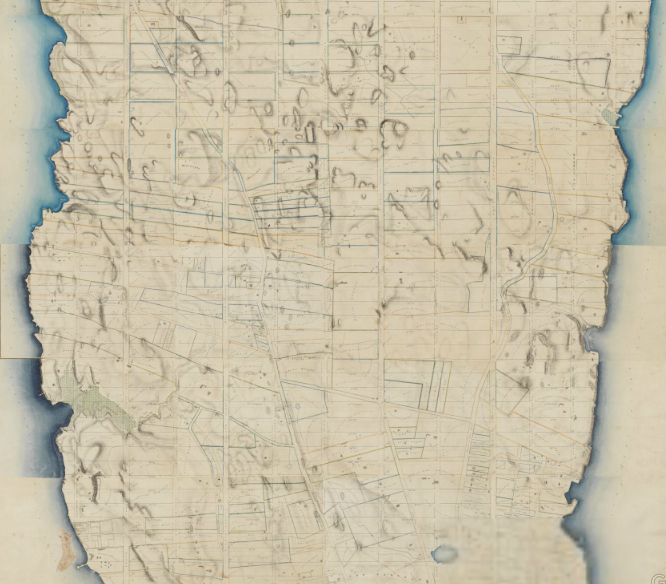
The integration of its coasts to the river echo the shorelines that John Randel, Jr. famously mapped in delicate watercolors in a detailed rendering of its many hills between 1818-20, even as the grid of streets was lightly traced and projected above a far less level urban topography, where the city descended in differently manners to the rivers and estuaries on its shorelines, most of which have been erased by time:
Randall Farm Maps

Boyer’s glorious digital reconstruction recreates the shimmering presence island of hills, rivers, and trees that Lenape knew in its speciated glory, mapping the messiness of that shore in ways that inspire a vision of or compelling case for the optimistic dream of restoration of these shores:
Mannahatta:Manhattan from south
4.   Maps offer persuasive forms to re-think cities’ relations to oceanic shores, perhaps more compellingly altering deeply set attitudes than new practices of planning to integrate more fluidly and esthetically water and land.  Although Beatley calls, at http://www.biophiliccities.org, for new attitudes to the surrounding world, and fostering a new culture of lifestyle, curiosity, and an integration of the tactile presence of the seas in “blue urbanism,” we  might better appreciate the nature of the frontier created between city and water not only in the benefits of immersive aquatic environments in cities, but respond to the absence even of registering seas in urban planning by examining how we came to map a disconnect between cities and ocean– and the cultural divide that has emerged between shore and urban space that was elaborated from the mid-nineteenth century, and is now deeply established by zoning, districting, EPA standards and urban planning texts.

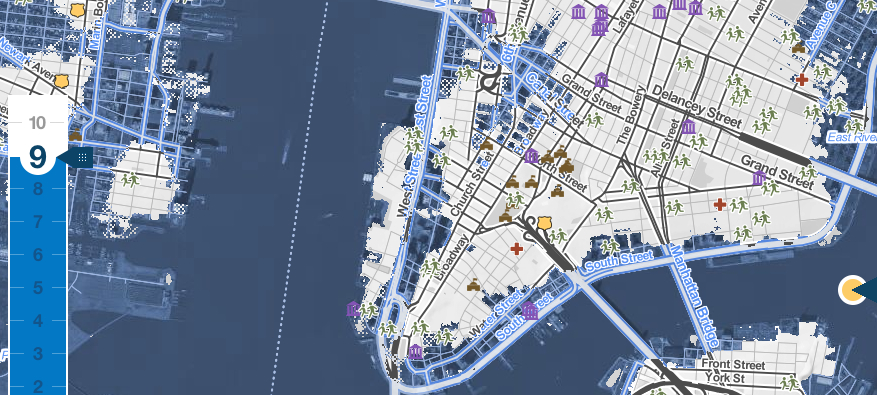
In asking to extend our concepts of cities to the oceans that surround them, we might work not only to make new maps, but use old maps to be mindful of the need to extend our sense of place through the refiguration of urban spaces–noting how maps mark and register the depths of the cultural divide between urban and oceanic space, and examining maps to chart the losses of a shifting historical relation between the city and ocean.  Such a remapping of the city’s relation to the land is echoed in the recent interactive mapping project of Stamen Design, Surging Seas, which tracks rising sea-levels caused by storms or flash-floods, mapping sea levels in relation to the inhabited land–and visualizing a nine foot rise in sea-level of nine feet, here in lower Manhattan, based on data from Climate Central.
Stamen-TriState Submerging Seas
And the interactive site allows one to track what changes would happen if the sea-level were to rise it to a ten full ten:

Surging Seas--NYC, 10 Feet

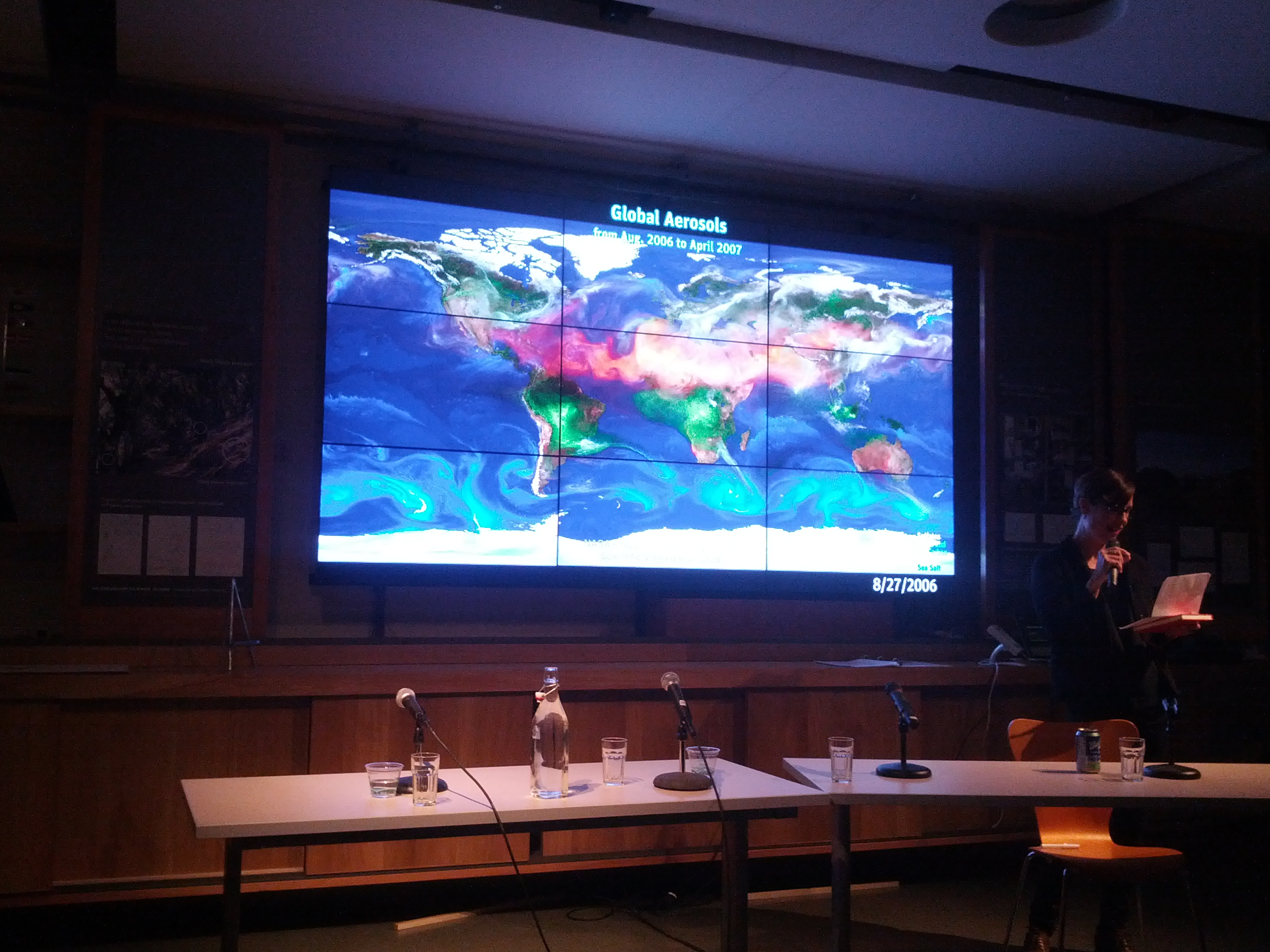
5.  At a recent discussion in San Francisco’s Exploratorium about relations between land and sea promoting such a “Blue Urbanism,” the relations between place and global change rightfully gained considerable attention.   Most presentations focussed on specific examples of cities, but the problem was pressingly (and depressingly) relevant given the recent typhoon.  Occurring in a room exhibiting such splendid shifting nine-panel global color video projections, courtesy NASA’s LandSat satellite photographs or the Goddard Flight Center, of Global Precipitation Levels, Sea Surface Currents and Temperatures, Ocean Currents, or, below, Global Aerosols, they seemed to provide a unique context for rethinking the presence of the local in relation to the sea.  For only in rethinking built relations between land and sea, and the compartmentalization that led to the diffusion of aerosols, the shifting of water temperatures, and  changes in the level and salinity of oceans over the past one hundred years, can we measure the human footprints already left on environment.
Global Aerosols Exploratorium

One such remapping of such relations and attitudes might begin from maps, it began to appear–and from the inspiration maps might provide to remap relation around San Francisco, not only by seeing how space was filled by the city–or the urban conquest of space–but rather how the negotiation of the boundary with the sea was based on spatial practices of such longstanding nature, entailing and perhaps rooted in the representational practices of defining space as an area of settlement and urban planning–and a practice of planning that sees space as filled up by housing projects that cut off the marine space of the sea.

The projected maps on plasma screens raised questions of how to rethink the sedimentation of such deeply set cultural practices, if only by providing a context for the dramatic remapping of urban environments at a remove from the ocean’s ebb and flow–or relate place to a far broader context of environmental change.   When Rebecca Solnit recently offered a haunting analogy between global warming to the processes of gentrification that threaten the fabrics of urban neighborhoods–both occurring with blinders to the overall structure and coherence ecosystems, whether the social ecosystem of urban space or global ecologies, and of removing oneself from our role in creating a scenario of global warming or urban change.

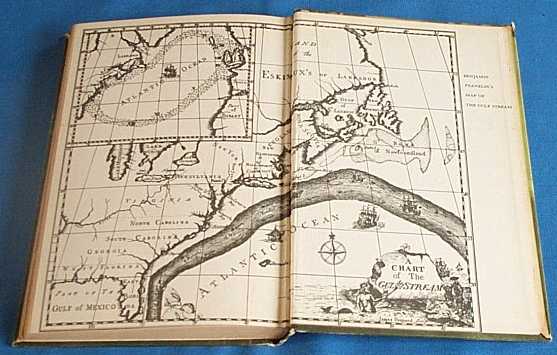
6.  The history of spatiality and of spatial practices that define the city may suffer, one soon realized, from the separation of such “spatial practices” from an appreciation of urban environments.  The circumscription of the spatial is partly inherited from the conceptually pioneering–if idealizing– strain of thought in the work of the French sociologist Henri Lefebvre, whose notion of in The Production of Space was rooted in an Aristotelian or Kantian categorization of space as a human creation.  For when Lefebvre distinguished forms of apprehension among social practices, representations of space, and symbolic models of spatial representation, he refined how Aristotle cast position as a category of human apprehension and Kant affirmed space as an attribute of human judgement–rather than an ecological space of multiple species’ interaction, or indeed of biological overlap.  Instead of commodifying space from a human point of view, we fail to register either local specificity or the density of coexistence around place:  maps can return attention to all too often forgotten margins of settlements, and effectively reconstitute place in a greater environment.  A similarly broad sense of the sea-shore as a “primeval meeting place of the elements of earth and water, a place of compromise and conflict and eternal change,” as much as opposition, was suggested by Rachel Carson, who suggested the basis for understanding the shorelines by “the long rhythms of earth and sea that sculptured its land forms and produced the rock and sand of which it is composed”–and the biological communities specific to each.  She chose a map of the Gulf Stream as a sort of emblem for the situated knowledge of the shore, using a version of the 1769 chart of Benjamin Franklin based on the working knowledge of a Nantucket sailor, Timothy Folger, that is the end-paper for her 1950 The Sea Around Us; Carson praised the map for transmitting understanding of ocean currents–and for the first time locating the course of the equatorial Gulf Stream, or “Gulph Stream,” on a map, in ways that embodied a tacit familiarity with the flow that many sailors well knew, but which Franklin, as Postmaster General, was frustrated to find absent from any chart.
seaarndusop2
The recovery of the rare original Franklin-Folger map showed a pointedly less centrally defined Gulf Stream than the composite map reprinted above, but illuminated a new need for mapping oceanic expanse–in this case, for the postmaster general to elucidate the greater time needed to traverse the Atlantic from England, which world maps or charts had long excluded, in failing–or, more accurately, not knowing how–to map the seas.

Franklin- Map

7.  The question then becomes how to adequately map the seas, as much as urban space.  The ability to register and communicate familiarity with place–and with a watery space–is particularly lacking in most urban maps.  The absence is a considerable difficulty for adequately registering knowledge of the sea on its own terms, or the shoreline and its inhabitants.

Or can we use maps to register a shifting knowledge of the ocean’s shore?  One charge for spatial history would be to excavate the construction of space in different environmental contexts.  If it is to extend beyond the recapitulation of space as a human construction, “space” might be more adequately placed in a global–and less of a human–context by recognizing and affirming space as an ecological category.  One place to start would include the negotiation of deeply set cultural categories of division and differentiation that are framed in maps, taking the map as a human artifact–rather than a representation or a practice, a model of interaction that conditioned and provides evidence of lived experienced.  For the tendency to idealize space at an Apollonian remove–an image perpetuated, to be sure, in maps which subject the cognition of space to human understanding–abstracts space as a category of apprehension, rather than registering the density of interaction through a suitably “thick mapping” across boundaries, borders, and regional change that recuperate buffer zones, watersheds, and shorelines we have lost–in ways the art of mapping is uniquely suited to portray.

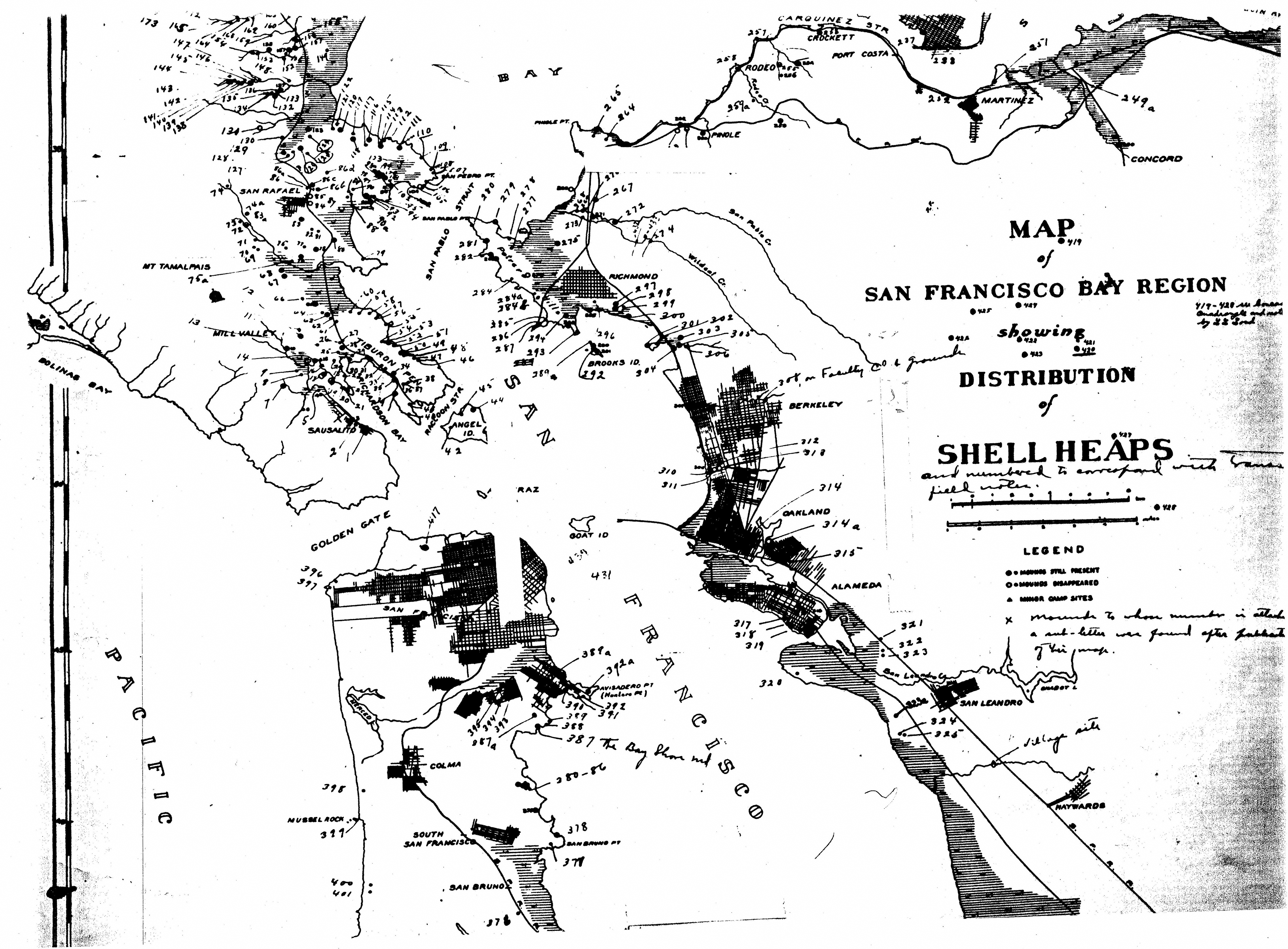
The challenge of recuperating the network of estuaries and streams that once surrounded the low-lying areas around the San Francisco Bay, for example, might negotiate with how we constitute the terrain for urban life by drawing a clear divide from the surrounding waters–or the perpetuation of the fantasy of drawing a clearly demarcated line dividing water and land.  Rising seas once flooded a river valley to create San Francisco Bay, whose many inhabitants  long existed in relation to a less clearly defined shore.  Maps can reveal how humans have interacted with the Bay over time that created deep mental barriers to interaction.   One can trace the shoreline moving in hundreds of feet inland, and slowing in past centuries to but a millimeter a year, or a city block over the last century, as a  shape-shifting feature with which bay residents have negotiated in different ways since a time when people lived near the bay, and negotiated with its salty marshlands, as a map of native American Shell Heaps that ring the bay eloquently reveals by noting the clear buffer zones that inhabitants created on beaches to meet rising tides.
BayShellmounds 001

The maps registers crucial details of the negotiation with marshlands and wetlands now lost or recently restored, outlining an image of interaction with the sea that is not immediately recognizable, and difficult to negotiate with our own changed landscape.

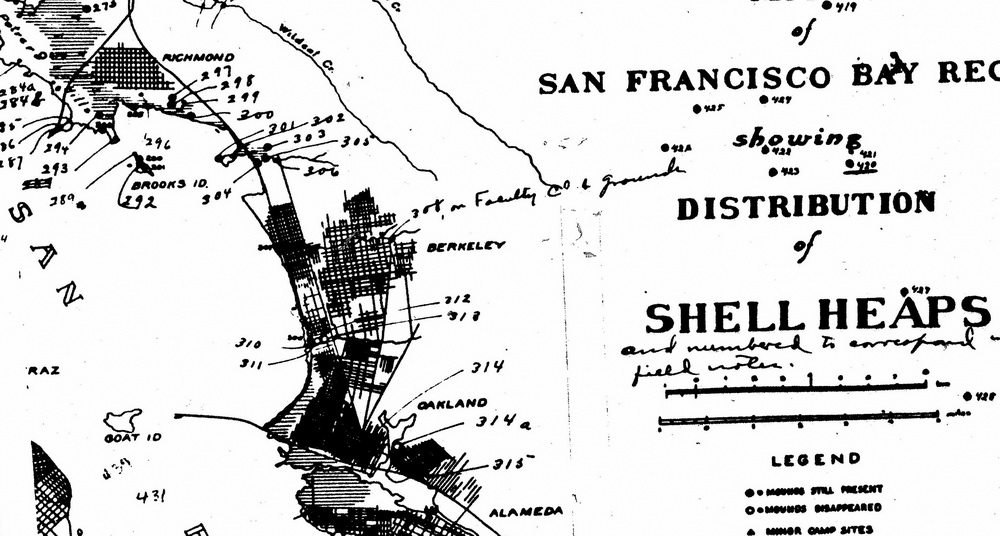
The particular coastal region near El Cerrito indicates the building up of these mounds to create a permeable barrier from the resident crustaceans along the marshlands running from north of Albany Hill to behind Point Isabel–now landfill, then a remote rock in the Bay.
BayShellmoundsCerrito)

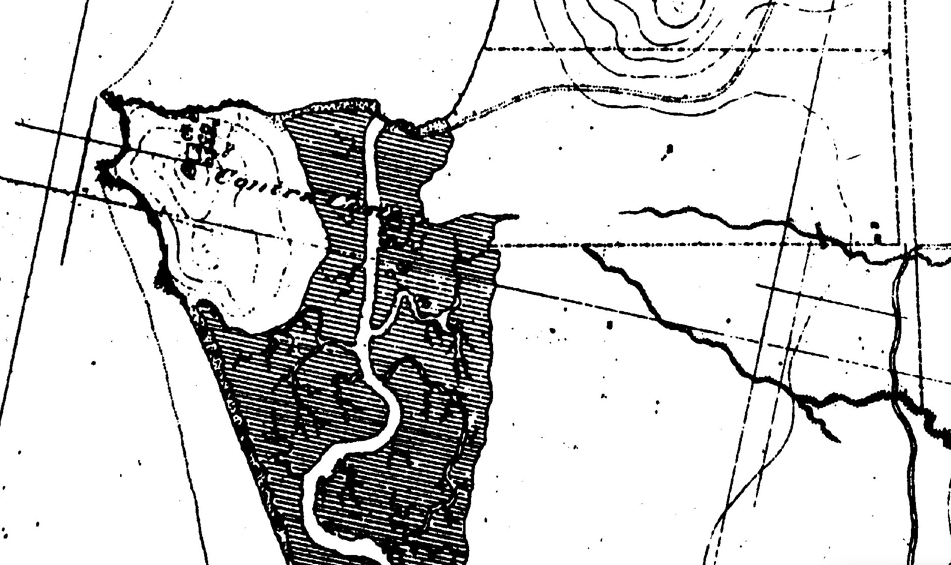
The salt marshes, and the five creeks that fed them, are evident in this detail of the 1856 US Coastal Survey:
Salt Marshes

Yet as people moved inland from an 1850 shoreline was reduced by almost a third all of a sudden in last fifty years in a quite rapid and decisive manner, to create a new sense of the stability of the shoreline that segregated land and sea which will be particularly challenging now with the rise of sea levels projected global warming.  The illusory stability of the shoreline is however inevitable . . .  and the bay on track to expand again by 2100, to return to its size of 1850, in ways that pose disastrous consequences for such overbuilt regions of low elevations.  All low-lying areas are threatened by this projected expansion of the ocean, from Foster City to the treatment plants near to the Bay, to Oakland and San Francisco’s low-lying airports . . . and Oakland’s port.  In cities with waste facilities, oil tanks, refineries, ports and airports lie close to the water, as in Richmond, Oakland, the Carquinez Strait and Albany, ocean waters pose very real environmental threats illustrated by the tsunami’s breaching of the Fukushima Daini power plant.

8.  Can we redesign the shoreline differently?  Observing these low-lying areas that stand in close relation to the water in this map of 1850, we might consider the importance of beaches that can constitute a natural buffer to the shore, and the need for restoring their role as transitional zones and regions that has been so precipitously eroded in our environment.  For the erosion of such transitional spaces–and the overbuilding of the shores–has rendered more vulnerable low-lying areas such as Albany, Emeryville, Oakland or El Cerrito, encouraging blinders about the potential possibilities of future risk.

Sandy beaches that once circled San Francisco similarly served as barriers to the encroachment of the sea.  The loss of beachfront corresponded to a huge expansion of reclamation by landfill, and a resulting loss of estuaries, widely known around the Marina, and evident in the expansion of the city’s shores from an 1895 USGS topographic survey:

Lost Land SF-Historical Creeks and Shore marina detail

The loss of estuaries, creeks, and rivers in the entire peninsula of San Francisco since 1895 is less well-known, but even more dramatic:
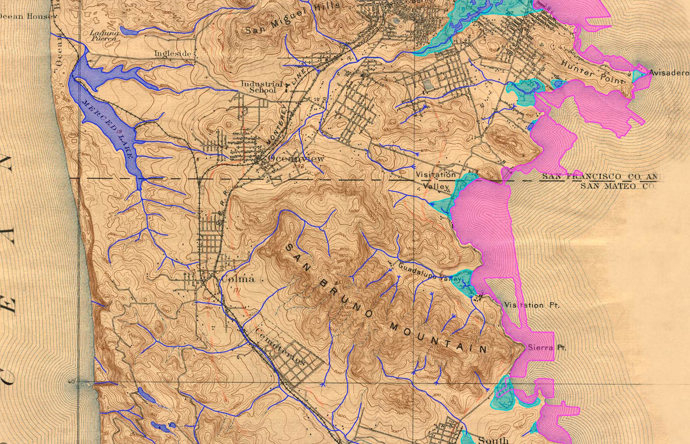
SF Built Out:Loss from 1895 Topo

Will the process of getting to know the shoreline again provide a way to make them stable barriers once again?  Will we be able to provide natural resources by fluvial deltas, and support the growth of these buffer zones to do better on a second chance, by expanding an estuary system linking to the ocean that was so drastically mis-designed in the 1950s, when it was even proposed–if the proposal was reversed–to pour more landfill into the Bay, and re-zone the estuary, in order to fill an expanding housing market?
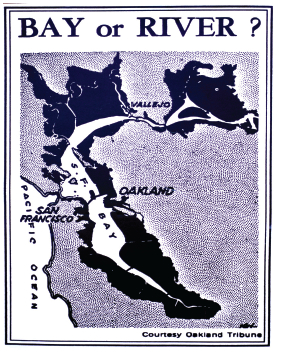
Bay or Rivewr

While it was not so prominent as the urban planners had proposed, the dramatic loss of such crucial buffer zones as tidal wetlands is evident in a comparison of first coastal survey of 1850  in this overlay of coastal maps, courtesy the San Francisco Estuary Institute, detailing the configuration of the coastline as it was and as we have made it,  over the century and a half of urban growth throughout the Bay Area–and the dangers that this poses:
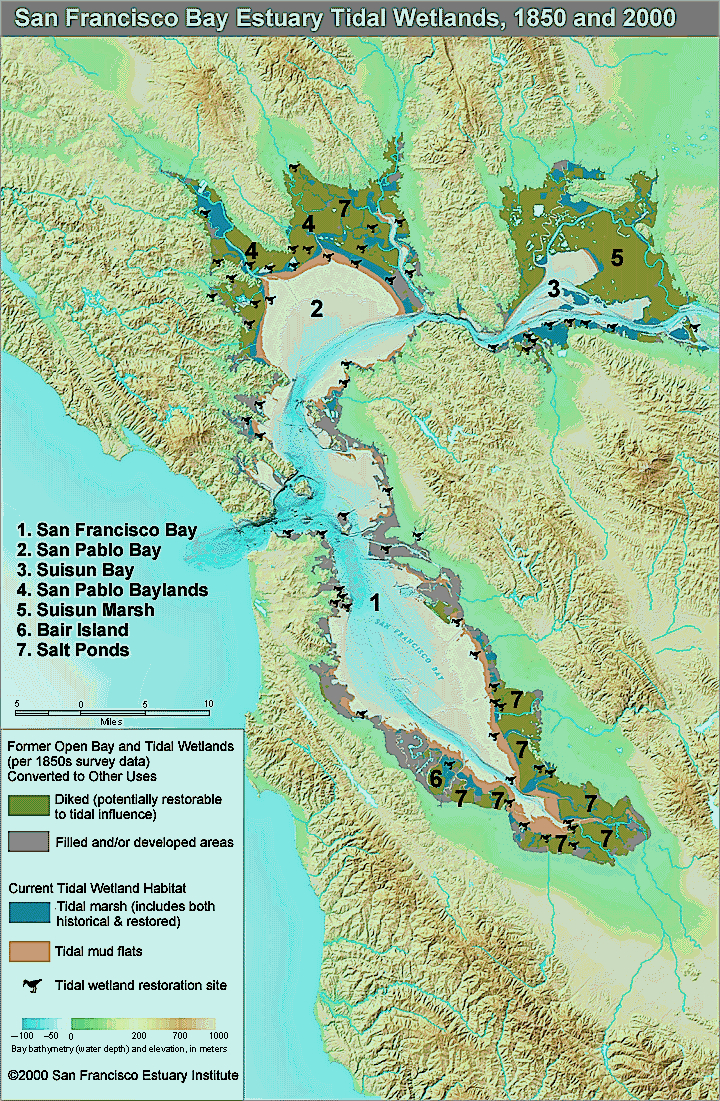
baynature_829

The map cannot begin to conjure the shifting dynamic within the landscape and ecosystem we have lost–although the system of dykes and landfill suggests the beginning of the possible excavations of a lost shoreline.

This image of the expansion of the city’s urban claims to housing derives from a cultural and deeply anti-ecological view of the city as a site of stability–and ocean was seen as a site of antagonism on which, in the domesticated image of the bay, the city could rightfully expand–and the estuary be recast as a river to accommodate housing needs.   In starting to change our attitudes to our shorelines, and to view them as sites for other residents and as permeable barriers, we might start from changing our attitudes to the sea:  and remember, with Rachel Carson, that it is through our expansion of the “artificial” nature of cities that we have forgotten and somewhat brazenly rewritten our relation to the shoreline and the sea.
florida-coastline

Maps, of course, forge bridges between nature and culture in provocatively engaging ways–and engage viewers by mapping these relationships.  If we are starting to remap place in provocatively interactive ways, the challenge is to best map the shifting relation between place and the global changes that call for an extensive remapping of place within the world.
Leave a comment

November 14, 2013 · 10:19 am