Tag Archives: borders

DOGE as an Active Verb: Expansionist Energies & Political Synergies in an Imperial Presidency

Donald Trump, in eyeing a new term as President, sought to make the global impact that he felt long denied–or robbed–in his first term. His frustration, if in part theatrical and hyperbolic, of the “Russia Hoax” was a deep discontent of being denied legitimacy, and a fear of being condemned to a Presidency with an asterisk beside it, either for having not gained the majority of votes for President, after all, or not winning the “landslide” that he felt a winner deserved. And as the first year of his second Presidency seemed to be gunning for an elusive Nobel Prize by bringing peace to Gaza and Ukraine as if to win legitimacy on a global stage, the image of global dominance–and hemispheric expansion of American power–had deep ties to his interest in the political lineage that was embodied by his one-time backer, and promoter, Elon Musk–who at a critical time was the needed P.T. Barnum to stage the comeback of Trump’s ungainly ride on a Republican Elephant. If Trump helped design the new logo of the GOP as a new circus animal–

–even personalizing it, by 2020, beneath a toupee echoing Donald Trump’s signature hairstyle, as an expression of fealty, the party of politics has become unprecedentedly politicized, all but obviating the need for a convention, as modifications that hairspray imbue the weave with vitality, despite its truly unearthly hue that even hairspray cannot create.

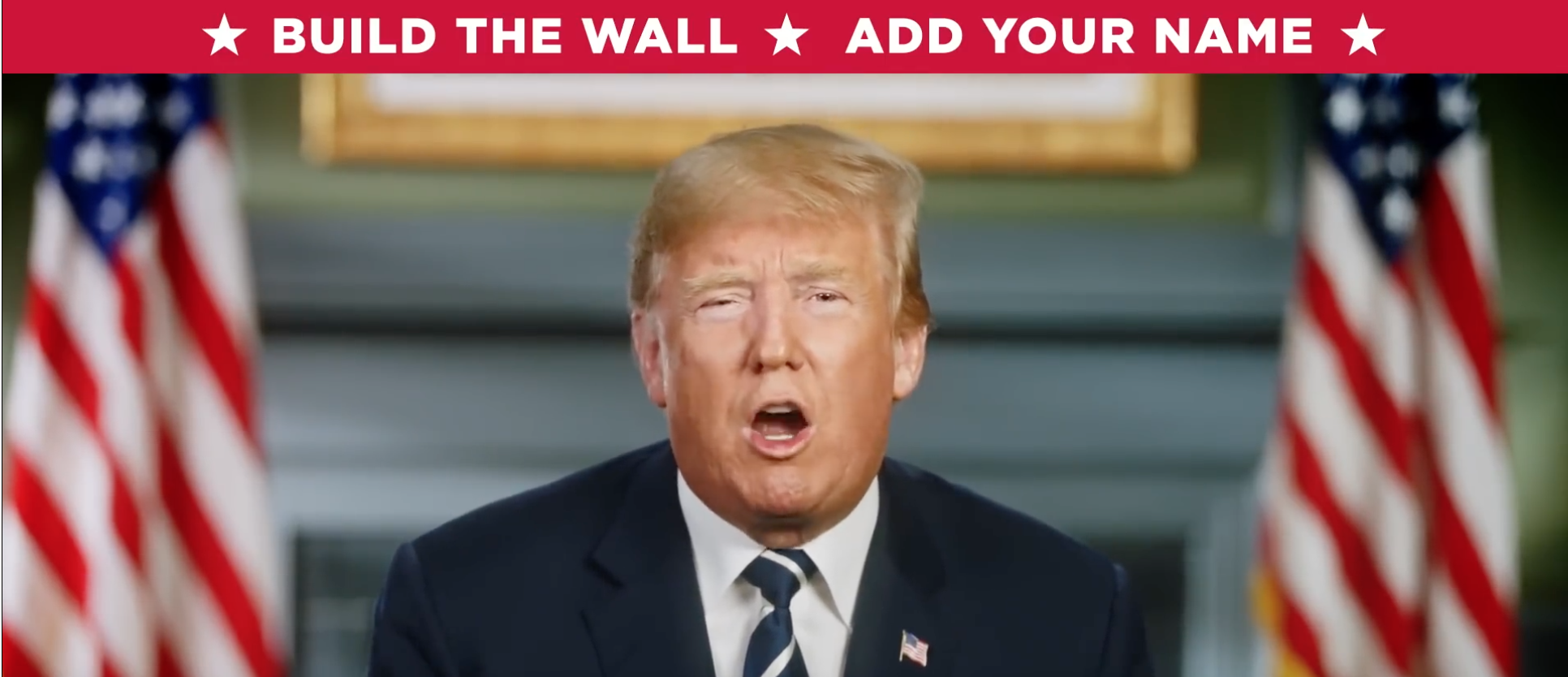
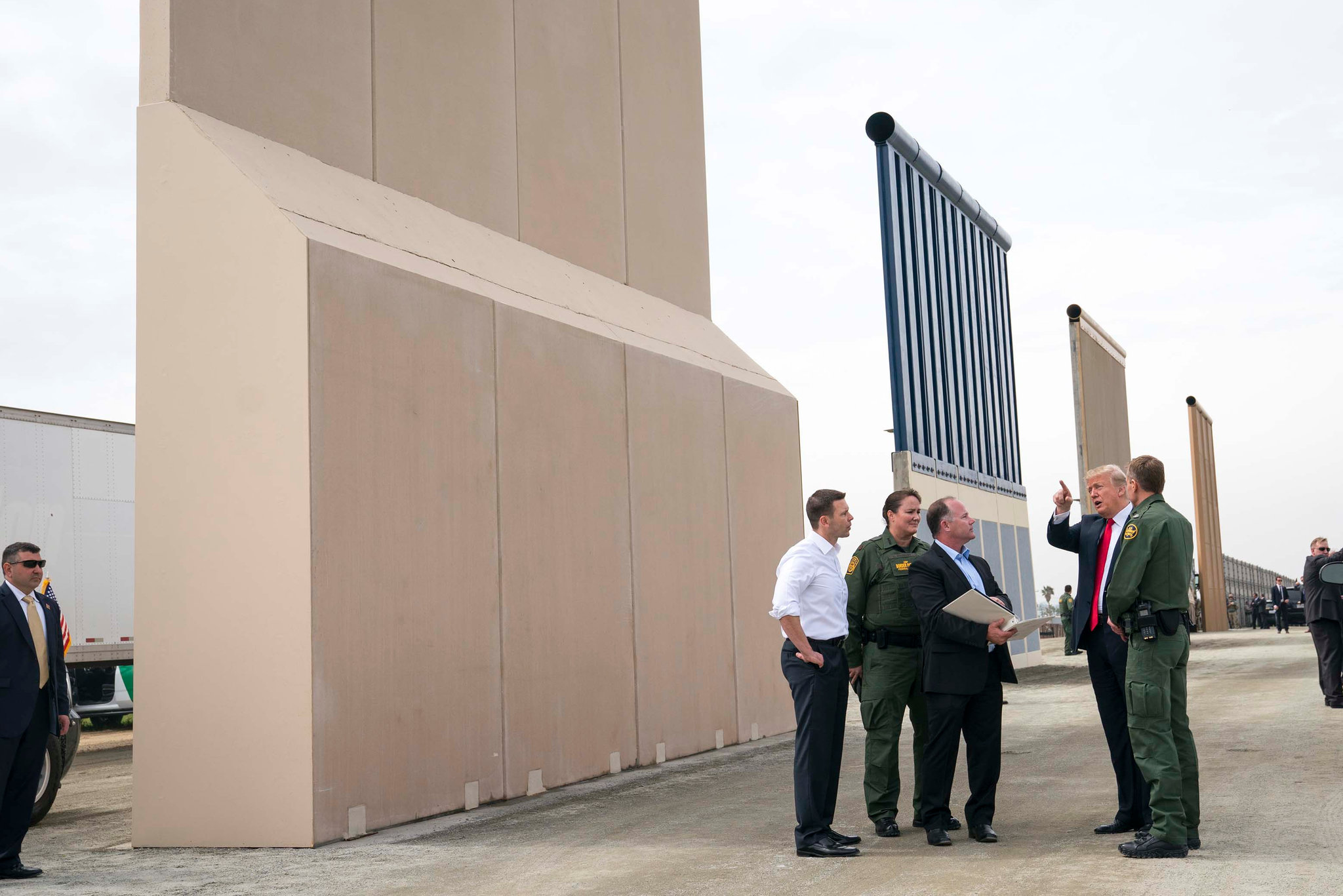
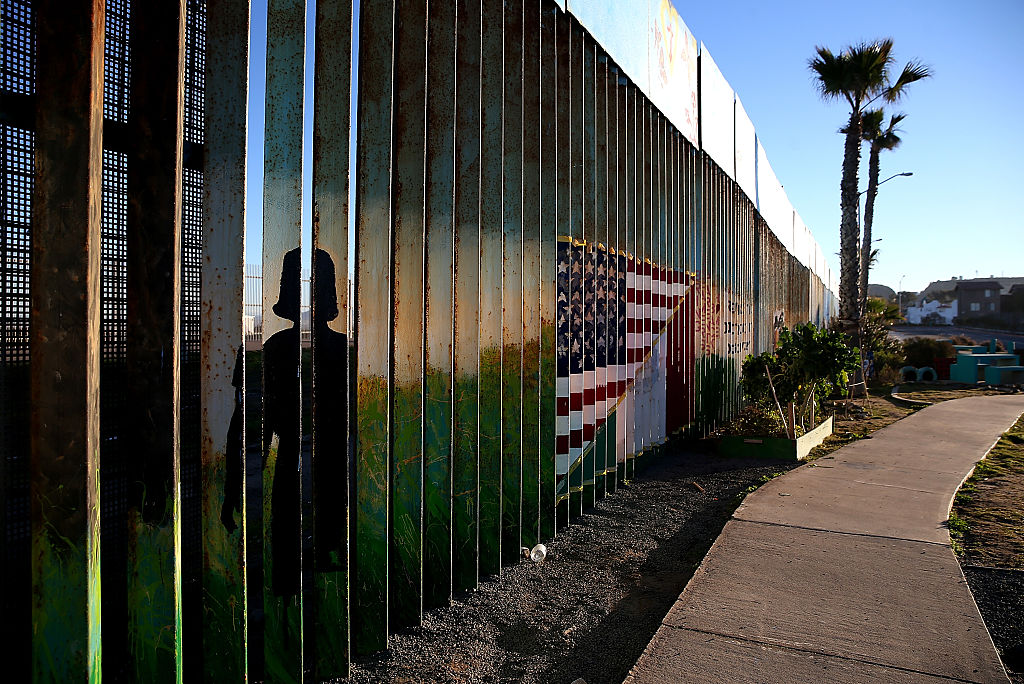
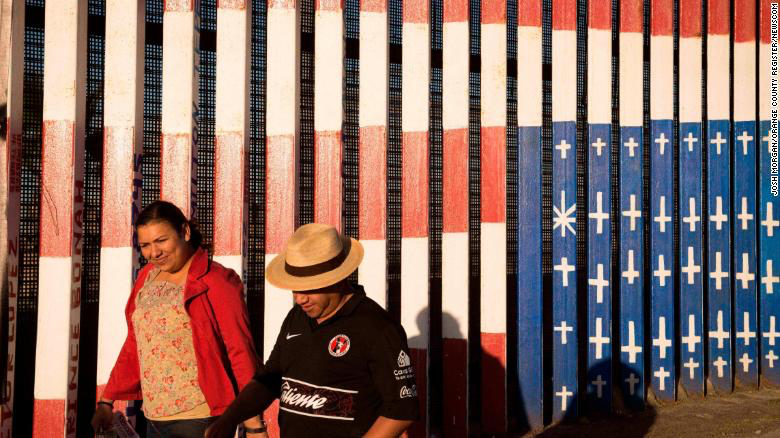
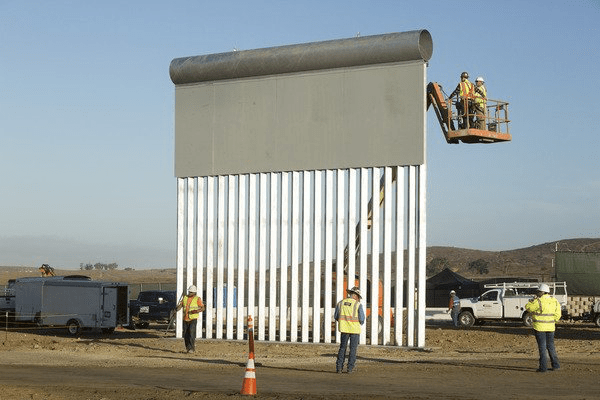
Trump has a dexterity with marketing and branding honed in the real estate business he made his name, and the remaking of the party is in his image is acknowledged in the button. But as much as a rebranding that nods to a fascist legacy in identifying the part with a personal brand, subsuming politics in a lexicon marketing in Trump’s America, the logic of rebranding did not emerge from Trump’s head, like Minerva from the head of Zeus, so much it was a product of the onslaught of rebranding and marketing across America, deeply shaped and inflected by the internet, and online communication, and deeply influenced to synergy with other brands–and possibilities of branding offered by such truly political constructions as a border wall. But the border wall became a subject of the political brand of Trump, the branding of Trump 2 is far more tied to Silicon Valley and Musk if it continues to expand the practice of national politics in ways not rooted in political traditions or the Constitution, and removed form civil law.

Without following legal precedent or legal formulations, the victory of branding the nation has a logic that is almost–and perhaps intentionally–removed from legal remedies or redress. For the logic of the building of a border wall that proceeded only by declaring a ‘border emergency’ and a national emergency became a ‘brand’ far outside of the legal framework of civil rights, and, indeed, flies in the face of civil rights. The brand of the wall by which Trump defined his first term and his candidacy may have had less power by the end of his first term, but the second term must be seen as a terrifying rebranding, and rebranding of America, by the logic of America First, rather than by laws or constitutionality, insisting on values of transparency and economy and an end to abuse–even if the reduction of government costs may mean that seventeen million Americans lose health insurance from Medicaid and the ACA, and reducing the $100 billion the government spent on food stamps and SNAP over ten years will affect the 5.5 million who depend on their food from federal funding in California alone, and leave two million without food. The simulacra of civility that the reductions of federal expenditures are a forced slimming not only of government, but of Americans.

The new branding of America is no longer limited to its borders, or territoriality, but depend on a remapping of an expansive mapping of American authority to use its military in what might be called the vaguest penumbra of actual legitimacy. For the first year of a Presidency has seen apparent expansion of the territorial waters of the nation as borders of military jurisdiction, and a definition not only of the ability to refuse visas to all deemed a potential threat to “Americans,” but to using the military–now understood as a Department of War, and not “of Defense,” in what is hardly only a semantic change or shift. Simultaneous to the unilateral rewriting of the global tariff system, as if arm-wrestling the global encamp, the lifting of protections for offshore drilling, and not only continental water but the nation’s Exclusive Economic Zone, the rebranding of the nation in maps have become unprecedentedly expansive in hopes to maximize the nation’s global impact, that not only flaunt the law, but expand the global footprint, as it were, of America on a global map.

The unprecedented expansion of the War on Drugs to an actual targeting of ships in international waters is not only a metaphor. The new “war,” this time, really is a declaration of military conditions that justify the discarding of international law in the basis of affirming national safety–as made evident in the recent reactivation of a slew of military bases across the Caribbean, to allow expanded bombing of shipping craft deemed a threat to the nation and a national emergency. The notion of a wartime powers that the Presidency has in the past assumed have become a way, at the same time, and with no coincidence, the Department of Defense is renamed the Department of War, to announce a war has been begun that will suspend civil rights and legal accords with nations, or any international body, to affirm the expansive legal domain of the United States over anything it deems a threat to the nation, whether or not such a threat exists. While the expansion of the “War on Drugs” as a metaphor of governance marked a decisive expansion of law-enforcement tactics, prosecution, and incarceration, evoking an “enemy” to be targeted among drug users and sellers, whose only alternative was decriminalization, the metaphor of a strategy of criminal justice has morphed to military policing of the nation’s vulnerable boundaries as if it was a real war understood by national boundaries. What has been treated as a shift of the metaphor to reality as if it were a confusion of categories, however, is in fact a redrawn theater of actual war.

Having renamed the Gulf of Mexico as the Gulf of America with little global pushback, if plenty of raised eyebrows, the recent expansion of targeted bombings on craft accused of ferrying drugs destined for markets of American customers–and cast as the pending incursions by foreign gangs of the nation–have occurred with the reactivation of American bases in the hemisphere, far outside of territorial waters, to a new level of alertness not seen since the Cold War–an amassing of 10,000 troops and expansion of military staging grounds that are intended only to facilitate extrajudicial executions far beyond the line of the border wall on pause since being built in Trump’s first term.
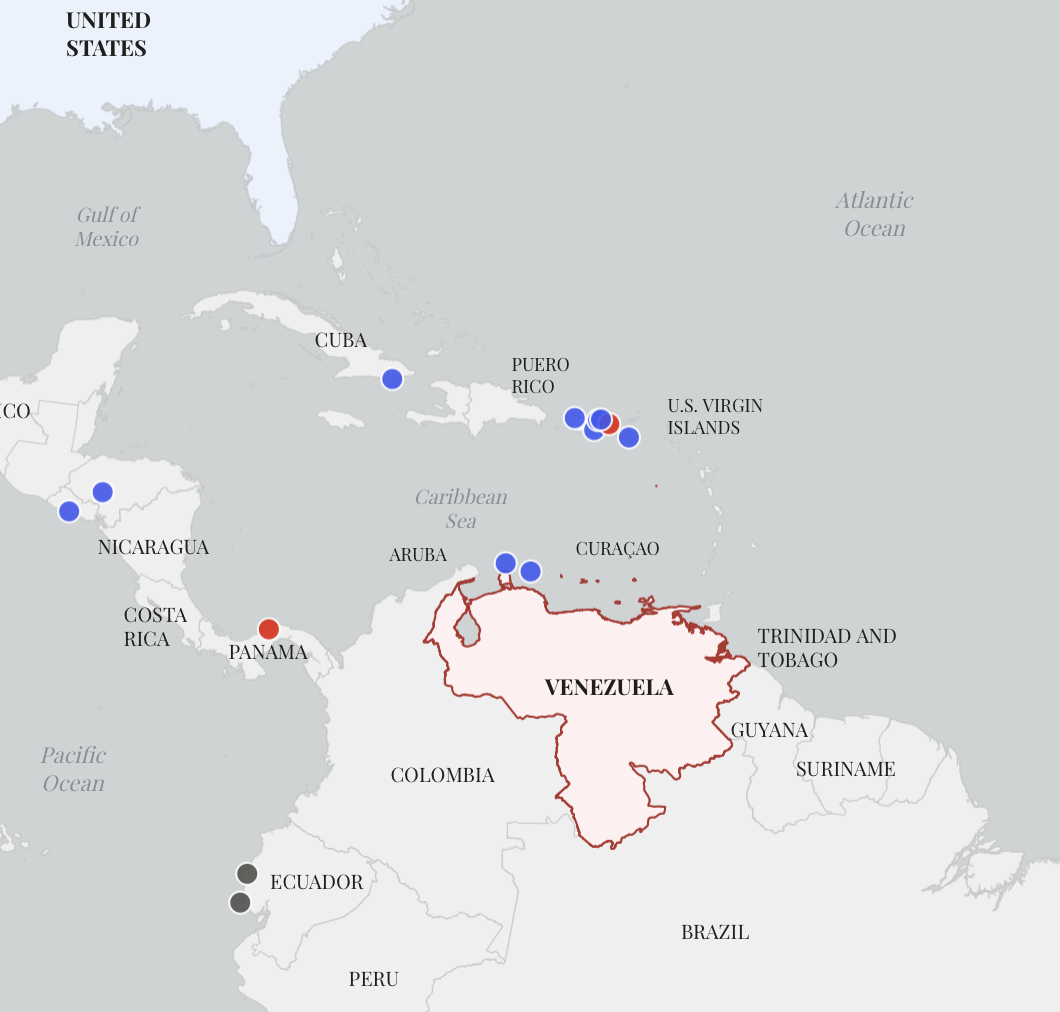
Reactivated American Military Bases in Puerto Rico, Panama, and US Virgin Islands/2025

Tense US Marines in Action Off Venezuela – Bomb Drops, Deck Shooting, Small  Boat Ops

It is as maddening as it is beguiling to map objectively Donald Trump’s relation to the world, so deeply is it performative. It does not objectively exist in ways that could be mapped, trafficking as he does so facilely with fears, existential threats and danger, that conceal a barely credible sense of purchase on reality. Trump’s inflated claims seized willfully and impulsively on maps in his political career, to validate his relatively unclear claims to a sovereign role, eager to try on ideas of sovereignty able to reoccupy the image of his early adoption of the military uniform he wore at the young age, leading a march with pomp and circumstance down Fifth Avenue, fresh from what passed as military training at the New York Military Academy,–anxious to inhabit newfound authority in the Fifth Avenue canyon of New York City–“prime property”–he had never set foot before, as he was trying on a uniform for size in ways that we cannot but associate with the imperial presidency he would later help to design.

Donald J. Trump Leads Military Academy on Columbus Day Parade at Fifth Avenue and 44th October 12, 1963

Fred Trump, no doubt drawing on his own fascist sympathies, had sent the unfortunate future president at age thirteen to learn the needed lessons of domination to reach a level of proficiency to be a capable future head of a real estate firm. But the lesson also gave him a keen sense of entitlement–not having to actually serve in the U.S. Army, increasingly the fear of the men subject to military draft from which Donald sought up to five deferments–and a sense of empowerment not previously encountered in life. The sense that the removed world of wealth was suddenly in reach, and not distant, led him to develop a sense of the synonymity of the Trump name with wealth inequality that helped Donald Trump get in bed with a variety of political forces, gravitating to a dark side of American politics of small government, low taxes, and paleo-conservatism to normalize and perpetuate wealth inequalities in America, at the cost of replacing or eroding government, or what we have come to know as government–and accept as government–without considering the withering away or puncturing of anything that is left of the welfare state or Great Society.

But before he headed to Fordham, and as he tried uneasily to imagine the status a uniform might bring to a child of wealth, the enhancement of his personal authority was but a glimmer to his young eye.

Donald J. Trump in full regalia in New York Military Academy Yearbook (1963)

If the frontiers of America have are a consistent theme of Trump’s Presidency–from the bombing of ships in international waters off of Venezuela’s or Colombia’s coasts, ascribed to “narcoterrorists” or “narcotics traffickers” in a “Trump Doctrine” of targeting what “came out of Venezuela” as if it was subject to attack as criminal. The new envelope of legality that Trump has advanced, insisting it not be covered by the War Powers Act and rebuffing international objections from the United Nations, occur under the pretenses that a nation is not being attacked, but criminal organization run by a “designated narcoterrorist organization,” as if this sanctions bombing ships and killing passengers in waters waters lying far outside of American territorial claims. If Rankin and others have suggested that the cartographic artifact of International Waters or an Exclusive Economic Zone can be seen in terms of an optic of globalization, the rejection of globalization or global orders of legal authority are likewise artifacts of globalization–but of the Trumping of globalization that is an assertion of the rejection of legal oversight on attacks of international criminal organizations. The blurring of the nation’s southern border drew condemnation of Caribbean states, claiming wartime powers in a far more open violation of international law than the US-Mexico border wall.

The border wall indeed receded into the baground, fast forgotten in comparison to the extent to which bombing offshore ships blurred the boundaries of territoriality in a misguided attempt to staunch the flow of drugs–a flow Trump and his henchmen too often argued is accomplished by smuggling routes able to be stopped by immigrants, as if this prevented the flow of cocaine, fentanyl and methamphetamines across the border–the blurring of territoriality now goes far beyond the “big stick” of the Monroe Doctrine that the nomenclature of the “Trump Doctrine” echoes, and sets a new standard for a “gunboat diplomacy” now waged from the skies, and from seven warships and aircraft carriers stationed in Caribbean waters by September 1–carrying over 4,500 sailors and marines beyond the nation’s frontiers, in a quite sudden and unexpected military buildup designed to “combat and dismantle drug trafficking organizations, criminal cartels and these foreign terrorist organizations in our hemisphere.” Is the sending warships a new expanse of borders to patrol international waters an act of aggression, or a war against non-state actors?
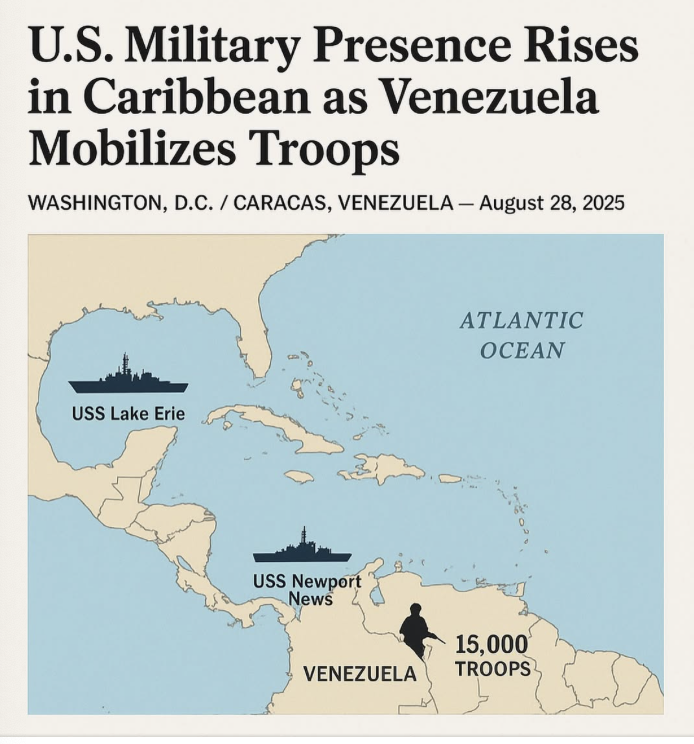
August 28, 2025

September 8, 2025

The nation seems to be expanding its frontiers, even as our government shrinks. The wanton summary firing of government employees during the shutdown over which he would preside in 2025, letting go of over 4,100 employees from “Democrat agencies” of government as Housing and Urban Development, Center for Contagious Diseases (shutting its entire Washington office), Education, Treasury (1,400), Interior (1,100), Environmental Protection Agency, and Commerce, and elections security and cyber in an unprecedented unilateral”Reductions in Force” as the shutdown was in its tenth day was a supreme act of plenipotentiary powers, as his Budget Director released “RIFs” in place of pink-slips, purging the note of government by massive layoffs (firings) in classic Trump style for big corporations and budget hawks. What might reduce our emergency preparedness on multiple fronts was conducted in the name of emergency cost-cutting. “March on, Dombrowski, lead the way! Our Poland has not yet perished, nor shall she ever die!” The expanding frontiers of the nation, as government sent guided-missile cruiser, an amphibious assault group, nuclear-powered fast-attack nuclear submarines with 5,000 sailors and Marines to the region–as ten Stealth Fighter F35’s have been shipped to Puerto Rico, supersonic jets of a lethality that has no clear tie to a narcotics war, save as a massive show of force, with eight destroyers.
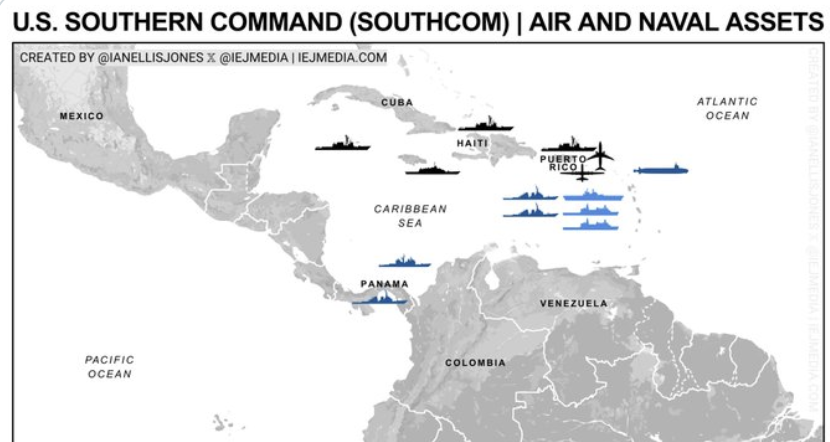
September 2, 2025

Trump seems determined to send a new sign of his triumphal presence in the region, as if to declare a new relation to the Caribbean as an imperial space he is willing to defend by military roles and military engagement of nations. The metropolitan splendor of the broad streets of the modernist urban grid may have overwhelmed Donald as he stared downthe chasm of an urban canyon whose buildings’ art nouveau facades must have impressed him as a new social geography of which he had not been so keenly aware and a New World. It may have so impressed him as tying the historical figure of Columbus to a conquest of Fifth Avenue,–as a modern Christian soldier–stepping in his patent leather shoes into the future he would argue to have equipped him with “more training militarily than a lot of the guys that go into the military”–a distortion of magical proportions, perhaps born out of guilt for the five deferments obtained to defer service in the Vietnam War, determined to boast of a disciplined leadership without showing much true actual discipline military men are instilled. The determination with which Trump led his New York Military Academy class forward amidst along the glittering concrete neoclassical towers lining Fifth Avenue, as if they constituted a new world he had never personally seen, was a conquest of sorts, a conquest that was Columban in scale and grandeur, as if the commemoration was of his own new role in life.

Is this early image not at the heart of his deep ties to the defense of Columbus Day as a national holiday and collective celebration, in the face of reality and claims to the contrary? It is as if predating any sense of global politics, he naturalized the heightened socioeconomic divides of the impressive city. Indeed, the opening up of the landscape would long fascinated him as a developer that he set his sights on conquering this new land of wealth. Those looming towers would be a beacon of sorts for the real estate company he inherited, and provide a soundstage on which his public persona as a realtor could be orchestrated as if existed apart from his father or the rest of his family, and indeed a migration story of sorts from the outer boroughs across the bridge that spans from Brooklyn and Queens to the glittering tower of Manhattan that he traced compulsively on paper napkins as new maps to his identity and brand, even before he took to affixing his name indelibly with their glittering facades.

The new branding of the United States on the global stage is akin to a throwback mapping of a nation’s expansive authority, eerily evident in a favored map that Elon Musk may well have taken out of deep storage in his family memory as he developed plans to help resuscitate Trump’s candidacy in 2024, at a critical time, selling a new vision of the powers of the presidency that seems to have loomed large in Trump’s own struggle for power. Long before applying gold-painted polyurethane appliqué from Home Depot to the Oval Office for a mere $58 to create what he called, a real estate developer at heart, “some of the highest quality 24 Karat Gold ever used in the Oval Office or Cabinet Room of the White House” for “the best Oval Office ever, in terms of success and look” (his string of capitals), perpetuating the image of wealth inequality whose quality would impress “Foreign Leaders” who would “freak out” at its quality.

For Trump ran for President the second time almost under the promise to naturalizewealth divides in a landscape that dazzled him with its display of opulence, as a New World he seemed to have first confronted and remains, for the moment, to be vertiginously in complete command. The deep ties of Trump to a naturalization of wealth divides would lead not only to the demonization of migrants, blacks, and other undesirables, expressing a sense of grievance against them as a real estate developer preoccupied with fears of declining values of their properties,–but to find an eery kinship, at great costs to the nation, with the naturalized wealth divides of apartheid that were a formative part of the worldview of Elon Musk–similarly attracted to the promotion of fool’s gold.

Musk was an icon of the entrepreneurial abilities that seemed to be tied to genius, but was hardly American, and tapped, as has been shown, an eery brand of libertarian politics, not foreign to America, but a dark current that was accessible to the young man who grew up in a white enclave of Pretoria amidst a sense of the deep dangers of those without wealth, amidst the jacarandas and elite schooling, and his heroic grandfather, the dashing adventurer Joshua Haldeman, a refugee of sorts from Canada, who had played an uncelebrated but rather profound part in the social movement Technocracy, whose political imaginary is preserved in the map that is at the header to this post, and received attention as a political imaginary that has informed the apparent contradictions of the expansive isolationism of Trump’s second presidency. The expansion Trump has directed of Homeland Security to apprehend “illegal” migrants is not only an attack on the legal status of refugees–promised safe harbor in the United States and other countries by international accord since 1951 providing that no refugee be expelled or returned to the frontiers of a territory their life or freedom was compromised or in danger. As fears of political persecution have multiplied and the flow of refugees grown globally, the United Nations Convention has been not only questioned–but the safeguarding acquired rights were called into question by declaring the border a ‘state of emergency’ not demanding the following of agreed laws. Indeed, the digital dragnets that are targeting alleged “illegal” migrants compels many to present themselves before court without any right to a lawyer or legal defense, as they have no ability or right to hire one.

Donald Trump had been sent to military academy to dissuade him from a passion for films. Donald was wowed by leading a spectacle that of which he was the center–leading a Columbus Day march!–whose theatrics led him to remember the event. He boasted of being instilled with obedience and rules at the New York Military Academy, endorsing the creation of an online “American Academy” as he ran for U.S. President in 2024 to undermine the place of “radical left accreditors” in American educational institutions and the “left-wing indoctrination” so endemic to schools he argued were “turning our students into communists and terrorists and sympathizers of many, many different dimensions.” Trump was vexed by the protests at universities after his first election, channeling attacks of alt right online journalism as Breitbart News against the universities they argued had become opponents to free speech. Trump adopted a Manichaean grievance of disconcerting alliterative bounce, vowing to “fire the radical left accreditors that have allowed our colleges to become dominated by Marxist maniacs and raving lunatics” as if they had perpetrated a crime against the nation only he, the graduate of a Military Academy, was properly able to solve.

Trump Leading New York Academy on 1963 Columbus Day Parade, to immediate right of Flag Bearer

Trump as he marched down Fifth Avenue must had no sense of a defined a relation to the world–he was seeing New York luxury properties for the first time, but was opening his eyes to the scale of what seemed a global stage as he led the march with utter pride in his uniform and bearing. But President Trump’s conviction he is leading a white nation to an age of plenty, as he led the Columbus Day parade months after I was born, is tragically curtailed in its vision.

In glorying in a nation of closed borders, Trump has clung to a. geographic fantasy and a myth. The scale of global leadership may have long been a problem for Trump to comprehend. But the eagerness with which he entertained and promoted the mythic geographies Trump long trafficked in real estate have sought to promote the nation in a new global context, whose toxic spin is reflected in insistently casting Columbus as a basis for the Christian white foundation of America, embodied in his deep commitment to restoring prominence to a holiday named after the Italian Christopher Columbus. Even as we have documented and uncovered the scale violence Columbus and his sailors perpetrated in taking possession of Santo Domingo, the whitewashed elevation of Columbus as a, a founder of the nation if not of Christian Empire, with deep roots in the nineteenth century at great cost tot a nation. Even as Trump vouches opposing the “woke” change of critiquing Columbus as a figure of veneration, one who “all of the Italians love him so much,” Trump courted white supremacy by Columbus; he embraced a vision of imperial supremacy that animated a proposed monument to Columbus for New York Harbor of bronze kitsch designed by Georgian monumental sculptor Zurab Tsereteli,–in an effort to promote and re-imagine Columbus as a father to the Country, akin to Peter the Great in 1997, whose statuary Tsereteli had previously designed on the banks of the Moskva River to celebrate three hundredth anniversary of the Russian Navy in the very same year.
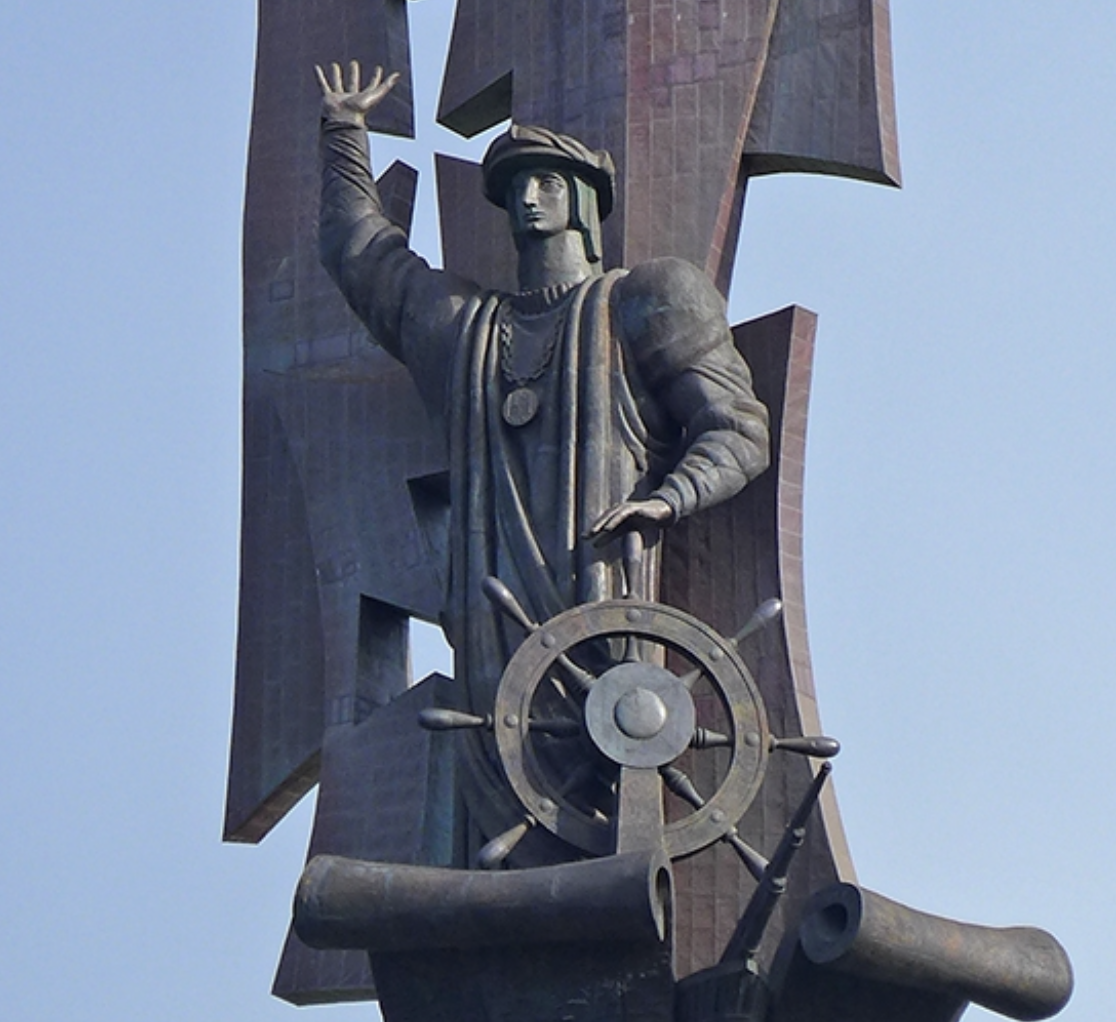
Zurab Tsereteli, Columbus Monument first proposed offshore Trump Properties on the Hudson River

Tsereteli specialized in designing monuments, and the patriotic monument of grandiose statuary was underwritten by Russian funds as a free “gift” in 1997, in a stunning three hundred feet of kitsch to rival the Statue of Liberty in a foray into American politics. The monstrous kitsch statue of an apparently impassive navigator may have been in the back of his head as he appropriated government funds to reconstruct Columbus statues as his final act as President in 2020, seeking to leave his imprint on a society that had refused to commemorate Columbus as a savior to the nation.

Trump has perpetuated the grotesque myth of living in a prosperous nation within closed borders, as if the arrival of Columbus was triumphant and peaceful–not acknowledging indigenous peoples, slavery, or even non-white history, even in the face of historical evidence of the enslavement and violence that followed the disembarking of European settlers to the contrary. The massive whitewashing of the historical record pandering to visions of white supremacy redefined America in a globalized world as provincial and out of his league as that young costumed military school brat, marching in pants too short and outsized cap shortly before the American troops would be sent in escalating numbers to Vietnam. To be sure, Trump feigned his “military experience” as a doge for five successive draft deferments from military service. Elevating the Christian heritage of America Columbus has come to incarnate romanticized America in a global map of the powerful that Donald Trump could get behind. Yet the uneven distributions of global wealth–far greater than were defined by New York in the 1980s–offered by 2024 a vision Trump’s candidacy seemed ready to naturalize–offering Trump a means to orient his sense of politics to the world. claiming as President to bring “back from the ashes” the celebration of the Genoese navigator’s voyage, and end celebration of Indigenous People’s Day, by renaming the Federal Holiday. The new vision of global prominence for the nation that Trump promised was not dependent on or tied to Columbus, but to a vision of global economic dominance not only rooted but trafficked in myth.

Trump did so, this post imagines, side by side the other spokesperson of wealth inequality who offered a critical endorsement of the candidate in 2024–the South-African born Elon Musk–with world-changing consequences. Musk, like Trump, while super wealthy, also saw himself as an outsider, but claimed a persuasive way to orient Trump 2024 to the world, if not to orient the second Trump Presidency to a map that preserved the wealth inequality incarnated in the buildings and skyscrapers of Fifth Avenue within an increasingly globalized world, perpetuating the illusion of the wealth of the United States by whatever legal fiction possible to provide a vision of American pre-eminence that has some surprisingly scary echoes to the cartographic fiction Elon treasured from his father-in-law, and perhaps the largest paternal figure of his childhood, Joshua Haldeman, a chiropractor from Saskatchewan who accumulated wealth from ruby mines in Tanzania during Apartheid but ended his life piloting airplanes convinced of the hidden riches of the sandy savannah of the Kalahari Desert–not its actual resources of diamonds or uranium, even if it possesses one of the largest diamond mines in the world, but the ancient wonders of the Zambezi Basin of the Lost City of the Kalahari–an obsession of late nineteenth century geography that has survived in board games–of a lost pre-Ice Age civilization only officially given up on in 1964, but incarnated a vision of wealth inequality the likes of which rarely existed before globalization.

Advanced Pre Ice Age Civilization Discovered in the Kalahari Desert –  African Explorer Magazine

Lost City of Kalahari (Late Nineteenth Century and Modern Reconstructions)

The visions of wealth inequality by which both Trump and Musk were so attracted and obsessed made them a far less likely pair to endorse the divides of income inequality that have increasingly defined the United States and the world by the twenty-first century, but which we have been almost unable to glimpse. The manner in which Trump has shifted attention from income inequality to spectacles of state, indeed, is a critical means by which we have allowed our attention to be distracted by the policing of a southern border, but to turn the other eye to urban poverty and the social fissures exposed temporarily in the pandemic, but that exist in both health care, educational attainment, and life expectancies across America, in ways we have hardly seemed able to process.
1 Comment

Filed under American expansionism, DOGE, Donald Trump, imperial presidency, national borders

Eternal Borders and the Territory of the Gaza Strip

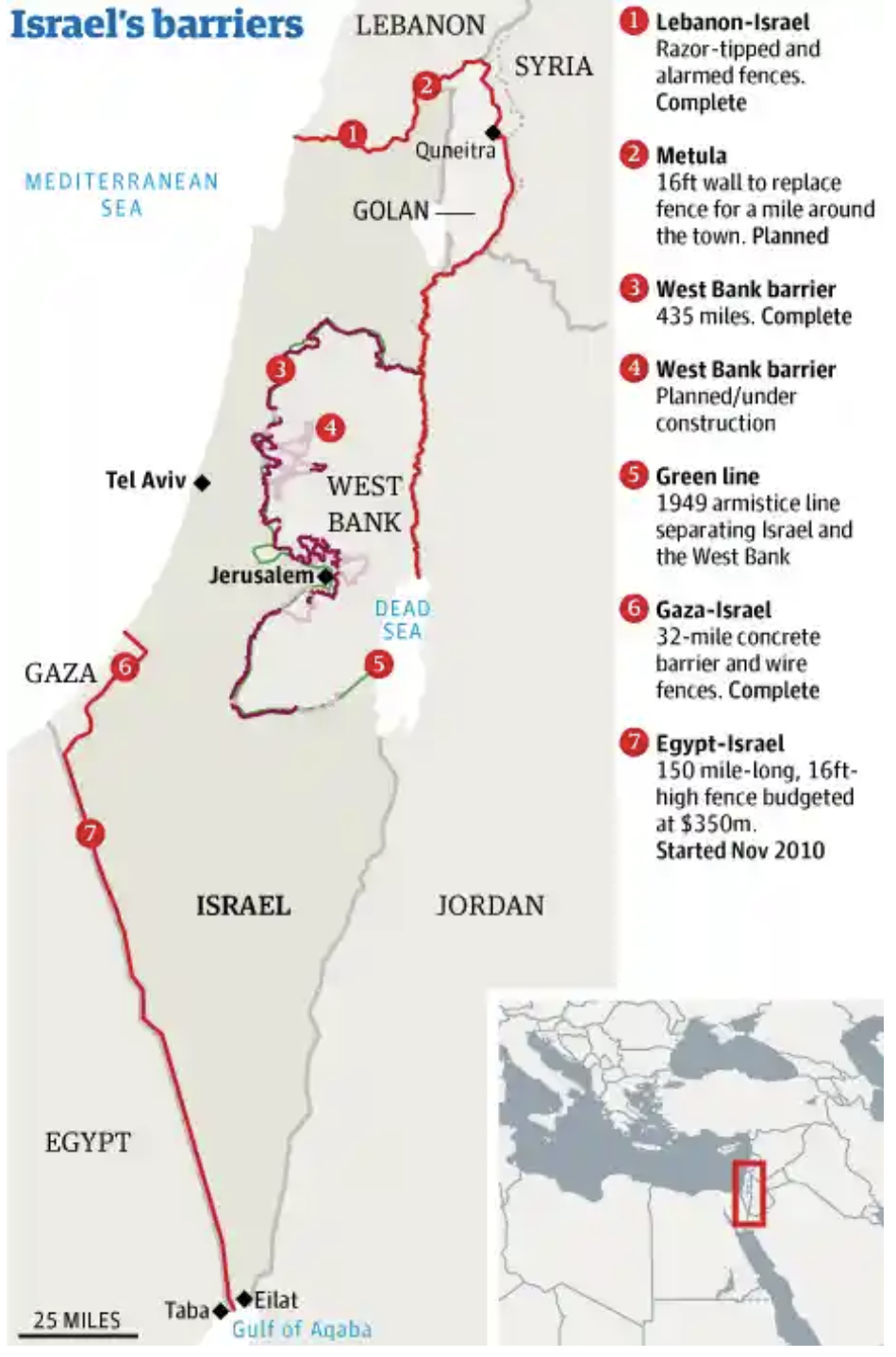
When I attended High Holiday services in an Orthodox synagogue in Oxford just before the October 7 attacks, it was probably for the first time in some years.  I was terrified of how to fit in. But the spatial imaginary that unfolded in the services days before the invasion of Israel’s “border barrier” on October 7, 2024 suggested how difficult the geography of the Middle East would be. Although it was familiar, I stopped at an old prayer in the Makhzor, or holiday liturgy, praying for the safety of the Israeli Defense Forces as they guard Israel’s boundaries over the coming New Year, 5785.  The creation of these boundaries was noted not in a moment, but have, changed over time. But the notion of fixed boundaries of Israel that Benjamin Netanyahu has long proposed in stated policies that have openly vowed rejecting any attempt to create Palestinian state between the River Jordan to the Mediterranean in a “Great Israel” had demanded Israeli control from the river to the sea–even if the area includes, according to Israeli demographer Arnon Soffer, of 7.53 million Palestinians and Arab Israelis and 7.45 million Jews of fifteen million residents. The shifting politics of the population, and indeed its distribution beyond the previously settled boundaries of the Mandate of Palestine, and indeed the 1967 armistice lines after which Gaza was first fully occupied, suggests the problems of settling and settlement that were so crucial to the current protection of the boundaries of Israel as a state–and the anxiety of their defense–in ways that made the prayers to the guarding of these boundaries unsettling if the concept was of course familiar.
The prayer was familiar, but stood out for me as I returned to religious service in a foreign country: the collective imprecation to preserve the IDF currently defending the borders of the Holy Land suddenly seemed an aggressive act. While the Jews living between the Jordan and Mediterranean are in a far more continuous space, in comparison to which the geographic space of Palestinians is of course a far more fragmented mosaic who are without comparable rights as citizens, the borders have been reified by boundary walls in an era when borders are not only far more heavily fortified than ever in the past. For the border barriers around Israel hold mental space before the cry to free the region “from the River [Jordan] to the [Mediterranean] Sea“–a slogan firmly rooted in aspirations for decolonization struggles of the 1960s, if to some ears maddeningly intentionally geographically vague, in ways that were seen as implying annihilating the Land of Israel Jewish state. But the deep insecurity that the cry seems intended to trigger, erasing the consolidation of land within Israel’s new physical barriers on its frontiers, evoke the precocity of the state in ways that the sudden. October 7 invasion from the Gaza Strip seem only to have been planned to promote.

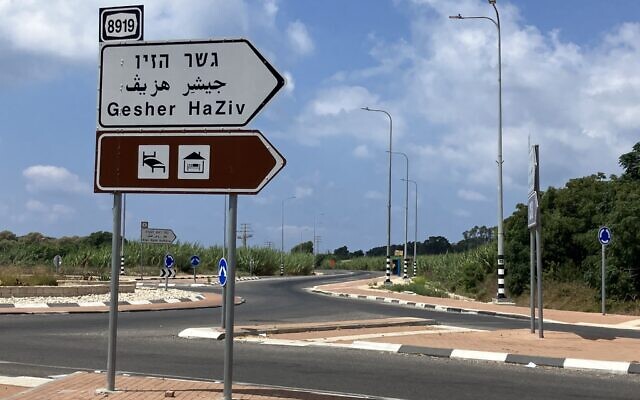
But rather than confront the question of the continued denial of Palestinians citizenship or rights in a nation bordered by fixed boundary walls, the ongoing vigorous mapping and remapping of Israel as if it were a right of self-determination seems to be what the call to action seeks to place front and center. A counter-mapping if there ever was one, the erasure of Palestinian presence in the region that dates from the War of Independence has begun a cascading struggle to be contested and renarrativized in maps, making the mapping of Israel’s boundaries not only a historic removal–a fait accompli that one has to ask Palestinians to ‘get over’–but a living legacy that has been sought to be bolstered to a state of quasi-permanence any the bonding of ‘Israel’ by concert barriers and razor-wire topped fences manned by soldiers, more than a Zionist dream. The mapping of Gaza was not, perhaps, I was thinking as I read the letters, so far distant from the heady dreams that my father felt, in 1951, flying from Buffalo, NY to Amsterdam, before taking a train to Marseille and a boat to Haifa, amidst immigrants and refugees eager to arrive in a newly founded state to defend its boundaries, living for seven months at the renamed kibbutz of Gesher HaZiv, restoring the Hebrew names of the land, just ten minutes from the Mediterranean and just south of Lebanon.

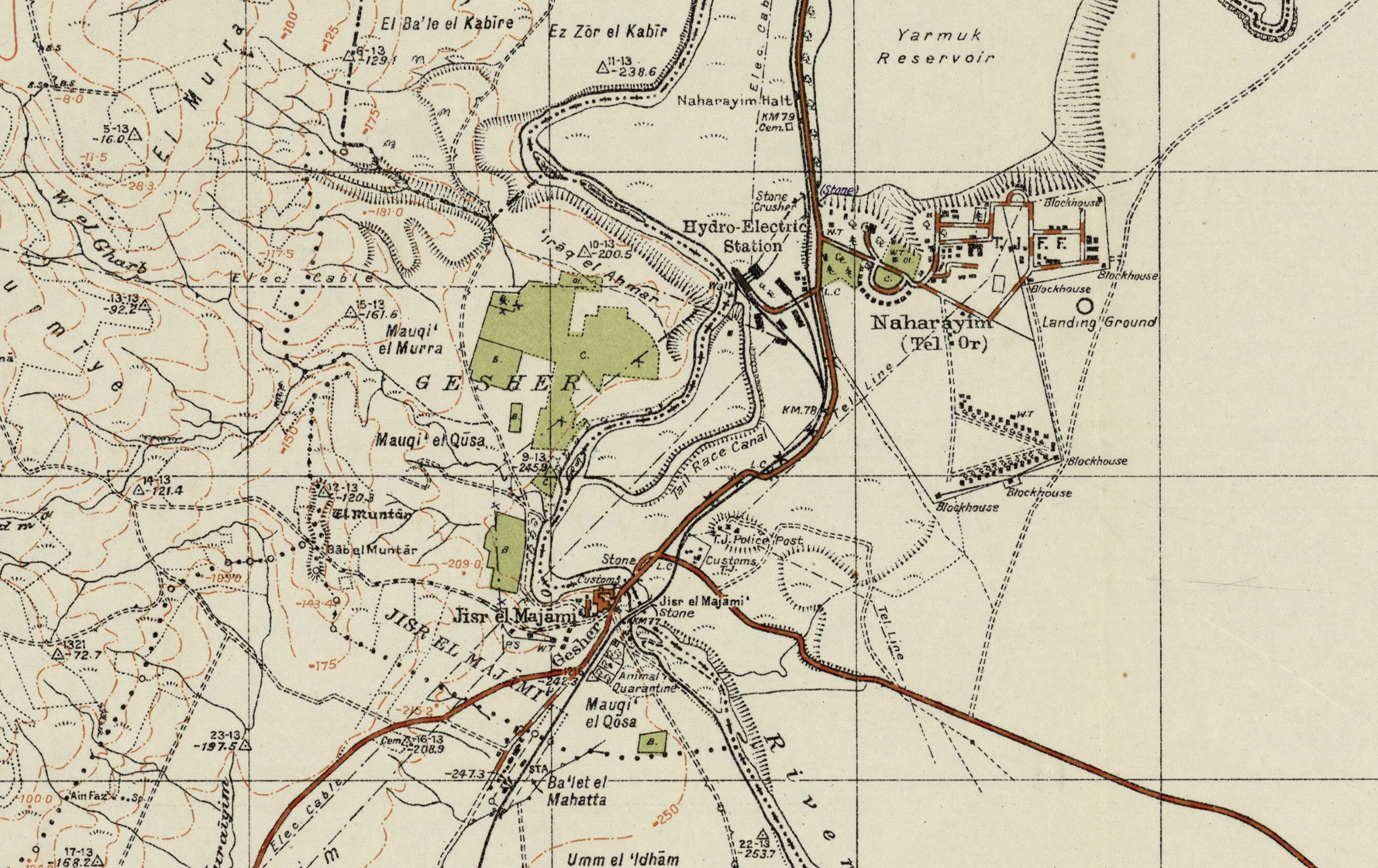
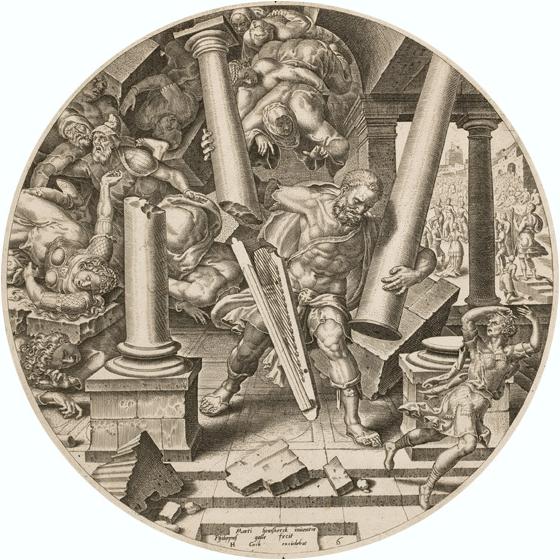
s The kibbutz is fairly typical in that it was settled immediately after what was then patriotically called the War of independence, on the edge of the Lebanese border and the edge of the Evacuated Zone of southern Lebanon, recently the subject of Hezbollah attacks. If Gesher was a kibbutz by 1951, seventeen years before the kibbutz was founded beside an ancient bridge after the construction of a hydroelectric power plant, the old kahn Jisr al Majami was home to 121, including 112 Muslims and 4 Jews, by 1931 attracted over 300 Jewish settlers to cultivate oranges and bananas, and the kibbutz built atop the ruins of the old fourteenth-century kahn of which no traces would remain. When he travelled to Jerusalem, in late November, leaving the settlements founded in the 1920s, it seemed eye-opening as the landscape was so heavily inscribed with its own history of a recent war that he had been studying in class: a torturous trip through the hills of the Jerusalem corridor on the way to the northern Negev revealed extensive cemeteries of groups of soldiers who had ‘died defending the area–groups buried together according to the battles they fell in–rows of small white markers sectioned off’ the material record of the considerable ‘price paid for the hilly rocky corridor to our capital–for lifting the siege of Jerusalem.’ The journey that led him to view the ‘old Biblical city’ led him close to Gaza–near ‘where Samson and Delilah chased around,’ and in his visit to the coastal plain of the Mediterranean near the current Gaza Strip, a border of Canaan, as the Gaza Strip near Askelon–aware of the new policy of renaming, as Meron Benevisti, former deputy mayor of Jerusalem and historian helpfully put it, much ‘like all immigrant societies, we attempted to erase all alien names,’ and the ‘Hebrew map of Israel constitutes one stratum in my consciousness, underlaid by the stratum of the previous Arab map’ that it conceals. As an American, was the similarity to the renaming of upstate New York’s older native names not a possible parallel? The warrior Samson, delivering Israel from the philistines, provided a model as much as David fighting Goliath, provided a model, even if that weakness for the philistine women was potentially able to make the walls come tumbling down.

–became in the 1950s an industrial area indcluding a mammoth cement factory, electrical plant ‘to be run by Israelis’ and nursery of a million seedlings ‘for reforestation of the surrounding areas,’ more than a muscular site of combat that needed to be defended. Despite the expansion of severe restrictions on Palestinian ownership of land after the occupation of Gaza Strip in 1967, in hopes to prevent Palestinians from expanding abilities of permanent construction or economic development, the industrial zones that were  planned for the Neshler Plant to provide housing for the expected waves of immigrants that were hoped to arrive in Israel from the early 1950s–realizing the 1902 demand Benjamin Ze’ev Herzl had that ‘the construction of a state for the Jewish people must also take into account the founding of a Hebrew cement plant.’ The foundation of the plant in Ramla, as David ben Gurion proposed building a second in Beer Sheva, completed in July, 1953 was what my father witnessed, that produced bags of needed cement from August, 1953.

The trip that was sponsored by the Jewish National Fund, a major player in national development from projects of land reclamation and marshlands to afforestation to prepare land for settlement in large public works projects was based on a long-term Zionist effort to raise funds from Jews around the world to purchase lands for future settlement, growing form 25,000 acres in 1921 to double by 1927, founding some fifty communities, and by 1937 planting over 1.7 million trees in the Holy Land, that gave a new sense to the Jewish festival of Tu BiShvat, the New Year of the Trees, celebrated as a festival and a celebration of tree-plantings. Indeed, the stamps that my father sent home were uniformly a glorification of agricultural work, in keeping with the fiftieth anniversary of the Jewish National Fund, the main operation that had brought him to Israel to help ‘redeem’ the land–a project still celebrated in Hebrew, English and Arabic, reflecting the vision of a united state. That project of redemption has long faded into the past of an ideal of farmers nourishing the land.

By 1939, ten more cities were built by the JNF, including the Negev and Galilee, purchasing land for new communities that began in the war that housed European emigrant, focussing on the settling of the Negev and south–areas that were banned from settlement in the Mandate–as the JNF readied with new determination after World War II to launch a large-scale settlement campaign from 1946, based on the Zionist Executive’s fear that clear British planned to confine settlement to a small region outside a planned British protectorate in the south of the country, as they had greatly expanded land holdings beyond expectations of the first settlers, the map inviting but its borders were afraid to be clearly defined, as operation of settling the lands grew for collective farms.

If settled the land had no set bounds, imagined to be steadily reclaimed quite expansively. And by 1948, some 650,000 Jews had resettled 305 towns in the future state, the great majority (230) on JNF lands; by 1951, the fiftieth anniversary of the JNF, Israel’s population had doubled in but three years since its founding, setting the stage for a push of intensive afforestation began in the Galilee, where my father arrived, as the Martyr’s Forest planted for those killed in the Holocaust victims. If Jerusalem was not clearly on the map, the place of the settlements clearly was–

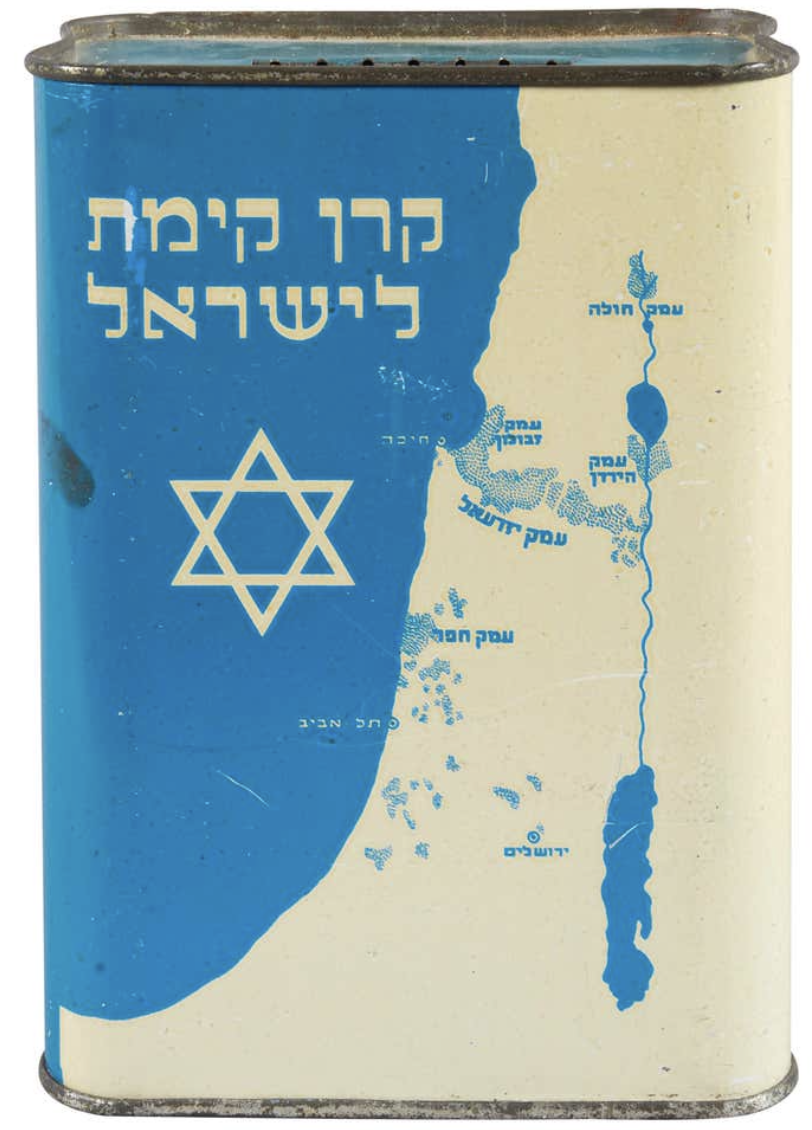
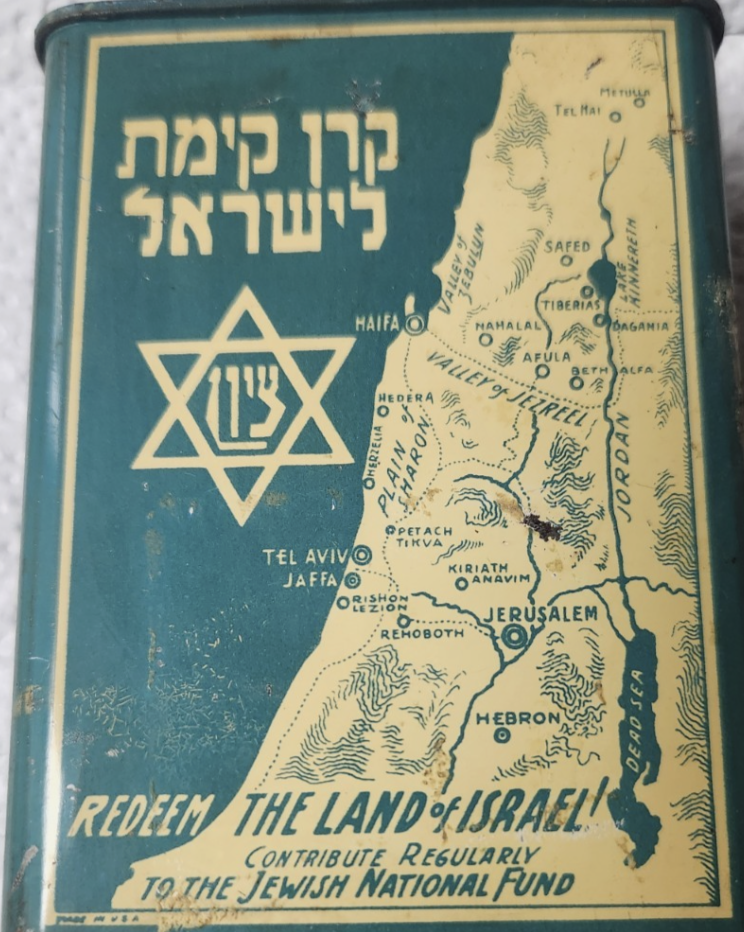
Map of Settlement circa 1925 in Jewish National Fund Tin Charity Box, Made in Ertez Israel, Keren Kayemet Yisrael (Design of 1930s and 1940s)

–suggesting an image of the conquest of space at a remove, but whose target near the Dead Sea was clearly identified as the holy biblical city of Jerusalem.

While the image of such an improbably conquest was removed from the land, the map that focussed on the Hula Valley, Sea of Galilee, and Jordan Valley offered a spatial imaginary that preceded the state. The Jewish National Fund’s ‘blue boxes’ symbolically mapped a covenant with the project of settlement diffused globally in the interwar period; the JNF indeed had by unification accumulated highly valued land across Palestine that were mapped with some precision in the diaspora, by 2015 holding some 13% of the lands open to settlement–if the plan to sever its covenant with Netanyahu’s state that year, as was planned as far back as 1961, was feared to plunge Israeli real estate markets into chaos.

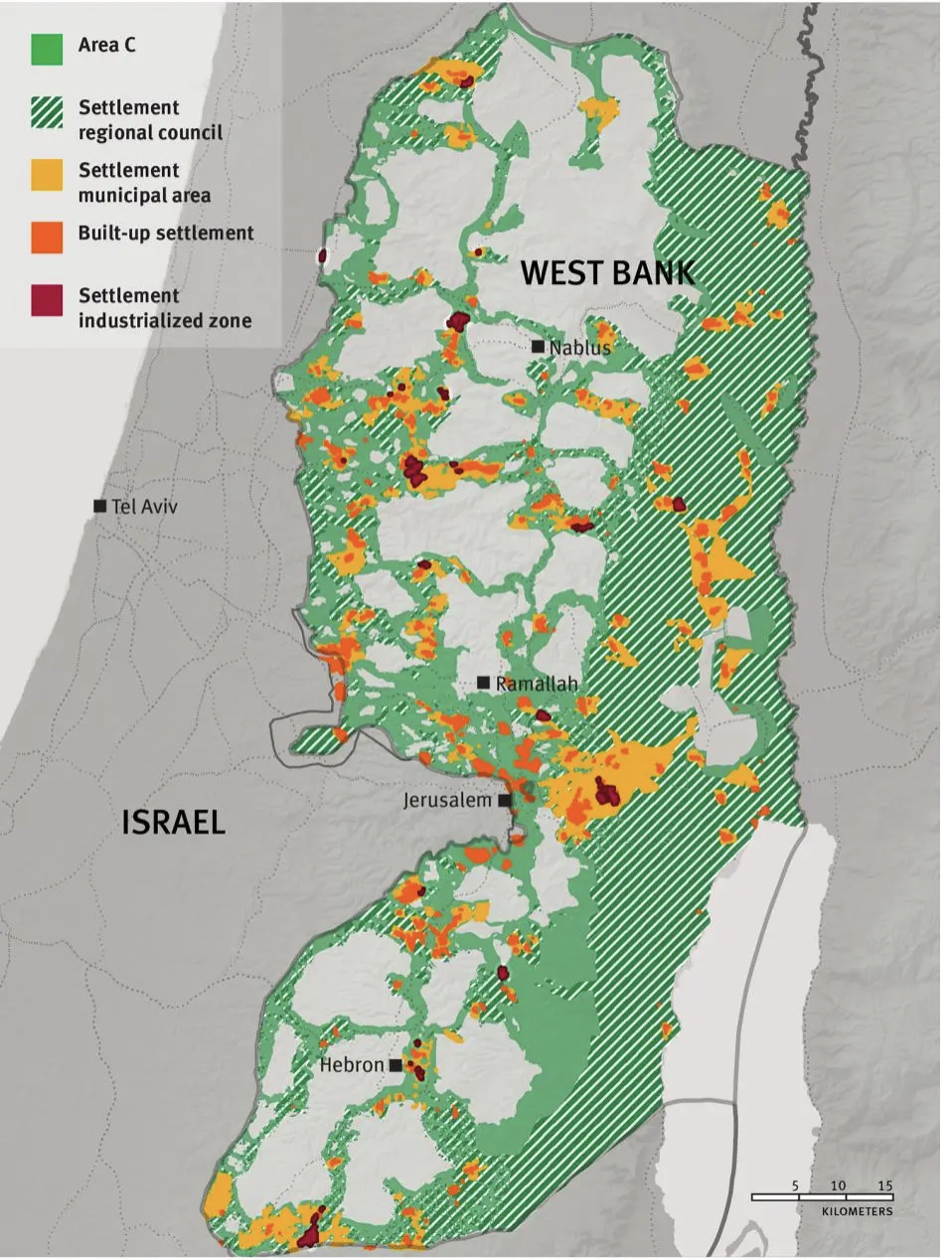
Into this breach, with huge consequences for global geopolitics and indeed for the Gaza War, as the JNF helped to support the continued expansion of settler groups in East Jerusalem and the West Bank, the great-grandchildren of the owners of these charity boxes in the United States helped to donate millions to construct new homes for settlers that would displace the Palestinians, already long restricted from owning property from 1967 in the Gaza Strip. The current expansion of ‘settler colonialism’ in much of the margins of the Israeli state, creating a massive 26% spike in settler housing from 2015, foregrounding outright land grabs rather than purchased plots, often illegal, to reclaim Palestinian lands as ‘outposts’ of future territorial growth. By 2015, a full 15% of Israel’s Jewish population resided in settlements outside 1967 armistice lines of 1967. And the rapid defense of these settlement colonies in response to the attacks of October 7, 2023, revealed how intense the conflicts of religious settlement was on a global stage, as Netanyahu grew increasingly tied to American Republicans, and the delivery of increased weapons to Israel to defend its borders, and a growing right-wing support for Israel settlements in a new geopolitical map–and was based on the demolition of old houses with support from America, partly from fundamentalists and hard-line Zionists, that forged new and unprecedentedly convoluted if deeply symbolic transatlantic ties.

Human Rights Watch/map by Btselem, 2008, 2014

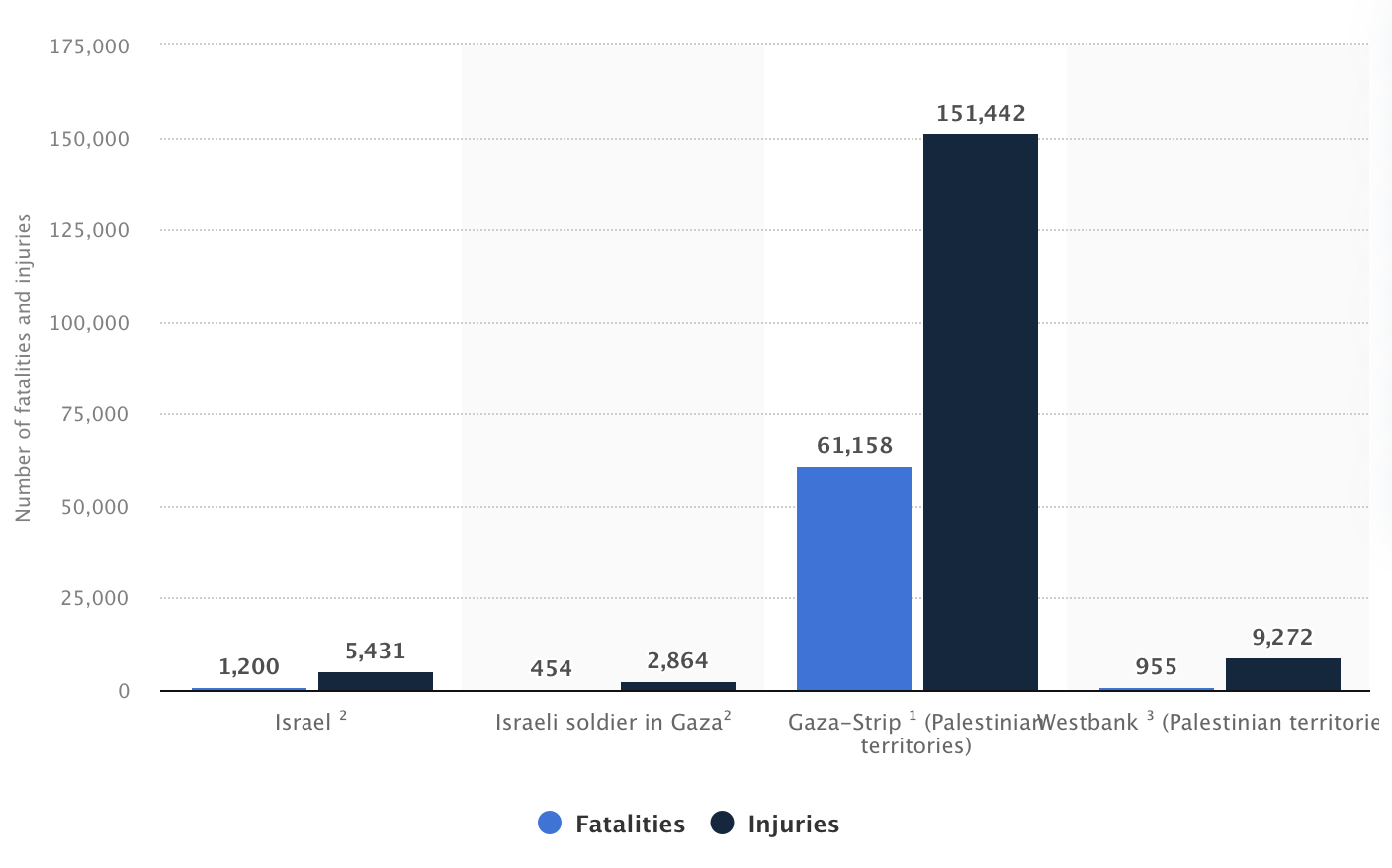
The regions of settlement were more a hope in 1925, of course, when early Zionist aspirations for claiming land, a claiming of land that has increasingly been at the cost of so many lives, both Israeli and Jewish, as well as Arab and Palestinian, that left not only 70,000 dead or trapped under rubble after two years, and almost 74,000 by 2026, according to the Gaza Ministry of Public Health, with some 1,200 Israelis and foreign nationals killed in the original attacks, and an incomprehensible level of bodily harm and loss only confined to the Gaza Strip–

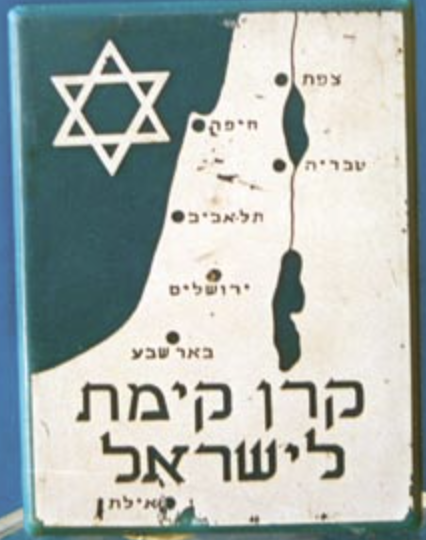
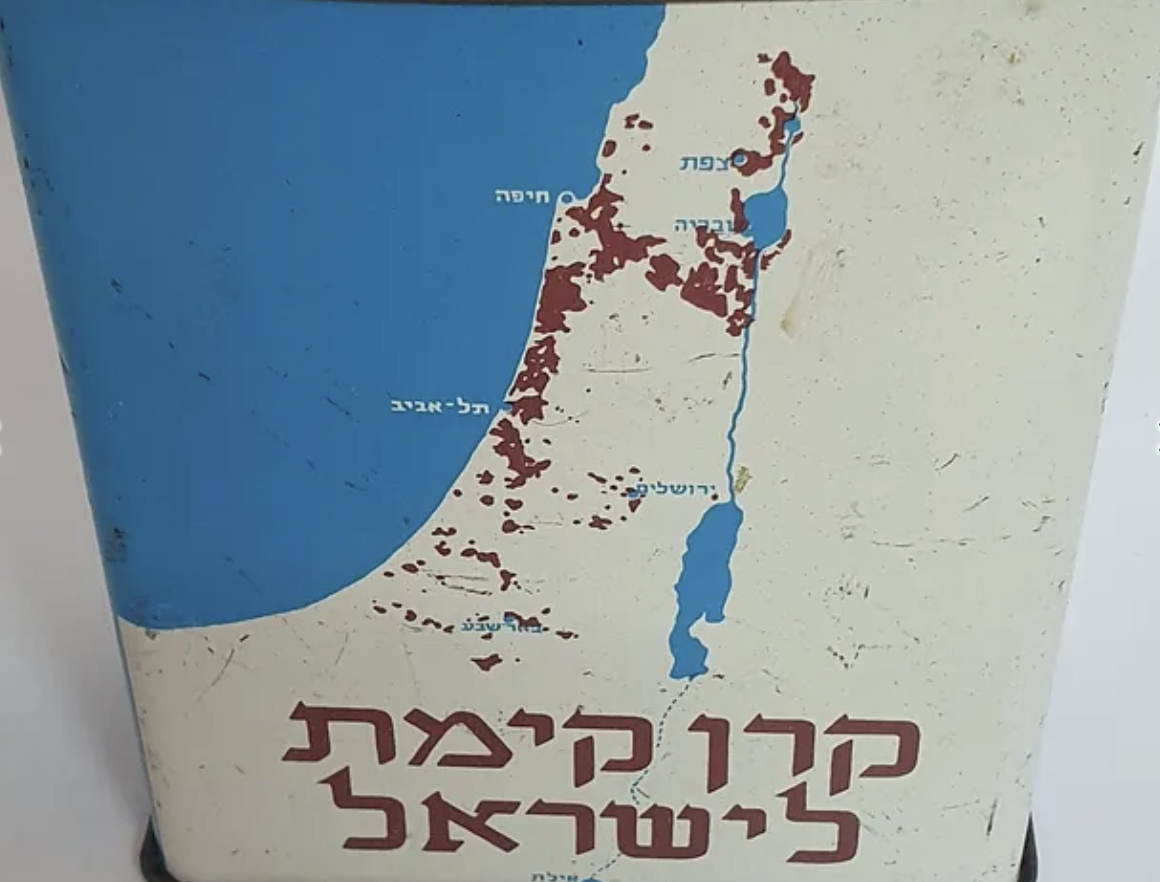
–makes the defense of these boundaries both difficult to understand, and less dependent on any objective mapping, so much as the deeply psychic maps or symbolic mapping of settlement staked in the spatial imaginary in KKH collection boxes long ago, that spread a spatial imaginary that transcended monetary value, or actual consequences and practicalities of settlement, and a density of settlement in the Lower Galilee–

KKH Collection Box, undated

–offering clear and crisp toponymy in Hebrew script of Jerusalem, Tel Aviv, Haifa, and Ber Sheva as objectives far more durable than the tin boxes that they were manufactured to hold, but that even eerily seem to prefigure the very tools of data visualization increasingly central tools we use to visualize the ongoing if not seemingly unprecedented or unimagined intensity of this border war–

KKH Collection Box, c. 1925 (detail)

–casting the process of land redemption as a literal redemption of the land before Israel’s founding, of which Jerusalem, just off the West Bank of the Dead Sea, was clearly a target and eventual hope. The land was disused as not only mapped in detail, but by clear targets–indeed, striking Jerusalem as its capital, before the foundation of the state of Israel–

KKH Collection Box, c. 1940

After Jerusalem had indeed been secured the nation as the new capital of the state by 1951, when my father had arrived in the Galilee by the sponsorship of the Jewish National Fund, Gesher secured the hills near a large reservoir and hydroelectric station that promised the increased modernity of the process of settlement. The station and dam allowed the irrigation projects to flow to fertilize land reclaimed for farming, to feed an expected increase of population in a postwar fantasy of feeding and rebuilding the nation in the years immediately following World War II that had attracted a new generation of pilgrims and settlers to arrive from the United States. From imprecations to his parents that “I need no money–don’t you know that we can live without it?” in the midst of kibbutz life in mid-February, the collapse of the kibbutz project by mid-March led to requests for borrowing a small sum of money to extend his travels in Europe, promising to stay only in hostels and cheap restaurants, that ended up in his taking a boat back from Israel by the Spring.

Gesher in the 1942 Survey of Palestine

For my father, arriving in Haifa in the fall of 1951, the War of Liberation seemed narrated as a distant past: the kibbutz founded by Armenian Jews, was a site for marvelous starry nights founded by a union and surrounded by mountains, a developed site of ‘bright, beautiful surroundings,’ and blue skies, near an ‘ancient Arab village’ that was by now abandoned, ‘dating back to post-Biblical times,’ and a crusaders’ fortress in the nearby countryside. Attending lectures on Zionist history for the first weeks he lived at the kibbutz, as well as on collective farming and Israeli history, he spent evenings watching films, seeing plays, or learning Israeli dancing. Hearing of a nearby orange grove, he was thrilled at a sense of safety; yet the dangerous proximity of a kibbutz near the border with Lebanon inhabited by Arabs was vertiginous. “From here Arab territory is easily seen from the second story of the [kibbutz] library,” providing an undercurrent of awareness of the past inhabitants of the land that may not have registered in hitch-hiking across a ‘beautiful country’ or traveling by tremp, or hitch-hiking, as the attention of kibbutzniks was focussed on the impending potential arrival of the two million Soviet jews then hoping to immigrate to Israel. He admired how formerly Arab towns ‘now settled by immigrants,’ and saw the ruins of the Independence War in the landscape as a cost that was needed for this way of life, to add a layer of security to settlement of these hills, newly terraced fo future agricultural projects essential to projected settlement, both to create a historically important ‘buffer’ between the states of Jordan that had claimed these lands, and secure the edges of the new Israeli state, as well as a site for feeding its population.

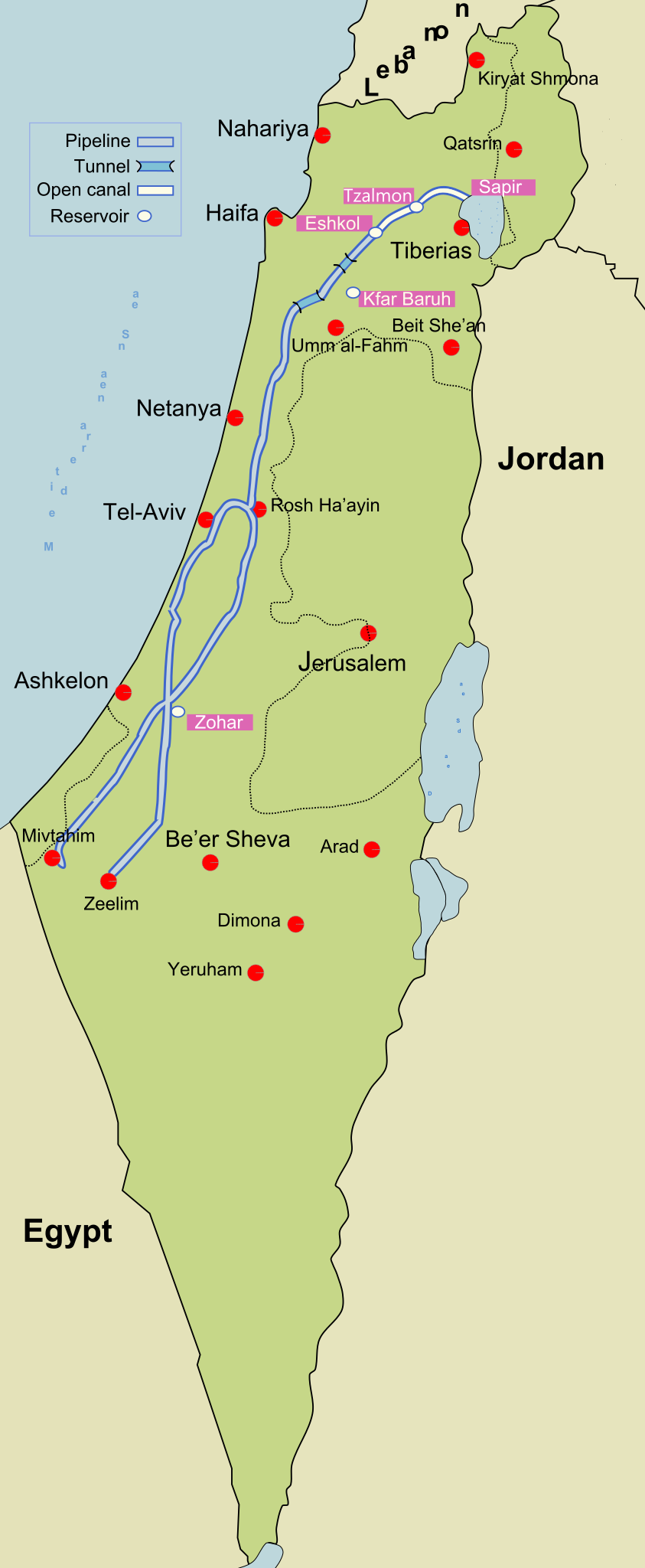
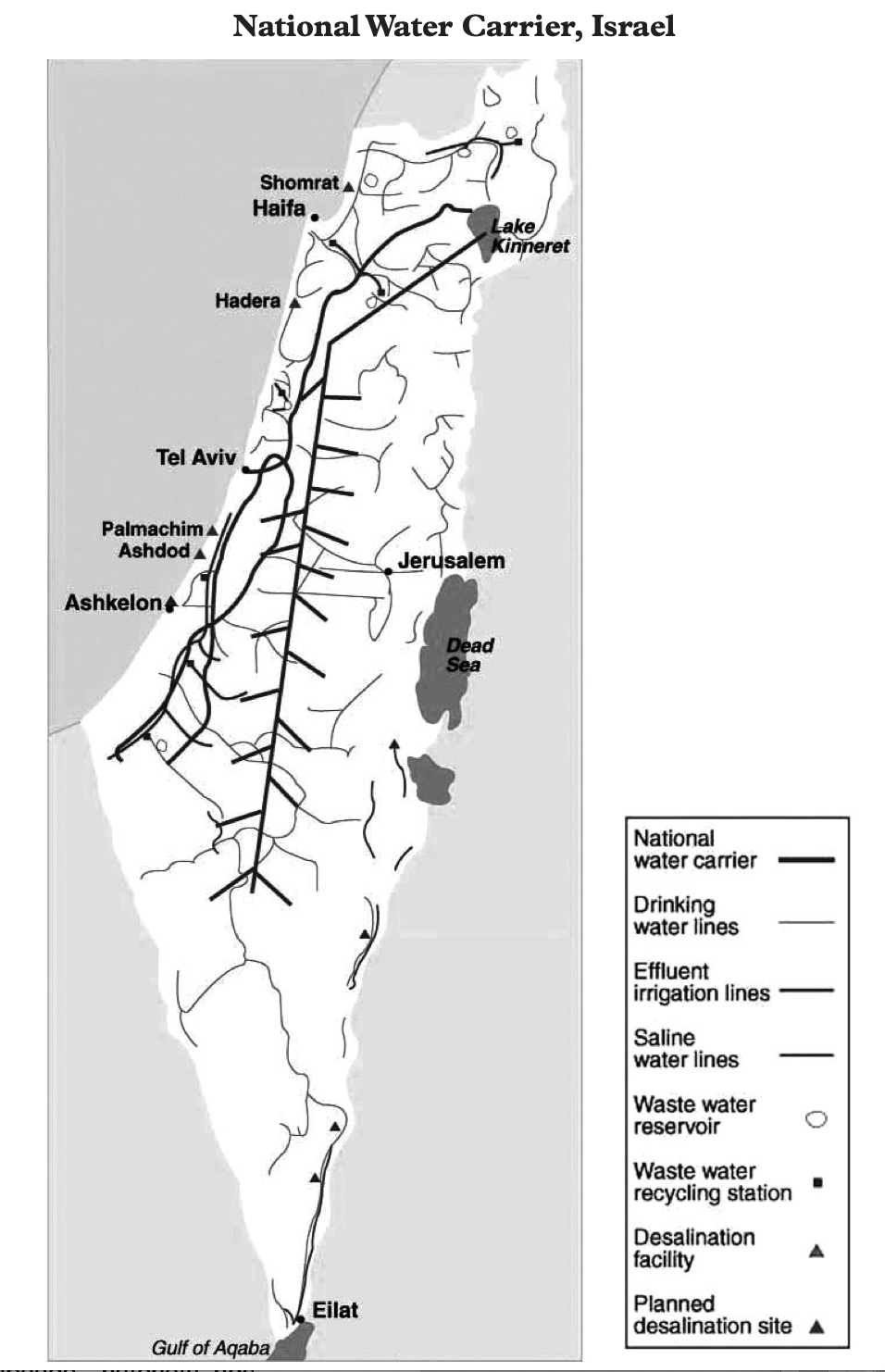
While the collective farms that were central to the foundation of Israel in the immediate postwar period were going through something of a crisis by 1951, facing problems in attracting new immigrants, the belief that more immigrants were about to arrive became a basis for believing in the growth of the state, even only four were established in 1950, and the possibility of more emerging was constrained by water, and the political divides that emerged between labor parties divided the logic of settlements, at the same time as kibbutzim were not attracting the waves of optimistic pilgrims that they had in the past. The situation was indeed rather grim on the ground, if the rhetoric of boosterism was stronger than ever, and the possibility of a major National Water Carrier was increasingly needed for future agrarian development in the nation, and increasingly dependent on a policy of the confiscation of lands from 1951 from Arabs, rather than the use of land purchases. Passing towns that had ‘passed from Arab to Jewish hands several times’ in the War of Independence, he presented his parents a picture of deep historical past that within three years since the war had receded to a distant time, transformed by the cultivation of fruit trees and olive trees. By Chanukah, my dad relished signing his name in Hebrew, having encouraged that his parents were taking courses in the language he’d mastered in summer camps in upstate New York, but was now using on the ground: and he offered them a map of the place of potential resettlement, where a few neighbors from Buffalo had moved. The National water Carrier that had expanded by 2015 was already drilled through some hills, from the large hydroelectric station off of after the first damming of the Jordan River in 1932-48 promised power for Mandatory Palestine, just south of the Galilee at the Huleh Lake and Swamps, central to the “All Israel Plan” of securing water from the Jordan for the entire country from the coastal plain to the Negev, in an artificial aquifer that has allowed the state to grow, and expanded by 2015 to a central artery of national infrastructure.

The rise of cooperative villages, which my father later visited, were hoped to be a way to make the kibbutzim more profitable, and permit private consumption that was not encouraged at the first projects; newspapers reported land reclamation projects best by ‘strife’ as dissension between the dominant two political parties created divides in kibbutzim based on alternative views of the future of the cooperative settlement–in ways that were only lessened by the construction of a National Water Carrier as now exists, offering a sense of limited coherence to the divergent political interests and hopes that exist entire country, but increasingly marginalize the West Bank and Gaza from the prosperity a Carrier promised the state. The National Water Carrier bolsters agrarian projects and provides water to the kibbutzim that have longed run around Gaza, as if echoing the boundaries of settlement, and providing little more than water waste recycling centers in Gaza and Ashkelon, and some very limited drinking water essential for humanitarian needs.

The geography was not about clear borders, but of an expanded new world of labor and work. When he asked the kibbutz members what had happened to the Arabs who had previously lived there he was, he later realized, met with stonewalling: they ‘went somewhere else’ or ‘left’ as if on their own desires. When he took an excursion from the orchards and vegetable gardens of the kibbutz with a few friends to another nearby kibbutz, Nir Ayliahu, still closer to the border, he seemed to pass destroyed towns in abundance, in which kibbutzniks lived among in sturdy settlements to reclaim the land by resettling them by irrigation of the land. The border was written ‘boarder’–not a spelling error so much as homonym implying the Arab town was impermanent, as the ruins of a depopulated Arab village led only to marvel at finding a landscape of “hundreds of such places all through the country as a result of the war” of 1947-49, the ruins of a distant past that mirrored the biblical landscape he learned about in finer grain, as if to map a new territory that, if from a scriptural period, was suddenly being realized and replacing depopulated villages that were being swept off the map of the State of Israel, defined by a National Water Carrier that segregated access to water of Palestinians form the Gulf of Aqaba to the Galilee.

There was even a vertiginous existential fear at a landscape where such continued evidence of scars of wars were all too real than they had ever been for Habonim summer camps, and from the kibbutz he heard–in terms of an angriness I recognized, but was embarrassed to read, ‘the noises from a dirty little village across the way came from a dirty little village across the way came from people who yesterday lent a hand in trying to destroy the very place where I sit today and kill off half of the people around me,’ a rant that was trying to comprehend the fragility relation to the present that almost might not have been.

The emergence of a distant past geography of the past in a wartorn landscape left little possibility of cohabitation with Arabs as neighbors or fellow citizens. He surveyed an Arab village populated by ten thousand on the other side of the border as an existential enemy, determined to deprive the reality of a kibbutz he lived and farmed vegetables, with citrus trees grapefruit and oranges in a biblical imaginary of a land of plenty, covered the ruins of a destroyed Arab village erased from memory. A few Arab villages as Tira, of several thousand inhabitants, still lay in Israel’s boundaries, allowed to survive. But the geography of Kibbutzim replaced that of Arab villages, and the seat of government that had been partially transferred, leaving some buildings the ministry of defense in Tel Aviv, to Jerusalem, deferring the question of how the governing of the land included Arab settlements, or suggesting, if unconsciously, that such ‘boarders’ lived within the ‘border’ of a growing state. Tara was just to the north of the kibbutz Ramat Hakovesh, or Pioneer Ridge, of seven hundred sturdy immigrants where he pondered they ‘borne quite a battle during the war of liberation.’ The kibbutz promised rapid transformation of the ‘barest’ of barren land, irrigating the slopes of hills to prevent the environmental degradation of the Galilee in the Palestine Mandate. The collective zionist goals espoused by Hashomer Hatzair had hailed from Northeast Poland, but thirteen years before a Nazi invasion decimated the towns seemingly providentially founded by a dedicated and ardent immigrants, who had camped on land they purchasing from an Arab family not long before the disastrous 1939 invasion depopulated the enclaves they had lived.

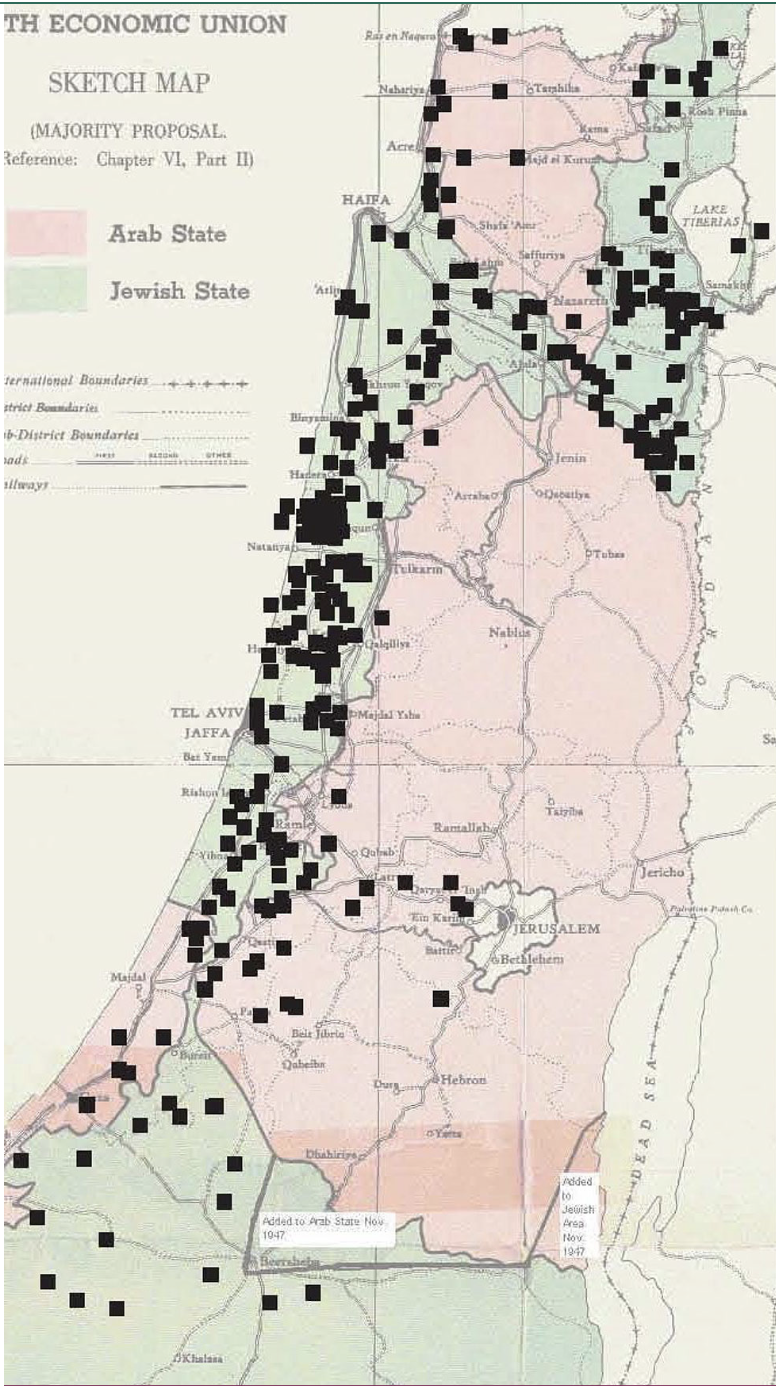
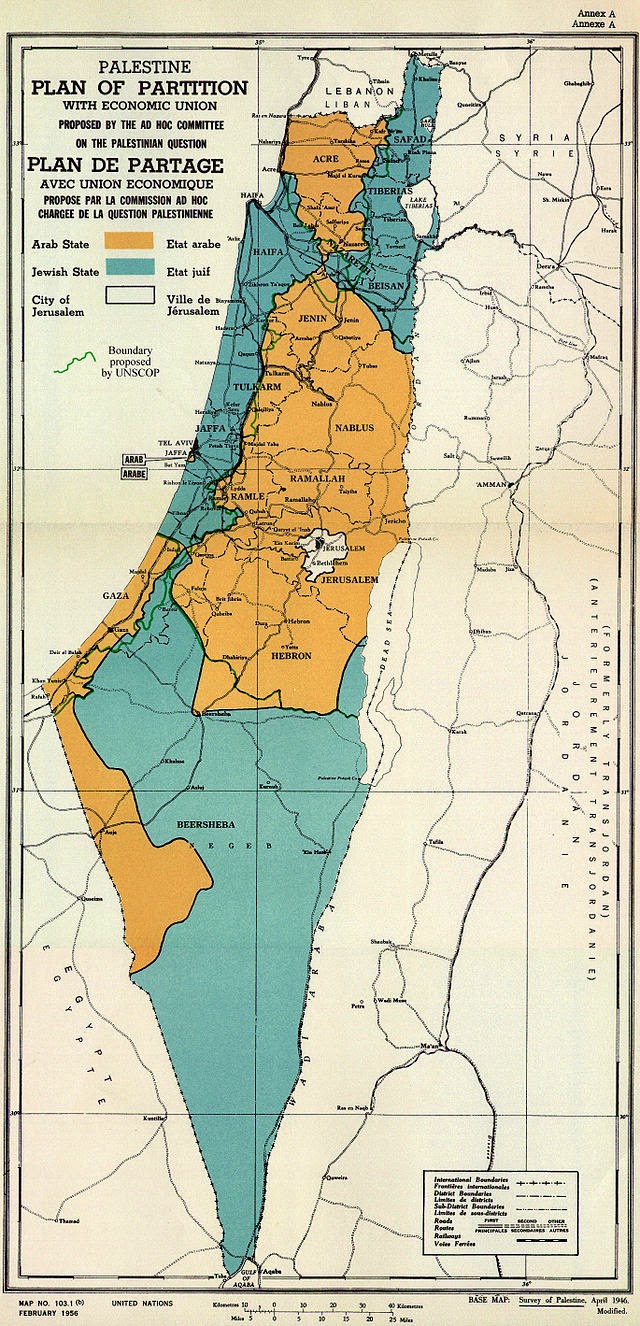
Indeed, in the years of the celebration of “Settlement Day’ by the cultural wing of the Israeli Defense Forces that included visits to kibbutzim located near army units, including the screening of films, lectures, presentations, and exhibits on Succoth 1948, by promoting ‘frontier sites’ as ‘the defensive walls of the state,’ the inaugurations of a ‘Settler’s Army’ was charged with the task of ‘the preparation of the land for massive immigration’ that was expected, President Chaim Weitzman proclaimed the need for continuing the war with the ploughshare and the book by agricultural settlement to determine the future of the Israeli state: by Israeli values: and by including new immigrants to the Land of Israel, the proclamation of marching to a ‘light of settlement and defense’ in April 1949 led to the creation of fifty two new settlements, of which thirteen were in the Upper Galilee my father lived for seven months, five in Lower Galilee, ten in the Jerusalem Hills, and twelve in the Negev. Three hundred and fifteen settlements were created in strategic ways across the nation from that The kibbutzim embodied the sense that manual labor would be a means of agricultural ‘conquer the nucleus of the growth of the Jewish population of Palestine from 25,000 in 1882 to 400,000 by 1940 to 600,000 by 1948, the foundation of the state, in ways that formed the basis for the United Nations 1947 Partition Plan, effectively securing the boundaries for the modern state. Settlements, in other words, both preceded and provided the precedent for the logic of the territorial state of Israel in the Sketch Map for the borders of an Arab and Israeli states in the 1947 partition plan, and indeed helped set the borders of the Israeli state.

With the eviction and relocation of existing tenant farmers in some twenty to twenty-five villages from 1901-1925, only some of whom were compensated, the departure of residents had opened the region to prospective residents of a “Jewish State” that might exist side-by-side an “Arab State.”

JewisEconomic Union Sketchmap based on Jewish Land Settlements of 1947 Proposed by UN  1947 Partition Plan Black affixed squares of Jewish land purchases prior to 1948 against division of Arab and Israeli land

My father’s experiences at Gesher afforded an on-the-ground look at state formatino from the bottom up, based on the attraction of Americans and American money to energize the expansion of settled lands up to the outskirts of Jerusalem, and along the edges of the Gaza Strip and into the Negev. The newly terraced land my father helped settle in the kibbutz in Gesher offered confirmation of a far more efficient manner than earlier inhabitants had managed as if to illustrate the manifest destiny confirmed by the efficient application of years of labor to remake the land’s wealth in modern ways, impressed by encountering industrial engineers who had finished graduate work at the University of Chicago who were building the new country that would soon feature large airfields, and a ‘mammoth cement factory’ outside Jerusalem, in the rocky corridor of graves that marked ‘the price paid for the Siege of Jerusalem’ to capture ‘our capital.’ By Hanukah, studying Hebrew intensively for several months, he relished his father’s decision to begin studying Hebrew back home by taking to sign off letters in Hebrew script, accepting the new identity, dispensing tips on the festival in the reclaimed biblical language as a personal identity, as his increasingly personal relation to the land where the kibbutzim expanded and grew, disguising a colonial relation to the land, in many ways, as an unleashing of its wealth. The impression of the deep poverty of all Israelis for my dad led him to imagine a new relation to money, even if, as the kibbutzim ran short of funds, the need for more money seem to have sent him back to New York by late March, 1952.

The long-famous liberal Zionist pedigree of the founding and cultivation of this new relation to the land put into question by the October 7 invasion had set their primary mission to ‘conquer the land,’ without discussion of who resided there–and many of the kibbutzim around the borders of the Gaza Strip itself by Hashomer Hatzair members were placed on older Palestinian ‘Arab’ villages in 1949, perhaps even visited by my father, crating a sense that any place vacated by settlers would be filled by Arabs, and new American migrants might fill the land in proper ways for a new state, ‘conquer[ing] hill after hill without consideration for the law,’ as the current leader of the Kibbutz movement Nir Meir  expalined recently, promoting the settlement of new communities to seed the land in Galilee, which is now half populated by Jews, rather than eighty-five to ninety percent inhabited by Arabs. Peace with Gaza would be, for kibbutznik near the Gaza border, a condition of trauma and victimhood.

The land of Israel was in large part forged not by governance of the land, but by the kibbutzim that celebrated a series of civilian outposts to take ownership of the land, and indeed establish the Land of Israel. At stake was nothing less than effective modernization, and the transformation of a dry landscape to a bucolic new homeland–the model for an effective state. If ‘the job Arabs did of terracing was pretty lousy,’ so lousy they were ‘unable to be worked efficiently by modern methods,’ the modern tools of engineering prosperity and supplies of food preserved the ‘remains of an old Biblical city’ with new and old settlements in the Judaean hills readied for reforestation that offered ‘beautiful views of the coastal plain’ and more than one ‘old Arab village’ in areas where kibbutzim had been established for many from around the world–South Africa, Romania, Iraquis, and Germans–actualizing a hope of resettlement unimaginable in earlier years. The new alliances that filled the transformed landscape of the Middle East suggested nothing less than the opening of a new world to which my father felt he was witness, invited by the Jewish state to observe the new wheels of global democracy in action in 1951, in between his occasional visits to the Americans from upstate New York who had returned to settle the Holy Land soon after the end of the War of Independence.

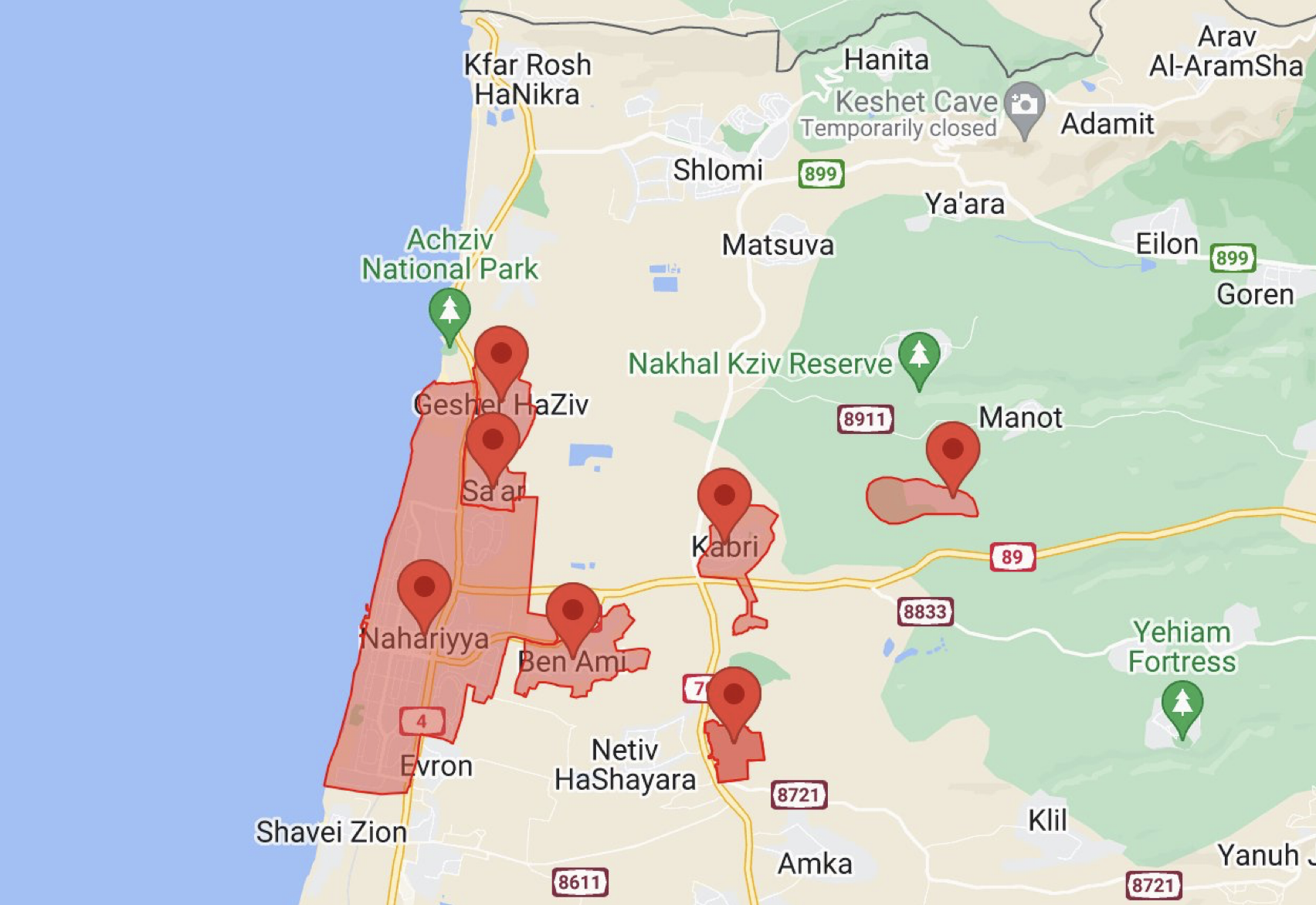
That the kibbutz in the western Galilee was just over three miles from the border with Lebanon would become the de facto border of the state in 2024, and the final stop before an evacuated zone, policed by Israeli Defense Forces,–but a hundred meters from the zone from which the Israeli army had evacuated all civilians after the Gaza War began. The kibbutz of 60,000 became an outpost of sorts in a game of territorial borders, its pastoral appearance concealing the increasingly vigilant prevention of cross-border attacks and skirmishes, or attacks by explosive-bearing aerial drones that is targeted by the 130,00-150,000 rockets and missiles targeting Israeli cities and kibbutzim. By August 2024, Gesher HaZiv lay directly on the Confrontation Line in the Upper Galilee, subject to red alerts as contested land.

GISrael, Red Alert/@ILRedAlert, August 11, 2024

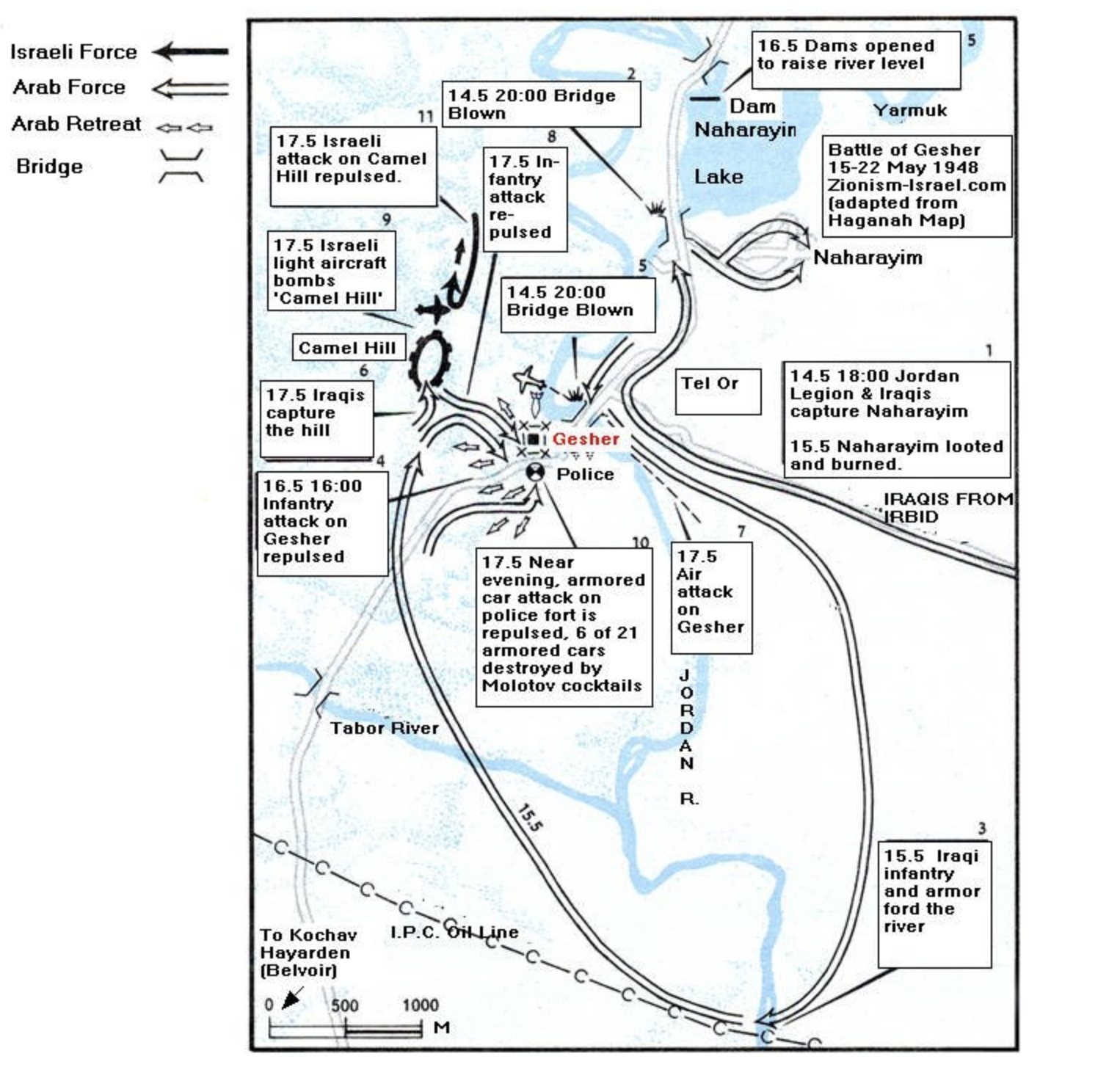
The kibbutz had been inherited as an outpost of the British Army in World War II, but was a site for war, before it became a site of Hebrew study of three hours a day, and privatized as a settlement in 1990. More recently, it has again become part of a war zone since Hezbollah had lent military help to the attacks on Gaza then day following October 7, a new reality of being a border town, and a hard edge of the state of Israel, increasingly demanding secure housing and military vigilance, if it was once seen as a tourist destination of Mediterranean architecture, serene gardens removed from urban life, promising ocean access to Achziv Beach’s tidepools, outdoors swimming, and camping in a large, bucolic national park. But the settlement of the United Kibbutz movement–‘Gesher’ means “bridge” in Hebrew, was an outpost founded in 1939 near the Naharaim bridge, reclaimed during Israel’s War of Independence as it was attacked by the Iraqi army and the Jordan Legion, is to the southeast of the Kibbutz, the original location a commemorative museum of the military battle. The erasure of contestation by agrarian work of fertilizing the long arid Galilee by water from the Naharayin Lake and the irrigation projects of the nearby Camel Hill provided a possibility of feeding a large populace of settlers, reclaiming the land by redeeming it for settlement, unlike the Bedouin itinerants who had lived there before.

Gesher HaZiv War

The original plan for the combined forces of Iraqis and the Jordan Legion to capture Afula changed as King Abdullah of Jordan told Iraqis the Legion would stay put in the West Bank in mid-May 1948, leading to the Iraqis to attack Gesher alone, eventually to be repulsed by Israeli troops from air and land, as troops from the Golan Heights forced the Iraqi troops to beat a hasty retreat to Samaria, and Israelis to secure the territory and a peaceful kibbutz moved to an English fort close to the sea, reclaiming a biblical historical landscape removed form the persecution of European nation states.

Travel Hotel Gesher Haziv, Gesher HaZiw (updated prices 2026)

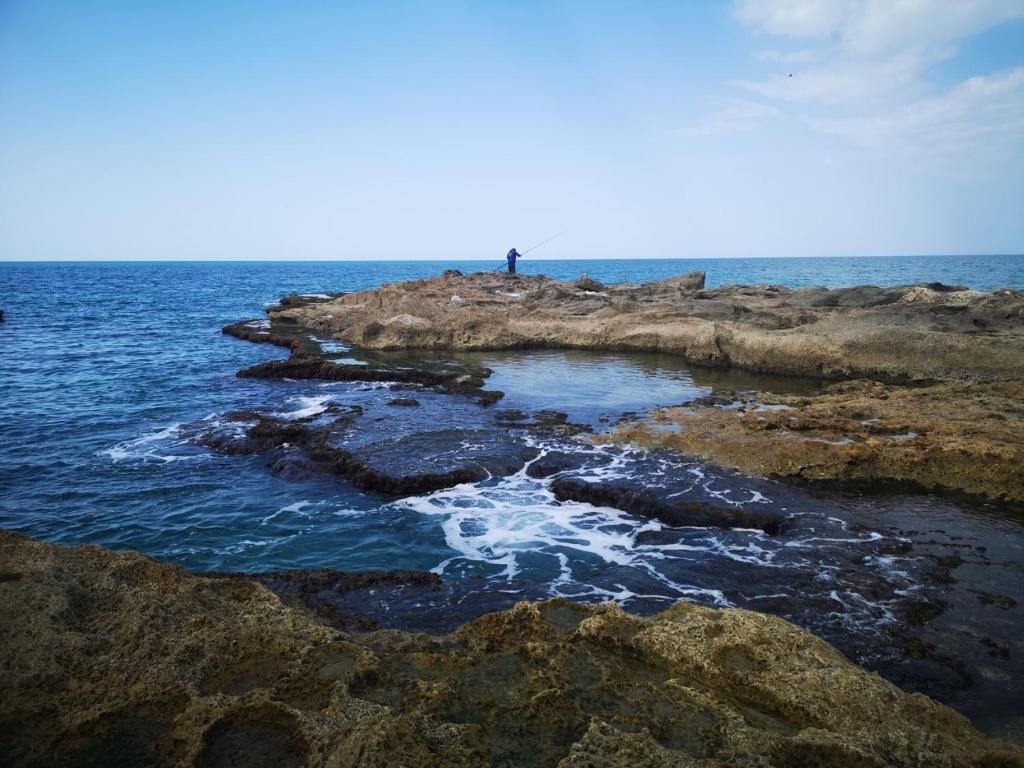
The Mediterranean was blue, and a site for fishing, swimming, and wonder. But there as little sense of war in its blue expanse as there might be of the Trojan War off of Greek islands like Lesbos or Chios, transformed by tourist traffic and beckoning as a calm blue. Yet when my father, retired, when to work for the summer and practice his Hebrew by talking to medical students in the Negev, working with psychiatrists from the West Bank in Bersheva, traveling with a Human Rights Group to Gaza to visit the Gaza Community Mental Health Center in March, 1994, between downtime with hikes in the Negev–‘flower’ hikes, wistfully–in towns filled with Russian, Ukrainian, and Romanian residents, as well as Bulgarians and North Africans, mirroring the global attraction to the kibbutzim of time past. The Labor ZIonist past of the kibbutznik past was gone, but perhaps able to be recuperated in old age, My father had been struck that Israel was able to be seen apart from an American perspective in the 1950s, proclaiming local understanding the Middle East as the Eastern Mediterranean, as if a maritime region without boundaries or nations.

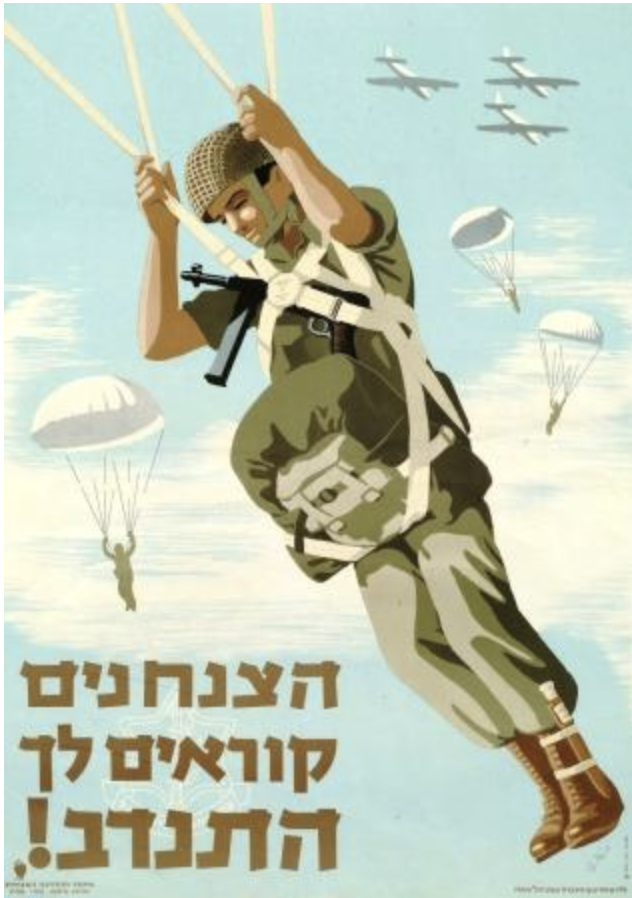
Visiting Jericho, Bethlehem, and attending a ‘Trauma Conference’ in Jerusalem as he worked in Beersheva, the contested boundaries of the Middle East seemed something he might navigate as disputed territories with a sense of security; he sent me a card from Beersheba of a pair of elite rapid deployment IDF fighting force of paratroopers descending from an airplane as a comic pair, one with parachute fully open, staring at the other the other calmly relaxing without one. The red-beret paratrooper descended without parachute and with a red beret must have spoofed an iconic image of vigilance and military bravery long featured in enlistment posters from the 1960s,–

— as if an icon of vigilance concealed his own anxiety by local humor, as well as a reminder of my love of cartoons– perhaps the cartoons themselves were a frivolous medium that maybe were a sign of my own oblivious disregard of existential threats?

Amazon.com: Israeli army IDF PARATROOPER brigade fighter (shavuzon) wings  BADGE Israel cobra snake pin : Clothing, Shoes & Jewelry

IDF Paratrooper Brigade Fighter Wings Badge of Cobra Snake

Maybe vigilance was not the point, but a new detachment from the political situation on the ground. When my father arrived in Israel in 1951, the glory days of the United Kibbutz Movement a massive way of collective settlement the contested Arab lands. If once seen as seamless with the Labor Zionist movement from eastern Europe and Germany, the recuperation of idealistic Zionism might include Arabs as well. But the hope to offer them ‘excess land’ by 1951 had all but vanished, with the loss of Socialist Zionism. The split of the United Kibbutz Movement the very year my father was working on a kibbutz between the socialist labor forces and led the agrarian settlement movement to fracture along the lines of a central schism of openly ideological nature. My father was stranded in the middle, in a sense, having tethered his dreams to the labor agrarian cause of collective work, that he would wrestle with the rest of his life, even as the defense of settlements became an increasingly prominent platform of the Netanyahu era.

If the Kibbutzniks were a form of early colonization, a ground forces of sorts that provided not only a claim to land, to resettle old Arab villages in a Nakba, but a demonization of their Arab-speaking neighbors as if invaders of a resettled sacred space, complete with monuments of actual biblical events that those making Aliyah could visit, but oblivious to the borders that were being created in ways that would be defended by armed outposts in the years after the so-called Palestine Partition Plan the United Nations adopted but four years before my father arrived in the new state of renegotiated and perhaps negotiable borders, before the Israeli army came to exist from militias that encouraged enlistment into “service to the nation” as a new ideal of nationhood, mobilizing the Israeli Defense Forces as a professional army to secure communications and continuity between Jewish territories to preserve a coherent nation.

Seventy five years later, the increasingly militarized borders of the nation-state made the prayers recited on the High Holidays particularly disturbing days as tensions grew in the days that preceded the October 7 invasion, an d the shock of an armed incursion of sovereign bounds of vicious civilian and military deaths. The fears of any assault of Israel’s territorial claims have been met by the increasingly intense fortification of its borders, a ramping up of its claims to “security” and “securitization” that has eroded the ethical values of the state, the defenses of these boundaries were both more militarized and less sustainable in the future, though which Habonim fell. The services that I attended in Oxford on the eve of the October 7 invasion included a prayer for the protection of Israel’s boundaries that placed dangers just beyond them. Having hoped to begin the New Year by hoping for the security with which they were guarded–as if they were granted by divine right but embodied by militarized defense–was unintentionally quite off-key, and made me grind my teeth during the High Holiday I had arrived to celebrate with some trepidation in a foreign country,–not seeking real friendship or continuity but hoping for familiarity as I set to orient myself to a university city I recently moved with my wife, trying to find some stability myself in what was in its own way a new land where I was more stranger than I’d expected, where I’d almost come to see myself as having parachuted but weeks before the October 7 invasion of Israel from the Gaza Strip. The prayer for the defenders of Israel’s secure boundaries seem to have sensed the immanent strike or need for protection, the threat having boiled over on the edges of the Gaza Strip before the invasion broke out so dramatically in international news to global shock. As belief in the regular degradation of Hamas forces in the Gaza Strip persisted, described now by the weird expression ‘mowing the lawn’ by indiscriminate bombing campaign, an attempt to disengage but preserve security, targeting and attacking the ‘captive population’ on the borders of Israel and refusing to negotiate. Bombing neighborhoods indiscriminately became rhetorically reduced to an operation of maintenance, whose consequences were never fully assessed.

While I was not concerned about Israeli borders, I was struck that the unexpected ritual invocation of the guarding of boundaries carried deep weight for the members of the congregation, reminding me that the prayer–an addition after the 1967 War– had long assumed deep significance. If the New Year’s holiday had some spiritual resonance and traditional power as a way of marking time, the sense of bonds among Jews grew with the coming invasion, making me negotiate my relation to the service I had just her. Indeed, the explosiveness of the invasion that left me and my fellow-expats reeling and hard to observe at a distance made me interrogate where that prayer had origins, and reflect how the literalization of a project of boundary-guarding had become so dangerous project of courting risks of raised the stakes, intentionally turning a blind eye. If the war was an invasion of Israel territory, the border zone between Gaza and Israel has, perhaps rightly, long been the subject of attention of Israel’s Prime Minister, who has repeatedly emphasized “stoppage points” and “closure” of the Gaza Strip and control of the border zone between Egypt and the Gaza Strip. The military securitization of these borders were hard to reconcile with the benedictions of the kindly rabbi. He led his congregation a final time in high valedictory form at the cusp of retirement, and stylishly negotiated the benediction to George V in our Mitkhor, to my ears, in an Anglican version asking for the safety of the royal family. In a sermon voicing dismay at the strain of lamentation strains of Judaism that he felt had infected or reconfigured Jewish identity at some loss of its original liberal optimism and pride, he wished us to engage the year ahead.

For a strain of lamentation, derived from the poetics of the laments of the Psalmists, but expanded to the elegiac account of suffering and commemoration that expand the liturgical elegies to accounts of forced conversion, expulsions, crusades, pogroms, and even assimilation short-changed pride of a “chosen” people, the rabbi felt, undermining a sense of pride. The ancient strain of lament in Jewish poetics and poetry certainly decisively expanded in twentieth century before inexpressibility of the Holocaust, and a need to express inexpressible pain in the face of fears of annihilation. But the logic of lament of would come to the surface with quite a vengeance after the unprecedented invasion of Israeli territory on October 7, only weeks after the rabbi’s sermon, as the unspeakable trauma of the crossing of the fortified border of Israeli territory opened existential fears that set in play a logic of retribution. If lament pressed the borders of linguistic expression and actual comprehension, the escalated response metthe anguish of lamentation demands, but no response can ever fully satisfy. The call to pride, and even content with being Jews, was somewhat tempered by the calls to save the warriors defending those highly militarized geographic boundaries, as much as boundaries of expression.

The boundaries of Israel as a “state” had become not only embattled, but less defended lines than firm fences, rigid, and asserting a statehood removed from negotiation, and perhaps from Zionism, as they were understood as bulwark against Palestinian expansion that so tragically ended with the battery of hundreds of ground-to-air rockets forms the long-barricaded Gaza Strip, serving as cover for a bloody invasion of Israel planned for a decade, approved by Hamas leaders in 2021–even known by some of Israel’s intelligence forces as code-named “Jericho Wall,” an attack of unmanned drones to disable the surveillance towers along Gaza border wall, to attack military bases, but dismissed–if it was also feared to constitute “the gravest threat that IDF forces are facing in defending [Israel].”

2 Comments

Filed under boundary walls, Gaza Strip, Greater Israel, Israel, Middle East, October 7 attacks

Eastward Expansions

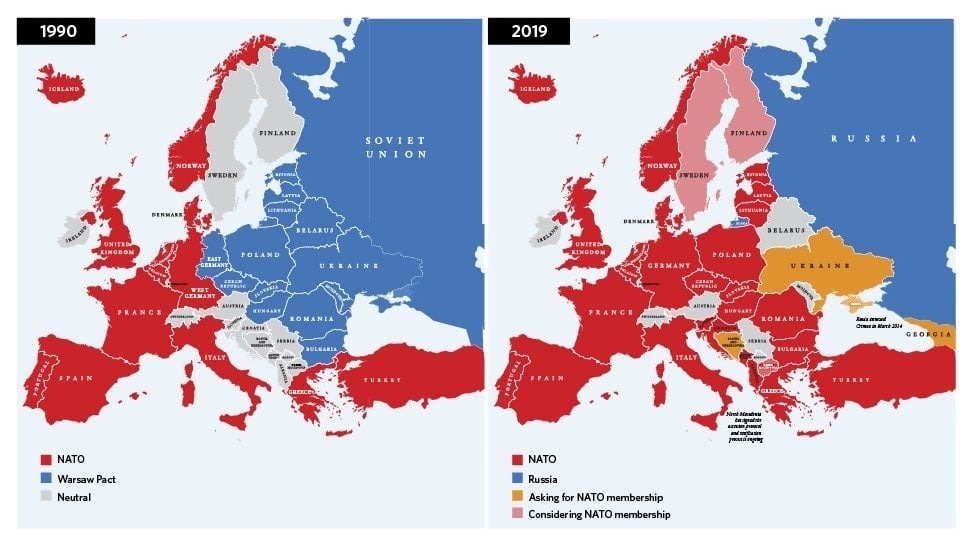
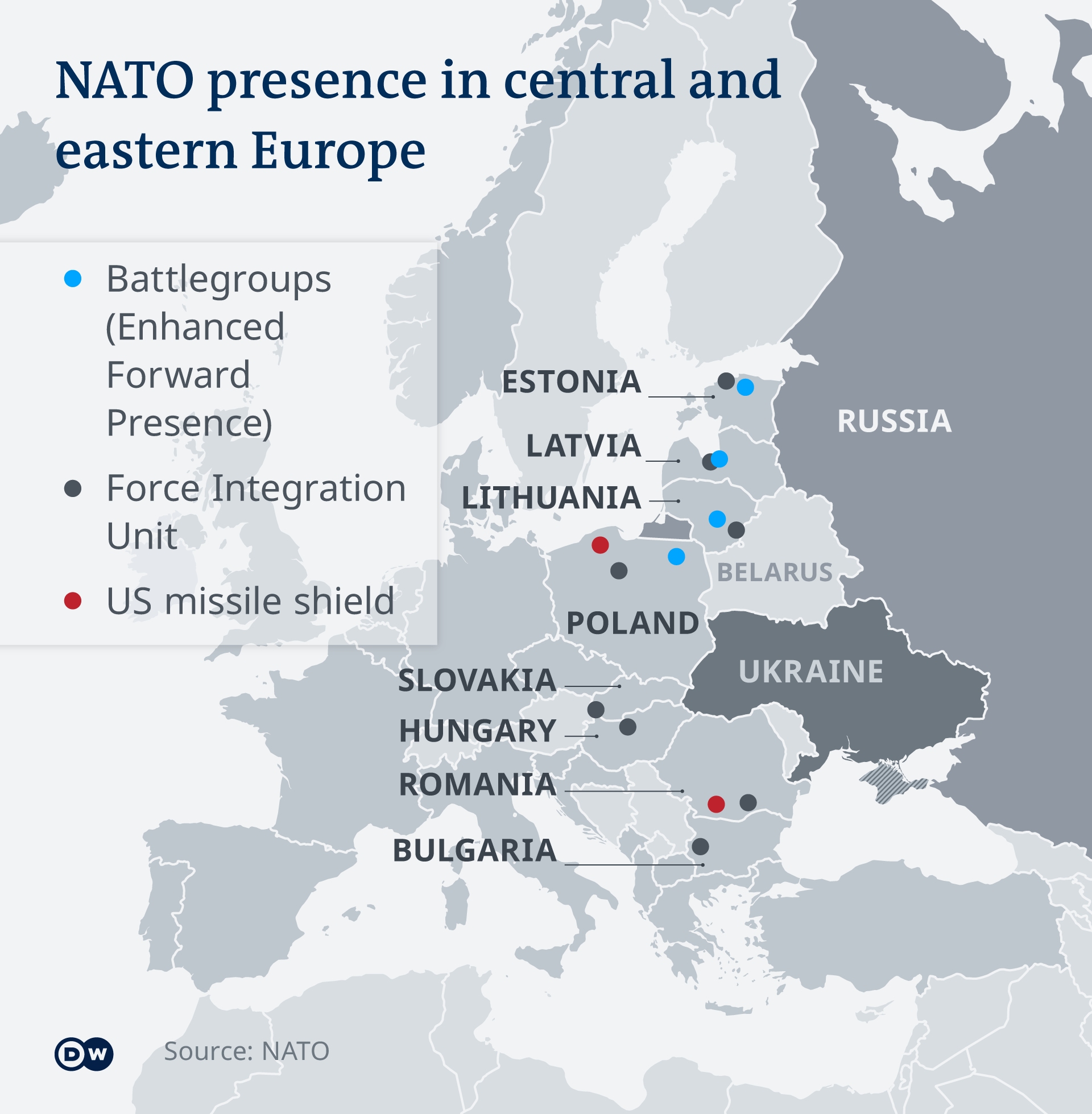
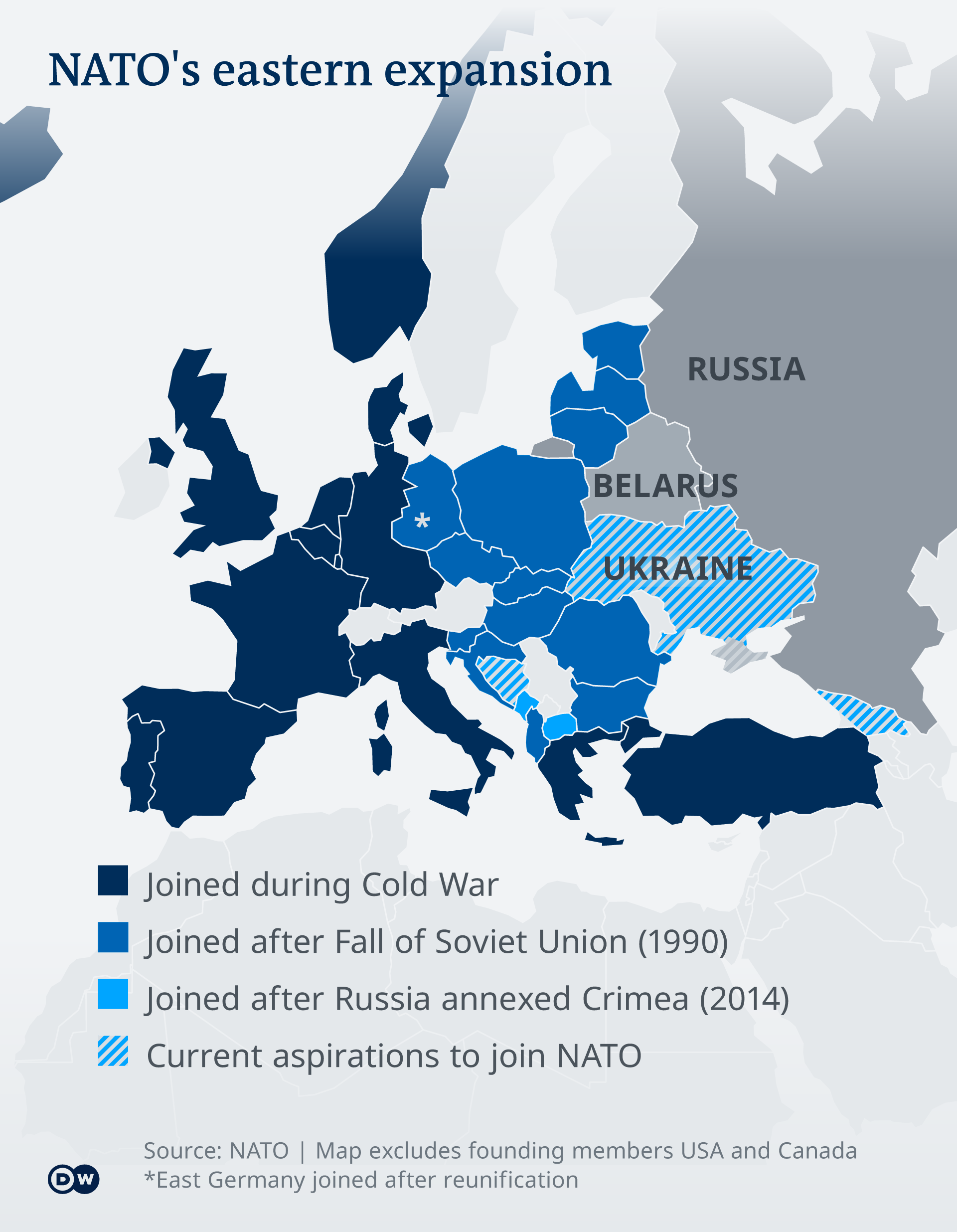
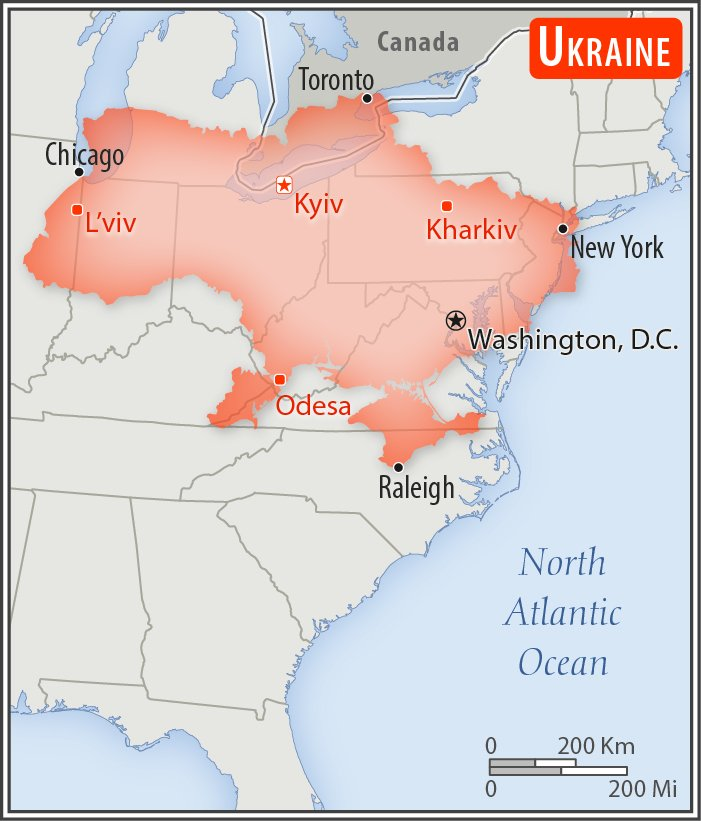
Before a barrage of bombs began to fall on Ukrainian cities from Kyiv to Kharkiv, newspapers of record predicted that “Days of whiplash developments made unmistakable the volatility of a crisis that American officials fear could lead to an assault by one of the world’s most powerful militaries against Ukraine, Europe’s second-biggest country,” as artillery exchanges grew in the Eastern provinces. Fears of Russia staging a unilateral invasion of the nation grew as “a development that Europeans never thought they would see,” alerted the New York Times, challenging if not undermining Europe’s–and NATO’s–expansion of geo-strategic alliances in recent years. But the nominal accusations of an expansion of NATO has blurred, to be sure, with the accusations of the persecution of ethnically Russian populations in eastern Ukraine in the current charges of waging a war of “de-Nazification.” They nationalistic cry rallied faith in a Russian homeland that seem to be a reaction to the processes of globalization against which Putin’s right wing allies–from LePen to Donald Trump–have recently railed against.

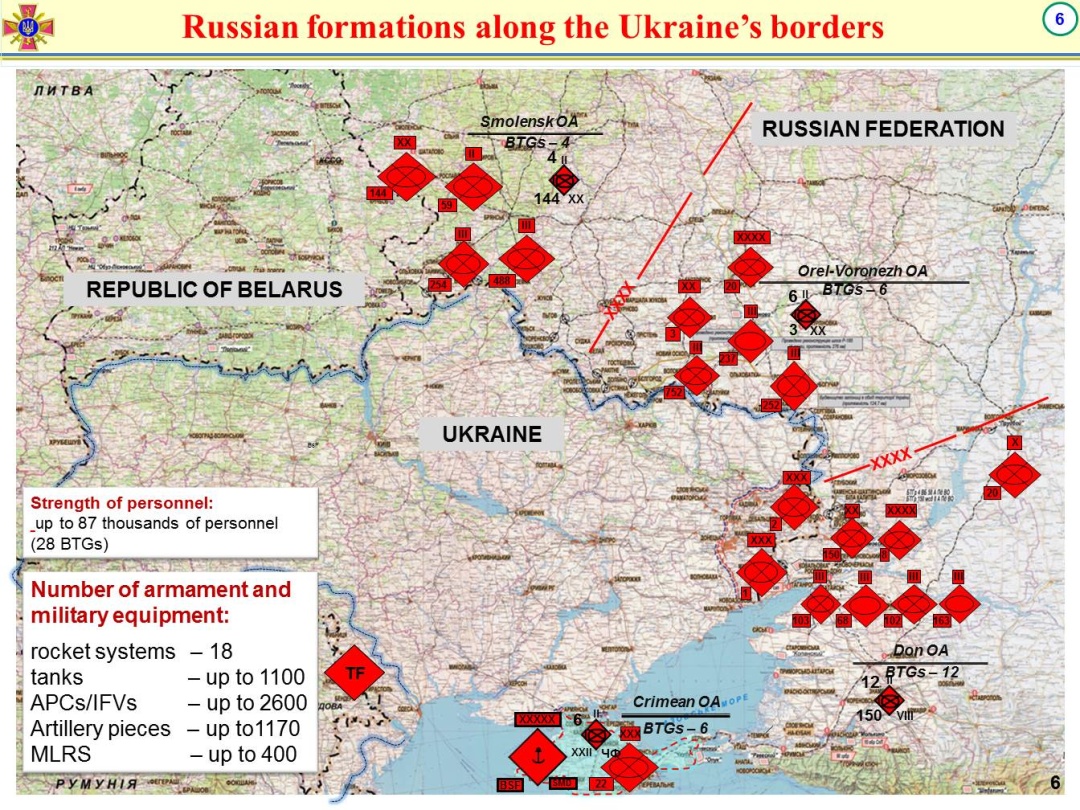
If rooted in fears of preserving a lost Russian empire, an ethno-state eroded by the breaking away of Soviets, the recasting of Donetsk and Luhansk as “People’s Republics” in eastern Ukraine hearkens back to the soviet history in which Putin and Co. were molded, a reaction to by military formations in the ear of the Trump Presidency, as pincers around eastern Ukraine, long before the current invasion of Ukraine began–a show of force of tanks, artillery, and rocket systems poised to illustrate the porous nature of any nominal borders when it came to the old Soviet Union. For as if in refusal to let the post-1989 territory emerge as a liberal state–or a separate state–the resurgent ethno-nationalism of “preserving” or “protecting” Russian speakers from allegations of Genocide offered an Orwellian Newspeak by a totalitarian state George Orwell saw as critical tools to rationalize ongoing war, death, and cast as  “subversive” the very concept of free will.

July, 2020/Ukrinform

The dramatic massing of Russian soldiers on Ukraine’s border in the Spring of 2022 seems to have been engineered to question that border’s status as a guarantee of sovereignty. As if to mirror but were unlike the erosion of borders in globalism, however, the massing of troops was a display of Great Powers doctrine on the part of Moscow, echoing the emphasis on the expanded range of supersonic bombs that Vladimir Putin had foregrounded in his announcement of the range of nuclear bombs in 2018 when he announced to the world a new arsenal of “invincible” nuclear weapons before a video graphic that imagined warheads hitting the United States. The trumpeting of the apparent invincibility of Russian armaments that Putin suggested in a dramatic tableaux of Russian military dominance–

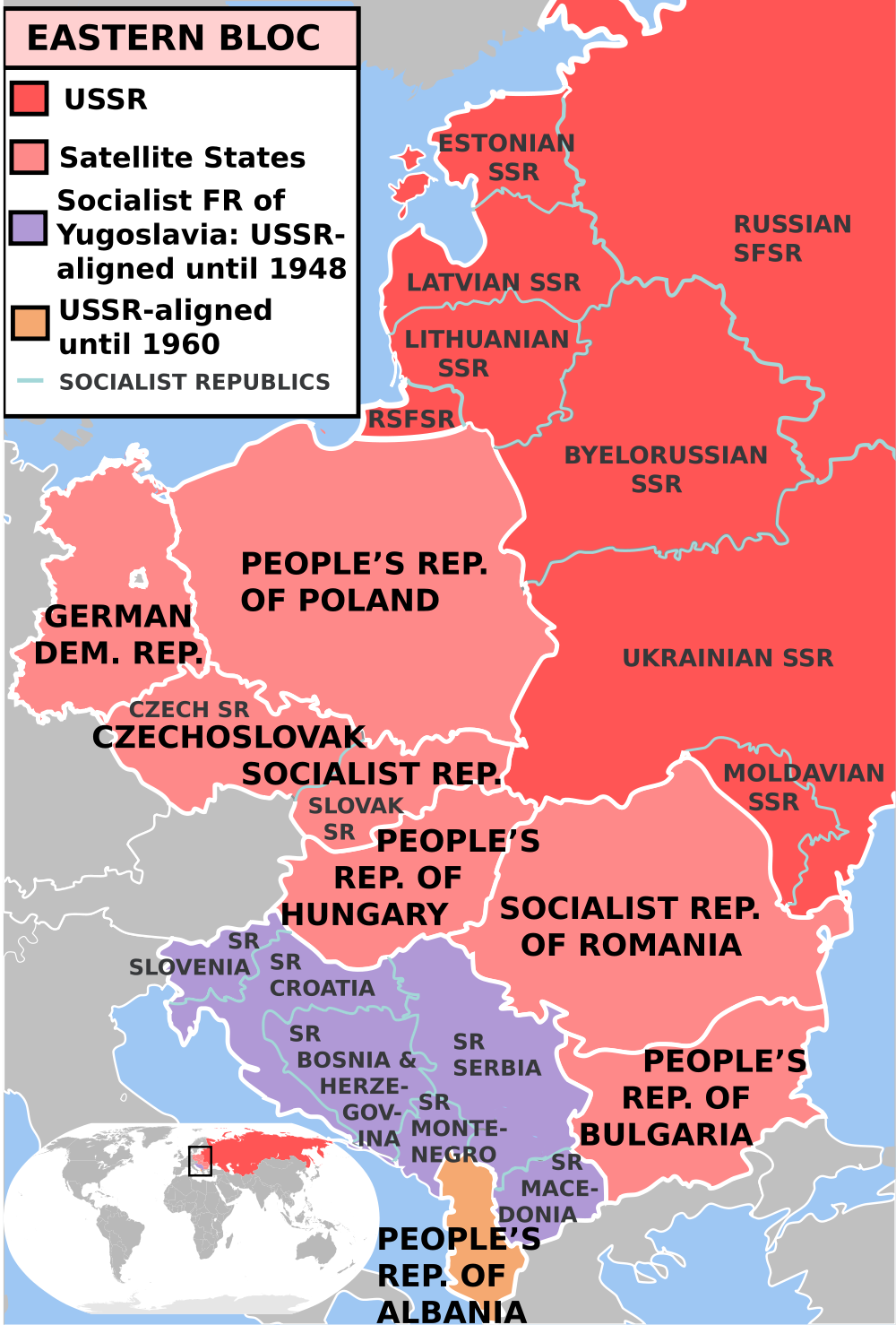
The bombast was reprised in reduced form at a local level as Russian troops massed an unprecedented show of force on Ukraine’s border in the postwar period. Their congregation seemed to firm up Russian power after Putin had dismayingly, misleadingly and perhaps self-servingly asserted was an existential threat to Russia more than an expansion of a defensive alliance. And if Putin later, after the invasion began, argued with duplicity “What is happening in Ukraine is a tragedy–they just didn’t leave us a choice. There was no choice“–the invasion that sought to reunify the old soviet that had become a breeding ground for liberal reforms was not really about the expansion of NATO, but the consecration of the boundaries of the old USSR, and the absence of “true boundaries” for Russia in the old Soviet bloc.

The border was already being denied in the massive show of force that massed in the Republic of Belarus, that old Soviet, in the larges mobilization of troops in postwar Europe. As 90,000 troop joined an assembly of 100,000, equipped with tanks, anti-aircraft guns, fighter jets, and armor on the area where the borders of Russia, Belarus, and Ukraine, the show of force seemed to erase any sovereign border or notion of independent sovereignty. The apparent focus of Ukraine’s forces in the west, was oddly paired with the positioning of Russian troops in the vey same positions they used to confront potential defensive strikes against NATO, as if the missile launchers and military planes by Ukraine’s borders were posed to move against a nation that had been hoping to join NATO, if with some American encouragement, and the readiness to gloss that idea as a tactical aggression that merited an immediate military strike. The fears of a move outside of Russian military and geopolitical influence fed a specter of mobilizing these troops again. This map, from almost a decade ago, suggests the long-standing tenuousness of these borders, and the readiness Moscow had long felt to remove their pretense.

March 1, 2014

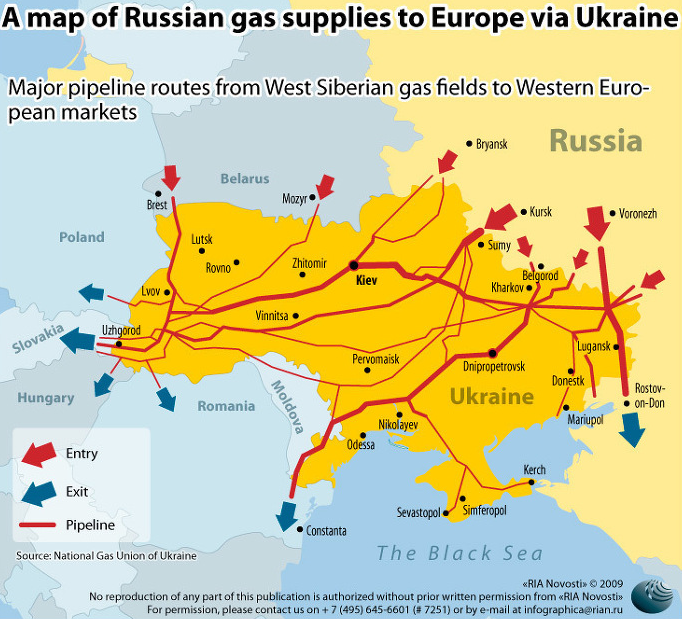
The robust show of force that established its theater of influence and refused to be hemmed in by borders of sovereignty. Whether they reflected Vladimir Putin’s beliefs, or, far more likely, offered an excuse for military mobilization of such unprecedented scale against a country with few natural or geostrategic defenses, global media disinformation were filled, at the same time, with the fake news, amplified on Russian news and RT, calling NATO and Ukraine as threats to Russian sovereignty, even as Ukraine’s sovereignty was effectively bracketed and taken off the table, a pretext for Russian escalation whose size recalls imperial wars of the nineteenth century. The refusal of Viktor Orbán of Hungary to let military aid flow to Ukraine through Hungary, a reflection of his nation’s considerable dependence on Russian natural gas, and Budapest’s invitation of for the Moscow-based International Investment Bank, or IIB, whose founding ten member states of 1970 reflected the political geography of the Cold War–was relocated to Budapest in 2019, was long a conduit for Russian intelligence, and is led by the son of a KGB official formerly stationed in Budapest. As Central European states from the Czech Republic to Romania accelerated their exits from in response to the invasion of Ukraine, Orbán threatened Russia’s aggression would overflow far beyond Ukraine and charged opponents had designs to “drag Hungary into this war” and “make Hungary a military target” to his political advantage in a recent electoral campaign.

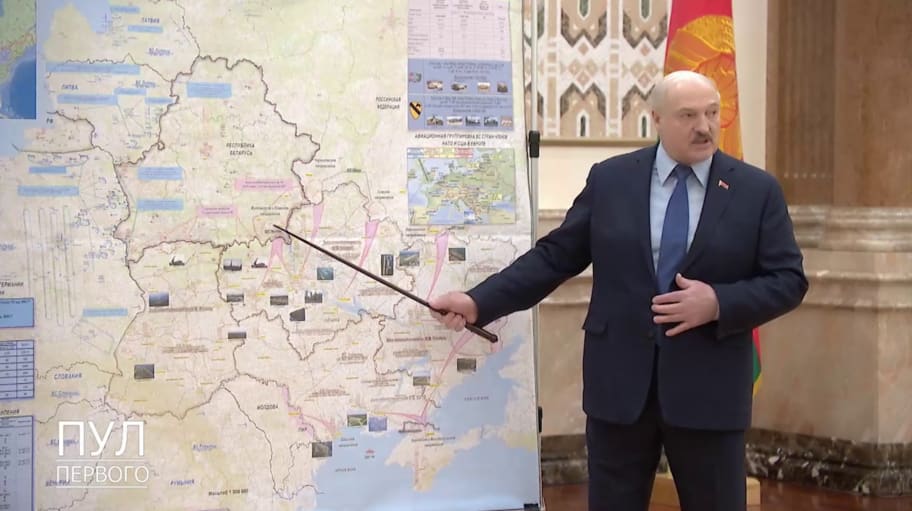
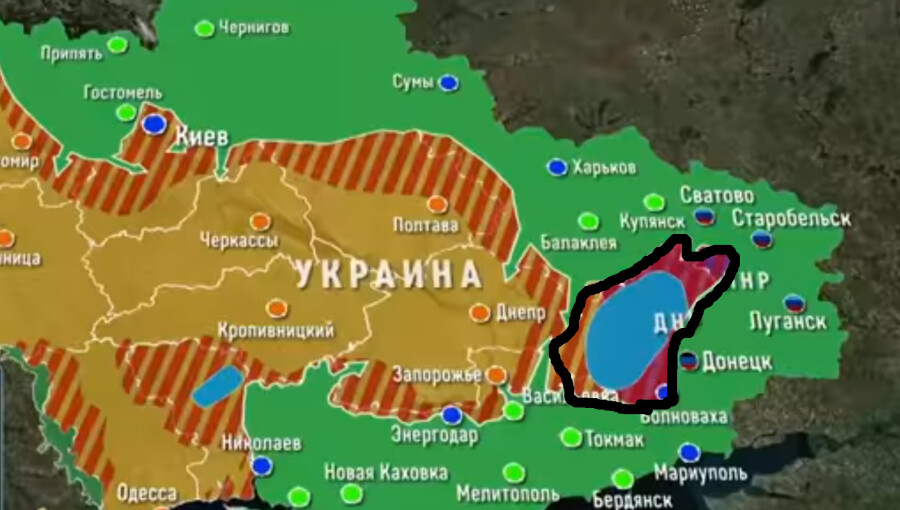
The vivid reassertion of a Cold War political geography haunts Central Europe today. Aggressive military moves one-upped the seizure of the Crimean peninsula and eastern Ukraine, but the massing of military presence outside Ukraine’s borders ramped up the abilities for invasions that would create a potential impromptu blitzkrieg that would leave, Russia hoped, a stunning memory of Ukraine’s limited sovereignty. Indeed, the clarity with which Volodymyr Zelensky has urgently asked the world to recognize Russia’s hopes to “break our nationhood” is evident in the way Putin’s ally, Belarusian President Lukashenko, addressed the Parliament as a schoolteacher, informing them of the splitting of Ukraine into four theaters of operational command, and several arrows that showed the planned movement of troops into Ukraine,–

Belarusian State Radio

as if the nation that borders Belarus were not really secure, and the plans to use Belarus as a platform for staging an invasion was indeed already underway. The map used as a basis to lecture Parialiament displayed on state television was a “misunderstanding,” authorities claimed, but the pink arrows that staked out the routes by which Russian troops would invade Ukraine already affirmed the absence of Ukraine’s defensible borders; the pointer he used as a school-teacher to describe the impending display of Russian power as if to replace the actual Belarus President-elect, since 2020, Sviatlana Tsikhanouskaya, the former English teacher in Minsk who replaced her husband, Serghey, leader of an opposition Lukashenko had jailed. While Tsikahanouskaya has long left Vilnius, but resists the Russian-based orthography “Svetlana Tikhanovskaya” and Lukhashenko and his security forces relied on Putin for power, Tsikahnouskaya is a government-in-exile who long pinned her hopes to Joe Biden’s victory.

The threat of a cross-border movement of military troops were part of a theater of power and destabilization that had been central to Russian hopes to consolidate an old bloc. Beyond its hopes to affirm its presence in Crimea and around eastern Ukraine, now used as launching pads for an invasion in the above map, beyond countering an expansion of NATO, the hope was to drive fear into the old bloc and gain support from nominally democratically elected allies, from Viktor Orban in Hungary . Russian air force had flown nuclear bombers with missiles of expanded range over Poland’s borders, in November 2021, and in the airspace of Belarus, contesting the ability of NATO forces to move to the east and protecting what it saw as its crucial sovereignty over energy transport to central European states from Hungary to Poland, once part of the old “Soviet bloc.”

As Orbán posed with Hungarian generals and tarred his opposition with trying to drag the nation into war with Russia, Russian television news by March, 2022 remapped a nation in Cyrillic whose eastern half seemed to have collapsed, after Russia taken control of the airspace, with cruise missile strikes on airfields, fuel depots and infrastructure, even if the capitol had not fallen–hoping Ukraine’s inhabitants might decide to accept Russian suzerainty rather than continue war. Perhaps the capture of “territory” in the Russian imaginary that extends through the Dnieper River would provide the symbolic imaginary that Putin seeks to hold, although the ability to “hold” the lands that Russian forces have terrorized and flattened will be steep, even in the steppe lands of Ukraine’s Trans-Dniepr where about a dozen brigades–some 60,000 men–of Ukraine’s best troops are located. The image of Russian control of the Trans-Dnieper symbolically “restored” to Russian suzerainty ethnic Russians, promoting the illiberal logic of an ethno-state reducing Ukraine to a rump and cast Kiev as a border town, wiping Ukraine’s old border off the map.

The result would be to reduce the sovereignty of any Ukrainian “state” to a permeable polygon.

The initial mobilization of increased materiel that the Russian government had invested from hypersonic missiles to potential nuclear torpedos, eager to be installed in the Black sea and stationed in increased proximity to much of Europe, whose energy independence was already steeply compromised by their acquisition of and dependence on Russian oil and gas.

Ukraine became a “red line” to which Russia wanted to gesture, and indeed prominently fix on the map, as visibly as the US-Mexico Border Wall, as the Kremlin repeatedly warned the “red lines” on its maps could not be ignored by any “broadening NATO of infrastructure on Ukrainian territory”–as if the defensive alliance were intended to provide a challenge to Russian sovereign authority.

To be sure, the challenge of Ukraine’s hopes for its own sovereignty were already unprecedentedly threatened by massing from 2020 of military to the east within Russia–

Ukrinform, July, 2020

–far, far beyond the occupation forces that were already located in occupied eastern regions of Ukraine, and which completed a possible pincer operation simultaneously invading Ukraine from multiple borders and sides, as it tacitly pointed fingers at Washington, D.C. for encouraging Ukraine as an upstart by a growing escalation of force.

Russian Presence in occupied Donetsk and Luhansk Oblasts by 1st (Donetsk) and 2nd (Luhansk) Army Corps (AC) 

If Moscow shifted troops to Ukraine’s border to prevent Ukraine from becoming European, or, more accurately, to prevent its development as a democratic liberal state, the demonization of an imagined “expansion” of NATO eastward was imagined as an invasive virus, and a threat to an imagined Great Power status not of Russia, but the Soviet Union, and indeed Russian empire. Yet one can only understand the violence of the massive attacks that were to be unleashed against Ukraine as a last gasp of empire, an in a late imperial rationality of defending the imagined sovereignty across borders, boundaries, and ethnic identity, at a time when Ukraine was a part of the USSR, as much as a satellite states, and “satellite states” were not mapped by GPS satellites but rigid lines and shades of red, whose borders were more nominal than meaningful.

Soviet Satellite States | Schoolshistory.org.uk
Soviet Satellite States

We risk presenting the struggle for Ukrainian independence in the narrative of great powers, however, overlooking the deep threats of the denial of Ukraine’s architecture as a nation-state. The great-power narrative unhelpfully Vladimir Putin as a chess grandmaster whose strategic planning were not thuggish and indecorous land-grabs of illegality. By annexing Crimea, provoking uprisings in the eastern Ukrainian provinces of Donbas–Donetsk and Luzhansk, or carving out a “confederation” made of breakaway “republics” of the evocative name Novorossiya, Putin had made Ukraine less a state than a mythic geography, conjuring it as part of a Greater Russia of Romantic cast. If WInston Churchill suggested with despair that Russia so opaque to be was a riddle, wrapped in mystery, wrapped in an enigma, a belittling metaphor of evoking the Beriozka doll, the alleged anger at Ukraine joining NATO mapped by an imperial imaginary of Russia tied to Ukraine, and to the seat of the historical Kievan Rus’, long sacred to the Orthodox church, wrapped in the historical Warsaw Pact, wrapped in the hopes for a future petrostate, but haunted by the fear of any recognition for a neighboring liberal state and its political autonomy

Putin seemed to have abandoned Novorossiya as a stillborn project by 214, but continued to meet with cronies in Gazprom over maps. We cast Ukraine as a chessboard, not a nation, but the Russian hostility to the NATO membership of Ukraine openly ignores the fear of recognizing Ukraine as an independent state. Ukraine’s reduction to an ethnic battleground in a Cold War geopolitical landscape led the imagined “Union of People’s Republics” to force Ukraine back into a new rebirth of the old USSR where Vladimir Putin was a lieutenant colonel, the “New Russia” foreign to any maps returns Ukraine to a Russian “sphere of influence” more nostalgic than actual, but with its own secure lines of transporting natural gas into the old Eastern bloc, and deep ancestral ties to the old empire whose imaginary remains stubbornly slow to fade. While Russian negotiators told Americans that they didn’t plan to invade Ukraine at all–“There is no reason to fear some sort of escalatory scenario” rebuffed Sergei Ryabkov, Russia’s Deputy Foreign Minister in early January–demands not to allow Ukraine into NATO were an apparent denial of its sovereign status, long before bombs rained indiscriminately on civilians, including hospitals where doctors were forced to heal wounded Russian soldiers at gun point.

And despite

Putin Alexei Miller
Putin and REUTERS/Aleksey Nikoskyi/RIA Novosti/POOL
Lugansk and Donetsk
“Novorossiya,” c. 2014

Despite notoriously low participation in the Crimea’s “referendum” on rejoining Russia–a vote estimated by Russian President’s Human Rights Council, per a leaked report, at a measly 30%–the annexation of the region was accepted, rather than risking open conflict, despite military presence of Russian soldiers in the Crimean peninsula. The deep danger for viewing Russian aims in Ukraine in a “Great Powers” lens grows almost a decade later, imagining the division of Ukraine into sectors that resonate with a Cold War paradigm, is that it ignores the largest fear of a liberal state on Russia’s borders.

Ukraine was compromised as a nation-state, long before its borders were threatened with troops. Divided not by a Civil War so much as by Russia militarily occupying Crimea and significant parts of its east where Russian language remained dominant. The Russian government had recently fast-tracked nearly 800,000 passports, as part of a policy of “passport proliferation” that seemed to have aimed to restore a reduced Warsaw Pact by issuing a slew of some five to ten million passports to the diaspora of Russians from Georgia’s South Ossetia, Moldava’s Transnistria, and Ukraine’s Crimea and Donbas–a sort of “buffer” of peoples that Russia decided it would decree to expand the boundaries of state security, and even military intervention–both to address a growing demographic crisis by 2019, and to cement an ethno-linguistic identity as a regional foreign policy for annexing Crimea and Donbas by 2014–

effectively exploiting the division between “Russian” and Ukrainian language to undermine the hopes of a nation-state. While the intense violence since directed to Ukraine may have no logic, its undermining of Ukraine’s borders is an undermining of a project of sovereign status in favor of the idea of a “Russky Mir,” or a “Russian World” that reassembled a mythic Russian collective that denies the existence of Ukraine as a nation unable to be wracked by civil war.

As the government of Russia has responded to the threat of the expansion of NATO by a policy of increasingly ‘passporting’ former subjects of formerly Soviet territories, time past was folded into time present and the future, and time future projected as present in time past, and all of time eternally present in the invasion of Ukraine, in a historical pastiche of postmodern proportions. T.S. Eliot references aside, the burning of Kyiv and many wonder if Russia’s end was not lying in its historical beginnings, as the fixation on the political identity of Ukraine suggests Putin’s plans to affirm his historical legacy as reversing the dissolution of the Soviet spheres of influence by recuperation of the mythic imaginary of the historically Russian areas of the Kievan Rus’ beyond the early restructuring of Crimea. And if Putin had already commissioned a new global atlas of the world that will adjust the possibly problematic names of cities from Ukrainian to Russian toponymy, so that the resulting product will better rerlect “historical and geographic truth” by ensuring, as he quite aspirationally told the Geographical Society of Russia, and “preserve Russia’s contribution to the study of the sciences and the planet, lest they vanish from the map from the South Pole to Crimea, pushing back on how some nine hundred Ukrainian cities and towns shed previously imposed commemorative place-names since 1990, once honoring Marx, Engles, Lenin, or the leader of Russian Secret Police, Felix Dzerzhinsky, under auspices of Ukraine’s Institute for National Memory, a Gorbachev-era forum dedicated to “decommunization” and reckoning with the Soviet past: 946 towns and cities were slotted for renaming by 2016.

Vladimir Putin Is Redrawing the Map of the World to Reflect How Russia Sees  It
Putin Studied Map of Crimea, 2016

Yet if such linguistic maps are argued to be an explanation of civil strife or sovereign combustability of Ukraine, in ways that justify the intervention of Russia in Ukrainian territory on ethnic grounds, the ethno-national logic of Putin’s justification of meddling in Ukraine’s bounds and sovereignty rests on the deep commitment to “moral values rooted in Christianity and other world religions” that Putin has argued the “Euro-Atlantic states have taken the way which they deny or reject,” linking the Russian Orthodox church to Russian government and moral values, extolling the icon in early modern ways. Even as the Ukrainian Orthodox Church metropolitan Epiphanius I has likened Putin to the Anti-Christ or that the “spirit of the Anti-Christ operates in the leader of Russia,” the invocation of orthodoxy as a basis to justify Russian expansion plays on ethno-nationalist grounds akin to the proliferation of passports to discredit the West in Eastern Europe in ways that have only grown since the possibility of NATO’s expansion eastward: if only in 2018 did the Ukrainian Orthodox Church split from the Patriarchate of Moscow, to which it had remained subservient since 1686, the religious split reveals deep tensions in redrawing the map.

While the European Union had offered the possibility of membership to Ukraine and Georgia back in what seems the other world of 2008, dangling the prospect of “Euro-Atlantic aspirations for membership in NATO” of both states as an opportunity that was on the table. The promise presumed eastward expansion of a North Atlantic Treaty Organization beyond Poland and Hungary, to Baltic states of Estonia, Latvia, Lithuania, as well as Slovakia and Romania able to pick up the peaces of the disbanded Warsaw Pact. Russian reaction to Ukraine the affirmation “these countries will become members of NATO,” was perhaps far less a “whiplash” than the culmination of Putin’s immediate warning of “most serious consequences of European security” would provoked an unprecedented “direct threat” of almost existential terms, that would make Ukraine not a “border” of Russia–it gained its name as a “borderland” of the Kievan Rus’–but, in ways by which Putin seems to have become increasingly haunted, with its own identity as a nation-state.

The concerns of processing the presence of some twenty Russian or Russian-allied military forces around the nation’s border forced us to try to an intractable geographical impasse of Ukraine’s place in Europe, or, as Russia insists, the periphery of Russian sovereignty–if not the sovereignty of the borders of Ukraine. As Ukraine tried to shift its status as a borderland in Cold War maps of old, and the new security structure of a European Union, the world confronted the emergence of a New Cold War, haunted by the division of separate spheres of dominance.

r/MapPorn - NATO members (blue) and warsaw pact members (red) in cold war era
Separate Spheres of Dominance in Cold War Global Map

1. The public perception of an “inflection point” of the eastward expansion of NATO resuscitated a Cold War geography: yet can the fixity of these old spheres of influence fully explain the massing of troops on Ukraine’s borders? To be sure, right-wing American commentariat, obsessed over the dangers of NATO expansion and eager to see American disentanglement from Europe, openly argued that NATO expansion was the precipitating reason for broad military invasion that would kill civilians and destroy hospitals, schools, monasteries, and villages. But the illegality of the invasion that only led Russian state news to recycle Tucker Carlson’s buoyant defense that the Russian invasion is “only protecting its interest and security,” was as popular among Russian government as his asking viewers “how would the United States behave if such a situation [of placing military bases] developed in neighboring Mexico and Canada?”, evoking a Cuban missile crisis playbook of the past. Carlson’s isolationist pro-Putin rhetoric imitates Russian government in subsuming “Ukraine” as a nation in the long memory of spheres of national influence, in which eastward expansion of NATO boded a redrawing of a global map–and ignored the range of missiles, radar systems, and missile interceptors that have already been deployed in the European theater by an expanded NATO since 2019–all exclusively purchased from American contractors and weapons systems manufacturers, long imagined as a “missile shield” over Europe.

NATO-Ballistic-Missile-Defense - Silk Road Briefing
NATO Ballistic Missile Defense System

The demand for “security guarantees” Russia had demanded from Western powers as NATO and the United States since before December has lead, however, to the placement of the Ukraine conflict in a Great Power narrative, as if this were at all informative. Yet the expansion of military defense systems across Central Europe belies the continued finger-wagging of right-wing political scientists like John Mearsheimer long wagged their fingers at NATO expansion in the face of a great power geography.

Germany to send additional troops to Lithuania | News | DW | 07.02.2022
NATO Battlergroups in Eastern and Central Europe, 2022

The Times found Russia’s unprecedented massing of troops along the northern border of Ukraine risked “Reigniting the Cold War Despite its Risks” (January 20, 2022), describing a global power struggle as as if Ukraine’s independent sovereignty was not a crucial puzzle piece in the dilemma. The headline trumpets fears of a new Cold War in Europe, over thirty years after the original Cold War had ceased as the primary lens for geopolitical security, triggered fears of a familiar tinderbox on the borders of Russia, as its leader invoked a narrative of border security and national vulnerability to invade a separate sovereign country. Indeed, the possible rejoining of a Intermediate-Range Nuclear Forces Treaty, which the United States abandoned in 2019, accusing Russia of long violating the terms of a treaty signed thirty years ago, in the Cold War world. If these missiles were long seen as a basis for European security, Intermediate-Range Nuclear Forces, missile deployment is a smokescreen for deep fears of an open democracy.

Even if Ukraine, once in the Warsaw Pact, shares a border of over 2,000 km–about the span of the United States’ frontier with Canada on the 49th parallel from Washington to Minnesota, or, alternatively from New York to Chicago. But the border was less the point, or even its length, than the pipelines that allow the petroleum state to reach other members of the old Warsaw Pact, leaving them dependent on Russia for gas.

Image
Brian Taylor

As much as the expansion of NATO, however, the possible of claiming Ukrainian sovereignty of its borders was denied by the troops clustered along Ukraine’s borders who menace crossing into its territory on world view. The massive stationing of Russian and pro-Russian troops on the border seemed something of a performance piece, and something of a threat to end Ukrainian’s European aspirations.

Global conflicts along borders have long been dominating the national news, but all of sudden the edges of borders are up for debate as a debate that contrasts national identity to spheres of influence inherited from the Cold War. The presence of some 190,000 assorted troops of the Russian Federation on or near to Ukraine’s borders is a power play, committed to wrench the region from NATO, if by asserting, as Vladimir Putin has claimed, Ukraine is not in fact a state. Fears of the destabilization of a Cold War geography seem to lie far more deeply rooted in the calculus of Vladimir Putin, who had entered politics after over a decade as a Cold War spook, two years before the declaration.

NATO: Why Russia has a problem with its eastward expansion | Europe | News  and current affairs from around the continent | DW | 23.02.2022

The characterization of Putin the intellectual image of the “chess player” looking at long-term national strategy seemed less in evidence than attachment to the borders of the Cold War bent against the formation of a liberal state. Putin’s preposterous claim that Ukraine was only born as a state as a geostrategic part of the USSR is not only preposterous, but deeply haunted, one might speculate, by a lost geography of the Kievan Rus’, and a sense of preserving the former Soviet Union from the autonomy that its individual states, or soviets, were allowed–and indeed the danger of according such privileges to regions as Georgia and Ukraine, each of which had been offered a partial promise back in 2008 by NATO that they might join the security organization, after Putin had already refused to allow Ukraine to gain such a degree of independence or sovereignty as a state.

The survival of that promise by December 2021 was deeply troubling to Putin as he began to open dialogue with Joe Biden about the military architecture of Europe, and feared the increased unity of Europe and NATO as an alliance. As NATO secretary stressed these plans had not changed, Putin dismissed the “right of every nation to chose its path [and] . . . what kind of security arrangements it wants to be part of” by denying the rights of Ukraine as a nation. And as he claimed Ukraine to be a creation of the USSR, as if it were its property, “entirely created by Russia,” he denied any sovereignty as a state, as if a new Cold War might begin by reassembling the Russian diaspora from an earlier, mythic imaginary, not rooted in a map of nation-states, alliances among states, or national security but indulging a deeper ethnic identity.

Perhaps, in this sense, any paradigm of earlier treaties are not the point, from the Cold War to the Warsaw Pact, even if Putin saw the prospect of NATO membership as an aggressive act that ignored his ultimatum. There may be much in Fiona Hill’s fearsome observation that the maps that Putin is reasoning from are not at all from the Cold War–“I also worry about it in all seriousness,” she confessed, that in the pandemic, as we pondered global biorisks, “Putin’s been down in the archives of the Kremlin during Covid looking through old maps and treaties and all the different borders that Russia has had over the centuries,” obsessing with how the borders of Russia and Europe have changed and how Russia might be reconstituted in Europe, and magnifying the consequences of Russians in Ukraine joining NATO. More than believing Putin intends to wipe Ukraine from the map, it was as a state that “it doesn’t belong on his map of the ‘Russian world'” and its borders or the borders of Europe were provisory on all maps: if NATO seems to think that it can dignify the state’s place in a security structure, Hill sees Putin as denying its sovereignty to affirm the notion of “Novorossiya”–a ‘new Russia’–that in 2014 he imagined as a republic from Odessa to Karkhiv, whose own borders interrupted Ukraine from a map; if the hypothetical confederacy was abandoned by the republics of Luhansk and Donetsk, following high level meetings of the United States and Russia, it had gained an independent flag and conceptual momentum bolstered by the decision of Russia and Bielorussia to withdraw from the International Criminal Court as it considered the criminality of actions of annexing Crimea–as it recognized the “armed conflict between Russia and Crimea” as claiming nearly 10,000 lives since men in military uniforms siezed control of the Crimean parliament, appointed a new prime minister who was a shadowy businessman nicknamed “the Goblin,” as the police-men who have been placed puppet leaders in Donetsk and Luhansk, with less practiced in politics than policing.

INTERACTIVE Ukraine Donbas region Feb
Putin’s Puppet “Republics” of Donetsk and Luhansk

And as the emergence of Donetsk and Luhansk agains as “break-away” republics conjure a map of Russian transnational sovereignty that trumps Ukraine’s sovereign independence is often cast by Moscow as engaged in a “Civil War,” the proposed partitioned gained little traction or public support–and indeed invited such opposition to be classified as terrorist organizations: the mythic republic condemned for undermining any sense of self-determination were again recognized as states by Moscow in February, 2022, precipitating the invasion of Ukraine.

Continue reading

Leave a comment

Filed under Cold War, European security, geopolitics, Mapping Ukraine, Ukraine

The False Imperative of the Border Wall

Donald Trump’s most astounding victory–predating and perhaps enabling his astounding electoral victory as President–was to remap the mental imagination of Americans, and reconfigure proximity of the United States to its southwestern border in the public imaginary.  The goal of this insistence is no less than a remapping of civil liberties, based on his insistence of the need for border security and constructing a Border Wall, and preferably doing so in all caps.  

Build the Wall--Add Your Name.png

Condemning “obstructionist Democrats” are the party of “open borders,” and obstructing the work of law and order agencies such as ICE–the Immigration and Customs Enforcement–agents or his beloved Border Patrol, and for filling the national need for border security, and the project of building “the wall,” a super-border structure that would both prevent cross-border migration deemed ‘illegal.’  The construction of border psychosis is evident in the large number of Republican governors of states that have been elected two years into the Trump Presidency–

Governors?.png

–as the question of “governing” states most all the southwestern border–save California–has created a new “block of red” that has been generalized to much of the nation, rallying behind the America First cry to defend borders, build prisons for immigrants deemed illegal, and work with federal agencies to apprehend such immigrants, denying their lawful place or rights to work in the United States.  For much of this map of governors, now that the Republican party is increasingly the Party of Trump, reveal the uncertain terrain of the undocumented immigrant, and the massive circumscription or reduction of human and civil rights, as well as a fear of failure to manage immigration.  Although current findings of sixty-nine competitive districts in the 2018 election include many border states–sixty-three districts of the total are held by Republicans before the election, a considerable number of the “battleground states” lying near or adjacent to the planned Border Wall, according to a Washington Post-Schar School survey

Sixty Nine Competitive Congressional district.pngWashington Post

–where calls for wall-building originated.  The magnification of the border in the electorate’s collective consciousness was a gambit of electoral politics and staple of the Trump campaign for the Presidency, and it conjured the unprecedented idea that a single President–or any office-holder–might be able to shift the borders of the nation, or guarantee their impermeability to foreign entrance.  The striking appeal of the border was not seen as a question of border protection but rather the construction of a wall, evident in the expansion quasi-tribal collective rhythmic changes at rallies, now repeated as if in a non-stop campaign.  Although the focus of most buildup of the border has been to update existing fencing, the calls for fix-it-all border protection plans gained sufficient appeal to suggest a potential shift in the nation’s political terrain.  Even though Donald J. Trump was, for practical purposes, a quite parochial perspective based in New York and Manhattan, and perhaps because Trump’s own expertise in national building projects was as limited as with working within the law, the project was first floated by the candidate as if from the sidelines of national politics, treating the project as akin to protecting a two-mile southbound side of the Henry Hudson Parkway in Manhattan, beside his pet real estate project, Trump Place, at 220 Riverside Drive, through an Adopt-A-Highway Project, and that the border wall was essentially the same need of securing .  (Although the prominent sign was itself quickly vandalized to read “STOP TRUMP”  as Trump won the Presidency, needing to be replaced, the return of the defaced sign promising the riverfront side’s maintenance was far less an act of good citizenship than a vanity act.)

Jon Comulada/Upworthy

New York City limits the Adopt-a-Highway program to individuals, companies or organizations, rather than to political candidates and campaigns seeking publicity, but since the Trump Organization maintained the section since 2007 or earlier, it gained an exemption–and a tax write-off for its contributions to maintenance.  And when he spoke to residents of the territory currently known as “America,” Trump seems to have treated the proposed Border Wall as an almost similar project of beautification, and a project of protecting what was his, in a proprietorial way that seemed to conflate his own identity and person with the country, as the current sign conflates his name with the Trump Organization, as his recommendations have contained as little familiarity with the site, scope of the project, or terrain, as many have noted, treating the construction of a continuous border wall as a detail designed to beautify the country, even though the border includes 1,288 miles currently without any pedestrian or vehicular fencing, gate or protection.

Reveal

It almost seems that the proposed border wall had not been “mapped” per se, so much as it was a rhetorical promise for the sort of project Trump would like a President to do–and a project whose magnitude appealed to his sense of personal vanity.  He praised the benefits of the construction of the wall as a need to “get it done” and imperative that responds to a state of emergency–a national emergency that sanctioned the suspension of existing laws.  The emergency, as Trump saw it, was created by crime, gang violence by MS-13 members, who he has called “animals,” and a source for a loss of low-wage jobs.  The acknowledgment of the need for the wall is virtually a form of patriotism in itself; recognition of the need for the country has become a way to participate in a new nationalism of strong borders–a nationalist sense of belonging that was opposed to the agenda of those unnamed Liberals without clear purchase on the geopolitical dangers and a failure to put America First.  President Trump has argued that the “larger context of border security” necessitates the wall.  Trump has come to repeatedly proclaims in his continued rallying cry stake out a new vision and map of American sovereignty, and indeed of territorial administration.  Evoking a new tribalism in openly partisan terms, Trump even promoted with impunity the false belief that Democrats have united behind an “Open Borders Bill,” written by Dianne Feinstein–distorting the #EndFamilyDetemtion protests and “open borders movement” with an actual legislative bill.  More to the point, perhaps,

The very crude geography and mental mapping that animates this argument is repeatedly a staple of Trumpian rhetoric.  As if  thick red ruled line could be drawn atop a map, Donald J. Trump has become the outsider political voice able, as a builder of vain monuments, to claim the ability to build a new structure able to replace existing border fences, and provide a continuous monument at endless concealed costs, without any acknowledgement of the people who have long moved across the border on the ground.   The transposition of this tribalism of border separation into a partisan dichotomy has promoted and provoked an apparently Manichean opposition between political parties around the defense of the US-Mexico border, and the building of a Border Wall, in an attempt to define the differences between Democrats and Republicans around the issue of the defense of national safety.

Bier3a

President Trump has not only made immigration into a platform for his campaign and for his party:  the stubbornly intransigent logic of Trump’s oppositional rhetoric has not only remapped the nation in mind-numbing ways.  The fixation on the fixity of the border as a means to “Make America Great Again” erases the historical instability of borderlands in the United States, in its place projecting the image of fixed boundaries:  the exact shift in the image of national territoriality seems a not only shift on the border, but a decisive replacement of an inclusive state.  And even as Trump’s recent rallies are–as of September–still interrupted by “Build that wall!” tribal chants, leaving Trump to lie openly by claiming “The wall is under construction,” he reminds us of his need to evoke an inexistent barrier for which such intense desire has developed among his supporters that it is indeed a talisman by which America will, indeed, be able to be Made Great Again.

Continually crying about the urgent need for “building the wall,” even if it would be in violation of international law, is cast as a state of emergency which would reduce crime, the illegal presence of gangs, and existential dangers, and a promise made without acknowledgement of any who live outside America’s national borders, or any foundation in civil law.  The promise to finish “building the wall” is cast as a simple question of volition, in almost pleading tones, that can be addressed to the entire nation as an ability to cathect and commune with the nation in simple concrete terms, no matter the distance at which they live to the actual border.  It is an exercise in the geographic imaginary, in short, and a nearly ritualized deceit which Trump labors to sustain–as if a Border Wall could be conjured into existence as a leap of faith.

Identifying the dangers to the nation as lying external to it, the discourse of the wall have created a subtle remapping of sovereignty, on an almost emotional level.  It focusses on the border, as an imagined line, rather than on people who move across it, laws or citizenship–placing demonized dangers as lying beyond the border and outside of the nation-state.  The disproportionate focus that has been directed to the border–a distortion of attention that is epitomized and focussed on the desire for a continuous “border wall”–functions as a deeply dehumanizing way of remaking the nation, and remapping national priorities, around a fiction and a distinctly new discourse on nationhood, that is mapped by vigilance to the border, rather than to the course of law or to individual rights and liberties.

If maps provided tools for defining and symbolizing nationality, the conceit of the need for a border wall symbolized and also creates a notion of nationhood based less on ties of belonging than on boundaries of sovereignty that exclusion people from the state.  Mapping is long based on ties of exclusion.  But the focus of intense attention on stopping border-crossing and transborder permeability as replaced a logic of maintaining protections on equality or access to the law in the interior, shifting the attention of the nation of spectators by a deeply cruel trick of remapping the nation’s priorities.  For the political rhetoric of creating a fixed border has effectively magnified the borderlands, through the terribly exaggerated violent pen-stroke of an Executive Order casting the border as a vital key to national security, and increase the proximity of the nation to the southwestern border in the political spatial imaginary.  

Is it any coincidence that the same government to elevate the symbolic mapping of a wall on the southwestern boundary of the United States has reduced the number of refugees that it agrees to admit from war-torn lands, already reduced by half through executive orders from the number of refugees accepted in 2016, a limit of 45,000, to a new ceiling of “up to 30,000 refugees” beyond “processing more than 280,000 asylum seekers,” in line with the current 2018 count of barely over 20,900 by mid-September, but now for the first time less than the number accepted by other nations.  Turning a cold shoulder to the crisis in global refugees is ostensibly rooted in a responsibility to guard its own borders, and “responsibility to vet applicants [for citizenship] to prevent the entry of those who might do harm to our country” and reducing grounds for asylum–even as the numbers of global refugees dramatically escalate dramatically world-wide–as if intentionally setting up obstacles for travel, and setting policy to openly prosecute any cross-border travel that was not previously authorized, and actively separating many asylum seekers from their families to deter them from pursuing asylum.

refugee_flow_map-africa

New York Times

Such false magnification of problems of “border management” has defined a disturbing and false relation to a deeply distorted image of globalism, of fuzzy borders, and not only apparent but intentional distortion–

image.pngAFP/Getty Images

–predicated on a false sense of national vulnerability, the urgency of greater border security, and the definition and elevation of national interests above global needs.

The rejection of refugees and closing of borders in the United States in the Age of Trump seems endemic:  if the country resettled some three million people since 1980, when modern refugee policy began, this year, the United States for the first time fewer resettled refugees than the rest of the world–less than half as many as the rest of the world.  The shuttering of borders is echoed in some 800,000 cases for asylum awaiting review, revealing a distorted view of the global situation that is mirrored by the blurred map behind Mike Pompeo’s head, and may suggest a global irresponsibility and deliberate disentanglement from world affairs.  But it also suggests a deep remapping of the place of the nation in the world, not limited to the State Department or Mike Pompeo, of imagining the greater proximity of the borderline to the mental imaginary, and a privileging of so-called sovereign rights over pathways of human flow.

The promised wall planned for the border of unscalable height is a bit of a blank canvas designed to project fears of apprehension onto those who would confront it, a barrier to prevent motion across the border by unilaterally asserting the lack of agency or ability to cross a line that was long far more fluid, in a sort of sacred earth policy of protecting the nation’s territory along its frontiers–and refusing the extend rights or recognition to those who remain on its other side.  Trump’s signing of grandiose Executive Orders as statements of sovereignty stand to reverberate endlessly in our spatial imaginary of the nation–while hardly warranted as a form of national defense, the border wall serves as a phatic act of sovereignty that redefines the function of national bounds.  Indeed, in a country whose history was defined by the negotiation of borderlands, the assertion of the long unstable border as an impermeable barrier seems a form of willed historical amnesia, as well as the fabrication of a non-existent threat.  The repeated indication of the southwestern border seems to seek to restore it to prominence in our national consciousness–and to see its security as being linked to the health of our nation–as if to make the current project of re-bordering an improvement of our national security–a process of re-bordering that is a performance of sovereignty, simultaneously symbolic, functional, and geopolitical in nature.  

The symbolic of sovereignty is far more insistent than the functional, and the symbolic register is the heart of its political meaning, if the structural need is promoted as a response to geopolitical actuality.  

gty-donald-trump-order-cf-170127_12x5_1600

170125134602-01-trump-executive-order-immigration-0125-medium-plus-169

For the Trump train, the wall is a “smart” redefinition of the nation, rooted less in the accordance of civil rights or guaranteeing of human rights, than the subsuming of law to protection of a nation that we imagine as under assault.  If globalization has been understood as a process of “re-bordering,” where the lines between countries are neither so fixed or so relevant to political action on the ground, the border wall maps a defense against globalization in its rejection of open borders.  The proposed construction sets a precedent as an act of unilateral border-drawing, or willful resistance to re-bordering, by asserting a new geographical reality to anyone who listens, and by cutting off the voices of those powerless to confront it.  The deeply dehumanizing conceit of the border wall that was modeled in several prototypes deny the possibility of writing on their surface.

In ways that mirror the inflation of the executive over reality or the rule of law, the border wall serves to reinstate an opposition over a reality of cross-border migration.   And Trump seems particularly well-suited and most at home at this notion of reordering, which he has made his own as a construction project of sorts, where he gets to perform the role of the chief executive as a builder, as much as a politician or leader of a state, and where he gets to fashion a sense of sovereign linked to building and construction, to a degree that the builder turned political seems to be intensely personally invested and tied.  Although Trump has been keen to treat the notion of a border wall as a form of statecraft, the proposed border wall is all too aptly described as a an archaic solution to a twenty-first century problem–for it projects an antiquated notion of boundary drawing on a globalized world in terrifyingly retrograde ways.  For while the construction of the border wall between Mexico and the United States was mistakenly accepted as a piece of statecraft that would restore national integrity and define the project and promise of the Trump presidency to restore American ‘greatness’ rooted in an illusory idea of privilege, but focusses on the privilege of entering the sovereign bounds of the nation alone.  

The proposed wall maps a dramatic expansion of the state and the executive that continues the unchecked growth of monitoring our boundaries to foster insecurity, but creates a dangerously uneven legal topography for all inhabitants of the United States.  For Trump and the members of his administration have worked hard to craft a deeply misleading sense of crisis on the border that created a stage for ht border wall, and given it a semantic value as a need for an immigration “crack-down” and “zero tolerance policy” that seem equivalent in their heavy-handedness to a ban, but have gained a new site and soundstage that seems to justify their performance.  

While it is cast as a form of statecraft, the only promise of the proposed border wall is to exclude the stateless from entering the supposedly United States, and to create legal grounds for elevating the specter of deportation over the country.   For the author of the Art of the Deal used his aura to of pressing negotiations to unprecedentedly increase the imagined proximity of the entire nation to the border–by emphasizing its transactional nature in bizarrely in appropriate ways.  The result has undermined distorted our geographical and political imaginary, with the ends of curtailing equal access to due process, legal assistance, and individual freedoms.  Acceptance of the deeply transactional nature of the promise of a border wall during the 2016 Presidential election as a tribalist cry of collectivism–“Build the Wall!”–as an abstract imperative, removed from any logic argument, but rooted in a defense of the land.  The purely phatic statement of national identity was removed form principles of law, but offered what seemed a meaningful demand of collective action that transcended the law, either civil law, to affirm an imaginary collectivity of Americans without immigrants–and an image of a White America.  

The imperative exhortations that animated Trumpism, as it gave rise to multiple other inarticulate cries repeated on Twitter and at rallies, based on lies and false promises or premises–“Lock her up!”; “America First!”–fulfilled a need for membership and belonging at the expense of others, in ways that subtracted popular opinion–and a false populism of the Trump campaign–from the law.  By isolating the artifact of the wall as a sort of grail and site of redemption and religion of the nation, the tribalist cry “Build the Wall!” offered a false imperative that replaces reasoned discourse.   Trump sees fit to treat as a basis for shutting down the government, accordingly, and indeed as a logic for a brand of governing that doesn’t follow the “terrible laws” of his predecessors.  If the budgeting of a border was was earlier taken as a grounds to actually shutter the government, in 2017, the rehearsal of the threat to willfully “‘shut down’ government if the Democrats do not give us the votes [for] the Wall” once more unnecessarily equated the need for the border wall as a basis and rationale for government.  The Manichean vision of politics of a pro- and anti-border party has been determining in creating a vision of the United States where sovereignty is defined at the border, irrespective of responsibility for the stewardship of the country:  we built walls, impose tariffs, and end treaties, rather than acting in a statesmanslike fashion, and evacuate the promise of the state.  

Much as Trump earlier called for “a good border shutdown” in the Spring of 2017 cast the wall as a part of his notion of governance, the new threat treats the as a bargaining chip able to equate with an act of governance–even if the wall as it is described seems less about governance at all.  Trump rails against the passing of spending bills that do not foreground or grant a prominent place to the proposed border wall that he sees as a point of orientation needed for his constituents and that he still cherishes and his own introduction into national debate:  attacking legislative packages about spending bills that don’t include special stipulations for border security or the construction of a border wall, threatening on Twitter to suspend governmental functions altogether without knowing “where the is the money for Border Security and the WALL in this reicidulous Spending Billaon the eve of the arrival of an apporopriations bill to the White House in the Fall of 2018, as his executive functions seem as imperilled as his grasp on the Executive Branch,  of government: but the border wall retains centrality as the central promise he has made to the nation.

For the unwarranted and ungrounded promise to prevent the imagined threats of organized criminals, gangs, rapists, and drug dealers from entering the country–not that we lack many who are home-grown–through the border wall is a governance of exclusion, racial defamation, and promotion, which has little to do with governing at all.  The apt characterization of the border wall as being an inefficient and irrational fourteenth century solution to a twenty-first century problem by Texas U.S. Representative Henry Cuellar-D of San Antonio–riffing on the suggestion of U.S. Representative Will Hurd-R of San Antonio as a third century solution to a twenty-first century problem ineffective to secure cross-border migration, and gesturing to the new tribalism that the project affirms.  The imperative of the border wall is an insistence of tribalism over civil society, and a reflection of the increased tribalism we feel and see, but mostly feel and fear.  Indeed, it allows these fears to be mapped against cross-border traffic.

The imperative distorted and magnified what a border is and should be that shows little understanding of effective governance, and reclaims an old idea of the border–a fantasy, at root–that rejects the permeable nature of borders in an era of globalism, by rather affirming an imagined collectivity from which dangers–unspecified, but ranging from gangs to drugs to child trafficking–must be kept out.  Although an underlying problem is POTUS’ spectacular lack of understanding of how government works, or of the law, which he has spent most of his life reinterpreting, it reveals his conviction construction contains crisis in essentially fascistic terms, building a structure that has little contextual meaning, but seems to impress, as a negative monument to the the state that is located in a borderland of apparent statelessness, but which Trump seems more and more frustrated at his actual inability to change what still looks more like a rusting twelve-foot tall Richard Serra sculpture than the imposing frontier promised America–

imageRichard Serra, Tilted Arc (New York City, Federal Plaza, 1981-89)
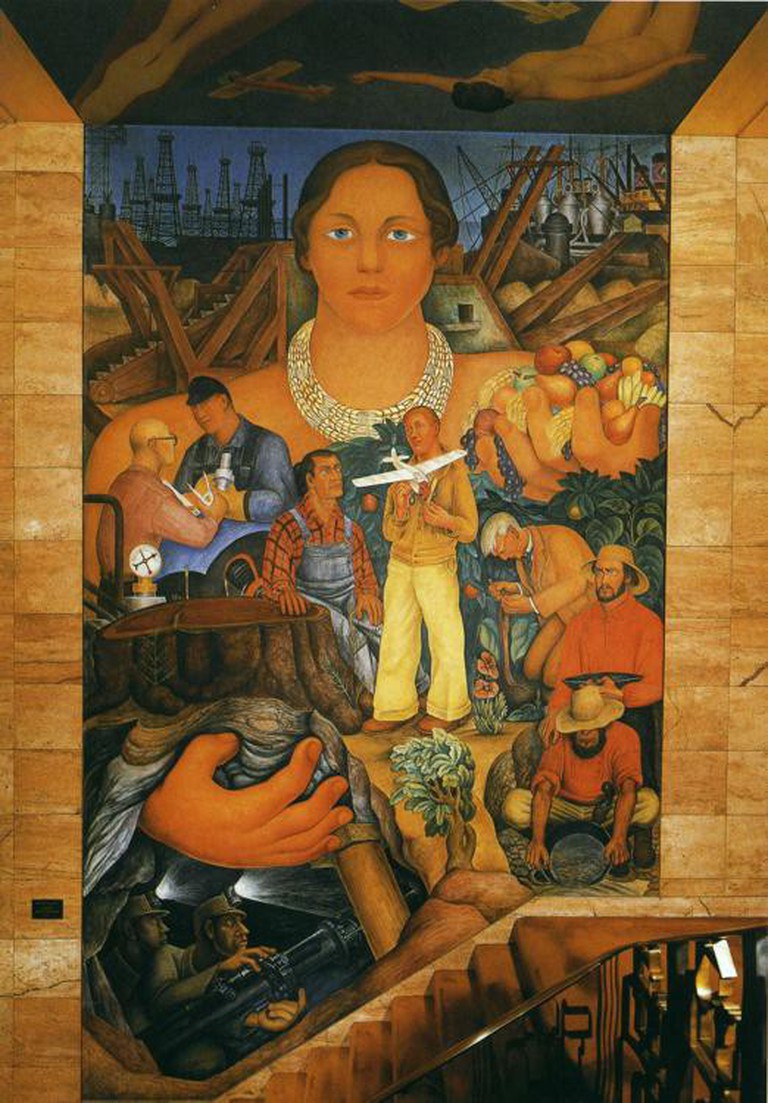
–but whose offensiveness disturbs, upsets and angers the viewer in a truly visceral way. Resting on the edges of our own borders as the basis for a larger “border complex” that seems to steadily expand, the border complex is not only a unilateral dictation of border policies, but a relinquishing of any responsibility of governance of the inhabitants of the nation, treating the definition of citizen/non-citizen as a primary duality never explicitly adopted as central in American politics and history, but assigning this division a centrality rarely so clearly geographically expressed as a question of national territory.  

Even though the wall is a practical separation between territories, and an assertion of exclusive territorial identity, the imperative of the border wall that is repeatedly cast in urgent, existential terms, has presented itself in discursive terms both as a promise to the nation, in terms analogous to the Contract with America, that separated Americans from others, but which promised to strengthen Americans’ relation to the rest of the world.  The increased proximity of the nation’s inhabitants to the border and border wall was asserted in the Trump campaign:   the transactional status of the wall grew as a means to prevent multiple forces from endangering “our communities’ safety” as the border wall became a narrative plug-in for something like a promise of redemption from higher wages, untold economic dreams, and an acceptance of police security, as if a border can radically change the status quo of the American economy and local family safety.   The proposal of the border wall continues to exist in a deeply transactional sense for Americans, as geographic relations to the actual border has been erased so thoroughly for the border, under the guise of “immigration,” to become a national platform of a political party, and a new model to define and remap America’s relation to the world.

1.  The growth of global insecurity echoes profound anxiety at the realization that the lines of control of states cannot be so legibly or clearly mapped in the present moment, an anxiety it reflects by proposing to inscribe the border onto the landscape to make it visible to all and permanently fixed.  The false promise of the border wall has been able to gain meaning on an individual level, allowing each to invest it with meaning and feel proximity to, independent of their own actual geographic proximity–even if the result is to silence the violence that the proposition of such a border wall does to the rule of law.  If the long and energetic tradition of public mural painting that had origins in the Mexico of the 1930s provided a movement of energetic and energized monumental painting on open air surfaces in projects of humanity and considerable color.  But the elevation of their pictorial formal power moreover asserted a new public identity of the nation for observers.  In contrast, the artlessness of the empty screen of the border wall is an evacuation and denial of subjectivity:  the defining characteristic as a concrete surface of the proposed border wall is itss inexpressive surface, its denial of common humanity, and its assault on the collective narratives that were the subject celebrated in muralism.

The wall stands as a sort of rebuttal to a muralist tradition of inclusiveness–embracing varied styles from Rivera to Siquieros to Orozco–through the assertions of a new artistic idiom by which to involve viewers in a revitalized broad civic life.  The border wall is less an illustration of human will, than an image of the assertion of the reason of the state, understood less by legal principles than a tortured logic of exclusion.  For while the extant border was a site of recuperation of muralist public art, the new border wall serves to impose the fixity of the border as a site that offers no place to the individual refugee, migrant, or legal immigrant, but a blank canvas that symbolizes the absence of individual autonomy or subjectivity to cross the transborder space.  Indeed, rather than a collectivist statement of unity, whose monumental forms suggest a human struggle of collective identity and work, the construction of the wall is presented as a testimony of the need for an obstruction of the passage across the border to protect the nation, based on the knowledge and experiences of border communities, presented as a need to ensure and defend safety, national integrity, and economic power.  Like the symbolic language of muralism offered a replacement for the common iconography of sacred art, in its assertion of public identity, the border wall presents itself as nothing less than a new religion of the state.  While the comparison of the proposed border wall to the public panting of collective art muralism intended as an call to collective national consciousness and unity in post-revolutionary Mexico is a provocative comparison to the elevation of sovereign authority over the border by building a wall, the magnification of the border by the project and prospect of building a border wall has served to elevate a perilous image of nationhood, based less on ties of commonality, collective identity, or a rich historical legacy of individual involvement that muralists proposed than an unhealthy focus on the border as a site of danger, a frontier needed to be vigilantly guarded, and a threshold whose guarding substitutes for the defense of civil laws.

For in claiming to protect and secure the nation, the border wall becomes a performative exercise of the religion of the state, as much as it serves as a defense of political sovereignty.  The authority of the US-Mexico border wall, in unintentionally, seems to stand as an open rebuke and rebuttal to the hopeful ideals and huge figures in images of dynamic abundance such as the monumental Allegory of California (1931) by which Diego Rivera depicted the rich bestowal of gifts on of a heroic mother earth figure of California, in San Francisco, whose monumentalism addressed individual viewers by an almost tangible allegory of local abundance —

photo-2_rivera

–which set a basis, in one of the first large projects of the painter in the United States, set a basis for a new tradition of public moralism in western states.  The interchange between active labor, earth, and a united countryside, if not a united narrative of nation, offered an optimistic personification of a monumental Gaia-like state, who, her resources liberated by workers, grants “gold and fruit and grain for all” of its residents, the revolutionary art of Siqueiros that heroized his country, or the twined histories of the Americas that José Clemente Orozco organized of tragic but truly epic historical scope of the Ancient Migration and the Migration of the Human Spirit, extending the collectivist spirit of revolutionary nation.  Affirming a discourse of white privilege, indeed, rather than inclusion, the border wall is an imperative of religion of the nation that girds the border as a sight of defense, mapping the other as outsider in relation to the needs of the state, rather than celebrate the human subject as a force that is part of nature or culture. Rather, the proposed border wall seems to exist outside culture or nature, as an imperative to an endangered and threatened civility of the status quo.

The border wall erases the spirit of the migrant as it prevents migration, alleging compelling reasons of state and the new logic of the religion of the nation that replaces the law and any appeal to the law in its urgency.   Rather than portray a giving sense of the heroism of migration, indeed, the wall interrupts any freedom of migration and transborder or transnational citizenship, reducing citizenship to a notion of territoriality and land, by bounding the terrain of citizenship and affirming a new ordering of space, and a political theology about the boundaries of the state, and the subtraction of citizenship or rights from the “enforcement zone,” “border zone” or denial of the rights of political representation or legal status for all transnational migrants in the “dead zone” of the borderlands.   The absence in this zone of rights of the subject–the refugee, migrant, or itinerant subject–is paramountly defined by their statelessness and inability to fit between strict categories of sovereignty, rather than motion across states being celebrated as a point of access to the bounty of the land, or of the migration of the spirit as a celebration of the recuperation of a modern individual political identity.  By demonizing the practice of migratory mobility, as if by a principle of “earth-first” binding of the nation, the border inverts the celebration of the human spirit

panel1

panel21Jose Orozco, Migration of the Modern Spirit (panels 1 and 21) (Dartmouth University)

There was a resurgence of the discursive practice of the political messages contained in  muralism as a form of public art in the resistance to decorating the border with monitory signs.  Is the Border Wall not only a map, but also a rebuttal to this tradition, and indeed to the painting of public rebuttals to the wall through paintings and commemorations in the past?  The absolute absence of any affect or visual address within the intentionally blank, sterile and almost industrial character of the wall seems in hidden dialogue or rebuke of an aesthetic of direct involvement of the viewer through its mute surface and corresponding evacuation or denial of individual human rights.  

1.  The triumph of industry, of rich historical cultures, or even of cultural conquest and revolutionary violence is compellingly replaced by the absence of any trace of human making or creation–or individual subjectivity–within the surface of the proposed border wall, which rather stands to deny individual liberty:  in place of an aesthetics of broad political involvement, the denial of the presence of those on the other side of the border wall stand as a vicious act of disenfranchisement, and even a denial of human subjectivity.  Indeed, if the heroic or epic narratives of monumental figures engage viewers in a pedagogic manner in muralist traditions by illustrating a narrative of nation, the proposed wall suggests a blunt lack of any national narrative, save the denial of the subjectivity of those on the other side.

The talismanic nature of these “prototypes”–mock ups slightly removed  the border–was meant to evoke the prominent place of the border wall, and to restore or reinforce  in the psychological and mental imaginary of our new national space.  Repeated throughout the Presidential campaign as if a mantra, evocation of “the promised wall on the southwestern border” has redefined a relation to the nation–and indeed been presented as a form of love for the nation–by the master builder who would be US President.  And although the request for a “solid, Concrete Border Wall” in March, 2017–described as the President’s building medium of choice–became a secret state project, as “too sensitive” to be released by a Freedom of Information Act, by the Department of Homeland Security, designed to meet demands to be impossible to tunnel under, and impenetrable to sledgehammers or other battery-operated electric tools for at least an hour, seem something of a simulacrum of the state that is both all too obstructive for actual migrants and cherished by many Americans, and prevents the transformation of previous parts of the border wall to public sites of commemoration–remembering the suffering of those who attempted safe passage, or indeed of mural-art that has attempted to assert the fluidity of cross-border transit.

CrossesAguaPrieta--Dec08

gettyimages-632717318.jpgSandy Huffaker/Getty Images/Palm Beach Post

–or that try to imagine the perspective that the future of the border wall will create for the migrant subject who is excluded from hopes of cross-border transit.

Trump Vows To Build Border Wall Between Mexico And The U.S.Justin Sullivan/Getty Images

Even as the proposed US-Mexico border wall is presented as girding the nation against multiple dangers, the new bounding of the nation that prevents any intervention or artistic transformation of the wall, by stating its own absolute authority as a re-writing of the nation.  The permanence of the models of the wall seem not so tacitly or subliminally suggested by the physics form of one of the mock-ups, which references the form of a flag, as if to suggest its similar permanence as can image and record of the nation, and proof of the nation’s continued existence, as if the nation could not exist without it:  indeed, the flag-like proportions in mock-ups suggests a new flag for the nation.  As the promise of the border wall has allowed such a range of audiences to cathect to the national boundary–a sense that was perhaps predicted in the repainting of a section of the existing border wall of welded metal and steel near San Diego–the very site where a caravan of Central American migrants would arrive where they were taken by President Trump as an illustration of the fear of the dangers of cross-border immigration–the wall suggested a sort of surrogate for the purification of the country, restoration of the economy, and an elevation of the minimum wage, wrapped into a poisoned promise of poured concrete.

It was no surprise that a group of Mexican-American veterans chose to paint a segment of the older wall near Tijuana in 2013 as if a mural that mirrored the use of the inverted flag to stage a signal of distress to the nation:  indeed, the deported former navy who chose the wall as a site for a cry of emergency and national belonging:  teerily prescient of the flag-like nature of the mock-ups, sections of which uncannily resemble a vertically hoisted flag, the wall sections painted by disabled veteran Amos Gregory, a resident San Francisco resident, who completed the painting with twenty deported veterans, recuperated the tradition of moralism to create a new story of the wall, where crosses of dead migrants replaced the stars of the stars and stripes, as if to appropriate the wall to a public narrative of nationhood.

image.png

The inverted flag that a group of U.S to paint the flag, but expressed shocked at charges of using an iconography “hostile toward the United States of America,” and chose the inverted flag as a distress signal–to show honor to the flag, and to “mean no disrespect” to the nation, but to raise alarm at its  policies.  His dismay when asked to remove the mural by US Border Patrol sent a message of censorship as an attack on freedom of expression; Gregory incorporated crosses to commemorate on the wall the migrants who died seeking to enter the United States for better lives and livelihoods,  undermining the ideals of freedom he cherished.  By placing their memory on the wall, he sough not to dishonor the flag, but to use it as a symbol of extreme gravity that respects its ideals–and the etiquette of flag display, in the manner  future protests at the marginalization of migrants seeking asylum as they enter the United States at its border zone.

distress at Ptotest

The current mock-ups suggest, if unconsciously, an actual evacuation of patriotic ideals.  The MAGA President might have been conscious of how several of the so-called prototypes suggested a flag turned on its end, as if in a new emblem of national strength–

image.png

–as if to offer them a new symbol of the nationalism of a new nation.  The segment of this prototype recalls the flag suspended vertically, as on a wall or over a door, above the border that has become a prominent character in the current President’s Twitter feed, and evokes the ties between terrorism and immigration that Trump has long proposed the government recognize and acknowledge, despite having few proofs of these connections, acting as an assertion of the implied criminality of all immigrants who do not cross border check points by legal protocol, no matter their actual offense.

1. The compact about the construction of the border wall has, against all probability, become the latest in faux populist promises since the Contract with America to pose fictive contracts of illusionary responsibility and reciprocity to the democratic process, and have provided new tools of assent.  At the deepest level, the wall exists in this discourse of urgency not as a proposition, but as an actuality that need only be built, and cannot–or need not–be mapped, less the practicalities of consequences of its construction by acknowledged.  The border wall, viewed in its prototypes, is somehow an expression of the unmappability and existential quality of the border wall that Trump wants; alien from its surroundings, and existing as an obstacle to entrance, it is a redefinition of the border from a site of passage to an obstruction.  The affirmation of the border as a “real border”–which Trump repeatedly ties to the status of the United States as a “real country”–seems to mean an impassible border, which lacks any negotiation, but is recognized as an element of the nation that needs to spatial location but acts to strip all outsiders of their their rights.  All attempts to map the border as a spatially situated place  seem to stand as a challenge to undo the imperative of the wall’s construction.

The faux consensual ties with the electorate perpetuate a fiction that a democracy runs on the contractual obligations between a government and populace, but have early been so focussed on geographically specific terms.  But in an age of anti-government sentiment, the icon of the wall has become an effective icon of describing the ineffectiveness of prior administrations, and an iconology embodying the new role of the executive in the age of Trump:  in an age of global mapping that seems to disrespect and ignore borders, we imagine migrants moving across them with the aid of GPS, or Google Maps, empowered by the location of border check-points on their cross-border transit,–

Google maps borderGoogle Maps

In a rejoinder to these fears, the proposed border wall would map a continuity among the stations in different sectors administered by the US Border Patrol, already strikingly dense, and apparently easy to connect by a solid wall–

Border Checkpoints

1 Comment

Filed under border wall, globalization, human rights, immigration, US-Mexico Border

Strongman on the Border

The border was closed and immigration authorities simply ‘at capacity,’ announced newspapers, after a Caravan of migrants from Central America arrived.  In rejecting the ability to process new arrivals who lacked necessary papers of transit, the papers parroted a an anti-immigrant line, revising the southwestern border from a line of passage, or space of transit, in what seemed a meme about the border as a threshold of legality-as if a line defines the legality of those who cross it.  If the border wall is a “new” creation, it seems designed as a monument of the “new” nation, bisecting an area that was not truly demarcated for some time, despite it suggestion of eternal authority–the Thono O’odham Nation of the Sonoran Desert long lived on both sides of the modern “border” before either nation existed across its divide, and are recognized as “border dwellers” in both the state of Arizona and Sonora.   But the wall served as a label, and a divider between “us” and “them,” a boundary where the outsider was defined as an enemy, and “politics” was indeed the definition of the enemy lying outside of the social body. To affirm that distinction, the wall needed to be built–and to explain the enemies to the body politic, the performative spectacle of the confrontations that might occur at the border was in need of staging, again and again, as a primal scene, as much as the wall-as-border might be mapped.

Department of Homeland Security

The creation of the border as a defining feature of the nation–a nation that was able to be recreated, or literally “made great again” as a nation by its border wall as a human creation–suggested the deep belief in the making and remaking of nations, a concept of the intellectual creation of nations that oddly echoes the legal historian Giambattista Vico in its insistence on the making of a nation not in reference to its laws, but as a collective whole who felt that borders were defining characteristics of modern states.  But the institution of this border at the same time exists outside of the law, and assumes an oddly primal characteristic as a site of sacrifice, echoing in surprising ways how the Neapolitan jurist Giambattista Vico saw borders as defining the inclusion and exclusion of rights to property, and senses of citizens, that was prior to and predated the law. Although the massive public works project that the state had mandated at the U.S.-Mexico Border was not at all an Enlightenment project, so much as a mega-project that was destined to incarnate state authority in an age of mass politics: a public works project proclaimed to fill multiple needs of protecting property, securing wealth, and building the nation’s power, of Neo-imperial dimensions, akin to Mussolini’s draining of Pontine Marshes or to the state programs of collective transformation of the mid0twentieth century, by dramatically staging the power of the nation in its ability to incarnate mythic notions of a powerful state for the benefit of all its members.

The creation of a strongman, who has arrogated the American eagle clutching fasces and a laurel, announcing that it will transform “many” to “one,” but only the many admitted past its sign. For the legist Vico, the ongoing brutality and conflict of society was not only natural, but a position even of possible growth: the very words of one society and culture might be reused and adopted by the following in even discordant ways.

But if Vico was clear about the “boria delle nazioni“–the conceit of nations–that they were unique in the very national characteristics that only they possessed, and the each nation had most critical aspects only it alone possessed. The conceit is amplified by the border wall, and the lie that it is built on to keep out others–and indeed to perform a sort of ritualized sacrifice of the other on the built barrier that the nation sought to create. For the Border Wall, if the most vain construction of any nation, a homeostatic barrier or norm of sorts that proclaims the identity of the nation, the unveiling of the border wall was an exploitation of the potential of television and the stagecraft of nationhood to stage that identity, as a fascistic or photo-fascist rehearsal of national foundation, or refoundation, by newly erected boundary walls that lack all porousness of the past. Indeed, the border wall seemed to be an occasion to re-educate the nation on the notions of citizenship, and the barrier that needed to be created on which to sacrifice the other. Was the conceit of the border wall a medieval conceit, or a form of statehood that was only made in the twenty first century?

The image that suggested migrants atop the wall, or of others scaling a dilapidated section of slatted border fence near San Isidro–“through a dark, treacherous canyon, notorious for human trafficking and drug smuggling”–collapsed multiple tropes of border-crossing on the least likely of targets:  a peaceful procession through Mexico that began on Easter Sunday, crossing borders to call global attention to migrants’ rights.

_101103435_mexico_caravan_migrants_route_640-nc

While the simple visualization of the course of the procession that wound through Mexico City from the southernmost border of Mexico cannot trace the mental geography on which the arrival of migrants was mapped in the United States, the progress of Central American migrants was viewed and mapped by Donald Trump and FOX in terms of the desire to see their arrival from behind the proposed $18 billion border wall that has become a contentious object of debate.  As the number of arrests along the border has grown above 50,000 for the third straight month in a row, and more children separated from parents in an attempt to broadcast cautionary warnings about the dangers of attempting to cross the border, or to appeal to existing immigration laws by asylum pleas, stories of migrants that the proposed wall would silence are increasingly difficult to silence or contain, and the human narratives of migrants are increasingly difficult to place behind the imaginary screen of an insurmountable border wall,–which of course does not exist, save as a mental construct–but is cherished as one and difficult for many to relinquish or deny.  

Even though there is no structure corresponding to the height, thickness, and architectural design that Trump had treated audiences during his campaign, the Caravan threatened to remind us that the wall didn’t exist, despite the attention that has been lavished on its proposed construction at a cost of an estimated $18 billion, far below what actual costs might in fact be. Yet the specter of the arriving migrants from Guatemala, El Salvador and Honduras–the triumvirate of “failing states” that Trump has demonized has provided a new basis to affirm the urgency of its construction. The caravan of migrants was cast as a threat to the nation, of urgency to place at a distance from the nation–even if they were also cast an oddly unstoppable “horde” able to evade or defy Mexican immigration authorities who had not successfully turned them back. As if to say that the “buck stops here,” their impending arrival was rhetorically magnified as a threat to create a persuasive image that reminded the nation of the urgent need for the border wall as an artifice of defining the nation.  

After months of dehumanizing migrants as faceless hordes, poised at the border, migrants seemed to have arrived at the border fencing, about to breach an inadequate barrier that is a relic dating from the era of the Vietnam War.  The news of the progression of the Caravan–and clouded interpretation of what their aims for crossing the United States’ southwestern border truly were–led them to become a poster child for the urgency with which Donald J. Trump has so stridently advocated the construction of a “real wall,” with an intransigence that almost embodies the physicality of an actual concrete wall, a month before the construction of the border wall began in San Diego and Calexico, CA, replacing some fourteen miles of improvised border fencing that was long ago made of scrap metal to “secure our border” as a way to “make America great again.”  The promotion of building the border wall was a way to ensure “public safety” followed repeated images of migrants attempting to scale or protest before existing improvised fencing–

image

-whose inadequacy to deal with the border threat Trump had relentless ridiculed as useless during his Presidential campaign.  The danger of cross-border traffic that Trump had repeatedly magnified circulated back to prominence within the national media with the arrival of the migrant Caravan.  The hope for the migrants to gain asylum in the United States was immediately questioned as their true agenda was assumed to be one of evading the border controls before the Wall was built–and the immigration laws that would permit their entry changed.

If the announcement of the construction was a feign of a a show of strength, and promoted as a basis for national pride, it was an insult to migrants petitioning for asylum, as the promotion of the border wall as a sign of national security debased the notion of the nation as one of laws and civil society.  The promotion of the wall as a slogan of nationalism remapped the nation in relation to the border, after all, in the Newspeak of social media and twitter–“Strong Borders are Security”, “Immigrants are Criminals”; “Refugees are Terrorists”–the border wall protected national security and projected the idea that all migrants were illegal.  The spatial imaginary of the border wall echoed the longstanding claim, made without evidence, that the immigrants at the border were “the worst” of their society, and for allowing an untold number of undesirables to enter the the nation.  As well as protesting the treatment of the United States”the dumping ground of European Refuse” as an insult to the nation, the insult was accepted by the nation.  The blame rests on citizens who are accept the very immigrants Europe does not want.  The image, which appeared just before Bartholdi’s “Statue of Liberty” was erected in New York Harbor, raised objections to accepting those rejected by Europe’s crowned heads, of dubious value to the nation that echoed Trump’s position.

European Refuse.pngKendrick, “And We Open Our Arms to Them” Life Magazine (July 12, 1885), 

The very chaotic narrative of depositing “human refuse”–a group of former colonials identified as “not like us” but being advanced by an invisible broom–was repeated in the image of the approaching Caravan, as the legitimacy of their requests for asylum from Central American nations were questioned, and suggested to be fundamentally an illustration of disrespect for the law.  The “Caravan” of over 1,000 migrants seeking a better life was widely mapped as a threat to sovereignty and law, recasting a protest march that promoted migrants’ rights as an invasion of sovereign space–and a grounds to deny migrants’ rights.  The  tweets of President Trump directed the attention of the country to the border to query the status of the migrants who were headed to the nation, as he announced instructions  “not to let these large Caravans of people into our country”–magnifying the migrants as a national threat through a dichotomy between “them” and “us.”   The anxieties about immigration policies that Kenrick’s cartoon registered panic at the caricatured faces of the new arrivals.

In announcing an intent of illegal entry across the border, Trump once again conjured the need for a border wall, as if trying to co-opt the message of migrants to create an image of a cross-border threat.  The construction of border walls against an “existential threat to the nation”–as did the former commander of the southern border who was named Trump’s director of Homeland Security and now his Chief of Staff—creates an urgency for protection that corrodes the possibility of an open society.  Kelly’s disparagement of migrants as “people who would not easily assimilate into the United States,” “overwhelmingly rural,” from countries where “fourth, fifth, and sixth grade education are the norm,” described them with the same disdain as Kendrick’s cartoon from the early Life of the 1880s protested the insult by which ex-colonials were sent to the United States as to Australia or India, which had indeed become “dumping grounds” for convicts, remittance men, and socially unwanted cast-offs, as well as seeing them as barbarians who threatening the social fabric of the United States.  The disparagement of migrants who are seeking asylum as uneducated, of rural origins, or indeed, as Kelly’s remarks must have reminded his audience, criminals.

ICE 2014 arrests gangs--ms13?ICE Arrests of undocumented immigrants, 2014
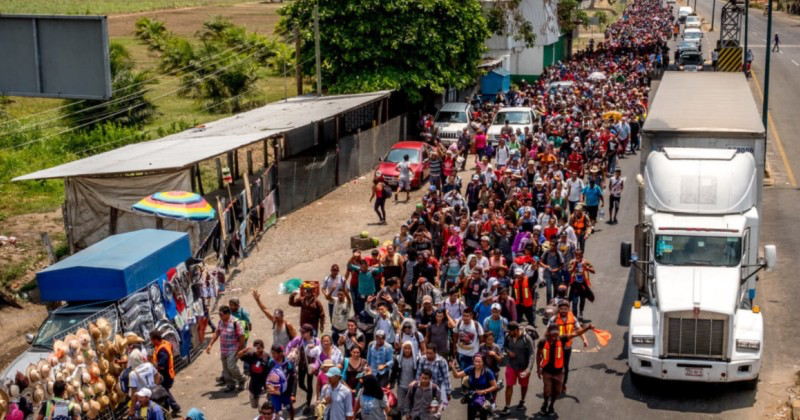
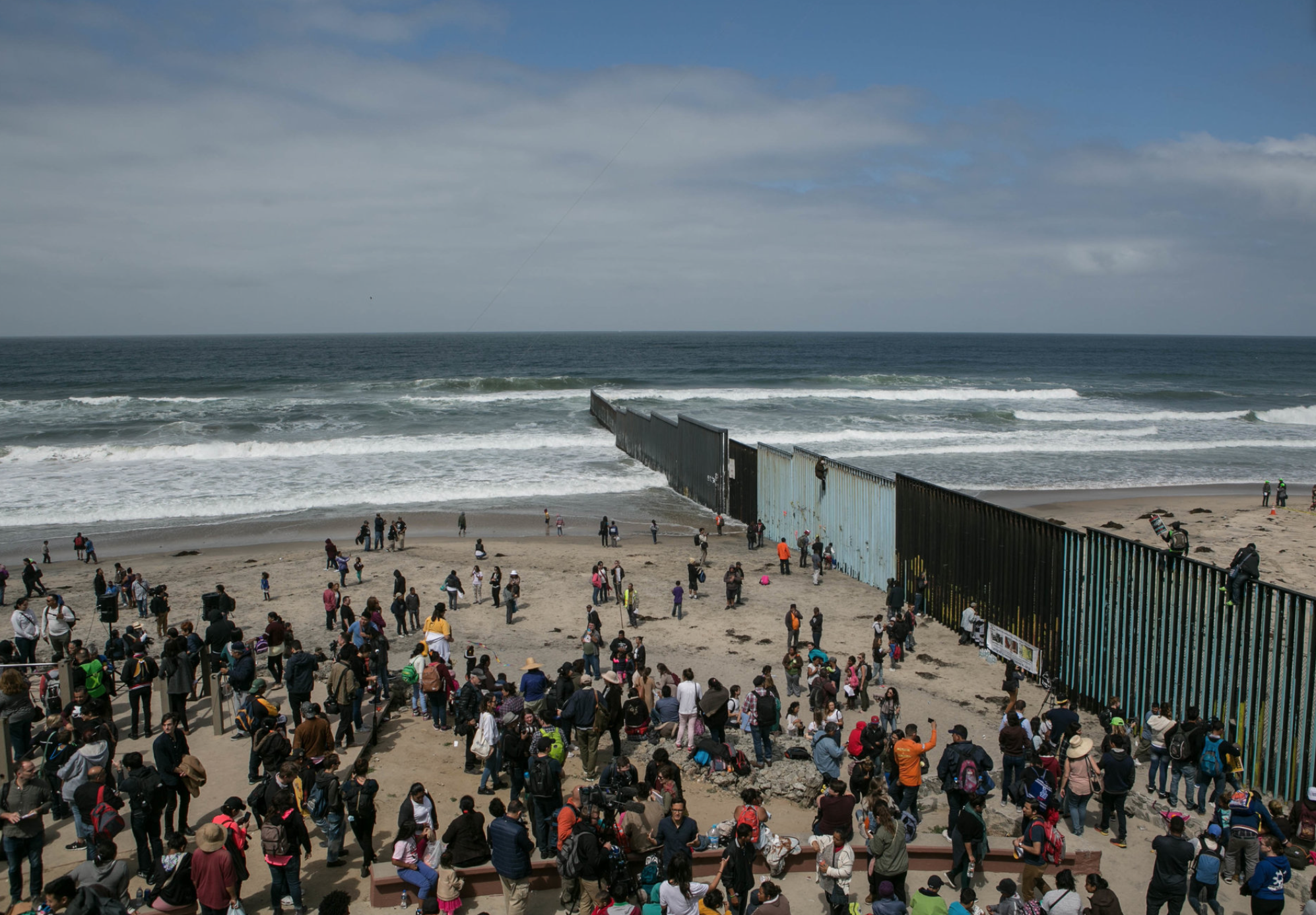
The disproportionate warnings of a “border threat” or “trouble at the border”  telegraphed on Twitter was inserted in a narrative rooted in the plan to create a border barrier of cast concrete in August 2015, in the heat of the Presidential election–a mission that crystallized support behind Trump’s campaign.  Trump insisted that the border wall he advocated wasn’t rhetorical, symbolic, or virtual–a space defined by hi-tech monitoring–but an impervious barrier that would succeed where other poor-quality fencing had failed.

The build-up of the arrival of the migrant caravan ran against the disproportionate attention that Trump had drawn to the border.  As Trump pedaled the fiction that the wall had already been begun, newscasters on FOX mapped a showdown by the approach toward the border of “that scary migrant caravan” of Central Americans with American law enforcement as inevitable, placing the migrants in a narrative of unwieldly crisis of immigration management on the US-Mexico border.  In ways that intersect with a broad unease of increased immigration–often manifesting itself in extreme xenophobia, othering and racism–a vaguely masked anti-immigrant sentiment that has growth in the United States over the last four to five years which Trump has deftly exploited. For the ‘border wall’ was recognized code for a thinly disguised racism, captured in John Kelly’s characterization of the Caravan–and migrants–as “overwhelmingly rural people” not capable of assimilating, who “don’t have the [necessary] skills” to do so, and are “overwhelmingly rural people,” as if ignoring just how dependent U.S. farms are on immigrant labor.

The disproportionate attention the Trump and his planned border wall directed to the southwestern border made the region seem far more immediate to all Americans–and defined the Caravan’s approach as national news.  Although the formation of such “Caravans”–a name not coined by Americans, though it gained new spin in the mouth of President Donald J. Trump, who had grown frustrated with an uptick in U.S. Border Patrol metrics of illegal entry–the tactic that was long adopted by advocacy groups to foreground migration difficulties was used by the group Pueblos sin Fronteras, or Peoples without Borders, whose name was seen as revealing their opposition to the redefinition of the southwestern border of the United States, which has also been mapped onto the wall–creating a reflexive panic at the sight of large crowds of unidentified migrants marching toward the border.  The legal and physical obstacles that Trump promised to place on Mexicans or Central Americans seeking entry to the United States were always twinned, but the arrival of the migrant Caravan seemed to give it a new urgency, and to legitimize, as a suddenly mainstream demand of border management, the ability to control human cross-border flows.

image.png

The march was described disdainfully as a “political stunt” in media, as the Attorney General and Director of Homeland Security demonized the “Caravan of migrants.”  Trump had promised the nation a border wall unlike the reclaimed corrugated metal fencing in Tijuana, but made of  “precast [concrete] plank,” a protective barrier far more powerful and robust than the inadequate fencing he treated as “a joke” and a disgrace to the nation, and which the multitude of migrants were seen as able to cross, but in need of immediate arrest and detention in a fantasy of border enforcement.  If Trump had promised to be a strongman at the border, the old border wall seemed indeed flimsy obstacles, unable to stop even the crowd from the Caravan who arrived to petition for asylum at San Ysidro, CA.

Migrants arrive at Tijuana

The peaceful protest of the Caravan de madres centroamericanas, to use their full name, was recast as a march of opposition to Trump’s border policy, while for Trump, as some three hundred odd members of the Caravan arrived at San Isidro, a recognized port of entry, in five busloads, and mounted on a fence made of repurposed scrap metal became for President Trump evidence of a crisis of sovereignty.  In response to a crisis he seemed to have created on Twitter, he ordered the Department of Homeland Security to “stop the caravan,” displaying his knack for sound bytes and slogans, and imagine that, searching for the right string of capital letters on his keyboard,  only “a strong, impenetrable WALL. . . will end this problem once and for all”–even if the problem lay with the places the migrants had fled.  The motion of “migrants,” now cast as “illegal aliens” in the right-wing press, even as they hoped for a miracle from god able to “touch the hearts of immigration agents,” was not able to be seen clearly by many, even if their course was carefully mapped over the previous month in increasingly colorful reportage.

image.png

Continue reading

Leave a comment

Filed under border barriers, border policy, Donald Trump, immigration, undocumented migrants