Tag Archives: historical memory

“A Mighty Redwood of a Man Has Fallen”

Malcolm Margolin was among the coolest and most curious people I’ve known. And while terribly saddened by his recent death, and mourning his dynamic presence, he was long a model for struggle we will need to remember in a dark age. I first met Malcolm as we walked the Bayshore Trail in opposite directions, Malcolm appropriately seeming to patrol the newly reclaimed bayshore pathway a tradition of the Ohlone people. As if a modern Henry David Thoreau who found a new Walden in the East Bay, Malcolm seemed, walking along well-worn trails, self-appointed clearer-of-paths of the East Bay wilds. While from Massachusetts, this Harvard-educated hippie won a grant to write a book about working the land without transforming led him to appreciate the native ways of another tribe, what Gary Snyder called “old ways,” that were rooted in place as much as they channel American transcendentalists that was purely Thoreauvian in its spin.

As Thoreau, Malcolm saw the ethical traditions of the local as a deep purpose of “rules, customs and practices outside the dominant way of life,” evident in the local Indian community, as if he recognized it–and adopted the vision of straddling outsider cultures and communities on projects of refusing to tame wild lands, allowing them to exist for our benefit against all odds. Malcolm grasped–as have others –the value symbolic anthropologist Clifford Geertz ascribed “Deep Hanging Out,” as a basis for ethnographers’ sense of purpose was immediately recognizable to Malcolm. And it was a way of describing his longtime Berkeley residency on the margins of academia, and at the center of a large industry of small presses as as deeply purposeful as the noted generations of anthropologists who had studied–and indeed mapped–indigenous cultures in the state, more often reifying their presence as an “extinct” peoples. Malcolm’s work, if often based on oral accounts of life before westernization, provided a model of Geertz’s concept of “thick description” less tied to the symbolic webs of culture, than the immersion in a sense of place and vital relation to place. The purpose he gained in the rich local setting of Berkeley, CA, from its parks to its shell mounds to its coasts and islands left a bookish world for close study of the ethics of place, before he brought this attentive wonder to a home in the bookish world. And the deep knowledge of place–a sort of expanded “local knowledge” of the Bay, to cop another phrase from Geertz–offered an alternative anthropology of the local, rooted firmly on the West coast.

As a former parks ranger who had, indeed, cut his teeth rebuilding the trails in what was Oakland’s Redwood Regional Park–a jewel of native forested lands of old growth trees in the East Bay, one of the large redwood forests in the East Bay, and third East Bay park open to the public–the largest natural grove of coast redwoods in the East Bay. While Redwood Regional Park, where he first worked and developed a sense of the preservation of the wild, was renamed after Aurelia Reinhardt, Malcolm must have been nourished by its old growth redwoods; I’d like to imagine, their age, if actually not that deep, gave him a new sense of spatial orientation to place to Ohlone residents, and a sensitivity to the suffering it had undergone and he might save. His love of place may have begun earlier building trails, but in immersing himself in the practicalities of lost woodland trails as a redemptive process led him to become a proselytizer of many regional off-road trails, to treasure them as a site of contact to other worlds and pasts in danger of being lost. If AI algorithms somehow generate a tie from a search about Thoreau’s writing at Walden between “the site associated with Henry David Thoreau’s experiment in self-sufficient living and a more recent effort to return land in Berkeley” to the Ohlone people, a missing link may be Malcolm’s attention to the uncovering of indigenous practices and histories of place.

The understandings of Indian Country that he gained, and enjoyed, led him to move between many worlds to establish his footing, and gaining a sense of potential redirection of past injustices that he dedicated a great part of his life. If few cartographers are so resistant to following rules, Malcolm’s interest in the quirky and the overlooked led him to blaze new trails across much of the Bay Area. Whether the serendipity of Malcolm’s work in an old growth forest in the 1960s, as newly planted redwoods of the region first provided a hope of restoring forested lands that had ben cut down.
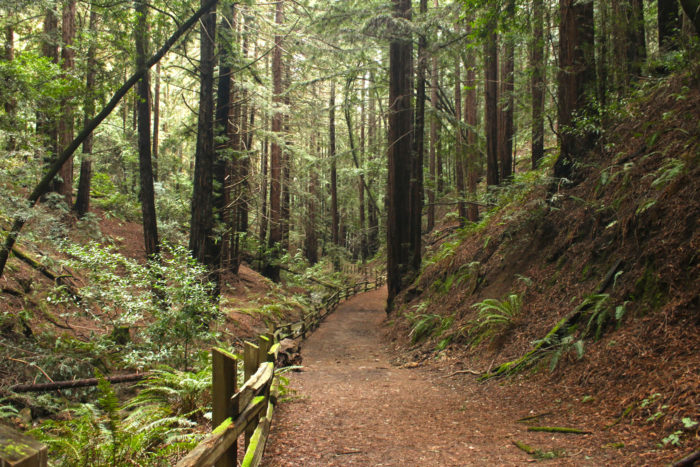
Redwood forest trail

 Forested Trail in the Dr. Aurelia Reinhardt Redwood Regional Park. Photo credit: H Grimes 

While Malcolm told me a few times he would never have been able to research Ohlone Way (1978) or other works without the University of California’s library at the ready, praising the gift of the open stacks at the public university, this East Coast transplant who lightly tossed his Harvard credentials cast himself as an outsider intellectual who could serve to orient a new generation to the region’s native lands. Malcolm had, in Ohlone Way, animated a sense of preserving native ways. If in part this followed Alfred Kroeber and Henry David Thoreau in describing Indians as “extinct,” at first, at least in California, he spent much time and effort revising the remark with a celebration of native presence and the vital nature of traditional tribal arts–few did as much to stress their current relevance and continued presence in these lands. While Malcolm’s project of “cultivating the wild without taming it” became a sort of ethos of the outdoors, popular in the era, his guides to the practicalities of the wilder areas to enter just outside the East Bay and San Francisco presented a vital document of a world before urban sprawl, promising to rehabilitating one’s relation to the wild–and rehabilitate one’s soul–of deeply Thoreauvian ends of transcendental thought.
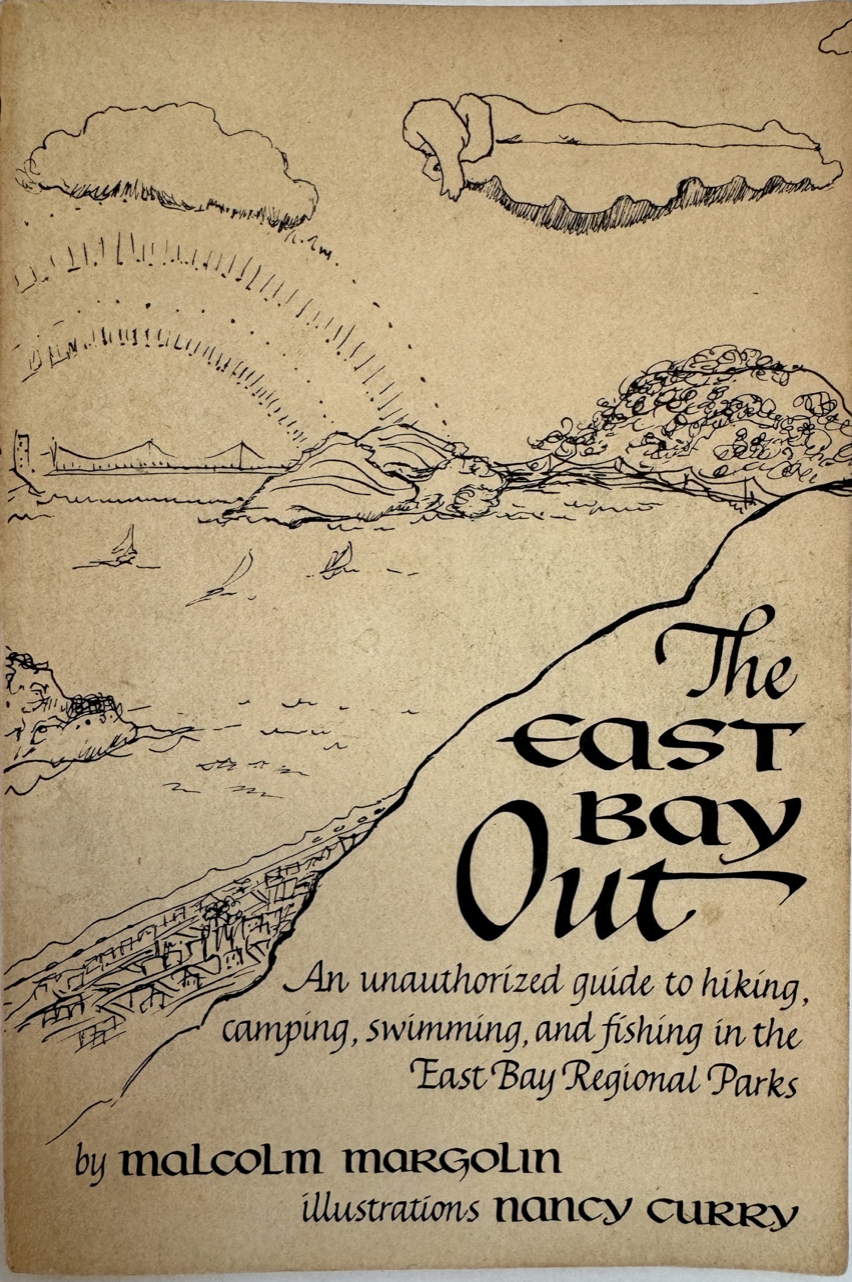
East Bay Out (1974)

For ever since idiosyncratic explorations of the region some fifty years ago, and the pioneering communication about the land he learned to know so well, East Bay Out (1985), the very deeply personal guide that allowed audiences to embrace to orient themselves to the Bay he loved, as if it were a world outside and beyond the familiar, to explore out of the paved regions of Berkeley, in what has been an increasingly compelling mode of deeply meditative work on the edges of settled world we collectively failed to pay sufficient attention as built infrastructure expanded. If an idiosyncratic sort of cartographer who bucked at the idea of having to follow rules, Malcolm developed a sense of wonder in the East Bay, as much as he simply moved there; as he immersed himself in its forested wilds, the parks became a keystone to the admiration of nature–as he grew to be the elder statesman of wonderment, never tired at pointing to the overlooked we needed to notice, and most at home when he engaged as deeply as possible in his surroundings, including, of course, its rich indigenous pasts to which he dedicated so much attention and wonder. As if the making of trails in Redwood Park were a weak fit with his ambitions and skill, trail-making lead him to blaze trails of inquiry across the East Bay, in part because of his resistance to following rules. If Thoreau had famously described himself as all mapping, for Thoreau, was indeed a form of reclaiming an ethical relation to space, from the recuperation of a mapping of an ethical relation to the Concord River that spanned its indigenous past and the present, through the French-Indian wars, but also, at Walden Pond, a universal history of heroic aspect and the present.  As Thoreau described himself to readers of his book–Malcolm knew it well–as the self-appointed “surveyor, if not of highways, then of forest paths and all across-lot routes, keeping them open, and ravines bridged and passable at all seasons, where the public heel had testified to their utility” Malcolm had a deep sense and deep meanings of new forms of mapping as a public utility.

As access to the wild shrinks and is constricted, Malcolm’s work stands as a theological practice of the outdoors, perhaps as rigorous as the ethical practices of his Yiddish-speaking grandparents, if more light-hearted and wondering, with an ample dose of John Muir’s sense of wonderment at the Cathedral of the wilderness. The sense of straddling worlds was perhaps a deeply Jewish angle to the past: if Malcolm was born in Boston in 1940, to a prosperous merchant family, less than a generation after Geertz had been born in San Francisco in 1926, the position that he had in Berkeley was one that left him little to be envy for his academic anthropological colleagues, more embedded than they were in local cultures in many way, but with the distance on academic preoccupations and terminology, or indeed on his scholarship: the sense that Jospeh Epstein expressed of both being “part of a great nation, and, having been born Jewish, simultaneously just a bit outside it, too” as being quite a position of advantage for a writer was, I think, an advantage Malcolm also felt–an ability to write as an insider and outsider that was magnified or redoubled in his relation to academic writing, and the establishment of a new press to publish his work on the Bay Area’s landscape–maybe in emulation of Thoreau’s self-publication of his first book, A Week on the Concord and Merrimack?–certainly gave him a sense of shared perspective on the massive extermination of indigenous California culture, and the ethical importance of preserving its vital life.

For if his sense of deep ethics were entirely secular, and resolutely so, the intensity of wonder and interest in the living landscape from which an indigenous past had been dangerously distanced was fundamental in his straddling of worlds. That book had helped re-interpret the regional landscape of the East Bay landscape that Malcolm, a transplant from the East Coast, to be sure, made his own to an ever=-growing audience of readers. He had self-published the book a few years before I arrived in Berkeley, CA myself, as it happens, after Malcolm had become a force in the attraction of renewed fascination to the rich ecology of the diversity of the Bay Area’s natural history and the scale of their loss–The Natural World of San Francisco (1967) had just appeared in print, and former rock climber David Brower had already started to agitate tirelessly to preserve the natural landscapes of the Bay Area, fighting for the conservation of areas of seashore and wilderness in nine national parks from the Point Reyes National Seashore led to the adoption of the pioneering Wilderness Act (1964), promoting the notion of coastal preservation was energized across the country, in ways that created a legacy for conservation only being recently turned back after a generation has taken it for granted. Soon after land acknowledgements became the norm in much of the United States, and were played regularly on the PA system of Berkeley Libraries, to remind all reading that they were so doing on “unceded” Ohlone lands that the tribe possessed from time immemorial, the ground has shifted under our feet. The position of wonderment that Malcolm long held, from tromping around different East Bay parks to exploring the region that he convinced all who would listen was a wonderland, provided a source of resistance to the development of the Bay Area, a deep environmentalism of historical consequence. And uncovering trails of wonderment was what Malcolm was all about.

It may make sense to take stock of the major shift of the Great Society and 1970s of land conservation as part of a massive shift in collective memory of which Malcolm was part. If the Regional Parks provided a crucial space to hold the state in abeyance, and indeed to keep the state out of one’s life, the shorelines preserved in seashore parks–including much of the coastal region of California, that would lead to the California Coastal Commission–afforded an early notion of a remove from the state, by the early 1970s, to preserve the entire coastal waters of 1,100 miles of coastline from uncontrolled development of coastal property that would prevent the loss of access to coastal waters and the shore by 1972—best understood in the somewhat longue durée of the foundation and preservation of a ten national seashores across the nation from the early 1960s, a distinction that defined the nation’s drive to coastal preservation during my own childhood.

David Brower and the Foundation of Ten national Seashore Parks, 1961-1972

The memory of conservation may have faded more quickly, if Malcolm’s work did not help keep it alive. The local new energy of treasuring wilderness by books on open spaces, environmental awareness, and nature photography, calling for an ethos of conservationists of leaving absolutely no mark in the landscape “save the scars upon the Earth that could have been prevented had they stood their ground.” The pioneering work was never so clearly seen as in the creation of national seashores–an effort that might have begun on McClure’s Beach in Marin County, just outside San Francisco, and Tomales Bay Park, but created energy that led to the creation of “national seashores” across much of America–from Cape Cod (August, 1961) to Pt Reyes (1962) to Fire Island (September, 1964), to Cape Lookout (1966) to the Gulf Islands (January 1971)–and Malcolm saw the regional parks where he worked as a groundsman 1970-72 as something like an alternate text to the map of the current Bay Area, developing as an East Coast transplant a distinct sense of wonder at the biodiversity of the parks that survived, even if the rich range of grasslands, nourishing streams, and herds of elk and bears that once roamed the land that was cared for by indigenous survived only in the testimony of the first settlers. And if many are annoyed but he land acknowledgements that have appeared on university stationary, movie theaters, and play houses and arts centers as if pious obligatory statements, offering but lip service, the importance of preserving and observing the forgotten history of the land was a movement at which much of Malcolm’s work set the ground.

As much as a new Henry Thoreau, Malcolm remained at the helm of the press of most of his life–only leaving with reluctance, continuing even after his retirement to be an advocate of offering a path for all to find their own Waldens, and by a plurality of Thoreaus, not only in the Bay Area but far beyond. And if the parks provided a way of thinking outside the state, and subtracting oneself from the state that was increasingly entering one’s head, it is more tragic than ironic that as we stand at the prospect of a government shutdown after his passing, the President defined by a moral void and absence of any moral center seeks to furlough parks workers in response to the eventuality of such a shutdown, and indeed to mandate leaving the parks open to all Americans, supervised only by a with a rump staff, flying in the face of expert advice, not deeming the workers who run them to be essential workers who must remain on their jobs for its duration–if some in the National Parks would be required to stay on the job, but have to wait for back pay. Parks Service was already reduced by a quarter since Trump took office at the year’s start, cutting backcountry visits, the presence of rangers, and relying on volunteers at parks as historic as Yosemite, but the reduction on critical maintenance of open lands and disaster preparedness may damage the very preserves for which a generation fought. If Malcolm would have hoped the compromise would spur a range of public protest and indignation at an end to wilderness protections, we’ve been so battered by an onslaught of public absence of oversight to make the prioritization of open park lands as a preserve to subtract ourselves from the state may be a challenge, even if it shouldn’t be.

A clear-sighted of environmental visionary, Malcolm was able to corral multiple folk behind his vision to crusade for promoting a sense of happiness in envisioning a future and better world. For much of what Malcolm agitated for was a better way of settling in the world–and indeed being settled in the Bay Area–than was evident in the landscape of development that was emerging in the years he arrived in the Bay Area, in ways that allowed him to make it home. The energy by which he teased out meanings from alternative geographies of his adopted home of the East Bay, of plants, animals, and past inhabitants opened eyes to new geography of place and space in the region, against an increasing automotive space defined by the straight lines of property, highways and trip-tiks–those ancestor of GPS, ordering spatial travel on fold-out paper map, highlighting stops only for hotels or scenic views, of clear edges, privilging boundaries and confines of attention in place of marginalizing the off-road parks. For rather than encouraging investigating the off-road regions at small-scale, maps offered a purblind image of place. (It may well have helped Malcolm didn’t drive, but made the lack of a license into a virtu:e: late in life, he smiled regaling me the distinct advantages of not driving, reminding me how he benefitted form never driving: both to getting driven home from parties and always meeting people in the rear seat or be given rides that had led him to meet the most interesting people who drove him home in the rear seat of their cars.). The handbook he wrote for exploring the Bay Area’s parks on foot, and to lead other groups to marvel at their wealth, was a large part of Malcolm’s source of energetic vitality.

Berkeley was a perfect place to find interesting people to talk to, no doubt remembering his life as a bon vivant. When we had met on the Bay Trail, Malcolm’s Old Testament beard wafting in the wind as he turned the Bayshore Trail that day seemed a sort of synecdoche for the testimony he offered and channeled of collective memory of the bay, and of the land, deeper than any map, that might be captured by deep time, or deep hanging out, to use the phrase of Clifford Geertz he was fond enough to use as a title for his final book, to claim the anthropological mantel he had been accorded even in the aftermath of some resistance to his appropriation of indigenous testimony as a record of a timeless past. And ever energetic, even in the assisted living quarters in Piedmont, he swept his hands in the air as he optimistically envisioned the ways that “people will take to the streets” against the Trump Presidency, which he asserted would bring the greatest revolution in political self-awareness since the sixties, convinced of the huge benefits on the horizon, if no doubt at this point also reliving his own love of the protest culture of the late 1960s, and perhaps taking a far more positive view on American politics than I had the heart to contest.

The belief in the value of a deeper knowledge of the Bay, deeper than the aims of developers or the maps of property, animated Malcolm as it had animated, in a sense, his entire energetic career. The promise and premise of East Bay Out, a work long in making, was that we’d all do better to cultivate the off-road and unpaved.) Was not the fixed itinerary one against which Malcolm rebelled in expanding attention in East Bay Out on a broader concept of space and place, worthy of attention, directing increased attention to the parks he knew so well? The elegant if austere line drawings of Nancy Curry helped to offer an assist to visualize the parks he knew so well as an off-road region worth exploring, to not allow to be reduced to rectangular regions of green–

–providing personalized itineraries treated travel as a process with no detours or uncertainties, as an experience mimicked by the streamlined paths of AAA versions of Bay Area Rapid Transit map-

-a region where the transit map and commute intensity has grown rapidly, if not astronomically, in recent years–so that the average distance commuters have lived at an ever-expanding distance from work, and the already considerable ten mile commute of 2019 has nearly tripled by 2025, and commutes across Malcolm’s treasured Bay Area have put folks working in downtown Oakland from ever larger distances at which they rarely have time to experience the green areas in the map, or the riches of the Bay–a distance of commute that have dramatically expanded since the commute has grown to almost thirty miles, creating a hellish commute that compromises time outdoors.

Commute Distance at which Workers in Downtown Oakland Live, 2010

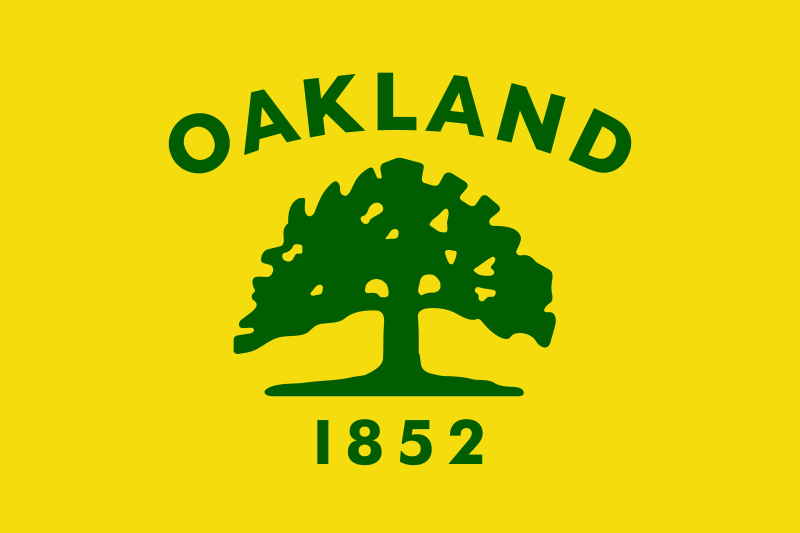
At the time as this distribution of the daily commute across the freeways of the East Bay, Oakland Mayor Mayor Libby Shaff promoted the tree the symbol of the city–affixing it to all street signs in the city as a new proud logo of the greening city–promoting a tree-planting project across the city that would reclaim the city’s live oaks celebrated as a the basis for plentiful Oholone harvest of acorns, a mission to  “re-oak” Oakland beginning with the planting of an inaugural stand of 72 saplings of coast live oaks in plastic buckets in a West Oakland park, realizing the deep belief, endorsed by landscape architect Walter Hood of UC Berkeley, how“Names are a powerful way to think about a place,” and first proposed the Mayor’s recent resurrection of the city’s forgotten groves, first celebrated by men like Malcolm Margolin as an indigenous inheritance. If the impact of the Ohlone Indians on the landscape they distinguished led Spanish and Mexican residents of the mid 19th century to name the place “encinal”–or oak grove–the protection of the trees already fast disappearing from the region in the 1850s as it grew led its first mayor, Horace Carpentier, to try to protect the trees, even as oaks were felled for development and the expansion of its gridded streets.

Today, few oaks survive save landmarks that stand as sentinels, as the Oak in front of City Hall, whose canopy of tributaries of branches was only planted in 1917, but was adopted as an icon of the hope to remake the city in the sign of the sheltering canopy of the expansive green tree once more.
Malcolm’s heroic task was to remind us all of the green areas that are on the map, before they are mapped out of existence or public consciousness, and remind us how easy they are to . Indeed, vast areas like the 5,924 acres of Sunol Regional Wilderness, the over 5,000 acres of Briones, the nearly 5,000 acres of Anthony Chabot, 2,000 acres of Redwood Park and Tilden Park, and the slightly less large but brilliantly illuminating grand 1,500 acres of the Morgan Territory were something like negative lands, too often unexplored, not to mention the reduced rump of what has the grandiose name of the Ohlone Regional Wilderness, situated between Sunol and Del Valle, that suggested a new topography of space in which Bay Area residents were urgently asked to reorient themselves in Malcolm’s pioneering work.

The dreamy cover of that “unauthorized” paperback guide to the region–East Bay Out (1985)–certainly offered a decidedly off-road record of outback experience of the region, neither a God’s eye or bird’s-eye view, its old cover featured a blissed out Malcolm or reader floating above the bay from atop a cloud, looking down on a built but intriguing bayshore, as if in harmony with nature, ready to descend explore the open areas for camping and swimming the book described. (It is hard not see the cover, as I never did before, as an image of Malcolm Margolin floating as a benevolent spirit presiding above the coast of a region he celebrate with enthusiasm and came to know well.). If perhaps the figure on the cloud was an iconic persona of the Aquarian Age, Malcolm adopted the calligraphic skill of Bay Area penmanship to invite all readers to tap their inner Thoreaus in the guide to living outdoors–hiking, camping, swimming, and fishing–in their own Waldens able to be discovered not far from the edges of urban life in the East Bay Regional Parks. An evangelist and a guru, as much as a historical anthropologist, Malcolm led the way from his own cloud to the future.

The East Bay Out (1989)

I first saw Malcolm one afternoon pacing leisurely on a recently restored shoreline in the Berkeley Marina, he seems rooted in the Bay Area he loved so much, moving along the path quite rapidly and deliberately on paths restored in by 2009. The remade wetlands home to many more birds than a decades previous had been a major victory of the restoration of the shoreline he had very much promoted and must have relished. Perhaps ever since Malcom came to Berkeley, he was seeking actively to front the wild, as Thoreau would put it, with joy–rediscovering the parklands as if facing a frontier–Thoreau’s sense of the word–but not the frontier of lands held by settlers, that deserved to be seen again by the wilds that it still contained.

1. Instead, it belonged to the bayshore people he had made his own alternative present. There was a sense of the urgency that he did so squinting in to the horizon, as if he were looking for signs of the past occupants of these native lands that he knew so well, seeming as he walked an Old Testament prophet on a New World coast, beard buffeted by a bayshore breeze. He caught my eye before we had ever met, and I already wanted to know what he was so clearly thinking about. But, if Thoreau was walking the paths alone, Malcolm seemed eager to invite others to walk the same old paths with him. When Malcolm confided somewhat conspiratorially either at the outdoor tables of Saul’s Delicatessen or Piedmont Pines how much Berkeley was a perfect place for “folks like us.” No doubt the had long honed the pitch of overly generous flattery to make one feel part of a club, and promote the rather miraculous trajectory by which he had founded a productive press and nourished a new community of readers long before Indian activism.

But he praised the city and its active readers, sense of responsibility, and accessible libraries as a treasure: access to the libraries of UC Berkeley that he so often used from when he first arrived in 1969. There was a vision of rediscovering the old landscape by a poetics removed from the present day. In ways, he echoed the sentiment of recovery that was voiced by Thoreau, when he imagined the poetic practice of exploring, as if “I walk out into a Nature such as the old prophets and poets, Menu, Moses, Homer, Chaucer, walked in,” a landscape he offered “you may name it America, but it is not America: neither Americius Vespucius, nor Columbus, nor the rest were discoverers of it [sic],” but was arbitrarily named on maps, in which but a “few old roads that may be trodden with profit.” Somewhere, Malcolm still walks wider trails. The sense of a pre-Columbian contact with a lost land was dear to Malcolm, who never got rid of describing the encounter–more accurately than one of conquest–as the arrival of a starved and tattered group of Spaniards disembarking from ships on the edge of a peaceful, settled, and economically established nation, hardly in need of mapping and having already persisted as the engaged custodians of its plentiful ecosystem whose rivers fed fields and forests regularly harvested and maintained for a range of coastal peoples.

When we met, I had no credentials or a university affiliation, but couldn’t help being flattered by the attention. I now realize how much the East Bay was a living library for Malcolm–a library without walls, and an interconnected one that couldn’t be segregated on shelves by call numbers or single volumes. I don’t think it is a library that won’t be so deeply appreciated without him here. But the energy and encouragement to interrogate and appreciate its hidden maps, and hidden pathways, will be wanting an active a set of prompts and stimuli. Malcolm Margolin had found a home in the East Bay, but also made it one of the more interesting places for discussing books and ideas outside of university libraries’ bookshelves. And Malcolm of course worked to open eyes to alternative geographies long before the multiple alternative hand-drawn atlases of urban nature and bayshore habitat evident in the restored wetlands,–or the new cartographies of Obi Kaufman or Rebecca Solnit of California–he did much to encourage, to open eyes far beyond the rich bay. But if John Muir saw the wilderness of Yosemite as a cathedral, to pursue my analogy, the more bookish Malcolm saw it as a living text, pulling out threads of narrative with endless curiosity that have altered our picture of it and encouraged the stability of a built geography to be questioned.

Malcolm was walking that afternoon with energy, around the bayshore trail, alone, as if in the footsteps of the shore-dwelling Ohlone, enjoying the restored shoreline rather recently completed, and of which he was so much apart. Eager to catch or notice something new, the man seemed a long-haired bearded prophet, to watch, even if I didn’t know who he was, with something like awe, as if he were looking for a new frontier of natural observation, retreading long untrodden shoreline paths able to be imagined of the indigenous community of a once highly populated East Bay.
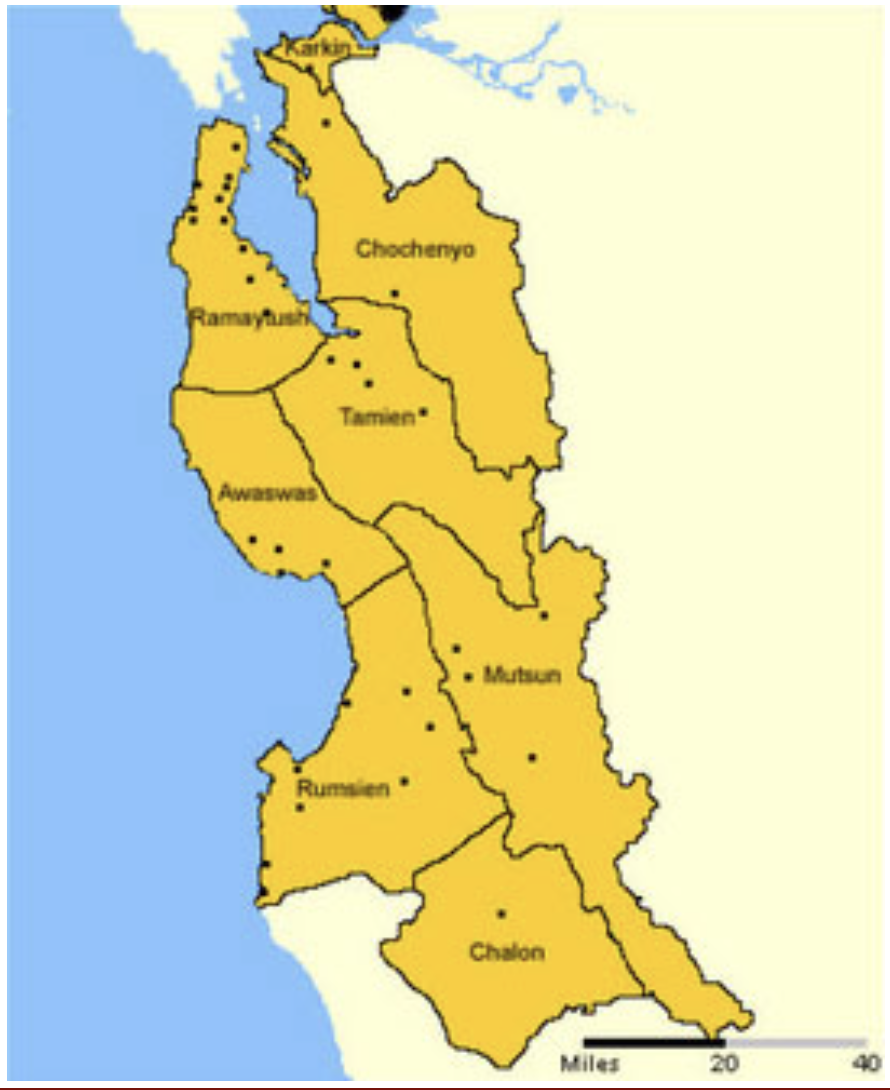
Bay Area Indigenous Language Groups and Coastal Settlements/Levy (1970), amending Kroeber, 1925

Malcolm may well have been in that moment envisioning the lost past of the coastal bayshore as he moved deliberately across the shoreline trail, as if searching for evidence while scanning the shoreline as if squinting for traces of Ohlone shell-mounds long since lost to the landscape. He had done so much to preserve the memory of the shell mounds, many of which were leveled in their entirety the 1920s, at the same time A. L. Kroeber had begun to teach anthropology courses about California’s indigenous in lecture halls at U.C. Berkeley. Kroeber, who was attracted the artifacts and symbols of the indigenous, seized on the project of “salvage ethnography,” in the footsteps of the mission that his teacher Franz Boas, linking archaeology and ethnology in artifacts, proclaimed the Yahi Ishi in 1911 to be the last surviving “wild man,” cornered by dogs in the hills near Lassen, of a tribe he believed exterminated by white settlers of the state, who he proclaimed “the last wild Indian in America,” who died from tuberculosis five years later in captivity. Seeking to preserve the final remaining traces of the indigenous cultures Kroeber believed vanishing or gone, he imagined a map torecover the expansive linguistic repertoire of a lost indigenous world across the state of California, mapping the linguistic groups of California’s former residents as a living world in a cartographic symbology of set boundary lines and distinct colors of discrete linguistic groups.

Linguistic Groups of California and their Families (1925)

While Kroeber did encourage skeletons from indigenous graves, including the massive shell mounds that had formed burial sites of ceremonial veneration over time, the massive structures of over thirty feet tall and longer than a football field in length to assemble knowledge stretching back thousands of years he believed confirmed “the permanence of Californian culture is of far more than local interest,” as he wrote in 1925, but “a fact of significance in the history of civilization.” The elevation of the moment of contact to an inverted picture of starving if not ravenous Spaniards, alienated from the land, meeting a stable society of flourishing tribelets living without money and not needing intentionally offered a new perspective on civilization itself.

Malcolm did much to affirm the importance of indigenous California in global history,–if for different reasons and an opposed logic by insisting on the necessary importance of indigenous anthropology for the present day: the veneration of these ancestral burial grounds had functioned as a permanent ceremonial site for the itinerant coastal peoples, and of orientation for a modern world that was far more out of joint and less attuned or aware of historical change. In keeping with the razing of many historical structures in the East Bay, the mounds Kroeber urged pillaging for evidence of native habitation were unceremoniously cleared for railroad tracks, paint factories, and parking lots of the malls now located on the level ground of “Shellmound Road,” a small stretch without hint of the massive structures over thirty feet tall that existed for each of the villages that dotted the bayshore before the arrival of the Spaniards, serving as navigational markers in the bay, as well as sites rich with ancestral meanings that often had their own names. Alfred Kroeber’s obsession with the pre-contact civilizations led him–much as Thoreau adopted the same word for indigenous at Walden–to call Amerindian tribelets “extinct as far as all practical purposes are concerned.” Insistently inverting that demeaning word–extinct–by revealing proof of the continued vitality of Ohlone culture and cultural practices was very much what Malcolm was about, as was asking us to re-see the Shellmound as a heap of rock to be excavated, cleared, or plundered. These were also lost worlds of a past that must have seemed fantastic, not only to his daughter, Ursula K. LeGuin, but to Kroeber himself, who, fresh from the east coast and armed with the toolbox of Frans Boas, saw a new world being able to be unearthed directly before his eyes with fascination.

Excavation of the Emeryville Shell Mound, 1924/Phoebe Appleton Hearst Museum

Many of the once abundant superficial traces of the shell mounds were long ago leveled, but they persist not only in local memory. Underground mounds are often intact, below the urban plant; when I saw Malcolm prowling the shore; he was smiling in satisfaction at encouraging negotiated agreements between the city of Berkeley and the Muwekama Ohlone, for the fate of mounds seen as sacred for over some 4,500 years, erased to the short-termism of the present, in which over four hundred and twenty-five shell mounds were constructed, often outlasting the villages that they once accompanied as sites of burial and focal points of community life of the sort Malcolm celebrated and waxed eloquent, as the oldest mound in West Berkeley, nearly 5,000 years old, only landmarked in 2000, long fought over by developers, more than anthropologists or historians.

Map of the San Francisco Bay Region, Showing the Distribution of Shell Heaps along the Bay Area, noting mounds on the coast as Present, Partial and Destroyed/N.C. Nelson, 1909
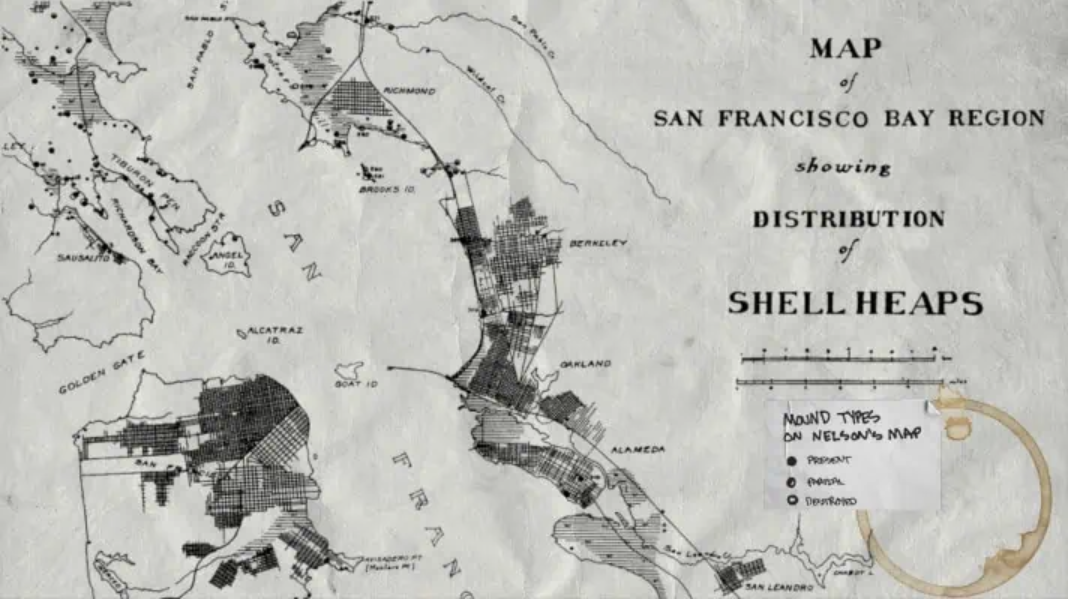
Map of San Francisco Bay Region, Showing Distribution of Shell Heaps (1909), Native History Project

As much as saddened by his death, Malcolm’s sense of the patrolling of the wild, or the edge of the frontier of wilderness, or just the shoreline, is a model for the persistent reminding of wilderness’ continued survival, and importance, to the world. Malcolm began as an East Bay Parks man, immersing himself in the 60,000 acres of east bay parks, far beyond the shore, For the relatively quite recent transformation of the parklands from open space bears historical traces not so far from living memory of the historical habitation of its open space, and the preservation of of the old shell-mounds in the recent historical record, and indeed present in local tangible artifacts that offered a new means and a pressing one to understand the history of many of the forty parks .
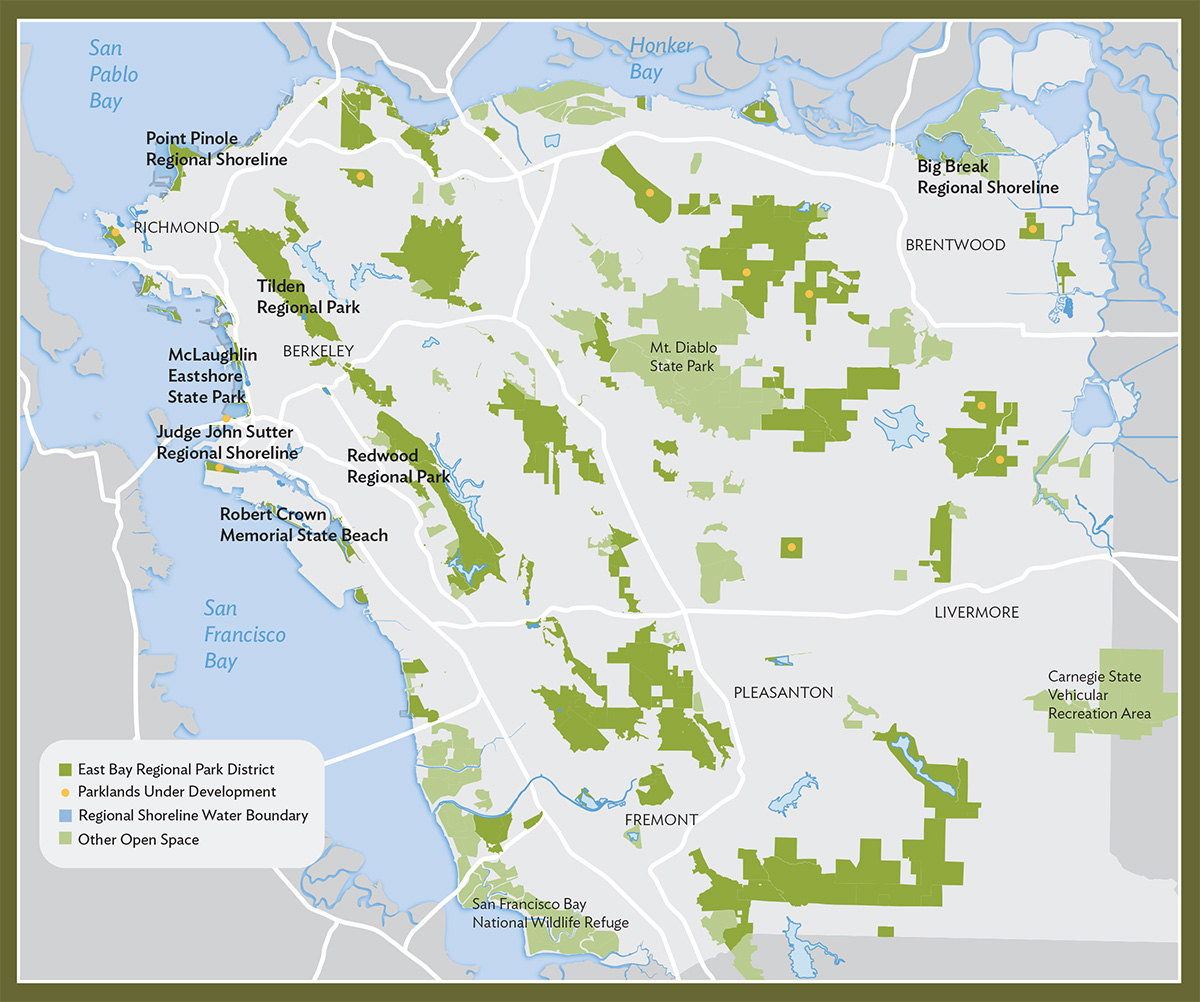
East Bay Regional Park District Today (2024)

The areas that were only just being explored, camped in, and lived in were something that he recognized as a valued historical repository, and indeed one to celebrate as part of the Bay Area. If Malcolm gained a new sense of himself in the East Bay as a ranger in Tilden Park, his unique brand of celebrating the region beginning from the orientation of the community to its parks, Malcolm was always looking for the survival of the wild. The light green overlaps of this map of the regional parks, or this modern expansion of the Regional Park District that exists today, omits much–the rich and enormous stately live oak trees, whose rich and nutritious acorns made the region a veritable storehouse of a plentiful supply food gathered, hulled, dried and stored as a nutritious staple later boiled as mush; or the seagrass of the Bay Area shores, that made the shore such an important meeting place and trading post for different tribes; or the willow stems and reeds in coastal marshes and rivers that are woven into baskets. These are of course among the layers of East Coast history, not evident in most data visualizations, if any, by which Malcolm taught many to re-see or see again the region of the East Bay–or offer, to cite John Berger, several ways of seeing.

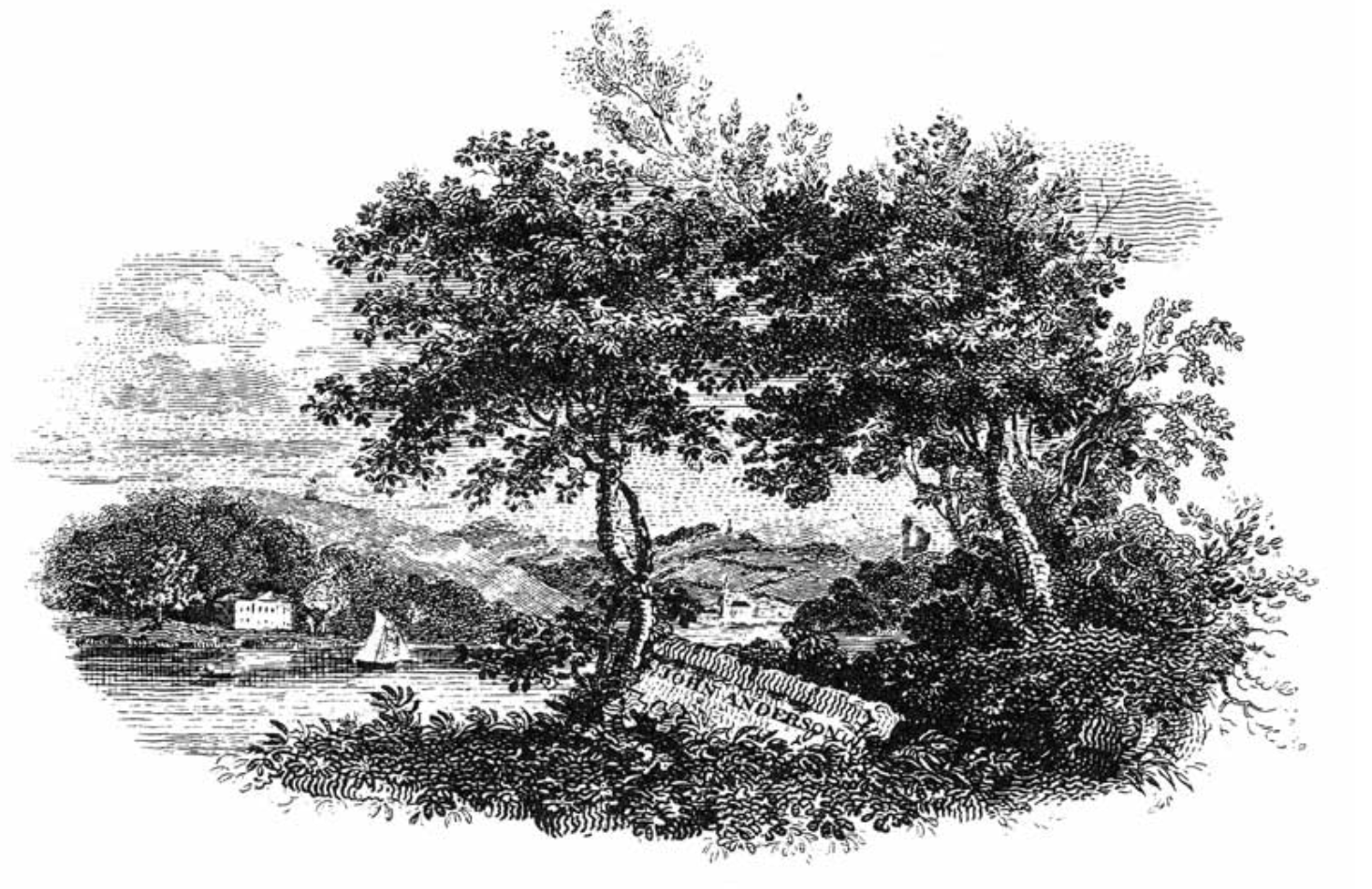
Perhaps it was during his stay as a ranger living in the park, touring visitors, and walking its paths, the arms of towering native live oaks of up to two hundred and fifty years old stand as witnesses of another age seemed to welcome him. Is it a coincidence that the cover illustration of Carl Dennis Buell of The East Bay Out, Malcolm’s “Personal Guide to the East Bay Regional Parks” written after leaving the Parks Service, featured in silhouette the capacious canopy of the elegant towering tree? The Enlightenment image of the Oak Tree on the cover of Malcolm’s book might have belonged to the engravings of the great English naturalist Thomas Bewick, who admired the brachiation of the oak as a source of divine marvel–a marvel that Malcolm seemed so eager to recuperate and transmit as a form of resistance during the shifting settlement of the East Bay. If Bewick became an engraver–and indeed raised the status of engravings–to communicate trees and avian riches of his native Northumbria, in boxwood woodblocks, that elevated wood engraving to a register of natural description, Malcolm became a printer to promote the Bay Area as a rich habitat, and increasingly as ancestral lands worthy of veneration and of better preservation, to encourage a sense of wonder and amazement by communicating the depth of his feelings about the East Bay.

Bewick was an early naturalist of the modern world, an author who brought attention to the rendering varied leaves and branches, birds, wildlife, and rustic places to the eye by borrowing the engraving burins to capture the gnarly branches of oaks laden with leaves in wood plate with a density of fine lines–opening to the world a warm generosity of wooded life–

Engraving of Live Oak after Thomas Bewick’s Engraving of Oak Tree

–it is hardly surprising that the great naturalist’s rendition of the generous canopy of the oak became something of an icon for Margolin’s own guide to the Bay Area, East Bay Out, the unknown “outback” beyond the built up area of the Bay, a sort of forager’s guide to the riches of wilderness akin to Bewick’s own investigations of Northumbria–

Thomas Bewick, Engraving of Oak Tree Dwarfing the Nearby Town

The oak trees that Bewick became famous for engraving–as birds; inhabitants of wooded lands–intentionally shift our focus of attention as readers of his books from the towns they lived in to the surrounding natural world. The images of the woodsmen who were more engaged in nature were Romantic icons, but, as a modern-day Thoreau, focussed on the natural world in place of the built world, less concerned with human engineering or artifice than the importance of attending to the surrounding natural world in Northumberland countryside that he most often drew, calling attention to its oaks, birds, and outdoors to offer a unique angle on the industrializing landscape.

If lying off of the beaten road, and outside built environments, showing other forms of life far from the city, foregrounding on details of the landscape the cleric William Gilpin had focussed attention, akin to moments of rural repast, drinking waters of fountains and waterfalls from a traveler’s leather hat.

Thomas Bewick, Tail-Piece of History of British Birds (1821)

There was a Thoreauvian sense of transcendence of the local that animated Margolin’s attention to the environment, of which the oak might stand as a transcendent icon. Although oak moths have recently arrived in the richly brachiated canopy of the large coast live oaks in UC Berkeley, as they regularly do, feasting o foliage of the Quercus agrifolia for multiple recent years–2019, 2020, before again 2025–and prematurely cause grey and brown litter of leaves to fall in heaps, live oaks endure the regular pillaging of leaves, returning to their familiar evergreen in a manner of weeks, as they regenerate buds, leafing out once again in a matter of months. suggesting the huge vitality of trees that seem sick. The rapid recovery that the coastal live oak makes regularly from the onslaught of voracious caterpillars as the e California oak moth strip the trees of their expansive verdant canopies without impact on the trees’ long-term health, as within three months they leaf out, regaining health almost suggestive of a rebirth by deep reserves of energy–making it unsurprising Malcolm adopted the distinctive tree as an emblem for much of his work. The brachiation of that oak branch recalled the eighteenth century aesthetic renderings of Reverend William Gilpin, one of the earliest coiners of picturesque “landscape,” with a scientific attention to detail, attening to natural forms as if revealed truths–admiring that “peculiar kind of beauty, which is agreeable in a picture” as able to provoke a discerning interest in the wilderness as providing esthetic forms–
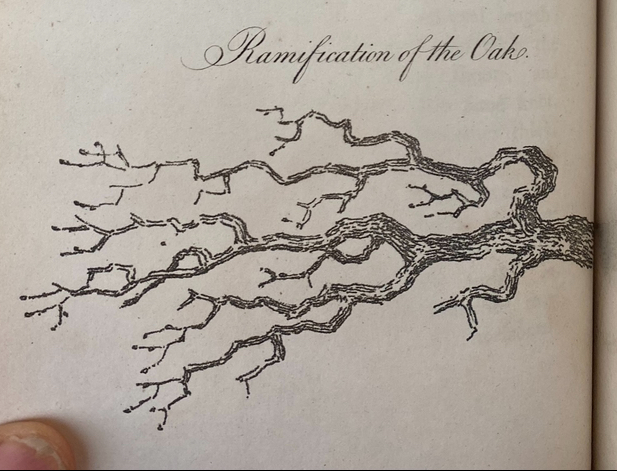
The branches of the oak were an aesthetic opening of attention to the country–and provided Gilpin with a basis to ask his viewers, similarly, to adopt a new attitude to expanding cities, guiding their eye past those branches to the human space in the backgrounds of his paintings, cannily situated far behind those gnarly oak branches that frame historic ruins, far more worthy of attention.
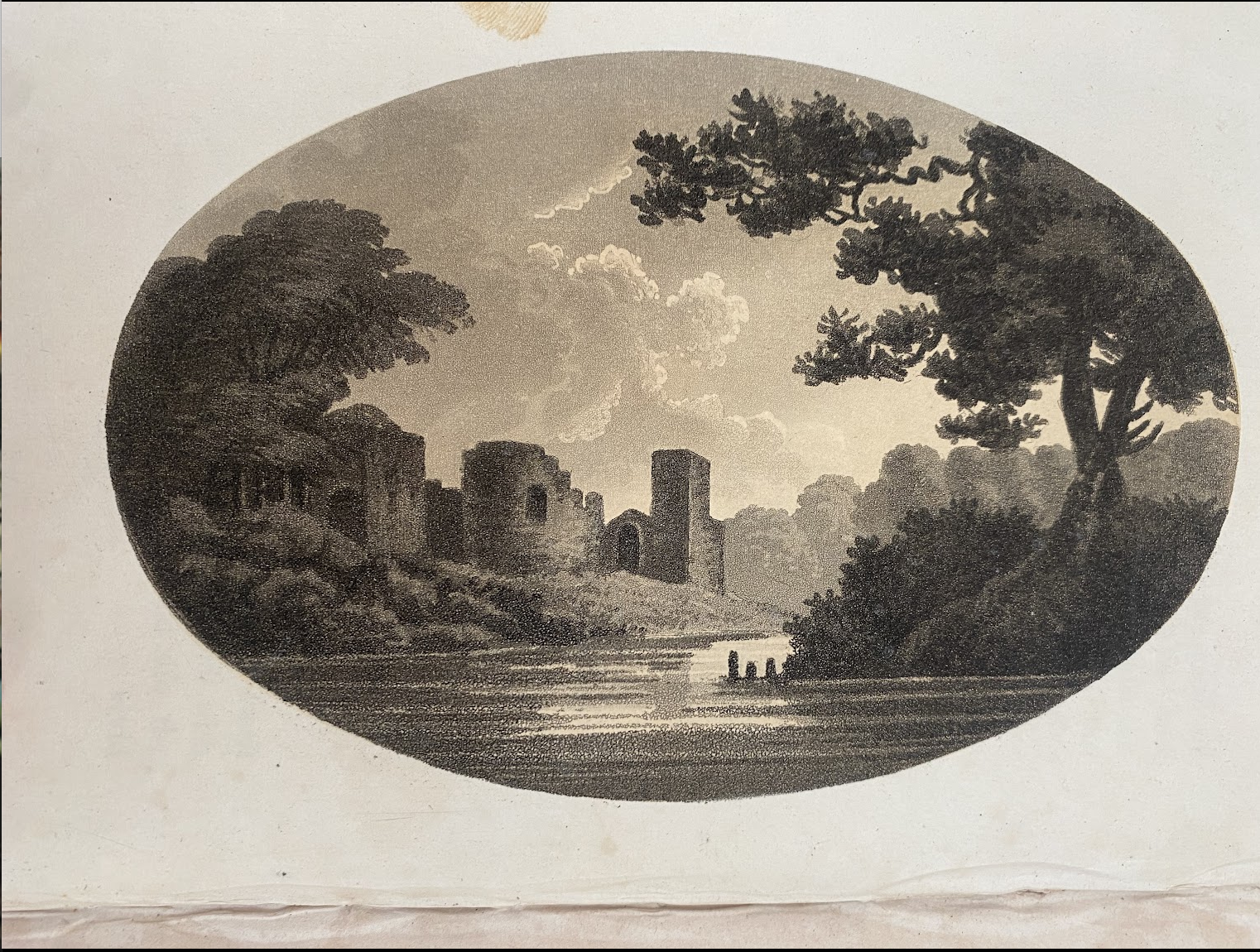
The live oaks around Berkeley were part of the animate landscape that endured across time in the regional parks today whose green leaves regularly return even after their branches are stripped bare, taking part in an ecosystem they almost miraculously seem to refuse to leave. The brachiation of the oaks had been something of a pillar of natural history from the late eighteenth century, as naturalists as Thomas Bewick called attention to the brachiation of oaks within the complexity of natures worthy of marvel–an ancillary art to Romantic poetry, and William Wordsworth even vowed “that [if] the genius of Bewick were mine / And the skill which he learn’d on the banks of the Tyne / Then the Muses might deal with me just as they chose / For I’d take my last leave both of verse and prose.

Thomas Bewick

Malcolm was perhaps less willing to wear only one hat as a guide to the beauties of the unbuilt regions of the Bay Area, but more eager to play the Pied Piper to a generation in the outdoors.

2. The towering coastal live oaks in Berkeley inspire awe in their brachiated canopies,–maybe an awe Malcolm picked up, of going native in the arranged marriage between himself and Berkeley. The arranged marriage to the Bay Area may have arisen out of convenience and necessity but developed into one of mutual admiration and respect was deeply nourishing and profitable to many, born out of deep sensitivity to place and to forest grounds he encountered in the East Bay. The rich guide that he provided to the “outer” East Bay became almost an ecological resource of its own right, a prompt to preserve its wetlands and restore its parks, to act as a custodian of open space and forested hills, even in the fear of fires that has come to grip the region in later years.

It led to a readiness to question the authority of the modern map–to see the “East Bay Out” in other words–and relish the absence of all anthropogenic presence in the first maps of a seemingly pristine Plane de Puerto de Sn. Francisco” (1776) of a fortuitous date indeed by José de Cañizares–stored by the Bancroft Library, the very year that Americans declared independence from England,–that offer a caring attention to the estuary and tidal marshals of the region, and its bay waters:

José de Cañizares, “Plano de Puerto de Sn. Francisco,” 1776

–long before, Malcolm would be the first to tell you with a large knowing smile of taking real satisfaction in an incontestable fact, Americans had arrived in San Francisco. Those drought dedicuous live oaks were indeed among the plants that native Bay Miwok and Oholone people had increased in their biodiversity in the canyon woodlands, offering year-round specialties as acorn soup, leaving a lasting imprint in the range of oaks, each tree able to provide up to 10,000 acorns and offering rich habitat for animals who would bury many of the acorns stored underground.

The trees offer a rich and often drought resistant canopy for birds across much of the state, that allowed the Coastal Live Oak a corner species for coastal ecosystems up to eighty feet tall, their dense green foliage often improving the health of nearby plants year-round, in a more recent map. I think of Malcolm as able to toggle between both maps, but as realizing the need to allow multiple ties between art and cartography, and recognize the poverty of relying on data-driven maps–an implicit point to which this section of this post will return in hopes to make his case. For indeed Malcolm, as much as anyone, was crucial in redefining how “we” see the East Bay, and the identity of the East Bay as a region over time–from the time of first contact, when a group of starving white European colonizers in rags arrived on the coast of what would be Alta California, and gave it its name as a region by 1804. Malcolm was interested in peeling back that map from local informants who might help tell the tale of how it existed earlier, a real “historian” of historical anthropologists.

Population of Coastal Oaks in coastal California/National Institute of Statistics and Geography

Perhaps from when Malcolm made a decisive stand of resisting wearing the uniform of a parks ranger–a moment I have long imagined was a deep-seated conviction based on the deep sense of kinship he felt to the stewardship and identification with the land–Malcom was listening to local signs of evidence of the Bay Area lands he loved so well, and his attentiveness to the bonds of local inhabitants to the lands, as much as the shores, in no small part led to a new awareness of the local indigenous settlement of the region, and the poverty of failing to appreciate indigenous inhabitants of the region as custodians of the lands he knew so well, whose lives are impossible to separate from it. The sacred nature of relation to the land that was fed by some thirty creeks, filled with freshwater fish, animals, and many thousand species of birds, who Malcolm imaged might fill the sky so densely to block out the sun, suggested a powerful narrative of the loss of colonization and the absence of stewardship he felt today, before which a better map of the region provided a deeply therapeutic and indeed restorative function, inseparable from attention to those lands.

Indigenous Tribes and Native Peoples of the East Bay/image courtesy Sogorea Te’ Land Trust

The traditional names of the lands he was so committed to exploring and orienting others was inseparable from the map, but had been forgotten and left off of it–and one of the last final efforts of Malcolm sought to mobilize, where I got to know him better, was the ambitious project of remapping the entire state of California in ways to make the forgotten indigenous presence more centrally legible. Malcolm’s urgent message is of course increasingly pressing today, and continues, and the importance of the deep relation to the fragile topography that of a web of rivers that the Seogorea Te’ map above so lovingly details by light shades of blue and green, in place of cities, urban settlements, or property lines.

Encouraged by the fertile grounds of increased awareness of the needs for ecological stewardship of the land of an early environmental movement, from the Save the Bay campaign already founded in January, 1961, and in the Bay Area fertilized by Wendell Berry, and Gary Snyder, and nourished by the small non-profit presses–whose rights to the work of Berry and Snyder sustained them by digital sales alone. Snyder, who had studied anthropology and folklore by the transcribed oral tradition of Haida storytellers at Reed University, glossed glossed the oral literature as the creation of healthy art of mythic narrative vibrant with keys to the forgotten sustainable cultures of North America. Already possessing a poetic ear, Snyder read the transcription and careful translation of what ethnographers presented as a local Haida informant as a vital resource of a vision quest in an era we had lost a sense of orientation to animal spirits or birds, examining the “dimensions” of the myth as a needed resource, perceiving the animism of its telling as a living artifact and meaningful performance of culture. Did his reading of Haida myth provide a direction in which Malcolm would work? The early works of what are now environmental classics would certainly pay dividends for the independent presses. (When Margolin retired after Heyday press’s fortieth anniversary, it was robust enough to expand to Los Angeles, and be a fixture in the region’s as well as the nation’s literary landscape; renewed interest in new editions of Snyder and Berry’s works helped expand it expand catalogues to popular works, updating the classic corpus of independent Bay Area presses.)

Did the regional parks offer an alternative text by which Malcolm was eager to map the open areas that still existed, not yet encroached by development, as sites of continued wonderment? They certainly stood as evidence of a former wilderness, encroached by the boom of expansion of so many of the cities that make up the Bay Area, a boom that began in the 1950s, evident in this map that imagines the tree rings of local population centers around the Bay, many of which emerged only in 1960, that provide one of the most unique forms of growth of an urban agglomeration in an area where wilderness was precious: if the metaphor o f the tree ring offers a nice cartographic symbology to imagine the Bay Area as a site of uneven, but rapid growth, 1960-2010, in ways that overlap with Margolin’s heyday in the region he provided so much of an alternative counter-cartography, the expansion of cities like Concord, Fremont, Antioch, and San Jose that now form a dense inner core of the Bay Area that might be called the inner ring of commuting, was an incursion into open lands greenspace, where the parks provided evidence of the rich biodiversity and offered more than a refuge–but an alternative way of imagining its future.

Growth of Population in Urban Cities and Towns in the Periphery of the Bay Area, 1960-2010

One might grasp the force of promoting the regional parks as a critically important heritage of surviving biodiversity of a region that was compromised already by farming, wood harvesting, and the damming of some of the most nourishing rivers of the coastal ocean, including the San Pablo to create a large reservoir for drinking water by 1919, that compromised the rich ecosystem where early settlers describe catching salmon with pitchforks in its waters, and Malcolm would have sought the local informants for evidence of the rich topography he felt still survived, but had been preserved by a relative miracle of land conservation and preservation as conservation and preservation efforts were blooming in their own metaphor ecosystem around the East Bay.

This was the destination of the readers of the books Malcolm was beginning to set out producing, at the same time as conservationists were promoting illustrated books, often with photographs, of the natural treasures of the region, as the Sierra Club  Brower and founded and directed, 1952 – 1969), became a leading environmental membership organization whose aggressive publishing programs offered wilderness testimony in large format books foregrounding high-quality nature photographs, setting a model for bearing witness of the changing landscape and ecological risks that we faced, as he promoted a range of new parklands as repositories of memory,–from public organizing of opposition to the damming Grand Canyon and Dinosaur National Monument, to national parks not only on the seashores, as Point Reyes, but including the North Cascades, and the Redwoods, and protecting millions of acres of public lands. The media advocacy Brower pioneered in newspapers and magazines so deftly dramatically communicated conservation to new audiences, and crated a market for practices of conservation that Malcolm added his unique sense wonder.

Before the Bay Bridge was imagined, Brower got behind the project proposed by civic engineer John Reber to dam not only the San Pablo River but to built a San Pablo Bay at the dammed San Pablo Reservoir, a project already so devastating to the ecosystem of regional grasslands. For Reber had in the late 1940s proposed a way to meet the postwar population growth in the region by adding a huge amount of landfill to the bay, ending its wetlands, and engineering two freshwater lakes that would divide the “Bay” into four zones, preserving but a newly dredged deepwater port in Berkeley. The almost forgotten plansto foreclose Bay waters and tidal shores showed little familiarity with the region–it might easily have been fully liquified by seismic activity!–but provided a model of the distance of local engineers of urban development and State Water Projects Authority from the custodial role indigenous had long played in maintaining the bay as a region of vital habitat, both of freshwater fish, sea grasses, and shorebirds–and the proposal for a massive construction project that projected the San Pablo Dam as a basis for the bay was only narrowly defeated due to the local activism–only after the over-eager U.S. Corps of Engineers builds a 1.5 acre hydraulic model of the Bay to test it, although the vision of barriers to bay waters stretching from Richmond to Treasure Island, essential to shipping channels, never survived the modeling of a bay comprised of landfill–a massive engineering project of terraforming before that world was used, luckily never realized.
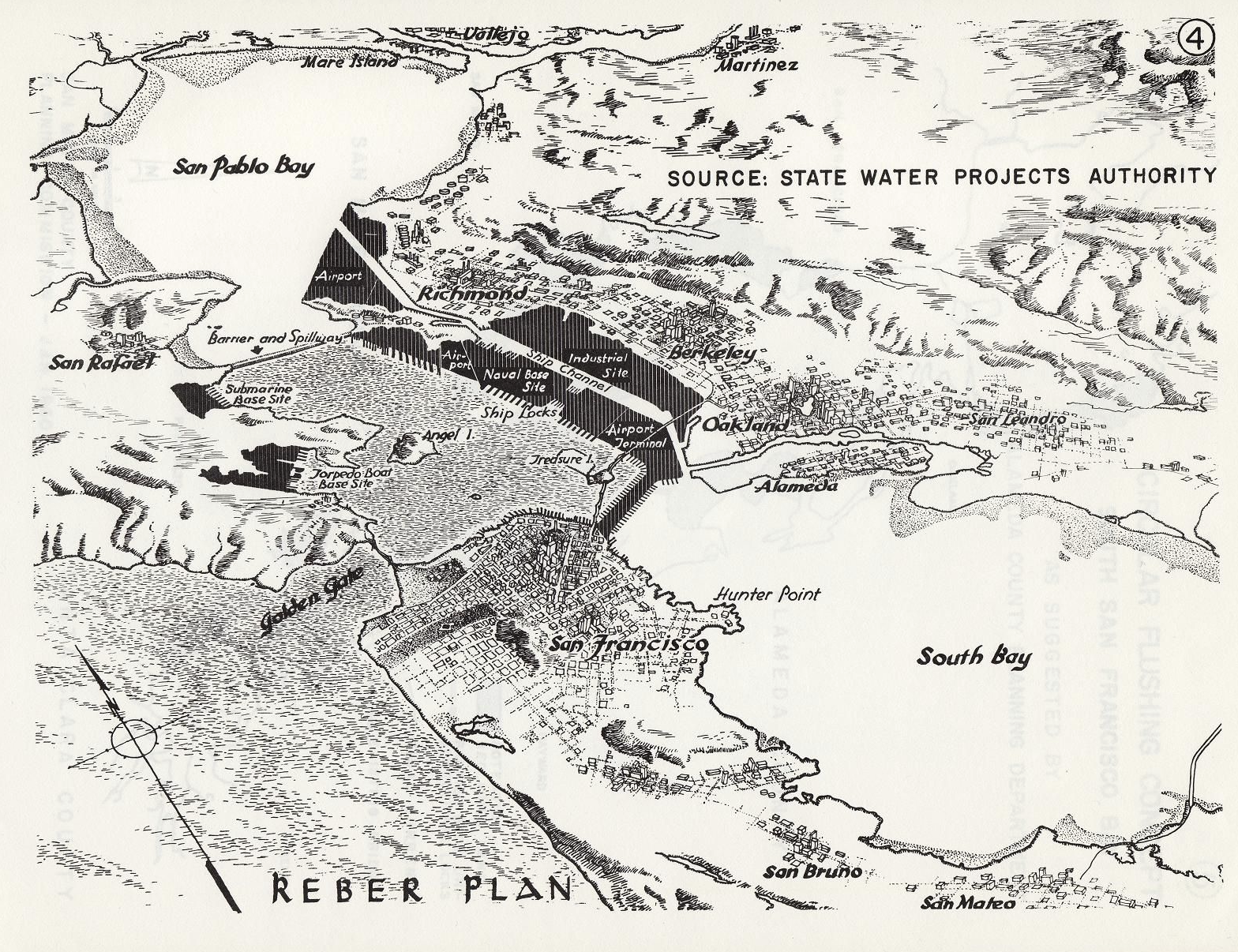
Detail of Reber Plan (1949) to filled in for a deepwater port, airports, and military bases (1949)
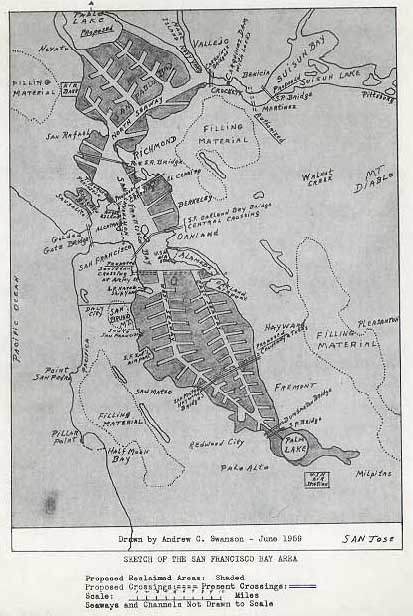
The ground for objecting to such plans for the threat of transforming the bay’s wetlands and natural habitat for economic markets and shipping lanes was rife–even if the liquefaction of the proposed landfill additions showed the accredited engineer’s almost basic unfamiliarity with the dangerous level of seismic activity that would be so prohibitive in any massive project of contracting the bay’s open waters.

The evidence of the inhabitation of the bay waters, increasingly threatened by development schemes, seemed to curtail any of the collective wonderment Malcolm dedicated so much of his life to cultivate and preserve. This included the expansive Bay Trail itself, replacing the old landfill to restore the shoreline to a space of vital habitat and healthy salt marshes, that might erase some of the imprint of rapid anthropogenic change, returning wildlife to the East Bay, and perhaps allowing the mists of the shoreline to be seen once again, if you squinted your eyes at the right time.
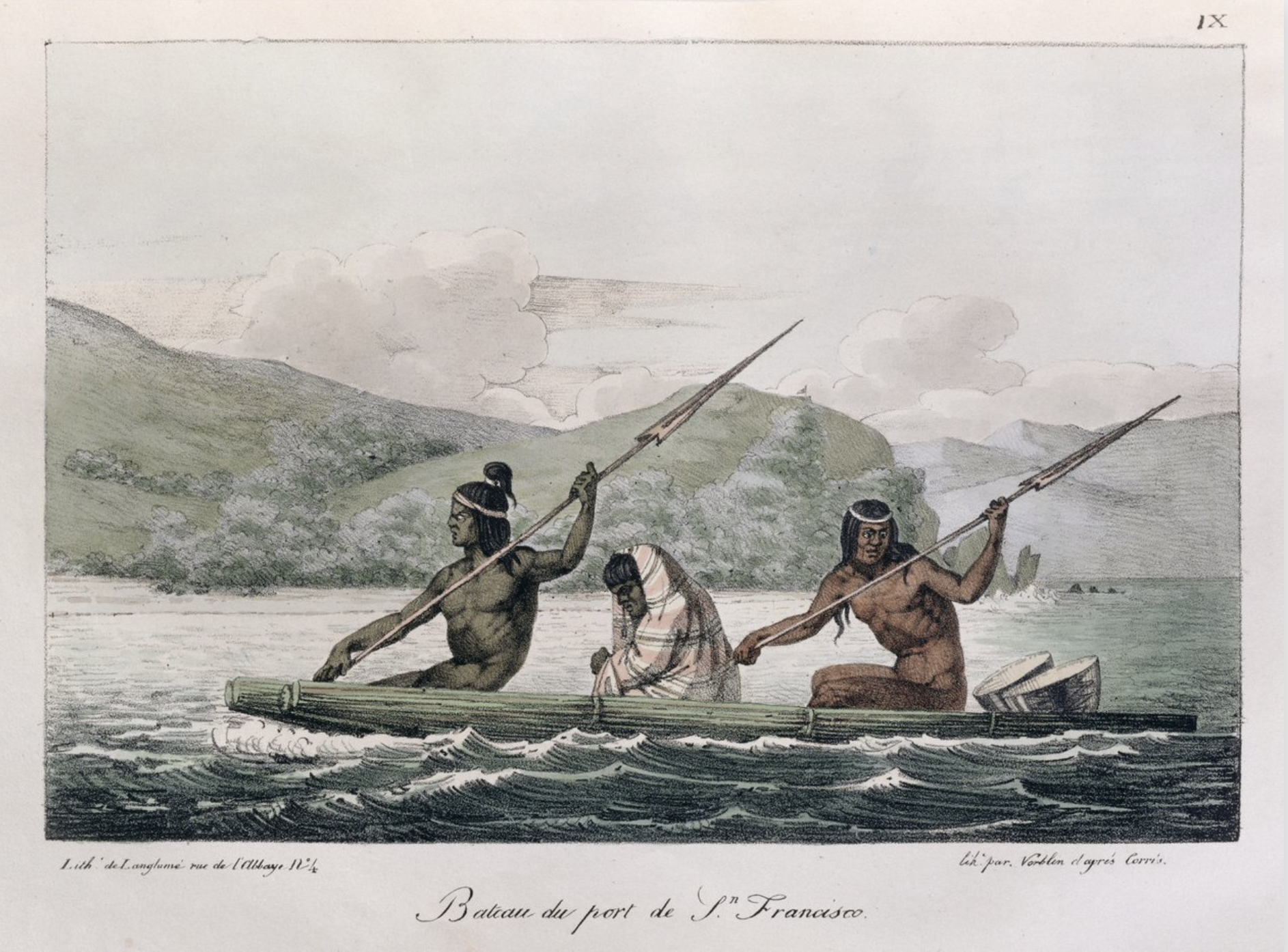
Louis Choris, Bateau de Port de San Francisco, c. 1815

The color lithograph of a ship paddled by indigenous residents of the Bay Area included in Voyage Picturesque Autour de Monde (1822) eroticized the west, as well as California, to be sure. The sense of reintroducing residents of the East Bay to the natural areas around them was more decidedly local for Malcolm Margolin. But as parks come under assault, and the sense of stewardship he celebrated by native inhabitants is being so openly and flagrantly disrespected by government, it seems important to remember how even in the face of an onslaught we have rarely seen in memory, Malcolm refused to be pessimistic, and saw himself as having had no reason to be so.

The awe before nature that inspired Malcolm, and that he always seemed to seek to inspire, urged we consider the enrichment of place that the Bay seemed to offer–its habitat must have provided a sense of encouragement and a sense of commitment he channeled from the descendants of native inhabitants. For Malcolm unearthed collective memories that he sensed in their stories and descriptions of the engagement with elements rathe than automobiles and automotive transit, offering a therapeutic alternative geography of the bay–and finding a real pharmakon of a new idea of space that needn’t be dominated by local real estate or what I’ve called the confines of automotive space amidst the increasingly congested stretches of commute that defines the Bay.
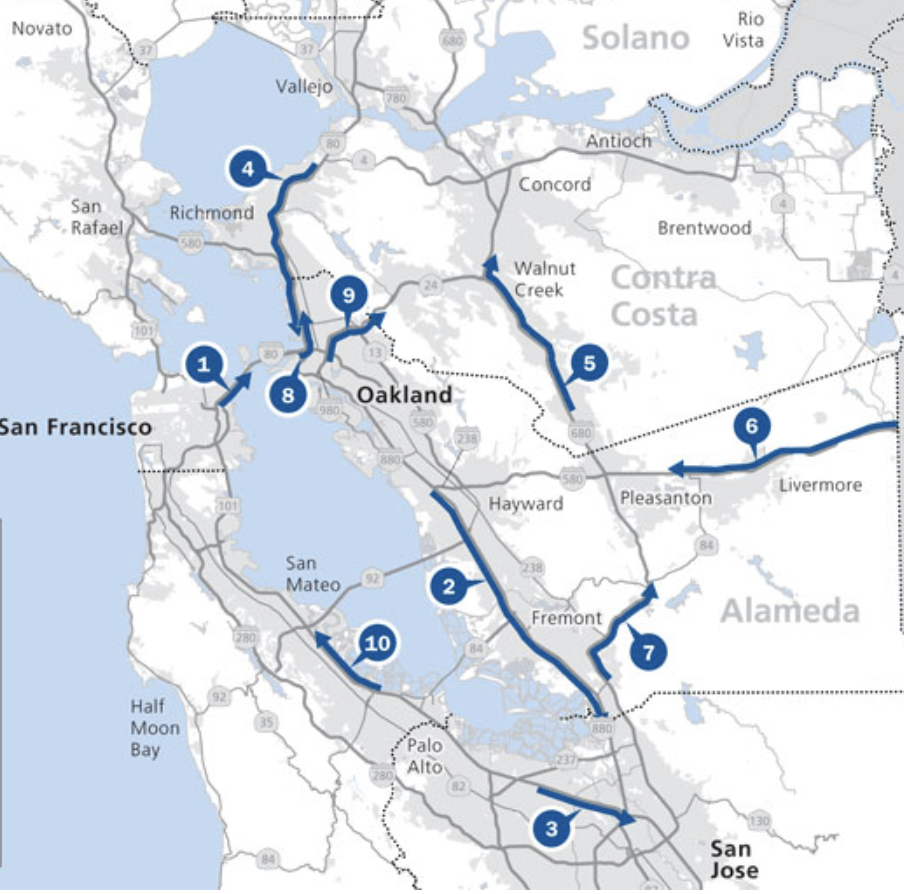
He actively explored and expanded the narrowing contours of a Bay Area increasingly defined and denaturalized as an expansive area of commenting, whose interconnections of traffic and highways. The automotive landscape of daily commutes have indeed offered a world of less and less connectedness–in contrast to the indigenous he reminded took themselves quite seriously as custodians of the land, without needing to see themselves as property owners. And as the construction of more and more paved space in the zbay Area fail to promise any sense of greater custody or responsibility for the land, our sense of the Bay has decidedly shrunk, as a recent exhibit in the Exploratorium’s Bay Observatory that asked visitors to map the San Francisco Bay has shown

.
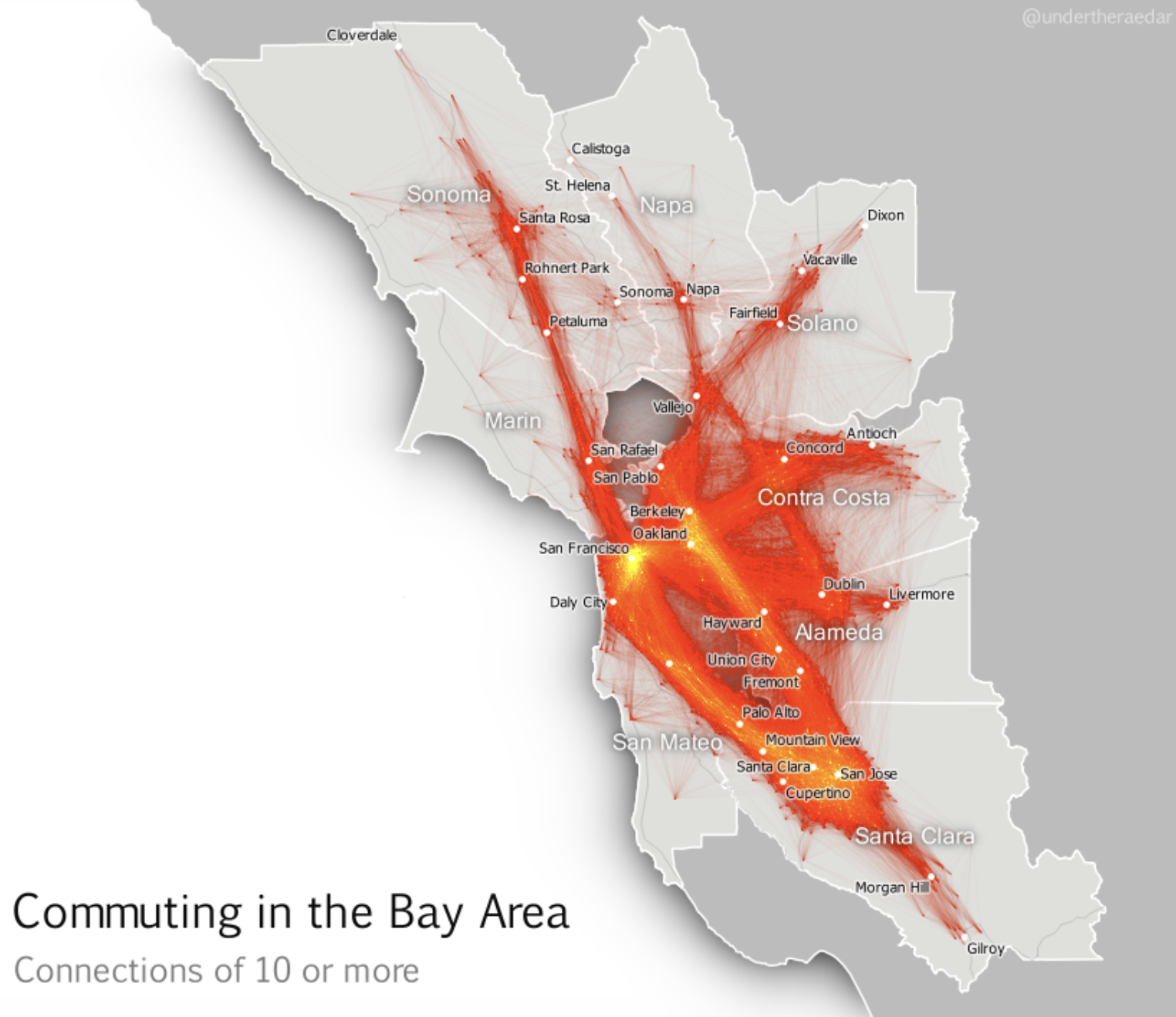
–or the pathways derived from the locations of over 10,000 geotagged social media posts that suggest the well-worn routes of automotive travel, compiled by Erica Fisher, that neglect large areas of the the East Bay, on roads that seem to fade into a white mapped unknown space.

Malcolm was energized from compelling others to explore and learn to re-recognize the riches of the region, and the state. Attendees of hisfinal projects were invigorated by his vision–or were encouraged and somehow empowered to feel the same way. His hopes for continuing celebrating an annual Festival of the Birds in Berkeley during the Trump era, ideated as engaging the public by a two-day extravaganza cum party featuring films, live performance, music, and art, in Malcolm’s style, as well as poetry readings and art-making sessions, and craft fairs, pointed to birds as signs of hope, and witnesses of the region. The festival celebrated the new habitat that the bayshore had indeed become, against all odds, a site of friendly avian habitat and attracted increased pelican, herons, egrets, geese, ducks, owls, and shorebirds to live in restored wetlands, as a continued sign of hope, if non-human signs, that Bay Area residents would do well to attend to. if birds provided a common language, outside of legal claims to ownership, to reorient ourselves to the land that can be seen as something like a living resource, the early decision to draft an “un-authoritative guide” to camping, hiking, and exploring that led to the new sense of authorship that Malcolm embodied, and the intense attention to local nature that midwifed the magazine Bay Nature, that continues to offer a new sense of orientation to better understand the natural landscapesf the Bay.
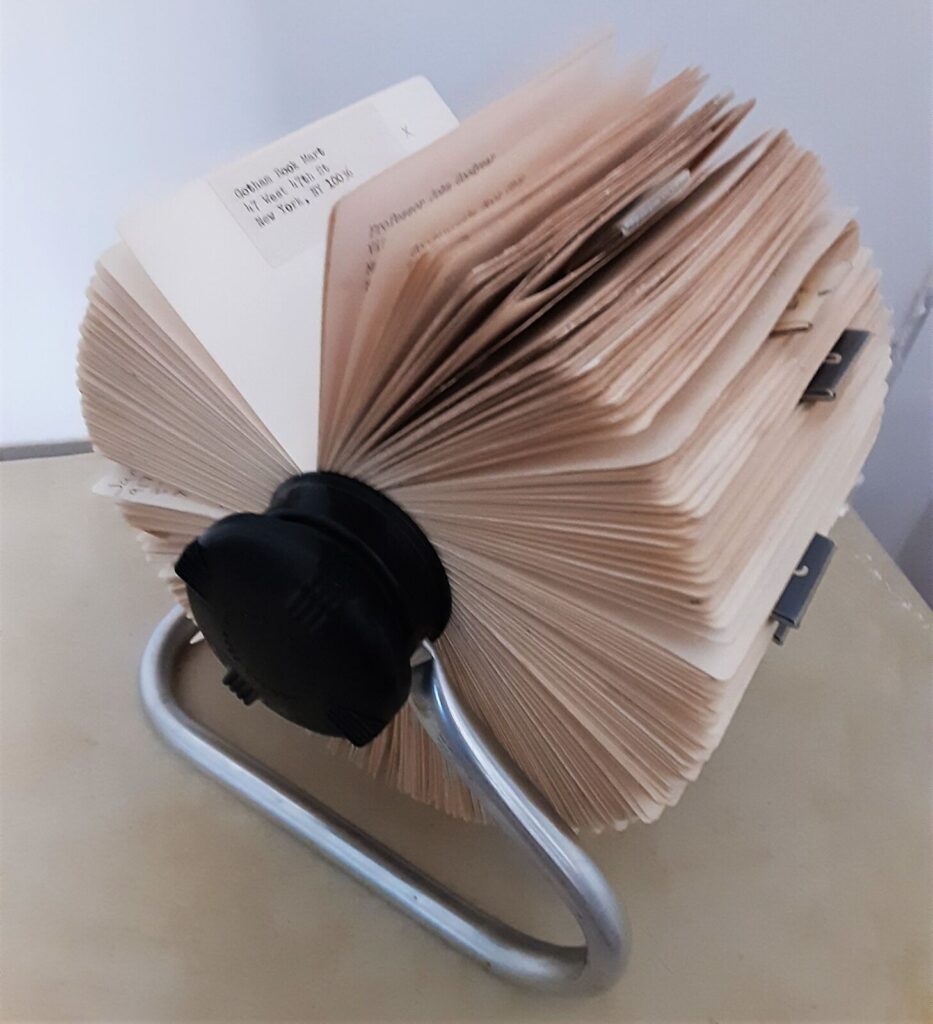
At the Festival of the Birds, I bought and picked up several hand-made bird key-rings made from colored beads. They were tokens of the needed uplift of hope that those small festivals provided, entirely animated by Malcolm’s rolodex and his animated presence, as a bobblehead in their midst, as if in a victory lap in the David Brower Center, but were also a remembrance of the power of birds to redefine our sense of place. If talking to animals was an indigenous trait Malcolm so celebrated, and were long tied to indigenous belief in animals’ souls, and the ability of speaking to animals long attributed indigenous by settlers not as possessing special talents to communicate with native animals, but to from whom they were seen as but a small step removed. The rolodex that was invented by Arnold Neustadter and Dutch designer Hildaur Nelson of Brooklyn NY in 1958 was initially marketed as a way to organize one’s professional and private life by a rotating card file became mastered as a medium by Malcolm as an active way he participated in public life, but joined private and public. The rolodex was far more than an archive, wielding it as a matchmaker moving in hyperspace, linking people, events, places and museums to animate ideas for a larger cause: it was almost able to keep up with the rapidity with which wheels moved in his mind. Malcolm arrived in Berkeley a decade after the Rolodex, in 1967, the Summer of Love, but used the invention that was Neustadter’s platform to vault out his father’s box-making business as a platform to enter the vibrant environmental and ecological community of a region associated with tech and Silicon Valley, that left a deep imprint on the Bay Area–as the Rolodex was able to survive the advent of computers, iPhones, and virtual planners. (It also offered an orientational tool for wandering Jews.)
This is important in the danger of affirming the parks and parklands, perhaps the first area that Malcolm got to know and worked in the East Bay, even if he acknowledged far more awe in, say, Yosemite than Tilden Regional Parks, which he knew so well. Despite growing visitors to national parks, and also the local parks where Malcolm Margolin got his start in the East Bay, their funding is for the first time increasingly at risk. The over eighty-five million acres that the Park Services manage attracted a record 331 million visitors last year, and park visitors provided benefitted local communities a $55.6 billion as well as supporting over 400,000 jobs, but the Trump administration has early cut a thousand park service workers–while predictably charging foreign visitors, as if a tariff on tourism, extra surcharges “to keep the parks beautiful”–but more national monuments and parklands stand to be sacrificed, as the President seeks to diminish national monuments far beyond the already striking diminution in size during his first term as U.S. President. And these include, famously, many monuments of indigenous native history, in danger of development for economic development and mineral extraction.

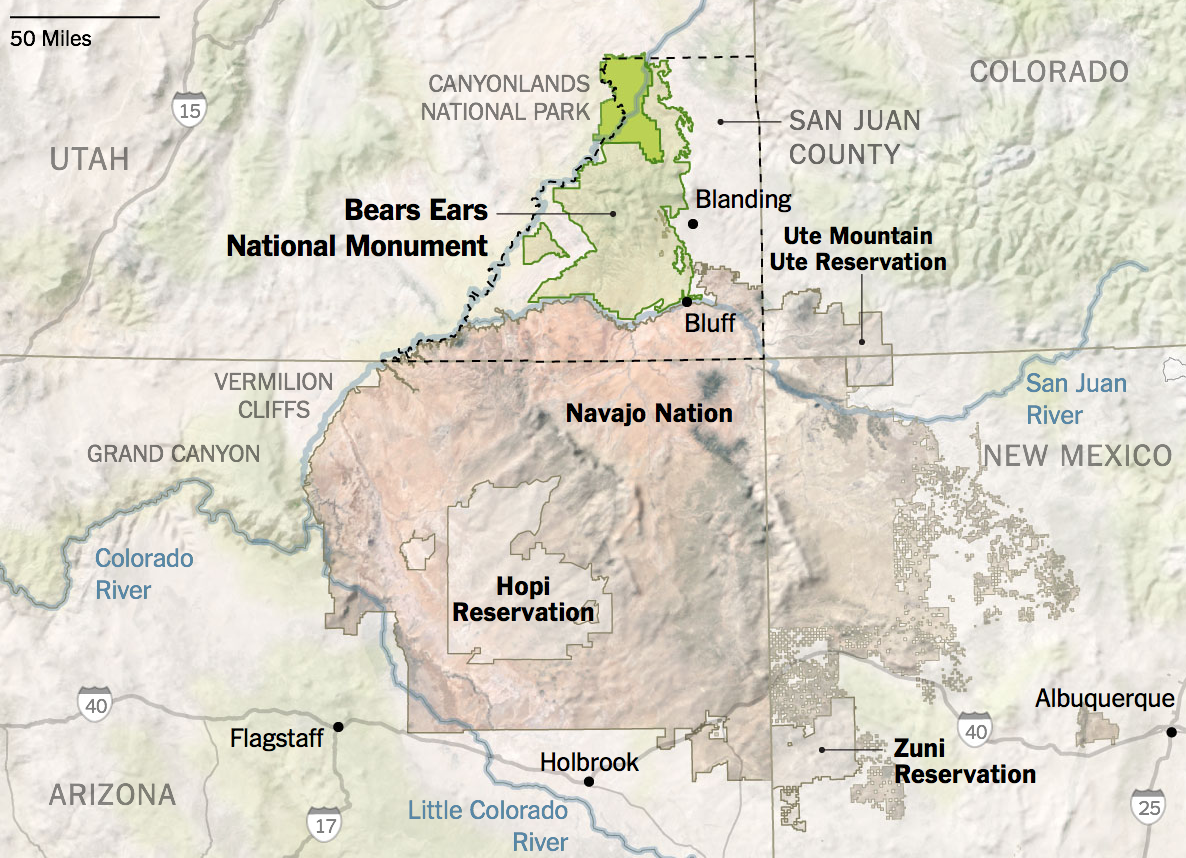
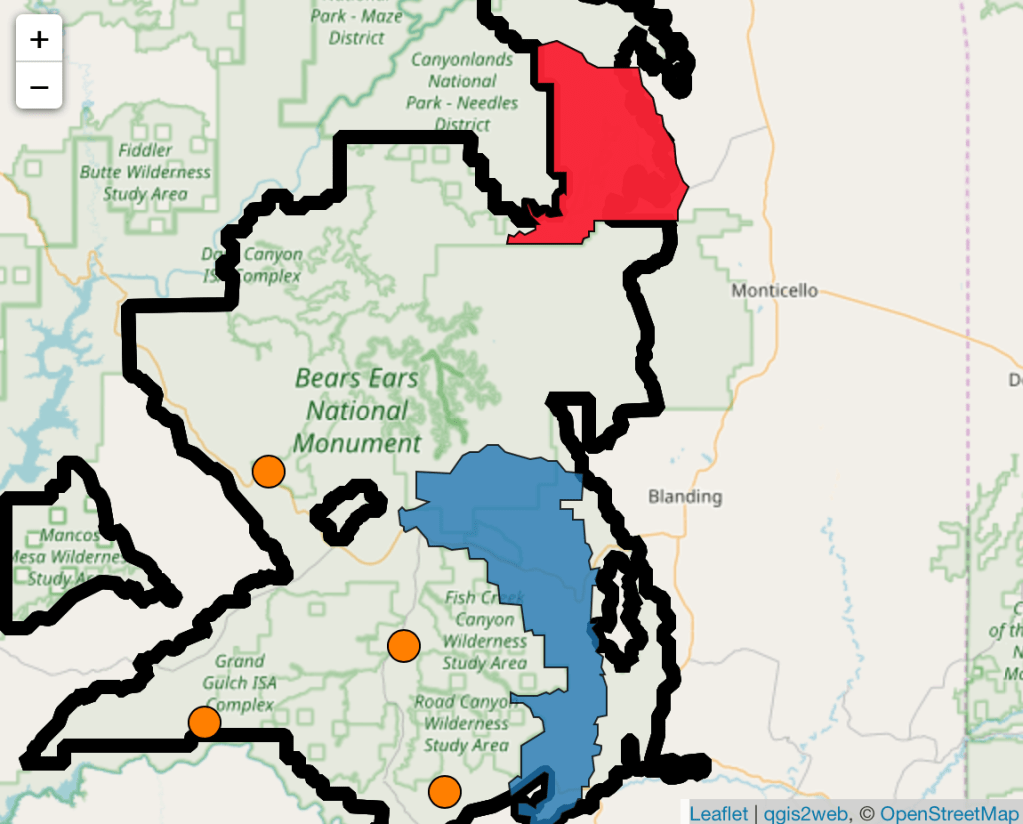
Trump distinguished his first Presidency by reducing the number of national monuments for the first time since Dwight Eisenhower, and reducing Bears Ears by 80% of its total designated size, the shrinking of national monuments and opening of forested lands to logging, mining, and extraction to increase America’s economic productivity or increase fire safety stands to be decreed without public input or review, and his Dept. of Justice Dept. has unprecedentedly acknowledged the President’s power to decertify or shrink national monuments judged “no longer are deserving . . . protections.” The shift in mapping protected national monuments and national parklands would open up the most sensitive lands to mineral prospecting, mining, and drilling; Doug Burghum tasked the Dept. of Interior to “review and, as appropriate, revise all withdrawn public lands” that might be opened them to potentially auctioning lands for oil and gas drilling and mining.

National Monuments at Risk of Opening to Corporations’ Gas and Oil Drilling or Mineral Extraction

Coming at the same time as cuts to park stewardship and preservation, the depressing dangers of a loss of access to park lands made me feel better by visiting the paths of the Claremont Canyon after hearing of Malcolm’s passing, and, in a visit to Yosemite, remember his vigorous faith in open land.

Continue reading
Leave a comment

Filed under Bay Area, Berkeley CA, California, East Bay Regional Parks, environmentalism, Malcolm Margolin

Order on the Border: Prologue or Retrospective View?


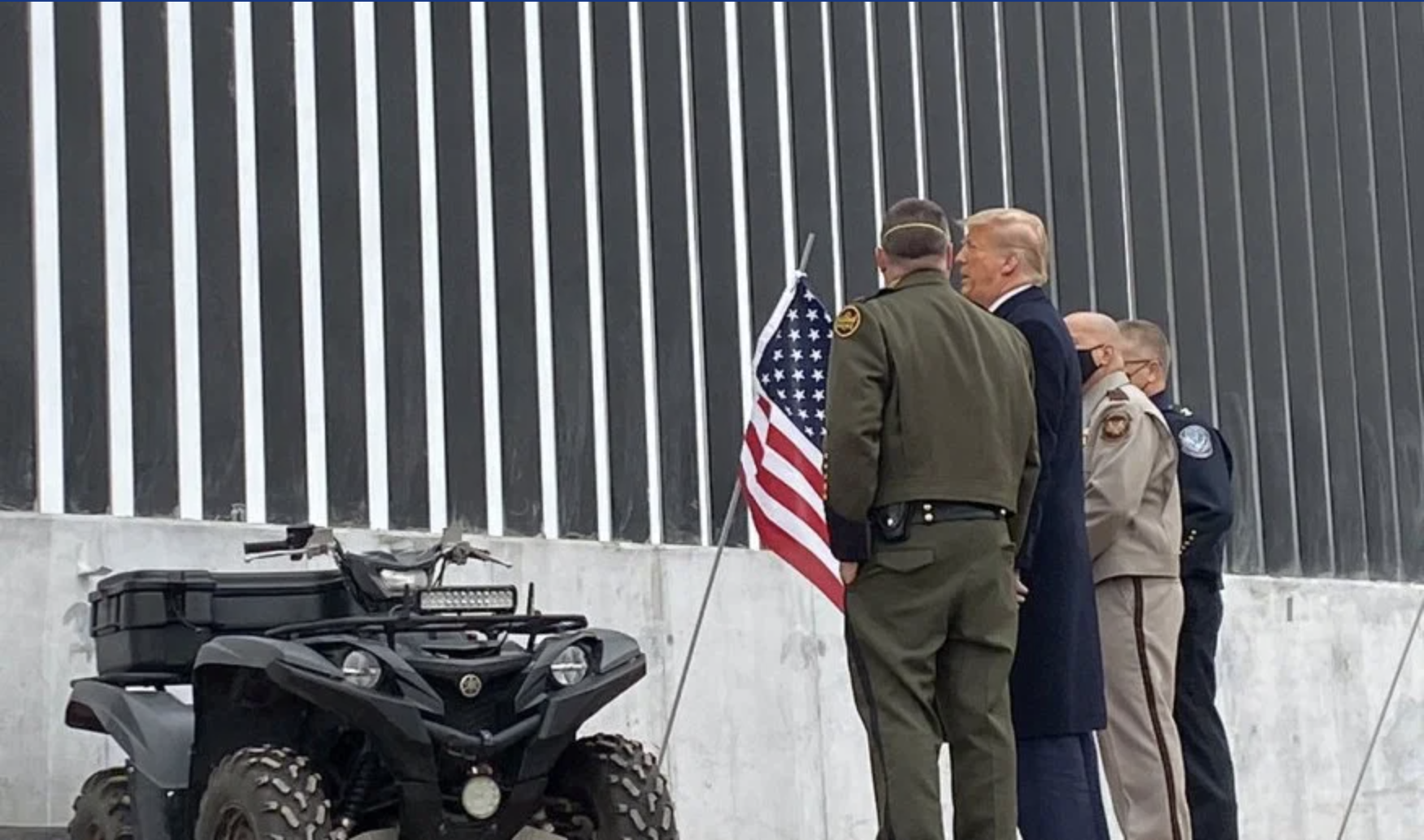
Border security was the hallmark issue of the Presidency of President Donald J. Trump–as of his candidacy–that proudly foregrounded a specter of racial division. The promise to expand the fences that had been barriers along six hundred and fifty four miles of bollard, chain link fences, and even helicopter landing pads that were military materiel from Vietnam were to be expanded to a continuous wall by the man who, Ayn Rand style, promised he was master architect and builder of a border security system, in hopes to get the costly concrete wall he imagined would be perfect for the border built. He won election in no small part because of the assurance “I’m very good at building things,” first and foremost a wall to Make America Great Again. The President who disrupted conventions of government by provoking a government shutdown in 2019 resisted the prospect he would “give up a concrete wall” in government negotiations, Chief of Staff Mick Mulvaney reminded the nation, and in visiting Alamo TX, on the eve of his departure form office, appeared to relish the presence of the slatted wall he wanted–he vowed “a steel fence” back in 2019–and to affirm the centrality of the southwestern border for the nation he was loath to admit he would soon cease to lead, if a true national emergency could not be provoked.

If the visitation of the border provided a recurrent site for Trump to affirm his candidacy, Presidency, and indeed to wield and exercise executive authority by appropriating billions on the construction of a border wall–without even knowing if it is effective–the border wall provided an occasion to affirm a uniquely distorted vision of the state.

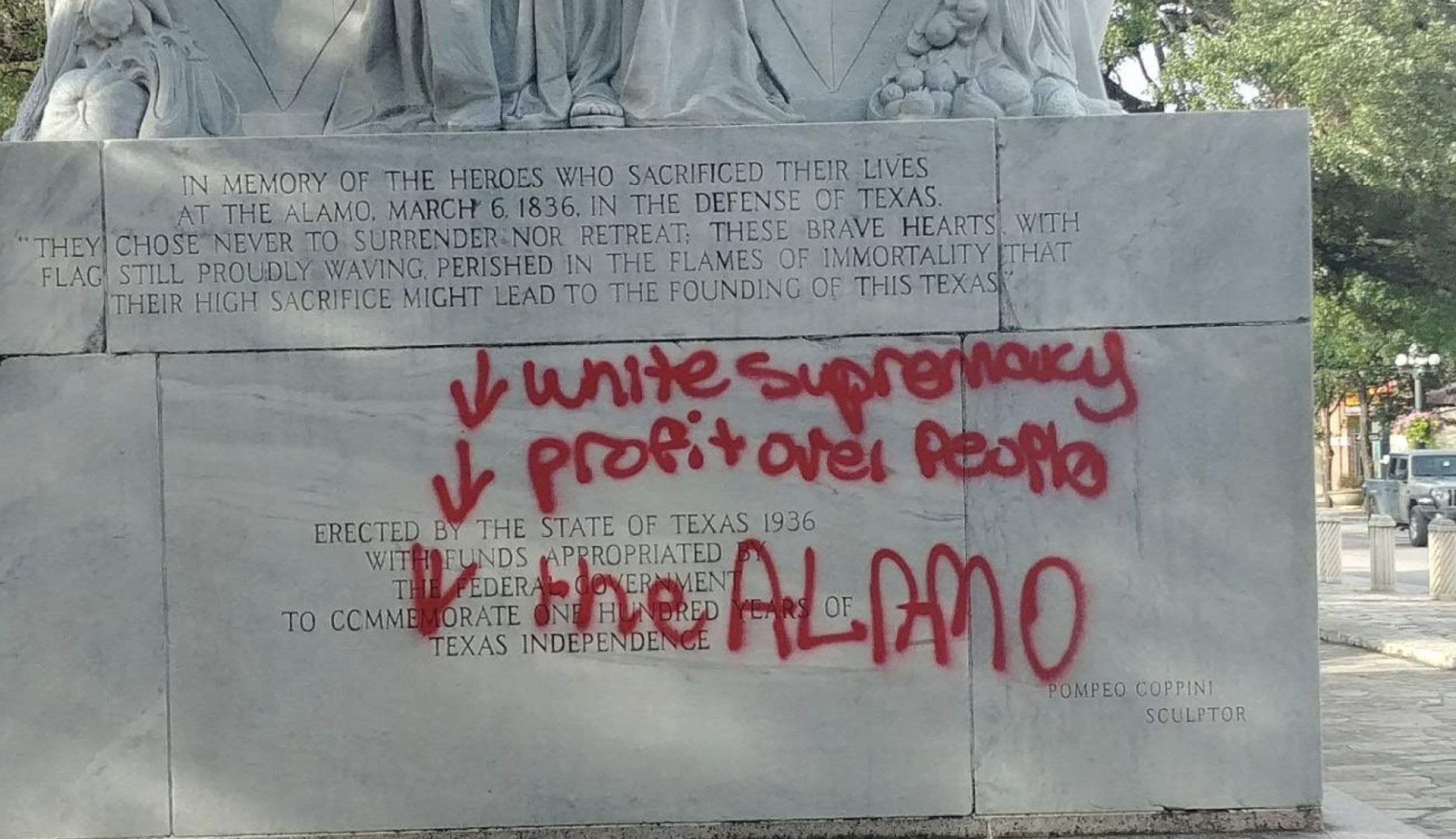
Trump’s visit to the US-Mexico Border paid final homage to the achievement of building a border wall that was indeed of concrete and reinforced steel core seemed to create a shrine for an image of the border rooted in white supremacy, and no better site for such a shrine seemed to exist than Alamo TX. The very name of the border city in Texas few had ever heard of before it was designated as a site to salute the completion of four hundred miles of Border Wall near the Rio Grande Valley evoked a society based not only on the state’s funding of border defense, but a nation that was “founded, nurtured, and financed” on White Supremacy, as Ta-Nehisi Coats put it long before the Trump Presidency. In visiting “Alamo,” the outgoing President was not only visiting the border. He was affirming the centrality of the border wall as a monument to his followers, a memorial to border protection that was a dog whistle in its name. For the hybrid constellation of an “Alamo” along the Border Wall elevated the symbolic value of the southwestern border of the United States as if it were a battle-line to fight for the permanence of a color line long fundamental to American democracy, but long denied as a brutality of racist ideology naturalizing a social hierarchy in ways that were enforced by state power.

The Border Wall was an icon of the Trump Presidency, a prop for his public political persona as President of the nation, and a site of illustrating the commitment to the defense of borders, fulfilling the syllogism there are no strong countries without strong borders–or that, per Ronald Reagan, “a country that cannot control its borders is not a nation”–as if the border were going to vanish from the map. And when Trump visited Alamo, eight days before leaving office, in a choreographed speech, he elevated the Border Wall to a spectacle. The visit on the surface sought to reprise a bond with the American people around construction of a Border Wall, and which he was proud at having allocated–or wrangled–$15 billion that the U.S. Congress had never appropriated. Designed to slow migrants and smugglers from crossing the border, but a token of an expanded system of border surveillance from helicopters, river boats, aerostatic blimps whose radar systems are Customs and Border Patrol’s “Eye in the Sky,” and military jeeps, and an archipelago of incarceration in detention facilities that deny migrants rights. But the concrete bastions he visited on the Rio Grande affirmed the spectacle of border defense. “The spectacle proves its arguments simply by going round in circles: by coming back to the start, by repetition,” as Guy Debord argued, “by constant reaffirmation in the only space left where anything can be publicly affirmed,” and the reaffirmation of the spectacle of the border seemed to ahistoricize and perpetuate the border wall as a defensive monument, refusing to obliterate and elide it from national memory, by eliding it with the border defense of Texas, before Texas was a state.

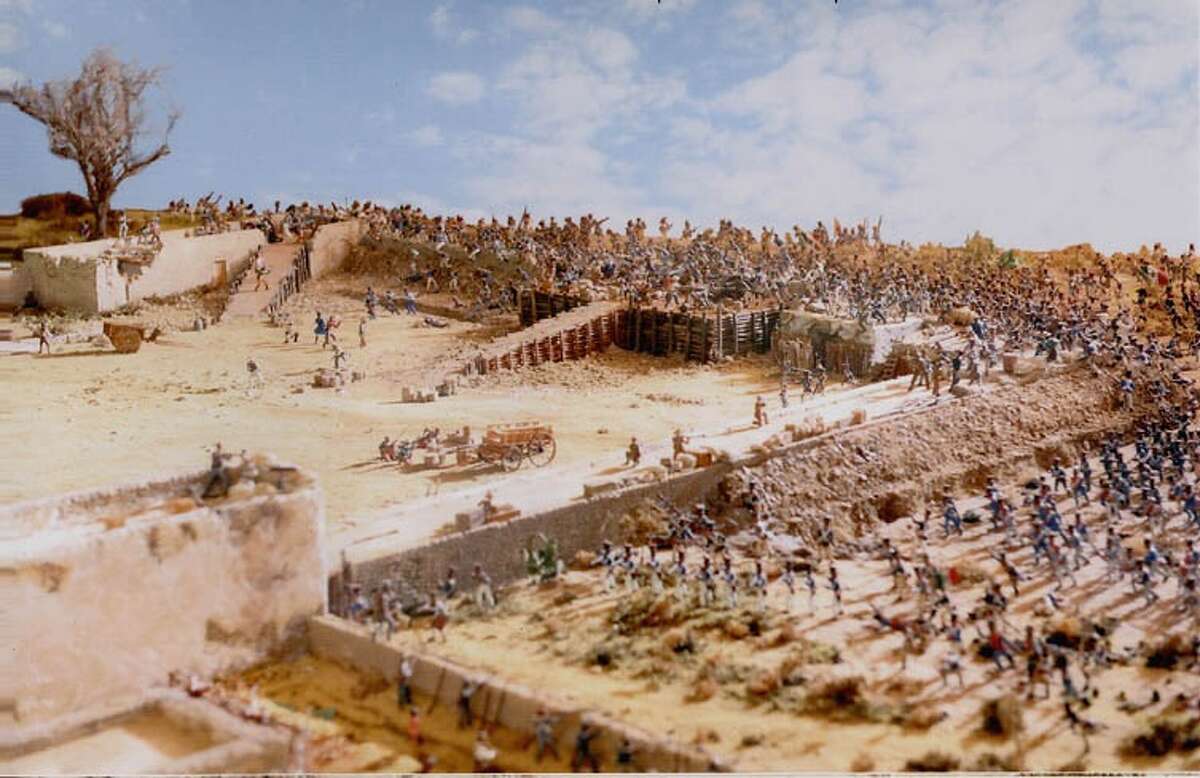
The visit to Alamo provided a fitting stage for the final lap of a “Promises Kept” tour, as it reprised the hostile border as a part of the American imaginary. Trump long claimed. that without borders. or border enforcement, “you don’t have a country,” as if a reinforced border was a needed affirmation of national security and identity and indeed–at least semantically–nationhood. He sought to summon dignity at the border, days after the fiasco of the insurrectionary staging of an assault at the U.S. Capitol, and warn then-President-elect Joe Biden not to destroy the wall lest he undermine immigration policies crucial to the nation, and erode the border to bring “calamity” to national security at the site he had long declared a national security threat. Seeking to both stop time, refocus national attention, and conflate myths of national identity at Alamo, the dog whistle of a defense of security at Alamo TX placed the border wall in the national mythos, to stay the prospect of these sections of concrete wall and levees from being dismantled, to keep alive the story of wall-building that he had long promised to the nation as he left office, casting it as a heroic effort of national defense and construction project that he had presented himself as the Presidential candidate as uniquely suited to create. To visit the completed section of the Border Wall near “Alamo” was to evoke the mythic nature of the crumbling wall of S. Antonio de Behar in San Antonio at the Alamo, the site of resistance of Texan Revolutionaries, still the model for many local militias and white supremacists, and recall the cleavage in society Trump invoked when claiming his impeachment would provoke a “new Civil War,” elevating his own Border Wall to the mythic status of an unsavory part of the collective memory of national defense.

In the final hours of the Trump Presidency, with only four hundred and fifty miles of the border wall built, lest it be reduced to Ozymandian fragments for visitors to look upon his Presidency and despair, Trump visited the poured concrete wall at Alamo, TX, as if to greet the final testament to the achievements of his Presidency and to unveil to the nation completion of the legacy of his Presidency, as if it were a final campaign stop. Visiting a small section of Border Wall mounted on concrete levees around the Rio Grande became an occasion to reprise his commitment to national security, and the culmination of a heroic struggle of border-building and defense of the nation’s territory. The heroic struggle seemed less so, in the shadow of the tragically empty theater of the Capitol Riots, but perhaps it was the memory of his legacy he felt most able to leave: it served to epitomize the difference of “us” from outsiders, in a way that might better play to the nation than the raucous display of angry identities of flag-waving separatists, and set the tone of framing an ongoing future Presidential campaign, praising the Caesar-like monument for which he had secured federal funding, and insisting it would never be buried in the public imagination.

Indeed, among the colorful flags waved with exultation on January 6, 2021 that incarnated a social body excluding the entrance of African Americans or migrants into the nation, from Confederate Flags to III Percenters, angry at any change inclusion in a social contract that had persistently excluded those marked by ancestry and melanin from the state, the prominence of flags waved at the combat around the inaugural stands by MAGA shock forces of militia groups who cast the nation as white treasured the mythic defense of Tejano lands by militia at The Alamo as a foundational historical precedent and basis for “keeping America great,” embracing the image of The Alamo as a war that was fought both for liberties and for racial hierarchy against Mexican troops–an image nurtured not by the state, but by the powerful cultural currency of The Alamo in Hollywood as a proxy for a race war.

Even if the 2020 Presidential campaign was effectively over, the values of white supremacy that had long forged the alliance of pro-Trump separatists and deniers were kept alive by what seemed a hastily engineered visit to the border town of Alamo TX. After an incompetently ineffective summoning of minions to interrupt the counting of electoral votes by Congress, and to create a legacy for his Presidency, visiting Alamo to affirming a border wall as a monument built to keep “undocumented” Mexicans out of the United States, destined to survive even if his Presidency ended: insisting on a specter of the dangers of cross-boundary migration for America, the visit seemed perfect stagecraft for asserting the timelessness of the border wall as a legacy of defending the nation’s borders at a new Alamo, as insistently as AK47s were historically conflated with the role militias to “repel . . . danger” in 1788, and its ratification in 1789 as guaranteeing a “Right to Keep and Bear Arms.”

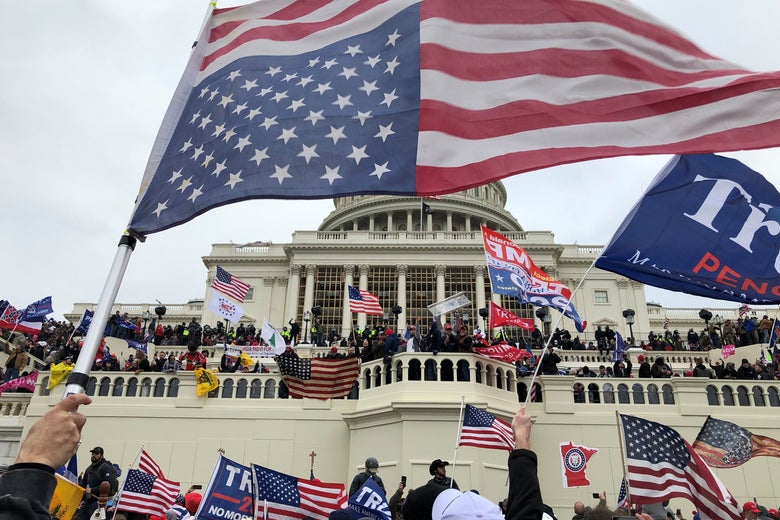
On his final state visit, six days after the insurrection, Trump seemed to steer national attention from the danger of domestic terrorists ready to assault the U.S. Capitol in combat gear to a racial specter of invading migrants, criminals, rapists, and seekers of asylum, collectively invested with criminal intent. As Trump had long presented the border wall as a site of military engagement–perhaps even of armed forces–the visit to McAllen and Alamo provided a means of continuing to fight the same battle over national identity, but to fight it at the border wall. The President had concluded his presidency by disrupting conventions of governing again, by refusing to recognize the popular vote’s results and inciting a riot that invaded the U.S. Capitol by minions waving flags from the lost campaign, which they insisted was not over, amidst an inverted American flag of distress, which militia groups had been regularly raised in protests about counting votes and ballots with accuracy over the previous months in Wisconsin, Georgia, Michigan, and Arizona, and has been displayed in discontent at the outcome of Presidential elections since 2012.

People rioting on the west side of the Capitol with Trump flags
Pro-Trump Protestors at West Side of U.S. CapitolThomas P. Costello/USA Today via Reuters

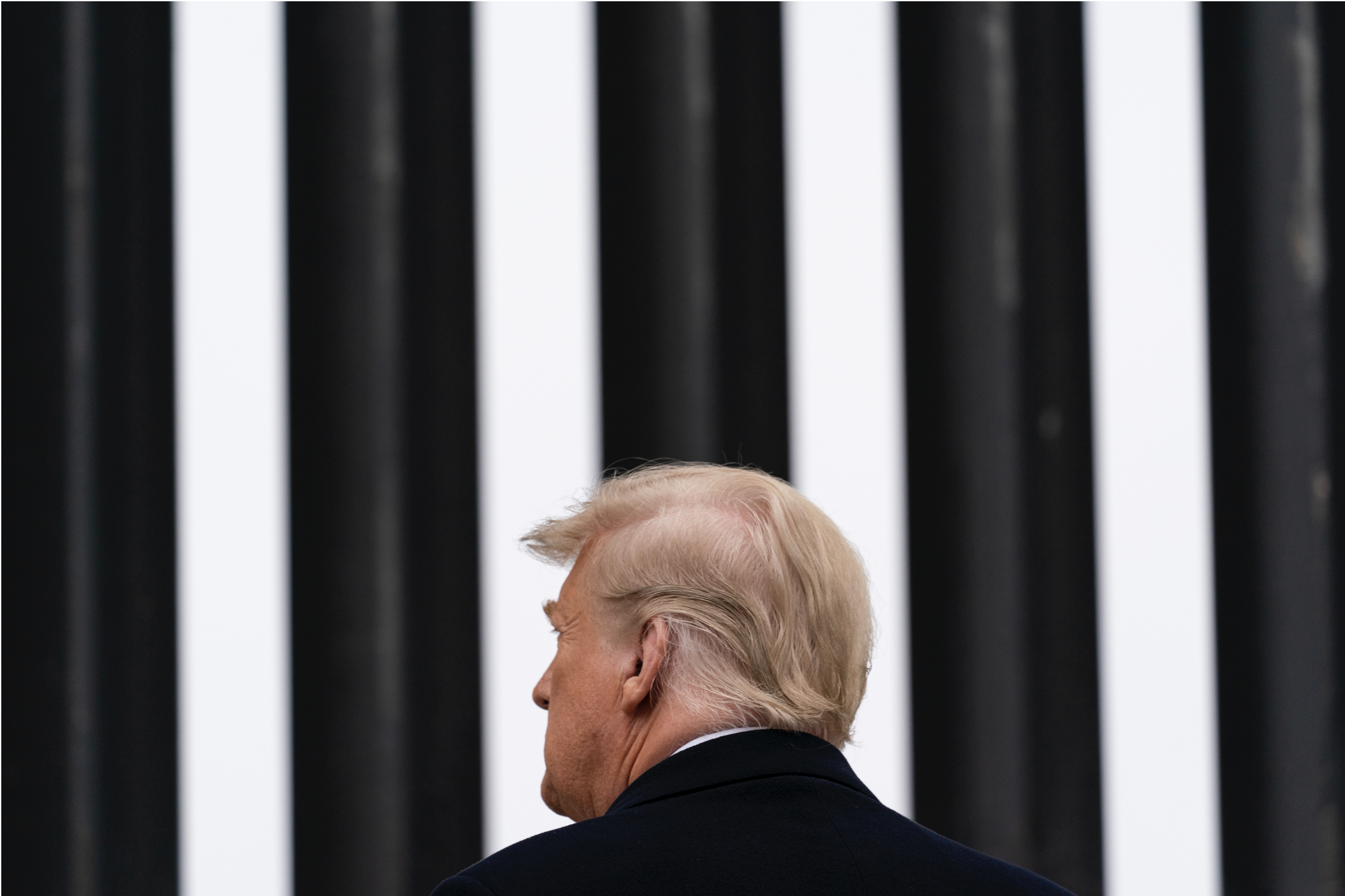
The sense of distress of the inverted flag that one protestor held signaled, in no small part, fear of failure to complete a continuous wall of two thousand miles in the desert promised to keep undocumented barbarians out of the nation. And as the center could not hold, days after the riot or insurrectionary attempt to end the certification of the electors, Trump concluded his Presidency in what might be a valedictory visit to the border as a site of materiality, as if to prove that it could hold, if his presidency could not. The intent to mythologize the border as a material statement of state power, and as an imaginary of the nation, was underscored by the visit to Alamo, TX–

Donald Trump Reviews U.S.-Mexico Border Wall at Alamo, TX Tuesday, Jan. 12, 2021
(AP Photo/Alex Brandon
)

–that recast the visit tot he border wall and concrete levee of the Rio Grande River as an occasion of state, and indeed a military event, to identify himself with the commitment of funds reallocated for the military budget to commemorate the construction of four hundred and fifty new miles of brand new wall along the southwestern border. Did President Trump imagine that doing so would enshrine the monumental status of the border wall would be elevated to the image of national defense? Although many had scoffed at his purposeful diversion of military funds to create the wall, which was not allocated funds by the U.S. Congress as Trump had demanded, the visit sought to cement the border wall in a project of military defense, assisted by the striking historical memories of the battle between Texian revolutionaries and the Mexican government in what later became Texas, in a battle that first redefined the US-Mexico border. The Battle of the Alamo was famously lost by insurgents only to become al Lost Cause: this often-recited memory of a military loss as if it were an affront and injunction anticipated nationalism would inspire the Texan Revolt that led to the formation of Texas as a Republic.

Indeed, the line of the Rio Grande that Texans compelled the captured General Santa Anna to order the Mexican Army to retreat in 1836 below, nearly ten years before Texas was annexed as a state, created a new “line in the sand,” now drawn far South of The Alamo, and in the border town of what would be Alamo, TX. The Texas flag of a militia, with the bronze six caliber “Gonzalez Canon” Spanish munitions seized by Tejano revolutionaries conflated arms, right to enslave, and defense of the border–reprising the 1835 battle cry of Tejano colonist militia as a defense of ancient liberties and modern militia’s defense of bearing arms. The old flag became the most popular flags sold online amidst gun control debates of 2015, and the symbolism of the armaments that were conflated with calls for local liberty is a quite popular patch for militia-members. Is it not a reprisal of an earlier and unforgotten map, at the origins of many militia who still guard the border?

Flag of Gonzalez Canon at Texas State Capitol

The “line in the sand” demanded no real logic or precedent or land claim. Its cartographic virtue lay in its simplicity: as a line drawn in the sand, traced by the drawn sword of Col. William Travis or by a Texian boot before infantry or soldiers, to incite them to battle, or even as a battle cry, the line required no real justification or legal precedent, or international recognition. This was not a line in the sand, but a wall in the sand, on a concrete pediment, dotted by American flags, lest we forgot who drew it, to sanction the cartoraphy of the border as a state affair, worthy of being the final public or private event of the Trump Presidency, affirming the crudest cartography of all: the line in the sand was invoked as the crudest technology of border cartography, and was the crudest of archeologies of the border, an assertion whose logic demanded no justification, but provided its own triggers of nationalism and national pride, and demanded no justification but could be unilaterally affirmed. A line in the sand could be drawn where the man who drew it, and determined as a line of defense.

As a myth, it demanded no formal explanation as a claim of sovereignty, but was affirmed by a simple signature, in a final signing statement bequeathing the legacy of the Trump era to the nation–a dog whistle, more than anything like a legal act. Was the cartography of the border an appeal to a mythical notion of national distinction, conjured to being to fabricate clear distinctions one wanted to call into being on a map? If this was a symbolic and performative act, the erection of the wall Trump sought to take responsibility and to celebrate, as well as to deny American reliance on immigrant labor, was designed to demean Mexican claims to sovereignty and elevating an oppositional ethnonationalism by building a wall along that line, in implicit reference ot the line drawn in the sand by the ragtag militia of defenders of The Alamo.

President Trump signs border wall plaque on Jan. 12, 2021, in Alamo, Texas
(Border Report Photo/Sandra Sanchez)

Trump seemed to salute the wall to turn his back on the abuse of Immigration and Customs Enforcement officers, and rather to praise their service in to the nation as he toured the border wall on January 12, at the same time as over two million people were on the border, seeking to migrate across it, 60,000 having been returned to Mexico from Texas, to wait for their claims to be processed in camps. For Trump desired to recast the border wall as a historical achievement of Making America Great, turning a shoulder on the institutionalization of family separations, crowded and abusive conditions in ICE detention centers, and overwhelmed immigration courts. “Building a massive wall that spans the entire southern border [of the United States] is not a policy solution,” President Biden would soon proclaim on his first day in office, pausing construction work on the wall and calling for a reassessment of the legality of its construction.

In declaring a “National Emergency Concerning the Southern Boundary of the United States” in February 2019, Trump would diverted billions of dollars to the construction of the border wall, he fiction of the boundary that Trump sought to affirm in his visit, and had demanded in unilaterally fortifying the border as a subject of national defense, in treated as a National Emergency, rested on the need to “protect” American security, demonizing how migrants stand to “put countless Americans in danger.” shedding American blood and taking American jobs in order to redirect $8 billion to the border wall as a boundary that needed to be defended for national interests, without legislative oversight.

The legitimacy of the border was, of course, deeply engrained in our history and tied to our national mythos in ways that Trump was keen to exploit by staging his final signing visit to a section of border wall in a town called Alamo: as a Representative to Congress, Abraham Lincoln, later no stranger to the loss of life to determine national borders, detected the “sheerest deception” on the part of then-President James Polk in blaming the aggressiveness of Mexican soldiers across the Rio Grande as part of a campaign to admit Texas to the Union as state that would expand territories tolerating slaveholding: rebuking the mythic sense of the Rio Grande as a frontier of the nation, the barrier across which Spanish troops were forced to retreat in the aftermath of Tejano insurrectionists motivated by their loss at The Alamo, Lincoln doubted whether unquestioned acceptance of the Rio Grande as a frontier could serve as a basis to declare war: to rebuke charges that Mexican aggressors had crossed the Rio Grande to shed American blood, and rebuking the necessity of a national military reprisals against Mexico as inevitable–given that the determination of the boundary was contested. But the image of the “line in the sand” that gained incredible affective power as a statement of revolutionaries and in the Mexican-American war, provided the crudest of notions of the border’s stability and indeed of the border wall, not needing any precedent in law or in a mutual accord, but oddly naturalized into the landscape, at home within the construct of manifest destiny far more than in the legal record.

The fiction of locating the boundary line of the nation at the Rio Grande was a but a convenient invention, Lincoln had insisted back in the 1848, as it was, while asserted by Texans who looked to military treaties they had dictated for confirmation of their inclinations to take land, able to be manufactured as a sharp-edged mental construct of affirming value. The border of the Rio Grande’s course, Lincoln had observed, was claimed on paper by Texas as a western boundary for reasons of self-interest, but never internationally recognized as binding,–and had indeed never recognized by Congress as a question of American jurisdiction. Rather than accepting the groundless claim of a sitting President that “the soil was ours, on which the first blood was shed” in the Polk administration, eager to avoid a needless war, sending an army to fight with those Mexican resident who themselves never submitted to American sovereignty, Lincoln in 1848 found little in the historical record to accept the Rio Grande as the “boundary” of the nation, based on a unilateral declaration of the State of Texas, let alone as a binding basis for a cause of war between Mexico and the United States based on aggrandizement. Lincoln in 1848 sought to query the grounds for defending a boundary lacking mutual agreement as a boundary to be defended by American military. But the defenders of the Alamo, Travis, Crockett, and Boone, have been celebrated as patriots of Texas, and as defenders of a white tradition in recent years, as the Cenotaph in which their ashes were said to be translated in 1936 were defended by the Texas Freedom force, who in May 2020 urged members to “Defend the Alamo & Cenotaph if the need arises,” seeing the Cenotaph, as the statute of Col. William Barrett Travis, sword’s point touching the ground at his feet as he struck a pose of public oratory, on a plinth on the old Mission grounds, in Travis park, as symbols of national defense to be guarded against vandalism.

When Lincoln distinguished the international boundary line from where states claimed jurisdiction, he questioned the validity of unilateral assertion of a boundary line. Veneration of The Alamo elevated the drawing of the sand as a sacred event, a shrine for the defenders of the fortress, whose ashes in the Cenotaph have created a powerful monument to Anglo defenders, Travis, Crockett, Bowie and Boone, beneath the commitment to “never surrender-never retreat,” recently celebrated by the white supremacist militia as the “This is Texas Freedom Force,” that has urged members to “Defend the Alamo & Cenotaph if the need arises” in late May, 2020, standing guard over the Cenotaph and the statue of Col. William Barrett Travis, commander of Tejano troops who defended The Alamo, holding his sword’s point on the ground as he struck a posture of public oratory on the grounds of the old Mission. While the statue of Travis on a plinth deferred the final results of the stand–the all-out assault assault ordered at dawn by Mexican General Santa Anna left all one hundred and eighty nine defenders of the Mission grounds dead, its facade reduced to war-like visage of ruins–the heroic defense was embodied by the line in the sand, the poweful metaphor of boundary drawing to which the border town Alamo gestured. And although Travis’ statue voted to be relocated from the landscaped park that was once part of the Mission’s grounds, the confederate monument sought to be relocated in 2017, it still stands by The Alamo grounds.

In declaring emergency surrounded by U.S. Border Patrol members, the primary enforcers of the border with ICE, the very men who who become his personal agents since their early endorsement of his candidacy, and who he later visited at Alamo, TX, at the end of his term. Surrounded by the border patrol agents whose number had hovered about 2,000 until 1985, whose number peaked beyond 10,000 by 2000, Trump celebrated a border that circumvented congressional appropriations and the law, provoking a spate of lawsuits from many states and environmental preservation groups, extending the declaration of a state of emergency at the border in February 2020, and again renewing it, as he left office, two days before Joe Biden’s inauguration on January 18, 2021.  President Trump was confident, playing it by the numbers, that lawsuits against the National Emergency only emerged from “blue” states he did not need to win to be reelected, counting on the border imaginary to be preserved.

The visit to Texas was an attempt to bolster that border imaginary, to the site where the greatest “immigration enforcement” efforts against refugee influxes had begun with deployment of a large, flexible, mobile Border Patrol Task Force, then in the INS, in the most severe “border build-up” in memory: “Operation Hold the Line” deployed armed Border Patrol officers along the border, along the McAllen Sector administrating the Rio Grande Valley, as Operation Gatekeeper grew along 194 border checkpoints to construct the first section of border wall on the western border, introducing a militarized border oriented toward stopping or physically halting the passage of unwanted migrants and refugees. If the San Diego initiative of “Operation Gatekeeper” evoked a mock-pastoral metaphor of the “gate” to cast migrants as animals, and mask the violence of migrant deaths–1,200 migrants died trying to cross the border from 1993-96, when it was in force, with the greatest number where Operation Gatekeeper was in force, as many more were detained as criminals. In parallel, “Operation Hold the Line” emphasized the placement of Border Patrol stations along the border, to compensate for perception of no coherent federal vision for the border management, to replace standard practices permitting migrants to cross the border before they were apprehended and deported, mandating continuous presence at the border of Border Patrol. Stationing Border Patrol across the border began in the lower Rio Grande valley, by a model of Border Patrol echoing Tejano defense of the line “drawn in the sand” at the Alamo, was later deployed at El Paso as “Operation Blockade,” staunching all cross-border movement.

The image of the defense of a “border” that existed as a “line in the sand” tapped a mythos of the Texas revolutionaries who defended The Alamo, a site of an old Mexican mission–a stone complex constructed by Spaniards in San Antonio as a Franciscan mission hat had, mutatis mutandi, become a garrison, for all of its Franciscan origins, venerated for its defense by Travis, as a line able to be drawn between the intermingling of Mexican and Anglo cultures, the mixture so intolerable it had to be defined along an edge. In rallying a small group of insurrectionaries hoping to defend The Alamo, and to extend the “rights” to extend plantation systems into Tejano lands, William Travis had drawn the “mother of all lines” in 1836 in the sands before the mission complex, perhaps the archetype of all maps of the southwestern border: in drawing a line before the assembled rag tag insurrectionary Anglo troops he would lead against the approaching Mexican General Antonio Lopez de Santa Anna. The line whose drawing is an archetype in all films about Texas gives narrative prominence to the defense along a line in American film, as if tracing an archetypal cartography as a topic of attention, tension, and crisis, that “visiting Alamo” seemed to seek to reprise for a President who was long in touch with television producers about choreographing his public appearances to present his political persona.

In a different cinematic key, outside the Trump canon of action films, John Sayles’ Lone Star referenced in the taunt of the owner of tire repair store in a border town who traces a line before his store to taunt the Anglo sheriff from across the border who is adamant in his cartographic convictions, “Bird flying south, you think he sees that line? Rattlesnake, javelina–whatever you got!–[once] halfway across that line, they don’t start thinking different. So why should a man?” The crossing by species of the border, especially at the rich and delicate habitat of the Rio Grande, stand in contrast with the lines that the American government has been increasingly insistent to draw, and that Donald Trump convincingly coupled to a display of national identity and a showpiece for Making America Great. Was it a coincidence that it was at The Alamo, according to the cheesy poster publicizing the Technicolor western epic written, directed and produced John Wayne, that the dangerous troops besieging The Alamo held Mexican flags, in what was openly mapped as a military confrontation at a border in terms of a race war, circa 1960, between latino extras and Anglo cowboy combattants, eager to hold their ground?

The image of the tactical defense of the walls of the old Spanish mission, since restored by the U.S. military as a shrine to national combat, has been memorialized in multiple dioramas emulating cinemascope as a historical struggle for identity, created in a recreationist model designed b Thomas Feely, has been recently expanded in a still more detailed diorama to incarnate the threat of Mexican troops flooding the walls of the citadel in San Antonio, showing at its central moment of dramatic tension the amassing of Mexican forces to breach the northern wall to show “how really doomed” its remaining defenders were as they remain to repulse the mass of armed Mexicans, placing 2,000 hand-painted pewter figurines in an dramatization of an action-packed version of this cartographically generational conflict, intended to replace the fifteen by thirteen foot diorama that already exists at the History Shop, just north of The Alamo. While such models are far from Alamo TX, the investment of the dramatic moment of history as an inspirational event–rather than a failed insurrectionary event–was channeled days after the Capitol insurrection, in Washington, DC, seemed to stage a dramatic pseudo-coup replete with its own historical myths, as if to affirm the inspirational value of the defense of the border as a national project.

Did the fantasy of a border that could be held again at The Alamo, or at least at the Rio Grande, create a powerful mental imaginary whose simplicity underlay the cartographic crudeness of the deep history of Trump’s border wall? Operations of controlling the border, as a fixed line, grew to hold an increasingly prominent place in the mental imaginary and mythos of border patrol agents near McAllen, as Border Patrol vehicles were increasingly stationed every hundred yards o the banks of the Rio Grande: as “Operation Blockade” reverted to “Operation Hold the Line” in El Paso, in the mid-1990s, it reflected the extension of the metaphor of a “line in the sand” at The Alamo to the entire border, and a basis for understanding the demand for “operational control over the international land and maritime borders of the United States,” borders that Trump would conflate with the identity of the nation. The expansion of Border Patrol Operations to stop migrant travel across the entire lower Rio Grande was amplified in the 2004 deployment of boats, fencing, and lighting along the banks of the Rio Grande to reduce migrants’ entrance across the border at a cost of $3.5 billion. The dream of instituting a “line in the sand” along the Rio Grande hoped that the invasive construction, amplified noise and lighting disturbed sensitive habitat and breeding behavior “temporarily” without adversity and “little permanent damage,” as if failing to consider the long-term nature of the “grand strategy” as it mutate into a multi-year project from 1997.

Border Patrol operations in the Lower Rio Grande Valley, Texas. Cartography by Eric Leinberger. 
Eric Leinberger/US Border Patrol Operations in Lower Rio Grande against Migrants, 2011

The expansion of both border patrol officers, 20,000 by 2010, mirrored the allocation of $7 million for steel fences across the border, which expanded to Trump’s public requests for $8 billion for a border wall likely to cost as much as $25 billion. The huge sacrifice to the nation of building the border wall existed not only in the squandering of funds, but the legitimizing of a mindset of criminalizing and detaining trans-border migrants–and discounting of migrants’ lives. Migrants detained during the Trump Presidency in holding facilities along the border or in detention centers were willfully administered without humanity or dignity by the Immigration and Customs Enforcement: detention centers were sites of systemic abuse, operating with impunity in a culture of “dehumanizing physical, sexual, and medical abuse,” in the eyes of one observer, left over-crowded as President Trump sought to make them monitory examples to migrants. “Look, this is tough stuff . . . I know we’d see a system that is overcrowded,” adding on Twitter, “Tell them not to come to USA– . . . problem solved!” “Where do these people come from?”

Trump asked with open arms at a pro-border wall rally in February, 2019, anticipating the Presidential challenge of El Paso’s Beto O’Rourke, stirring up anti-immigrant sentiment, but ignoring the daily violence at the archipelago of Detention Centers that were administered by ICE. The project of wall building however became a monument in itself, the logic of whose construction as a monument to the nation consigned to oblivion migrants’ fates by being recast and dignified as a military project, and a military struggle–an elevation of the building of the border wall to a struggle for national identity that was referenced in the reference to defending the border at the celebration of the completion of four-hundred and fifty miles of wall at an American border town called Alamo, where the line in the sand could be firmly drawn by blocks of reinforced concrete with a rebar core–presented as the completion of a promise long made to the nation.

Trump in El Paso: Dueling rallies show border wall support, opposition
MAGA Border Wall Rally at El Paso Texas, 2019

The policy separation of migrant families at the border began in late 2016, before Trump was inaugurated. It was extended without public debate over the policy, however, and dramatically escalated in Trump’s Presidency. If the wall concealed America’s dependence on migrant labor, it also concealed the extent of this rampant abuse of human rights. The systemic family separations at the U.S.-Mexico border expanded despite documentation of its abuse–there are many cases of losing, abusing, and even killing children increasingly detained in centers in southeast Texas–but Trump tolerated and shouldered abuse as he had directed attention to the construction of the border wall that was financed almost two years ago, with the declaration of a National Emergency as Congress refused to apportion $5.6 billion he requested for its construction, but a fifth of his original request, with the assertion that the nation faced “tremendous dangers at the border” that demanded a border wall, seeking to secure the desired funds without the congressional approval by hyperbole, to use funds apportioned for military construction projects to redirect to a border wall he cast as a project for American armed forces as the funds were not forthcoming–but meeting legal challenge as only projects in which American armed forces were engaged didn’t demand congressional apportionment, and as, it was widely noted, border apprehensions were in decline. The steep increase in detentions at the border was cast as evidence of the need to build the wall, as policies of detention and increased numbers of those detained by Immigration and Customs Enforcement created a sense of its increasing need.

But it was as true that the need for a wall as a shared cultural symbol grew to distract populations from the growing gaps of wealth, access to education, health care, and justice in the United States, and the growing wealth gaps between the super-wealthy and the rest diminished before the spectacle of the wall. The National Emergency was declared to secure funding for the border wall, concealing that the securing of the border was neither an emergency or a military operation, but a mythic redrawing of the border.

When President Trump visited Alamo, TX to review the border wall as his last and final public act as United States President, it seemed in a sense the end of an era. It was valedictory in its salute of the Border Guards who had first endorsed him for his Presidential run, and had turned into a sort of personal storm troopers of the executive wing, a set of armed men to attack and detain illegal immigrants as they acted to parol the borders. In visiting the border at Alamo, he seemed to reprise his promise to build an impassible border wall that would protect the United States–or a version of the United States–from the entrance of globalization. And the appeal that Trump had made as a presidential candidate of restoring national integrity and an illusion of American greatness began from the restoration of the values of The Alamo–a timeless a mythic defense of the United States at The Alamo, linking the border wall with a mythic project of national defense, even if the defense of The Alamo during by Texian Revolutionaries was not fought at the walls of the old mission by the American government. The visit to Alamo TX was an affirmation of the values of The Alamo of defending national sovereignty, and dedicating himself to the affirmation of sovereignty, as well as to whip fears of a return to an open borders policy he had tagged President Biden and the Democratic Party.

Was the myth of The Alamo not at the heart of the legend of national grandeur, rooted more in race than in nation? Rather than providing an outpost of the American government, the garrison of The Alamo that is linked with the start of the Texan Reolution was defended by men who have been retrospectively cast by white Americans as the self-annointed ancestors of Texians–they were the precursors and model of the current vigilante groups who have been encouraged to make citizen’s arrests of undocumented migrants. Varied groups, defining themselves as self-designated Patriots, took in upon themselves to seize land that was Mexican–and under Mexican sovereignty–to claim it as part of the United States. The “Come and Take It” flags first flown as a symbol of defiance to Mexican soldiers in 1835 provided a false originalism that flew as it was elevated in the insurrectionary Capitol Riots President Trump had not distanced himself for several weeks; the defiant Confederate flag affirmed Second Amendment rights, and the President’s own rhetoric of “taking back the country,” familiar among militia.

Come And Take It': A Texan Symbol Of Defiance For Sale : NPR

The ease with which Trump described the building of the wall was in 2015 was confirmed by the visit to the border Alamo, by staging a revisionary and selective history of the border wall rooted in national triumphalism and American flags. Trump had convinced the American electorate building a wall across a border of almost 2,000 miles, extending from the Pacific to the Gulf of Mexico, across rugged topography was a piece of cake for someone so practiced in construction was itself a map-trick. Trump in fact possessed little sense of the practicalities of building in such terrain, and barely registered the scale of the problem save its effectiveness of a wall that would render the legal identity of the migrant opaque. Rather than dwell its logistics or practicalities, Trump had promoted the performative promise of constructing a border wall in his campaign–displaying pseudo-maps promising national security–whose simplicity lay in its denial of rights of migrant, a simplicity of evacuating rights by the border wall that was a subject of pleasure, an inspirational image whose financing he presumed that the office of the President would help waive established mechanisms of appropriating necessary funds.

The image of the fantasy wall bounding the nation, concrete punctuated by what seem hexagonal towers of surveillance, was attributed to “The People,” as a new embodiment of the nation, separate from international conventions or law.

What Trump owes his supporters, and now, the country | PBS NewsHour
2016 Presidential Candidate Trump Shows Border Wall Map Allegedly Given by 2015 Rally-Goer in Fayetteville, NC/
Johnathan Drake/Reuters

The fantasy of the border wall that Trump was offered at a political rally for his candidacy was completed at Alamo. The evocative name of continued resistance, and refusal to give up, was evoked by the place-name alone of one town near where the border wall spanned Hidalgo County that popped as a trigger for transmitted memory far more than the other towns the section of border wall passed near Ft. McAllen–‘Mission’, ‘San Juan’, ‘Weslaco’, ‘Mercedes’, and Brownsville, a frequent stop of border visit, and popped out of the map for some time. Plucked from the map, its prominence drowned the fate of migrants or the protected areas the Trump administration sought waivers to cut through from 2017, wrangled by 2018 as regions the wall was only permitted to extend by declaring a National Emergency at the border; Customs and Border Patrol waived environmental regulations in the Lower Rio Grande, as regulations preventing construction of border wall in protected lands were extended to the western regions through 2019. Was the Rio Grande Valley not a model for the waiver of environmental regulations limiting construction that President Trump long sought to wrangle?

Border Wall | Sierra Club
Proposed Levee Wall Constructed in Rio Grande Valley, 2017
Expanded Levees Proposed along Rio Grande Valley
Existing and Proposed Border Wall beside the Rio Grande River and Valley (2017)/Sierra Club

By late August 2019, the problem of extending the border wall and levees along the lower Rio Grande Valley still remained on Trump’s front burner, and the nagging question of how to extend these sections of existing border wall in a defensive line along the windy course of the Rio Grande near McAllen was a thorny question of securing needed exemptions.

As a realtor, Trump was habituated in the construction of hotels and golf courses to move around regulations and obtain special clearances with the ease he might move across the globe’s surface, and as he flouted regulations and Congressional approval by declaring a National Emergency in February, 2019, to circumvent budgetary approval, allowing himself to flout regulations as in the past. As a real estate promoter, Trump had mostly used maps to skirt regulations, gain tax breaks, tax-forgiveness, or debt relief, to generate much vaunted “gross operating products” to “pay as little in taxes as possible.” Tax-avoidance is the major strategy of wealth preservation of the ultra-wealthy, and the range of tax breaks that Trump gained in what constitutes as public assistance benefit all fifteen buildings at the core of his Manhattan real estate empire; circumvention of regulations of appropriation was the only way to achieve the building of the border wall, and was probably what Trump meant, if anything, when he argued that his expertise in building would allow the border wall to be publicly funded, even if he argued that deal-making skills would allow construction of a “big, beautiful wall” that no previous President had been able to deliver–and which demanded a voice outside the corrupt American political class.

Donald J. Trump, left, with Mayor Ed Koch, center and New York Gov. Hugh L. Carey, pointing to a rendering of what would become the Grand Hyatt Hotel, in June 1978. A crucial factor behind the hotel’s construction was 40-year tax break that has cost New York City $360 million to date.
Trump at June, 1978 groundbreaking for Grand Hyatt, Associated Press

The wall was a symbol of the popular mandate on which Trump promised to deliver, providing a monument of public safety no other president had been able to offer. The very narrative of its imminent construction had long offered a performative basis to save the Trump presidency, returned to several times as if it were a promise that was the basis of his alleged popular mandate and a demand for safety only he could meet or discern. If Trump clothed the construction of the wall and its funding in questions of border security, and the needs of economic and criminal security that he argued the lack of a border wall imperiled, arguing for the basis of domestic security to attract the broadest base, as an act of love–“you build a wall around your house not because you hate the people on the outside, but because you love the people on inside” (January, 2019), Tump was selling us a vision of domestic security akin to luxury living at a remove from the city’s sounds and diversity, concealing the economic dependence of the nation on immigration, and the violence of the border security apparatus, more costly, perhaps, if far less beautiful than the “big, beautiful wall” he promised.

Love? The wall emblematized an independence from international protocol or conventions, and human rights requirements, as a “line in the sand,” and was able to be drawn in the sand as the site to build the towering, opaque wall able to blot out what lies across the border, replacing the sovereign state with a model of border defense of earlier eras, eras predating sovereign claims we would recognize, and suggesting a Hobbesian state of nature. Trump saw the wall as, one might argue, a similar part of the landscape, able to blend seamlessly with its surroundings and necessitated by them.

–in a performance of sovereignty, rather than a sovereign discussion with other states: the border wall was long for domestic consumption as a spectacle, if it was argued, and presented, to be , and was involved in a mythos of the nation that was for domestic consumption, displacing claims of sovereignty in the ceremony of defining a dichotomous divide by fiat, on a reality show that was for national broadcast, rather than framed by a language of international law.

Trump staged his final visit to the border at Alamo, TX, seeking to savor the triumphant construction project he now cast as a monument of national achievement of what he had campaigned would be akin to the Eisenhower Highway System, funded by defense appropriations even if they unapproved by congress, but The wall provided a monument to the Trump Presidency, emblazoned with his name or his signature, as if in a gambit to claim that the structure deserved to be named after himself. He visited the poured concrete levees on the Rio Grande as a fruit of his presidency, the only concrete walls left of the entire border wall, which was vertical steel beams filled with concrete to replace fencing, but judged to meet the “operations requirements of the U.S. Border Patrol” in 2019–until, that is, they were found easy to be sawed through by a circular saw. Such “high security fencing” would cost 1.6 billion, but a fraction of the $25 billion Trump desired to allocate for border building, promising at the start of work “not only on some new wall, [but] . . . fixing existing walls and existing acceptable fences” very quickly. He had accelerated the pace of border construction in ways that seemed to be timed to the election, and had probably planned to visit the border wall for a final time in his Presidency, win or lose the election, as a platform of expanding the need for allocating more funding to the wall. When he came to “highlight his administration’s work on the border wall,” the valedictory visit sent the message that he. had done his hardest to keep the barbarians on the edge of the empire on the other side of the border, and sought to transmute into the national memory.

All of this was far from the town of Alamo, and even father from the mythic imaginary of The Alamo that had assumed a sacred importance in many Americans’ collective memory that Trump was eager to transfer to the Border Wall. President Trump’s visit was to a site near McAllen, Texas, rather than The Alamo, but the questions of how they were related quickly rose to the surface of newswire accounts. AP and other news outlets quickly reminded the nation, as the White House had left it unclear, that the city of Alamo TX near the military base was, indeed, not The Alamo in downtown San Antonio. But Trump had long claimed to love the uneducated, and the faithful, and the possible geographic confusion seemed an opportune way to fulfill the mission of the trip to tally achievements by affirming the threat came from south of the border at his term end–and elicit continued fears that the failure to complete border construction projects would not Keep American Great less cross-border flows of population continued to be stopped, as important to the nation as the historic “border conflict” by the so-called “defenders of the Alamo,” who had in fact started an insurrection in Mexican province.

As if visiting an outpost on the border of the empire where he sought to protect barbarians from invading, days after having incited riots that had staged an actual insurrection, at a rally where the President claimed Democrats “threw open our borders and put America last,” reminding them at President Biden would “get rid of the America First policy,” he ceremonially visited the border as if to mythologize it. Trump arrived in full regalia, as if denying his loos, but as if visiting the groundbreaking of a new hotel, accompanied by city officials, as if it were a privileged site of national defense, near the river whose meander had long defined the international boundary between Mexico and the United States, and indeed was a return to the Rio Grande Valley he had already visited to discuss border security in January, 2019, and sought to confront questions of the need to seize privately owned land to do so by eminent domaine. If the border wall was to be tall, daunting, fitted with flood lights, sensors, cameras and an enforcement zone that was a hundred and fifty feed wide was a steep goal, Trump treated government shutdown as a small price for 450-500 miles of border wall on track to be completed by the end of 2020, promoting a border wall whose construction would be completed by March 2021.

It still existed, even if that moment in history would never arrive. And although the story was told of population movement across the border, another story could be told about the disappearance of the boundary that almost seemed imminent by the mid-1990s, even as anti-migrant feelings grew: the expansion of the transboundary cooperation along much of the border that responded to the growth of the border region to almost a billion inhabitants in the 1990s, through which increasing billions of exports moved yearly–$3.3. billion at the San Diego checkpoint alone by 1990–that led Border Mayors Conference to request a transboundary zone allowing free movement to all of twenty five miles, as the increasing economic importance of the boundary brought an increased interest in drawing a boundary able to define the exclusivity of the wealth of an imagined community of Americans from outsiders, as a porous border region seemed less in control of the United States government, and almost a separate nation.

The line between nations that Trump chose to emphasize along the river delta where Alamo TX is located and which Trump visited is one of the sole places along the entire US-Mexico border where steel panels appear, fully mounted on large concrete levees. As one of the rare sites where the concrete wall that Trump promised actually exists, it became an important backdrop to conclude his Presidency in a final photo op, as well as to rehearse a new national imaginary.

The visit to the concrete levees of the Rio Grande Valley that were mounted by concrete-core steel fencing were a display of Presidential authority on a line drawn in the sandy riverbanks far from the Alamo, as newspapers had to remind their readers, but provided a tableaux vivant of sorts, eight days before the end of Trump’s presidency, to defend the necessity of drawing a firm line in the sand.

President Trump Visiting Border Wall at Alamo, TX, January 12, 2021–Alex Brandon/AP

The actual geographic distance between Alamo TX and The Alamo seems to have shrunk symbolically, if the car ride was still three and a half hours: Trump seemed to treat his visist as a retrospective view on the grand project of national redefinition on which he had coasted as he teared up in remembering the “great honor” after working so “long and hard” on the border wall as he found himself “here in the Rio Grande Valley with the courageous men and women of Customs and Border Patrol.” The encomium that he planned to the four hundred and fifty miles of wall built so far was an occasion of deep personal bonding with the built, akin to the ties Trump promoted to many real estate projects of construction over the years, on which he had affected the same deep tie by affixing his name in ways that we had understood as a promotion of his brand as much as a canny extension of self to a distributed global network. He had forged deep bonds to the wall, so it was difficult to decide where the wall ended and the candidate–or the man–began, as the monument he had promised so fulsomely from the declaration of his candidacy became a sign of the nation, a sign of national security, and a sign of the vision of national security that he, Trump, and only he could promise, akin to the visions of luxury lifestyle that he, Trump, could guarantee and promote.

The term that he had served out, and was now coming to a close, became an occasion to express, in mock humility, his gratitude for the very experience of having “gotten to know [the members of the Border Patrol] very well over the last four years,” praising the “incredible . . . really incredible” people at Border Patrol he had promised the wall to be built, and was now there to say he had delivered, and the promised were indeed kept. “We got it exactly as you wanted it–everything!–including your protective plate on top . . . for extra protection,” he noted, the real estate promoter returning as he surveyed the levees, and the reinforced concrete, ignoring the detention centers and the human lives lost in its construction, as well as the habitat destroyed, a concern which he was successful at having dismissed. The delivery of border wall concluded a transactional relation to the Border Patrol, as much as to protect the nation. Looking at the reinforced concrete structure with heavy slats, Trump channeled his identity as a builder that could be cemented with his status as an American President, explaining how it was “steel,” “concrete inside steel–and then its rebar–its rebar–a lot of heavy rebar inside the concrete,” channeling his inner engineer–“as strong as you’re going to get and as strong as you can have . . . . 100% of what you wanted!” The swansong speech promoting the achievement of an “extraordinarily successful building of the wall on the southern border,” of four hundred and fifty miles bookended Trump’s October 2018 speech at Calexico, CA, to commemorate the construction of two hundred miles of a “full wall system” looking suspiciously like a fence.

Gregory Bull, AP/President Trump Approaches Improvised Podium at Calexico, CA (Oct 26, 2018)

The border wall sections that had been commemorated for three years running revealed increments of two hundred miles by rolling out the border as a prop–a talking point, and a monument, more than an accomplishment. As monuments, each roll-out of border wall and affixed with the commemorative plaque crediting construction to President Trump staged a new era of border protection and defense. But the monuments to the militarization of the border wall and exclusion of refugees from the nation was based not on actual precedents, or a map, but gestured to a new national imaginary, and increasingly did so by comparisons to mythic events of the nation, rather than to actual events, migrant surges, or need.

Trump’s speech before the concrete levees in Alamo TX seemed uncoded. He deliver hope and a prayer that the piece of national infrastructure would survive as a personal legacy. But the comparisons he made were deeply coded, from the billing of the wall as a project of national infrastructure to the gesture to celebrating the militarization of the border at a city called Alamo, which effectively placed the border wall on two imaginary maps, neither coinciding with the lay of the land or the geographic situation of the border wall as a project of massive environmental destruction of sensitive habitat, inhumane treatment of detained migrants, and disrespect or acknowledgement of a world of increased displaced persons and refugees. Trump had bizarrely compared to the Eisenhower National Highway System from his campaign of 2015 would survive as a personal legacy for national development and will ensure memories of the success of his Presidency defending national security. When Donald J. Trump had first refurbished a political identity, he not only added a middle initial to his name in the fashion of Eisenhower, but presented “America’s Infrastructure First” as in the mold of Eisenhower, promising a transition that echoed the commander of allied forces in hopes to “implement a bold, visionary plan for a cost-effective system of roads, bridges, tunnels, airports, railroads, ports and waterways, and pipelines in the proud tradition of President Dwight D Eisenhower, who championed the interstate highway system”–as a basis for his credibility and perhaps legitimacy as a President. To be sure, the marquis project of a Border Wall System exhausted the budget and federal funds available. But in the way that Eisenhower mandated the highway system be federally funded as a national defense program in 1954, linking the need for roads to imminent the fears of nuclear attack, as much as for transportation needs, based on his experience in rebuilding Europe, the massive cost of the Eisenhower Highway System–which had unprecedentedly cost the United States $101 billion, far beyond the original federal bond that Congress had approved, provided the only comparable form of expenditure to the border wall that he had proposed. Even as the cost of the border wall had expanded,–and left President Biden noting that stopping the construction Trump had arranged by classifying it as a National Emergency might save the incoming administration $2.6 billion, freeing up needed funds for needed projects of national health, border barriers would have become the most pricey piece of infrastructure in the nation.

If being run by the Army Corps of Engineers, the visit to Alamo TX keeps alive the defense of the border and conjures the streaming of Mexicans over another wall, and the gesture to the improvised insurrection of The Alamo that might be effectively enlisted as a new model of service to an imagined nation. As he looked at the wall, the outgoing mused in his final days in office, unsubtly reminding his audience of the potential sacrifice to the nation of stopping the project, that the current wall was “as strong as you’re going to get and strong as you can have.” His audience new well that all bets were all off about building more wall in the Biden administration, and his words seemed to seek to rile up his long-term allies at Customs and Border Patrol, whose union had been the very first endorsed his presidential candidacy, excited by the priority he gave building a border wall in the first days of his campaign. For this real estate promoter turned salesman of a vision of the nation was most familiar with maps as a basis to evade building codes, zoning restrictions, or municipal regulation, by means of winning exemptions through wand-waving reclassifications that seemed a sort of grand opera of “deal”-making.

For Trump, such canny framing metaphors as a reference to infrastructure and a visit to Alamo helped to frame the project of the wall as one of national defense, requiring a reclassification of budgetary appropriations, and indeed fast-track prioritization as a project of national need. Both Eisenhower’s unprecedented achievement of infrastructure investment and the saber-rattling reference to The Alamo seemed to reframe the project in credible terms for a base, independent from the lay of the land or the practicalities and logistics of the border terrain: both metaphorical gambits removed the wall from the map, and mapped the border wall within a new logic of nation-building. Such reference to the Eisenhower Interstate, a model of expansion of infrastructure that had creeped up on the nation slowly, to become part of its national identity over time, had slowly created the expanse of national highways that fit with doubling of highwasy after World War I in the United States, as, the paved mileage of but 257,000 miles grew over time to almost 522,000, as the plans Eisenhower had laid were solidified as the Federal-Aid Highway Act would pave concrete interstates of 41,000 more miles–and adding 5,000 miles beyond Eisenhower’s mandated 41,000 miles of interstate provided, few have noted, a memorable event in Trump’s life, whose construction was elevated as a powerful model of what passed for public service in Trump’s youth. If Trump had ben celebrating the building of four hundred and fifty miles of wall, Trump framed the innovative nature of his future vision of a nation that was walled, by many more miles, as well as securing an image of the strength and identity of the nation that he had tried to cement. Eisenhower, famously, had mandated the project of the interstates during the Cold War as a project of national defense of the economy, in the event of attack, allowing federal dollars to flow to local projects. Was it only coincidence that Trump entertained audiences at his rallies, as if flying a trial balloon from August, 2105, “Maybe someday they’ll call it the Trump Wall,” he mused early in his candidacy, recognizing the power and unique privileges that the office of Presidency might bring. The fantasy became a near-actuality in his public platform as a candidate when by December of the same year he described the “Trump Wall,” in mid-July 2016, after he left the official campaign trail, promising a project of needed national infrastructure “someday named after me.”

The final days speech delivered with the dateline “Alamo” was hardly valedictory. It affirmed the section completed border wall as a great piece of infrastructure almost a personalized as a gift to the nation’s security. He cast his visit to the wall as forward-looking, for the right audience, as what might be a personal salute to his legacy of border defense, the trademark promise Trump made as an American politician, was not a retrospective but a final epideictic of the promise to Make America Great Again, elevating the conceit of a mythical defense against “illegal aliens” on the southwest border he had personalized as integral to the logic of his Presidency and the prime evidence of Presidential authority. Trump’s Presidency, he wanted to claim, might be remembered as a time of the building of a similar basis of the nation’s strength and architecture, as he sought to secure the centrality and preeminence of concrete wall-building to a vision of the nation. From his speech, one would think the wall had become a testimony to the strength of the nation in the Trump Presidency, and he championed the vision of the nation’s strength that he had long sought to promote, as if to celebrate and acknowledge a change in the topography of the nation and people’s relation to the nation, analogous to the highway system. It hardly mattered the drive to The Alamo was a couple of hundred miles, on Route 35 (three hundred and nineteen miles) or Route 37 (just short of two hundred and forty miles); the symbolic link of the wall to the nation was echoed, despite that quite considerable real world distance, to the map between a place symbolic of saving of a vision of national identity and a mission to defend national lands and liberties.

The link left salient during his speech was perhaps the greatest and most significant take away for the right audience, as it was its figurative intent: even in the light of failure of one battle at The Alamo, the fight was long, ongoing, and would in the end prevail as a new vision of the nation, and in the end, win out as a definition of the border in the national imaginary: if Representative Abraham Lincoln saw little precedent for the border to be drawn on the Rio Grande either in treaties or in law cases that showed recognition of the river as a mutually consented boundary line, save in the conceit of manifest destiny all abolitionists and Republicans disdained locating justifications of the border in God-given right to territorial expanse, Trump appealed to the very manifest destiny for which Lincoln demanded proofs in visiting Alamo–a “line in the sand” grounds to defend a nation, reprised as a myth of national defense in 1836, heroized by John Wayne in technicolor in the 1962 extravaganza Wayne starred, directed, and produced to promote Cold War principles of national defense.

The Alamo,” uncredited poster (1961)

While Trump had increasingly used history both strategically and purposefully as a distortion of bonds that tied the nation and its citizens, the heroic battle that the visit referenced was more likely the film version of The Alamo as a racialized struggle of white defenders against Mexican extras playing invading forces: the film, which itself downplays the location of The Alamo in Mexican Territory, and indeed the status of Texas as a Mexican state that belonged to a nation which prohibited slavery and enslavement, provided an iconic image of division that mapped onto Trump’s intent to divide the nation as he had devoted the summer of 2020 to address a broad and merciless left-wing attack to “wipe out our history,” conscripting numerous iconic images of the nation as props in his attempt to divide the nation by staging iconic patriotic tableaux to evoke a dogmatic use of historical memory.

The skill of wielding historical memory to further divides that was on show for most of 2020–from Trump’s bemoaning of attempts to “demolish our heritage” were long tagged along racial lines, from the defense of memorials and monuments to confederate soldiers, slave-owners, and anti-abolitionists he sought to preserve in our national memory, to the statues of colonizers as Christopher Columbus, who had introduced trade in enslaved peoples, to expand a sense of moral reckoning in response to social justice movements, opposing an official “patriotic” history against those who would “defame” our heritage, not acknowledging the erection of monuments to Confederate soliders belonged to a Jim Crow era designed to glorify segregation and disenfranchisement. Did the gesture of a visit to Alamo not situate the border wall in a context of defending a “line in the sand,” at the site of “Operation Hold the Line”? If this was not rationalized similarly, it was meaningful to members of the Border Patrol he visited there.

Trump Uses Mount Rushmore Speech to Deliver Divisive Culture War Message -  The New York Times
July 4, 2020/Anna Moneymaker, New York Times

The President has long lavished attention on the projected construction of border as if inhabiting the role of the public official, the enabler, and the fixer all at once in the unveiling of an even more majestic and far more grandiose national monument. Without ever conceding the election–and indeed instructing those who supported his candidacy in 2020 to “never give up, never concede,” Trump appropriately visited the border city that was named after a spirit of independence revealed in the refusal of the armed insurgents of 1835 to ever leave the garrison in Tejano lands that they sought. to hold, as if to hold off the advancing Mexicans soldiers that were valorized as creating a needed “barrier of safety to the southwestern frontier” long, long before it was ever described as a border, back in 1836. If that struggle was remembered in its day as a battle waged, as Stephen L. Austin wrote, in a May 4, 1836 letter to Senator L. F. Linn of Missouri, “by the mongrel Spanish-Indian and Negro race, against civilization and the Anglo-American race,” preserving what was enjoined to be “remembered” in public memory as a purification of ethnic and racial contamination.

The preservation of the memory of these insurgents as heroes had led them to be extolled President Trump in a historical pantheon, among public models of American heroism in a fiery State of the Union address of May, 2020 that extolled “our glorious and magnificent inheritance” as an alternative history to that of civil rights. He had praised the “beautiful, beautiful Alamo,” urging that all school children in America continue to learn the names of the “Texas patriots [who] made their last stand at the Alamo–the beautiful, beautiful Alamo,” beside the name of pilgrims who landed at Plymouth Rock as a foundational myth of the nation that confirmed its Manifest Destiny, eulogizing the defenders of the Alamo beside Wyatt Earp, Annie Oakley, and the Pilgrims at Plymouth Rock as Americans who “changed history forever by embracing the eternal truth that everyone is made equal by the hand of Almighty God.” Supported in their seizing of the Alamo-and the lands of Texas–by Trump’s hero, Andrew Jackson, who saw the benefits creating a “slavocracy” extending plantation lands across the South; the New Orleans Bee 1834 lamented the racial degradation Mexico embodied in bemoaning “the unfortunate race of Spaniard, Indian and African, is so blended that the worst qualities of each predominate.”   The visit to Alamo TX, named after the rebels whose leader had solemnly vowed “I shall never surrender and never retreat” seemed quite opportune as Trump sought to re-iterate the notorious vow he took January 6 to never give up and never concede.

The Associated Press

The speech memorialized a refusal to concede or Alamo to make a final performance of border security before the Rio Grande, and to acknowledge the depth of his commitment to boosting border security. The very emblem of the Alamo was among the flags of current militia who had arrived for the January 6 riots, and a powerful emblem of the Texas militia groups who had defended the commemoration of The Alamo as a nationalist cause, verging on white nationalism. In returning to the Rio Grande Valley, Trump announced in the Texas border town of Alamo that the border wall had progressed from a development project as “completion of the promised four hundred and fifty miles of border wall” he exaggerated as either in “construction or pre-construction” at pains to deny he had left the “wall,” the impressive centerpiece of his political promise to America, as scattered unbuilt fragments, after having rallied his candidacy behind the construction of a continuous concrete wall.

The collective struggle was ongoing and undying, in the post-Presidency of Trump, as the project of wall-building, he insisted, would continue in the appeals he had made in his candidacy, American flags draped behind him, to the flags behind him as he spoke at the wall he had guaranteed would be built, and the wall that would be a reason that folks had once sacrificed their lives. It is hard to imagine the huge costs of this project of wall building, and the expanse of an archipelago of detention centers that now existed along the border of the United States. (One might remember that it was in the Austrian border village of Braunau a son was born to the Customs Inspector Aloïs Hitler was born a future Führer.)

Continue reading

Leave a comment

Filed under Alamo, border barriers, border wall, Donald Trump, US-Mexico Border

Clipping Bears Ears

The recent demotion of Bears Ears and the Grand Staircase-Escalante as national monuments pose risk of a deepening widespread and almost inevitable alienation from public lands.  The tenuous status of public lands was apparent in the mandate of protection after intense lobbying of the American Petroleum Institute and other players in the energy industry to cut the limits of National Monuments across the United States, in ways that stand to redefined American West.  And even as our so-called President touts his relation to the common people, apart from the political class, the removal of protected status from national monuments suggests a proprietary relation to public lands at odds with the longstanding protection of monuments. The Trump administration’s hasty decision to remove Bears Ears from the list of protected lands suggests an abandonment of that image of the heroic cowboy, replaced by the disillusioned world-weary post-industrialist capitalist character we seem to have as American President.

Rather, they conjur the image of the identification with the legends of the white man in the open space of the American west’s sun-drenched outdoors, whose landscape was open to the grit of white, male conquest of an empty space.

Trump and Wayne in western backdrop.jpg

For Trump has definitively moved away from that imaginary, and the image of the open frontier, or of this land is your land, this land is my land, into a vision where the very same land is now poised to be opened to mineral extraction and prospecting, reducing the area once identified with the West to an area defined by the priority of industrial claims, and transforming it to a terrain inviting the colonization by extractive industries.  With his pursed lips, and evasive eyes, turning his back on a monumental landscape of the West, President Trump appears oblivious the destruction of space to occur across the national monuments opened to prospective mining, extraction of resources, and mineral industries, as if to deny their history, and allow the big rigs of extractive industries to enter to repossess those areas they have claimed on the map.

The preservation of a national monument that would rejoin fragmentary Indian Lands, indeed, was the strategic scope of the declaration of the two regions as part of our protected national heritage, in an attentive to remove previously protected lands from mineral prospecting in southern Utah, with the aim to improving the local economy and attract investment to the state now represented by Mike Lee and Orrin Hatch, who have both advocated the proposal to open the region to prospectors, with far less concern for its future of the country–responding to heavy lobbying by uranium mining company Energy Fuels Resources, which provoked a widely criticized Interior Department review, Trump issued executive orders that shrunk the monument to newly reduced boundaries.  For Hatch, eagerly labeling the designation of the national monuments as “unjustified federal land grabs,” evoking the increasingly militant anti-federal lands movement, particularly strong in Utah, who act as if the government had hidden interests in staking claims to a territories form wildlife refuges, conservation areas, national parks, or national monuments, summons a misguided anti-government credo as a basis for ending public lands.

Protection of National Monument of Bears Ears would expand claims to native lands in Southern Utah/Joe Burgess for New York Times

In replacing a sense of “goods” for the nation worthy of protection by the federal government–the purpose of the Antiquities Act of 1906, which expanded executive ability to conserve areas for preservation of their historical or scientific interest–to a vision of the executive asfacilitating abilities for exploitation of national space, and ensuring energy extraction.

The result is to threaten fragile material evidence of the region’s prehistoric inhabitation in a site recently put off-limits to oil and gas exploration on account of its use value to extractive industries, contesting the inherent value of preserving an area that has been considered among the most “endangered” historical sites in America. There is a well known precedent of prospectors seizing the sacred grounds of the Lakota Sioux native peoples, that were in fact ceded to them by the United States government in 1868, in the Black Hils of South Dakota, to create out of the former sacred site that became the National Park of Mt. Rushmore, after gold deposits were found underground, leading to a renegotiation attempt that led to a massive slaughter of hundreds of women and children, until the national monument of Mt. Rushmore confirmed the imperial acquisition of the land, by engraving iconic images of past Presidents on the Black Hills to affirm its incorporation into the nation’s body, with five faces of United States Presidents presiding in regal fashion over the region by sculpting their faces out of the Black Hills where GEn. Custer had defeated the valiant defensive acts of Sioux Sitting Bull and Crazy Horse:

If the same logic of prospecting has caused the National Monument of Bears Ears to be reduced to a rump, to allow extractive industries with ties to the current President to erode the Presidential Declaration of his predecessor, the point-based logic of GPS maps of underground reserves has determined a new perimeter to be drawn, reducing the size of the monument to allow rapid extraction and export of oil and other fossil fuels on rigs, to accommodate the request of oil and gas company requests to drill in the monument that have been advocated from 2013, allowing access to over 100,000 acres of land, often filled by sacred ruins, within a mile or inside of the declared eastern boundary of the National Monument, that stand to attract increased road traffic, vehicles, and workers in close proximity to the eighty-eight parcels of national lands that President Trump seeks to auction off–setting a terrifying precedent for privatizing public lands, and for privileging commercial interests regarding sites deemed of value without consideration for the landscape that lies above them.

Expresssed Aeas of Interests for Oil and Gas Drilling in Bears Ears National Monument\\

After a long and intense attempt to resolve inclusively an accord with the Inter-Tribal Council of areas that were deemed too sacred to be sacrificed for commercial interests, no matter their economic benefit, that led many native lands to be affirmed as a National Monument, the rewriting of the map of national priorities with which Donald Trump entered office has led to a wholesale revision of the map of protected lands, and the rewriting of federal land management and protection, as well as the power of the Antiquities Act to accommodate lands deemed of unique in their historical interest for the country, by economic criteria, rather than historic worth.

image.png
Continue reading

2 Comments

Filed under American West, Bears Ears, environmental preservation, federal land protection, national monuments

Mapping Rome’s Pasts from Piranesi to Freud and Back

We now map mega-regions that extend along highways far beyond the former boundaries of cities, along roads and through suburbs increasingly lack clear bounds.  The extent of such cities seem oddly appropriate for forms of mapping that seem to lack respect for physical markers of bounds.  These maps reflect the experience of their environments as networks more than sites, to be sure.  It may be surprising to see the mapping of the ancient world as a similar network, and to try to understand the mobility of the ancient world and Mediterranean in terms of modern tools of mapping travel–that would put NATO to shame, demanded to be studied as mobility research.

Roads to Roads to Rome,” by Moovel Lab

–that now provides a way to imagine travel in the pedagogic aids, as well as visual candy, by which we imagine the coextensive nature of an ancient past, mapping travel times, interconnectedness, and flow in the Roman Mediterranean, as if it were a smoothly interconnected network of transit enabling civilization, as varied digital humanities sites from Stanford to Europe assure us.

To privileged flow echoes the absent edges we have lost in our global mapping, tied to globalization, as William Rankin and others argue, more tightly that we are still unaware. Using algorithms to render overland flows of mobility that converged on the city of Rome in the ancient world may mix more metaphors and tools to digitize the past in distorting ways. These are uncanny resemblances to the maps in which we live, as much as told of the past, if they are used in heuristic ways: tracing the spatial extension of extra-urban areas along distended networks of paved space suggests not only a conquest of the antique, but its transcendence, mapping ties within as well as to an ancient world. The analogical nature that Freud gave the expertise of archeology staked out the claims he made for a new science firmly planted in objectivity of a personal past, by a powerful conflation of the personal past with the objectivity of sedimented layers of time. 

If Freud understood the self as able to be revealed as a sort of substrate created by interactions of instincts and society, of which the psyche was the result, archeology provided a metaphor, but also a model for excavation and for storytelling to understood psyche as an objective map. And if we are coming to acknowledge not only that archeology was a guiding metaphor for Friedrich Nietzsche that Freud adopted and embraced in his explorations of the psychic traces of personal pasts, in concrete terms that were more rooted to the tie between seeing and saying in their works–and in the therapeutic cure–that explored a terrain hardly able to be seen as transcendent, so much as excavating deep labyrinths in the psyche. For Nietzsche’s use of archeology as a metaphor of knowledge was more rooted in the visual and the concrete helped Freud focus on the “trace” as part of an artifact through the maps he had encountered of the physical situation of a past in Rome, in ways that he was able to transpose so creatively to the physical sites of the psyche not only in the human brain, but in the textures of memory that were, for Freud, quite compellingly concrete.

For Freud’s maps of memory are hardly transcendent, but relied on archeological maps that recuperate the detail of the local, and are hardly able to transcend the suffering or traumatic, or imagine space in algorithmic contours but ones deeply specific and self-made: whose contours and specific way stations are able to be narrativized in telling, and are explored as they are retold with attention to their imagery, psychic and remembered, and unable to transcend individual experience They play with the immediacy of the remote, and the delivery of a past into a tactile present, that was mediated by archeological maps, however, and a sense of the accessibility of a lost past, or past thought lost, that the fantasy of archeology allowed, an ability to shift between temporal registers at the same with a dexterity that the analyst claimed his won special sleight of hand if not intellectual property, rooted in the specific and concrete detail in the psychic past but able to be narrativized as objective discovery in the privileged studio from the layers of narrative and words of the analysand.

1. If the metaphor of the historical map paralleled with uncanny temporal precision in twenty-seven sheets of the Palestine Exploration Fund’s gambit to illustrate the Old Testament as collective history, the map of Rome became the most famous typos for excavating a personal, rather than the maps of Old Testament History that even presumed to detail the prophetic divisions of Ezekiel. Freud had higher aspirations, far more removed from religious divination or airs of prophecy. He eagerly affirmed the task that faced “great discoveries are made by the great discoverers” on New Years Day 1886, as he pondered questions of nerve pathologies that might be allowed by indulging in cocaine, as doors of consciousness, that affirms the scale of his desire for still deeper discoveries. He late rued it as his “fate to discover only the obvious: that children have sexual feelings, which every nursemaid knows; and that night dreams are just as much wish fulfillment as day dreams,” he had claimed his “discovery” of the infant attachment to its mother in 1931 as fundamentally important to world-view that it paralleled “the [recent] discovery of [the 4,000 year old] Minoan-Mycenaean civilization behind that of Greece,” by Sir Arthur Evans had heralded, readily coopting the interest in recovering “vestiges” of psychic attachment and trauma in the human mind in archeological terms. While the milky grey matter resists a road map of intertwined nerves, veins and arteries that nest in musculature around bones. 

Freud claimed to have been prevented from his own profession aspirations to be a surgeon as “anti-semitism had closed those ranks . . . to the point where they kept the Jews out.”  But the deep concerns he voiced about forsaking his professional vision for himself were in part met by the identity of an archeologist, a compelling figure and metaphor for individuating traumatic memory and healing:  he represented himself in the trenches of archeology, as a sort of purified version of his excavation of emotions, rather than raking through the psychosexual muck. If Freud has been cast as a crypto-biologist, a modernist, a fabulist, a detective, the inventor of the dynamics of psychology, and as a hopeless positivist, the figure of the archeologist, one might suggest, capacious to hold all these roles and historicize them in ways that suggest a distinctly specific unity,–especially if we remember the modernity of archeology as a science.  For Freud was ready to see symptoms as able to be excavated as psychological strata through the process of analysis. 

While this might be traced to the excavation of primal emotions in the fifth century BC archeological statues of Pheidias, revealed in the terror in the bulging eyes, flaring nostrils and gaping jaw of a single horse of a chariot drawing the Goddess of Night in the Parthenon–

Pheidias, Head of Horse from Pediment of Parthenon Sculptures/British Museum

–what Freud called the dream-work opened overlapping memories in the mind that he rendered as the physical plant of a city, a living object that was wrongly seen and regarded as dead. The chariot that carried one of the Moon Goddesses of the Night across the evening sky–Selene, sister of Helios and Zeus, most likely–echoes the intense cathartic shock of the excavation of emotional encounters Freud claims that the surface of dreams allowed him to work with his patient to extract.

The figure of archeological discovery both purified and monumentalized his discoveries.  They figure of the archeologists not only lent status to his new profession but the analogy exaggerated the objectivity of his discoveries and purified them in objective form. His discovery of the oedipus complex, dated to October, 1897, was described an alarmingly definite moment of realization, and later intimations of future discoveries filled his notebooks and diaries in ways that have assumed an epochal character of a new topographic landscape of a world submerged in the individual mind.  Even as Freud moved from physiological interpretations to hermeneutic interpretations, figures of cartography and the archeologic status of maps were metaphors that dignified “discoveries” of infantile sexuality, Oedipus complex, or keys to dream-interpretation heralded to be of the same rank “as a genuine ancient discovery” (SE I: 263).  These discoveries were, he increasingly came to believe, a “royal road to the unconscious,” in a figural construct modeled on networks of Roman roads built for to facilitate the transit and transportation, a figural basis for future discoveries?  

Freud rewrote the language of discovery–and scientific discovery–from positive perceptions by locating insight in recovery of the “memory trace” by remapping the human psyche as tangible landmarks recovered from lost sedimentary strata with considerable flair.  Did not the recent inscribing the name of the father of psychoanalyst on a neoclassical facade of an abandoned church in Oxford, England not exploit the conceit of an ancient temple as a doorway for the initiated?

Freud’s passion for the totemic role of archeological antiquities as aestheticized objects was perhaps not the sold reason his aristocratic student Marie Bonaparte gifted him a red-figure vase of the ancient God Dionysius that had been recently excavated from grounds in the south of Italy.  The valuable urn was long displayed in his office, winning a privileged place among the two thousand of antiquities in his own personal , echoed the deep analogical role of archeological excavation in Freud’s thought, confirmed to some extent by how Bonaparte’s telling gifting of the urn came to be selected as the final resting place for his ashes in Guilder’s Green–a sort of pilgrimage site holding the ashes of Freud and his wife, the former Martha Bernays; the vessel where the family placed his cremated ashes would have situated his place in a clear intellectual pedigree of excavating lost pasts intertwined with a sexual psyche, but seemed a sort of assumption of identity as a pilgrimage site from 1939, removed from Jewish funerary rites or custom, in the ancient context of the offering to a god. Freud was long respectful of “Princess Marie”–as he called her, assuring his grandson she would be his own “first patron” of art, and gifting her the first sculptures Lucien Freud made in art school, the exchange of objects was heavily charged.  The archeological analogies of antiquities consolidated his own cultural status in a self-made field he sought to invent.

The image of an enthroned Dionysus, god of regeneration, fertility, ecstatic transport, and insanity, relaxing with a caduceus like staff, wreathed with laurels, was entertaining a maenad, a fanatical female follower, in a slightly perverse token of the reverence Bonaparte felt for her teacher, lay among the Egyptian and Roman funeral urns that he had collected with a passion, and while no funeral mask was made of the psychoanalyst who cheek had physically degenerated, that image of regeneration seemed apt.

But they offered a far more pervasive basis to map the psychical world in ways that a surgeon might never be able to attain by their simpler instruments and tools.  For they cast claims of pschyoanalytic insight as finds by far more than an analogy, as many note; the power of the map of an excavation is less appreciated as a claim for objectivity at the culmination of an Enlightenment inquiry, however, joining materia medica with art in a sleight of hand.  The “royal road” to the unconscious Freud claimed to offer was a rhetorical reconstruction o the psychic formation of the subject not nearly as tangible as a cultural tour of Italy in a Grand Tour of historical monuments, but situated in the cultural aesthetic formation that linked archeological expertise to the individual mind, and resonated with the archeological maps of the Roman ruins of ancient cities quickly adopted as forms of building on Viennese and Central Europeans walls as descriptions that were iconic signs of their intellectual pedigree as mirrors of their own cultural stature and prestige.  The analogical argument located heightened intellectual transport of the uncovering psychical layers as a fixed topographic terrain of archeological finds,—akin to how Poole’s famous Historical Atlas of the Roman Empire. Archeology, as much as neurology, offered convincing criteria for Freud to pronounce the terrain of his discovery, beyond any interest in therapeutic judgement.

Reginald Stuart Poole, Romanum Imperium (1896-1902)

To affirm his discoveries Freud wanted–or needed–such a detailed analogical map. Only it was able to offer a sufficiently powerful rhetorical figure of sorts able to announce and lend status to truly major discoveries, and he was, by extension, a great man. As the ancient world was mapped in the late nineteenth century of the archeologist, numismatist and orientalist Reginald Stuart Poole’s tracing of the boundaries of the Roman Empire and other antiquarians raised hopes of rendering the discovery of a submerged roadways materially present across Europe, the recovery of the pasts present in the individual mind was similarly explained by the superimposed fabrics of past selves–akin to the Palestine Exploration Fund’s own public relations campaign by detailed maps.

2. Was not the fiction of a historical atlas a powerful way to recast the materiality of past experience in familiar scientific terms? The hopes for remapping the underground network of identity was present in the extent of ancient stone aqueducts, eleven of which fed Rome and a network feeding the Bay of Naples, that brought water to cities’ public baths, and the public roads of the empire on which messengers, couriers, and soldiers traveled, the palimpsestic network of Roman roads that appeared both a civilization of space and empire. It was indeed an organic substrata of civilization, and the organization of urban space of Rome offered a concrete figures Sigmund Freud seized with eagerness as a rational basis basis to describe and monumentalize the material presence to the mind of an individual’s past. Freud’s adoption of such powerful figures of speech for his own discoveries benefitted from of a growing concrete relation to urban space perpetuated and broadly reproduced in maps, which themselves mediated a romantic fantasy of securing immediate access to past spaces and to the unity of space, that became central to the construction of a unity of psychic space, if not the uncovering of the engineering and indeed economy of the psyche–and a very physical metaphor of the discovery and “unearthing” of its map.

If the totality of Roman roads were mapped from the nineteenth century to the growth of online encyclopedia circa 2000 to concretize ancient history, the role of maps to concretize a relation to the past has since grown exponentially. The network has a new iteration from Stanford’s ORBIS in a brilliant interactive form of mapping Roman roadways–a “GPS for the Roman Empire,” with costs of transport and time of travel included, as an ancient UPS system or FedEx key–to represent important arguments of the spatialities of the ancient world. But the mania of mapping the ancient networking of the Roman Empire as a unity. The maps prompted me to do a deep dive in the materialities of “Rome” that maps have conveyed, hoping to excavate subjective relations to early maps of Rome and perhaps in the virtual interactive web-maps’ geospatial emphasis.

How Ancient Roman Roads Were Built - WorldAtlas

If the demand for mapping the Mediterranean expanse of the Roman Empire is perhaps motivated by deep interests in placing Rome within a global history–a global scope all too evident in the very name of ORBIS and its website–the mapping project offers the different perspective on the ancient world contrast to the competing layers that were long understood as essential in Rome itself.

The current geospatial turn has emphasized the map as a network to plan travel, by seasons, modes of mobility, and route, as if on a modern travel network, projecting flows, nodes, and network, in a conceptualized in unique if not much more graphically embodied than earlier GIS overlays, if offering a dazzling array of ancient options of of mobility on hand–ship, horse, foot, river–and breadth of spatial expanse as a rich board game of open source data from ancient times as much as an invitation to “explore” the ancient world, as Elijah Meeks and Walter Scheidel exhort users.

ORBIS, The Stanford Geospatial Network of the Ancient World, W. Scheidel and E. Meeks

The warping of time evident in recent web maps of the ancient world does a neat double-trick, both s them from historical time and erasing the complex techniques of reconstructing past space. But the relation to travel networks is predominantly flat, as if spatiality exists in an easy translation or iterability of online resources, using the Google template–or other online networks–as a matrix for antiquity.

Rather than the painstaking assembly of a familiar palimpsestic relation to known space, the ancient roads of Roman Empire are converted to a known space, akin to a known world, whose routes open up to us as if a space for walking. There is a disturbing loss of all complexity of processing time and space, in these graphic analogues of the medieval precept, “All roads lead to Rome,” literally ‘”mille viae ducunt homines per saecula Romam [a thousand roads lead men forever to Rome]” as Alain of Lille had it in 1175, in his Liber Parabolarum, have long merited data visualization, so present are they in the collective European unconsciousness. (That they would flow through Denmark, Hamlet’s home, Estonia, and Ukraine, seems perhaps a fitting sort of surprise.)

In tracing the ties of the self through the unconscious, Freud was very clear in an early work: given the incomplete nature of clear records of the unconscious or the past, he worked as a “conscientious archeologist,” not omitting any authentic fragments, and noting the gaps between reconstructions and the “priceless though mutilated relics of antiquity” which it has been the “good fortune” of the archeologist to be a bee to “bring to the light of day after their long burial.” The tie is obvious one, in part, but a deeply poetic act, as well. Freud’s reference to the science of archeology–often seen as a means of legitimization of psychoanalysis as a discursive project of investigation, apart from purely poetic framing, elevating the level of science of neurology to the epistemic plateaux of archeology to manufacture or support its claims to rigorous certainty.

3. In the years when Freud was fresh from the coining of the term “psycho-analysis” in 1896 in Vienna, a plumbing of the mind, seeking prestige for the term and the therapeutic practice mirrored Freud’s interest in collecting antiquities. He was both drawn perhaps to the assembly of fragments as central forms of reconstructing knowledge, defining both the status and ethical quandaries posed by his claims to be mapping the human mind. The etiological hope to “elucidate,” “reawaken,” or “reveal” personal histories about which patients had “no inkling of the the causal connection between [submerged memories] and the pathological phenomenon” was to be “exposed . . . in a most precise and convincing manner,” as Freud and Breuer wrote triumphantly in 1895, as if convinced they uncovered the “pathogenesis of hysteria as a source of psychic traumas, even as they promised to “refrain from publishing those observations which savored strongly of sex.” To chart repression of past sexual encounters, they aspired to a far more sanitized plane of writing, of which archeological plans provided a model if not a fons et origo. If hypnosis provided the basis for recreating hysterical phenomena, in all their associative relations, Freud’s turn from hypnosis as a revelation of a trauma or repression demanded a new syntax of tools of unveiling and revelation.

For late nineteenth-century archeology was, for many, Freud included, first and foremost a form of mapping, mutilated and buried if the “relics” of antiquity were, and the analogy of mapping as a form of bringing to knowledge, and indeed sharing among readers, as much as the creation of a given dramatic scene or “primal” scene that was repressed, and that the patient might be liberated from in its detailed reconstruction. The freighted sense of psychoanalysis as a new form of mapping, and indeed as a form of cartographic knowledge, indeed jostled with the poetic nature of interpretation in Freud’s works, and deserves to be uncovered and excavated in full.

The learning of Rome, and of archeology, suggested a model both as tied to art and as objective in its referents, but dignified a field of interpretive action of digging for memories, removing them from the muck of their associations or even of the human action of embodied life. But the scalpel-like precision of the archeologist assembling and reassembling fragments to piece together a compelling narrative of a past mystery–as much as plumbing the messiness of sexual memories. The emphasis of Carlo Ginzburg on the reading of clues in the dream-interpretation is perhaps a “paradigm” of study, but was dependent on the visual nature of evidence that allowed Freud to put dream-interpretation on secure footing, positing the individuation of key traumatic memories in dreams or psychic visions as a condensation of meaning in one moment of personal history. (The figure of the Gradiva to which Freud kept returning was an image of the Eleusian mysteries of rebirth: the secrete rites depicted by the dancing Maenads that the figure of Norbert Hannold saw, so crucial to the defining of psycho-analysis as a resolution of neurosis, is from a dancing group of Maenads engaged in the most secret of ancient religious ceremonies, but is taken for the striking figure of an individual woman: is the ancient mysteries, associated with an annual fertility rite and the return of Spring, to which only initiates and priests were allowed to see or participate, and ceremonies of initiation thought to have been accompanied by a psychoactive stimulant. The rites, often reproduced in reliefs, became a basis for Carl Gustav Jung to understand psychoanalytic treatment, long after Freud; as a reconciliation with death, the mysteries suggested a cartharsis Freud was increasingly understanding as a moment of psychic cleansing able to eliminate hysteria by its roots in one’s memory by calling it to conscious awareness. Was this present in the frieze?)

Yet the personal history that Freud sought to elevate by dream-interpretation was doing a lot of lifting, borrowed from the excavation of archaeological diagrams of a collective European past. The pervasive network of roads Roman endures as an overlay of imperial roads, present to most students in the nineteenth-century, whose elusive coherence as an “Orbis Romani” and “Imperium Romanum” was widely studied in cartographic form. From the time of their printing as teaching aids in post-Napoleonic Europe through the emergence of archeological sciences, included the 100,000 km of ancient public roads as the nervous system of its imperial unity, the image of a Europe that was continuous and defined–as much as a network of nations or a puzzle of territorial clusters–provided a new image of the peace at the end of the wars, and of a coherent culture.

Keipert, “Imperium Romanum” 1858, Edinburgh (Courtesy Donald Rumsey Library and Map Collection)

The diffusion from 1844 of a strikingly map of the roman public roads in “Ancient Italy” produced by The Society for the Diffusion of Useful Knowledge may have aided Emerson to treat the road network nothing less than a template of human knowledge, if not a common point of reference for learning, if not for reading works of ancient Roman history.

We may be compelled to apply the same data driven images to ancient Rome, driven due to our own continuing and increased disorientation on the proliferating data maps.  But does their logic maintain the complexity of time, space, and place in the ancient world, or how might it better attract interest, by casting the map as a site of investigating not only space, but time? In Ralph Waldo Emerson’s “History,” delivered about 1836, Emerson felt compelled to locate the beginning of the history of man’s relation to nature in the “life is intertwined with whole chain of organic and inorganic being” from the totality of how Rome’s system of “public roads beginning at the Forum [that] proceeded north, south, east, west, to the center of every province of the empire, making each market-town of Persia, Spain and Britain pervious to the soldiers of the capital” as an image of the extension of the individual ties to the world by pathways extending from the human heart.

Ancient Italy, Society for the Diffusion of Useful Knowledge (1832, rep. 1844)

Emerson long preceded Freud, of course, but eerily echoed his points about human psyche when he waxed rather eloquently that as the organic looking map of roads of the Roman Empire, “man is a bundle of relations, a knot of roots, whose flower and fruitage is the world.” Emerson’s notion of the individual as a changed by engagement in nature, and hence always in flux, sharply contrasted to Freud’s famous sedimentary construction of the human psyche in terms borrowed from archeology, but both are searchingly constructed not only in cartographical terms, but in reference to tactile maps of Rome’s past.

mobility fingerprint ROme

The start of these roads–in the below visualization the light blue point anchoring a record of ancient Rome’s primary routes of travel–marked the Forum, the very site Edward Gibbon claims he conceived the scope and scale of his multi-volume Decline and Fall of the Roman Empire (1776), and, if the point is taken as the city of Rome, where Freud attempted to reprise Emerson in more positivistic terms, in the famous figural description of the temporal layers of personal experience existing as so many archeological strata or laminated sheets of time in the human brain, telling readers they might understand the psyche if they “suppose Rome is not a place where people live, but a psychical entity with a similarly long and rich past,” before, out of frustration, abandoning the metaphor as a way to grasp the interaction of personal history in the mind, before admitting a spatial analogy not able to capture the historical landscape any psychical entity creates.

The imagination of Rome as a “universal past” may be deemed overly Eurocentric and dated today, but the cartographic origins of Freud’s hopes for promoting access to the multi-planar or multi-dimensional nature of psychic realities have been less grasped as a model not only of universality, but of the legibility that maps claim to provide, untangling a network not only of roads but allowing the eye to untangle historical periods, by a palpable relation of the past. The image of access to the past through its material structures was offered nowhere more than in the engravings of the architect artist who oversaw the excavation of Pompeii–Giovanni Battista Piranesi, architect and archeologist as well as accomplished draftsman. Piranesi was involved rooted in the esteem of archeological investigations, whose artistic cartography became a guide to the ruins of Rome’s classical world. Venetian-born, his virtuosity became Rome’s perpetual touristic visual guide, who had oriented Enlightenment Europe to its ruins, unveiling the hidden pasts eighteenth-century Enlightened tourists looked to orient themselves to Rome. If Piranesi began exploring the cavernous monumental ruins of Rome soon after he was –working to realize Clement VIII’s program of a new classicized monumental architecture of the Lateran church and other cathedrals–only to end his career designing imaginary prisons whose cavernous interiors invention had a darkness perhaps with other metaphorical parallels to Freud’s excavation of the unconscious.

But that is another story, less tied to the architecture of the ancient world, more to the monstrosity of modernity than the archeology of the past, or the pastness of the past. If Piranesi in the 1770s captured the astounding recovery of Pompeii’s Temple of Isis with an unimaginable materiality of a recovery of the past, akin to a time portal–the ruins of the Temple were European-wide phenomena of a physical, tactile recovery of Roman ruins seen mostly as fragments after their archeological discovery in t1760s–spaces to navigate and explore among erudite and learned voyagers, akin to the entrance into another world by an unimagined or unimaginable portal, whose drawing sought to capture the astounding contact with a lost past era–

–Piranesi would only later turn, as Freud turned to the prison of consciousness, to the terrifying recovery of the prison ruins of his later invention late in his career as a prolific draftsman of the uncanny the are able to be taken as illustrations of the psychosocial prisons of modernity.

Perhaps Piranesi’s actively broad reflection on the imagining and imaging of Rome’s pasts was born out of the attempt to map the network of travel from and to Rome. The success of mapping the distances of travel from Rome on Roman roads, that might have some power as an organic material manifestation not only of the past, but of the Emersonian idea for seeing the roads of Rome as a master metaphor for man’s relation to nature or to the natural world–but raises questions of the deep power not of Rome’s universality, but the power with which cartographic attention has so valiantly attempted to use its tools to untangle Rome’s pasts.

Moovel Labs, 2019

Despite the limitations of their coverage of space, and the limited benefits of imagining the ability to measure times of travel or distances to monuments as a record of ancient space or Roman life, it is tempting to be satisfied with placing it in a network. For to do so offers a way of envisioning ancient Rome as a mega-city and hub of transit.  But the erasure that this brings in humanistic experience of the map is striking.  If we now move to Rome on paved roadways with utter facility and ease, the sense of unpacking Rome’s significance in the European landscape–or its significance in time–seems washed away in the data map, as if the historical significance of what was once understood not only as a historical center, or center of cultural ties, but the focus of a network of paved roads that united the Roman Empire is all but erased, and is now only an example of the visualization of urban mobility, and of a time when all roads might lead to a privileged city–Rome. There is something suspicious utopic at foot, if also something visually entrancing.

The risk of a loss of materiality is steep: for we seem to lose a sense of the presence of the map of the city, visualizing the distances of travel, costs of economic transit, and time of travel in a web of commercial exchange we both project back our own sense of disorientation.  When we use modern notions such as that of the urban mobility fingerprint as the folks at Moovel labs did in concretely visualizing the medieval saying that “all roads lead to Rome” in its  project of mapping distances from the ancient city, we run the risk of insisting on the transparency of data, reducing maps and the pattern of mapping to a substrate of spatial relations sufficient in an almost ahistorical sense, and risk asserting the authority of an app over material processes of building and mapping Rome across time.  

Continue reading

Leave a comment

Filed under ancient Rome, cultural memory, data visualizations, Rome