Tag Archives: remote sensing

A New Other Green World? Mapping Algae Populations and Tracking Harmful Algae Blooms

Access to pure freshwater seems an innate right, and freshwater lakes conjure pristine landscapes.  But the twinned threats of global warming and industrial farms threaten to alter the geography of watery world in an apparently definitive fashion, as rivers, ponds, and lakes across America–and the world–have been found to be teeming with toxic algae.   In what seems to be a brazen photoshopping of photographs of the Great Lakes, the apparent aquatic “greening” of formerly fresh waters in fact carries quite sinister associations.  The abundant algal blooms in the Great Lakes recall the modern miracle of the annual greening of the Chicago River each St. Patrick’s Day, but are of much more anthropogenic origin.  Appearing at regular times and places, they raise a corner on a changing relation to the worldly environment.

But they are also–in the manner of all “offshore” events–both particularly challenging to chart or to measure by fixed or clearly demarcated lines so often employed in terrestrial maps.  Rather than being photoshoppped, the satellite maps make points difficult to interpret or decode, even if they trigger immediate danger signs of the dawn of a different world, and a quite different national map of the extent of our potable water.  They prompts questions of how to map man’s impact on the shifting environment of the Great Lakes.
lake-erie-habs

Populations of algae move with the currents of local waters, as the blooms of pools enter rivers and rush down streams, as a weirdly alien presence in water supplies that have impacted fish in many ways, and stand to impact humans as well.  As we start to chart our relation to their presence, their emergence in select spots of the US and other countries demands to be connected to one another, or placed in a causative web geographic as much as environmental.  The nature of this greening suggests a new presence of the bacteria in the world.  For Northrop Frye, the “green worlds” in Shakespeare’s plays connoted a pivot scene of action–an extra-urban environment producing to reflective individual insight of a personal nature but also a setting to overcome natural challenges that stood for inner obstacles.  The argument that Frye formulated in 1957 paralleled the earliest ecological movement–one thinks of the founding of the Nature Conservancy (1951), as well as the Wilderness Society (1935) and Defenders of Wildlife (1947), but also of the success of blocking the damming of the Colorado River at the entrance to the Grand Canyon National Park, and the fruits of many volunteers in the Civil Conservation Corps that, before the war, put many men to work on conservation projects.  The critical moment of the appearance of green algae in waters across midwestern America suggest not only an environmental challenge, which in 2011 cloaked one-sixth of Lake Erie’s surface, but prompt needed reflection on both a local and a global struggle with environmental change–linked not only to rising temperatures, but to the increasing over-saturation of nitrate-rich fertilizer in agricultural run-off.

Algae populations are not usually mapped as the populations, but the recent spread of algae in what was once called American freshwater lakes and rivers has not only generated significant media attention and concern.  For it posed problems of locally mapping of algal growth in compelling ways–not only for fishing or swimmers, but for communities and regarding the potability of water piped into public circulation.  While algal blooms are the concern of environmental studies or marine biologists, more than geographers, their inescapability as part of the impact of humans on the environment force us to include them within our spatial experience and  geographic horizons:  it is as if the very bucolic settings we had known are being reconfigured as nature, and dramatically scenographically redesigned, and their origins remain ineffectively mapped, even if they are often bounded by vague warning signs.  Where did these blooms arise, and can we relate their inland flourishing to the mapping of their marine migration?  Can they be placed, more importantly, not only in a given set of waters that are polluted, but within a web of land-use that unintentionally geographically redistributes nitrates and phosphorous so that they tip the crucial quotient of algal populations and bacteria in the waters that lie in rural areas, near to farmlands?  The abundant greening caused by rural pollutants pose a major ecological imbalance still neither comprehensively acknowledged nor assessed.

Ages before online memes circulated about dating of the anthropocene in the guise of critical thought, George Perkins Marsh declaimed the widespread environmental changes effected by human actions as anthropogenic in scope.  Back in 1860, Marsh bemoaned dangers posed to mountaintops and  deforestation and evoked the losses that were the result of dried water channels, reducing meadows to parched infertile stretches and creating sand- or silt-obstructed streams where irrigation occurred, poetically lamenting the shifting ecology which “converted thousands of leagues of shallow sea and fertile lowland into unproductive and miasmatic morasses”:  Marsh’s 1874  The Earth as Modified by Human Action was written in the hope “to suggest the possibility and the importance of the restoration of disturbed harmonies and the material improvement of waste and exhausted regions.”   It set the template for Paul Crutzen’s later dating the “anthropocene” and its diffusion as a critical concept and a form of global introspection about our environment:  and as that impact becomes ever more apparent, the recent appearance of toxic algal blooms.  Algae blooms offer one measure for mapping the advent of anthropocene.  Can one map the dawn of the anthropogenic in cartographical terms?  Actively mapping such population in freshwater and marine bodies of water are as visually striking an index as any of the impact of poorly agricultural planning and practices on living geography.  In a sort of stunning irony or counterpoint to the nosedive of the worldwide algal mass by 40% over the past sixty-five years, a huge reduction of biodiversity of marine ecosystems altering the marine food web, the appearance of algal blooms is less linked to human impact on the environment.  Could expansion of the ozone hole, and global warming, be easier to render compellingly in a graphic map, and toxic algae harder to register in compelling cartographical forms?  Or is the appearance of blooms just too overwhelmingly entangled in multiple circumstantial factors that already assume inevitability–from global warming to chemical fertilizer–that the map seems a fait accompli?

Marsh was also an active champion, of course, of a more custodial relation to the water, forest, and the land.  The problem of mapping algal blooms in a coherent or compelling manner is problematic, even though the data is there, and the visualizations in snapshots of lakeside scenes arresting.  The recent rise of “toxic algae” are, while apparently visible to Google Earth, difficult to decipher on maps, or even in satellite images, which carry ominous signs of a changing global geography with immense impacts to human and animal life alike–the effects of whose shifting bacterial populations radiate out from local ecosystems to human disease, but are rooted in a deep uncertainty that something in our bodies of water is either just out of kilter or deeply wrong.  But the hardest question is how to compel attention to these maps, which provide a basic charge for understanding and communicating how the blooms spread, as well as the networks of causation that contribute to such strikingly hued waterborne algal populations.
Cwall99_lg

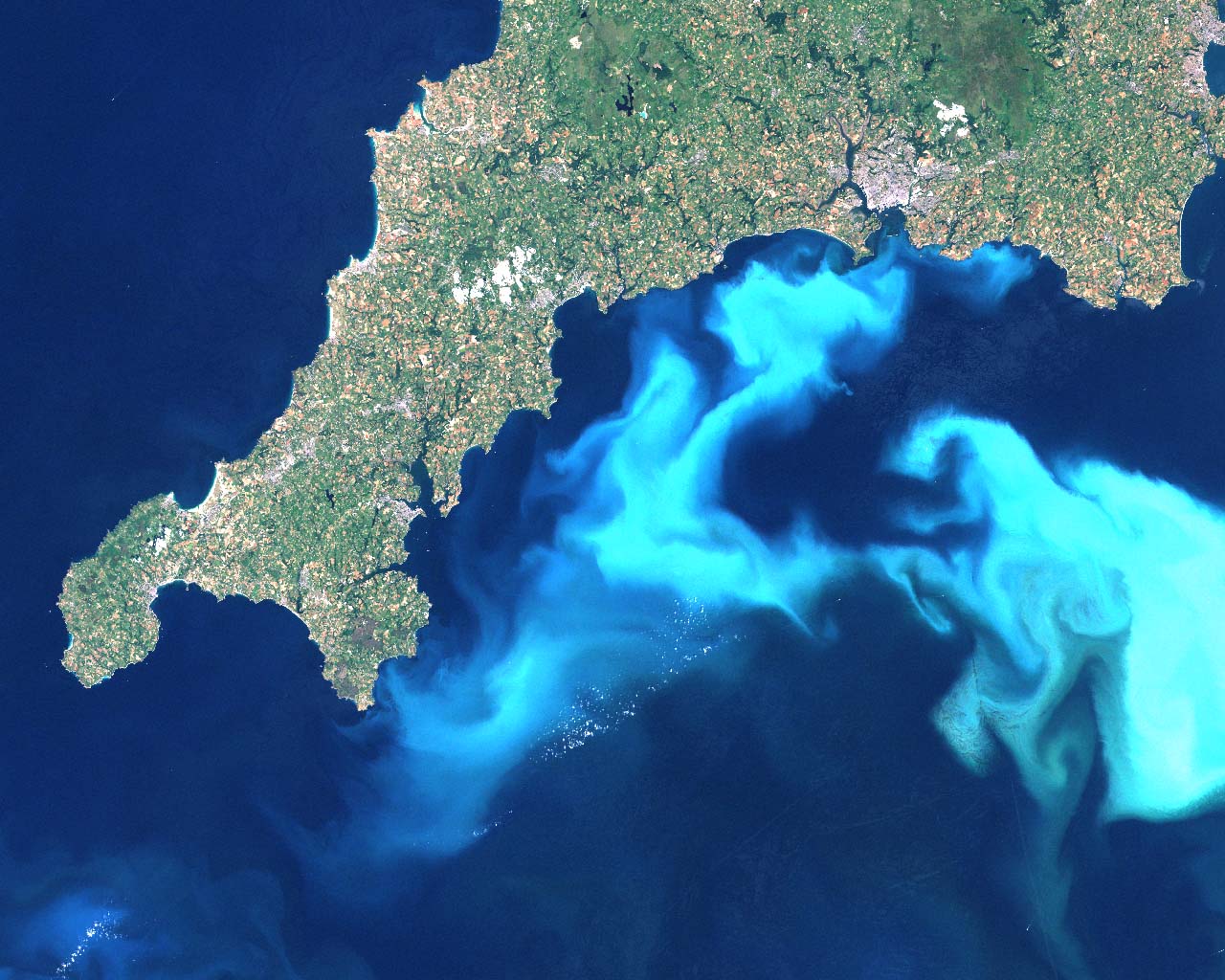
This 1999 image of algal blooms off the southern coast of Devon provides a visualization of the spread of harmful blooms of toxic algae that have hurt the whales and dolphins who have ingested them, as other fish.  Dissecting data visualizations of the prominence of such toxic algae or “harmful algal blooms” in oceans or inland raises pressing questions about their nature and causation, and about the salient mechanics that might be revealed in how such blooms might be better or more clearly mapped in web-based platforms.  In an age of the omnipresence of Google Earth, or satellite views of significantly high resolution, as well as MODIS, as well as the imaging spectrometer MODIS aqua of high resolution launched in 2002, the measurement of water populations should not be difficult to define:  but the presence of algal blooms requires increasing introduction of data layers based on local detection, in ways that the surface appearance of all aquatic environments just cannot register alone.  Algae provides a case for looking at the unmapped, and mapping the sort of rapidly reproducing migrant bacterial populations in aquatic environments that are otherwise particularly difficult to detect by superficial observation–until they have already rapidly progressed or bloomed.

Algae’s presence in lakes was rarely a mapped population or identified as a species until the spread of toxic “harmful algae blooms” (HAB’s) and alarms over cyanobacteria:   algal populations have recently gone off the charts, and the explosion of their accumulated biomass has created huge alterations both in food web dynamics–and sucking off most of the oxygen in waters on which fish depend–as well as increasing the growth of bacteria that themselves pose dangers to human life, best known in the bacterial spread of the so-called “Red Tide” of Karenia brevis that flourished in ocean waters off the coast of Florida during the late 1970s–but more terrifying, and considerably more difficult to track, across the freshwater lakes, ponds, and rivers that are often sources of drinking water.  Mapping and charting the presence of bacteria in waters is notoriously difficult, born as they are by currents, weather, water-depth and amount of refuse that locally enters waters, and the alarming visuals of chromatic variations caused by algal presences in aquatic environments poses practical challenges to visually represent in maps that combine dispassionate distance and analytic engagement.
hab

These maps are less fun or enjoyable to read, if only because they so often bear bad news.  The adverse effects of algal blooms on local animal populations and food webs are even more difficult to track along clear analytics, although a varied range of metrics and maps–from MODIS satellite views of remote sensing to GIS plotting of specific readings to Google Earth views and aerial photographs.  Even as folks are downing Spirulina and eating Kelp, the pernicious cyanobacteria of green-blue algae blooms, The effectiveness of the beauty of mapping algae is difficult to effectively use as compelling narratives, however, whether about that danger, or in ways that overcome the difficult distaste of the un-kelp-like sludge of algal blooms, about the alarming spread of Harmful Algal Blooms (HAB’s) either off the shores of the United States or as effectively clogging food webs in its lakes.  As of 2013, health authorities issued advisories and warnings on algal blooms at 147 different sites and untold cost and environmental impact due to such harmful blooms, of which no systematic collation seems to exist.

Mapping the presence of such HAB’s is not only a question of reporting locations of efflorescence, but of mapping both the causative webs by which they seem to emerge with the deposits of phosphorous-rich fertilizer and waste in rivers and runoff, as well as mapping the impact of blooms within food webs and food-cycles, although it is often discussed primarily or solely in regard to its potential dangers to humans–given the neurotoxins that it has produced in rivers, lakes, and even waterfalls in Minnesota, as well as Michigan, Illinois, Kentucky, Pennsylvania, Vermont, Ontario, Ohio, and even the Sacramento River delta, in addition, most famously, to Lake Erie–whose shallow waters encourage algae blooms, and where locals of recently sought a joint US-Canadian agency called for the immediate imposition of fixed limits on local fertilizer use.   If over 140 sites of algal blooms are present in the bays, ponds, and lakes of New York State alone, and in many lakes across the world, the widespread occurrence of such blooms have been tied to fertilizer runoff, but their endemic presence in so many freshwater lakes have only relatively recently been systematically tied to outbreaks of disease.
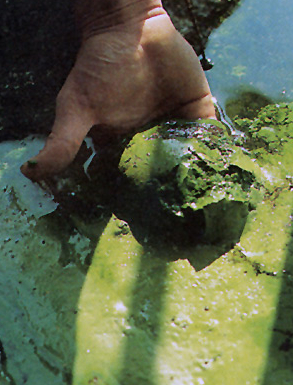
Hand of HAB

Only now is the huge efflorescence of algae blooms being linked both to the production and broadcast dispersion of industrial fertilizers.  One back story that demands to be mapped is the effect of the longstanding encouragement that farmers in the United States have received to  minimize plowing of their lands, less the huge carbon mass that regularly tilled lands release not only erodes the atmosphere but degrades the soil itself; tilling costs more to pursue in a systematic way, and, especially in large farms, has been discarded as farms have shifted their equipment for tilling to a program of “no-till planting” that uses machinery to drill seeds into undisturbed soil, and scatter fertilizer atop in prepared pellet form that needn’t be entered into the soil by tilling machines–even though such pellets depend on rains to enter the soil, and up to 1.1 pounds of fertilizer per farmed acre enter rivers directly in rainwater, as a result, rather than serving to fertilize the soil, working to effectively unbalance ecosystems far beyond the bounds of farmed lands.

Harmful algae blooms’ explosive off the charts growth responds to a confluence both of high usage of fertilizer in crops and lawns, intensified by rapidly rising temperatures that foment their spread in freshwater and seawater alike:  the expansive growth of algae seems something of a by-product of our current global warming trends, as the increased summer heat provides an optimum occasion for spurts of algal growth, nourished by streamed-in phosphorous and other animal wastes, in ways that change the microbial populations of freshwater lakes.  And the world of rapidly growing algae has deep consequences for public health.  For rather than the edible sorts of seaweed, the toxicity of algae in freshwater systems is all too likely to foster bacteria-levels in human drinking water and fish that are not usually seen, making the mapping of stagnant water algae of increasing concern in much of the midwest and northeast–especially nearby sites of large-scale or industrial agriculture.  What are the best ways that algae can be mapped, or that the mapping of algae can be a proactive safeguard on the responsible stewardship of the toxicity of agricultural and lawn run-off?

The blaming of substandard practices of fertilizing soil and huge expansion of chemical fertilizers with phosphorous, combined with the increased problems of storing waste, create a new geography of pollution that renders human impact salient by the spread of an algae bloom crisis around the Great Lakes, which since 1995 have emerged in the Maumee River that feeds the Great Lakes and runs through many factory farms in these inland lakes:  increasingly, Kansas is reporting widespread algae blooms in lakes, as well as Pennsylvania and Kentucky, according to the Kentucky Department for Environmental Protection blog and which the Courier Journal describe as the first cases beyond the lower Midwest.
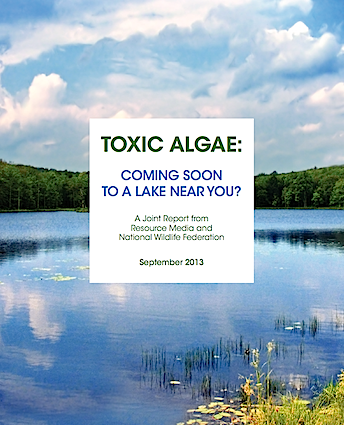
Screen-Shot-2013-09-24-at-11.17.56-AM

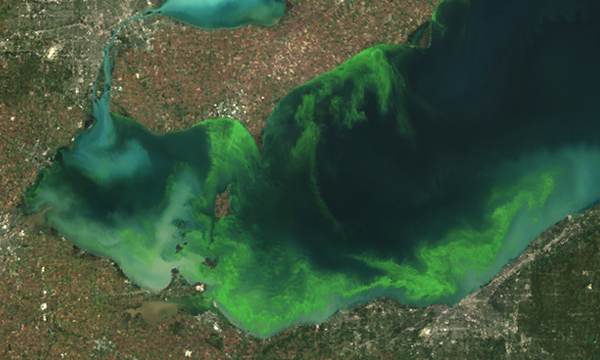
Even when not toxic in nature, the problem of uncontrolled algae blooms lies in their absorption of all oxygen from the body of water in question.  The predictive maps of expansive algal blooms specifically in Lake Erie, where aerial photographic visualizations recorded the  record levels of 2011, warn of the spread of toxic blue-green algae–a harmful algal bloom (HAB), focussed on the lake’s western basin, based on the careful reading of the nutrients that flow into the lake.  The new levels of algae that have steadily increased in recent years, hark back to the algal blooms of the 1960s and 1970s in the same region of the lake.  But the blooms have recurred with a new intensity, spurred by hot weather and an increased amount of phosphorous, sewage, and manure into Ohio lakes and streams, boosting the blue-green cyanobacteria to new levels last summer that more than doubled previous years–increased by the accepted practices of broadcasting fertilizer on fields without tilling, and the reluctance of the Environmental Protection Agency to issue any warning on cyanobacteria in these waters–even after the algal blooms broke previous records in the summer of 2011–although we know that colorless odorless carcinogens like microcystins can linger long after the blooms have left.   Mapping the blooms proses a problem of going beyond geo-visualizations or aerial photography as a way of mapping the flow of bacteria and subsequent algae blooms that deoxygenate waters in an easily legible form, or linking the toxicity of blooms to set intensities.

Are we even close to cultivating the ability to read the levels of toxic agents like microcystins in algae blooms, or able to find reliable ways of transcribing their potential harmful side-effects? The specific case of Lake Erie, specific both since it is one of the densest sites of such blooms and on account of its low water-level, may itself be predictive of the danger of algal blooms in future years.

lake-erie-habs

The 2011 bloom was rapid and sudden, as is apparent in two aerial photographs of the lake snapped just five months apart, between June 1 2011 and October 5, which illustrates the blossoming of the algae under the summer’s sweltering sun:

0315-nat-ERIE_webNew York Times; source: NOAA Centers for Coastal Ocean Science; data from NASA MODIS sensor

If not a map, the green coloration of the algae highlighted the frontiers of its expansion so effectively as if to isolate that one feature within the aerial photograph.  Such local photographic “mapping” of the density of toxic algae blooms is perhaps the most compelling chart of their impact.  But the expansion of algal blooms, if similar to that covering 300 square miles in 2003,  now threatens to spread across the entire southern shore, has been closely tied to new levels of toxicity, producing liver and nerve toxins, and creating a dead-zone of oxygen-depleted fish.  If not as severe as it was in 2011, when remotely imaged by MODIS satellite revealed a particularly disturbing concentration of cyanobacteria close to Detroit and along several spots of the lake’s shore, before extending from Toledo to Cleveland in 2011.

erie-forecast-art-gmqnkink-10703gfx-erie-forecast-compare-eps MODIS Cyanobacterial

The existence of sediment in the Great Lakes revealed a distribution of particularly thick portions of algal spread, no doubt particularly notorious due to its low average depth of just 62 feet.  At the same time as Western Lake Erie continues to experience a fairly unprecedented resurgence of toxic algal blooms,  health advisories and “do not drink” orders have been issued by the state of Ohio, although Michigan, which lacks a formal monitoring program to monitor waters’ purity, has not issued any:  the current debate on the Farm Bill has led to a jeopardized program of Conservation Stewardship and fails to include controls to encourage farmer’s to monitor their effects on water quality–or even to set uniform standards for the toxicity of HAB’s to drinking water, local ecosystems, or lake life.
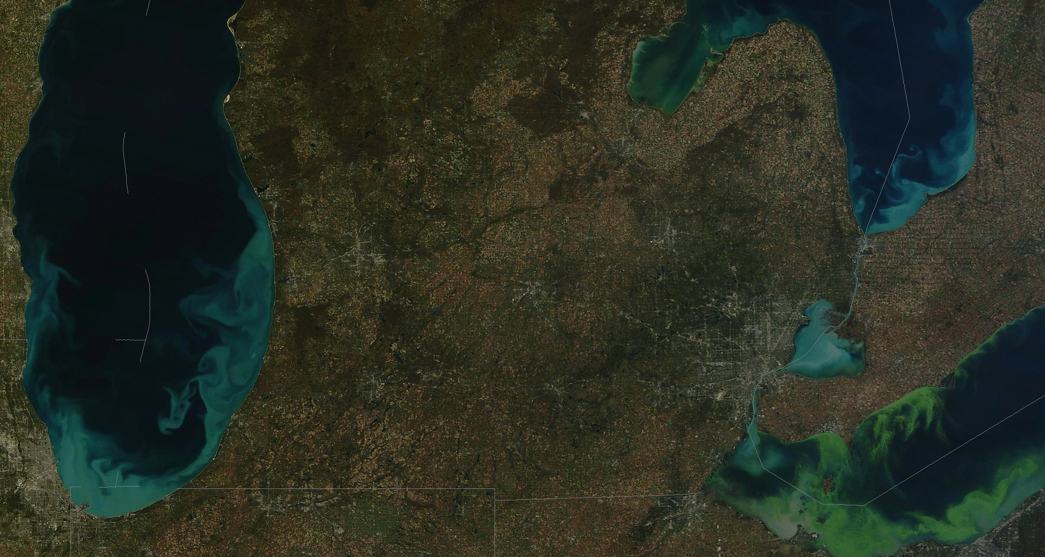
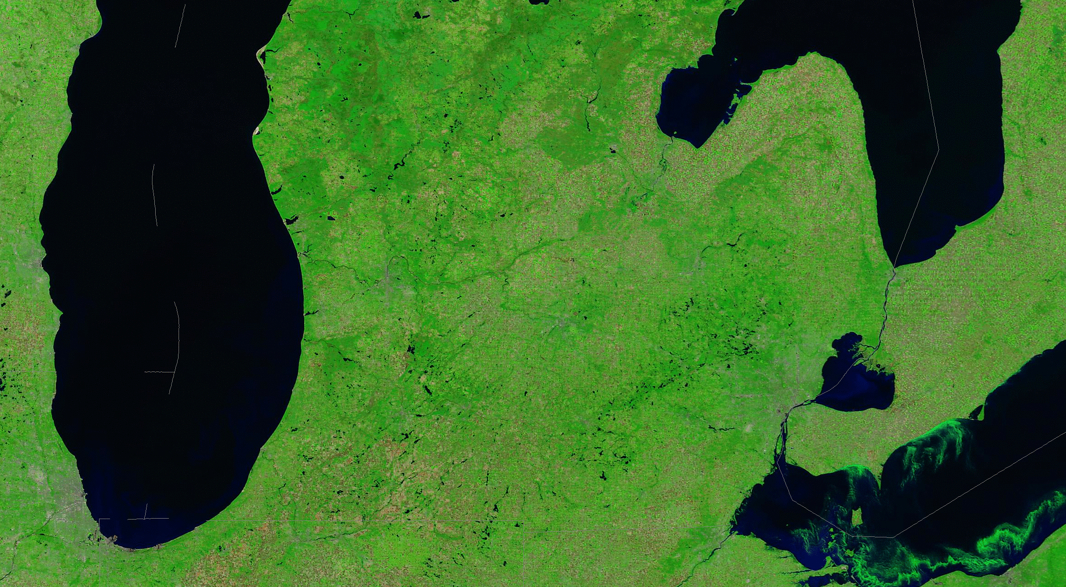
Algal Blooms 2012 true

Modis Green Erie

The spread of their population in the lake was visible on Google Earth:
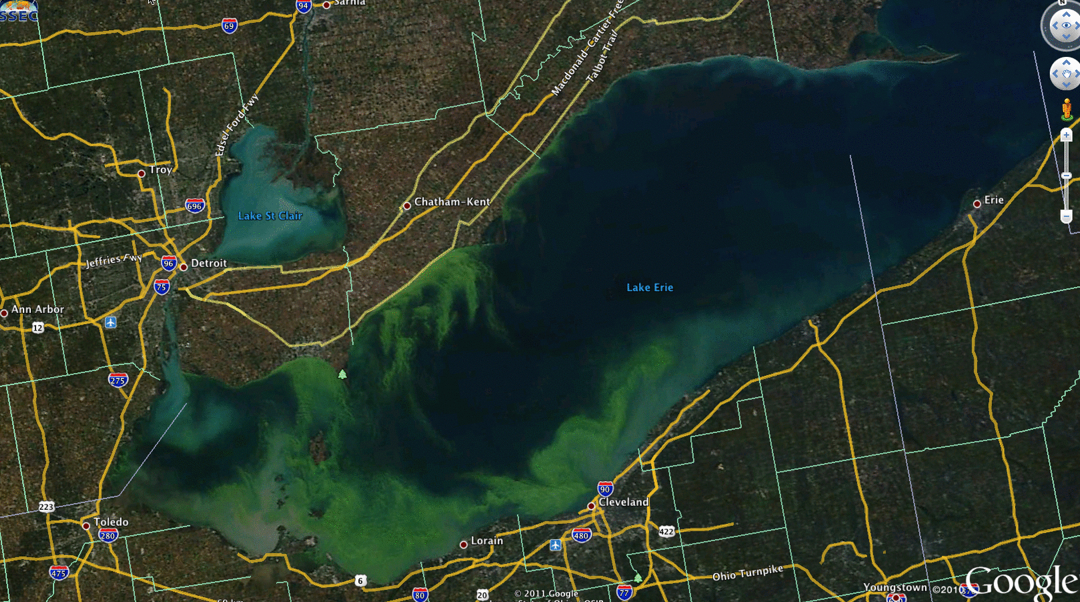
Algea on Google Earth

The intense concentrations of algal blooms can be likewise revealed due to remote sensing of the absorption of light in the lake’s water, to image the toxicity of the most polluted of the Great Lakes. based on data from the International Space Station.
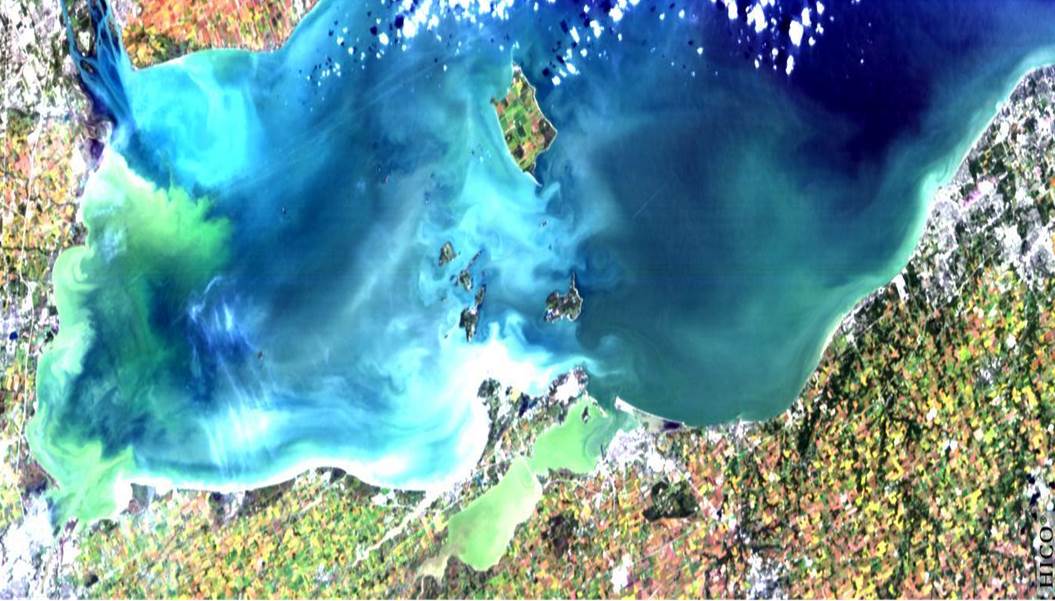
Lake Erie satellite image

Looking at lake Erie provides something of a well-mapped test case of algal blooms.  Most of the blooms are typical of the over 200 toxic blooms in the United States, due to run-off of fertilizer and manure in rivers and lakes, often carried by heavy rains, often confined to the northwest, but spreading throughout the high farming regions of the midwest, where phosphorous no doubt increasingly leaches to water supplies–leading to public health warnings and closures of lakes or beaches.  Rainfall has increased the flow of agricultural run-off and nutrient-rich storm water into rivers and lakes, providing food for algae to grow to toxic levels.  Indeed, the National Oceanic and Atmospheric Administration has developed an early detection and forecasting system for the Gulf of Mexico by using remotely sensed data to monitor harmful algal blooms beyond the Great Lakes and Chesapeake Bay–some of the largest repositories of freshwater in the United States–and in over one hundred and forty sites as of the summer of 2013.  And the clean-up of many Minnesota lakes has led to a call for reducing the use of nitrogen-rich and phosphorous-based fertilizers by some 45%, although no realistic ways for achieving the goal–which might not even be as high needed to reduce algal blooms–has been defined. The difficulty that occurred when a satellite photograph of Lake Ontario suggested a similar efflorescence of blue green algae blooms of cyanobacteria in that large body of water led an overwrought panic-attack to be voiced on Twitter, as the photograph that ostensibly boded the local arrival of an onslaught of heptatoxins, already problematic in Hamilton Bay, to have metastasized to the lake as a whole.
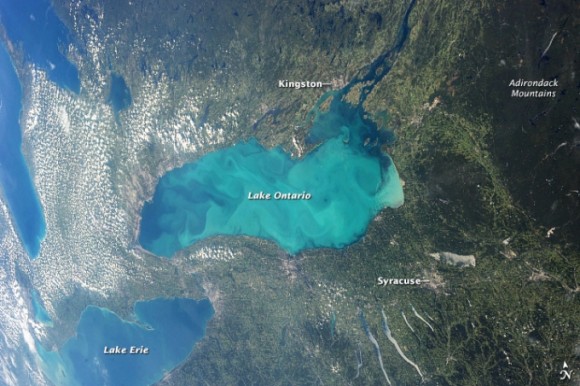
L-Ont-bloom-580x386

But the “bloom” was a boom of plankton–mostly plankton like diatoms, and chrysophytes, dinoflagellates, in other words, which are often mistaken for blue green algae in remote sensing, although blue green algae blooms just a small amount of it, and little cyanobacteria–was an optical illusion.  The apparent errors in the imaging of algal blooms suggest a greater difficulty in its accurate mapping, and makes us rely on self-observations by water-sampling for certitude.

This is not to minimize the danger.  But only to warn of the limitations of tracing by superficial observation.  The actual potential for the sudden spread of HAB’s in the continental United States is in fact quite serious, however, as is the need for ensuring water-quality standards in many rural regions–from questions of potability to the eventuality of die-offs of fish.
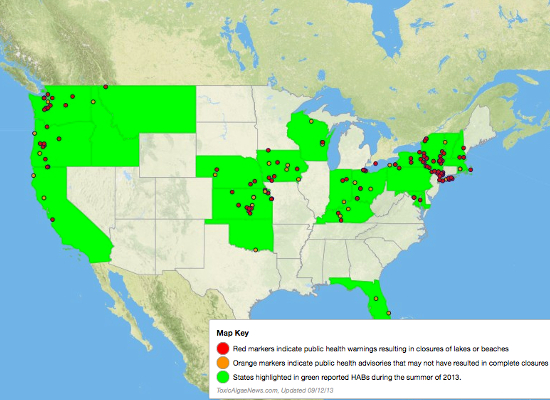
blooms across USA

The interest of this very broad-scale map is the proximity of blooms to large-scale farms raising cows and pigs:  such  concentrated animal feeding operations (CAFOs) generate unduly concentrated amounts of livestock waste in precise locations–termed “liquid lagoons”–thee liners of whose storage tanks regularly leak in heavier rainstorms, creating a manure run-off from poorly regulated sites into lakes.  The EPA estimates that over half do not have Clean Water Act permits, creating deep problems of local stewardship that becomes evident in the efflorescence of toxic algae blooms–but only long after the fact–in ways that reveal the ingrown nature of poor standards of agrarian stewardship.  Living in the right town, we might see such headlines as Citizens of the Town of Lincoln, Kewaunee County are concerned that the Kinnard Farms Inc. plan to manage 70 million gallons of untreated animal waste doesn’t protect groundwater from contamination, or How Big Meat is taking over the Midwest, describing the widespread multiplication of permits for such “poo lagoons” in the landscape to hold the refuse of the 19.7 million pigs raised annually in that state alone, and the return of a booming industry in 2011.

Factory Farms Focus on Iowa?

Lying down water of such overflowing containers of animal feces creates a possibility of toxic contamination that is particularly difficult to contain–especially when fueled by an unnatural abundance of phosphorous and nitrates that has all too often been insufficiently or ineffectively tilled into agrarian lands.  The contamination of so many of Minnesota’s lakes offers a sad case in point.  The striking case of green waterfalls in Minnesota suggests something like a direct inversion of the rural picturesque–and a compelling need for new standards of river pollution or run-off, as well as intensive attention to the tilling of fertilizer so that it remains buried as much as possible underground.

Operation-Downspout-Logo

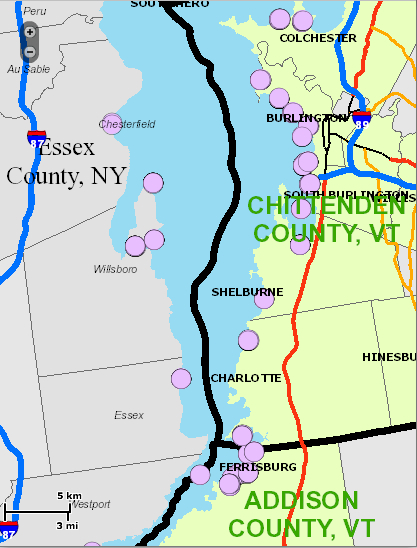
Somewhat more ecologically conscientious states, like Vermont, removed from the landscape of the factory farms, have begun to provide interactive local maps to measure and track the intensity of algal blooms, of “blue green algae tracking,” as this map recording the blossoming of green by the shores of Lake Champlain–a tourist destination–that are considerably interactive and detailed, as well as allow a considerable fine-grained detail of local reporting that are incorporated into visual overlays for ready consultation each day.
Algae by Burlington

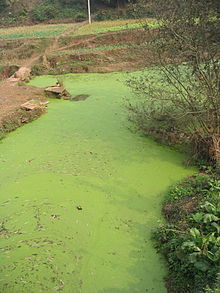
Others, like Florida’s inland waters, have seen massive toxic algae outbreaks that have killed manatees, fish, and birds, as well as dolphins in the Indian River Lagoon, where fluorescent green slime filled the river this past summer, leading to widespread health warnings.  Of course, such a menace is not only localized:  the actual specter that is haunting the mapping of algae comes from China–where, coincidentally, few controls exist on fertilizer or greenhouse gasses, and algal blooms fill large, slow-moving rivers like the Sichuan.
220px-River_algae_Sichuan

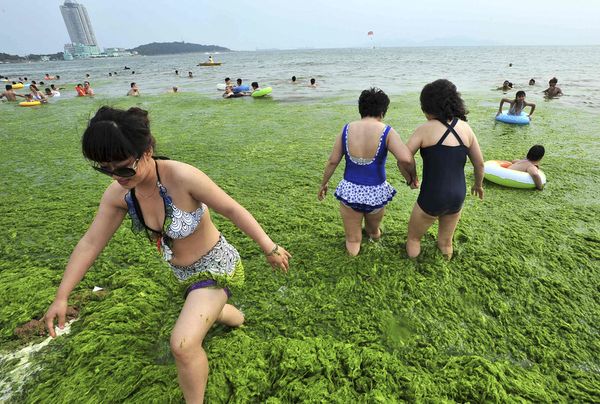
In the course of preparation for the 2008 Olympics that the Chinese government pulled some 1,000,000 tons of green algae from the Yellow River, famously, relying on some 10,000 soldiers in the project to remove the waste, leading folks to just negotiate with algal blooms as they appear, and their relative toxicity not to be tested.
green-algae-bloom-china-lake-wading_37797_600x450

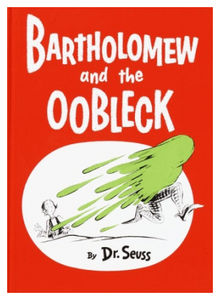
The disquiet conveyed by the images of raking algic scums off the Yellow River, or of swimmers happily standing waste-deep in the light green blankets of what looks less like fresh parsley than artificial coloring can only be viewed with the alarm that Bartholomew Cubbins witnessed the arrival of Oobleck in the Kingdom of Didd.  (We might reconsider the assumption that the last printed work in the Dr. Seuss corpus, The Lorax, was the one most directly about the physical environmental.)  Indeed, the comparisons of Oobleck to HAB’s seem unavoidable given their sudden ubiquity across so many of the changing climates of the United States and world.
220px-Oobleck_Cover

Mapping something as imaginary as Oobleck might be an apt association, if intentionally slightly ridiculous if evocative comparison, but the odd appearance of green toxic slime in freshwater deposits evokes the sudden omnipresence Oobleck quickly acquired in all Didd.

oobleck in act

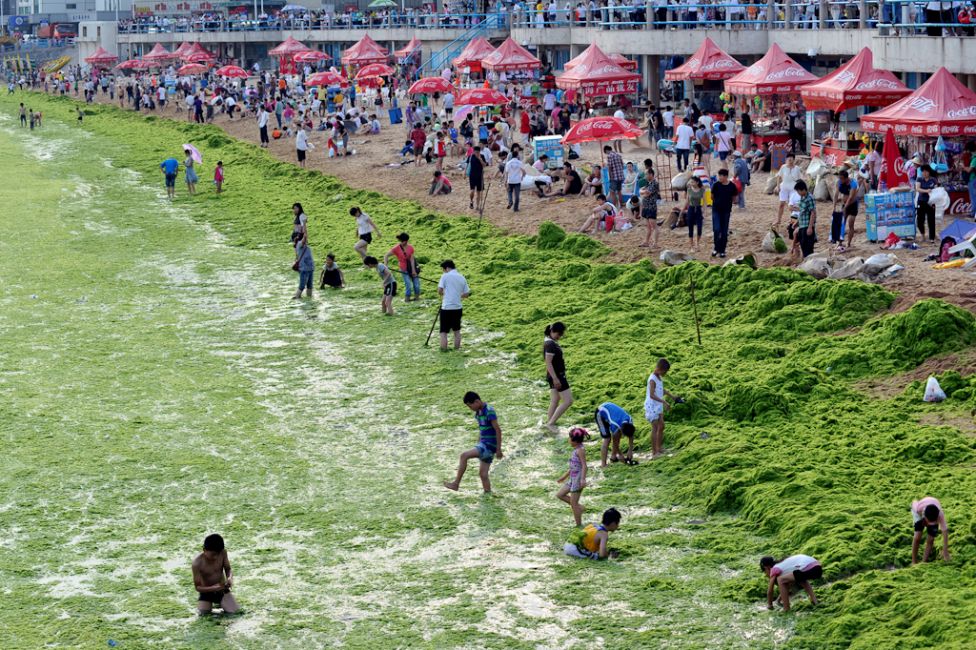
The fear of self-generated Oobleck seems implicit in much literature.  Indeed, Qingdao’s 2013 summer scourge of “surf like turf” meant the arrival of what locals called “sea lettuce.”   Perhaps from the farms of Nori on Japan’s Jiangsu coast, or from irresponsible farming in China itself, the consequence of a massive failure of marine stewardship created currents of harmless-to-humans algae running toward the center of the Yellow Sea.   The blooms, given the run-off of nitrate-rich fertilizers from farms and industry, didn’t seem to threaten beaches often used as centers of tourism, but created an odd sight of bathers luxuriating in the aquatic lettuce they were told had not toxicity.  The algae are often regarded as harmless to humans.  But harmless to fish they are not:  the algae serves as a ravaging of the aquatic ecosystem:  bright green beds of algae were deemed a “large-scale algae disaster” by the Shandong province, and 19,800 tons of it cleared as it started to decompose, releasing noxious fumes of toxic hydrogen sulfide gas, at a cost of over $30 million.  The relation between harmful algae and the local ecosystem or food chain has not been fully explored to map, despite the wide ramifications of its impact on the greater food chain.
floraison-massive-algues-vertes-chine

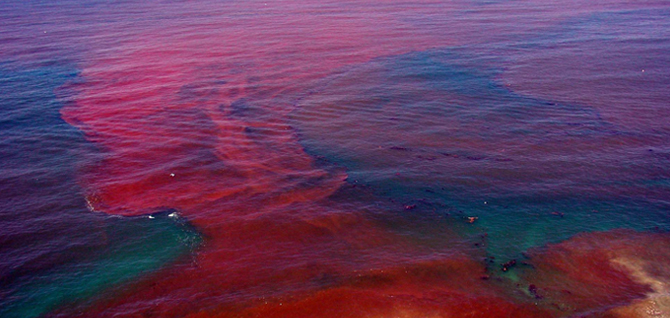
The explosion of algae blooms has been linked to the rise of the so-called red tides in the Gulf of Mexico, has already hit our coasts as well:  southern California coast and Florida have both placed a new premium on mapping the density of algae that flourish in these warm ocean waters, which have long been worried to disrupt local ecosystems and food chains, before the toxicity of fertilizer-fueled algal blooms started to appear inland.  These tides have largely been treated as dangers to marine life, and specifically to the shellfish regularly harvested there, however, and were consequently charted and mapped in relation to water currents, salinity, and winds, to get a picture on their sources of origins of these concentrations of  dinoflagellates of reddish hue that so rapidly accumulated along the Florida coasts from purple to pink, and which seem–despite their name–to be entirely independent of tidal flows, but were toxic to birds, fish, and mammals, and potentially harmful to human beings when consumed in shellfish.  The awareness of this vector of transmission has led to the monitoring of these early HAB’s, which have disrupted fisheries along the Atlantic as far north as Maine, and, according to some were witnessed in Canada as early as 1793 in British Columbia:  but far more recent measurement of red tides in northern California, where they created a massive die-off of shellfish, the Gulf of Mexico, the Southwest Florida coast, Malaysia, Maine, and Massachusetts, killing fish, manatees, and shellfish like abalone, has led to increased NOAA alerts and concerns of respiratory irritations at beach shores.

Is such efflorescence due not only to lower rainwater that flushes the system of oceans, and increased warming, but also to the nitrate-rich outflow of fertilizer from Florida plains, and indeed the Mississippi?  The lack of tilling in larger farms, driven by the needs to produce more crops in their growing seasons, has encouraged the dispersion of high-grade fertilizer across the Midwest, most of whose runoff enters the same waters. Indeed, the inland growth of HAB’s echoes historical documentation of the approach of “red tides” that endangered shellfish and fish living along Florida’s western coast in recent decades.

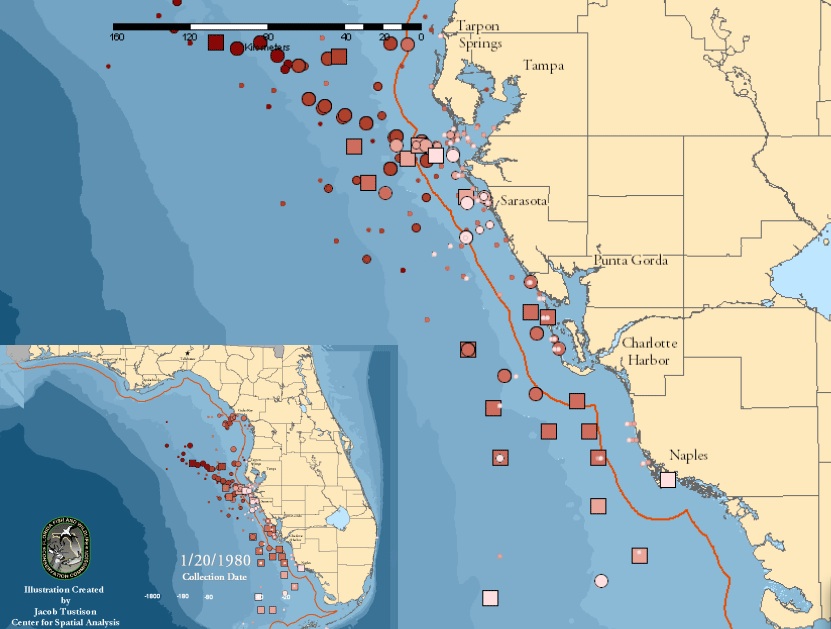
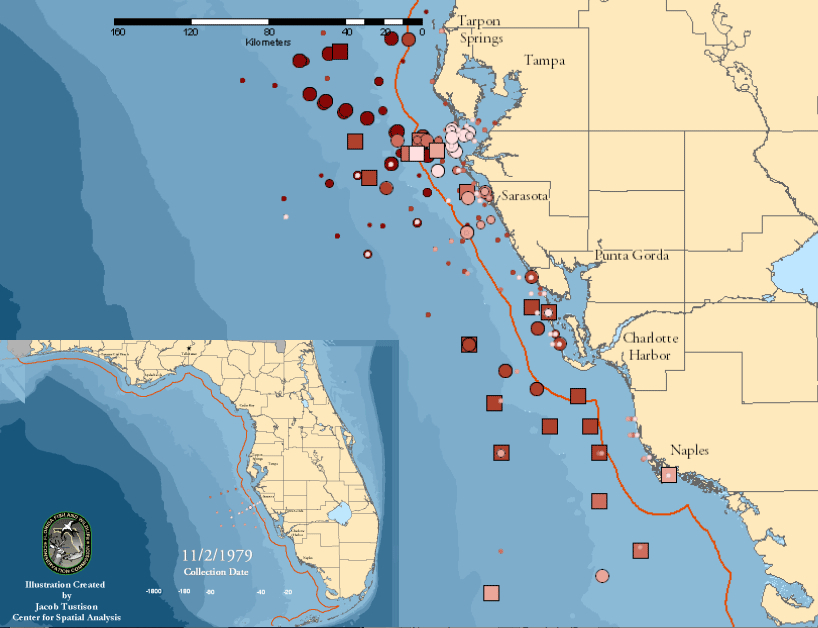
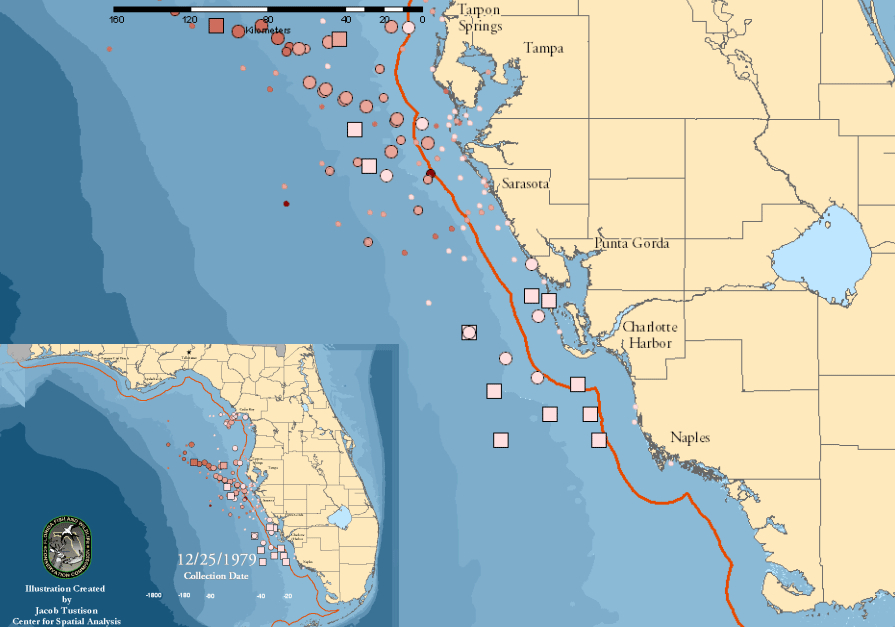
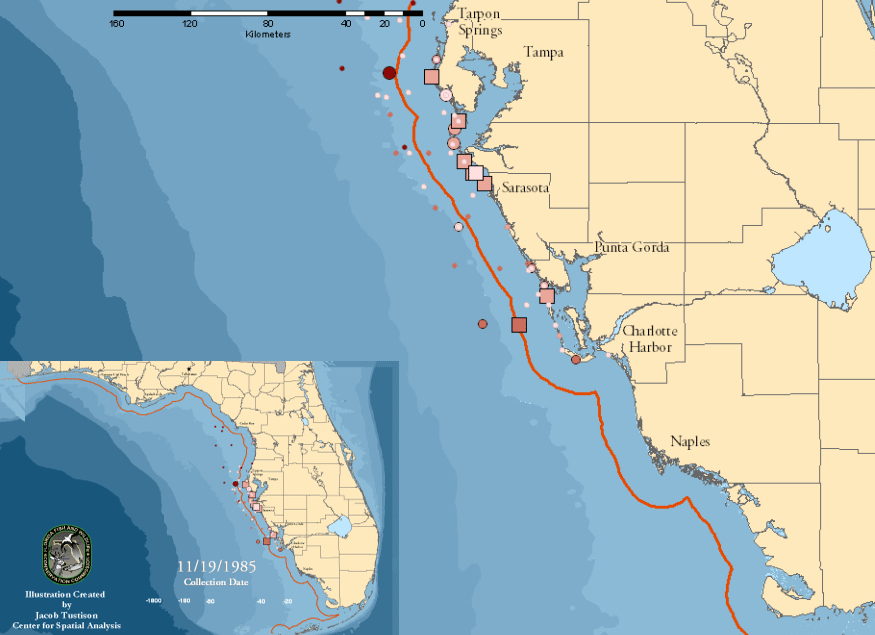
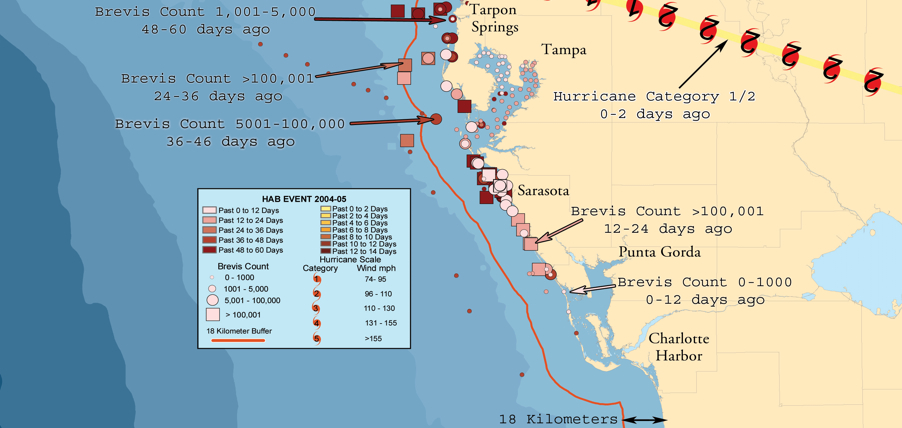
The ability to survey the massive growth of Karenia brevis organisms in the warm shallow waters of Florida’s western coast, and the dangers that they posed to local fish and marine life, benefit from the extension of data and record-keeping along the Florida waters since 1954 by multiple agencies.  The data creates a context for data visualizations of the expansion of the “red tide” of HAB’s in ocean waters near to an exceptionally rich and endangered ecosystem, but also one huge stretches of whose coast falls under environmental protections for endangered species, and whose waterfront economy enjoys far greater protection than most inland lakes.  By exploiting the largest continuously recorded database of Harmful Algal Blooms in the United States–and world–we can examine the spread of sites of the Red Tide of 1979 in relation to ocean currents, which appear, based on data from Florida Marine, clearly clustered in shallower waters by the ocean coast:  maps track the abundance, intensity, and duration of growth of Karenia brevis by color, switching to rectangles for the largest, and the extent of their presence by shape-size, based on data collected on November 1979, Christmas 1979, December 20, and January 20, 1980.  They reveal the algal spreads as moving quite rapidly from being concentrated around Tampa Bay along the coast to Naples in dense brightly colored blooms that flourished for the longest time near bays, often in the shallower waters sometimes within the red line marking a distance of 18 kilometers off the coast, where they have most contact with shellfish.  The evolution of these animated static maps provides a temporary solution, based on intensive compilation of water data by the Florida Coastal Commission, but provides an exception of the degree of successful visualizations of algal presences in aquatic environments.
Nov 2 1979--Florida Marine

FLorida Marine 1979 Red Tide

Florida marine Dec 30 1979

Red Tide Expands 1979 Florida Marine

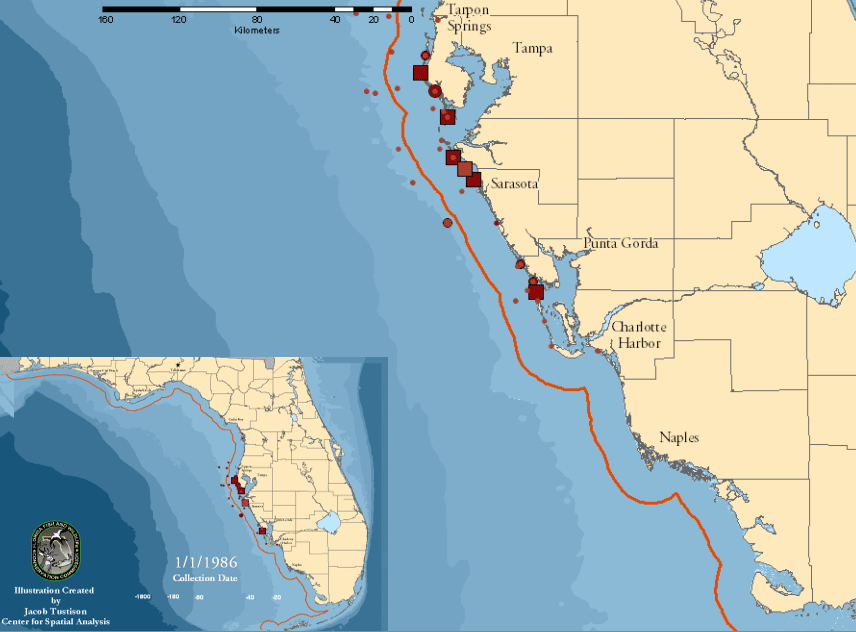
The “tide” returned in 1985 to the shallow waters off the beaches and coastal inlets of western Florida, pictured with a key of the local density of blooms which is also applicable to reading the above images, and the increased presence of blooms on New Year’s Day 1986:
Florida Marine carina 1995

Florida Marine Key

new year's day 1986

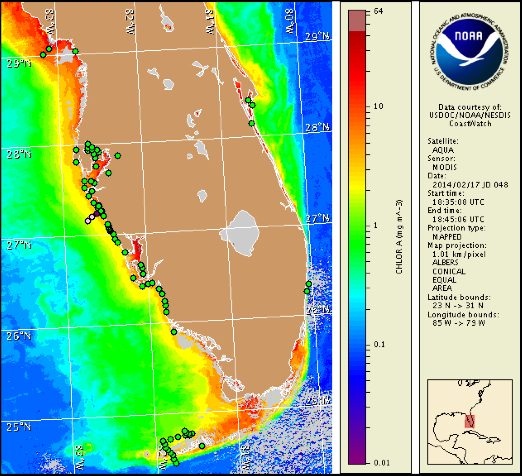
More recently, Florida’s Fish & Wildlife Research Institute charted the same coastal waters of its coasts.  By using readings that were based data for the NOAA Ocean Service and Satellite Information Service, who registered high levels of marine chlorophyll by MODIS Aqua imagery, bacteria clearly hovered especially, when present, around the Floridan shores and coves in which they multiply.  Does this suggest that they are specific to shallower, warmer waters, or more likely densest at the very point when they enter the seawater in such high concentration from the land?  Commonly known as “red tides,” these off-coastal aggregations of algae, again Karenia brevisseem largely in decline on Florida’s southwest coastal waters for the present, but had long flourished on its relative shallow ocean shelves.
Florida Fish and Wildlife HAB

Or, in October 2013,

October 2013 Florida Fish and Wildlife RI

But the bacteria and algae are focussed not so much offshore–notwithstanding the so-called Red Tides–but rather in the very estuaries and inlets where freshwater leaches out into the surrounding seas, evident in this self-reported data of algae via Google Maps, where sightings were crowded upstream the inlet of the St. Lucie St. Park Preserve, with a congestion that travelled up the course of its river.

Google Maps St. Lucie River, 2013

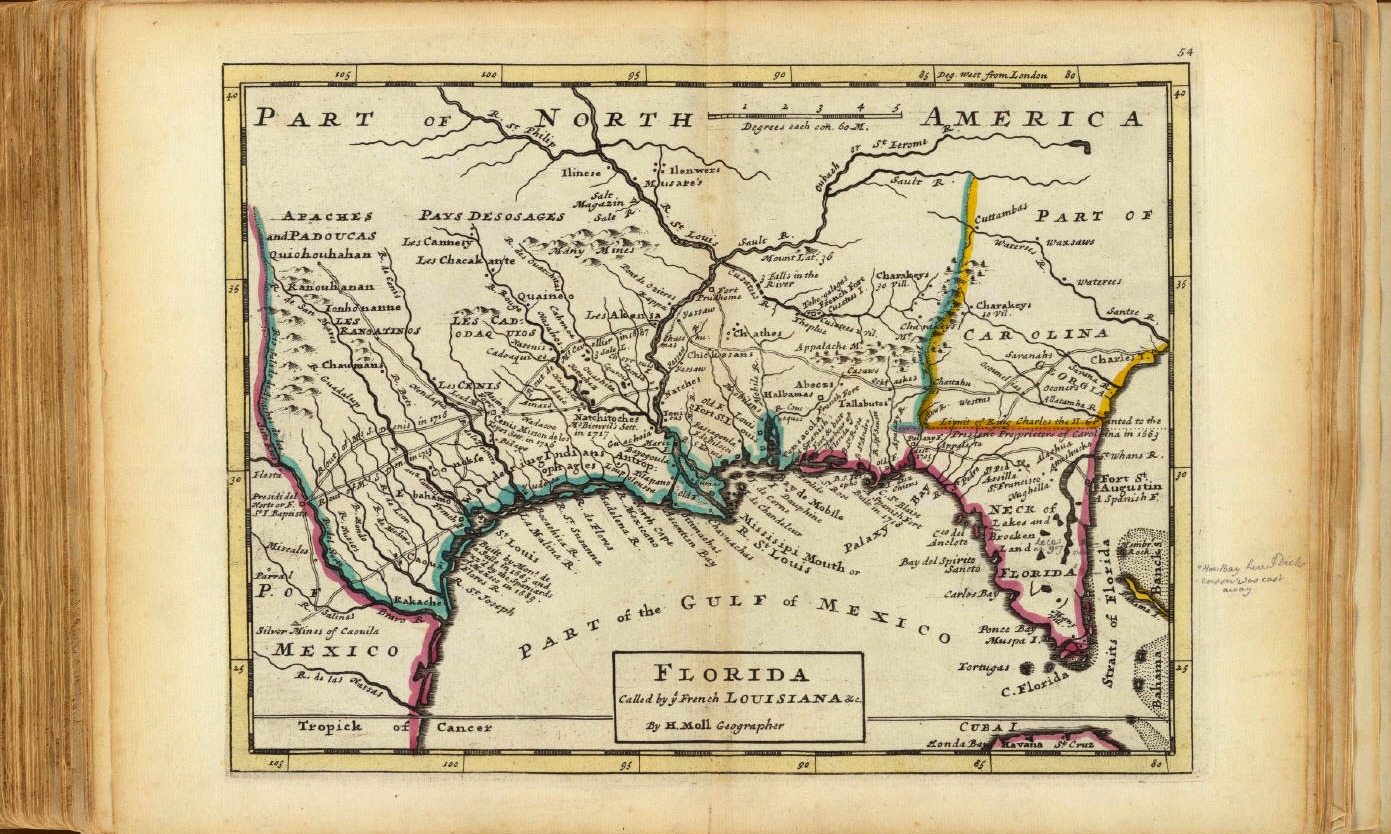
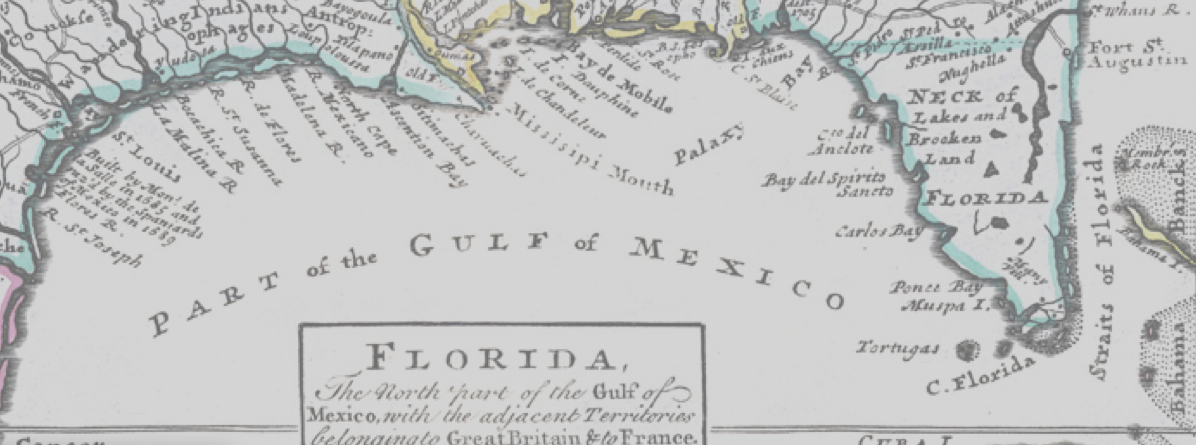
Indeed, the particular porousness of these offshore waters in the below engraved map, which shows a region characterized and distinguished by circulation of rivers in wetlands and estuaries, so long characteristic of Florida and much of the American south, struck early cartographers as so distinct by its density of estuaries.  The map, in the context of this blog, provides a striking contrast as Ooblek-free, even if its territory was far more submerged and coasts follow far more irregular lines.  This early eighteenth-century map–possibly 1720-30–this version courtesy of the expanding on-line collections of David Rumsey, offers the start of something like a cartographical archeology of the region, whose coves and inlets evoke a pristine Gulf of Mexico, fed by multiple rivers from the southern plains still inhabited by Native American Peoples:
Florida--part of America

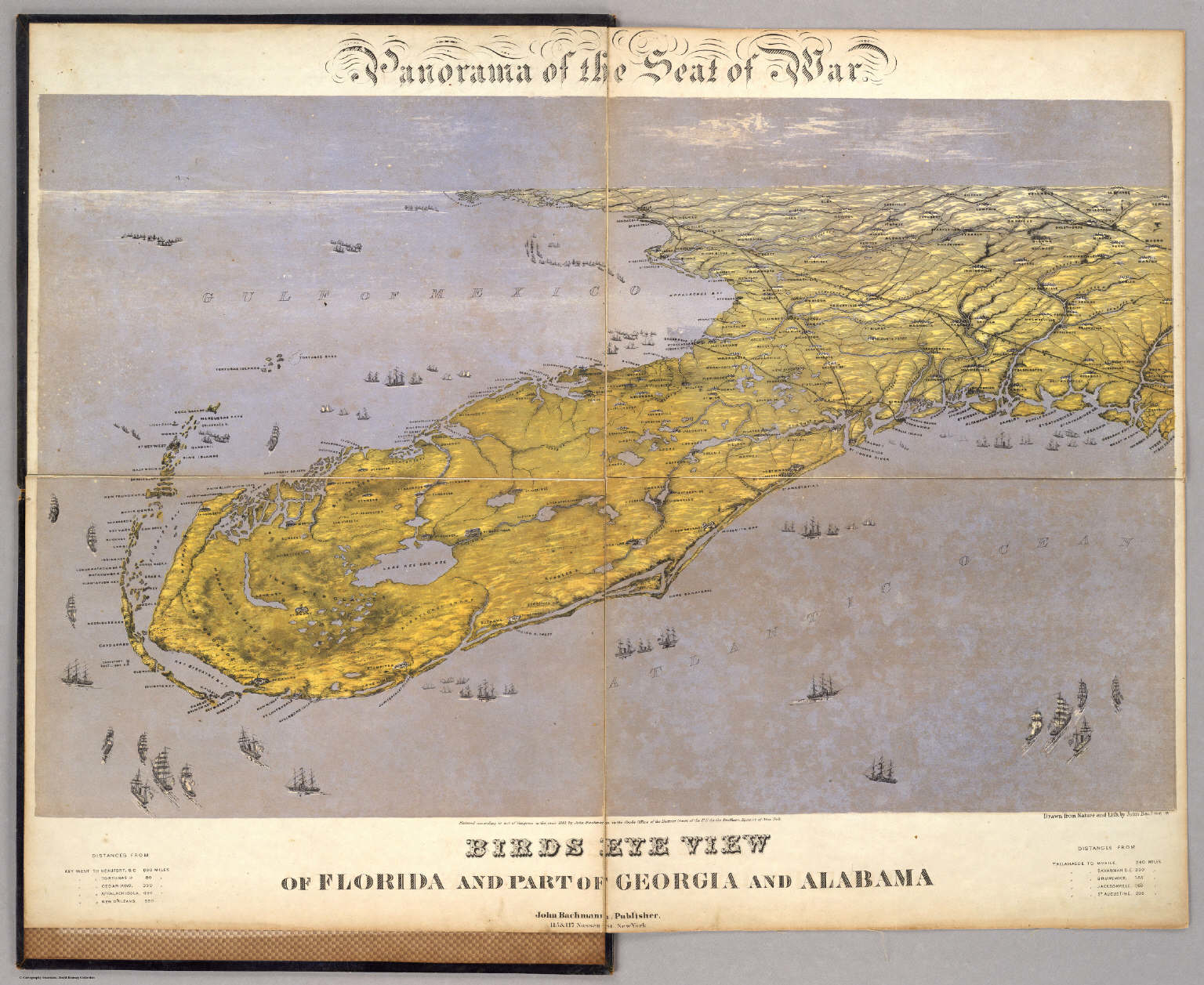
Florida at that time was described by the cartographer as a “Neck of Lakes and Broken Land, surrounded by man-eating Indians, whose Straits were nourished by streams, before being included in Herman Moll’s Atlas, with its rendering of glorious irregular shorelines, inlets, and islands that suggest a Florida before the expansion of landfill and filling in of much of the southern state.   There is something akin to a raining of Oobleck in Florida, the sudden and widespread appearance of HAB’s in modern maps of different states offers a point of entry into how the map can be taken as a rendering and record of man’s impact on and relation to the land, or of how our maps of human knowledge provoke questions of how to map man’s own relation to the remaking of the environment, less by setting the benchmark of a given date, but by how  it slowly started to be filled up with lots of sorts of shit, all of human origin or introduction.  To look at the elegant bird’s eye map that John Bachmann designed of Florida, among his many images of the southern states of America of 1861, printed as a collective “Theater of War,” the mapping of the water surrounding the peninsula shows a much more clearly integrated web of land and water.  In the panorama the peninsula is colored a light green oddly reminiscent of the algal blooms, but the green land, fertile with rivers crisscrossed with estuaries and permeated by lakes where brackish waters surrounded archipelagoes of islands, each its own flourishing ecosystem, and shipping docks, suggest an interpenetration of green land and water in a settled land.
Panorama of Florida

Northrop Frye coined he notion of travel in and to the Green World as a dramatic device evoking a crucial passage, which the protagonists must survive in order to restore balance to the actual world and to the plot.  One could argue that travel to old maps, rather than being only a form of antiquarian indulgence, provides and affords something of a parallel site of reflection on our environment.  The Green World that they present is an “other world,” and a world that seems increasingly distant as our own bodies of water are polluted, and we might look back to maps to see the lived environments we are in danger of loosing–and loosing sight of.  Viewing old maps like that in Moll’s Atlas after reviewing the above data visualizations and overlays is chastening and ethical, in ways, something like returning to a site of meditation on a relation to a world we have lost, and perhaps a way to turn back the tide of inevitability that informs our relation to the mapping of algal blooms.  Whether we can restore balance to our world may seem another story, assembling a coherent map of toxic blooms of algae that recur around the world, we can map its distance to the world we knew, and ask what sort of balance lies in our own.
Straits of Florida 1720

But it is the “other world” of blooms of green algae that the run-off of industrial agriculture appears to have bequeathed that is the world that seems, for the moment, far more likely to be left with us.  Without mapping the growth of such recurrent aglal blooms, and tracking their mechanisms of causation and varying intensity–feared only to increase in an age of global warming–the other world will become our own.

3 Comments

Filed under algae blooms, coastlines, Environmental Pollution, Florida coast, global warming, Great Lakes

Mapping Water’s Presence and Absence Across Land: Maps of Aridity and Drought

Maps can potentially provide quite supple tools to draw the distribution of a variations among land and water, and to reflect on the local variations of the specific landscapes they represent.  Yet the conventional of land-mapping do not clearly lend themselves to describe the presence of water in the land–and all too often presume a clear boundary between land and sea, a fiction known as the coast, one of the clearest inventions of cartographers.  We struggle to describe the relation between land and water–whether in our imagery of drought, which has become particularly popular with increasing evidence of climate change and global warming, or in describing the levels of groundwater loss across the land.  Hence, even as we confront the potential collapse of aquifers, and a rapidly shrinking supply of underground water, we don’t have a clear iconography of how to render the very dilemma–even if the problem of groundwater depletion stands to only increase.

The recent findings of such deletion of groundwater sources in much of the United States since 1900 is big news, but the means to illustrate the rates of its increasing disappearance–or indeed the potential losses that such groundwater losses imply in much of the country–pose problems of cartographical rendering, as much as environmental catastrophe:  the two seem far more closely intertwined than has been argued.  Take, for example, a recent and particularly valuable USGS study of the levels of groundwater depletion that historically increasing removal of subsurface groundwater from the lower forty-eight states, in terms of a combination of levels of subsidence, drainage, and water-flow, that mirrors the central regions of agricultural production and farming in the United States since 1900, but which primarily depends on modeling aquifers’ depletion:

Groundwater Depletion, 1900-2008

Groundwater Depletion, cubic km

USGS:  Leonard Konikow, “Groundwater Depletion in the United States (1900–2008)” 

We are similarly deeply challenged, in representing the drama of increasing drought.

The syntax of terrestrial mapping does not lend itself easily to the mapping of drought, or indeed to mapping the presence and absence of water in our worlds, or the role that water plays in the landscape.  For the very mobility and fluidity of water across environments is, as the current drought has revealed, not easily able to be naturalized into the landscape, or fixed in a map, and the interaction of water with our agrarian and rural landscapes in face difficult to map.  Cartographers all too often rely only on ruled lines to organize land maps, and the syntax that was developed to draw divisions and preserve boundary lines, and indeed bound territories and nations have the disadvantage of instantiating divisions as if they were natural, and part of the landscape that we see.

Rather than bounding the regions of land and water by sharp lines as if to differentiate them, web-based maps that sense degrees of the relative presence of water provide a new and almost dynamic format to frame questions that depend on visualizing the presence of water on which even landlocked regions depend.

The map brings into being new entities to visible form that we could not otherwise see in a material form, and allow us to better contemplate and reflect upon the different sort of water-levels on which the fertility and richness, but even the usability, of land depends.  The two-fold qualities of how the map brings things into existence and offer tools to think exist as two sides of the same sheet of paper, both present in how we inscribe space in a map as a way to  view space in the definition of their contents.  Whereas informative content lies inscribed according to indices on the map’s surface, maps also project meanings lying beneath:  on their obverse lies their take-away value, or the picture of the world that they shape in our minds. The symbolic conventions of maps are to be judged both by the accuracy of their design and their communicative value.  But while lines are useful tools to define and bound territorial space for viewers, they are far more limited as tools to describe the presence of water in the land, much as notoriously neglect or efface the areas where land and water interact, or the fluctuation of the boundaries between land and sea, and even harder to map the absence of water in the land–either in terms of its severity or the gradations that can be drawn in conditions of drought.

Despite the compelling nature of our mapping of the California drought–and the prospect of regions sensitive to increasing water stressors and drought worldwide–maps of drought raises compelling questions the conventions of its mapping and the take-away of maps of drought and aridity.  And the picture that emerges of the recent three-year California drought in one’s mind seems of utmost important to its understanding:  one can think of the hugely valuable perspective that Michael Bostock has recently compiled, using data from the National Climatic Data Center, charting regional climactic variations in drought across the United States since 1880–in addition to a more qualitatively detailed set of visualizations of the drought’s local effect on specific crops–with truly dizzying results. How to best orient readers to the shifting boundaries and relatively recent advances of drought in the American West, without falling into dangers of historical relativism?  How to both appreciate the current drought’s significance and present it to readers?

We’ve perhaps only begun to consider drought as a mapped concept, but the complex interaction between aquifers, land-water, snowfall, rainfall, and ambient temperature due to global warming–all difficult enough to visualize on their own, let alone in relation to each other–are particularly difficult to map in a cogent but dynamic form.  Does the most recent map of the Drought Monitor, authored by Richard Tinker for the USDA, disarm viewers by a heat map to show basic gradations of drought across the entire state–where black designates exceptional drought (“D4”), and red extreme drought (“D3”), mapping the reach of parched land as terrestrial expanse.  But despite its impressive impact, is this image a communicator of the scope of drought or its effects, even as it charts relative aridity across California’s counties?  This both invites reflection on the economic future of the region’s farms , but threatens to naturalize the very subject that it also maps.

January 21, 2014

Although we demand to be able to use the syntax of the line in maps to define territories, a similar syntax is less able to be borrowed to map water or map drought. Indeed, the lines that are present in the above drought map to shade regions to acknowledge drought severity are hard to reconcile with the same lines that bound the  state, or that divide its counties, since they are of course less sharply indicated by a line, or approximated by the broad classifications used in a heat-map, whose lines are more porous and approximate as much as definitive–and overly suggestive of clear boundary lines.  This is more clear in some of the interactive drought maps that ostensibly image drought conditions in and around the Central Valley, a center of produce and agriculture, here oddly superimposed on a Google Earth satellite view:

SF and Central Valley by Satellite View

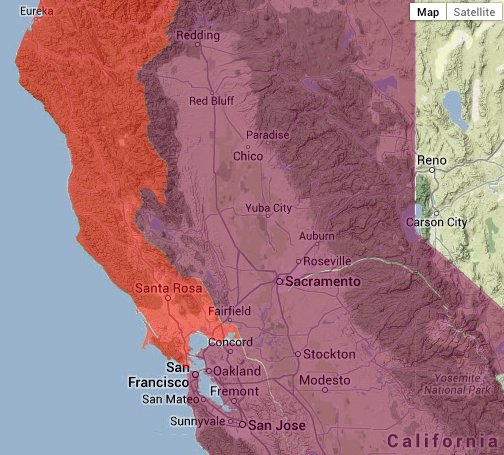
Drought can be mapped, at the same website of interactive drought conditions, as distinguishing drought severity superimposed as filters on a base map of the state of Google Earth provenance, to divide red “severe drought” in the north coast and the “extreme drought” in the northeast interior basin of the state:

California Interactive Drougth Conditions

Sure, the subjects of states and drought are apples and oranges:  mapping tools don’t lend themselves easily to such a data visualization, both by drawing false equivalents and distracting from the nature of drought and the mapping of its momentous effects–if not offering an instantiation the condition of drought as if a fait accompli and natural event–rather than one that emerged because of the uniquely opportune mechanisms of water redistribution in the state that have left it so open and vulnerable to the drought’s occurrence.

If paleoclimatologists doubt that a drought of comparable severity has not only not existed in the recorded history of rainfall in California of the past one hundred and sixty-three years, but past ‘megadroughts’ from 850 to 1090 AD and from 1140 AD to 1320, and has already been drier than any time in the past 434 years, due to the perfect storm of water diversion and agricultural intensification.  And the lack of a clear map of drought leave us without any clear sense how long the drought will last, and no sense of how urban demand for–and ability to pay for–water will be resolved with a limited supply.

We’re not used to or well-equipped mapping oceans or bodies of water that overlap with lands.  Even when we include oceans in land maps to define their edges or describe their coasts, the syntax of much mapping of territories ends at the water’s front.  And much as we need new modes to map the interface and exchange of habitats on estuaries or shores, the mapping gradations of moisture or aridity are difficult to inscribe in the surface of the map–even as we demand to map the limits of groundwater and the prospect of draught.  The exclusion of water from most land maps reflects our limited abilities to map and the limitations of liabilities are increasingly evident.

The two spheres needed to be mapped–under and above water–are seen as incommensurate with each other and we map them by lines in different and distinct ways:   we map limits and frontiers by rings or lines, or note fixed routes of travel or topographic elevations by fixed lines, the conventions of the line seems less suited to the blurring of gradations in groundwater, levels of drought, and the levels of water lying in the land–or of the diminution of both rivers and aquifers. And the presence of water in a region, or in the levels of soil and subsoil–and aquifers–that lie beneath the land’s surface, is particularly difficult to map by the syntax of a land map, because its conditions are multiple.

The syntax of the heat map may seem appropriate in its cognitive associations, but is far less supple or sensitive as a map of environmental impact, let alone as a tool to conceive of drought.  Indeed, any “ecotones“–a word coined to direct attention to those regions where bordering ecosystems meet and intersect–are  difficult to map both because they are so difficult to demarcate and because it is difficult to establish a single perspective on the intersection of worlds often assessed by different criteria.  The shoreline, such as, as the meeting place between land and sea, has long been notoriously difficult to map, and not only because of its fluidity.  We map a stable topography, mountains, rivers, and lakes, where the quotient between land and sea is fixed:  and mapping rarely extends out to the surrounding waters, or boundaries of blurred, shifting, or overlapping lines:  a problem of increasing notice in those endangered areas where habitats of land and water overlap and intersect, making clear boundaries less able to be defined.  This is especially true in drought, where we must consider relations between groundwater storage, aquifers, and surface water, and the different sources and flow of water through agrarian and to urban landscapes. This problem of cartographical representation is as pronounced in the mapping of drought.  The  mapping of the absence of water is indeed a particularly apt problem for cartographical design in a heating-up world, as revealed in the maps we use to track, analyze, and understand drought. Bay Area to Modesto and Monterrey Mapping the shifting dryness of the land–and the drying up of resources–presses the conventions of cartographical inscription.  And all too often, we have only mapped land–not water, or even dryness–save in the limits of the desert lands.  And the two sides of mapping the presence or absence of water offer complementary images, in ways that might often make it difficult to assess or chart the meanings and impact that the drying out of regions and habitats might have–or, indeed, to “embody” the meaning of or spread of drought and dryness in a legible manner.  What would it mean to make drought a part of mapping that would be readable?  How, in other words, to give legibility to what it means to subtract water from the environment? Indeed, we demand a dynamic form of mapping over time that charts the qualitative shifts in their presence in the land.

Whereas resources like water have been long assumed to be abundant and not in need of mapping in space, as they were taken to be part of the land, the increasing disappearance of water from regions like much of California–the first subject of this post–raise challenges both of conceiving drought as a condition by embodying the phenomenon, and by using graphic conventions to trace levels of water in the ground.  In the case of the recent California drought, the compounded effects of an absence of winter rains, which would normally provide the groundwater for many plants throughout the year, feeding rivers and more importantly serving to replenish  groundwater basins, but has decreased for the past three years at the same time that the snowfalls over the Sierra Nevada, whose melting provides much of the state with running water–and on which the Owens Valley and Southern California depend–have also dried up, leading to a decrease in the snowpack of a shockingly huge 80%.  At the same time as both these sources of water have declined, the drying up of the Colorado River, on whose water much of the western US depend, have curtailed the availability of another source of water on which it has long depended.   How to map the effects and ramifications of historical drought levels or impending dryness over time that synthesize data in the most meaningful ways?

These are questions both of cartographical design, and of transferring data about the relative presence of water in the land to a dynamically legible form, at the same time as retaining its shock content.  The pressing need to map the current and impending lack of water in the world raise these questions about how to map the growing threat of an expanding drought and the implications that drought has on our land-use.  The question with deep ramifications about its inhabitation and inhabitability, but not a question whose multiple variables lead themselves to be easily mapped in a static graphic form.  And yet, the impact of drought on a region–as Thomas Friedman has got around to observing in the case of Syria, both in regard to the failure of the government to respond to drought that devastated the agricultural sector and that swelled cities in a veritable ecological disaster zone–offers a subject that threatens to shake the local economy.   And what will animals–both grazing animals and local wildlife alike, including salmon–make of the lack of river water, much coming from the Sierra Nevada, or the residents of the multiple regional delta across the state? Friedman’s analysis may seek to translate the political divisions in Syria into the scissors of the Annales school–he advocates the importance that dedicating funds to disaster relief have already been proven to be central in foreign relations as well as in a region’s political instability, as if to table the question of the content of a political struggle.  But the impact of rising aridity on agricultural societies is perhaps not so much lesser than its impact on agricultural industry.

Rather than offer metrics to indicate social unrest–although political consequences will surely ensue–the rise of water maps show shifting patterns that will probably be reflected most in a tremendous growth of legal questions about the nature of “water-use rights,” however, and the possible restriction or curtailing of a commodity often viewed as ever-plentiful and entirely available for personal use, as well as a potential shift in food prices, eating habits, and a dramatic decrease–at least potentially–in access to freshly grown food across much of the United States, if not the sort of massive out-migration from rural areas that occurred in Syria. Michael Bostock’s current mapping of drought’s local effect on specific crops provides a compelling record of the complex questions that mapping the data about the presence of water in the land might be able to resolve.  For the main source of much produce in the US, with the California drought, seem drying up, if we consider dry America’s considerable heavily subsidized acreage of agricultural production.

CaliforniaCommodity Agriculture urban design lab

But we are in the very early stages of making clear the legibility of a map of dryness and draught, or of doing so to communicate the consequences of its effects. The interest in mapping our planet’s dryness is a compelling problem of environmental policy, but of cartographical practice.  Maps of drought and dryness are often econometric projections, related as they are to interlaced systems of agricultural production, resources, and prices of food costs, and based on estimates or climactic measures. But they are powerful tools to bring dryness into our consciousness in new ways–ways that have not often been mapped–or integrated within maps of drought’s local effect on specific national crops.  Perhaps the familiarity with understanding our climate through weather maps has created or diffused a new understanding of climactic changes, forming, as they do, visual surrogates by which to understand complex and potentially irresolvable topics into inevitable complex public debates, and indeed understand our shifting place in the world’s changing environment.

The recent severity of the current California drought–the greatest in measured history, and actually extending far into much of the West– and the parallel drought in the central United States creates a unique mapping of drought severity across a broad swathe of the country that raises problems not only in our agricultural prices, but in much of the almonds, lettuce, and strawberries that derive from California.  The drought is not limited to the confines of the state, although the intense reliance of California farmers on irrigation–some 65% of state crop lands are irrigated, mostly in the Central Valley, where they depend on the viaducts to carry water from the Sierra’s snowfall to farmlands–makes it stand out in a map of the drought’s severity.  (One might return here to Bostock’s powerful visualization of drought’s local effect on specific crops.)

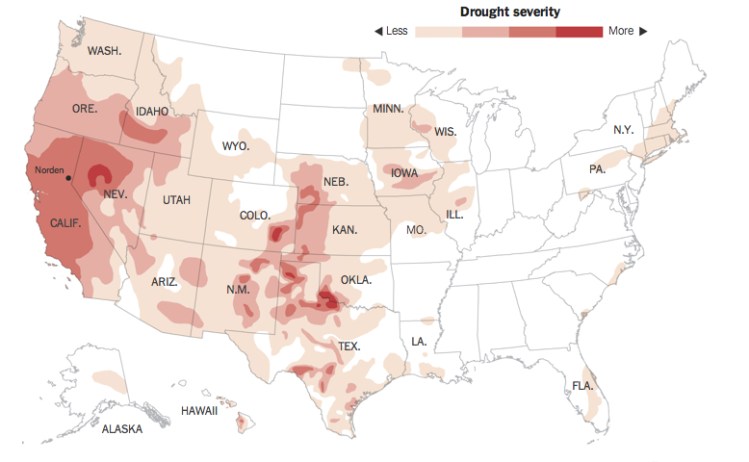
The map of the absence of water in these regions is, however, difficult to get one’s mind around as if it were a property or an accurate map of a territory:  the measurement of its severity is indeed difficult to understand only as a status quo of current meteorological events, for it poses the potential triggers for never before seen changes in agricultural markets and lifestyle.  How can one map the effects of what seems to be the driest in perhaps 434 years, as UC Berkeley paleoclimatologist Lynn Ingram has argued? Both raise the specter of global warming more concretely than we have seen, but are oddly difficult to place into public discussion outside the purely local terms in which they are long conceived:  the drought is not only the problem of Governor Jerry Brown, perhaps personally haunted by the drought of 1977, but the news stories on the issue–as one from which this map was reproduced used in the New York Times to illustrate the drought’s scope, and to hint at the severity of its consequences as much as the expanse of the drought itself, that combines all three aforementioned sites of drought–the Sierra Nevada snowfall; winter rains; Colorado river–in one powerful graphic that reveals the effects of drought on the entire western United States, as if it was a fixed or invading miasma, the vectors of whose spread are less known: ‘ Drought Severity--California

Max Whittaker’s quite eery photograph captures the resurfacing of an abandoned ghost town in Folsom Lake, now suddenly able to be seen with declining water levels of a marina now at a mere 17% capacity, is a striking image of water’s absence in one specific region of the state:

DROUGHT-master675Max Whittaker/NY Times

Other lakes on which much of the southern half of the state depends, like Owens Lake, have shrunk to a visible extent:

la-ol-nudity-and-other-watersaving-tips-in-an--001

How can we adequately map this shift in liquid resources?  To make the graphic palpable, an animated stop-action map of dryness–both historical and projected–could express a useful and compelling record of the mechanics of draught and global drying out might illuminate a perspective on the shifting relation to water we are condemned to live with.

The global shifts in water, from regional water-tables to rainfall to ocean levels, and the mixtures of saline and freshwater they will create, suggests a broader calculus of hydrographic mapping and potable water, the likes of which were never conceived just forty years ago–or, perhaps, just twenty years past.  As a start, such a map might begin from the shifts in a resource like snow, whose absence has caused not only many Californians to cancel trips to Tahoe or to ruin their skis on the slopes, but to face an economic crisis in water’s availability, evident by a comparison of aerial photographs showing the ecosystems of levels snowfall in the Sierra on successive January 13’s just one year apart which reveal dramatically different appearances of identical terrain:

January 13, a year apart

Far more shocking than a map, in many ways, the two images effectively register and embody a shift in how the landscape exists, even if it only implicitly suggests the ecological impact that the absence of that huge snowfall has on its nearby regions:  the absence of green in the adjoining basin, now a dust bowl, suggests a radical transformation in landscape and ecosystem. How can one show the shifting water-table, rainfall level, against the rivers that provide water to the land and its several delta?

A ‘better’ map would help get one’s mind around the dramatically different notion of the usage and circulation of water in and across space–as much as the regions of dryness or low water-levels in the state.  Both NOAA and NASA determined that last year was tied for the fourth place as the warmest year globally since record-keeping began in 1880 with the year 2003:  probably due to increased use of coal, raising the temperature 1.78 degrees Farenheit above the average for the twentieth century, but also creating specific problems in the form of an off-coast high-pressure ridge that has created a barrier that has blocked winter storms, perhaps due to the increased cold in Antarctica on top of the decline in water that descends, melted, from the Sierra’s icepack–leading to an increased reliance on groundwater that will continue for the foreseeable future. The current USGS map of the drought today–January 21, 2014–notes severe conditions of drought in dark brown, and moderate drought conditions in orange, placed above a base-map of dryness across a visible network of riverine paths each and every day: Today's Drougth

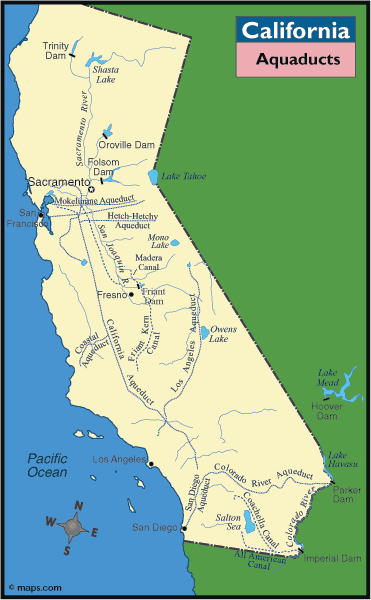
Yet the variations of coloration can’t fully communicate the consequences desiccation of the land.  The “moderate” drought in the central valley–surrounded by conditions of severe drought–reflects the limited amount of water brought by aqueducts to the region, rather than a reprieve from national conditions, and roughly correspond to the paths of the California Aqueduct and San Joaquin river:

CALAQU

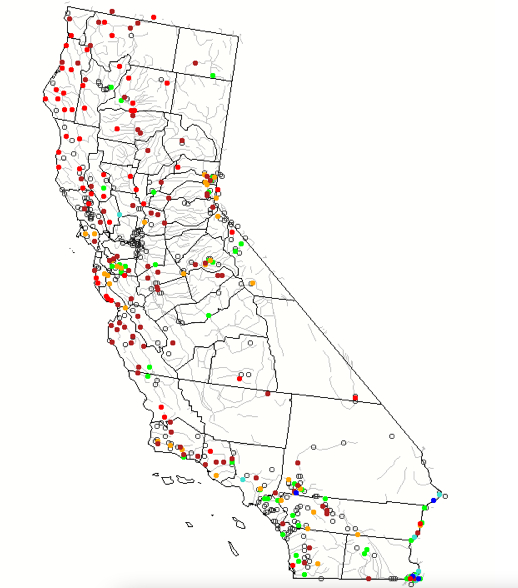
Perhaps a better model for mapping drought exists, but questions of how best to unify empirical measurements with the availability of water–and the consequences of its absence–are questions for data visualization that have not been fully met.  The ways that USGS maps real-time stream flow in comparison to historical conditions for that day provides a pointillist snapshot of dryness–but using the red to suggest “low” and crimson “much below normal,” as measured in percentile–and yellow “below normal”–the scientificity of the map gives it limited rhetorical power, and limited conceptual power as a basis to assess the expansive effects of drought or extrapolate the critical readings of water across that network in ways easy to visualize.

Streamflow Conditions in CA--Jan 21

The USGS Waterwatch offers an even better metric–if with minimal visual shock–in mapping the areas of severe hydrologic drought in crimson and a new low of drought levels in bright red, in its map of stream flows over a 7-day period, which suggests the range of lows throughout the region’s hydrographic water-stations and across the clear majority of its extensive riverine web, and indeed the relative parching of the land in sensitive regions as the northern coast, Sierra, and parts of the central valley, as well as the rivers around San Francisco and Los Angeles:

New Lows in Riverine Flow

These maps seem to omit or elide human agency on the rapidly changing landscape.  Despite the frequent vaunting of the purity of the water carried from the snows of the Sierra, deep problems with the California water supply–problems caused by its inhabitation and industrial agriculture– become more apparent when one considers the impurity of the groundwater table.  This map, based on domestic wells of water withdrawal, offers a sobering image of what sort of water remains;  although the most southern sector of the state is clearly most dependent on groundwater withdrawals of some 30-80 millions of gallons/day, significant sites of the withdrawn groundwater from within the Central Valley Aquifer, extending just inland from and south of San Francisco, and at select sites on the coast, contain surprisingly high nitrate contamination due to fertilizer runoff or septic tanks–measured against a threshold for having a negative effect on individuals’ health.

Groundwater in State

The closer one looks at the maps of how the state has begun to dry up over time, the further peculiarities seem to emerge of California’s geography and its relation to water–and indeed the sort of water-exchanges of three-card monte that seem to characterize the state–that are to an extend compacted by the dependence of much of coastal California on the extended winter rains that provide enough water for most plants to store.  (The absence of water in much of Northern and Central California now means that the leaves of maples and many other trees are turning bright red, due to their dryness and the bright winter sun, in ways rarely seen.) We might do well to compare some of the other means of tracking drought.  The US Drought Monitor suggests that conditions in current California dry spell differ dramatically from just two years ago–at a time, just two year ago, when Texas seemed a far more likely candidate for ongoing drought.

hnsvxl

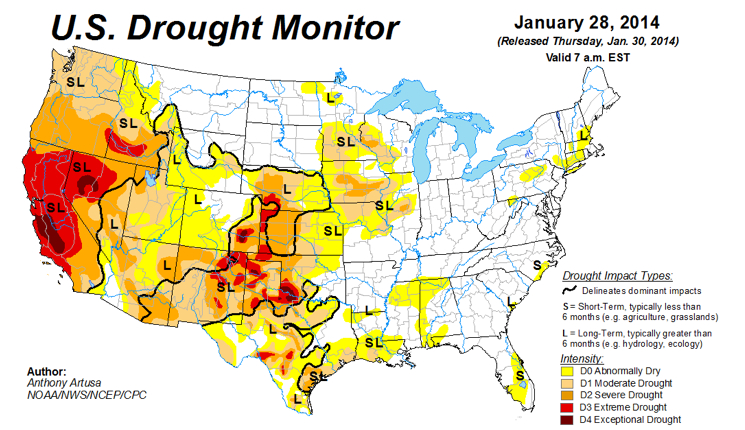
While the image is not able to be easily accessed in animated form, a contrast to a recent reading of drought from this year reveals the striking expanse of extreme and exceptional drought in California’s Central Valley and much of the entire state, to compare the above to two more recent drought maps:

US Drought Monitor Jan 21

Drought Monitor Jan 28 2014

Yet the concentration on broad scale changes in the regions that it maps offers somewhat limited sensitivity to the variations of water-depth.  The map moreover suggests a somewhat superficial appreciation of the drought’s expanse and the nature of its boundaries.  But the greater sensitivity of satellite readings offers a more multi-leveled–and indeed both a thicker and a deeper reading of underlying factors of the local or regional drought in the American West.  The upgrading of drought–or the degradation of local conditions–in only one week is striking, and effects precisely those regions most sensitive to river irrigation that were effected by the failure of arrival of a melted snowpack, the effects of which seem destined to intensify.

One Week Shift

The twin satellites that measure the distribution of groundwater offer an other point of view of the local variations of drought.  The record of hydrological health, known as the  Gravity Recovery and Climate Experiment, whose paired satellites use two sensors spaced some 220 km apart as a means to detect a shift in the ongoing redistribution of water on the earth’s surface, offering a comprehensive indexing of their remotely-sensed measurements by longitude and latitude.

Satellite NASA

The extracted data is combined with an existing meteorological dataset, in order to create a record sensitive to variations of but one-centimeter in groundwater level.  Although not registering the depletion of aquifers, and primarily climactic in nature, the portrait that emerges from specific shifts in gravity suggested by water’s lower mass effectively track water’s presence with considerable precision on exact coordinates, creating a composite image of national drought that suggest the different variations in the presence of groundwater, by integrating groundwater and soil moisture from surface moisture of their remotely sensed data with actual meteorological changes observed from land and space to create a comprehensive picture of water storage at different levels in the earth.

GRACE mechanics

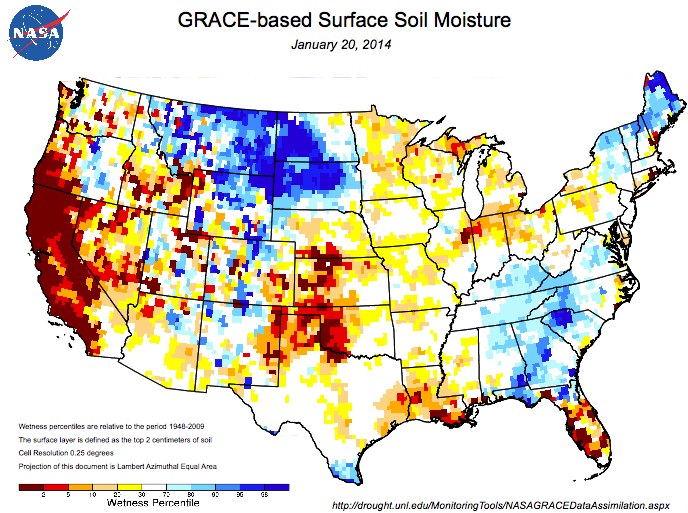
GRACE has aimed to map the shifts in groundwater levels over time:  the result suggests in surprising ways some relative stability between 1948 and 2009, to generate “a continuous record of soil moisture and groundwater that stretches back to as a way of indexing moisture levels in the soil at different strata.  The striking change in such levels in relation to data of 1948 is an especially striking record of the contrast between just 2012 and 2014.  By creating a map based on the composition of underground water storage as remotely sensed via two satellites orbiting earth, the measurement of ground water retained in the land is a crucially informative record of gradations of aridity, and levels of drought, allowing us to discriminate between ground water and soil moisture–and indeed to understand their relationships in an easily viewable manner, translating satellite measurements into a format easy to compare as a mosaic of local levels of aridity and regional differences that demand to be cross-referenced with agricultural production and across time.

Groundwater Storage 19489-2014

The map of ground-water storage suggests strong contrasts of the relative surplus of waters within the irrigated Central Valley and the relative aridity or dryness of land in much of the Lost Coast in California and deep south.  The “change in perspective” resulting in two years shifts attention to shifts in the amount of groundwater measured, processing data of water stored in the earth that has the potential to analyze the relative irrigation of expanse in easily viewed fashion.

Within just two years, or course, this picture of ground water storage had dramatically and radically changed whose impact we are only beginning to assess, and done so in ways that show no signs of ending.

Ground-Water Storage 1948-20089

To be sure, the wetness percentile of areas near the land of lakes and central United States seems a striking contrast in this image of ground water storage, in this image deriving from the University of Nebraska, which reveals itself to be a particularly rich area of soil storage of groundwater, in, significantly, an area without much surface soil moisture based on Soil Moisture Study.  But the deep pockets of wetness decline by far–both in storage and in soil moisture, based on the draining of aquifers and increased aridity or desertification–present a bleak picture in some strong crop-producing regions of the south and southwest, as much as California–and an even more terrifying story when the moisture of its soil suffer dryness–the excessive aridity specific to California relative to the nation is far more starkly revealed.

Soil Moisture on Surface

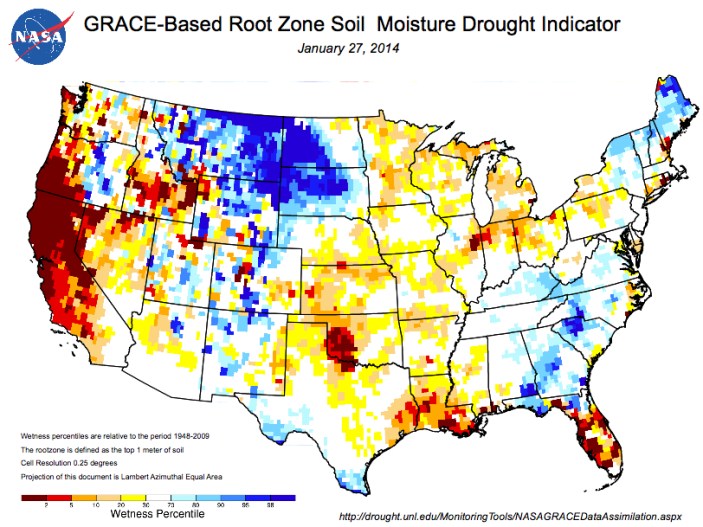
The registration of surface soil moisture and groundwater suggests a dynamic tiling of national space that we can use to map wetness over time, and extrapolate the effects of increased aridity on farm-lands and regions that will no doubt shift the prices of water, as well as the costs of agricultural production and livestock.  The mapping of specific water available for root systems across the nation, based on satellite data coded to specific longitudes and latitudes, provides a third level of analysis based on the levels of water available to root systems across the nation–and reveals the even more concentrated effects of drought within the region that depend on water from the California Sierra that will no longer arrive in the Central Valley this year:  more concentrated than the earlier image of ground water storage, that reveals the amount of water available to the root systems presents a picture even more closely related to agricultural constraints created by three years of drought.

Root Zone Moisture

The remote sensing of such levels of moisture and groundwater affords a model of mapping that can be keyed directly to the questions of specific crops in ways that can be eventually used to make prognostics of the impact of drought on the local economy.  If California’s conditions seem to be due to meteorological particularities of low snowfall and few winter rains, held off the shore due to a high pressure ridge of air related to dramatic cooling in Antarctica, the problems that underpin the mapping of the local of integrating layers of data from different sources are repeated.  They reveal magnified risks in ways comparable to the more speculative tools of forecasting used to  assess the multiple water stresses that shape the environmental pressures on population in different areas of the world.

The following sequence of global projections of aridity are often rooted in the possibility–or near-eventuality–of rising temperature worldwide, and the pressures that these stand to place on water usage. The projection of what these water stressors will be seem to synthesize the data of rainwater levels, water tables, and ocean levels to depict the collective constraints facing agricultural communities across the world–and raising questions of what effect they might have–that will no doubt endanger rising political instability and economic hardships world-wide, in ways difficult to conceive.  The problems that underpin the mapping of the local are repeated, if with magnified risks, when trying to synthesize the data of rainwater levels, water tables, and ocean levels as a collective set of water stresses that are facing agricultural communities across the world. If California’s conditions seem due to low snowfall and few winter rains, held off the shore due to a high pressure ridge of air that seem related to the dramatic cooling of Antarctica, projections of aridity are often rooted in the possibility–or near-eventuality–of rising temperature worldwide.

The remarkably and relatively suddenly increased stresses on water-supplies world-wide are now better mapped as futures–which they indeed offer, by the World Resources Institute, a sort of barometer on the shifting dynamics of water availability in the world.  In the below charging of water stressors prospectively through 2025, based on the prospect of a world warmer by three degrees centigrade, we are pointed to the particular hot-spots in the globe.  These include the central US, which extend in arcs of desiccation poses particularly pernicious threats through much of Anatolia, Central (equatorial) Africa, and South Asia.  Specific water stressors that are projected in the map are due to the combined pressures of growing use of a limited supply of waters that higher temperatures will bring; the global map of the impact of rising temperatures poses particular problems for populations in India and China, two centers of pronounced population growth where markets where food distribution will clearly feel stresses in increasingly pronounced ways.

Crop Yield with Climate Change World Map

The pronounced pressures on fertility rates are expected to stay strong in Asia, as well as the United States, according to the below bar graph, developed by the World Resources Institute.

Fertility Rates Mapped

The areas in which the World Resources Institute predicts the most negative effects on crop production reflects the relative impact of water stresses due to projected climate change alone–revealing a far more broad impact throughout South America, northern Africa, Arabia, and Pakistan, as well as much of Australia.  (Similarly, a certain pronounced growth occurs across much of Canada–aside from Ontario–Scandinavia, and Russia, and parts of Asia, but one hardly considers these as large producers in a world that has warmed by some three degrees centigrade.)  But the highly inefficient nature of water-use–both in response to population growth and to a lack of re-use or recycling of water as a commodity and in agriculture–creates a unique heat-map, for the World Resource Institute, that will be bound to increase water stressors where much of the most highly populated and driest areas intersect.

 Water Stress Map

The rise of the temperatures is prospective, but also difficult to map in its full consequences for how it threatens the experience of the lived–or inhabited–world to the degree that it surely does.  (Indeed, how the habitable world–the ancient notion of a habitable “ecumene,” to rehabilitate the classical concept of the inhabited world and its climactic bounds by torrid zones–would change seems a scenario more clearly imagined by screenwriters of the Twilight Zone or of science fiction novels than cartographers or data visualizations.)  If we focus on the band of the hardest-hit regions alone, one can start to appreciate the magnitude of the change of restricted access to water and its restricted availability in centers of population:  the map suggests not only a decline by half of crop yields around equatorial regions, but stressors on local economies and rural areas. It staggers the mind to imagine the resulting limitations on world agriculture in this prospective map, which offers something of an admonitory function for future food and agricultural policy, and indeed international relations:

Band of hardest Hit

The shifting pressures on resources that we have too long taken for granted is sharply starting to grow.  The stressors on water will direct attention to the importance of new patterns and habits of land use, and of the potential usability or reconversion of dry lands, to compensate for these declines.  Indeed, the mapping of available water provides a crucial constraint on understanding of the inhabited–and inhabitable–world, or how we might be able to understand its habitability, bringing the resources that we have for visualizing data in ways that we might bring to bear on the world in which we want to live, or how we can best describe and envision the effects of drought as an actor in the world. Such huge qualitative shifts are difficult to capture when reduced to variations that are charted in a simple heat-map.

In a way, the constraint of water was more clearly and palpably envisioned within the earliest maps of California from the middle of seventeenth century than it is in our vision of a land that is always green, and nourished by mountain waters all along its Pacific rim.  Indeed, this image of an imagined green island of California, surrounded by waters and beside a green mainland nourished by rivers and lakes, seems extremely powerful as a mental image of the region that is increasingly remote as the water resources of the region begin to evaporate.

California Island

4 Comments

Filed under agriculture in america, aquifers, Climate Change, drought, mapping climate change