Category Archives: California

Dystopian Diptychs: Virtual and Economic Realities of the Palisades Fires

The problem of mapping fires and fires spread in Los Angeles is demanding, challenging, and increasingly frustrating. Exacerbated by the new weather systems of climate change–high, dry winds; dried trees; low groundwater–and the increased combustibility of the landscapes that area among the most treasured in the world, we face so many multi-factorial problems of the origins of any fire that there is no clear smoking gun to place blame. To be sure, before the engines of climate change, we lack the need for assistance to a sprawling urban infrasctructure to provide the water or fire mitigation needed to deal with them.

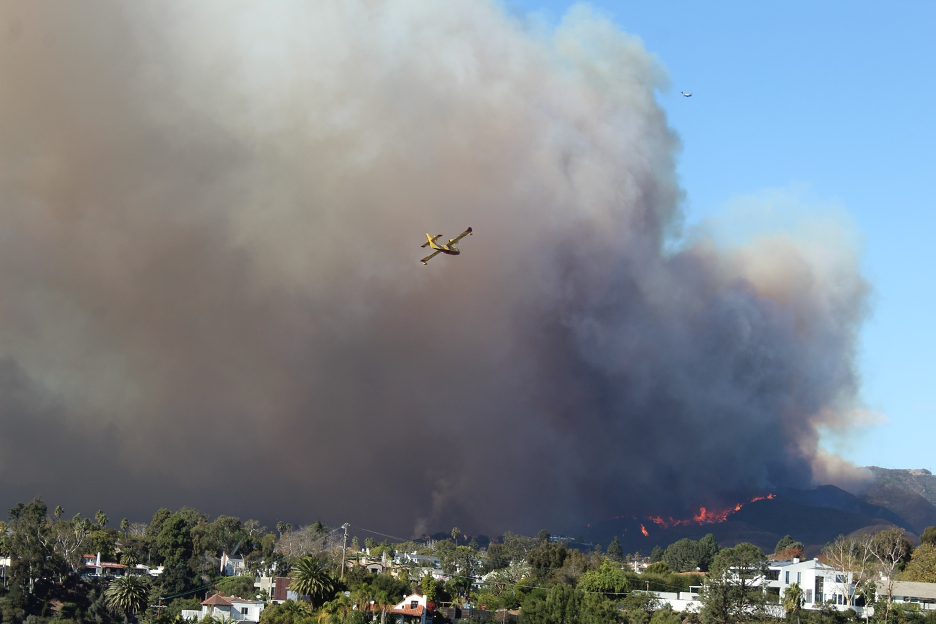
But if the amazingly destructive fury of the fires that began in the Pacific Palisades this past year reminded no one so much as a dystopian image of Hell of Dantesque proportions–of raging fires consuming buildings, sending firefighters desperately running to staunch the conflagration’s spread against all odds in flaming settings that raged with an intensity one can only call infernal,–

Pacific Palisades Fire/National Geographic/Ethan Swope AP

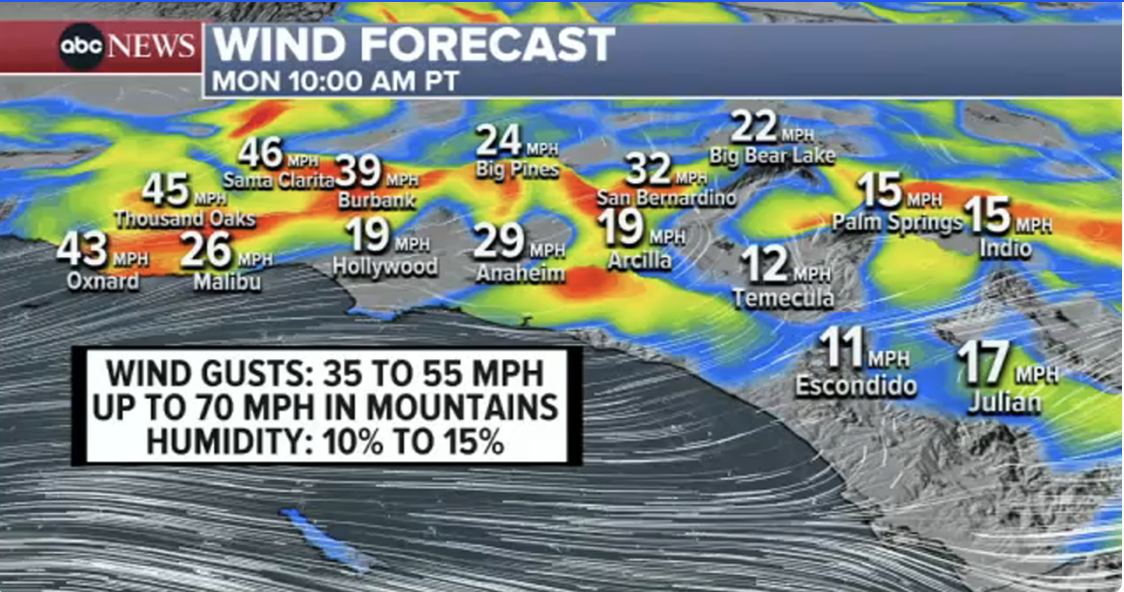
–provoking collective questioning and at least a temporary interrogation of what went wrong. Suddenly, in ways that intersected so eerily with Donald Trump’s inauguration, the built world around Los Angeles, and indeed some architectural treasures of the early twentieth century, were revealed as ephemeral and at risk–not hhugely valuable properties were flattened, but as fires spread across the arid landscape of the Palisades, carried by the embers and sparks that moved in paths we have not clearly traced, the dormant embers of an earlier fire, unextinguished, suddenly rekindled in the forested lands, and rapidly spread in the Santa Monica mountains in the Santa Ana winds to Topanga and Malibu, over 23,000 acres, fanning one of the largest fires in California’s history and largest losses of property and residences the state experienced. Eight months without rainfall created a landscape primed for the destruction of property and forested lands. What followed numerous red flag warnings by the National Weather Service in the Santa Monica mountains and Malibu coast of critical fire risk, amidst what CAL FIRE called “the perfect conditions for a large wildfire,” amidst record dryness and an unprecedented “fuel load” of dry vegetation.

We are rarely ready to think of property and buildings as so contingent, as residents were forced to flee property valued at hugely astronomical sums and nearby towns, suddenly flattened in the flames’ wake, as toxic smooth poured over the region and blanketed the blue skies.

In a dreaded constellation of factors that set new standards for multifactorial explanations–as climate change will–but might be confused by being tied to divine whim, or ill fate, the Los Angeles fires of early 2025 were fanned by otherworldly hurricane-force winds that created fireballs that firefighters struggled to extinguish against all odds. The hurricane-strength winds that fanned the spread of the fire consumed mansions of the Pacific Palisades, a coastal enclave of the wealthy, suddenly more vulnerable to flames. Those less fortunate residents of Altadena, CA were not leaving cars, but fleeing on foot amidst emergency services, masks on mouths in hopes to prevent inhaling toxic smoke, desperately navigating safety beneath skies glowing an eery red seemed an image of hell in the poorer community–where flames reduced homes to skeletal structures–trying to flee to safety from the Eaton fires in nearby communities, where many residences were destroyed and traffic jams created on the interstate that led many to abandon their cars–not the easiest habit for Southern California residents–
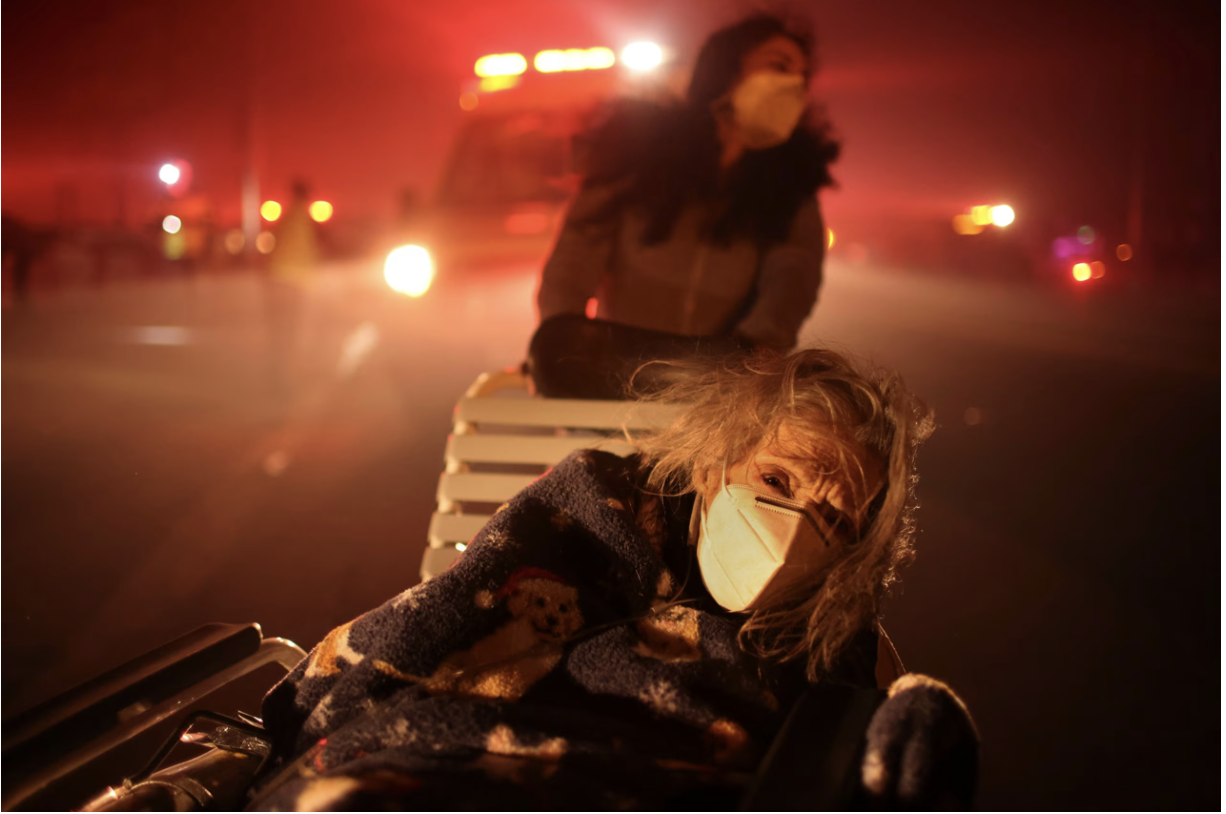
Ethan Swope/AP

The burn area on the edges of the city became impossible for firefighters to extinguish as it consumed the load of dried vegetation under hurricane-force winds, exceeding local reservoirs of water and providing a searing image of the inability of humans to control natural forces in their immediate surroundings–spreading faster and across a burn area far greater than previous fires.
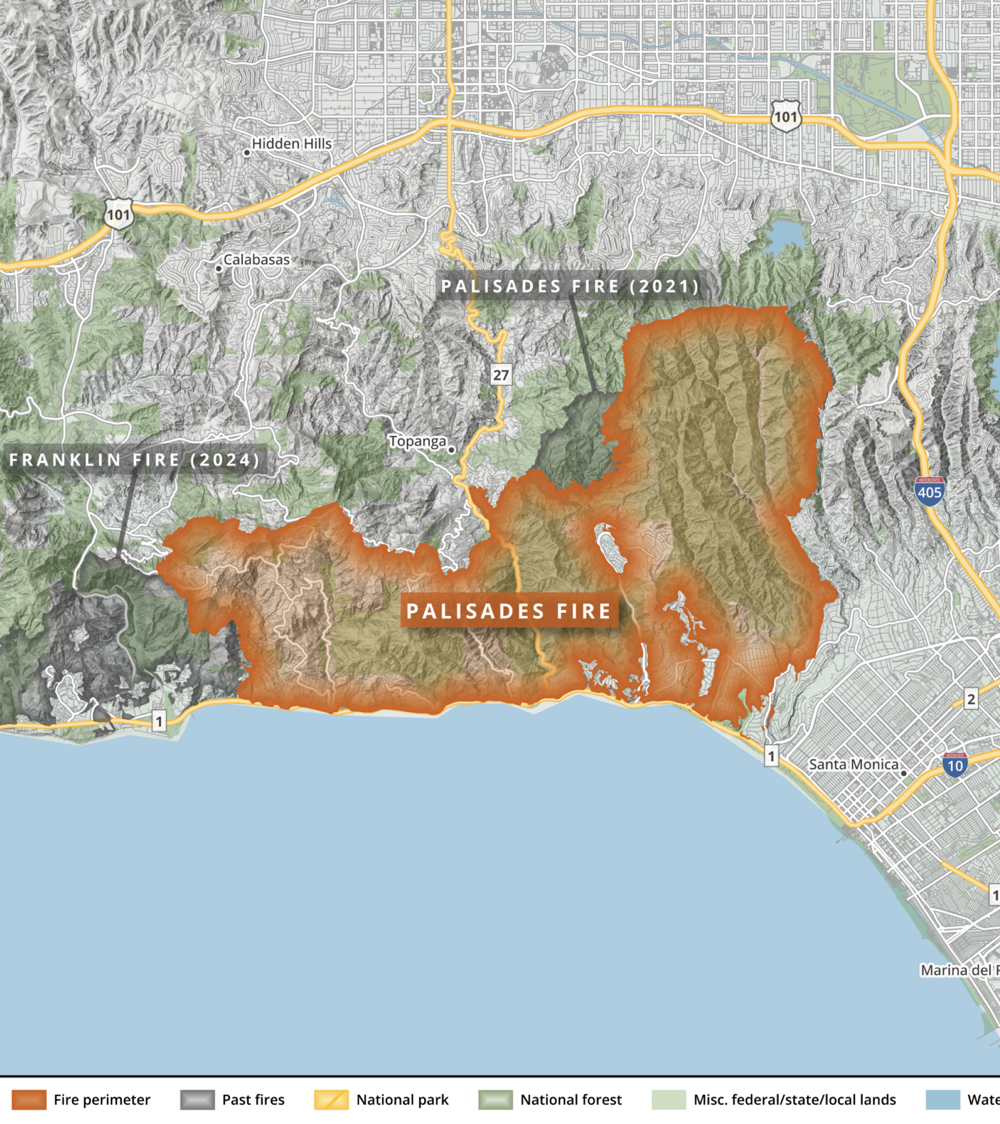
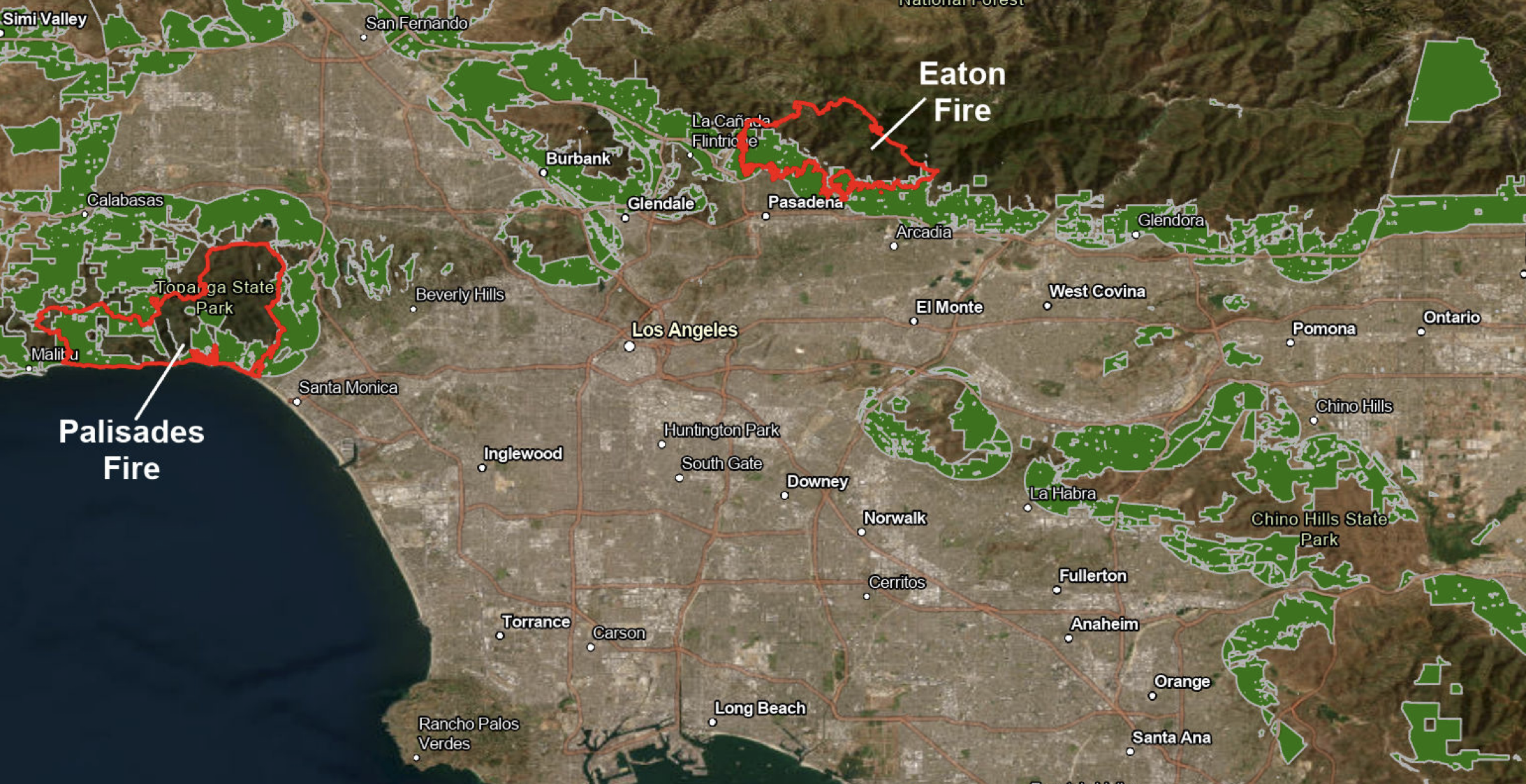
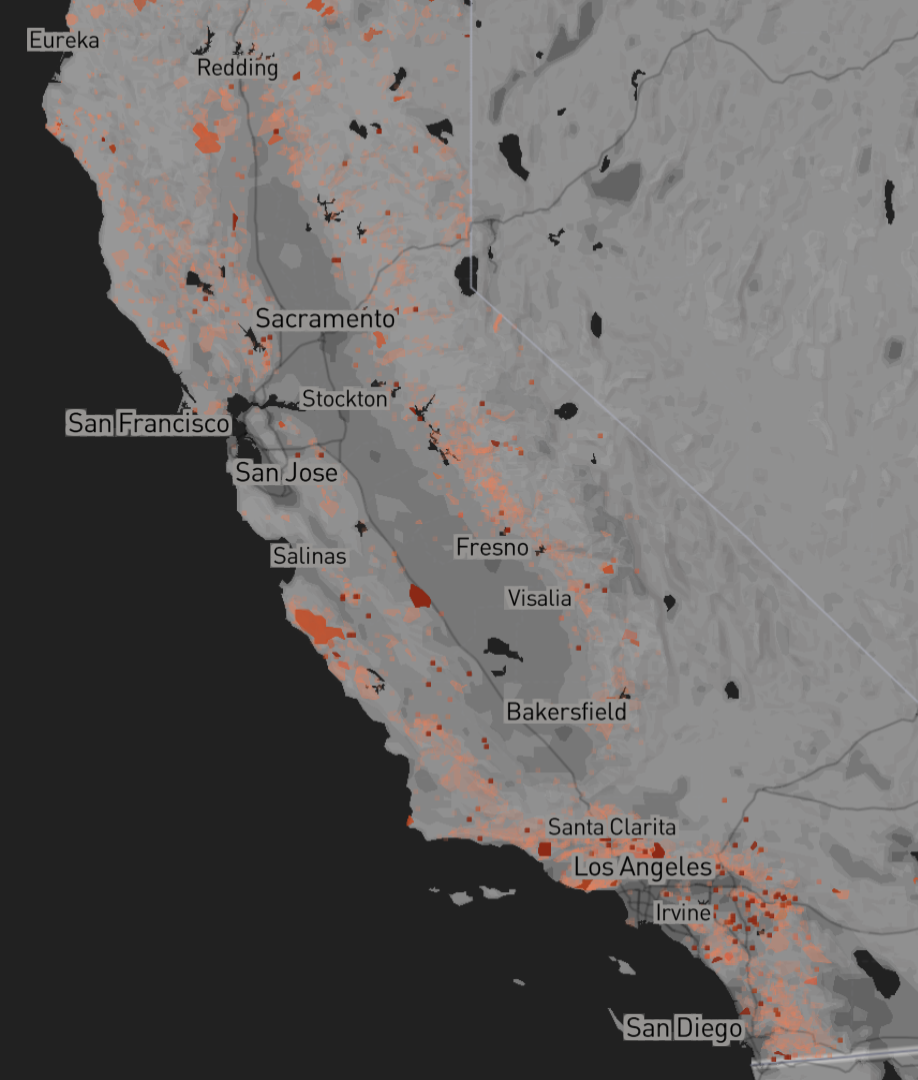
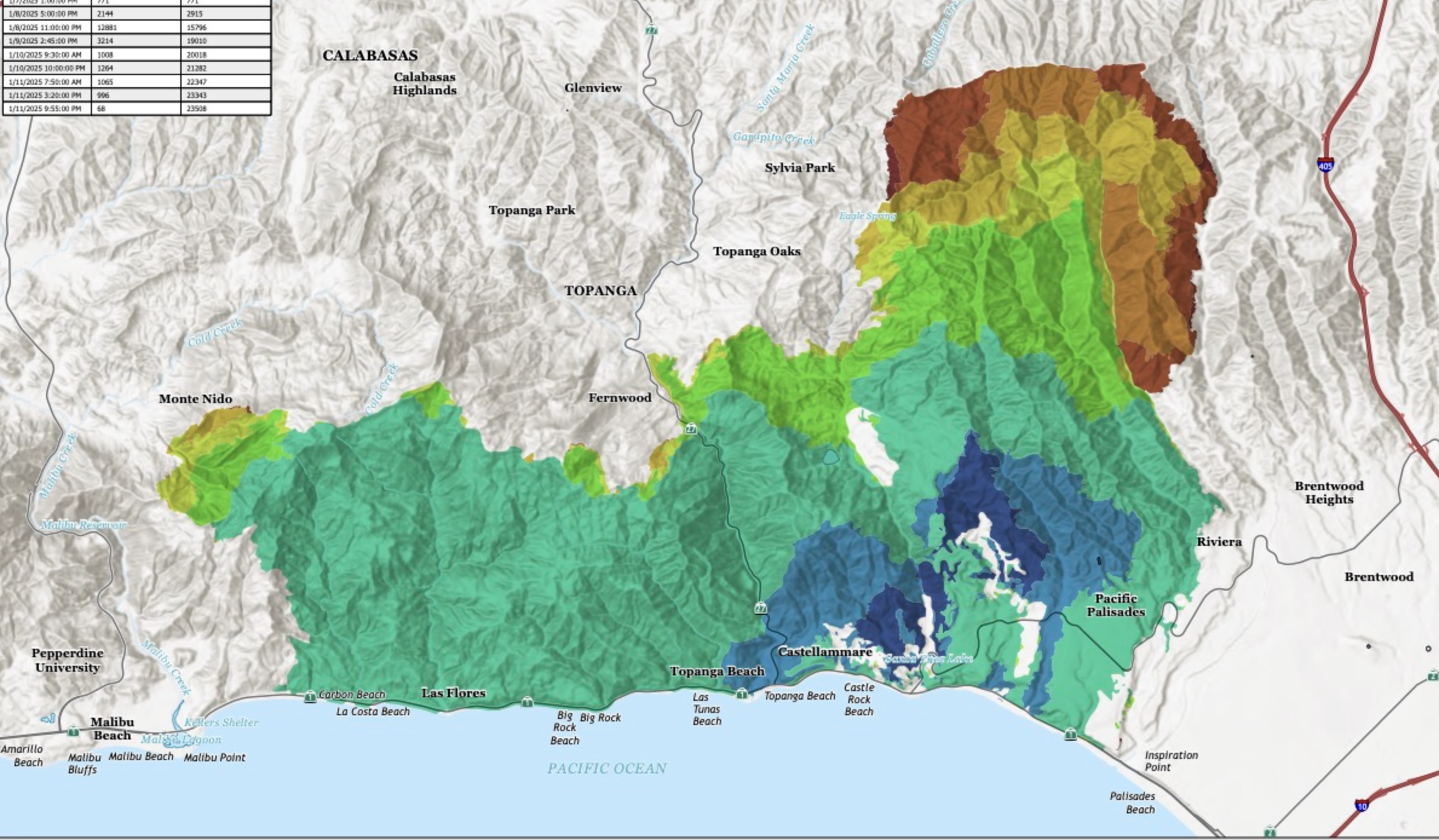
Penitentes/from Wikipedia, using data from CalFire, USGS, USFS, NPS, US Census and OpenStreetMap

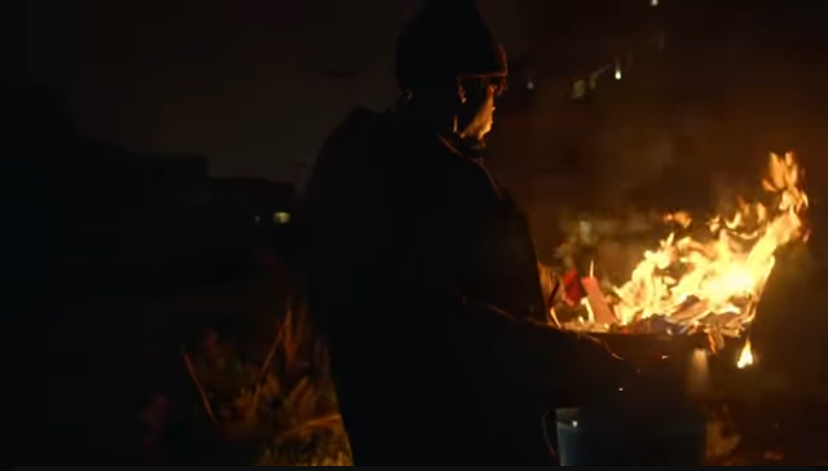
With the knowledge of such suffering and the huge scale of severn fires that had rekindled from an earlier Palisades Fire, the recent discovery that a disgruntled twenty something Uber driver set the earlier fire in the Pacific Palisades intentionally. That he did so on New Years Eve, after having dropped off a fare in the exclusive enclave, and taken a walk in the woods listening to French rapper before flaming garbage pails in Parisian streets, maps the origin of the fires of such incomprehensible scale to a malicious act seems not only tied to a mind more shaped by social media than we ever imagined, but alienated from those exclusive enclaves that he brooked such seeming hatred. The Uber driver who his fares described as angry changed all the talk of the vulnerable nature of the urban periphery and the extra urban woodland-urban interface. The origins of the fire were not mapped by a dangerous geography of increased fire risk, but was as imaginary as real, and somehow not so clearly linked to dryness and full force winds, as the apocalyptical proportions of the fire on the Los Angeles periphery had in fact been already imagined–with the help of ChatGPT–which had on request generated some dystopian images on demand of the divides between panicked residents fleeing raging flames in eery juxtaposition with the image of a bucolic city.

We are prompted to associate ChatGPT with withdrawal from reality, and indeed see it as severing its users (or clients?) from the skills of spatial orientation that we see as fundamental to orient ourselves in a sense of place. Jonathan Rinderknecht’s request to generate images of the burning city seems to have arrived already distanced from reality, perhaps even an addict seeking to delude himself further in the most irresponsible ways to envision the unthinkable destruction of a part of Los Angeles even as red flag warnings abounded in the region’s hills. The ignition of the fires at the very intersection of forested lands and extra urban growth–the intersecting areas where wood is exposed to electric charges and anthropogenic wires known as the Wildland-Urban Interface, for short WUI, seems as if it was predetermined. The blaming of this disaffected man–akin to the blame distribute to communities of the unhoused for setting fires intentionally that are prosecuted as arson–cannot be separated from the anthropogenic landscape of proximity to woodlands, without defensible space, or even clear resources for emergency vehicles, to contain and interact with fires of ever greater intensity, which firefighters may, in even an increasingly vulnerable time when the city is prone to fire risk, create a landscape we lack familiarity to fight and contain, and caused the rapid spread of a brush fire from the aptly named Skull Rock toward the coast to Malibu and down Topanga Canyon, destroying 1,000 houses in hours, hitting the coast in twenty-four, and going on to destroy nearly 16,000 structures in the Woodlands-Urban Interface, where not only roads but houses, communications antennae, gas tanks, and: an astounding 98.25% of the homes destroyed in the Palisades Fire lay in the WUI,

The high risk of building out in the region was perhaps repressed or silenced, in ways that seek to haunt the huge attention that Rinderknecht’s prosecution has advanced, as the fire season begins again, seems almost a smokescreen, sent by the Department of Justice, eager to link the fires to the disaffected young man who was using ChatGPT in order to generate disastrous images, obscuring the real risks of building in the mountains adjacent to forested lands. The rapid spread of that destructive fire calls for mitigation efforts to prevent losses adjacent to wildland fire, and a better mapping of the heightened risk in areas of WUI, rather than incriminating isolated individuals.

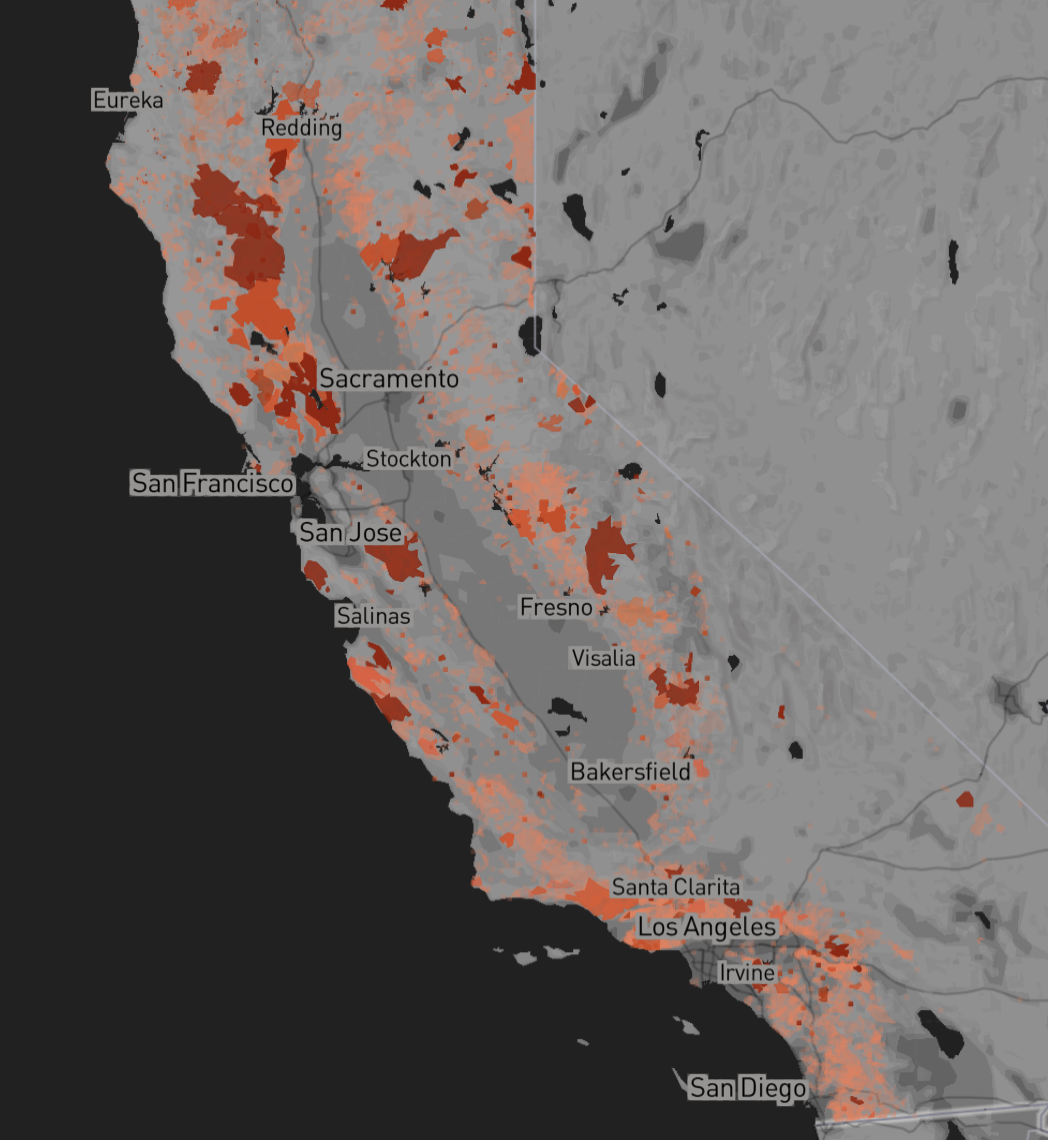
Los Angeles Wildland-Urban Interface & Fire Perimeters, Finley Bell/Western Washington University

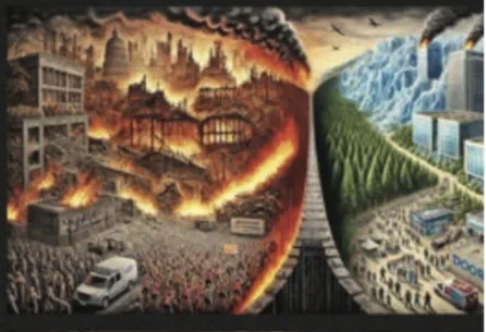
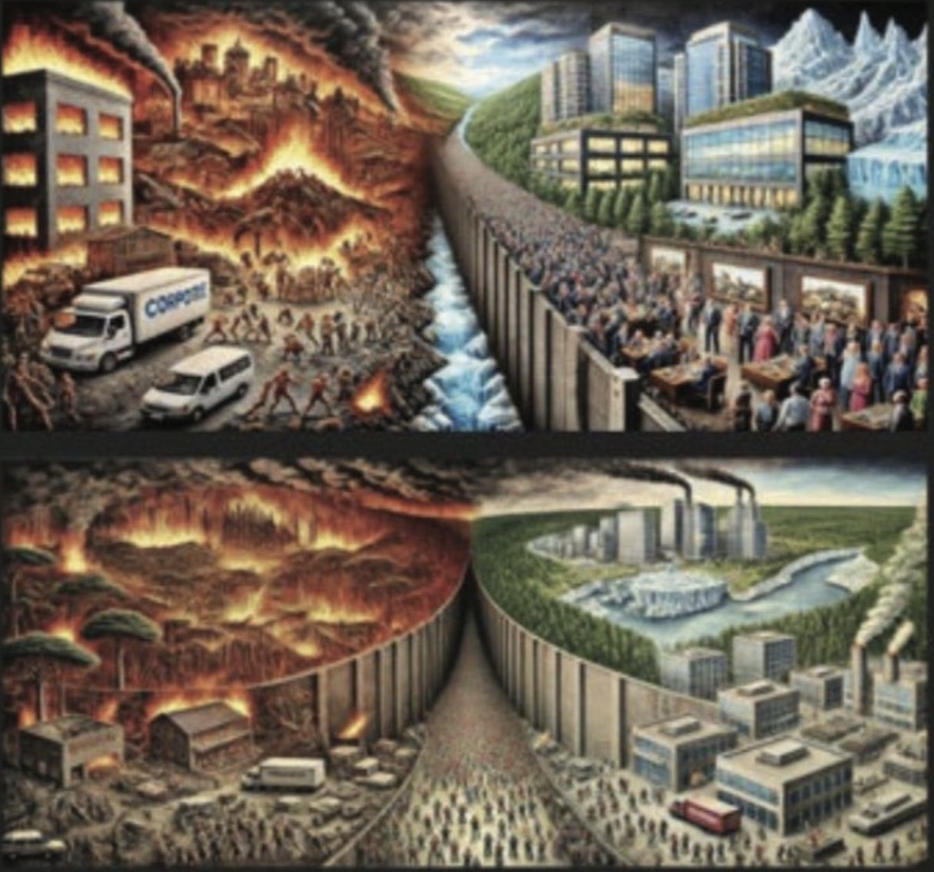
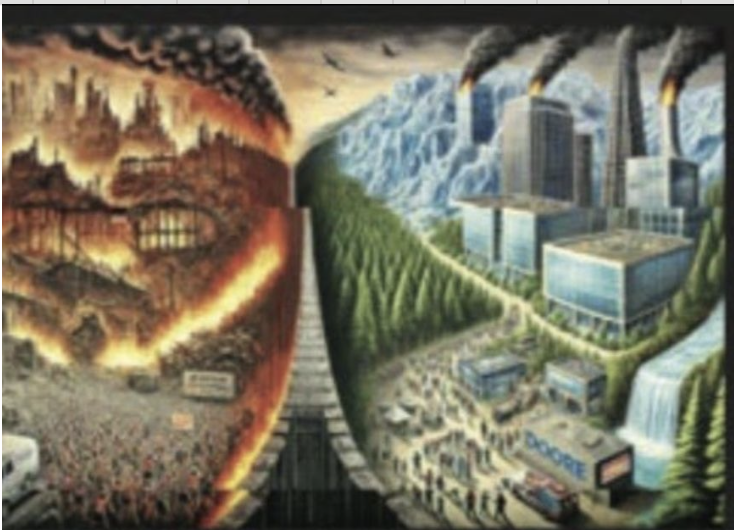
The request the chatbot was given was to depict a city split into two–broken by a grievous class divide–in which the propertied literally partied and chilled as the thick black clouds billowed from the fires that began in forested lands–not much like the areas of Malibu that Mike Davis long ago and so provocatively suggested by let burn. The class divide that animated these scenes were more like a medieval morality play with no clear moral in sight. While the rest of the city was “chilling,” in the request Jonathan Rindernecht asked OpenAI to render on his device. In the image, it seems thousands are fleeing the burning city–long before the actual fires sent residents fleeing after actual Evacuation Alerts. In the images, which almost look like cautionary messages or hateful conjurings, dark smoke blankets the sky. A week after the government shutdown began after Republicans failed to agree upon the appropriations legislation for the coming fiscal year, and emergency response services to disaster response across the nation, with widespread furloughs and cuts in major mitigation and prevention products funded by the Disaster Relief Fund, placing California’s state-wide disaster response abilities in severe jeopardy as they prepare for new threats at the start of fire season, furloughing a full quarter of federal forest service staff in the state, the prosecution of Rinderknecht as the poster boy for criminal negligence fits a pattern of reducing multifactorial problems of fire mitigation to one bad actor, a deviant whose plans were confirmed by the eery nature of the computer generated images of fires he asked to be produce.

The actual fires have a virtual smoking gun, at last, pinned, for all the unimaginability of their scale of destruction, on a discontented Uber driver int he service economy, who used his sick mind to hamper the ability of rescue services to protect property against wildfire and destitution of some of the nation’s most ecologically delicate coastal landscapes of untold splendor, a bad apple whose lighter sparked seven fires and the greatest destruction of property. And even if CalFIRE has hired   thousands of additional firefighters, natural resource professionals, and the state’s governor slotted millions in investments in hopes to protect sensitive communities from wildfire risk, introducing $135 million available in prevention projects and wildfire resistance while spending  $72 million across the state since 2019, calling for a new standards of emergency readiness in the March 2025 state of emergency proclamation, the protection against wildfire spread remains pressing, and will be deeply impacted by the shutdown in ways terrible to contemplate by trimming wildfire response statewide before a hotter and drier climate. The federal prosecution of Rincherknecht, who was apprehended in Florida a week into the shutdown, and indicted on three charges of starting the Lachman fire for arson, destruction of property used in interstate commerce, and setting timber on fire, accused an individual of starting the destructive fires whose resignation flattened 17.000 homes and buildings across LA County, dominating the news cycle for a few days. After narrowing the possible proximate causes for the fires’ sudden ignitions under high winds from New Years Eve fireworks to lightning strikes to domestic fires, unhoused, or out of doors camping, the revelation of vandalism of the bucolic landscape of the super-rich revealed Rinderknecht’s location New Years’ Eve at the end of his Uber ride to the exclusive enclave where older fires had rekindled.

Are the revealed charges filed a week after the government shutdown truly in the public interest? The “paintings” a disaffected twenty-nine year old, Jonathan Rinderknecht, generated appeared on his own screen months before the fire. Is this the smoking gun–pardon the expression–that helps us understand the fire so catastrophic in proportions, not due to the failed infrastructure of a fire department not ready to deal with the sudden needs for water and inflammable agents needed to blanket houses built in forested areas, but the mental health of an unstable individual, who ideated the disaster in a diptych he asked be rendered in two panels of people fleeing a burning city whose ostensible neighbors, tied to wealthy conglomerates, “chill” in ways oblivious to the advancing of apocalyptic flames?

The AI bot spelled out, in wayst rarely mapped so starkly, the divide between “haves” and “have-nots” in Los Angeles natural disasters– although the “have-nots” were being visited with a punishment no one should ever face, that resemble not the LA Fires, perhaps, because they look a bit like an AI version of the destruction of Rome. Or are they not possibly a plausible smokescreen? By pinning responsibility on one man with psychological issues who was overcome with intense loneliness, his rage against the city where he lived off what might be called marginal work pushed the question of fire risk to the margins as the arrival of an ever earlier fire season intersected with a sudden decline in emergency preparedness that the shutdown had perhaps coincidentally precipitated–increasing the area of wildfire risk in the state by ending plans for controlled burns in Lassen, Trinity Alps, and San Bernardino County, even as Cal Fire will go ahead with planned burns in Mendocino and Butte. As the state is increasing its wildfire readiness and emergency preparedness, the dystopia of fires again raging across the state that is triggered by Rinderknecht’s AI images is encouraged by Forest Service cuts and voluntary resignations across the state.
Credit: Department of Justice

Rinderknecht was indeed spending New Year’s Eve alone, we learn, and was doing so against his desire, when as if in an act of rebellion and assertion, took out his lighter. He lit the fire shortly before midnight as if to ring in the New Year with real fireworks, without the relative safety of the French rap video of a man lighting trash in a can aflame, but with a similar deliberacy and cool as he seems to have danced in the forest, lighting flames with his lighter at several spots, maybe under the influence as well, and probably feeling deeply alienated and alone that would eventually flatten almost 37,000 acres and kill at least eleven as a result of its spread–and sending plumes of toxic smoke over the region. The plumes of smoke seem to be conjured in the images generated by Chat GPT at the twenty-nine year old’s request almost as chillingly than the spread of flames.

Bucolic may be an overstatement–but the skies are blue and the trees are green in the public parks or verdant space amidst steel and glass skyscrapers reflecting the snow-peaked mountains that seem to pass for nature. The generation of the images of countless fleeing their homes in the mountains on one side of the city as other went about their business behind stiff walls was a projection, of course, of the steep class divides and socioeconomic realities in Los Angeles, seen from the perspective of the Uber driver who ferried folks between neighborhoods of radically different wealth, social opportunity, and environmental access as well as comfort, but was also an image of the panic that fires might cause in the flammable areas of dense habitation, which ChatGPT was happy to provide to the Uber driver, as well as to assure him, after he set the fires in forested areas of the Palisades, that if he dropped a lit cigarette in the forest he would be fully legally responsible–or to see if there was a basis to escape responsibility, even as he returned to watch the flames spread in the Palisades, undoubtedly imagining the damage he would inflict on homes by lighting his own small fires.
Credit: Department of Justice

The rings of flames in those AI-generated images, if they draw on the image repository of the internet, courtesy Open AI, might well suggest the cruel fates imagined in the circles of hell, or bolge, by the canonic Florentine Renaissance painter Sandro Botticelli, who rendered the poet Dante and his purple-robed guide, the Roman poet Virgil, overlooking naked poor souls suspended amidst devils in eternal suffering in the rings of hell for all eternity, outside real time,–if the vibe is far more video game than medieval manuscript illumination.

The poet Dante wrote equally informed by theology and astrology, but the painters who illuminated deluxe codices in of Dante’s epic poem of a voyage to the afterlife increasingly employed geography and landscape to transport readers into the afterlife in credible ways, supplying increasingly detailed maps of the visionary poem at the same time as cartographic images combined maps and landscapes, raising questions about the relation of maps to landscapes from an earlier date–

Sandro Botticelli, Dante and Virgil Viewing the Souls of the Damned in Hell’s Eighth Circle, 1480s Canto XVIII

–that stand only to expand like rabbits in the age of Sora, when increased virtual reality may stand to replace the painting as a unit of visual communication. While we’ve seen mostly the faking of known figures, the remaking of alternative landscapes suggests an eery emergent genre of alternative landscape art.

The notion of landscape as map were revisited in the generic if terrifying nature of computer-generated images of burning cities that Jonathan Rinderknecht asked of a bot with which he must have shared some seriously intense encounters, that fashioned an inferno-like experience long before the fires in the Palisades were ever set. We may well find the images hen conjured on his laptop so terribly hard to look at since e it is so difficult to see them save in relation to the maps still in our minds of the LA fires’ terrifyingly fast and destructive spread to the urban periphery whose progress forced 30,000 to flee their homes in fear during the Palisades Fire, which as they spread in January tragically displaced over 200,000 from the Los Angeles area–

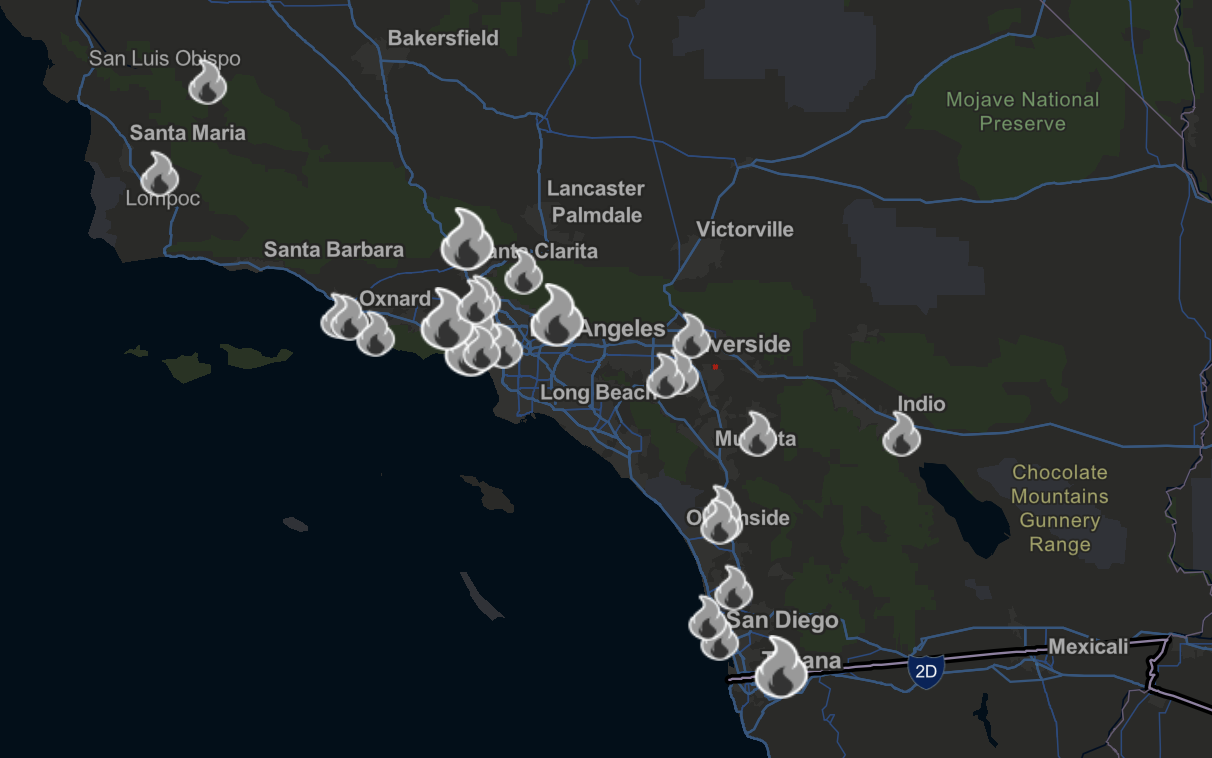
Even if one disaffected man with a lighter did not create all the fires that spread with rapidity on the edge of the urban infrastructure–and the rekindled embers of the flames lit by a deranged man with a lighter are hardly responsible all the fires that erupted that month outside of San Diego–

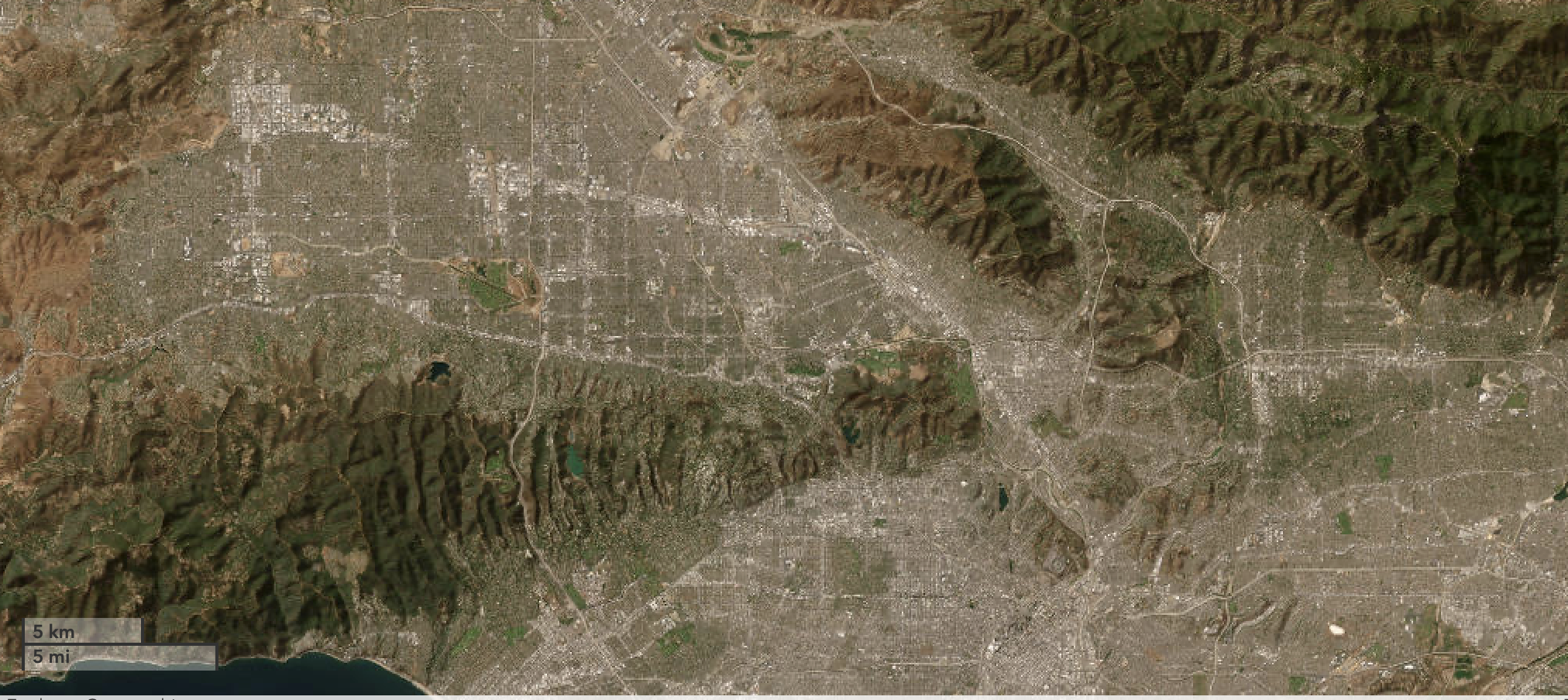
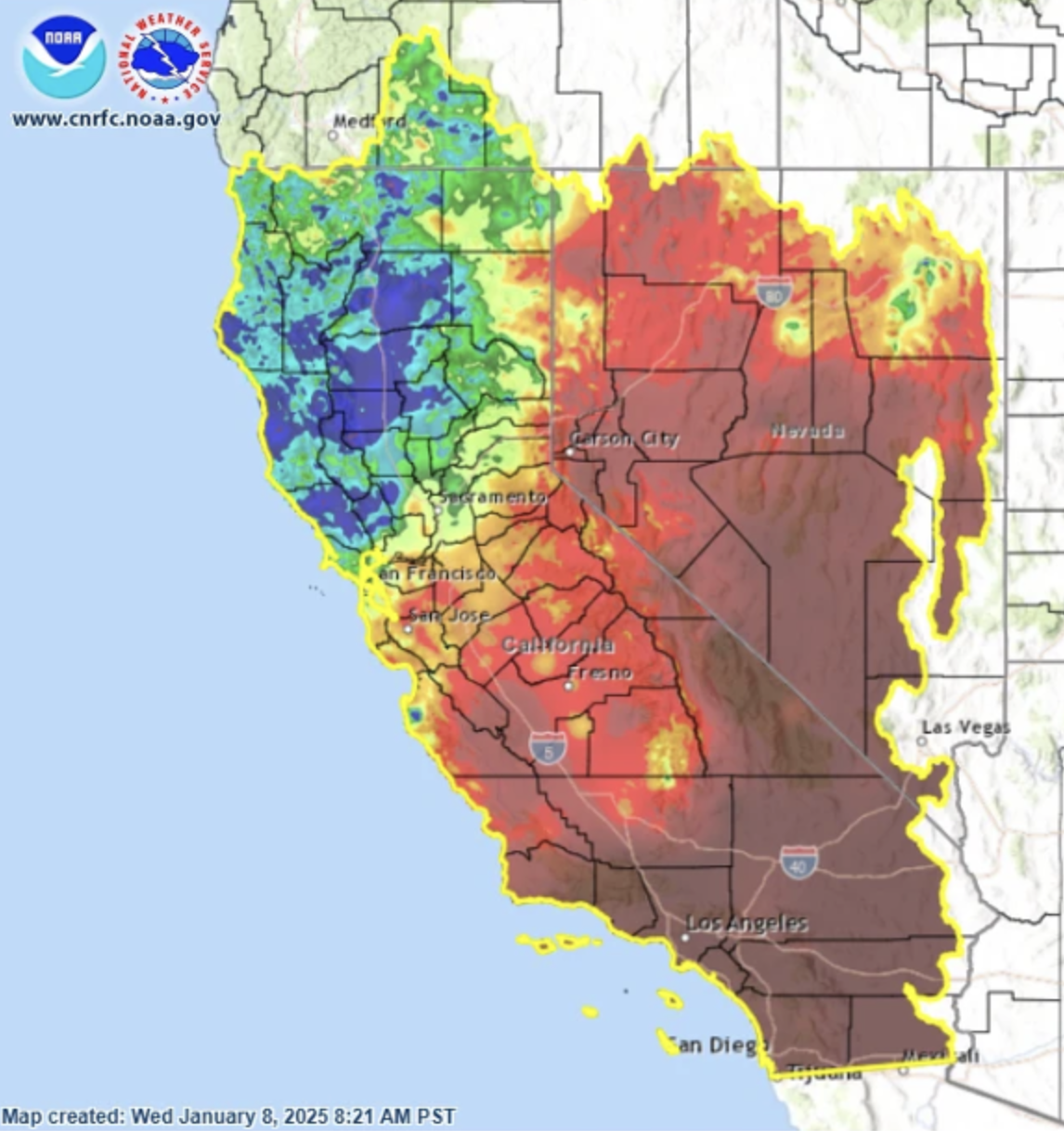
NASA Scientific Visualization of Los Angeles Fires in Southern California Fires in January 2025

–the spate of Southern California fires that were primed by such dry weather and intense winds have remained pressing problems of collective and individual responsibility that led so many to stand dumbfounded before their expanding peripheries, as the fire zones only grew and grew.

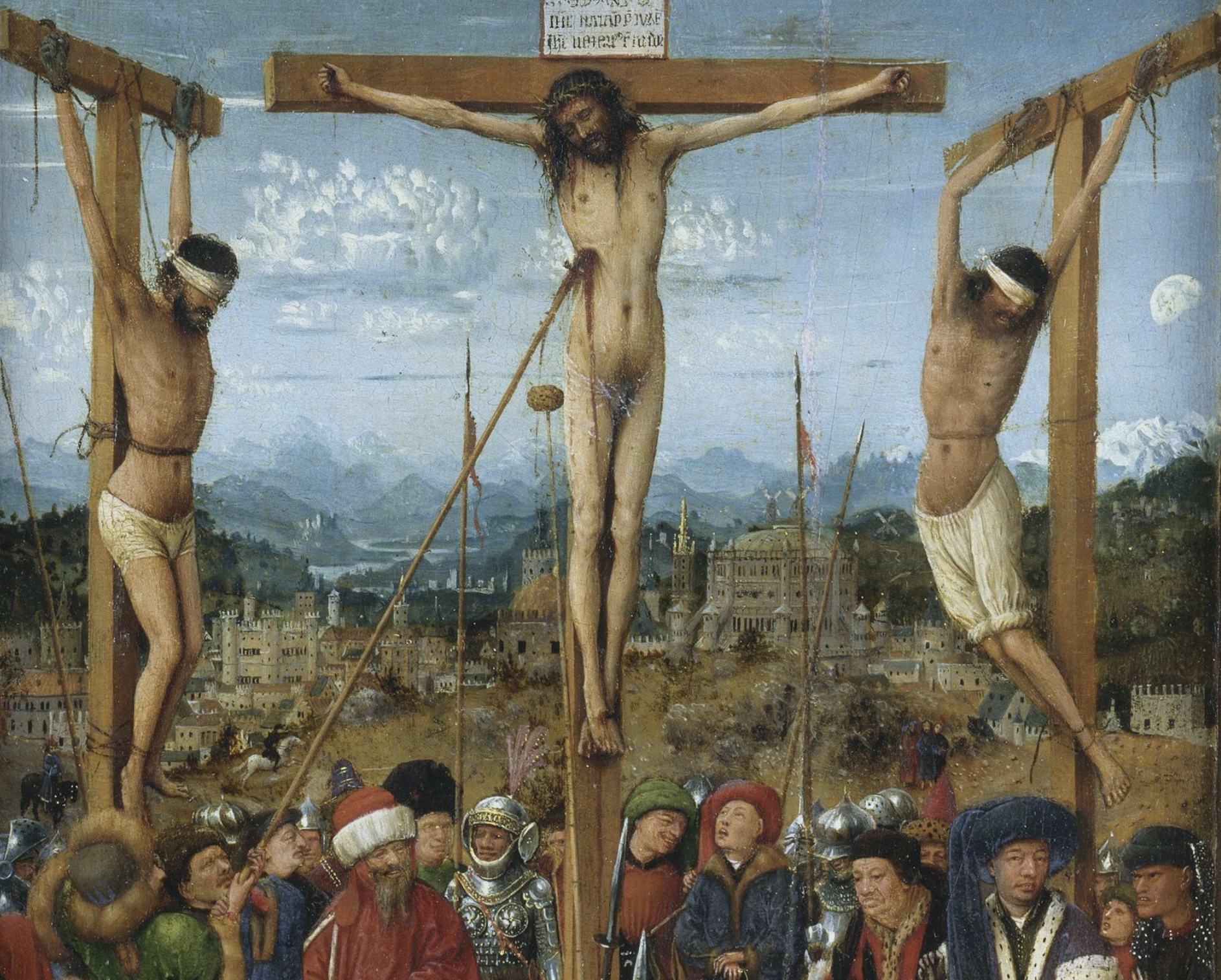
But the diptych is a storied genre, due respect on its own as a moralizing genre, first named after a writing tablet in the ancient world and Roman Empire, pairing religious panels for a narrative with visual punch, often for travel and portability, as a deeply powerful image of faith, packing a punch for moralistic ends that had some powerful conjuring of a judgement and apocalypse–often terrifyingly vividly detailed in fantastically spectral ways to conjure a material record of apocalyptic power for moralized ends. While Rinderknecht is cast as a deadbeat Uber driver, and Doordash deliver man, dealing with the emotional fallout of a messy breakup, he came from a family of devout Baptist missionaries, whose evangelism has been viewed at a remove from Rinderknecht’s arson. The director of the Association of Baptists for World Evangelism has worked to keep it that way, in statements reminding all of the very heaviness of the arts of “everyone affected by the Palisades fires—those who were injured, lost loved ones, or suffered the loss of homes and livelihoods,” for whom they “grieve with them and pray for their recovery, comfort, and restoration.” The adult son of one of our missionary families was, he reminded us, unrelated his parents’ ministry works but the very power of the diptych that their son created suggested not only a sense o mental disturbance and destructive impulses, but a moralizing take on the nature of fires in the Los Angeles’ divided economy, able to be imagined as s diptych by all who live there, and demand9ing some compartmentalization as a mental strategy for most. If the Baptist evangelicals insisted publicly on clinging in such moment sot “hope while trusting in the justice and mercy of God, who alone can bring good even out of brokenness,” the diptychs commissioned by the Catholic medieval church where diptychs provided a basis for compelling sermons and devotional messages, as Jan van Eycke helped create in the pairing of a scene of the spectators who watched Christ’s crucifixion with apparent disinterest outside of Jerusalem, as the Virgin and Mary weep, with several patrons, of the work, paired with the Last Judgment and detailed hells cape of the torments that are inflicted upon the sinners and damned.

Jan van Eyck, Crucificioin and Last Judgement (1430-40)/Metropolitan Museum of Art
Detail of Hells cape

Jan van Eycke was a landscape artist of consummate perfectionism and details, who had also painted or created a world map for the Flemish court, if not part of his surviving oeuvre, and the mapping of the contrasts of painful suffering, put in the futurity of the terrifying Last Judgement in the Renaissance diptych, seems collapsed to the present of the burning of Los Angeles, a cautionary statement as much as the product of a deviant imagination, offering a moralized vision of the Los Angeles fires to which spectators in the downtown area seem entirely oblivious as they “chill.”

The charge or commission that Rinderknecht gave to ChatGPT was not of a disaster, but a divided canvas, understood in quite pictorial terms, of moral impact. Imagining fires in an urban landscape “divided into distinct parts that blend together seamlessly” is hardly a criminal act. Rinderknecht sought to map the fires to show a featured socioeconomic divide as if the result would be a clearheaded depiction of a socioeconomic divide. He desired a clear contrast between “on the far left, a burning forest” next to which “a crowd of people is running away from the fire” as “hundreds of people in poverty are trying to get past a gigantic gate with a bit dollar sign on it” that symbolized the city’s stark socioeconomic divides: while a “conglomerate of the richest people” relax while “watching the world burn down, and the people struggle” without registering the disaster, “laughing, enjoying themselves, and dancing” per Rinderknecht’s descriptions, asking the chatbot render a nightmarish dream as if for an artistic commission, stipulating that the painting be “detailed and impactful, highlighting the stark contrast and the direct connection between the different parts of the world.” Rinderknecht seems to have sought to make an image that might mend the fences between the glaring economic differences he had trouble living with.

Jonathan Rinderknecht no longer works for Uber, but he must have danced around the Palisades in a dream state of some sort on New Year’s Eve, when he had to drive fares, after watching the kinetic video. He didn’t know that he was setting what would be, after it rekindled from the ashes that had been smoldering after the initial fires were extinguished on New Years Day, no doubt with some annoyance from fire protection folks, but would be on e of the most destructive and deadliest known fires in California history, far beyond the proportions and scale of what Rinderknecht asked ChatGPT to predict, leaving smoldering coastal properties in disrepair, and destroying many homes of the less well-off located further inland, creating the modern version of the inferno of the Palisades Fire that caused so much loss. (The alt right news machine took the story as a way to move swiftly into action, noting Rinderknecht’s anti-Trump social media posts and his readiness to link the disaster of the fires that dominated national news to climate change to the conflagrations, as if all climate change activists are closet arsonists, looking for ways of getting away with it and shifting blame to the skies.)

Few morals can be drawn from the fires, if we are still hoping that lessons might be learned. The scale of the fires that raged across 23,000 densely forested and inhabited acres raged with a destruction that Rinderknecht must have followed on social media and television with nagging fears, having asked that least expensive of therapists and attorneys if one is “at fault if a fire is lift [sic] because of your cigarettes?” in hopes to deflect responsibility or agency for the conflagration that spun out of his intentional acts of arson, moving to Malibu, where all those seaside houses were destroyed, Topanga Canyon, and Altadena, where communities were flattened.

Rinderknecht wasn’t wrong when he blamed climate change, but the peripatetic troubled man who had broken up a few years back with a romantic partner and was on medications had been working for a while in the vast service economy of the sprawling city, navigating its economic differences that seemed as if he wanted to peel apart the gaping Lyellian strata in the city that evident to a delivery man for Door Dash and an Uber driver. As he walked on the trail with a lighter in hand after dropping off fares who reported their driver to be angry, he maybe made a bad judgement call in selecting a song on his iPhone–but probably rather intentionally selected an anthemic song that glorified the pyromaniac’s abandon lighting fires in an urban setting that seemed an image of cool. Johanthan Rinderknecht was, of course, listening to ominous soundtrack of the depths of urban alienation on his iPhone of a sleepless, haunted man walking on another urban periphery, probably Paris, wallowing in his sadness and fantasizing lighting fires as he lights up a joint–or lighting fires in trashcans–as he is walking in a poorer boulevard, or what seems one, captivated and entranced by paper fires set in trash cans at which he stares, hoping to get himself thorough a sleepless night or just numb his pain, turned to the image of rage and destruction on another urban periphery.
Un Zder, Un Thé

Un Zder, Un Thé

On the trailhead on which Rinderknecht walked from his car, above the tony sprawling mansions of the Pacific Palisades, Rinderknecht seems to have been lighting things with his own lighter. The spot was later identified as a crime scene on the rocky bluffs overlooking the ocean off the Temescal Ridge Trail, feared begun by revelers, to judge by multiple glass shards of abandoned broken beer bottles where the embers of the fire reignited on January 7,–a week after Rinderknecht lit his own earlier fires with a cigarette lighter, as the “holdover fire” rekindled from its embers.
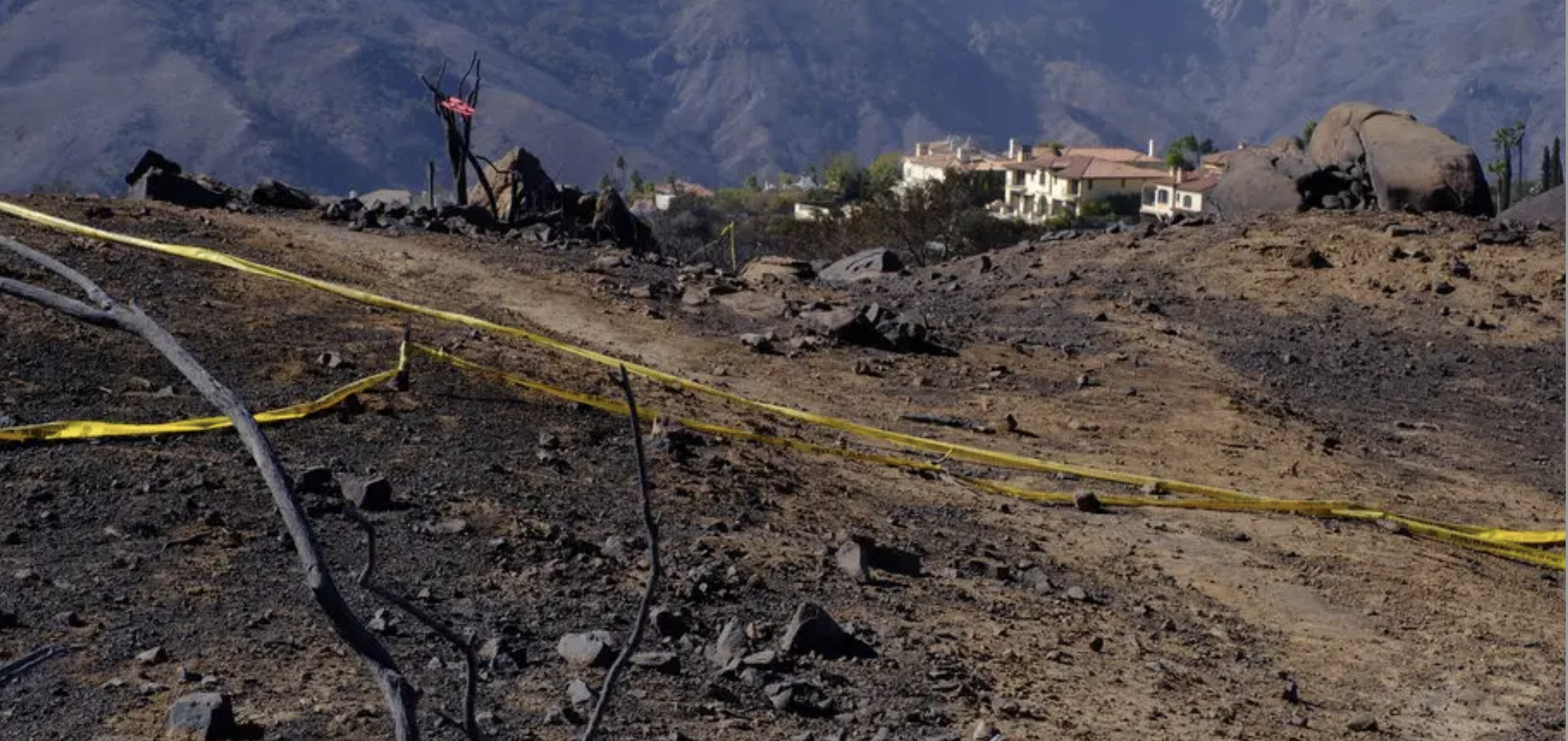
Black Migliori/New York Times

To be sure, the setting of fires on the urban periphery is not the breaking of Jacquard Looms–and carries far greater consequences in an age when the intentionally setting fires in Southern California forests should face stiff penalties. Rinderknecht may have been a pyromaniac who willfully set fires to either paper or vegetation in a combustible area of the forest trail he let the car for a walk, but he was responsible enough to come to his senses and try to call 911 after starting fires with his lighter in local vegetation, though cell service forced him to retry multiple times.

Will OpenAI include an automated outreach to 911 for certain suspicious queries to ChatGPT in the near future?

The shift in the valuation of homes in the region that seems targeted by Rinderknecht may have an absurd overvaluation, with prices of homes unthinkably unattainable for most Angelenos but also map onto extreme divides of wealth can make it hard to traverse such economic extreme shifts, of almost seismic divides, stressful in the boundaries of inclusion and exclusion they draw of wealth inequality and “haves” and “have nots” that are increasingly common in many American cities, but are in Los Angeles even more hypertrophic at the luxury residences at the edges of forested lands.
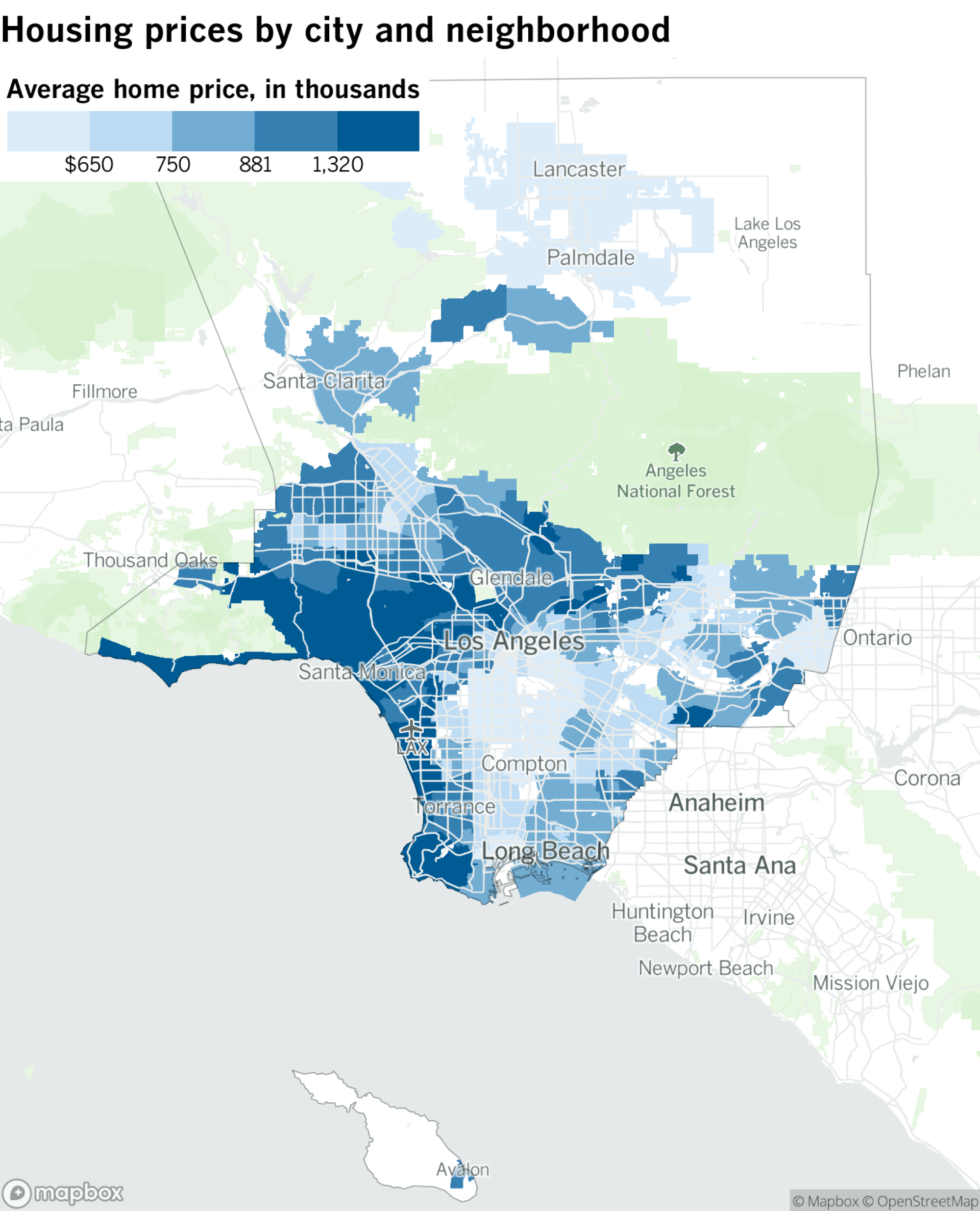
Housing tracker: Southern California home prices and rent - Los Angeles  Times

This would be, probably, the least desirable outcome of the pressure that may grow on OpenAI to take responsibility for the fires, as it shifts attention from modes to resolve the underlying reality of the desiccated landscape that global warming and climate change have produced in California–and the fact that fires are almost desired to recur with increased violence in coming years, and the need to expand protective measures in the face of record levels of dryness during the late autumn and winter months.

The need to attribute a sense of human responsibility to one marginalized individual is an odd way to confront the questions we’d been asking about the role of climate change in provoking the fires–but has to be recognized as a perverse attempt to point the finger at a disturbed individual, without whose malicious acts the fires might not have occurred. As we were beginning to turn attention to the many malfunctions and limitations that allowed the fire to spread to rapidly–from problems with water supply, warning systems, and indeed escape routes, some dealt with in an earlier post–gridlock was so intense as a result of the fires’ rapid spread that the Los Angeles Police Department was forced to devote increased attention to clearing roads for the entry of needed emergency vehicles. But the infrastructural problems of the warning systems that should be in place and the firefighting tools we should have are displaced and the weight of responsibility is focussed on the shoulders of a bad actor–perhaps obscuring and hardly helping how we remember the devastating consequences of the fires’ destructive spread or questions of future fires’ prevention.

Deeply alone, per reports, and probably feeling as dark as the nation after Trump’s victory, perhaps the request for a diptych of a scene of a fire of “two parts”–“on one side of the gate and the entire wall is a conglomerate of the richest people, . . . [who are] chilling, watching the world burn down, and watching the people struggle” was almost a projection of his sense of torment in a city whose neighborhoods are so starkly divided by wealth. The notion of “watching the world burn down” was what much of the nation was feeling it was doing, as the greatest fire in California burned, leveling 23,00 acres, as he was listening to an anthem of urban alienation, filled with the idea of how the residents of LA existing in split reality,–perhaps the most successful aspect of the painting ChatGPT generated for him.

Credit: Department of Justice

The prosecutors who released the generated images of a destroyed city seemed convinced that they presented a tight case against him, if they didn’t need to add much to fact that he was watching images of a stoned rapper lighting fires with abandon in urban streets in the glare of streetlamps, iPhones, and headlights of oncoming cars in a late-night urban landscape of increased disorientation and quick cuts of a modern flâneur in its combination of alienation and curiosity of distanced bemusement at the nocturnal street life around him, in which the iPhone is in a sense his only weapon of defense. Jonathan Rinderknecht had, in fact, become. While the moral valence of the flâneur who is a disinterested observer of urban life, who wanders the streets in search of interest, was taking advantage of the keen awareness of the new spaces of modernity for Benjamin or for Charles Baudelaire, albeit expeeriencing a deep for alienation to which the city seems to give rise, Rinderknecht clearly took advantage of his car as he returned to the scene of the crime to contemplate his act: he drove the car back, without passengers, no longer working for Uber, following the fires engines back to the approach the site where the flames were already spreading, hoping that they’d extinguish them after being alerted by his emergency call, if not sensors. Was he not only anticipating the spectacle of spreading conflagrations as consuming property with abandon as he took video on his iPhone from near the spreading fire, coming within thirty feet of its flames to judge by his GPS, as if a moth drawn back to a flame? While we consider the pyromaniac unhinged from reality, the return must have been rather compulsive for one who set the fire, as if to be flooded with some weird rush of emotions as he watched the results of his own handiwork, engaging in the urban environment in distinctly new unexperienced ways.

His very spectatorship of the fiery destruction of this exclusive area of Los Angeles made him a flâneur of urban disaster,–not a new type of flaneur, if one that anticipated the spectatorship of the Palisades fires LA residents watched with newfound disempowerment,–stunned ifpassive before the real-life urban spectacle beyond anything they saw on their television screens, rekindled by hurricane-force winds as it spread beyond the Palisades across 23,000 acres to Topanga Canyon and Malibu–pricey locales to live indeed–as well as Altadena, leveling 6,000 structures and actually clearing multiple communities without much distinction of class, even if it seemed to be targeting the superrich living in Pacific Palisades–the name by which the fire became known. The sense of a watching the actualities of such apocalyptic realities unfold in real time was of course different than the scale of spectatorship of the fires that would rekindle form the fire he set, but he was consuming the information he perhaps might have heard on the radio in all its visual intensity, viewing not the effects of the fire’s spread or its map but the flames he had imagined at first hand, as one hears a pyromaniac is vertiginous before, as if it was a sight of the city, even as he tried rather desperately to distance himself from it, by trying to claim he was hardly at fault legally for having created anything like an actual loss of property:

For when heavy winds whipped up the flames believed to be extinguished on January 7, just in time for Trump’s inauguration, the embers of the Lachman Fire he lit bounced back to create the apocalyptic scenes he had asked GPT to imagine, if the truly dark clouds from which all those imagined people flee, running past what seems an emergency vehicle, seem walled off in a dystopia land of Rinderknecht’s earlier creation, walled off from the utopic image of the city whose residents seem to go about their business at a safe remove from the growing conflagration. The billowing smoke that blanketed forested lands’ skies in the generated image below were perhaps so triggering to compel OpenAI to issue a public statement, disclaiming any culpability for providing these “pictures” of apocalyptic reality that seemed to envision the disaster of the Palisades Fires in almost biblical terms as the end of an empire. The OpenAI team was making sure everyone knew it was absolved of responsibility, for providing that image months before the fire began in a “dystopian painting showing in part a burning forest” as residents flee the specter of spreading flames, desperately doing their best to escape death and destruction by “running away from the fire.”

The images OpenAI allegedly generated for the wayward Uber drive certainly seemed a smoking gun of sorts, to use the completely wrong metaphor that might make one’s hair stand on end: the public release of search histories, web searches, text messages and the like have become the norm for looking for clues to solve a crime, and if the identification of the Palisades fires with arson made it a crime, the dystopia images Rinderknecht asked the virtual chatbot Rinderknecht seems to have regarded as a privileged interlocutor in a dark personal time can’t be reasonably treated as privileged within the penumbra of privacy, if the examination of one’s history of generating obscene images of global disaster–more serious than online pornography?–are certainly admissible in court. The search of search histories may be undisputed as a way to gather information about criminal sources, and is not breaking into the office of a psychiatrist, but Rindeknecht seems, as many, to have regarded ChatGPT as a psychiatrist or therapist of sorts.

The accusation of premeditation seems evident from the apocalyptic images of the black plumes blanketed Los Angeles the region’s once blue skies with smoke of dangerously high levels of fine particulate matter (PPM 2.5) from several wildfires that were spreading into the surrounding hills,–prompting warnings from health agencies as the AQI index rose to 400 or 500 near the fires and “hazardous” within five miles of the fires, and “unhealthy” for the entire city–until those high winds blew the dangerously high levels of smoke away within the week, ending school shutdowns and public health warnings that seemed like COVID all over again.

Smoke from a wildfire blankets the sky above Venice Beach in Los Angeles. Air quality in the region is unhealthy because of several wildfires burning.

Venice, CA, covered by smoke from Palisades fire, January 8 2025/Jae C. Hong (AP)

Environ. Sci. Technol. Lett. 2025, 12, 8, 911-917

The static nature of the computer generated image that seemed to forecast all this apocalypse used eerily similar colors. The canvasses that it generated in multiple possible options–did he make his request multiple times?—was so epic in scope it hardly revealed active running of individuals; those standing to the right, with hindsight, can hardly be looked at without imagining them as spectators of the very sort Rinderknecht would turn out to be as he drove back to visit the fire as it spread along the trail he had taken a short walk after dropping off his ride, positions known by his GPS.

The rather generic images that may offer a window to his intentions are in fact strikingly dispassionate, as might be expected for a computer generated image, with little sense of a viewer, so much as recycling imagery from other sources by an algorithm that suggests meeting a set of rather complex specifications to translate quickly into visual form. The virtual “paintings” don’t suggest any emotions, if they are oblivious to the surroundings, hardly seem to be “chilling” in a state of relaxation, if the search engine did add copious waterfalls that suggest the opportunity to “chill” was close at hand. (One wonders how many paintings ChaptGPT is asked to generate for its users, and the remove of the act of “painting” from a backlit screen. Such are among the multiple hazards of commissioning paintings from ChatGPT.)
Credit: Department of Justice

The artificially generated flames to gain such eery resonance even in an image that that OpenAI to remind folks that they fully cooperate with law enforcement following the discovery and that the imagery their app generated did not include any content that went against the company’s policies and best practices. The idea that the generation imagery of a city being destroyed–or even the obliviousness of half a society to the burning of what might be the “whole world”–would place it at fault may seem perverse, but the generation of fictive landscape that somehow have a purchase on the realities we later experience may seem like the virtual images had given him a plan. The fire seemed as if it was somehow something cleansing and redemptive to him, to judge by recent reports, and the generation of an apocalyptic scene of the world’s destruction was not only “dystopian” but seemed about a deep disconnect, if the laughing wealthy of the anonymous conglomerate on the right of the diptych are not clearly “chilling” and enjoying the world burn, but the GPT engine has a hard time with portraying pleasure, if it quickly generates fictional images of cities being destroyed by flames.

Credit: Department of Justice

The generated images of course remind us of the very contrast between fragility and permanence, deep contingencies of built environments, even if fire seems weirdly walled off rom the city to the right, its wealthy residents almost oblivious to the truly Dantesque images of all those small beings in a tortured landscape on the left, that was made at the request of the twenty-nine year old arsonist, who will have a hard time arguing that he didn’t ideate and have any intent to set a fire this large, or to do so in ways that would reflect on the deep social divides of the modern American city that are so strikingly clear in Los Angeles–incarnated by that weird virtually generated wall that Rinderknecht seems to have requested figure so prominently in the images of destruction that he very much wanted to see, and then seems to have sought to start.

The progression of the fire almost seems to taunt the infrastructure of that ideal city that stands to the right, as if to show the underlying pain that exists at the same time at great proximity–and the fragility of an actual dividing line between them, that seems a divide not only of property but an insurmountable wall between emotional states. The ChatGPT search engine is good at making the conglomerate from architectural models, and the pleasure of “chilling” seems to have been captured by snow-capped mountains or what seems a landlocked iceberg that floats beside the skyscrapers of the city that looks only a bit like downtown LA–but those black clouds and fleeing humans look downright medieval, as if the global destruction Rinderknecht asked be generated was apocalyptic indeed.

Credit: Department of Justice

The contrast between those dark skies and the blue skies above the skyscrapers and factories that belch out computer generated columns of smoke can hardly compete with the intensity of the black skies over the left half of the “painting” that seem malbolgeian, and may well be about the future of a catastrophe enabled by the failure to take adequate protective measures in the face of climate change. We do seem to be facing some very hight walls indeed, by which we are pressed from both sides, as the people in the final image, who seem to find no pleasant situation between the incandescent blazes and the chilly box structures, where the appearance of the fires seems to have no clear origin, but is rather an existential condition, as they engulf the city with flames as much as fireballs, in a condition that seems no one will leave, even if this one seems to be set.

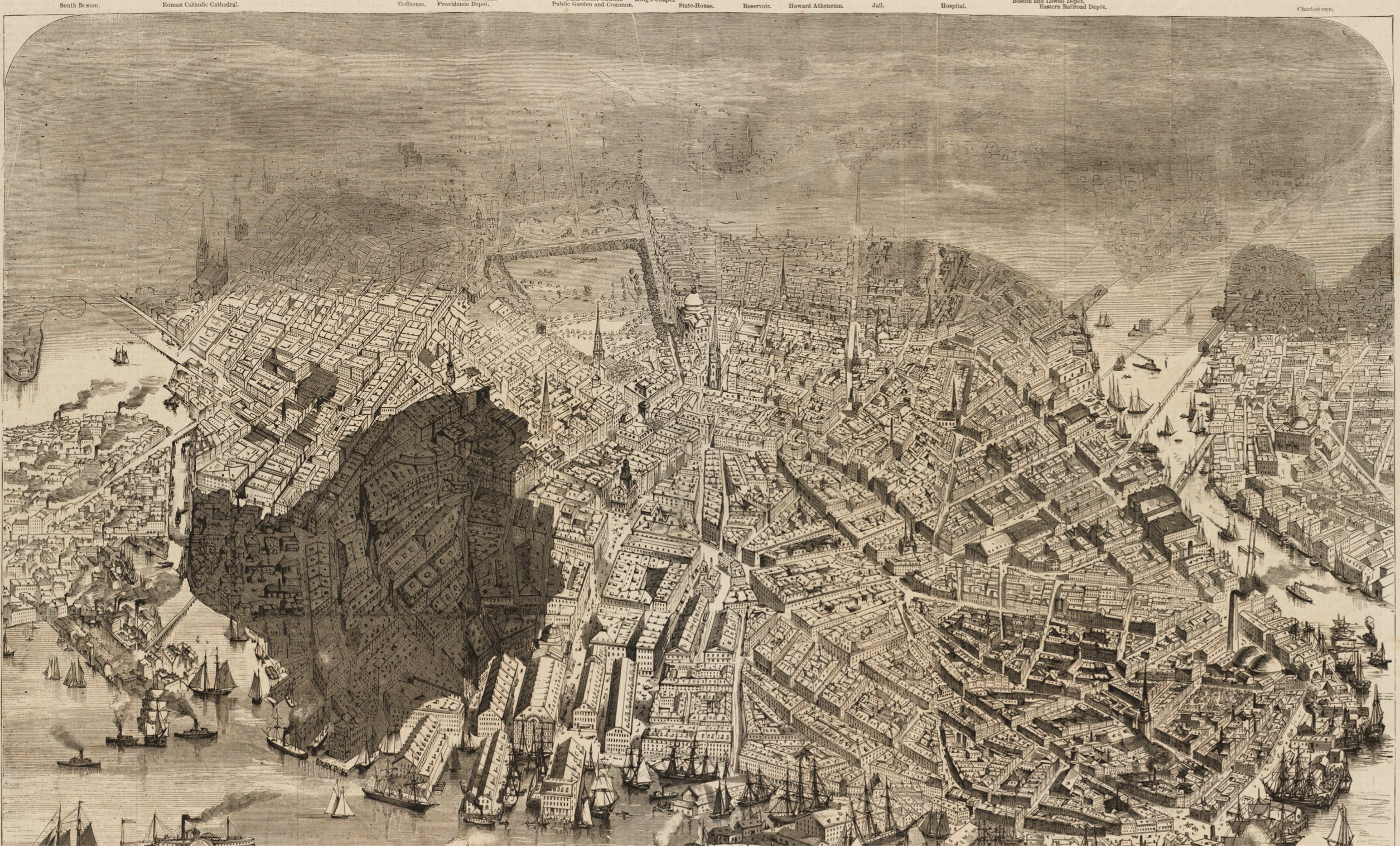
The phenomenon of the fire on the margins of woodlands that are increasingly flammable seem terrifyingly somewhat endemic to the expansion of California cities into what is called the “woodlands-urban interface,” as a region of greater dangers to incendiary disaster. But the spread of panorama of urban ties that suggested the dangers of densely populated regions made them an extremely popular conceit of the panoramas that traveled round the country in mid-nineteenth century America, as if in an antebellum sort of internet, providing pictures of far away pleasures and terrors. Such panorama regularly featured the heightened vulnerability of cities’ lower classes to such “urban disasters”, including the firemen made up by members of lower classes, and recent immigrants, as well as those perennial thrill-seekers who approached too close to watch fires spread.

The occurrence of a conflagration amidst the panorama being unscrolled became a stock object due to techniques of lighting and stock tools of dramatic staging as they punctuated touristic itinerary and narratives to reveal sudden urban dangers, offering thrills with warnings to audiences in Buffalo or Lowell, Massachusetts of the dangerous lives of city-dwellers: despite the reassurance that when “a fire occurs in any part of the city, the men at the bells readily know the district in which it is situated and they make the number of the district known to the fireman, by the number of strokes on each bell,” in a reliable system of communication than what existed for the Palisades Fires, panoramas apologized “we see here some of the bustle and confusion and fleeing that is attendant upon a fire, . . . we don’t hear any of the noise. This is not represented on the Painting.” Few paintings can even communicate the sense of individual travail and desperation, if the paintings of Rome burning in 64 AD seems to have come closest to trying to convey as much in the gestures–

Nocturnal Capriccio of Rome Burning, Pierre-Jacques Volaire (1767)

—if the disproportionate nature of Neronic obliviousness to the suffering of the may seemed the basis of Renderknecht’s request–and the rumors that Nero had the fire set himself seems oddly echoed in the sense that the AI generated images prove Rinderknecht’s guilt, evidence of the Uber driver’s confusion of virtual reality with actual fire risk in the Palisades. Mid-nineteenth-century theatrical display of diorama vicariously conveyed the sense of urban spectatorship, however, in vivid ways, that made them a traveling business of sorts for canny entrepreneurs, predating disaster flics, unspooling six-feet high scrolled canvasses before paying audiences in a virtual itinerary of urban space that allowed them to be flâneurs of their own, even if located in the safety of a theater in Massachusetts for several hours, exploring the new social topography of the city and its contrasts of wealth and urban poverty in “moving” images that noted the degraded nature of urban environments with abundant theatrical effects–a display of the contrasts of immense urban wealth beside immigrants’ poverty, from opulent buildings of the wealthy residents conspicuous display balanced by theatrically staged sensational conflagrations that spread among wooden houses of densely built cities.

At the same time as the scale of actual conflagrations were widely reported and experienced as terrifying disasters, their apocalyptic nature of fires of untold scale became a feature audiences promised. The adverts for panorama in published advertisements enticed audiences to attend “the grand and sublime spectacle of the BURNING OF THE PARK THEATER!” The suspected arson of tragic events as New York City’ s Tenement Fire of March 1860 and Great Chicago Fire of 1871 provoked panorama to try to capture their devastation in ways vicariously observed across the country, to process the spectacles of such sudden loss of life in urban landscapes; that fires that left uninhabitable burnt areas, destroying the homes and property of many as they were covered by smoke-filled air and ash (of course absent from panorama) seemed as if they were a precipice of modernity that paying audiences entertained.

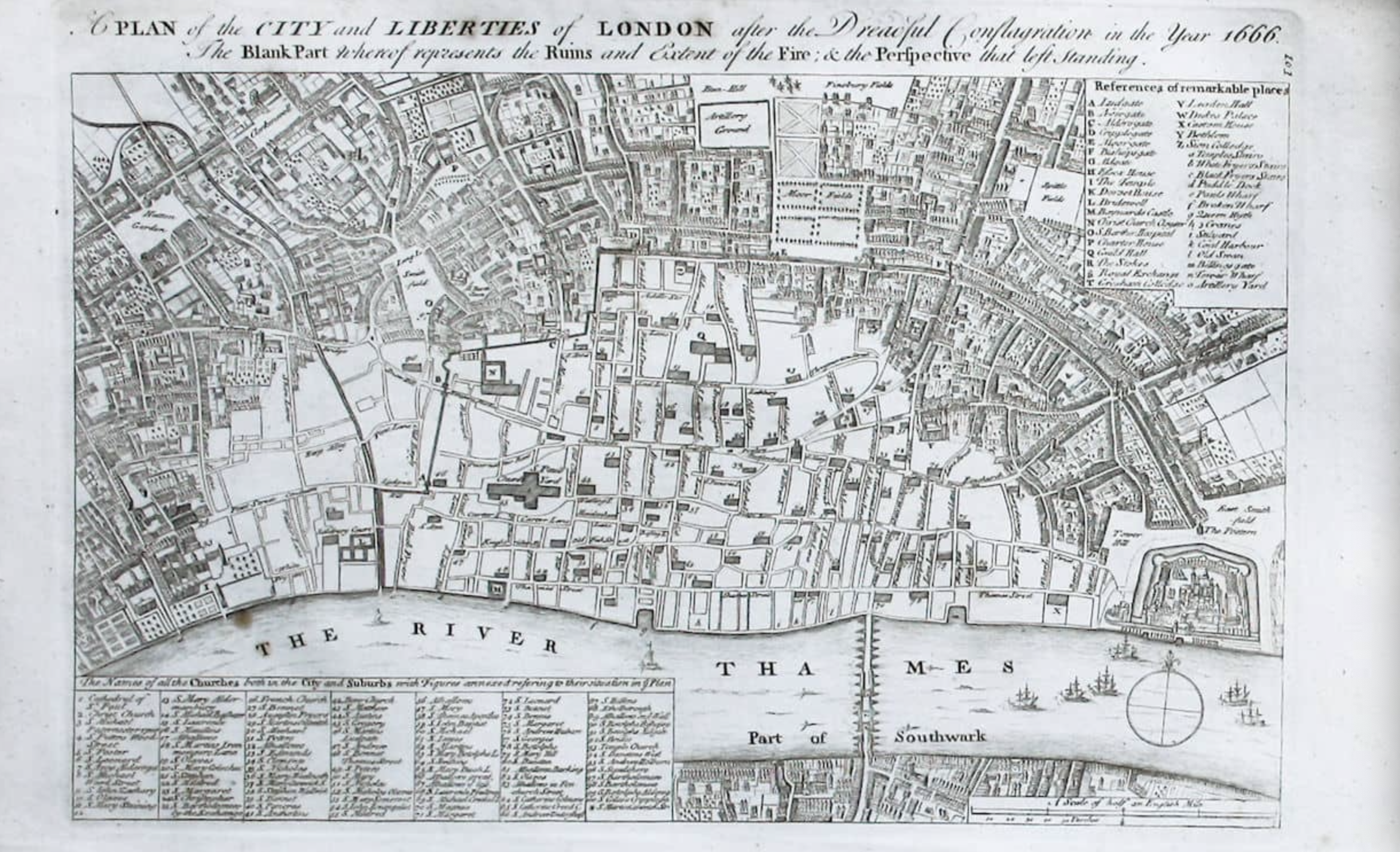
The hope to raise money for Relief Funds for the fires circulated nation-wide, for many of the same audiences who might have seen the traveling panorama, inviting they comprehend the scale of loss of the massive “Burnt District” of the Great Fire–almost a city within a city–that had spread through six miles of densely packed urban housing and transformed the shores of Lake Michigan to a salvage region of which stunned inhabitants arrived to snap photographs as they contemplated the scale of loss, the problem of responsibility, and the question of how to move forward in 1871. If the ruins of the fire were compared to a form of disaster tourism, leading many to try to experience the fires by going to the city that agencies would offer customers by dedicated trips “with ample time in Chicago for viewing the ruins” as if they might be transformed or reimagined as the ruins of a Grand Tour in Europe, available at cut rate with even greater effect, the new scale of the fire’s destruction that would rival if not displace historic fires in the scale of its tragedy–flames moving faster even that the Great Fire of London that had started on its wharves in 1666, that over three days destroyed the oldest built up area of some of densely packed wooden structures, in a firestorm fanned by winds that challenged current fire-fighting techniques of firebreaks–

–had created huge numbers of homeless in its wake, only later being rebuilt as dominated by broad streets to reduce the hazards of narrow winding paths, and allow firefighters to better fill their tanks in the future.

The problem of confronting the limits of representation also existed for images generated by ChatGPT. The terror, the huge cost of life, and the massive destruction was not something able to be generated, nor the panicked bustle of the fire. Rinderknecht was a pyromaniac who enjoyed watching conflagrations–though generating fictional burning landscapes is hardly a crime in itself, so much as the condition of urban spectatorship. Would he have paused before parking his car after ferrying folks to their New Years celebrations, hoping to close the year with a bang, and not walking up that trail and listening to the song he had probably selected to set fires on what would be his own final Uber ride? In what set a threshold for new levels of paranoia, the official complaint of neighborhood groups representing Palisades victims at a dozen companies, including major utilities as Southern California Edison and phone networks such as Charter Communications and AT&T, related to the delayed response to the fires that rekindled in the Palisades, were filed just after the public announcement of Rinderknecht’s arrest, when federal prosecutors released the ChatGPT diptychs of urban infernos, seemingly designed to push the question of “fault” in relation to the devastating fires into the past.

Nero Watching Rome Burn, Unknown Artist
Leave a comment

Filed under California, climate emergency, Los Angeles Fires, Palisades Fire, wildfire risk

“A Mighty Redwood of a Man Has Fallen”

Malcolm Margolin was among the coolest and most curious people I’ve known. And while terribly saddened by his recent death, and mourning his dynamic presence, he was long a model for struggle we will need to remember in a dark age. I first met Malcolm as we walked the Bayshore Trail in opposite directions, Malcolm appropriately seeming to patrol the newly reclaimed bayshore pathway a tradition of the Ohlone people. As if a modern Henry David Thoreau who found a new Walden in the East Bay, Malcolm seemed, walking along well-worn trails, self-appointed clearer-of-paths of the East Bay wilds. While from Massachusetts, this Harvard-educated hippie won a grant to write a book about working the land without transforming led him to appreciate the native ways of another tribe, what Gary Snyder called “old ways,” that were rooted in place as much as they channel American transcendentalists that was purely Thoreauvian in its spin.

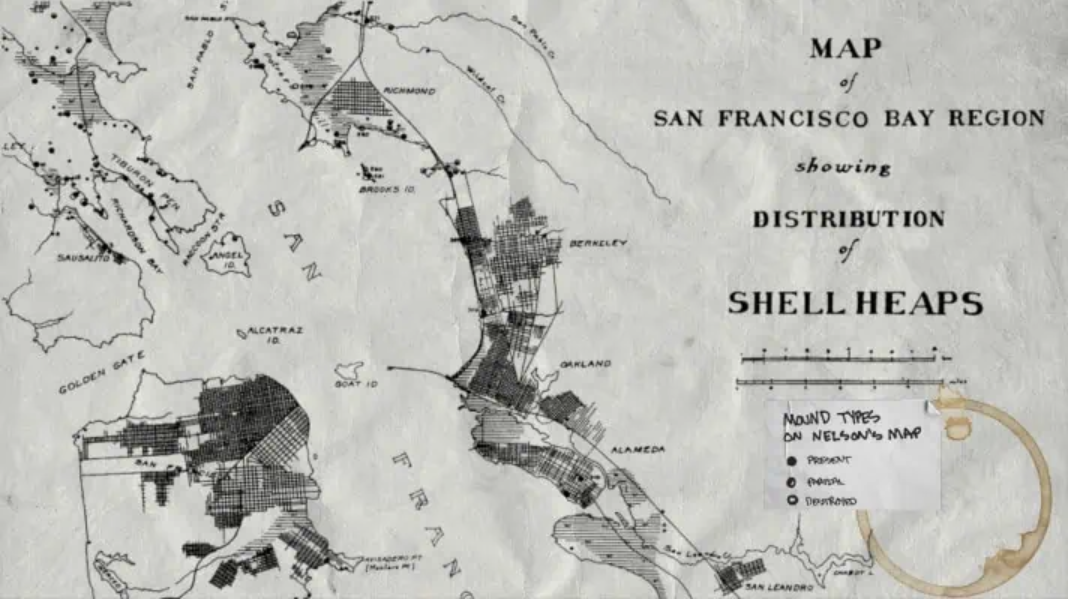
As Thoreau, Malcolm saw the ethical traditions of the local as a deep purpose of “rules, customs and practices outside the dominant way of life,” evident in the local Indian community, as if he recognized it–and adopted the vision of straddling outsider cultures and communities on projects of refusing to tame wild lands, allowing them to exist for our benefit against all odds. Malcolm grasped–as have others –the value symbolic anthropologist Clifford Geertz ascribed “Deep Hanging Out,” as a basis for ethnographers’ sense of purpose was immediately recognizable to Malcolm. And it was a way of describing his longtime Berkeley residency on the margins of academia, and at the center of a large industry of small presses as as deeply purposeful as the noted generations of anthropologists who had studied–and indeed mapped–indigenous cultures in the state, more often reifying their presence as an “extinct” peoples. Malcolm’s work, if often based on oral accounts of life before westernization, provided a model of Geertz’s concept of “thick description” less tied to the symbolic webs of culture, than the immersion in a sense of place and vital relation to place. The purpose he gained in the rich local setting of Berkeley, CA, from its parks to its shell mounds to its coasts and islands left a bookish world for close study of the ethics of place, before he brought this attentive wonder to a home in the bookish world. And the deep knowledge of place–a sort of expanded “local knowledge” of the Bay, to cop another phrase from Geertz–offered an alternative anthropology of the local, rooted firmly on the West coast.
As a former parks ranger who had, indeed, cut his teeth rebuilding the trails in what was Oakland’s Redwood Regional Park–a jewel of native forested lands of old growth trees in the East Bay, one of the large redwood forests in the East Bay, and third East Bay park open to the public–the largest natural grove of coast redwoods in the East Bay. While Redwood Regional Park, where he first worked and developed a sense of the preservation of the wild, was renamed after Aurelia Reinhardt, Malcolm must have been nourished by its old growth redwoods; I’d like to imagine, their age, if actually not that deep, gave him a new sense of spatial orientation to place to Ohlone residents, and a sensitivity to the suffering it had undergone and he might save. His love of place may have begun earlier building trails, but in immersing himself in the practicalities of lost woodland trails as a redemptive process led him to become a proselytizer of many regional off-road trails, to treasure them as a site of contact to other worlds and pasts in danger of being lost. If AI algorithms somehow generate a tie from a search about Thoreau’s writing at Walden between “the site associated with Henry David Thoreau’s experiment in self-sufficient living and a more recent effort to return land in Berkeley” to the Ohlone people, a missing link may be Malcolm’s attention to the uncovering of indigenous practices and histories of place.

The understandings of Indian Country that he gained, and enjoyed, led him to move between many worlds to establish his footing, and gaining a sense of potential redirection of past injustices that he dedicated a great part of his life. If few cartographers are so resistant to following rules, Malcolm’s interest in the quirky and the overlooked led him to blaze new trails across much of the Bay Area. Whether the serendipity of Malcolm’s work in an old growth forest in the 1960s, as newly planted redwoods of the region first provided a hope of restoring forested lands that had ben cut down.

Redwood forest trail

 Forested Trail in the Dr. Aurelia Reinhardt Redwood Regional Park. Photo credit: H Grimes 

While Malcolm told me a few times he would never have been able to research Ohlone Way (1978) or other works without the University of California’s library at the ready, praising the gift of the open stacks at the public university, this East Coast transplant who lightly tossed his Harvard credentials cast himself as an outsider intellectual who could serve to orient a new generation to the region’s native lands. Malcolm had, in Ohlone Way, animated a sense of preserving native ways. If in part this followed Alfred Kroeber and Henry David Thoreau in describing Indians as “extinct,” at first, at least in California, he spent much time and effort revising the remark with a celebration of native presence and the vital nature of traditional tribal arts–few did as much to stress their current relevance and continued presence in these lands. While Malcolm’s project of “cultivating the wild without taming it” became a sort of ethos of the outdoors, popular in the era, his guides to the practicalities of the wilder areas to enter just outside the East Bay and San Francisco presented a vital document of a world before urban sprawl, promising to rehabilitating one’s relation to the wild–and rehabilitate one’s soul–of deeply Thoreauvian ends of transcendental thought.

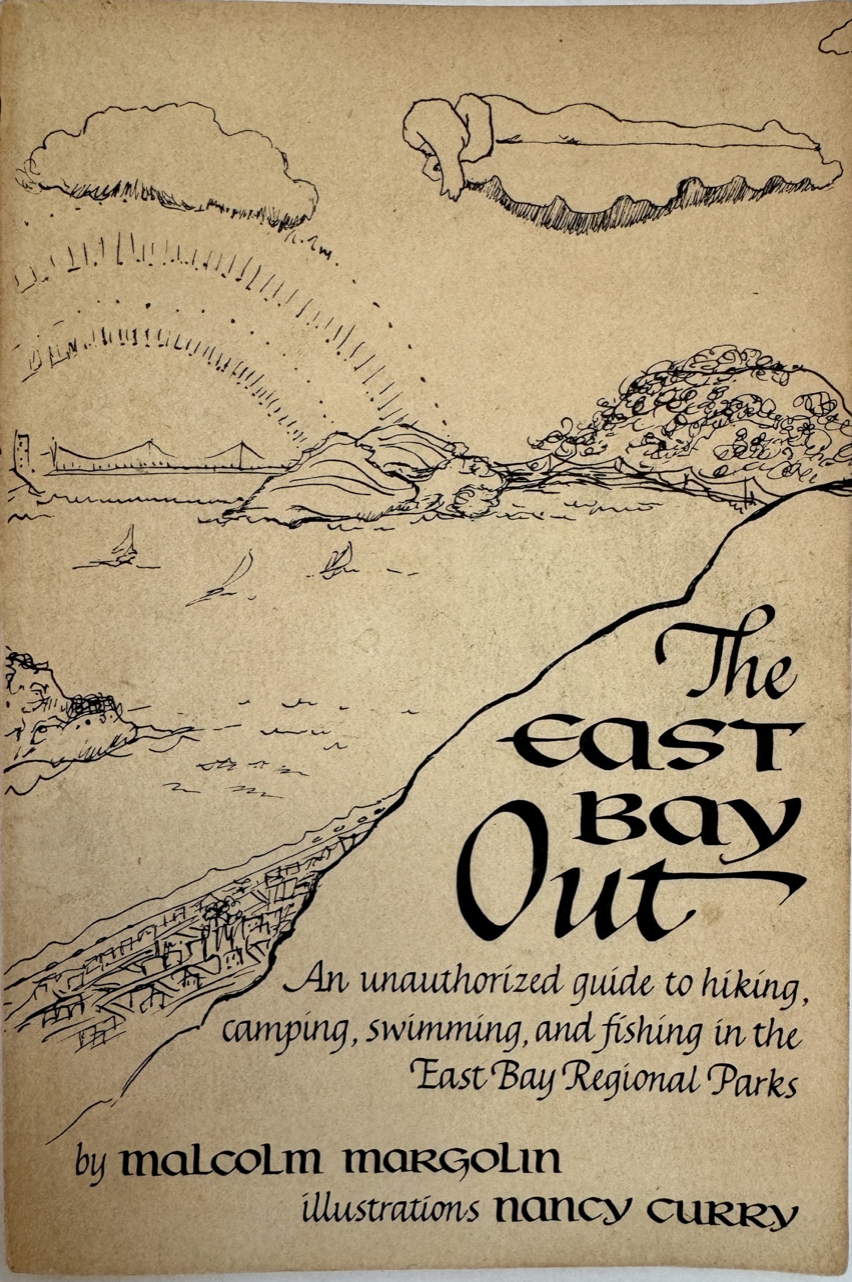
East Bay Out (1974)

For ever since idiosyncratic explorations of the region some fifty years ago, and the pioneering communication about the land he learned to know so well, East Bay Out (1985), the very deeply personal guide that allowed audiences to embrace to orient themselves to the Bay he loved, as if it were a world outside and beyond the familiar, to explore out of the paved regions of Berkeley, in what has been an increasingly compelling mode of deeply meditative work on the edges of settled world we collectively failed to pay sufficient attention as built infrastructure expanded. If an idiosyncratic sort of cartographer who bucked at the idea of having to follow rules, Malcolm developed a sense of wonder in the East Bay, as much as he simply moved there; as he immersed himself in its forested wilds, the parks became a keystone to the admiration of nature–as he grew to be the elder statesman of wonderment, never tired at pointing to the overlooked we needed to notice, and most at home when he engaged as deeply as possible in his surroundings, including, of course, its rich indigenous pasts to which he dedicated so much attention and wonder. As if the making of trails in Redwood Park were a weak fit with his ambitions and skill, trail-making lead him to blaze trails of inquiry across the East Bay, in part because of his resistance to following rules. If Thoreau had famously described himself as all mapping, for Thoreau, was indeed a form of reclaiming an ethical relation to space, from the recuperation of a mapping of an ethical relation to the Concord River that spanned its indigenous past and the present, through the French-Indian wars, but also, at Walden Pond, a universal history of heroic aspect and the present.  As Thoreau described himself to readers of his book–Malcolm knew it well–as the self-appointed “surveyor, if not of highways, then of forest paths and all across-lot routes, keeping them open, and ravines bridged and passable at all seasons, where the public heel had testified to their utility” Malcolm had a deep sense and deep meanings of new forms of mapping as a public utility.

As access to the wild shrinks and is constricted, Malcolm’s work stands as a theological practice of the outdoors, perhaps as rigorous as the ethical practices of his Yiddish-speaking grandparents, if more light-hearted and wondering, with an ample dose of John Muir’s sense of wonderment at the Cathedral of the wilderness. The sense of straddling worlds was perhaps a deeply Jewish angle to the past: if Malcolm was born in Boston in 1940, to a prosperous merchant family, less than a generation after Geertz had been born in San Francisco in 1926, the position that he had in Berkeley was one that left him little to be envy for his academic anthropological colleagues, more embedded than they were in local cultures in many way, but with the distance on academic preoccupations and terminology, or indeed on his scholarship: the sense that Jospeh Epstein expressed of both being “part of a great nation, and, having been born Jewish, simultaneously just a bit outside it, too” as being quite a position of advantage for a writer was, I think, an advantage Malcolm also felt–an ability to write as an insider and outsider that was magnified or redoubled in his relation to academic writing, and the establishment of a new press to publish his work on the Bay Area’s landscape–maybe in emulation of Thoreau’s self-publication of his first book, A Week on the Concord and Merrimack?–certainly gave him a sense of shared perspective on the massive extermination of indigenous California culture, and the ethical importance of preserving its vital life.

For if his sense of deep ethics were entirely secular, and resolutely so, the intensity of wonder and interest in the living landscape from which an indigenous past had been dangerously distanced was fundamental in his straddling of worlds. That book had helped re-interpret the regional landscape of the East Bay landscape that Malcolm, a transplant from the East Coast, to be sure, made his own to an ever=-growing audience of readers. He had self-published the book a few years before I arrived in Berkeley, CA myself, as it happens, after Malcolm had become a force in the attraction of renewed fascination to the rich ecology of the diversity of the Bay Area’s natural history and the scale of their loss–The Natural World of San Francisco (1967) had just appeared in print, and former rock climber David Brower had already started to agitate tirelessly to preserve the natural landscapes of the Bay Area, fighting for the conservation of areas of seashore and wilderness in nine national parks from the Point Reyes National Seashore led to the adoption of the pioneering Wilderness Act (1964), promoting the notion of coastal preservation was energized across the country, in ways that created a legacy for conservation only being recently turned back after a generation has taken it for granted. Soon after land acknowledgements became the norm in much of the United States, and were played regularly on the PA system of Berkeley Libraries, to remind all reading that they were so doing on “unceded” Ohlone lands that the tribe possessed from time immemorial, the ground has shifted under our feet. The position of wonderment that Malcolm long held, from tromping around different East Bay parks to exploring the region that he convinced all who would listen was a wonderland, provided a source of resistance to the development of the Bay Area, a deep environmentalism of historical consequence. And uncovering trails of wonderment was what Malcolm was all about.

It may make sense to take stock of the major shift of the Great Society and 1970s of land conservation as part of a massive shift in collective memory of which Malcolm was part. If the Regional Parks provided a crucial space to hold the state in abeyance, and indeed to keep the state out of one’s life, the shorelines preserved in seashore parks–including much of the coastal region of California, that would lead to the California Coastal Commission–afforded an early notion of a remove from the state, by the early 1970s, to preserve the entire coastal waters of 1,100 miles of coastline from uncontrolled development of coastal property that would prevent the loss of access to coastal waters and the shore by 1972—best understood in the somewhat longue durée of the foundation and preservation of a ten national seashores across the nation from the early 1960s, a distinction that defined the nation’s drive to coastal preservation during my own childhood.

David Brower and the Foundation of Ten national Seashore Parks, 1961-1972

The memory of conservation may have faded more quickly, if Malcolm’s work did not help keep it alive. The local new energy of treasuring wilderness by books on open spaces, environmental awareness, and nature photography, calling for an ethos of conservationists of leaving absolutely no mark in the landscape “save the scars upon the Earth that could have been prevented had they stood their ground.” The pioneering work was never so clearly seen as in the creation of national seashores–an effort that might have begun on McClure’s Beach in Marin County, just outside San Francisco, and Tomales Bay Park, but created energy that led to the creation of “national seashores” across much of America–from Cape Cod (August, 1961) to Pt Reyes (1962) to Fire Island (September, 1964), to Cape Lookout (1966) to the Gulf Islands (January 1971)–and Malcolm saw the regional parks where he worked as a groundsman 1970-72 as something like an alternate text to the map of the current Bay Area, developing as an East Coast transplant a distinct sense of wonder at the biodiversity of the parks that survived, even if the rich range of grasslands, nourishing streams, and herds of elk and bears that once roamed the land that was cared for by indigenous survived only in the testimony of the first settlers. And if many are annoyed but he land acknowledgements that have appeared on university stationary, movie theaters, and play houses and arts centers as if pious obligatory statements, offering but lip service, the importance of preserving and observing the forgotten history of the land was a movement at which much of Malcolm’s work set the ground.

As much as a new Henry Thoreau, Malcolm remained at the helm of the press of most of his life–only leaving with reluctance, continuing even after his retirement to be an advocate of offering a path for all to find their own Waldens, and by a plurality of Thoreaus, not only in the Bay Area but far beyond. And if the parks provided a way of thinking outside the state, and subtracting oneself from the state that was increasingly entering one’s head, it is more tragic than ironic that as we stand at the prospect of a government shutdown after his passing, the President defined by a moral void and absence of any moral center seeks to furlough parks workers in response to the eventuality of such a shutdown, and indeed to mandate leaving the parks open to all Americans, supervised only by a with a rump staff, flying in the face of expert advice, not deeming the workers who run them to be essential workers who must remain on their jobs for its duration–if some in the National Parks would be required to stay on the job, but have to wait for back pay. Parks Service was already reduced by a quarter since Trump took office at the year’s start, cutting backcountry visits, the presence of rangers, and relying on volunteers at parks as historic as Yosemite, but the reduction on critical maintenance of open lands and disaster preparedness may damage the very preserves for which a generation fought. If Malcolm would have hoped the compromise would spur a range of public protest and indignation at an end to wilderness protections, we’ve been so battered by an onslaught of public absence of oversight to make the prioritization of open park lands as a preserve to subtract ourselves from the state may be a challenge, even if it shouldn’t be.

A clear-sighted of environmental visionary, Malcolm was able to corral multiple folk behind his vision to crusade for promoting a sense of happiness in envisioning a future and better world. For much of what Malcolm agitated for was a better way of settling in the world–and indeed being settled in the Bay Area–than was evident in the landscape of development that was emerging in the years he arrived in the Bay Area, in ways that allowed him to make it home. The energy by which he teased out meanings from alternative geographies of his adopted home of the East Bay, of plants, animals, and past inhabitants opened eyes to new geography of place and space in the region, against an increasing automotive space defined by the straight lines of property, highways and trip-tiks–those ancestor of GPS, ordering spatial travel on fold-out paper map, highlighting stops only for hotels or scenic views, of clear edges, privilging boundaries and confines of attention in place of marginalizing the off-road parks. For rather than encouraging investigating the off-road regions at small-scale, maps offered a purblind image of place. (It may well have helped Malcolm didn’t drive, but made the lack of a license into a virtu:e: late in life, he smiled regaling me the distinct advantages of not driving, reminding me how he benefitted form never driving: both to getting driven home from parties and always meeting people in the rear seat or be given rides that had led him to meet the most interesting people who drove him home in the rear seat of their cars.). The handbook he wrote for exploring the Bay Area’s parks on foot, and to lead other groups to marvel at their wealth, was a large part of Malcolm’s source of energetic vitality.

Berkeley was a perfect place to find interesting people to talk to, no doubt remembering his life as a bon vivant. When we had met on the Bay Trail, Malcolm’s Old Testament beard wafting in the wind as he turned the Bayshore Trail that day seemed a sort of synecdoche for the testimony he offered and channeled of collective memory of the bay, and of the land, deeper than any map, that might be captured by deep time, or deep hanging out, to use the phrase of Clifford Geertz he was fond enough to use as a title for his final book, to claim the anthropological mantel he had been accorded even in the aftermath of some resistance to his appropriation of indigenous testimony as a record of a timeless past. And ever energetic, even in the assisted living quarters in Piedmont, he swept his hands in the air as he optimistically envisioned the ways that “people will take to the streets” against the Trump Presidency, which he asserted would bring the greatest revolution in political self-awareness since the sixties, convinced of the huge benefits on the horizon, if no doubt at this point also reliving his own love of the protest culture of the late 1960s, and perhaps taking a far more positive view on American politics than I had the heart to contest.

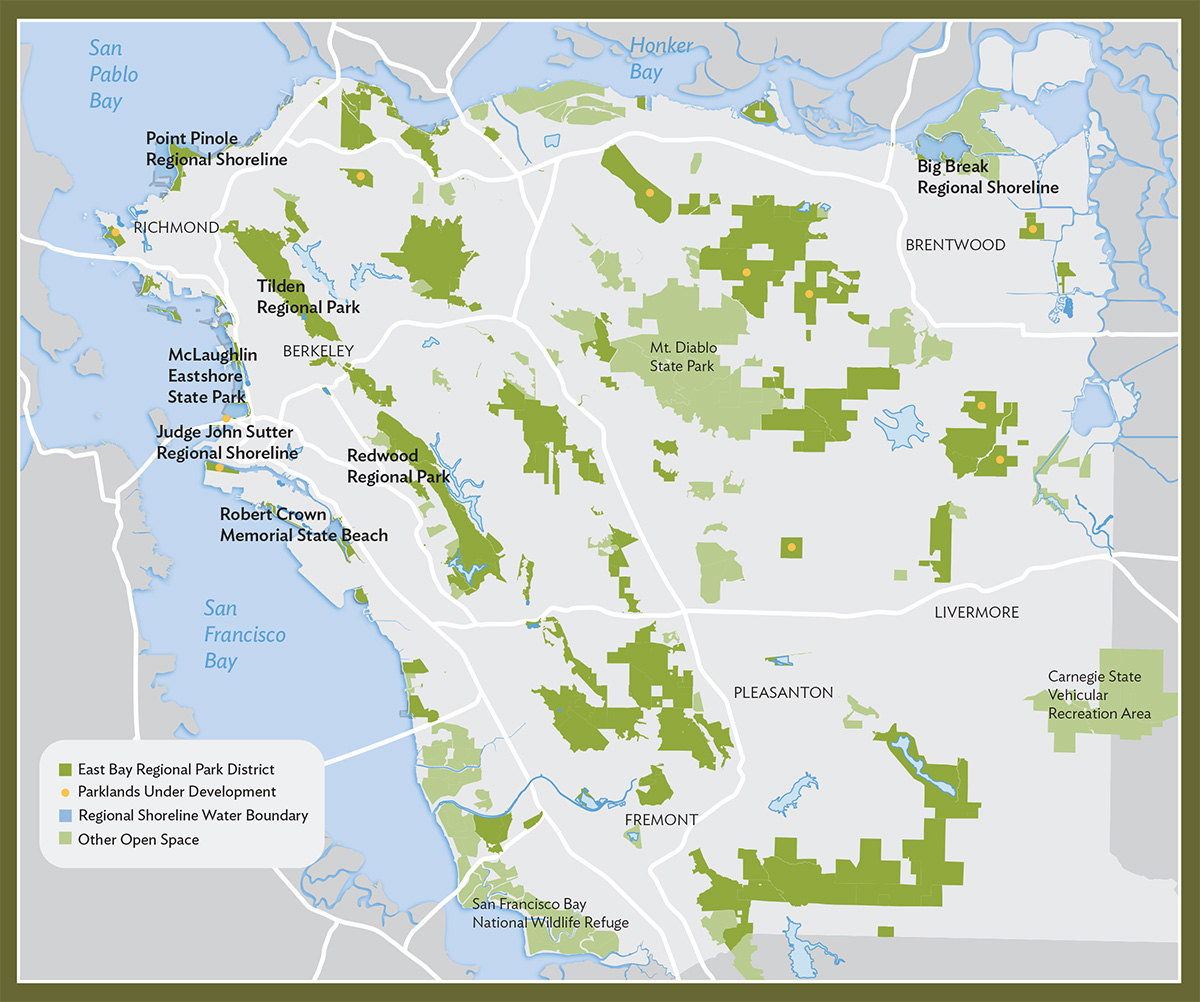
The belief in the value of a deeper knowledge of the Bay, deeper than the aims of developers or the maps of property, animated Malcolm as it had animated, in a sense, his entire energetic career. The promise and premise of East Bay Out, a work long in making, was that we’d all do better to cultivate the off-road and unpaved.) Was not the fixed itinerary one against which Malcolm rebelled in expanding attention in East Bay Out on a broader concept of space and place, worthy of attention, directing increased attention to the parks he knew so well? The elegant if austere line drawings of Nancy Curry helped to offer an assist to visualize the parks he knew so well as an off-road region worth exploring, to not allow to be reduced to rectangular regions of green–

–providing personalized itineraries treated travel as a process with no detours or uncertainties, as an experience mimicked by the streamlined paths of AAA versions of Bay Area Rapid Transit map-

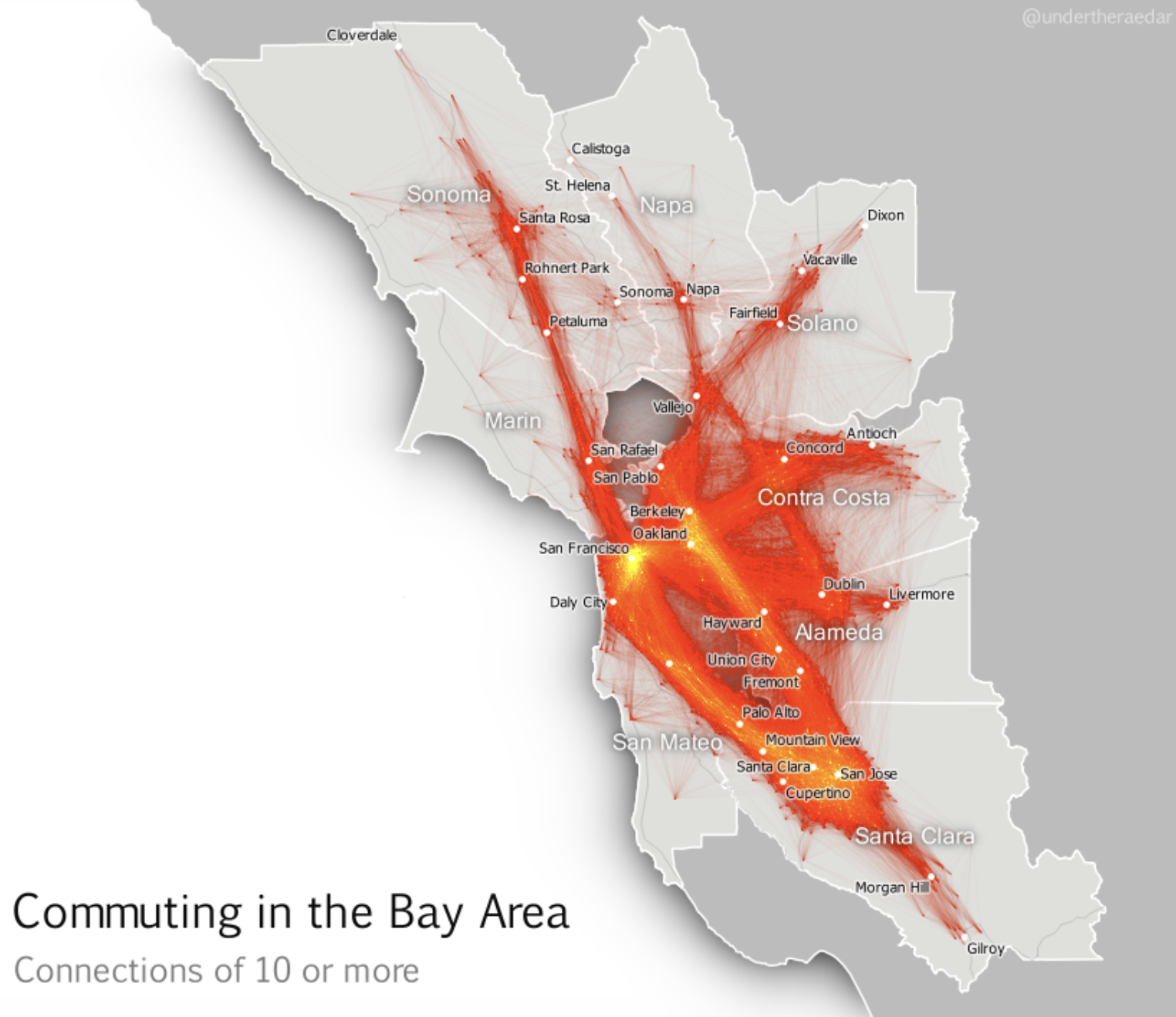
-a region where the transit map and commute intensity has grown rapidly, if not astronomically, in recent years–so that the average distance commuters have lived at an ever-expanding distance from work, and the already considerable ten mile commute of 2019 has nearly tripled by 2025, and commutes across Malcolm’s treasured Bay Area have put folks working in downtown Oakland from ever larger distances at which they rarely have time to experience the green areas in the map, or the riches of the Bay–a distance of commute that have dramatically expanded since the commute has grown to almost thirty miles, creating a hellish commute that compromises time outdoors.
Commute Distance at which Workers in Downtown Oakland Live, 2010

At the time as this distribution of the daily commute across the freeways of the East Bay, Oakland Mayor Mayor Libby Shaff promoted the tree the symbol of the city–affixing it to all street signs in the city as a new proud logo of the greening city–promoting a tree-planting project across the city that would reclaim the city’s live oaks celebrated as a the basis for plentiful Oholone harvest of acorns, a mission to  “re-oak” Oakland beginning with the planting of an inaugural stand of 72 saplings of coast live oaks in plastic buckets in a West Oakland park, realizing the deep belief, endorsed by landscape architect Walter Hood of UC Berkeley, how“Names are a powerful way to think about a place,” and first proposed the Mayor’s recent resurrection of the city’s forgotten groves, first celebrated by men like Malcolm Margolin as an indigenous inheritance. If the impact of the Ohlone Indians on the landscape they distinguished led Spanish and Mexican residents of the mid 19th century to name the place “encinal”–or oak grove–the protection of the trees already fast disappearing from the region in the 1850s as it grew led its first mayor, Horace Carpentier, to try to protect the trees, even as oaks were felled for development and the expansion of its gridded streets.

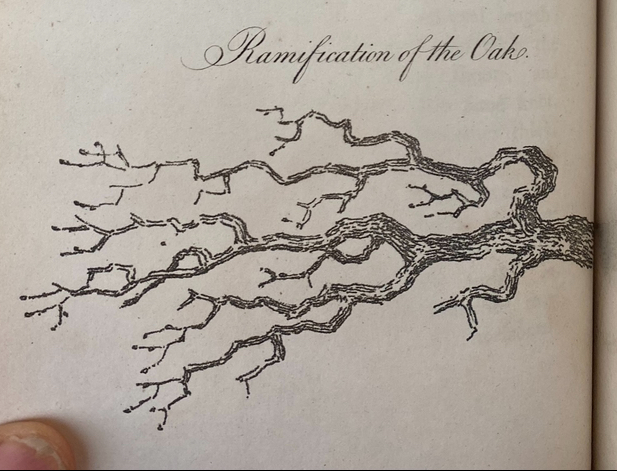
Today, few oaks survive save landmarks that stand as sentinels, as the Oak in front of City Hall, whose canopy of tributaries of branches was only planted in 1917, but was adopted as an icon of the hope to remake the city in the sign of the sheltering canopy of the expansive green tree once more.

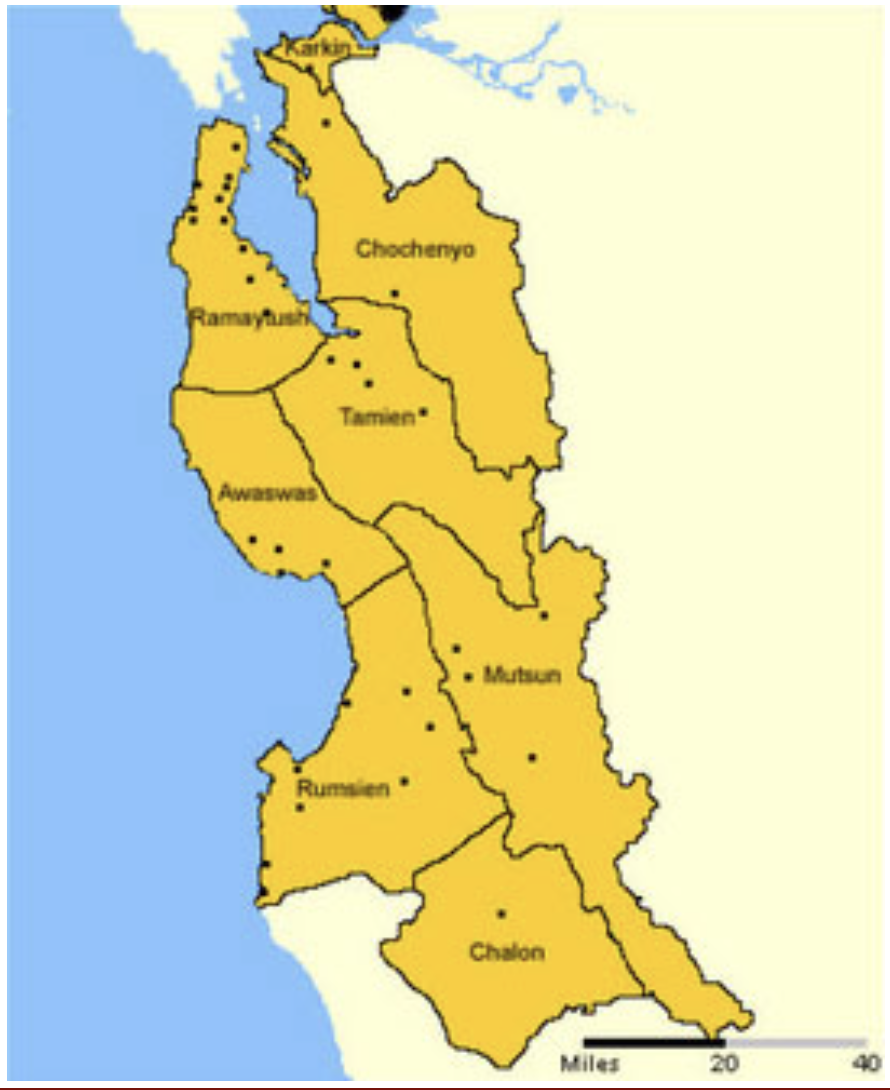
Malcolm’s heroic task was to remind us all of the green areas that are on the map, before they are mapped out of existence or public consciousness, and remind us how easy they are to . Indeed, vast areas like the 5,924 acres of Sunol Regional Wilderness, the over 5,000 acres of Briones, the nearly 5,000 acres of Anthony Chabot, 2,000 acres of Redwood Park and Tilden Park, and the slightly less large but brilliantly illuminating grand 1,500 acres of the Morgan Territory were something like negative lands, too often unexplored, not to mention the reduced rump of what has the grandiose name of the Ohlone Regional Wilderness, situated between Sunol and Del Valle, that suggested a new topography of space in which Bay Area residents were urgently asked to reorient themselves in Malcolm’s pioneering work.

The dreamy cover of that “unauthorized” paperback guide to the region–East Bay Out (1985)–certainly offered a decidedly off-road record of outback experience of the region, neither a God’s eye or bird’s-eye view, its old cover featured a blissed out Malcolm or reader floating above the bay from atop a cloud, looking down on a built but intriguing bayshore, as if in harmony with nature, ready to descend explore the open areas for camping and swimming the book described. (It is hard not see the cover, as I never did before, as an image of Malcolm Margolin floating as a benevolent spirit presiding above the coast of a region he celebrate with enthusiasm and came to know well.). If perhaps the figure on the cloud was an iconic persona of the Aquarian Age, Malcolm adopted the calligraphic skill of Bay Area penmanship to invite all readers to tap their inner Thoreaus in the guide to living outdoors–hiking, camping, swimming, and fishing–in their own Waldens able to be discovered not far from the edges of urban life in the East Bay Regional Parks. An evangelist and a guru, as much as a historical anthropologist, Malcolm led the way from his own cloud to the future.

The East Bay Out (1989)

I first saw Malcolm one afternoon pacing leisurely on a recently restored shoreline in the Berkeley Marina, he seems rooted in the Bay Area he loved so much, moving along the path quite rapidly and deliberately on paths restored in by 2009. The remade wetlands home to many more birds than a decades previous had been a major victory of the restoration of the shoreline he had very much promoted and must have relished. Perhaps ever since Malcom came to Berkeley, he was seeking actively to front the wild, as Thoreau would put it, with joy–rediscovering the parklands as if facing a frontier–Thoreau’s sense of the word–but not the frontier of lands held by settlers, that deserved to be seen again by the wilds that it still contained.

1. Instead, it belonged to the bayshore people he had made his own alternative present. There was a sense of the urgency that he did so squinting in to the horizon, as if he were looking for signs of the past occupants of these native lands that he knew so well, seeming as he walked an Old Testament prophet on a New World coast, beard buffeted by a bayshore breeze. He caught my eye before we had ever met, and I already wanted to know what he was so clearly thinking about. But, if Thoreau was walking the paths alone, Malcolm seemed eager to invite others to walk the same old paths with him. When Malcolm confided somewhat conspiratorially either at the outdoor tables of Saul’s Delicatessen or Piedmont Pines how much Berkeley was a perfect place for “folks like us.” No doubt the had long honed the pitch of overly generous flattery to make one feel part of a club, and promote the rather miraculous trajectory by which he had founded a productive press and nourished a new community of readers long before Indian activism.

But he praised the city and its active readers, sense of responsibility, and accessible libraries as a treasure: access to the libraries of UC Berkeley that he so often used from when he first arrived in 1969. There was a vision of rediscovering the old landscape by a poetics removed from the present day. In ways, he echoed the sentiment of recovery that was voiced by Thoreau, when he imagined the poetic practice of exploring, as if “I walk out into a Nature such as the old prophets and poets, Menu, Moses, Homer, Chaucer, walked in,” a landscape he offered “you may name it America, but it is not America: neither Americius Vespucius, nor Columbus, nor the rest were discoverers of it [sic],” but was arbitrarily named on maps, in which but a “few old roads that may be trodden with profit.” Somewhere, Malcolm still walks wider trails. The sense of a pre-Columbian contact with a lost land was dear to Malcolm, who never got rid of describing the encounter–more accurately than one of conquest–as the arrival of a starved and tattered group of Spaniards disembarking from ships on the edge of a peaceful, settled, and economically established nation, hardly in need of mapping and having already persisted as the engaged custodians of its plentiful ecosystem whose rivers fed fields and forests regularly harvested and maintained for a range of coastal peoples.

When we met, I had no credentials or a university affiliation, but couldn’t help being flattered by the attention. I now realize how much the East Bay was a living library for Malcolm–a library without walls, and an interconnected one that couldn’t be segregated on shelves by call numbers or single volumes. I don’t think it is a library that won’t be so deeply appreciated without him here. But the energy and encouragement to interrogate and appreciate its hidden maps, and hidden pathways, will be wanting an active a set of prompts and stimuli. Malcolm Margolin had found a home in the East Bay, but also made it one of the more interesting places for discussing books and ideas outside of university libraries’ bookshelves. And Malcolm of course worked to open eyes to alternative geographies long before the multiple alternative hand-drawn atlases of urban nature and bayshore habitat evident in the restored wetlands,–or the new cartographies of Obi Kaufman or Rebecca Solnit of California–he did much to encourage, to open eyes far beyond the rich bay. But if John Muir saw the wilderness of Yosemite as a cathedral, to pursue my analogy, the more bookish Malcolm saw it as a living text, pulling out threads of narrative with endless curiosity that have altered our picture of it and encouraged the stability of a built geography to be questioned.

Malcolm was walking that afternoon with energy, around the bayshore trail, alone, as if in the footsteps of the shore-dwelling Ohlone, enjoying the restored shoreline rather recently completed, and of which he was so much apart. Eager to catch or notice something new, the man seemed a long-haired bearded prophet, to watch, even if I didn’t know who he was, with something like awe, as if he were looking for a new frontier of natural observation, retreading long untrodden shoreline paths able to be imagined of the indigenous community of a once highly populated East Bay.

Bay Area Indigenous Language Groups and Coastal Settlements/Levy (1970), amending Kroeber, 1925

Malcolm may well have been in that moment envisioning the lost past of the coastal bayshore as he moved deliberately across the shoreline trail, as if searching for evidence while scanning the shoreline as if squinting for traces of Ohlone shell-mounds long since lost to the landscape. He had done so much to preserve the memory of the shell mounds, many of which were leveled in their entirety the 1920s, at the same time A. L. Kroeber had begun to teach anthropology courses about California’s indigenous in lecture halls at U.C. Berkeley. Kroeber, who was attracted the artifacts and symbols of the indigenous, seized on the project of “salvage ethnography,” in the footsteps of the mission that his teacher Franz Boas, linking archaeology and ethnology in artifacts, proclaimed the Yahi Ishi in 1911 to be the last surviving “wild man,” cornered by dogs in the hills near Lassen, of a tribe he believed exterminated by white settlers of the state, who he proclaimed “the last wild Indian in America,” who died from tuberculosis five years later in captivity. Seeking to preserve the final remaining traces of the indigenous cultures Kroeber believed vanishing or gone, he imagined a map torecover the expansive linguistic repertoire of a lost indigenous world across the state of California, mapping the linguistic groups of California’s former residents as a living world in a cartographic symbology of set boundary lines and distinct colors of discrete linguistic groups.

Linguistic Groups of California and their Families (1925)

While Kroeber did encourage skeletons from indigenous graves, including the massive shell mounds that had formed burial sites of ceremonial veneration over time, the massive structures of over thirty feet tall and longer than a football field in length to assemble knowledge stretching back thousands of years he believed confirmed “the permanence of Californian culture is of far more than local interest,” as he wrote in 1925, but “a fact of significance in the history of civilization.” The elevation of the moment of contact to an inverted picture of starving if not ravenous Spaniards, alienated from the land, meeting a stable society of flourishing tribelets living without money and not needing intentionally offered a new perspective on civilization itself.

Malcolm did much to affirm the importance of indigenous California in global history,–if for different reasons and an opposed logic by insisting on the necessary importance of indigenous anthropology for the present day: the veneration of these ancestral burial grounds had functioned as a permanent ceremonial site for the itinerant coastal peoples, and of orientation for a modern world that was far more out of joint and less attuned or aware of historical change. In keeping with the razing of many historical structures in the East Bay, the mounds Kroeber urged pillaging for evidence of native habitation were unceremoniously cleared for railroad tracks, paint factories, and parking lots of the malls now located on the level ground of “Shellmound Road,” a small stretch without hint of the massive structures over thirty feet tall that existed for each of the villages that dotted the bayshore before the arrival of the Spaniards, serving as navigational markers in the bay, as well as sites rich with ancestral meanings that often had their own names. Alfred Kroeber’s obsession with the pre-contact civilizations led him–much as Thoreau adopted the same word for indigenous at Walden–to call Amerindian tribelets “extinct as far as all practical purposes are concerned.” Insistently inverting that demeaning word–extinct–by revealing proof of the continued vitality of Ohlone culture and cultural practices was very much what Malcolm was about, as was asking us to re-see the Shellmound as a heap of rock to be excavated, cleared, or plundered. These were also lost worlds of a past that must have seemed fantastic, not only to his daughter, Ursula K. LeGuin, but to Kroeber himself, who, fresh from the east coast and armed with the toolbox of Frans Boas, saw a new world being able to be unearthed directly before his eyes with fascination.

Excavation of the Emeryville Shell Mound, 1924/Phoebe Appleton Hearst Museum

Many of the once abundant superficial traces of the shell mounds were long ago leveled, but they persist not only in local memory. Underground mounds are often intact, below the urban plant; when I saw Malcolm prowling the shore; he was smiling in satisfaction at encouraging negotiated agreements between the city of Berkeley and the Muwekama Ohlone, for the fate of mounds seen as sacred for over some 4,500 years, erased to the short-termism of the present, in which over four hundred and twenty-five shell mounds were constructed, often outlasting the villages that they once accompanied as sites of burial and focal points of community life of the sort Malcolm celebrated and waxed eloquent, as the oldest mound in West Berkeley, nearly 5,000 years old, only landmarked in 2000, long fought over by developers, more than anthropologists or historians.

Map of the San Francisco Bay Region, Showing the Distribution of Shell Heaps along the Bay Area, noting mounds on the coast as Present, Partial and Destroyed/N.C. Nelson, 1909

Map of San Francisco Bay Region, Showing Distribution of Shell Heaps (1909), Native History Project

As much as saddened by his death, Malcolm’s sense of the patrolling of the wild, or the edge of the frontier of wilderness, or just the shoreline, is a model for the persistent reminding of wilderness’ continued survival, and importance, to the world. Malcolm began as an East Bay Parks man, immersing himself in the 60,000 acres of east bay parks, far beyond the shore, For the relatively quite recent transformation of the parklands from open space bears historical traces not so far from living memory of the historical habitation of its open space, and the preservation of of the old shell-mounds in the recent historical record, and indeed present in local tangible artifacts that offered a new means and a pressing one to understand the history of many of the forty parks .

East Bay Regional Park District Today (2024)

The areas that were only just being explored, camped in, and lived in were something that he recognized as a valued historical repository, and indeed one to celebrate as part of the Bay Area. If Malcolm gained a new sense of himself in the East Bay as a ranger in Tilden Park, his unique brand of celebrating the region beginning from the orientation of the community to its parks, Malcolm was always looking for the survival of the wild. The light green overlaps of this map of the regional parks, or this modern expansion of the Regional Park District that exists today, omits much–the rich and enormous stately live oak trees, whose rich and nutritious acorns made the region a veritable storehouse of a plentiful supply food gathered, hulled, dried and stored as a nutritious staple later boiled as mush; or the seagrass of the Bay Area shores, that made the shore such an important meeting place and trading post for different tribes; or the willow stems and reeds in coastal marshes and rivers that are woven into baskets. These are of course among the layers of East Coast history, not evident in most data visualizations, if any, by which Malcolm taught many to re-see or see again the region of the East Bay–or offer, to cite John Berger, several ways of seeing.

Perhaps it was during his stay as a ranger living in the park, touring visitors, and walking its paths, the arms of towering native live oaks of up to two hundred and fifty years old stand as witnesses of another age seemed to welcome him. Is it a coincidence that the cover illustration of Carl Dennis Buell of The East Bay Out, Malcolm’s “Personal Guide to the East Bay Regional Parks” written after leaving the Parks Service, featured in silhouette the capacious canopy of the elegant towering tree? The Enlightenment image of the Oak Tree on the cover of Malcolm’s book might have belonged to the engravings of the great English naturalist Thomas Bewick, who admired the brachiation of the oak as a source of divine marvel–a marvel that Malcolm seemed so eager to recuperate and transmit as a form of resistance during the shifting settlement of the East Bay. If Bewick became an engraver–and indeed raised the status of engravings–to communicate trees and avian riches of his native Northumbria, in boxwood woodblocks, that elevated wood engraving to a register of natural description, Malcolm became a printer to promote the Bay Area as a rich habitat, and increasingly as ancestral lands worthy of veneration and of better preservation, to encourage a sense of wonder and amazement by communicating the depth of his feelings about the East Bay.

Bewick was an early naturalist of the modern world, an author who brought attention to the rendering varied leaves and branches, birds, wildlife, and rustic places to the eye by borrowing the engraving burins to capture the gnarly branches of oaks laden with leaves in wood plate with a density of fine lines–opening to the world a warm generosity of wooded life–

Engraving of Live Oak after Thomas Bewick’s Engraving of Oak Tree

–it is hardly surprising that the great naturalist’s rendition of the generous canopy of the oak became something of an icon for Margolin’s own guide to the Bay Area, East Bay Out, the unknown “outback” beyond the built up area of the Bay, a sort of forager’s guide to the riches of wilderness akin to Bewick’s own investigations of Northumbria–

Thomas Bewick, Engraving of Oak Tree Dwarfing the Nearby Town

The oak trees that Bewick became famous for engraving–as birds; inhabitants of wooded lands–intentionally shift our focus of attention as readers of his books from the towns they lived in to the surrounding natural world. The images of the woodsmen who were more engaged in nature were Romantic icons, but, as a modern-day Thoreau, focussed on the natural world in place of the built world, less concerned with human engineering or artifice than the importance of attending to the surrounding natural world in Northumberland countryside that he most often drew, calling attention to its oaks, birds, and outdoors to offer a unique angle on the industrializing landscape.

If lying off of the beaten road, and outside built environments, showing other forms of life far from the city, foregrounding on details of the landscape the cleric William Gilpin had focussed attention, akin to moments of rural repast, drinking waters of fountains and waterfalls from a traveler’s leather hat.

Thomas Bewick, Tail-Piece of History of British Birds (1821)

There was a Thoreauvian sense of transcendence of the local that animated Margolin’s attention to the environment, of which the oak might stand as a transcendent icon. Although oak moths have recently arrived in the richly brachiated canopy of the large coast live oaks in UC Berkeley, as they regularly do, feasting o foliage of the Quercus agrifolia for multiple recent years–2019, 2020, before again 2025–and prematurely cause grey and brown litter of leaves to fall in heaps, live oaks endure the regular pillaging of leaves, returning to their familiar evergreen in a manner of weeks, as they regenerate buds, leafing out once again in a matter of months. suggesting the huge vitality of trees that seem sick. The rapid recovery that the coastal live oak makes regularly from the onslaught of voracious caterpillars as the e California oak moth strip the trees of their expansive verdant canopies without impact on the trees’ long-term health, as within three months they leaf out, regaining health almost suggestive of a rebirth by deep reserves of energy–making it unsurprising Malcolm adopted the distinctive tree as an emblem for much of his work. The brachiation of that oak branch recalled the eighteenth century aesthetic renderings of Reverend William Gilpin, one of the earliest coiners of picturesque “landscape,” with a scientific attention to detail, attening to natural forms as if revealed truths–admiring that “peculiar kind of beauty, which is agreeable in a picture” as able to provoke a discerning interest in the wilderness as providing esthetic forms–

The branches of the oak were an aesthetic opening of attention to the country–and provided Gilpin with a basis to ask his viewers, similarly, to adopt a new attitude to expanding cities, guiding their eye past those branches to the human space in the backgrounds of his paintings, cannily situated far behind those gnarly oak branches that frame historic ruins, far more worthy of attention.

The live oaks around Berkeley were part of the animate landscape that endured across time in the regional parks today whose green leaves regularly return even after their branches are stripped bare, taking part in an ecosystem they almost miraculously seem to refuse to leave. The brachiation of the oaks had been something of a pillar of natural history from the late eighteenth century, as naturalists as Thomas Bewick called attention to the brachiation of oaks within the complexity of natures worthy of marvel–an ancillary art to Romantic poetry, and William Wordsworth even vowed “that [if] the genius of Bewick were mine / And the skill which he learn’d on the banks of the Tyne / Then the Muses might deal with me just as they chose / For I’d take my last leave both of verse and prose.

Thomas Bewick

Malcolm was perhaps less willing to wear only one hat as a guide to the beauties of the unbuilt regions of the Bay Area, but more eager to play the Pied Piper to a generation in the outdoors.

2. The towering coastal live oaks in Berkeley inspire awe in their brachiated canopies,–maybe an awe Malcolm picked up, of going native in the arranged marriage between himself and Berkeley. The arranged marriage to the Bay Area may have arisen out of convenience and necessity but developed into one of mutual admiration and respect was deeply nourishing and profitable to many, born out of deep sensitivity to place and to forest grounds he encountered in the East Bay. The rich guide that he provided to the “outer” East Bay became almost an ecological resource of its own right, a prompt to preserve its wetlands and restore its parks, to act as a custodian of open space and forested hills, even in the fear of fires that has come to grip the region in later years.

It led to a readiness to question the authority of the modern map–to see the “East Bay Out” in other words–and relish the absence of all anthropogenic presence in the first maps of a seemingly pristine Plane de Puerto de Sn. Francisco” (1776) of a fortuitous date indeed by José de Cañizares–stored by the Bancroft Library, the very year that Americans declared independence from England,–that offer a caring attention to the estuary and tidal marshals of the region, and its bay waters:

José de Cañizares, “Plano de Puerto de Sn. Francisco,” 1776

–long before, Malcolm would be the first to tell you with a large knowing smile of taking real satisfaction in an incontestable fact, Americans had arrived in San Francisco. Those drought dedicuous live oaks were indeed among the plants that native Bay Miwok and Oholone people had increased in their biodiversity in the canyon woodlands, offering year-round specialties as acorn soup, leaving a lasting imprint in the range of oaks, each tree able to provide up to 10,000 acorns and offering rich habitat for animals who would bury many of the acorns stored underground.

The trees offer a rich and often drought resistant canopy for birds across much of the state, that allowed the Coastal Live Oak a corner species for coastal ecosystems up to eighty feet tall, their dense green foliage often improving the health of nearby plants year-round, in a more recent map. I think of Malcolm as able to toggle between both maps, but as realizing the need to allow multiple ties between art and cartography, and recognize the poverty of relying on data-driven maps–an implicit point to which this section of this post will return in hopes to make his case. For indeed Malcolm, as much as anyone, was crucial in redefining how “we” see the East Bay, and the identity of the East Bay as a region over time–from the time of first contact, when a group of starving white European colonizers in rags arrived on the coast of what would be Alta California, and gave it its name as a region by 1804. Malcolm was interested in peeling back that map from local informants who might help tell the tale of how it existed earlier, a real “historian” of historical anthropologists.

Population of Coastal Oaks in coastal California/National Institute of Statistics and Geography

Perhaps from when Malcolm made a decisive stand of resisting wearing the uniform of a parks ranger–a moment I have long imagined was a deep-seated conviction based on the deep sense of kinship he felt to the stewardship and identification with the land–Malcom was listening to local signs of evidence of the Bay Area lands he loved so well, and his attentiveness to the bonds of local inhabitants to the lands, as much as the shores, in no small part led to a new awareness of the local indigenous settlement of the region, and the poverty of failing to appreciate indigenous inhabitants of the region as custodians of the lands he knew so well, whose lives are impossible to separate from it. The sacred nature of relation to the land that was fed by some thirty creeks, filled with freshwater fish, animals, and many thousand species of birds, who Malcolm imaged might fill the sky so densely to block out the sun, suggested a powerful narrative of the loss of colonization and the absence of stewardship he felt today, before which a better map of the region provided a deeply therapeutic and indeed restorative function, inseparable from attention to those lands.

Indigenous Tribes and Native Peoples of the East Bay/image courtesy Sogorea Te’ Land Trust

The traditional names of the lands he was so committed to exploring and orienting others was inseparable from the map, but had been forgotten and left off of it–and one of the last final efforts of Malcolm sought to mobilize, where I got to know him better, was the ambitious project of remapping the entire state of California in ways to make the forgotten indigenous presence more centrally legible. Malcolm’s urgent message is of course increasingly pressing today, and continues, and the importance of the deep relation to the fragile topography that of a web of rivers that the Seogorea Te’ map above so lovingly details by light shades of blue and green, in place of cities, urban settlements, or property lines.

Encouraged by the fertile grounds of increased awareness of the needs for ecological stewardship of the land of an early environmental movement, from the Save the Bay campaign already founded in January, 1961, and in the Bay Area fertilized by Wendell Berry, and Gary Snyder, and nourished by the small non-profit presses–whose rights to the work of Berry and Snyder sustained them by digital sales alone. Snyder, who had studied anthropology and folklore by the transcribed oral tradition of Haida storytellers at Reed University, glossed glossed the oral literature as the creation of healthy art of mythic narrative vibrant with keys to the forgotten sustainable cultures of North America. Already possessing a poetic ear, Snyder read the transcription and careful translation of what ethnographers presented as a local Haida informant as a vital resource of a vision quest in an era we had lost a sense of orientation to animal spirits or birds, examining the “dimensions” of the myth as a needed resource, perceiving the animism of its telling as a living artifact and meaningful performance of culture. Did his reading of Haida myth provide a direction in which Malcolm would work? The early works of what are now environmental classics would certainly pay dividends for the independent presses. (When Margolin retired after Heyday press’s fortieth anniversary, it was robust enough to expand to Los Angeles, and be a fixture in the region’s as well as the nation’s literary landscape; renewed interest in new editions of Snyder and Berry’s works helped expand it expand catalogues to popular works, updating the classic corpus of independent Bay Area presses.)

Did the regional parks offer an alternative text by which Malcolm was eager to map the open areas that still existed, not yet encroached by development, as sites of continued wonderment? They certainly stood as evidence of a former wilderness, encroached by the boom of expansion of so many of the cities that make up the Bay Area, a boom that began in the 1950s, evident in this map that imagines the tree rings of local population centers around the Bay, many of which emerged only in 1960, that provide one of the most unique forms of growth of an urban agglomeration in an area where wilderness was precious: if the metaphor o f the tree ring offers a nice cartographic symbology to imagine the Bay Area as a site of uneven, but rapid growth, 1960-2010, in ways that overlap with Margolin’s heyday in the region he provided so much of an alternative counter-cartography, the expansion of cities like Concord, Fremont, Antioch, and San Jose that now form a dense inner core of the Bay Area that might be called the inner ring of commuting, was an incursion into open lands greenspace, where the parks provided evidence of the rich biodiversity and offered more than a refuge–but an alternative way of imagining its future.

Growth of Population in Urban Cities and Towns in the Periphery of the Bay Area, 1960-2010

One might grasp the force of promoting the regional parks as a critically important heritage of surviving biodiversity of a region that was compromised already by farming, wood harvesting, and the damming of some of the most nourishing rivers of the coastal ocean, including the San Pablo to create a large reservoir for drinking water by 1919, that compromised the rich ecosystem where early settlers describe catching salmon with pitchforks in its waters, and Malcolm would have sought the local informants for evidence of the rich topography he felt still survived, but had been preserved by a relative miracle of land conservation and preservation as conservation and preservation efforts were blooming in their own metaphor ecosystem around the East Bay.

This was the destination of the readers of the books Malcolm was beginning to set out producing, at the same time as conservationists were promoting illustrated books, often with photographs, of the natural treasures of the region, as the Sierra Club  Brower and founded and directed, 1952 – 1969), became a leading environmental membership organization whose aggressive publishing programs offered wilderness testimony in large format books foregrounding high-quality nature photographs, setting a model for bearing witness of the changing landscape and ecological risks that we faced, as he promoted a range of new parklands as repositories of memory,–from public organizing of opposition to the damming Grand Canyon and Dinosaur National Monument, to national parks not only on the seashores, as Point Reyes, but including the North Cascades, and the Redwoods, and protecting millions of acres of public lands. The media advocacy Brower pioneered in newspapers and magazines so deftly dramatically communicated conservation to new audiences, and crated a market for practices of conservation that Malcolm added his unique sense wonder.

Before the Bay Bridge was imagined, Brower got behind the project proposed by civic engineer John Reber to dam not only the San Pablo River but to built a San Pablo Bay at the dammed San Pablo Reservoir, a project already so devastating to the ecosystem of regional grasslands. For Reber had in the late 1940s proposed a way to meet the postwar population growth in the region by adding a huge amount of landfill to the bay, ending its wetlands, and engineering two freshwater lakes that would divide the “Bay” into four zones, preserving but a newly dredged deepwater port in Berkeley. The almost forgotten plansto foreclose Bay waters and tidal shores showed little familiarity with the region–it might easily have been fully liquified by seismic activity!–but provided a model of the distance of local engineers of urban development and State Water Projects Authority from the custodial role indigenous had long played in maintaining the bay as a region of vital habitat, both of freshwater fish, sea grasses, and shorebirds–and the proposal for a massive construction project that projected the San Pablo Dam as a basis for the bay was only narrowly defeated due to the local activism–only after the over-eager U.S. Corps of Engineers builds a 1.5 acre hydraulic model of the Bay to test it, although the vision of barriers to bay waters stretching from Richmond to Treasure Island, essential to shipping channels, never survived the modeling of a bay comprised of landfill–a massive engineering project of terraforming before that world was used, luckily never realized.

Detail of Reber Plan (1949) to filled in for a deepwater port, airports, and military bases (1949)

The ground for objecting to such plans for the threat of transforming the bay’s wetlands and natural habitat for economic markets and shipping lanes was rife–even if the liquefaction of the proposed landfill additions showed the accredited engineer’s almost basic unfamiliarity with the dangerous level of seismic activity that would be so prohibitive in any massive project of contracting the bay’s open waters.

The evidence of the inhabitation of the bay waters, increasingly threatened by development schemes, seemed to curtail any of the collective wonderment Malcolm dedicated so much of his life to cultivate and preserve. This included the expansive Bay Trail itself, replacing the old landfill to restore the shoreline to a space of vital habitat and healthy salt marshes, that might erase some of the imprint of rapid anthropogenic change, returning wildlife to the East Bay, and perhaps allowing the mists of the shoreline to be seen once again, if you squinted your eyes at the right time.

Louis Choris, Bateau de Port de San Francisco, c. 1815

The color lithograph of a ship paddled by indigenous residents of the Bay Area included in Voyage Picturesque Autour de Monde (1822) eroticized the west, as well as California, to be sure. The sense of reintroducing residents of the East Bay to the natural areas around them was more decidedly local for Malcolm Margolin. But as parks come under assault, and the sense of stewardship he celebrated by native inhabitants is being so openly and flagrantly disrespected by government, it seems important to remember how even in the face of an onslaught we have rarely seen in memory, Malcolm refused to be pessimistic, and saw himself as having had no reason to be so.

The awe before nature that inspired Malcolm, and that he always seemed to seek to inspire, urged we consider the enrichment of place that the Bay seemed to offer–its habitat must have provided a sense of encouragement and a sense of commitment he channeled from the descendants of native inhabitants. For Malcolm unearthed collective memories that he sensed in their stories and descriptions of the engagement with elements rathe than automobiles and automotive transit, offering a therapeutic alternative geography of the bay–and finding a real pharmakon of a new idea of space that needn’t be dominated by local real estate or what I’ve called the confines of automotive space amidst the increasingly congested stretches of commute that defines the Bay.

He actively explored and expanded the narrowing contours of a Bay Area increasingly defined and denaturalized as an expansive area of commenting, whose interconnections of traffic and highways. The automotive landscape of daily commutes have indeed offered a world of less and less connectedness–in contrast to the indigenous he reminded took themselves quite seriously as custodians of the land, without needing to see themselves as property owners. And as the construction of more and more paved space in the zbay Area fail to promise any sense of greater custody or responsibility for the land, our sense of the Bay has decidedly shrunk, as a recent exhibit in the Exploratorium’s Bay Observatory that asked visitors to map the San Francisco Bay has shown

.

–or the pathways derived from the locations of over 10,000 geotagged social media posts that suggest the well-worn routes of automotive travel, compiled by Erica Fisher, that neglect large areas of the the East Bay, on roads that seem to fade into a white mapped unknown space.

Malcolm was energized from compelling others to explore and learn to re-recognize the riches of the region, and the state. Attendees of hisfinal projects were invigorated by his vision–or were encouraged and somehow empowered to feel the same way. His hopes for continuing celebrating an annual Festival of the Birds in Berkeley during the Trump era, ideated as engaging the public by a two-day extravaganza cum party featuring films, live performance, music, and art, in Malcolm’s style, as well as poetry readings and art-making sessions, and craft fairs, pointed to birds as signs of hope, and witnesses of the region. The festival celebrated the new habitat that the bayshore had indeed become, against all odds, a site of friendly avian habitat and attracted increased pelican, herons, egrets, geese, ducks, owls, and shorebirds to live in restored wetlands, as a continued sign of hope, if non-human signs, that Bay Area residents would do well to attend to. if birds provided a common language, outside of legal claims to ownership, to reorient ourselves to the land that can be seen as something like a living resource, the early decision to draft an “un-authoritative guide” to camping, hiking, and exploring that led to the new sense of authorship that Malcolm embodied, and the intense attention to local nature that midwifed the magazine Bay Nature, that continues to offer a new sense of orientation to better understand the natural landscapesf the Bay.

At the Festival of the Birds, I bought and picked up several hand-made bird key-rings made from colored beads. They were tokens of the needed uplift of hope that those small festivals provided, entirely animated by Malcolm’s rolodex and his animated presence, as a bobblehead in their midst, as if in a victory lap in the David Brower Center, but were also a remembrance of the power of birds to redefine our sense of place. If talking to animals was an indigenous trait Malcolm so celebrated, and were long tied to indigenous belief in animals’ souls, and the ability of speaking to animals long attributed indigenous by settlers not as possessing special talents to communicate with native animals, but to from whom they were seen as but a small step removed. The rolodex that was invented by Arnold Neustadter and Dutch designer Hildaur Nelson of Brooklyn NY in 1958 was initially marketed as a way to organize one’s professional and private life by a rotating card file became mastered as a medium by Malcolm as an active way he participated in public life, but joined private and public. The rolodex was far more than an archive, wielding it as a matchmaker moving in hyperspace, linking people, events, places and museums to animate ideas for a larger cause: it was almost able to keep up with the rapidity with which wheels moved in his mind. Malcolm arrived in Berkeley a decade after the Rolodex, in 1967, the Summer of Love, but used the invention that was Neustadter’s platform to vault out his father’s box-making business as a platform to enter the vibrant environmental and ecological community of a region associated with tech and Silicon Valley, that left a deep imprint on the Bay Area–as the Rolodex was able to survive the advent of computers, iPhones, and virtual planners. (It also offered an orientational tool for wandering Jews.)

This is important in the danger of affirming the parks and parklands, perhaps the first area that Malcolm got to know and worked in the East Bay, even if he acknowledged far more awe in, say, Yosemite than Tilden Regional Parks, which he knew so well. Despite growing visitors to national parks, and also the local parks where Malcolm Margolin got his start in the East Bay, their funding is for the first time increasingly at risk. The over eighty-five million acres that the Park Services manage attracted a record 331 million visitors last year, and park visitors provided benefitted local communities a $55.6 billion as well as supporting over 400,000 jobs, but the Trump administration has early cut a thousand park service workers–while predictably charging foreign visitors, as if a tariff on tourism, extra surcharges “to keep the parks beautiful”–but more national monuments and parklands stand to be sacrificed, as the President seeks to diminish national monuments far beyond the already striking diminution in size during his first term as U.S. President. And these include, famously, many monuments of indigenous native history, in danger of development for economic development and mineral extraction.

Trump distinguished his first Presidency by reducing the number of national monuments for the first time since Dwight Eisenhower, and reducing Bears Ears by 80% of its total designated size, the shrinking of national monuments and opening of forested lands to logging, mining, and extraction to increase America’s economic productivity or increase fire safety stands to be decreed without public input or review, and his Dept. of Justice Dept. has unprecedentedly acknowledged the President’s power to decertify or shrink national monuments judged “no longer are deserving . . . protections.” The shift in mapping protected national monuments and national parklands would open up the most sensitive lands to mineral prospecting, mining, and drilling; Doug Burghum tasked the Dept. of Interior to “review and, as appropriate, revise all withdrawn public lands” that might be opened them to potentially auctioning lands for oil and gas drilling and mining.

National Monuments at Risk of Opening to Corporations’ Gas and Oil Drilling or Mineral Extraction

Coming at the same time as cuts to park stewardship and preservation, the depressing dangers of a loss of access to park lands made me feel better by visiting the paths of the Claremont Canyon after hearing of Malcolm’s passing, and, in a visit to Yosemite, remember his vigorous faith in open land.

Continue reading

Leave a comment

Filed under Bay Area, Berkeley CA, California, East Bay Regional Parks, environmentalism, Malcolm Margolin

Systemic Failures? Water Flow, Air Safety, and our Purchase on the Natural World

Before the mass firings of civil servants, members of government, and oversight by the Trump administration, we were already shocked by two major disruptions that suggest the danger of the new President’s reflexive knee-jerk responses from his over-sensitive gut. Both–the fires in Los Angles and the failure of air safety at Reagan International in DC–are problems of an anthropogenic world, where the structures of traffic flow, water safety, as much cognitive failures of the current President. But the massive problems they suggest we will be facing are problems of mapping, as well. Water doesn’t flow naturally to Los Angeles, a city built in the desert,–as any viewer of Roman Polanski’s neo-noir Chinatown knows.

While the former director of the public utility, Noah Cross, is an evil mastermind too remove public water for his own private ends, is a scarier character, far darker than Donald Trump’s buffoonish public figure, who corrupts his family and the utilities by laying the seeds of a schemes of personal enrichment, and Trump’s inability to map the dangers the nation faces less rooted in venality, he conjures an image of corruption–and imputes corruption–so that the public good is almost entirely hidden, clouded and obscured in airing a broad range of grievances. For the problems of water flowing to the Los Angeles Valley became the dramatic centerpiece of this Depression-era classic, in an attempt to explain the lopsided geography of Los Angeles to the nation, and to do so within a rising taste for disaster movies that boded premonitions of massive destruction–infernos; earthquakes; tidal waves–Abel to be viewed in national theaters.

The United States had long indulged, to be sure, an unsustainably massive demand groundwater pumping for farming in the central valley. The diversion of waters to Los Angeles that caused the regional water table to drop so precipitously as local farmers’ wells ran dry in the largely agricultural San Joaquin Valley north of Los Angeles in central California, as groundwater depletion the aquifer of the Valley that intensified from 1925 to 1975 sucked water from the earth; thousands of pumps suddenly went dry by the 2012–2015 drought, due to cumulative effects of groundwater pumping predating drought, but the question of water use and Southern California on the minds of Robert Towne, who wrote the script of “Chinatown” a 1974 film noir as a drama that featured the opaque conspiracies of water diversion and depletion set during the Depression as a moment of the birth of the contradictions of the unevenly economically divided social landscape of Los Angeles that fit the era of Watergate, and showed conspiracies as deeply seated in the American grain. Cross is a dark nemesis, a seductive land magnate, Noah Cross, played by director John Huston, who pulls punches to divert pumped groundwater from the city to housing tracts in the desert. Chinatown immortalized the schemes of water diversion schemes that remade the sharp social divides in Southern California, whose false respectability seeks to drain the Owens Valley dry that only sharpen the pronounced inequalities in Los Angeles’ stark landscape, reforming the public Los Angeles Dept. of Water and Power for personal gains of massive private enrichment, by bringing the city to where the water flows, rather than by moving water to the city by aqueduct–enabling the urban expansion of Los Angeles.

The film channels a keen sense of short-sighted conspiratorial instability in a world of money and wealth, but may well reflect our own current dilemmas more than we imagined–and a world of graft and corruption that has provided Donald Trump with a means to imagine the status quo. The prescient observation of the cost of redirecting resources was keenly felt by 1974, when Chinatown was conceived, even if the film was set in the Depression. But we are perhaps living it only today. The idea of transformative powers that the redirection of water to the growing city might mask its deep inequities and inequalities, moving it from Chinatown to the “northern Valley,” was a get-rich-quick scheme conflating public and private works, but also a sign of the systemic failure of Los Angeles, and its deeply criminal origins. Was this, the film seemed to ask, really America? Or was the corruption on such a massive scale really what Donald Trump both describes himself as able to prevent, and which the systemic failures that his presidency seem slated to bring, imposing a world of trade tariffs, withdrawing from the world, and an absence of data privacy, indeed eerily akin?

Owens Valley Diversionary Supply of Water

For the creators of “Chinatown,” the Depression perhaps provided a compelling image of the huge wealth inequalities that have since come to be characteristic of the United States, inequities on display with a vengeance in 2025–where the richest men in the world were given front row seats to the 2025 inauguration–men whose combined value provided an image of over a trillion dollars of wealth at one event. Speaking before individuals whose fortunes of four hundred and two hundred billion, emblems of a massive privatization of government, boded poorly for the future. The first months of the Trump White House plagued by seemingly separate issues of fire safety and air safety are rooted in a failure to map increasingly apparent emergencies, specters dangers rooted in the modification of the built environment, as much as policy, that depend on good mapping tools. The eery sense of these inequities and systemic failures echoed through the inauguration ceremony–the fires were still burning, if they had been put out; the promises of American renewal seemed deeply deceptive, hardly addressing wealth inequalities. If “systemic” is among the worlds that the White House offers a guidance not to use, the failures of the first weeks of the Trump presidency seem so systemic to be a harbinger of what is to come.

President Trump seemed almost to stray from prepared remarks, as is his wont, calibrating the value of a rig on national television, as he took time to ponder with marvel how these fires had hurt even “some of the wealthiest and most powerful people of our country” on the stage, and promised to change a situation “everyone is unable to do anything about” but promised to change. Trump would probably never visit the scene the destructive fires had raged, but in detracting from the scale of their devastation he concealed the failures of destruction, loss of housing, loss of healthy land, and loss of economic wealth in the state–foregrounding the major losses of elites.

Trump, as a modern Noah Cross, luxuriated in the face of devastation, concealing the sense of systemic failure. The kinship of systemic failures in Chinatown’s corruption seemed to rise to the surface in this hardly tacit alliance with extreme wealth on the inaugural stage; Trump drew a similar tie to wealth in the face of loss, highlighting on the misfortunes of the “wealthiest and most powerful” amidst a partisan attack on local corruption, from a podium that seemed to trumpet its own corruption. For the President seemed as if he hardly appreciated the scale of the systemic failures that led to the fires, standing before Priscilla Chen, Mark Zuckerberg, Jeff Bezos, Sundar Pinchai, and Elon Musk, who seems to have viewed the inauguration with particular elation, as if the Los Angeles fires were only an example of the previous administration’s failures. If Parmenides suggested that fire was eternal, disordered, and changing, the maps of the destruction of residences seemed a puzzle of poor leadership and a failure of adequate priorities or preparation.

But these emergencies have been oversimplified by being converted to talking points. We often fail to appreciate the huge risk of the present by failing to map these changes, or acknowledge them. Yet without registering the increased risks of anthropogenically modified spaces from the woodland-urban interface or overcrowded skies, we risk losing the knowledge needed to confront these risks. Rather, we seem ready to cut needed federal expertise, believing the national emergency of high energy prices exacerbated by a diminished capacity to protect the nation rom hostile foreign actors.  The schemes of corruption of the Department of Water & Power which Noah Cross manipulated to create housing in what we call the Central Vally seemed a look back at the deep levels of corruption from which Los Angeles was born. They pale in comparison to the rampant misuse of public funds for personal gains intertwine of personal advantage and public funds seem on show in the return of Donald Trump to the White House. Another film of 1974 that reveals a terrifying fear of distance from nature featured Mr. Kapital–in Dusan Makavejev’s Sweet Movie, a more comic Mr. Kapital boasted beside Niagara Falls of his plans to re-engineer its natural beauty as a spectacle–“my biggest undertaking in landscape architecture” as “I’m gonna buy it from the Canadian Government, . . . renovate it, redecorate it, get rid of the water, turn off the Falls“–a combination of graft and bombast more worthy of Trump, to amplify the falls’ crashing by “a huge quadrophonic sound system”–the “best available”–to increase its spectacle. Makavejev’s film features Mr. Kapital seeking to transform the natural monument not only to a tourist spectacle but light and sound show, an act of consumer fetishization of exploitation. Trump exploited the disasters of fires and mid-air collision as platforms for his brands, spectacles of his continued campaign and road show, as if they could become illustrations of the need for small government.

Increasingly determined to use public position for private gain, we have seen ungrounded accusations of mismanagement in the face of the growing risks of the effects of global warming and climate and environment blithely ignored, shifting blame to environmental policies or hiring practices. To do so only distracts our attention from growing environmental risks in an era not only of temperature rise, longstanding drought, and a demand to create agricultural productivity by irrigation. For if rising drought in western states–particularly California, mapped below by from data of Trump’s first term in office as a landscape he should have know well, reveal risks of extreme drought across the entire state.

Increased risks of what we still call wildfires, as if they are far from cities, in woodlands hit by lightning, reflect our impact on the environment, as increased extraction and appropriation of resources have continued without assessing the needs for better water storage, strategic burns, and protective barriers against fires’ spread. But the huge wildfire frequency of Trump’s first term–

Risk of Wildfire Frequency in the Lower Forty-Eight/Gund Institute for Environment, UVM (Dec. 2022)

–grew before lower levels of rainfall, as precipitation plummeted by the start of 2025, a truly perfect storm across Los Angeles, falling so far below usual since October to compromise reserves of groundwater across the county to heighten its combustibility as a site for future fires.

The massive fires that Trump argued we had dismantled defenses was a perfect storm, and a calamity almost foreseeable in public data compiled by NOAA, for which we were unprepared.

Below Average Rainfall in Southern California, October 2024-January 2025/NOAA

The similarities of President Trump’s policies to the management style of Noah Cross after he left Los Angeles’ ‘public’ Dept. of Water, having rigged local supplies of water, appreciated long before Elon Musk was a fixture of the Oval Office; we will soon be able to look back with romance at Cross’ devious schemes to leech public water resources from Los Angeles aqueducts for private gain. Cross engineered water supply for private ends, the corruption and public malfeasance of pervasive corruption of public resources were a premonition of rampant abuse of public resources, confusing public needs with accusations of maladministration seemingly slated to be a hallmark of the new Trump regime. The loss of insured properties of $30 billion and total economic losses beyond $250 billion pose problems of fire prevention far beyond local mismanagement or malfeasance–but will be one of the greatest costly of disasters we persist on calling “natural” more than man-made. Yet even as we began the Trump Presidency with a declaration of a National Emergency–not from the invasion of the southern border, declared a National Emergency in Trump 1.0, but the fr more menacing specter of “high energy prices . . . exacerbated by our Nation’s diminished capacity to insulate itself from hostile foreign actors . . . in an increasingly crucial theater of global energy competition,” the actual emergencies of climate and airspace that were largely man-made are not only ignored but reframed as errors of bad governance. For while the incoming President issued an early declaration of the need for coast-to-coast “integrity and expansion of our Nation’s energy infrastructure,” the emergencies on both coasts of fires far more massive than regular for January on the west coast and a tragic arial collision on the east coast provided not only spectacles but hints of the emergencies that the Trump administration is ready to exacerbate and downplay, casting their spectacular disasters as the result of the mismanagement of his political opponents.

The mipmapping of how modifications of the environment outside of Los Angeles, or over the skies of Washington, D.C., reveal problems of mapping far deeper than corruption, as they are rooted in deception and willed ignorance that distract us from real problems on the ground and in the sky. The question of moving water to the Los Angeles fires must have hit Donald Trump like a bolt, from a cinematic repertoire Trump has at the ready, and seems poised to provide, as if the cinema-starved Americans, still reeling hurt from pandemic closures, were starved of heroic narratives.

But the accusations of mismanagement that Donald Trump converted two national crises but days into his Presidency–the Los Angeles Palisades Fire he relegated to a local failure of corrupt environmentalists and the tragic in-flight collision at Reagan International–served only to stoke resentment from coast to coast, in denial of the deep stakes of future disastrous scenarios that the country faces with climate warming and the broad deregulation of anthropogenic change. And the current dismantling of ranks of needed forest workers, National Parks, and fire safety monitors, as well as the civil service of FAA engineers and technicians and air traffic controllers–jobs at short levels perennially–suggests nothing less than a massive privatization of resources that the current government has relished to destroy. The current firing of hundreds of “probationary” workers or recent hires responsible from radar, landing and in-air navigation and control automation from air traffic control towers courts systematic disfunction remind us America increasingly is Chinatown, a site of corruption where everyone does as little as possible work: if Trump has presented am image of a declining America, no longer a wealthy society but “a kind of Chinatown where unaccountable power is conspiring against everyday Americans,” compromised by elites, obscuring civil judgements of his own fraud and sexual abuse that deflect from his own “personal and public corruption,” Ronald Brownstein trenchantly observed, to present himself as a savior to the nation, and suggesting that financial elites in a “deep state” have hindered the interests of most Americans.

But the risks of these twin catastrophes at the start of the Trump Presidency suggest the vain boast that Trump will erase the corruption within the state fail to understand the growing scale of our environmental risks. common good. If Chinatown captured the dangers of a world of deregulation and criminality in the Depression era, the increased deregulation that Donald Trump proposes runs rising risks of returning to an era when all America will be Chinatown, lifting laws and regulations of environmental protection and workplace safety, and minimizing what were once norms of public safety standards, transforming all America to a landscape where the corruption of power will conspire against us all. The National Air Traffic Controllers Association has tersely claimed to be “analyzing the effect of the reported federal employee terminations on aviation safety, the national airspace system and our members”–although they include folks working on early warning radar systems for incoming cruise missiles that belong to the defense of national borders. The firing from non-government email addresses, hailing from “ASK_AHR_EXEC_Orders@usfaa.mail.outlook.com,” as if with DOGE fingerprints.

The indiscriminate mass-firings, meant to suggest a “fork in the road,” suggest a collapse of public and private among government. As civil service employees long overtaxed and understaffed are cursorily dismissed, the absence of accountability seems intentionally designed to circumvent regulations. The opaque firing evokes the greed of the “rape of the Owens Valley,” channeling water to the orange groves of a “northwest valley” by silencing opponents and critics, if not by killing, to stave off opposition to the wisdom of ever diverting the Colorado River and city water by Los Angeles Water and Power to quench the thirst of growing urban populations that led William Mulholland to argue, “if Los Angles does not claim the Owens Valley water supply, she will never need it.

Amalgams of institutional distrust, and corruption of power, have been conjured to help Donald Trump power his way to the Presidency, for reasons themselves rooted in corruption, if promising to combat the untrustworthy corruption of powerful elites–not in the guise of a gumshoe but, as political journalist Ronald Brownstein observed in some astute cultural commentary, that fits the moment as an episode of political demonology, an incarnation of Noah Cross,– that mastermind of the Los Angeles Water System played by John Huston who corruptly allowed it cease to be privatized, but undermined its public performance as a public utility from the shadows. by silencing opponents, discrediting others, and literally killing opponents, Cross presided over a massive diversion for future of plans of property development. A network hidden in plain sight of dams, aqueducts, and man-made diversions carried water outside Los Angeles, opening new real estate lots for future homeowners in a “north-western valley” filled with orange groves,–a surrogate for the as yet unnamed San Fernando Valley where the Los Angeles viaduct led.

Los Angeles Aqueduct and Southern California/from The Water Seekers (1950), by Remi A. Nadeau

The silencing by firing, a massive laying off of skilled workers across under the aegis a Department of Government Efficiency. The eery prerogative of a shadow government, apparently intended to silence to redefine government quite literally by starting from the collective dismissal of Inspectors General, suggests the victory of a non elected body designed to prevent anyone from speaking out.

But the charges of corruption and sense of a rigged system have let President Trump suggest the need for better mapping of how to contain fires’ spread, rather than the dismissal of forest workers and even fire fighters and championing of easy methods to end fires in the future. Rather than by perpetuating a plan of official deceit, coverups, and public deception, current plans to cut forest workers, trail maintenance, and fire fighters to forge an optimal streamlining of government by rooting out public corruption seems the worst possible means of facing a landscape of heightened fire risk, where insurance fails to cover the costs of destructive fires, and encourages rebuilding only for the elites able to rebuild homes in what has been recently declared a disaster area but where fire codes had been not enforced, relaxed, or circumvented any spatial buffers, fire perimeters or barriers to fire spread. The systemic failures of the fire rested in the lack of any adequate areas without brush to stop the fires from spreading–not water, even if the hoses that firefighters were using to combat the blazes did run dry due to a perfect storm of contingencies.

Yet the housing markets that have conspired to create a Paradise without fire walls or buffers offers a hard space to combat fire, or plan for unwealthy residents less ready to pay insurance premiums and not rely on private firefighters. With the increased investments in local fire protection to supplement insurance, wealthier residents increasingly come to rely on private firefighters, and demand for funds for rebuilding without taxation for affordable housing in the region–rentals are quite scarce in Los Angeles, as much of the country, and increasingly out of grasp; and the local cost of rentals are inevitably destined to increase as Malibu and the Palisades and Altadena are rebuilt. The case against letting Malibu burn has, since Mike Davis posed the possibility, been stacked in favor of the super-rich; coastal enclaves that obstruct shore access for the unpropertied have proliferated, even if many beachfront properties are now ominously dotted with singed palm trees, signs of the serious trouble in paradise. Anyone who surveys the wreckage can only marvel at the socially leveling nature of fire–the most expensive if not expansive in American history.

The range of damage that the fires have brought–a clean up that a hollowed-out EPA hopes to complete in months, “working around the clock to get as many properties cleared of hazardous material as quickly and as safely as possible.” But as they confront 4,250,000 tons of structural ash and debris, including many asbestos-laced structures in the Pacific Palisades and Altadena threaten to transform what were bucolic beachfront properties into sites for removing hazardous debris from burnt out electric vehicles, explosive lithium-ion batteries, energy storage systems, propane tanks, swimming pool chemicals, uncombusted paints, and asbestos insulation. The fear of ocean pollution, indeed, suggests a far deeper scar than the value of initial property loss suggests–as risks of emission of toxic gases and particulates continue long after the fires have been extinguished. The fires threaten to become among the costliest natural disasters in American history, the spectacle of the fires ceased, and the goal of “expedited removal” by February 25 is not only optimisitic, but most likely unwarranted, despite deep concerns for toxic seeping into the earth and even filter into the limited levels of groundwater supply. But we have never been able to expect good skills of mapping from the Trump team, whose cartographic ineptitude primarily uses maps to rally up fears and generate grievances, rather than to assess actual dangers and liabilities. (Most current EPA workers dismiss the deadline as impractical if not unhinged and nearly impossible to meet.)

Beachfront Homes along the Pacific Coast Highway after the Palisades Fire/MediaNews

Donald Trump didn’t mention these intractable problems of housing in his inaugural address, but rather only noted “we are watching fires still tragically burn from weeks ago without even a token of defense,” showing almost pathological lack of empathy but raising a grievance familiar to many. The grievance he felt seemed to deflect attention from the dire situation he seemed ready to blame his predecessor, if there was in fact not much federal oversight over what was a local problem endemic to a region of the state that had been deeply impacted by increasingly arid air and winds of over a hundred miles an hour, possibly tied to the very pressures of climate change whose existance he has denied. For fanned by record-breaking winds that are higher, dryer, and more unrelenting than previous years, low humidity has made the region more combustible than ever, allowing flames to rapidly spread over space that outpace fire engines, at a time when fewer fire workers were employed, outside fire season. For five days, flames burned through Pacific Palisades and Malibu and Altadena, creating zones of destruction that truly resembled the destruction of a war zone–provoking worth-the-read comparison to the destruction zones of nuclear weapons. The flattened residential regions that have replaced communities are, however, more like war zones than any Trump has ever encountered, and may send a cautionary signal to the future regional devastation of fires in a warming world. Even with over 13,500 parcels eligible for clearing of debris and rebuilding, the Esri view suggests a chastening future of a burnt-out landscape scarred by fire.

US Army Corps/CA Wildfire Debris Mission/Earthstar Geographics

Without much containment over five days, mega-fires of massive flattened real estate, homes, and work that even before they raised questions about recovery left many in awe of a destructive spectacle that destroyed some of the most valued properties in the coast United States. Watching the fires as they burned through Los Angeles county, one was almost able to bracket questions of how they would leave many unhoused, or the precariousness state common to inhabitants of mansions valued at over $40 million to much of the country, and many lower and middle class Americans: the fires were a terrifying leveling act, immediately expanding an already growing community of unhoused, adding to acute housing shortages across coastal California.

The violent fires were on their way to being contained by the inaugural, as many fire fighters had arrived, and water was being dropped from super-scoopers by the middle of January, including water from the nearby oceans that help to cut of the fires’ oxygen supply and cool burning zones. But they seemed far from Trump’s mind, as the hyperbolic grievance at the rate with which they had proceeded “without even a token of defense” offered no clues to map what had happened. If few engines were initially sent to the blaze and far fewer firefighters work outside the usual fire season in wintertime, containment in many areas had begun by January 10, as particulate matter filled the skies, creating a psychological toll due to stress and evacuation that cannot be measured by metrics of property loss or fire intensity alone in Malibu or Pacific Palisades. Trump had only referenced them as a grievance in his inaugural: if the narratives of the fire focussed on wealthy areas, the failure to include more middle-income areas can frame the response to the disaster.

The massive conflagration created a huge burn area that, after the spectacle of the fire ceased, receded from national attention–even if it should have remained front and center, rather than be argued to be resolved in ways that made up for the failures of on the ground emergency crews. The hyperbole of “without even a token of defense” was unwanted, mis-mapping the spread of multiple fires as due to avoidable error or bad government, and poor environmental planning, more than plagued by inadequate protection or regulations in the increasingly overbuilt wildland interface, that offer increased points of ignition in place of structural barriers and fire breaks to manage the mass fires of future conflagrations. Governor Gavin Newsom had, of course, invited Trump to view the fire damage at first hand, seeking to bring him on board to help hundreds of thousand displaced by fires; Trump promoted false narratives of a lack of water–even after ample sea water helped contain the fires. To see the fires as grievances we lack adequate defenses only echoed in their metaphorical construction migrants from the southern border entering the nation’s border,–as if needed water was blocked by poor government of a “his Los Angeles crew” of Democrats, more than poor systemic planning and climate change.

Trump told the world in his inaugural address as an occasion to view from afar the fires”raging through the houses and communities, –even affecting some of the wealthiest and most powerful individuals in our country, some of whom are sitting here right now” not as tragic moments, or times of heroism, but an infrastructure unable to serve the privileged or America. He complained with surreal pathos how some on that very stage “don’t have a home any longer” and noted others even worse off; the inability of the entitled to secure luxury homes provided a pivot to address the entire nation with a sense of grievance that provided a refrain of his recent campaign: he told America, “we can’t let this happen” to a great system–as we musn’t accept “we have a public health system that does not deliver in times of disaster,” “an education system that teaches our children to be ashamed of themselves–in many cases to hate our country,”– even if the federal governmental does not oversee these programs, or an ability to ensure that things will “change very quickly.” (For his part, Biden had emphasized the importance of providing federal assistance to a region where “All changed, changed utterly” in describing the “terrible beauty being born.”)

The readiness of Trump to channel grievance and discontent in a moment that demanded gravity revealed a pathological lack of empathy, that we soon saw again in the Blackhawk helicopter crash that killed sixty nine–more than the twenty-nine known fatalities in Los Angeles. More than a disconnect from climate change, there was alarming readiness in the President’s readiness to train our eyes on targets as scapegoats degrading our safety and self-image as a nation and erode our nation, rather than appreciate heightened dangers of a system challenged by intense unpreparedness. Yet the stress of a dangerously overcrowded condition–either of residences in the woodland interface, or in the increasingly crowded skies–offered little distance on these real problems, that are far more likely to be harbingers of dangers in a national structure unprepared for climate change or a climate emergency, and without tools to compensate for anthropogenic change. For the problems of human costs that are erased in Trump’s narratives of poor government or management suggest the blind spots of governing that mismap the nation in critical ways and reveal the failure to map dangers of a sudden accelerated downsizing of government. Fires grew in the state by the mid-1940s not only as record-keeping grew, but as increased density of settlement and above-ground electrical wiring expanded, even if they were nothing like the massive fires of recent years.

That change might well come by slashing the Department of Education and its ability to fund school districts, and end funds for fire mitigation. We might do worse than to remove our geography of fire from low rainfall, and consider new means of water storage. But preserving the vanity of what Mike Davis called “fireball suburbs” that is more prosaically mapped as the Woodland-Urban Interface, seeking to preserve a beautiful space for those who can afford high premiums to face heightened fire risk. While the recent Pasadena and Altadena fires are best mapped against the dryness of the soil in Southern California terrain that faced accelerated howling of Santa Ana winds, transforming aridity across much of the newly abundant chaparral, scrub and grasses into so much kindling for fires, the flammable landscape Angelino Davis famously traced to the entrance of new sources of ignition into the Malibu landscape in the 1928 opening of the Pacific Coast Highway to coast views created a new outpost of Hollywood stars along the views of beachfront mansions–indeed, a new sense of property foreign to the region–risked being consumed by “wildfire” in October 1929, a year before a five-mile front of towering flames led firefighters combatting them to fear the impossible containment might lead them to spread to densely inhabited urban areas.

As much as global warming heightened risk of dried out brush and higher velocity of winds, we have shifted a focus from prevention to insurance, rather than clearer laws and consciousness of controlling building materials, fire risk, and surroundings. Benjamin Franklin, who began the first insurance company in America in Philadelphia, as well as the first volunteer fire fighting company, Franklin’s Bucket Brigade, in 1736, was properly called the Union Fire Company, inseparable from the buckets that bore water to put out burning flames that improved fire safety in the newly settled east coast, whose energy sources were mostly both extremely combustible and above ground. Franklin made no bones about privileging the need for prevention in his writings from 1735, noting the need to consider the scale of damages from not adding “a clause too regulate all other Houses in the particulars of too shallow Hearths, and the detestable Practice of putting wooden Mouldings on each side of the Fire Place, which being commonly of Heart-of-Pine and fun of Turpentine, stand ready to flame as son as a Coal or a small brand shall roul against them,” inviting readers note “foul Chimneys burn most furiously a few Days after they were swept: People in confidence that they are clean, making large Fires,” but must be controlled btw fines if with the sweepers needing to be licensed and fined if their preventive work isn’t adequate; public pumps demand enough water “be had to keep them going for half an Hour together” for Fire Engines to perform best “in the Affair of Extinguishing Fires,” with tax exemption or abatement to all helping extinguish “fires . . . whenever they happen”–and covering the roofs of all building sight tiled surfaces, as is the case for all new buildings in London, even if “all the bad Circumstances have never happened together, such as a dry Season, high Wind, narrow Street, and little or low water,” this may have given us a sense of false security n our minds, though if such circumstances “God forbid, should happen, we should afterwards be careful enough.”

We should afterwards be careful enough. Franklin predicted confidently in ways that would make Mike Davis smile and laugh. That very cocktail seems to have happened in Altadena. Franklin was too aware of the danger of electrical strikes from lightening and the combustion of most materials, and flammability of oil and kerosene, sought to ensure the abilities to quench flames collectively. But fires grew as their own identity, to destroy cities undermining the regimes of good governance and disciplined spaces of cities, that urban societies and common fellowship had better protect themselves against: the Great Fire had wildly roared through city blocks unchecked, consuming them amidst helpless cries of help and fear. The fire was an uncontrolled entity, appearing with a vengeance as it “bounded up, as if each flame had a tiger’s life, and roared through, as though, in every one, there was a hungry voice” in Charles Dickens words. Dickens captured how insatiable urban fires roared as they consumed built structures whose hearths and wooden roofs posed heightened risks of combustibility. And it was when he lived in London, worked as an itinerant printer, was a bit of a center for flames and fire companies that were a model for quenching the flames whose “fearful symmetry” could not be framed, or even comprehended by “mortal eye.”

The danger of urban fires were tried to be mapped–and used as cautionary tales. Boston’s Great Fire of 1872 was not mapped by how the winds sent fire raging down streets across the financial district, in the map drawn for Currier & Ives that ran in Harpers, jumping from a burning roof to other buildings under high winds, running down streets as “fire poured with inconceivable force” that was only contained by dynamiting other buildings to create fire breaks in the city’s plant. The outlines of the fire broadcast in national news supplemented stories about fire fighters’ bravery beside ads using the conflagration as grounds to purchase policies to “insure against accidents,” generalizing the need for fire insurance to confront risks in increasingly congested urban areas.

Boston’s Great Fire (1871), Harpers/Norman B. Leventhal Center, Boston Public Library

We are now facing new fires, that roar even louder–driven by winds of seventy to eighty miles per hour, as if facing experiments of flammability in California, and much of the world, that we are only learning how to map, and fearing the even greater roars of a fast-approaching future. And we are only learning to map the rapidly burning landscapes for our eyes, and the dangers they present, and the inequalities that can be born from insurance market, where the rapidly rising costs of insuring homes in much of the old fire zones of the Palisades are most likely to bring booming costs of insurance to obstruct rebuilding in these regions, making the Palisades more outrageously unaffordable and exclusive. Far in the past has receded the recommendation for a protocol of containing risk in teams of firemen, by which these valiant “Men of Prudence and Authority, [may] direct the opening and stripping of Roofs by the Ax-Men, the pulling down burning Timbers by the Hookmen, and the playing of the Engines, and command the making of Lanes, &c. and they are impowered to require Assistance for the Removing of Goods out of Houses on fire or in Danger of Fire, and to appoint Guards for securing such Goods; and Disobedience, to these Officers in any, at such Times, is punished by a Fine of 40s. or Ten Days Imprisonment.”

The imposition of regulations is hard to imagine in southern California, where regulations are lifted by the preservation of the exclusive rights to property and luxury of homeowners lucky enough to live in the Palisades near the nearly 700 mansions that tragically burned in the recent fires while not adorable housing, lack the needed fire perimeters or fire-resistant plantings, or protection with adequate local reservoirs. For Franklin, extinguishing fires was a means of mutual assistance for homeowners in urban neighborhoods, more than a Wildland-Urban Interface. But living in the city of Philadelphia was in a sense closer to the wild than we might think, and close to an anthropogenic world of needed to be grasped as far more combustible than the wild–and whose heightened risk of combustibility he demanded be insured. As much as California exists under a different fire regime, the spread of reported fires around Los Angeles grew by 1945 in a growing Wildlands interface, as increased housing density in areas of combustable scrub, electric wires, and poor guarding of a fire permitter in housing created increasingly dangerous conditions for fire spread in the interface. They are tracked in statewide maps of CalMattersWildfire Tracker–and the responses to the fires in wildlands interface outside Los Angeles predating environmental regulations were far fewer.

Fires Resounded to in California, 1945/Wildfire Tracker–Cal Matters

The fires ignited in the states only significantly multiplied as rising danger of fire prevention grew, with increasingly dense housing along the coastal areas of Los Angeles by 1990,–

Statewide Fires Responded to in California, 1990–Wildfire Tracker–Cal Matters

-that have only consumed a greater area of the state in the interface by 2020, creating an emerging recognizable landscape of great risk. The risk was not born so much as made by the increased density of the woodlands interfaced that expanded with limited prevention strategy on the books.

Statewide Fires Responded to in California, 2020/Wildfire Tracker–Cal Matters

Water trucks were of course crucial in an earlier fire regime of urban regions, as risk grew with urban housing density. In demanding both leather buckets and “discoursing and communicating such ideas as occurred to us upon the subject of fires as might be useful on such occasions,” proudly asking if there was a city in the world better equipped than Philadelphia “with a means of putting a stop to beginning conflagrations” with fire-engines, thirteen ladders, two hundred and fifty buckets, and two fire hooks. He had been so struck by the transformative effects of the Great Fire that had caused houses in London to be built “chiefly of brick,” with walls of brick between each house “found to be, indeed, very helpful in case of fire,” and while Daniel Defoe considered Londoners to be “some of the most careless persons of the world in the world about fire” he approved fire insurance meant that “no sooner does a fire break out, but the house is surrounded by engines, and a flood of water poured upon it, until the fire is, as it were, not extinguished only, but drowned.” The local urban insurance companies founded after the Great Fire “keep in constant pay, and who they furnish wit tools proper for their work, and to whom they give jack-caps of leather, able to keep them from hurt . . . [who] make it their business to be ready at call, all hours of day, to assist in case of fire, . . . very dextrous, bold, diligent and successful,” who “they call fire-men, but with an odd contradiction in the title, for they are really most of them water-men.

The foundation of an early insurance company in England fourteen years later–The Fire Office–was celebrated as it served all fires, insured or not, and this pillar of public assistance provided Franklin a model for the “Contributionship for the Insurance of Houses for Loss by Fire” with his fellow-volunteer firefighters–insurance companies equipped watermen “to repair all arms of fire,” responding to “all fires that shall come to their knowledge & give the best of their assistance to extinguish the same” as public forms of assistance per local statutes. If “in this world, nothing is certain but death and taxes,” a maxim Franklin took from Defoe’s Political History of the Devil (1726), the fire was nothing if not diabolic as it spread from the canyon mountains down to the shore, consuming houses and businesses and creating billions of dollars in loss. Franklin valued the lightning rod as an invention enhancing safety to aid a new regime of risk in urban landscapes of density, where lightning could strike roofs to cause loss of property–“cease, ye clouds, your elemental strife,/Why rage ye thus, as if to threaten life?/What busy mortal told you Franklin’s dead?/What, though he yields at Jove’s imperious nod,/With Rittenhouse he left his magic rod!“–and electric charge bring fire.

Franklin was alert to the need of fire prevention in 1735, mapping the dangers of a city where “foul chimneys burn most furiously a few days after they were swept.” Philadelphia should not feel secure, even if “all the bad Circumstances have never happened together, such as dry Season, high Wind, narrow Street, and little or low Water: which perhaps tends to makes us secure in our own Minds; but if a Fire with those Circumstances, which God forbid, should happen, we should afterwards be careful enough.” (He had proudly designed iron vented fire-places or Pennsylvania Franklin stoves to rede fire risk.). The city was only waiting for the eventuality of a perfect storm. By 1752, his insurance society would stipulate “no wooden Houses be built after the present Year, . . . nor any of the Hazardous Trades or Businesses following are carryed on, to wit, Apothecaries, Chemists, Ship-Chandlers, Stable-keepers, Inn-holders, Malthouses, Oyl and Colour Men, or which are used as Stores for . . . Hemp, Flax, Tallow, Pitch, Tar, Turpentine, Hay, Straw, and Fodder of all Kinds and Corn unthrasht,” carelessly stored in homes–“the Insurance of Houses from Loss by Fire hath, where the same has been practiced, proved very advantageous to the Publick” underscoring his awareness of the need to “promote so great and public Good as the Insurance of Houses from Loss by Fire, upon the most equal Terms, and apart form all Views of private or separate Gain or Interest.”

Franklin’s visit to London as a printer not only exposed him to a more expansive world of letters, but provided a quite compelling case in point. Fires were already experienced in Philadelphia–for one, the raging fire by which Virginia’s state capitol was deplorably consumed by arson in 1747–but the danger was succinctly and effectively stated by the argument in maps of the devastation of the Great Fire, preserved in memory if its ashes were of course no longer actually smoldering:

Wencelsaus Hollar,Plan of the City of Long after the Great Fire (1666), from Maitand’s History of London

The bad circumstances happened together in Altadena, even more than were imagined in 1735 in Philadelphia, as high pressure systems sent furious Santa Ana winds into the mountains, and then rushed to the ocean shores, seeming to carry a front of raging fire to the ocean that even the heroic drops of water that were dangerously flown over the flames seemed they might not be able to stop. Franklin printed a famous letter on fire prevention that urged basic preventive steps, before he founded the insurance company as well. The two were simply paired.

Franklin boosted public interest in the need for such insurance policies in best practices. He printed an anonymous letter, and perhaps penned it, arguing not only an end to “the detestable practice of putting wooden Mouldings on each side of the Fire Place,” ignoring their combustibility, by due diligence: “if Chimneys were more frequently and more carefully clean’d, some Fires might thereby be prevented,” leaving “People in Confidence that they are clean, making large Fires” and that ” in the Affair of Extinguishing Fires, tho’ we do not want Hands or Good-will, yet we seem to want Order and Method.” The Boston Fire Society existed from 1717, equipped with ladders, pails, engines and axes, to prevent fires’ spread, but it seems to have been made indelible by Defoe’s account of the scale of destruction of London’s 1666 Great Fire, and the mapping of the extent of the damages of the Great Fire, and indeed by 1744 the model for the rebuilding of London’s burned down center by Christopher Wren.

 A Plan of City of London after the Great Fire, in the year of our Lord 1666, With the model of the new City, according to the Grand Design of Sr. Christopher Wren. London, 1749/British Library

Daniel Defoe provided a compelling narrative of the Great Fire’s spread that Franklin encountered, reding about the origins of the fire and with diagnostic skill in an elegant post-mortem to consign it to the past: the scale of loss of thousands of houses, fifty-two guild halls, St. Paul’s cathedral, and eighty-seven parish churches was unimaginable before, if to be expected given the crowded nature of the center,: “the houses all built of timber, lath, and plaster, or as they were very property called paper work” that might combust readily, allowing the fire to move by “on the tops of the houses by leaping from one side of a street to another” in narrow curving streets, given “the manner of building in those days, one story projecting out beyond another, . . . such that in some narrow streets the houses almost touched one another at the top.” Even despite challenges posed by global warming and the acceleration of fires fanned by the unprecedented velocity of Santa Ana winds above the San Gabriel mountains, there are certain problems of fire spread and fire prevention that are not so distant from those Franklin admired in Defoe’s account of the Great Fire of 1666.

In London, Franklin was particularly excited to learn upon his arrival, a new language for fire existed that might be worth importing to Philadelphia. The leaping flames were only mitigated by the fact that insurance companies paid specialists “who make it their business to be ready at call, all hours, and night, to assist in the case of fire; and it must be acknowledged they are bold, diligent, and successful: these they call fire men, but with an odd contradiction in the title, for they are really most of them watermen.” The question of how water was gotten to fire needing to be extinguished is underscored in the letter Franklin had printed in 1734 in hopes to sway public opinion to consensus for a fire company: “we have at present got Engines enough in the Town, but I question, whether in many Parts of the Town, Water enough can be had to keep them going for half an Hour together. It seems to me some Publick Pumps are wanting; but that I submit to better Judgments.

What sort of judgements do we face in the age of global warmings, and what public pumps do we hope to use? The expansion of fire companies in London was amazingly effective, and renowned, in part as by the Great Fire of Tooley Street of 1860, starting on a waterfront ward, extinguished by the water-canons of fire-ships on the Thames which shoot arcs of water at towering infernos that spewed pillars of smoke to the skies, in an eery echo of the huge grey clouds of smoke that rose over Pacific Palisades and Altadena, creating an unprecedented damage of £2 million by the time the two-week fire stopped smoldering, leading to calls for a public Metropolitan Fire Brigade in place of local neighborhood companies: the incorporation of the city was to large by the late nineteenth century for smaller companies to supervise or carry out, raising questions of the integration of a fire company integrated with other public services of urban maintenance.

Urban Spectacle of the Tooley Street Fire of 1861

The towering flames were rather miraculously confined, but the urban crowds of 30,000 provided an urban spectacle to city dwellers, frozen before the destruction of eleven acres even as the flames were soon stabilized, including the London Bridge station, but the absence of effective hydraulic pumps. The flames that spewed from highly combustible tallow and oil created an urban spectacle early in the era of street lighting, seen for miles around, exemplified the failures of water delivery to leave underwriters aghast; unprecedented losses for insurance companies led to boosted rates–as reflexively, perhaps, to the rates boosted as State Farm is demanding a 22% “interim” jump for home owners across the states after almost 9.000 urgent claims and paying out one billion dollars. Both the fire boats and private engines insurance companies relied to shoot water seemed helpless before the combustion that led to a public company of fire suppression to limit the unsustainable rises in fire insurance premiums.

In the wake of recent wildfires, the absence of preparation or local water supplies led to panic, as if they had not read Davis’ The Ecology of Fear. The disaster drastically depleted insurers’ capital, compelling insurers to claim an urgency greater than in their hundred-year history of serving California homeowners–“risk is greater in California.” in hopes to secure the 2.8 million policies already issued in the state, even if it has ceased issuing policies and not renewed some 30,000–as home insurance contracts, in relatively shocking manner, have been unceremoniously “dropped” in much of the nation in the face of heightened unprecedented climate risk and “non-renewal” rates in much of California had grown in landscapes that were already identified as of high fire risk.

Distribution of Dopping of 1.9 Million Home Insurance Contracts, 2018-2024/New York Times (December, 2024)

The insurance crisis that is increasingly gripping the nation as the government ignores or denies climate change is fraying the bonds by which insurance ties us. The late Mike Davis, whose evocations of Los Angeles fires have been cited and repeated and piggy-backed on as we again panic at the Palisades and Mountain Fires, was not thinking of the Great Fire of 1660 or of Ben Franklin’s recommendations for joint companies–for Mike Davis, of course, Los Angeles and Malibu might be mapped as a distinct ‘ecology of fear’ long before the Franklin Fire. California fire-fighting lies situated at a similar intersection of insurance and risk, but the absence of offering collective insurance to most suggests the deep dangers of the cyclical burns that much of Malibu and Pacific Palisades have long faced since they were developed in the 1920s.

For all the exceptional conditions global warming created that led the fire to spread at such high speed through the desiccated brush in Malibu, the Pacific Palisades, and Altadena erasing a bucolic landscape in a matter of hours, the intersection of risk with insurance supported a rather careless regime of rebuilding without adequate reserves of water. There were no requirements to create water storage underground in Malibu,–even if Los Angeles County Supervisor Wright realized as much back in 1930, as fire lines collapsed before rapidly burning fifty-year-old chaparral on Los Angeles’ city limits, after Malibu was evacuated, that should “fire raging in the Malibu district get closer, our whole city might go,” as if suddenly sensing the terrible fragility of the bargain of its built landscape before an all too real apocalypse.

Brush Fires Threaten Malibu Inn, October 28, 1935/courtesy Los Angeles Public Library

The often ramshackle houses, local columnist Robin Abcarian later observed, boast “the privilege of being able to gaze out the window at one of the most magnificent natural tranquilizers the world has to offer,” if they are also terrifyingly poised on the edge of natural disaster. One shouldn’t be surprised this is the landscape Thomas Mann wrote Dr. Faustus–a book more often linked to fascist Germany than to Southern California’s idyllic coast. Mann may have sublimated “The Fire” as the force of artistic ambition, more than natural disaster–he arrived as a refugee in California by 1941–but the choice between extreme cold and extreme heat provided the “ruffling, sublime shudders from pate to tiptoe over him who it visits and causing him to burst into streaming tears” perhaps tied to the dramatic swings of burning brush in southern California. Combustible brush fires spread so quickly across the Malibu hills fed by the fuel of abundant brush after last year’s rains, fanned at low humidity, by dry high-velocity winds Daniel Swain likened to an “atmospheric blow dryer” to flatten beachfront properties. (The loss of the Thomas Mann’s house was averted but close; the Spanish style Bel Air villa of fellow-refugee Lion Feuchtwanger, Villa Aurora, was singed recently by Palisades fires as it was again in 2025; Arnold Schoenberg’s home had burnt to the ground in 2015.

The contest between tranquility and chaos in Southern California maps onto the balance of risk and insurance. The veteran Los Angeles columnist detected the dissonance of a promise of peace and landscape of violence. The area’s attraction was underwritten to mask the risks of facing fires even as flames consumed 44,000 acres in Paradise Cove in 1982, over 11,000 acres in 1985, and, by 1993, the “Old Topanga Fire” grew over seven days across 18,000 acres,–covering ten million dollars in losses of public property and over two hundred million in private property damages. California homeowners resettled the region and the Pacific Coast Highway, their fears falsely contained due to the expansion of California Fair Access to Insurance Requirements Plan–FAIR, as laws intended to respond to the inequities of redlining by offering inner city homeowners insurance before historically discriminatory polices in many urban neighborhoods were expanded to “hard to insure fire areas.” Since 2018, FAIR has ballooned to become a major insurer of California properties, becoming a primary insurer of over 400,000 properties, with an astronomic risk exposure of $400 billion, and raising its coverage from $20 million per location to $100 million by, but leaving it unprepared for wildfires across the state as it expanded coverage to areas of wildfire risk by 2024–leading artists to lampoon the old WPA posters used by the National Parks as insurers were compelled to offer coverage for high-risk fire zones, and their exposure approached $350 billion.

Will the Franklin fire and the fires from San Luis Obispo to Indio be a tipping for insuring houses in fire zones? Sales of homes with stunning views that FAIR enabled artificially induced promises of reduced risk in the form of low premiums from the San Gabriel Mountains to Malibu, offering insurance to residences even as they were periodically facing threats of destruction that would warrant fears of building, in a false economy of abundance. But the scale of the fires are difficult to map–57,673 acres already burned, 16,255 structures destroyed, and twenty nine confirmed fatalities, and $186.6 billion of property at risk in Los Angeles, and $112.8 billion in Riverside. The news maps used on television could not but see this as a dark future at best, colored in the charcoal grey that spread across the Southern California skies and fell as flakes into swimming pools. The urgent petition for a rate hike of 22% on the heels of a crisis in insurance markets that follows swiftly from climate crises–as homeowners who lost their housing face questions of to rebuild or not to rebuild–as existential dilemmas in a state State Farm already ceased issuing new policies–and already raised homeowners’ rates by 20% in 2024, before the recent spate of fires in the south.

2025 Fire Incident Archive/CalFire

The extraordinarily strong Santa Ana winds that whipped up the flames of fires of up to forty and sixty-five miles per hour–over the speed limit!–that fanned the hills were pointed to for the inferno of the “particularly dangerous situation” in mid-January 13, as urged warnings were issued about infernos that had caused $250-275 billion in damages to property and were not contained, as gusts of wind grew from thirty-five miles per hour to seventy miles per hour, carrying flames and embers across a dried out landscape that indeed lacked water, and where fire fighters had no water in the ground, as they were forced to make heroic fire-drops–and we depended on them to contain the increasingly fanned flames, in ways hard to separate from the heightened levels of fire risk.

The threat to local governance or personal safety were clear, but the precarious nature of the future before such widely fanned flames seemed to offer little real possibility of protection.

Despite President Trump’s image of the valves that would allow water to flow south from the Sierras, and indeed flood the Central Valley, if all obstacles were removed, they would release adequate reserves of water to combat local fires, as if the spread of fires was due to poor water flow. In the Oakland and Berkeley Hills, the fires famously grew in 1991 across an expansive wildllands-urban interface where a firestorm destroying $3.5 billion in today’s dollars spread across dried out grasses with terrifying speed, as trucks arriving in the hills to found a lack of universal hookups to on hydrants, and negotiated destroyed above-ground pumping facilities, as accumulated debris on roofs spread the flames with highly flammable fluids. As the water supply was strained by fifteen hours of continuous drawing off of water the three largest tanks that held over a million gallons of water went dry, as firefighters drained the reservoirs on which they relied, and after four hours of burning under high winds, another million gallon water tank empty as the size of the fire tripled.

Timeline of First Twenty-Four Hours of Palisades Fire and Eaton Fire/Orange County Register

Under the pressure of high winds and with arid ground conditions allowing the fire to speed through combustible brush on the Palisades hills, the other hundred-gallon tank was empty, as it happened–a perfect storm for the fire to spread with a lack of adequate infrastructure in months that were believed to be outside the critical danger zone of fire season usually imagined over by November or December in most normal years. The nucleus of the fire that exhausted the tanks allowed to burn, the fire continued as a thousand fire hydrants across the neighborhood lost water pressure, stripping fire fighters with their basic tool to try to combat its spread, as high winds fanned the flames toward Malibu, and then into the hills where no reservoirs were to be found.

Fire Progression in Palisades Incident/January 7-January 11, 2025 (The Lookout)

The hydrants did indeed go dry. But the fire hydrant became an emblem of the failure to quench the fires in troubling ways, fetishizing the failure of the old industrial warhorse. The hydrant is easier to see as an avoidable failure that distracts from a compromised state of events. For in focussing on firemen’s failure to provide the water needed to put the fires out, we fail to see the poor water pressure as a symptom of stressed urban water supplies, at a remove from the infrastructure of fire suppression, and as a fungible good on a marketplace of allocating abundant natural resources. The system stressed by a rapidly spreading fire in Altadena and the Palisades underscores the absence of urban water networks being designed for wildfires in the WUI, even in the face of growing fire zones and a continued threat of dry temperatures. Rather than trafficking in truth, or in true dangers, the President has elected to traffic in myth–echoing the “mythic fictions” that Thomas Mann felt the German fascists had in the 1930s used to shape political will, using “myths trimmed for the masses . . . [asthe] vehicle for political action–fables, chimeras, phantasms that need to have nothing whatever to do with truth, reason, or science in order to be productive nonetheless, to determine life and history, and thereby to prove themselves dynamic political realities.” (The absence of any underground tanks in the southlands suggest that the problem was not, as Trump would have it, created by Gov. Newsom’s foolhardy desire to “protect an essentially worthless fish” as the smelt, or the dams that he hopes to open to release the “millions of gallons of water, from excess rain and snow melt from the north to flow daily into many parts of California, including the areas that are currently burning in a virtually apocalyptic way.” )

Might an apocalypse fire prevention be averted by adequate investment? The terrifyingly rapid of the expanding fire that approached the 405 as it ran along the shore and Brentwood Heights became an eery sight for urban spectators, who stood motionless on lookouts, as if condemned to remain powerless, entranced as the unwilling audiences for its spread.

Trump seems to seek to reveal a new flowchart to understand the state’s economy of above ground water, but underground water tanks might be a form of insurance able to tether rising premiums. But the problem of a simple failure of hydrants that forced Dick van Dyke to flee his home was not a problem caused by faulty forged hydrants on which the fire department was force to rely.

The lack of water to extinguish the fires that begun–perhaps because of fallen electrical wires; perhaps because of homeless encampments; perhaps due to arson, or negligence, as most fires, have been less often blamed as culprits than poor design. The images of these hydrants were icons in the television coverage of the raging fires that almost dissociated the raging fires from the local landscape in global media. The sturdy old singed hydrants seemed emblems that the scale of maps of fire damage maps were hard to process, as of the residents who gathered to witness the columns of smoke from the nearby hills, wondering if they were safe. The hydrants seemed, however, telling synecdoches of the burnt acreage we cannot grasp or property loss–6.800 structures burnt in the Palisades Fire–that we cannot grasp, or the burn scars that are empty outlines of loss.

Fire Hydrant in Highlands Neighborhood after Pacific Palisades Fire Burnt 23,000 Acres/Loren Elliott

The ghostly form of burnt iron hydrants have become a haunting of the Palisades, a memento mori of modernity and even a haunting of the nation. The skyrocketing demand for private hydrants across Los Angeles seems to mark a major retreat from public utilities, as the hydrants running dry became a spectacle of spectacular failure, rather than a wake-up call. Streamed on media, the rusty hydrant became an emblem of infrastructural failure, and “absolute mismanagement by the city” as if it were a failure of governance that hinted at the failure of public protection. Local storage in tanks had been drained by heavy use in the uphill areas, however, as pressure for long-term usage had decreased so dramatically to make the preposterous charge that local authorities had denied needed water flow by failing to priorities local communities. But the image of the hydrant that ran dry became an emblem of what was wrong in America, the stationary hydrant enduring flames an icon of what happens a state run by a Democratic governor and with a Democratic mayor.

Fighting the fires from huge tanks of water able to hold a million gallons each unsustainably taxed the system, eventually draining the tanks that made water-drops the sole viable tactic to combat the fires, but not before letting fires grow. As water trucks brought in an other 76,000 gallons of water to fight the fires, and more water shipped for drops from the other far larger urban reservoirs, but the dry hydrants and low pressure seems a shock of poor planning and infrastructural failure, that left the stressed-out forged hydrant an emblem of a declining industrial landscape, as if the rust belt failed the Pacific Palisades. But the hydrants were evidence that the true culprits of the destructive fire was local mismanagement–rather than high winds or dry brush.

Dry Hydrant, Pacific Palisades/Eric Thayer

Locals worried about the danger of rekindling of fires that had retreated to seats in trunks or trees’ root systems, believed extinguished, but had only reignited as they were fanned alive by high Santa Ana winds, leaving firemen unable to stop their destructive spread. There was an online issuance of a “Right of Entry” form complete with QR code that could be scanned as a “crucial step to expedite your return home,” but no sense of a return home, or a return to safety was in sight.

America’s declining infrastructure was hardly raised in the last Presidential election. But it was a talking point of Making America Great Again 1.0. There was something truly evil and grotesque in how President Trump attributed the mid-air collision of an airplane descending to Ronald Reagan National Airport Municipal as due to DEI policy, not coordinating flight paths in overtaxed airspace. (The difficulties in the landing has more direct tie to the operation of the nation’s air traffic control tower below recommended levels of staffing,–even if the Reagan Washington National Airport was “not normal for the . . . level of air traffic” at the time of the midair collision over the Potomac. The collision of a Black Hawk helicopter rehearsing a training flight to preserve “continuity of government” to be ready to evacuated political leaders in case of a National Emergency with an incoming flight–became a national emergency. And it was symptomatic of a national emergency far deeper in scale than a single collision. Perhaps the air traffic controller was doing the job of two persons . . . what about the unexplained firing of all members of the Aviation Security Advisory Committee mandated by Congress to oversee safety issues in national airports after the 1988 PanAm 103 bombing over Lockerbie, Scotland? or the vindictive firing of members of the FAA National Defense Program seriously threaten to undermine national safety.

The Reagan airport is severely overtaxed, as overly stressed and as overworked as the air traffic controllers who work there, understaffed. Senator Tim Kaine had already worried about “increasing a safety risk because when you have one plane taking off or landing every minute, while other planes are circling, especially in very constricted air space, like DC’s airspace, you run the risk of serious challenge,” in May 2024, pointing to “flashing red warning sign” of audibly hearing air traffic controllers “having to shout ‘Stop! stop!’ to get two jets trying to use this main runway to stop within 300 feet of each other,” in an airport already overburdened with incoming flights–before the event: “God forbid waking up and looking in a mirror one day,” he worried to congressional reporters, “and say, ‘Wow, I was warned. I was warned and I shouldn’t have done this.’” Or just read the news:

 Control Tower and Flight Paths at Reagan International Airport

What was the helicopter doing rounding a busy air traffic area at night, even if its pilot had fancy night goggles? What was the supercool Sikorsky helicopter doing flying at an altitude above two hundred and fifty feet (per the air controllers’ tools) and in actuality three hundred and fifty feet, or fifty feet above the height at which it appeared on the air traffic control display at the time of the mid-air collision–if that figure is a bit approximate for landings, and rounded to the nearest hundred feet, over the Potomac Rive–significantly above a flight path limited at 200 feet, perhaps due to winds. Their field of vision was drastically limited by night goggles, however, that restrict the field to but forty degrees–leaving one without peripheral vision–and facing challenges from the night-time illumination of a city below them, whose reflected illumination had been intentionally intensified by the night goggles that presume a need to augment or amplify ambient light to make one’s surroundings visible–even if the Commander-in-Chief insisted in his preferred all caps podium, it was indeed “a CLEAR NIGHT” for most, at least unless you were trapped in a Blackhawk with a faulty altimeter and wearing night goggles. In that case, your sense of your position was not only hampered, but inevitably compromised.

The difficulty lay in the relation between man, environment, and machine, but that is not saying much. The helicopter’s request for “visual separation” to decouple from air traffic meant that they were decoupled from air traffic, and less dependent on radar, reliant on their own eyesight in an are of enhanced light pollution, multiple landing aircraft that were hard to identify, without radar-based calculations of other planes’ position. The airpower allowed them the flexibility around airports, assuming they enjoyed good visibility; but it is likely that bad readings on a faulty altimeter and garbled warnings from tower controllers prevented advance warnings about the circling aircraft, as they flow to over three hundred feet–a hundred feet over the route’s ceiling altitude–hitting the plane at 278 feet if it had been as high as 400–and if they claimed they had the jet in sight, they were hampered by little guidance save direct observation, failing to to receive guidance from controllers along standard flight paths as they strayed above the allowed height. And if there were more than a few recent near-misses at Washington’s Reagan International, the eventuality of a collision seems to have been waiting to happen, even as the routes of planes was reliant on flight measurement, and often left helicopters manning compromised instruments while allowing the helicopter to fly close to the plane by “visual separation” to rely on coordinating their exact positions in relation to one another in a very crowded night sky.

FAA Chart for Flight Paths around Potomac near Ronald Reagan International

Even if the Blackhawk wasn’t using AI,–though the Air Force is integrating AI to upgrade legacy helicopters like the UH-60, named after an indigenous American leader whose stealth and swiftness were celebrated in a pre-AI world, itself an updated of the UH-1 Iroquois, the tools were at fault. (The names for military aircraft that privilege indigenous models of agility and intelligence are as offensive as the idea of DEI, but in an administration railing against equal opportunity laws won’t likely cease such offensive labels to idealize military tactical technologies.). For all the indigenous metaphors of stereotypes of aerial agility, coordination of the dense flyspace failed, not longer effectively coordinated from the tower, instrumentation failed and all visibility compromised.

What sort of “visual separation” was able to be allowed to a pilot wearing night goggles amidst the glare of the overlit night sky, where the reflections off the Potomac compromised accurate identification that he even had ability to claim he had the right jet plane in sight?

The threshold of safety depended on relations of “human, machine, and the environment” ruled the National Transportation Safety Board–even as President Trump didn’t get that much in seeking a review of “all hiring decisions and changes,”–presuming that things were peachy until the wrong folk were hired, in a massive if blatantly tactical reading of the tragedy before sixty-seven bodies were dredged from the Potomac River, where the airplane from Wichita hit the Blackhawk. That triad doesn’t explain much, but it does express how we all live today. The problem of controllers granting the lovely if opaque circumlocution of “visual separation” with the jet at the moment their flight paths converged begs the question of the advantages of blindness in a metropolitan airspace and the wisdom of allowing pilots wearing night goggles to fly by their own sense of judgement. Why even have air traffic controllers at all?

Trump wants to use “common sense” to understand the magnitude of disaster as based on human error–“we have to have our smartest . . . they have to be talented, naturally talented people,” he lamented as if the the mid-air collision was the latest grievance he had with his predecessor, without showing any empathy for the dead, as if feeling ripped off this occurred on his watch, insisting “we can’t have regular people on this job.” The problem is more likely anthropogenic (air pollution), instrumentation (night goggles); and bravado (“visual separation”), and poorly integrated systems. Why was a helicopter with limited steering control in winds allowed to lurch above its intended path by an airport run way, asking to be released from air traffic control with false confidence, allowing it to pop up in ways that could not but have disarmed the pilots descending to a runway, in one of the most congested airports in the country?

Existing aviation rules require helicopters on that route above the Potomac to stay below 200 feet. In a supercool helicopter, the pilots outfitted with goggles felt they were equipped by technology that they didn’t see left them purblind in a sea of electric light. Was this one the Blackhawks used to capture Osama bin Laden outfitted with technology to avoid radar? As the plane entered its landing path toward the airport, trying to evade collision with the copter by trying to rise from the path of its descent, as airport employees capturing on their cel phones. The new regime of air traffic, and the new regime of public lands and national parks, suggest a systemic failure waiting to happen.

Collisions and Crashes in American Airspace/Trump Crashed This

A historical question about the tragic emergency that is the largest mid-air collision in years: why has no one tied the deeper tragedy off the expanding runways of Reagan National to an airport named after a president determined to fire 11,359 air traffic controllers demanding higher wages, whom he order to return to work or be banned from future employment at airlines? (President Reagan consolidated executive power by angrily firing striking controllers whose labor rights he denied, and declared a “peril to national safety.”

The show of force reduced collective knowledge-pool of a profession we rely on as air traffic grew, orchestrating increasingly congested skies that placed increased levels of stress on controllers. “They are in violation of the law,” even as they had complained on under-staffing, Reagan heavy-handedly flatly “terminated” striking workers with the braggadocio of a cowboy, arguing public safety workers lacked rights to strike in a shift of labor law. He used military scars to make up for shortfalls and break the strike, issuing a directive the FAA hire new controllers to replace an entire professional cohort, reducing proficiency managing flight paths, as controllers did not reach pre-1981 levels for over a decade, even as demand grew in flight control. By silencing union demands for better equipment, depressing controllers’ wages, and increasing stress, Reagan compromised professional status, job security and national safety. “That’s not the way people ought to work,” he had angrily asserted, firing all who didn’t return to the towers by 48 hours–if not, “Tell them when the strike’s over, they don’t have any jobs.” The 13,000 air controllers who went on strike in 1981 compare poorly to the current need of 14,335 controllers to direct air traffic; only 10,8000 working certified air traffic controllers today are 2,000 less than forty years ago, leaving 3,500 control towers short-staffed, despite ever-busier flight paths and congested air traffic. Do workers’ old complaints of poor staffing and shoddy equipment haunt our skies?

Security seems to be a commonality here in the tortured American landscape of the 2020s, when global warming notwithstanding we face infrastructural challenges of unimaginable scale. While Reagan saw the strong-arming of the union who were demanding “a survivable contract” as a real act of political courage bolstering Presidential power, the unprecedented firing of 11,000 Americans from the Rose Garden that the striking air traffic controllers “will be terminated” banned the 11,000 from being rehired to bolster his own power–even after the union had endorsed his candidacy for President the previous year!–the blue skies that allowed air traffic to inch from only 50% of flights to 75% in two days sanctioned the practice of “permanently replacing” workers to diminish the job’s status and cast union-breaking as defending the interests of the everyday man. Despite the hopes to “ground the planes” and empty the skies, the precedent of a wholesale replacement of the striking workers and dismissal from work with a real threat of “permanent replacement” was more than a revision of air traffic control as a line of work, but a labor tragedy that took aim at the AFL-CIO, already weak enough but with difficulties overcoming the precedent, as its striking members were in fact jailed for seeking a four-day workweek and less overtaxed work conditions, and were transformed to a service economy workers without the rights to strike for higher wages. Strikers sfound themselves in jail, without a profession, or even a job to return, an earthquake making air traffic control a far less appealing position; what was a navigational beacon in all weather systems across the national skies, now recast in openly oppositional terms as part of a service economy.

If the government’s breaking of the PATCO strike is often treated as a watershed in labor laws, by reducing the bargaining power of the union that it challenged as illegitimate, another consequence of the strike was to create increasingly stressful working conditions and work shortages that made a weak link in an overburdened system of air traffic. With controllers chronically exhausted from a workloads of increased intensity in a sixty-hour work weeks of increased intensity to monitor flights in over-served airports of increased runways, Trump[s readiness to criticize the quality of workers typically overlooks the increased demands evident, in the judgement of trained air traffic controllers, in the voice of the “very, very busy, very task saturated” controller who was managing the tower in Ronald Reagan International on the night of January 29 when the midair collision occurred. The sympathy an aviation consultant familiar with the workload of air controllers felt for the worker handling air traffic that night is a striking contrast to the absence of empathy for striking workers by the President after whom the airport where the mid-air collision occurred.

When Ronald Reagan insisted that the strike was not “legal” and that the workers had no ability to negotiate for pay, they took to the streets for a survivable contract, trying to let the nation known that the flights they had presumed available might be stopped–and airplanes grounded–that sent the California Governor turned President into a tizzy, leading him to start training strike-breakers and collectively firing the entire union of a local that had endorsed him in ways that would compromised the profession of air controllers for future years, limiting the attractiveness of a job and ensuring that they would be understaffed and underpaid for decades to come, in ways we have perhaps only very recently begun to receive the bitter harvest of its fruits. The hope of that strike–to ground the planes and empty the skies of air traffic , in an attempt to show the muscles of air controllers angry at their low wages and lack of a viable contract or bargaining terms–

Professional Air Traffic Controllers’ (PATCO) Striking Workers, 1981

–had led them to join the AFL-CIO and show their force in a struggle of collective bargaining that led the President, Ronald Reagan, terrified of the instability empty skies would bring to America’s economy and middle class families, if the image of a sky empty of grounded planes came true.

Isn’t it a typical strategy of Trump to blame the poor training of airport workers for problems of ever-growing workloads, low wages, grueling hours of work that ask workers to cover multiple shifts, and overtime that undermines their performance? Air traffic control– as fire prevention–depends on the transmission of knowledge, and the knowledge loss is serious as cohorts air traffic controllers are constrained by being hired after age thirty-one and retiring at fifty-six years old, reducing the pool of knowledge for operating flight schedules to slim levels for coming decades.) Before the tragic accident occurred, 85% of post-pandemic air traffic control facilities were staffed below accepted thresholds, leaving shortfalls in the staffing of control towers in Dallas-Fort Worth, Atlanta, and Chicago, coordinating the busiest US airspace was an object of contention between the FAA and airlines, leading to cancellations and charges and counter-charges of inconsistent FAA hiring resulting–even as the airspace over the lower forty eight grew increasingly entangled.

The crisis of staffing of certified controllers became a new normal for decades, as the density of airplane routes was poised to escalate quite dramatically, air traffic controllers loosing a union with teeth, and many staffed buy air traffic controllers in training in a job that is plagued by labor shortages as workflow is increasingly challenging to map–in ways that poses a serious safety risk. For the sever shortages of staffing of Air Towers by professional controllers has quite precipitously declined since 2012, and even has not recovered since the pandemic–per FAA public data–long before we were two thousand controllers below the goal that the FAA set with controllers of 9,000–a number quite lower than the certified controllers we relied upon for landings and air safety.

Staffing Shortages of Certified Air Traffic Control in America, 2012-2020/Dept of Transportation data

The goals recently se try the FAA and air controllers’ union, in an attempt to get things back on track as the travel across skies is poised to grow in magnitude, suggests many slices of the pie gone with unmet goals.

Shortages of Air Traffic Controllers in the United States based on 2024 Targets/Erin Davis/Axios Visuals

The FAA report was unavailable on the agency’s website as of early February — if the numbers have resurfaced–in ways some fear is part of the recent purge of government data mandated in executive orders. But the shortcomings of controllers in airports in the nation–even if Texas, New York, California, Wisocins, and Arkansas seem in the red–cannot be seen as a local problem–if the planned expansion of more runways in the relatively narrow airspace over Reagan International is a worry. The crash due to a faulty altimeter occurred in a context of tightly competing air zones, and different priorities of military and civilian air traffic, where supposedly air traffic controllers were, if short staffed, not to blame so much as a convergence of factors. The expansion of air traffic into Washington seemed poised to escalate in ways that would only increase the danger of in-air collisions, warned many senators, including the warning from Virginia’s own Tim Kaine. And National Transportation Safety Board Chair Jennifer Homendy seemed to stressed as she tired to address the grim picture of safety of air travel around Reagan International to reporters, offering that the Fatal collision on tragically converging flight paths before a large FAA map, broaching the possibility the helicopter crew hadn’t heard the directions that air traffic controllers provided to position themselves behind the plane landing of Path Four, at a tense news conference February 14, because the pilot had been talking over them.

NTSB Chair Jennifer Homendy on February 14, 2025/Mark Shiefelbein, AP

As we register with open mouth after the death of sixty passengers and four crew members on the American Airlines regional jet that collided with a Sikorsky helicopter, we should consider how Kaine warned his colleagues that the readiness to expand runways posed a real national risk they had no contemplated. “You’re doing it to convenience a few dozen members . . . at the expanse of everybody who lives around this airport who would potentially victimized if there was some kind of collision,” he told his colleagues, in being willing to pass a bill to increase the runways without even having the air controller staff at an adequate level. And while we have been told it was a bad night at National when the airplane entered the regional airspace, allowing it to collide with a helicopter that was practicing, irony of irony, emergency rescue operations for the President, the safety of our airspace had already long been compromised. The safety we could offer passengers who were flying on board by accommodating to the logic of the skies, and challenge of an increase of flights local air traffic controllers had to accommodate, with New York’s Terminal control Center pulling outsized weight to handle a third of all national air traffic, despite serious attempts to organize “traffic flow management” of commercial aircraft, cargo transport and business jet in a web of air traffic netting that covers the continent like a quilt.

For just thirty minutes before any airplane’s pilot sets their sights on taking off to their destination, all planes notify the next sector of airspace of an adjoining air traffic control tower, to ensure that its flight path will not encounter problems as it approaches a new his airspace or needs to be redirected along an alternate heading or altitude as it plots its flight across the country–moving, as this flight did from Kansas City to Washington. Only after this change is made will the incoming controller accept the airplane into the network whose operation has been overseen by the Dept. of Commerce in July 1936, in the midst of the Depression, but by now expanded to“air traffic control” sectors on which we depend for controllers for safe travels, in order to ensure safe travels.

ARTCC (AIr Route Traffic Control Centers) in Lower Forty Eight

Air Route Traffic Control

The towers studded across the nation, which are in control of all flight paths at distances from five to forty miles at the densest sites of air traffic, control routing and altitude over immense swaths of national air space, mandating the point at which any aircraft can clears 18,000 feet, when movement is permitted in the cabin, and more. If New York’s control tower covered a sixth of all global flights in 2015, the dispersive governance of the skies manages the scheduling and routing of air traffic of increasing density we never observe from the ground, filtering routing and scheduling decisions through an extended network and routing system, as the hands of local controllers using automated flight routing systems, but control final routing and scheduling from quite dispersed local hubs, within twenty-one united “states” of airspace of disproportionate air traffic.

Which maps are we paying attention to–maps of safety or maps of need? Or are our eyes being taken off the dangers and risks of increasing air traffic on our runways, imagining that this is a problem that doesn’t exist on the ground, as if it were out of sight and out of mind, and with less of a sense of the increasing servicing of airport hubs, even under difficult weather conditions. The level of work exhaustion of air traffic controllers is overtaxing workers’ mental energy and stamina even as President Trump, echoing his predecessor Reagan, has given controllers a kick in the pants, arguing that the FAA has been at fault for hiring policies encouraging “people with sever disabilities” and insisting that DEI initiatives are at fault for “regular people doing this job” rather than the “naturally talented” who might “restore faith in American air travel.”

caasd_whatwedo_metroplex

Air Route Centers in Continental United States/Mitre Corporation, 2015

But the density the larger regions by which we map the confusion of air traffic into large boxes as a space that lies far above the ground as if they would continue to seamlessly interact.

Perhaps we must map not only the pressures of global warming on an increasingly anthropogenic world, whose infrastructure, increased landcover, and impermeability only increased the effects of global warming, but rather ways in which we might better plan to mitigate inevitable catastrophes. For we might talk “now of prevention, where they would be damage . . . for preventing Fires,” in Franklin’s words. The maps of infrastructure may be more readily ignored, as well as the maps of infrastructure, in the glare of the spectacularity of the televised fires. In fact, responders will be sifting through almost a hundred hours of videotape and audio footage as they try to pinpoint the causes of the fire, even as the infrastructure that failed to respond is ignored.

The relation of human, machine, and environment was reprised in the overtaxing of systems of water delivery in the Franklin Fire. Systems of water delivery in Malibu and the Pacific Palisades were hardly equipped for fires of such scale; poor local supervision left critical local reservoirs empty, despite an ever-expanding imbricated Wildland-Urban Interface–or “WUI.”

We need to use better maps, no doubt, as we try to reassess maps of the “WUI” from what we might have seen in northern fires, including integrating water systems into the intersection of chaparral and electrical wires–more than map the locations of houses and overhanging branches, the metric of mitigation in much of the north. Or must we depend on water-drops of daring pilots who must drop them by flying just above smoking infernos?

Water Drops over Pacific Palisades Fire, 2025

Every time it is a perfect storm, if the storms keep happening, and fire seasons expand beyond seasons, and not only due to rainfall. We have not created reserves for water capture, on the ground and for local needs. For in allowing hydrants to run dry as flames spread in multiple fires across the combustible landscape of the hills fed by the Santa Ana winds. It was a landscape that was desiccated due to an absence of rainfall, but not because of a chokehold on water supply from the Central Valley or north, and the opening up of those massive “valves”–as much as valves are automatically activated in an individual building’s or hotel’s fire system, the logic by which Trump has extolled the “valves” of an imaginary waterway linking California and Canada,–as if the needed flow of water had been shut off at the border. In the image of a state where water flowed in massive aqueducts, the project seemed one industrial engineering got wrong, where opening and overriding of federal laws protecting endangered species and environmental laws could save the state, to allow a hyperbolic “hundreds of millions of gallons of water [to] flow down into Southern California” as if they had won the jackpot or lottery in his Presidency after being deprived by the bureaucrats and nonprofits in Sacramento.

But such exercises in creative hyperbole hardly helps on the ground . . .

The idea that the water would be able to flow “naturally” from the Pacific Northwest and Canada was an imagined geography indeed, as if all water ran southwards on a national map, analogously to the Mississippi, as it had done for millions of years, rather than that the fire regime of California that global warming had accelerated and expanded was not itself millions of years old. The absence of any southward sloping of land out west, and the low point in the Sacramento-San Joaquin River Delta, means that water hardly flows naturally to the overbuilt southland, but that the region will need new water storage infrastructure. William Shatner’s proposal for an above-ground four foot pipeline that carried water from Seattle to Los Angeles along Highway 5, that might be allowed to leak, no problem, it will do double-duty to irrigate the arid Central Valley, proposed a $30 billion dollar pipeline a decade ago, may inform the Trumpian geography of the state’s water supply. Or maybe the film Chinatown does. Probably, the outdated and undated NAPWA plan, which might exist as a carrot in Trump’s mind to reduce tariffs, for Canada, might exist as a basis to access all the water in the Yukon, and the other reservoirs above the forty-eighth parallel, if it weren’t for the danger those recent fires in the Northwest.

NAWAPA System Map as Imagined by Ralph Parsons (1965)

But the problem may be a difficulty to look local, or build an infrastructure a bit less grandiose. Davis rued that given the scale of the tragedy in Malibu in the 1930 fire, long before the recent fires, the wisdom of opening Malibu to development should have been debated; in contrast, the insurance of Malibu homes in The term which he read in Defoe’s work was of a piece with Defoe’s celebration of rogue wider streets of the city after 1666, a threshold in Anglo-American urban design, in a sense, when “their are many more houses built than stood before on the same ground; so that taking the whole together, there are more inhabitants in the same compass than there were before,” in smaller dwelling with far wider streets. The basic precautions of changes in urban infrastructure to expand in woodlands-urban interfaces, include more reservoirs, attentive practices not only of conservation, and water conservation, but water storage, perhaps in underground tanks, akin to the artificial rivers that were constructed in London, as the New River, to offer London residents a new means for freshwater from Hertfordshire to the urban metropole beyond the River Thames and River Lea, a project at the massive cost of nineteen thousand pounds or in modern currency £4.44 million, costing an eventual £32,000 (£8.43 million today).

As Donald Trump acts to end  proposed limits on releasing so-called “forever chemicals” into the environment or rivers, the water that is now able to flow southward in the state is destined to transport increased poison to farmlands it irrigates, ensuring that the water being pumped up from the state’s aquifers will be endangering our food supplies, compromising the health of salmon, and also entering our almonds, lettuce, tomatoes, citrus, grapes, kiwis, and figs–and even the robust market for California wines we will need to be drinking to confront the next climate catastrophe.

1 Comment

Filed under California, Donald Trump, Environment, environmental risk, Wildfire

Blurred Boundaries and Indigenous Lands

Geodesy has increased the number of claims by extractive industries through remote sensing, and especially over indigenous lands. Yet crowd-sourced tools of geolocation have also enabled a range of counter-maps of indigenous native land claims that have pushed back on how industries that have increased access to the resources buried beneath the very lands to which indigenous groups have ancestral claims. Indeed, powerfully innovative webmaps like Native Lands–previously launched as “Tribal Lands”– provide not only a new standard for cartographic literary, but to change ideas of property–as much as give vitality to ideas of property within a new cartographic medium. Indeed, if the original moniker of “Tribes” suggests a non-state actor, the enhanced claims to a public voice in “native” lands suggests an alternative way to stake property rights, and acknowledge and redress the multiple land “cessions” that stripped indigenous property rights.

Boundaries were an invention of the enlightenment, creating clear lines of personal property as well as national bounds. The blurred boundary lines offer an opportunity for ethical redress of the lost of lands indigenous have roundly suffered from the uninvited Anglo settlers of North America, a counter-mapping that is alive and well on web maps. The decisive choice to blur these boundary lines reflects the cartographic preoccupations with which the American government long has regarded indigenous inhabitants–not only as the governors of states and then the federal government forced migrations of tribes into areas that they viewed as “uninhabited,” but as late as 1877, when the Secretary of Interior deemed “there is some difficulty in drawing a line sharp between the California Indians and their neighbors,” who, Stephen Powers told his superiors, “shade away from tribe to tribe, from valley to valley, so that one can seldom put his finger on a river or a mountain-range and say that here one nation ends and another begins.” If landscapes were refigured as bounded expanse, the attempt to inject a sense of on-the-ground experience in maps is the goal of the open source mapping platform Native Lands–an attempt to integrate indignity into the platform of mapping itself.

The cartographic undoing of the primacy accorded to settled land and settlers’ claims is not only revisionary, but a new reality we have rarely seen–the cartographic inheritance of the first settlers of North America eagerly imagined extending land claims westward to the Mississippi River, encompassing the Great Lakes in their maps–

–as if the claims of land might continue to extend westward, across what was seen as tempting green, fertile, and unclaimed, if perhaps not uninhabited, unordered lands populated by the Outworks, Outagamis, Osages, as the Uttawais in upper Virginia straddling to New York, Iroquois or Six Nations on the edges of Pennsylvania and New York, Missasagos north of Lake Erie in a nominal Virginia, Twigtees of Virginia, Cherakees in North Carolina, and Algomkins on the borders between Virginia and Canada, and Creeks in South Carolina and Georgia nestled within the borders of existing colonial land claims, as if their relation to the land didn’t need to be mapped, and had no borders of settlement–or rights–of their own. “Illinois” was “expelled by the Iroquois,” and the contested borderlands, but the conception of wandering or itinerant landless groups was clear.

A New and accurate Map of North America, Drawnfrom the famous M. Danville with Improvements from . . . English Maps, London, 1771

The map was printed in London with the benefit of recent cartographic sources from French Jesuits as D’Ainville as an invitation to settle North America, promising open lands able to be surveyed and owned by future immigrants, and an early evidence of envisioning America as a land of wealth, the landlessness of indigenous was clear. It was a legacy, moreover, firmly lodged in our nation’s own cartographic imaginary, that has long understood indigenous as outside of federal bounds. Indeed, the mapping of properties in the North Atlantic for English Plantation Owners in the British Empire saw no place for the very indigenous who were figured so prominently in feathered headdresses in the map of North America’s cartouche.

Indeed, the original 1755 map for the Earl of Halifax and other Commissioners of Plantations baldly all but invited the staking of claims to property as there for the taking across the entire continent!

Map of the British and French Dominions in North America (1755), Library of Congress

The mapping of property by straight lines and tools of surveying had promised the opening of the entire continent, as if without any objections or interference from those inhabitants who lived on ancestral lands. If the same pastel color scheme is adopted, for new ends, in NativeLands.com, the maps try to undo the tyranny of cartography in opening up the continent. For disregarding or blurring of any boundaries is a way of disenfranchising indigenous from the continent, and denying that any territory existing among a peoples long cast as lacking government and having or claiming a title to land. If one might succeed in mapping the inhabitants of a land continued to be seen as contiguous with an unbounded nature as better mapped by language groups than territoriality: even the largest of indigenous nations in the Central Valley of the state “have no common government, and not even a name for themselves”–just “a common language, with little divergence of dialects for so great an area as it embraces . . . but little community of feeling.” Rather than defend territorial boundaries, Stephen Powers noted in a North American ethnology Tribes of California, that tried to shoehorn indigenous into mapped states, tribes in the Sacramento Valley “believe that their first ancestors were created directly form the soil of their respective present dwelling-places.” Whether the language of borders and boundaries had been returned to in the expansion of the western settlements and the creation of reservations of bordered territories, already salient in newly mapped “Western territories” of the early nineteenth century, showing indigenous settlements in vague termsbeyond Little Rock, Louisiana, and the Kansas prairies.

The question of how to reconcile indigenous inhabitants of the new world with the tools of mapping states was.d long felt, an epistemological struggle, at heart, cast as a legal search to draw bounds on indigenous maps, less rooted in exclusive claims of property–the basis for western maps–or property laws. Rather than embody a “commons,” the long and tortured history of land sessions affirmed to native peoples, often signed under duress, without clear understanding of their consequences of what provided precedents for land claims, informed–or stand in uneasy dialogue with–maps of indigenous presence across North America, as rights of land use were marginalized from the 1830s, with the appropriation of indigenous lands sanctioned by the Indian Removal Act (1830). As the forced migration and approval of dispossession continued, Thoreau’s sought traces of indigenous inhabitation of New England–through the adoption and compilation of place-names and sites that he found of special significance to the nation–to push back against that Act, perhaps, as if to reclaim or restore symbolic awareness of that fast-fading past.

Thoreau returned eagerly to early maps, imagining an earlier era of cohabitation in the New World he imagined might be recuperated or intuited from Champlain’s 1612 “Carte Geographique de la Nouvelle France,” which he had idealized as capturing a moment of contact where natives were not yet mapped off a new national map. If Thoreau had little basis for creating blurred boundaries in his maps, NativeLands hopes to use online platforms to affirm the existence of precedents for the future, with the benefit of hindsight of the historical cessions that confined the indigenous presence of Americans into far more constrained territorial confines of current “reservations” and lands of indigenous governance–even in as small an area as Long Island, an area dear to Walt Whitman, who knew it as Paumanok in homage to its first inhabitants, and recognition of the early land cession of Algonquians resident in the region who in May 3, 1639, deeded the region to one Lion Gardiner of which the webmap shows a far more complex picture than Whitman rather idealistically and romantically imagined to derive from a historical document of the 1639 land cession signed by “Yovawan, Sachem of Pommanocc.”

Thoreau rather hopefully that he might access an accurate remapping of historical land-claims in his own native New England by an earlier print precedent. He viewed the early modern map as lenses to mediate an area of settlement before settlement and contact, soon after he had left his solitary retreat at Walden Pond. Although Champlain in 1608-11 only encountered the tribe he knew as the Armouchiquois while exploring the St. Lawrence River and Maine coast, he took far greater notice of their presence than the current federal government, or indeed the state of Massachusetts in its recently completed land surveys of privately held and public lands. Yet the historical map Champlain created of native peoples and fruits resonated with him as a deep tie to the land, leading Thoreau to retrace its contours to capture that primeval moment of real contact.

Clear designation of the past presence is oddly evident in notations of early modern maps, albeit outside of clear boundaries. Indeed, on the surfaces of many early modern maps, the capital letters of early colonial states commingle with the tribal presence of Shuman, usually mapped near the Rio Grande; Natchitoches, a Caddo-speaking people now located at the borders of Texas, Oklahoma, Arkansas, and Louisiana; the Cododaquio or Great Caddo on the Red River; Chicachas or Chickasaw of the southeastern woodlands, whose forced migration west of the Mississippi lost their ancestral lands in 1832; or Tchatas or Choctaw who once dwelled across what be came Alabama and Mississippi–or the Alabamans or Alibamu tribe, tied closely to the Coushattas, belonging to the Creek confederacy. These names, and others, legible on the map, as evident in the 1764 Atlas petit marine, were preserved in maps prior to American independence and sovereignty, can be seen as stylistic ancestors of the alternative forms of noting ancestral claims on web-based maps.

The growth of consciousness of ancestral land claims has promoted a need to accommodate property claims that had promoted a mapping of jurisdiction along clearly demarcated lines, ending or eroding indigenous land claims, and parallel the search for a new legal framework to acknowledge and recognize past claims of historical habitation that had been eroded by a treaties, land cessions from claims of collective possession, and fit a new legal language of ancestral lands often excluded from property law. After all, back in the famous if not canonic account of the Plymouth Plantation that the Puritan William Bradford wrote, the sites of Europeans were already firmly set back in 1650 on the “vast and unpeopled countries of America, which are fruitful and fit for habitation, being devoid of all civil inhabitants, where there are only savage and brutish men which range up and down, little otherwise than the wild beasts of the same,” perpetuating a quite distasteful image among Puritans–who saw the inhabitants as satanic in ways that are difficult to acknowledge–of lacking ‘civil’ grounds of inhabiting the selfsame lands, as well as being “cruel, barbarous, and indeed treacherous, . . . merciless [in their] delight to torment men in the most bloody manner.”

The rather hateful image Bradford painted meant that hey not only lacked license to inhabit the lands by property rights, but constituted a civil danger for those settlers who colonized them–or arrived to set up commerce and trade on them. Bradford, who wrote the Plymouth Plantation history in the immediate aftermath of the Peace of Westphalia, inscribed the New World as an anti-Westphalian order of no boundaries, akin to a state of nature, but also left open the possibility of inscribing the landscape in a post-Westphalian order, an imaginary of boundedness that was divided by frontiers and mapped indigenous outside boundaries around exclusion, an imaginary of space that has continued to inform the cartographic imaginaries of indigenous from early anthropologists as Alfred Kroeber’s maps of Indian languages in California to today–not imagining the indigenous societies of the world to exist outside of and in relation to a bounded state or miniature mini-states. To be sure, Kroeber, an upper middle-class German Protestant born in Hoboken, New Jersey, imbued with the ideals of Boasian anthropology was of deeply rationalist bent, if a proponent of cultural relativism, was an unapologetic positivist, if, as his fellow-student Edward Sapir, believed the individuation of what Sapir called ‘linguistic stocks’ were distributed in regions that did not reflect anything like national lines and allowed a flow distinct from race: as Sapir suggested that structurally unified linguistic groups in aboriginal America might spread over like-minded cultural groups, rather than being isomorphic with cultural divides, and indeed mingle with one another and go to the same intertribal religious ceremonies, the groupings of language are historically rooted, not coinciding with divides culture or race, and not implying a nation–so much as rooted in a distinct setting–

Alfred Kroeber, “Indigenous Languages of California,” University of California, Dept. of Anthropology (1922)

–the divides of “native California” Kroeber mapped stood as a surrogate for the absence of laws, or of national belonging or identity. Sapir, born in Pomerania but migrated to the United States at 5 years of age, must have studied with the father of American anthropologists worked with Kroeber to map indigenous languages after finishing his doctorate in Native American languages, was soon employed by the Geographical Survey of Canada given his expertise in indigenous language families as the Athabascan, Algic (Algonquin), Uto-Nahuatl, Southern Paiute and Chinkookian language groups, providing some of the first authoritative “maps” of regional indigenous languages, enticed by the manner that indigenous languages shook traditional assumptions of the origins of language, and committed to the study of linguistic typologies distinct from race or ethnicity, collaborating with indigenous informants and setting his sights under Kroeber’s influence on the Yahi language between the Feather and Pit rivers in Shasta county, the language of Ishi, the “last wild Indian” who claimed to ‘have no name because there were no people to name me,’ or left to speak his name. For Sapir, a German Jewish refugee, the problem of the study of disappeared languages as linguistic groups was painful, but must have promised a sort of weird redemption.

The problem of mapping the presence of past indigenous remained on the front burner of native peoples. The difficulty of mapping the inhabitation of the continent outside of a Westphalian optic of fixed boundaries, by European concepts of territoriality and land possession, posed problems of the mapping indigenous presence of an epistemic dimension. The cession of land and territory, and the removal of land rights, have been cast in this Westphalian optic, networks of migration, trade, and sacrality or social spaces of the indigenous societies–and their relation to entities like rivers, lakes, or mountains, fails to translate into a syntax of polygons and bounded edges,–even if these are the edges by which property and parklands are increasingly understood. This has pose a problematic that Tribal Lands seeks to resolve. How can the multidimensional relation to space among indigenous be figured or mapped?

The problem of the plurality of land recognitions that NativeLands documents in its mobile maps across America document the complexity of native land claims in its web maps as a bounteous flowering of a multitude of local claims that seek not only to evoke the ancestral lands, but to show the wealth of inhabitants who, far from wandering, regard their claims to land as historical, and indeed were compelled to historically compelled to cede them. By the mapping of actual cessions and land claims, the wealth of material the mapping engine assembles offers a radically different nature of continental inhabitation–inhabitation that long antedated the Puritans’ arrival.

The rich range of pastel colors in these webmaps suggests the range of claims that we must, moving forward, be compelled to entertain and would do well to celebrate. Modern Canada constitutionally only explicitly recognizes three groups of aboriginal or indigenous–the Inuit, Métis, and generic “First Nations”–the multi-color blocks of native lands and historic “cessions” of tribal lands suggested a new understanding of how Canada had long celebrated its multiculturalism as a “mosaic” and not a “melting pot”–but showed the divisions of the land claims of a plurality of indigenous groups never recognized by Canadian law–and still quite problematically recognized in public acknowledgements of respect for land long inhabited by indigenous or “autchothones” proclaimed with piety by national airlines whose flight paths criss cross endangered boreal forests that tribes have long inhabited.

Air Canada went to pains the national company took at presenting a land acknowledgment in the form of a public announcement to all passengers, as if a remediation of the incursion of their airspace. But the video quickly turns to promote the airline as a platform for personal advancement that actual indigenous elders–if not leaders–embraced, affirming the cultural mosaic called into question if not challenged by the shard-like divisions staked on NativeLands, and its maps of historical land sessions. The flight over land seems to acknowledge indigenous claims to regions of pure waters and lands of a boreal forest, that maps an odd acknowledgement of indigenous presence from the air–paired with testimonials from Air Canada workers of native parentage attesting to longstanding fascination with the planes flying above over native lands and in airspace that was never properly defined–and the company’s commitment to secure these rights, as the major national company of state-run transportation.

–that suggest a respect traditions from the perspective of the modernity of air flight–as First Nations asserted data sovereignty over the lands they inhabit by a system of automated drones from 2016, to build a transportation infrastructure available to communities often isolated from infrastructure roads–and the notable fact that Canadian indigenous constitute the fastest-growing population in Canada, a notable fact of increased political significance, raising questions of the integration of their communities that could be reconciled with the historical transfer of land in the numbered treaties, 1871-1012, to transfer tracts of lands to the crown for promises that were rarely kept.

The odd status of indigenous lands in the nation puts the national airline of Canada at a unique relation to indigenous territories in recent years: while Canada’s divided system of federal sovereignty has begun to affirm aboriginal title in legal terms, and recognize autonomy of regions of indigenous settlement within Canadian sovereignty of the entire nation, the status of First Nation’s title are like islands of federal supervision in provinces, leaving national agencies like Air Canada, which reserves Parliament’s legislative jurisdiction over “Indians and lands reserved for Indians,” in an outdated legal formulation, a unique and privileged ties to lands of aboriginal title: the title of the nation is understood as parallel to and not in conflict with historical title of First Nations, which are incorporated into the nation as islands of federal sovereignty which still exists over the regions of the Numbered Treaties, which have never been legally dissolved.

Numbered-Treaties-Map.svg

Numbered Treaties and Land Cessions with Indigenous First Peoples, 1871-1921

Is Air Canada, the national airline service, not acting as a proxy of the federal government in acknowledging the continued land claims of Native Peoples hold to old growth boreal forests below routes the airline often flies? The question of indigenous properties and indigenous autonomy is in a sense bracketed over areas Canada acquired from Great Britain in 1867 and purchased from the Hudson’s Bay Company three years later? The increasingly pressing question of how to acknowledge native sovereignty is hoped to be accommodated to the Canadian image of a “cultural mosaic” of sorts, and the NativeLands offers what might be best seen as a response to that mosaic–not an image of interlocking shining cultures of sparkling individuality, but the overlapping rights of possession not rooted in firm boundary lines, but in forests, rivers, and streams, not as a generic bucolic region out of cities or accessible infrastructure, but a new form of mapping, rooted in notions of neighboring places, and acting as a neighbor to places–and inhabiting spaces–that is distinct from an Anglo-American system of property rights.

To Learn More about the Indigenous Peoples of Canada, Click the ‘About Us’ Onscreen Tab”

For although the maps of Anglo settlers–attracted by the shifting global markets for goods, from cotton, to gold, to petroleum, all claimed without consent from their longtime inhabitants–erased or omitted local claims to land by those seen as nomadic, and of an earlier historical developmental stage, with a cutting logic of relegating their very presence to the past, the reframing of collective memories to inhabiting lands and regions offers a plastic and particularly valuable cartographic resource for remediating the future. The change parallels the first assertion of reversionary practices to land title, marked by. the Nisga’a Land Title act of 2000, which guaranteed title to lands outside of a historic chain of property deeds, allowing the determination of titles dependent on competing interests, by which the state can ensure ownership that incorporate traditional ways of recording property interests, outside of a property system of deeds: the new legal authority of the state may as well have inspired, this post suggests, a new form of mapping, in a webmap able to register mutually competing interests in compatible ways, rather than privileging historical titles of written form. In this sense, the growth of webmaps offer a new form of an open repository for competing claims, not linked to a legal system that has long favored colonial or settler claims.

The problem of a project of decolonization of course was greater than a map could achieve–but the relentless colonization of indigenous spaces and places needed a public document or touchstone to return. The presence of native tribes was never in question during the colonization of the continent–if one can only ponder the notion of the Library of Congress, Daniel Boorstin, who commemorated the approach of European and native cultures as so culturally fruitful for American culture, rather than one of loss. But how to take stock of the scale of loss? Northern California has been recently a site of active indigenous resistance to a legacy of colonization, the cartographic unearthing of land claims offers a new appreciation of increasing pluralistic possibilities of occupying the land.

Webmaps offer the possibility of stripping away existing boundaries, in cartographically creative ways, by interrogating the occupation of what was always indigenously occupied in new ways. Henry David Thoreau was plaintive as he voyaged down the Concord River, realizing how native lands had been not only usurped by the introduction of European grasses and trees, not only leading the apple tree to bloom beside the Juniper, but brought with them the bee that stung its original settlers; pushing downriver and “yearning toward all wilderness,” he asked readers, “Penacooks and Mowhawks! Ubique gentium sunt?” The signs of longstanding presence are not erased, but present on the map. And although lack of fixed boundaries on native lands have long provided an excuse to stake claims that exclude inhabitants who are seen as nomadic, or not settled in one place, and laying claim or title to it, and “without maps,” the blurred boundaries of NativeLands re-places longtime residents on the map, wrestling with the long-term absence of indigenous on the map.

NativeLands.ca

It is, perhaps, not a surprise that the crowd-sourced interactive website Native Land Digital that was the brainchild of Victor Temprano, in the midst of the heady environment, CEO of Mapster who worked on a pipeline-related project, circa 2016. The sourcing of maps for indigenous land claims was pushed by his own anti-pipeline activity that involved remapping the place of planned lines of transport of crude oil from the boreal forest south to New Orleans on the KXL project and to Northwest ports Victoria threatened native lands and the ecological environments exposed to threats by drilling and clearcutting and risks of leaks. The current live charting at a live API offers total coverage of the globe, as may be increasingly important not only at a time of increasing unrestrained mineral extraction to produce energy but the retreat of ice in global melting that will alter animal migration routes, thawing permafrost, and sudden drainages of inland lakes that might call attention to new practices of land preservation.

The rich API provides a reorientation to the global map promising a powerful new form of orientation. Temprano, an agile mapmaker, political activist and marketer, framed the question of a more permanent digital repository of a global database of indigenous geography, that put the question of indigenous map front and center on the internet globally. The product, that led to an ambitious open source non-profit, sidestepped the different conceptions of space, time, and distance among indigenous communities, or the blurriness of fluid bounds, and opted the benefits outweighed the costs of an imagined the collection of maps of ancestral lands in term by the GIS tools of boundaries, layers, and vector files, as a rich counter-map to settler claims, able to collate lands, language and treaty boundaries on a global scale. The dynamically interactive open-source interactive project, known for its muted pastel colors, rather than the harsh five-color cartography that reify sovereign lines that posits divide as tacit primary categories of knowledge, is subtly compelling in its alternative non-linear format, that invests knowledge in sensitivity to the contributions of each of its viewers: dynamic, and administered by a non-profit with native voices on its board.

It is, inventively, able to maintain the dual display of a site where one could easily navigate between native and Canadian place-names and explore “indigenous territory,” as if it might be mapped by mapping space onto time in the broadly used cartographic conventions that have developed and flourished in online mapping ecosystems–and offered the benefit of creating layers able to be toggled among to layers of treaties by which land was legally ceded, overlapping language groups, and a decolonized space that was particularly sensitive in Canada, where the ability to engage outside colonial boundaries had been placed on the front burner by extractive industries. There is a sense, in the crowd-sourced optimism that recalls the early days of OpenStreetMap and HOT OSM, of the rewriting of maps and the opening of often erased land claims that crashed like so many ruins that accumulate like a catastrophe as wreckage that has piled at the feat of an Angel of History who is violently propelled by the winds to the future, so she is unable to ever make the multiple claims and counter-claims in the wreckage at her feet whole, and the pile of ruins constituted our sense of the progress of the present, even as it grows toward the sky. Was this a new take on the cultural mosaic of Canada, now revised as a problem of staking claims to the visions of property that the land cessions of the Native Treatise of Canada erased.

The website was the direct reaction to the active search for possibilities of extracting underground petrochemical reserves on indigenous lands in Canada. The growth of the website north of the border however has resonated globally, underscoring the deep cultural difficulties of recognizing title to lands that was long occupied by earlier settlers. If many of the claims to petroleum and mineral extraction in indigenous land is cast as economic–and for the greatest good–the petrochemical claims are rooted in an aggressive military invasion, and are remembered on NativeLands.Ca as the result of abrogated treaties and land cessions that must be acknowledged as outright theft.

The history of a legacy of removing land claims and seizing lands where Anglos found value has led many to realize the tortured legacy–and the unsteady grounds on which to stand to address the remapping of native lands. General Wesley Clark, Jr. acknowledged at Standing Rock, asking forgiveness in 2016, almost searching for words–“Many of us are from the units that have hurt you over the many years. We came. We fought you. We took your land. We signed treaties that we broke. We stole minerals from your sacred hills. We blasted the faces of our presidents onto your sacred mountain. . . . We didn’t respect you, we polluted your Earth, we’ve hurt you in so many ways, but we’ve come to say that we are sorry.” Crowd-sourced maps of claims on NativeLands offer an attempt at remediation, although a remediation that might echo, as Chief Leonard Crow Dog responded at Standing Rock, “we do not own the land–the land owns us.”

Oceti Sakowin (Sacred Stone) camp near the Standing Rock Reservation, Cannon Ball, North Dakota, United States on December 6, 2016.

The sacred lands that had long reserved sacred lands in ancestral territory to indigenous tribes were indeed themselves contested at Standing Rock in 2015-6, when the 1868 Treaty of Ft. Laramie that assigned Sioux territory east of the Missouri River and including the water that runs through these ancestral lands as including the water, but the protection of these waters as within ancestral lands was not only challenged but denied by the proposed Dakota Access Pipeline, even if the water runs through Sioux territory, as it long had, leading the Sioux Nation to bring suit against the US Army Corps of Engineers for having planned the pipeline through their ancestral lands, and attracting support of military veterans who objected to the continued use of Army Engineers to route the pipeline through historical and cultural sites of the Upper Sioux that ran against the lands reserved fort he Sioux nation.

Indian Claims Classification Determination of Sioux Territory across Missouri River

The challenge or undermining of ancestral claims to land by the DAPL offered a basis for accounting or tallying of the respect of previous treaties and land claims. In the rise of the webmaps Native Lands, a new and unexpected use was made of the very cartographic tools that facilitate international petrochemical corporations–and indeed military forces–to target lands valued for mineral production with unprecedented precision have helped to stake a claims for the land’s value that undercut local claims to sovereignty. The website offers a way to preserve claims that were never staked earlier so clearly, and to do so in dialogue with broken treaties as a counter-map taking stock of the extent of indigenous lands. It is as if, within the specters of extractive industries’ deep desire to possess the targeted energy reserves, and at the end of a history of dispossession and destruction, the indigenous that were systematically killed and removed from their lands over the nineteenth century, at whose close 90-99% were killed, in a massive and unprecedented theft of land, forcing them from migratory habits to receive religious instruction and live on bound lands to which they were confined. In Canada, where NativeLands grew, displacement of land rights began from clearing herds of bison herds from Prairies to begin construction of the Canadian Pacific Railway, the principle commercial artery to the West, that had by 1869 shifted indigenous resources to rations that rarely arrived, to be replaced by cattle on lands settled by European farmers and style of agriculture. The melancholy history Plenty Coups framed of the extinction of Crow sovereignty went beyond land rights: “when the buffalo went away the hearts of my people fell to the ground, and they could not lift hem up again: after this, nothing happened.”

Time stopped because the imposition of new modes of agrarian regime recast native lands as terra nullius to be settled by Anglo and European farmers, a surrender of land title from 1871-1921 that nullified local land claims. The cartographer and framer of the U.S. Census, newly appointed to what would be the Bureau of Indian Affairs, Francis Amasa Walker conducted the first review of 300,000 Native American in the United States of 1874, trying to sort out the theft of land over four hundred treaties. Walker’s agency was not clear, but if he bemoaned theft of ancestral lands fertile and rich with game, confined in land that could not support them and dependent on rations, there is some sort of redress in how the NativeLands maps invites us to retrace the sessions of lands that undermined these indigenous land claims, erasing the nations not deemed fit to have place or stake belonging in American made maps that Walker helped to codify, placing the loss of land that Plenty Coups did so much to try to protect and retain, against all odds, in making trips to Washington DC to allow Crow claims to survive in this new White Man’s world. Even if the claims that he preserved were less than they had been originally allotted–just 80%–he forestalled desires to claim land for gold prospecting and mineral extraction that are effectively on the cutting block once again today.

Continue reading

2 Comments

Filed under California, data visualizations, indigenous land claims, native lands, tribal lands

Coronavirus Advances

While we are increasingly deadened by data visualizations that track the infectious spread of COVID-19 across the world and country, their logic has often been implicit. As much as tracking real-time data of deaths and “hot-spots” in the world and the nation, we trust the data viz to orient us to the infectious landscape to better gain understanding of viral spread. We seek to grasp nature of the virus’ transmission, and perhaps hope that we can better grasp its spread. We depend on these daily updates to retain a sense of agency in the chaos, but realize that they are provisional, contingent, and selective snapshots, based on testing, and exist at a time delay from the virus’ actual distribution–without much predictive value. We maddeningly realize they are dependent on testing rates and reporting, and only as good as the datasets which they re-present.

On the heels of a 5% statewide positivity rate on December 5, 2020, California was declared in a state of shut down in all its counties. It almost seems that such graphics have started to fail us, as the spread of the virus overflows the boundaries of the map and permeates its space. The choropoleth renders individual counties all but indistinct, the state drowned in widespread infections, with only a few of its less populated regions as refuges. With a flood of purple overflowing the coastal counties, the delta, the Central Valley, and the entire south of the state, was there even any point in mapping the danger of viral spread beyond a state of red alert?

Dec. 5, 2020

While mapping offers little comfort in the era of saturation of heightened risk, the color-codes alert inhabitants to the danger of increased stresses on the public health system–as much as visualization challenges to translate tools of data aggregation to visualize the pandemic., as December 6 rates grew by December 19. As we shift to map a decreasingly multi-colored state by the moderate, substantial and widespread virus, and widespread cases seem to flood the state, the map offers a security of some sort of monitoring of the pandemic’s spatial spread.

The sea of purple is like Spinal Tap going raising the volume “up to eleven,” and are a sign that we are in unexplored territory that won’t be accommodated by a simple color ramp–or, indeed, a familiar cartographic iconography among our current tools of styling space. While we are used to maps embodying meaning, what the colors of the map embody–beyond risk–is unknown. To be sure, at a time when fatalities from the coronavirus in the south of the state have skyrocketed from the middle of the month, hitting records in ways terrible to even contemplate, the field of purple is a deeply human story of loss, as a surge of hospitalizations have flooded the entire healthcare community, and stretched facilities of critical care beyond anything we have known, filling half of intensive care beds in LA County at Christmas. 2020 enough to make it hard to feel any relief in the close of a calendar year, as if that unit still held any meaning, and very grim about 2021: and while the CDC allowed that there may already be a new, more contagious strain, in the nation two days before Christmas, the arrival of the more contagious strain in California and Colorado increased alarm before New Year’s.

San Francisco Chronicle, December 6 2020
SF Chronicle, December 19, 2020

How to get a handle on the novel coronavirus that we have been pressing against COVID-19 dashboards since March to grasp better, and will we able to do so in 2021?

Whatever sense agency the maps impart, it is an agency that is only as good as the compromised sense of agency that we expect in an era of geolocation, on which most maps track reports of infection. Even as we face the rather grim warning that we are waiting for the arrival of a vaccine that, in the Bay Area, rates of immunization face steep obstacles of vaccine distribution due to pragmatics of freezer space required, training of extra health care workers, and monitoring and tracking the two-stage process of vaccination, we will depend for public sanity on maintaining clear communication in maps. The actual tracking of the novel coronavirus doesn’t translate that well to a state-wide model, or a choropleth, although it is the method for public health advisories that makes most sense: we do not have small-scale public health supervision in most of the nation, although they exist at some counties. The stressed Departments of Public Health in areas are without resources to manage COVID-19 outbreaks, public health compliance, or retaliations for public health violations: and the effort to create public health councils to manage compliance and violations of public health orders may be seen by some as an unneeded bureaucracy, but will give local governments resilience in dealing with an expanding epidemic, at the same time as governmental budgets are stressed, and no body of law about COVID violations exists.

Rather than map on a national or state-wide level, we can best gain a sense of how much virus is out there and how it moves through attempts of contact tracing–even if the increasing rates of infection may have gone beyond the effectiveness of contact tracing as a methodology that was not quickly adapted by a federal government the prioritized the rush to a vaccine. The basis for such a map in LA county can reveal the broad networks of contagion, often starting in small indoor gatherings across the region, and moving along networks of spatial mobility across the city and San Fernando Valley, and help embody the disease’s vectors of transmission as we watch mortality tallies on dashboards that give us little sense of agency before rising real-time tolls.

ESRI

If such ESRI maps suggest a masterful data tracing and compilation project, the data is large, but the format a glorification of the hand-drawn maps of transmission that led to a better understanding of the progress of Ebola on the ground in 2014, used by rural clinics in western African countries like Liberia and Rwanda to stop the infectious disease’s transmission and monitor the progress of contagion to limit it–as well as to involve community members in the response to the virus’ deadly spread.

We may have lost an opportunity for the sort of learning experience that would be most critical to mitigate viral spread in the United States, as no similar public educational outreach was adopted–and schools, which might have provided an important network for diffusing health advisories to families, shifted predominantly to distance learning and providing meals, but we became painfully aware of the lack of a health infrastructure across America, as many openly resisted orders to mask or to remain indoors that they saw as unsubstantiated restrictions of liberty, not necessary measures.

Hand-Drawn Public Health Map of Ebola Transmission in Liberia (2014)

We are beyond contact tracing, however, and struggling with a level of contagion that has increased dramatically with far more indoor common spaces and geographic mobility. Yet the broad public health alerts that these “news maps” of viral spread offer readers omits, or perhaps ignores, the terrifying mechanics of its spread, and the indoor spaces in which we know the virus is predominantly acquired. The rise of newly infectious mutated strains of the novel coronavirus was in a sense inevitable, but the rising tension of what this means for the geographical distribution and danger of the coronavirus for our public health system is hard to map to assess its wide distribution, and we take refuge in mitigation strategies we can follow.

Why have we not been more vigilant earlier to adapt the many indoor spaces in which the virus circulates? It bears noting that the spread of virus in the state was undoubtedly intensified by over a hundred deaths and 10,000 cases of infection to spread in the density of a carceral network, which seems an archipelago incubating the spread of viral infections in the state. We only recently mapped the extent of viral spread across nineteen state prisons by late December 2020, tracked by the Los Angeles Times, but often omitted from public health alerts–

Coronavirus Cases Reported in Nineteen California Prisons, Dec. 21, 2020

–and the density of Long-Term Care centers of assisted living across the state, which were so tragically long centers of dangers of viral spread, as the New York Times and Mapbox alerted us as the extreme vulnerabilty of elder residents of nursing homes, skilled nursing facilities, retirement homes, assisted-living facilities, residential care homes who cannot live alone was noted across the world. The data that was not provided in the grey-out states interrupted the spread of infections among those often with chronic medical conditions was not surprising, epidemiologically, but terrifying in its escalation of the medical vulnerability of already compromised and vulnerable populations–and steep challenges that the virus posed.

unlike those greyed out states that fail to release data on deaths linked to COVID-19 infections, congregate on the California coast: while the New York Times depicted point-based data of the over 100,000 COVID-related deaths in nursing homes are a small but significant share of COVID deaths, exposure for populations with extraordinarily high probability of possessing multiple possibilities for co-morbidities is probably only a fraction of infections.

Coronavirus Deaths linked to Nursing Homes in United States, December 4, 2020

We strain to find metrics to map the risk-multipliers that might be integrated into our models for infectious spread. It seems telling to try to pin the new wave of infections in a state like California to increased contact after Thanksgiving–a collective failure of letting up on social distancing in place since March–as the basis for a post-Thanksgiving boom in many regions of the state, using purely the spatial metrics of geolocation that are most easily aggregated from cell phone data in the pointillist tracking of individual infections in aggregate.

New York Times/CueBiq Mobility Data

Based on cell-phone data of geolocation, a proxy for mobility or social clustering that offered a metric to track Americans’ social proximity and geogarphical mobility–including at shopping centers, oceanside walks in open spaces, and even take-out food curbside pickups, as well as outdoor meals and highway travel, few counties curbed aggregation as one might hope–although the fifty foot metric accepts the many outdoor congregations that occurred, well within the Cuebiq metric, wearing or without masks. A magenta California registered pronounced proximity, grosso modo, discounting any mindful innovative strategies in the state.

Increased Spatial Closeness within Fifty Feet/CueBiq/Graphic NBC News, Nigel Chiwaya and Jiachan Wu

It is stunning to have a national metric for voluntary mobility, rough as it is, to measure internalization of social distancing protocols and potential danger of a post-holiday COVID-19 bump. To be sure, we are stunned by geolocation tools to aggregate but risk neglecting the deeper infrastructures that undergird transmission, from forced immobility. While geolocation tools offer opportunities for collective aggregating whose appeal has deep historical antecedents in measuring contagion and anticipating viral transmission by vectors of spatial proximity, geospatial tools create a geolocation loop in visualizations which, however “informative” perpetuate a spatiality that may not clearly overlap with the actual spatiality of viral transmission.

Even if we demanded to map what were the novel coronavirus had “hot-spots” in mid- to late March, as if processing the enormity of the scale we didn’t know how to map, aggregating data without a sense of scale.

March 26, 2020

Across the summer, it seems best to continue to map daily numbers of cases, relying on whatever CDC or hospital data from Hopkins we had, trying to aggregate the effects of the virus that was spreading across the country whose government seemed to provide little economic or medical plan, in maps that tallied the emergence of new cases, as new hotspots appeared across the land, meriting attention difficult to direct.

We are plowing infections and mortality with abandon in a steady diet of data visualizations that purport to grasp disease spread, that were once weighted predominantly to the New York area, even as they spread throughout the nation by the end of March, but remaining in the thousands, at that point, as even that low threshold was one by which we were impressed. The tracking of the local incidence of reported cases seemed to have meaning to grasp the meaning of transmission, with a pinpoint accuracy that was assuring, even if we had no way to understand the contagion or no effective strategy to contain it. But we boasted data visualizations to do so, focussing on the nation as if to contain its spread in antiquatedly national terms, for a global pandemic, not mapping networks of infection but almost struggling to process the data itself.

After all, the John Snow’s cholera maps of John Snow are the modern exemplars foregrounded in data visualization courses as game-changing images as convincingly precise pictures of infection progressing from a water pumps in London neighborhoods is often seen as a gold standard in the social efficacy of the data visualization and information display. The elevation of the pinpoint mapping of cholera mortality in relation to a water pump from which the deadly virus was transmitted in a nineteenth-century London neighborhood:

John Snow, “Cholera Deaths in Soho”

The Snow Map so successfully embodies a convincing image of contagion that it has taken on a life of its own in data vis courses, almost fetishized as a triumphant use of the plotting of data that precisely geolocated mortality statistics allow, and can indeed be transposed onto a map of the land to reveal the clustering of death rates around the infamous Broad St. pump, that created a legible vector of the transmission of diseases in the Soho neighborhood, so convincing to be touted as a monument of the data sciences.

Open-Air Water Pumps Tainted by Cholera measured in John Snow’s Map

Snow is lauded for having effectively showed that, in ways that changed scientific practices of collective observation and public health: rather than being communicated by miasmatic infections that spread to low-lying London from the Thames, mortality rates could gain a legibility in proximity to a pump that transmitted an infectious virus, often presented as a conceptual leap of Copernican proportions (which it was, when contrasted to miasma that emanated from the Thames to low-lying areas–if it anticipated a bacteriological understanding of viral transmission). The association of danger with the water procured on errands from neighborhood pumps however replaced the noxious vapors of a polluted river, as in earlier visualizations of the miasma that lifted the noxious fumes of the polluted Thames river to unfortunate low-lying urban neighborhoods, who were condemned by urban topography to be concentrations of a density of deaths of more striking proportions and scale than had been seen in the collective memory.

Snow made his argument by data visualizations to convince audiences, but he mapped with a theory of contagion. But if Snow’s maps works on how the virus is communicated in outdoor spaces–and how a single site of transmission can provide a single focus for the aggregation of mortality cases, COVID-19 is an infection that is most commonly contracted in indoor spaces, shared airspace, and the recycled unfiltered air of close quarters. And the indoor spaces where COVID-19 appears to be most often transmitted stands at odds with the contraction in outdoor common spaces of the street and service areas of water pumps, that create the clear spacial foci of Snow’s map, and the recent remapping by Leah Meisterlin that seeks to illuminate the urban spaces of the contraction of cholera in a digital visualization as a question of intersecting spatialities.

Current visualization tools compellingly cluster a clear majority of cholera deaths in proximity to a publicly accessible pump where residents drew water where viral pathogens that had colonized its handle. But we lack, at this point, a similarly convincing theory of the transmission of the novel coronavirus SARS-CoV-2.

But the logics of COVID-19’s communication is nowhere so crisp, and difficult to translate to a register that primarily privileges spatial contiguity and proximity–it is not a locally born disease, but a virus that mutates locally across a global space: a pandemic. And although contact-tracing provides a crucial means of trying to track in aggregate who was exposed to infection, we lack any similarly clear theory to metaphorically grasp the contagion–and are increasingly becoming aware of the central role of its mutation to a virus both more infection and that spreads with greater rapidity in confronting the expansive waves of infection in the United States–as if an escalated virulence grew globally in the first months of this rapidly globalized pandemic.

Our dashboards adopted the new versions of web Mercator, perhaps unhelpfully, to offer some security in relation to the nature of viral spread, which, if they served as a way of affirming its truly global scope–

NextStrain

–also suggested that global traffic of the virus demands its own genomic map, as the virus migrates globally, outside strictly spatial indices of global coverage, and that perhaps spatial indices were not the best, in the end, for accounting for a virus that had began to develop clear variants, if not to mutate as scarily as many feared, into a more virulent form.

And it may be that a genomic map that allow the classification of viral strains of genomic variability demand their own map: for as we learn that genomic mutation and variation closely determines and affects etiology, communication of the viral strains offers yet a clearer illustration that globalization articulates any point in terrestrial space to a global network, placing it in increased proximity to arbitrary point not visible in a simple map, but trigger its own world-wide network of markedly different infectiousness or virulence.

NextStrain

From December 4 2019, indeed, we could track emergent variants of the virus best outside of a spatial scale, as much as it reminded us that the very mobility of individuals across space increased the speed and stakes of viral contagion, and the difficulty to contain viral spread, in the interconnected world where viral variation recalled a flight map, set of trade routes, or a map of the flow of financial traffic or even of arms. Mutations were understood to travel worldwide, with a globalism that a spatial map might be the background, but was indeed far removed, as we moved beyond questions of contact tracing to define different sizes of genomic mutation and modifications that we could trace by the scale of mutations, not only the actual places where the virus had arrived.

Was place and space in fact less important in communicating the nature of COVID-19’s increasing virulence?

The maps of genomic variation traced not only the globalization of the virus, but its shifting character, and perhaps etiology across some thirty variants by late April, that show both the global spread of the virus, and the distinct domination of select strains at certain locations, in way that researchers later theorized the ability to “track” mutations with increasing precision. If researchers in Bologna defined six different variants of coronavirus from almost 50,000 genomes that had been mapped globally in laboratory settings to map variants of the virus whose signatures showed little more variability than strains of the flu in June, variations of signatures seemed a manner to map the speed of coronavirus that had traveled globally from by February 202 to the lungs of the late Franco Orlandi, an eighty-three year old retired truck driver from Nembro, Italy, whose family could not place China on a map when, following diagnostic protocol, attendant physicians in Bergamo asked if Orlandi had, by chance, happen to have traveled to China recently.

NextStrain

Despite lack of serious mutation, thankfully, the data science of genomic sequencing of the COVID-19 cases triggered by genomic mutations of SARS-CoV-2 genome of just under 30,000 nucleotides, has experienced over time over 353,000 mutation events, creating a difficult standard for transmission into equivalent hot spots: some hot spots of some mutations are far more “hot” than others, if we have tried to plot infections and mortality onto race, sex, and age, it most strikingly correlates to co-morbidities, if all co-morbidities are themselves also indictors of mortality risk. While the mutations have suggested transmission networks, have the presence of different levels of mutations also constantly altered the landscape of viral transmission?

Global Distribution of Sars-CoV-2 Variants, March 15, 2020/Los Alamos National Laboratory

It makes sense that the viral variant was tracked in Great Britain, the vanguard of genomic sequencing of the novel coronavirus as a result not only of laboratory practices but the embedded nature of research in the National Health Services and the monitoring of public health and health care. Enabled by a robust program of testing, of the some 150,000 coronavirus genomes sequenced globally, England boasts half of all genomic data. Rather than being the site of mutations, Britain was as a result the site where the first viral variant was recognized and documented, allowing Eric Volz and Neil Ferguson of Imperial College London to examined nearly 2,000 genomes of the variant they judged to be roughly 50% more transmissible than other coronavirus variants, magnifying the danger of contagious spread in ways feared to unroll on our dashboards in the coming months. As teams at the London School of Hygiene and Tropical Medicine studied the variant in late 2020 in southeast England, they found it to be 56% more transmissible than other variants, and raised fears of further mutations in ways that rendered any map we had even more unstable.

The virus SARS-CoV-2 can be expected to mutate regularly and often. While England boasts about half of all global genomic data on the virus, of the 17 million cases of SARS-CoV-2 infections in the United States, only 51,000 cases of the virus were sequenced–and the failure to prioritize viral sequencing in America has exposed the nation to vulnerabilities. And although California has sequenced 5-10,000 genomes a day of the novel coronavirus samples by December, and Houston’s Methodist Hospital have mapped 15,000 sequences as it watches for new viral variants; an American Task Force on viral variants will be rolled out early in 2021, as the discovery of viral mutations haves spread across five states in the western, eastern, and northwestern United States. While it is not clear that the viral variant or mutations would be less susceptible to polyclonal vaccines, most believe variants would emerge that would evade vaccine-induced immunity.

Continue reading

Leave a comment

Filed under California, California Politics, Coronavirus, data aggregation, data visualization