Mega-Projects without Maps

President Donald Trump made the mega-project of a border wall the basis of his candidacy. The proposed innovation of a “wall” — a “great, great” border wall blocking the specter of cross-border transit–has offered a powerful image by which to pole-vault into Presidential politics whose power has left the nation arrested in shock. To promote the “wall” as a mega-project the nation, Trump has regularly invoked the notion of an invasion from the southwestern border, conjuring the image of a nation in dire need of protection–using this talking point not only to enter the 2016 Presidential election and on the campaign trail, but to hold his first news conference from the Oval office, and as grounds for a thirty-five day government shutdown to gain a $5 billion in public funding for the project. The ratcheting of collective attention to the imperative of the border wall has peaked as it became grounds to declare a National Emergency.

The inflation of the border wall at the cost of all other projects of infrastructure increasingly reveal both a personal fixation and public obstruction to national growth. From something like a virus, meme generator, and a battle cry, the wall that provides the latest punchy slogan for the 2020 re-election campaign–the oddly motivating cry, “Complete the Wall,” as if such a wall has been begun to be built–
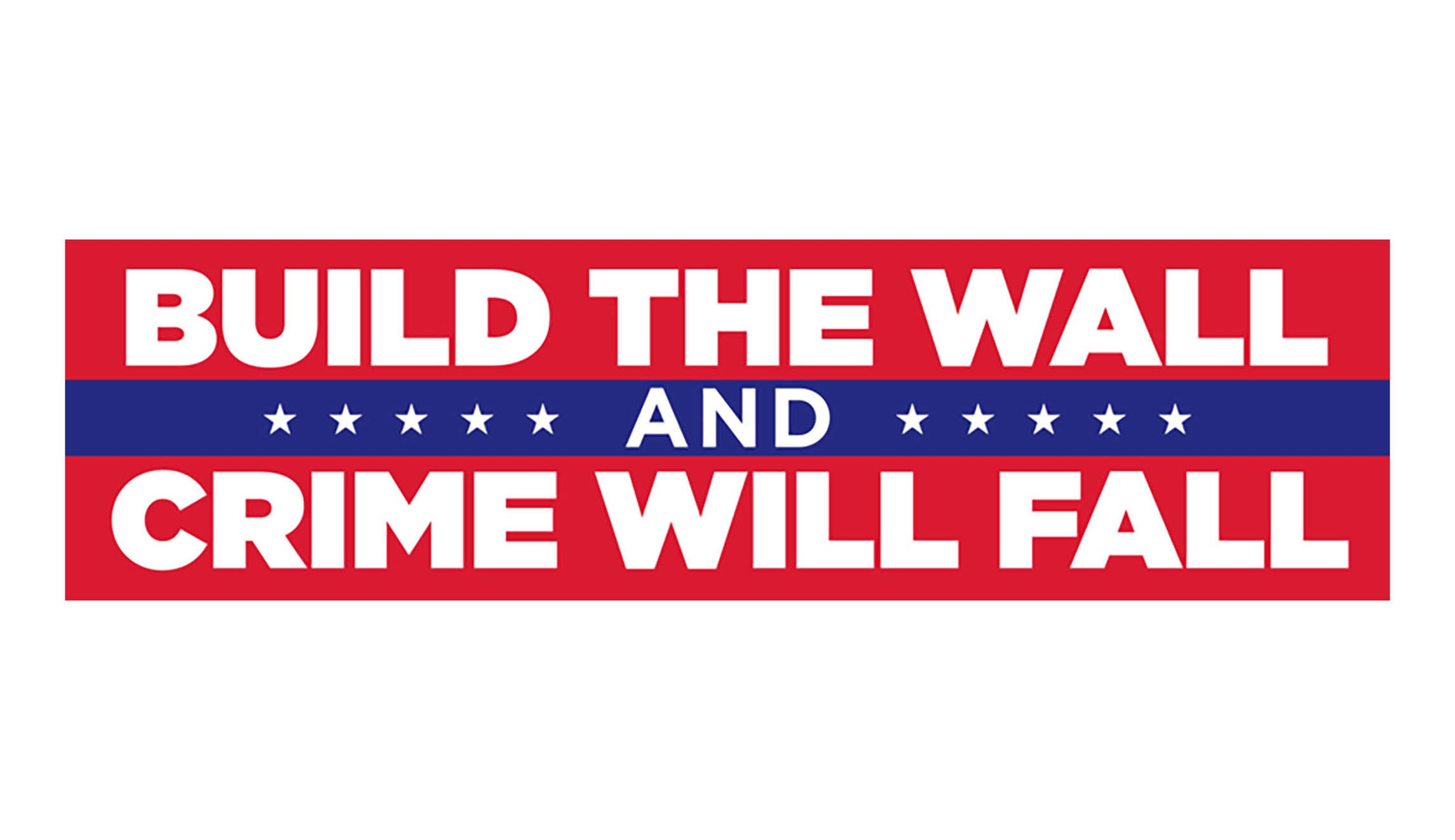
–has given currency to the fiction of a “Trump wall” as a project whose urgency only masquerades its deep illegality. The absence of the wall may lead it to be fetishized as “beautiful” and “being designed right now,” Trump assures, as if to involve the nation in a fantasy, but is never mapped.

The fetishizing of such a misguided promise masks that the project, perhaps funded by stolen funds, including civil forfeiture conducted by Customs and Border Patrol at the border that offer $600 million, would mandate reprogramming billions, but fails to address the problem of massive migration and displacement. But in dignifying the border plans by discussing a border “wall,” the image helps magnify the mega-project Trump has recently elevated to the status of a National Emergency to secure funding of $3.6 billion, even its cost estimates haven’t been defined, but lie at least $15-25 billion without costs for land acquisition and future maintenance. And as if to avoid the misery of migrants who arrive in the Caravan from Central America, the wall is elevated as a mythical, beautiful construction, and played against violent scenes of sex trafficking, threats of the violence of criminal migrants, or stories of the cruelty of cross-border transit. The mega-project of the border “wall” deflects all of these, and seems a solution to the tide of migration that haunts a globalized world.

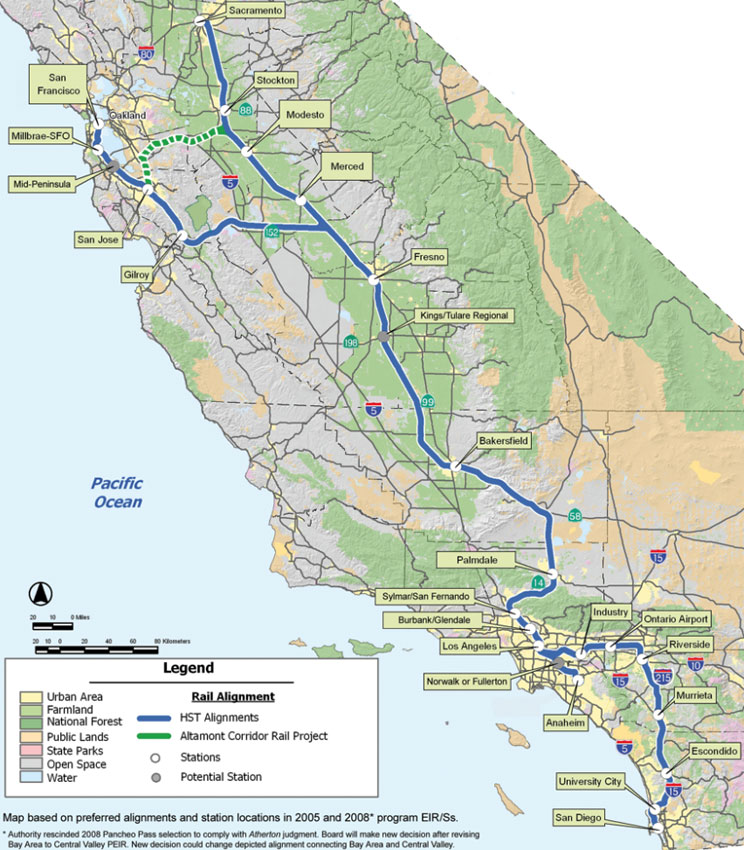
The state of state-funded mega-projects is a battleground for defining the future of the nation in both metaphorical and real terms, and it was bound to be opposed to projects of actually investing in national infrastructure. Trump has long attacked the mega-project of building High Speed Rail along California’s central valley. The project that symbolizes many of the visions of responsibility he has disavowed, and indeed the vision of building “new roads, bridges, highways, railways, and waterways all across our land” by destabilizing the role of public funding in infrastructural improvements, but using local and state funds with private capital. While the High Speed Rail was based on promises of lowering emissions and government funding of infrastructural projects that were the fruit of public stimulus projects, it has come to symbolize public investment he seeks to shun, and a vision of the future that seemed destined to collide with the alternative mega-project of guarding the nation against the danger of outsiders outside its borders. Indeed, longtime anti-HSR Representative Kevin McCarthy introduced a ‘Build the Wall, Enforce the Law” Act to ensure the project–slated at $23.4 billion–as reflecting the popular desire “the American people want” to fulfill an alleged governmental responsibility of “maintaining strong borders” that “For too long, America has failed.” Yet despite the geographic fiction of this imperative, it lacks any map.

The project claimed to bring economic benefits and jobs become a target of Trump’s anger, leading him to announce on social media “We want that money now!” in a clear attempt to shift its past and future funding to his own designs on completing a massive border wall between US and Mexico, long promised as the guiding project of the Trump Presidency–even if the wall has not, in fact, begun to be built, “Complete the Wall” the likely slogan for Trump’s re-election bid in 2020. The disdain that California Governor Gavin Newsom showed in dismissing the so-called “border ’emergency'” as manufactured political theater, in which California’s National Guard wouldn’t participate only rose the

Trump is particularly eager to allocate further funds for the construction of the long-promised border “wall” that will be insurmountable by refugees or criminals. To achieve its building, he declared an actual national emergency, in hopes to free funds for its construction that the US Congress denied. He almost acted as if the funds were ready to be reassigned, and the funds to be returned diverted to his own mega-project of border construction–and to glorify the actually uncertain technology of such a “wall,” in contrast to the “boondoggle” of a state-of the art infrastructural project of High Speed Rail, long supported by his predecessor, but which has become something of an avatar of the Green New Deal, as an opportunity to promote his construction of a border “wall.”
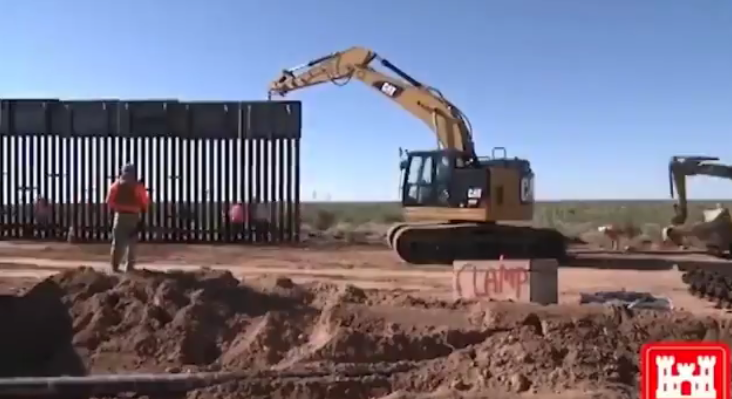
In a few days, Trump tweeted out a counter-image of time-accelerated wall construction from his social media megaphone, accompanied by a triumphal score as form of alternate news. High speed video of the replacement of twenty miles of bollard fencing were scored as a triumphal achievement, as if a ready-to-assemble pieces on cleared terrain was only IKEA-style assembly–showing a picture of segments that replaced existing fencing as a project completed “ahead of schedule” unlike the damning time delays and overruns on the High-Speed Rail Project that stands uncompleted.
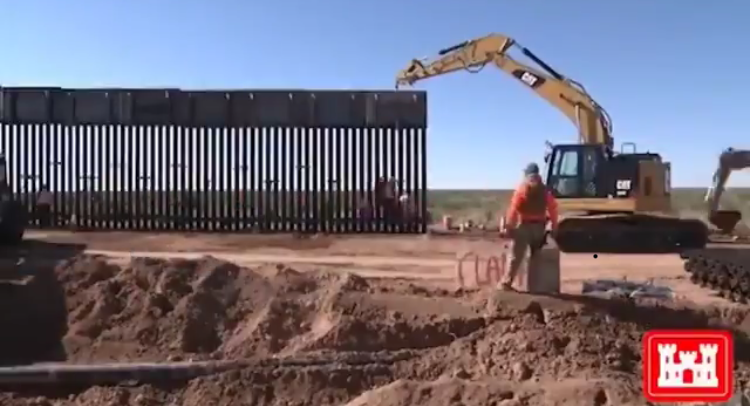
“We have just built this powerful Wall in New Mexico. Completed on January 30, 2019 – 47 days ahead of schedule! Many miles more now under construction!” (February 20, 2019)

The two mega-projects are quite distinct in functional and in the futures they promise to create. But both suggest the degree to which political problems are both increasingly interconnected with considerable complexity–weaving problems of globalization, from climate change to immigration to economic inequality–responded to by a “simple” solution of a truly monumental solution. The GIF of workmen posed on the side of the new border fencing promoted the momentum to a mega-project of utmost national need. The project is one marked by a stunning lack of national vision, but its simplicity has proved sufficient to substitute for one. Whereas the project of High-Speed Rail or a “Bullet Train” promised to create needed pathways for economic mobility, the super-project of connecting San Francisco and Los Angeles–essentially an urban plan, moving across the Central Valley, and promising to reduce carbon emissions in coming years–was both a target embodying all that Trump denied and degraded (needed emissions reductions; public transit; global warming) but a source for needed funds.

The difficulty of these mega-projects–which oddly unintentionally echo the fascist projects of the past, while claiming different visions of modernization–both turn on the use of public investments. The allocation of huge sums to infrastructural improvement are promised to assuage the political sense of insecurity that plague the world, and the promised resolution of global specters that they promise to allieve and the futures that they promise to secure. If the High-Speed Rail Project connecting San Francisco and Los Angeles provide a broad link within the state from the hub of a new Transit Center in downtown San Francisco to the world, from Sacramento to Los Angeles, the border “wall” is a barrier to protect America’s place in the world. The claims that the rail project was indeed “dead” that were made by Republican Kevin McCarthy–a long supporter of the President–to interpret Gov. Gavin Newsom’s very first State of the State speech in Sacramento incorrectly as a declaration of death of a project that he has long opposed. The notorious pro-MAGA Congressman from Bakersfield who has long enjoyed aggressively contentious sparring on social media–“We cannot allow Soros, Steyer, and Bloomberg to BUY this election! Get out and vote Republican November 6th. #MAGA”–and to make the securing of $25b for the US-Mexico “border wall” a national priority to burnish his pro-Trump credentials. His claims as “GOP Leader”–he refuses to be a Minority Leader–on the fundamental place of “a protected border” to a nation led him to promote bills funding the “wall” and support the National Emergency, delighted in tweeting gleefully the “Train to nowhere is finally stopped”–as if the plans for completion had been postponed.

McCarthy seemed to pounce on Newsom’s address with misplaced glee as he relished the prospect of ending a project to which he’s long been opposed, and is the model of public investment in economic infrastructure that Trump on which Trump seeks to shut the book, by privileging public-private partnerships and streamlining with less accountability or review, and the promise of revenue-making public works–while funds earmarked for disaster relief and stimulus seem redirected to a costly “border wall” claimed to be prioritized as a response to current national security crisis. The antipathy that McCarthy–long tied to oil money in Bakersfield, just outside Los Angeles, through whose district the rail would run–has framed his oppotiion to the high-speed rail project led him to try to frame it as a matter of national politics, as he styled himself as a “Republic Leader”–rather than “Minority Leader,” pronounced the Bullet Train “dead” with a finality that he must have trusted Trump would notice.
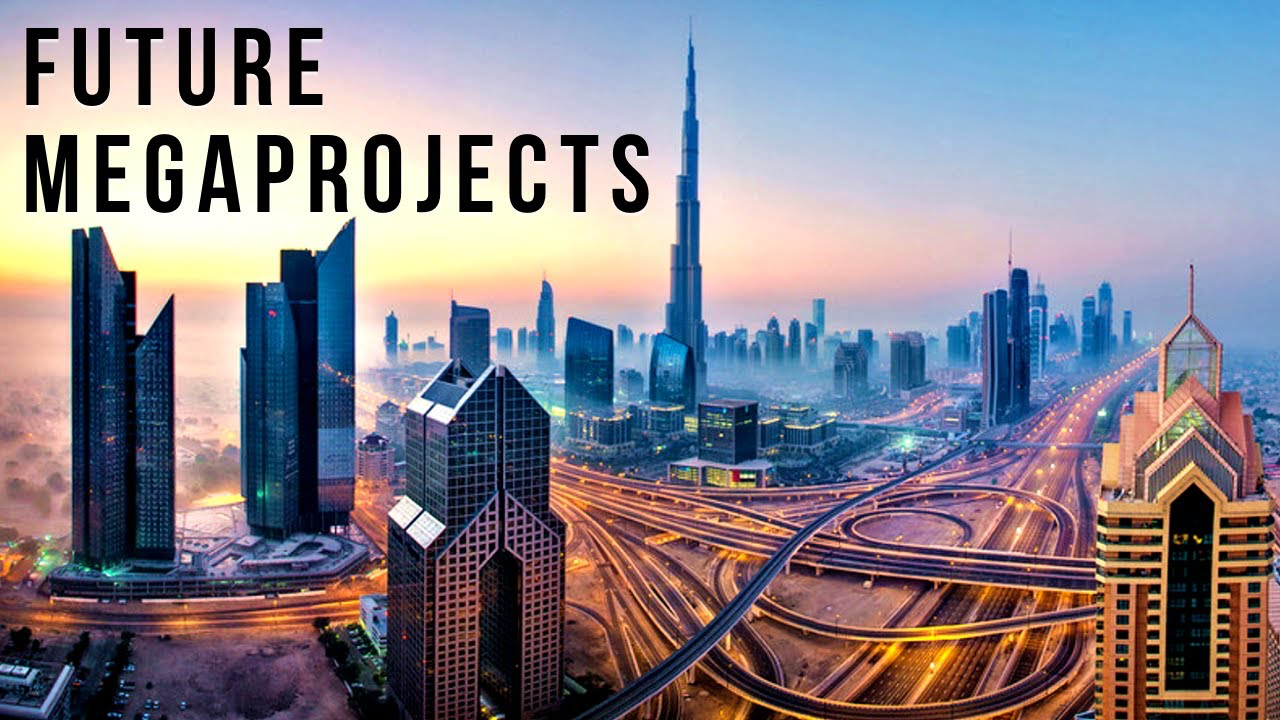
The collision between the needs for funds for the border wall–an apparatus of state that is needed, Trump insists, to preserve the policy he enacted of “zero-tolerance” immigration policy on the border, but that would serve to protect the nation from proliferating specters that haunt the nation. Collision with the projected High-Speed Rail Project first planned in 2016 by voter referendum, back in 2008, in the days of the arrival of promised Stimulus Package, seem almost the exact mirror image of mega-plan, designed to bundle inter-related problems (air pollution; congested freeways; climate change; petroleum dependence; economic inequality) at a single stroke, if from an almost diametric position. But as the right accuses the “far-left government” of California, suspiciously as if it were a Socialist state in Latin America, of pushing the rail project, and President Donald Trump grips to the conceit of a border wall, the individual faces of men and women recede to the background of each.

While touching on a range of political issues, the project that declared itself free of ideology became something of a political target to Trump as he machinated to find new resources for the “wall” that the U.S. Congress denied funds. The slightest hint that California’s new governor, Gavin Newsom, Jerry Brown’s successor, would scale back or re-dimension Brown’s own pet project because it “would cost too much” prompted Trump to reclaim federal funds as “California has been forced to cancel the massive bullet train project”–code for an unneeded public expenditure–even as Trump tried to remap the southwestern border by a barrier constituents could rally around, as if designing a new aesthetics of our national space to bracketed a record 68.5 million of globally displaced people driven from their homes, according to UNHCR, at a rate of almost 45 million a day, including 25.4 million refugees.

AnCalifornia’s Attorney General–with those of fifteen other states–quickly sued Trump for declaring a National Emergency to secure needed funds for the “Border Wall.” Not missing a beat, Trump attacked the state for the right to do so after “the state . . . has wasted billions of dollars on their out of control Fast Train, with no hope of completion,” and whose “cost overruns are becoming world record setting.” Trump’s gleeful tweets about a “Failed Fast Train Project” may conceal what is really at stake–
–but the needed funds were surely in the front of Trump’s mind.

For as Trump seems to be “weighing every possible option” to build the wall’s so junk technology at the border, so that the “wall” has become an icon of “illegal immigration” and the danger of “entry” into the United States’ “open borders,” as if the President is able to exercise complete executive authority by closing the border at any time, the state audit revealing that construction delays and billions of dollars of cost overruns were due to budgetary mismanagement has been blamed on being a project of personal investment for ex-Gov. Jerry Brown, who spent public funds on an unbuilt system long promised to link San Francisco and Anaheim, and failing to link the state in the sort of mega-network Brown had proposed, and a true break of public trust. (If Ponytail suggested that a solution would be to build a “wall” in detachable sections that, post-Trump, might be submerged in the Atlantic and Pacific sea floor to offer anchor sites or artificial reefs for marine life to flourish where it doesn’t exist, the potential proliferation of mega-projects and maxi-projects as border walls world wide–
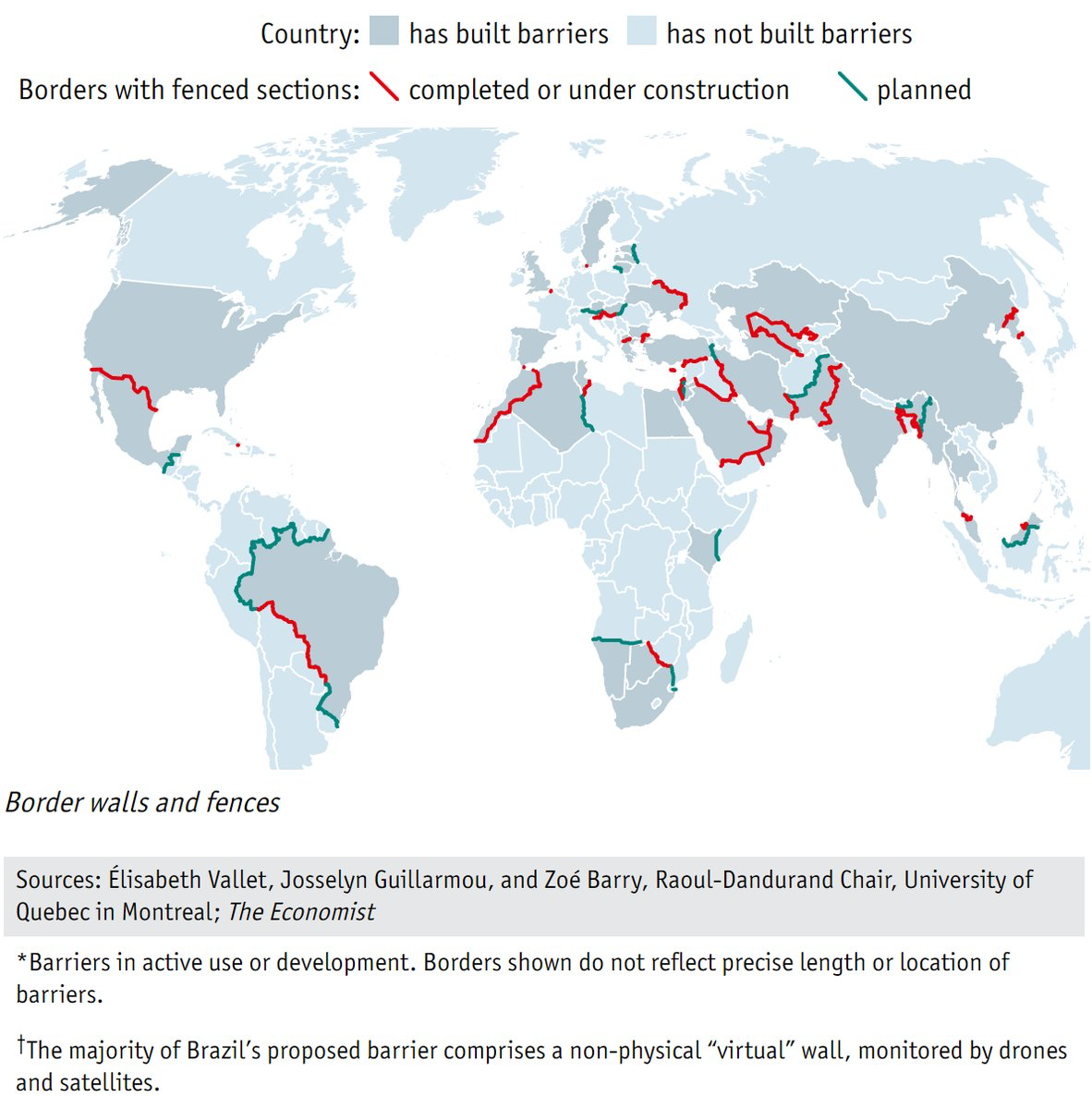
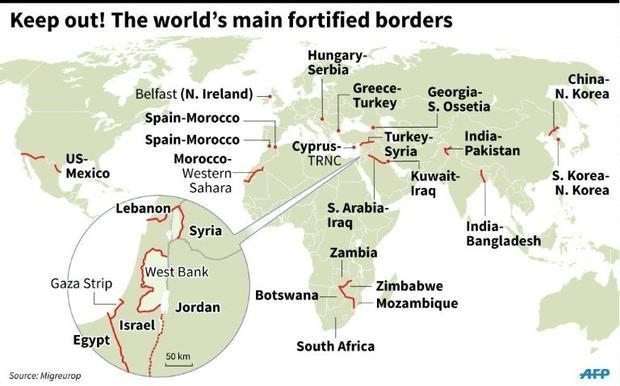
AFP/2015

–have created a terrifying normalization of the border wall in a shockingly brief time, as a mega-project promising security at a time when global security is hard to come by, as if they were tools of normal governance.)

Can the projects and their costs even be compared? If the costs of the High Speed Rail project have ballooned–as the costs of the “Wall” seem constantly underestimated and bound to rise in cost overruns we have not even begun to predict–the notion that these are comparable construction projects, or analogous infrastructural improvements. Both mega-projects–however dissimilar in nature–don’t address political problems, but constellations of issues, from infrastructural needs, climate change, and fuel consumption to immigration, criminality, and drugs, promoting projects of mass appeal in different ways, that suggest targeted projects addressing constituencies, promising to address deep infrastuctural problems to very limited degrees–their purported boldness hindered by limited funds, and facing limited support to be enacted on the scale that their promoters celebrate.

While it’s uncertain that either could ever be completed in a realistic schedule that has been announced, the projects from opposite sides of the political spectrum seem something like mirror-images, ostensibly designed as investments but suggesting almost opposed ideas of government or the idea of investing in the public good. Bound to collide with one another, both advance promised changes in landscapes, projecting solutions to mega-problems they cannot fully address, and invite fantasies of the further promises they might meet. The rise of such mega-projects seem a sign both of the increased complexity of pressing problems of powerfully political origin, but their bundling of networks of pressing political problems in a single project claiming to resolve complex problems at a single stroke, is combined in quite toxic ways with oversimplification–by both promoters and their critics who attack them–in ways that threaten to remove them from the very complex networks of problems they attempted to address. The changed status of “mega-projects” in our political discourse make them a sort of pandering rooted in slogans and ultimatums, and removed from complex problems we deserve better to map.
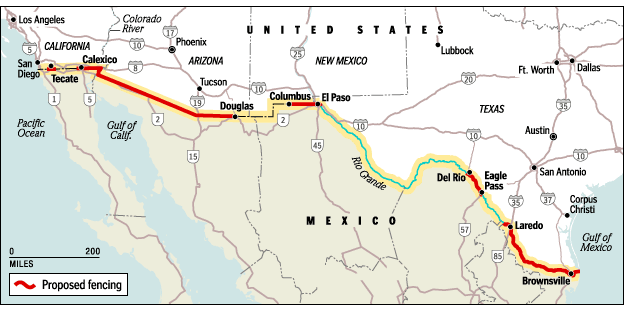
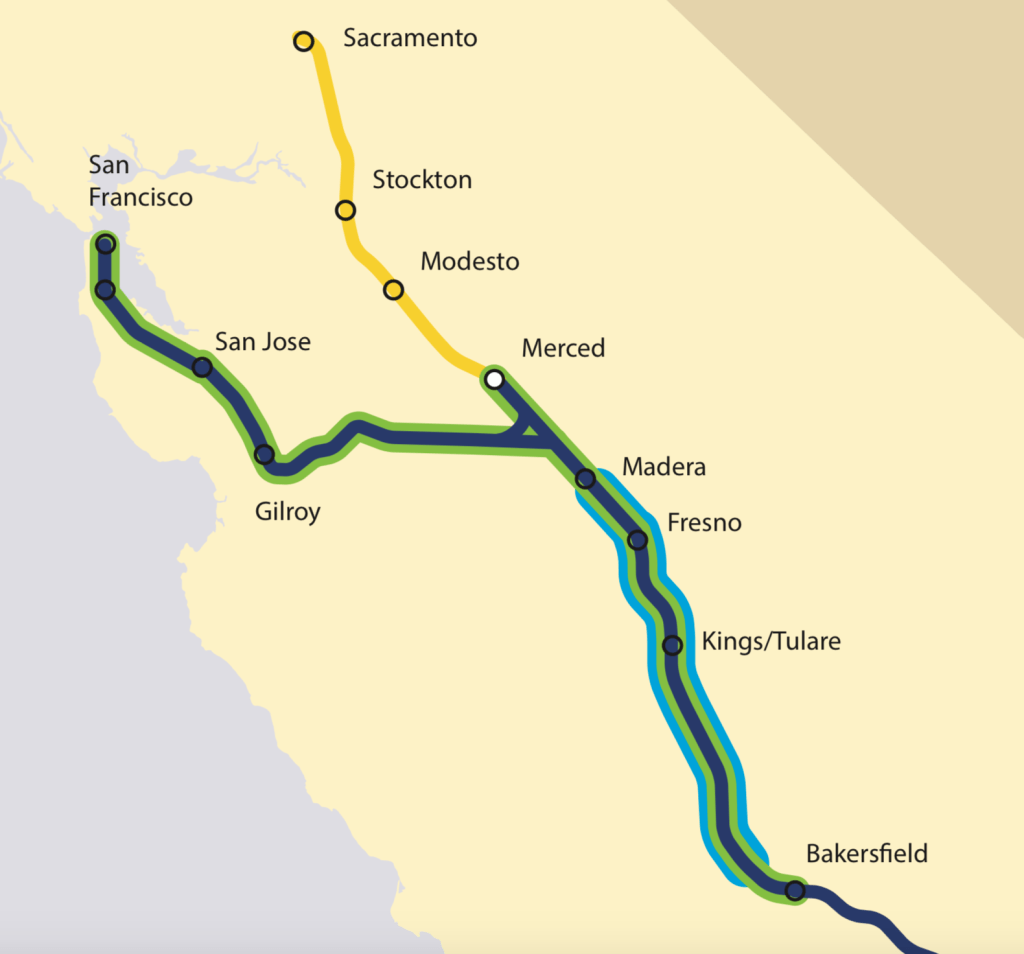
Hot on the heels of Trump’s fuming at Congress that “with the wall, they want to be stingy,” matched by the veiled threat that “we have options that most people don’t really understand,” Trump found the time ripe to chasten California’s governor for “wasting billions of dollars”–and charge that the state in fact “owed” the federal government $3.5 billion. The handy figure could increase the $1.375 billion allocated in budget negotiations for fencing on the Rio Grande, and in a budgetary shuffle increase desired funding for Trump’s mega-project, to reach the robust sum of $4.875 billion–almost close to that original demand for $5b, a magic number of sorts, that could be itself arrived at by allocating emergency funds from the Department of Defense–or the declaration of a national emergency as if this were an actual crisis. (The addition of $3.6 billion from other military construction projects among the $6.1 billion from the Defense Department budget that he argued wasn’t going to be used for anything “too important”–and was officially discretionary, if earmarked for construction, repairs, and counter-narcotics programs–rationalized as the mega-project would block “illegal” drugs.) The result would double allocated funds–and create a mega-project worthy of the name, for which no clear map exists, although many have been offered. But a mega-project of this size perhaps, paradoxically, itself resists mapping . . .

Racing to ensure the possibility of declaring the national emergency to get his way on Thursday, the suggestion on television that Gov. Gavin Newsom could curtail a project of high speed rail in the state just the day previous came with a search to secure more than the $1.375b in border fencing as a victory, or exit the terms of the bill he had to sign to avoid extending a government shutdown, as he met contractors to discuss the design of the wall, and sums of money able to be tapped after he declared a national emergency, and use it as a basis to claim he remained an outsider, still not bound by Congress, still not polluted by deals cut in Washington, even after he’d occupied the Oval Office for over two years–even if he didn’t really have a believable map of how to build it? Or did the Commander-in-Chief, feeling cornered by Congress, see Newsom’s seeming concession as the chance to secure billions by budgetary re-allocation? The high-speed rail system was given the fearsome price-tag of $10b; repossessing $3.5 billion of funds from a cancelled project raised dizzying possibility of an under-the-table reallocation of federal funds no one knew were there.

Trump delights in playing fast and free with numbers that seem designed to disorient his audience. In truth, the costs of a border “wall”–whatever it might look like–remain far higher than we can calculate or imagine. Trump boasts he can build the “wall” for but $12b, yet that is a figure at which most scoff. Internal reports from the Office of Homeland Security place the figure at more like over $21.6 billion over three years, The most recent plan to secure another $6.5b by some sort of emergency funding seemed less of a reaction to stinginess than a charade of creative accounting,–a dizzying juggling of vast amounts of money that become meaningless before his own hyperbolic claims of “an invasion of our country,”–the new mantra used to justify its construction–“with drugs, with human traffickers, with all types of criminals and gangs.”

In the process of pulling out all the stops in his request for emergency funding and indulging his worst impulses, the moneys slated for California’s train suddenly seemed an attractive target for federal re-appropriation. High-speed rail seemed a project whose funds were easy to hijack and redirect to the border barrier Trump was scrambling with budget analysts and contractors to fund. And when California’s governor appeared to diminish the size of his project, Trump not only pounced, but to terminate the funds of just under a billion for the rail project–a $929 million federal grant–and to demand the return of $2.5b in past stimulus matching grants, arguing they were neither properly used or matched by the state, by “actively exploring every legal option” to take the funds, no doubt in order to add them to the President’s discretionary funds during the declared National Emergency, which seems more and more a pretext for building a wall for which the land has not been secured, let alone panels designed.

Staging a “state of emergency” is a classic form of justification advance by political theorist Karl Schmitt, a promoter of executive power and extra-legal articulation of a state’s power. The demand for the funds would not necessarily allow the completion of a “Border Wall,” but would compromise a project that is important to the state’s economy. The crisis he has manufactured has led Dan Richard, chairman of the High Speed Rail project or “bullet train” to resign, as a damning letter arrived from the very transportation agency which sent grants for the High-Speed Rail Project in 2009 and 2010 called California state out of compliance with the grant agreement and promised date of completion by 2022. As chairman, Richard, former PG&E executive and pioneer in extending public transit the BART transit in San Francisco, was an unpaid member but was involved in the project’s operational planning and oversaw the extension of almost one hundred and twenty miles. But his work came under heavy criticism after the state audit for having assigned contracts in haste that precipitated lawsuits–mostly from the improvident failure of securing land for building track. (Perhaps Newsom suggested a reduction of the scope of the project–“Let’s be real”–to bring the state in line with a Central Valley Project from Merced to Bakersfield, and a cornerstone for a future route from San Francisco to Los Angeles.) But the call “let’s level” about the elevated platforms built for the current project whose platforms are already built across much of the Central Valley–
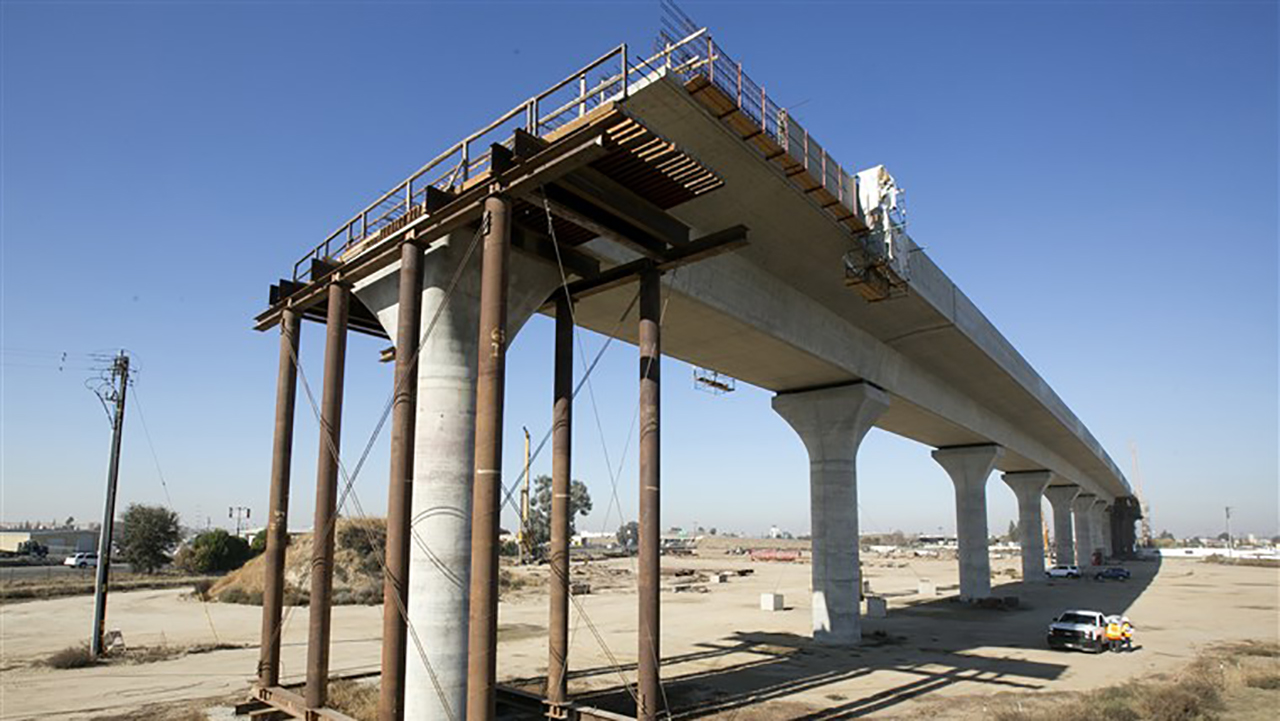
–was heard by opponents as a cry of concession, consequent to the finding that an L.A.-San Francisco line could cost over $13 billion estimates that were expected.

But was the comparison between such mega-projects creating a false sense of similarity in the role of the state to redesign the future of the nation at a single stroke, impressing an executive desire on the landscape? The false geographies that each project create demand themselves to be better mapped. The aspirations for the High-Speed Rail Project were considerably easier to map, similar questions of a lack of state-owned lands on which to build and lack of agreement on the projects form created obstacles that a single executive not deeply familiar with the site or its inhabitants couldn’t have hoped to resolve.
The rail project was savagely satirized in the juxtaposition of newsmaps claiming to reveal hidden interests for property owners–as if to suggest its hidden agenda–by linking High-Speed Rail to the raging California wildfires, as if such a small-scale map could reveal the foolhardiness of the rail project. The manipulation of news maps as information was a teased that the fires would prompt landowners who wouldn’t sell land to the state to do so–
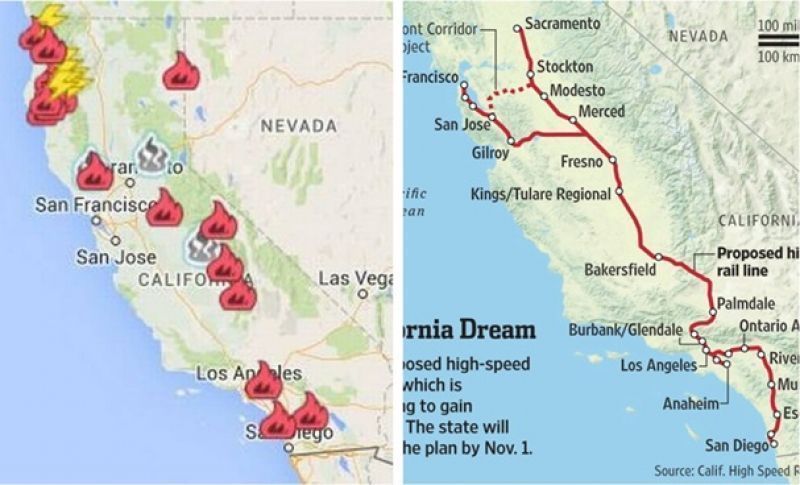
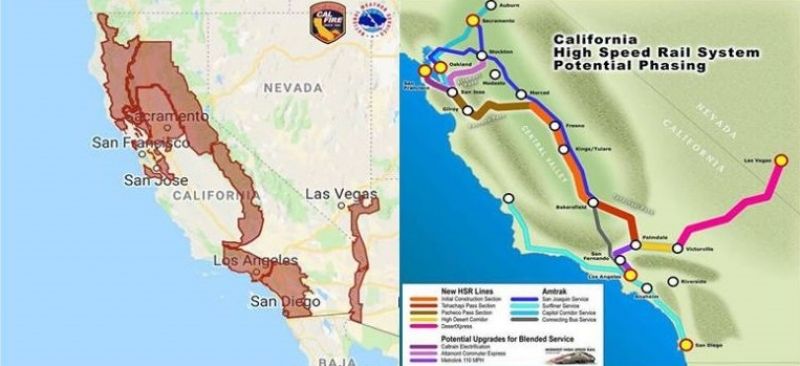
–but was presented as an excuse not to dig deeper into the project’s benefits. For real problems of congestion, a lack of public transit, and a need to create better infrastructure for jobs are all replaced by evils specters of other hidden interests, all rendered opaque by likening the geography of fires’ spread to the state’s problem in securing necessary lands on which to build the tracks, and raise the specter of special interests driving High-Speed Rail, in ways that might deeply damage the state as we know it.

1. Both mega-projects have been sold as worth their cost, and both–though one falsely–as “paying for themselves.” The border “wall” is so massive it has no clear price–conservatively, $70b (and an extra $150 million a year to maintain it), or anywhere from $27b to $40b, while Trump asserts only $12b. Where the funds will come from is anyone’s guess, as the promise is something of a conceit, and as Trump never produced a clear schema of costs, the whole question has been maddeningly and dizzyingly opaque. The train may cost as much–although the benefits are more tangible–though a possible $100 billion price-tag has raised many eyebrows. But the high-speed rail was long billed as a basis for modernization, which the border wall can hardly be claimed to be. Price-tags provide a poor basis for understanding the benefits and goals of both mega-projects–$21.6 billion for a wall and $10 billion are sums which we can barely imagine for organizations that symbolize ultimatums–protection and safety or economic modernization–that reduce the complexity of inter-related problems to a monumental solution, all too often removed from or reduced to a map.

The funding for High-Speed Rail was planned to be funded largely by the cap-and-trade program designed to lower California’s carbon emissions. Cap-and- trade was written off, at first, but has caught on as a practice of resistance in the Trump era–although it is rejected by the White House. The High Speed Rail project would stands as an alternative infrastructure to fight climate change. This made it all the easier to the seen as a sacrifice of federal funds, at a time when any budgetary expenditures were being scrutinized for potential pillaging. The vertiginous bombast that Trump summoned to seek to justify the declaration of a national emergency–the image of an invasion is pretty powerful, and for some hard to resist, and the threshold of evidence has been substantially lowered–allowed for the by now all too familiar juxtaposition of scale, numbers, and proportions that seemed guaranteed to confuse his audiences so that they got behind his argument. The very breadth of the high-speed rail project seemed a perfect target–its many maps suggesting a future that gave Trump special pleasure to deflate, no doubt, in ways that one can’t see as tied to a perverse pleasure in seeing infrastructural projects seem to crumble into thin air, felled by executive fiat.
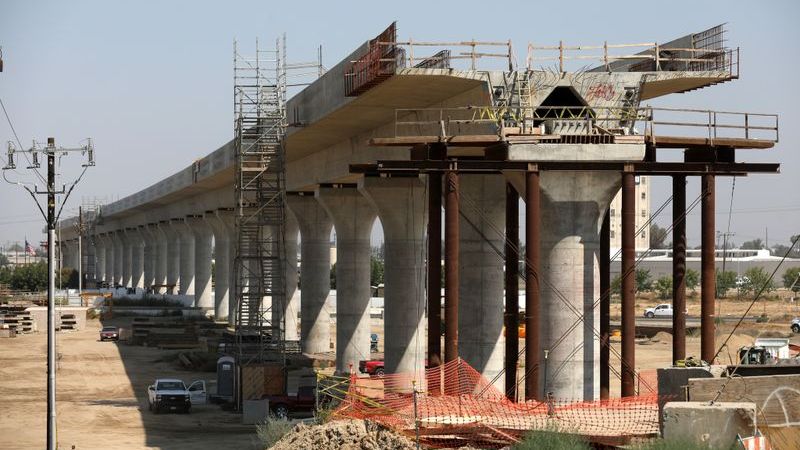
Gary Coronado / Los Angeles Times

Leave a comment

Filed under American Politics, border policy, border wall, infrastructure, US Politics

The New Cold Warrior in the Triangle of Terror

When addressing the new Latin American policy in Miami’s Freedom Tower in late 2018, the new National Security Advisor John Bolton targeted Nicaragua and Venezuela in a striking geographic metaphor. He offered a new metaphor for described the dangers of a “triangle of terror stretching from Havana to Caracas to Managua,” in November 1, 2018, demonizing Latin America and the island of Cuba in terms that suggested possible plans for “taking direct action against all three regimes to defend the rule of law, liberty and basic human decency in our region.” As if to displace attention from the Northern Triangle from which so many asylum seekers have fled to the United States in recent years, including unaccompanied minors, and where civil society is overwhelmed by drug trafficking, gang violence, and police corruption, the new triangle Bolton seeks to shift attention is a target.

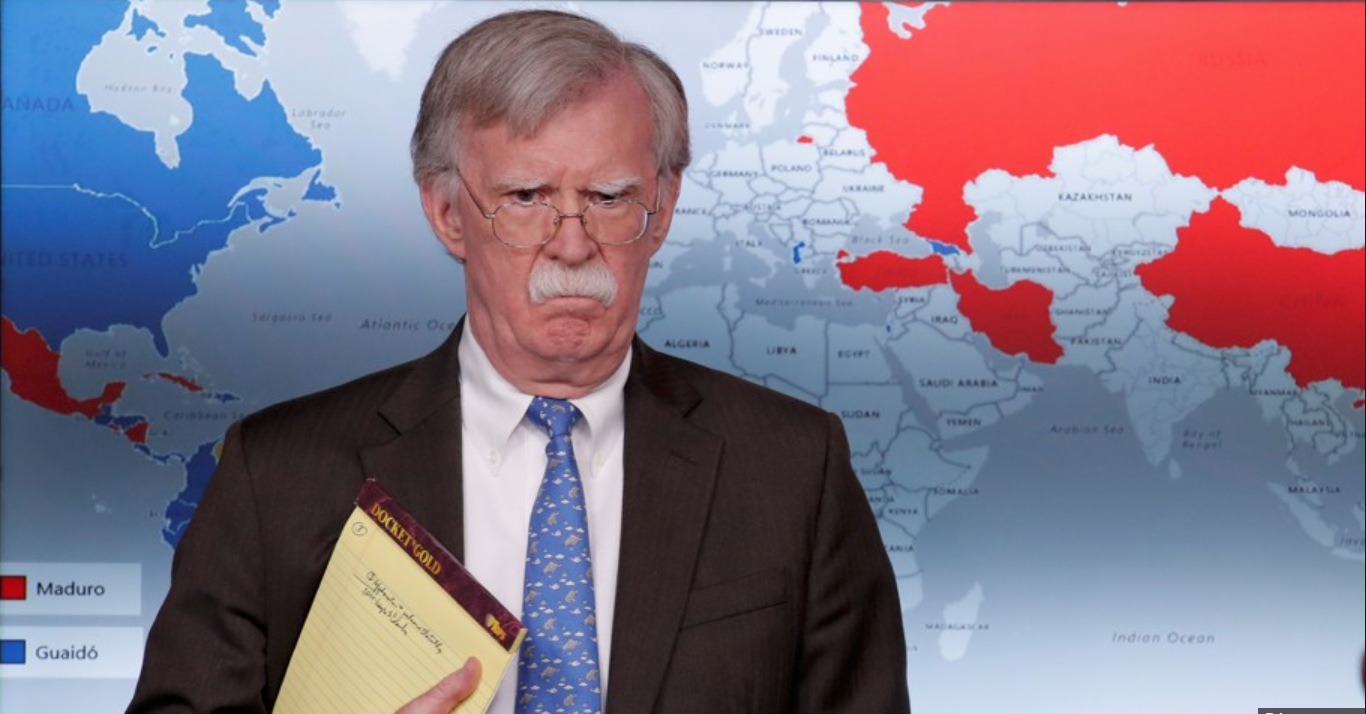
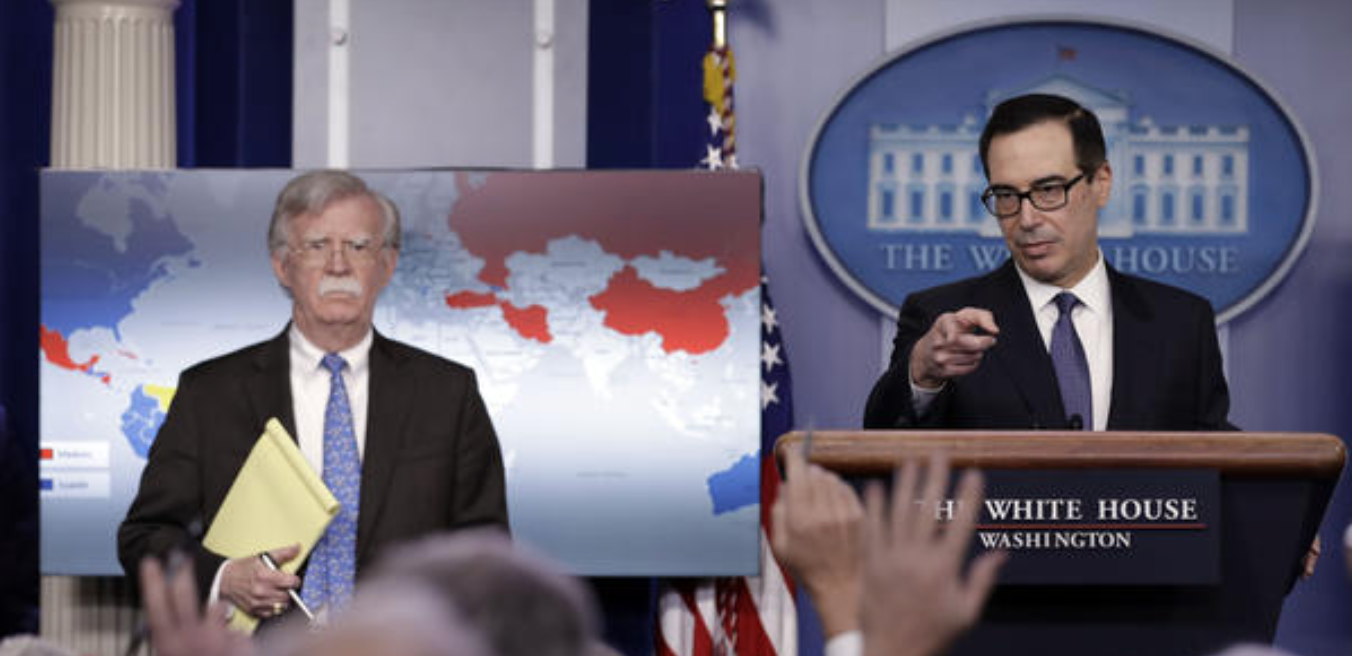
So it may have been no surprise that when attacking the legitimacy of Socialist Nicolás Maduro of Venezuela by imposing expansive sanctions ton Venezuelan oil and gas, Bolton seemed to tip the cards of power. Upping the ante from defining the Socialist regime of Venezuela as an apex in a triangle, in previous saber-rattling that committed the United States to striking a blow at a “triangle of terror” tied to the Socialist heritage of Hugo Chavez and to Raúl Castro, Bolton “appeared to disclose confidential notes written on a yellow pad” to reposition military troops to Venezuela’s border, standing before a global map the divided the globe in no uncertain terms, as if announcing a new configuration of power in his role as National Security Advisor for Donald J. Trump. The “triangle of terror” Bolton warned of in November 2018 seemed to essentialize the fundamentally dangerous notion a Latin American region ripe for instability. But it may have also been sheer coincidence that alliterative force of a rather pointless if powerful polygon was a powerful cartographic conjuring of a strategy of national defense, not located in the Northern Triangle, or the former Triangle of Terror where ISIS cultivated troops, but a new borderless triangle of even allegedly even greater danger–a triangle with a rich political genealogy from the Cold War.

Bolton’s adoption of the rare tired stock term of a triangle seemed to shift attention from the other Triangle of Terror, located when it was most recently in the news on the Afghan-Pakistan border, the very site from which negotiations have been announced to start to withdraw American troops. It may have been sheer coincidence, but Bolton seemed to shift attention from a triangle in the Middle East where American troops had been long stationed and that had been a hide-out of Osama bin Laden and Taliban fighters, as if by the powerful abilities of the friction-free nature of GPS–

–to a triangle that was closer to America’s own sphere of influence from the triangle of Peshawar, Quetta, and Kabul, from which the US was busy extricating itself. Bolton’s November speech was quickly taken, one might remember, as defining the intent of team Trump in relation to focus on a new Axis of Evil, adopting a hard line in Central America as sphere ripe for intervention–“This is not a time to look away. It’s a time to increase pressure, not reduce it,” Bolton announced–and the recent exercise of economic muscle to bolster American refusal to recognize the self-declared electoral victory of Nicolás Maduro, and to declare the legitimacy of Juan Guaidó as President of the nation, demanded a map to concretize the global geopolitical stakes that Bolton and Trump were ready to commit to Venezuela, although the map before with Bolton spoke revealed few of the roots for the focus on this new Triangle, but rooted confrontation with Maduro’s claims to legitimacy in the defense of democratic liberties.

Bolton cast the region as a geopolitical battleground for American interests in stark and rhetorically powerful alliterative terms. He openly opposed the United States to a “Troika of Tyranny”–a term that lexically hinted at a vehicle driven by Russia, but wasn’t the 2016 Presidential election–and almost openly evoked the chills or breezes of a new Cold War, with its division of the world to spheres of recognizing two possible Presidents in Venezuela in ways that expanded an electoral map of one nation to spheres of geopolitical influence–if not alliances–expanding in bizarre terms an electoral map to the world to show that it had global consequences–as if global power dynamics were as simple as an electoral map.

The infographic seems to advertise how much “other countries” had at stake in who was Venezuelan President, keeping mum as to why they did. It helped that Bolton looked the part of an inveterate Cold Warrior. And one could not but recall the openly proprietorial terms of last November, when he announced “Cuban military and intelligence agencies must not disproportionately profit from the United States, its people, its travelers, or its businesses” but pointedly attacked Venezuela by imposing sanctions on its gold, and attacking the “triangle of terror” or “troika of tyranny” perhaps metaphorically tied to a Bermuda Triangle, redolent with weirdly alchemical associations of unknown dangers near islands on the high seas–

–as if one could pretend that the declaration was about the rocky shoals of securing needed democratic reform and less to do with oil revenues and resources, as with the defense of democracy.

The transposition of the polygon of a triangle from Afghanistan to the hemisphere was close to a notion of hemispheric dominance, if it also turned attention from a long war in Afghanistan to a closer, seemingly more surgical, winnable military confrontation. The map affirmed the need for using economic muscle by seizing income from oil as a way to undermined as a Socialist dictator, however, whose socialist government was corrupt and based on cronyism, linked in the global map to authoritarian governments in Turkey, China, Russia, and Iran, and their allies, linking an argument of hemispheric dominance to broad geopolitical warning of the consequences of failing to recognize Guaidó as being Venezuela’s legitimate President in American eyes.

Bolton Declares Sanctions on Venezuela’s national oil and gas company at White House Press Briefing/january 28, 2019
Evan Vucci/AP

Maps often lie, as do infographics: but the international magnification of the lack of legitimacy Bolton had been preparing to declare for some time came not only with trappings of objectivity, but with a not so coded message, that might be the true legend of the global divisions in the infographic, and was the major social media take away: a proposed movement of US troops whose removal from the Syrian and Afghan military theaters was in the process of being negotiated by the Secretary of State: the image, unintentional or not, immediately raised fears and concerns about American military plans and sent a shudder in global media.

While it may have been sheer coincidence that the metaphorical migration of the triangle of terror from one theater of global confrontation to the next was occurring in Bolton’s rhetoric and was mirrored in the imagined frictionless switch in deployment of soldiers in the legal pad Bolton displayed to television cameras–

NSA Advisor Bolton’s Yellow Pad

The mobility of the metaphor and the military seemed to echo the new logic of the Universal Transverse Mercator map, where territorial boundaries and sovereignty have far less prominence than specific sites of dispersed geographic location, and imagined transfers of military power could be a frictionless motion in space.

The infographic provided a sort of parallel world carved up and divided by entrenched political interests but whose alliances helped sovereign boundaries to recede similarly. The global two-color map almost made it difficult to understand that he addressed Venezuela–the topic of his Press Briefing in January, 2019–save by the legend identifying red as “Maduro” and blue as “Guaidó”, elevating each man who had claimed the presidency as holding a global constituency, and dividing the globe to magnifying the geopolitical centrality of the Venezuelan election. In the early February State of the Union, Donald Trump elevated–behind the rubric “Abortion”–the pressing concern of Venezuela immediately after “National Security” and “North Korea,” in ways that similarly monumentalized the question of recognition of the future president of the nation, under the rubric of “never apologize for advancing America’s interest, moved from the Border to “National Security” and withdrawal from the Intermediate-Range Nuclear Forces Treaty, a historic arms control accord of forty years in standing–with the commitment to “outspend and out-innovate” all other nations in weaponry–to North Korea and Venezuela, regions that were almost designated as areas of future combat.
Trump’s pledged to the union in a mid-February address to “stand with the Venezuelan people in their quest for freedom” against unspecified enemies, but targeted dictators tinged with Socialism. The gripping evocation of a struggle against “the brutality of the Maduro regime, whose socialist policies have turned that nation . . . into a state of abject poverty” may have foregrounded the prominence of Trump’s interest in targeting Bernie Sanders and Alexandria Occasion-Cortez as Socialists, in order to taint the Democratic party. But it was also a crisis that recalled how John Bolton, his new National Security Advisor, had conjured a new danger for the United States’ geopolitical position, independently of nuclear disarmament treaties, but which evoked our historical need for intermediate-range missiles to protect domestic interests.

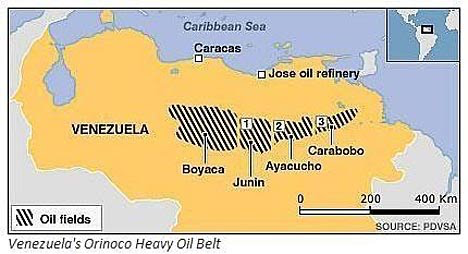
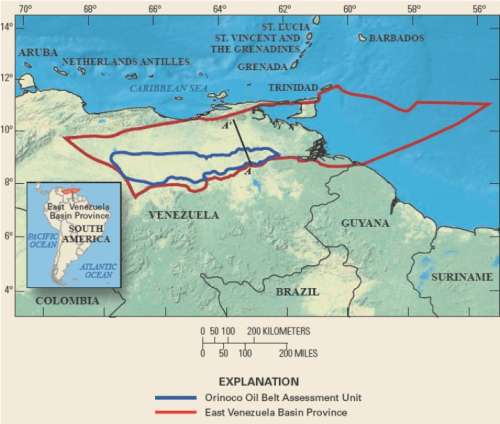
The role of Maduro in Venezuela has been disastrous for its citizens, to be sure, and mismanagement of natural resources by the state demands attention: But much as Trump distorted actual policies by targeting the “Socialist regime” of Venezuela in a speech marked by excessive flag-waving, patriotism, and rally-like chants of “USA, USA,” the prominent place of map before which Bolton spoke distorted the situation, by literally taking our eyes off of the ground. The map obscured the flows of refugees from Venezuela and the humanitarian crisis in South America, as well as access to the vast oil reserves lying beneath the Orinoco River basin’s Belt. The extensive reserves to which America has limited access is mapped by USGS, but was left tacit in the American declaration of sanctions, but motivating an abrupt change in returning attention to the Western hemisphere for the National Security Advisor. And the assumption of Venezuela as OPEC Presidency, as much as the defense of democratic principles, made the clear ties of National Security to the preservation of access to and production from the Orinoco Reserves–shown below by PDVSA–and the truly globalized investment in the fields shown below, estimated to include three hundred billion barrels of bitumen–the black, viscous, organic “sludge” that contains petroleum–in what are estimated to be the largest reserve on earth, involving multiple international players–from Statoil of Norway to ExxonMobil to Chevron to BP, but also CNPC of China and TOTAL of France, as well as even if the private ownership in the Orinoco Belt was ended in 2007 by Hugo Chávez, whose Presidency haunts the current crisis. But although nationalized in name, the project of oil extraction are only majority owned by he vast majority of bitumen remains too deeply buried for surface mining–some 88-92%–by Petróleos de Venezuela (PDVSA)–creating a site that was used by Chávez to finance social reforms and projects, and created revenues of $30 billion annually in 2011, making Venezuela a sort of bit of an economic bubble in a globalized world, tied to international markets for carbon and oil, and making Venezuela a “hidden” global petroleum power, estimated to have hundreds of billions of barrels of oil.

Petróleos de Venezuela (PDVSA)

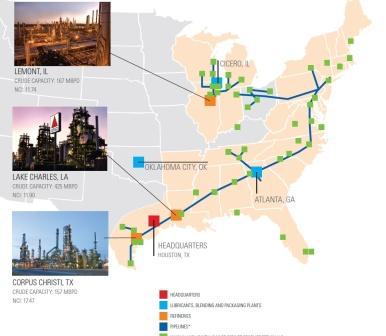
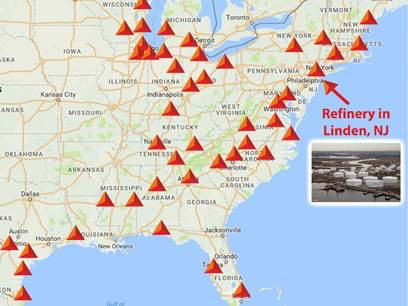
The international ties to projects of extracting bitumen and refining oil in Venezuela–which produced about 2 millions of barrels a day in 2015–estimated to have far more technologically accessible reserves. The decision to amplify the level of rhetoric used to isolate Maduro and acknowledge Guaidó as President surely has close ties to the assumption of increasing attempts of national oil and gas company to reroute its oil supplies to Europe and Asia, as members of the Maduro regime told the Russian news agency Sputnik, not only responded to the sanctions, but undercut the Venezuelan crude that usually flowed to CITGO refineries in Texas, Louisiana, New Jersey, and Illinois which made access to crude that lay in Venezuelan territory a national security question–as Oil Minister Eulogio del Pino tweeted hopes to “continue consolidating strategic alliances between PDVSA and Rosneft” in November, disturbing images of hemispheric dominance, as well as undermining American energy security.

.

USGS has estimated 513 billion barrels lying in the Orinoco Oil Belt, without determining or publishing the proportion technologically or economically able to be extracted
Venezuela Oil Holdings – Deep Resource
CITGO’s Petroleum Terminals in USA/CITGO

Bolton’s–and Trump’s–description of Venezuela as an ideological struggle is all one sees in the two-color division of the globe that almost heralded hopes for a return to a Cold War where maps were understood primarily as a global battleground, recalling the days at which a vertiginous sense of power in postwar Europe led us to map exchanges of nuclear missiles, and imagine apocalyptic scenarios where the world was divided by global war–but a global war that seemed to really be about American interests on access to energy reserves, hiding behind the scrim of a ratcheted up rhetoric of democratic legitimacy.

The economic crisis in Venezuela is both tragic, and an acute crisis of humanitarian scope. But the global map seemed to reduce it into a global confrontation of two blocks, if not a crisis of global consensus about representation and political legitimacy, that seemed to hollow out the term of democracy of its content: despite national sovereign division in South American, the sharp divisions of the blue of North America and most South and Central American nations described inexistent international blocks of consensus. What seemed a legitimate record of global divisions about the crisis the legitimacy of the Venezuelan government to lay claims to Venezuela’s rich reserves of oil. Without acknowledging the political or economic actualities in the South American nation, the map hinted at a global crisis, its stark red v. blue color-scheme reflecting the offers of Russia to restructure the debt of Venezuela’s oil and gas companies, and China to lay claim to a stake in Venezuela’s oil, by asserting the reserves to lie within America’s hemispheric interests, and equating those interests as lying with America’s National Security.

As if to bolster Guaidó’s claim that he is backed by the democracies of the world–in ways that nothing better than an infogram can attest–

Just 25% of the world’s governments have publically recognised Guaido as President; the remainder recognise Maduro’s election
(Paul Dobson / Infogram.com/February 6, 2019

The map before which Bolton spoke has become a topic of recurrent interest, as the nature of the global divide has been parsed and examined. The divide, this post argues, was less an informative one–deisgned to generate debate–than to paper over the situation in Venezuela’s political crisis as a question of alternative candidates for President, treating the contest as an election, and using the colors of an electoral map to suggest that the election was conclusive, and the legitimacy of Guaidó reseted on clearly ideological foundations.

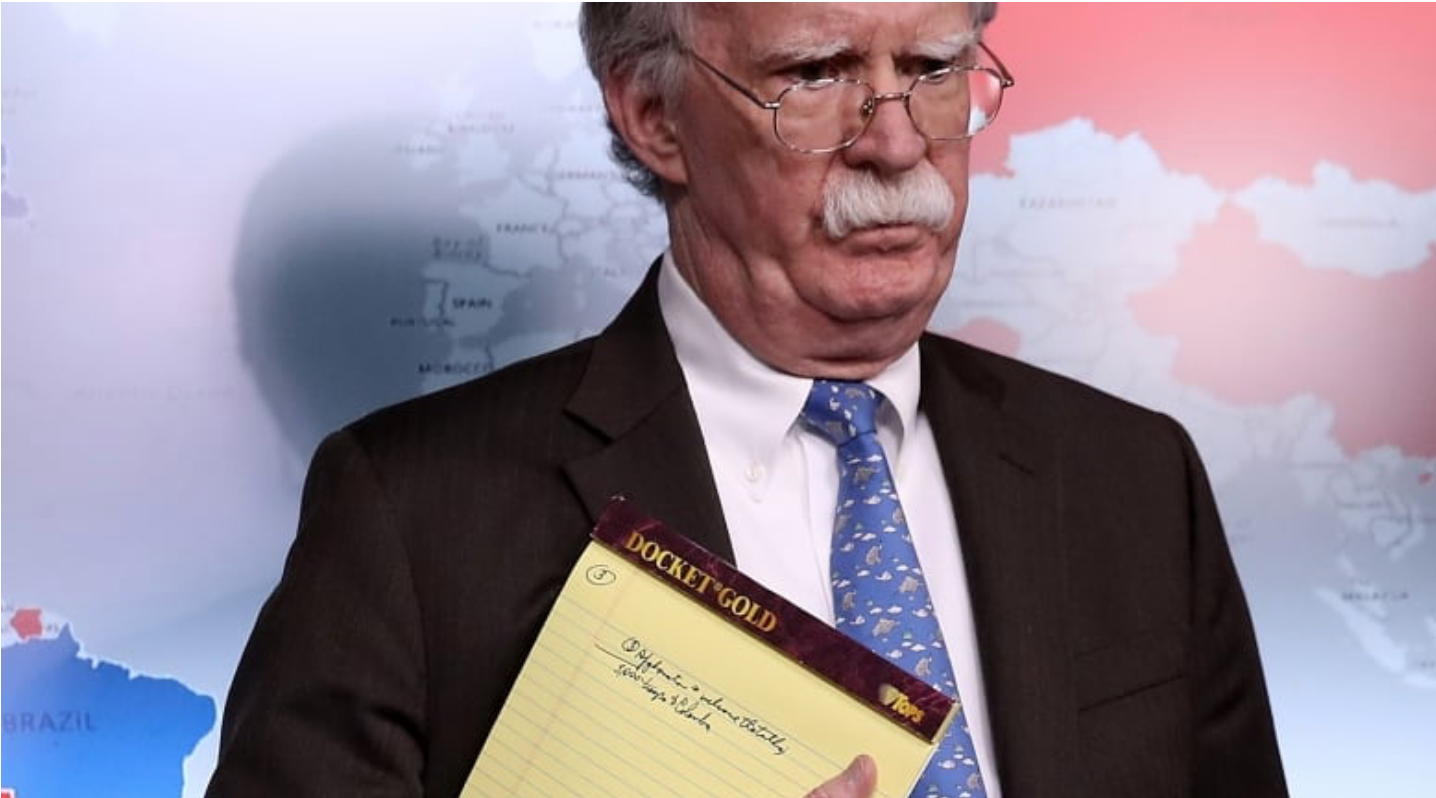
Bolton spoke at the White House briefing before a map revealing a broad global divide ostensibly about recognizing Maduro’s legitimacy as Venezuela’s President but that hauntingly recalled the geopolitical divide that was firmer than many since the Cold War. It provided an image of the Cold War as it was seen from Washington, in some way, as if ideological divides that are clearcut still maintain legitimacy in a globalized world. The infographic on two screens seemed to affirm the broad global consensus of questions of the legitimacy of Maduro’s government, as if this justified the decision to block access to all property located in the United States of the national oil and natural gas company, Petróleos de Venezuela, S.A. (PDVSA), place its assets in escrow, and prohibit American citizens from paying the company directly for access to unrefined or refined oil assets. But the “press briefing” was also a transformation of the White House into a new newsroom of sorts, that exposed the illegitimacy of the Maduro government through a map that tied the United States to the defense of democratic principles–coded in blue, with other democratic allies, in opposition to “reds” linked to Socialism or Communism–China, and Russia, even if it was not Soviet, but also some questionable allies–that reinstated the for-us or against-us global space to make a point. The disclosure before this map of a threat of sensitive statement that echoed a bespectacled Bolton’s assertion that “all options are on the table” provided a powerful infographic that tied Washington to an image of legitimacy, even if the awfully crude map lacked legitimacy to orient American viewers to global affairs.

The new global imaginary that Bolton promoted as he stood beside U.S. Treasury Secretary Steven Mnuchin painted a global schism as the consequence of Maduro’s declaration of his victory in a second term as President, as a violation of that nation’s constitution–and as standing in violation of the Venezuela’s constitutional elections–but was as much a response to the defense of a restatement of American economic sovereignty in the Western hemisphere, a phrase going back to the turn of the last century, if not the Monroe Doctrine, but which gained new currency in the Cold War as issuing from the Dept. of State, and as a question of national security rather foreign affairs, by tactically magnifying the geostrategic role of the Venezuelan election, rather than offering evidence of a constitutional argument about sovereign legitimacy. The question of sovereignty seemed intentionally blurred, as the Secretary of the U.S. Treasury took questions about sanctions against a foreign state-owned oil company, currently OPEC chair, whose assets were being frozen to promote democratic legitimacy, but in fact to strengthen America’s hemispheric dominance.

This time, the map–whose stark divisions into blue and red blocks suggested a map of American alliances, echoing an imaginary of detente, rather than legal rights–seemed to place the defense of denying the flow of economic goods from American territory as a globalist argument, by reframng the issue of constitutional rights or legality in globalist terms that preserved an image of American dominance within the color scheme that it divided the world.

And National Security Advisor John Bolton, who in less than a year in the Trump administration has become an advocate for military interventions in both Iraq and Iran, used the briefing before a map to raise rather openly the possibility of a military resolution of the crisis over the Venezuelan Presidency, as the Commander of US Southern Command, General Mark Stammer, is set to meet the Ministry of Defense of Venezuela’s neighbor Colombia, and Maduro has conjured fears of a “coup” driven from the United States. But the fear that the invitation of American oil companies to organize the refining and extraction of Venezuela’s abundant crude reserves after the January 23, 1958 Democratic uprising, just before the Cuban revolution, sent shock waves into the United States, pushing the Trump administration rather precipitously into a search for infographics that could substantiate dangers of infringement of its hemispheric interests and geopolitical dominance, and to convince the world of the danger of Maduro’s disenfranchisement of elected members of the Congress, and the lack of legitimacy of a regional vote that supported Maduro’s government against a fractured opposition–and led to the invitation from Russia to restructure the state-owned oil and gas company’s massive debt, recasting the struggle about the government’s legitimacy into new global terms.

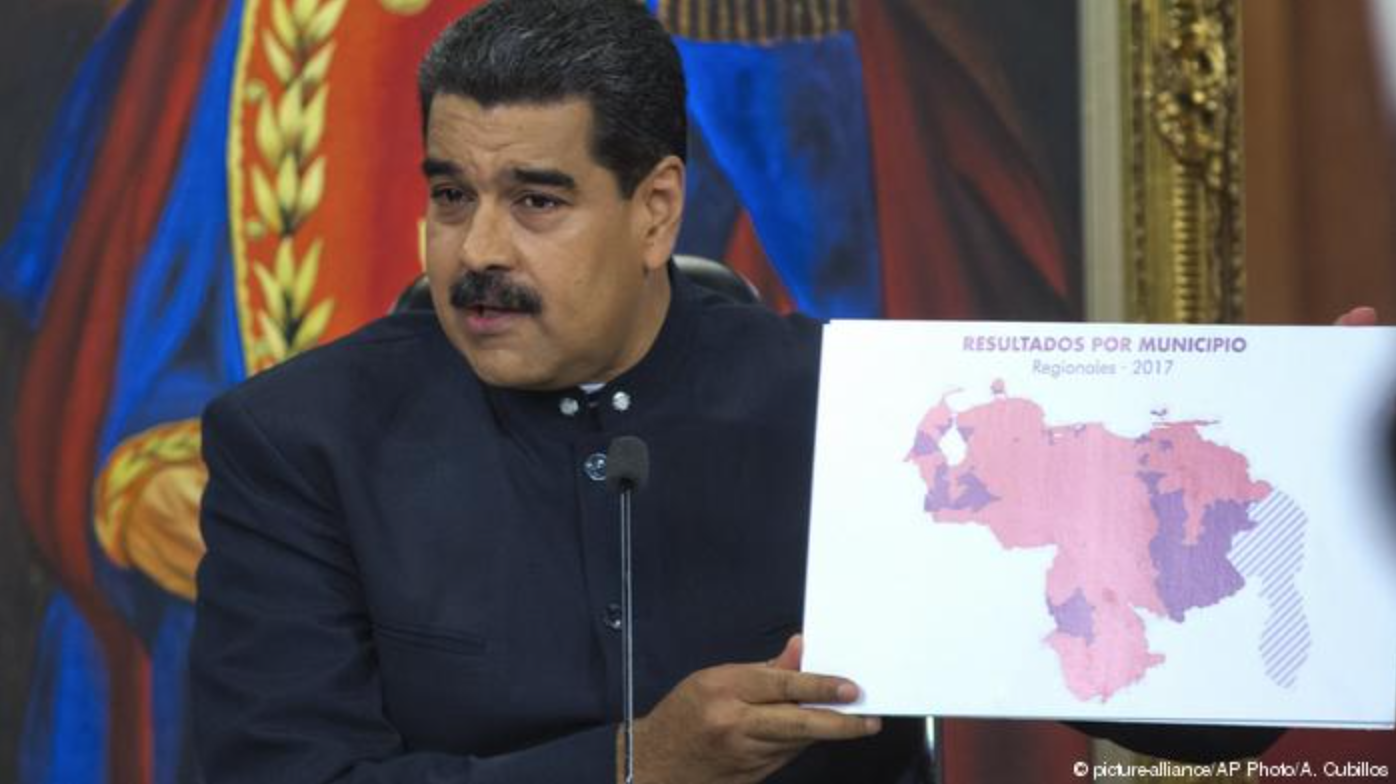
The colors on the global map reflect, to be sure, the contested results of elections in Venezuela, where compromised elections had produced the heavily disputed endorsement of Maduro’s Presidency just last May. After an offer from Russia to restructure the massive national debt in November, 2017, Maduro declared new elections in May 2018, which the opposition decided not to recognize, and which polls suggested he wouldn’t win, but in which he was victorious–coincidentally at the same time thatJohn Bolton gains the portfolio as director of the Trump NSA.

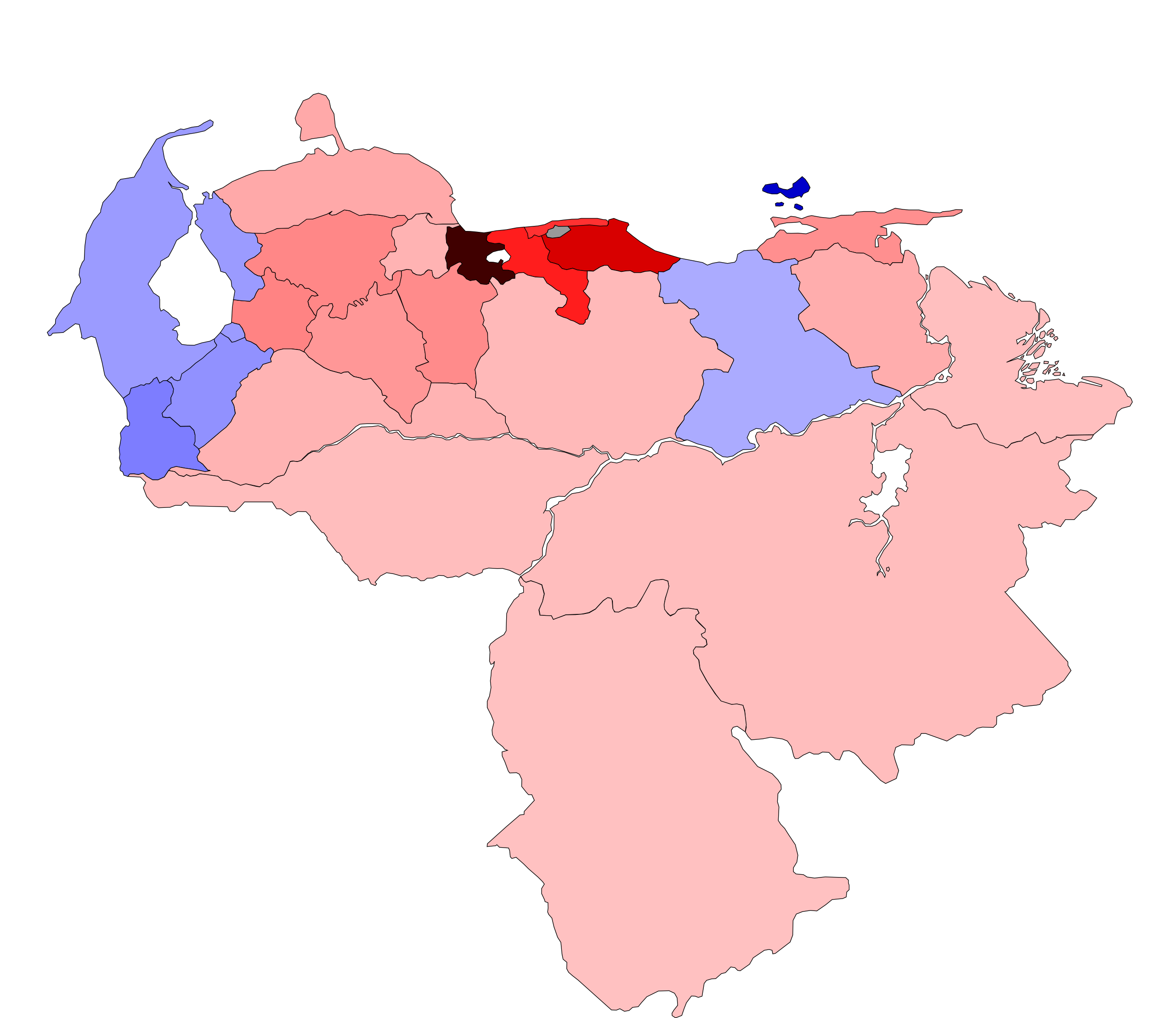
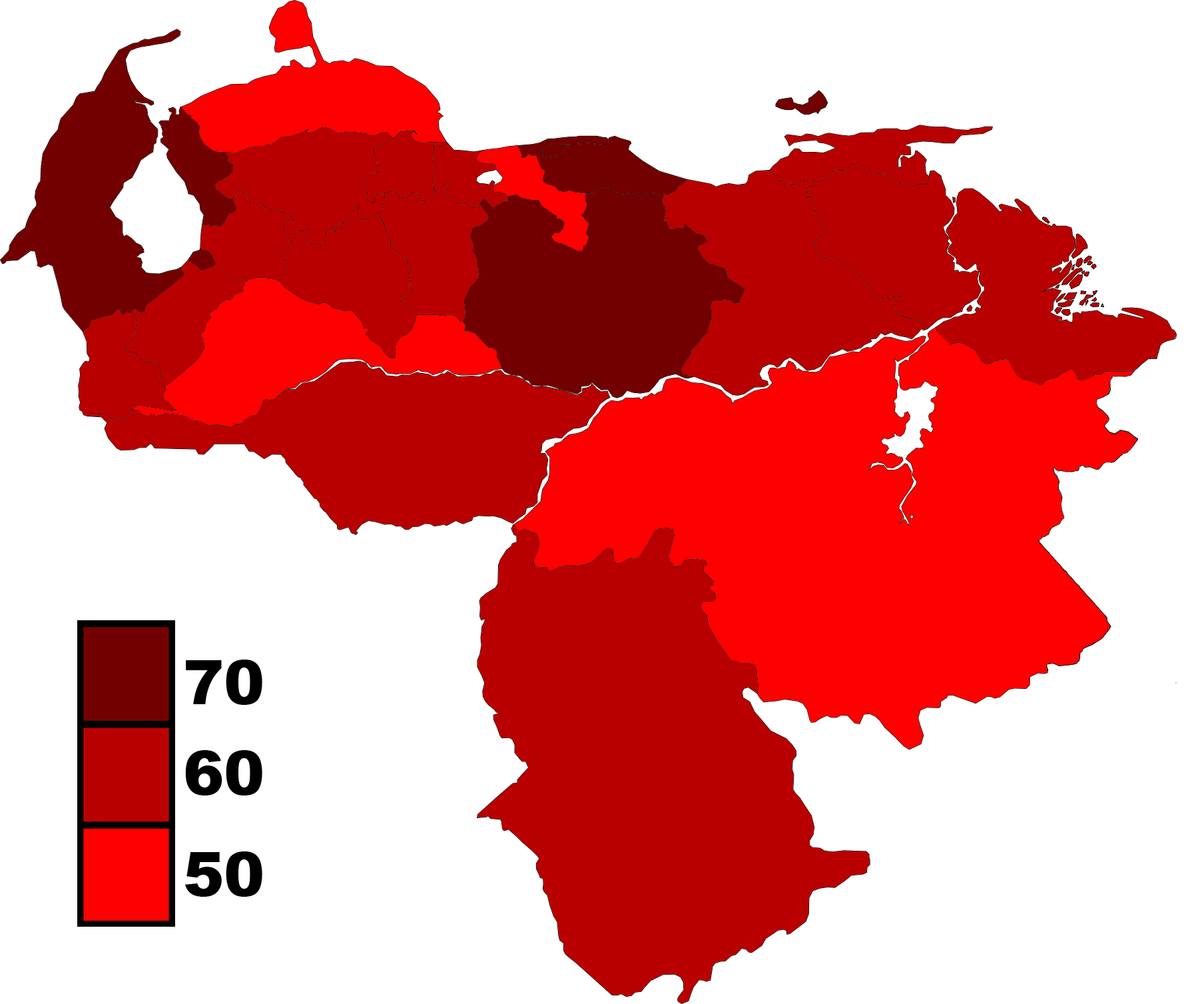
October, 2017 AP/A. Cubillos
2017 Regional Elections of State Governors in Argentina
Distribution of votes for Maduro in the election whose low turnout led its legitimacy to be quickly questioned by the EU, US, and OAS

Familiar blue v. red electoral maps were used to describe the votes of the Great Patriotic Pole and opposition  Coalition for Democratic Unity that were recast suddenly in global terms in late January in Washington. Socialist Maduro affirmed independence in his inauguration, and in rebuke Parliamentary President Guaidó won immediate support from Donald Trump after he declared himself Interim President and leader of the nation and of oil company, precipitating a powerful infographic to be devised in Washington that oriented audiences to an electoral map in global terms. But for Trump–and for Bolton, who cast the election as a question of National Security–the global divisions in globally strategic terms.

Trump’s segue in his February 7 State of the Union from the INF to Venezuela, included a transition about North Korea, but suggested global imbalances that any obscure the question of access to petroleum reserves in Venezuela, and the deep, implicit question of whether the American military should or would be used to guarantee access to Venezuelan oil. In ways that must have crossed Bolton’s radar, but have faded from most public comments, Maduro when he pledged to decouple the pricing of Venezuelan crude from the dollar, use of non-dollar currencies as the Chinese Yen for Venezuelan oil, and seeking to cut oil production to “stabilize” oil prices–and entertaining the cryptocurrency Petro, based on the five billion barrels of oil found in Field No. 1 of the Orinoco Oil Belt–possibly less than a quarter of Veneuela’s considerable total oil and gas reserves, whose accessibility to the American economy has suddenly become increasingly tenuous.

PDVSA

The events tied to the assumption of the Presidency of OPEC led to ‘slow coup’ of January 23–the anniversary of the overthrow of the Jiminez dictatorship by Venezuelans in 1958–as opposition politico Juan Guaido auto-invested himself with the presidency with broad American support, followed by a chorus of right-wing governments in Latin America, including Brazil’s Jair Bolsonaro.

The result was to pretend that the elections which the opposition party had boycotted last May could be cast again as an electoral map, this time not involving Venezuelan votes–or the self-determination of the nation–but symbolically recasting the election in terms of a global map. Even as Maduro offered to negotiate, he bristled “The presidential elections in Venezuela took place, and if the imperialists want new elections, let them wait until 2025,” perhaps reacting to the provocative recasting of the national elections, whose legitimacy has been questioned by observers, in ways that led Bolton to take to Twitter to threaten “serious consequences for those who attempt to subvert democracy and harm Guaidó”–as if he were the victor of an election. Bolton had escalated attacks on the “legitimacy” of Maduro from mid-January and the “illegitimate claims to power” of the Venezuelan “dictator” as abrogating the “a government duly elected by the Venezuelan people” and democratic practice. But the stark divide of the global map seemed to resist any discussion of negotiations and affirm the United States’ ability to shift troops from Afghanistan to Venezuela’s border immanently–while preserving something of the illusion that the “blue” votes for Guaidó would be affirmed by American muscle.

Win McNamee/Getty Images, off CBC

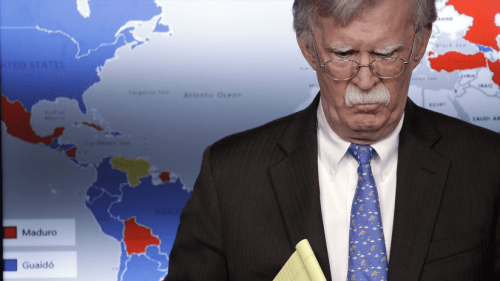
The gruff determination and stoniness that registers in Bolton’s face as he sought to communicate the divisions of the world that potentially lay in the failure to affirm America’s recognition of Guaidó bled far beyond the defense of democratic principles, and seems to have threatened to cast more than a shadow over Europe. Bolton’s slightly veiled message of national security seemed, in classic America First style, to cast a shadow over European allies, here symbolized by the actual shadow that his pensive head cast on the United States’ traditional NATO allies.

Was Bolton in the act of forging global divisions of a new Cold War, military detente and hemispheric dominance, sneakingly if all too familiarly tied to defense and affirmation of democratic principles?

Continue reading

Leave a comment

Filed under geopolitics, latin America, national security, news graphics, Venezuela

Gobble a Bit Less?

We all map our relation to the world by the tokens of food that we assemble on our dinner plates. But on the carefully prepared meal of Thanksgiving, we face the orchestration of a full harvest plate–sweet potatoes from the earth; turkeys fed over a year from grain; celeriac or Brussels sprouts for something somewhat green–seem a statement of global harmony. The meal is a sign that all is right in the old agrarian world we have long left.

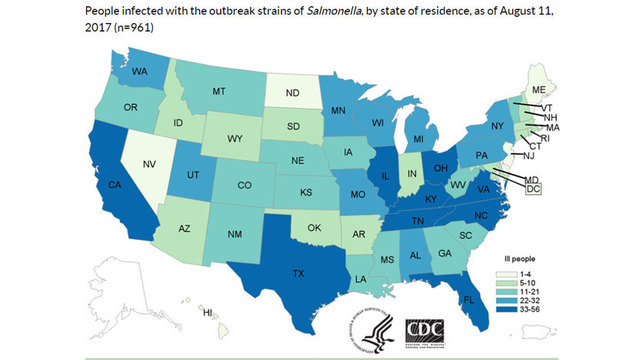
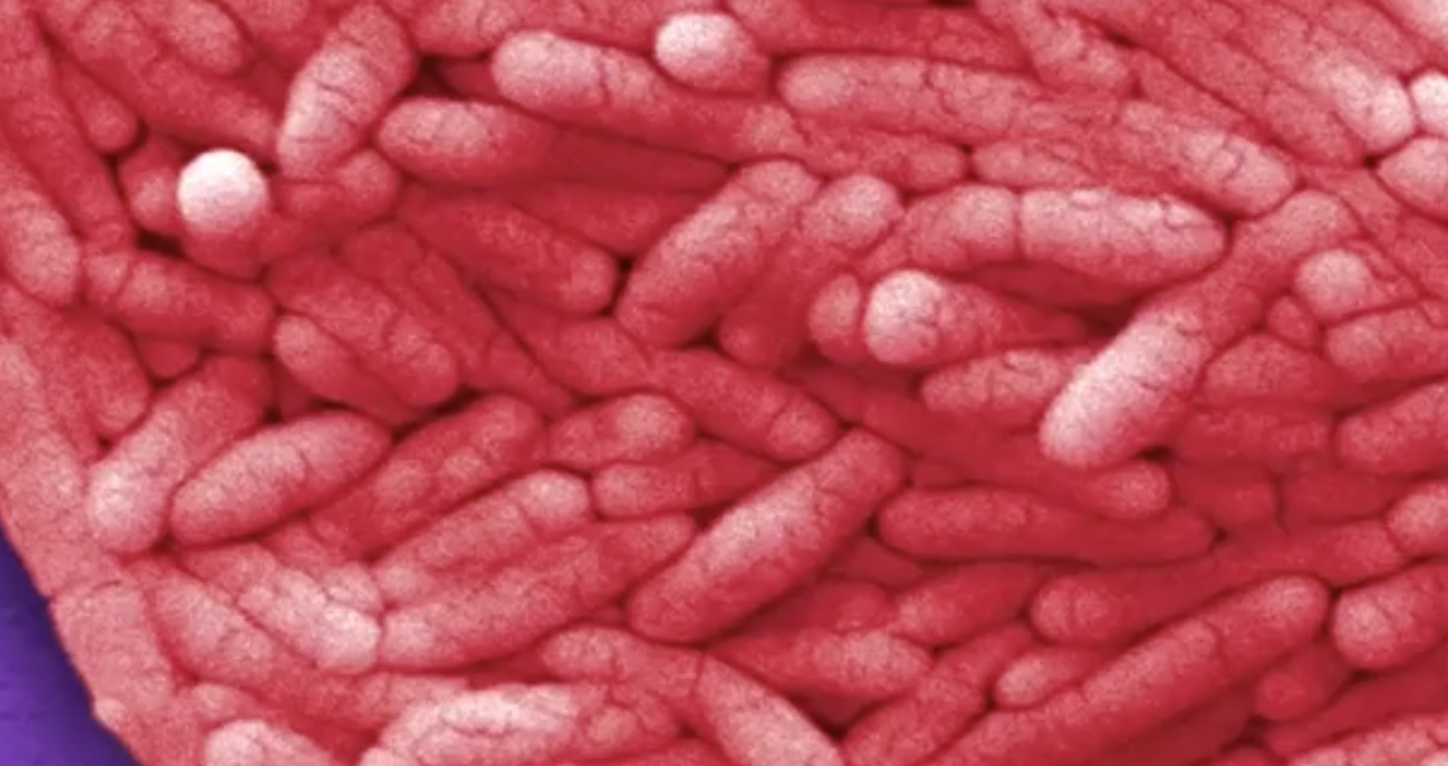
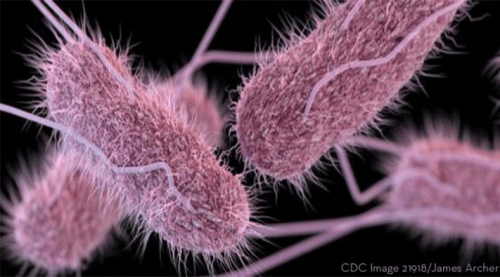
Yet the annual sacrifice of the native bird perpetuates a faded agrarian geography of the nation, is also a false geography: much as the Presidential pardon of the turkey, long promoted by the Poultry and Egg National Board and the National Turkey Federation, who first gave President Truman a bird to pardon, has cast the sacrifice in pointedly national terms–mythically tied to  President Lincoln’s supposed clemency of one turkey in the Civil War era at the request of his son, Tad, in 1863, the year of the Emancipation Proclamation, as if to commute the bird’s sacrifice, is often cast as an event of returning to ethics, and joining the nation. Cemented by the time an enterprising Rhode Island poultry dealer, Horace Vose, boosted his brand by sending several well-fed members of his flock to the White House occupant to promote his stock, the conceit of yearly offerings or pardons served to cement the bounty of a seasonal sacrifice of turkey to national health. It must have been especially striking that outbreak strains of Salmonella have been boldly mapped onto the nation by the Center for Disease Control. The increasingly terrifying visualizations of the spread of fowl-borne infections seem a sad reflection on the nation, transforming what was a native bird into a vector of contagion and disease in over-extended food networks where farms are defined as producers or providers and procedures of laying eggs and raising chicks or slaughtering and butchering meat geographically dispersed on an industrial scale.

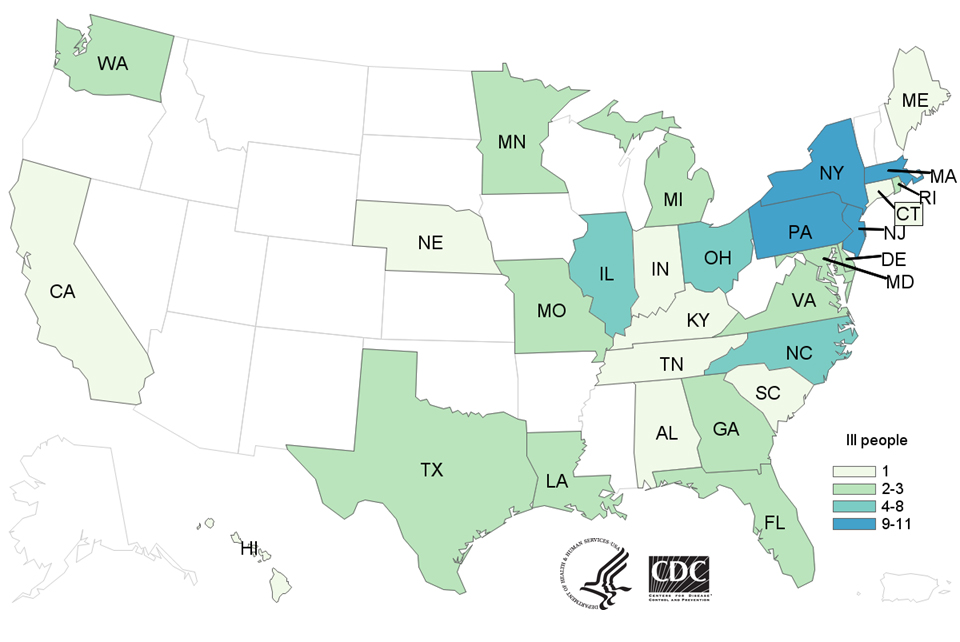
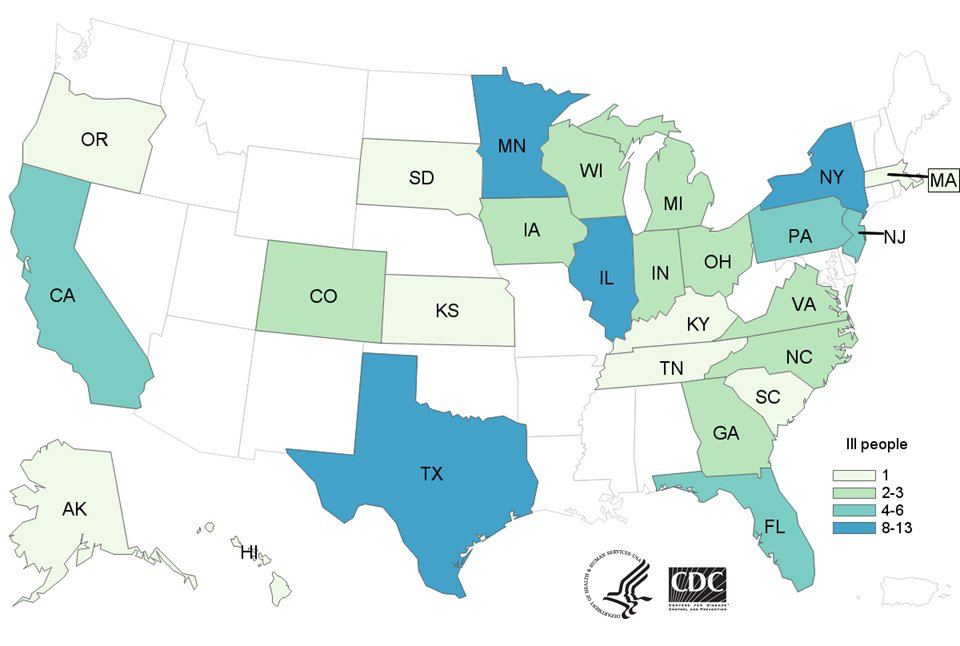
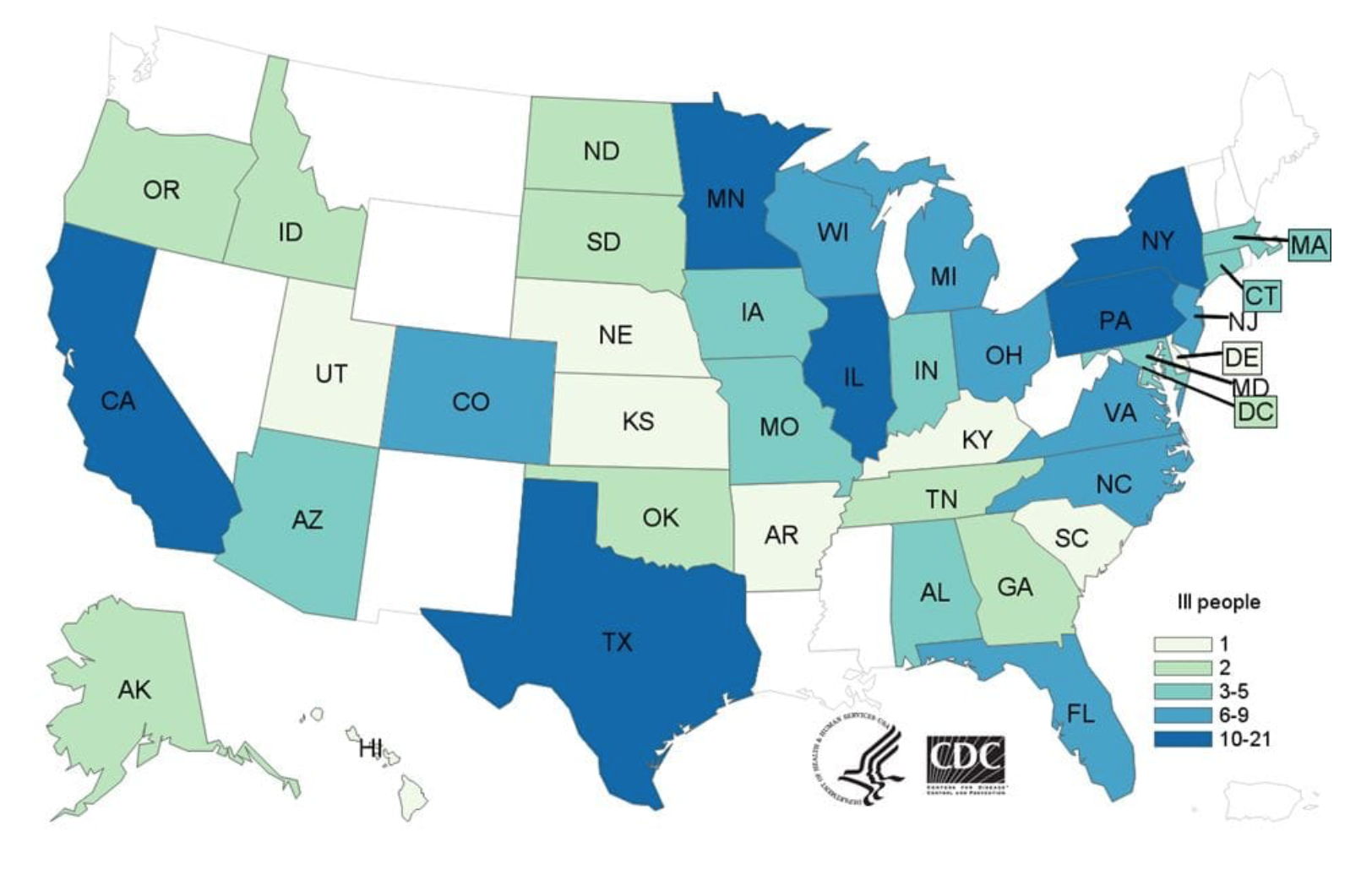
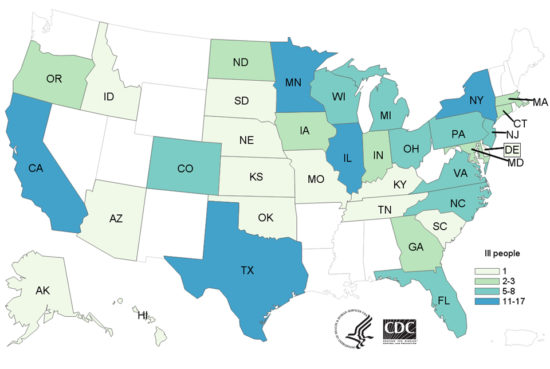
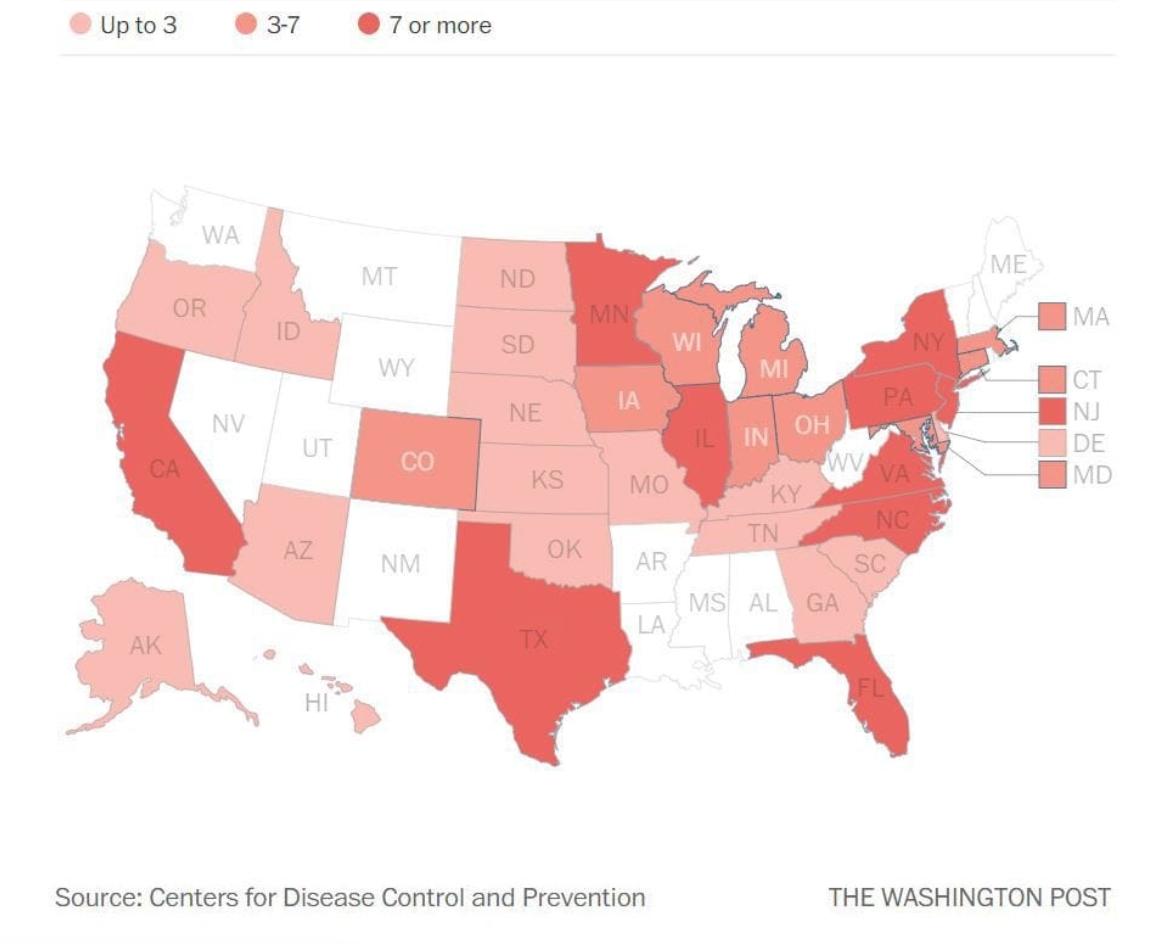
The expansion and commodification of a brisk trade in turkey meat goes beyond the holiday season, but the data on breakout cases of food-born Salmonella infections seem to multiply in recent years as turkey consumption grows or is planned to grow each November. And the CDC issued choropleth of recent breakouts invites us to reflect on the changing state of turkey suppliers and distributors, the industrialization of food, and the fate of the bird whose conversion into a product bred for consumption may carry multiple attendant public health risks, concealed by perpetuation of a false geography of Thanksgiving as an occasion of bounty of the harvest, with its image of a season of abundant plenty. Has the continued provision of abundant turkey for Thanksgiving season created a danger of overbreeding, since the icons of the meal in post-World War I America became promoted as an occasion for rendering thanks? How, if so, can we come to reconcile the spread of Salmonella and the nostalgia for consuming a bounteous harvest at an open table duirng the Thanksgiving feast?

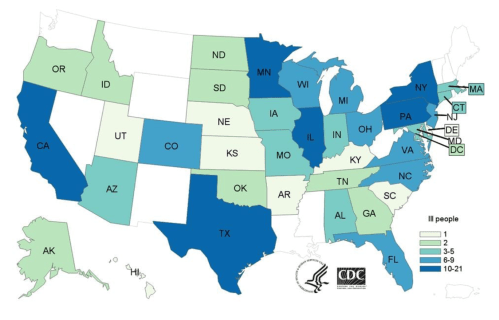
December, 2018 National Distribution of Salmonella infections among hospitalized individuals (Center for Disease Control)

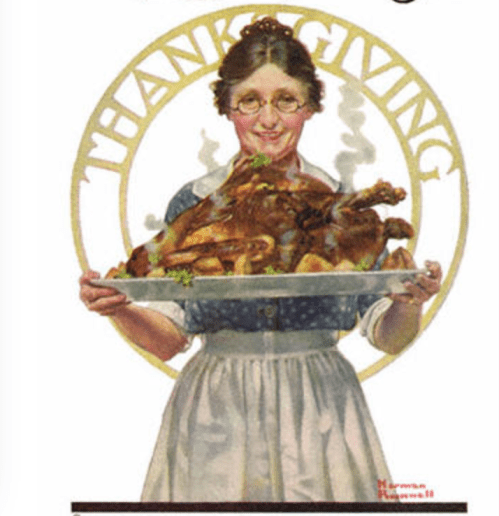
The remove of a fictitious scene of purely domestic provision that seems borne after the national disruption of World War I seems further receded, but is increasingly clung to mark time and visit loved ones.

Norman Rockwell, Thanksgiving (1919)

It is little surprise that the feast day that is so closely tied to the nation–and the alleged return to the agrarian calendar in what Philip Roth rhapsodized as that “neutral, de-religionized ground of Thanksgiving, when everybody gets to eat the same thing,” which was blanched of ethnic associations or even protestations of faith, and provided a sacrament of secularization in America for those who saw it as an event with “nobody sneaking off to eat funny stuff–no kugel, no guilt fish, no bitter herbs, just one colossal turkey for two hundred and fifty million people–one colossal turkey feeds all,” has been displaced by the increased presence in our society of the production of turkeys on industrial scale, and the attendant opportunities for microbial infection that have expanded with the parcellization of the life-cycle of turkeys in response to market demand evident in the splitting of numerous “farms” into hatcheries, growing farms, breeder farms, “growing out” farms, slaughterhouses, meat-preparation and distribution sites, which complicates any perpetuation of a national myth focussing solely on the raw and the cooked, or the wild land cultivation of the bird–with little foresight of the far-reaching consequences of the transformation of the bird into an increasingly industrially-farmed product.

There is a tie between the annual sacrifice of a turkey to national citizenship and well-being, tied to the pleasure of tryptophan-induced containment that goes far beyond consumer satisfaction, but seems to get at a sense of well-being. It is as if the fruits of the harvest are shared every Thanksgiving in a recognition of thanks, easily susceptible to its own new age twist. The tainting of that colossal bird that the emergence of antibiotic-resistant Salmonella strains threaten to overturn is deeply symbolic: for the bird is a symbol of plenty, able by extension to affirm not only economic well-being but satisfaction of the nation as a whole–or afflict the nation as a whole, in a time when the spread of cases of Salmonella infection so often associated with undercooked turkey meat that has increasingly appeared in prepared foods if not already arrived in the sanctum of the Thanksgiving table.

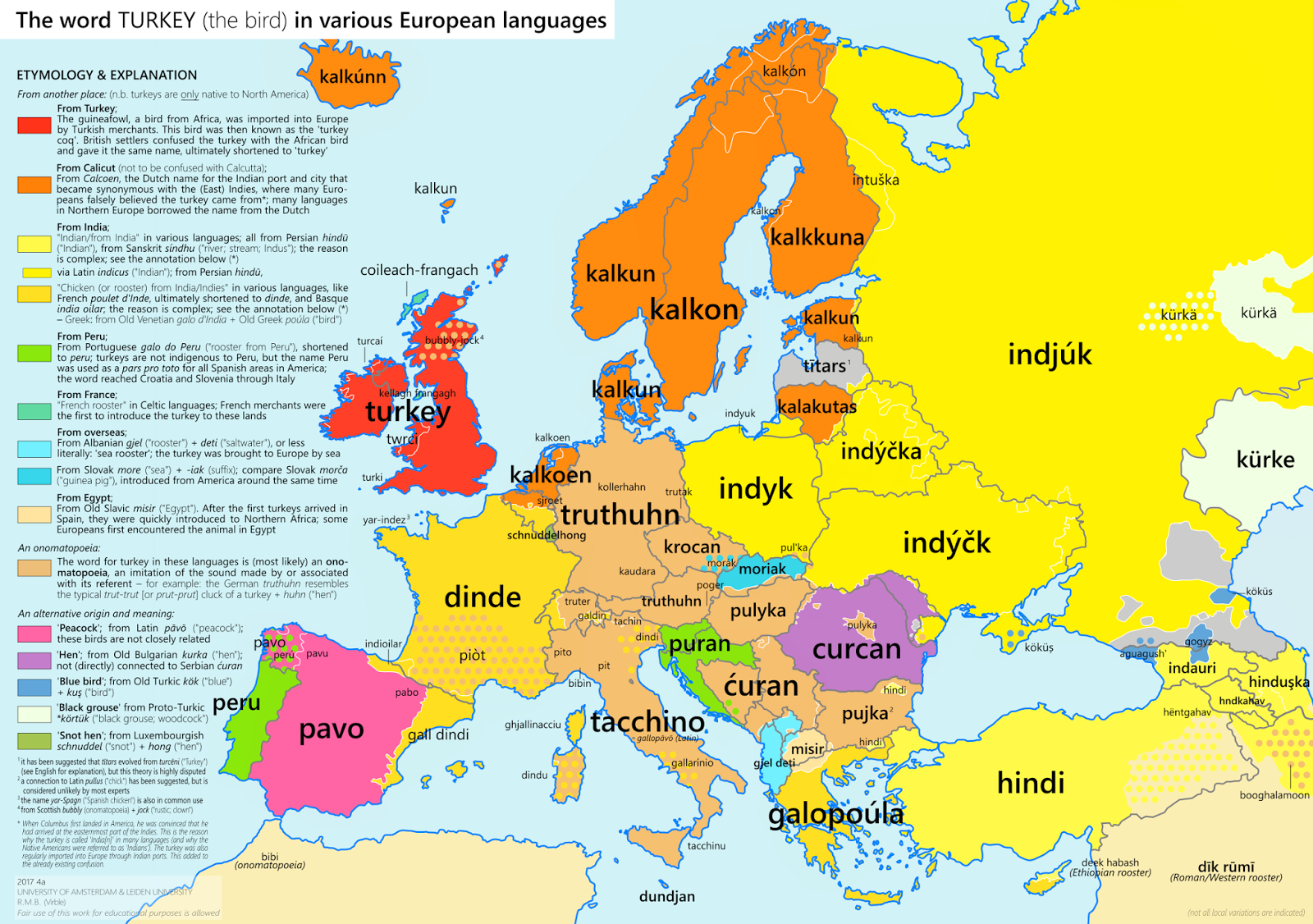
It is bizarre that the New World bird of distinctive appearance was already long labeled as an outsider, as if treated as a bit of a refugee. Although it arrived from the New World with chocolate and coffee, if from North America, the naming of the low-status bird that provides an annual image of bounty was rarely granted insider status, and rarely mapped correctly—but was long labeled a foreigner, in European languages: as English linked it obstinately with a Turkish provenance, confusing it with the African guinea-fowl, Spanish and much of central and Eastern Europe identified it as from India by an unrelated nomenclature, rather than the “indies,” nd Celtic northerners seems to have believed it from France, embedding the poor bird in a lexicon of geographic disorientation and almost compulsively attributing it an unclear origin in ways akin to shrugging shoulders, while all Scandinavia seem to have linked the fowl readily to Calcutta. The Armenian image of “sea rooster” most clearly acknowledges its overseas origins but is as unspecific as possible, although the sea-faring Portuguese show some greater interest in naming the foul with geographic precision in calling it a galo do Peru. The onomatopoeic appellations that spread throughout Mediterranean countries seem striking, but the cartographer May have been over-eager in assimilating the truthuhn to a gobble, given possible linguistic migration from other Saxon lands, and assimilation to a sort of hen.

The mystification of the current bird to a vector of infectious disease is far less interesting to ponder on a purely intellectual plane or as a cultural construction, unless we admit our American readiness to assimilate our foodstuffs to a poorly regulated free market.

The current mission of the CDC to tracked and report to the nation outbreaks of Salmonella infections has recurred each Thanksgiving in recent years. The set of infographic of reported infections of antibiotic-resistant outbreak strains of Salmonella registers a deep upsetting of the balance of the holiday season, even if its subject is really ground turkey meat. The appearance of such statistical measurements on the eve of the national feast day seem emblematic of the atrophying of our national well-being and an erosion of bounty; it bodes to mar the release tryptophan-induced soporific sensations, upset stomaches and intestinal afflictions, more than boosting serotonin by a healthy carbohydrate binge:  raising the specter of salmonella outbreaks threatens to mar preparations for the “American pastoral par excellence” by ruffling the feathers and increasing fears of most families with images of infectious outbreaks of diarrhea, stomach cramps, and poor sleep.

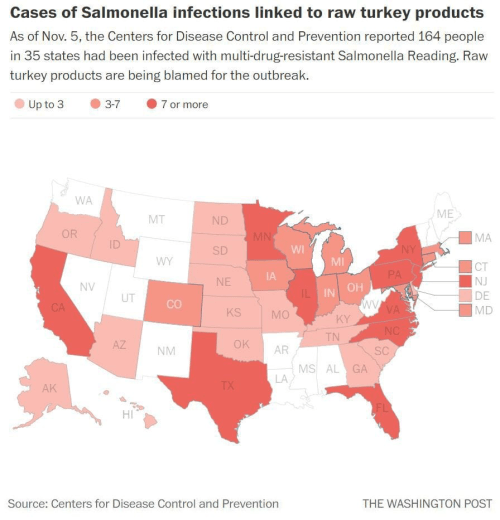
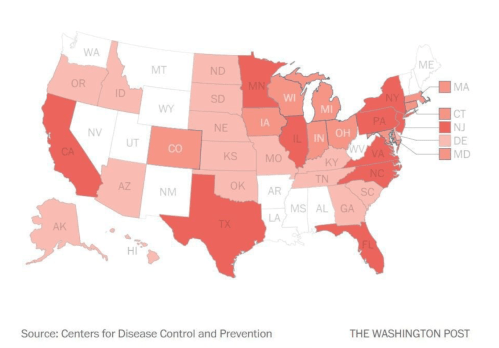
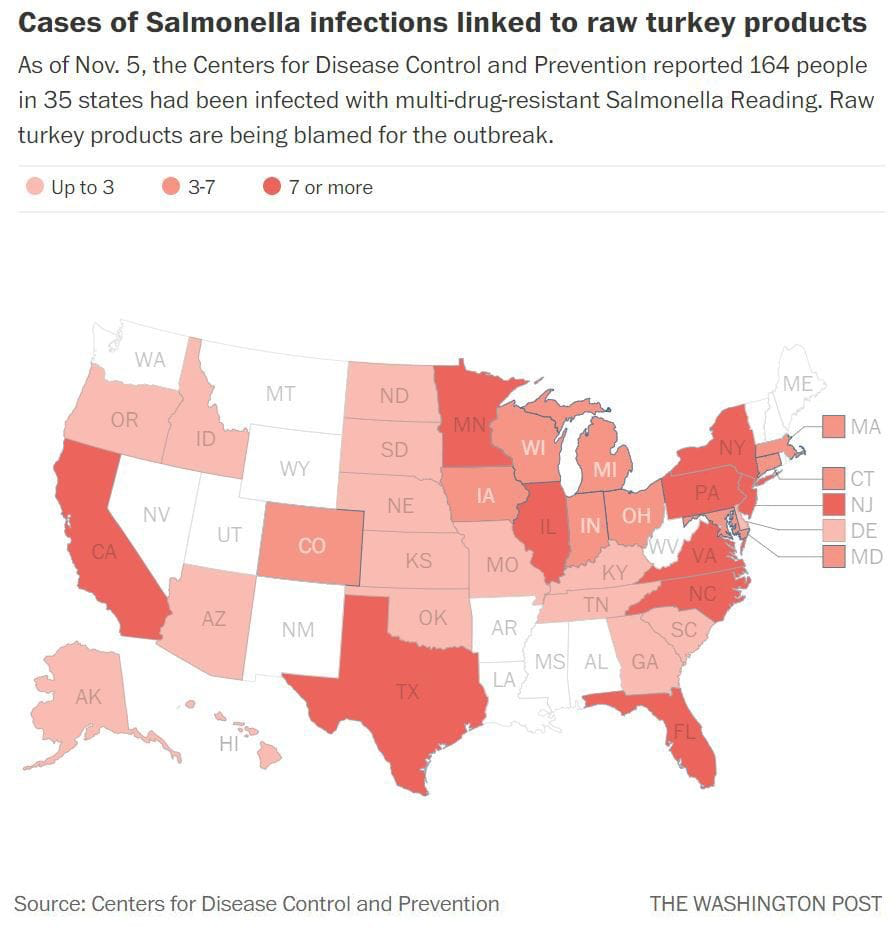
Even if tied quite explicitly to “raw turkey products”–an increasingly popular item in animal food as well as in turkey burgers–the national scale of such infections on the eve of Thanksgiving seem to have demanded being mapped in a cartographic coloring associated with underdone turkey meat. And WaPo seized upon it, just at the start of Thanksgiving plans, to reveal a national chorography whose color ramp suggests undercooked or raw meat, warning its readers of the danger of raw turkey products at a time when the turkey has increasingly become a product–as much as a sign of the finishing of a harvest. The data vis warns us to consume only the well-cooked, although the distribution of reported cases of infection by multi-drug-resistant strains of Salmonella found in raw turkey says little, in fact, about where the consumed turkey derived from or was first shipped: the states of Arkansas, Mississippi, and West Virginia are curiously without reported cases, although each is relatively dense with turkey producers and farms, although such turkey-farming centers as Minnesota and Texas are lit bright pink.

The increased difficulty of confining the spread of salmonella outbreaks among turkeys, and the broad scope of the network of turkey distribution every Thanksgiving casts a frightening pall on the American institution long celebrated as that “neutral, de-religionized ground of Thanksgiving, when everybody gets to eat the same thing,” as Philip Roth once rhapsodically wrote, which saw “nobody sneaking off to eat funny stuff–no kugel, no guilt fish, no bitter herbs, just one colossal turkey for two hundred and fifty million people–one colossal turkey feeds all.”  

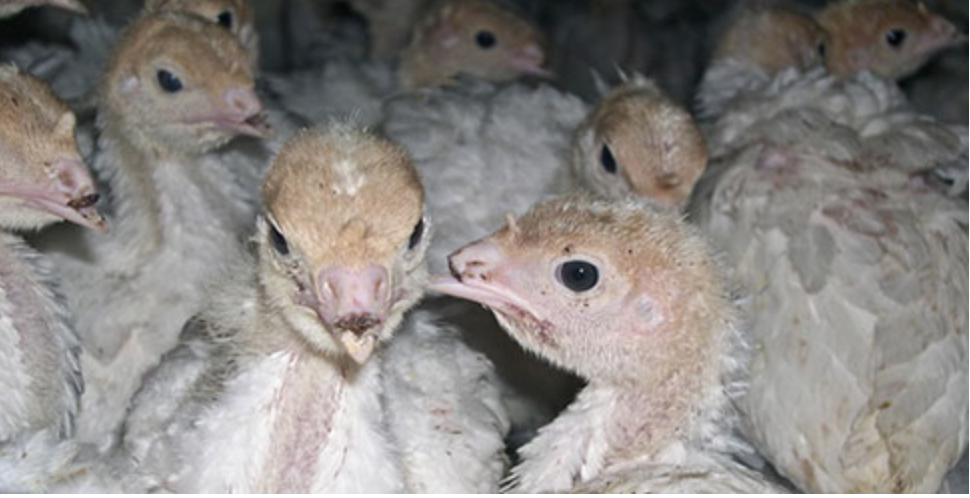
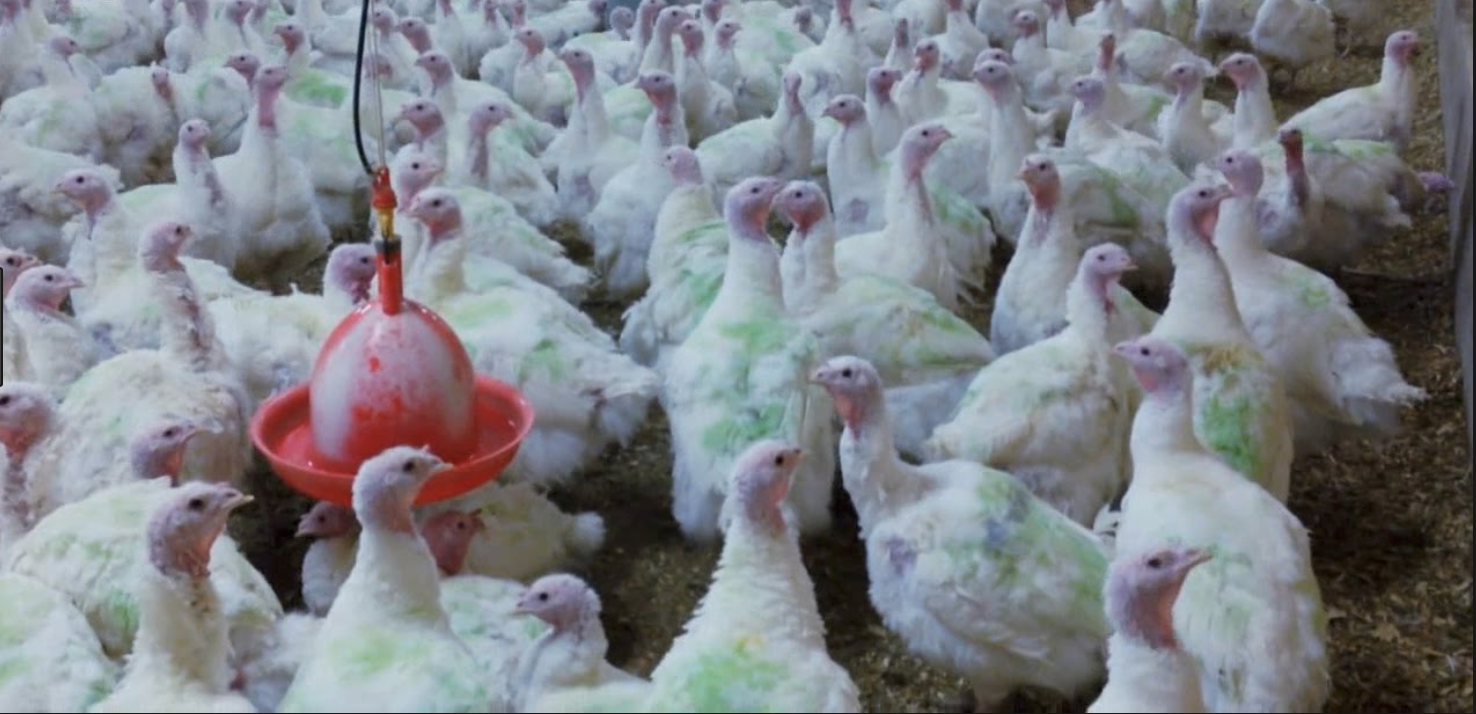
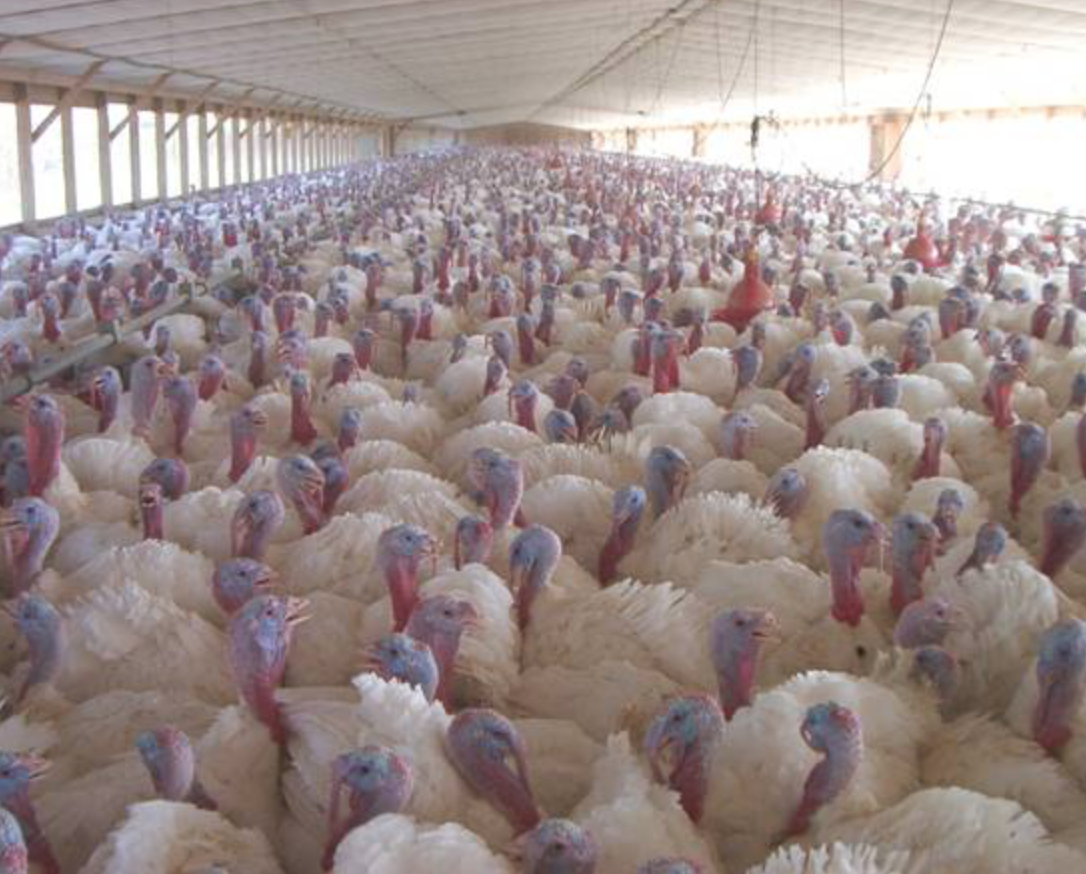
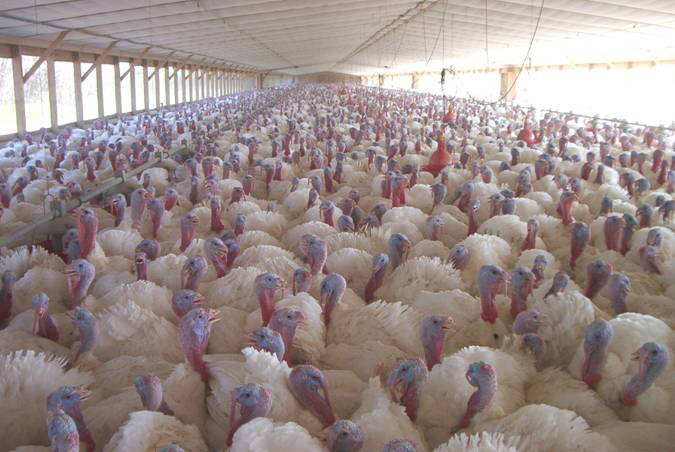
For fears of the infection are no longer stemming from one colossal bird which we all partake, but the emergence among turkeys bred for eating with antibiotics and hormones of a fear that the consumer will be the one making the sacrifice, as specters of diarrhea, cramps, poor sleep, upset stomachs, and vomiting replace the soporific sensation tiredness from binging on tryptophans in ways akin to an accidental (or intentional) overdose of melatonin, with stuffing, sweet potatoes, and more than enough pumpkin pie on the side in a true glucose binge, which may make many feel like they were sacrificing their stomaches and selves, and forget the forty-six million turkeys sacrificed each Thanksgiving, which we still see fit to balance with the Presidential pardon “or commutation” of one turkey’s life. The turkeys, for their part, have lived packed tightly into two and a half to four square foot spaces, breathing dusty air laced with ammonia and whose oversized frames, developed for breeding for markets, beaks and toes removed from an early age, are fed antibiotics in ways that may encourage the growth of antibiotic-resistant bacterial strains, as if by a logic of breeding and producing birds for holiday tables–

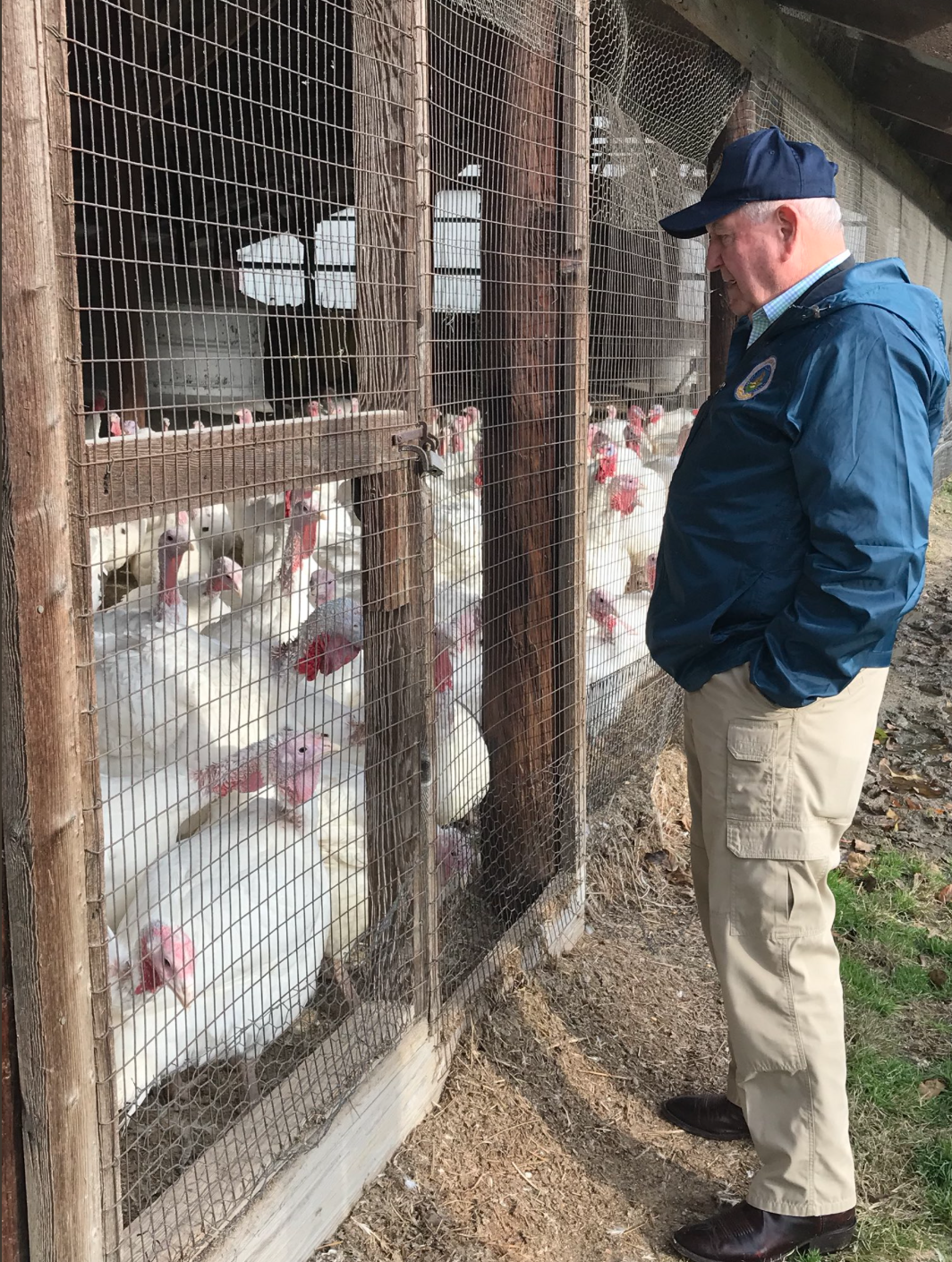
We cling to the false geography of rural harmony in the assembly of imagined agrarian traditions on the Thanksgiving table seems internalized by the marketing of turkey meat by turkey distributors in the social media posts of Jennie-O distributors of turkey. Despite the falsified geography of independent turkey farmers that Secretary of Agriculture Sonny Perdue perpetuates in his visits to family farms on the eve of Thanksgiving, turkey meat has become one of the most processed meats, and the most redefined “product” of the factory farm complex, as its availability for the Thanksgiving season creates a unique schedule of slaughtering, meat-processing, and poultry-distribution has created numerous possible avenues for bacterial infection. The demand for turkeys for Thanksgiving has led to the creation of single strains of birds–a hybrid white larger and faster growing than wild turkeys–far removed from the environment of wild turkeys. In response to markets, a species bred from artificial insemination and designed for eating has emerged, whose reproduction is engineered to ensure fewer males, more productive hatching, and structured the lives of turkeys to accommodate the annual prominence of the Thanksgiving feast.

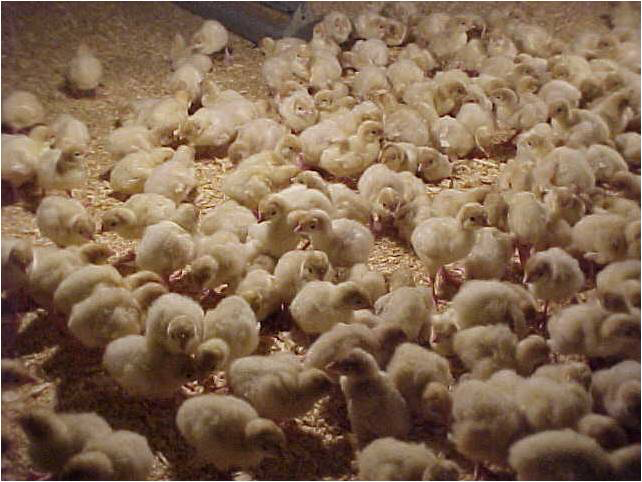
Indeed, if the expansion of factory farm meat upended any clear relation between the raising of turkey and the bucolic image of the Thanksgiving table, turkey meat has become favored “products” far from animal husbandry. From the arrival of small poults at growing farms where they grow to 24-30 pounds in weight, and are prepared to be shipped to breeder farms, to produce eggs that provide markets with turkey meat, raised separately from males less they be injured while mating, hens are artificially inseminated once a week, and all eggs are collected to be stored off-site in temperature controlled incubators with thousands of eggs, to be delivered to larger farms less than twelve hours after hatching. The truly Taylorist production schedule on which turkeys are farmed at “grow-out” sites to sizes demanded by market tastes before they are transported to processing plants.

Such sad images of factory farming only remind us of the degree to which the finely-tuned operations of turkey production on which the “life” of turkey stock depend. For the birds’ lives are indeed determined by their conversion to carcasses, unsurprisingly, as they lead lives increasingly dependent on a via dolorosa dependent on cutting up at processing plants and arriving as commercial products, if not at dinner tables. Is it any wonder that an alarming number of pathogens have been regularly detected in turkey meat, creating considerable alarm at the discovery of Salmonella infections in prepared turkey meat?

The preparation of the bird that predates the division between the raw and the cooked, placing the “lives” of the birds in relation to the demands for Thanksgiving. Fears of Salmonella infections suggests not only the blurring of the cooking of turkey meat, and the conversion of the raw to the cooked, but the blurring of birds bread in unhealthy conditions for conversion to cooked turkey.

The false geography of the potlatch of the Thanksgiving table has perverted poultry production in the industry of factory farming around profit-margins of poultry providers and public tastes–for specialized cuts, ground meats, whole carcasses, and birds of different weights–as what once was a celebration of harvest has come to organize a complex timetable and cycle of production of raised turkey meat, whose illusory relation to the harvest and the land is perhaps best revealed by the temperature-controlled indoor sex-segregated contexts in which turkeys are raised, and the limited options of motion that most turkeys have in the course of their lives, compared with the huge distances that their carcasses travel cross country, or the shipments from hatcheries to breeder farms to growing farms to slaughterhouses to processing plants to meat distribution plants, in ways that make us wonder what distribution the “health” function of their iPhones might show if their motion was tracked, and how greatly the distance of their travels would contrast with their actual options for mobility in growing pens.

The increased infectious outbreaks that the arrival of bacterial infections of Salmonella in ground turkey meat seem to have threatened to upset the most American of family meals, however, as the fears of contaminated turkey meat have threatened an alternate imaginary of the nation preserved by the long faded image of family units among an infinite number of holiday tables.

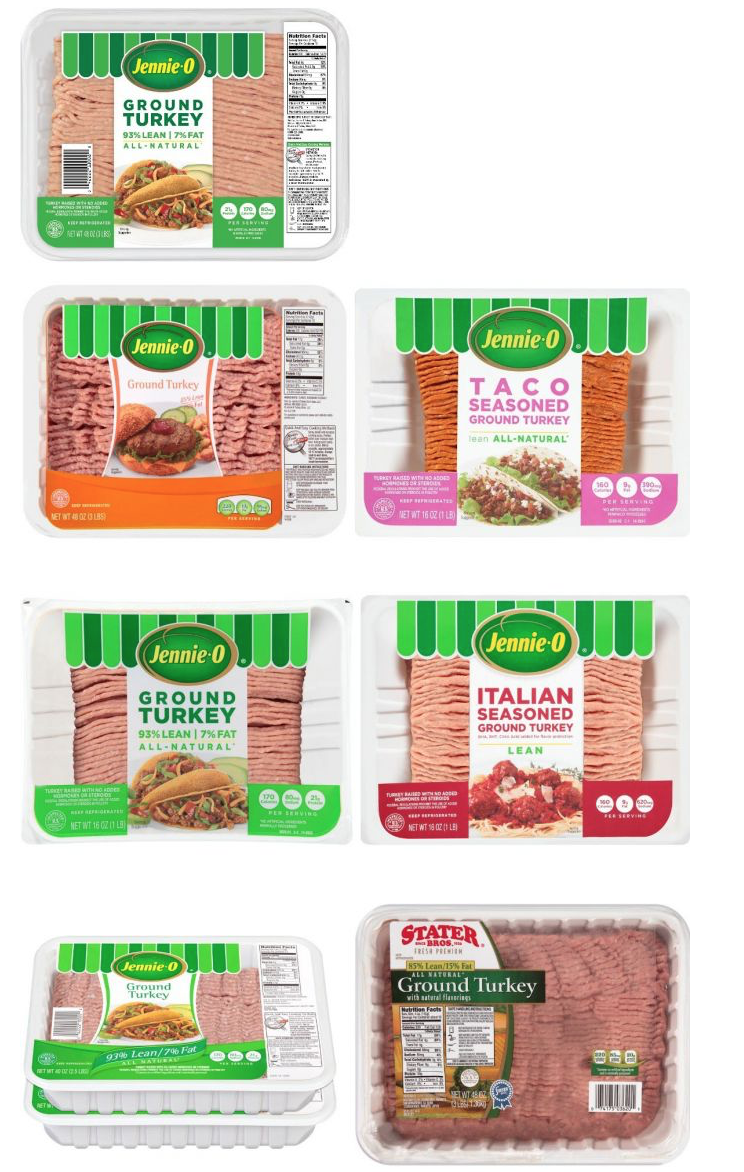
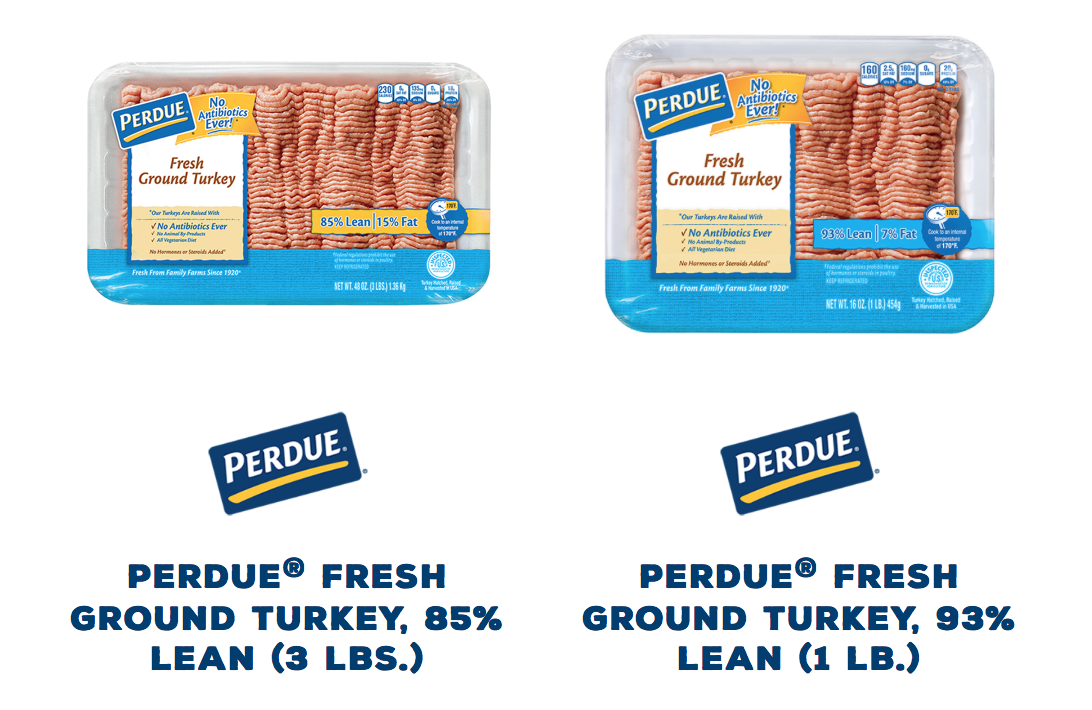
The Thanksgiving plate seems a vestigial reminder of the harmony of the food cycle. While it is enough of a soothing celebration of something with its own complex feng shui to be the background of Jennie-O tweets, the gemütlichkeit of Thanksgiving and myth of the dinner supports a gastronomic reminder of domestic harmony is upset by the increased numbers of infections of turkey in ways that warrant national announcements and concerns from the CDC; each plate on the table is set in perfect order, as an image of the harvest is gathered in a sort of counterpoint on one’s own meal plate. But the harmony of that microcosm was disturbed by seasonal warnings of dangers of infections that this time arrived with increased urgency during the Great Turkey Recall of 2018. Ground turkey continued to be recalled by Jennie-O to the tune of over 164,000 pounds as the salmonella outbreak continued, amidst fears of a government shutdown. And even as fears of troop withdrawals from Syria and Afghanistan raise deep concerns for he nation, the infectious outbreak widened by Christmas, leading producers to assured consumers that the lots of contaminated meat were labeled P-579, to preserve the healthiness of farmed turkey as warnings about Salmonella spread over half the states in the union, and only a small portion of the Salmonella outbreak strains in the nation that had already occurred by 2017, believed to derive from contact with live poultry or uncooked poultry parts in the nation.

Outbreak strains of Salmonella, 2017/Center for Disease Control

Warnings of the safety of turkey meat are regularly issued by the Centers for Disease Control, or CDC, each Thanksgiving in recent years. The state-by-state parsing of outbreak strains to alert the public for consumption warnings, reveal the broad distribution of infected turkey meat, and their limited clustering suggest the wide range of possible vectors of contamination–

Salmonella infantis breakout, October 2018

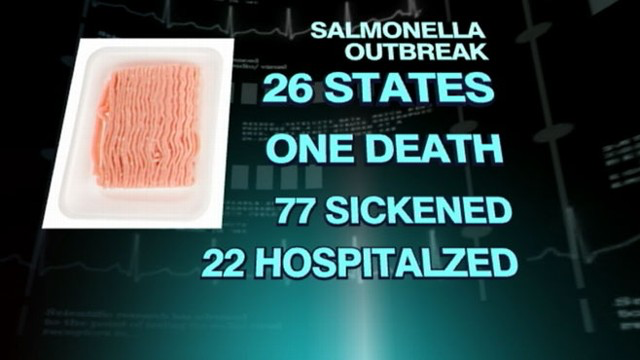
–and if the spread of infections from turkey meat from November 2017 had been tracked across twenty-six states given the dangers of handling or consuming poultry and in the dangers of the butchery, preparation and distribution turkey-meat, as much as its preparation in kitchens across America.

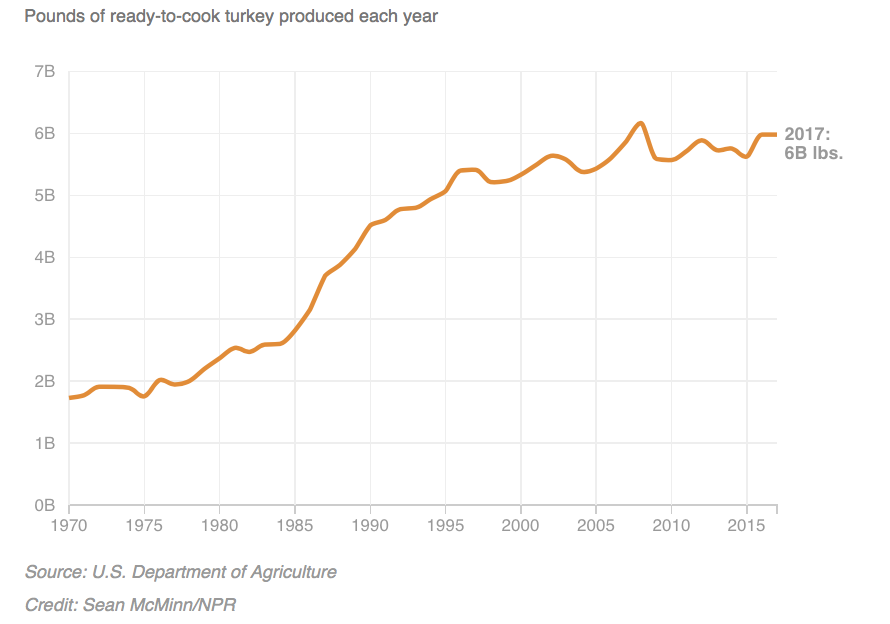
The persistence of the numbers of hospitalizations and infections that were traced to turkey meat suggests less of a clear map of the spread of infected meat–if it documents the incidence of reported cases of Salmonella–than the remove of turkey from local agrarian geography. In an era when the vast majority of poultry is farmed, and the seasonal consumption of turkey meat drives turkey production in ways that put increasing pressures on the production of a large number of turkeys in a small temporal window sufficient to accommodate the arrival of some fifty million birds in time for Thanksgiving, the existing network of slaughtering, refrigeration, and shipment of turkey meat may not allow for adequate meat safety. The annual production cycle of batches of designated fresh and frozen poultry designed to arrive in time for the holiday season has created multiple stresses on turkey meat’s distribution, and indeed on the handling of turkey parts, as well as the multiple way of packaging, seasoning, and flavoring turkey meats to meet consumer demand, as Philllip Clauer has noted in his helpful description of the “modern turkey industry,” as the packaging of turkey products in ways designed to meet a large choice for consumers, both by processing turkeys for individual parts–

–and offering seasoned varieties of ground turkey, which greatly expand the number of individuals handling turkey meat, by seasoning, marinating, and flavoring what is sold as a “healthy” choice of “all-natural” lean meat for consumers.

The initial warnings of Salmonella poisoning of “all-natural” turkey meat gave alarming immediacy on the eve of Thanksgiving, when turkeys would be arriving in refrigerators nationwide, on their way to ovens, kitchen counters, sinks, and eventually reach their destination on household tables. As infections spread to thirty-five states, the constellation of states which saw over seven infections–New Jersey, Pennsylvania, Florida, Illinois, Minnesota, North Carolina, Virginia, Texas and California–provided testimony to the threat of actual infection of the nation, that spread from turkey processing plants often located at a distance from factor farms where most farmed turkeys are raised in crowded conditions.

The national feedback loops let processing plants calibrate the demand for whole turkey for each Thanksgiving Day and through Christmas.   But it has raised alarms that the arrival of turkey meat is less safe than usual. Even as producers assured the public on social media that the outbreak strain was limited to ground turkey, and not whole animals–“Rest assured the recall does not include whole turkeys or products currently in stores”–as if this would inspire calm in the poultry markets, graphics of expanding numbers hospitalized across the nation has raised continued fears–only partly restrained by assurances that Jennie-O distributed with promotional coupons, and assurances about eating turkey “when properly cooked”–and that contaminated ground turkey had been labeled lot “P579” produced in Minnesota in the week October 21-2.

While such warnings narrowed the source of the contamination that had by now spread nation-wide, the extent of the national distribution of ground meats from specific sites confirmed the industrial scale of the production and distribution of turkey meat.

The CDC is right to exercise a degree of vigilance over reported cases of Salmonella infections and their strains, and WaPo was right to publicize just how many states have been struck by multiple  reported cases of contaminated bacteria-bearing turkey meat–even if the mapping of a “spread of infection” is hardly able to be deciphered even by the best epidemiologist’s sleuthing, and suggested subliminal cautions about consuming any sort of undercooked meat, one possible clear culprit.

Mapped across multiple states, and derived from antibiotic resistant strains of the foodborne virus, the product recall of ground turkey was so disturbing to receive in mid-November offered a reminder of dangerous disequilibria in our food production and distribution complex among some of the largest distributors of factory farmed turkey meat on  which the nation has come to rely for creating the appearance of culinary harmony.

Although we carefully compartmentalize away from the recipes or preparation of the annual feast, a division between the live animal and its carcass, the origins of disease are increasingly tracked with one hundred and sixty four taken sick. The possibility of a bacterial infection being “widespread in the turkey industry” created fears of a broad outbreak–reprising the terrifying antibiotic-resistant outbreak of Salmonella of 2011 in both turkey and beef, which were also focussed on Salmonella Hadar in Jenny-O turkeys–a subsidiary of Hormel–and Salmonella Heidelberg in Cargill Meats.

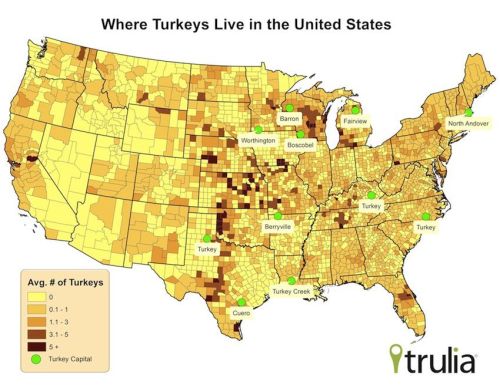
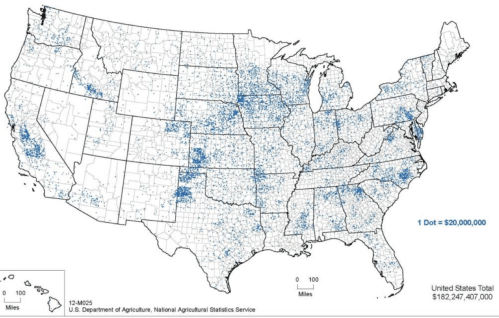
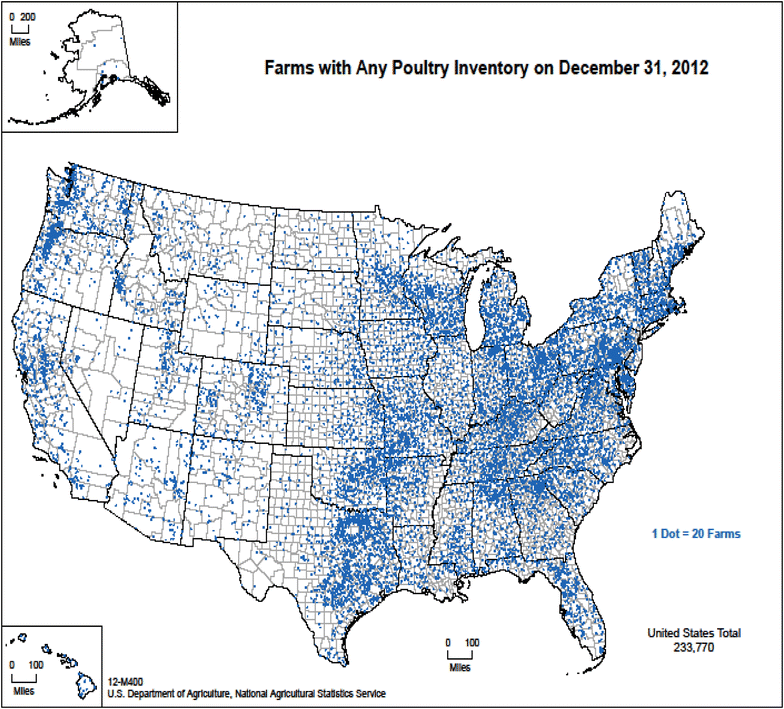
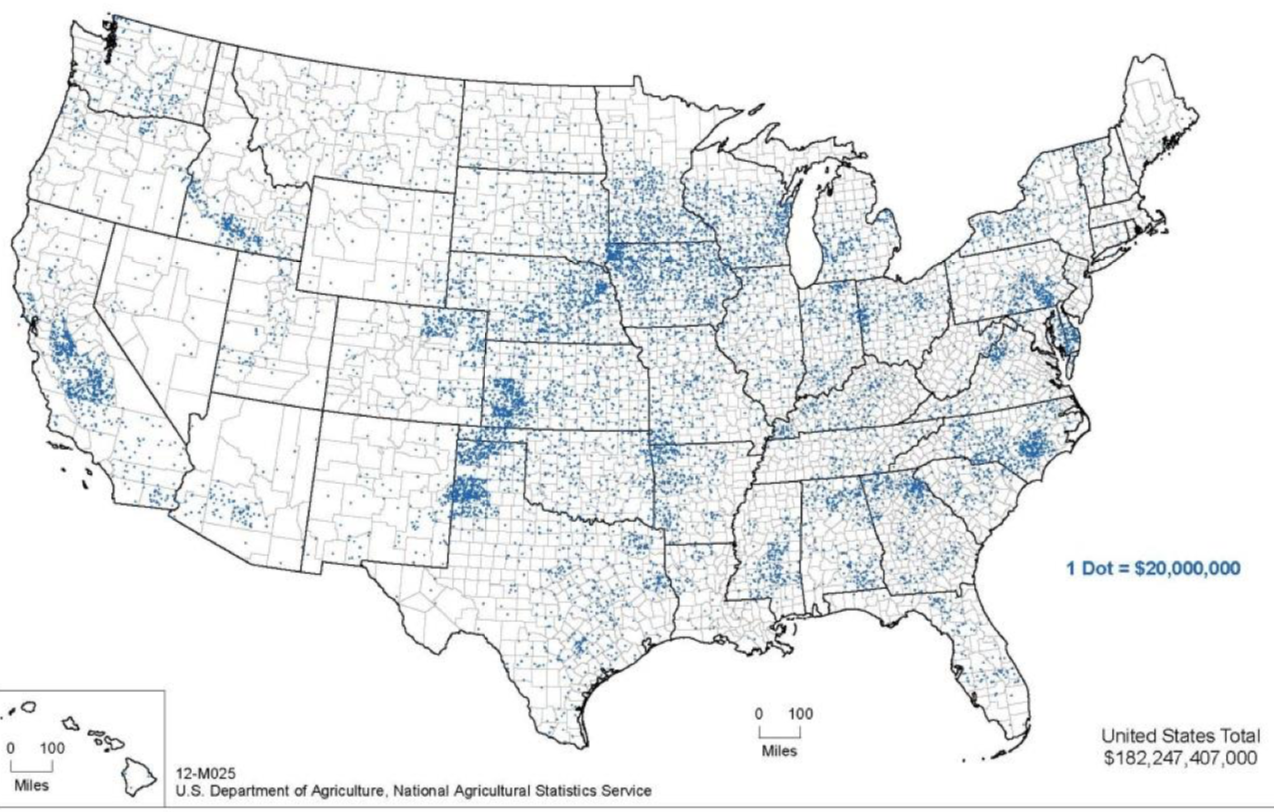
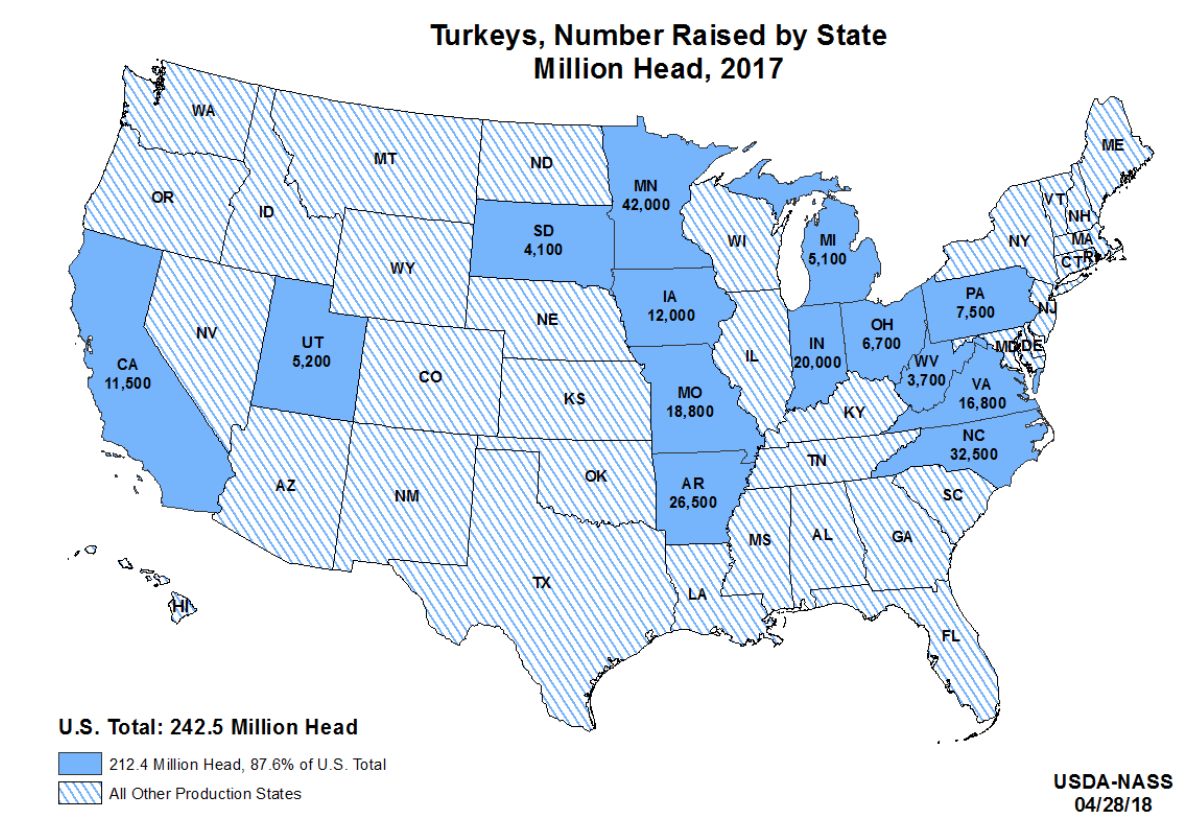
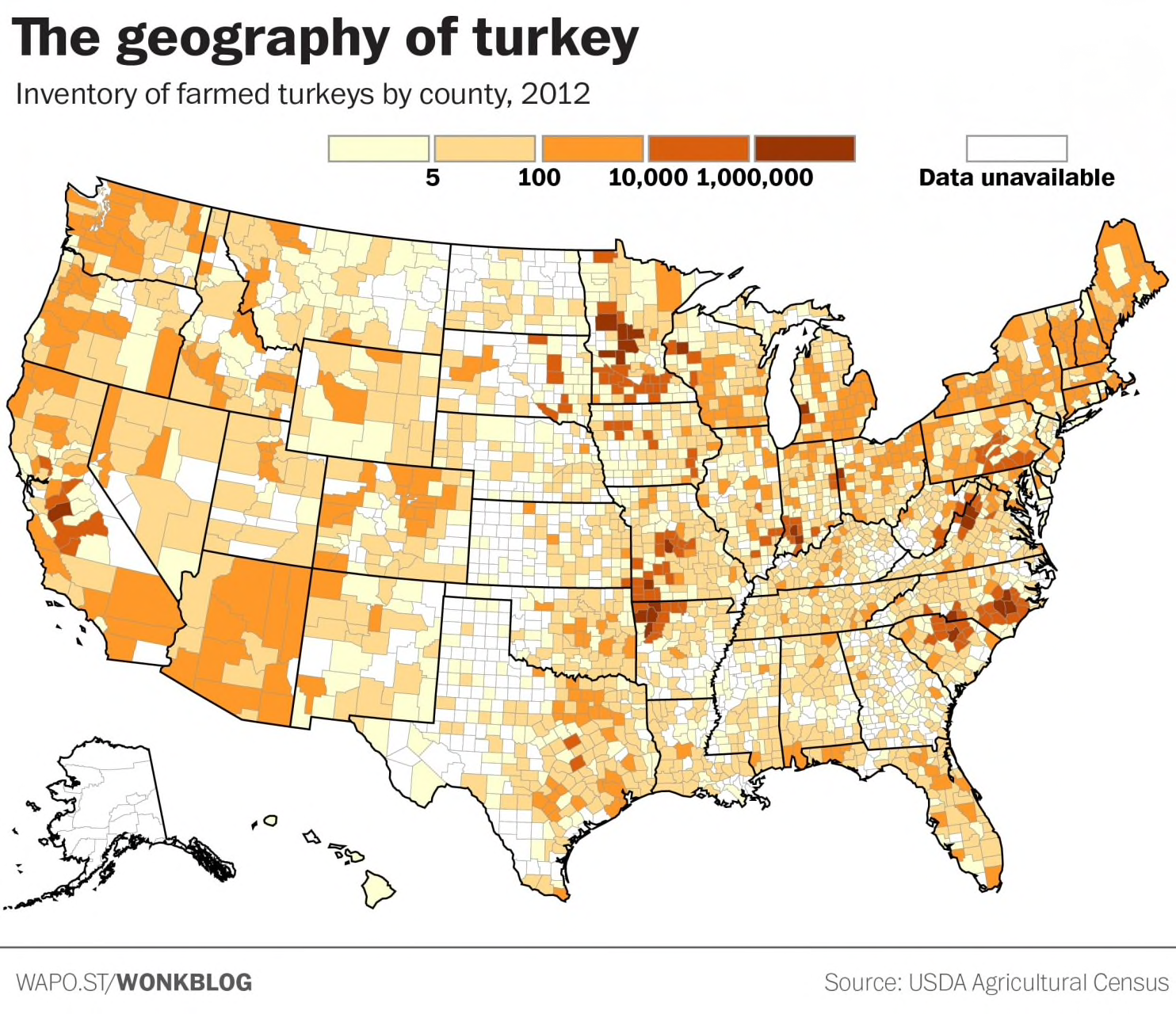
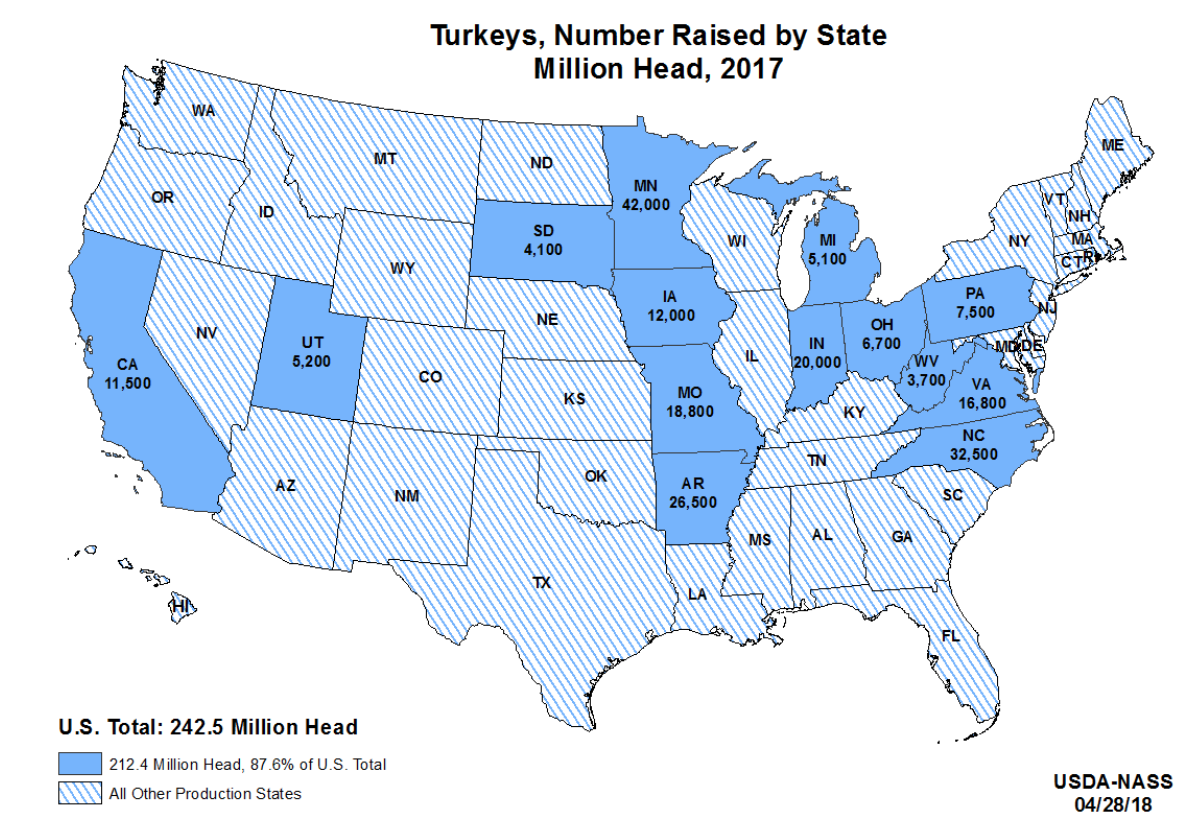
Indeed, the image of Thanksgiving celebrating fruits of the harvest is upended in the current  industrial scale production  of turkey in our nation:  the industry around Thanksgiving orients the hatching and raising in large indoor cages of millions of birds for November arrival in supermarkets and shops stands at such remove from the seasonal harvest and old agrarian calendar to make us realize the tensions between the current landscape of factory farms with the image of the provision of wealth focussed on the bird arriving well-cooked at one’s holiday table–as the specter of birds infected with antibiotic resistant bacteria at some or several points in the process of farming or producing birds designed for our dining room tables. If the production of turkeys in America–densely concentrated in parts of Minnesota, Iowa, Arkansas, Omaha and Texas, in more extreme geographic concentration than other varieties of poultry, when assessed by value–

Distribution of turkey farming and poultry farming across the United States of America
Comparative distribution of poultry and turkey farming by value
(2007)/https:/USDS Animal Health Demographics, 2010

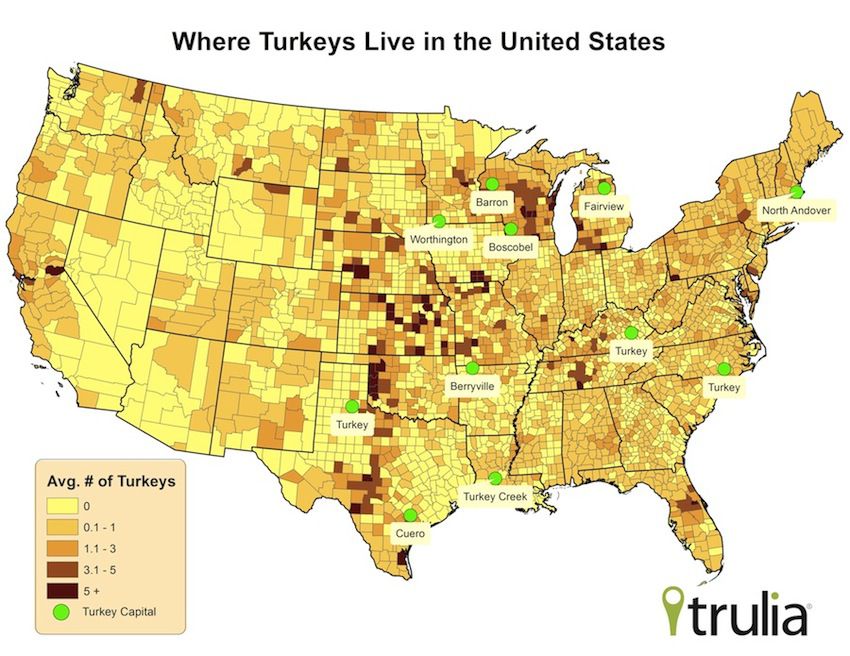
–in ways that contrast sharply with the actual broad distribution of wild turkey across regions of the United States–

–or the actual broad number of local farms where poultry is raised.

The concentration of the farmed turkeys that arrive at Thanksgiving tables, and in American markets, arrive from a far more restricted area. The result of this concentration poses possibilities of introducing infections, within the distribution of turkey meat. Although the agrarian illusion of Thanksgiving as a bucolic, authentic, and rural event is removed from large cities and sites of urban pollution and grit, the clusterings of mega-farms in fact stands as something like the crooked spine of a nation.  

The striking density of such farms suggests the degree to which turkey farmers are increasingly bent by the market tyrants from Butterball, Hormel, Cargill, who determine the interface between the national demand for turkeys and the condition and welfare of their supply.  The calculus of Turkey production pivots, unsurprisingly, on Thanksgiving, where the demand for the birds seasonally peaks. Such concentration of poultry production reflects its reliance on the production of readily available grain, and especially soybeans, that constitute the bulk of turkey feed.

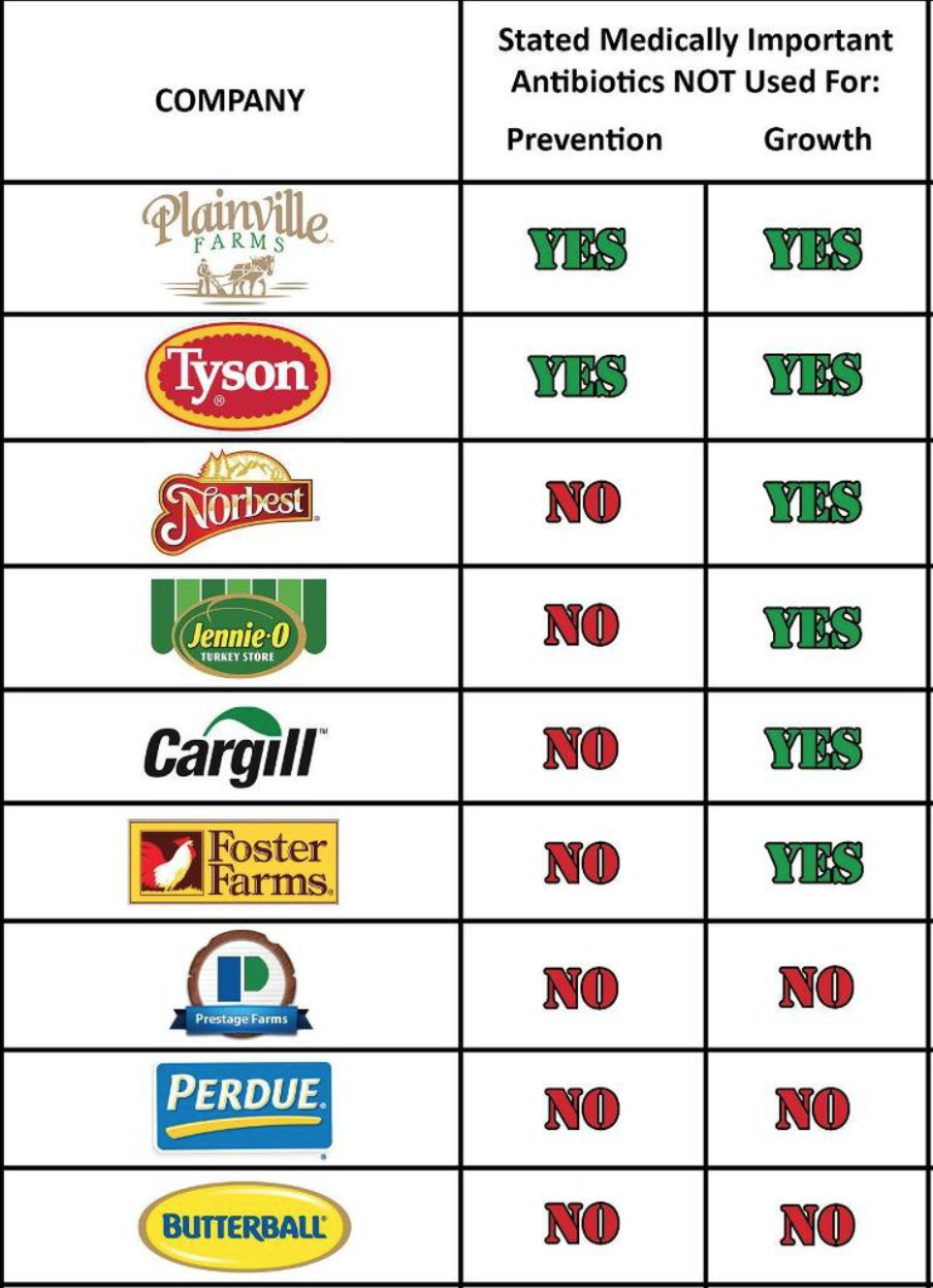
 With three of the folks who were taken ill with Salmonella working or tied to someone who worked in facilities that either farm or process birds for eating, or raising turkey meat–raising questions about the exposure of those who work on farms to antibiotic-resistant bacteria–or from raw turkey that was intended as pet food.  The outbreaks of bacteria resistant to multiple antibiotics, from ampicillin to tetracyclines to streptomycin, may be tied to prophylactic antibiotics adopted in industrial-scale factory farms.  Despite the proposal to introduce an outright ban on using tetracycline at sub therapeutic levels, the failure to adopt such restrictions has created the situation where three quarters of all antibiotics used in the United States are used on livestock:  back in the late 1980s, the rates of administering antibiotics to humans and animals had been roughly equal.  And the introduction of a diet of antibiotics in an expansive industry of turkey production.

The mis-use of antibiotics to increase the size of raised birds–a danger to which turkeys are particularly vulnerable, as they are prized and valued for their size and the rapidity of growing birds to a large size–even if the FDA discourages using antibiotics to promote growth, the absence of any regulatory enforcement as to what amounts constitute proper prevention has opened a large loophole in American farming:  Norbest, Jennie-O, Cargill and Foster Farms prohibit using antibiotics for promoting growth, but not for disease prevention, creating a broad opening top the use of antibiotics, as Food Animal Concerns Trust (FACT) found in 2015, when it survived the feed additives that major United States producers of turkeys–including Cartill, Tyson, Jennie-O, and Perdue–and the beta agonist Ractopamine, which has been banned in the European Union, but remains legal in the United States. 

The production of turkeys in this agrarian-industrial complex runs like clockwork.   Fertilized turkey eggs are incubated for a month before hatching, resting to grow for three to four months in farms, and are shipped to a slaughterhouse or processing plants for predation for markets in time for Thanksgiving celebrations, as if inexorably attracted by the annual calendar of consumption generates a production schedule that is something of a dialectic, exerting undue pressures of production on factory farms to produce turkeys of increased size (who wants small birds?  few did until recently) who are best produced through extra antibiotics, in a sort of “dosing” of the sacrificial bird before its ritual sacrifice.  Rather than sacrificed for the harvest in a natural way, farms have perfected a strategy to produce sufficient birds of needed size that constitutes a production schedule mirroring the harvest, but introducing a few mechanical tweaks hinging upon transport, distribution, and demand:  of the turkeys hatched each spring, slaughtered birds are refrigerated to temperatures below 40 degrees Farenheit, but above 26 degrees, in time to arrive in something like the fresh frozen state by late October or early November for the preparation of the Thanksgiving table.

The prominence of Thanksgiving in the lives of the farmed turkeys as the  fulcrum along which raising birds turns is not oriented to the farm, or the seasons, in other words, but the elastic market that determines how fifty million birds can be supplied to those wanting to repeat the national ritual of Thanksgiving feasts.  If technology was recognized as the subject of the contemporary historical tragedy in the technicians of production, the mechanics and techniques of turkey raising may post part of the problem.  For the production schedule offers multiple opportunities for bacterial infection that must make them particularly sensitive to carrying food-borne disease.  The slaughtered fowl shipped out to retailers respond to the levels of demand marketers find, allowing them to shift some carcasses designated for lunch meats, individual breasts and legs sold in packages, or ground turkey back into the processing of whole birds, suggesting the actual fluidity between ground turkey meat and the birds arriving at Thanksgiving table.

 The extent of these fears were readily tapped by recent maps of the feared outbreaks of Salmonella infections from tainted supplies of turkey, transmitted in undercooked meats, that seems poised to threaten to frustrate the harmony of the social potlatch of harvest foods, as warnings of the danger of infectious disease have spread, with Thanksgiving only weeks away, across thirty-five states–in a reprisal of fears the previous year of the first reports of cases of a bacterial strain distinguished by its resistantancn to antibiotics.  The discovery and identification of the strain of antibiotic-resistant Salmonella Reading prompted fears for a Thanksgiving outbreak of infections, which rather than mapped with the level of detail that would reflect the detection of the outbreak  in sampled raw turkey products from some twenty-two individual slaughterhouses and seven meat-processing plants, were described only in a state-by-state distribution of total reported infections rather than the actual vectors of infectious disease:   the Washington Post designed the below infographic to alert its readers to the worries of a spread of tainted turkey meat, coloring states with the greater number of reported infections as if in more underdone shades of meat, but their removal form any sense of the sits of distributors or slaughterhouses concealed rather than clarified.

Washington Post, “Salmonella contamination in turkey is widespread and unidentified as Thanksgiving approaches” November 16, 2018

The color ramp on this infographic derived from public records released by the CDC.  If its immediate message was to remind viewers of the dangers of serving underdone turkey meat,   the deep understory may have been a lack of full transparency how the government agency hid the identities of the turkey suppliers identified and suspected of slaughtering, distributing, and selling the compromised meat.  The watchdog Center for Science in the Public Interest (CSPI) has noted in the past the danger of agencies protecting the suppliers with considerable vested interests in keeping the turkey-industrial complex that carries millions of birds to American holiday tables on time for this national feast.  The fears of such a relinquishing of responsibilities of good government  is perhaps not surprising in the current pro-business atmosphere of Trump’s Washington, with Georgia chicken family magnate Sonny Perdue the nation’s thirty-first secretary of the USDA; Purdue somewhat generically retweeted the public cautionary food safety warning to handling bird carcasses,but without mention of the outbreak–inspiring the quick response that the “best” defense was in fact to “only eat veg” over the holiday feast.  

And if “talking turkey”as an expression of speaking frankly has been argued to have originated in the open spirit of the holiday–if also possible in “talking cold turkey” as a way of discussing actual facts may have arisen within the context of the holiday–less about contact with native Americans than the recreation of bonhomie and openness at the holiday table–the alternatives of pleasant conversation and frank discussion both stand at odds with the current concealment of an actually accurate map of food safety.  For the distribution of toxic turkeys and their origin in the supply chain or in factory farms seems concealed for know of left unclear in maps that register the arrival –evident in recent identification of sources of tainted meat suppliers as Tolleson, the source of many of the contaminated turkeys, to beef products sold and distributed by sources tentatively identified for the public as including Kroger, Laura’s Lean and JBS Tolleson generic.  The uncertain landscape of bacteria in fresh, processed, and frozen meat raises fears of food-born diseases as something like a self-made dirty bomb.  

From the perspective of the USDA,”food safety” is described less in terms of the conditions in which birds are raised for sale, than to the kitchen practices of preparing and cooking the bird, a  familiar ritual of cleaning and defrosting the meat, as a set of four”best practices” of delivering the safest bird to the holiday table–

–rather than addressing the questions of how such a strain was introduced, or the steps that should be taken in bagging, buying, and storing potentially infected turkey or chicken carcasses, as if to shift the onus to the consumer and the preparer of the holiday meal, rather than the question of how the breakout diseases correlated to the increasing dependence of turkey distribution on factory farms and large meat-processing plants.

Tracing down the origins of the bacterial presence of different Salmonella strains seems to have been far from the minds of the officials who issued assurances confined to food preparation, in hopes to assuage public fears, and dampen suspicions that infections were endemic to the turkey-industrial complex.  USDA Secretary Sonny Purdue–scion of a firm of Turkey suppliers–and not exactly a disinterested source, but more of a representative of the industrial farming of poultry meat that presents itself as “fit & easy’ and “fresh”–and “changing the way we treat chickens” and with a commmitment to animal care–

Perude may have been profesionally distracted on social media, to be sure, between attention to tampering down alarms of the damage caused by Hurricane Michael across the Florida panhandle and the Camp Fire and Woolsey Fire in California, which unleashed  alarms about forestry, agriculture, and water infrastructure.  But the deceptive moves to pin the epidemic of wildfires on inadequate or lacking “forest management”–rather than climate change seem to be mirrored in his direction of public attention to the cultivation of best practices of poultry preparation to the exclusion of any acknowledgement of the widespread discovery of antibiotic-resistant bacteria within the very sorts of turkey meat that his family business has long prepared.  Even if he tweeted on November 22 to followers to enjoin them to be conscious that “if you are preparing a meal, please remember we have American farmers to thank for the bounty,” erasing the industrial-scale structures of poultry farming –even as Perdue presided over the deregulation of the poultry industry, undoing powers that earlier administrations gave to small farmers who raise antibiotic-free fowl or work on contract for meat industry players–Butterball, Jennie-O, Cargill, and Farbest Foods–to bring charges against them for abusive distributive practices, introduced under the Obama administration to provide better guarantees to control meat production, in hopes to “control frivolous litigation,” that would and prevent agribusiness meat processing companies from setting terms to family farms–continuing the USDA’s existing regulations for meat packers and stockyards would only serve, poultry lobbyists argue, to “open the floodgates to frivolous and costly litigation,” but leaves distributors and agribusiness to dictate the terms of turkey sales, production, and livestock conditions.

But the alarms about the quality of the birds raised by our nation’s largest suppliers of turkeys should not be lost in the instability of the spread of fires in high-population areas and increased damages from natural disasters.  Perhaps the only acknowledgement of the fears of contaminated poultry bearing antibiotic-resistant bacteria were present in the public promise that Purdue would share oversight of culturing food livestock and poultry cell-lines with the FDA, prospectively producing a new regime of food safety for the future.  The infographic from WaPo couldn’t not respond, in the meantime, to growing suspicions that the birds that would soon lie on our tables derived from tainted meat, and that the holiday stood to increase our vulnerability across the nation to uncomfortable intestinal disquiet. However, it makes sense to ask whether the deregulation of farm conditions and livestock conditions would not act–as President Barack Obama predicted of Citizens United decision allowing the deregulation of funding of political campaigns stood to “open the floodgates for special interests—including foreign corporations—to spend without limit in our elections,” by removing any restrictions for livestock raising.

It remained striking that among Perdue’s extensive visits to family farms, @SecretarySonny was notably silent about the concerns for the spread of infected meat within the Turkey-industrial complex of United States farms and poultry distributors.  Perdue preferred to tweet out openly promotional images of Secretary Sonny visiting favorite small-scale suppliers of Thanksgiving birds to his followers, a farm producing but 30,000 birds a year–unlike the factory farms from which most of the fifty million birds arrive at American Thanksgiving tables–within other promotional images of the Secretary visiting family farms that seem to be carefully curated to suggest his ties to the family farm, and to a bucolic image of where our healthiest turkeys are bred–overlooking the dominance of four firms– Butterball, Jennie-O, Cargill, and Farbest Foods–in the distribution and slaughtering of turkeys, and the dominance that larger firms will continue to have over family farms, driven by the demand to produce larger birds more quickly to fill a growing market for turkey meat.

USDA @SecretarySonny’s tweet about his November 12, 2018 visit to Lee Farms in East Windsor NJ

If Perdue’s tours of family farms and promotion of American farmers on twitter suggests an agrarian paradise dedicated to prosperous family-based animal husbandry, the active social media feed provokes a picture of wholesome husbandry far from the range that occupies such a prominent place in the American imaginary that is regularly reactivated every Thanksgiving, sharply dissonant with the American farmscape, or the distribution networks that dominate how farmed turkey meat arrives at our tables, as the Secretary of Agriculture does his part in sustaining the illusion of a rich agrarian landscape blended harmoniously with a farmscape where the bounty of the land still exist in a “great outdoors” rather than in a market for processed meat–promoting the idea that Minnosota, the capital of farmed-raised turkeys, raises those turkeys outdoors, rather than in large, indoor hangars.


–or in the pre-packaged sales of farm-raised turkey meat.

Perdue Factory Farmed Turkey Parts

The current distribution of infections from antibiotic-resistant strains of Salmonella in turkey meat run against the bucolic vision of the harvest holiday, and suggest the danger of dependence on a constellation of factory farms and large farms serving distributors of cut, ground, and whole birds.  The discovery of vectors of infectious disease haven’t been traced within the food supply cycle with any fine grace, but suggest the national level of disquietude and unease at the possibility of a breakout virus in the birds soon to arrive at our tables.  

The data viz seems designed to trigger unease at breaches between the categories of holiday tables and the factory farms that are so often sequestered in discrete categories, and indeed upset the vision of a smooth circulation of turkeys from farm to table.  By breaching the domestic and the large-scale distribution of meat in the nation, categories usually kept neatly separate, fears of communicating bacterial infections through undercooked turkey meat seemed materialized in the data visualization authoritatively provided by the CDC, whose newly tweaked palette revealed the dangers of the divide.  For despite the clustering of an immense amount of wealth in poultry products in areas where canola grains, a staple in bred turkey diets, are cheap, able to convert low-cost grains to valued poultry products–often removed from their most common sites of slaughter for the bulk of the American market.

Total American Poultry Market (2012)
($182,247,407,000; dot=$20 Million value of poultry)

The divide between the clustering of distribution centers for American poultry markets seemed removed from the ones which arrived in our refrigerators to be basted in ovens, in annual idylls of domesticity.  The creation of a USGS Breeding Bird Survey suggests the increased density of such “turkey capitals” that are in three cases named “Turkey,” as if they are the modern remnants of old factory towns, where talking turkey presumably means serious business and a way of life.

Ralph McLaughlin, “Turkey Capitals of America” (2014)

The concentration of that the wealth of poultry overlaps with the current states where bred turkeys remain concentrated in quite disproportionate ways, let alone disturbingly unclean living conditions, and where they lay in waiting en route to slaughterhouses before arriving at distribution networks, including two Wisconsin towns that announce themselves as the “turkey capital” of their state; the belt of turkey heads across the middle of the nation–or from Minnesota to Iowa to Missouri to Arkansas–

The dramatic geographical concentration of inventories of turkey farms in the United States six years ago already raised questions about the health consequences of such intense overcrowding of poultry farms–even if we don’t seem to measure the concentration of farmed turkey that have grown increasingly concentrated, placing literally millions and millions of farm-bred birds, many raised for the Thanksgiving table, in dense concentrations at factory farms with little sense of the growing worries of public health that such concentrations might cause or provoke, as the demand for the bird long limited to holiday feasting has grown as a “healthy” option and an alternative choice for fresh pet food.  

While that may not seem to have much to do with the turkeys that arrive, fully cooked, at our tables–

–in releasing an elegant infographic of the nation divided by the coloration rof shades of cooked poultry, so unlike the red-blue divides of political preferences or a  classic five-color map, the Washington Post seems to cast findings of Center for Disease Control that only added to our ongoing worries of preparing the holiday centerpiece with Thanksgiving but a week away. The meat of the holiday meal that once stood as our civic religion has become a monitory map, as it were, warning the country of the danger of holiday meats tainted by Salmonella infection, and the disruption of any sense of gemutlichkeit or worry-free feasting, reminding us of a potential epidemic across the nation that are liable to be released by roasting the turkey at a low temperature, or underdone meat.  The way that the public service announcement of the group monitoring the safe national production of poultry factory farms offers an image of a nation not on holiday, but with need for constant vigilance, using maps–the new register for expressing alerts for greater vigilance–to be directly and immediately expressed.
The new sense of suspicion that our birds derived from tainted meat pervades the image of the spread of antibiotic-resistant strains of Salmonella in poultry and ground turkey meat, and seems the latest image of disquietude and unease in America. The map may indeed make us hunger for the future promise of laboratory-bred avian meat, and a retreat from the store-bought bird for those who cannot trust its origin–even if the solution to all worries is to cook it through, the perennial problem of cooking through the bird no doubt lead the CDC to test turkey meat as a possible vector of bacterial infections each Thanksgiving in recent years.  The dramatic geographical concentration of inventories of turkey farms in the United States six years ago already raised questions about the health consequences of such intense overcrowding of poultry farms–even if we don’t seem to measure the concentration of farmed turkey that have grown increasingly concentrated, placing literally millions and millions of farm-bred birds, many raised for the Thanksgiving table, in dense concentrations at factory farms with little sense of the growing worries of public health that such concentrations might cause or provoke, as the demand for the bird long limited to holiday feasting has grown as a “healthy” option and a somewhat alternative choice for premium pet food.


Even with less division into discreet counties, a more current distribution of heads of turkey by state–although the “state” is far less meaningful a division–offers a sense of the huge concentration of millions of heads of turkey in specific sites, often near where abundant grain feed exists.
USDA
Despite a recent decline, turkey “production” has grown energetically in the United States, and culminate each year in a veritable potlatch that casts the stuffed bird as an icon of agricultural abundance and bounty of the harvest season.  Even though we didn’t prepare a roast bird this Thanksgiving, the mass-production of turkeys for a holiday where the bird seems the symbol of healthy levels of carbohydrate consumption seems to have rather steadily risen  in recent years–even if ponds of turkey “produced” per year need not be the best metric of turkeys–as we hover about six billion pounds of turkey designed for cooking, with over forty million birds being raised in Minnesota, over thirty million in North Carolina, and almost that many in Arkansas, as we are “producing” over two hundred and forty birds.


The crowding of farms in such quite select areas–so that tens of millions of birds are raised for Thanksgiving in several select states–raises questions about the health of such crowded factory farms after the multi-state spread of a drug-resistant Salmonella strain in turkey this Thanksgiving.  The announcement raised fears of upsetting the seasonal celebration of national gratitude and harmony, leading the CDC alert of a contaminated lot of ground poultry to migrate quickly into the appetite for data visualizations that increasingly have become a way to seek a rudder or gain purchase on the nation’s state of well-being, that suggests a symbolic intersection between a desire for advice on preparing roast turkey and public health alerts.
turkey_wide-8827cde4a0740ae895463ef87828183c9cfec374.jpg

And even if we forwent eating turkey this Thanksgiving for reasons of taste and expedience, as well as a smaller table, the topical findings of an antibiotic resistant Salmonella strain set off broad alarms about food preparation.

For the detection of multi-drug resistant Salmonella strains in a “multi-state outbreak” tied to raw turkey raises specters of a national infection, and raises some very current questions about the anthropology of meat.  As if Salmonella were threatening the nation by crossing the borders of our Thanksgiving tables, rather than born in the fabric of our factory, the tallying of cases of poisoning and hospitalization couldn’t help but be read as cautionary of a public health disaster, warning us to fully cook our traditional Thanksgiving meats to contain the danger of contracting diarrhea, abdominal cramps and fever, through severe and possibly fatal foodborne bacterial infections.  The map’s color ramp adopts a normal Color Brewer ramp, using it to render the range of reported cases of Salmonella infections by a shade of increased undercooking of turkey meat, in a barely subliminal message–

–designed to recall the shades of uncooked meat that offer the clearest subliminal message of the vectors of infection, all of a sudden giving it an immediate narrative of local poisoning–even if the “map” is far from geographically or epidemiologically specific in its state-by-state breakdown of the “breakout” of the disease–and seems a teaser to imagine the potential future epidemic of the consumption of a spate of undercooked holiday turkey.

We’ll be cooking far fewer than the two hundred and fifty million turkeys raised in a year.  And if free-range birds are popular, increasing numbers of turkeys are also clustered in smaller spaces and in far fewer states in overcrowded factory farms makes the infographic showing recent cases of Salmonella tied to the consumption of turkey meat disconcerting on the eve of Thanksgiving, and almost a reflection on the state of the nation’s food safety.  

The color spectrum of underdone meat triggers perennial fears haunting America’s day of thanks, alerts all viewers to the dangers of under-cooking the bird or failing to wash hands, under the surface lies the conditions in which living turkeys are kept while raised for a holiday repast, among ammonia-laced air, in crowded conditions, and with poultry litter rarely kept clean or pristine.  Even if the outbreak was in turkey products, such perennial concerns about the transmission of bacteria in the cleaning, stuffing and cooking of the holiday bird are all condensed in that infographic, and its ramp to correspond rather creepily to the guidelines for preparing turkey flesh as the vector for future outbreaks after Thanksgiving meals, even if the large bulk of reported cases seem to have derived from ground turkey meat.

Continue reading

Leave a comment

Filed under data visualization, factory farms, infographics, salmonella, thanksgiving

The Built World

Walking the streets in my now apparently abandoned neighborhood for an errand after a few weeks of sheltering in place in Oakland, I had the eery experience of navigating and inhabiting empty city. While I knew the pavement, I almost felt no longer familiar with the streets that afternoon. There was the sense that no one knew the state of affairs about reopening, and many were just puzzled about how to proceed: as a few young kids skateboarded up Shattuck Avenue, profiting from the lack of cars, some odd improvised bicyclists were on the sidewalk. The absence of interaction was a weird pause indeed, giving an eery sense of the timelessness of space, as if the time/space fabric by which I had long seen the neighborhood was suddenly out of whack. While no visible destruction had happened or occurred, the disembodied nature of the inhabited world was drained, even as it was filled with sunlight and birds, giving me the eery sense I had had when I looked at the machine-read maps of building footprints, “Every Building in the United States,” whose section situating Bay Area buildings hung on our refrigerator wall, like a scary map of the archeological ruins of a future Baedecker Guide to the ruins of San Francsico.

Had the designers of te interactive webmap of machine-readable imagery Microsoft had assembled intended the eery effect of describing the inhabited world as a ghostly ruin of lived life? The relegation to place-names to a very secondary status in the image of the overbuilt landscape seems to lie on the edges of the black blocks of built space that is was the basis for the AI map distilled from aerial photographs, and parsed as black and white data. If its form seems oddly ghostly, the reduction of the monochrome paper map reveals shades of grey that fade into rare open spaces, where one’s visual attention seems at first drawn, before one returns, with hopes for some sense of recognition, to the built spaces that one knows, and the congestion of black that marks urban agglomerations. The black boxes of settlement reveals the crowding of our coasts, the density of much urban housing and indeed of the area of the East Bay where I live, but is also an eerily image of an inhabited landscape selectively organized to omit any sign of living presence–either of “wilderness” or habitat, but anthropocentrically maps the anthropogenic world as if for posterity. For is not the black boxes of building footprints something like a record of the anthropogenic imprint on the world, by now extended across the globe. The building footprint map derived from AI is a rewriting of the ancient notion of the ecumene–the “habitable” more than “inhabited world”–or οἰκουμένη, which sought to encapsulate the inhabited regions as the ones that entered human comprehension: is it a removal of the humanist object of the map, now mediated through machine learning?

If the ancient geographers discussed the οἰκουμένη as the “habitable world” from the frozen north to the scalding sub-equatorial lands that seemed to “balance” the inhabited regions, as if what merited human attention and contemplation was that region that permitted settlement: the turn to a record of imperial administration in the Roman Empire–and of religious unity in a ‘civilized’ world–introduced the governmentality of the control over the inhabited world, that by the Renaissance had become an enticing image of national incorporation and political ties, that became intellectually articulated in the post-Cold War as a global ecumene of imperial cultural dominance and integration incarnated in European inheritance of political institutions, science, technology, and economic forms as a world system: the association of a global integration whose exponent in historical texts was perhaps William McNeill’s Rise of the West (1963) had withered away by the time of the data-driven map of inhabitation, as we have become increasingly aware of mapping the human impact on the world–an image in which the building footprint map might be placed.

It is hard to discuss intentions in a map that was organized by AI, but the ledger size newsprint that covered almost a full side of the refrigerator, hanging on magnets, assembled a flyover of the ruins of a future world, a snapshot of each and every building in the area. The result is a poor excuse for a “wall-map” of the region of Northern California. It seems more of a memento mori of the prosperity Silicon Valley once enjoyed from a future world, registering the intense economic growth that fueled the housing bubble along the San Francisco Bay, in an unintentional snapshot of the explosion of paved space and housing across the coastal margins of what was once one of the more “edgy” areas of the United States: entertaining the imagined future might have created the perverse pleasure of hanging it in my kitchen, long before COVID-19 struck, a celebratory if slightly morose record of the world in which we once lived.

But the sidewalks were empty and sun intense; storefronts often boarded up. The streets were no longer places for salutation or recognition, even if I greeted a familiar mailman on my way home: as if no time for social niceties remained I walked down the sidewalks and into empty streets, rarely negotiating margins of safety, or distancing with a few folks on foot, noticing with a cringe the large number of homeless who stood out against the stark streets, closed storefronts, and empty stores.

They were, as it were, always there. I had been cutting myself off from the surroundings, as I never thought I would. As I had been sheltering, thoughts going global as I was following updates about the pandemic, this was a stone’s through from my home, so many had none. Looking down Adeline Street, at the still tents of homeless encampments that may have multiplied, I felt new distance gaping between us, as the very streets I had walked down regularly seemed to have been forgotten while sheltering indoors, the stores now empty, their windows recently boarded, few driving in the streets where one might walk without danger. The eery absence of population was a scene from The Last Man, momentarily interrupted by an isolated airplane, the first seen in days, flew overhead: I felt like I was on a filmset, more than where I lived, a tracing of life past.

If we were sheltering, what was place, anyways?, I wondered with the footprint map in mind. Empty streets looked like nothing more than an apocalyptic reimagining of the neighborhood, drained of inhabitants, save the apparently increasing cluster of homeless tents, looking far more embattled, and more survivalist than ever. If the building footprint map was restricted to spaces where people lived and work, the ghostly anthropogenic substrate seemed to have an eery counterpart in the homeless encampments near my house. The survivalism was evident in the homeless settlement that had in recent years overflowed, expanding to fill in the island of trees where how Steve Gillman’s 2011 public sculpture marked the interurban divide. The public sculpture elegantly if snidely punned on the allegedly dismissive pity saying ascribed to an icon of modernity about her native home–“There’s no There there“–as an entertainment for motorists, or BART passengers, as much as a public art for pedestrian passersby–by broadcasting a literary reference in greenery.

The two words marked the Oakland-Berkeley border by two words, now rusted fifteen years later, as relics of an earlier epoch themselves: the homeless encampment blurred both sides of the dividing line between the cities which had long since melded indistinguishably in the increasingly gentrifying area where I had lived for twenty-odd years.

The erasure of a sense of “here” that was promoted by the public sculpture seemed erased in the AI map, that reduced space to built houses, even as the homeless were the only residents in sight as I walked around the tensely empty neighborhood. I’d long appreciated, if a bit begrudgingly, how the Gateway_Project defined the edge of Berkeley CA took Gertrude Stein’s saying and liberalized it in hight-foot tall powder-coated steel letters, where the BART tracks go underground, intended as “a literary and whimsical welcoming to Berkeley,” where they supposedly read not only Stein’s poetry, but where so many poets had lived–and was a “here” worth commemorating by sculptured letters, a new Fons et origo of the Beat Generation, perhaps, or a dynasty of mid-twentieth century poets–Kenneth Rexroth; Czeslaw Milosz; Allen Ginsberg; Gary Snyder; Frank Whalen; Thom Gunn; Robert Hass–by 2002 recognized as a literary patrimony. Designed primarily for passing motorists, as if few could be imagined to walk nearby, the site built to commemorate a “sense of place” had become a cluster of encampments, as if that was the only place that existed at a time when all remained shuttered indoors–if in 2010, just ten years ago, one letter was covered, by a group of Oakland knitters, to transform it to “HERE/HERE,” peacefully protesting the work as barely concealing an agenda of gentrification.

Jill Posener, on Jill Rants and Raves/June 1, 2010

The collective of knitters who had covered the “T” as if to object to the tired trope with which Oakland was long saddled was the result of a. relatively calm tussle, cast as a border war against gentrification. But the global pandemic had subsumed any distinction of “here” and “there” in a new global: the AI map seemed to be indeed a snapshot of the scale of habitation before the pandemic, a ghostly picture of an earlier time.

As I walked through it, at least, the same North Oakland neighborhood was suddenly, if maybe temporary, rendered ghostly: the built landscape that I was inhabiting was the same world, with fewer inhabitants, and less secure attachment to palce–as if the artificial interruption of indoors life shifted my relation to built space, made it harder to navigate, and shifted the security of place, and indeed removed any sense of recognizability from the built landscape, almost to ask what the civilization was that led to the building of all this paved space.

The unmooring from physical presence was like being dropped, I imagined in a flight of fantasy, to that Microsoft map, so akin as a snapshot to the sort of map of archeological ruins future generations might trace as guidelines of orientation to a lost past, when what was the greatest “here” of antiquity–the city of Rome–was etched by nineteenth century archeologists and antiquarians by the physical plant of what once stood on the site of the ancient Roman forum, only perceptible to the eyes of tourists if they had trained themselves on the map to imagine the ghost-like presence of architectural monuments that had once affirmed the place of Rome at the center of the world at a far earlier time.

Where was here, now, on the AI map? Was the tie I was drawing between the map and the uninhabited neighborhood only the depressive meanderings of a middle-aged crisis? Or was it a global one? West Berkeley and North Oakland had been certainly rendered quite a different place, quite suddenly, and not a comfortable one–still inhabited by ghosts. Stripped of my points of reference or familiarity with my neighborhood, a few dispossessed in the sidewalks, of what wasn’t a nice area of town, I was reminded rather urgently of ongoing part of urban life no longer framed by sounds of traffic, public transport, open businesses and pedestrian sounds, that continued while I was indoors. The degree zero of urban life reminded me of the empty landscape of building footprints that, in a detailed satellite overview that recalled nothing more than the outline of an archeological dig of ancient city, as if drained of motion, and filled with apprehension, in a damn eery way. Was this a pause or a new landscape?

I had only recently been navigating the 2018 building footprint map, “Every Building in the United States,” and aout a year ago, hung the section of the houses of the Bay Area onto our refrigerator wall. The creation of Microsoft that was removed as one might imagine from the ancient notion of an “inhabited world,” comprised of building outlines, a distanced description of the world a declination of mapping human settlements, mediated through what seemed the iconography of an archeological map of a removed time, rather than the actual lay of the land–or, better yet, it seemed to exist in two planes more than ever, and both as a historical record of a snapshot of built space across America, and of actuality. The interactive website of the machine-readable result of aerial imagery that invites one to zoom closely not on landscapes, but a black and white rendering of built space, recalled nothing more than a flyover of the ruins of a future world.

The aerial snapshot of each and every building in its current position had a sci-fi aspect of a record of space drained of nature, biodiversity, non-anthropogenic environments, and life–distilling selectively the extent of built spaces across an otherwise quiet and otherwise uninhabited world: as if the perfect document of the anthropocene, this was the built landscape, removed from and detached from a natural world. This was the built landscape of the region, divorced from the lay of the land, as if a perfection of the GPS contents of street view, without any street traffic or greenspace at all. The stark interactive map of 2018 seemed to be newly present to the space I was negotiating in my mind, even more stripped to its bare bones and evacuate of inhabitants.

The vertiginously uninhabited interactive map peered at onscreen allowed one to look at the nation and soon to whatever spot on the map, suddenly panning and focussing into crisp detail, but lacking all sign of inhabitants, save the names on each street or place. The sense of exploring a neighborhood I once knew may have been an accelerated arrival in late middle age. But the spatially empty landscape of building footprints encountered I opened in 2018, “Map of Every Building in the United States,”was filled with a sense of dread and of testing my own geographical knowledge, scanning to familiar neighborhoods and structure, and matching abilities to recognize the flattened forms against the material structures with which they correlate.  There is no sense of the amount of chemical waste and diesel pollutants in the nation’s largest port, Long Beach, pictured in the header to this post, where pollution has caused ongoing health problem for residents.  

Continue reading

2 Comments

Filed under Bay Area, data visualization, interactive maps, satellite surveillance, virtual space

Specters along the Interstates: Mass Incarceration and the Geography of Fear

What seemed a terrible corrosion of public discourse before the mid-term elections is difficult to attribute to any single cause, person or a single election cycle.  The ominous staccato of alarms at the arrival of improvised pipe bombs sent by mail to prominent Democratic party figures and Trump critics were readily visualized across the nation as a disruption, the degree to which the man who had sent them, Cesar Sayoc, existed in a hermetic world of Trump slogans made the map of destinations less relevant in comparison to their relation to the toxic tweets our nation’s President has directed to immigration as  a threat to the national security.

Raising the specter of criminals and aliens–and profiling all refugees as criminals for crossing the border illegally–as an invasion of our territory, even if no members of the Caravan had approached the border, the Commander-in-Chief allowed it was not ‘conceivable’ the Caravan did not terrorists from the Middle East among their midst–and exposed the nation to a disconcerting word salad of apparent free associations in which “caravan after caravan” would be invited to enter the nation should Democrats gain majorities in mid-term elections, foretelling “a blue wave will equal a crime wave” in late October in clear attempts to disconcert and disorient in a haze of heightened paranoia in time for Halloween, not protect our national security.  But the specters that he provoked and elicited are not only empty charges, but permeate our society, fears of subjects that are often perhaps not cast in such openly political terms of oppositions between parties–“a blue wave will equal a crime wave; and a red wave will equal law and safety,” but exist in our landscape.

They exist in the huge diffusion of mug shots and Most Wanted images that jump outside of the confines of Reality TV as something like click bait–online images that have migrate to billboards or into the separate sections of small print newspapers–and instill a fear of the violence of those operating outside of the law, and are mirrored in how the us v. them categories existed in growing numbers of imprisoned within our borders, and the fears of fugitives stoked in billboards, and indeed in the growing epidemic of incarceration that feeds the idea of the criminal, and indeed of an expansive category of criminality, that has haunted the United States, and is perhaps magnified as an interactive spectacle both in the growth of Reality TV shows as “America’s Most Wanted” and the digitized billboards promoting the apprehension of fugitives along the interstates–and the fears that Donald Trump promotes of “murderers and rapists” at our borders, now with terrorists as well in the mix.


The repeated invocation of national security concerns, to argue those seeking asylum constitute threats to the nation, stand to change the United States from a place to seek sanctuary, ordering 5,000 troops–and perhaps up to 15,000–to the border with Mexico to bolster Border Patrol forces, and add more concertina wire, as he tweeted to refugees the “you will not be admitted into the United States unless you go through the legal process” and called their approach in no uncertain terms “an invasion of our Country” for which “our Military is waiting,” before Halloween, sending more troops to the borders than as are stationed in Syria and Iraq combined.  This military mobilization set the national atmosphere on edge on October 31, 2018, focussing our military presence on the border in a way no Commander-in-Chief has ever done.  The alarm that we should all feel at the bulking up of a military presence in a zone that lacks any actual combatants suggests a sick hollowing out of the value of military missions globally, not to mention military morale.


United States Troop Deployments on US-Mexico Border (expected) and in Afghanistan, Syria and Iraq on October 31, 2018; other numbers from June 30


The civil disruptions that had occurred within the country were taking up most of the media, but were hard to map, even though they were bound up so tightly in delusions and fears that spun from the border.  Cesar Sayoc was accused of mailing poorly improvised DIY pipe-bombs that were thankfully badly improvised, and found before they arrived in the hands of their destinations or exploded; but fears spurred by their arrival at multiple sites across the nation echoed maps of “sprees” of terrorizing pipe bombs in the past.  This time, they revealed the terrifyingly captivating nature of alt-right discourse even as they seemed destabilize the nation by attacking individuals.  Even if they didn’t explode, the sequence of bombs revealed tears in our political and civil space–and of a politics of demonization, targeted at how Trump had designated  dangers to the state, and of fear more than hope or civic involvement as we knew it.

The rash of violence that we couldn’t help but map to try to make sense of it, and it was viewed as a national wake-up call and emergency that it was–


image.png


–unfolding over a series of days in one week, either because of the vagaries of the U.S. Postal Service, or the actual intention of their maker–which seems beside the point–as the impression that they created of a plague of violence, tapping into the repeatedly foiled plots of terrorist attacks, ranging from teenage with contact to Al Qaeda to the twenty-one year old accused of planting twenty-four pipe bombs which would form, connecting their dots, a smiley face that would stare back at the viewer, whose smile was to arc from Colorado to North Texas to Tennessee.  If the latter used a map to plant pipe bombs in mailboxes that would create a giant “smiley face” so that the map would stare back at the nation, the map stared back as a staccato punctuation of the civil fabric, even if they did not explode or injure anyone.


Cesar's bombs map USA


Their progress raised alarms and confusion as to the uncertainty about what was to come, and if the illusion of civil peace could be sustained.  The planned set of attacks that seemed to destabilize public discourse was born out of Donald Trump’s head–who else links George Soros and Tom Steyer with Cory Booker, Eric Holder, Jr., Bill and Hillary Clinton, Joe Biden, Jr., Maxine Waters, Michael Moore, Kamala Harris and Robert DeNiro?–even as they seemed to tip an already uneasy nation over a brink of whatever decorum remained.  They seemed to threaten to rend the very fabric of the nation, on the eve of the midterm elections, as the arrival of  sent pipe-bombs planted alarmist messages and reminded us of the increased escalation of oppositional rhetoric in United States politics, as these anonymous acts of terror created a terrifying instability of our civic space.

There was twinned let-down of tensions and a terrifying realization as the man who sent them, holed up in a white van in Florida so covered with Trump-Pence stickers aptly characerized as a MAGAmobile–whose inhabitant seemed to have spent the last two years in the virtual world of an online campaign, drawing sustenance from the ideological slogans of Trump’s campaign.  Sayoc made bombs that failed to explode, probably from downloaded instructions, in a van with windows were so fully covered in garish divisive slogans they had effectively obscured any relation to a real world.  The pipe-bombs spun from the frenetic identity of an online discourse, allegedly used in the subsequent massacre of Jews, a mass-murder at a Pittsburgh synagogue, driven by fears of immigrants and the promotion of immigration as if both were dangers in danger of “suspected terrorists” destabilizing the state.   Trump has erased all integrity when with recognizable narcissism he described how both both of these tragic events served to “stop a certain momentum” going into the elections, as the acts of “two maniacs” he energetically disowned, as if they had shifted attention from the impact of GOP theatrics when they only shone a light on the dangers of Trumpets rhetoric and re-examination of his tweets  in relation to the nation’s psychological health.


1. The bombs’ destinations may be a bit revealing, even if maps couldn’t capture the tragedy, or reach the violence Trump’s oppositional rhetoric plants in our civic space.  The pipe bombs were sent where media hubs of its coastal states, which President Trump has indulgently attacked as “elitist,” in an attack on cosmopolitanism and coastal elites–and the mapping of such regions to members of the Democratic party seen as especially dangerous to the nation.  The geography of the bombs was less striking than their destination for the coasts–the eastern seaboard, but also the western in California–coastal sites in “blue states” that Trumpists have distanced from the heartland, sewing divisions in the nation.  The sequence of a week of pipe bombs was terrifyingly followed by a terribly  violent attack killing and maiming members of a Pittsburgh Tree of Life Synagogue before Shabbat services, allegedly after crying “All Jews must die,” as if mainstreaming the need to defend the ‘nation’ against immigrants seen as terrorists.  Joseph Bowers’ social media post on his intentionally unmonitored Gab–“I can’t sit by and watch my people getting slaughtered”–used its alleged protection of “free speech” to ready himself to open fire upon innocent congregants.  The killings mapped the distortion of reason on a platform that wanted ideals of free speech, promising to “promote raw, rational, open, and authentic discourse online,” and would defend the best response to hate speech as more speech.  Even though the two men had never met–and didn’t know of one another–they were triggered and animated, as Noah Berlatsky notes, by a common manufactured fears of migrants, and an antisemitic attribution of assistance for immigration and animosity to globalist Jews, and left the a good part of the nation mourning or in shock.


Memorial outside the Tree of Life synagogue in Pittsburgh, where 11 people were killed. Jeff Swensen/Getty Images


Unmonitored platforms may create alternate worlds, but cannot radicalize, even though no platform for attention of such heinous attacks should exist.  No space should allow calling for violent acts or promote the fostering of violence.  And as I traveled outside Berkeley, CA, where the absence of civility in the nation is at times hard to map–I was struck by the proliferation on the side of freeways of strikingly analogous oppositional rhetoric is evident in the proliferation of specters of fugitives, frozen in mug shots placed in digitized billboards, as a broad expansion of our notions of criminality:  by advocating a public sort of retributive violence, the specters that increasingly haunt the interstate in such digitized billboards allow drivers to enter versions of “America’s Most Wanted,” the old television show FOX created and endured so long on air, while behind the wheel.  The direct engagement of such an oppositional rhetoric of danger seemed outside the political world–it was from a federal law enforcement agency, after all, but triggered a deep sense of unease that is echoed in the fear of outsiders and rampant criminality at our gates:  as Vice President Pence intoned quite surreally and without any proof that it was all but certain terrorists were among the Caravan of central American refugees and migrants approaching to seek asylum in racially charged terms–“It is inconceivable that there are not people of Middle Eastern descent” who would “not be in this large throng” approaching the border, in defense of Trump’s outrageous claim“Middle Eastern” people will emerge among the migrant caravan if you “look with cameras” and his instructions to the press to “take your cameras, go into the middle of the Caravan, and search” for MS-15 gang members, Middle Easterners.  In these ungrounded assertions, the danger of refugees was linked to those who the President, as Rebecca Solnit wrote, had pushed the nation, but also Bowers and Peyoc to focus on.

Driving to an airport in Newark, NJ, I couldn’t but think of the new means of civic involvement–based on fear–that has spread in the nation, as the face of a glassy-eyed fugitive from the law jumped out from other surrounding signage, as if the digital billboards of wanted criminals drew attention to targets of public wrath and danger,–their identities were obscured by their felonies, as the terror of their crimes seemed a means of striking fear into my heart, as it suddenly seemed as if the space through which I was driving outside Newark was considerably more dangerous than that of Manhattan, and that I had to escalate my guard as I had entered a new space. I was struck by the prominence of such haunting billboards of haunted men and women shortly before the spate of bombings prompted reflections on how such a corrosive political discourses began,–or could be blamed for the rise of such horrific acts of violence in  public life–and the odd relation they created to criminality and to the law, or the project of federal law enforcement and the role of the state.  The billboards stake out a notion of civic involvement and participation by identifying and apprehending federal criminals that eerily echoed the demonization of  dangers to the nation–the deepest “we” and the broadest “collective”–that the arrival of criminals, whether they be concealed in groups of refugees, or among those who sought asylum, or were those guilty of crossing the border “illegally” and were hence felons as a result–indeed, true national threats–that has been the logic of sending troops to the border, and protecting our frontiers.  But these posters invited citizens to search for similar dangerous faces in their memories, and to direct attention to the fearful presence of fugitives among us, and indeed likely to be seen in their own states, perhaps lurking right off of that very interstate.

The rhetoric of civic engagement was terrifying as the elevation of a new notion of national security.  Can one look at an origin point in the direction of a redefinition of criminality, outside the court of law, in the register of Reality TV as much as in reality.  The mug shots of most wanted and images haunt not only the freeways, but the mug shots that come to constitute entire sections of newspapers, as if to grab attention of audiences against their online competitors?  The emergence of set the scene for arrival of Donald J. Trump and the intensity of his almost baseless baiting by his personalized taunts about immigrants, ICE, and deportations, and the threats of gang violence, rapes, murders, human trafficking, and terrorism that have haunted his demonization of immigrants, refugees, and the approaching Caravan. For the images of fugitives that haunt the freeways seemed an invitation to participate in an ongoing form of Reality TV, as much as to invite citizen participation in law enforcement, expanding an elastic category of criminality as a sort of place-holder for all to see.


EastCoastRapist.com

It is comforting that it was at the borders, however, that we saw borders broke for Beto in Texas, even if he narrowly lost the state, and that the candidates spewing anti-immigrant pro-border platforms in Arizona failed to capture the sort of attention we had feared.


TX for beto?


But the prominence of the haunting images of faces of fugitives posted on the freeways, and the image of clear and present dangers that they personify and promote, seemed to create an eery reality at a remove from reality–a dram of Reality TV, in which the designer of a President who spent many years of thought dedicated to Reality TV ratings as a way he could better compete, seemed to haunt his own discourse of opposition, and his irrational obsessions with the dangers of criminality that needy hopeful immigrants in the Caravan are contaminated by, and indeed by the fears of contamination of the nation that Trump has so willfully sought to promote, as if to over-ride and obscure the choices that were at stake in the impending mid-term elections.


EastCoastRapist.com


Continue reading

Leave a comment

Filed under criminal fugitives, data visualization, hate speech, national security