Tag Archives: California

Disappearing Open Spaces across the American West

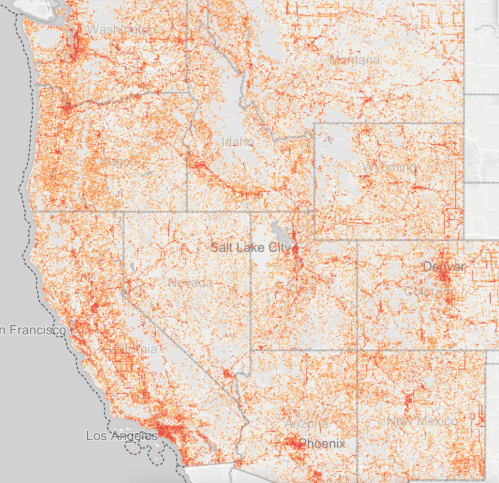
In the visualization of land conversion map in the header to this post, cities like Denver, San Francisco, and Salt Lake City haunt the transformation of landcover across the western United States, as the place-names haunt the five-color map that denote the scope of an absence of open space.  From each city, expanses of red leach into the landscape, spreading outwards along patterns of settlement in ways that seem to infect the adjoining counties to register how development cascades to surrounding regions.  The image shows the reduction of once-open spaces with the dramatic pace of extra-urban expansion in most western states, whose absence seems to haunt the region that we once knew as the American West, and are departed from it.

The dynamic maps suggest a poetics of loss, both qualitatively objective and evocative of the disappearance of a landscape that no longer exists.  Increasingly elegant interactive data visualizations help orient viewers to a changed relation to the landscape of the west over the past twenty years, and the disappearance of what was once a notion of wilderness that have so dramatically retreated over increasingly active real estate markets and dynamics of expansion that allowed such pronounced extra-urban growth over a short period of time.  The subject of the maps is not only difficult to process, but complex to navigate over time:  if the use of a slider bar helps orient oneself, it also raises question of the historical implications of such a broad retreat of open spaces across western states.  If the Old West seems a fixed chronotype to some, it may be that mapping the retreat of open spaces can provide a lens to chose our Romantics, or map the nature of our Romantic tie to the retreating spaces of the past and its landscapes.

But how best to read the landscape that lies beneath them, and the changed experience of the landscape they seek to describe?  The stark colors of the data visualization cannot but suggest a romantic relation to place, marked by the disappearance of formerly open lands, and suggestive of a deep change over few years.  The multiple levels of time that the maps of The Disappearing West, a web-based map offering ultiple datasets of different sorts of human activity presented by Conservation Science Partners and the Center for American Progress.   The elegantly interactive website of land use, showing incursions of open spaces in alarmist red, provide a way to take stock of existing changes and the dizzying pace of the disappearance of opens spaces that may even be cognitively helpful, as the scale of such changes are so difficult to process.  The opportunity to examine change on different scales and over time, by use of a slider bar, provide a basis for coming to terms with the increasingly irrevocable rapidity of such changes, and indeed with the inevitable melancholy of the departure of the known world of the past, but provide a deep and irrevocable sense of how our own ability to observe the western landscape is in the process of irrevocable change.


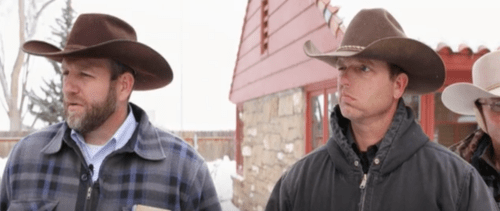
1.  Such a sense of irrevocable change was quite violently tried to be stopped when the self-designated cowboy when the out-of-state vigilante Ammon Bundy summoned like-minded ranchers who inhabit another region of the same landscape in Nevada.  He summoned the ranchers who viewed themselves as rightful residents of a faded land so that they could seize public lands in Oregon’s Malheur Wildlife Refuge, without justification, but to assert their imagined rights to open lands.  In garrisoning one outpost of the wildlife sanctuary, without much regards to its use, they sought to stake claims to their rights to a rapidly departing map.  Their reaction–but one of many to the disappearing west–suggest a point of beginning to see how we might better come to terms with the acceleration of the loss of open spaces over time, and the problems of mapping them onto the region’s powerful spatial imaginary.

For in misguidedly hoping to occupy the refuge’s offices until the United States government “release” any claims to the public lands it has long administered, they seemed to act in hopes to reclaim a landscape increasingly fragmented by overdevelopment and forever altered.  As open spaces of the Old West disappear, the staying power of the  mental imaginary of open lands have created a tension palpable enough for Bundy and his followers to view federal protection of pubic lands as unjust, and armed with a sense of reclaiming a lost landscape for hunting, they aggressively reclaimed a myth of a sacred relation to the land that they might experience to use firearms freely without impunity in open spaces, and eager to recast protections of public lands as if they were primarily individual restrains.

As if to stage claims to a disappearing west, Bundy sought to reclaim them for ranching and hunting from a very local point of view, resisting a disappearance of the fabled “open lands” that once defined the imaginary of the West for Ammon Bundy, the son of a Nevada rancher.  Bundy and his fellows railed against the government, invoking hopes to restore the conditions of the west, as if removing governmental presence would let a wilderness reserve to revert to wilderness by liberating it from alleged government control:  his anti-government animus was evident in his earlier defense of the right of his father, Nevada rancher Cliven, to refuse to pay grazing fees of federal lands.  Ammon encouraged a 41-day armed occupation of Oregon’s Malheur National Wildlife Refuge in January, 2016 to defend local claims on a national stage–although his anti-government stance was more apparent than his appreciation for the historical loss of open lands across the extent of the western states.

The outpouring of sympathy of resistance of a range of militia to Bundy’s elaborately staged reclaiming the West was a response to a shifting mental geography of the west.  But the bizarrely misplaced response of such extreme violence among the Bundy and their followers in the name of reclaiming western lands seemed to act as if it was possible to restore it to a lost landscape of hunting, trapping, cattle ranching seems a geographic dream.  If the maps were in their heads, it was so remote from realization to be self-indulgent.  Might the interactive format of a web-based map provide a more clear-eyed way of taking account of the rapid decline of open lands across the western United States?  Can interactive data mapping of California’s rapid loss of open lands in an interactive format provide a more clear-eyed ability to track their disappearance?

A recent set of two-decade old change in The Disappearing West offer an opportunity to assemble and investigate data on the drastic reduction of public lands and extent of extra-urban growth across the west that seems particularly timely as a way to chart the rapid pace of landcover change in the West in relation to the Bundy brothers’ ill-conceived attempt to the back a mythic relation to the land.  The graphic tools it offers call attention to the loss of open lands in our national interior.  Indeed, the increased current dangers of dismantling the public custody of remaining open lands may make the website a valuable tool of visualizing and taking stock of the extent of their reduction in recent years–and raise questions about the best ways for preventing their disappearance.

For the dangers to the western lands lie in fact less with the invasiveness of public governments or the extent of government land-holding in western states than the true value of their custodial role in preserving needed habitat and open spaces–the commons of the wilderness, if you will–that are increasingly endangered or lost.  The imagined spatial geography that the Bundy clan sought to defend has long vanished, but Ammon and his brother Ryan held a spatial imaginary nourished in a landscape where federal policy, rather than local development, threatens the landscape of the west. Much as their father, Cliven, had evoked the former freedom of a once open lands of the western states once known as the “public domain,” the retaking of a federal wildlife reserve seemed a theatrical reenactment of federal lands as if a wildlife refuge constituted a last stand for defending his family’s rights.

The vigilante group illegally occupied offices of a preserve for birds for month, after intending to remain for a year.  They did so in their desire to affirm a departed west, but acted somewhere between a costume party and organized terrorism in a poorly conceived defense of the Second Amendment, dressed in cowboy hats and attracting the support of anti-government militias at whose rallies Ammon Bundy and his brother Ryan announced plans to occupy the refuge’s unoccupied offices on the first days of 2016, inviting armed men to sieze them to defend the idea of access to an idea of wilderness long vanished for most.   The range of objects sent to them–many including sex toys that made fun of staging claims to masculinity in an isolated cabin–underscored the futility of hoping for a restoration of a rancher’s sense of the wild, by hopes to “open’ 1.4 million acres of the National Forest for logging, conjuring specters of governmental presence in untarnished lands to protest the government’s role in the US West.  Their bid to renew the old rules of the western lands by exposing an undeveloped forest to forestry, challenging how the National Parks have preserved remaining isolated areas of a once-forested expanse of wilderness, suggest the need to gain purchase on the scale of the expansion of paved landcover and property development across the western United States.


Screen Shot 2016-10-28 at 11.27.22 AM.pngAmmon and Ryan Bundy/Oregon Public Broadcasting


While their protests were misguided, the Bundy brothers seized state facilities as if they were their natural rights,  bulldozing new roads in the refuge, and attracting the attention and support of local libertarian militia until they were arrested as if protesting the death of an earlier rural America and of the once-open west through the issue of federal land-ownership.  But the problems of public management of lands have little to do with the disappearance of open spaces across the western United States, if the Bundys sought to defend their ability to graze animals, hunt, camp and live in open lands increasingly curtailed in most of the United States, and even in the western states where few opens spaces remain, but where residents were long attracted to the freedom of their open space and ready to defend what they saw as the impending encroachment on common lands, and lacked much objective relation to the deep exclusion that they felt.


image-1.jpegRick Bowmer/AP


2.  The loss of open spaces from Arizona to Oregon are far less the result of government policies than the rapid overdevelopment of western lands, and although the spatial imaginary of the Bundy and his followers directed much of their animus to the United States government, they responded to the rapid contraction of the notion of “public lands” that have changed the very image of open space across the western states, which Bundy seems only to understand–quite misguidedly–in terms of the federal policies of land management.  If the notion of “the commons” has long departed from the American West, the image of those commons and rolling plains has been far more compromised and challenged by the rapidity of land conversion due to public development and the rapidity of extra-urban growth, which Bundy from the perspective of his father’s ranch may not see–and may even only be able to be entertained from a site such as the Wildlife Refuge where he and his followers holed up and presented the demand that the “federal government will relinquish such control” of the national forest it maintains in a role of stewardship, and allow “ranchers . . .  kicked out of the area [to] come back and reclaim their land.”

The imagined intergenerational transmission of property rights in regions never open for ranching could be alleged to be “in accordance with the [U.S.] Constitution, which is the supreme law of the land,” but the desperate vigilante action was a power-play for national attention with little sustainable logic–especially given the scale at which open lands were lost to private development across the west.  Whether the image of the “Oregon Territory” inspired Bundy and his crew, privately held lands (light blue) dominate Oregon far more than the small bits of National Wildlife Refuge (brown) lying in Eastern Oregon–yet Bundy alleged his case lies outside of government jurisdiction, summoning a misguided notion of natural rights to defend his personal right to the land.


Oregon.pngLand Ownership in Oregon/Mark Green


3.  The accelerated diminishing of green space across much of the Western United States has rapidly rewritten a landscape of once-open lands.  Such rapid curtailing of open spaces, as much as revealing a change in land cover, has deeply altered the local experience of the very landscape and fragmented wildlife habitat in ways challenging to map-so radically have deep changes altered our experience of its landscape on the once-virgin west through the rapid change of once-rural lands.  With over a hundred million acres lost to modification by humans, a decade of satellite imagery of land cover over eleven western states, the interactive maps The Disappearing West offer a starting point to explore, survey and take stock of the scale of massive environmental changes created by an ongoing collective redefinition of how we have come to inhabit the new landscape of the American west.  Indeed the interactive timeline tracking urban expansion and landcover change offers a different ethic relation to how land ownership has led to the dramatic curtailment of formerly open space.

The progressive development of the landscape over a decade is difficult to comprehend.  But the streaming of this data into multiple layers, superimposed on each state, counties, and urban areas allows foregrounded layers of the map to jump out at viewers in particularly effective ways.  They help parse  the eleven western states that fills 165,000 square miles of landscape–a change in land cover equal to the construction of parking lots for six million superstores, and at an annual rate of an area almost as great as the footprint of the entire metropolitan area of Los Angeles–and far greater than the footprint of New York City, according to US Census records of the loss of natural lands used by Conservation Science Partners–to create a virtual profile of land conversion in an area that is increasingly fragmented by road, as once roadless areas are exposed to development.  The rapid nature of such anthropogenic change has been to some overshadowed by intensity of drought and of global warming, but distances the land in a terrifyingly definitive way as the region’s open spaces are increasingly segmented by roads and transportation routes.  But it has brought a fragmentation of open landscapes, driven by the expansion of roadways, overdevelopment and competition for limited resources, that have parcellized whatever protected open lands indeed remain.


land conversion


The web maps focus on a uniquely revealing index of the human footprint, rather than cities, or jurisdictional lines, to suggest the extent of how we are re-writing a relation to the land.  They aim to comprehend the loss of land over time a region that is reduced by a football field of uninhabited lands every 2.5 minutes.  The map is an attempt to depict the scale of this vanishing landscape, by a detailed record of the scale of the contraction of open lands that one can zoom to local levels, against which cities and regional names float in ghostly way, as if it describes the changes that underly a simple road map of place-names and individual states.

How can we read this record of disappearing space, save as the emergence of a new set of attitudes to the land?  Its flexibility helps take stock of accelerated changes in ways that we have only begun to take stock collectively; the maps force us to come to terms with the scale of recent “development” of open lands in ways that have been rarely so effectively or dramatically synthesized in one site, and our increased power to comprehend and try to come to terms with the disappearance of an older landscape that was the focus of such romantic attachment,–and the rate of the recession of that imagined past.

The visualization that can be examined over time and in such striking local detail affords a basis for imagining the terrifying scale of anthropogenic change across the west, with all its attendant problems of wildlife conservation.


Continue reading

2 Comments

Filed under American West, environmental mapping, open lands, open space, wilderness

Mapping the Current State of Surveillance

Near my house in Berkeley, a curious street sign that canceled the word DOPE beside warned motorists near a low-income housing police are reading their license plates.  A relic of a war on drugs of an earlier era, when crime waves spun through a now gentrified neighborhood, the signage beside a four-way stop dissuaded prospective drug sellers–in what must have once been a hub of clandestine activity–of the vigilant eyes of ever-present police cameras–with added messaging that they have entered into a residential neighborhood that has taken crime “seriously.” How seriously? It offers a visual illustration of the etymology of surveillance from the French surveiller, “to oversee or watch.”  This surveilling will, in other words, anticipate their punishment.

Beneath a roving eye, this Berkeley Neighborhood Crime Watch warns potential felons they will “immediately report all suspicious activities to our Police Department” as a caution to all, giving “buyers and dealers” cognizance that “your license plate numbers are being reported to the police.”

Signage on Ward Street, Southwest Berkeley, CA

The old signage that seem smart of a nation-wide advertising campaign of the 1980s and early 1990s to urge school-age kids to resist drugs, best known by Nancy Reagan’s “Just Say No” program, a slogan that gained national attention after the First Lady used the simple phrase in response to the question of an Oakland girl, interested in how to respond to the offer of drugs from her own cohort, responded in words to immediately powerful that “Just Say No” clubs emerged around the nation as well as at Oakland’s Longfellow Elementary School, where she was visiting. (I’d long been told it was used at my daughter’s elementary school my daughter frequented, but I will cede that dubious honor.)

The expansion of hidden cameras designed to capture license plate numbers of passing vehicles increasingly knows no bounds. Its collection suggest a new level of intrusion, justified in the war on drugs or crime, but has increased the gathering of license plate data registered indiscriminately in the name of law enforcement by automated license plate reader systems across many cities in America. They suggest the transformation of the very same landscape, forty years later, where the city has invited the placement of scanners situated at intersections of Oakland, Berkeley and Kensington, to suggests the readers able to capture license plate numbers. Any child watching cars on the highway may have fantasized about the legibility of the plates on passing cars, but the expansion of computer software has allowed the processing of a big data archive of license plates across the nation, allowing a database to be assembled for police departments to request information about individual cars on an unprecedented scale by scanners whose retention of data lasts for years–and has escaped much public regulation–and are hoped to have the potential for a permanent archive of the populations of many states, without secure protection of the data stored and without public access to many records that are deemed classified for public safety. The lack of protections on the technology of surveillance suggests a dangerous data breach waiting to happen, and even a lack of clear policies for storing, protecting, and archiving the data in different states. Have police departments improvised new technological tools to surveil their populations, with no method or adequate protection for the data that have overzealously grabbed from new devices in the belief that it would help ensure public safety?

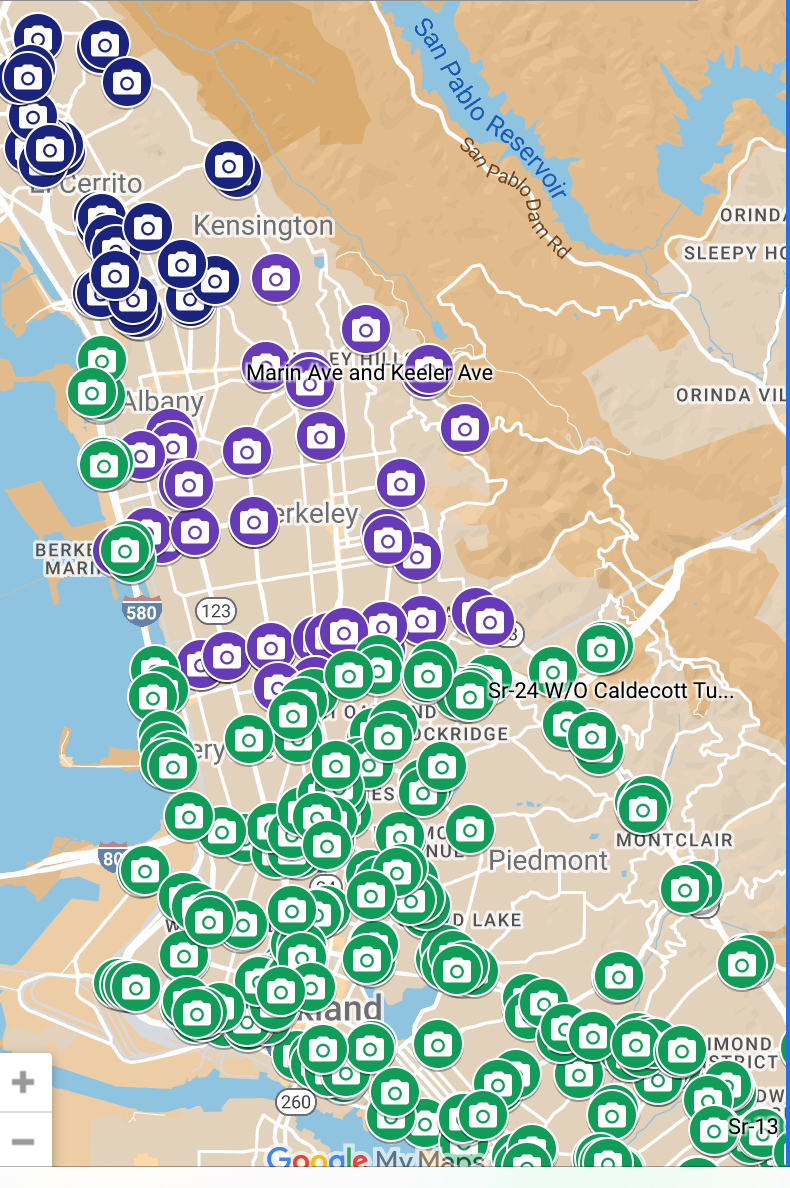
The tools of registration are not single photo cameras, but the icons of the camera suggest the sense of watchful surveillance that groups like Electronic Frontier Foundation and others are trying to be vigilant against, providing maps of the levels of enhanced surveillance that the police department has on city streets. (They do so not to offer a reverse map of the routes of getaway cars, but in the belief that the public has every right to know about these massive information grabs of data, often sold to or made available to a range of other audiences.). Marked by cameras to denote the readers set up on fixed locations that scan all license plates that are within their view, license plate readers have vacuumed up up to 1,800 plates that come into their viewing range per minute, noting the time, date, place encountered, that are stored for years–a huge megadata trove now able to be mined.

Autonomatic License Plate Readers Currently Active in Oakland, Kensington, Emeryville and Berkeley, CA

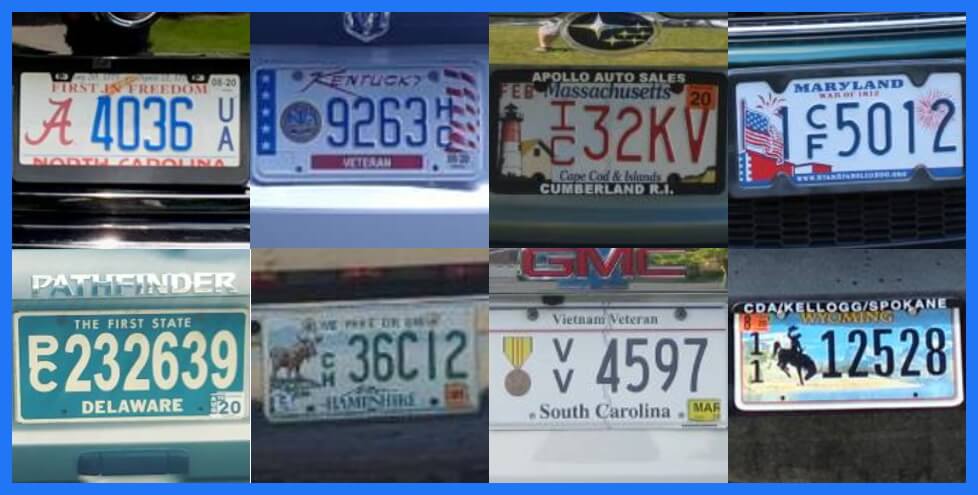
While cameras can be mounted on police cars or at fixed location, the scanning in the city of Los Angeles of about 3 million plates per week before the recent pandemic take up a range of information that predominantly includes law-abiding drivers, but allows should allow many to have a monopoly on data about drivers who move across America in all jurisdictions, data possibly shared with private policing groups, Homeland Security, border agents, and indeed immigration authorities and airport security that constitute a massive invasion of privacy–as was recognized in a precedent setting decision in 2017 in California in a public records suit against the Los Angeles Police Dept. and Sheriff’s Office on the classification of the data collected as open–and not investigative in nature. The massive datasets that are assembled by the proliferation of cameras and cameras on police cars, even if the “stacked characters” in the plates of many states prove difficult for ALPR software to decode with dependability. The demand to refine tools of surveillance that ALPR uses, however, has only increased attempts to fine-tune license plate readers to improve their possibilities of surveillance.

ALPR US license plate recognition stacked characters

But the increased expansion of license plate readers suggests a continued expansion of neighborhood surveillance violating the privacy of drivers without their knowledge or consent that constitutes a huge database of street-level surveillance that is increasingly expanding in America. As the public benefits of ALPR’s are touted by law enforcement agencies as large as the LAPD, the movements of drivers have assembled a massive database of increasingly sensitive information that the Homeland Security is increasingly interested in using as a way of “fingerprinting” vehicles of citizens who have not committed crimes, or related to ongoing investigations, based on the technological success of having scanned up over 1.6 billion scans of cars’ license plates in the state of California alone in 2022,– allowing law enforcement to create a “fingerprint” of the movements of drivers, without offering any means to citizens of having this information cleansed or purged.

The result of surveillance on such a massive scale is itself a public safety threat. While the data on movements of such vehicular “fingerprints” are at extremely fine grain, they are preserved in a database that is stored to later identify cars near any protest, abortion clinic, or civil action–but constitutes a huge database of extremely close grain, but hardly encrypted or protected. Such a massive database of the movements of cars may be used to track individuals to expose them to robbery or security threats, and indeed the data stored in each camera is not only vulnerable, but the entire network poses questions of vulnerability that law enforcement never seems to have considered–as it has not considered the invasion of privacy posed by the mandate for scooping up all this data. On the first level of danger, the data is not be protected against ransomware attacks or hackers able to access the data by cyberattacks. At a smaller level, the streaming of data on LPRA The logic of assembling as much information as possible suggests a huge network of surveillance able to be used in other problems, while providing a rich resource that is not protected against vulnerabilities. While ALPR cameras have been criticized as themselves vulnerable to invasive hacking by criminal elements, the expansion of cameras in Washington, California, Texas, Oklahoma, Mississippi, Louisiana, Alabama, Florida, Ohio and Pennsylvania suggests a virtual dragnet of sorts that is being stored for future police work or investigation of police suspects. Yet it is also true that most of the data stored by ALPR cameras in Louisiana, California and Florida are at present connected unsecured to the internet, and are located on publicly accessible websites that if accessed might be used to manipulate the camera controls or siphon off the granular data.

Difficult license plate recognition USA

What can be done to protect the privacy of all the drivers of those cars who pass daily across ALPR cameras? An analysis of the metadata and data by the Electronic Frontier Foundation in 2021 found that up to at least 99.9% of this data is entirely not related to public safety threats when collected, the hope is to store a massive database in which criminal license plates can be tracked, mapped, and potentially employed to target future arrests or apprehensions, even if the data was taken from those who were never proven guilty–most of whom are entirely innocent–but whose cars might be tracked by anyone who obtained the raw data, either directly from the police forces or with other agencies and organizations with whom they are shared.  The avenues for harassment, stalking, and even kidnapping or extortion and blackmail are huge, if one wants to track the number of, say, wealthy individuals who would be tracked to a position that might compromise them based on data collected for public safety. The data assembled by law enforcement is is a crime waiting to happen.

If the feeds must have been unobtrusively mounted on traffic posts by the Berkeley Police Dept., at bout the same time, the open eyes of neighborhood surveillance linked to local police offered a new tech whose innovation has provided a new market for surveillance of cars, far beyond drugs, as the images of snapped license plates of cars, stolen or not, fills a nation-wide market for surveillance. If the cameras suggested a need for adult monitoring of the streets beside schools, however, or in border line neighborhoods, the market for clandestinely snapped up imagery has provided tools of mapping cars, traffic, and individual vehicles, as huge databanks that these cameras have generated provide a new form of big data for which endless new markets are being discovered–often without any knowledge of the owners of cars who happen to drive by vigilant cameras. We may soon need a set of signs, warning folks that their cars of vehicles may be fed into new information markets in ways that they little suspect, as license plate cameras have become significant intrusive tools on personal privacy.

The ACLU has explored the expansion of crude techniques used by the FBI in mapping American Communities–in a sort of darker side of the illuminating geography of data amassed in the US Census’ American Community Survey.  Much as Senator Jon Tester not that belatedly strove to balance his desire for “law enforcement agencies to use cutting-edge tools to catch criminals and protect our borders” with the appearance that such technologies “potentially violate the Fourth Amendment and represent a significant intrusion into the lives of thousands of Americans,” the ACLU has recently mapped a growing geography of surveilling that the FBI has created in recent years that include the very surveillance devices of dirtboxes which Senator Tester, who has quite staunchly supported citizens’ civil liberties, invited Jeh Jenson of the Homeland Security office and the Attorney General to take time to explain to the country.

Senator Tester’s belief that stricter oversight is needed stems from the “extreme lengths” to which federal agencies have so assiduously cloaked such programs in secrecy, his letter of request about the widespread use of dirtboxes that act as cellphone towers to intercept phone communications by both US Marshals and the US Drug Enforcement Agency may well have stemmed in part from the geography of a widespread surveillance program that the ACLU has started to map in the state of California, but which might reveal both the dissemination of military technologies of surveilling across the nation, and the local expansion of the new level of worldwide surveilling recently focussed on and directed mostly toward areas outside the territorial boundaries of the United States.  While we are waiting for Mssrs. Jeh and Holder to respond, the arrival of the scope of the mapping of residents of California–or even those traveling in the state–might well give pause if not raise expectations for the scope of what levels of individual surveilling will be revealed.  For the map of degrees of surveillance shows something of a microcosm of the extent of the expansion of surveilling ourselves of the very sort that Senator Tester was so rightly wary that he has promised to his best to publicize should it pose so clear a violation of the US Constitution as seems the case, in an attempt to place them under the oversight of both courts and the US Congress in order to restrict their use.

The maps of surveillance that the ACLU has taken upon themselves to provide is not only “cutting-edge” in its use of tools of surveillance but suggest the degree to which law enforcement agencies actively aspire to something along the lines of precognition of which groups might be likely to commit crimes in recent years–as if in a gambit for the foreknowledge Philip K. Dick imagined pre-cogs helping police apprehend criminals before they commit crimes in Minority Report,  but based not on the psychical foresight of “pre-cogs” so much as the statistical prediction of categories of probably cause of criminality or value of surveillance that runs against many of our legal traditions.  Such snooping for intelligence gathering recalls the sort of racial profiling former which Attorney General Eric Holder (quite rightly) once lent his voice to strongly oppose, following the 2003 DoJ “Guidance on Race”–yet which he incrementally allowed from 2008 for both national security and law enforcement alike.  Holder has hesitated to restrict or unmask such activities as an abusive expansion of surveillance over Americans.  And he has allowed investigation and surveillance of “behaviors” and “lifestyle characteristics” to be directed at American Muslim communities from New England to Northern California.

These activities have actually continued to expand dramatically over the past decade–including instances of the outright abuse of community outreach programs first initiated to build trust.  In a bizarre absorption of such outreach into the apparatus of a tentacular system of state surveillance, the monster seems to have been fed by the deep fears of the insufficiency of procuring further information,  and the need to gather it at all costs.  In ways that recall the suspension of individual human rights in the use of torture to obtain state secrets–but is directed to monitoring its populations, much as the extraction and mapping of such racial and ethnic data by the FBI’s Domestic Intelligence and Operations Guide (DIOG).

Such crude tools of mapping function by a pervasive sense and logic of invasiveness.  We are mapped in ways that lack even the logic or ethics one expects from a government service, it appears, as government services aim to create a sort of all-seeing eye for mapping populations, vacuuming up information in an almost paranoid manner.  ACLU’s Chris Soghoian has recently disclosed the existence of widespread surveillance program among US Marshalls across the state of California, including a fleet of airplanes flying from five metropolitan airports dedicated to collecting cell phone data and equipped with dirtboxes to do so–since 2007,  that parallel the NSA’s programs of surveillance, now known to be concentrated on the Southwestern border of the US by the DEAImmigration and Customs Agency, Homeland Security Agency, and FBI.

The degree of widespread and almost routine adoption of public surveillance systems by the government across the United States might be best understood as a sort of surveillance of the everyday, ranging from video surveillance, false cell phone towers, or facial recognition software that offer a range of tools to map populations to a degree never known.  The new nature of law enforcement mapping may suggest something like a desperation to agglomerate information, and a deep difficulty to hold back on abilities and technologies to extract information on individual whereabouts, and indeed to track persons where they could not be often seen.  The ability to map the invisible, and to try to intercept signals that move through the air, transcends whatever notions of mapping to which we might be habituated, cultivating new abilities of collating information that seem deeply intrusive.

spyfiles_marquee

ACLU

Techniques of mapping populations have grown in their intrusiveness far beyond the mapping of ethnicities, initially pioneered by men like Francis Amasa Walker, that offered a statistical visualization of the demand for more information than most maps can provide.  When Walker mapped the nation’s populations from 1873, as Secretary of the Census, he offered a way of reading national space in new ways for public ends as well, potentially, for the needs of the government.  The recent mapping of ethnicity and behavior has of course augmented in detail in order to track individuals’ spatial position over time, as well as to chart patterns of individual behavior.  The compilation of such an exhaustive map of spatial position has grown for reasons of security, but meets a increasing interest in reading maps of local populations at a level of detail and crude classification renders Walker’s tools of tabulating the composition of the population something of a precedent for enlisting new technologies of surveillance used to create the appearance of safety and quell  fears–although the forms of tracking, intelligence gathering, and remote sensing must have created a broad body of map-readers whose charge it is to interpret the massive range of data that is daily culled.

alker Legend

What has perhaps most radically changed is the studied intrusiveness with which such data is culled–and the precision of ongoing surveillance that it allows by a proxy army of drones. stingray tracking devices that mimic cell phone towers to capture identifying information, cameras of automatic license plate recognition and scanners of facial recognition systems to create a state of surveillance that we are only beginning to map.

The quantities of data that such tools amass is suggested by a survey of the layers of procuring information across the state, recently issued by the ACLU to draw attention to their amassing of data without public notice, which seems to complement the large-scale infiltration of Muslim communities.  But it goes beyond them, in suggesting a mapping project that monitors daily behaviors and to target individuals by a battery of technologies which abandon and depart from tools of rendering to collate data human minds could not visualize.  These technologies cannot but change how space is experienced–and perceived–even if we lack an image of the results that such surveilling will be able to produce, since the master-map will remain inaccessible to our eyes.

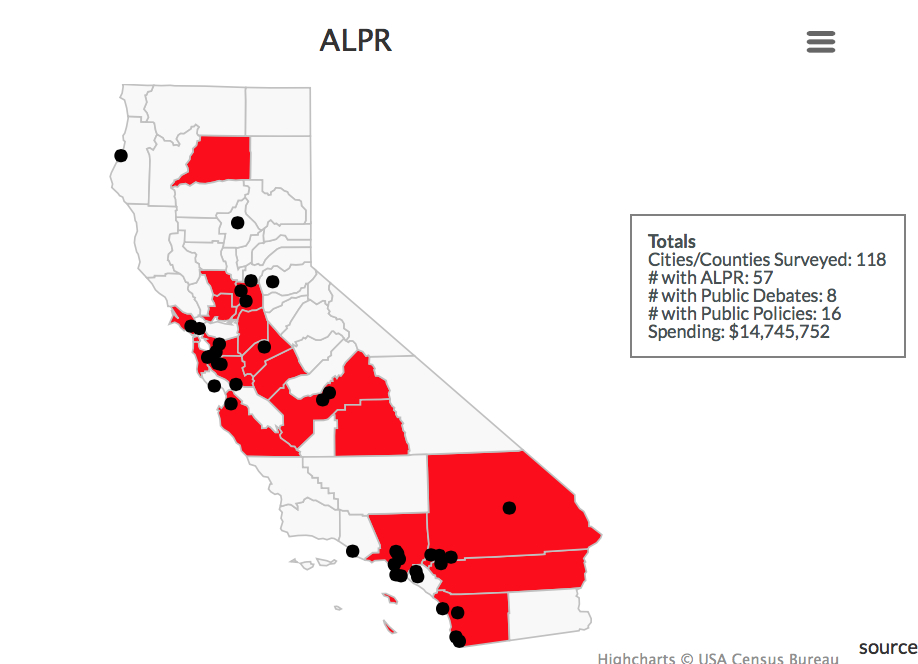
The government money that is directed to maintaining an intensive level of intrusive surveillance of the everyday across the state of California alone has been mapped by the ACLU in interactive form to allow comparisons between levels of surveillance that exist in California’s communities and fifty-eight counties.  The map was appositely issued together with both a community guide to resist intrusive surveillance technologies whose use has so dramatically expanded, oriented to different technologies currently used, and its initiation of a statewide campaign against abuses of intelligence gathering that use drones (used in three counties or cities), body cameras (used in thirty-two), tools of facial recognition (used in sixteen) or video surveillance (used in sixty-one–roughly half the number of cities and counties surveyed).

Video Surveillance in CA

Highcharts/US Census

That’s right, the cost of such surveilling of the state?  Quite a bit over $18 million.

The number of states and counties using Automatic License Plate Recognition, a particularly invasive mode of monitoring populations on the road that comes at only a slightly lower cost, is similarly quite expansive (fifty-seven), suggesting the broad range of areas that are subject to surveillance in California’s largest cities and (interestingly) the Central Valley:

ALPRE

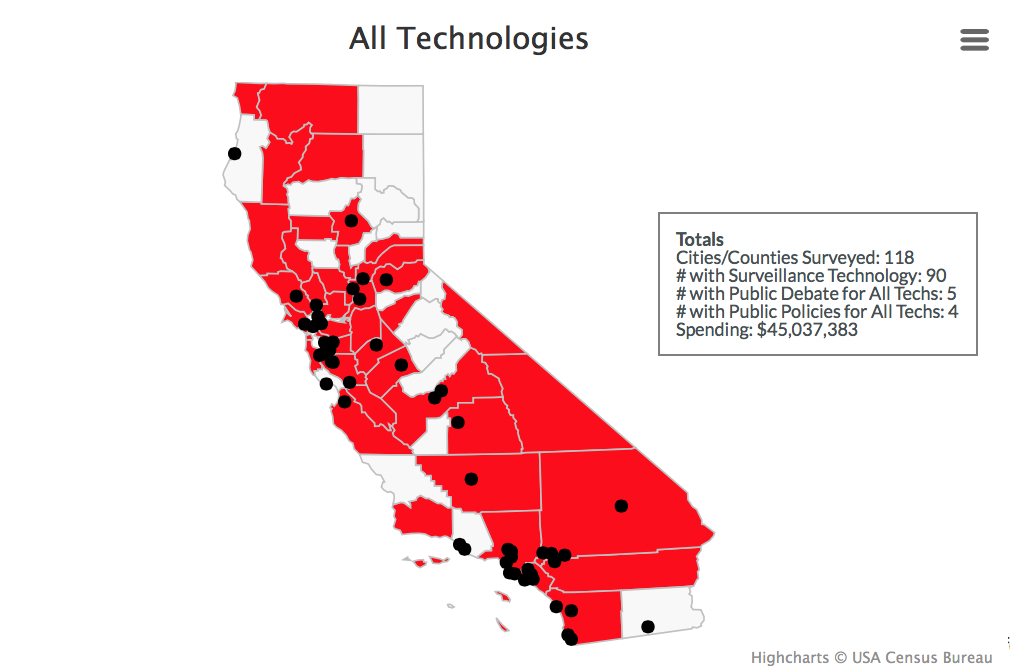
Grouping the technologies, Attorney General Kamala Harris, the state seems strikingly well covered for less than $50 million of your tax dollars:

Grouping the Technologies

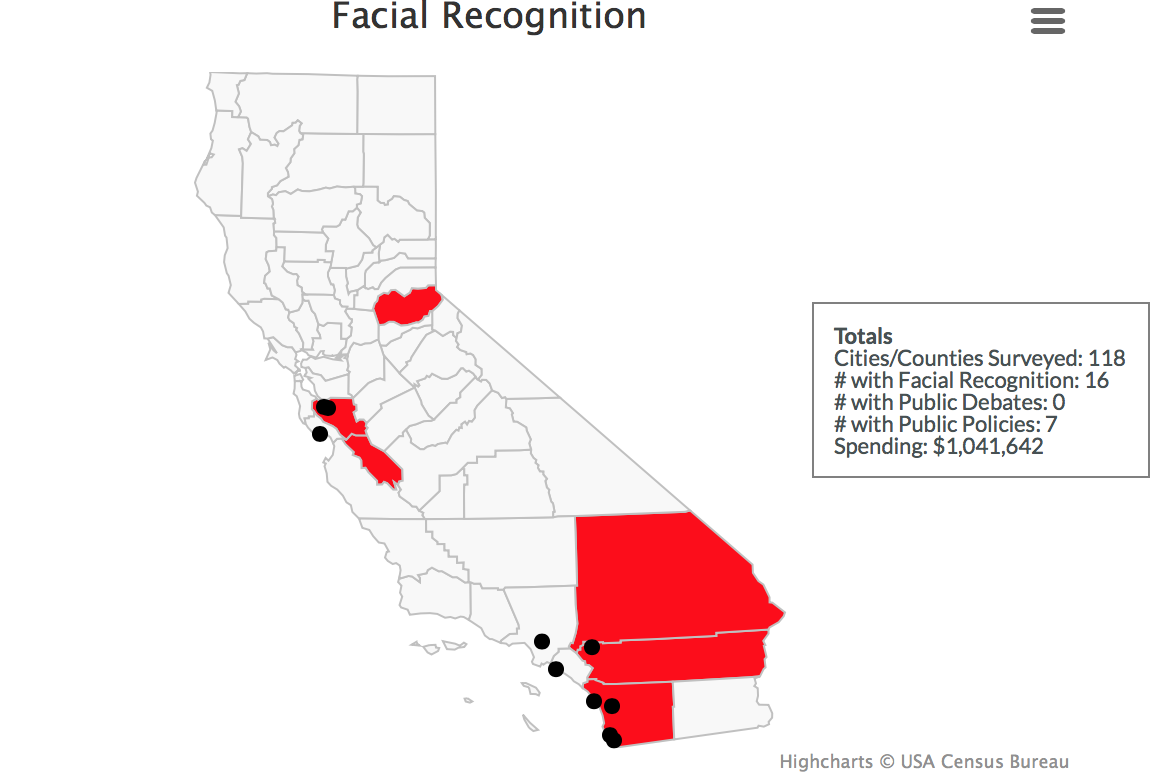
While Facial Recognition techniques are concentrated in mostly in the Southlands, it augurs a particularly invasive form of individual mapping, whose apparent concentration on questions of immigration may be destined to expand with time beyond the sixteen counties and cities where it is used currently.

Facial Recognition
Face Recognition--CNN

Although we have focussed on the technologies purchased by local police in Ferguson MI, we have done so perhaps ignored the spending spree on body cameras by local authorities across the nation.  Uncovering the considerable expenditure of some $64 million on mapping the whereabouts of potentially suspicious individuals poses a new level of government invasiveness across the state.

The ACLU has created a specially designed checklist for local governments and authorities across the country to consider, before adopting technology that we associate with the NSA.  Such advanced technologies, enlisted as useful without clear oversight practices having evolved or being instituted, or even with public notice being given, have been seem designed to create a comprehensive map that echoes, in microcosm, the state of surveillance we’ve been learning about increasingly this year.  Stingray technologies, able to track a person’s location based on cell-phone signals, are a high-precision level of mapping, already adopted in twelve counties or municipalities including by police in Oakland CA, are increasingly widely used by police throughout the United States in fifteen states, the adoption of which can be tracked interactively, if you are planning on Thanksgiving travels and would like to know.  (And it’s not only the government that is now in the business of using cellular interception technologies for the ends surveilling, we’ve been recently reminded, lest this sort of snooping only be understood as a top-down activity, rather than a widely available software for intercepting unencrypted calls long considered private by means of a radio scanner.)

Stingray USe

ACLU invites members and non-members alike to send email letters, with the subject line “Don’t Map Me or My Community,” to express their desire to help restrict such intelligence-gathering and mapping tools that are regularly based on practices of ethnic or racial profiling, and set new standards for invasiveness.  NSA has long been doing this sort of tracking worldwide, but the intrusive mapping of populations across the US has come home to roost.

google_cameras_inside

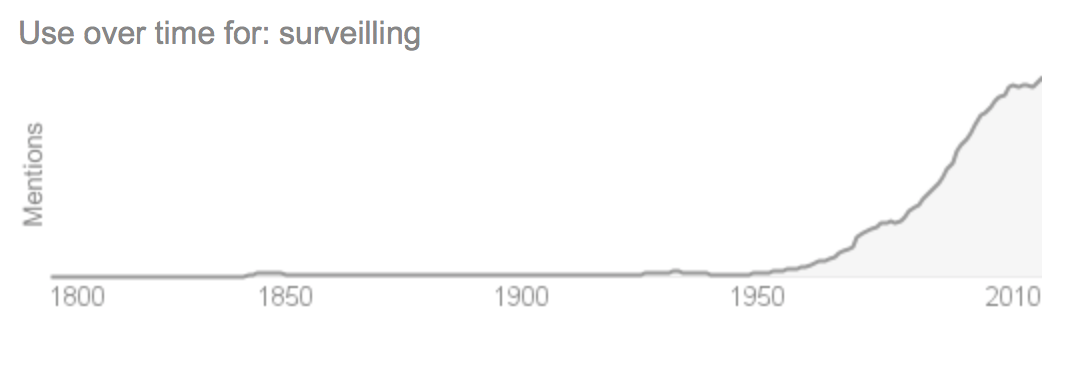
Surveilling is a backformation dating from the 1960’s from “surveillance.”  Its use has, however, unsurprisingly really taken off recently, even if it has crested from about 2000, as databanks of license plate information are sold on the open market. In may ways, the omniscient folks at Google let us know . . . and the question that this post might principally pose is just how much it is destined to further grow in common usage and in ubiquity in the physical world.

Surveilling

Increasingly, this is the State of the State, a growth of the postwar national security apparatus, perhaps, but a rapidly escalating compilation of tracking that has been normalized since 2000.

Leave a comment

Filed under Homeland Security, mapping public space, police surveillance, public safety, surveillance state

Mapping Water’s Presence and Absence Across Land: Maps of Aridity and Drought

Maps can potentially provide quite supple tools to draw the distribution of a variations among land and water, and to reflect on the local variations of the specific landscapes they represent.  Yet the conventional of land-mapping do not clearly lend themselves to describe the presence of water in the land–and all too often presume a clear boundary between land and sea, a fiction known as the coast, one of the clearest inventions of cartographers.  We struggle to describe the relation between land and water–whether in our imagery of drought, which has become particularly popular with increasing evidence of climate change and global warming, or in describing the levels of groundwater loss across the land.  Hence, even as we confront the potential collapse of aquifers, and a rapidly shrinking supply of underground water, we don’t have a clear iconography of how to render the very dilemma–even if the problem of groundwater depletion stands to only increase.

The recent findings of such deletion of groundwater sources in much of the United States since 1900 is big news, but the means to illustrate the rates of its increasing disappearance–or indeed the potential losses that such groundwater losses imply in much of the country–pose problems of cartographical rendering, as much as environmental catastrophe:  the two seem far more closely intertwined than has been argued.  Take, for example, a recent and particularly valuable USGS study of the levels of groundwater depletion that historically increasing removal of subsurface groundwater from the lower forty-eight states, in terms of a combination of levels of subsidence, drainage, and water-flow, that mirrors the central regions of agricultural production and farming in the United States since 1900, but which primarily depends on modeling aquifers’ depletion:

Groundwater Depletion, 1900-2008

Groundwater Depletion, cubic km

USGS:  Leonard Konikow, “Groundwater Depletion in the United States (1900–2008)” 

We are similarly deeply challenged, in representing the drama of increasing drought.

The syntax of terrestrial mapping does not lend itself easily to the mapping of drought, or indeed to mapping the presence and absence of water in our worlds, or the role that water plays in the landscape.  For the very mobility and fluidity of water across environments is, as the current drought has revealed, not easily able to be naturalized into the landscape, or fixed in a map, and the interaction of water with our agrarian and rural landscapes in face difficult to map.  Cartographers all too often rely only on ruled lines to organize land maps, and the syntax that was developed to draw divisions and preserve boundary lines, and indeed bound territories and nations have the disadvantage of instantiating divisions as if they were natural, and part of the landscape that we see.

Rather than bounding the regions of land and water by sharp lines as if to differentiate them, web-based maps that sense degrees of the relative presence of water provide a new and almost dynamic format to frame questions that depend on visualizing the presence of water on which even landlocked regions depend.

The map brings into being new entities to visible form that we could not otherwise see in a material form, and allow us to better contemplate and reflect upon the different sort of water-levels on which the fertility and richness, but even the usability, of land depends.  The two-fold qualities of how the map brings things into existence and offer tools to think exist as two sides of the same sheet of paper, both present in how we inscribe space in a map as a way to  view space in the definition of their contents.  Whereas informative content lies inscribed according to indices on the map’s surface, maps also project meanings lying beneath:  on their obverse lies their take-away value, or the picture of the world that they shape in our minds. The symbolic conventions of maps are to be judged both by the accuracy of their design and their communicative value.  But while lines are useful tools to define and bound territorial space for viewers, they are far more limited as tools to describe the presence of water in the land, much as notoriously neglect or efface the areas where land and water interact, or the fluctuation of the boundaries between land and sea, and even harder to map the absence of water in the land–either in terms of its severity or the gradations that can be drawn in conditions of drought.

Despite the compelling nature of our mapping of the California drought–and the prospect of regions sensitive to increasing water stressors and drought worldwide–maps of drought raises compelling questions the conventions of its mapping and the take-away of maps of drought and aridity.  And the picture that emerges of the recent three-year California drought in one’s mind seems of utmost important to its understanding:  one can think of the hugely valuable perspective that Michael Bostock has recently compiled, using data from the National Climatic Data Center, charting regional climactic variations in drought across the United States since 1880–in addition to a more qualitatively detailed set of visualizations of the drought’s local effect on specific crops–with truly dizzying results. How to best orient readers to the shifting boundaries and relatively recent advances of drought in the American West, without falling into dangers of historical relativism?  How to both appreciate the current drought’s significance and present it to readers?

We’ve perhaps only begun to consider drought as a mapped concept, but the complex interaction between aquifers, land-water, snowfall, rainfall, and ambient temperature due to global warming–all difficult enough to visualize on their own, let alone in relation to each other–are particularly difficult to map in a cogent but dynamic form.  Does the most recent map of the Drought Monitor, authored by Richard Tinker for the USDA, disarm viewers by a heat map to show basic gradations of drought across the entire state–where black designates exceptional drought (“D4”), and red extreme drought (“D3”), mapping the reach of parched land as terrestrial expanse.  But despite its impressive impact, is this image a communicator of the scope of drought or its effects, even as it charts relative aridity across California’s counties?  This both invites reflection on the economic future of the region’s farms , but threatens to naturalize the very subject that it also maps.

January 21, 2014

Although we demand to be able to use the syntax of the line in maps to define territories, a similar syntax is less able to be borrowed to map water or map drought. Indeed, the lines that are present in the above drought map to shade regions to acknowledge drought severity are hard to reconcile with the same lines that bound the  state, or that divide its counties, since they are of course less sharply indicated by a line, or approximated by the broad classifications used in a heat-map, whose lines are more porous and approximate as much as definitive–and overly suggestive of clear boundary lines.  This is more clear in some of the interactive drought maps that ostensibly image drought conditions in and around the Central Valley, a center of produce and agriculture, here oddly superimposed on a Google Earth satellite view:

SF and Central Valley by Satellite View

Drought can be mapped, at the same website of interactive drought conditions, as distinguishing drought severity superimposed as filters on a base map of the state of Google Earth provenance, to divide red “severe drought” in the north coast and the “extreme drought” in the northeast interior basin of the state:
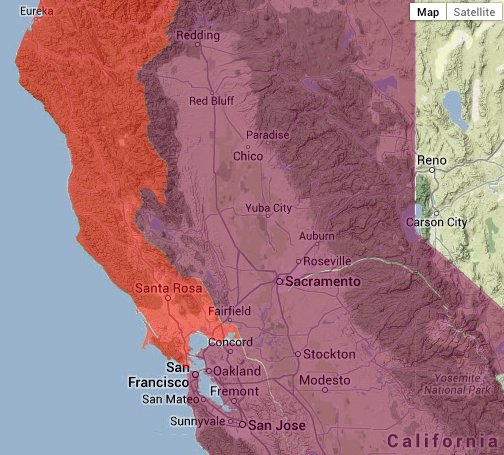
California Interactive Drougth Conditions

Sure, the subjects of states and drought are apples and oranges:  mapping tools don’t lend themselves easily to such a data visualization, both by drawing false equivalents and distracting from the nature of drought and the mapping of its momentous effects–if not offering an instantiation the condition of drought as if a fait accompli and natural event–rather than one that emerged because of the uniquely opportune mechanisms of water redistribution in the state that have left it so open and vulnerable to the drought’s occurrence.

If paleoclimatologists doubt that a drought of comparable severity has not only not existed in the recorded history of rainfall in California of the past one hundred and sixty-three years, but past ‘megadroughts’ from 850 to 1090 AD and from 1140 AD to 1320, and has already been drier than any time in the past 434 years, due to the perfect storm of water diversion and agricultural intensification.  And the lack of a clear map of drought leave us without any clear sense how long the drought will last, and no sense of how urban demand for–and ability to pay for–water will be resolved with a limited supply.

We’re not used to or well-equipped mapping oceans or bodies of water that overlap with lands.  Even when we include oceans in land maps to define their edges or describe their coasts, the syntax of much mapping of territories ends at the water’s front.  And much as we need new modes to map the interface and exchange of habitats on estuaries or shores, the mapping gradations of moisture or aridity are difficult to inscribe in the surface of the map–even as we demand to map the limits of groundwater and the prospect of draught.  The exclusion of water from most land maps reflects our limited abilities to map and the limitations of liabilities are increasingly evident.

The two spheres needed to be mapped–under and above water–are seen as incommensurate with each other and we map them by lines in different and distinct ways:   we map limits and frontiers by rings or lines, or note fixed routes of travel or topographic elevations by fixed lines, the conventions of the line seems less suited to the blurring of gradations in groundwater, levels of drought, and the levels of water lying in the land–or of the diminution of both rivers and aquifers. And the presence of water in a region, or in the levels of soil and subsoil–and aquifers–that lie beneath the land’s surface, is particularly difficult to map by the syntax of a land map, because its conditions are multiple.

The syntax of the heat map may seem appropriate in its cognitive associations, but is far less supple or sensitive as a map of environmental impact, let alone as a tool to conceive of drought.  Indeed, any “ecotones“–a word coined to direct attention to those regions where bordering ecosystems meet and intersect–are  difficult to map both because they are so difficult to demarcate and because it is difficult to establish a single perspective on the intersection of worlds often assessed by different criteria.  The shoreline, such as, as the meeting place between land and sea, has long been notoriously difficult to map, and not only because of its fluidity.  We map a stable topography, mountains, rivers, and lakes, where the quotient between land and sea is fixed:  and mapping rarely extends out to the surrounding waters, or boundaries of blurred, shifting, or overlapping lines:  a problem of increasing notice in those endangered areas where habitats of land and water overlap and intersect, making clear boundaries less able to be defined.  This is especially true in drought, where we must consider relations between groundwater storage, aquifers, and surface water, and the different sources and flow of water through agrarian and to urban landscapes. This problem of cartographical representation is as pronounced in the mapping of drought.  The  mapping of the absence of water is indeed a particularly apt problem for cartographical design in a heating-up world, as revealed in the maps we use to track, analyze, and understand drought. Bay Area to Modesto and Monterrey Mapping the shifting dryness of the land–and the drying up of resources–presses the conventions of cartographical inscription.  And all too often, we have only mapped land–not water, or even dryness–save in the limits of the desert lands.  And the two sides of mapping the presence or absence of water offer complementary images, in ways that might often make it difficult to assess or chart the meanings and impact that the drying out of regions and habitats might have–or, indeed, to “embody” the meaning of or spread of drought and dryness in a legible manner.  What would it mean to make drought a part of mapping that would be readable?  How, in other words, to give legibility to what it means to subtract water from the environment? Indeed, we demand a dynamic form of mapping over time that charts the qualitative shifts in their presence in the land.

Whereas resources like water have been long assumed to be abundant and not in need of mapping in space, as they were taken to be part of the land, the increasing disappearance of water from regions like much of California–the first subject of this post–raise challenges both of conceiving drought as a condition by embodying the phenomenon, and by using graphic conventions to trace levels of water in the ground.  In the case of the recent California drought, the compounded effects of an absence of winter rains, which would normally provide the groundwater for many plants throughout the year, feeding rivers and more importantly serving to replenish  groundwater basins, but has decreased for the past three years at the same time that the snowfalls over the Sierra Nevada, whose melting provides much of the state with running water–and on which the Owens Valley and Southern California depend–have also dried up, leading to a decrease in the snowpack of a shockingly huge 80%.  At the same time as both these sources of water have declined, the drying up of the Colorado River, on whose water much of the western US depend, have curtailed the availability of another source of water on which it has long depended.   How to map the effects and ramifications of historical drought levels or impending dryness over time that synthesize data in the most meaningful ways?

These are questions both of cartographical design, and of transferring data about the relative presence of water in the land to a dynamically legible form, at the same time as retaining its shock content.  The pressing need to map the current and impending lack of water in the world raise these questions about how to map the growing threat of an expanding drought and the implications that drought has on our land-use.  The question with deep ramifications about its inhabitation and inhabitability, but not a question whose multiple variables lead themselves to be easily mapped in a static graphic form.  And yet, the impact of drought on a region–as Thomas Friedman has got around to observing in the case of Syria, both in regard to the failure of the government to respond to drought that devastated the agricultural sector and that swelled cities in a veritable ecological disaster zone–offers a subject that threatens to shake the local economy.   And what will animals–both grazing animals and local wildlife alike, including salmon–make of the lack of river water, much coming from the Sierra Nevada, or the residents of the multiple regional delta across the state? Friedman’s analysis may seek to translate the political divisions in Syria into the scissors of the Annales school–he advocates the importance that dedicating funds to disaster relief have already been proven to be central in foreign relations as well as in a region’s political instability, as if to table the question of the content of a political struggle.  But the impact of rising aridity on agricultural societies is perhaps not so much lesser than its impact on agricultural industry.

Rather than offer metrics to indicate social unrest–although political consequences will surely ensue–the rise of water maps show shifting patterns that will probably be reflected most in a tremendous growth of legal questions about the nature of “water-use rights,” however, and the possible restriction or curtailing of a commodity often viewed as ever-plentiful and entirely available for personal use, as well as a potential shift in food prices, eating habits, and a dramatic decrease–at least potentially–in access to freshly grown food across much of the United States, if not the sort of massive out-migration from rural areas that occurred in Syria. Michael Bostock’s current mapping of drought’s local effect on specific crops provides a compelling record of the complex questions that mapping the data about the presence of water in the land might be able to resolve.  For the main source of much produce in the US, with the California drought, seem drying up, if we consider dry America’s considerable heavily subsidized acreage of agricultural production.

CaliforniaCommodity Agriculture urban design lab

But we are in the very early stages of making clear the legibility of a map of dryness and draught, or of doing so to communicate the consequences of its effects. The interest in mapping our planet’s dryness is a compelling problem of environmental policy, but of cartographical practice.  Maps of drought and dryness are often econometric projections, related as they are to interlaced systems of agricultural production, resources, and prices of food costs, and based on estimates or climactic measures. But they are powerful tools to bring dryness into our consciousness in new ways–ways that have not often been mapped–or integrated within maps of drought’s local effect on specific national crops.  Perhaps the familiarity with understanding our climate through weather maps has created or diffused a new understanding of climactic changes, forming, as they do, visual surrogates by which to understand complex and potentially irresolvable topics into inevitable complex public debates, and indeed understand our shifting place in the world’s changing environment.

The recent severity of the current California drought–the greatest in measured history, and actually extending far into much of the West– and the parallel drought in the central United States creates a unique mapping of drought severity across a broad swathe of the country that raises problems not only in our agricultural prices, but in much of the almonds, lettuce, and strawberries that derive from California.  The drought is not limited to the confines of the state, although the intense reliance of California farmers on irrigation–some 65% of state crop lands are irrigated, mostly in the Central Valley, where they depend on the viaducts to carry water from the Sierra’s snowfall to farmlands–makes it stand out in a map of the drought’s severity.  (One might return here to Bostock’s powerful visualization of drought’s local effect on specific crops.)

The map of the absence of water in these regions is, however, difficult to get one’s mind around as if it were a property or an accurate map of a territory:  the measurement of its severity is indeed difficult to understand only as a status quo of current meteorological events, for it poses the potential triggers for never before seen changes in agricultural markets and lifestyle.  How can one map the effects of what seems to be the driest in perhaps 434 years, as UC Berkeley paleoclimatologist Lynn Ingram has argued? Both raise the specter of global warming more concretely than we have seen, but are oddly difficult to place into public discussion outside the purely local terms in which they are long conceived:  the drought is not only the problem of Governor Jerry Brown, perhaps personally haunted by the drought of 1977, but the news stories on the issue–as one from which this map was reproduced used in the New York Times to illustrate the drought’s scope, and to hint at the severity of its consequences as much as the expanse of the drought itself, that combines all three aforementioned sites of drought–the Sierra Nevada snowfall; winter rains; Colorado river–in one powerful graphic that reveals the effects of drought on the entire western United States, as if it was a fixed or invading miasma, the vectors of whose spread are less known: ‘ Drought Severity--California

Max Whittaker’s quite eery photograph captures the resurfacing of an abandoned ghost town in Folsom Lake, now suddenly able to be seen with declining water levels of a marina now at a mere 17% capacity, is a striking image of water’s absence in one specific region of the state:

DROUGHT-master675Max Whittaker/NY Times

Other lakes on which much of the southern half of the state depends, like Owens Lake, have shrunk to a visible extent:
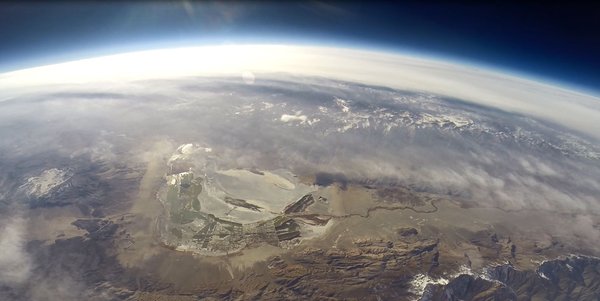
la-ol-nudity-and-other-watersaving-tips-in-an--001

How can we adequately map this shift in liquid resources?  To make the graphic palpable, an animated stop-action map of dryness–both historical and projected–could express a useful and compelling record of the mechanics of draught and global drying out might illuminate a perspective on the shifting relation to water we are condemned to live with.

The global shifts in water, from regional water-tables to rainfall to ocean levels, and the mixtures of saline and freshwater they will create, suggests a broader calculus of hydrographic mapping and potable water, the likes of which were never conceived just forty years ago–or, perhaps, just twenty years past.  As a start, such a map might begin from the shifts in a resource like snow, whose absence has caused not only many Californians to cancel trips to Tahoe or to ruin their skis on the slopes, but to face an economic crisis in water’s availability, evident by a comparison of aerial photographs showing the ecosystems of levels snowfall in the Sierra on successive January 13’s just one year apart which reveal dramatically different appearances of identical terrain:

January 13, a year apart

Far more shocking than a map, in many ways, the two images effectively register and embody a shift in how the landscape exists, even if it only implicitly suggests the ecological impact that the absence of that huge snowfall has on its nearby regions:  the absence of green in the adjoining basin, now a dust bowl, suggests a radical transformation in landscape and ecosystem. How can one show the shifting water-table, rainfall level, against the rivers that provide water to the land and its several delta?

A ‘better’ map would help get one’s mind around the dramatically different notion of the usage and circulation of water in and across space–as much as the regions of dryness or low water-levels in the state.  Both NOAA and NASA determined that last year was tied for the fourth place as the warmest year globally since record-keeping began in 1880 with the year 2003:  probably due to increased use of coal, raising the temperature 1.78 degrees Farenheit above the average for the twentieth century, but also creating specific problems in the form of an off-coast high-pressure ridge that has created a barrier that has blocked winter storms, perhaps due to the increased cold in Antarctica on top of the decline in water that descends, melted, from the Sierra’s icepack–leading to an increased reliance on groundwater that will continue for the foreseeable future. The current USGS map of the drought today–January 21, 2014–notes severe conditions of drought in dark brown, and moderate drought conditions in orange, placed above a base-map of dryness across a visible network of riverine paths each and every day: Today's Drougth

Yet the variations of coloration can’t fully communicate the consequences desiccation of the land.  The “moderate” drought in the central valley–surrounded by conditions of severe drought–reflects the limited amount of water brought by aqueducts to the region, rather than a reprieve from national conditions, and roughly correspond to the paths of the California Aqueduct and San Joaquin river:
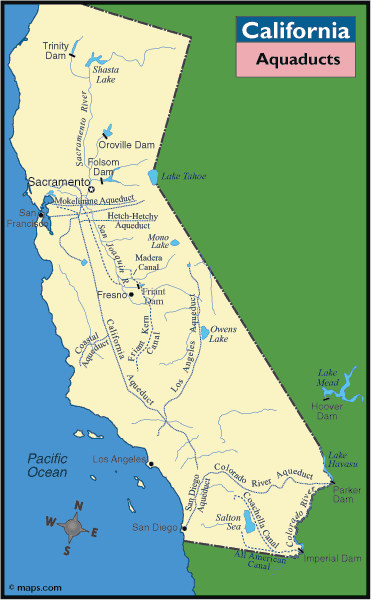
CALAQU

Perhaps a better model for mapping drought exists, but questions of how best to unify empirical measurements with the availability of water–and the consequences of its absence–are questions for data visualization that have not been fully met.  The ways that USGS maps real-time stream flow in comparison to historical conditions for that day provides a pointillist snapshot of dryness–but using the red to suggest “low” and crimson “much below normal,” as measured in percentile–and yellow “below normal”–the scientificity of the map gives it limited rhetorical power, and limited conceptual power as a basis to assess the expansive effects of drought or extrapolate the critical readings of water across that network in ways easy to visualize.
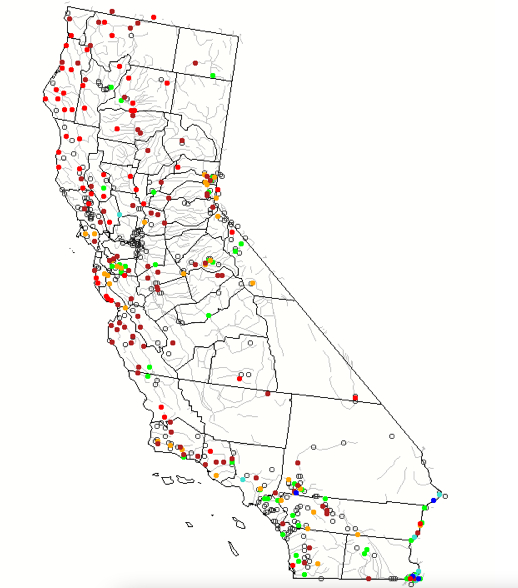
Streamflow Conditions in CA--Jan 21

The USGS Waterwatch offers an even better metric–if with minimal visual shock–in mapping the areas of severe hydrologic drought in crimson and a new low of drought levels in bright red, in its map of stream flows over a 7-day period, which suggests the range of lows throughout the region’s hydrographic water-stations and across the clear majority of its extensive riverine web, and indeed the relative parching of the land in sensitive regions as the northern coast, Sierra, and parts of the central valley, as well as the rivers around San Francisco and Los Angeles:

New Lows in Riverine Flow

These maps seem to omit or elide human agency on the rapidly changing landscape.  Despite the frequent vaunting of the purity of the water carried from the snows of the Sierra, deep problems with the California water supply–problems caused by its inhabitation and industrial agriculture– become more apparent when one considers the impurity of the groundwater table.  This map, based on domestic wells of water withdrawal, offers a sobering image of what sort of water remains;  although the most southern sector of the state is clearly most dependent on groundwater withdrawals of some 30-80 millions of gallons/day, significant sites of the withdrawn groundwater from within the Central Valley Aquifer, extending just inland from and south of San Francisco, and at select sites on the coast, contain surprisingly high nitrate contamination due to fertilizer runoff or septic tanks–measured against a threshold for having a negative effect on individuals’ health.

Groundwater in State

The closer one looks at the maps of how the state has begun to dry up over time, the further peculiarities seem to emerge of California’s geography and its relation to water–and indeed the sort of water-exchanges of three-card monte that seem to characterize the state–that are to an extend compacted by the dependence of much of coastal California on the extended winter rains that provide enough water for most plants to store.  (The absence of water in much of Northern and Central California now means that the leaves of maples and many other trees are turning bright red, due to their dryness and the bright winter sun, in ways rarely seen.) We might do well to compare some of the other means of tracking drought.  The US Drought Monitor suggests that conditions in current California dry spell differ dramatically from just two years ago–at a time, just two year ago, when Texas seemed a far more likely candidate for ongoing drought.

hnsvxl

While the image is not able to be easily accessed in animated form, a contrast to a recent reading of drought from this year reveals the striking expanse of extreme and exceptional drought in California’s Central Valley and much of the entire state, to compare the above to two more recent drought maps:

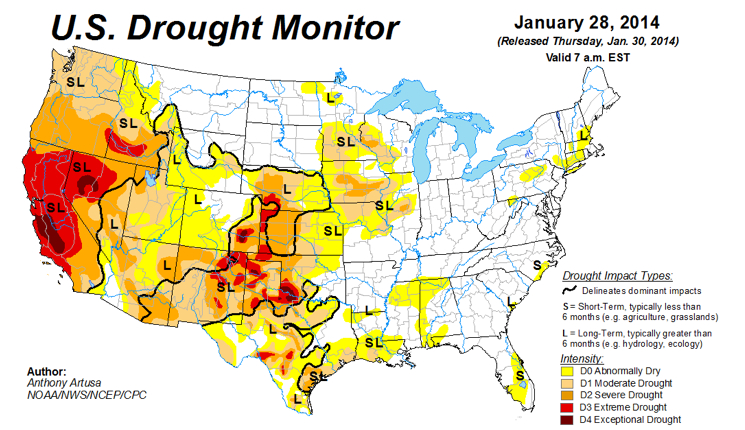
US Drought Monitor Jan 21

Drought Monitor Jan 28 2014

Yet the concentration on broad scale changes in the regions that it maps offers somewhat limited sensitivity to the variations of water-depth.  The map moreover suggests a somewhat superficial appreciation of the drought’s expanse and the nature of its boundaries.  But the greater sensitivity of satellite readings offers a more multi-leveled–and indeed both a thicker and a deeper reading of underlying factors of the local or regional drought in the American West.  The upgrading of drought–or the degradation of local conditions–in only one week is striking, and effects precisely those regions most sensitive to river irrigation that were effected by the failure of arrival of a melted snowpack, the effects of which seem destined to intensify.

One Week Shift

The twin satellites that measure the distribution of groundwater offer an other point of view of the local variations of drought.  The record of hydrological health, known as the  Gravity Recovery and Climate Experiment, whose paired satellites use two sensors spaced some 220 km apart as a means to detect a shift in the ongoing redistribution of water on the earth’s surface, offering a comprehensive indexing of their remotely-sensed measurements by longitude and latitude.

Satellite NASA

The extracted data is combined with an existing meteorological dataset, in order to create a record sensitive to variations of but one-centimeter in groundwater level.  Although not registering the depletion of aquifers, and primarily climactic in nature, the portrait that emerges from specific shifts in gravity suggested by water’s lower mass effectively track water’s presence with considerable precision on exact coordinates, creating a composite image of national drought that suggest the different variations in the presence of groundwater, by integrating groundwater and soil moisture from surface moisture of their remotely sensed data with actual meteorological changes observed from land and space to create a comprehensive picture of water storage at different levels in the earth.

GRACE mechanics

GRACE has aimed to map the shifts in groundwater levels over time:  the result suggests in surprising ways some relative stability between 1948 and 2009, to generate “a continuous record of soil moisture and groundwater that stretches back to as a way of indexing moisture levels in the soil at different strata.  The striking change in such levels in relation to data of 1948 is an especially striking record of the contrast between just 2012 and 2014.  By creating a map based on the composition of underground water storage as remotely sensed via two satellites orbiting earth, the measurement of ground water retained in the land is a crucially informative record of gradations of aridity, and levels of drought, allowing us to discriminate between ground water and soil moisture–and indeed to understand their relationships in an easily viewable manner, translating satellite measurements into a format easy to compare as a mosaic of local levels of aridity and regional differences that demand to be cross-referenced with agricultural production and across time.

Groundwater Storage 19489-2014

The map of ground-water storage suggests strong contrasts of the relative surplus of waters within the irrigated Central Valley and the relative aridity or dryness of land in much of the Lost Coast in California and deep south.  The “change in perspective” resulting in two years shifts attention to shifts in the amount of groundwater measured, processing data of water stored in the earth that has the potential to analyze the relative irrigation of expanse in easily viewed fashion.

Within just two years, or course, this picture of ground water storage had dramatically and radically changed whose impact we are only beginning to assess, and done so in ways that show no signs of ending.

Ground-Water Storage 1948-20089

To be sure, the wetness percentile of areas near the land of lakes and central United States seems a striking contrast in this image of ground water storage, in this image deriving from the University of Nebraska, which reveals itself to be a particularly rich area of soil storage of groundwater, in, significantly, an area without much surface soil moisture based on Soil Moisture Study.  But the deep pockets of wetness decline by far–both in storage and in soil moisture, based on the draining of aquifers and increased aridity or desertification–present a bleak picture in some strong crop-producing regions of the south and southwest, as much as California–and an even more terrifying story when the moisture of its soil suffer dryness–the excessive aridity specific to California relative to the nation is far more starkly revealed.
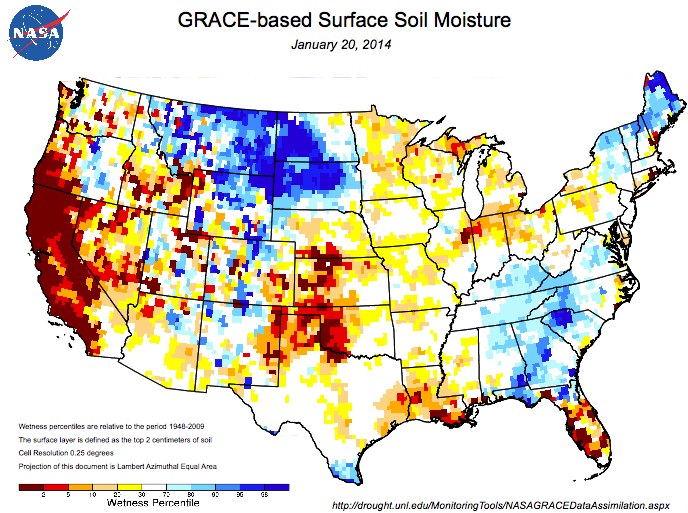
Soil Moisture on Surface

The registration of surface soil moisture and groundwater suggests a dynamic tiling of national space that we can use to map wetness over time, and extrapolate the effects of increased aridity on farm-lands and regions that will no doubt shift the prices of water, as well as the costs of agricultural production and livestock.  The mapping of specific water available for root systems across the nation, based on satellite data coded to specific longitudes and latitudes, provides a third level of analysis based on the levels of water available to root systems across the nation–and reveals the even more concentrated effects of drought within the region that depend on water from the California Sierra that will no longer arrive in the Central Valley this year:  more concentrated than the earlier image of ground water storage, that reveals the amount of water available to the root systems presents a picture even more closely related to agricultural constraints created by three years of drought.
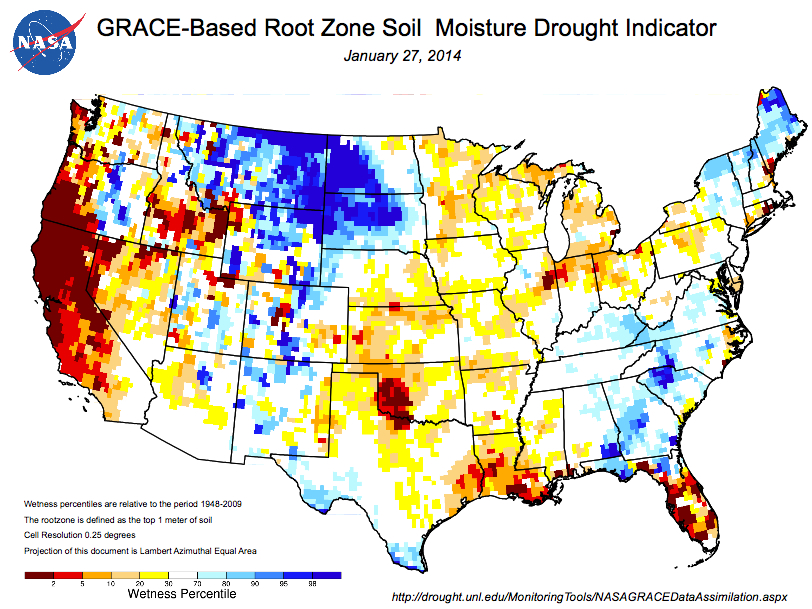
Root Zone Moisture

The remote sensing of such levels of moisture and groundwater affords a model of mapping that can be keyed directly to the questions of specific crops in ways that can be eventually used to make prognostics of the impact of drought on the local economy.  If California’s conditions seem to be due to meteorological particularities of low snowfall and few winter rains, held off the shore due to a high pressure ridge of air related to dramatic cooling in Antarctica, the problems that underpin the mapping of the local of integrating layers of data from different sources are repeated.  They reveal magnified risks in ways comparable to the more speculative tools of forecasting used to  assess the multiple water stresses that shape the environmental pressures on population in different areas of the world.

The following sequence of global projections of aridity are often rooted in the possibility–or near-eventuality–of rising temperature worldwide, and the pressures that these stand to place on water usage. The projection of what these water stressors will be seem to synthesize the data of rainwater levels, water tables, and ocean levels to depict the collective constraints facing agricultural communities across the world–and raising questions of what effect they might have–that will no doubt endanger rising political instability and economic hardships world-wide, in ways difficult to conceive.  The problems that underpin the mapping of the local are repeated, if with magnified risks, when trying to synthesize the data of rainwater levels, water tables, and ocean levels as a collective set of water stresses that are facing agricultural communities across the world. If California’s conditions seem due to low snowfall and few winter rains, held off the shore due to a high pressure ridge of air that seem related to the dramatic cooling of Antarctica, projections of aridity are often rooted in the possibility–or near-eventuality–of rising temperature worldwide.

The remarkably and relatively suddenly increased stresses on water-supplies world-wide are now better mapped as futures–which they indeed offer, by the World Resources Institute, a sort of barometer on the shifting dynamics of water availability in the world.  In the below charging of water stressors prospectively through 2025, based on the prospect of a world warmer by three degrees centigrade, we are pointed to the particular hot-spots in the globe.  These include the central US, which extend in arcs of desiccation poses particularly pernicious threats through much of Anatolia, Central (equatorial) Africa, and South Asia.  Specific water stressors that are projected in the map are due to the combined pressures of growing use of a limited supply of waters that higher temperatures will bring; the global map of the impact of rising temperatures poses particular problems for populations in India and China, two centers of pronounced population growth where markets where food distribution will clearly feel stresses in increasingly pronounced ways.

Crop Yield with Climate Change World Map

The pronounced pressures on fertility rates are expected to stay strong in Asia, as well as the United States, according to the below bar graph, developed by the World Resources Institute.

Fertility Rates Mapped

The areas in which the World Resources Institute predicts the most negative effects on crop production reflects the relative impact of water stresses due to projected climate change alone–revealing a far more broad impact throughout South America, northern Africa, Arabia, and Pakistan, as well as much of Australia.  (Similarly, a certain pronounced growth occurs across much of Canada–aside from Ontario–Scandinavia, and Russia, and parts of Asia, but one hardly considers these as large producers in a world that has warmed by some three degrees centigrade.)  But the highly inefficient nature of water-use–both in response to population growth and to a lack of re-use or recycling of water as a commodity and in agriculture–creates a unique heat-map, for the World Resource Institute, that will be bound to increase water stressors where much of the most highly populated and driest areas intersect.

 Water Stress Map

The rise of the temperatures is prospective, but also difficult to map in its full consequences for how it threatens the experience of the lived–or inhabited–world to the degree that it surely does.  (Indeed, how the habitable world–the ancient notion of a habitable “ecumene,” to rehabilitate the classical concept of the inhabited world and its climactic bounds by torrid zones–would change seems a scenario more clearly imagined by screenwriters of the Twilight Zone or of science fiction novels than cartographers or data visualizations.)  If we focus on the band of the hardest-hit regions alone, one can start to appreciate the magnitude of the change of restricted access to water and its restricted availability in centers of population:  the map suggests not only a decline by half of crop yields around equatorial regions, but stressors on local economies and rural areas. It staggers the mind to imagine the resulting limitations on world agriculture in this prospective map, which offers something of an admonitory function for future food and agricultural policy, and indeed international relations:

Band of hardest Hit

The shifting pressures on resources that we have too long taken for granted is sharply starting to grow.  The stressors on water will direct attention to the importance of new patterns and habits of land use, and of the potential usability or reconversion of dry lands, to compensate for these declines.  Indeed, the mapping of available water provides a crucial constraint on understanding of the inhabited–and inhabitable–world, or how we might be able to understand its habitability, bringing the resources that we have for visualizing data in ways that we might bring to bear on the world in which we want to live, or how we can best describe and envision the effects of drought as an actor in the world. Such huge qualitative shifts are difficult to capture when reduced to variations that are charted in a simple heat-map.

In a way, the constraint of water was more clearly and palpably envisioned within the earliest maps of California from the middle of seventeenth century than it is in our vision of a land that is always green, and nourished by mountain waters all along its Pacific rim.  Indeed, this image of an imagined green island of California, surrounded by waters and beside a green mainland nourished by rivers and lakes, seems extremely powerful as a mental image of the region that is increasingly remote as the water resources of the region begin to evaporate.
California Island

4 Comments

Filed under agriculture in america, aquifers, Climate Change, drought, mapping climate change

Mapping an Invasive Species? Eucalyptus in Berkeley, CA

The mapping of invasive species on land or sea provides one of the clearest ways of visualizing our shifting ecosphere:  in mapping of the threat of invasive marine species to coastal ecosystems, Michelle Slosberg developed her marine map of the spread of invasive species in 2011 when an undergraduate at MIT.  She did so by mapping sites of high-risk areas of marine “invasions” along coastal waters, geo-referencing data on ballast water of ships to determine the risks of the presence of invasive species that were carried by ships from one ecosystem to another and specific to the northeastern coast of the United States.

Invasive Marine Species Mapped

The vectors of travel in ballast water are shockingly widespread, and the container ships traveling from China to across the Pacific, or along the Atlantic, increasingly import species accidentally that are rarely noticed until they propagate:  the number of harmful alien species mapped worldwide have so grown that some 84% of the world’s 282 marine ecosystems are documented to contain invasive species, and in 2008 coastal regions with harmful alien species were dense in ecoregions in the Mediterranean, in the North Sea, and along the California shore and Hawai’i.

number_of_harmful_alien_species-1

Blue waters note areas where fewer harmful alien species were found to dwell.

The complex vectors of marine migration of alien species have only begun to be mapped, but heighten anxieties about the definition of “national waters” or marine borders, increased by shifting temperatures of ocean habitats and lend new meanings to the maelstrom of modern life:

Major Pathways of Marine Invaders


Fears of the heightened potential of geographic relocation of species by mapping points of transfer paths of airline flights offer by linking regions of similar temperate zones:

map invasive_species

The category of the “invasive” redraws spatial boundaries–and inflects taxonomic identifications–to suggest a shifting map of the natural world, combining nature and culture and resisting the stability of a fixed map.  But mapping the spread of “invasive species” often charts less an invasion in early stages of development than a process of resettlement, as in this map of wild carrots that flourished after they arrived in our national borders 250 years past, but still classified as weeds in mid-western and north-western agricultural fields:

WIld Carrots in US

The wild carrot seems relatively benign, and was introduced at about the same time as domesticated carrots to US farms. But the introduction of eucalypts from New Zealand redefined the Bay Area, where I live, and the exploding trees that are native to Australia–where they are known as “exploding trees” and played such a large role of combustibility in the recent bushfires where they provided exploding fire balls in the air that led to the advance of walls of flame when sustained drought increased the volatility of what became an explosive landscape, a flammability transmitted through the flammable fumes created by vaporized eucalyptus oil.

Australian residents have long called the native species “gasoline trees,” rooting them in an anthropocentric landscape or imaginary, whose highly combustable oils are released in fires, and whose explosions–sometimes sending parts of their crowns to spatially removed sites–create their ability to magnify grass fires into explosive threats of devastating scope, ramping up the danger and scale of the bushfire in what seem spontaneous combustions geographically removed from one another without any predictable pattern. The explosion of euclyptus crowns that can travel fourteen miles in the air increased not only the intensity but geographic distribution of the Australian fires. But the explosion of eucalypts immediately known in the Bay Area was revealed in the Oakland Hills Fire of 1991, when the explosion of blue gums contributed some 70% of the energy during the devastating fires that destroyed upwards of 3,000 homes over days, leading to calls to remove the tens of thousands of blue gums and other non-native species from the ridges that had so long seemed to be a part of the local landscape for Northern California residents who had celebrated their health benefits soon after since their arrival in the late nineteenth century. While they soon exploded, the density of thin Eucalyptus crowding once open spaces raise questions of whether they belong or don’t in this landscape–and what sort of roles the eucs have and what they are even doing there.

Dan Rademacher, Eucalypts North of Claremont Avenue, East Bay

The danger of labeling an “invasive species” by mapping its lines of incursion is to constitute a category that elided the existence of external environmental influence.  But how to chart the undeniable impact of commercial practices or climactic shifts that serve to facilitate the geographic dispersion of an ‘invasive’ species?   The piles of perfumed litter that fill the roadsides of many of the East Bay hills, cascading downhill into the road, provide a nice remembrance of nature, but also are undeniably dangerous kindling for future potential fires, releasing oils in the air not only powerful in fragrance but combustible. And the multitude of Eucalypts that we see locally echoes the spread of blue gums and other eucs across delicate habitats across Malawi, South Africa, and Chile, crowding out local species, as in Patagonia; these large fast-growing plants of Australian origin suck up water and cast shade over other plants, and foliage, crowding out other native plants, in ways that don’t create calls for nativism–but biodiversity.

What of the habitats they afford or create? In the East Bay, the euclypts that crowd the hills are improvised shelters and sights of nesting for the elevated platforms that red-tailed hawks take as their eyries, advantageous for their height and stability to allow them to swoop down, and the great horned owl who often succeed them in the same sites of roosting. But the benefits that eucalypts afford these larger predators are cause for worry in themselves as creating imbalances in the delicate dynamic of the biodiversity of any place, as Allen Fish, who directs the Golden Gate Raptor Observatory, and has noted the advantages that shelter in tall trees can give to some species over those that, as raptors, occupy more specialized ecological niches: the eucs may often afford the larger avian predators a privileged position to swoop down into the smaller birds such as kestrels, spotted owls, screech owls, saw-whet owls, and and Coopers’ hawks, or even provide habitat for red-tails who will crowed out sensitive species from the grasslands and savannah, including long- and short-eared owls, and barn owls, that provide a fundamental role in habitat. How to map the effects of such invasive species in dynamic ways, as altering the ecosystems we often separate from maps?

Indeed, mapping the species’ ‘invasive’ nature–or even the term “invasive”–effectively renders transparent the identity of the pernicious plant as a bacillus, deflecting agency from economic practices to the collective species labelled nonindigenous; such maps become distorting lenses to foreground effects of a species’ dangerous tendencies to spread over space that remove blame (or responsibility) from the economic or climactic change to locate it in the species it tracks, and indeed flatten temporal change:  maps of invasive species prove a perfect example of the strategies for the power of map-signs to reframe the experience of nature illuminated by Denis Wood and John Fels.  A classic case is the dangers of rapidly reproducing predatory lionfish through the Florida keys, which having migrated or “arrived” from warmer ocean habitats threaten to destroy local marine life, whose presence can be highlighted, removed from its environment, in a striking map of its marine spread:

lionfish_dis_map

This sort of cartographical compartmentalization circuitously brings us to the battle over local eucalyptus trees, conducted largely around the invasive nature of nonindigenous Tasmanian blue gums long rooted in groves in the landscape of Bay Area hills.  Invasive species of plants are nonindigenous plants that spread in uncontrolled ways to an area they have never lived and lack predators, creating environmental problems and contributing to the extinction of native species and animals.  But how long can a plant be present in an ecosystem and continue to be labelled invasive?

Although airline traffic, like routes of ships, expands the network and increases the speeds at which seeds migrate across the earth, increasing the vectors of moving invasive species by accelerating contact between regions that did not share borders, introduced species–some 50,000 now exist in the United States–is conditioned by the suitability of the environments they arrive–few of which are on the west coast, although the travel of weeds alone cost California at least $82 million per year.  The very virulence of terminology to identify plants and animals as invasive–perhaps the biological threats of a postmodern age–has conditioned how we see the landscape before our eyes.

Recent debates around the proposals to clearcut 22,000 non-native trees in Strawberry Canyon and Claremont Canyon reveal a pitched battle in the Berkeley Hills and Claremont Canyon around labelling the Tasmanian blue gum eucalyptus as ‘non-native.’  Whether or not the Tasmanian blue gum eucalyptus  (Eucalyptus globulus) is correctly labeled as invasive is not only a question of fact, however, but reflects how one maps the place of the towering blue gum trees in the landscape they have created and long lived–and how one maps them as signs of fire-risk.  The removal of the trees that cover a large part of the hills, especially on the west-facing hills of Berkeley and Oakland, from the environment when mapped for clear-cutting, revises their place in Bay Area landscapes, and the struggle that emerges among environmentalists and planners (or local constituent groups, since the division is not so clear) reveals a battle between landscape and map, or a naturalized landscape of welcoming groves and a firescape dotted with unwanted risks, but also offering transcendent moments of their own.

timthumb.php

Many land-owners share deep-running concerns about the fire-dangers created by the branches, shaggy bark, leaves, and seed-pods, all containing highly flammable oils, and explosive proclivities of eucalyptus trees:   multiple vectors of encouraging fire-risk have led the tree to be demonized as primary culprits of the disastrous 1991 fire in the Oakland hills that destroyed so much property and claimed 27, as well as forest habitat.

The characterization of the tree as an invasive–and even as a weed–are all rooted in its change on the landscape, as much as unquantifiable expansion of fire risks.  None seem greater than the piles of as the bark that, shed, create a dry ground cover that inhibits future plant growth, and raises the specter of quickly igniting kindling that stimulate powerful underdrafts after its combustible oils ignite that would push a wildfire’s growth out of control, as updrafts push flaming bark ahead of the actual fire-front, onto the roofs of nearby houses, at the same time crown-fires spread the canopy of leaves create crown-fires among towering trees that carry the level of flames into the atmosphere.  Once their combustible oils ignite, leaves and litter are feared to fuel a raging fire, offering firewood as groves of Eucalyptus themselves explode and ignite.  Hence the fears summoned by imagined firescapes expanding by burning crowns and flaming bark thrown by winds that are provoked by those leaves’ presence.

eucalyptus

So what are the abilities to contain this vegetation whose vigorous spread seems to obstruct the growth of other plants in the ground area they cover by displacing native plants?  Attempts to map areas for their elimination reflect the fears of property owners, recently saddled with newfound legal liability for responsible land management, and responsive to the availability of federal funds to land management in the hope that future fires would not consume the lands they manage or impinge on nearby houses, and create any suits of environmental liability.  If causing huge financial damages is hoped to be avoided, the question of legal liability seems to have been the primary factor that motivated further attention from large-scale land-owners as the University of California or regional parks.  Already by 1991, the University of California at Berkeley began to clear thousands of “invasive” eucalyptus within the purple section, as part of a larger ten-year plan to remove 25,000 trees from its property–or the grove in the below aerial view in the Claremont Canyon, in projects of “land management” directed to such a reduction of risk.

Claremont Canyon Fire Mitigation
fire_pix

In December 2009, these plans received a setback as FEMA denied four separate grants to the University of California, Oakland and the park system for $5 million to remove eucalyptus, pine and acacia trees from the ridges above Oakland and Berkeley, but plans to for clear-cutting some 82,000 Berkeley and Oakland trees, a quarter of which lie in the protected Claremont and Strawberry Canyons, to be followed up by 700-1400 gallons of herbicide in land belonging to Regional Parks.  Similar interventions clearing eucalyptus encouraged the large-scale project to clear-cut the eucalyptus from the hills–dramatically revising the landscape of the region to be reforested by “native” plants whose seeds may lie buried by eucalyptus litter, and would be re-introduced after careful extraction of each and every blue gum.

The hills were colonized and indeed filled by eucalyptus, and most especially the Australian import of the Tasmanian blue gums, around UC Berkeley’s campus, in Regional Parks that could be said to themselves litter the  Berkeley and Oakland hills–Tilden, Wildcat, Kennedy Grove, Anthony Chabot, Lake Chabot, Redwood, and Sibley–where the planting of eucalyptus replaced grasses and wildflowers that covered the region, as in this image of the stately eucs that provide posts for Kennedy Grove.

Kennedy Grove

Yet there is some evidence–not widely acknowledged–that cast the eucalyptus as something of a windshield whose presence in dense groves, by blocking winds, would actually fights wind-driven fire, acting both to break and interrupt the flow of the wind that bears the fire and as a screen to trap flying embers that might be in danger of spreading and starting wildfires.
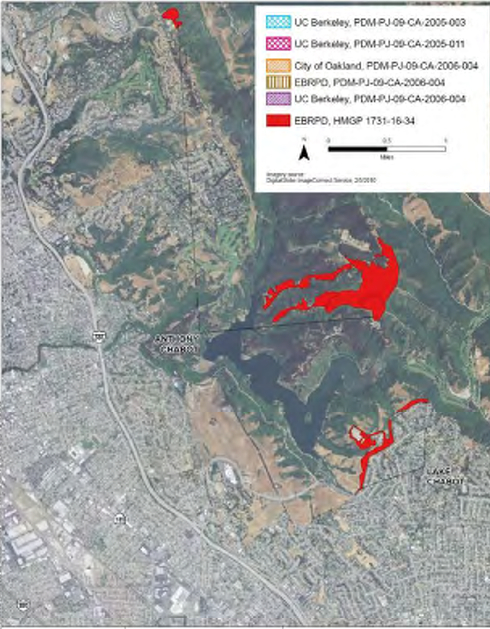
The decision of UC Berkeley to once more seek needed FEMA funds of $5.6 million to fund for the clearcutting began in 2013, with hopes target an expanse of some 22,000 non-native trees from Claremont and Strawberry Canyon, in order to mitigate fire risks for residents haunted by the devastating firestorm that swept through the Oakland Hills in 1991 Oakland Hills that destroyed some 3,000 homes in the hills.  Many residents remember the Eucalyptus as fostering the rapidity with which the flames of the raging fire spread across the hills:  as “fuel-productive” trees that produce huge quantities of combustible litter, they are readily labeled high fire risks, and have few protectors.  Even though some 19,000 non-native acacia, blue gums, and Monterrey pines have already been destroyed, the destruction of the expansive grove destined to be felled and chipped would potentially end a major protective windshield, but would no doubt reduce how we quantify fire risk.  
And the current thinning of Eucalyptus and other invasive species as acacia and Monterrey pine in the regional parks in the East Bay hills, despite the mobilization of a community-based Hills Conservation Network (HCN) to protect them, will cover 2,000 acres, targeting diseased and dying non-native trees as much as converting the region to grasslands, leave a forest spotted with chemically treated stumps where trees once grew.

1024x1024

920x920-3Paul Chin (S.F. Chronicle)/July, 2015

Native Americans regularly burnt grasses to encourage their growth and spread their seeds, inhibiting the spread of trees. This allowed a massive spread of eucalyptus was so extensive in the grassy hills, where they were planted, erroneously to impede further local grass-fires.  The importation of the eucalyptus plant from 1850 was not only for ornamental ends, but to create fast-growing hard-wood forests was originally celebrated–if incorrectly–and presented, strange to say, as a further reduction of hazards of fire that regularly broke out in the grasslands.   They were also screens, to be sure, for further construction of residences and houses in the hills, valued as protective natural obstacles for privacy as houses gained increasing density on the hillsides, placing neighbors in greater proximity than they had wanted–and perhaps offering an even more welcome screen during Prohibition for private parties, as the eucs became part of the Northern California atmosphere, viewed largely as benevolent, convenient ways of adding further salubrious greenery.
The arrival of the trees in the Bay Area was spawned by unsuccessful lumber schemes, designed to meet the needed infrastructure and housing materials for the region’s growing population.  When the Judson Dynamite and Powder Company first introduced the tree in the 1880s to use their canopies and dense foliage in order to hide ravages of construction and muffle sounds of explosion or construction, the trees’ arrival was greeted in local papers as offering relief from the regular grass fires “that almost every year swept over the hills,” as was argued in the Oakland Tribune–a somewhat common-sense theory that research as now revived, although the argument that they offered wood that resisted burning was openly fraudulent.   At any event, the species robustly grew on plantations of trees as Frank Havens’ land company–the Mahogany Eucalyptus and Land Company–planted some three million eucalyptus and Monterrey pine in plantations of 400-900 trees/acre across 3,000 acres in the East Bay, billing the tree as “the most valuable on the face of the globe,” offering hardwood for fences, firewood, shingles, telegraph poles or “ecclesiastical furniture.”  

The tree seemed magically powerful not only in the rapidity of their growth, quickly attained huge heights, but the multiplying of trunks from their bases so their wood could be regularly re-harvested:  yet as it was realized not to be quite so suitable for milling, and  readily cracked, Eucalypt monoculture became jungles able to suck water out of the ground, leading to calls to thin the population that crowded out native species.  As the difficulty of combatting its fires became clear, the survival of the eucalyptus became something of an economic dinosaur that had outlived schemes for the sudden profits of crops of wood.

One can map the spread of the species first planted to disguise sites of construction, mitigate disturbing sounds, or create miniature parks or groves, to a mini-industry of plantations.  But can one ever map the losses or the density of Eucalyptus trees in the Oakland hills?  One can hardly call the tree non-naive to the state, given the century-long spread of the mid-nineteenth century arrival across different micro regions and environments from coasts to valleys to foothills to dry desert:

Eucalyptus globus state-wide

The prime danger that the trees pose to fire is in shedding their foliage, particularly after colder weather:  the 1972 freeze led trees to shed some 50 tons of debris per acre, over an expanse of 3,000 acres, creating a tinderbox of bark; the shedding was cleared by federal disaster funds.  The 1990 freeze played a considerable contribution to the disastrous 1991 East Bay hills blaze which consumed over 3,300 homes, and led East Bay landowners to work to prevent risks of future fires.  Regular clearing in times of intense shedding of shaggy bark–the eucalyptus trees’ “litter”–surely poses a more economic response to the need to mitigate fire risk.

But the characterization of “match sticks loaded with freeze dried fuel” shifted the blame from dead grass, wooden houses, and vacant lots–and points the finger at the invasive tree, and particularly to question its proliferation on public lands.  Loni Hancock, then Berkeley’s mayor proposed chainsawing down thousand of these “invasive species” or “weeds,” to reduce the dangers of fire-risk–albeit while creating dangers of soil erosion and changing the habitat.  The wide planting of the tree throughout the state not only served needed screens or decorative cover, but valuable fence- or scrap-wood and firewood, given its quick growth.)

sheddingbark

The “disorderly” trees that did not clean up for themselves were labeled “invasive” and even identified by the evocative term  “unwanted immigrants” that needed to removed from public parks and lands conceals the risks equally posed by landscaping with non-native shrubs or Monterrey pines.  Tasmanian blue gums have, no doubt because of their visual presence, coppicing, rapid growth, and towering size been seen as weeds, and also been defended as “native enough”–as residents of over a century and a half–continuing the arboreal personification and obscuring debate.  

Berkeley-based poet and Poet Laureate Robert Hass, longtime friend of the eucalyptus’ shaggy bark and camphor smells, got in on the fun when vaunting the blue gum as “California’s largest naturalized citizen,” aware of the serious stakes.  The debate on the trees’ status as alien immigrants set the stage for Verlyn Klinkenborg to enter the debate about “non-native” status of the blue gum eucalyptus, noting that the tree’s exclusion from a “native” land that existed over five hundred years ago relies on a pretty “imaginary snapshot of this continent taken just before European contact,” and, in omphalocentric New York-ese, questionably comparing their place in the landscape to the evolving arboreal landscape of Central Park, whose variety has long welcomed interlopers and foreigners in ways often imagined as a microcosm that reflects the urban population.   The point being that the landscape evolves.

But to shift from a human-centered approach to the place of eucalypts in our environment, it may make more sense to ask the overall environmental impact of the shedding trees.

Yet the California Native Plant Society deems “native” only species predating European contact, and the concerted efforts of public lands to strip the areas that they administer of fire risk have led to a huge investments of regional park and utilities corporations, no doubt eager to respond to insurance threats, to eradicate the blue gum from the local landscape, labeling it as a tinderbox to be uprooted.  A broad range of local authorities who administer parklands–UC Berkeley; City of Oakland; East Bay Regional Park District–have tried to secure up to $5.6 million  from FEMA’s Pre-Disaster Mitigation Grant Program to mitigate fire risk by a plan to remove tens of thousands of eucalyptus.  The group of suspicious non-natives—eucalyptus, Monterey pine and acacia—would be removed in over 1,000 acres, in hopes to expand the indigenous oaks that eucalyptus first replaced.

The 2010 result was to put a mosaic of vegetation management on view:

Proposed Actions on Eucalyptus

The 2010 report proposed Hazardous Fire Risk Reduction measures largely administered by the East Bay Regional Park Development:

EBRPD
EBRPD 2

Or, in the most focussed picture of mitigation in the regional parks of the Oakland and Berkeley Hills:

Tilden Termination of Eucs
key

Yet local environmentalists’ have resisted a plan to begin with clear-cutting of Eucalyptus trees, followed by annual application of herbicides, and then five to seven years of pulling seedlings–not only for posing risks to local endangered wildlife, from the whipsnake or California red legged frog, as members of the Hills Conservation Network argue, but may well stand to create even greater fire risks.

Yet the classification of the tree as “non-natives” is to some extent laughable–to judge by the crude state-wide choropleth of their spread, which is in many senses a basic counter-map to the final solution of arboreal demolition.  Indeed, the demand for their clear-cutting or selective clearing in residential areas reflects a desire to mitigate risks to expensive property, and no doubt lower insurance rates, as much as it reflects a direct tie between the growing risk of fires in California in an age of rising temperatures:

Eucalyptus globus state-wide

Elwood Cooper, no mere booster of Californian wildlife, wrote in his 1876 Forest Culture and Eucalyptus Trees, distinguished the value of the trees by noting that they “possess qualities which place it transcendentally above all other plants; . . . rendering localities healthy in which to sleep a single night was almost certain death,” placing on their doorsteps credit for making healthy the environment. Recent recent attack on these non-natives for increasing fire-risk on account of their contribution of dry leaves–or “litter”–to the underbrush may contribute to fires spread by their oil-rich tree crowns and highly flammable litters, but contrast to the majesty of the tree that was once seen as a basis for encouraging local forests.

Book

It is hard to imagine the loss of the trees from the landscape, whose branches hold birds’ nests and whose flowers feed hummingbirds and monarch butterflies, whose groves smell “of camphor and the fog-soaked earth,” in Robert Hass’s organic poetics, themselves word maps of the physical experience of the Bay Area he loves.

1 Comment

Filed under alien species, EBMUD, ecosystems, eucalyptus, FEMA, invasive species, mapping environmental risk, mapping invasive species, mitigating environmental risk, University of California

The World Once in Oakland

There are multiple layers of nostalgia in the antique map once found in the familiar marquee of De Lauer’s Super News Stand in downtown Oakland, California.  The sign was long an emblem a comprehensive range of world news sources and foreign newspapers, the dated map as a relic of an old sense of news. The map that so dramatically foregrounded the prominence of the United States in such an exaggerated fashion is both heavy with nostalgia of a past sense of the global centrality of north America in world news, and also of a time when the news was able to be mapped or derived from different fixed news bureaus, and bridged places otherwise removed from one another as proudly displayed on its magnificent if quite intentionally geographically distorted marque.

De Lauer's Globe

The black and white marquee of De Lauer’s Super News Stand seems a time-capsule of an earlier sense of Oakland as news entrepot, and of an era when newsprint provided a primary sense of immediate access to the wider world.  Amidst fluted pairs of caste-bronze gas street lamps in downtown Oakland, a kitschy illuminated globe marks a site of pilgrimage for newsprint, founded by a family who sold newspapers from pushcarts since 1907–both a mecca of the printed word and monument to past empires of print.  The intentionally distorted globe on Broadway carries maps, but uses the image of the US-as-world to boast of the breadth of its array of some three-hundred plus American and foreign newspapers and some 6000 magazines was a paradise of crumbling paper and glossy picture magazines, from fashion to crafts to hunting arts, complemented by comic books, triangular sandwiches and an array of cigarettes and cigars.  The magazines that often seem dog-eared from use are encyclopedic in variety, and extend back to the roped-off adults only area in the back, and are flanked by paperbacks.  (Rumors has it that incense from nearby Chinatown was burned regularly to disperse the smell of newsprint.)

The 24-hour round-the-clock schedule, before the news cycle contracted, doesn’t help the slightly worn appearance and feel of the store that might be at odds with its boast for such comprehensive news coverage.  But it symbolized a sense of easy access to news sources in an earlier era of print, as a venue to which anyone could obtain to at virtually any time of day.

delauers with papers at hand

Beside Oakland’s Tribune Tower, between 13th and 14th on Broadway, De Lauer’s Super Newsstand boasts a range of papers from round the world, and a wide selection of foreign magazines whose scope its patrons boasted did not exist west of Chicago.  Laid out in the sort of space usually reserved for a small supermarket or bookstore, its deep interior has the spaciousness of a sort of library and proud arcade of the quotidian, linking “your home town paper” to the world, back when newsprint linked the world.  And where else to buy books of superheroes than a super newsstand?

news marquis

Built beside the line of old streetcar lines and trolleys that formed an extended network across the city until 1958, De Lauer’s was a destination and a site of the distribution of news, whose papers from the Tribune Building next door spread across the East Bay–the dense business in the downtown area is evident in this Key Car Map of the old city center around the Broadway line and nearby Feeding Point by the Lake:

Oakland Key Car System

The site described as the best site of its sort west of Chicago was a survivor of downtown Oakland, whose own map had changed so much from the bustling department stores of the 1960s.  It was the site for comic books, foreign news, fashion magazines, and more, before gossip, cooking and craft magazines dominated the press.   The luminescent globe on its marquee carries the sense of global news coverage and the optimism of the early 1960s–before the 1968 riots or 1964 Free Speech Movement–that placed North America triumphantly stretched across and filling its parallels and meridians beneath the banner of the one-of-a-kind newsstand itself:  De Lauer’s Brings You the World, it still boasts, with a grandiosity of a world’s fair under a single roof, even in an age when newswires are readily accessed on the internet, and print seems a charmingly antiquated medium ill-fitted to the 24-hour news cycle.

But what about that map?  The globe on its axis is illuminated as something of a relic from an age of the Magazine Emporium; the marquee of the Super News Stand on 13th Street charmingly symbolizes the illusion of comprehensive coverage in an era of world news mediated by print, that occasioned the marked distortion of the prominence it gave North America:

De Lauer's

The prominence is more than a slight distortion of the prominence of America on the globe–

globe map

–but echoed the centrality of news that affirmed the connected place of America in the world, as well as the profusion of newspapers and sources in the United States.

The emblem of news funneling from all over the world into one newsstand was the premise not only of De Lauer’s, but of the world of print media that it nourished, now sadly an artifact quickly receded with the advance of on-line news, where we are less focussed on the global importance of American news, or, for that matter, the authority of one site to present world news.

cronkite

The ostensible focus on the world and actual depiction of North America on the marquee is not meant as a cartographical argument, but echoes the limited concern with other regions or territories in this uncredited map showing the “dependent territories” of the United States, from a classic 1904 manual of American history, which similarly foregrounds the United States as central to a global context and obscures other national boundaries in a uniform gray:

Uniteed States and Dependent Territories

But geographic knowledge was not the point of the De Lauer’s logo or marquee, so much as the comprehensiveness of their stock; De Lauer’s concentrated on all the nation’s newspapers, if it also expanded to include a range of those world-wide, in a gesture of cosmopolitanism of the city, and a complement to the grandeur of the Tribune tower, constructed in 1923 after Renaissance Venice’s bell tower of St. Mark’s–as UC Berkeley’s Campanile–as if to echo the grandiosity of claims to empire on the sea, and is inflected with a distinctive Moorish style.  But the grandiosity of the terra cotta apex of the Tribune Tower suggests the bold design of the storefronts of older buildings in Oakland’s once-grand downtown, several buildings of which are adorned by arte nouveau reliefs.

Tribune Tower

(The sense of Oakland as news entrepot was even more evident in the previous if less majestic tower on the building that resembled a transmission tower and recalled the early role of radio, long before broadcast news:

before

The subsequent expansion of the 20-story tower added to the building in 1923 reflected gave it a more elegant sense of keeping time for downtown.)

The newspaper store had grown rom a single outdoors newsstand, first moving into the Tribune Press building on 12th Street, the expanded 1301 Broadway store housed a wide range of papers and magazines, complemented by books, postcards, school supplies, maps, cigarettes, energy drinks and souvenirs, a repository of the news and arcade of daily communications from the newswires more than a 5 & dime store. De Lauer’s oddly became a bit of an intellectual hangout by the 1970s as a site of leftist magazines.  From the 1970s to 1980s, the illuminated marquee on Broadway was a sort of beacon of world-wide news sources and foreign magazines within Old Oakland’s downtown–where newspaper offices are still clustered in the city, encompassing the world’s news and leftist reviews, and, before the accessibility of world-wide news sources in online form, selling to a wide range of folks and providing a sense of open-ness which perhaps later led the store to permit homeless to camp out by its windows’ permanent 24-hour glow.

Newspaperman Charles DeLauer had worked tirelessly at the stand seven days a week until his tragic death at age 91–committed to providing out-of-town newspapers, racing forms, and foreign as well as national magazines twenty four hours a day, even weathering a declining market for news and the rise of cable news, and, back in the past, the rise of USA TODAY, which featured its own newspaper kiosks and dispensaries on American sidewalks, looking like a familiar television set as a trusted news source. If the market for many were killed by the internet, the building consolidated in downtown Oakland a family business that had once represented some forty newsstands and wagons across the Bay Area–a Bay Area far reduced in size from the present. It has long earned praise for surviving an era of news streams and digital feeds, as well as latching its revenues to glosser magazines and a source for hard-to-locate newspapers for migrants, although its now better known for illuminating the transsexual prostitutes who stand beneath the bright lights of a distinctive gleam, after the downtown neighborhood seems to shut down.

222751882_d43825178e_m

The landmark was rumored to be threatened with closure in 2008.  It was saved for a reprieve by an Oakland non-profit, but by he had reached his nineties the aging De Lauer was overwhelmed with fears that the time had come to close the curtains on a store from which over three hundred papers once circulated:  “This is a business that time is passing by because everybody has a computer,” he observed stoically, fearing the end of viability of his Catholic commitment to print.  As rumors circulating it was shuttered and provoked an outpour of support, just a month before the already retired De Lauer died of lymphoma and leukemia, the shop stocking 300 newspapers was bought by Citrine Advisors, and the store remains afloat, doing a brisk business of not only cigarettes but triangular cello-wrapped tuna fish sandwiches and soft drinks, energy drinks, adult magazines, paperbacks on world history–and range of local and state maps.

The wonderfully retro imprecise confident cartographical crest De Lauer’s long boasted illuminated Broadway twenty four hours a day, by the Civic Center BART, was never so much an actual map. It was an emblem that celebrated the promise of an all-embracing information center of the world before the world wide web, content stored not online but in the magazine racks of the old print arcade; the sign declares the United States to be the information center of the world, and the world as existing and refracted through the United States American Press Corps–contemporary to the Pan Am logo, the global map, designed just before the Cuban Missile Crisis, as an image of global dominion punctured by panic about Soviet missiles once about to be located on that island–an island notably absent from the map on the Super News Stand’s storefront.

The departure of that map, once so central to the store’s public image, in recent years has removed it to a lost Oakland, and left the place once adorned by its the map, now sadly stripped of marquee and only an abandoned wall–the store’s name appearing only as a decal on the window–

sripped-of-marquee

–reduced to geometric shapes, as if yet another casualty of the internet economy, which has transformed the storefront into only a Mecca for glossy magazines.

marqee-facade
It was, after all, only the range of magazines stocked gave a new sense to the global map that hangs outside the store.
It was long a hub from which newspapers once flowed through the East  Bay, and from which you can obtain all seven papers distributed by the Alameda News Group, as well as a range of out-of-town newspapers that are hard to obtain from the few vending boxes that still dot the streets.  The illuminated-globe logo of this 1960s emporium announced  a cross between a library and entrepot of world news, and the store, still surviving in the digital era, now survives by selling food and porn, like a steadfast guardian of the printed word and random convenience store.  It remained more than an icon, but an active center:  open in the 2010 riots at the same time that all other Oakland stores were boarded up, and doing  brisk business at the same time as the 2011 Occupy movement led to more shuttering of stores in July and August, when the store provided Occupy protesters with an unending supply of sandwiches, power drinks and cigarettes as they made headlines in the news.  Yet after years of running in the black, the store now run and by Fasil Lemma, who had long helped De Lauer keep the business afloat, with his partner Abdo Shrooh for over four years, is feared to have found a new tenant–and a 7-Eleven had already leased the site in 2011, although their permit was still awaiting pending city review.
neon

Leave a comment

Filed under History of Oakalnd, maps and advertising, News Maps, nostalgia and maps, Oakland