Tag Archives: engraved maps

Monuments in New Worlds: Placing Columbus in the Americas

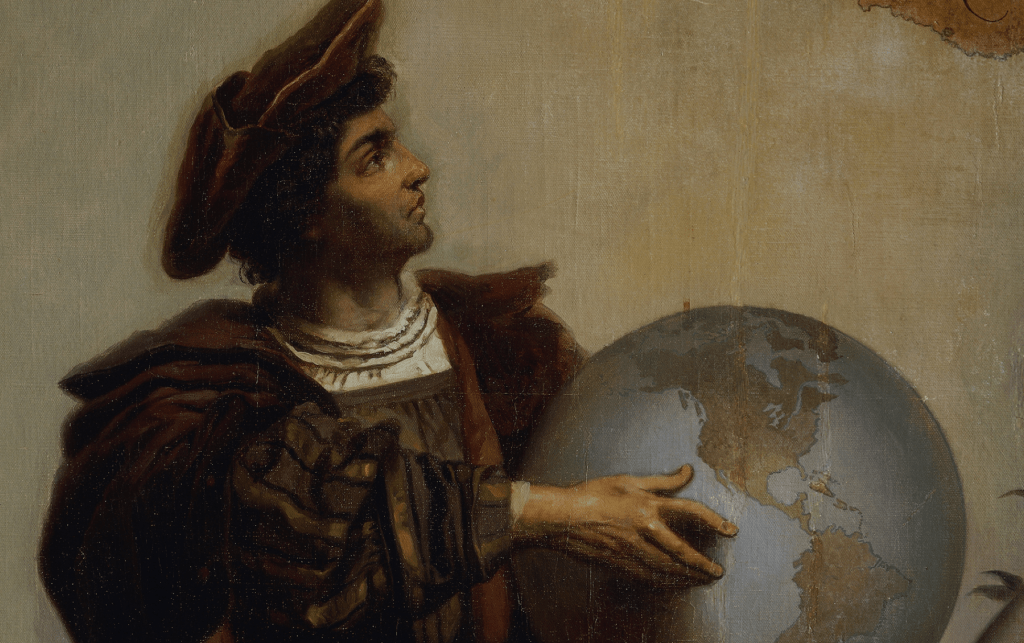
Commemorating Christopher Columbus’ transatlantic voyages in a “discourse of discovery” has been magnified as they have become a bit of an exercise of collective remembering and of world-making. For Columbus monuments are less markers of fifteenth century voyages, than they serve to frame a range of narratives of discovery that promote the fifteenth-century navigator as an icon of nationhood that were foreign to the fifteenth century. In making claims for the foundational role that the navigator’s transatlantic voyage, they create a new narrative of nation, particularly powerful for its ability to occlude and obscure other narratives, and indeed the presence of local inhabitants in a region, so that they assume the deracinating violence of a map: as claims of possession, and indeed mastery over space, they dislodge nativist presence in a region, much as Columbus did as a royal agent, glorifyinf the acts of renaming, and taking possession of, the new world to ally the viewers with the heroism of the Genoese navigator’s foundational act of taking possession of the New World. The heroics posture of Columbus, until the recent spate of decapitated statues revealed a long simmering anger at the canonization of this figure as a founder of the nation, suggested a model of a white America, an erasure of indigenous inhabitation, and an outrageous lie.

Columbus set the basis for such grandiose claims, perhaps, by staking the transatlantic “colony” La Navidad as the first settlement by Europeans of the New World on Christmas. The event’s commemoration has continued in statuary across the Americas, even if the thirty-nine settlers left behind in the settlement were all massacred by natives after their ship, the Santa Maria, was dismantled after it hit a sandbar, and the men of the lost caravel that ran ashore on a sandbar off the island Columbus had auspiciously renamed Hispaniola, as evidence of Hispanic claims to sovereignty for his patrons, its hull and crossbeams converted to a fortress that was later burned to the ground. While the crew left with a translator who were instructed to collect a store of New World gold as they awaited his return may have been overzealous in courting natives that they were all killed, the extraction of riches and wealth and slaves motivated the New World settlement.

Yet in the commemoration of Columbus Day, the landfall has been renarrated as an inspired revelation of new lands, and allied with a sense of manifest destiny in retrospect, foregrounding the imperial mission of laying claims to new lands under the eyes of God. Yet the elevation of Columbus as a figure of state, and a westward course of empire, was magnified only in the nineteenth century. Paradigmatically, the painting of Columbus taking stock of his arrival by Dióscoro Teófilo Puebla Tolín, staged before uncomprehending natives cowering offstage, occurs as a missionary raises a cross on verdant shores where sailors triumphantly raised recognizable standards of the Spanish sovereign in the New World.

Dióscoro Teófilo Puebla Tolín (1832-1902),
First landing of Columbus on the shores of the New World, at San Salvador, W.I., Oct. 12th 1492,

re-rendered by Currier and Ives, 1892/Library of Congress

The bucolic image of arrival was cast as a triumph of technology, civilization, and deliverance. The bucolic scene not only denied violence, but was an image of paradisal promise that Dióscoro Teófilo Puebla Tolín rendered in a manner widely reprinted in the lithograph of the commemorations of quadricentennial celebrations of 1892 as a narrative of westward expansion of Manifest Destiny. The recent re-questioning of Columbian commemoration as a common national identity led to the questioning of commemorative Columbian statuary across the United States, from Columbus, Ohio to San Francisco to Kenosha, WI, to Miami. As the statues were dislodged from the common memories of an Italian-American community–as many once were in New Haven, Boston, and Philadelphia as well as New York City–their place loosened in a narrative of nation in ways that needs to be told. This was a narrative quite unlike how Michel de Montaigne bemoaned the manner Iberian voyages as occasions of devastation,and extraction had so needlessly left so “many goodly cities ransacked and razed; so many nations destroyed and made desolate; so infinite millions of harmless people of all sexes, races, states, and ages, massacred, ravaged, and put to the sword; the richest, the fairest, and the best part o the world topsy-turvied, and defaced for the traffic of perils and pepper.” Montaigne’s deep discomfort wit the global catastrophe that was driven by greed cerated an economic and epidemiological devastation in their wake were substituted by a massive hulking bronze Columbus, standing as if a champion of Christianity that would be a gift from Moscow’s mayor to the “free world.” Driven by increased recognition of the truly genocidal destruction of indigenous in the moment of contact, the term “genocide”–long reserved for the Holocaust but increasingly applied to the destruction of indigenous peoples in Guatemala, Bolivia, and Argentina in Latin America–led to the recognition that Columbus’ unqualified heroism needed to be qualified.

Owen Thomas, San Francisco Chronicle

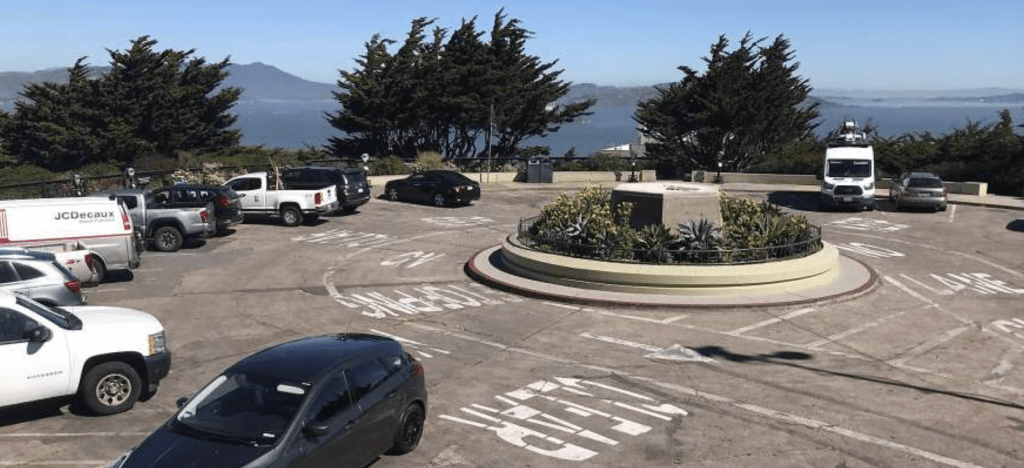
It was in this context that the monument of Columbus that Trump mediated as an erasure of the collective memory and of the past in the americas. The burst of creative iconoclastic energy directed to statues of Columbus left San Francisco’s City Arts Commission preemptively removing the monument to Columbus overlooking the Pacific from its monumental pedestal in order to maintain the local peace–a statue long defaced in recent years–before it was defaced. The recent removal of monuments to Columbus spread as a re-tallying of moral accounts, but a restoration of civic peace. The importance of refiguring the commemoration of colonization grew as a form of reparations whose logic was unmistakably national in character,–if the first questioning of Columbus Day had been local and selective in 1992-3.

The deposition of the 4,000 pound bronze statue of Columbus to a holding container channeled the rejection of the figure of Columbus whose monuments were already deposed in Boston, St. Paul, Minnesota; Camden, NJ; Richmond, VA, and other cities in New York state, one of which was beheaded–if long after the statue to the navigator was ceremoniously pushed into the ocean in 1986, in Port-au-Prince, Haiti, with a placard “Foreigners out of Haiti!” And by 2020, the ease with which statues of Christopher Columbus were assimilated to the confederate monuments preserved across many southern states–and preserved at considerable cost to American taxpayers–reminded us of how easily the memory of Columbus as colonizer was cultivated among white supremacists as iconic testaments to a sense of historical security of another era we were trying to pry ourselves free in hopes to gain distance on. Even if the statues of Columbus and Columbus commemorations are overshadowed by the razing of the statues of Confederate generals in recent years–

Southern Vision Alliance,
Confederate Monuments Removed since George Floyd’s Murder

–the images of the dicsoverer were dismantled as we engaged a contested legacy. If monuments removed with an eye to toppling racism across southern states that had commemorated secession in the attempt to defend enslavement and chattel slavery were a stain on the nation that emerged like a return of the repressed in the summer after George Floyd’s murder by overly zealous “law enforcement” forces, the removal of monuments had begun as undeniable evidence of their talismanic status as lodestones for white supremacy became clear after violence in Charlottesville directed attention to the degree to which commemoration of the Confederacy kept a memory alive in national and local consciousness, revealing how undecisive the Civil War was for the preservation of local memories across many border states or secessionist states, and the toxic nature of preserving memories of southern secession as a defense of what were cast as local liberties within the union.

The division assessment of historical legacies that shape a narrative that informs the present landscape of inequity had been contested for decades around the heroicization of the figure of Columbus as a shared national point of reference. As much as the seven hundred and eleven standing monuments of commemorating secession–over 1500 statues which are collectively preserved by taxpayers’ money at a cost of $40 million for annual upkeep. The standing statues dedicated to anti-abolitionist figures have kept the memory of the Confederacy alive across the United States, including of Jefferson Davis and Robert E. Lee in Virginia, Georgia, North Carolina, and Texas, creating a topography that has inflected political identities.

Donald Trump was savvy if hateful to tap this energy of amnesia, during his first Presidential campaign in 2016. He re-presented himself as an incubus already planting seeds across the land, many of which were only removed by energized (and disgusted) protestors or whose remove was ordered by city councils in an attempt to preserve the local peace–including of the unidentified heroic “Confederate soldier” who removes his hat in downtown Alexandria, VA, removed only in June 2020–if similar statues remain in Jacksonville FL, and San Antonio TX, heroizing as if sanctioning the very option of local resistance to according rights to enslaved populations, beyond preserving memories of war dead. The confederate statues were long mythologized as an alternative system of justice, echoing the reduction of rights and civil equality across the landscape by holding up a distorting mirror of Southern victory and secessionist pride, gaining legs as grounds to advocate an outdated status quo reflective and constitutive of an alternative order unto its own, as is evident in the naming of courts of law after Confederate names.

Mapping the hundreds of Confederate statues across the US | Black Lives  Matter News | Al Jazeera
Southern Poverty Law Center/Al Jazeera graphic

Visualizing a Confederate Present, 2017/Loretta C. Duckworth/Scholars Studio/Temple University

The spattering of blood on Columbus memorials call for a revision of public memory complicit in a culture of spatial colonization that perpetuates the fundamental nature of racial hierarchies. The requestioning of commemorating the act of violence as fundamental to the nation’s values is a questioning of their place in civil society, and their meaning to the nation, motivated in no small part by the ugliness with which they have been seized with new currency as images justifying a racial superiority and sanctioning the violence of enslavement along racial lines. For their removal had tried to call attention to the dangers of commemoration by targeting the figure of Christopher Columbus, whose statues had first multiplied across American land in roughly the same era of the later nineteenth century, following Confederate statues, in a sort of monument trick that served to naturalize white possession of indigenous lands.

The overturning of commemorative statues of the fifteenth-century navigator so deeply dissonant to our sense of national belonging, common memories, redressed disturbingly long-lasting spatialities–the average statue was almost a hundred years old–as the nation entered a temporal loop of recursive nature of reparative bent, as the destiny Columbus imagined for himself as a civilizer and discoverer of a New World–and new continent–emerged in increasingly pressing ways, opening up the very speech act of taking possession of the Americas as a fiction, only masquerading for utilitarian ends as a binding legal precedent. For only by confronting the painfully exclusionary nature of such an act of taking possession, deriving more from the practices of enslavement and mastery of others that run against the very basis of our own civil society, or the civil society we seek to create.

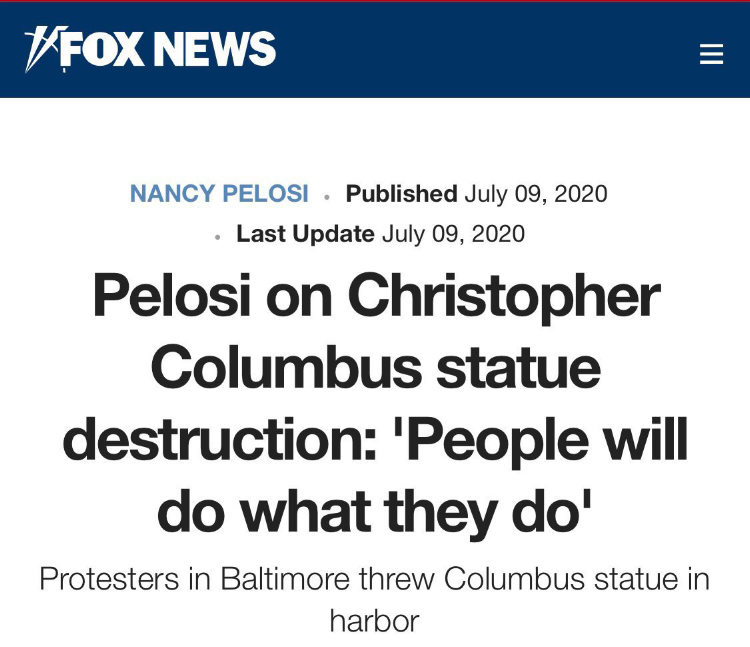
Indeed, the San Francisco’s 4,000 pound commemorative statue of Columbus, often defaced as a symbol of enslavement and subjugation in recent years, was removed by a crane and as a call to dump it into the Bay was circulating, on Thursday, June 18, removing it from a scenic site by the Pacific beside Coit Tower, leaving an empty pedestal, perhaps to reduce the need to clean up a statue that had been repeatedly defaced in recent weeks but also to show consensus about lack of interest in defending a symbol of oppression, enslavement, and colonial violence, and public outbreaks around the call to depose the statue off Pier 31, not as a symbol of colonial resistance, but an expunging of the navigator from national history. All of a sudden the dismantling of public memories of Columbus’ heroism were national news, a divisive issue responded to not with understanding but professed shock for besmirching American history, not reassessment of values, battling Italian-Americans Nancy Pelosi herself as forsaking, as if to bemoan her betrayal of the preservation of the hallowed memory of Christopher Columbus in the summer of 2020 to stoke lines of political division in the heat of the 2020 Presidential campaign: the fate of the statuary of Columbus was a bell whistle for stoking fears of a danger to the status quo.

It was as if the spontaneous prominence across the nation of memorials to George Floyd, proliferating on street walls in full color, and in haunting offset likenesses, provoked introspection demanded introspection of what sort of memorials we identified with and wanted to see the nation, placing on the front burner of all the question of commemoration in terms that had long been glossed over and tacitly accepted. The questioning of commemoration after Floyd’s murder came to articulate a spontaneous rebuke of the continued validation of racialized policing and police violence, throwing into relief discriminatory monuments. There were soon few defenders of the monument able to tolerate how they emblematized division of the social order, eager to ask us to situate Columbus more broadly rather than historicize his complicity in “some of his acts, which nobody would support,” without addressing the framing of the logic of “discovery'” in imperial narratives of conquest and disenfranchisement of indigenous claims to sovereignty and to recognize the need for reparations.

For the navigator embodied an imperial relation to space and terrestrial expanse, discounting the inhabitants of regions, and affirming the abstract authority of sovereign claims and sovereign expanse, however improbably early maps placed the islands in the Caribbean–later called Hispaniola–based on his conviction that the Atlantic Ocean was able to be traversed, enabling transatlantic voyages for which Spain was well poised to expand commerce far beyond the coast of Africa and the Mediterranean for economic ends in an “Enterprise of the Indies” that Columbus proposed to John II of Portugal, before he set out to claim the new lands for Ferdinand and Isabella. The longstanding embedded nature of Columbus in a discourse of claiming land–a discourse from which he was not only inseparable, but embedded maps in claims of the administration and supervision of lands far removed from seats of terrestrial power, a map-trick that has been celebrated since as a form of inscribing territorial claims on a piece of paper or globe.

And if Columbus had no actual idea of the form of North America, the persuasiveness of fictive reimagining of his mastery over space–a mastery cast almost uniformly in intellectual terms, rather than in military terms of disenfranchisement or enslavement–provided a logic that is aestheticized in the monument as a mode for the possession and persuasion of possession over terrestrial space more akin to American hemispheric sovereignty in its open heroizing of a national geopolitics of the 1890s than to a Renaissance discourse of discovery–comparable to the reimagining of hemispheric sovereignty in the years after the 1867 withdrawal of Spanish sovereignty to Mexico.

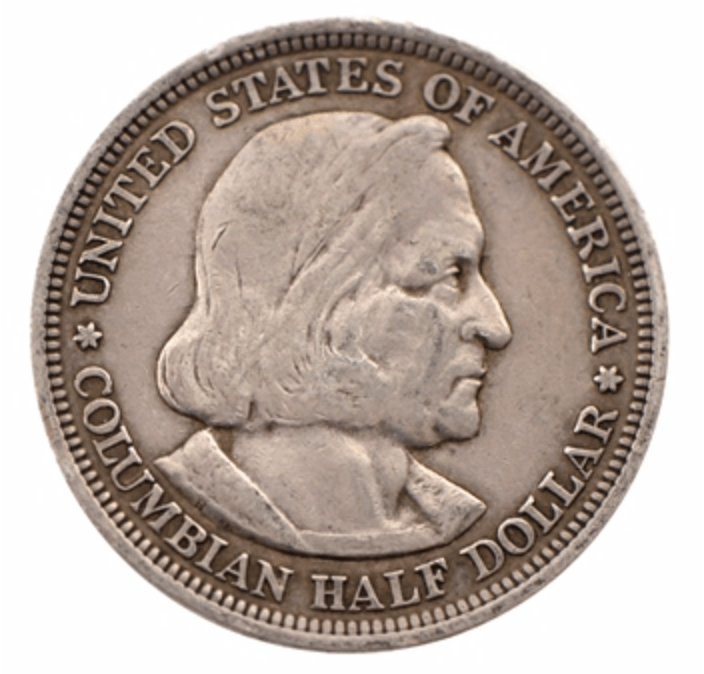
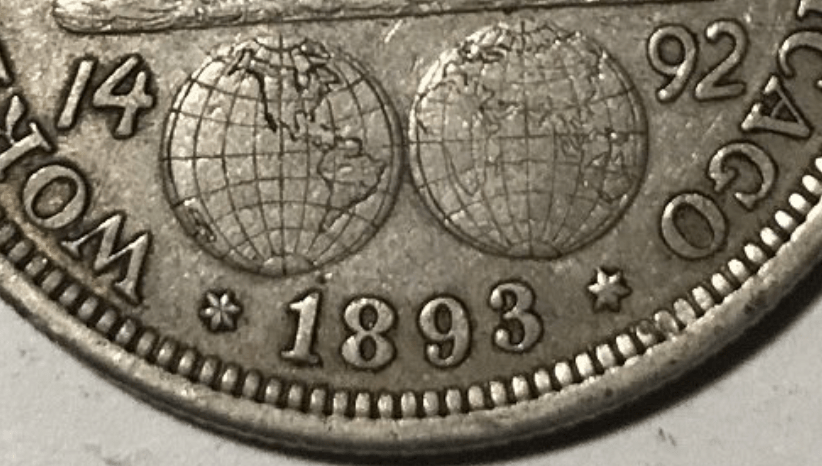
The origins of these reframing are perhaps obscure, but lionizing Columbus was always about rewriting the American narrative, and distancing one race of immigrants–the Italian migrant–from the very native inhabitants that the story of Columbus displaced. The navigator was promoted actively as a figure of national unity in the post-Civil War centenary of 1892, in which Columbus assumed new currency as a national figure, a map on silver able to enter broad circulation as a memory for how a three-masted caravel mastered terrestrial expanse, resting above a hemispheric map of global oceanic expanse. The anachronistic map suggests as much a modern triumph of hemispheric cartography–the coastline of the United States was surveyed by geodetic terms and that established the role of the United States Coast and Geodetic Survey in producing maps of uniform toponymy and hydrographic accuracy had only recently set standards of coastal surveying that unified triangulation, physical geodesy, leveling, and magnetic of authority within the US Navy to produce coastal maps of the nation extended from the Gulf of Mexico to the Alaskan shoreline.

The imperious gaze of the limp-haired navigator seems the first self-made man as he gazes with gruff determination on the coin’s face, almost entirely filing the surface of the first American coin bearing human likeness. Columbus was an icon it identified with how the hemispheric map took charge over a continent, and gave a sense of predestination to the recently settled question of continental integrity–and a territorial bounds that new no frontier up to Alaska, whose coast had been recently surveyed, and much of Florida and the Gulf of Mexico. Its design for the Chicago Word Exposition suggest a hemispheric dominance reflecting the growth of Rand McNally in Chicago, a map-publisher for America, as well as the self-assertion the United States as a hemispheric power, as much as the Genoese navigator about whom so many meanings have encrusted.

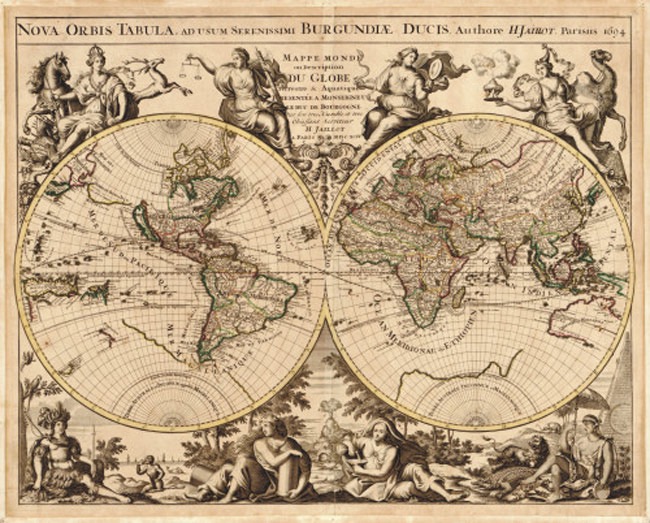
The striking hemispheric map of global navigability on the obverse of the coin circulated in Chicago’s World Exposition was global, but would also mimic the claims of hemispheric dominance that the hemispheric projection recalled, prefigured the Pan Am logo, in its global in reach–as if the image of a spherical projection devised by Rand McNally that spanned the globe and erased all borders might be cast as the seedbed for globalization was itself contained in the transatlantic voyages of the small trade ships, the Pinta, Niña and Santa Maria that were led with hopes of a profitable economic voyage with Columbus at the helm. (Rand McNally had not only sponsored the world’s fair, but its double spherical projection that recalled Columbus’ conviction of a spherical world by ahistorically featuring a cartographic design Columbus would have known; the planar projection was an icon of global expansion and conquest, more detailed in coverage than late seventeenth century double spherical projections.

–but devised and issued its own elegant version of a world map based on the Mercator projection in following years from 1895, in atlases issued subsequent to the World’s Fair, to meet a growing market for global maps. Leaving much of the African interior unmapped, in a manner that cannot but recall Conrad’s Heart of Darkness, the image is a confirmation and announcement of global triumph, centered on the North American continent and United States, if it shows the world.

Rand McNally Global Map based on the Mercator Projection (Chicago and New York 1895)
Continue reading

Leave a comment

Filed under American history, Columbus, commemoration, Voyage of Discovery, whiteness

Ink-Jet Wonders and Other Printed Curiosities

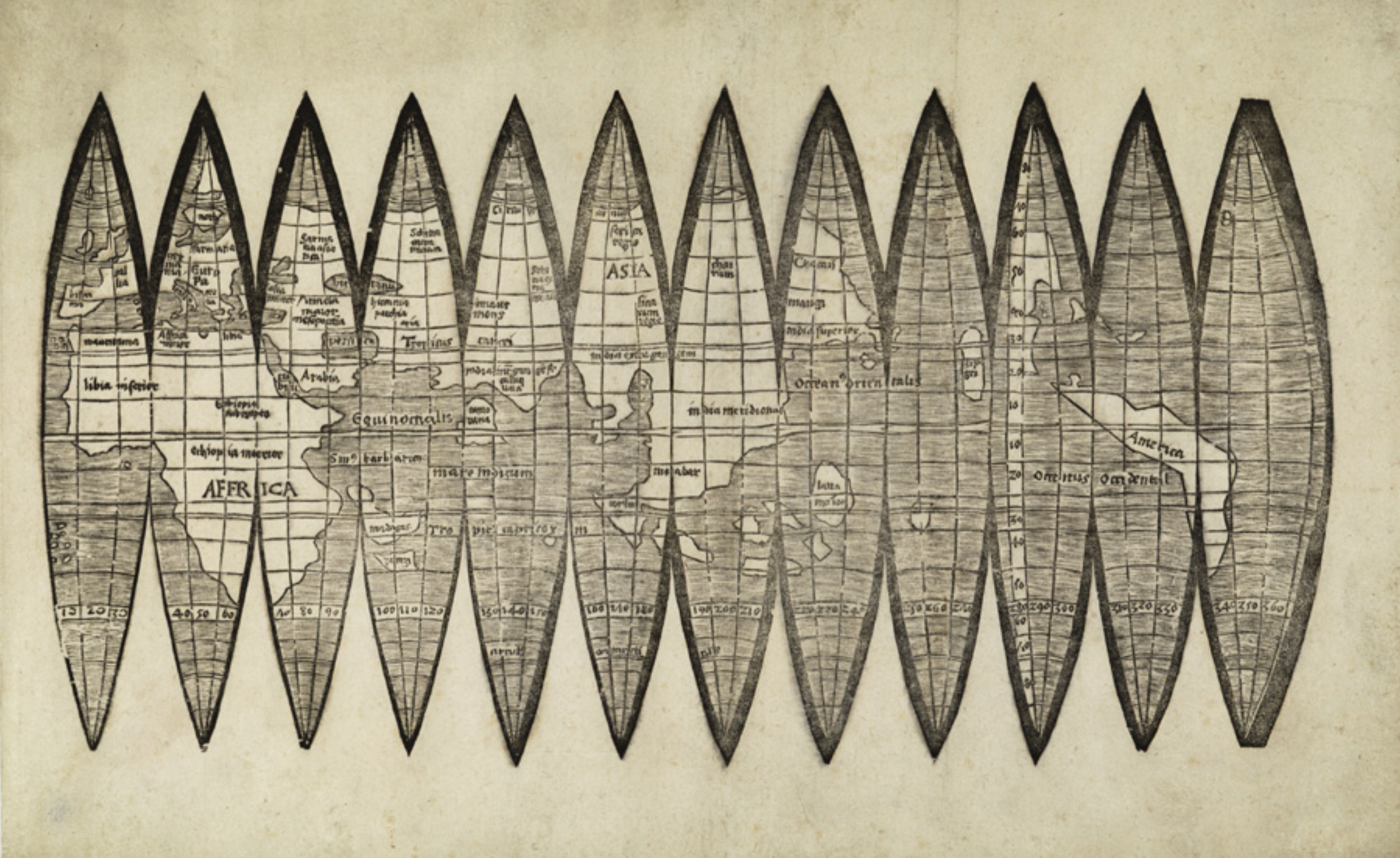
The appeal that was exercised by a newly discovered set of gores that arrived at Christie’s announced was considerable.  The map constituted one of the first mappings to show the place of America on the globe–and indeed to map the globe as a globe.  The considerable attention that the gores slated to go to auction in mid-December attracted must have lain not only in their rarity, but the cult of priority of the naming of place.  The gores exemplified the declarative role of mapping to designate place, as well as a geometric organization of global continuity shortly after the discovery of the new world, but it was hard to imagine that the appeal of the gores in our increasingly pixelated, pointillistic, and fragmented mediated sense of space was not in the solidity with which they seemed to embody “America,” both on the map and on a globe.

The gores were highly valued as the first image that mapped America–and assigned it a name–whose almost cultic prestige had grown allowed viewers view a watery western hemisphere, since described by antiquarians as the “birth certificate” of America, in an ahistorical but nineteenth-century fashion, for bestowing the name of the European navigator Vespucci on the continent that he had described in a set of letters that widely circulated in Europe from 1503, and provided a written account that oriented readers to to the New World, describing a vicarious sort of witnessing the unknown that expanded the demand for global maps as they were widely reprinted.   Amerigo Vespucci described the long shorelines of a New World  that allowed a distinctively modern way to view a rapidly expanded image of the inhabited world, and allowed Waldseemüller–even if the humanist cosmographer who had trained as a theologian rarely travelled beyond his town of St. Die, near Strasbourg, but exploited the printing press to reconcile Vespucci’s findings with precepts of map projection derived from cutting edge cartographic tools.  And when he adopted the format of the mathematician Apian to render the world on gores, he used the graphic techniques of projection to lend solidity to the first narrations of the New World.  So it was quite surprising that the forged copy of gores that almost made it to auction in 2017 belonged to the same visual culture of online images–the culture of image capture and digital reproductions–as what seemed a worm-eaten sheet of printed paper was found to be created by tools of digital photographic reproduction, with little human trace of an engraver’s hand, although they seemed strikingly similar to the long unknown image of a material rendering of the post-Colomban world.


MUNICH WALDSEEMULER in Peckham, 1504:1510pngUniversity Library of Munich, ULM Cim. 107#2. Courtesy of University Library of Munich

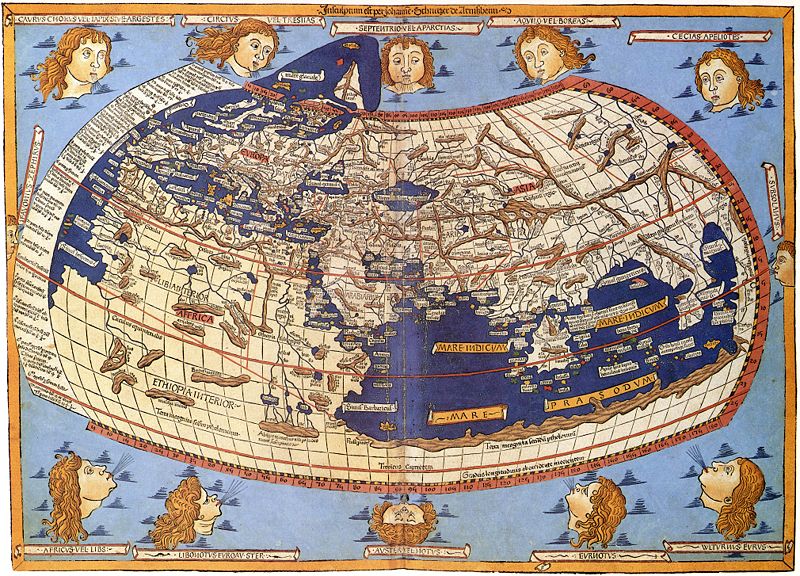
Indeed, the similarity between the online diffusion of the image and the reproduction of the fake seems a modern rewriting of the intense attention that Waldseemüller and his circle of geographers in St. Die embraced the tools of early modern engraving to design multiple woodcut maps in the first decades of the sixteenth century, in order to meet a fast-growing market for globes that lent legibility to the world.  But the new forms of legibility that the online reproductions prized–so distinct from the printed images of the early sixteenth century–seem something like a moral fable of the different levels of spatial legibility of different ages, if not two period eyes.  The gores that cosmographer Martin Waldseemüller and his St. Die circle had designed were printed in 1507 had been long prized as the earliest example of an identification of the New World as America, in honor of Vespucci.  In an elegant description of the entire surface of an earth as yet not fully known, but able to be mapped in a woodblock form, the gores adopt and incorporate aspects of recent engraved maps and nautical charts in a synoptic visual digest.  The gores form part of a distinctly cosmographic project of rendering the world on a graticule of parallels and meridians, and vaunting the adoption of an ancient global geometry for transposing the curvature of the inhabited surface of the globe to a sectional globe of two dimensions, despite their limited toponymy, and balance their comprehensive coverage with the treatment of the map as a canvas to advertise the new naming of America, expanding the map’s surface far beyond the manuscript tradition of Ptolemaic maps and orienting viewers to the predominantly watery surface of the world.


800px-Claudius_Ptolemy-_The_World


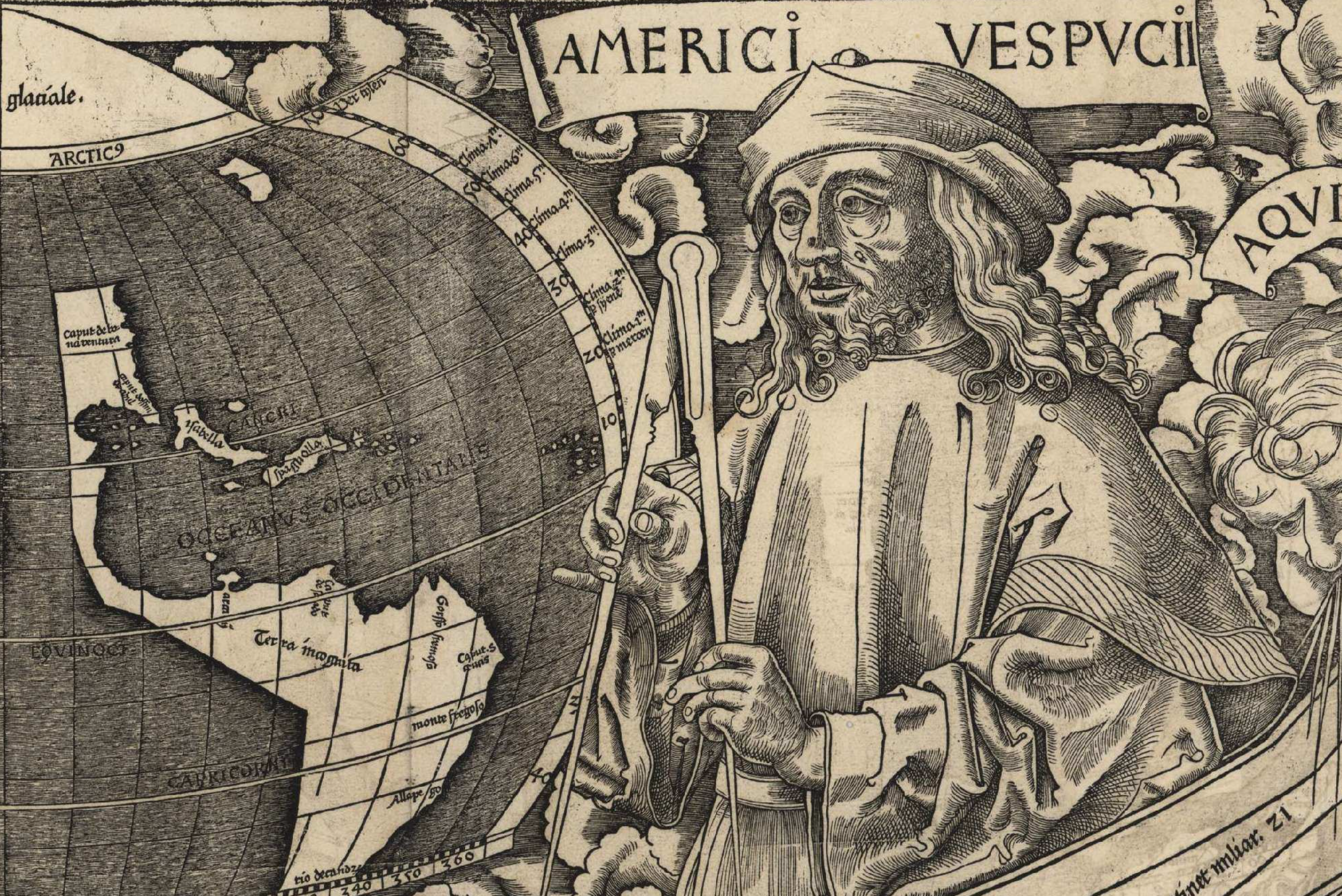
The single sheet that seemed early modern map gores for a short bit of time seemed to belong to the first records naming the continent after the navigator, and clearly gained their value as such as a piece of paper:  the announcement of a new discovery of the sectional rendering of the world’s surface by regular intervals of thirty degrees appeared to offer an early geographic primer modernizing Ptoleamic geography, based on the first nautical charts of the new world.  The attempt to chart global space for Renaissance readers who remained in Europe were long associated with the cosmographer Martin Waldseemüller, the mathematically-trained theologian and cartographer known for creating several global maps, and for writing one of the first treatises of cosmography to adopt Ptolemaic principles to explain and describe the principles for mapping the New World.  By announcing the adoption of a new set of tools as a new descriptive framework in a manner similar to his 1507 cosmographic wall-map, which unified the nautical charts of America Vespucci with a Ptolemaic framework of world-mapping; the sheet of map gores supersede traditional nautical charts in a form of world-making.

Indeed, the single sheet seemed to seek to promote universal geometric tools to unify an expanded global expanse:  the new sense of the “cumene” would not be recognized by Ptolemy or ancient mappers, and gave an expansive portion of its surface to oceanic expanse, registering a new conception of a terraqueous world.  The graphic image following Ptolemaic principles of projection incorporated Vespucci’s accounts and nautical maps in a new model of cosmographic knowledge, inviting readers to experience vicariously his travels to the New World, and to understand the greater value that he attributed to maps and cosmographical knowledge to arrive at this site across the ocean in another world:  much as Carlos Fuentes has recently offered an indelible picture of the epistemic paralysis of the monarch Don Felipe, a barely disguised version of Philip II, as a semi- autistic ruler doubting the existence of a new world that was not comprehended in the palace to which he has withdrawn in Terra Nostra (1975), a massive novel whose literary structure mirrored the tripartite structure of the palace Philip II commissioned to include maps of all the Spanish possessions, the embodiment of the globe on a set of twelve elegant map gores would condense and rebut such the imperial stance of utter disregard to the new world that possessed Fuentes in his novel.  The careful construction of the globe’s surface onto indices offer a global purview that might be called the first age of globalism.


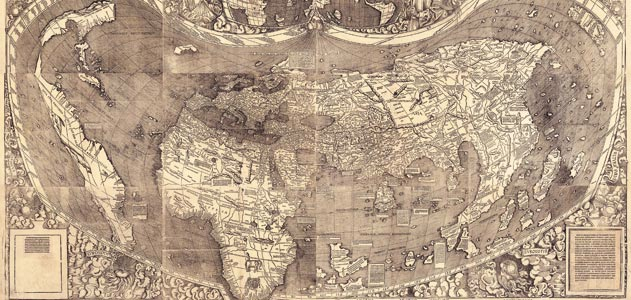
1. Waldseemüller’s single sheet map condensed the cosmographic principles the he had followed in series of elegant wall-maps that foregrounded the artifice and difficulty of the composition of the world map.   Waldseemüller and his circle had actively promoted standards of global legibility, using Ptolemaic precepts in a triumphal manner to celebrate the power of naming, charting, and mapping new lands for European audiences that invited ways of telling, describing and narrating Europeans’ spatial relation to a new world.  The large wall-maps that he produced in over a thousand copies promoted modes of reading globalist relations  facilitated by copious textual cartouches and inventive decoration, that underscore its cosmographical nature as a product of writing, drawing, and design to affirm the growth of oceanic expanse that defined the continents.  The wall map was hardly free of what Edward Tufte might call “chart junk” on its exuberant margins, but conveyed tthe excitement of heralding a new graphic synthesis of a global map over which Vespucci presided in one lunette, adding continents of a new hemisphere to the known globe, offered a cartographic solution to a problem of ordering terrestrial space.


Vespucii On Map

Waldseemuller-Map-631Martin Waldseemüller, Universalis Cosmographia secundum Ptolomei Traditionem . . . . / Library of Congress


The image is no less than celebration of the new status of cosmographical arts that elevate the medium of engraved images to tools of global description.  If the twelve-sheet c wall maps Waldseemüller’s school composed, designed, and whose engraving they closely supervised set a new standard for the elevation of cartographical skill from a technical craft to a new model of knowing and seeing–and a way of making epistemological claims, as much as using transmitted forms, in ways that linked the art of mapping as a scribal technology to cultures of telling, describing, and demonstration, the wall maps invite viewer’s eyes to comprehend space outside a situated position.


Waldseemuller_map_2Martin Waldseemüller, Universalis Cosmographia secundum Ptolomei Traditionem . . . . / Library of Congress


In a counterpart to the large wall maps that he designed and sold, Waldseemüller expounded the modern precepts to orient one in space and synthesize global knowledge by parallels and meridians in his Introduction to Cosmography (1507).   The slim volume,  the basis for his identification with the unsigned gores, seven as a manifesto for the twelve-sheet engraved global wall map, over which preside busts of Ptolemy, the ancient geographer who formulated the mathematical precepts of terrestrial projection on a graticule, with America Vespucci, combined the modern experience of navigation with the ancient precepts of learning and naming place.   Waldseemüller himself never travelled far beyond his native Strasbourg, but invested the map with authority to communicate geographical knowledge as a token of modernity of embodying a global geographical knowledge, albeit a modernity now displaced by the grid.  Waldsemüller’s projection has the energetic displacement of the authority of a nautical chart, echoing how Vespucci declared his competency in his letter to arrive at the New World even “without the knowledge of sea charts” prized by navigators, being “more expert in navigation than all the pilots of the world.”   The gores staked a similar model of expertise of reckoning and calculating distance and place by a new matrix of latitude and longitude that they embody:  the preeminence of the graticule as an epistemological tools of global geography that expanded the scope and nature of geographical knowledge lasted some four hundred and eighty years until it being displaced by grids.  Indeed, the value that the map was readily assigned suggests its survival in a distinctly post-scribal culture of mapping.

Did the value that the auctioneers assigned the map gores reflect these grandiose knowledge claims?  The gores elegantly translated knowledge of the earth’s newly discovered hemisphere to indices the viewer could readily process and digest, foregrounding the new name that it proposed for the continent named after the Italian navigator.  But they assumed a new status in the age of digitized maps, and Google Earth images of global interconnectivity, which may have been paradoxically elevated by the newly antiquated image they acquired.  Rather than being sold as emblems of knowledge, the new image of the gores that Christie’s claimed to bring to public auction had gained an immeasurable status after the earlier auctioning of similar gores for above a million dollars, not to mention the unprecedented price that the United States Library of Congress agreed to pay in 2003 of $10 million for the sole surviving edition of the large wall map Waldseemüller had engraved, the one copy of the thousand-odd he had printed, of which it was something of the poorer cousin, but which had been widely touted as the “birth certificate” of America, and the map on which Waldseemüller had proposed using the name of the Florentine navigator Vespucci who had described the long coastlines of the New World in his printed letters.

The set of map gores, a complementary spherical map that Waldseemüller had described making, provided an early image of global totality that gave a similar dominance to the line–indeed, the geometrically determined line–to orient viewers to a global surface.  When the late historians of cartography David Woodward and J.B. Harley tersely defined the map in “purposely broad” terms, at the outset of the monumental History of Cartography, an extremely elegant series since expanded over multiple volumes, as “graphic representations that facilitate spatial understanding of the world of things, concepts, conditions, processes, or events in the human world,” they may have been thinking of the graphic lines of the gores as such a facilitation of spatial understanding.  For the gores process the encounter with the New world, the travels of the navigator, and the recovery of Ptolemaic precepts of world-mapping, and the naming of the newly discovered continents in the western hemisphere on a clearly graphic construction.  Woodward and Harley’s emphasis on “graphic representations” recuperated the ancient Claudius Ptolemy’s use the Greek verb  γράφειν (graphein), or “to write,” and Waldseemüller’s assimilation of that verb of the act of writing to engraving tools; it caused much revision, even by Woodward himself, of its lack of allowance for cross-cultural comparisons, but suggests a significance of writing systems as a mode of ordering space.  Waldseemüller appropriated the authority of the verb in print, giving the engraved line a deictic sense of displaying space–


Single Sheet UNM

Waldseemüller-Globus.jpg

Waldseemüller School, 1507 Globe Gores/Badische Landesbibliothek


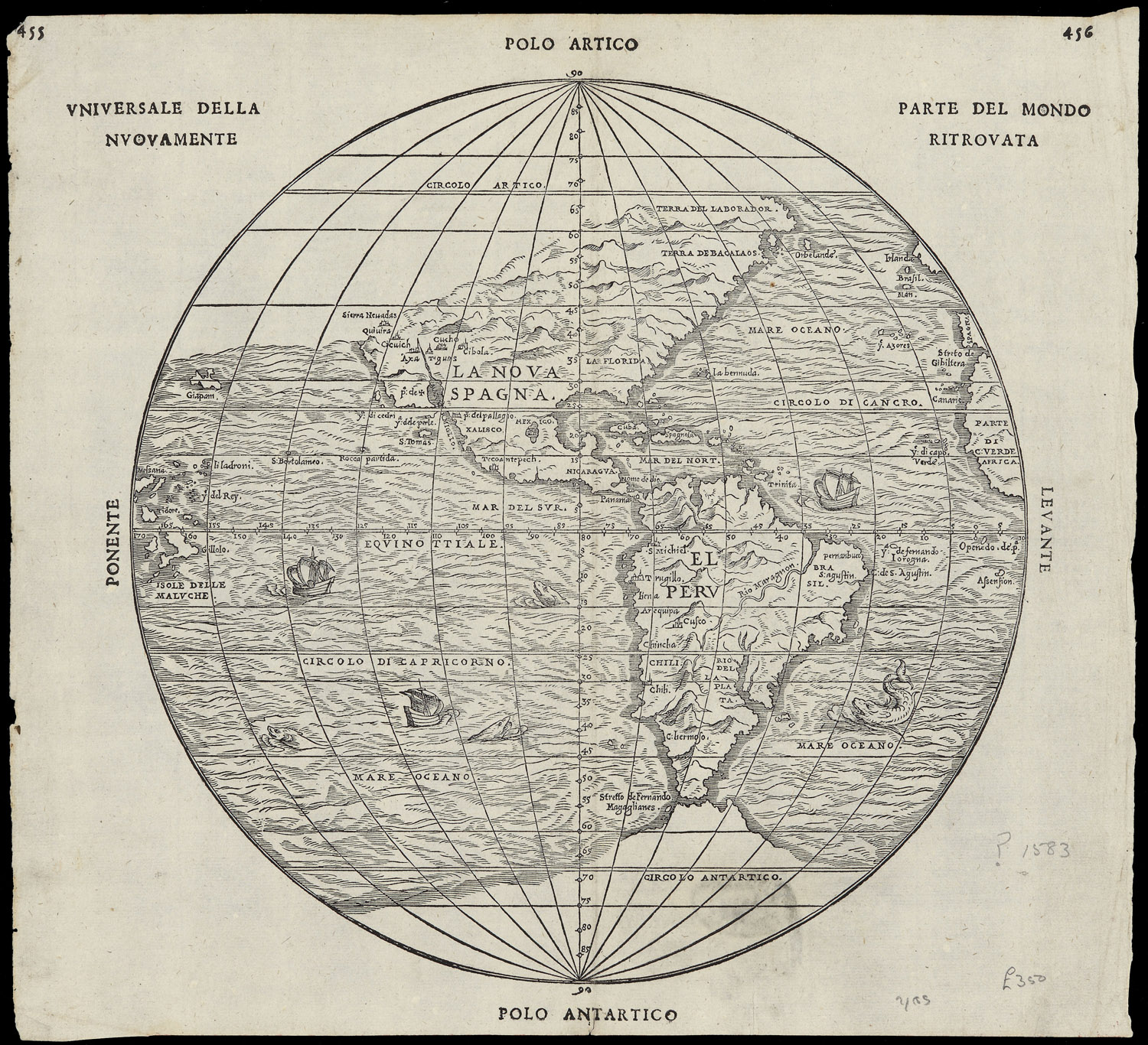
–in a map of globular design of the sort that Woodward idealized as the culmination and embodiment of cartographical principles, in a globular map of the sort that was more readily defined in a more familiar globular form by 1583, here shown in two images of the same year in “universal rendering of the newly discovered parts of the world,” printed in Italian, or discovered parts of the world, which emphasize nautical travel as the basis for the incorporation of place on the globe, and reveal the increased scope of geographical exploration in the intervening eighty years.


Globular Italian Map Parte del Mondo Ritrovato 1583


Globe_terrestre_de_Jacques_Vau_de_Claye_(1583)


More broadly, however, “graphein” might be understood as the trace of the human that orients themselves to the world, hand-drawn or manually rendered.  These were soon shown to be absent from the gores:  indeed, the blurring of the very lines of the gores that went to auction suggest that they belong to a new visual culture of scanned images and photographic reproduction.  The very traces of graphical operations were permuted and erased in new ways, as is the sense of a human presence, in ways that suggest the distance of our own visual culture from Waldseemüller’s world, in ways that the forger never intended.

In their groundbreaking History of Cartography, David Woodward and Brian Harley had celebrated the line as the means of graphical orientation, in what now seems an elegy to the art of printing.  An unforgettable image remains clear in my head of David Woodward in his basement, in Madison, WI, running maps off a letterpress printer, and hanging them to dry on strings by clothespins, and his love of the ink applied to the engraved plate to present a precise rendering of space.  But the fake set of gores that reached auction were not printed or drawn, let alone in the Renaissance or during Waldseemüller’s life, but probably printed some five hundred years later, from a scan of the map in the James Ford Bell Library’s website.

The gores that arrived at auction this December suggest far less of a clear trace of a human hand, and perhaps belong to a different visual culture of online images.  Indeed, the astronomical value that the single sheet was invested may be a symptom of our entrance into a different visual culture of mapping–indeed, the sheet that seemed to be valued at more than a sheet of gold of the same size suggests the fetishization of the paper map in an era of web-based mapping, and mobile GPS.  The fake gores suggestedthe translation of Ptolemaic terms to a visual culture that privileges the dot and the grid as a basis for orientation, rather than the engraved line, but where the aura of the writing of space persists, and the paper map fetishized in a world that increasingly relies exclusively on mediated digitized images.  The set o fraudulent gores is itself something of a post-modern artifact,–less concerned with the authorities of narratives of discovery, but able to admit the false authority of the map as objective, and almost ready to accept the value of its aura even if it was only an image grab printed on old paper.

Continue reading

Leave a comment

Filed under fake maps, globalism, globalization, Mapping the New World, media studies

Mapping Rome’s Pasts from Piranesi to Freud and Back

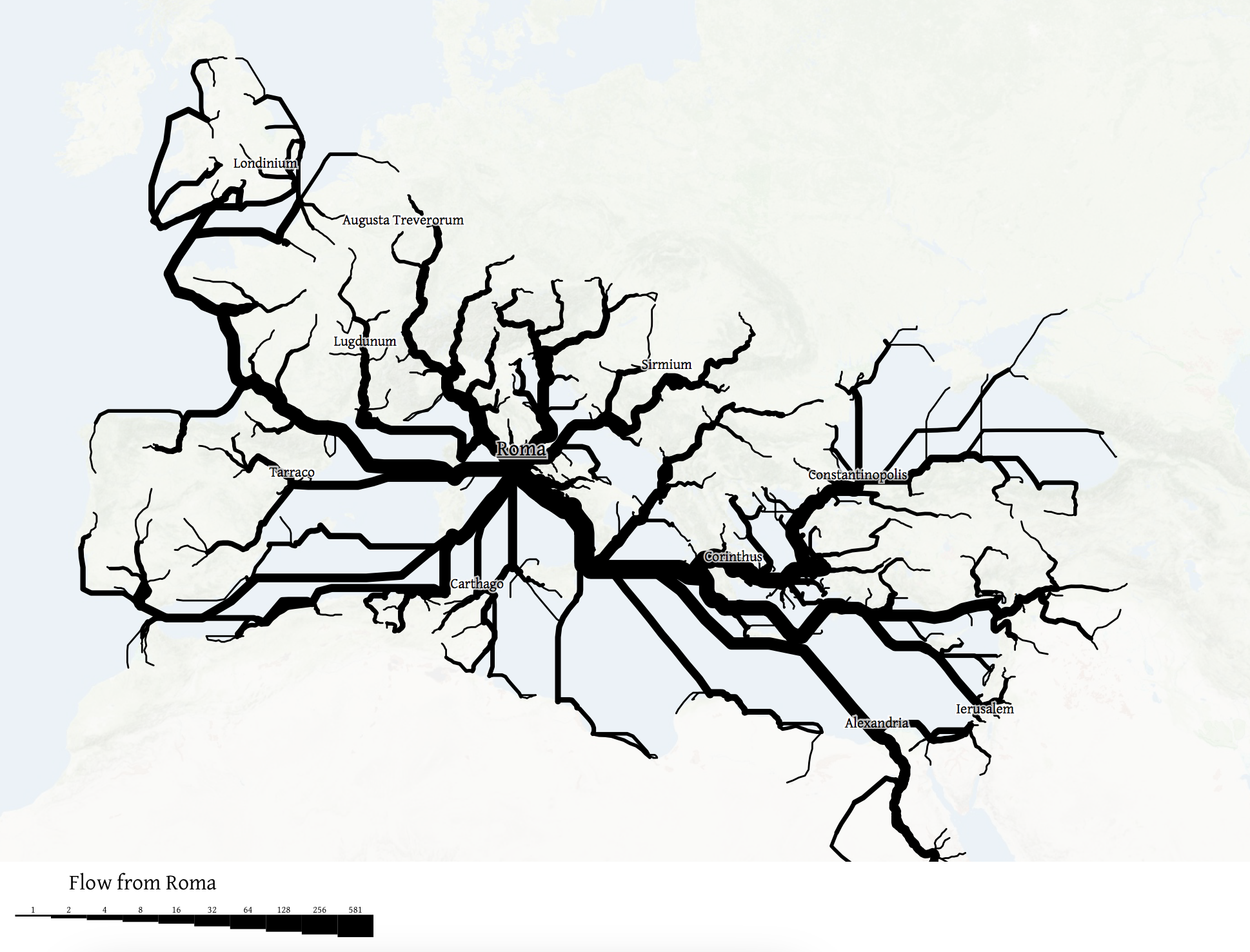
We now map mega-regions that extend along highways far beyond the former boundaries of cities, along roads and through suburbs increasingly lack clear bounds.  The extent of such cities seem oddly appropriate for forms of mapping that seem to lack respect for physical markers of bounds.  These maps reflect the experience of their environments as networks more than sites, to be sure.  It may be surprising to see the mapping of the ancient world as a similar network, and to try to understand the mobility of the ancient world and Mediterranean in terms of modern tools of mapping travel–that would put NATO to shame, demanded to be studied as mobility research.

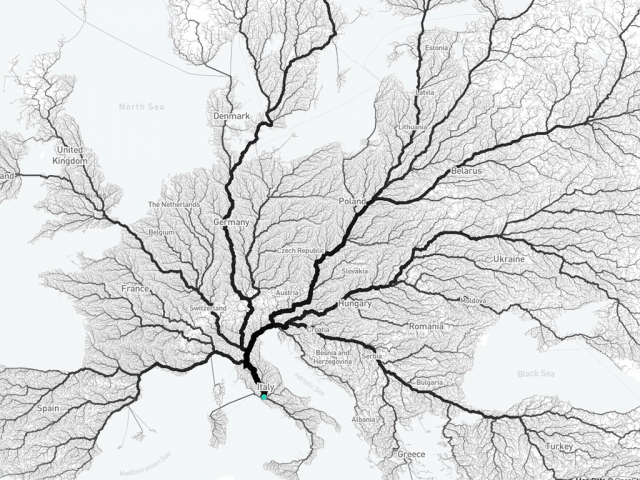
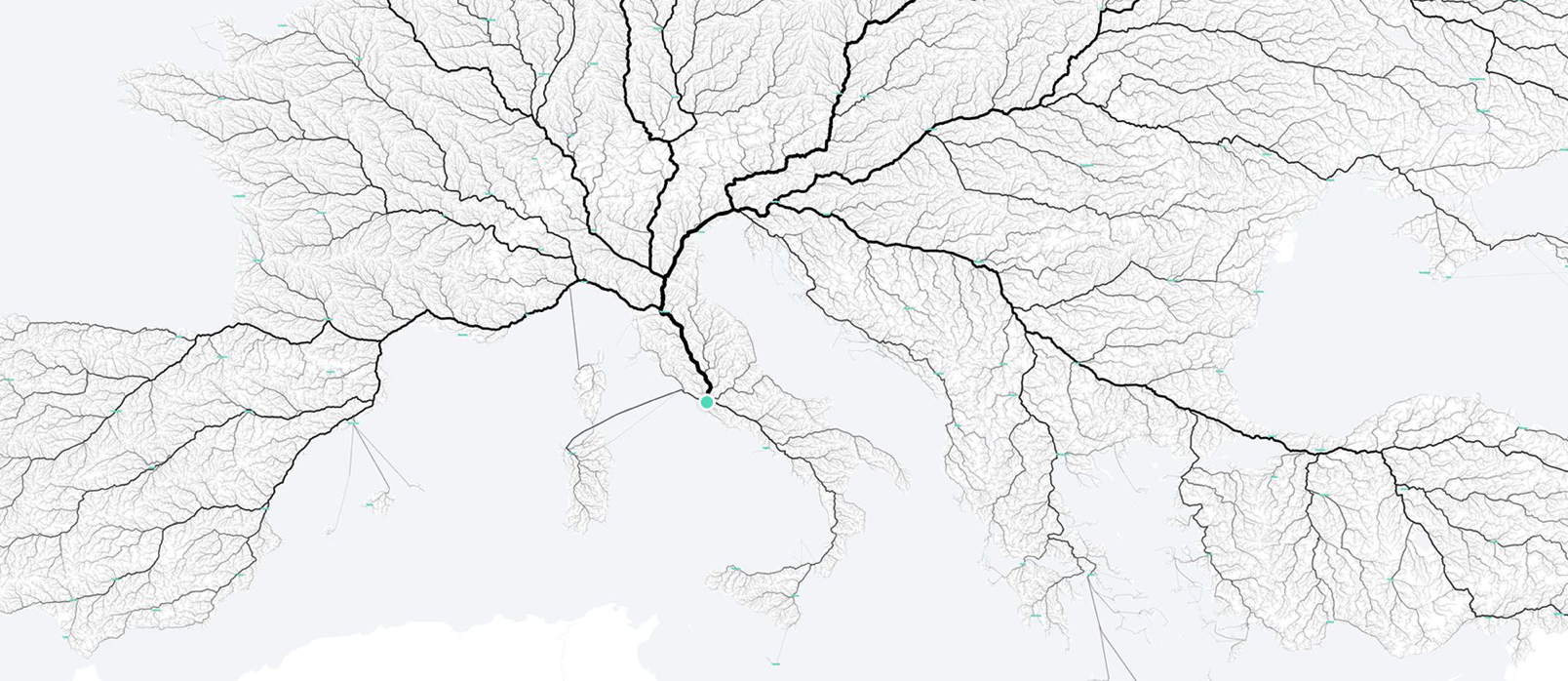
Roads to Roads to Rome,” by Moovel Lab

–that now provides a way to imagine travel in the pedagogic aids, as well as visual candy, by which we imagine the coextensive nature of an ancient past, mapping travel times, interconnectedness, and flow in the Roman Mediterranean, as if it were a smoothly interconnected network of transit enabling civilization, as varied digital humanities sites from Stanford to Europe assure us.

To privileged flow echoes the absent edges we have lost in our global mapping, tied to globalization, as William Rankin and others argue, more tightly that we are still unaware. Using algorithms to render overland flows of mobility that converged on the city of Rome in the ancient world may mix more metaphors and tools to digitize the past in distorting ways. These are uncanny resemblances to the maps in which we live, as much as told of the past, if they are used in heuristic ways: tracing the spatial extension of extra-urban areas along distended networks of paved space suggests not only a conquest of the antique, but its transcendence, mapping ties within as well as to an ancient world. The analogical nature that Freud gave the expertise of archeology staked out the claims he made for a new science firmly planted in objectivity of a personal past, by a powerful conflation of the personal past with the objectivity of sedimented layers of time. 

If Freud understood the self as able to be revealed as a sort of substrate created by interactions of instincts and society, of which the psyche was the result, archeology provided a metaphor, but also a model for excavation and for storytelling to understood psyche as an objective map. And if we are coming to acknowledge not only that archeology was a guiding metaphor for Friedrich Nietzsche that Freud adopted and embraced in his explorations of the psychic traces of personal pasts, in concrete terms that were more rooted to the tie between seeing and saying in their works–and in the therapeutic cure–that explored a terrain hardly able to be seen as transcendent, so much as excavating deep labyrinths in the psyche. For Nietzsche’s use of archeology as a metaphor of knowledge was more rooted in the visual and the concrete helped Freud focus on the “trace” as part of an artifact through the maps he had encountered of the physical situation of a past in Rome, in ways that he was able to transpose so creatively to the physical sites of the psyche not only in the human brain, but in the textures of memory that were, for Freud, quite compellingly concrete.

For Freud’s maps of memory are hardly transcendent, but relied on archeological maps that recuperate the detail of the local, and are hardly able to transcend the suffering or traumatic, or imagine space in algorithmic contours but ones deeply specific and self-made: whose contours and specific way stations are able to be narrativized in telling, and are explored as they are retold with attention to their imagery, psychic and remembered, and unable to transcend individual experience They play with the immediacy of the remote, and the delivery of a past into a tactile present, that was mediated by archeological maps, however, and a sense of the accessibility of a lost past, or past thought lost, that the fantasy of archeology allowed, an ability to shift between temporal registers at the same with a dexterity that the analyst claimed his won special sleight of hand if not intellectual property, rooted in the specific and concrete detail in the psychic past but able to be narrativized as objective discovery in the privileged studio from the layers of narrative and words of the analysand.

1. If the metaphor of the historical map paralleled with uncanny temporal precision in twenty-seven sheets of the Palestine Exploration Fund’s gambit to illustrate the Old Testament as collective history, the map of Rome became the most famous typos for excavating a personal, rather than the maps of Old Testament History that even presumed to detail the prophetic divisions of Ezekiel. Freud had higher aspirations, far more removed from religious divination or airs of prophecy. He eagerly affirmed the task that faced “great discoveries are made by the great discoverers” on New Years Day 1886, as he pondered questions of nerve pathologies that might be allowed by indulging in cocaine, as doors of consciousness, that affirms the scale of his desire for still deeper discoveries. He late rued it as his “fate to discover only the obvious: that children have sexual feelings, which every nursemaid knows; and that night dreams are just as much wish fulfillment as day dreams,” he had claimed his “discovery” of the infant attachment to its mother in 1931 as fundamentally important to world-view that it paralleled “the [recent] discovery of [the 4,000 year old] Minoan-Mycenaean civilization behind that of Greece,” by Sir Arthur Evans had heralded, readily coopting the interest in recovering “vestiges” of psychic attachment and trauma in the human mind in archeological terms. While the milky grey matter resists a road map of intertwined nerves, veins and arteries that nest in musculature around bones. 

Freud claimed to have been prevented from his own profession aspirations to be a surgeon as “anti-semitism had closed those ranks . . . to the point where they kept the Jews out.”  But the deep concerns he voiced about forsaking his professional vision for himself were in part met by the identity of an archeologist, a compelling figure and metaphor for individuating traumatic memory and healing:  he represented himself in the trenches of archeology, as a sort of purified version of his excavation of emotions, rather than raking through the psychosexual muck. If Freud has been cast as a crypto-biologist, a modernist, a fabulist, a detective, the inventor of the dynamics of psychology, and as a hopeless positivist, the figure of the archeologist, one might suggest, capacious to hold all these roles and historicize them in ways that suggest a distinctly specific unity,–especially if we remember the modernity of archeology as a science.  For Freud was ready to see symptoms as able to be excavated as psychological strata through the process of analysis. 

While this might be traced to the excavation of primal emotions in the fifth century BC archeological statues of Pheidias, revealed in the terror in the bulging eyes, flaring nostrils and gaping jaw of a single horse of a chariot drawing the Goddess of Night in the Parthenon–

Pheidias, Head of Horse from Pediment of Parthenon Sculptures/British Museum

–what Freud called the dream-work opened overlapping memories in the mind that he rendered as the physical plant of a city, a living object that was wrongly seen and regarded as dead. The chariot that carried one of the Moon Goddesses of the Night across the evening sky–Selene, sister of Helios and Zeus, most likely–echoes the intense cathartic shock of the excavation of emotional encounters Freud claims that the surface of dreams allowed him to work with his patient to extract.

The figure of archeological discovery both purified and monumentalized his discoveries.  They figure of the archeologists not only lent status to his new profession but the analogy exaggerated the objectivity of his discoveries and purified them in objective form. His discovery of the oedipus complex, dated to October, 1897, was described an alarmingly definite moment of realization, and later intimations of future discoveries filled his notebooks and diaries in ways that have assumed an epochal character of a new topographic landscape of a world submerged in the individual mind.  Even as Freud moved from physiological interpretations to hermeneutic interpretations, figures of cartography and the archeologic status of maps were metaphors that dignified “discoveries” of infantile sexuality, Oedipus complex, or keys to dream-interpretation heralded to be of the same rank “as a genuine ancient discovery” (SE I: 263).  These discoveries were, he increasingly came to believe, a “royal road to the unconscious,” in a figural construct modeled on networks of Roman roads built for to facilitate the transit and transportation, a figural basis for future discoveries?  

Freud rewrote the language of discovery–and scientific discovery–from positive perceptions by locating insight in recovery of the “memory trace” by remapping the human psyche as tangible landmarks recovered from lost sedimentary strata with considerable flair.  Did not the recent inscribing the name of the father of psychoanalyst on a neoclassical facade of an abandoned church in Oxford, England not exploit the conceit of an ancient temple as a doorway for the initiated?

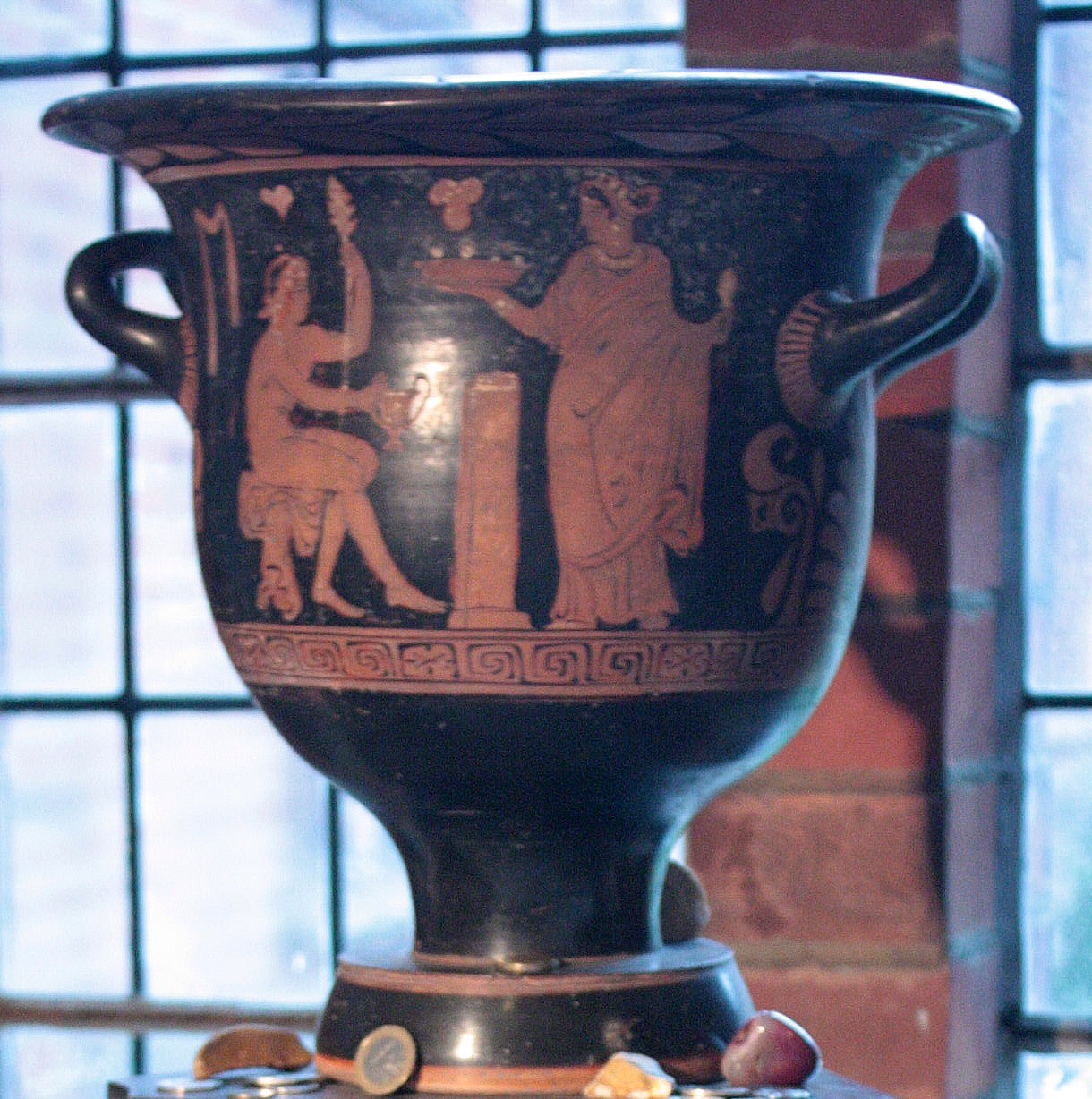
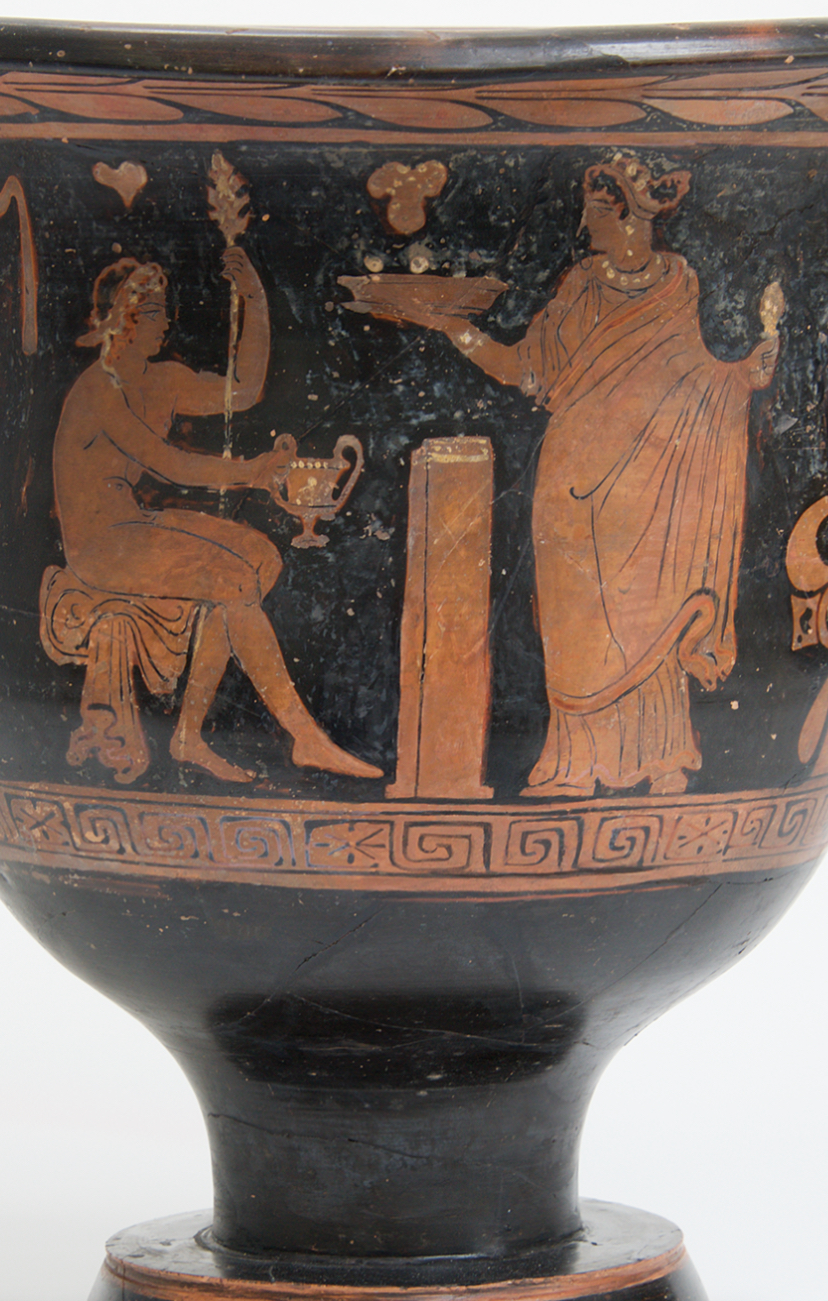
Freud’s passion for the totemic role of archeological antiquities as aestheticized objects was perhaps not the sold reason his aristocratic student Marie Bonaparte gifted him a red-figure vase of the ancient God Dionysius that had been recently excavated from grounds in the south of Italy.  The valuable urn was long displayed in his office, winning a privileged place among the two thousand of antiquities in his own personal , echoed the deep analogical role of archeological excavation in Freud’s thought, confirmed to some extent by how Bonaparte’s telling gifting of the urn came to be selected as the final resting place for his ashes in Guilder’s Green–a sort of pilgrimage site holding the ashes of Freud and his wife, the former Martha Bernays; the vessel where the family placed his cremated ashes would have situated his place in a clear intellectual pedigree of excavating lost pasts intertwined with a sexual psyche, but seemed a sort of assumption of identity as a pilgrimage site from 1939, removed from Jewish funerary rites or custom, in the ancient context of the offering to a god. Freud was long respectful of “Princess Marie”–as he called her, assuring his grandson she would be his own “first patron” of art, and gifting her the first sculptures Lucien Freud made in art school, the exchange of objects was heavily charged.  The archeological analogies of antiquities consolidated his own cultural status in a self-made field he sought to invent.

The image of an enthroned Dionysus, god of regeneration, fertility, ecstatic transport, and insanity, relaxing with a caduceus like staff, wreathed with laurels, was entertaining a maenad, a fanatical female follower, in a slightly perverse token of the reverence Bonaparte felt for her teacher, lay among the Egyptian and Roman funeral urns that he had collected with a passion, and while no funeral mask was made of the psychoanalyst who cheek had physically degenerated, that image of regeneration seemed apt.

But they offered a far more pervasive basis to map the psychical world in ways that a surgeon might never be able to attain by their simpler instruments and tools.  For they cast claims of pschyoanalytic insight as finds by far more than an analogy, as many note; the power of the map of an excavation is less appreciated as a claim for objectivity at the culmination of an Enlightenment inquiry, however, joining materia medica with art in a sleight of hand.  The “royal road” to the unconscious Freud claimed to offer was a rhetorical reconstruction o the psychic formation of the subject not nearly as tangible as a cultural tour of Italy in a Grand Tour of historical monuments, but situated in the cultural aesthetic formation that linked archeological expertise to the individual mind, and resonated with the archeological maps of the Roman ruins of ancient cities quickly adopted as forms of building on Viennese and Central Europeans walls as descriptions that were iconic signs of their intellectual pedigree as mirrors of their own cultural stature and prestige.  The analogical argument located heightened intellectual transport of the uncovering psychical layers as a fixed topographic terrain of archeological finds,—akin to how Poole’s famous Historical Atlas of the Roman Empire. Archeology, as much as neurology, offered convincing criteria for Freud to pronounce the terrain of his discovery, beyond any interest in therapeutic judgement.

Reginald Stuart Poole, Romanum Imperium (1896-1902)

To affirm his discoveries Freud wanted–or needed–such a detailed analogical map. Only it was able to offer a sufficiently powerful rhetorical figure of sorts able to announce and lend status to truly major discoveries, and he was, by extension, a great man. As the ancient world was mapped in the late nineteenth century of the archeologist, numismatist and orientalist Reginald Stuart Poole’s tracing of the boundaries of the Roman Empire and other antiquarians raised hopes of rendering the discovery of a submerged roadways materially present across Europe, the recovery of the pasts present in the individual mind was similarly explained by the superimposed fabrics of past selves–akin to the Palestine Exploration Fund’s own public relations campaign by detailed maps.

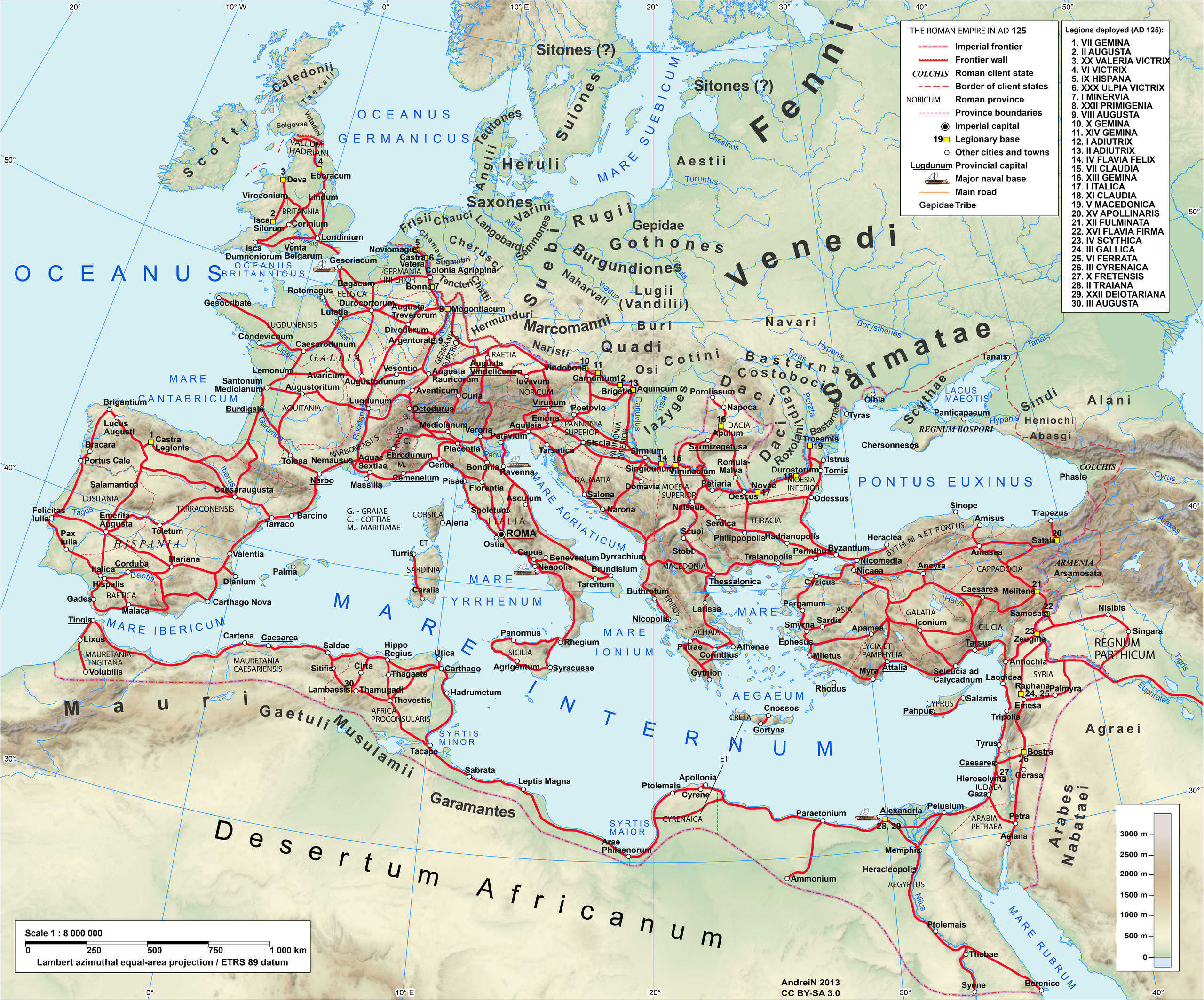
2. Was not the fiction of a historical atlas a powerful way to recast the materiality of past experience in familiar scientific terms? The hopes for remapping the underground network of identity was present in the extent of ancient stone aqueducts, eleven of which fed Rome and a network feeding the Bay of Naples, that brought water to cities’ public baths, and the public roads of the empire on which messengers, couriers, and soldiers traveled, the palimpsestic network of Roman roads that appeared both a civilization of space and empire. It was indeed an organic substrata of civilization, and the organization of urban space of Rome offered a concrete figures Sigmund Freud seized with eagerness as a rational basis basis to describe and monumentalize the material presence to the mind of an individual’s past. Freud’s adoption of such powerful figures of speech for his own discoveries benefitted from of a growing concrete relation to urban space perpetuated and broadly reproduced in maps, which themselves mediated a romantic fantasy of securing immediate access to past spaces and to the unity of space, that became central to the construction of a unity of psychic space, if not the uncovering of the engineering and indeed economy of the psyche–and a very physical metaphor of the discovery and “unearthing” of its map.

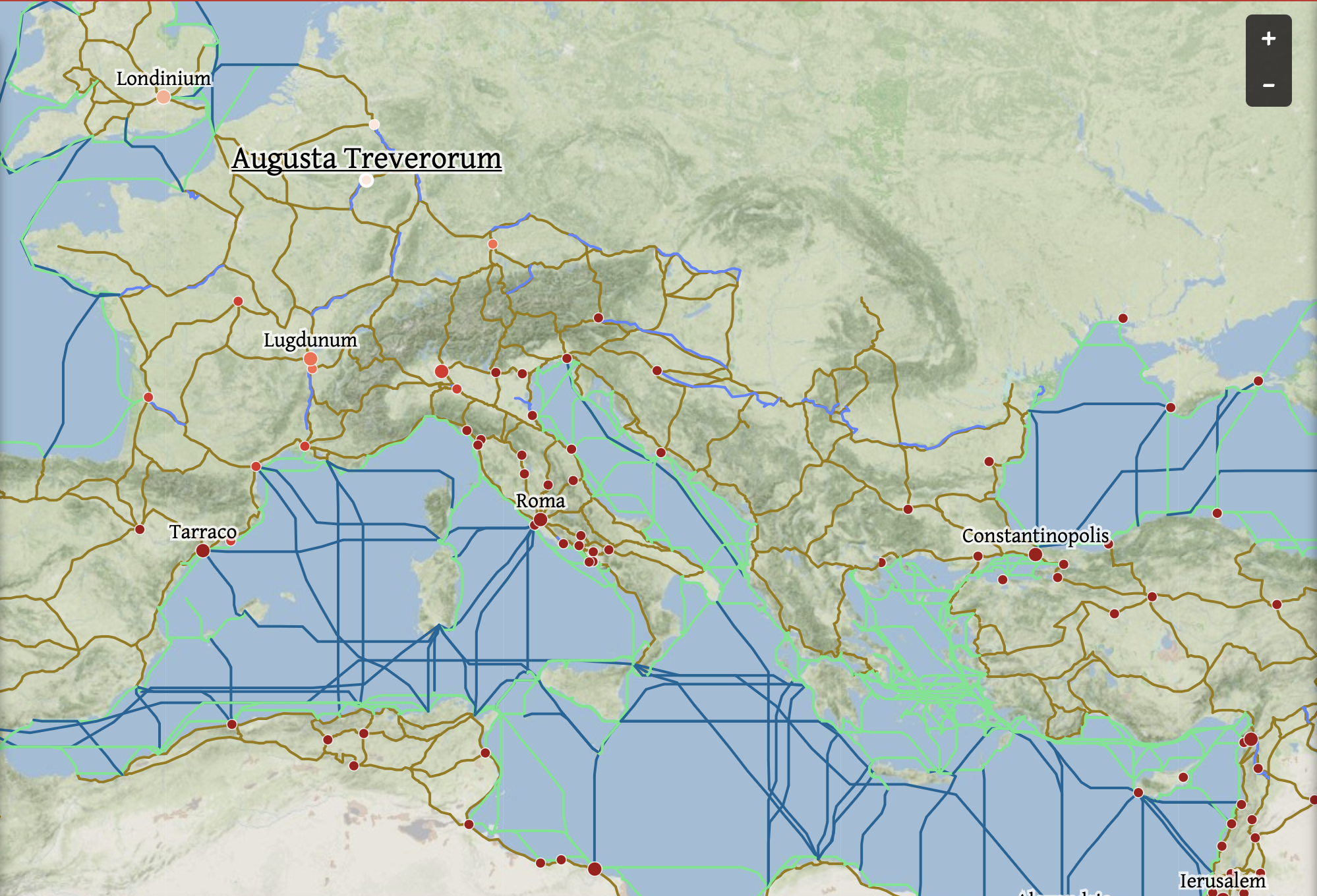
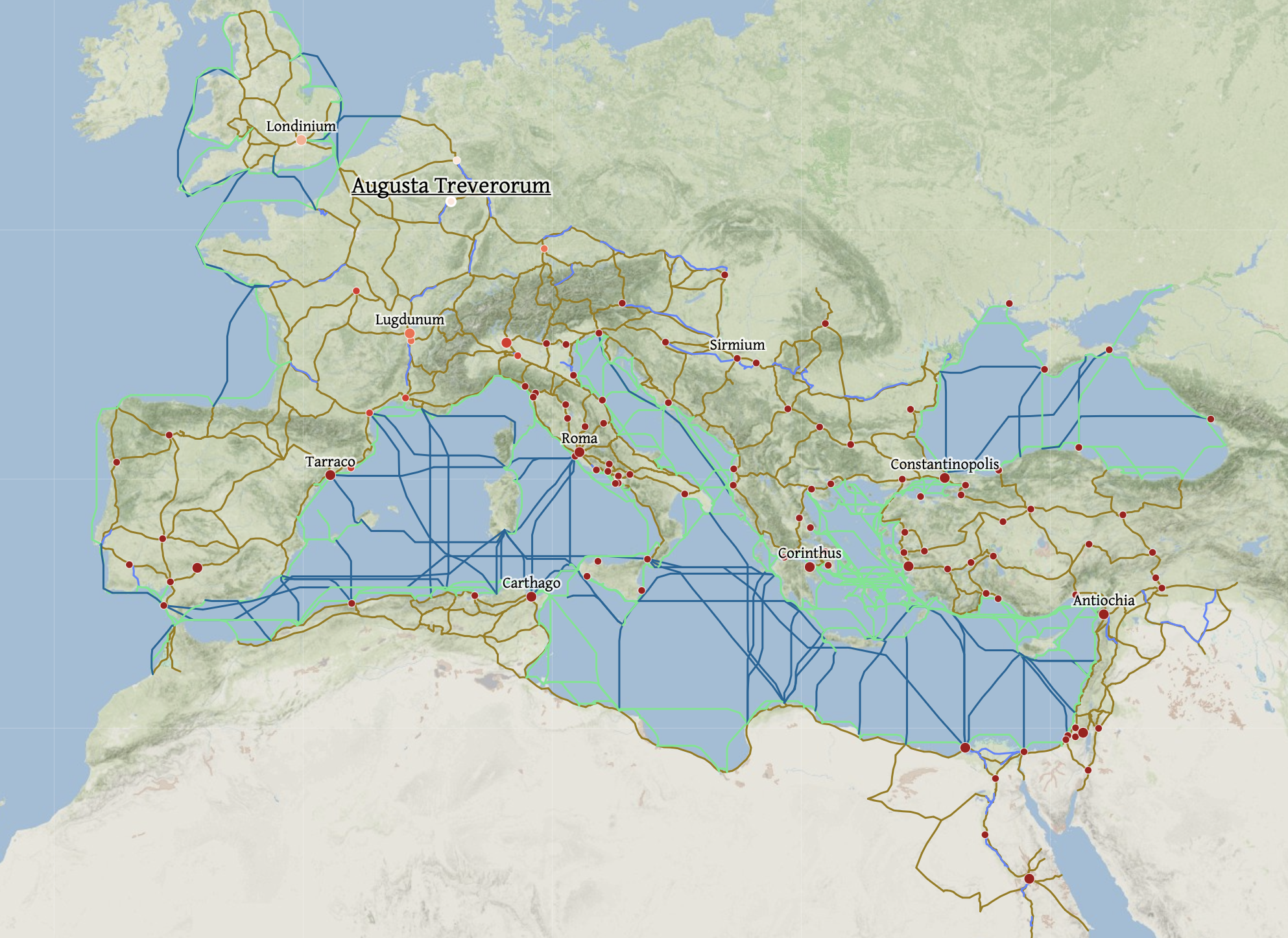
If the totality of Roman roads were mapped from the nineteenth century to the growth of online encyclopedia circa 2000 to concretize ancient history, the role of maps to concretize a relation to the past has since grown exponentially. The network has a new iteration from Stanford’s ORBIS in a brilliant interactive form of mapping Roman roadways–a “GPS for the Roman Empire,” with costs of transport and time of travel included, as an ancient UPS system or FedEx key–to represent important arguments of the spatialities of the ancient world. But the mania of mapping the ancient networking of the Roman Empire as a unity. The maps prompted me to do a deep dive in the materialities of “Rome” that maps have conveyed, hoping to excavate subjective relations to early maps of Rome and perhaps in the virtual interactive web-maps’ geospatial emphasis.

How Ancient Roman Roads Were Built - WorldAtlas

If the demand for mapping the Mediterranean expanse of the Roman Empire is perhaps motivated by deep interests in placing Rome within a global history–a global scope all too evident in the very name of ORBIS and its website–the mapping project offers the different perspective on the ancient world contrast to the competing layers that were long understood as essential in Rome itself.

The current geospatial turn has emphasized the map as a network to plan travel, by seasons, modes of mobility, and route, as if on a modern travel network, projecting flows, nodes, and network, in a conceptualized in unique if not much more graphically embodied than earlier GIS overlays, if offering a dazzling array of ancient options of of mobility on hand–ship, horse, foot, river–and breadth of spatial expanse as a rich board game of open source data from ancient times as much as an invitation to “explore” the ancient world, as Elijah Meeks and Walter Scheidel exhort users.

ORBIS, The Stanford Geospatial Network of the Ancient World, W. Scheidel and E. Meeks

The warping of time evident in recent web maps of the ancient world does a neat double-trick, both s them from historical time and erasing the complex techniques of reconstructing past space. But the relation to travel networks is predominantly flat, as if spatiality exists in an easy translation or iterability of online resources, using the Google template–or other online networks–as a matrix for antiquity.

Rather than the painstaking assembly of a familiar palimpsestic relation to known space, the ancient roads of Roman Empire are converted to a known space, akin to a known world, whose routes open up to us as if a space for walking. There is a disturbing loss of all complexity of processing time and space, in these graphic analogues of the medieval precept, “All roads lead to Rome,” literally ‘”mille viae ducunt homines per saecula Romam [a thousand roads lead men forever to Rome]” as Alain of Lille had it in 1175, in his Liber Parabolarum, have long merited data visualization, so present are they in the collective European unconsciousness. (That they would flow through Denmark, Hamlet’s home, Estonia, and Ukraine, seems perhaps a fitting sort of surprise.)

In tracing the ties of the self through the unconscious, Freud was very clear in an early work: given the incomplete nature of clear records of the unconscious or the past, he worked as a “conscientious archeologist,” not omitting any authentic fragments, and noting the gaps between reconstructions and the “priceless though mutilated relics of antiquity” which it has been the “good fortune” of the archeologist to be a bee to “bring to the light of day after their long burial.” The tie is obvious one, in part, but a deeply poetic act, as well. Freud’s reference to the science of archeology–often seen as a means of legitimization of psychoanalysis as a discursive project of investigation, apart from purely poetic framing, elevating the level of science of neurology to the epistemic plateaux of archeology to manufacture or support its claims to rigorous certainty.

3. In the years when Freud was fresh from the coining of the term “psycho-analysis” in 1896 in Vienna, a plumbing of the mind, seeking prestige for the term and the therapeutic practice mirrored Freud’s interest in collecting antiquities. He was both drawn perhaps to the assembly of fragments as central forms of reconstructing knowledge, defining both the status and ethical quandaries posed by his claims to be mapping the human mind. The etiological hope to “elucidate,” “reawaken,” or “reveal” personal histories about which patients had “no inkling of the the causal connection between [submerged memories] and the pathological phenomenon” was to be “exposed . . . in a most precise and convincing manner,” as Freud and Breuer wrote triumphantly in 1895, as if convinced they uncovered the “pathogenesis of hysteria as a source of psychic traumas, even as they promised to “refrain from publishing those observations which savored strongly of sex.” To chart repression of past sexual encounters, they aspired to a far more sanitized plane of writing, of which archeological plans provided a model if not a fons et origo. If hypnosis provided the basis for recreating hysterical phenomena, in all their associative relations, Freud’s turn from hypnosis as a revelation of a trauma or repression demanded a new syntax of tools of unveiling and revelation.

For late nineteenth-century archeology was, for many, Freud included, first and foremost a form of mapping, mutilated and buried if the “relics” of antiquity were, and the analogy of mapping as a form of bringing to knowledge, and indeed sharing among readers, as much as the creation of a given dramatic scene or “primal” scene that was repressed, and that the patient might be liberated from in its detailed reconstruction. The freighted sense of psychoanalysis as a new form of mapping, and indeed as a form of cartographic knowledge, indeed jostled with the poetic nature of interpretation in Freud’s works, and deserves to be uncovered and excavated in full.

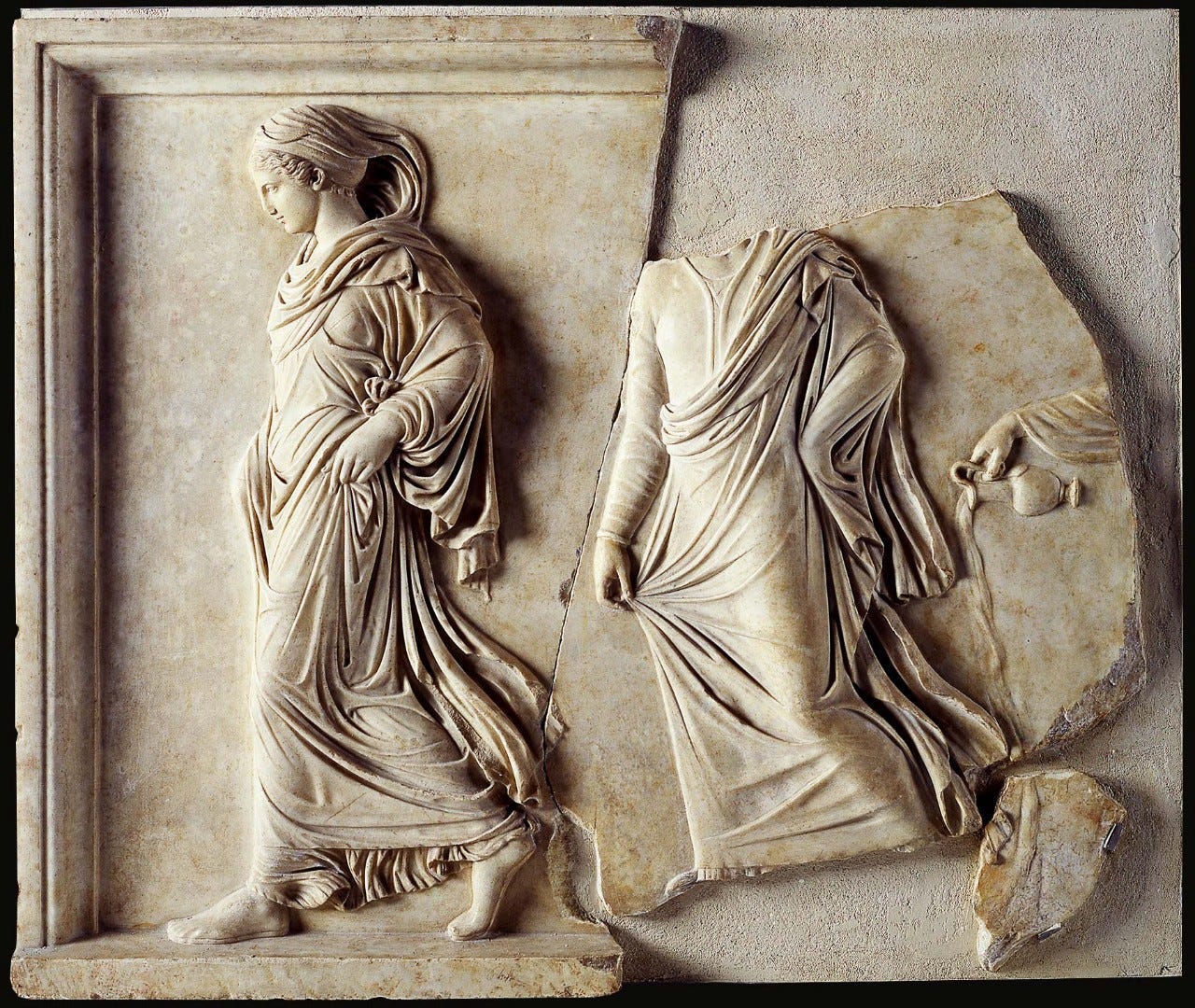
The learning of Rome, and of archeology, suggested a model both as tied to art and as objective in its referents, but dignified a field of interpretive action of digging for memories, removing them from the muck of their associations or even of the human action of embodied life. But the scalpel-like precision of the archeologist assembling and reassembling fragments to piece together a compelling narrative of a past mystery–as much as plumbing the messiness of sexual memories. The emphasis of Carlo Ginzburg on the reading of clues in the dream-interpretation is perhaps a “paradigm” of study, but was dependent on the visual nature of evidence that allowed Freud to put dream-interpretation on secure footing, positing the individuation of key traumatic memories in dreams or psychic visions as a condensation of meaning in one moment of personal history. (The figure of the Gradiva to which Freud kept returning was an image of the Eleusian mysteries of rebirth: the secrete rites depicted by the dancing Maenads that the figure of Norbert Hannold saw, so crucial to the defining of psycho-analysis as a resolution of neurosis, is from a dancing group of Maenads engaged in the most secret of ancient religious ceremonies, but is taken for the striking figure of an individual woman: is the ancient mysteries, associated with an annual fertility rite and the return of Spring, to which only initiates and priests were allowed to see or participate, and ceremonies of initiation thought to have been accompanied by a psychoactive stimulant. The rites, often reproduced in reliefs, became a basis for Carl Gustav Jung to understand psychoanalytic treatment, long after Freud; as a reconciliation with death, the mysteries suggested a cartharsis Freud was increasingly understanding as a moment of psychic cleansing able to eliminate hysteria by its roots in one’s memory by calling it to conscious awareness. Was this present in the frieze?)

Yet the personal history that Freud sought to elevate by dream-interpretation was doing a lot of lifting, borrowed from the excavation of archaeological diagrams of a collective European past. The pervasive network of roads Roman endures as an overlay of imperial roads, present to most students in the nineteenth-century, whose elusive coherence as an “Orbis Romani” and “Imperium Romanum” was widely studied in cartographic form. From the time of their printing as teaching aids in post-Napoleonic Europe through the emergence of archeological sciences, included the 100,000 km of ancient public roads as the nervous system of its imperial unity, the image of a Europe that was continuous and defined–as much as a network of nations or a puzzle of territorial clusters–provided a new image of the peace at the end of the wars, and of a coherent culture.

Keipert, “Imperium Romanum” 1858, Edinburgh (Courtesy Donald Rumsey Library and Map Collection)

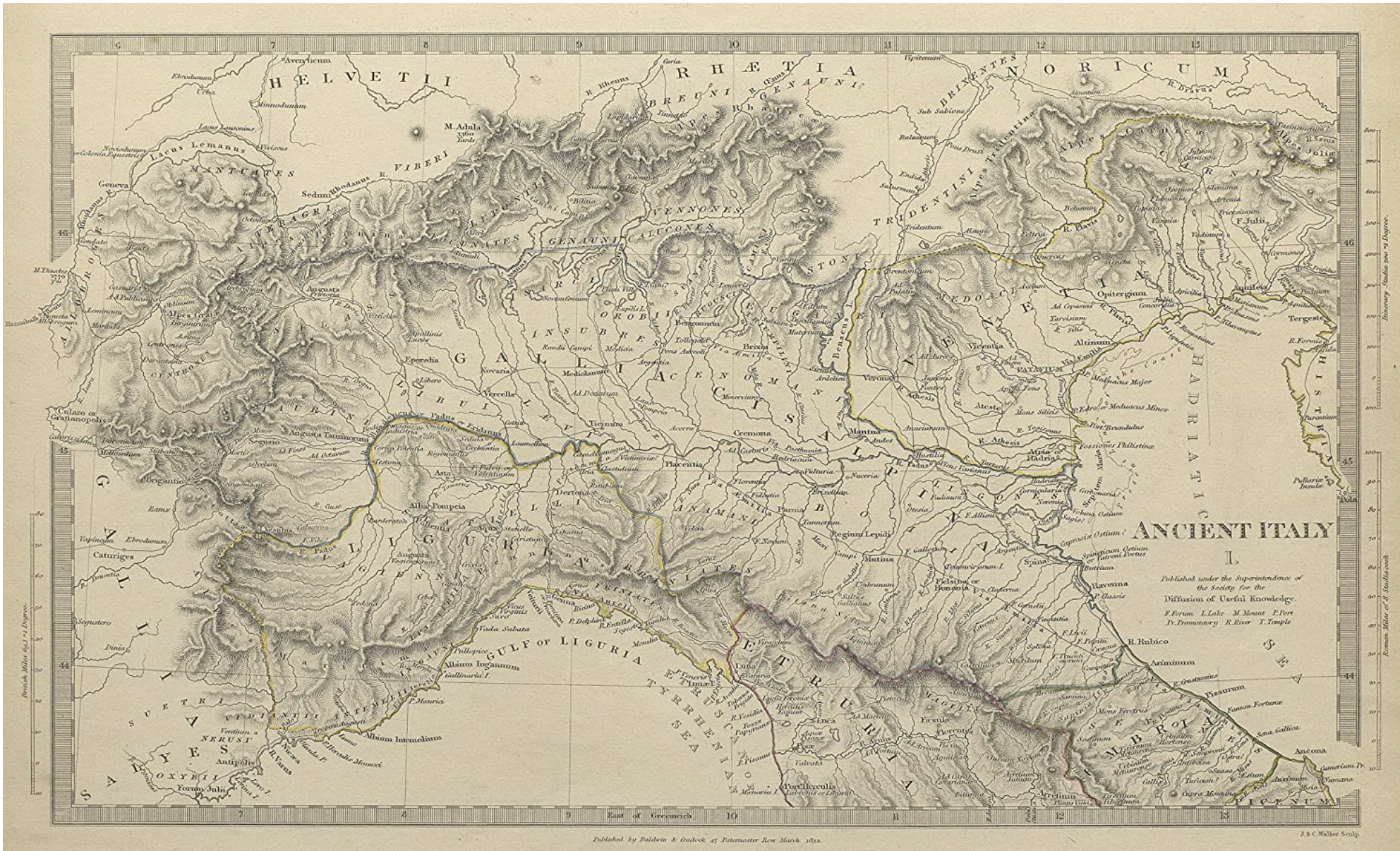
The diffusion from 1844 of a strikingly map of the roman public roads in “Ancient Italy” produced by The Society for the Diffusion of Useful Knowledge may have aided Emerson to treat the road network nothing less than a template of human knowledge, if not a common point of reference for learning, if not for reading works of ancient Roman history.

We may be compelled to apply the same data driven images to ancient Rome, driven due to our own continuing and increased disorientation on the proliferating data maps.  But does their logic maintain the complexity of time, space, and place in the ancient world, or how might it better attract interest, by casting the map as a site of investigating not only space, but time? In Ralph Waldo Emerson’s “History,” delivered about 1836, Emerson felt compelled to locate the beginning of the history of man’s relation to nature in the “life is intertwined with whole chain of organic and inorganic being” from the totality of how Rome’s system of “public roads beginning at the Forum [that] proceeded north, south, east, west, to the center of every province of the empire, making each market-town of Persia, Spain and Britain pervious to the soldiers of the capital” as an image of the extension of the individual ties to the world by pathways extending from the human heart.

Ancient Italy, Society for the Diffusion of Useful Knowledge (1832, rep. 1844)

Emerson long preceded Freud, of course, but eerily echoed his points about human psyche when he waxed rather eloquently that as the organic looking map of roads of the Roman Empire, “man is a bundle of relations, a knot of roots, whose flower and fruitage is the world.” Emerson’s notion of the individual as a changed by engagement in nature, and hence always in flux, sharply contrasted to Freud’s famous sedimentary construction of the human psyche in terms borrowed from archeology, but both are searchingly constructed not only in cartographical terms, but in reference to tactile maps of Rome’s past.

mobility fingerprint ROme

The start of these roads–in the below visualization the light blue point anchoring a record of ancient Rome’s primary routes of travel–marked the Forum, the very site Edward Gibbon claims he conceived the scope and scale of his multi-volume Decline and Fall of the Roman Empire (1776), and, if the point is taken as the city of Rome, where Freud attempted to reprise Emerson in more positivistic terms, in the famous figural description of the temporal layers of personal experience existing as so many archeological strata or laminated sheets of time in the human brain, telling readers they might understand the psyche if they “suppose Rome is not a place where people live, but a psychical entity with a similarly long and rich past,” before, out of frustration, abandoning the metaphor as a way to grasp the interaction of personal history in the mind, before admitting a spatial analogy not able to capture the historical landscape any psychical entity creates.

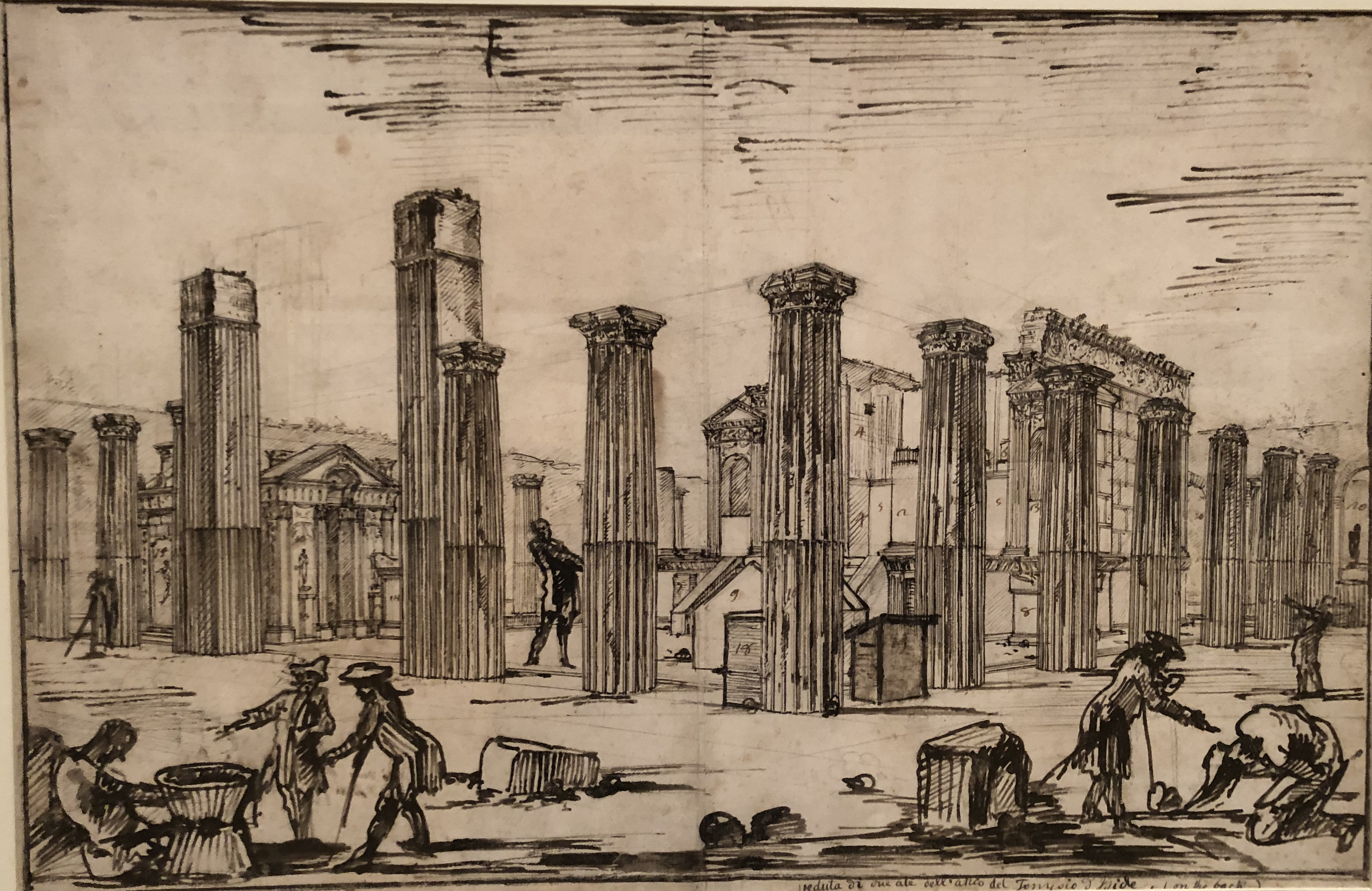
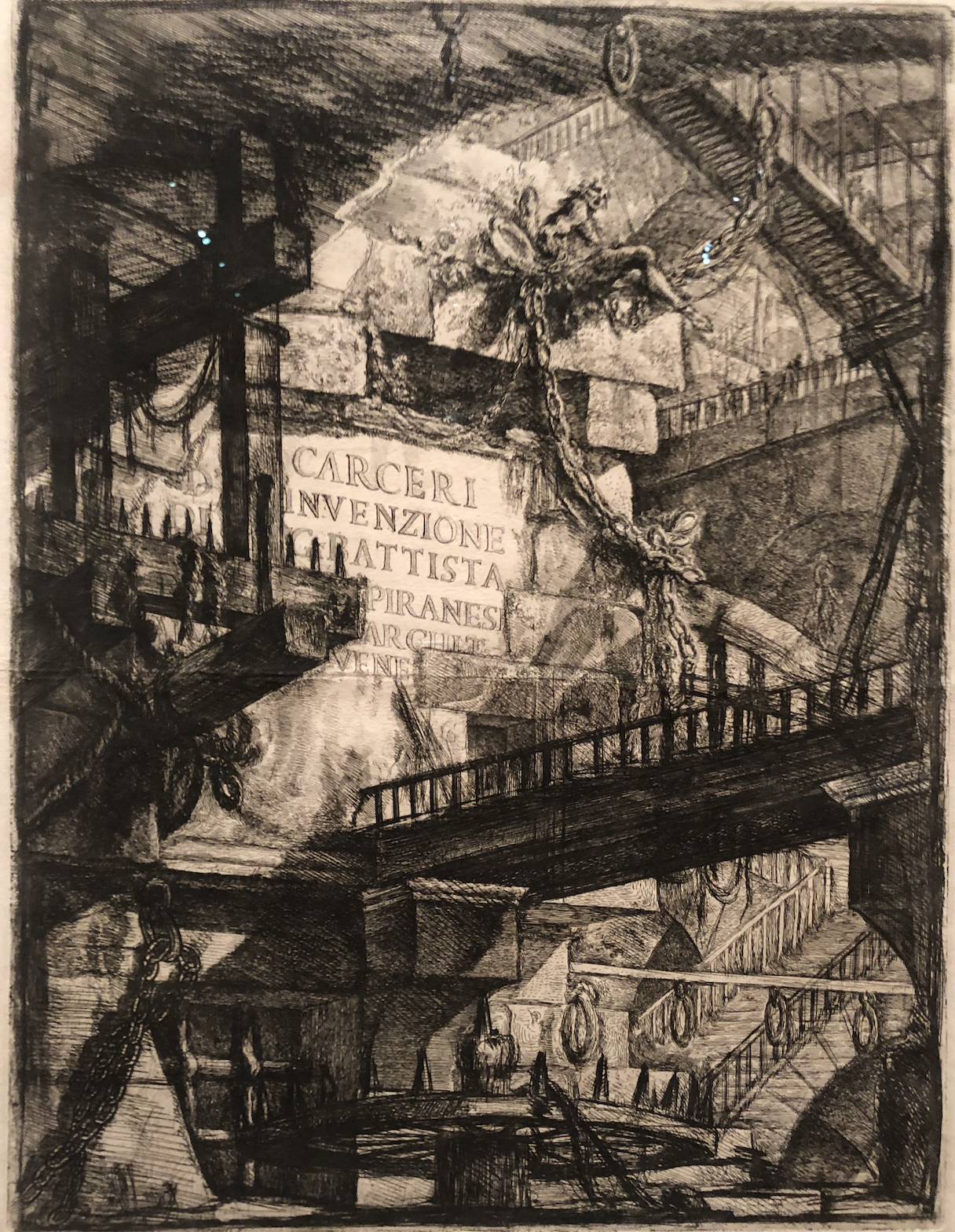
The imagination of Rome as a “universal past” may be deemed overly Eurocentric and dated today, but the cartographic origins of Freud’s hopes for promoting access to the multi-planar or multi-dimensional nature of psychic realities have been less grasped as a model not only of universality, but of the legibility that maps claim to provide, untangling a network not only of roads but allowing the eye to untangle historical periods, by a palpable relation of the past. The image of access to the past through its material structures was offered nowhere more than in the engravings of the architect artist who oversaw the excavation of Pompeii–Giovanni Battista Piranesi, architect and archeologist as well as accomplished draftsman. Piranesi was involved rooted in the esteem of archeological investigations, whose artistic cartography became a guide to the ruins of Rome’s classical world. Venetian-born, his virtuosity became Rome’s perpetual touristic visual guide, who had oriented Enlightenment Europe to its ruins, unveiling the hidden pasts eighteenth-century Enlightened tourists looked to orient themselves to Rome. If Piranesi began exploring the cavernous monumental ruins of Rome soon after he was –working to realize Clement VIII’s program of a new classicized monumental architecture of the Lateran church and other cathedrals–only to end his career designing imaginary prisons whose cavernous interiors invention had a darkness perhaps with other metaphorical parallels to Freud’s excavation of the unconscious.

But that is another story, less tied to the architecture of the ancient world, more to the monstrosity of modernity than the archeology of the past, or the pastness of the past. If Piranesi in the 1770s captured the astounding recovery of Pompeii’s Temple of Isis with an unimaginable materiality of a recovery of the past, akin to a time portal–the ruins of the Temple were European-wide phenomena of a physical, tactile recovery of Roman ruins seen mostly as fragments after their archeological discovery in t1760s–spaces to navigate and explore among erudite and learned voyagers, akin to the entrance into another world by an unimagined or unimaginable portal, whose drawing sought to capture the astounding contact with a lost past era–

–Piranesi would only later turn, as Freud turned to the prison of consciousness, to the terrifying recovery of the prison ruins of his later invention late in his career as a prolific draftsman of the uncanny the are able to be taken as illustrations of the psychosocial prisons of modernity.

Perhaps Piranesi’s actively broad reflection on the imagining and imaging of Rome’s pasts was born out of the attempt to map the network of travel from and to Rome. The success of mapping the distances of travel from Rome on Roman roads, that might have some power as an organic material manifestation not only of the past, but of the Emersonian idea for seeing the roads of Rome as a master metaphor for man’s relation to nature or to the natural world–but raises questions of the deep power not of Rome’s universality, but the power with which cartographic attention has so valiantly attempted to use its tools to untangle Rome’s pasts.

Moovel Labs, 2019

Despite the limitations of their coverage of space, and the limited benefits of imagining the ability to measure times of travel or distances to monuments as a record of ancient space or Roman life, it is tempting to be satisfied with placing it in a network. For to do so offers a way of envisioning ancient Rome as a mega-city and hub of transit.  But the erasure that this brings in humanistic experience of the map is striking.  If we now move to Rome on paved roadways with utter facility and ease, the sense of unpacking Rome’s significance in the European landscape–or its significance in time–seems washed away in the data map, as if the historical significance of what was once understood not only as a historical center, or center of cultural ties, but the focus of a network of paved roads that united the Roman Empire is all but erased, and is now only an example of the visualization of urban mobility, and of a time when all roads might lead to a privileged city–Rome. There is something suspicious utopic at foot, if also something visually entrancing.

The risk of a loss of materiality is steep: for we seem to lose a sense of the presence of the map of the city, visualizing the distances of travel, costs of economic transit, and time of travel in a web of commercial exchange we both project back our own sense of disorientation.  When we use modern notions such as that of the urban mobility fingerprint as the folks at Moovel labs did in concretely visualizing the medieval saying that “all roads lead to Rome” in its  project of mapping distances from the ancient city, we run the risk of insisting on the transparency of data, reducing maps and the pattern of mapping to a substrate of spatial relations sufficient in an almost ahistorical sense, and risk asserting the authority of an app over material processes of building and mapping Rome across time.  

Continue reading

Leave a comment

Filed under ancient Rome, cultural memory, data visualizations, Rome

Mapping New Worlds on Eggshells: Adventures in the Artifice of Renaissance Map-Making

We have learned to expect to pause as Google Maps draw boundary lines, extending to new tiles which soon take forms bounded by in clearcut lines across uniformly flatly colored quite static blocks, as data streams materialize forms from blurs that delineate highways, city blocks, state boundaries, and mountains in gray, green, tan, or light blue–a poor surrogate reality that strongly contrasts to the vivid ways we experience space in early modern maps and globes.

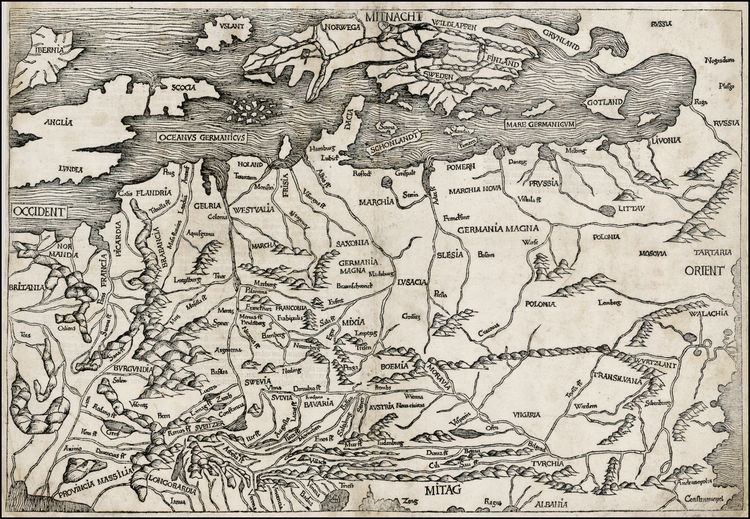
 The convincing nature of the watery globe was far more pronounced in an era when the ocean provided the only medium for global travel, to be sure, and the immediacy of rendering oceanic space far more of a concern of global mapmaking.  (Indeed, for a more extensive consideration of map authorship and the concerns of its representation of oceans, see my post on its mapping of ocean waters.)  The  medium of the woodcut presented unique challenges of mapping the circumambient oceans, not defined by clear routes or itineraries, but as a unique medium of travel. The curving lines that lapped the shores of inhabited lands in an early map of northern Europe, reprinted as the endpaper to a universal history, the Liber chronicarum, ad derived from a map of northern Europe before the “discovery” of the New World, that set places and regions in northern Europe apart from a wavy sea–

33675mp

The northern seas are denoted by individual lines echo a global bifold map the same 1491 Liber Chronicarum, just predating the discovery of the New World, a detail of a crudely engraved world map in which one sees swirling waters that encircle the island of England and indeed all of Europe–and make one think of the difficulties of reconciling and bridging different registers of mapping land and sea for readers in the late fifteenth century.

Ocean curves.png

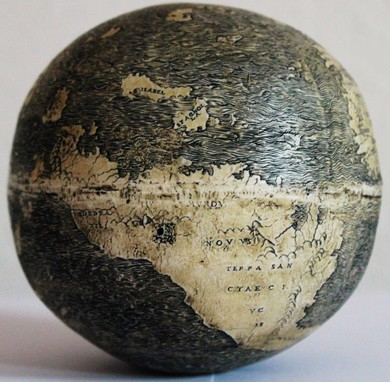
Unlike the on-screen conjuring of a demarcated space, the design of early modern maps invites detailed examination.   This undated miniature globe, engraved with considerable care on a two conjoined halves of two ostrich eggs, the size of a grapefruit, invites viewers to sail on the seas that swirl around a record global totality as something like a surrogate for actual world travel, its carefully worked details leave a clear trace of the hand, if not betraying the new phenomenological properties of the surface of engraved maps.

Although maps are often though of as paper constructions, the new properties of synthesizing land and sea in Ptolemaic maps are quite similarly approached in the very unique surface of this strikingly tactile engraved map–joining rounded halves of ostrich eggs–

Ostrich Egg Globe (1504)

–invites a distinctive attention to similar circumambient waters, which flow about the continents on whose surface we can see clearly engraved and legible toponyms: the seas are far more murky, as if they land had been the only legible area that was raised from their depth. The raised nature of the terrestrial surfaces on this globe–where the oceans are literally scratched away form its surface, as are the chains of mountains, coastlines, capital letters indicating terrestrial regions, and limited toponymy, suggest a marvel as much as a terrestrial map, and remind us of the interlinked discourses of maps and marvels, and the collection of curios as vehicles and mediums of geographic knowledge.

The engraving of a newly imagined expanse reported in marine charts created quite distinct operations of visualizing a newly materialized space–it displays one of the first maps to be printed that showed the New World’s form and recalls  the earliest printed images of North America.  The islands of “Spagnola [Hispaniola]” and “Isabella”, barely balanced with the huge area that it assigns to the Land of Brazil, or “Terra Sanctae Crucis” in something like an antipodal balancing act of continents around the equator, opposed in counterpoint to the Eurasian expanse. The coverage of the watery surface in the globe–which is in fact mostly covered by water–is even more pronounced in this apparently unique globe, composed of joined shell-like structures, treating the durable surface of the shell to create a luxury globe, which cannot, in its own way, but recall the famous apocryphal story of Christopher Columbus displaying the invention that was widely associated with cartographic modes for displaying the New World in flat maps, by challenging “lay a wager with any of you, that you will not make this egg stand up as I will, naked and without anything at all,” related in Girolamo Benzoni’s 1565 Historia del Mondo Nuovo [History of the New World], to compare the achievement of his discovery of the New World from “great men clever in cosmography and literature,” by the act of forcing the egg to stand on a table by allowing one end to be placed on a table as a support.

The eggshell map has no broken ends, but in its newly discovered form indeed stands on a table, allowing the observer to view to ponder the entire spherical surface of a globe, engraved on two ends of an ostrich eggshell, perhaps originating from a princely zoo, that lent itself to offer an exotic surface of cartographic demonstration to its privileged owners, quite unlike the manuscript or printed maps that are associated with early maps o the New World in the materiality with which it suggests the long voyage across oceanic expanse to reach a geographically enlarged (and now clearly out of scale) image of the New World islands, north of a creative rendition of a newly discovered South American coast, identified as the Terra Sancta Crucis, as if to retain the Christian eschatology even in the revelation of a world whose form seems foreign to whatever geographic knowledge is revealed in the Bible: the new islands of Isabel and Spagnuola are themselves court creations of Columbus’ royal patrons, and inscribe claims to sovereignty to these new lands, but the invention of the ostrich globe, recently discovered over four centuries after the discovery of the Americas,

Did the discovery of this inventive form of globe-making, unprecedented in the literature, link inventively, artifice, mapping and eggs that afforded a basis for Benzoni’s apocryphal claim?

New World in Ostrich_egg_globe

If the opposition of these continents in the ostrich-egg globe betrays significant cosmographical learning, the map itself reflects curiosity in the first mapped images of the New World, and a particular care to the definition of the coastlines of the newly found land masses we now call continents.  The exquisite care and delicate relief of the globe’s surface in this delicate construction made from two ostrich eggs has been recently dated to 1504 by its shell-density, based on a CT-Scan.  If the date can be ever established conclusively, the globe is one of the first images of the New World to have migrated from Portuguese marine charts to a particularly skilled level of craftsmanship, predating some of the known bronze globes of terrestrial expanse it resembles;  the image of Europe, Asia, Africa and the Land of Brazil could be scanned in analogously crisp detail to known early sixteenth-century globes and printed map-gores.  Indeed, the range of graphic tools engravers developed for embellishing the surface of maps set something of a standard for scanning land and sea, as their exquisite tones of shading increased the persuasive range of graphic forms that the anonymous artisan who made this eggshell map exploited to delineate the inhabited world.

Continue reading

Leave a comment

Filed under early modern globes, histories of discoveries, Mapping the New World, New World, Renaissance Discoveries

Mapping Land and Sea in Venice (and Elsewhere), ca. 1500

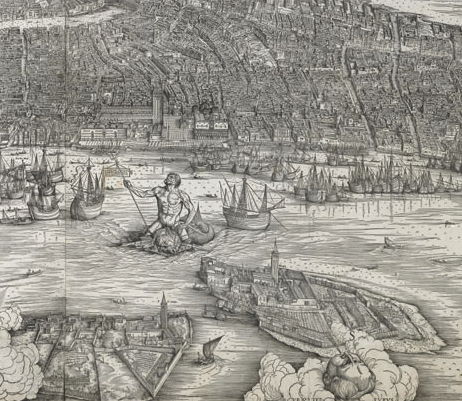
The medium of single-line engraving provided an expressive medium for organizing the continuity synthetic maps of land and sea long before trans-Atlantic travel was available to most.  Mapping beyond one’s place or region is a specific area of expertise; it is not surprising that it is a difficult competency to define.  It’s long been observed that the manner in which engraving produced an exactly replicable visual statement brought a variety of levels of expertise to bear on the map, both as a repository of collective visual memory and a coherent visual statement designed to orient readers to the notion of a uniform space.  But it’s interesting to consider the local differences in how a coextensive notion of space was understood to be composed of mapping the integration of land and sea:  and the understanding of the political power of the Serenissima–and the authority of the Venetian senate–as extending “onto the salted waters [sopra le acque salse]”–suggested a unique model of imagining worldly rule that uniquely inflected the construction of a cartographical space.

The transmission of the concept of a map of uniform coverage–one first expressed by the second-century Greek astrologer and mathematician Claudios Ptolemaios [Κλαύδιος Πτολεμαῖος], bequeathed to us as simply Ptolemy, provided a template to illustrate the expanded edges of the inhabited world in the editions successively translated in early modern Europe considerably before maps of land were fully integrated with maps of sea.  Translation of the forms by which Ptolemy mapped an inhabited terrestrial expanse not only to superseded the inhabited world as Ptolemy had described it and imagined it, but broached a different model of continuity within visual form:  epistemologically distinct spaces of travel that corresponded to different forms of mapping were joined in a Ptolemaic planisphere, as were the distinct competencies of mapping, in what might be profitably examined and studied as a ‘trading zone’ of varied forms of technical skill.  In Venice, perhaps, more than in other sites, the city offered a site connected by sea to other regions, and was a bit of an active trading zone of linking maps of water and land as Ptolemaic maps attempted, less constrained by territorial bounds, and more attentive to unifying the different metrics and scales of global mapping than many other engravers of global maps.

The image of the Venetian ties to the Mediterranean world and Gulf of Venice were rearticulated in maps, ordering a relation to a global expanse by nautical charts that had enjoyed broad currency in the city, and provided a cosmographic authority to articulate Ptolemy’s authority as a description of a terraqueous expanse.


1.  Mapping Land and Sea

Techniques of artistic engraving offered a matrix in which to synthesize mapping forms from the fifteenth century, and the medium increased a synthesis of formats of mapping, as well as a the demand for maps as reproducable forms.  As much as benefiting from Ivins’ useful characterization of the innovative ways that print afforded “exactly reproducable graphic statement,” engravers’ skills provided a way to transmit the map as a graphic form.

The Dutch engraver and cartographer Mercator in 1569 described his map as a synthesis of geographical maps and nautical charts:  in so doing, he modernized the projection of the map’s surface as a continuous surface.  In a unique and inventive way, Mercator assembled a record of terraqueous expanse on parallels and meridians to address a large audience of readers by boasting of his ability to bridge the distinct media of nautical charts of the ocean with geographic maps–whereas the Ortelian “Typus Orbis Terrarum” of 1570 directly below displayed traveling ships, riverine networks, and maritime expanse on curved meridians, Mercator’s projection distributes an inhabited expanse on perpendicularly intersecting meridians and parallels.  But both maps advance cartographical expertise as preparing a surface that could be uniformly scanned by viewers as a proportional and uniform distribution of the inhabited world.
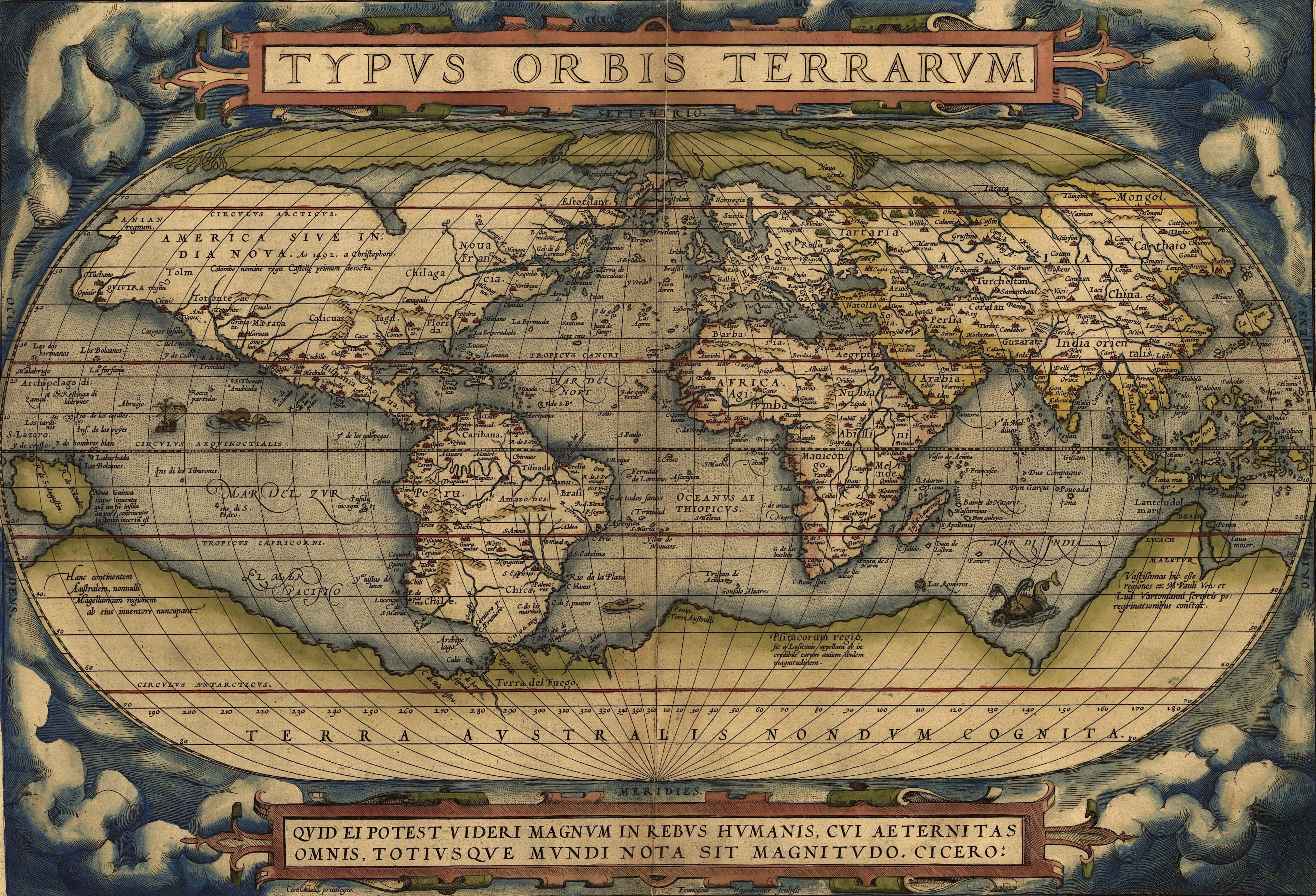
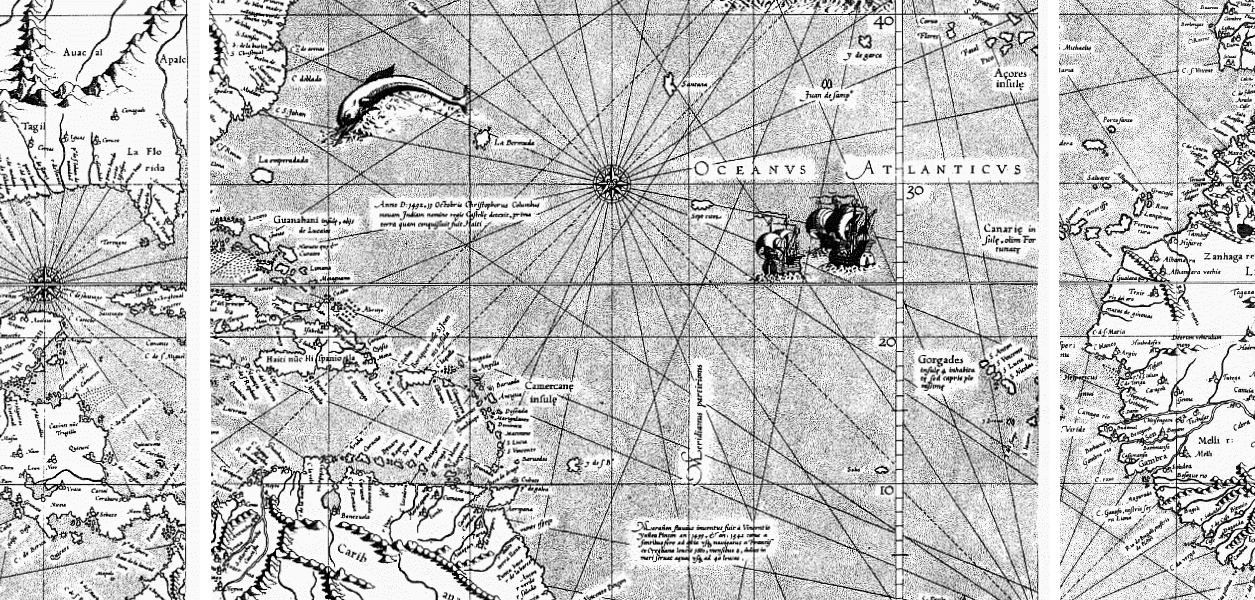
OrteliusWorldMap1570

Mercator Close-Up


Mercator did not explain the mathematics of a uniformly mapped space.   But the unique projection he devised gained broad authority by the seventeenth century as a means to visualize global relations.  Although the Mercator projection ensured that the loxodromic lines of nautical travel, denoted in charts by rhumb lines, would perfectly intersect with meridians, the straight parallels construed “ad Usum Navigantium Emandate Accomodate” was not adopted for sailing or for plotting voyages until the ability to measure longitude at sea–partly since he did not explain his method for calculating the “true course” on straight lines, but also since the media of terrestrial maps were so distinct from nautical or navigational carts.  But the combination of registers for noting nautical and terrestrial space, or imagining expanse on ship and on land, provided a major shift in maps’ graphic design and epistemological claims.

The gradual supersession of the autonomy of  sea-charts facilitated increased claims of realistic representation–or reality effect of mapping land and sea in a continuous frame of reference.  The combination of geographic and nautical charts to record of the known world in ways shifted how the world is known depended on acceptance of the descriptive potential of maps, as much as their accuracy or the use-value they gained to navigate in an era when calculation of latitude at sea depended on the sighting the altitude of the sun above the horizon and due course rarely achieved.  But the Mercator projection integrates land charts and marine charts to provide totality of global expanse.  This was the first age of globalism, and it could be readily understood.  The cognitive basis of maps as vehicles seems concealed in Cornelius de Jode’s presentation of Mercator’s projection as a “Totius orbis cogniti Universalis descriptio” or record of the known world in 1589, a decade after its appearance:  it offered tools for knowing the inhabited world as well as a record of the known world.

A similar visibility of the world’s surface was advanced in Cornelius de Jode’s later compendium of global coverage, which synthesized the conventions of nautical charts with the conventions of terrestrial mapping to create a convincing understanding of relationships between nautical travel and terrestrial expanse.
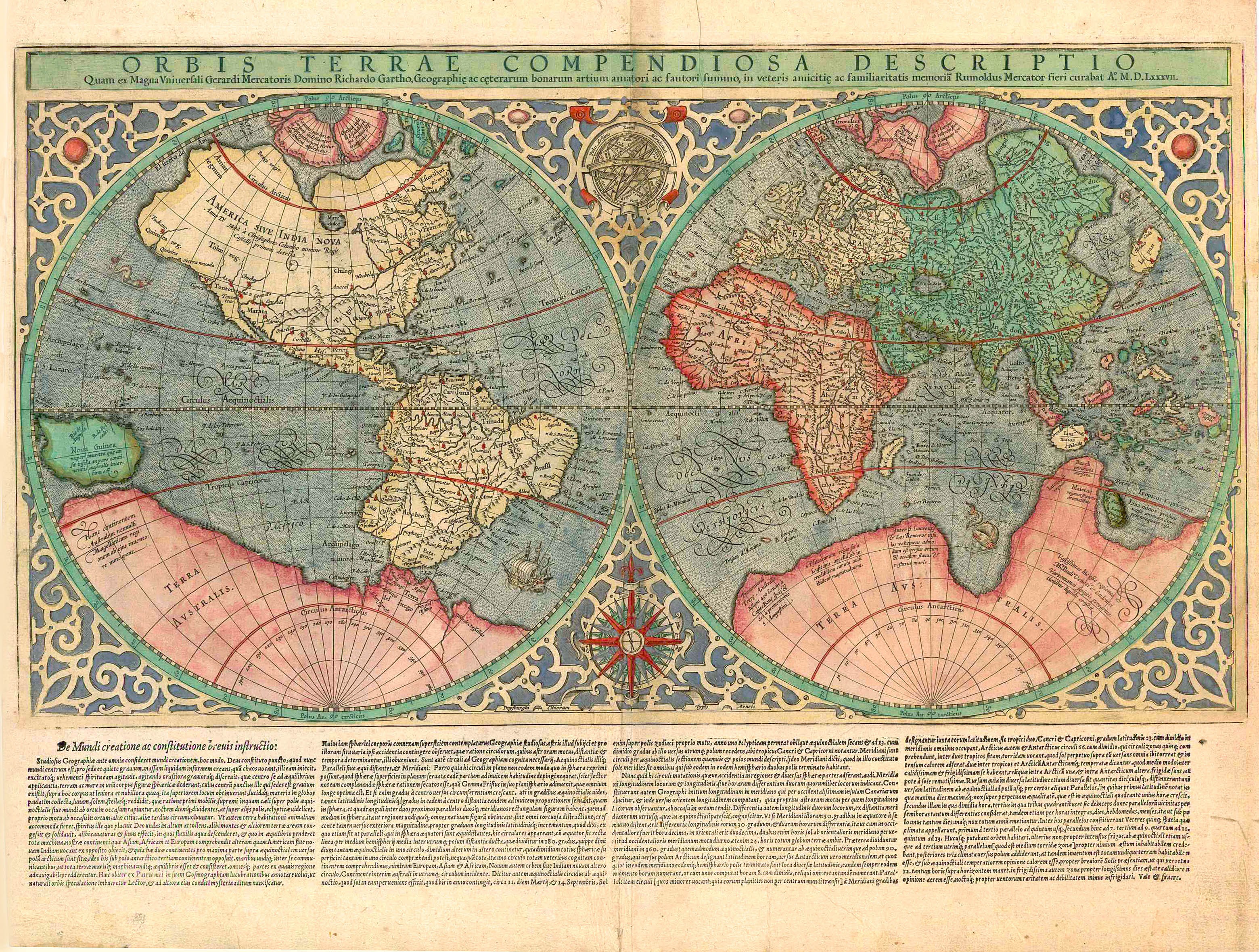
MErcator 1579

Such supersession of the conventions of mapping had to an extent previously occurred in the combination of results from different mapping formats in a unified cartographical space.  Yet even before Mercator devised this projection, sixteenth-century maps had synthesized the content nautical maps had increased the claims of realistic representation–or reality effect–in printed maps.  The graphic and pictorial detail and abundance of signifiers that was invested in Ptolemaic projections had increasingly shifted the status of the map from a schematic register which lay at remove of one from space, to a compelling synthesis of terrestrial relations for its viewer:  and the map became a surrogate able to stand in metonymic relation to a place it described, stood at the center of  modern claims of maps as forms of visual relation to space that could be inscribed with meaning.  Indeed, the combination of registers of terrestrial and nautical cartography compellingly joined areas of practice that had been kept previously separate formats of spatial descriptions, if not incommensurable registers of qualitatively different registers to chart spatial continuity.

Was this change in attitudes to the map partly enabled by the combination of registers of terrestrial and nautical cartography?   From previously separate formats of spatial descriptions, if not more significantly incommensurable registers of qualitatively different forms of space, the map’s surface became understood as a way to register motion through a uniform space and encounter places on a determined path of travel.  The use and status of the map as both a register and descriptor of expanse was already evident in the integration of nautical charts and Ptolemaic maps Bernardus Sylvanus designed in Venice after 1508, which, despite the notorious absence of coverage of North America and reduced coverage of the globe, had previously described a terraqueous unity in compelling–and readable–ways by explicitly combining what had been seen as incommensurable orders of registering expanse.
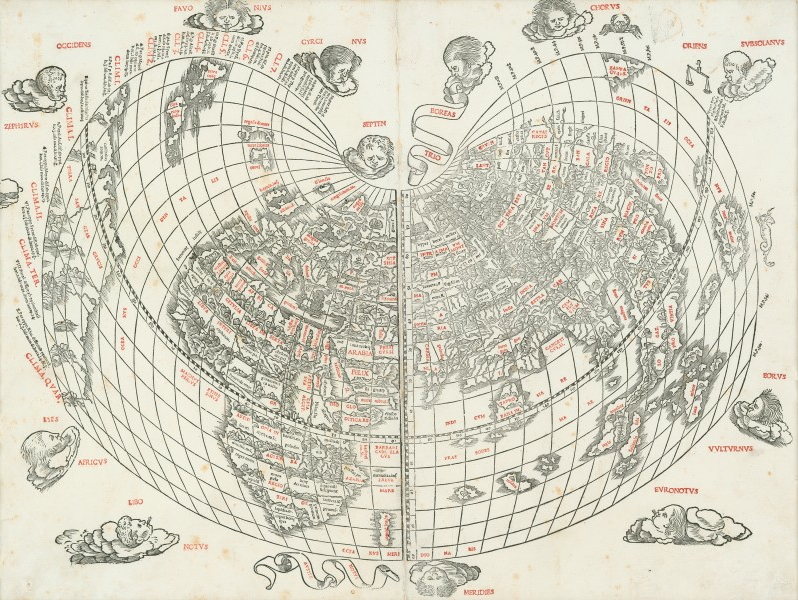
Sylvanus PLanisphere--close up

The legibility of the 1511 projection of Sylvanus was both very contingent and local in nature, despite the universalizing viewpoint it prepared of the inhabited world.  When Sylvanus, hailing from Eboli, possibly also an illuminator of erudite texts, undertook a newly illustrated printed edition of the ancient geographer Claudius Ptolemy’s  Guide to World-Mapping, known in the Renaissance simply as the Geography, he decided to create a more updated edition of comparative maps deriving from nautical charts collated by sailors and the set of maps transmitted in codices of the Ptolemy’s work of global geography.  The plans for a new Venetian edition had recently been abandoned, although several plates for it had been made and perhaps engraved by 1508, probably including a new world projection.  In confronting problems of modernizing the Ptolemaic maps, Sylvanus foregrounded the integration of islands and coastlines compiled in nautical charts in the maps transmitted in Ptolemy’s geographical treatise, translating the conventions for land-mapping into representational conventions from the graphic arts and advances of two-color typography:  the birds perched on the cornices of his map of Italy, the sixth plate of Europe, may echo the modern bird’s-eye view of the peninsula he offered, using nautical maps to present the configuration with a sense of naturalism often foreign to early printed Ptolemaic maps.
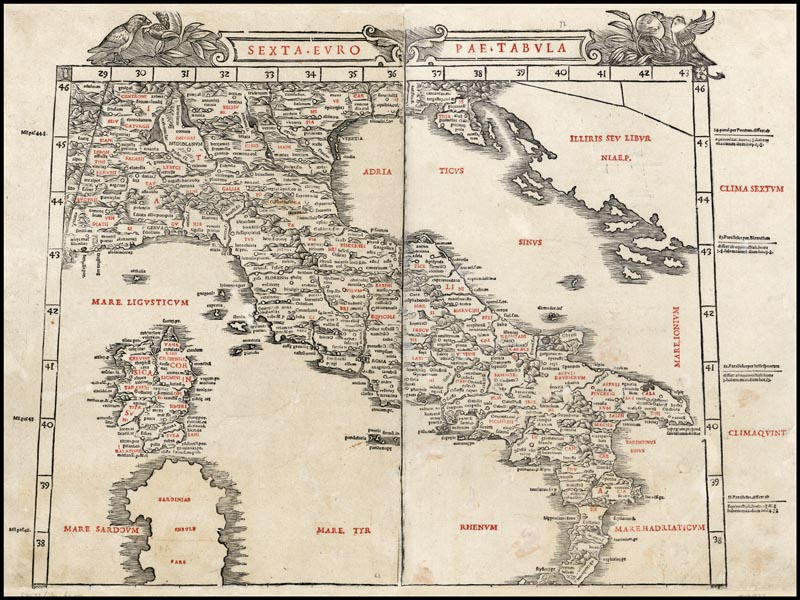
Sylvanus Italy--Europe 6

2.  Oceanic Space

The treatise that the second-century geographer titled a “handbook for drawing world maps” was both a technical guide and a compendium for drafting land maps.  But in Venice, a city of maritime trade, Ptolemy’s promise to collate and list a database of all the places in the inhabited world’s surface had potential appeal as incommensurate with the chart used to decide or compare nautical routes of travel, and posed a specific challenge to synthesize mapping forms.

These charts provided an alternate source of information that promised both to refine and expand the ancient geographer’s encyclopedic claims that led him to list names of ancient cities and noteworthy cities or rivers exceeding 10,000 in number–if the richness of Ptolemy’s text led erudite readers to consult his book with their manuscripts of Herodotus or Livy, as Bernardo Machiavelli–father of Niccolò–their elegant terrestrial maps they more often addressed learned readers and armchair travelers as surfaces often read in relation to other ancient texts, rather than graphic descriptions of expanse.  Indeed, their printers did not aim to address a larger audience of readers.  Yet even when presenting accurate place-locations in coastlines that resemble charts, the maps struggled to offer an easily readable surface.
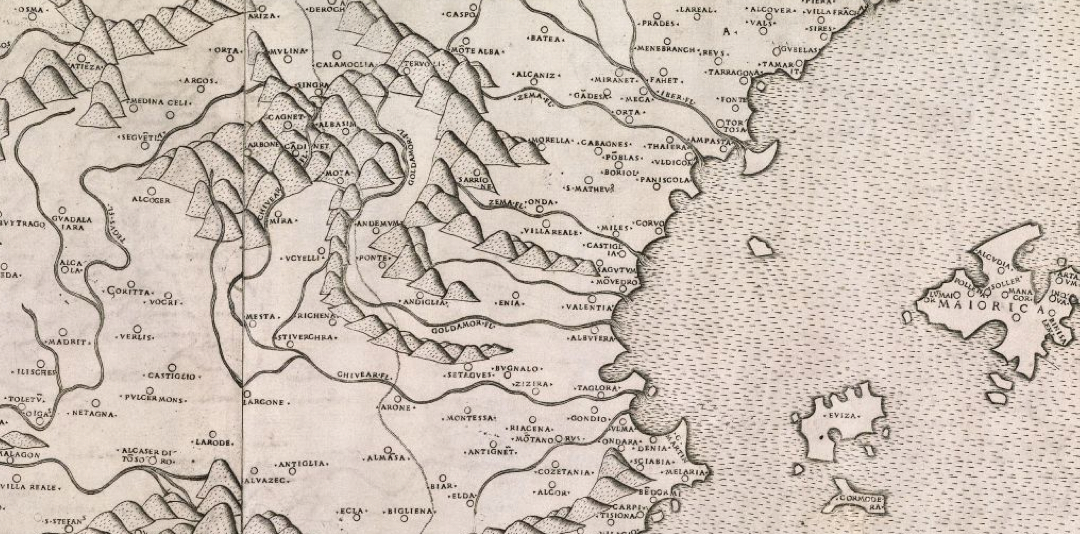
sugar hillls in Spain

The synthesis of a more legible cartographical space was foreign to earlier cartographical traditions.  The history of the transmission of medieval maps is considerably complex–as are the techniques of varied forms of map making.  Elizabeth Edson argued information from accounts of travelers, traders, and sailors became accomodated in world-maps from the early fifteenth century, joining travelogues that both expanded the content and challenged the parameters of earlier symbolic world maps.  The inclusion of information from travel accounts and nautical charts not only expanded the surface of maps, but posed complex problems of integration on parallels and meridians–a reproducible grid–and elicited potential graphic models for spatial representation over a century after its textual translation that lent formal authority to the world map.

The alternatives for such a synthesis were not clear.  The considerable questions that surround the transmission and construction of earlier manuscript charts, often drawn on sheepskin to guarantee their preservation and illustrate their value, are raised by the unclear relations between how the maps were transmitted and copied–if not created–given the unclear questions about copyists reliance on the intersecting directional lines that seemed sketched over their content in tracing coastal shorelines and locating islands, or how the skein of lines apparently determined from compass-bearings provided guides for nautical travel.  These maps were produced predominantly in port towns, as this Mediterranean chart executed in Alexandria by Jehuda Abenzara (or ben Zara), coastlines are crowded by names of coastal ports written perpendicularly to the shore, linked by a network or web of potential sea-routes that demand close reading and intense preparation by specially trained scribes:
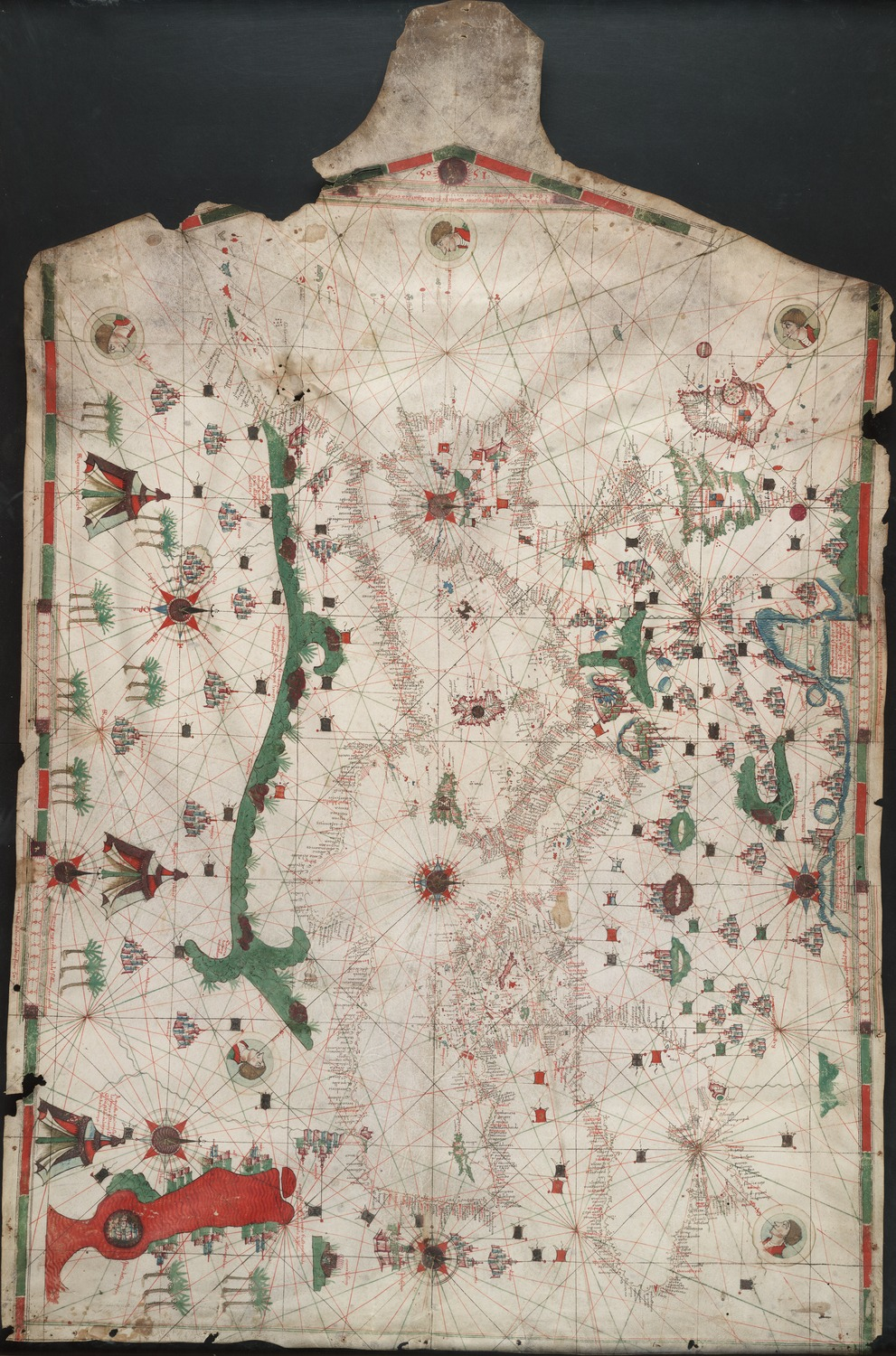
Jehada Abenzara

In port cities like Alexandria, chart-makers regularly synthesized and collated a sort of collective memory of varied routes of travel that might be on board any arriving ship, in the hope of piecing together these local records of coasts or island-charts to synthesize more expansive networks of trade with a degree of accuracy that minimized cartographical distortion with a precision that geodetic observations had not allowed.

The chart synthesized a form of collective memory, if the protocols by which its contents were transmitted are not clear:  the organization of a synthetic record of travels provided little more than symbolic reference to inhabited interiors, however, which in essence remained “off the map.”  Rather than a representation of terrestrial space, it primarily provided a record of the location of ports and idealized potential lines of nautical–rather than terrestrial– travel.
mostra-cartografia

The spatial mapping of coastal cities in the Mediterranean, and situation of coastlines in a broad nautical expanse–both in relation to both equinoctial lines and vertical bars of latitude however provided an alternate orientation to the network of the web of loxodromic lines of the compass rose.  The below schematic version of a portolan chart, signed by Juan de la Cosa of c. 1500, provided a distinct frame of reference and spatial indices to enumerate points of landing and prominent capes in the New World at different latitudes for its readers.
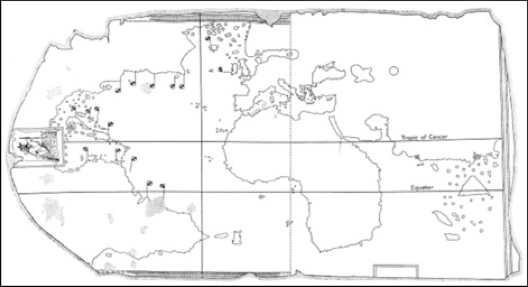
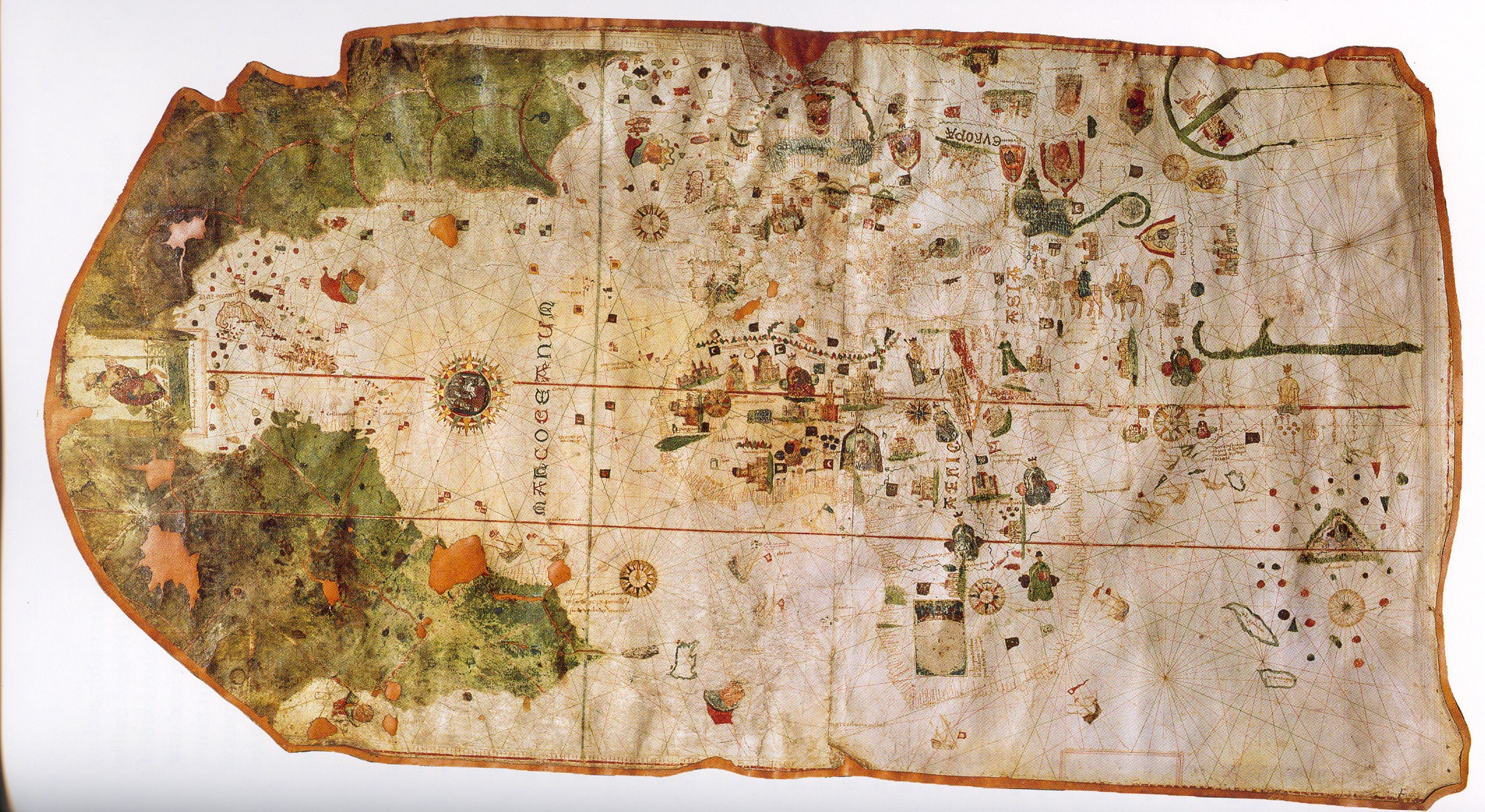
Wrote de la Cosa's c 1500 map

1500_map_by_Juan_de_la_Cosa


The parchment portolan chart stored in Madrid’s Museo Naval and made in the port city of Andalusia, Puerto de Santa María, was prepared for competencies of a restricted audience, with specific interpretive tools in mind–whether they were kept by captains, or by trading houses is unclear, as is the primary techniques they use to demonstrate relations of space.  By the fifteenth century, elegantly decorated versions became prized possessions among even landlocked elites–probably in copies that obscured or hid their own mercantile provenance and were designed to stake boundary lines of exploration or colonization in the New World, by demonstrating the boundary line of Tordesillas.  But although the competencies of mapping these documents enlist to render expanse are opaque, their synthetic construction have provoked continued investigation of their formal manipulation or symbolic construction of mapped space.

Some of the relevant underlying schema of the networks and constellations in charts have been identified, but their operative value is not known–were they of use for copyists in Salamanca, Barcelona, or Genoa, or were these keys that allowed them to be read?  The construction of scale lay in the relation among focal circles, wind roses, and loxodromic lines, as in this reading of the Cantino Chart.
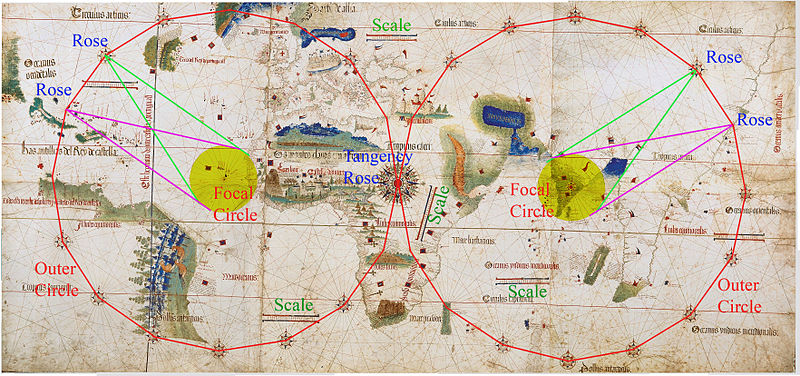
800px-Compass_grid_Cantino_planisphere_(1502)

Spatial position is not much of an apparent interest, however, so much as the collation of alternative networks of travel–or, in the case of some charts presented by the Spanish or Portuguese, to illustrate the meridian that demarcated colonization of the New World at the Treaty of Tordesillas.  The image of nautical continuity was a huge attraction for the humanist geographer Martin Waldseemüller, but his 1516 “Carta Marina” based on Portuguese marine charts like the so-called Cantino chart constituted part of his broader cosmographical project, but this image, discovered only by the Jesuit Josef Fischer around 1901, constituted an alternate model of cosmographical learning to his large world map of 1507, 4.5 to 8 feet, provided a wall-map whose comprehensive character was less successful in making claims for its legibility, if it invested greater artistic skills in converting the format of nautical charting to a legible form that Waldeseemüller had the projection engraved in the same dimensions.  This map printed on high-quality hand-made rag paper was only found in one sixteenth-century bound volume, but was a complicated investment, even more so than the cosmographical map that Waldseemüller described as having been printed in 1,000 copies.
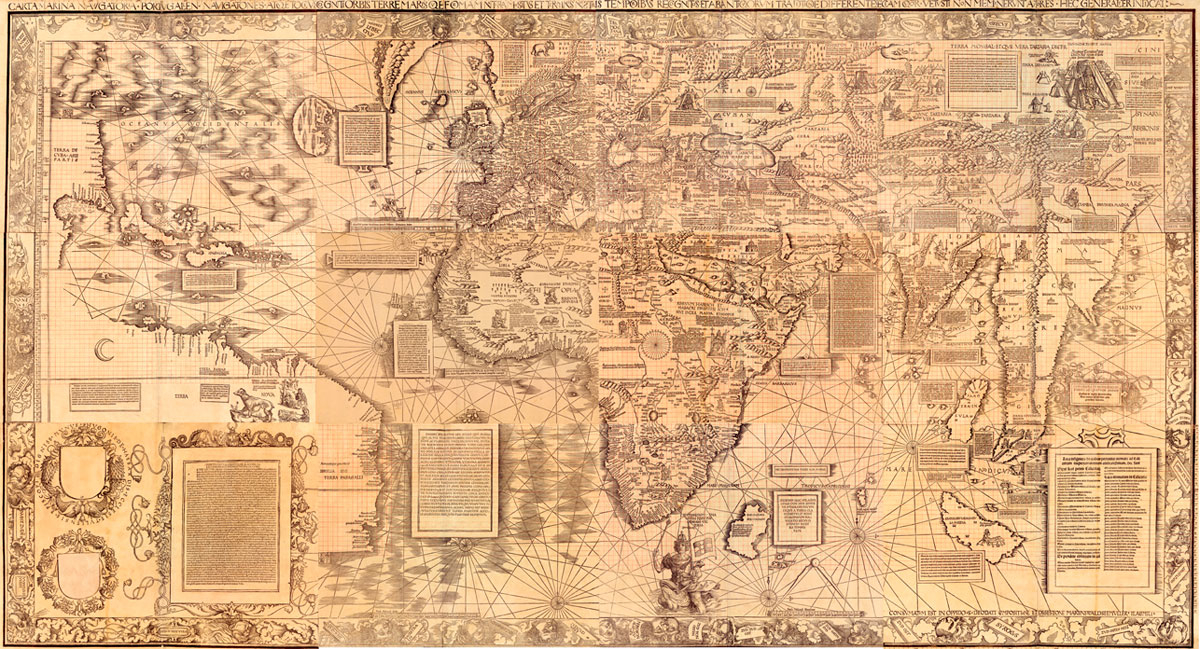
Carta-Marina-LG


Somewhat oddly, the map did not include the image of “America” surrounded by oceanic waters that distinguished the lavish cosmographic wall-map he had printed in 1507, and whose accompanying treatise described America as “an island . . . surrounded on all sides by sea,”  in his Cosmographiae Introductiomost probably because its sheets reflected the content of sea-charts–even if it superimposed an equi-angular grid that had little relation to the graticule employed in the terrestrial wall-map he had titled a Universalis Cosmographia.
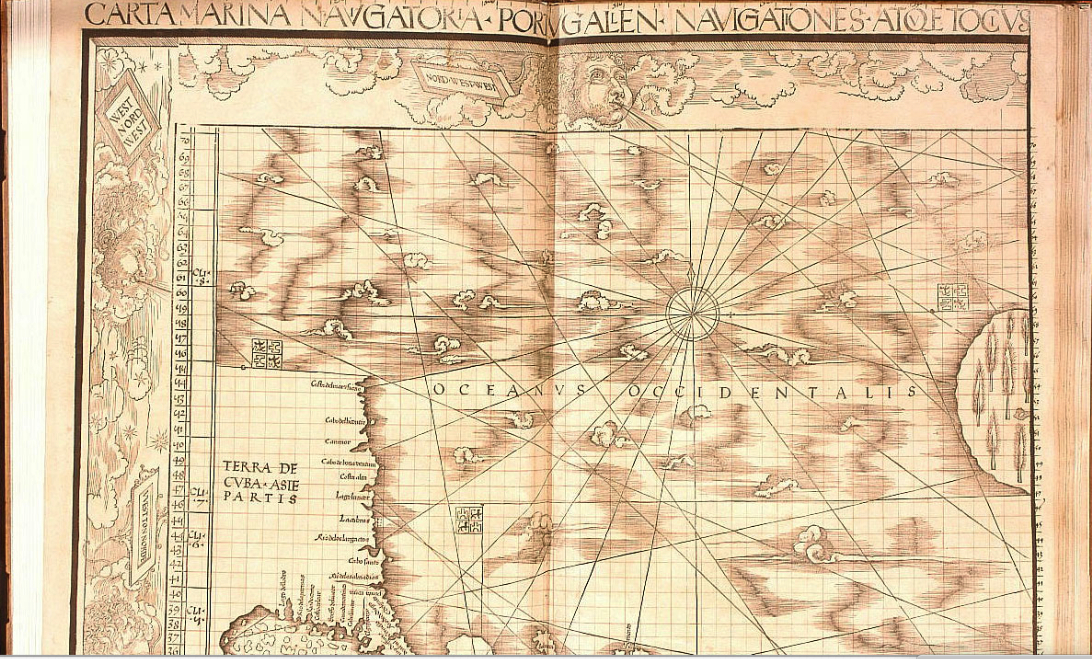
 

Oceanus Occidenatils


The two large wall-maps produced at the University of Vosges, then in the Holy Roman Empire, both only recently acquired and restored by the Library of Congress, enshrined opposed if  incommensurable models of world-geography at the very time Sylvanus prepared his own edition of Ptolemy’s precepts of geographic map-making and study of global geography.   Did the lavishly produced “Carta Marina” offer a counterpart to the geographic theorization of expanse that Waldseemüller had advanced in his cosmographical writings?  The ordering of Venice’s position in relation to a gulf, and to the expansive genre of island books or isolari printed in Venice and in Italy, provided a new way of describing Venice’s position in the world, and global continuity at a relatively early age.


3.  Envisioning the Continuity of Terrestrial Geography

The location of geographical in the continuous coastlines of manuscript nautical charts was hastened by a demand to process the over 12000 identified sites Ptolemy specified as able to be mapped in a format  which conformed to viewers’ expectations for representing spatial continuity.  And Sylvanus seems to confront this difference shift in collating nautical charts with other mapping forms in Venice around 1510,  in what seems a uniquely local manner to read a map’s universal claims.

The detailed coverage of the world’s surface in sixteenth-century Europe increased not only the coverage or precision of maps, I would argue, so much as the claims of realistic representation–or reality effect–of maps in critical ways.  Yet changing understanding of the map as a medium, as well, provided Bernardus Sylvanus with grist to collate nautical charts in a set of new conventions that created a uniformity among data of diverse provenance previously regarded as qualitatively distinct if not incommensurable orders of spatial description.  Although his exacting transposition of ancient names into modern outlines of land-masses ran against the critical project of comparing the ancient and modern worlds, the uniform conventions of maps he made presented a distinctly uniform continuous surface in images from charts.

For charts were less concerned with describing or denoting spatial location, than determining (and collating) potential routes of travel:  the conceptual mapping of routes of travel was rarely invested with descriptive force or value; its competency reflected applied knowledge.  The growing authority of the terrestrial map as a comprehensive description, however–one of the deepest of modern claims of maps as competencies rooted in visual design, rather than nautical knowledge–arose from the combination of registers of terrestrial and nautical cartography, previously separate formats of spatial descriptions if not more significantly incommensurable registers, in a sort of a trading zones of semiotic conventions from varied areas of life, which bridged or linked hitherto incommensurable formats to denote expanse.

As the rich spatial information contained within the medium of the chart was transposed to the surface of terrestrial maps,  something like a wrestling with epistemological claims for knowing space and locations seems apparent in the maps included in treatises of global geography first translated in the fifteenth-century, most particularly in Claudius Ptolemy’s second-century Guide for Drawing Terrestrial Maps, whose maps Renaissance editors of the treatise had increasingly invested with increasingly comprehensive ends–increasingly relying on the toponymically crowded but crisply defined coastlines transmitted in charts to blend seamlessly with inland areas.  The accumulation of local and pictorial detail to combine an over-abundance of signifiers altered the distinction between the land map and nautical chart, raising truth-value claims about the chart as a representation that stood at remove of one from the world that this post can only begin to suggest:  increasingly, the map became a place that could be inscribed with meaning, or became a register from which to relate to foreign lands, if not a substitute for them.  The diminishing authority of the chart lay partly in a limited ability to determine position at sea, but also a limitation of the ability for encoding further information in its content that would satisfy its audience.  Edward Wright observed the errors of sea-charts as a basis for calculating position in 1599:
EdwardWright-CertaineErrorsinNavigation-1599

A word or two about this complex treatise, abundantly overflowing with strange toponyms that elicited readers’ curiosity even if its content were difficult to translate into the standards of eloquent expression to which many of its humanist readers were habituated–leading some to indicate Strabo as–to quote Isaac Casaubon–the “summo scriptore, quod praeter acuratissimam totius orbis nunc cogniti descriptionem, tanta doctrina, tamque varia omnium rerum scientia refertum est, ea denique arte contextum . . .

Ptolemy’s expansive catalogue of locations had long demanded to be given a visual form.  The question of their visual coherence led some of his later editors to rely on nautical charts that included places Ptolemy had not indicated, but the nautical chart provided little analogous framework of coherence by which to grasp their situation in a continuous expanse.  The geographer Angeliki Tsorlini has recently employed digital technologies to map relative locations defined by the terrestrial coordinates in Ptolemy’s treatise in ways that reveal the very compelling map of Mediterranean cities his treatise would have offered.  Most of the cities are ports, located along the shore, to be sure, but a considerable number remain inland cities located with apparent relative precision, with minimal significant distortion for much of Italy, the Adriatic, and Greece.  The copious abundance of familiar locations and interest in their clustering must have increased demand for their depiction.
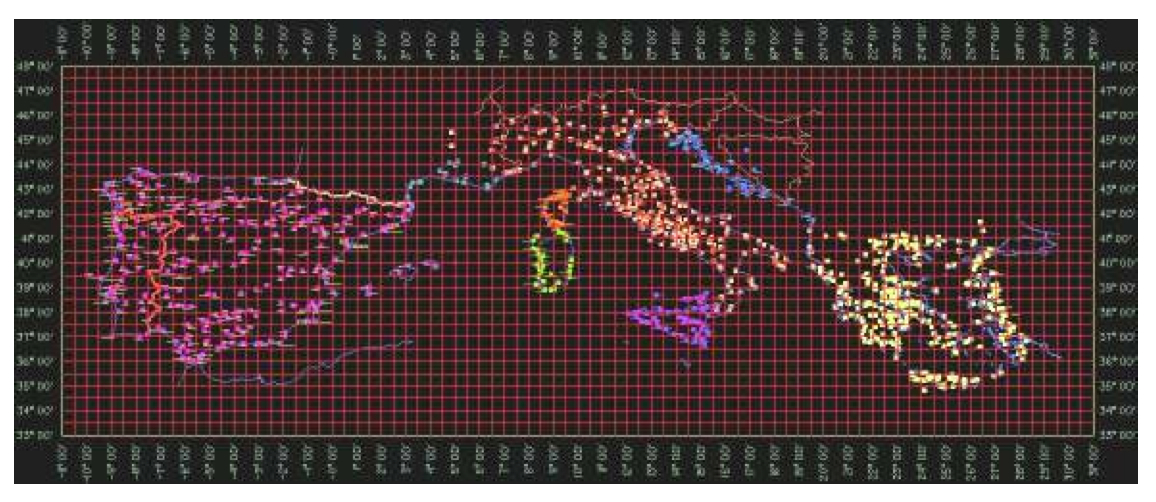
Place Names from Ptolemy in Modern Map Projection

In the first codex that arrived in Rome, found by Maximous Planudes in the late fourteenth or early fifteenth century, the abstract ordering of the situation and topography did not pose an intellectual problem of viewing space (Burney 111; British Library).  Despite the formal appearance of the island of Taprobana, thought to perhaps represent Sri Lanka, the red lines of parallels of latitudes and meridians of longitude in which Ptolemy argued geographic mapmakers could usefully divide the world for readers on measured units, provided limited claims to mediate a naturalistic image of expanse.
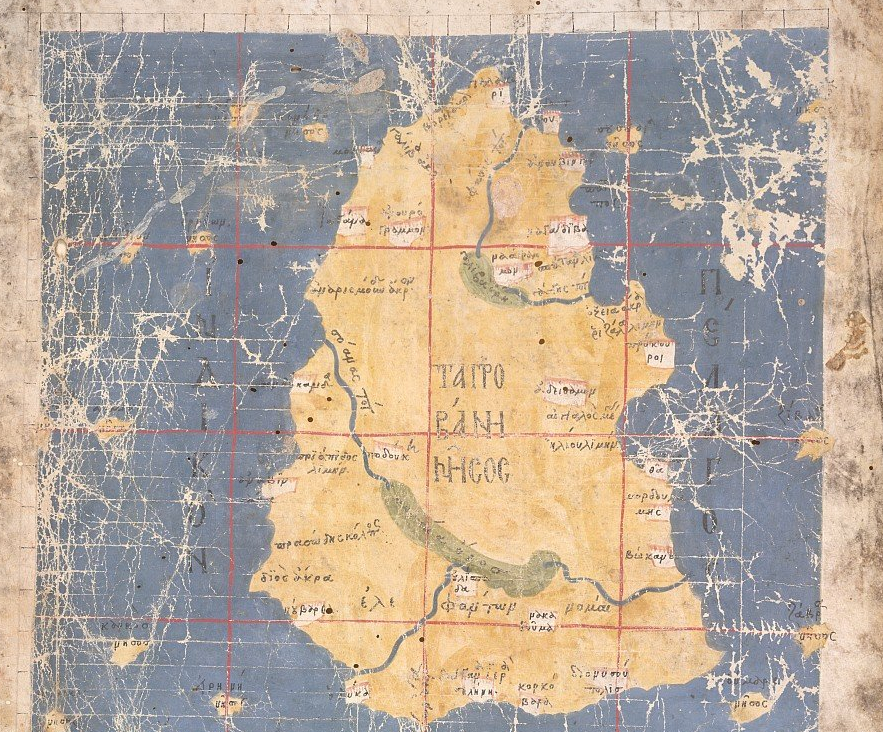
Maximous Planoudes' Taprobana

Planoudes was careful to note the precise location of places on spatial coordinates, but the metric values of locations were not presented as lying in exact correspondence to their spatial situation.  The illustration of cartographical images that expanded later codices of Ptolemy’s treatise worked hard to provide maps that were commensurate with the over 1200 place-names–including mouths of rivers, promontories, mountains, or landmarks–contained in his geographic compendia were sought to be illustrated in authoritative form.

As the work reached a large audience in manuscript, terrestrial space was presented in schematic terms, the maps seem to wrestle with the abstraction of space, as if in ways that could not be imagined in visual or pictorial terms as a surface that could be scanned, as is evident in this map of German lands in one codex of the Geography, which enumerated towns and rivers in a new abstract form, listing inhabitants and towns as in the Ptolemaic manner, with minimal recognizable guides or explicit orientational clues about their spatial situation and topographical location, even when that region lay on the margins of the Roman world:
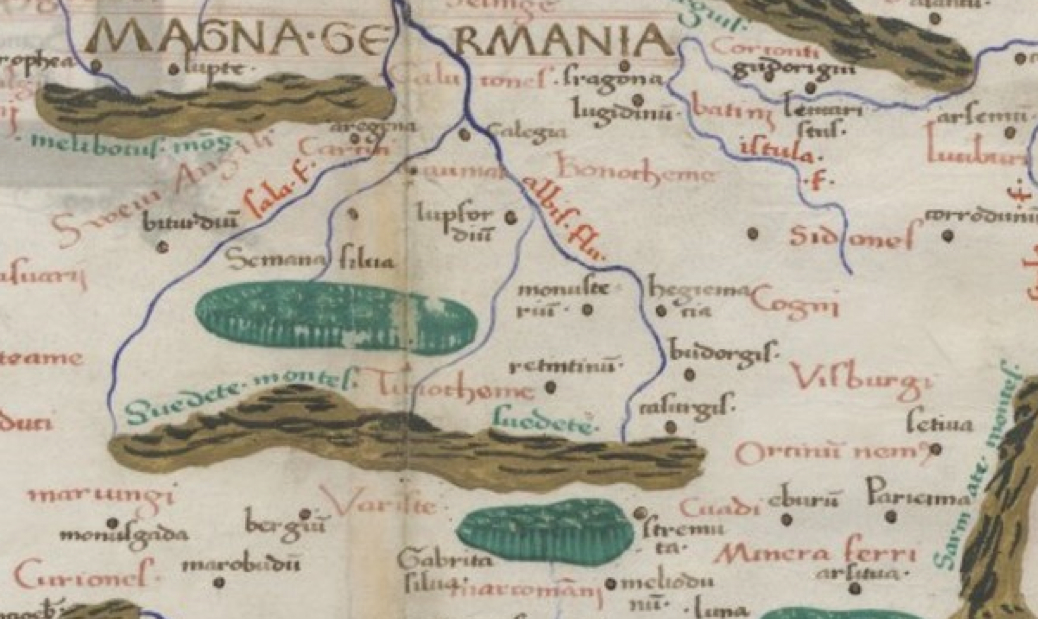
Magna Germania forests in Swabia

Yet the land-locked nature of these regions made the legibility of expanse less concrete.

Even in areas that claimed continuity with the ancient world, the production of Ptolemaic treatises curiously included modern views of Mediterranean cities in several deluxe of codices illuminated in Florence, as if to expand the treatise’s qualitative coverage of European cities in a rhetorically persuasive image for readers–these images had less regard for the systematic terrestrial coordinates Ptolemy proscribed than for preserving noteworthy sites in each place, or offer a ‘chorographic’ complement to Ptolemy’s explicitly geographic concern.
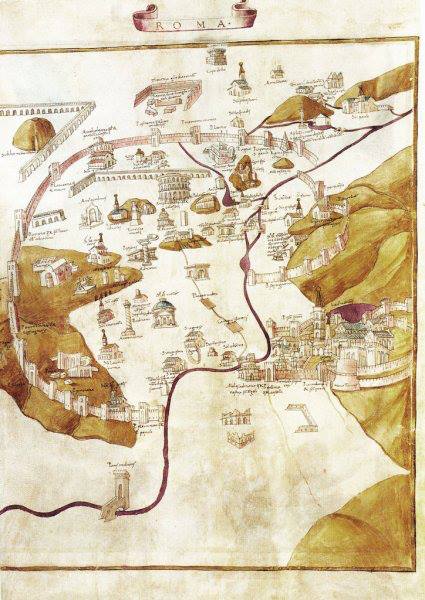
996179_671379542888235_530184269_n

4.  Symbolic Syntheses of Mapped Space

The question of what sort of graphic synthesis was provided in a geographic map is broadly tied to Renaissance visual culture, but posed particularly pressing questions in port cities that compared Ptolemy’s precepts with maps of nautical expanse.  Bernardus Sylvanus assembled engraved maps for his edition of Ptolemy shortly after the plans to print an edition of the treatise in Venice collapsed or failed, for reasons of skill or financing.  But a huge shift occurred in the production of maps that made such authoritative regional claims as depictions had already occurred, reflected in the preponderance of their incision, illumination, and distribution in centers of visual cultures in northern and central Italy, central Germany, and the Netherlands:  the specific forms of overlap between nautical and terrestrial methods in sites from Venice to Rome to Nuremberg created a rich repertory of maps with expansive truth-claims as forms of depiction.  His work came on the heals of an existing experimentation with combining cartographical registers of description in a universal register of mapping habitations of terrestrial space, evident in the 1507-8 world map of the Roman edition of Ptolemy, designed by the northern engraver Johannes Ruysch, and contemporary to the plans for a Venetian edition of Ptolemy’s treatise.

The manner that this 1507 world map mediated the legibility terraqueous expanse as a continuous surface might have offered a model for Sylvanus’  integrating of mapping forms:  for the Ruysch projection is in ways a restatement of cartographic expertise.
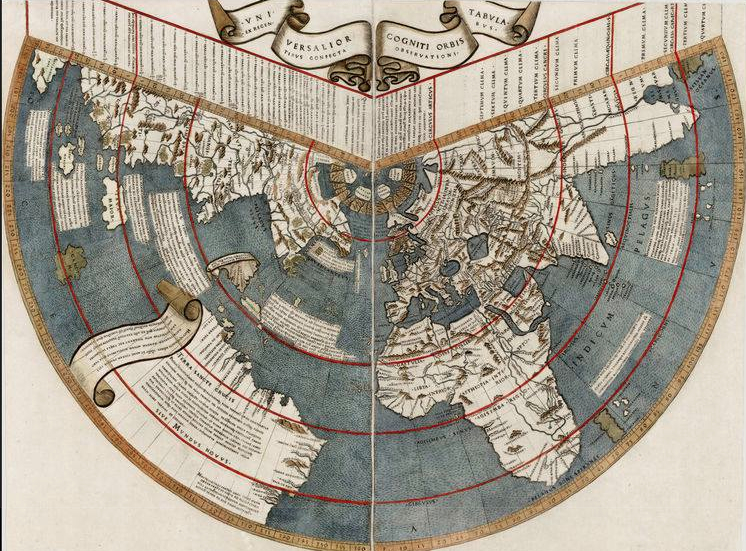
Rome 1507


The black-and-white outlines of the copperplate incision helps foreground the legibility of toponyms and textual panels alike that lie on the map’s curved meridian lines, as the stippled surface of oceanic expanse suggests the fact of its comprehension in the map–a comprehension rendered evident to viewers by the unveiling of the new form of a circumnavigable Africa and India, as well as the introduction of the newly discovered capes, rivers, and islands of the Americas:
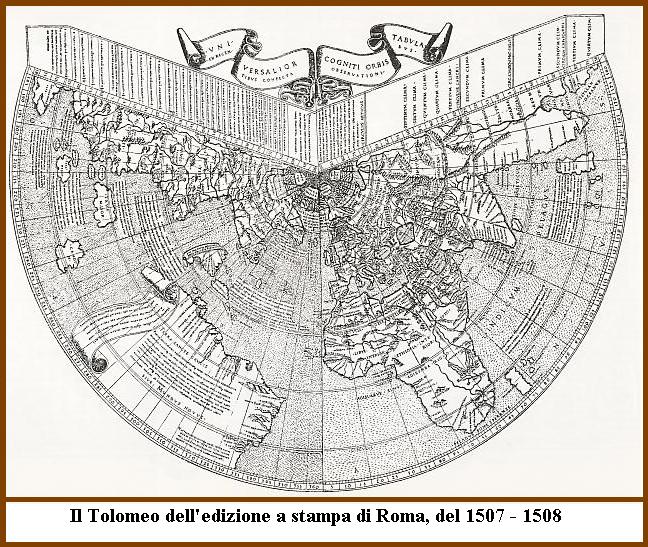
 

Tolomeo-Stampa-Roma

The historian of cartography David Woodward argued that cartographical competence reveals a growing “rationalization of space” around 1492.  In ways, we have begun to remove cartography from a professional genealogy that places a premium on rationality–such a claim is concealed within the creative combination of forms of diverse sources mapmakers have long imaginatively integrated in synthetic designs.  But the limitations on the ‘rationality’ of the map–or the grounding of its authority in its rationality–demands future research for how mapmakers who amplified the local qualitative content of cartographical media.

Taking a step further backward in time, we can perhaps appreciate how the designers and illuminators of maps of maps included in manuscripts of Ptolemy’s treatise seem ambivalent in their use of parallels and meridians as a framework for defining a cognitive relation to expanse or for recording a cognitive relation to place:  for they treat the graticule of the map more as a frame of reference by which to register terrestrial position, than as an enabling format for graphic representation:  the iconic portrayal of place in early maps as clusters of houses that positioned against the blank ‘space’ framed by coordinate system or patches of forest tries to bridge Ptolemy’s ancient model for denoting a uniform abstraction of terrestrial expanse on Euclidean precepts and the ability to transcribe space.  Illuminators, few of whom are known,  invested maps with very limited mimetic qualities from the 1450s and 1470s to communicate their continuity:   the new interest in regional maps as registers lead illuminators to position clusters of houses with peaked roofs and taller towers in dense proximity to each other to distinguish areas of settlement, beside clustered areas of forest growth–as the Black Forest in Bavaria–that provided some vague reassurance of the correspondence of space.  Some of the owners of such maps added places near their own residence, or areas that they knew, omitted in the printed editions or codices they owned, as if to give the maps an expressive value that they feel they lacked.
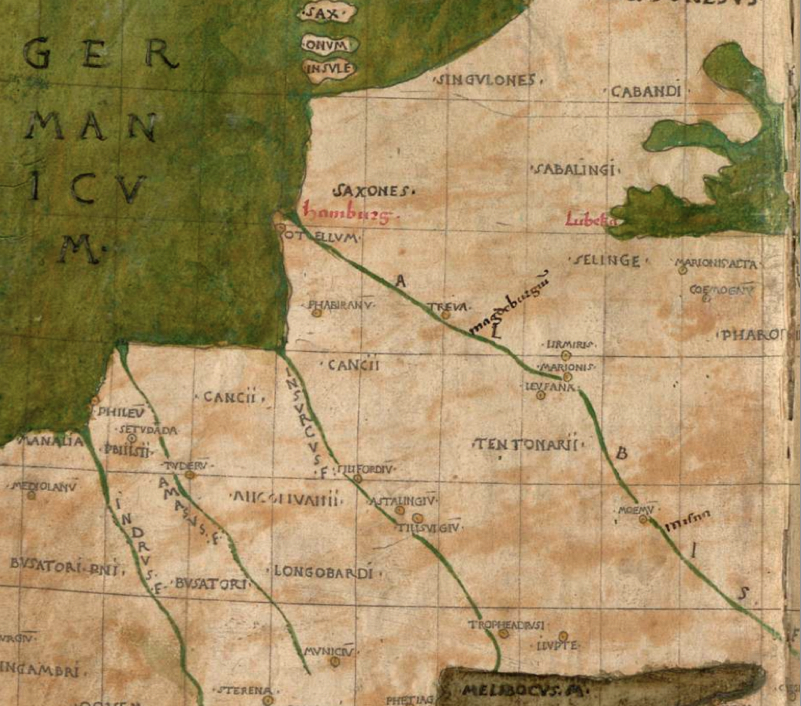
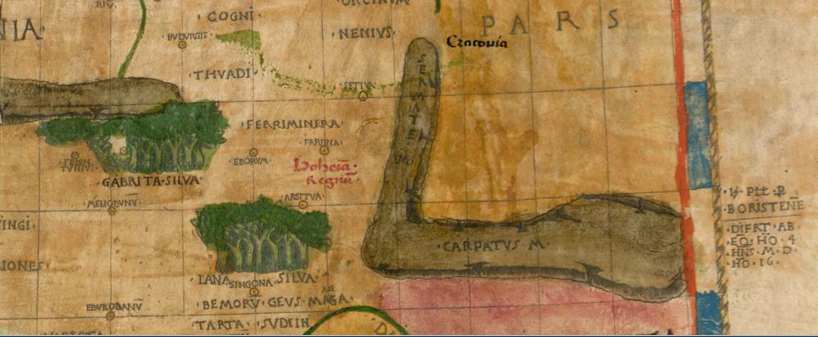
Added cities of Hamburg and Lubek

Bohemia in 1477 Ptolemy

 
Did the second-century geographer’s “handbook for drawing world maps” have different implications in Venice, a city of maritime trade and considerable diversity, where nautical maps were more prevalent than maps of terrestrial expanse by the early sixteenth century?
 
 
4.  Back to Bernardus Sylvanus in Venice, ca. 1500
 
The shift in Venetian culture for locating place in a map’s expanse is reflected in the collation of a set of independent views of neighborhoods to create a dramatic imagined synthetic view of Venice as seen from above in a wall-map composed from six large individual woodblocks and large rag sheets.  The master of perspective Jacopo de’ Barbari designed the detailed view by taking he city’s coasts a a frame in which to distribute its built and inhabited expanse:  heads of winds of each direction frame the view, recalling the spokes of a wind-rose and the disembodied heads of putti who surround most early printed Ptolemaic maps, magnify the city’s coastlines and maritime surroundings, revealing the complexity of its physical plant as if the city were something of a microcosm of the inhabited world, and to showcase the expansive position of Venice on the Adriatic.  The view situates the “forma urbis” not only as a built space but in realtion to the surrounding sea, dotted with individual boats and a regatta:  in the distance, one sees the Alps to the north:  the city appears as a microcosm of global expanse, as the depiction of its inhabitation in each rione of Venice stands as a graphic surrogate for the mapping of a miniature world.
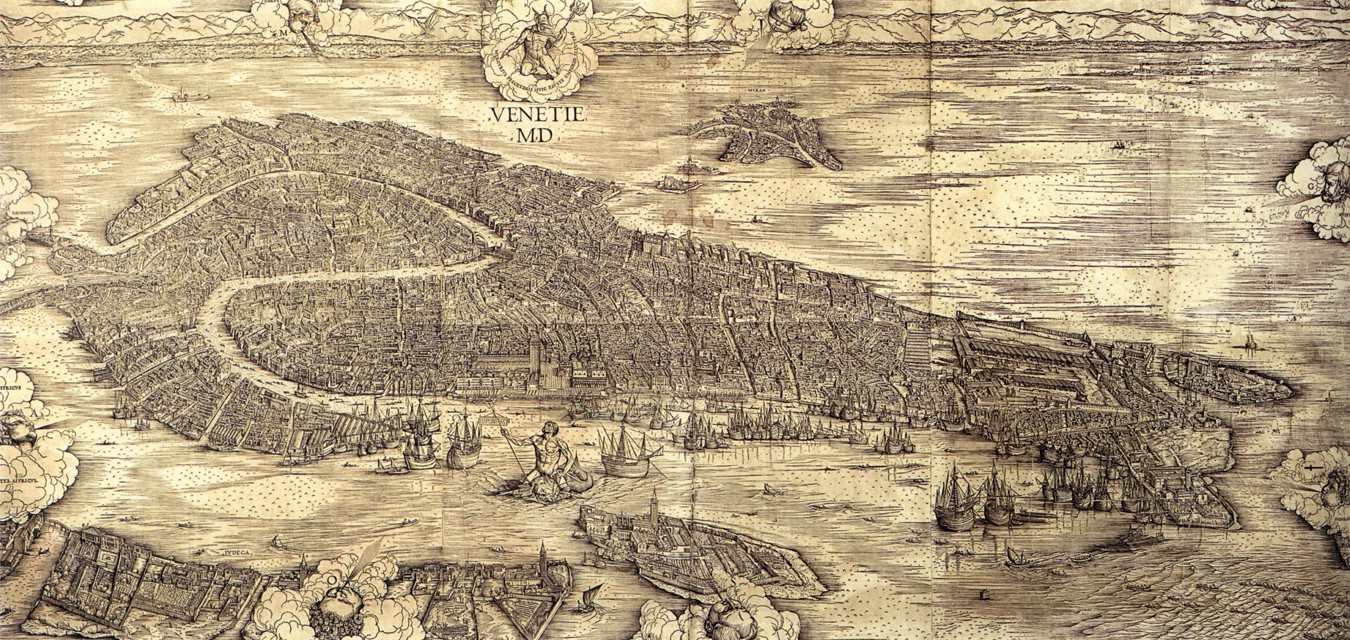
 
 
Jacopo_de'_Barbari_-_Plan_of_Venice_-_WGA01270
 
 
The particular detailing of a sea as continuous with coastlines and inhabited world provides the informed viewer with something of a metaphor for the unity of land and sea in world-mapping, revealed in Jacopo’s attention to both wind-heads round the city and to a regatta that braves Adriatic winds, exploiting his attention to the finely engraved lines of the wavy waters:
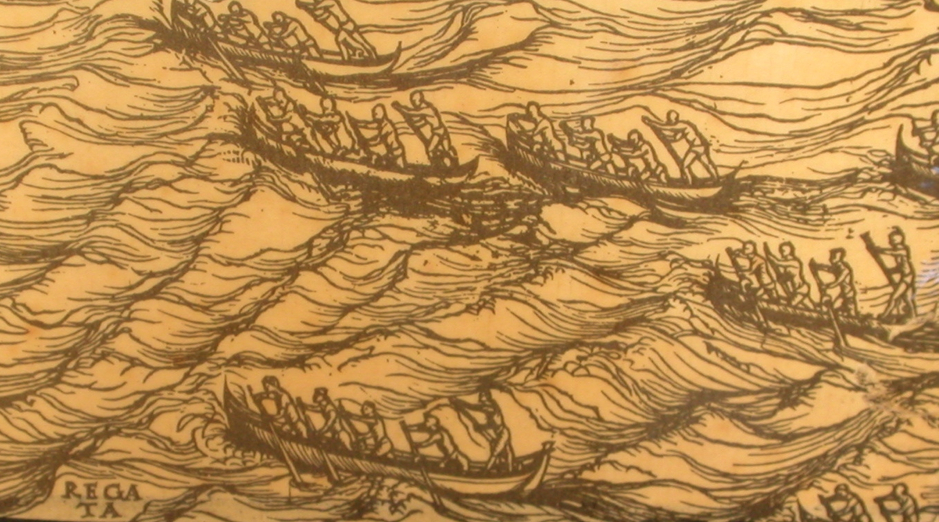
 
 
Barbari Regata
 
 
What sort of view did Jacopo de’ Barbari compose in this elegant multi-sheet wall map?  The view is often compared to the elevated “bird’s-eye” perspectival views of the “forma urbis” of Renaissance cities, but rests on a synthsesis of an imagiend or virtual view from individual surveys of the city:  one recent digitization of the view of “Venetia 1500” helped reveal the synthetic unity Jacopo took pains to created a uniformity of urban space from individual surveys as an illustration of considerable skill of rendering an almost planimetric space for viewers to scan as a continuous surface that extended to the surrounding oceanic sea:
 
 
Gridded view of Jacopo's Venice
 
 
The multi-sheet map, whose production required three years, exemplifies a Venetian appreciation of elevating a record of collective perceptions by combining map-making and perspective with particular virtuosity.
 
Jacopo_de'_Barbari_-_Plan_of_Venice_-_WGA01270
 
 
Each of the six sheets provided detailed records of the city in what Fortini Brown has called an “eye-witness style,” but a imported mapping records to a continuous picture-frame that pushed the cartographic metaphor of transcription to transcend a single fixed perspective.
 
 
Barbari Close-Up with Tritone
 
 
The luxury print of multiple sheets provide a surface into which the viewer can descend into specific neighborhoods or regions that are immediately recognizable:  the continuity of its content were thematized in another recent digitization of the map created by the Correr Museum:
 
But the lines of the Venetian lagoon and Adriatic suggest the clearest inclusion of a sense of maritime space in the map–an illusion that was echoed in the corpus of Sylvanus maps.  For Jacobo de’ Barbari created a model for viewing the coherence of urban space that responded to a challenge for ordering the unity of terrestrial and nautical space.  When Bernardus Sylvanus intended to expand the cartographical corpus of Ptolemy’s Geography in Venice around 1508, he consciously and proudly incorporated information from the surface of sailors’ nautical charts into the land-maps denoted by spatial coordinates in earlier editions of Ptolemy’s treatise, creating a unified legible cartographical surface and using printer’s red to place cities in a continuous landscape–if often situating ancient names of place from Ptolemy’s work within the modern coastlines of nautical charts, in ways that went against the scholarly tradition of comparing ancient and modern geography by juxtaposing “ancient” and “modern” maps, but also advanced a single cartographic record as authoritative and unique, shading coastlines to suggest the maritime field in which he placed new nautical discoveries–and limited America, famously, to the Columban islands to the ahistorical exclusion of all North America.
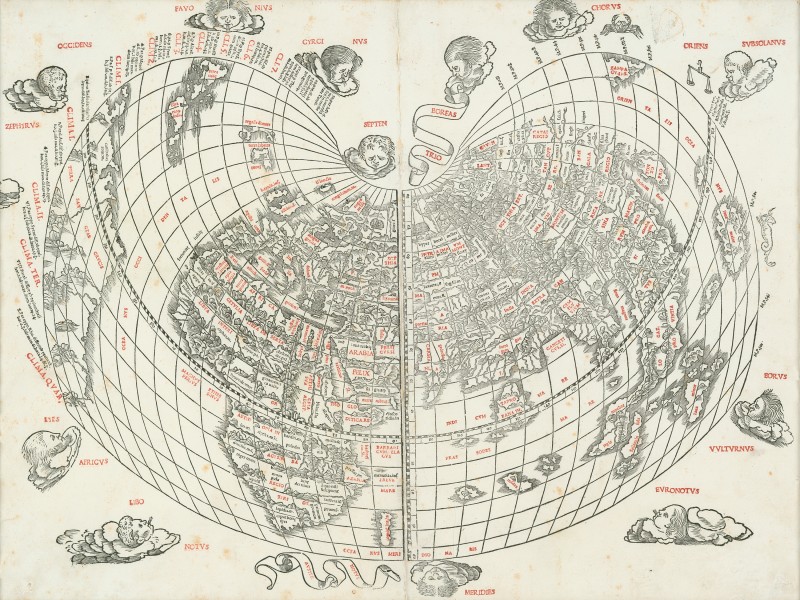
 

219-v1-800x600

Rather than enabling spatial travel, the world map of two sheets noted place-names in a distinctive printer’s red that stand out from rolling hills, framed by etched lines of waters on their coasts as if in imagined relief:

Sylvanus expanded Mediterranean with nuatical maps

The map’s space was treated as a continuous surface, defined by the coastlines from modern nautical charts, if the toponomy was often ancient in origin, treating the cartographical surface as a uniform register of inhabited lands:
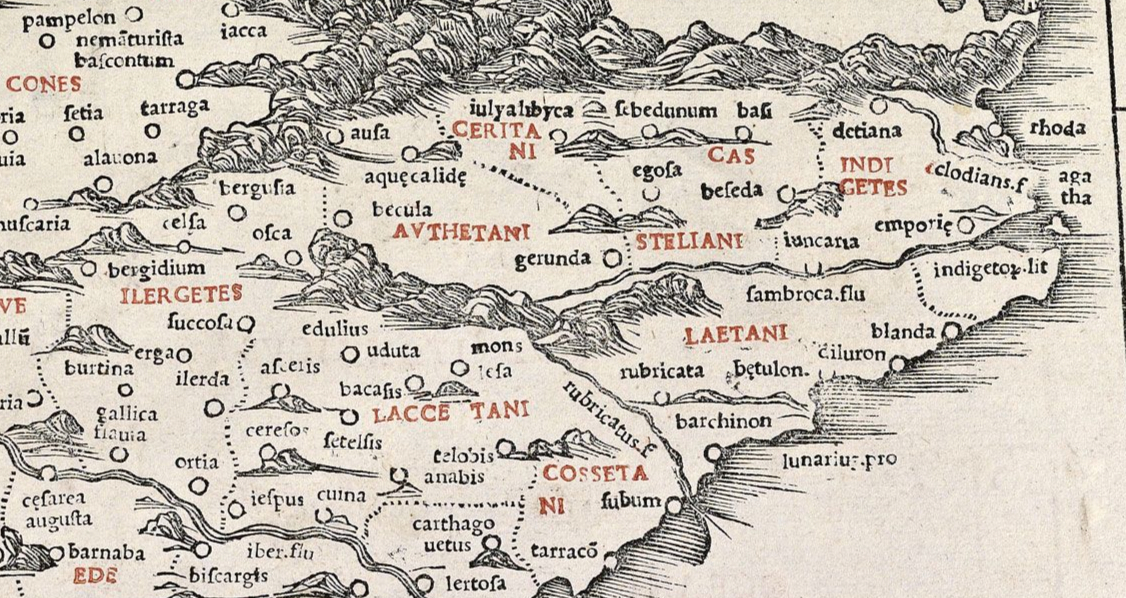
Sylvanus Spain Coast


Little biographic information is known about the production of the maps of Bernardus Sylvanus da Ebola, though he has been possibly identified with an illuminator.  But he clearly exploited, even more than his predecessors, the semiotic synthesis that print allowed in Venice.  This is evident both in its combination of text and woodcut imagery in this two-sheet map, and the overlay of a graticule, equatorial bar, and wind-heads, combining conventions of different mapping media more explicitly than even earlier editions of the existing maps of the Ptolemaic corpus.

The introduction of islands and coastlines not in most all of the maps editors of the previous five printed editions of Ptolemy’s treatise on world-mapping (a sudden burst of editions which we can label Bologna 1477; Rome 1478; Ulm 1482; Berlinghieri 1482; and Rome 1507), presenting more clearly identified coasts and islands–as the ‘isole fortunate’ off of Africa’s western coast, although it omits the New World–but are often of limited geographic accuracy. The distinct use of type to balance the legibility of a map crowded with toponymy by two-color ink adopts the innovation of the material production of books to create a surface easily read by its customers–and he invited readers of the maps he organized as a comparison between the maps Ptolemy described and the versions corrected by modern nautical charts to “compare Ptolemy’s words with navigations themselves” and decide for themselves, using two-color printing to facilitate an intensive reading of the map’s surface, and in the attention that he gave to islands in the Mediterranean, as the Balearic islands off the coast of Spain, where the etching of lines suggest the surrounding seas that hit their rocky shores.
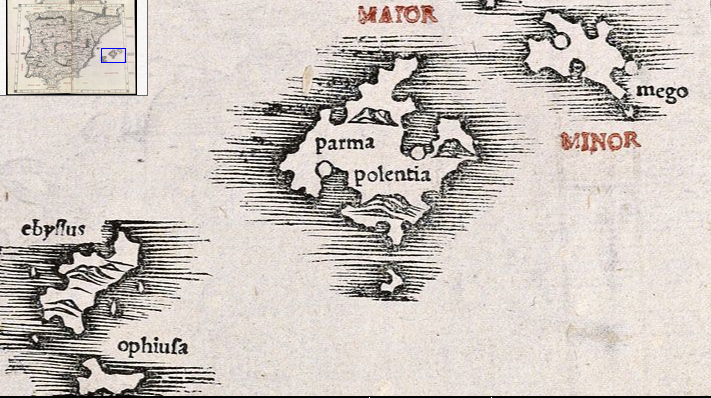
Balearics


The significance of the line in the medium of engraving has been argued to facilitate the conventions of uniform mapping of terrestrial expanse, allowing engravers to exploit the geometric formats of Ptolemaic mapping in graphic form in particularly expressive ways, the expressive value of the Sylvanus maps derived from their synthesis of conventions of map-making in a continuously readable form–one that created new attentiveness, indeed, to the encryption of information from the surface of the map, both in the map of the world’s surface and the individual tables editors helped prepare for Ptolemy’s treatise.

This must have responded to an increase in what might be called geographic curiosity.

The universal coverage of the maps Sylvanus prepared for Ptolemy’s manual of global geography was constructed from a very local place, and reveals the local availability of island books or isolari in Venice, as well as nautical records of the Mediterranean and Adriatic that were available in abundance in the maritime city, which were carefully integrated within the system of parallels, meridians and equinoctial lines for readers to pour over, with attention to areas like Spain’s Mediterranean coast or Greek islands in the Adriatic, depicted by a similar accuracy reminiscent of charts, as are its inlets and bays.
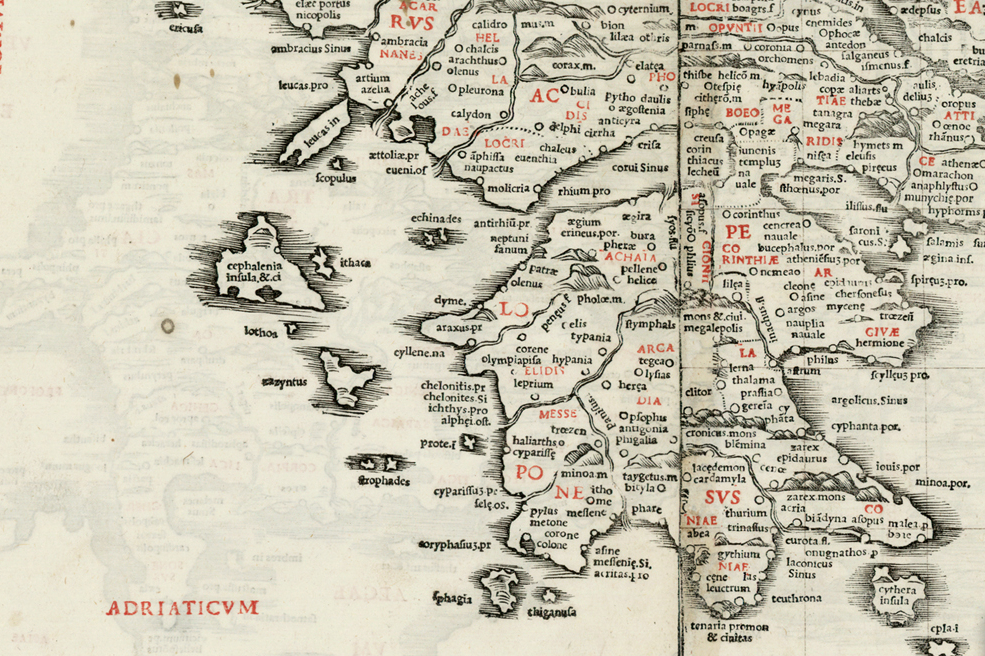
Greek Island Sylvanus

Sylvanus illustrated the division between Africa and Asia, the origins of the  Nile and shores of the newly-mapped Red Sea for readers to consult, probably in relation to available maps, by means of a similar etching of graphic relief:
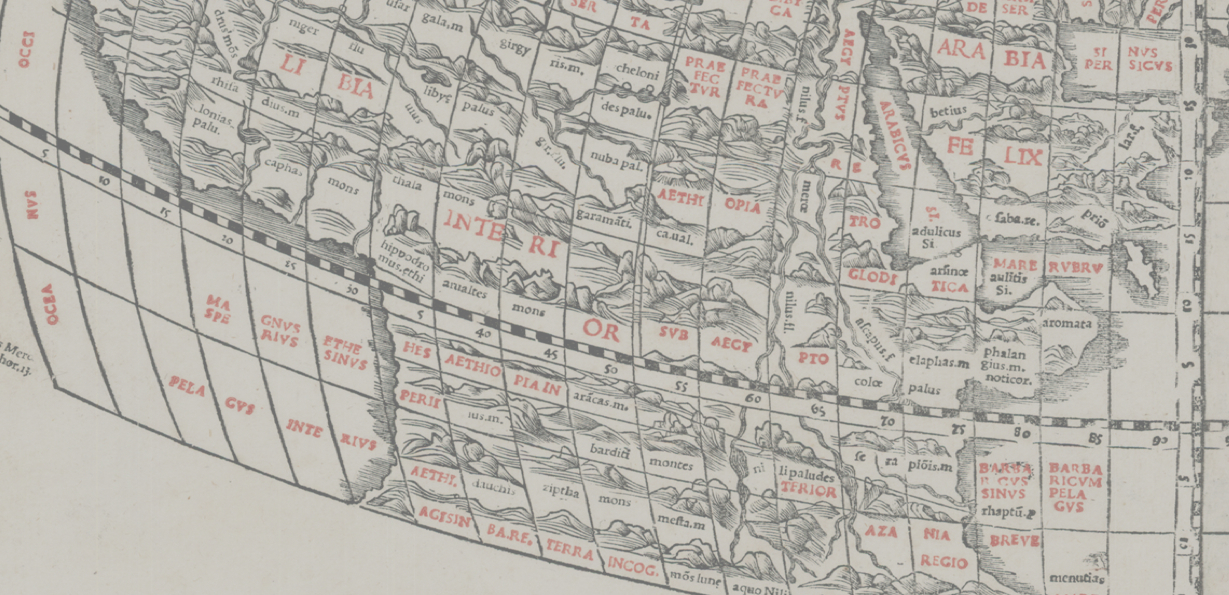
Africa and Origins of Nile

The material surface of Bernardus’ maps synthesized a range of semiotic conventions that viewers would have been quick to recognize as a combination of a material landscape and a map:  one of his Italian readers was quick to include images of the towns in the Marches in the map of Italy and the Adriatic, depicting both the towns of Monterubbiano and Moresco i in ways comparable to the iconic perspective views of cities.
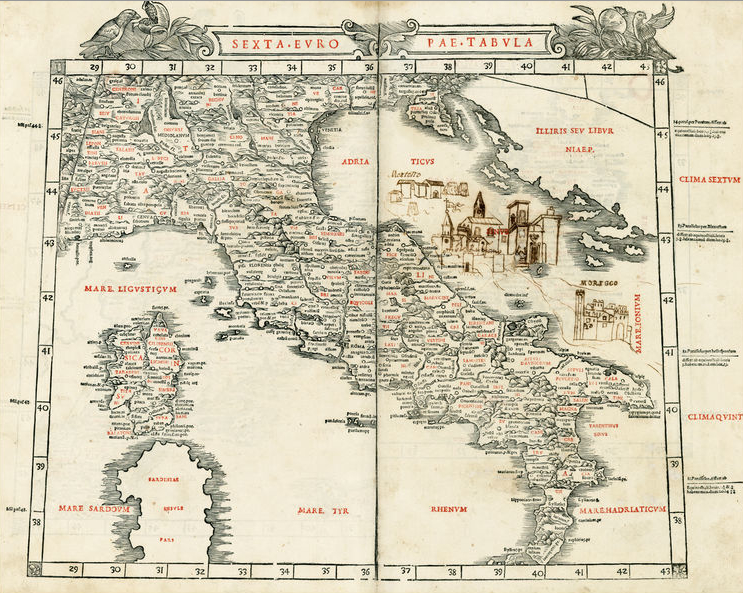
Sylvanus' Adriatic

The additions suggest a dramatic increased in the graphic materiality of the map as a pictorial register.  Print are allowed men as Bernardus or fellow-engravers and editors of maps in Florence, Rome, and Antwerp to invest the map’s surface with new claims of legibility as a reproducible record.  But it is also very possible that Bernardus’ sustained engagement with a project of printing he hoped would be far more successful derived from the prominent status maps already enjoyed in other visual media.

The interest of maps as depictions reflected a deep appropriation of Ptolemy’s instructions to his own second-century contemporaries to craft a map “ad oculorum aspectum commensurabilis“–the transmission of this precept to later mapmakers to create a surface that would appeal to their readers’ eyes, if not also the tacit presuppositions for viewing a continuous space in a detailed and harmonious form.

5.  A tradition of fifteenth-century Venetian cartographers had incorporated nautical charts to illustrative or pictorial ends in inventive ways, in attempts to give greater expressivity and comprehensiveness to the Ptolemaic planisphere or nautical chart:   a 1448 world map designed with great care by Giovanni Leardo framed by the months of the year and astrological signs (Verona, Bibl. Civ., Ms 3119); Fra Mauro’s famous circular map uniquely synthesized Portuguese charts, a unique matter given that it was in fact commissioned for Portugal’s monarch, without a graticule; it recalls an ellipsoid world map of 1457 constructed on the principles “of cosmographers” without a uniform graticule, and filled with textual legends, fanciful iconography, and perspective city views.  None privileged the geometrical order of a uniformly continuous surface or a format of projection from terrestrial cartography, however, or bridged different semantic registers in the manner of Sylvanus’ maps.

The Ptolemaic model provided an authoritative basis to fashion a surface that could be readily scanned as a uniform distribution of expanse by around 1500, and in Venice shifted the attitudes of viewers to mapped space.  By the later fifteenth century, the Venetian Senate had commissioned the repainting of territorial maps of the lagoon of Antonio de’ Leonardi from his nephew Sebastian along parallels and meridians by “Ptolemy’s doctrine” that Isabella d’Este and others Isabella d’Este sent painters to copy, marvelling at its proportions and scale.  The painted map received praise as “così perfetta nelle sue misure [so elegant and well-proportioned]” that “diversi Principi [several princes]” had commissioned copies of it for their own enjoyment and pleasure before its 1577 destruction, Sansovino boasted among his catalogue of the city’s artistic treasures.[i]

Although the map is now destroyed, and cannot be pictured, it constituted something of a model for the multiple maps now present in the Palazzo Ducale, painted to replace it, and for the maps of the Veneto that Christoforo da Sorte created in its private chambers–as well as, perhaps, Egnazio Danti’s monumental remapping of the peninsula in colored paint.  The much-admired peninsular map may have provided a model for integrating the format of nautical charts with maps of geographic content by men like Sebastian Cabot, piloto for the Casa de la Contratacion in Seville who created a new world map–or the map-engraver and engineer Giacomo Gastaldi, who from 1546 synthesized multiple elegant wall-maps that refined cartographical expertise; Gastaldi’s work with the geographer Giovan Battista Ramusio led him to design comprehensively detailed pictorial wall-maps as that of South-East Asia.
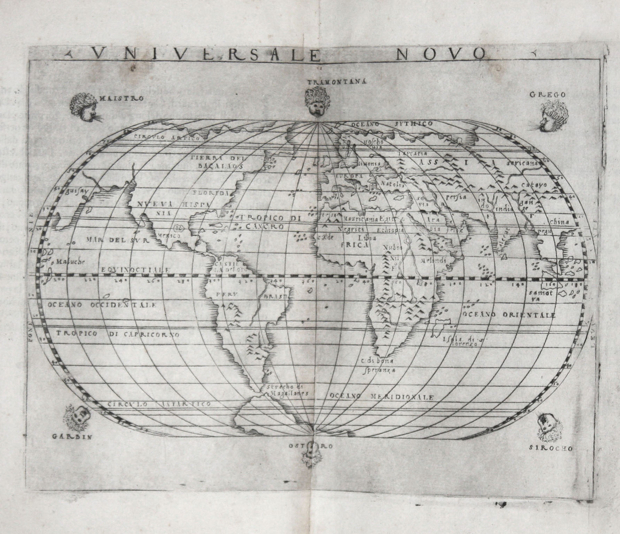
gastaldi 1548

Gastaldi-prat of Asia

But we might also start from the 1511 modern map of the peninsula that Sylvanus designed:
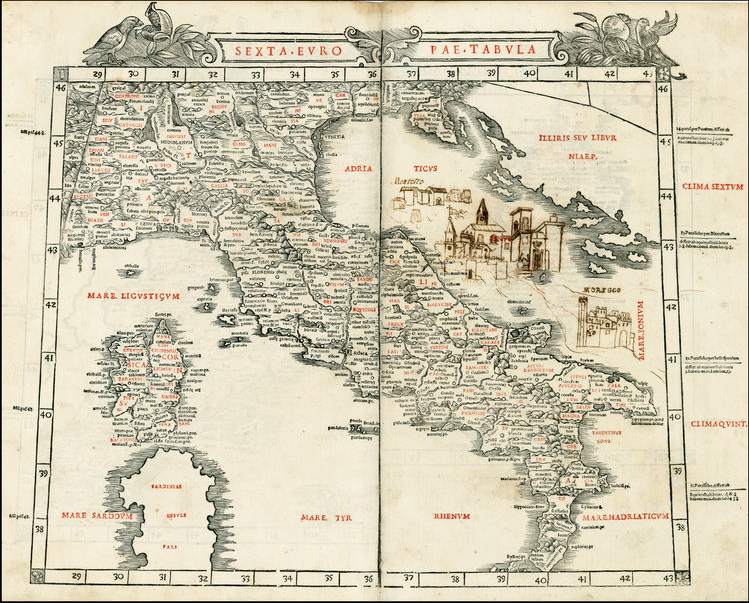
Sylvanus Sexta Tabula with ms addition of city views


Did this lost expansive painted map of the lagoon that extended to the Adriatic and Tyrrhenian sea, and their islands, provide a model for uniting terrestrial and nautical maps that men such as Bernardus Sylvanus sought to generalize for a larger audience in printed form?  The reader of Sylvanus’ printed maps from Fermo sought to make the text his very own, adding his own qualitative views of the cities that he knew, in ways that register a distinct relation to the map as a continuous surface. 

When the great cartographer Vincenzo Coronelli mapped the geographical situation of Venice in a broader gulf from the mid-seventeenth century, he described the place of Venice in the expanded gulf in his 1688 global atlas–placing Venice in relation across the Gulf of the Adriatic to the islands of its empire, which bordered on the expanding Ottoman by shifting boundaries, as if to affirm its own domain of the seas that opened along its shores.
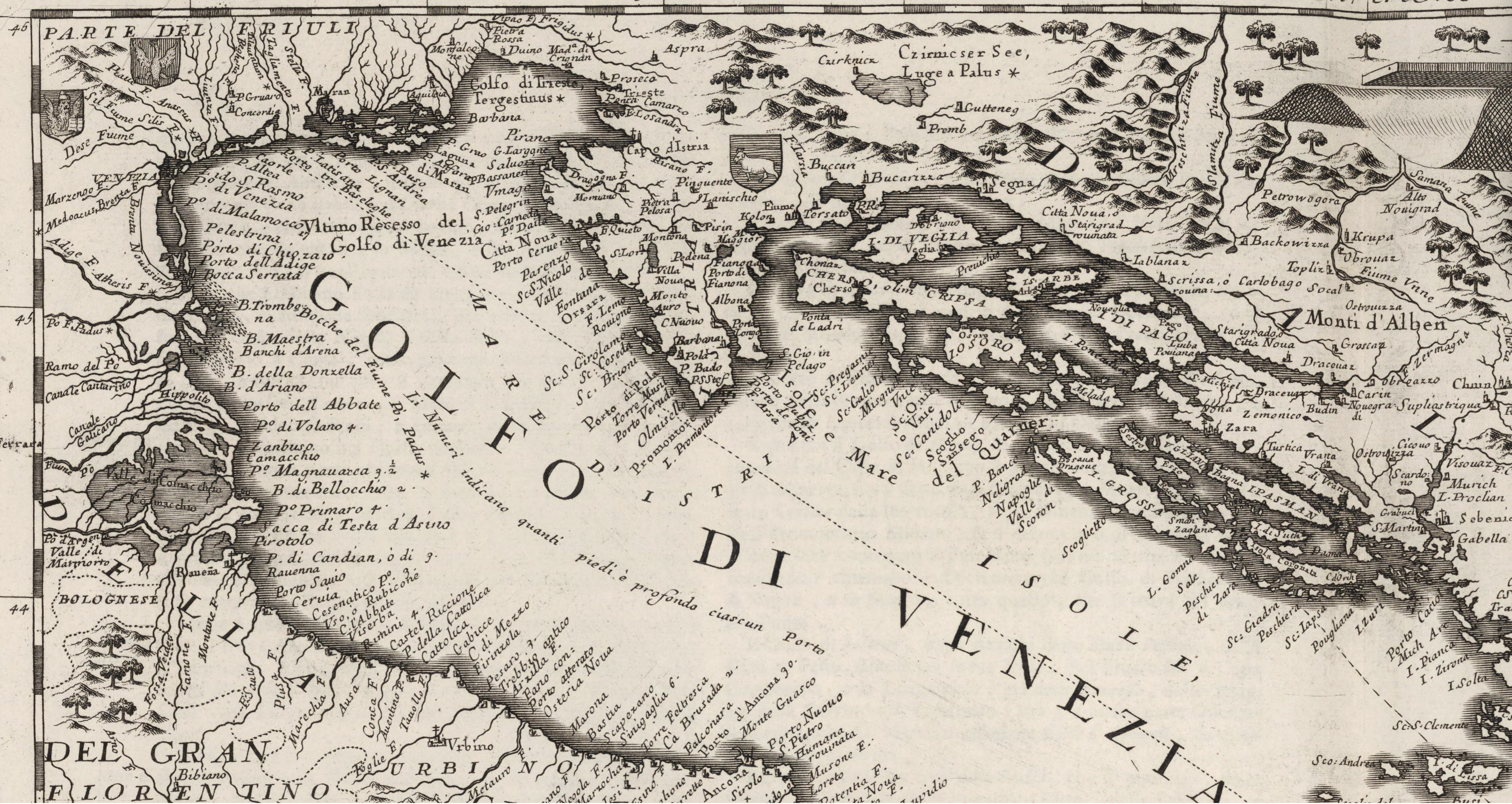
Golfo di Venezia

As if overseeing an expanse that might be translated into varied scales, the dominion of Venice was defined across maritime expanse, not by territorial bounds, but in the cartouche from which the emblem of the lion of San Marco serenely oversaw its content.  From the margins of the map, the winged lion that Coronelli cleverly located in the cartouche that looked over the expanse of the Gulf, overseeing the expanse from beneath its dogal crown, beneath six bars of scale of mapping that alligned each of five standards with maritime leagues.


overseeing

[i] Gallo, “Le mappe geographiche del Palazzo Ducale di Venezia,” Archivio Veneto ser. V, 32 (1943): 47-54. Sansovino, Venetia, citta nobilissima et singolare (Venice:  Iacomo Sansovino, 1581), fol. 122, “era una tavola d’Italia così perfetta nelle sue misure, che diversi Principi ne domandarono l’essemplare.”
1 Comment

Filed under engraved maps, globalism, portolan charts, Renaissance engraving, two-color typography