The Way We Eat Now: the City and the Farms

The impacts of radical over-specialization of agricultural lands in the United States on our food supplies is only beginning to be mapped with the critical eye that it deserves.  With the intense expansion of ‘mega-farms’ jumping some 20% just in the years 2005-7, their expansion of subsidies, and an intensification of the quarter of vegetable production for animal feed, the notion of agricultural stewardship has been replaced by an artificial market and explosion of selective crops.  Is the notion of an agrarian space indeed itself a casualty of this new use of farming in a land of the death of the family farm?  Is this the end of an ideal of cultivable space, or does it push us to seek to imagine a new relation to the land?  It is indeed striking that until fairly recently, the ancient term ecumene or oikumene described the inhabited (or inhabitable) world with reference to those lands able to be used for agriculture or pasturage. 

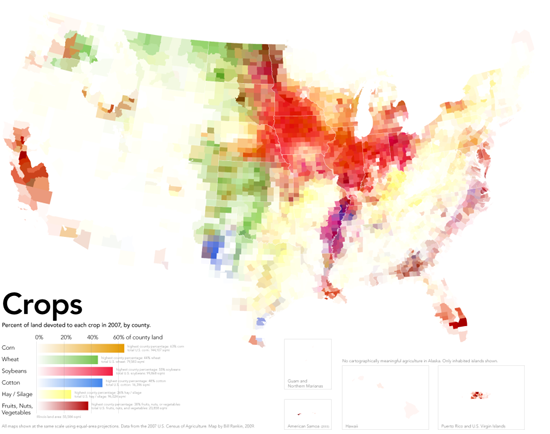
The extreme “specialization of the agrarian landscape” William Rankin recently mapped offers visualization of data from the 2007 Census of US Agriculture:  the maps charts variations in crops and animal pasturage in each county of the country, each of which are colored by the gradations of four to five major crops or farmed livestock in the United States.   The selectivity of farmland use it reveals captures the effects of this expansion and maps the consequence of that dramatic expansion of mega-farming in the Bush presidency of those years, in response to selective subsidies of corn and soy:   the color-coding of individual crops provide a snapshot of the proportion of land devoted to each subsidized crop (soy; wheat; corn; cotton; vegetables and fruits or nuts) that  raise to raise big questions about our limited foodscape and suggest the degree to which farm subsidies inform land-use in desirable ways.

Even more striking than the limited regions of land used for farming in Rankin’s data visualization is the creation of the zones of land dedicated to wheat, soybeans, silage and corn that rarely if at all overlap, where over 50% of county land is dedicated to soy, a solid 40+% is dedicated to wheat, or over 60% to corn.  This is not only a map of agrarian distributions, but a the creation of a new attitude to agricultural space:  indeed, Rankin’s map helps us see the distribution of croplands in the country less as something that occurs on a flat surface, but in itself creates a new familiarity with space, and a relation of our food supplies to space, as much as a form of “geographic” knowledge of how events occur on the map.  For the sequence of maps chart a shift in the American foodscape, where we revise how we imagine agricultural space, and as creating a new notion of our agrarian space, rather than as changes that can be mapped or occur on the two-dimensional distribution of mapped space.

Rankin’s set of three maps of the national foodscape are not historical per se, but suggest a metageographical narrative of how attitudes to land have changed in their spectrum of such scattered colors.  They chart an extraordinary degree of remove from local intake, distribution or demand.  The distortion in this agrarian landscape is of course enabled by a huge transport industry, moving the wheat grown in the central band of the US from Iowa or Nebraska to Oklahoma, corn from Wisconsin to Iowa, to the soybeans so densely grown across South Dakota and Iowa to Indiana and Ohio.  Although continuity and coherence as the central properties of terrestrial maps, an absence of continuity in the concentrations of crop cultivation suggest a skewed relation to the land–the maps undermine the very notions of continuity and coherence that defined maps of national territories–using maps to raise questions about food supplies.  All the silage in across the Eastern seaboard in the country seems to derive from the local profitability of livestock products, show a nation almost drained of agricultural productivity, and relocates fruits and vegetables to ribbons on both coasts.

The consequent de-coupling of food markets from growing habits inverts Thomas Jefferson’s ideal of a yeoman farmer who planted crops for his own needs, out of the conviction that those “who labor in the earth are the chosen people by God.”  The Jeffersonian ideal of stewardship,rooted in a contractual relation of a responsible servicing of the land, rested on “good practices” of land management through rational skills of crop rotation, terracing to prevent soil erosion, promoting the diversification of varied crops, and surveying of land, from advocating a regular seven-year cycle of regular crop rotation that follow corn and wheat with a variety of crops, including turnips, clover, vetch and buckwheat.  He pioneered innovations that would increase the conservation of resources as well as crop yeild, including deep contour plowing, turning the ground far beneath the topsoil, and terracing to prevent soil erosion.  And his quest for variety and diversity for the agriculturalist no doubt encouraged him to introduce eggplants, brussels sprouts, rice, chestnuts, cauliflower, nuts and olive plants to the country–Jefferson imported 170 different fruits and 330 vegetables in the period from 1767 to 1824 to diversify the nation’s agriculture.  Jefferson was vigilant in advocacy of agricultural stewardship and famously wrote Washington with dismay in 1793 that “we can buy an acre of new land cheaper than we can manure an old one.”

William Rankin’s three data visualizations map the remove of what we eat from where we grow, or where we grow and what food we buy, suggests the imposition of an artificial remove of growing and husbandry from urban life–creating a gap between the country and the city so great that we cannot say where the country is.  In mapping the geographical remove of crops from cities–and of cultivation and animal husbandry from centers of population, Rankin has charted the results of a dysfunctional division of land-use, in which the map transforms the territory, and almost precedes it, as the areas zoned for harvesting by agribusiness divorce local needs of populations from the large-scale farming and animal husbandry, not only fostering a lack of a uniform food-harvesting mosaic, but a super-regional specialization, as this map of the crops that are grown in individual counties reveal:  the disorienting nature of individual to food, and individual to agriculture, that results removes the production of crops from local demand or a topography of need.  Indeed, there seems little clear integration of the sites of growing vegetables or crops to a national market in local terms, as questions of national demand and pricing drive the redistribution of crops into what seem “hot-spots” of production, whose intensity of cultivation tries to keep up with the national need with an intensity that their concentration is unable to effectively sustain in the future.

The pronounced discontinuities in the maps of food specialization reveal a deep disconnect between food production and consumption, and the limited understanding of how reliant we’ve become on an unequally pronounced distribution of such basic needs as growing crops or raising chickens.

Rankin's Map of Crops

In this map, Jefferson seems to meet Baudrillard:  the maps does not simulate a world of rending to the land with clear coherence, uniformity, or indeed boundaries, but visualizes a range of databases that reveal the imbalance by which we try to create the illusion of a land of plenty in an era of few farms.  This map undermines the security of a healthy nation, beyond reconsidering the pathways or quality of food, to force one to ask how the foodstuffs produced in these spaces could be high quality.  Reading the map will salutarily ward of any temptation to naturalize this self-evidently artificial division of land-use, or naturalize the imbalances of select crops in regions– the six colors used in the map are, indeed, almost always distinct from one another in the above map charting variations in degrees of crop specialization.  The map is a  metadata visualization, and absence of any attention to continuity in the agrarian structuring of the land, disrupts the continuity of the iconic image of the map.

Like Jasper Johns’ 1961 Map, which re-inscribes the encaustic splattering of primary colors that distance the map from its iconic status:  the surface of Rankin’s maps distance observers from the nation, rendering unrecognizable the form of the territory, abstracting the surface of the map by revealing an uneven uniformity instead of a united whole and focussing attention on the unwarranted density of selective agricultural concentration on specific crops.
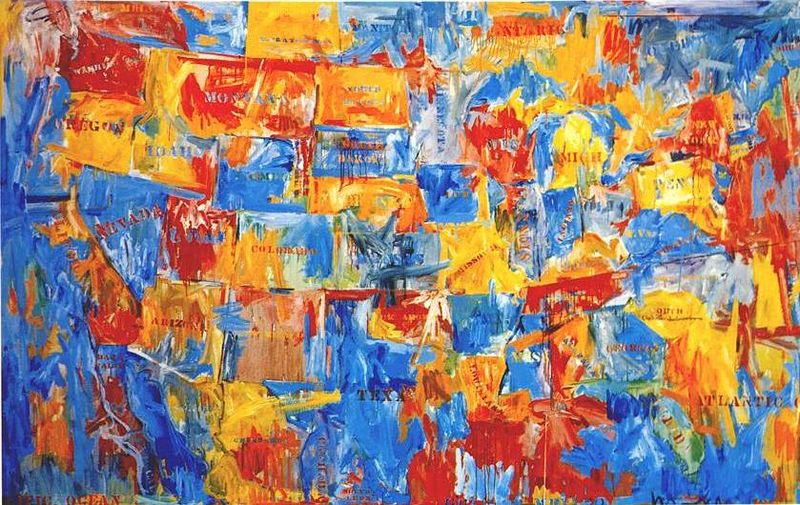
800px-Jasper_Johns's_'Map',_1961

If maps don’t define and distinguish national sovereignty, but are a range of widely diffused simulations, we need an actively deconstructive map to assemble our disjointed foodscapes.  The dramatic isolation of foci of planting of wheat, soy, and three intense pockets of cotton, the absence of vegetables from most crops across the nation is a reminder of the separation of how we inhabit the nation from agrarian land-use:  citizenship is disconnected from stewardship, or the illusion of stewardship is no longer possible to perpetuate in relation to the land that no longer exists as a coherent territorial entity.  The remove of crops from local use, and the injection of subsidies to promote specific crops in Midwestern states, but also in the Northwest and South, created intense pockets of over-intensification that with the growth of megafarms has produced, despite the temperate nature of the continent.
2012-hardiness-zone-map

Perhaps these distortions of agrarian landscapes is an effect of the markets being driven by international prices, or if a radical specialization is striking for its remove from what we eat, even if not all have heads of leafy lettuce and arugula salads on their tables:  crops like wheat and soy are farmed in mass in select places for massive milling and repackaging; local food needs are met by importing across the nation, if not scattered boutique farms or “farmers’ markets” that are not run by farmers but franchised, or run by men who drive hundreds of miles with diesel gas in order to perpetuate the illusion of a close relation to the fruits of the land to folks living on asphalt pavement and tar.  We use food to create our own illusions, drawing from mythologies of agrarian responsibility that history provides.

Thomas Jefferson rooted democracy in the relation of the citizen-farmer and his land, metaphorically equating that relation to the fabric of the nation:  “the greatest service rendered any country is to add a useful plant to its culture,” he argued, equating individual agricultural stewardship as a “service to the nation” that is “worth more to them than all the victories of all the most splendid pages of their histories.”   When Jefferson preached the gospel of the agriculturalist, farmers were central to a nation’s needs both for feeding the nation and as stewards of the nation’s agrarian wealth, rather than white-color workers or professionals.  And so he valued agriculturalists’ expertise in crop rotation, fertilizers, and agronomy as remedies to the perils of land-abuse and erosion of lands, and located the preservation of the wealth in the countryside and the value of good, arable land.  The concern that led Jefferson to increase the diversification of vegetables as fundamental to the nation’s health led the horticulturist Luther Burbank in the early twentieth century to perfect crops able to sustain disease and blight, by hybridizing fruits, vegetables, and legumes by cross-pollination in strains of increased tolerance–if not genetic diversity.

When Burbank redefined performance of crops by their productivity and survival rates, he redefined plants and vegetables as a malleable resource subservient to man, though without encouraging an over-specialization similar to what we see in today’s foodscape.  Burbank’s shift in the significance of the vegetable in the world underlies, in some fashion, the metageography of the current over-specialization spatial distribution of crops Rankin maps, as it removed proximity of the place of cultivation from the growing of crops, and removed crops from the local market place.  Rankin’s beautifully detailed land-use maps chart the radically uneven nature of the specialization of our agrarian landscape’s distinct fracture lines.  To judge by the deep pockets of specialization in Rankin’s maps by the variations in anima populations in individual counties, the thinning of farms extends not only over the deserts, but across most populated regions.  This over-mapping of different types of husbandry reveals a virtual segregation of chicken, sheep, and cattle, with other areas left curiously blank, in need as much of importing foodstuffs across county lines, despite the thin distribution of cows for pasture, and a large welling across the midwest and southern Eastern seaboard of pigs.

The image suggests a set of deep imbalances and a surprising disconnect between areas and a patchwork redistricting to meet and accommodate national demand in specific regions.  The thin distributions of light violet colors conceals pockets of intense specialization with a clustering of pigs and turkeys, but suggests the extremely rare grouping of a variety of meats by mapping the ranges of density in practices of animal husbandry across the nation.
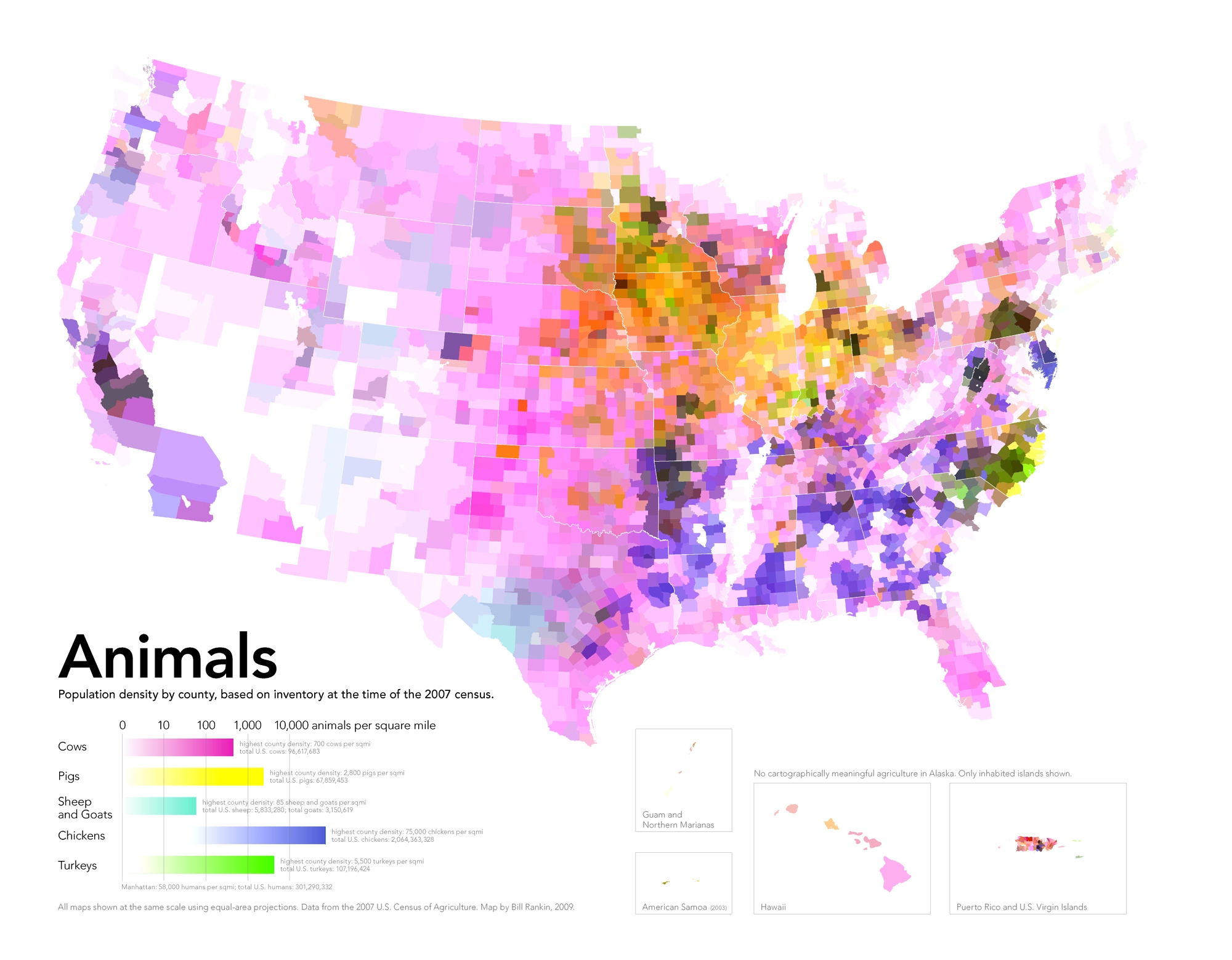
animals2007_medTogether with other maps which were solicited and edited by Darin Jensen in FOOD: An Atlas, a project broadly discussed in two earlier blogposts, Rankin’s metageography is oriented to imagining relations between food and the land.  The maps discussed in earlier blogs were data visualizations, and less informed by GIS, and bore the trace of the cartographer’s hand.  But this map is in no ways removed from being an intervention on cartography as an art, if it is based on “big data” as a structural metadata visualization of variations in local databases.

The data distribution of crops, animal livestock, and the profits of farming registered in the Census of Agriculture reveals not only strikingly constrained areas for active agriculture, but the geographic remove at which farming stands from food needs.  It presents  a clear-eyed critical view of the benefits of locally sourcing food by inviting us to shift our relation to the currently lopsided nature of national practices of cultivated space, but also suggests the distorted nature of food map created by the limited intense cultivation of crops and husbandry of animals in select areas.  I’m interested in both the maps and the questions of human geography that the distribution of food in them raises:   during the growth of agribusiness and consequent pronounced localization of livestock, slaughterhouses, and tending of animals, and map an increased remove from the sources of our food.  With a lack of available local food, indeed, food is not only less nutritious, but removed from place in the manner that Jefferson had insisted.  In such a landscape of specialization, “No major city could ever source all of its food from local farms–not even those close to major agricultural areas.”  Not only are few farms profitable, but those areas farmed are farmed with an intensity of agribusinesses more market-driven than linked to local economies.

Indeed, the apparently unprecedented concentration of mono-crops–wheat and soybeans; corn; cotton–creates a disjointed landscape both removed from local needs and plugged into a national (and international) market and in which much feed goes to livestock–though, as we’ll see, in which livestock is not so profitable.  This maps reflect on the consequences of how constrained farmlands shape a collective geography that leaves consumption curiously disconnected from production, which faces markets that the individual farmer cannot understand, and indeed are more subject to international prices and agricultural protectionism than to actual needs.  The regional saturation of essentially businesses of food production reflects not only a death of local agrarian farms, but the impossibility of local crop variation in a landscape of regional concentration for foreign markets, animal feed, and available land.

These attitudes might change, if we accept how Rankin’s radical cartographies reveal the narrow divisions we’ve imposed on our agrarian landscape.  But they delineate deep challenges of our national foodscape from even Burbank’s era of a range of resistant potatoes, peas, corn, and various pitted-fruits, including plums.  No longer does agricultural needs of a territory shape the contents of the foodscape, and maps lose their reference to a fixed territory, but map a disconnect:  Baudrillard would note that the notion of a territory does not in fact survive the map.  The map might suggests some links between our distorted agrarian landscape to the political landscape, and not only in the government subsidies that many crops receive to grow at a distance from urban populations, or the diversion of water to allows intense crop cultivation of regions like the central valley.  From a nation of farmer-citizens in a Jeffersonian mold, our “red” v. “blue” state electoral topography may mask deeply market-driven divisions in agrarian resources.

The data visualizations suggests the little attention we dedicated as a society to the role of land to food, or to the path from farm to table; the intense cultivation of crops, vegetables, and pastured meat to restricted pockets of the country practically ensures the remove of our food from a provenance or site of origin.  Rankin’s maps provoke us to map our own individual relations to the origins of our food, and trace their path back from sites of cultivation to our tables.  His maps delineate the broader challenges of our national foodscape;  maps may enjoy limited authority or exclusive purchase to represent or contain such abstractions as the nation, state, or nationality, but provide a way to disrupt a world of simulations, where the territory does not precede the map.  Jean Baudrillard famously asked pointedly whether the nation’s authority can survive that of the map:  the coherence of the United States as a food-producing nation can’t easily functionally survive the unsustainable practices agribusiness has dictated, even if the market can sustain it for now.

The objective disassembly of a national space raises questions of the compatibility of current practices of land use are even compatible with a national space.  Indeed, rather than map the relation of food to population, one could argue that the map mirrors one of uneven agricultural subsidies, as much as food demand or land cost, and illustrates the bloated landscape those subsidies are creating in place of agricutlural variety:

indemnity by county

This can also be illustrated in relation to animal husbandry by mapping the local density of factory farms across the nation:
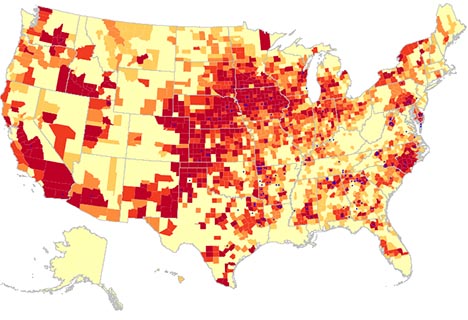
20101202-factory-farms-US

Rankin’s maps are of land-use reveal the effects of such subsidies for large farms in their “disjointed and lumpy space[s] of specialization;” they reveal a surface of farming where “few areas where different commodities are grown side by side” and radical concentration of cattle and livestock in specific areas, despite their thin distribution in the country as a whole.  The rather lopsided topography of sourcing meat and centering husbandry in massive compound farms suggests a sort of anonymity of their origins, less than healthy and less than nutritious, and suggests a mental familiarity with erasing the origin of foods, rather than considering the relation of food as a “good.”  The economic intense over-specialization to some extent ensures the virtual anonymity of  paths most foods take from where they grow to the table or the supermarket aisle.  This notion of food whose path from farm to table is devoid of specificity raises questions about as knowledge of the ability to distinguish food, as well as how its freshness is radically reduced in a system reliant upon quick transport. 

As agribusiness replaces the good household practices of individual agriculturalist moving foods from limited sectors of over-cultivation, subsidies define circumscribed areas of crops and animals–here mapped by the specialization of crops or the density of livestock in each county–and limit their profitability.  With the exception of some crops in the Midwest located near to cities or towns, in fact, a radical concentration of agriculture removes the individual’s dining room table from growing practices. Take, for example, the location of soybeans, marked by red, in some regions of the Midwest, that define a relation to the commodity outside the food that is actually consumed:
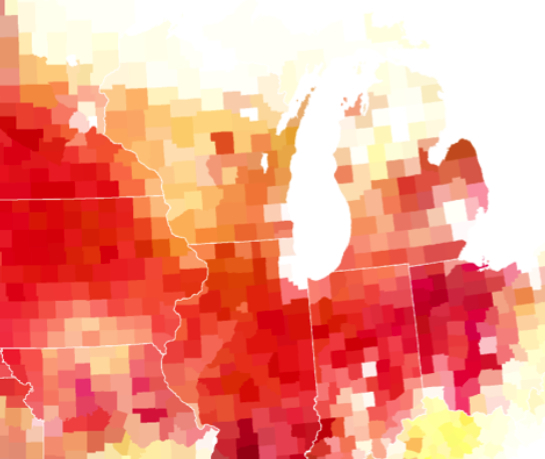
red crops--tghe sites of soy

The dramatic disruption between farms to urban foods and divide between local food-supplies and consumers to reveal a deep shift in our connection to the land.

While fundamentally data constructions, these maps give new sense to the materiality of the map, by providing a visualization not of expanse but suggesting some of the ill-effects of our own division of land-use.  Lest we naturalize the divisions created by this specialization of land-use, they map the stark divisions of  the origins of the food we eat poses compelling (and pressing) questions about the best way we might provide nutritious food to urban populations, and if we can economically sustain the current landscape of intense specialization of agricultural work.  One irony of this division of the agrarian functions is the illusion we are  healthy to invest one or two crops to one expansive region.  Indeed, this illusion masks dangers in segregating crops in the landscape and a fracturing of our relation to our food.  The widespread naturalization of one state or region as the center of corn or wheat, potatoes, vegetables, nuts, or cheese conceals an implicit consent to the current culture of specialization has segregated the production of meats, wheat, corn, cotton or grains in only place, in ways that effectively naturalize an impoverished practice of agricultural rotation:  by imagining certain states as lands of corn, wheat, or soy–as if crops were indigenous to a landscape–that erases the natural variety of an ecosystem by rendering it unrecognizable.

No clear sense of a landscape that provides nourishment for the nation remains, as agricultural “space” is itself dismantled as a uniform concept in relation to the nation.  Rankin’s cartographies map the extreme variations in the dedication of land to the intense cultivation of foods, plant and animal, and we might re-examine the silent segregation of an agrarian landscape through its consequent perils.  The database from the USDA that he has used reveal a concentration on crop monocultures and an agrarian centralization, à la Charles Taylor, of crop production.  Hopefully, we can use them to take stock of whether this is healthiest way to feed our cities and urban populations–to segregate or actually remove most cropland from sites of urban population.  As agribusinesses have concentrated the cultivation of wheat in a band in the central states stretching in regions colored bright green,  corn and soybeans in the yellow and red northern midwest, and fruits and nuts, the result is an increase in the remove from which our cities are nourished.  Populations stand at a remove not only from the sources of food, but of the most nutritious choices of food.

The high degree of scary fragmentation of US agriculture reveals a heightened specialization of food-sources between corn, wheat, soy, and nuts or vegetables.  The isolation of pockets of food production reveal an intensity of artificial over-specialization often removed from a national demand:   the segregation of centers dedicated to agricultural production from centers of urban life suggests a divide between city and farm.  Even more significantly, perhaps, than the divide mapped in electoral-map chloropleths between ‘red’ and ‘blue’ states, the severely localized distribution of crops maps a huge divide in expectations among Americans for freshly grown food possible of being sustained, and to the landscape of food-availability; while the food landscape cannot provide a deterministic explanation of party affiliation or patterns of registration, the distribution may map populations’ selective distribution in areas with greater access to locally grown food supplies–or their resistance to the  remove and distance from crops and an agrarian economy.

That is no doubt perhaps overly optimistic, given the huge role of agribusiness in structuring the landscape of food use, together with the subsidies of foods that they receive:  the monocrop concentration of corn, wheat or soybeans is conducive to bulk harvesting for sugars or bread, and shipping, if not to their redistribution from select centers of packaging.

Unknown

But the sad (unhealthy) result is a remove of most populations, or at least huge proportions of them, from the sources of their food. The existence of such a selective resettlement is less clear than the dysfunctional image it suggests of a fractured relation to the agrarian landscape about which it’s hard to wax poetic.  The rare concentration of fruits, nuts and vegetables in California, densest in the Central Valley and farmlands of Northern California, are the only dense areas of their dense cultivation, save Southern Florida, based less on climate or topography than on their remove from coastal cities, and seem to provide the only dense region of vegetable harvesting in much of the nation.
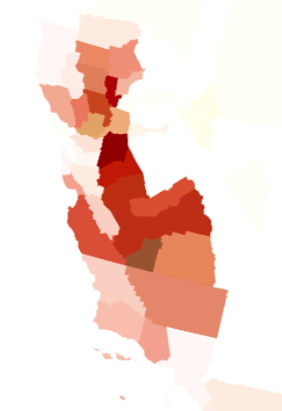
What does this tell us about the state of California?

How can one imagine this disjuncture of agrarian space from the national space?  The classical poet Virgil idealized the relation of Rome to its landscape and countryside in the era of Augustus, providing a topos of the idealization of landscape’s tranquility as the result of harmonious good government.  And it’s helpful to cite Virgil’s praise of the wealth of agrarian diversity in the Italian peninsula, too, because they provided a model of the metaphorical cultivation of a proto-national space.  When one looks at Rankin’s weird maps of a disrupted foodscape, where over half the country is without crops and blank whitespace; they’re as removed from Virgil’s bucolic agrarian ideal as they are from Jefferson’s–indeed, those two are far closer to one another than we can see in how we’ve divided the nation into zones of soybeans, silage, and wheat that only occasionally overlap.  There’s a huge contrast the dissonances in the food landscapes that Rankin mapped above to Virgil’s famous encomia of the productivity of the Italic landscape in his Augustan Georgics, where he evoked the transformation of a rocky Italic landscape through the benefit of Senatorial edicts and decrees to a land of “abundantly growing crops” and “sacred home of the olive groves,” now dotted with “many wondrous cities,/That so much toil has built” whose crops were “abundantly rich;”  the land, tended by the best techniques of animal husbandry and of agricultural practices, provided the ground to cultivate wheat, barley, spelt and vetch in alteration with Egyptian lentils “in accordance with the Gods.”

That bucolic image of the productivity of the land that is fostered by Senatorial decrees and oversight of a diverse but homogenous space stand in sharp contrast to the segmentation of pockets of subsidized divisions in an agrarian landscape subject to intense monocultivation that is to large extent both largely sponsored by agribusiness, and largely removed urban areas or demand.  Tending the Italic landscape drove wealth to the “tot egregias urbes,” so remarkably diverse and bountiful, of the recently united peninsula Augustus ruled–and whose relative riches outshone any other region in the world.  The current landscape of specialization has so narrowly concentrated to focus agrarian productivity into scattered agrarian blocks of a zoned farming industry that dramatically disconnected itself from urban areas–and reveals a disconnect of city and farm so stark one could scarcely imagine a tie between the two.

Agrarian diversity?  Well, the new space is just complicated to manage or understand.  We know it’s unwise to concentrate corn and wheat in one area with soybeans, as if they were a large monocrop, because this exposes them to disease; the concentration of fruit and nuts in pockets of the entire country is even more irrational.  The placement of production of crops at a remove from populations produces less nutritious food, and generates more waste.  Equally difficult to sustain is the containment concentrations of livestock animals in select pockets of beef for slaughter, whose concentration is likewise removed from areas of urban concentration.  Despite small areas of cows lightly scattered for use in pasture for milking across most of the country, concentrated centers of butchery define the country’s food map.  Something like one-third of arable crops are given to land animals, but the segregation of high-density livestock farming from local agriculture suggest a challenging foodscape which might be considered more creatively, even if there is never much animal harvesting in the desert:

Drive down Highway 5 to Los Angeles past centers of slaughter and beef production.  The extreme variation is stunning when one approaches the cattle farms in California’s Central Valley, and even more scary is how characteristic this is in our agrarian landscape, rather than an  extreme fragmentation of land-use for livestock:
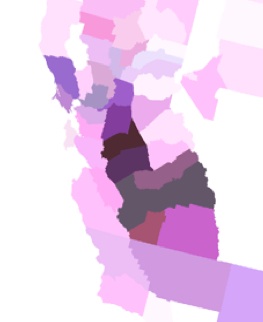
Califronia Animal Density

Consider the localization of livestock in deep purple gradations in Rankin’s  chlorpleth reveal a national segregation of zones of butchery limiting availability of freshly butchered meat:
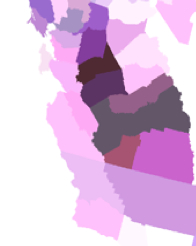
Central Valley animal production

What does this say about our relation to space?  Let’s look at the crazy topography of intense pockets of “cattle compounds” and “chicken farming” that might not be called husbandry which make a broad mosaic of meat processing centers in the poorer counties of the American South:
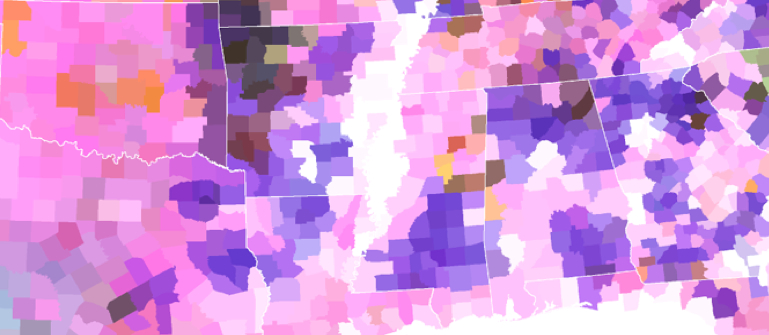
American South

This snippet is barely recognizable as a map, of course, or a record of space. Remember the pretty staggering numbers that the deep purples reveal in this key:

Animals-Legend

Mass-farming of course unprecedentedly removes food from its consumer, and removes the very idea that this need not be the case.  The inhumanity of concentrating chickens in the Southern United States is one concern; the remove of chicken farms from urban areas or human consumption is poignant: it finds counterparts in the chicken-farms of the Central Valley and Imperial Valley in California, which are something like a hub in the West Coast save from those in the northwest.  But at their highest points of concentration, we have managed to concentrate an amazing 70,000/sq mile.  (Cattle are densest in the Midwest, where we find 700 cows/sq mile at the densest parts; fewer turkeys are raised, but the greatest concentrations of 5,500/sq mile seems downright unhealthy.)   Leaving aside ethical morality, the map posits questions of food safety:  intense centralization of animals and consequently of feed supplies increase risks of contamination as well as exposing them to greater threats of disease.  With the trends to global warming, the dangers of locating agriculture in fixed areas of intense over-cultivation are even more pronounced.

Such data visualizations offer a database which easily slips from the eye.  While these maps don’t overlap, they suggest a joint-access data visualization that might offer a useful planning device.  They reveal mono-crop cultivation and intense concentration of the value of animal or agricultural products that impoverish the project of agriculture in much of the country and seem to reduce the value of either crops or the production of animal products in most US counties in the absence of their intensification.  More striking, perhaps, is the small degree which farming maps to value across the entire nation, uniting both animal and vegetable products, and the huge wholes of agricultural profitability in over one-third of the nation.  We supplement these gaps through the massive importation of foods, vegetables, and produced foods.  But the fact that it is rare for vegetable-growing to bring in a profit through most of the northeast suggests a topography of agriculture that few wold suspect; the profits are limited to the rich green areas dominated by the crops of soybeans and corn, as well as wheat, that are similarly scarily removed from many population centers. Despite the comforting green that leeches down the path of the Mississippi River, ; meat seems only profitable in Oklahoma and parts of the old South, sites of large concentrations of cattle- and chicken-farming.
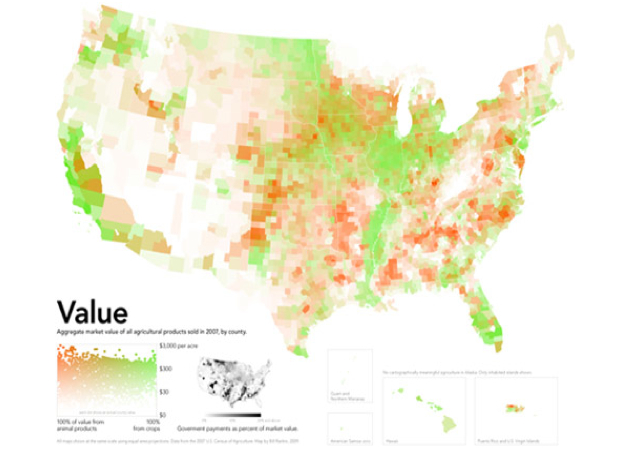
Agricultural Value Map.rankin

The washed-out nature of large areas of this map suggests the low aggregate market value of product made in those regions; there is a surprising density in few counties where animal products provide profitable earnings.  This is, to be sure, but one sector of the economy; but it maps an important one:  the divides Rankin maps not only poses questions of how we see our land, or use resources but of how we imagine the remove of farmed land to a vital urban space–and indeed how economically removed agrarian practices have become from urban consumers across most of America.
crops2007
The lopsided  geography of land value creates an uneven distribution we all tacitly know but don’t acknowledge.  It is also a basis of land-use that is not economically sustainable.  One take away from Rankin’s series of visualizations of the discrepant distribution of agriculture is that at a time when we dedicate increasing attention to the construction and planning of urban space, rural agriculture might be better planned in concert with urban concentrations, and not only for reasons of health but as a matter of public policy.  We often need a map to reveal the artificial nature of what we naturalize.  All three data visualizations suggest that we’ve left agriculture to market forces alone, in ways that might not plan for future development; imagine the maps as overlapping public access databases we might use to orient ourselves not only to space, but to a more sustainable relation to the agrarian use of the land.  The needs for such a shift in orientation are not only for health, but economic:  it’s not possible to prognosticate from a map, but we can use the visualizations to raise questions about what would be the effects of climate change on districting agricultural land-use to specific sectors and types of crops;  the concentration of corn strains in one area, moreover, raises possibilities of adverse influences in the food chain of GMO strains, much as the concentration of both animal livestock feeding raises specters of tainted meat supplies.
The limitations and constraints of agribusiness are imposing, if familiar.  There has been some local pushback.  Discomfort with these constraints undoubtedly informs the recent retrenchment of urban gardening and even urban rooftop gardening across the urban United States.  Much as the growth of farmers markets may have encouraged or initiated widespread interest in centers of urban agricultural use within an urban landscape, as if to react to the marked remove of food-availability–as much as fresh food–from urban space, and the poor nutritional qualities of food that result.
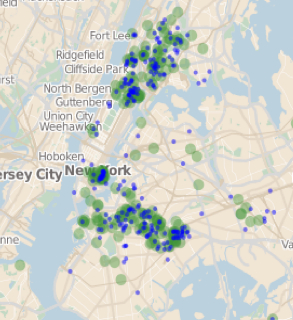
What can we make of the local attempts to bridge the town and the country, either in the preserves of the new spaces in cities created at farmers’ markets, or the growth of urban agriculture?  I’ve gestured to the attempts to map both in Oakland in some previous posts.  Around New York City, a previously isolated urban space is surprisingly permeated by active green space.  The Parks Department in fact only owns less than half of the almost 500 community gardens measured by GROW NYC and Green Thumb in 2009, with sites to volunteer noted in blue beside urban greenspaces:
Community Gardens NYC region
How many are open to cultivation?  Over 20% of those highlighted in yellow are dedicated to edible plants:
over 20%
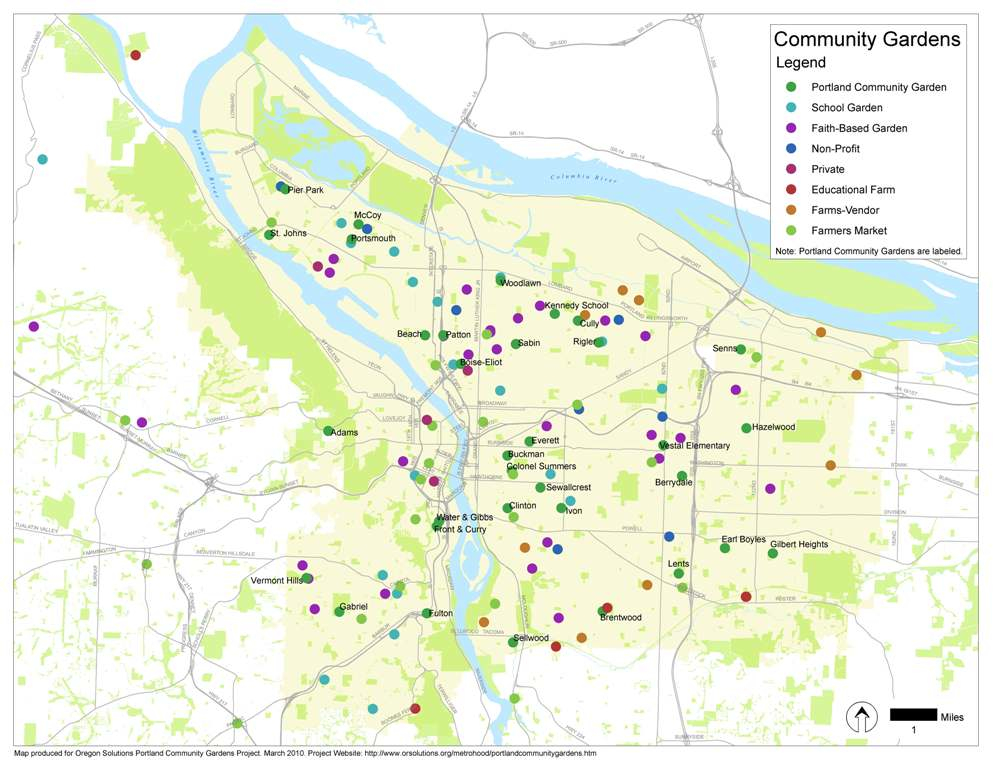
Or the similar emergence of community gardens in Portland:
portland gardens

The growth of San Francisco’s roof-top gardens, which was so quick in 2008-11 that the city changed its entire zoning code to permit urban agriculture from expanding in all neighborhoods of the city, led to a Renaissance of urban gardening, despite the relatively close access of the neighborhood and city to fresh food markets, not to mention an insatiable demand for local food:

Mapping the economy of rural-urban relations is a big project for the future, but perhaps it is even more difficult to plan to do so given the investment in a model of land-use that cannot yeild many positive long-term returns.

Leave a comment

Filed under Big Agra, croplands, Cultivable Land, data visualization, factory farms

Cartographic Craftsmanship, or the Social Life of Maps

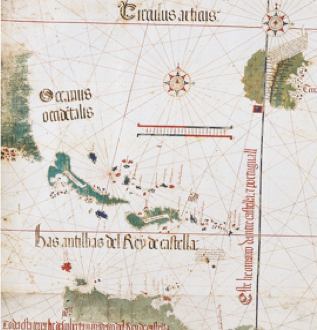
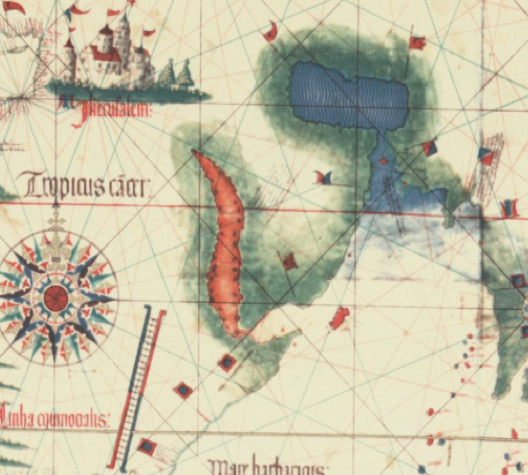
When he left Lisbon in 1502, the secret agent Alberto Cantino found a way of smuggling an elegant planisphere when he left Portugal for Ferrara, probably rolled up in his suitcase, that evaded the censors of that day’s TSA. Perhaps he rolled it up his sleeve. For the planisphere–a representation of the entire surface of the world–contained relatively classified information about the discoveries in the New World of import to the Portuguese that Cantino seems to have gleaned from mapmakers in Lisbon while he was visiting, and is the first chart to show the coast of Brazil and islands known as Fortunate, and the clear path around the Cape of Good Hope to the Indian Ocean:  he hoped that it was “in such high quality . . . and drawn in a manner that pleases your Excellency [è di tal sorte, e spero che tal manera piacerà a V. Exa],” suggesting the care with which the Este spy had procured the nautical chart.  I’ve discussed the aura of maps and charts in an earlier post; the delicate greens and red, and delineated shores, conjure the removed oceans with an aura of announcement, fitting new knowledge into a basic schema defined by lines of latitudes, not present in charts, as well as rhumb lines for nautical guidelines, whose points of reference were defined by a compass rose from which they radiated:

Cantino Map

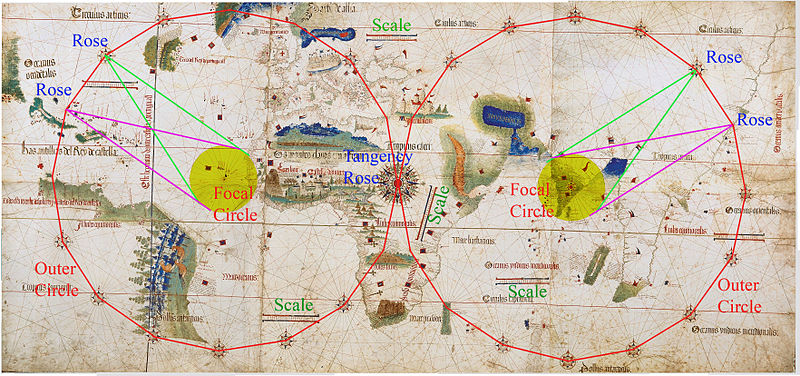
The astounding accuracy of many of the coasts of this chart profited from a long tradition and protocol of nautical charting, with a peculiar manner of noting nautical expanse.  The chart reveals the discoveries of Pedro Álvares Cabral, a nautical explorer, who Cantino probably did not know.   Cabral had recently returned to Lisbon, and when Cantino arrived there, with the pretense of seeking to trade horses for the Este court, he must have sought him out on his secret mission to procure maps of the discoveries for the Este family.  The map might have copied the secret master-map the Portuguese maintained, or Padrão Real, of Portuguese discoveries; they were magnified unintentionally beautiful “Carta de navigar per le Isole novam trovate in le parte di India” which misidentified its subject, but provided the first geographic knowledge of Brazil.  But it clearly either superimposed or referenced the directional wind-roses of nautical charting, ostensibly for reading orientating directions at sea, although perhaps as befits a planisphere of the entire earth, is constructed about two “focal circles” of thirty-two points each:

800px-Compass_grid_Cantino_planisphere_(1502)

The planisphere arrived in Italy as a sort of wonder of mapping multiple forms of knowledge, as well as a synthesis of expanse.  The recent 1494 Treaty noted as bisecting the Brazilian coast, had given part of the landmass known now as South America to the Portuguese monarchy which the map shows as the most exotic area it depicted–the map seems to trumpet the luxury of an area that the Portugese sovereign Jaoa II had concealed from Ferdinand I.

Isole Fortunate

How did it speak to its new audience?  The craftsmanship of an unknown Portuguese painter or cartographer may be surprising given the high stakes of its procurement from a government particularly secretive about recent discoveries in the New World.  The geographer and historian of maps George Kish described an early fifteenth-century contract for the depiction of a portolan chart, a genre of coastal mapping that developed in Europe in the early fourteenth century, that specified the involvement of both painters and mappers; the partnership seemed natural in so valuable a creation as a map or portolan chart: the hide on which it was drawn was itself grounds for the further investment in pigments and decorative motifs, as in the illustration of inhabitants of Sierra Leone.  Part of this was also because of the riches that these maps suggest in far-off lands, and part because the tradition of nautical charts was only to mention the names of ports that dot the regions’ shores, rather than their interiors–which remain blank:  other terrestrial place are limited to Jerusalem and the ports of departure and arrival, and space expanded over the seas rather than the terrestrial expanse they enclosed.

180px-Compass_rose_Cantino.svg


The protocols of charting are unclear, as is their orienting function.  The use of these protocols in drafting the Cantino chart may have shifted as charts gained a display value of their own and adressed audiences distinct from the commercial trading houses who earlier seem to have kept them.  Although  associated with nautical routes, charts gained a distinct display value as audiences sought to process discoveries for audiences less familiar with nautical travel, or with commercial exchanges over oceans.  In the sixteenth century, as Angelo Frabeto has shown, nautical charts gained a popularity and interest in Italian courts of central Italian courts in the mostly landlocked Romagna, near Ferrara.  The already fanciful components of nautical charting expanded in these charts, which were less dense and stark than predecessors, and suggest an early tradition of combining artifice and cartography that predate printed maps.  The map Cantino brought contained a specific treasure-chest of disjointed bits of information and lore, discontinuous but joined by being enclosed in the velvet case constituted by the map itself, from the mountains of northern Africa to the birds of Sierra Leone, and the image of the city of Jerusalem, all shown without particular care for scale.
 

Affrica and castles in Guinea

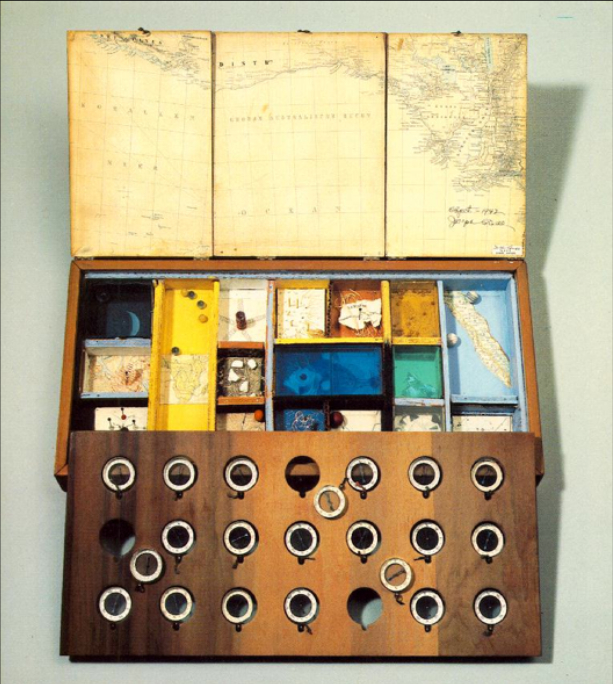
The genre suggests not a limited ability to consider other expanses, so much as a disinterest in picturing them.  The manuscript reproduction of these charts reflected an interest in the most recent ‘news,’ and the colored vellum  charted voyages that were not made, much as, ahistorically recalling the later uncanny adoption  the motif of the ‘wind-rose’ that defined orientations of travel or the winds, Joseph Cornell’s “Object (Roses des vents)” (1942-53); Cornell placed fragments of a map of the remote Great Australian Bight amidst shrunken coastlines that Cornell had never seen, planets that were as far away, and emblems of imaginary voyages, and the compasses that might take him there:

Rose des Vents


As Cornell’s box, the fragments of green shoreline in Brazil in Cantino’s map assemble the scattered expanse over which the Portuguese had travelled in a semblance of unity–the unity of an expanding expanse.  Whereas the fragility of all worldly phenomena–as of the crafted miniature of the universe’s expanse–a subject that was thematized in Cornell’s perverse if beautiful boxes, the fragmentary pieces of lunar or terrestrial maps serve as pivots of perspectives of viewers, as well as a nostalgia for the aspirations toward total visual knowledge that echo Cornell’s childhood and adult consumption of engravings in nineteenth century books of science.

The Cantino map expanded the protocols of nautical charting, which it combined with other forms of mapping to offer a range of curiosities couched in the surface of the map, together with convention from nautical charting of coloring the Red Sea red, or painting an exotic bestiary of parrots on Brazil’s verdant shore, and locating, crisply,  the islands’ shores themselves– although the eager cartographer magnified their own coastlines out of scale and proportions, despite his inclusion of a line of longitude and bar of scale.


Cantino selection

The expansion of a tradition of nautical charting to a hybrid form distinguishes the Cantino map, which faced a very different audience of readers once this ostensible copy of a secret map reached Italian shores.  The Este family  interest in this chart lay in how it revealed far-off lands that associated with ocean travel by the Portuguese, who had mapped islands in the Pacific beyond Cape Verde and the Azores in the early fifteenth century. When Cantino smuggled the chart to Ferrara in 1502, he saw it as completing the mission on which Ercole had sent him to procure secret information about “the new islands” discovered by the Portuguese, and the result of his discussions with several Portuguese explorers who had traveled to search for a Northwest Passage to Asia.  It was copied into new engraved maps of the Americas, and provided a protoype for the printed 1516 Carta Nautica.

The map centrally communicated, from the Portuguese perspective, the legitimacy of possessions in the New World, demaracted at the boundary line adjudicated and confirmed at Tordesillas, which leads one to imagine it derived from a seat of central authority.  Two disembodied bars of scale on the map’s surface suggest the measurement of terrestrial inter-relations, and its preparation for careful scrutiny of a studied eye.

Isole Fortunate

The Cantino map hence played with the protocols of charting.  Rather than insist on uniform coloration of the ocean, to prevent obscuring rhumb lines, but to maintain its elegance, as the cartographer colored certain regions a light green, by confining the blue paint to the Mediterranean, Baltic, and unbounded Caspian sea, the map combined a pictorial artifice with the practice of charting or representing oceanic space–the Mediterranean had its own portolan chart, and perhaps didn’t demand that its expanse be represented in a similar style.  The combination of artifice and nautical protocols exemplifies the huge expansion of the purview, as well as containing the first news of the Brazil in Italy, which was soon diffused in other charts and maps.

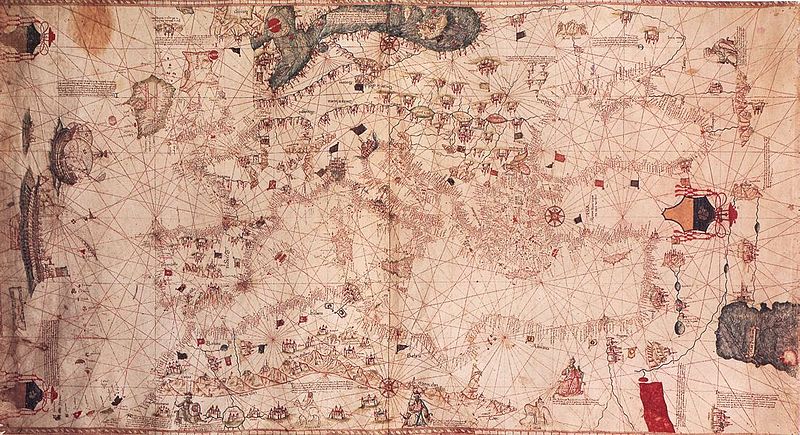
The Cantino chart might be measured against the sort of artifice in earlier fifteenth century charts, popular chartings of the Portuguese voyages to the African coast.  The chart that arrived in Ferrara from Seville dramatically expanded the purview,  toponomy, and perspective of nautical charts the Este  knew, to be sure, such as Grazioso Benincasa’s detailed 1494 mapping of the African shore:

800px-Grazioso_Benincasa._Biblioteca_Universitaria,_Bolonia.1482


Benincasa’s 1482 nautical chart densely collated costal ports but adopted the similar carefree style of decoration–probably the work of a painter–to the mythical monarchs that inhabit an imagined uncharted terrestrial expanse.  The image seems more fanciful, and designed with the desire to appeal to audiences by its  and was the culmination of a series of portolan charts and nautical atlases of the prolific Anconitan mapmaker, following his study of Mediterranean cities that from the 1460s to included western African ports, as well as mythical islands, and dense textual legends of geographic information.  Inland areas are blankly traversed by the same rhumb lines, which echo compass lines, and the truth-claims were much more limited, and land-masses probably entrusted to painters with limited first-hand knowledge of the region.  Benincasa’s chart colors the Red Sea red , too, following a tradition of charts, and Jerusalem and several biblical cities in iconic miniature.

The Cantino map offered a new way of reading the map–one which mimimized these curiosities.  For one, the thick and prominent line of longitude in the “Cantino” map has received significant attention, together with its depiction of the Fortunate Islands, Antilles, and Azores, for this defines and demarcated the new region of sovereign possession.


Line from Tordesillas and parrots


The changed social life of these maps suggests new uses of the map as a field for understanding space–perhaps less ready to note fanciful riverine paths and foreign sovereigns or kingdoms, and more to conform to criteria of inclusion.  If one considers the new circumstances of reading the portolan that arrived in Ferrara, and its use to imagine and consider space, we might offer a reading revealing more than the differences in place-names it includes, or the conventions of mapping.  Although the format of mapping seems the same, the “manner” and “quality” of the map addressed a different sort of audience, despite the common origins of its prototypes.

The aura of the map was not limited to its conventions.  The material objects of wonder from the New World that populated the Cantino map are most striking, however, in how they illustrate an early interest in items of exchange.  The unity of the portolan chart is very different, of course, because it includes the Fortunate Islands of the sovereign of Castille, as well as the Brazilian shore, and a chunk of its richly green interior, cut off from the unknown mainland and in Portuguese possession, as if to show off the charmed jewel of the new lands that the chart encompassed.  The chart’s inclusion of a disconnected shoreline of Brazil assembles a makeshift sense of unity by noting the broken fragment of the New World to the lower left, foregrounding it as both a sort of promises of new riches, and a means to stake possession of a territory by no means yet entirely concrete, the feathers of whose birds might be better known than any other aspect of the chart.

Parrots in Brazil

The chart was kept in the Este library in Modena, but stolen when anti-Austrian Modenese looted the palace in 1859.  The map remained temporarily lost, before being found later that year in curious circumstances of re-use as the folding screen or door in a sausage store or butcher shop.  (Some portolan charts became book-covers; others were cut into strips as bookmarks or otherwise recycled.)  The Cantino planisphere, reused as a screen, was temporarily stripped of its attraction as a promise of new possessions.

Leave a comment

Filed under cartographic accuracy, Joseph Cornell, Mapping the New World, Nautical Charts

The Revenge of Geography?

On a smaller scale than Robert Kaplan’s pre-determined predictions of the fate of worldly empires, the damages and deaths caused by the floods brought by Hurricane Sandy revealed the revenge of geography on specific regions and neighborhoods: particularly to the square mile near Staten Island’s eastern shoreline in a topographic “bowl” became the most dangerous place to be during the storm.

With the ocean level rising at a rate as rapid as two feet every hour, an elevation of 2-4 feet made this area victim to a flash-flooding of almost biblical proportions, all too familiar from the low-lying regions of New Orleans:  shortly after breaching the boardwalk and running over the Boulevard at 6:30 p.m. in the evening, waters poured into the square mile area filled with former beach houses–located beneath Father Capodanno Blvd. and roughly between Midland and Dorp Beach–in a truly scary revenge of geography on its inhabitants.  Ocean waters breached the beachfront road, ran over the Boulevard, and filled the ‘bowl’ of some 2,000 houses in minutes.  Several inhabitants, either ignoring or not giving heed to the imperatives to evacuate low-lying areas, or just not expecting the rush of waters to be so intense, were trapped in the rushing tidal flood, and 11 people drowned, ages 2 to 85, as the natural strorm drainage system couldn’t come with the huge influx of ocean water.

Screen shot 2013-02-27 at 9.47.32 AM

The catastrophic proportions of the natural disaster are difficult to map, partly because mapping implies a disinterested relation to space that still seems difficult to process in the face of tragedy, and partly because the map is not an adequate map of the intersection of these lives with the storm.  WNYC’s map of the relation between low-lying areas and the deaths is pretty clear.  But one wishes one could have provided a better warning system while one reads this interactive map–what were John K. and John C. Filpowicz doing in their basement?  When they ran downstairs to avoid gale-force winds, did they imagine it was watertight?  Can we somehow turn back the clock?

These demographic data in this small sample conform to a broader perspective, as they echo the intersection of two groups.  Of the hundred deaths attributed to Hurricane Sandy, over half were older that 65, according to the New York Times, and a considerable majority occurred in Staten Island or Queens; many inland tragedies that occurred in the mainland attributed to fallen trees, due to the wind that were the source of that exaggerated ocean tide, but were most often far less clustered.  The individual narratives are the most meaningful level at which to understand the course of the Hurricane, but one can’t help returning for some sense of meaning to the larger maps.

For the maps provide some sense of a healing in relation to the event as well.  It is true, the tragedy isn’t one of the settlement of the area, or even of the lure of the beach, but lay in something of a denial of geography.  One would have hoped that cartography could have assisted in the evacuation, but in the end, the inrush of waters created a tragedy for which few folks were adequately prepared.  Tragic deaths occurred mostly on the margins of the lowest-lying regions, where the need to evacuate was perhaps most easy to discount, as if there, the strength of the storm somehow easiest to ignore.

To view the map in an interactive format, and read individual names of those who died, gloss your cursor over the same view of the Staten Island coast at this page, where this particularly grisly sort of tragedy is mapped.

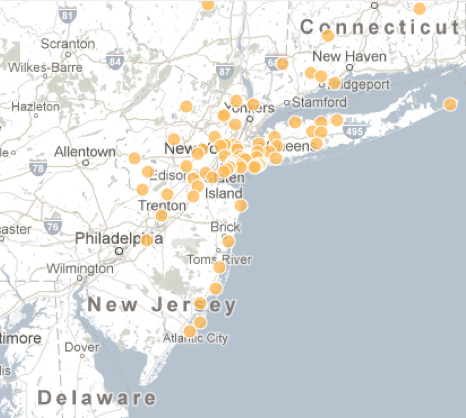
In order to distance this tragedy, and to situate or frame it in an understandable context, it’s a help to compare this local map, and its street-by-street topography, to a broader regional map of the toll associated with the hurricane, and perhaps then to pivot to map of the entire city, against which the tragedy in the Staten Island shore might be placed–or mapped–in contextual perspective.  For this, we descend into the symbols and anonymity of GoogleMaps, with its sanitized view of the devastation:

Sandy Map Big

We don’t need to maps to tell us that the densest records of mortality occurred in New York City, or to follow the distribution along the Jersey coast.  And its hard to know that this map is satisfying, each yellow glob masking its own narrative of the end of a life.  When I look at this map, not so oddly, however, I miss the narrative that is provided for the Staten Island beachfront.  For the above large-scale map has the authoritative remove of a historical map, in some sense, and puts me at too much of a remove from the scene to comprehend the natural disaster–translated as it is to a generic Google Maps template, with the cost of the loss of human life erased, if not sanitized, in a dense clustering of a multiplicity of yellow suns.

And I go back to the map of New York, using the program to zero in, where the clustering of orange blobs is striking, and leads me back to the Staten Island neighborhood with a calmer mind, trying to balance their stories with the other lives that intersected with the storm:

Sandy-mid


There is limited comfort in this somewhat antiseptically muted map, and I might prefer a set of sequential weather maps of the region. But it’s still something that I linger over, trying to press meaning from, before going back to the grittier map of that low-lying Staten Island Beach.

Leave a comment

Filed under Hurricane Sandy, Interactive Maps

A Well-Drawn Map: the Aura of the Projection

All maps are simplifications.  Cautionary words of the section on “Map Data” in the introduction to a 1986 edition of the near-canonic Goode’s World Atlas advise cartographers to find some way to best select objects or information worthy of representing, evaluate their relative importance, and “find some way to simplify their form.”  The statement acknowledges the risks in any mapping, of which Goode himself was aware, and aims the mapmaker toward crafting a disinterested map.   Then comes the barbed disclaimer:  “Because a well-drawn map creates an aura of truth and exactness, the cartographer should caution the reader against interpreting the generalized data too literally,” cautions the  introduction.  The problem was the distortions that maps created; in the first atlas that he printed, Goode had questioned the format of straight parallels and meridians that intersected perpendicularly for compromised its relative accuracy, or for presenting an untrustworthy image of terrestrial relations.

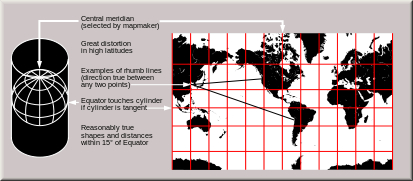
The American geographer John Paul Goode (1862-1933) directed considerably attention to the failure of the reliance on perpendicular parallels and meridians in Mercator’s projection, and the distortions of relative national size and, more broadly, geographic interest this created:  Goode’s attack on the geometric distortion of the map was a recurrent theme of his public lectures, and when he decided to organize a new educational atlas from 1908, he designed his work to offer a new sort of educational tool for encouraging interest in geography.  His hostility to the Mercator projection, despite its considerable artifice, was a basis for  designing the world map for this atlas:  in promising to introduce a new format of terrestrial projection before the congress of American Geographers’ Association that year, he condemned the Flemish cartographer’s 1569 cylindrical projection as “evil”  and promised a new format of terrestrial projection be used in American schools to train students in world geography in ways that he felt were inadequately served by the many distortions created by “mapping” the earth onto an imaginary cylinder around the earth, as  Mercator had proposed in the most famous of the several world maps he designed.

413px-Usgs_map_mercator

“Frequently,” Denis Wood enjoined readers,”[cartographers] do not mean what they say, they rarely practice what they preach, and have managed to order their maps to preserve to preserve the implications of transparency for the general reference section,” as if suggesting that half of the game was to persuade readers.  Mercator did not try to assert transparency for his projection, but provided extensive explanations of both its mathematical construction and distortions of the poles in framed legends, if he did not admit that the map became untrustworthy beyond 70 degrees on each side of the equator line.

When Goode tilted his lance against Mercator‘s 1569 projection, he objected to the misleading viewers by organizing parallels and meridians in perpendicular relation to one another.  The map effectively expanded northern regions of the world, as the then-iced-over Greenland and Antarctica as a result.  The cylindrical projection rectilinear graticule of parallels and meridians resembled a geometric grid–a notion, while clearly flawed, provided a compelling basis for Mercator to straighten the rhumb lines of nautical maps, and integrate information from nautical cartography to a world map.  The flaws in the projection were known:  even ancient geographers had debated the uses of such a rectilinear grid, and found it discounted terrestrial curvature.  Mercator however returned to this ancient form as a way to map straight lines of nautical travel on the map’s surface, adjusting its form to accommodate nautical maps by allowing distances between lines of latitude to increase as one moved north or south from the equator.  His innovation was to maintain a perpendicular relation between meridians of longitude to parallels of latitude–as they are on the surface of the earth–at each point on this projection, which allowed local relationships to preserve accuracy.

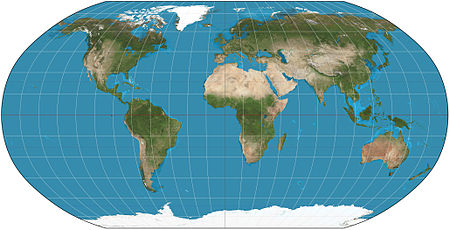
The result did not sit well with the pragmatic ends of instruction Goode desired.  Goode vociferously attacked the faults of the Flemish cartographer’s cylindrical projection as perpetuating cartographical errors.  He believed that its idealized had long deflected criticisms of their accuracy and distortions.  Its errors lay not so much because the projection privileges the size of Europe–as was later argued–but in how it granted large territorial expanse to Greenland, and did not extend a similar bias toward America suitable for Americans to learn geography.  Despite engraving a large projection of the world in sixteen sheets, Mercator never designed his projection to serve as  wall-map, akin to those used in to American schoolrooms for geographic study.  Mercator, a printer and editor of multiple projections as well as a geographer, and was not committed to one schema of global projection alone that had become identified with his name and authorship.  (Mercator himself preferred a curved sinusoidal distribution of the earth, organized around a central meridian, to the cylindrical because of its ability to maintain accurate distances.)  But the projection epitomized an inaccuracy and distortion often recognized–as by Goode–to be the cost of any world map.  To devise a more legitimate and pedagogic projection for the classroom setting, that  school atlases would use as educational tools, Goode fused Homolographic and Sinusoidal projections in a Homolosine Projection in 1916, coining this term and presenting it as a more suitable projection for instruction and the basis for what became known as the “Goode’s World Atlas” for Rand McNally.

The projection not coincidentally restored North America to prominence in the first sector of its flattened orange-peel segments.

800px-Goode_homolosine_projection_SW

This iconic map, prefiguring the corporate logo of Trans World Airlines, used decidedly wavy meridians to remind his readers of the equatorial bulge in the round surface of the world, and make clear its transformation of a curved world, rather than–as Mercator–transposing round surface to “spread on a plane the surface of a sphere” for readers.  The map explicitly showed students a picture that affirmed the world’s spherical nature, as if lest anyone be led to believe that it was flat.

Goode affirmed the advantages of this teaching model in many public lectures that he gave through the country.  Goode believed that despite giving the appearance of accuracy and regularity of its perpendicular parallels and meridians to readers trained in geometric graphing and Euclidean geometry, the map was pernicious.  In dedicating his career as a geographer and educator to “to making geography a simpler and more enjoyable subject to learn” he started from the map itself.  As well as a productive cartographer,  Goode was a proselytizer of the benefits of truth in mapping; as the power behind the Rand McNally Atlas, and a tireless advocate of the benefits of atlases in education, as well as the teacher of an entire generation of American geographers.

The Mercator projection did not sit well with his insistence on a pragmatic value for maps.  These concerns might be likened to John Dewey‘s interest in both transparency and logical relations.  Dewey in fact dwelled a bit on the “Mercator projection” that Goode detested briefly when he investigated the relation between a country and its map in writings on mathematical discourse.  John Dewey observed how “the similarity of the relations of the map and those of the country is the product of taking maps that have in fact been perfected through performance of regulated operations of surveying in isolation from the operations by which the map was constructed.”  “In the ordinary Mercator map,” he noted, “if the polar regions are taken to be relative . . . to the equatorial regions, “there would be misrepresentation.”  He observed with rue that “there is a morphological enlargement of polar regions in the Mercator style of map; in the cylindrical, their shape is distorted, while areas are correct . . . when the directive function of the map is left out of consideration it must be said that no map is “true,” not only because of the special ‘distortions’ mentioned but because in any case a map represents a spherical upon a plane surface.”  He was intrigued by the  system of relations constituted by a map:  “In the ordinary Mercator map, if the polar regions were taken to be relative (in the sense defined) to equatorial regions, there would be misrepresentation.”  Dewey revealed his concern with the functional relation between country and map, as well as the instrumental role of maps in “such operations as traveling, laying out routes for journeys, following movements of goods and persons,” finding the distortions in the Mercator projection made it lacking on both grounds.

As Goode dedicated his efforts to restore pleasure to studying geography, his attack on the “aura of truth and exactness” of maps hints at the deeply seated nature of Goode’s criticisms of retaining the equiangular projection associated with Gerard Mercator in schools as a guide to world geography–not only did its limited preservation of global accuracy rendered it practically unusable at latitudes above 70˚ but the map provided little relation to an existing political geography or an amenable geopolitical image of terrestrial geography.  Mercator’s aim in his 1569 sixteen-sheet map was to present straight lines of sea-travel, or nautical course, rather than preserving terrestrial proportion, transforming  East-West travel so that meridians and parallels were perpendicular, and “linear scale” was equal at any point–although uniform scale not maintained.  The resulting distortions of “expanse” at latitudes significantly above the equator are clear to observers who noted its perpendicular intersections of meridians of longitude and parallels of latitude:

350px-Mercator_projection_SW

These distortions are increasingly accurate with the regional surveying of the globe dramatically expanded; Goode would have none of its expansion of Greenland to the size of Africa by the early twentieth century–a result of the projection schema transmitted by applying Mercator’s procedures, more than of Mercator’s original map, whose intent was less directed to terrestrial coverage than reconciling previously opposed standards of nautical and terrestrial cartography.

The harsh condemnation of the misleading “aura of truth and exactness” in maps such as Mercator’s projection is telling, and although it wasn’t written by Goode, continued his cartographical crusade.  Although Goode’s deep concern with the use of the projection and geography’s acceptance in school curriculum is understandable, it is curious that the work of a geographer closely associated with the printed maps as Goode sharply condemned the “aura” of truth in maps so sharply.  “Aura” here meant the misleading nature of its authority, but also suggested the staying power of the map as an art form, and the way that the artifice of map-making persuaded viewers of an appearance of accuracy and accurate inter-relationships.  But it can’t help but recall how Walter Benjamin discussed the lack of aura in printed works of art.

The editor of Goode’s atlas who condemned the “aura” of maps as the Mercator projection was probably unaware of how Benjamin discussed  the loss of “aura” of art in an age of mechanical reproduction.  For Benjamin, mechanical reproduction had the cost of removing the work of art from a ritual context, and artworks in reproduced form contained a diminished sense of the trace of the hand or the materials of their original construction.  This was not entirely a negative process, but an acknowledgment of a fait accompli, for Benjamin.  The aura to which Goode’s editor objects might lie, for Mercator’s work, both in the authority of its iconic form that was uncritically transmitted and in Mercator’s hand-engraving of the image–in which he not only combined the most recent nautical cartography.  Although we now distinguish Mercator’s projection as a mathematical solution for preserving the Euclidean form of a map and reconciling navigational courses with compass bearings, Mercator’s artifice lay in his practice as a map engraver.  His map was fundamentally a description, misunderstood as a mathematical equation, which uniquely synthesized charts and projection and elegantly described both the mathematics of his projection which he pioneered with maps of both poles that the projection did not allow.  It created a new “aura” for the printed map, as it were, to allow it to compete with the appearance of discoveries on recent nautical charts.

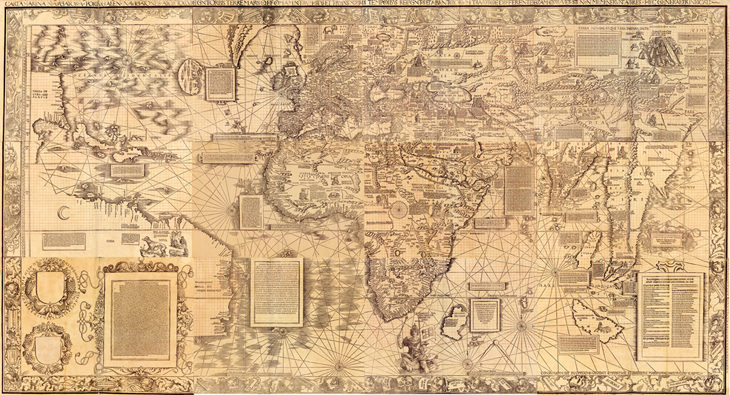
The map he created echoed a tradition of learned humanistic geography, removed from nautical practice, to be sure, but eager to incorporate its practical results, much as the earlier map of the humanist Martin Waldseemüller of Strasbourg, who in 1507 combined recent nautical results from sailors with his considerable geographic learning to treat the map as a medium and forum for illustrating geographic knowledge–boasting that his woodcuts demonstrated the discoveries in Indies and Americas “more truthfully and exactly” than existing maps or charts.  The comparison to Waldseemüller’s 1516 Carta Marina is perhaps more telling, since it clearly seems to adopt the growing aura and appeal of manuscript nautical “portolan” charts as bearers of new information; the Carta Marina, distinguishing itself from his global projection, included place-names identical to those that appear in charts executed by the fifteenth-century nautical mapper of the African coast, Grazioso Benincasa of Ancona.  It also follows the form of map projection that we associate with Mercator, who likely emulated this map:

Waldseemuller 1516 carta nautica

Both the cartographer who never left Strassburg, Waldseemüller, and Mercator responded to the growing fashion for nautical charts, and acknowledged their derivation from the genre of nautical mapping to attract new readers.  The “aura” of Mercator’s map lies in the revealing role of his hand in synthesizing maps, combining geographic texts, and combining the conventions of noting direction on rhumb lines with the measured spacing of parallels and meridians.  Both create a similar engraved image bound by an elegant frame:  rather than give prominence to notches that correspond to lines of latitude and longitude, Mercator also painstakingly ‘framed’ the map in an ornate manner, dedicating attention to an elegant banded frame, and including many panels of geographic texts that would reward the sort of careful study that its large form allowed.

Benjamin’s  point wasn’t limited to the Luddite’s antipathy to the mechanic.  It has continued to provoke new claims of the role of art in an age of reproduction and of reproduced art, indeed, and at least in part came out of his interest in film as a medium:  but his observation that printed reproductions of art lacked the “aura” of use-value specific to a work of art was closely tied to the very “aura” that Goode’s editor sought to distinguish his maps from, and of which Mercator was very much a part.  For Goode seemed to distance cartography from “artistic” aspects of engraved maps of Mercator’s day, and to assert what might be called the more “logographic” function of map making.  Mercator’s projection is not often thought of as aesthetic or artistic, and maps are not often considered works of art.  In the manner that it uniformly straightened its bearings to approximate a satisfying equiangular graticule, and is a bit of an esthetic creation of itself:  its frame is far more conspicuous than its measured indices.

The artifice of preserving the angles of incidence in the terrestrial graticule, if not the size of land mass framed the world in the form of a framed picture, after all, albeit in engraved form.  Although Benjamin’s “aura” seems to exist in the relationship between observers and a work of art.  the art of mapping had so dramatically expanded in the world of sixteenth-century engraving that his map was a cognitive achievement of the mathematics of re-distributing space along straightened parallels and uniform meridians.  In straightening bearings to recall an equiangular graticule of Euclidean form, in contrast to the curvilinear projections included in many Renaissance editions of Ptolemy’s treatise on world geography, Mercator mapped the world in a satisfying Euclidean space, preserving the angles of incidence in the terrestrial graticule, that invested a new aura in a planisphere as a readable expanse.  The projection reduced or omitted the “unknown lands” that earlier cartographers had noted; by directing attention to its indexing the “habitable world,” and limiting regions near the poles, the projection also conveniently restricted its coverage of unknown regions.  And it omitted medieval geographic constructs as the Antipodes or Sea Monsters that appeared in earlier maps.  In their stead, the projection reconciled conventions to “read” space, and refined a model for imagining and tracking travel through space–even if it was not used on ships for doing so.  Unlike a simple nautical projection or ship chart of the sort that existed in manuscript, however, it projects expanse to a indexed matrix.

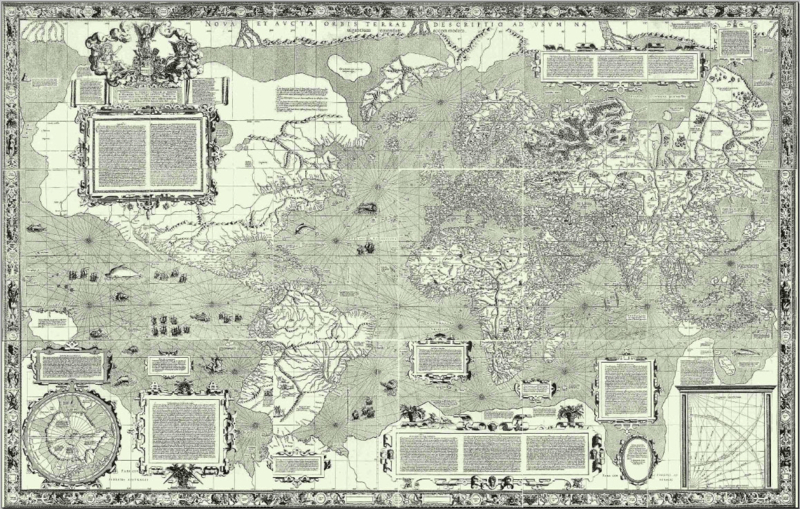
The 1569 edition of the map of sixteen sheets survives in but three examples, yet was a sort of luxury product in itself when it was first sold and sold briskly in the decade after it was devised.  The noted meridians and parallels together with  the rhumb lines of portolan charts, ordering expanse both on uniform meridians and alternate modes of notating terrestrial expanse on land and water.  It lacked prominent notches on its frame, and would probably not be used to read or approximate terrestrial position.  It’s often argued Mercator devised the conformal projection for the use of sailors, who could transfer the bearings of rhumb lines on nautical charts to its graticule, since he entitled his “Orbis Terrae Descriptio ad Usum Navigantium Emendate Accomodata” [Description of the Terrestrial Globe Correctly Amended for the Use of Sailors].  The map did not lead sailors to abandon charts, although Mercator identified it as “corrected for the use of sailors.”   Its market might have been distinct from sea-goers, however, despite his acknowledgment of the benefits he gained from their findings:  the map synthesized the results of navigation through his artifice in a new comprehensive image readily read by landlubbers more than for the use of those at sea–constraints in taking accurate compass bearings at sea made it less trustworthy  at sea, Mercator would have known.  By synthesizing results from Spanish and Portuguese charts, he sought crafted another way of framing the individual reader’s relation to space, by adopting hybrid signs in his map.  Although ostensibly made for the use of sailors who could transfer bearings rhumb lines on nautical charts to its graticule, given limited abilities to secure the reliable compass bearings at sea, the map was probably easily read with the aid of a compass by those ashore in an age when compasses were valued commodities and luxury goods.  This is was the audience among whom it was most likely viewed.  (Partly because of the success as a map as a projection that preserved local scale, it is still retained on Google Earth:  it also of course fits nicely into the frame of a computer screen.)

800px-Mercator_1569

Mercator intended the sixteen sheet projection as a record of global knowledge, capitalizing on the increasing authority of nautical maps.  It was something of an encyclopedia, describing the origins of rivers and the world’s seas, and limiting the range of “unknown lands.”  In doing so, Mercator presented the map as an autonomous form of comprehensive geographic knowledge in revolutionary ways, framing an argument about an individual relation to space, as it were, and construing an individual relation to expanse.  Stephen S. Hall enjoined we acknowledge the relative nature of all maps recently by noting how, over time, we develop our personal geographies, or “her or his private meridians,” advising“I Mercator; you, Mercator, too”:  but Mercator provided a template for a deeply individualistic relation to the totality of known space, by bringing all resources of terrestrial description to bear on the task.

Which brings us back to its aura and artifice.  For the projection was successful as a canonic model to transcribe the indexicality of the entire globe–and affirmed a new relation of the reader to the surface of the map.  This was Goode’s problem.  The persuasiveness of encoding an accurate record of space was exactly what gave Goode suspicions, and which Goode’s editors were keen to perceive.  Mercator had in 1569 tacitly asserted his ability to transform expanse to a planisphere that could be read on both rhumb lines or parallels and meridians.  He noted that his projection delineated a new model of projection whereby to “spread on a plane the surface of a sphere in such a way that the positions of places shall correspond on all sides with each other;” even though it clearly distorted the size of Greenland and Antarctica, or diminished the expanse of South America and Africa, this was of less concern to his readers or to the readers of sixteenth-century maps:  no one was going to stake claim to these lands, for one, and the seas were of greater import than the areas near the poles.  The inaccurate presumption that these leaves were used to create a wall map–and an advertisement for global dominance–was only imagined in the late nineteenth century.  For a more proportional map of global coverage, Mercator himself preferred a sinusoidal projection.

The power of Mercator’s transformation of space is the relative absence of local distortion due to its conformal construction, giving it a staying power that has continued in different forms through Google’s maps.  The means by which it maintained its conformality were Goode’s problem, however, for he saw the map as perpetuating a geopolitical deception outdated in the modern world.  One might recall that when Brian Harley sketched the outlines for a history of mapping, he began from how “cartography was [long] primarily a form of political discourse . . . concerned with the maintenance of power.”  The staying power of Goode’s map, interestingly, can be roughly tied to the political dominance of America in the “short” twentieth century, or from 1914 to the 1960s, when the Mercator projection was revisited, not only by the German journalist Arno Peters’ equal-area projection. Peters showed sensitivity to the visual construction of maps as forms of propaganda, when he promoted the projection, noting how the map privileged one area over others.  But Mercator’s projection had already long been defunct for geographers even before 1961, when Arthur Robinson devised a global projection to map the earth’s surface as a flat image with significantly less distortion than Mercator mapped.

450px-Robinson_projection_SW

2 Comments

Filed under atlasses, Goode's World Atlas, John Paul Goode, map projections, Mercator Projection

Mapping Slavery in the United States in 1860

In debating the values of data visualization maps, I’ve gone both ways.  The value of maps as specific arguments–and tools of spatial orientation–respond to the value of the selective criteria that cartographers foreground in them, after all.  Less inventive differentiations of spatial distributions “flatten” the map’s surface, and limit their value to the map-reader.  Their arguments are not as interesting, one might say.

The early visualization of this elegant choropleth map employed data from the Census of 1860 it translated into visual form to map the density slave population across the recently seceded Southern states. Long touted as an important strategic tool, the rhetoric of an isolated mapping of the Southern states framed debates about the Civil War with greater  subtlety than current tiresome choropleth maps of “red” vs. “blue states.”  The 1861 lithograph marked the density of slave-owning in pockets by darkening sites of the greatest slave population, perhaps to mask the ownership of slaves throughout the South and point to the defenders of a slave-based economy.

1861 slave population map

If the census provided a basis for Edwin Hergesheimer and Alexander Dallas Bache to create the map, a collaborative government effort as much as an independent enterprise of the commercial engraver Henry S. Graham, the use of statistical cartography prefigured the mapping of social or political trend in the field of human geography.  While the recent German immigrant Hergesheimer created the pro-Union map from figures in the Census after his work on the US Coastal Survey, the translation of the results of the Census into visual form proceeded because the Coast Survey’s Superintendent.

Although a deeply collective project, Bache’s recent success in assembling a team to map the coastal survey gave him a new public profile, and prominence, to back the project of mapping a visual record of data assembled about slavery in Southern States.  The map tellingly reveals Hergesheimer’s deep Liberal opposition to slavery as an institution and the pro-Union belief of supervisors of the eighth national census, but its visual explanation of the origins of secession intentionally focussed attention around slavery debates.  Printed in September of 1861 after hostilities had begun, and ten states had seceded from the Union, it isolated the evil of slavery in the seceded region, and highlighted the centers of slavery’s institution even before slavery became the central issue of the war.

Hergesheimer and Bache were instrumental, too, in adopting the most current techniques of mapping to portray the differentials of slave-owning in the Confederate States just before the South’s Secession.  The half-tone engraving he designed to show slave-holding states in the “Southern States of the United States in 1860” foregrounds discontinuities in the national territory by using figures he derived from that year’s national census.  Known as a “Slave Density Map,” the lithograph exemplifies cutting edge statistical mapping and an artistic use of half-tones to depict the seats of the evils of slavery in seceded regions of the United States in a piece of pro-Union propaganda:  slavery existed throughout the Southern states, but was concentrated “down river” in Mississippi, Georgia, South Carolina and Texas.  The lithograph provided something of a moral map of the region beyond which Lincoln sought to forbid the expansion of the slave-economy.  Printed and sold by the government in wartime ostensibly for the benefit of Union Soldiers, the single-sheet map used half-tones to differentiate relative variations each county’s relative density of slave-holding across the Southern states.   But although the map presents itself as an appeal for wounded veterans of a war in which soldiers were so dramatically injured, its mapmaker aimed not only to raise funds through direct sales but broadly encourage the war effort by illustrating slavery as literally darkening the nation.

With considerable cartographical sophistication in charting variable densities of slave-ownership, the map illustrated striking discontinuities in the nation and  even suggested divisions in the Confederacy at the outset of the war:

Slavery Map 1860

Bache was a deeply moralistic man, as well as a former Lieutenant in the Army who, after graduating from West Point until 1829 designed coastal fortifications  before he rose to head the Smithsonian.  Bache had won national eminence as the head of the United States Coastal Survey, using a team of trained surveyors, several university observatories, and many field assistants to triangulate the coastlines from a base-line near Annapolis.  Based on readings from numerous sighting stations, the map extended west to California and endured through the twentieth century.  After mapping the shorelines of the United States, Bache devoted himself to mapping its islands of slavery.

Most maps made in wartime are valuable strategic tools to orient troops, as much as map vulnerabilities.  But this map was not made for a lack of cartographical records.  (It did not meet a desire for cartographical knowledge, for example, as the many paper maps shipped to Kuwait during the 1990 Gulf War–often incorrectly considered the first war fought by GPS–as 67 highly detailed topographic line maps of the region, some bathymetric, at the incredible scale of 1:50,000.   Incredibly, the Army lacked  accurate maps of Kuwait, and these were quickly prepared during the war based on remotely sensed satellite images.)  Bache’s map had far less apparent strategic use, identifying pockets where a slave-based economy was particularly dense, and all but ignoring physical topography or population centers.  But the map was compelling as an image of the divided nation.  Bache and Hergesheimer designed the map for a civilian populace, using the 1860 census to create a visually compelling distribution that revealed regional disparities in “slave-ownership” and the population identified as slaves to reduce the scope of the confederate secession.

The map provides an image of the nation taking stock of itself, or learning to look at its divisions–a rare thing.  Bache and Hergeshemier’s map of this nexus of the Southern economy was ostensibly sold to raise funds for “Sick and Wounded Soldiers of the US Army,” or veterans, as gothic script in scrollwork crisply notes.  It’s been argued that the map identified possible pockets of resistance, or possible seats of opposition to Union forces.  Lincoln consulted the map after the war, to consider ways to encourage the Southern economy.  But the elegant map roots the struggle of the Civil War in disparities of slave-ownership in the South, to question the fierceness of opposition to the Union, or to show the enemy and stakes in the war.  By starkly differentiating each county’s degree of reliance on slavery by shades of grey, it offered viewers a stark map of racism in parts of the region–if it also perhaps perpetuated racism  unwittingly in directing attention to the suffering of soldiers who could benefit from its sale and not sufferings inflicted by the economic institution of slavery.

legend

But the map also made its point of isolating slave-ownership in select regions of the Southern states, in ways that masked the continuity of slavery across the region.  The remove of the Southern states from the North, and isolation of precise regions where the practice of slavery was most extreme, echoed Bache’s belief in the political uses of science by applied cartography to national needs and for the public good.

It is interesting that Hergesheimer’s design for the map followed Bache’s success in precisely mapping the nation’s shorelines as Superintendent of the Coastal Survey.  The project established Bache’s credibility in large-scale surveying.  The new survey not only used the survey of coastal lines to map the interior, but may have provided Hergesheimer and Bache to turn attention to the occupants of the land as the US Government desired at that point.  The actual survey of coastal lines offered a sort of template to construct the map of slave-holding populations by using nine shades of half-tones to darken regions in differing degrees that created a compelling image of the fractured nation, and minimized the widespread nature of the social acceptance of slavery in seceding states.  The detail of the shore and coastal islands throughout suggests that the US provided not only contour lines for the map, but a template for national coherence–the unstated if implicit subject of the Slave-Holding map, and a central preoccupation of the wartime government.

The map of slave-holders adapted census information to the basic contours of states to map aggregate variations of slave-owning in states.  Although the map is given the strategic value of predicting resistance to the Union troops, it was probably most valuable for its inspirational or hortatory appeal as much as its accuracy.  Bache tried to expand the public functions of cartography in the map by adapting recent statistical methods to compellingly map two different worlds within the same nation.  A career military man and scientist, Bache was a public servant committed to the public utility and good of surveying and meteorology–a counter-part to Matthew Fontaine Maury, the polymath oceanographer and cartographer who served in the Confederate Navy 1861-5 and was Bache’s long-time nemesis:  Maury, whose cartographical interests I discussed in an earlier post, and who had himself hatched the ill-fated scheme for slave-owners to resettle from southern states to Brazil’s Amazon Valley in the early 1850s.  Bache’s map is both a detailed picture of social divisions and an image of a divided nation.  If this unlikely project was impractical, Bache’s map focussed on the seats of the slave-economy in seceding Southern states.

Susan Schulten noted in 2010, in a blog post to which I’m indebted, that Bache’s map shows a striking concentration ownership of slaves on the shores of the Mississippi, where cotton crops dominated, Alabama and the low-lands near South Carolina (which enslaved the majority of its population) and eastern Virginia; she suggested that this snapshot of slave-holding had strategic value to determine sources of greatest resistance in the Confederacy as well as for Lincoln to consider future economic development of the South.  The map must have constituted something like a “news map” for readers eager to understand the actual numbers of slave-owners in the deeper south, and the relative degree to which slave-owning had continued to endure in the Republic.  Parts of the broadsheet provided a strikingly compelling illustration of the locations of slave-ownership and an economy of slavery where Cotton was still King, as much as the Southern states as a whole:

Mississippi

Slavery was widespread in both Charleston, South Carolina, and Savannah:

Savannah and South Carolina

And, similarly, a pointed reliance on slavery around the area of Galveston, Texas:
Galveston

But there are multiple ways to read the project for designing the map.  The image of slave-holding lands provided a victory map for the Union soldiers, who sold it to raise money for their fellow-veterans who remained sick or injured, as if to stake the agenda for a need of remapping the nation, echoing a Jeffersonian idea of the use of surveying as a foundation for democracy.  It was the map by which Lincoln used to follow Union troops as they liberated slave populations, or understand the seats of rebellion, but had huge power in graphically stigmatizing Southern states.  It was also an idealistic statement of the goal of ending slavery in the war effort.

This striking legend that explained the iconography of the map’s nine variations in shading, placing the greatest “free blacks” in large towns:

Legend in Slavery Map

The innovative exercise in terrestrial cartography was also the last attempt to quantify slave-holding in the nineteenth-century, although it integrated public records that were later widely accessible.

It was, sadly, also the final time the Federal Government revisited the topography of slave-holding with similar precision. The failure to remap the same distribution seems one of the more stunning  cartographical silences of the twentieth century.  Bache’s impetus to draft the map might be informed by his long involvement in public education and belief in the public utility of the sciences; he effectively lent  a polemic character to conventions of statistical mapping by exploiting the different gradations of shading available to the engraver to craft a useful piece of early printed cartographical propaganda.

Indeed, its use as a piece of propaganda in wartime may have outstripped its potential as  guide to military strategy.  Lincoln regularly studied the map, according to his portraitist Francis Bicknell Carpenter, who found the president studying the map with considerable intensity in 1864, during the six months when he lived in the White House to paint the portrait “President Lincoln Reading the Emancipation Proclamation to His Cabinet.”  But his inclusion in the image of the choropleth map that accentuated national divisions reflected his interest in illustrating Lincoln’s “statesmanship” and “solid integrity” in bridging the nation.  By his own account, Lincoln had taken great pains to explain to Carpenter both the origins of “his adoption of the Emancipation policy” and his decision to draft the Proclamation from late July 1862, before he put it aside until being sure of military victory.  “I resolved,” Carpenter wrote in his memoirs, “to represent the scene [of Lincoln reading the Proclamation to his Cabinet] without the appliances and tricks of picture-making, and endeavor, as faithfully as possible, to represent the scene exactly as it transpired; room, furniture, and accessories all were to be painted from the actualities.”  Did the room actually include the map of slaves still ‘owned’ in the South?

Emancipation_proclamation-1

Carpenter’s state portrait depicting Lincoln reading the Proclamation to his Cabinet placed the lithograph in a small but a prominent role that most observers would not fail to notice.   As if to illustrate the subject of the recently issued Proclamation, if not the thoughts that weighed on the conscience of the President, the map emerged from behind a chair at the painting’s base.  Lincoln loved the portrait.  The map is the essential subject of his discourse; Carpenter made good use of it to capture the stakes of the Proclamation.  The nine bars of graduated shading in the map stand out among printed books in the group portrait, reminding viewers, both recording a moment of triumphalism and presidential dignity, and suggesting the uphill battle for implementing the Proclamation in the deepest South.  The map speaks volumes:

Visualizing Slavery-Carpenter

It reminds us not only of Lincoln’s hope to transcend social divisions.  Before Carpenter included it to illustrate the grand subject of Lincoln’s address–and Steven Spielberg also used the map in “Lincoln,” behind Daniel Day Lewis’ shoulder–the 1861 lithograph provided a tool to imagine political coherence in a more perfect union, urging men to enlist and others to get behind the war.

2 Comments

Filed under Abraham Lincoln, American history, choropleth maps, Slavery, US Coastal Survey