Monthly Archives: February 2013

Self Made Maps

Many online responses to the arto-carto project of Mapping Manhattan remind us of how the biggest challenge of any cartographic totalistic idealized view is to record local details with fine grain: it’s no coincidence the chorus of posted responses to the maps in today’s New York Times often complain about the loss or absence of specific individual neighborhoods, or the absence of economic diversity (and ethnic diversity) in the beautiful colored maps.  As an exercise of collective map-making, the project that Becky Cooper ideated and planned, “Map Your Memories,” provoked each cartographer to record their own view of that island, rendering it as inscribed with memories of their own.  This open call perhaps provoked the deep-seated nature of responses it has met, evident in the energetic nature of good-hearted responses Mapping Manhattan has elicited from online readers over the past few days.

map_2

The call to “Map your Memories” asked a range of writers, artists and other would-be cartographers to record individual memories in the outlines of a map of Manhattan island of vague north-south orientation.  The book stands on its head maps’ implied claims of objectivity, by treating media as a screen to project memories, whose individual design reveals their topography to be imprinted with haphazard collections of personal associations or reminiscences.  The white upper-class basis for these mapped perspectives  is implicit in their subjects– lost gloves, volumes of Proust, chick-lit, cups of non-Starbucks-brand coffee, lovely one bedroom apartments, or stages of urban fear; the maps are something like open invitations to play Proust.

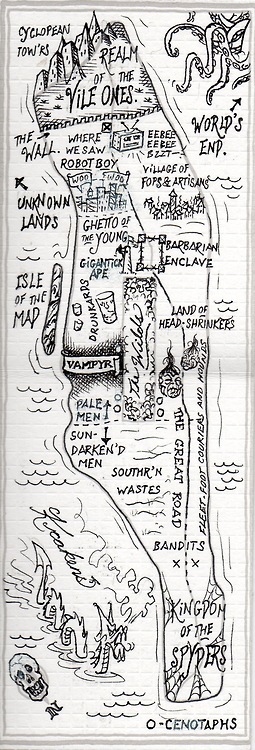
They are rightly, and also wrongly, criticized as upper-class white bourgeois artifacts, since that is what they openly are–no one would presume to credit them or mistake them from objectivity.  (That might not be the audience that the New York Times wants to address, but is after all the audience of Abrams, the art-book publisher.)  The playfulness of some of the maps clearly perpetuate these myths playfully transform Manhattan to echo something like a medieval zone-map, where torrid zones of uninhabitability, and in fact are divided by zones where the mapmaker would never set foot or know:

map_5

In quite a few, boundaries of class are visually thematized and reified with a certainty familiar from  the medieval “here lie monsters,” or Odyssean sea-monsters, or an edge of the earth from which one might easily be able to fall . . .

tumblr_mibz79u24w1qzbevlo1_500

These maps celebrate the artifice of cartographical fiction-making, reading more like the maps of Jules Feiffer and Norton Juster, or of the sensibility of that great medievalist JRR Tolkein.

I prefer to read other maps as a range of responses of common DIY creative reactions to the plague or deluge in most of our big media of weather maps, visualizations of databases via GIS creations or simulations, where detail provided by surveying is lost or filtered out for a schematic view of the whole, reactions that are apparent in their sheer cartographical abundance or ecstasy of naming with which each cartographer is offering a map of their own.   I see a sort of reaction to the dramatic diminution of the art of the cartographer in Google Earth or the Weather Channel, where big color-drenched screens, sometimes over-saturated with details or more often just clotted by hues to signify climactic variations or cloud-cover, replaced the selective criteria of mediating topography or settlement via cartographical art. Such a diminution of the act of creative cartography is, after all, an imaginative failure, as much as a shift in cartographical media.  Contrast the abstraction characteristic of many GIS-generated maps to the abundance of local meanings that distinguish the series of maps that Cooper has assembled.  There is a joy of celebrating the individual that has led so many of the online comments to beg for their own memories to be inscribed in the maps, as well as those of the authors.

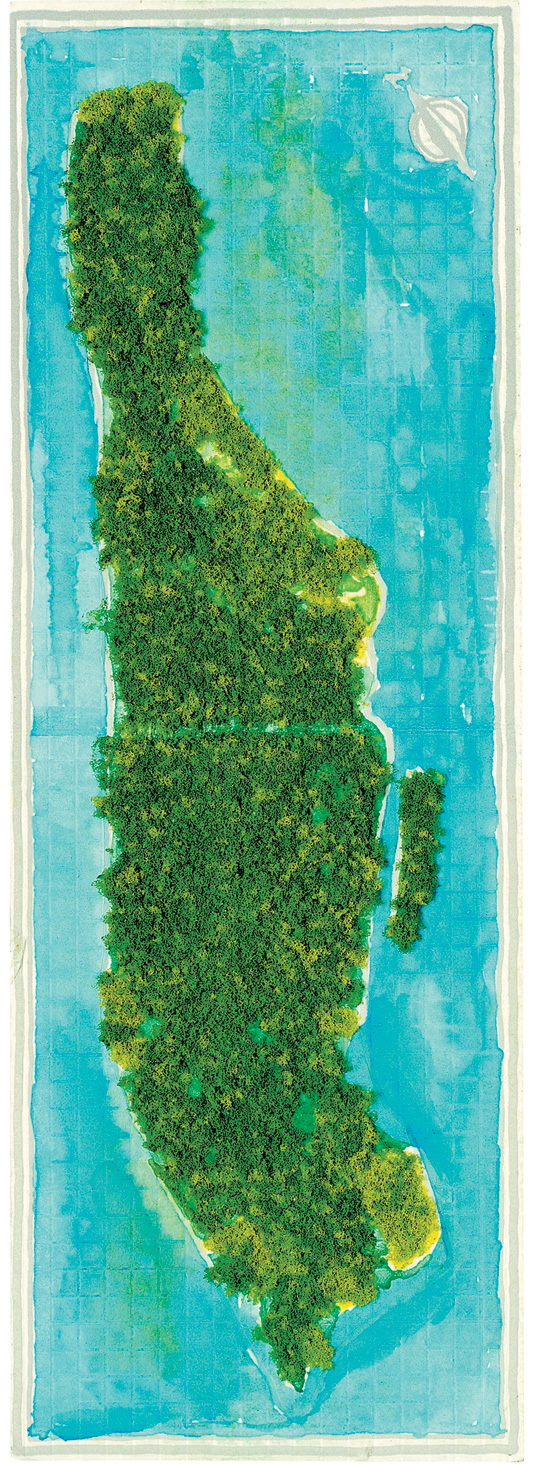
This is evident in the visual celebration of the mapmaker’s art in the lovely watercolor map submitted by Markley Boyer, one of the few historical imaginations, of the imagined bucolic past of Manhattan as a field of green, surrounded by a sea of blue.  This map most reminds me of the impact of the tools that our cartographers use, as much as their level of artifice.

map_0

In this material remapping Manhattan as a lost Eden, the author of Manahatta: A Natural History of New York City, has reclaimed the artifice of map making in richly saturated colors and applied sponge.  This Manhattan of the mind is mapped at several degrees removed from the actual inhabited island–as are all the maps in this volume–but the degree of artifice by which it stands at a remove from the island reminds us how much all mapping records the relative richness of a vision of self.

5 Comments

Filed under Becky Cooper, Feiffer Map, Manahatta, Mapping Manhattan, mapping memories, Markley Boyer, Proust

Russian Rocks

What happens when part of a meteorite lands in Chelyabinsk? We use maps to give meaning to the event, marking the site of impact in readable visual terms, and to try to place it in our comprehension through familiar mapping tools.

There are multiple ways to map the path of the meteorite that fragmented into pieces as it fell to earth, evading atmospheric or satellite sensors and causing explosions that injured over 1200 people, as well as its site of collision.  Perhaps the rush to map the event compensates for the fact that we never detected it as it entered our atmosphere, on account of its small diameter.  There is a paradox that in an age of detailed world-mapping, the mapping of such a terrifying event was improvised from a range of readily-generated cartographic resources, and provided a limited view of the human side of the natural disaster-an aspect that was, perhaps understandably more often reserved for video rather than cartographic media. The range of maps that popped up in actual news sources suggested a sort of fumbling for meaning, however, or an improvised making sense of what happened, without much imagination or clarification.

The most vulgar is undoubtedly a graphic reminder this happened in a place known as Russia, and that still has a vaguely pink hue that has adhered from its Cold War past and the image-bank that era has bequeathed us:

map-of-russia

Slightly more acceptable, but excessively abstract, is the “Google Earth” solution of noting a pinpoint, instead of the collision, and using a surfeit of detail in the surrounding region, essentially an imported backdrop from a computer file from Google Earth:
russia-map

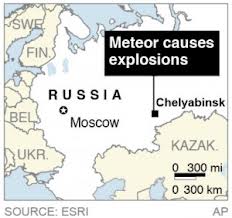
Huh?  Only slightly more semiotically refined is the following accusatory blame of where the meteor caused such tragedy, but focussing on the basic information about its distance from Moscow:

images-2

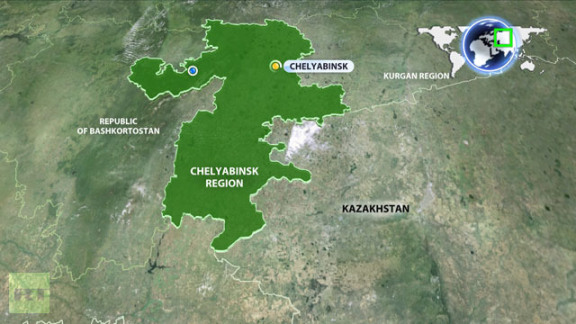
Meaningful mapping is approached by the following, if somewhat whimsical, combination of a political map and world-wide view:  but the whimsical tone undermines the tragedy, the detail to dense, and the region just too green:

map

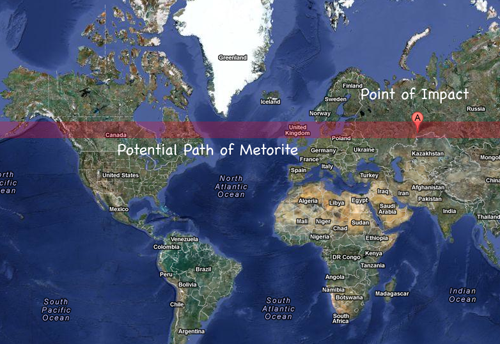
More impressive is mapping the fact that its impact could have happened at any point during the meteorite’s arc through the earth’s atmosphere:
path-of-meteorite-that-hit-russia

What’s sacrificed here, of course, is the specific–what one would expect from mapping techniques–as the map is simply a screen on which to chart the progress of the meteor, with limited explanatory force.  Most of these ‘maps’ employ existing maps as backgrounds, fields, or templates familiar from other computer-generated media, rather than mapping the site of impact in relation to regions of settlement or natural resources.

Perhaps most striking is the perfect circle that part of the meteorite made, as if a cartoon outline of its form, on the icy surface of this frozen lake, as locals try to understand what happened–not a ‘map’, but a good visual expression of awe as well as a human-sized outline of what the actual scale of the meteoric fragment on impact was:

russia-meteor-strike-lake_64337_610x343

Of course, this lacks many tools of orientation.  But perhaps it is as effective as to dispenses with geographic points of reference and indices, in a word map:

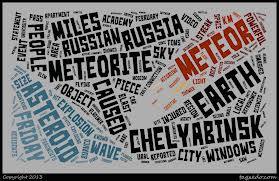
images

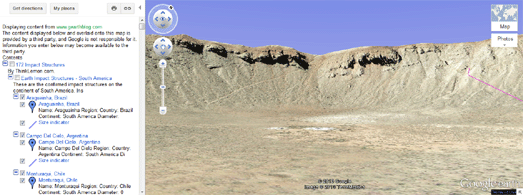
For the cartographically obsessive, a Google Earth blog maps all sites of meteor craters created by previous impacts,

Meteor Craters on Earth

Google Maps Mania has been quick to create a plug-in for Google Earth browser (via Google Maps) for those interested in comparing the craters.

Wow:

mapsmania

http://googlemapsmania.blogspot.com/2013/02/meteor-impact-sites-on-google-maps.html

2 Comments

Filed under Chelyabinsk, Cold War, Google Earth, meteorites, Uncategorized

Mapping Fault-Lines in Earthquake Maps

Fracking–it is increasingly feared–invites irreparably contaminating our largest aquifers, and by extension drinking supplies–in Brooklyn, someone formed a group to protect the water of locally sourced beers–as well as devastate prairies and old agricultural lands, where land is cheap, by horizontal drilling.  Recent arguments compellingly link the drilling multiple “injection wells” of wastewater that seem to have activated previously non-active faults in regions that rarely experienced tremors in the past, and where the USGS did not find evidence of registered earthquakes.

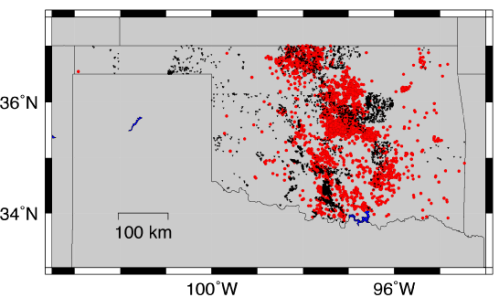
As massive amounts of wastewater generated to access for natural gasses are forcefully re-injected into the earth, as if swept under a carpet, opening fissures in underlying beds of Shale or Sandstone.  Horizontal drilling operations have dated to 2008, mining areas by pumping vast amounts of sand into ancient shale formations in prairies and regions of declining agriculture to release methane and natural gasses.  Hydraulic fracking has used tons of water to force trapped gasses out of old rock formations.  Before 2009, in fact, earthquakes were rarely registered in the USGS surveys of lands where seismic activity has accompanied the injection of water into “injection wells”:  in these the shifting weight that the injected water that presses against rocks open old fissures, causing a buckling of underground rock formations, the fear is, as massive amounts of soupy, contaminated wastewater is injected back into the earth.  The “earthquake swarms” monitored nearby injection wells in Arkansas, Montana, Texas, Ohio or Oklahoma that barely registered seismic activity  from 1972 – 2008, has given new significance to–and created new fear around–a set of fault lines unknown to inhabitants, blamed as if active by an industry that rejects the accusations that they created sources for tremors inhabitants fear.   Indeed, the proliferation of earthquakes registered in the state of Oklahoma alone from 2001-15 reveals, according to the data from the Leonard Geophysical Observatory, a persistent increase in the tremor-like disturbances with the rise of underground wastewater dispersal, and a strikingly sharp increase in quakes of magnitude of three or higher in hears after 2010.


QUakes in OK, 2001-15.png


The increase seems closely tied to the absorption of wastewater back into rock layers whose weight is so altered by the injection of fluids, causing quakes that have rocked up to a fifth of the state, but have also increased land values for speculative fracking, in ways that may have concealed some interest in exploring the correlation–especially in a state where, due to geomorphological accident, water injected to reach deep-lying shale deposits send increasing amounts of wastewater underground, often to be absorbed by highly porous limestone that expands, but lies deep underground beside highly stressed layers of rock.  The result seems to create something like a combustive effect akin to the popping of kernels of corn, and has led many state officials to preemptively adopt prohibitions on local bans on regulating oil or gas wells in their jurisdictions, and insistence that the resurgence of quakes in fault zones is more able to be explained as an “act of nature that is nobody’s fault” not effected by human agency; the rejection of a relation to human activity comes from state legislatures fearful of the employment rises brought by gas and oil corporations from being scared away from the state.    But the geological record of apparently induced quakes in Oklahoma and their close proximity to existing injection wells.


ok.png

The fear of such tremors has a recent prehistory of three or so years.  An early tremor whose epicenter lay near Richmond, Virginia, of 5.8 magnitude, just below 6, but that sent shocks to North Carolina and Canada.  The event raised questions about the role of fracking in 2011 for Tim McDonnell and Aaron Ross, described in an earlier article in Mother Jones that directed attention to fracking’s consequences.  But the persuasive nature of recent USGS time-lapse maps of the same state–

The dangers of fracking echoes Jonathan Franzen’s early if compelling 1992 novel Strong Motion, in which mysteriously recurring earthquakes are pinpointed at the unlikely site of Boston, Massachusetts, a rare location of seismic activity.  But whereas Franzen’s protagonist, Renée Seitcheck, believed “that these earthquakes are the byproduct of industrial drilling” by a  petrochemical firm whose agents attempt to assassinate a beautiful rebel seismologist, for her mining of top-secret data from computers, the causes of the “swarms” seem to lie less in drilling than in injecting waste-water.  Was the novel remarkably prescient in unveiling a concealed impact of post-industrial geocaching?  It surely doesn’t seem so paranoid in its view of an industrial conspiracy to conceal geological findings, or to imagine the role of the rogue geographer in the seismically sensitive landscape that the search for underground sources of oil and gas can create.

But now it’s no longer isolated individuals who research the papers of top-secret labs.  There are upwards of 40,000 disposal wells actually active in the United States, some tunneling 13,000 feet under the earth, and “injection induced seismicity” is now a field, as the pressure exerted by the displacement of water able to move rock layers has provoked widespread academic interest and industrial concern:  “There are faults most everywhere,” noted Cliff Frohlich of the Institute for Geophysics at the University of Texas-Austin, suggesting how fracking can ‘reactivate’ fault lines which were never known; “Most of them are stuck, because rock on rock is pretty sticky.  But if you pump a fluid in there to reduce the friction, they can slip.”  “Water does not like to be squeezed,” Scott Ausbrooks of the Arkansas Geological Survey put it with some empathy.   And while Franzen’s character pored over reams of secret data to understand the relations of seismic activity to big oil’s search for underground pools of oil, such relations are now the focus of conferences and are amply documented in data maps.

The best known faults the USGS has mapped are well-known.  But, as Mark Zoback, a professor of geophysics at Stanford explained in a recent article by Michael Behar in Mother Jones, echoing Frohlich, “there are faults everywhere, and some are too small to be seen.”  Faults are widely known if often forgotten by those living in California, where fracking may begin, despite growing opposition.  Indeed the range of fault-lines throughout the California-Nevada region are so multiple that the possibility of hydraulic fracking in the region of southern California threatens to  imbalance a rather threatening constellation of seismic activity that already exists in much of the region, and is more widely mapped than the most familiar lines of the San Andreas, Calaveras, or Hayward faults.  The visibility of these fault-lines is available on an up-to-the-minute-map of regional seismic activity, part of a set of maps that record seismic activity by irregular bright red computer-generated lines, often proximate to cities:

California in USGS map of Faultlines

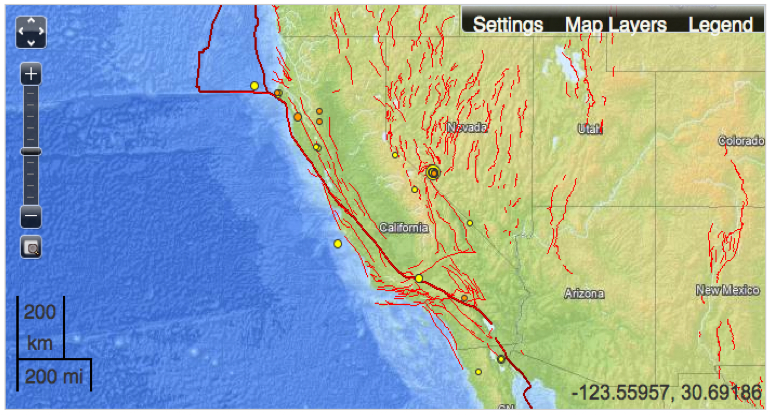
The nervously drawn red lines of seismic activity furrowing the green plains in these maps are ‘underground views’ mapping the range of pressure below the earth’s surface.  A more striking map of seismic activity of the past few weeks and days pieces together a narrative of fault-lines and tectonic plates that accentuate the daily deep divisions that course under the earth of our westernmost states:

California_Nevada-1

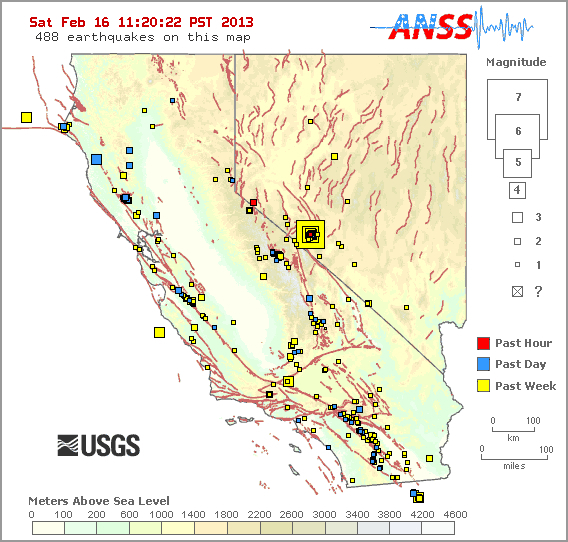
The stark legend suggests the huge growth in a magnitude the scale of “6.”  The prominent indexing of fault-lines in another USGS map of seismic activity, with less attention to topographic or climactic variation, shows the volatility of the region’s multiple faults in a similar if starker image of seismic frequency:

indexfault_map


More locally, and limited to faults active in the past week of a magnitude above 2.5,
California in USGS map of Faultlines


For more focus on recent seismic occurrence, link your browser to: http://earthquake.usgs.gov/earthquakes/map/

Despite the evidence of terrifyingly active fault lines, the active movement ‘Stop Fracking in California‘ has its back against the wall, even if they are growing in local Southern California chapters.

Yet the volatility of the region cannot be ignored–take this map of the Simi Valley and Los Angeles area, posted on Saturday, February 16, where fault-lines course unseen beneath the landscape, moving from inland to the coast at multiple points and through metropolitan Los Angeles:

Los Angeles earthquake faults

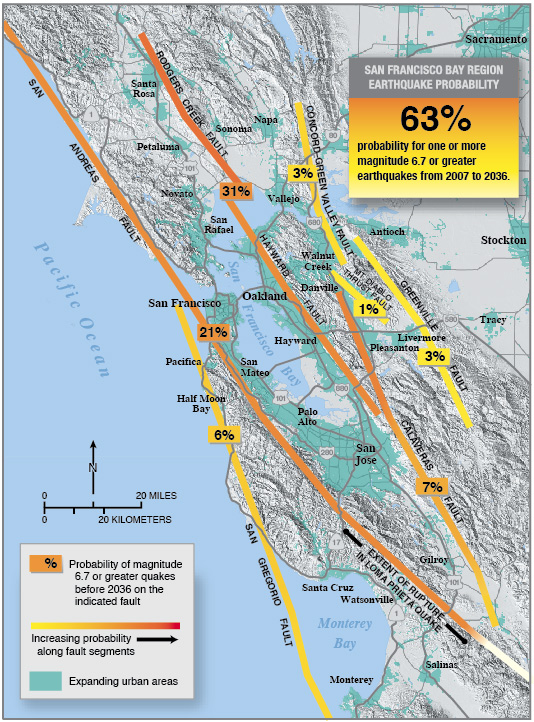
This interest to frack in California–an oddly post-modern verb–is scariest given maps approximating the future likelihood, as calculated by the USGS, that the regional fault-lines in the Bay Area will experience seismic activity at a magnitude greater than 6.7 before 2036.

2008probabilities-lrg

By how much would active injection wells multiply increase these already quite sizable odds?  Given the proximity of these lines to expanding urban areas, often growing between the Hayward and San Andreas fault, can fracking in California be a safe investment for the future?

This is not a map that is in the heads of most native Californians or residents.  The readability of these maps offers a base-line for future seismic activity, and grounds for concern about hydraulic fracking in seismically active regions.

It is good news that the USGS has expanded its clickable interactive image of global fault lines, in which the record of seismic activity is updated every minute, and on which viewers can scale in to investigate on their own:

USGS Global Earthquake Map

While the occurrence of faults and tremors will always shock, its legibility not only offers a lesson in continental drift.  Many of these jerky lines reminiscent of an etch-a-sketch lie underwater, but the points of greatest activity–in California, Indonesia, and Central America–cannot be ignored or lost sight of for underground engineers.

2 Comments

Filed under data visualizations, Earthquake Probability, Earthquake swarms, earthquakes, Fracking

Mapping News Flows

The rise of internet news sources may have threatened printed news outlets.  With diminishing number of news desks and reporters, the story goes, the reduction has qualitatively changed both the variety and sort of news that is consumed–and a dependence on a far narrower range of streaming news.  The political volatility or extremism of news outlets has either further diminished the spectrum of news stories, or is a symptom of a shrinking pot of funds that is devoted to news.

The news has long co-opted the global map as an emblem of its comprehensive integration of news stories from the entire world:

        images         Unknown-1           Unknown

Or, more directly overlapping the globe with the corporate news logo for TV:

world news.

Is the global coverage of the news more exaggerated than such emblems would suggest, as is suggested by a focus on Europe or an Anglo-American Atlantic?  Perhaps a better image is suggested by this other news icon, suggesting a relay of privileged sites of information that is synthesized in newscasts.

images-2

A recent map that’s been getting considerable attention reveals another side of this story: the increasing number of regions in the world where news reporting, and journalists are restricted for reporting, censored, imprisoned or attacked, based on this map of the regions where journalism was suppressed in 2012.  Despite the limited informational value of the map as a visualization of data, it reveals the increasing global reach of attacks on journalism.

Journalists under Attack.

The constraints that local political regimes have come to place upon their own local reporters has, inadvertently for some, restrained the global claims of a news media that relies on local informants and news sources.  And the result is a shrinking of what one could best call the known world.  According to the Committee to Protect Journalists, who provide some of the fullest documentation of attacks on journalists worldwide, at

http://cpj.org/2013/02/attacks-on-the-press-in-2012.php

the imprisonment of journalists has reached a record high in 2012, which is a concern for global concern.  How can we continue to map news sources if we must blot out an accurate picture of the entire map?  According to their site, “Large-scale imprisonments in TurkeyIran, and China helped lift the global tally to its highest point since CPJ began conducting worldwide surveys in 1990, surpassing the previous record of 185 in 1996,” often on “anti-state charges such as terrorism, treason, and subversion.”  In countries as Eritrea and Syria, there has been a virtual black-out of some news sources, with record numbers of journalists jailed without anything resembling due process.  The blackout continued across the globe in a scary manner: “VietnamAzerbaijanEthiopiaUzbekistan, and Saudi Arabiarounded out the 10 worst jailers. In two of those nations, Azerbaijan and Uzbekistan, the authorities used retaliatory charges such as hooliganism and drug possession to jail critical reporters and editors.”  In Turkey, Mehmet Ali Birand, the editor of Istanbul-based Kanal D, noted that tatutes “make no distinction between journalists exercising freedom of expression and [individuals] aiding terrorism,” said Mehmet Ali Birand,tatutes “make no distinction between journalists exercising freedom of expression and [individuals] aiding terrorism.”  Iran has jailed 45 journalists outright since the lack of certainty as to the results of the 2009 presidential elections.   Eritrea holds the fourth highest total of journalists worldwide in jail, none of whom were ever charged with a crime.  The virtual criminalization of journalism that led to an increase of imprisonment of journalists of 23.4% in 2010-11 has climbed to further 29.6% in 2012.  Despite significant numbers of the imprisoned being online journalists, print journalists constituted the second largest group of those imprisoned worldwide.

To be sure, the worldwide number of journalists who were killed since 1992–a more extreme retaliation–are more narrowly distributed world wide.

Deaths.

One can see echoes of the detainment of journalists in Eritrea and Syria But the growing number of pockets–and indeed larger regions that are identified with legitimate states–where the news is blacked out or not accessible is perhaps one of the most dire threats to comprehensive coverage.  Perhaps a better metric is the startling rise of the number of journalists imprisoned worldwide.

imprisoned journalists

The areas that have imprisoned large numbers of journalists might be likened to news swamps, where news is filtered or obscured, or never reaches the light of day.  These nations, with the greatest offenders colored red and sized to fit  the scope of their silencing of news reporters, are

Place-Map

This is one map to pay attention to when reading the news.

Leave a comment

Filed under ABC Nightly News, Committee to Protect Journalists, Imprisoned Journalists, News Media

Mapping Friendships? Facebook Maps Social Networks

The recent growth of web-based “social networks” inspire maps no longer rooted in terrestrial relations, but stand to become vertiginously unmoored from them:   maps often help us to grapple with the distance between them, as much as to orient us spatially to their relationships, but the blobs on this series of maps oddly disaggregates the inhabitants from the land, focussing less on their spatial situation than their relative degree of web-presence.   Indeed, in ways that very inventively rewrite the map as a throbbing surface, rather than a static interface, the attachments of folks to the interactive space of Facebook becomes cast as the subject that is being mapped–as well as being the datasource from which the map’s dataset derives.

Thanks to the creative folks at Stamen design, we have a beautiful interactive global map of Facebook users, whose bold colors offer a neatly clickable index of social networking over space.  The map is not an innovative ordering of space, but illustrates the network’s global reach in a twist on the project of mapping the inhabited world, shared by Ptolemy and Abraham Ortelius alike.  But let’s ask what’s at stake in crafting a visualization culled from archived data gathered from users’ profiles–as much as celebrating the virtuosity of the clickable map as a chart of the social network’s reach, as if it were able to map as previously unquantifiable (and indeed ultimately almost ephemeral) value as ‘friendship’ might be.
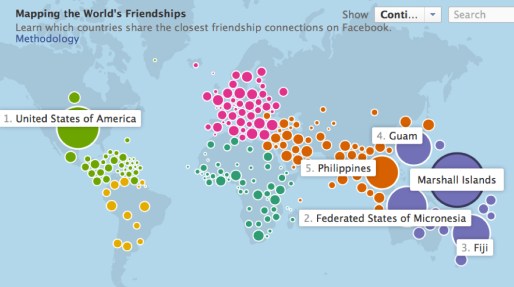
World's "Friendships" on Facebook

Many maps employ self-reported data.  In a sense, the map of Facebook use–or the self-identified “Friendship Map”–charts global inter-relations, like the global maps of national distribution of GDP, provenance of coffee beans or even pathways of the migrating whales, both discussed in earlier posts.  But whereas  maps objectively mediate terrestrial inter-relations–and inter-connectivity–the notion of connectivity has been re-appropriated in the images of “Friendship” that Facebook commissioned, as has the meaning of the word “Friendship” itself.  On the one hand, this map is a celebration and triumphal illustration of Facebook’s near-ubiquity.  But it is also with clear limits, even if they are unacknowledged.  Anyone not on Facebook is absent from the map, since connectivity is generated from profiles that are registered online.

Facebook connections allowed the folks at Stamen to generate instantaneous images of web-use, making this sequence of clickable maps a truly interactive treat, as well as a visual feast.  But the effect is also to present the data generated from Facebook use as endowed with the allegedly objective criteria of maps, and to normalize Facebook’s criteria of “friendship” in apparently objective terms.  Although the very notion of geographic connectivity is fundamental to map making, the maps that are used as the templates to indicate the “connections” of friending in the Facebook platform invest a sense of objectivity and meaning in trends of friending that elevates the medium as the basis to generate further information to a degree that boosts Facebook’s criteria of meaning, as much as provides analytic tools:  if “the medium is the message,” the medium is not cartography, although the multiple images echo the authority of cartographical forms, but Facebook itself.

This is particularly pernicious, and bears some examination.  The maps on this site visualize aggregate friendships on Facebook as quivering blobs of connections that pulsate as with life of their own.  Although claiming objective authority of a map, the aggregates map “friendship” as Facebook has defined it, and embody and reify the data FB use itself creates and generates:  this is a map of FB use, in other words (rather than of web use in general), and a vision of the interconnectivity Facebook promises and the very “Friendships” that it creates.

Take a look once again at the snapshot of the connectedness of the Marshall Islanders who use Facebook:

World's Friendships on Facebook


Such a map is decidedly not a territory–nor could it be confused with one.  But if “all maps are arguments,” in Harley’s words, and conceal interests, as much as show meaning, the interests concealed in these “Maps of the World’s Friendship” demand considerable unpacking.  For to me, the multiple maps that Stamen design unveiled last September 12 are something like post-modern versions of earlier corporate emblems.

The aggregate views of information born of Facebook use essentially trumpet the inter-connected world that Facebook promises as a matrix achieved by corporate interconnectedness, in other words, in ways that update the familiar stream-lined modernist logo of global unity Pan Am once used to promote itself as the “world’s most experienced airline,” able to provided air service to all regions of the world by airline jets.  The Pan Am emblem emptied the familiar format of projection from toponyms or places, as if to illustrate the lack of obstacles to air travel and the global surface that its flights promised to link.  The logo owned by Pan American World Airways erased places in favor of the latitudes that link the world bridged by flight paths and no longer in need of land maps, no doubt intentionally offering the new map the airline corporation promised to provide to its users.

 

277px-Pan_Am_Logo.

The interactive map of Facebook connectivity are constantly evolving and generated at a given moment, and, unlike the static emblem, as if living independently from the viewer, but embodying actual FB use.

The contrast is interesting on iconographic grounds as well as stylistic ones.  The generation between these visions of global interconnectedness has led to a map of greater sophistication and persuasiveness of interactive form, and one that seems, like Facebook, user-friendly and value-free:  but the map of Facebook users is particularly insidious, as ‘friending’ and connections are rendered by the web-based platform itself.  In comparison to the Pan Am logo, rather than merely provide an illusory image of the promise of global unity, the map is a triumphant image of the actual interaction that the web-based platform promised: “friending” provides the metric of global interconnectedness and the sole standard of national interconnectivity.  Although the map can be re-centered at a click in order to map the connectedness from a different point of view, the “point of view” does not really change. In the text above the map, “friendship” doesn’t appear in scare quotes:  it in fact normalizes Facebook use as the sole index of contentedness and inter-connection.

Let’s examine specific cases to ask what is revealed or viewable in these multiple maps, which represent a proliferation of different data visualizations as much as providing a basis for geographical or spatial orientation. To do so, return to the “map” of Facebook connectivity in the Marshall Islands, which maps Islanders’s global connectedness via Facebook friendships:

World's Friendships on Facebook


The notion of mapping an emotion or state of mind–friendship–suggests the sort of positivism of early twentieth-century phrenology, or the comic maps of lands of contentment, like the early modern “Carte du Tendre“–an imagined geography described as a “topographic and allegoric representation” by Mme. de Scudéry in seventeenth-century France–as a geography of Love, complete with a river of Tenderness that runs through towns named after different stages of tender affection.

There’s a wonderful paradox of mapping the intangible as concrete, or mapping the ineffable–how often do we invest deep significance in the word “friend” after fourth grade?–in graphic terms, as if to make manifest the good-will that exists as if it were a physical topography.  (The notion of such mythic lands is re-inforced by dividing the map into color-coded continents, as if an emotional Olympic games between different parties.)  But it is more the hubristic belief of Facebook in their own metrics, doubtful in any event, than a positivistic belief in the ability to locate sites of well-being in the body or on the planet.

What’s the metric here?  Hopes of visualizing interconnectedness among Facebook’s users is more of an advertisement for their web-based platform than a visualization of disinterested data, and it’s not at all certain that this converts to a metric of well-being:  the huge number of connections boasted by residents of the Marshall Islands, Guam, Fiji, and the Philippines may derive from a sense of disconnectedness among the American populations in these regions, and a reliance on FB as a platform to remain in contact with their relatives in a different time-zones.  Although the Marshall Islands were only occupied by the United States until just less than thirty years ago–American forces left in 1986–the 10% of the population of American origin maintain extremely close ties to the US, and, more tellingly, the top destination for Marshallese ex-pats is the US.  “Technology bridges distance and borders,” Mia Newman boasts from Stanford on the FB website itself, as, due to the grace of this platform, “Individuals today can keep in touch with their friends and family in completely new ways — regardless of where they live.”  In a world characterized by dislocation and isolation, Facebook provides social ties.

The appeal of the map is of course to advertise how Facebook trumps geography, and one might do well to return to the interested nature of this map as a corporate logo:  “Immigration is one of the strongest links that seems to bind these Facebook neighbors,” the website informs us, if this was a discovery that the platform allowed; having (and maintaining) a lot of FB connections isn’t that surprising given the dislocations caused by such out-migration over recent years.  Flipping to the site itself,

[http://www.facebookstories.com/stories/1574/interactive-mapping-the-world-s-friendships#color=continent&story=1&country=MH],

watch with awe as color-coded aggregate bubbles quiver with connectivity,  as folks update social profiles, making new connections, adding “Friends”, or, as I happened to do last night, de-Friending others.  Clicking on the variable of ‘language’ on the site, we can see or imagine close ties between the Marshallese and the Philippines, and note with some surprise that the dominance of red (English) on the map, the improbability that non-English speakers in the islands nonetheless register the greatest number of connections.  This omits the different uses of “Friending” or “FB Friendship” among each region, of course, we failed to add, as it assumes that use of Facebook conventions is as universal as Facebook’s global reach.

The deepest attraction of the site is its interactive feature by which the map at a click newly configures itself from the perspective of dfferent FB users.  The movable centering of the map doesn’t change the geographic distribution of place, but rather  reveals how connectivity is centered in the globe from different national aggregates, which can also be segregated by language.

Experiment at the link here, to explore the fluidity of this new mode of mapping the world’s population, and abstracting one’s web-presence from the world.

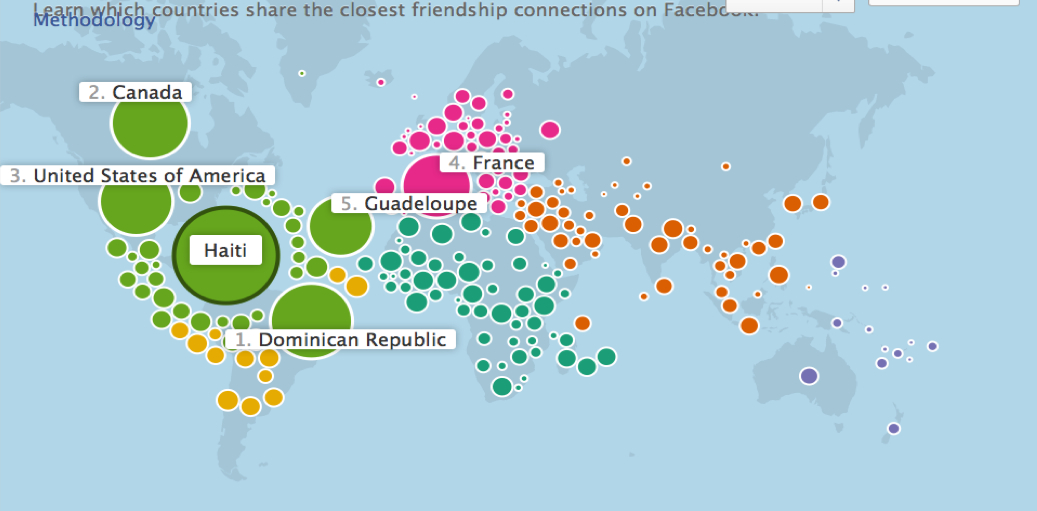
[http://www.facebookstories.com/stories/1574/#color=continent&story=1&country=HT]

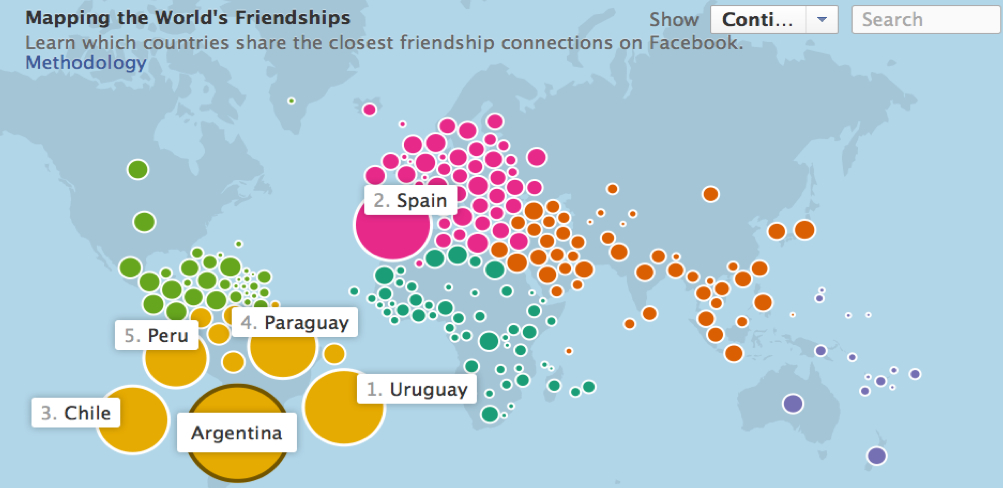
In this case Haiti, the “map” correlates the number of Facebook connections in the country and numbers between countries in ranked order that are a bit surprising, given the prominence of Canada, until one imagines the number there of Haitian refugees:
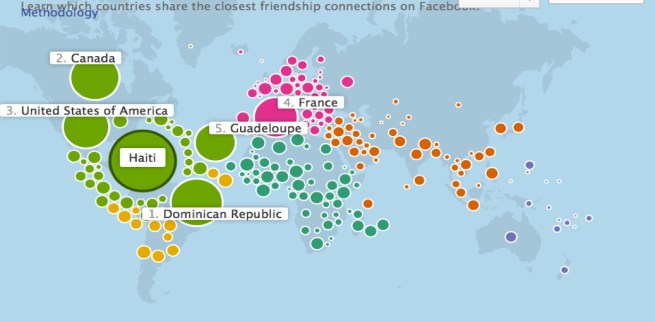
Learn Which Countries Share

The links among active FB users, cast here in terms of language groups, ostensibly responds to the question of who “shares the closest friendship connections,” although the reasons for those connections are not able to be clarified–although the illumination of linguistic ties clearly helps.  The huge prominence of Haitian ties to the Dominican Republic and Canada is not a big surprise; if the slightly lesser ties Haiti enjoys to the United States may be, it is not surprising that the proportional ties to France rank a close fourth.  This is a map, however, of dislocation, and attempts to bridge physical divides, as much as it is of friendship ties–or even a measure of friendship per se–so much as the type of “friendship™”  that Facebook seeks to market and be able to offer:  friendship that is less in, as it were, meatspace than cyberspace.

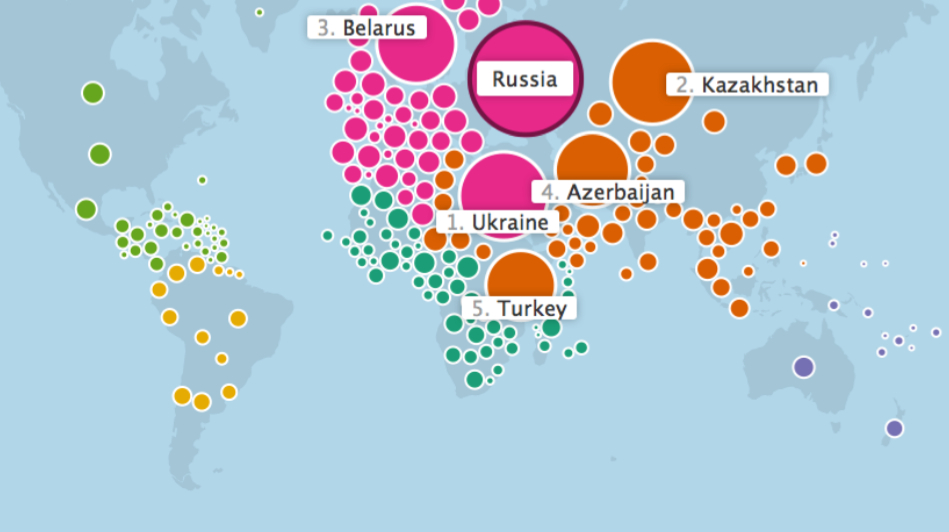
In contrast, the close ties of Russia to the Ukraine, Kazakhstan, and Belarus might be better explained by their recent division from a formerly united regional territory, albeit one that was ethnically diverse:
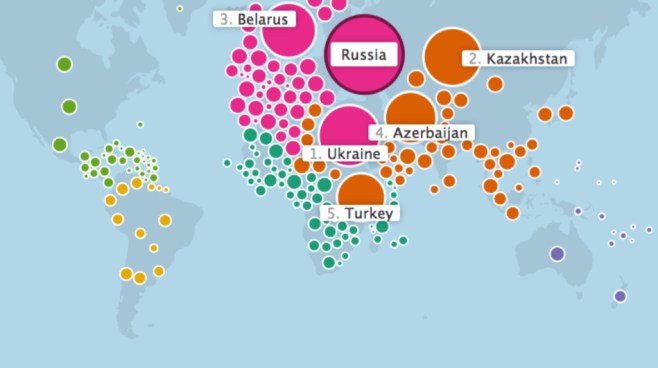
Russia's %22Friends%22

These maps display salient ties of economic and linguistic relations, to be sure, yet filtered through the economy of Facebook use.  The dramatically interactive map measures different perspectives of the world through the sum totals of FB users in one region or nation–a self-selected group–based on the criteria that that group imposed on the map.  Unlike other maps, where the data is cherry-picked and chosen and balanced by the mapmaker to conceal or pinpoint interests in an objective manner, Facebook has culled the data for this map–created and devised by Stamen Design–based on data that is not only essentially self-reported, but represents not only a portrait, but Facebook’s ability to mine the data archived by user-preferences and to assemble its own data of the aggregate of regional Facebook communities.

The result is a fantastic vision of totality through the eyes of the Facebook network, in which we can “click” on any country to view its population’s “connections” to other areas of the world.  What else does the map tell us?  Little more than the economic ability to dedicate large amounts of time to FB, or the state of emotional dependence on expanding one’s connections–or, more accurately, the acculturation of FB as a way of maintaining ties.  “Economic links, through trade or investment, also seem to be strong predictors of country connectedness,” Mia Newman informs us as she seeks to interpret the map for readers who have stumbled upon it and seek to understand this new configuration of the globe online.

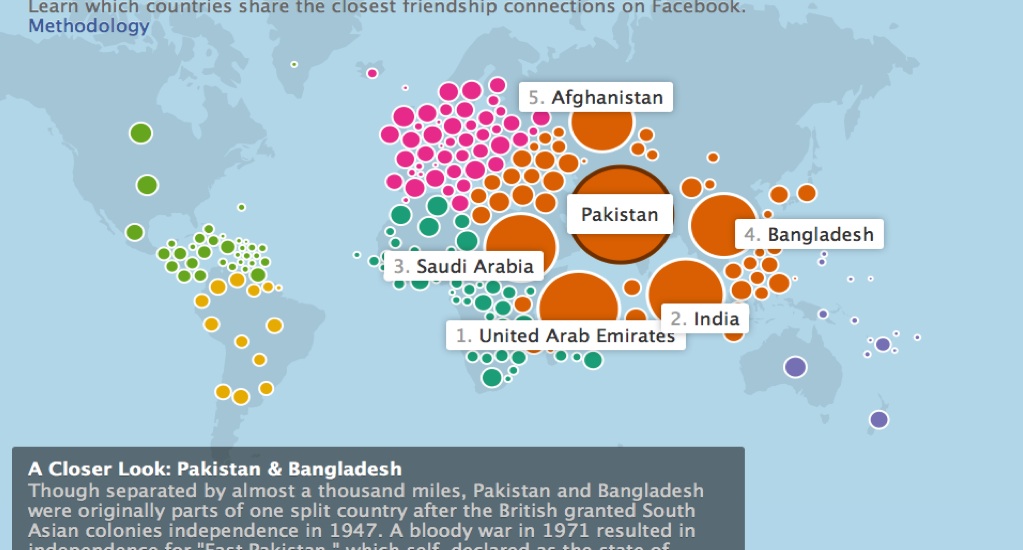
Since we’re championing interconnectedness, let’s look at the potentially more isolated country of Pakistan:
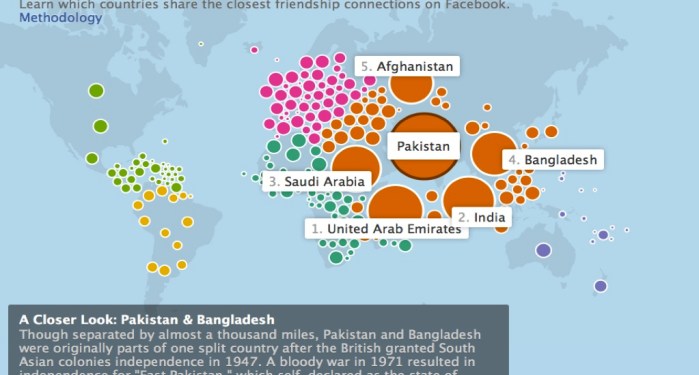
Pakistan 1

The ever helpful text panel–as the legend that must always be read with care in any map–calls special attention to Pakistanis’ ties to Bangladeshis, an effect of their unity in colonial times, but is less than illuminating about what are the classes of Facebook users in the former South Asian colonies, or what are the groups using the platform:  perhaps the emphasis on the fourth largest aggregate site of connections distracts from the comparable ties to users in Afghanistan, or the surprising permeability of the Indian-Pakistani border.

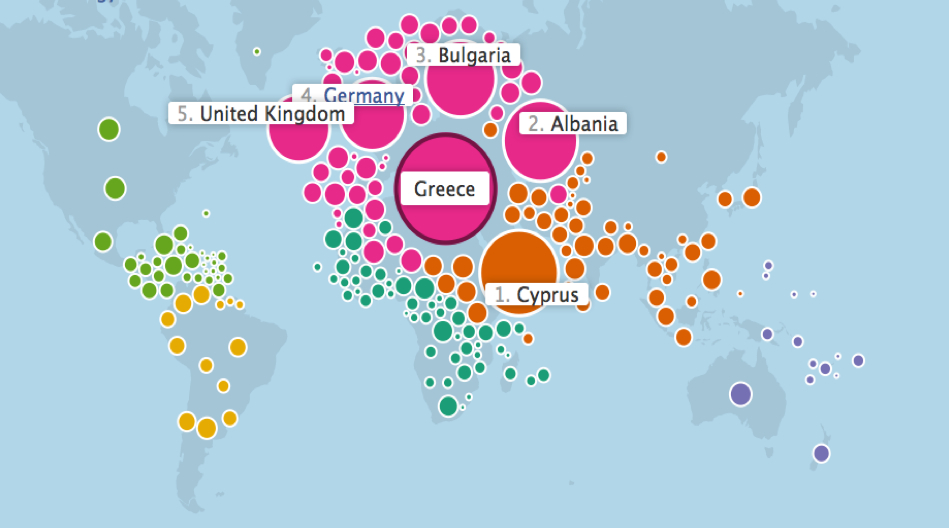
The multiple FB connections of inhabitants of Greece, however, and the generous radii of countries in Eastern and Central Europe, belies the notion that interconnectedness is a metric of economic vitality.

Greece.

There’s a lot of FB activity in Micronesia–but are Bulgaria and Serbia hotspots of economic vitality or cooperation?  Are Chile and Argentina sites of stability, or is Mexico?  Is Argentina really a center of stable labor relations and a model of free markets that we are instructed to read the map as providing evidence of?
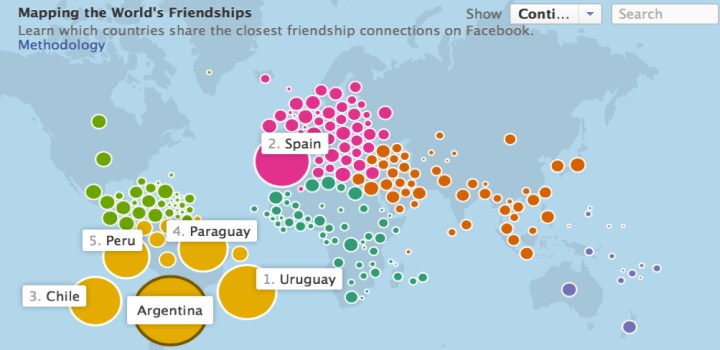
Argentina's Friendship and Labor Market

The arrangement of a configuration of bubbles of different colors are beautiful, and the pulsation of colored blobs dramatic, but the group of users are particularly difficult to identify, as are the habits by which they might “friend” their “friends”–or the networks they create.

Does–to chose a limit case–an absence of FB interconnectedness in China really reveal that the country is moribund economically?  In the manner that North Korea drops off Google Maps, although we all know that North Korea is not known for its open-access, there is no point of reference on which to click or metric to view for the largest of the world’s economies.

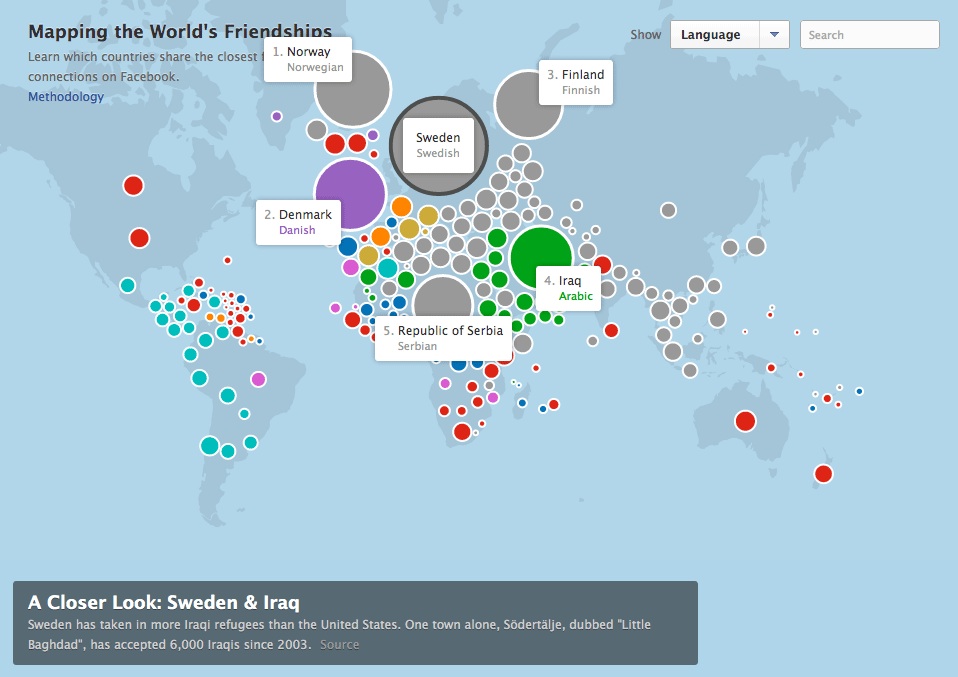
The limits of mapping FB use as a form of “friendship” rests on a combination of economic benefits, security, and desires for companionship that jointly contribute to online “friending” and the archiving of “friends.”  Not only is there a uniform level of “friending”–so that the necessity of economic “friendship” is equated with the ties of countries of origin among immigrant communities–but the homogenization of these different gradations of “friendship” obscure the potential benefits of legibility in this dramatically interactive map of Swedish FB users’ ties to geographically proximate and distant members of the FB community.

As the test notes, it shows the close ties of the Swedish market to Norway-not surprisingly–Denmark, and Finland, but also the ties of refugees who have arrived in Sweden, a preferred site, from both to Serbia and Iraq.  These recent settlers in the region, unlike the Scandinavian nexus, document a “friendship” to parents, schoolmates, or extended family– the database FB has culled suggests a deep desire to continue an imaginary with these faceless “connections,” and the lack of ability to make easy contact with these ties among immigrant communities, rather than the depth of their connections.

sweden's friendships

In the end, these are wonderful maps of our own making, whose indices are a better reflection (or projection) of what connectedness means to us–connectedness now being a relation that Facebook has now both defined and designed.  Whereas the old Pan Am logo surely maps geographical interconnectedness, as do all maps, the series of user-generated maps of Facebook connectedness map the extent of networked interconnectivity:   they are less truly maps, in some sense, than data visualization schema, that render in pictorially iconic form the data that Facebook is able to collect.  All maps reflect their makers to be sure; the maps of Facebook connectivity, more than perhaps anything else, illustrate the range of data Facebook is able to mine.  Perhaps this is the real function of the maps, which parade the range of information and “closer looks” that Facebook has access to.

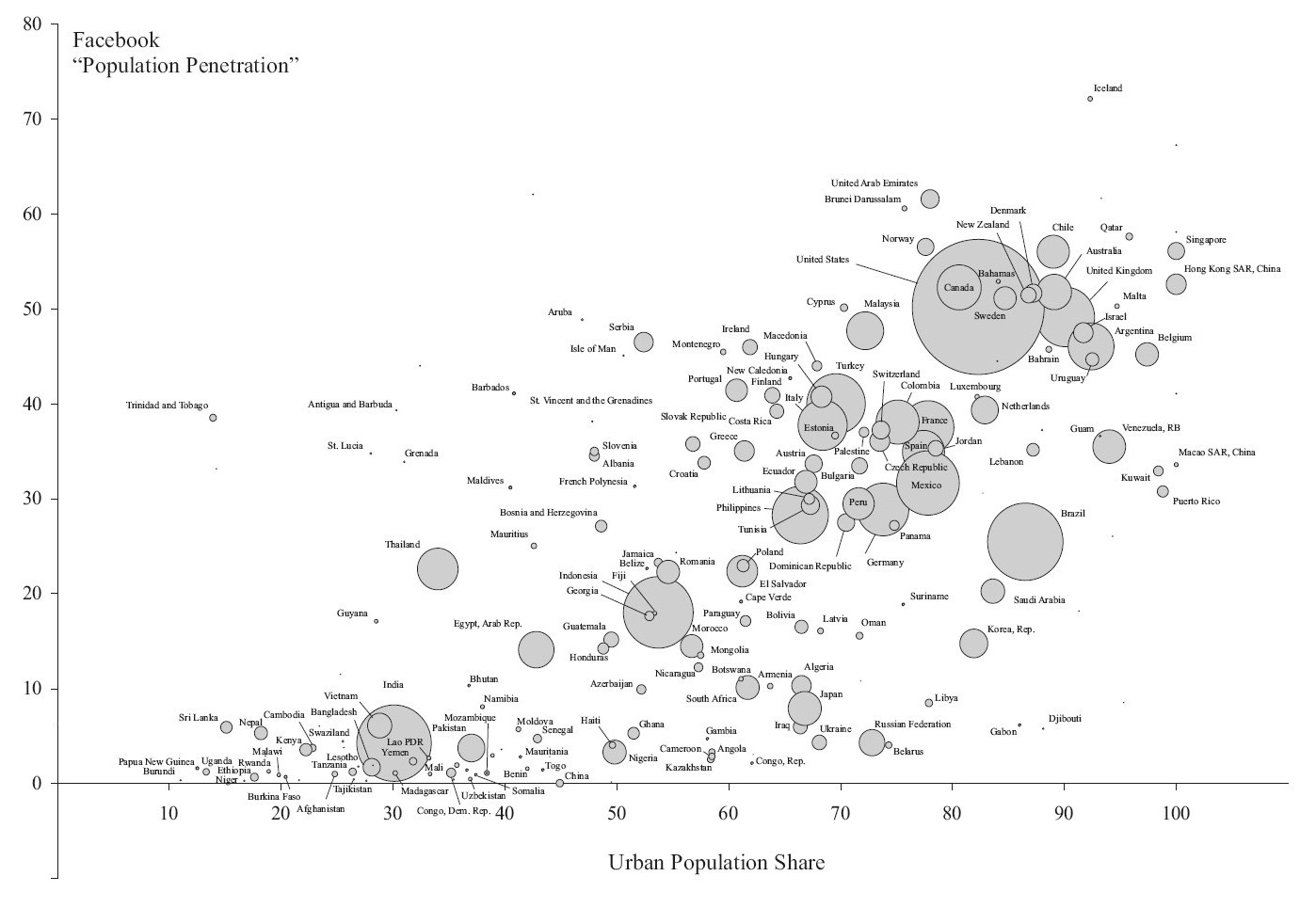
For what goes unsaid–and remains unsaid–in this endless sequence of maps is the variations among the penetration of Facebook within each country–it is assumed to be complete, and to rester anyone that one is interested in taking measure of, as if it were the metric of Who Really Counts.  Yet the wide disparities within the extent of Facebook’s currency (or, if you will, adoption) in different countries not only widely varies but might be itself mapped, as something like a corrective to the data streams that the above maps claim to oh-so-conveniently organize.

The distribution of the differential sin Facebook’s adoption in the population at large might be usefully remembered in this far yet brilliantly colored but useful bubble map, which chats the intensity of Facebook’s penetration in the population, based on site-registered active users around 2012 from a variety of sources, from a project of Elvin Wyly and Larissa Zip, which attempts to map the more socially-networked world that Facebook boasts it can offer access to.  Although the ranking of urbanization of countries is problematic–given the local variation in a largely rural nation as India that possesses large cities–the huge size of connectedness that was privileged in the urbanized areas of brazil, the United States, UK, Uruguay, Chile, France, Columbia, Turkey, Argentina, Malaysia and the Philippines, as well as highly urbanized Singapore and Hong Kong–irrespective of actual geography or population size.  (India is the outlier of a largely unorganized country with high FB users, but the undoubted majority of its users are concentrated in cities or urban areas–Facebook does not release or record precise geophysical location; the relatively small user numbers for Iraq, Ukraine, Afghanistan, Ethiopia, Uganda, or China seems to show regional poverty.
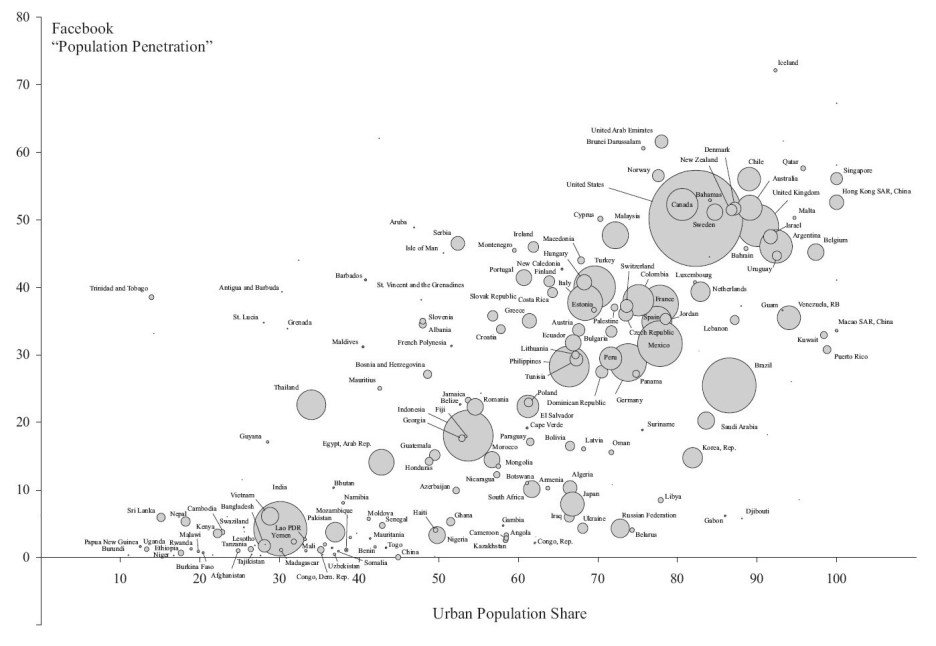
 

paste74

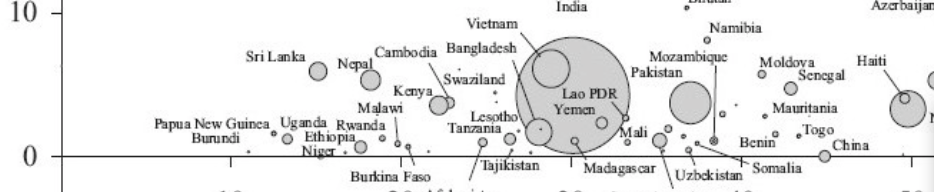
The outsized boast of mapping “The World’s Friendships” conceals the very absence of the non-networked, the new disenfranchised who the ideology of Facebook erases from the map–and who are poised to become the unnamed hordes of the inhabited world, whose lives are less visible in a globalized world, although we absent India, Kenya, China, Rwanda, Ethiopia, Nigeria, Nepal and Uganda at considerable risk.
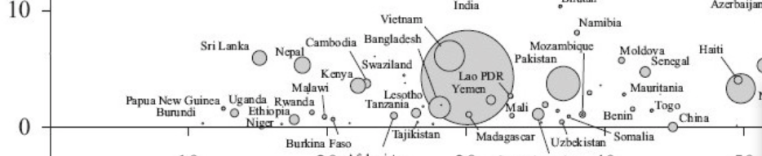
Unurbanized Low-FB presence

The “Maps of [Facebook] Friendship” are fundamentally ways to advertise the very sort of datasets that Facebook is able to sell to companies that want its records of page-views, if by orienting folks to the very metrics that Facebook has at its fingertips.

What we get is a sense of the reliability and credibility that the data Facebook possesses to orient us to the webspace that Facebook has created, using the trademark of being a “friend”–that crucial desideratum in an economy when credibility seems hopelessly confused with web presence and social connectedness intertwined with virtual contexts and contacts mediated over Facebook and LinkedIn–is able to be mapped with apparent accuracy, of an almost positivistic tenor, albeit allowing for the fluidity that is itself so characteristic of the web as a medium and of Facebook as a virtual interface.
Leave a comment

Filed under bubble maps, data visualization, Facebook, Facebook Friendship Map, Facebook Urban Penetration, FB users, Interactive Maps, social media, social networking