Yearly Archives: 2018

Locating the Lost Moo Pah Soccer Team

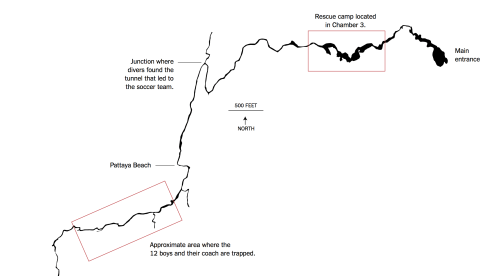
We followed with intense interest and hope the gripping story of the teenage soccer team who had entered the dangerous complex of narrow caves in North Thailand.  We focussed on the possibilities for their rescue as we watched the narrow entry ways into the remote complex where they were stranded on rocky shoals, over two miles into the Tham Luang complex and over a mile underground.  Before the maps of the narrowing cave, we could only imagine the excitement of their entrance into the cavernous passage where they left bikes, and to imagine the conditions where the U-16 team waited with their committed Assistant Coach, as we tried to get our heads around the dangers  the team faced in the darkness, licking water from its walls over two weeks.

The deeply compelling story of the “lost” team attracted the global attention from their sudden disappearance, discovery by two divers, to their rescue gained huge interest and dramatic power, as we tried to move into the narrow confines of the cave themselves.  Despite the immense power of the human story, and the endurance of each team member of the Moo Pah, or “Wild Boars,” the global scale of attempts to locate the team so remotely stranded were as historic, as we all tried to place the “Lost Thai Cave Boys”–all of whom nineteen divers have now thankfully rescued or extracted from the torturously narrow cave, whose cavernous opening narrows into one of the most labyrinthine of complexes of as one progresses into its passage ways.  Lost both to sight, above ground tracking, and to global attention, the small group of soccer players compelled attention of the entire global media.  The intense bond that existed for the team–who practiced with their coach who understood the sort of haven he was offering to them all too well–created the sense of solidarity that, in the end, trumped the dangers of being “lost” to a state or to public view.

As they were lost to tracking, GPS, or other means of geolocation, the drama became one of the inability to map in an era when mapping technologies seem to have expanded throughout our lives.  While the lack of GPS or wifi made navigation or consultation of instruments used in mapping of little value, cross-sections of the deep cave from forty years ago provided only the roughest of guides to the torturous paths of often slippery ground that threatened to fill from southwest monsoon rains–sudden rains already pressed the team deeper into the caves.   As the teenage team was removed from all contact with the world, or abilities of geolocation, the rest of the world depended on maps to imagine the possibility of contact with the kids who were suddenly known, in a bizarre trending topic, as the ‘lost cave boys’ as if to foreground the increasingly uneven global distribution of technical expertise.

We needed maps to keep them in sight, as it were, and to imagine the very possibility of their survival:  even the most schematic maps of the caves’ dimensions, abstract cross-sections drafted thirty years ago, offered a sense of contact with the team that was removed from GPS, so far removed to be out of contact, for over two weeks over a mile underground.


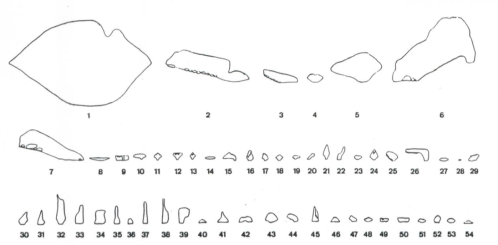
29 coupessTham Luang cross-sections, Association Pyrénéenne de Spéléologie, Expeditions Thai 87 – 88


While the multi-national effort helped to guarantee the rescue effort was miraculous, it is also a testament to the sheer force of globalization that the former Buddhist monk who led twelve teenage soccer players–several of whom were stateless ethnic minors–became a compelling focus of international attention after being tragically  trapped while exploring a cave complex.  The young team, stranded two miles into a six-mile long complex, with limited food and air, were almost abandoned, until the surprising accidental discovery that the teenage members of the Moo Pa team–the “Wild Boars”–were all found alive with their Assistant Coach by a group of British underwater divers, apparently on holiday, exploring another branch of the vast flooded cave complex, who first photographed the team, smiling at having contact after ten days.  If not for the fortuitous sighting and discovery–and perhaps if not for the lit photograph the divers managed to take of them in the cave’s depths, they may well have tragically perished.  But what else is more emblematic of the globalization of the media than the ability to turn all attention to one spot in the world, that suddenly seems the only spot that cannot be otherwise mapped?

The happenstance discovery that was made a week and a half–ten full days–after the team members had after they disappeared was relayed around the globe, more a miracle of endurance as much as of modern technology, though the two were conflated.  Able to capture them by cel phones, the image of their survival in the darkness underground survival mapped an odd snapshot of globalization.  While the cave was visited several times by the Thai Prime Minister Prayuth Chan-ocha, the statelessness of the players or assistant coach who helped found the Moo Pa team was not mentioned.  As global attention turned to the cave, and divers arrive from the United States, Britain, Australia, Finland, and Canada, the search almost became almost a spectacle of state theater, as the Royal Thai Army undertook to map and track the location of the “lost cave boys” in the mountainous remote province, as global attention shifted to the Tham Luang caves, newly prominent in international headlines as an engrossing topic of social media.


s095716743June 28, 2018


M5SFALUCC4I6ROCRKMM4BD345Y.jpgJuly 7, 2018 (Rungroj Yongrit/EPA-EFE/Rex/Shutterstock)


The complex of caves in which the team members were stranded was abstracted from what was an area of widespread statelessness, divided between different warring factions, the possibilities of their rescue the focus of global attention.  Such a heroic narrative was able to conclude, for one, in a far more satisfactory way than a focus on borderline events, or the fate of the stateless along the Thai border.


1. The efforts to discovery the team had already attracted help  While U.S. Pacific Command had sent a rescue team to help in the search for the twelve players between twelve and sixteen and their coach, searching with Thai military using remotely operated underwater vehicles and heat-seeking drone, the absence of any indications in the complex Tham Luang Nang Non caves was puzzling.  The mystery of their apparent disappearance was broken by an unexpected image of the smiling soccer team, on a ledge deep into the cavernous complex of caves, taking refuge from rising waters, far beyond the gear and cycles they deposited near its entrance, and indeed beyond the “beach” where those exploring this branch of the complex pause to rest, some four km into the cave.  The flooded waters that had already begun to rise with the arrival of the monsoons that fill the cave annually, further imperiling the group.  (The rains may have been a bit early this year, due to climate change.)

As the Thai army worked hard to locate the group for two weeks, the embodied problem of achieving the remote extraction of the soccer players focussed global attention; being trapped on a ledge in darkness by rising water when you don’t know how to swim was the stuff of universal nightmares.  But the graphics of their rescue through the caves, now lit by lamps and accompanied by divers with head lamps and oxygen, provided a miraculous rescue narrative leading to their emergence.


rescue contact 1.pngReuters, Hope for the 13 (January 9, 2018)


The image of the smiling teens taken by British divers became something of a clarion call to expand  technologies and tools for their rescue.  While what is paramountly important is that the “Thai Cave Boys” are coming to light and to their families, even as the rains are beginning to fall heavily, the global spread of the news of their disappearance and accidental spotting and the massive media response that both triggered helped coordinate a rescue effort up to a thousand meters underground with oxygen tanks, headlights, a team of divers, ropes to allow steep uphill climbs of wet caves, once drained but in need of more pumping before monsoon rains intensify, and time for the team to take a crash course in diving; Dawn Cai successfully stitched together an elegant GIF of the trek to recovery that captures the confines of the remote cave, and the deeply embodied ways we all struggled to imagine the scenario we replayed in our minds, but this time casting the focus on the tools of rescue, from the position of rescue cable to the waiting helicopter and ambulances at the cave’s entrance to ferry the kids to safety.


The nail-biting drama of the survival of the boys for two weeks in the narrow Tham Luang Caves, two and a half miles deep into their interior and 800-1000 meters deep underground, attached global attention first as what a feared tragedy, resolved only with difficulty.  What became a nail-biting drama of the “cave boys”‘ fate was the focus of global media; the gripping difficulties of the teenagers suddenly involved multiple states, directing more attention than ever to a remote cave in North Thailand.

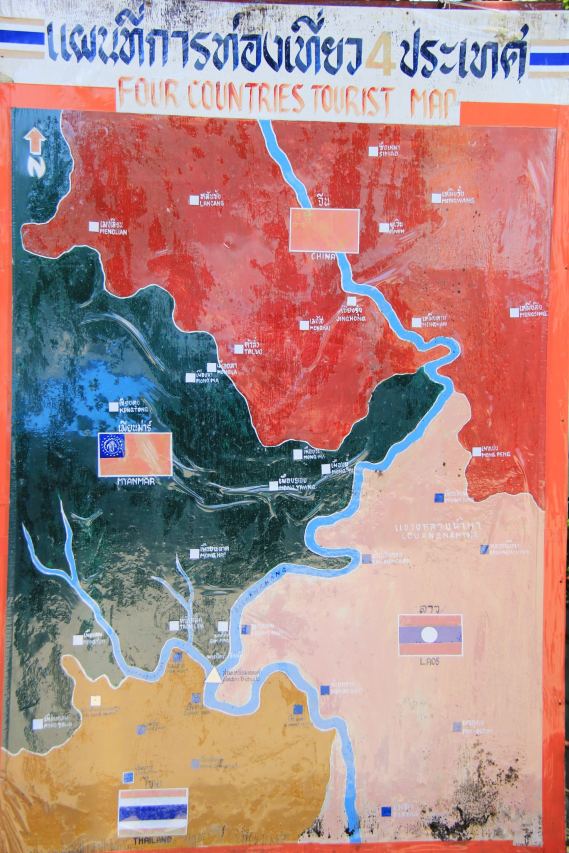
Looking at maps of the cave, the weird sense that we had in following the story that this could be a site anywhere–a cave that often seemed eerily disembodied from its environment or a specificity of place, or its location in the mountains near its border with Myanmar, site of thousands of the over 400,000 stateless refugees, displaced ethic minorities, stateless not yet granted asylum by Thailand, an area beset by drug trafficking, human trafficking, and malarial outbreaks.  The relatively retrorgade region of the Golden Triangle divided between the Shan State North and South and United Wa–has become a site for high-tech mapping, however, as if to affirm the unity and control of a region divided by different local internal conflicts–and contested boundaries the had created refugee flows.  The fact that it was normal for most children in the region to be stateless–as many of the soccer players were–made it all the more paradoxical and complex that the appellation of the team as “Thai”–and the involvement of the Thai military–were assigned a dominant role in mapping and locating the team in global media, as if the responsibility to track and locate them devolved around the nearest state to claim responsibility over the area–even if the players themselves lacked nationality.  The


5.-Myanmar-Fragile-Link-Conflict-Map

contested boundaries.pngAsia Times (Chiang Rai province divided by United Wa and Shan state armies)


–which were determined the stories of the lives of the Assistant Coach and his charges.  Ethnic strife was obscured by the tools of tracking the boys’ location and safety.   The shift of global media attention to the lost boys seems to have led to efforts of the Thai Royal Army to create the impression that the team was safe–and the situation in Chiang Rai province controlled.
 

north-thailand-july-2011222


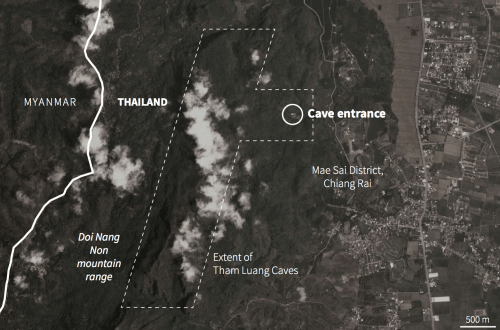
2.  The first sightings of the team fed a range of credible attempts to locate and extract the twelve kids from deep in the cave, past a rocky shoal known as “Pattaya Beach” and through its narrow openings, was planned:  we only had a sense of the depth of their location in the cave complex after the first sighting of the team that occurred ten days after their disappearance into the dark cave’s mouth.
Cave Entrace in BorderlandsPlanet Labs

alternate vis reuters caveReuters, Hope for the 13 (January 9, 2018)


The news of contact and communication  made global headlines, and served to reorient global attention immediately to humanitarian offers to assist in rescue efforts in an age when humanitarian impulses appear globally in short supply; the image of twelve young members of the Moo Pah team, wearing brightly colored jerseys, on a perch on a rocky ledge deep underground, relayed around the world, seems a partial miracle of the ability to capture imagery in almost all places, as well as a reminder of the challenge of ever locating them on the map.  If the terrifying nature of finding no response on your teen’s cell phone has long ceased to be purely a First World Problem, the alarm of loosing any contact with one’s teen seemed to foreground the terror of how quickly any trace of their presence had disappeared.

Despite the miracle rescue by which they were “found safe” inside the complex, as the monsoon rains were just about to begin, the mapping, and tracking the young Moo Pa team was a drama hard to get one’s head around that gripped the world, and lead to a huge exultation at the emergence of the first six players from the cave complex became a cause for global celebration, even as the former monk, the valiant Aekkopol Chanthawong who is their Assistant Coach, remains trapped with the rest of his charge and team, teaching them the virtues of stoicism and patience as well as techniques of breathing and meditation that had more than anything else to survive, presumably, kept them in good spirits and alive for over two weeks.  Helped in part by the recession of the waters, but also by the shallow breathing techniques that allowed survival in an oxygen-depleted caves, the dedication of Aekkopol to the boys he trained not only in soccer, but to dwell in the dark stands out.  The coach was practiced in long meditation retrains, and  arrived  as an orphan at the War Phra Thet Doi Wao monastery, only leaving training to be a monk after ten years.  Where his own advice about meditation and calmness a crucial importance to reducing the team’s panic, as well as the trust he had gained?

(Is the broadcast of plans to ordain eleven of the boys as monks as novices and their coach as a monk occurred after their rescue, lighting candles at Wat Phra That Doi Wao monastery, consolidating and combining the international broadcast of their rescue with a traditional Buddhist coming of age ceremony?)


beautiful-fine-artWat Phra Tat Doi Wao monastery, Chiang Mae province in Golden Triangle


The techniques of meditation and focus that he used, no doubt developed on meditation retreats with little food or water in the forests surrounding the monastery, were obscured by the focus on the range of technologies that were imagined to perform a rescue operation able to bring the boys from the cave.  While knowledge of the possibility of their rescue, the survival of the team fed their survival past ten days, their survival was the other story that was masked by the amassing of international efforts, helicopters, diving equipment and cables to find and extract members of the team from the cave complex, equipped with oxygen canisters and lights. What is celebrated as a high tech adventure rescue depends on the focus of the former monk who, despite his statelessness, has become something of a national hero–but also for the techniques of survival he imparted, more important than the anti-anxiety medications that the multinational team of divers brought when rescuing them.

The unfolding involvement of a global commitments to locate and extract the thirteen teens seems a modern counterpart to the myth of Princess Jao Mae Nan Nong who fled her parents with her love to the complex of caves after their forbidden love was discovered, and still serves as its protector.  Princess Jao Mae was said to have stabbed herself in the complex of caves where she had fled her parents with her lover, after he was killed by soldiers her father sent in pursuit, and her blood forms the waters that fill the caves, providing a powerful link between the caves and the afterlife.  The Princess’s spirit still is venerated as protecting those who enter the cave complex in the Mae Sai district of Chiang Rai province; indeed the altar of the pink-robed Princess after the boys disappeared attracted attracted many offerings, incense, and candles with other offerings as raining and flooding slowed the search, and her role as a powerful bridge between the living and the dead and guardian of the caves in northern Tahailand gained power as a focus for hope of intercession.

The story of the fate of the “lost boys” became a parallel tale of the turning of global attention turning to the caves in Northern Thailand, to provide a different form of intercession as rescue efforts grew   The stories of Jao Mae shifted, to be sure, to new mapping technologies as the members of the team were located and found, as if in response to the efforts of collective prayer, and a variety of possible new schemes for locating and saving the lost team became a truly international affair, unexpectedly turning all attention to Northern Thailand for evidence of reasons to hope.  To be sure, the rise of an emphasis on technologies of tracking and mapping the caves may have displaced the prominence of breathing techniques and meditation practices that played a large role in the Wild Boars’ team’s survival underground for ten days.  “In the cave,” deep beneath the surface of the ground, as military soldiers combed the mountainside with maps, remembered the head coach Nopparat Khanthawong, the assistant coach had “taught the boys how to meditate so that they could pass the time without stress,” as they waited in the darkness, without food or any sense of the passage of time for ten days, in ways that “helped save their lives” by techniques learned asa novice fat Phra that doi wao temple where he arrived as a refugee orphan from Myanmar.  Aekkopol often meditated with monks of the temple and the surrounding forest for days at a time with only a small reserve of food.   And he was the last to leave the cave, shortly before the pumping apparatus that had drained the caves of rainwater failed.   Yet the entire affair and rescue was shown and described most often as an instance of modernization, supervised by the Prime Minister, in which the Royal Thai Army played a major role in securing the area, developing strategic approaches, as well as draining the cave.


3.  Tracking the site of the lost team had riveted global attention and indeed become a project of global mapping over the week plus since the tragedy of their June 20 disappearance unfolded in the news, from the first incredulous attempts to track their location in the torturous complex of underground caves to the more recent imagining of rescue attempts by diving, drilling, or any other means of extraction, as the under sixteen soccer team learned new techniques of breathing, meditation, and perseverance from their dedicated Assistant Coach.  We collectively communed with them, and contemplated their chances for rescue as we south to orient ourselves to the unfolding development of what we didn’t want to imagine was another human tragedy through our maps.  As we needed to believe they were alive–as they thankfully were–maps were an affirmation of their existence, and a logic of collective action.

Paper maps provided a surprisingly important point of reference above ground, as the position of the boys was considered and contemplated in previous days, as if to preserve or imagine a virtual tie to their remote location.

4728Pongmonat Tasiri/EPA

Despite the diminishing hopes of teenager’s survival after the first week they went missing, their survival of the children has become something of a test-case to find if there is any area of the world that cannot be mapped–and for rescue technologies, as well as a drama of locating hope underground in a darkening above-ground world.  For global attention to the video taken by British divers of the group of teenagers who were trapped by unexpected rains while exploring the complex with their Assistant Coach after practice, and the possibilities of international cooperations to locate the small group was nourished on social media, if it had already electrified much of the nation.  What was already a state concern of Thailand’s prime minister, Prayut Chan-O-Cha, the often unspoken if unseemly question of whether Thai soldiers and policemen had the necessary technology or skill to locate the lost team, as hope at their discovery gave way to fears of how to extract them from the cave, or return them through underwater passages,–either by drilling into the soil or squirreling them through often narrow caves.  But the fears of altering the structure of caves were balanced with the difficulty of navigating within its dark, narrow passage-ways.

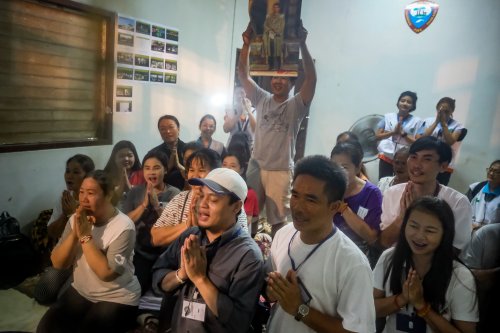
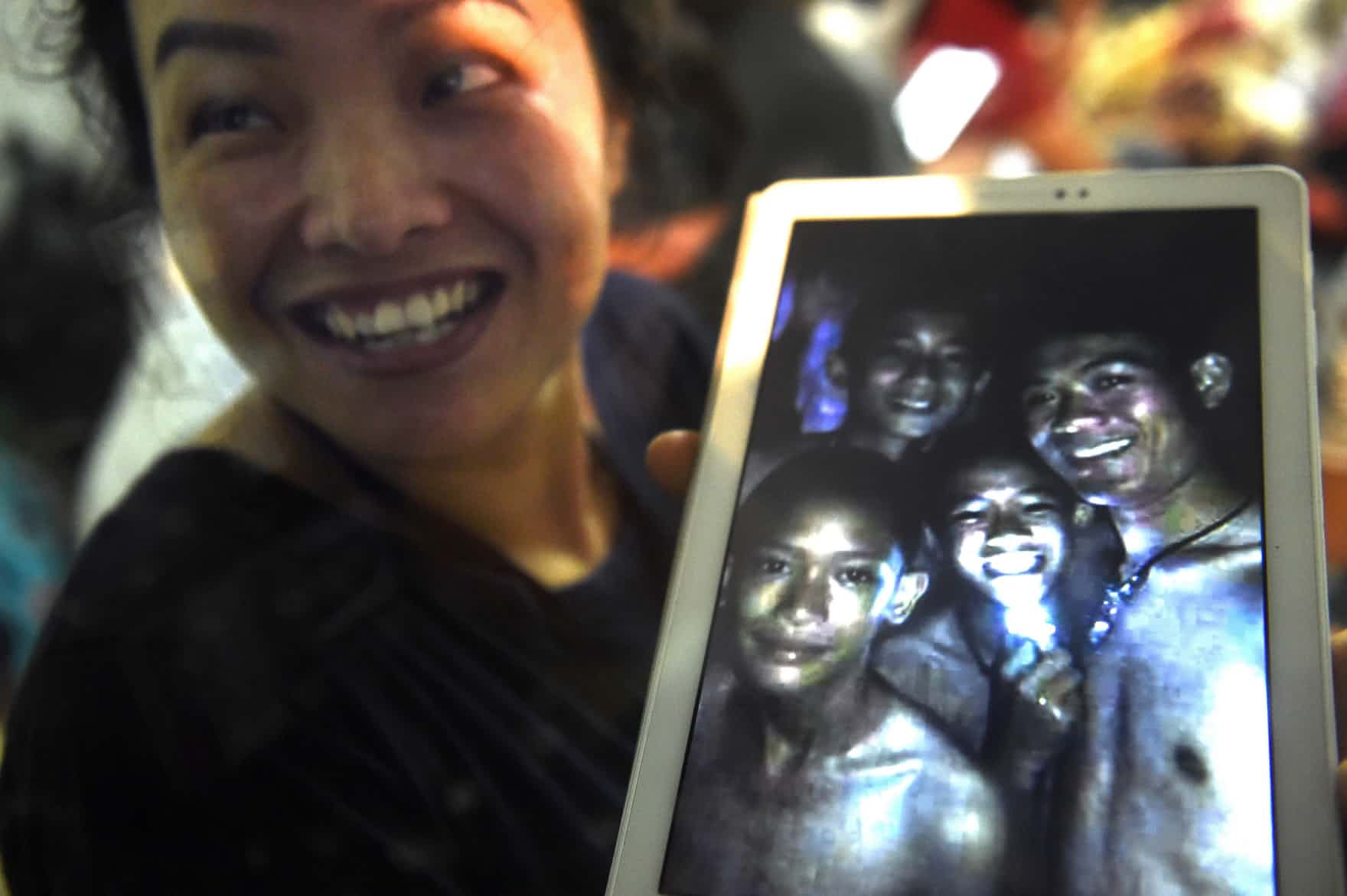
What became a local exercise that the boys to explore the cave complex that the rising of the waters suddenly trapped them became an international affair, as the the world wide web focussed global attention on images of their fate, as a grainy photograph of a few smiling team members on a tablet became a cause for unexpected jubilation and offered a sort of technological reassurance even as their fate was unclear.  Images of relatives praying near the caves’ entrance with offerings of incense, garlands, and an eventual altar were balanced with images of high-tech mapping of the paths that the team took.  The utter joy one parent showed at the arrival of the image of team members on a tablet triggered a global effort to locate and save the team members believed lost, who truly seem to have shown more resilience than the rest of the world.  The sudden burst after the confirmation of their survival was a sort of miracle—they seemed healthy and even well-off while deep underground!–but the sense of a miracle was conflated with technology of the image relayed above ground.
The sudden alarm at loosing contact with one’s teen’s cell phone would have perhaps set off alarm world wide, even if the team was not found to be located at such a remote remove.  Is it a coincidence that in an era when few children are encouraged to wander far from home, or explore their local ravines and neighborhoods without worry, that the attention of the world was turned on the team stranded in the cave?  Most on the internet wondered what in God’s name the team was ever doing in the cave, or on the warning sign posted at its entrance cautioning about entering as monsoon rains approached.  The flooding of the cave where the team members were stranded was glossed as a tragedy, a race against time, and as an international challenge for sustaining hope, as the former monk became a true hero, teaching his team techniques of shallow breathing, meditation, and focus with self-sacrifice that gave them strength and perseverance in the face of terrifying danger.  He was the last to leave the cave, and soon after his departure the pumping apparatus that had drained the flooded caves broke.


Phra Rathet Doi TempleWat Phra That Doi Monastery, norhtern Thailand


The complex of caves in northern Thailand became something of a final site for nature, and struggling against natural forces, without wifi or GPS, even as the sense of why a team would go exploring the network alternated with worries rising waters complicated their rescue.   As an international effort grew, as new technologies were mapped onto the essentially quite human, all too human effort to locate and save the under-sixteen team and its dedicated Assistant Coach beneath the mountainous terrain.
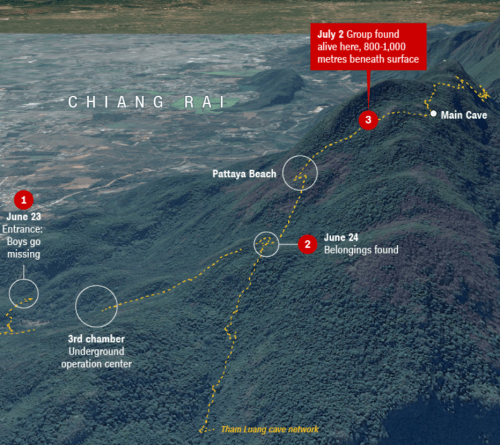
 

Chiang  Rae.png

Hope transformed to preventing a terrible tragedy as possible rescue missions are contemplated or planned, and attempts to map their fate.  The difficulties of their extraction riveted global viewers to the fate of teenagers hailing from borderlands of Myanmar and Thailand, who were chosen for their interest in soccer, as forces from the Thai Army to Elon Musk to the former Navy SEAL diver who died in doing so have tried to understand how to extract safely, in what a real-life drama that dramatically surpassed the World Cup, and offered a narrative of international cooperation to save the teenagers feared lost, who were themselves stateless, as their relatives continued to bring offerings to the Jao Mae shrine venerated as able to bridge the cave and otherworld.  The story of the post-practice exploration of the complex by twelve U-16 teenagers aged twelve to sixteen–the age of my daughter–seems one of the technically difficult of situations processes, but most unfair as the story of a lost school group has grown as posted photographs of the twelve kids has provided a ray of hope, despite fears of future flooding of the caves by rains, and the perpetual threat of diminishing oxygen.

The complex’s narrow walls and rather torturous network provided what seemed the only remaining thread by which they could be saved or captured, and the specific difficulties of negotiating a rescue in the cave, after multiple divers had already tried to move along narrow passages to explore the caves, and unsuccessfully attempted to drain them with pumps, as the team was found farther into the complex–and up the hill–from where soldiers had earlier searched, and consideration of the place of Pattaya Beach–near where they were found, but in a delicate and narrow section of the caves.–and around the sections of the hill that soldiers examined above ground as they discussed the possible routes of their rescue.
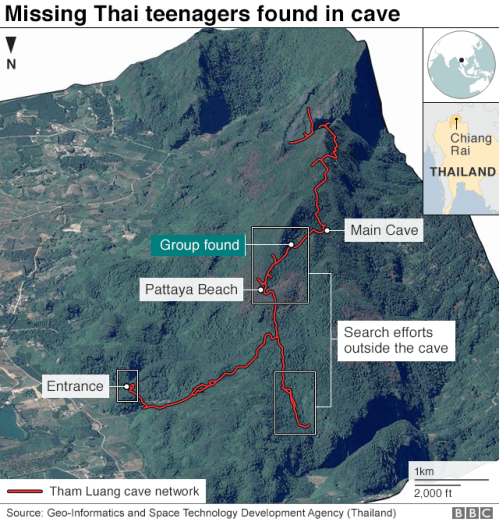
_102289763_maptahi2-nc


4.  While the cave entrance remained large fairly deep after its entrance, the problem of following and mapping the progress of the boys into its sections grew more concrete after it was discovered how deeply in they had travelled, just past the raised area known as Pettaya Beach.  And so we turned to the most apparent exact records of the openings of the torturous cave complex where the team and their Assistant Coach were stranded, to imagine our proximity to them in a time of need.
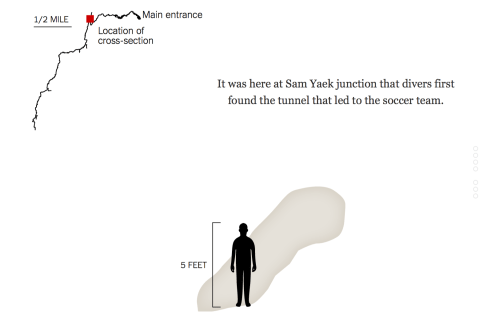
 

tunnel leading to team

THuam Luang spelExpeditions Thai 87 – 88


Tracked by the latest mapping technologies and relayed on media circuits since the news of their discovery erupted, the plight of members of  the Moo Pa Thai soccer team trapped in the six-mile long Tham Luang cave complex has been a focus of global attention and mapping efforts.   The mapping and remapping of the site is of course both a testament to the dire nature of the situation of a group trapped deep within the cave, with limited oxygen, as well as food, buoyed by the miracle of their discovery after nine days and were stranded after they began exploring the cave and the difficulty of drilling from above-ground or navigating the dark cave itself to locate the team of teenagers trapped within, suffering the stuff of nightmares, as well as the problem of extorting them while negotiating narrow often underwater passage-ways.  Despite their actual inaccuracy, the apparent exactitude of the cross-sections created an imagined tie to this otherwise multiply removed area of the world, neither satisfactory mapped or governed.

As rising waters threatened to fill the narrowest of cave walls, unable to accommodate air tanks, and attempts to pump water from the complex failed, mapping truly seemed the least of it as the extraction of the team faced the pressures of rising waters, malnourishment, and oxygen lack.  (Elon Musk boosted hopes by tweeting his team was developing a narrow child-sized submarine pod able to navigate the hairpin turns in the cave complex, as if the pod would quite miraculously be able to be constructed and arrive on time–and even travelled himself to the cave system, seeking to promote the value of his oxygen engine to the Thai team.)  The collective ensemble of efforts, spurred by the problems of locating a group of boys who didn’t know how to swim or dive as the waters ran into the cave complex, was a logical problem, in many ways, that demanded resolving problems of entering the cave underwater, illuminating the passage way, and guiding the boys out, as well, it seemed, as draining the water that had already entered from growing rains.

But the challenges of mapping their location, and the sense that they had traveled to a place so remote where they were not able to be mapped and tracked.  The problem in part created a level of tension that riveted the world.  The human drama of the young members of the Moo Pa team, became a subject nand symbol of national as much as provincial pride, as the problems of skills required to achieve their rescue became debated.  The discussion and debate seemed a parallel story in itself, even if the possibly deadly adventure of the group of teens was intensely involving.  The Thai Army that sought to ascertain routes of their rescue looked over maps of the cave’s veins that snaked under the mountain ranges, as if to plan the underground rescue–focussing on the cave complex they knew so well, but with less of a sense of how to extract the kids trapped within by drilling from above ground.
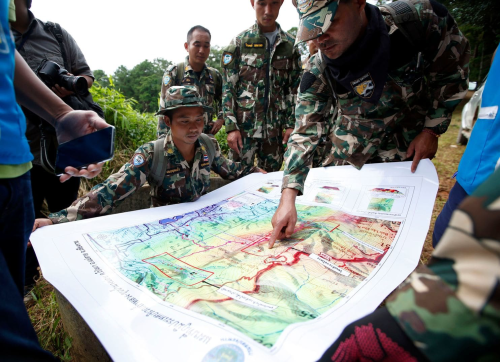
 

image.pngRungroj Yongrit/EPA-EFE/Rex/Shutterstock

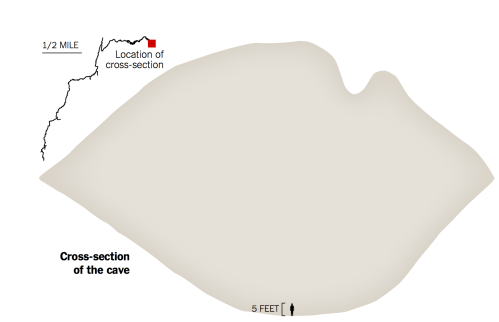
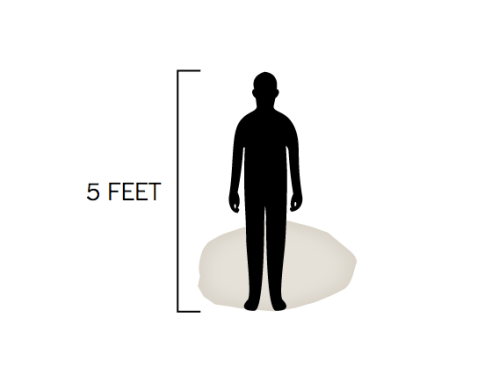
Despite the actual insufficiency of maps, we have tried to map the incredibly narrow contours of the cave complex, as if to puzzle over how they might be located and saved, and somehow track their course along the narrowing width of the complex from its opening–as if to map the difficulty of the job to the scale of a five-foot tall teen–to craft a more experiential record of speleological cross-sections of the mines through which the teens had traveled. based on the first surveys of the cave of 1987 of its narrowing cross-sections, now assembled in a more interactive form, as if in a flip-book–
Cave Oening.png

Cave map.png

tunnel leading to teamNew York Times Interactive

29 coupessExpeditions Thai 87 – 88

–that helped to embody the experience of being trapped in such narrow confines so deep underground where they were trapped.  The apparent accuracy of these speleological cross-sections was suddenly enlisted to create a sense of imaginary connections to the team whose fate we could not imagine, as if the insertion of a five-foot tall surrogate teenage icon helped capture the embodied experience of surviving in the cave and calibrate the difficulties of their rescue.
fit boy in cave

Images borrowed from the largely structural maps of cavers who had explored the narrow Tham Luang complex–and from the exact field of speleology–the visualization sought to pose the options for rescuing the team members in the narrow caves where they were stranded, learning how to negotiate with limited oxygen and rising water.  The interactive map in the Taimes  invites observers to imagine their narrowness, but minimized the  complications of locating the team within the cave,–it elicited wonder at how the team had managed to climb so deeply into the complex as the water rose.


5.  But the “map” reamined oddly abstracted form crucial information about the underground setting–failing to  suggest the real problem of rising water and ground conditions, as while tracing the path of complex with accuracy, it strips a 2D sense of location from the  context of rising waters and difficult ground conditions in a cave from which water needs to be pumped.  But perhaps the point was to capture the compelling embodied experience of their in the remote cave.  The Interactive graphics nicely reproduced the difficulties of moving along and negotiating the narrow turns, some requiring kneeling, swimming horizontally, or crouching to pass  as if to experience the narrowing of its amazingly twisty course, as if in a video game, tracking the tortuously narrow course of the caves, through which the team progressed to try to avoid rising waters, in a nightmarish situation with all to real consequences.

But we were linked through the miracle of interactive mapping to pray for the futures of the teenagers, with their schoolmates and Buddhist monks who assembled at its entrance, as if to restore them to a map.  Even as we cringed at the near-impossibility of establishing their location, after already one diver who attempted to locate them lost his life, contemplating the entrance into the narrowing passageways of the caves and the team’s itinerary as well as the possibilities of their future rescue.


alternate vis reuters caveReuters, Hope for the 13 (January 9, 2018)

While watching forecasts for raises that can boost the already rising floodwaters, teams of divers have contemplated maps, and the rescue camp locate near the mouth of the cave provided only a possible site of salvation, in hopes that they could be moved there.  Is the cave’s mount a more apt site of prayer, or of recovery?

The misfortune of the soccer team had converted the mouth of the cave to the site of an altar that was sort of shrine, and a site of prayer for divine intervention, as worries  turned to what thin, depleted oxygen the team members might still have access during the two weeks after they disappeared, their bicycles found, partly washed away, near the cave entrance, while the classmates of the team-members participated in large collective prayers, and Buddhist monks gathered near the Tham Luang caves, juxtaposing the science of mapping their location with a perhaps more credible collective prayer.
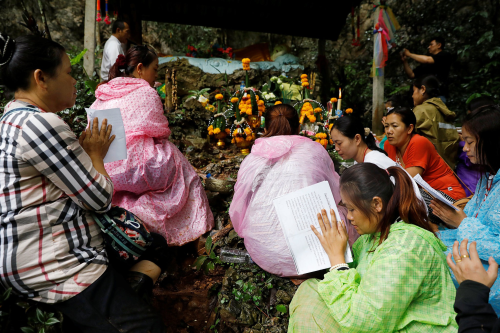
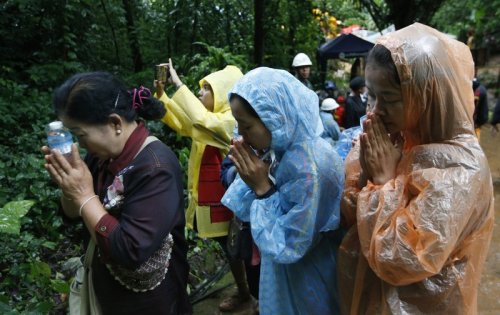
 

image.png

800.jpeg

merlin_140671041_ecac7fca-853e-4b04-a1d3-7b92ed0b7eb0-superJumbo

Were the major efforts in mapping not serving as their own sort of prayers, if of a modernist variety, and hopes for a miracle of intercession before the waters rose and the oxygen depleted in the stretch of the rocky cave complex?  While the maps did show the human story of the position to which the teens had arrived, and posit and frame the problems of their rescue, thankfully underway, the maps seemed as important as framing, sustaining, and affirming a sort of tenuous empathy to their fate, allowing access to the remote cave system.  If they created the possibility of the necessary conditions for their rescue they also became a kind of guiding light for those of us who followed the spectacle so intensely from our own backlit screens.

Leave a comment

Filed under #ThaiCaveBoys, cave complexes, data visualization, monsoon rains, Thailand,

The False Imperative of the Border Wall

Donald Trump’s most astounding victory–predating and perhaps enabling his astounding electoral victory as President–was to remap the mental imagination of Americans, and reconfigure proximity of the United States to its southwestern border in the public imaginary.  The goal of this insistence is no less than a remapping of civil liberties, based on his insistence of the need for border security and constructing a Border Wall, and preferably doing so in all caps.  

Build the Wall--Add Your Name.png

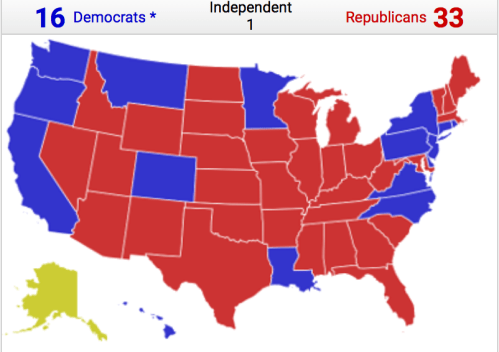
Condemning “obstructionist Democrats” are the party of “open borders,” and obstructing the work of law and order agencies such as ICE–the Immigration and Customs Enforcement–agents or his beloved Border Patrol, and for filling the national need for border security, and the project of building “the wall,” a super-border structure that would both prevent cross-border migration deemed ‘illegal.’  The construction of border psychosis is evident in the large number of Republican governors of states that have been elected two years into the Trump Presidency–

Governors?.png

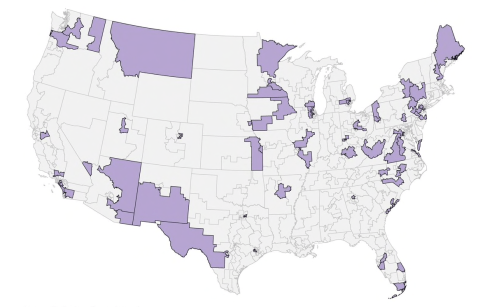
–as the question of “governing” states most all the southwestern border–save California–has created a new “block of red” that has been generalized to much of the nation, rallying behind the America First cry to defend borders, build prisons for immigrants deemed illegal, and work with federal agencies to apprehend such immigrants, denying their lawful place or rights to work in the United States.  For much of this map of governors, now that the Republican party is increasingly the Party of Trump, reveal the uncertain terrain of the undocumented immigrant, and the massive circumscription or reduction of human and civil rights, as well as a fear of failure to manage immigration.  Although current findings of sixty-nine competitive districts in the 2018 election include many border states–sixty-three districts of the total are held by Republicans before the election, a considerable number of the “battleground states” lying near or adjacent to the planned Border Wall, according to a Washington Post-Schar School survey

Sixty Nine Competitive Congressional district.pngWashington Post

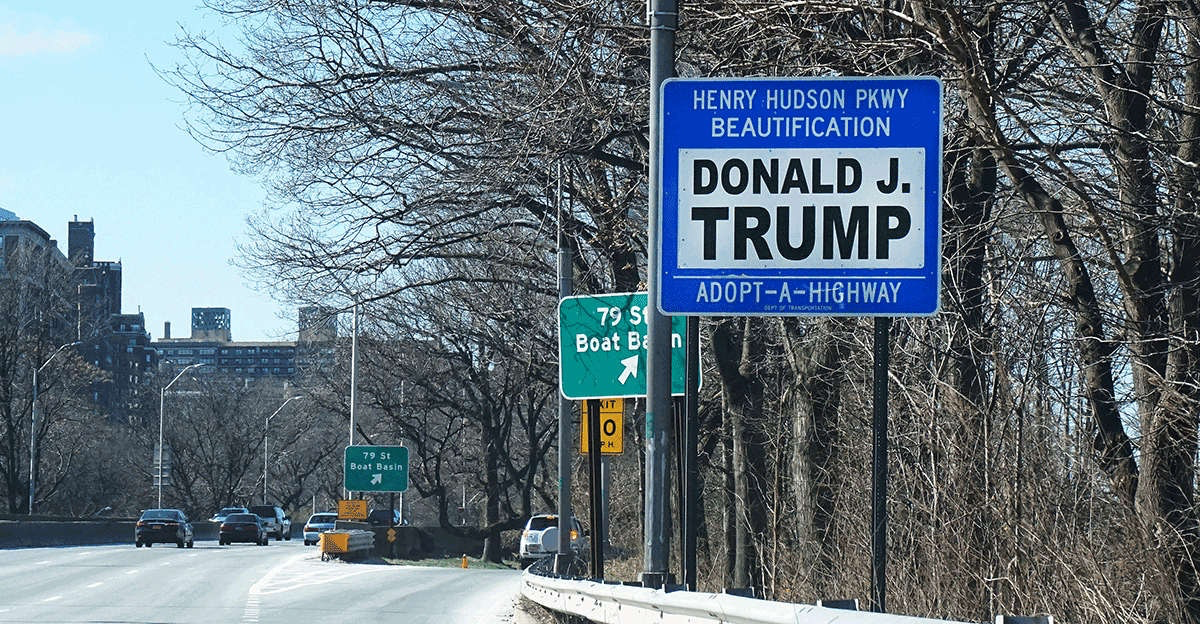
–where calls for wall-building originated.  The magnification of the border in the electorate’s collective consciousness was a gambit of electoral politics and staple of the Trump campaign for the Presidency, and it conjured the unprecedented idea that a single President–or any office-holder–might be able to shift the borders of the nation, or guarantee their impermeability to foreign entrance.  The striking appeal of the border was not seen as a question of border protection but rather the construction of a wall, evident in the expansion quasi-tribal collective rhythmic changes at rallies, now repeated as if in a non-stop campaign.  Although the focus of most buildup of the border has been to update existing fencing, the calls for fix-it-all border protection plans gained sufficient appeal to suggest a potential shift in the nation’s political terrain.  Even though Donald J. Trump was, for practical purposes, a quite parochial perspective based in New York and Manhattan, and perhaps because Trump’s own expertise in national building projects was as limited as with working within the law, the project was first floated by the candidate as if from the sidelines of national politics, treating the project as akin to protecting a two-mile southbound side of the Henry Hudson Parkway in Manhattan, beside his pet real estate project, Trump Place, at 220 Riverside Drive, through an Adopt-A-Highway Project, and that the border wall was essentially the same need of securing .  (Although the prominent sign was itself quickly vandalized to read “STOP TRUMP”  as Trump won the Presidency, needing to be replaced, the return of the defaced sign promising the riverfront side’s maintenance was far less an act of good citizenship than a vanity act.)

Jon Comulada/Upworthy

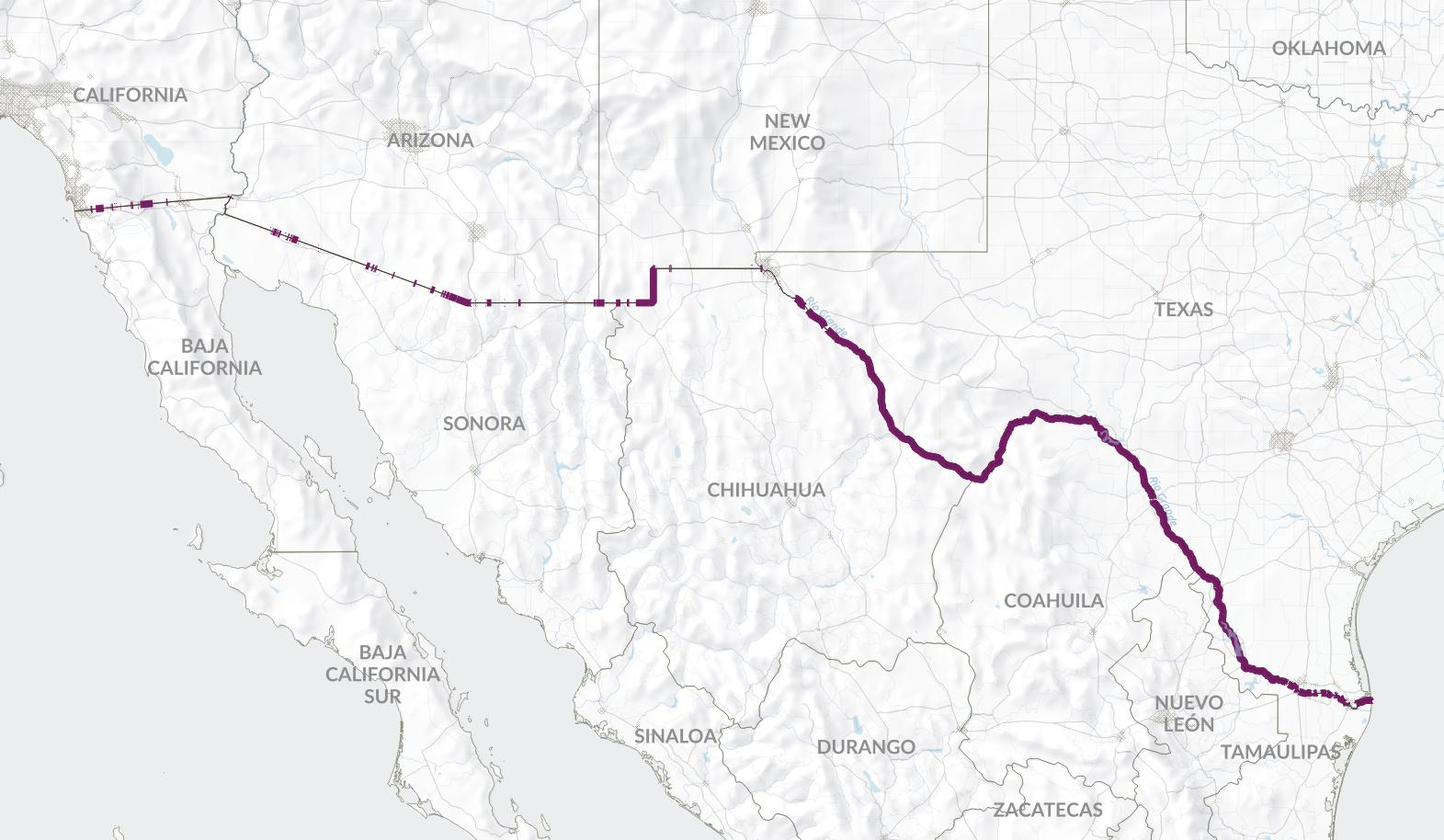
New York City limits the Adopt-a-Highway program to individuals, companies or organizations, rather than to political candidates and campaigns seeking publicity, but since the Trump Organization maintained the section since 2007 or earlier, it gained an exemption–and a tax write-off for its contributions to maintenance.  And when he spoke to residents of the territory currently known as “America,” Trump seems to have treated the proposed Border Wall as an almost similar project of beautification, and a project of protecting what was his, in a proprietorial way that seemed to conflate his own identity and person with the country, as the current sign conflates his name with the Trump Organization, as his recommendations have contained as little familiarity with the site, scope of the project, or terrain, as many have noted, treating the construction of a continuous border wall as a detail designed to beautify the country, even though the border includes 1,288 miles currently without any pedestrian or vehicular fencing, gate or protection.

Reveal

It almost seems that the proposed border wall had not been “mapped” per se, so much as it was a rhetorical promise for the sort of project Trump would like a President to do–and a project whose magnitude appealed to his sense of personal vanity.  He praised the benefits of the construction of the wall as a need to “get it done” and imperative that responds to a state of emergency–a national emergency that sanctioned the suspension of existing laws.  The emergency, as Trump saw it, was created by crime, gang violence by MS-13 members, who he has called “animals,” and a source for a loss of low-wage jobs.  The acknowledgment of the need for the wall is virtually a form of patriotism in itself; recognition of the need for the country has become a way to participate in a new nationalism of strong borders–a nationalist sense of belonging that was opposed to the agenda of those unnamed Liberals without clear purchase on the geopolitical dangers and a failure to put America First.  President Trump has argued that the “larger context of border security” necessitates the wall.  Trump has come to repeatedly proclaims in his continued rallying cry stake out a new vision and map of American sovereignty, and indeed of territorial administration.  Evoking a new tribalism in openly partisan terms, Trump even promoted with impunity the false belief that Democrats have united behind an “Open Borders Bill,” written by Dianne Feinstein–distorting the #EndFamilyDetemtion protests and “open borders movement” with an actual legislative bill.  More to the point, perhaps,

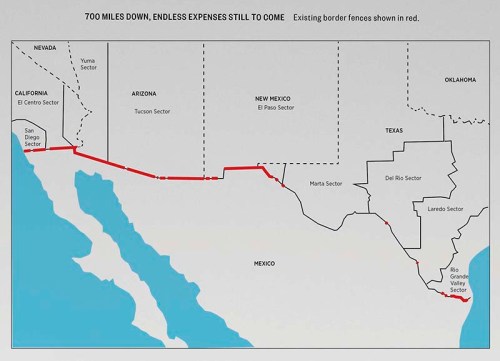
The very crude geography and mental mapping that animates this argument is repeatedly a staple of Trumpian rhetoric.  As if  thick red ruled line could be drawn atop a map, Donald J. Trump has become the outsider political voice able, as a builder of vain monuments, to claim the ability to build a new structure able to replace existing border fences, and provide a continuous monument at endless concealed costs, without any acknowledgement of the people who have long moved across the border on the ground.   The transposition of this tribalism of border separation into a partisan dichotomy has promoted and provoked an apparently Manichean opposition between political parties around the defense of the US-Mexico border, and the building of a Border Wall, in an attempt to define the differences between Democrats and Republicans around the issue of the defense of national safety.

Bier3a

President Trump has not only made immigration into a platform for his campaign and for his party:  the stubbornly intransigent logic of Trump’s oppositional rhetoric has not only remapped the nation in mind-numbing ways.  The fixation on the fixity of the border as a means to “Make America Great Again” erases the historical instability of borderlands in the United States, in its place projecting the image of fixed boundaries:  the exact shift in the image of national territoriality seems a not only shift on the border, but a decisive replacement of an inclusive state.  And even as Trump’s recent rallies are–as of September–still interrupted by “Build that wall!” tribal chants, leaving Trump to lie openly by claiming “The wall is under construction,” he reminds us of his need to evoke an inexistent barrier for which such intense desire has developed among his supporters that it is indeed a talisman by which America will, indeed, be able to be Made Great Again.

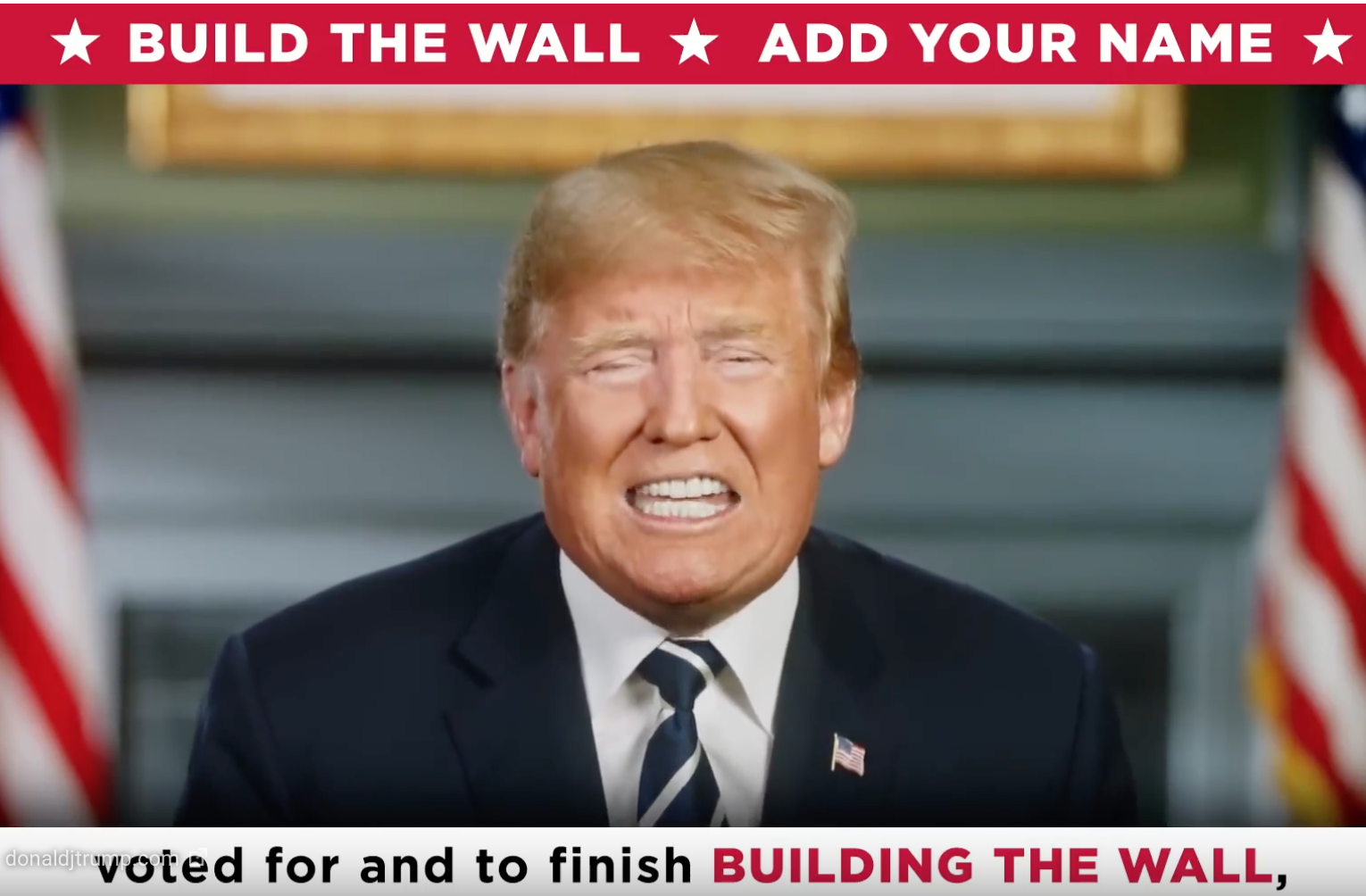
Continually crying about the urgent need for “building the wall,” even if it would be in violation of international law, is cast as a state of emergency which would reduce crime, the illegal presence of gangs, and existential dangers, and a promise made without acknowledgement of any who live outside America’s national borders, or any foundation in civil law.  The promise to finish “building the wall” is cast as a simple question of volition, in almost pleading tones, that can be addressed to the entire nation as an ability to cathect and commune with the nation in simple concrete terms, no matter the distance at which they live to the actual border.  It is an exercise in the geographic imaginary, in short, and a nearly ritualized deceit which Trump labors to sustain–as if a Border Wall could be conjured into existence as a leap of faith.

Identifying the dangers to the nation as lying external to it, the discourse of the wall have created a subtle remapping of sovereignty, on an almost emotional level.  It focusses on the border, as an imagined line, rather than on people who move across it, laws or citizenship–placing demonized dangers as lying beyond the border and outside of the nation-state.  The disproportionate focus that has been directed to the border–a distortion of attention that is epitomized and focussed on the desire for a continuous “border wall”–functions as a deeply dehumanizing way of remaking the nation, and remapping national priorities, around a fiction and a distinctly new discourse on nationhood, that is mapped by vigilance to the border, rather than to the course of law or to individual rights and liberties.

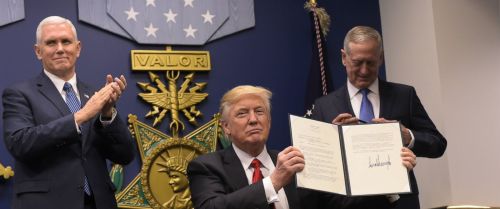
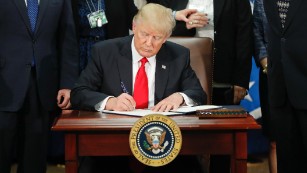
If maps provided tools for defining and symbolizing nationality, the conceit of the need for a border wall symbolized and also creates a notion of nationhood based less on ties of belonging than on boundaries of sovereignty that exclusion people from the state.  Mapping is long based on ties of exclusion.  But the focus of intense attention on stopping border-crossing and transborder permeability as replaced a logic of maintaining protections on equality or access to the law in the interior, shifting the attention of the nation of spectators by a deeply cruel trick of remapping the nation’s priorities.  For the political rhetoric of creating a fixed border has effectively magnified the borderlands, through the terribly exaggerated violent pen-stroke of an Executive Order casting the border as a vital key to national security, and increase the proximity of the nation to the southwestern border in the political spatial imaginary.  

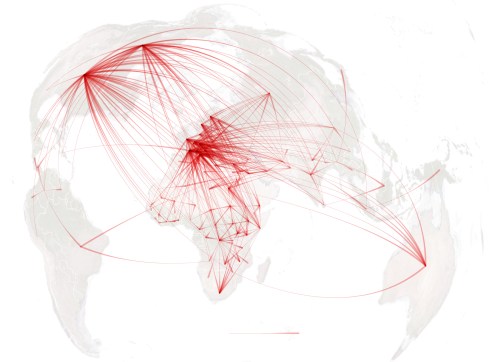
Is it any coincidence that the same government to elevate the symbolic mapping of a wall on the southwestern boundary of the United States has reduced the number of refugees that it agrees to admit from war-torn lands, already reduced by half through executive orders from the number of refugees accepted in 2016, a limit of 45,000, to a new ceiling of “up to 30,000 refugees” beyond “processing more than 280,000 asylum seekers,” in line with the current 2018 count of barely over 20,900 by mid-September, but now for the first time less than the number accepted by other nations.  Turning a cold shoulder to the crisis in global refugees is ostensibly rooted in a responsibility to guard its own borders, and “responsibility to vet applicants [for citizenship] to prevent the entry of those who might do harm to our country” and reducing grounds for asylum–even as the numbers of global refugees dramatically escalate dramatically world-wide–as if intentionally setting up obstacles for travel, and setting policy to openly prosecute any cross-border travel that was not previously authorized, and actively separating many asylum seekers from their families to deter them from pursuing asylum.

refugee_flow_map-africa

New York Times

Such false magnification of problems of “border management” has defined a disturbing and false relation to a deeply distorted image of globalism, of fuzzy borders, and not only apparent but intentional distortion–

image.pngAFP/Getty Images

–predicated on a false sense of national vulnerability, the urgency of greater border security, and the definition and elevation of national interests above global needs.

The rejection of refugees and closing of borders in the United States in the Age of Trump seems endemic:  if the country resettled some three million people since 1980, when modern refugee policy began, this year, the United States for the first time fewer resettled refugees than the rest of the world–less than half as many as the rest of the world.  The shuttering of borders is echoed in some 800,000 cases for asylum awaiting review, revealing a distorted view of the global situation that is mirrored by the blurred map behind Mike Pompeo’s head, and may suggest a global irresponsibility and deliberate disentanglement from world affairs.  But it also suggests a deep remapping of the place of the nation in the world, not limited to the State Department or Mike Pompeo, of imagining the greater proximity of the borderline to the mental imaginary, and a privileging of so-called sovereign rights over pathways of human flow.

The promised wall planned for the border of unscalable height is a bit of a blank canvas designed to project fears of apprehension onto those who would confront it, a barrier to prevent motion across the border by unilaterally asserting the lack of agency or ability to cross a line that was long far more fluid, in a sort of sacred earth policy of protecting the nation’s territory along its frontiers–and refusing the extend rights or recognition to those who remain on its other side.  Trump’s signing of grandiose Executive Orders as statements of sovereignty stand to reverberate endlessly in our spatial imaginary of the nation–while hardly warranted as a form of national defense, the border wall serves as a phatic act of sovereignty that redefines the function of national bounds.  Indeed, in a country whose history was defined by the negotiation of borderlands, the assertion of the long unstable border as an impermeable barrier seems a form of willed historical amnesia, as well as the fabrication of a non-existent threat.  The repeated indication of the southwestern border seems to seek to restore it to prominence in our national consciousness–and to see its security as being linked to the health of our nation–as if to make the current project of re-bordering an improvement of our national security–a process of re-bordering that is a performance of sovereignty, simultaneously symbolic, functional, and geopolitical in nature.  

The symbolic of sovereignty is far more insistent than the functional, and the symbolic register is the heart of its political meaning, if the structural need is promoted as a response to geopolitical actuality.  

gty-donald-trump-order-cf-170127_12x5_1600

170125134602-01-trump-executive-order-immigration-0125-medium-plus-169

For the Trump train, the wall is a “smart” redefinition of the nation, rooted less in the accordance of civil rights or guaranteeing of human rights, than the subsuming of law to protection of a nation that we imagine as under assault.  If globalization has been understood as a process of “re-bordering,” where the lines between countries are neither so fixed or so relevant to political action on the ground, the border wall maps a defense against globalization in its rejection of open borders.  The proposed construction sets a precedent as an act of unilateral border-drawing, or willful resistance to re-bordering, by asserting a new geographical reality to anyone who listens, and by cutting off the voices of those powerless to confront it.  The deeply dehumanizing conceit of the border wall that was modeled in several prototypes deny the possibility of writing on their surface.

In ways that mirror the inflation of the executive over reality or the rule of law, the border wall serves to reinstate an opposition over a reality of cross-border migration.   And Trump seems particularly well-suited and most at home at this notion of reordering, which he has made his own as a construction project of sorts, where he gets to perform the role of the chief executive as a builder, as much as a politician or leader of a state, and where he gets to fashion a sense of sovereign linked to building and construction, to a degree that the builder turned political seems to be intensely personally invested and tied.  Although Trump has been keen to treat the notion of a border wall as a form of statecraft, the proposed border wall is all too aptly described as a an archaic solution to a twenty-first century problem–for it projects an antiquated notion of boundary drawing on a globalized world in terrifyingly retrograde ways.  For while the construction of the border wall between Mexico and the United States was mistakenly accepted as a piece of statecraft that would restore national integrity and define the project and promise of the Trump presidency to restore American ‘greatness’ rooted in an illusory idea of privilege, but focusses on the privilege of entering the sovereign bounds of the nation alone.  

The proposed wall maps a dramatic expansion of the state and the executive that continues the unchecked growth of monitoring our boundaries to foster insecurity, but creates a dangerously uneven legal topography for all inhabitants of the United States.  For Trump and the members of his administration have worked hard to craft a deeply misleading sense of crisis on the border that created a stage for ht border wall, and given it a semantic value as a need for an immigration “crack-down” and “zero tolerance policy” that seem equivalent in their heavy-handedness to a ban, but have gained a new site and soundstage that seems to justify their performance.  

While it is cast as a form of statecraft, the only promise of the proposed border wall is to exclude the stateless from entering the supposedly United States, and to create legal grounds for elevating the specter of deportation over the country.   For the author of the Art of the Deal used his aura to of pressing negotiations to unprecedentedly increase the imagined proximity of the entire nation to the border–by emphasizing its transactional nature in bizarrely in appropriate ways.  The result has undermined distorted our geographical and political imaginary, with the ends of curtailing equal access to due process, legal assistance, and individual freedoms.  Acceptance of the deeply transactional nature of the promise of a border wall during the 2016 Presidential election as a tribalist cry of collectivism–“Build the Wall!”–as an abstract imperative, removed from any logic argument, but rooted in a defense of the land.  The purely phatic statement of national identity was removed form principles of law, but offered what seemed a meaningful demand of collective action that transcended the law, either civil law, to affirm an imaginary collectivity of Americans without immigrants–and an image of a White America.  

The imperative exhortations that animated Trumpism, as it gave rise to multiple other inarticulate cries repeated on Twitter and at rallies, based on lies and false promises or premises–“Lock her up!”; “America First!”–fulfilled a need for membership and belonging at the expense of others, in ways that subtracted popular opinion–and a false populism of the Trump campaign–from the law.  By isolating the artifact of the wall as a sort of grail and site of redemption and religion of the nation, the tribalist cry “Build the Wall!” offered a false imperative that replaces reasoned discourse.   Trump sees fit to treat as a basis for shutting down the government, accordingly, and indeed as a logic for a brand of governing that doesn’t follow the “terrible laws” of his predecessors.  If the budgeting of a border was was earlier taken as a grounds to actually shutter the government, in 2017, the rehearsal of the threat to willfully “‘shut down’ government if the Democrats do not give us the votes [for] the Wall” once more unnecessarily equated the need for the border wall as a basis and rationale for government.  The Manichean vision of politics of a pro- and anti-border party has been determining in creating a vision of the United States where sovereignty is defined at the border, irrespective of responsibility for the stewardship of the country:  we built walls, impose tariffs, and end treaties, rather than acting in a statesmanslike fashion, and evacuate the promise of the state.  

Much as Trump earlier called for “a good border shutdown” in the Spring of 2017 cast the wall as a part of his notion of governance, the new threat treats the as a bargaining chip able to equate with an act of governance–even if the wall as it is described seems less about governance at all.  Trump rails against the passing of spending bills that do not foreground or grant a prominent place to the proposed border wall that he sees as a point of orientation needed for his constituents and that he still cherishes and his own introduction into national debate:  attacking legislative packages about spending bills that don’t include special stipulations for border security or the construction of a border wall, threatening on Twitter to suspend governmental functions altogether without knowing “where the is the money for Border Security and the WALL in this reicidulous Spending Billaon the eve of the arrival of an apporopriations bill to the White House in the Fall of 2018, as his executive functions seem as imperilled as his grasp on the Executive Branch,  of government: but the border wall retains centrality as the central promise he has made to the nation.

For the unwarranted and ungrounded promise to prevent the imagined threats of organized criminals, gangs, rapists, and drug dealers from entering the country–not that we lack many who are home-grown–through the border wall is a governance of exclusion, racial defamation, and promotion, which has little to do with governing at all.  The apt characterization of the border wall as being an inefficient and irrational fourteenth century solution to a twenty-first century problem by Texas U.S. Representative Henry Cuellar-D of San Antonio–riffing on the suggestion of U.S. Representative Will Hurd-R of San Antonio as a third century solution to a twenty-first century problem ineffective to secure cross-border migration, and gesturing to the new tribalism that the project affirms.  The imperative of the border wall is an insistence of tribalism over civil society, and a reflection of the increased tribalism we feel and see, but mostly feel and fear.  Indeed, it allows these fears to be mapped against cross-border traffic.

The imperative distorted and magnified what a border is and should be that shows little understanding of effective governance, and reclaims an old idea of the border–a fantasy, at root–that rejects the permeable nature of borders in an era of globalism, by rather affirming an imagined collectivity from which dangers–unspecified, but ranging from gangs to drugs to child trafficking–must be kept out.  Although an underlying problem is POTUS’ spectacular lack of understanding of how government works, or of the law, which he has spent most of his life reinterpreting, it reveals his conviction construction contains crisis in essentially fascistic terms, building a structure that has little contextual meaning, but seems to impress, as a negative monument to the the state that is located in a borderland of apparent statelessness, but which Trump seems more and more frustrated at his actual inability to change what still looks more like a rusting twelve-foot tall Richard Serra sculpture than the imposing frontier promised America–

imageRichard Serra, Tilted Arc (New York City, Federal Plaza, 1981-89)
–but whose offensiveness disturbs, upsets and angers the viewer in a truly visceral way. Resting on the edges of our own borders as the basis for a larger “border complex” that seems to steadily expand, the border complex is not only a unilateral dictation of border policies, but a relinquishing of any responsibility of governance of the inhabitants of the nation, treating the definition of citizen/non-citizen as a primary duality never explicitly adopted as central in American politics and history, but assigning this division a centrality rarely so clearly geographically expressed as a question of national territory.  

Even though the wall is a practical separation between territories, and an assertion of exclusive territorial identity, the imperative of the border wall that is repeatedly cast in urgent, existential terms, has presented itself in discursive terms both as a promise to the nation, in terms analogous to the Contract with America, that separated Americans from others, but which promised to strengthen Americans’ relation to the rest of the world.  The increased proximity of the nation’s inhabitants to the border and border wall was asserted in the Trump campaign:   the transactional status of the wall grew as a means to prevent multiple forces from endangering “our communities’ safety” as the border wall became a narrative plug-in for something like a promise of redemption from higher wages, untold economic dreams, and an acceptance of police security, as if a border can radically change the status quo of the American economy and local family safety.   The proposal of the border wall continues to exist in a deeply transactional sense for Americans, as geographic relations to the actual border has been erased so thoroughly for the border, under the guise of “immigration,” to become a national platform of a political party, and a new model to define and remap America’s relation to the world.

1.  The growth of global insecurity echoes profound anxiety at the realization that the lines of control of states cannot be so legibly or clearly mapped in the present moment, an anxiety it reflects by proposing to inscribe the border onto the landscape to make it visible to all and permanently fixed.  The false promise of the border wall has been able to gain meaning on an individual level, allowing each to invest it with meaning and feel proximity to, independent of their own actual geographic proximity–even if the result is to silence the violence that the proposition of such a border wall does to the rule of law.  If the long and energetic tradition of public mural painting that had origins in the Mexico of the 1930s provided a movement of energetic and energized monumental painting on open air surfaces in projects of humanity and considerable color.  But the elevation of their pictorial formal power moreover asserted a new public identity of the nation for observers.  In contrast, the artlessness of the empty screen of the border wall is an evacuation and denial of subjectivity:  the defining characteristic as a concrete surface of the proposed border wall is itss inexpressive surface, its denial of common humanity, and its assault on the collective narratives that were the subject celebrated in muralism.

The wall stands as a sort of rebuttal to a muralist tradition of inclusiveness–embracing varied styles from Rivera to Siquieros to Orozco–through the assertions of a new artistic idiom by which to involve viewers in a revitalized broad civic life.  The border wall is less an illustration of human will, than an image of the assertion of the reason of the state, understood less by legal principles than a tortured logic of exclusion.  For while the extant border was a site of recuperation of muralist public art, the new border wall serves to impose the fixity of the border as a site that offers no place to the individual refugee, migrant, or legal immigrant, but a blank canvas that symbolizes the absence of individual autonomy or subjectivity to cross the transborder space.  Indeed, rather than a collectivist statement of unity, whose monumental forms suggest a human struggle of collective identity and work, the construction of the wall is presented as a testimony of the need for an obstruction of the passage across the border to protect the nation, based on the knowledge and experiences of border communities, presented as a need to ensure and defend safety, national integrity, and economic power.  Like the symbolic language of muralism offered a replacement for the common iconography of sacred art, in its assertion of public identity, the border wall presents itself as nothing less than a new religion of the state.  While the comparison of the proposed border wall to the public panting of collective art muralism intended as an call to collective national consciousness and unity in post-revolutionary Mexico is a provocative comparison to the elevation of sovereign authority over the border by building a wall, the magnification of the border by the project and prospect of building a border wall has served to elevate a perilous image of nationhood, based less on ties of commonality, collective identity, or a rich historical legacy of individual involvement that muralists proposed than an unhealthy focus on the border as a site of danger, a frontier needed to be vigilantly guarded, and a threshold whose guarding substitutes for the defense of civil laws.

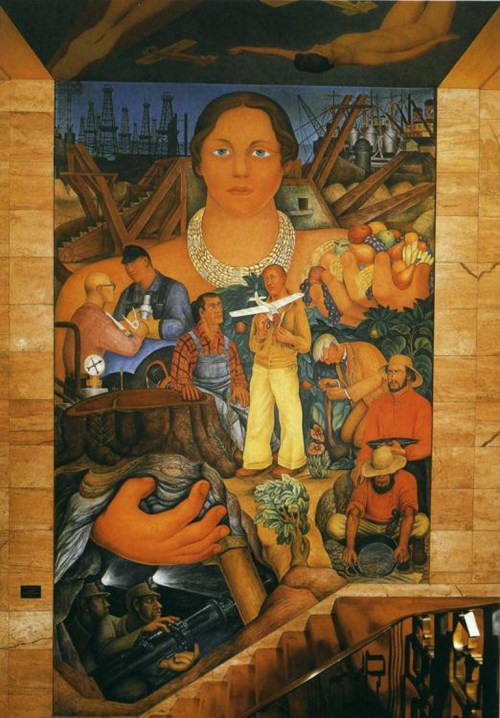
For in claiming to protect and secure the nation, the border wall becomes a performative exercise of the religion of the state, as much as it serves as a defense of political sovereignty.  The authority of the US-Mexico border wall, in unintentionally, seems to stand as an open rebuke and rebuttal to the hopeful ideals and huge figures in images of dynamic abundance such as the monumental Allegory of California (1931) by which Diego Rivera depicted the rich bestowal of gifts on of a heroic mother earth figure of California, in San Francisco, whose monumentalism addressed individual viewers by an almost tangible allegory of local abundance —

photo-2_rivera

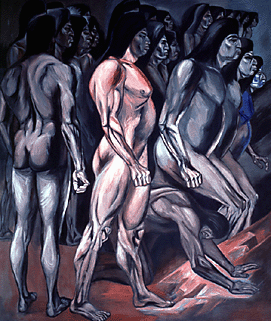
–which set a basis, in one of the first large projects of the painter in the United States, set a basis for a new tradition of public moralism in western states.  The interchange between active labor, earth, and a united countryside, if not a united narrative of nation, offered an optimistic personification of a monumental Gaia-like state, who, her resources liberated by workers, grants “gold and fruit and grain for all” of its residents, the revolutionary art of Siqueiros that heroized his country, or the twined histories of the Americas that José Clemente Orozco organized of tragic but truly epic historical scope of the Ancient Migration and the Migration of the Human Spirit, extending the collectivist spirit of revolutionary nation.  Affirming a discourse of white privilege, indeed, rather than inclusion, the border wall is an imperative of religion of the nation that girds the border as a sight of defense, mapping the other as outsider in relation to the needs of the state, rather than celebrate the human subject as a force that is part of nature or culture. Rather, the proposed border wall seems to exist outside culture or nature, as an imperative to an endangered and threatened civility of the status quo.

The border wall erases the spirit of the migrant as it prevents migration, alleging compelling reasons of state and the new logic of the religion of the nation that replaces the law and any appeal to the law in its urgency.   Rather than portray a giving sense of the heroism of migration, indeed, the wall interrupts any freedom of migration and transborder or transnational citizenship, reducing citizenship to a notion of territoriality and land, by bounding the terrain of citizenship and affirming a new ordering of space, and a political theology about the boundaries of the state, and the subtraction of citizenship or rights from the “enforcement zone,” “border zone” or denial of the rights of political representation or legal status for all transnational migrants in the “dead zone” of the borderlands.   The absence in this zone of rights of the subject–the refugee, migrant, or itinerant subject–is paramountly defined by their statelessness and inability to fit between strict categories of sovereignty, rather than motion across states being celebrated as a point of access to the bounty of the land, or of the migration of the spirit as a celebration of the recuperation of a modern individual political identity.  By demonizing the practice of migratory mobility, as if by a principle of “earth-first” binding of the nation, the border inverts the celebration of the human spirit

panel1

panel21Jose Orozco, Migration of the Modern Spirit (panels 1 and 21) (Dartmouth University)

There was a resurgence of the discursive practice of the political messages contained in  muralism as a form of public art in the resistance to decorating the border with monitory signs.  Is the Border Wall not only a map, but also a rebuttal to this tradition, and indeed to the painting of public rebuttals to the wall through paintings and commemorations in the past?  The absolute absence of any affect or visual address within the intentionally blank, sterile and almost industrial character of the wall seems in hidden dialogue or rebuke of an aesthetic of direct involvement of the viewer through its mute surface and corresponding evacuation or denial of individual human rights.  

1.  The triumph of industry, of rich historical cultures, or even of cultural conquest and revolutionary violence is compellingly replaced by the absence of any trace of human making or creation–or individual subjectivity–within the surface of the proposed border wall, which rather stands to deny individual liberty:  in place of an aesthetics of broad political involvement, the denial of the presence of those on the other side of the border wall stand as a vicious act of disenfranchisement, and even a denial of human subjectivity.  Indeed, if the heroic or epic narratives of monumental figures engage viewers in a pedagogic manner in muralist traditions by illustrating a narrative of nation, the proposed wall suggests a blunt lack of any national narrative, save the denial of the subjectivity of those on the other side.

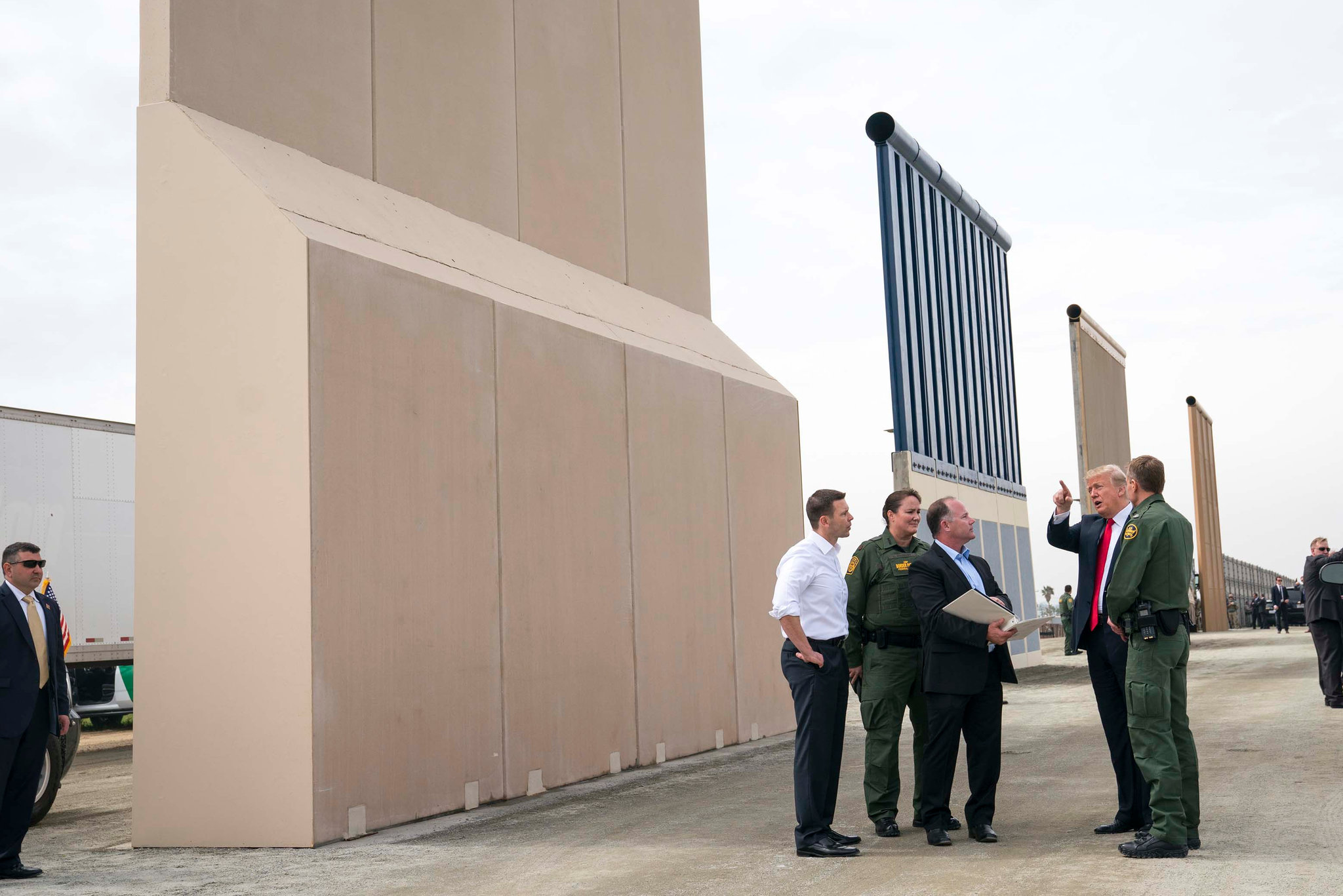
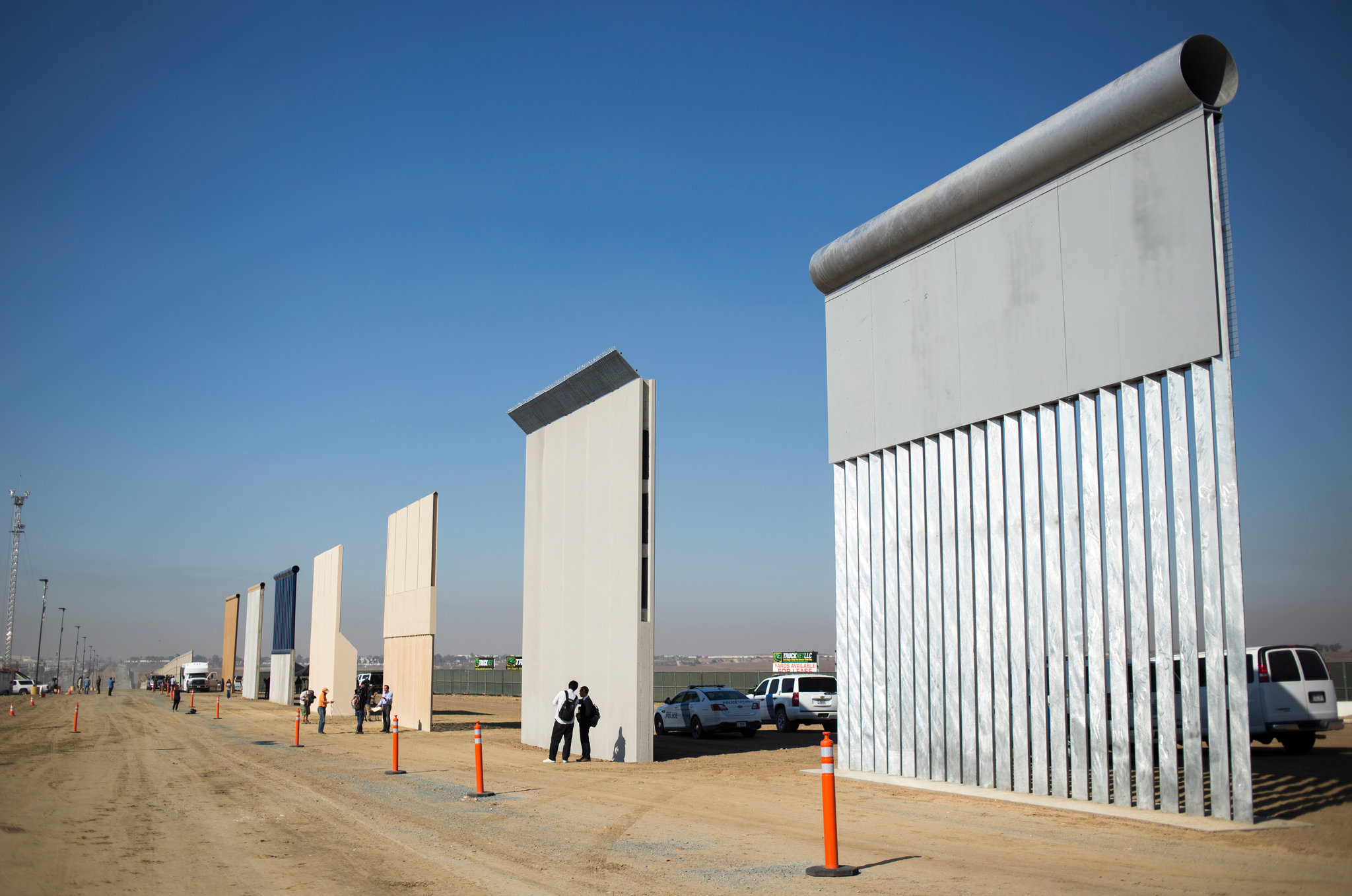
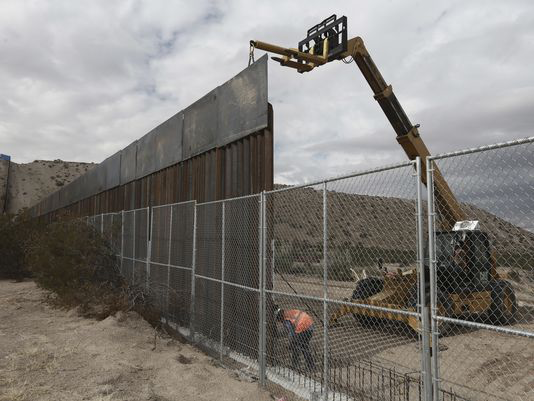
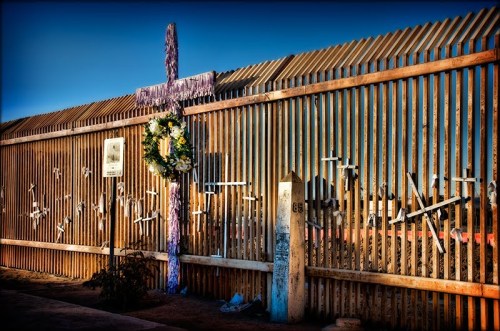
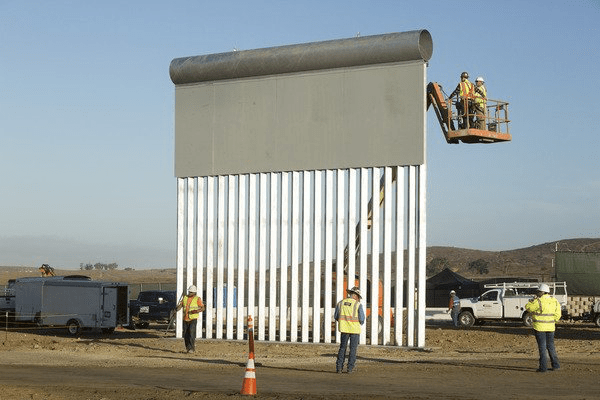
The talismanic nature of these “prototypes”–mock ups slightly removed  the border–was meant to evoke the prominent place of the border wall, and to restore or reinforce  in the psychological and mental imaginary of our new national space.  Repeated throughout the Presidential campaign as if a mantra, evocation of “the promised wall on the southwestern border” has redefined a relation to the nation–and indeed been presented as a form of love for the nation–by the master builder who would be US President.  And although the request for a “solid, Concrete Border Wall” in March, 2017–described as the President’s building medium of choice–became a secret state project, as “too sensitive” to be released by a Freedom of Information Act, by the Department of Homeland Security, designed to meet demands to be impossible to tunnel under, and impenetrable to sledgehammers or other battery-operated electric tools for at least an hour, seem something of a simulacrum of the state that is both all too obstructive for actual migrants and cherished by many Americans, and prevents the transformation of previous parts of the border wall to public sites of commemoration–remembering the suffering of those who attempted safe passage, or indeed of mural-art that has attempted to assert the fluidity of cross-border transit.

CrossesAguaPrieta--Dec08

gettyimages-632717318.jpgSandy Huffaker/Getty Images/Palm Beach Post

–or that try to imagine the perspective that the future of the border wall will create for the migrant subject who is excluded from hopes of cross-border transit.

Trump Vows To Build Border Wall Between Mexico And The U.S.Justin Sullivan/Getty Images

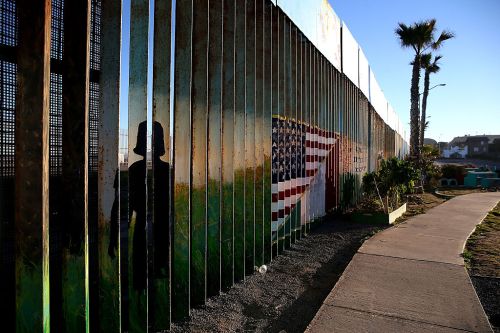
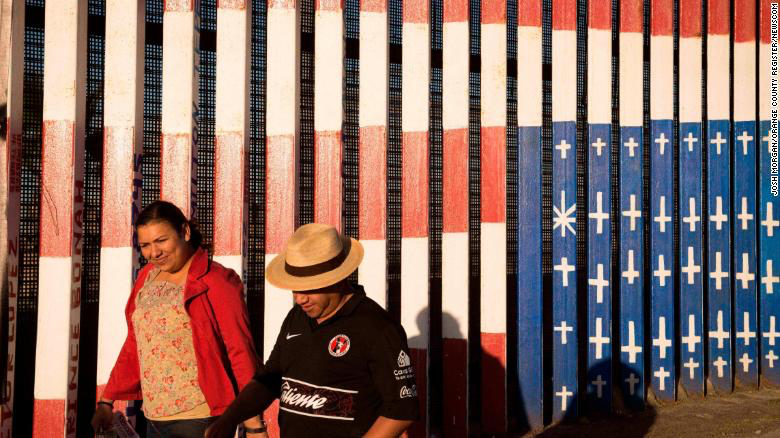
Even as the proposed US-Mexico border wall is presented as girding the nation against multiple dangers, the new bounding of the nation that prevents any intervention or artistic transformation of the wall, by stating its own absolute authority as a re-writing of the nation.  The permanence of the models of the wall seem not so tacitly or subliminally suggested by the physics form of one of the mock-ups, which references the form of a flag, as if to suggest its similar permanence as can image and record of the nation, and proof of the nation’s continued existence, as if the nation could not exist without it:  indeed, the flag-like proportions in mock-ups suggests a new flag for the nation.  As the promise of the border wall has allowed such a range of audiences to cathect to the national boundary–a sense that was perhaps predicted in the repainting of a section of the existing border wall of welded metal and steel near San Diego–the very site where a caravan of Central American migrants would arrive where they were taken by President Trump as an illustration of the fear of the dangers of cross-border immigration–the wall suggested a sort of surrogate for the purification of the country, restoration of the economy, and an elevation of the minimum wage, wrapped into a poisoned promise of poured concrete.

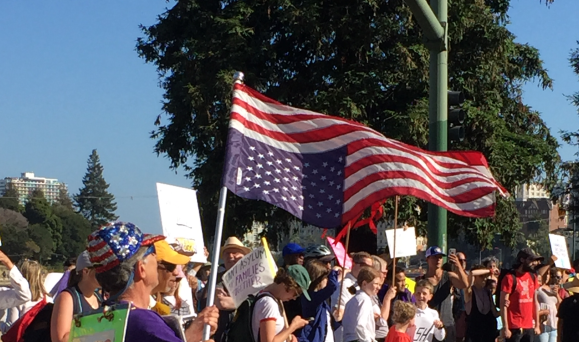
It was no surprise that a group of Mexican-American veterans chose to paint a segment of the older wall near Tijuana in 2013 as if a mural that mirrored the use of the inverted flag to stage a signal of distress to the nation:  indeed, the deported former navy who chose the wall as a site for a cry of emergency and national belonging:  teerily prescient of the flag-like nature of the mock-ups, sections of which uncannily resemble a vertically hoisted flag, the wall sections painted by disabled veteran Amos Gregory, a resident San Francisco resident, who completed the painting with twenty deported veterans, recuperated the tradition of moralism to create a new story of the wall, where crosses of dead migrants replaced the stars of the stars and stripes, as if to appropriate the wall to a public narrative of nationhood.

image.png

The inverted flag that a group of U.S to paint the flag, but expressed shocked at charges of using an iconography “hostile toward the United States of America,” and chose the inverted flag as a distress signal–to show honor to the flag, and to “mean no disrespect” to the nation, but to raise alarm at its  policies.  His dismay when asked to remove the mural by US Border Patrol sent a message of censorship as an attack on freedom of expression; Gregory incorporated crosses to commemorate on the wall the migrants who died seeking to enter the United States for better lives and livelihoods,  undermining the ideals of freedom he cherished.  By placing their memory on the wall, he sough not to dishonor the flag, but to use it as a symbol of extreme gravity that respects its ideals–and the etiquette of flag display, in the manner  future protests at the marginalization of migrants seeking asylum as they enter the United States at its border zone.

distress at Ptotest

The current mock-ups suggest, if unconsciously, an actual evacuation of patriotic ideals.  The MAGA President might have been conscious of how several of the so-called prototypes suggested a flag turned on its end, as if in a new emblem of national strength–

image.png

–as if to offer them a new symbol of the nationalism of a new nation.  The segment of this prototype recalls the flag suspended vertically, as on a wall or over a door, above the border that has become a prominent character in the current President’s Twitter feed, and evokes the ties between terrorism and immigration that Trump has long proposed the government recognize and acknowledge, despite having few proofs of these connections, acting as an assertion of the implied criminality of all immigrants who do not cross border check points by legal protocol, no matter their actual offense.

1. The compact about the construction of the border wall has, against all probability, become the latest in faux populist promises since the Contract with America to pose fictive contracts of illusionary responsibility and reciprocity to the democratic process, and have provided new tools of assent.  At the deepest level, the wall exists in this discourse of urgency not as a proposition, but as an actuality that need only be built, and cannot–or need not–be mapped, less the practicalities of consequences of its construction by acknowledged.  The border wall, viewed in its prototypes, is somehow an expression of the unmappability and existential quality of the border wall that Trump wants; alien from its surroundings, and existing as an obstacle to entrance, it is a redefinition of the border from a site of passage to an obstruction.  The affirmation of the border as a “real border”–which Trump repeatedly ties to the status of the United States as a “real country”–seems to mean an impassible border, which lacks any negotiation, but is recognized as an element of the nation that needs to spatial location but acts to strip all outsiders of their their rights.  All attempts to map the border as a spatially situated place  seem to stand as a challenge to undo the imperative of the wall’s construction.

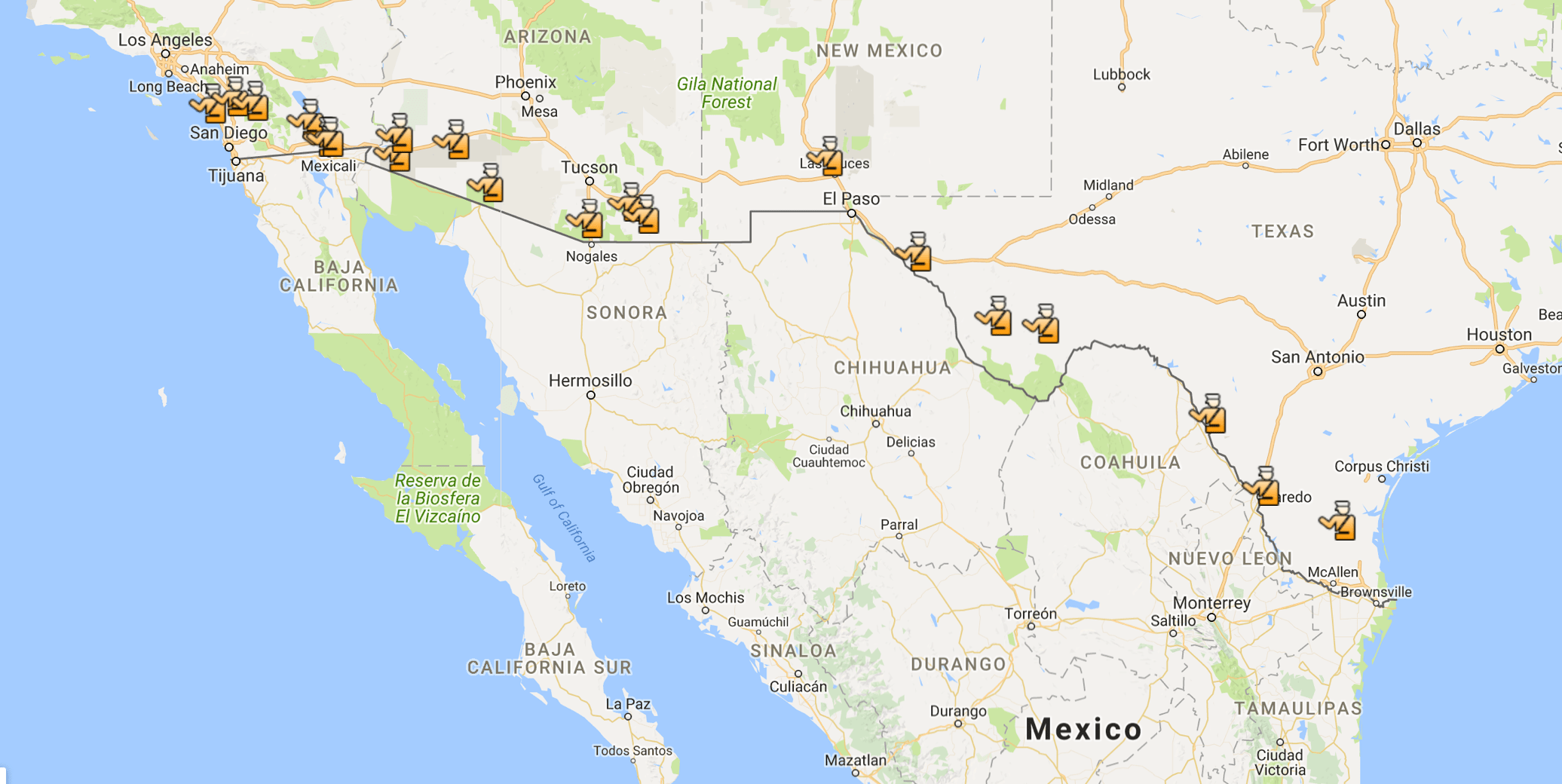
The faux consensual ties with the electorate perpetuate a fiction that a democracy runs on the contractual obligations between a government and populace, but have early been so focussed on geographically specific terms.  But in an age of anti-government sentiment, the icon of the wall has become an effective icon of describing the ineffectiveness of prior administrations, and an iconology embodying the new role of the executive in the age of Trump:  in an age of global mapping that seems to disrespect and ignore borders, we imagine migrants moving across them with the aid of GPS, or Google Maps, empowered by the location of border check-points on their cross-border transit,–

Google maps borderGoogle Maps

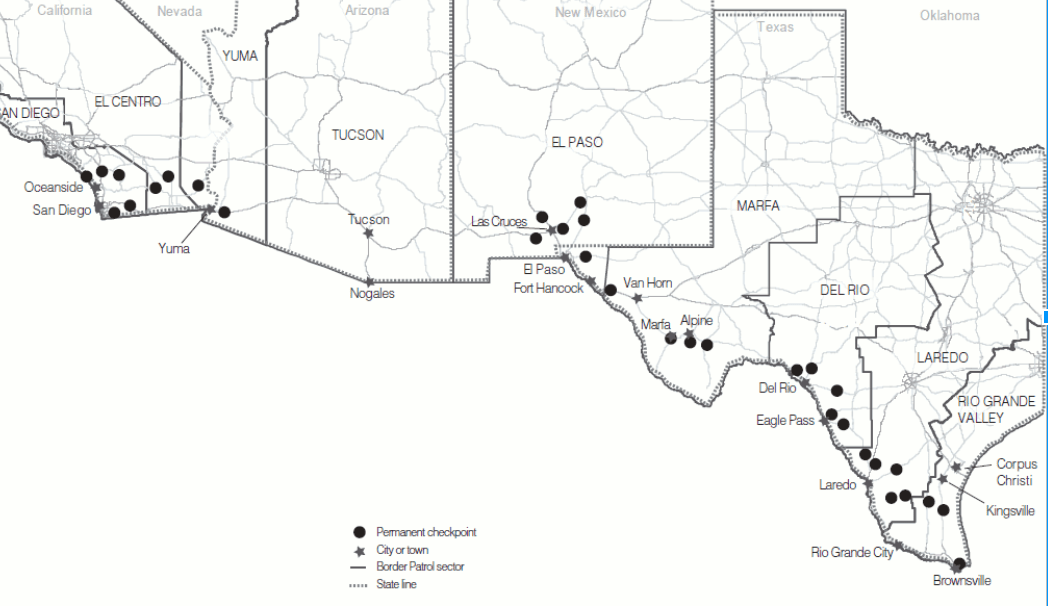
In a rejoinder to these fears, the proposed border wall would map a continuity among the stations in different sectors administered by the US Border Patrol, already strikingly dense, and apparently easy to connect by a solid wall–

Border Checkpoints

1 Comment

Filed under border wall, globalization, human rights, immigration, US-Mexico Border

Strongman on the Border

The border was closed and immigration authorities simply ‘at capacity,’ announced newspapers, after a Caravan of migrants from Central America arrived.  In rejecting the ability to process new arrivals who lacked necessary papers of transit, the papers parroted a an anti-immigrant line, revising the southwestern border from a line of passage, or space of transit, in what seemed a meme about the border as a threshold of legality-as if a line defines the legality of those who cross it.  If the border wall is a “new” creation, it seems designed as a monument of the “new” nation, bisecting an area that was not truly demarcated for some time, despite it suggestion of eternal authority–the Thono O’odham Nation of the Sonoran Desert long lived on both sides of the modern “border” before either nation existed across its divide, and are recognized as “border dwellers” in both the state of Arizona and Sonora.   But the wall served as a label, and a divider between “us” and “them,” a boundary where the outsider was defined as an enemy, and “politics” was indeed the definition of the enemy lying outside of the social body. To affirm that distinction, the wall needed to be built–and to explain the enemies to the body politic, the performative spectacle of the confrontations that might occur at the border was in need of staging, again and again, as a primal scene, as much as the wall-as-border might be mapped.

Department of Homeland Security

The creation of the border as a defining feature of the nation–a nation that was able to be recreated, or literally “made great again” as a nation by its border wall as a human creation–suggested the deep belief in the making and remaking of nations, a concept of the intellectual creation of nations that oddly echoes the legal historian Giambattista Vico in its insistence on the making of a nation not in reference to its laws, but as a collective whole who felt that borders were defining characteristics of modern states.  But the institution of this border at the same time exists outside of the law, and assumes an oddly primal characteristic as a site of sacrifice, echoing in surprising ways how the Neapolitan jurist Giambattista Vico saw borders as defining the inclusion and exclusion of rights to property, and senses of citizens, that was prior to and predated the law. Although the massive public works project that the state had mandated at the U.S.-Mexico Border was not at all an Enlightenment project, so much as a mega-project that was destined to incarnate state authority in an age of mass politics: a public works project proclaimed to fill multiple needs of protecting property, securing wealth, and building the nation’s power, of Neo-imperial dimensions, akin to Mussolini’s draining of Pontine Marshes or to the state programs of collective transformation of the mid0twentieth century, by dramatically staging the power of the nation in its ability to incarnate mythic notions of a powerful state for the benefit of all its members.

The creation of a strongman, who has arrogated the American eagle clutching fasces and a laurel, announcing that it will transform “many” to “one,” but only the many admitted past its sign. For the legist Vico, the ongoing brutality and conflict of society was not only natural, but a position even of possible growth: the very words of one society and culture might be reused and adopted by the following in even discordant ways.

But if Vico was clear about the “boria delle nazioni“–the conceit of nations–that they were unique in the very national characteristics that only they possessed, and the each nation had most critical aspects only it alone possessed. The conceit is amplified by the border wall, and the lie that it is built on to keep out others–and indeed to perform a sort of ritualized sacrifice of the other on the built barrier that the nation sought to create. For the Border Wall, if the most vain construction of any nation, a homeostatic barrier or norm of sorts that proclaims the identity of the nation, the unveiling of the border wall was an exploitation of the potential of television and the stagecraft of nationhood to stage that identity, as a fascistic or photo-fascist rehearsal of national foundation, or refoundation, by newly erected boundary walls that lack all porousness of the past. Indeed, the border wall seemed to be an occasion to re-educate the nation on the notions of citizenship, and the barrier that needed to be created on which to sacrifice the other. Was the conceit of the border wall a medieval conceit, or a form of statehood that was only made in the twenty first century?

The image that suggested migrants atop the wall, or of others scaling a dilapidated section of slatted border fence near San Isidro–“through a dark, treacherous canyon, notorious for human trafficking and drug smuggling”–collapsed multiple tropes of border-crossing on the least likely of targets:  a peaceful procession through Mexico that began on Easter Sunday, crossing borders to call global attention to migrants’ rights.

_101103435_mexico_caravan_migrants_route_640-nc

While the simple visualization of the course of the procession that wound through Mexico City from the southernmost border of Mexico cannot trace the mental geography on which the arrival of migrants was mapped in the United States, the progress of Central American migrants was viewed and mapped by Donald Trump and FOX in terms of the desire to see their arrival from behind the proposed $18 billion border wall that has become a contentious object of debate.  As the number of arrests along the border has grown above 50,000 for the third straight month in a row, and more children separated from parents in an attempt to broadcast cautionary warnings about the dangers of attempting to cross the border, or to appeal to existing immigration laws by asylum pleas, stories of migrants that the proposed wall would silence are increasingly difficult to silence or contain, and the human narratives of migrants are increasingly difficult to place behind the imaginary screen of an insurmountable border wall,–which of course does not exist, save as a mental construct–but is cherished as one and difficult for many to relinquish or deny.  

Even though there is no structure corresponding to the height, thickness, and architectural design that Trump had treated audiences during his campaign, the Caravan threatened to remind us that the wall didn’t exist, despite the attention that has been lavished on its proposed construction at a cost of an estimated $18 billion, far below what actual costs might in fact be. Yet the specter of the arriving migrants from Guatemala, El Salvador and Honduras–the triumvirate of “failing states” that Trump has demonized has provided a new basis to affirm the urgency of its construction. The caravan of migrants was cast as a threat to the nation, of urgency to place at a distance from the nation–even if they were also cast an oddly unstoppable “horde” able to evade or defy Mexican immigration authorities who had not successfully turned them back. As if to say that the “buck stops here,” their impending arrival was rhetorically magnified as a threat to create a persuasive image that reminded the nation of the urgent need for the border wall as an artifice of defining the nation.  

After months of dehumanizing migrants as faceless hordes, poised at the border, migrants seemed to have arrived at the border fencing, about to breach an inadequate barrier that is a relic dating from the era of the Vietnam War.  The news of the progression of the Caravan–and clouded interpretation of what their aims for crossing the United States’ southwestern border truly were–led them to become a poster child for the urgency with which Donald J. Trump has so stridently advocated the construction of a “real wall,” with an intransigence that almost embodies the physicality of an actual concrete wall, a month before the construction of the border wall began in San Diego and Calexico, CA, replacing some fourteen miles of improvised border fencing that was long ago made of scrap metal to “secure our border” as a way to “make America great again.”  The promotion of building the border wall was a way to ensure “public safety” followed repeated images of migrants attempting to scale or protest before existing improvised fencing–

image

-whose inadequacy to deal with the border threat Trump had relentless ridiculed as useless during his Presidential campaign.  The danger of cross-border traffic that Trump had repeatedly magnified circulated back to prominence within the national media with the arrival of the migrant Caravan.  The hope for the migrants to gain asylum in the United States was immediately questioned as their true agenda was assumed to be one of evading the border controls before the Wall was built–and the immigration laws that would permit their entry changed.

If the announcement of the construction was a feign of a a show of strength, and promoted as a basis for national pride, it was an insult to migrants petitioning for asylum, as the promotion of the border wall as a sign of national security debased the notion of the nation as one of laws and civil society.  The promotion of the wall as a slogan of nationalism remapped the nation in relation to the border, after all, in the Newspeak of social media and twitter–“Strong Borders are Security”, “Immigrants are Criminals”; “Refugees are Terrorists”–the border wall protected national security and projected the idea that all migrants were illegal.  The spatial imaginary of the border wall echoed the longstanding claim, made without evidence, that the immigrants at the border were “the worst” of their society, and for allowing an untold number of undesirables to enter the the nation.  As well as protesting the treatment of the United States”the dumping ground of European Refuse” as an insult to the nation, the insult was accepted by the nation.  The blame rests on citizens who are accept the very immigrants Europe does not want.  The image, which appeared just before Bartholdi’s “Statue of Liberty” was erected in New York Harbor, raised objections to accepting those rejected by Europe’s crowned heads, of dubious value to the nation that echoed Trump’s position.

European Refuse.pngKendrick, “And We Open Our Arms to Them” Life Magazine (July 12, 1885), 

The very chaotic narrative of depositing “human refuse”–a group of former colonials identified as “not like us” but being advanced by an invisible broom–was repeated in the image of the approaching Caravan, as the legitimacy of their requests for asylum from Central American nations were questioned, and suggested to be fundamentally an illustration of disrespect for the law.  The “Caravan” of over 1,000 migrants seeking a better life was widely mapped as a threat to sovereignty and law, recasting a protest march that promoted migrants’ rights as an invasion of sovereign space–and a grounds to deny migrants’ rights.  The  tweets of President Trump directed the attention of the country to the border to query the status of the migrants who were headed to the nation, as he announced instructions  “not to let these large Caravans of people into our country”–magnifying the migrants as a national threat through a dichotomy between “them” and “us.”   The anxieties about immigration policies that Kenrick’s cartoon registered panic at the caricatured faces of the new arrivals.

In announcing an intent of illegal entry across the border, Trump once again conjured the need for a border wall, as if trying to co-opt the message of migrants to create an image of a cross-border threat.  The construction of border walls against an “existential threat to the nation”–as did the former commander of the southern border who was named Trump’s director of Homeland Security and now his Chief of Staff—creates an urgency for protection that corrodes the possibility of an open society.  Kelly’s disparagement of migrants as “people who would not easily assimilate into the United States,” “overwhelmingly rural,” from countries where “fourth, fifth, and sixth grade education are the norm,” described them with the same disdain as Kendrick’s cartoon from the early Life of the 1880s protested the insult by which ex-colonials were sent to the United States as to Australia or India, which had indeed become “dumping grounds” for convicts, remittance men, and socially unwanted cast-offs, as well as seeing them as barbarians who threatening the social fabric of the United States.  The disparagement of migrants who are seeking asylum as uneducated, of rural origins, or indeed, as Kelly’s remarks must have reminded his audience, criminals.

ICE 2014 arrests gangs--ms13?ICE Arrests of undocumented immigrants, 2014
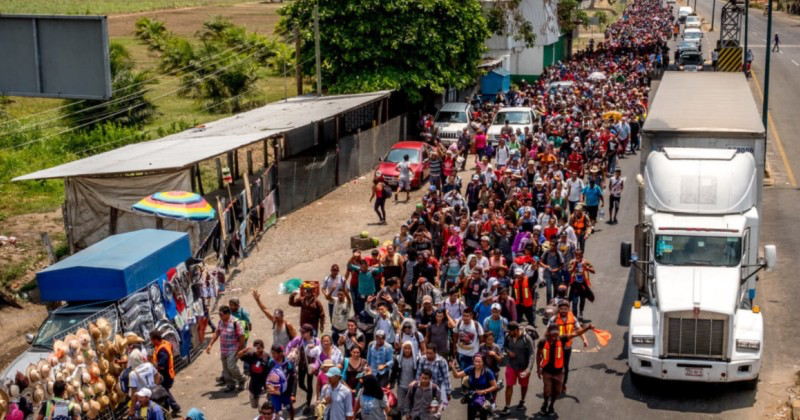
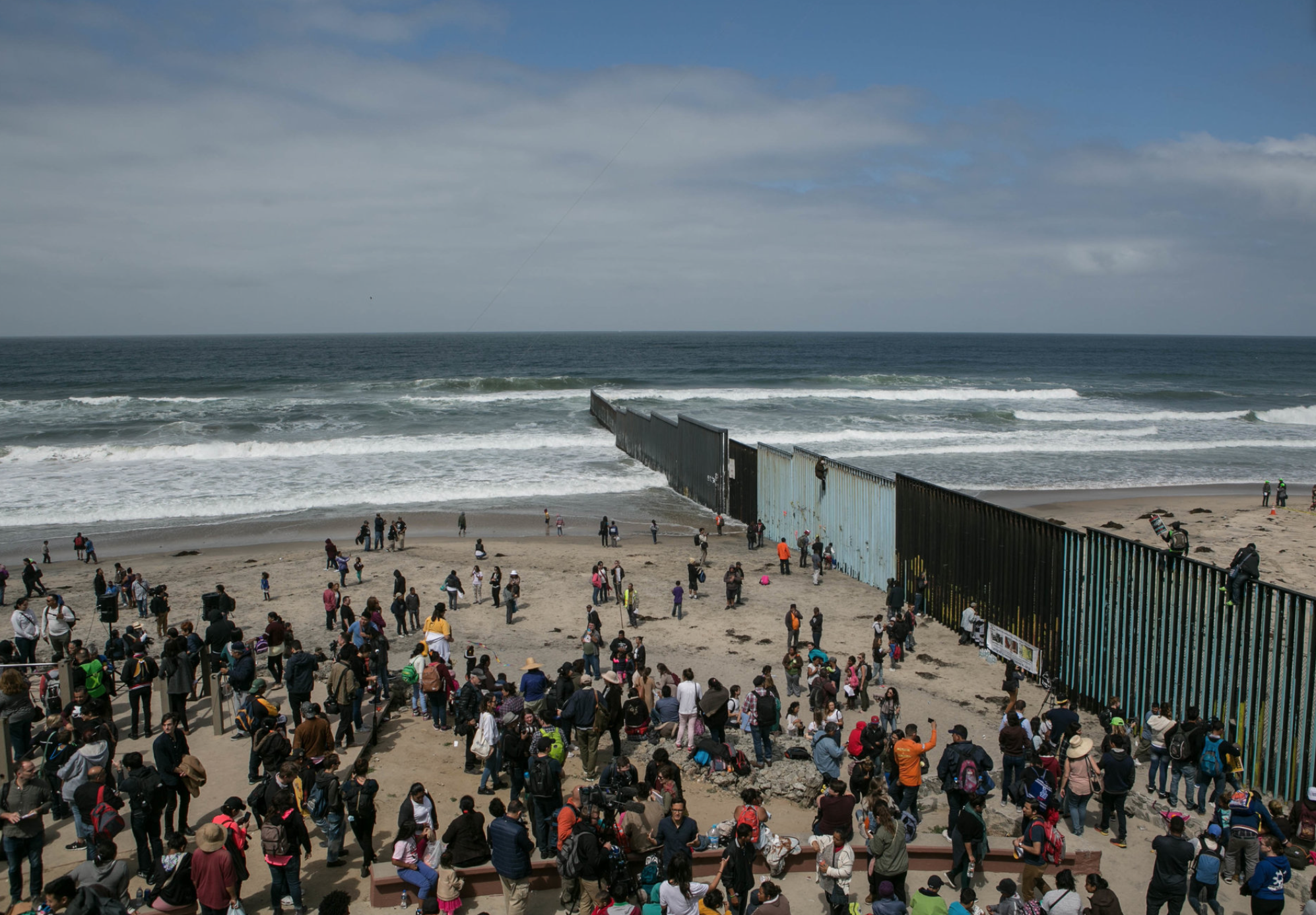
The disproportionate warnings of a “border threat” or “trouble at the border”  telegraphed on Twitter was inserted in a narrative rooted in the plan to create a border barrier of cast concrete in August 2015, in the heat of the Presidential election–a mission that crystallized support behind Trump’s campaign.  Trump insisted that the border wall he advocated wasn’t rhetorical, symbolic, or virtual–a space defined by hi-tech monitoring–but an impervious barrier that would succeed where other poor-quality fencing had failed.

The build-up of the arrival of the migrant caravan ran against the disproportionate attention that Trump had drawn to the border.  As Trump pedaled the fiction that the wall had already been begun, newscasters on FOX mapped a showdown by the approach toward the border of “that scary migrant caravan” of Central Americans with American law enforcement as inevitable, placing the migrants in a narrative of unwieldly crisis of immigration management on the US-Mexico border.  In ways that intersect with a broad unease of increased immigration–often manifesting itself in extreme xenophobia, othering and racism–a vaguely masked anti-immigrant sentiment that has growth in the United States over the last four to five years which Trump has deftly exploited. For the ‘border wall’ was recognized code for a thinly disguised racism, captured in John Kelly’s characterization of the Caravan–and migrants–as “overwhelmingly rural people” not capable of assimilating, who “don’t have the [necessary] skills” to do so, and are “overwhelmingly rural people,” as if ignoring just how dependent U.S. farms are on immigrant labor.

The disproportionate attention the Trump and his planned border wall directed to the southwestern border made the region seem far more immediate to all Americans–and defined the Caravan’s approach as national news.  Although the formation of such “Caravans”–a name not coined by Americans, though it gained new spin in the mouth of President Donald J. Trump, who had grown frustrated with an uptick in U.S. Border Patrol metrics of illegal entry–the tactic that was long adopted by advocacy groups to foreground migration difficulties was used by the group Pueblos sin Fronteras, or Peoples without Borders, whose name was seen as revealing their opposition to the redefinition of the southwestern border of the United States, which has also been mapped onto the wall–creating a reflexive panic at the sight of large crowds of unidentified migrants marching toward the border.  The legal and physical obstacles that Trump promised to place on Mexicans or Central Americans seeking entry to the United States were always twinned, but the arrival of the migrant Caravan seemed to give it a new urgency, and to legitimize, as a suddenly mainstream demand of border management, the ability to control human cross-border flows.

image.png

The march was described disdainfully as a “political stunt” in media, as the Attorney General and Director of Homeland Security demonized the “Caravan of migrants.”  Trump had promised the nation a border wall unlike the reclaimed corrugated metal fencing in Tijuana, but made of  “precast [concrete] plank,” a protective barrier far more powerful and robust than the inadequate fencing he treated as “a joke” and a disgrace to the nation, and which the multitude of migrants were seen as able to cross, but in need of immediate arrest and detention in a fantasy of border enforcement.  If Trump had promised to be a strongman at the border, the old border wall seemed indeed flimsy obstacles, unable to stop even the crowd from the Caravan who arrived to petition for asylum at San Ysidro, CA.

Migrants arrive at Tijuana

The peaceful protest of the Caravan de madres centroamericanas, to use their full name, was recast as a march of opposition to Trump’s border policy, while for Trump, as some three hundred odd members of the Caravan arrived at San Isidro, a recognized port of entry, in five busloads, and mounted on a fence made of repurposed scrap metal became for President Trump evidence of a crisis of sovereignty.  In response to a crisis he seemed to have created on Twitter, he ordered the Department of Homeland Security to “stop the caravan,” displaying his knack for sound bytes and slogans, and imagine that, searching for the right string of capital letters on his keyboard,  only “a strong, impenetrable WALL. . . will end this problem once and for all”–even if the problem lay with the places the migrants had fled.  The motion of “migrants,” now cast as “illegal aliens” in the right-wing press, even as they hoped for a miracle from god able to “touch the hearts of immigration agents,” was not able to be seen clearly by many, even if their course was carefully mapped over the previous month in increasingly colorful reportage.

image.png

Continue reading

Leave a comment

Filed under border barriers, border policy, Donald Trump, immigration, undocumented migrants

The Natures of San Francisco

A man in the city,” wrote American novelist William Gass, “has no natural thing by which to measure himself.” Self-measurement may be increasingly difficult in an age of global warming. We are with less of a rudder than in the past. But we realize the need for a preserving a close relation to nature, and indeed doing so for biophilic ends. At the time Gass wrote, in the middle of the past century, he disdained the built environment of east coast cities with the wry eye of a midwesterner, even before urban sprawl. The United States was still–as it is now–distinguished by the highest per capita urban areas of any industrialized nation. And the increased overpaying across the west, and bloating of cities that lack edges with wildlife, and indeed only spread into urban walls, means the hope of ‘fronting’ nature, or of imagining a living edge of the end of the city, seems as unknown and as foreign to many urban areas than it has ever been in human history. Even in the most densely populated of American cities, where parks have been built to preserve natural preserves of habitat and recognizable sites of ‘access to nature’ in an increasingly paved world of increasingly hard edges, the concerted belief in the possibility of fostering ‘natural preserves’ in urban ecosystems has endured–

Nature in the City/The High Line, New York City

–promising the preserve of ‘a harmonious balance of natural and man-made environments,’ however distant such a balance seems in an already densely overbuilt environment. But preserving of such contact with reduced wilds provide a sense of hope and indeed a space we might confront where, with Thoreau, to preserve the wild as a site for our rebirth. Whilehopes for fostering ‘native’ species of birds, insects, and pollinators is deeply ethical, the hopes of preserving nature in the city, one worries, has arrived rather late in the game, and after the nickel has dropped. But it is no less urgent, as a process and project for inviting us to remap how our cities are both built and lived–even as the remove of a cabin in the woods that Walden helped perpetuate and foster is receding in the present more than at any time in memory.

The dangers of urban sprawl in northern California have created a crisis in diminished habitat, and left little space for preservation of the wild, many seek to protect more areas of livable space by securing environments fast-disappearing across the state. And while one of the biggest efforts of San Francisco was to try replacing the concrete streets of the city with strings of fast-growing Mexican fantail palms, in hopes to create a stereotypic landscape of southern California that have filled the national consciousness in the 1920s and 1930s, spending an unprecedented $1.9 million on boosting the beautification of San Francisco after the 1989 earthquake Brough a drop in tourism–in a little noted aftermath–by working to plant palms along the Embarcadero bay and major urban thoroughfares to correct an unwanted drop in tourism to the city–

Palms Planted in Downtown San Francisco since 1989/SF GATE

–the dialectic between needed greenspace and environmental niches of vital habitat that create pressing questions beyond urban beautification, but get at deep problems of urban livability.

But the need to map our relation to nature has never been more at a premium, and we try to map scores of livability of urban environments in hopes to try to find a connection to nature that is increasingly severed. San Francisco possesses one of the largest municipally managed parks in the nation–over 127 acres–with the slightly larger Park Presidio, a reclaimed military base now a national park. The interplay of nature in the city lies far beyond its parks, but measuring one’s relation to nature are at a premium as the Bay Area is increasingly thought of as far to overbuilt than in the past. If the presence of nature in the city is more elusive, it is more urgently in need of preservation for its residents, and the achievement of the recent non-profit Nature in the City demands to be celebrated as a significant mapping event.

The region around San Francisco is to somewhat unique in offering views of the urbanized downtown from many vantage points and prospects that situate it in nature, against the shores of the Bay or mountains of the peninsula and more rural areas like Marin, as its development offers a test case in the intensification of urbanism and overbuilding increasingly fragmenting wildlife habitat. There is a danger endemic to satellite maps of foregrounding the structures of the built world, rather than habitat, that suggests a cartographic remove of vertiginous danger:, curtailing cognitive interaction with space, as in the machine-read maps of building footprints, “Every Building in the United States,” situating Bay Area buildings as archeological ruins of a Baedecker to a future San Francisco, outside the topographic situation of built space in an area imagined as embedded in natural surroundings. But the absence of life in this overbuilt Bay Area, which maps each building by black, irrespective of height or foundation, recording an anthropogenic legacy via an analysis of satellite imagery converted by Microsoft engineers to a nation-wide dataset, rather than road maps to enable everyone to boost their built built environment as if Robert Moses promoting built space.

An Over-Built Bay Area?

But the building outlines of these maps chart the fragmentation of habitat in what was once a site of wildlife. The map poses problems of defining the “wild”–beyond the tropical cherry-headed conures who have escaped from captivity to be celebrated “wild parrots of Telegraph Hill.” The parakeets that fact span the city from the Ferry Building to Brisbane gained local dominance as flocks of urban parrots nesting in the city from 1911, but recent recognition as the city’s “official animal” poses questions of their designation as wild, despite the seemingly distinctive dialect of their animated cries in the evening in urban parks. San Francisco’s feral parrots were designated as “wild” in the 2005 film by self-designated local expert in parrots, Mark Bittner. Since then, many have naturalized the communities of red-masked parakeets in urban ecosystems to which they are not native in California–not only in San Francisco but Menlo Park, Palo Alto and Sunnyvale–and since 1997 in San Diego, reflecting the massive importation of exotic birds since the 1980s: the feral population of neotropical birds gained a toehold in coastal environments since upwards of 26,000 parakeets were imported to United States from 1980-1985 as exotic pets. The feral ancestors of escaped pets colonized anthropogenic habitats’ open arboreal canopies, colonizing habitat abroad by a species nearly endangered in Ecuador and northwestern Peru, whose local pet trade combined with habitat loss, in a paradox of globalization, to send parkeets from tropical to urban habitats.

Prominently audible and visible at sunrise and in the evening, the growth of invasive populations in several city parks have encouraged designating the progeny of imported exotic pets as local wildlife attractions. But this designation begs the relation between nature and urban environment: as relatively recent arrivals, the non-indigenous feral cherry-headed conures are local icons, rather Han seen as invasive, despite their remove from the regional ecosystem, living off flowering trees they adopted as roosts from Coit Tower and Upper Fort Mason from February to October, but native to deciduous forests and jungles in southeastern Ecuador and northern Peru, if often migrating to suburban forests after having escaped captivity, if long popular caged birds introduced in Spain, The colorful local presence of over three hundred roosting in the Bay Area encouraged sympathies as charismatic species, but the parasitic presence of birds escaped from pet shops or released by past owners may mask the actual vibrancy of habitat of the dynamic region in which the parrots can inserted themselves as urban interlopers, winning the protection of many local residents seeking to nurture the exotic birds as colorful splashes in an increasingly overbuilt space.

The recent map of urban habitats of the enterprising non-profit Nature in the City is dedicated to the conservation of a new attitude toward urban space, using mapping technologies and artistic practice. It seeks to orient readers to the charismatic species that occupy the city’s greenspace. If the heroic couplets of Vladimir Nabokov’s murder mystery, Pale Fire, staked a mystery of modernity channeling “the shadow of the waxwing slain/By the false azure in the windowpane,” the reflective surfaces of urban buildings create the illusion of open skies even as they interrupt the open spaces of nature on whose reflection the noble bird is a victim of apparent suicide. That bird, an American term for the bird used in the royal crest of a fictional kingdom of “Nova Zembla,” derived from an island called Novaya Zemlya, or “New World,” an archipelago in the arctic in the Barents Sea, was mourned by the emigré author in exile, as the double of Nabokov himself. Can we use datasets to devise a more humane account of the shrinking greenspace habitat, seemingly soon to disappear not only in America, but in its expanding urban regions?

If the first tallies of birds in North America began in December, 1900, instigated by the curator of birds at New York’s Museum of Natural History, the census came to offer a basis for the first scientific count of birds in Canada, the United States, Latin America, the Caribbean and Pacific Islands. The recent iteration has totaled an avian brood of 40 million, of 2,380 species, contracting in size after losing some three billion birds since 1970 in North America. If the count postdated fears Rachel Carson voiced in Silent Spring, it also stimulated the concern. Some visitors to New York may smirk at designated”habitat restoration” in Central Park, but the park’s meandering paths offer humans an exposure to birdsong of sparrows and jays absent from most built space in the urban grid. Do we not need a better maps of relations to nature, in an era of overbuilding where most maps leave us purblind to an anthropocentric record of anthropogenic change?

The ever- increasing of habitat fragmentation poses, with invasive species, and anthropogenic toxins, environmental challenges that make it ethically incumbent for urbanists to foster viable habitat in the expansive urbanized regions of North America. For habitat is compromised by laissez faire building, ifunregulated pesticides on avian life that led Carson to be so concerned for the birds inhabiting orchards whose springtime voices were threatened to be silenced have diminished years ago. The importance of strengthening the habitat of birds, mammals, fish, and insects may make them more resilient, and the hope to “green” our increasingly over-paved urban spaces offers and important response to the increased absence of greenspace accessible to most Americans. The lack of access to the wild, or wilderness, may have led locals seeking contact to nature to devote such misplaced attention to feral parrots, seeking a sense of the wild that the city lacks.

hTis is not only a question of improving urban environment for city dwellers. The compelling notion, recently voiced on WaPo’s Climate Lab, of imagining American cities as ongoing science experiments to provide and afford access to natural habitat, as much as lived communities of human animals alone, is powerful. If the city of New York has lead Central Park Conservancy to promote preservation of its 843-acres as a “backyard of the city” for all residents, in need of habitat restoration, many links that have longed tied the San Francisco Bay Area to surrounding ocean and inland ecosystem offer broad possibilities for mapping to remediate habitat across its built space.

It is based on using the big data of new datasets as metrics to map urban space as offering space that might double as resilient habitat in an age we are threatened by habitat loss and invasive species. Rather than mapping demography or housing density of human residents, interest has grown in measuring healthy tree canopy, access to parks, and diverse plant and animal life in concrete terms, as much as in abstract metrics, to diagnose the health of our urban surroundings in the United States. If much attention has focussed on city-dwellers access to open space, parks, and living ecosystems by which we are increasingly apprehensive of being walled off. As nearly ninety percent of Americans live in cities, nearly ten percent more than when Joni Mitchell the uneven economic exchange by which “we’d paved Paradise” for the sake of putting up a parking lot, the pressing questions of public health, salubrity, and mental wellness led NatureQuant to score zip codes in America by plotting their population density against tabulated “nature scores” of a Zillow-esque exercise of urban real estate, reassessing the “value” of living in urban spaces by an index.

NatureQuant’s Metric Analysis of the Relative Healthiness of Cities (NatureScore) against Population

The quantifying of a city’s healthiness from an anthropocentric point of view may, however, miss the point. For the perils that are faced by many species in an increasingly overpaid world mean that we would do well to attend not only to the healthiness of urban spaces for humans, but the mitigation of the effective fragmentation of natural environments and spaces that the massive if not hypertrophic growth of urban environments in the United States. While much of the Bay Area is now classified as protected habitat, especially along its shoreline and ocean coast, the expanding urbanized agglomerations of “urban regions” in San Francisco, as well as other cities, have made it less of a “green” space than it once was, and make it hard to map the livability of the city habitat it offers–it is suspiciously nearer New York, increasingly, than Washington, D.C.

The growth of megacities and expansive urban agglomerations are not only not good for us, but these new urbanized regions, form the BosWash area spanning much of the eastern seaboard to the metro area of New York City, the largest metro area in the United States, the highway-linked expanse of Los Angeles, Anaheim, and Long Beach, or the smaller of the upwards of 2,600 “urban areas” of housing density as much as agglomerations were identified in the 2020 U.S. Census to denote the increased density in which we live. These larger urban areas pose questions for wildlife, or for the existence of habitat–as much as wildland–and questions of maintaining habitat in an era of increasing overpaving. The miasmatic urban areas spread on the eastern seaboard states.of New York, New Jersey, Delaware, and Maryland are a major fragmentation to habitat–

Urban Areas in United States/2020 US Census

–echoed in the even greater shift in the Bay Area and nearby localities of a density of populations greater than 10,000 that have increasingly impacted the ecologies and ecological habitat of the region that have interrupted the coastal areas, wetlands, and tidal zones that ring the Bay, itself increasingly surrounded or hemmed in by urban agglomerations that endanger habitat, as entities now known as Urban Areas, not cities, merge and slide into one another, paved tracts of urbanized land with no clear borders or bounds, as needs for interconnection trumps corridors of wildlife.

Urban Areas per 2020 U.S. Census of Areas of 10,000 or More

In the years leading up to the 2020 Census, the region was pervaded by deep anxiety, indeed, about the restriction of corridors for habitat and wildlife that have long distinguished the region, a contraction of habitat corridors that have become increasingly sensitive to many residents, in need of making their own reaction to nature, and indeed to map proactively to preserve the wildlife corridors. If wildlife corridors and shorebirds’ roosting places of shorebirds have been disrupted in the Bay Area, the massive urban regions that spread along the coastal southlands hardly provide a comforting contrast–San Diego seems to have spread to Santa Barbara–

Urban Regions in Southern California Coast

–but open space increasingly contracting across the nation, hemming in and fragmenting habitat as never before. If the greater population of Los Angeles’–3,795, 936 and approaching four million despite the threat of apocalyptic fires–exceeds all but ten states of the union, the crisis in political representation that this leaves the nation pales before the crisis of cartographic representation of a focus on built space, rather than on the dangerous abandon of curtailed habitat. If we map our own presence, we anthropocentrically map the anthropogenic world as if for posterity by building footprints and built space. Is this the most healthy map we can imagine to orient ourselves to the changing world?

The attempt to create an interconnected network of transit roads comes at the costs of the access to nature and the habitat and migration patterns of much of North America. The mapping attempts to register habitat in San Francisco led a nonprofit, Nature in the City, to re-map the habitat corridors remaining in the city as a way of taking stock of this contraction by 2017, faced by the problem of the integrity of habitat in the city that has long defined by its relation to the wild and wild coast.

Urban Regions Nationwide in 2020 US Census

The moment of introspection or cartographic self-reflection is a worthy counter-map to the urban regions that the U.S. Census acknowledged,–and an anticipation of the need to affirm the existence of habitat in San Francisco. Habitat is too often overlooked, as the urban agglomeration of the Bay Area grows. If San Francisco was long a predominantly green city, majestically bounded as it is by the Bay and Pacific Ocean, dotted with parks and green space, although its development has been confined by faultiness, as much as by environmental strictures on urban growth and neighborhood improvement associations. He wasn’t talking about San Francisco, of course, which was long seen as a city amidst nature–as this print of a glass plate negative of c. 1910 from Marin’s Mt. Tamalpais looking East shows Marin’s shoreline a watershed of winding rivers and streams that fed the bay–

–before the Bay Areas wetlands were radically redefined by landfill to increase housing along the coastal shore, dense fogbanks left Angel Island barely visible in the bay from Mt. Tam, suggesting a habitat now lost of winding estuaries. The shifting of the current habitat over the past century raises problem of preserving pathways of habitat in urban life is pressing for expanding cities, increasingly paved and welcoming with garbage urban interlopers as crows, rodents, and stray animals, and the dogs invited in as companions and guests. Increasing visibility of murders of crows in urban skies suggest an actual invasion of flocks invading parks in downtown San Francisco and Oakland, larger that ever populations dominating and consequently compromising habitat, even if it looks the same: as the population of crows in Oakland unprecedentedly doubled from 2021 to 2022, after reaching a high the previous year, San Francisco birders counted count a record 2600 in one day in 2024, so teeming with roosts to be renamed San Franciscrow. As populations of corvids fill the streets and telephone wires for reasons form climate to increased garbage, one may increasingly lament the increased decline of habitat due to paved space and climate change,–and less often exult hearing the loud screech of year-round native residents as the California scrub-jay seek to reclaim its territory in remaining East Bay trees from the larger invasive corvids.

Ever-expanding urban regions raise pressing questions of islands of greenery and clusters of trees and open spaces in cities, often overlooked in the earlier mapping of expanding urban space. In contrast, the mapping of routes in which nature can continue to inhabit our cities is not only of ecological interest, but central to making our own urban spaces more biophilic, –friendly to residents beyond our own species–while we can, preserving and enriching open space on the margins of cities, in the face of the continued over-development and impermeable ground soil. To encourage habitat beyond back yards and parks, we need scaffoldings in built space all too often overlooked. We must consider habitat for wildlife beyond enclaves for the appreciation of human residents, available for the aesthetics of posed photos or instagram posts, or contact with the wild, but increased attentiveness to how we situate ourselves in nature, to try to rectify the rapid pressures of urban space, restoring imperiled habitat in urban areas of increasing density, where area of woodlands, fields, flowering trees, and open space remain at a premium, and most of our mapping tools have failed to register the scale of its loss.

For many years, building has disembodied islands of habitat in cities, leaving questions of the preservation of interconnected nature of throughways and linked passageways in the city of San Francisco is increasingly of concern. Even in the city by the Bay, between Bay and Ocean, the areas of viable habitat have shrunk, and stand to shrink more due to climate. We can only hope to foster and nurture such open space–shifting, even in and on the edges of cities, our perspective from urban residents, to nurturing space for and relation to nature that cities are able to accommodate, a question of cohabitation that is especially evident where the proximity to nature once existed in real terms–both on the wetlands of the Bay, but in urban space. The data tools to trace such habitat must be sensitive to the demands of species that we want to recognize, and to preserve areas for them to flourish, meshing a qualitative and quantitative view of cities, but also trying to consider the marginalization of habitat that is the inevitable consequence of the expanse of urban area. And notwithstanding the limits of LiDAr tools as to track remaining greenspace in cities by its disembodied data, the Nature in the City project uses the open areas of urban space to track the habitat that allows some species to continue to flourish by the bay, in hopes to reembody the vitality of built space.

The map is, to be sure, limited in foregrounding the dangers of invasive species encroaching in the tidal marshes of much of the Bay, as the green spartina that has filled local wetlands across over 70,000 acres of the bayshore lands, only recently restored, or the city, filled with increasing crows and seagulls. But in tracking charismatic species of the region, it hopes to orient readers to habitat pathways remaining urban space, inviting them to dedicate their own attention to their survival and pose pressing questions of what sort of city we want to live–and how we can continue to preserve nature in urban space, hoping to integrate where nature survives in San. Francisco’s urban space, and not only purely aesthetic sensibilities. It was ask us to consider the real reasons of the need to preserve art and cartography, integrating the qualitative records of urban environments and quantitative records of the ever-expanding outlines of built space, the maps is also a chart of the survival of habitat in our increasingly unwieldily urban regions. And if we decreasingly see the native scrub-jay calling in local trees to stake out its own territory encroached by invasive corvids, the preservation of islands of habitat trace important forms of resistance to paved expanse.

1. One real (cartographic) aspiration is to situate ourselves in a world to understand our relation to it, as the Bay Area’s paved sprawl became mapped by 2015 as a loci of traffic for commuting, more than a lived surface, dominated by commute routes of impermeable surfaces. The Bay Area has indeed become a mega-commuting area, a metro of some 7.5 million, almost as large as the 8.258 million in the five borough of New York City, the extent of whose commuting may suggest the primary nature of connectivity of paved roads, rather than spaces of animal habitat.

AlisCommuting in the Bay Area, 2015/Alisdair Rae

Far more likely is it to see the migrations of animals from an Aristotelian perspective in which animals are non-thinking actors, the commuter interconnections allowed on paved surfaces and public transit offering a primary nature of interconnection by which the Bay Area is immediately understood as a coherent unit. The abundant environmental datapoints on San Francisco’s actual animal habitat provides a possibility of mapping the continued presence of natural wildlife the city is permeated. The remapping of San Francisco’s actual nature provides, it is hoped, maps to help appreciate and even preserve the connections of animal habitat that have survived the Bay Area’s expanding footprint of impermeable ground cover, even if paving has pushed the presence of nature farther away from the primary lines of commuting, the hope is that the interstices of the natural world might still be able to survive. Indeed, the securing of interconnections and passage ways for nature is needed to ensure the continued vitality of urban areas as habitats, and prevent the further fragmentation or division of spaces wildlife is. able to exist and flourish.

If we imagine interconnections of the Bay Area by analogy to transportation infrastructure, we might approach a deeper understanding of the migration patterns and natural presence that continues amidst the growth of ground impermeability and urban footprints that changed the ground cover and distance from the rocky outcroppings on which this family is elegantly paused on what seems a weekend jaunt. Any deep dive into San Francisco’s tie to nature, after all, starts from he sea–some fifty daily ferries by the 1930s, shuttling fifty to sixty million passengers transbay yearly, a quarter of a million being ferried daily to make landfall at the Ferry Building from hundred and seventy ferries, or traveling along the ferries that used to carry drivers on the first transcontinental motorway across the nation, the Lincoln Highway, and ferry them from the end of the Berkeley Pier that jutted into the Bay.

The deep structures of Bay Area before the Bay Bridge and Golden Gate reshaped webs of transbay travel, and to reconnect to urban ecology. Not only for reasons of public transit did Lewis Mumford bemoan the foreclosure of a relation to the rich ecosystem on the bay waters the Bay Area accepted in budding a bridge linking Oakland and San Francisco, which sent “a once unnecessary volume of private traffic between them, at a great expense in expressway building and at a great waste in time and tension, spent crawling through rush-hour congestion.” The volume precipitated a demise of past public transit webs, hardly resolved by the tunneling of the Bay Area Rapid Transit, but present in the old postcards that preserve the deep blues of the urban skyline in ways we hardly see at times from a bays whose coasts are spanned by three expansive anchored suspension bridges.

Cross-Bay Ferry Transit in San Francisco Bay and Ferry Building, Post Card sent 1930

But we have hardly begun to map the compromise not only of our relations to the huge range of avian life that the bay supports, and the range of birds who arrive from land, but the support that the Bay still offers marine life that leads whales and dolphins to enter the bay. These spaces are increasingly important to map, and map from the prospective of the collective intelligence of species, as much as the urban footprint of the city’s built space. This is true given the precious nature of the proximity to the wild spaces of oceanic expanse. and the interconnectivity that for so long distinguished the Bay Are from other urban areas. As ecologist Hugh Warwick notes, at a time we are facing an unprecedented fragmentation of habitat, it is incumbent to preserve spaces for interconnection crucial to species in an era when the world, increasingly shaped in unavoidable ways by the near-ubiquity of human presence, isolating islands of habitat to deleterious effects.

We move farther from the water of San Francisco Bay today, but the data maps of the access to lived habitats both onshore and offshore around the Bay in the mapping project Nature in the City began in 2005, and is currently available with enhanced LiDAR data in its third edition, to map the benefit of tracking and preserving habitat in an overbuilt world of increasing human footprint. The map has the uncanny and needed ability to focuss attention on we do daily, noting trails, natural scenery, and habitat as well as charismatic species to help cultivate our relation to a natural surroundings. And if this blogpost may seem unduly long, it arose from a deep appreciation of how the map seeks to offers a refreshing reorientation to our urban spaces, speaking to possibilities of preserving the access to nature and habitat cities might be able to offer. As we face the danger of a vision of the city whose homeless request seeded bagels to feed to birds, it is strong testament to the importance of preserving some access to “nature” among the people who live on the city’s streets, and seem to be starving for it on a level with their own daily bread. Isn’t the problem of how to make our cities more appealing and nourishing part of what increasing study of urban ecology and preservation of urban habitat about? Isn’t the problem that the collective knowledge by which species return–from migrating birds to other wildlife pressed out of their earlier ecological niches–in maps whose edges, polygons, and datapoints are increasingly defined in exclusively anthropocentric terms? The cover of Nature in the City’s third edition shifts attention from the built city to the edges of the city’s place in nature, magnifying the habitat and flora and fauna, foregrounding the residents and natural topography of what many see only as a built space.

Nature in the City, cover of third edition (2018)

We have of course only recently been determined to map urban health in new ways by access to nature in credible ways. Although the pleasures of open-air transit across bay waters gleaned in from tinted postcards, that suggest the more expansive skies and seas of a century ago, suggest both a more open “sky line” and far more intimate relation to bay waters, an point of departure to take stock on the persistent presence of nature in the city by the bay, and indeed to consider the different notion of its inter-connection, and why these interconnections are so important to cultivate, experience, and continue to preserve–not only in its rich shorelines but the dynamic vitality of its shores, parks, and the survival of its still rather plentiful unpaved areas, by focussing on the charismatic species that fill the urban space, whose habitat we may risk overlooking. Despite the limits of LiDAR sensing, the green spaces of the base map for this map suggest the areas of vital habitat that survive in the city, and the wildlife corridors they create, as if to undo the anthropogenic focus of most maps on built space. If that space was, uncannily, and unintentionally if with some surprise rediscovered in the pandemic, as increasingly audible birdsong filled many of the parks with the receding of much anthropogenic noise, the map offered a template to reorient ourselves to urban life and to take another look at built space.

Nature in the City Map (2018)

We often sense nature only through the calls of owls and morning doves, and increasing number of families of crows searching for food, is there not a therapeutic benefit of trying to map the relation to natural habitats across the ever-expanding ecological footprint of urban space, even as so many commuters daily drive to and around San Francisco in our cars, more than by foot? Even if the massive freeway once designed to run along the bay was cancelled, only by mapping the resilience of a relation to nature can we take stock of the rich biodiversity that exists in the city, in hopes to cultivate it both on the ground and in our minds. And if the wildlife that is increasingly mapped in the city have been mapped to suggest the fragile nature of its relation to the wild, it also shows the continued porous natural presence in the city, encouraged by parklets, green spaces, large open fields, and a connection to the water on three sides.

The place of nature of San Francisco may have constricted, but cartographers have recently realized its importance to map. If measurement has been outsourced to numerous devices–from not only height and weight, but caloric intake, income, carbon footprint, and racial identity, the mapping of the proximity between nature and the city in the Bay Area is concentrated in San Francisco, bound by beaches, hills, and habitat. As a Midwesterner, Gass was aghast at what passed as “nature” for city-dwellers, marveling dryly at their lack of consciousness at their reduced collective relation to a natural world: “Nothing can live and remain free where he resides but the pigeon, starling, sparrow, spider, cockroach, mouse, moth, fly and weed, and he laments the existence of even these and makes his plans to poison them,” Gass writes with the relish of his perspective, before adding onto the jeremiad his final punch: “His parks are potted plants.” The reservoirs of green that interrupt the urban footprint of San Francisco are hardly afford a coherent ecosystem, but relations of urban and rural that animate so many west coast cities have made it urgent to remap relations of “urban” and “rural” that were once clear dichotomies, pushed by the increased absence of open spaces that once surrounded cities like Portland, Seattle, or San Francisco.

2. The natural residents of San Francisco do not include rats (who arrived in the United States only in the 1800s), if it is the second-most infested in the state, crows, residing in in the Bay Area since the 1870s, if only recently did birders count 2,300 in but one day, creating a cacophony of squawks from big murders that conjure Alfred Hitchcock in city trees, or other opportunistic foragers as the seagulls, but the city’s infrastructure accommodates a considerable wild. If the squabbles of western seagulls in San Francisco may harass the pelicans, the territorial birds and rodents are rarely countered as protected or sensitive among the large numbers of declining species many have hoped to encourage in urban habitat. As even population of the American Crow is in decline, we are caught in multiple catastrophic states that have been released upon the world, of which the declining avian population of the nation is a bellwether.

Even as gull populations decline in San Francisco–from the ring-billed to the western gull, if not the California–with the American Crow, Avocet, Cliff Swallow, Willet, and Forster’s Tern, the niches of wildlife habitat that the city offers is especially important to preserve, as essential grasslands and wetlands are being lost to development. Even as not only bird watchers hundreds of murders of increasingly ubiquitous crows are descending on the Bay Area, more than other bird populations, as other American urban environments, amidst the massive incursions of corvids, bird populations in green spaces offer a valued ways of sighting nature in the face of the startling declines of American crows, starlings, song sparrows, willets, avocets and wigeons in San Francisco. The sight of corvid populations seeming to swarm trees, telephone wires, and church steeples appears so aggressive to be straight outta Hitchcock, an arrival so massive to intimate deep disturbances of anthropogenic worlds, as cries of sizable populations of urban scavengers stake claim to streets, telephone wires to the apparent exclusion of other, smaller, avian species, making permanent claims on urban space. Only occasionally does one hear the indigenous scrub-jay, atop its own tree branches, screech as if to stake out its own claims to territory in the face of other corvids.

Robert Alexander

Indeed, if the Golden Gate Natural Recreational Area, a Marin-based park that hosts two thousand plant and animal species over nineteen distinct ecosystems shares the largest boundary with an urban environment of any national park, the focus on conservation that brought together what has been heralded as a “new urban park” was created by cobbling together public and private lands that redefined the value and relation of the constellation of interconnected parks to urban space that presents a compelling model for a new urban park” outside of the growing city, and a new relation of nature to the city than Gass experienced. Awareness of the biophilic needs of urban inhabitants for contact with urban greenspace, that has prompted active redesign urban environments in an increasingly overpaved world. Recent evidence on the benefits by which greenspace reduces stress and mental illness makes the question urgent. And the recent mapping the presence of “nature” in the city’s urban environment cannot be reduced to parks alone. Biophilia is not just the self-congratulatory boost from the mutual admiration society of dog-owners, eager for inter-species contact, but a sense of creating habitat for other animals, an inter-species appreciation of occupying space. And perhaps our opportunities for creating wildlife habitat is increasingly important in an era of increased anthropogenic change.

As our contact with nature and the natural is endangered or at risk of deterioration, the perspectives that open space around San Francisco offer on the ravines of built space make the case for remapping urban space and open space that the nonprofit group Nature in the City rendered in their 2017 map, as a necessary and important counter-map to the data maps that privilege the permanence of built space or the expanse of built space or its human density, but how habitats intermingle with the built environment of a city like San Francisco, shifting a tacit prioritization implicit in all maps. San Francisco is, of course, the beneficiary of the huge area of the nearby Sacramento Delta, through which over 40% of run-off from the Sierras have long flown, bringing with them sediment from the mountains that flows to the sea, creating alluvial deposits that have made it a nexus for fifty mammal and fish species, from salmon to striped bass to sturgeon to steelhead trout and endangered smelt, and a stop on the Pacific flyaway from Canadian geese to sandhill cranes, and a habitat for over two hundred bird species, twenty reptiles and amphibians, attracted by sediment-rich marshes of the watershed’s historic wetlands and open lands. Can we map their presence in the city nearby? Or do we not have to do so better than in the past?

If the threat of habitat loss is ranked by the UN Convention on Biological Diversity as among the greatest of threats to biodiversity, along with invasive species, climate change, and pollution, a map of remaining pathways and corridors of habitat in cities like San Francisco provides among the most relevant of orienting benchmarks for our time.

1. The recession of the “city” in their recent 2D map–just barely visible as a skyline a full three quarters across the view form Loma Alta Open space, in Marin–the Nature in the City map inverts the equation, by asking us to view the city in its relation to surrounding habitat that still presents a living ecosystem that enters the city’s paved streets.

San Rafael Bridge and San Francisco Skyline Seen from Loma Alta Open Space, Marin CA

Long before politicians railed against cities, asking where the heart of the nation’s heart lay, this icy put-down summoned the identity of the interior to dismiss the paltriness of urban parks as poor replacements for the nature world. But the if the built centers of San Francisco have grown in recent years–both in its downtown skyline and neighboring Oakland–as any departing airplane can see–the maps we make of our changing cities demand we attend to how they invite us to explore and navigate urban space in all its dimensions–including the role of the city as an ecosystem, as much as a built structure.

We bristle in San Francisco at the dismissal of our built environment, or verticality as a measure of cosmopolitan urbanism. From the seat of the departing plane, one might forget that the city not only borders significant greenspace across the Bay, but that San Francisco and the East Bay are living habitats–if ncreasingly sensitive as a site of potential habitat loss. Greenspace demands preservation as an ecology that many city-dwellers often fail to note.

As increasingly mindful outfits like the Nature Conservancy seek to preserve a public consciousness of the need to mitigate incursions of urban areas into the urban greenspace, we might ask not only how to convince public planners and developers to be more conscious of such incursions–and the serious problems that they create for fire, as well as compromising ecology and habitat. While the most rigorous conservation plan. based on the Bay Area “Greenprint”–to be extended to all California–calls attention tot nearby critical ecosystems demanding protection by a”Mitigation Wizard” from the sightings of the most at risk species’ to stress the sensitivity of their habitats–

–the intersection it creates between habitat and potential extra-urban growth is designed to better help us negotiate the futures that the Bay Area might meet. Tracking the density of species in critical ecosystems lying in proximity to the Bay Area’s urban agglomeration, different levels or criteria of conservation can be entered against current natural science observations of sensitive habitats of up to one hundred species around San Francisco’s wetlands, forests, and grasslands that can create a dialogue between areas ecological sensitivity in close proximity to urban growth. The hope is to offer a baseline for mitigating the effects of urban growth–and to elevate those concerns to a level comparable to the attention to property that is increasingly seen as vulnerable to sea-level rise, the aridity, fire risk or soil subsidence as consequences of warming and temperature rise, acknowledging local ecosystem integrity as consequences of anthropogenic change.

Continue reading

1 Comment

Filed under Bay Area, data visualization, environmental geography, San Francisco, urban ecology

Russian Blues

The projected map was a subliminal reminder of the stakes of the speech Vladimir Putin delivered to the Federal Assembly.

For all its modern appearance, the glowing map of the Russian Federation that recalling a backlit screen, seemed an updating  of Soviet-style theatricality and state spectacles.  As if in a new theater of state, the map of a magnified Russia seemed to cascade over a series of scrims that framed Putin’s head during the annual State of the Nation address, which he had moved to weeks before he stood for reelection to a fourth term from its traditional date.  Putin was projected to win the election, but projecting the map under which he stood identified him as a spokesman for Russia, and identified his plans with the future of Russia–


Map crisper curved


–and allowed him to present a “State of the Nation” that projected the future global dominance he foresaw of Russia within the world, and allowed him to present an argument of protecting the boundaries of Russia, and the Russian Federation, even in an era when boundaries and the mapping of boundary lines are not only contested but increasingly without clear meaning.  Putin’s involvement in aggressive actions beyond the borders of the Russian Federation–whether in the American elections, as all but certain, if of unclear scope; the invasion of Crimea and Ukraine; or in the elections of Brexit and Hungary, or poisoning of Russians in other countries, all distracted national bounds.  But all were presented, in a cartographic sleight of hand, as a vision of Russia as a state of the twenty-first century.  If our current maps no longer follow the “jigsaw puzzle” of the map that the icon of the luminescent map recalled, and the global reach of Russia’s missiles that he claimed could not be intercepted.


Russian Missiles


Remapping the Russian Federation was the central take-away from Putin’s speech to the Duma–even while allowing that “we have many problems in Russia” with twenty million Russians living below the poverty line, described the need to “transform infrastructure” and claimed that Russia faced a significant turning point in its history, which would alter its relation to space.  Indeed, the argument that Russia “had caught up” with the mapping systems that were used by the American military since the 2003 Iraq War–one of the first international conflicts that Putin had encountered as President of the Russian Federation–and suggested the lack of clear limits to frontiers, or anti-missile rockets to the global scope of a new generation of nuclear-power Russian ICBM’s.  A statement of the resurgence of Russia–and a renewed defense of the foreign policy of the Russian Federation–all but erased or whitewashed Russian military presence in Georgia, Ukraine, and Crimea, presenting the arrival of Russia on a global stage through an awesome holographic map.

The map offered something of a “warrant” or guarantee of the arrival of the Russian Federation on a global stage, and provided viewers a reassuring image of Russia’s prominence on the global map, despite the fairly dire state of domestic affairs and the limited plans for expanding national employment or social welfare.  The value of the map, mesmerizing in its illustration of the entirety of the Russian Federation, provided an illustration of foreign policy and argument of expanded powers of global intervention, by which Putin, former head of state security, sought to suggest its arrival as a ‘strong state’ despite the historical challenges and setbacks of earlier regimes, and what Putin has long seen as “the greatest geopolitical catastrophe of the century,” the break-up of the Soviet Union.  The map met the need to bolster Russian self-esteem, and indeed identifying esteem with the territorial protection of “Russian rights,” irrespective of the boundaries that were drawn or existed on other maps.  For while erasing Russian intervention in Chechnya, Georgia, Crimea, Kyrgyzstan, and Ukraine, the map sought to project an image of the consolidation of Russian abilities for “global governance” as an extension of Russian sovereignty.

It is striking that the map was a reflection of the manner in which Putin had long understood or seen the invasion of Iraq in 2003 as an extension of American claims to sovereignty, in violation of international law, and the new image he wanted to create of Russia’s similar abilities to ignore national boundaries and boundary lines.


Putin weapon launchVideo grab from RU-RTR Russian television (via AP), Thursday, March 1, 2018, allegedly portraying Russia’s firing of a nuclear-powered intercontinental missile
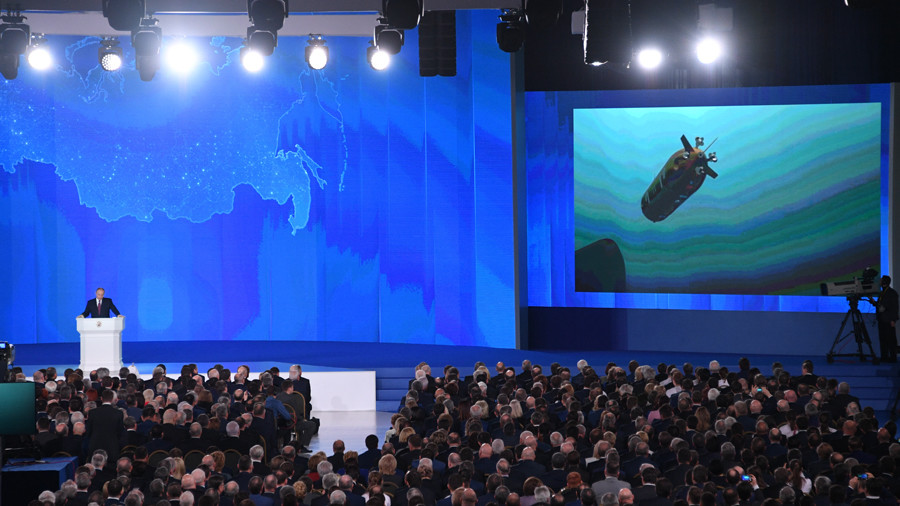

The map affirmed the arrival of a new consensus in the Russian states and ethnic republics–members of which were assembled before him–to recognize the arrival of a new role that Russia could occupy and would occupy in the global map.  Indeed, the made-for-television map of the Russian Federation suggested the new relation between local and global–and of Russian sovereignty and international abilities for “global governance” that would be guaranteed by an expanded arsenal of nuclear weapons, in ways that demonstrated the expansive reach of Putin’s Russia far beyond its boundaries, in ways that would upstage the American use of GPS in the Iraq War, and the precedent that that war set, in Putin’s mind, for flouting international law in the assertion of American sovereignty–despite the multiple logical problems that were avoided in making such a claim.  But it seems that much as George W. Bush’s headstrong rhetoric of fighting “terrorism” was adopted wholesale by Putin in subsequent violations of the sovereign rights of Ukraine, Crimea, or Syria–and the justifications for defense of Russian interests as the same as sovereign grounds.
made for TV maps.png
The broadcasting of Russia’s possession of a new generation of intercontinental ballistic missiles, unable to be intercepted, as well as designed to frighten the United States or a feign to enter into an arms race, were presented as the basis for illustrating the lack of Russia’s need to respect any cartographic lines or continental divides.

1.  The pre-election State of the Union address, as if a continuation of the diatribe Putin launched against the West for “trying to remake the whole world” unilaterally and in accord with its own interests, provided a broadside of the determination of Russia to defend its own interests, rather than seeking through military invasion or moving of its troops across borders to “reinstate some sort of empire.”  But his discussion of how “turning points” in history determined the foundation of cities in Russia and its relation to “space” seem on the point–and a bit of pointed positioning in regard to Russia’s future positioning on a geopolitical map.

As if to respond to the ion, Putin focussed most theatrically on its development of “invincible missiles” and nuclear-powered arms as defensive weapons in a two-hour address before a packed hall that was punctuated by repeated ovations and applause.  He  omitted any mention of Russian presence abroad, but focussed attention on the Russian nation as able to protect its allies adequately and preserve its place in a “rapidly changing” world where some states were bound to decay if they did not keep up with the pace of change.  As an almost entirely male audience uneasily awaited Putin, turning in their seats, greeting each other, staring ahead stonily or smirking and nervously straightening blue ties.  All faced the glowing blue map projected above an empty stage in the new venue, as if into their minds, as if in preparation for how Putin would remind them of the problems of charting Russia’s future course, even as they may have been most satisfied with the unprecedented foreign influence Putin had achieved in much of Europe, Hungary, England, and the United States.  When Putin took stage with triumphal music, describing how the “significance of our choices, and the significance of every step we take . . . [will] define the future of our country for decades,” and a new time for Russia to “develop new cities and conquer space” after maintaining the unity of the federated nation and its stability in the face of great social and economic difficulties but still faces the danger of “undermining [its] sovereignty.”


Map crisper curved


Projected onto multiple scrims, the glowing image of the Russian Federation lit by glowing centers of population echoed Putin’s discussion of stability, and the need to affirm the “self-fulfillment” of all Russians and their welfare through new economic policies, which he assured them had nothing to do with the upcoming elections, but cautioned that the failure to create technological changes would lead to potential erosion of its sovereignty despite its huge potential.

The glowing national map dominated the room overwhelmingly in which the three-term President spoke, describing the as he aimed to win an election to continue his Presidency through 2024, and convince all Russians of his leadership of the nation.  Below the map, unsmiling, Putin solemnly addressed the nation as if he were its architect and the protector of its bounds; indeed, the projection of the fixed bounds of the Russian Federation onto a set of screens behind him seemed to celebrate its continued power vitality after three terms of Putin’s presidency, even as he recited fairly grim statistics about the state of the national economy.  Describing the need to enhance its civil society and democratic traditions, Putin raised the prospect of once again “lagging behind” other nations, its body politic undermined by a chronic disease, and define Russia’s future, if its modernization was not affirmed in the face of .  The continued coherence of the nation reminded viewers that, notwithstanding threats of dissolution after the fall of the Soviet Union two decades ago, and a reduced GDP and natural resources, the Russian state was back.

The map of Russia was projected in isolation from the world, but the image that resembled a back-lit glowing screen became a basis for projecting the power Russia had regained on a global stage.  Rather than imitating the graphics of a paper map, the iridescent blues, splotched with centers of population, called attention to the permanence of the Russian Federation’s borders and affirmed its new place in the world.  The bounds of Russia were protected, the triumphalist image implied, but the place of Russia on the world stage was implicitly affirmed even if it was shown in isolation:  rather than showing people, or including any place-names, the map magnified the idea of Russia, and its futuristic projection suggested the continued power of Putin to transport the nation to modernity, its boundaries protected and affirmed and its defense of allies acknowledged.  While Putin had recently accused the United States of triumphalism, insisting that Russia was indeed “self-sufficient” and denying Russia was “encroaching on its neighbors” as “groundless,” he seems to have relished a new triumphalism, and famously continued to present the invincible military weapons Russia had developed–lasers, ICBM’s, which, nuclear torpedoes, and nuclear-powered cruise missiles–which, while not revealed “for obvious reasons” would definitively displaced the United States from a position of global power and could penetrate US Defense Systems with ease..


Video in State of Union address.png

Continue reading

1 Comment

Filed under geopolitics, globalism, nuclear strikes, Russia, Russian Federation