Category Archives: data visualization

Mapping What We Now Weigh

There is little comfort to be taken in the recent announcement that the United States has been overtaken as the world’s nation with the greatest number of obesely overweight citizens by Mexico.   As Mexico collectively surpassed the symbolic statistical benchmark of the 31.8% obesity of citizens in the United States, this was clearly never meant as a cause for self-congratulation about the reduction of our own waist-lines.  The announcement that almost 1/3 of Mexico’s citizens were obese allowed it to surpass the United States among the world’s most over-weight, and also illustrates the rapid success of a model of mass-produced food consumption in a post-NAFTA world where the popularity of fast-food and sugar-laden drinks has dramatically grown south of the border.

The real story behind the story is the relation of how our habits of food consumption have shifted the total body weight of the nation over the past several decades from the mid-1980s–and the much-noted radical changes in percentages of obesity throughout the entire lower forty-eight since 2000 in this dynamically animated time-stop choropleth map, which seems to constitute something of a watershed that opens the floodgates to weight-gain through 2005, in a preview to the drama of over-consumption of edibles narrated in “Supersize Me!”:


obesity-map-GIF-jh.gif

This animated map, generated by the CDC, provides a scary image of the changes using the government’s standard for obesity at a body mass of 30 or over, might be more disorienting than explanatory, but charts a massive shift in Americans’ eating habits.  In displaying those states with citizens whose body mass exceeds 30 or over–a generous benchmark, given that the World Health Organization marks obesity at a BMI of 25–the map charts the changing waistline of a nation over time.
Their expansive standard of obesity in hand, the CDC defined the goal for reducing obesity to 15%, which no state successfully did–even if Colorado came close until 2004–which reveals the difficulty of turning back the trend.  This is not surprising, given the map of world-wide per capita calorie consumption that the World Food Program devised in 2006, anticipating some of the imaginative cartographies of Dr. Benjamin Hennig, which illustrated the bloated caloric intake of the United States, Australia, Canada, and Saudi Arabia.
World Map-Calorie ConsumptionThere is clearly a culture of overeating waiting to be mapped.  But one cannot say the map has a clear cultural origin–so much is it rooted in food purveyors, and a food network of factory farms, as much as economy.  Obesity was recently mapped in 2010 by the World Health Organization for both men and women, in ways surely reflect the local economy, but also show a resistance to obesity, if we can call it that, in areas as Irish or Frenchmen,  although lack of food in Afghanistan contributed to limit average male BMI in that war-zone.
OBese Men 2010--WHO
Although French women are notably less obese, as those in Estonia, women in the United States are revealed by this metric 75% obese–fully two shades of color greater than their Canadian counterparts:
Overweight Females--WHO
The global shift in the prevalence of obesity is strikingly evident in Europe from 2005 among both sexes, here to note only women, taking special note of Italy and Greenland:
WHO Females 2005
The prevalence of obese males in 2005 is less striking in its difference, although German, Austrian, and Croatian males don’t seem slim.
WHO Men Obese 2005
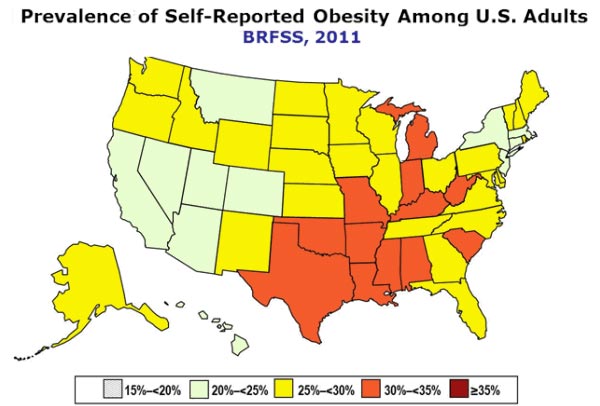
To scratch beneath the surface of these infographics, it might help to ask how folks got that way, or what might be done to better understand the change–as well as to get beyond the limited chromatic variations of the WHO maps.  At last notice, the CDC found that no state in the nation in 2011 was lower than one-fifth, or 20%, with twelve states–including Alabama, Arkansas, Michigan, Mississippi, Missouri, Texas, and South Carolina–the proportion being almost one-third, mirroring both CDC maps of an inappropriately metaphorized “fat belt” and “stroke belt” discerned in the nation in 2011–neither of which provides enough grain to get us far, but which surely packs a punch and gives a shock to our national health-care system.

%22Fat Belt%22 Map.


Scarier, and mirroring eating trends, is the rising obesity among those college-age, and the alarming concentration of an over-50% rate five years ago in Alabama and Mississippi, for what this tells us about the future picture of the nation, this courtesy Miller-McClune:


Obesity in CHildhood MapThe infographic maps unsurprisingly onto the CDC’s mapping of 2010 obesity trends provides a striking picture of the spatial concentration of the obese.
OBESITY 2010

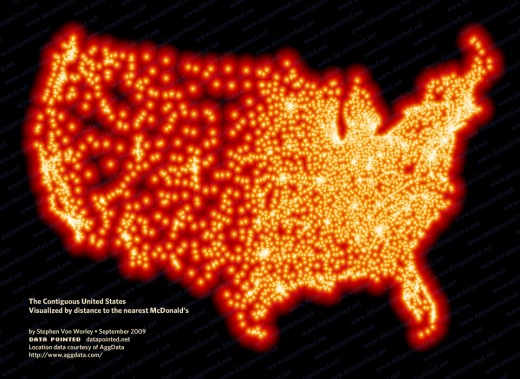
To start to add finer grain and greater questions of causation to the CDC infographics–and to unpack the information that they provide–we might do well to test the correlation to eating habits and with diet.  For a start, we might look at the clever data visualizations based on aggregates that Stephen von Worley devised to chart fast-food preferences nation-wide to interrogate McDonald’s’ market-share monopoly of the fast-food chains that line the nation’s highways.  Starting from a visualization of the continuous United States that plotted the nearest McDonalds from any point in the nation–that reveals at its brightest spots the near ubiquity of a McDonalds restaurant at certain nodes in the country–the brightest lights signify the points of least travel to the Golden Arches in September of 2009.


mcdonalds_us-520x379


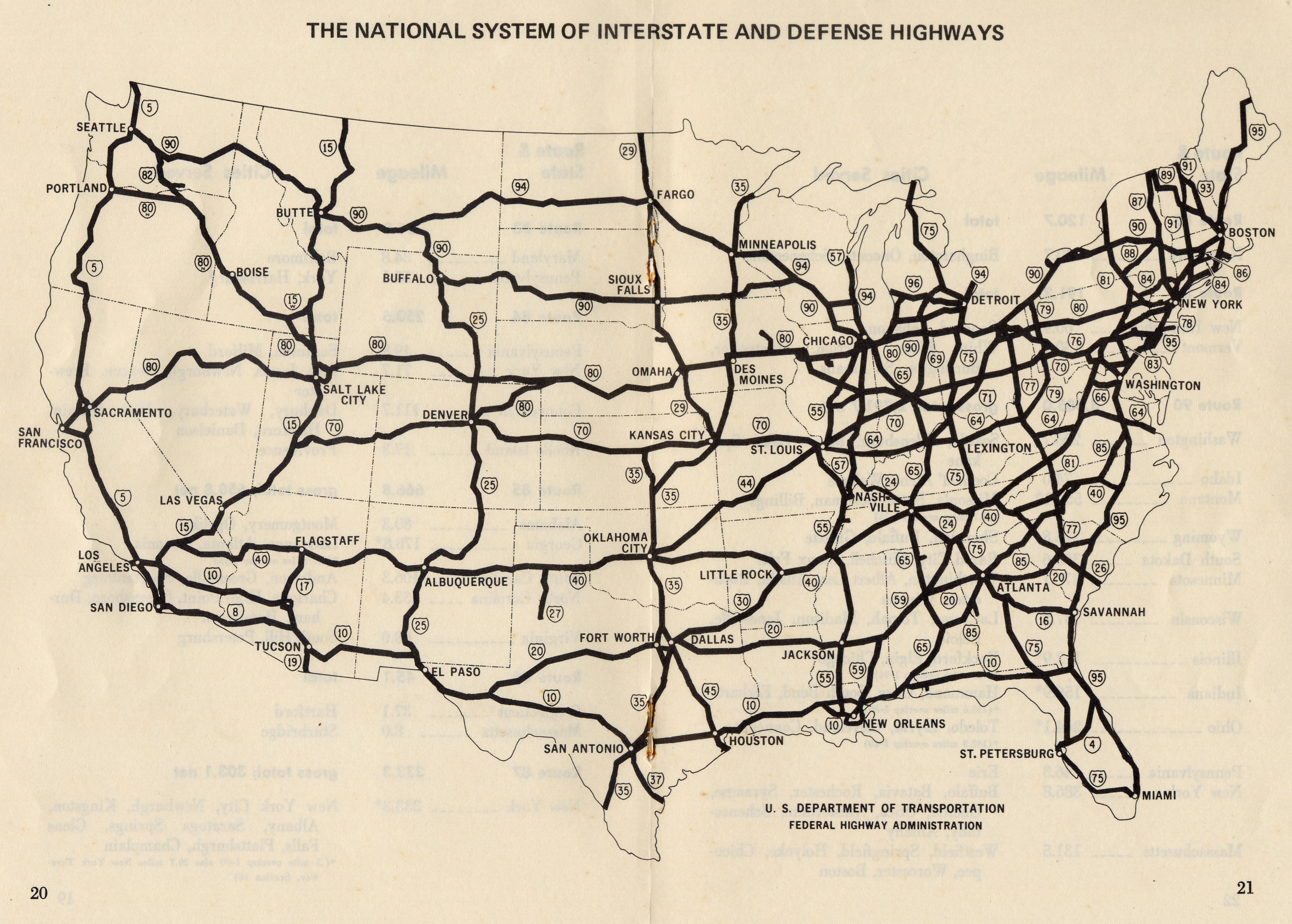
As much as providing a new picture of the question of our nation’s actual continuity, von Worley’s slightly tactless visualization raises interesting questions about the options for food available in specific parts of the country, and the possibility to discern clusters along national interstates, from California’s I-5 to route 95 in Florida, or along specific regions, like Long Island and the Chicago area:


Interstate_Highway_plan_October_1,_1970


After winnowing down the over 36,000 restaurants to the eight largest, but to prevent one from outshining the others, von Worley maps the three most dominant fast-food purveyor among eight contenders in different colors across space–McDonald’s (black), Burger King (red), Wendy’s (yellow), Jack-in-the-Box (magenta), Sonic (the Oklahoma-based America’s Drive-In; periwinkle), Diary Queen (cream), Carl’s Junior (green) and Hardee’s (cyan).  Although devised with the intent was to question the market-dominance of McDonalds, von Worley also elegantly illuminated a dense distribution of burger-consumption as national food swamps, and by weighting stores at a 4:2:1 ratio the limited variety that underlie the illusion of a landscape of uniform food-choice:


Steve Whorley's Fast Food Map


The data distribution unsurprisingly overlaps with those states whose inhabitants share a BMI that tends to be supersized, looking at the final frame from the animated colored choropleths above.


OBESITY 2010

As an expert data visualizer if not an artist, von Worley seems aware of these implications, although his upbeat brightly-colored points gives a pop-art aesthetic to spectacular maps of gluts of fast-food chains that hint at stretches of food swamps (where access to prepared foods or processed food outweighs fresh food) across the nation.  Indeed, von Worley started by mapping the total area controlled by fast-food chains, to compare McDonald’s and its competitors, as if to imagine of local resistance to the evil ‘burger force’ that must be overthrown at all costs in an openly Manichean vision of the world of burgerland:


mcdonalds_vs_competitors-520x371


As suggested, von Worley hoped that the growth of the evil empire Ray Kroc could be reversed should competitors join forces against the Big Mac seems wrong headed–rendering here in utopian pastels–that cast Jack-in-the-Box and Wendy’s as Davids to McDonald’s Goliath as a landscape of dayglo colors, where the black of McDonalds presented something of a plague or blotch infecting, as if a cancer, much of New York, western Massachusetts, Vermont, and Chicago.


mcdonalds_vs_allied-520x371


Von Worley wanted to map the degree to which McDonald’s locations are only dominant in the North-East.  But his data visualization is oddly not so concerned about the lack of variety at these stores, or the sort of dietary habits that the map maps.

His recent dedication to measuring the burgerscape, both by taking into account both the distances likely to be traveled for folks to spend money on food to weight places folks are more likely to travel to indulge, and introducing scalable model of market dominance.   The data visualization maps a glut of burger consumption in specific regions that is striking, placing Mississippi in an expanse from Dallas-Fort Worth (upper left cluster) to the Mississippi Delta, where yellow clusters mark Jacksonville, MI, and ports are dotted with fast-food chains.  The burger density is striking, even if von Worley’s chipper aesthetic sensibility belies the glut of consuming all that factory-farmed meat and animal grease:   for the pied pastels of von Worley’s pointillist mapping of fast food locales transmute eating habits to pop art.


beefspace_tx


If it is less artery clogging, also note the flourishing fast-food ecosystem that flourishes across multiple microclimates stretching from Atlanta, Georgia to Charlotte, North Carolina:


Atlanta GA to Charlotte NC


And the visualization of the dense outcroppings of stores that promise a variety–even without noting In-n-Out, A & W, or Taco Bell–suggest the redefinition of the urban foodscape in a city like Phoenix, even if the food-markets in the city are not so dominated by our friend Mickey Dee:


PHoenix


One of the few historically informed maps in van Worley’s visualization of the colorful beefspace so densely clustered in the Southern United States does not concern the mapping of lived space, but a perspective from the moment when the seeds of a new topography of fast-food eating began, which makes one want to extend the animated choropleth back it time to the veritable big-bang of the very beefspace that led to all those brightly colored food swamps:


Big Bang of Beefspace


But, as with any map, one must move from the local to the global: for the real story underlying the effects of sedentarism or over-eating on salty or sugary pseudo-foods is a global one. The FAO recently found that “For the first time, the number of overweight individuals worldwide rivals those who are underweight,” citing the findings of the Worldwatch Institute that measured both at 1.1 billion worldwide; obesity now emerges as a problem equal to malnutrition in ways rarely anticipated earlier.  An “obesity map” of global scale finds a notable jump in obesity rates of 5% in just three years in China, and the startling growth in numbers of obese across sub-Saharan Africa, Colombia, as well as among north African or Middle Eastern women; it places both problems in the very same national spaces:


Obesity %22Map%22

1 Comment

Filed under data visualization, data visualizations, fast food, fat belt, obesity, overeating in America, overweight populations, stroke belt

The Lexical Landscape: Islands and Divides

With lines of civic dissent and division dominantly drawn in our media, it’s refreshing that the statistician Joshua Katz took measurements of usage to map more chromatic variations across the national landscape.  It’s striking that usage habits, for different reasons, go against the idea of a melting pot, and reveal a deeply ingrown retention of lines of difference difficult to interpret and even often to draw.

But if the results of the end-product of a class in applied spatial statistics is not clear, the maps provide sources that are endlessly fascinating to pore over not only for the varieties of what they map but to extrapolate what more they might mean, since they reflect such sharp divisions over space.  Despite our increased cultural homogenization as a nation, and the blurs of globalization, these maps demonstrate a not too surprising insularity of a range of linguistic practices, from accents to stress to word-choice.  And although based on existing data, Katz mapped those statistics in particularly persuasive form provide enough grist for thought as “heat” maps from surveys of regional changes in pronunciation originally compiled by Bert Vaux and Scott Golder.

The resulting images have spread like wildfire across the internet as vehicles to visualize national divides in ways far more entertaining and erudite than the sort of electoral infographics that still haunt the unconsciousness of anyone who has tried to track trends in the incoming results of presidential elections, predictions based on polls, or listened to the denouements of their breakdown and analysis.  Rather than mapping an actual choice or preference, these maps track and give meaning to a set of disparate choices to reveal a linguistic landscape more than its immediate causes; the sequence of maps is intriguing because they lead us to hypothesize what the multiple causes that underlie such phonetic patterns or lexical choices are–or what the social meanings of these patterns of linguistic boundary lines or pronounced insularity might be.  Rather than reveal a nation “bowling alone,” or a world atomized behind computer screens and shifting consulting positions and service jobs, they map surprisingly healthy clusters of the sociogenesis of word use far more comforting or reassuring to the eye than rigid political divides.  At the same time, the proliferation of some maps–presented by Business Insider as maps of the “deepest linguistic conflicts in America” in twenty-two images, use the map as a prism to reflect chromatic differences in ways that map the multivariegated communities within the contiguous forty-eight.  And when one compares the divisions in the full range of 122 of the questions asked in the dialect survey, the map is used as a sort of lens for refracting multiple divides we probably didn’t know existed or only tangentially kenned.

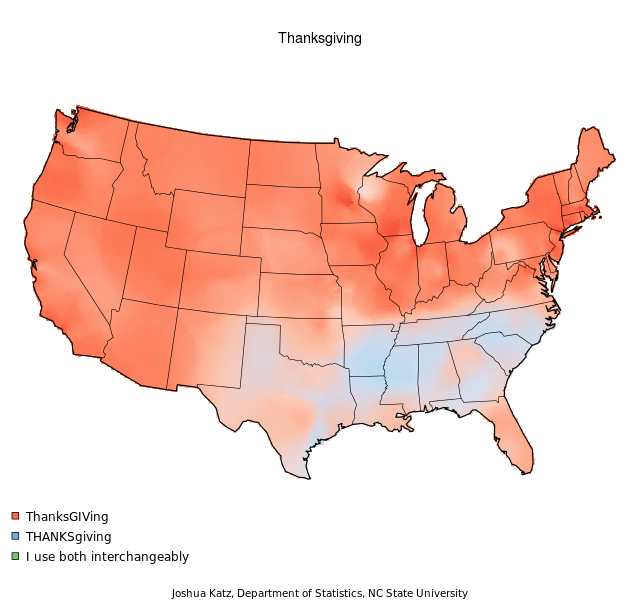
The public records of national divides on a lack of consensus seems healthy to me.  Now we know there are clear areas of the country where they continue to cut the grass, not mow the lawn, and even if associated with a traditional deep South of Louisiana, usage extend to western Pennsylvania, southern Ohio, and Indiana: mowing the lawn, cutting the grass Far more entertaining than something as indeterminate as a weather map, if only because of the multiplicity of deep divides of regional English they reveal, these maps give more vitality and dynamism to the country’s mouths in an era of apparent ideological chasms and oppositions fostered in large part by 24-7 news.  Without a legend, or what Wood and Fels call a paratext, or interpretive apparatus, the maps are simple declarative statements–each constellation of meaning in which raises intriguing questions about their possible analysis. The multiple maps through which a range of questions are individually refracted reveal the different divides in a set of composite pictures of the nation, raising questions about the fine quality of grain of the divides that maps can reveal. To be sure, the Southern United states are regularly regarded and cast as one of the strongest linguistic subdivides of regional English.   It is striking that the unique accents in southern states stands out in th composite data visualizations Katz sorted out to represent the differences in the enunciation of one single word–“lawyer”–across the contiguous forty-eight: isolation of Legal langauge However tempting to read the island of pronunciation as evidence of an isolated island of legal practices, or a veiled attitudes to what those JD’s do or protocols they follow, the map poses fun questions of how signifier is itself mapped to signified, using the form of a map to re-examine the images of division with which we’re all too familiar.   The dichotomy in the choice of pronunciation rests more in the vowel combination at the word’s center than what it signifies, however, if the insularity of that pronunciation is pronounced; more than reveal an insularity of habits of legal reasoning, the divide is structured by local dialect starkly drawn at the Mason-Dixon line: isolation of Legal langauge Not to mention its distinct preference for celebrating THANKS-giving, and not thanks-GIV-ing: thanksGIVing


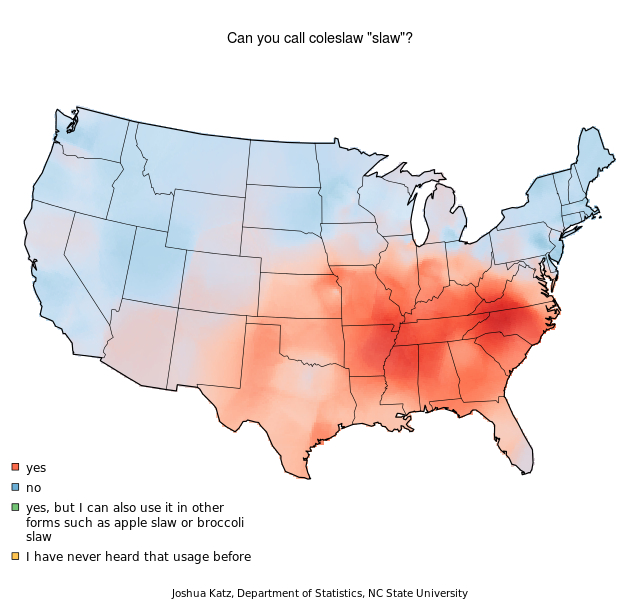
The southern United States historically distinguished by cuisine, and this converts onto its strong preference for slaw, even more broadly than by its shwas:  the clear dominance of slaw across much of Kansas, Kentucky, West Virginia, northern Florida, and Texas, as well as Mississippi and Alabama, speak to its local culture of food, as does the limits of the northern Germanic influence of ‘coleslaw’ in central Pennsylvania, Ohio, and northern Illinois–and this time, the fuzziness of its line of demarcation shows greater signs of permeability to culinary terms for sides to the north:

Land of Slaw But the question of “icing” v. “frosting” presents yet another spectrum of preferential divides, which rather than being almost divided in Pennsylvania finds its clearest locus of consensus there: icing:frosting


On the other hand, if we know that the “hoagie” is Pennsylvanian and the “hero” sandwich dominates Long Island, the “sub” is eating up the country, perhaps courtesy Subway Sandwiches:


sandwiches and subs


Other habits of reference are similarly surprisingly localized, even about attitudes to how much we can abbreviate one place-name in the country to a simple article, like this map of what “the city” means (if not New York) are more deeply rooted in preferred signifiers.  The centering of abbreviation of New York City to a simple “the” surprisingly  reveals a deep westward reach of New York’s cultural hegemony, despite the persistence of insularity in the national language-scape or usage map.  There is a similar agreement–if of a very insular sort–in designating what “the city” means in what might be called the tri-state area, if the implicit referent is fuzzy across the nation, save that particular region of southern Florida, apparently permeated by northeastern habits of linguistic reference once again.

The City!


Others are more bizarre, as the rituals of the evening before Halloween:


Sub

Who can explain the adoption across Wisconsin of “Mischief Night”?

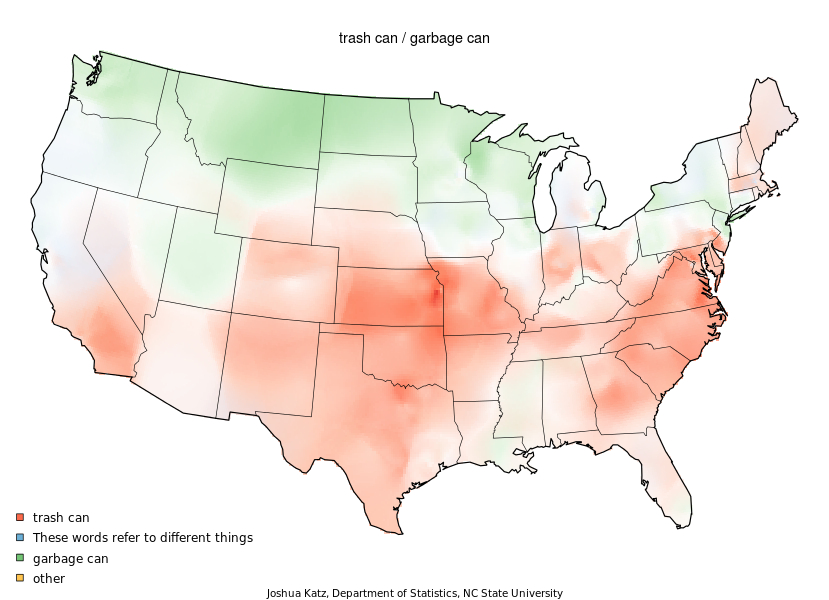
The sociogenesis of trash seems particularly difficult to explain, even though the dividing line in autumn temperatures might explain why “garbage can” dominates the triangular area from northern New Jersey to Vermont’s border with New Hampshire, over to the Great Lakes, and roughly from Chicago north, while trash cans dominate anything south of 42 degrees north, with the odd exception of Utah.  Temperate climates can’t explain the difference, give the shading of New England toward ‘trash,’ notwithstanding its apparently non-native provenance.

Garbage v. Trash


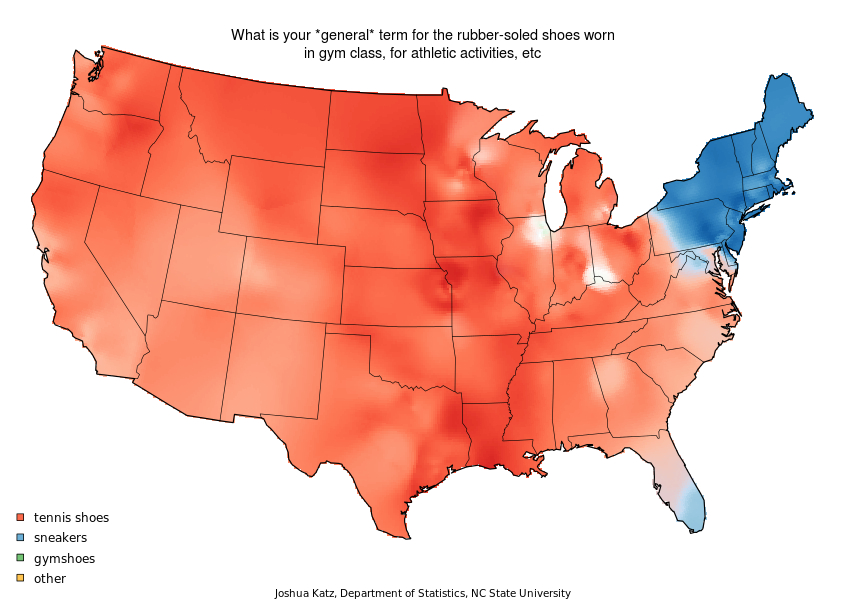
Given the compelling ways that maps create constellations of meanings and embody entities that one never ever saw, it’s tempting to indulge in armchair philosophizing about the patterns that they show. Far more than one expected, the maps show many intriguing regional redoubts of pronunciation or  pockets of word-choice that jump out of the national landscape.  These divides are surprisingly but comfortably strong, in other words, even varying among one another. Take the survival of the sneaker in the northeast, transcends pronunciation, and its survival in the southernmost parts of Florida hints at the presence in that state of many northeastern transplants:


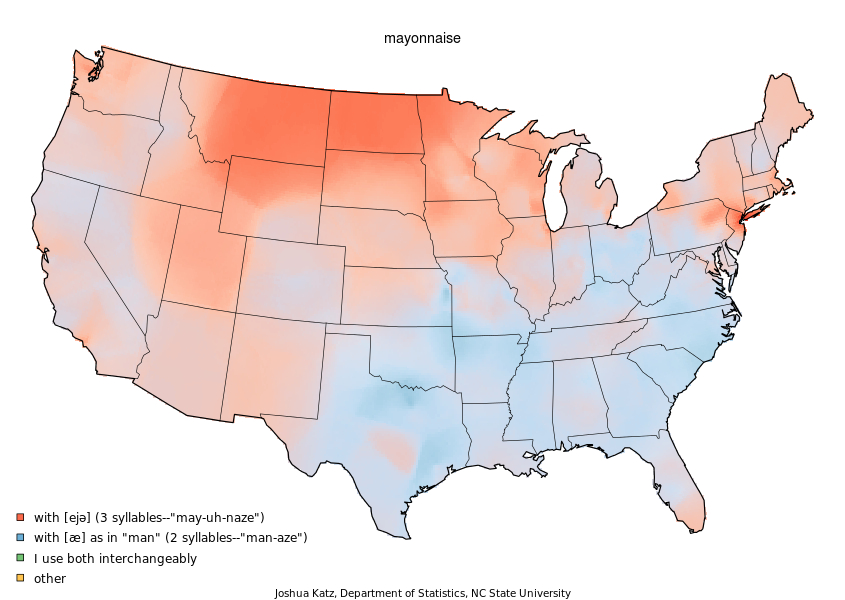
Sneakers! Despite a lack of clear preference for dividing mayonnaise according to a three-part breakdown to components nation-wide, there are surprising hold-outs for a three-beat scanning of the slippery stuff in Montana, New Jersey and Long Island: NYC Mayonaisse

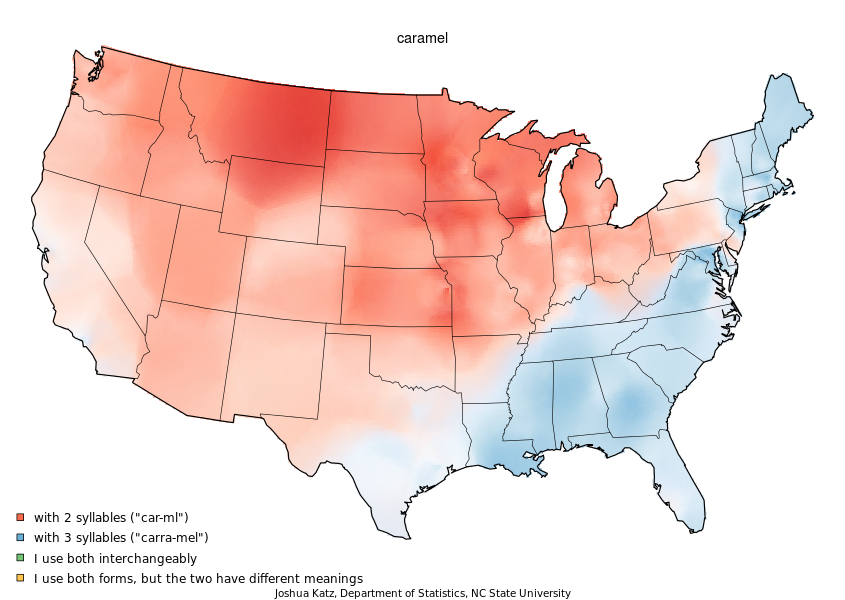
Phonetics often trump actual cuisine.  What about the sudden disappearance of two vowels from “caramel” across the Ohio River?

Caramel


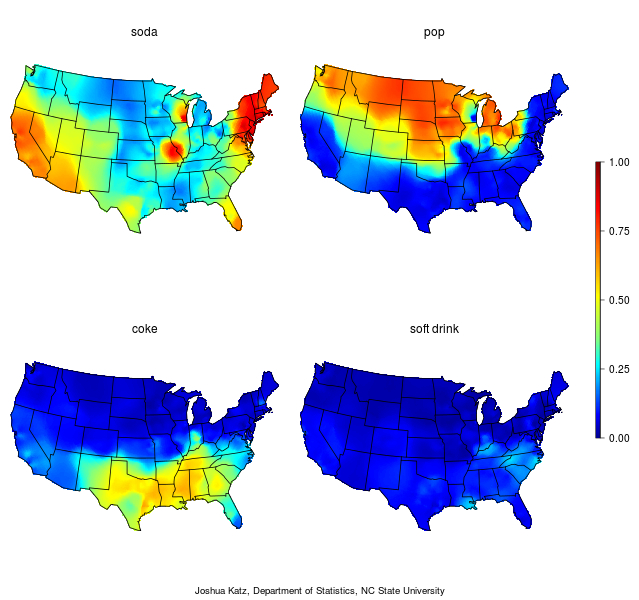
As much as this map for the use of “sneaker” reveals a boundary in choice of signifier, more than phonemes, one could argue that some divides of word choice are determined and perpetuated by local commercial interests.  This seems illustrated by the dominance around Atlanta, Georgia of the signifier “coke” as the empire of a brand, even if it doesn’t explain the national pop/soda divide:

soda streamThis is interesting, since we’ve moved from accents to regional English of name-brand:  yet “coke,” no longer based in Atlanta, doesn’t seem to have a base there, so much as being a dominant term in Louisiana and Alabama, even as “soda” dominates the northeast and California and pop the midwest north: soda:pop:coke


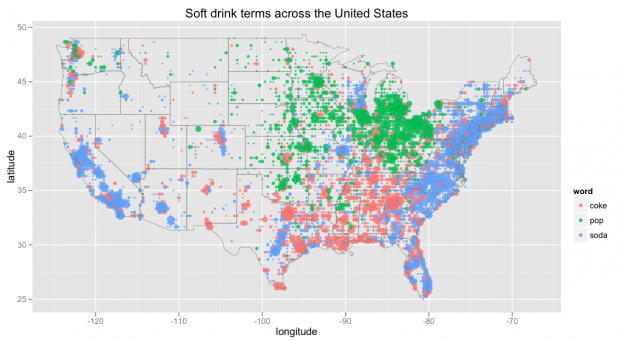
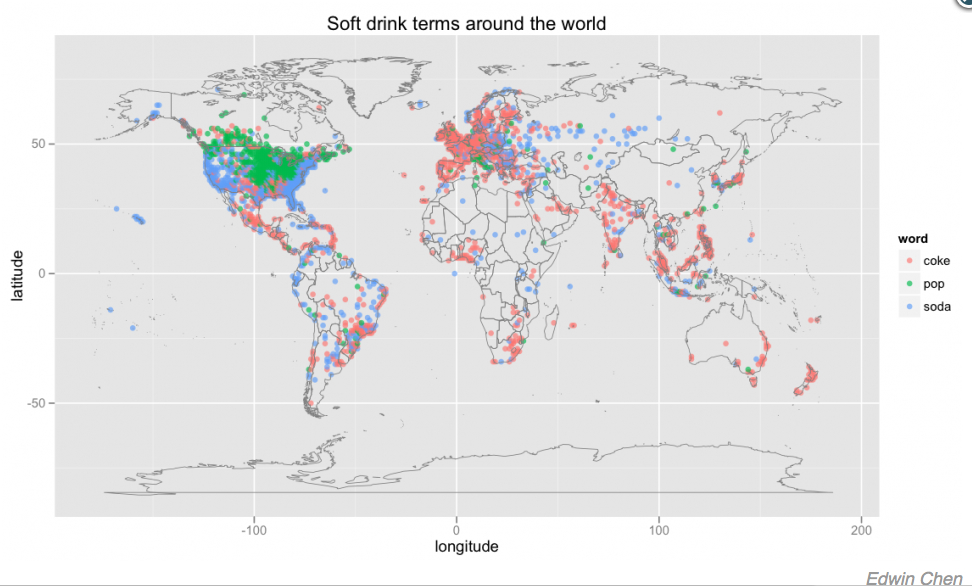
Perhaps “soda” is a term generated in larger sports arenas.  But isn’t social custom more likely to explain the intense burning reds of soda around metropolitan Chicago and Kansas City, in spite of surrounding lands that opt  for pop?  But this is a long debate, that Schwartz cannot perhaps hope to resolve in an authoritative manner.  Edwin Chen, a Twitter data scientist, for example dedicated time to construct a more pointillist map, of finer grade, while forsaking the color-range of a composite, to indicate a similar tripartite division of mapped space, with a preference for ‘pop’ clearly clustered around Lake Michigan, for some reason, and ‘soda’ dominating coastal regions almost exclusively, with a more concentrated representation in central Texas, around San Antonio and Dallas.  Is ‘soda’ just the more urban drink?  How does this map map onto drinking venues, concession stands, and watering holes?  Chen’s map, hoping to resolve these questions by geo-tagging tweets, and then making sure in a review that they were in reference to soft drinks, rather than brands, revealed a similar dominance of “Coke” around its former hub, Atlanta, confirming both its specific density and dominance.


Chen's Soda Map


He then, exploiting his databank of tweets, extended his map across the world, which aside from revealing a curious preference for pop in Italy, found the global hegemony of Coke a true case of globalization, but in surprising inverse relation to the contiguous forty-eight:


Coke in the World


With respect to Mr. Chen, the map only slightly reveals the dominance of “pop” above the 49th parallel, in part since tweets using the word ‘soda’ don’t necessarily correlate to actual usage preferences in spoken English, and ‘coke’ often tweeted.  (Anyways, tweets with the word “coke” cannot be claimed to  correspond clearly to a linguistic usage map.)

Ways of talking about and moving through space are perhaps most intriguingly map against geographic space.  Perhaps the set of maps that suggests a clear relation to habits of moving across expanse is the division, removed from phonetics and purely a notion of choice of signifier, is the pronounced preference for the freeway in the western states, or the end of the dominance of the highway in the Pacific Time Zone, and the reign of the freeway across Southern California:


Spaciousness of the Freeway

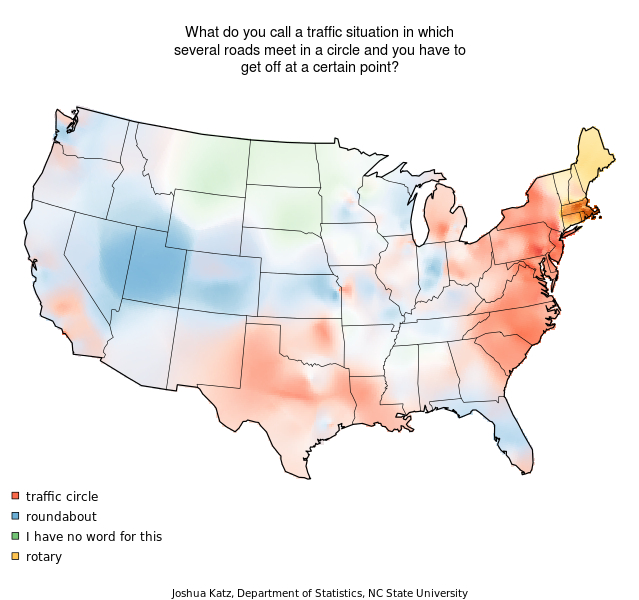
To clarify why Colorado defines one boundary of the lexical dominance of the highway is not evident.  But the maps out a distinct manner to move through space in cars, the expansiveness of freeway travel in Utah, Nevada, Oregon and parts of northern California, where light blue shading marks consensus around the constraints of highway travel, and the dominant freeway culture in green haze surrounding Los Angeles and Seattle. Motion through space or automotive travel are as pronounced as differences of phonology, revealed by the fragmentation of the “roundabout” in the Western states, Midwest, and Florida, where they are perhaps identified with planned communities or suburbia, and northern New England’s adherence to “rotary,” with Connecticut, while “traffic circles” dominate the oldest settled lands of the eastern states and those southern Florida transplants.fragmentation of the roundabout The road map is complex and would entail a detailed comparison to the national highway map.  A similar decisive break is seen in the culture of the service and frontage road, where South Carolina displays an affinity to the exclusive dominance of “frontage” in the expanses of highway in the Midwest, Mountain States and much of the west.

service roads v. frontage roads

These terms to move through space in cars are not, however, the deepest divides:  the vanishing as one moves westward of the term ‘supper,’ absent from the DC area but almost fully gone west of Utah and Idaho, indicates a striking persistence of a divide in usage where one’s surprised to find it a big deal.  The decline of “supper” in the western states, the DC area and around Detroit augurs the end of its exclusive use for the end-day meal, this ostensibly New England practice is not only to some extent retained there, but ingrained in the Dakotas:  supper has been extinct, to judge by the usage map, in California, Oregon, and Washington, and lost distinctive meaning in much of the rest of the country.

Limits of Supper, melding with dinner

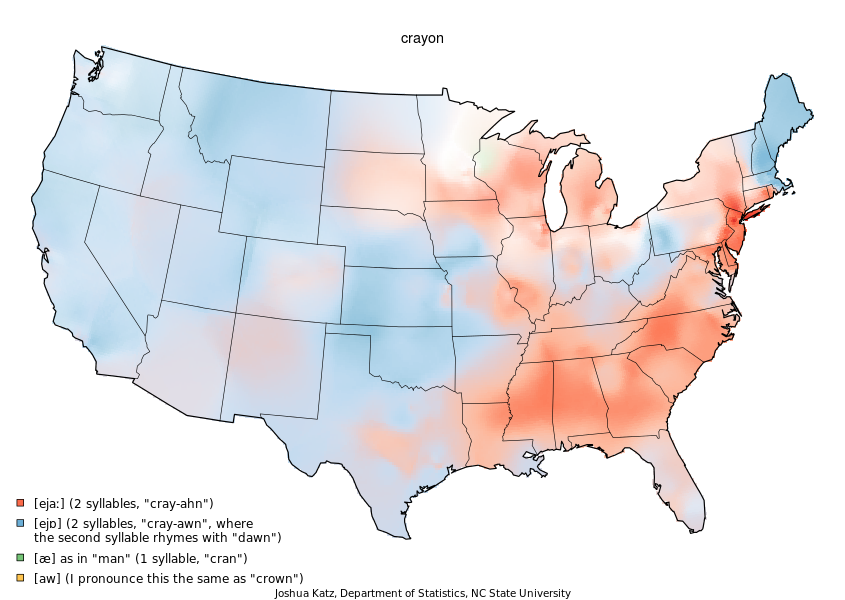
The deep divides continue about the phonetic habits difficult to analyze as linguistic divides.  The lines of division around vowel pattern of “crayon,” that almost universal tool of creative expression in the arty preschool set, is complex to imagine or assign to any cause:  the central Eastern states seem linked to the deep south, in contrast to the word’s contraction to one syllable in northern Wisconsin and the dominance of a more open second syllable across western states.  These clearly marked divides, far more difficult to explain, may be tied to preschool cultures, but is more likely linked to an interesting variation among some single-usage pockets and significant ranges of hybridised pronunciation.

americans-cant-even-agree-how-to-pronounce-crayon.jpg

At the end of the day, there is no red vs. blue in the way we speak, even if an infinite range of oppositions and variations pervade.

Leave a comment

Filed under Bert Vaux, Bert Vaux and Scott Golder, data visualization, linguistic boundary lines, maps of regional English, regional English, soda v. pop, statistical maps, Twitter-feeds

Mapping Radiation Levels: Toward a Vigilante Cartography or a Model of Data-Sharing?

Few maps rely entirely on self-reported measurements today:  the data-rich basis of maps make poor controls on data an early modern throwback.  But the ability to transmit datasets to the internet from local devices has changed all that.  The recent proliferation of radioactivity maps are based on the open sourcing of self-reported measurements to form a new picture, placing information taken with Geiger counters into a framework analogous to a template borrowed from Google Maps.  Although the only instrument to register radiation’s presence is a Geiger counter, and no standards have been developed for representing the rises in radiation counts in different regions–or indeed the limits of danger to personal health–the provision of such a map is crucial to disseminating any information about a potential future disaster.  Even if the recent earthquakes continue to cause fears of tsunami encouraged comical spectacles of geographic and oceanographic ignorance and DIY cartography to make one wish that everyone didn’t have a handheld device–

July 31, 2025

–the benefits of crowd-sourced maps by more savvy folks overseas who are able to register the dangers of nuclear fallout and more practiced with the catastrophic consequences of tsunami have encouraged a public safety vigilante cartography that we would do well to encourage and retain as a model as we face worldwide environmental dangers and natural disaster catastrophes stand to pose disruptions to the energy industry.  While the frames of cel phones may be a cause for geographic ignorance among those who forget the world is a curved sphere, or a pseudo-sphere, the value of reporting local conditions, and geocoded observations to alert folks to the consequences catastrophic conditions should stand as a model practice of citizen science of continued value.

While the three reactor that released radiation in the Fukushima meltdown created the largest release of radiation into the atmosphere, the mapping of this release of 300 tons of radioactive waste reported to be spewing from the reactors as they cooled into the Pacific Ocean may have slipped off the radar of daily news, but on the internet may have become the greatest environmental disaster we’ve encountered, increasing the demand and need to map it, and raising questions of its relation to the massive die-offs of Pacific starfish, herring,

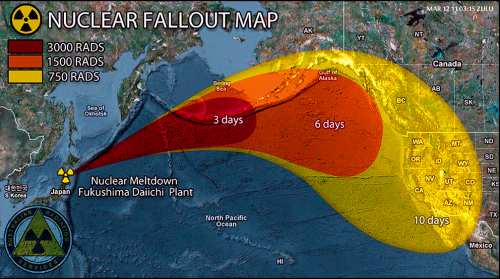
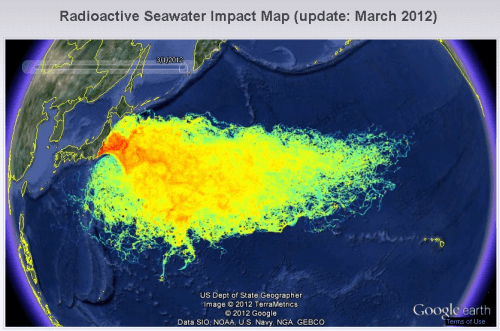
By using the internet  to upload and broadcast shifting radiation levels, the flexibility of maps of radiation levels gain a new flexibility and readability through the platform of Google Maps can instantaneously register ambient radiation in air, earth, water, or rainfall, as well as the radioactivity of food, in striking visualizations of geographic space.  This came to a head in the maps that were made to respond to the threats of the Fukushima Daiichi nuclear disaster that occurred on March 2011, and the spread of radiation from the explosion across the Pacific that remind us of how wind and the medium of ocean waters distributed plumes of radioactive waste over time, as radioactive materials from the meltdown of three reactors were falsely imagined to have spread across most all of the Pacific rapidly–

image.png

Hoax Projection of radioactive plume from Fusushima Daichi Plant

–and even extending into parts of the Atlantic ocean, in ways that generated considerable panic as a density of radioactive waste moved toward the bucolic seas of Hawai’i–as if to create a sense of the terror of the contamination of the natural setting by radioactive plumes.

There was a sense that the natural disaster could be recorded in real-time, reflecting the extent to which Google Maps had changed our expectations for the mappability of global phenomena, and the visibility of fears of global contamination that could be registered and recorded as a real-time apocalypse as everyone could be their own prophet of the end of times on the platform that it allowed.

image.png

image.pngEarth First! (March 2012)

The news ecology itself seem to have shifted, indeed, as what was undeniably an environmental disaster with potential  global import if not an event with potentially massive environmental consequences was played down in the mainstream media and by science reporting agencies, in ways that led alternative media to promulgate all the more alarmist narratives of radioactive fish off the United States, die-offs of seafood, and radiations on beaches in California and Oregon and the image that the pristine seawaters of Hawai’i had become a sort of epicenter where all radioactive waste had accumulated and come to rest, as if to confirm the extent of technological disaster.

Dispersion of Fukishima 2012

The maps suggested a sense of atmospheric proximity revealed in radioactive plumes, to be sure, that generated multiple fake maps, designed as forms of fear-mongering to accentuate the proximity of radiation in the environment, using an undated map with the NOAA seal to suggest the spread of something from Japan–and folks assumed it was radioactive, given the climate online–although it was in fact a map  measuring effects of a March 11 2011  tsunami, provoked by the Tohoku earthquake on wave height and he communication of wave-energy across the Pacific–perhaps more of interest to surfers than those fearing fallout.

image

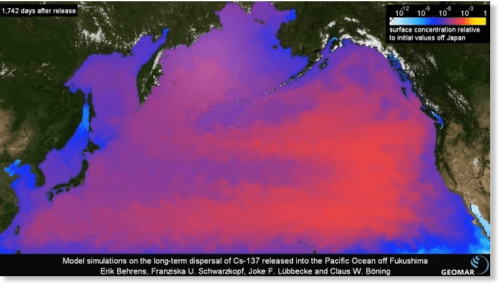
For the explosion created huge challenges for mapping a sense of global radiological risk, far transcending any place or the site of its explosion:  the greatest levels of radiation were far removed from the site of the disaster, at the same time as the contamination on the ground, where radioactive deposits were far more intense in relation to geographical proximity.  Despite the far broader time-lapse required for the radioactive plume to travel by ocean currents across the Pacific–here shown after two and a half years–based on water samples taken in 2013, which, if far lower than limits in drinking water at 1 Becquerels/cubic meter, were projected to peak to 5 in 2015-16–far less than you might eat in a banana, or experience in a dental x-ray.

image

Discontinuities trumped continuities, however, in the levels of Cesium 134–the isotope that was the fingerprint of the Dai-ichi explosion–confirmed the extent of the diffusion of radioactive isotopes linked to the Fukushima reactor, by 2015, contaminated not only Canadian salmon, as tracked at the University of Victoria, but spread across much of the Pacific ocean, leaving an incredible intensity of the fingerprint isotope linked to Fukushima Dai-ichi–Cesium-134–in offshore waters, which perhaps recirculated in the Alaskan gyre, and the radioactive plume was projected to reach American shores some 1,742 days after it was released.

image.png

If still detectable in shellfish sampling as well as salmon, in 2015, the dispersion of radiation made a delayed landfall to the Pacific coast in late 2016, much as the arrival of isotopes across the Pacific was recorded–raising questions of the travel by water of Cesium across the Pacific.

image.png

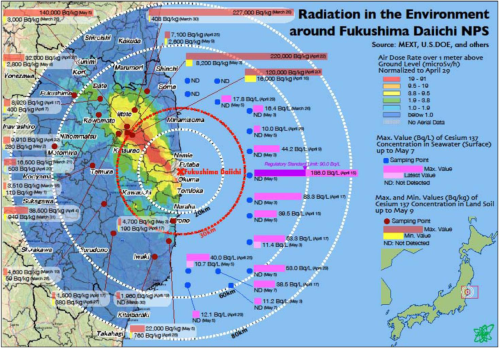
The air dosages of radiation immediately around Fukushima Daiichi suggest a dangerous level of radiation on the mainland, however, apparently confirmed in the growth of thyroid cancer, especially in children, birth defects, and the retention of Cesium 134 in power station workers who show an incidence of leukemia–

Air Dose rate Fukushima Daiichi.png

and a rise in thyroid cancer in California that follow no distinct geographical pattern–but may be due to pesticides, agricultural contamination, or other waste.

An assembly of multiple static and dynamic maps might assemble an otherwise ‘hidden map’ of local levels of radiation, however, and to reveal or expose otherwise hidden local dangers populations face from radiation leaks.  The notion of a shared database in cases of eventual emergency that can be regularly updated online suggested a way of monitoring and reacting to panic levels of the dispersion of radiation from the nuclear explosion, and indeed to measure the unclear relation between proximity to a blast and the intensity of remaining radiation and radioactive dangers.

Although the measurements of danger are debated by some, mapping radiation levels provides a crucial means to confront meltdowns, the breaching of chambers’ walls, or leaks, and to define limits of danger in different regions.   Interestingly, the map stands in inverse relation to the usual mapping of human inhabitation: rath er than map sites of habitation or note, it tracks or measures an invisible site of danger as it travels under varied environmental influences in ways hard to predict or track.  Although the notion of what such a disaster would be like to map has been hypothetical–and is, to an extent, in datasets like the National Radiation Map, which use the Google Earth platform or available GIS templates to diffuse information not easily accessible.  This is a huge improvement over the poor state of information at the time of the threatened rupture of the containment structure of the Three Mile Island in Harrisburg PA in 1978, when no sources had a clear of what radius to evacuate residents around the plant, or how to best serve health risks:  if a radius of 10 miles was chosen in 1978, the Chernobyl disaster required a radius of over the double.  The clean up of the plant went on from 1980 to 1993; within a 10 mile radius, high radiation levels continued in Harrisburg today.

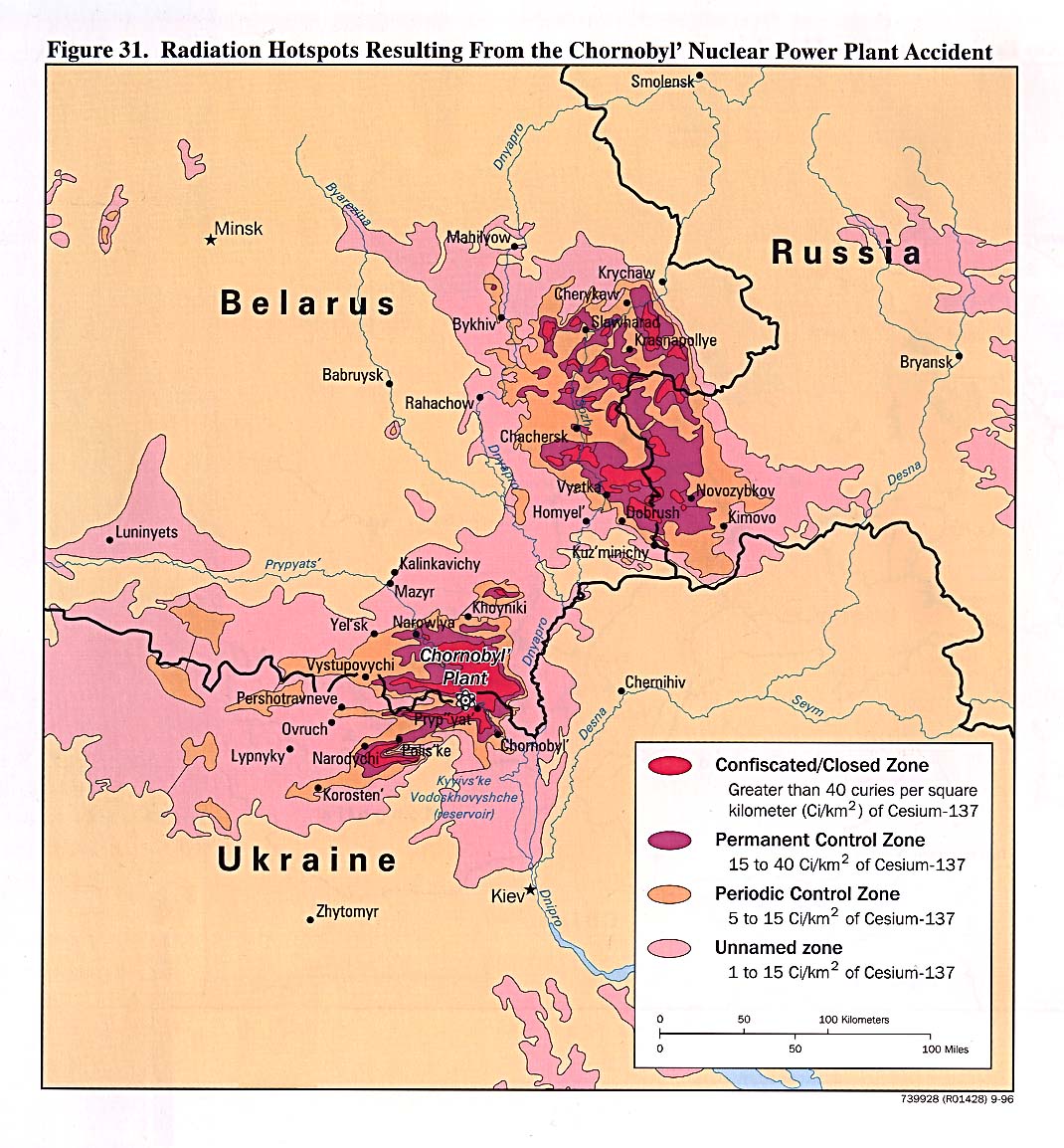
The larger zones that were closed around the more serious and tragic Chernobyl Nuclear Power Plant that in fact exploded in April 1986 led to a clear Zone of alienation that was evacuated three days after the explosion, and considerable fear of the diffusion of radioactive clouds born in the environment to Europe and North America.  The irregular boundary of immediate contamination, including pockets of radiation hotspots not only in Belarus, but in Russia and  the Ukraine suggest limited knowledge of the vectors of contamination, and imprecise measurements.

chornobyl_radiation96

This raised a pressing question:  how to render what resists registration or simple representation–and even consensus–on a map?  And is this in any way commensurate with the sorts of risks that maps might actually try to measure?

The tragic occurrence of the 2011 Fukushima meltdown raised similar questions, but converged with a new basis to define an internet-based map of the region.  If the incident provided a case-in-point instance of ready demand for maps, the availability of a large number of online access in the region led to a considerable improvisation with the value of a crowd-sourced map not defined the local government or nuclear authorities, but by the inhabitants of the region who demanded such a map.  The accident that resulted from the tsunami no doubt contributed to a resurgence and perfecting of the crowd-sourced map both in the United States and, in  a more flexible way, Japan, as websites try to refine the informative nature carried in radiation maps to create an informative response by open-access maps that can quickly register the consequences of nuclear disaster–or indeed detect such a leak or structural compromise–in the age of the internet, and offer a reassuring image (or a cautionary image) adequate to meet with the invisible and intangible diffusion of radiation in the local or regional environment.

Demand for such online databases reveal and feed upon deeper fears of an official failure to share such data.  Indeed, the drive to create a map of some authority has dramatically grown in the light of recent radiation disasters that have not been mapped earlier, in part because of liability issues and because of fears that government protection of the nuclear industry has compromised their own responsibility.  If the growth of online sites is a sensible and effective use of data-sourcing on an open platform created by internet providers, it is also one no doubt fed by a paranoid streak in the American character stoked most heavily these days by folks on the Right.  I’ve decided to look at two examples of these maps below, both to reflect on the nature of a crowd-sourced map and to suggest the plusses and minuses of their use of a GIS framework to visualize data.

The emphasis on the map as a shared database and resource to monitor and publicize the sensitive information about radiation levels has unsurprisingly increased by the recent threat of contaminated waters that breached the containing walls during the meltdown of the Daichi-Fukushima reactor in March 2011, and also of the difficulties that providing a reliable map of radiation creates:  although reactors are licensed by governments and monitored by government agencies, debates about the public dangers that reactors pose concern both the danger levels of radiation and the ability to collect exact data about their spatial distribution, and communication through waters, air, and other environmental vectors.  The ability to upload such measurements directly to data-sharing platforms provides a new access for the relatively low-cost creation of maps that can be shared online among a large group of people in regularly updated formats.  Given the low-cost of accumulating a large data-set, Safecast concentrated on devising a variety of models to visualize distributions along roads or by interpolating variations in existing maps.

The group-sourced website showing regional and local fluctuations are not visually or cartographically inventive, but pose questions about using data feeds to reveal a hidden topography, as it were, of radiation across the country or landscape–as if to remedy the absence of an open-access trustworthy source of this information local governments would sponsor or collate.  Against a field that notes the sites of reactors by standard hazard-signs that designate active reactors, viewers can consult fluctuating readings in circled arabic numbers to compare the relative intensity measured at each reporting monitor station.  While rudimentary, and without adjustments or standardized measurements, this is an idea with legs:  the Safecast Project proposes to take mapping radiation in the environment along a crowd-sourced model–an example of either a pluralization of radical cartography or a radical cartography that has morphed into a crowd-sourced or “vigilante” form of mapping radiation levels.

Safecast wants to create a “global sensor network” with the end of “collecting and sharing radiation measurements to empower people with data about their environments.”  Its implicit if unspoken message of “Cartography to the People!”  echoes a strain in American skepticism, if not paranoia, about information access, and fear of potential radioactive leaks–in a counter-mapping of USGS topographic surveys, the movement to generate such composite maps on the internet is both an exciting dimension of crowd-sourced cartographical information, and a potentially destabilizing moment of the authority of the map, or a subversion of its authority as an image produced by a single state.

The interesting balance between authority and cartography is in a sense built into the crowd-sourced model that is implied the “global sensor network” that Safecast corporation wants to construct:  while not readily available in maps on access to government-sponsored sites, those interested in obtaining a cartographical record of daily shifting relative radioactive danger can take things into their own hands with a handy App.

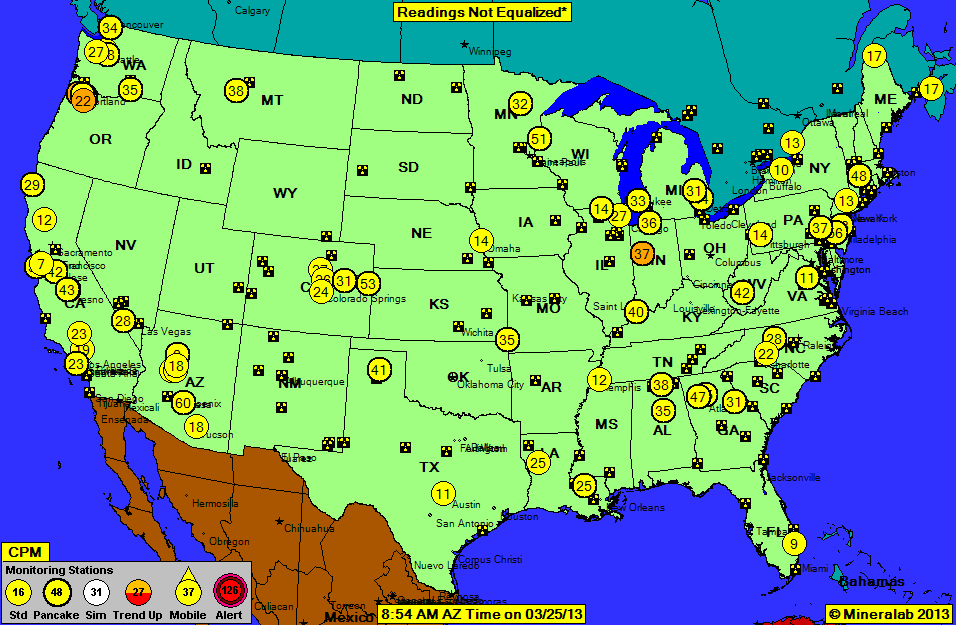
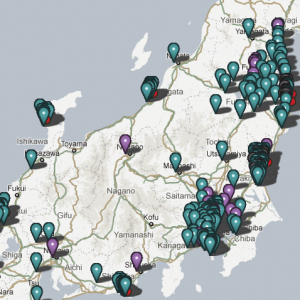
The specific “National Radiation Map” at RadiationNetwork.com aims at “depicting environmental radiation levels across the USA, updated in real-time every minute.”  They boast:  “This is the first web site where the average citizen (or anyone in the world) can see what radiation levels are anywhere in the USA at any time.”  As impressive are the numbers of reactors that dot the countryside, many concentrated on the US-Canadian border by the Great Lakes, as in Tennessee or by Lake Michigan.  Although a credible alert level is  100, it’s nice to think that each circle represents some guy with a Geiger counter, looking out for the greater good of his country.  The attraction of this DIY cartography of inserting measurements that are absent from your everyday Google Map or from the Weather Channel is clear:  self-reporting gives a picture of the true lay of the radioactive land, one could say.  This is a Jeffersonian individual responsibility of the citizen in the age of uploading one’s own GPS-determined measurements; rather than depending on surveying instruments, however, readings from one’s own counters are uploaded to the ether from coordinates that are geotagged for public consumption.

Of course, there’s little level of standard measurements here, as these are all self-reported based on different models and designs–they list the fifteen acceptable models on the site–in order to broadcast their own data-measurements or “raw radiation counts,” which makes the map of limited scientific reliability and few controls.  So while the literally home-made nature of the map has elements of a paranoid conspiracy–as most any map of nuclear reactors across the country would seem to–the juxtaposition of trefoil radiation hazard signs against the bucolic green backdrop oddly renders it charmingly neutral at the same time:  the reactors are less the point of the map than the radiations levels around them.

USA map radioactivity

But the subject that is mapped is anything but reassuring.  When we focus on one region, the density of self-reported sites gains a finer grain in the Northeast, we can see the concentration of hazard signs noting reactors clustering around larger inhabited areas, oddly, like the ring around New Jersey, just removed from New York, the nuclear reactors in the triangle of Tennessee and Virginia, or those outside of Chicago and in Iowa, and one sees a somewhat high reading near Harrisburg PA.  But it’s reassuring that a substantial number of folks were using their Geiger counters at that moment, and inputting data into this potentially useful but probably also potentially paranoid site.  I hope they do interview them beforehand, given the very divergent readings at some awfully proximate sites.

NortheastUS

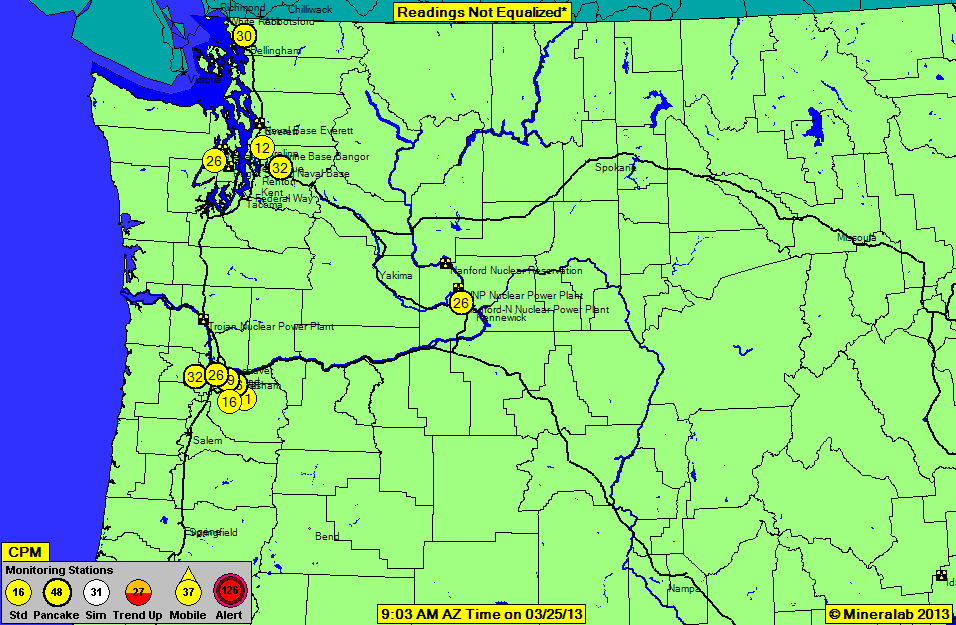
If we go to a similarly dense network on the West Coast, the folks at Mineralab offer a similar broad spread among those informants, and the odd location of so many reactors alongside rivers–no doubt using their waters for cooling, but posing potential risks of downriver contamination at the same time.

PacificNW

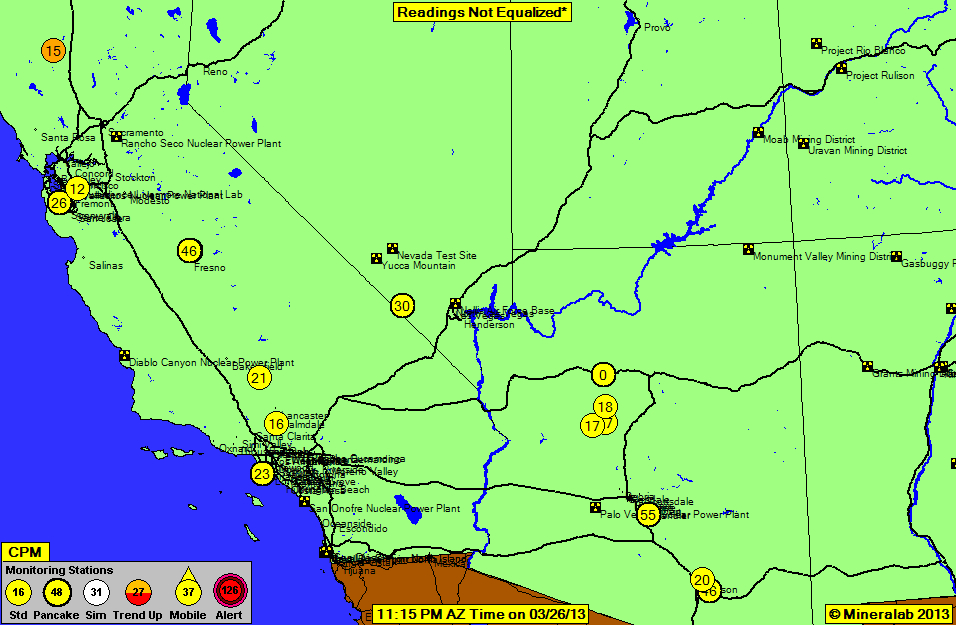
Although the view of Southern California is perhaps still more scary, and reminds us that the maps have not taken time to denote centers of population:

AmericanSW

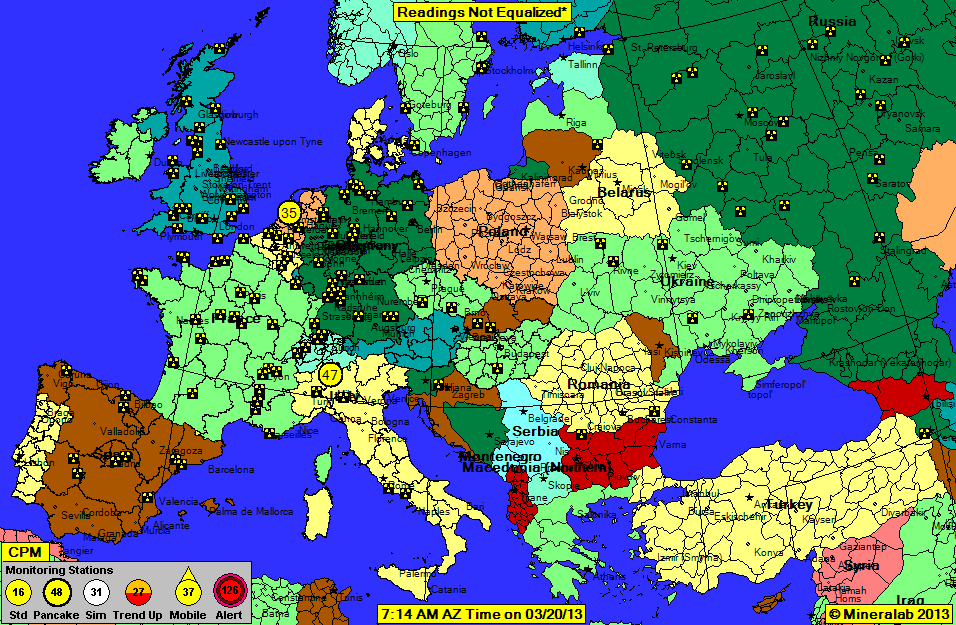
And there’s a charming globalism to this project. Things aren’t particularly worse off in the USA in terms of the reliance on reactors, if we go to Europe, where reporters are similarly standing vigilant with Geiger counters at the ready given the density of those familiar trefoil hazard signs in the local landscape:

Europe.jpg

The truly scary aspect of that map is the sheer distribution of reactors, no doubt, whose hazard signs that dot the countryside like scary windmills or danger signs.  And, just to put in perspective the recent tsunami that leaked radioactive waste and waters from the Fukushima reactor whose walls it breached, sending material waste and leaching radioactive waters to California’s shores, consider Japan.  An impressive range of reactors dot the countryside, and but one vigilant reporter in Sapporo notes the very low levels of radiation that reach his counter:

Japan.jpg

Withe a week after the March 11, 2011 earthquake hit Japan, the greatest to ever hit Japan, Safecast was born as a volunteer group dedicated to open-platform radiation monitoring in the country and worldwide; in addition to over 15880 dead in the Tsunami and quake, the tsunami caused level 7 meltdowns at three reactors in the Fukushima Daiichi Nuclear Power Plant complex, necessitating evacuating hundreds of thousands of residents, as at least three nuclear reactors exploded due to hydrogen gas that breached outer containment buildings after cooling system failure.   When residents were asked to evacuate who dwelled within a 20 km radius of the Fukushima Daiichi Nuclear Power Plant, the United States government urged American citizens evacuate who lived within a radius up to 80 km (50 mi) of the plant to evacuate.  This rose questions about the dispersal of radiation from the plant, and deeper questions arose about the safety of returning within a set zone, or the need to demarcate an no-entry zone around the closed plant.

The rapid measurement of radiation distributions not only gained wide demand but provided as of July 2012, Safecast includes some 3,500,000 data points that collect radiation levels, and provided a new mode of sharing information about dangerous levels of radiation.  In ways that capitalize on how the internet allows a massive amount of data to be uploaded from numerous points around the world, Safecast exploits a model of data-sharing on its open platform, offering different models to visualize their relation to each other:  Safecast allows the possibility to visualize the maps against a road-map, topographic map, and map of local population distributions, so that they can better understand their relation to the readings that they’ve collated on line.

The process of massing data is what makes Safecast such a pioneer in creating a large range of readings that can promise a more comprehensive picture of radiation distribution than the uneven distributions that isolated readers might allow.  The Safecast team hopes and promises to improve upon their readings by designing and promoting a new Geiger counter, and has made available the handy workhorse bGeigie, although the cost of $1000/apiece and the time-consuming nature of their assembly is a major obstacle they’re trying to confront. The smaller and handier Geigier Nano Kit creates a dandy device you can easily carry, affix to your car, and whose measurements are easily uploaded to the Safecast website:

IMG_7008

The DIY glee of presenting the tool to measure radiation levels with one’s own mini-Geiger is part of the excitement with which Safecast promises to provide a new map of Japan’s safely habitable land.  The excitement also derives from a belief in the possibility of “empowering” people to measure and compile data about their environments, rather than trust a map that is assembled by “experts” or official sources who have not been that forthcoming with data-measurements by themselves.  The above smile also reflects the vertiginous success of Safecast in distributing its bGeigei, and the boast to have amassed an open-sourced database for open access.

This seems the new key to revealing knowledge in the multiple visualizations that Safecast offers for viewers:  with the enthusiasm of great marketing, their website announces with some satisfaction: “attach it to your car and drive around collecting geo-tagged radiation data easily uploaded to Safecast via our API upload page.” This suggest a whole other idea of a road trip, or even of a vacation, in the multiple ‘road-maps’ that volunteers have uploaded for approval on the Safecast site, with over 10,000 data points deriving from bGeigei imports, that Safecast can readily convert to a map:

Tokyo traffic Safequest

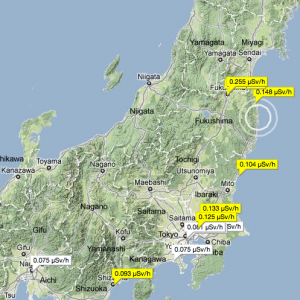
This is also quite serious stuff, taking crowd-sourced cartography to a new degree:  with some 4,000,000 radiation points detected by the Safecast team, the website is able to assemble a comprehensive map of relatively uniform readings, complimenting the sites of radioactivity assembled and culled by the Japanese government with their own independent data from an impressive range of aggregate feeds of environmental data from several NGOs and individual observers across Japan’s coast:

agg-300x300

The image of such aggregate data feeds allowed Yahoo! Japan to build their own map displaying the static sensor data of Safecast:

Yahoo Japan feeds

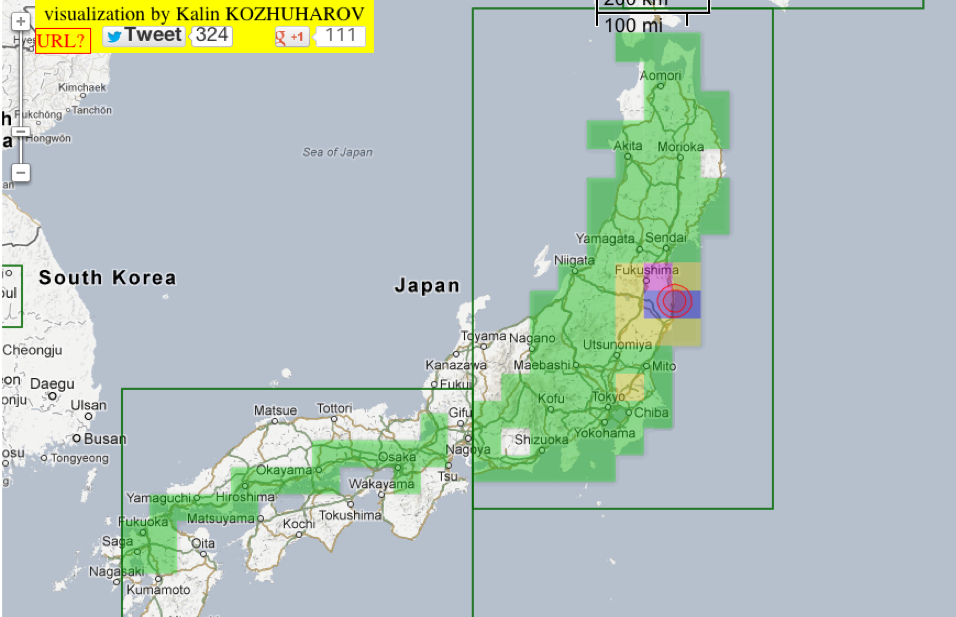
Kailin Kozhuharov has created a detailed map to visualize the distribution of radiation levels in the island through the Safecast database:

 Kozhuharov Visualization of Radiation Levels

The coverage is truly impressive, and multiplication of data points technically unlimited and potentially comprehensive. While divergent readings may be entered every so often as a Geiger counter wears down or malfunctions, controls are built into the system. An example of the coverage in Japan, again the focus of mapping radioactivity in the wake of the recent Fukushima disaster, where Safecast is based, using locally obtained data once again:

Safecast Japan

The widespread appeal of this device, even more than the Radiation Network, reveals the widespread nature of a belief or suspicion–no doubt with some grounds or justification–that a true map of the dangers or levels of radiation is in fact never already provided or available to citizens, and that the failure of governments of communicating an accurate mapping of radiation demands a privatized response.  And with its partnership with Keio University, developed after Fukushima, Safeguard has developed the “Scanning the Earth” (STE) project that maps the historical data of radiation readings across the globe.  With the Fukushima prefecture, Safecast has also issued a comprehensive global mapping of the dispersal of high levels of radioaction from Fukushima from its own massive database to chart the impact of the environmental disaster over time:

Fukushima Prefecture World Map

Although this map reflect the ties to the MIT Media Lab, it is informed by a dramatically new local awareness of the importance to create a map flexible enough to incorporated locally uploaded data measurements for open access.  It is also a great example of how an event can create, provoke, or help to generate a new sense of how maps can process the relation of local phenomenon to the global in a variety of readily viewable formats.  The demand for creating this world map clearly proceeded from the local event of the 2011 Tsunami, Safecast was at a position to observe the importance of maintaining an open-sourced database (now including some 2,500,000 readings) that offer an unprecedented basis for developing a platform of data-sharing that is readily available online.  In working with the same databases, they also offer some cool visualizations of the data that they collect to illustrate differentials radiation levels in readable ways linked to potential dangers to individual health:

Fukushima?  Safecast

The new facility that the internet has created in the ability to upload, share, and compile information from diverse and multiple sites without considerable costs has meant so lowered the cost of collaboration that it can occur without any reference or dependence on a central governmental authority. This has allowed the compilation of an immense amount of simultaneous data to be regularly uploaded and stored with almost no extra cost from a group of volunteers and to be available in transparent ways on an open-access platform.  (Late in updating this post, I came across an earlier PBS NewsHour episode on Safecast’s interest in data-collection in the wake of the disaster, and the demand of local residents in Japan for further data, given the silence of official government sources on the disaster and its dangers:

(The episode offers great data on using Geiger counters to detect radiation levels at multiple sites near the exclusion zone that rings the reactor, including a restaurant parking lot.)

The means for offering locally contributions to a world map of radiation level distributions reveal an expanded ability to share information in a map the relation of place to environmental disasters.  Indeed, the map itself foregrounds new graphical forms of information-sharing.  There are clear problems with the Safecast model that Japan, in fact, is likely to be an exception to:  Japan was a place providing access to large numbers of its population already in 2003, offering free wi-fi in trains, airports, and cafés or tea houses.  In comparison, the far more limited numbers of the population have access to wi-fi or online resources in rural American towns, or even in urban areas, would make access questions less possible in the United States, where a similar movement has failed to expand not only because of the lack of a disaster of similar proportions.  There is the danger that the “freedom of information” they champion is in the end not as openly accessible as one would wish:  if roughly one quarter of hotspots worldwide are in the United States, it shared with China and Italy the lowest number of hotspots per person, at lower than 3 per person as of 2007, while Japan had nearly 30 million 3G connections.  This creates a significant obstacle to the expansion of the internet as a universal access service outside urban areas with municipal wireless networks, despite the significant plans to expand internet access on interstates.  Despite plans to expand free service zones in Asia, Canada, and parts of the Americas, the broadcasting of regional variations in a natural disaster would be limited.

There may be something oddly scary that Safecast has had its own corporate profile and successful Kickstarter campaign, marking the privatization of the sort of public traditions of cartography formerly undertaken by states for their own populations to devolve to the private sphere.  For whereas we have in the past treated cartographical records as an accepted public good, there is limited acceptance of accessible data collection and synthesis.  As a result, one seems more dependent on the active participation in one’s construction of a more accurate of radiation levels, or upon a network of vigilant vigilante cartographers who can upload data from wi-fi zones.  Is there the risk of a disenfranchisement of a larger population, or is data-sharing the best available option?

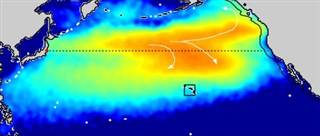
An alternative model for mapping radiation might be proposed in the compelling map of the oceanic travel of radiation (probably in contaminated waters, but also in physical debris) that has been suggested by vividly compelling cartographical simulations of the dispersal of the long-term dispersal of Cesium 137 (137CS) from waters surrounding the Fukushima reactor.  Although the map is indeed terrifyingly compelling, in relying only on oceanic currents to trace the slow-decaying tracer across the Pacific, the video map seems to arrogate capacities of measuring the dispersal over the next ten years of radioactive material in ocean waters with a degree of empiricism that it does not in fact have.  How ethical is that?

http://bcove.me/cp9fol2w

For all the beauty of the color-spectrum map of a plume of radiation expanding across ocean waters–and the value of its rhetorical impact of strikingly linking us directly to the reactor’s meltdown–its projected charting of the plume of contaminated waters due to reach the waters of the United States during 2014, if normal currents continue, is far less accurate or communicative than it would seem.  To be sure, as the Principal Investigator and oceanographer Vincent Rossi, a post-doctoral researcher at the Institute for Cross-Disciplinary Physics and Complex Systems in Spain, “In 20 years’ time, we could go out, grab measurements everywhere in the Pacific and compare them to our model.”  But for now, this expanding miasma offers an eery reminder of the threat of widespread circulation of radioactive materials worldwide.

8C8811758-130831-science-fuku-1025a.blocks_desktop_small

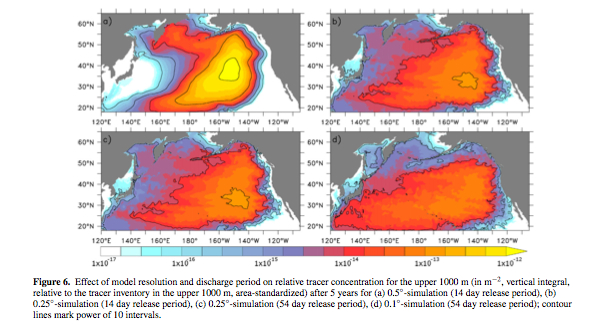
Indeed, the charts that project the spread of radiation over a period of five years, benefitting from the power of computer simulations to map by tracer images the diffusion of radioactive discharge along clear contour lines in the Atlantic, provide a compelling chart of how we might want to look and measure the levels of radioactivity in our national waters.

tracer image of radiation from Fukushima

2 Comments

Filed under data visualization, disaster maps, environmental radiation, Fukushima, radiation maps

The Way We Eat Now: the City and the Farms

The impacts of radical over-specialization of agricultural lands in the United States on our food supplies is only beginning to be mapped with the critical eye that it deserves.  With the intense expansion of ‘mega-farms’ jumping some 20% just in the years 2005-7, their expansion of subsidies, and an intensification of the quarter of vegetable production for animal feed, the notion of agricultural stewardship has been replaced by an artificial market and explosion of selective crops.  Is the notion of an agrarian space indeed itself a casualty of this new use of farming in a land of the death of the family farm?  Is this the end of an ideal of cultivable space, or does it push us to seek to imagine a new relation to the land?  It is indeed striking that until fairly recently, the ancient term ecumene or oikumene described the inhabited (or inhabitable) world with reference to those lands able to be used for agriculture or pasturage. 

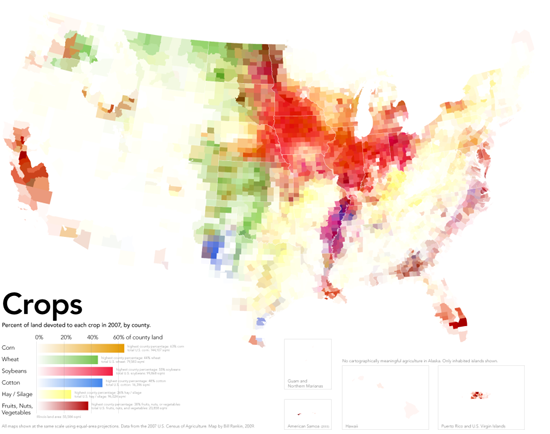
The extreme “specialization of the agrarian landscape” William Rankin recently mapped offers visualization of data from the 2007 Census of US Agriculture:  the maps charts variations in crops and animal pasturage in each county of the country, each of which are colored by the gradations of four to five major crops or farmed livestock in the United States.   The selectivity of farmland use it reveals captures the effects of this expansion and maps the consequence of that dramatic expansion of mega-farming in the Bush presidency of those years, in response to selective subsidies of corn and soy:   the color-coding of individual crops provide a snapshot of the proportion of land devoted to each subsidized crop (soy; wheat; corn; cotton; vegetables and fruits or nuts) that  raise to raise big questions about our limited foodscape and suggest the degree to which farm subsidies inform land-use in desirable ways.

Even more striking than the limited regions of land used for farming in Rankin’s data visualization is the creation of the zones of land dedicated to wheat, soybeans, silage and corn that rarely if at all overlap, where over 50% of county land is dedicated to soy, a solid 40+% is dedicated to wheat, or over 60% to corn.  This is not only a map of agrarian distributions, but a the creation of a new attitude to agricultural space:  indeed, Rankin’s map helps us see the distribution of croplands in the country less as something that occurs on a flat surface, but in itself creates a new familiarity with space, and a relation of our food supplies to space, as much as a form of “geographic” knowledge of how events occur on the map.  For the sequence of maps chart a shift in the American foodscape, where we revise how we imagine agricultural space, and as creating a new notion of our agrarian space, rather than as changes that can be mapped or occur on the two-dimensional distribution of mapped space.

Rankin’s set of three maps of the national foodscape are not historical per se, but suggest a metageographical narrative of how attitudes to land have changed in their spectrum of such scattered colors.  They chart an extraordinary degree of remove from local intake, distribution or demand.  The distortion in this agrarian landscape is of course enabled by a huge transport industry, moving the wheat grown in the central band of the US from Iowa or Nebraska to Oklahoma, corn from Wisconsin to Iowa, to the soybeans so densely grown across South Dakota and Iowa to Indiana and Ohio.  Although continuity and coherence as the central properties of terrestrial maps, an absence of continuity in the concentrations of crop cultivation suggest a skewed relation to the land–the maps undermine the very notions of continuity and coherence that defined maps of national territories–using maps to raise questions about food supplies.  All the silage in across the Eastern seaboard in the country seems to derive from the local profitability of livestock products, show a nation almost drained of agricultural productivity, and relocates fruits and vegetables to ribbons on both coasts.

The consequent de-coupling of food markets from growing habits inverts Thomas Jefferson’s ideal of a yeoman farmer who planted crops for his own needs, out of the conviction that those “who labor in the earth are the chosen people by God.”  The Jeffersonian ideal of stewardship,rooted in a contractual relation of a responsible servicing of the land, rested on “good practices” of land management through rational skills of crop rotation, terracing to prevent soil erosion, promoting the diversification of varied crops, and surveying of land, from advocating a regular seven-year cycle of regular crop rotation that follow corn and wheat with a variety of crops, including turnips, clover, vetch and buckwheat.  He pioneered innovations that would increase the conservation of resources as well as crop yeild, including deep contour plowing, turning the ground far beneath the topsoil, and terracing to prevent soil erosion.  And his quest for variety and diversity for the agriculturalist no doubt encouraged him to introduce eggplants, brussels sprouts, rice, chestnuts, cauliflower, nuts and olive plants to the country–Jefferson imported 170 different fruits and 330 vegetables in the period from 1767 to 1824 to diversify the nation’s agriculture.  Jefferson was vigilant in advocacy of agricultural stewardship and famously wrote Washington with dismay in 1793 that “we can buy an acre of new land cheaper than we can manure an old one.”

William Rankin’s three data visualizations map the remove of what we eat from where we grow, or where we grow and what food we buy, suggests the imposition of an artificial remove of growing and husbandry from urban life–creating a gap between the country and the city so great that we cannot say where the country is.  In mapping the geographical remove of crops from cities–and of cultivation and animal husbandry from centers of population, Rankin has charted the results of a dysfunctional division of land-use, in which the map transforms the territory, and almost precedes it, as the areas zoned for harvesting by agribusiness divorce local needs of populations from the large-scale farming and animal husbandry, not only fostering a lack of a uniform food-harvesting mosaic, but a super-regional specialization, as this map of the crops that are grown in individual counties reveal:  the disorienting nature of individual to food, and individual to agriculture, that results removes the production of crops from local demand or a topography of need.  Indeed, there seems little clear integration of the sites of growing vegetables or crops to a national market in local terms, as questions of national demand and pricing drive the redistribution of crops into what seem “hot-spots” of production, whose intensity of cultivation tries to keep up with the national need with an intensity that their concentration is unable to effectively sustain in the future.

The pronounced discontinuities in the maps of food specialization reveal a deep disconnect between food production and consumption, and the limited understanding of how reliant we’ve become on an unequally pronounced distribution of such basic needs as growing crops or raising chickens.
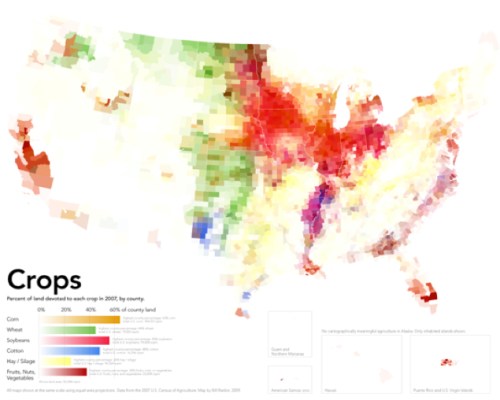
Rankin's Map of Crops

In this map, Jefferson seems to meet Baudrillard:  the maps does not simulate a world of rending to the land with clear coherence, uniformity, or indeed boundaries, but visualizes a range of databases that reveal the imbalance by which we try to create the illusion of a land of plenty in an era of few farms.  This map undermines the security of a healthy nation, beyond reconsidering the pathways or quality of food, to force one to ask how the foodstuffs produced in these spaces could be high quality.  Reading the map will salutarily ward of any temptation to naturalize this self-evidently artificial division of land-use, or naturalize the imbalances of select crops in regions– the six colors used in the map are, indeed, almost always distinct from one another in the above map charting variations in degrees of crop specialization.  The map is a  metadata visualization, and absence of any attention to continuity in the agrarian structuring of the land, disrupts the continuity of the iconic image of the map.

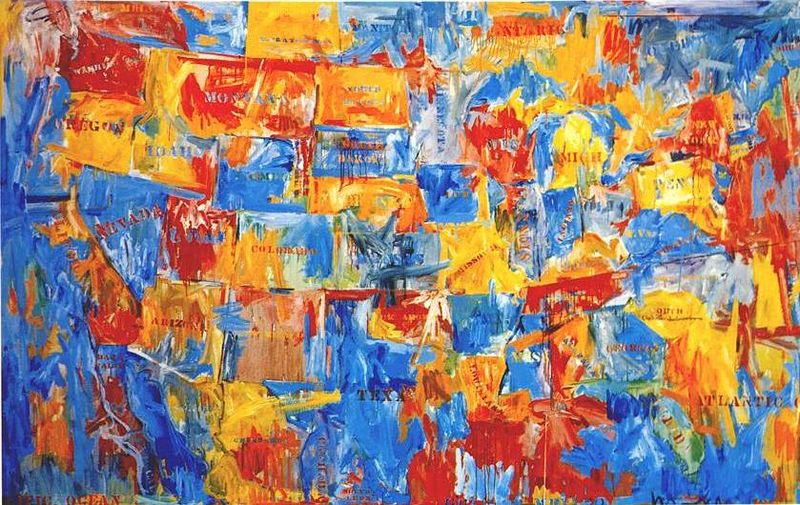
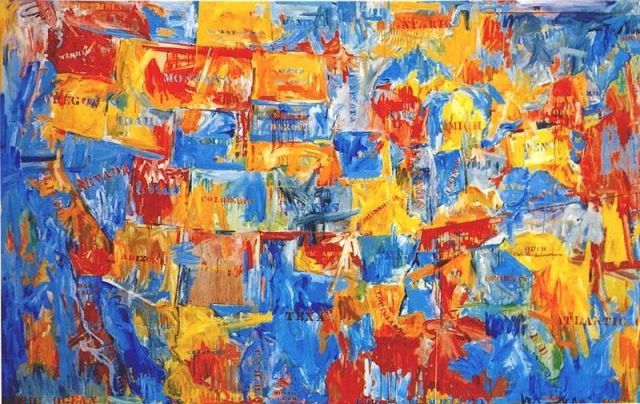
Like Jasper Johns’ 1961 Map, which re-inscribes the encaustic splattering of primary colors that distance the map from its iconic status:  the surface of Rankin’s maps distance observers from the nation, rendering unrecognizable the form of the territory, abstracting the surface of the map by revealing an uneven uniformity instead of a united whole and focussing attention on the unwarranted density of selective agricultural concentration on specific crops.
800px-Jasper_Johns's_'Map',_1961

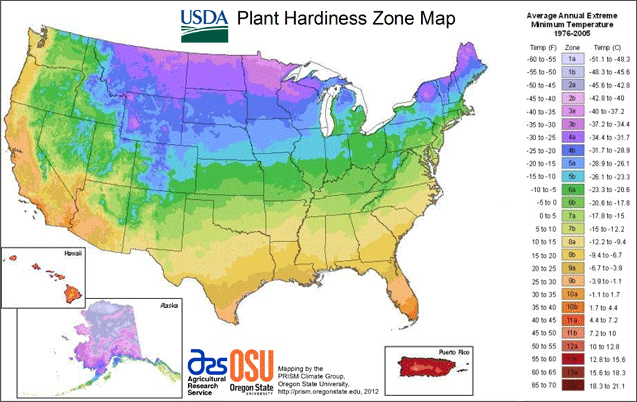
If maps don’t define and distinguish national sovereignty, but are a range of widely diffused simulations, we need an actively deconstructive map to assemble our disjointed foodscapes.  The dramatic isolation of foci of planting of wheat, soy, and three intense pockets of cotton, the absence of vegetables from most crops across the nation is a reminder of the separation of how we inhabit the nation from agrarian land-use:  citizenship is disconnected from stewardship, or the illusion of stewardship is no longer possible to perpetuate in relation to the land that no longer exists as a coherent territorial entity.  The remove of crops from local use, and the injection of subsidies to promote specific crops in Midwestern states, but also in the Northwest and South, created intense pockets of over-intensification that with the growth of megafarms has produced, despite the temperate nature of the continent.

2012-hardiness-zone-map

Perhaps these distortions of agrarian landscapes is an effect of the markets being driven by international prices, or if a radical specialization is striking for its remove from what we eat, even if not all have heads of leafy lettuce and arugula salads on their tables:  crops like wheat and soy are farmed in mass in select places for massive milling and repackaging; local food needs are met by importing across the nation, if not scattered boutique farms or “farmers’ markets” that are not run by farmers but franchised, or run by men who drive hundreds of miles with diesel gas in order to perpetuate the illusion of a close relation to the fruits of the land to folks living on asphalt pavement and tar.  We use food to create our own illusions, drawing from mythologies of agrarian responsibility that history provides.

Thomas Jefferson rooted democracy in the relation of the citizen-farmer and his land, metaphorically equating that relation to the fabric of the nation:  “the greatest service rendered any country is to add a useful plant to its culture,” he argued, equating individual agricultural stewardship as a “service to the nation” that is “worth more to them than all the victories of all the most splendid pages of their histories.”   When Jefferson preached the gospel of the agriculturalist, farmers were central to a nation’s needs both for feeding the nation and as stewards of the nation’s agrarian wealth, rather than white-color workers or professionals.  And so he valued agriculturalists’ expertise in crop rotation, fertilizers, and agronomy as remedies to the perils of land-abuse and erosion of lands, and located the preservation of the wealth in the countryside and the value of good, arable land.  The concern that led Jefferson to increase the diversification of vegetables as fundamental to the nation’s health led the horticulturist Luther Burbank in the early twentieth century to perfect crops able to sustain disease and blight, by hybridizing fruits, vegetables, and legumes by cross-pollination in strains of increased tolerance–if not genetic diversity.

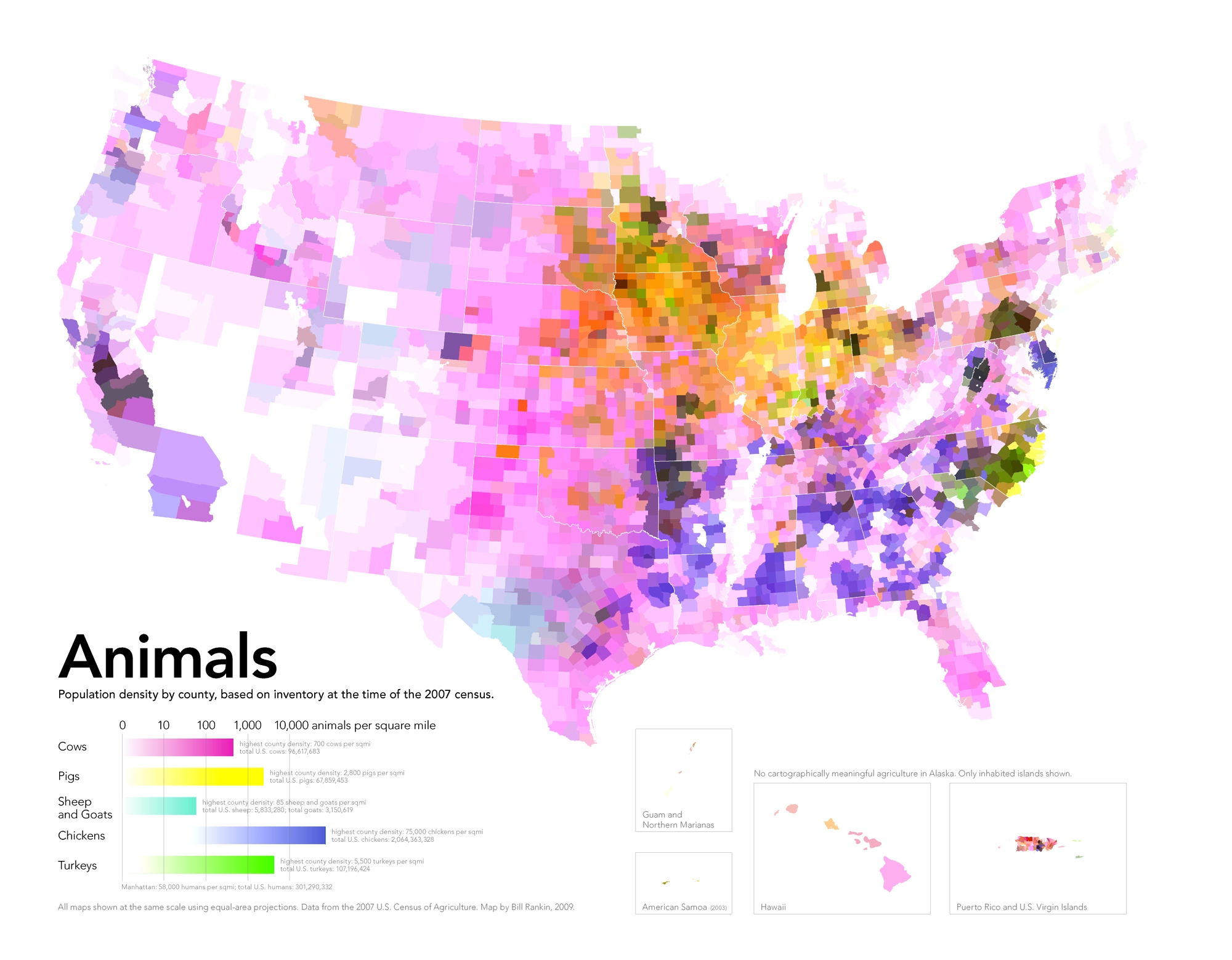
When Burbank redefined performance of crops by their productivity and survival rates, he redefined plants and vegetables as a malleable resource subservient to man, though without encouraging an over-specialization similar to what we see in today’s foodscape.  Burbank’s shift in the significance of the vegetable in the world underlies, in some fashion, the metageography of the current over-specialization spatial distribution of crops Rankin maps, as it removed proximity of the place of cultivation from the growing of crops, and removed crops from the local market place.  Rankin’s beautifully detailed land-use maps chart the radically uneven nature of the specialization of our agrarian landscape’s distinct fracture lines.  To judge by the deep pockets of specialization in Rankin’s maps by the variations in anima populations in individual counties, the thinning of farms extends not only over the deserts, but across most populated regions.  This over-mapping of different types of husbandry reveals a virtual segregation of chicken, sheep, and cattle, with other areas left curiously blank, in need as much of importing foodstuffs across county lines, despite the thin distribution of cows for pasture, and a large welling across the midwest and southern Eastern seaboard of pigs.

The image suggests a set of deep imbalances and a surprising disconnect between areas and a patchwork redistricting to meet and accommodate national demand in specific regions.  The thin distributions of light violet colors conceals pockets of intense specialization with a clustering of pigs and turkeys, but suggests the extremely rare grouping of a variety of meats by mapping the ranges of density in practices of animal husbandry across the nation.

animals2007_medTogether with other maps which were solicited and edited by Darin Jensen in FOOD: An Atlas, a project broadly discussed in two earlier blogposts, Rankin’s metageography is oriented to imagining relations between food and the land.  The maps discussed in earlier blogs were data visualizations, and less informed by GIS, and bore the trace of the cartographer’s hand.  But this map is in no ways removed from being an intervention on cartography as an art, if it is based on “big data” as a structural metadata visualization of variations in local databases.

The data distribution of crops, animal livestock, and the profits of farming registered in the Census of Agriculture reveals not only strikingly constrained areas for active agriculture, but the geographic remove at which farming stands from food needs.  It presents  a clear-eyed critical view of the benefits of locally sourcing food by inviting us to shift our relation to the currently lopsided nature of national practices of cultivated space, but also suggests the distorted nature of food map created by the limited intense cultivation of crops and husbandry of animals in select areas.  I’m interested in both the maps and the questions of human geography that the distribution of food in them raises:   during the growth of agribusiness and consequent pronounced localization of livestock, slaughterhouses, and tending of animals, and map an increased remove from the sources of our food.  With a lack of available local food, indeed, food is not only less nutritious, but removed from place in the manner that Jefferson had insisted.  In such a landscape of specialization, “No major city could ever source all of its food from local farms–not even those close to major agricultural areas.”  Not only are few farms profitable, but those areas farmed are farmed with an intensity of agribusinesses more market-driven than linked to local economies.

Indeed, the apparently unprecedented concentration of mono-crops–wheat and soybeans; corn; cotton–creates a disjointed landscape both removed from local needs and plugged into a national (and international) market and in which much feed goes to livestock–though, as we’ll see, in which livestock is not so profitable.  This maps reflect on the consequences of how constrained farmlands shape a collective geography that leaves consumption curiously disconnected from production, which faces markets that the individual farmer cannot understand, and indeed are more subject to international prices and agricultural protectionism than to actual needs.  The regional saturation of essentially businesses of food production reflects not only a death of local agrarian farms, but the impossibility of local crop variation in a landscape of regional concentration for foreign markets, animal feed, and available land.

These attitudes might change, if we accept how Rankin’s radical cartographies reveal the narrow divisions we’ve imposed on our agrarian landscape.  But they delineate deep challenges of our national foodscape from even Burbank’s era of a range of resistant potatoes, peas, corn, and various pitted-fruits, including plums.  No longer does agricultural needs of a territory shape the contents of the foodscape, and maps lose their reference to a fixed territory, but map a disconnect:  Baudrillard would note that the notion of a territory does not in fact survive the map.  The map might suggests some links between our distorted agrarian landscape to the political landscape, and not only in the government subsidies that many crops receive to grow at a distance from urban populations, or the diversion of water to allows intense crop cultivation of regions like the central valley.  From a nation of farmer-citizens in a Jeffersonian mold, our “red” v. “blue” state electoral topography may mask deeply market-driven divisions in agrarian resources.

The data visualizations suggests the little attention we dedicated as a society to the role of land to food, or to the path from farm to table; the intense cultivation of crops, vegetables, and pastured meat to restricted pockets of the country practically ensures the remove of our food from a provenance or site of origin.  Rankin’s maps provoke us to map our own individual relations to the origins of our food, and trace their path back from sites of cultivation to our tables.  His maps delineate the broader challenges of our national foodscape;  maps may enjoy limited authority or exclusive purchase to represent or contain such abstractions as the nation, state, or nationality, but provide a way to disrupt a world of simulations, where the territory does not precede the map.  Jean Baudrillard famously asked pointedly whether the nation’s authority can survive that of the map:  the coherence of the United States as a food-producing nation can’t easily functionally survive the unsustainable practices agribusiness has dictated, even if the market can sustain it for now.

The objective disassembly of a national space raises questions of the compatibility of current practices of land use are even compatible with a national space.  Indeed, rather than map the relation of food to population, one could argue that the map mirrors one of uneven agricultural subsidies, as much as food demand or land cost, and illustrates the bloated landscape those subsidies are creating in place of agricutlural variety:

indemnity by county

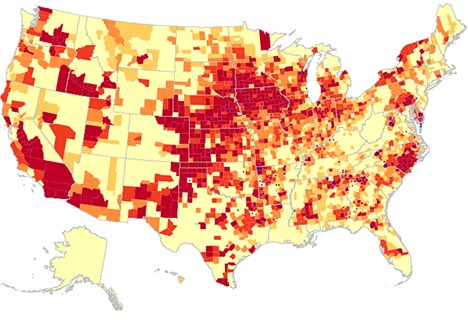
This can also be illustrated in relation to animal husbandry by mapping the local density of factory farms across the nation:
20101202-factory-farms-US

Rankin’s maps are of land-use reveal the effects of such subsidies for large farms in their “disjointed and lumpy space[s] of specialization;” they reveal a surface of farming where “few areas where different commodities are grown side by side” and radical concentration of cattle and livestock in specific areas, despite their thin distribution in the country as a whole.  The rather lopsided topography of sourcing meat and centering husbandry in massive compound farms suggests a sort of anonymity of their origins, less than healthy and less than nutritious, and suggests a mental familiarity with erasing the origin of foods, rather than considering the relation of food as a “good.”  The economic intense over-specialization to some extent ensures the virtual anonymity of  paths most foods take from where they grow to the table or the supermarket aisle.  This notion of food whose path from farm to table is devoid of specificity raises questions about as knowledge of the ability to distinguish food, as well as how its freshness is radically reduced in a system reliant upon quick transport. 

As agribusiness replaces the good household practices of individual agriculturalist moving foods from limited sectors of over-cultivation, subsidies define circumscribed areas of crops and animals–here mapped by the specialization of crops or the density of livestock in each county–and limit their profitability.  With the exception of some crops in the Midwest located near to cities or towns, in fact, a radical concentration of agriculture removes the individual’s dining room table from growing practices. Take, for example, the location of soybeans, marked by red, in some regions of the Midwest, that define a relation to the commodity outside the food that is actually consumed:

red crops--tghe sites of soy

The dramatic disruption between farms to urban foods and divide between local food-supplies and consumers to reveal a deep shift in our connection to the land.

While fundamentally data constructions, these maps give new sense to the materiality of the map, by providing a visualization not of expanse but suggesting some of the ill-effects of our own division of land-use.  Lest we naturalize the divisions created by this specialization of land-use, they map the stark divisions of  the origins of the food we eat poses compelling (and pressing) questions about the best way we might provide nutritious food to urban populations, and if we can economically sustain the current landscape of intense specialization of agricultural work.  One irony of this division of the agrarian functions is the illusion we are  healthy to invest one or two crops to one expansive region.  Indeed, this illusion masks dangers in segregating crops in the landscape and a fracturing of our relation to our food.  The widespread naturalization of one state or region as the center of corn or wheat, potatoes, vegetables, nuts, or cheese conceals an implicit consent to the current culture of specialization has segregated the production of meats, wheat, corn, cotton or grains in only place, in ways that effectively naturalize an impoverished practice of agricultural rotation:  by imagining certain states as lands of corn, wheat, or soy–as if crops were indigenous to a landscape–that erases the natural variety of an ecosystem by rendering it unrecognizable.

No clear sense of a landscape that provides nourishment for the nation remains, as agricultural “space” is itself dismantled as a uniform concept in relation to the nation.  Rankin’s cartographies map the extreme variations in the dedication of land to the intense cultivation of foods, plant and animal, and we might re-examine the silent segregation of an agrarian landscape through its consequent perils.  The database from the USDA that he has used reveal a concentration on crop monocultures and an agrarian centralization, à la Charles Taylor, of crop production.  Hopefully, we can use them to take stock of whether this is healthiest way to feed our cities and urban populations–to segregate or actually remove most cropland from sites of urban population.  As agribusinesses have concentrated the cultivation of wheat in a band in the central states stretching in regions colored bright green,  corn and soybeans in the yellow and red northern midwest, and fruits and nuts, the result is an increase in the remove from which our cities are nourished.  Populations stand at a remove not only from the sources of food, but of the most nutritious choices of food.

The high degree of scary fragmentation of US agriculture reveals a heightened specialization of food-sources between corn, wheat, soy, and nuts or vegetables.  The isolation of pockets of food production reveal an intensity of artificial over-specialization often removed from a national demand:   the segregation of centers dedicated to agricultural production from centers of urban life suggests a divide between city and farm.  Even more significantly, perhaps, than the divide mapped in electoral-map chloropleths between ‘red’ and ‘blue’ states, the severely localized distribution of crops maps a huge divide in expectations among Americans for freshly grown food possible of being sustained, and to the landscape of food-availability; while the food landscape cannot provide a deterministic explanation of party affiliation or patterns of registration, the distribution may map populations’ selective distribution in areas with greater access to locally grown food supplies–or their resistance to the  remove and distance from crops and an agrarian economy.

That is no doubt perhaps overly optimistic, given the huge role of agribusiness in structuring the landscape of food use, together with the subsidies of foods that they receive:  the monocrop concentration of corn, wheat or soybeans is conducive to bulk harvesting for sugars or bread, and shipping, if not to their redistribution from select centers of packaging.
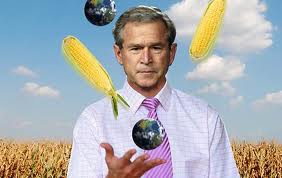
Unknown

But the sad (unhealthy) result is a remove of most populations, or at least huge proportions of them, from the sources of their food. The existence of such a selective resettlement is less clear than the dysfunctional image it suggests of a fractured relation to the agrarian landscape about which it’s hard to wax poetic.  The rare concentration of fruits, nuts and vegetables in California, densest in the Central Valley and farmlands of Northern California, are the only dense areas of their dense cultivation, save Southern Florida, based less on climate or topography than on their remove from coastal cities, and seem to provide the only dense region of vegetable harvesting in much of the nation.

What does this tell us about the state of California?

How can one imagine this disjuncture of agrarian space from the national space?  The classical poet Virgil idealized the relation of Rome to its landscape and countryside in the era of Augustus, providing a topos of the idealization of landscape’s tranquility as the result of harmonious good government.  And it’s helpful to cite Virgil’s praise of the wealth of agrarian diversity in the Italian peninsula, too, because they provided a model of the metaphorical cultivation of a proto-national space.  When one looks at Rankin’s weird maps of a disrupted foodscape, where over half the country is without crops and blank whitespace; they’re as removed from Virgil’s bucolic agrarian ideal as they are from Jefferson’s–indeed, those two are far closer to one another than we can see in how we’ve divided the nation into zones of soybeans, silage, and wheat that only occasionally overlap.  There’s a huge contrast the dissonances in the food landscapes that Rankin mapped above to Virgil’s famous encomia of the productivity of the Italic landscape in his Augustan Georgics, where he evoked the transformation of a rocky Italic landscape through the benefit of Senatorial edicts and decrees to a land of “abundantly growing crops” and “sacred home of the olive groves,” now dotted with “many wondrous cities,/That so much toil has built” whose crops were “abundantly rich;”  the land, tended by the best techniques of animal husbandry and of agricultural practices, provided the ground to cultivate wheat, barley, spelt and vetch in alteration with Egyptian lentils “in accordance with the Gods.”

That bucolic image of the productivity of the land that is fostered by Senatorial decrees and oversight of a diverse but homogenous space stand in sharp contrast to the segmentation of pockets of subsidized divisions in an agrarian landscape subject to intense monocultivation that is to large extent both largely sponsored by agribusiness, and largely removed urban areas or demand.  Tending the Italic landscape drove wealth to the “tot egregias urbes,” so remarkably diverse and bountiful, of the recently united peninsula Augustus ruled–and whose relative riches outshone any other region in the world.  The current landscape of specialization has so narrowly concentrated to focus agrarian productivity into scattered agrarian blocks of a zoned farming industry that dramatically disconnected itself from urban areas–and reveals a disconnect of city and farm so stark one could scarcely imagine a tie between the two.

Agrarian diversity?  Well, the new space is just complicated to manage or understand.  We know it’s unwise to concentrate corn and wheat in one area with soybeans, as if they were a large monocrop, because this exposes them to disease; the concentration of fruit and nuts in pockets of the entire country is even more irrational.  The placement of production of crops at a remove from populations produces less nutritious food, and generates more waste.  Equally difficult to sustain is the containment concentrations of livestock animals in select pockets of beef for slaughter, whose concentration is likewise removed from areas of urban concentration.  Despite small areas of cows lightly scattered for use in pasture for milking across most of the country, concentrated centers of butchery define the country’s food map.  Something like one-third of arable crops are given to land animals, but the segregation of high-density livestock farming from local agriculture suggest a challenging foodscape which might be considered more creatively, even if there is never much animal harvesting in the desert:

Drive down Highway 5 to Los Angeles past centers of slaughter and beef production.  The extreme variation is stunning when one approaches the cattle farms in California’s Central Valley, and even more scary is how characteristic this is in our agrarian landscape, rather than an  extreme fragmentation of land-use for livestock:
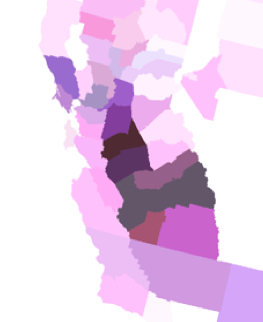
Califronia Animal Density

Consider the localization of livestock in deep purple gradations in Rankin’s  chlorpleth reveal a national segregation of zones of butchery limiting availability of freshly butchered meat:

Central Valley animal production

What does this say about our relation to space?  Let’s look at the crazy topography of intense pockets of “cattle compounds” and “chicken farming” that might not be called husbandry which make a broad mosaic of meat processing centers in the poorer counties of the American South:

American South

This snippet is barely recognizable as a map, of course, or a record of space. Remember the pretty staggering numbers that the deep purples reveal in this key:

Animals-Legend

Mass-farming of course unprecedentedly removes food from its consumer, and removes the very idea that this need not be the case.  The inhumanity of concentrating chickens in the Southern United States is one concern; the remove of chicken farms from urban areas or human consumption is poignant: it finds counterparts in the chicken-farms of the Central Valley and Imperial Valley in California, which are something like a hub in the West Coast save from those in the northwest.  But at their highest points of concentration, we have managed to concentrate an amazing 70,000/sq mile.  (Cattle are densest in the Midwest, where we find 700 cows/sq mile at the densest parts; fewer turkeys are raised, but the greatest concentrations of 5,500/sq mile seems downright unhealthy.)   Leaving aside ethical morality, the map posits questions of food safety:  intense centralization of animals and consequently of feed supplies increase risks of contamination as well as exposing them to greater threats of disease.  With the trends to global warming, the dangers of locating agriculture in fixed areas of intense over-cultivation are even more pronounced.

Such data visualizations offer a database which easily slips from the eye.  While these maps don’t overlap, they suggest a joint-access data visualization that might offer a useful planning device.  They reveal mono-crop cultivation and intense concentration of the value of animal or agricultural products that impoverish the project of agriculture in much of the country and seem to reduce the value of either crops or the production of animal products in most US counties in the absence of their intensification.  More striking, perhaps, is the small degree which farming maps to value across the entire nation, uniting both animal and vegetable products, and the huge wholes of agricultural profitability in over one-third of the nation.  We supplement these gaps through the massive importation of foods, vegetables, and produced foods.  But the fact that it is rare for vegetable-growing to bring in a profit through most of the northeast suggests a topography of agriculture that few wold suspect; the profits are limited to the rich green areas dominated by the crops of soybeans and corn, as well as wheat, that are similarly scarily removed from many population centers. Despite the comforting green that leeches down the path of the Mississippi River, ; meat seems only profitable in Oklahoma and parts of the old South, sites of large concentrations of cattle- and chicken-farming.
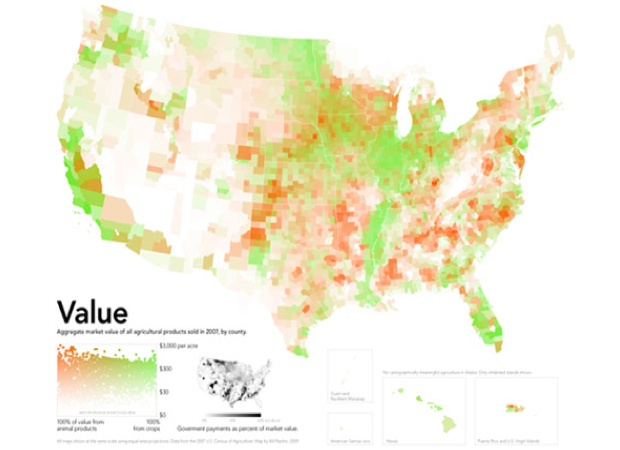
Agricultural Value Map.rankin

The washed-out nature of large areas of this map suggests the low aggregate market value of product made in those regions; there is a surprising density in few counties where animal products provide profitable earnings.  This is, to be sure, but one sector of the economy; but it maps an important one:  the divides Rankin maps not only poses questions of how we see our land, or use resources but of how we imagine the remove of farmed land to a vital urban space–and indeed how economically removed agrarian practices have become from urban consumers across most of America.
crops2007
The lopsided  geography of land value creates an uneven distribution we all tacitly know but don’t acknowledge.  It is also a basis of land-use that is not economically sustainable.  One take away from Rankin’s series of visualizations of the discrepant distribution of agriculture is that at a time when we dedicate increasing attention to the construction and planning of urban space, rural agriculture might be better planned in concert with urban concentrations, and not only for reasons of health but as a matter of public policy.  We often need a map to reveal the artificial nature of what we naturalize.  All three data visualizations suggest that we’ve left agriculture to market forces alone, in ways that might not plan for future development; imagine the maps as overlapping public access databases we might use to orient ourselves not only to space, but to a more sustainable relation to the agrarian use of the land.  The needs for such a shift in orientation are not only for health, but economic:  it’s not possible to prognosticate from a map, but we can use the visualizations to raise questions about what would be the effects of climate change on districting agricultural land-use to specific sectors and types of crops;  the concentration of corn strains in one area, moreover, raises possibilities of adverse influences in the food chain of GMO strains, much as the concentration of both animal livestock feeding raises specters of tainted meat supplies.
The limitations and constraints of agribusiness are imposing, if familiar.  There has been some local pushback.  Discomfort with these constraints undoubtedly informs the recent retrenchment of urban gardening and even urban rooftop gardening across the urban United States.  Much as the growth of farmers markets may have encouraged or initiated widespread interest in centers of urban agricultural use within an urban landscape, as if to react to the marked remove of food-availability–as much as fresh food–from urban space, and the poor nutritional qualities of food that result.
What can we make of the local attempts to bridge the town and the country, either in the preserves of the new spaces in cities created at farmers’ markets, or the growth of urban agriculture?  I’ve gestured to the attempts to map both in Oakland in some previous posts.  Around New York City, a previously isolated urban space is surprisingly permeated by active green space.  The Parks Department in fact only owns less than half of the almost 500 community gardens measured by GROW NYC and Green Thumb in 2009, with sites to volunteer noted in blue beside urban greenspaces:
Community Gardens NYC region
How many are open to cultivation?  Over 20% of those highlighted in yellow are dedicated to edible plants:
over 20%
Or the similar emergence of community gardens in Portland:
portland gardens

The growth of San Francisco’s roof-top gardens, which was so quick in 2008-11 that the city changed its entire zoning code to permit urban agriculture from expanding in all neighborhoods of the city, led to a Renaissance of urban gardening, despite the relatively close access of the neighborhood and city to fresh food markets, not to mention an insatiable demand for local food:

Mapping the economy of rural-urban relations is a big project for the future, but perhaps it is even more difficult to plan to do so given the investment in a model of land-use that cannot yeild many positive long-term returns.
Leave a comment

Filed under Big Agra, croplands, Cultivable Land, data visualization, factory farms

Mapping Friendships? Facebook Maps Social Networks

The recent growth of web-based “social networks” inspire maps no longer rooted in terrestrial relations, but stand to become vertiginously unmoored from them:   maps often help us to grapple with the distance between them, as much as to orient us spatially to their relationships, but the blobs on this series of maps oddly disaggregates the inhabitants from the land, focussing less on their spatial situation than their relative degree of web-presence.   Indeed, in ways that very inventively rewrite the map as a throbbing surface, rather than a static interface, the attachments of folks to the interactive space of Facebook becomes cast as the subject that is being mapped–as well as being the datasource from which the map’s dataset derives.

Thanks to the creative folks at Stamen design, we have a beautiful interactive global map of Facebook users, whose bold colors offer a neatly clickable index of social networking over space.  The map is not an innovative ordering of space, but illustrates the network’s global reach in a twist on the project of mapping the inhabited world, shared by Ptolemy and Abraham Ortelius alike.  But let’s ask what’s at stake in crafting a visualization culled from archived data gathered from users’ profiles–as much as celebrating the virtuosity of the clickable map as a chart of the social network’s reach, as if it were able to map as previously unquantifiable (and indeed ultimately almost ephemeral) value as ‘friendship’ might be.

World's "Friendships" on Facebook

Many maps employ self-reported data.  In a sense, the map of Facebook use–or the self-identified “Friendship Map”–charts global inter-relations, like the global maps of national distribution of GDP, provenance of coffee beans or even pathways of the migrating whales, both discussed in earlier posts.  But whereas  maps objectively mediate terrestrial inter-relations–and inter-connectivity–the notion of connectivity has been re-appropriated in the images of “Friendship” that Facebook commissioned, as has the meaning of the word “Friendship” itself.  On the one hand, this map is a celebration and triumphal illustration of Facebook’s near-ubiquity.  But it is also with clear limits, even if they are unacknowledged.  Anyone not on Facebook is absent from the map, since connectivity is generated from profiles that are registered online.

Facebook connections allowed the folks at Stamen to generate instantaneous images of web-use, making this sequence of clickable maps a truly interactive treat, as well as a visual feast.  But the effect is also to present the data generated from Facebook use as endowed with the allegedly objective criteria of maps, and to normalize Facebook’s criteria of “friendship” in apparently objective terms.  Although the very notion of geographic connectivity is fundamental to map making, the maps that are used as the templates to indicate the “connections” of friending in the Facebook platform invest a sense of objectivity and meaning in trends of friending that elevates the medium as the basis to generate further information to a degree that boosts Facebook’s criteria of meaning, as much as provides analytic tools:  if “the medium is the message,” the medium is not cartography, although the multiple images echo the authority of cartographical forms, but Facebook itself.

This is particularly pernicious, and bears some examination.  The maps on this site visualize aggregate friendships on Facebook as quivering blobs of connections that pulsate as with life of their own.  Although claiming objective authority of a map, the aggregates map “friendship” as Facebook has defined it, and embody and reify the data FB use itself creates and generates:  this is a map of FB use, in other words (rather than of web use in general), and a vision of the interconnectivity Facebook promises and the very “Friendships” that it creates.

Take a look once again at the snapshot of the connectedness of the Marshall Islanders who use Facebook:

World's Friendships on Facebook


Such a map is decidedly not a territory–nor could it be confused with one.  But if “all maps are arguments,” in Harley’s words, and conceal interests, as much as show meaning, the interests concealed in these “Maps of the World’s Friendship” demand considerable unpacking.  For to me, the multiple maps that Stamen design unveiled last September 12 are something like post-modern versions of earlier corporate emblems.

The aggregate views of information born of Facebook use essentially trumpet the inter-connected world that Facebook promises as a matrix achieved by corporate interconnectedness, in other words, in ways that update the familiar stream-lined modernist logo of global unity Pan Am once used to promote itself as the “world’s most experienced airline,” able to provided air service to all regions of the world by airline jets.  The Pan Am emblem emptied the familiar format of projection from toponyms or places, as if to illustrate the lack of obstacles to air travel and the global surface that its flights promised to link.  The logo owned by Pan American World Airways erased places in favor of the latitudes that link the world bridged by flight paths and no longer in need of land maps, no doubt intentionally offering the new map the airline corporation promised to provide to its users.


277px-Pan_Am_Logo.

The interactive map of Facebook connectivity are constantly evolving and generated at a given moment, and, unlike the static emblem, as if living independently from the viewer, but embodying actual FB use.

The contrast is interesting on iconographic grounds as well as stylistic ones.  The generation between these visions of global interconnectedness has led to a map of greater sophistication and persuasiveness of interactive form, and one that seems, like Facebook, user-friendly and value-free:  but the map of Facebook users is particularly insidious, as ‘friending’ and connections are rendered by the web-based platform itself.  In comparison to the Pan Am logo, rather than merely provide an illusory image of the promise of global unity, the map is a triumphant image of the actual interaction that the web-based platform promised: “friending” provides the metric of global interconnectedness and the sole standard of national interconnectivity.  Although the map can be re-centered at a click in order to map the connectedness from a different point of view, the “point of view” does not really change. In the text above the map, “friendship” doesn’t appear in scare quotes:  it in fact normalizes Facebook use as the sole index of contentedness and inter-connection.

Let’s examine specific cases to ask what is revealed or viewable in these multiple maps, which represent a proliferation of different data visualizations as much as providing a basis for geographical or spatial orientation. To do so, return to the “map” of Facebook connectivity in the Marshall Islands, which maps Islanders’s global connectedness via Facebook friendships:

World's Friendships on Facebook


The notion of mapping an emotion or state of mind–friendship–suggests the sort of positivism of early twentieth-century phrenology, or the comic maps of lands of contentment, like the early modern “Carte du Tendre“–an imagined geography described as a “topographic and allegoric representation” by Mme. de Scudéry in seventeenth-century France–as a geography of Love, complete with a river of Tenderness that runs through towns named after different stages of tender affection.

There’s a wonderful paradox of mapping the intangible as concrete, or mapping the ineffable–how often do we invest deep significance in the word “friend” after fourth grade?–in graphic terms, as if to make manifest the good-will that exists as if it were a physical topography.  (The notion of such mythic lands is re-inforced by dividing the map into color-coded continents, as if an emotional Olympic games between different parties.)  But it is more the hubristic belief of Facebook in their own metrics, doubtful in any event, than a positivistic belief in the ability to locate sites of well-being in the body or on the planet.

What’s the metric here?  Hopes of visualizing interconnectedness among Facebook’s users is more of an advertisement for their web-based platform than a visualization of disinterested data, and it’s not at all certain that this converts to a metric of well-being:  the huge number of connections boasted by residents of the Marshall Islands, Guam, Fiji, and the Philippines may derive from a sense of disconnectedness among the American populations in these regions, and a reliance on FB as a platform to remain in contact with their relatives in a different time-zones.  Although the Marshall Islands were only occupied by the United States until just less than thirty years ago–American forces left in 1986–the 10% of the population of American origin maintain extremely close ties to the US, and, more tellingly, the top destination for Marshallese ex-pats is the US.  “Technology bridges distance and borders,” Mia Newman boasts from Stanford on the FB website itself, as, due to the grace of this platform, “Individuals today can keep in touch with their friends and family in completely new ways — regardless of where they live.”  In a world characterized by dislocation and isolation, Facebook provides social ties.

The appeal of the map is of course to advertise how Facebook trumps geography, and one might do well to return to the interested nature of this map as a corporate logo:  “Immigration is one of the strongest links that seems to bind these Facebook neighbors,” the website informs us, if this was a discovery that the platform allowed; having (and maintaining) a lot of FB connections isn’t that surprising given the dislocations caused by such out-migration over recent years.  Flipping to the site itself,

[http://www.facebookstories.com/stories/1574/interactive-mapping-the-world-s-friendships#color=continent&story=1&country=MH],

watch with awe as color-coded aggregate bubbles quiver with connectivity,  as folks update social profiles, making new connections, adding “Friends”, or, as I happened to do last night, de-Friending others.  Clicking on the variable of ‘language’ on the site, we can see or imagine close ties between the Marshallese and the Philippines, and note with some surprise that the dominance of red (English) on the map, the improbability that non-English speakers in the islands nonetheless register the greatest number of connections.  This omits the different uses of “Friending” or “FB Friendship” among each region, of course, we failed to add, as it assumes that use of Facebook conventions is as universal as Facebook’s global reach.

The deepest attraction of the site is its interactive feature by which the map at a click newly configures itself from the perspective of dfferent FB users.  The movable centering of the map doesn’t change the geographic distribution of place, but rather  reveals how connectivity is centered in the globe from different national aggregates, which can also be segregated by language.

Experiment at the link here, to explore the fluidity of this new mode of mapping the world’s population, and abstracting one’s web-presence from the world.

[http://www.facebookstories.com/stories/1574/#color=continent&story=1&country=HT]

In this case Haiti, the “map” correlates the number of Facebook connections in the country and numbers between countries in ranked order that are a bit surprising, given the prominence of Canada, until one imagines the number there of Haitian refugees:

Learn Which Countries Share

The links among active FB users, cast here in terms of language groups, ostensibly responds to the question of who “shares the closest friendship connections,” although the reasons for those connections are not able to be clarified–although the illumination of linguistic ties clearly helps.  The huge prominence of Haitian ties to the Dominican Republic and Canada is not a big surprise; if the slightly lesser ties Haiti enjoys to the United States may be, it is not surprising that the proportional ties to France rank a close fourth.  This is a map, however, of dislocation, and attempts to bridge physical divides, as much as it is of friendship ties–or even a measure of friendship per se–so much as the type of “friendship™”  that Facebook seeks to market and be able to offer:  friendship that is less in, as it were, meatspace than cyberspace.

In contrast, the close ties of Russia to the Ukraine, Kazakhstan, and Belarus might be better explained by their recent division from a formerly united regional territory, albeit one that was ethnically diverse:

Russia's %22Friends%22

These maps display salient ties of economic and linguistic relations, to be sure, yet filtered through the economy of Facebook use.  The dramatically interactive map measures different perspectives of the world through the sum totals of FB users in one region or nation–a self-selected group–based on the criteria that that group imposed on the map.  Unlike other maps, where the data is cherry-picked and chosen and balanced by the mapmaker to conceal or pinpoint interests in an objective manner, Facebook has culled the data for this map–created and devised by Stamen Design–based on data that is not only essentially self-reported, but represents not only a portrait, but Facebook’s ability to mine the data archived by user-preferences and to assemble its own data of the aggregate of regional Facebook communities.

The result is a fantastic vision of totality through the eyes of the Facebook network, in which we can “click” on any country to view its population’s “connections” to other areas of the world.  What else does the map tell us?  Little more than the economic ability to dedicate large amounts of time to FB, or the state of emotional dependence on expanding one’s connections–or, more accurately, the acculturation of FB as a way of maintaining ties.  “Economic links, through trade or investment, also seem to be strong predictors of country connectedness,” Mia Newman informs us as she seeks to interpret the map for readers who have stumbled upon it and seek to understand this new configuration of the globe online.
Since we’re championing interconnectedness, let’s look at the potentially more isolated country of Pakistan:

Pakistan 1

The ever helpful text panel–as the legend that must always be read with care in any map–calls special attention to Pakistanis’ ties to Bangladeshis, an effect of their unity in colonial times, but is less than illuminating about what are the classes of Facebook users in the former South Asian colonies, or what are the groups using the platform:  perhaps the emphasis on the fourth largest aggregate site of connections distracts from the comparable ties to users in Afghanistan, or the surprising permeability of the Indian-Pakistani border.

The multiple FB connections of inhabitants of Greece, however, and the generous radii of countries in Eastern and Central Europe, belies the notion that interconnectedness is a metric of economic vitality.

Greece.

There’s a lot of FB activity in Micronesia–but are Bulgaria and Serbia hotspots of economic vitality or cooperation?  Are Chile and Argentina sites of stability, or is Mexico?  Is Argentina really a center of stable labor relations and a model of free markets that we are instructed to read the map as providing evidence of?

Argentina's Friendship and Labor Market

The arrangement of a configuration of bubbles of different colors are beautiful, and the pulsation of colored blobs dramatic, but the group of users are particularly difficult to identify, as are the habits by which they might “friend” their “friends”–or the networks they create.

Does–to chose a limit case–an absence of FB interconnectedness in China really reveal that the country is moribund economically?  In the manner that North Korea drops off Google Maps, although we all know that North Korea is not known for its open-access, there is no point of reference on which to click or metric to view for the largest of the world’s economies.

The limits of mapping FB use as a form of “friendship” rests on a combination of economic benefits, security, and desires for companionship that jointly contribute to online “friending” and the archiving of “friends.”  Not only is there a uniform level of “friending”–so that the necessity of economic “friendship” is equated with the ties of countries of origin among immigrant communities–but the homogenization of these different gradations of “friendship” obscure the potential benefits of legibility in this dramatically interactive map of Swedish FB users’ ties to geographically proximate and distant members of the FB community.

As the test notes, it shows the close ties of the Swedish market to Norway-not surprisingly–Denmark, and Finland, but also the ties of refugees who have arrived in Sweden, a preferred site, from both to Serbia and Iraq.  These recent settlers in the region, unlike the Scandinavian nexus, document a “friendship” to parents, schoolmates, or extended family– the database FB has culled suggests a deep desire to continue an imaginary with these faceless “connections,” and the lack of ability to make easy contact with these ties among immigrant communities, rather than the depth of their connections.

sweden's friendships

In the end, these are wonderful maps of our own making, whose indices are a better reflection (or projection) of what connectedness means to us–connectedness now being a relation that Facebook has now both defined and designed.  Whereas the old Pan Am logo surely maps geographical interconnectedness, as do all maps, the series of user-generated maps of Facebook connectedness map the extent of networked interconnectivity:   they are less truly maps, in some sense, than data visualization schema, that render in pictorially iconic form the data that Facebook is able to collect.  All maps reflect their makers to be sure; the maps of Facebook connectivity, more than perhaps anything else, illustrate the range of data Facebook is able to mine.  Perhaps this is the real function of the maps, which parade the range of information and “closer looks” that Facebook has access to.

For what goes unsaid–and remains unsaid–in this endless sequence of maps is the variations among the penetration of Facebook within each country–it is assumed to be complete, and to rester anyone that one is interested in taking measure of, as if it were the metric of Who Really Counts.  Yet the wide disparities within the extent of Facebook’s currency (or, if you will, adoption) in different countries not only widely varies but might be itself mapped, as something like a corrective to the data streams that the above maps claim to oh-so-conveniently organize.

The distribution of the differential sin Facebook’s adoption in the population at large might be usefully remembered in this far yet brilliantly colored but useful bubble map, which chats the intensity of Facebook’s penetration in the population, based on site-registered active users around 2012 from a variety of sources, from a project of Elvin Wyly and Larissa Zip, which attempts to map the more socially-networked world that Facebook boasts it can offer access to.  Although the ranking of urbanization of countries is problematic–given the local variation in a largely rural nation as India that possesses large cities–the huge size of connectedness that was privileged in the urbanized areas of brazil, the United States, UK, Uruguay, Chile, France, Columbia, Turkey, Argentina, Malaysia and the Philippines, as well as highly urbanized Singapore and Hong Kong–irrespective of actual geography or population size.  (India is the outlier of a largely unorganized country with high FB users, but the undoubted majority of its users are concentrated in cities or urban areas–Facebook does not release or record precise geophysical location; the relatively small user numbers for Iraq, Ukraine, Afghanistan, Ethiopia, Uganda, or China seems to show regional poverty.


paste74

The outsized boast of mapping “The World’s Friendships” conceals the very absence of the non-networked, the new disenfranchised who the ideology of Facebook erases from the map–and who are poised to become the unnamed hordes of the inhabited world, whose lives are less visible in a globalized world, although we absent India, Kenya, China, Rwanda, Ethiopia, Nigeria, Nepal and Uganda at considerable risk.

Unurbanized Low-FB presence

The “Maps of [Facebook] Friendship” are fundamentally ways to advertise the very sort of datasets that Facebook is able to sell to companies that want its records of page-views, if by orienting folks to the very metrics that Facebook has at its fingertips.

What we get is a sense of the reliability and credibility that the data Facebook possesses to orient us to the webspace that Facebook has created, using the trademark of being a “friend”–that crucial desideratum in an economy when credibility seems hopelessly confused with web presence and social connectedness intertwined with virtual contexts and contacts mediated over Facebook and LinkedIn–is able to be mapped with apparent accuracy, of an almost positivistic tenor, albeit allowing for the fluidity that is itself so characteristic of the web as a medium and of Facebook as a virtual interface.

Leave a comment

Filed under bubble maps, data visualization, Facebook, Facebook Friendship Map, Facebook Urban Penetration, FB users, Interactive Maps, social media, social networking