Category Archives: data visualization

Is Health Care a Democratic Right?

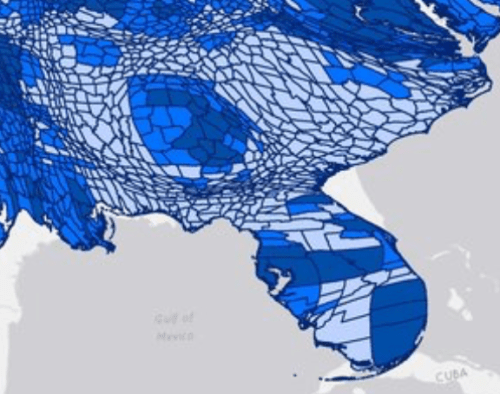
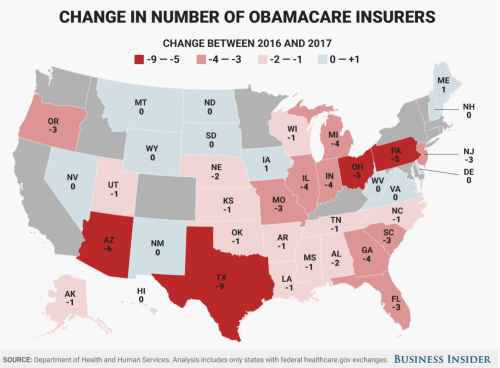
The bulbous, bloated cartogram meant to render the prospective withdrawal of insurers from individual health-care exchanges under the Affordable Care Act in its deepest colors foregrounded the concentration of a reduced insurance market in rural areas.  The image of a nation seething over, and the ground boiling over as if with discontent, cartogram, distorted “red” and “blue” states alike, but seemed evidence of the ways that the Affordable Care Act warped the even playing field in the United States–as if that ever existed, and could be expected to exist today.  But it might be taken as an emblem of the deep anger and resentment that many areas of the United States felt toward what was labeled “Obamacare,” and the regional markets left with but one insurer–and an inevitable feared rise in their insurance premiums–in the health insurance markets that the Affordable Care Act would create.

The designers of the cartogram warped to counties’ population almost aptly if inevitably rendered the country as boiling over with anger:  it seemed to render a powerful emblem to justify if not inspire broad indignancy about the apparently uneven consequences of mandated insurance exchanges which it argued the less populated–and poorer–areas of the country would be stuck with, as a distillation of social injustice.  For the cartogram captured what its designers argued was the distorted market for health insurance which people on the coasts had designed as destined to shut out large areas of the country shaded in lighter colors–and prevalently light pink.  But the prediction of a contraction of providers that undergirds this ominous scenario, as we now know, didn’t come about at all,–even if the strong passions provoked by the fight over health care did leave the country boiling over with anger and indignancy widely felt to be objectively justified.


map2_20170725Warped Map on Insurers Red v Blue Goves

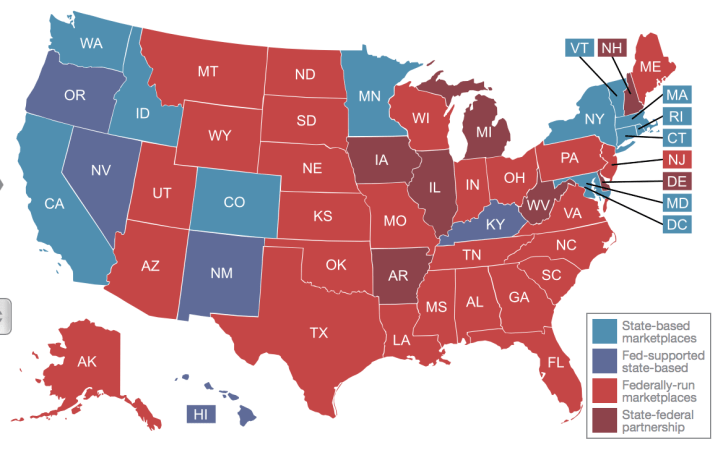
It can be quite forcefully argued that health care deserves to be regarded as a  democratic right–democratic with a “small ‘d,'” in the sense of an egalitarian right, even though debates about access to health insurance are increasingly cast in politically partisan terms.  Although access to insurance exchanges are increasingly treated as a question less of a right than the reflection of a political position, the proposition of guaranteeing health coverage is rejected by champions of the marketplace and its benefits, who argue that its falsity undermines a free market.  As a result, in part, health-care exchanges are increasingly mapped in terms that might well be mistaken for political partisan divisions within the fabric of the nation.  Indeed, the sharp, flat blues, reds, and deep carmine of different regions suggest the hopes and difficulties of providing a uniform insurance plan for a nation of radically different numbers of insured, facing the hope to provide more with coverage in a way that may seem to tilt against the open nature of the marketplace.
 

Us Marketplaces.png


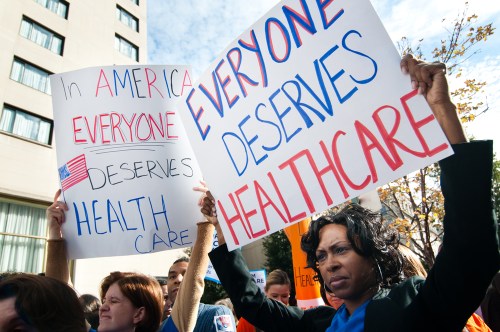
But democratic rights include not only political participation but due rights to certain benefits that accord undeniable liberties.  And although liberties which were not defined as including health care in the eighteenth century, leading many strict constructionists to view health insurance as an excessive presence of the state in individual lives, the range of liberties have expanded to-liberties to education, or to health, or protect against race-based, ethnic, or sex-based discrimination–revealing the broadening scope of understanding liberties, and might be  mapped into the fabric of the nation as an individual rights, and a basis for ensuring greater egalitarianism–and social equality–as a right.
 

Obama-healthcareBlack Enterprise


Back in 2013, of course, the institution of health-care exchanges set up a new landscape of the Patient Protection and Affordable Care Act–the Affordable Care Act or simply ACA–allowing most Americans to buy insurance on  government-run exchanges (or marketplaces) to have access to health care that they were often lacking in all fifty states, creating the reign of designing data vis of Obamacare exchanges often subsidized by the government for those eligible, to make it available to all, in ways that created some thirty-six exchanges run with the federal government, as states ran the others alone–creating the odd scenario that more enrollees came from red states, where they were run largely by the federal government.


state-health-insurance-exchange-landscape


But this was not widely accepted, and the rejection of the promise of what is now widely labeled Obamacare reflect the deep divides that its opponents argue the government mandate for buying insurance policies will impose on the nation.  The online popularity of recent projections of a constriction of health insurance options for most counties of the nation that were proposed as recently as the spring of 2017 seemed to reveal the deep dishonesty in the proposals of the Affordable Care Act to level the playing field.  And although the capital of health care as a good to the nation demands to be mapped, the difficulty of parsing the ACA independently of the name of Barack Obama reflect the unfortunate polemic level of debate about seeing adequate health insurance as a right of all–even as fear of losing health insurance dramatically rose across the nation, and the fears of rising premiums posed by its mandates were widely stoked by data visualizations suggesting widespread abandonment of insurance exchanges.
 

Changes in Providers.pngUS Health Policy Gateway


The data visualization–which almost amounts to a tool of outright propaganda–uses flat carmine to blanket the real improvements in numbers of the uninsured.  The presentation of an apparent distortion of the market is confirmed by declining insurance policies available on Obamacare exchanges, as its accompanying text assures readers that the real people to benefit from “marketplace enrollment” was the “private health insurance industry” who gained $90 billion in premiums, greatly profiting “publicly traded insurance companies”–distorting meanings of “public” and “private” as if to imply the dystopian nature of health exchanges that benefit coastal states alone.  The map of possible changes in rates of premiums were even more striking, and was presented as evidence of poor policy planning, as well as signs of a grim “slow motion death spiral”–a strategic choice of term suggesting the poor level of health-care it provided, and organically faulty nature of its establishment, but alienating the numbers of premium growth from individuals covered.
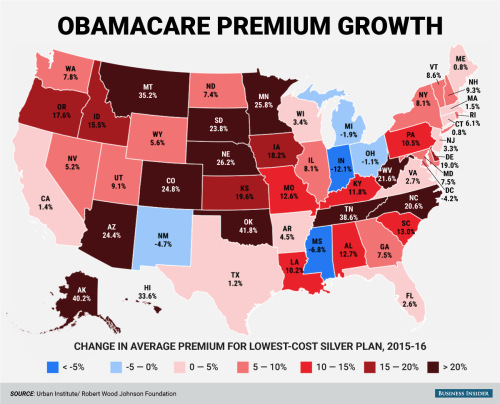
 

obamacare-premium-map.png

465213670_wide-c790535ce6a6b088fa700075b6c1de652f014904-s1600-c85.jpg


The familiar series of sequential images forecasting the mass exit of insurers from exchanges over a period of four years of the adoption of Obamacare stand at odds with the fears of losing health care and the defense of health care as a right, as well as a national system of insurance.  And despite an onslaught of maps  ostensibly demonstrating the ever-narrowing options for individuals as available insurers in state-based exchanges  dry up; they convey an imaginary future in which few counties with “active markets” of four or more alternatives–apparently compromising the rights of many Americans.


nssustaniable decline

Bloomberg Graphics/2017 Health Insurer Exits (projected)


Indeed, the image of rapidly dwindling options faced by Americans that such data visualizations claim to be based on data from HealthCare.gov. seem to suggest a focus on individuals.  But the broad brush strokes leave little to the imagination and present an ominous emptying of choice that seems designed to induce panic.  The images are executed with great dramatic effect, but little sense of cartographic skill–they presented a dire picture in which four options would be only available to residents of eight to ten states by 2017, calling into question the ability of much of rural America to remain insured.  The images of rural abandonment by health care exchanges were particularly powerful,  so absolute in their predictions as if to afford little room for interpretation

Yet the projections, for all their power, stand at variance with reality.  There will be, we now know, in fact no Obamacare marketplaces that remain at risk of being without insurers in 2018, as of August 24, 2017–
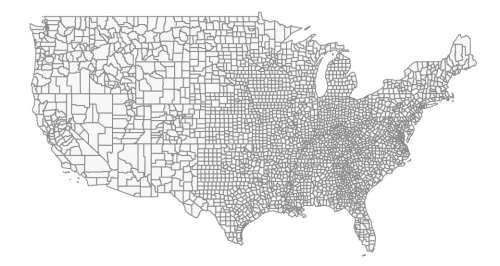
 

w:o insurers in echange

–and but a smattering of counties that were at risk for being without any insurers:


at risk of no insurer

Kaiser Family Foundation Interactive Version/Open Street Maps:  Counties at Risk of Having No Insurer on the Marketplace in 2018 as of August 24, 2017


In short, the disruption of the narrative of a dwindling of insurance options has been, after the failure to repeal the ACA, dramatically disrupted.  Even while acknowledging that there was a record low of uninsured in America after the American Care Act was adopted in “Obamacare marketplaces”–a coded term if there ever was one, loaded with disparagement–data visualization were crafted to predict deteriorating coverage options deteriorated in the months ahead in many rural states of apparent objectivity; hastily created maps, at an odd angle to reality, suggested that as much as over a fifth of all federally run marketplaces–predominantly in rural areas–were with only one insurer.

The alleged “bolting” of insurers from such marketplaces were predicted to leave areas like eastern Tennessee without any insurers, like, perhaps, southern Georgia, much of Colorado, almost all of Iowa, many counties in Ohio,  and large numbers of Virginians, as Aetna, Wellmark, and Anthem were predicted to “bolt” from the exchanges, leaving those Obamacare “customers” high and dry.  The argument of the abandonment of rural America was particularly grim.  But as the projections of the “bolting” of insurers fail to acknowledge the sparsely populated nature of many rural areas, the story that they tell of magnifies the poorly managed nature of the marketplace, obscuring the benefits or rights to health care–and the reduction of the number of uninsured across America– that the ACA has managed to create.  By privileging the size of largely unihabited regions of the midwest, maps of uninsured counties presented a decidedly skewed picture of enrollment, where the square miles covered by insurers projected to participate in health exchanges  seemed to outweigh those where insurers participated, irrespective of the sizes of inhabitants.  It is perhaps no surprise that support for Trump’s candidacy did not correlate with support for the ACA–
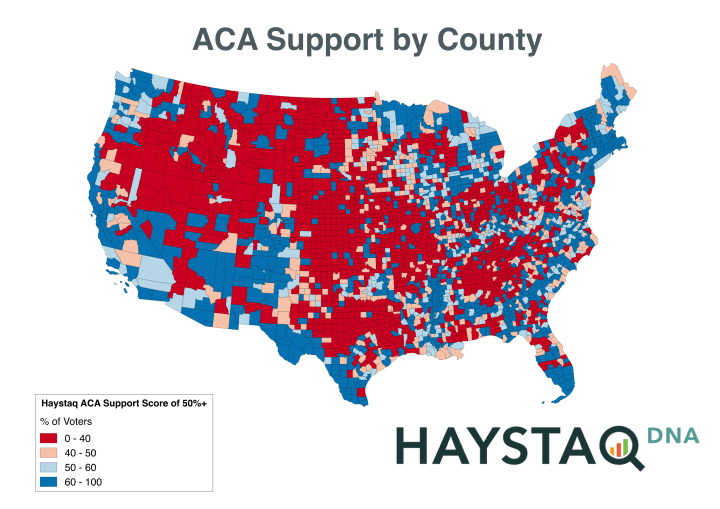
 

ACA-support-HaystaqDNA-score-by-county


We focus on individuals to measure popularity for the support for health care reforms across the country.  Although many have recently entertained sustained interactive levels of introspection about where Americans supported  the Affordable Care Act in the months that preceded the election, pouring over the support for the ACA through county-by-county lenses that made sense pretty much only in how they might translate into votes.

While moving toward the acknowledgement of health care as a right is independent from such measurement of support for the ACA, the  low support for the act in sparsely populated areas intensifies as one moved to less populated areas, by and large, to suggest poor penetration of exchanges into much of the nation–and the distance of health care from what seemed in square miles a quite considerable geographic area.  Resistance to the ACA however reflects a rejection of the broad classification of health care as a right–or to even start to affirm it as one nation.   The division of the country, while reflecting the red state/blue state map in many ways, suggest pockets of counties with strong support for the ACA in a surprising range of the south, southwest, and other regions–across the divide between red states and blue.  Haystack’s micro targeting models estimated just under 98,943,000 ACA supporters nationwide–wondering how the electorate would parse on such a push-button issue.  And, indeed, the Senate Republicans were quick to issue a somber grey data visualization that affirmed a clearcut divide suggestive of the status of yellow- or red-alert in areas “abandoned” by Obamacare– in an openly partisan moment, undoubtedly funded by tax dollars.

Senate Republican Party flawed policies 2018U.S. Senate Republican Policy Committee


If over a third of the nation, colored an arresting yellow, seem to flounder in facing monopolies of insurance in the image that the Republican Policy Committee in the United States Senate designed for public consumption, who seem to have sought to raise a yellow- or red-alert for subscribers of Obamacare being abandoned, the map foreground  a divide in deeply partisan ways, failing to note persistently steep inequalities among  uninsured across the states, and the difficulties to attract insurers to markets in equal numbers, particularly in regions where up to a fifth remained uninsured in 2001-3.
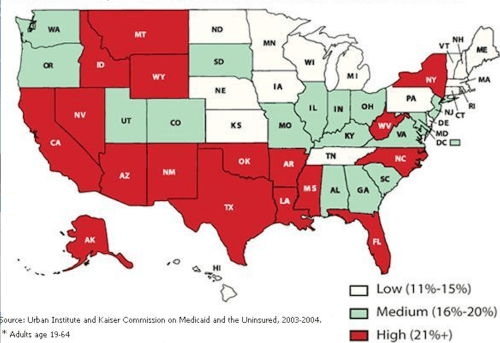
 

% Uninsured 2002-3.png


Despite some questions of whether Republicans would be “alienating their own voters” didn’t affect the results of 2016 congressional elections.  But the power of the continued threat of a coming “implosion” of exchanges that upset the level playing field as an inevitable occurrence was successfully manufactured in projections of insurance markets that peddled groundless prognostications as if they were objective fact:  they successfully mobilized fears of the ability to avoid or precipitate a coming crisis by making it concretely manifest for viewers, pushing many to question the benefits that the extension of the ACA would actually bring–and to see it as a promise that would not be able to guarantee continued coverage or familiar premiums, and indeed to be engineered by the coastal elites and insurance companies that so much of the country has already come to distrust.   For the data visualizations that projected the uneven playing field that exchanges would create cast a divided commonwealth as a result of the limited choices restrictive options of health insurance many Americans would face.  These visualizations raised significant alarms bout the fate of Obamacare–and the specter of its undemocratic nature raised questions of what it provided to the country, or what future it might bright–that were deployed in particularly effective ways.

Flat colors of a data visualization communicate as many falsehoods about its actual relation to people as Trump’s favored declamation of Obamacare “very, very bad insurance.”  They obscure satisfaction ratse of over 75% among those enrolled in plans, and of almost 90% in public Medicaid programs for the poor.  Rather, the picture of an implosion of insurance markets garnered ungrounded trust, and became demonized as but “a first step” toward what he presented as the apocalyptic scenario in which the “government basically rules everything”–a fear of the implosion of a free market–ignoring that the American Care Act is premised on encouraging competition among medical insurers.  Yet the image of such an implosion or collapse perpetuated in data visualizations of crude colors was something that was manufactured in projections that masqueraded as objectively designed maps.  In charting decreasing insurer participation in exchanges as actualities, data visualizations seem designed to stoke uncertainty about the future viability of health insurance markets in America.  Yet the uninhabited nature of this landscape of counties–a metric that makes sense only really as a convention of electoral politics, rather than health care or even of individuals residing in different parts of the country, is starkly removed from health care save in terms of how it might translate into a political choice.

The rhetoric of these “maps” uses projections cover the individuals who benefit from medical care.  They encourage voters to feel slighted in new medical marketplaces, and ask them to chose a future–without considering metrics of coverage or the relative quality of medical care.  They serve to map a landscape of fear, encouraging fears of growing premiums and less choice among voters in what is painted as a compromised medical marketplace.


1.  Construing health-care as part of a democratic system has been understood in surprisingly partisan terms.  Some would restrict liberties to participation a marketplace, by adopting and privileging the market as a primary metaphor if not end of civil society:  the success of such a distinction has lead to a broad and striking demonization of its mandate, rather than the policies of the health care law signed in 2010–the Affordable Care Act–which as a law has consistently received far less opposition than the change in health insurance provision that mentions President Obama’s name.  The divide in perceptions seems to have been broadened considerably by recent visualizations that project the future market for health care, or project the numbers of insurance carriers available in exchanges, the colors of the availability of carriers overwhelms the presence of individuals, and reveal the new markets that the Affordable Care Act (or ACA) created as if it were an uneven playing field for all Americans.

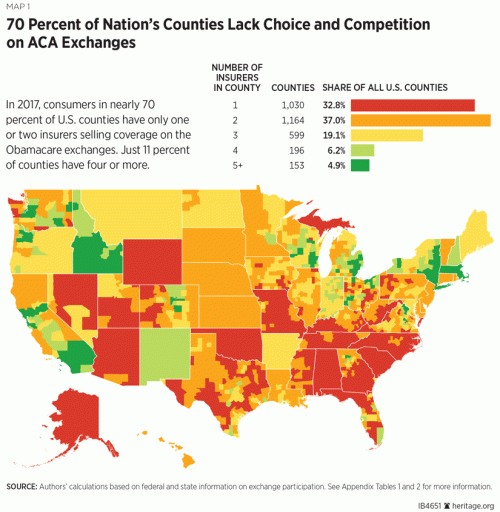
Indeed, as recently as June 2017 and during the Trump-Clinton campaign, media outlets and websites trumpeted “maps” or “a map” as evidence of the uneven playing fields that the ACA would bring in the country and the restrictive options that were increasingly identified with “Obamacare,” as if it were something different from the health policies that increasing numbers of Americans had enrolled in, but rather a specter of higher premiums, fewer rights, and new restrictions on providers if not health policies that could not be trusted, in ways that continued a drumbeat of visualizations predicting coming imbalances for those enrolled in Obamacare to insurance carriers or to a competitive marketplace–if not rob them of access to insurers–concretizing what Donald Trump cannily called “the broken promise” of Obamacare, as some 2.4 million “customers of Obamacare” would be with but one insurer to select in the coming year.   Health officials in the Trump administration issued a “new map showing in full color how many counties in the United States could have zero or just one insurer selling Obamacare health plans in 2018” as if to provide confirmation of the poor deal that was offered the nation; the data vis produced by the folks at the Heritage Foundation was accompanied by an announcement that, in case any one missed the point, insurance exchanges in 2017 would feature ” a major decrease in competition and choice” (italics added) that exposed the deep failure of the ACA to promote competition as promised:

\
IB-exchange-competition-2017-map-1-825.gifHeritage Foundation (January 30, 2017)


The absence of competition left some state, the not unsubtle point was made, that were neglected by the insurance companies that had promoted the ACA:


ACA Header?.png


The stark contrasts of the data visualization were a rallying cry for a public campaign for the repeal of the Affordable Care Act, designed to activate the red states that were shown to be the largest losers of the insurance exchanges Obamacare created.  The map released shortly after the inauguration in a push to confirm the repeal of Obamacare, showed almost all counties in the southern United States with but one insurer–as almost a third of the counties in the nation–but not the population by any means.  In the rhetoric of an earlier map that described how “large of swaths of yellow cover a number of Southern and Midwestern states, all of Alaska, and elsewhere indicating counties . . .  are projected as of now to have just one insurer selling individual plans next year,” the images of a restriction of opportunities to buy health insurance was alerted, with areas with but one insurer appropriately colored red, as if to convey danger.

The slightly different visualization from June that accompanied this projected danger suggested that some counties–colored red again–would strip residents enrolled in Obamacare from any insurer for those enrolled in Obamacare–this time in “a new map showing in full color how many counties in the United States could have zero or just one insurer selling Obamacare health plans in 2018“:


Conties Analysis ObamacareMSNBC (June 13, 2017)


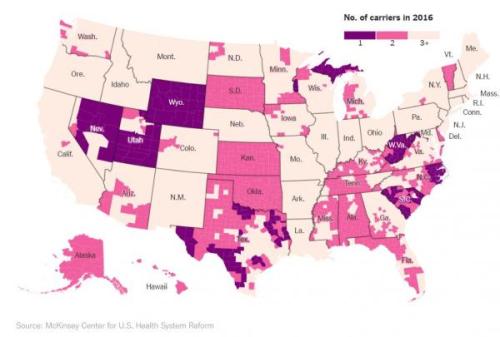
The fear that such maps stoked of an imbalance that cut into the insurance options of many as far as health goes suggested a lack of care and a lack of coverage that suggested a deep disinterest of almost a third of the nation, but did so with little actual grounds.  Those sparsely populated regions loose out in the new marketplace that Obamacare seemed to threaten to impose–even if the Affordable Care Act was created to extend health insurance across the nation:
 

Obamacare 2016_0

McKinsey Center for U.S. Health System Reform (August 26, 2017)


Such deep divides within the United States that cut against equal access to health insurance was of course what Obamacare was introduced to prevent, but the exchanges in the less populated states were indeed slow to attract insurers.  However, the terrifying fear of a subtraction of any guarantees of well-being and a level playing field that these projections promote–they are hardly really data visualizations, if they resemble maps–seem as good a definition and a metaphor of undemocratic policies, and a metaphor for the restricted roles people are given a crucial say in the policies and decisions that most affect their lives.  Although the sentiments for including health care as a right has become to a deep divide in the nation, the disadvantages that the initial introduction of the exchanges were cautioned to bring to peoples’ lives and policies were immediately striking.

And the recent success of mapping the actual resurgence of insurers’ involvement in many exchanges in counties nationwide reminds us of–and asks us to reconsider–the deceptive nature of their claims.  Indeed, as recently as June, 2017, media sources presented “a map” or a set of maps as evidence of the imbalances that the previous administration had failed to foresee, or willfully imposed on the nation.


1.  The negative benefits to all of health-care being a restrictive good are pretty clearly evident:  healthcare should not be seen as a commodity alone, existing on an open marketplace.  Given the clear negative pressures of lowering access to health care to society, the gleeful prediction by President Trump that Obamacare–as Trump calls the Affordable Care Act (ACA)-, as if it were just not American to promise health care to all–would be implode because of e lack of plans available on exchanges in much of the country thankfully seems untrue.  Indeed, the failure to repeal the ACA by the United States Senate–a failure that seems to have sent a shudder of initial convulsions within the Trump administration, and within Donald J. Trump’s sense of his hold on the Presidency, has led insurers to return to the many counties where they had in previous months left, provided all but one of the counties that seemed to have no clear options in the Obamacare exchanges–and that now-President Trump’s declarations of Obamacare’s demise were quite premature.  Although the graphics of health insurance providers that were available to residents in local exchanges under the Affordable Care Act seemed truly badly served in much of the nation by early 2017–when many of the counties not on the coasts or in coastal states seemed to suffer from a gap in options, as was true even shortly before the 2016 Presidential election in surprisingly effective ways.

As soon as the future markets for insurance were mapped and the maps were released, the revelation of apparent gaps and “dwindling in surname choices” and egregious absences in covering the nation’s populations seemed to show up the falsity of past promises.  The maps gained a polemic authority of their own, confirming lingering suspicions about the poor fit of “Obamacare” to the nation, and providing fodder for raising alarms about the inequitable nature of the exchanges that emerged in different states and counties.  For they seemed to reveal an apparent abandonment of the majority of the country by the coastal elites of California Massachusetts, New York, Chicago and Washington D.C.:  indeed, it triggered a sense of the abandonment of the nation by coastal elites.  The very story that was told about Hillary Clinton and the Democrats in many circles were being repeated in the Presidential campaign were used to lace increasing suspicion about the emergence of fair marketplaces in future years.


Graphic-of-Insurance-Providers-number.jpg

County-Level Data on Insurance Providers under ACA/AP  (October, 2016)


The deep brown nature of the map didn’t reveal the restrictive choices of insurers, but muddied the picture of the nation, as if throwing into relief a plurality of counties that existed on a higher plateaux of health care, and left behind the rest.  The visualization suggests that a sombre picture of health-care had emerged before the Senate failed to dismantle Obamacare, light tans suggesting the greatest gaps in low-lying lands of few insurance options, and markets where sufficient variability would not bring lower costs.  In those regions, the widespread “lack of choice” appeared so evident in dismaying gaps across the nation, where the departure of insurers from a market seemed that had been seen to rise in 2015 and 2016 had started to fall precipitously, raising the fears of rising premiums.  Several entire states–deep red states, as it happens, like Alabama, South Carolina, Oklahoma, and Wyoming–had only one participating insurer across the entire state, suggesting gaps in the health plan that claimed to be engineered to offer choice.

The mapping of these projections seemed to make manifest the deepest fears of inequality and an unloved playing field, which data visualizations like the above seemed to expose–while dying the projected nature of its claim that insurers’ “departure” had already occurred.  Yet the residents of all counties in the United States but one will be able to purchase an Obamacare plan in the coming year in actuality–the fifth year and enrollment cycle of Obamacare insurance markets, has brought successful expansion, with increasing coverage is provided by insurers across the United States may be even effect a new acceptance of health care as a right.  For despite widely stoked fears of drying out health insurance markets projected in deceptive data visualizations with such particularly alarming effects.

Just a mere two months ago, it was predicted that forty-seven counties would have absolutely no insurers by 2018, and that residents of greater than a thousand counties–and up to 1,200– would be left “bare”–hight and dry–with access to but one insurer in their exchanges.  The alleged analysis of the impending “collapse” of insurer participation nationwide showed an image of “projected insurer participation” as if they described an actuality of declining participation that had effectively fractured the nation–lending currency to pronouncements that struck fear into many voters.


 

County by County analysis.pngExchnage Carrier.pngCNBC, June 13, 2017


Despite the manipulative nature of these data visualizations, the recent resilience of markets after election, and specifically the failure to repeal Obamacare, has responded in ways that stand to change.


2.  But the picture was indelible when it was framed, forged in the sharp colors of data visualizations which arrived with regularity at the same time as maps of projections of the Presidential election dominated social media and the press.  They created a terrifying image of a divided nation, destroyed by the all but inevitable impending “collapse of Obamacare ‘coverage’ in 2017” as revealed in “stunning maps” released in the late summer during the Presidential election, as if they were the hidden understory of national divisions that some candidates just didn’t get.  These visualizations allegedly revealed divisions of the nation in ways that must have spooked many, weren’t being addressed by the White House or health care officials, and seemed to signal an era’s end–touting “Higher Costs and Fewer Choices for Obamacare Customers in 2017.”  The below-the-radar war of data visualization for national attention suggested nothing less than the erosion of the union that was tied to the encouragement of insurance exchanges.

Such data visualization worked their magic, triggering narratives of abandonment and appearing to reveal an isolation of several of the poorer parts of the nation that set of alarms about the increased division of a nation and an uneven playing field that the Affordable Care Act–now demonized by the name “Obamacare” to distance itself from the actual legislation–that revealed the apparent absence of competition in “stunning” ways.  For by depicting the “epic collapse” of a system that in fact seemed to be give greater stability to a projection and make it manifest as reality.  The magic of the data visualization was that they purported to reveal an actuality the Obama administration seemed to deny as if it were an actuality that denied options to many Americans.   And although the spread of the one-carrier-ounties across much of the “heartland” seemed confirmation, for many Republicans, of an abandonment of the mythic heartland of Trump voters, which pulled from Iowa to New Mexico to West Virginia for Appalachia for Trump–the complexion of where insurance is available.

The alleged objectivity of the visualization left many with breath held, as “stunning maps” released during the heat of the Presidential election in late summer prophesied an impending “collapse of Obamacare ‘coverage’ in 2017” as an all but inevitable reality.


Obamacare 2016_0McKinsey Center for U.S. Health System Reform


Data visualizations of jarring color selections suggest the discontinuity in a system of health care, using the not necessarily clear metric of the existence of a range of carriers.  The notion of the medical marketplace that such competition was supposed to create however realized clear gaps with the counties in violet, whose disarming continuities suggested pockets of the nation that were unfairly left behind, and others in pink that seemed to be similarly compromised in the notion of options or choice their inhabitants were offered.  But the alarmist cartographies were extremely effective in tellign of a story of those regions that were left out–not only Kansas, but Wyoming, West Virginia, and stretches of North Carolina, South Dakota  and Michigan. The maps spoke to many.

The deeper debate about health care as a right demand to be examined in far greater detail than the polemic nature of such visualizations allowed.  And the recent resurgence of insurers in almost all counties of the nation provides a good occasion to do so.   It’s not a secret that the difficulty of construing health-care as a democratic right has also been rejected by many,–who would  restrict liberties to participation a marketplace.  In doing so, they adopt the market as a primary metaphor if not end of civil society–and view any tampering with the health care market as undue governmental meddling.  Yet the guarantees of well-being and a level playing field seem as good a definition of what is democratic as any, as it affords a needed means to allow people to have greater say in policies and decisions that most affect their lives.  And sentiments for including health care as a right has however come to be one of the deeper divides in the nation.  And the recent success of mapping the real resurgence of insurers’ involvement in many exchanges in counties nationwide reminds us of–and asks us to reconsider–the deceptive nature of their claims about the narrative of the impending collapse of Obamacare that many data visualizations of the nation relentlessly advanced, with minimal questioning or interrogation, and the how the image of the nation they suggest may explain public understandings of health care as a democratic right.

But since the negative benefits to all of health-care being a restrictive good are pretty clearly evident, healthcare should not be seen as a commodity alone, existing on an open marketplace alone.  Given the clear negative pressures of lowering access to health care to society, the gleeful prediction by President Trump that Obamacare–as Trump calls the Affordable Care Act (ACA), as if it were just not American to promise health care to all–would be implode because of e lack of plans available on exchanges in much of the country thankfully seems untrue.  Indeed, the failure to repeal the ACA by the United States Senate–a failure that seems to have sent a shudder of poor guidance and convulsions within the Trump administration, and within Donald J. Trump’s sense of his hold on the Presidency, has led insurers to <em>return</em> to the many counties where they had in previous months left, provided all but one of the counties that seemed to have no clear options in the Obamacare exchanges have gained them.


3.  Trump’s declarations of Obamacare’s demise were indeed quite premature.  Although the graphics of health insurance providers that were available to residents in local exchanges under the Affordable Care Act seemed truly badly served in much of the nation by early 2017–when many of the counties not on the coasts or in coastal states seemed to suffer from a gap in available options, as was true even shortly before the 2016 Presidential election in surprisingly effective ways.  The sentiment of a curtailing of options–and of choice, that elusive and so malleable term–became something of a battle-cry against the ACA, which redefined how it was portrayed and cast as an imposition that failed to meet health needs, but whose premiums were substantially more.

If one might say, with poet Elizabeth Bishop, that “more delicate than the historians’ are the mapmaker’s colors,” unlike the color-choices by which cartographers define land and sea as areas viewers can inhabit and read, the stark colors of the data visualization suggest clearcut differences and decisive results–too often just to stark to be lent the credibility that they seek.  Bishop linked the art and science of the cartographer and the art of poetry, in her first published poem, written when staring at a framed map of the North Atlantic that lay under glass as she was ill.  In tracing the mapped waters, and the land that lies beneath the water in maps, shadowed in green, she admired the transformative nature of the cartographer’s art and the expressive license of defining land and sea, and the edges of sandy shelves, as allowing the cartographer to create an aesthetic object able to engage the viewer’s fantasy, through the delicacy of color choices:  the stark, flat tones of the above data visualization–whose colors are all too strict and edges overly severe–work best to create oppositions and manufacture absolutes that offer little distance on the world, or clear purchase on it.

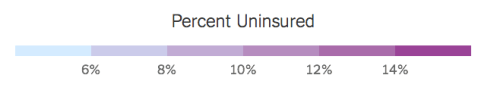
The colors chosen by the cartographer, if at odds with the actuality of the ordering of the land, cannot compare to how the translation of the edges of insured and uninsured are erased in the clear contrasts that compress the actual contours of health care.  If Bishop contrasted the reality claims of the historian to the artifice of the map-maker, whose creations appear arbitrary, but reveal actual complexities, as allowing possibilities for the contemplation of the world.  But rather than presenting an authoritative version of the world, the human measure of a carefully made map, and the invention it offered as an angle at which to examine the world absent from many visualizations, which privilege a single actuality as sufficiently authoritative to orient viewers to the world along a single narrative–and not preserving a human scale to do so.  The deceptive nature with which data visualizations foretold collapsing insurance choices in the Affordable Care Act presented a false reality. about health insurance exchanges, in short, by creating alarming contrasts between sharp colors in maps that offered no opening for interpretation. In contrast, maps of the actual numbers of those without health insurance reveals a landscape of much more complex edges and shadows, as well as deep divides, demanding to be moused over in detail for their interactive experience, if only to come to terms with the changed life experiences of those in many states, as from 2013-16, as the constantly shrinking number of uninsured grew nation wide in ways that attest to the increasing health of the nation–if with considerable numbers of uninsured remaining in may exchanges:

 

shrinkin uninsured.png


percentage uninsured.png

New York Times


In contrast, the almost uninhabited landscapes bereft of insurers that data visualizations depict to suggest a narrowing marketplaces and dwindling options of Americans offers an image less about “health”–our about our health as a nation–than the problems of creating continuity among the insurance exchanges that underwrite the insurance marketplace.  The lack of perspective that they offer on the residents of each county and of our country–and the forced viewing of “health” in terms of insurance companies which participate in exchanges, suggest what more contemporary poet, Claudia Rankine, called the particularly contentious meaning of “health” today in the United States:  at a time when “Affordable Care Act” is seen as something different from “Obamacare” by most Americans, who want the affordability of health care but suspect the inequality of “Obamacare”–whose repeal Trump declared his first order of business as President.  “We heard health care and we thought public option/we thought reaching across the street across the lines,/ across the aisle was the manifestation of not a red state/ not a blue state but these united states we thought,” Rankine wrote with assurance of a new landscape of health insurance, “we could be sure of ourselves in this one way sure/of our human element our basic decency.”

But the increased decency of providing more Americans with adequate health care, “a kind of human kind of union we were ready to check-up,” as Rankine wrote, in the belief that “in this one way we were ready/to care for each other we were ready to see/our range of possibilities as a precious commodity,” was distorted in a map that focussed on the marketplaces of insurance options that Obamacare–the Affordable Care Act–sought to create.  If in this nation “despite being founded on genocide and sustained by slavery/in God’s country we thought we were ready/to see sanity inside the humanity,” the humanity of health care seems sadly obscured in the exclusive focus of data visualizations that focus on providers absent from the marketplace.


4.  It is rather terrifying that the alleged objectivity and authority of such data visualizations were arrogated to make a point that disguised their nature as projections and roles as arguments.  While doing so is tantamount to disinformation, claiming predictive value as declarative statements which has since proved to be without any merit.  For not only did they distort the question of coverage by ignoring that the areas where three or more carriers would be options were most populated–where the best job had been done informing patients of their options to enroll in policies, and also where far better medical coverage existed for Americans in previous years–but the alarms that they sounded were ungrounded, although the image of two coasts and a well-off midwest that suddenly left large parts of the nation in the lurch effectively tapped into deep suspicions and uncertainty.

Rankine persuasively hypothesized–and elsewhere actively protested–the deeply ingrained racism that motivated a nation ready to distinguish between “Obamacare” and the “Affordable Care Act”–valuing the affordability of health insurance, but suspicious of the insurance labeled by the name of Trump’s predecessor.  The motivations for suspicions about “Obamacare” as a tampering with the free market of health providers is unclear, but it undermines the interest in our understanding of the preciousness of health care as a right.  Yet the humanity of health care seems sadly forgotten by the shift from a topography of individuals insured to a topography of the marketplace.  Although Trump seemed to think he had fired Obamacare from the country by declaring it “dead,” and just destined to implode, the markets revealed themselves to have been set up with considerable resilience, despite deeply troubling glitches in its roll out; if more than eighty counties earlier risked offering no options to enrollees, insurers returned overwhelmingly, where they were able, especially when already strongly present in the marketplaces, despite the threat from President Trump to pull federal subsidies.

The presence of mapping future markets for insurance were released with claims to show of apparent gaps, “dwindling insurance choices,” and egregious absences in covering the nation’s populations.  They seemed to show up the past promises of the President to preserve choices for Americans to adopt a health plan that suit them best, and portray them as undue impositions on the marketplace.  The projections acquired a polemic authority, as if confirming lingering suspicions about the poor fit of “Obamacare” to the nation, by providing fodder for raising alarms about the inequitable nature of exchanges in different counties and even in different states.  They seemed to confirm a feared narrative of the abandonment of the much of the country:  indeed, many popular data visualizations triggered a sense of the abandonment of the nation by coastal elites in New York, California, and Washington DC, in particular in Arizona, Oklahoma, Texas, Colorado, Missouri and the Deep South, as well as parts of Michigan.  They confirmed the very story told about Hillary Clinton and the Democrats repeated in the Presidential campaign as if to lace suspicion about the emergence of fair marketplaces in future years.


Graphic-of-Insurance-Providers-number

County-Level Data on Insurance Providers under ACA/AP  (October, 2016)

The particularly grim picture that they offered came in for little criticism or rebuttal.  But the data visualizations describe landscapes that are curiously depopulated, even as they present a sobering picture to suggest the withdrawal of insurers from medical exchanges.   The map implies an absence of interest in much of America by the very insurers who claimed to have sponsored the new marketplaces–but had only concentrated on the most profitable regions.  Its implications one of the abandonment of many of the rural areas of the country–the less densely populated–although the greatest success of such exchanges in densely populated urban areas that were liberal-leaning is no secret, they imply an absence of interest in less populated areas of the nation.  The implicit message that little attention was paid to the rural areas was underlined through the strategic colors of the data visualization, which seems to suggest a relief map of areas that would suffer higher premiums:   audiences in much of the country were convinced that they just had it worse in the projections all too often portrayed as eventualities that the nation would stand to suffer.  The tan colors that suggest diminished choices of medical insurance muddied the picture of the nation, throwing into relief a plurality of counties that existed on a higher plateaux of health care, and left behind the rest.

The visualization suggests that a sombre picture of health-care had emerged before the Senate failed to dismantle Obamacare, light tans suggesting the greatest gaps in low-lying lands of few insurance options, and markets where sufficient variability would not bring lower costs.  In those regions, the widespread “lack of choice” that appeared evident in dismaying gaps across the nation, where the departure of insurers from a market seemed that had been seen to rise in 2015 and 2016 had started to fall precipitously, raising the fears of rising premiums.  Several entire states–deep red states, as it happens, like Alabama, South Carolina, Oklahoma, and Wyoming–had only one participating insurer across the entire state, suggesting gaps in the health plan that claimed to be engineered to offer choice.

Such premature projections seemed to make manifest the deepest fears of inequality and an unloved playing field, and invested themselves with an objective authority of exposing an uneven system that was indeed rigged–denying the projected nature of its claim that insurers’ “departure” had already occurred.  Yet residents of all counties in the United States but one will in fact be able to purchase an Obamacare plan in the coming year in actuality–the fifth year and enrollment cycle of Obamacare insurance markets, has brought successful expansion, with increasing coverage is provided by insurers across the United States may be even effect acceptance of health care as a right.  For despite widely stoked fears of drying out health insurance markets projected in deceptive data visualizations with such particularly alarming effects.


2.  To better grapple with the readiness of insurers to fill the health-care marketplace, the stunning maps of the presence of insurers who have made health-care policies available demands to be examined through a red state-blue state optic.  For eve if the aversion of Republican-leaning regions in the United States to providing alternatives to health care insurers creates a deep divide concentrated in much of the south, prairie, and southwest, where only 1-2 insurers exist, and despite uneven nature of conditions conducive to access to health services that guarantee well-being–and presumably happiness–the markets have grown.


HEalth Care Insureres:Red v Blue Govs.png


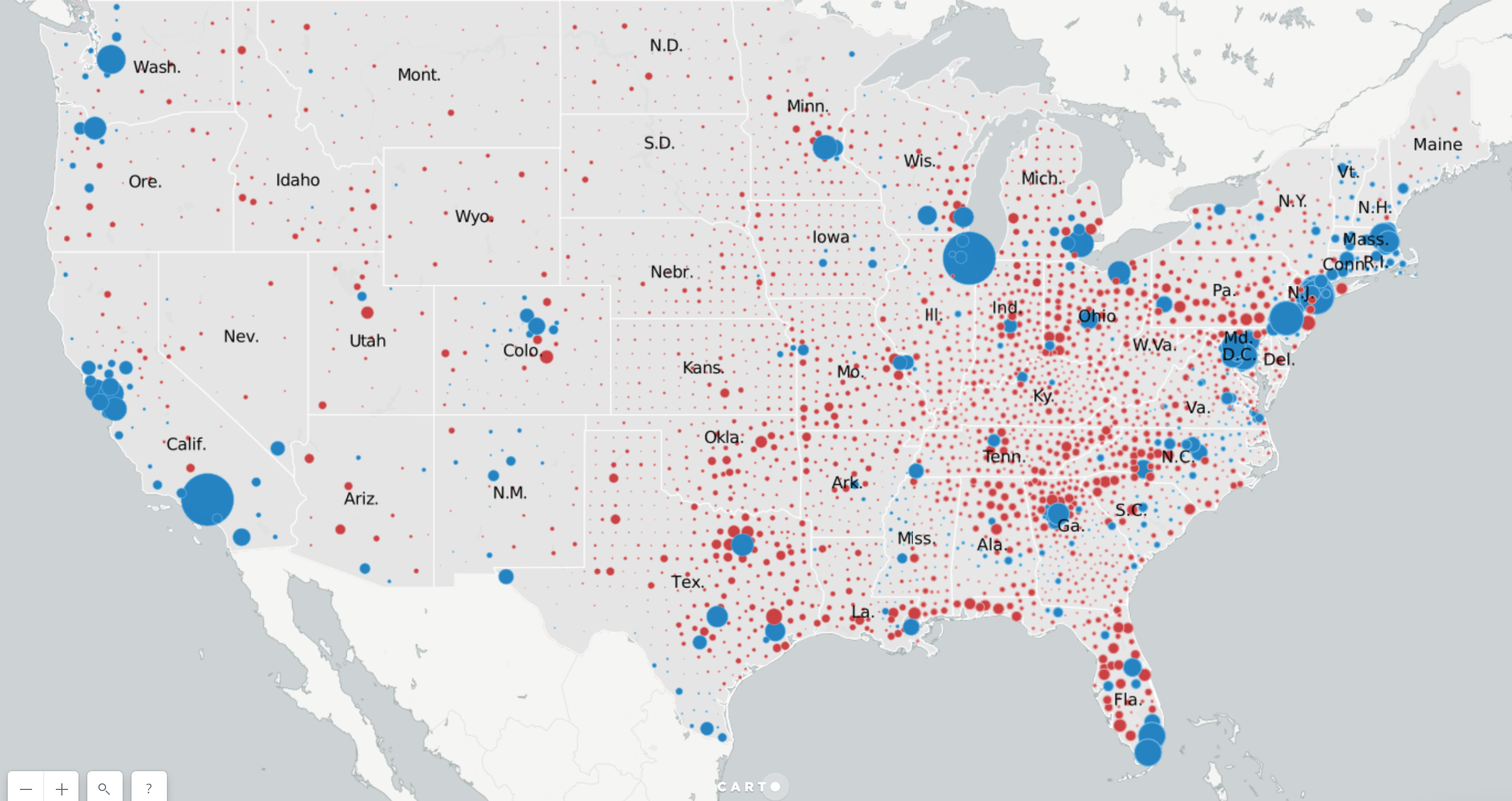
If the divide looks harsh anyway for many rural areas, the red/blue divides cannot reflect the actual availability of health providers to Americans.  Since the notion of the division of the distribution of insurance markets by counties seemed suspect anyway, given the sparser population of many of these states, a more accurate picture of national coverage is offered by a simple proportional warping of the odd division of the electorate by the “county”–an outdated geographical unit if there ever was one.  The mapped that warped counties by their relative populations reveals  an even sharper picture of the actually improving state of availability of insurers–the fewer residents of many of the just-one-insurer regions of the south and indeed midwest shrink, to confirm the growing success of the selection of insurance providers by the ACA, despite some obviously problematic and important to address gaps in coverage.


Warped Map on Insurers Red v Blue Goves.png


It is striking that these very gaps mirror with a terrifyingly clear correlation both dial-up speeds and broadband technology, as well as intractable bottom-line problems like gaps in the availability of health-care services in rural areas.


FQHCs.png


federally-qualified-health-centers

Rural Health Information Hub, December 2016


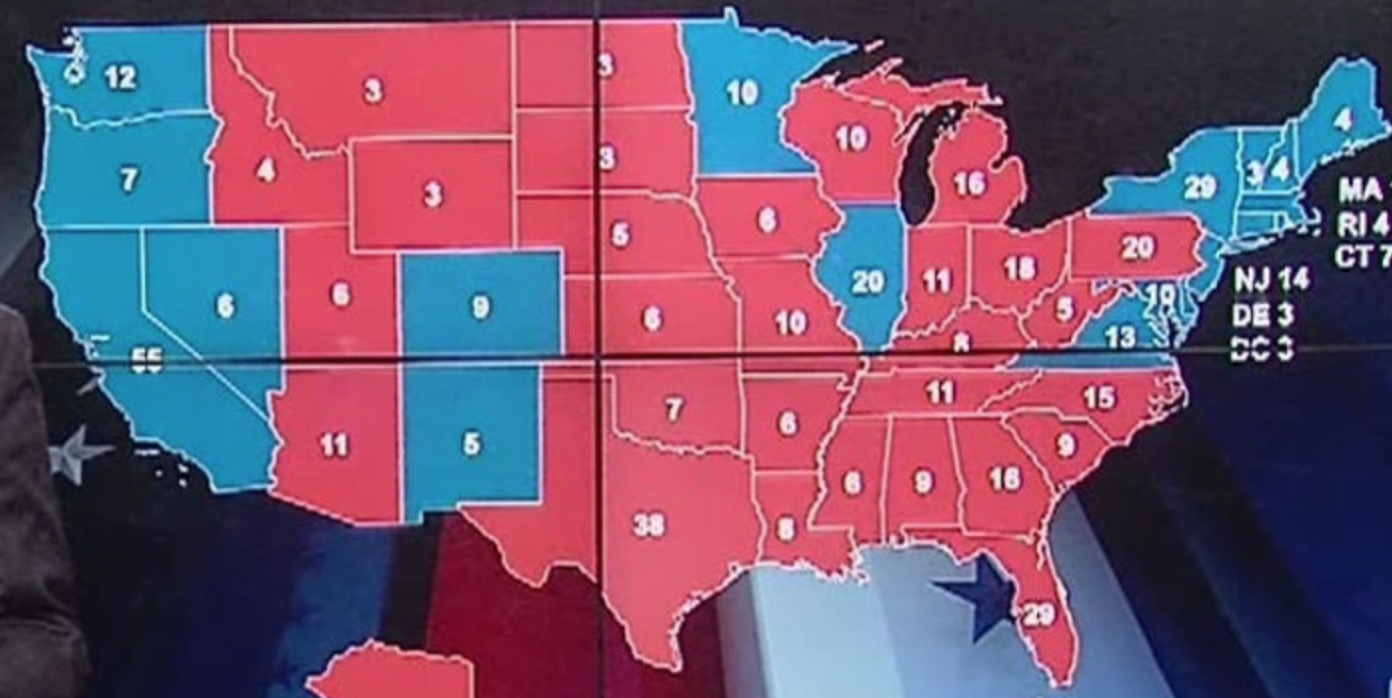
5.  Abandoning the red/blue divisions, which are taken by the elected governor, we see an even healthier division of the nation, at least in terms of the regions that provide their residents with something like a reasonable variety of possible health care insurers, with large areas of the most populated areas having three potential insurers, rather than insurance markets imploding at all, despite the clear gaps that it reveals in what seem more underpopulated areas–and, quite strikingly, the absence of broadband that would make it easier to enroll for insurance online.


5995cec01400001f002c3494Harold Pollack and Todd Stubble


Broadband 2014.pngNational Broadband Map, June 2014 (not updated since)


These gaps reveal a division of much of America into two regions–no doubt conducive between two expectations of health care or medical provision.  Most southern states indeed had far fewer insurers–left “bare” with but one provider, despite the low populations of such rural regions being just less conducive to insurance markets, and revealing an uneven playing field long preceding the passage of the Affordable Care Act–


SOUTHERN states health care insurers 2017-18Harold Pollack/HealthInsurance.org


One Provider South Rural.pngHarold Pollack and Todd Schuble


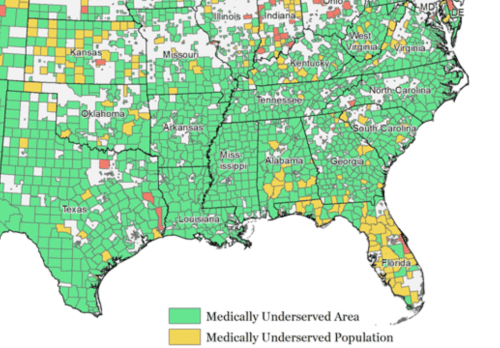
The area is not only medically underserved, but suggests a “Southern Problem” having far less to do with Obamacare than with the disproportionate topography of medicine and indeed of those without health-care, but creating many counties including large stretches of chronic undeserved populations.
 

RAC 2014


Such maps and data visualizations only suggest a need to appreciate and fathom the deeply compromised liberties in areas with few health insurance providers, where insurers haven’t reached clear markets, that not only overlap with many of the more chronically uninsured areas and populations, but with areas of the a terrifying number of uninsured–folks who have decided or been forced to do without health insurance, and where going without health insurance becomes an accepted acceptable alternative, unlike in many regions of the country,


us-health-insurance-coverage-map


which often echoed the very regions of greatest vulnerability in the nation–counties that to be sure often reached out to Trump as a savior for their deep discontent.

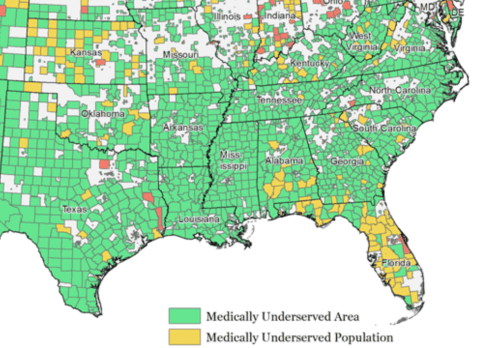
 

Rural Assistance Center Underserved.png


RAC 2014.png


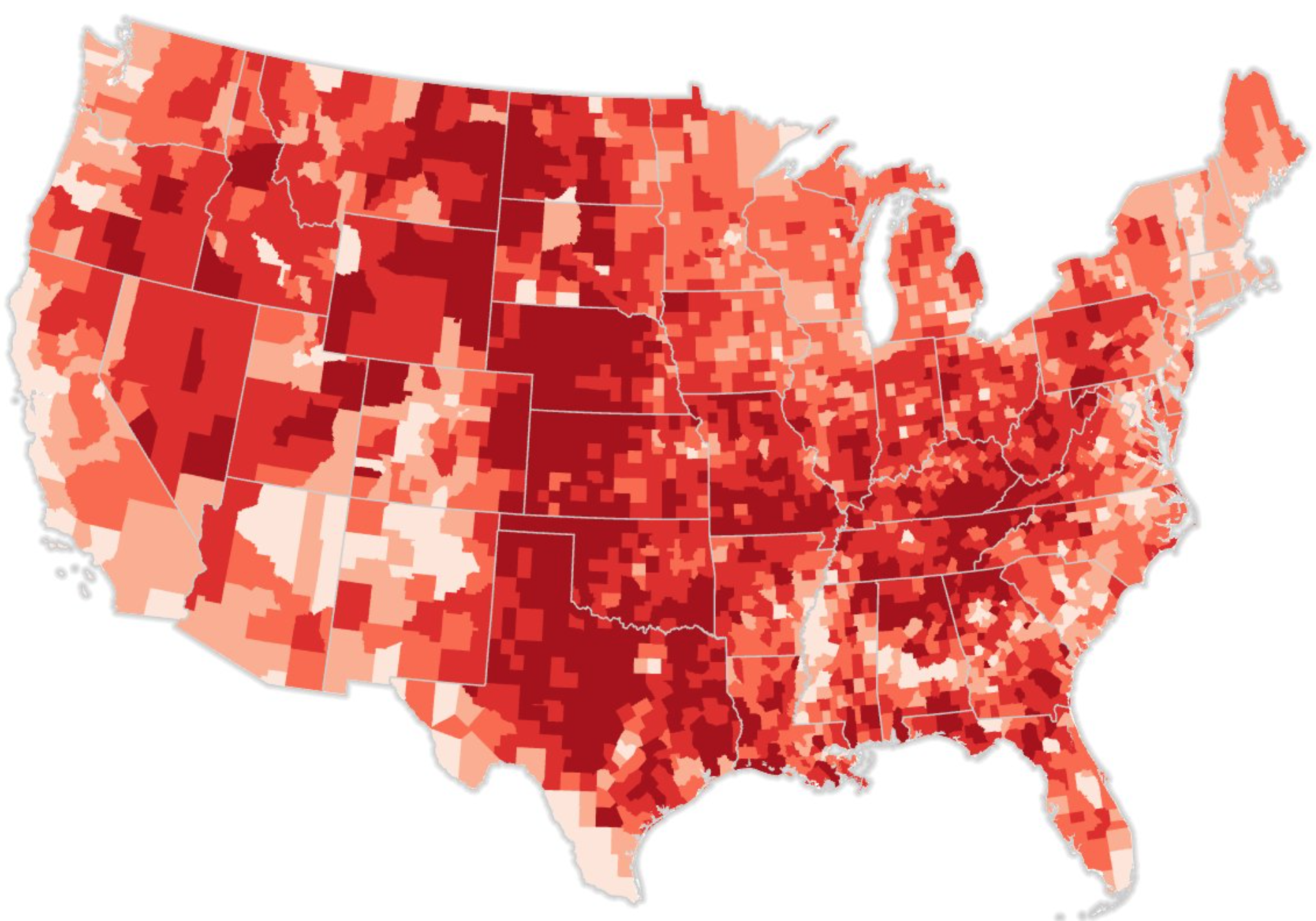
2.  The increasing variety of insurance options for much of the nation raises questions about the persistence of a deep inequality–undemocratic for many–in those pockets coinciding with denser votes for Trump, in a normalized choropleth, and more hospitable to an argument of revising current options of health care–and viewing the Affordable Care Act as an imposition of the federal government.
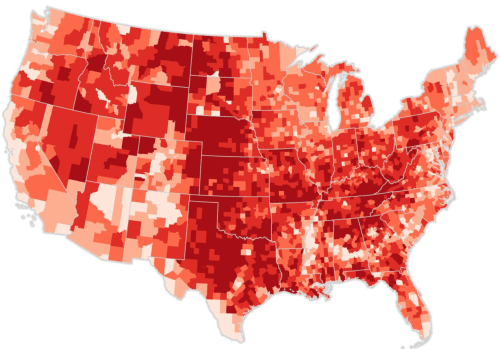
 

Trump votes normalized choropleth


There are interesting overlaps on those areas where Trump out-performed previous Republican candidates, notably in Florida’s panhandle and less densely populous counties in the deep south; southern Texas; and Appalachia.
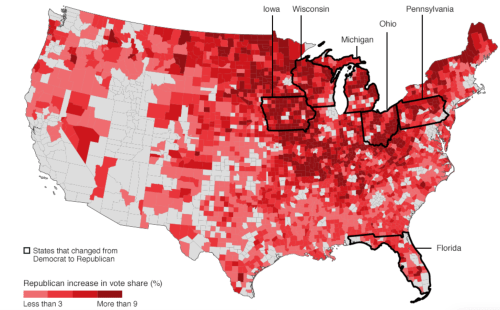
 

trump-increases-republican-votes


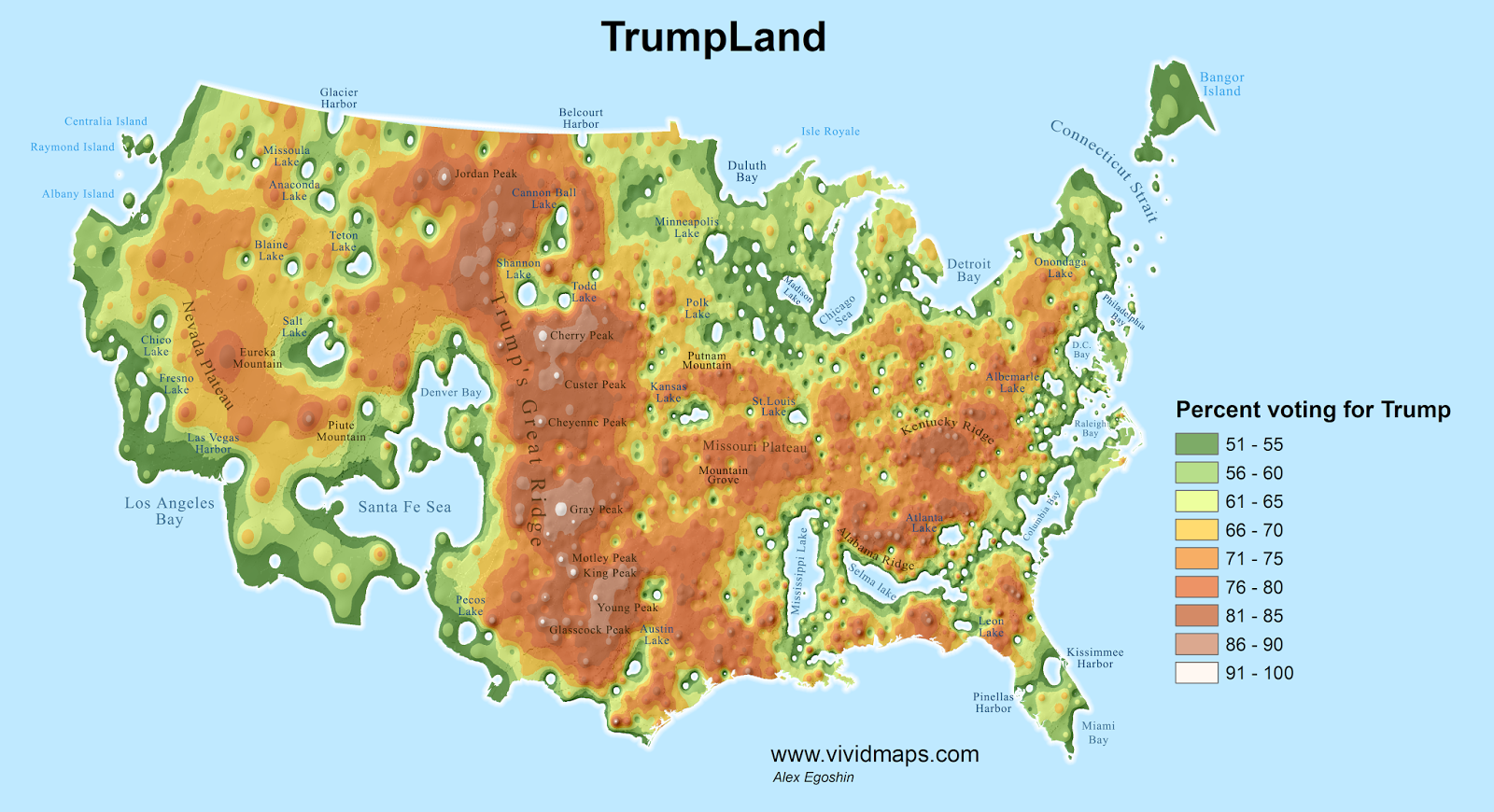
The odd reluctance of these areas to attract anything like a range of possible insurers in lower income areas of low-density where Republicans have recently performed well.
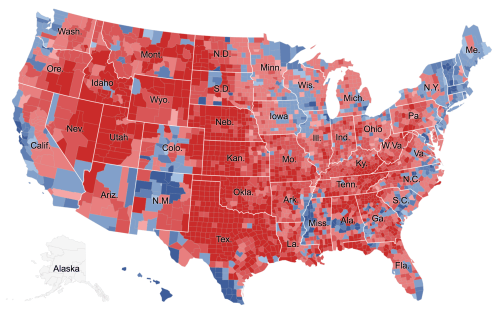
 

counties-1

New York Times


trumpland-2.png

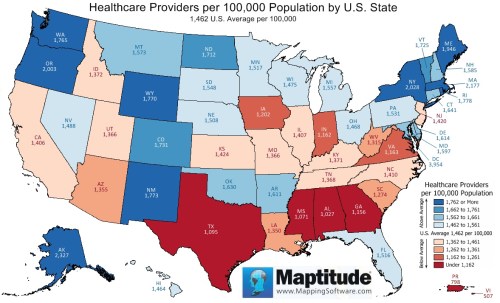
They reflect the difficult problem of distinct notions of liberty and rights in the country, corresponding to areas where the civilian population was long underinsured, often by upwards of 15%, and where shortages of health-providers–even if not as readily available in county-level data–are strikingly revealed in a state-by-state survey:  states like Georgia, Mississippi, Arkansas, New Mexico, Nevada and Texas remained significantly below the national average for primary care physicians in 2012, suggesting regions where there were less developed expectations for attaining health care coverage.
 

maptitude-healthcare-providers-by-state-map.jpg


Increased numbers of uninsured exist in many of the same states are, to recap, unsurprisingly located in some of the same regions–which are less likely to vote for representatives who advocate the belief in health care as a right, and perhaps seeing it as able to be outweighed in importance by an argument of states’ “rights,” even if this discourse is designed to deny health insurance.


us-health-insurance-coverage-map.jpg


It seems a cruel irony in an era of globalization that the majority of those doctors or members of the healthcare force serving areas of the United States that were most in need, and who see some 14 millions patients every year, were from Iran, Libya, Somalia, Sudan, Syria, or Yemen–citizens of countries included in Trump’s Muslim Ban.  (In other words, these immigrant doctors are filling the increasingly pronounced gap that exists among medical providers in the United States–and getting the job done.)  If medically underserved areas occur in almost every state in the country, the preponderance of medically underserved populations concentrated in less populated areas–as the southwest, southern states, and parts of the Midwest seems to have attracted foreign doctors–and had already led bills to be sponsored to allow Medicare to reimburse pharmacists directly in those communities, to acknowledge the absence of medical services needed by Medicare beneficiaries, to allow clinical pharmacists to work in medical care settings as a health provider.


Doctors from coutnries in Muslim Ban.pngSee interactive version of this map here, at the Immigrant Doctors Project


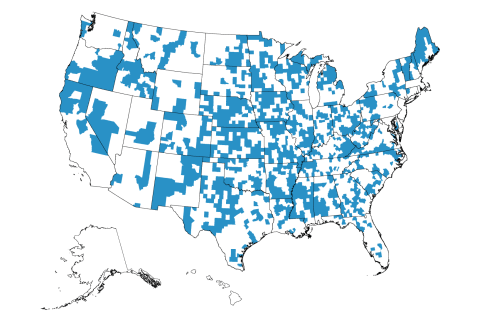
The map has some striking overlaps with those regions of rural America that are losing population, although it should be kept tin mind that the above map, which used data from Doximity to suggest the commenting zones for the number of doctors in the United States may distort by expanding the zones of providing services beyond that which physicians actually serve most actively:

:
map-loss.pngRural Communities Losing Populations, United States of America


The elevation of the pharmacist to a medical provider may raise ethical questions.  But the existence of hight concentrations of medical physicians from the very countries that were targeted by the so-called “Muslim Ban” that Trump championed had the effect of allowing a crucial degree of medical assistance to reach Americans–although the apparent intent of Trump’s legislation would have been to restrict their abilities to return home freely to visit their families, and compromise the proportion of doctors on call in the cities where they are most concentrated–in Toledo, Cleveland, and Dayton, Ohio as well as Detroit MI.


Medical Assistance.pngImmigrant Doctors Project


Such pronounced concentrations of physicians which were mapped online in readily seaarchable formats by the Immigrant Doctors Project provide powerful tools to view how the markets for physicians’ skills meets the needs of a marketplace, to be sure, if one recalls the huge numbers of medically underserved counties.  But this is not a marketplace that would be easily filled by our current medical system, or the health-care industries that service more rural or poorer areas.

 

RAC 2014.png


Leave a comment

Filed under Affordable Care Act, data visualization, health care, health insurance, Obamacare

Data Visualization Fake-Out?

Nothing in the world could take us back/ to where we used to be,” as Mariah Carey sings in her 1990 hit, I Don’t Wanna Cry–recorded back in the very year Tim Berners-Lee and CERN collaborators unveiled the World Wide Web, using HTML to share documents across huge networks and URL’s to specify computer targeted and information requested.   The coincidence of the design of such a document system that led TBL to build and design the world’s first web browser on an NeXT computer and Mariah Carey’s cooing soft-pop hit on only emptiness inside came together again in the release the WannaCry malware–malicious self-propagating code, able to exploit back-door vulnerabilities of Windows 7–which revealed a landscape from which nothing in the world can take us back to where reused to be.

Indeed, the boom of Malware by which the world’s information highways have been afflicted may have in general declined since 2017, from when the number of malware variants has dropped considerably, malware attacks, from ransomware to cryptojacking attacks, have risen, and the number of malicious email attachments has ballooned, often by inserting malicious code into a website to allow hackers to view financial information and histories of corporate entities and other institutions. The absence of any guides to ransomware of different varieties have left many increasingly vulnerable, as networks gain the vulnerability akin to “skimmer” able to glean financial histories off of the magnetic strips of credit cards at ATM’s across the world, exposing the global vulnerabilities into an infrastructure allowing global financial transactions. And despite relatively wide consensus that one should not pay ransoms from WannaCry as doing so would neither ensure access to the compromised files and possibly only expose one to further vulnerabilities to future attacks, the current wisdom of disconnecting all devises from Ethernet cables and wireless dongles suggest that disconnection without rebooting the system is in fact the best option for compromised systems, with an installation of Microsoft’s security patch–in addition to windows security updates and a reputable antivirus blocker. But the fear of vulnerability in a world where WannaCry remains a threat that has continued to hit 13,000 plus organizations since 2020 has led to increased concern how to prevent WannaCry attacks.

But the data visualizations we’ve used to describe the lateral progression of the encryption of data files from hard drives around the interlinked world lent a new prominence to the World Wide Web as a conduit for targeting destabilization.  It not only revealed how the world wide web has reshaped what we still call the world, but posed questions of how to map such a change, as even Microsoft employees in Redmond, Washington scrambled to chart the outbreak of malware after hackers exploited vulnerabilities in the unpatched Eternal Blue, in cyber attacks alternately known as WannaCry in 2017, and Non Petya when it later hit Ukraine, together with all companies, including large American ones, who did business with that nation, in an attempt to undermine its economic viability. From command central in what seems a concrete bunker of the future, before large screens, non-state Microsoft workers in Redmond, Washington tried to maintain a sense of security in their systems around the clock, and conduct repairs, in the weeks after the United States Department of Homeland Security urgently warned that out-of-date software was a global crisis and a national vulnerability. The malware just posed problems that local governments, municipalities, and law enforcement institutions could not bear, and which it seemed only Microsoft could be able to have manpower, incentives, and infrastructure to complete.

Kyle Johnson/New York Times

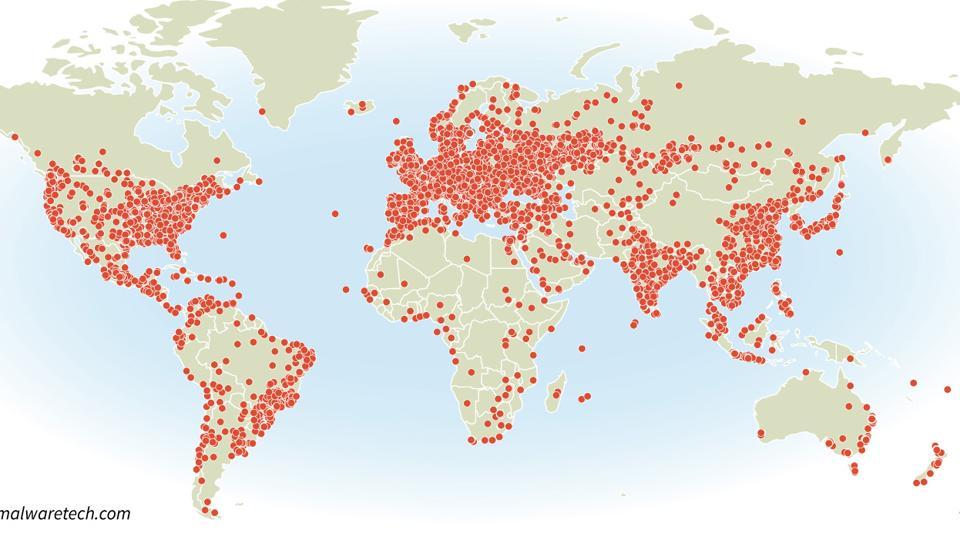
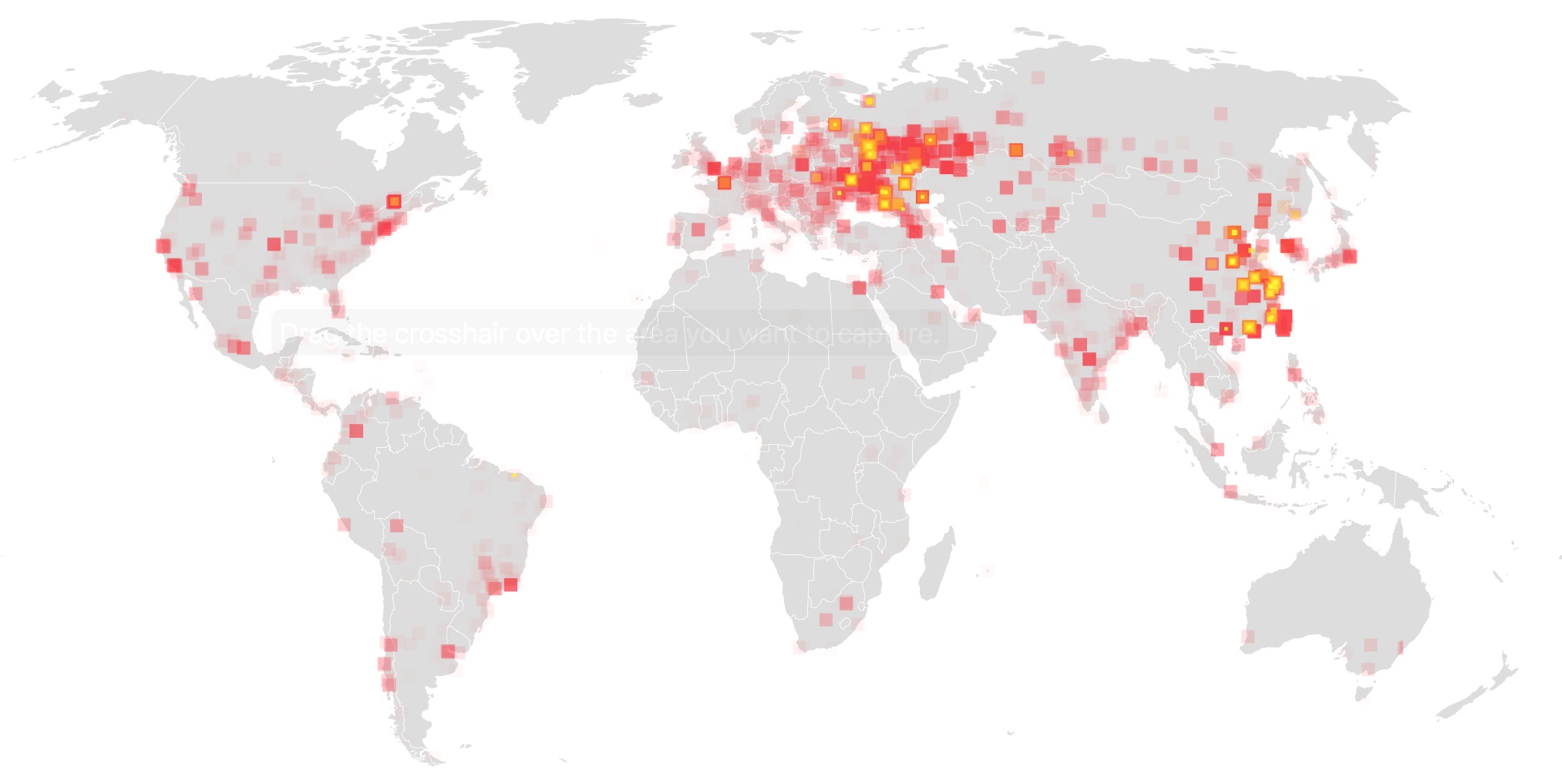
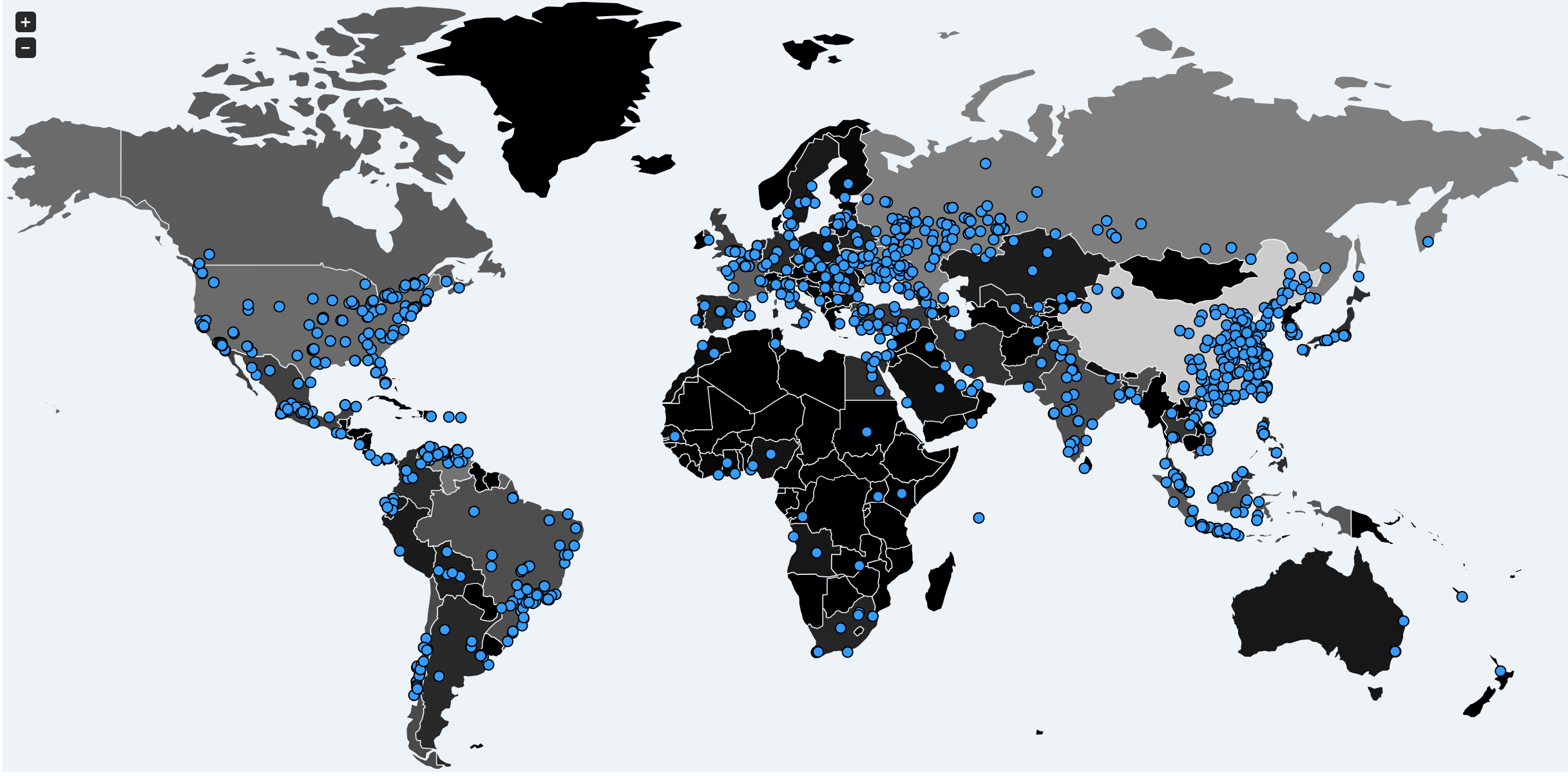
Wanna Cry left many literally crying for the sudden encryption of data, and many without services–and was intended to leave an unimaginable number of people desolate, if not quite with the absence of love that Mariah Carey wistfully evoked.  But the  virulence of its spread should offer a wake-up call to possibilities of global disruption we are still working to be able to track, map or fully comprehend in adequate fashion–but record as a virulent virus blocking systems most densely in nodes of a web-linked world.

the-wannacry-ransomware-attack_535798c2-38bf-11e7-b30b-76e7402dac55
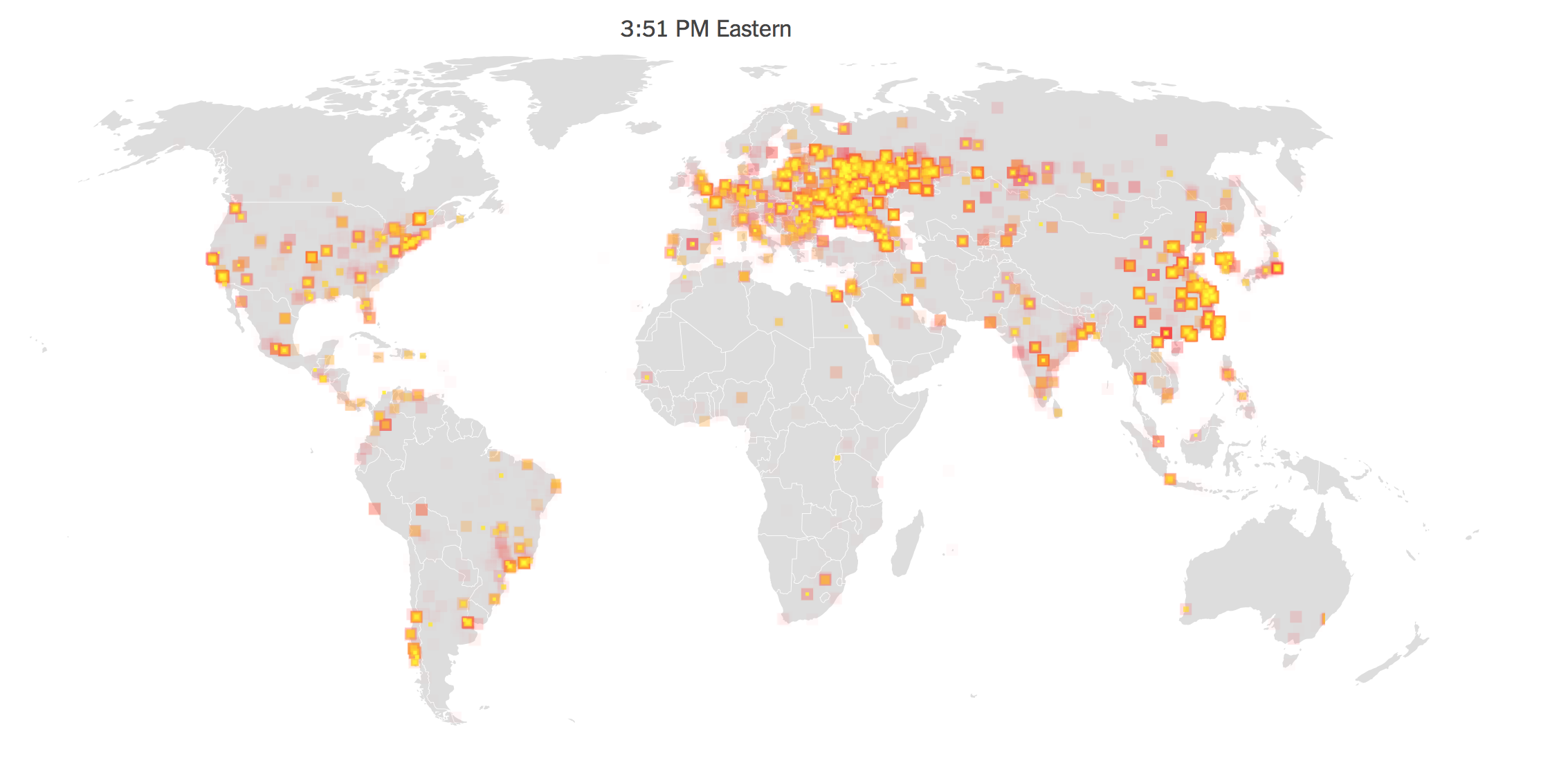
Malware 2:10 pm

New York Times

The very same visualizations indeed obscure, by oddly rendering it as distributed, the agency that underpins such carefully orchestrated cyber attacks of global consequence, by almost naturalizing its spread.  For by moving the sites where data was most encrypted into a geographical frame of reference, the graphic doesn’t help orient us to its spread, so much as overwhelm us with the data-laden content to visualize a paralysis of global systems; it removes it from context or human agency, in order to capture the omnipresence of the self-propagating cyrptoworm as much as tell a story that helps to orient us to its spread.   Perhaps that is what was intended.

The mapping of global disruption is perhaps a nightmarish puzzle for members of the interlinked world, and demands a place on the front burners of data visualization:  the inadequate nature of considering the spread of systems-wide corruptions can be visualized by cases of the compromising of data, we lack the symbolic tools to grasp the rise of a new map of global dangers.   While such data visualizations provide a terrifying premonition of the destabilization that might result from the encryption of data on a broad scale, they obscure the possibilities of specifically targeted attacks on data and visible infrastructure that are now able to be developed, and the nature of targeted threats that we have only begun to imagine.  The redefinition in this new geography of document-sharing Tim Berners-Lee and friends developed has prepared the way for a landscape of interaction between removed places broadly adopted as a protocol for information-sharing– but one that, as Mariah Carey sung, and instigators of the malware hoped, left one only wanting to cry from behind one’s screen, devastated at the scope of the unforeseen swift data loss.

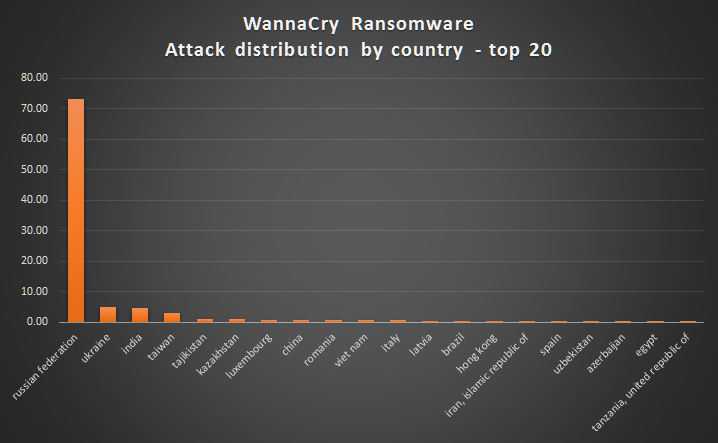
The data visualizations adopted to depict the flare-ups in compromised hard drives that the cryptoworm created in a manner of hours show the particular virulence with which malware crossed national divides in unprecedented ways, displacing relations of spatial proximity, geographical distance, and regional divides.  In crippling databases including Russian and Chinese private and public institutions in but a day, demanding immediate payment for data to be restored, the ransomware raised the curtain on a new age of uncertainty.  But was the threat eclipsed by the scale of the attack by which information was encrypted?  If the spread of malware seemed to grow across computer systems without apparent relations, the distributed agency that was invested in how the malware spread worldwide seemed to obscure the possibility of agency of the attacks, concealing the tracks of any perpetrator by placing a problem of urgency on screens worldwide.

oops.png
Wana_Decrypt0r_screenshot

Websites of news media of record widely adopted animated data visualizations to orient their readers to the proliferating corruption of data on tens of thousands of computers and computer systems on account of the malware caused.   Such elegantly animated maps don’t claim to be comprehensive, and are information-laden to the extent that seek to capture the unprecedented speed and range of the spread of the cyberworm launched Friday, May 12, 2017.  We have trouble even comprehending or grasping the scale or speed with which the virus spread on systems, of course, and speed at which malware was propagated itself across networks and spread laterally across systems, rather than by geographic relations, working without a phishing hook of any sort but exploiting an NSA-developed backdoor vulnerability in the Windows 7 operating system to infect networks across national bounds, as it spread laterally across systems worldwide.

The spread of the encryption of hard drives data across space occurred in apparently haphazard ways, spreading globally in the first thirty minutes of across more advanced web-reliant regions of what we still call the globe.  While their spread “followed” systems whose operating systems had not been fully updated, it is important to remember that rather than spreading laterally along a system of their own accord, their release was planned and released by agents, rather than being a casualty of the World Wide Web; a map of instances of hard-drive vulnerabilities however can offer few diagnostic signs or clues to interpret their spread, but offer only a catalogue of individual instances difficult to process in their entirety, so overwhelming and geographically dispersed was their occurrence to defy easy interpretation or processing–they provide little that might be suggested as forensic evidence about their spread.

ransomeware 0 hr 30 min 0 sec

Red Socks Security: Malicious Threat Detection

If the growth of the virus’s spread across nations made it seemed to progress in ways that lacked a target, we may lack the tools to visualize the attack.  The systems afflicted were not linked on a geographical register, and in some senses didn’t make sense to read in a map–but if they spread on internet traffic, the broad scale of the attack of ransomeware only foregrounded the fears of where it had arrived from or offer any signs to appreciate any agency within its systems-borne spread.  But if the map seemed the best way to the speed of its growth, it was a distraction from the potential targeted threats of the malicious worm–until a lone British researcher, known as “MalwareTech,” saved the compromising of global systems as he serendipitously identified its kill switch to stop its spread:  what dominated the headlines conceals the dangers of losing sight of the specificity of the wide-ranging attacks, even while registering them in real time.

The rest of the world could only sit in silence, as Mariah Carey once sung, and watch the range of attacks unfold in space in real time:  something went wrong in the mode of sharing data across online systems that had to be couldn’t quite be understood.  If Maria Carey’s hit single contemplated the definite break in time, “only emptiness inside us,” the shock of the screens informing users across the world that their data had been definitively compromised made then realize that any notion of data security vanished, and any hope for composure in the face of cryptoworms had disappeared, as Mariah Carey’s softly-sung lyrics described, and as far away as a network-free world, or one where inter-connected users didn’t define the primary routes of its transmission, without considering the dangers of the compromised infrastructure–not only in banking, but in traffic system, airport controlling, water quality monitoring, and even traffic flows.

But we continue to rely on geographic registers, as if we can’t let go of them, and it is what we have to explain the global spread of compromised systems and a collapse of data security.  The cryptoworm successfully obtained advanced user privileges that allowed it to hijack computer systems that allowed hackers to encrypt documents worldwide in one day, reaching such a broad range of hard drives to make it seem the attack was random or haphazard.  The attacks used code to release a self-propagating worm  that didn’t really move spatially, but progressed online, using a vulnerability for which Microsoft had released a patch only two months previous, in March, in devices that share files across local networks.   After the patch arrived, we were still mapping its spread, and contemplating the prospects of the return of a similar virus, so clearly had it asked us to redefine internet traffic.  But was did the broad spread of the worm and broad scope of systems compromises, which was quick to provoke deep fears of the vulnerabilities that exist from ransomware erase the targeted nature of a similar subsequent malware attack?  The spread of thousands of infections in over a hundred–and then over a hundred and fifty countries–across hard drives across the world exploited the failure to update software systems so broadly to obscure the origins or coordination of such malware attacks, whose use of normal language to alert users of encryption made them seem as if it were an isolated standard operating failure, able to be resolved by individual payment–

Wana_Decrypt0r_screenshot
petya-ransomware-how-remove-decrypt-files-new-unlock-computer-windows-dropbox-file.jpg

–even as the malware crippled networks in different countries without having the appearance of any fixed target.  And if masquerading as a form of ransomware, later variants of the cryptoworm suggested a far, far scarier version of the scope of data corruption.

wannacry_03

Kapersky Lab/Ars Technica

We were of course struck by the unprecedented speed with which such worms replicated along these dispersive networks–following paths that are not made evident in the map of compromised hard drives provided by data security firms, which show the progression of a disease that, like a cancer, creeps invasively along a hidden network, suggests a nightmare of the distributed agency of the internet, invaded by a particularly vicious parasite that for a considerable amount of time even experts saw no way to resolve.

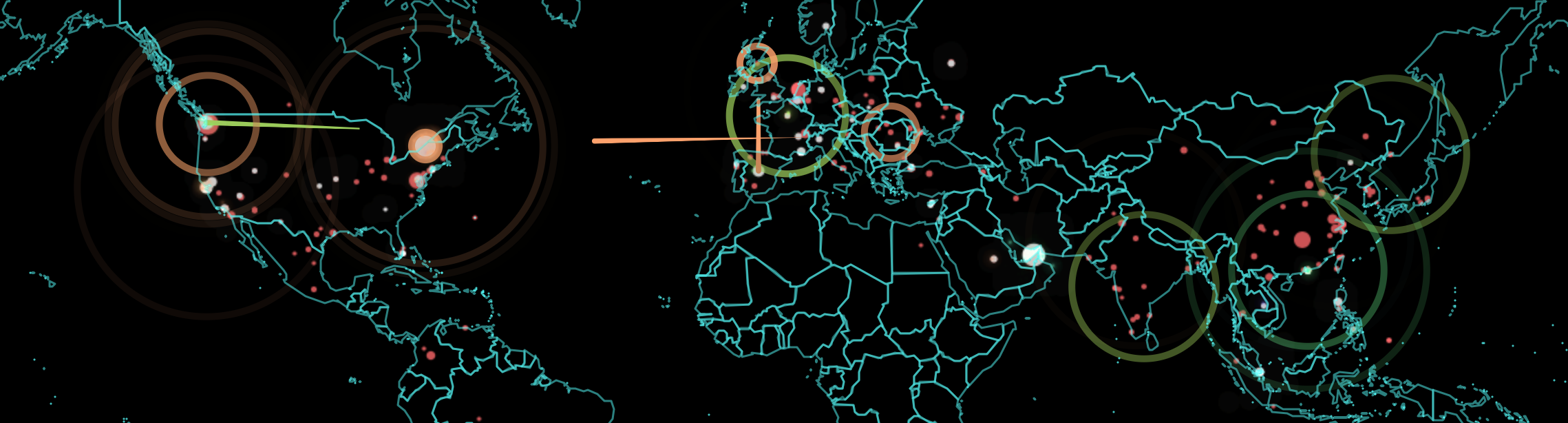
We can now watch the spread of internet attacks in real time, looking at the threats of hacking in real-time, in ways that reflect the emergence of the internet and World Wide Web as a real-time battlefield, even if this is only a representative tracking of hacking attempts tracked by Norse.  It doesn’t include the ten millions of daily attempts to hack into the Pentagon, or the similar number of threats that the National Nuclear Security Administration tries to fend off–and the millions of attacks universities daily confront.  But if we are apt to be mesmerized by the range of such attacks, impossible to fully comprehend or track, we’re likely to be overwhelmed by the serious fears of the security vulnerabilities of which they cannot but remind us, although the abstracted sense of a constant barrage of online attacks can remove us from all too real dangers of their infrastructural effects–and the dangers of destabilization of specifically targeted strikes.

m8g8Z1X.gif

Norse

And if we might do well to take stock of the range of attacks by hackers to which the United States is vulnerable, mostly from China and Chinese sources, privileging our country as the target of future strikes–

L2zRKfa.gif

Norse

–we loose sight of their increasingly global nature, now that much of the software to exploit vulnerabilities is available in the Dark Net.  The origins of such attacks aren’t really clearly able to be mapped–hackers are experts at deflecting or rerouting their signals, and bouncing around their traces to make hacks that are located from one site appear to emanate from another from another.  And infrastructural vulnerabilities of infrastructure are increasingly on the table for nations other than the United States, often without the means to monitor such cybersecurity issues or strikes.

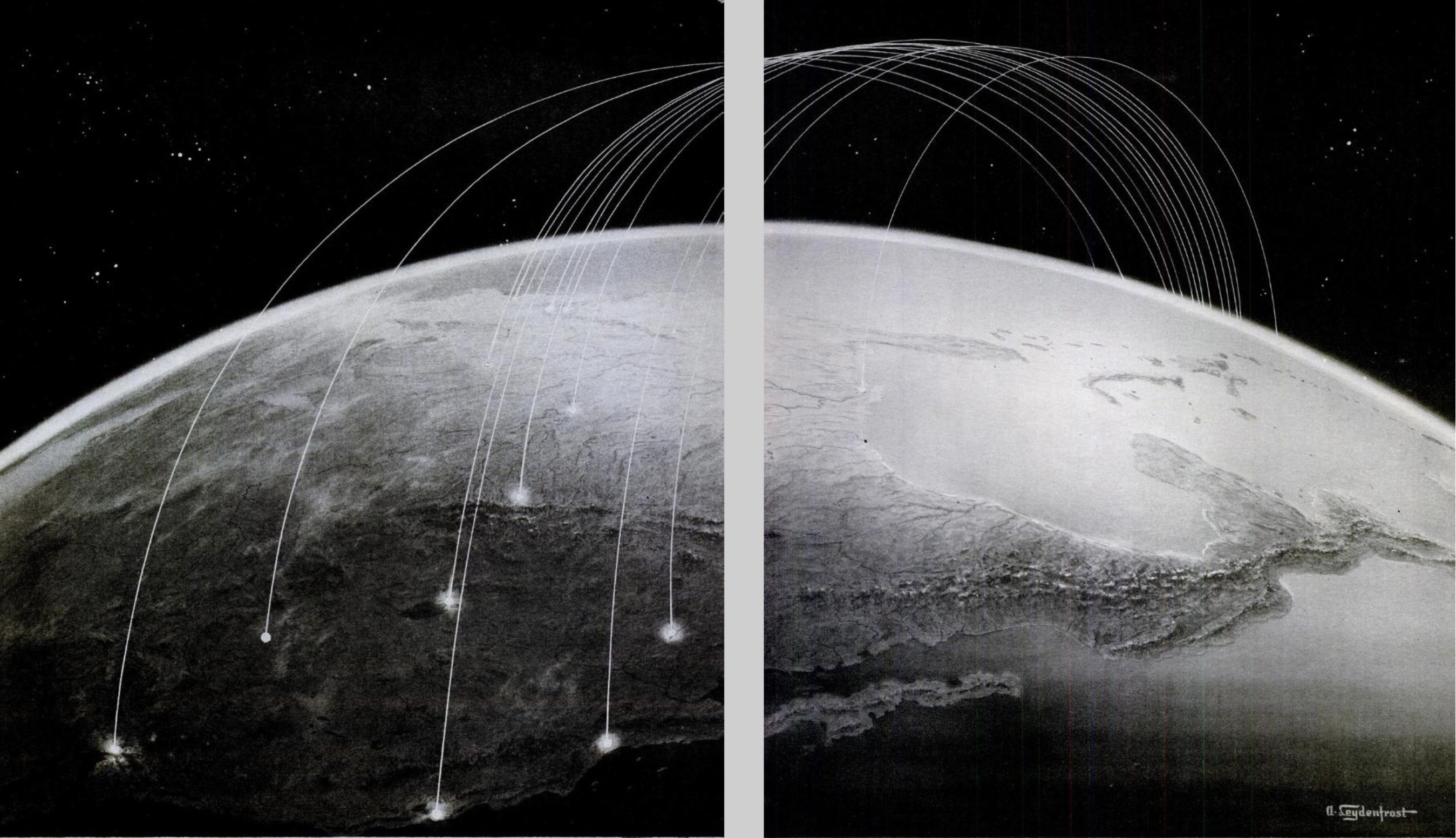
In an age when the pathways of internet links may have spawned spontaneous revolutions, uprisings, and unexpected results of elections, non-human communication and propagation of such malicious malware viruses seem an apotheosis of the absence of any agency–a worm that is able to replicate itself within hard drives world wide, removed from any intent.  To be sure, the range of sped-up animated maps to track the progress of the viruses that compromised data across the world produced a sense of wonder at our vulnerability of a sort that has not been widely mapped since the Cold War:  the images generated of internet threats mirrors the map of the danger of missile strikes that emerged in Life magazine back in 1945, at the end of the Second World War–only months after the destruction of Hiroshima and Nagasaki by American atomic bombs, that increasingly stand as a premonition of the new nature of things to come.

Atom Bombs Descend on US LIFE 1945.png

Life Magazine: The Thirty-Six Hour War (November, 1945)

Mutatis mutandi, the image of the visual culture of the early Cold War was adopted by the Russian internet security agency, the Kapersky Labs, as a strategy to image the globally expanding threat of hacking to compromise hard drives and data-based systems.

malicious threats USA scale

Kapersky Labs

In an era that was defined as after or following the thaw of the Cold War, the internet emerged in 1990–just a year after the fall of the Berlin Wall heralded its thaw–as a new battleground to wage global conflict.  To be sure, the cybermaps of phishing schemes and potential email attacks are traced by the Kapersky labs in real time, to monitor for global security on the interlinked world-wide online systems.  But their dynamic images retain the symbolic structure of the arcs of a violation of national airspace to suggest the magnitude of the incursions into cyberspace they monitor and report on round the clock.

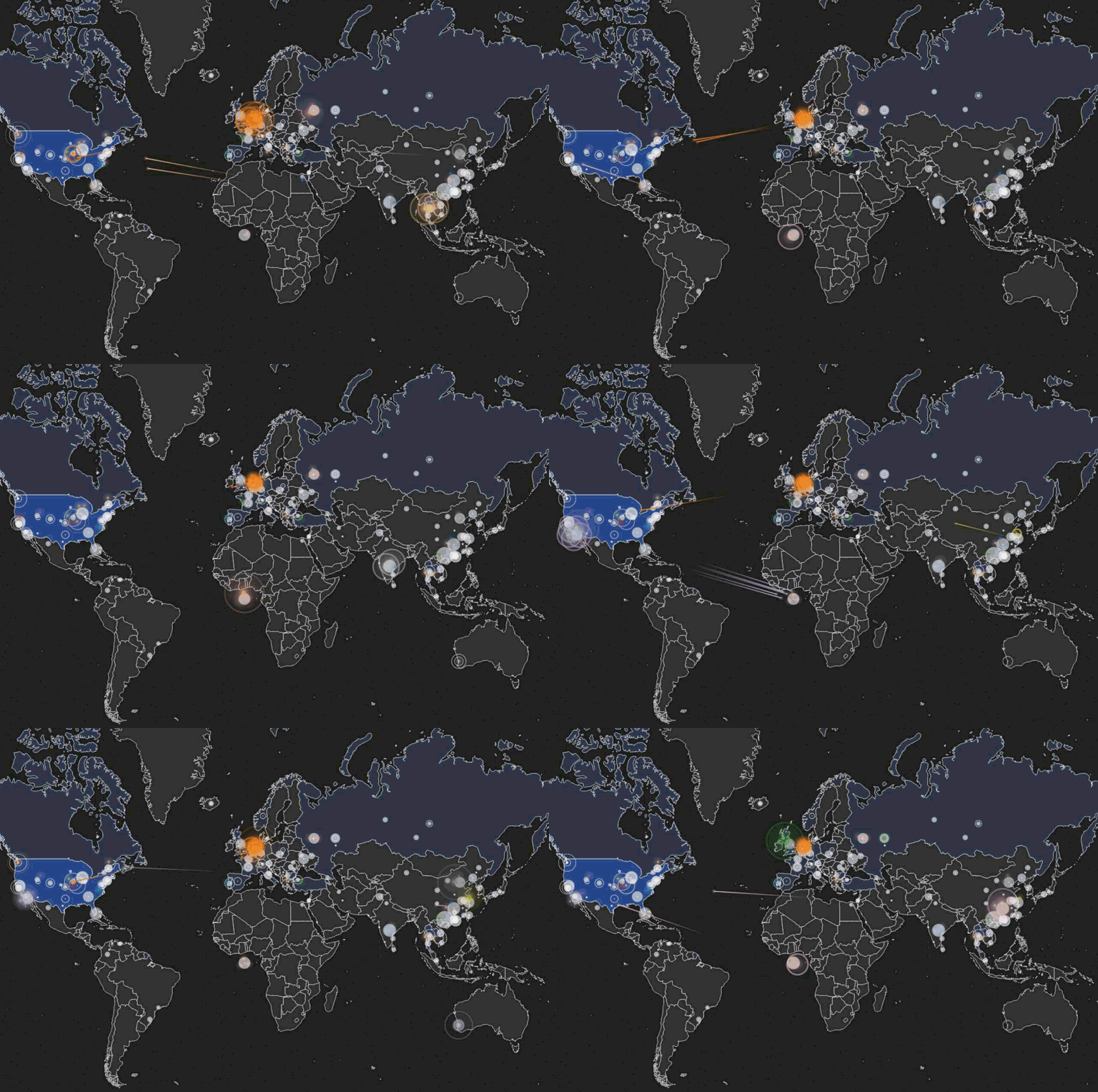
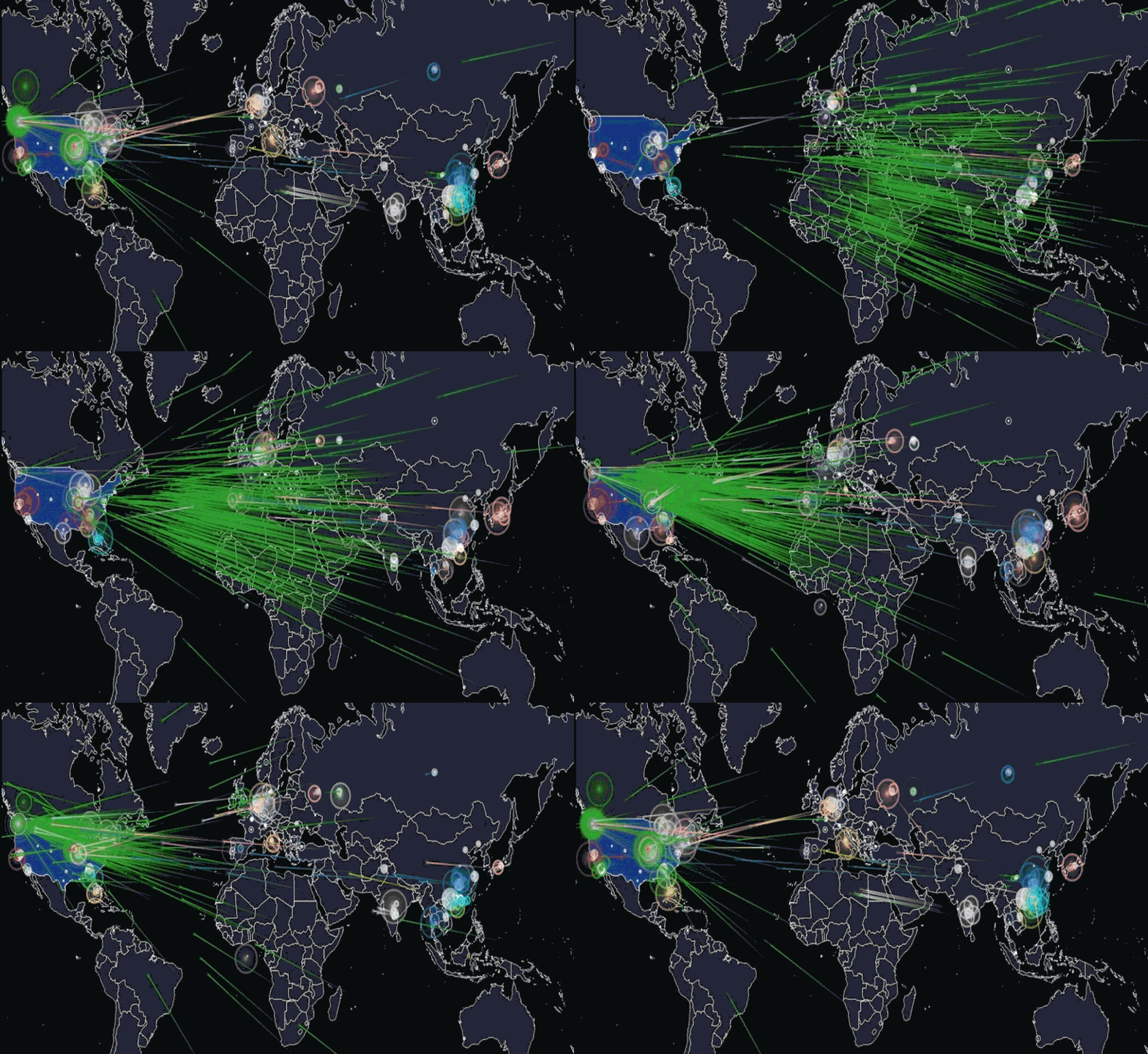
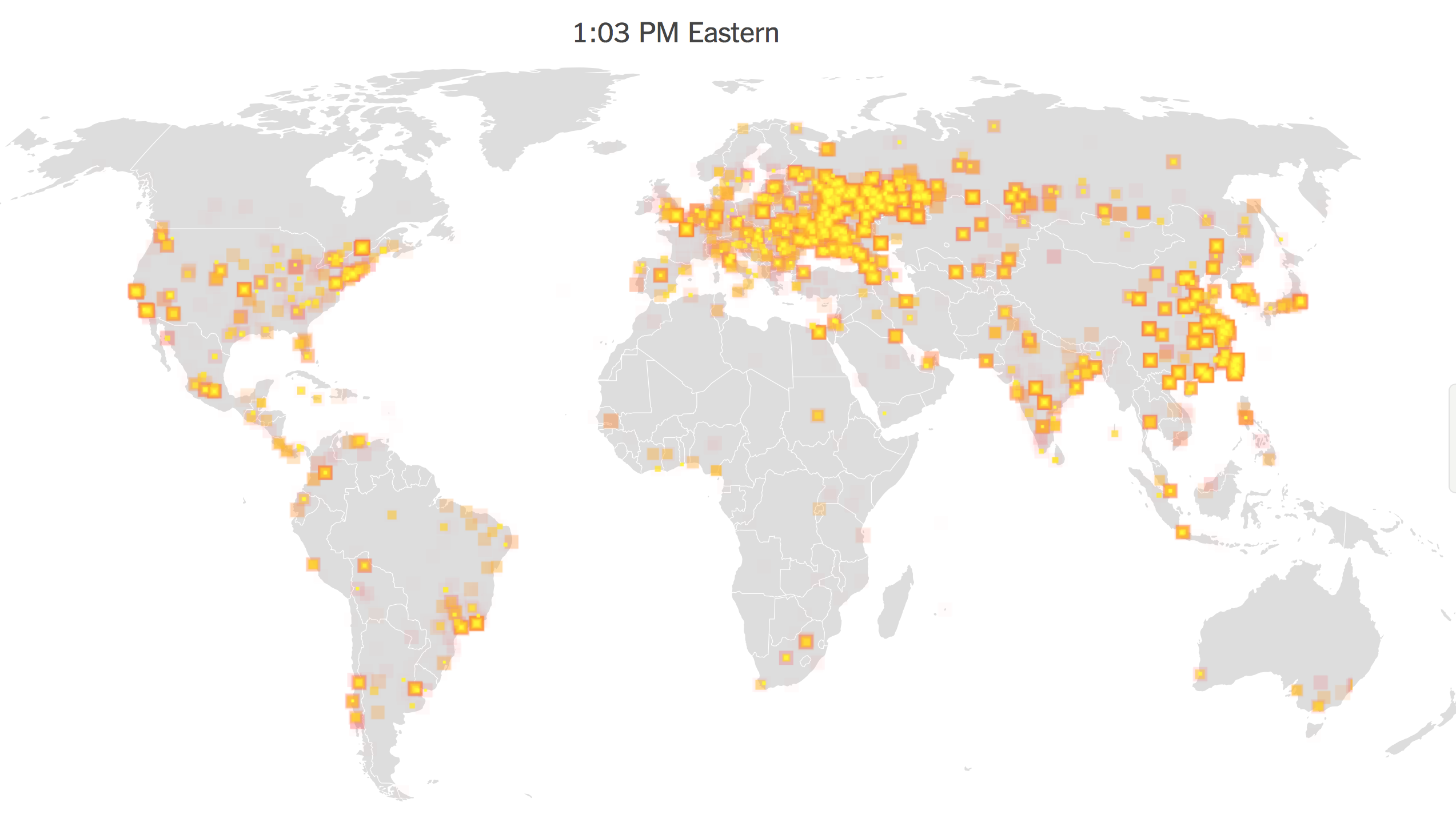
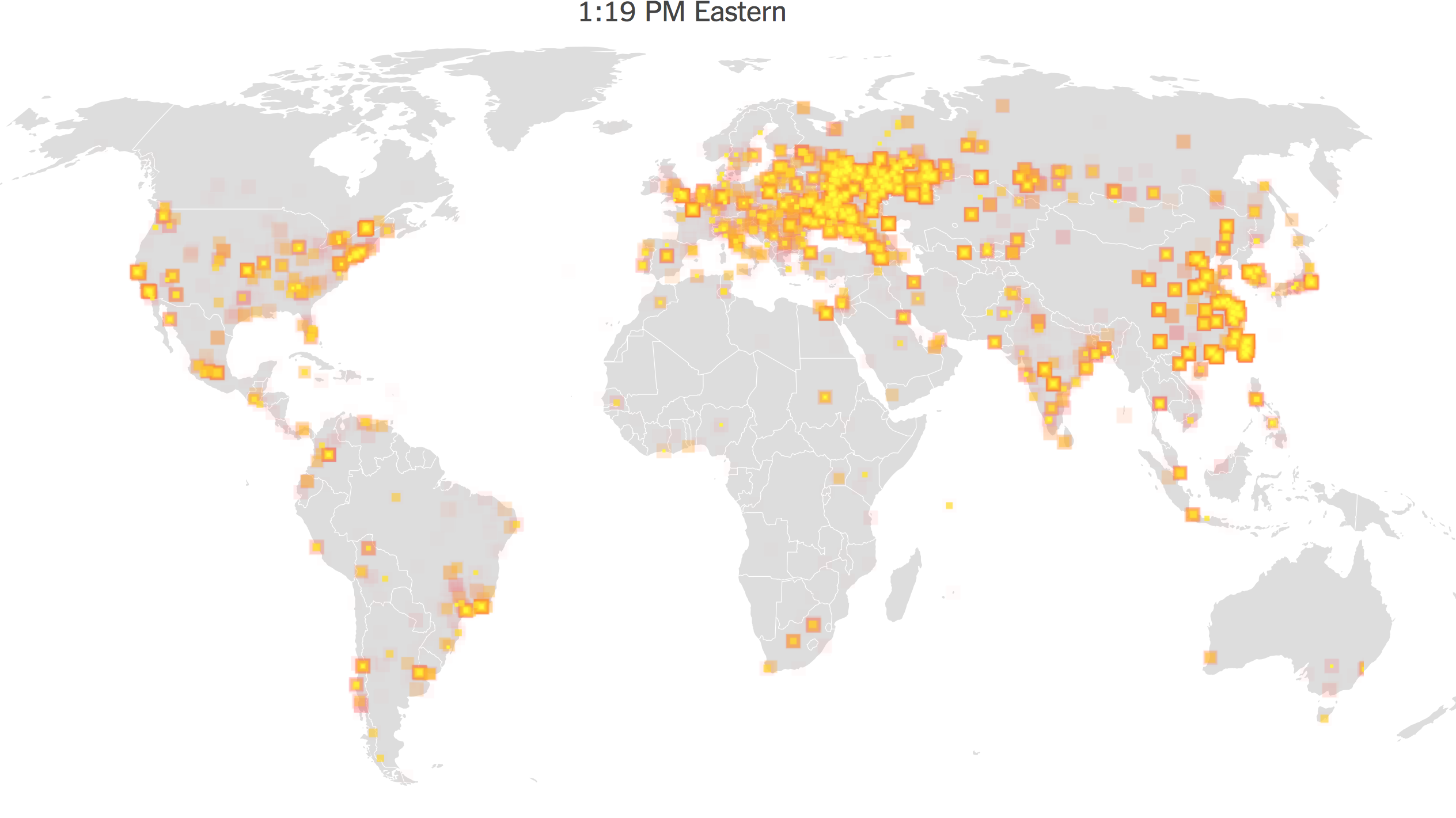
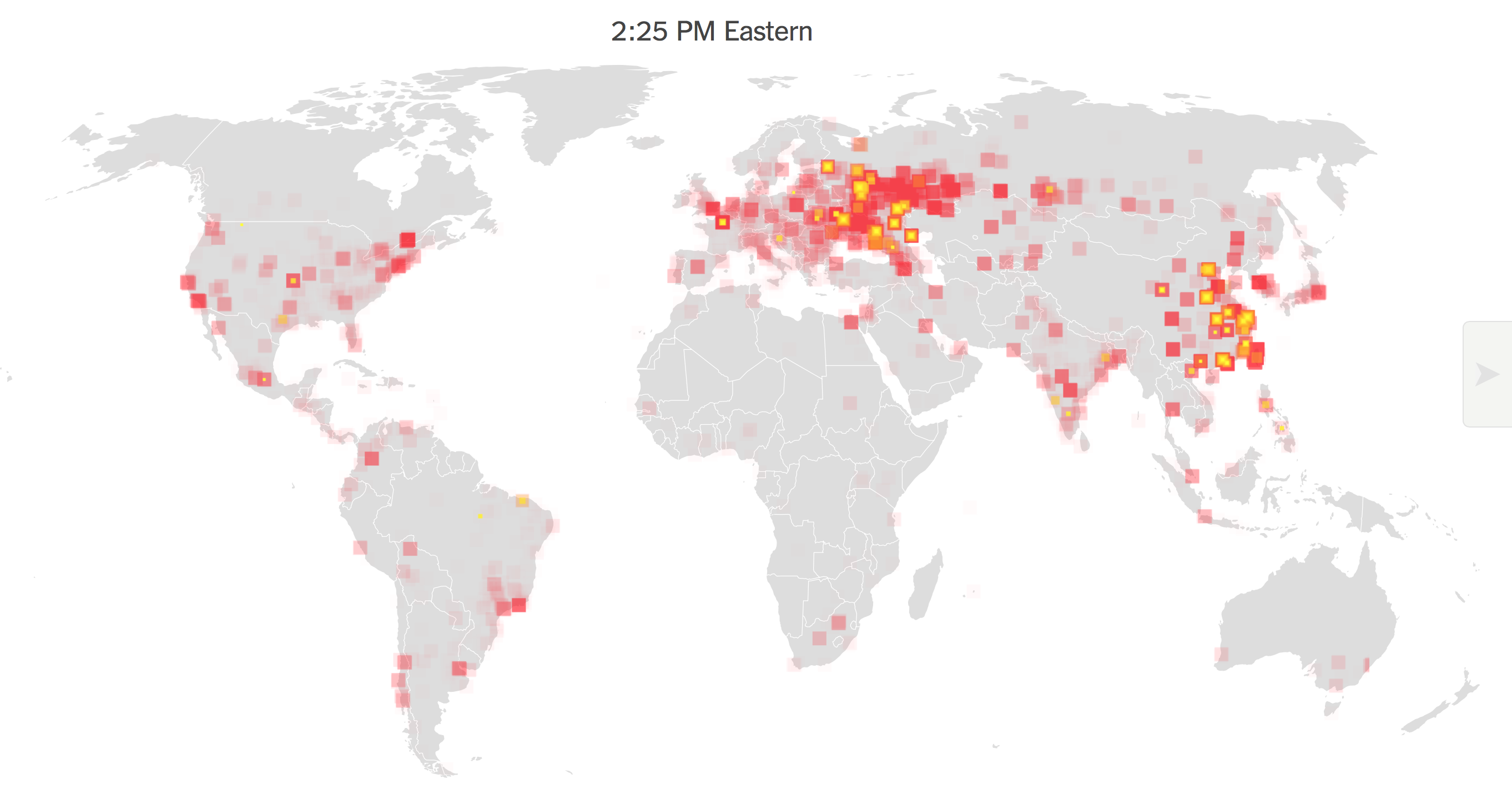
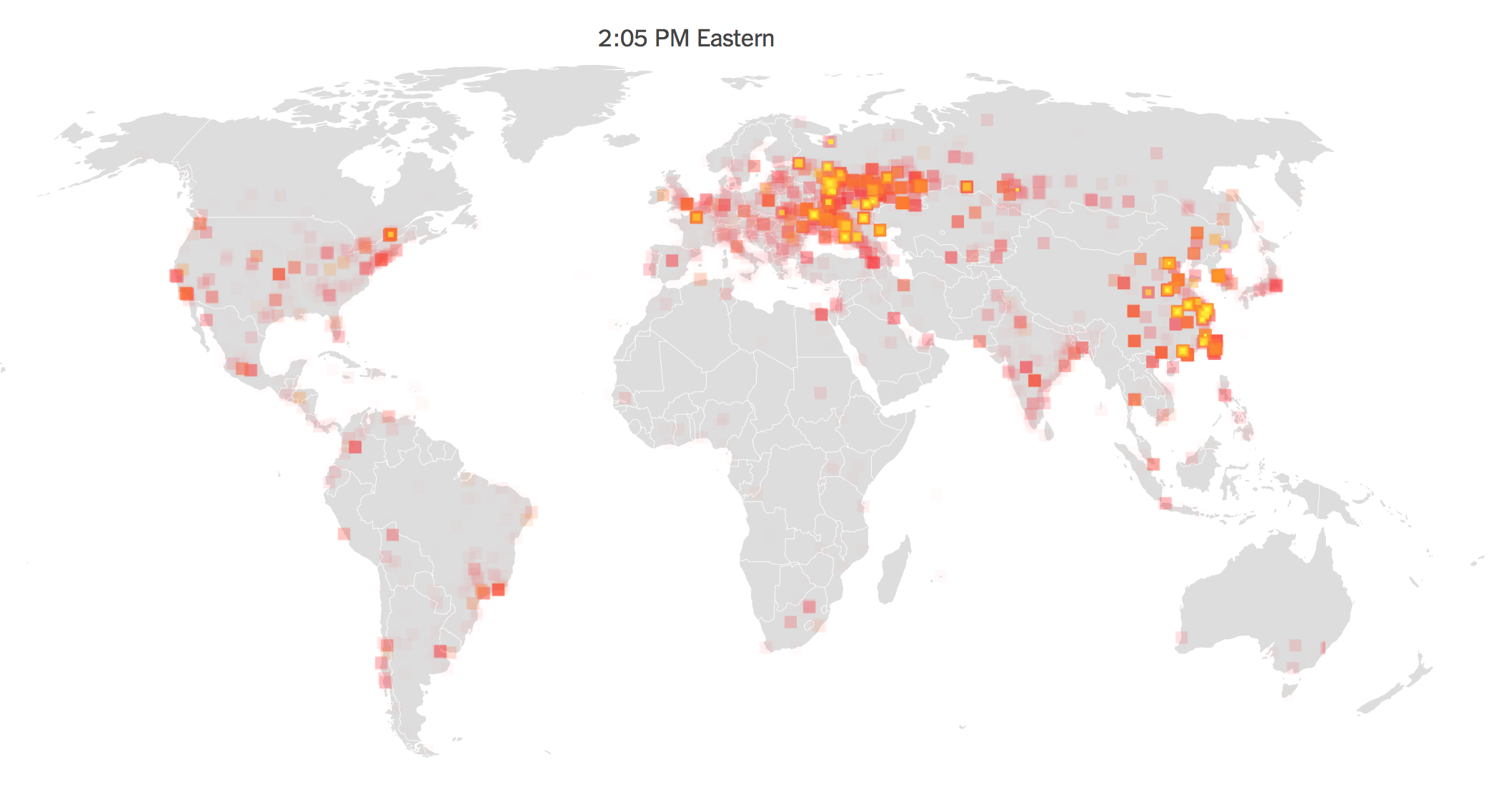
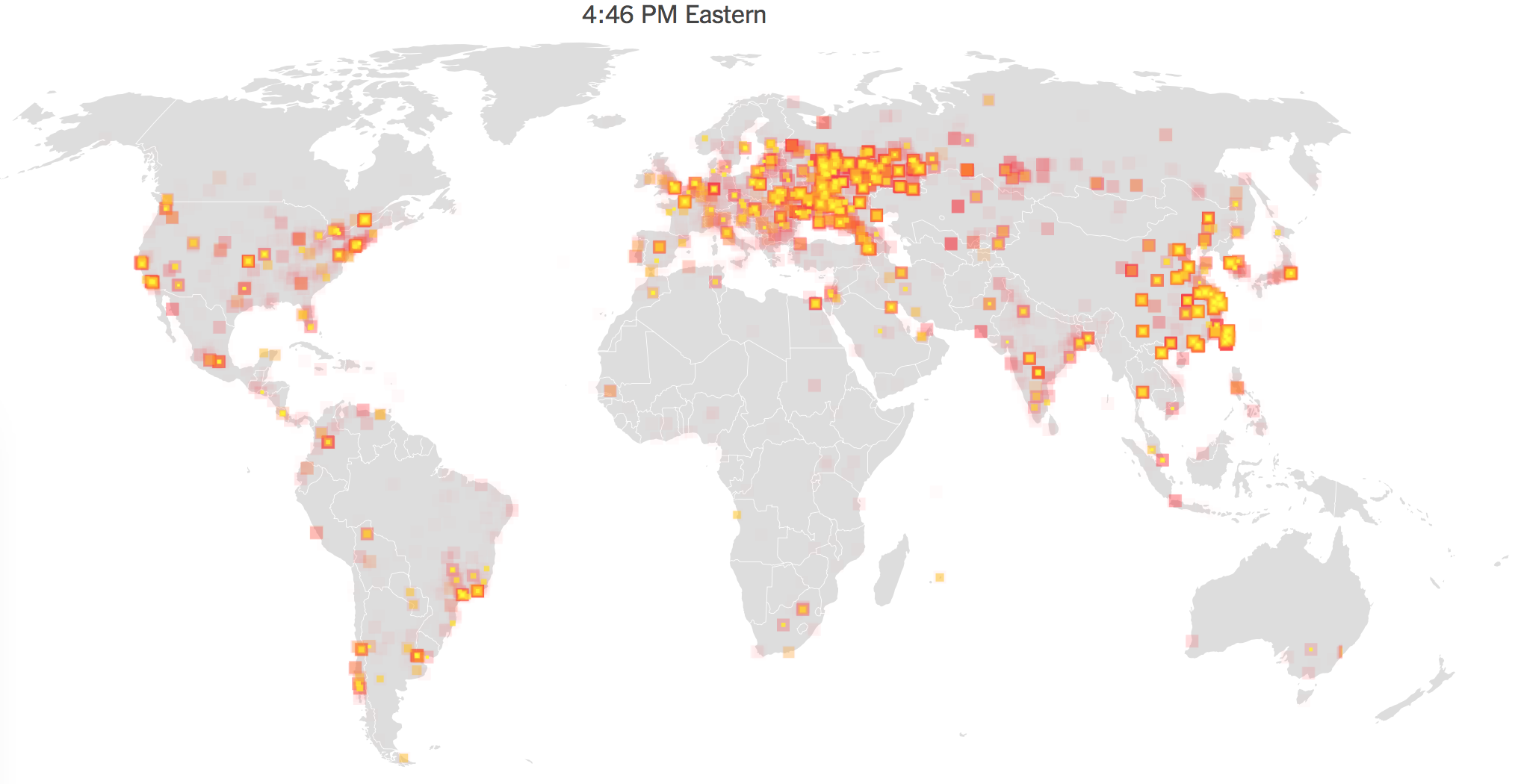
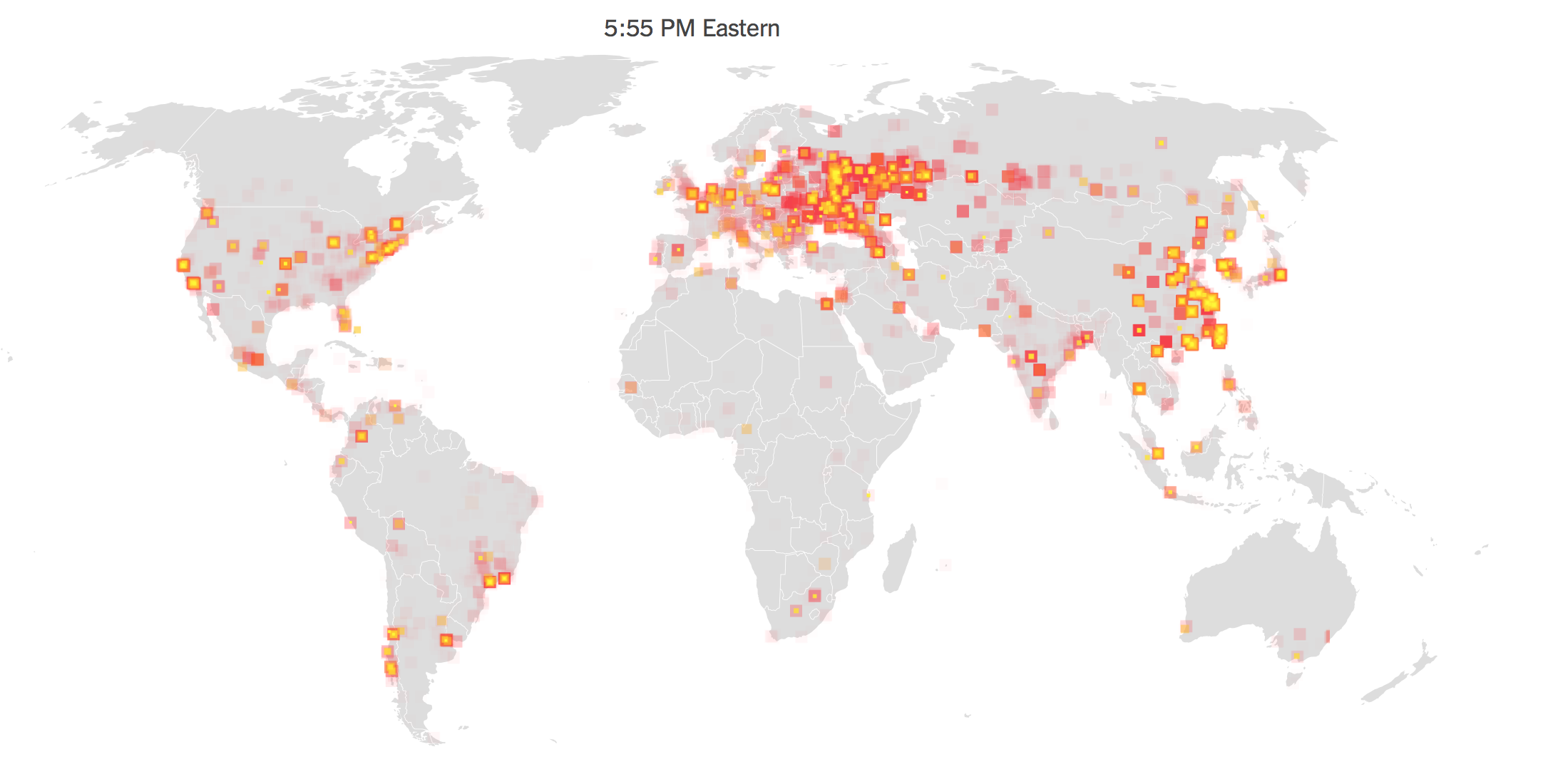
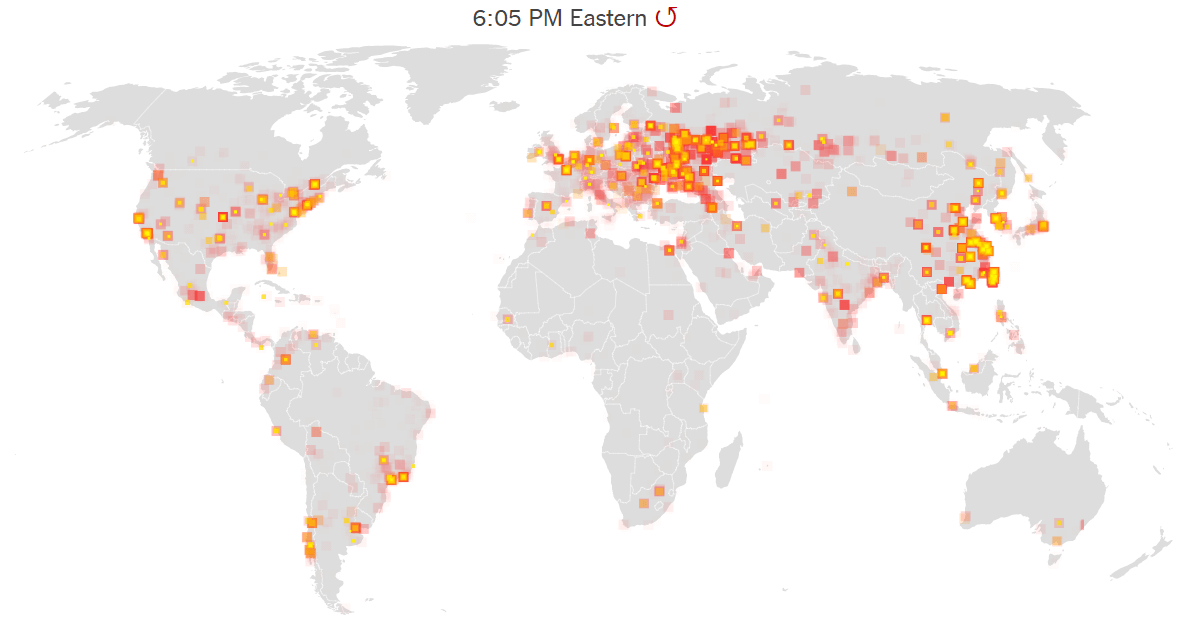
We continue to map the global spread of malware as if to wonder at its scale:  the distributed compromising of data as an animated sequence of simultaneous flare-ups of intensity from yellow to burning red across the world, as if to pose the question of its communication in terms of spatial continuity and proximity.  In some of the best data visualizations of the scare of WannaCry and Petya viruses, the brightly burning flare-ups signalled a fire that burned so brightly to become impossible to contain as if a metastisizing online cancer spread across the world’s wealthiest regions.  Despite the power of the animated visualization, we may map it wrongly, as if to imply it can be diagnosed as a spatially transmitted contagion without a target or destination.  In using the data-laden information of cybersecurity firms to map the occurrence of data corruption and systems infection, the political antagonisms and animosities that have fed the growth of malware are cunningly left absent from the map at our own peril.

1:03.png
1:19.png
2:24.png

Although these maps suggest the scope and nature of the self-replicating cryptoworm, they may take the metaphorical value of a computer virus in literal terms, as a disease map, or biological virus whose contagious could be explained,–like the famous Snow Map, created by a founder of modern epidemiology,  Dr. John Snow, to devise a mode to convince readers of the transmission from a water source of the 1854 London cholera outbreak.  Of course, the malware maps do not try to communicate the pathways or mechanics of the virus’ spread.  For rather than showcasing an event that was planned and of human agency, and whose propagation was in some sense designed, they run the risk of naturalizing both the incidence of systems’ compromises and the malicious nature of the very phenomenon that they describe.  While the meaning that each bring pixel cannot even be understood or processed in a global scale–its impact was local–the intensity of the outbreak seemed almost a skin disease on the surface of the world.  The intensity of its transmission surely mirrors the density of online connections or an economy that was web-based, as networks allowed its contagion spread from Indonesia to Europe the United States, raising alarms as it seemed to actualize some of the worst fears of a cyberattack, of the de-empowered nature of a computer system suddenly devouring its own data, but like a faceless god, from 11:00 one Friday morning, so that by 1:20, the spread of the malware had dense sites of infection on five continents.

The local merged with the global, however, in ways difficult to map:  the maps of real-time tracking of the spread of the worm across a grey, global map made it seem totally removed from human actors, in hopes to capture the speed by which the worm managed to rapidly to spread laterally across systems, using an onslaught of randomly generated IP addresses as a way to target an ever-proliferating range of hard drives through multiplying packets sent to remote hosts, whose own hard drives were hijacked, leaving anonymous-sounding messages of no clear provenance to pop-up on users’ screens, in ways that seem to imitate the “normal” logic of an algorithmic process entertaining the possibility of implicating the user in the encryption of their hard drive or the deletion of necessary valuable files.

screen-shot-2017-05-16-at-6-32-06-pm

The communication of the virus–a biomedical metaphor that seemed particularly unable to offer any diagnostic value, suggesting either the banality of the infection or its nasty spread–was not nosologically helpful, but suggested the virulence of its spread.  The natural history metaphor of the worm–or, better yet, the coinage of the cryptoworm–better expressed the lack of clarity as to its provenance or the seriousness of its damage.  Although subsequent investigations found that the first infections appeared, globally, on computers in India, Hong Kong, and the Philippines, according to SophosLabs, the stage was set for a three-pronged global spread–as if in a negative version of the Trans-Pacific Partnership, moving from South-East Asia worldwide–that began from 7:44  UTC with such startling rapidity that it will demand detailed unpacking to understand the target or decipher any of the aims that underlay the attack, or the extent of its destructive scope. The spread of the self-proliferating worm was only stopped by the inadvertent discovery in the code of the ransomware of a kill switch, which allowed a security researcher known only as MalwareTech to register a domain name able to slow the spread of the infection in a compromising manner, effectively halting its viral spread.  Despite the rapid proliferation of visualizations of the unprecedented sale of its virulence, in retrospect, it might make sense to ask whether the undifferentiated global nature of the visualization, while stunning, distracted from the malicious operations of its code, and what better metaphors might exist to describe the spread of something dangerously akin to cyberwar.

We only have a few cartographic metaphors to describe the lateral spread of online compromising of computer data and the infiltration of networks, because of the speed with which it spreads challenge human cognition.  Even if it can be schematized in a format that suggest the density of data compromises or the amount of encrypted files, the visualizations offer a limited basis to orient oneself to the seriousness or the danger of these infections, which once they start offer little possibility of stopping their spread.  The later visualizations of the global impact of the release of Wannacry network worm are usefully foreground the rapidity of its spread, and raise the specter of its unstoppability.  But the visualizations of the rapid flare-ups of malware that infect hard drives and encrypt their data may conceal the targeting of instability.  If the spread malware and ransomware have been primarily linked to extortion, the spread of self-propogating cryptoworms cannot only be seen in numbers of systems compromised:  for they are  released and created in order provoke instability, as much as for Bitcoin revenues.  Although theft of data is usually seen as most valuable to the owner of the dataset, the potential interest in ransomware as a service–and much ransomware is now available on the darknet in different forms, suggests a needed growth in cybersecurity.

If ransomware collectively netted about $1 billion during 2016–and stands to become a growth industry of sorts–the latest Petya virus netted but $10,000, although the benefits of the attack might have been much greater–in the form of the disruptions that it creates, often not so clearly racked or visible in the data visualizations of its spread, whose animated explosions suggest its out of control migration across networks as wildly crossing boundaries of state sovereignty, encrypting data on computer systems across space as it travelled along the spines of the internet as if without any destination, as tens of thousands od systems were entered and compromised via ‘back door’ disrupting hospitals in the UK, universities in China, rail in Germany, or car plants in Japan, in ways that were far more easy to track as a systems collapse by locking its victims out of critical data that allowed their continued operation.  The demand for ransom payments to restore apparently stolen data was a screen for the disruption of invasive attack on companies’ computer networks, whose compromising can only start to suggest the infrastructural disruptions they created as they rapidly globally spread, whose apparently anarchic spread revealed the new globalized nature of system vulnerabilities.

Malware explosion 2:05
Malware explosion 3:15
Ransomware4:46 pm
ransomware 5:55
wannacry-map

While malware is distinguished by the demand to hold hostage the encrypted files of one’s hard drive, the viral spread of worms targeting systems vulnerabilities can disrupt systems and infrastructure in ways particularly difficult to defend against.  Although the attacks depend on failures to update systems and to preserve retrievable back-ups, the vulnerabilities invite disruptions on a scale only so far imagined in futuristic films.  These apocalyptic scenarios are perpetuated by security firms–and by the video games of the global imaginary that require only greyed out background maps to treat data visualizations as having sufficient complexity if they register the intensity of attacks, even if this only gives cover for the malicious actors who perpetuate their spread.  But the assault on systems by the backdoor vulnerability first discovered by the NSA, in its program for targeting and infiltrating select foreign computer networks, but now for sale on the Dark Web, may only raise the curtain on a far more malicious range of malware, able to backdoor systems that are connected to transportation networks, water treatment plants, traffic systems, credit card systems, banking and airport controlling, far beyond cel phone systems, and able to–as the attack, just before WannaCry plagued web-based systems, compromised IDT Corporation–evade security detection systems.  While regular, complete and restorable systems back-ups may be the only response to ransomware, the possibility of already backdoored systems has lead to fears that the Shadow Brokers group who unleashed the Eternal Blue code from the NSA is a group of Russian-backed cybercriminals, and the hackers who released WannaCry who cyber researchers believe have tied to North Korea, may raise the threshold on cyberwarfare of a scale unheard of in previous years.

“Nothing in the world could take us back/to where we used to be.”  Golan Ben-Omi–who views the analytic skills honed in studying Torah as good training cybersecurity in the Chabad-Lubavitcher community–  Chabad-Lubavitch communities are interested in preserving the integrity of their websites from profane pollution, but are attuned to the dangers of data breaches.  The attack that was made on his company, IDT, by means of an NSA tool with the capacity to penetrate computer systems without tripping alarms–named “DoublePulsar”–enters the kernel of computer systems, or its inner core, to trip the connections between hardware and software that would allow hackers to steal systems credentials in order to compromise systems with far greater impact than earlier breaches and infections, appearing as ransomware, but perpetrating far more serious damage on a system.  The sequential flaring of compromised computer hard drives suggests a landscape that Ben-Omi has been studying for over fifteen years–and believes that the analytical skills honed in the study of Torah will allow his students to analyze.

While we lack the tools to start to map disruptions on such broad scale, the  If the attacks on hard drives that occurred in over one hundred and fifty countries on Friday, May 12, 2017 may have been a case of intentional disruption, but the Petya ransomware attack of July, which successfully targeted the same vulnerabilities, exploited similar vulnerabilities in a potentially more targeted weaponized manner.  Although it “is only code,” the lateral spread across the spines of the internet created fears of impending disaster across the most digitally rooted areas of the world, spreading fears of data disruptions, crashes and infrastructure collapse whose potential won’t be able to be so clearly mapped for quite some time.

The terrain of the crypto worm’s spread is better able to be understood, if not quite familiar.  During the most recent space of malware attacks left most untouched places those farthest from the most unreflective internet-dependent, the map only can suggest the real-life inconveniences that can hardly be captured by the burning flares of yellow-red bursting at spots across the globe at unprecedented velocity.

2000px-InternetPenetrationWorldMap.svg

Global Internet Penetration 2012/Jeff Ogden

InternetPopulation2011_HexCartogram_v7-01.png

Oxford Internet Institute (2011) Data on Internet users and population from World Bank 

For while not only communicated–as at first believed–by malicious email attachments, internet links clicked by users whose unreflective response unleash lost data, frozen systems, or looted bank accounts, the spread of ransomware parallels the amazing intensification of net-dependence and systems-based communicative tools, revealed below in the new information ecosystems that have arisen, illustrated in the quite spread of Facebook use over a short amount of time.

FB-World-Map-Comparison.png

The relation between online activity and real-time consequences are difficult to map.

All maps serve to help tell stories, and the intensity of Facebook connections suggest more than a huge time-suck of human lives:  it reveals the increased homogeneity of the systems we use, and the similarity of what we see and read.  But if all maps tell stories, the necessarily partial nature of the dense visualizations of the global disruptiveness of malicious attacks on computer systems seem compromised:  while over-laden to challenge the abilities of viewers to process their content, they only tell the most superficial part of real-time story–the compromising of data–and not the consequences that the widespread collective compromising of hard drives will effect both immediately and in the long run.  And here we get onto thin ice in terms of what can be visualized, and the limits of counting the datasets of the corruptions of computers or systems, and the difficulty of counting beyond the density of compromised hard drives to the real-world implications of systems’ collapse.  One can only start to imagine the implications of such collapse in maps contracting the real-time compromises of computer systems, in ways that reveal the global nature of an infectious spread of malware, but also obscure the different places that might be targets of weaponized malware attacks.

Malware Explosion 12:52

What we can track is the most immediate end-product of the malicious attack, but it offers few clues to interpret the basis for the attack or indeed the different scale of its real-time long-term consequences.

The visualizations track an almost near-inevitable progress of red flares in internet-dependent hubs that appear to overwhelm viewers with their over-laden information in ways that run the risk of obscuring any sense of human agency–or intent–as if to track the spread of a virus across a system that lacks internal logic of its own.  The intensity of attacks on computer networks tracked from the Wannacry ransomware showed the astoundingly rapid spread of the infectious cryptoworm that caused the attacks.  But it presented them as if they were in fact geographically localized, but the disruptions were purged of any explanatory context, geopolitical or other.  For the inevitability of the spread of malware that the images provoke–and the fears of the unstoppability of further crypto worms–may obscure the dangers of their weaponization.  If the launching of cyberthreats is often depicted as a real-time war by cybersecurity firms as Norse–

world wide war.png

–we may be increasingly in need of mapping the intersection of such live attacks on data and their real-life consequences beyond the compromising of datasets.

We  were recently warned how the expansion of malware and ransomware would soon propagate over networks in more virulent ways.  Earlier worms that infected hard drives as Conficker in 2008 and SQL Slammer back in 2003 or SamSam, spotted in 2016, offer but “a harbinger of a new wave of more malicious, tenacious and costly ransomware to come,” of even greater scale, warned Joe Marshall of Cisco Talos, with “bigger payouts.”  Marshall warned of the greater goals of hackers to infect networks, and his warnings might be augmented by suggesting the dangers of hackers working with governments to use malicious code to “cast a wider net” through self-propagating crypto worms able to laterally traverse  huge corporate networks as tools by which to target nations–and national infrastructure–in ways that the fear of network intrusion have only begun to come to terms.  When Marshall and his co-author Craig Williams noted in 2016 that the rise of ransomeware was an “ever-growing problem” that will involve greater payments to restore databases in Ransomware: Past, Present and Future with greater “intrusive capabilities,” with the repurposing of network vulnerabilities, on a massive scale, presumably including the targeting of entire systems.  The maps of data encryptions and corruptions that WannaCry caused worldwide served to capture these fears, and their broadly trans-national consequences; the trans-national nature of such a strike on hard drives may well obscure and conceal the strikes and intentions of other malicious actors.  Although some believe payment the easiest option to retrieve data, as the worms are developed that target vulnerabilities in systems, they will potentially be able to compromise targeted banking, transportation, and emergency infrastructures.

Do visualizations of the immediate fears of the spread of one virus conceal concerns of the weaponization of such internet-born infections on specific targets and nations, despite the seemingly unplanned ubiquity of their spread across interlinked systems?  Despite their shock, such visualizations of the intensity of compromised systems, often echoing hubs of internet service, raise pressing questions about how to map the operations and actors behind them that are far more complicated to process fully–and lie off of the map.

1. Viewing visualizations of such rapidly spreading worms that compromised computers on a global scale, one wants to be able to peel away layers of the visualization, to reveal, as layers of an onion, the networks along which the cryptoworm laterally spread and the extent of disruptions that its spread caused.  For the scale of the disruptions, and the intent of the hackers or those who launched the malicious code, may only be revealed in a more localized map of the sorts of destabilization that cryptoworms might produce.  While leaving us to wonder at the unprecedented scale of their recent spread over a few hours or minutes, the visualizations take geographical space as their primary register, blank background maps bleached of underlying history, may make them all the more misleading and difficult to read, as they are removed from human agency and context, and treated as an artifact of the spread of the reliance of increasing multinationals on internet services and web-based networks.

Differences in online activity are far less lopsided across geographic space than in previous years, as shown by the Oxford Internet Institute by a cartogram warping of global space showing the relative density of online activity by 2013 data, in ways that allow the broader targeting of systems to conceal a malicious attack on a country.

World Online 2013
Percentage online OIL

–which might also  be read as a record of the increased vulnerability of specific areas, and the systems vulnerabilities might offer to compromise local infrastructure, and start to focus on the implications for those places.  Doing so would consider the growing intersections between The Real World and the internet in a complex social continuum, where stability can be disrupted at select nodes more dependent on how worlds of finance, banking, shipping, health, and traffic are increasingly interlinked.  Given the inevitable nature of such vulnerabilities, the frequent backing up and smooth restoration of backups are necessary to erase the growing threats not only of malware or ransomware, but the disruptions of critical infrastructure future attacks might allow.

Continue reading

Leave a comment

Filed under computer viruses, cybersecurity, data visualization, globalization, World Wide Web

The Cognitive Clouding of Global Warming: Paris and Pittsburgh; Creditors and Debtors

The argument of America First seems to have been extended to its logical conclusion as the apparently selected President of the United States has single-handedly subtracted the nation from a map of climate change.  By denying the place of the United States in the Paris Climate Accords, President Trump seems, in the most charitable interpretation, to have acted on his own instincts for what was the benefit that accrued to the country in the very short term, and after looking at the balance books of the United States government for what might have been the first time, decided that America had no real part in the map of the future of a warming world.  Rather than outright denying global warming or climate change, Trump decided that the conventions established to contain it by the world’s nations had no immediate advantage for the United States.  

The result wasn’t really to subtract the United States from the ecumene, but from the phenomenon or at least the collective reaction of the world to climate change, and openly declare the supremacy of his own personal opinion–as if by executive fiat–on the matter. The personal position which he advanced was so personal, perhaps, to be presented in terms of his own clouded thinking on the matter, or at least by seizing it to create what he saw as a wedge between national consistencies, and to use wildly incommensurate forms of data to create the impression of his own expertise on the issue–and to mislead the nation.  For Donald Trump took advantage of his having Presidential podium to diss the Paris Accords by a torrent of alliteration developed by a clever speechwriter as resting on a “cornucopia of dystopian, dishonest and discredited data.”  Even if one wants to admire the mesmerizingly deceptive excess of alliteration, the notion of rooting an initial response to planetary climate change in the perspective of one nation–the United States of America–which produced the lion’s share of greenhouse gasses–is only designed to distort.  

By pretending to unmask the Paris Accords as in fact a bum economic deal for the United States, as if it were solely designed to “handicap” one national economy, set a sad standard for the values of public office.  For as Trump dismissed data on climate change as discredited with mock-rage, and vowed that the entire affair had been designed by foreign groups who had already “collectively cost America trillions of dollars through tough trade practices” and were desiring to continue to inflict similar damage.

But the large future on trade imbalances–which he treated as the bottom line–he staged a spectacle of being aggrieved that seemed to take on the problems of the nation, with little sense of what was at stake.  Trump’s televised live speech was preeminently designed only to distract from the data on which the Accords had been based.  And even as Trump sought to pound his chest by describing the Accord as a “bad deal for Americans,” that in truth “to the exclusive benefit of other countries.”  By turning attention to an America First perspective on global warming, Trump sought to replace the international scope of the challenge–and intent of the much-negotiated Climate Accords–by suggesting that it obscured American interests, even if it only took America’s good will for granted.  As if explaining to his televised audience that the agreement only “disadvantages the United States in relation to other countries,” with the result of “leaving American workers–who [sic] I love–. . . to absorb the cost in terms of lost jobs [and] lower wages,” he concealed the actual economics of withdrawing from the Accords were buried beneath boasts to have secured “350 billion of military and economic development for the US” and to help American businesses, workers, taxpayers, and citizens.  

In continuing to dismiss the data out of hand about the expanded production of greenhouse gasses, Trump seems to seek to overturn the deceptions of data visualizations that have alerted the United States and world about the consequences of unrestrained or unbridled climate change. Trump ridiculed the true target of the nearly universally approved Accords, scoffing at the abilities to reduce global temperatures; instead, he concentrated on broad figures of lost jobs in manufacturing and industries that are in fact small sectors of the national economy, and incommensurable with the dangers of ignoring global warming and climate change, or the exigencies of taking steps to counter its recent growth.

global warming
Increased Likelihood of Temperature Surpassing Previous Records by 2050 and 2080

oceanic-warming
Sea Surface Temperatures against a Historical Baseline of a Century Ago/Climate Central

As if years of accumulated data of earth observation could be dismissed as deceptive out of hand by executive authority, independent of an accurate judgement of its measurement, Trump dismissed expert opinion with the air of a true populist whose heart lay in the defense of the American people and their well-being–as if they could be abstracted and prioritized above the world’s  Trump’s largely rambling if gravely delivered comments in the Rose Garden press conference that painted himself as daily fighting for the country cemented the alliance of populism and a war on science by its odd substitution of bad economic data for good scientific data.  

The switch is one in which his administration has specialized.  His address certainly culminated an outright dismissal of scientific conclusions based on a distorted America First picture of the world, where a stolid declaration that “the United States will withdraw from the Paris Climate Accords” made sense as form of national defense–despite the potential global catastrophe that rising global temperatures and sea surface temperatures threaten. Is the technique of juxtaposing statistics and muddying data an attempt to undermine evidence, or an illustration of his insecurity with giving authority to data, or to scientific authority, the mirrors his concern about concealing “his profound illiteracy,” or his insecurity about illiteracy, that linguist Geoffrey Nunberg argues not only distance his own speech from words, and discredits their currency, but an insecurity of having to rely on language and linguistic skills alone, in ways that might be well seen as analogues to his plentiful use of all caps on social media, as stepping outside of the language of public life to a medium more direct and complicit with his audience, if outside the usage standards of a written language.

The catastrophes were minimized by being argued to be based on “discredited data” in a bizarre flourish designed to dismiss scientific concensus  Trump conspicuously faulted not only the “discredited” but distracting nature of data  in the speech he gave in the Rose Garden on June 1, 2017 that supposedly justified his announcement of withdrawing from the Paris Climate Accords in 2015 to limit heat-trapping emissions of carbon fuels that have been tied to observed climate change.  Rather than foreground the international nature of the accords among agreed upon by almost 200 nations, trump advanced the need to heed local interests, perversely, but even more perversely argued that the Accords resulted from disinformation.  He spoke to the world to chastise their recognition of scientific observations, in so doing destabilizing not only global alliances but undermining a long-negotiated climate policy by pulling the rug out from long accepted consensus not only of climate scientists but a role of national leadership that sought to remedy the failure of the Kyoto Protocol of 1997.  Trump turned his back on the Climate Accords on how to curb greenhouse gas emissions  by proclaiming their unfairness to American interests, and attacking unwanted constraints on American industry, through his own deployment of data that was even more discredited as an excuse to walk away from the prospect of a greener world.

Exiting the Green.png  Al Drago/New York Times

1. If Trump steered the nation away from green energy and into darkness, Vladimir Putin seemed to mock Trump’s rationale for the withdrawal when he mused, jokingly but ever so darkly, that “maybe the current [U.S.] president thinks they are not fully thought-through,” making open fun of Donald Trump’s image of global leadership by wryly noting in ways that echoed the absurdity of Trump’s defense of the local in place of the global.  “We don’t feel here that the temperature is going hotter here, . . . I hear they are saying it snowed in Moscow today and its raining here, very cold,” Putin noted, as if relishing undermining long-established trends in climate data by invoking a populist championing of local knowledge as if it trumped the advantages of earth observation that satellite observation has long provided.   Populism trumped expertise and Putin laughed at the possibility that the Accords might soon fail as a result.

Given the longstanding desire of Moscow to be released from constraints on exploring the billions of tons of Arctic oil on which Russia has chosen to gamble, Trump’s almost purposive blindness to a changing environmental politics of the global economy astounds for its parochialism, and its championing of place to dismiss undeniable effects of climate change that seems closely tied to carbon emissions.  For with a false populism that championed the limited perspective of one place in the world–or one’s own personal experience–Trump dismissed the maps and projections of climate change, on the basis that the “deal” was simply “BAD.”  And as a man who views everything as yet another deal, while he pronounced readiness to “renegotiate” an accord he sought to cast as a failure of President Obama to represent America’s interests, the rebuke fell flatly as the accord was never designed to be renegotiable.

Putin’s remarks were met by scattered laughter of recognition, and some smirks at the decision of the American president to withdraw form a long-negotiated set of accords to the collective dismay of our military and environmental allies, and its implicit endorsement of deniers of climate change.  The potential “axis of mass destruction” France’s climate minister has cautioned against might indeed be one of mass distraction.  For in dismissing and indeed disdaining the historical accords to limit carbon emissions, Trump sought a soundbite sufficient to stoke suspicions the climate treaty.  He sought to cast it as yet another deeply rigged system of which he had taken to compulsively warning Americans.  Such a metaphor of bounty was jarring to reconcile with onerous economic burdens cited as the prime motivations for deciding to reject the Paris Accords on Climate Change.  The jarring cognitive coinage seemed to connote its negative by a disorienting litotes; but perhaps the most striking element of the entire news conference was that Trump offered no data that backed up his own pronouncements and appearance of steadfast or only obstinate personal resolve.

Before the coherence of the embodiment of climate change in maps, Trumps jarringly juxtaposed radically different sorts of statistic to snow the nation–and the world–by disorienting his audience, on which Trump turned to a litany of complaints and perceived offenses striking for providing no data of any sort, save several bits of false data.  As much as Trump betrayed uneven command over the data on climate change, as if embedding discrete numbers in unclear fashion that supported a self-evident argument, as if they addressed one of the most carefully documented changes in the atmosphere of the world.  By juxtaposing a threat that “could cost Americans as much as 2.7 million lost jobs by 2025“–a number described as extreme but decontextualized to exaggerate its effect, framed by the dismissive statement  “Believe me, this is not what we need!“– with a projected small temperature decrease of two tenths of a degree Celsius–“Think of that!  This much”–as if to indicate the minuscule return that the “deal” offered to the United States that would have made it worthy accepting its costs–

sub-buzz-27555-1496436714-1

The gesture seemed designed to juxtapose the honesty of direct communication with the deceit of the experts.   Trump’s notion of direct communication concealed the surreal enjambment of disproportionate numbers more striking by the difference of their scale than their meaning.  Of a piece with his citation of partial statistics that exaggerate his points, from “95 Million not in the U.S. labor force” as if to imply they are all unsuccessfully looking for work, targeting some 8 million immigrants as “illegal aliens”ready for deportation, or how immigrants coast American taxpayers “billions of dollars a year.”   Such large figures deploy discredited data difficult to process to conjure fears by overwhelming audience, distracting from specific problems with large numbers that communicate an illusion of expertise, or even overwhelm their judgment by talking points disseminated in deeply questionable media sources.

If the power of this juxtaposition of unrelated numbers gained their effectiveness because of a lack of numeracy–Trump’s claim of 100 million social media followers lumps his followers on Twitter, Facebook and Instagram, many of whom may be the same people, and other fake persona —the numbers seem to exist for their rhetorical effect alone, as if to awe by their size and dismiss by the miniscule benefits they might provide. The point of contrasting such large and small statistics was to suggest the poor priorities of the previous administration, and dilute form the consensus reached on the modeling of climate change.  To be sure, the Trump administration also barters in fake facts on Fox News Sunday. inflating the number of jobs in coal industries, that show a misleading sense of the government’s relation to the national economy, generating a range of falsehoods that disable fact-checking, obscuring the fact that the global marketplace increasingly gives preference to cleaner energy and clean energy jobs more quickly others sectors of our national economy beyond energy industries.  The ties of Trump’s administration to fossil fuels–from the Secretary of State to the Secretary of Energy to the Secretary of the Interior down–employ the obsfuscating tactics of fossil fuel industries to obscure benefits of low-carbon fuels.  Indeed, the inability to “renegotiate” a deal where each nation set its own levels of energy usage rendered Trump’s promise of the prospect of renegotiation meaningless and unclear, even if it was intended to create the appearance of him sounding reasonable and amiable enough on nightly television news.

Broad hands.png
Cheriss May/Spia via AP

Another point of the citation of false data was to evoke a sense of false populism, by asking how the Accords could ever add up.  In isolating foregrounded statistics great and small, tightly juxtaposed for rhetorical effect, the intent seems consciously to bombard the audience to disorienting effect.  We know Trump has disdain for expertise, and indeed the intersection between a sense of populism with disdain or rejection of science may be endemic:  in formulating responses to a global question like climate change that he has had no familiarity with save in terms of margins of profits and regulations.  Rather than consulting experts, the President has prepared for public statements by consulting sympathetic FOX media figures like Kimberly Guilfoyle who pander by endorsing the notion of a climate conspiracy–not experts, who use data as obscuring foils, suggesting an ecology of information originating from pro-fossil fuel industry groups.

Continue reading

Leave a comment

Filed under data visualization, data visualizations, Donald J. Trump, global warming, statistics

Mapping Trump

As news anchors stared directly at the camera on Election Day 2016, they might gesture mutely to the apparent dominance of Donald Trump’s presidential victory, shown the blanket of bright red polygons that took the viewer’s breath away by their sheer continuity affirmed that the people had spoken definitively.  The map was a bit of a total surprise, evidence of the disproportionate appeal of Trump across most states other than the coasts.  And it is an icon with which Trump has taken to celebrate in an almost proprietorial way as the result of his labors and his own hard work that he tried to celebrate in addressing the Boy Scouts’ annual jamboree this year.  Casting a now-forgotten moment of compact between himself as Presidential candidate and the nation, incarnated in a map, and presenting it as a personal triumph, he recalled the electoral map as a definitive rebuttal of a “dishonest” press and media, urging we all “remember that incredible night with the maps and the Republicans are red and the Democrats are blue; that map was so red, it was unbelievable,” and rhapsodizing how the map struck so many dumb with disbelief so that “they didn’t know what to say?”  The electoral map, for Trump, provided the ultimate confirmation for a “dishonest press” and “dishonest media,” but just how honest was that map, anyway?


Trump at Jamboree.png


The map seemed to show a dramatically lopsided margin of victory, but it of course concealed just as much.  It seemed to celebrate red nation, indeed, until one considered the concentration of population, and drilled deeper down into population distributions than an electoral map can reveal.  The map however remained so cognitively powerful that the geodemographics of the 2016 Presidential election seems to mark the return of a landscape of blue vs. red states, and a sense of the self-evident nature of a newly redivided republic.  The promise of national maps to parse the division of the popular vote–a conceit fundamental to the electoral college–however creates a false sense of the breadth of support or the links between an individual candidate and the land–distilling the distribution of the vote into a false if compelling continuity of a sea of bright red.  And it is not a surprise that the map has become a favorite demonstration of the extent of Trump’s popularity, and the myth of a landslide victory not seen in earlier years.  Even if its geodemographic illusion demands to be unpacked, the scale immediately gave rise to the magnification of a margin of victory that is entirely to be expected from Trump.

But for a national figure who has convinced what seem continuous swaths of the nation’s so-called heartland he could speak for their interests, it is striking that despite some considerable variations among voting patterns, the intensity of that red block so clearly endured.  The distribution illustrated the intensity of the affective relation to the candidate, or rather the failure of achieving any deep to Clinton as a candidate–but became a symbolic icon of Trump’s claim to represent the nation’s ‘heartland.’

reference-mapBen Hennig, from results of 2016 US Presidential Election

The geodemographic conceit was not much evidence that he actually did.  Despite the strength of such affective ties, Trump has only slim familiarity with that heartland–and rarely showed much tie to it.  Despite the compelling nature of the geodemographics that suggest Trump’s close tie to the nation’s center, the region Candidate Trump convinced was ignored by the media and press alike was largely avoided by Candidate Trump.  And few of its interests can be said to have been sustained by the President we now have, whose electoral success in the upper midwest will be hard to measure with a feared decline in health care subsidies, should the Affordable Care Act be repealed and Medicare gutted, leaving older working class voters in the cold, as a new tax code does little comfort.

But was Trump ever so tied to the band of red running vertically down the country?  For the region that voted for him is increasingly becoming disaffected, as he qualifies his opposition to NAFTA and his assurances about the need to construct a border wall, in ways that raise questions about his strong showing across middle-America and his identification with the people’s will.  Yet the iconic map itself may have provided for Trump himself a bit of a mirror illusion–as if to trigger a sense of recognition of his identification with the entire nation in ways that came as something as a surprise, it also effectively validated his long-time aspirations to the presidency, not only for the media, but for himself.  To be sure, the notion of a “heartland victory” reflected the growth of a tendency to shift Republican on a county-by-county level, which reflected a targeting of the midwestern states that seem to have been conducted below the eyes of team Clinton in the 2016 US Presidential election; Trump’s vote share substantially grew in Ohio, West Virginia, Iowa, Michigan, Wisconsin, Minnesota and Missouri.


Republican Blush.png


By normalizing the same choropleth of Trump votes, or using a color ramp that will foreground the percentages of voting intensity, a recommendation for all future voting maps Kenneth Field rightly suggests, the deep intensity of reds are brought out better, focussed almost in targeted sites in ways that might merit more retrospective scrutiny.


Trump votes normalized choropleth.png

Kenneth Field

But the deep reds of the electoral map were the most compelling to The Donald, and continue to lead him to retreat into rhapsodies, some eight months after the election, in Cedar Rapids IA, about how “Those electoral maps, they were all red, beautiful red.” As much as Trump has seemed to be processing the legitimacy of his victory well past the first hundred days of his term, a framed version of the electoral map infographic is rumored to have been hung, framed, as an icon in the Trump White House for visitors, to which he can point only to ask, as if in desperation,  ‘Aren’t you impressed by this map?’”  The map has become something of a calling card to which Trump seems both boastful and still gleefully processing, perhaps precisely because it was so often broadcast on TV.  The image transformed to a wall-map seems a needed confirmation of the areas that sent him to the White House, and has become a distributed visual for news interviews, as if its presence reminds interviewers that they are engaging with the representative of the real country.


C_kshitVoAE0vfh.jpg


Why post the map on the wall?  The infographic presumably captures those areas of the US where Trump must continue to address outside Washington–and of the disempowerment of the mainstream media–as if to remind him of his ongoing sources of strength.   Trump cannot conceal his pleasure to continue to crow, reveling in his unexpected ability to cathect with voters across so much of the northern midwest if not the silent majority of the national interior, and the map confirms a moment of joy:   the map of a “sea of deep crimson” offered credible needed visual confirmation of the legitimacy his newfound power that responds to continued crises, and a sort of symbolic consolation:  Trump, as if planning a billboard to the nation, requested no one less than the Washington Post run the image on his hundredth day in office, perhaps in hopes to brainwash the nation by the repetition of that apparent sea of deep, deep red.  It reveals, moreover, the very silent majority that Trump had long evoked:  Trump’s skill at resuscitating the Nixonian conceit of a “silent majority” supporting the Vietnam war and rejection counter-culture became a bulwark of sorts against the press; it  was particularly pleasurable as it re-appeared within the very news maps that the media produced which were broadcast on television screens, in ways Trump himself wants to continue to broadcast.  Trump not only holds TV in famously high regard–even if he did not mostly watch television for all of election night–it is almost credible that the iconic electoral map was framed for the White House walls, if distorting , offered a recollection of the magnitude of his margin of victory that must be comforting to show guests.

The considerable shock of the electoral results led many readers to recognize the reduction of support for the Democratic candidate, so well-qualified, to isolated regions near the more diverse and reliably Democratic coasts.  The visualization of disembodied counties for Clinton registers an immediate anxiety in projecting the angst of isolation from the same heartland, as if to show what seem only pockets of Clinton supporters in a very tenuous archipelago with outposts hewing predominantly to the nation’s coasts, as the outliers of the vision of America that Trump was able to propose.  As much as showing the lack of contact of Clinton’s messaging to so many counties in the in-between “forgotten heartland” that the Trump vote seemed so successfully to invest coherence in, the image shows a heartland that is almost abandoned by Clinton voters who seem not to have migrated from the country, but seem exiled from an increasingly fractured nation, in their own filter-bubbles, in which their own place has been rendered up for grabs.


clinton_v2-Artboard_6.pngTim Wallace/New York Times

The geodemographic illusion of such fracturing however belies the sharp dissonance that a deeply provincial figure long resident in one of the nation’s largest metropoles felt to much of the country and the nation that he so convincingly claimed he was able to represent.  Trump’s ability to have convinced much of the country he could guarantee their continued safety lies in contrast with the limited presence Trump ever remained in many of the regions that the force of his Presidential campaign so solidly and deeply colored red.  The clear divisions in the country that emerged in the 2016 Presidential election revealed a clearly widening set of divides between islands of populated blue and regions that trusted different news sources, more suggestive of a divide driven by eduction than wealth, using available census data on education from the Data Observatory in a CARTO visualization of the lower forty-eight, to create a more finely-grained record of the distribution of votes that allows the chromatic vacation to pop–

Carto Trump.pngMichelle Ho‘s Carto Blog

While the “split” between “heartland” and “blue islands” pops out better in the above courtesy the Carto dashboard, the surface of a flat map can conceal the extent to which the vote broke among more and less populated counties, as the following sizing of counties by votes received by Clinton (blue) or Trump (red).

Coutnies.png Carto

The thin distribution of red dots calls into question the existence of “heartland” in the nation, and how much the notion of a coherent heartland is the creation of a map, suggests the extreme oddity of an election where votes so clearly broke with electoral votes.   Notwithstanding the visualization of Alexis Egoshin being picked up on right-wing sites as a basis to argue for the need to continue the electoral college to represent the mass of land, pictured as a plateau, with which Trump won decisively, and could be called “TrumpLand” as it was so solidly voting in his favor–

trumpland-1.png

–the thinly stretched archipelago of Tim Wallace might defy geographical explanation, and be rooted as much in media bubbles, fractured politics, anti-immigrant sentiment as it can be said to be geographically determined, and perhaps the tendency that we have to believe that there could be a geographic explanation at the root of the Trump victory, or a definable “Trump” community or constituency might be more tied to the contingency of information economies than anything as easily mappable in purely objective terms.

1.  Trump’s own overly inflated claims to represent the red expanse of the rust belt was, for one, most strikingly undermined, however, by his regular return flights on his Boeing jet to his New York penthouse while on the campaign trail.  For as he campaigned, Trump maintained a remove from much of the country, even as he evoked the “rusted-out factories scattered like tombstones across the landscape of our nation,” and excoriated the policies that he claimed created them, urging voters to “take our country back again.”

While we are still trying to understand what he meant by “American carnage” save as a way to conjure fear, and a landscape beset by violence and “drugs pouring into our country and poisoning our youth,” within an “environment of lawless chaos,” the exaggerations of specters of social threats that proliferate from Trump’s mouth seem to be as emotionally figurative as they reflect actuality, and more a reflection of the America on television news than statistics.  The call to “shake off the rust” appealed, however, by binding themselves to the possibilities of “wistful time travel” that Donald Trump’s candidacy seemed to promise voters, as Zadie Smith has keenly observed.  Who better, in fact, to convince most of the country that he could bring it out of the shadow of threats of terrorist attacks that 9/11 has continued to cast across much of the nation, as if creating a bond of reassurance that stood in for any other tool of manufacturing consent.

And the tie was reified in maps.  A land map magnifying the extent of Trump’s 2016 US election results in the electoral tally was widely trumpeted by right-wing news sites, as well as the nightly news, to proclaim Trump’s was a landslide victory–even though the differences in popular voting was not only decisive, but Trump’s own relation to the nation he now leads is poorly understood.

Trump can be claimed to have converted more far more Republicans to his candidacy than recent Presidential candidates, but Trump was long an outsider.  And Trump’s imaginary tie to nation seems just that, despite some considerable crowing over Trump’s close relation to the American heartland that he claims as deeply tied to and to be the territory that he best represents–

electoral-trump

–although these stark divisions in the distribution of voting patterns disappear in the district-by-district electoral votes map posted by Mark E. J. Newman in clearly contrasting stretches of red and isolated islands of blue with only the occasional all-blue state.

county-map-2016University of Michigan/M.E.J. Newman

But the map of the distribution of electoral votes is only the start of the attenuated relation Trump has to the country.  Trump’s insistence on an alleged “mandate” or a “massive landslide” seems designed to provoke collective amnesia by its repetition–Trump’s own convictions seem born from the illusion of democracy displayed in broadcast electoral maps on TV news.  For the vagaries of the current electoral system meant that a shift of four counties from one state to a neighboring state, data scientist Kevin Hayes Wilson pointed out, would have redrawn the map of the election, and our picture of the nation to a more comforting baby blue–although this tantalizing alternate reality is not to have been, but is in fact not so far away at all:

imrs-1.php.pngKevin Hayes Wilson/Redraw the States

Yet the victory of a continuous stretch of red is so iconic that the mapping of votes by counties is taken as an affirmation of regions of deep scarlet, as if the county is a meaningful unit for displaying voting tendencies:

United_States_presidential_election_results_by_county,_2016.svg

The image of “red” states or counties is so potent, however, that the image is taken as evidence of the appeal of Trump’s promise to “Make America Great Again”–as if the slogan spoke to the heartland–that converting the map of counties to a cartogram which sized counties by population and voter size seems to be a weaponized warping of the nation for polemical intent, in which the center of the heartland has been stretched into a skein of thing red strands that slighted the region by stripping it of its political voice, as if created by a leftist cartographer who polemically diminished the heartland by rendering it as so much connective tissue in contrast to the prominence of blue cities.

Stretched thing

vote share.pngBenjamin Hennig (detail of Hennig’s cartogram of 2016 US Presidential election)

The rendering of the heartland as a stretched skein of what seem ruts in the American landscape seems the polemic of a leftist cartographer from a metropole, to many, ready to slight the heartland in favor of the magnified cities whose names appear on the map.

hennig skein

To be sure, the tea leaves of county voting patterns do parse voter populations:  to be sure, Trump did almost twice as well as Clinton in those counties that were at least 85% white, rural (fewer than 20,000 inhabitants), and won huge preponderance of the votes–70%–where less than 20 percent of the population has a college degree.  But the continutiy that one can translate into spatial terms is much less clear, and the county is not the clearest organization or translation of a voting bloc, despite the clearly greater diversity of the cities, and the dominance that Trump exercised in counties that were predominantly–85%–white, in ways that may have single-handedly overturned the electoral map, and were the audiences to whom the visions of prosperity Trump promised most appealed, and where the Democratic candidate’s losses in comparison to Barack Obama were big–and where Trump won almost twice as much of the counties.

80%white.png

Bloomberg, “The Voters Who Gave Us Trump” (Nov. 9, 2016)

But, by and large, the rhetoric of the red intensity of maps perhaps have originated as pollsters talking among themselves, and against each others’ expectations, as much as the distribution of a close connection to the candidate; the intensity of the red appeared in a contrast of the predictions of the popular vote distribution against the actuality, even if it seemed within a margin of error, as the final actual distribution–

2016-presidential-elections-actual-county-level-results-map-e1484740439135

Beta News

–broke ever so slighty, but so definitively and so strikingly, from their expectations:

The-final-2016-presidential-election-app-county-level-predictions-e1484740495640

Beta News

2.  Trump’s claims for a personal relation to the nation is far less apparent.  It demands to be scrutinized, as it only seems demonstrated in electoral maps.  Even though seven out of ten Republicans voiced expressed a preference for America of the 1950s rather than that of today, and Trump’s candidacy both entertained and invited such acts of willed nostalgia, it’s hard to believe Trump’s own proximity to the nation’s heartland is based on “lived” experience.  The surprising story of Trump’s campaign may be the alchemy by which he cemented a bond among evangelicals, with the help of his only nominally Catholic running mate, Mike Pence, paired with the poorly thought-out strategy of Hillary Clinton to focus on cities, rather than rural areas or the economically depressed areas that reject the effects of globalization, which could have spread those blues out along the map with far greater surety–a need that the map of Hayes Wilson reveals by the washed out areas of even the states whose delegates she won.

For while growing the share of Republican voters across several states presumed to vote Democratic, including many in the so-called “rust belt”–here colored dark red–

trump-increases-republican-votesBBC

–President Donald Trump seems himself to be quite alienated from the very folks whose economic interests he persuaded he would strongly defend, and less than ready to spend time there, save in his Florida estate, the new Winter Palace, Mar-a-Lago, ensconced as if forever a foreigner to much of the nation.

3.  The familiarity that Trump created with the nation seems rooted in an imaginary, built on the lifestyle of the Trump brand–even though his election leaves us with a shrinking horizon of expectations.  To say Trump ever knew much of the country is not only an exaggeration, but an outright deception that was willfully perpetrated if not orchestrated by his campaign.  Despite the broad appeal of a Trump lifestyle, Trump seems to have little connection for the man in the street or his job.  But his keen sense of playing the salesman for his brand, which promises to be a central part of his Presidency, led him to have so much practice at delivering people’s fantasies and recasting the art of promising anything but the greatest product ever to “innocent . . . exaggeration.”

For his policies betray little familiarity with the nation, beyond empty sloganeering, evident the belief that a repeal of the ACA would help the nation–when it would most likely, as Paul Krugman noted, “send the numbers right back up—[after] 18 million newly uninsured in just the first year.”  And the imposition of punitive measures against American companies who chose to locate their production overseas or in Mexico, and even more punitive tariffs against foreign competitors demand to be called out as instances of economic bullying, rather than anything like a realistic economic policy or plan.  And the notion of a 20% import tax would be passed on not to the Mexican government, but to heartland consumers who would pay for it in their purchases.  And ending the American Care Act would put almost a half a million aging folks off of health care, in ways we cannot yet fully map, but will have deep consequences for the very deep red “heartland” that Trump champions.  And as Anwar al-Awlaki, the radical Islamic American-born al-Qaeda preacher, foretold that the “West will eventually turn against its Muslim citizens,” Trump has successfully made his prophecy an actuality.  (“You were a nation of ease,” al-Awlaki had addressed the United States ominously, inviting a similar sort of time, but “imperial hubris is leading America to its fate.”)

Although Trump claimed to speak for the country, he was most famous for retreating to the confines of Trump Tower:  he was, confessed long-time political operative Roger Stone, something of a homebody.  His attachment to owning properties in Manhattan and his estate in Mar-a-Lago were so great to start rumors Trump declined to make the White House his regular residence as President.  And when Trump regularly returned to New York City or Mar a Lago, he always kept most of New York at a remove while sequestered in Trump Tower.   While totaling some 276,000 miles in the air by late September since announcing his candidacy for the U.S. Presidency  on June 16, 2015, Trump traveled over half of the days since announcing his candidacy, even while visiting far fewer places than other Republican candidates and fewer than his Democratic opponent, Hillary Clinton.  And if one is to judge his familiarity with the country in terms of the cities where he chose to build and promote hotels as evidence for the sites he earlier visited, it is striking that the sites of Trump’s North American properties are located on its coasts, or outside of the very areas where his campaign was so wildly and only perhaps improbably successful.

North Am Trum Properties.png

For on the campaign trail, Trump buzzed about the country to create the sense of direct contact with constituents even without spending that much time in a single place, but regularly returned to New York, he may have visited places like Brooklyn, where Clinton’s campaign was based, far less frequently–and spending a considerable amount of time on the campaign trail sleeping in Trump Tower, if not resting in the large bed stationed in his 757; tweets from sites on the campaign trail conveyed his endless motion, but many began “just returned from . . .” in multiple tweets during the early days of the primary.

Were the steady accusations of his opponents’ tiredness but projections of his own somnolence or power naps?

Somnolence.png

Trump was regularly cast by ABC news as Palm Beach’s Most High-Profile Homebody by the year’s end.  Trump was no doubt tired out by the extensive campaign where he projected his exhaustion first onto Jeb Bush and then, more dramatically, Hillary Clinton:  for two weeks in December, rather than assemble his incoming cabinet, the PEOTUS remained in the sumptuous Mar-a-Lago, rarely leaving the estate for golf and dinner at the Trump International Golf Club, or Christmas Eve mass, and meeting with his transition team just “a stone’s throw from the croquet garden,” before returning to Trump Tower in January to assemble the rest of his incoming cabinet in the nineteen days before his inauguration–and expressed reluctance in leaving his aerie in Manhattan for periods of a week after assuming the Presidency, proposing frequent returns to his three-story penthouse on the 58th floor of Trump Tower for family time during his Presidency.

4.  Even if he has warmed to the White House’ decor and furniture soon after moving in, Trump is a man who has stayed put in his lavish multi-floor apartment for much of the last three decades, and it has provided the perspective from which he looked at the United States–and may offer a perspective from which the strong opinions of his policies were formed.  For a candidate who saw the sumptuous quarters designed in Louis XIV style as a tribute to his creation of his own self-image, was his creation of a time-frame also particularly revealing?  Did his identification with an apartment decorated in 24-karat gold and marble and furniture and tapestries  in Louis XIV style with a Tiepolo ceiling put him in ideal place as a candidate to promise a project of time travel to Americans seduced by his timeless lifestyle–

15trumpwomen-ivanacomp-master675

so effectively isolated as he was from the changes in the external world over the past twenty to thirty years?  (And doesn’t being called a “homebody” mean quite a different thing for such a home?)  For a man who grown up in a house with four white columns that were adorned with a confected crest and coat of arms and white columns, as a palace set apart from Queens, N.Y., with twenty-five rooms and nine bathrooms, the palatial abodes that he has continued to created for himself and his family similarly stepped outside of time.

The series of luxury hotels with which Trump’s name has been synonymous promote lifestyle packages promote pastiches of European luxury that are, after all, the tricks of the trade of a master hotelier–whose expertise is to offer an escape to a new comfort zone.  Since winning an election for United States President seems to provide only an extension of the art of escapism he has already refined in the political sphere that can translate to the trade of the hotelier, it seems no surprise that recent publicity even integrated the image of the White House facade to a promise of escapism at Trump International located in Washington, DC–even if this reveals something of a conflict of interest or confusion of jobs, or rather imagines the sort of “Suite Escape” in which Trump Hotels specialize the possibility of looking at the photoshopped blanched federal Environmental Protection Agency  through drape-graced windows in utmost Trump luxury, even if it does, as Philip Bump noted keenly, capture the “mess of conflicts of interest” that Trump is now likely to himself face far beyond that hotel.

c3i8vuhwcaa5x5e

c3kmsa4wyaavo2z-jpg-large

5.  For it seems that a large part of the promise of Trump Hotels is to offer to assemble for their eager visitors pastiches of the “finer things of life,” such as the guesthouse in the Blue Ridge foothills, combining a Georgian-style mansion with old-world elegance from Waterford crystal chandeliers, oil paintings, and statuary in surroundings recalling the Tuscan countryside; every one of his Trump International hotels or Trump Hotels is prized for its own thematic program of interior decoration that offer to their visitors.  This is distilled in the utterly escapist residence Trump loves in Trump Tower, whose time-shifting decor to transport one to an idyllic past, free from social consequences or concerns, that might be the emblem of the escape he offers the country.

inside-trump-tower

The notion of Trump sequestered, as a self-made Rip van Winkle, is somewhat appealing.  Donald Trump rarely travels, and seems something of a homebody, flying home regularly while he was on the campaign trail on his private jet–and asking the Secret Service to follow him home, on an air company he owns.  To the tune of $1.6 million, agents accompanied him on regular return flights on TAG Air, on which he logged some $6 million personally, boasting “I could be the first presidential candidate to run and make money on it,” as he walked to the bank, even outfitting his own ostentatious Boeing 757 jet at a cost of $1 million that situated his own name prominently in red, white, and blue. Trump often made late night trips back to New York during the Presidential campaign, to sleep in his own living quarters, according to the New York Times.  (The cost of outfitting his plane in suitable luxury may have given Trump grounds to criticize current government contracts with Boeing for the real Air Force One of $4 billion–“Cancel the order!“–although the mechanics of what was entailed in that plane were probably not in his grasp.)

trump0715-force-one.jpg

All those daily flights home on “Trump Force One” to sleep in Trump Tower during the Iowa Caucuses were at first feared to cost him some votes across the midwest.  Trump had regularly returned to his morning view of Central Park and his lavish home quarters, however, and seemed to relish returning with regularity during the campaign.  He didn’t allow any press members to accompany him on these flights, though the staff grew.  But he didn’t hesitate to outfit the luxury jet which was a frequent backdrop for news conferences and televised appearances, at a cost of an extra cost within the 3.8 million taxpayers payed to Tag Air, Inc., to operate the jet which approximated his personal quarters in Trump Tower, from a master bedroom approximated with silk wall coverings, mohair couch that converts to a bed, 57-inch television, home theater, shower and gold-plated toilet on this fuel-inefficient plane–all the while insisting on returning to his penthouse in Trump Tower almost each and every night.  (Trump claimed his flights were funded by checks he wrote to his own campaign, and the sale of MAGA hats and souvenirs at rallies, but the $27,000-$36,000 increase in daily operating costs of such regular flights home–the result of a deep resistance to overnighting outside his home long noted on the campaign trail–left the Secret Service sending a tidy check of $1.6 million for much of 2016 to Trump’s own airplane company.)

6.  The web of financial ties to Trump are far-flung in their nodes, and their ties to members of the incoming Trump cabinet–including Betsy “Ah, Betsy; Education, Right?” DeVos–and seem to stretch to areas only begging to be fully mapped, but which extend far, far beyond the properties of the Trump Organization.

Trump Mafia.png

–in a virtual web of business connections, many concealed within his tax statements.  The ties to much of the nation and newfound legitimacy and recognition of the Trump brand seems undeniable–even if Donald Trump, Jr. dismissed the idea that Donald, now that “he’s got real stuff he’s got to deal with” and “real people’s lives,” is anything but occupied with his governmental duties or realizes the extent to which hid new platform of recognition might encourage the expansion of a luxury hotel chain to new regions of the country.   While scoffing at the “notion that [President Trump] is still running the business from the White House is just insane,” however, the network of hotel chains he has administered provide something like the template for Trump’s notion of his relation to space, as the deals he brokered with construction firms, cities, and property taxes have provided him with the basic tools by which he seems destined to project Presidential authority.  Even as Trump sons Eric and Donald, Jr., the surrogates of his hotel empire, claim “There are lines that we would never cross, and that’s mixing business with anything government,” the inescapable confusion is one from which they will benefit.

Indeed, the range of hotel properties Trump owns are wide-ranging, although notably removed form the African continent or Australia, not to mention an almost entire absence in Asia, restricting interest in South America to the tourist destination of Rio and a planned residential development in Uruguay; and with no properties in continental Europe outside Istanbul–and an avoidance of Mexico which, for the owner of a chain of luxury hotels and hotelier, seems almost to be rooted in something like a deep personal dislike–

48d41a986339f80a89695e2609f368fd71dc0653-1

The selective seats of Trump International perhaps befits an entity long styled as “real estate super-brand” and linked to the lifestyle it marketed.   But the absence of Trump’s ability to market the Trump lifestyle and brand of hotel destinations in Europe, save the recent and requisite golf courses in Scotland Ireland, may reveal a long ambivalent attitude to Europe and NATO countries, given the absence of Trump interests outside golf courses in Aberdeen, Tunberry and Doonbeg.  (Indeed, Trump took no time after assuming the Presidency to rail against the EU based on his own experiences from “another world” of business–based on the firm refusal  of the EU to resist a proposed seawall on the dunes of Trump International Golf Links and Hotel in Doonbeg, Ireland, on the grounds of the environmental protection for endangered animals.  Trump was forced to curtail his planned seawall, the basis for the objection–an endangered snail–post-dates his aversion to expanding Trump International in Europe.

But is emblematic of the disproportionate scale with which Trump seems to view the world.  While mocking local disturbances faced by his building projects as annoying disturbances, he promotes his vision of a single way of life cobbled together from historical periods, providing residents a view from Mumbai at the Park at a remove from the poverty of homeless families who sleep on cardboard on Mumbai’s streets–in an image long suspected to be photoshopped.

58681cd31500002f00e9ddcc.jpegPaul Needham (2014)

The withdrawal of Trump Tower is the opposite of global engagement, but is the site to which Trump seems to invite us all to retreat in an age of global refugees.  Is it any coincidence that the self-confessed germaphobe so fearful of contamination from crowds is most inclined to adopt metaphors as floods, swarms, or infectious to describe the experience of refugees as threats to the social body, metaphorically re-framing their plight at a remove from social, politics or economics–and insisting on our need for better self-protection?  The distorted view from Trump Towers elides the experience of many through the distorting lens of real estate.

7.  Indeed, Trump’s gift for getting his name put on every empty surface known to man–including Trump-themed fiction–seems to have been taken as an excuse for his interest in political representation, which it is not.  But it is no secret that business interactions have most importantly shaped and helped formed Trump’s world view.  And the somewhat striking absence of Trump hotels in much of Eurasia–save residential developments in Seoul, and some under construction in Mumbai, Pune and the Philippines–raises questions not only of the appeal of the version of Trump glitz that they offer, but also of the place of these actual locations in Trump’s current mental map; the distance of the Trump brand entirely from the neighboring state of Mexico is more than clear, and may derive from personal distaste.

The presence of properties under construction in Uruguay, India, and Makati may indicate constraints of the Trump lifestyle, whose limited truck in Europe is not destined to grow in the future.  The relative absence of Trump’s presence in Asia–save Baku–suggests not only a compromised notion of geography for Trump, but an untimely withdrawal from international markets that analyses of the previous administration suggested place millions of jobs at risk.  How can we collectively trust a man with so compromised a notion of geography to can the Trans-Pacific Partnership?  The punitive measures proposed to be taken against companies making products overseas suggest a deeply skewed notion of the place of the American workplace in the global economy, and punitive measures against foreign competitors, suggest a limited and deeply narcissistic notion of global economic transactions, distant from and out of touch with the distribution of global populations.

populous nations.png

The remove of a spatial imaginary of real estate was long prominent in Trump’s mind.  The sharply concentrated and geographically small circuit of properties Trump owns in New York suggests not only a limited knowledge of the huge diversity of New York City but define the notion of the Trump lifestyle he has sold to America as an outer borough boy.  It betrays his narrow range of interest in coveted properties around Midtown and Trump Tower, revealing Trump’s longstanding interest in focussing his sights on Manhattan, despite his father Fred’s disinterest in the far fancier borough–and his open discouragement to Donald for chasing such properties from a firm that had roots from the Verrazano Bridge to the Long Island border, and offered middle-class housing, for hubris in reaching beyond his Brooklyn roots.  Is the focussed expansion of Trump Properties into Midtown, by now long naturalized by its epicenter at Trump Tower, a form of inter-borough envy with roots in the class conflicts of New York City’s urban geography?

Such inter-borough rivalry seem to have guided not only the expansion of Trump properties as it expanded to the area around the future Trump Tower, site of the tony area of Tiffany’s, the Plaza Hotel and Central Park South–

Trump NYC.png

–but the position in which he sees himself in relation to the world, and the caricature of the populist millionaire that became the conceit of The Apprentice and since become a basis for Trump to sell himself and his brand to the country.

Indeed, the eagerness of Donald to move to the toniest areas Fred Trump disdained, by casting himself from the “streetwise son of Brooklyn’s largest apartment builder,” allowed him to expand his stylized image as a colossus of Manhattan, but to disdain the outer boroughs of New York City as a place to plant the gold-plated image of his name.

Fred and Donald.png

In staking claims to building in such a restricted area of Manhattan, Trump may have used midtown as a sort of arena or performance space to broadcast his identity with such well-polished sheen that it served as a launching pad for Reality TV, long before declaring his Presidency.

8.  More scarily, however, is that the quite limited previous experience Trump gained with world affairs from his perch in New York seems destined to shape the judgements that he shapes on issues of global consequence:  as being in Queens and looking at Manhattan defined Donald’s appreciation and interest in power, the very tactics of aggression that worked for him to launch his brand in New York has become generalized in the trademark launching of hotel facades, and the confrontational bullying of world leaders seems to be the chosen metier of foreign policy, as cultivating allies and personal rapports; divisions between personal space and national destiny seem far closer than in the past, who seems to see foreign policy as conducted in confidence and in tête-a-tête rapports; foreign non-immigrant workers of HB-1 visas are viewed as “cut-rate” bargains, analogous to foreign construction workers; constant commentary on foreign affairs in Twitter permitted; brinksmanship is a working strategy; market negotiations as a primary means of statecraft with overseas partners and adversaries alike.

Trump’s deep need to impress world leaders takes precedence over policy or statements of national interest; tax-cuts are for corporations, whose rate is cut to 15 percent, and tax brackets collapsed from seven to three–while omitting how the US government would be able to afford the cuts.  Trump works on small-scale corporate deals with companies about aircraft, but the big picture seems to slip away.

For Trump’s apparently unremitting focus on staking claims to what he considered higher status in New York City’s real estate market, and to promote his name in doing so, developed with an intensity that led him to continue to stake claims to that status for new arenas.  This began in New York City, greedily and relentlessly, from the West Side Highway where his promise of a waterfront apartment building led the city to permanently close an exit ramp, to Soho, to Wall Street.  This apparent search seeming to chase an image of prestige in the mirror of his own gold-plated marquee, combining deep desire with disinterest in much of the external world, almost desiring only to look in the mirror of the gold reflective surfaces naming the multi-billion dollar towers to which the developer lends his name and the status they take pains to create.  Trump indeed boasted to a biographer Harry Hurt III, back in 1993, about having the best living room view in all of New York City, by virtue of being able to see from his Trump Tower apartment his own name on all sides:  beside the Hudson River in the West Side Yards; on Third Avenue, atop the thirty-nine story Trump Plaza or the fifty-five story Trump Palace.  Hurt compared it all to a child-like fantasy: mirrored in miniature on the ultimate stage of self-indulgent fantasy, as Trump’s name is branded not only on buildings but also “on a Monopoly-tyle board game branded ‘Trump'”, in a sort of ubiquity that needs its own constant affirmation, and itself engenders a desperate need for confirmation of loyalty and admiration.

For Trump seems to have lived in an extended or protracted mirror stage, where the materials of building provide themselves the foil for revealing the “I” that the builder seeks to cultivate, forged in a pre-linguistic stage but continuing as a distorting monumentalization of selfhood that desires to obscure if not obliterates the very map across which it spreads, disorienting the viewer.  The reality of the Trump presidency seems retaining the sheen on the name that seems to gain a greater aura the more that it is reproduced.

Gold reflective.png

Trump Tower

tower.png

lv-trump-t

But how long can that last?  While Trump boasted that his ability to have “added show business to the real estate business” is an apt characterization as “a positive for my properties and in my life,” is the nation able to be defined as his property, or is he able to fulfill the fantasies of his constituents through inflated promises and empty patina?

Rather than build such bold pronouncements of self without oversight in Washington, DC, Trump seems to offer the nation new ideas of the landscape of governmental authority.  For rather than seeing the role of the Presidency as representing the nation, Trump seems to have relentlessly presented the function of the Presidency as expanding own his personal enrichment at the cost of the nation–and indeed at the cost of the Presidency’s historical prestige.

c3ejxivwaaaytfr

Comments Off on Mapping Trump

Filed under American Politics, data visualization, Donald Trump, electoral maps, real estate

We Think Our Shores Are Stable,–but Need to Know that They Are Not

All maps stake propositions:  as much as embody geographical information, they make arguments about how a landscape is inhabited.  But climate change maps that model future scenarios of warming, increasing dryness, sea-level rise, or glacial melting are propositions in a strict sense, as they construct frames of reference that orient us to, in the very ways Wittgenstein described propositions, “a world as it were put together experimentally.”  Shoreline change can be mapped in deep historical time, or over the past century, in interactive ways that reveal and allow us to zoom in on individual sites of sensitivity–


national_shoreline


–but the processes of mapping such change cannot rely on contour lines drawn on a base map.  For to do so is to abstract a static photograph from a global process that they only compel one to try to better visualize and comprehend.  The processes of change are extremely complex patterns of causation that exceed most map-viewers competencies, despite the wide diffusion of claims and counter-claims about global warming and climate change in public discourse, which has effectively increasingly threatened to dislodge the preeminence of any position of expertise on the issue, demoting the actuality to a theory and removing many public statements on its existence from the map of coastal change, or the relation of the land to submerged territory.  We are in danger of adopting an increasingly terrestrial or land-locked relation to how climate change affects shores, because we map from the boundary of the landform, as if it were fixed rather than a frontier of interchange and exchange, both above an under ground.


coastal-map-usa-usgs-marine


Far more than other maps, maps of climate change demand unique training, skills, and education to unpack in their consequences.  And when the propositions staked in maps of climate change have increasingly come under attack for political implications, as if the scenarios of climate change are formed by a cabal of data scientists and climate scientists to advance independent agendas, or a poorly articulated and politicized climate research, it seems that the special skills used to interpret them and the training to view them have come under attack for not corresponding to the world.

Real fears of the danger of the delegitimization of science run increasingly high.  But attacking the amazingly dense arrays of data that they synthesize seems to suggest an interest in shutting down the very visualizations that allowed us to conceive and come to terms with climate change.  The open suggestion that digitized scenarios of climate maps were only designed to terrify audiences and advance interests not only undermines discussion and debate, but seems a technique to destabilize the emergence of any consensus on climate change.  Although the fears of an immediate loss of climate data may be overstated for the nation, the loss of a role in preserving a continuous record of global climate data is considerable given fears of reducing space-based remote sensing.  Such observation provide one of the only bases to map global climate data, ranging from aridity to water temperature to temperature change over time.  The hard-line stances that Trump holds about climate sciences are expressed in terms of the costs they generate–“very expensive GLOBAL WARMING bullshit,”–but extend to denigration of climate scientists as a “glassy-eyed cult” by science advisor William Happer–who in George W Bush’s Dept. of Energy minimized the effect of man-made emissions on climate change.

Both bode poorly for the continued funding of the research agenda of NASA’s earth sciences division.  And the need to preserve a more coherent maps of man-made climate change grow, choosing the strategies to do so command increased attention.  The dangerous dismissal of climate sciences as yet another instance of “listening to the government lie to them about margarine and climate change” or prioritizing the political impact of their findings to draw attention to global warming and climate change seems to minimize the human impact on climate and recall the censorship of climate science reports from government agencies by governmental agencies and political appointees from a time when de facto gag orders dissuaded use of the term “global warming” over a period of eight years, a period of the harassment and intimidation of climate scientists. The term of “climate change” seemed agnostic of human agency–unlike Al Gore’s conviction that “global warming” was a global emergency.  As well as actively destabilizing ties between human-caused emissions of carbon dioxide and other heat-trapping gases with global warming, Bush asked government agencies investigate “areas of uncertainty” which his successor tried to clarify through explicit research goals.


global warming


Yet the role of maps in making a public case for climate change and its consequences seem to have made the project of climate tracking and earth observation under increased attack, as the project of mapping climate is in danger of being removed once again from scientific conclusions about global temperature rise, subsurface ocean temperature rise, or glacial melting–as the ways that climate change maps embody actual environmental risks is effectively minimized.

Continue reading

1 Comment

Filed under Climate Change, climate modeling, data visualization, environmental monitoring, manmade climate change