Category Archives: infographics

The New Separatism and the Gas-Tax Latitudinal Divide: Tracking the After-Images of Secession across the United States (Part III)

Mapping the nation gained wide currency as a way of performing national identity with the rise of the readily printed maps.  Outfits such as the U.S. Election Map Co. that were founded in the mid to late nineteenth century to provide readers a legible record of the nation.  Scribners was fortunate to be able to invest money in their appearance and legibility continued them in works such as the maps of presidential elections in Scribner’s Statistical Atlas in spectacularly modern form– including such maps as the masterful county-by-county survey that clarified results of the highly contested presidential election of 1880, where Republicans and Democrats divided around the contested question of the continuation of Reconstruction.  These images echo the statistical maps that applied the principles Francis Amasa Walker first developed in the 1874 Statistical Atlas to visualize varied spatial distributions from population density to wealth to ethnicities for the U.S. Government–“clothing the dry bones of statistics in flesh and blood,” so that, in Gannett’s words, “their study becomes a delight rather than a task.”
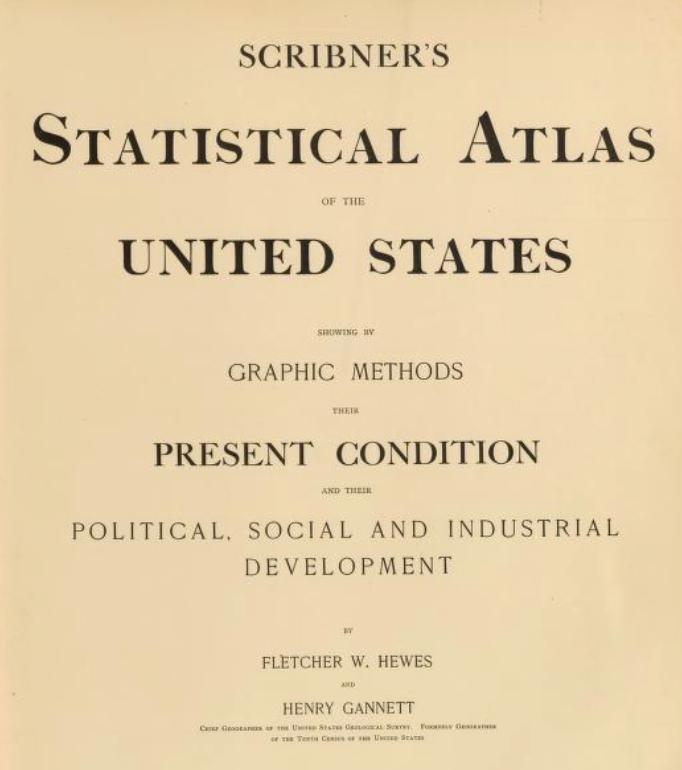
Statistical Atlas

The volume dedicated to Walker showed itself particularly sensitive to the possibilities of the visual delight of arranging information for viewers in data visualizations, using graphic tools developed with the German immigrant mapmaker Edwin Hergesheimer to wax poetical about the scope of visualize geographic variations as aids by which “not only the statistician and political theorist, but the masses of the people, who make public sentiment and shape public policy, may acquire that knowledge of the country . . . which is essential to intelligent and successful government.”  These sentiments–continuing those of Walker, but announcing the new purview of the info-graphic in a culture where maps had become, in Martin Bruckner‘s words, a new form of performing the nation that built upon increased geographic literacy to narrate national identity but one that extended dramatically beyond the role printed maps played in the eighteenth century.  In the aftermath of Civil War, the body of maps that Gannett and Hewes assembled provided nothing less than a new way to embody the nation in visual form.

Good government was the final endpoint of showing the deep divide in national consensus within the popular vote in his 1883 mapping the geographic distribution as a two-color breakdown or divide, and not suggesting the conundrum that the government must faced–or a sign of the lack of legitimacy of the government, and impossibility of governing well.  In showing a historical survey of not only the “physical features of the country” but “the succession of [political] parties and the ideas for which they existed,” Walker knew that Gannett’s map suggested the different divides revealed, and his pre-Tufteian precept that “simpler methods of illustration are, as a rule, more effective” to summarize and bring together the “leading facts” was done with “care . . . taken to avoid over-elaboration,” so that “by different shades of color, the maps are made to present a bird’s eye view of the various classes of facts, as related to area or population,” including political economy, church membership, mineral deposits, and electoral returns.  The notion that the reification of electoral returns constituted a map provided a new way of envisioning the polity that Walker saw as particularly profitable for mass-readership.  We’re now often the readers of info-graphics of far greater historical poverty, far more used to parse the political electorate of the country in ways that cast the viewer as the spectator to something approaching the naturalization of insurmountable divides.

1880 popular vote for HGLibrary of Congress

The new flatness of the divide is disquieting, if not false.  The maps in the Scribners’ innovative Statistical Atlas were the product of the adventurous tastes of newspaper and magazine editors who worked with new confidence to reach new numbers of readers, investing in graphics to appeal to a new eye and a new desire to envision the nation, in ways we have only begun to reach in the far flatter visualizations that we distribute online and even in print.  In the lavishly produced periodicals of post-Civil War America, multi-colored maps raised questions about the legibility of a unified national space.  They suggested fragility in the union from the government’s point of view.  But they challenged viewers to find how that unity might be read in a particularly engaging ways–as well as being preserved, and provide far more subtle texts–and statistical knives–than the pared-down infographics that appear so often on our handhelds and screens today.  In ways that suggest a new standard for the historical depth of the infographic, the map used statistical “facts” to embody the nation so that one can almost zoom in on its specific regions, in a manner that prefigure the apparently modern versatility the medium Google Maps, but that do so by exploiting its folio-sized dimensions as a canvas to read the nation’s populations.

In ways that graphically processed the tabulation of the popular vote that it lay at the reader’s fingertips, the map’s author, Henry Gannet, delved into the question of how clearly the divide between north and south actually mapped out onto the clear enclaves and redoubts of Republican partisanship that are located in Baton Rouge and the South Carolina coast, and much of Virginia and Texas, that challenged the dichotomic division between “northern” and “southern” states.  An antecedent to GIS, in Walker’s designs for the maps, the striking color scheme presented pockets of Democratic resistance with a clarity that made them pop out and immediately strike viewers’ eyes as a way to grasp the political topography of the country in especially modern ways, as if to map the meaning of its Republican consensus.  The map represents the heights of good design that the New York newspaper industry had pioneered after the Civil War, enriched by advertising and graphic design, even if it was designed by the statistician who helmed the United States Census in Washington.  Its pointed argument on the difficulty of taking the electoral map that resulted–shown as an inset–as a reflection of an actual divide raises questions about the current tendency to naturalize “Red” states versus “Blue” states, if it seems devised to answer questions about how the national fabric was rent by opposed divides during Reconstruction.

How the map, very much in the manner of contemporary graphics, came to synthesize political history in legible form by embodying them–Walker’s “flesh and blood”–seem premonitions of contemporary market for info-graphics.  But they were removed from the increasingly unavoidable divides that recent info-graphics suggest but seem designed to perpetuate, or the readily improvised graphics of the short-term that are consumed in made-for-television maps viewed largely in living rooms on television screens.  If the unified color blocks of much data visualization is sadly designed to discourage reading or interpretation, in ways that almost seem destined to limit our political vision for the future of the country, the opportunities that Gannett’s map allows to delve into the palimpsest of the popular vote might help to remove what seem blinders on our shared sense of the political process.  The market for the new info-graphic is quite distinct, and designed not for an Encyclopedia, but created for the short-term–and indeed valued as a short-term image of the contemporary with its own expiry date.

The needs of mapping an image national continuity were quite distinct, and might be profitably historicized in ways that would be foreign from the current market for or demand that info-graphics fill.  For the rationale for creating such a visualization of the popular vote’s distribution, if contemporary to a range of new maps for visualizing and processing the nation, gained pressing value after the Hayes-Tilden contest–as it would after the recent defining Presidential contest between Bush and Gore, or for the race between Obama and Romney–for their critical explanatory role to resolve the nation’s symbolic coherence.

The resemblance in the divide revealed in info graphics seems far deeper than political partisan allegiance, and the culture of this divide difficult to pinpoint–although the anti-Republican sentiment of the South was fierce in the election of 1880 seems a likely point to begin to map the local resistance to the continued presence of federal troops.  The divide between north and south echoes the division redrawn on Wikipedia between slave-states and free states circa 1849, and  enshrined in a latitudinal divide across the southwest of America in the so-called “Missouri Compromise”to permit slave-holding in the south and prevent its expansion to the north at the same time the country expanded–
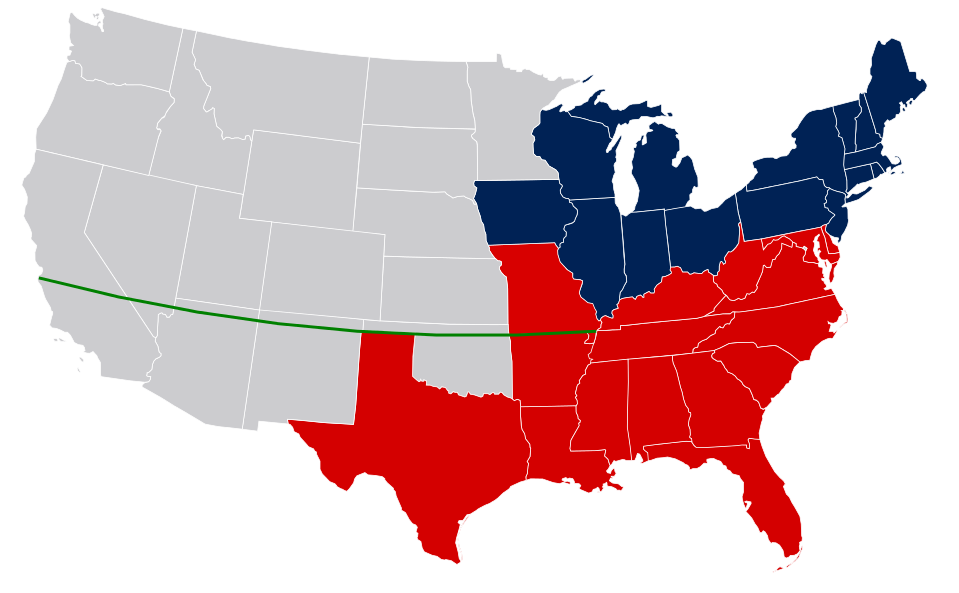
959px-Missouri_Compromise_Line.svg

Wikipedia Commons

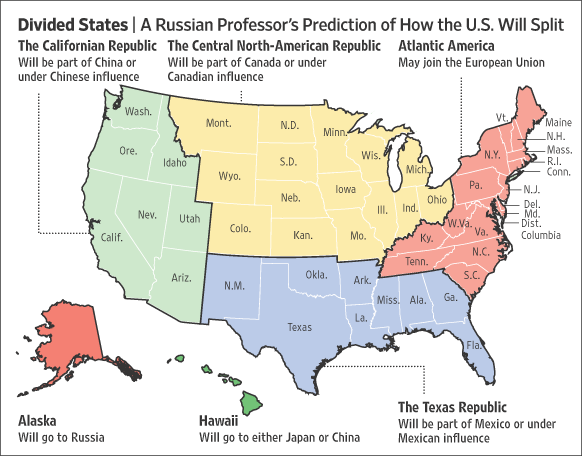
–and seems to continue, almost but only somewhat humorously, in the  confidence with which the ex-KGB operative Igor Panarin in 1998 forecast the future fragmenting of the United States circa 2010 into four Divided States, in a somewhat silly graphic that transposed the fall of the Soviet Union in 1991 to the other side of the Atlantic.  Panarin’s image has gained currency as a meme of failed unwelcome futurology, describing the “Texas Republic” whose northern boundary recuperated the same latitudinal divide, and gained a new readership, ironically, among readers of the internet eager for new infographics to compress living history to paradigms, but suggest his own study of nineteenth-century history, as much as futurology:
P1-AO116_RUSPRO_NS_20081228191715

And it raises questions about how we have begun to use and disseminate maps on the internet to stand as symbolic surrogates of the political divisions about which we’ve become increasingly concerned because of the worries they create about the continued smooth institutional functioning of representational democracy, and of the images we retain of how the popular vote can continue to translate into an effective Congress, rather than one dominated by gridlock.  (The ex-KGB agent’s prediction generated considerable interest in mapping the fracturing of the Republic along analogous regional divides in our own country, as the common practice of remapping cross-pollinated with GIS software and the rise of attention-getting maps.)

1.  GIS offers new modes to visualize statistical distributions and modeling national divides in the electorate, often warping actual geographical divides, in ways that have encouraged the increased role of the info graphic as a speech act.  The increased authority of picturing the nation in electoral maps have spun out from the night-time coverage of elections to remain burned in many of our cortices as evidence of a divided nation. As much as these colors have come to accentuate national divides, they create a differentiated landscape that the format of mapping seems to naturalize, and become a site that occasioned repeated glossing and interpretation for the evidence of national divisions that they appear to encode.  (Indeed, the sharing of two-color projections to forecast the outcome of the 2014 elections was both a cottage industry or diversion, so widespread was interest in adapting tools of forecasting to provide “flesh and blood” for making potentially compelling political predictions by slicing up the nation in different ways.)  Often seeming to evade the sort of issues that indeed continue to divide the United States, the widespread currency of such practices often perpetuate the very notion of a chasm of colored blocks as the best visual metaphor for the nation, in ways Walker and Gannett would find a remarkably different notion of a map.

Compelling translation of the popular to the electoral votes invoke the red v. blue divide in particularly graphic terms, and filled with a growth of a number of purple states that make the oppositional divide between Republicans and Democrats much less clean than it once was. (While the Republican party had long assumed the color blue in the nineteenth century, as the party of Lincoln, and blue was used to designate regions voting Republican the newscaster Tim Russert is credited with having first used the color-coding of the electoral choropleth to describe the prominence of the electoral divide in the United States presidential election of 2000 on a single episode of the Today show on October 30, 2000–although he denies having introduced the term as an opposition, and colored maps were long used to depict voter preferences in states.)  Back in the days of the innocence of 2000, the hues took hold to parse the nation with urgency during reporting about the results of that presidential election–and entered common parlance after the conclusion of the fourth presidential election in which the victor failed to win a plurality of the popular vote.

The apparent cleavage of the nation into two regions–more populace blue states with large electoral votes, and many red states with fewer, save Texas and the contested Florida, whose electors may have been erroneously awarded to Bush–and the map of a division of the states into what seemed a red “heartland” and blue periphery expressed a somewhat paradoxical national divide that appeared two different nations–or one nation of continuous red, framed by something of more densely populated blue.
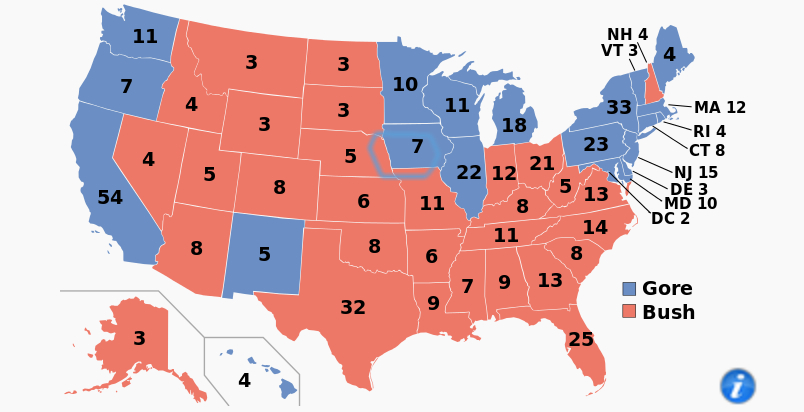
Bush v. Gore
The far more broader expanse of a sheet of uniform red, the color specific to the Republican party by 2000, drew a clear dichotomy drawn between Blue States versus Red States, that appeared less an emblem of sovereignty than of a deeply running national divide in a country whose political process had almost lost familiar geographical moorings: the familiar geographic map was warped by the outsized role of certain states in the electorate, and the consequent often disproportionate tussling over winning their electoral votes of “swing states.”

Unlike Henry Gannett’s statistical map, the image of a contiguous region of “Red States” in the above infographic seems to divide the union, as much as offering clues and cues to get one’s mind around a divided electorate. The below cartogram of the 2004 election warps the national territory to reflect the distribution of electoral votes in each state–and the mosaic of victory that the “red” states constituted in total electoral votes revealed several divides in the nation, or the hiving off of the northeast, west, and Great Lakes states from the majority–or, alternatively, the concentration of Democratic votes in dense pockets of urban areas–that reveals two republics, all the more evident from the continuity of the U-shaped red stretch of disquieting uniformity that emerged when the popular votes is translated to a map of electoral votes.
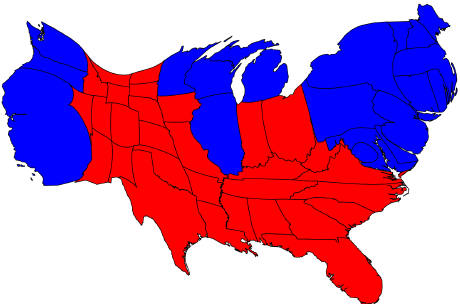
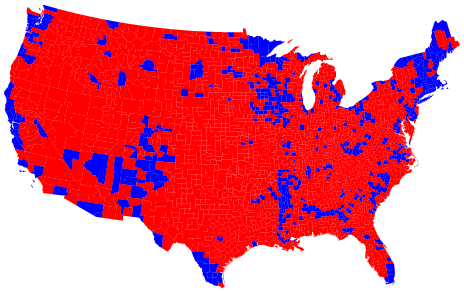
3-2004-electoralcollege-cartogram

4-2004-by-county

We have become especially accustomed to interpreting the contours of such national divides in the electorate with strategic urgency in the age of Obama, although the battle for electoral victory were more likely to be resolved in cartograms than the finely-grained county by county distributions that Gannett had devised. The appeal of cartograms lies in part in how they offered an apparent opportunity to gain clarity by the almost compulsive remapping of electoral votes to decode the alliance of victory in the 2010 election in two-color cartograms: warping the divide to suggest the dissonance of terrestrial continuity with electoral votes or money spent per voter, to suggest both an accentuation of its divides, as if to pose questions about the existence of continuity among the nation’s regions and states, and a deep divide that lay in the areas where campaigns devoted the greatest attention–and ask whether this skewing deriving from distorting electoral stakes bodes well for the democratic process.

The geographical distortions of infographics seem to clarify how electoral results run against the continuity of a terrestrial maps in similar terms. The representation of current electoral division have continued to aggravate the country’s continuity long after Obama’s two presidential elections: both electoral results have been often parsed across the country to explain the divide between red and blue states, especially in the 2012 election, as if to try to discover continuity a country that seems divided into blue states and stretches of bright red: and if, until 2000, both Time magazine and the Washington Post colored Democratic majorities in red, the opposing colors of red and blue have become an image of contested sovereignty, and of articulating regions’ political differences and divides. Rather than suggest generational continuities in political allegiance over space, the divide within the country reads more clearly in Gannett’s county-by-county census, but the proliferation of cartograms respond most effectively to the problem that “these maps lie,” morphing the fifty states into rescaled distributions.

Adam Cole doesn’t claim to argue that this reflects a bit of a crisis in democratic institutions, but one can’t but consider how the current gridlock in government may stem from its failure to adequately reflect the demographics of the country, or at least the economics of the Presidential election.  Despite increasing attention to the mobility of individuals outside “blue” states to other, formerly “red”-state regions, the divide was increasingly focussed on a diminution of red states, but a concentration of Republican majorities in the central regions of the country, lying largely below the Gas-Tax Latitudinal Divide–with some notable exceptions. Even if much of the country seems happily purple, the intensity of two triads of red states strikes one’s eyes immediately.

The United States, with state sized based on electoral votes.Adam Cole/NPR

(Such maps, of course, in their interest to provide info graphics that involve “purple” shadings of a mixture of blue and red may not take into account the neurological disposition of the eye to more readily read a purple state surrounded by a sea of red as red, and fail to distinguish the degrees of purple of a region as an intensity not independent from the spectrum of the colors of nearby states:  the interest in providing a more complexly qualified picture of variations in this map, introducing shades of “purple” to a map, if constructive in the abstract, according to Lawrence Weru creates misleading interpretations that rather than profit from such proportional blendings lead the purple region to appeal more blue or more red depending on the chromatic context where it appears.)

2.  The compelling nature of such cartograms no doubt the maps that express the views of political parties, and provide a basis for imagining the continuity in how campaigns dedicate attention to the nation. Despite their explicit warping of continuity, cartograms help get one’s mind around the nature of the apparent lack of continuity across the country, and understand the depth of electoral divides and to explain the country’s composition than the mapping of electoral votes onto spatial divisions on a map, if not to project the results in far more dynamic ways of translating the “map” to practices of political representation, as much as territorial manipulation. The cartogram seems to translate spatial divides into a system of political representation that fits imperfectly on a uniform mapped space or rendering of territorial expanse, and seems particularly compelling to analyze the way that the electoral process translates the nation’s geography into institutional terms.

The most telling translation of this political process is revealed in the warping of the nation by disproportionate expenditures per state, reflected by the distortion of electoral politics–and the nature of political divides. Parties have been compelled to devote disproportionate attention to individual states, out of sync with their electoral votes, but as a reflection of the calculus of receiving a majority in the electoral college. A compelling twist to the electoral cartograms parsed political parties’ relative expenditures in the most recent Presidential election as a distribution of funds in dollars spent per voter, grotesquely warping the scale of states in the country according to the political spending in millions of dollars–which keeps a lot of purple states, but suggests that one area of the nation has almost left the attention of either party, as if they were discounted as foregone by both parties–and received but a begrudged smidgen of millions of dollars from the GOP or Republican National Committee, so clearly were their political preferences already decided and minds just made up:

bbstates_custom-e0c6c871e5a185100d0be94271fba73c0a365998-s40-c85Adam Cole/NPR

An even more warped image of the republic is produced by warping the fifty states to reveal the disproportionate number of dollars spent per voter, in a warping which has the effect of shrinking the red states in much of the south and southwest to reveal the extent to which they are simply less the terrain in which recent elections were determined: one learns even more about the deep commitment of many of the voters in the southern states in the below graphic, reflecting the returns that each campaign had on the amount of money invested locally. The map reveals how little Romney even invested in the solid Republican voting base of the south, not seeing the need to disseminate the candidate’s message in states where he held such a clear advantage that they were conceded by the Democrats: it shows the relative inefficiency of Republican expenditures in New Hampshire, Iowa, and Nevada by an off-message candidate, and the balling amount spent on political media in each state from April 10 to October 10, in which many southern states are all but squeezed out of relevance, because their outcome remained–save North Carolina–something of a fait accompli, and absent from the volley of the barrage of ads that have only recently ended with mid-term elections of 2014:
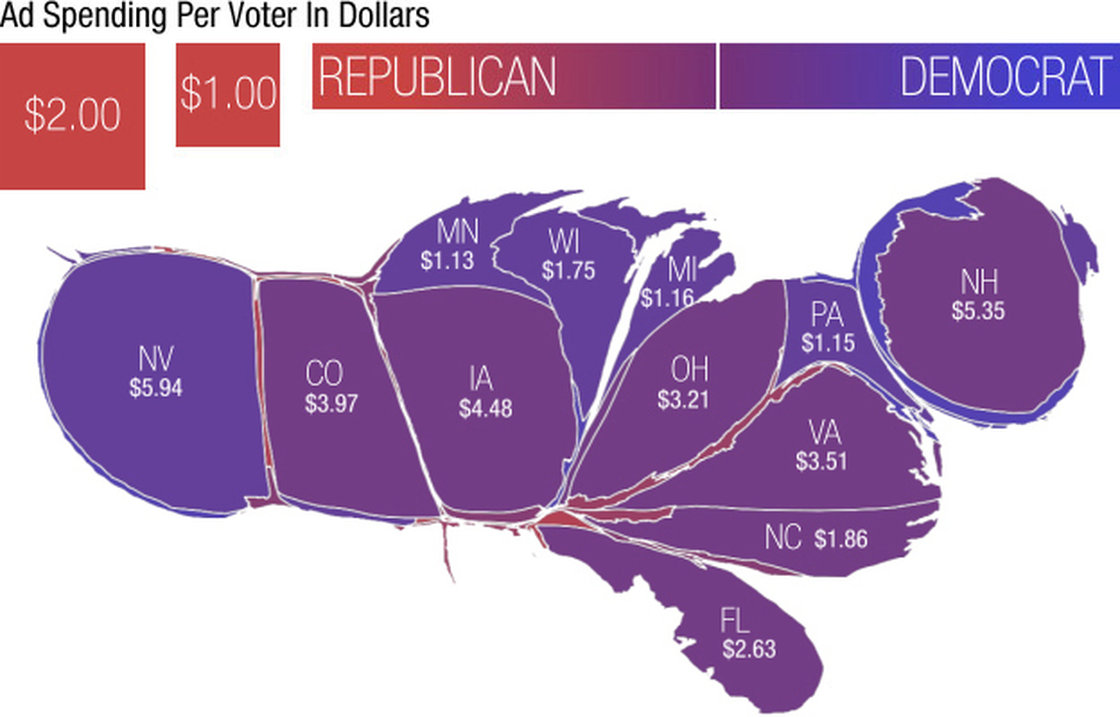
bbvoters_custom-0abd0dc8a4efa739c61d80b961226ae07e5b04ec-s40-c85-1

Adam Cole (NPR)/Kantor media data


It can’t be “fair” to absent a good portion of the country below a single line of latitude form the state of national political debate that on-air advertisements have to be considered as forming part. What does this mean for our Republic raises questions: but is this a form of secession itself, coming back to haunt the map of political parties’ distributions of their own expenditures? The cartogrammic shrinkage of the southern “red” states with those west of the Mississippi scarily suggests a region of the country has all but vanished from the contested regions of the electoral map, its electoral votes all but written off as a contest, and Texas shrunk to an unsightly narrow peninsula or appendage off the territories where political parties struggle: the geographic contraction of the areas below the thirty seventh parallel, which defines the “four corners” intersection of Utah, Colorado, Arizona, and New Mexico effectively privilege the more urban areas over the “exurban” southern states that were so much less of a contest or struggle for political attention.

The troubling depth of the division across the United States is less a mirror of the affiliation to different political parties, however, than they reflect different images of America that often reflect urban v. exurban perspectives–as in this topographical projection of peaks of population in the lower forty eight.

Blue v. Red Topo Raised

Presidential elections offer a major rush of disaggregated data that one can assemble in exciting ways, the inflow of data creates a flood of information that make it difficult to select specific criteria to foreground. One might find in the above sufficient grounds to interpret the growing chasm of political divisions in the nation as between states between those with large urban centers, and “exurban” areas of less density. The tendency to group states which tended to vote or lean Democratic–as New York, California, Florida, Ohio, Colorado, Wisconsin, Minnesota–apart from more exurban or rural areas, and to map the distrust of collective government as lying within exurban areas that lie at a spatial remove from social investments that seem compelling to areas of greater disparities of wealth that define cities–and the distance at which these “red” regions feel themselves as lying from urban areas or issues seem rendered compelling against social density.

Blue v. Red Topo Raised

3.  However tempting it is to parse the differences among the electorate’s behavior in the Obama and Romney’s contest as a mirror of deep cultural divides that seem geographically determined, this quite unsatisfactorily poses the question of how likely they can be ever bridged. Such a reinterpretation is compelling precisely because it pays less attention to the “after-image” of secession, and reveals a new political landscape of the nation, rooted in population changes. The divides between the urbanized and unorganized, or “exurban,” also reveal deep attitudes to the nature of national space, and the role of government in space–which this post wants to suggest we examine as an underlying map of voting preferences, but that can’t be revealed by voting preferences and electoral returns.

The differences between voting preferences across the nation lie not only in terms of relative urbanization, but attitudes to the economics of moving through space difficult to quantifiably map, but all to evident on the map. For in ways that define a cultural continuity that is hardly rooted in the physical land, the map embodies a divide, similar to the Gannett map, of the role of government in one’s life, and the presence of the government in economic activities, as well as the prominence of a consensus on social welfare needs.

Parsing the election of 2012 in another way by democratic v. republican gains per county, one might note the  Democratic electoral gains are strikingly concentrated in urban areas, while Republican gains dominate the exurbs that are red–a distinction that clearly correlates to driving practices and willingness to tolerate more highly priced taxes for gas–and the Republican gains group together in clear clusters and runs, predominantly in the inland central southern states and inland northwest.  This data visualization eerily reifies the very divides that Gannett’s almost hundred-and-thirty-year-old visualization of polarized voting preferences first set forth:

Net_Change_MapDavid Jarman/Daily Chose

What can explain this shift across such a firmly defined latitudinal divide, which seems a crease across the country, as well as a refusal to hamper what is taken as the inalienable right to keep low the cost of free access to take a seat behind the wheel?

4. The data used to parse these moderns electoral maps are invested with significance, but may not reveal clear “after-images” of earlier landscapes precisely because the priorities of parties have so dramatically shifted, and the range of issues addressed in the political landscape have left it to be polarized in ways that have far less to do with the polarization over issues such as, say, Reconstruction of the south. Despite the greater amounts of data that presidential elections offer to parse a picture of the country, local legislative institutions provide just as significant a “map” of the traces of autonomy from national standards. The mapping of levels of gas taxes was meant to register the affront of impeding open access to the cheapest mileage. But the map of the distribution of gas taxes in the United States may say much more.

Exxon Mobil’s blogger Ken Cohen boasted that the map “explains a lot”, as a suggests clear division in local variations from the federal gas tax that exist across the country as if to show the inequalities in how local, state, and city taxes collect from forty to sixty cents per gallon–creating an inequality of cost that is itself far beyond the total federal tax imposed of 18.4 cents a gallon, creating unwarranted variations in the costs that drivers payed at the pump across the land able to be examined in greater detail at an interactive version of a map of the United States which displays the relative divisions of taxes by hovering over localities.

The differences in regions’ relative acceptance of gas taxes may indicate less the toleration of government’s invasiveness, but instead a huge shift in attitudes to space extending across exurban areas. The acceptance of a gas tax–or its ‘toleration’–reveals tendencies to reject as invasive the presence of government–and throw into almost topographical relief a considerably deep division within the local legislatures responsible to voters and local opinion. In ways that seems mirrored with surprising clarity in the below distributions of local “toleration” of taxes on gas–a sensitive barometer of regional autonomy, if one hardly comparable to the withdrawal of federal troops–the nation seems starkly divided that reveals difficulties of arriving on national consensus of its own, if on a topic of apparently less dramatic significance. If such taxes can be described as imposed by the government, the tax might be best construed not only on the toleration of taxes, but consensus if not agreement as to its collective benefits of something akin to a value-added tax. Indeed, the political divide in the country seem to have instantiated a divide along roughly the thirty-seventh parallel that reflect distinct national priorities, allowing the American Petroleum Institute to describe the disparities of the taxation on petroleum as if it described an unwarranted degree of government–state or federal–interference in the average American’s access to a full tank of gas.

A surprising divide emerged in this far more simple visualization, whose divides may parse different attitude to the economics of occupying space, based on states’ relative willingness to accept and tolerate taxes on gasoline, as much as chart the unfair nature of differences in how costs are deferred to drivers at the pump. The admittedly interested map makes its point about the uneven national “gas tax burden” along the thirty-seventh parallel, foregrounding a deep divide in refusing the role of local or regional government in daily life. Rather than reflect a distribution of draconian levels of taxation on gas, the map charts consensus to accept levels of an additional gas tax. While it does not perfectly translate into electoral preferences, it reveals a deep divide across the country that seems to fold the populace in ways perhaps not basically political,so much as in the degree to which each state’s populace would accept or suffer additional taxes as a means to meet public needs: it almost seems as if the reluctance to sanction the sort of imposition of taxes at the gas pump was seen as an analogous affront to regional honor.
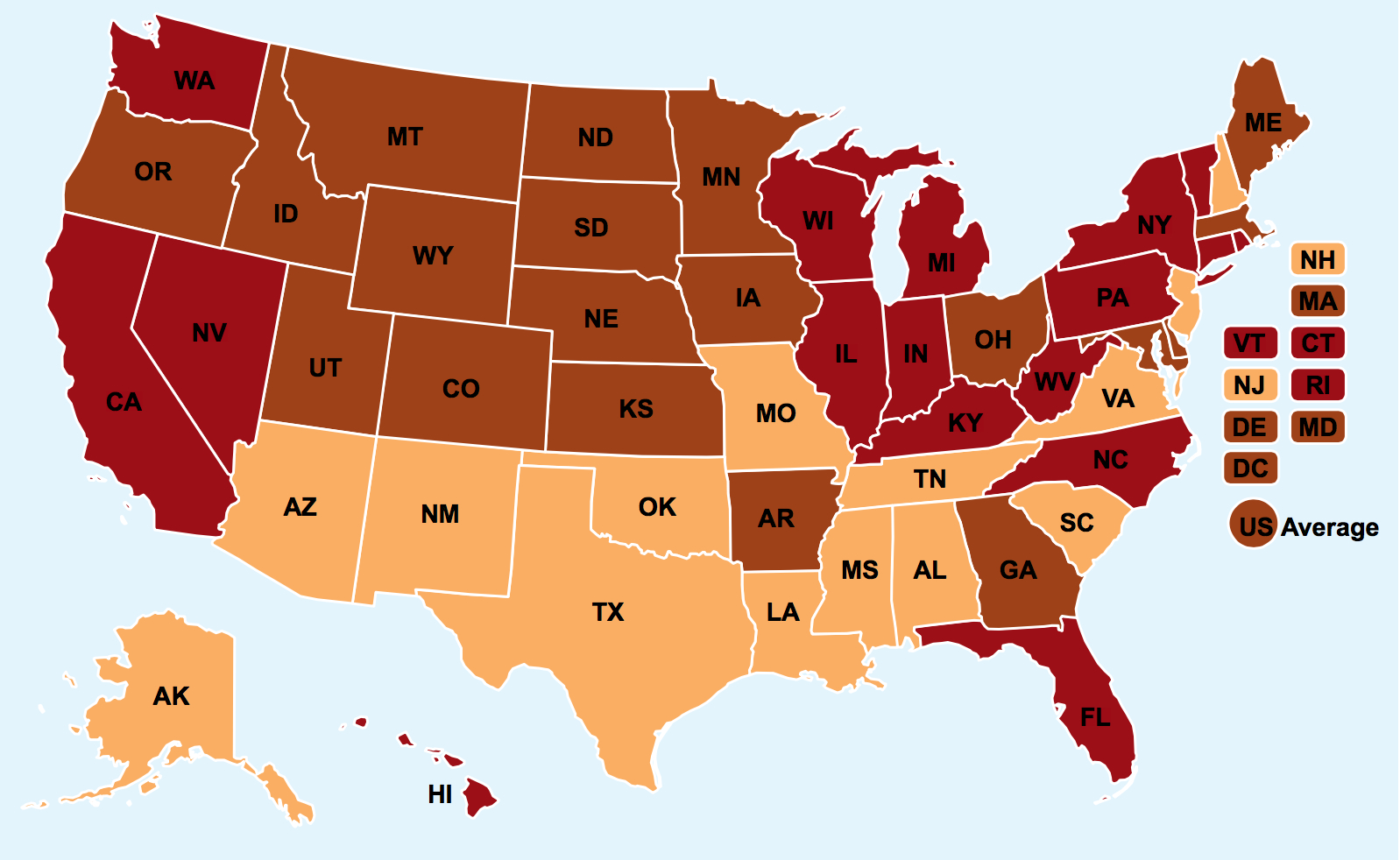
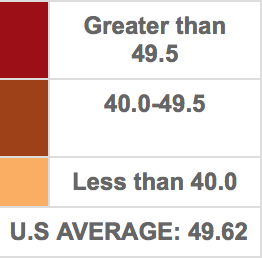
Gas Tax

gas key

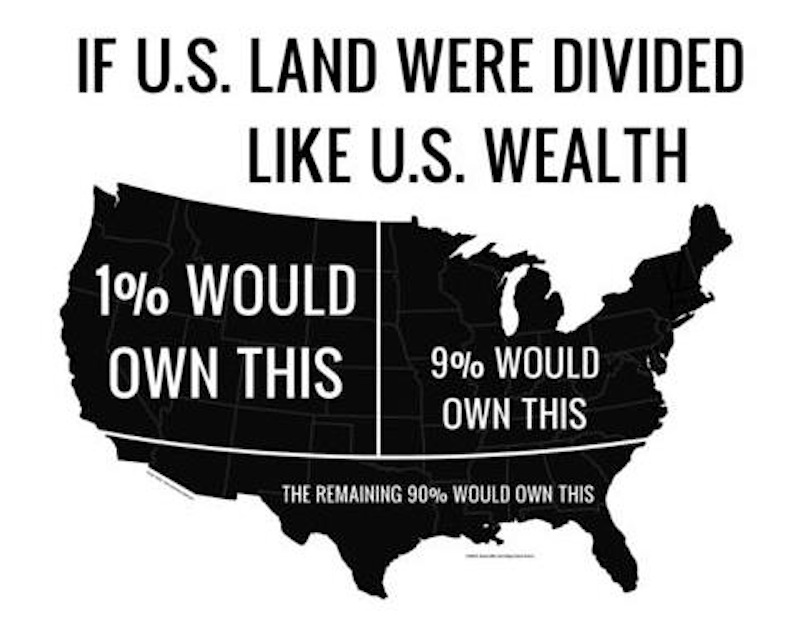
Thanks to the appearance of a map that first appeared on ExxonMobil’s “Perspectives” blog, we have a useful way to parse the spectrum of the country’s attitude to government–and to the involvement of government in regional differences to the economics of moving through space. For the refusal to raise taxes across the southern states-and indeed the apparent rejection of most anyone with a foot below the thirty-seventh parallel, almost carve the country into two halves, with the exception of Virginia, North Carolina, Georgia and Arkansas. It is striking that a cartoon that carves the country, or lower forty-eight, into a map that approximates the polemic division of wealth in the US by which Susan Ohanian assigned that very same region the 90%.  Her map echoes the divide, her cartographic take on the lower 48 assigning the the lower 90% percent of American wage-earners the region lying below the latitudinal divide, echoing the association of the region with a far less developed social infrastructure than either the east or west coast or to the north–only somewhat subliminally and slightly nastily pointing out the shifting per capital income across the land:
WealthMap

The divide that perpetuates lower gas taxes–or the “tax burden” on how freely gasoline flows at the pump–maps nicely onto a region with markedly less public transportation and transit.  The very same states’ governors, from New Jersey to to Florida, made something of a pact with the Devil to tank interconnected high-speed rail corridors proposed by President Obama, who championed alternative transit routes early in his presidency in hopes to rebuild a decayed infrastructure. If creating such corridors could have both encouraged local job growth and economic stimulus–as well as setting the basis for future economic growth–the refusal of and Scott Walker, that reflect the largely “exurbanite” populations of red states in exurbs. (Low gas prices serve to compensate for poor transit systems, and work to discourage their use, reducing demand:  only one top-ten rated US transit systems lie in the states–Austin–although a ranking meeting local “transit” is unclear, given that transit needs are by definition locally specific, and difficult to quantify.)  They are now a thing of the past, and Exxon-Mobil seems to turn its sights to the gasoline taxes that might enable their construction in the rest of the country–as if the lack of attention to the public good might be the new norm we could all be so fortunate to possess.

The two-color new flatness of the info-graphic seems complicit in how we perpetuate this view.

5.  What appears to perform a regional consensus exists may in fact register the primacy of accessibility to highway driving, or access to ‘automotive freedom’ in a region.  For it seems that the degree to which the individual right to drive through space is accepted as inalienable, or not having any possible contradiction with the public interest, in ways that might have much to do with the tanking of public projects for planned high-speed rail in some coastal corridors, if not an animosity to the project of expanding choices in public transit Obama long ago sought to enact–but whose projected corridors in the south were resisted and never completed.

high-speed-rail

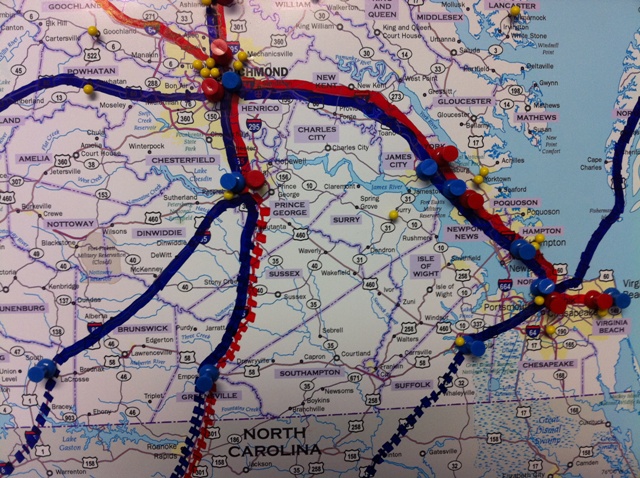
The absence of transit corridors has led to the growth of private taxi-like shuttles for patients in areas where ambulance carriers cover wide areas without clear transit corridors.
IMG_0201

Did the recent resistance to enacting such corridors of transit help to intensify the sort of divide we can witness in Ken Cohen’s Gas-Tax map? The 2009 Stimulus Package was intended to include a planned Southeast High Speed Rail Corridor, designed to change transit’s playing field in the South and Gulf Coast.

High_Speed_Rail_07-09-2009

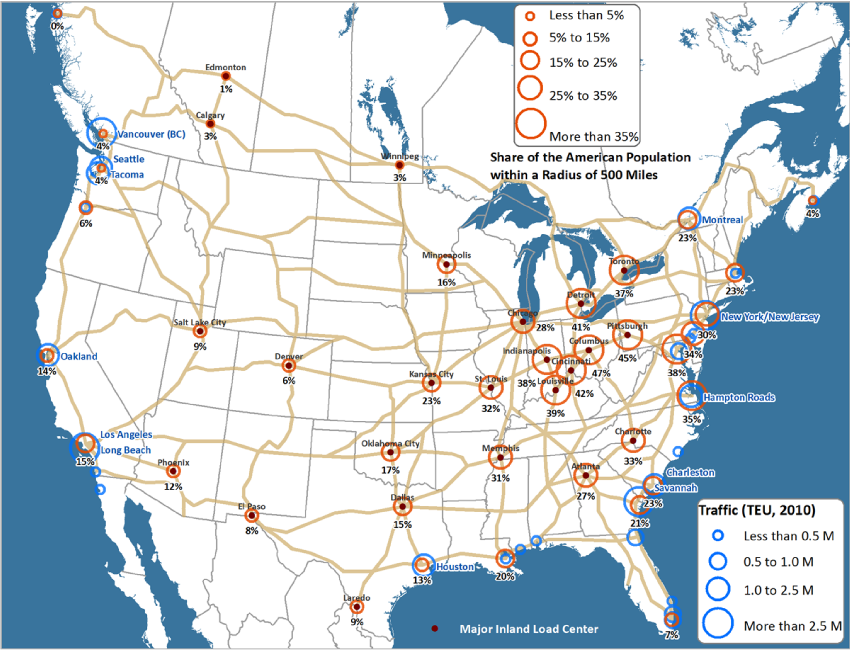
Such plans were already, of course, in the works since 2002, in the Bush Administration.  But their defeat, in no small part due to the apparently lesser geographic population density, was encouraged by the perception of a national divide of transit needs.
NA_market_500_miles

It prevented greater integration of a North American landbridge in much of the South, to supplement the lack of a crucial lattice of corridors of highway integration.
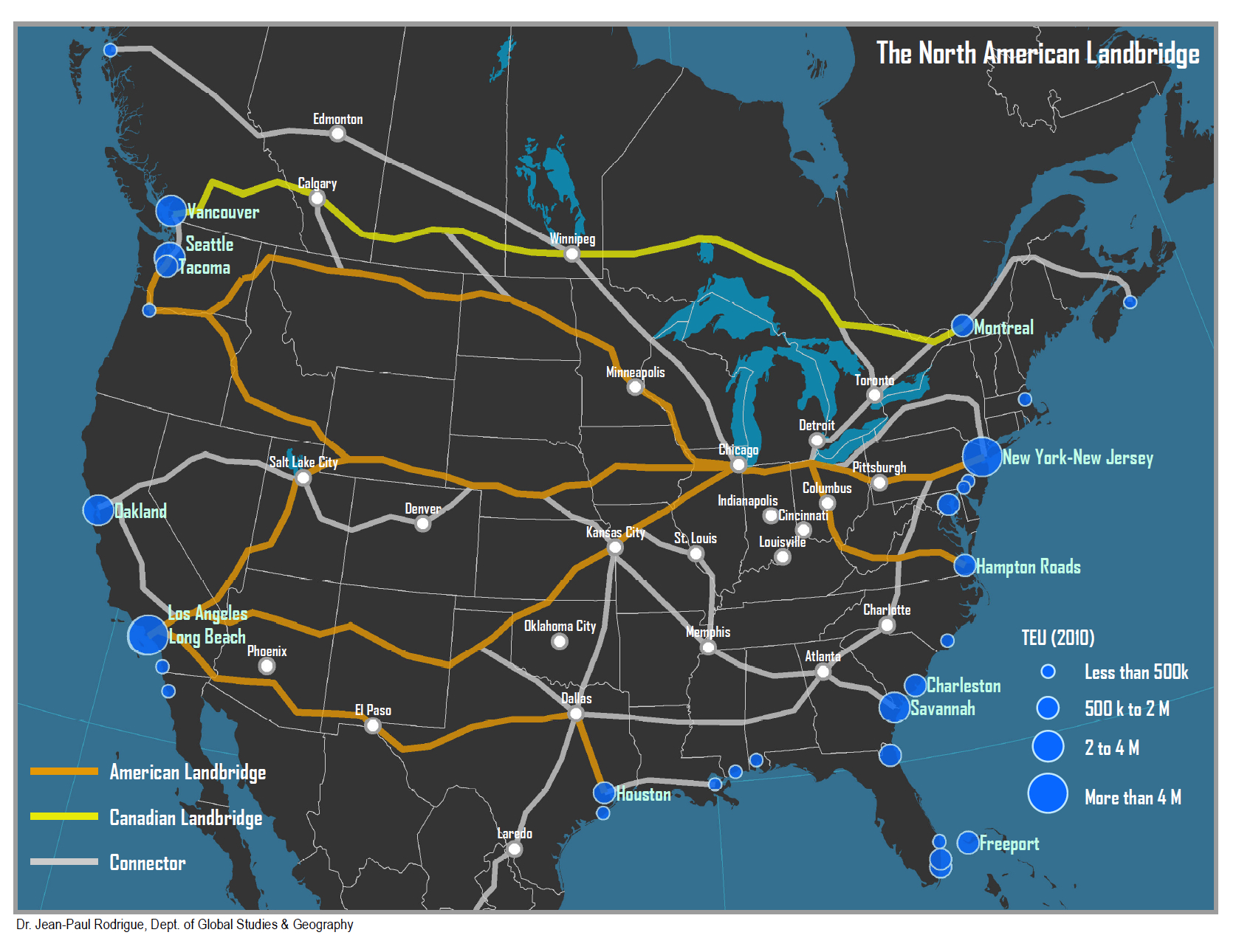
Landbridge

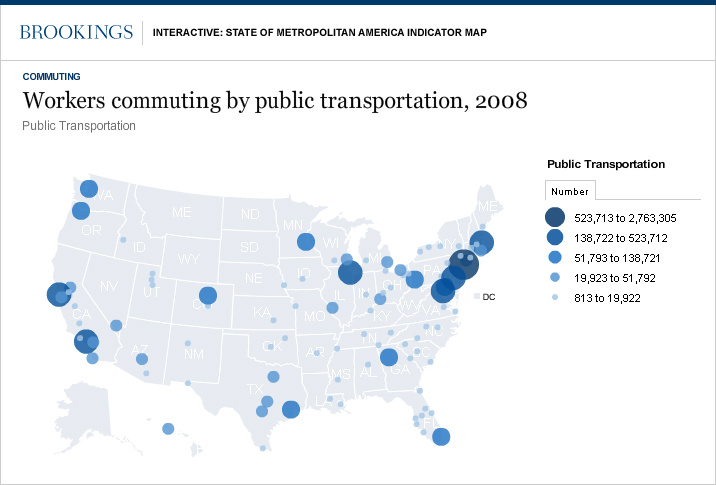
6.  We can make inferences about the lack of success of such transit programs, in part thanks to the consolidation of local, state, and federal taxes on gasoline provided by the American Petroleum Institute.  If the map derives from varying forms of taxation passed on at the pump, including local costs of fuel-blending that increase the costs of refining, a national divide to throw into relief of tolerating the imposition of an additional gas tax. While the map does not track the prices in taxes paid at the pump, and the cost for gasoline reveals considerable geographic variation by market and supply, the API plotted the total “fuel-tax burden” in a national map that reveals more about a national latitudinal divide than they had intended: the clear color scheme suggests that the 37th parallel creates a cliff in ‘superadded’ gas costs–and augments the sense of this divide by placing Alaska beside Texas–some fifteen cents below the national average in the U.S.  It mirrors the regions worst served by public transit in the US, to judge by the concentration of workers who relied on public transit for their commutes circa 2008.
6a00d83454714d69e20133f2536560970b-800wi

The missing information from other maps may suggest a quite grounded rationale for the absence of accepting taxes on gasoline:  not only the reluctance to accept taxes, given the reliance on automotive travel as a primary means of transit and transport, but the absence of a network of public transit that would provide an incentive and rationale for the readiness to accept a tax on gasoline in exchange for other public benefits.

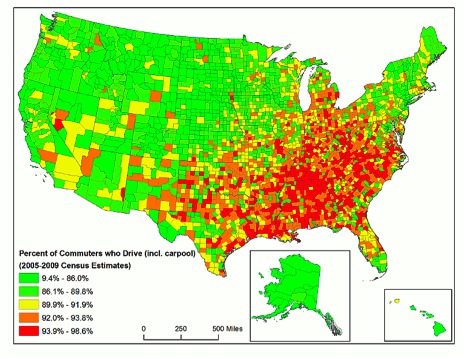
Seen another way, one can link the sense of spatial movement in the region of significantly decreased gas taxation on the rise of a single-driver culture of access to roads, rather than public transit–a trend that Streetsblog found to correlate not only to more restricted and curtailed transport choices, with little but circumstantial basis (and in a pretty cheap shot), to national obesity trends across the nation:
map_3

7.  Although the flatness of infographics oddly seems to obstruct further inquiry into the distribution it reveals, the differences in how the land is habited suggests divides that are difficult to surmount, and by no means only political in origin.  While it might be seen as leading many to move south for cheaper gas, the consequent lowering of the perceived “fuel-tax burden” to below forty cents per gallon–sometimes by as much as five cents/gallon–across state lines indicates a refusal to let the government interpose themselves between driver and pedal, or pump and tank. It suggests a shifting sense of taxation structures and investment of local priorities of dedicated tax revenue that strikingly mirrors the very regions at the presence of government in local life, but is often tarred as yet another instance of the invasive nature of government’s presence in public life.

The map echoes the more prominent manifestation of local resistance to the apparent federal invasiveness long mandated by the Department of Justice’s “oversight” of enacting changes in local electoral laws, based on historical presence of policies deemed discriminatory, first enacted in the 1965 Voting Rights Act.  Under the logic of the autonomy of “states’ rights,” such “pre clearance” was abolished, although an  alternative proposal the issue of “pre clearance” was framed as triggered by successive voting rights violations in four states–Texas; Georgia; Louisiana; and Mississippi–rather than fifteen. The VRA’s original provisions, widely deemed “for half a century the most effective protection of minority voting rights,” or fourth article, was approved as recently as 2006 by the US Congress. But widespread resistance to the federal policy grew with keen regional separatism among many of the same “southern” states, or the configuration of the South–minus Florida, North Carolina and Arkansas, with the addition of Arizona and Alaska–who pushed back against oversight of changes to voting laws as redistricting or Voter ID as undue interference as local policies–even as the ability of entrusting states to develop their own policies of redistricting has been recently open to challenge in Mississippi and, in Alabama, for the rigid use of explicitly racial quotas, echoing early charges of partisan gerrymandering in Texas–but raising questions of how much race or partisanship is at stake.

Areas Covered by VRA-and additionsAreas Covered by VRA-and additions

These coincidence between these maps isn’t entirely coincidental. Indeed, one is struck by the striking “family resemblance” to the infographics we use to represent the nation’s complex composition in a map.

8. How much are we overly habituated to visualize a divide that we seem to have a difficulty looking outside its two-color classification?  It bears remark that the afterimage of secession is rehearsed in quite rhetorical manners to raise the specter of national dissolution–by now imprinted on the collective consciousness–if expanded to include a few ‘swing states’ to suggest the recent expansion of the “old South.”

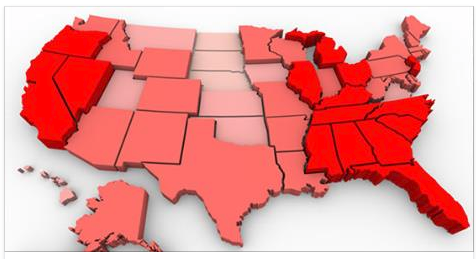
It’s ironic that the iconic image of secession is rehearsed in maps imagining secession from paper currency, which employ strikingly similar visualizations to forecast a coming shift in monetary policy and practice that would be brought by BitCoin. Although its eye-grabbing vision of secession is deceptive, the below “hoax”-map distributes thirty-six cities in twenty states where one can pay bills in Bitcoin as if they were poised to “dump” paper currency, or abandon the US dollar and withdraw from the closest to a common convention to which all fifty states adhere: the map of secession–perhaps based on states that have accepted applications for exchanges in the digital currency that originated on the Deep Web on the TOR browsing network and on hidden sites of illicit exchange as the Silk Road–is of course not an actual map of secession.  But it is designed to pose as a visualization of “the rebellion [in currency] that quickly spread to main street America” with antecedents in a system of currency devised by Thomas Edison, which would immediately provide financial returns as it replaced the dollar, as if it recaptured the past stability of a lost gold standard in the face of the fluctuation of value of American currency.  Lack of internal differentiation in the below of urban and non-urban areas in the below perpetuates an image of legal secession of states that are shown by big monochrome color blocks that seems to prey on viewers’ eyes by its introduction of a familiar dividing line.

The mapping of monetary secession, launched by Money Morning–Your Daily Map to Financial Freedom and diffused to alarm viewers on sites such as http://www.endofamerica.com, is not really explained carefully, and seems to lack its own legend but was intended to depict a collective rejection of paper money as if the “red states” were wise to a growing financial trend. In this barely disguised desperate push for Bitcoin digital currency–“now accepted by dentists in Finland!“–the data vis stokes fear in the survival of paper money in America, and a specter of monetary separatism, echoing fears of dismantling the remaining monetary union of the United States by the rejection of a federal currency–extending a language of states’ rights by its rather preposterous design of a fanciful future national fracturing as some states dispense altogether with paper money:  states once divided by the institution of slavery now seem divided by farce. (How maps mislead: California is colored red, due to the fact that one city, Menlo Park, has moved in such a direction, not the entire state–and cities elided with states.)
20states-red

The afterimage of secession is here, rather improbably, immediately recognizable, but raises a recognizable specter in monetary terms, stoking fears of a new national disillusion that has emerged along sharp lines. One doesn’t usually imagine the digital divide to include the majority of states in the deep South–if in ways that address the viewer who is tried to be wooed to Bitcoin, rather than an offer an image of the nations health. But if the map is a bit of a hoax, the use of something like a secessionary map to depict the rejection of paper money that the U.S. Government has unwisely continued to sanction cannot be much of a coincidence. The cities that push for the ejection of paper money were not by all means concentrated in the southern states, according to the map–which stages a hoax, but one that also reveals the country as broken into two halves by the abandoning of paper money which actually maps the sites of companies that will pay salaries in non-paper Bitcoin.

The recurrence of the very same fold across the nation’s center, roughly along a latitudinal divide to scare viewers–with California added in for good measure, based on the city of Menlo Park.
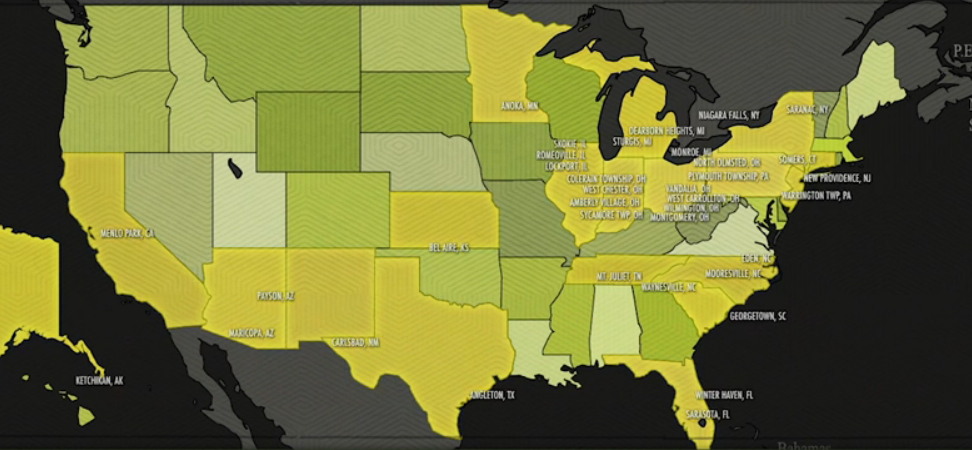
US broken by Bitcoin

Although a hoax, the “map” of the impending abandonment of paper currency shows a fracturing of the nation along the lines of the adoption of Bitcoin.  If it echoes the abandonment of the gold standard as a monetary system–or the amount of silver used in dollar coins and actual currency, the map is most striking for breaking down the divisions in the  nation in a state-by-state way that has particular power as it is so often used in political visualizations of electoral returns.  What else might explain the persuasive power of this meme of national division?  The status of Oklahoma, a familiar icon of frontier freedom, shows it has  recently moved to move away from paper currency to accept, with bipartisan support, gold and silver as currency.  The rejection of a common federal paper currency seems the ultimate standard of secession, echoing the dismay at the abandonment of the gold standard or the withdrawal from a cash-based economy.

An eery footnote to this atlas of symbolizing the nation is the proximity with which the map mirrors (or maybe recycles) the Democratic vote in 1880–although it stretches some credibility to imagine the former constellation of seceding states on the cutting edge of accepting Bitcoin.  It is tempting to universalize or essential the latitudinal divide that recurs in these maps, but makes sense to cast the region’s apparent distancing from majoritarian consensus as not only something of a different economic culture, but a different culture of moving through and occupying space.  The confounding of that culture with independence within the states’ rights movement–and deep distrust of federal government–existed long before Obama’s election.

Viewed through special lenses, alert to the after-image of secession, each of the maps define variations in the continuity of a cultural divide phrased as a reaction to the absence of continuity that was registered in Gannett’s earlier 1883 info-graphic–but that now seems to be replayed both as tragedy and a farce.  The question that this set of posts pose, perhaps, is how we can create more engaging info-graphics of the nation whose visual consumption would sustain and drive further attention and exploration of local variations–or at least not reduce us to a stupor of oversimplification that is an excuse for orienting us to the oppositional tactics of political debate through the pretense of showing us the actual lay of the land.  What compelling mapping of local variations might better command attention as a record of divides worthy of our attention?


Leave a comment

Filed under American Petroleum Institute, data visualization, Gore v. Bush, infographics, Obama v. Romney

The New Separatism and the Gas-Tax Latitudinal Divide: Tracking the After-Images of Southern Secession across the United States (Part I)

No region is an island, but divides are defined in ways that create a transmitted insularity along what might be called the Gas-Tax Latitudinal Divide that cuts across the United States, bisecting much of the nation along what almost appears a meridian.  Even before the efflorescence of confederate resentment in southern states clear in the 2016 Presidential election, but not at all clearly perceived in recent years, but evident the apparent toleration of the claims of white supremacy and the far right that are rooted in states rights, and, almost perversely, rooted in the limited abolition for slavery and enslavement to expand across territories of the United States titudes north of 36° 30N,–a latitude inherited from the accident of early surveyors’ decision to mark the boundary line between Kentucky and Tennessee.

The latituidinal divide offered both an “objective” basis to extend slavery westward and a fulcrum to guarantee representation of slave-holding and non-slave holding states in the U.S. Congress, a line of apportionment that guaranteed the preservation of local rights of slave-holding, before it marked the secession of the Confederate States of America. The divide has fed a bizarrely enduring discourse on states’ rights in American history that has in many ways colored the complexion of the world, as a repository for the persistence of a reactionary localism in a globalized world, as the initial session of Virginia after Ft. Sumter in the Spring of 1861 was followed quickly by Arkansas, Tennessee, and North Carolina, sectionally dividing the union,–until its disintegration left only the southernmost states defending slavery as an absolute local good.

Confederate States of America
and Claims made by Confederacy

Long after the practice of enslavement was condemned as sinful by evangelicals, and uprooted in European nations, as was the case by 1848, the inner sanctum of the defense of enslavement lay in the preserve of the CSA–a community-sponsored movement to defend enslavement as a local privilege. Indeed, the depth of memories seem to have been provoked by the stripping of symbols of localism and place like the Confederate flag–the emblem of the separateness of the southern identity–a regional identity perhaps exacerbated by a perceived loss of regional identity and afford continued objects to intrusive federal actions, in a symbolism of nobility that recalls a bend dexter with a bend sinister, and haunts even our most present–and apparently innocuous–as mapping the state of the states in data visualizations parse meaning by blocks whose continuity suggests deeply lying fault lines.

images-7

The resistance of localism–and the national drama, indeed, of the attempt to strip the region of its symbol of autonomy–has perhaps not only had a greater impact in how early twenty-first century politics have played out in America, but of the deep presence of the divide of the seceded states across generations.  Can the survival of this divide be mapped? Or will it, more likely, continue to haunt the nation, as in the American Petroleum Institute decided to  map as a way to lay out ostensively objective record of local variations in gasoline taxes around the country, devised somewhat opportunely in 2014, as the United States was poised to run out of federal money to restore roads, and the chatter on gas taxes rose.

American Petroleum Institute

The problem of an alleged discrepancy in tax-rates that the American Petroleum Instituted foregrounded was based on the numbers of cents and decimals–not on percentages, m although the confusion could be excused, viewing the map and its legend without further information, so clearly does it seem to correspond to that blue state-red state divide that has long haunted our social media-saturated spatial imaginaries. If the map was intended to be polemic, and provide fodder to resist calls for calls for raising gas taxes since in counties–the federal tax remaining stable at 18.4 cents/gallon since 1993, the map taps into an ethos of tax revolts by purporting to illustrate an alleged discrepancy in tax-rates along a national fault line.

The divide that the American Petroleum Instituted foregrounded was based on cents and decimals–not on percentages, m although the confusion could be excused, viewing the map and its legend without further information, so clearly does it seem to correspond to that blue state-red state divide that has long haunted our social media-saturated spatial imaginaries. If the map was intended to be polemic, and provide fodder to resist calls for resistance to further hikes in taxes, and suggested the importance of seceding from what it cast, ingeniously in ways, as a sort of necessary secession from higher energy prices–the primary foe of much of the nation, it has seemed for most of the post-Cold War period.

American Petroleum Institute

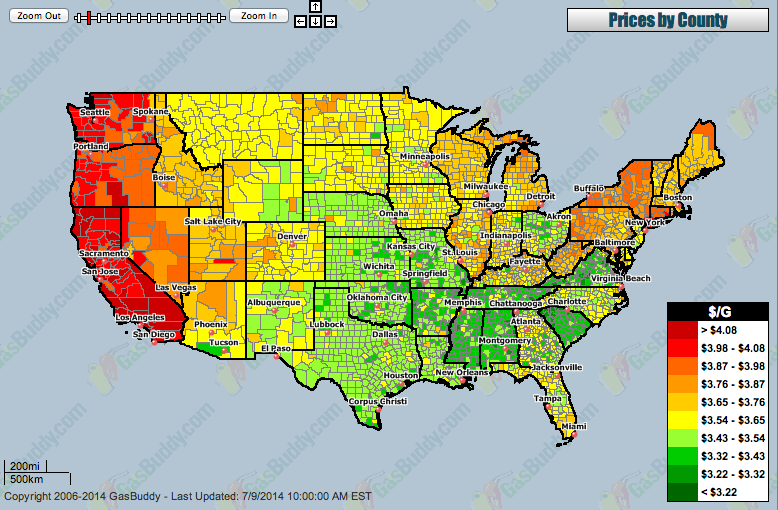
The spectrum of county taxes is indeed much more complicated, revealing that it hardly makes sense to parse in states, although they reflect how some states have passed laws to restrict emissions of dirtier fuels, as gasoline, and have actively sought to do so, in the western states of California, Washington, and Oregon, by placing a larger tax on gallons of gas, in way that “Gas Buddy,” hardly a friend of the American Petroleum Institute, but a data-miner who seeks to give the lowdown on gas prices: the devious color-ramp depicts the bucolic nature of the southern states when it comes to protecting the price of low-cost petroleum for our engines, and the red-hot far west that seems a danger zone that might as well fall off the map.

The website allows one to map in real time, by a color spectrum seeing to affirm that the grass is greener as deeply as you drive into the traditional region of southern states, where the rights to cheap gas seem to be preserved, and the status quo of cheap gas is maintained: the land where cheap gas prices allow fertile fields to bloom, and environmentalism is out-sourced for self-interest, unlike the red-hot far west, of which all drivers should beware.

The data vis in other words affirms that GasBuddy is looking out only for our best interests, showing at a glance “the best gas price, anywhere,” at a glance. It’s not surprising GasBuddy is a big friend of Google, and has gotten rid of any state lines, as well as environmental costs, as if to reveal the county-by-county free market of gas prices for his online audience, in ways that increasingly seem to register the deep danger to the wallet posed by driving out west. This is the map of the triumph of the free energy market, embraced as the United States has become the biggest natural gas producers in the world and the top producer of petroleum hydrocarbons since 2013, raising hopes of the growing green for gas guzzlers nationwide, who try to laminate highway maps and interstates over the green fields that get only greener descending the Mississippi as one approaches the Gulf coast.

Gasbuddy, Heat Map of Average Real Time Unleaded Gasoline,
August 2019

“Prices” here are not based on taxation alone, but “average prices” suggest the significant differences that exist between regions that indeed depend on commercial trucking, and ensuring low-cost convenience stores and supply chains, but have made a decision to prioritize free commerce at the expense of infrastructure and the environment. If it can be credibly argued that many costs of road maintenance, from snow-clearing to cracked asphalt, may not exist in the warmer climes of southern states, and rural roads are often less trafficked, the strong sense of separatism and defense of local privileges shines through the above map of gas prices, which reveals just how modulated the spread of up to a dollar and a half of the cost of gas/gallon are inflected by differences in gas taxes, although these only vary by a spread of about twenty cents.

Rather than be a post about road trips, the Gas-Tax Map provided an opportunity to excavate its layers, and investigate the underlying relations of a deep-seated stakes of states’ rights discourse that seems to underly the polemic visualization, as much as the proximity to offshore refineries in the Gulf of Mexico.

2 Comments

Filed under Confederate States of America, data visualizations, infographics, Red states v. Blue States, statistical maps

On the Repeated Mapping of the Unknown Flight Path of Malaysia Airlines Flight 370

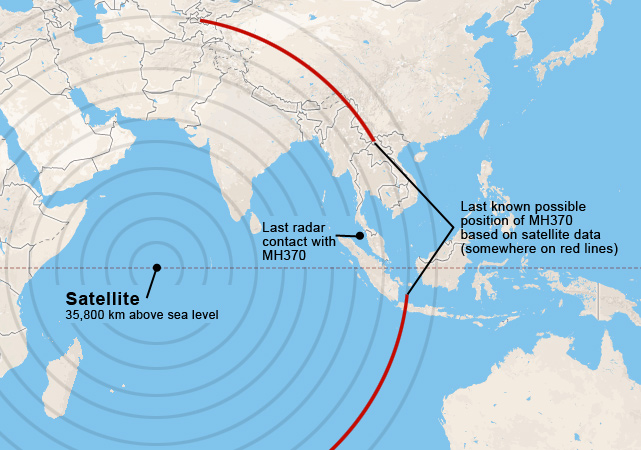
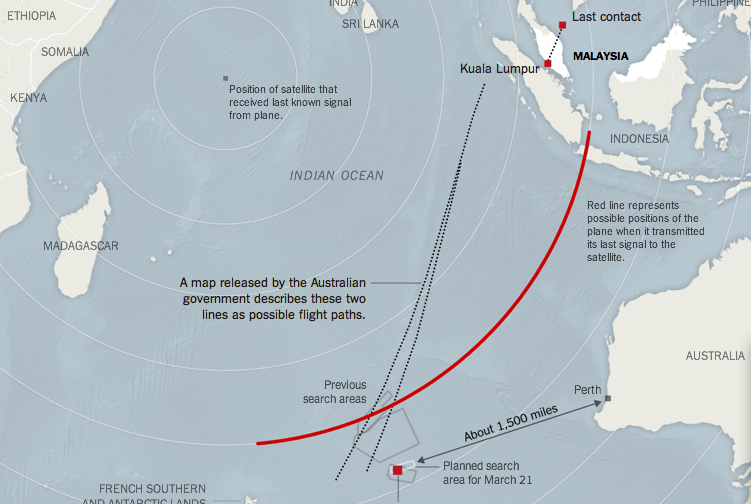
The proliferation of maps tracking the diverted flight path of Malaysia Airlines Flight 370 repeatedly re-enact an exercise of mapping the unknown:  if the early proliferation of possible maps of its flight path matched the shock of its disappearance, the continued frenzy of the search for signs of the fate of the airplane and its 238 passengers, as if trying to help get our minds around the implausible nature of its disappearance on a rather routine commuter flight.  The rapid proliferation of hypothetical maps of plausible diversions hang on the turning points in the trajectory of the vanished plane from its last point of contact and observation all seem to be seeking to explain what happen with something like the surety we expect from maps:  in the absence of any information that is clear, we turn to the map as a way to ground what we know, and to try to find meaning in it.

But the multiplication of these maps almost seem to respond to a lack of real information, or conceal the absence of any clear leads as to what happened.  For each map includes an abundance of bathymetric contour lines, shorelines of islands, point of take off and the place of the satellite had last contact with the flight are all included in these maps, which obscure the sadly open-ended nature of the tragic narrative that exists around it.  While none presents the individual narratives of the passengers or pilots on the flight, by necessity, and may even represent the frustration of our remove from whatever happened on board the flight after it left the airport, the multiplication of news maps and digital reconstructions capture desperation at not knowing what sorts of events or potential diversions occurred.

At the same time, the underlying narratives of all accounts is often left unstated and go unexpressed:  that of how the flight path of an airplane managed not to be tracked.  The proliferation of news stories seem driven by the continued technological attempts to produce a comprehensive detailed account of what happened on the plan in its final moments–or of the location of potential wreckage –as we openly worry about the controlled nature of our international airspace, and the extent to which it can ever be fully mapped.  The inflection of this story, which is in a sense the parallel story that has been driving the story of the search for a narrative to describe the tragic events of the flight that left 239 passengers in the flight and its crew missing and presumably dead.   The assurances of international authorities on the International Investigation Team (ITT) that the search for fragments of the inexplicably vanished aircraft in the Indian Ocean will continue over a search area of nearly 50,000 square miles–aafer the perfunctory issuance of death certificates for all passengers by the Malaysian government–creates a puzzle about both our mapping abilities as tools of surveillance and effective control, and sustain a continued wish to compensate for such concerns by repeatedly illustrating the abilities to map, remap, and map again the area and the plane’s flight path, producing maps that might provide a narrative structure to events that seem dangerously incoherent.  For the map offers uniquely reassuring coherence on an event whose narratives have literally gone out of control.

Existing maps largely proceed from reconstructions of plausibly altered itineraries the airplane may have taken after it veered dramatically off-course in the course of an otherwise routine flight from Kuala Lumpur to Beijing.  The underlying questions to which they appear to respond is how technology and ramped up security could prevent us from losing another plane, and how we can, as Tony Tyler, head of the International Air Transport Association, Tony Tyler, calls for the need “track aircraft wherever they happen to be, even if they go outside normal traffic coverage . . . in the most effective way.”  After the intentional closure of the transponder during the flight, the increased suspense of any air travel–and the anguish of the families with members on the Air Malaysia flight, increased attention has been directed to border control, as minimal information seems provided by attempts to map–or digitally reconstruct–the diverted flight.


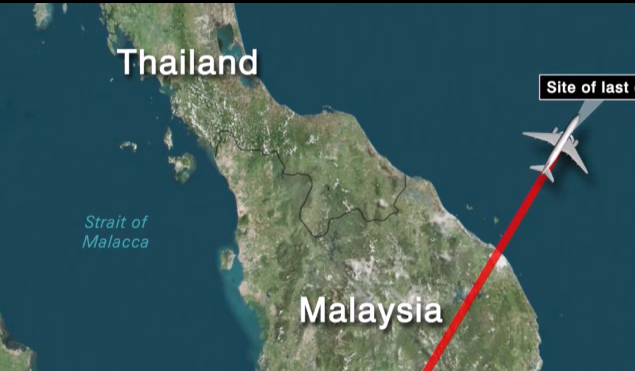
Site of Last Contact


The map of flight-paths is often combined with maps of search missions and sites of possible wreckage in news maps and online media, as if to condense the slight information we encounter in a single map.  Chances of discovering or locating whatever is left of the lost plane–the ostensible goal of the search mission–seem remote, like a needle in a haystack, despite the lack of an appropriately marine metaphor.  The insistent and repeated mapping of the Boeing 777’s flight path and its contact with ground control is not only an artifact of the news cycle; it is an incomplete narrative we keep on trying to resolve or find resolution for:  the story of the interrupted flight path has left audiences world-wide wondering whether the storyline will ever be resolved, how the intervention in flight path was made that caused it to shift its planned itinerary, and why our apparently refined abilities of mapping can’t complete the narrative we all want to bring completion to. There is a commanding logic in matching the search area to the possible diversion of the plane’s in-flight trajectory, but everything is complicated by trying to balance a narrative of the flight’s tragically diverted course with the mute azure surface, without landmarks or points of orientation, of oceanic expanse over which jets travel on search missions and boats patrol.

In ways that have gripped viewers but also raise frustrating questions of how to best search international waters, as well as unfamiliar perspectives on mapped space, all eyes were for a time directed to the South Seas with an intensity that oddly echoed eighteenth-century speculators. For after we have watched a cycle of maps of the flight paths, we have found them substituted by the maps of the dangerous search conditions of the area, and the stories that they tell of the challenges of searching in the South Seas, at the same time as a fairly constant drumbeat of the maps of potentially sighted objects–things that can at least be mapped, unlike the plane itself–in the hope to locate something that might close the rather terrifying narrative of another potential diversion of a passenger jet’s flight path.  (That fragment of the story–an entrance into the cockpit or pilot’s cabin; the diversion of the path of a preprogrammed flight–is so powerful to summon nightmarish scenarios, and to search for any sign of resolution.)  That “other map” that has increasingly dominated news-shows and newspapers of potential fragments of the lost Boeing 777-200’s wreckage in the Southern Indian Ocean, Gulf of Thailand or even the Mediterranean has taken over, spinning the search mission into something like a cartographical myse en abyme, which lacks the possibility of clear resolution of perspective in mapping the shifting sites of searches that are super-imposed into maps of the flight path.

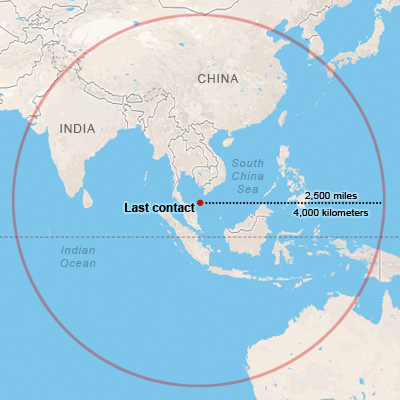
For fragments are repeatedly being reported in the ever-expanding and shifting search area for the tragic and still as of yet inexplicable disappearance of an airline with 239 passengers aboard:  in ways that have driven comparisons to black holes into which the jet mysteriously disappeared have created an almost near-impossibility of locating what one thought were the most trackable of flight paths, if only given the broad area of the radius of 2,500 miles which the fuel tank of Flight 370 might have allowed it to have gone after its last contact with radar.  The open seas that provided the only places to be less carefully tracked, as it left Malaysian for Thai airspace, seem a rare region removed from land-surveillance, as well, as we have since discovered, the sort of windswept area of fast-moving currents that have sufficiently flummoxed the densely concentrated and often multi-national surveillance systems that have mobilized around the area.


mh370-range


The mid-March findings that the airplane took a planned sharp turn westward, most likely programmed by someone inside the cockpit contributed grounds for fears of hijacking by someone on board, bolstered by the swerve of flight path toward the Strait of Malacca that the Royal Thai Air Force observed, traveling back out to the Indian Ocean, rather than its planned course to China, and the search has progressed along the lines that Flight 370 headed in another direction than was first believed, costing significant delays in time for the search for the missing plane, but not reducing the search area beyond 2.97 million square miles. But how does something like a plane fall out of contact with civilian radar or satellite?  Where, simply put, could it go, and how did it get there?  As the story has circulated in the major news outlets, a sort of popular response to the inability to map its course has surfaced or emerged.   The disappearance of the American-made airplane has recently provoked the existence of something like—you guessed it—a Bermuda Triangle, that often evoked conceit of the 1970s, or provoked (in less responsible news outlets) the existence of a “greater force” that just gobbled it up, in ways that explain (in comparable  ways) the sudden disappearance of aircraft from civilian radar monitors or satellite reception.  The notion of a “Bermuda Triangle”-like theory matches the odd absence of clear territoriality over the open seas in the region from the Gulf of Thailand or Strait of Malacca to the Indian Ocean, whose rapidly expanding search area that has involved the Chinese, American, Australian, Malaysian, British, New Zealand, and Thai governments, and evoked potential dangers from Uighur separatists, as much as Al Qaeda.  (Or might it be, as was recently suggested by a Canadian-based economist with ties to the petroleum industry, that the United States was involved in targeting MH370?)

The notion that no government is prepared or able to adequately chart the waters of the wild South Seas suggests an absence of governmental supervision that somehow links the plane to separatist groups–even if no one seems to dare to claim responsibility for diverting the flight. The difficulty in stopping the search starts not only from the tragic disappearance of a jet with some 260 people aboard.  The compulsion evident in the maps of air traffic controllers to the sighting of debris seems almost to derive from the fact that something managed to evade the system of worldwide surveillance somehow managed to escape being tracked, despite its size–or, more probably, the fear that we are not being surveilled and mapped as well as we had all hoped.   The latter not only opens the door to invite a further future opportunity for terrorist acts that we might all of course want to avoid, but lifts the veil on the surveillance industry itself. The images distributed by the Malaysian Prime Minister’s office, no doubt in response to how frustration made the government an early target for the inquiry, seemed to suggest an eery possibility of a middle-eastern connection, now doubt familiar to American ears–even though this expanded search area suggests little basis for such fears.  How, a concern runs across the media, did it ever disappear from radar coverage and surveillance?


mh370-possible-positions


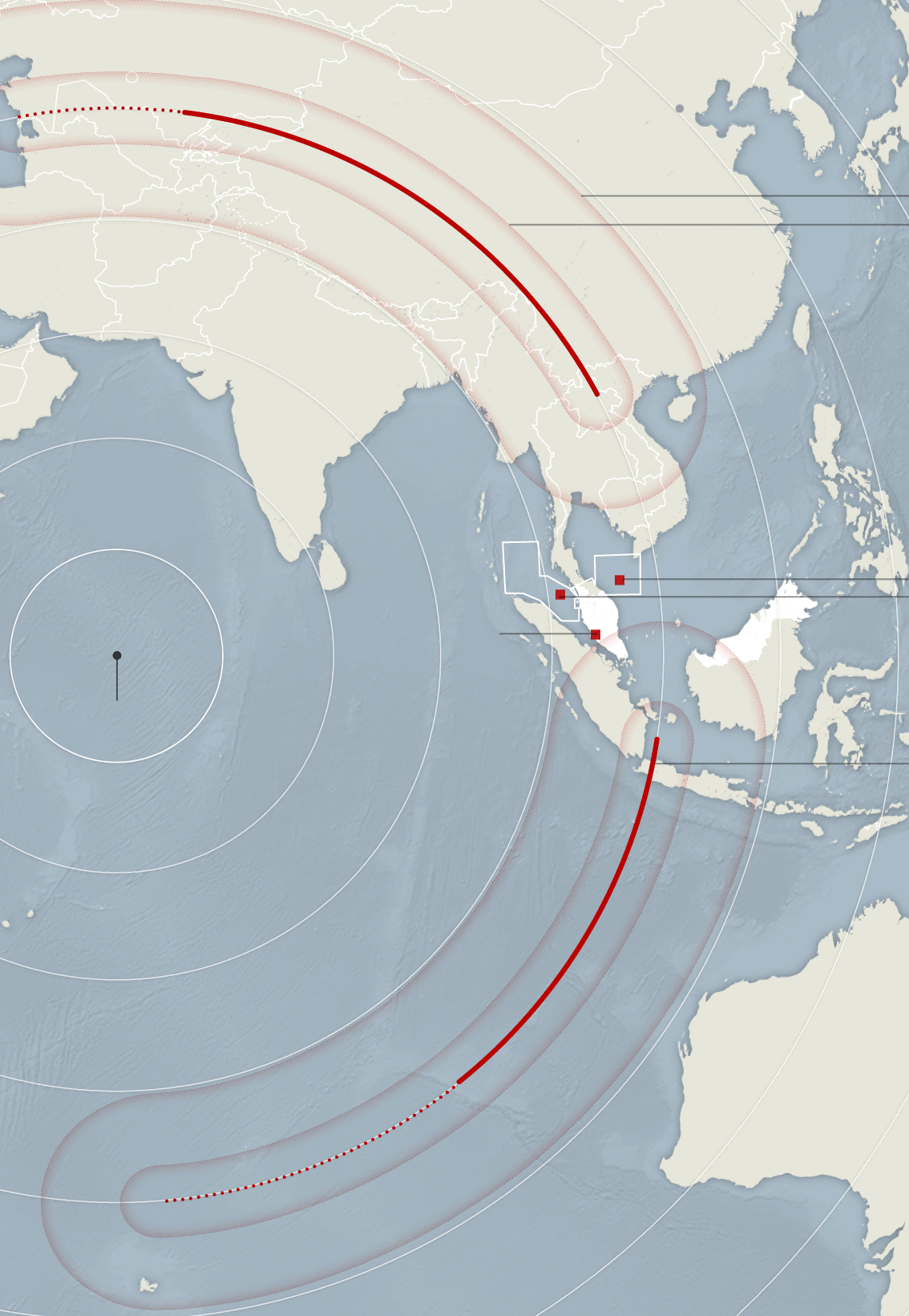
But the very vagueness of potential trajectories Based on the amount of fuel within the jet’s tanks, the possible position of the flight when it was last heard from satellite suggested only that it lay along one of the red arcs of potential diversion of the aircraft’s flight path from Kuala Lumpur in the 7 1/2 hours after its 12:41 take-off, tracing some  2.97 million square miles in which to conduct the search for the areas to which it was originally delimited and confined:


Estimated Range of Possible Flight PathsNew York Times


Although the area the arcs encompass approach the expanse of the continental United States, the arc to the Caspian Sea or Kazakhstan seem to have received far more initial attention:  it would, one supposes, be confirmation of the tentacles of Al Qaeda rearing their head.  The far smaller areas in which the plane had first been searched, defined by white rectangles, suggested in this map, made a week after the airplane had disappeared, as well as the difficulty of tracking what had been assumed to be so readily confined to the Gulf of Thailand, but which now has expanded to cover much of the South Seas.  But the fact that even those flying the most up-to-date jets of American Navy surveillance like the  P-8A Poseidon have been peering out of glass airplane windows and not looking at their electronic screens to spot the potentially downed craft, relying on the human eye to scan the open waters, and only spotting such objects as orange rope, white balls, or blue-green plastic reminds us of how much ocean-borne garbage might create distracting signs to frustrate the search.  And the reports of a low-flying plane sighted March 8 near the Maldives might potentially refocus attention in other areas that might well be mapped.


INitial Search AreaNew York Times


It’s a bit shocking that in over three weeks, no sign of the airplane’s disappearance has been noted, despite numerous potential sightings that have in the end proved red herrings.  The oddness of plotting an opening of an escape from surveillance and tracking that are the basis of the concept of modern airspace find reflections in the repeated maps of loss of contact with controllers, exit from tracking systems, and potential paths of flight, all concealing the absence of surety in being able to verify what happened to the unfortunate passengers on Malaysia Jet 370 more than the results of an ongoing inquiry with little sign of any clues in the transcript of exchanges between the flight and controllers for the seven and a half hours after it took off, and little indication of the expected tussle that would be associated with a diversion of flight paths. The potential sites of wreckage that have been found are something like the catalogue of a junkyard–including some 122 pieces of unknown floating objects in the Indian Oceanseventy-eight foot debris off Australia’s coast; white balls, orange string or other junk–in ways that have led to an explosion of articles on potential sightings that seems without end, each announced as potentially “credible” as the last.  So many potentially distracting objects that bear no demand for further scrutiny seem to exist that the Australian military took it upon themselves to include a list of those objects worthy of follow-up, including “debris, distress beacon, fire, flares, life jackets, life raft/dinghy, marker dye, mirror signals, movements, oil slick, person in water, smoke, wreckage.”

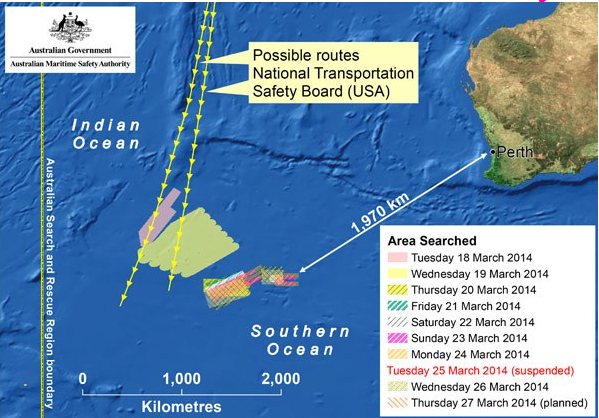
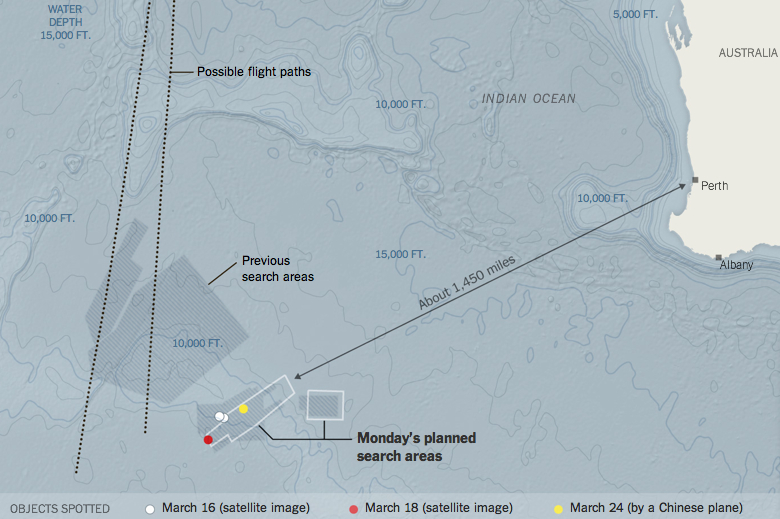
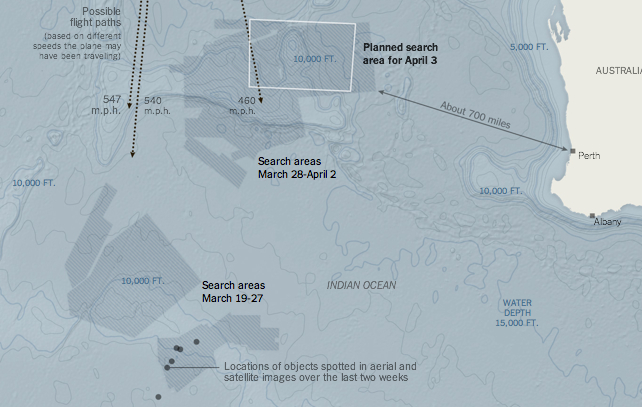
The demand for news maps suggest the shifting areas of the search and the aporia of inquiries that reinforce how difficult it is to believe that anything like an airplane would be so difficult to map.  The Australian government assembled a colorful collage of spots already examined, indicating the intensity of their daily attempts, which have shifted as time progressed and new theories emerged:


Australian Colorful Collage of Searches


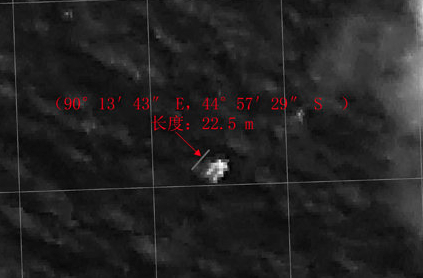
The Chinese government sought to provide ocular proof and exact coordinates of what looked like aircraft, 74 feet long and thirty feet wide, as if to reassert their claims to be monitoring the airspace by satellite, and staking claim to a region of particularly intensely disputed nautical boundaries–but so far finding little confirmation of the wreckage by boats:


Chinese Object in India Ocean


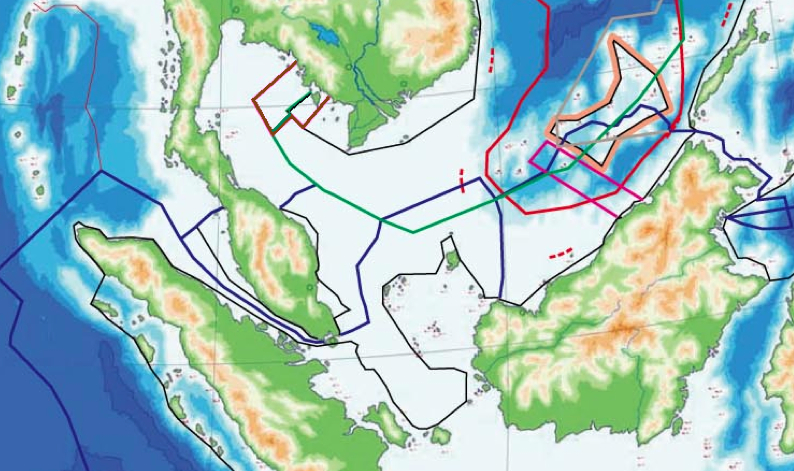
Are we just discovering how much garbage is in the ocean?  Or are we staking a claim to rights of sovereignty over maritime lanes, when maritime sovereignty still seems particularly difficult to define–raising questions of what sort of waters the craft may have been lost in, and whose right it is to retrieve whatever of the plane is left, but also pushing the search out to international waters, to avoid fraught questions of contested maritime sovereignty.  The oddly international complexion of the search parties that have been engaged so far has all too often muted the deeper salient question of the complex contestation of conflicting lines of maritime jurisdiction in the very region of the seas over which the plane flew.  (While few would want to suggest that the search has progressed in reaction to disagreements about jurisdiction, the difficulty of mapping jurisdiction in these waters has received far less press coverage than one might expect.)


Complex Delineation of Nautical Borders Legend-boundareis


In a field of disputes of maritime boundary lines, the search for the place is filtered through the actually contested sovereignty on multiple fronts, in ways that greatly complicate questions of responsibility for searching for the aircraft and its presumably dead passengers:


Complex Maritime Boundaries   Legend-boundareis


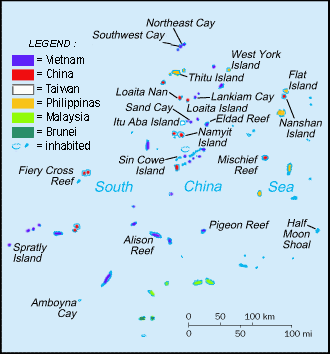
Indeed, the territorial complexion of many of the uninhabited islands of the South Seas resembles the random bright coloration of the multiple islands of medieval and early modern isolari, or books of islands, even if the colors are no meant to denote sovereign claims:


Spratly_Is_since_NalGeoMaps


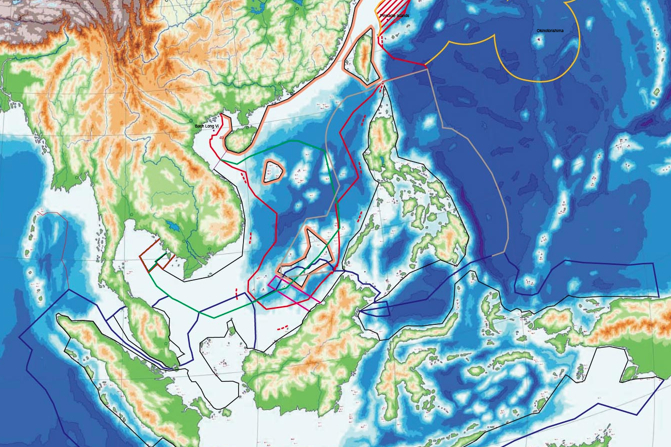
The larger picture is even, of course, both a bit more complex, and carries deep conflicts of how one can best understand maritime bounds, in ways that raise but a corner on the difficulties of resolving maritime boundary lines:


Complex Question of Boundaries


For most Americans, of course, oblivious to contrasting claims of sovereignty over water in a globalized world, and amused by the idea of contesting the sovereignty of maps, the questions might turn around the simpler incredulity at what has happened to our satellites or systems of radar.  The amount of ink spilled over the absence of indications of a major airline’s flightpath leaves viewers aghast at not being able to interpret the map that results. The pleasure that commentators on ‘The Ed Show’ or ‘Bill O’Reilly’ take in evoking and imitating authoritative maps that show potential arcs of air travel provide a scary shock-tactic of disorienting observers to an over-observed world, and suggests the discomfort not only at the potential for future skyjackings or dangers of flying aboard airplanes–but that we’re just not being watched as well as we all wanted to be, as if that was what we wanted. Or is it that the mapping of the results of post-9/11 surveillance have let us lapse, reassured, into a false sense that we need not worry about the dangers of the diversions of commercial flights, or that all is indeed under control?  Yet the hunt has now turned to the southern Indian Ocean, based on scattered new evidence of active flight diversion, after being centered in the Gulf of Thailand or South China Sea, with concern arising from the fact that the batteries on flight data and voice recorders–the main hope of finding the plane’s location–are due to die, and with them much potential evidence of what transpired in the cockpit, as pings emitted to facilitate their geolocation are due to die, after which the hopes to find evidence of what occurred would be drastically reduced.

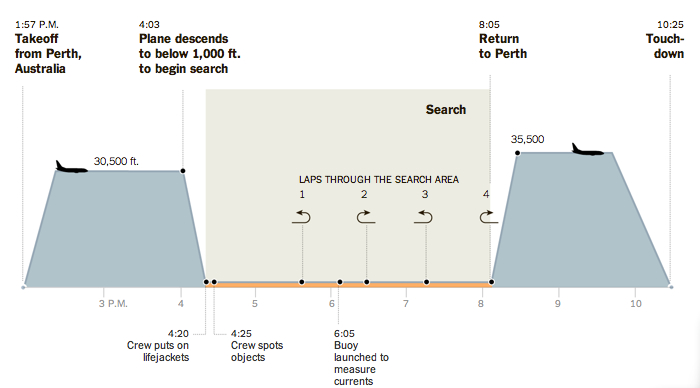
The search for the information is being collected in the need to affirm the continued safety of airspace, not to mention confidence in the air travel industry.  Does it also serve to conceal the huge costs that the US government is ready to spend on the search, already having allocated 2.5 million for the participation of US ships and aircraft to this mission, presumably in the hopes to find clues to the disruption of monitored airspace.  (The flight of an search of the average high-tech surveillance navy jet of the sort equipped with the requisite surveillance cameras lasts two hours, deploying the most cutting edge example of surveillance of the “sea state”:  the theater for remapping the waters by planes such as the P-8A Poseidon suggests a rehearsal of the gamut of equipment that the Navy has assembled and huge costs to use must be balanced with the eagerness of being able to deploy our latest surveillance toys.)

average Search Plane(from The New York Times)


The frames of geographic reference somehow seem part of the dramatic narratives spun about the disappeared plane, whose possible paths not only inspire limited confidence in the accurate measurements or tracking capacities but oddly orient viewers to the South Seas from a strikingly new orientation on landmasses and marine space, in which the dramatically open areas frame the aerial search along a diverted flight path far from land, in an area that is moreover swept by winds that often exceed 100 miles per hour, and rough seas:


Reconstructions of Flight PathsNew York Times


The deployment of all this technology to map the region by weather charts or debris-sightings seem designed to bolster confidence that this area, if blocked by cloud cover and rain and tremendously powerful waves, and deep waters, is still being mapped with relative accuracy. Yet what is one to make of the mapping of potential sightings? What significance does their clustering in the Indian Ocean mean save the intensity of searchlights turned to that direction, and the new horizon of expectations that results–even if the idea that pings from the airline’s data system, ACARS, dating from the period of four to five hours after the last transponder signal, and transmitted to satellites, indicate its arrival in the Indian ocean.  But why map potential sightings if they are not confirmed, except to try to restore some confidence in a search that might be akin to searching for sightings of Elvis or Christ?  In the meantime, the proliferation of alternative theories continue, from the plane being attacked by extraterrestrials, captured by folks who’ve shrouded it in an “invisibility cloak” or the locally generated theory that the disappearance of the plane is part of a an ambitious life-insurance scam, and not a terrorist plot–floated by Malaysian police chief Khalid Abu Bakar.  Over the month since the airplane’s disappearance, the biggest winner has no doubt been CNN, whose 24-7 coverage has stoked continued interest in the story; CNN President Jeff Zucker boasted how the new ratings showing reveal “a record-setting month for CNN’s digital platforms, including record-high page views, video streams and mobile traffic,” as if he was addressing shareholders, as it continued to describe and map objects floating in the Indian Ocean, without any sense of whether they were related in any way to the flight–so long as they were located along “possible flight paths.”  Is the technology of mapping a legitimation here for the absence of any actual detection of the flight path?  


Objects SpottedNew York Times source Australian Maritime Safety Authority


It’s hard to follow the logic of those who are organizing the Australian search teams, even thought the New York Times does its best to keep us in touch with the latest, but the recent relocation of the search by some 700 miles to the northeast suggest the hunt is a grab-bag of guesswork, and reveals the intense feelings of desperation at the narrative spinning out of control.


Relocation of Air SearchNew York Times; source: Australian Maritime Safety Authority


But to generate more information about the “unfolding story” of what CNN has continued to call the “airline mystery,” given the fact that no resolution of this mystery is in sight, and no indications that the plane crashed have emerged, nothing does the trick like a map to link the event to a number of alternate narratives and abstractions.

And as it has emerged after almost three months that the unending search is the most costliest episode of recovery of a jet in human history, the devotion of such emergency apparatuses to locating a lost jet must be assessed:  at the cost of millions of dollars per day, and over three and a half million dollars just to deploy an underwater detector of potential pings over the past weekend, it might be time to return attention to what is the end of the search, save seeking closure on a traumatic disruption of any illusion of totalsurveillance of airways such as that which the United States government wants desperately to be able to sustain?

What else occasioned the repeated search for the ruins of the jet without any sense of limits of cost, and indeed the devotion of a recently developed technology of surveillance to the detection of potential signs of the lost plane and its passengers?  At the same time, the rescue mission seems a sort of dress-rehearsal for surveillance of submarines on the high seas, the narrative of locating fragments of wreckage of the plane’s fuselage or wings fits into a sense we need to find closure in a sense that something happened while we all thought we were being watched:  this notion that the incident of Malaysia Airlines 370 suddenly disrupted and shattered that sense of an achieved limited peace, even in a time of ongoing contained military engagement in several theaters of the world.  It is hard to get used to the fact that we are not, and cannot be, safe in air travel.  (But at least, perhaps, we have generated these detailed maps, which seem to be reassuring of a sense of monitoring an unfolding story, even if it is one that seems to have not gone very far after all.)

The sense that we’re somehow being less well-watched than we once were seems to have driven the constant stream of news stories—unconscionably, never edited or diminished on airline flights, but almost increased in an attempt to keep passengers more relaxed and on their toes, the jet has increased critical thinking to the extent that it has provoked calls for the re-introduction of “reliable psychics” (in a return to the Nancy Reagan White House).  Where the plane went is less the concern of these maps, it seems, than the fact that draw as many maps as we want, not much turns up on them. The courses of potential flight paths after the pilots lost contact with the airport in Malaysia from which they first took off on that tragic day seems less directed to the protection of our own frontiers—or even airlines—than the notion that we cannot map a map of that path, even with all our satellite coverage and technologies that we’ve devoted, in the wake of 9/11, to monitoring maps of all movements along flight paths across the inhabited world. One problem may be that 9/11 opened a narrative, or saw one forced on us, so haunting that we don’t know how to bring to an end, or cannot see an end of, so deeply unsettling is it all.

Leave a comment

Filed under CNN newsmaps, flight-tracking maps, infographics, mapping flight paths, radar maps, satellite surveillance, surveillance mapping

The Infographic Pontiff?

The refreshingly broad geographic purview of Pope Francis’ Urbi et orbi Christmas benediction, delivered to the faithful in St. Peter’s Square as a greeting to the world and the city, and to all Christians in the city and throughout the world, newly displayed the spectacular breadth of Pope’s call for peace across the world in a globalized age.  As the Easter Sunday Urbi et orbi papal benediction included imprecations and injunctions for peace in the Middle East, “and particularly between Israelis and Palestinians,” hoping for Godspeed in the process of negotiations, “peace in Iraq,” and “above all for dear Syria,” Mali, Nigeria, the Central African Republic, and across the Korean peninsula, Francis’ Christmas Homily illustrated the extent Francis’ direction of his annual pastoral message beyond both sola scriptura and beyond issues of church doctrine.

The homily’s wide geographic compass–containing a level of detail so tellingly absent from the generic breadth of recent predecessors in communicating the significance world peace–suggests a far broader notion of the church than was followed by his immediate predecessors, and indeed a needed geographic specificity in the relation of the pontiff to the faithful:   before some 70,000 faithful, the pontiff resumed a similar itinerary of sites of the persistent absence of worldly peace, touching similar landmarks in a tour of global conflicts from South Sudan to Syria, Nigeria, the Democratic Republic of the Congo, Israel, the Palestinian Authority and Iraq. Francis’ comprehensive roundup of global hotspots took its brief in refreshingly literal terms as addressing “omnium ecclesiorum Urbis et Orbis,” by effectively mapping commanding Hotspots of civil unrest and travail across our inhabited world, and of course hoping for future tranquility.

This indication of continued horrors we might too easily neglect is a far cry from how the global maps commissioned by Gregory XIII in the 1580s.  If the monumental cycle of maps in the Galleria delle carte geografiche expanded the image and presence of Italy in the Mediterranean, as well as its significance to the worldly church, and the above Loggia offered a canvas for tracing missionary routes to different continents, Francis’ mapping of suffering dramatically departed from the magisterial function of the church in dispensing dispensing worldly teachings, and suggests a way to broaden the vocal role of church in a globalized long considered one of the earliest globes to depict the New World in detail, if the third to survive.  T.  Perhaps this came from his appreciation of the actual difficulty of prayers for worldly peace.  Francis’ homily gave new breadth to his sense of moments “both bright and dark” in worldly politics.  Whatever the reason, breadth doubt informed the sense of peace and what peace would entail–his procession from St Peter’s basilica gave prominent position to pairs of children from Italy, the Philippines, Lebanon, his native Argentina and Congo, as if in an embodied objective correlative of worldly suffering among Christian believers, and an infographic that could be held before the eyes of the faithful, and remind us of the great stakes of any future map for worldly peace at the start of the third millennium.

As the first non-European pontiff, no doubt the former Cardinal Jorge Maria Bergoglio was acutely conscious of his charge for ensuring global comprehensiveness within the Church, as well as of expanding the doctrinal focus of his immediate predecessors.  Francis openly joked on assuming St. Peter’s throne that his fellow cardinals of seeking a new bishop of Rome that they went “almost to the end of the world.”  And long before being anointed by Twitterfeeds with the hashtag #BestPopeEver, he suggested a broad perspective on the alleviation of and attention to worldly suffering and the active role of the church in its alleviation, a consciousness no doubt present in his adoption–the first time for a Roman pontiff–of the name of the Franciscan founder, St. Francis of Assisi.  His appreciation of thee relative nature of peace may have surely derived from his personal experience and exposure to dictatorship as a Jesuit during Argentina’s Dirty War (guerra suicamay have made many and multiple compromises to preserve peace; Bergoglio was quite familiar with Argentinian death squads, and seems to have minimized the 30,000 deaths of that place and period, in ways that  surely invested a different view of “peace” as an arduous uphill climb.  (His relative silence in a period of terror terrifyingly paralleled the minimization of violence of the dictatorship of Jorge Rafael Videla, and he has revealed something like a dedication to atonement ever since he offered Videla comfort and communion–if not his concealment of political prisoners–charges perhaps due to pragmatism in the moment, but which the pontiff has not clarified satisfactorily.)


popewithdictator


But to forgive is Christian, and to err human, and since he worked within the Argentine political structure, Francis has attained the unique perspective to turn a significantly more tolerant eye on the Christian faithful and to devote considerably more attention to the scale of worldly suffering.

And when Francis evoked a cast of characters in need of peace and hope, from child soldiers to migrants,  and providing something like a literal tour of moments of worldly peace, his sermon had a clearly cartographical quality:  he offered a sort of virtual travel to or evocation of places of unrest that merited personal papal attention (or intervention) and indeed the spiritual attention from the world’s religious.   He took more seriously the global nature of the address that hoped for “peace in the world” from human trafficking to natural disasters in his “urbi et orbibenediction that embraced the literal scope of the sermon hoping to foster global unity and peace–even if his history of compromise and possible collusion suggest a more problematic history of personal involvement in reigns of terror.   Following the time-honored presumption of ecclesiastic universality that befits such an annual homily, Francis openly addressed once more the “ongoing conflict in Syria,” hoping that followers of all religions were working for peace there, and praying for a resolution to civil strife, hoping that the Lord would act to “foster social harmony” in Southern Sudan, as well as the Central African Republic, hoping for dialogue to grow in Nigeria and the Holy land, and that tragedies never again befall migrants as they did this year at Lampedusa, an island off the coast of northern Africa, ever again.

The breadth of his call to conscience was striking, and has been widely celebrated.  “Too many lives have been shattered in recent times by the conflict in Syria, fueling hatred and vengeance,” hoping to spare future suffering for the Syrian people, and hoping that the Prince of Peace might also help to heal the constant attacks on innocent and defenseless in Nigeria, the frequency of violence in “beloved Iraq,” so often struck by senseless violence, and that hope and consolation reach the many displaced from the Horn of Africa to the eastern Democratic Republic of the Congo and those displaced by natural disasters in the Philippines.  In providing a personalized message of support and succor, Francis also offered something of an infographic of global Hotspots of need and humanitarian disaster far more explicitly than his predecessors would have ever articulated, focussed as they were on issues of doctrine as much as of worldly conflicts or wars.  If we don’t know what newspapers Francis reads, his words echoed the March public comments Valerie Amos who, as head of the UN Office for the Coordination of Humanitarian Affairs (OCHA), described the many “neglected” areas she met as “In the last year alone, I visited more than 40 countries from Syria to Sudan, Democratic Republic of the Congo, Niger, Afghanistan and Myanmar, and saw and heard for myself the terrible conditions that families face and their harrowing stories–loss of loved ones and homes.”  These “neglected regions,” surrogates for the neglected, offer a new geographic language for understanding regions of humanitarian assistance and need whose rhetoric seems modeled after that of maps to show the humanitarian Hotspots that are familiar from maps of global warming, and which provide new visual models to contemplate the increasing depth of inter-relationhips within the world.


Implications_drought_hotspots_conflict_11


Or our own globalized sense of the multiplication of hazard Hotspots so disparate to be hard to process or even get one’s mind around–also a tragic challenge in the face of global warming.


Implications_all_hazard_hotspots_cumulative_world_13


Pope Francis seems to realize and relish the challenges both of ecclesiastic leadership and of providing comfort and consolation in an age of globalism.  In the age of elegant but impersonal infographics, the expansive geographical breadth of spiritual compassion across the world seems a response to globalization that tabulated the costs of what we too often lose from the 24-hour news cycle:  for if the pontiff’s world tour was a worthy exercise of extending a globally frayed compassion, it was also a cursory review of selective dim points of civil strife across the inhabited globe that was (as befits the medium, perhaps) short on particular details or local context, and as an impassioned address fell a bit short, as well as a depressingly long laundry list.  But that said, the infographic that Francis provided to believers was a welcome inclusion of specifics to hold before their mind, in contrast to His austere predecessors, the world-travelling ecclesiological conservative John Paul II and the even more austere Benedict XVI, for all the Enlightened pretensions that the undoubtedly intentional echo of Benedict XIV suggests.  Indeed, Francis offered a telling shift from the dominant concern of his predecessors with questions of catechism, arising from their magisterial notion of the pontiff as head of the church.

The papal Christmas benediction was a sort of infographic for a world weary of war, where He could only hope to offer succor or faith for the many victimized and displaced world-wide in hot-spots of civil unrest, an attempt at offering a sense of hope which seems so thinly stretched.  Can we process the infographic that he gives us, and use it to keep an eye on needs for worldly assistance and sympathy?


Pope Francis Christmas 2013


And the new vision he has presented in the elevation of Cardinals in the very first month of 2014 provided a refreshing image of the church whose collective memory and spiritual body has been for perhaps far too long identified with Italian bishops, and whose corpus mysticum has been difficult to separate from the Italian peninsula–or Italian cities such as Venice and Rome–even as it has gained a truly global status over the twentieth century, removed from a colonial apparatus if also redolent of colonial ties.  Pope Francis’ recent timely elevation to the cardinalate from regions in Latin America, Asia, and Africa make a case for the church’s global face–and distance the worldly body of the church from a clerical career path or ladder often moving from Venice and Turin.

Indeed, the infographic provides a compelling new vision for the body of the Church, and its ties to believers, as well as its charismatic body whose legitimacy derives from divine intervention in human history but is sustained by continued faith.  For in selecting a cardinals’ college that includes not only Managua, Rio de Janeiro and Buenos Ares, but Seoul, Les Cayes in Haiti, in addition to the Ivory Coast, Burkina Faso and the Philippines, Francis clearly intends that the church begin to present an image of itself to its believers and to the world that is globalized, rather than rooted in one peninsula.


0113-for-webVATICANmap-artboard_2


This is refreshing, and particularly timely–in light of the planned February 22 consistory in Rome. If we have seen narrow-minded screeds about how “the US is getting skunked” in this reconfiguration of the church’s public profile, this is also an affirmation that the mystical body of the church derives from its continued ongoing relevance to its faithful and to those in need.

Leave a comment

Filed under #BestPopeEver, Christmas papal homily, infographics, Pope Francis, St. Peter's Basilica, Urbi et orbi

The Map is Dead–Long Live the Map!

Participants at the symposium Mapping and Its Discontents debated the benefits of the near-ubiquity of uniform mapping systems sponsored and orchestrated by Google in our lives.  Many of the wonderful papers tried to suggest the benefits that mapping served as alternate ways of making visible the unseen and giving voice to the silenced–but did so with deep skepticism of the dominance of Google Map’s blandly undifferentiated surface, both as a sort of collective erasure of knowledge, and a sinister synthesis of gathering meaning about individuals’ consumption habits.  In this somewhat hopeful symposium, whose speakers urged the audience to go forth and map, Denis Wood offered a skeptical history of mapping as a form of art, focussing less on its craft than on the contexts in which it was read and exchanged–and the historical “explosions” of map making as a tool of state-making.

Although Scott McCloud does trace comics back through cave paintings and the Bayeux tapestry, something we recognize as a comic book it to printing and mass-production of paper in the mid-nineteenth century, the printed ephemera Alan Aldridge and George Perry first identified as antecedents to  the sort of fantastic album art he produced, we don’t see much we would recognize as a map until printing, Wood argues–and that the fifteenth century is a good place to start the history of maps.  But rather than peg the map to the material practices of the production of information, the ways of embodying information and need to embody networks of spatial organization reflect the new need of an emerging modern nation-state–as well, he might add, though he omitted it yesterday, the need to straighten out clear bounds of contact and digest the discovery of new worlds.  (One might object that rather than leave this entity of the “state” so monolithic, dual origins of causation can be seen in the Renaissance, both as a period of contact with new worlds and that gave currency to the creation of newly imagined worlds–the “other Green world” of Harry Berger–as joint ground in the poetics of making, reading, and reproducing the map.)

As longtime interrogator of the power of maps and enfant terrible of the cartographical establishment, Wood’s opening salvo called attention to how print helped differentiate the standardization of shared practice of mapping space from the genealogy, charter, systems of notation, almanacs, calendars, or rolls, maps served to conjure the state to existence in its graphic performance–and to conjure the state, in ways repeated in histories of Japan, Siam, and the United States, as Elizabeth Berry, Thongchai Winichakul, and Martin Bruckner have shown, as a natural object, when it was not before.  Any attempt to naturalize the map either as a depiction of the world’s surface or universalize its documentary function, he noted, including the celebration of the recent democratization of mapping skills that seem to dislodge authority from the map’s form, passes over the map’s role in the state and state formation as a form of spatial intelligence and spatial intelligibility.

We might do well to look for origins, Wood proffered, by asking exactly when it became a slur on a civilization that it does not use maps–or couldn’t read them.  The question was enticing because of how it raised questions of the ties of map making less as an instrumental tool of dominance over space, than a standard of civilization and knowledge–a standard of the sort that Graham Greene evoked in his postwar visit to Liberia, Journey without Maps (1949).  Although Greene’s visit to the colonial outpost was certainly a product of Africa’s partial colonization by European industry, and the end of English empire, his account reflects Wood’s point that maps exists only where social relations call for them exist:  that where talk serves, maps are rare; but that when talk becomes inadequate, alternative graphic forms of communications develop within the state–of which the map plays a central role.  Greene beautifully if parsimoniously evoked the elderly toothless man with whom he shared a boat ride at the end of his 1946 journey who suddenly approached him with a piece of pressing news:  “‘Do you know that in Monrovia they have a map of the whole of Liberia?  I’m going there to see it.  It is in the possession of a family called Anderson.  They have had it for years,'” he says wonderingly, suggesting amazement at the foreign family of colonizers who possess a map of the entire country in which he lives.  “‘Sinoe is marked on it,'” he continues, “‘and Grand Bassa and Cape Palmas,'” repeating what he has been told by others, but never having seen a map of his entire land.  The encounter might well have been invented by Greene, but created a topos for the encounter between the map-literate and native that presumed an eagerness for encountering a map–the map seems a sort of lodestone–that might be either a western fantasy or a deeper discovery of a land where, absent the myth of colonial organization, the residents don’t know maps, or an illustration of deep ties of mapping to the civilizing process delineated by Norbert Elias.

Printing allowed the map to penetrate the lives of people about 1500, unlike other forms of data-keeping:  for the creation of a map that penetrated the lives of ordinary people and readers effectively under-wrote social relations of power in very concrete, linking territory to other things in ways that advanced the making of maps and shifted the role of mapping as an enterprise:  we count only a few thousand maps prior the growth of the nation, but an explosion of the production of maps in the sixteenth and seventeenth century occurred of the sorts of which was never known, and parallels the map’s entry into individuals’ lives to a degree that never occurred earlier–a notion, as Wood long ago argued, of “map-literacy.”

Nations were indisputably the new arenas of this move to mapping, unlike the printed maps that were widely sold in Italian city-states or the Netherlands.  Earlier maps such as cosmological charts, star maps, or property charts of the Babylonian period or in Japan and England had legal purposes, but quite different from large-scale graphic property function in varied places around the world, and without participating in a map-making tradition in projects such as the mapping efforts of Phillip II to create detailed records of imperial possessions in the Mediterranean, or the huge map making projects of Louis XIV and Colbert that are tied directly to the state and to the material recreation of state sovereignty.  (Of course, this raises the question as to why maps first emerged as forms for advancing epistemic claims and embodying places in areas that were less clear as examples of the modern state, like Italian city-states or sites without empires like the Netherlands or whether the imaginative ends of mapping can be separated from their administrative ends.  Wood sees them as being as tightly tied as the sides of the same Moebius strip.)

It is in this arena of the state, Wood forcefully argued, that we can see the inauguration of modern topographical functions from real estate, to prisons, to cellphone use, to voting practices, to states rights, to a point at which we can’t consider life without maps.  The date 1500, far from being one of convenience, is something like a benchmark or velocity point for the new roles that maps began to play and that they continued to assume today–a point of no return, as it were, of the sort Ian Hacking drew to mark the emergence of probability at the date 1660.  Only after 1500, or in later periods, did mapping emerge as a way of life, Wood insisted:  if some fourteenth-century monks drew plans of their monastery, the idea was not widely or even narrowly pursued as a basis for collating evidence, or followed up on in ways that reflect the multiple functions maps came to assume.  There is a bit of utopianism here:  whereas human societies didn’t need maps, and got on well without them before 1200, he argued, noting rights and properties’ specific attributes in other ways,  the map’s discourse-function failed to develop itself as a means to exploit strategic resources and to have operable use and currency.  While he recognized the evidence of the creation of maps in Song-era China within select parts of well-established bureaucracies, only later did maps gain a large discourse-function of operability.   This may be a bit of a slippery logic, but argues that the “map” had new meaning at a certain point as an object of exchange, and that no properties inherent to its design exist save as such an object of exchange.  So much for its formal attributes.

Wood marked the birth of the map that is now perhaps dead  at this sort of a watershed:  in 1400, few used maps; by 1600, maps became inseparable from social functions in a global context that is itself only beginning to be mapped.  The abundance of eighteenth-century maps in China, or in the seventeenth century in Japan, and in Vietnam from the 15th and 16th century, and Mesoamerican and Malay maps in 16th century, are traditions that inaugurated in the early modern state.  Indeed, there is a weight of evidence to shift this change in the growth of European knowledge, and it reflects a massive rise of needs for map making to ensure border control, water management, land reclamation, military needs that just exploded with the state.  If even in Florence, Italy few maps exist from before 1565, Florentine, Neapolitan and Milanese mapping projects all exploded in the sixteenth and seventeenth centuries, as they did in seventeenth century Japan, when thousands of government maps issue in Japan, and maps served to perform the form of statehood.  

What changed, Wood argues,  was that then new political structure of impersonal construction demanded new forms for its embodiment, and gained a propositional function that was absent from earlier map making traditions–a propositional function that was necessitated and called into creation by the state.  He recalled how Martin Bruckner showed how the image of the national map of the United States staked the proposition that there could be a tenable unity among this expansive nation, much as imperial maps of Britain tried to persuade readers on both sides of continent of imperial possession of north american content, as an artifact of state–both of these cases illustrate the new tangibility that the map assumed as a means of calling the expansive relation of the state into existence by the graphic performance of statehood that was newly enacted in the printed map, and which the map served to make legible.  As Thongchai has shown in his work on Siam, maps served to produce the very “geobodies” that become totemic through the map’s presentation of the state, creating a sense of unity not familiar to many, but able to normatize a nascent polity, and to instruct countless participants in the construction of our country–even without a clear idea of citizenship.  The skill of state apparatus lay in bringing routine of state practices to a larger audience, as Valerie Kivelson argues in Russia, down to a lower level of reading–as the map served, both in Japan and elsewhere, multiple function to against the images of other states and other imaginative constructions.  Identical patterns of map-use can be found in these cultures, and, not surprisingly, in the post-WWII state of Israel, founded in part by European Jews:  in each place, maps affirm the state, the state affirms the map, summoning unity from . . . chaos.

The medium of the map and its power as a form of synthesis arises as a new form of narration when other forms of narrative do not suffice–it is both the master-narrative and originary myth of the modern state.  And, indeed, maps have become so powerful to bring objects into being in concrete terms, that it would be impossible to discuss otherwise in a multitude of ways–from the nation to the distribution of electoral politics to the spread of fires to the ozone hole to El Nino.


Footprints of Actively Burning Fires--Google Map

Ozone Loss Map


The credence that maps create by linking subjects of propositions to a specific code enables these new subjects to be discussed, and in linking subjects of propositions like the state to the code inherent in mapping, and to real relations in the world, maps can come to signify the world, and networks of causation within it, as well as prospective statements for its future.  As Wood wrote in an earlier context, “Insisting that something is there is a powerful way of insisting that something is.  Mapped things–no matter how conceptually daunting–possess such extraordinary credibility because they’re capable of propelling into popular discourse abstruse abstractions:  high-pressure cells, El Nino, seafloor spreading, thermohaline circulation.”  Or global warming, or the the expanding ozone hole, earthquake swarms, or the global threats of desertification of arable land.  These curious abstractions enter public debate as concrete terms, if never clearly grasped, based on their cartographical realization.  It is, of course, only because of maps that these very issues can become contentious foci of public debate.


Tracing Sandy--Time Map

Prognosticating hurricane_sandy_map


The map serves double-duty a representation or a cloak, Wood makes clear.  Its two-fold duties are so effective to make creative practices of map making disappear, to make states affirm their role as real things of nature–even as maps obscured their own existence in the reasons of the state itself.   And if it’s hard to imagine that these artifacts as nations or concepts like ozone could come into creation, without the creative functions of the map, the wonder of the map is to link subjects of proposition signified (State) with signifiers constituted by their code–and to signify the world.  This might explain their clear currency as a form of realizing the make-believe, or fantastic, with a sense of actual concreteness by delineating a credible topography with which we can visually interact–especially while reading a text, and in whose creation we can indeed vicariously share, so powerfully creative do they affect their readers.

The use of maps to lend credence to propositions in the early modern world led them to embody abstractions from the map of “Utopia” Thomas More pointedly included in his dialogue of the same name, the maps of emotions Mme. de Scudery devised as Cartes de Tendre, or Jonathan Swift’s maps of Lilliput and Blefescu or Gunniland in his “proposal for correcting modern maps,” or–and here we leap centuries–modern ancestors such as Stevenson’s Treasure Island, whose fantastic claims to embodiment in maps extend all the way up to map of Middle Earth–and to those Christopher Tolkein subsequently expanded–whose publication and currency, he argued, led anyone with a computer software applications to make maps from Grand Theft Auto to map art, as map is congenial subject of exhibition.

More Utopia Map

220px-Moll_-_Map_of_Lilliput

Carte de Tendre

But are not these maps playful inversions of the operative roles of maps as tools of state–orchestrated by figures with close state roles, as More and Swift?  The role of middle-range cartographers from E.H. Shepherd to Christopher Tolkein to Jules Feiffer, to trace one genealogy, seems quite distinct.

phantom-tollbooth-map


Is the state’s stranglehold on cartography at last weakening, much as Wood asserts, even with the diffusion of mapping platforms and the availability of digital mapping tools?  Wood detects a twilight of the age of the paper map as leading to an end of the dominant role that maps of states once enjoyed as vehicles to view boundaries and confines of state possession and areas of juridical control.  This does not mean that maps are less used by the state.  But that the map is less the gripping tool of engagement whose history he has traced since circa 1500, the magic date from which maps were, he argued, so instrumental in conjuring the subject of the state and so successful in naturalizing its truth claims as part of our world.  This may be curious, because of the proliferation of digitized maps that defines potentially unwieldy concepts–global warming; the ozone hole; hurricane Sandy’s path; plankton algae bloom distributions–that can be latched onto in public debate and, occasionally, grasped.  Or, on a humanitarian level, the sort of crowd-sourced map of deaths in Syria’s civil wars, legibly tracking a succinct geographic table of the distributions of killings, rapes, revenges, and poisonings or the humanitarian disasters of the Syrian refugees whose number has far surpassed two million.

Crowd-Sourced Mapping of killings, rapes, revenges and poisoning

Syriatracker

Syrian Refugee Crisis


We can also distinguish better and worse attempts to map  tragic humanitarian disasters among these visualizations.

One may, indeed, ask what constitutes the state today–and try to map it–or try to define to the widespread distribution of mapping functions within states.  Wood presented the insanely rising prices of old maps sold at auctions today as making something of a mockery of the idea that states so monopolizes the use of maps that it cannot but illustrate state functions.  But are not these maps, now evacuated of meaning and illusions of power, disquietingly assuming a role, retrospectively, as images of a world where power worked differently, or of an age when the design of maps was performed with such due diligence and care?

But Wood is perhaps too happy to say goodbye to the map.  If this grammar is not that much less operative, is it true that the state’s stranglehold on cartography is now weakening or has weakened?  Or that cartography–and the illusion of the map–has outlived its function as a basis to visualize the nation?  Wood doesn’t find that the state can any longer repeat the trick of naturalizing its own presence through the operations of naturalizing with GIS tools, partly because of their lack of similar persuasive skills.  But if it may be argued that the state has no need for the same truth-claims any more, as they are, somehow, finding themselves to be outdated, that doesn’t mean that the collective power of mapping does not exist outside the purview of the state, and as an activity of resistance and calling into being new information, as several other papers delivered at the same conference by Annette Kim and Rebecca Solnit showed.
But although maps arose in needs of nation state to take on form, and organize its interests, rather than seeing some sort of triumphalism continuing in the use of maps to shore up the nation-state, from Raleigh, NC, Wood doesn’t see the map as doing that good a job even as a tool of surveillance.  And he sees the use of maps to call attention to historical practices, and even to restore historical landscapes, as well as address issues of social justice, as marginal to the disappearance of the map as a tool of state control.  The declining efficacy of the sort of operations that maps were able to accomplish, he notes, seem to have contributed–notwithstanding the omnipresence of maps in our lives–to its declining authority, more than a ‘democratization of mapping’ can be celebrated. But as the functions of state-power also seem to be less clearly visualized–and preserved–by means of maps in an increasingly interdependent world where the concept of the boundaries of a map have less meaning as fabricating a category or signifier out of whole cloth, perhaps the map would enjoy new versatility as a tool outside the rubric of the state that so long sponsored it.

If one can talk about a geohumanities that extends beyond those with digital expertise, who engage in studying and producing the culture, that would depend on understanding of ‘map making’ not only as a practice, but as a verb engages other contexts, and a verb that offers something like a grammar in conversation that is specific to the map as an object, distinct from other accumulations of evidence, as well as appreciating the role of mapping as an art.  If in an age of such widespread collations and ordering of evidence, the paper map–and the official map–is somehow rendered obsolete, even as multiple maps continue to wage authority in ordering our lives.  But the ubiquity of Google Maps can be resisted, if only by making its origins better known, and its the limits of its practices evident.  To be seduced by their objectivity is surely to ignore the continued power that maps still have.  If maps continue to offer such a pleasurable area of exploration in Grand Theft Auto and other media, it seems likely that personal meanings maps afford provide not just diversions in the esthetics of map making, but appropriations of an all too familiar authoritative form to define boundaries of inclusion and exclusion, trace networks of meaning, and give stability to collective entities, even in the age of the slippy maps fabricated by Google that convert declassified satellite photographs to easily downloadable tiles.

Wood’s prognostication of the death of the map seems premature.  Perhaps we, as consumers of digitized information, pay attention to its grounding in geographic reality and its operations, and are also less susceptible to the sequestered codes contained within maps, or the truth claims of a single map’s persuasive form.   Perhaps the map’s near-ubiquity cannot but decrease its authority.  But we do seem to stand at the brink of a future where mapping is ever-present as a form of surveillance; perhaps a society in which power has learned to work in new ways, unmoored from maps to define power and realize or recognize its bounds, but has adopted mapping forms as dispersive ways to organize power claims.  But in this society, maps can gain new power as media to realize networks of which too few seem aware.

Wood suggests that the map is dead, perhaps, as a useful tool of conversion in the arena of state.  If the act of mapping seems less clearly situated in the arena of the state, or less dominated by the state, this does not mean that maps are media that don’t still mystify relations of power.  And if the leaks of Edward Snowden have shown that the state is surveilling us to a far greater extent than ever imagined was the case, Wood found little evidence that that has made so much of a difference, or that that helps states do much of a better job.  The query cannot but arise in response:  did the map ever do that much of a functional job, or only a basis for imagining a state that performed its functions well?  Long live the map, perhaps as a form of counter-mapping.
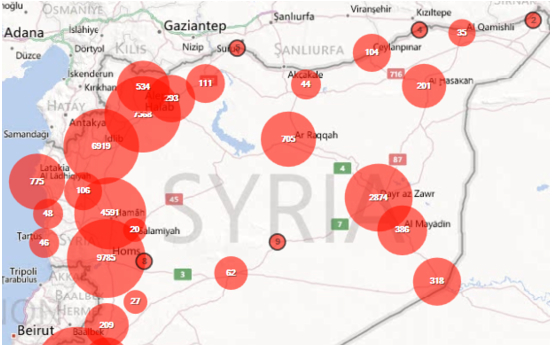
Leave a comment

Filed under Google Maps, infographics, mapping state interests, maps and state formation, newsmaps