The New Separatism and the Gas-Tax Latitudinal Divide: Tracking the After-Images of Southern Secession across the United States (Part I)

No region is an island, but divides are defined in ways that create a transmitted insularity along what might be called the Gas-Tax Latitudinal Divide that cuts across the United States, bisecting much of the nation along what almost appears a meridian.  Even before the efflorescence of confederate resentment in southern states clear in the 2016 Presidential election, but not at all clearly perceived in recent years, but evident the apparent toleration of the claims of white supremacy and the far right that are rooted in states rights, and, almost perversely, rooted in the limited abolition for slavery and enslavement to expand across territories of the United States titudes north of 36° 30N,–a latitude inherited from the accident of early surveyors’ decision to mark the boundary line between Kentucky and Tennessee.

The latituidinal divide offered both an “objective” basis to extend slavery westward and a fulcrum to guarantee representation of slave-holding and non-slave holding states in the U.S. Congress, a line of apportionment that guaranteed the preservation of local rights of slave-holding, before it marked the secession of the Confederate States of America. The divide has fed a bizarrely enduring discourse on states’ rights in American history that has in many ways colored the complexion of the world, as a repository for the persistence of a reactionary localism in a globalized world, as the initial session of Virginia after Ft. Sumter in the Spring of 1861 was followed quickly by Arkansas, Tennessee, and North Carolina, sectionally dividing the union,–until its disintegration left only the southernmost states defending slavery as an absolute local good.

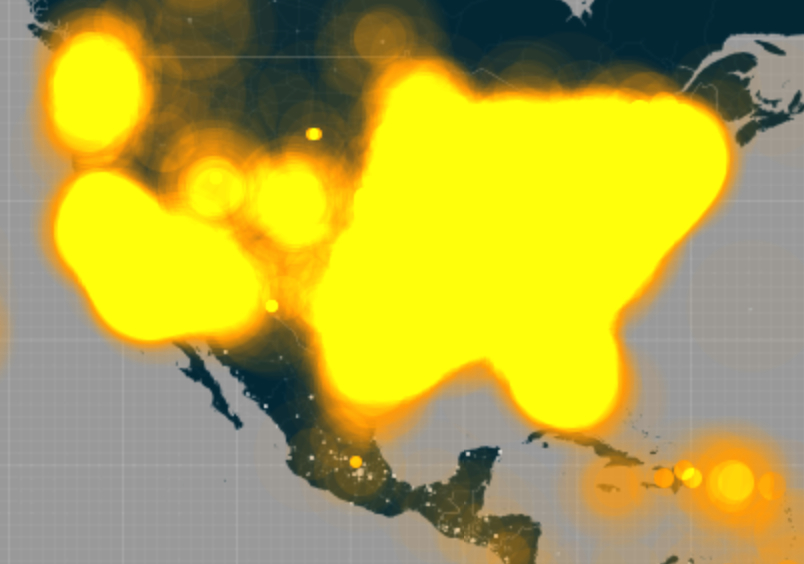
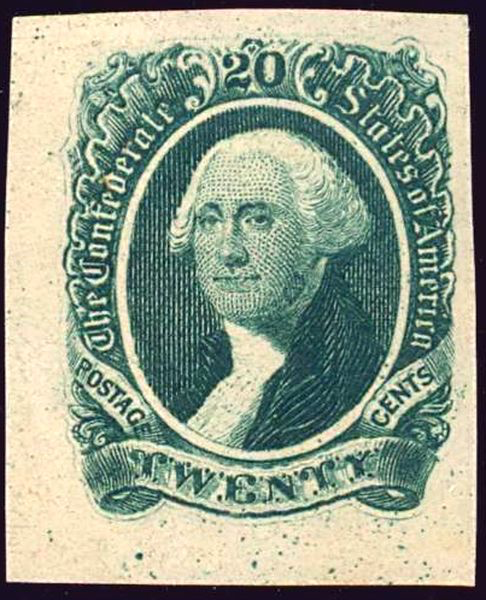
Confederate States of America
and Claims made by Confederacy

Long after the practice of enslavement was condemned as sinful by evangelicals, and uprooted in European nations, as was the case by 1848, the inner sanctum of the defense of enslavement lay in the preserve of the CSA–a community-sponsored movement to defend enslavement as a local privilege. Indeed, the depth of memories seem to have been provoked by the stripping of symbols of localism and place like the Confederate flag–the emblem of the separateness of the southern identity–a regional identity perhaps exacerbated by a perceived loss of regional identity and afford continued objects to intrusive federal actions, in a symbolism of nobility that recalls a bend dexter with a bend sinister, and haunts even our most present–and apparently innocuous–as mapping the state of the states in data visualizations parse meaning by blocks whose continuity suggests deeply lying fault lines.

images-7

The resistance of localism–and the national drama, indeed, of the attempt to strip the region of its symbol of autonomy–has perhaps not only had a greater impact in how early twenty-first century politics have played out in America, but of the deep presence of the divide of the seceded states across generations.  Can the survival of this divide be mapped? Or will it, more likely, continue to haunt the nation, as in the American Petroleum Institute decided to  map as a way to lay out ostensively objective record of local variations in gasoline taxes around the country, devised somewhat opportunely in 2014, as the United States was poised to run out of federal money to restore roads, and the chatter on gas taxes rose.

American Petroleum Institute

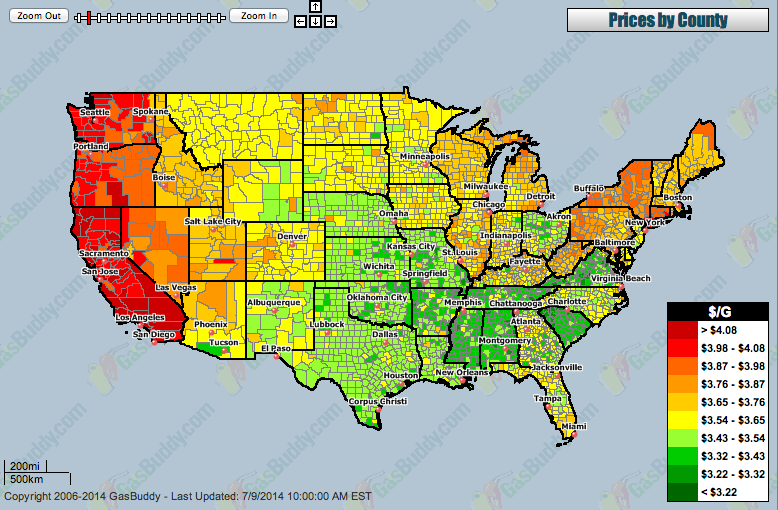
The problem of an alleged discrepancy in tax-rates that the American Petroleum Instituted foregrounded was based on the numbers of cents and decimals–not on percentages, m although the confusion could be excused, viewing the map and its legend without further information, so clearly does it seem to correspond to that blue state-red state divide that has long haunted our social media-saturated spatial imaginaries. If the map was intended to be polemic, and provide fodder to resist calls for calls for raising gas taxes since in counties–the federal tax remaining stable at 18.4 cents/gallon since 1993, the map taps into an ethos of tax revolts by purporting to illustrate an alleged discrepancy in tax-rates along a national fault line.

The divide that the American Petroleum Instituted foregrounded was based on cents and decimals–not on percentages, m although the confusion could be excused, viewing the map and its legend without further information, so clearly does it seem to correspond to that blue state-red state divide that has long haunted our social media-saturated spatial imaginaries. If the map was intended to be polemic, and provide fodder to resist calls for resistance to further hikes in taxes, and suggested the importance of seceding from what it cast, ingeniously in ways, as a sort of necessary secession from higher energy prices–the primary foe of much of the nation, it has seemed for most of the post-Cold War period.

American Petroleum Institute

The spectrum of county taxes is indeed much more complicated, revealing that it hardly makes sense to parse in states, although they reflect how some states have passed laws to restrict emissions of dirtier fuels, as gasoline, and have actively sought to do so, in the western states of California, Washington, and Oregon, by placing a larger tax on gallons of gas, in way that “Gas Buddy,” hardly a friend of the American Petroleum Institute, but a data-miner who seeks to give the lowdown on gas prices: the devious color-ramp depicts the bucolic nature of the southern states when it comes to protecting the price of low-cost petroleum for our engines, and the red-hot far west that seems a danger zone that might as well fall off the map.

The website allows one to map in real time, by a color spectrum seeing to affirm that the grass is greener as deeply as you drive into the traditional region of southern states, where the rights to cheap gas seem to be preserved, and the status quo of cheap gas is maintained: the land where cheap gas prices allow fertile fields to bloom, and environmentalism is out-sourced for self-interest, unlike the red-hot far west, of which all drivers should beware.

The data vis in other words affirms that GasBuddy is looking out only for our best interests, showing at a glance “the best gas price, anywhere,” at a glance. It’s not surprising GasBuddy is a big friend of Google, and has gotten rid of any state lines, as well as environmental costs, as if to reveal the county-by-county free market of gas prices for his online audience, in ways that increasingly seem to register the deep danger to the wallet posed by driving out west. This is the map of the triumph of the free energy market, embraced as the United States has become the biggest natural gas producers in the world and the top producer of petroleum hydrocarbons since 2013, raising hopes of the growing green for gas guzzlers nationwide, who try to laminate highway maps and interstates over the green fields that get only greener descending the Mississippi as one approaches the Gulf coast.

Gasbuddy, Heat Map of Average Real Time Unleaded Gasoline,
August 2019

“Prices” here are not based on taxation alone, but “average prices” suggest the significant differences that exist between regions that indeed depend on commercial trucking, and ensuring low-cost convenience stores and supply chains, but have made a decision to prioritize free commerce at the expense of infrastructure and the environment. If it can be credibly argued that many costs of road maintenance, from snow-clearing to cracked asphalt, may not exist in the warmer climes of southern states, and rural roads are often less trafficked, the strong sense of separatism and defense of local privileges shines through the above map of gas prices, which reveals just how modulated the spread of up to a dollar and a half of the cost of gas/gallon are inflected by differences in gas taxes, although these only vary by a spread of about twenty cents.

Rather than be a post about road trips, the Gas-Tax Map provided an opportunity to excavate its layers, and investigate the underlying relations of a deep-seated stakes of states’ rights discourse that seems to underly the polemic visualization, as much as the proximity to offshore refineries in the Gulf of Mexico.

2 Comments

Filed under Confederate States of America, data visualizations, infographics, Red states v. Blue States, statistical maps

Pumpkin Patches

Pumpkin production is difficult to map onto the celebration of Halloween.  For the celebration of what was once celebrated as All Hallow’s Eve has morphed into a feat of mass-marketing and commercial sales from haunted houses to Halloween Stores like Spirit Halloween–“the largest seasonal national Halloween retailer”–or Party City–making up a projected 7.4 billion dollar business.  And the celebration of the Halloween, long dislodged from the liturgical calendar, has become so clearly part of a commercial more than an agrarian calendar that, if the pumpkin remains the crucial signifier, it’s a floating one, and it is almost hard to remember that pumpkin cultivation was once rooted in an agrarian geography or growing climates, so much is the business of Halloween now measured by metrics like “candy price inflation.”

Yet as much as the Google Maps locator of Spirit Halloween retailers leaves the country awash in a purple confetti of markers, it seems still important to examine the economy of the landscape of pumpkin production that perhaps still undergirds it all.


Spirit Store Halloween


Pumpkin production has so surpassed needs that the squandering of an abundance of gourds in supermarkets seems an apt metaphor for the over-the-top nature of Halloween.  Currently, indeed some millions of pounds of seasonal decorations are annually destined for compost or landfill as are most of the 1.4 billion pounds of pumpkins US farmers produce yearly–and some 18,000 tonnes of pumpkin are disposed of in British waste bins, creating “food waste on a grand scale.”  So drastic is the association of the pumpkin with food waste to provoke to a drive to squash food waste (#pumpkinrescue) by the environmental group Hubbub, who find that the amount of pumpkins going to the trash constitutes about 360 million portions of pumpkin pie.  (And so, similarly eco-conscious Madison WI’s Yard Waste Collection uses boldface to urge its customers, “You can also place your pumpkins with your leaves for collection.  Just add your pumpkins to your leave pile and they will be composted.“)  For the US Dept. of Energy, in an interesting improvisation, the pumpkin has become something of an icon of the project for turning food waste to methane gas, rather than trick-or-treating for candy at Halloween.

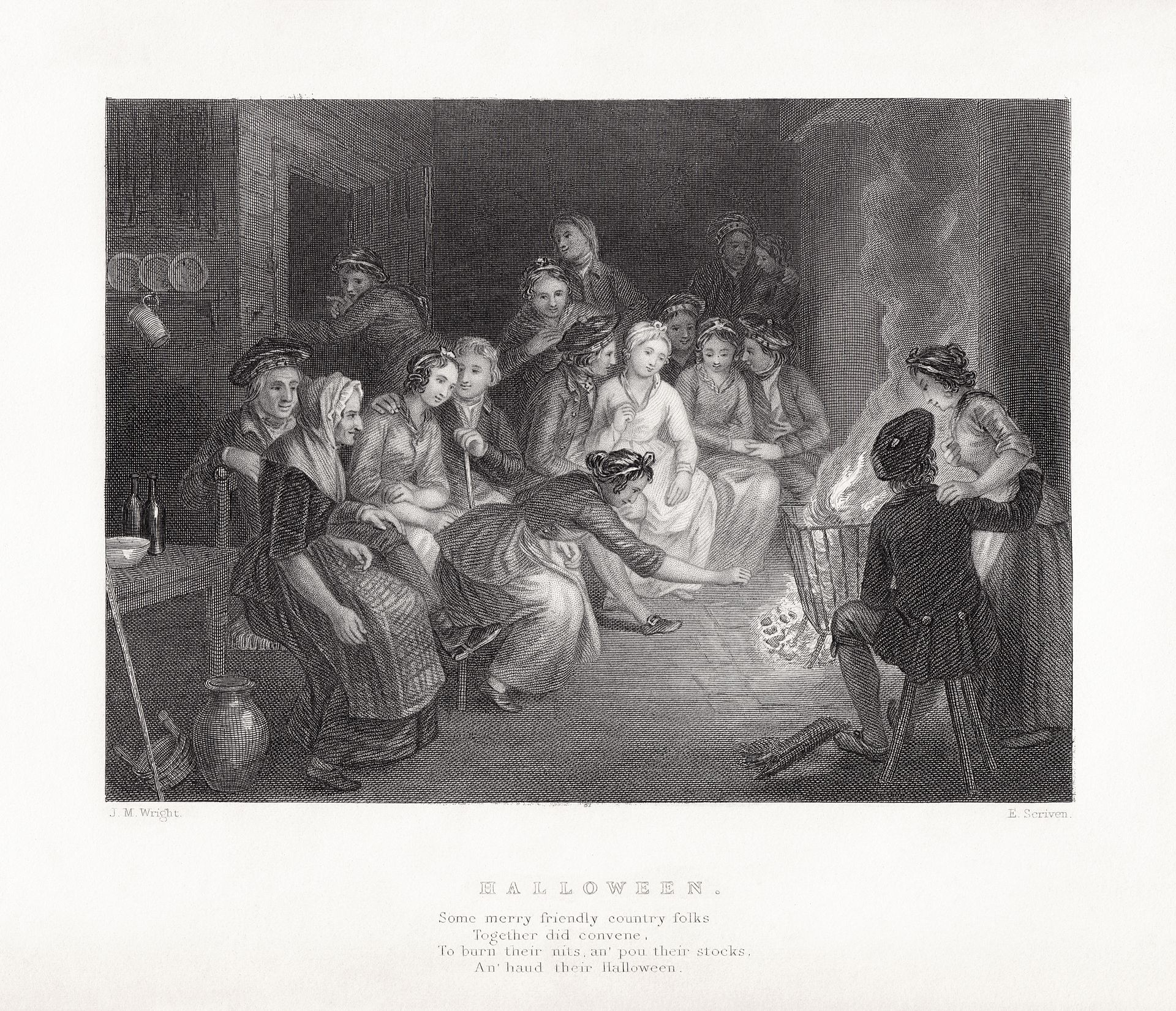
All this might be too pessimistic in its remove from the celebration’s participatory value, however, in its focus on agricultural and food waste that so removes the pumpkin from any ritual context.  Before the pumpkin became illuminated that evening, Halloween Apple Bob (or apple dookin) provided the ritual sight for rites of courtship and celebration of fertility around indoor fires.  It’s difficult to know how to map how the celebration collided with the harvest of autumn gourd, and the transformation of the hearth to the pumpkin-head, and Halloween became a season that generated the most expenditures on decorations save Christmas.  (While the evening was once marked by the Apple Bob, the Halloween-Thanksgiving-Hannukah-Christmas-New Year Buying Season marks its integration into a commercial season.)


J._M._Wright_-_Edward_Scriven_-_Robert_Burns_-_Halloween


But it might be worthwhile to map the rootedness of the pumpkin plants in the ground.

Before pumpkins were associated with food waste, the gourd enjoyed staying power both as a food–pies, soups, muffins, and puddings–as well as carving out objects of domestic decoration.  The crowding of pumpkin festivals clustered in dense patches in northern California and across the Northeast are linked to agrarian growing zones–even larger ones, since despite Google Maps’ restriction to the United States in the below, over 5000 hectares devoted to pumpkin growing in Canada make pumpkins an extremely important staple for Ontario farmers–even if only 8% seem destined for canning, or decisively non-decorative use.


map-of-pumpkin-festivals-locations


The native status of the pumpkin hardly guaranteed the remaking of Halloween in America.

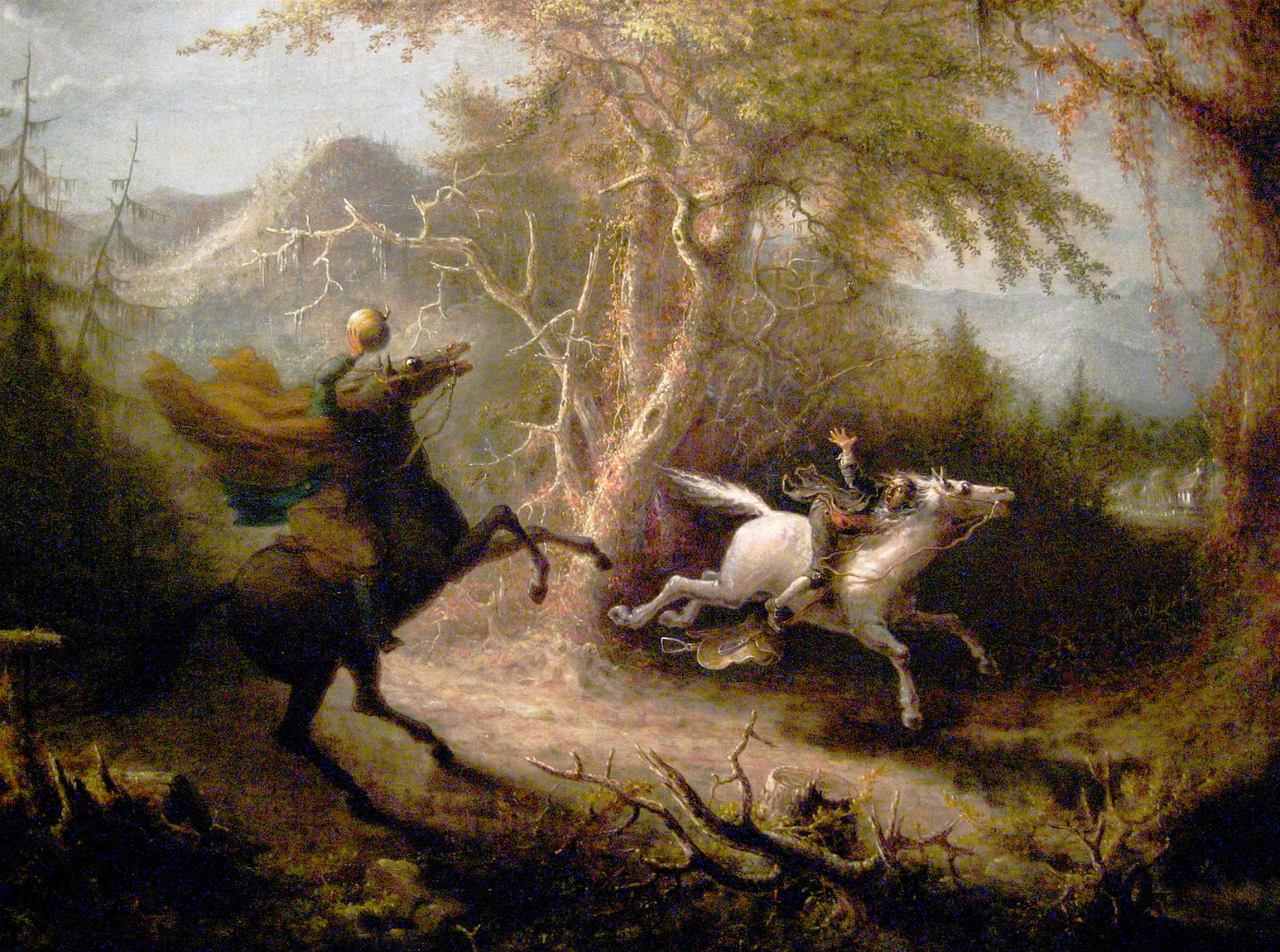
Ruth Edna Kelley argued that with the adoption of guising–“What fearfu’ pranks ensue!”–“All Hallowe’en customs in the United States are borrowed directly or adapted from those of other countries” in her 1919 Book of Hallowe’en.  Yet the pumpkin seems an decidedly American innovation–Robert Burns didn’t include even one in his 1785 Scots-English poem of some twenty-eight stanzas–despite the long history of Jack o’ Lanterns.  Despite Scottish origins of “All Hallow’s E’en,” the pumpkin seems a subsequent American addition–probably postdating Washington Irving’s 1820 Headless Horseman who pursued Ichabod Crane, and long before the holiday grew into the over 7.4 billion dollar business it constitutes in the United States, on which the average American will spend $77.52, up from $75.03 last year, including costumes, candy and fearful decorations–some $350 million of which is spent on costumes on pets.


Hessian Horseman


What now inaugurates a commercial season provides an excuse for splurging may have had more modest origins, nice to map back onto the distribution of the gourd. The pumpkinization of trick-or-treating might be linked to the marketing of Halloween postcards in the early twentieth century–and sale of Halloween decorations was only introduced after World War I at Woolworths and Kresge’s–but the celebration of trick-or-treating now seems inseparable from ritualized nocturnal illumination of the hand-cut squash.


fzdfzdf


It is easy to forget trick-or-treating was ever closely tied to the agrarian calendar of harvest in an era of year-round fruits and vegetables.  And the pumpkin seems a Halloween icon of the New World.  But even with the omnipresence of SpiritHalloween stores that dot the nation, always advertised on billboards, it’s nice to remember regional differentiation of zones of pumpkin production–and variations of pumpkin cultivation on which we rely even in an era of industrial farming.  And even if turnips and rutabagas were a choice of Jack O’ Lanterns in Ireland, and other squash were used abroad, the pumpkin is an artifact of globalization, from Bosnia and Herzegovina to Japan to Australia to Hong Kong, we remain rooted in its growing regions.


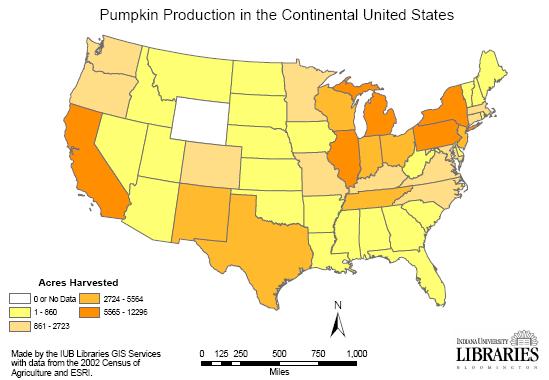
pumpkincropproductionmap


The global march of the Halloween pumpkin knows no clear bounds.

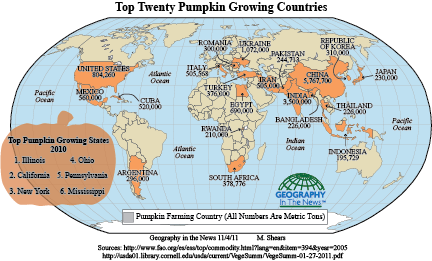
(Note that even if the US is a big pumpkin cultivator–with most growing in Illinois, Ohio, California, Pennsylvania, and New York state, feeding a market of Halloween needs, far more are growing in China or India, where they are more of a staple of edible consumption, as well as Africa–where Rwanda and South Africa collectively grow over half as many as the US–and, per capita, far exceed it, as does Mexico.


gitn_1118_NGS-Pumpkins


While we think of pumpkin as a New World squash, it is truly global–far more global than Halloween.)

But it’s also deeply local on the edible end of things among those who associate the fruit with tortellini.  After all, the perimeter of the elegant culinary inclusion of pumpkins in pasta remains localized along the Po Valley in ways that seem constrained by the limits of their cultivation, which dates soon after the importation of the seeds from the New World–although the end-product of tortellini di zucca are also globally commoditized, though they might even inspire some to make pilgrimages to Mantua or Parma to taste them.


6a00d8345634d569e2012875da907e970c-800wi


While they might remain localized as edible delicacies for some, prized for that sugary melt-in-your-mouth buttery taste of pumpkin boiled in folded triangles of pasta,  the costumed rite of Trick-or-Treating is mostly about belonging, and recreating the community in a community even in the guise of avatars and ghouls.

It is difficult to draw a map of the celebration of the evening or a global geography of its observation.  To be sure, the growth of regular Halloween Horror Nights at Universal Studios over over three weeks from mid-September, replete both with haunted houses and including vignettes from recent horror films, and complete with live “scareactors” and replete with references to films from The Texas Chainsaw Massacre and Jason Voorhees of Friday the 13th to Doomsday, has spread a fundamentally filmic experience of Halloween readily reproduced within Universal branches to Hong Kong and Singapore from Orlando–and encouraged global interest in Halloween as a multi-day media spectacular clearly designed more for adults than children.


Universal-Orland


Despite a big stir about the global reach of a holiday that has been so aggressively commoditized in America, we might be less shocked by the currency of the holiday as a sign of a globalized culture or artifact of Americanization than see Halloween as residue of an omnipresent media presence which there’s no clear way to map in geographic terms–and where the hollowed out squash simply grabs visual attention on the world wide web and provides an iconic way to mark commercial time, where it becomes an icon of calendrical time even on the web.


googlepump


The currency of the carved pumpkin head made for a popular Google doodle.  But the image was not separated from the act of carving away those gourds in the smashing debut in the quick carving of those massive pumpkin heads outside Google HQ in 2011 Halloween Doodle, in something of a sly reference to the agrarian origins of the region, and its proximity to the pumpkin patches of Mountain View, Hollister, and Santa Cruz where so many Northern California pumpkins are grown:  for the very same time-lapse clip of carving pumpkins  rooted Halloween in the site-specific rite of pumpkin-carving before dusk, set to an antic soundtrack of preparing huge pumpkins for sunset.

The clip seems to suggests the mobility of a rite that can be readily restaged wherever ripe pumpkins are available to be carved up and illuminated to mark All Hallow’s Eve.


Pumpkin Doodle

1 Comment

Filed under #pumpkinrescue, Halloween, Halloween geography, Halloween Horror Nights, Mapping Pumpkin Production, Pumpkin patches, pumpkin-carving, pumpkin-growing, Robert Burns, Spirit Halloween stores, squash food waste, tortellini

Mapping Feline Itineraries

Among crowd-sourced mapping projects, Cat Tracker is something of an innovation:  rather than map a human environment, it is dedicated to mapping the motions of specific outdoor cats–their individual, day-by-day itineraries–rather than create something like a comprehensive map of a region, such as the HOT (Humanitarian Open Street Map Team) mapping of West Africa to track cases of Ebola.  But the mechanics of mapping are strikingly similar, if perhaps not destined for a larger audience.  While the HOT team uses the Bing imagery to trace a set of shape-files on different quadrants of Liberia or Sierra Leone, high-accuracy GPS sensors attached to the harnesses of individual cats provide the overlay for maps of cities to which they are resident, so one can imagine the regular radius of their strolls.

Cat Migration

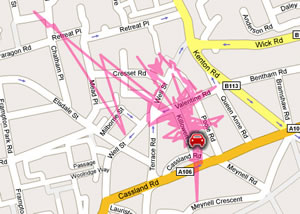
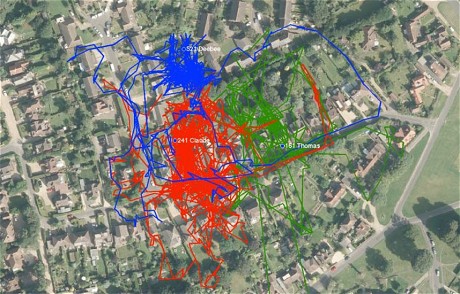
User experience designer Alex Lee took the time to track his own cat’s motion by an attachable GPS sensor, tracing his motion around a London neighborhood over a few days to track her explorations around his home.

cat-gps-tracking-lg

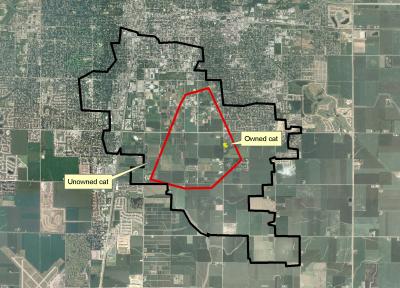
Where Kitty might go might be quite restricted, and be ompholocentrically concentrated about where she can count on being fed.  Researchers had earlier argued in 2011 that the meanderings of domestic cats are far more spatially restricted or circumspect than the zones of feral cats, one of whom roamed over 1,350 acres in rural areas–the domesticated cat only roamed in the area designated yellow, or usually less than two acres:

3-researcherst

The issues of the rise of feral cats, and the danger of zoonotic transmission of protozoal diseases like toxoplasmosis is a serious issue that is only increased by the considerable breadth of their geographic wanderings.

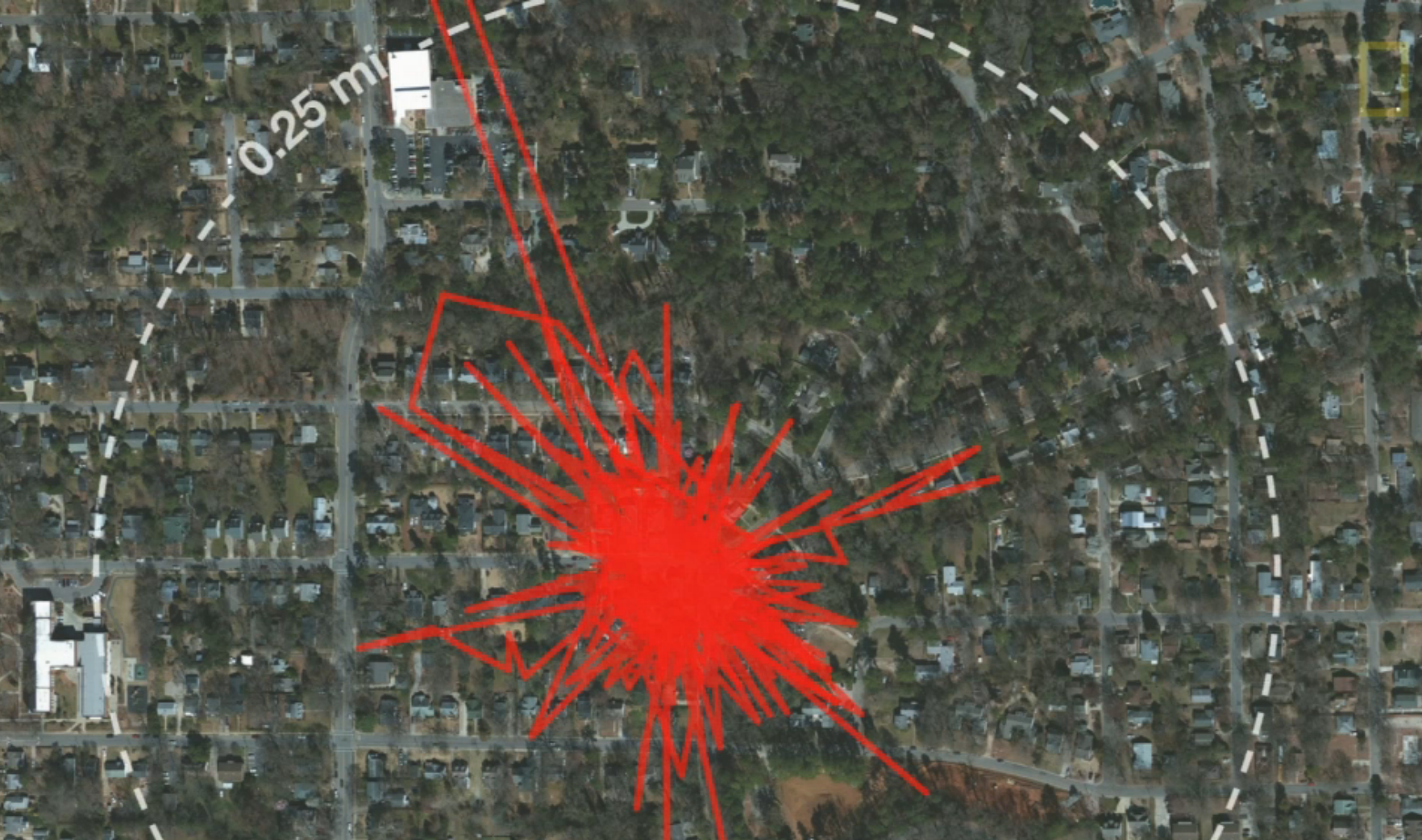
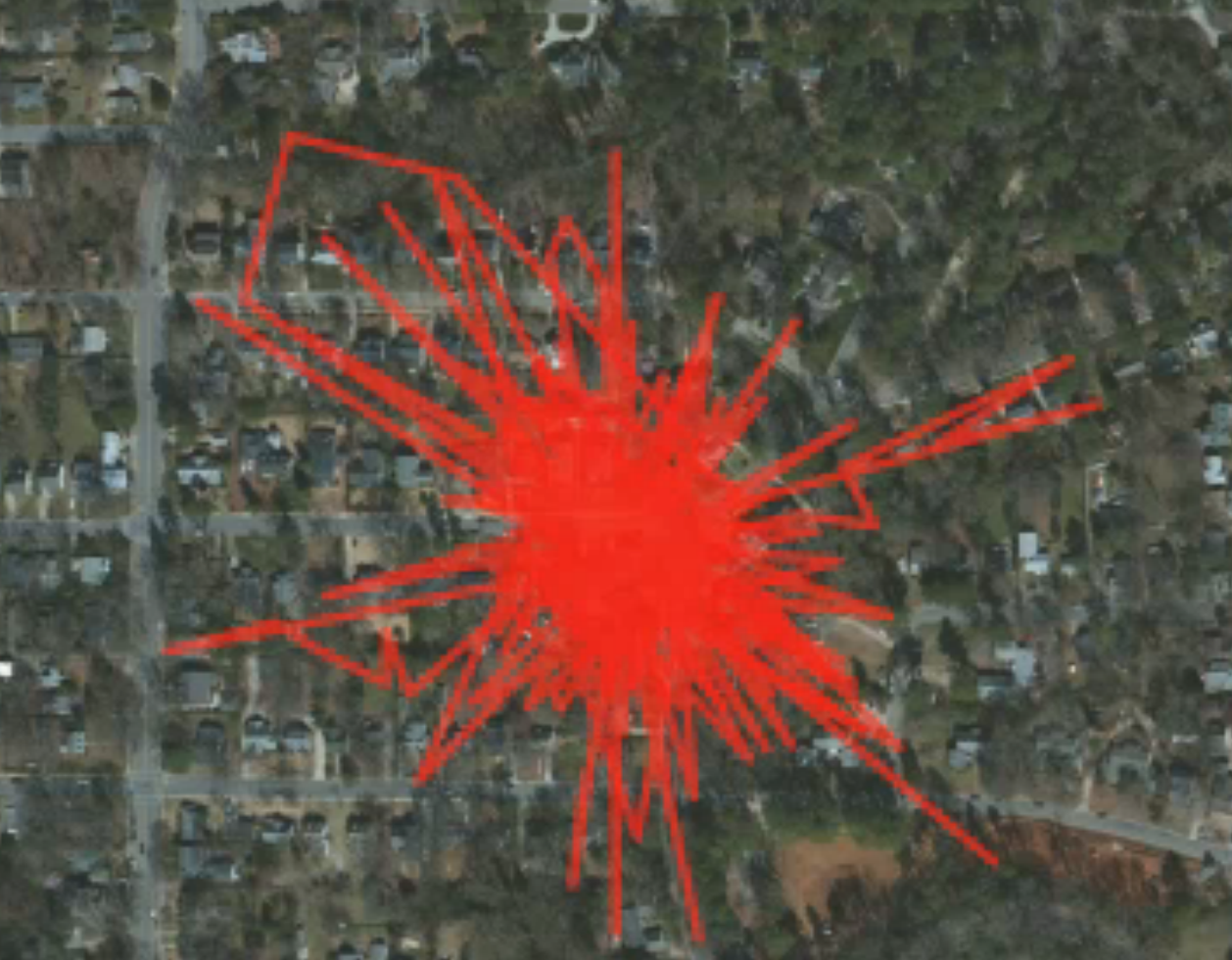
The availability of sensor-laden harnesses to fit domestic cats with accurate GPS sensors has most rapidly expanded, however, and provoked a parsing of feline itineraries that might strike some as just TMI–although they carry the promise to provide a better sense of how cats interact with their urban environments, and engagement with urban wildlife.  While the initial tracking of cats might map as something like noise–

crittercam restricted

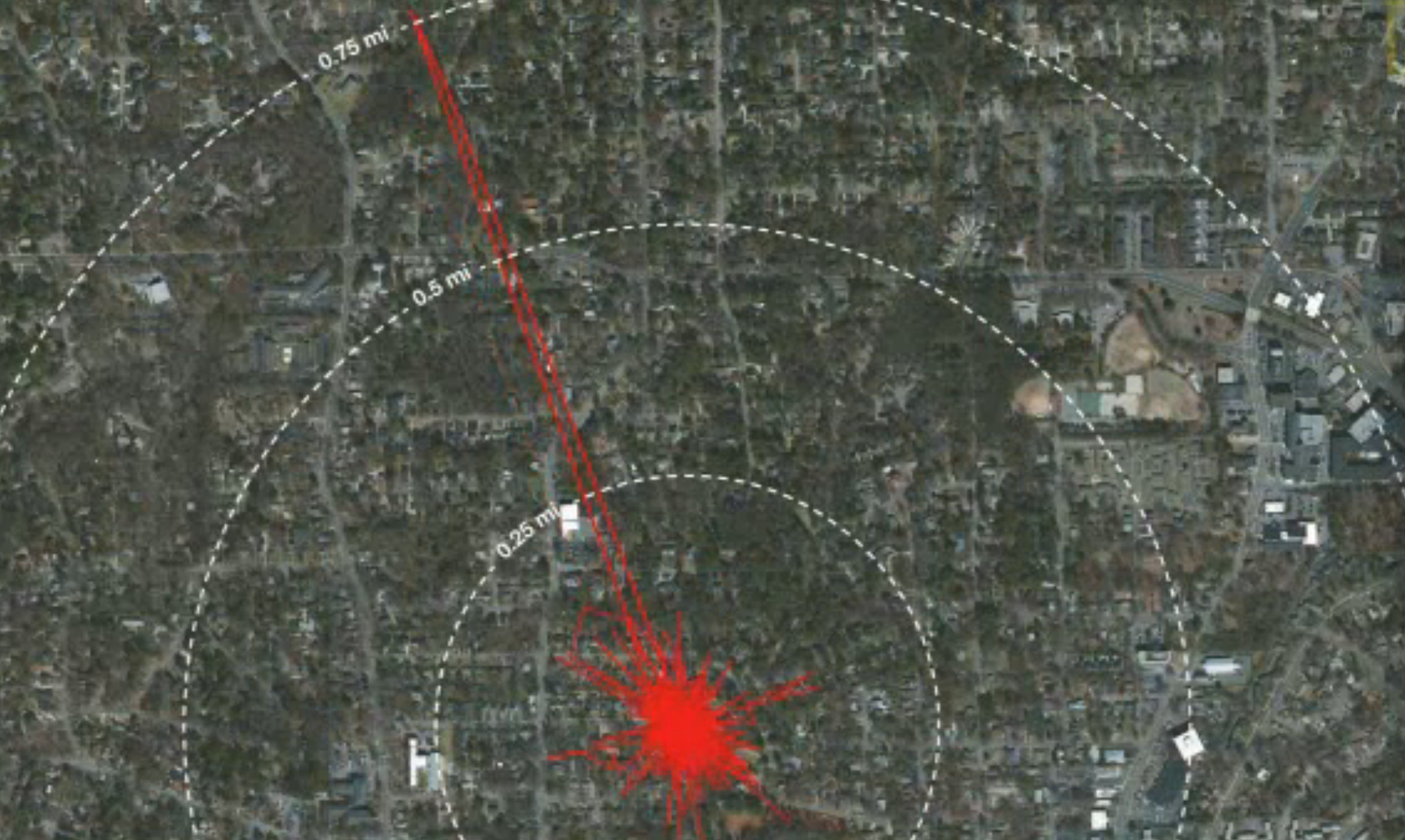
an image of itineraries over several days might distinguish paths or even register that one time that the cat’s owners were out of town, and their pet made an itinerary to their old house in the hope of finding food when it could not locate them otherwise, traveling unerringly for almost a full mile.

Big Feline Excursion

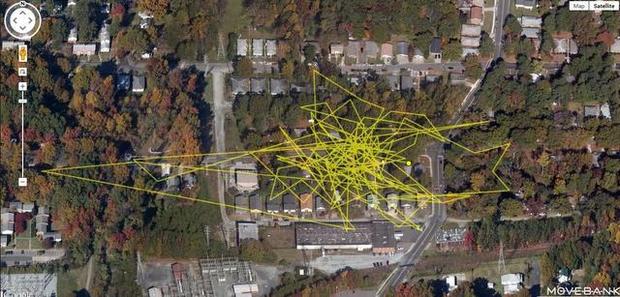
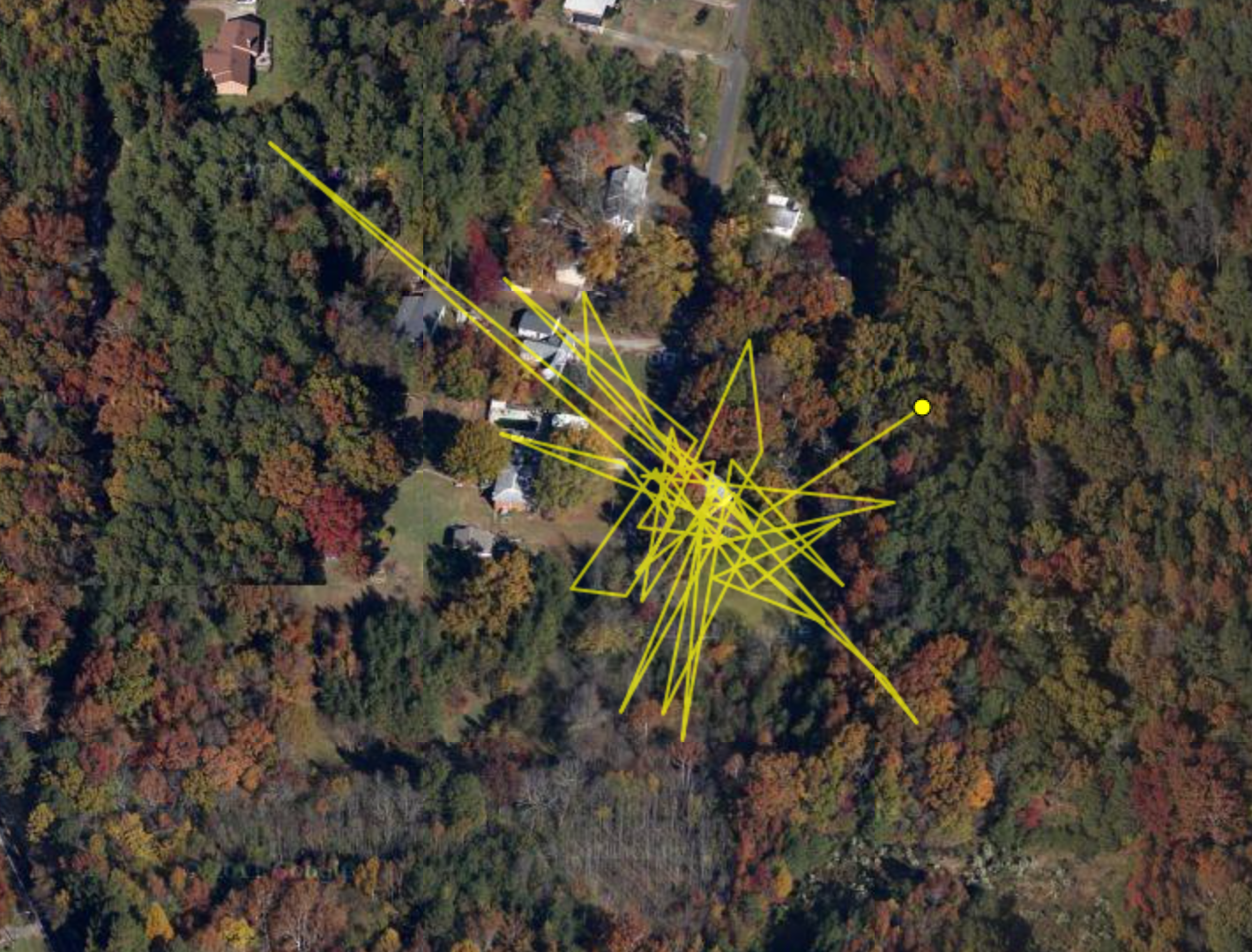
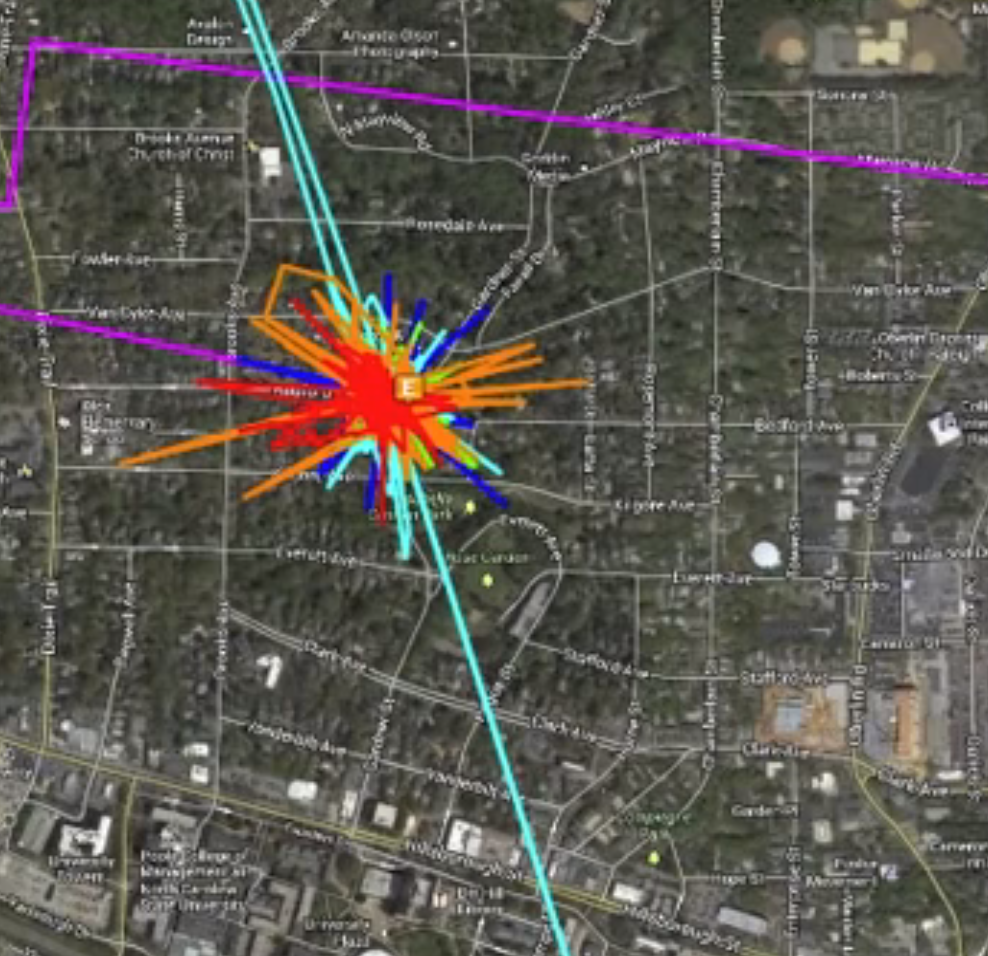
Creating a more complicated overlay distinguishing different days allows one to trace a clear record of the cat’s relation to its environment–and the potential incursions cats make into the wooded areas around towns such as Raleigh, NC, where  Cat Tracker has posted feline itineraries mapped with the North Carolina Museum of Natural Sciences and an online database dedicated to tracking animal movement, Movebank.

1pCID9.AuSt.156

Tallulah K seems to have been attracted by a variety of surrounding rural prey or targets, but avoided most major roads:

Talllulah K

Sometimes cat travels seem to record instances driven by car, as a record of feline meanderings over multiple days shown below.  (It is unlikely, if possible, that cat space and human space were so completely congruent.)

Cat-Tracker

Cat Tracker

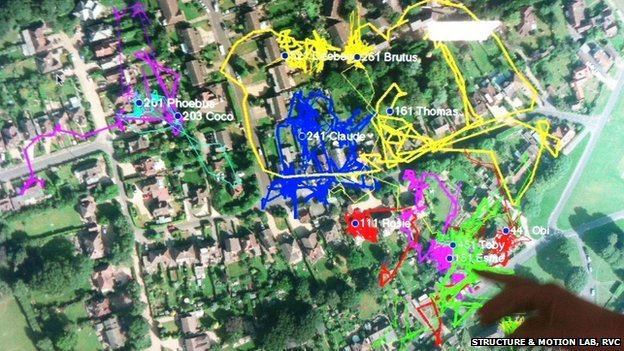
Similar results of GPS tracking, perhaps especially entertaining to cat-owners who let their felines  out of doors and wonder about their whereabouts, might provide a composite map of cats from different houses in a single neighborhood, in an attempt to find out what cat-roaming was about, or if it followed any particular logic at all–or what their relations might be called one another’s routes.

_68110711_catsmap

Royal Veterinary College, Structure & Motion Lab

The maps tracked by the Royal Veterinary College offer a basis to answer questions of how cat space maps onto human space, as much as to merely document feline itineraries.

Mapping cats in Surrey may seem like a bizarre surveillance of the domesticated:

catmapforweb_2589178c

Despite the sense that the signs tracking cats have limited legibility, do they signify a premonition of things to come?  On the one hand, this seems an extension of our own expectations for tracking and searching geographic locations.  Mapping seems to have its own logic here, providing the very terms by which we can undertake the variety of projects that technology allows.  Perhaps we’re experimentally using our technologies on our allegedly domesticated animals, as we affix ankle-bracelets with GPS trackers onto sex offenders, and map their residence and whereabouts, at the same as we get used to being tracked ourselves.

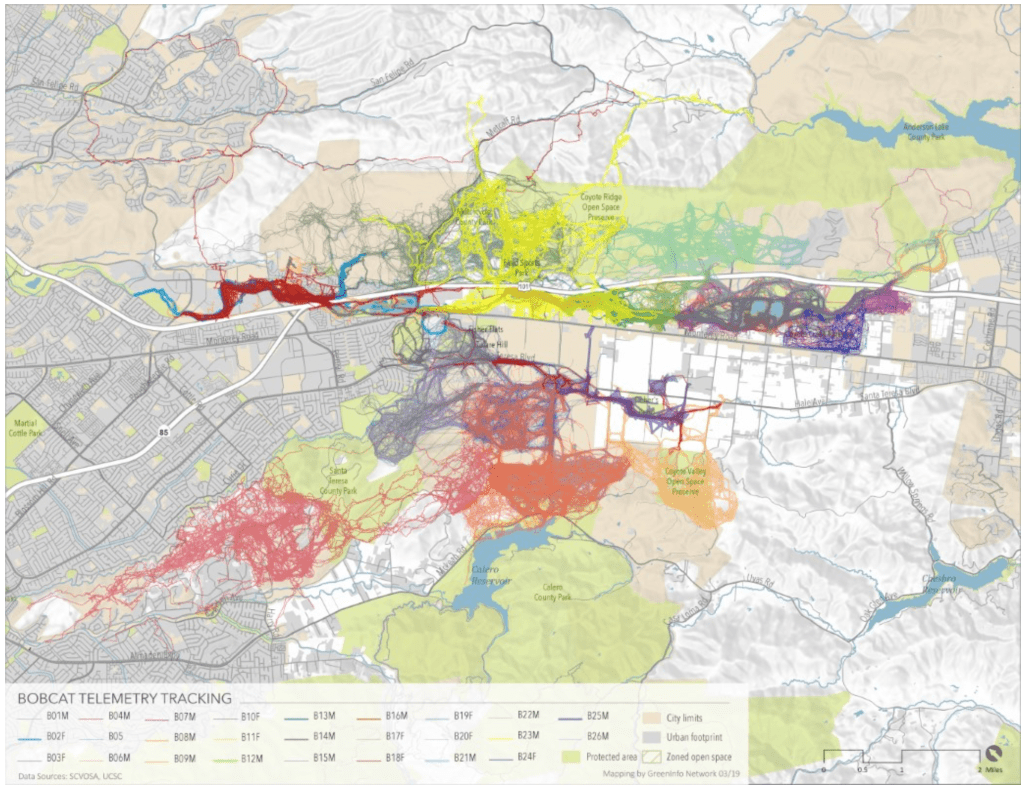
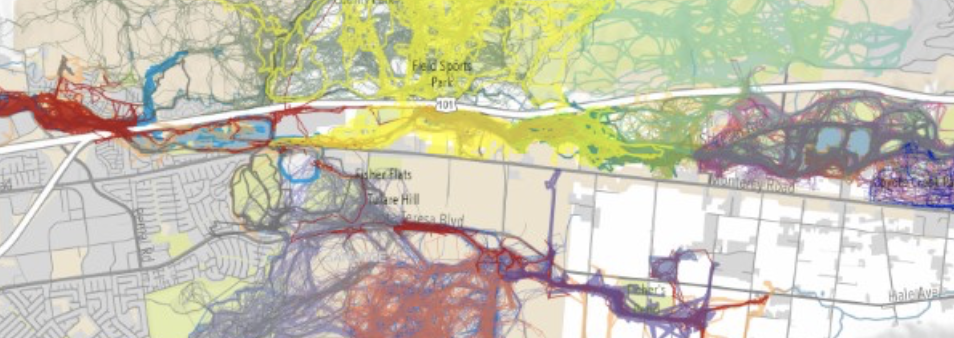
That is not to say that the same technology does not have other benefits, or that it should be demonized: but it suggests a fear of wandering, and a potentially intrusive sense of helicopter parenting, if one in which we bring our pets into our surveillance world. But we can look at the other side of the coin as easily, through the attempts to control the ravages that our highways or marine travels perpetuate on wild species. A recent project of GreenInfo Network, with the Santa Clara Valley Open Space Authority, near the city of San Jose, suggested as much. The client wanted to ensure that Highway 101, a well-trafficked artery, could be mitigated in its effects of cutting across an active habitat corridor of wildlife, and specifically how bobcat roadkill could be reduced, and a series of recommendations about the roadway made to the Peninsula Open Space Trust, Since the road runs through a habitat connector, and there is little chance of moving it, the map provider used telemetry data of bobcats’ movements to make recommendations about problematic areas of bobcat’s motions, in the hopes of making recommendations on underground tunnels and alternative transit routes; the image of bobcat itineraries, if echoing to some extent that of domestic cats, was revealed a dense tangle of crossings–

Greeninfo Netowrk
Bobcat Itineraries near 101, Santa Clara Valley

–of feline wanderings and itineraries around the busy road that, in this case, ran through the habitats where bobcats had long lived.

The result was rather astonishing in context: rather than tracking the cat as a possession, the routes were tracked to be tried to be protected, as interested parties and stake-holders were interested to do, and the pathways of feline travel could be preserved in the sense of an on-road onslaught from humans who the bobcats had no clear idea why they were driving across the land they had long wandered.

Leave a comment

Filed under cats, GPS, GPS Sensors, GPS tracking, OpenStreetMap

1.2 Million Lego Pieces Map Resistance to Imprisonment

The Chinese dissident artist Ai Wei Wei was clearly attracted to the prospect of creating site-specific sculptures for the cavernous nineteenth-century prison structures on Alcatraz island, a long unused federal penitentiary which concretized state power in the mind of many Americans over the last century, as a site to reflect on conditions of imprisonment world-wide.  For the now abandoned structures of the hulking prison island still seem inhabited by ghosts of the past, and high on atmospherics, even as its space has been reclaimed by Ai’s site-specific remapping of the spirits of the imprisoned.


Alcatraz island.JPG


For Ai’s art seems to have relaxed into the monumental fortress like buildings of detention in a defiant forms and brilliantly colored works of art; even if he never visited the site, the former setting of forced imprisonment gives resonance to fitting the pavement with portraits that map ongoing global detention of free speech.  The empty monumental structures of the labor hall, individual cells, sites of solitary confinement and prison corridors  reflect on those detained across the globe and the daily difficulty of wrestling with their conditions of continued confinement by different states, from China to the US.  Indeed, the widespread use of solitary confinement in Alcatraz–a pitch black cell for torturing many of its prisoners that was developed by the prison’s former Chief Warden Edwin James and  E.B. Tiller in rooms whose impermeable layers of steel masked the entrance of light or sound in Alcatraz’ Cellblock D from 1940, long a corridor of solitary isolation cells including a room of bare concrete save a hole in the floor, without clothes–


DXFE9J_3119248b.jpg


–with limited interest in the rights or lives of the incarcerated who were allowed to live in an without light or sound and only a metal frame bed, sink, and toilet, and one pair of shorts for up to nineteen continuous days to enforce prison discipline.  Alcatraz was not the first site of isolation by any means, but a site for its preservation where prisoners were forced to Personally, I find it is crucial to use moments of isolation as ways to develop self-control in order as in “control[ling] our inner self, we have won our first battle for freedom,” and the preservation of internal freedoms during imprisonment is celebrated  in Ai Wei Wei’s installation.  And at the same time as the use of solitary confinement has expanded, and unlawful detainees remain in the Guantanamo Bay complex of detention is not able to be closed while it holds five detainees, despite urging to congressional leaders for its closure, it is more than incumbent to remember the need to resist the civil rights violations of such inhumane units of segregation, and to draw sustainable to continue to do so–and to not forget the injustices daily faced by incarcerated populations.


Alcatraz-solitary-confinement-cell-by-Derek-Purdy.jpgDerek Purdy


The cell becomes the only space to “create right” by exercise, meditation, refleciton.  Isolation of prisoners, extended periods of forced solitude, and sensory deprivation is inhumane but continues to be used by many state prison authorities and in the authorities that run and operate units of incarceration the country, where 23-or 24-hour isolation is common and such intentional violations of prisoners’ rights not only in supermax prisons and have exponentially increased as a means to illustrate total control over imprisoned.  If such incarcerated populations are compelled to treat the isolation cell as a laboratory in response to the harsh conditions of dark, unmitigated electric lighting, or cold:  the bright re-imaging the faces of the imprisoned creates the Cell Blocks of Alcatraz as a new sort of performance space to map imprisonment far beyond its walls from the unique perspective Alcatraz offers on solitary isolation,  in contrast to the hard stares of those imprisoned–


Head Shot Pretty Boy Floyd.png


Head Shot.png


We’re actually a part of the reality, and if we don’t realize that, we are totally irresponsible,” the dissident artist Ai Wei Wei has said about his work, and in being “part of the reality [of incarceration] means that we need to produce another reality”–and to map one.  By replacing the colorless pavement of several of the Cell Blocks in Alcatraz with an alternate reality of vibrant colors not only of Lego portraits, but of the colored paper of huge dragons of the imagination, the austere burdens of the grey floors and pale green walls of Alcatraz are in a sense re-inhabited.  Ai’s placement of a set of day-glo images of the imprisoned and detained within a former site of confinement famed as a site of solitary isolation, built in a former fortress in San Francisco Bay to be removed from contact with the outside world, provides a point of reflection on the reality of imprisonment worldwide.

Using a plethora of pieces of lego, ceramic blossoms, and Chinese kites of dragons, and recorded song, Ai has both celebrated the possibility of ongoing resistance in the space of forced sequestration into a message of hope for all those detained, sending, despite his own limited circumstances of travel, instructions for media to inhabit the prison and sought to raise questions of the ever-encroaching global circumscription of freedom that ask us to map and to accept responsibility for the confinement of of global champions of free speech, and indeed to try to open the survival of spirit in the halls of imprisonment.


alcatraz-4.jpg


Ai has long been committed to creating a deeply “social sculpture” and to do so through an awareness of the architectural space in which each of his works is constructed and situated, as well as the sense of space it creates for its viewers or users–from the analogue architecture of his popular blog or twitterfeed to built spaces to the deep sense of cultural inter-relationships that his work communicates.  The canvas of pieces of Lego that temporarily filled the New Industries Building on Alcatraz Island presented an alternate surface of mugshots of recently confined spokespeople or human rights heroes in brilliant colored pieces of plastic–creating the sort of odd juxtaposition of form ant site, media across time, that wasn’t about imprisonment per se, echoing the pixellated images of each figure that we might see in mass media, filling the floor that lies above a basement filled with a wing made of tin teapots and solar cookers–the patience of the imprisoned?–whose confined space stands in juxtaposition with the airy room in which tourists crowded to see–and try to identify–the portraits of politically imprisoned in a mute surface made from $450,000 worth of multicolored pieces of Lego, converting one of the clunkiest of modernity’s concrete metaphors into a tool of subversive playfulness.


ai-trace-detail-2-710x355

The famously outsized scale of many of the pieces in this show recall Ai’s similarly hypertrophied assembly of 1,000 sq meters of plastic backpacks on the facade of the Haus der Kunst that remember the lives lost in the tragedy of a 2008 earthquake in Sichuan province, but the metaphorical wealth of the similarly bright mosaics of Lego have less overpowering impact than the five-color statement of the fragility of life–“for seven years, she lived happily on this earth,” the sewn dayglo backpacks read, bitterly–

Haus der Kunst

–but rather an image of the bitterness of the global status quo.  The flatness of the images push visitors to fathom the depths of the resources of their resistance, if only focussing on the bright surface of their spirits, but don’t expose their hand.

alcatraz14n-1-web.png

Vintge Mug shots.png

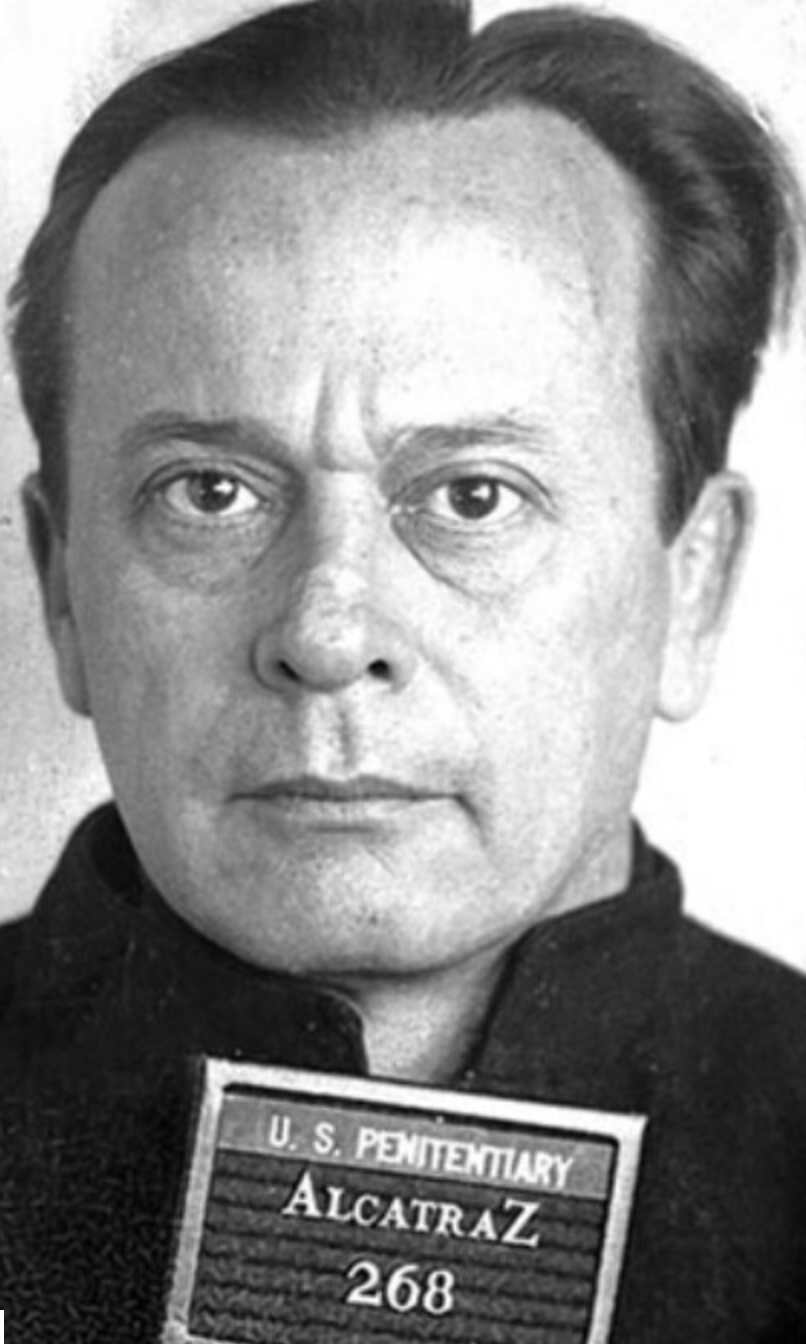
The colored pavement of pixellated portraits of one hundred and seventy six recent prisoners of conscience map global imprisonment in a one-brick layer of Lego runs across the grey floor of a cavernous room of the abandoned New Industries Building in the former high-security federal prison.  The choice of a world-famous former prison such as Alcatraz, isolated on an island in San Francisco Bay, by the For Site foundation to locate these technicolor mug shots of detained champions of human rights is particularly apt site.  The temporary construction of 1.2 million Lego pieces serves as a canvas to commemorate the resistance of those charges or convicted of crimes in the complex of one hundred and seventy-six figures create an atlas of imprisonment–from familiar faces from the late Nelson Mandela (imprisoned in solitary South Africa from 1962 to 1989) to Aung San Suu Kyi (under house arrest house arrest in Myanmar for almost 15 of the 21 years from 1989 to 2010) to Liu Xian Bin to Liu Xiaobo (sentenced to eleven years of confinement in 2009) to Edward Snowden (forced to seek refuge in May, 3013 after leaking NSA documents) to the Iranian Shi’i cleric Sayed Hossein Kazemeyni Boroujerdi (imprisoned in October, 2006 in Teheran).  Set in the floor of an abandoned structure of forced detention and prison work, the bright mosaic of faces is eloquent in its muteness and sense of survival.

The pavement of portraits  evoke colorized prison mug shots of those confined on the island.  But they depict prisoners of conscience who are located on a global scope, creating a composite microcosm of different clusters of imprisoned from China to Iran to the United States to Burma to Russia.  The new context for the assemblage of faces, included in Trace, are but one part of Ai Wei Wei’s re-use of the abandoned prison’s monumental buildings.  They offer but a way that the Chinese dissident artist re-inhabits the buildings of the former federal penitentiary on Alcatraz Island in @Large.  The work that testifies as much to his ability to work in different venues while confined under house arrest, as to call attention to the spirit of many imprisoned or confined who are apt to gain less media attention than the three Nobel Peace prize winners among them, and, although now disbanded, testifies both to the brightness and the fragility of resistance:  the pieces are a composite whose delicate construction was always poised to be dismantled; rather than being laminated or glued to one another, the complex of Lego pieces was often nudged, fragmented, or jostled by the feet of visitors who sought to enter spots around the pillars the room of the abandoned New Industries Building to get a better view of the faces, and a sort of memory gallery of the global resistance of a human spirit.

Continue reading

2 Comments

Filed under Alcatraz Prison, Art and Cartography, human rights, performance art, prisoners of conscience

Ebola and our Nation


New fears that the infectious Ebola virus might mutate into an airborne disease have triggered deep anxieties of national safety in recent weeks–and elicited fears about national preparedness rarely–if ever–raised before the arrival of Thomas Eric Duncan at Texas Health Presbyterian in Dallas, Texas.  Those fears are insistently restated and summoned in the range of monitory posters affixed in all hospitals across the country, creating a widespread mapping of the dangers of the spread of disease far more alarmist about the possible proximities of infection than about geographic knowledge: the point is almost to suggest that this modern disease, or potential third plague, will itself transcend spatial categories of the past, for the very reason that the possibility of contagion is augmented through the connections created by airplane travel and indeed that epidemiological understanding of the danger of infection by the disease is mapped as if mediated by the vagaries of the inter-connections afforded by the networks of global airplane travel–even if infection by the disease depends on the exchange of bodily fluids.

The not-so-reassuring sign at an Oakland, CA hospital reminds viewers to remap their possible relations to the disease, and be mindful of the network of possible communication of the Ebola virus by the vector of airline flights, much like that which brought Eric Duncan to Dallas, and the interconnected nature of a disease’s communication in a globalized world.

liberia

The rise of one case of infection that spread in that hospital helped further to transform a dire health emergency located only in West Africa into a danger seeming to lie at the edges of a nation increasingly obsessed with patrolling its borderlands.  How did a virus whose expansion as a world health emergency was so sadly ignored for months as it spread in West Africa come to be re-dimensioned as a subject that, with a dose of posturing, was a concern of national security?  The answer partly lies in the steep challenge to spatially orient individuals to the possible pathways of viral infection, and to hold the fears of potentially new pathways for its contagious transmission at bay.  (The infections of two nurses exposed to the disease raised fears of the abilities that we have to contain the illness in a hospital setting early on.)   Even if concerns that Ebola virus may mutate lack much grounds, given the virus’s unchanging nature over time, the mutation of mapping the spread of a disease in West Africa to tracking possible pathways of communication outside the continent has provoked far more intense reactions than did news of the spread of the virulent disease over several previous months.
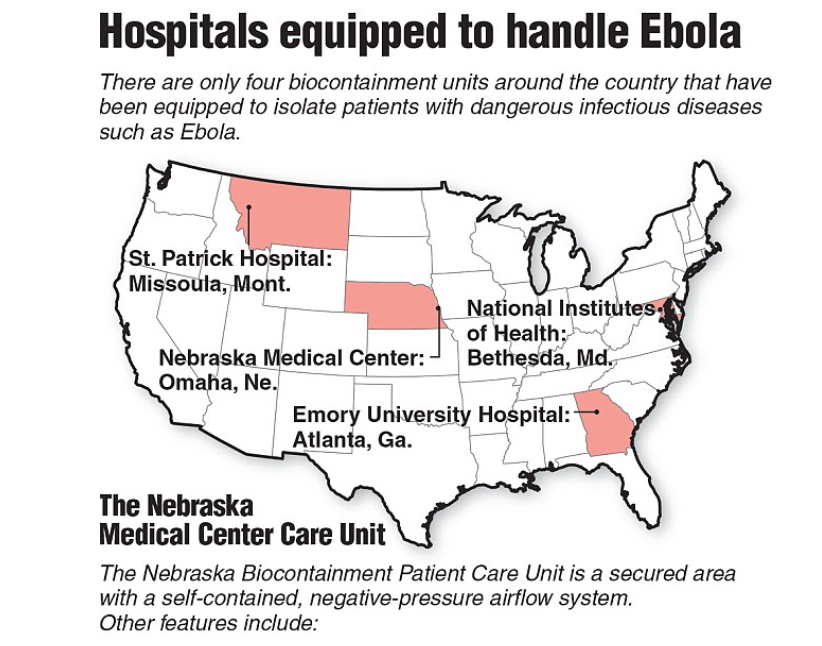
Equipped to Handle

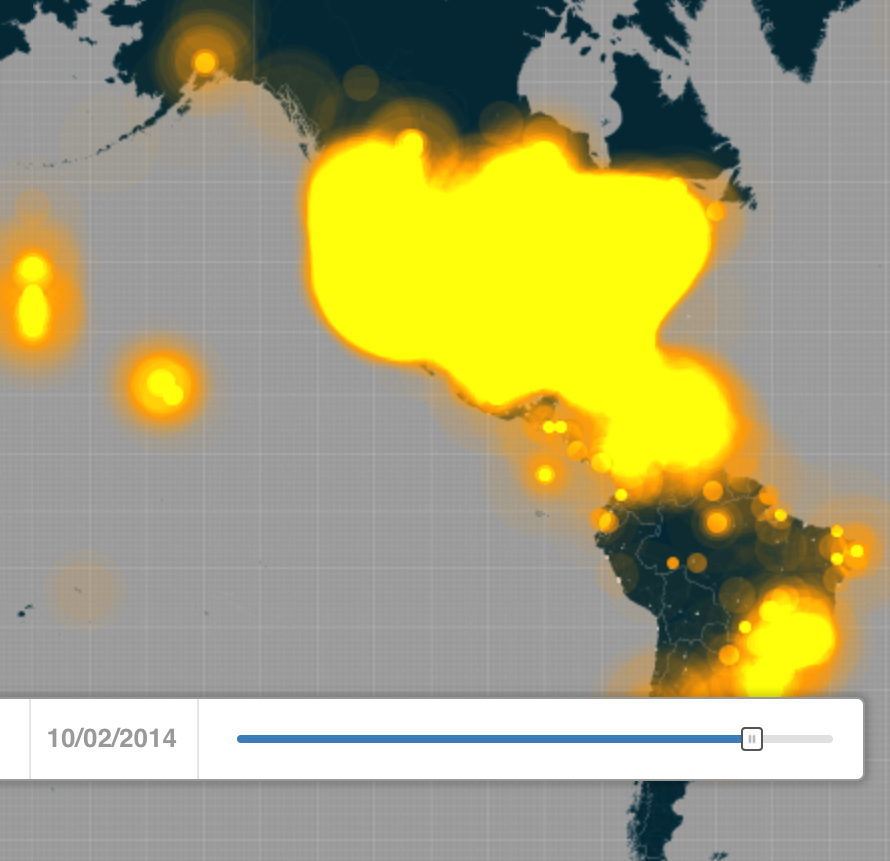
Fear is difficult to quantify by exact metrics or measures.  But the increasing density of levels of tweeting with the term or hashtag of Ebola offers a barometer of alarm about Ebola virus’s transmission.  For the 271 million active users of Twitter exploded with 140-character pronouncements about the arrival of the infectious disease across the Atlantic, beyond the expected boundaries in which the highly infectious disease had been first tracked over several previous months.  The rapid expansion of tweets mentioning Ebola illustrates how the virus came to infiltrate (and infect) social media world-wide exploded from the first of October, when the increasing density of tweets in the United States’ 52.7 active users so drastically grew.  The twitter maps show a marked explosion mentioning or tagged #Ebola dating from the announcement an infected Thomas Eric Duncan, a Liberian-American afflicted with the Ebola virus was being treated for the disease in Dallas on September 30.  Within a week, and for the week before his recent death, the virus had migrated to national news when the arrival of a patient afflicted with Ebola in the United States had raised questions of how his arrival had not only been permitted, but how the way that Duncan had gone untreated after arriving at an emergency room in Texas Health Presbyterian in Dallas opened the avenue to the infection.  Even as confidence grew that health risks were minimized, the density of tweets that illuminated the country insistently up to just three days before his death, as if threads that so inundated the twittersphere had themselves grown so intense so as to obliterate the boundaries of the United States, so intensely exchanged were tweets to overload the mapping abilities by firing off some 6,000 tweets per minute with astounding rapidity, compared, according to Time, to a frequency of 100 tweets per minute in the days before September 30.

At the risk of attributing the nation one identity, Twitter users across the country were suddenly passing news of the virus’s arrival in the United States with newfound intensity, in ways that don’t only betray the mass-enrollment of the medium’s 48.2 million US-based users.  The electrifying confirmation of the actual arrival of an Ebola-infected patient spread throughout the country in something like a Great Fear which had been prepared for by the unrelenting news of the infectious virus’s spread across the Atlantic.  While acknowledged, the disease’s spread–or the hashtag–was less clearly an issue of the moment that merited tweeting about.
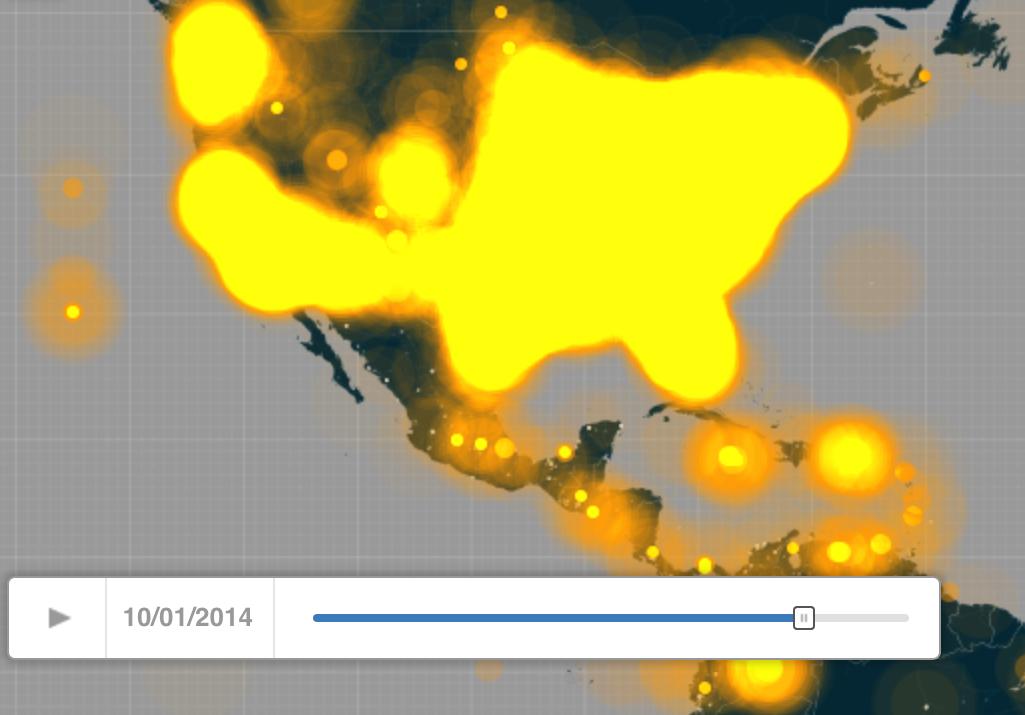
October 1 Twitter Traffic

October 2 Ebola tweets high

October 3 Twittermap

Twitter Explosion on Ebola oct 5

The mapping of geo-tagged tweets with the hashtag Ebola had dramatically mushroomed as early as October 1–or from the moment news of the arrival in Dallas of the tragically infected Duncan spread.  They register the panic generated as word got out quite quickly that the first case of infection had arrived, undetected, in the United States, not only at the Dallas airport but in Dallas itself, to a local family, in ways that seemed suddenly to confirm both the permeability of our borders and the lack of geographic remove of a virus whose infectious virulence was widely known, but appeared contained in West Africa.  While in mid-September, the extreme intensity of tweeting appears limited to the major cities in the United States, the proliferation of twittered conversations by October 1 triggered something of an information about the arrival of the term in public debate and led to issues that had no prior tie to the infectious disease.  The tweet that the CDC issued describing the spread of the disease by contact with bodily fluids —

–retweeted over 4200 times, bearing the calming words “Ebola poses no significant risk to the United States“–have been balanced by numerous alarmist tweets of the arrival of infected airplane passengers who entered the nation’s purportedly poorly guarded borders and inadequately monitored points of entry.

From a concentration of alarmed tweets largely the coasts of the continental United States, messaging proliferated after the Duncan’s identification as a case of Ebola in the Homeland with an unheard of density that overwhelmed the nation’s cyberspace and clogged up the twitter sphere in something of an information overload as Ebola became the hot topic of 140 characters.

Twitter about Ebola 9:16


October 1 Twitter Traffic

October 2 Ebola tweets high

October 3 Twittermap

Twitter Explosion on Ebola oct 5

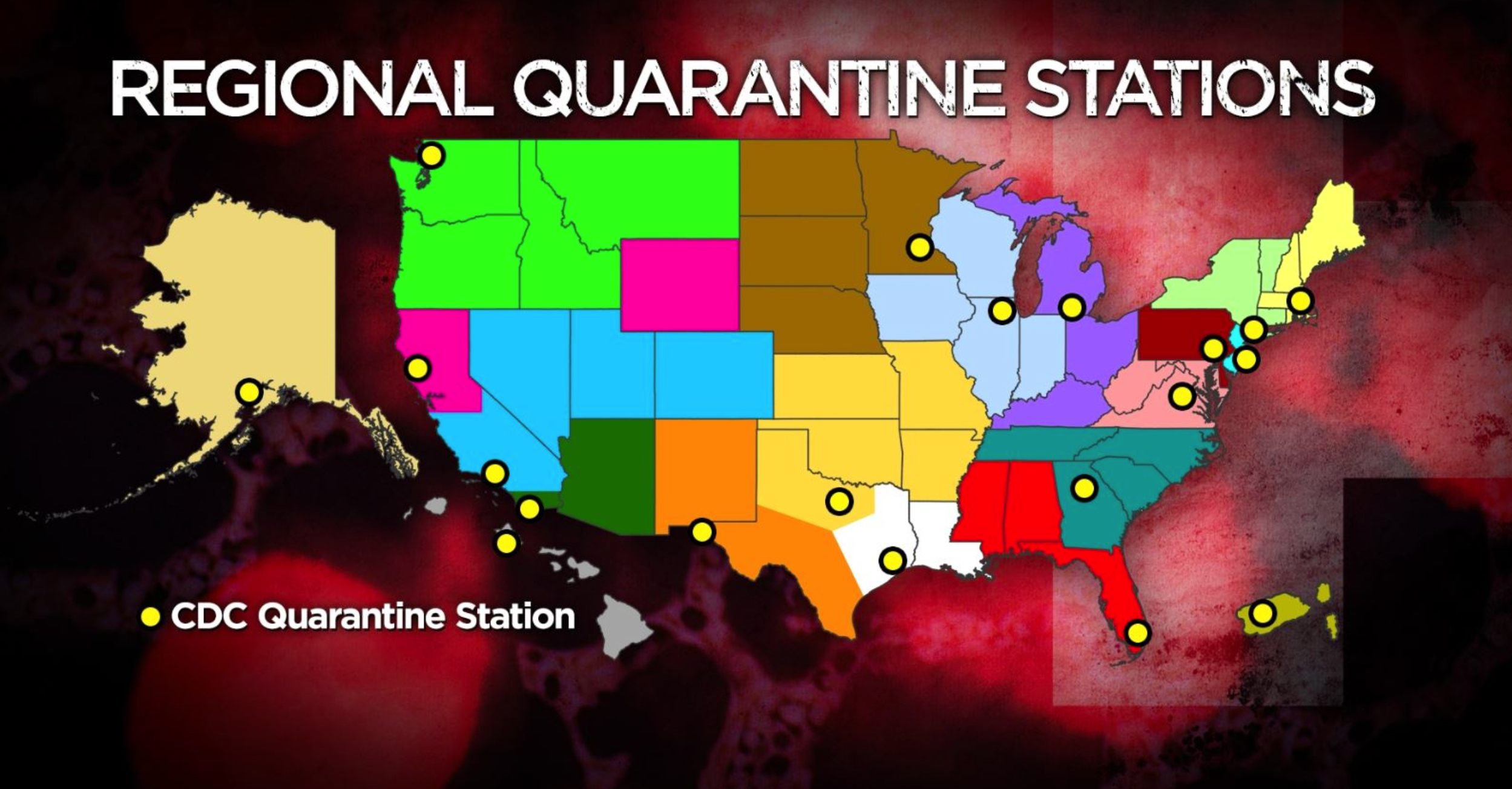
It is interesting that while the United States was set aglow with alarmist tweets, as was England, the countries across our borders, Mexico and Canada, show relatively low traffic–as to mark the rebirth of Ebola as a national phenomenon with Duncan’s arrival, at times, by October 2-5, in a startlingly uniform manner across the nation, whose tweeting density cartographically overwhelmed registration of its own borders:  the radii of tweets expanded beyond the shorelines of the continental United States, as if registering the overwhelming nature of national attention to the virus on the internet.  If as early as this last summer, tweets had wondered, with the first news of Americans infected with Ebola to return to the US in hopes of being cured, “How many degrees of separation are between you and #Ebola?,” our friends at Fox posted a handy projection whose alarmist tone seems designed to stoke fears by casting the disease as a national problem by mapping potential treatment centers within our shores, to suggest where those afflicted with the contagious virus might be transported in due time:
Quarantine Stations

Coming shortly before the WHO declared the outbreak an “International Health Emergency” on August 8, the mapping of CDC Quarantine Stations on the nightly news recast the problem of mapping Ebola’s contagion as a problem that might be located within our shores, rather than across the Atlantic ocean.  After all, the map reoriented our attention in relation to the Ebola story as if it were now a national issue.

(The BBC map of early October 2014 that tracked the future displacement of patients that contracted Ebola virus while in West Africa showed the eventual global ramifications of the virus, before the first known case where Ebola virus was contracted in the United States, spreading new fears of transmission that involved state, local, and federal officials; it provides a strikingly poor notion of the spread of the vectors of contagion–

_78177689_ebola_worldBBC

based as it is on a map of countries, rather than pathways of infection, and illustrates the high levels of anxieties around placing Ebola in space.)

The expanding radiation of tweets from major cities charts the emergence of a geographically removed epidemiological crisis of Ebola within the national borders of the United States around a very precise date.  From a phenomenon that was confined to major US cities on a September 28 twitter map, whose points of greatest density were confined to Baltimore and Bethesda, the New York area, Charlotte and Atlanta–

Focus Oct 28 Twittermap

September 30 provided a burst of tweets from Dallas in the center of the country, consumed by tweets–

Focus Sept 30 Dallas Explosion

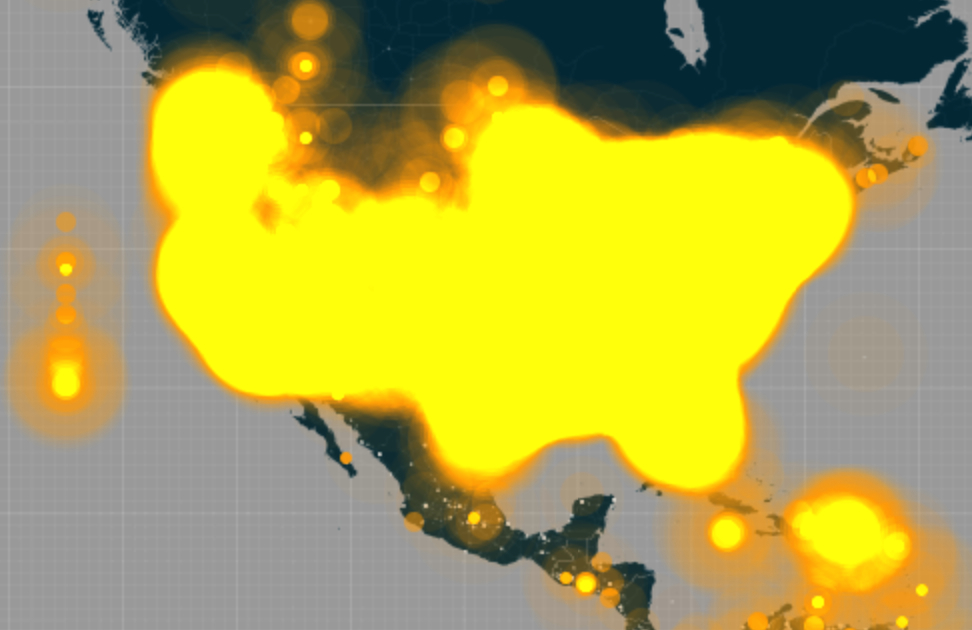
–which went national by the first day of October that suggest the knitting together of the national twittersphere with new focus by Oct 2 as the entire country increasingly tweeted about the virus’ spread grew to overwhelm the messages that Americans posted on the Internet:

Focus Oct 1 Twitter Explosion National

Focus October 2 Twitter USA

The limitations on tweeting in mid-September in the United States–mostly confined earlier to the northeast and Los Angeles, as well as Texas, was truly explosive.  #Ebola developed conversations in many fronts, at the same time as it was inevitably poised to enter public discourse about the nature of the United States’ borders, until regular checks and screenings at airports and screening agents in full protective gear, poised with thermal guns to greet visitors from the most severely Ebola-stricken nations like Liberia, Sierra Leone, and Guinea, in order to detect elevated temperatures that might betray signs of the fever associated with the virus, and, should need be, placed in quarantine.  But even as attempts to start screening procedures in hospitals and airports, the fears about the invisibility of the disease, and the difficulty of detecting those infected in the earliest stages, has triggered deep-set anxieties (if not paranoid fears) into which several politicians have, however improbably, sought to tap, in ways that create a powerful new hybrid between infectious pathways and national threats.  The difficulty of screening folks who arrive in the country on all flight pathways leaving countries afflicted with Ebola–given that no U.S. Airlines actually fly to West Africa, outside of Lagos and Dakar–and that any restriction of imports to the region would paralyze local responders.  (One of the more widely diffused maps of the accelerated viral communication air flights from West Africa could encourage imagined the arrival of Ebola from Dakar to New York and Washington, DC alone, rather than Dallas.)

senegalFlightsMapJLMother Jones

A subsequent more DIY iteration of a similar map projecting the dangers of contagion from airplane flights, if one of considerably more questionable politics, imagined the multiple flight-paths, this time from Lagos as vectors of disease from Ebola-afflicted countries:

ab33f9ca620ac10e95ee6da85629920e

Such maps raise impossible questions of how to quarantine for Ebola linked to questions of national safety, and oddly removed from a global context in which pathways of viral communication might be charted–or the global count that now exceeds 4,000 deaths.  They have led to multiple maps of the global cases of Ebola to be charted on Wikipedia to more alarmist WordPress blogs, to come to terms with the spread of the fatal disease whose name is now on everyone’s lips–often suggesting, with the intensity of an infographic, information that is somehow being withheld or not fully released to the public.  (The rise of such self-made maps of Ebola, often using data on a Google maps template, has put it into the hands of all to act as muckrakers and unmask the new dangers of the virus’s future spread.)

The “inside story” that has developed on Ebola’s transmission have no doubt generated the spread of miniblogs about Ebola across the twitterverse.  Even the screening measures that are able to be introduced at airports, CNN reminds us, are, in the words of Laurie Garrett, author of The Coming Plague, “something to calm the nerves of the American people, the British people, the French people, and so on” as if this were a first-world problem of anxiety-control; Mary Schiavo, former Inspector General of the US Department of Transportation, dismissed them as “entirely window dressing, because we have to do something,” but have little sense of what to do at any rate.  Schiavo cautioned “there’s much more that needs to be done to keep people safe,” as if the government were being lax.  Yet for a disease that does not reveal symptoms for some three weeks after infection, the tracking of potential vectors of transmission is extremely difficult, if not impossible.  On a related front, shortly after Texas Governor Rick Perry announced at Texas Health Presbyterian that “Professionals on every level of the chain of command know what to do to minimize this potential risk to the people of Texas and this country,” mutated over the following week to a message from a Border Control agent in the Rio Grande Valley that “we might not know how to respond [my italics added].”  “Did they train up or come up with a plan to respond to this? I don’t know,” he added, spinning up new fears in the mind of the general public and linking border-mania to Ebola.  The tie between Ebola and our borders materialized the threat of the virus as a “homeland risk” in ways that prepared for its entrance into national debate; members of Congress like Rep. Duncan Hunter (R-Calif.) preposterously describe Ebola as “another instance of the federal government ignoring the ongoing problems on the U.S.-Mexico border.”

Thomas Eric Duncan’s arrival in Dallas weeks after the mapping of imagined pathways of contagion itself suggests a far more complex threats of a network of indirect flight paths than can be revealed in a map of direct flights from Dakar–and reminds us that the danger of infection on airplanes is far less than the transport of the infected.  The data overload mapped on Twitterfeeds reveals how Americans came to suddenly process their relation to a disease that had arrived on their shores, some seven months after volunteers first rushed to West Africa in hopes to contain the disease’s spread.  The delay was astounding, as was the revealing of the increasingly limited and mutable nature of the attention spans that might be measured by Twitter feeds–and the inevitably metastisization of debate about the arrival of West Africans with the disease not only by airplane–a vector of transmission long feared  as it almost inevitably hybridized with other discourses on national vulnerability.  The first warning from a border guard about the danger of Ebola entering the United States in the Rio Grande came from the suspected apprehension of an Ethiopian, so widespread was the fear of African provenance of the disease that had come to appear as if it lurked just across our borders.

Did the relative lack of tweeting on Ebola in Mexico suggest a lack of interest in the spread of Ebola there, or just the absence of how the disease so readily intersected with fears about the preservation of boundaries?

Despite the confidence of the CDC at the abilities to control and staunch the spread of the disease, a panic rapidly grew around the vulnerability that the arrival of Duncan in Dallas suddenly suggested itself across the United States.   For his illness, the story of his rejection at the hospital, and his ability to pass undetected through the Monrovia airport, beyond the fears stoked by quarantining of those with whom he had close contact, offered evidence that our borders were not secured.  The anxieties that were unleashed were either cunningly paired or themselves latched onto, as if by haphazard association, the obsession with borders in the United States, from the wall that has been constructed to keep out Mexican immigrants from the country; fear of illegal migration was openly conflated with the arrival of a threat from which the US government was insufficiently protecting its citizens.  And in a triumph of isolationist thought, talk radio foresaw that should any US soldiers be dispatched to help with the treatment of West African countries that lack an public health infrastructure, they would turn into vectors for the disease to be brought to the US, in something like a homeland security threat some even cast as a plot to inflict punishment on current residents of the United States for sins of slave-holding, linking the severity of the infectious disease in Liberia to the founding of the nation by former US slaves in a despicable bout of geographic free-association and tragicomic transhistorical whimsy.

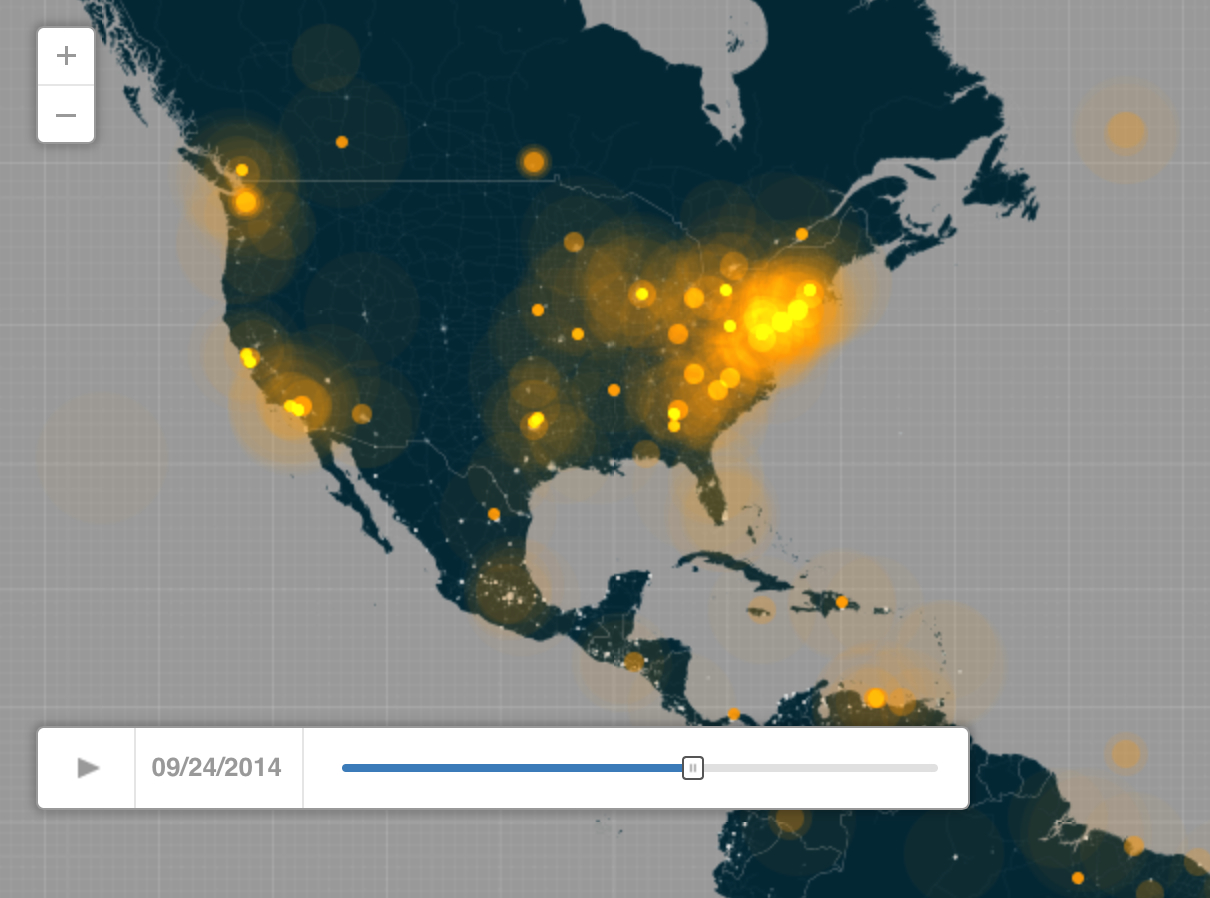
The story of #Ebola, it was proved, not only has legs, but will travel with the rapidity of the infectious disease itself, in ways that make it the most attention-getting news item at a time when political pundits are thirsty for news stories that would be able to make a big impact and circulate.  The contrast in twitter maps over the course of just two weeks is striking, as is the spike at the time of the announcement of Duncan’s arrival on US soil:

Twittering about Ebola 9:15

Ebola on Twitter in US

October 2 Ebola tweets high

And by October 3, the United States seemed distinctly obsessed, aside from non-Twitter users in Montana:

Focus Oct 3 ExplosionOctober 3

Focus October 4 tweetmapOctober 4

Focus Radiation of Tweets Octobver 5October 5

Much of this retweeting seems to have lain not only in an understandable fear, as the knowledge grew about levels of Duncan’s compelling tragedy and inadequacy of his care, but much of the tweets were no doubt panic-inspired 140 character alarms, a condensed Great Fear in miniature, as the shock that lurked behind Duncan’s tragic history mutated into intense fears about national vulnerability and preparedness–or national safety.

The notion that Ebola should mutate from a global public health emergency to national threat seems particularly cruel, since the long-threatening virus has suddenly gained such widespread traction after being grafted onto free-floating fears for national security.  A categorical confusion occurred bout the infectious nature of Ebola, which mutated as make Ebola’s attack on the lining of internal organs suddenly gained immediacy.  Despite the concern about the future spread Ebola outbreaks historically confined to West and Central Africa, the illusion of the geographical remove of Ebola created a compartmentalization of public health responses that were suddenly, with Duncan’s arrival in the United States, been breached:

long confined to West Africa

Several public response, as manifested in Pennsylvania health posters, predictably seem considerably more measured:

AR-141019960

But the fears of how Ebola disrupts previous models of the communication of especially virulent diseases seems to reflect how it stands to disrupt our categories of thought, breaking imagined gulfs between cultures and bridging oceanic expanse, in ways that even the utmost vigilance creates no barrier for.  And in an era when making barriers to immigration, to terrorism, and to the new nature of risk.  The readiness to install teams of officials equipped with infrared temperature guns to take the temperatures of all passengers arriving from Liberia, Sierra Leone, and Guinea is by no means a fool-proof method or one even guaranteed to detect the presence of the virus among all passengers, but the intensity of the screening procedures enacted by the CDC’s division on global migration and quarantine (who knew it existed?) to be conducted by customs and border protection officials from the Department of Homeland Security–wearing Homeland Security badges–who are already mobilized and stationed at John F. Kennedy International airport, and already invested with authority to stop and search all international travelers.  Eventually, their place is to be taken by members of the Coast Guard and eventually medical workers under contract with the government at five airports, but the men conducting the “expanded screening measures” are supervised by the Office of Homeland Security’s unit if US Customs and Border Protection.

The link was present in fear of border-crossing allowed the risk of Ebola to grow so expansively across the country.  But the breach was apparent not in the breaking of any actual national boundaries, but in the new category of the “homeland”–from airport screening to border stations to the protections that the government can offer to its residents–in a way that made no real sense, but that suddenly invested a new logic in Ebola virus that allowed it to move from the far-off to the close-at-hand.  All of a sudden, the disease acquired  a new identity as it became a “homeland risk.”

That said, we might do well to pause, even given the dangers that outbreaks of Ebola poses, over the multiple other risks for death in the nation.

causes-of-death-ebola-labels.pngBusiness Insider

For the magnification of the local risk of screening for Ebola, for all its rootedness in a deep instinct for self-protection, seems to mark a turn away from an epidemic that is already worldwide–in a dramatically misleading graphic which, while this map by AmericanXplorer13 has made its way to Wikipedia, misleadingly suggested that local transmission of the virus has spread throughout the Eurozone and to at least three states in the US.

Map_of_Ebola_Outbreak_-_1_October_2014.svg

Map of Ebola Outbreak – 1 October 2014″ by AmericanXplorer13 – Created with tools from Kartograph, released under the AGPL license

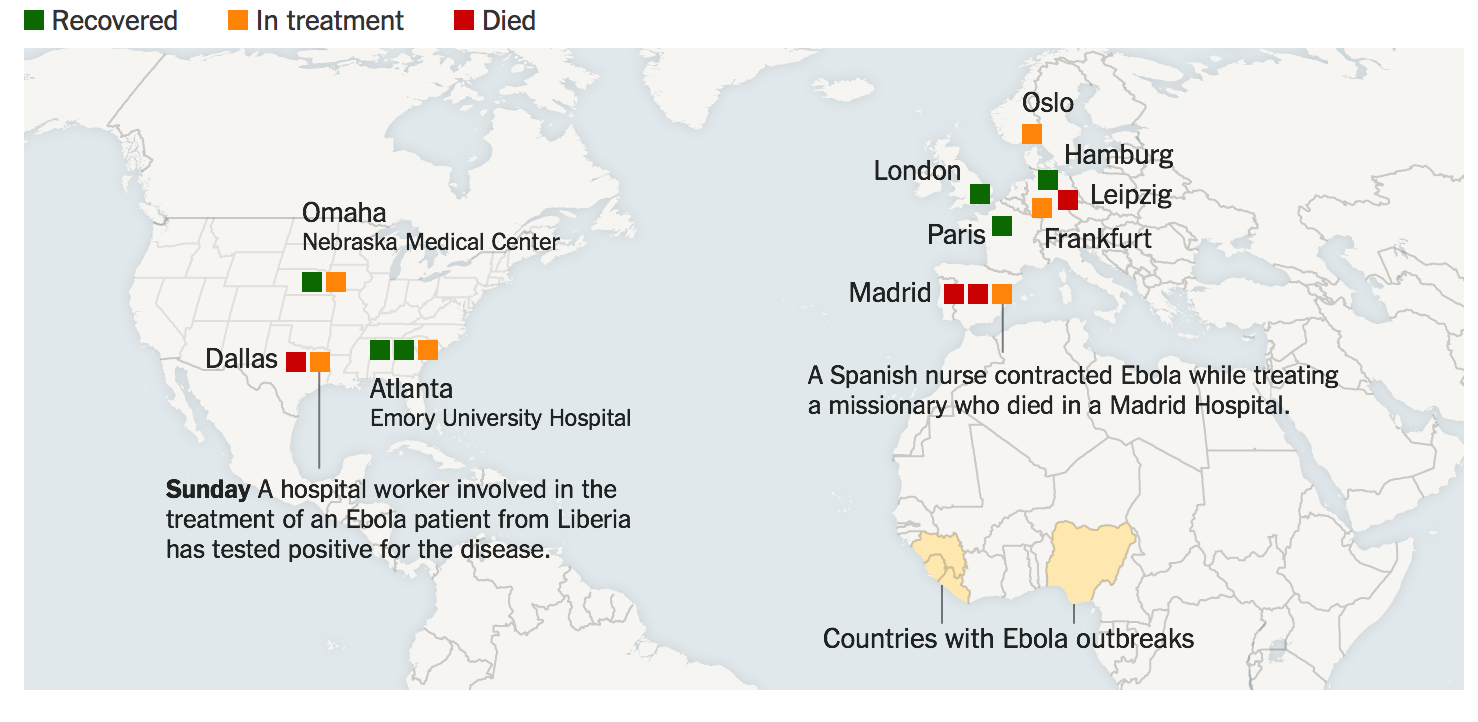
The irresponsibility of such a map, or self-made data-visualization, even though it was careful to note that no deaths from Ebola had yet occurred in several regions, almost intimated that the spread of the virus from West Africa, or out of the zone of its “widespread transmission,” had breached the barrier of containment.  Far better is the graphic from the New York Times, which transposed the same data to a far less troublesome data vis, but is so striking for how it attached a medical narrative to the two cases contracted out of Africa it described, but where the slight narratives of different coloration contrast with the anonymity of the ochre spaces that mark “Countries with Ebola outbreaks,” as if the responsibility lay with their governments.  How can one, indeed, give individual faces to the upwards of a thousand cases contracted each week.
Ebola out of AfricaNew York Times

The problem that we face of mapping the international health crisis of Ebola demands more informative ways to map the virus’s transmission.  We are in danger, even in our hospitals, of transmitting cartographies of fear that derive from a demand of soothing incoming patients’ deeply seated fears about the virus as if it might be indeed airborne–when will it mutate, and where?–instead of providing accurate information.  Indeed, the expansion of those countries included in the info graphics that confront patients in a rather hastily affixed sign taped to the welcoming desk found at the entrance of a basic hospital in northern California–where no cases have been reported as of yet, and where no Ebola treatment centers exist–dramatically magnify the precautions taken with those arriving from “countries with outbreaks,” building on the immediacy of the case of Thomas Eric Duncan in ways that seem designed more to prey upon fears than truly to calm nerves.

cartography of fear

The odd adoption of afrocentric colors in the warming poster–green, orange-yellow, and red–evoking an African flag or a Kente cloth fabric or a Rastafarian trim–both tries to remove the disease spatially as resolutely African, and to locate it as a by-product of cultural and human migration that has arrived on our shores.
1 Comment

Filed under Africa, CDC, Contagious Diseases, Customs and Border Protection, Ebola, Ebola Outbreaks, Homeland Security, Mapping Disease, mapping health threats, public health, Twitter maps, Twittersphere