The entry of the data visualizations into the pitched narrative of the Presidential election is not new. If thought to begin in the collective unfolding of the election-night drama on television screens, as the casting of ballots long understood as a collective action of union has prompted a narrative of division, CNN offers a new model to personally intervene on one’s iPhone or android, as if to offer the means to ramp up agency on social media, inviting users to tap on one’s personal screen to build-your-own electoral map, perhaps to assuage one’s heightened anxiety, granting the illusion to allow yourself for entering your own alternative future. Echoing the algorithmic thinking of tallying “pathways to victory” we’d been following to exist the Trump Era with increased desperation, courtesy FiveThirtyEight and others, we imagined scenarios of the electoral constellation that might prepare for the dawning of something like a new age. As different campaigns used maps to assert “multiple pathways to victory,” the statistical likelihood of a victory seemed to suspend agency, in ways that would come to haunt the nation, in the aftermath of the election, as the tally of the vote was questioned in multiple ways, undermining the accuracy of the tally of individual votes, and injecting a degree of suspicion deeply dangerous to democracy–but elevated in the name of ‘transparency.’
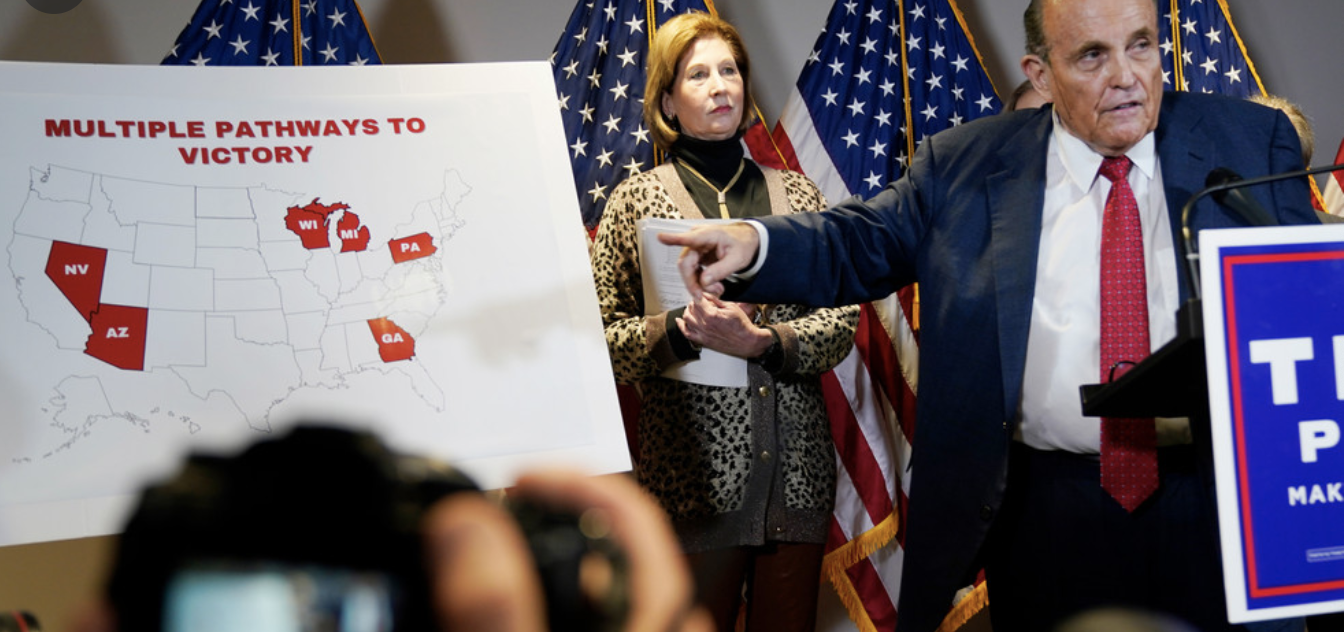
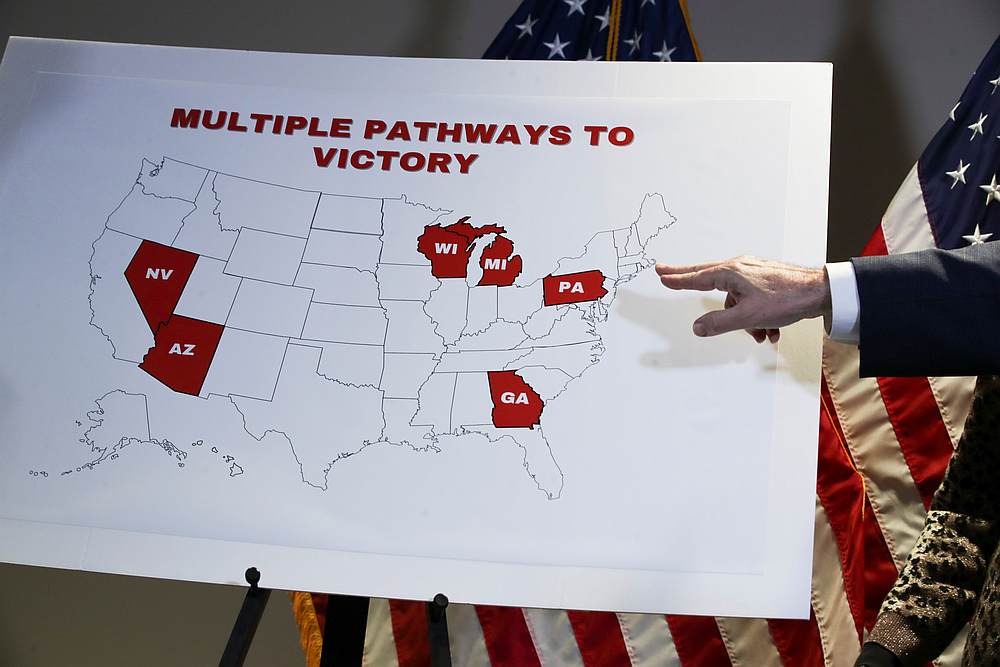
The standard map of the United States became a model for the President’s personal lawyer to present “evidence” by appealing the vote, long after the votes were tabulated, and winner declared, in a new form of aftermath for an election we had never experienced. If the security of paper ballots were put into question by the question of “hanging chads” that demanded hand counts with observers back in 2000, a weeks-long battle that suspended any announcement of a victor in a divided nation, that demanded “optical evidence” of the will of voters, by scrutinizing some 537 votes out of the entire nation in order to determine the victor of the electoral college, and forestall the celebrations of Democrats over the nation who expected that victory was at hand, the aftermath became distilled in 2020 to the contestation of an electoral map, the map that had come to mediate the election, as the President’s lawyer, looking like Frankenstein, returned from the dead, declared the continued existence of “multiple pathways to victory”–the very phrase that Joseph R. Biden’s circle had announced in predicting his victory.
The “post-truth” announcement was not only post-truth, but a dumbed down version of voting before multiple American flags, presenting the states that the map labeled “red” that had voted for Biden to be at basis “red states,” and inevitably destined to fall into President Trump’s column. The news conference that was presented at Republican National Committee headquarters on November, 19, almost three weeks after the election was held, seemed to reclaim states’ electors as if they were enemy territory, as Trump’s legal team insisted that a spate of “irregularities in the voting system” had created numerous bases for serious fraudulence in tallies of the voting process.
November 19, 2020/AP/Jacquelyne Martin
The made-for-TV moment that was designed to circulate online as an iconic image crystallized the post-truth debates about the actual results of the election–a basis for the myth of a “stolen victory” that would continue until the tragically violent insurrectionary invasion of the U.S. Capitol building on January 6, 2021, a readily recognized power play of seizing the electoral map from the networks, denying the role of the media or television networks from making a prediction or declaring the victor, and deciding to gesture to the selective distortion of the electoral map as if it was evidence of the true “map” of the election, as the image of five “battleground” electoral states that the Trump campaign was announcing were the basis of its campaign to Keep America Great or Make It Great Again focussed, in a new use of Cold War rhetoric, on removing “outrageous iron curtain of censorship.”
November 19, 2020
The results of the Presidential election in these states were not particularly close, and did not recall the nail-biter of 2000, twenty years ago, when the inspection of paper ballots by impartial judges provided an unplanned basis for showcasing the legal efforts of moving the election to the United States Supreme Court as a final authoritative arbiter of electoral results.
But if votes in either Michigan or Pennsylvania were hard to say were not conclusive, without either a legal theory or strategy to discard the existing tallies of the election, without disenfranchising hundreds of thousands, the post-truth campaign posited a systematic lack of vigilance of Democrats to play rough and tumble with registered voters and enshrined voting practices, arguing that the norms of voting practices were so systematically violated both in the voting machines themselves, especially paperless touch-screen voting machines that were argued to be open to manipulation, as well as the farming of ballots, and unreliability of mail-in voting practices.
The proliferating basis of instability for the tabulation of votes–the foundation of the democratic process–was argued to be inherently imperfect and corrupted at its root, suggesting the election was stolen. The argument that a small Texas company had made–“Allied Security Operations Group”–posited all software used in Smartmatic voting machines demonized as designed by a corporation with ties to Venezuelan founders: the basis among staunchly conservative activists to push a sense of widespread voting fraud–perpetuated on Newsmax in Dominion voting machines–was launched not by experts, but a myth of fraudulenceWashington Post has tied to Texas businessman Russell J. Ramsland, Jr., Trump advocates would adopt to discredit the outcomes of voting tallies already tabulated in battleground states.
The story of deep skepticism about the outcome of the election was in many ways nourished by the relative indeterminacy of possible outcomes for 2020, all of them hinging on battleground states that would push the electoral college one way or another. If the process seemed to remove the voting systems from the voters, the unfounded conspiracy theory Ramsland endorsed and boosted trotted out the shaky foundations of democratic institutions with readiness to defend the outcome they sought–and seemed to find consolation in an iconic map that painted these “swing” states a uniform red.
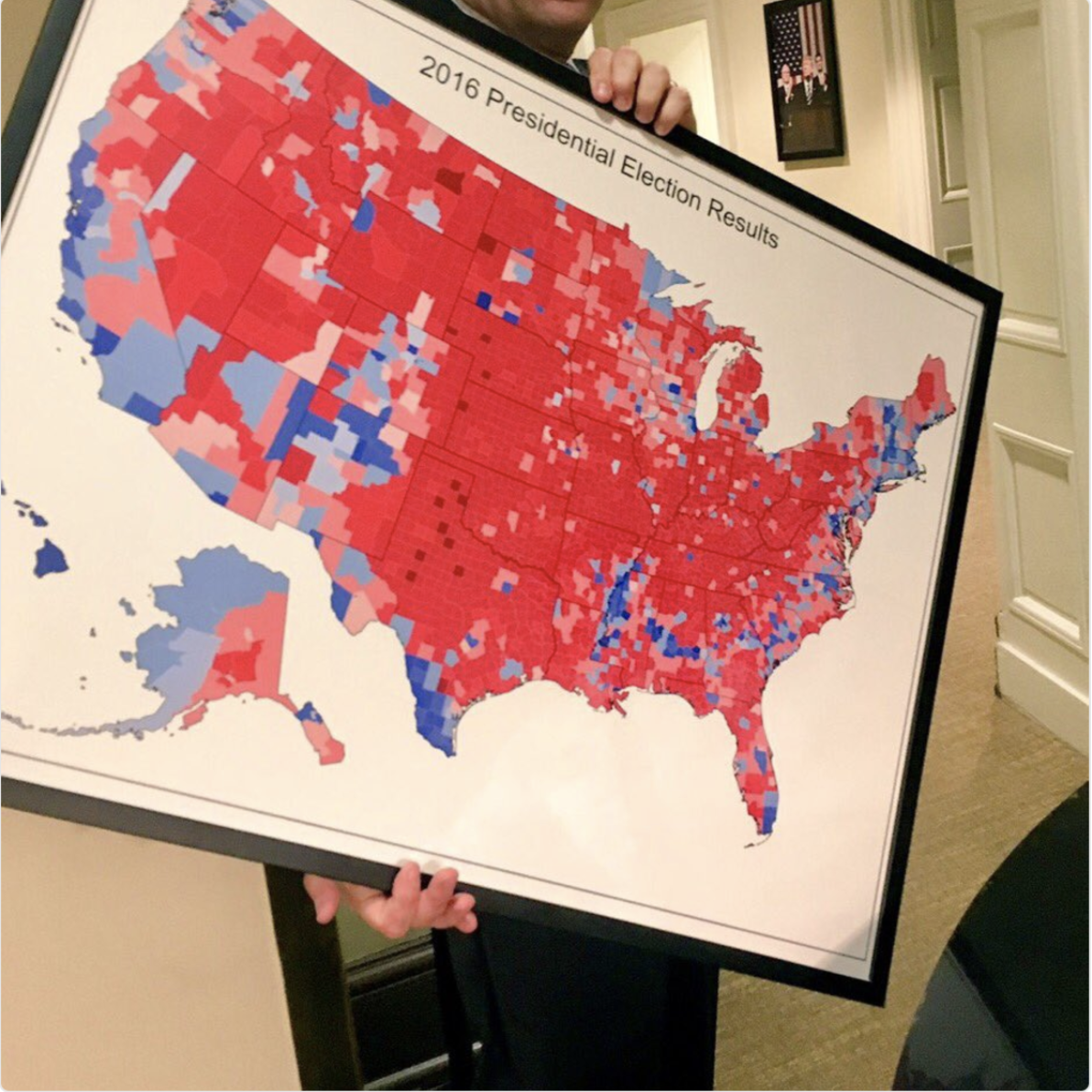
The fetishization of these deeply unstable and diverse states as uniformly “red”–and red as the identity that must be defended against the misinterpretation of magically “reassigned” surplus votes, performed by software in offshore databases run by multinationals, suggested the danger of diminishing the “red map” that Republicans have long dedicated themselves to enshrine–a map that has become so iconic since the 2016 Presidential election to seem like destiny to enter the once-hallowed walls of the West Wing of the White House among other furnishings quite early in the Trump Presidency–
–as if to preserve that magic moment of Election night that was such a surprise on national TV, even if, as has been widely observed far, far beyond this blog, and since Trey Yingst tweeted the image back in May, 2017, the choropleth is far from suited to represent popular consensus or the massive adulation he craves, as it erased the actual presence of voters, in favor of a snazzy graphic, made to shock for TV.
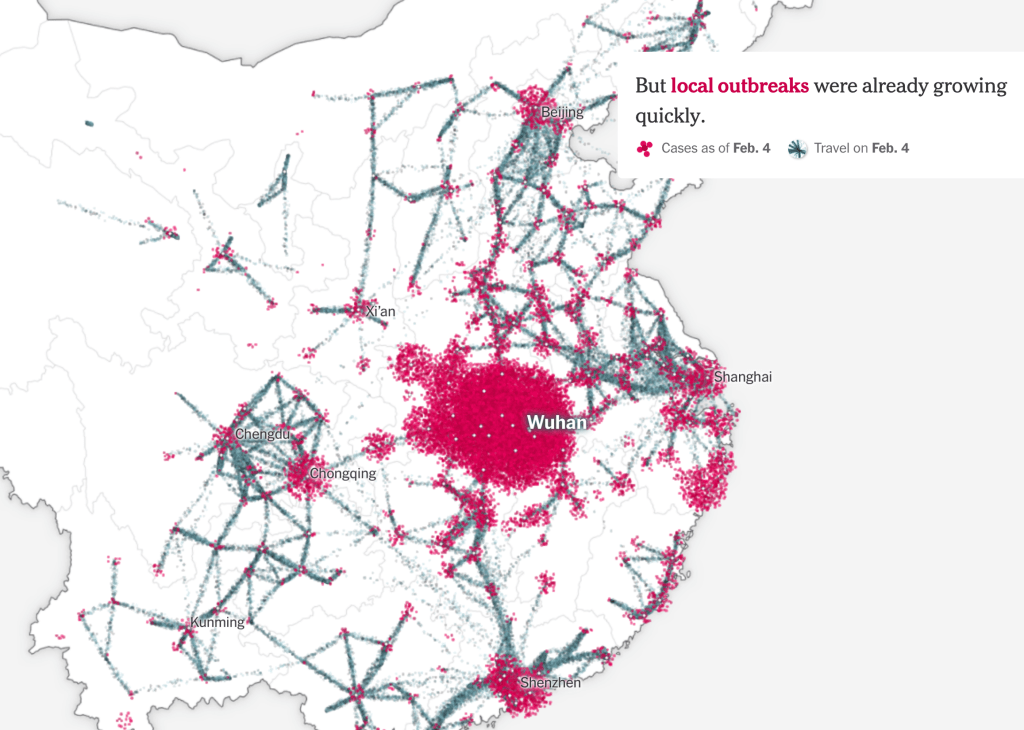
A pandemic is by its nature both local and global by definition–and begins from a local outbreak. But if the only way to gain orientation to a pandemic is by accurate local counts, the problem of balancing–or toggling between–the local and global has become staggeringly pronounced in the case of COVID-19, as if the point-based cartography that we use to track the disease has the better of us, and upper hand, with the absence of accurate local counts. The lack of clear data that came from Wuhan in the days that followed the outbreak of the virus revealed worrisome problems of transparency. The difficulties Chinese government authorities faced in getting bearings on the zoonotic virus, lab-born or not, raised problems of even trying to map its rise, and we tired to look at maps as tea-leaves of future responses, as well as retrospective diagnoses of the point of origin of disease spread–as if maps could explicate our uncertain conditions, and increased vulnerability.
Data visualizations since seem to proliferate in response to uncertainty and an absence of consensus, as we turned to maps as a hope for truth in an age of increased uncertainty: as local officials were loathe to shoulder responsibility, the tally of infected in Hubei Province jumped, astoundingly, forcing the government to recognize the ease of its transmission among humans, was far more virulent than believed. But at this point, looking back in the mirror provides little sense of orientation to the multiplication of dispersed local outbreaks of coronavirus that we are increasingly challenged to map in relation to ourselves. Were the first maps of the New World similar responses to the deep sense of religious and eschatological uncertainty of the early modern period? Whether or not that was the case, we all felt especially early modern now, plague victims of a sort that led us to look back on the mapping and mapping of responses to the spread of pestilence, and hoping that past experience–or our current increased ability of empathy–gave us more meaningful access to the epidemics and pandemics of the past.
The sudden uptick of cases reveals a reticence in tallying the infected out of fears of reprisals for apparent incompetence, an institutional blame-shifting triggering mechanisms of concealment that has led American meat-packing plants to hide numbers of infected workers, and numbers of tests for infection to be far lower than official records suggest: the absence of ability to control the spread of SARS-CoV-2 led us to proliferate maps in hopes to grasp its rapid doubling, uncomfortable at the world they began to show, apprehensive at how to come to terms with the rapidity of local outbreaks of confirmed cases with sufficient granularity, and enough continuities, hoping to track contagion as hopes of containment were beginning to fade in the new aggregates that were increasingly evident.
New York Times
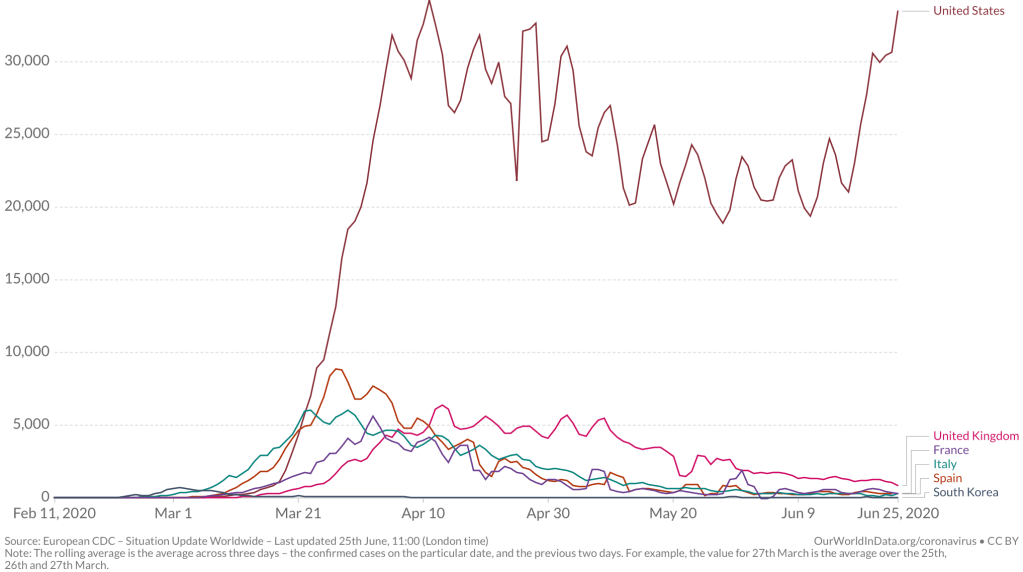
The warning of the virus’ spread was raised by Li Wenliang on December 30 from Wuhan, inter-agency shifting of blame and responsibility in Wuhan– a reflexive institutional blame-shifting by “throwing woks”–abruptly ceased with summons of Shanghai Mayor Ying Yong, he who lured Elon Musk to Shanghai, to restore order: as a new hospital was built, tallies of new cases of coronavirus in Hubei astronomically grew by nine from 1,638 to 14,840, shocking the world–a figure was in keeping with the nearly 1,400 people dead in the country, but suggesting a viral load of unprecedented proportions. Americans apprehensively watched the disease afflicting passengers of cruise liners as if it would arrive ashore, its virulence was in fact already of pandemic proportions: yet American disinformation here took over, as we were told to stick our heads in the sand, ostrich-like, as fears were overblown, and tried to keep calm. And then, the tables were turned, as the United States President described, or suggested, a national policy of intentional undercounts, and limited testing, lest the counts discovered tank his popularity–the stock market value of Trump, International, or, rather, Trump-in-Office, Trump-as-Chief-Executive, whose new season might be canceled due to low ratings. And although the virus began in China, how the United States increasingly came to be the outlier in the numbers of infection confirmed weekly suggested a national story of mismanagement, as the narrative we told ourselves of American exceptionalism before illness seemed to have boomeranged, with the three-day averages of confirmed infections skyrocketing, and setting us apart from the very nations we compare ourselves to, but whose health-care policy we increasingly realize we are distinct from.
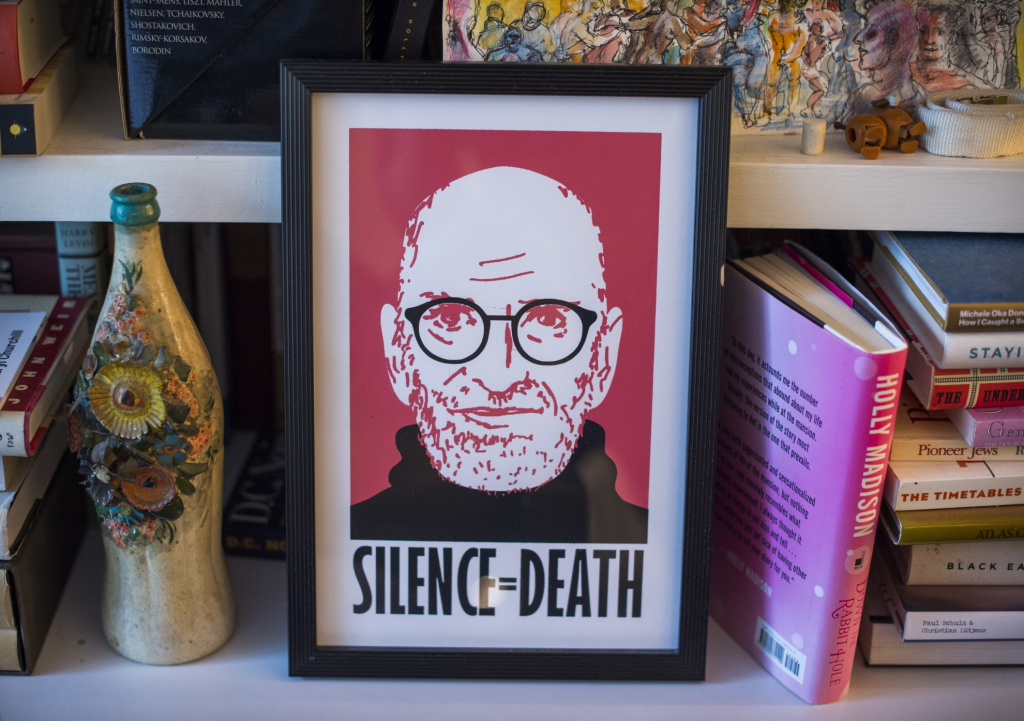
Americans were soothed by deceptive common-sense talk. But the results of a lack of investment in public health are all too evident, if our maps are . Robert Redfield, a virologist who served as the public spokesperson of reassurance who had long sustained false theories about retroviruses causing HIV and AIDS, argued that even if the fourteen confirmed cases of the novel coronavirus were monitored and traced, “the virus more exploded . . beyond public health capacity,” he seemed to forget he had not developed that capacity. Virology is of course Dr. Redfield’s area of expertise, but he won his political post in no small part by being practiced in massaging truth statements for political ends. During AIDS outbreak, the last major plague in the United States, he had advocated unproven drugs billed as HIV vaccines and encouraged quarantine, abstinence, and stripping the medical licenses of HIV-infected medical workers, more than accelerating cures; Redfield took time to blame the Obama administration for implementing clinical tests, to please his patron. Bt he obscured the level of infections that in truth were not known, blinding the nation to a cartography of COVID by not advancing adequate levels of testing, that returned us to the simple equation of the dog days of AIDS, only able to make us yell, yet again, this time with Larry Kramer, stalwart resistor of the silencing of AIDS by the failure to use on-trial medicine–
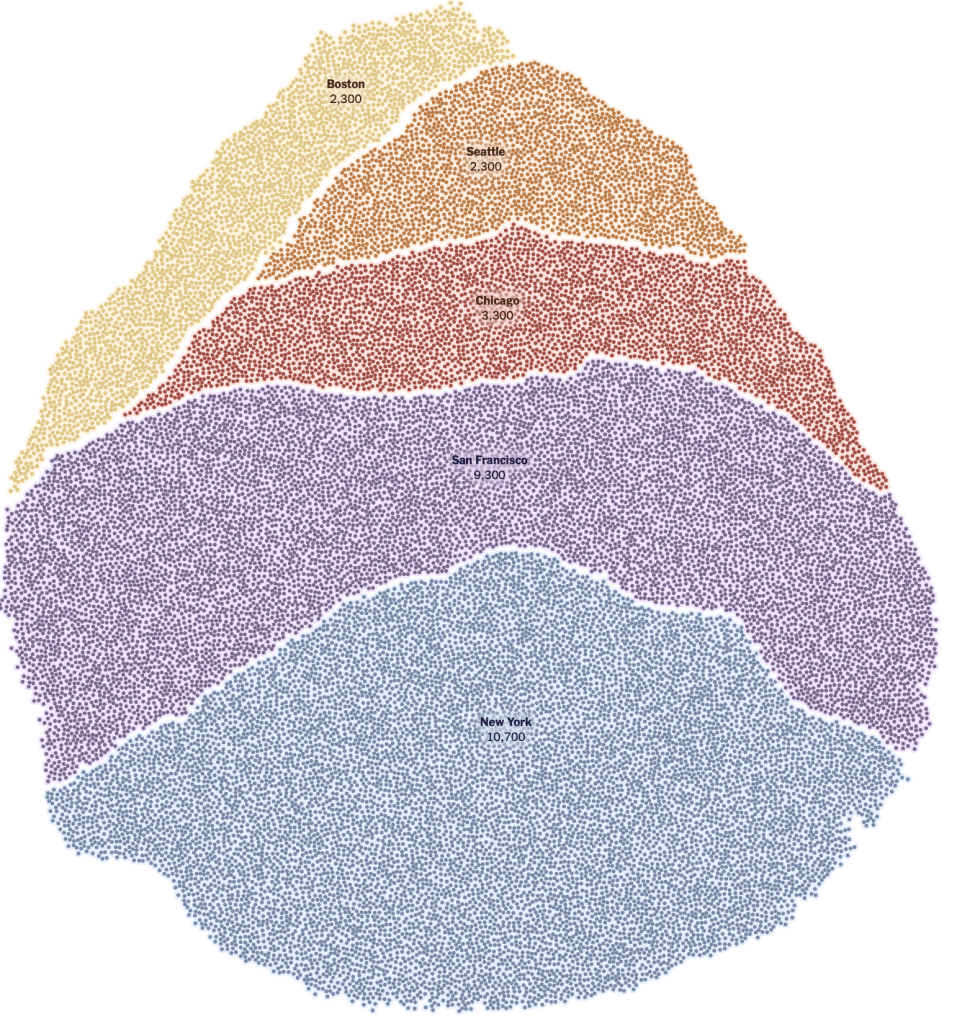
–at the utter deception with which we met the pandemic. Dr. Redfield must have met his commission to radiate calm by assuring Americans in late February. As he assured us only fourteen cases had been diagnosed in the United States, the number meant little, as any virologist should kmow; while hindsight is a benefit that obscures us from the need to life life forwards, we suspect urban hotspots were already laden with infected individuals by March 1, a silent ticking bomb of urban outbreaks already infecting 28,000 as it spread broadly its “hotspots”–New York, Chicago, San Francisco, Seattle, Boston and Chicago–all of massively different density, without tests being able to affirm the scale of its spread.
There was no map. And then, all of a sudden, the globalization of coronavirus hit home; any place in the world could be related to any other place, as rates of infection bloomed globally in geographically disjointed hotspots, spatially removed from one another, even as a standard for uniform testing lacked. And there was no sense of an art of dying, as the amazingly rapid contraction and worsening of illnesses left many without a script, and many more silent before a dizzying multiplication of statistics of mortality in the face of COVID-19, several weeks later.
Every other map of COVID-19’s spread seems an attempt to persuade the viewer of its accuracy and totality, in retrospect, even as we have no clear sense of the total figures of infection-or even of the paths infection takes. We are mystified by the geography and spatial dynamics of the virus’ travel, but realize the severe communicability of a virus whose load is stored in the naso-laryngeal passages, and can be communicated by airborne drops. Is distancing the best way we can constrain the geographic spread of infection? Can statistics demonstrate the success of curtailing its spread?
It was a hidden agenda in the maps of news agencies and to register the accurate levels of infection, promising the sorts of transparency that had been clouded in much of January. And while we watch the progress of the pandemic on screens, there is a sense of truth-telling, as a result, of revealing the scope of the virus’ actual spread that compensates for the lack of clarity we once had. But it is also increasingly difficult to orient ourselves to the GPS-enabled scales of its spread, for we still are looking at pretty limited and almost superficial data, in the sense we have trouble plotting it in a narrative context, or find a reaction more than shock. The virus is easy in ways to personify as a threat–it wants us outside; it comes from afar; it pervades public spaces and hospital grounds; it demands vigilant hand-washing and sanitizing–but the very numbest are elusive. While we try to track reported cases, hoping that these limited datasets will provide orientation, we have been lumping numbers of tests that might be apples and oranges, and have not found a consistent manner of testing. Deaths are difficult to attribute, for some, since there are different sites where the virus might settle in our bodies.
Even while not really following the pathways of its transmission, and the microscopic scale of the progress of the pathogen in bodies. And if we rely on or expect data visualizations will present information in readily graspable terms, we rarely come to question the logics that underly them, and the logics are limited given the poor levels of global testing for COVID-19. It is frustrating that our GPS maps, which we seem able to map the world, can map numbers of surrogates for viral spread, but we have yet to find a way to read the numbers in a clear narrative, but are floored by the apparently miasmatic spread of such a highly contagious disease that makes us feel, as historian of science Lorraine Daston put it, that we are in “ground zero of empiricism,” as if we are now all in the seventeenth century, not only in being vulnerable to a disease far less dangerous or deadly than Yersina pestis, but without explanatory and diagnostic tools.
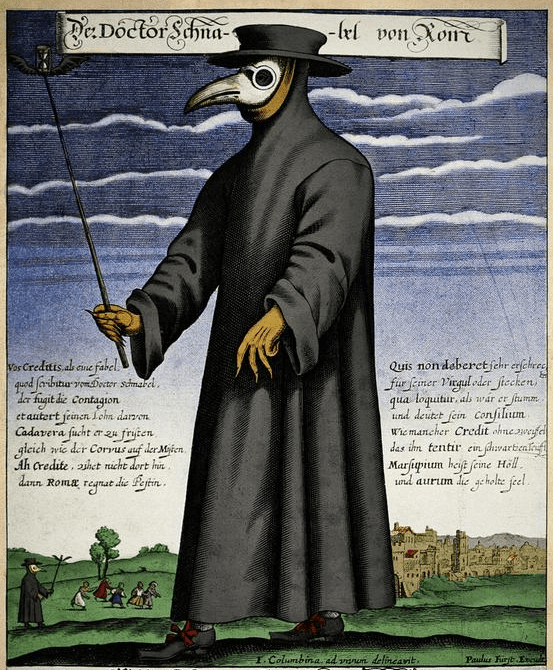
This was, to be sure, a past plague come to life, requiring new garb of masks, face-shields, and protective gear for health workers–
–as the cloaks, leather gloves, staffs and masks that made up early modern protective gear returned to fashion, as if in a time warp, in new form.
We find a leveling between folk remedies and modern medicine, as we live collectively in what she calls a “ground-zero moment of empiricism”–if one in which we are deluged by data, but short in knowing what is data, as we are lacking in explanatory models. This is a bit unfair, as we still can profit from autopsies, and have been able to contain spread by hand-washing–but the images of a single magic bullet, or antiviral cure, are far, far away in time. But there is no longer any familiarity with an art of dying, although we found we encountered death with an unforeseen and unpleasant rapidity: we moved from hopes for awaiting immunity or antivirals to a basic need for some consolation of our mortality. There was no possibility of transcendence in a crisis of mortality of dimensions and scope that seem outside the modern era.
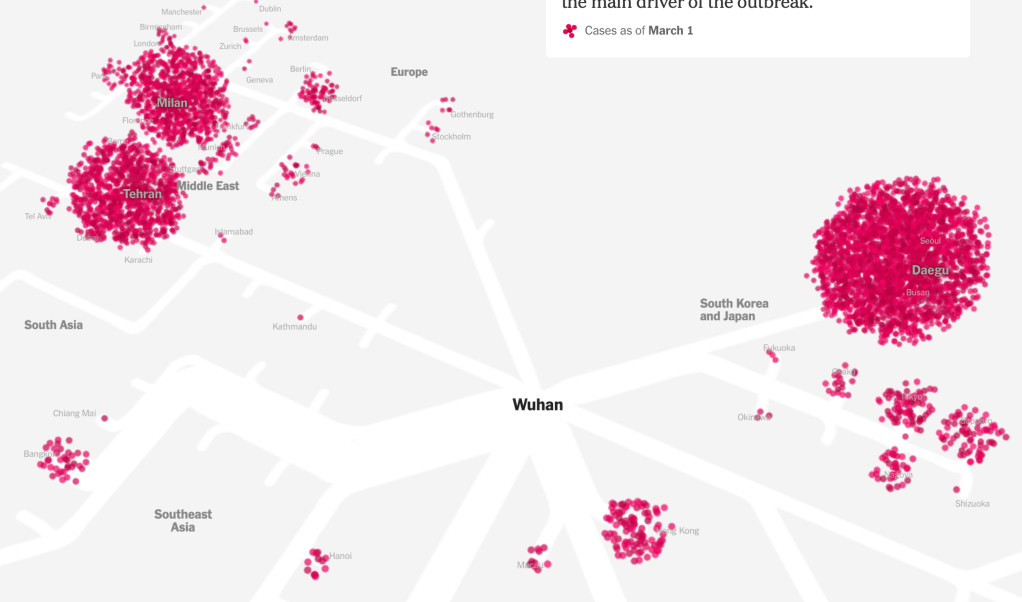
And it is ironic that distancing is the best mode to prevent infection–and many deaths may have been enabled by quicker decisions to adopt practices of distancing that could manage viral spread, Trump seemed not to notice that the very globalization he had resisted, and swung against with all his force to win votes, had facilitated the spread of a viral agent whose arrival was denied even as SARS-CoV-2 had already begun to flood the United States, in ways we only mapped in retrospect, as a global village that by March 1 had already grown satellites of viral loads in South Korea, the Middle East, Iran (Teheran), Europe (Milan; Gotheborg), South East Asia, and Hong Kong, as we anticipated its arrival with no health policy in place and no strategy for containing what was already on our shores. The global crossroads defied any choropleth, but we had only mapped the virus for some time in choropleths, as if believing by doing so we could not only map it by national boundaries to keep the virus at bay.
New York Times
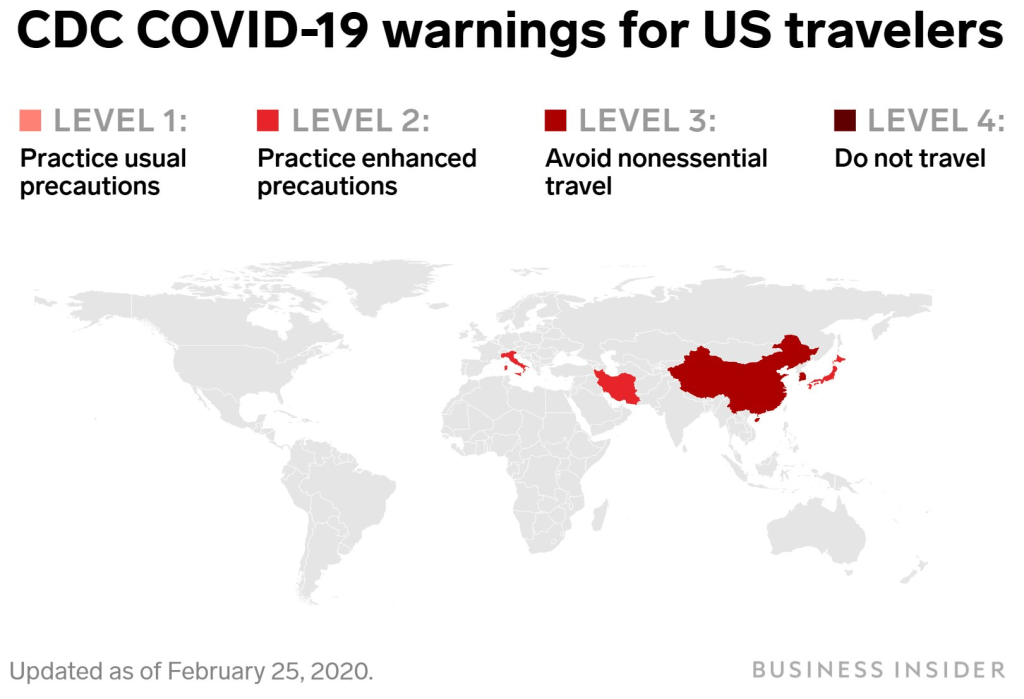
But if we lacked a model of infection and communication of COVID-19, we lacked a sense of the geography by which to understand its spread–and to map it–and also, deeply problematically, an inter-agency coordination to assess and respond to the virus’ spread as we sought to contain it: and in the United States, the absence of any coordinating public health agency has left the country in something like free-fall, a cluelessness emblematic by a map cautioning American travelers to take enhanced protections while traveling in Italy or Japan, two major destinations of travel, and avoid all nonessential travel to China, but refrained from ceasing travel plans.
1. The most compelling language of the novel coronavirus is “false positives” and “false negatives,” that seem to betray the unsure nature of standards; the most haunting is the multiple sites COVID-19 can appear in the sites of the body we use to map most disease. While we associate the virus with our respiratory tracts, the virus can do damage to multiple organ systems, as well as create blotchiness of “covid toes” due to burst peripheral blood vessels; it can damage multiple organ systems simultaneously, including the kidneys, heart, lungs, brain, and linger in our intestinal tract where it can flourish and proliferate; the virus can reduce the ability of our blood to form clots, or disable our ability to form clots. The ACE-2 receptor protein, a launching pad for viral infections, lies in our lungs and respiratory tract but in stomach, intestines, liver, kidneys, and brain. Increased sensitivities among those suffering from high blood pressure, cardiac disease, and diabetes reflect the nosological difficulties of classifying the virus as a cause of death or to grasp it as an illness, let alone to read data about the disease. If the virus lodges in the most delicate structures of the alveoli, which it causes to collapse as it infects their lining, it can take multiple pathways in the body, and as its pathway of infection may be multiple, medical response must be improvised with no playbook for clinical care.
All we know is that our medical staff desperately need protective gear. On top of that, it hardly helps that we are without a clear national policy, and find that the United States government has engaged in far less transparency that one could have ever expected.
We can only say its spread is accelerated dramatically by structures of globalization, and it stands to disrupt them. utterly Even as we map what seem total global knowledge of the disease, analogous to what we have come to expect from Global Positioning System, the multiple holes in our picture of the spread of the disease provide little sense of mastery over the pathways of communication, contraction, and infection we have come to expect from maps. These maps may even be especially disorienting in a world where expertise is often dismissed in the United States–not only by the U.S. President, but out of frustration at the inability to distance, diagnose, track or supervise the disease that is increasingly threatens to get the better hand. Have our visualizations been something of a losing battle, or a war of atrophy we will not win? Or do we even know what sorts of data to look at–indeed, what is information that can help us process a sense of what might be the geography of the contraction or the transmutability of the virus? Is the virus eluding our maps, as we try to make them? These sort of questions of making sense may be the process of science, but they trace, suddenly, a far steepder learning curve than we are used.
A dismissed biomedical researcher who ran efforts to develop a vaccine cautioned that we still lack that the failure a trusted, standard, and centralized plan for testing strategies must play a part in the coordinated plan “to take this nation through this response.” Dr. Bright, who was abruptly removed last month from his position as head of the Biomedical Advanced Research and Development Authority, bemoaned the limited statistics, alas, in large part as fear of providing too many tests–or fanning the flames of insecurity that testing might promote in the general public and in our financial markets, seem to have created the most dangerously deceptive scenario in which the United States seems to be committed to projecting confidence, even if it is the global epicenter of the pandemic.
Have we developed a language to orient ourselves to the scale of emergency in the spread of COVID-19? While we turn to images of natural disasters in describing the “epicenter” of the outbreak in Wuhan, this hardly conjures the species jump and under-the-radar communication of the virus that was not tracked for months before it emerged as a global threat. In tracking COVID-19 globally, or over a broad expanse of nations or states, we often ignored the pathways by which the novel coronavirus is spread in crowded spaces, where the single strand of RNA may hang in droplets that linger in the air, and are looking at the small scale maps to track a microscopic pathogen. But we are increasingly aware the spread of these strands, of the virus SARS-CoV-2, that infect populations along increasingly unequal fault lines that divide our cities, nations, health care systems, and crowding, or access to open space, are all poorly mapped in the choropleths into which we continue to smooth the datasets of infections and hospitalizations. While the problems are posed for national health services in each region, the devastation and danger of overloading public health systems and hospitals outweighs are local manifestations of a global crisis of the likes we have not confronted.
2. And the crowding of such numbers beyond the buffers that began with lead to a visual crowding by which we continue to be overwhelmed–and will have been overwhelmed for some time.
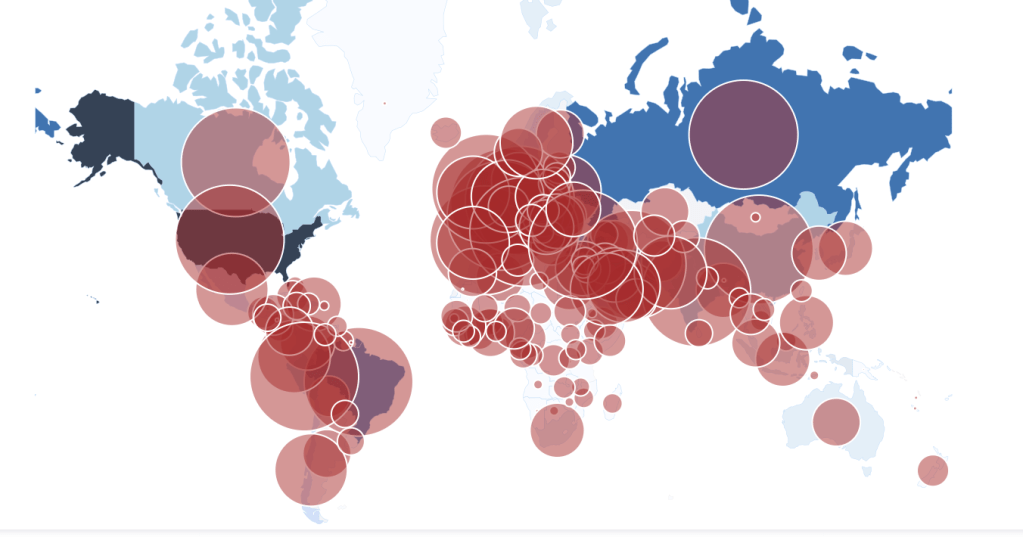
April, COIVID-19Iinfections Globally by Country/Clustrmaps May 12, 20202020
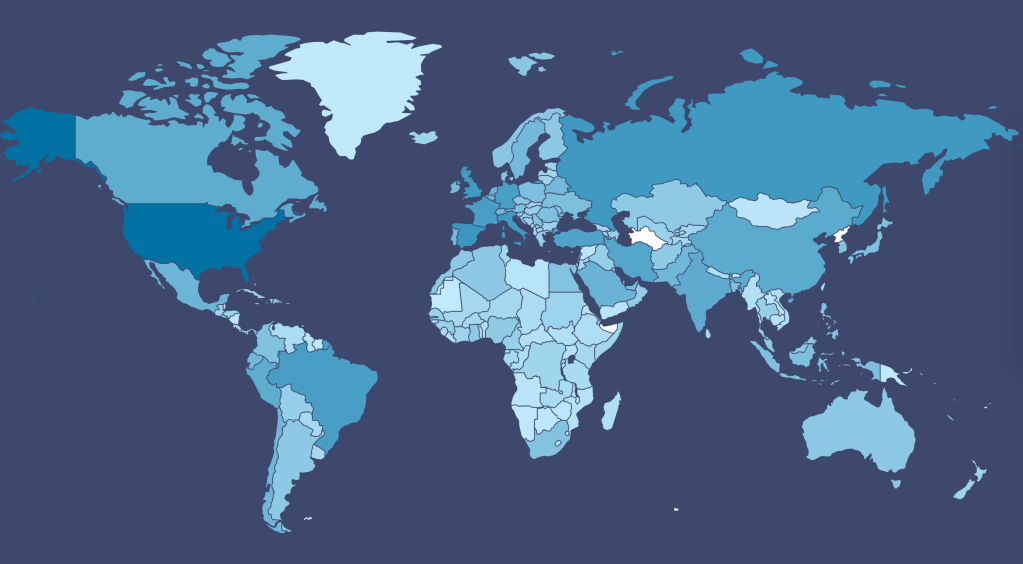
For although the global pandemic will clearly be with us for a long time, spatial narratives might be more likely to emerge in networks and in forms of vulnerability, in ways that might reveal a more pronounced set of narratives for how we can respond to a virus than the deep blues of even the limited and constrained datasets that we have, as we struggle against the blindness we have in containment and mitigation, and the frustration of the lack of anything like a vaccine. (This pandemic is almost a metastasis of the anti-vaxxers: confirmation that a vaccine cannot check a disease, it gives rise to concerns that vaccinations might have left us immunologically more vulnerable to its spread . . .and a sense that the hope of eradicating COVID-19 by the availability of a vaccination in four to five years will be widely resisted by anti-vaxxers and their acolytes, to whom the pandemic has given so much new steam. Yet as the virus interacts with the viral posting of anti-vaxxers resisting social distancing or collective policies of response, the stresses that exist in our society will only be amplified.) And if as late as February 24, only three laboratories in the United States did test for COVID-19–artificially lowering public numbers–even confirmed numbers through March and April were as a result tragically low. Could maps even help to track the disease without a testing apparatus in place?
Global Covid Infections/Datascraped by Avi Schiffman, May 11, 2020
The prestige of the data visualization has been a basis for reopening the nation. Yet if less than a tenth of the world’s population has yet to be exposed to the disease–and perhaps only 5% of the American population, in one estimate, if not lower–the virus is bound to be endemic to the global landscape for quite a considerable length of time. At the same time, one must wonder if the many fault lines that have created such peaks and valleys in the virus’ spread, if confirming its highly infectious nature, to be sure, are not removed from us in some degree by the smooth surfaces of the screens on which we watch and monitor, breath bated, with some terror, its spread, unsure of the accuracy or completeness of the data on which they are based but attentive to whatever they reveal. In many ways, these maps have created an even more precarious relation to the screen, and to the hopes that we find some sign of hope within their spread, or hope to grasp the ungraspable nature of COVID-19.
These datamaps suggest a purchase on a disease we don’t understand, and we don’t even have good numbers on contraction. Yet we are discussing “reopening” the United States, while we do not have anything approaching a vaccine, let alone the multiple vaccines that medical authorities desire before resuming social contact at pre-pandemic levels. How to process the data that we have, and how to view the maps not only by hovering, zooming in, or distancing the growing rates of infection, but tracking the virus in spaces, mapping levels of infection against adequacy of testing, mortalities against comorbidities, against with the chronic nature of the virus must be understood, as well as levels of hospitalization levels; and distinctions or mutations of the virus and against age ranges of afflicted–by, in other words, drilling beneath the datasets to make our maps’ smooth surfaces more legible, as horrifying as they are?
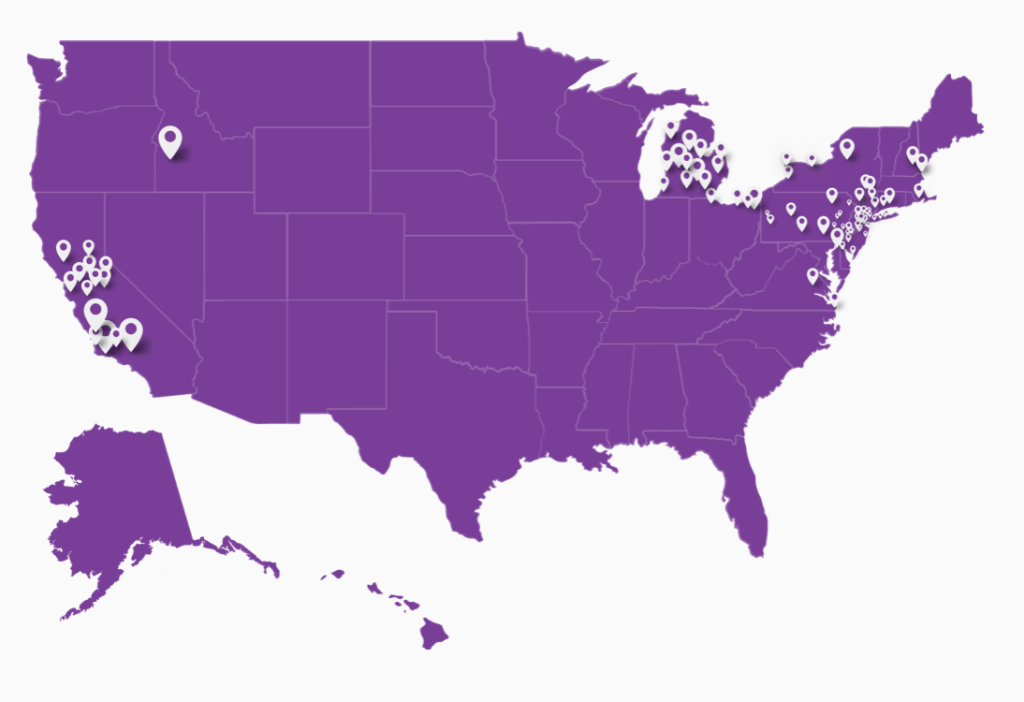
Can we use what we have to pose problems about the new nature of this contagion we don’t fully understand, but has been mapped in ways that seek to staunch fears of a decline in the stock market, as much as an emergency of public health, with up to one third of the population at risk of infection? The instinctive reaction of the Trump Health and Human Services to create public-private “community testing sites” for drive-thru or drive-up testing at Walgreens, CVS, Rite Aid, Kroger and other pharmacies seems reflexive for a government wanting to minimize federal overhead, but a far less exact means, and a far less intuitively sensible basis to attract potentially infected individuals to sites of public congregation. The hope of Verily–a subsidiary of Alphabet, whose Project Baseline boasts the slogan, “We’ve Mapped the World, Now Let’s Map Human Health,” in a bizarrely boosterish rhetoric, aggregates medical for medical screening in California–
Select States for Project Baseline Testing/Verily
–and select states–was the primary response that Trump had promised of a network of drive-up testing sites that has never materialized, even as it expanded to a hundred sites in thirty states. After Walmart opened two sites, and Walmart 40, the difficult accuracy of creating multiple testing sites was prohibitive, the testing sites that were rolled out with the assistance of private entrepreneurs that Jared Kushner enlisted, that filled the absence of any coherent public health response–perhaps, terrifyingly, in concert with his brother’s health care company, Oscar, which also partnered with CVS and some of the same pharmaceutical services, focussing on drive-thru sites more than sustained medical care, focussing largely on calming retailers who feared the arrival of infected patients on their parking lots, more than on the efficacy of testing, which they didn’t understand. If only 40% of promised test kits were made available, the absence of providing staffers or selling, as in Massachusetts, self-testing kits–and failing to provide many in large cities like New Orleans, as if to keep the final tally of infected artificially low. Even if the Center for Disease Controls had never done clinical tests on hydrochloroquine, whose dangers on humans were not studied, and despite some benefits of the antiviral on cell cultures, none appeared in mice, the drug was promoted widely on social media as late as April, although its mention on Twitter grew, even as the government delayed any roll-out of testing sites.
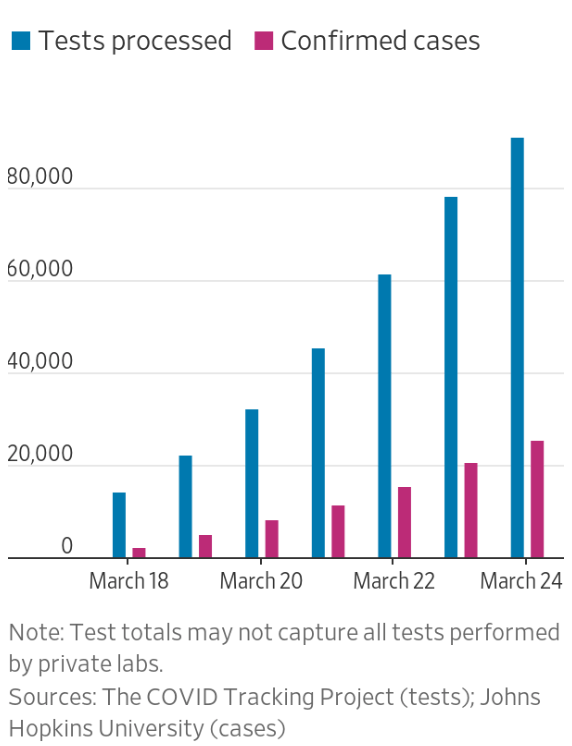
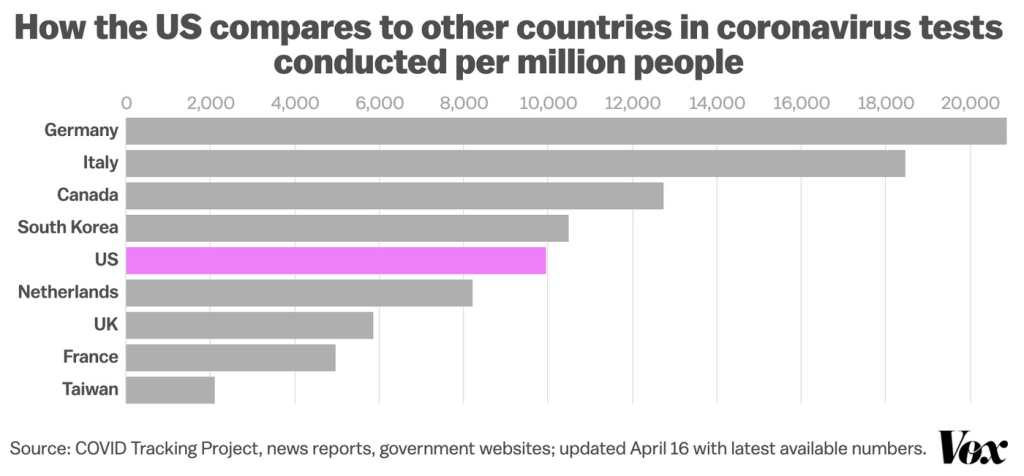
The demand to calm the nation, a position dangerously close to concealment, delayed action on a wave of infection that President Trump had long sought to deny, claim to be overblown, or call Fake News. The lack of a public testing initiative, and rejection of the tests of other nations, forced the United States to adopt a disorganized go-it-aloneist approach, akin to isolationism, not benefiting from the potential ties to Chinese doctors’ response, or the testing kits that would have been available that the World Health Organization (WHO) had suspected since January, and made test kits for poorer countries that might be replicated in the United States–which chose to make its own tests to ensure the highest quality. When WHO had urged countries “test, test, test” for the coronavirus to contain its spread, the global health organization provided 1.5 million tests to 120 countries who lacked the ability to test by March 16; the United States went without the diagnostic tests developed in Berlin by la Charité, implemented in Germany. If the United States had submitted a test to WHO as well, the German test the health organization adopted was never used or ordered–and by mid-March processed a sixth the specimens as in Italy, with found over six times as many cases, and an eleventh as in South Korea, which found double the cases.
By April, the picture had improved, but not much.
COVID Tracking Project (Data)
And based on later data of the virus that spread to other American cities, the virus that had infected so many in New York seems to have spread to other American metropoles by May, as we were still awaiting broad testing.
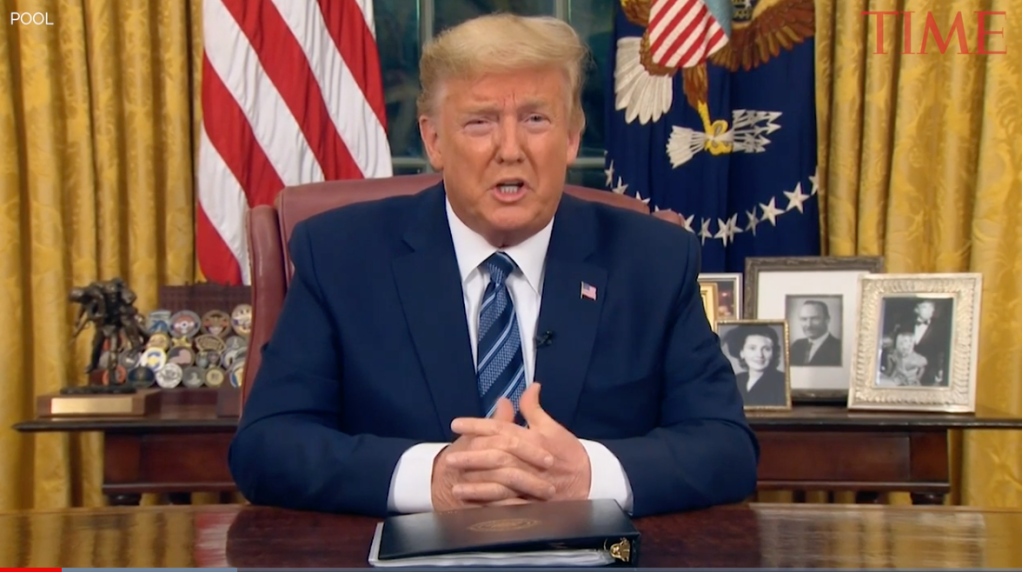
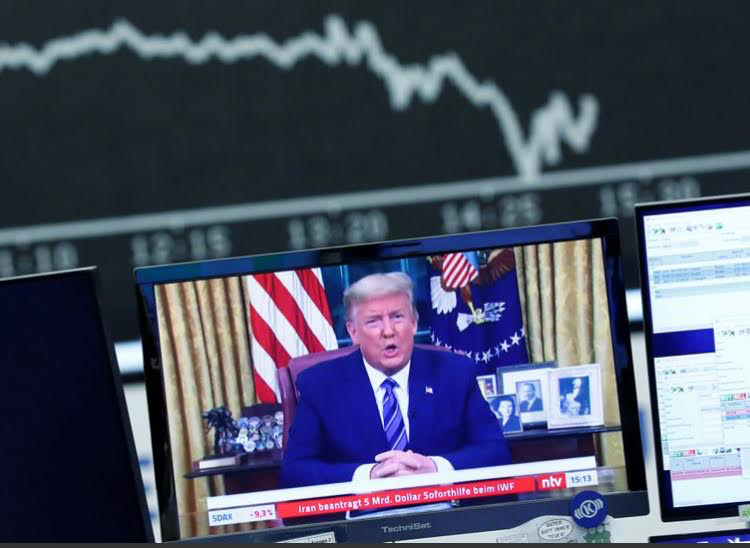
The forced monotone of Donald Trump’s public address to the nation on March 12 was a striking contrast from his most recent State of the Union address. He sought to calm the nation as it faced the pandemic of the novel coronavirus COVID-19 in what was perhaps his most important public address. On the verge of breaking beneath the gravity of circumstances that spun far out of his control, however, rather than show his customary confidence, Trump seemed a President scrambling and in panic mode trying to rehearse stale tropes, but immobilized by events.
President Trump tried to look as presidential as possible, re-inhabiting a role of authority that he had long disdained, as he was forced to address a nation whose well-being he was not in control. The national narrative, as it was begun by WHO’s declaration of a pandemic, was perhaps seen as a narrative which seemed to spin out of his control, below his eyes, as he tried to calm markets by addressing the nation in what he must have imagined to have been as reassuring tones as he could summon. With his hands grasped but thumbs flickering, as if they were a fire under which he sat, as if he were wriggling like a kid strapped in the back seat of a car where he was a passenger to God-knows-where, wrestling with the increasing urgency that his aides demanded he address the outbreak of the virus in the United States that he had long tried to deny. Serial flag-waving continued to fuel President Trump’s attacks on China and the World Health Organization, as if trying to toe the line of adherence to America First policies of nationalism before a global catastrophe, that did not compute. If America First as a doctrine allows little room for empathy, affirming national greatness and the importance of a logic of border closures was all he could offer, and would be predictably lacking reassurance or empathy as he attempted to create a connection at a defining moment of his Presidency, but looked particularly pained.
March 11, 2020
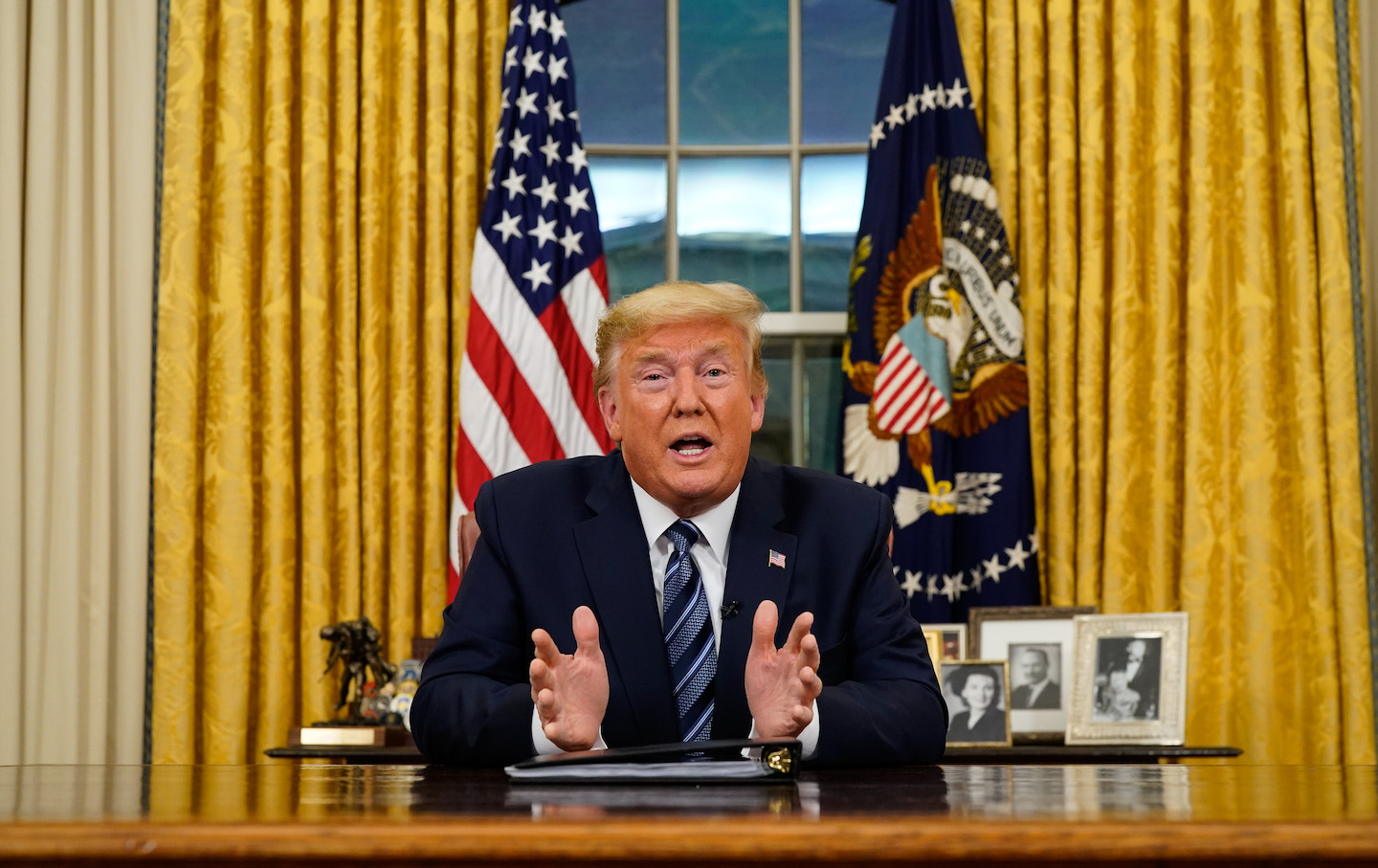
If Trump rarely trusted himself to make hand gestures as he plighted through the speech, thumbs flickering, hands clasped, he every so often seemed distinctly out of synch with his austere surroundings, gold curtains drawn to reveal two flags, barely aware, perhaps, that the eyes of the world were very much on his performance in this new sound studio to which he was not fully accustomed, trying to explain that he had undertaken measures that had made us safe, even if he must have been worrying that the lack of worry he had been projecting and urging in previous weeks had risen across the nation, and his performance was not calming them at all. He was tasked with describing the vulnerability of the nation to the novel coronavirus whose effects he had downplayed repeatedly, but was no longer able to dismiss, and no longer able to concede posed a far greater threat to the American economy than the danger of “illegal” migrants he had so often pointed to as a cause of national decline: the virus that had already crossed our borders repeatedly, since the first cases of COVID-19 were diagnosed in San Jose and Seattle, would potentially bring down his presidency, and he lacked any ability to explain the scale of the effects of the virus that he had effectively helped release by ignoring warning signs.
Oval Office address of Wednesday, March, 11, 2020. Doug Mills / The New York Times)
The link of America to the world defined in his America First candidacy–even made the very identification of a pandemic difficult to process. And he did so in the starkest national backdrop possible, vaunting his closing of borders, suspension of “flights” from China, and ties to Europe–even as he encouraged Americans to return from abroad, and had allowed unmonitored entrance of Europeans and world travelers into New York that would make it the site of the entrance of the disease to the majority of American cities where the viral load arrived, with over 900 people entering America through New York daily for months after China suspended travel from Wuhan on January 23–after China called the outbreak “controllable” on New Year’s Eve. The declaration that echoed the concerns of the World Health Organization may have been buried in global celebrations, even as Trump blamed it for starting a sense of false complacence before undeniably “real” news that he feared would come to define his Presidency.
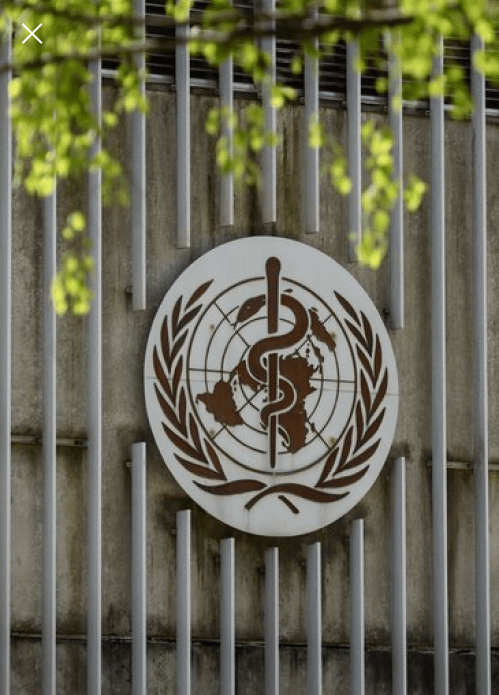
Trump was unable to accept declarations of the World Health Organization had just called the coronavirus outbreak–an outbreak which, we now know, he had in fact been hearing alerts from American intelligence as early as November 17, about the outbreak of cases of the novel coronavirus in Hubei province, rather than January, when initial infections in the United States were reported. As much as Trump found it difficult to admit the vulnerability of the United States to a global pandemic–or to the recommendations issued by WHO–who set the caduceus that symbolized medical ethics authority over the North American continent–at which he bristled at the notion of a global scope of edicts across boundaries, as if a map where national divides were erased as if it compromised national authority for a disease the President has been uncannily persistent in localizing in China, even before an increasing preponderance of evidence of its global circulation and transmission over a series of months.
Fabric Coffrini, AFP
As cascading fears grew in markets across the world, Trump was perhaps forced to realize his new relation to the world, even as the German stock exchanges plummeted as the measures he announced seem either difficult to process, or failing to address the importance of maintaining trade ties–or of taking adequately prudent steps of public health.
Slumping in his seat at the Resolute Desk, perhaps contemplating how no predecessor had ever delivered on air unprepared remarks from the desk, and visibly discomfited in doing so. He must have hoped to make up for his televised performance by sending surrogates scrambling to social media, issuing clarifications for misstatements–as the exemption offered U.S. citizens to return from China, or the exemption of Ireland, as well as England, and an assurance that trade would “in no way be affected” by the ban, as markets had reacted poorly to his performance. While it seemed that Trump was cognitively unable to process the possibility of a crumbling American economy–and a decline of America’s place in a global economy–under his watch, a prospect faced since he had met with airline executives with whom he discussed the effects of stopping flights of foreign nationals from China in a March 4 meeting, offering them a bailout that limited the impact economic effects of heightened travel advisories, is it possible he had no sense of the massive fallout on the national economy?
March 11 Address/Ralph Orlowski/Reuters
As Trump spoke, global markets not only failed to register confidence–but plummeted, as he revealed no clear plans to to call for social distancing to contain the spread of the virus, and revealed that lack of national preparation for confronting an infectious disease that had no vaccine. He may have remembered that he had outright fired a former cabinet member, barely remembered in the rogue’s gallery of administration, Tom Bossert, who had demanded preparedness “against pandemics” and a “comprehensive biodefence strategy” of the sort the previous administration of Pres. Barack Obama had tried to institute, or that a simulation of a pandemic that could devastate the American economy and kill up to half a million revealed in October 2019 “just how underfunded, underprepared and uncoordinated the federal government would be for a life-or-death battle with a virus for which no treatment existed.”
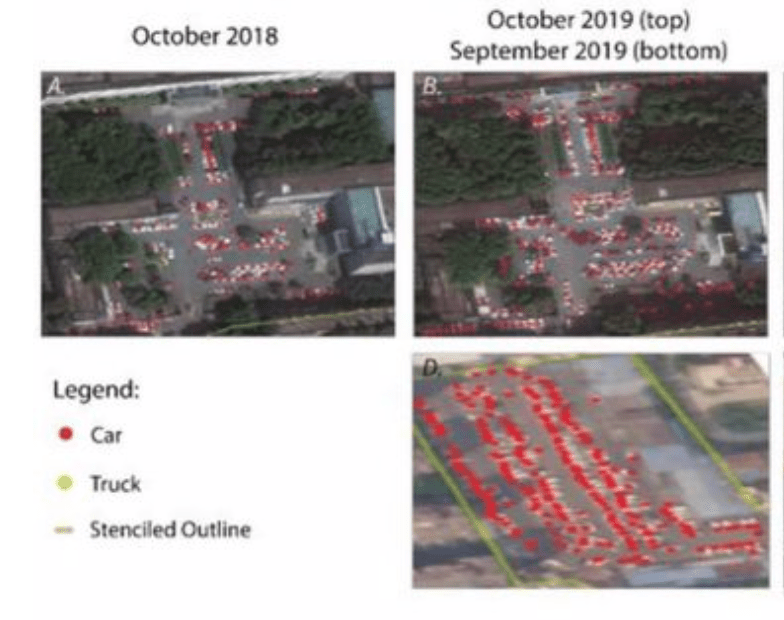
It seems likely he was rather trying to conceal the massive scale of lying to the nation about the effects of an economic downturn unprecedented in scale, but which the increased lines at Wuhan’s Tianyou Hospital the previous November had already indicated had a problem of infectious diseases on their hands that would have a potentially global consequence. Trump tried to spin the consequences as purely local, in an unprecedented wishful thinking whose scale of deception far exceeded the pathological deceits he had long taken to perpetrate on investors, business partners, and even on family members–from hiding his older brother’s treasured trucks that were a Christmas gift and then admonishing him not to cry, or he would destroy them before his eyes. Even as satellite imagery showed a clear rush to hospital emergency rooms in Wuhan in November, as clusters of cars marked in red crowded the emergency rooms that revealed “a steep increase in volume starting in August 2019 and culminating in a peak in December 2019,” when China began epidemiological investigations that led to identifying and sequence of the novel coronavirus by January 12, ten days before the city went on lockdown to contain its spread.
Annotated Satellite Photographs of Wuhan’s Tianyou Hospital in September 2019
While Trump registered no alarm at the arrival of the very pandemic whose global impact American simulations feared would cripple the national economy, he tried to offer spin on having closed borders to the virus, as if it were not already diffused within the country, in a mind over matter sort of exercise that suggested limits purchase on reality, as if he was able to recognize the risk earlier administrations had identified as a national priority.
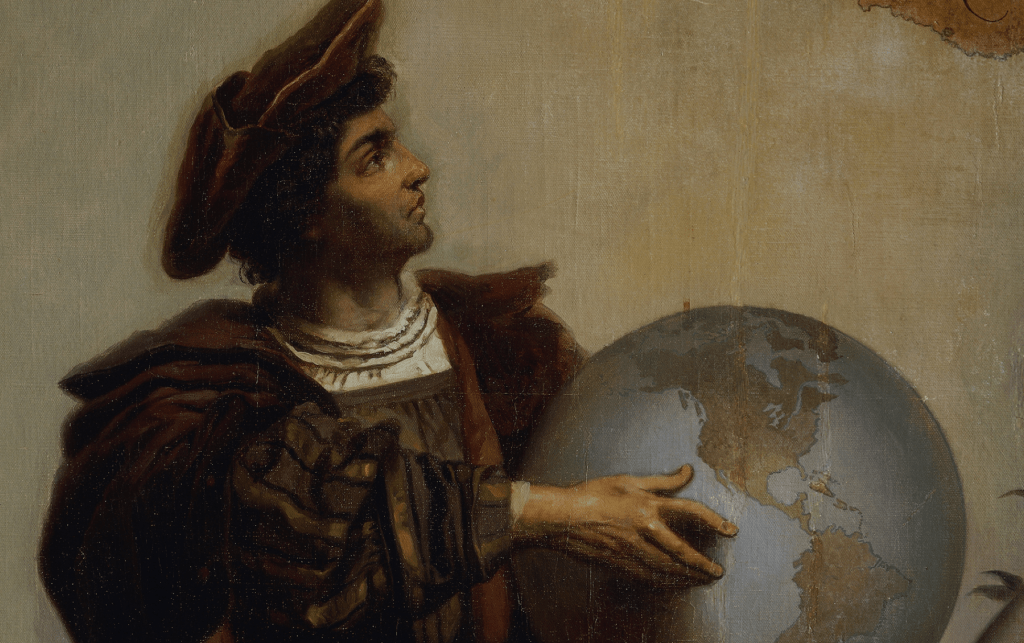
Commemorating Christopher Columbus’ transatlantic voyages in a “discourse of discovery” has been magnified as they have become a bit of an exercise of collective remembering and of world-making. For Columbus monuments are less markers of fifteenth century voyages, than they serve to frame a range of narratives of discovery that promote the fifteenth-century navigator as an icon of nationhood that were foreign to the fifteenth century. In making claims for the foundational role that the navigator’s transatlantic voyage, they create a new narrative of nation, particularly powerful for its ability to occlude and obscure other narratives, and indeed the presence of local inhabitants in a region, so that they assume the deracinating violence of a map: as claims of possession, and indeed mastery over space, they dislodge nativist presence in a region, much as Columbus did as a royal agent, glorifyinf the acts of renaming, and taking possession of, the new world to ally the viewers with the heroism of the Genoese navigator’s foundational act of taking possession of the New World. The heroics posture of Columbus, until the recent spate of decapitated statues revealed a long simmering anger at the canonization of this figure as a founder of the nation, suggested a model of a white America, an erasure of indigenous inhabitation, and an outrageous lie.
Columbus set the basis for such grandiose claims, perhaps, by staking the transatlantic “colony” La Navidad as the first settlement by Europeans of the New World on Christmas. The event’s commemoration has continued in statuary across the Americas, even if the thirty-nine settlers left behind in the settlement were all massacred by natives after their ship, the Santa Maria, was dismantled after it hit a sandbar, and the men of the lost caravel that ran ashore on a sandbar off the island Columbus had auspiciously renamed Hispaniola, as evidence of Hispanic claims to sovereignty for his patrons, its hull and crossbeams converted to a fortress that was later burned to the ground. While the crew left with a translator who were instructed to collect a store of New World gold as they awaited his return may have been overzealous in courting natives that they were all killed, the extraction of riches and wealth and slaves motivated the New World settlement.
Yet in the commemoration of Columbus Day, the landfall has been renarrated as an inspired revelation of new lands, and allied with a sense of manifest destiny in retrospect, foregrounding the imperial mission of laying claims to new lands under the eyes of God. Yet the elevation of Columbus as a figure of state, and a westward course of empire, was magnified only in the nineteenth century. Paradigmatically, the painting of Columbus taking stock of his arrival by Dióscoro Teófilo Puebla Tolín, staged before uncomprehending natives cowering offstage, occurs as a missionary raises a cross on verdant shores where sailors triumphantly raised recognizable standards of the Spanish sovereign in the New World.
Dióscoro Teófilo Puebla Tolín (1832-1902), First landing of Columbus on the shores of the New World, at San Salvador, W.I., Oct. 12th 1492, re-rendered by Currier and Ives, 1892/Library of Congress
The bucolic image of arrival was cast as a triumph of technology, civilization, and deliverance. The bucolic scene not only denied violence, but was an image of paradisal promise that Dióscoro Teófilo Puebla Tolín rendered in a manner widely reprinted in the lithograph of the commemorations of quadricentennial celebrations of 1892 as a narrative of westward expansion of Manifest Destiny. The recent re-questioning of Columbian commemoration as a common national identity led to the questioning of commemorative Columbian statuary across the United States, from Columbus, Ohio to San Francisco to Kenosha, WI, to Miami. As the statues were dislodged from the common memories of an Italian-American community–as many once were in New Haven, Boston, and Philadelphia as well as New York City–their place loosened in a narrative of nation in ways that needs to be told. This was a narrative quite unlike how Michel de Montaigne bemoaned the manner Iberian voyages as occasions of devastation,and extraction had so needlessly left so “many goodly cities ransacked and razed; so many nations destroyed and made desolate; so infinite millions of harmless people of all sexes, races, states, and ages, massacred, ravaged, and put to the sword; the richest, the fairest, and the best part o the world topsy-turvied, and defaced for the traffic of perils and pepper.” Montaigne’s deep discomfort wit the global catastrophe that was driven by greed cerated an economic and epidemiological devastation in their wake were substituted by a massive hulking bronze Columbus, standing as if a champion of Christianity that would be a gift from Moscow’s mayor to the “free world.” Driven by increased recognition of the truly genocidal destruction of indigenous in the moment of contact, the term “genocide”–long reserved for the Holocaust but increasingly applied to the destruction of indigenous peoples in Guatemala, Bolivia, and Argentina in Latin America–led to the recognition that Columbus’ unqualified heroism needed to be qualified.
It was in this context that the monument of Columbus that Trump mediated as an erasure of the collective memory and of the past in the americas. The burst of creative iconoclastic energy directed to statues of Columbus left San Francisco’s City Arts Commission preemptively removing the monument to Columbus overlooking the Pacific from its monumental pedestal in order to maintain the local peace–a statue long defaced in recent years–before it was defaced. The recent removal of monuments to Columbus spread as a re-tallying of moral accounts, but a restoration of civic peace. The importance of refiguring the commemoration of colonization grew as a form of reparations whose logic was unmistakably national in character,–if the first questioning of Columbus Day had been local and selective in 1992-3.
The deposition of the 4,000 pound bronze statue of Columbus to a holding container channeled the rejection of the figure of Columbus whose monuments were already deposed in Boston, St. Paul, Minnesota; Camden, NJ; Richmond, VA, and other cities in New York state, one of which was beheaded–if long after the statue to the navigator was ceremoniously pushed into the ocean in 1986, in Port-au-Prince, Haiti, with a placard “Foreigners out of Haiti!” And by 2020, the ease with which statues of Christopher Columbus were assimilated to the confederate monuments preserved across many southern states–and preserved at considerable cost to American taxpayers–reminded us of how easily the memory of Columbus as colonizer was cultivated among white supremacists as iconic testaments to a sense of historical security of another era we were trying to pry ourselves free in hopes to gain distance on. Even if the statues of Columbus and Columbus commemorations are overshadowed by the razing of the statues of Confederate generals in recent years–
Southern Vision Alliance, Confederate Monuments Removed since George Floyd’s Murder
–the images of the dicsoverer were dismantled as we engaged a contested legacy. If monuments removed with an eye to toppling racism across southern states that had commemorated secession in the attempt to defend enslavement and chattel slavery were a stain on the nation that emerged like a return of the repressed in the summer after George Floyd’s murder by overly zealous “law enforcement” forces, the removal of monuments had begun as undeniable evidence of their talismanic status as lodestones for white supremacy became clear after violence in Charlottesville directed attention to the degree to which commemoration of the Confederacy kept a memory alive in national and local consciousness, revealing how undecisive the Civil War was for the preservation of local memories across many border states or secessionist states, and the toxic nature of preserving memories of southern secession as a defense of what were cast as local liberties within the union.
The division assessment of historical legacies that shape a narrative that informs the present landscape of inequity had been contested for decades around the heroicization of the figure of Columbus as a shared national point of reference. As much as the seven hundred and eleven standing monuments of commemorating secession–over 1500 statues which are collectively preserved by taxpayers’ money at a cost of $40 million for annual upkeep. The standing statues dedicated to anti-abolitionist figures have kept the memory of the Confederacy alive across the United States, including of Jefferson Davis and Robert E. Lee in Virginia, Georgia, North Carolina, and Texas, creating a topography that has inflected political identities.
Donald Trump was savvy if hateful to tap this energy of amnesia, during his first Presidential campaign in 2016. He re-presented himself as an incubus already planting seeds across the land, many of which were only removed by energized (and disgusted) protestors or whose remove was ordered by city councils in an attempt to preserve the local peace–including of the unidentified heroic “Confederate soldier” who removes his hat in downtown Alexandria, VA, removed only in June 2020–if similar statues remain in Jacksonville FL, and San Antonio TX, heroizing as if sanctioning the very option of local resistance to according rights to enslaved populations, beyond preserving memories of war dead. The confederate statues were long mythologized as an alternative system of justice, echoing the reduction of rights and civil equality across the landscape by holding up a distorting mirror of Southern victory and secessionist pride, gaining legs as grounds to advocate an outdated status quo reflective and constitutive of an alternative order unto its own, as is evident in the naming of courts of law after Confederate names.
The spattering of blood on Columbus memorials call for a revision of public memory complicit in a culture of spatial colonization that perpetuates the fundamental nature of racial hierarchies. The requestioning of commemorating the act of violence as fundamental to the nation’s values is a questioning of their place in civil society, and their meaning to the nation, motivated in no small part by the ugliness with which they have been seized with new currency as images justifying a racial superiority and sanctioning the violence of enslavement along racial lines. For their removal had tried to call attention to the dangers of commemoration by targeting the figure of Christopher Columbus, whose statues had first multiplied across American land in roughly the same era of the later nineteenth century, following Confederate statues, in a sort of monument trick that served to naturalize white possession of indigenous lands.
The overturning of commemorative statues of the fifteenth-century navigator so deeply dissonant to our sense of national belonging, common memories, redressed disturbingly long-lasting spatialities–the average statue was almost a hundred years old–as the nation entered a temporal loop of recursive nature of reparative bent, as the destiny Columbus imagined for himself as a civilizer and discoverer of a New World–and new continent–emerged in increasingly pressing ways, opening up the very speech act of taking possession of the Americas as a fiction, only masquerading for utilitarian ends as a binding legal precedent. For only by confronting the painfully exclusionary nature of such an act of taking possession, deriving more from the practices of enslavement and mastery of others that run against the very basis of our own civil society, or the civil society we seek to create.
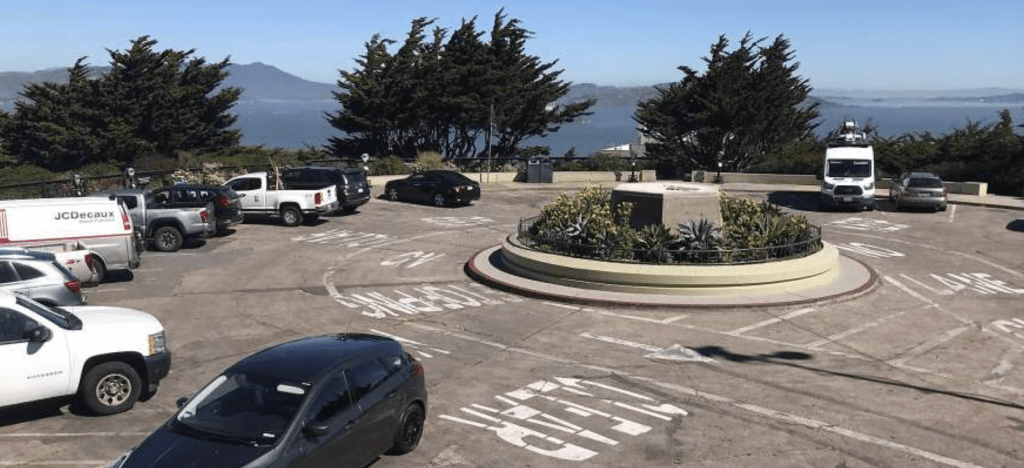
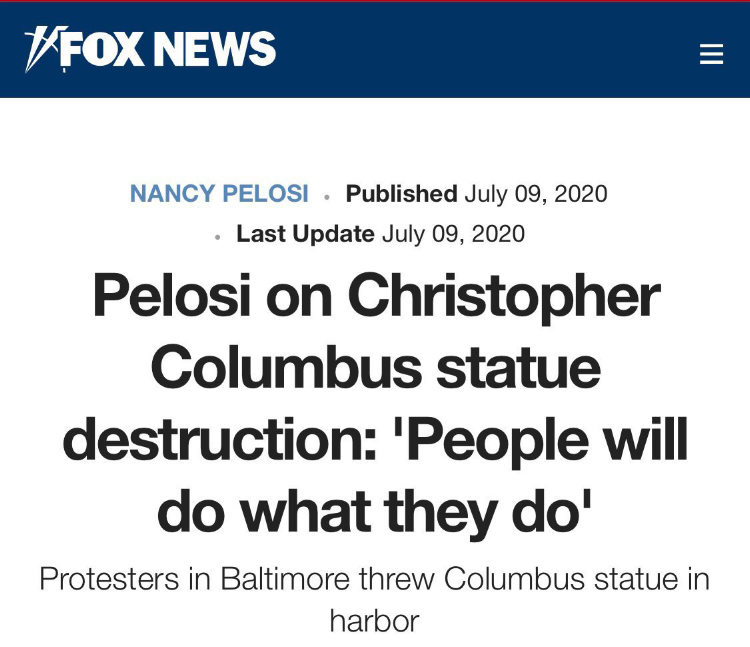
Indeed, the San Francisco’s 4,000 pound commemorative statue of Columbus, often defaced as a symbol of enslavement and subjugation in recent years, was removed by a crane and as a call to dump it into the Bay was circulating, on Thursday, June 18, removing it from a scenic site by the Pacific beside Coit Tower, leaving an empty pedestal, perhaps to reduce the need to clean up a statue that had been repeatedly defaced in recent weeks but also to show consensus about lack of interest in defending a symbol of oppression, enslavement, and colonial violence, and public outbreaks around the call to depose the statue off Pier 31, not as a symbol of colonial resistance, but an expunging of the navigator from national history. All of a sudden the dismantling of public memories of Columbus’ heroism were national news, a divisive issue responded to not with understanding but professed shock for besmirching American history, not reassessment of values, battling Italian-Americans Nancy Pelosi herself as forsaking, as if to bemoan her betrayal of the preservation of the hallowed memory of Christopher Columbus in the summer of 2020 to stoke lines of political division in the heat of the 2020 Presidential campaign: the fate of the statuary of Columbus was a bell whistle for stoking fears of a danger to the status quo.
It was as if the spontaneous prominence across the nation of memorials to George Floyd, proliferating on street walls in full color, and in haunting offset likenesses, provoked introspection demanded introspection of what sort of memorials we identified with and wanted to see the nation, placing on the front burner of all the question of commemoration in terms that had long been glossed over and tacitly accepted. The questioning of commemoration after Floyd’s murder came to articulate a spontaneous rebuke of the continued validation of racialized policing and police violence, throwing into relief discriminatory monuments. There were soon few defenders of the monument able to tolerate how they emblematized division of the social order, eager to ask us to situate Columbus more broadly rather than historicize his complicity in “some of his acts, which nobody would support,” without addressing the framing of the logic of “discovery'” in imperial narratives of conquest and disenfranchisement of indigenous claims to sovereignty and to recognize the need for reparations.
For the navigator embodied an imperial relation to space and terrestrial expanse, discounting the inhabitants of regions, and affirming the abstract authority of sovereign claims and sovereign expanse, however improbably early maps placed the islands in the Caribbean–later called Hispaniola–based on his conviction that the Atlantic Ocean was able to be traversed, enabling transatlantic voyages for which Spain was well poised to expand commerce far beyond the coast of Africa and the Mediterranean for economic ends in an “Enterprise of the Indies” that Columbus proposed to John II of Portugal, before he set out to claim the new lands for Ferdinand and Isabella. The longstanding embedded nature of Columbus in a discourse of claiming land–a discourse from which he was not only inseparable, but embedded maps in claims of the administration and supervision of lands far removed from seats of terrestrial power, a map-trick that has been celebrated since as a form of inscribing territorial claims on a piece of paper or globe.
And if Columbus had no actual idea of the form of North America, the persuasiveness of fictive reimagining of his mastery over space–a mastery cast almost uniformly in intellectual terms, rather than in military terms of disenfranchisement or enslavement–provided a logic that is aestheticized in the monument as a mode for the possession and persuasion of possession over terrestrial space more akin to American hemispheric sovereignty in its open heroizing of a national geopolitics of the 1890s than to a Renaissance discourse of discovery–comparable to the reimagining of hemispheric sovereignty in the years after the 1867 withdrawal of Spanish sovereignty to Mexico.
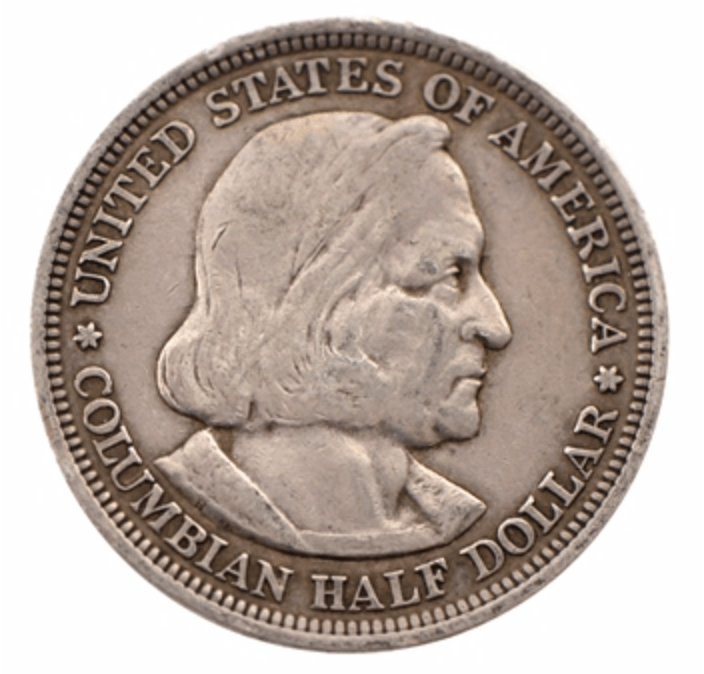
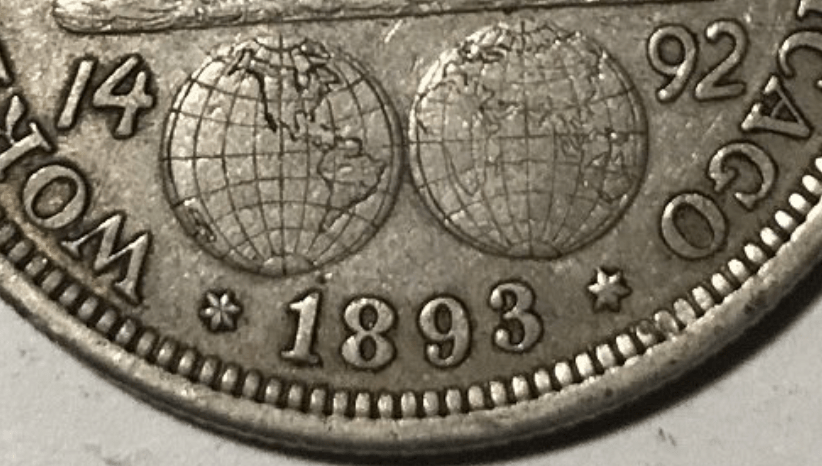
The origins of these reframing are perhaps obscure, but lionizing Columbus was always about rewriting the American narrative, and distancing one race of immigrants–the Italian migrant–from the very native inhabitants that the story of Columbus displaced. The navigator was promoted actively as a figure of national unity in the post-Civil War centenary of 1892, in which Columbus assumed new currency as a national figure, a map on silver able to enter broad circulation as a memory for how a three-masted caravel mastered terrestrial expanse, resting above a hemispheric map of global oceanic expanse. The anachronistic map suggests as much a modern triumph of hemispheric cartography–the coastline of the United States was surveyed by geodetic terms and that established the role of the United States Coast and Geodetic Survey in producing maps of uniform toponymy and hydrographic accuracy had only recently set standards of coastal surveying that unified triangulation, physical geodesy, leveling, and magnetic of authority within the US Navy to produce coastal maps of the nation extended from the Gulf of Mexico to the Alaskan shoreline.
The imperious gaze of the limp-haired navigator seems the first self-made man as he gazes with gruff determination on the coin’s face, almost entirely filing the surface of the first American coin bearing human likeness. Columbus was an icon it identified with how the hemispheric map took charge over a continent, and gave a sense of predestination to the recently settled question of continental integrity–and a territorial bounds that new no frontier up to Alaska, whose coast had been recently surveyed, and much of Florida and the Gulf of Mexico. Its design for the Chicago Word Exposition suggest a hemispheric dominance reflecting the growth of Rand McNally in Chicago, a map-publisher for America, as well as the self-assertion the United States as a hemispheric power, as much as the Genoese navigator about whom so many meanings have encrusted.
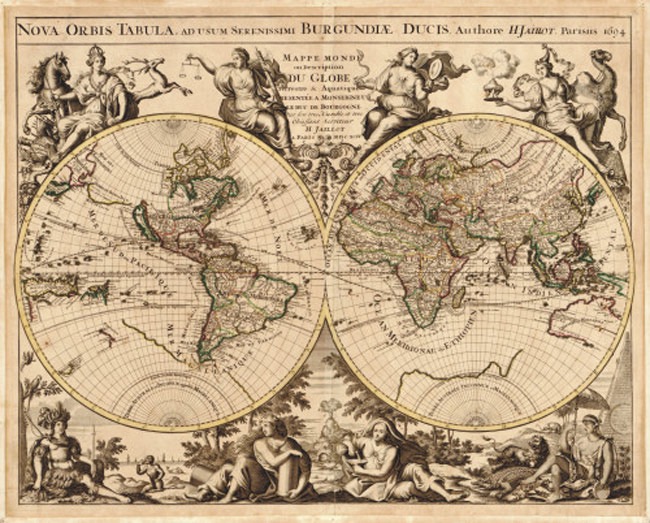
The striking hemispheric map of global navigability on the obverse of the coin circulated in Chicago’s World Exposition was global, but would also mimic the claims of hemispheric dominance that the hemispheric projection recalled, prefigured the Pan Am logo, in its global in reach–as if the image of a spherical projection devised by Rand McNally that spanned the globe and erased all borders might be cast as the seedbed for globalization was itself contained in the transatlantic voyages of the small trade ships, the Pinta, Niña and Santa Maria that were led with hopes of a profitable economic voyage with Columbus at the helm. (Rand McNally had not only sponsored the world’s fair, but its double spherical projection that recalled Columbus’ conviction of a spherical world by ahistorically featuring a cartographic design Columbus would have known; the planar projection was an icon of global expansion and conquest, more detailed in coverage than late seventeenth century double spherical projections.
–but devised and issued its own elegant version of a world map based on the Mercator projection in following years from 1895, in atlases issued subsequent to the World’s Fair, to meet a growing market for global maps. Leaving much of the African interior unmapped, in a manner that cannot but recall Conrad’s Heart of Darkness, the image is a confirmation and announcement of global triumph, centered on the North American continent and United States, if it shows the world.
Rand McNally Global Map based on the Mercator Projection (Chicago and New York 1895)
What seemed a terrible corrosion of public discourse before the mid-term elections is difficult to attribute to any single cause, person or a single election cycle. The ominous staccato of alarms at the arrival of improvised pipe bombs sent by mail to prominent Democratic party figures and Trump critics were readily visualized across the nation as a disruption, the degree to which the man who had sent them, Cesar Sayoc, existed in a hermetic world of Trump slogans made the map of destinations less relevant in comparison to their relation to the toxic tweets our nation’s President has directed to immigration as a threat to the national security.
Raising the specter of criminals and aliens–and profiling all refugees as criminals for crossing the border illegally–as an invasion of our territory, even if no members of the Caravan had approached the border, the Commander-in-Chief allowed it was not ‘conceivable’ the Caravan did not terrorists from the Middle East among their midst–and exposed the nation to a disconcerting word salad of apparent free associations in which “caravan after caravan” would be invited to enter the nation should Democrats gain majorities in mid-term elections, foretelling “a blue wave will equal a crime wave” in late October in clear attempts to disconcert and disorient in a haze of heightened paranoia in time for Halloween, not protect our national security. But the specters that he provoked and elicited are not only empty charges, but permeate our society, fears of subjects that are often perhaps not cast in such openly political terms of oppositions between parties–“a blue wave will equal a crime wave; and a red wave will equal law and safety,” but exist in our landscape.
They exist in the huge diffusion of mug shots and Most Wanted images that jump outside of the confines of Reality TV as something like click bait–online images that have migrate to billboards or into the separate sections of small print newspapers–and instill a fear of the violence of those operating outside of the law, and are mirrored in how the us v. them categories existed in growing numbers of imprisoned within our borders, and the fears of fugitives stoked in billboards, and indeed in the growing epidemic of incarceration that feeds the idea of the criminal, and indeed of an expansive category of criminality, that has haunted the United States, and is perhaps magnified as an interactive spectacle both in the growth of Reality TV shows as “America’s Most Wanted” and the digitized billboards promoting the apprehension of fugitives along the interstates–and the fears that Donald Trump promotes of “murderers and rapists” at our borders, now with terrorists as well in the mix.
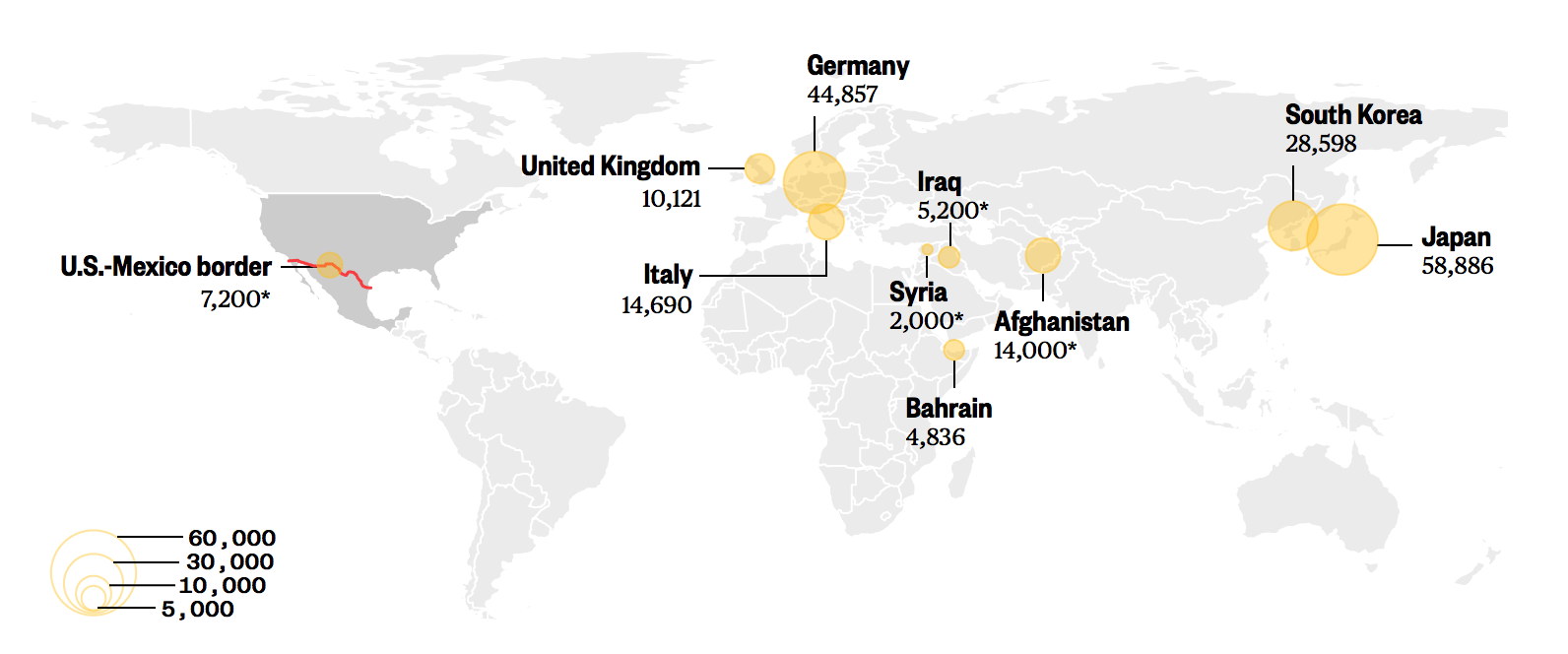
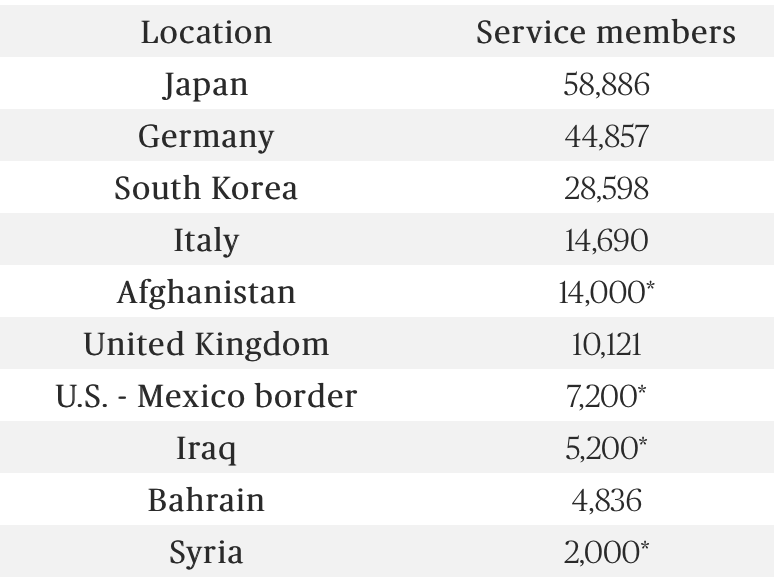
The repeated invocation of national security concerns, to argue those seeking asylum constitute threats to the nation, stand to change the United States from a place to seek sanctuary, ordering 5,000 troops–and perhaps up to 15,000–to the border with Mexico to bolster Border Patrol forces, and add more concertina wire, as he tweeted to refugees the “you will not be admitted into the United States unless you go through the legal process” and called their approach in no uncertain terms “an invasion of our Country” for which “our Military is waiting,” before Halloween, sending more troops to the borders than as are stationed in Syria and Iraq combined. This military mobilization set the national atmosphere on edge on October 31, 2018, focussing our military presence on the border in a way no Commander-in-Chief has ever done. The alarm that we should all feel at the bulking up of a military presence in a zone that lacks any actual combatants suggests a sick hollowing out of the value of military missions globally, not to mention military morale.
United States Troop Deployments on US-Mexico Border (expected) and in Afghanistan, Syria and Iraq on October 31, 2018; other numbers from June 30
The civil disruptions that had occurred within the country were taking up most of the media, but were hard to map, even though they were bound up so tightly in delusions and fears that spun from the border. Cesar Sayoc was accused of mailing poorly improvised DIY pipe-bombs that were thankfully badly improvised, and found before they arrived in the hands of their destinations or exploded; but fears spurred by their arrival at multiple sites across the nation echoed maps of “sprees” of terrorizing pipe bombs in the past. This time, they revealed the terrifyingly captivating nature of alt-right discourse even as they seemed destabilize the nation by attacking individuals. Even if they didn’t explode, the sequence of bombs revealed tears in our political and civil space–and of a politics of demonization, targeted at how Trump had designated dangers to the state, and of fear more than hope or civic involvement as we knew it.
The rash of violence that we couldn’t help but map to try to make sense of it, and it was viewed as a national wake-up call and emergency that it was–
–unfolding over a series of days in one week, either because of the vagaries of the U.S. Postal Service, or the actual intention of their maker–which seems beside the point–as the impression that they created of a plague of violence, tapping into the repeatedly foiled plots of terrorist attacks, ranging from teenage with contact to Al Qaeda to the twenty-one year old accused of planting twenty-four pipe bombs which would form, connecting their dots, a smiley face that would stare back at the viewer, whose smile was to arc from Colorado to North Texas to Tennessee. If the latter used a map to plant pipe bombs in mailboxes that would create a giant “smiley face” so that the map would stare back at the nation, the map stared back as a staccato punctuation of the civil fabric, even if they did not explode or injure anyone.
Their progress raised alarms and confusion as to the uncertainty about what was to come, and if the illusion of civil peace could be sustained. The planned set of attacks that seemed to destabilize public discourse was born out of Donald Trump’s head–who else links George Soros and Tom Steyer with Cory Booker, Eric Holder, Jr., Bill and Hillary Clinton, Joe Biden, Jr., Maxine Waters, Michael Moore, Kamala Harris and Robert DeNiro?–even as they seemed to tip an already uneasy nation over a brink of whatever decorum remained. They seemed to threaten to rend the very fabric of the nation, on the eve of the midterm elections, as the arrival of sent pipe-bombs planted alarmist messages and reminded us of the increased escalation of oppositional rhetoric in United States politics, as these anonymous acts of terror created a terrifying instability of our civic space.
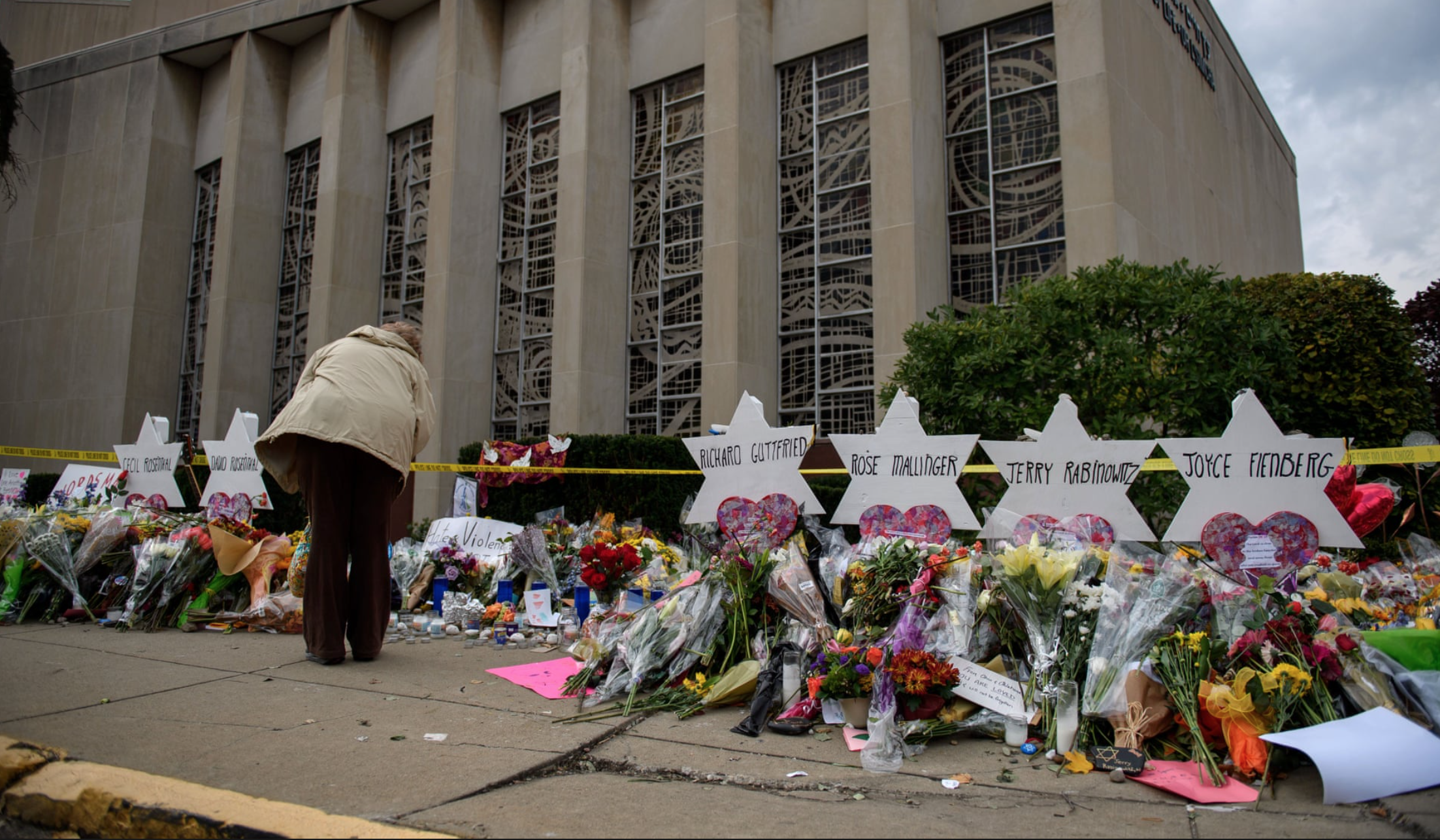
There was twinned let-down of tensions and a terrifying realization as the man who sent them, holed up in a white van in Florida so covered with Trump-Pence stickers aptly characerized as a MAGAmobile–whose inhabitant seemed to have spent the last two years in the virtual world of an online campaign, drawing sustenance from the ideological slogans of Trump’s campaign. Sayoc made bombs that failed to explode, probably from downloaded instructions, in a van with windows were so fully covered in garish divisive slogans they had effectively obscured any relation to a real world. The pipe-bombs spun from the frenetic identity of an online discourse, allegedly used in the subsequent massacre of Jews, a mass-murder at a Pittsburgh synagogue, driven by fears of immigrants and the promotion of immigration as if both were dangers in danger of “suspected terrorists” destabilizing the state. Trump has erased all integrity when with recognizable narcissism he described how both both of these tragic events served to “stop a certain momentum” going into the elections, as the acts of “two maniacs” he energetically disowned, as if they had shifted attention from the impact of GOP theatrics when they only shone a light on the dangers of Trumpets rhetoric and re-examination of his tweets in relation to the nation’s psychological health.
1. The bombs’ destinations may be a bit revealing, even if maps couldn’t capture the tragedy, or reach the violence Trump’s oppositional rhetoric plants in our civic space. The pipe bombs were sent where media hubs of its coastal states, which President Trump has indulgently attacked as “elitist,” in an attack on cosmopolitanism and coastal elites–and the mapping of such regions to members of the Democratic party seen as especially dangerous to the nation. The geography of the bombs was less striking than their destination for the coasts–the eastern seaboard, but also the western in California–coastal sites in “blue states” that Trumpists have distanced from the heartland, sewing divisions in the nation. The sequence of a week of pipe bombs was terrifyingly followed by a terribly violent attack killing and maiming members of a Pittsburgh Tree of Life Synagogue before Shabbat services, allegedly after crying “All Jews must die,” as if mainstreaming the need to defend the ‘nation’ against immigrants seen as terrorists. Joseph Bowers’ social media post on his intentionally unmonitored Gab–“I can’t sit by and watch my people getting slaughtered”–used its alleged protection of “free speech” to ready himself to open fire upon innocent congregants. The killings mapped the distortion of reason on a platform that wanted ideals of free speech, promising to “promote raw, rational, open, and authentic discourse online,” and would defend the best response to hate speech as more speech. Even though the two men had never met–and didn’t know of one another–they were triggered and animated, as Noah Berlatsky notes, by a common manufactured fears of migrants, and an antisemitic attribution of assistance for immigration and animosity to globalist Jews, and left the a good part of the nation mourning or in shock.
Memorial outside the Tree of Life synagogue in Pittsburgh, where 11 people were killed. Jeff Swensen/Getty Images
Unmonitored platforms may create alternate worlds, but cannot radicalize, even though no platform for attention of such heinous attacks should exist. No space should allow calling for violent acts or promote the fostering of violence. And as I traveled outside Berkeley, CA, where the absence of civility in the nation is at times hard to map–I was struck by the proliferation on the side of freeways of strikingly analogous oppositional rhetoric is evident in the proliferation of specters of fugitives, frozen in mug shots placed in digitized billboards, as a broad expansion of our notions of criminality: by advocating a public sort of retributive violence, the specters that increasingly haunt the interstate in such digitized billboards allow drivers to enter versions of “America’s Most Wanted,” the old television show FOX created and endured so long on air, while behind the wheel. The direct engagement of such an oppositional rhetoric of danger seemed outside the political world–it was from a federal law enforcement agency, after all, but triggered a deep sense of unease that is echoed in the fear of outsiders and rampant criminality at our gates: as Vice President Pence intoned quite surreally and without any proof that it was all but certain terrorists were among the Caravan of central American refugees and migrants approaching to seek asylum in racially charged terms–“It is inconceivable that there are not people of Middle Eastern descent” who would “not be in this large throng” approaching the border, in defense of Trump’s outrageous claim“Middle Eastern” people will emerge among the migrant caravan if you “look with cameras” and his instructions to the press to “take your cameras, go into the middle of the Caravan, and search” for MS-15 gang members, Middle Easterners. In these ungrounded assertions, the danger of refugees was linked to those who the President, as Rebecca Solnit wrote, had pushed the nation, but also Bowers and Peyoc to focus on.
Driving to an airport in Newark, NJ, I couldn’t but think of the new means of civic involvement–based on fear–that has spread in the nation, as the face of a glassy-eyed fugitive from the law jumped out from other surrounding signage, as if the digital billboards of wanted criminals drew attention to targets of public wrath and danger,–their identities were obscured by their felonies, as the terror of their crimes seemed a means of striking fear into my heart, as it suddenly seemed as if the space through which I was driving outside Newark was considerably more dangerous than that of Manhattan, and that I had to escalate my guard as I had entered a new space. I was struck by the prominence of such haunting billboards of haunted men and women shortly before the spate of bombings prompted reflections on how such a corrosive political discourses began,–or could be blamed for the rise of such horrific acts of violence in public life–and the odd relation they created to criminality and to the law, or the project of federal law enforcement and the role of the state. The billboards stake out a notion of civic involvement and participation by identifying and apprehending federal criminals that eerily echoed the demonization of dangers to the nation–the deepest “we” and the broadest “collective”–that the arrival of criminals, whether they be concealed in groups of refugees, or among those who sought asylum, or were those guilty of crossing the border “illegally” and were hence felons as a result–indeed, true national threats–that has been the logic of sending troops to the border, and protecting our frontiers. But these posters invited citizens to search for similar dangerous faces in their memories, and to direct attention to the fearful presence of fugitives among us, and indeed likely to be seen in their own states, perhaps lurking right off of that very interstate.
The rhetoric of civic engagement was terrifying as the elevation of a new notion of national security. Can one look at an origin point in the direction of a redefinition of criminality, outside the court of law, in the register of Reality TV as much as in reality. The mug shots of most wanted and images haunt not only the freeways, but the mug shots that come to constitute entire sections of newspapers, as if to grab attention of audiences against their online competitors? The emergence of set the scene for arrival of Donald J. Trump and the intensity of his almost baseless baiting by his personalized taunts about immigrants, ICE, and deportations, and the threats of gang violence, rapes, murders, human trafficking, and terrorism that have haunted his demonization of immigrants, refugees, and the approaching Caravan. For the images of fugitives that haunt the freeways seemed an invitation to participate in an ongoing form of Reality TV, as much as to invite citizen participation in law enforcement, expanding an elastic category of criminality as a sort of place-holder for all to see.
It is comforting that it was at the borders, however, that we saw borders broke for Beto in Texas, even if he narrowly lost the state, and that the candidates spewing anti-immigrant pro-border platforms in Arizona failed to capture the sort of attention we had feared.
But the prominence of the haunting images of faces of fugitives posted on the freeways, and the image of clear and present dangers that they personify and promote, seemed to create an eery reality at a remove from reality–a dram of Reality TV, in which the designer of a President who spent many years of thought dedicated to Reality TV ratings as a way he could better compete, seemed to haunt his own discourse of opposition, and his irrational obsessions with the dangers of criminality that needy hopeful immigrants in the Caravan are contaminated by, and indeed by the fears of contamination of the nation that Trump has so willfully sought to promote, as if to over-ride and obscure the choices that were at stake in the impending mid-term elections.
We read more maps than ever before, and rely on maps to process and embody information that seems increasingly intangible by nature. But we define coherence in maps all too readily, without the skepticism that might be offered by an ethics of reading maps that we all to readily consult and devour. Paradoxically, the map, which long established a centering means to understand geographical information, has become regarded uncritically. As we rely on maps to organize our changing relation to space, do we need to be more conscious of how they preset information? While it is meant to be entertaining, this blog examines the construction of map as an argument, and proposition, to explore what the ethics of mapping might be. It's a labor of love; any support readers can offer is appreciated!














 Musings on Maps